Washington Bee
Saturday, April 1, 1911
Washington, D.C.
Page text (machine-generated)
vOL.XXX1 NO 44
The Great Conference INTERNATIONAL CONFERENCE ON THE NEGRO.
Wednesday, Thursday and Friday, April 17, 18 and 19, 1912.
For some years past I have had in mind to invite here from different parts of the world—from Europe, Africa, the West Indies and North and South America—persons who are actively interested or directly engaged as missionaries, or otherwise, in the work that is going on in Africa and elsewhere for the education and upbuilding of Negro peoples.
For this purpose it has been determined to hold at Tuskegee Institute, Alabama, Wednesday, Thursday and Friday, April 17, 18 and 19, 1912, a little more than a year from this time, an international conference on the Negro. Such a conference as this will offer the opportunity for those engaged in any kind of service in Africa, or the countries above mentioned, to become more intimately acquainted with the work and the problems of Africa and these other countries. Such a meeting will be valuable and helpful, also, in so far as it will give opportunity for a general interchange of ideas in organizing and systematizing the work of education of the native peoples in Africa and elsewhere and the preparation of teachers for that work. Wider knowledge of the work that each is doing should open means of co-operation that do not now exist.
The object of calling this conference at Tuskegee Institute is to afford an opportunity for studying the methods employed in helping the Negro people of the United States, with a view of deciding to what extent Tuskegee and Hampton methods may be applied to conditions in these countries, as well as to conditions in Africa.
It is hoped that numbers of people representing the different governments interested in Africa and the West Indies, as well as representatives from the United States and the countries of South America, will decide to attend this conference. Especially is it urged that missionary and other workers in these various countries be present and take an active part in the deliberations of the conference.
It is desirable, in any case, to have any suggestions as to what might be done to make the work of the conference more helpful to all concerned. The names of persons who would like to be present with whom you are acquainted, will be appreciated, and though you they are invited to be present and take part in the deliberations of the conference.
Those who come to Tuskegee properly accredited will be welcomed and entertained as guests of the institution, and will be under no expense during their stay here.
BOOKER T. WASHINGTON.
Principal, Tuskegee Normal and Industrial Institute, Tuskegee Institute, Alabama.
SHELBY J. DAVIDSON'S AUTOMATIC ATTACHMENT.
From a Laborer to One of the Most Competent Clerks in the Department, and an Inventor of National Character.
The announcement that Mr. Shelby J. Davidson, a colored clerk of the $1,600 grade, in the Office of the Auditor for the Post Office, Treasury Department, has invented an automatic fee attachment for adding machines, gives him the distinction of being the first to be thus singled out as coming within the scope of the President's Efficiency and Economy Commission in contributing to the reduction of the operating expenses of the executive departments.
Mr. Davidson entered the government service sixteen years ago as a laborer, at the lowest salary of $660. For more than twelve years he has
SHELBY J. DAVIDSON, ESQ,
AN INVENTOR OF A GREAT
MACHINE.
COMPLIMENTED BY THE GOV-
ERNMENT.
given especial attention to adding and
calculating machines, serving in the
factories and rendering such efficient
and notable service in charge of the
machines in the Office of the Auditor
for the Post Office as to attract the
attention not only of his superiors, but of the adding machine manufacturers
throughout the country. This is the
third invention directly bearing on the
work of the Auditor's Office made by
Mr. Davidson. The present device being
electro-mechanical, Mr. Davidson
has associated with him Mr. Edwin J.
Dowling, electrician of the Post Of-
fice Department.
The attachment is intended to automatically list, register, add and total the fees charged for money-orders, as they are audited, the operator of the adding machine on which the work is done simply entering the amount of the order. At present the work requires two operations, with constant attention to entering the correct fee, with more or less liability to error. The attachment will fit on any adding machine on the market without changing the mechanism or necessitating any extensive alterations.
Mr. Davidson is to be congratulated not only on the success of his work in this line and the signal abilities he has shown to cope with such a mechanical marvel as the adding and calculating machines, but on being the only colored man, thus far known, to have entered and maintained a rating—and that a high one—in this new and untried field. He has certainly demonstrated his skill for handling tools, as well as the genius for contriving and executing. Mr. Davidson is 41 years old, a graduate of the College Department, Howard University, class of 1893, and a lawyer, being a member of his home bar, Lexington, Ky., and the bar of the District of Columbia. He has an attractive home life, with a wife and two children, a boy of 14 and a girl of 12. He has given some attention to literature; was at one time the president of the Bethel Literary and Historical Association. He has a well-selected library in both law and literature, and devotes much of his spare time to this as a recreation.
It is hoped that since this distinction of effort has come to him that the proper recognition will be given him for his perseverance, and too as a stimulus for other employees, that they may feel that adherence to duty well done is appreciated by the government. This invention has been the work of six years, covering the period of the use, in the office, of the double machines, which Mr. Davidson was instrumental in having placed on the work.
An instance of what clerks can do to reduce the operating expenses of the executive departments and aid in the movement for efficiency and economy which takes its inspiration from the White House, has just come to the notice of the new Auditor for the Post Office Department, Charles A. Kram. Two clerks, Shelly B. Davidson, a clerk in the Auditor's Office, and Edwin J. Dowling, electrician for the Post Office Department, have collaborated in producing an electrical machine that automatically prints the money order fees as the amounts of the paid money orders are recorded for auditing purposes. It is being put to a thorough and trying test, and if ultimately adopted by the Secretary of the Treasury will reduce the work of listing paid money orders 20 per cent, and leave twelve clerks available for other work in the office. Auditor Kram said today: "The investigations now being conducted in the departments of the efficiency of their clerical force and the economical administration of their affairs are daily bringing forth from the clerks themselves many suggestions of real value. If the inquiries already made should proceed no further they have accomplished much for the government in creating a sentiment among those in subordinate positions for greater activity in devising ways to improve the service and producing substantial results.
Appliance Being Tested.
"This little appliance now brought to my notice, if it vindicates itself in the tests to which it is being subjected, is a substantial proof of this fact.
"The 80,000,000 paid money orders sent to the Auditor's Office annually by postmasters represent a value of over $570,000,000, with fees paid by the patrons of the money order branch, of over $5,000,000. The Auditor's office uses 60 adding machines for totalling the amounts of the orders and for putting down and counting the fees paid by the purchasers. The daily average of a clerk, striking separately on the machines the amounts and fees, is 5,000 orders a day.
"With the use of the new attachment on the adding machines the clerks will register the sums called for on the money orders, while the new device will print automatically the fees that should have been paid, and add both columns.
"That will mean a saving of 20 per cent in the work of listing paid money orders, and will leave the services of twelve clerks available for other pressing work that must be done, and that, too, without the reduction of any of the force or of any one's salary."
NEGRO REALTY COMPANY'S TROUBLES.
Metropolitan Mercantile in the Hands of a Receiver.
The Metropolitan Mercantile and Realty Company of New York, a $1,000,000 concern, managed by Negroes, and doing a large real estate and store business, has gone into the hands of a receiver. According to John H. Atkins, president of the company, its present troubles are due in part to the failure of 1907 and in part to the failure of stockholders who bought on the instalment plan to pay for their stock. He says that while the liabilities of the concern are less than $50,000, there is more than $157,000 due it from stockholders alone.
Complaints concerning the management of the company have been made to the District Attorney of New York County, but Atkins says they arose from a misunderstanding of a real estate deal in which the transfer of property taken in his name to the company was unrecorded, when it should have
WASHINGTON
WASHINGTON, D. C., SAT
W. H.
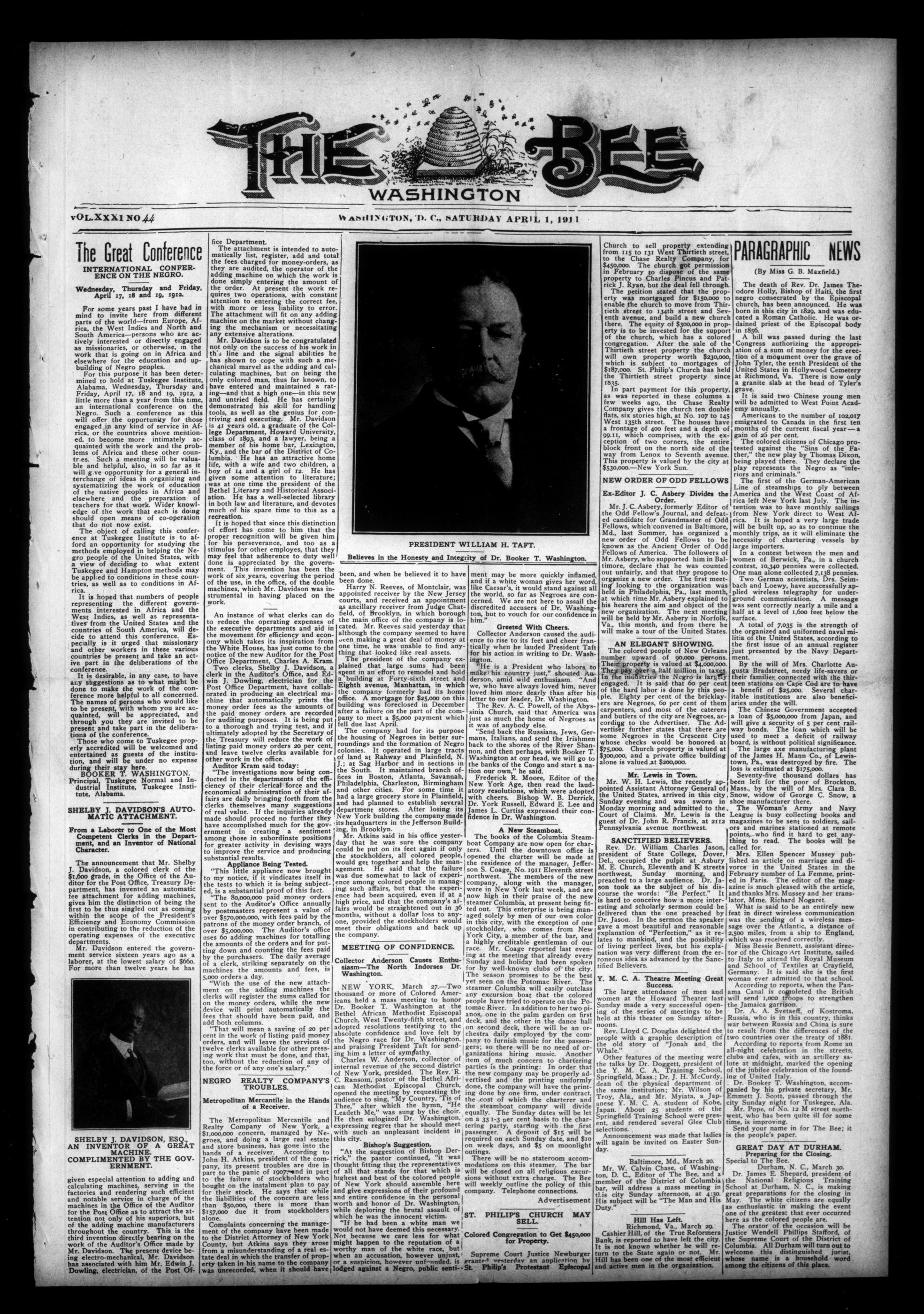
PRESIDENT WILLIAM H. TAFT.
Believes in the Honesty and Integrity of Dr. Booker T. Washington.
been, and when he believed it to have been done.
Harry N. Reeves, of Montclair, was appointed receiver by the New Jersey courts, and received an appointment as ancillary receiver from Judge Chattfield, of Brooklyn, in which the main office of the company is located. Mr. Reeves said yesterday that although the company seemed to have been making a great deal of money at one time, he was unable to find anything that looked like real assets.
The president of the company explained that large sums had been spent in an effort to remodel and hold a building at Forty-sixth street and Eighth avenue, Manhattan, in which the company formerly had its home office. A mortgage for $25,000 on this building was foreclosed in December after a failure on the part of the company to meet a $5,000 payment which may be more quickly inflated and if a white woman gives her woe like Caesar's, it would stand against the world, so far as Negroes are concerned. We are not here to assail discredited accusers of Dr. Washinton, but to vouch for our confidence him."
Greeted With Cheers.
Collector Anderson caused the attention to rise to its feet and cheer fraternally when he lauded President T. for his action in writing to Dr. Washinton.
"He is a President who laborors make his country just," shouted derson, amid wild enthusiasm. "I love, who have always loved him, new loved him more dearly than after letter to head Dr. Washington.
The Rev. A. C. Pewell, of the Abi sinia Church, said that America was just as much the home of Negroes it was of anybody else."
The company had for its purpose the housing of Negroes in better surroundings and the formation of Negro colonies. It operated in large tracts of land at Rahway and Plainfield, N. J.; at Sag Harbor and in sections in the South. It maintained branch offices in Boston, Atlanta, Savannah, Philadelphia, Charleston, Birmingham and other cities. For some time it had a large grocery store in Plainfield, and had planned to establish several department stores. After losing its New York building the company made its headquarters in the Jefferson Building, in Brooklyn.
Mr. Atkins said in his office yesterday that he was sure the company could be put on its feet again if only the stockholders, all colored people, would get together and help the management. He said that the failure was due somewhat to lack of experience among colored people in managing such affairs, but that the experience had been acquired, even if at a high price, and that the company's affairs would be straightened out in 36 months, without a dollar loss to anyone, provided the stockholders would meet their obligations and back up the company.
MEETING OF CONFIDENCE
Collector Anderson Causes Enthusiasm—The North Indorses Dr Washington.
NEW YORK, March 27—Two thousand or more of Colored Americans held a mass meeting to honor Dr. Booker T. Washington at the Bethel African Methodist Episcopal Church, West Twenty-fifth street, and adopted resolutions testifying to the absolute confidence and love felt by the Negro race for Dr. Washington, and praising President Taft for sending him a letter of sympathy. Charles W. Anderson, collector of internal revenue of the second district of New York, presided. The Rev. R.C. Ransom, pastor of the Bethel African Methodist Episcopal Church, opened the meeting by requesting the audience to sing, "My Country, Tis of Thee," after which the hymn, "He Lend Me The," was sung by the choir. He then eulogized Dr. Washington, expressing regret that he should meet with such an unpleasant incident in this city.
Bishop's Suggestion.
"At the suggestion of Bishop Derrick," the pastor continued, "it was thought fitting that the representatives of all that stands for that which is highest and best of the colored people of New York should assemble. here and give expressions of their profound and entire confidence in the personal worth and honor of Dr. Washington, while deploring the brutal assault of which he was the innocent victim. "If he had been a white man we would not have deemed this necessary. Not because we care less for what might happen to the reputation of a worthy man of the white race, but when an accusation, however unjust, or a suspicion, however unfounded, is lodged against a Negro, public senti-
SATURDAY APRIL 1, 1911
ment may be more quickly inflamed, and if a white woman gives her word, like Caesar's, it would stand against all the world, so far as Negroes are concerned. We are not here to assail the discredited accusers of Dr. Washington, but to vouch for our confidence in him."
Greeted With Cheers.
Collector Anderson caused the audience to rise to its feet and cheer frantically when he lauded President Taft for his action in writing to Dr. Washington.
"He is a President who labors to make his country just," shouted Anderson, amid wild enthusiasm. "And we, who have always loved him, never loved him more dearly than after his letter to our leader, Dr. Washington. The Rev. A. C. Powell, of the Abysinia Church, said that America was just as much the home of Negroes as it was of anybody else.
"Send back the Russians, Jews, Germans, Italians, and send the Irishmen back to the shores of the River Shan, where then perhaps, with Booker T. Washington's head, we will go to the banks of the Congo and start a nation our own." he said.
Frederick R. Moore, Editor of the New York Age, then read the laudatory resolutions, which were adopted with cheers. Bishop W. B. Derrick, Dr. York Russell, Edward E. Lee and James L. Curtiss expressed their confidence in Dr. Washington.
A New Steamboat
The books of the Columbia Steamboat Company are now open for charters. Until the downtown office is opened the charter will be made at the residence of the manager, Jefferson S. Coage, No. 1911 Eleventh street northwest. The members of the new company, along with the manager were in New York last week, and are now high in their praise of the new steamer Columbia, at present being fitted out. This enterprise is being managed solely by men of our own color in this city, with the exception of one stockholder, who comes from New York City, a member of the bar, and a highly creditable gentleman of our Mr. Coage reported last evening at the meeting that already every Sunday and holiday had been spoken for by well-known clubs of the city. The season promises to be the best yet seen on the Potomac River. The steamer Columbia will easily outclass any excursion boat that the colored people have tried to operate on the Potomac River. In addition to her two pianos, one in the palm garden on first deck, and the other in the dance hall on second deck, there will be an orchestra daily employed by the company to furnish music for the passenger to there will be no need of organization in music. Another item of much interest, charting parties is the printing. In order that the new company may be properly advertised and the printing uniformly done, the company will have the printing done by one firm, under contract, the cost of which the charterer and the steamboat company will divide equally. The Sunday dates will be let on a 331-3 per cent basis to the chartering party, starting with the first passenger. A deposit of $15 will be required on each Sunday date, and $10 on week days, and $5 on moonlight outings.
There will be no stateroom accommodations on this steamer. The bar will be closed on all religious excursions without extra charge. The Bee will weekly outline the policy of this company. Telephone connections.
Colored Congregation to Get $450,000 for Property.
Supreme Court Justice Newburger granted yesterday an application by St. Philip's Protestant Episcopal
Advertisement
Church to sell property extending from 115 to 131 West Thirtieth street, to the Chase Realty Company, for $450,000. The church got permission in February to dispose of the same property to Charles Pincus and Patrick J. Ryan, but the deal fell through. The petition stated that the property was mortgaged for $150,000 to enable the church to move from Thirtieth street to 134th street and Seventh avenue, and build a new church there. The equity of $300,000 in property is to be invested for the support of the church, which has a colored congregation. After the sale of the Thirtieth street property the church will own property worth $230,000, which is subject to mortgages of $187,000. St. Philip's Church has held the Thirtieth street property since 1835.
In part payment for this property, as was reported in these columns a few weeks ago, the Chase Realty Company gives the church ten double flats, six stories high, at No. 107 to 145 West 135th street. The houses have a frontage of 400 feet and a depth of 99.11, which comprises, with the exception of two corners, the entire block front on the north side of the way from Lenox to Seventh avenue. This property is valued by the city at $530,000.—New York Sun.
NEW ORDER OF ODD FELLOWS
Ex-Editor J. C. Asbyre Divides the Order
Mr. J. C. Asbyer, formerly Editor of the Odd Fellow's Journal, and defeated candidate for Grandmaster of Odd Fellows, which convened in Baltimore, Md., last Summer, has organized a new order of Odd Fellows to be known as the Ancient Order of Odd Fellows of America. The followers of Mr. Asbyer, who supported him in Baltimore, declare that he was counted out unfairly, and that they propose to organize a new order. The first meeting looking to the organization was held in Philadelphia, Pa., last month, at which time Mr. Asbyer explained to his hearers the aim and object of the new organization. The next meeting will be held by Mr. Asbyer in Norfolk, Va., this month, and from there he will make a tour of the United States.
AN ELEGANT SHOWING.
The colored people of New Orleans number upward of 90,000 persons. Their property is valued at $40,000,000. They pay over a half million in taxes. In the industries the Negro is largely engaged. It is said that 60 per cent of the hard labor is done by this people. Eighty per cent of the bricklayers are Negroes, 60 per cent of them carpenters, and most of the caterers and butlers of the city are Negroes, according to the Advertiser. The Advertiser further states that there are some Negroes in the Crescent City whose checks would be honored at $75,000. Church property is valued at $300,000, and a private office building alone is valued at $200,000.
Mr. Lewis in Town
Mr. W. H. Lewis, the recently appointed Assistant Attorney General of the United States, arrived in this city Sunday evening and was sworn in Monday morning and admitted to the Court of Claims. Mr. Lewis is the guest of Dr. John R. Francis, at 2112 Pennsylvania avenue northwest.
SANCTIFIED BELIEVERS
Rev. Dr. William Charles Jason, president of State College, Dover, Del, occupied the pulpit at Asbury M. E. Church, Eleventh and K streets northwest, Sunday morning, and preached to a large audience. Dr. Jason took as the subject of his discourse the words: "Be Perfect." It is hard to conceive how a more interesting and scholarly sermon could be delivered than the one preached by Dr. Jason. In the sermon the speaker gave a most beautiful and reasonable explanation of "Perfection," as it relates to mankind, and the possibility of living perfect lives, but his explanation was very different from the erroneous idea as advanced by the Sanctified Believers.
Y. M. C. A. Theatre Meeting Great Success.
The large attendance of men and women at the Howard Theater last Sunday made a very successful opening of the series of meetings to be held at this theater on Sunday afternoons.
Rev. Lloyd C. Douglas delighted the people with a graphic description of the old story of "Jonah and the Whale."
Other features of the meeting were the talks by Dr. Doggett, president of the Y. M. C. A. Training School, Springfield, Mass.; Dr. J. H. McCurdy, dean of the physical department of the same institution; Mr. Wilson of Troy, Ala., and Mr. Myiata, a Japanese Y. M. C. A. student of Kobe, Japan. About 25 students of the Springfield Training School were present, and rendered several Glee Club selections.
Announcement was made that ladies will again be invited on Easter Sunday.
Baltimore, Md., March 20.
Mr. W. Calvin Chase, of Washington, D. C., Editor of The Bee, and a member of the District of Columbia bar, will address a mass meeting in this city Sunday afternoon, at 4:30. His subject will be "The Man and His Duty."
Hill Has Left.
Richmond, Va., March 29. Cashier Hill, of the True Reformers Bank, is reported to have left the city. It is not known whether he will return to the State again or not. Mr Hill has been one of the most efficient and active men in the organization.
PARAGRAPHIC NEWS
(By Miss G. B. Maxfield)
The death of Rev. Dr. James Theodore Holly, Bishop of Haiti, the first negro consecrated by the Episcopal church, has been announced. He was born in this city in 1829, and was educated a Roman Catholic. He was ordained priest of the Episcopal body in 1856.
A bill was passed during the last Congress authorizing the appropriation of a sum of money for the erection of a monument over the grave of John Tyler, the tenth President of the United States in Hollywood Cemetery at Richmond, Va. There is now only a granite slab at the head of Tyler's grave.
It is said two Chinese young men will be admitted to West Point Academy annually.
Americans to the number of 102,017 emigrated to Canada in the first ten months of the current fiscal year—a gain of 25 per cent.
The colored citizens of Chicago protested against the "Sins of the Father," the new play by Thomas Dixon, being played there. They declare the play represents the Negro as "inferior and criminal."
The first of the German-American Line of steamships to ply between America and the West Coast of Africa left New York last July. The intention was to have monthly sailings from New York direct to West Africa. It is hoped a very large trade will be built up, so as to continue the monthly trips, as it will eliminate the necessity of chartering vessels by large importers.
In a contest between the men and women of Berwick, Pa., in a church contest, 10,340 pennies were collected. One man alone collected 7,138 pennies. Two German scientists, Drs. Seimbach and Loewy, have successfully applied wireless telegraphy for underground communication. A message was sent correctly nearly a mile and a half at a level of 1,600 feet below the surface. A total of 7,035 is the strength of the organized and uniformed naval militia of the United States, according to the first issue of an annual register just presented by the Navy Department. By the will of Mrs. Charlotte Augusta Bradstreet, needy life-savers or their families connected with the thirteen stations on Cape Cod are to have a benefit of $25,000. Several charitable institutions are also beneficiaries under the will. The Chinese Government accepted a loan of $5,000,000 from Japan, and will give a security of 5 per cent railway line. The loan will be used to meet the deficit of a way board, is without political significance. The large axe manufacturing plant of the James H. Mann Co., of Lewistown, Pa., was destroyed by fire. The loss is estimated at $175,000. Seventy-five thousand dollars has been left for the poor of Brockton, Mass., by the will of Mrs. Clara B. Snow, widow of George C. Snow, a shoe manufacturer there.
The Woman's Army and Navy League is busy collecting books and magazines to be sent to soldiers, sailors and marines stationed at remote points, who find it hard to get anything to read. The books will be called for.
Mrs. Ellen Spencer Mussey published an article on marriage and divorce in the United States in the February number of La Femme, printed in Paris. The editor of the magazine is much pleased with the article, and thanks Mrs. Mussey and her translator, Mme. Richard Nogaret.
What is said to be an entirely new feat in direct wireless communication was the sending of a wireless message over the Atlantic, a distance of 2,500 miles, from a ship to England, which was received correctly.
Miss Bessie Bennett, assistant director of the Chicago Art Institute, sailed to Italy to attend the Royal Museum and School of Textiles at Crayfield, Germany. It is said she is the first woman ever admitted to that school.
According to reports, when the Panama Canal is completed the British will send 1,000 troops to strengthen the Jamaica garrison.
Dr. A. A. Svyetaeff, of Kostroma, Russia, who is in this country, thinks war between Russia and China is sure to result from the differences of the two countries over the treaty of 1881.
According to reports from Rome an all-night celebration in the streets, clubs and cafes, with an artillery salute at midnight, marked the opening of the jubilee celebration of the founding of United Italy.
Dr. Booker T. Washington, accompanied by his private secretary, Mr. Emmett J. Scott, passed through the city Sunday night for Tuskegee, Ala. Mr. Pope of No. 12 M street northwest where he quite ill for some time, is improving. Send your name in for The Bee; it is the people's paper.
GREAT DAY AT DURHAM.
Preparing for the Closing.
Seeing the Day.
Durham, N. C., March 30.
Dr. James E. Shepard, president of the National Religious Training School at Durham, N. C., is making great preparations for the closing in May. The white citizens are equally as enthusiastic in making the event one of the greatest; that ever occurred here as the colored people are.
The orator of the occasion will be Justice Wendell Phillips Stafford, of the Supreme Court of the District of Columbia. All Durham will turn out to welcome this distinguished jurist, whose name is a household word among the citizens of this place.
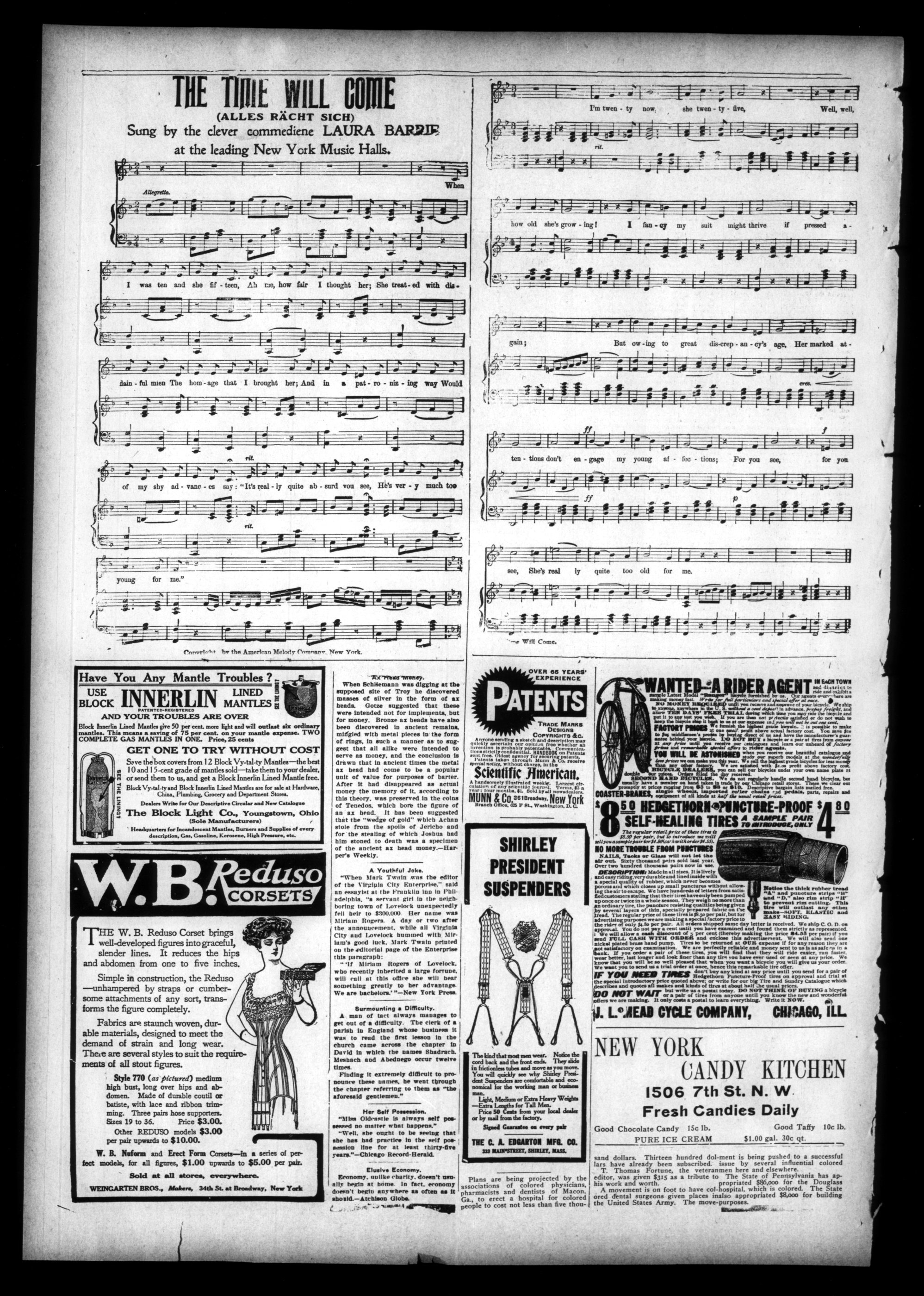
THE TIME WILL COME
(ALLES RACHT SICH) Sung by the clever commediene LAURA BARRIE at the leading New York Music Halls.
I was ten and she fifteen, Ah me, how fair I thought her; She treated with dis-
dainful men The homage that I brought her; And in a pat-ro-niz-ing way Would
of my shy advanc-ces say: "It's really quite absurd you see, He's very much too
young for me."
Copyright by the American Melody Company New York.
Block Innerlin Lined Mantles give 50 per cent, more light and will outlast six ordinary mantles. This means a saving of 75 per cent. on your mantle expense. TWO COMPLETE GAS MANTLES IN ONE. Price, 25 cents
Save the box covers from 12 Block Vy-tal-ty Mantles—the best 10 and 15-cent grade of mantles sold—take them to your dealer, or send them to us, and get a Block Innerlin Lined Mantle free.
Block Vy-tal-ty and Block Innerlin Lined Mantles are for sale at Hardware, China, Plumbing, Grocery and Department Stores.
Dealers Write for Our Descriptive Circular and New Catalogue
The Block Light Co., Youngstown, Ohio (Sole Manufacturers)
Headquarters for Incandescent Mantles, Burners and Supplies of every description, Gas, Gasoline, Kerosene, High Pressure, etc.
W. B. Nuform and Erect Form Corsets—in a series of perfect models, for all figures, $1.00 upwards tq' $5.00 per pair.
Sold at all stores, everywhere.
SEE THE LINING?
THE W. B. Reduso Corset brings well-developed figures into graceful, slender lines. It reduces the hips and abdomen from one to five inches. Simple in construction, the Reduso unhampered by straps or cumbersome attachments of any sort, transforms the figure completely.
Fabrics are staunch woven, durable materials, designed to meet the demand of strain and long wear. There are several styles to suit the requirements of all stout figures.
Fabrics are staunch woven, durable materials, designed to meet the demand of strain and long wear. There are several styles to suit the requirements of all stout figures.
Style 770 (as pictured) medium high bust, long over hips and abdomen. Made of durable coutil or batiste, with lace and ribbon trimming. Three pairs hose supporters. Sizes 19 to 36. Price $3.00.
Other REDUSO models $3.00 per pair upwards to $10.00.
W. B. Nuform and Erect Form Corsetsfect models, for all figures, $1.00 upwards Sold at all stores every
BE THE LUNA?
and will outlast six ordinary your mantle expense. TWO 5 cents
WITHOUT COST
Vy-tal-ty Mantles—the best old—take them to your dealer, Innerlin Lined Mantle free.
Mantles are for sale at Hardware, and Department Stores.
Circular and New Catalogue
O., Youngstown, Ohio (acturers)
Burners and Supplies of every osene, High Pressure, etc.
Peduso CORSETS
il,
ips
es.
quire-
sets—in a series of per- cards tq' $5.00 per pair. anywhere. at Broadway, New York
AX TREAD MONEY.
When Schleidmann was digging at the supposed site of Troy he discovered masses of silver in the form of ax heads. Gotze suggested that these were intended not for implements, but for money. Bronze ax heads have also been discovered in ancient remains, mingled with metal pieces in the form of rings, in such a manner as to suggest that all alike were intended to serve as money, and the conclusion is drawn that in ancient times the metal ax head had come to be a popular unit of value for purposes of barter. After it had disappeared as actual money the memory of it, according to this theory, was preserved in the colons of Tenedos, which bore the figure of an ax head. It has been suggested that the "wedge of gold" which Achan stole from the spoils of Jericho and for the stealing of which Joshua had him stoned to death was a specimen of the ancient ax head money.—Harper's Weekly.
A Youthful Joke.
"When Mark Twain was the editor of the Virginia City Enterprise," said an essayist at the Franklin Inn in Philadelphia, "a servant girl in the neighboring town of Lovelock unexpectedly fell heir to $300,000 Her name was Miriam Rogers. A day or two after the announcement, while all Virginia City and Lovelock hummed with Miriam's good luck, Mark Twain printed on the editorial page of the Enterprise this paragraph:
"If Miriam Rogers of Lovelock, who recently inherited a large fortune, will call at this office she will hear something greatly to her advantage. We are bachelors."—New York Press.
Surmounting a Difficulty.
A man of tact always manages to get out of a difficulty. The clerk of a parish in England whose business it was to read the first lesson in the church came across the chapter in David in which the names Shadrach, Meshach and Abednego occur twelve times. Fluding it extremely difficult to pronounce these names, he went through the chapter referring to them as "the aforesaid gentlemen."
Her Self Possession.
"Miss Olden堡 is always self possessed no matter what happens." "Well, she ought to be seeing that she has bad practice in the self possession line for at least thirty-five years."—Chicago Record-Herald.
Elusive Economy.
Economy, unlike charity, doesn't usually begin at home in fact, economy doesn't begin anywhere as often as it should.—Aitchison Globa.
I'm twenty now, she twenty-five, Well, well,
how old she's growing! I fancy my suit might thrive if pressed
gain; But owing to great discrepancy's age, Her marked at
ten-tions don't engage my young affections; For you see, for you
see, She's really quite too old for me.
me Will Come.
OVER 65 YEARS' EXPERIENCE
PATENTS
TRADE MARKS
DESIGNS
COPYRIGHTS & C.
Anyone sending a sketch and description may quickly ascertain our opinion free whether an invention is probably patentable. Communications strictly confidential. HANDBOOK on Patents set free. Oftent enough, securing patents. Patents taken through Bunn & Co. receive special notice, without charge, in the
A handsomely illustrated weekly. Largest circulation of any scientific journal. 1 Terms, $3 a year; four months, $1. Sold by all new advertisers.
MUNN & Co. 261 Broadway, New York
Branch Office, 625 F St., Washington, D.C.
SHIRLEY
PRESIDENT
SUSPENDERS
M
The kind that most men wear. Notice the cord back and the front ends. They slide in frictionless tubes and move as you move. You will quickly see why Shirley President Suspenders are comfortable and economical for the working man or business man.
Light, Medium or Extra Heavy Weights — Extra Lengths for Tall Men.
Price 50 Cents from your local dealer or by mail from the factory.
Signed Guarantee on every pair
THE C. A. EDGARTON MFQ. CO.
233 MAIN'S STREET, SHIRLEY, MASS.
Plans are being projected by the associations of colored physicians, pharmacists and dentists of Macon. Ga., to erect a hospital for colored people to cost not less than five thou-
SECOND HAND BICYCLES. We do not regularly handle second hand bicycles, but usually have a member on hand taken in trade by our Chicago retail stores. These we clear out promptly at prices ranging from $3 to $8 or $10. Describe bargain lists mailed free, and offer pedals, parts, repairs and component of all kinds as half the usual retail prices.
ALUMINUM
BUTTONS
and easy riding, very durable and lined inside with a special quality of rubber, which never becomes porous and which closes up small punctures without allowing the air to escape. We have hundreds of letters from satisfied customers stating that their tapes have only been pumped upon or twice in a whole season. They weigh no more than an ordinary tape, the puncture resisting qualities being given by several layers of thin, specially prepared fabric on the tread. The regular price of these tapes is $5 per pair, but for advertising purposes we are making a special factory price to
the rider of only $4.50 per pair. All orders shipped same day letter is received. We ship C.O.D on approval. You do not pay a cent until you have examined and found them strictly as represented. We will allow a cash discount of 5 per cent (thereby making the price $4.55 per pair) if you send FULL CASH WITH ORDERS and enclose this advertisement. We will also send one nickel plated brass hand pump. Tires to be returned at OUR expense if for any reason they are not satisfactory on examination. We are perfectly reliable and money sent to us is as safe in a bank. If you order a pair of these tires, you will find that they will ride easier, run faster we better, last longer and look finer than any tire you have ever used or seen at any price. We know that you will be so well pleased that when you want a bicycle you will give us your order. We want you to send us a trial order at once, hence this remarkable tire offer.
IF YOU NEED THRES don't buy any kind at any price until you send for a pair of Hedgehorn Puncture-Proof tires on approval and trial at the special introductory price quoted above; or write for our big Tire and Sundry Catalogue which describes and quotes all makes and kinds of tires at about half the usual prices. DO NOT WAIT or a pair of tires from anyone until you know the new and wonderful offers we are making. It only costs a postal to learn everything. Write it NOW.
NEW YORK CANDY KITCHEN 1506 7th St. N. W. Fresh Candies Daily
Good Chocolate Candy 15c lb. Good Taffy 10c lb.
PURE ICE CREAM $1.00 gal. 30c qt
sand dollars. Thirteen hundred dol-ment is being pushed to a successful
lars have already been subscribed. issue by several influential colored
T. Thomas Fortune, the veteranmen here and elsewhere.
editor, was given $315 as a tribute to The State of Pennsylvania has aphis work and worth. propriated $86,000 for the Douglass A movement is on foot to have col-hospital, which is colored. The State ored dental surgeons given places inalso appropriated $8,000 for building the United States Army. The move-purposes.
yellouw example pair $n$ $20$ each $n$ order $35$.
NO MORE TROUBLE FROM PUNCTUCHES
NAILS. Tooks or Glass will not let the
air out. Sixty thousand pairs sold last year.
Over two hundred thousand pairs now in use.
SECONDARY. Glasses illuminate.
Notice the thick rubber tread
"A" and puncture strips "11"
and "D". Also rim strip "11"
to prevent rim cutting. This
strips are used to make
make-NOPT, ELASTIC and
EASY RIDING.
ROAD and FARM IMPROVEMENT
THE ROAD AND THE TRAFFIC
Should Highways Accommodate All Traffic or Should the Latter Be Restricted to Certain Vehicles?
Whether the road should be constructed to accommodate the traffic or whether the traffic should be restricted to meet the limitations of the road is a subject which is being discussed with considerable interest by many who have interests at stake.
It is contended by some that as the roads belong to the people they should be free to the public for whatever traffic is placed upon them. In the United States, as elsewhere, the fast speeding automobile becomes a factor in road destruction. In some parts of England and in France and some other places the traction engine, pulling heavy freight trains, limit the life of a stone road. In some of the countries of southern Europe trolley lines with heavy cars, built to run on the roadway without tracks are in full operation.
These naturally destroy the roadway and make the upkeep expensive. Some taxpayers argue that the speeders and the freighters and the trolley companies are getting something for nothing; that the property of the public is being given for the use of private interests, and that if those interests want roads for their unusual traffic they should buy a right of way and construct their own roads.
On the other hand is the contention that the building of roads is an engineering proposition pure and simple; that the character of the traffic is and has always been subject to change; that it has changed many times within the history of road building; and that if the present roadways will not stand up under the new traffic conditions it is the business of the highway engineers to build better ones; in other words, that the roads must keep up to the requirements of the traffic.
While the discussion is going on the engineers are constantly studying the problems presented and constructing better roads.
CO-OPERATION IN ROAD WORK
No Form of Public Undertaking Offers Better Opportunities For All to Help.
There is no sort of public work in which folks are interested generally where the principle of co-operation could be followed to better advantage than in the care of the public highways. In some sections this fact seems to be recognized, in some others not.
Especially is there need of this co-operation in those sections where earth roads are the rule and where the character of the soil is such that there is need of working it at a critical time, following heavy rains or wet seasons. Particularly is this true of stiff clay or adobe soils, which can be advantageously worked and leveled only when they possess the proper amount of moisture and the right consistency.
Under such conditions it is impossible for one road superintendent and his helpers to give all the road of their territory treatment at the proper time. As a result many such highways dry up rough and hard and remain in this condition for months. Could a system have been followed which would have enlisted the aid of property owners or renters along the highways and the roads have been dragged at the proper time a good highway would have been secured.
The benefit of this cooperative system is recognized in some states, the road tax being remitted in case property owners give a stipulated amount of aid in keeping in condition the roads abutting their own premises. This plan gives excellent results and should be adopted in other places where the roads at certain seasons of the year are little short of unspeakable, yet for the attempt to keep which in repair large sums are expended annually, but to little purpose.
MARKETING LAMBS.
The Best Time to Sell Them Is When They Have Reached a Weight of Eighty Pounds.
The best time to market lambs is when they are of the size and weight and finish which are most desired. On the general market lambs that are matured to good finish at elghty pounds weight are the best sellers. This finish and weight will be attained at different ages, depending upon the care and feed that are dealt to the lambs.
Spring lambs first appearing on the market weigh little more than sixty pounds, but if they have the quality and the finish they easily command top prices. During the summer months consumers of mutton desire small cuts because they do not eat much meat during the warm weather. This gives rise to a strong demand for lambs ranging in weight from sixty-five to seventy pounds.
There is no particular season that is best for selling lambs, as the market varies at the different seasons subject to conditions that are at times difficult to account for. There is never a time, however, when lambs weighing eighty pounds will not sell as prime, provided they are prime in form, quality and condition.
Practical Methods Which Must Be Observed In Cultivating a Profitable Crop.
Early in spring prepare a cold frame, in which sow the celery seed very thin in rows.
When an inch high thin the plants to an inch apart. About the 1st of June prepare ground by making a trench ten inches deep and one foot wide with sloping banks.
Remove all soil from trench and in bottom put thin layer of henhouse droppings. Cover with good, rich soil three inches deep. If plants are large cut off the long leaves. Plant in the row six to eight inches apart.
If the weather is extremely warm cover the trench for a few days with boards.
Cultivate the plants by drawing the dirt to them as they grow until the 1st of August. If necessary to irrigate put straw on each side the trench and pour water on this to prevent soil from hardening on the plants.
Never hill the plants when the ground is hot and dry, but rather when damp and cool, to prevent rust.
The 1st of September bank the plants for bleaching by covering with dirt loosely over the top of the plants.
As winter approaches cover with dirt, over which put a top dressing of raw stable manure to prevent freezing.
Raisse White Plume for early and Giant Pascal for late. Any one treating celery in this-manner will be successful.
INEXPENSIVE TABLES.
Can Be Made of Grocery Boxes Covered With Oilcloth to Give Neat Appearance.
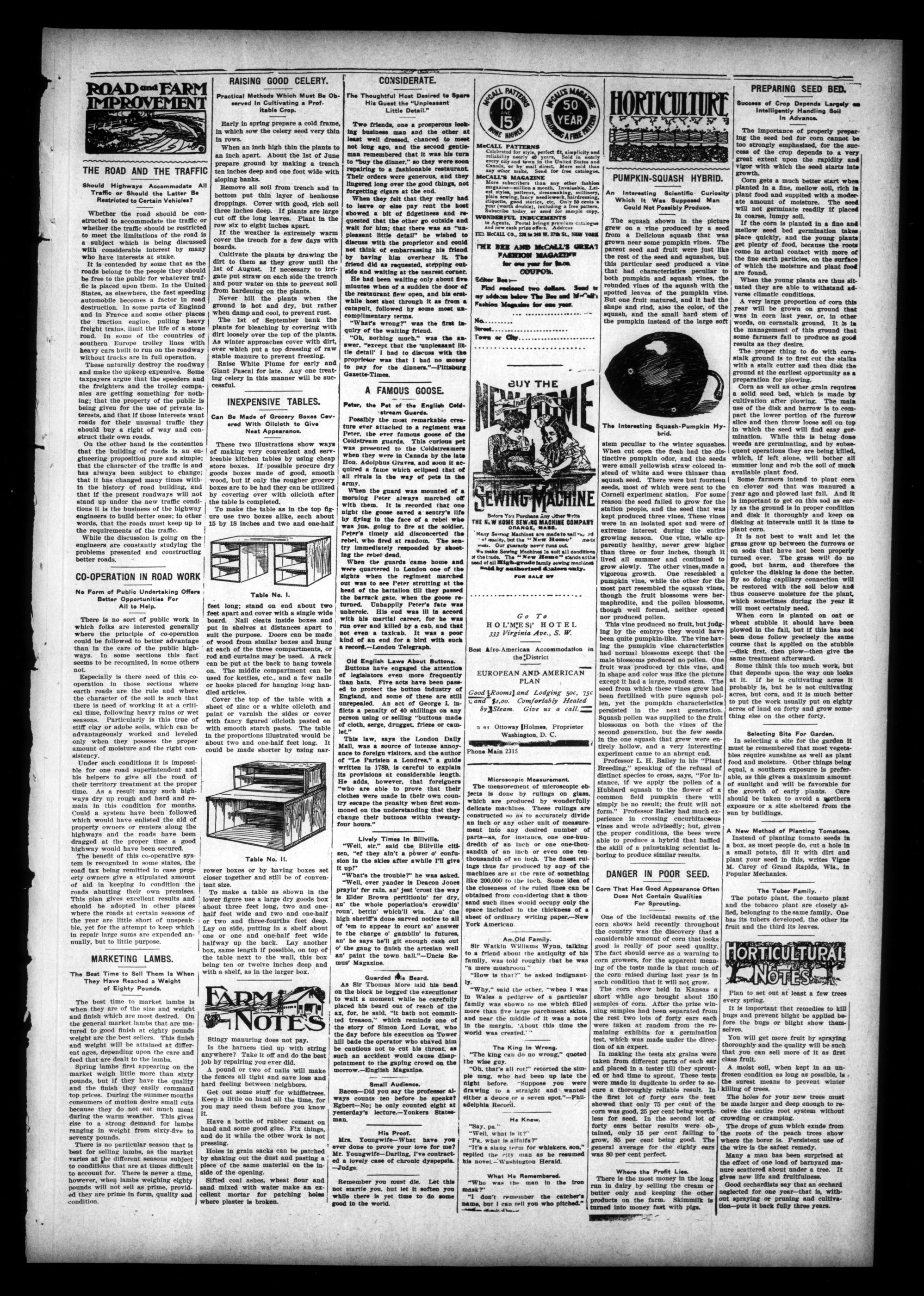
These two illustrations show ways of making very convenient and serviceable kitchen tables by using cheap store boxes. If possible procure dry goods boxes made of good, smooth wood, but if only the rougher grocery boxes are to be had they can be utilized by covering over with oilcloth after the table is completed.
To make the table as in the top figure use two boxes allike, each about 15 by 18 inches and two and one-half
Table No. 1.
feet long; stand on end about two feet apart and cover with a single wide board. Nail cleats inside boxes and put in shelves at distances apart to suit the purpose. Doors can be made of wood from similar boxes and hung at each of the three compartments, or rod and curtains may be used. A rack can be put at the back to hang towels on. The middle compartment can be used for kettles, etc., and a few nails or hooks placed for hanging long handled articles. Cover the top of the table with a sheet of zinc or a white oilcloth and paint or varnish the sides or cover with fancy figured oilcloth pasted on with smooth starch paste. The table in the proportions illustrated would be about two and one-half feet long. It could be made shorter by using par-
Table No. 11.
rower boxes or by having boxes set closer together and still be of convenient size.
To make a table as shown in the lower figure use a large dry goods box about three feet long, two and one-half feet wide and two and one-half or two and three-fourths feet deep. Lay on side, putting in a shelf about one or one and one-half feet wide halfway up the back. Lay another box, same length if possible, on top of the table next to the wall, this box being ten or twelve inches deep and with a shelf, as in the larger box.
FARM NOTES
Stingy manuring does not pay.
Is the harness tied up with string anywhere? Take it off and do the best job by repairing you ever did.
A pound or two of nails will make the fences all tight and save loss and hard feeling between neighbors.
Get out some stuff for whiffletrees. Keep a little on hand all the time, for you may need them before you know it.
Have a bottle of rubber cement on hand and some good glue. Fix things, and do it while the other work is not pressing.
Holes in grain sacks can be patched by shaking out the dust and pasting a piece of the same material on the inside of the opening.
Sifted coal ashes, wheat flour and sand mixed with water make an excellent mortar for patching holes where plaster is broken.
The Thoughtful Host Desired to Spare His Guest the "Unpleasant Little Detail."
Two friends, one a prosperous looking business man and the other at least well dressed, chanced to meet not long ago, and the second gentleman remembered that it was his turn to "buy the dinner," so they were soon repairing to a fashionable restaurant. Their orders were generous, and they lingered long over the good things, not forgetting cigars at the end. When they felt that they really had to leave or else pay rent the host showed a bit ofidgetness and requested that the other go outside and wait for him; that there was an "unpleasant little detail" he wished to discuss with the proprietor and could not think of embarrassing his friend by having him overhear it. The friend did as requested, stepping outside and waiting at the nearest corner.
He had been waiting only about five minutes when of a sudden the door of the restaurant flew open, and his erstwhile host shot through it as from a catapult, followed by some most uncomplimentary terms.
"What's wrong?" was the first inquiry of the waiting friend.
"Oh, nothing much." was the answer, "except that the 'unpleasant little detail' I had to discuss with the proprietor was that. I had no money to pay for the dinners."—Pittsburg Gazette-Times.
A FAMOUS GOOSE
Peter, the Pet of the English Coldstream Guards.
Possibly the most remarkable creature ever attached to a regiment was Peter, the ever famous goose of the Coldstream guards. This curious pet was presented to the Coldstreamers when they were in Canada by the late Hon. Adolphus Graves, and soon it acquired a fame which eclipsed that of all rivals in the way of pets in the army.
When the guard was mounted of a morning Peter always marched off with them. It is recorded that one night the goose saved a sentry's life by flying in the face of a rebel who was just going to fire at the soldier. Peter's timely aid disconcerted the rebel, who fired at random. The sentry immediately responded by shooting the rebel dead.
When the guards came home and were quartered in London one of the sights when the regiment marched out was to see Peter strutting at the head of the battalion till they passed the barrack gate, when the goose returned. Unhappily Peter's fate was unheroic. His end was ill in accord with his martial career, for he was run over and killed by a cab, and that not even a taxicab. It was a poor kind of an end for a bird with such a record.-London Telegraph.
Old English Laws About Buttons. Buttons have engaged the attention of legislators even more frequently than hats. Five acts have been passed to protect the button industry of England, and some of these are still unrepealed. An act of George L. inflicts a penalty of 40 shillings on any person using or selling "buttons made of cloth, serge, drugget, frieze or camlet."
This law, says the London Daily Mall, was a source of intense annoyance to foreign visitors, and the author of "Le Parisien a Londres," a guide written in 1789, is careful to explain its provisions at considerable length. He adds, however, that foreigners "who are able to prove that their clothes were made in their own country escape the penalty when first summoned on the understanding that they change their buttons within twenty-four hours."
Lively Times In Billyville.
"Well, sir," said the Billville citizen, "ef they ain't a power o' confusion in the skies after awhile I'll give it up!"
"What's the trouble?" he was asked.
"Well, over yander is Deacon Jones prayin' fer rain, an' jest 'crost the way is Elder Brown pertitionn' fer dry, an' the whole poplersion's crowdin' roun', bettin' which'll win. An' the high sheriff's done sarmed notice to all of 'em to appear in court an' answer to the charge o' gambiln in futures, an' he says be'll git enough cash out o' the gang to finish the artesian well an' paint the town hall."—Uncle Remus' Magazine.
Guarded Pis Beard.
As Sir Thomas More laid his head on the block he begged the executioner to wait a moment while he carefully placed his beard out of reach of the ax, for, he said, "it hath not committed treason." which reminds one of the story of Simon Lord Lovat, who the day before his execution on Tower hill bade the operator who shaved him be cautious not to cut his throat, as such an accident would cause disappointment to the gaping crowd on the morrow.-English Magazine.
Small Audience
Bacon—Did you say the professor always counts ten before he speaks? Egbert—No; he only counted eight at yesterday's lecture.—Yonkers Statesman.
H1a Proof.
Mrs. Youngwife—What have you ever done to prove your love for me? Mr. Youngwife—Darling, I've contracted a lovely case of chronic dyspepsia.—Judge.
Remember you must die. Let this not startle you, but let it soften you while there is yet time to do some good in the world.
MCCALL PATTERNS
10
ANE
15
MORE HIGHER
MCALLS MAGAZINE
50
YEAR
MAGAZING A FREE PATTERN
McCALL PATTERNS
Celebrated for style, perfect fit, simplicity and reliability nearly 40 years, in nearly every city and town in the United States and Canada. More than 400,000 more sold than any other make. Send for free catalogue.
McCALL'S MAGAZINE
More subscribers than any other fashion magazine-million a month. Invaluable. Latest styles, patterns, dressmaking, millinery, plain skirts, fancy needles, hairstyling, etiquette, good stories, etc. Only 80 cents a year (worth double), including a free pattern, subscribe today or send for sample copy.
WONDERFUL INDUCEMENTS
To Agent for new catalogue and new cash prize offer. Address
F.R. MCCALL CO., 228 to 248 W. 57th St. NEW YORK
THE BEE AND MCCALL'S GREAT FASHION MAGAZINE
for one year for $200. COUPON.
Either Bee—
Find released two dollars. Send try my address below The Bee and Mccall's Fashion Magazine for one year.
No.....
Street.....
Town or City.....
.....
BUY THE
NEW HOME
FROM RUNNING
SEWING MACHINE
Before You Purchase Any Other Write
THE N.W. HOME SEWING MACHINE COMPANY
ORANGE, MASS.
Mary Sewing Machines are made to sell our
of quality, but the "New Home" made
wear. Our warranty never runs out.
We make Sewing Machines to suit all conditions
of the trade. The "New Home" stands at the
head of all High-grade family sewing machines
sold by authorized dealers only.
FOR SALE BY
Go To
HOL'MESI' HOTEL.
333 Virginia Ave., S. W.
Best Afro-American Accommodation in
the District
EUROPEAN AND AMERICAN
PLAN
Good {Rooms} and Lodging Soc. 75c
and $1.00. Comfortably Heated
by] Steam. Give us a call.
Phone Main 2315
Microscopic Measurement.
microscope measurement.
The measurement of microscopic objects is done by rullings on glass, which are produced by wonderfully delicate machines. These rullings are constructed so as to accurately divide an inch or any other unit of measurement into any desired number of parts—as for instance, one one-hundredth of an inch or one one-thousandth of an inch or even one ten thousandth of an inch. The finest rullings thus far produced by any of the machines are at the rate of something like 200,000 to the inch. Some idea of the closeness of the rulled lines can be obtained from considering that a thousand such lines would occupy only the space included in the thickness of a sheet of ordinary writing paper.—New York American
An.Old Family
Sir Watkin Williams Wynn, talking to a friend about the antiquity of his family, was told roughly that he was "a mere mushroom."
"How is that?" he asked indignantly.
"Why," said the other, "when I was in Wales a pedigree of a particular family was shown to me which filled more than five large parchment skins, and near the middle of it was a note in the margin. About this time the world was created."
The King In Wrong.
"The king can do no wrong." quoted the wise guy.
"Oh, that's all rot!" retorted the simple mug, who had been up late the night before. "Suppose you were drawing to a straight and wanted either a deuce or a seven spot."—Philadelphia Record.
He Know.
"Say, pa"
"Well, what is it?"
"Pa, what is alfalfa?"
"It's a slang term for whiskers, son,"
replied the city man as he resumed his novel.—Washington Herald.
"Who was the man to the iron mask?"
"I don't remember the catcher's name, but I can tell you who pitched."
HORTICULTURE
An Interesting Scientific Curiosity
Which It Was Supposed Man
Could Not Possibly Produce.
The squash shown in the picture grew on a vine produced by a seed from a Delicious squash that was grown near some pumpkin vines. The parent seed and fruit were just like the rest of the seed and squashes, but this particular seed produced a vine that had characteristics peculiar to both pumpkin and squash vines, the rounded vines of the squash with the spotted leaves of the pumpkin vine. But one fruit matured, and it had the shape and rind, also the color, of the squash, and the small hard stem of the pumpkin instead of the large soft
The Interesting Squash-Pumpkin Hybrid.
stem peculiar to the winter squashes. When cut open the flesh had the distinctive pumpkin odor, and the seeds were small yellowish straw colored instead of white and were thinner than squash seed. There were but fourteen seeds, most of which were sent to the Cornell experiment station. For some reason the seed failed to grow for the station people, and the seed that was kept produced three vines. These vines were in an isolated spot and were of extreme interest during the entire growing season. One vine, while apparently healthy, never grew higher than three or four inches, though it lived all summer and continued to grow slowly. The other vines, made a vigorous growth. One resembled a pumpkin vine, while the other for the most part resembled the squash vines, though the fruit blossoms were hermaphrodite, and the pollen blossoms, though well formed, neither opened nor produced pollen.
This vine produced no fruit, but judging by the embryo they would have been quite pumpkin-like. The vine having the pumpkin vine characteristics had normal blossoms except that the male blossoms produced no pollen. One fruit was produced by this vine, and in shape and color was like the picture except it had a large, round stem. The seed from which these vines grew had been fertilized with pure squash pollen, yet the pumpkin characteristics persisted in the next generation. Squash pollen was supplied to the fruit blossoms on both the vines of the second generation, but the few seeds in the one squash that grew were entirely hollow, and a very interesting experiment came to an abrupt end.
Professor L. H. Bailey in his "Plant Breeding," speaking of the refusal of distinct species to cross, says, "For instance, if we apply the pollen of a Hubbard squash to the flower of a common field pumpkin there will simply be no result; the fruit will not form." Professor Bailey had much experience in crossing cucurbitaceous vines and wrote advisedly; but, given the proper conditions, the bees were able to produce a hybrid that baffled the skill of a painstaking scientist laboring to produce similar results.
DANGER IN POOR SEED.
Corn That Has Good Appearance Often Does Not Contain Qualities For Sprouting.
One of the incidental results of the corn shows held recently throughout the country was the discovery that a considerable amount of corn that looks good is really of poor seed quality. The fact should serve as a warning to corn growers, for the apparent meaning of the tests made is that much of the corn raised during last year is in such condition that it will not grow. The corn show held in Kansas a short while ago brought about 150 samples of corn. After the prize winning samples had been separated from the rest two lots of forty ears each were taken at random from the remaining exhibits for a germination test, which was made under the direction of an expert.
In making the tests six grains were taken from different parts of each ear and placed in a tester till they sprouted or had time to sprout. These tests were made in duplicate in order to secure a thoroughly reliable result. In the first lot of forty ears the test showed that only 75 per cent of the corn was good, 25 per cent being worthless for seed. In the second lot of forty ears better results were obtained, only 15 per cent failing to grow, 85 per cent being good. The general average for the eighty ears was 80 per cent perfect.
Where the Profit Lies
There is the most money in the long run in dairy by selling the cream or butter only and keeping the other products on the farm. Skimmilk is turned into money fast with pigs.
Success of Crop Depends Largely Intelligently Handling Soil In Advance.
The importance of properly preparing the seed bed for corn cannot be too strongly emphasized, for the success of the crop depends to a very great extent upon the rapidity and vigor with which the seed starts into growth.
Corn gets a much better start when planted in a fine, mellow soil, rich in plant food and supplied with a moderate amount of moisture. The seed will not germinate readily if placed in coarse, lumpy soil.
If the corn is planted in a fine and mellow seed bed germination takes place quickly, and the young plants get plenty of food, because the roots come in actual contact with more of the fine earth particles, on the surface of which the moisture and plant food are found.
When the young plants are thus situated they are able to withstand adverse climatic conditions.
A very large proportion of corn this year will be grown on ground that was in corn last year, or, in other words, on cornstalk ground. It is the management of this ground that some farmers fall to produce as good results as they desire.
The proper thing to do with cornstalk ground is to first cut the stalks with a stalk cutter and then disk the ground at the earliest opportunity as a preparation for plowing.
Corn as well as other grain requires a solid seed bed, which is made by cultivation after plowing. The main use of the disk and harrow is to compact the lower portion of the furrow slice and then throw loose soil on top in which the seed will find easy germination. While this is being done weeds are germinating, and by subsequent operations they are being killed, which, if left alone, will bother all summer long and rob the soil of much available plant food. Some farmers intend to plant corn on clover sod that was manured a year ago and plowed last fall. And it is important to get on this sod as early as the ground is in proper condition and disk it thoroughly and keep on disking at intervals until it is time to plant corn.
It is not best to wait and let the grass grow up between the furrows or on sods that have not been properly turned over. The grass will do no good, but harm, and therefore the quicker the disking is done the better. By so doing capillary connection will be restored with the soil below and thus conserve moisture for the plant, which sometimes during the year it will most certainly need. When corn is planted on oat or wheat stubble it should have been plowed in the fall, but if this has not been done follow precisely the same course that is applied on the stubble—disk first, then plow—then give the same treatment afterward.
Some think this too much work, but that depends upon the way one looks at it. If he is cultivating acres it probably is, but he is not cultivating acres, but corn, and it is much better to put the work usually put on eighty acres of land on forty and grow something else on the other forty.
Selecting Site For Garden.
In selecting a site for the garden it must be remembered that most vegetables require sunshine as well as plant food and moisture. Other things being equal, a southern exposure is preferable, as this gives a maximum amount of sunlight and will be favorable for the growth of early plants. Care should be taken to avoid a northern exposure or a site sheltered from the sun by buildings.
A New Method of Planting Tomatoes. Instead of planting tomato seeds in a box, as most people do, cut a hole in a small potato, fill it with dirt and plant your seed in this, writes Vigne M. Carey of Grand Rapids, WIs., in Popular Mechanics.
The Tuber Family.
The potato plant, the tomato plant and the tobacco plant are closely allied, belonging to the same family. One has its tubers developed, the other its fruit and the third its leaves.
HORTICULTURAL NOTES
Plan to set out at least a few trees every spring.
It is important that remedies to kill bugs and prevent blight be applied before the bugs or blight show themselves.
You will get more fruit by spraying thoroughly and the quality will be such that you can sell more of it as first class fruit.
A moist soil, when kept in an unfrozen condition as long as possible, is the surest means to prevent winter killing of trees. The holes for your new trees must be made larger and deep enough to receive the entire root system without crowding or cramping. The drops of gum which exude from the roots of the peach trees show where the borer is. Persistent use of the wire is the safest remedy. Many a man has been surprised at the effect of one load of barnyard manure scattered about under a tree. It gives new life and fruitfulness. Good orchardists say that an orchard neglected for one year—that is, without spraying or pruning and cultivation—puts it back fully three years.
THE BEE
PUBLISHED
at
1109 Eye S. N. W., Washington,
D. C.
W. CALVIN CHASE, EDITOR
Entered at the Post Office at Washington, D. C., as second-class mail matter.
ESTABLISHED 1880.
TERMS OF SUBSCRIPTION.
One copy per year in advance $2.00
Six months 1.00
Three months .50
Subscription monthly .20
DISCOUNT ON BRAINS.
and instructors of Howard University amounts to no less than a discount on brains. Every other educational institution and all business firms and corporations pay a premium on brains. It remains for this institution, which has to prepare young men and women for the future, to do-the pawnbroker stunt of offering a rediculously low discount for a gem. Take the salaries paid Howard University, not from the president down, but from the deans down, and they constitute a real retardence to education, rather than an incentive. Here we have an institution of learning which appropriates to itself the broad, dignified name of "university," and national at that, whose deans draw the munificent maximum salary of $1,700, and some of whose instructors draw as low as $600 per annum, and that, too, in this the most expensive city to live in on the American continent. To become an instructor at Howard one must be a college graduate. The minimum salary for a messenger or unskilled laborer, or a mere coal-heaver, in the government service is $600—sixty dollars more than is paid some college graduates who are professors or instructors at Howard. And to be eligible for a messenger or unskilled laborer one has but to pass an examination any pupil in the primary grade in the public schools can pass. The deans, however, must, preferably, be post-graduates, and must have a string of bachelor titles affixed to their names as long as the moral law. The maximum salary paid a government clerk is $1,800, one hundred dollars more than is paid the best professor at Howard. And to be eligible for this clerk salary the clerk has only to pass an examination which any pupil in the grammar grade of the public schools can pass with ease, and without preparation. There are professors and instructors at Howard who draw $1,000 and $1,200, men who are graduates of one or more colleges and universities. These educators, many years of whose lives were devoted to preparation, and whose present and future lives are being and will be sacrificed for the benefit of posterity, are compelled to labor in the highest field of labor, and the most exacting field, at salaries lower, in some instances, than received by messengers and coal-heavers in the government service, lower than mer whose abilities extend but a notel further than the ability to read indifferently and write ineligibly. Who is responsible for the re
Who is responsible for the ridiculously low, salaries paid the faculty of Howard University? Is it not within the power of the president to recommena at least living, if not requitable salaries? Or is he so much concerned over turning in, at the close of the year, an unused balance of five or ten cents? We propose to have more anon on this salary question.
BEN. DAVIS.
The Bee takes issue with its contemporary, the New York Age, in its attack on the editor of the Atlanta, Ga., Independent. An indictment for any offense is not a conviction. Many an innocent man has been indicted but not convicted. An indictment is not a conviction. The Age's attitude is cowardly and unjournalistic. Mr. Davis' career in the State of Georgia has been honor-
able and upright. Can the Age prove that Mr. Davis has been or is guilty of any criminal offense? Does an indictment bar or deny a person of his citizenship? During the entire career of Mr. Davis in the State of Georgia nothing has been brought against him but the ancient indictment charging him with an offense which has never been tried. Suppose Attorney H. Lincoln Johnson did defend him, does this disqualify Mr. Johnson as a lawyer and a citizen?
Mr. Davis was elected by the sub-committee of Odd Fellows as their chief justice of their court. To disqualify him for such a position it must be shown that he is incompetent to fill that particular office. What has an indictment for some other offense got to do with it? The Bee has found its contemporary, the editor of the Atlanta Independent, a man who will always meet his obligations. It is true that the Grand United Order of Odd Fellows is full of politics and politicians, and the most successful politicians have been victorious over the weaker and less crafty.
The attack of the Age on both Mr. Davis and his counsel has been personal and unfair, and it is not believed that the colored press of the country will be a party to it.
Many an innocent man has not only been indicted, but convicted. How many innocent colored men in the South today are serving time in prison? How many innocent men have been charged with offenses of which they are not guilty?
THE DIFFERENCE
There have been white professors at some institutions of learning not more than a thousand miles from the baseball park, who have drank moderately or excessively at will, but not a word was said to them. On one occasion we learned of a certain white professor who dropped dead in a rafe where was sold liquor which did not always exhilerate without intoxicating. But that was not considered a matter for investigation upon information conveyed in an anonymous letter.. But a colored man, to be on the staff of some universities we know, must possess more religion than is contained between the backs of the Bible, and must be as sparing of liquids that contain a suspicion of alcohol as the North Pole is sparing of vegetation. It just makes a difference as to color with some unreasonable puritans.
HIS OWN ENEMY.
A local contemporary was so contemptible last week that it could not make a decent comment on the assault upon Dr. Washington. It goes to show that all of the ignorance and demagogery are not found in the uneducated Negro. The editor of this local contemporary is supposed to be a highly educated colored American. The colored brother is his own enemy, no matter what is done for him to civilize him. He laughs at his brother's downfall, no matter what the circumstances may be.
Every generation has its martyr.
All the world-loves a lover, it is said.
It required no great courage to write after the President had written.
Daniel Webster, on a memorable occasion, said: "Massachusetts needs no defence." So we say of Dr. Washington.
Washingtonites and anti-Washingtonites in whom there abides honesty and love of race, stood shoulder to shoulder in reposing confidence in the purity of the Tuskegee educator.
A dastardly deed to one unites a divided family; foreign war cements parties so as to form a solid phalanx of loyal patriots. The assault upon Dr. Washington dissolved all differences over non-essentials to make way for unity in the essentials.
In Judge Robert H. Terrell not only have the Negro peoples of the District an able representative, but the public, without reference to color, have an able and fair judge—one of the ablest on the bench.
Color does not signify manhood. If it did there would be three dark-skinned men to every one with a white face. A colored skin is simply a suggestion to the race-prejudice whites that while their skin may be white their hearts are black.
Public Men And Things
Dr. Harvey Wiley says "beware of alcohol in winter and soda water and ice-cream in summer." When I read that mess of words I just naturally thought about Boards & McGuire, who "heat it" by selling soda water and ice-cream the year round. They have to do it in order to compete with the bow-window thirst parlor across the street. I don't know what women will say to Dr. Wiley's effervescence over soda water and ice-cream. Take away ice-cream from women when Old Sol is chasing the mercury in the thermometer up above the hill of fever heat, but take it from me, if you take icecream from them you will take away all the sunshine out of their lives. I know one little woman, weight about 190 in the shade, who would call out the police reserves if it was done. And as for avoiding alcohol in the winter (and of course, when Dr. Wiley says alcohol he has reference to Old Crow and kindred blends), does he think for a moment that the average churchman is going to do without his "morning's morning" when the mercury is trying to drop out of the bottom of the bulb; when the ice wind is tearing up Fourteenth street faster than Bud Gaskins can send his machine? Well, if he does, he has got his dates mixed. Most men, outside of Geo. W. Cook, will cut ice-cream, but they will draw a line about a mile wide on cutting out that lemon, sugar, and just a suspicion of whiskey on an arctic morning. Most women will take a chance at doing pennance by cutting out spirits ferment in the winter; but cut out icecream, never. Dr. Wiley may be a chemist, but he's hunswabbled when it comes to a knowledge of desireology.
Speaking, parenthetically, about George Cook, now Professor Cook, wouldn't toy with alcohol a minute. He has such a strong dislike for it that when the government decided to experiment with denatured alcohol as a fuel, George immediately wrote a treatise on "The Curse of Rum," and posted it on the university bulletin board. Why, he wouldn't use alcohol under a chafing dish to make a welsh rarebit. He's just "again it." If a teacher or pupil at Howard would pass, by accident, on a dark night, a liquor sign, he might just as well conclude he would be reported for being drunk under peculiar conditions. George Cook has only one vagary, and that's red-eye aversion. On all other subjects he's sane. In money matters he's got the instinct of Pierpont Morgan and the characteristics of Hetty Green. George can make money when there is no need to make, and he could save money if his expenses exceeded his income. As for energy, he's a regular 10-horsepower dynamo. He hurts a hot trail with his energy. He moves like a Pennsylvania Limited, talks like a Knickerbocker Special, and figures like "Corker" Harvey. It's a mighty good thing for Howard that it has a man like George Cook for the securities. He's right there with the goods, and if anybody bin, he kin" keep a line on the business end of that knowledge factory. A few years ago—about two George went down to Blue Plains, and ran that Post-Graduate branch of Howard in a way that made the District officials sit up and take notice. He injected life and business and order into that institution. Then, like old sport Cincinnatus, he returned to his plow—Howard University—and has been furnishing energy for the whole push up on Howard Hill, ever since. Oh, George is some more people, let me tell you. If they want something done, done right, and done quick, all they have to do is say, "Let George do it," and the bread is baked. But if they want someone to take about four fingers of Trimble, and say "Let George do it," you are sure to be given an imitation of an eruption of Oldesuvius. Dil George ever take a smile? Well, now, I don't know; but I reckon not; for if he had, he wouldn't be so bitter against an elixir.
Well, now, don't you know I came near forgetting Dr. W. L. Board. Well, I did. You see, Doc is such a modest, retiring fellow that you are liable to overlook him when sending out invitations to a slow gin luncheon. Clever fellow, though. Always wears his smile—one of those kind that won't come off. He, too, is one of those stingy men; too stingy to hook up with something sweet in a form of a woman. Doc is so backward that if a woman speaks to him he's liable to sprain an ankle in an effort to make some reply. He's got a penchant—oh, penchant is a beautiful! for widows, but lacks nerve to go make google eyes at her that sound like a proposal. Did you ever happen in his national bank when a pretty woman enters and calls for a sundae? Well, you ought to see him. Doc smiles, shows those pearly teeth of his, first stands on one foot and then the other, toys with his face, and then, hesitatingly says: "What flavor, please?" When she gently and sweetly peeps to him that she wants peach, Doc, in his nervousness, dumps all the flavors in the fountain into her sundae, and when she offers him the change he says, just like a millionaire: "Oh, never mind the pay; we give everything away here." After she is gone Doc marks everything in the store up 10 per cent in order to get even for his nervous and unintentional extravagance. It's a pity Doc Board is not married. A brighter, cleaner, and straighter man never compounded a prescription on which was made too per cent profit. You ask me if he is making money. I'll answer that question by asking if they are making money over at the Bureau of Engraving and Printing. Some of these bright days, when the sun is speculating on both sides of the street, this mixer of drugs and financier of Negro busts, will slip out of Washington head his mules toward the land of lynchings, and return with a beaut Now, I know I am giving away a secret, but I just can't keep it any longer.
If Tillie Seguine, the boneless serpentine movement female who has been doing several kinds of stunts at Dabney's get-rich-quick emporium,
should decide to stay here permanently, there would be all kinds of trouble in some families, I reckon, and many a bald-headed pater families, and many a blase bachelor, and many a callow youth would move over to Dabney's, bag and baggage. She has been doing stunts there for two weeks, and the men have been crowding the place to witness her "poetry of motion," as Dr. Henry Freeman calls it. I was there six night myself, but I didn't go to see Tillie do the vouche-couchee. I just went to see what I could see. Every night I saw the same old crowd of married men and hot-stuff bachelors. Doc Freeman, who is authority on this "poetry of motion" business, says Tillie Seguine is the queen of motion—and Doc ought to know, being a physician. Doc only went a few times, however. About ten nights. He went to study limb movements, so that if he got a patient with the selenome it would know just how to diagnose the case. Doc Howard went six nights for the same purpose. Dr. Sum Wormley said Tillie had the most perfect set of teeth ever incased in a mouth. He went about seven times to study teethology. Doc Gaskins went eleven times for the same purpose. Judge Terrell went just to be informed in case he should have to render a decision on the constitutionality of the law permitting actresses to show poetry of motion in public. John Dancy went because he got in free. Jim Cobb went in order to be near if there was a hurry call for an attorney who is up on the serpentine movement. John Collins, ditto. Most of the married men went just to be able to tell their wives how they hated that boneless movement, and it took seven or eight nights' attendance to convince them. Well, Tillie had them all coming, with the result that that little drygoods box of a theater was packed every night.
MEDICAL SOCIETY INDORSE HIM.
Harrisburg, Pa., March 24, 1911.
Dr. Booker T. Washington,
Hotel Manhattan,
New York City.
My Dear Dr. Washington: At a recent meeting of the Central Pennsylvania Medical Society the following resolutions were adopted:
"Whereas, we learn through the public press of the atrocious assault upon the person of Dr. Booker T. Washington, and the charge, both by his assailant and some of his less kindly disposed critics, of suspicious conduct, be it
"Resolved, That we, the members of the Central Pennsylvania Medical Society, herewith extend our heartfelt sympathy to Dr. Washington in this unfortunate episode, and our sincere belief in his moral integrity and conscientious unrightness.
"We condemn the scandalous charge hatched out of this atrocious and unwarranted attack, and the seeming readiness on the part of certain of his critics to make capital of it.
"We realize what the loss of public confidence in Dr. Washington would mean to the entire race; and so implicit is our confidence in him that we still look to him as embodying all those attributes belonging to one of the world's greatest and noblest men. Be it further.
"Resolved, That a copy of these resolutions be conveyed to Dr. Washington and a copy be given to the press."
With sincere wishes for your speedy recovery and early return to your life's work, and our earnest belief that the incident will do much to strengthen the faith of those who believe in you, I remain, most sincerely yours.
WILL PROSECUTE TO THE LIMIT.
(Special Dispatch to the Washington Ree)
TUSKEGEE, Ala., March 29.—Dr. Booker T. Washington emphatically repudiates the dispatches sent out from Philadelphia early this week intimating that the prosecution of Ulrich, the man who assaulted him a week ago in New York City, would be dropped. Dr. Washington also brands as a misstatement the intimation that he has in any way justified the unprovoked attack upon him. The whole story, he states, is a cruel misrepresentation, and does him grave injustice. So far as Dr. Washington is able to do it, Ulrich is prosecuted to the limit, and the charge changed to felonious assault, if this can be brought about.
THINGS THAT WILL HAPPEN.
W. Sidney Pittman and J. A. Lankford form a partnership.
The Assault Condemned
The Assault Condemned
BOOKER T. WASHINGTON
THEIR REPRESENTATIVE.
The Afro-American Ledger, of Baltimore, Md.: "It is to be hoped that Mr. Washington's lawyer will push the case and give the ruffian the punishment he so justly deserves."
The Charleston Messenger, of Charleston, S. C.: "We hang our heads this week in sorrow for our Brother Booker T., and he has our best wishes for his speedy recovery, and we trust that the attack will have no bearing or hindrance in his energy and ambition to keep before the world the idea of industrial education for the masses."
The New York Age, of New York City: "It must have been a source of comfort to the great leader as he lay like a wounded lion, to have pouring in upon him from all quarters, from the North and the South, from black and white alike, telegraphs and letters, not only marked by deepest sympathy, but charged with the indignation of decency outraged in its own castle."
The Journal and Guide, of Norfolk, Va.; "The fact that Dr. Washington decided not to enter a more serious charge against his assailant than simple assault is an indication of his broad charity as well as the insignificance and worthlessness of his assailant, who was a white man."
The Advocate Verdict, of Harrisburg, Pa.; "In Booker T. Washington, the race and mankind has reached one of its highest ideals. Without him, the possibility for the race would still be in doubt. With him, the humblest Negro child reads his history with hope for better things."
Southern Christian Recorder, of Columbus, Ga., says: "If any one Negro has labored incessantly for harmony between the races, Dr. Washington has, and there is nothing in the history of his career as a leader that as much as indicated the contrary.
The Refoformer, of Richmond, Va., says: "Dr. Washington was plucky, and showed that he knew how to 'hit back,' though his assailant got the best of him—one of whom was a lusty German, armed with a big club."
The World, of Indianapolis, Ind.: "We are thankful the American sense of fair play has not become obsolete, and that even a negro is entitled to be heard before he is adjudged guilty. God still reigns, and the work of Washington remains unimpaired."
The Philadelphia Tribune, of Philadelphia, Pa.: "Those who know Dr. Washington best know that he is a stickler for keeping business engagements; that he is a tireless worker; that he allows neither time, distance, the weather nor any other thing to deter him from endeavoring to perform a duty which he feels is imperative."
The Chicago Defender, of Chicago, Ill. "The assault upon Dr. Booker T. Washington by one Elbert Ulrich in New York City, recently, is sadly regretful and untimely, and proves that respectable citizenship in this country is now basking in a world of danger built upon bogus laws of society, in which protection is found only in the depths of an aquarium."
The American Citizen, of Atlanta, Ga.: "The race to which Dr. Washington belongs does not for a moment entertain the slightest idea that he is guilty of undue familiarity with any woman, nor do we believe the thinking people of America entertain the slightest idea of the truthfulness of the Ulrich accusation. It is generally believed that it is a put-up job to impede the good work of Dr. Washington.
The Zanesville Advocate, of Zanesville, O.: "The Advocate, with the entire race and thousands of all races, regret with all sincerity of heart, that one of the nation's leaders and educators of his people was struck down with such brutality, and our untold sympathy goes out to this great and good man."
The Pine Bluff Weekly Herald, Pine Bluff, Ark.: "It is simply terrible when a man like Dr. Washington can be set upon by a Dutch janitor and beat up in the manner he was, and it is plain that no black man is safe in this country. The whole affair looks like a job."
The Southern Reporter, of Charleston, S. C.: "Dr. Booker T. Washington, the great educational leader of the Negro race, has the profound sympathy of the better element of white and colored people in this country"
The Atlanta Independent, of Atlanta, Ga. "It is feared that the cause he represents will be injured not by reason of the guilt of the man, but because of the enemies he has made in the successful establishment of the work for which he is sacrificing his life."
The Freeman, of Indianapolis, Ind., says: "His friends have rallied to him, expressing unbounded confidence in his integrity in all respects. We are no. different to them, seeing in the distinguished leader and educator all that has been said of him from time to time."
The Florida Sentinel, of Pensacola, Fla.: "The unfortunate Booker Washington incident in New York simply serves to show the fallacy of hastily taking the law into one's own hands. The 'Wizard' cannot be harmed by the episode, although it is not doubted that his enemies will falsify the incident in an effort to embarrass the great educator by magnifying the affair and distorting the facts."
The Durham Reformer, of Durham, N. C.: "Character and reputation which have stood the test of a quarter of a century cannot now be de-
based by slander so palpable and evident as to cause a smile. We reaffirm our confidence in the peerless character of our leader of leaders."
Afro-American Presbyterian, of Charlotte, N. C.: "Mr. Washington has the sympathy of all good people, and none but the viciously inclined will entertain the least suspicion of wrong intention on his part."
The Star, of Newport News, Va.: "The game of assaulting, lynching or murdering a Negro and then accusing him of insulting a white woman, has been played so successfully that even the foremost Negro in the land after being outrageously assaulted has been charged with insulting a white woman."
The Philadelphia Courant, of Philadelphia, Pa.: "There is not a person, black or white, North or South, who believes that there is a scintilla of truth in the alleged charge against Dr. Washington. The guilty burly white man should be punished, and severely at that, for this dastardly act."
The Richmond Planet, of Richmond, Va.: "Those colored folks who seemed to think that Dr. Booker T. Washington's influence as a political referee was on the wane at Washington will revise their opinion when they read the letter of sympathy addressed to the distinguished educator and political leader by the President of the United States."
The Advance, Providence, R. I., says: "Dr. Washington is the very embodiment of all that is pure and virtuous, he stands for the very highest ideals in the life of a people."
WHAT I SAW AND HEARD.
(By Rounder)
Well, I see that my friends, Napier and Lewis, have been broken in. They have been invited to speak at some church meeting. One is to address the Bethel Literary, where colored speakers are on a close parity, and the other will address a Christian Endeavor meeting.
***
It is amusing to see how the ring in the Treasury Department tried to trap the new Register. It failed, however. All former Registers, except Bruce, went to his clerks, instead of having the clerks come to them. I was glad to see Register Napier inform his deputy that he would be pleased to see his clerks in his office. It was also amusing to have seen a recent order that the deputy issued the next day after the new Register was sworn in. It directed that no employee shall call on the Register during working hours; that there is to be no visiting, etc. Well, you should have heard the clerks after the promulgation of this order. As a matter of fact, Mr. Napier knew nothing about it. Undoubtedly there are a few would-be heads in the Register's office who fear that Mr. Napier may think more of others than he does of them.
* *
I called at the Bond Building Monday morning to pay my respects to the new Assistant Attorney General, but he had not arrived. I noticed when I went in that the clerks must have been looking for the new official. However, the moment the door was opened, all eyes were stretched, and every ear was cocked. I asked for Mr. Lewis, but the nabob in an adjoining room politely said that he had not yet arrived.
\*\*\*
Well, I see that my old congenial friend, Jesse Foster, has established a new business place at the corner of Eleventh and You streets northwest. I also see that he has leased the building adjoining Martin's Cafe, You street, between Eleventh and Twelfth northwest. Jesse is a hustler. It has added to the corner immensely. If you want a first-class job done, you should not fail to call on Jesse Foster, Eleventh and You northwest.
***
I think that Dr. Morse has one of the finest drug stores in the West End. It is a gem place. Everything looks so clean, and the drugs you will always find fresh. Then, again, Dr. Morse is a genial companion. He has everything bright around him. If you want pure drugs, don't fail to visit this place.
\*\*\*
If it were not for the white people what would become of the poor blacks? Certainly, the colored people don't take any interest in their own. The colored social settlement is carried on by white people. The blacks care but little for their own.
\*\*\*
I cannot help from being amused when I hear a colored lawyer addressing an audience, say that "You colored people don't appreciate a colored lawyer; you want a white lawyer." Many of them have no confidence in themselves.
My friend, James H. Coleman, has become a great Christian Endeavor worker. I would not be surprised to see him in the pulpit. I imagine that he would make a fine preacher.
I have every reason to believe that the President of Howard University will remedy the defects in the Howard Law School library.
SPECIAL NOTICE.
From time to time subscribers and contributors send to this office for publication articles stating that they are news articles, and ask that they be published. For the benefit of such contributors The Bee begs leave to inform all such persons that all church notices, mass meetings, etc., that are to take place at a stated time are not news notices, and they must be paid for. Events that have taken place are published as news matter; that is, when such events are legitimate. About two dozen such notices have been received this week, and if the senders do not see them they will know that they must be paid for. If all the notices that have been received this week were published they would take up almost a page. Notices worth publishing are worth paying for.
The Bee is the paper that you should read.
The Week in Society
The lure of Spring is bringing hundreds of happy promenaders along the popular Fourteenth street thoroughfare, and as usual, they fall in at the drug store of Board & McGuire, 1912½ Fourteenth street, "the place where everybody meets everybody else," or you see them enjoying those delicious sodas at Ninth and You streets, the popular "Lookout Corner" of Board & McGuire.
Dr. John R. Francis, Jr., is in Columbus, Ohio, where he was ordered to take the examination for dental surgeon in the U. S. Army.
Mrs. Kemp, of Brooklyn, N. Y., was the guest three days last week of Mrs. R. H. Terrell. Mrs. Terrell entertained at whist in her honor Friday evening. Mrs. James Wormley, at whist, for her Saturday afternoon, and Mr. and Mrs. W. H. Clifford entertained her at dinner Saturday evening at Martin's.
Mrs. R. H. Terrell went to New York Monday, where she spoke this week.
Mrs. A. H. Glenn, who has been ill, is out again.
The ladies are all on the quivive in anticipation of the Monican's Easter Assembly. It is expected that this affair will surpass all previous functions of this season.
Dr. J. W. Morse has the gem drug store in the northwest. Prescriptions carefully compounded by registered clerks.
Dr. T. J. Brown, rector of St. Luke's parish, attended the dedication of the new St. Philip's Church, of New York City, last Saturday, the 25th instant.
Mr. Isaac A. Queen has returned to this city after a very pleasant visit in Eastern Maryland with friends.
Mrs. Harry Burleigh returned to her home in New York City last week after a very pleasant trip to this city.
Mrs. Catherine McCall has returned to New York City, after a pleasant trip to this city and Yanceyville, N. C. Miss Carrie Jones of this city is visiting Miss Blanche Wilder in New York City. Mr. G. H. Robinson has returned to his home in Charleston, S. C., after a pleasant stay of five months here visiting friends. Rev. C. C. Alleyne returned to this city last week after a very delightful visit to Charlotte, N. C., at the home of his father-in-law, Mr. S. B. Washington. Major C. A. Fleetwood has returned to this city after a delightful visit to Philadelphia. Messrs. Gough McDaniels, Glenford Pennington and Ralph Reckling, of Baltimore, Md., visited Dr. Brent, of freedman's Hospital, recently.
Misses Tyson and Perry attended the Follies of 1910, in Baltimore, last Saturday, in which Mr. Bert Williams appeared.
Mr. George A. Robinson is visiting his mother, Mrs. Margarette Randall, in Suffolk, Va.
Miss Flossie Aters, of Norfolk, Va., is visiting friends in this city, Baltimore and Philadelphia.
Don't pass Morse's Drug Store, at Nineteenth and L streets northwest.
Mrs. Frances H. James, formerly manager of Hotel Reformer, Richmond, Va., will reside in this city after April 1.
Rev. J. Francis Gregory left Saturday from New York City for Egypt and the Holy Land. Mr. Gregory will be absent from the city ten weeks.
Mrs. L. V. Moss has returned to this city, after spending some time in Atlantic City in search of health.
You want your prescriptions carefully and accurately filled from the best drugs obtainable at the most reasonable price. Then patronize the drug stores of Board & McGuire at 1012½ Fourteenth street northwest and at Ninth and U streets northwest. Four graduates in pharmacy regularly employed. You get quality and service of the best.
Miss Elizabeth Wilson, of Baltimore. Md., will spend the Easter holidays in Anacostia, with Miss Georgie Lossit.
Mrs. J. W. Brooks, of Charlestown, W Va is the guest of her daughter, Mrs. W. W. Jones, on Fifty-eighth street northeast. Mrs. Brooks will remain about two weeks.
Mr. J. H. Dabney and daughtei, Miss Ermine, of Pasadena, Cal., are visiting here.
Rev M. W. Clair, with a large delegation, attended conference in Lynchburg, Va.
Mrs. Henry Lincoln Johnson and her two little sons are in the city.
Miss Lillian Evans will spend the Easter holidays in Boston with her aunt.
The Pleasant Circle of the I. O. of St. Luke entertained friends at a frolic at the St. Luke Home, 1924 Thirteenth street northwest, on last Friday evening, from 7:30 to 11:30 o'clock.
Mrs E. V. Hollen is confined to her home in Linden street northeast on account of illness. Her friends wish her a rapid recovery.
Bring your job work to The Bee office, or address W. Calvin Chase, Jr., 1109 Eye street N. W., or 1212 Florida avenue N. W.
Mrs. Farnie M. Gregory, of Bordentown, N. J., is in the city on business.
The finest cigars in the city are sold at Morse's drug store, Twentieth and L streets northwest. The following is the list of appointments made at the annual conference of the Methodist Episcopal Church, which convened at Lynchburg, Va., last week:
Asbury, Rev. M. W. Clair; Benning, Rev. W. J. Tyler; Central, Rev. T. P. Thomas; Ebenezer, Rev. S. H. Brown; Mount Zion, Rev. D. W. Hay; Nash, Rev. G. A. Davis; Simpson, Rev. W. S. Jackson; Tenleytown, Rev. M. F. Hayling; Union Mission, Rev. R. A. Hart; Bowie, Rev Nathan Ross; Boyds, Rev C. G. Taylor; Emory Grove, C. E. Hodges; Laurel, V. N. S. Hughes; Laytonsville, Benjamin Gross; Marlboro, Virgil Carter; Nottingham, T. B. Snowden; Oxon Hill, G. H. Booze; Pamunkey, C. S. Harper; Pisgah, L. E. S. Nash; Rockville, W. W. Holt; Sillman, J. S. Cole; Woodville, R. F. Coates. Rev. E. S. Williams was made district superintendent.
Dr. John W. Morse, of the Gem Drug Store, at Nineteenth and L streets northwest, has everything that a first-class druggist possesses. Drop in.
Mr. Thomas H. Wright, of the Department of Justice, was present when Assistant Attorney General Lewis was admitted to the Court of Claims Monday. The Stevens School gave a banquet in honor of its basket ball team, which won the elementary school championship of the public schools, Athletic League series. Many prominent people were present. The regular meeting of the Reading Circle of Asbury M. E. Church will meet at the residence of Mrs. M. W. Clair. The poet to be discussed is Lowell. A musical and literary program will be rendered. Mr. Emory Foston, of Atlantic City, N. J., a graduate of Howard University, attended the Charity Ball at Wilmington, Del., March 23, 1911, and was the guest of Mr. A. Cooper.
The Y. W. C. A. will hold a mass meeting at the Second Baptist Church, Sunday evening, at 3 o'clock, April 2.
Nothing funny about it. People just like to deal at the drug stores of Board & McGuire at 1912$^{1}$ Fourteenth street northwest and at Ninth and U streets northwest, two places "where everybody meets everybody else" for the most delicious ice-cream soda in the city.
Rev. J. Francis Gregory, of Harrisburg, Pa., was in our city last week.
Seven Last Words.
An evening of delightful worship, during which "The - Seven Last Words" by Mercandante, will be rendered, the first Sunday in April, at 8 o'clock, by the choir of the Metropolitan M. E. Church, M street, between Sixteenth and Seventeenth streets, northwest, under the direction of Prof. J. T. Layton. Rev. I. N. Ross, pastor.
Benefit of C. Y. W. C. A.
The various committees having in charge the raising of funds for the Colored Young Women's Christian Association are working with an earnestness which already bespeaks success. Through the courtesy of the management of the West End Theater, a benefit performance will be held on Wednesday night, at the theater, Twenty-sixth and M streets northwest. Three special reels and a special vaudeville act in addition to the regular program have also been obtained for that night.
WEST WASHINGTON NEWS.
Rev. D. W. Hayes, pastor of Mount Zion M. E. Church, has been reassign to the pastorate of the church, he having just returned from the annual conference of M. E. Church, held at Lynchburg, Va.
A special sermon will be preached to Circle E of the First Baptist Church, Wednesday evening, April 5, 1911, by the Rev. Randolph Payton. Mrs. Fannie Smothers is the leader.
The Young People's Society of Christian Endeavor of the First Baptist Church organized a Junior Endeavor Sunday evening and presented the following interesting program:
"Object of a Junior Endeavor," Mrs. E. B. Hall; "Value of Religious Training." Mrs. Julia M. Laton; solo, Mr. J. R. Moss; installation of officers, Rev. E. R. Eicks.
Potomac Union Lodge, 892, G. U. O. O. F., will celebrate their forty-sixth anniversary Monday evening, April 3, 1911, at Odd Fellows' Hall, M street northwest. Mr. Augustus G. Bruce is the chairman of the committee of arrangements.
The Young People's Dramatic Club presented their second public rehearsal of the drama, "Hearts of Oak," Monday evening, at the First Baptist Church.
The stork recently visited a home, to the delight of Mr. and Mrs. Ottaway N. Buter, of 2708 O street northwest. The mother and little son are improving daily.
Mrs. Margaret Henderson, whose serious illness was mentioned in the column of our paper last week, with paralysis, and thought to be convalescent, died very suddenly Sunday morning, and was buried Tuesday after-
noon. Her funeral took place from the Nineteenth Street Baptist Church, and was largely attended. She was a member of Minerva Household of Ruth, G. U. O. O. F., and the Good Samaritan Lodge. Resolutions were read by Mrs. Fannie E. Smothers and Mrs. Anna Jacobs. The following acted as pall bearers: Simon C. Burnett, Thornton Rhodes, John Jackson, Beverly Bailey, E. Onden and W. Johnson. Rev. Walter H. Brooks and Rev. E. E. Ricks officiated. Many floral offerings were presented. Interment at Mount Zion M. E. Cemetery.
THE GARFIELD NIGHT SCHOOL
CLOSED.
A large audience gathered in the Assembly Hall of the above-named school to witness the closing exercises of the school. The school year just closed was very successful in every respect.
After the following program had been rendered, the audience went to the industrial room, where the ladies had on exhibit about fifty hats and over two hundred pieces of work in sewing done during the year. Miss K. L. Wells was the teacher.
Invocation—Rev. Mr. Hileary.
Piano solo, "Il Trovatore," Mrs. A. Henry.
Song—The National Hymn, school.
Essay, "The Art of Millinery," Miss F. Moore.
Solo (selected), Miss Rosa Cook.
Song, "The Searlet Sarafan," school.
Essay, "The Art of Cooking," Mrs. A. Carroll.
Essay, "The Value of Night School Education, Miss M. Simms. Contralto solo, "Redemption," Mrs. J. Caldwell.
Address, "How the Night School Should Be Appreciated by the People of Garfield," Rev. Mr. Dixon. Song, "Now the Day is over," school.
Benediction—Rev: Mr. Dixon.
The music was rendered by the pupils of the Eighth Grade of the day school, under the direction of the principal, Mr. Harry Lewis, with Miss. F. M. Barker as accompanist.
Mr. John W. Caldwell, of North Carolina, presided.
Promotions.
From Third to Fourth Grade:
Mrs. Eliza Addison, Mrs. Jane Dade, Mrs. E. J. Murreau, Mrs. Mary Robinson, Mr. Reuben Giles, Mr. Morris Wright, Mrs. Amanda Taylor.
From Fifth to Sixth Grade:
Mrs. S. Hawkins, Mrs. E. Small, Mrs. A. Taylor, Mr. Allie Jackson, Mr. Malcolm Kerrick, Mr. Isaac Singleton, Mrs. Lewis Taylor, Mr. H. Thomas.
From Seventh to Eighth Grade:
Miss Madeline Simms, Mr. Robt. L.
Gray, Mr. John W. Caldwell, Mr. William
Taylor.
One year's course in Millinery and
Cooking:
Mr. S. Marshall, Mr. E. Oden, Mrs.
L. Bell, Mrs. C. Blackwell, Mrs. J.
Caldwell, Mrs. M. Carroll, Mrs. M.
Craig, Mrs. A. Dorsey, Mrs. F. Giles,
Miss B. Nelson, Miss M. Nelson, Miss
M. Rollins, Mrs. C. Beverly, Mrs. M.
Chisley, Mrs. A. Coleman, Mrs. Du
Bois, Mrs. A. Giles, Mrs. M. Matthews,
Mrs. A. Solomon, Miss R. Cook, Miss F. Moore, Miss C. Moore, Miss D. Pleasant.
THE LAWYERS
In Music, Law and Oratory—A Brilliant Meeting at the Metropolitan Church Tuesday Night.
Church Tuesday Night.
The members of the local bar held forth at the Bethel Literary last Tuesday night, with President Wilkinson in the chair and Mrs. Carrie C. Clifford secretary. The principal speakers were Mr. Joseph H. Stewart, whose subject was "The Need of Colored Lawyers in the District of Columbia." Mr. Stewart made a most eloquent appeal to the people in behalf of the colored lawyers. He argued that they were necessities. Mr. John E. Collins spoke on the "Shunning of the Colored Lawyer by His People." Mr. Collins thought that the people didn't show their appreciation for the colored lawyer as they should. He cited several instances where the colored people employed white lawyers, to the detriment of their own. And all without reason. The colored law-
(By RALPH W. TYLER.)
When Christ was on earth there were those who abused, assailed and crucified Him. Although the meek and lowly Nazarene did naught but good, and although He came and went not with armed hosts to kill and to pillage, but rather with disciples and prophets, white-robed in purity, carrying peace and good will, He was spat upon, cursed, and cruelly treated. I merely cite this "to point a moral and adorn a tale;" not to make believe that Dr. Washington is a second Christ, though he does follow in His footsteps as near as it is given mortal man to do.
When, on Sunday evening, March 19, out of the dark clouds of race prejudice there flashed the jagged lightning of brutality, and the Tuskegeean was blinded and struck low, there were a few Negroes—only a few—who, accepting the highly colored and overwrought newspaper reports (which under other circumstances they would have pronounced gross prejudice), were ready to believe the evil side. But the good men, the strong men, the powerful men who rushed to his support and defence, made these doubting Thomases of our own race appear like the pigmies they are. And when President Taft, with a courage seldom before equaled, subscribed himself as a friend, and declared his belief in the purity of Washington, the howling jackals slunk to their holes. Dr. Washington, pity 'tis true, was only doubted by some of his own who know him-not. It was Judas whom Christ tolerated, and would have defended as one of His own beloved, who betrayed Him. It was Thomas, whom He loved, who doubted Him. If the lowly, pure, and undefiled Nazarene had His Judas and His Thomas, why should we expect men who come after Him not to have their Judases and their Thomases?
But to these evil-minded Pharisees, these doubting Thomases, these lying Judases, whose tongues are glib with lies and mendacious criticisms, why not say, as was said near two thousand years ago: "Let him without sin cast the first stone." Dr. Washington is today what he was before Sunday night, March 19—a pure, upright, unselfish master builder in the field of racial uplift.
Song. "A Prayer, school.
THE LAWYERS
W. Calvin Chase, Jr. Nathan Neebit
CORNET CLARINET
Music Furnished For
All Occasions
—THE—
Wilberforcian Orchestra
J. Sherman Hunnioutt
DIRECTOR AND VIOLIN
1915 6th Street, N. W.
K. F. Phillips, MANAGER, PIANO & VIOLIN
2130 18th Street, N. W.
E. L. Burns, TREASURER AND DRUMS
938 T St., N. W., Phone North 593-m
C. W. Jones
PIANO AND CORNET
J. H. Anderson
CELLO
W. P. Bayless
2D VIOLIN
W. C. Hunnioutt
FLUTE
J. B. Clark
TROMBONE
F. G. Haley
TROMBONE
Mr. Preston, VIOLA
yer is as capable, and will take more
interest in his client of color than the
white lawyer.
The last speaker was Mr. Thomas L. Jones, who made a most eloquent plea for the colored lawyer. His subject was the influence of the colored lawyer on civilization.
Mr. A. W. Scott furnished the music. He rendered very artistically the "Mocking Bird," which electrified his audience. The applause was so deafening that he had to repeat.
At the conclusion of the speeches short addresses were delivered by Mr. W. Calvin Chase and Mr. James H. Hays, who never fails to please his hearers. Mr. Hayes argued with Mr. Collins that the colored people imagine that a white lawyer is more competent than a colored lawyer, and if a colored lawyer is employed by one of them they must have a white lawyer associated with him. The colored lawyer does the work, and the white lawyer gets the credit.
Mr. M. T. Clinkscales was the next speaker. He was followed by Judge Terrell and others.
Mrs. Sarah June Taylor, who has been quite ill with the grip, is now able to be out again. Mrs. Taylor had a very severe attack.
Dr. Milton Francis, who was so dangerously ill last week, is recovering slowly, greatly to the satisfaction of his attending physicians. Dr. Francis is, no doubt, one of the most popular young doctors at the Freedmen's Hospital, and his many friends are very solicitous about him.
Prominent artists, as a rule, meet all sorts and conditions of persons. Recently Aida Overton Walker, of the "Smart Set" Company, at Howard Theater April 3, formed the acquaintance of a droll sort of a fellow given to stuttering. This fellow, who had encountered a college chum, had a good time together and was much the worse for several hours he had spent in his friend's company.
The stutterer returned to a boarding house where Miss Walker was stopping, and stealthily ascended the stairs where his wife was waiting for him. In the darkness came his wife's voice. "What time it is?" she asked sternly.
"It is j—j—j—just one," he stammered.
The words were scarcely uttered when the old-fashioned clock on the landing gave four laborious strokes.
"Do you hear that?" she asked sharply.
"But, m—im—dear," he replied pleasantly, "Y—y—you mustn't mind t—t—that clock. It's l—l—like me."
Lenten Organ Recital.
The regular mid-Lenten organ recital of St. Luke's parish will take place tomorrow evening, beginning at 6,o'clock sharp. Mr. Henry H. Freeman, organist and choirmaster of old St. John's parish, will preside at the organ, assisted by one of the leading boy soloists of St. John's choir. All will be cordially welcomed.
MASTER BUILDER.
there were those who abused,
Although the meek and lowly
led, and although He came and
to kill and to pillage, but rather
white-robed in purity, carrying
spat upon, cursed, and cruelly
to point a moral and adorn a
hat Dr. Washington is a second
in His footsteps as near as it is
March 19, out of the dark clouds
led the jagged lightning of brus
as blinded and struck low, there
few who accosting the highly
Aida Walker.
HOWARD THEATRE
Tst.near7th,N.W.
The Theatre for the People
Matinees: Tuesday, Thursday & Saturday
WEEK COMMENCING MONDAY APRIL 3D
This is the one you have been waiting for
The Smart Set
A WORD TO THE WISE—SEATS NOW SELLING—BETTER GET YOURS NOW
River Queen SEASON OF 1911 SECURE DATES
25
een is a safe as well as clean boat. It is the boat for the people. Up-to-date service will be given to all patrons of this boat. Every wharf where the boat lands is safe and the parks are well lighted and the people well protected from the weather.
OFFICE AT WHARF
The Woman's Guild of St. Luke's name to be placed on the dead head Church will entertain at Odd Fellows' list. There are a few clerks also, Hall on April 28. Full particulars in whose names ornament the dead head our advertising columns in the next list in this office. issue.
LIKE KEARNEY.
In speaking of philanthropists, The Bee doesn't know of one that is better liked and any more beneficial to the colored people in distress than Mr. Luke Kearney, in the West End. Mr. Kearney has helped, and does help, more needy colored citizens than any man in this city. In more than a dozen instances Mr. Kearney has assumed the financial responsibility of funerals of worthy colored families, and it is for these reasons that he is loved and respected by the entire colored population of this city. He is a man without-prejudice, and to him the people are greatly indebted.
A New Steamboat
The new steamer Columbia, of New York, now being overhauled at an Eastern shipyard, has been leased by the Columbia Steamboat Company of this city. J. S. Coague is the manager. The new steamer is 198 feet long, 51 feet beam, and 9 feet deep, with a capacity of 1,500. It contains palm garden, drawing rooms and electric lights, and a uniform speed of 14 knots per hour. The new steamer will be in this city about May 15, and begin river trips to a new resort on the Potomac about June 1. The new corporation, under the management of J. S. Coague, will endeavor to make this the finest and best resort on the river. Patrons of the river will remember Mr. Coague as the director and purser of the Freedman Steamboat Company, which operated the Jane Mosley. For further particulars as to place, time, etc., watch for advertisement in The Bee.
Dead Heads
Some subscribers never get offended until you send them a bill and tell them to pay up. The Bee has a few of just such people, whose names and addresses ornament its office in a glass case. It is the dead head list. One would not suppose that a lawyer, preacher, or a doctor would allow hi
name to be placed on the dead head list. There are a few clerks also, whose names ornament the dead head list in this office.
SPRINGTIME
Oh, it's good to be a-living when the birds begin to sing,
When the trees are all a-blooming,
and the bees are on the wing;
When the air is filled with fragrance of the springtime everywhere,
And the vaulted blue is speckled with a white cloud here and there;
When the pure, refreshing showers put new life in everything.
Yes, it's good to be a-living when the birds begin to sing.
CHATS ON MUSIC AND MUSIC STUDY.
Community Music.
By I. Hillary Taylor.
What is being done in your community to foster a love for and a development of the music art? What are you personally doing in this direction? Have you a desire to aid in this magazine pertinent questions, and should be nificent work—the development and fostering of community music? These taken to heart by each individual. I believe that a serious study of music history will prove that Germany, one of the oldest and most advanced countries in the culture and progress of the art, owes much of her success to the widespread cultivation of choral music in all its varied branches. In every community in that noted country you find choral societies that sing all forms of vocal compositions, from a simple choral or glee to great oratorios. This kind of music culture at once lifts a town out of the commonplace by bringing most of its inhabitants in constant contact with the most choice inspirations of goo composers.
It is the purpose of this talk to awaken an interest in the study and cultivation of all forms of choral music, and through this interest bring about the organization of new choral societies in all towns and cities where an interest in the art is manifested. Here is a good chance for the average music teacher to aid in arousing the public interest and also to gain for himself a greater patronage and reputation in the community in which he or she may labor. There are several kinds of organizations that might be organized, each of which would exercise a potential and beneficial influence on the community. Probably the greatest of these organizations is the "Choral Society of Mixed Voices."
Such societies should have a well-balanced chorus of sopranos, altos, tenors and bassos. The total membership can be from 40 to 200 or more voices.
To begin with, there should be an alive, wide-awake conductor and the necessary business management, consisting of a Board of Management, President, Vice President, Corresponding and Financial Secretaries, Treasurer and Librarian. The idea is to get a start, and let each man, woman or choir director who feels they could help in this noble cause organize a society at the earliest possible convenience. Do not hesitate because there may be one or more already on a working basis in your community. The more there are the better it will be for the rapid development of the art in such a town. You who are now reading this chat should join the first society founded in your city, and give it your earnest support. Tell others about it, and thus build up a permanent and influential society. The desire to sing is all that is necessary in this instance, as the director will be only too glad to form a class of sight readers, who will after a short course of lessons in the reading of vocal music become able to take their part in the society without fear or embarrassment. The director or teacher must put aside all foolish ideas about great voices and fine first-sight readers. It is all well if you can get them, but if you cannot, get the material first at hand, and, using your common sense, make or it what you may. Those who can already read some can greatly aid those who are novices in this line.
Other organizations that might be found a great uplifting factor in this noble work is the "Female Choral Society," consisting of first and second sopranos and first and second altos. A man or woman may be the director. These kinds of societies are becoming quite numerous in communities where choral music is cherished, and are becoming potent agencies towards the future advancement of the music art.
Women naturally take an interest in all that leads to culture and refinement, and I beg of those who have the ability to direct and instruct such a society to organize one in your community. For information on how to conduct and how to select music for these various kinds of societies-send to G. Schirmer, of New York, for his free book on "Chorus Conducting." You will find a great helper in this companion, and it will pay you to own a copy. Wodell's fine book on "Choir and Chorus Conducting" is one of the most helpful on the market, and no one laboring in this field should go without owning a copy. Published by Presser & Co., Philadelphia, Pa.
Begin your society on easy and melodious choruses, and train and work them up to the deeper, longer and more intricate works of the old and modern masters. All great achievements have had their small beginnings.
The third kind of choral society that has been found valuable in advancement of choral music is the "Male Glee Club," consisting of first and second tenors and first and second bassos. The Germans have in this country, as well as their home country, hundreds of these fine clubs or associations, and the good they accomplish is apparent in every community where their healthful influence has been felt. I have heard some very good organizations' of this kind among our own people, and we should have more of them. Let, each young man give his mite; the result will more than compensate you. In conclusion the following hints are offered those who may join these societies: First. Be prompt in attendance at all rehearsals.
Secondly. Give up all ideas of money-making work for the love of the art and the happiness you may become able to give others.
Thirdly. Get every music lover you possibly can interested in your society.
Fourthly. Be willing to contribute a small monthly fee, if necessary, as a music-purchasing fund.
Fifthly. Master your own part completely, and do not depend upon your neighbor to hold you up—he may be absent some time.
Sixthly. Respect your conductor, and do not talk aloud during rehearsals. If you have any suggestions he will be glad to listen to them in private.
Seventh. Remember the success of the organization as a whole depends on the success of each individual in all phases of his relations with the society.
cepted the invitation extended to address the colored people of Spokane during his visit here next month, in the interest of the Negro uplift movement that is attracting widespread interest throughout the country.
The invitation was extended on behalf of the colored citizens by Rev. Dr. J. Gordon McPherson, of the People's Tabernacle, who some days ago received a letter of assurance of his personal assistance from Senator Miles Poindexter. Dr. McPherson and Robert E. Crump, representing the colored citizens, have taken the matter up with Mr. C. L. Rutter, of the local committee.
Committee Works for Success. This will be the first time in the West that the distinguished ex-president has been called upon to make an address before a colored audience. A committee composed of representative colored citizens of Spokane is planning to make this one of the biggest events in the history of the city. A well-arranged program of music and song will be the social features.
Dr. McPherson, through whom the invitation is given, is a member of the Army of Santiago, of which the Colonel is one of the general officers. This is a military organization composed of the commissioned officers and enlisted men that took part in the battles of Santiago in 1898. Dr. McPherson has the distinction of being the first man to volunteer to go into the yellow fever hospital near Sibony de Cuba to nurse the stricken officers and men, at the peril of his own life. His act caused some 60 of his comrades to follow his lead. Many of these became martyrs to the cause of suffering humanity in the yellow fever pest camps of Cuba. Only four of them reported to roll call when the American troops returned to this
WORTH ADVERTISING FOR
There are 5,499 Negroes employed here in Washington the Government alone, and these 5,499 Negroes draw so aggregating $3,044,404. These more than three millions are spent right here in Washington, but scattered and hundreds of tradesmen. Is this amount of money was ding for? It certainly is, and not even the largest city would refuse to get the big end of it did they know how much money the Negroes are really spending.
Now The Bee is the only Negro publication in the stands without a rival or competitor, and covers the city a few of the merchants in this city will patronize the adventures of The Bee, presenting the attractive bargains they these Negroes — these 5,499 Negroes who draw annually Government over three millions of dollars — will assume onizing a publication edited and operated by one of those such firms desire and deserve their patronage. And such receive the bulk of those over three millions of dollars res spent by the Negroes of Washington.
What clothing stores, what furniture stores, what dry g and what other lines of business will now make an effort themselves those over three millions of dollars spent by Negroes by advertising in The Bee?
Place your advertising in The Bee and watch those 5,499 Negroes spend their over three millions of dollars with Now is the time to advertise in The Bee, the newspaper into every Negro home in Washington. Remember, most Washington, it's what advertising pays you, not what it is.
Employed here in Washington he 5,499 Negroes draw salaries agreed than three millions of dollars.京, but scattered among the amount of money worth bid not even the largest stores in this big end of it did they but realize are really spending. Negro publication in this city. It etitor, and covers the field like a will patronize the advertising cool attractive bargains. they may have Negroes who draw annually from the dollars — will assume that by pat operated by one of their race that patronage. And such firms will millions of dollars received am京. nature stores, what dry goods stores will now make an effort to divert ones if dollars spent by Washington Bee and watch those 5,499 appraisers millions of dollars with you. The Bee, the newspaper that greets京. Remember, merchants pay you, not what it costs.
There are 5,499 Negroes employed here in Washington by the Government alone, and these 5,499 Negroes draw salaries aggregating $3,044,404. These more than three millions of dollars are spent right here in Washington, but scattered among the hundreds of tradesmen. Is this amount of money worth bidding for? It certainly is, and not even the largest stores in this city would refuse to get the big end of it did they but realize how much money the Negroes are really spending.
Now The Bee is the only Negro publication in this city. It stands without a rival or competitor, and covers the field like a few of the merchants in this city will patronize the advertising columns of The Bee, presenting the attractive bargains they may have these Negroes — these 5,499 Negroes who draw annually from the Government over three millions of dollars — will assume that by patronizing a publication edited and operated by one of their race that such firms desire and deserve their patronage. And such firms will receive the bulk of those over three millions of dollars received and spent by the Negroes of Washington.
What clothing stores, what furniture stores, what dry goods stores and what other lines of business will now make an effort to divert to themselves those over three millions of dollars spent by Washington Negroes by advertising in The Bee?
Place your advertising in The Bee and watch those 5,499 approvative Negroes spend their over three millions of dollars with you.
Now is the time to advertise in The Bee, the newspaper that goes into every Nogro home in Washington. Remember, merchants in Washington, it's what advertising pays you, not what it costs.
MORE MONEY—RACE PROGRESS
If colored people groom themselves daintly, destruction odors, remove grease shine from the face, and use discoveries for improving the skin and dressing them will be better received in the business world, more money, and advance faster.
The Chemical Wonder Company of New York is a business friend colored people have. It improves the face as Dr. Booker Washington improves their minds. Many manufacturers nine Chemical Wonders, which colored people as attractive as individual peculiarity mit. Colored men in New York who use these well better situations in banks, clubs and business houses men have better positions, marry better, get along better.
(1) Complexion WonderCream will light up a face (black or brown) every time it is used. To prove one trial, we send demonstration sample for 10 cent jar, 50 cents postpaid.
(2) Magneto-Metallic Como, called Wonder Cream be heated before using, to help straighten and dress Costs 50 cents, and will last a lifetime.
(3) Wonder Uneurl. When this pomade dressing hair the kinks can be uncurled and the hair become When heated into the scalp and through the hair with Comb, any stiff, knotty hair will dress well. 50 paid.
(4) Wonder Hair Grow fertilizes the scalp hair grow long, just as fertilizers in the soil make grow. 50 cents postpaid.
(5) Odor Wonder Powder instantly destroys odor. People who neglect such chemical cleansingious. 50 cents postpaid.
(6) Odor Wonder Liquid. This fine toilet water the body with delicate perfume. When used with Odor Wonder Powder the conditions of the body befect. If you can spare 50 cents extra, order this 10 cents postpaid.
(7) Wonder Foot Powder keeps the feet dainty postpaid.
(8) Wonder Wash. A shampoo to clean from and insure the health of the hair and scalp. 50 cents.
(9) Shell Pink Creme will give light brown girl pink cheeks without make-up appearance. 50 cents. We guarantee all these Wonders as represented.
We give advice free about hair, skin and scalp.
inselves daintly, destroy perspiration from the face, and use our new skin and dressing the hair, they business world, make more company of New York is the best to have. It improves their bodies improves their minds. That Cosmetical Wonders, which will make us individual peculiarities will perk who use these Wonders hold hands and business house, and woody better, get along better. HerCream will light up any colored time it is used. To prove thin on an sample for 10 cents. Regula.
Como, called Wonder Comb. Can be straighten and dress the hair a lifetime.
In this pomade dressing is in the hair and the hair becomes flexible. And through the hair with a Wonder hair will dress well. 50 cents post-fertilizes the scalp and makes hair in the soil make cornstalks.
Her instantly destroys perspiration with chemical cleansing are obnoxious. This fine toilet water surrounds the face. When used with used with conditions of the body become perk extra, order this luxury. 50 cents keeps the feet dainty. 50 cents, shampoo to clean from dandruff hair and scalp. 50 cents postpaid will give light brown girls beautiful appearance. 50 cents postpaid. Wonders as represented. It hair, skin and scalp.
If colored people groom themselves daintly, destroy percapitation odors, remove grease shine from the face, and use our new discoveries for improving the skin and dressing the hair, they will be better received in the business world, make more money, and advance faster.
The Chemical Wonder Company of New York is the best business friend colored people have. It improves their bodies as Dr. Booker Washington improves their minds. That Company manufacturers nine Chemical Wonders, which will make colored people as attractive as individual peculiarities will permit. Colored men in New York who use these Wonders hold better situations in banks, clubs and business houses, and women have better positions, marry better, get along better.
(1.) Complexion WonderCream will light up any colored face (black or brown) every time it is used. To prove this on one trial, we send demonstration sample for 10 cents. Regula jar, 50 cents postpaid.
(2) Magneto-Metallic Como, called Wonder Comb. Can be heated before using, to help straighten and dress the hair Costs 50 cents, and will last a lifetime.
(3) Wonder Uneurl. When this pomade dressing is in the hair the kinks can be uncurled and the hair becomes flexible. When heated into the scalp and through the hair with a Wonder Comb, any stiff, knotty hair will dress well. 50 cents postpaid.
(4) Wonder Hair Grow fertilizes the scalp and makes hair grow long, just as fertilizers in the soil make cornstalks grow. 50 cents postpaid.
(5) Odor Wonder Powder instantly destroys perspiration odor. People who neglect such chemical cleansing are obnoxious. 50 cents postpaid.
(6) Odor Wonder Liquid. This fine toilet water surrounds the body with delicate perfume. When used with used with Odor Wonder Powder the conditions of the body become perfect. If you can spare 50 cents extra, order this luxury. 50 cents postpaid.
(7) Wonder Foot Powder keeps the feet dainty. 50 cents postpaid.
(8) Wonder Wash. A shampoo to clean from dandruff and insure the health of the hair and scalp. 50 cents postpaid.
(9) Shell Pink Creme will give light brown girls beautiful pink checks without trade-up appearance. 50 cents postpaid.
Will send book an attractiveness free.
We will prove we are true business friends of a ple.
We require one agent for every locality and gun against loss. Only $2 capital required.
Always write to M. B. Berger & Co., a Rector York. We market all the Chemical Wonder Companies.
business friends of colored peo-very locality and guarantee you required. Merger & Co., a Rector Street, New Neal Wonder Company prepar-
We will prove we are true business friends of colored people.
We require one agent for every locality and guarantees you against loss. Only $2 capital required.
Always write to M. B. Berger & Co., a Rector Street, New York. We market all the Chemical Wonder Company preparations.
S-L KIDNEY BLADDER and LIVER Remedy
FOR
RETENTION AND INCONTINENCE OF WRINE.
Inflammation of the Kidneys, Constipation. Pain in the back. It removes Uric acid from the blood, thereby relieving Rhenenatism and many other long-standing diseases of the Kidneys & Bladder due from habit-forming drugs.
PRICE 50c.
Tyree & Co. Druggists
S. E. Cor.
Wash., D. C. 15th & H st.N.E.
ROOSEVELT ACCEPTS.
Address Negroes of Spokane in April. Answer to Invitation Received Sunday by Rev. Dr. J. Gordon McPherson—Speech Will Be in Interest of Race Uplift Movement Sweeping Over Country. Spokane, Wash., March 13. Colonel Theodore Roosevelt has ac-
```markdown
```
country.
Pledge of Aid Received.
Sunday morning Dr. McPherson received word from the ex-President through his private secretary, Frank Harper, stating that the Colonel would deliver an address to the colored people of Spokane during his visit. At one of the largest attended meetings of the Men's Sunday Club, held at the Calvary Baptist Church, the action of Dr. McPherson was commended by the colored citizens, who promised their united support in making the meeting a memorable event. Several hundred colored children from the several Sunday schools will unite in a big chorus to sing patriotic songs.
A LIE SAYS. THE NATION.
NEW YORK, March 20.—Many prominent men offered aid and sympathy today to Booker T. Washington, the colored educator, whose bandaged head is mending from cuts and brushes inflicted, he charged, by Albert Ulrich, a carpenter and dog fancier, during an encounter last night. Dr. Washington was unable to press the charge of assault in court today, and his secretary said tonight that it was doubtful if he could appear tomorrow afternoon, when the case is to be heard. According to his secretary, many sympathetic telegrams from every section of the United States and scores of telephone calls were received by Dr. Washington today, while scores of persons called at the hotel.
Carnegie Offers His Aid.
Andrew Carnegie, the secretary said, telephoned, offering assistance. George Foster Peabody, the banker, made a similar offer. Seth Low, president of the board of trustees of the Tuskegee Normal and Industrial Institute, conferred at length with Washington. Together they prepared a statement which Mr. Low later made public, giving Dr. Washington's version of the affair. Dr. Washington, the secretary said, would remain here as long as necessary to prosecute the case.
Ulrich was arraigned in court today and held under $1,500 bail for a hearing tomorrow. Bond was furnished.
Attorney Smith, who represented Dr. Washington, told Magistrate Cornell that his client had eleven wounds, and that one of the wounds had caused a serious hemorrhage of the ear.
Mr. Low's Statement.
The statement given out by President Low follows;
"As president of the board of trustees of the Tuskegee Institute, I was shocked to read this morning of the assault that had been made upon Dr. Washington last night.
"The facts are: Dr. Washington reached New York on Saturday morning from Michigan. Yesterday morning he spoke at the Mount Olivet Baptist Church, and in the afternoon at the Church of the Pilgrims, Brooklyn. In the evening about 9 o'clock he started out to find Mr. Smith, a certified public accountant, who is auditor of the Tuskegee Institute, a white gentleman, whom he expected to find staying with friends at 11% West Sixty-third street. This is an apartment house of the type occupied by different families on different floors, whose names appear with bells on an index below.
"When Dr. Washington first reached the house he entered the vestibule, and could get no reply to the bell he rang, and so he moved up and down the street and around the neighboring block where the New Theater stands and returned to the house twice, each time entering the vestibule, but not the house.
"On his third visit he entered the vestibule and was leaning over to try to find the name he was looking for, when suddenly a man rushed in from the street and began to assault him. He defended himself and got out into the street when a second man, with a stick, struck him. Then he tried to escape, when both he and the first one of his assailants were taken to the station house by a policeman who met them. From the time Dr. Washington left the hotel until the time of the assault he spoke to nobody, neither man nor woman.
"The trustees of the Tuskegee Institute have absolute confidence in Dr. Washington, and they will give to him whatever support and aid he needs."
The foregoing statement of Dr. Low was read to District Attorney Whitman before it was made public.
Hair Vim.
Madame Coleman's Hair Vim is one of the greatest preparations on the market.
Grogan's.
The oldest furniture house in the city, where you can purchase what you want, is Grogan's. Mention The Bee.
Telephone Main 810
CHOICE
Wines, Liquors
..and Cigars..
J. H. Kennedy
PROPRIETOR OF
The Moose House
625 D Street. N. W.
Washington, D. C.
Special Liquor Sale Every Saturday.
3
ATTORNEY THOMAS L. JONES.
A three-act musical comedy that differs from its contemporaries in divers ways will be the next attraction at Howard Theater, week commencing April 3d. It is from the pen of Edwin Hanford, and is entitled "His Honor the 'Barber.' As presented by the famous "Smart Set" Company, with S. H. Dudley in the stellar role, the offering has become one of the real treats of the season. Although the comedy contains fifteen original song-hits, musical numbers and ensembles, it could easily hold its own on the strength of its brisk and humorous dialogue, situations, novelties, features, etc., and the interpretation of the company itself, which is composed of sixty capable people. Mr. Dudley is seen at his best as Raspberry Snow, a Negro who wants to shave the President of the United States. As Mr. Dudley portrays the character it becomes one of the funniest and best developed types seen hereabouts in years. "Rastus," the trained donkey, which was such a favorite last season, has been retained. "Rastus" is the constant companion of Raspberry, and we have many side-splitting adventures during the action of the play. In point of durable excellence, style and originality, the comedy is said to be the most pretentious ever offered in years. Edwin Hanford wrote the book, and Messrs. Brim, Smith and Burris furnished the lyrics and music, and Messrs. Barton and Wisswell are the owners: The costumes, which are said to be the most original seen on the stage in many a day, were selected from plates furnished by William H. Barnes.
Aida Overton Walker forms an attractive part of the production. She will introduce a singing and dancing specialty said to be the best of its kind offered on any stage. Matinees as usual.
Aida Overton Walker.
Aida Overton Walker, the clever singing and dancing comedienne, who has been engaged this season by Messrs. Barton and Wiswell to support S. H. Dudley, of "The Smart Set" company, which is the current attraction at the Howard Theater, has three little nephews who are very fond of apples. Their ages range from five to eleven years, and they are very bright. One day their mother placed a barrel of gussets in the attic because they were not quite ripe enough to eat. When the mother, whose name is Carlin, sought the attic to get something from a trunk, she came full upon her sons surrounded by apple cores. At her approach two of her boys drew closer together, but the third, a little distance off, lay on his
1
THE MASTER OF THE MUSIC
ATTORNEY A. W. SCOTT
The Smart Set
stomach contentedly munching an apple, and apparently paid no attention to his mother's entrance. "Jim, Tom and Albert" she explained reproachfully. "didn't I tell you not to touch the fruit? What have you all been doing?"
"We know that, mamma," replied Albert, the eldest. "but you see we are not really eating them. We are just playing the Garden of Eden. Tom and myself are Adam and Eve and Jim over there is the serpent trying to lead us to our downfall by showing how good the apples are."
"But," persisted Mrs. Carlin, "you two must have been eating apples. Jim hasn't done it all, because I see as many as ten cores around you."
"That's all right," replied Tom with a chuckle. "we've all been taking turns being the serpent."
Dates are now opened for the season of 1911 for the River Queen Col. Lewis Jefferson, who has always catered to the wishes of the people, and Mr. Bensinger, who never fails to do what he can to please the citizens, have made extensive improvements to the grounds and place under their supervision where the boat will run this summer. Their should be no hesitancy in selecting your dates for the excursion season. Now is the time, and the old saying is, delays are dangerous. Col. Lewis Jefferson is well prepared to meet all demands. He has always given the people of this city first-class accommodation. He endeavors to please the people regardless of expense. Every park under the supervision of Col. Jefferson has been improved which will make the season of 1911 one of pleasure and satisfaction to the patrons of this boat.
Apply at the wharf and make your dates.
A bill has been passed in Utah making it a misdemeanor to sell cigarettes or cigarette papers.
The seventy-fourth anniversary of the birth of ex-President Grover Cleveland was celebrated in Princeton N. J. The association in charge of erecting a memorial was in hopes of getting $1,400 to complete the erection of the $100,000 tower at Princeton University.
It is said of the one billion spent upon the common schools in the sixteen former slave States and the District of Columbia, at least $185,000,000 have been spent upon the common schools for colored Americans.
Col. Roosevelt, by pressing a iron, opened three massive iron gas weighing 6,000 pounds a piece, the officially opening the Roosevelt das a part of the Salt River irrigation project
1930
River Queen
---
James H Winslow
UNDERTAKER AND EMBLAMER
TWELFTH AND R STREETS, N. W.
J mes H.
FUNERAL DIRRER
Hiring, Livery and
Carriages hired for funerals, parti-
Horses and carriages kept in first
guaranteed. Business at 1132 Third
office branch at 222 More street, Alco
Telephone for Office, Main 1727.
Telephone call for Stable, Main 1
OUR STABLES IN FREE
Where I can accommodate 50 Horses,
Call and inspect our new and modern
J. H. DABNEY, Prop., 1132 T
Phone, Main 3200.
THE MAGIC IS TWO TIMES LARGER THAN PICTURE IT IS 9 IN
STEEL HEATING BAR
LADIES LOOK!
Every lady can
hair if she uses
Magic dries the
straighten the cur-
ing bar which irons the hair, is also, put into the flan.
The Aluminum Combis easily detached from the
ed the comb goes back into place and is held by a t
The Magic Heater is also suitable for curling in
hand bag. Magic Shampoo Drier $100, Magic Alco
Write for Literature today
Magic Shampoo Drier Co.
Is Your Hair
J mes H.Dabney
J mes H.Dabney
FUNERAL DIRECTOR.
Hiring, Livery and Sale Stable.
Carriages hired for funerals, parties, balls, receptions, etc.
Horses and carriages kept in first-class style. Satisfaction guaranteed. Business at 1132 Third street northwest. Main office branch at 222 More street, Alexandria, Va.
Telephone for Office, Main 1727.
Telephone call for Stable, Main 1428-5. ",
OUR STABLES IN FREEMAN'S ALLEY,
Where I can accommodate 50 Horses.
Call and inspect our new and modern stable.
J. H. DABNEY, Prop., 1132 Third Street N. W.
Phone, Main 3200. Carriages for Hire.
LADIES LOOK!
Every lady can have a beautiful and luxurious head of hair if she uses a MAGIC. After a shampoo or bath the Magic dries the hair, removing the dandruff and it will straighten the curled head of hair.
The Magic will not burn or lace the hair, because the comb is never heated. The steel heating bar which irons the hair, is always into the flame of the pliers.
The Aluminum Comb is easily detached from the heating bar, then, after the bar is heated the com> goes back into place and is held by a turn of the handle.
The Magic Heater is also suitable for curling irons, has a cover and can be carried in a hand bag. Magic Shampoo Drier $1.00, Magic Alcohol Heater $0.50. Liberal terms to agents.
Write for Literature today
Is Your Hair Beautiful
Soft, S
NELS pomade
It makes your
tangled hair as
it keeps it from
and gives it the
Use Nelson's
Your head will keep clean.
Soft, Silky and Long?
NELSON'S HAIR DRESSING is the finest hair ponade on the face of the earth for colored people. It makes your hair grow fast it makes stubborn, kinky and tangled hair as soft and supple as silk. It makes healthy. It keeps it from splitting or breaking off. It makes it rich and gives it that charm so longed for by all true fades.
amount of oil. You will never have scalp disease. You
Nelson's Hair Dressing is put up
agents everywhere still it at 25 cents a box. If you can
you a full size box postpaid. Go and buy it now, or alt
NELSON MANUFACTURIE
Live Agents Wanted.
HOLTMAN'S
OLD ISTAND
FINE BOOTS AND SHOES
Nelson's Hair Dressing is put up in handsome four-ounce square tin boxes, like the Lady holds in her hand. Druggists and agents everywhere sell it at 22 cents a box. If you can't get it, send us 30 cents and we will mall you a full-size box postpaid. Go and buy it now, or sit right down and write us. Address
491 Penn. ave. N. W.
OUR $2.50 AND 3 SHOES ARE
THE BEST MADE.
SIGN OF THE BIG BOOT
WM. MORE! AND. PROP.
Orders Delivered Promptly J A. PIERRE Wholesale and Retail Dealer in COAL, WOOD AND ICE 454 New York Avenue. N. W.
ENGLAND'S LIGHTHOUSES.
The Seven Districts Are Controlled by a Board Known as the "Elder Brethren."
The lighthouse service of England is controlled by a board composed of thirteen "elder brethren." When a vacancy occurs one of the "younger brethren" is selected by the "elder brethren" to fill it. The position is or life, and the salary is £500 a year, any commanding officer of the navy or master of the merchant marine is eligible for election as one of the "younger brethren" by the "elder brethren." There is no salary attached to the position, but they are eligible for election as one of the "elder brethren."
England is divided into seven light-house districts, each in charge of a superintendent. The superintendents are persons who enter the service as apprentices at the age of thirteen and have worked up to the position of master on board of a steam tender. They are selected for the position of superintendent by the "elder brethren." A superintendent has control
MAILED ANYWHERE IN U.S. $100
POSTAGE PAID-
$10.00
IN ANYWHERE
Minneapolis, Minnesota
Does it combine easily without breaking?
Is it straight?
Does it smooth out nicely?
Can you do it up in any of the charming styles, so it will stay, and make you proud of it?
Is it long and full of life?
If you cannot say YES to all of the above questions, then you need
or his district and service.
Lightkeepers are appointed for life. They enter the service between the ages of nineteen and twenty-eight, and their salaries are regulated according to length of service and not according to station. Lightkeepers as well as the other employers of the lighthouse service are pensioned when too old to perform duty. There is a regular lightship service, also for life, and the officers are selected from the men. The men enter between the ages of nineteen and twenty-eight, but must have been at sea. They are then eligible to work up to lamplighter, mate and master. These men are pensioned when too old to serve.
BIZET AND HALEVY.
The Story of the Origin of a Popular Air In "Carmen."
Bizet, the composer of the world famous opera "Carmen," and Halevy, his librettist, once occupied apartments whose outer doors opened on the same landing. As soon as he had finished an air Bizet would hasten to submit it to his neighbor, who subjected it to the most severe criticism. From morning to night the piano resounded in the composer's apartments. One night Bizet finished a dramatic bit in which he flattered himself he had successfully sketched the pride of a triumphant tooreador after a successful bulldight. But Halevy listened in silence and showed but a moderate enthusiasm. Bizet, somewhat pluqed, asked the cause of this coldness.
"it's good, I admit," said Halevy. "In fact, it is too good. It lacks movement; it lacks snap—in short, it's not popular enough."
"Not popular enough!" shouted the plued composer. "Do you want to write for the slums?" He went out in a huff, but soon retented and in an hour returned with another air. "Listen to this," said he. "Here is my torendor idea written down to your popular level." It was indeed the song of the torendor and the only one which on the first night received an encore and seemed to move the first night audience from its torpor.
The DAIRY CARE OF COW AND CALF.
The Effect of Precautions Before Birth Are Farreaching and Must Not Be Underestimated.
Throughout the months of April and May many cows become fresh, and each should have full four weeks' rest before time for the calf to arrive. During these last four weeks she should be fed good, nutritious food, consisting of clover hay, with liberal messes of bran, and if necessary tonics and condition powders should be added to keep her in proper shape for the emergency to come. In ninety-nine cases out of a hundred these careful attentions may not be necessary, and the cow will get along all right and apparently do as well to rough it, but who knows but that his 'cow may be the hundredth one and be lost from milk fever or some other disease that can be attributed to improper care?
A cow doesn't have to be fat to be in proper condition for calving. She should be in good enough condition to be strong and healthy. A fat cow may be in the very worst kind of condition, and this is the reason why so many fat cows die of milk fever after becoming fresh.
By all means keep the cow's appetite good and bowels loose, feed her properly and see that she gets plenty of exercise and good water. Then there will be little danger at calving time. In fact, the cow will come out all right with a big, strong, healthy calf that is well born and ready to start on the way for a good, healthy and profitable animal.
There is little to say about teaching the calf to drink milk, for most everybody has had his ups and downs at that, and each has his own way,
She Will Return Careful Treatment With Interest.
She Will Return Careful Treatment With Interest.
which is always the best. But the calf should in very early life be taught to eat hay and oats.
Keep some good, bright clover hay where he can get at it at will. Keep a shallow box of oats where he can nose around it, and if the oats get stale clean out the box and put in a fresh supply.
In a very short time the calf will be eating both oats and hay, and after he has learned to eat well you can fool him by skimming the milk and putting a little water in if milk is scarce. By working him gradually you can work off some buttermilk on him, with other things as well, and he will grow and make a fine animal.
Don't turn him out when the first green grass comes, but keep him in a lot or paddock, where he can get exercise and go in the barn when he wants to, and feed him all the good clover hay he will eat in connection with his other feed, and you will have a calf that will "knock the socks off" any grass fed calf you ever saw. The quarters of the calf should be kept clean at all times. If the bedding becomes soiled a fresh supply should be put in. The quarters, too, should be roomy, airy and light. If the sunshine can stream in all the time, so much the better. Sunshine is a great health promoter for all kinds of young things.
Plenty of Water For Calves.
Calves, like other farm animals, get thirsty, even though milk forms a large part of their ration. Calves three months of age will drink as much as five quarts of water daily per head. They drink often, slipping a little at a time. A half barrel, cleaned and enlivened twice daily, will serve nicely as a water trough. Another good device is an automatic waterer which may be easily cleaned, situated a little above the floor to keep out the litter. Salt is essential to the development of the calf, as of other animals, and should be kept continually available.
Give Thought to Feeding.
When you are feeding your cows remember that you are indirectly feeding the soil of your farm for larger crops and more general farm profits. It pays well in the end to purchase feeds when you do not grow enough on the farm.
Use Tin Milk Pails
Don't use wooden milk pails. Tin makes the best milk containers for any purpose, provided the seams are smooth and there are no sharp angles to catch and hold minute portions of milk in which bacteria can breed.
Avoid Nervousness While Milking.
Blanketing each cow while milking her will reduce her nervousness and switching while milking. The blanket may be shifted from one cow to another as each cow is finished.
LARGER MILK PRODUCTION.
Every Cow Will Respond to Good Treatment—A Proper Feed—Slip-shod Methods Must Disappear.
Statistics tell us that the average cow produces only about 160 pounds of butter annually. This at, say, 25 cents per pound is only $40. At a very conservative estimate she costs her owner $30 per year for feed.
Granted that the skimmilk, buttermilk and manure are worth all they cost to care for her and we have a net profit of $10. That is a pretty good rate of interest on the capital invested, and were it not possible to do better we might feel pretty well satisfied, particularly when we consider the value of the calf too.
But when we know it is possible to do far better than this it is not satisfactory. The same common cow, no better than the average animal, better than some, but not so good as many others, will produce 250 pounds of butter when properly fed and cared for.
Let us say she will produce 240 pounds. Her annual product would then be worth $60 instead of $40. We will allow her an extra $10 for cost of feed, which is a very liberal allowance, as it will be spent mainly for concentrates. Her owner will then receive $60 for $40 worth of feed, or $1.50 worth of product for $1 worth of feed. He has been paid for all his extra feed and receives double the profit from his cows.
Increase in production will be largely brought about by individual effort rather than by a concerted movement upon the part of dairy farmers. One after another is turning from slipshod to scientific dairying, and the term may be used as applying to the business of the dairyman who begins to think and act intelligently, although he be far from being an expert.
When one begins to carry on the business intelligently he soon learns that it will pay him to keep a better cow than the average. Instead of being satisfied with the 240 pound cow, he will aim for the 300 mark, and the 350, and then the 400 mark.
He will begin by giving his cows feed that will produce all the milk they will produce economically. He will give them good care so that they will be comfortable. He will then give thought to his future herd. He will place just as good a dairy sire at the head of the herd as he can get. He will keep the heifer calves from his best milkers, and he will know which are his best milkers, because that is part of his business. He will gradually increase the efficiency of his dairy herd and at the same time will increase in the knowledge of dairying. But while he is doing this hundreds and thousands of his fellow farmers will continue in the same old rut, never becoming enthusiastic over dairying because it doesn't do for them what is claimed for it. They have nothing to become enthusiastic about.
As ex-Governor Hoard of Wisconsin once said:
"If the cows of this country had voices they would be heard calling for a better breed of dairymen."
HOW TO SLING BARRELS.
A Safe and Easy Way to Handle Them When They Are Full.
It is sometimes necessary to sling a barrel containing small castings and liquids, and with both heads on it is an easy job, but with one head out the average workman handles it very
Barrel Has No Chance to Tip.
nkwwardly and uses a gread deal of rope in lashing it. The sketch shows how it may be done with an ordinary sling and in the simplest manner possible.
Water For Cows.
Water is a necessary constituent of milk, and the cow must have it during the time it is being manufactured. The best-plan is to have a supply where she can have access to it at all times.
DAIRY NOTES
Salt should always be accessible. When cows are given less food than they require for maintenance and milk production the milk production must suffer or the cows.
A stave silo, built at a cost of $150 and containing 100 tons, will feed ten cows four months on a ration very near equal that of June grass. The acre of land producing three tons of silage, which is not an unusually large crop, will feed one cow 120 days or ten cows twelve days. The rule for feeding grain in the Wisconsin experiment station dairy herd is to give as many pounds of grain as the cow produces pounds of butter fat per week.
The Proper Way of Feeding, Caging and Teaching the Birds How to Speak.
As few people who own parrots really know how to care for them, a few good rules may be of interest.
As to their food, it should be seeds—canary, hemp (but not too much), millet, boiled maize, linseed, rape and the like. Bread soaked in hot water is good, given twice a day, and fruit in moderation and in variety is wholesome, such as grapes, apples and pears, an occasional raisin and lettuce.
Gray parrots are very fond of rice, and almost all parrots appreciate rice pudding and have a taste, too, for bread and butter. Meat is bad for them. Clean, fresh wood should be given them to gnaw—bits of elm, birch, larch and chestnut. Fresh dry gravel must be sprinkled at the bottom of the cage every day and fresh water be put in the glass.
It is important that parrots should have the opportunity to stand flat footed, so if the cage has wires at the bottom it is well to remove them. Always to have his claws clasping a round perch is injurious to any bird, and two perches of different size are advisable, so that he may change his posture at will.
When a parrot continues to scream he wants water or food or feels ill and uncomfortable or maybe is merely dull. Music, which he loves, will cheer him up at all times. A parrot learns to talk only from one who speaks very slowly and distinctly to him and preferably when he is about to fall asleep. Last, but not least, a parrot should be carefully covered at night—London Mall.
THE PYGMIES.
Curious Mode of Life of the Dwarfs of Rhodesia.
Of the pygmies of northwestern Rhodesia a modern traveler writes: "The Batwa stand about four feet high and are long armed, short legged and ugly, being unusually prognathous. The legs are disproportionately short, the feet large, and the body is covered with a sort of down. Both sexes affect a state of complete nudity. They have their own tongue, but usually know a little of the language of their big neighbors. No attempt is made to till the open forest glades. They depend for food on game and what they steal from the fields and plantations of the surrounding tribes.
"Though there are seven different tribes of pygmies, they appear to have no tribal organization. It is the custom for a group of families to attach themselves to a negro chief and in return for food to assist him to fight his enemies. The standard of morality of these little people is high, and, strange to say, they are remarkably intelligent.
"The wild beasts living in this forest are killed for food, even the elephant. Pitfalls, snares and heavily weighted spears are used, but their favorite way of hunting an elephant appears to be with bow and arrow. Poisoned arrows are shot into him, and the great beast is followed until he falls, when the little hunters camp around the body and feast on the carcass until it is finished."
Catch-aa-catch-can
She gave him a playful pinch on the cheek.
"New suit!" she exclaimed. "And what a beauty!"
"Rather nice, isn't it?" he agreed, surveying himself proudly in the glass. It was a spring suiting of the very latest style. Even the editor of the Tailor and Cutter could have found no fault.
"And doesn't it fit well?" she cried. "Turn round. To a T! Lovely! It must have been expensive!"
He put his fingers on his lips. His other hand wandered affectionately down a very pronounced crease, and his eyes filled with a look of pride.
"Hush!" he whispered. "Not so very!
Five bob down and five bob every time
the collector sees me first"—London
Answers.
Hear and Evarts
On one of his later birthday anniversaries Senator Hoar wrote to William M. Evarts and congratulated him upon his length of years. In his reply the aged lawyer said it brought to mind an old lady in New England who had occasion to write to a friend about some matter of trifling importance and when she had reached the end of the thirteenth page awakened to the fact that she had been rather diffuse and added. "Please excuse my longevity."
Out at First.
The hammock was built for two, but she was occupying it alone.
"I have noticed," said the man on the porch chair, "that the prettiest girls always marry the biggest fools."
"Say no more, Mr. Slowboy," rejoined the fair malden. "I appreciate your friendship, but I can never be your wife."—Chicago News.
Rawarded.
Actor—I have been in your company ten years. Is it not time that you do something extra for me? Manager—Yes. From now on you shall play all the parts in which there is eating.—Fligende Blatter.
The Modest Man
A modest man isn't one who has a poor opinion of himself. He merely keeps still about his good opinion of himself.—Cleveland Lender.
Life is not so short, but that there is always time for courtesy.—Emerson.
He Wanted to Make the Thing Harmonious and Complete All Around.
In the early days of travelling by stagecoach across the Rocky mountains the trip was likely to be relieved of monotony by incidents of no ordinary occurrence. But the fatigue of the journey was apt to wear upon the nerves of the weak and the timid. Sometimes the passengers became so worn out as to lead to a suspicion of their sanity. The Right Rev. D. B. Tuttle in his "Reminiscences of a Missionary Bishop" describes an instance in point.
One forenoon the coach rolled into Denver, and the six horses came prancing up to the office of Wells; Fargo & Co. A large crowd was assembled, as the incoming and the outgoing of the daily coaches were the great events for the town.
At the stop the only passenger quickly threw open the coach door, leaped to the ground, ran hurriedly across the street and, turning a handspring, stood on his head with his heels up against a supporting wall.
Several men followed him, quite sure that here was another passenger crazed by the long, sleepless ride. One said to him in a tone of sympathy, "Why, can'n, what's the matter?"
Slowly coming to a right side up posture, the man answered: "Well, my friend, I'll tell you what it is. This standing on my head is the only position which I haven't been in during. the last twenty-four hours in yonder coach, and I wanted to make the thing harmonious and complete all round."
IN A CHINESE BANK.
The Way the Clerks Use the Abacus and Counting Boards.
The Chinese have a way of getting hold of the first principles of things, even though they may not have developed them into elaborate and scientific systems.
A foreigner, especially if he be of prepossessing appearance, is received with great civility at a Chinese bank. "Schroff" shouts the head clerk. This word is not, as it sounds, German, but a corruption of Hindoo "sarraf," or banker's assistant. In response to this call a native cashier appears, noiseless and deferential, with a smooth shaven skull, a four foot pigtail and a spotless, flowing garment.
With great rapidity he will make an exchange of notes, doing his calculating on an abacus, a frame of wire and beads similar to those used in country schools everywhere years ago. His long, lithe fingers move over the beads more quickly than the eye can follow, but there's no mistake in the total. Perhaps the visitor will want a large piece of money changed into small coin. Instead of going through the wearsome operation of counting out the 300 pieces included in this transaction a simple, ingenious device is employed. A flat wooden tray is produced containing a hundred recesses, each just big enough to lodge one coin and just shallow enough to prevent the possibility of two lurking together.
The pile of small coins is poured out on this tray, and with one jerk of the clerk's wrist the hundred recesses are filled and the surplus swept off. Harper's Weekly.
The following correspondence, ending in true Irish fashion, actually passed between two men in England some years ago:
"Mr. Thompson presents his compliments to Mr. Simpson and begs to request that he will keep his doggs from trespassing on his grounds."
"Mr. Simpson presents his compliments to Mr. Thompson and begs to suggest that in future he should not spell 'doggs' with two gees."
"Mr. Thompson's respects to Mr. Simpson and will feel obliged if he will add the letter 'e' to the last word in the note just received, so as to represent Mr. Simpson and lady."
"Mr. Simpson returns Mr. Thompson's note unopened, the impertinence it contains being only equaled by its vulgarity."
He Got the Book.
Bishop Doane used to tell the following story on himself:
"Dr. Doane," said a parishioner at the end of a service. "I enjoyed your sermon this morning. I welcomed it like an old friend. I have, you know, a book at home containing every word of it."
"You have not," said Dr. Doane.
"I have so," said the parishioner.
"Well, send that book to me. I'd like to see it."
"I'll send it," was the reply.
The next morning an unabridged dictionary was sent to the rector.—Judge.
Quite Real.
"And can't be act at all!" demanded Hi Tragedy.
"Well, upon occasion he can," replied Lowe Comedy. "For instance, only today I saw him getting next to some free lunch, and he acted for all the world like a man who was starved to death."-Catholic Standard and Times.
Swift Thinker:
Harker-You seem in a deep study.
A penny for your thoughts, old man.
Bluffwood-Oh, I'm a rapid thinker.
and have 500 thoughts at once! Pass
me over a five spot-Exchange.
A Cheap Hat
She—I dreamed last night that you had bought me a hat for a present. He—Well, that's the first dream of a hat you ever had that didn't cost me money.
District of Co- State Court. Supreme Court of the District of Columbia. Holding Probate Court.
Supreme Court of the District of Columbia—Holding Probate Court.
That the subscriber, of the District of Columbia, has obtained from the Probate Court of the District of Columbia, letters testamentary on the estate of Thomas L. Blanford, late of the District of Columbia, deceased. All persons having claims against the deceased are hereby warned to exhibit the same, with the vouchers thereof, legally authenticated, to the subscriber, on or before the 27th day of March A.D., 1912; otherwise they may by law be excluded from all benefit of said estate.
Given under my hand this 27th day of March 1911.
Register of Wills for the District of Columbia, Clerk of the Probate Court.
The first cross country run for colored scholastic athletes to be held under the auspices of the Inter-Scholastic Athletic Association, will take place on April 26, at 3:30 P. M. The athletes will assemble at Armstrong Technical High School, and from there leave for the start of the race of three miles to finish at Armstrong.
The event will be open to students of M Street High School, Armstrong Business High School, Baltimore High School, Business High School and Howard Academy. Only athletes who are 17 years old, and who have not obtained the scholastic limit of 21 years may compete. Each high school boy must be examined by the medical inspector before being permitted to run.
All entries must be in by Monday, April 24. For information, address any member of the cross country committee of the I. S. A. A., consisting of R. N. Mattingly, chairman; W. A. Decatur, and E. H. Henderson. M Street High School's basket ball
S. H.
With the Smart Set, at Ho
C
THE FENCER
Set, at Howard Theater Week of April 3.
With the Smart Set, at Howard Theater Week of April 3.
THE WEEKLY NEWS
AIDA OVERTON WALKER
With the Smart Set, at He
Set, at Howard Theater Week of April 3.
With the Smart Set, at Howard Theater Week of April 3.
JAS. H. STEWART, Attorney.
No. 17794, Administration.
This is to Give Notice:
Jas. A. Stewart, Attorney.
ATHLETIC NOTES
THOMAS WALKER, Attorney.
No. 17513, Administration.
This is to Give Notice:
That the subscriber, of the District of Columbia, has obtained from the Probate Court of the District of Columbia, letters testamentary on the estate of Andrew Ambush, late of the District of Columbia, deceased. All persons having claims against the deceased are hereby warned to exhibit the same, with the vouchers thereof, legally authenticated, to the subscriber, on or before the 30th day of March, A. D. 1912; otherwise they may by law be excluded from all benefit of said estate.
Given under my hand this 30th day of March, 1911.
Attest: James Tanner,
Register of Wills for the District of
Columbia, Clerk of the Probate
Court.
Thomas Walker, Attorney.
team closed its season last Friday night with a defeat of the Baltimore High School team in that city. The Washington boys were at sea during the first half due to nervousness and being in a strange hall, but after a strong talking to by Mr. David Houston, the M Street High School faculty representative in charge, came back hard in the second half and trimmed the Baltimoreans bv the score of 19 to 10. Captain Jones, of M Street, played a star game. Johnson, of the Monumental City quint, played well for the home boys. Under the direction of Mr. Callis, Mr. Thomas and Mr. Giles the game has taken a decided boost this winter.
M Street High's team has had one of the best seasons since the championship team of '07-'08. The team lost one game to Howard Academy early in the season, but this game was forfeited by the Academy, due to playing an ineligible player. All other games were taken over by the M Street quint in convincing fashion,
S. H. DUDLEY.
Invaluable for colds and throat troubles. 75c bot., 50c full pt Only at
City Hall Restuarant
U. S. COURT HOUSE
We give the best meals and havethe coolest and most pleasant dining room in summer and the warmest in winter.
If you want first class meals don'tfail to call.
GEO. B. ALTORFER, PROP-
and it is undoubtedly the best high school team in the East. Jones, captain of the quint, is a hard, skillful player, and it is largely due to his efforts at guard that the team did so well. His rough tactics at the beginning of the season caused the team a victory by his absence when the Howard Academy game was played, and his team lost by one point, but his self control and sportsmanship has greatly improved, which helps the prospects of the team next year. Hayes and Nutt will be lost at graduation, and their places will be hard to fill. Both were good players and good sportsmen. Moody at times was a bright star, and will be a big support next season. Shipley has not done so well as in other seasons, due to lack of practice time, but should prove good college material, as this is his last at the high school game. Greene and Hughes developed this season and are expected to be regulars next season.
The school team has done remarkably well when all is told, and their good sportsmanship reflected much credit upon the institution.
M St. H. S. Pos. Balto. H. S.
Hayes R. F. Sayles
Moody L. F. Murray
Nutt Center. Shipley,(Capt.)
Jones R. G. Johnson
Shipley-Greene. L. G. Lewis
Referee—Mr. Thomas. Umpire, Mr.
Giles. Score: M St. High School, 19;
Baltimore High School, 10.
The sixth annual track and field games of the Inter-Scholastic Athletic Association is scheduled to take place on the 27th of May in this city. This meet is the largest of the few meets held anywhere for colored athletes, and has been annually held on the campus of Howard University on Decoration Day since 1906, but owing to the 30th falling on Tuesday, it was thought wise for the benefit of visiting athletes to hold the meet on the Saturday preceding. Not only does the Inter-Scholastic Athletic Association provide for scholastic competition, but open events are featured for the reason that no other meet in this section provides for competition among colored athletes.
The very successful indoor meet held at Convention Hall this Winter has provoked a wider interest in the track and field sports, which will doubtless mean a greater outdoor meet. Upon request of the board of directors of the Public Schools Athletic League, four elementary school races are included in the program of events. That these events will be hotly contested it is safe to assume. So many superior runners were disqualified at the indoor meet due to technical violations of the rules, which were strictly enforced, that when these unfortunate athletes compete again with the former winners, some surprises will be in store.
Scholastic athletes in nearby States are making preparations to enter the events. An interesting feature of the meet this Winter was the precision with which entries came in and were closed. The association intends in the future at all times to close entry lists at stated times, and to start events when scheduled.
The events planned for the 27th are as follows:
Scholastic School Athletes Under 21 Years Old.
100-Yard Dash.
220-Yard Dash.
440-Yard Dash.
880-Yard Run.
One Mile Run.
220-Yard Hurdle Race.
12-Pound Shot Put.
Broad Jump.
Relay Race (one mile).
Open Events—(Handicap.)
100-Yard Dash.
440-Yard Dash.
One Mile Run.
12-Pound Shot Put.
Running High Jump.
100-Yard Dash—novice-scratch.
Elementary School Events.
60-Yard Dash. Boys not over 95 pounds in weight.
100-Yard Dash. Boys of any weight. Relay Race—360 yards—runners limited to 115 pounds. Relay Race—360 yards—runners of unlimited weight. For blanks and information send to E. B. Henderson, at M Street, or Armstrong Technical High School.
NOTICE!
WANTED — Table boarders; nice home cooking; terms reasonable. 1813 Fifteenth street northwest.
Table Board.
Table board. first-class; home cooking; only $3.50 per week. 1137 T street northwest.
Bright, cheerful rooms, with conveniences; moderate rent; good neighborhood. 1520 Corcoran St. N. W.
HAIR VIM
TRADE MARK
MAKES THE HAIR GROW
BUY NOW.
HAIR-VIM is an ideal and elegant hair dressing. Especially prepared for persons who appreciate the ideal and elegant appearance of their hair. It makes the hair soft, silky and glossy, and greatly promotes its luxuriant growth. It cures dandruff, stops falling hair, and prevents baldness by completely destroying the dandruff germ. 25cts the box; the bottle, by mail, 30 cts.
HAIR-VIM SOAP is cleansing in its effect and beautifying in its results.
BURNSTINE LOAN OFFICE
GOLD AND SILVER WATCHES, DIAMONDS, JEWELRY, GUNS, MECHANICAL TOOLS LADIES' AND JENTS' WEARING APPAREL.
OLD GOLD AND SILVER BOUGHT.
UNREDEEMED PLEDGES FOR SALE.
361 Pennsylvania Avenue, N. W.
H. K. FULTON'S LOAN OFFICE
No. 314 Ninth Street, N. W.
Loans made on Watches, Diamonds, Jewelry, Silverware, Etc.
If you want to buy a good watch, diamond ring, or jewelry of any kind, look at our stock first. You!
Why pay 10 per cent, when you can get it for 3 per cent.
ROBERT ALLEN
Buffet and Family Liquor Store
Phone North 2340
1017 4th Street, N. W.
Washington. D. C.
PRINTING
GET YOUR EASTER& SPRING ANNOUNCEMENTS
—Reduced Prices to Churches and Societies for FOLDERS for Easter Services.
—An assortment of Advertising Blotters, etc., at reduced price,call for samples.
TRIANGLE PRINT
1109 Eye Street 1212 Fla. Ave.
Northwest
Phone Main 4078 Phone North 2642-y
Addison N. Scurlock, Photographer,
to Have New Studio.
Mr. Addison N. Scurlock, the well-known maker of fine photographs, has leased from Board & McGuire the entire part of their building at Ninth and U streets not used by the drug store. Special alterations are being made, and when finished it will be one of the best-equipped photographic studios in the city.
Mr. Scurlock has engagements in Atlanta and Nashville which will take him out of Washington from March 19 to April 15. The new studio will be occupied immediately after his return.
The National Religious Training School, Durham, N. C., offers the following special courses:
I. Religious Training. This course is especially adapted to those who desire training as Settlement Workers Deaconesses, Y. M. C. A. and Y. W. C. A. Secretaries, Evangelists and Home Visitors.
II. Training for the Christian Ministry. This Department will train young men especially in practical Theology, the art of reaching and saving men. This course will be very thorough. The teachers have been selected with great care.
III. Department of Music, vocal and instrumental.
IV. Literary Branches. Academic and Collegiate.
Young men and women to a limited number, who are worthy, will be helped. All applications for admission must be made by September 15. 1010.
Regular school term begins October 12, 1910.
For further information address President. National Religious Train
House & Herrmann.
This is the second oldest and one of the most reliable houses in the city.
Thos. L. Leatherwood, 1516 14th St. N. W.
When on 14th St. N. W., stop at Leatherwood's for cigars and tobacco. Just putting in a big line of popular brands. Stationery, etc., on hand.
---
Especially adapted for shampooing hasn't this, drop us a card. the hair, and fills every requirement Active agents wanted everywhere. for use in the toilet, bath and nursery. Braids, puffs and transformations 25cts the cake. made to order. All grades of hair per BEAU-TE-VIM CREAM—Is a re-fectly matched. storer, preserver, beautifier and bleach Free advice given for your hair for the skin. Lubricating the surface,needs. giving it life and adding brilliancy to Hair-Vim Chem. Co., Inc. Success the complexion. 25cts the box. sor to Columbia Chemical Co., New-OWL CORN SALVE—a panaceaort News, Va. for all foot evils. One box convinces Mrs. J. P. H. Coleman, Phar. D. the most skeptical. Try it. 10 cts. apresident and manager, 643 Florida box. avenue northwest, Washington, D. C. All preparations on sale at all first-Liberal commission paid. class drug stores. If your dugist Phone N. 240-630-
3 Piece Parlor Suites at PHENOMENAL Reductions
These Handsome Parlor Suites, including new styles, are to be so much reduced you cannot possibly overlook the opportunity to buy now
WHEN IN DOUBT, BUY OF HOUSE and HERRMANN
SPECIAL NOTICE
FOR SATURDAY AND MONDAY ONLY
Best Tub Butter - 25c lb.
Best Cheese - 15c lb.
Best Coffee - 20c lb.
Best Tea - 40c lb.
All Other Groceries at Wholesale Prices.
REDMAN'S WHITE FRONT MARKET
Wholesale and Retail Dealer in
Butter, Eggs, Cheese, Poultry,
Meats and Provisions
IMPORTED AND DOMESTIC GROCERIES
916 LOUISIANA AVE. N. W.
Phone Main 228
AUDELLA WEST
Tonsorial Parlors
QUICK AND POLITE SERVICE
411 Q Street, N. W.
THE WOMAN'S EXCHANGE,
MRS. S. E. WORMLEY, Proprietress.
Salads Made to Order. Notions. School Supplies, Gents' Furnishing, Magazines and Periodicals, Plain Sewing. Agent for Laundry, Cut Flowers, and Dry Cleaning.
High School and College Pennants.
Phone North 1768. 465 Florida Ave. N. W.
Washington, D. C.
"The House of Plainly Marked Prices."
We could tell you fifty reasons
—why it will be to your advantage to buy Furniture and Carpets from us.
Just one is sufficient
We make it possible for you to have everything necessary for home comfort AT ONCE.
Anything you wish will be charged on an open account which is made payable as your circumstances may suggest.
Come where, you can read every price and do the buying before there's a question about how or when you desire to pay.
PETER GROGAN
and Sons Co
7th and I Streets, N. W.
Complete Housefurnishers
FORD'S
HAIR POMADE
THE OLD RELIABLE DRESSING FOR KINNY OR CURLY HAIR. ITS USE MAKES STUBBORN, HARSH HAIR SOFTER, MORE PLIABLE AND GLOSSY, EASY TO ORDER. PUT UP IN ANY STYLE THE LENGTH WILL PENALT. WRITE FOR TEST MOMENT, TELLING HOW THIS REMARKABLE REMEDY MAKES SHORT, KINNY HAIR GROW LONG AND WAY, BEST POWADE ON THE MAGNET FOR DANDRUFF, ITCHING OF THE SCALP AND FALLING OUT OF THE HAIR. BEWARE OF IMITATIONS, GET THE GEMHNE, PUT UP IN 25+ AND 50+ BOTTLES WITH CHARLES FORD'S NAME ON EVERY PACKAGE.
SOLD BY DRUGGISTS.
IF YOUR DRUGGIST CANNOT SUPPLY
YOU, WE WILL SEND IT TO YOU DIRECT
AT THE FOLLOWING PRICES, SMALL SIZED
BOTTLE, 25¢ LARGE SIZED BOTTLE, 50¢
THE OZONIZED OX MARROW CO.
216 LAKE ST. DEPT. 15 CHICAGO, ILL.
AGENTS WANTED.
of
Pricea."
Could
you
seasons
ne
ficient
as Co