Wichita Searchlight
Saturday, October 19, 1901
Wichita, Kansas
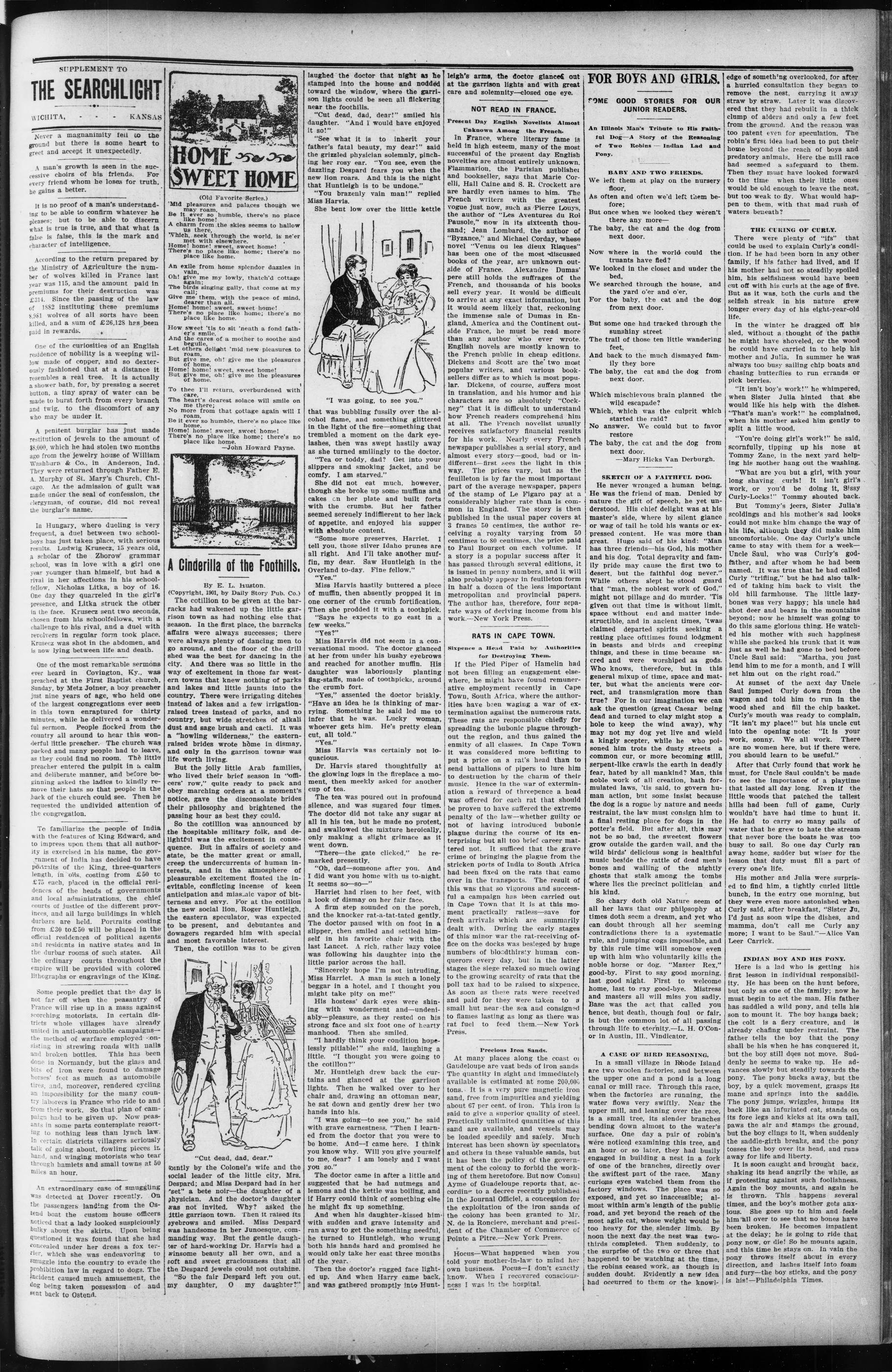
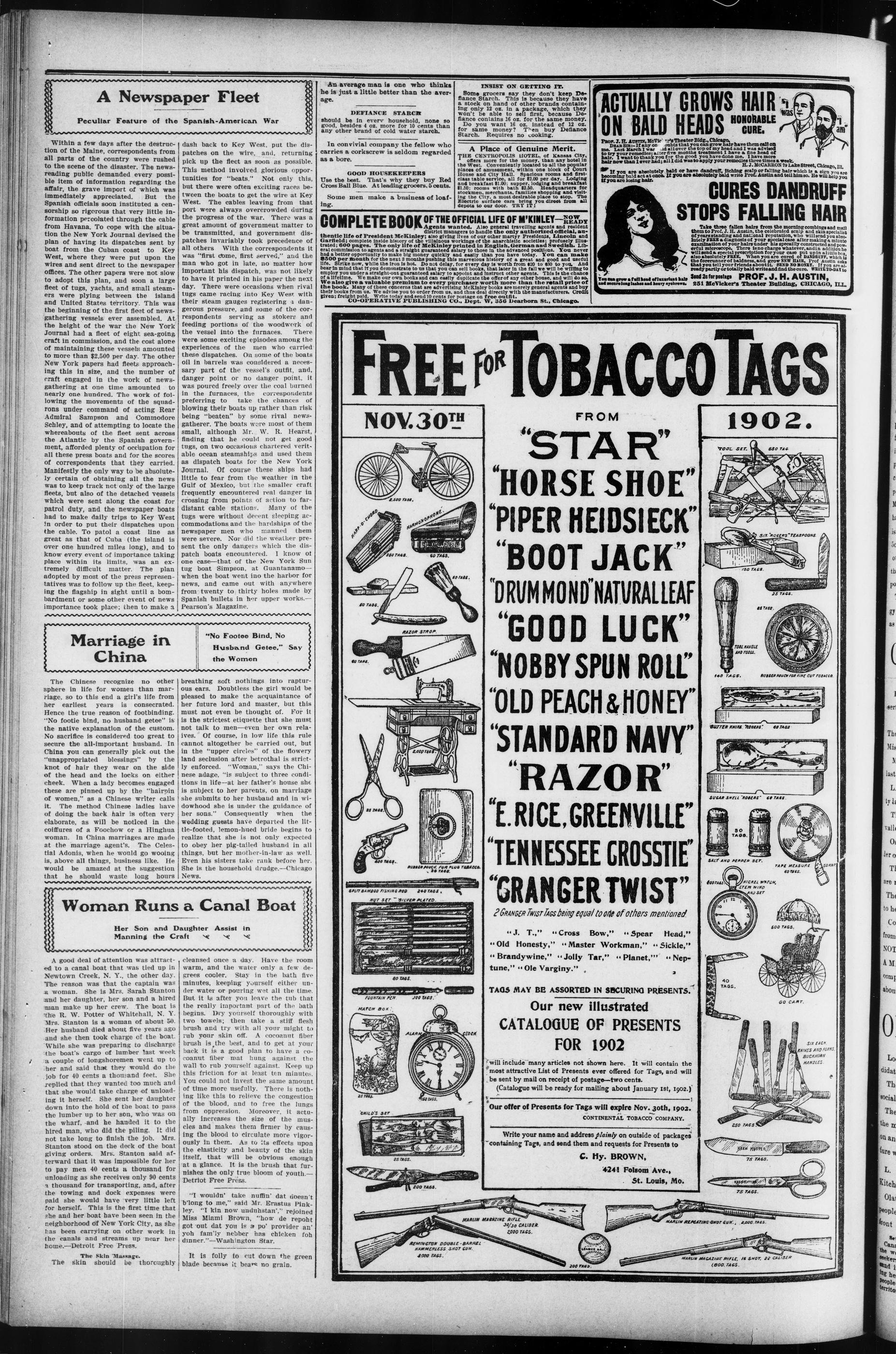
Page text (machine-generated)
THE WICHITA SEARCHLIGHT
VOL. III
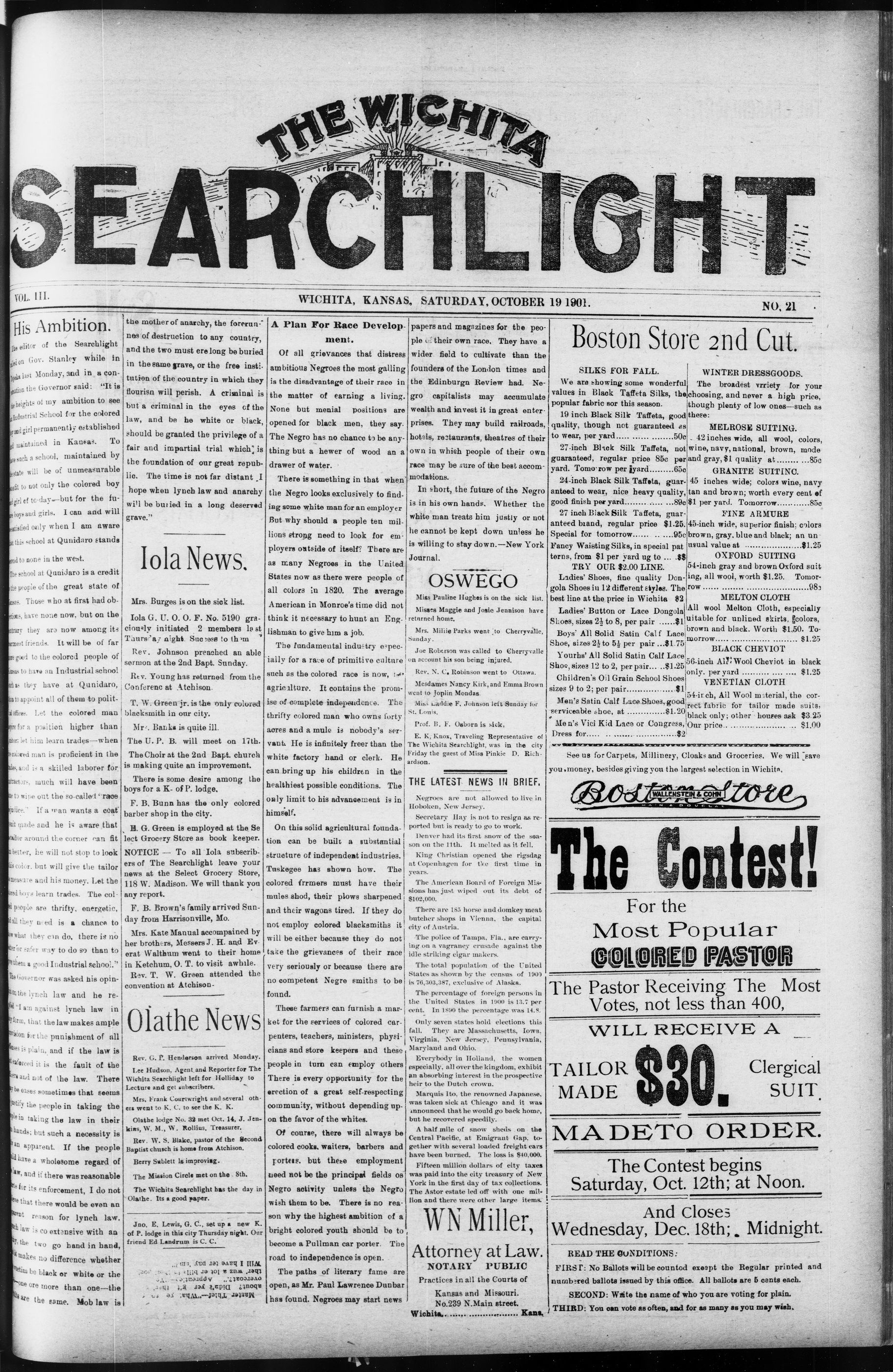
His Ambition.
The editor of the Searchlight newspaper on Gov. Stanley while in Nepal last Monday, and in a conversation the Governor said: "It is the heights of my ambition to see the Industrial School for the colored boy and girl permanently established and maintained in Kansas. To pursue such a school, maintained by the state will be of unmeasurable benefit to not only the colored boy and girl of to-day—but for the future boys and girls. I can and will satisfied only when I am aware of this school at Qunidaro stands
The school at Qunidaro is a credit to the people of the great state of museus. Those who at first had observations, have none now, but on the contrary they are now among its earliest friends. It will be of far more good to the colored people of museus to have an Industrial school such as they have at Qunidaro, to appoint all of them to political offices. Let the colored man secure for a position higher than junior; let him learn trades—when the colored man is proficient in the trades, and is a skilled laborer for contractors, much will have been due to wine out the so-called "race police." If a man wants a coat suit made and he is aware that tailor around the corner can fit better, he will not stop to look his color, but will give the tailor measure and his money. Let the colored boys learn trades. The colored people are thrifty, energetic, all they need is a chance to know what they can do, there is no better or safer way to do so than to give them a good Industrial school."
The Governor was asked his opinion to the lynch law and he replied, "I am against lynch law in any form, that the law makes ample provision for the punishment of all museus is plain, and if the law is enforced it is the fault of the users and not of the law. There may be cases sometimes that seems justify the people in taking the people in taking the law in their hands; but such a necessity is an apparent. If the people should have a wholesome regard of law, and if there was reasonable basis for its enforcement, I do not believe that there would be even an apparent reason for lynch law. Such law is co-extensive with an ability, the two go hand in hand, which makes no difference whether pretim be black or white or the one ore more than one—the bills are the same. Mob law is
the mother of anarchy, the forerunners of destruction to any country, and the two must ere long be buried in the same grave, or the free institution of the country in which they flourish will perish. A criminal is but a criminal in the eyes of the law, and be he white or black, should be granted the privilege of a fair and impartial trial which is the foundation of our great republic. The time is not far distant. I hope when lynch law and anarchy will be buried in a long deserved grave."
Iola News.
Iola News.
Mrs. Burges is on the sick list.
Iola G. U. O. O. F. No. 5190 graciously initiated 2 members last Taur'say night. Success to them
Rev. Johnson preached an able sermon at the 2nd Bapt. Sunday.
Rev. Young has returned from the Conference at Atchison.
T. W. Green jr. is the only colored blacksmith in our city.
Mr. Banks is quite ill.
The U. P. B. will meet on 17th.
The Choir at the 2nd Bapt. church is making quite an improvement.
There is some desire among the boys for a K- of P. lodge.
F. B. Bunn has the only colored barber shop in the city.
H. G. Green is employed at the Select Grocery Store as book keeper.
NOTICE — To all Iola subscribers of The Searchlight leave your news at the Select Grocery Store, 118 W. Madison. We will thank you any report.
F. B. Brown's family arrived Sunday from Harrisonville, Mo.
Mrs. Kate Manual accompanied by her brothers, Messers J. H. and Everat Walthum went to their home in Ketchum, O. T. to visit awhile. Rev. T. W. Green attended the convention at Atchison-
Olathe News
Rev. G. P. Henderson arrived Monday.
Lee Hudson, Agent and Reporter for The Wichita Searchlight left for Holliday to Lecture and get subscribers.
Mrs. Frank Courtwright and several others went to K. C. to see the K. K.
Olathe lodge No. 32 met Oct. 14, J. Jenkins, W. M., W. Rollius, Treasurer.
Rev. W. S. Blake, pastor of the Second Baptist church is home from Atchison.
The Wichita Searchlight has the day in Olathe. Its a good paper.
Jno. E. Lewis, G. C., set up a new K. of P. lodge in this city Thursday night. Our friend Ed Landrum is C. C.
Master Thief—"What ye to about? Dida? yer g't the overcoat?" Apprentice—"We their' wuz a lot er billi' good Will I have ter pay 'em"
A Plan For Race Development.
Of all grievances that distress ambitious Negroes the most galling is the disadvantage of their race in the matter of earning a living. None but menial positions are opened for black men, they say. The Negro has no chance to be anything but a hewer of wood an a drawer of water.
papers and magazines for the people of their own race. They have a wider field to cultivate than the founders of the London times and the Edinburgh Review had. Negro capitalists may accumulate wealth and invest it in great enterprises. They may build railroads, hotels, restaurants, theatres of their own in which people of their own race may be sure of the best accommodation.
SDI
We are values in popular fair 19 inch quality, the to wear, pe 27-inch guaranteed yard. Tom
There is something in that when the Negro looks exclusively to finding some white man for an employer. But why should a people ten millions strong need to look for employers outside of itself? There are as many Negroes in the United States now as there were people of all colors in 1820. The average American in Monroe's time did not think it necessary to hunt an Englishman to give him a job.
The fundamental industry especially for a race of primitive culture such as the colored race is now, agriculture. It contains the promise of complete independence. The thrifty colored man who owns forty acres and a mule is nobody's servant. He is infinitely freer than the white factory hand or clerk. He can bring up his children in the healthiest possible conditions. The only limit to his advancement is in himself.
On this solid agricultural foundation can be built a substantial structure of independent industries. Tuskegee has shown how. The colored ffrmers must have their mules shod, their plows sharpened and their wagons tired. If they do not employ colored blacksmiths it will be either because they do not take the grievances of their race very seriously or because there are no competent Negre smiths to be found.
These farmers can furnish a market for the services of colored carpenters, teachers, ministers, physicians and store keepers and these people in turn can employ others There is every opportunity for the erection of a great self-respecting community, without depending upon the favor of the whites.
Of course, there will always be colored cooks, waiters, barbers and porters. but these employment need not be the principal fields of Negro activity unless the Negro wish them to be. There is no reason why the highest ambition of a bright colored youth should be to become a Pullman car porter. The road to independence is open. The paths of literary fame are open, as Mr. Paul Lawrence Dunbar has found. Negroes may start news
papers and magazines for the people of their own race. They have a wider field to cultivate than the founders of the London times and the Edinburgh Review had. Negro capitalists may accumulate wealth and invest it in great enterprises. They may build railroads, hotels, restaurants, theatres of their own in which people of their own race may be sure of the best accommodations.
In short, the future of the Negro is in his own hands. Whether the white man treats him justly or not he cannot be kept down unless he is willing to stay down.—New York Journal.
OSWEGO
Miss Pauline Hughes is on the sick list.
Misses Maggie and Josie Jennison have returned home.
Mrs. Millie Parks went to Cherryvalle, Sunday.
Joe Roberson was called to Cherryvalle on account his son being injured.
Mesdames Nancy Kirk, and Emma Brown went to Joplin Mondas.
Miss Laddie F. Johnson left Sunday for St. Louis.
Prof. B. F. Osborn is sick.
E. K. Knox, Traveling Representative of The Wichita Searchlight, was in the city Friday the guest of Miss Pinkie D. Richardson.
THE LATEST NEWS IN BRIEF.
Negroes are not allowed to live in Hoboken, New Jersey.
Secretary Hay is not to resign as reported but is ready to go to work.
Denver had its first snow of the season on the 11th. It melted as it fell.
King Christian opened the rigsdag at Copenhagen for the first time in years.
The American Board of Foreign Missions has just wiped out its debt of $102,000.
There are 185 horse and domkey meat butcher shops in Vienna, the capital city of Austria.
The police of Tampa, Fla., are carrying on a vagraney crusade against the idle striking cigar makers.
The total population of the United States as shown by the census of 1900 is 76,303,387, exclusive of Alaska.
The percentage of foreign persons in the United States in 1000 is 13.7 percent. In 1890 the percentage is 14.8. Only seven states hold elections this fall. They are Massachusetts, Iowa, Virginia, New Jersey, Pennsylvania, Maryland and Ohio. Everybody in Holland, the women especially, all over the kingdom, exhibit an absorbing interest in the prospective heir to the Dutch crown. Marquis Ito, the renowned Japanese, was taken sick at Chicago and it was announced that he would go back home, but he recovered speedily. A half mile of snow sheds on the Central Pacific, at Emigrant Gap, together with several loaded freight cars have been burned. The loss is $40,000.
Fifteen million dollars of city taxes was paid into the city treasury of New York in the first day of tax collections. The Astor estate led off with one million and there were other large items.
Boston Store 2nd Cut.
We are showing some wonderful values in Black Taffeta Silks, the popular fabric sor this season.
27-inch Black Silk Taffeta, not guaranteed, regular price 85c per yard. Tomorrow per yard.....65c
24-inch Black Silk Taffeta, guaranteed to wear, nice heavy quality, good finish per yard.....89c
27 inch Black Silk Taffeta, guaranteed brand, regular price $1.25. Special for tomorrow.....95c
Fancy Waisting Silks, in special patterns, from $1 per yard ug to ....$$ TRY OUR $2.00 LINE.
Ladies' Shoes, fine quality Dongola Shoes in 12 different styles. The best line at the price in Wichita $2
Ladies' Button or Lace Dongola
Shoes, sizes $2\frac{1}{2}$ to 8, per pair .....$1
Boys' All Solid Satin Calf Lace
Shoe, sizes $2\frac{1}{2}$ to $5\frac{1}{2}$ per pair .....$1.75
Yourhs' All Solid Satin Calf Lace
Shoe, sizes 12 to 2, per pair .....$1.25
Children's Oil Grain School Shoes
sizes 9 to 2; per pair .....$1
Men's Satin Calf Lace Shoes, good
serviceable shoe, at .....$1.20
Men's Vici Kid Lace or Congress,
Dress for .....$2
See us for Carpets, Millinery, C
you, money, besides giving you the la
BOSTON
WALENST
The Co
For the
Most P
COLOREI
The Pastor Rece
Votes, not le
WILL RE
See us for Carpets, Millinery, Cloaks and Groceries. We will save you money, besides giving you the largest selection in Wichita.
BOSTON STORE
WALLENSTEIN & COHN
The Contest!
The Pastor Receiving The Most Votes, not less than 400.
WILL RECEIVE A
TAILOR $30. Clergical MADE SUIT.
MADETO The Conte Saturday, Oct. And
MADETO ORDER The Contest begins Saturday, Oct. 12th; at Noon.
READ THE CONDITIONS:
FIRST: No Ballots will be counted except the Regular printed and numbered ballots issued by this office. All ballots are 5 cents each.
SECOND: Write the name of who you are voting for plain.
THIRD: You can vote as often, and for as many as you may wish.
TAILOR MADE
WINTER DRESSGOODS.
The broadest vrriety for your
choosing, and never a high price,
though plenty of low ones—such as
these:
MELROSE SUITING.
42 inches wide, all wool, colors,
wine, navy, national, brown, mode
and gray,$1 quality at... 85c
GRANITE SUITING.
45 inches wide; colors wine, navy
tan and brown; worth every cent of
$1 per yard. Tomorrow.....85c
FINE ARMURE
45-inch wide, superior finish; colors
brown, gray, blue and black; an un-
usual value at .....$1.25
OXFORD SUITING
54-inch gray and brown Oxford suit-
ing, all wool, worth $1.25. Tomor-
row.....982
MELTON CLOTH
All wool Melton Cloth, especially
uitable for unlined skirts, colors,
brown and black. Worth $1.50. Tom-
orrow.....$1.25
BLACK CHEVIOT
56-inch All? Wool Cheviot in black
only. per yard ..... $1.25
VENETIAN CLOTH
54-inch, All Wool material, the correct fabric for tailor made suits,
black only; other houses ask $3.25
Our price ..... $1.00
Cloaks and Groceries. We will leave
largest selection in Wichita.
store
contest!
Popular
D PASTOR
Giving The Most
less than 400,
RECEIVE A
O ORDER. est begins 12th; at Noon. Closes
NO.21
Clergical SUIT
THE SEARCHLIGHT.
WICHITA, KANS.
W. N. MILLER, Edison.
Entered at the Post Office at Wichita Kansas, as Second Class Mail Matter.
Published every Saturday at No 239 North Main Street, up stairs
RATES OF SUBSCRIPTION:
IN ADVANCE.
On year, by mail ..... $1 69
Bil months, by mail ..... 75
Three months, by mail ..... 58
Advertising rates made known on application.
Address all communications to "The Searchlight," Wichita, Kansas.
All matters to be published must reach this office not later than Tuesday, to reach publication in the current issue.
correspondents and agents wanted everywhere.
Write us for terms.
All matters sent to "The Searchlight" for publication must be signed by the party or parties writing.
"To Live and Let Live," is our Motto.
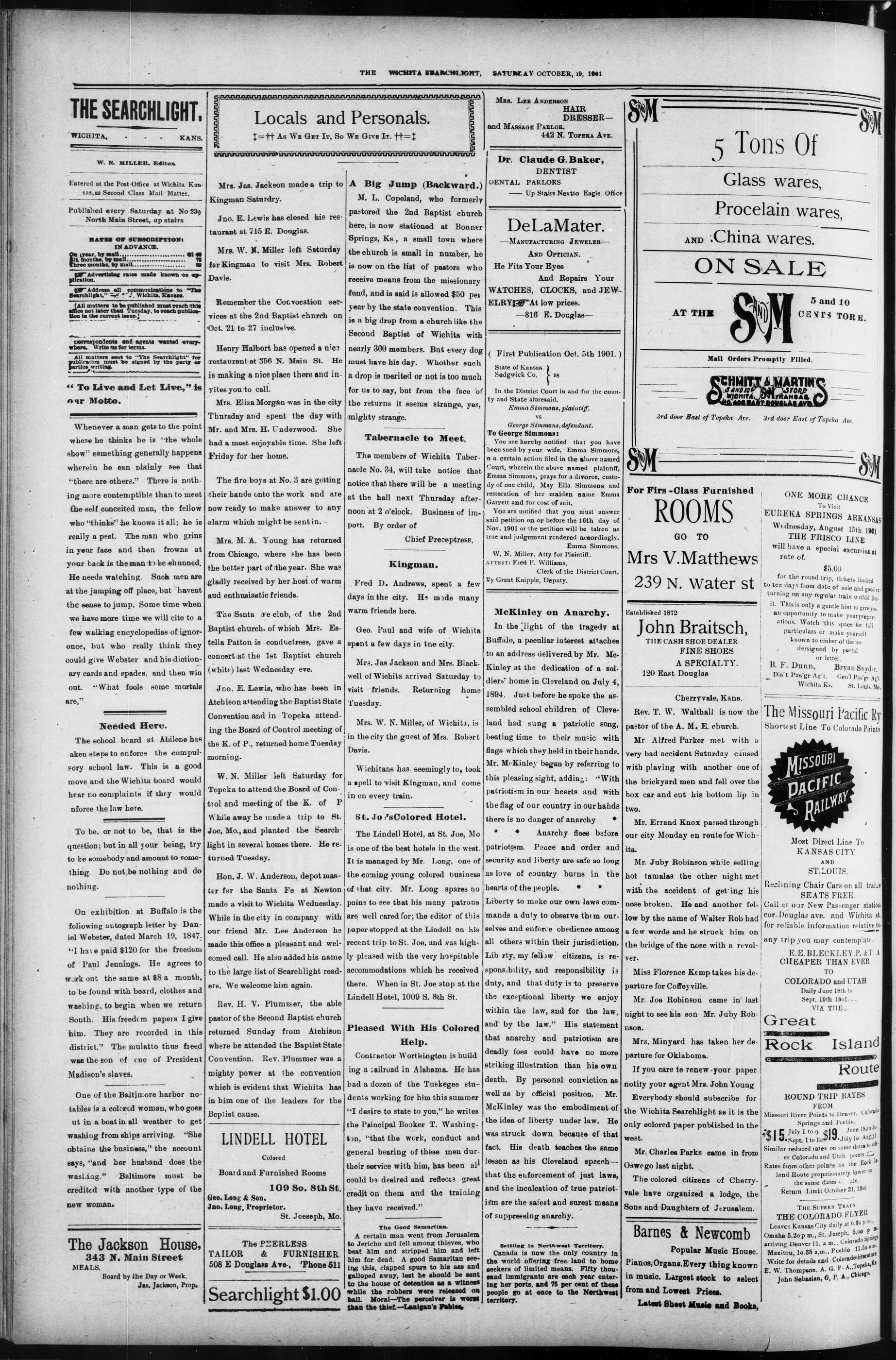
Whenever a man gets to the point where he thinks he is "the whole show" something generally happens wherein he can plainly see that "there are others." There is nothing more contemptible than to meet the self conceited man, the fellow who "thinks" he knows it all; he is really a pest. The man who grins in your face and then frowns at your back is the man to be shunned. He needs watching. Such men are at the jumping off place, but "havent the sense to jump. Some time when we have more time we will cite to a few walking encyclopedias of ignorance, but who really think they could give Webster and his dictionary cards and spades, and then win out. "What fools some mortals are,"
Needed Here.
The school board at Abilene has aken steps to enforce the compulsory school law. This is a good move and the Wichita board would hear no complaints if they would nforce the law here.
To be, or not to be, that is the question; but in all your being, try to be somebody and amount to something. Do not be nothing and do nothing.
On exhibition at Buffalo is the following autograph letter by Daniel Webster, dated March 19, 1847. "I have paid $120 for the freedom of Paul Jennings. He agrees to work out the same at $8 a month, to be found with board, clothes and washing, to begin when we return South. His freedom papers I give him. They are recorded in this district." The mulatto thus freed was the son of one of President Madison's slaves.
One of the Baltimore harbor notables is a colored woman, who goes out in a boat in all weather to get washing from ships arriving. "She obtains the business," the account says, "and her husband does the washing." Baltimore must be credited with another type of the new woman.
The Jackson House,
343 N. Main Street
MEALS.
Board by the Day or Week.
Jas. Jackson, Prop.
Mrs. Jas. Jackson made a trip to Kingman Saturdry.
Jno. E. Lewis has closed his restaurant at 715 E. Douglas.
Mrs. W. M. Miller left Saturday far Kingman to visit Mrs. Robert Davis.
Remember the Convocation services at the 2nd Baptist chnrch on Oct. 21 to 27 inclusive.
Henry Halbort has opened a nice restaurant at 356 N. Main St. He is making a nice place there and in-yites you to call.
Mrs. Eliza Morgan was in the city Thursday and spent the day with Mr. and Mrs. H. Underwood. She had a most enjoyable time. She left Friday for her home.
The fire boys at No. 3 are getting their hands onto the work and are now ready to make answer to any alarm which might be sent in.
Mrs. M. A. Young has returned from Chicago, where she has been the better part of the year. She was gladly received by her host of warm aud enthusiastic friends.
The Ssnta re club, of the 2nd Baptist church. of which Mrs. Estella Patton is conductress, gave a concert at the 1st Baptist church (white) last Wednesday eve.
Jno. E. Lewis, who has been in Atchison attending the Baptist State Convention and in Topeka attending the Board of Control meeting of the K. of P., returned home Tuesday morning.
W. N. Miller left Saturday for Topeka to attend the Board of Control and meeting of the K. of P While away he made a trip to St. Joe, Mo., and planted the Searchlight in several homes there. He returned Tuesday.
Hon. J. W. Anderson, depot master for the Santa Fe at Newton made a visit to Wichita Wednesday. While in the city in company with our friend Mr. Lee Anderson he made this office a pleasant and welcomed call. He also added his name to the large list of Searchlight readers. We welcome him again.
Rev. H. V. Plummer, the able pastor of the Second Baptist church returned Sunday from Atchison where he attended the Baptist State Convention. Rev. Plummer was a mighty power at the convention which is evident that Wichita has in him one of the leaders for the Baptist cause.
LINDELL HOTEL
Board and Furnished Rooms
109 So. 8th St.
Geo. Long & Son.
Jno. Long, Proprietor.
The PEERLESS
TAILOR & FURNISHER
508 E Douglass Ave., 'Phone 511
Searchlight $1.00
THE WICHITA SEARCHLIGHT, SATURDAY OCTOBER, 19: 1901
A Big Jump (Backward.) M. L. Copeland, who formerly pastored the 2nd Baptist church here, is now stationed at Bonner Springs, Ks., a small town where the church is small in number, he is now on the list of pastors who receive means from the missionary fund, and is said is allowed $50 per year by the state convention. This is a big drop from a church like the Second Baptist of Wichita with nearly 300 members. But every dog must have his day. Whother such a drop is merited or not is too much for us to say, but from the face of the returns it seems strange, yes, mighty strange.
Tabernacle to Meet.
The members of Wichita Tabernacle No. 34, will take notice that notice that there will be a meeting at the hall next Thursday afternoon at 2 o'elock. Business of import. By order of Chief Preceptress.
Kingman.
Fred D. Andrews, spent a few days in the city. He made many warm friends here.
Geo. Paul and wife of Wichita spent a few days in the city.
Mrs. Jas Jackson and Mrs. Blackwell of Wichita arrived Saturday to visit friends. Returning home Tuesday.
Mrs. W. N. Miller, of Wichita, is in the city the guest of Mrs. Robert Davis.
Wichitans has, seemingly to, took a spell to visit Kingman, and come in on every train.
The Lindell Hotel, at St. Joe, Mo is one of the best hotels in the west. It is managed by Mr. Long, one of the coming young colored business of that city. Mr. Long spares no pains to see that his many patrons are well cared for; the editor of this paper stopped at the Lindell on his recent trip to St. Joe, and was highly pleased with the very hospitable accommodations which he received there. When in St. Joe stop at the Lindell Hotel, 1009 S. 8th St.
Pleased With His Colored Help.
Contractor Worthington is building a railroad in Alabama. He has had a dozen of the Tuskegee students working for him this summer "I desire to state to you," he writes the Principal Booker T. Washington, "that the work, conduct and general bearing of these men dur their service with him, has been all could be desired and reflects great credit on them and the training they have received."
The Good Samaritan.
A certain man went from Jerusalem to Jericho and fell among thieves, who beat him and stripped him and left him for dead. A good Samaritan seeing this, clapped spurs to his ass and galloped away, lest he should be sent to the house of detention as a witness while the robbers were released on ball. Moral-The perceiver is worse than the thief-Lanigan's Pables.
MRS. LEE ANDERSON
HAIR
DRESSER
and MASSAGE PARLOR.
442 N. TOPEKA AVE.
Dr. Claude G. Baker,
DENTIST
DENTAL PARLORS
—— Up Stairs Nextto Eagle Office
DeLaMater.
MANUFACTURING JEWELER
AND OPTICIAN.
He Fits Your Eyes
And Repairs Your
WATCHES, CLOCKS, and JEW-
ELRY At low prices.
-316 E. Douglas-
First Publication Oct. 5th 1901. )
State of Kansas
Sadgwick Co.
In the District Court in and for the county and State aforesaid,
Emma Simmons, platinum
You are hereby notified that you have been sued by your wife, Emma Simmons, in a certain action filed in the above named Court, wherein the above named plaintiff, Emma Simmons, prays for a divorce, custody of one child, May Ella Simmons and restoration of her maiden name Emma Garrett and for cost of suit.
You are notified that you must answer said petition on or before the 16th day of Nov. 1901 or the petition will be taken as true and judgement rendered accordingly.
Emma Simmons
Clerk of the District Court,
Ey Grant Knipple, Deputy.
McKinley on Anarchy.
In the light of the tragedy at Buffalo, a peculiar interest attaches to an address delivered by Mr. McKinley at the dedication of a soldiers' home in Cleveland on July 4, 1894. Just before he spoke the assembled school children of Cleveland had sung a patriotic song, beating time to their music with flags which they held in their hands. Mr. McKinley began by referring to this pleasing sight, adding: "With patriotism in our hearts and with the flag of our country in our hands there is no danger of anarchy *
* Anarchy flees before patriotism. Peace and order and security and liberty are safe so long as love of country burns in the hearts of the people. *
Liberty to make our own laws commands a duty to observe them ourselves and enforce obedience among all others within their jurisdiction. Liberty, my fellow citizens, is responsibility, and responsibility is duty, and that duty is to preserve the exceptional liberty we enjoy within the law, and for the law, and by the law." His statement that anarchy and patriotism are deadly foes could have no more striking illustration than his own death. By personal conviction as well as by official position. Mr. McKinley was the embodiment of the idea of liberty under law. He was struck down because of that fact. His death teaches the same lesson as his Cleveland speech—that the enforcement of just laws, and the inculcation of true patriotism are the safest and surest means of suppressing anarchy.
Settling in Northwest Territory.
Settling in Northwest Territory. Canada is now the only country in the world offering free land to home seekers of limited means. Fifty thousand immigrants are each year entering her ports, and 75 per cent of these people go at once to the Northwest territory.
5 Tons Of
Glass wares,
Procelain wares,
and China wares.
ON SALE
AT THE S AND M 5 and 10 CENTS TORE.
Mail Orders Promptly Filled.
SCHMITT & MARTINS
5 AND 10 S AND M STORE
NICHITA, FRANCAIS,
NO. 408, EAST ROUGLAS AVE.
3rd door East of Topeka Ave. 3rd door East of Topeka Ave.
John Braitsch,
THE CASH SHOE DEALER
FINE SHOES
A SPECIALTY.
120 East Douglas
Rev. T. W. Walthall is now the pastor of the A. M. E. church.
Mr Alfred Parker met with a very bad accident Saturday caused with playing with another one of the brickyard men and fell over the box car and cut his bottom lip in two.
Mr. Errand Knox passed through our city Monday en route for Wichita.
Mr. Juby Robinson while selling hot tamalas the other night met with the accident of getting his nose broken. He and another fellow by the name of Walter Rob had a few words and he struck him on the bridge of the nose with a revolver.
Miss Florence Kemp takes his departure for Coffeyville.
Mr. Joe Robinson came in last night to see his son Mr. Juby Robinson.
Mrs. Minyard has taken her departure for Oklahoma.
If you care te renew-your paper notify your agent Mrs. John Young.
Everybody should subscribe for the Wichita Searchlight as it is the only colored paper published in the west.
Mr. Charles Parks came in from Oswego last night.
The colored citizens of Cherryvale have organized a lodge, the Sons and Daughters of Jerusalem.
Barnes & Newcomb
Popular Music House. Pianos, Organs.Every thing known in music. Largest stock to select from and Lowest Prices. Latest Sheet Music and Books.
ONE MORE CHANCE
To Visit
EUREKA SPRINGS ARKANSAS
Wednesday, August 15th 1901
THE FRISCO LINE
will have a special excursion at
rate of.
for the round trip, tickets limited to ten days from date of sale and good returning on any regular train withid limit. This is only a gentle hint to give you an opportunity to make your preparations. Watch 'this space for full particulars or make yourself known to einer of the undersigned by postal or letter.
B. F. Dunn. Bryan Snyder.
Dis't Pas'gr Ag't. Gen'l Pas'gr Ag't.
Wichita Ks. St. Louis, Mo.
The Missouri Pacific Ry
Shortest Line To Colorado Points
MISSOURI
PACIFIC
RAILWAY
Most Direct Line To
KANSAS CITY
AND
ST. LOUIS.
Reglining Chair Cars on all trains
SEATS FREE.
Call at our New Passenger station
cor. Douglas ave. and Wichita st.
for reliable information relative to
any trip you may contemplate.
E.E. BLECKLEY, P. & T. A.
CHEAPER THAN EVER
TO
COLORADO and UTAH
Daily June 18th to
Sept. 10th 1901.....
VIA THE...
Great
Island
FROM
Missouri River Points to Denver, Colorado
Springs and Pueblo.
$15. July 1 to 9 $19. July 10 to 14
Sept. 10 to 14 Similar reduced rates on same dates to other Colorado and Utah points.
Rates from other points on the Rock land Route proportionately lower on the same dates to sale.
Return Limit October 31, 1901
THE SUPERRE TRAIN
THE COLORADO FLYER
Leaves Kansas City daily at 6.80 p.m.
Omaha 5.20 p.m., St. Joseph, 5.00 p.m.
arriving Denver 11 a.m., Colorado Springs
Manitou, 10.35 a.m., Pueblo 11.50 a.m.
Write for details and Colorado literature
E. W. Thompson, A. G. P. A., Topeka, Ks
John Sebasian, G, P. A., Chicago
UNITED STATES OF AMERICA
1869
Castle Hall 338 North Main street.
Regular Meetings Second and Fourth
Monday Night in Each Month.
Visiting Knights in good standing Welcomed
S. W. Fleming, Chan. Com.
W. N. Miller, K. of R. & S.
ARRIA COURT No. 7.
Order of Calanthe.
Mrs. J. E. Lewis, W. C.
Miss Blench Alexander, R.of D.
Mrs. Ida Martin, W.of R. of D.
Meets 1st, and 3rd, Menday each month
Masonic Lodges.
ARKANSAS VALLEY Lodge
No.21.
A.F. & A.M.
John T. Chinneth, W. M.
W.H.A. Clark, Secretary.
Neets 1st. and 3rd. Tuesday each month.
All Master Masons in good standing are
Cordially Invited.
PALESTINE COMMANDERY
No.12.
Wichita Kansas.
J.T.Chinneth,
Emininent Commander
J.A.Roberson,
Generalissimo.
Phil Hyde,
Captain General
Joseph Fine Secretary.
Sylvester Anderson, Treas.
Meets the 2nd Monday night each month
MT.ZION CHAPTER No.17.
W.H.A.Clark,
High Priest
J.S.Fauver,
King.
Ben Wilson,
Scribe.
J.T. Chinneth, Secretary
Grant Ewing, Treas.
Meets the 4th Monday night each month
PRINCESS CHAPTER No.12
O.of E.S.
Mrs. M.E. Banks, Royal Matron,
Miss Lizzie M. Burnham, Secerty
Meets 1st and 3rd. Wednesday each month.
Mt.Olive Court No.9,H. of J.
Mrs J. E. Lewis, M. A. M.
Mrs J. S. Anderson, Secretary
Mrs L. Adams, Treasurer
Meets 1 & 3 Wednesday afternoon at 2 p.m.
HOME OF THE WEST No.2906.
G.U.O.O.F.
Has. H. Gordon, N.G.
Major Davis, V.G.
J.A Martin,Secretary
Meets 1st, 2nd and 3rd Tuesday night.
For Reliable Rates And Quickest Time Patronize The
FRISCO LINE
Through reclining chair cars and latest improved Pullman coaches WITHOUT CHARGE on all Frisco trains between
WICHITA
AND
ST.LOUIS.
FRISCO LINE.
Trains leave Wichita at 1.20 and 10.
45 p.m. arrive at Wichita 8.25 p.m.
and 8.35 a.m. See that your ticket
reads via the Frisco Line — it will
save you money and time.
Should you desire any information
to rates, time, routes, maps, etc., call
or write any Frisco LSLe agent or
the undersigned. It is a great pleasure
for us to answer questions.
CITY TICKET OFFICE
Cor. Main and Douglas.
B.F. DUNN, BRYAN SNYDER,
Dist. Pass. Ag't. Gen. Pass. Ag't.
Wichita, Kan. St. Louis, Mo.
when in use of Groceries
do not forget that you can
always get the Best at the
Lowest prices
KERNAN'S
1102 E Doyle
Vve. 'Phone 357.
```markdown
```
GREENFIELD BRO'S
M. Jaques & Co.
made on Furniture, Stoves, Carpets.
Either cash or easy pay
after you buy or not. we take pleasure
in goods and giving you prices.
Co., 243
at FULTON's-It
Hats&FurniShir
For Men, BoysandChildren.
Best selections, Latest styles, Finest
Greatest Values.
GOODS, AT OUT OF SEASON
F.M.Jaque
Special Prices made on Furniture
Either
Call in whether you buy or m
ing goods and
F.M.Jaques & Co.,
Trade at FUL
Clothin g,Hats&L
For Men,Boy
Largest stock,Best selections,L
Greatest
SEASONABLE GOODS,AT
F.M.Jaques & Co.,
Special Prices made on Furniture, Stoves, Carpets, and Matting Either cash or easy payments.
Call in whether you buy or not. we take pleasure in showing goods and giving you prices.
F.M.Jaques & Co., 243 N.Main St.
Trade at FULTON's-It pays. Clothin g,Hats&FurniShing Goods For Men,BoysandChildren. Largest stock,Best selections,Latest styles,Finest assortments, Greatest Values. SEASONABLE GOODS,AT OUT OF SEASON PRICES.
C.R.Fulton
TAPP BROS.
Having adopted we expect to make any one and will all goods sold. No
19 Pounds Granul
Note that this is the largest pack a year for a dollar—Tapp did it Sugar by the Savk, $5.15. L Gasoline, per gallon 16 cts. B Colorado Potatoes, peresk 30
Phone 2
Tapp Bros. & Ha
255-277 NO
BROS. &
adopted the cash
it to make prices
and will promptly
sold. Note prices.
Bonds Granulated Sugar $1.1.
the largest package of Sugar sold
car—Tapp did it.
k, $5.15. L'on Coffee, per pac
lon 16 cts. Best Flour per sack
es, per neck 30 cents.
Phone 257.
s. & Hanshaw
277 North Main
Having adopted the cash system we expect to make prices below any one and will promptly deliver all goods sold. Note prices.
19 Pounds Granulated Sugar $1.00.
Note that this is the largest package of Sugar sold in Wichita withi a year for a dollar—Tapp did it.
Sugar by theSack, $5.15. L'on Coffee, per package 10 cents
Gasoline, per gallon 16 cts. Best Flour per sack 85 cents
Colorado Potatoes, per peek 30 cents.
Phone 257.
Tapp Bros. & Hanshaw 255-277 North Main Street.
DR.E.HARRISON.
Surgical & Medical
TREATMENT IN ALL
Lungs,Nervous,Chronic,
and Private Diseases;
also diseases of the
EYE,EAR,NOSE,THROAT.
Prices Reasonable.
All I ask is a treatment.
B.F.McLean.
Lumber Dealer
Wichita, Kansas.
Yards at
Wichita, Kas,, Clearwater, Kas,, Peck
Kas., Choney, Kan.
Z
112 E. Douglas.
THE WICHITA SEARCHLIGHT, SATURDAY OCTOBER 19
Overcoats
Will you need a new OVERCOAT this fall? If you do, don't fail to examine our line. We are showing all the new, swell styles in Coats. Every day adds something new to our stock.
Saire Price to Everybody
ques & Co.,
furniture, Stoves, Carpets, and Matting
Either cash or easy payments.
y or not. we take pleasure in show-
and giving you prices.
243 N.Main St.
BULTON's-It pays.
& FurniShing Goods
n, BoysandChildren.
ons, Latest styles, Finest assortments,
greatest Values.
GAT OUT OF SEASON PRICES.
Greatest Clothing Store. .....
HANSHAW
noted the cash system
make prices below
will promptly deliver
Note prices.
Annulated Sugar $1.00.
It package of Sugars sold in Wichita withi
did it.
L'on Coffee, per package: 10 cents
Best Flour per sack 85 cents
back 30 cents.
One 257.
Hanshaw
North Main Street.
For a Good,First-Ciass Shave GO TO
Fisher's shop
Up to Date Hair Cut & Shampoos
$ 638 \frac{1}{2} $ E. Douglass Ave.,
Burl Fisher.Prop
Hardware Store
Garland and Quick Meal
Steel Ranges.
Garland Cook Stoves. Backwith
Round Oak Heating Stoves.
116 East Douglas ave.
H.C.DUNBAR,
PIONEER
UNDERTAKER.
235 North Main Street
For First-class Meals
GO TO THE
B B Restarant
846 North Main Street,
BURNS & BAYNUM, PROPS.
Meals 15 cts.
Houk
```markdown
```
117 NLawrence st
SCHROEDER & 256 North M
SCHROEDER & MATTHEWS
Linen carpet at.
Ingrain carpet
All wool filled co
Matting .....
Six-foot extension
Six cane seat din
Six wood seat d
Screen wire, per
Iron beds .....
Rubber hose, per
Steel ranges .....
SCHRODER &
256 NORT
Linen carpet at..... 28c
Ingrain carpet at..... 30c
All wool filled carpet..... 59c
Matting ..... 15, 18, 20 and 25c
Six-foot extension tables..... $4.75
Six cane seat dining chairs..... $5.75
Six wood seat dining chairs..... $3.50
Screen wire, per square foot ..... 1 1/4c
Iron beds ..... $2.95, $3.75, $4.25 and $5.50
Rubber hose, per foot ..... 7 1/2 1112c
Steel ranges ..... $24.00, $32.00, $37.00
SCHRODER & MATTHEWS.
256 NORTH MIAN
R
THE PEERL 508 East Dov
Baptist State
THE PEERLESS TAILOR 508 East Douglas Avenue.
THE PEERLESS TAILOR 508 East Douglas Avenue.
Baptist State Convention.
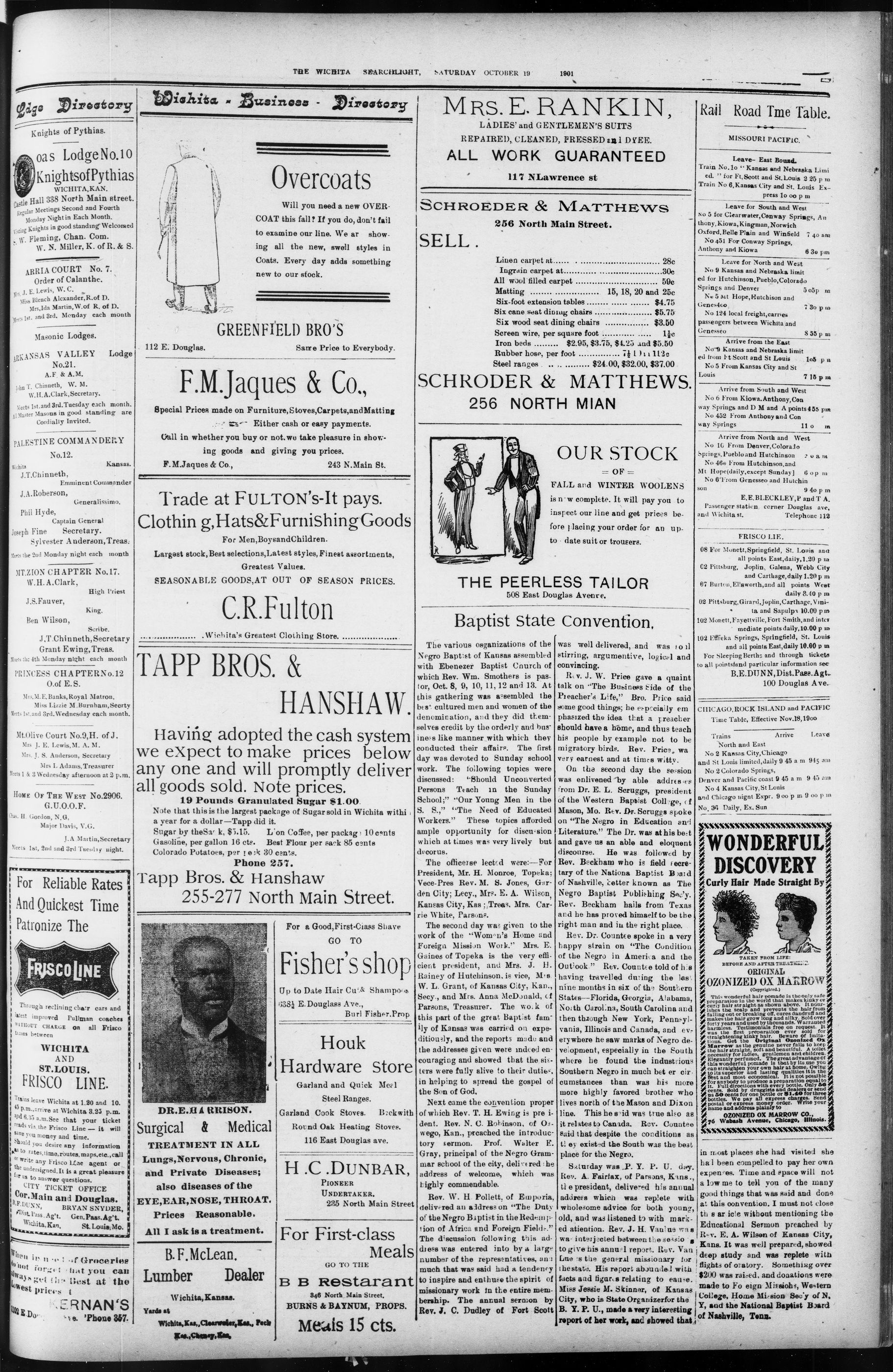
The various organizations of the Negro Baptist of Kansas assembled with Ebenezer Baptist Church of which Rev. Wm. Smothers is pastor, Oct. 8, 9, 10, 11, 12 and 13. At this gathering was assembled the best cultured men and women of the denomination, and they did themselves credit by the orderly and business like manner with which they conducted their affairs. The first day was devoted to Sunday school work. The following topics were discussed: "Should Unconverted Persons Teach in the Sunday School," "Our Young Men in the S. S.," "The Need of Educated Workers." These topics afforded ample opportunity for discussion which at times was very lively but decorus.
The officee lected were:—For President, Mr. H. Monroe, Topeka; Vice-Pres Rev. M. S. Jones, Garden City; Lecy., Mrs. E. A. Wilson, Kansas City, Kas.; Treas. Mrs. Carrie White, Parsons.
The second day was given to the work of the "Women's Home and Foreign Mission Work." Mrs. E. Gaines of Topeka is the very efficient president, and Mrs. J. H. Rainey of Hutchinson, is vice, Mrs. W. L. Grant, of Kansas City, Kan., Secey, and Mrs. Anna McDonald, of Parsons, Treasurer. The work of this part of the great Baptist family of Kansas was carried on expeditiously, and the reports made and the addresses given were indeed encouraging and showed that the sisters were fully alive to their duties in helping to spread the gospel of the Son of God.
Next came the convention proper of which Rev. T. H. Ewing is president. Rev. N. C. Robinson, of Oswego, Kan., preached the introductory sermon. Prof. Walter E. Gray, principal of the Negro Grammar school of the city, delivered the address of welcome, which was highly commendable.
Rev. W. H Pollett, of Emporia, delivered an address on "The Duty of the Negro Baptist in the Redemption of Africa and Foreign Fields." The discussion following this address was entered into by a large number of the representatives, and much that was said had a tendency to inspire and enthuse the spirit of missionary work in the entire membership. The annual sermon by Rev. J. C. Dudley of Fort Scott
SELL
MATTHEWS
Main Street.
at ..... 28c
set at ..... 30c
carpet ..... 50c
15, 18, 20 and 25c
vision tables ..... $4.75
dining chairs ..... $5.75
dining chairs ..... $3.50
per square foot ..... 1½c
$2.95, $3.75, $4.25 and $5.50
per foot ..... 7½ Dm 112c
$24.00, $32.00, $37.00
& MATTHEWS.
TH MIAN
OUR STOCK
FALL and WINTER WOOLENS is now complete. It will pay you to inspect our line and get prices before placing your order for an up-to-date suit or trousers.
LESS TAILOR
Douglas Avenre.
e Convention.
e was well delivered, and was soul stirring, argumentive, logical and convincing.
Rev. J. W. Price gave a quaint talk on "The Business Side of the Preacher's Life," Bro. Price said some good things; he especially emphasized the idea that a preacher should have a home, and thus teach his people by example not to be migratory birds. Rev. Price wavery earnest and at times witty.
On the second day the session was enlivened by able addresses from Dr. E. L. Scruggs, president of the Western Baptist College, of Mason, Mo. Rev. Dr. Scruggs spoke on "The Negro in Education and Literature." The Dr. was at his best and gave us an able and eloquent discourse. He was followed by Rev. Beckham who is field secretary of the Nationa Baptist Board of Nashville, better known as The Negro Baptist Publishing Society. Rev. Beckham hails from Texas and he has proved himself to be the right man and in the right place.
Rev. Dr. Countee spoke in a very happy strain on "The Condition of the Negro in America and the Outlook." Rev. Countee told of his having travelled during the last nine months in six of the Southern States—Florida, Georgia, Alabama, North Carolina, South Carolina and then through New York, Pennsylvania, Illinois and Canada, and everywhere he saw marks of Negro development, especially in the South where he found the industrious Southern Negro in much better circumstances than was his more more highly favored brother who lives north of the Mason and Dixon line. This he said was true also as it relates to Canada. Rev. Countee said that despite the conditions as they existed the South was the best place for the Negro.
Saturday was P. Y. P. U. day. Rev. A. Fairlax, of Parsons, Kans., the president, delivered his annual address which was replete with wholesome advice for both young, old, and was listened to with marked attention. Rev. J. H. Vanlue was interjected between the session to give his annual report. Rev. Van Lue is the general missionary for the state. His report abounded with facts and figures relating to cause. Miss Jessie M. Skinner, of Kansas City, who is State Organizer for the B. Y. P. U., made a very interesting report of her work, and showed that
1901
MISSOURI PACIFIC
Leave - East Bound.
Train No. 10 "Kansas and Nebraska Limited." for Ft. Scott and St. Louis 2 25 p m
Train No 6, Kansas City and St. Louis Express 10 oo p m
Leave for South and West
No 5 for Clearwater, Conway Springs, Anthony, Kiowa, Kingman, Norwich
Oxford, Belle Plain and Winfield 7 40 am
No 451 For Conway Springs,
Anthony and Kiowa 6 30 pm
Leave for North and West
No 9 Kansas and Nebraska limited
ed for Hutchinson, Pueblo, Colorado
Springs and Denver 5 05 p m
No 5 att Hope, Hutchison and Genesee 7 30 p m
No 124 local freight, carrves passengers between Wichita and Genesee 8 55 p m
Arrive from the East
No 9 Kansas and Nebraska limit
ed from 1 t Scott and St Louis 105 p m
No 5 From Kansas City and St
Louis 7 15 p m
Arrive from South and West
No 6 From Kiowa,Anthony,Con
way Springs and D M and A points 455 p m
No 452 From Anthony and Con
way Springs 11 o m
Arrive from North and West
No 10 From Denver,Colorado
Springs,Pueblo and Hutchinson 2 o a m
No 406 From Hutchinson,and
Mt Hope(daily,except Sunday] 6 o p m
No 6 From Genesee and Hutchin
son 9 40 p m
E,E,BLECKLEY,P and T A.
Passenger station corner Douglas ave,
and Wichita st. 112
FRISCO LIE
08 For Monett, Springfield, St. Louis and all points East, daily, 1.20 p m
02 Pittsburg, Joplin, Galena, Webb City and Carthage, daily 1.20 p m
07 Burton, Ellsworth, and all points West daily 8.40 p m
02 Pittsburg, Girard, Joplin, Carthage, Viniata and Sapulta 10.00 p m
102 Monett, Payettville, Fort Smith, and intermediate points daily, 10.00 p m
102 Efreka Springs, Springfield, St. Louis and all points East, daily 10.00 p m
For Sleeping Berths and through tickets to all pointsand particular information see B.E.DUNN, Dist.Page.Agt.
100 Douglas Ave.
CHICAGO,ROCK ISLAND and PACIFIC Time Table, Effective Nov.18,1900
Trains Arrive Leave
North and East
No 2 Kansas City,Chicago
and St Louis limited,daily 9 45 a m 945 am
No 2 Colorado Springs,
Denver and Pacific coast 9 45 a m 9 45 am
No 4 Kansas City,St Louis
and Chicago night Expr. 9 00 p m 9 00 p m
No. 36 Daily, Ex. Sun
WONDERFUL DISCOVERY Curly Hair Made Straight By
177
This wonderful hair pomade is the only safe preparation in the world that makes kinky or curly hair stand out. It shines the scalp and prevents the hair from falling out or breaking off, cures dandruff and it lasts for forty days and used by thousands. Warranted harmless. Testimonials free on request. It straightens kinky hair. Beware of limitations. Get the Original Ozonized Ozonized hair straight, soft and beautiful. A toilet necessity for ladies, gentlemen and children. It is super easy to use. This wonderful pomade is that by its use you can straighten your own hair at home. Owing to its super easy use, it is most economical. It is not possible for anybody to produce a preparation equal to 50 cents. Sold by drugists and dealers or 50 cents for one bottle or $1.40 for three bottles. Sold by postal or express money order. Write your name and address plainly to
OZONIZED OX MARROW CO.,
76 Wabash Avenue, Chicago, Illinois.
in most places she had visited she had been compelled to pay her own expenses. Time and space will not a lowme to tell you of the many good things that was said and done at this convention. I must not close this article without mentioning the Educational Sermon preached by R.v. E. A. Wilson of Kansas City, Kans. It was well prepared, showed deep study and was replete with flights of oratory. Something over $200 was raised, and donations were made to Fo eign Missiohs, Western College, Home Mission Secy of N, Y, and the National Baptist Board of Nashville, Tenn.
---
Long Preparation of a "History." Allison is said to have consumed twenty-four years in the preparation of his "History of Europe;" but many important literary enterprises were also carried on by him during this time.
People of Rigorous Climates
Nearly all of Norway and Sweden are in the same latitude as Alaska, St. Petersburg, Stockholm, and Christiania are all in a higher latitude than either Sitka or Juneau. Iceland sustains its hardy population in a region similar to that around Cape Nome, and in about the same latitude.
Child Indicates the Home
A public school teacher says: "I can tell the kind of a home a child comes from by the appearance of its school books. In families where there are careful mothers or grown-up sisters, the geographies and grammars are neatly covered with chintz or calico, varying from neat Quaker gray to stripes and designs that look as gay as a bird of paradise. Neat-looking school books are a sure indication of a tidy home."
A Snake In a Buffalo Horn.
At Goodland the other day one of the McClure boys brought in from the prairie a big buffalo horn that he had found in his play. "It looks like a good place for a snake," said a younger brother, when the family in the parlor were inspecting the horn. "Oh, I guess not," responded the first boy. But a moment later when he gave the horn a vigorous shake, out tumbled a rattlesnake big enough to have six rattles and a button.—Kansas City Journal.
Disease in Plant Leaves.
Mile, Rodrigue, who has been studying the variegated leaves in a number of plants, states that the white effect, in most cases, is owing to an absence of chlorophyl, though certain dissolved pigments, as well as the reflection of light from the cell walls, produce a similar appearance. Where chlorophyl is absent, she says, the leaves may be regarded as being diseased, and that in them the tissues have a different structure than in the normal leaves, being much thinner and without any pallisade parenchyme.
Mrs. Madison's Case
Polk City, Ia., Oct. 14th.—For over ten years Mrs. Elizabeth P. Madison, a respected lady of this place has suffered most severely with Kidney trouble complicated with derangements of the bowels and liver. Rheumatism another painful result of deranged Kidneys added its tortures to her burden of pain.
Treatments and medicines without number were tried; physicians also exhausted their skill, but all to no purpose.
At this stage of the case a treatment of Dodd's Kidney Pills was resorted to and the results were simply miraculous, from the very first box an improvement was noticed and the continued treatment resulted in a complete cure.
This remarkable cure created a decided sensation in the neighborhood because of the complications of the case as well as its severity and apparent hopelessness. Upon investigation Dodd's Kidney Pills are found to be the only remedy that has ever cured Bright's Disease, Diabetes or Dropsy and these hitherto incurable diseases are readily conquered by this remarkable remedy.
Tobacco in Japan.
Nearly all the men and women in Japan smoke tobacco. The ladies have pipes with longer stems than the men and if one of them wishes to show a gentleman a mark of favor she lights her pipe, take a whiff, hands it to him and lets him smoke.
MRS. IDA L. ROSER
Grand-Niece of Ex-President James K. Polk, Writes to Mrs. Pinkham Saying:
"Dear Mrs. Pinkham: I have been married for nearly two years, and so far have not been blessed with a child. I have, however, suffered with a complication of female troubles and painful menstruation, until very recently,
MRS. IDA L. ROSER
"The value of Lydia E. Pinkham's Vegetable Compound was called to my attention by an intimate friend, whose life had simply been a torture with inflammation and ulceration, and a few bottles of your Compound cured her; she can hardly believe it herself to-day, she enjoys such blessed health. I took four bottles of your Compound and consider myself cured. I am once more in fine health and spirits; my domestic and official duties all seem easy now, for I feel so strong I can do three times what I used to do. You have a host of friends in Denver, and among the best count, Yours very gratefully."—Mrs. IDA L. ROSE, 326 18th Ave., Denver, Col."—$6000 forselt if above testimonial is not genuine.
If you are ill, don't hesitate to get a bottle of Lydia E. Pinkham's Vegetable Compound at once, and write to Mrs. Pinkham, Lynn, Mass., for special advice—it is free.
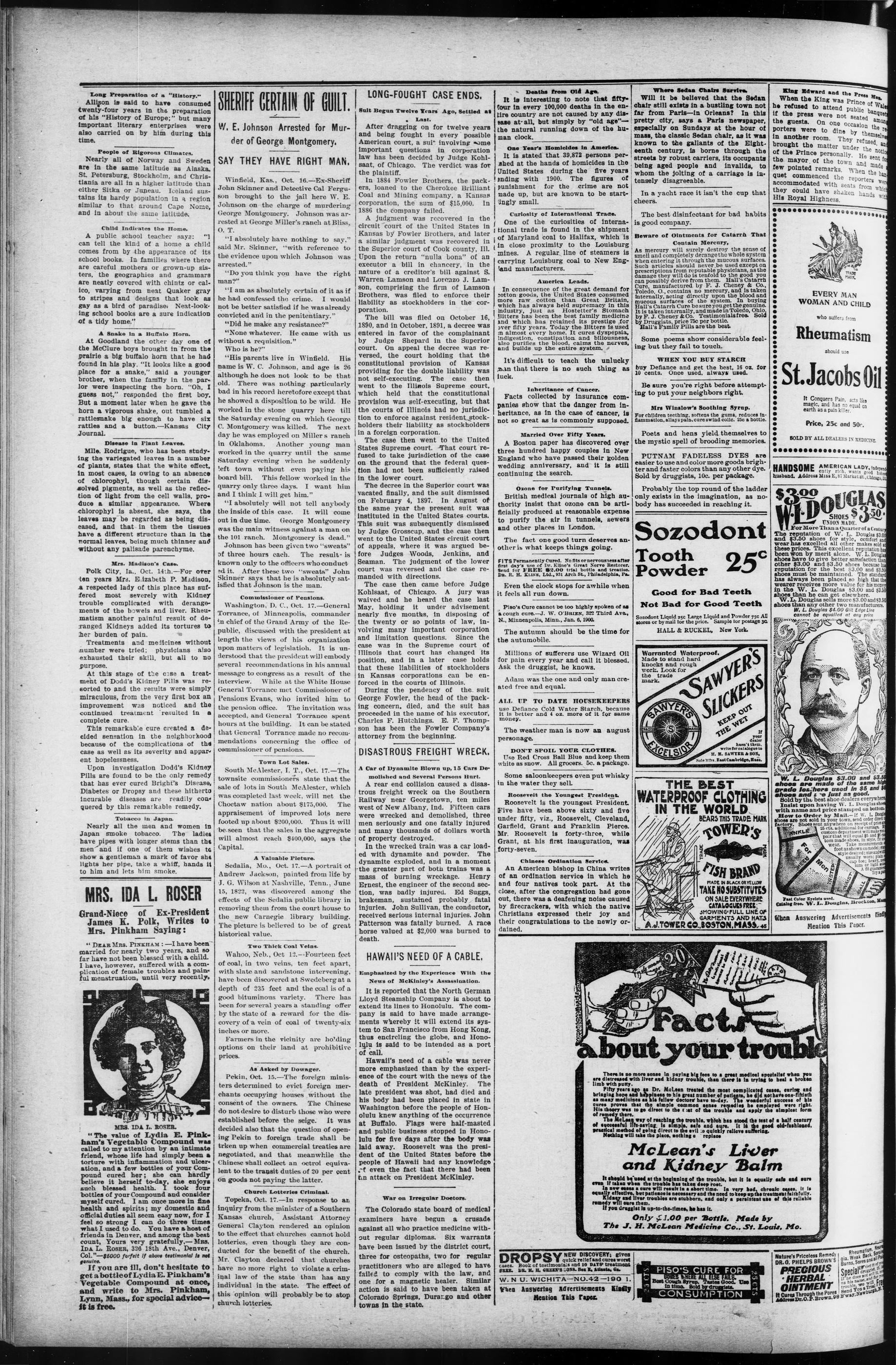
SHERIFF CERTAIN OF GUILT
W. E. Johnson Arrested for Murder of George Montgomery.
SAY THEY HAVE RIGHT MAN.
Winfield, Kas., Oct. 16.—Ex-Sheriff John Skinner and Detective Cal Ferguson brought to the jail here W. E. Johnson on the charge of murdering George Montgomery. Johnson was arrested at George Miller's ranch at Bliss, O. T.
"I absolutely have nothing to say," said Mr. Skinner, "with reference to the evidence upon which Johnson was arrested."
"Do you think you have the right man?"
"I am as absolutely certain of it as if he had confessed the crime. I would not be better satisfied if he was already convicted and in the penitentiary."
"Did he make any resistance?"
"None whatever. He came with us without a requisition."
"His parents live in Winfield. His name is W. C. Johnson, and age is 26 although he does not look to be that old. There was nothing particularly bad in his record heretofore except that he showed a disposition to be wild. He worked in the stone quarry here till the Saturday evening on which George C. Montgomery was killed. The next day he was employed on Miller's ranch in Oklahoma. Another young man worked in the quarry until the same Saturday evening when he suddenly left town without even paying his board bill. This fellow worked in the quarry only three days. I want him and I think I will get him."
"I absolutely will not tell anybody the inside of this case. It will come out in due time. George Montgomery was the main witness against a man on the 101 ranch. Montgomery is dead."
Johnson has been given two "sweats" of three hours cach. The result is known only to the officers who conducted it. After these two "sweats" John Skinner says that he is absolutely satisfied that Johnson is the man.
Commissioner of Pensions
Washington, D. C., Oct. 17.—General Torrance, of Minneapolis, commander in chief of the Grand Army of the Republic, discussed with the president at length the views of his organization upon matters of legislation. It is understood that the president will embody several recommendations in his annual message to congress as a result of the interview. While at the White House General Torrance met Commissioner of Pensions Evans, who invited him to the pension office. The invitation was accepted, and General Torrance spent hours at the building. It can be stated that General Torrance made no recommendations concerning the office of commissioner of pensions.
Town Lot Sales.
South McAlester, I. T., Oct. 17.—The townsite commissioners state that the sale of lots in South McAlester, which was completed last week, will net the Choctaw nation about $175,000. The appraisement of improved lots nere footed up about $200,000. Thus it will be seen that the sales in the aggregate will almost reach $400,000, says the Capital.
A Valuable Picture.
Sedalia, Mo., Oct. 17.—A portrait of Andrew Jackson, painted from life by J. G. Wilson at Nashville, Tenn., June 15, 1822, was discovered among the effects of the Sedalia public library in removing them from the court house to the new Carnegie library building. The picture is believed to be of great historical value.
Two Thick Coal Velps.
Wahoo, Neb., Oct 12.--Fourteen feet of coal, in two veins, ten feet apart, with slate and sandstone intervening, have been discovered at Swedeberg at a depth of 235 feet and the coal is of a good bituminous variety. There has been for several years a standing offer by the state of a reward for the discovery of a vein of coal of twenty-six inches or more. Farmers in the vicinity are ho'ding options on their land at prohibitive prices.
As Asked by Dowager.
Pekin, Oct. 15.—The foreign ministers determined to evict foreign merchants occupying houses without the consent of the owners. The Chinese do not desire to disturb those who were established before the seige. It was decided also that the question of opening Pekin to foreign trade shall be tricked up when commercial treaties are negotiated, and that meanwhile the Chinese shall collect an octroi equivalent to the transit duties of 20 per cent on goods not paying the latter.
Church Lotteries Criminal.
Topeka, Oct. 17.—In response to an inquiry from the minister of a Southern Kansas church, Assistant Attorney General Clayton rendered an opinion to the effect that churches cannot hold lotteries, even though they are conducted for the benefit of the church. Mr. Clayton declared that churches have no more right to violate a criminal law of the state than has any individual in the state. The effect of this opinion will probably be to stop church lotteries.
LONG-FOUGHT CASE ENDS.
Sult Begun Twelve Years Ago, Settled at Last.
After dragging on for twelve years and being fought in every possible American court, a sult involving some important questions in corporation law has been decided by Judge Kohlsaat, of Chicago. The verdict was for the plaintiff.
In 1884 Fowler Brothers, the packers, loaned to the Cherokee Brilliant Coal and Mining company, a Kansas corporation, the sum of $15,000. In 1886 the company failed.
A judgment was recovered in the circuit court of the United States in Kansas by Fowler Brothers, and later a similar judgment was recovered in the Superior court of Cook county, Ill. Upon the return "nulla bona" of an executor a bill in chancery, in the nature of a creditor's bill against S. Warren Lamson and Lorczo J. Lamson, comprising the firm of Lamson Brothers, was filed to enforce their liability as stockholders in the corporation.
The bill was filed on October 16, 1890, and in October, 1891, a decree was entered in favor of the complainant by Judge Shepard in the Superior court. On appeal the decree was reversed, the court holding that the constitutional provision of Kansas providing for the double liability was not self-executing. The case then went to the Illinois Supreme court, which held that the constitutional provision was self-executing, but that the courts of Illinois had no jurisdiction to enforce against resident stockholders their liability as stockholders in a foreign corporation.
The case then went to the United States Supreme court. That court refused to take jurisdiction of the case on the ground that the federal question had not been sufficiently raised in the lower court.
The decree in the Superior court was vacated finally, and the suit dismissed on February 4, 1897. In August of the same year the present suit was instituted in the United States courts. This suit was subsequently dismissed by Judge Grosscup, and the case then went to the United States circuit court of appeals, where it was argued before Judges Woods, Jenkins, and Seaman. The judgment of the lower court was reversed and the case remanded with directions.
The case then came before Judge Kohlsaat, of Chicago. A jury was waived and he heard the case last May, holding it under advisement nearly five months, in disposing of the twenty or so points of law, involving many important corporation and limitation questions. Since the case was in the Supreme court of Illinois that court has changed its position, and in a later case holds that these liabilities of stockholders in Kansas corporations can be enforced in the courts of Illinois. During the pendency of the suit George Fowler, the head of the packing concern, died, and the suit has proceeded in the name of his executor, Charles F. Hutchings. E. F. Thompson has been the Fowler Company's attorney from the beginning.
DISASTROUS FREIGHT WRECK.
A Car of Dynamite Blown up, 15 Cars Demolished and Several Persons Hurt.
A rear end collision caused a disastrous freight wreck on the Southern Railway near Georgetown, ten miles west of New Albany, Ind. Fifteen cars were wrecked and demolished, three men seriously and one fatally injured and many thousands of dollars worth of property destroyed.
In the wrecked train was a car loaded with dynamite and powder. The dynamite exploded, and in a moment the greater part of both trains was a mass of burning wreckage. Henry Ernest, the engineer of the second section, was badly injured. Ed Suggs, brakeman, sustained probably fatal injuries. John Sullivan, the conductor, received serious internal injuries. John Patterson was fatally burned. A race horse valued at $2,000 was burned to death.
HAWAII'S NEED OF A CABLE
Emphasized by the Experience With the News of McKinley's Assassination.
It is reported that the North German Lloyd Steamship Company is about to extend its lines to Honolulu. The company is said to have made arrangements whereby it will extend its system to San Francisco from Hong Kong, thus encrelting the globe, and Honolulu is said to be intended as a port of call.
Hawaii's need of a cable was never more emphasized than by the experience of the court with the news of the death of President McKinley. The late president was shot, had died and his body had been placed in state in Washington before the people of Honolulu knew anything of the occurrence at Buffalo. Flags were half-masted and public business stopped in Honolulu for five days after the body was laid away. Roosevelt was the president of the United States before the people of Hawaii had any knowledge of even the fact that there had been an attack on President McKinley.
War on Irregular Doctors.
The Colorado state board of medical examiners have begun a crusade against all who practice medicine without regular diplomas. Six warrants have been issued by the district court, three for osteopaths, two for regular practitioners who are alleged to have failed to comply with the law, and one for a magnetic healer. Similar action is said to have been taken at Colorado Springs, Durango and other towns in the state.
Facts about your trouble
There is no more sense in paying big fees to a great medical specialist when you are distressed with liver and kidney trouble, than there is in trying to heal a broken limb with putty.
Fifty years ago as Dr. Moksaen treated the most complicated cases, caring and bringing hope and happiness to his great number of patients, he did not have one-fifth as many medicines as his fellow doctors have to-day. The wonderful success of his cures proves that the simple common sense remedies he employed were right. His theory was to go direct to the seat of the trouble and apply the simplest form of remedy there.
The McLean way of reaching the trouble, which has stood the test of a half century of successful life-saving, is simple, safe and aide. It is the good old-fashioned, prentical method of going direct to the evil, *quickly* relieve suffering.
Nothing will take the place, *nothing* *reliable*.
It should be used at the beginning of the trouble, but it is equally safe and cure sensitive skin. In new cases a cure will result in a short time. In very bad, chronic cases, it is equally effective, but patience is necessary and the need to keep up the treatment faithfully, remedy will cure them, and only a persistent use of the reliable remedy will cure them.
Deaths from Old Age
It is interesting to note that fifty-tour in every 100,000 deaths in the entire country are not caused by any disease at all, but simply by "old age"—the natural running down of the human clock.
One Year's Homicides in America.
It is stated that 39,872 persons perished at the hands of homicides in the United States during the five years ending with 1900. The figures of punishment for the crime are not made up, but are known to be startlingly small.
Curiosity of International Trage
One of the curiosities of international trade is found in the shipment of Maryland coal to Halifax, which is in close proximity to the Louisburg mines. A regular line of steamers is carrying Louisburg coal to New England manufacturers.
America. Leads.
In consequence of the great demand for cotton goods, the United States consumed more raw cotton than Great Britain, and the industry just as Hostetler's Stomach Bitters has been the best family medicine and which has retained its prestige for over fifty years. Today the Bitters is used in almost every home. It cures dyspepsia, constipation, coordination and billioness, also purifies the blood, calms the nerves, and builds up the entire system.
It's difficult to teach the unlucky man that there is no such thing as luck.
Iheritance of Cancer.
Facts collected by insurance companies show that the danger from inheritance, as in the case of cancer, is not so great as is commonly supposed.
Married Over Fifty Years.
A Boston paper has discovered over three hundred happy couples in New England who have passed their golden wedding anniversary, and it is still continuing the search.
Ozone for Purlfying Tunnels.
British medical journals of high authority insist that ozone can be artificially produced at reasonable expense to purify the air in tunnels, sewers and other places in London.
The fact one good turn deserves another is what keeps things going.
FITS permanently cured. No fits or nervousness after first days use of Dr. Kline's Great Nerve Restorer. Send for FREE $2.00 trial bottle and treatise. Dr. R. H. KLINE, Ltd., 931 Arch St, Philadelphia, Pa.
Even the clock stops for awhile when it feels all run down.
Piso's Cure cannot be too highly spoken of as a cough cure. J. W. O'BRIEN, 322 Third Ave., N., Minneapolis, Minn., Jan. 6, 1900.
The autumn should be the time for the autumnmobile.
Millions of sufferers use Wizard Oil for pain every year and call it blessed. Ask the druggist, he knows.
Adam was the one and only man created free and equal.
ALL UP TO DATE HOUSEKEEPERS use Defiance Cold Water Starch, because it is better and 4 oz. more of it for same money.
The weather man is now an august personage.
DON'T SPOIL YOUR CLOTHES. Use Red Cross Ball Blue and keep them white as snow. All grocers. 5c. a package.
Some saloonkeepers even put whisky in the water they sell.
Roseveit the Youngest President
Roosevelt the Youngest President. Roosevelt is the youngest President. Five have been above sixty and five under fifty, viz., Roosevelt, Cleveland, Garfield, Grant and Franklin Pierce. Mr. Roosevelt is forty-three, while Grant, at his first inauguration, was forty-seven.
Chinese Ordination Service.
An American bishop in China writes of an ordination service in which he and four natives took part. At the close, after the congregation had gone out, there was a deafening noise caused by firecrackers, with which the native Christians expressed their joy and their congratulations to the newly ordained.
abo
There is no are distressed limb with puttyty. Fifty years bring hope as many medical courses prove a His theory was of remedy there. The Mirage of successful pranical method. Nothing will
It should be even if taken wi. In new equally effective Kidney and remedy will cure if you druge.
The J
DROPSY NEW DISCOVERY; gives quick relief and cures worst cases. Book of testimonials and 10 DAY'S treatment FREE. DR. H. H. GREEN'S COSM. Box K, Atlanta, Ga.
W. N. U. WICHITA—NO. 42—190 1.
When Answering Advertisements Kindly Mention This Paper.
Where Sedan Chairs Survive
Will it be believed that the Sedan chair still exists in a bustling town not far from Paris—in Orleans? In this pretty city, says a Paris newspaper, especially on Sundays at the hour of mass, the classic Sedan chair, as it was known to the gallians of the Eighteenth century, is borne through the streets by robust carriers, its occupants being aged people and invalids, to whom the jolting of a carriage is intensely disagreeable.
In a yacht race it isn't the cup that cheers.
The best disinfectant for bad habits is good company.
Beware of Ointments for Catarrh That Contain Mercury.
As mercury will surely destroy the sense of smell and completely derange the whole system when entering it through the mucous surfaces, when entering it through the mucous surfaces, prescriptions from reputable physicians, as the damage they will do is tenfold to the good you can possibly derive from them. Hall's Cavernary O, contains mercury, and is taken internally, acting directly upon the blood and mucous surfaces of the system. You buy it at Kettering & Co. and use excimer. It is taken internally, and made in Ohio, Ohio, by F. J. Cheney & Co. Testimonial free. Sold by Drugstores, price 5¢ per bottle.
Hall's Family Pills are the best.
Some poems show considerable feeling but they fail to touch.
WHEN YOU BUY STARCH
buy Defiance and get the best, 15 oz. for 10 cents. Once used, always used.
Be sure you're right before attempting to put your neighbors right.
Mrs Winslow's Soothing Syrup.
For children teething, softens the gums, reduces inflammation, allays pain, cure swind coilc. 25 oz. in bottle.
Poets and hens yield themselves to the mystic spell of brooding memories.
PUTNAM FADELESS DYES are easier to use and color more goods brighter and faster colors than any other dye. Sold by druggists, 10c. per package.
Probably the top round of the ladder only exists in the imagination, as nobody has succeeded in reaching it.
Sozodont Tooth Powder 25°
Sozodont Liquid 25c Large Liquid and Powder 75c All stores or by mail for the price. Sample for postage 30 HALL & RUCKEL, New York.
Warranted Waterproof.
Made to stand hard knocks and rough work. Look for the trade mark.
SAWYER'S SLICKERS
KEEP OUT THE WET
SAWYER'S
EXCELSIOR
If your dealer hasn't been write for catalogs to H. M. SAWYER & SON,
Sole Mate. East Cambridge, Hass.
THE BEST
WATERPROOF CLOTHING
IN THE WORLD
BEARS THIS TRADE MARK
TOWER'S
TRADE
FISH BRAND
MADE IN BLACK OR YELLOW
TAKE NO SUBSTITUTES
ON SALE EVERYWHERE
CATALOGUES FREE
SHOWING FULL LINE OF
GARMENTS AND HATS
A.J.TOWER CO.BOSTON.MASS.45
Facts
out your tr
more sense in paying big fees to a great medical spec
with liver and kidney trouble, than there is in trying
to go as Dr. McLean treated the most complicated c
and happiness to his great number of patients, he did au
that is followed because have did. Wonder
that the simple common sense remedies apply to
to go direct to the seat of the trouble and apply the
way of reaching the trouble, which has stood the test
life-saving, is simple, safe and agree. It is the go
of going direct to the evil so quickly relieve suffering
takes the place, nothing else replaces
McLean's Liver
and Kidney Bail
used at the beginning of the trouble, but it is equal
as the trouble has taken deep root. It is very bad, chin
best patiencie necessary and the need to keep up the tr
liver troubles are stubborn, and only a persistent un
them.
List is up-to-the-times, he has it.
Only £1.00 per Bottle. Made by
H. McLean Medicine Co., St. Loo
PISO'S CURE FOR
COURSE WHERE ALL ELSE FAILS.
Best Cough Syrup. Tastes Good. Use
in time. Sold by druggists.
CONSUMPTION
King Edward and the Press Mem-
When the King was Prince of Wales
he refused to attend public banquet
if the press were not seated among
the guests. On one occasion the re-
porters were to dine by themselves
in another room. They refused, and
brought the matter under the notice
of the Prince personally. He sent for
the mayor, of the town and made a
few pointed remarks. When the ban-
quet commenced the reporters were
accommodated with seats from which
they could have shaken hands with
His Royal Highness.
EVERY MAN
WOMAN AND CHILD
who suffers from
Rheumatism
should use
St. Jacobs Oil
It Conquers Pain, acts like
magic, and has no equal ca
earth as a pain killer.
Price, 25c and 50c.
SOLD BY ALL DEALERS IN MEDICINE.
HANDSOME AMERICAN LADY, independently rich, wants good husbands. Address Miss E, 87 Market St., Chicago, IL
$3.00 W.D OUGLAS SHOES $3.50 UNION MADE.
For More Thana Quarter of a Century
The reputation of W. L. Douglas $3.00 and $3.50 shoes for style, comfort and wear has excelled all other makes sold at these prices. This excellent reputation has been won by merit alone. W. L. Douglas shoes have to give better satisfaction than other $3.00 and $3.50 shoes because he reputation for the best $3.00 and $3.50 shoes must be maintained. The standard has always been placed so high that the wearer receives more value for his money in the W. L. Douglas $3.00 and $3.50 shoes than he can get elsewhere.
shoes than any other two manufacturers.
W. L. Douglas $4.00 Gift Edge Line
cannot be equalled at any price
W. L. Douglas $3.00 and $3.50
W. L. Douglas $3.00 and $3.50
shoes are made of the same high
grade hers.used in $5 and $8
shoes and t just as good.
Sold by the best shoe dealer everywheren
insist upon having W. L. Douglas shoes
with name and price stamped on each
shoe. Have your shoes by B. L. Douglas.
Shoes are not sold in your town, send order to
factory. Shoes sent anywhere on request to
NINKLE
FOR
MORE
MORE
MORE
NINKLE
custom department will make
pair that will equal your
male shoe size. In鞋, for
wear. Take measurements
usually worn on foot.
style described; size
usually worn on foot.
A size light on
A size light on
A size light on
Fast Color Adhesive used.
Catalog free. W. L. Douglas, Brockton, Mass.
When Answering Advertisements Fail
Meon This Paper.
When Answering Advertisements Hands
Mention This Paper.
THE SEARCHLIGHT
Never a magnanimity feel to the ground but there is some heart to greet and accept it unexpectedly.
A man's growth is seen in the successive choirs of his friends. For every friend whom he loses for truth, he gains a better.
It is no proof of a man's understanding to be able to confirm whatever he pleases; but to be able to discern what is true is true, and that what is false is false, this is the mark and character of intelligence.
According to the return prepared by the Ministry of Agriculture the number of wolves killed in France last year was 115, and the amount paid in premiums for their destruction was £314. Since the passing of the law of 1882 instituting these premiums 8,981 wolves of all sorts have been killed, and a sum of £26,128 has been paid in rewards.
One of the curiosities of an English residence of nobility is a weeping willow made of copper, and so dexterously fashioned that at a distance it resembles a real tree. It is actually a shower bath, for, by pressing a secret button, a tiny spray of water can be made to burst forth from every branch and twig, to the discomfort of any who may be under it.
A penitent burglar has just made restitution of jewels to the amount of $8,000, which he had stolen two months ago from the jewelry house of William Washburn & Co., in Anderson, Ind. They were returned through Father E. A. Murphy of St. Mary's Church, Chicago. As the admission of guilt was made under the seal of confession, the clergyman, of course, did not reveal the burglar's name.
In Hungary, where dueling is very frequent, a duel between two schoolboys has just taken place, with serious results. Ludwig Krusecz, 15 years old, a scholar of the Zhorow grammar school, was in love with a girl one year younger than himself, but had a rival in her affections in his schoolfellow, Nicholas Litka, a boy of 16. One day they quarreled in the girl's presence, and Litka struck the other in the face. Krusecz sent two seconds, chosen from his schoolfellows, with a challenge to his rival, and a duel with revolvers in regular form took place. Krusecz was shot in the abdomen, and is now lying between life and death.
One of the most remarkable sermons ever heard in Covington, Ky., was preached at the First Baptist church, Sunday, by Metz Jolner, a boy preacher just nine years of age, who held one of the largest congregations ever seen in this town enraptured for thirty minutes, while he delivered a wonderful sermon. People flocked from the country all around to hear this wonderful little preacher. The church was packed and many people had to leave, as they could find no room. The little preacher entered the pulpit in a calm and deliberate manner, and before beginning asked the ladies to kindly remove their hats so that people in the back of the church could see. Then he requested the undivided attention of the congregation.
To familiarize the people of India with the features of King Edward, and to impress upon them that all authority is exercised in his name, the government of India has decided to have portraits of the King, three-quarters length, in oils, costing from £50 to £75 each, placed in the official residences of the heads of governments and local administrations, the chief courts of justice of the different provinces, and all large buildings in which durbars are held. Portraits costing from £30 to £50 will be placed in the official residences of political agents and residents in native states and in the durbar rooms of such states. All the ordinary courts throughout the empire will be provided with colored lithographs or engravings of the King.
Some people predict that the day is not far off when the peasantry of France will rise up in a mass against scorching motorists. In certain districts whole villages have already united in anti-automobile campaigns—the method of warfare employed—consisting in strewing roads with nails and broken bottles. This has been done in Normandy, but the glass and bits of iron were found to damage horses' feet as much as automobile tires, and, moreover, rendered cycling an impossibility for the many country laborers in France who ride to and from their work. So that plan of campaign had to be given up. Now peasants in some parts contemplate resorting to nothing less than lynch law. In certain districts villagers seriously talk of going about, fowling pieces in hand, and winging motorists who tear through hamlets and small towns at 50 miles an hour.
An extraordinary case of smuggling was detected at Dover recently. On the passengers landing from the Ostend boat the custom house officers noticed that a lady looked suspiciously bulky about the skirts. Upon being questioned it was found that she had concealed under her dress a fox terrier, which she was endeavoring to smuggle into the country to evade the prohibition law in regard to dogs. The incident caused much amusement, the dog being taken possession of and sent back to Ostend.
HOME SWEET HOME
(Old Favorite Series.)
Mid pleasures and palaces though we may room
sweet home!
There's no place like home; there's no place like home.
An exile from home spendor dazzles in vain.
Obtained from
There's no place like home; there's no place like home.
But give me, oh! give me the pleasures of home.
Home! home! sweet, sweet home!
But give me, oh! give me the pleasures of home.
To thee I'll return, overburdened with care.
The sweet's dearest solace will smile on me there;
No more from that cottage again will I roam.
Be it ever so humble, there's no place like home.
Home! home! sweet, sweet home!
There's no place like home; there's no place like home.
—John Howard Payne.
A Cinderilla of the Foothills.
By E. L. Huston.
(Copyright, 1901, by Daily Story Pub. Co.)
The cotillion to be given at the barracks had wakened up the little garrison town as had nothing else that season. In the first place, the barracks affairs were always successes; there were always plenty of dancing men to go around, and the floor of the drill shed was the best for dancing in the city. And there was so little in the way of excitement in those far western towns that knew nothing of parks and lakes and little jaunts into the country. There were irrigating ditches instead of lakes and a few irrigation-raised trees instead of parks, and no country, but wide stretches of alkali dust and sage brush and cacti. It was a "howling wilderness," the eastern-raised brides wrote home in dismay, and only in the garrison towns was life worth living.
But the jolly little Arab families, who lived their brief season in "offers' row," quite ready to pack and obey marching orders at a moment's notice, gave the disconsolate brides their philosophy and brightened the passing hour as best they could.
So the cotillion was announced by the hospitable military folk, and delightful was the excitement in consequence. But in affairs of society and state, be the matter great or small, creep the undercurrents of human interests, and in the atmosphere of pleasurable excitement floated the inevitable, conflicting incense of keen anticipation and misaic vapor of bitterness and envy. For at the cotillon the new social lion, Roger Huntleigh, the eastern speculator, was expected to be present, and debutantes and dowagers regarded him with special and most favorable interest.
Then, the cotillon was to be given
A man and a woman in a room. The man is holding a hat and a book, while the woman is holding a handkerchief.
"Cut dead, dad, dear."
contly by the Colonel's wife and the social leader of the little city, Mrs. Despard; and Miss Despard had in her "set" a bette noir—the daughter of a physician. And the doctor's daughter was not invited. Why? asked the little garrison town. Then it raised its eyebrows and smiled. Miss Despard was handsome in her Junoesque, commanding way. But the gentle daughter of hard-working Dr. Harvis had a winsome beauty all her own, and a soft and sweet graciousness that all the Despard jewels could not outshine.
"So the fair Despard left you out, my daughter, O my daughter?"
laughed the doctor that night as he stamped into the house and nodded toward the window, where the garrison lights could be seen all flickering near the foothills.
"Cut dead, dad, dear!" smiled his daughter. "And I would have enjoyed it so!"
"See what it is to inherit your father's fatal beauty, my dear!" said the grizzled physician solemnly, pinching her rosy ear. "You see, even the dazzling Despard fears you when the new lion roars. And this is the night that Huntleigh is to be undone."
"You brazenly vain man!" replied Miss Harvis.
She bent low over the little kettle
"I was going, to see you."
that was bubbling fussily over the alcohol flame, and something glittered in the light of the fire—something that trembled a moment on the dark eyelashes, then was swept hastily away as she turned smilingly to the doctor.
"Tea or toddy, dad? Get into your slippers and smoking jacket, and be comfy. I am starved."
She did not eat much, however, though she broke up some muffins and cakes on her plate and built forts with the crumbs. But her father seemed serenely indifferent to her lack of appetite, and enjoyed his supper with absolute content.
"Some more preserves, Harriet. I tell you, those silver Idaho prunes are all right. And I'll take another muffin, my dear. Saw Huntleigh in the Overland to-day. Fine fellow."
Miss Harvis hastily buttered a piece of muffin, then absently propped it in one corner of the crumb fortification. Then she prodded it with a toothpick.
"Says he expects to go east in a few weeks."
"Yes?"
Miss Harvis did not seem in a conversational mood. The doctor glanced at her from under his bushy eyebrows and reached for another muffin. His daughter was laboriously planting flag-staffs, made of toothpicks, around the crumb fort.
"Yes," assented the doctor briskly. "Have an idea he is thinking of marrying. Something he said led me to infer that he was. Lucky woman, whoever gets him. He's pretty clean cut, all told."
"Yes."
Miss Harvis was certainly not loquacious.
Dr. Harvis stared thoughtfully at the glowing logs in the fireplace a moment, then meekly asked for another cup of tea.
The tea was poured out in profound silence, and was sugared four times. The doctor did not take any sugar at all in his tea, but he made no protest, and swallowed the mixture heroically, only making a slight grimace as it went down.
"There—the gate clicked," he remarked presently.
"Oh, dad—someone after you. And I did want you home with us to-night. It seems so—so—"
Harriet had risen to her feet, with a look of dismay on her fair face.
A firm step sounded on the porch, and the knocker rat-a-tat-tated gently. The doctor paused with on foot in a slipper, then smiled and settled himself in his favorite chair with the last Lancet. A rich, rather lazy voice was following his daughter into the little parlor across the hall.
"Sincerely hope I'm not intruding, Miss Harriet. A man is such a lonely beggar in a hotel, and I thought you might take pity on me!"
His hostess' dark eyes were shining with wonderment and—undeniably—pleasure, as they rested on his strong face and six foot one of hearty manhood. Then she smiled.
"I hardly think your condition hopelessly pilable!" she said, laughing a little. "I thought you were going to the cotillion?"
Mr. Huntleigh drew back the curtains and glanced at the garrison lights. Then he walked over to her chair and, drawing an ottoman near, he sat down and gently drew her two hands into his.
"I was going—to see you," he said with grave earnestness. "Then I learned from the doctor that you were to be home. And—I came here. I think you know why. Will you give yourself to me, dear? I am lonely and I want you so."
The doctor came in after a little and suggested that he had nutmegs and lemons and the kettle was boiling, and if Harry could think of something else he might fix up something.
And when his daughter-kissed him with sudden and grave intensity and ran away to get the something needful, he turned to Huntleigh, who wring both his hands hard and promised he would only take her east three months of the year.
Then the doctor's rugged face lighted up. And when Harry came back, and was gathered promptly into Hunt-
leigh's arms, the doctor glance out at the garrison lights and with great care and solemnity—closed one eye.
NOT READ IN FRANCE.
Present Day English Novelists Almost Unknown Among the French.
In France, where literary fame is held in high esteem, many of the most successful of the present day English novelties are almost entirely unknown. Flammarion, the Parisian publisher and bookseller, says that Marie Corelli, Hall Caine and S. R. Crockett are are hardly even names to him. The French writers with the greatest vogue just now, such as Pierre Louys, the author of "Les Aventures du Roi Pausole," now in its sixteenth thousand; Jean Lombard, the author of "Byzance," and Michael Corday, whose novel "Venus ou les dieux Risques" has been one of the most discussed books of the year, are unknown outside of France. Alexandra Dumas' pere still holds the suffrages of the French, and thousands of his books sell every year. It would be difficult to arrive at any exact information, but it would seem likely that, reckoning the immense sale of Dumas in England, America and the Continent outside France, he must be read more than any author who ever wrote. English novels are also much known to the French public in cheap editions. Dickens and Scott are the two most popular writers, and various booksellers differ as to which is most popular. Dickens, of course, suffers most in translation, and his humor and his character are so absolutely "Cockney" that it is difficult to understand how French readers comprehend him at all. The French novelist usually receives satisfactory financial results for his work. Nearly every French newspaper publishes a serial story, and almost every story—good, bad or indifferent—first sees the light in this way. The prices vary, but as the feuilleton is by far the most important part of the average newspaper, papers of the stamp of Le Figaro pay at a considerably higher rate than is common in England. The story is then published in the usual paper covers at 3 frances 50 centimes, the author receiving a royalty varying from 50 centimes to 80 centimes, the price paid to Paul Bourget on each volume. If a story is a popular success after it has passed through several editions, it is issued in penny numbers, and it will also probably appear in feuilleton form in half a dozen of the less important metropolitan and provincial papers. The author has, therefore, four separate ways of deriving income from his work.—New York Press.
BATS IN CAPE TOWN.
Sixpence a Head Paid by Authorities for Destroying Them.
If the Pied Piper of Hamelin had not been filling an engagement elsewhere, he might have found remunerative employment recently in Cape Town, South Africa, where the authorities have been waging a war of extermination against the numerous rats. These rats are responsible chiefly for spreading the bubonic plague throughout the region, and thus gained the enmity of all classes. In Cape Town it was considered more befitting to put a price on a rat's head than to send battalions of pipers to lure him to destruction by the charm of their music. Hence in the war of extermination a reward of threepence a head was offered for each rat that should be proven to have suffered the extreme penalty of the law—whether guilty or not of having introduced bubonie plague during the course of its enterrising but all too brief career mattered not. It sufficed that the grave crime of bringing the plague from the stricken ports of India to South Africa had been fixed on the rats that came over in the transports. The result of this was that so vigorous and successful a campaign has been carried out in Cape Town that it is at this moment practically ratless—save for fresh arrivals which are summarily dealt with. During the early stages of this minor war the rat-receiving office on the docks was besieged by huge numbers of bloodthirsty human conquerors every day, but in the latter stages the siege relaxed so much owing to the growing scarcity of rats that the poll tax had to be raised to sixpence. As soon as these rats were received and paid for they were taken to a small hut near the sea and consigned to flames lasting as long as there was rat fuel to feed them—New York Press.
Precious Iron Sands.
At many places along the coast of Gaudeloupe are vast beds of iron sands. The quantity in sight and immediately available is estimated at some 200,000 tons. It is a very pure magnetic iron sand, free from impurities and yielding about 67 per cent. of iron. This iron is said to give a superior quality of steel. Practically unlimited quantities of this sand are available, and vessels may be loaded speedily and safely. Much interest has been shown by speculators and others in these valuable sands, but it has been the policy of the government of the colony to forbid the working of them heretofore. But now Consult Ayme of Guadeloupe reports that, according to a decree recently published in the Journal Officiel, a concession for the exploitation of the iron sands of the colony has been granted to Mr. N. de Roniciere, merchant and president of the Chamber of Commerce of Pointe a Pitre.—New York Press.
Hocus—What happened when you told your mother-in-law to mind her own business. Pocus—I don't exactly know. When I recovered consciousness I was in the hospital.
FOR BOYS AND GIRLS.
SOME GOOD STORIES FOR OUR JUNIOR READERS.
An Illinois Man's Tribute to His Faithful Dog—A Story of the Reasoning of Two Robins—Indian Lad and Pony.
BABY AND TWO FRIENDS.
We left them at play on the nursery floor.
As often and often we'd left them before;
But once when we looked they weren't there any more—
The baby, the cat and the dog from next door.
Now where in the world could the truants have fled?
We looked in the closet and under the bed.
We searched through the house, and the yard o'er and o'er,
For the baby, the cat and the dog from next door.
But some one had tracked through the sunshine street
The trail of those ten little wandering feet.
And back to the much dismayed family they bore
The baby, the cat and the dog from next door.
Which mischievous brain planned the wild escapade?
Which, which was the culprit which started the raid?
No answer. We could but to favor restore
The baby, the cat and the dog from next door. —Mary Hicks Van Derburgh.
SKETCH OF A FAITHEFUL DOG:
He never wronged a human being. He was the friend of man. Denied by nature the gift of speech, he yet understood. His chief delight was at his master's side, where by silent glance or wag of tail he told his wants or expressed content. He was more than great. Hugo said of his kind: "Man has three friends—his God, his mother and his dog. Total depravity and family pride may cause the first two to desert, but the faithful dog never." While others slept he stood guard that "man, the noblest work of God," might not pillage and do murder. "Tis given out that time is without limit, space without end and matter indestructible, and in ancient times, 'twas claimed departed spirits seeking a resting place oftimes found lodgment in beasts and birds and creeping things, and these in time became sacred and were worshiped as gods. Who knows, therefore, but in this general mixup of time, space and matter, but what the ancients were correct, and transmigration more than true? For in our imagination we can ask the question (great Caesar being dead and turned to clay might stop a hole to keep the wind away), why may not my dog yet live and wield a kingly scper, while he who poisoned him trots the dusty streets a common cur, or more becoming still, serpent-like crawls the earth in deadly fear, hated by all mankind? Man, this noble work of all creation, hath formulated laws, 'tis said, to govern human action, but some insist because the dog is a rogue by nature and needs restraint, the law must consign him to a final resting place for dogs in the potter's field. But after all, this may not be so bad, the sweetest flowers grow outside the garden wall, and the wild birds' delicious song is healthful music beside the rattle of dead men's bones and wailing of the nightly ghosts that stalk among the tombs where lies the precinct politician and his kind.
So chary doth old Nature seem of all her laws that our philosophy at times doth seem a dream, and yet who can doubt through all her seeming contradictions there is a systematic rule, and jumping cogs impossible, and by this rule time will somehow even up with him who voluntarily kills the noble horse or dog. "Master Rex," good-by. First to say good morning, last good night. First to welcome home, last to say good-by. Mistress and masters all will miss you sadly. Base was the act that called you hence, but death, though foul or fair, is but the common lot of all passing through life to eternity.—L. H. O'Conor in Austin, Ill. Vindicator.
A CASE OF BIRD REASONING
A CASE OF BIRD REASONING.
In a small village in Rhode Island are two woolen factories, and between the upper one and a pond is a long canal or mill race. Through this race, when the factories are running, the water flows very swiftly. Near the upper mill, and leaning over the race, is a small tree, its slender branches bending down almost to the water's surface. One day a pair of robin's were noticed examining this tree, and an hour or so later, they had busily engaged in building a nest in a fork of one of the branches, directly over the swiftest part of the race. Many curious eyes watched them from the factory windows. The place was so exposed, and yet so inaccessible; almost within arm's length of the public road, and yet beyond the reach of the most agile cat, whose weight would be too heavy for the slender limb. By noon the next day the nest was two-thirds completed. Then suddenly to the surprise of the two or three that happened to be watching at the time, the robins ceased work, as though in sudden doubt. Evidently a new idea had occurred to them or the knowl-
---
edge of something overlooked, for after a hurried consultation they began to remove the nest, carrying it away straw by straw. Later it was discovered that they had rebuilt in a thick clump of alders and only a few feet from the ground. And the reason was too patent even for speculation. The robin's first idea had been to put their home beyond the reach of boys and predatory animals. Here the mill race had seemed a safeguard to them. Then they must have looked forward to the time when their little ones would be old enough to leave the nest, but too weak to fly. What would happen to them, with that mad rush of waters beneath?
THE CURING OF CURLY
There were plenty of "ifs" that could be used to explain Curly's condition. If he had been born in any other family, if his father had lived, and if his mother had not so steadily spoiled him, his selfishness would have been cut off with his curls at the age of five. But as it was, both the curls and the selfish streak in his nature grew longer every day of his eight-year-old life.
In the winter he dragged off his sled, without a thought of the paths he might have shoveled, or the wood he could have carried in to help his mother and Julia. In summer he was always too busy sailing chip boats and chasing butterflies to run errands or pick berries.
"It isn't boy's work!" he whimpered, when Sister Julia hinted that she would like his help with the dishes. "That's man's work!" he complained, when his mother asked him gently to split a little wood. "You're doing girl's work!" he said, scornfully, tipping up his nose at Tommy Zane, in the next yard helping his mother hang out the washing. "What are you but a girl, with your long shaving curls! It isn't girl's work, or you'd be doing it, Sissy Curly-Locks!" Tommy shouted back.
But Tommy's jeers, Sister Julia's scoldings and his mother's sad looks could not make him change the way of his life, although they did make him uncomfortable. One day Curly's uncle came to stay with them for a week—Uncle Saul, who was Curly's godfather, and after whom he had been named. It was true that he had called Curly "trifling," but he had also talked of taking him back to visit the old hill farmhouse. The little lazy-bones was very happy; his uncle had shot deer and bears in the mountains beyond; now he himself was going to do this same glorious thing. He watched his mother with such happiness while she packed his trunk that it was just as well he had gone to bed before Uncle Saul said: "Martha, you just lend him to me for a month, and I will set him out on the right road."
At sunset of the next day Uncle Saul jumped Curly down from in the wagon and told him to run in the wood shed and fill the chip basket. Curly's mouth was ready to complain, "It isn't my place!" but his uncle cut into the opening note: "It is your work, sonny. We all work. There are no women here, but if there were, you should learn to be useful."
After that Curly found that work he must, for Uncle Saul couldn't be made to see the importance of a playtime that lasted all day long. Even if the little woods that patched the tallest hills had been full of game, Curly wouldn't have had time to hunt it. He had to carry so many pails of water that he grew to hate the stream that never bore the boats he was too busy to sail. So one day Curly ran away home, sadder but wiser for the lesson that duty must fill a part of every one's life.
His mother and Julia were surprised to find him, a tightly curled little bunch, in the entry one morning, but they were even more astonished when Curly said, after breakfast, "Sister Ju, I'd just as soon wipe the dishes, and mamma, don't call me Curly any more; I want to be Saul."—Alice Van Leer Carrick.
INDIAN BOY AND HIS PONY.
Here is a lad who is getting his first lesson in individual responsibility. He has been on the hunt before, but only as one of the family; now he must begin to act the man. His father has saddled a wild pony, and tells his son to mount it. The boy hangs back; the colt is a fiery creature, and is already chafing under restraint. The father tells the boy that the pony shall be his when he has conquered it, but the boy still does not move. Suddenly he seems to wake up. He advances slowly but steadily towards the pony. The pony backs away, but the boy, by a quick movement, grasps its mane and springs into the saddle. The pony jumps, wriggles, humps its back like an infuriated cat, stands on its fore legs and kicks at its own tall, paws the air and stamps the ground, but the boy clings to it, when suddenly the saddle-girth breaks, and the pony tosses the boy over its head, and runs away for life and liberty.
It is soon caught and brought back shaking its head angrily the while, as if protesting against such foolishness. Again the boy mounts, and again he is thrown. This happens several times, and the boy's mother gets anxious. She goes up to him and feels him all over to see that no bones have been broken. He becomes impatient at the delay; he is going to ride that pony now, or die! So he mounts again, and this time he stays on. In vain the pony throws itself about in every direction, and lashes itself into foam and fury—the boy sticks, and the pony is his!—Philadelphia Times.
Peculiar Feature of the Spanish-American War
Within a few days after the destruction of the Maline, correspondents from all parts of the country were rushed to the scene of the disaster. The news-reading public demanded every possible item of information regarding the affair, the grave import of which was immediately appreciated. But the Spanish officials soon instituted a censorship so rigorous that very little information percolated through the cable from Havana. To cope with the situation the New York Journal devised the plan of having its dispatches sent by boat from the Cuban coast to Key West, where they were put upon the wires and sent direct to the newspaper offices. The other papers were not slow to adopt this plan, and soon a large fleet of tugs, yachts, and small steamers were plying between the island and United States territory. This was the beginning of the first fleet of news-gathering vessels ever assembled. At the height of the war the New York Journal had a fleet of eight sea-goining craft in commission, and the cost alone of maintaining these vessels amounted to more than 2,500 per day. The other New York papers had fleets approaching this in size, and the number of craft engaged in the work of news-gathering at one time amounted to nearly one hundred. The work of following the movements of the squadrons under command of acting Rear Admiral Sampson and Commodore Schley, and of attempting to locate the whereabouts of the fleet sent across the Atlantic by the Spanish government, afforded plenty of occupation for all these press boats and for the scores of correspondents that they carried. Manifestly the only way to be absolutely certain of obtaining all the news was to keep track not only of the large fleets, but also of the detached vessels which were sent along the coast for patrol duty, and the newspaper boats had to make daily trips to Key West in order to put their dispatches upon the cable. To patol a coast line as great as that of Cuba (the island is over one hundred miles long), and to know every event of importance taking place within its limits, was an extremely difficult matter. The plan adopted by most of the press representatives was to follow up the fleet, keeping the flagship in sight until a bombardment or some other event of news importance took place; then to make a
The Chinese recognize no other sphere in life for women than marriage, so to this end a girl's life from her earliest years is consecrated. Hence the true reason of footbinding. "No footie bind, no husband getee" is the native explanation of the custom. No sacrifice is considered too great to secure the all-important husband. In China you can generally pick out the "unappropriated blessings" by the knot of hair they wear on the side of the head and the locks on either cheek. When a lady becomes engaged these are pinned up by the "hairpin of women," as a Chinese writer calls it. The method Chinese ladies have of doing the back hair is often very elaborate, as will be noticed in the coiffures of a Foocow or a Hinghu woman. In China marriages are made at the marriage agent's. The Celestial Adonis, when he would go wooing is, above all things, business like. He would be amazed at the suggestion that he should waste long hours
Her Son and Daughter Assist in
Manning the Craft
A good deal of attention was attracted to a canal boat that was tied up in Newtown Creek, N. Y., the other day. The reason was that the captain was a woman. She is Mrs. Sarah Stanton and her daughter, her son and a hired man make up her crew. The boat is the R. W. Potter of Whitehall, N. Y. Mrs. Stanton is a woman of about 50. Her husband died about five years ago and she then took charge of the boat. While she was preparing to discharge the boat's cargo of lumber last week a couple of longshoremen went up to her and said that they would do the job for 40 cents a thousand feet. She replied that they wanted too much and that she would take charge of unloading it herself. She sent her daughter down into the hold of the boat to pass the lumber up to her son, who was on the wharf, and he handed it to the hired man, who did the pilling. It did not take long to finish the job. Mrs. Stanton stood on the deck of the boat giving orders. Mrs. Stanton said afterward that it was impossible for her to pay men 40 cents a thousand for unloading as she receives only 90 cents a thousand for transporting, and, after the towing and dock expenses were paid she would have very little left for herself. This is the first time that she and her boat have been seen in the neighborhood of New York City, as she has been carrying on other work in the canals and streams up near her home—Detroit Free Press.
The Skin Massage.
The skin should be thoroughly
dash back to Key West, put the dispatches on the wire, and, returning pick up the fleet as soon as possible. This method involved glorious opportunities for "beats." Not only this, but there were often exciting races between the boats to get the wire at Key West. The cables leaving from that port were always overcrowded during the progress of the war. There was a great amount of government matter to be transmitted, and government dispatches invariably took precedence of all others. With the correspondents it was "first come, first served," and the man who got in late, no matter how important his dispatch, was not likely to have it printed in his paper the next day. There were occasions when rival tugs came racing into Key West with their steam gauges registering a dangerous pressure, and some of the correspondents serving as stokers and feeding portions of the woodwork of the vessel into the furnaces. There were some exciting episodes among the experiences of the men who carried these dispatches. On some of the boats oil in barrels was considered a necessary part of the vessel's outfit, and danger point or no danger point, it was poured freely over the coal burned in the furnaces, the correspondents preferring to take the chances of blowing their boats up rather than risk being "beaten" by some rival newsgatherer. The boats were most of them small, although Mr. W. R. Hearst, finding that he could not get good tugs, on two occasions chartered veritable ocean steamships and used them as dispatch boats for the New York Journal. Of course these ships had little to fear from the weather in the Gulf of Mexico, but the smaller craft frequently encountered real danger in crossing from points of action to far-distant cable stations. Many of the tugs were without decent sleeping accommodations and the hardships of the newspaper men who manned them were severe. Nor did the weather present the only dangers which the dispatch boats encountered. I know of one case—that of the New York Sun tug boat Simpson, at Guantanamo—when the boat went into the harbor for news, and came out with anywhere from twenty to thirty holes made by Spanish bullets in her upper works. Pearson's Magazine.
breathing soft nothings into rapturous ears. Doubtless the girl would be pleased to make the acquaintance of her future lord and master, but this must not even be thought of. For it is the strictest etiquette that she must not talk to men—even her own relatives. Of course, in low life this rule cannot altogether be carried out, but in the "upper circles" of the flowery land seclusion after betrothed is strictly enforced. "Woman," says the Chinese adage, "is subject to three conditions in life—at her father's house she is subject to her parents, on marriage she submits to her husband and in widowhood she is under the guidance of her sons." Consequently when the wedding guests have departed the little-footed, lemon-hued bride begins to realize that she is not only expected to obey her pig-tailed husband in all things, but her mother-in-law as well. Even his sisters take rank before her. She is the household drudge.—Chicago News
cleansed once a day. Have the room warm, and the water only a few degrees cooler. Stay in the bath five minutes, keeping yourself either under water or pouring wet all the time. But it is after you leave the tub that the really important part of the bath begins. Dry yourself thoroughly with two towels; then take a stiff flesh brush and try with all your might to rub your skin off. A coconut fiber brush is the best, and to get at your back it is a good plan to have a coconut fiber mat hung against the wall to rub yourself against. Keep up this friction for at least ten minutes. You could not invest the same amount of time more usefully. There is nothing like this to relieve the congestion of the blood, and to free the lungs from oppression. Moreover, it actually increases the size of the muscles and makes them firmer by causing the blood to circulate more vigorously in them. As to its effects upon the elasticity and beauty of the skin itself, that will be obvious enough at a glance. It is the brush that furnishes the only true bloom of youth.—Detroit Free Press.
"I wouldn't take nuffin' dat doesn't b'long to me," said Mr. Erastus Pinkley. "I kln now unduhstan." rejoined Miss Miami Brown, "how de repoht got out dat you is a po' provider an' yoh famly nebber has chicken foh dinner."—Washington Star.
It is folly to cut down the green blade because it bears no grain.
COMPLETE BOOK OF THE OFFICIAL LIFE OF M'KINLEY — NOW
agents wanted. Also general travelling agents and resident
district managers to handle the only authorized official, au-
thentic life of President McKinley printed in English, German and Swedish. Lib-
rary administration to agents and a straight guaranteed salary to those in the advanced positions. You never had a salary greater than $500 per month for the next 3 months pushing this marvelous life of a great and good and useful
bear in mind that if you demonstrate to us that you can sell books, that later in the fall we will be willing to employ you, a straight-out guaranteed salary to appoint and instruct other agents. This is the chance
life of President McKinley to give you a valuable premium to every purchaser worth more than the retail price of our books from us. We advise you to order from us, and then deal directly with the manufacturers. Credit
given; freight paid. Write today and send 10 cents for postage on free outfit.
FREE FOR TOBACCOTAGS
An average man is one who thinks he is just a little better than the average.
DEFIANCE STARCR
should be in every household, none so good, besides 4 oz. more for 10 cents than any other brand of cold water starch.
In convivial company the fellow who carries a corkscrew is seldom regarded as a bore.
GOOD HOUSEKEEPERS
Use the best. That's why they buy Red Cross Ball Blue. At leading grocers, 5 cents.
Some men make a business of loafing.
COMPLETE BOOK OF THE OFFICIAL Agents wanted. district managers to thontic life of President McKinley; also giving lives of Garfield; complete inside history of the vilification working trated; 600 pages. The only life of McKinley printed eral commission to agents and a straight guaranteed salary to had a better opportunity to make big money quickly and easily $500 per month for the next 3 months punishing this marvel life. Strike now, while the iron is hot. Do not delay, for ever be in mind that if you demonstrate to us that you can not b employ you under a straight one guaranteed salary to apothess of a lifetime. We make our own books and can easily duplicate the book. Many of these concerns that are advertising McK their books from us. We advise you to order from us, and thus given; freight paid. Write today and send 10 cents for postage.
CO-OPERATIVE PUBLISHING CO., Dep.
FREE
NOV.30TH
HUT SET SILVER PLATED.
FOUNTAIN PEN. 100 TAGS.
MATCH BOX.
25 TAGS.
ALARM.
CLOCK.
150 TAGS.
FROM
"STAR"
"HORSE SHOE"
"PIPER HEIDSIECK"
"BOOT JACK"
"DRUM MOND" NATURAL LEAF
"GOOD LUCK"
"NOBBY SPUN ROLL"
"OLD PEACH & HONEY"
"STANDARD NAVY"
"RAZOR"
"E. RICE, GREENVILLE"
"TENNESSEE GROSSTIE"
"GRANGER TWIST"
2 GRANGER TWIST TAGS being equal to one of others mentioned
"J. T.," "Cross Bow," "Spear Head," "Old Honesty," "Master Workman," "Sickle," "Brandywine," "Jolly Tar," "Planet," "Neptune," "Ole Varginy."
TAGS MAY BE ASSORTED IN SECURING PRESENTS.
will include many articles not shown here. It will contain the most attractive List of Presents ever offered for Tags, and will be sent by mail on receipt of postage—two cents.
(Catalogue will be ready for mailing about January 1st, 1902.)
Our offer of Presents for Tags will expire Nov. 30th, 1902.
CONTINENTAL TOBACCO COMPANY.
Write your name and address plainly on outside of packages containing Tags, and send them and requests for Presents to
Some grocers say they don't keep Defiance Starch. This is because they have a stock on hand of other brands containing only 12 oz. in a package, which they sell for $1.99. Defiance contains 16 oz. for the same money. Do you want 16 oz. instead of 12 oz. for same money? Then buy Defiance Starch. Requires no cooking.
A. Place of Genuine Merit
THE CENTROPOLIS HOTEL, of Kansas City, offers more for the money, than any hotel in the city. It is a great place of amusement, within one block of Court House and City Hall. Spacious rooms and first-floor balconies offer breakfast $1.00; supper, lodging and breakfast stocking men's chairs, families showers and visiting the City, a most desirable place to stop. The City offers direct from all depots to our door. TRY IT!
ACTUALLY GROWS HAIR ON BALD HEADS HONORABLE CURE.
**PROOF. J. H. ABDY, MoVe "I" Theater Bldg., Chicago have them call on me. Last March I war, I盖过 all over the head of my head and I tried to try my remedies; after five minutes of good food you have done me. I have more hair now than ever I had; all did was to apply my remedies three times a week.**
S
Take three fallen hairs from the morning combeds and mail them to ProJ. L. H. Austin, the celebrated scalp and skin specialist. Give them to your client. Give them a timely FREE a diagnosis of your special case after making a minute examination of your hairs under his specially constructed and powe- rified scalp. When you receive the hair, he will send a special prescription for your case put in all his hairs and also absolutely FREE. When you are cured of DANBURF, which is a hair condition that you suffer from, you that you sell your friends about it. SEND NO HONEY. If you are ready partly or totally bald and write find the cure. WRITE DOWN TO