Wichita Searchlight
Saturday, May 5, 1906
Wichita, Kansas
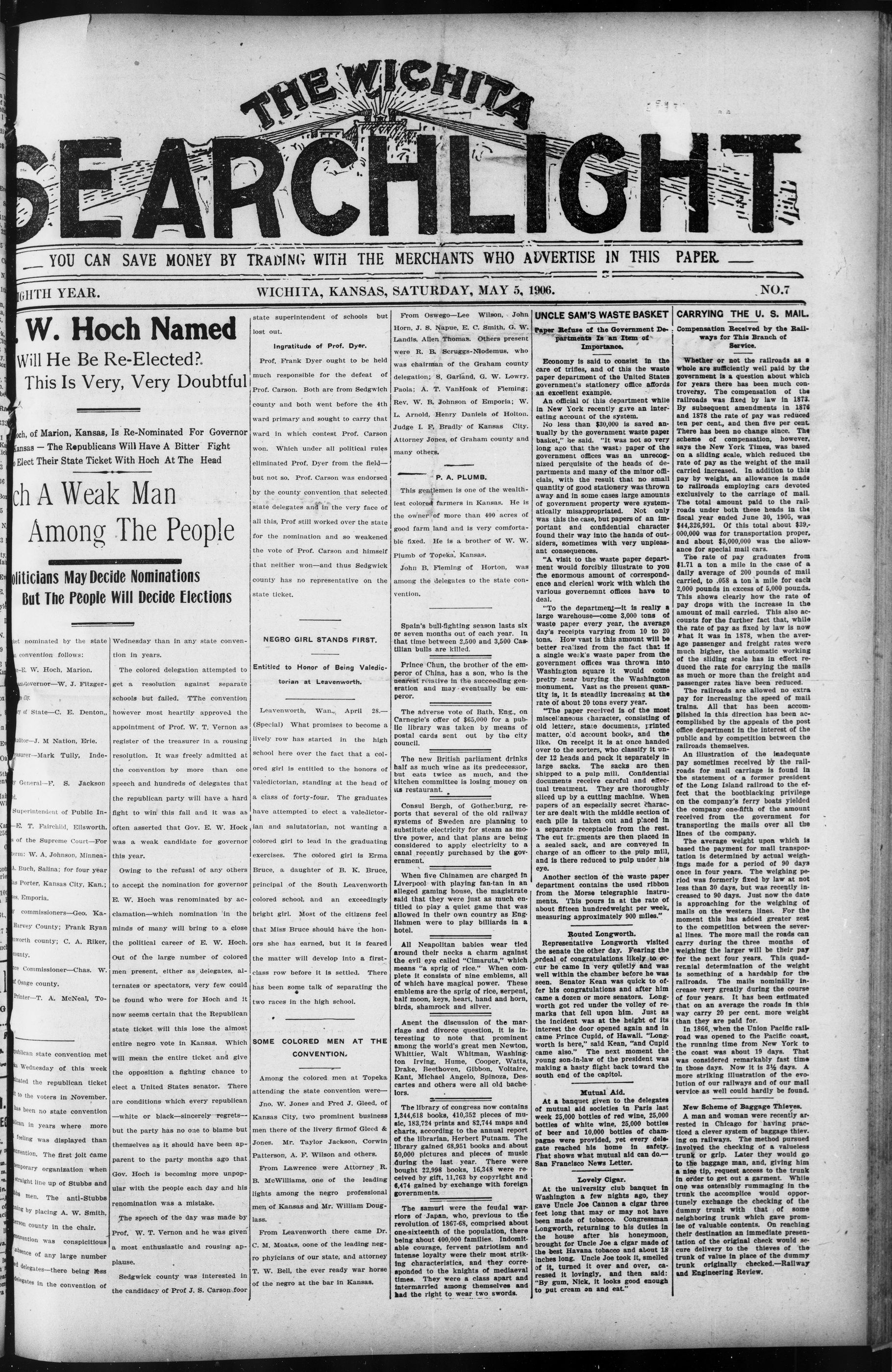
Page text (machine-generated)
Will He Be Re-Elected? This Is Very, Very Doubtful
Och, of Marion, Kansas, Is Re-Nominated For Governor Kansas — The Republicans Will Have A Bitter Fight Elect Their State Ticket With Hoch At The Head
Politicians May Decide Nominations But The People Will Decide Elections
Superintendent of Public In-
E. T. Fairchild, Ellsworth.
of the Supreme Court—For
term: W. A. Johnson, Minnea-
A. Buch, Salina; for four year
as Porter, Kansas City, Kan.;
ties, Emporia.
by commissioners—Geo. Ka-
Harvey County; Frank Ryan
Laworth county; C. A. Riker,
county.
ce Commissioner—Chas. W.
Of Osage county.
Printer—T. A. McNeal, To-
publican state convention met
on Wednesday of this week
estimated the republican ticket
to the voters in November.
has been no state convention
public in years where more
feeling was displayed than
convention. The first jolt came
temporary organization when
straight line up of Stubbs and
objs men. The anti-Stubbs
ning by placing A. W. Smith,
person county in the chair.
convention was conspicitious
absence of any large number
delegates—there being less
delegates in the convention of
---
Wednesday than in any state convention in years.
The colored delegation attempted to get a resolution against separate schools but failed. TThe convention however most heartily approved the appointment of Prof. W. T. Vernon as register of the treasurer in a rousing resolution. It was freely admitted at the convention by more than one speech and hundreds of delegates that the republican party will have a hard fight to win this fall and it was as often asserted that Gov. E. W. Hock was a weak candidate for governor this year.
Owing to the refusal of any others to accept the nomination for governor E. W. Hoch was renominated by acclamation—which nomination in the minds of many will bring to a close the political career of E. W. Hoch. Out of the large number of colored men present, either as delegates, alternates or spectators, very few could be found who were for Hoch and it now seems certain that the Republican state ticket will this lose the almost entire negro vote in Kansas. Which will mean the entire ticket and give the opposition a fighting chance to elect a United States senator. There are conditions which every republican—white or black—sincerely regrets—but the party has no one to blame but themselves as it should have been apparent to the party months ago that Gov. Hoch is becoming more unpopular with the people each day and his renomination was a mistake.
The speech of the day was made by Prof. W. T. Vernon and he was given a most enthusiastic and rousing applause.
Sedgwick county was interested in the candidacy of Prof J. S. Carson foot
state superintendent of schools lost out.
Ingratitude of Prof. Dyer.
Prof. Frank Dyer ought to be held much responsible for the defeat of Prof. Carson. Both are from Sedgwich county and both went before the 4th ward primary and sought to carry that ward in which contest Prof. Carson won. Which under all political rules eliminated Prof. Dyer from the field—but not so. Prof. Carson was endorsed by the county convention that selected state delegates and in the very face of all this, Prof still worked over the state for the nomination and so weakened the vote of Prof. Carson and himself that neither won—and thus Sedgwick county has no representative on the state ticket.
Entitled to Honor of Being Valedictorian at Leavenworth.
Leavenworth, Wan., April 28. (Special) What promises to become a lively row has started in the high school here over the fact that a colored girl is entitled to the honors of valedictorian, standing at the head of a class of forty-four. The graduates have attempted to elect a valedictorian and salutatorian, not wanting a colored girl to lead in the graduating exercises. The colored girl is Erma Bruce, a daughter of B. K. Bruce, principal of the South Leavenworth colored school, and an exceedingly bright girl. Most of the citizens feel that Miss Bruce should have the honors she has earned, but it is feared the matter will develop into a first-class row before it is settled. There has been some talk of separating the two races in the high school.
SOME COLORED MEN AT THE CONVENTION.
Among the colored men at Topeka attending the state convention were— Jno. W. Jones and Fred J. Gleed, of Kansas City, two prominent business men there of the livery firmof Gleed & Jones. Mr. Taylor Jackson, Corwin Patterson, A. F. Wilson and others.
From Lawrence were Attorney R. B. McWilliams, one of the leading lights among the negro professional men of Kansas and Mr. William Douglass.
From Leavenworth there came Dr. C. M. Moates, oone of the leading negro physicians of our state, and attorney T. W. Bell, the ever ready war horse of the negro at the bar in Kansas.
From Oswego—Lee Wilson, John Horn, J. S. Napue, E. C. Smith, G. W. Landis, Allen Thomas. Others present were R. B. Scruggs-Nlodemus, who was chairman of the Graham county delegation; S. Garland, G. W. Lowry, Paola; A. T. VanHoak of Fleming; Rev. W. B. Johnson of Emporia; W. L. Arnold, Henry Daniels of Holton. Judge I. F. Bradly of Kansas City. Attorney Jones, of Graham county and many others.
P. A. PLUMB.
This gentlemen is one of the wealthiest colored farmers in Kansas. He is the owner of more than 400 acres of good farm land and is very comfortable fixed. He is a brother of W. W. Plumb of Topeka, Kansas. John B. Fleming of Horton, was among the delegates to the state convention.
Spain's bull-fighting season lasts six or seven months out of each year. In that time between 2,500 and 3,500 Castillian bulls are killed.
Prince Chun, the brother of the emperor of China, has a son, who is the nearest relative in the succeeding generation and may eventually be emperor.
The adverse vote of Bath, Eng., on Carnegie's offer of $65,000 for a public library was taken by means of postal cards sent out by the city council.
The new British parliament drinks half as much wine as its predecessor, but eats twice as much, and the kitchen committee is losing money on its restaurant.
Consul Bergh, of Gothenburg, reports that several of the old railway systems of Sweden are planning to substitute electricity for steam as motive power, and that plans are being considered to apply electricity to a canal recently purchased by the government.
When five Chinamen are charged in Liverpool with playing fan-tan in an alleged gaming house, the magistrate said that they were just as much entitled to play a quiet game that was allowed in their own country as Englishmen were to play billiards in a hotel.
All Neapolitan babies wear tied around their necks a charm against the evil eye called "Cimaruta," which means "a sprig of rice." When complete it consists of nine emblems, all of which have magical power. These emblems are the sprig of rice, serpent, half moon, keys, heart, hand and horn, birds, shamrock and silver.
Anent the discussion of the marriage and divorce question, it is interesting to note that prominent among the world's great men Newton, Whittier, Walt Whitman, Washington Irving, Hume, Cooper, Watts, Drake, Beethoven, Gibbon, Voltaire, Kant, Michael Angelo, Spinoza, Descartes and others were all old bachelors.
The library of congress now contains 1,344,618 books, 410,352 pieces of music, 183,724 prints and 82,744 maps and charts, according to the annual report of the librarian, Herbert Putnam. The library gained 68,951 books and about 50,000 pictures and pieces of music during the last year. There were bought 22,998 books, 16,348 were received by gift, 11,763 by copyright and 6,474 gained by exchange with foreign governments.
The samuril were the feudal warriors of Japan, who, previous to the revolution of 1867-68, comprised about one-sixteenth of the population, there being about 400,000 families. Indomitable courage, fervent patriotism and intense loyalty were their most striking characteristics, and they corresponded to the knights of mediaeval times. They were a class apart and intermarried among themselves and had the right to wear two swords.
IN THIS PAPER
UNCLE SAM'S WASTE BASKET
Economy is said to consist in the care of trifles, and of this the waste paper department of the United States government's stationery office affords an excellent example.
An official of this department while in New York recently gave an interesting account of the system.
No less than $30,000 is saved annually by the government waste paper basket," he said. "It was not so very long ago that the waste paper of the government offices was an unrecognized perquisite of the heads of departments and many of the minor officials, with the result that no small quantity of good stationery was thrown away and in some cases large amounts of government property were systematically misappropriated. Not only was this the case, but papers of an important and confidential character found their way into the hands of outsiders, sometimes with very unpleasant consequences.
"A visit to the waste paper department would forcibly illustrate to you the enormous amount of correspondence and clerical work with which the various government offices have to deal.
"To the department—it is really a large warehouse—come 3,000 tons of waste paper every year, the average day's receipts varying from 10 to 20 tons. How vast is this amount will be better realized from the fact that if a single week's waste paper from the government offices was thrown into Washington square it would come pretty near burying the Washington monument. Vast as the present quantity is, it is steadily increasing at the rate of about 20 tons every year.
"The paper received is of the most miscellaneous character, consisting of old letters, state documents, printed matter, old account books, and the like. On receipt it is at once handed over to the sorters, who classify it under 12 heads and pack it separately in large sacks. The sacks are then shipped to a pulp mill. Confidential documents receive careful and effectual treatment. They are thoroughly sliced up by a cutting machine. When papers of an especially secret character are dealt with the middle section of each pile is taken out and placed in a separate receptacle from the rest. The cut fragments are then placed in a sealed sack, and are conveyed in charge of an officer to the pulp mill, and is there reduced to pulp under his eye.
Another section of the waste paper department contains the used ribbon from the Morse telegraphic instruments. This pours in at the rate of about fifteen hundredweight per week, measuring approximately 900 miles."
Routed Longworth.
Representative Longworth visited the senate the other day. Fearing the ordeal of congratulations likely to occur he came in very quietly and was well within the chamber before he was seen. Senator Kean was quick to offer his congratulations and after him came a dozen or more senators. Longworth got red under the volley of remarks that fell upon him. Just as the incident was at the height of its interest the door opened again and in came Prince Cupid, of Hawaii. "Longworth is here," said Kean, "and Cupid came also." The next moment the young son-in-law of the president was making a hasty flight back toward the south end of the capitol.
At a banquet given to the delegates of mutual aid societies in Paris last week 25,000 bottles of red wine, 25,000 bottles of white wine, 25,000 bottles of beer and 10,000 bottles of champagne were provided, yet every delegate reached his home in safety. Phat shows what mutual aid can do. San Francisco News Letter.
Lovely Cigar.
At the university club banquet in Washington a few nights ago, they gave Uncle Joe Cannon a cigar three feet long that may or may not have been made of tobacco. Congressman Longworth, returning to his duties in the house after his honeymoon, brought for Uncle Joe a cigar made of the best Havana tobacco and about 18 inches long. Uncle Joe took it, smelled of it, turned it over and over, caressed it lovingly, and then said: "By gum, Nick, it looks good enough to put cream on and eat."
Mutual Aid.
CARRYING THE U. S. MAIL.
Compensation Received by the Railways for This Branch of Service.
Whether or not the railroads as a whole are sufficiently well paid by the government is a question about which for years there has been much controversy. The compensation of the railroads was fixed by law in 1873. By subsequent amendments in 1876 and 1878 the rate of pay was reduced ten per cent., and then five per cent. There has been no change since. The scheme of compensation, however, says the New York Times, was based on a sliding scale, which reduced the rate of pay as the weight of the mail carried increased. In addition to this pay by weight, an allowance is made to railroads employing cars devoted exclusively to the carriage of mail. The total amount paid to the railroads under both these heads in the fiscal year ended June 30, 1905, was $44,326,991. Of this total about $39,000,000 was for transportation proper, and about $5,000,000 was the allowance for special mail cars.
The rate of pay graduates from $1.71 a ton a mile in the case of a daily average of 200 pounds of mail carried, to .058 a ton a mile for each 2,000 pounds in excess of 5,000 pounds. This shows clearly how the rate of pay drops with the increase in the amount of mail carried. This also accounts for the further fact that, while the rate of pay as fixed by law is now what it was in 1878, when the average passenger and freight rates were much higher, the automatic working of the sliding scale has in effect reduced the rate for carrying the mails as much or more than the freight and passenger rates have been reduced. The railroads are allowed no extra pay for increasing the speed of mail trains. All that has been accomplished in this direction has been accomplished by the appeals of the post office department in the interest of the public and by competition between the railroads themselves.
An illustration of the inadequate pay sometimes received by the railroads for mail carriage is found in the statement of a former president of the Long Island railroad to the effect that the bootblacking privilege on the company's ferry boats yielded the company one-fifth of the amount received from the government for transporting the mails over all the lines of the company.
The average weight upon which is based the payment for mall transportation is determined by actual weighings made for a period of 90 days once in four years. The weighing period was formerly fixed by law at not less than 30 days, but was recently increased to 90 days. Just now the date is approaching for the weighing of mails on the western lines. For the moment this has added greater zest to the competition between the several lines. The more mail the roads can carry during the three months of weighing the larger will be their pay for the next four years. This quadrennial determination of the weight is something of a hardship for the railroads. The mails nominally increase very greatly during the course of four years. It has been estimated that on an average the roads in this way carry 20 per cent. more weight than they are paid for.
In 1866, when the Union Pacific railroad was opened to the Pacific coast, the running time from New York to the coast was about 19 days. That was considered remarkably fast time in those days. Now it is $3\frac{1}{2}$ days. A more striking illustration of the evolution of our railways and of our mail service as well could hardly be found.
New Scheme of Baggage Thieves.
A man and woman were recently arrested in Chicago for having practiced a clever system of baggage thieving on railways. The method pursued involved the checking of a valueless trunk or grip. Later they would go to the baggage man, and, giving him a nice tip, request access to the trunk in order to get out a garment. While one was ostensibly rummaging in the trunk the accomplice would opportunely exchange the checking of the dummy trunk with that of some neighboring trunk which gave promise of valuable contents. On reaching their destination an immediate presentation of the original check would secure delivery to the thieves of the trunk of value in place of the dummy trunk originally checked.-Rallway and Engineering Review.
```markdown
```
NO.7
THE SEARCHLIGHT.
CORREIA. KANS.
W. N. MILLER, Editor.
Entered at the Post Office at Wichita,
Kansas, as Second-Class
Mail Matter.
Published Every Saturday at No.
110 NORTH MAIN ST.
One Year [ by mail ] ..... $1.00
Six months [ by mail ] ..... 75c
Three months [ by mail ] ..... 50c
ONE MONTH ..... 15c
Advertising Rates Made Known On Appl
cation.
NOTICE!! - Ali matters addressed
TO THE SEARCHLIGHT for public
tion must be signed by the part
or parties writing.
All matters for publication must
reach this office not later than
TUESDAY to reach publication
in the current issue.
RULES OF THIS OFFICE.
1st. All Subscriptions must be paid in advance strictly. Agents take notice
2nd. Communications received after Wed. saturday noon will appear in that week.
3rd. In asking to change your paper from one office or one address to another always give both, the old and new.
4th Send Us all the news from your office of the City, County, State or County We publish it FREE OF CHARGE. We plan and on one side of the paper only.
5th No Name will be placed on our books without the money. So agents will send the money with subscriber's name.
6th Address all communications to "The Wichita Searchlight" Wichita, Kansas.
7th Any erroneous reflection upon the character, standing or reputation of any person which may appear in this paper, will be gladly corrected if bought to the Editor.
"To Live and Let Live." is DUR Motto.
BE NOT DECEIVED
As an uncompromising and constant exponent of the principles of the great Republican party for eight consecutive years we feel that at this time we are entitled to be heard.
There are some—both white and black—who would make the party believe that the colored voters are contented and well pleased with the recent events which have transpired and in which the party has been intrusted with the interests of its colored constituents—but we warn the party and say to them—be not deceived.
We speak as one of authority when we say that there is a great and growing under-current of dissatisfaction, unrest and discontentment in the ranks of the colored voters of Sedgwick county and we say to the party plainly and truthfully that we fear for the party success unless something is done that will show to the colored voters that the party has for its aim only to treat the colored voters fairly and impartially.
Many opportunities have been given the party in recent times to ally this feeling among the colored voters but on account of over-sight, or wilful neglect the party as yet has let each opportunity pass unnoticed.
From the nature of things it would seem that the colored people have a real and just reason for complaint—and as one who is interested in the success of the party and also in the welfare of the colored people with whom we are identified by natural ties—we trust to see the party take such steps in the immediate future that will instill in the colored voters that confidence in the party's fairness to the colored people which alone can bring a unity between the two.
We care not what the boaster or over-confident party advocate, either white or colored may saywe —e express ourselves openly when we say that the Republican party cannot and will not succeed this fall without the solid vote of the colored people—and this they fail to have at this moment. And we again say to the party and the party leaders—"be not deceived., and begin such measures as will re-claim the full confidence of the colored voter which is so very essential to the party success.
"AN IRREDESENT DREAM."
That "purity in politics is an irredesent dream" was proven beyond comparison at the primaries which
were held in Wichita on Thursday, April 26th.
From almost every ward in Wichita where there was a heated contest came forth the cry at the close of the polls of gross unfairness, under-handed and double-dealing work in order to succeed. At no primary ever held in Wichita has such a great hue and cry of unfairness been heard as that heard after Thursday's voting. These methods of intimidation and oppression to gain a political point may be all right for some localities—but the Kansas spirit will not permit such methods to go unrebuked. The day of the "ward healer," the "political boss"—the "political czar" and the "fixers" are passed in Kansas—and the party that will tolerate such actions is sooner or later doomed to meet a much merited defeat.
At the very best factions are a detriment to any party—but when one faction resorts to unfair measures to gain or keep in control of any party it at once becomes tyrical and should be wiped from the political horizon.
Let the people have a fair expression of their choice no matter whom it may hurt—and if this is not done every man will not be pleased until it is.
WHY KEEP RAPPING?
It does seem very unwise to us to see a colored man who is continually rapping and knocking on some other colored man. It does seem that the colored man has about enough raps coming from others without members of his own race taking a whack at him too. True, there are some men from whose tactics the race should be shedded of—but why keep rapping? This is more particularly true in politics—and it should not be so. The man who always does the rapping act generally comes out at the small end of the horn. So in the long run he hurts himself more than anyone else—but it looks bad. Quit rapping and knocking and go to work to get unity in the race.
The Republican party held their convention in Garfeld hall, Saturday, April 28th, and nominated candidates for the City Court offices and those for the county offices. The Wichita township convention was convened by County Chairman Dan E. Boone and W. L. Appling was selected chairman and John Knablach, secretary. Judge J. L. Dyer was nominated for Judge of the City Court by acclamation. Judge S. L. Barrett was placed in nomination for clerk as was also Capt J. B. Fishback. Barrett was declared the nominee.
MARSHALL.
W. S. Hawks, of the Third ward; C. W. Root, of the First ward, and W. H. Jones, of the Second ward, were nominated for marshal of the city court. Five ballots were required to make the nomination, the ballots resulting as follows:
First ballot—Hawks, $ 57 \frac{1}{2} $; Root $ 51 \frac{1}{2} $; Jones 34.
Second ballot—Hawks, 48; Root, 57; Jones, 38.
Third ballot—Hawks, 52; Root 55; Jones, 39.
Fourth ballot—Hawks, 49; Root, 49; Jones, 36.
On the fifth ballot neither candidate had won until just before the reading of the result, when the second ward tossed Jones overboard and cast its 27 votes for Hawks, which insured his nomination.
Thus the only colored man who was a candidate before the convention was not even given a fair show. Those who were in control of the Second ward delegation had assured the colored people on primary day that that delegation would stay with W. H. Jones as long as Jones was before the convention—yet when the minipulators of the Second ward delegation saw that in the long run Jones would win they showed their position by tossing Mr. Jones up and casting the whole ward delegation for the combination candidate, when Jones was gaining on every ballot.
SHOULD ATTEND TO THIS.
SHOULD ATTEND TO THIS.
Every Knight and every Daughter who have children should see to it that their children are members of the Tent which is the children's department of the Order of Twelve. Knights and Daughters make a sad mistake by keeping their children out of the Tent or not urging the mto join and stay in after they have joined. It's a glorious great good. Knights and Daughters should see that they look into this matter at once. Do not delay.
THE WICH TASEARCHLIGHT
WANTED-Gentleman or lady with good reference, to travel by rail or with a rig, for a firm of $250,000.00 capital. Salary $1,072.00 per year and expenses; salary paid weekly and expenses advanced. Address, with stamp Jos. A. Alexander, Wichita, Kansas. 4-14-06
STEWARDS RALLY.
The stewards of the A. M. E. church will have a big rally on the second Sunday in May for the purpose of raising means to pay off obligations. On Monday night, May 14, will be given an entertainment by the Stewards and Stewardess Boards.
W. A. Betts, Henry James, Thos Glover and W. N. Miller were the colored delegates who attended the state convention from Wichita.
We had the pleasure of eating supper with our old friend W. N. Johnson, while in Topeka Wednesday. Mr. and Mrs. Johnson have an ideal hoome on Lane avenue.
Joe Bell has returned to Coffeyville Kansas where he is at work.
C. L. Davidson made quite a hit in
Toppea Wednesday.
Prof. W. T. Vernon was at the convention and made a noticeable hit.
While in Topeka we attended a meeting of the Afro-American League at 429 Kansas avenue. Hon. James H. Guy is president and the league is doing a good work in the interests of the race. Many colored men of prominence who were present made short speeches at the meeting.
Subscribe and pay for the Search light. She is wide-awake.
The W. T. Vernon Club met in regular session April 23rd. The president called the club to order and prayer was offered by the Chaplain. After a short talk by the president the roll was called and each member responded with a quotation. After half an hour needle work the club listened to an instrumental solo by Mrs. J. W. Thompson, after which the club adjourned to meet April 30th with Mrs. M. Moore, 1625 N. Washington.
MRS. J. W. THOMPSON, Press
MRS. L. H. WHITE, Sec.
Note-By mistake this did not reach us in time for last issue.
The W. T. Vernon Club met with Mrs. M. Moore and was called to order by the president. Roll was called and each member responded with a quotation. The following committee on supper was appointed—Mrs. George Orr, Mrs. R. T. Frazier, Mrs. Ben Butler. The following program was prepared for next Monday evening, May 7th.
1. Song—by Club.
2. Rec.—Mrs S. S. Washington.
3. Recitation—Mrs. G. A. Tracy.
4. Solo—Mrs. Ben Butler.
5. Recitation—Mrs. Walker.
6. Recitation—Mrs. A. F. Frazier.
7. Essay "Union"—Mrs. White.
8. Select Reading—Mrs. Deman.
9. Recitation—Mrs. M. Helm.
10. Inst. Solo—Miss Grace Perry.
The Club adjourned to meet with Mrs. L. H. White, 1426, N. Washington, Monday night, May 7th.
Mrs. J. W. Thompson, Pres., Mrs. L. H. White, Sec., Miss Alice Thompson, reporter.
FINE BABY GIRL.
A fine, bouncing baby girl came to bless the home of Mr. and Mrs. G. W. Robinson, 1216 N. Main, Tuesday at 11:40 (noon) May 1st, 1906. The young Miss Robinson is hearty and full of life and has added cheerfulness to the Robinson home. Both mother and daughter are doing nicely and the father is happy.
W. J. Ward, of Little Rock, Ark., is visiting his aunt, Mrs. V. Covington.
The Albic club was entertained at the home of Mrs. L. Finis. The discussion, Modern Art, was continued from the last meeting. An elegant luncheon was servedand they adjourned to meet Thursday of next week with Mrs. P. Hyde.
Don't fail to attend the money barrel concert Monday evenig, May 15th ad maypole contest at the A. M. E. church.
Those having barrels soliciting will please be ready to report by the 15th
Olden's Drug Store, 615 N. Main, is still at the old stand where you can get fresh juicy soda. Try one of "Olden's Favorites."
Mrs. A. Bradford is greatly improved and is able to be out.
The many friends of Mrs. Joe Bell will be proud to learn that she is able to be up and out again.
Mr. and Mrs. N. Turner have moved to their own home on Sherwood avenue.
The "Underground Cafe," 347 N. Main, is the place-Bud Hickerson knows what you want to eat-go there and see.
Rev. J. H. Van Leu, State Missionary, arrived in the city Tuesday from an extended rip over the state. He reports a fine time and everybody is prospering in Kansas. He left Thursday for Iola to attend the District Convention.
Taborian Temple No. 11 and Wichita Tabernacle No 34 are beginning their preparation to entertain the Grand Temple and Tabernacle which will meet in Wichita in July. They propose to extend to that august assembly the most royal time in its history. Knights and daughters in Kansas keep your eyes on Wichita.
The literary society at the Tabernacle Baptist church is doing nicely at their meetings every Wednesday night. One thing we would like to know, though, what has become of the reporter elected by the society? Think someone ought to begin a hunt—possibly the reporter is lost. All wait eagerly to hear.
Remember the Barrel Social at the A. M. E. church Monday night.
Wichita Tabernacle No. 34 had a splendid meeting last Thursday afternoon.
Drop in at the Court House grocery, 517 N. Main and buy your goods when in need of groceries.
NOTICE - Moses Dickson Tent No. 5 will meet at Dtr. M. Sherrill's, 311 West Murdock Saturday afternoon, May 5th. All the children are requested to be present.
Miss Frances Williams who has been quite ill is improving.
R. J. Evans and family have moved to 609 N. Main St.
The program rendered at the A. M. E. church Sunday night was fine in every way. Mrs. Thos. W. Fine was in charge of the program.
ELECTED OFFICERS.
Taborian Temple No. 11 held the election of their officers for the ensuing year Thursday night. There was a good attendance and everything moved off in splendid style. The following officers were elected:
W. N. Miller.....Chief Mentor
C. W. Giles.....Vice-Mentor
Willis J. Johnson.....Chief Scribe
Bird Lee.....Ass't Scribe
M. J. Dancy.....Chief Treasurer
C. G. Cole.....Chief Orator
W. M. Frazier.....Drill Master
WESTERN UNIVERSITY
The Great Educational Institution for Kansas and the West.....
DEFARTMENTS: Theoiogical, O
and State Industrial.
GOURSES: Classical, College,
Normal, Musical, [ Instrum
piano, oagan and harmony,
Mechanical], Carpentry, P
Business Course, Stenograp
ing, Dressmaking and Plain
ing, Farming and Gardenin
ing.
ADVANTAGES: Splendid Location
Influences and Thorough Text
INFORMATION: For terms, price
fered, write to
William T. Vern
PRESIDENT
QUINDAPO, - -
Phones
Office-
Reside
Bud Hickerson, Proprietor.
The Little A
RESTAURA
Open Day a
Short Order In Season
347 North Main Street
USE
IMBODEN
IMPE
MENTS: Theoigical, College, Normal, Sub-Norman State Industrial.
S: Classical, College, Preparatory, Normal, Sub-ural, Musical, [ Instrumental and Vocal ], including Poagan and harmony, Drawing [ Fine Arts and Chemical], Carpentry, Printing and Book-Binding, Class Course, Stenography and Typewriting, Tailor Pressmaking and Plain Sewing, Cooking, Laundering, Farming and Gardening.
GES: Splendid Location, Healthful Cllmate, Good Prices and Thorough Teachers.
ACTION: For terms, prices and all inducements of write to
Sam T. Vernon, A. M. D.
PRESIDENT
HNDAPO, KANS.
DEPARTMENTS: Theoiogical, College, Normal, Sub-Normal and State Industrial.
GOURSES: Classical, College, Preparatory, Normal, Sub Normal, Musical, [ Instrumental and Vocal ], including piano, oagan and harmony, Drawing [ Fine Arts and Mechanical], Carpentry, Printing and Book-Binding Business Course, Stenography and Typewriting, Tailoring, Dressmaking and Plain Sewing, Cooking, Laundering, Farming and Gardening.
ADVANTAGES: Splendid Location, Healthful Cllmate, Good Influences and Thorough Teachers.
INFORMATION: For terms, prices and all inducements of fered, write to
QUINDAPO, KANS.
Phones
Office—Bell " White" 4302
Residence—Bell " West ' 15
erson, Proprietor.
The Little Annex
STAURANT & CAFE
Open Day and Night
Order In Season
Hot Chile
th Main Street
Wichita, Kansas
USE
MBODEN'S
IMPERIAL
Open Day and Night
Short Order In Season Hot Chile
347 North Main Street Wichita, Kansas
FLOUR
BREAKFAST FOOD
and you will Love
AT YOUR GROCERS
"Second t
PLEASES
GOOD BREAK
It Is White As S
and you will Love good eating
R GROCERS IMBODEN MILLING CO.
cond to None"
PLEASES ALL
GOOD BREAD MAKERS
-- It Is White As SNOW—TRY IT—
Otto Weiss, Agent
GOOD BREAD MAKERS
It Is White As SNOW-TRY IT—
Otto WEISS, Agent
M. B.
Look at the
Good new Organs
Goon 2nd hand organs
Good new Sewing Machines
Square Pianos
2nd hand Pianos
New Pianos $167.00,
Come and see them
book at these prices
New Organs $40.00 to $60.00
Hand hand organs $10.00 to $25.00
New Sewing Machines $12.00 to $25.00
Pianos $15.00 to $25.00
Hand Pianos $100.00 to $150.00
Pianos $167.00, $178.00, $185.00, $198.00
e and see them
Look at these prices
Good new Organs $40.00 to $60.00
Goon 2nd hand organs $10.00 to $25.00
Good new Sewing Machines $12.00 to $25.00
Square Pianos $15.00 to $25.00
2nd hand Pianos $100.00 to $150.00
New Pianos $167.00, $178.00, $185.00, $198.00
Come and see them
THOS. SHAW
132 North Main Street
These officers elected will be installed by Sir Frank Wilson, C. G. M., at Redman hall, next Thursday night, May 10th, 1906.
Keep your eye on the Searchlight—she's there.
---
PUBLIC INSTALLATION.
Taborian Temple No. 11 will be
public installation of their off-
elect, at Redman hall, Thursday
May 10th. A splendid program
be rendered. All are invited to
tend.
中
We have a full line of fresh and wholesome Fancy and Staple Grocerie, Teas, Coffees, Spices, Sugar, Flour, Meal, Vegetables, Canned Goods, Brooms, Butter, Eggs, Coal Oil, Gasoline, Stationary, and, in fact, anything and everything you may want in the Grocery Line. FREE DELIVERY TO ANY PART OF THE CITY Your Patronage Solicited
Court House Grocery Store
517 North Main Street
Prescriptions Filled with Care
. Drugs of all kinds, Cigars and Tobacco . Your patronage solicited. + Once a customer, always a customer. Our store is Headquaaters for Colored people. 615 North Main st.
ence Counts.....
THEN USE.....
- KNEAD - IT
FLOUR
in every respect,--color, flavor, and
rel.
MADE BY
Watson Mill Co
WICHITA, KANSAS
---
Excellence Counts.....
It excels in every respect,--color, flavor, and pounds of lead per barrel. MADE BY
CIGARS
OLD EVERYWHERE
P. T. Barnum was at the
his "great moral show" it
rules to send complimentary
to clergymen, and the custom
used to this day. Not long af-
Rev. Dr. Walker succeeded to
torate of the Rev. Dr. Hawkes
Gord, Conn., there came to the
age, addressed to Dr. Hawkes,
for the circus, with the com-
of the famous showman. Dr.
snailed the tickets for a mo-
and then remarked: "Dr.
is dead, and Mr. Barnum is
identify they have not met."
```markdown
```
---
nts....
N USE....
"AD-IT"
OUR
—color, flavor, and pounds of
E BY
Mill Co.
KANSAS
Dr.J.E. Farmer,
Physician and Surgeon
—Diseases of—
Women and Children
A Specialty
New Phone 936
Office 517 N. Main St
PEERLESS
STEAM
LAUNDRY
Best Laundry In The Gay
Phone 232
RELOVER 2 SONS. Props.
L. S. NAFTGER, W. R. TUCKER
President Vice President
I. M. MOORE, Cashier
Fourth National Bank
United States Depository
Directors—W. R. Tucker, W. E. Jett, R.
L Holmes, S. B. Amidon, B. F. Mc
Lean, J. M. Moore, L. S Naftzger, E
H, Middle auff, O. Z. Smith.
A. General Banking Business Tranacted
CHITA, KANSAS
HOUCK
Hardware store
First Class Goods at
Lowest Price
116 East Douglas Avenue
An English writer has said of a certain inventive Englishman: "While his inventions have conferred infinitely more real benefit on his country than she could have derived from the absolute dominion of Mexico and Peru, they have been universally productive of wealth and enjoyment. This genius was Sir Richard Arkright, and his inventions were in the cotton spinning industry. He was born in 1723, turned from wig-making when the trade fell off, became enormously wealthy, was made a peer, and died in the sixtieth year of his age.
Arkwright's Gift to Humanity.
801 N. Main St.
Wichita, Kans.
Red Front
RACKET
The People's Economy Store
Sample Shoes
We have just received a large invoice of Men's, Work Shoes,
Men's Dress Shoes, Ladies' and
Miss' Fine Shoes, Oxfords and
Slippers all styles and kinds.
AT: WHOLESALE PRICES
Tapp & Hanshaw
Phone 257 255-257 N. Main
Your Old Friends Back East
Ought to move Southwe. Send us the names and addresses of any person you think would be interested in the Southwest, and we will mail them interesting land booklets and a copy of our immigration journal, 'The Earth' You send the list and we will send the descriptive matter.
DO IT NOW!!!
Santa Fe
Address
General Colonization Agent,
A. T. & S. F. Ry
Railway Ezechange, Chicago, Ill.
A FOOL
and his money are soon paated. The man who pays out his good money for inferior building material is foolish. Buy the BEST. We sell it. Have you seen the latest building material? It is our Cement Building Stone. The longer it wears, the harder it gets
BOTH PHONE 496
J.H. TURNER
WICHITA, KANS.
J33 TO J47 WEST DOUGLAS
In The
Grocery Line
Your wants need careful attention and our store is the place to get it. We handle the best of Fancy and Staple Groceries and our prices are right. Orders given prompt attention.
Kernan & Co.,
102 E. Douglas Pone 35
J. W. Owens,
WORK DONE WHILE YOU WAIT
2nd& Shoes Bought and Sold
332 N. Main Street Wichita, Kan.
IS NOW READY.
NOTICE TABORS.—The new Taborian Constitution is now ready. It is fine and every Knight and every Daughter should have a copy. Every Temple and Tabernacle should have two copies. Send your order to BEV. SIR FRANK WILSON. C. G. M.
To the modern day colored man, Ingalls' phrase, "politics is an irredescentdream," fits smoothly and completely. The big Negro politician (?) is numbered with past history and has no place today.
FRISCO SYSTEM Will sell daily until May 31st. Round trip tickets to the above point at greatly reduced rates. Tickets limited to except tickets sold during May to be limited to 20 days. For full particulars see Frisco Agent or write
DEAM ABSTRACT CO.
IN NORTH-WEST CORNER OF THE
COURT HOUSE
Bonded Abstractors
Boston Store
103.105 107.109 E. DOUGLAS AVE.
WALLENSTEIN & GONN.
Good Fruits... ...and Vegetables
FOR YOUR SATURDAY and SUNDAY GROCERY LIST
Strawberries New Beets Yellow Wax Beans
Cucumbers Green Peas New Potatoes
Asparagus Carrots Bermuda Onions
Radishes Spinach Green Onions
Rhubarb Lettuce New Cabbage
Orders called for and goods delivered to all parts of the city. 'Phone orders given careful attention. Both'phones in our Grocery Department
SEND IN NOW.
Taborial Temple No. 11, Knights of Tabor and Wichita Tabernacle No. 34, Daughters of the Tabernacle, have received their spring dispensation and for a limited time will receive members at reduced rates. If you desire to join this grand order send your petition in at once. For dispensation rate speak to some Knight or Daughter.
Latest Waltz Out
10c Only 100
Copies Left 10c
Cheaper Than at Music Store.
Stella Vann, Sole Agent
NEW LODGE ROOM WILL SOON
BE READY.
The new lodge room in the new Young building, corner Main and Elm street, will now soon be ready. All of the colored lodges in Wichita, with few exceptions, have engaged meeting nights. Mr. G. H. Young, who is availing the building erected, promises to furnish the colored lodges one of the most cozy and up-to-date lodge rooms in the state. It will be an ideal palace of comport in every way.
SERVICES AT THE TABERNACLE
11:30 a. m.—Doxology, Convocation, Music by the Choir, Memory Verses by congregation, Scripture lesson, by Miss Susie Price. Music. Sermon by pastor, W. H. Tilman, subject: Faith and Obedience are Means of Salvation. Text, Mark XVI, 15:16.
I. To Whom Must the Story be told?
II. What the Gospel is.
III. Its Effect upon Men.
IV. Faith and Baptism.
Convocation, Offering, Benediction.
8:00 p. m.—Song by Choir, Invocation, Reading XXIII Ps., by congre-
Boston
103.105.107.109
WALLENST
F. E. CLARK, D. P. A.
STRACT CO.
CORNER OF THE
HOUSE
abstractors
gation. Song by congregation. Sermon. Collection. Benediction. Mrs. McBride. Clerk.
Sunday School 1 p. m.—Last Sunday the classes were well represented, 65 pupils being present. The weather was inclement. Banner class No. 2. The postor reviewed the lesson. Collection $1.59.
Come spend an hour in our school. Mrs. Anna Martin, Supt., Ruby McBride, Sec.
7 p. m.—The B. Y. P. U. under the leadership of Mrs. Givens meets. All are invited to meet with this auxiliary as the president is a very zealous Christian worker.—Miss Susie Price, Sec.
Dr. Jno. E. Ford of Denver, Colo., will lecture at the Tabernacle church on Tuesday at 8 p. m. Come and hear him. One of the kings of the American platform.
IN THE EARTHQUAKE.
The following is a letter received by W. H. A. Clark of this city from Giles Anderson in San Francisco, California. Many Wichita people know Giles Anderson and his letter to Mr. Clark will be interesting to many. It follows: Presido Golf Links. San Francisco, Calif., April 24, '06. W. H. A. Clark—Dear Friend—
I am in my tent tonight awaiting further developments. We had another quake last night (Monday night, April 23) about 11 o'clock—it was light and did no damage. My wife and little baby are staying at the hospital a short distance from here as it is too damp for the baby to stay here in the tent. It has been raining here quite regular in the past few days. I went down town today for the first time since the earthquake. We started to work cleaning the debris, from the Call building today, but were compelled to stop on account of the danger caused by blasting other buildings. Frisco looks worse than a burnt forest—the Ferry building is the only large building left standing in the business center. The fire burnt seven miles square.
Imagine seeing the frame of twelve fifteen and twenty two story buildings standing with all their insides burnt out. The Call building has only the
Store
E. DOUCLAS AVE.
WICHITA.
ATMHIDON, KAN.
LAWRENCE, KAN.
OTTAWA, KAN.
TORONTO, KAN.
PARSONS, KAN.
ZIN & COOK
---
stone and masonary left-a person who had seen this magnificent structure before the earthquake would not have thought this possible.
I had a narrow escape myself—I work in the editorial rooms—it is three stories and a basement. The light and power plant was in it he basement. I was on the top floor when the shock came. The lights went out and I could hear brick falling all about me and people screaming and yelling like bed-lum. I groped my way in the dark till I found the stairs that led to the roof. I climbed to the roof and just as I reached the roof the second shock came and the large water tank on top of the building burst and flooded the roof. I ran to the fire escape and went down to the street below. As luck would have it the walls of the building on which I was did not fall. I hurried home—passing several buildings that had fallen burrying hundreds of people alive. The house next door to where I lived was wrecked. I do not know how many people were killed here in San Francisco. I could go to Kansas—but what is the use—everything I have is burned.
I haven't heard from any of my folks yet. The people are scattered all over the outskirts of the city, in the parks and in the grave yards and mountains. It is hard to find anyone here. My wife and baby, another lady and her husband and myself slept out two nights without any shelter whatever. I kept watch so the fire would not creep up on us while we slept. I will close and retire—the guards call lights out. I haven't seen my wife and baby today.
Yours truly,
GILES ANDERSON,
H Street, Tent No. 2.
REPUBLICAN COUNTY TICKET
Probate Judge... E. E. Enoch
Sheriff... C. F. Horner
County Attorney... J. A. Brubacher
County Treasurer... E. Webb
County Clerk... O. M. Pittinger
Clerk of District Court. Wm. C. Hoover
Register of Deeds... J. M. Balderson
County Surveyor... J. K. Brown
Superintendent of Public Instruction...
Prof. J. W. Sweeney
Judge of City Court... James L. Dyer
Marshal of City Court... W. S. Hawks
Clerk of City Court... J. L. Barrett
Justice of the Peace. A. Thomas Cherry
Justice of the Peace... To Be Filled
Justice of the Peace... To Be Filled
Constable... To Be Filled
Constable... To Be Filled
Constable... To Be Filled
County Commissioner—
First District... Levi Roach
Representative—
71st District.....C. L. Davidson
27nd District.....A. C. Husey
73rd District.....E. C. Heusel
COUNTY CONVENTION.
At 11:30 Dan E. Boone, the county chairman, called the republican county convention to order. Paul Biseon was selected chairman, F. G. Garrett, secretary and John M. Chain, assistant secretary. The usual committees were appointed. The convention then took a recess till two p. m.
REAL WORK.
At 2:20 the convention convened—the committees reported and the nominations began. E. E. Enoch, probate judge; E. Webb, county treasurer; J. A. Brubaker, county attorney, and O. W. Pittman, county clerk, were each nominated by acclamation. C. F. Horner was nominated for sheriff after a spirited and wideawake contest. W. C. Hoover, was nominated for clerk of the district court after a very interesting fight in which the administration candidate candidate was snowed under by a heavy avalanche of votes. Judge J. M. Balderson received the nomination for register of deeds. J. K. Brown was named for surveyor and E. Phillips was renominated for coroner. Levi Roach was nominated for commissioner First district.
Representatives.
C. L. Davidson was named for the 71 district.
A. C. Husey for the 72 and A. S.
Housel for the 73.
The county convention was the first in many years in Sedgwick county that the colored delegates were not recognized in some capacity—while reht raeconwoerm raicarintha... herac there are morec colored voters in Sedgwick county than at any other time in her history—yet there were less colored delegates in this republican than at any time in years—and these that were there sat like strangers in a strange land and afar off from home. The political bosses who were endeavoring to control this convention needed not the "colored brother" and seidom consulted him. It was only twice when one in the rear would have known that there was a colored delegate in the house—once was when Henry Jones, of the Fourth, challenged the vote in the interest of fair play for W. H. Jones—the other was when Charley Schoats of the Second refused to accept the decision that the Second was voting solid for the administration candidate for clerk of the district court.
When Charley Schoaht challenged the vote of the Second ward on clerk of the district court, other delegations seemed to open their eyes and they began pell-mell over each other, deserting the administration candidate and casting their vote for W. C. Hoover—when they stopped Hoover had 248 votes.
Mrs. Mary Blackwell still continues quite ill.
Growth of Realism in Dramatic Art
By CHANNING POLLOCK.
Dramatizer of "The Pit," "In the Bishop's Carriage," etc.
OIWITHSTANDING the fact that most dictionaries define the word clearly, it is quite certain that any dozen persons would give as many interpretations to the phase "Realism in Dramatic Art." To the average admirer of Lottie Blair Parker and Jerome Eddy realism means cows. The devotee of Ibsen will tell you that realism means immorality. There are as many different expositions of the subject as there are various kinds of plays. The Century dictionary declares that realism is "the representation of what is real in fact," and surely this makes "Shore Acres," without live stock, as realistic as "Way Down East," with its bovine accessories; "The Music Master," with its wholesome character types, as realistic as "Hedda Gabler," with its morbid digging into souls. My own definition of realism would be: Artificiality so blended with art as to seem reality.
There is no intention of declaring that "Way Down East" is not a realistic play because its production includes cows, any more than there is the intention of insisting that "Shore Acres" is not a realistic play because it does not include cows. When the scene shown on the stage requires such animals, there is no question in my mind of the legitimacy of using them. Under these circumstances they give the verisimilitude of truth. Anything which does that makes for realism. Clyde Fitch's comedies are full of cows. Their bodies are stories which we recognize as dramatizations of everyday life, their legs are incidents which appeal to us as honest duplications of commonplace episodes, their horns are speeches such as come from the mouths of people we know. The author who makes his characters talk and act precisely as the men and women about us do talk and act is a realist. The motor-car dialogue in "Man and Superman" is realistic, the return from the funeral in "The Climbers" is realistic, and the entire story of "Alabama," full of trenchant truth and simple sincerity, will always stand as the high point at which realism and idealism meet. I lay claim myself to some sort of photography in the second act of"The Little Gray Lady," where Anna Gray retires for the night. The winding of the alarm clock, the concealing of the purse and watch under her pillow, the placing of that pillow itself in a white slip, all are superficially realistic.
We are only at the beginning of realism on the stage in America. We are being hampered and held back by the same kind of theatrical managers who told Tom Robertson that it was not right to conclude an act without a couplet and by the same kind of laymen who found indecency in "Margaret Fleming." The spirit which declares every innovation dangerous is as detrimental to the achievement of the best in the theater as in the narrowness which brands everything deep and vital as immoral. Despite these obstacles, there can be no question that every year brings us nearer to the accomplishment of genuine realism. So long as we who love the play feel while we think, the most appreciated kind of drama will be that kind which most truthfully depicts every day life, and the greatest dramatist will be the man who can inject into the dull and ordinary that which makes it interesting and extraordinary. It is now, and ever will be, the commonplaces of life, its little joys and little sorrows, concentrated, focussed, illuminated by the limelight and gilded by the glory of their setting; that make really excellent and excellently realistic drama.
All of us, old and young, have senses that can be appealed to, and I believe that it is only by reaching the best that is in the boy, showing to him that while he may be enjoying the pranks of childhood, getting what he believes to be pleasure therefrom, he is hurting himself, and that he alone, and no one else, is the one to suffer thereby.
Kindness and a sympathetic interest in the boy's welfare will, I believe, accomplish much more in the way of reformation than the rod or strap, which too many are inclined to resort to first, without attempting to see what can be done through appealing to the better element in the boy's nature.
Of course, it may be true that a boy committing an offense which the parent or teacher objects to can be more readily punished through means of a whipping; but after the whipping is over the child has not the same regard for the one who administers it. Certainly this is true in the case of the teacher, and unfortunately we have too many teachers who may be able to impart knowledge but have not the human feelings that we expect of those who take up this line of life work.
in an effort to defeat the high license aldermen. No matter what social position a man holds it will not shield him when he commits a wrong. What determines public judgment is the sentiment fostered through the unconscious influence received by the individual as he touches elbows with pure and sweet lives.
It is such lives that shape the future of this nation. I do not belittle the forming of societies to prevent crime, especially when these are legitimate products and not political machines in disguise. We need them. Yet the great problem is the handling of the young lest we see another generation of criminals and degenerate propagated. The large cities especially need playgrounds, and require many things to exert an unconscious influence for healthy living, physically and spiritually, upon its boys and girls. But most of all, strange as it may seem, the nation demands that parents fulfil their obligations to their children and to the city in giving the personal touch in the family life.
N
Few Boys Are
Really Bad
By D. F. TILLEY,
of Massachusetts State Board of Charity.
All of us, old and young, have senses that I believe that it is only by reaching the besting to him that while he may be enjoying getting what he believes to be pleasure there self, and that he alone, and no one else, is the Kindness and a sympathetic interest in believe, accomplish much more in the way of or strap, which too many are inclined to tempting to see what can be done through appiment in the boy's nature.
Of course, it may be true that a boy which the parent or teacher objects to can through means of a whipping; but after a child has not the same regard for the one tainly this is true in the case of the teacher, a too many teachers who may be able to imnot the human feelings that we expect of the of life work.
Nation Needs Influence of Home By REV. FRED A. WEIL. in an effort to defeat the high license aldermial position a man holds it will not shield wrong. What determines public judgment through the unconscious influence received touches elbows with pure and sweet lives.
Very few boys are really bad, but the treatment we are now applying tends to make them so. Whipping may have a deterrent effect on the so-called bad boy, but we can never hope for complete re-fi
it can be appealed to, and that is in the boy, show- the pranks of childhood, from, he is hurting him- one to suffer thereby. In the boy's welfare will, I reformation than the rod sort to first, without at- appealing to the better ele- committing an offense be more readily punished the whipping is over the who administers it. Cer- und unfortunately we have part knowledge but have those who take up this line
The greatest influence exerted by anyone of us is the unconscious influence. We say a man is influential because he has money or social position. But it does not avail the liquor men to pour out their money and beer en. No matter what so him when he commits as the sentiment fostered by the individual as he his nation. I do not be
3
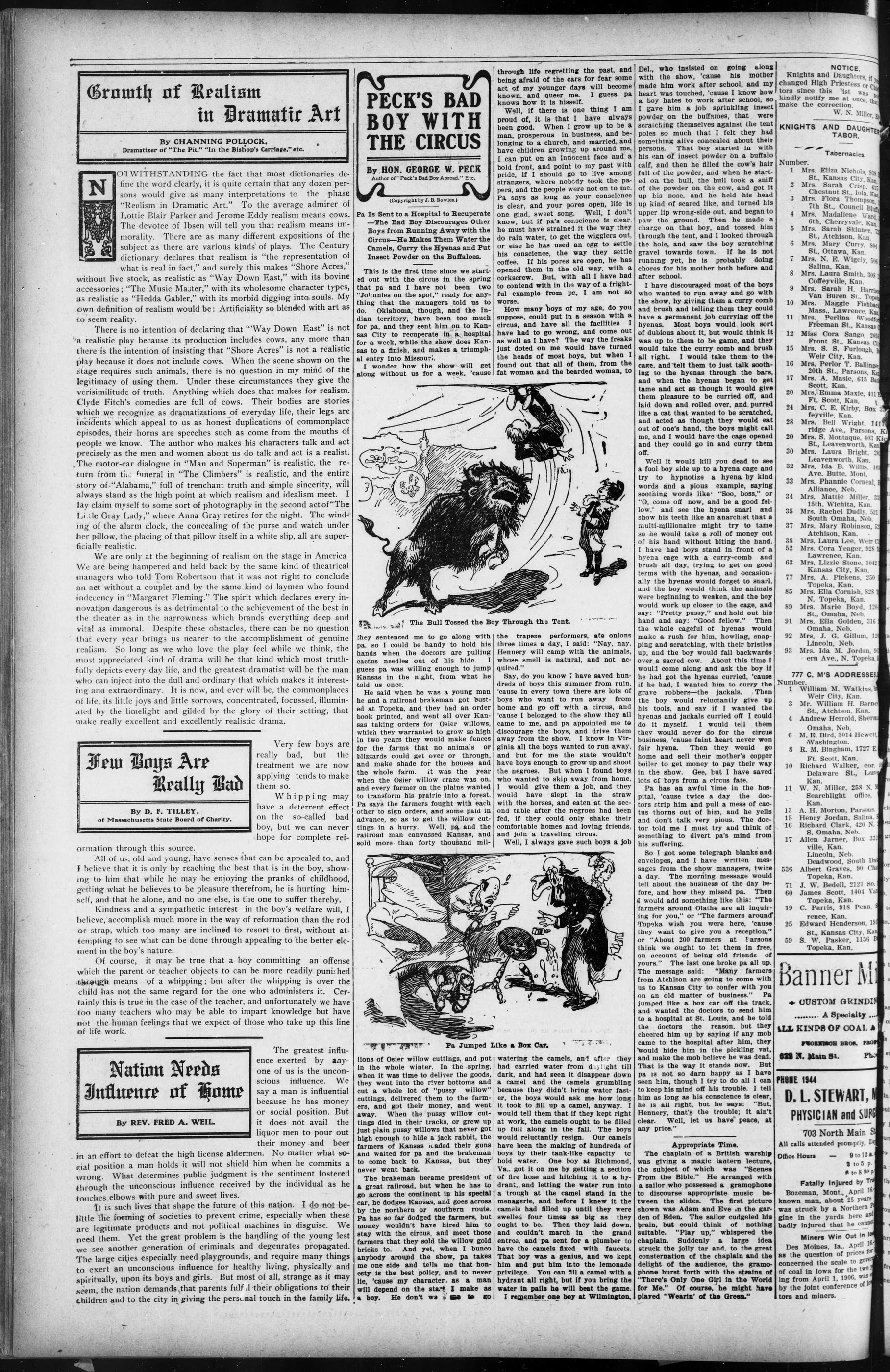
The Bull Tossed the Boy Through the Tent.
THE WEEKLY PRESS
Pa Jumped Like a Box Car.
PECK'S BAD
BOY WITH
THE CIRCUS
By HON. GEORGE W. PECK
Author of "Peck's Bad Boy Abroad," Etc.
(Copyright by J. B. Bowles.)
Pa Is Sent to a Hospital to Recuperate
—The Bad Boy Discourages Other
Boys from Running Away with the
Circus—He Makes Them Water the
Camels, Curry the Hyenas and Put
Insect Powder on the Buffaloes.
This is the first time since we started out with the circus in the spring that pa and I have not been two "Johnies on the spot," ready for anything that the managers told us to do. Oklahoma, though, and the Indian territory, have been too much for pa, and they sent him on to Kansas City to recuperate in a hospital for a week, while the show does Kansas to a finish, and makes a triumphal entry into Missouri.
I wonder how the show will get along without us for a week, 'cause
The Bull Tossed the B
they sentenced me to go along with pa, so I could be handy to hold his hands when the doctors are pulling cactus needles out of his hide. I guess pa was willing enough to jump Kansas in the night, from what he told us once.
He said when he was a young man he and a railroad brakeman got busted at Topeka, and they had an order book printed, and went all over Kansas taking orders for Osier willows, which they warranted to grow so high in two years they would make fences for the farms that no animals or blizzards could get over or through, and make shade for the houses and the whole farm. it was the year when the Osier willow craze was on, and every farmer on the plains wanted to transform his prairie into a forest. Pa says the farmers fought with each other to sign orders, and some paid in advance, so as to get the willow cuttings in a hurry. Well, pa and the railroad man canvassed Kansas, and sold more than forty thousand mil-
Pa Jumped
llions of Osier willow cuttings, and put in the whole winter. In the spring, when it was time to deliver the goods, they went into the river bottoms and cut a whole lot of "pussy willow" cuttings, delivered them to the farmers, and got their money, and went away. When the pussy willow cuttings died in their tracks, or grew up just plain pussy willows that never got high enough to hide a jack rabbit, the farmers of Kansas loaded their guns and waited for pa and the brakeman to come back to Kansas, but they never went back.
The brakeman became president of a great railroad, but when he has to go across the continent in his special car, he dodges Kansas, and goes across by the northern or southern route. Pa has so far dodged the farmers, but money wouldn't have hired him to stay with the circus, and meet those farmers that they sold the willow gold bricks to. And yet, when I bunco anybody around the show, pa takes me one side and tells me that honesty is the best policy, and to never lie, 'cause my character, as a man will depend on the start. I make as a boy. He don't we to go
through life regretting the past, and being afraid of the cars for fear some act of my younger days will become known, and queer me. I guess pa knows how it is himself.
Well, if there is one thing I am proud of, it is that I have always been good. When I grow up to be a man, prosperous in business, and belonging to a church, and married, and have children growing up around me, I can put on an innocent face and a bold front, and point to my past with pride, if I should go to live among strangers, where nobody took the papers, and the people were not on to me. Pa says as long as your conscience is clear, and your pores open, life is one glad, sweet song. Well, I don't know, but if pa's conscience is clear, he must have strained it the way they do rain water, to get the wigglers out, or else he has used an egg to settle his conscience, the way they settle coffee. If his pores are open, he has opened them in the old way, with a corkscrew. But, with all I have had to contend with in the way of a frightful example from pe, I am not so worse.
How many boys of my age, do you suppose, could put in a season with a circus, and have all the facilities I have had to go wrong, and come out as well as I have? The way the freaks just dotted on me would have turned the heads of most boys, but when I found out that all of them, from the fat woman and the bearded woman, to
y Through the Tent.
the trapeze performers, ate onions three times a day, I said: "Nay. nay. Hennery will camp with the animals, whose smell is natural, and not acquired."
Say, do you know I have saved hundreds of boys this summer from ruin, cause in every town there are lots of boys who want to run away from home and go off with a circus, and cause I belonged to the show they all came to me, and pa appointed me to discourage the boys, and drive them away from the show. I know in Virginia all the boys wanted to run away, and but for me the state wouldn't have boys enough to grow up and shoot the negroes. But when I found boys who wanted to skip away from home, I would give them a job, and they would have slept in the straw with the horses, and eaten at the second table after the negroes had been fed, if they could only shake their comfortable homes and loving friends, and join a traveling circus.
Well, I always gave such boys a job
Like a Box Car.
watering the camels, and after they had carried water from daylight till dark, and had seen it disappear down a camel and the camels grumbling because they didn't bring water faster, the boys would ask me how long it took to fill up a camel, anyway. I would tell them that if they kept right at work, the camels ought to be filled up full along in the fall. The boys would reluctantly resign. Our camels have been the making of hundreds of boys by their tank-like capacity to hold water. One boy at Richmond, Va., got it on me by getting a section of fire hose and hitching it to a hydrant, and letting the water run into a trough at the camel stand in the menagerie, and before I knew it the camels had filled up until they were swelled four times as big as they ought to be. Then they laid down, and couldn't march in the grand entrance, and pa sent for a plumber to have the camels fixed with faucets. That boy was a genius, and we kept him and put him into the lemonade privilege. You can fill a camel with a hydrant all right, but if you bring the water in pails he will beat the game. I remember one boy at Wilmington.
```markdown
```
Del., who insisted on going along with the show, 'cause his mother made him work after school, and my heart was touched, 'cause I know how a boy hates to work after school, so I gave him a job sprinkling insect powder on the buffalooes, that were scratching themselves against the tent poles so much that I felt they had something alive concealed about their persons. That boy started in with his can of insect powder on a buffalo calf, and then he filled the cow's hair full of the powder, and when he started on the bull, the bull took a sniff of the powder on the cow, and got it up his nose, and he held his head up kind of scared like, and turned his upper lip wrong-side out, and began to paw the ground. Then he made a charge on that boy, and tossed him through the tent, and I looked through the hole, and saw the boy scratching gravel towards town. If he is not running yet, he is probably doing chores for his mother both before and after school.
I have discouraged most of the boys who wanted to run away and go with the show, by giving them a curry comb and brush and telling them they could have a permanent job currying off the hyenas. Most boys would look sort of dubious about it, but would think it was up to them to be game, and they would take the curry comb and brush all right. I would take them to the cage, and tell them to just talk soothing to the hyenas through the bars, and when the hyenas began to get tame and act as though it would give them pleasure to be curried off, and laid down and rolled over, and purred like a cat that wanted to be scratched, and acted as though they would eat out of one's hand, the boys might call me, and I would have the cage opened and they could go in and curry them off.
Well it would kill you dead to see a fool boy side up to a hyena cage and try to hypnotize a hyena by kind words and a pious example, saying soothing words like "Soo, boss," or "O, come off now, and be a good fellow,' and see the hyena snarl and show his teeth like an anarchist that a multi-millionaire might try to tame so he would take a roll of money out of his hand without biting the hand. I have had boys stand in front of a hyena cage with a curry-comb and brush all day, trying to get on good terms with the hyenas, and occasionally the hyenas would forget to snarl, and the boy would think the animals were beginning to weaken, and the boy would work up closer to the cage, and say: "Pretty pussy," and hold out his hand and say: "Good fellow." Then the whole cageful of hyenas would make a rush for him, howling, snapping and scratching, with their bristles up, and the boy would fall backwards over a sacred cow. About this time I would come along and ask the boy if he had got the hyenas curried, 'cause if he had, I wanted him to bristle the grave robbers—the jackals. Then the boy would reluctantly give up his tools, and say if I wanted the hyenas and jackals curried off I could do it myself. I would tell them they would never do for the circus business, 'cause faint heart never won fair hyena. Then they would go home and sell their mother's copper boiler to get money to pay their way in the show. Gee, but I have saved lots of boys from a circus fate.
Pa has an awful time in the hospital, 'cause twice a day the doctors strip him and pull a mess of cactus thorns out of him, and he yells and don't talk very pious. The doctor told me I must try and think of something to divert pa's mind from his suffering.
So I got some telegraph blanks and envelopes, and I have written messages from the show managers, twice a day. The morning message would tell about the business of the day before, and how they missed pa. Then I would add something like this: "The farmers around Olathe are all inquiring for you," or "The farmers around Topeka wish you were here, 'cause they want to give you a reception," or "About 200 farmers at Parsons think we ought to let them in free, on account of being old friends of yours." The last one broke pa all up. The message said: "Many farmers from Atchison are going to come with us to Kansas City to confer with you on an old matter of business." Pa jumped like a box car off the track, and wanted the doctors to send him to a hospital at St. Louis, and he told the doctors the reason, but they cheered him up by saying if any mob came to the hospital after him, they would hide him in the pickling vat, and make the mob believe he was dead. That is the way it stands now. But pa is not so darn happy as I have seen him, though I try to do all I can to keep his mind off his trouble. I tell him as long as his conscience is clear, he is all right, but he says: "But, Hennery, that's the trouble; it ain't clear. Well, let us have peace, at any price."
Appropriate Time.
The chaplain of a British warship was giving a magic lantern lecture, the subject of which was "Scenes From the Bible." He arranged with a sailor who possessed a gramophone to discourse appropriate music between the slides. The first picture shown was Adam and Eve in the garden of Eden. The sailor cudged his brain, but could think of nothing suitable. "Play up," whispered the chaplain. Suddenly a large idea struck the jolly tar and, to the great consternation of the chaplain and the delight of the audience, the gramophone burst forth with the strains of "There's Only One Girl in the World for Me." Of course, he might have played "Wearin' of the Green."
KNIGHTS and Daughters, if I
changed High Priestess or Cler-
tors since this 'list was put
kindly notify me at once, that
make the correction.
KNIGHTS AND DAUGHTER TABOR.
# Number.
1. Mrs. Eliza Nichols, 928 St., Kansas City, Kan.
2. Mrs. Sarah Crisp, 615 Chestnut St., Iola, Kan.
3. Mrs. Flora Thompson, 47th St., Council Bluffs
4. Mrs. Madaliene Ward, 6th, Cherryvale, Kan.
5. Mrs. Sarah Skinner, 7th St., Atchison, Kan.
6. Mrs. Mary Curry, 804 St., Ottawa, Kan.
7. Mrs. N. E. Wigely, 596 Salina, Kan.
8. Mrs. Laura Smith, 308 Coffeyville, Kan.
9. Mrs. Sarah H. Harris Van Buren St., Topper
10. Mrs. Maggie Fishback Mass., Lawrence, Kan.
11. Mrs. Perlina Woodford Freeman St., Kansas City
12. Miss Cora Sango, 2650 Front St., Kansas City
13. Mrs. S. S. Furlough, B Weir City, Kan.
14. Mrs. Perlor T. Ballinger, 20th St., Parsons, Kan
15. Mrs. A. Masie, 615 Bar Scott, Kan
16. Mrs. Emma Maxie, 411 Ft. Scott, Kan
17. Mrs. C. E. Kirby, Box 2 feyville, Kan
18. Mrs. Bell Wright, 141 ridge Ave., Parsons, Kan
19. Mrs. S. Montaque, 403 Kt. Leavenworth, Kan
20. Mrs. Laura Bright, 200 Leavenworth, Kan
21. Mrs. Ida B. Willis, 100 Ave. Butte, Mont
22. Mrs. Phannie Corneal, B Alliance, Neb
23. Mrs. Mattie Miller, 333 15th, Wichita, Kan
24. Mrs. Rachel Dudly, 521 South Omaha, Neb
25. Mrs. Mary Robinson, 32 Atchison, Kan
26. Mrs. Laura Lee, Weir C
27. Mrs. Cora Yeager, 928 M Lawrence, Kan
28. Mrs. Lizzie Stone, 1042 Kansas City, Kan
29. Mrs. A. Pickens, 250 Topera, Kan
30. Mrs. Ella Cornish, 828 N. Topeka, Kan
31. Mrs. Marie Boyd, 129 St., Omaha, Neb
32. Mrs. Ella Golden, 316 Omaha, Neb
33. Mrs. J. G. Gillum, 129 Lincoln, Neb
34. Mrs. Ida M. Jordan, 90ern Ave., N. Topeka, K
777 C. M'S ADDRESSES
Number.
Number:
1 William M. Watkins, M. Weir City, Kan.
3 Mr. William H. Barnet St., Atchison, Kan.
4 Andrew Herrold, Sherm Omaha, Neb.
6 M. E. Bird, 3014 Hewett, Washington.
8 R. M. Bingham, 1727 E. Ft. Scott, Kan.
10 Richard Walker, cor. Delaware St., Leaven Kan.
11 W. N. Miller, 258 N. M. Searchlight office, Kan.
13 A. H. Morton, Parsons.
15 Henry Jordan, Salina.
16 Richard Clark, 420 N. S. Omaha, Neb.
17 Allen Jarner, Box 332 ville, Kan. Lincoln, Neb. Deadwood, South Dahl
536 Albert Graves, 90 Cha Topea, Kan.
71 J. W. Bedell, 2127 Soil.
60 James Scott, 404 Van Topea, Kan.
C. Parris, 918 Penn. S. rence, Kan.
25 Edward Henderson, 191 St., Kansas City, Kan.
59 S. W. Pasker, 1156 B. Topea, Kan.
Banner M
+ CUSTOM GRINDIN
..... A Specialty ...
ALL KINPS OF COAL &
FURNISCH BROS, PROP
622 N. Main St. Phx
703 North Main St
All calls attended promptly, Day
Office Hours — 9 to 12 a.
2 to 5 p.
8 to 8 80 p
Fatally Injured by Troy
Bozeman, Mont., April 16
known man, about 25 years
was struck by a Northern Pine
in the yards here and
badly injured that he cannot
Miners Win Out in Iowa
Des Moines, Ia., April 16
as the question of prices for
concerned the scale to govern
of coal in Iowa for the two
ing from April 1, 1906, was
by the joint conference of Ior-
tors and miners.