Wisconsin Weekly Advocate
Thursday, April 26, 1900
Milwaukee, Wisconsin
Page text (machine-generated)
WISCONSIN
WEEKLY
ADVOCATE
DEVOTED TO THE INTERESTS OF THE NEGRO RACE
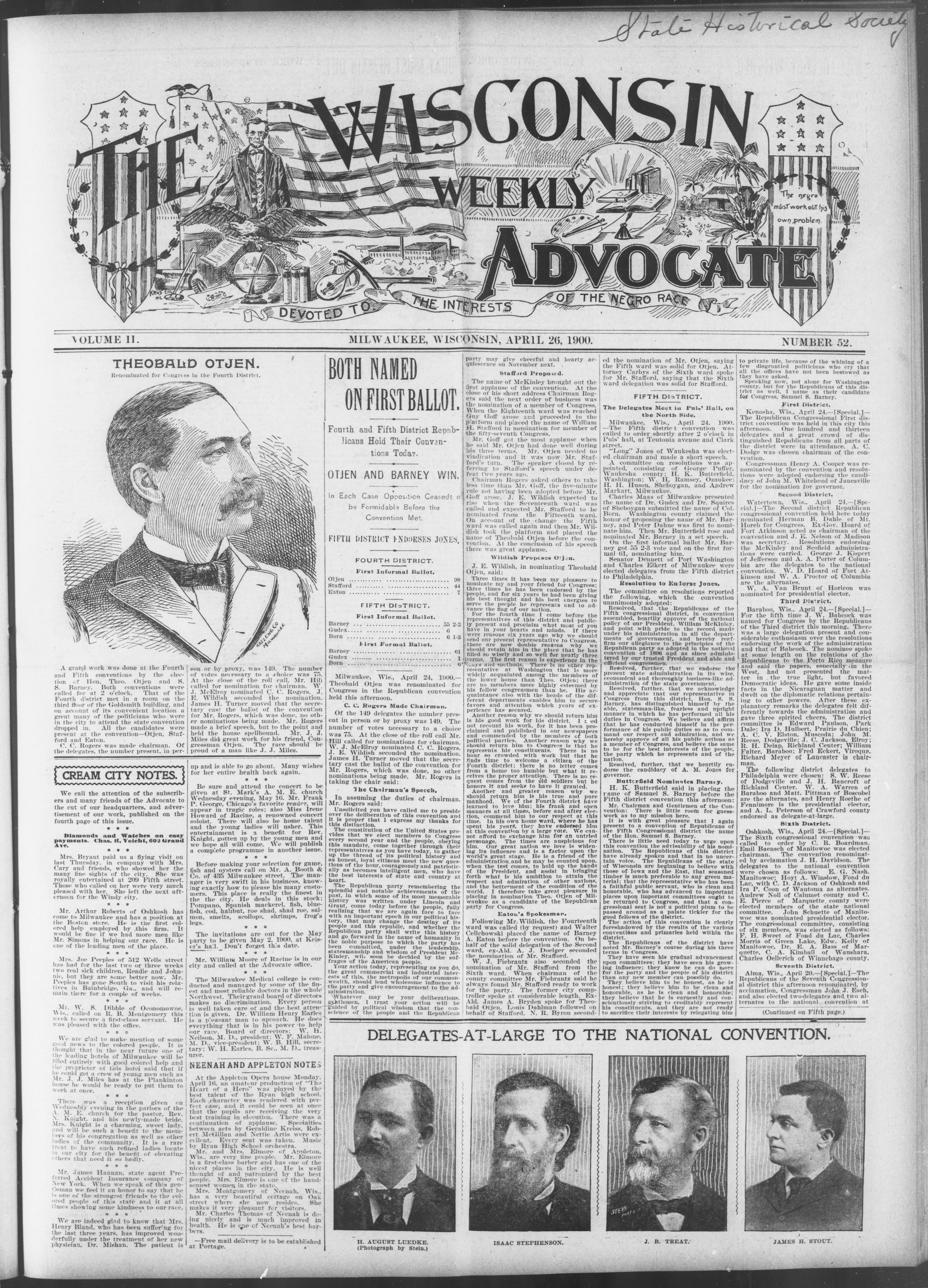
THEOBALD OTJEN.
Renominated for Congress in the Fourth District.
VOLUME II.
THEOBAL
Renominated for Congress
A grand work was done at the Fourth and Fifth conventions by the election of Hon. Theo. Otjen and S. S. Barney. Both conventions were called for at 2 o'clock. That of the Fourth district met in a room on the third floor of the Goldsmith building, and on account of its convenient location a great many of the politicians who were in the city to attend the state convention dropped in. All the candidates were present at the convention—Otjen, Stafford and Eaton. C. C. Rogers was made chairman. Of the delegates, the number present, in per-
CREAM CITY NOTES.
We call the attention of the subscribers and many friends of the Advocate to the cut of our headquarters, and advertisement of our work, published on the fourth page of this issue.
***
Diamonds and Watches on easy payments. Chas. H. Veicht, 602 Grand Ave.
* * *
Mrs. Bryant paid us a flying visit on last Thursday, in company with Mrs. Cary and friends, who showed her the many fine sights of the city. She was royally entertained at 209 Fifth street, Those who called on her were very much pleased with her. She left the next afternoon for the Windy city.
---
Mr. Arthur Roberts of Oshkosh has come to Milwaukee and has a position at the Boston store. He is the first colored help employed by this firm. It would be fine if we had more men like Mr. Simons in helping our race. He is one of the leading men of the place.
* * *
Mrs. Joe Peeples of 512 Wells street has had for the last two or three weeks two real sick children, Readie and Johnnie, but they are some better now. Mr. Peeples has gone South to visit his relatives in Bainbridge, Ga., and will remain there for a couple of weeks.
* * *
Mr. W. S. Dibble of Oconomowoe, Wis., called on R. B. Montgomery this week to secure a first-class servant. He was pleased with the office.
* * *
We are glad to make mention of some good news to the colored people. It is thought that in the near future one of the leading hotels of Milwaukee will be filled entirely with good colored help and the proprietor of this hotel said that if he could get a crew of young men such as Mr. J. J. Miles has at the Plankinton house he would be ready to put them to work at once.
```markdown
```
There was a reception given on Wednesday evening in the parlors of the A. M. E. church for the pastor, Rev. N. Knight, and his newly-made bride. Mrs. Knight is a charming, sweet lady, and will be such a benefit to the members of his congregation as well as other ladies of the community. It is a rare treat to have such refined ladies locate in our city for the benefit of elevating others that need it so badly.
***
Mr. James Hannan, state agent Preferred Accident Insurance company of New York. When we speak of this gentleman we feel it an honor to say that he is one of the strongest friends to the colored people of this state and it at all times showing some kindness to our race.
```markdown
```
We are indeed glad to know that Mrs. Henry Bland, who has been suffering for the last three years, has improved wonderfully under the treatment of her new physician, Dr. Mishan. The patient is
son or by proxy, was 149. The number of votes necessary to a choice was 75. At the close of the roll call, Mr. Hill called for nomination for chairman. W. J. McElroy nominated C. C. Rogers. J. E. Wildish seconded the nomination. James H. Turner moved that the secretary cast the ballot of the convention for Mr. Rogers, which was done, no other nominations being made. Mr. Rogers made a brief speech, but to the point and held the house spellbound. Mr. J. J. Miles did great work for his friend, Congressman Otjen. The race should be proud of a man like J. J. Miles.
up and is able to go about. Many wishes for her entire health back again.
* * *
Be sure and attend the concert to be given at St. Mark's A. M. E. church Wednesday evening, May 16. Mr. Frank P. George, Chicago's favorite reader, will appear in tragic roles; also Miss Irene Howard of Racine, a renowned concert soloist. There will also be home talent and the young ladies will usher. This entertainment is a benefit for Rev. Knight, gotten up by the young men and we hope all will come. We will publish a complete programme in another issue.
Before making your selection for game, fish and oysters call on Mr. A. Booth & Co. of 435 Milwaukee street. The manager is very swift in his business, knowing exactly how to please his many customers. This place is really the finest in the the city. He deals in this stock: Pompano, Spanish mackerel, fish, bluefish, cod, halibut, roe shad, shad roe, salmon, smelts, scollops, shrimps, frog's legs.
* * *
The invitations are out for the May party to be given May 2, 1900, at Keiser's hall. Don't forget this date.
* * *
Mr. William Moore of Racine is in our city and called at the Advocate office.
寐 永 寐
The Milwaukee Medical college is conducted and managed by some of the finest and most reliable doctors in the whole Northwest. Their grand board of directors makes no discrimination. Every person is well taken care of and the best attention is given. Dr. William Henry Earles is a p'easant man to approach. He does everything that is in his power to help our race. Board of directors: W. H. Neilson, M. D., president; W. F. Malone, M. D., vice-president; W. B. Hill, secretary; W. H. Earles, B. Sc., M. D., treasurer.
NEENAH AND APPLETON NOTES
At the Appleton Opera house Monday, April 16, an amateur production of "The Heart of a Hero" was played by the best talent of the Ryan high school. Each character was rendered with perfect case, and it could be seen at once that the pupils are receiving the very best training in elocution. There was a continuation of applause. Specialties between acts by Geraldine Kreiss, Robert McGillan and Nettie Artis were excellent. Every seat was taken. Music by Ryan High School orchestra. Mr. and Mrs. Elmore of Appleton, Wis., are very fine people. Mr. Elmore is a first-class barber and has one of the nicest places in the city. He is well thought of and patronized by the best people. Mrs. Elmore is one of the handsomest women in the state.
Mrs. Montgomery of Neenah, Wis., has a very beautiful cottage on Oak street where she now resides. She makes it very pleasant for visitors.
Mr. Charles Thomas of Neenah is doing nicely and is much improved in health. He is one of Neenah's best barbers.
—Free mail delivery is to be established at Portage.
MILWAUKEE, WISCONSIN, APRIL 26, 1900.
DELEGATES-AT-LARGE TO THE NATIONAL CONVENTION.
BOTH NAMED ON FIRST BALLOT.
Fourth and Fifth District Republicans Hold Their Conventions Today.
OTJEN AND BARNEY WIN.
In Each Case Opposition Ceased to be Formidable Before the Convention Met.
FIFTH DISTRICT ENDORSES JONES.
FOURTH DISTRICT.
First Informal Ballot.
Otjen ..... 98
Stafford ..... 44
Eaton ..... 7
Barney ..... 55 2-3
Gudex ..... 6
Born ..... 6 1-3
# First Formal Ballot.
Barney ..... 61
Gudex ..... 1
Born ..... 6
Milwaukee, Wis., April 24, 1900.—
Theobald Otjen was renominated for
Congress in the Republican convention
held this afternoon.
C. C. Rogers Made Chairman.
Of the 149 delegates the number present in person or by proxy was 149. The number of votes necessary to a choice was 75. At the close of the roll call Mr. Hill called for nominations for chairman. W. J. McElroy nominated C. C. Rogers. J. E. Wildish seconded the nomination. James H. Turner moved that the secretary cast the ballot of the convention for Mr. Rogers, which was done, no other nominations being made. Mr. Rogers in taking the chair said:
The Chairman's Speech.
In assuming the duties of chairman, Mr. Rogers said:
Unsollicited you have called me to preside over the deliberation of this convention and it is proper that I express my thanks for this distinction.
The constitution of the United States provides that we elect members to Congress every second year and the people, obeying this mandate, come together through their representatives as you have today, to gather up the thread of its political history and as honest, loyal citizens meet the new questions of the hour, courageously and patriotically as becomes intelligent men, who have the best interests of state and country at heart.
The Republican party remembering the splendid and notable achievements of the past, in which some of its most memorable history was written under Lincoln and Grant, come today before the people, fully realizing that we are again face to face with an important epoch in our political history, that may change the destiny of its people and this republic, and whether the Republican party shall write this history and go forward in the name of humanity in the noble purpose to which the party has been committed, under the leadership, statesmanship and wisdom of President McKinley, will soon be decided by the suffrages of the American people.
Your action today, representing as you do, the great commercial and industrial interests of this, the metropolis of our commonwealth, should lend wholesome influence to the party and give encouragement to the administration.
Whatever may be your deliberations, gentlemen, I trust your action will be guided by political wisdom that the conscience of the people and the Republican
DELEGATES-
M. B.
H. AUGUST LUEDKE.
(Photograph by Stein.)
party may give cheerful and hearty acquiescence on November next.
Stafford Proposed.
The name of McKinley brought out the first applause of the convention. At the close of his short address Chairman Rogers said the next order of business was the nomination of a member of Congress. When the Eighteenth ward was reached Guy Goff arose and proceeded to the platform and placed the name of William H. Stafford in nomination for member of the fifty-seventh Congress. Mr. Goff got the most applause when he said Mr. Otjen had done well during his three terms. Mr. Otjen needed no vindication and it was now Mr. Stafford's turn. The speaker closed by referring to Stafford's speech under defeat two years ago.
Chairman Rogers asked others to take less time than Mr. Goff, the five-minute rule not having been adopted before Mr. Goff arose. J. E. Wildish expected to rise when the Seventeenth ward was called and expected Mr. Stafford to be nominated from the Fifteenth ward. On account of the change the Fifth ward was called again and then Mr. Wildish took the platform and placed the name of Theobald Otjen before the convention. At the conclusion of his speech there was great applause.
Wildish Proposes Oiien.
J. E. Wildish, in nominating Theobald Otjen, said:
Three times it has been my pleasure to nominate my and your friend for Congress; three times he has been endorsed by the people, and for six years he had been giving his best thought and his best energies to serve the people he represents and to advance the flag of our nation.
For the fourth time I come before the representatives of this district and publicly present and proclaim what most of you have in your hearts and minds. If there were reasons six years ago why we should send our present representative to Congress, there are now double reasons why we should retain him in the place that he has filled so wisely and so well for nearly three terms. The first reason is experience in the laws and methods. There is no other representative at Washington that is more widely acquainted among the members of the lower house than Theo. Otjen; there are no members more highly esteemed by his fellow congressmen than he. His acquaintance also with the heads of the different departments enables him to secure favors and attention which years of experience has secured.
Another reason why we should return him is his good work for his district. I r e d not recount his work, for it has been proclaimed and published in our newspapers and commended by the members of both political parties. Another reason why we should return him to Congress is that he represents his constituents. There is no hour so crowded with work but that he finds time to welcome a citizen of the Fourth district; there is no letter comes from a home too humble but what it receives the proper attention. There is no request comes from the old soldiers but he honors it and seeks to have it granted.
Another and greater reason why we should return him is his true and pure manhood. We of the Fourth district have learned to love him; his frank and open manners at all times, before and after election, commend him to our respect at this time. In his own home ward, where he has spent his years, they have endorsed him at this convention by a large vote. We cannot afford to exchange him for an untried personage. The times are auspicious for him. Our great nation we love is widening its influence and is a factor upon the world's great stage. He is a friend of the administration, and he may be counted upon, when the test comes, to hold up the hands of the President, and assist in bringing forth what is his ambition to attain the respect and admiration of other nations, and the betterment of the condition of the world. I therefore take great pleasure in placing in nomination Theo. Otjen of Milwaukee as a candidate of the Republican party for Congress.
Eaton's Spokesman.
Following Mr. Wildish, the Fourteenth ward was called (by request) and Walter Celichowski placed the name of Barney A. Eaton before the convention. On behalf of the solid delegation of the Second ward, ex-Ald. A. J. Doelger seconded the nomination of Mr. Stafford.
W. J. Fiebrantz also seconded the nomination of Mr. Stafford from the Sixth ward. When chairman of the county committee Mr. Fiebrantz said he always found Mr. Stafford ready to work for the party. The former city controller spoke at considerable length. Ex-Ald. James A. Bryden spoke for Theobald Otjen. Louis Dahlman followed on behalf of Stafford. N. R. Byron second-
M.
ed the nomination of Mr. Otjen, saying the Fifth ward was solid for Otjen. Attorney Carbys of the Sixth ward spoke for Mr. Stafford, saying that the Sixth ward delegation was solid for Stafford.
FIFTH DISTRICT.
The Delegates Meet in Puls' Hall, on the North Side.
Milwaukee, Wis., April 24, 1900. The Fifth district convention was called to order shortly after 2 o'clock in Puls' hall, at Teutonia avenue and Clark street. "Long" Jones of Waukesha was elected chairman and made a short speech.
ed chairman and made a short speech.
A committee on resolutions was appointed, consisting of George Puffer, Waukesha county; H. K. Butterfield, Washington; W. H. Ramsey, Ozaukee; H. H. Huson, Sheboygan, and Andrew Markart, Milwaukee.
Charles Maas of Milwaukee presented the name of Dr. Gudex and Dr. Squires of Sheboygan submitted the name of Col. Born. Washington county claimed the honor of proposing the name of Mr. Barney, and Peter Dahne was first to nominate him. Then Mr. Butterfield rose and nominated Mr. Barney in a set speech.
On the first informal ballot Mr. Barney got 55 2-3 vote and on the first formal 61, nominating him.
Senator Dennett of Port Washington and Charles Elkert of Milwaukee were elected delegates from the Fifth district to Philadelphia.
Resolution to Endorse Jones.
The committee on resolutions reported the following, which the convention unanimously adopted:
Resolved, that the Republicans of the Fifth congressional district, in convention assembled, heartily approve of the national policy of our President, William McKinley, and point with pride to the record made under his administration in all the departments of government, and hereby reaffirm our allegiance to the principles of the Republican party as adopted in the national convention of 1896 and as since administered by our trusted President and able and efficient congressmen.
Resolved, further, that we endorse the present state administration in its wise, economical and thoroughly business-like administration of the state government.
Resolved, further, that we acknowledge and appreciate that our representative in Congress from this district, Hon. S. S. Barney, has distinguished himself by the able, statesman-like, fearless and upright manner in which he has performed all his duties in Congress. We believe and affirm that he has conducted himself in the performance of his public duties so as to command our respect and admiration, and we hereby approve of all his public actions as a member of Congress, and believe the same to be for the best interests of the people, the party which he represents and of the nation.
Resolved, further, that we heartily endorse the candidacy of A. M. Jones for governor.
H. K. Butterfield said in placing the rame of Samuel S. Barney before the Fifth district convention this afternoon: Mr. Chairman and Gentlemen of the Convention: There is little room for guesswork as to my mission here. It is with great pleasure that I again present to a convention of Republicans of the Fifth Congressional district the name of the Hon. Samuel S. Barney. There is little need today to urge upon this convention the advisability of his nomination. The Republicans of this district have already spoken and that in no uncertain voice. The Republicans of the state of Wisconsin are beginning to believe with those of Iowa and the East, that seasoned timber is much preferable to any green material; that the representative who has been a faithful public servant, who is clean and honorable, who has advanced to important places upon important committees ought to be returned to Congress, and that a congressional seat is not a political plum to be passed around as a palate tickler for the good fellows of the district.
The action of this convention is clearly foreshadowed by the results of the various conventions and primaries held within the district.
The Republicans of the district have noted Mr. Barney's course during his three terms in Congress.
They have seen his gradual advancement upon committees; they have seen his growing influence; they know he can do more for the party and the people of his district than any new member can possibly do.
They believe him to be honest, as he is honest; they believe him to be clean and honorable, as he is clean and honorable; they believe that he is earnestly and conscientiously striving to creditably represent his constituents, and they are not ready to sacrifice their interests by relegating him
STEIN
PHOTO
to private life, because of the whining of a few disgruntled politicians who cry that all the offices have not been bestowed as they have asked. Speaking now, not alone for Washington county, but for the Republicans of this district as well, I name as their candidate for Congress, Samuel S. Barney.
First District.
Kenosha, Wis., April 24.—[Special.]—The Republican Congressional First district convention was held in this city this afternoon. One hundred and thirteen delegates and a great crowd of distinguished Republicans from all parts of the district were in attendance. A. C. Dodge was chosen chairman of the convention.
Congressman Henry A. Cooper was renominated by the convention and resolutions were adopted endorsing the candidacy of John M. Whitehead of Janesville for the nomination for governor.
Second District.
Watertown, Wis., April 24.—[Special.]—The Second district Republican congressional convention held here today nominated Herman B. Dahle of Mt. Horeb for Congress. Ex-Gov. Hoard of Fort Atkinson acted as chairman of the convention and J. E. Nelson of Madison was secretary. Resolutions endorsing the McKinley and Scofield administrations were carried. George J. Kispert of Jefferson and A. A. Porter of Columbia are the delegates to the national convention. W. D. Hoard of Fort Atkinson and W. A. Proctor of Columbia are the alternates. W. A. Van Brunt of Horicon was nominated for presidential elector.
Third District.
Baraboo, Wis., April 24.—[Special.]—For the fifth time J. W. Babcock was named for Congress by the Republicans of the Third district this morning. There was a large delegation present and considerable enthusiasm over the resolutions endorsing the work of the administration and that of Babcock. The nominee spoke at some length on the relations of the Republicans to the Porto Rico measure and said the papers, especially in the West, had not presented the matter in the true light, but favored Democratic ideas. He gave some inside facts in the Nicaraguan matter and dwelt on the diplomatic relations pertaining to other powers. After these explanatory remarks the delegates felt differently towards the administration and gave three spirited cheers. The district committee is Edward Paulson, Park Dale; Ira D. Hulbert, Prairie du Chien; A. C. V. Elston, Muscuda; John M. Reese, Dodgeville; J. C. Jackson, Elroy; R. H. Delap, Richland Center; William Falter, Baraboo; Fred Eckert, Viroqua. Richard Meyer of Lancaster is chairman.
The following district delegates to Philadelphia were chosen: S. W. Reese of Dodgeville and J. H. Bancroft of Richland Center. W. A. Warren of Baraboo and Matt. Pittman of Boscobel are the alternates, and Henry Roethe of Fennimore is the presidential elector, and A. L. Peterson of Crawford county endorsed as delegate-at-large.
Sixth District.
Oshkosh, Wis., April 24.—[Special.]—The Sixth congressional convention was called to order by C. R. Boardman, Emil Baensch of Manitowoc was elected chairman. The convention renominated by acclamation J. H. Davidson. The delegates to the national convention were chosen as follows: E. G. Nash. Manitowoc; Hoyt A. Winslow, Fond du Lac, with C. D. Jackson of Oshkosh and Ira P. Coon of Wautoma as alternates. Andrew Noll of Calumet county and C. E. Pierce of Marquette county were elected members of the state national committee. John Schuette of Manitowoc was nominated presidential elector. The congressional committee, consisting of six members, was elected as follows: F. H. Sweet of Fond du Lac, Charles Morris of Green Lake, Edw. Kelly of Manitowoc, Dr. E. A. Bass of Marquette, C. A. Kimball of Waushara, Charles Oellerich of Winnebago county.
Seventh District.
Alma, Wis., April 20.—[Special.]—The Republicans of the Seventh Congressional district this afternoon renominated, by acclamation, Congressman John J. Esch, and also elected two delegates and two alternates to the national convention at (Continued on Fifth page.)
M.
JAMES H. STOUT.
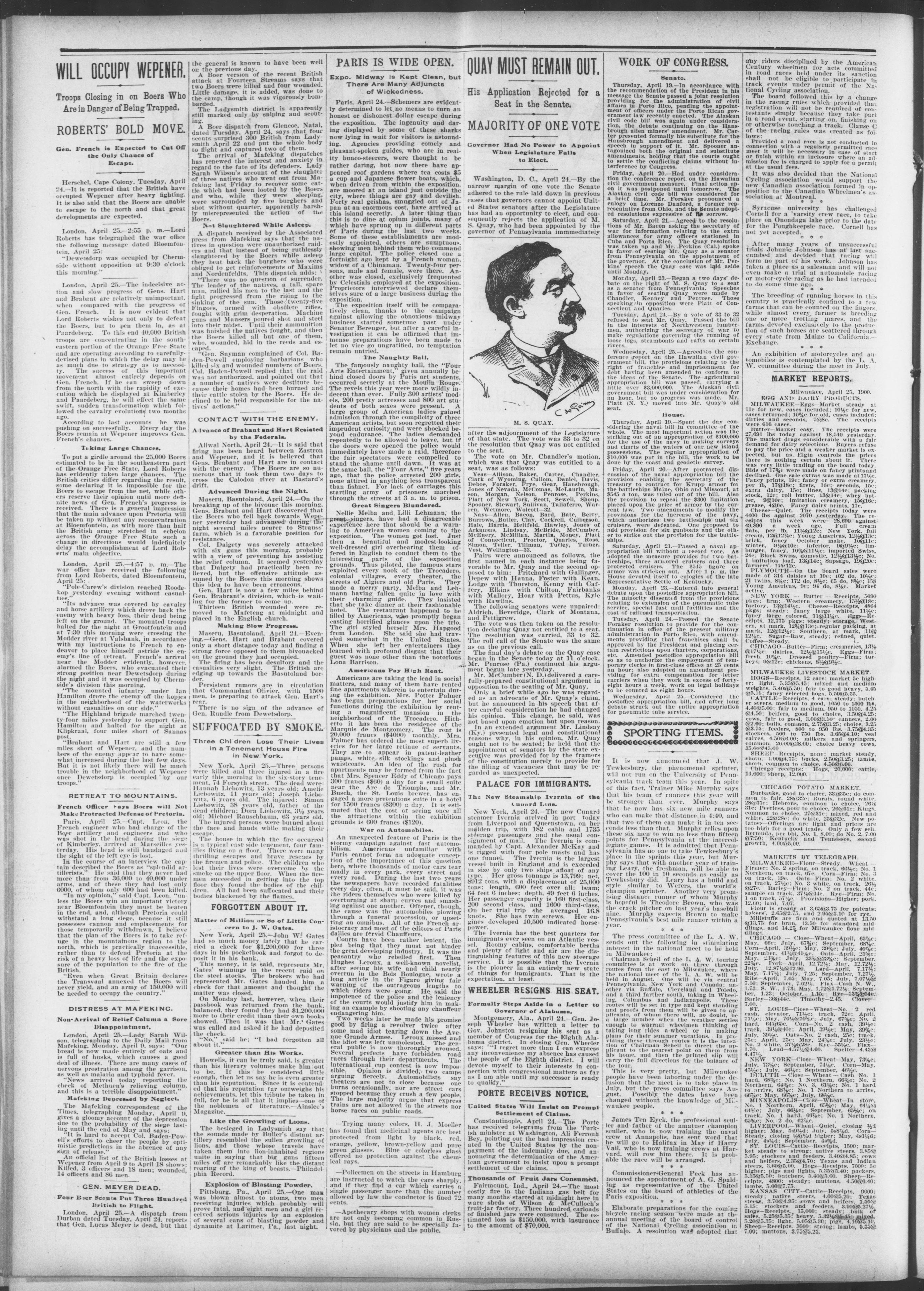
WILL OCCUPY WEPENER.
Gen. French is Expected to Cut Off the Only Chance of Escape.
Herschel, Cape Colony, Tuesday, April 24.—It is reported that the British have occupied Wepener after heavy fighting. It is also said that the Boers are unable to escape to the north and that great developments are expected.
London, April 25.—2:55 p. m.—Lord Roberts has telegraphed the war office the following message dated Bloemfontein, April 25:
"Dewetsdorp was occupied by Chermside without opposition at 9:30 o'clock this morning."
London, April 25.—The indecisive action and slow progress of Gens. Hart and Brabant are relatively unimportant, when compared with the progress of Gen. French. It is now evident that Lord Roberts wishes not only to defeat the Boers, but to pen them in, as at Paardeberg. To this end 40,000 British troops are concentrating in the southeastern portion of the Orange Free State and are operating according to carefully-devised plans in which the delay may be as much due to strategy as to necessity. The success of this important movement almost entirely depends on Gen. French. If he can sweep down from the north with the rapidity of execution which he displayed at Kimberley and Paardeberg, he will effect the same swift, sudden transformation which followed the cavalry evolutions two months ago.
According to last accounts he was pushing on successfully. Every day the Boers remain at Wepener improves Gen. French's chances.
Taking Large Chances.
To put a girdle around the 25,000 Boers estimated to be in the southeastern part of the Orange Free State, Lord Roberts has evidently taken large chances. The British critics differ regarding the result, some declaring it is impossible for the Boers to escape from the net, while others reserve their opinion until more definite news of Gen. French's progress is received. There is a general impression that the main advance upon Pretoria will be taken up without any reconcentration at Bloemfontein, as with more than half the British army stretched in echelon across the Orange Free State such a change in directions would indefinitely delay the accomplishment of Lord Roberts' main objective.
London, April 25.—4:57 p. m.—The war office has received the following from Lord Roberts, dated Bloemfontein, April 25:
"Pole-Carew's division reached Roodekop yesterday evening without casualties."
"Its advance was covered by cavalry and horse artillery which drove back the enemy with heavy loss, their dead being left on the ground. The mounted troops halted for the night at Grootfontein and at 7:30 this morning were crossing the Modder river at Valsbank, in accordance with my instructions to French to endeavor to place himself astride the enemy's line of retreat. French's arrival near the Modder evidently, however, alarmed the Boers, who evacuated their strong position near Dewetsdorp during the night and it was occupied by Chermside's division this morning.
"The mounted infantry under Ian Hamilton drove the enemy off the kopjes in the neighborhood of the waterworks without casualties on our side."
"The Highland brigade marched twenty-four miles yesterday to support Gen. Hamilton and halted for the night at Klipkraal, four miles short of Sannas post.
"Brabant and Hart are still a few miles short of Wepener, and the numbers of the enemy appear to have somewhat increased during the last few days. But it is not likely there will be much trouble in the neighborhood of Wepener once Dewetsdorp is occupied by our troops."
RETREAT TO MOUNTAINS.
French Officer Says Boers will Not
Make Protected Defense of Protaria
Make Protracted Defense of Pretoria.
Paris, April 25.—Capt. Leon, the French engineer who had charge of the Boer artillery and engineers and who was shot in the head during the siege of Kimberley, arrived at Marseilles yesterday. His head is still bandaged and the sight of the left eye is lost.
In the course of an interview the captain described the Boers as "splendid artillerists." He said that they never had more than from 36,000 to 40,000 under arms, and of these they had lost only 6000, of whom only 600 had been killed.
"In my opinion," said Capt. Leon, "unless the Boers win an important victory near Bloemfontein they must be beaten in the end, and, although Pretoria could withstand a long siege, because it still possesses cannon and emplacements for those temporarily withdrawn, I believe that the plan of the Boers is to take refuge in the mountainous region to the north, which is practically inaccessible, rather than to defend Pretoria at the risk of a heavy loss of life and the exposure of the population to the fire of the British. "Even when Great Britain declares the Transvaal annexed the Boers will never yield, and an army of 150,000 will be needed to occupy the country."
DISTRESS AT MAFEKING.
Non-Arrival of Relief Column a Sore Disappointment.
London, April 25.—Lady Sarah Wilson, telegraphing to the Daily Mail from Mafeking, Monday, April 9, says: "Our bread is now made entirely of oats and is full of husks, which causes a good deal of illness. There are many cases of nervous prostration among the garrison, as well as malaria and typhoid fever.
"News arrived today reporting the check of Methuen's relieving column, and this is a terrible disappointment."
Mafeking Depressed by Neglect.
The Mafeking correspondent of the Times, telegraphing Monday, April 9, gives a gloomy account of the depression due to the probability of the siege lasting until the end of May and says:
"It is hard to accept Col. Baden-Powell's efforts to cheer the people by optimistic predictions in the absence of any sign of release."
An official list of the British losses at Wepener from April 9 to April 18 shows: Killed, 3 officers and 18 men; wounded, 14 officers and 86 men.
· GEN. MEYER DEAD.
Four Boer Scouts Put Three Hundred British to Flight.
London. April 25.—A dispatch from Durban dated Tuesday, April 24, reports that Gen. Lucas Meyer is dead, but that
the general is known to have been well on the previous day. A Boer version of the recent British attack at Fourteen Streams says that two Boers were killed and four wounded. Little damage, it is added, was done to the camp, though it was vigorously bombarded. The Ladysmith district is apparently still marked only by sniping and scouting.
A Boer dispatch from Glencoe, Natal, dated Tuesday, April 24, says that four scouts surprised 300 British from Ladysmith April 22 and put the whole body to flight and captured two of them. The arrival of Mafeking dispatches has renewed the interest and anxiety in regard to the fate of its defenders. Lady Sarah Wilson's account of the slaughter of three natives who went out from Mafeking last Friday to recover some cattle which had been looted by the Boers and who, while they were sleeping, were surrounded by five burghers and shot without quarter, apparently harshly misrepresented the action of the Boers
Not Slaughtered While Asleep.
A dispatch received by the Associated press from Mafeking says that the natives in question were unauthorized raiders and that instead of being ruthlessly slaughtered by the Boers while asleep they beat back the burghers who were obliged to get reinforcements of Maxims and Nordenfeldts. This dispatch adds: "There was no question of surrender. The leader of the natives, a tall, spare man, rallied his men to the last and the fight progressed from the rising to the sinking of the sun. Those twenty-five Fingoes, armed with obsolete rifles, fought with grim desperation. Machine guns and Mausers poured shot and steel into their midst. Until their ammunition was finished the natives fought, and then the Boers killed all but one of them, who, wounded, hid in the reeds and escaped.
"Gen. Suyman complained of Col. Baden-Powell employing barbarians who killed six and wounded numbers of Boers. Col. Baden-Powell replied that the raid was not authorized, and pointed out that a number of natives were destitute because their homes had been burned and their cattle stolen by the Boers. He declined to be held responsible for the natives' actions."
CONTACT WITH THE ENEMY.
Advance of Brabant and Hart Resisted by the Federals.
Aliwal North, April 24. It is said that firing has been heard between Zastron and Wepener, and it is believed that Gens. Brabant and Hart are in contact with the enemy. The Boers are so numerous that it took them two days to cross the Calodon river at Bastard's drift.
Advanced During the Night.
Maseru, Basutoland, April 24.—On the breaking up of the bivouac this morning, Gens. Brabant and Hart discovered that the Boers who fell back towards Weppner yesterday had advanced during the night several miles nearer to Strauss' farm, which is a favorable position for resistance. Col. Dalgety was severely attacked with six guns this morning, probably with a view of preventing his assisting the relief column. It seemed yesterday that Dalgety had practically been relieved, but the offensive attitude assumed by the Boers this morning shows this idea to have been erroneous.
Thirteen British wounded were removed to Mafeteng at midnight and placed in the English church.
Making Slow Progress.
Maseru, Basutoland, April 24.—Evening.—Gens. Hart and Brabant covered only a short distance today and finding a strong force opposed to them bivouacked on the ground they had occupied.
The firing has been desultory and the casualties very slight. The British are edging up towards the Basutoland border.
Persistent rumors are in circulation that Commandant Olivier, with 1500 men, is preparing to attack Gen. Hart's rear.
There is no sign of the advance of Gen. Rundle from Dewetsdorp.
SUFFOCATED BY SMOKE.
Three Chi'dren Lose Their Lives in a Tenement House Fire in New York.
New York, April 25.—Three persons were killed and three injured in a fire early this morning in the six-story tenement, 74 Forsyth street. The dead were: Hannah Liebowitz, 13 years old; Amelie Liebowitz, 11 years old; Joseph Liebowitz, 6 years old. The injured: Simon Liebowitz, 38 years old, father of the dead children; Dora Liebowitz, $3\frac{1}{2}$ years old; Michael Rauschbaum, 63 years old. The injured persons were burned about the face and hands while making their escape.
The house in which the fire occurred is a typical east side tenement, four families living on a floor. There were many thrilling escapes and brave rescues by the firemen and police. The children who lost their lives were overcome by the smoke on the upper floor. When the firemen succeeded in getting into the top floor they found the bodies of the children. All had been suffocated and their bodies blackened by the flames.
FORGOTTEN ABOUT IT.
Matter of Million or So of Little Concern to I. W. Gates.
New York, April 25.—John W. Gates had so much money lately that he carried a check for $1,200,000 for three days in his pocketbook and forgot to deposit it in his bank.
This money, it is said, represents Mr. Gates' winnings in the recent raid on the steel stocks. The brokers who had represented Mr. Gates handed him a check for that amount and thought the matter was closed.
On Monday last, however, when their passbook was returned from the bank, balanced, they found they had $1,200,000 more to their credit than their own books showed. Then it was that Mr.' Gates was called and asked if he had deposited the check.
"No," said he; "I had forgotten all about it."
Greater than His Works.
Howells, it can be truly said, is greater than his literary volumes make him out to be. If this be considered little enough, then let us say he is even greater than his reputation. Since it is contended that his reputation far outweighs his achievements, let this tribute be taken in full, for he is all that it implies—one of the noblemen of literature.—Ainslee's Magazine.
Like the Growling of Lions
The besieged in Ladysmith say that the sounds made by Buller's distant artillery resembled the sullen growling of lions, and those whose travels have taken them into lion-inhabited regions unite in saying that big guns fifteen miles off are remarkably like the distant roaring of the king of beasts.—Philadelphia Record.
Explosion of Blasting Powder
Pittsburg, Pa., April 25.—One man was blown almost to atoms, two men receiving injuries which probably will prove fatal, and eight men and a girl received serious injuries by an explosion of several cans of blasting powder and dynamite at Lariimer, Pa., last night.
PARIS IS WIDE OPEN.
PARIS IS WIDE OPEN.
Expo. Midway is Kept Clean, but There Are Many Adjuncts of Wickedness.
Paris, April 24.—Schemers are evidently determined to let no means to turn an honest or dishonest dollar escape during the exposition. The ingenuity and daring displayed by some of these sharks now lying in wait for visitors is astounding. Agencies providing comely and pleasant-spoken guides, who are in reality bunco-steerers, were thought to be rather daring, but now there have appeared roof gardens where tea costs $5 a cup and Japanese flower boats, which, when driven from within the exposition, are moored at an island just outside the city, where things are gay and devilish. Forty real geishas, smuggled out of Japan at an enormous cost, have arrived at this island secretly. A later thing than this is to dine at opium joints, many of which have sprung up in different parts of Paris during the last two weeks. Some of these establishments are modestly appointed, others are sumptuous, showing men behind them who command large capital. The police closed one a fortnight ago kept by a French woman, widow of a Chinaman. Twenty-four persons, male and female, were there. Another was closed, exclusively frequented by Celestials employed at the exposition. Proprietors interviewed declare themselves sure of a large business during the exposition.
The exposition itself will be comparatively clean, thanks to the campaign against allowing the obnoxious midway business started sometime past under Senator Berenger, but after a careful investigation it can be affirmed that immense preparations have been made to let no vice go ungratified, no temptation remain untried.
The Naughty Ball.
The famously naughty ball, the "Four Arts Entertainment," given annually behind closed doors by Paris art students, occurred secretly at the Moulin Rouge. The revels this year were more wildly indecent than ever. Fully 300 artists' models, 200 pretty actresses and 800 art students of both sexes were present. A large group of American ladies gained admission through the complicity of three American artists, but soon regretted their imprudent curiosity and were shocked beyond endurance. The ladies demanded repeatedly to be allowed to leave, but if the doors were opened the police would immediately have made a raid, therefore the fair spectators were compelled to stand the shame until dawn. It was at the same ball, the "Four Arts," five years ago, that the police arrested 200 girls, none attired in anything less transparent than fishnet. For lack of carriages this startling army of prisoners marched through the streets at 3 a. m. to prison.
Nellie Melba and, Lilli Lehmann; the great singers, have had a disagreeable experience here that should be a warning to American women coming to the exposition. The women got lost. Just then a beautiful and modest-looking well-dressed girl overhearing them offered in English to conduct them to the interesting parts of the exposition grounds. Thus piloted, the famous stars exploited every nook of the Trocadero, colonial villages, every theater, the streets of Algiers and old Paris. They made a merry party, Melba and Lehmann having fallen quite in love with their charming guide. They insisted that she take dinner at their fashionable hotel. The restaurant happened to be filled by Americans, who promptly began casting horrified glances upon the trio. The girl styled herself Mrs. Hapgood from London. She said she had traveled somewhat in the United States. When she left her entertainers they learned with profound disgust that their guest was none other than the notorious Lona Barrison.
Americans Pay High Rent.
Americans are taking the lead in social matters, and many of them have rented fine apartments wherein to entertain during the exhibition. Mrs. Potter Palmer has begun preparations for her social functions during the exhibition by renting a magnificent mansion in the neighborhood of the Trocadero. Hitherto it has been the residence of the Marquis de Montgomery. The rent is 20,000 francs ($4000) monthly. Mrs. Palmer has ordered the most superb liveries for her large retinue of servants. They are to appear in patent-leather pumps, white silk stockings and plush waistcoats. An idea of the rush for apartments may be formed from the fact that Mrs. Spencer Eddy of Chicago pays 300 francs ($60) a day for a small suite near the Arc de Triomphe, and Mr. Busch, the St. Louis brewer, has engaged a more pretentious suite in a hotel for 1500 francs ($300) a day. It is estimated that the cost of seeing once all the attractions within the exhibition grounds is 600 francs ($120).
War on Automobiles.
An unexpected feature of Paris is the stormy campaign against fast automobileism. Americans unfamiliar with Paris cannot form an adequate conception of the importance of this question here, where thousands of motor cars tear madly in every park, every street and every road. During the last two years the newspapers have recorded fatalities every day, often, it must be said, it was the riders themselves who were killed by overturning at sharp curves and smashing against one another. Oftener, though, the cause was the automobiles plowing through a funeral procession, or upsetting an omnibus. All of the French aristocracy and most of the editors of Paris dailies are fervid Chauffeurs.
Courts have been rather lenient, the plea being that they must not hinder the great developing industry. It was the peasantry who rebelled first. Then Hughes Leroux, a well-known novelist, after seeing his wife and child nearly overrun in the Bois Boulogne, wrote a long article in the Figaro giving fair warning of the outrageous lengths to which riders were going. He said the impotence of the police and the leniency of the courts would justify him in making an example by shooting any chauffeur endangering him.
Two weeks later he made his promise good by firing a revolver twice after some mad idiot tearing down the Avenue Grande Armee. Leroux missed and the idiot was left unmolested. The general public is now thoroughly aroused. Several prefects have forbidden road races through their departments. The international cup contest is now impossible. Opinion is divided; two camps argue fiercely. Automobilists say theaters are not to close because one burns occasionally, nor are street cars stopped because they crush a few people. The large majority argue that express trains are not allowed in the streets nor horse races on public roads.
—Trying many colors, H. J. Moeller has found that medicinal agents are best protected from light by black, red, orange, yellow, brown-yellow and pure green glasses. Blue or colorless glass offered no protection against the chemical rays.
—Policemen on the streets in Hamburg are instructed to watch the cars sharply, and if they find a car which carries a single passenger more than the number allowed by law the conductor is fined 72 cents.
—Apothecary shops with women clerks are not only becoming common in Russia, but they are said to be specially favored by physicians and the public.
OUAY MUST REMAIN OUT.
Governor Had No Power to Appoint When Legislature Falls to Elect.
Washington, D. C., April 24.—By the narrow margin of one vote the Senate adhered to the rule laid down in previous cases that governors cannot appoint United States senators after the Legislature has had an opportunity to elect, and consequently rejects the application of M. S. Quay, who had been appointed by the governor of Pennsylvania immediately
C. de Primy
after the adjournment of the Legislature of that state. The vote was 33 to 32 on the resolution that Quay was not entitled to the seat.
The vote on Mr. Chandler's motion, which was that Quay was entitled to a seat, was as follows:
Yeas—Allison, Baker, Carter, Chandler, Clark of Wyoming, Cullom, Daniel, Davis, Deboe, Foraker, Frye, Gear, Hansbrough, Jones of Nevada, McComas, McLaurin, Mason, Morgan, Nelson, Penrose, Perkins, Platt of New York, Scott, Sewell, Shoup, Spooner, Stewart, Sullivan, Tallaferro, Warren, Wetmore, Wolcott—32.
Nays—Allen, Bacon, Bard, Bate, Berry, Burrows, Butler, Clay, Cockrell, Culbegson, Hale, Harris, Heltfeld, Hawley, Jones of Arkansas, Lindsay, McBride, McCumber, McEnery, McMillan, Martin, Money, Platt of Connecticut, Proctor, Quarles, Ross, Simon, Teller, Tillman, Turley, Turner, West, Wellington—33.
Pairs were announced as follows, the first named in each instance being favorable to Mr. Quay and the second opposed to him: Pritchard with Gallinger, Depew with Hanna, Foster with Kean, Lodge with Thurston, Kenny with Caffery, Elkins with Chilton, Fairbanks with Mallory, Hoar with Pettus, Kyle with Rawlins.
The following senators were unpaired: Aldrich, Beveridge, Clark of Montana, and Pettigrew.
The vote was then taken on the resolution declaring Quay not entitled to a seat. The resolution was carried, 33 to 32. The roll call of the Senate was the same as on the previous call.
The final day's debate on the Quay case began in the Senate today at 11 o'clock. Mr. Penrose (Pa.) continued his argument begun late yesterday.
Mr. McCumber(N. D.)delivered a carefully-prepared constitutional argument in opposition to the seating of Mr. Quay. Only a brief while ago he was regarded as an advocate of Mr. Quay's claim, but he announced in his speech that after careful consideration he had changed his opinion. This change, he said, was not based upon emotion but upon reason. In an extended argument Mr. Lindsay (Ky.) presented legal and constitutional reasons why, in his opinion, Mr. Quay ought not to be seated; he held that the appointment of senators by the state executive was provided for by the framers of the constitution merely to provide for the filling of vacancies that may be regarded as unexpected.
PALACE FOR IMMIGRANTS.
The New Steamship Ivernia of the
Guard Line.
New York, April 24.—The new Cunard steamer Ivernia arrived in port today from Liverpool and Queenstown, on her maiden trip, with 182 cabin and 1735 steerage passengers and the usual consignment of mail. The Ivernia is commanded by Capt. Alexander McKay and is rigged with four pole masts and has one funnel. The Ivernia is the largest vessel built in England and is exceeded in size by only two ships afloat of any type. Her gross tonnage is 13,799; net, 8912 tons, with a displacement of 25,000 tons; length, 600 feet over all; beam; 64 feet 6 inches; depth, 49 feet 6 inches. Her passenger capacity is 160 first-class, 200 second class, and 1600 third-class. On her trial trip she averaged 16.8 knots. She has twin screws. Her engines developed 10,500 indicated horsepower.
The Ivernia has the best quarters for immigrants ever seen on an Atlantic vessel. Roomy cabins, comfortable berths and plenty of light and air are the distinguishing features of this new steerage service. It is possible that the Ivernia is the pioneer in an entirely new state of things for immigrants. That is the expectation, at least.
WHEELER RESIGNS HIS SEAT.
Formally Steps Aside in a Letter to Governor of Alabama.
Montgomery, Ala., April 24.—Gen. Joseph Wheeler has written a letter to Gov. Johnston resigning his seat as a member of Congress for the Eighth Alabama district. In closing Gen. Wheeler says: "I regret more than I can express any inconvenience my absence has caused the people of the Eighth district. I will devote myself to their interests in connection with congressional matters as far as I am able until my successor is ready to qualify."
PORTE RECEIVES NOTICE.
United States Will Insist on Prompt Settlement of Claims.
Constantinople, April 24.—The Porte has received telegrams from the Turkish minister at Washington, Ali Ferrouh Bey, pointing out the bad impression created in the United States by the nonpayment of the indemnity due, and announcing the determination of the American government to insist upon a prompt settlement of the claims.
Thousands of Fruit Jars Consumed
Fairmount, Ind., April 24.-The most costly fire in the Indiana gas belt for many months started at midnight here in ware sheds of Wilson & McCulloch's fruit-jar factory. Three hundred carloads of finished jars were consumed. The estimated loss is $150,000, with insurance to the amount of $70,000.
WORK OF CONGRESS.
Senate.
Thursday, April 19.—In accordance with the recommendation of the President in his message the Senate passed a joint resolution providing for the administration of civil affairs in Porto Rico, pending the appointment of officers under the Porto Rican government law recently enacted. The Alaskan civil code bill was again under consideration, the debate continuing on the Hansbrough alien miners' amendment. Mr. Carter presented formally his substitute for the Hansbrough amendment and delivered a speech in support of it. Mr. Spooner antagonized both the original and substitute amendments, holding that the courts ought to settle the conflicting claims without interference by Congress.
Friday, April 20.—Had under consideration the conference report on the Hawaiian civil government measure. Final action upon it was postponed until tomorrow. The Alaskan civil code bill was considered for a brief time. Mr. Foraker pronounced a eulogy on Lorenzo Danford, a former representative from Ohio, and the Senate adopted resolutions expressive of his sorrow.
Saturday, April 21.—Agreed to the resolutions of Mr. Bacon asking the secretary of war for information relating to the extra allowances for army officers stationed in Cuba and Porta Rico. The Quay resolution was taken up and Mr. Perkins (Cal.) spoke in favor of seating Mr. Quay as a senator from Pennsylvania on the appointment of the governor. At the conclusion of Mr. Perkins' speech the Quay case was laid aside until Monday.
Monday, April 23.—Began a two days' debate on the right of M. S. Quay to a seat as a senator from Pennsylvania. Speeches in favor of seating Quay were made by Chandler, Kenney and Penrose. Those speaking in opposition were Platt of Connecticut and Quarles.
Tuesday, April 24.—By a vote of 33 to 32 refused to seat Mr. Quay. Passed the bill in the interests of Northwestern lumbermen, authorizing the secretary of war to make regulations governing the running of loose logs, steamboats and rafts on certain rivers.
Wednesday, April 25.—Agreed to the conference report on the Hawaiian civil government bill, the provisions relating to the right of franchise and imprisonment for debt having been amended to conform to the ideas of the Senate. The agricultural appropriation bill was passed, carrying a little over $3,000,000. The Alaskan civil government bill was under consideration for an hour, but no progress was made. Mr. Platt (N. Y.) moved into Mr. Quay's old seat.
house.
Thursday, April 19.—Spent the day considering the naval bill in committee of the whole. The most important action was the striking out of an appropriation of $100,000 for the use of the navy in making surveys and charts of the waters of our new island possessions. The regular appropriation of $10,000 was put in the bill, the work to be done by the coast and geodetic survey.
Friday, April 20.—After protracted discussion of the naval appropriation bill the provision enabling the secretary of the treasury to contract for Krupp armor for the battleships Maine, Ohio and Missouri, at $545 a ton, was ruled out of the bill. Also the provision to repeal the $300 limitation placed upon the price of armor by the current law. Two amendments to modify the provisions for the increase of the navy, which authorizes two battleships and six cruisers, were defended. One proposed to add provision for six gunboats and the other to strike out the provision for the battleships.
Saturday, April 21.—Passed a naval appropriation bill without a record vote. As adopted the measure provides for two battleships, three armored cruisers and three protected cruisers. The $545 figure on armor was stricken out. After 1 p. m. the House devoted itself to cataloges of the late Representative Settle of Kentucky.
Monday, April 23.—Entered into general debate upon the postoffice appropriation bill. The minority dissented from the provisions relating to extension of the pneumatic tube service, special fast mail facilities and the cost of railroad transportation.
Tuesday, April 24.—Passed the Senate Foraker resolution to provide for the continuation in office of the present military administration in Porto Rico, with amendments providing that franchises shall be approved by the President and placing certain restrictions upon charters, corporations, etc. Amended postoffice appropriation bill so as to authorize the employment of temporary clerks in first-class offices at 25 cents an hour; also adopted an amendment providing for extra compensation for letter carriers when they work in excess of forty-eight hours a week, work on legal holidays to be counted as eight hours.
Wednesday, April 25.—Considered the postoffice appropriation bill, and after long debate struck out the entire appropriation for pneumatic tube service.
It is now announced that J. W. Tewkesbury, the phenomenal sprinter, will not run on the University of Pennsylvania track team this year. In spite of this fact, Trainer Mike Murphy says that his team of runners this year will be stronger than ever. Murphy says that he now has six new mile runners who can make that distance in 4:40, and that two of them can make it in ten seconds less than that. Murphy relies upon these six men to win no less than fifteen points for Pennsylvania at the intercollegiate games. It is admitted that Pennsylvania has no one to take Tewkesbury's place in the sprints this year, but Murphy says that with another year of training Leary, the freshman, will be able to cover the 100 in 10 seconds as easily as Tewkesbury did. Leary has a build and style similar to Wefers, the world's champion sprinter. Another very promising distance runner of whom Murphy is hopeful is Theodore Brown, who was the crack pitcher on last year's baseball nine. Murphy expects Brown to make Pennsylvania's best mile runner within a year.
The press committee of the L. A. W. sends out the following in stimulating interest in the national meet to be held in Milwaukee:
Chairman Scheil of the L. A. W. touring committee is at work on three through routes from the east to Milwaukee, where the national meet of the L. A. W. will be held in August. One will be via central Pennsylvania, New York and Canada; another via Buffalo, Cleveland and Toledo, and a third farther south, taking in Wheeling, Columbus and Indianapolis. These routes will be set in type and kept standing and proofs from them will be given to applicants, of whom there will, no doubt, be a large number when the weather settles enough to warrant wheelmen thinking of taking long rides a-wheel or in making plans for their summer vacations. In providing these through routes it is the intention of Chairman Schell to direct the applicant to the nearest point on them from his home, and then the printed slip will carry the full directions for the balance of the tour.
This is very pretty, but Milwaukee people have been laboring under the delusion that the meet is to take place in July, but the press committee says August. Possibly the dates have been changed without the knowledge of Milwaukee people.
```markdown
```
James Ten Eyck, the professional sculler and father of the amateur champion sculler, who is now training the naval crew at Annapolis, has sent word that he will go to Halifax in May if Harry Vail, who is now training crews at Harvard, will row him there. It is probable the race will be arranged.
* * *
Commissioner-General Peck has announced the appointment of A. G. Spalding as representative of the United States on the board of athletics of the Paris exposition.
* * *
Elaborate preparations for the coming bicycle racing season were made at the annual meeting of the board of control of the National Cycling association in Buffalo. A resolution was adopted that
any riders disciplined by the American Century wheelmen for acts committed in road races held under its sanction shall not be eligible to participate in track events under permit of the National Cycling association.
The board followed this by a change in the racing rules which provided that registration will not be required of contestants simply because they take part in a road event, starting on, finishing on or otherwise touching a track. Clause C of the racing rules was created as follows:
Provided a road race is not conducted in connection with a regularly permitted race meet it will be necessary in case of start or finish within an enclosure where an admission fee is charged to apply for a permit at the usual fees.
It was also decided that the National Cycling association would support the new Canadian association formed in opposition to the Canadian Wheelmen's association at Montreal.
* * *
Syracuse university has challenged Cornell for a 'varsity crew race, to take place on Onondaga lake prior to the date for the Poughkeepsie race. Cornell has not yet accepted.
* * *
After many years of unsuccessful trials Johnnie Johnson has at last succeeded and decided that racing will form no part of his work. Johnson has taken a place as a salesman and will not even make a trial at automobile racing or motor-cycle racing as he had intended to do some time ago.
The breeding of running horses in this country is practically confined to a few farms that can be counted on the fingers, while almost every farmer is breeding one or more trotting mares, and the farms devoted exclusively to the production of such horses are scattered through every state from Maine to California. Exchange.
* * *
An exhibition of motorcycles and automobiles is contemplated by the L. A. W. committee during the meet in July.
MARKET REPORTS.
Milwaukee, April 25, 1900.
ND DAIRY PRODUCTS.
MILWAUKEE—Eggs—Market steady at 11c for new, cases included; 10½c for new, cases returned; 10½c for old, cases included; dirties and seconds, 7@8c. The receipts were 616 cases.
Butter—Market easy. The receipts were 27,691 Ibs today against 18,540 yesterday. The market drags considerable with a fair demand for dairy selections. Buyers refuse to pay the price and a weaker market is expected, but as Elgin controls the prices there is nothing certain about it. There was very little trading on the board today. Bids of 17½c were made on fancy prints and declined. One sale extras was made at 17½c. Fancy prints, 19c; fancy or extra creamery, per lb, 17@18c; firsts, 16c; seconds, 15c; extra dairy, 15c; lines, 13@14c; packing stock, 12c; roll butter, 13@14c; whey butter, 9@10c; imitation creamery, 15@16c; grease, 4@6c. Fancy dairy prints, 17c.
Cheese-Quiet. The receipts today were 4400 lbs against 2070 yesterday. The receipts this week were 28,690 against 49,890 a week age. Full cream flats, per lb, 11½@12c; New York, full cream, 12@12½c; Young Americas, 12½@12c; brick, fancy October make, 10@11c; winter, 9½@10c; inferior, 9@9½c; limburger, fancy, 10¾@11½c; imported Swiss, 24c; Block Swiss, domestic, 12½@13½c; No. 1 imitation loaf, 13@14c; Sapsago, 19@20c; farmers, 11@12c.
PLYMOUTH-On the board sales were made of 314 daisies at 10c; 102 do, 10¾c; 21 twins, 8½c; 172 do, 8½c; 65 do, 8½c; 158 Young Americas, 9c; 94 do, 8½c. Market active.
NEW YORK -- Butter -- Receipts, 5000
pkgs; firm; Western creamy, 15%@18c;
factory, 13%@14%c. Cheese-Receipts, 4864
pkgs; steady; Fancy large white, 11%c;
fancy large colored, 11%@11%c. Eggs-Receipts, 12,775 pkgs; steady; storage, Western, at mark, 12%@13%c; regular packing, at mark, 12%@12%c; Southern, at mark, 11%@12%c; Sugar-Raw, steady; refined, quiet. Coffee-Steady.
CHICAGO-Butter-Firm; creameries, 13%@17%c; dairies, 12%@15%c. Eggs-Firm; fresh, 16%c; Dressed poultry-Firm; turkeys, 9@12c; chickens, 8%@9%c.
MILWAUKEE LIVESTOCK MARKET.
HOGS-Receipts, 12 cars; market 5c higher; light, 5.35@5.45; mixed and medium weights, 5.40@5.50; fair to good heavy, 5.45@5.55; fancy selected hogs, 5.50@5.55.
CATTLE—Receipts, 4 cars; steady; butcher steers, medium to good, 1050 to 1300 lbs, 4.40@5.00; fair to medium, 950 to 1050, 4.25@4.50; heifers, good to choice, 3.50@4.25; cows, fair to good, 3.00@3.50; canners, 2.00@2.60; bulls, common, 2.75@3.25; choice, 3.25@3.75; feeders, 800 to 950 lbs, 3.75@4.35; stockers, 500 to 750 lbs, 3.65@4.10; veal calves, 4.50@6.00; milkers and springers, common, 20.00@28.00; choice heavy cows, 35.00@45.00
SHEEP—Receipts, none; market steady, shorn, 4.00@4.75; bucks, 2.50@3.25; lambs, shorn, common to choice, 4.50@6.00.
Chicago receipts; Hogs, 20.00; cattle
Chicago receipts: Hogs, 20,000; cattle, 14,000; sheep, 12,000.
CHICAGO POTATO MARKET
CHICAGO POTATO MARKET.
Burbanks, good to choice, 13@35c; do common to fair, 28@32c; Ruralis, round white, 28@35c; Hebrons, common to choice, 26@31c; Peerless, poor to choice, 26@31c; Kings, common to choice, 27@31c; mixed, red and white, 22@28c; do white, 25@32c. New potatoes—Offerings are light and prices are too high for a good trade. Only a few sell. Bermuda, per bbl, No. 1, 8.00; do No. 2, 7.00 @7.50: Kentucky and Tennessee, second growth, 4.00@5.00.
MARKETS BY TELEGRAPH
MILWAUKEE—Flour—Steady. Wheat —
Firmer. No 2 spring, on track, 66½c; No 1.
Northern, on track, 67c. Corn—Firm; No 3
on track, 39c. Oats—Firm; No 2 white.
on track, 27½c; No 3 white, on track, 26½
@27c. Barley—Firm; No 2 on track, 44c;
sample on track, 37½@44c. Rye—Firm; No 1
on track, 57½c. Provisions—Higher; pork,
12.60; lard, 7.07.
Flour is steady at 3.65@3.75 for patents;
bakers', 2.65@2.75, and 2.95@3.10 for rye.
Millstuffs are firm and quoted at 13.50
@13.75 for brun, 13.50 for standard middlings, and 14.25 for Milwaukee flour middlings.
CHICAGO — Close-Wheat-April, 65%c;
May, 66c; July, 67%c; September, 68%c;
Corn-April, 39%c; May, 39%c; July, 40%c;
September, 41%c@41%c; Oats-April, 23%c;
May, 23%c; July, 23%c@23%c; September,
22%c; Pork-April, 12.72%c; May, 12.72%c;
July, 12.87%c@12.90. Lard-April, 7.17%c;
May, 7.17%c; July, 7.25; September, 7.27%c;
Ribs-April, 7.05; May, 7.05; July, 7.07%c@
7.10; September, 7.02%c; Flax-Cash N. W.
1.73; S. W., 1.73; May, 1.72@1.72%; September,
1.23; October, 1.15; Rye-53%@64c;
Barley-36@44c. Timothy-2.45. Clover-
7.00.
ST. LOUIS-Close-Wheat-No. 2 red
cash, elevator, 71%c; track, 72c; April,
71%c; May, 70%@70%c; July, 67%c; No. 2
hard, 64@65c. Corn-No. 2 cash, 39%c;
track, 39%@40c; April, 39%c; May, 39%c;
July, 39%c; Oats-No. 2 cash, 25c; track,
25c; April, 25c; May, 24%c; July, 23%c;
No. 2 white, 27%@28c. Rye-55%c. Flax-
1.70. Lead-4.57%@4.60. Spelter-4.45@
4.47%c.
NEW YORK—Close—Wheat—May, 73%c;
July, 73%c; September, 74%c; Corn—May,
45%c; July, 46%c; September, 46%c.
DULUTH—Close—Wheat—Cash No. 1
hard, 68%c; No. 1 Northern, 66%c; No. 2
Northern, 64%c; No. 3, 61%c; No. 1 hard
to arrive, 68%c; No. 1 Northern to arrive,
66%c; May, 66%c; July, 68%c.
MINNEAPOLIS—Close—Wheat—In store,
No. 1 Northern, April, 65%c; May, 64%a
64%c; July, 66%c; September, 65%c; on
track, No. 1 hard, 66%c; No. 1 Northern,
65%c; No. 2 do, 62%c.
LIVERPOOL—Wheat—Qulet, closing 1/2d
higher; May, 59%d; July, 58%5d. Corn-
Steady, closing 1/2@5d higher; May, 4s1%d;
July, 4s1%d; September, 4s%d.
ST. LOUIS—Cattle—Receipts, 1500; market
steady to strong; native steers, 3.85@
5.95; stockers and feeders, 3.40@4.85; cows
and heifers, 2.35@4.70; Texas and Indian
steers, 3.60@5.00. Hogs—Receipts, 7000; 5c
higher; pigs and lights, 5.35@5.40; packers,
5.35@5.50; butchers, 5.40@5.00. Sheep—Receipts, 4800; steady; muttons, 4.50@6.40;
lambs, 5.00@7.75
KANSAS CITY—Cattle—Receipts. 9000; steady; native steers. 4.00@5.20; Texas steers. 3.70@4.95; cows and heifers. 1.50@5.15; stockers and feeders. 3.90@5.27%; Hogs—Receipts. 15,000; steady; bulk of sales. 5.25@5.35; heavy. 5.32@5.45; mixed. 5.20@5.35; light. 5.05@5.30; pigs. 4.10@5.10; Sheep—Receipts. 3000; strong; lambs. 5.35@7.00; muttons. 3.75@5.25.
We are so jolly, contented, and gay,
Enlid and I and the baby.
What do we care for the Appian Way,
Enlid and I and the baby?
Politics, wars, and the tariff may go.
Little we reck how the fickle winds blow,
We're a triumvirate, mighty and low,
Enlid and I and the baby.
Climb up, my little son, here to my knee-
Enlid and I and the baby.
Take him, my dear, he is weary with play.
See how he blinks in that Sleepy-town way.
Here is a kiss all around, and hurra—
Enid and I and the baby.
-Robert Loveman in the New Lippincott
SIX YEARS LOST
"What would we live on, Max?" laughed Sydney Vernon, glancing down at her elegant morning dress, with the pretty slipper just peeping from beneath its hem. "It's all very well to eschew the practicalities of life, but they are somewhat necessary, for all that, and I have never seen any great evidence of economy on your part, and I am quite sure you have not on mine."
Max Bayard tugged impatiently at his moustache as the girl, whom a moment before he had asked to be his wife, thus answered him.
He had known her long enough to learn to love her with all the strength of his great heart; to worship her beauty; to follow her constantly with his eyes, knowing but one wish, one hope, that she might be his.
And he fancied, not altogether wrongly, that his love had met some return. Her eyes had brightened at his coming, her voice had learned to welcome him, until he felt he must end suspense and gain some certain assurance; the more so that a Mr. Clayton had lately come upon the scene—a rich and childless widower, who evidently looked with favor upon the belle of the watering place, and whom her aunt (under whose care she was), if not the young lady herself, looked upon with favor in return.
"I have never had an incentive to economy," Max said, in answer. "I have enough to live on and feed my horses, though my tailor's bill does trouble me now and then, I confess; but, Sydney, I will change all that, dear. I can't, perhaps, give you all the luxuries to which you are accustomed, but you shan't lack for comforts, that I promise you."
"We should be miserable, Max, miserable, both you and I!" the girl answered bitterly. "We have not either of us been reared in a school of poverty. I would cry for cake while you could only give me bread, and you for ale, while I could give you only kisses. Come, be sensible, and let us be good friends."
"Friends? Never!" he exclaimed. "I am starving, and you throw me a stone. Look into my eyes, Sydney, straight and true, and say you do not love me, and I will go away and trouble you no more."
The long lashes drooped low on her cheek.
"I cannot quite say that," she answered; "but I will say more. I promised last night to become Mr. Clayton's wife within six months."
Max Bayard's handsome face grew white to the very tips—a look of deadly anger, mingled with something like loathing, crept into it. Sydney shrank from it as from a blow.
"Don't. Max—don't!" she cried. "I couldn't help it—I am very sorry."
"You could not help it—you are very sorry!" he repeated, very slowly. "Could not help what? Toying with me for your amusement—playing fast and loose with your victim, or selling yourself to the highest bidder? Which? You are very sorry—for whom? For the man you led step by step to the brink of the flower-strewn precipice, only to smile as he plunged to the chasm below, or for him who wins the prize in the lottery—the prize for which he has paid the price of all his fortune? Pardon me. Miss Vernon, but he, I think, is more deserving of your sorrow than the man whom you hurl to the lowest depths of the abyss."
With these words he turned and left her sitting on the sands, the ocean making its low moan at her feet.
"Oh, if it would come on and on and swallow me up!" she wailed in echo.
"I love him—I love him! Max, you are right; the man I propose to marry does deserve the pity. But you—oh, my love, you might have spared me your hate! I did it for the best—I did it for the best!"
* * * * * * * *
Six years had passed—six years, fraught indeed with change.
"If she had been but true to herself and me!" Max Bayard had thought, when, but a few months after the event which had driven him from his native land to find forgetfulness in travel, a letter had been put into his hand, which had followed him from port to port, announcing that he had fallen heir to a fortune which might have challenged Mr. Clayton's in its magnitude. He had always known there was a bare chance of his inheritance, but the then-present possessor had been young and strong and vigorous, with a seemingly-equal lease of life with himself, until accident had done the work of disease, and fortune's wheel had come round to him. "If only she had trusted me!" he said bitterly again and again in the lonely hours of the night, despising himself that he could not learn to hate her.
A year afterward he married. His wife was very young and very lovely; but there were depths in his nature that her hand never stirred, and even as she lay with her head pillowed on his breast another haunted face would come between and 'mid the caressing murmur of her words would sound the echo of the "might have been."
But he loved her very dearly, and mourned her very truly when, one short year after their marriage, he laid her away in her grave and took up the burden of life again, with the added responsibility of the tiny infant daughter she had left him.
"Wanted—A lady to superintend the education of a little girl. Apply between the hours of 4 and 6. at —"
It was in answer to this advertisement that, six years after that memorable afternoon upon the beach, a lady stood waiting in the elegant drawing room of the house to which she had been directed. Her veil was down, and the room was half in shadow from the heavy curtains which draped the window; but, for all that, she started when a step crossed the hall and a gentleman, his hair slightly tinged with gray, entered.
She had sunk back on the sofa, and her frame quivered with emotion.
"You have come, madam, in answer to my advertisement?" he asked cautiously.
"No, no!" she answered. "There are reasons why it will now be impossible for me to accept the situation offered."
That voice! Had it not too long haunted him to be thus easily forgotten? Would he not know it, even though it sounded above his very grave?
"Sydney! you here?" he exclaimed.
"Ah, Mrs. Clayton—pardon me; for the moment I forgot."
Then she threw back her veil. Six years had made little change. It was the same beautiful face, but grown very pale, and the lovely mouth quivered as she spoke.
"Believe me, I would not have intruded myself upon you had I dreamed it was you who had inserted the advertisement. I had not even heard of your marriage."
"My wife is dead," he answered. "But stay," as she rose to go. "Tell me how it happens that you are in necessity. Is Mr. Clayton dead?"
She shuddered.
"You mistake," she said. "I did not marry Mr. Clayton. I am Sydney Vernon still."
"You did not marry him?"
You did not marry him:
"No. It is a woman's privilege, you know, to change her mind, but my aunt was very angry and at her death she left me nothing. Your advertisement attracted me. I thought I might learn to love a little girl."
"And you will not learn to love my little motherless child?" he asked. "Accept this position, I beg of you, Miss Vernon. It is only that you should see she is not left to the mercy of nurses, and that she has some refining care."
So it was at last decided, and Sydney found the old emptiness of life fled, since her heart and hands were full.
She rarely saw the master of the house. One day when she had entered on some errand into his study she had seen hanging over his desk the fair, pictured face of Mabel's mother.
"How soon he learned to love again," she thought. "And I—I whom he so cruelly condemned—threw aside ambition and wealth for the idol I could never grasp."
But one evening Mabel stole to the side of the lovely lady who had won all her loyal little heart.
"Papa is ill!" she said. "Did you know it, Miss Sydney? Won't you go nurse him like you do when me is ill?"
"Certainly, darling, if I can do anything."
And with trembling steps she descended the stairs and entered his room.
For hours she sat beside him, changing the cooling bandages upon his brow and fanning his fevered cheeks. Mabel had come softly in for her good-night kiss; then he had fallen asleep, and she had feared to stir, as she might waken him.
"Sydney, why did you not marry Mr. Clayton?"
Had he really spoken, or was it her own thoughts which formed the question? No, he was awake now, his eyes resting upon her.
"You have no right to ask me," she said imperiously. "Let the dead past bury its dead."
"No right, perhaps—that I admit; but answer me, all the same. For the sake of all these starving years, let me know the truth."
"Because I did not love him." she answered; then—"because I found myself weaker than I knew."
"Oh, Sydney! if we had known—if we had known! My darling, was there another reason? Was it because you loved me?"
In his voice there thrilled the truth. In that moment she knew herself empress of his heart all these years, and gliding from her chair until she fell back on her knees by his side, with her beautiful head close pressed against his heart, while his kisses rained upon her hair, she whispered:
"Because I shall love you while life lasts."
A month later there was a quiet wedding, when, after six years' cruel waiting, Sydney made the life happiness of the man to whom she gave herself, a royal gift; but they always said, with a sigh of deep regret, that in both their lives they had lost—six years.—Spare Moments.
FACTS AND FANCIES.
Appropriate sign for a saloon—Rush in here. This is where angels fear to tread.
Askit—"Whom do you regard as our greatest writer of fiction?"
Tellit—"The weather man."--Baltimore American.
Charley Softpate—"I wish I could find something to take up my mind."
something to take up my mind. May Cutting—"Have you tried blotting paper?"—Ohio State Journal. Snarley—"How did Jingo get run over?"
Yow—"He was stooping to pick up a horseshoe."—Syracuse Herald.
"Arthur, I don't believe my poodle is a thoroughbred."
"Why, Bertha?"
"He hasn't been sick a minute since we got him."—Indianapolis Journal.
Knicker—"Jones wants to get into the Hall of Fame."
"He's lived in Philadelphia that long."—Life.
"How do you like my new rainy-day skirt, dear?"
"H'm! When are you going to do it?"
"Why, do what?"
"Wade across to Brooklyn."—Harper's Bazar.
Mrs. Wiggles—"Mrs. Rachet played whist with us this afternoon."
Mr. Wiggles—"Is that so? What score did she make?"
Mrs. Wiggles—"Three hundred and eighty words a minute."
Stranger—"I believe that gentleman over the way is an expounder of the Scriptures, is he not?"
Cheerful Idiot—"No 'ex' about it, sir; he's still at it. He thumps 'em out at the chapel over yonder."—Ally Sloper.
Mr. Gilkinson—"I wish you would go into the next room and tell Willie to quit reading over that list of Transvaal towns."
Mrs. Gilkinson—"That isn't Willie. That's Martha gargling her throat!"—New York Press.
Henry Fielding was once asked by Lord Denbigh why he wrote his name "Fielding" instead of "Feilding," as his lordship's family used. "I cannot tell, my lord," replied the novelist, "except it be that my branch of the family were the first that knew how to spell."
"He won a prize at the amateur photographic exhibition."
"What! He never made a good picture in his life. All his efforts I ever saw were nothing but gray smudges."
"That's right. He labeled one of them 'A Day in London.'"—Philadelphia Post.
A Yorkshire, England, man who had a scolding wife met a mate one morning who looked rather sad, and asked him what was the matter. The other said: "I've lost my old missus." To this the former replied: "I'll swop my wick'un for your dead 'un, and pay t' funeral expenses, too."
"Did you ever call upon Dr. Moque professionally?" "Yes. Once; I was drowning." "Drowning?" "Yes. I diagnosed my case on the instant, and wrote a prescription on a chip, which he threw into the water where I could get it." "What was the prescription?" "Rx. Swim."—Harlem Life.
"Are you married?" asked a magistrate in the Dublin police court of a man charged with committing an assault on another man.
"No, your worship," replied the man in the dock.
"That's a good thing for your wife," said the magistrate.—Scraps.
"Is this a fire insurance office?" he asked as he entered.
"Yes, sir," replied the spruce young clerk.
"What will you charge me for a policy that will insure me $20 a week in case I am fired from my present situation?"—Pittsburg Chronicle Telegraph.
She—"But why, Charles, should you object to a long engagement? You know that I am wholly yours."
He—"Yes, I know that; but you see, I want my liberty."
She—"Want your liberty?"
He—"Well, you know a married man isn't supposed to tell his wife everything."—Boston Transcript.
LOOK AT THE BOYS' HANDS.
Employers Have a New Test for Youthful Applicants. The boy in search of a job turned up at supper time at his sister's house, looking rather disconsolate. "I didn't get nothing to do," he said shortly. "I don't wonder if you used that kind of grammar." said his sister.
"That wasn't it; I had my company grammar on all right; 'twas something else and I'll tell Jim about it after supper. You'd spring the 'I told you so game on me, and make me tired."
Jim was the brother-in-law, and had been a job-hunting boy himself not many years before. He was beckoned into the sitting room immediately after rising from the table, and once there the door was shut by his-vife's youthful brother, who turned and said: "I went to fourteen places today, Jim, and was turned down at every shot. I've read about such things in the Sunday school books and in the funny papers, but I thought it was all gab. The guys I applied to didn't ask me if I lived with my mother; they didn't ask if I wrote a good hand; they didn't ask if I knew the city, and they didn't ask nothing at all that I expected them to ask me. The first thing four of them says was, 'Hold up your mitts,' while the others says, 'Please let us look at your hands.' There was one look and four of them says 'Git' and the rest says, polite-like, 'We don't think we require your services.'
"What was the matter?" asked the sister's husband.
The boy held up the forefinger of his left hand, along the inner side of which a yellow stain showed as far as the second knuckle. "That," he said simply.
"H'm," said the brother-in-law. "the boss in our shop won't allow cigarette smoking, either, but I didn't know things had gone as far as this. Why don't you quit?"
"I have; I quit last night. One of the guys that said 'Git' called me back just as I got to the elevator and says, 'What makes you smoke cigarettes?' 'I don't,' I says.
"There's some things worse than cigarette smokin'," he says.
"I quit last night,' I told him. Then he grinned a little and said that I might not be such a liar as he thought after all, but it was a fact that men had quit hiring cigarette kids and that this was doing more to stop the habit than all the anti-cigarette league in the city. Then he says, 'You're sure you quit last night, are you? Well, you come back again in a week and show me your mit.'
"The stain'll wear off by that time, Jim, and I kinder think that feller'll give me a job."—Chicago Chronicle.
STEAMER CHAIR NUISANCE.
An Abuse Which Prevails on Ocean Passenger Steamships.
"One of the nuisances of ocean travel," said M. A. Patterson of Boston to a New York Tribune reporter, "is the way the chairs on deck are managed. These chairs are now owned by a large Hebrew firm here in New York, and are rented out to you for so much a trip; that is, provided you have not had the forethought or desire to go to the trouble of supplying one of your own. For the use of a chair you pay a varying fee, in proportion to the length of the trip and the time you enjoy its use. It is never less than $1, however, and the returns on the investment must be something enormous, for these chairs at wholesale cannot cost much more than that. I don't find any fault with this, although I do think our steamers could well afford to take a point from the English P. and O. boats, where the deck chairs are owned by the company and supplied gratis to the passengers, just as the chairs are at the table. But there is a custom on some ships which, to my mind, smacks strongly of abuse, and that is the method maintained in placing the chairs. On many of the lines the deck space for the chair is reserved from the office, and that particular space belongs to that particular chair throughout the trip, whether the chair's owner occupies it or not. That isn't the worst of it, either, for the weather side of the vessel, of course, changes with the winds, and then when the chairs are moved to leeward they are again placed in corresponding positions to those they previously occupied on the other side of the deck. Now, it seems to me that such an arrangement is an abuse, for the owners may for days together be absent, during which time their chairs, occupying desirable positions, are wholly unoccupied, and I can assure you, if a bad place has fallen to your lot, it irritates you very much to see an empty chair holding down a cozy corner. The best way is the first come, first served one. Then there is no trouble and no feeling of irritation on the part of the less fortunate passengers, who must needs know that if they wanted a better position they could have obtained it by rising earlier."
Overcome by the Woods Madness.
Overcome by the Woods Madness.
One of the woodsmen had told me of a waterfall on a trout stream of considerable size, says W. J. Stillman in the Atlantic, which emptied into a lake near by us, and, in the hope of finding a subject on it, I took the boat one afternoon, and began to follow the course of the stream up from the mouth. After a half mile of clear and navigable water it became so clogged with fallen trees that more lifting than paddling was required, and as its course was extremely tortuous I occasionally got out and examined the vicinity of the stream bed and the course, above, if perchance there might be better navigation beyond. On one of the digressions I suddenly came on the stream running back on its previous course and parallel to it. Instantly, in the twinkling of an eye, the entire landscape seemed to have changed in its bearings, the sun, which was clear in the sky, it being about 3 o'clock, shone to me out of the north, and it was impossible to convince myself that my senses deceived me or accept the fact that the sun must be in the southwest, the general direction from which the stream was flowing, and that, to get home again, I must turn my back to it, if I had lost my boat, as seemed certain. Then began to come me, like an evil spell, the bewilderment, and the panic which accompanied it, and which fortunately, I recognized from the experiences I knew of, and I was aware that if I gave way to it I was a lost man beyond any finding by the woodsmen, even if they attempted to track me. Fresh wolf tracks were plenty all along the bank of the stream, panthers and bears abounded in that section, and the wilderness beyond me was never explored and hardly penetrable, so dense was the undergrowth of dwarf firs and swamp cedars. I had one terrible moment of clear consciousness that if I went astray at that juncture no human being would ever know where I was, and the absolute necessity of recovering my senses of the points of the compass was clear to me. By a strong effort of will, I repressed the growing panic, sat down on a log, and covered my face with my hands, and waited—I had no idea how long—but until I felt quite calm; and when I looked out on the landscape again, I found the sun in his proper place and the landscape as I had known it. I walked back to my boat without difficulty and went home, and I never lost my head again while I frequented the wilderness.
A Police Electric Lamp.
It is stated that the authorities at Scotland Yards are now engaged in subjecting a police electric lamp to practical tests, to ascertain if it will stand the necessary wear and tear of the service.
DEWEY GIVEN A HANDSOME WATCH.
DEWEY GIVEN A HANDSOME WATCH.
Bought with Pennies Contributed by 50,000 Children of the Northwest
Washington, D. C., April 25.—Admiral Dewey received a delegation at Beauvoir, his country home, today, which represented 50,000 children in the Northwest, and presented to him as a token of the regard and esteem of the donors a beautiful gold watch and fob.
The watch is 22-carat gold, bearing the monogram "G. D." in gold enamel on the front of the case, and the admiral's flag in blue and white enamel on the back. On the inside of the case is an inscription of the names of the Spanish ships destroyed in Manila harbor, and the inscription "Presented to Admiral Dewey by the children of Minneapolis and the Northwest, May 1, 1900, each donor contributing 1 cent." Attached is a fob, of very unique and beautiful design, made of gold and black gun metal. The watch and the fob are made from gold, black gun metal and copper obtained from the Philippines, the gun metal and copper being from ships destroyed in Manila harbor.
The watch was presented to the admiral in a neat address by Congressman James T. McClearey. Admiral Dewey, in reply, said: "I value the praise of the children and the affectionate enthusiasm they show me, and I have never been more touched than now. So long as the children love me I am unassailable, for they are unerring in their intentions and know when they are loved.
That 50,000 little ones should make me 50,000 good wishes as they bestowed their pennies for this watch, is the proudest triumph of my life. When I hear it tick or see its hands move, I shall say to myself, 'How rich you are; 50,000 innocent, kindly friends are with you,' and my heart will swell with joy and gratitude. I shall wear the watch and feel it shall be a talisman against all sorrow and a guarantee of happiness and success."
SCANDAL EXPOSED.
Government Robbed in the Construction of Pneumatic Tube Service in New York.
Washington, D. C., April 25.—At the opening of the session of the House today William H. King, who served in the Fifty-fifth Congress from the state of Utah, was sworn in as a representative of that state, to succeed Brigham H. Roberts, who was denied a seat. Without preliminary business the House resumed consideration of the postoffice appropriation bill. The item appropriating $725,000 for pneumatic-tube service, an increase of $500,000 over the appropriation for the current year was the subject of two-hours' debate under the arrangement previously made.
Mr. Little (Ark.) opposed the pneumatic tube service, which, he held, was unnecessary and of no material benefit in expediting the mails. The charges for the service in New York, he said, were outrageously exorbitant. The government was paying $37,000 a mile rental for 6-inch iron pipe beside the cost of operating the machines.
Mr. Moody assailed the whole history of the pneumatic tube service. "It is so malodorous from beginning to end," said he, "that it should die the death of a dog."
"Smoke the rascals out," cried Mr. Little, "and we on this side of the House will stay with you."
Created a Sensation.
Mr. Moody's next statement startled the House and created a sensation. The tube service, he said, had been constructed by contractors who took their pay in stock and bonds. The only asset of the company was its contract with the government.
"I regret to say," continued Mr. Moody deliberately, "that one of the principal holders of these stocks and bonds was a member of this House and a member of the committee on appropriations."
"Give his name," shouted Mr. Livingston (Ga.)
"I will not," replied Mr. Moody. Then he added another sensational statement to the effect that a large block of the stocks and bonds. The only asset of the near relative of a prominent member of the House as a New Year's gift. "But I am proud to say," said Mr. Moody, "that the return mail carried back that dishonoring and dishonorable gift."
When the applause that greeted this statement had died out, Mr. Moody appealed to the House not to endorse "this sort of a transaction."
Mr. Moody disclaimed any intention of reflecting upon the postoffice committee which he highly commended. He was especially glowing in his praise of Mr. Loud, the chairman of the committee. Mr. Moody said he had been appealed to by commercial bodies of Boston to aid in the extension of this service, but he refused to close his eyes to his duty in this matter. He charged that companies in all the large cities of the country were preparing to raid Congress in behalf of further extension of the tube service. The House voted, 57 to 80, to strike out the entire appropriation for pneumatic tubs service.
SEEKS ROCKEFELLER MONEY.
James Corrigan Charges the Multi-
Millionaire with Swindling.
Cleveland, O., April 25.—John D. Rockefeller, head of the Standard Oil trust of the world and superintendent of the First Baptist church Sunday school of this city, is charged with swindling James Corrigan of this city out of almost a million dollars' worth of Standard Oil stock in a case that is on trial in the common pleas court here. Rockefeller is not present at the trial.
Five years ago, Corrigan says, he owned 2500 shares of Standard Oil trust stock, which he placed with Rockefeller as collateral for loans aggregating $415,-763. Then, March 14, 1895, Corrigan says he sold the pledged shares to John D. Rockefeller for $420,000. Corrigan claims the multi-millionaire told him the Standard was being ruined by competition and that the shares were not worth more than 168. In reality, Corrigan says, they were worth 500.
WALKED ON THE RAILROAD.
Three People Run Down by a Pennsylvania Train.
Pittsburg, Pa., April 25.—The Southwestern express on the Pennsylvania railroad ran down a party of three at South Fork, Pa., today, killing Joseph Petargen, a miner, and Mary Poteski, his niece, 5 years old, and fatally injuring Petargen's daughter Lizzie, aged 3 years
BEATEN INSENSIBLE.
Superintendent of Davidson Marble
Works Crucially Assaulted
Chicago, Ill., April 25.—R. W. Clark, night superintendent of Davidson Bros.' marble works, was beaten into insensibility by three men, supposed to be union workingmen, while going home from work this morning. Clark was taken to the Alexian Brothers' hospital, where it is said his recovery is doubtful. The man's face was pounded to a jelly.
Clark had been superintending a nonunion joh at the marble works.
COLLIER LOSES
HIS BRIDE-TO-BE.
COLLIER LOSES
HIS BRIDE-TO-BE.
Eccentric Lawyer Finds His Fiancee but No Reconciliation is Effected.
Moline, Ill., April 24.—The engagement between Miss Carrie B. Hayes and Attorney Frank Collier of Chicago was severed last evening as a result of Miss Hayes' appeal for police protection. Collier came up to the police station and pleaded with her, but she was adamant in her refusal. Finding her firm at the last, the lawyer repudiated the engagement and sent her with an officer to get the presents which he had lavished upon her. He further declared he would not kill himself, but would never marry or speak to her again until she humbly apologized. She told him she never wanted to see him again.
Earlier in the day Miss Hayes appeared at the Gustus school and resumed her classes. Collier arrived soon afterward and took her to the police station to report her return. There, in the presence of police and reporters, he made love to Miss Hayes, who did not appear to be deeply affected.
"Carrie," he said. "I love you more than my overweighted breast can express. Since you left me I have not slept a wink or partaken of a mouthful of food. I am nervous and weak from the terrible experience. I have suffered through having you leave me, and since you left I have searched every insane asylum and hospital in the state of Illinois in hopes of finding you. I have been in Elkhorn, Dak.; Delavan, Janesville, Milwaukee, Galesburg, Burlington, Creston, and a number of other places. I have spent $86 in telephoning to find you, my lovely fiancee, and now I have found you again I feel that all the trouble I have had is as nothing in view of the fact that you have promised to marry me. I will never part from you again."
Three hours after this eloquent burst the two had parted, and the presents were restored to the eccentric lawyer.
MINISTERS ASSIGNED.
Evangelical Church Association's Conference at Sheboygan Comes to a Close.
Sheboygan, Wis., April 24.—[Special.]
—The Evangelical Church association of Wisconsin completed its forty-fourth annual conference meeting here last night. The convention closed with the assignments to pastors for the ensuing year.
Dr. Kiefhoefer, president of the Northwestern Church college at Naperville, Ill., gave an address in the interest of the college and Union Biblical institute. He said the college fund is in better condition than ever before and the attendance constantly increasing. The missionary money raised during the conference session was $1243.75 divided among the several branches as follows: Ministers' union, $170; annual meeting, $906; missionary evening, $117.75; cash collection, $50. Rev. C. Schneider of Sheboygan was elected conference treasurer, and Rev. W. J. Vetter was received into the conference itineracy.
The sum of $8000 was appropriated for building purposes and $11,000 for missions in the state for the ensuing year. A committee was appointed to make a resolution that would clearly demonstrate the approval of the conference of orchestra music in churches.
The ministers of the conference were stationed as follows for the coming year: Milwaukee district—J. Nickel, presiding elder; Greenfield, G. W. Reichert; Hartford, M. Gauerke and W. Zeller; Menomonee Falls, F. Hormuth; Milwaukee, Zion, J. E. Klein; Milwaukee, Salemus, August Hernaus; Milwaukee, Tabor, C. Welgand; Milwaukee, Bethel and South, H. Uphoff and Ph. Schneider; Milwaukee, Ebenezer, C. W. Welso; Milwaukee Friedens, P. Spech; Ozaukee, A. F. Wendorf; Racine, L. F. Emmert; Sheboygan and Plymouth, C. Schneider and G. Nickel; Two Rivers, F. J. Siewert; Washington, H. J. Drokgamph; Waukesha, O. Boroski; Whitewater, M. Uebele.
Madison district—G. F. Kiekhofer, presiding elder; Ash Creek, E. C. Zimmermann; Baraboo, E. L. Runkel; Center, F. L. Eilert; Clayton, W. Pfefferkorn; Fennimore, W. J. Hillmann; Jefferson, E. G. F. Zimmermann and H. Prochnow; Juda, W. Rolander; Madison, John Dietrich; Mazomanie, F. A. Mundt; Monroe, H. H. Brochaus; New Glarus, S. J. Erffmeyer; East Sauk, August Lutz; Prairie du Chien, H. M. Schuennann; Sauk, F. W. Umbreit; Sharon, C. F. Rabehl; Blackhawk, Theodore Schauer.
Fond du Lac district—J. C Brendel, presiding elder; Antigo, J. C Kuerst; Appleton, R. Ellert; Berlin, S. J. Umbreit; Calumet, George Reichert; Clintonville, H. W. Lutz; Door county, W. F. Berg; Fond du Lac, H. E. Erffmeyer; Forest Junction, F. Krueger; Hartland, H. Koten, Lomira, J. Trautman; Marion, E. G. Weigling; Marinette, R. P. Flueger; Montpelier, W. Barrantzki; Morrison, J. P. Doran; Neenah, J. Schnellen and H. Franzki, Oshkosh, C. F. Reichert; Ripon, C. W. Schlueter; Seymour, L. M. Slewert; Winnebago, J. C Hoffmann.
Portage district—G. Fritsche, presiding elder; Alma, H. Ninnemann; Arlington, J. J. Hoffmann; Ashland, E. L. Neinstet; Barron, W. G. Vetter; Rice Lake, J. J. Jordan; Brandon and Beaver Dam, J. A. Siewert; Buffalo and Arcadi, E. J. Kern and W. Radatz; Chippewa, G. J. Pfefferkorn; Dunn, J. J. Sefer; Eau Claire, F. Reichert; Green Lake, M. C. Werner; La Crosse, John Schneller; Marshfield, F. L. Nels; Mauston, G. H. Schaible; Norwalk, H. Best; Portage, W. A. Detert; Sparta, J. J. Stuemphig; Tomah, F. Diet; Westfield, E. W. Gassmann; West Superior, F. M. Schoeller; North Bend, G. F. Hack; Butternut, F. W. Huepper
TWO SAWMILLS BURN.
Big Fire in Metropolitan Lumber Company's Plant at Atkinson, Mich.
Marinette, Wis., April 24.—[Special.]
There was a big fire at Atkinson, Mich., last night. The two sawmills of the Metropolitan Lumber company were destroyed. The loss is between $80,000 and $100,000. The lumber piled in the yards, it is said, escaped the flames.
The Metropolitan Lumber company expected to saw 25,000,000 feet of lumber this summer. The mills had only one year more to saw. The Marinette & Menominee Box company owned some of the lumber piled in the yards there. A. D. Curtis of this city received a telegram this morning telling him of the fire.
Divorce at Waukesha.
Waukesha, Wis., April 24.—[Special.]
—Catherine Clark was granted a divorce from Frank G. Clark on the ground of cruel treatment. Both are of New Berlin. Anna Van Brunt was also granted a divorce from Charles G. Van Brunt, both of Dousman. The cause was non-support and desertion.
Whitewater City Hall Dedication.
Whitewater, Wis., April 24.—The city hall will be dedicated next Friday. Among the speakers will be ex-Gov. Peck, ex-Gov. Hoard, Mayor W. C. Leitsch of Columbus and C. W. Harvey of Beaver Dam.
Young Box Shot Himself.
Ironton, Wis., April 24.—[Special.]— The funeral was held yesterday at Lime Ridge, seven miles southwest of here, of Willie Thompson, aged 14 years, who accidentally shot himself through the abdomen and died almost instantly.
Found Dead in Bed.
Merrill, Wis., April 24.—[Special.]— Mrs. Frank Manning was found dead in bed this morning by her husband when he returned from work. Lung trouble and heart disease caused her death.
Hundreds of Sorrowing Friends Attend Her Funeral at Patch Grove.
Patch Grove, Wis., April 24.—[Special.]—The remains of Jennie O'Neill Potter arrived here yesterday and were met by many sorrowing friends. Hundreds of people viewed the remains at Miss Potter's home. At 1 o'clock the funeral passed from the home to the academy. The opening prayer was by Rev. H. B. Chambers. The first number sung was "Abide With Me." A solo, "Christian Hope Beyond," was sung by Dr. Brooks. The sermon was by Dr. Schoenfeldt of Bloomington. His text was taken from the thirteenth chapter of John by Miss Potter's request. The music was under the direction of Mrs. Dr. Lewis, assisted by the Bloomington quartette. The house services closed with the singing of "Lead, Kindly Light."
The service at the grave was conducted by Rev. Mr. Pratt, rector of the Episcopal church, Prairie du Chien. The coffin was lowered into a bed of most beautiful flowers, token of friends. Friends from La Crosse, Milwaukee, Madison and all surrounding towns about here were present.
MANY ARE SWINDLED.
People of North Freedom Subscribe Funds Toward an Imaginary Knitting Factory.
Barabco, Wis., April 24.—[Special.] About two weeks ago a man who gave his name as A. Smith went to North Freedom and commenced to make arrangements to operate a knitting factory. A building was rented, men and women were engaged to run the machines, the village board held a special meeting to take steps to encourage the enterprise with a bonus and other things were done to inaugurate the new enterprise. The would-be proprietor attended church and prayer meeting and gained the confidence of the entire community. A small loan was secured from the pastor and others and goods were obtained at the village stores on account.
All the while he continued to expect the machines and last week told those interested in the enterprise that they had been sent to Baraboo by mistake. He engaged men and teams to haul them to North Freedom and told them to meet him at the Warren house in this city. He left North Freedom in a buggy and came to Baraboo, where he left on a train for the West.
The men returned without seeing him and all of the bills, including his board, remain unpaid.
From here he went to Sparta, where he borrowed small sums from Rev. Irish and Rev. W. Mayes Martin. Soon after making the loans the latter became suspicious and had him arrested and he now lies in the Sparta jail.
Sparta, Wis.. April 24.—[Special.]—A. Smith, known here as "Joe," was arrested last Thursday on a charge of obtaining money under false pretenses. He recently arrived home and went to Presiding Elder Martin and told him that he had been recently married and had been robbed of all his money and asked him for money enough to purchase a ticket for his wife to come here. The elder, feeling sorry for him, gave him the required amount, which the young man immediate proceeded to spend for beer to entertain a couple of fast friends. He was arrested on complaint of Mr. Martin and his hearing set for Thursday. He has an unsavory reputation, having been in state prison four times. The last time was taken from Baraboo for stealing horses. His parents are respectable people in this city.
GILJOHANN'S REPORT.
Fire and Marine Insurance Companies Do a Very Large Business in Wisconsin.
Madison, Wis., April 24.—[Special.]—Commissioner of Insurance Emil Giljohann has issued Part I. of his annual report, showing the business transacted during the year 1899 by the Stock and Mutual Fire and Marine insurance companies licensed to do business in this state. The report shows that seventeen companies of other states, five foreign companies and one company organized in this state, not operating in Wisconsin in 1898 were licensed during 1899. Ten companies withdrew from the state during the year, leaving a total of 169 companies of this class doing business in Wisconsin on January 1, 1900. The amount of business written in Wisconsin by Stock and Mutual Fire and Marine Insurance companies during 1899 was $382,634,135, for which $4,778,740 was received as premiums, and upon which $2,371,566 was paid for losses, making the total ratio of losses paid to premiums received 49.60 per cent.
As compared with the previous year this shows an increase of $51,561,079 in business written: $439,959 in premiums received and $484,851 in losses paid, making the ratio of losses paid to premiums received 49.60 per cent, or 6.12 per cent, greater than in 1898. Commissioner Giljohann's department is most efficiently conducted and the state is reaping much benefit from it.
WORK OF INCENDIARY.
Fire Started in Store House at Merrill-Arrest will be Made.
Merrill, Wis., April 24.—[Special.]—A probable incendiary fire originated in the storehouse of Kraft & Schroeder, loggers, in this city, at 4 o'clock this morning. Before the fire was checked the flames had destroyed $1200 worth of logging utensils. A certain person is suspected of the crime and as soon as sufficient evidence can be secured a warrant will be issued.
SCOFIELD IS SENTENCED
Sent to Prison for Fifteen Years One Year More Than the Minimum.
Madison, Wis., April 24.—[Special.]—Fifteen years in state's prison, one year more than the minimum penalty, was the sentence imposed by Judge Siebecker in the circuit court today upon Lannie Scofield, convicted of murder in the second dgeree for the shooting of Charles Prindle at Token Creek, November 14 last. A motion for a new trial was overruled.
Ar $80,000 Lumber Deal.
New Richmond, Wis., April 24.—[Special.]—John E. Glover of the Willow River Lumber company and the Manufacturers' bank of this city, has closed a deal in which he received as consideration $80,000 in cash. The property sold was pine timber situated in the counties of St. Louis and Lake in Minnesota. Stillwater and St. Paul parties were the purchasers.
—Earl Beauchamp is to resign at the end of the current year from the governorship of New South Wales.
The Wisconsin Weekly Advocate
Richard B. Montgomery.....Editor and Proprietor
Office 209 Fifth Street.
Telephone Black No. 244.
SUBSCRIPTION RATES.
postage paid.
One Year ..... $2.00
Six Months ..... 1.25
Three Months ..... .75
Send money by Express Money Order, P. O.
Money Order or Registered Letter to the
Wisconsin Weekly Advocate.
ADVERTISING RATES
One inch, single insertion..... 25c
One inch, per year..... $9.00
Business locals 5c per line each insertion.
Apply for rates to the Advocate.
TO CONTRIBUTORS:
All communications must be sent with the name and address of the sender as an evidence of good faith, but not necessarily for publication. No manuscript returned if not accepted, unless accompanied by stamps.
All subscribers of the Advocate that fall to get their paper promptly will please notify us at once. The Advocate, at 200 Fifth street.
The Wisconsin Weekly Advocate company wishes to notify the public that all contracts and business transactions with this company must have the company stamp, otherwise they will be void. Neither will this company be responsible for paid subscriptions unless given to duly-accredited agents, who, on request, will give the company's receipt for same. Subscribers failing to receive their papers regularly will kindly notify the general office. Address all business communications to the general manager, 200 Fifth street.
Entered at tue Milwaukee P. O. as second class matter.
Another teller who didn't tell is short $25,000 and missing. There is no telling where bucket-shop inclinations will land a man who handles other people's money.
The capture of $50,000 by a jilted Colorado girl, in a suit for breach of promise, is a warning to Colorado mining kings that only poor men can do wholesale courting.
Madame Sembrich's receipts from her six months' operatic season in this country have been $95,000. With this pretty fortune she will go back to Dresden to describe America as a land where the people waste their lives in a mad chase after the Almighty Dollar.
The death by lightning of a minister of Birmingham, Alabama, who was telephoning during a thunder storm, illustrates the risk that attends conversation over the wire at a time when a "Hello" is likely to be answered from the clouds.
The dash of automobiles into a Paris crowd was probably due to fright on the part of the motormen. Should these vehicles largely displace the horse, the dangers of the street crossing will not be reduced. Many a horse has more presence of mind than his driver, in an emergency.
Sunny Slope, Cal., enjoys the distinction of being the largest vineyard in the world. It is situated amid the most beautiful scenery of that favored land, two miles from San Gabriel. Of a total of 1900 acres, 735 are devoted to grape vine, the remainder being distributed among orange trees (of which there are 12,000), lemon and olive trees.
The Supreme court of Kentucky has recently held that an owner of property adjacent to an electric plant employed in manufacturing electricity to operate a street railway and light the city has no right of action for damages on account of noise in the operation of the plant, where such noise is only the usual and ordinary sound incident to a careful operation of the plant.
American collectors have been warned against buying certain articles which were stolen last week from the museum at Rouen, France. Among these are a Merovingian ring, a dozen ancient Roman coins, and the so-called "Treasure of Cailly," which consists of a pair of gold bracelets formed of historic coins. Nine ancient gold medallions, formed into a necklace, were also taken. The police believe that the thieves were either English or American.
There will soon be in use in the Philippines a new form of shell, designed especially for setting fire to woodwork or thatch near the place where it explodes. It is known technically as the "double common" and varies from the common shell of similar weight in that it carries a chemical mixture that breaks upon the explosion of the shell into a great number of incendiary stars which will set fire to things. A variation of this shell has been designed for use at night, when the stars become luminous upon the explosion of the shell. The new projectile weighs twenty pounds and is to be used in the ordinary mountain guns.
The government is now constructing a steam-propelled, electrically-lighted lightship, to be moored at the Diamond Shoals, a few miles from Cape Hatteras. The dynamos and engines for the electric-light plant will be on the main deck, the masts will be hollow, and the wiring for the masthead flashlights will be run through them. The vessel will be lighted by eighty 16-candle-power 100-volt lamps, which will be placed where necessary throughout the ship. The masthead cluster will consist of six 100-candle-power 100-volt lamps, controlled by an automatic flashing device. The vessel will be 112 feet long and will have three decks.
Dr. D. K. Pearson's of Chicago, who is known throughout the United States as the friend of struggling colleges, has just celebrated his eighteenth birthday. Part of the celebration consisted in signing two checks—one for $50,000 for a Colorado college and another for $5000 for an institution in South Dakota. Another part was the doctor's preparation to "clean up his schedule of gifts for this year." During 1900 he will give $525,000 to twelve colleges, the principal gifts being as follows: Mount Holyoke, $150,000; Colorado, $50,000; Berea, $50,000; Fairmount, Kas., $50,000; Carleton, Minn., $50,000; Fargo, N. D., $50,000; McKenzie, Ill., $25,000, and Onarga, Ill., $20,000. The remainder of the sum will be distributed among four other colleges.
Dr. Pearson is already busy preparing plans for the 1901 distribution. He has not yet given out any news regarding this schedule.
It is a curious fact that with all the balloon ascensions that have been made no satisfactory data on the length of time a balloon will remain in midair have been collected. Owing to the change of the temperature of day to that of night and its effect on the gas with which balloons are inflated, it has been possible to keep a balloon in midair only about thirty hours. An effort to gather exact information in this direction will be made near Berlin next June with an experimental balloon containing 315,000 cubic feet of gas. The car will be eight feet square and will accommodate five persons, with sleeping accommodations for three. Provisions for ten days will be taken.
It would be strange if Alaska, with its other treasures, did not have precious stones hidden in its sands, and, indeed, there seem to be indications that such is the fact. A recent traveler from Cape Nome, who has been in Washington, says that scientific men who have examined the sands of that wonderful district feel sure that diamonds and rubies should be found there. Up to the present time no thorough search has been made for these gems, and, in fact, there is probably not a man in the country who would know a diamond in the rough if he found it. The traveler in question says that when his party goes back into the country this season it will take a diamond expert along and a systematic search will be made for the gems.
Lead pipes were more or less common with all the celebrated nations of old, says Cassier's Magazine, and in the early cities of Asia, Egypt, Syria and Greece they were used to conduct water whenever the pressure was too great to be withstood by pipes of earthenware. All of the ancient lead pipes yet discovered are said to have been made from sheet lead, as tin pipes are now made, the edges of the sheets being brought together and soldered. In the explorations of Pompeii, which was only a provincial town, many tons of lead pipe have been found, and it may readily be inferred from this that altogether the Roman consumption of lead for pipe-making must have been enormous. Indeed, Pliny says: "Lead is much used with us for sheets to make conduit pipes."
It is said that most engineers who have visited the wreck of the dam at Austin, Tex., express great surprise at the manner in which the structure was built. Instead of a solid granite dam, as many believed it to be, the granite formed practically only a facing, while the body of the structure was of limestone and cement. Another objectionable feature was the perpendicular wall on the up-stream side. It is contended that this wall should have been built with practically the same slope as that of the front wall, so that when completed a cross-section of the dam would appear like an inverted V. Experts say that this character of dam will stand any rise; that the greater the weight of water, the more firmly will the dam be pressed to its foundation. During the life of the Austin dam a great amount of soil collected in the lake, all of which rushed out with the waters when the dam gave way, leaving a hard bottom, where before had been no less than twenty feet of mud. The new dam, if it is ever built, will have sluice gates, so that the lake may be drained and cleaned when necessary. An informal examination of this structure has already revealed much information from which useful lessons will be drawn by hydraulic and other engineers.
The Washington correspondent of the St. Louis Globe-Democrat notes that the apple habit is growing in Congress. The number of senators and representatives who retire to the cloakrooms and munch the great American fruit instead of seeking a more elaborate lunch in the Senate and House restaurants has increased, until the apple-caters no longer feel lonesome. "Old Pete" Hepburn of Iowa is one of the latest converts to merits of the apple as a hunger satisfier and a liver regulator. When someone asked Mr. Bowersock, the Kansas miller and capitalist, if he was going to lunch, he said he was, and started for the cloakroom, where he extracted a big apple from his overcoat pocket, with the remark, "Mrs. Bowersock has provided me with lunch." A few days ago a sudden crisis on the floor brought "Uncle Joe" Cannon in haste from the Republican cloakroom, and as he came out he was in the act of taking a generous bite from an apple. As he watched the progress of the pending measure Mr. Cannon continued to bite and chew as he stood in the middle aisle, facing the speaker. And when only a very small core remained Mr. Cannon dropped it into a waste-paper basket, reached around to his coat-tail and produced another apple.
Success Without Money.
The consoling discovery is made by Senator Mason of Illinois that money is not essential to the attainment of success, for he says this in Success.
One of the most successful men I ever knew, never had a thousand dollars ahead in his life. He had no aptitude for making money, yet he continually tried to. During financial panics and failures, he kept his spirit unchanged and unbroken. He never held an office of any kind in his life. Litigation he avoided wholly, and he never indulged in controversies. He had as few acquaintances, I think, as any man I ever knew. I regarded him as successful because he was always cheerful, industrious and temperate, always thoughtful of those about him, and, in a matter of conviction, was absolutely fearless. To others he gave the same liberty of thought that he demanded for himself. His motto was: "Principle, not expediency." When he died, he left barely enough to pay for his funeral expenses, and yet I maintain that he was successful. His conscientious life was an example to others. He was generous to a fault, and probably would have died in better circumstances if he had not been.
The dollar mark is not the stamp of success. You may attain far greater success than that, and leave a much larger legacy.
—Coral is again in favor after its long period of disuse. The pink coral is the choice, from its purity, but the common red is much worn.
CHICAGO LETTER.
What the editor observed on Easter Sunday while visiting at the various churches in Chicago, Quinn chapel, A. J. Cary, pastor; Bethel, Rev. C. A. Ransom; Oliver Baptist, Rev. Thomas, and St. Stephen's and St. Thomas, with their respective pastors. The altars seem to have taken a new lease of life, its new ribbons or altar cloths, together with the real natures of most beautiful and sweetest of flowers, which brought forth grand decorations, an immense quantity of Easter lilies and other natural flowers being displayed in great abundance. One grand attraction was seen at the Quinn chapel, being used was the figure of the Gates Ajar, and other sweet attractions were placed in appropriate places. These beautiful fresh cut flowers lent a new life and renewed the spirit of the Easter festivities, while the dear old bells pealed forth a chime that told that Christ had risen from the dead, and the soft, sweet pealing of the grand great organs, and the people softly came in and out of the holy place where they had knelt and bowed before the altars for the Great Master, who had given us the day of life and sweet rest. The mission, Sunday school people, both young and old, seemed to have found a new spiritual devotion for their Savior, and some of the churches were unable to give admittance to all that found their way to the house of God. It seemed that the pastors had been taxed to the very utmost, with the sweet tidings of the dear Savior, who gave his life for us that we might have a new and everlasting life, with Him around the great throne.
Together with the beautiful flowers and decorations of the churches, one could not help but take notice of the magnificent costumes worn by the ladies, their new hats and frocks were simply beautiful: it would take too long to describe each hat (and, seeing the editor is a gentleman, and unacouainted with millinery), can only say that he never observed a more beautiful array of Easter bounts.
The colored Knights Templar commanderies of Corinthian lodge, No. 1, St. George, No. 4, and Godfrey lodge, No. 5, added greatly to the mid-day services led by the Pythian Brass band in full dress, marched to the Bethel church and joined in the Easter service. When the knights lined up, headed by their own band, to say the least, they looked most striking and gallant in their new, full-dress uniforms and white-feathered headgear. The commanderies secured perfectly drilled and executed their various movements with much military skill, and many of the members saw service in Cuba. They marched on many of the streets in the Armour's addition and on some of the finest boulevards, returning by the same route, disbanding on Dearborn street.
NEWS OF THE CHURCHES
The churches of Chicago generally entered fully into the Easter services and each seemed to try to excel the other in the profusion of flowers and excellency of sacred music.
Quinn Chapel.
A special Easter sermon was preached by the pastor at the morning service, Baptism took place in the afternoon and a grand cantata at night. Rev. A. J. Carey, D. D., pastor; Rev. D. W. Jones, assistant. Collection this day, $7.50.
Bethel.
A very interesting sermon was preached by the pastor at the morning service and singing of a choir of fifty voices. Knights Templar's sermon was also preached by the pastor in the afternoon. A grand musical and literary programme favored a crowded house with excellency in the evening. Rev. R C. Ransom, D. D., pastor. Collections $84.
Olivet.
Three grand sermons were preached by the pastor, who has just recovered from sickness. Morning, evening and funeral in the afternoon. Baptism of three also took place in the afternoon. This church stands at the head of all, with its Sunday school having the largest number of scholars, and its great work is doing good all over the city. Rev. J. F. Thomas, D. D., pastor. Collections, $184
South Side Christian Church
Had preaching by pastor morning and evening; good singing by choir, and also good audience both morning and evening. Rev. D. R. Wilkins, D. D., pastor. Collections, $55.
LOCAL NEWS.
Miss Anna Seymore of Lexington, Ky., is in the city taking a course in the millinery department at Armour institute. Miss Seymore is a very entertaining young lady, and is gaining numbers of friends in this city. Mrs. Anna Blandon sang a very beautiful solo at the South Side Christian church Easter Sunday evening. Miss Blandon has a very sweet voice, and everyone present was highly entertained. Madam Styler accompanied Miss Johnson and Mr. Smith in a very pretty sacred song at Bethel Easter Sunday night. The three voices were excellent and made a very fine trio. Wilkins, Faulkner & Co., who entered the business of real estate and employment agency the 1st of February last, are doing a very nice business now, considering the short period.
Prof. J. W. Hall's dancing class will give a grand plain dress ball at Arlington hall. Thirty-first and Indiana avenue, Monday evening, April 23. Music by Arment's orchestra. The G. U. O. of Odd Fellows will have their annual sermon the first Sunday in May at Quinn chapel by Rev. A. J. Carey. Miss E. Meredian Moore has removed her headquarters from 3110 Dearborn street to 2807 Wabash avenue. Miss Moore is in the millinery business. Mr. Montgomery of Milwaukee, who is proprietor of the Weekly Advocate, was in the city last Saturday and Sunday on business. Rev. George W. Gaines, an old Chicago resident, and who built Bethel A. M. E. church in the city, is a very prominent candidate for the honorable office of bishop in the A. M. E. churches.
One of the finest groceries and meat markets on the south side is owned and operated by colored men. A company of men styled "the Henry M. Tumer Provision company" opened their new business at 3446 State street last Saturday and did a great business all that day, taking in nearly $200 in the meat market alone.
SPORTING NEWS.
Our Chicago man made a great showing against the little whirlwind, Terry McGovern of Brooklyn, N. Y.
It seems as if Tommy had a great deal the better of the contest in weight, but the fight was a very pretty one. Both fought faithfully and the referee, George Siler, refused to give any decision.
George Brown, one of our lightweight
fighters of the city, is doing some wonderful fighting now, having put out some of the best fighters in his class. George Brown is a colored boy and stands victorious over numbers of the white boys. Popular Billy Piper is all in smiles. He is in the domestic wine and liquor business, having a sample room on the south side, 2936 State street. Persons coming to the city should call on Billy and sample his best. The Elite and Keystone sample rooms, known as the best of the kind in the city, owned by colored proprietors, both being in the same block, are doing a wonderful business. John F. Jeffrey is making the game of billiards and pool an interesting game among the colored boys of the city, having the largest of the kind (a billiard hall) owned by colored people in the city.
PERSONAL NOTES.
Mr. Charles Wagner, who is an honorable member and also the advocate of the Free and Easy Living club, smoked a 5-cent cigar for the first time in his life Easter Sunday. Mr. Wagner was not dressed very gay, but wore a very flashy and new spring overcoat. Mr. Logan Grundy, a very popular young gentleman among the ladies, is just recovering from an attack of illness. Mr. Grundy has been missed very much by the young ladies of the city. Mr. Isaac Fowler, a very prominent young man of the city, spent his Easter Sunday in Louisville. Mr. Fowler left the city dressed in everything that was new.
Mr. Lafayette Brooks, a prominent young man of St. Louis, came to the city two weeks ago, and he says he expects to make Chicago his home. Mr. Brooks is a great songster, having been a member of one of St. Louis' best quartettes.
Where Gen. Otis Fails.
Gen. Otis' policy of insisting upon petty matters being brought to headquarters, which in a well-organized army would be settled by division, brigade, or regimental commanders, thus relieving the press of work on the brains of the organization, has been disastrous in the extreme.
The one great evil which has locked the movements of the columns and overworked everybody has been the lack of mule wagons and pack mules to supply the troops in the field. No general, were he as clever as Napoleon himself, or as careful as the Duke of Wellington, could have successfully and brilliantly conducted this campaign while sitting in Manila. Who could learn the deadly paralysis which a bull commissssary-train is to an army without seeing it day in and day out? Who could understand the imbecility of sending out an army so equipped that it had to stick to the road while the enemy could retreat across the fields unmolested, unpursued? Who could realize the hundred and one vital points while sitting in a chair arguing local questions and receiving reports necessarily couched in more or less deferential terms as to a superior officer? Gen. Lawton did his best to obtain the necessary relief from the awful misery of bull carts. He failed. When the bulls died he yoked American soldiers in his carts and twenty or thirty of them hauled the trucks through the mud.
Gen. Bell, when colonel of the Thirty-sixth, had the best-equipped regiment in the Philippine islands for chasing insurrectos. He did not wait on headquarters. He got a few mules; ponies were drawn from the surrounding country. He formed a pack-train, used Chinos as carriers, and had a few mounted infantry. When engaged in rapid work he had not a single thing on wheels in his command. He could chase Filipinos anywhere, and he did. He ran them into the mountains, followed them, and beat them on their chosen ground. Gen. Bell's work with the Thirty-sixth has been a brilliant comment on the lack of military astuteness which the palace has shown in failing to create an army of the proper type to fight an enemy of this particular character.
Gen. Otis has no doubt acted well up to his conception of what the situation required. Had he dropped the government of Manila and obtained his information at first hand in the field, how many days would he have watched Uncle Sam's boys voked to a cart like cattle to drag the little food they got? How long would he have remained unimpressed by ugly looks from officers, where words would be insubordination? How long before he would have grasped the fact that America would rather buy two mules than lose one of her sons?—Sydney Adamson in Leslie's Weekly.
The Governor Approved.
The governor of New York has told another story. It came out when the newspaper correspondents advised him that the Legislature had decided to adjourn on April 6, and asked him what he thought about it. He said he was reminded of Judge Hoar's remarks about the funeral of Wendell Phillips. Phillips had criticised the judge most harshly, and had given him a good many uncomfortable moments. So when Phillips' funeral was being held in the Old South church somebody met Judge Hoar on the street and asked with much show of surprise:
"What, aren't you going to Wendell Phillips' funeral?"
"No," replied the judge, "but I approve of it heartily."
The governor will not participate in the adjournment on April 6, but he gives it his unqualified indorsement.
Two Memories of the Theatre Francais.
It was in the theater which is now no more that Talma excited the ridicule of his comrades by dressing a Roman hero in something approaching to Roman costume instead of the absurd frippery of Eighteenth century convention. "Why, Talma, how ridiculous!" cried one of the ladies of the company: "you look just like an ancient statue!"
When I first entered the Theatre Francais-alas! a quarter of a century ago—the play was "La Fille de Roland," by M. de Bornier, and when Roland's daughter glided upon the scene, a snow-white willow figure with lustrous eyes, I looked at my programme and read for the first time the name of Sarah Bernhardt.—William Archer in London Leader.
D. R. WILKINS
REALESTATE BROKERS
EMPLOYMENT AGENTS 2938 State Street. CHICAGO
BARGAINS IN
FINE CLOTHING
ONE PRICE TO ALL
MEN'S
ALL SIZES
FASHIONABLE MISFIY AND UNCALLED FOR
CUSTOM TAILOR MARK
213 WHOLESALE AND RETAIL 217
Extra This Week
Closing Out Overcoats and Heavy Weight Suits prices guaranteed 25 per cent. less than any store in this city—also workmanship to be as good and better than any other store in this city. An example of our prices:
Also Heavy Weight Suits 25 per cent. less than we have been selling them before. Seeing is convincing. At the
The Fashionable Misfit Clothing House
213-217 West Water Street, I door south of News Building and Opposite Barrett's
MR. GEORGE A. SCHECK, the manager of R. B. Grover & Co., manufacturers of the Celebrated Comfortable Custom Made Shoes, begs leave to announce to the many citizens of Milwaukee and vicinity that they have opened a new store in this city in the new building on the northeast corner of Third St. and Grand Ave. and carry a full line of goods. This makes 31 stores run by the firm at the present time.
A Goodyear Welt costs $3.50 and a Handsewed $5.00. The goods are honest all through and inspection is solicited.
THE BAKERY
...UNION.... Laundry and News Co. 328 Wells Street GEO. W. SAYLES. ...ALL WORK CAREFULLY DONE... Lowest Prices and Satisfaction Guaranteed.
BRANDS
STOVES
AND
RANGES
ARE STRICTLY FIRST-CLASS.
Sold by all reliable dealers.
If your dealer does not keep them, write
or call them.
TONEY THE ARTIST
FINE ART
Shining Parlor
2161 GRAND AVENUE
Opposite Flanner's Music Store
MILWAUKEE, WIS
BEFORE PLACING
FIRE AND BURGLAR ALARMS
in your residence you would do well
to call on
CHAS. D. MILNE Electrical Contractor
And General Repairwork. The best in the city.
Tel. Main 527.
JIO MASON ST.
ON FIRST BALLOT.
(Continued from First Page.)
Philadelphia. Resolutions endorsing the national and state administrations were adopted.
Eighth District.
Appleton, Wis., April 25.—[Special.]—There was much hustling at the headquarters of candidates after the adjournment of the Eighth district congressional Republican convention last night and strenuous efforts were made to "get together." But when the convention reassembled this morning it was apparent that nothing had been accomplished. Ten ballots were taken with the same old result, and an adjournment was taken to this afternoon at 2 o'clock. At this afternoon's session ten ballots were taken, making 135 in all, with no change in vote. Adjournment was taken till this evening. The programme now is to hold three sessions daily of ten ballots each until the result is reached.
The congressional convention remained at a deadlock until 9 o'clock last night, when by stipulation, 115 ballots having been taken without result, an adjournment was taken until 9 o'clock this morning. The situation has apparently changed in no particular since the first informal ballot, which, like the last formal roll call, stood Hatton. 15; Minor, 11, and Kuesterman, 7.
After adjournment last night, all parties gave out statements declaring their intention to stick to their candidates all summer if necessary. Kuesterman managers express confidence that the Hatton forces will eventually break to them. On the other hand Hatton's friends claim at least two votes will come to them from the Kuesterman forces on account of personal animosity to Minor, which will be sufficient to nominate Hatton. Minor men have about given up hope of help from the Kuesterman forces, and predict that, inasmuch as Minor is the second choice of Waupaca county, that the delegation of 7 will break from Hatton to him rather than continue the deadlock much longer.
An incident of the evening was the unexpected arrival of ex-Gov. W. H. Upham of Marshfield who is regarded as a reinforcement for the Minor forces. It has been claimed there is one man friendly to Minor in the Marshfield delegation, and Upham's presence here is connected with that rumor. The Wood county delegation, however, declares that Upham's presence will only intensify their devotion to Hatton. The visit of ex-Gov. Upham now appears to have had no significance, as he left on a late train for Milwaukee to attend the state convention. P. R. Thom of Appleton and G. L. Rogers of Stevens Point are slated for delegates to Philadelphia.
Appleton, Wis., April 26.—[Special.]—The anticipated break did not come this morning, though an earnest effort was made last night in a joint caucus to arrive at an understanding. At this morning's session the stipulated ten ballots were taken, making 155 in all, leaving the deadlock still in force. Both Hatton and Minor forces are now concentrating their efforts on the 7 Kuestermann delegates from Outagamie. It is regarded as impossible for them to go to Minor in the face of the German opposition to him, and Hatton men hope the hopelessness of Kuestermann's chances have been sufficiently demonstrated to make it very near the time when his delegates will unite with the Hatton forces to down their pet aversion, Minor. There is no talk of a dark horse, and it is believed the present three-cornered fight will continue, to the bitter end.
At the opening of this afternoon's session a mild surprise was developed on the 160th ballot by the transfer of three votes, those of Taylor, Hathaway and Corbett of Brown county, from Minor to Kuestermann, making the score Hatton 15, Minor 8, Kuestermann 10.
There was no change in the ten ballots and the convention adjourned to this evening.
The change of Minor votes is regarded as of no significance except as a possible feeler indicating developments tonight.
The convention made no progress at its session last night. The delegates did their little prearranged stint of ten ballots to the session, with the same old fifteen-eleven-seven result, and after the 145th ballot adjourned until morning.
Last night a joint caucus, strictly secret, was arranged, and the tip is given out strong that an agreement was reached which will result in a nomination this morning. How the break will come and in whose favor is impossible to foreshadow, but no dark horse is probable.
All the candidates express the greatest confidence in their ultimate success, but none have any data or specific claims to give out.
RACINE NOTES.
The editor made a short trip to Racine and found the people just as pleasant as ever. While there he had the pleasure of meeting Mr. Thomas McDonald, who holds a very responsible position, conducting his work to perfection. He is very popular and well thought of by his many friends. His family is now residing in Chicago.
Mr. John Le Seile is running one of the finest shaving parlors and bathhouses in Racine. He is well liked by everybody. He has been appointed president of the school board.
I have read with interest the Wisconsin Advocate for over a year and it seems unnecessary to say it is a very reliable paper, and this gentleman who is doing this good work is striving to be a man. I have been a subscriber for this paper nearly two years and it is all ways welcomed by my family.
April 20, 1900. R. W. Rowlanes. Racine is a fine, enterprising place, full of business and thorough-going people.
A Special Mention.
Of all grand displays of store openings the Boston store excels anything that Milwaukee has ever seen. Everything that is to be-bought is in stock. Mr. Simons is the proprietor. Mr. Herman Katz, cloak and millinery department; Mr. Goodman, manager. Miss Tessie Washauer, a lady of grace and dignity, has a full line of tailor-made suits and jackets. This store has very fine clerks and it is an honor to Grand avenue. The shoe department is under the management of Mr. Hinman and he has some real skillful clerks, giving perfect satisfaction.
Mr. C. Moll, the well-known composer of this city, has opened a sheet music department in the new Boston store, corner of Fourth street and Grand avenue, which he is the manager of. Mr. Moll will do his level best to keep on hand such pieces as are in demand and will have the largest stock of sheet music of any department store in the Northwest.
Workers Should Breakfast Sparingly.
Do not eat a hearty breakfast if you have any mental or physical work to do thereafter. The full stomach may satisfy your craving, but cannot give you the needed or desired strength under about three or four hours. Digestion, absorption and assimilation must take place before you can get any good from your breakfast. If these processes are not completed the hearty breakfast simply clogs the vital machinery. Therefore the hearty 6 o'clock dinner, which will not only build up the waste of the day, but provide a reserve for the morrow, is to be commended.—Ladies' Home Journal.
NOMINATE AUGUST
The Republican state central committee at its meeting in the Hotel Pfister last evening selected Wednesday, August 8, as the date for holding the Republican state convention for the nomination of state officers. It was determined some time ago that this convention should be held at the Exposition building. The committee also took up the matter of a new basis of representation in state conventions, the number of delegates under the present scheme being rather too large. The committee will ask each county committee to consider the subject. The representation will probably not be changed for the fall convention this year.
Stevens Defeats Bean.
The surprise of the Fourth district convention yesterday was the election of William H. Stevens as a delegate to Philadelphia over Capt. I. M. Bean. The delegates from this district are B. Leidersdorf and W. H. Stevens, and the alternates are Capt. I. M. Bean and Charles W. Milbrath. Mr. Stevens will be an anti-Payne member of the delegation.
The anti-Payne candidate for delegate in the Fifth district was thoroughly beaten and John R. Dennett of Port Washington and Charles Elkert of Milwaukee were chosen. Mr. Kempf, the La Follette candidate, was made an alternate with Edward Foster of Waukesha. This convention named Henry Krumrey as presidential elector.
Fourth District Resolutions.
The resolutions adopted by the Fourth district convention are as follows:
We, the Republicans of the Fourth congressional district of Wisconsin, in convention assembled, recognizing the many and well high insuperable difficulties that have confronted the national administration, recognizing the wise and statesman-like policy of our administration in the past, reposing entire confidence in the administration in its solution of the questions now pending, be it Resolved, that we hereby endorse the wise and patriotic action of our national administration in its settlement of the monetary question and its action and attitude in reference to questions relating to Cuba, Porto Rico and the Philippines, and be it further Resolved, that we endorse the acts of the present state administration.
Mr. Ovien's Speech.
One of the best speeches ever delivered by Congressman Otjen in Milwaukee was his speech of acceptance before the convention late yesterday afternoon. Mr. Otjen said:
Mr. Chairman and Gentlemen of the Convention: I thank you sincerely for the honor you have done me in again nominating me to represent this district in Congress, and I assure you that I feel the responsibility that the nomination brings. I feel the honor, and it will be my endeavor to serve my district, my state and my nation faithfully, to the best of my ability.
I am not going to discuss national questions. Within the next two months the representatives of the Republican party will meet in convention at Philadelphia and announce the principles which are to govern us for the next four years, and I have no doubt that these principles will be abreast of the best and most enlightened thought of the American people. (Applause.)
Our country is in a prosperous condition. We have passed from a period of an empty and deficit treasury to a full to overflowing. Our foreign trade is in a gratifying condition. The balance of trade in our favor was never better, and if we can continue this splendid balance it will not be long before we will be not only the greatest agricultural nation, the greatest manufacturing nation, but also the greatest financial nation of the world.
While business is in a prosperous condition, it should be our endeavor not to thrust any disturbing elements into the business affairs of the country. I believe we should continue a reasonable protective tariff, and it should be universally known that we propose to maintain the high standard value of all our money.
The Spanish war taxes. I believe, should be repealed as soon as they can be, consistently with the economical expenditures of the government. I see no reason why the financial condition of the government does not warrant repeal of some of those taxes at this present session of Congress.
Gentlemen of the convention, the war through which we have recently passed has brought us many important questions to be settled, question upon which citizens may honestly differ. But as far as the question of Porto Rico is concerned, that question is practically settled by the almost universal assent of the American people that that island shall be made a part of the country (applause). As soon as the people of that island are in a condition for self-government the island will be moulded into a sovereign state and welcomed into the union of states with all the rights guaranteed by the constitution.
As far as the Philippine question is concerned, I believe it is still an open question, but I believe that, as American citizens, we ought to exercise moderation in our judgment, we ought to exercise patience, we ought to study this question patriotically, and I believe that time will bring the light which will show us our duty as a nation if we study this question earnestly and patiently and take sufficient time. I have no doubt that the question will be settled right, will be settled to the honor and glory of the American nation (applause).
While it is true that the recent war has left us many important and perplexing questions yet to settle, I believe that the American people have a right to place implicit confidence in the integrity, good judgment and patriotism of the man that occupies the white house today (applause). In those questions brought to us in this recent war that have now been practically settled, we know that his judgment has not failed us. You all know how bitterly he was assailed because he did not want to plunge this country with indecent haste into a war. You also know how bitterly he was assailed because he did not want to recognize the independence of Cuba. But his judgment in this regard has been vindicated by the almost universal approval of the American people. Now, while we know that his judgment has not failed us in those questions that have now become as it were history, who dares to say or who will claim that his judgment on those questions which are yet unsettled will fail us? Fellow citizens, every pulsation of President McKinley's heart throbs with deep concern for the welfare of the country.
Gentlemen of the convention, I again thank you for the confidence you have reposed in me in giving me this nomination, and I hope that I will be able to so perform the duties of the office should I be again elected as to continue to merit your good opinion.
Endorsement of Candidates.
Some attention was paid to the contest for the nomination for governor at the congressional conventions yesterday. "Long" Jones of Waukesha was endorsed in the Fifth district. The First district endorsed John M. Whitehead of Janesville. Ira Bradford was endorsed a few days ago by the Seventh district convention.
The Third district convention yesterday endorsed Atley Petersen for delegate-at-large.
As expected, all the avowed candidates for governor on the Republican ticket are in the city, besides some who may yet enter the field. H. C. Adams being in that class. The candidates here are Messrs. Jones, Bradford, Stebbins, Whitehead and Rogers. No one has any-
thing the best of the contest as yet and consequently all are contented and happy.
W. J. Fiebrantz, Harry Taylor, Charles Niss and H. H. Zahn are expected to be candidates for the state Senate this fall in the district now represented by "Jim" Green. Mr. Green will also run again.
In the Fifth district the following members of the congressional committee were selected yesterday: August Puls, Milwaukee; L. E. Jochems of Ozaukee; John R. Ries of Sheboygan; Fred Schuler of Washington county; G. F. Clark of Waukesha county.
JAPANESE LACQUER.
The Greatest Art in the Chrysanthemum Kingdom
Prof. Rein of Bonn university says, in an exhaustive work on lacquer, that "among the many well-developed branches of Japanese art industry lacquer work undoubtedly takes first place. In no other have the feeling for art and artistic ability of the Japanese their free play of fancy and their admirable perseverance and skill in executing their richly-figured pictures, developed earlier and more."
Japanese lacquer ware is distinguished for its lightness, elegance, solidity, and the beauty and spirit of its decoration, and principally by several valuable elements in the material itself, such as great hardness, in which it excels all others, without showing brittleness or cracking, for its luster and mirror-like surface, and its resistance to a number of agencies which attack and destroy common resinous lacquer varnish. Prof. H. W. Vogel says the simple black Japanese lacquered dish is proof against acid and alcohol. Hot cigar ashes or even boiling water do not affect it. It is these characteristics which distinguish Japanese lacquers from European and American imitations, which are all prepared from resinous varnishes, and have none of the properties of the Japanese product.
There is a great variety of single color Japanese lacquer ware--black, red, greenish yellow, green, brown of variolus shades, cloudy light green, dark green, and a variety of other shades almost too numerous to mention
There is a peculiar lacquered yellow woodenware made in Nojiro, a small town north of Akita, near the Japan sea, that differs from all other varieties, inasmuch as the natural grain of the wood is clearly shown and beautifully preserved, while usually the material used is entirely concealed beneath the opaque coating of lacquer. This ware is of a transparent yellow or brownish yellow color, through which the veins or spots of the wood show up under a higher luster, which adds greatly to the beauty of the ware. Nojiro-Shun-Kei, as it is called, is very expensive and is seldom exported to this country. It is claimed that its method of workmanship is a trade secret that is jealousy guarded by those engaged in its production.—Jewel's Review.
Famous Songs Women Have Composed.
It is not generally known that women have composed a majority of the well-known sentimental songs loved by men and women. Lady John Scott gave to the musical world "Annie Laurie," Lady Arthur Hill is author of that charming ballad, "In the Gloaming," and the Hon. Mrs. Elizabeth Norton is responsible for that languorous melody "Juanita," Lady Scott Gattie composed "Douglas, Tender and True," and "Maryland, My Maryland," owed the thrill of its spirited tune to a woman, the late Mrs. Newell Martin of Baltimore. Mrs. Fitzgerald made the melody of "I Remember, I Remember," and the musical pathos of "Auld Robin Gray" originated in the brain of Lady Ann Lindsay. Lady Nairne, a charming Scotch woman, has contributed two songs that need only to be sung in any clime to cause every wearer of the tartan to throw his plaid cap to the breeze. These are "The Campbells Are Coming" and "The Land of the Leal." She also wrote the well-known "Laird of Cockpen," which, with that other famous old tune, "Ben Bolt," has been revived to memory by "Trilby."
"Feeble Minded Children" with Whiskers.
I recall an incident that marked my membership of the ways and means committee of the California Legislature. The various charitable institutions wanted increased appropriations. I did not want to offend them by refusing, yet I was anxious to economize for the sake of the taxpayers. Every legislator in the land knows exactly how hard it is to please both sides of that question—the man who growls if you don't grant an appropriation, and the man who growls if you do. If anything ever drives me back to the "Falstaff" or "Hamlet" line, it will be this. Well, I decided to investigate. Unannounced, I visited a juvenile asylum, known as the Home for Feeble-Minded Children. What was my surprise to find that many of the "children" who were being cared for at public expense were full-grown people! Some of them had whiskers—yes, gray whiskers! I judged that they were not very feeble-minded, either, not so much so as the legislators would have been to grant an increased appropriation, which we didn't.—Julius Kahn in Success.
For Long Life.
Former Gov. Bradbury of Augusta, for some time Maine's chief executive, is still living in his old home, and, although nearly a century old, is hale and hearty, says a Washington correspondent of the New York Tribune. When asked the other day if he had always been well the governor said:
"No, when I was a young man I had to leave college because of ill-health, and my disease was thought to be incurable."
"Well, governor," said the interlocutor, "you must have had valuable experience in getting and keeping well; what would you advise to insure longevity?"
"To get an incurable ailment in your youth," responded the old gentleman, smiling, "and nurse it until your death."
Hand brakes, to assist in the stopping of trains, were introduced as early as 1849. Twenty years later the airbrake was patented, which enabled power from the locomotive to be transmitted through hose simultaneously to the brakes of all the cars in a train—a wonderful invention. In 1863 the coaches were connected by patent couplers, another measure of strength and safety.
Was Used to Mules.
Daniel C. Pomeroy, once a prominent New York criminal lawyer, in his early life was a stage driver on the old Butterfield line, and gleaned his legal education largely upon the box seat of his coach or while change of horses was being made at the stations. He was associated with others in the defense of one Mrs. McCarthy on her trial at Utica for the murder of a man named Hall of Ogdensburg, who was killed by a bullet from her revolver, which was aimed at another man. Judge Doolittle presided at the trial and seemed to believe in the prisoner's guilt. The judge was bitter, and so was Pomeroy. The latter made an objection and insisted upon it rather strenuously. "Mr. Pomeroy," said the judge, "I am not a horse, and can't be driven." "Well, your honor, I learned in my early experience to drive mules, and I will try to keep up my former reputation"—Philadelphia Call.
Joseph E. Treat, H. August Lu dke
James H. stout and Isaac
Stephenson Named.
Milwaukee, Wis., April 25.—[Special.] —Republicans of Wisconsin met in convention today, to elect delegates-at-large to the national convention that will meet in Philadelphia in June.
A large vase of American Beauty roses and a pitcher of water graced the chairman's table on the Davidson stage. Three American flags were draped gracefully over the front of the stage. There were a few palms on each side of the stage. The First, Second, Third and Fourth district delegations were seated in the parquette, the Fifth and Sixth district delegates were in the dress circle. The stage was cleared to the back wall and the Seventh, Eighth, Ninth and Tenth district men sat upon the platform. In a box at the left (facing the stage) sat Gov. Edward Scofield and his secretary, Col. Dan B. Starkey, Col. W. S. Fuller had a large corps of assistants who quickly guided delegates to their seats, avoiding confusion. The orchestra pit, where Joe Clauder is wont to preside, was packed with newspaper men and women. A temporary stairway was erected leading from the auditorium to the stage, such as was in use when the lamented Herrmann, the great, gave his performances. All over the house were signs indicating that smoking was not allowed. In several of the boxes, both below and above, were ladies. The convention assembled quietly. The trend of delegates with white badges from the Pfister to the Davidson commenced shortly before 12 o'clock and continued until 12:20 o'clock, when Chairman J. B. Treat of Monroe rapped for order and announced that the roll would be called. Charles Whelan of Madison commenced reading the roll call of 1067 names, but was soon stopped by a motion to dispense with the reading, which was carried. Mr. Treat then said he had the pleasure and the honor to present the Hon. J. G. Monahan, who had been selected by the state central committee as the temporary chairman of the Republican state convention. Mr. Monahan's address was punctuated by much applause. The speaker's words were listened to with the closest attention. The Darlington editor was attired in a Prince Albert coat and read from his manuscript which rested on a flag-covered stand before him.
Chairman Monahan Speaks.
Today the accredited delegates of Wisconsin's magnificent Republican army have met for the purpose of endorsing a national Republican administration that stands for faith kept, promises fulfilled and pledges redeemed, and to elect and instruct her delegation to vote for the renomination of President McKinley.
Several times during the history of our nation an administration has presented strong reasons for an endorsement by the people, but never before has there been more to commend and less to censure than in the present.
The administration of Washington saw the government firmly founded and starved on its glorious career; that of Lincoln saw human slavery abolished, the Union saved, the flag made stainless; that of McKinley has driven hunger and want from the land, given honest men an opportunity to do an honest day's work and receive their pay in honest dollars. It has fought and won a war for universal liberty, driven the last cruel despot from the Western hemisphere, quelled an unholy insurrection in the Philippines, brought light and liberty to twelve millions of people, and in the name of a higher civilization bids mankind look up and march on.
We have all read with some interest and much amusement the many speeches delivered by William J. Bryan during the past year—or, rather, the same speech delivered in many places—entitled "Watchman, What of the Night?"
In that speech he describes how watchmen were placed on the walls to stand sentinel over the city or camp while the people slept; these watchmen he likened to the officials the people elected, and figuratively placed on the walls to guard their interests, and, when the people, growing weary of waiting for promises made to be fulfilled, would approach that official wall and in the agony of their souls cry out "Watchman, What of the Night," the answer would come down from the wall, "Oh, plow on, plow on." Let us accept Mr. Bryan's figure of speech and briefly apply to it the truth of history. President McKinley sands on the wall, and 75,000,000 Americans say to him, "Watchman, you promised us that prosperity would return if you and your party were placed in power. How is it? Watchman, what of the night." And clear and distinct comes the answer: A tariff law has been passed that, while raising the requisite revenue in time of peace, protects the labor of the country.
No More Soup Houses.
The souphouse has disappeared. The workingman finds steady employment at remunerative wages; the farmer ready markets for his produce; the mills and factories are running overtime, and railroads and ships find it difficult to handle the business. In all the United States there is not today, from necessity, an idle man. Prosperity is here. And again the people shout, Watchman—
In 1896 we were threatened with repudiation and fistlism; you promised that if elected the existing gold standard should be maintained. "Watchman, what of the night?" And again he answers: Congress has passed a law fixing gold as the unit of value, that law is on our statute books, and there it will remain eternally unless the American people, in madness, elect a Congress and President that will repeal it.
Watchman, your party denounced as unpatriotic the hauling down of the American flag at Honolulu, and promised if they were given power it should not be repeated; "Watchman, what of the night?" And again the answer comes: The Sandwich islands are today American territory. No foreign power shall take, fortify and use them as a base of operations against our Western coast in case of war. Our flag is there and there it will remain forever. Watchman, your party expressed sympathy for Cuba, and promised to use the good offices of this government to relieve the people of that fair isle from Spanish tyranny. "Watchman, what of the night?" And in answer, President McKinley says: The good offices of the government were used until the diplomacy was exhausted, and then the army and navy moved, the man behind the gun spoke. Cuba is free and the Maine has been remembered.
Everybody's President.
Watchman, it is charged that you are a sectional President, and are interested in only one portion of the nation. "Watchman, what of the night?" And we hear him say: There is no sectionalism. It was grim war in 1861 to 1865. It was grim war in 1869-9; but oh, what a difference. In 1861-5 it was the North against the South, section against section, the blue against the gray, brother against brother. In 1898 all sectional lines and past differences were wiped out and the men who, wearing the blue and the gray, fought each other in 1861-5, saw their sons, each wearing the blue of the Union, each following the flag of freedom, marching side by side as brothers to fight for progress and civilization. In future wars the Kearsarge and Alabama will train their guns upon the same foe. In the Spanish war the gunboats Yankee and Dixie fought side by side. A Shafter and a Wheeler fought together at San Juan hill, while a Grant and a Lee, each wearing the blue of the Union, each following the stars and stripes, assisted in leading our armies to a glorious victory. Sectionalism is burled, let us hope never to be resurrected. Watchman, you are charged with being
a creature of trusts and your party controlled by corporations.
"Watchman, what of the night?" And we hear him say: The Republican party was born as an organization of universal liberty. It abolished slavery under Lincoln, gave land to the landless under Grant, and through Blaine recolprocity to the nation. For forty years it has stood as the champion of labor and the defender of home markets, and in a spirit worthy of the noblest traditions of the party its best and braintiest statesmen are today wrestling with this new problem, and before the close of this administration Congress will pass a law that will be alike just to the producer and consumer and the interests of the people sacredly guarded from the greed of combinations and trusts. Watchman, why was a tariff, small though it be, placed upon imports from Porto Rico. "Watchman, what of the night?"
And the guard upon the wall answers: Because, practically, every dollar's worth of goods in Porto Rico awaiting shipment to this country is in the hands of capitalists; because revenue must be derived from some source and the people are too poor to admit of direct taxation; because it was deemed but just that the capitalists should pay this tax, every dollar of which is to be paid back into the Porto Rican treasury for the benefit of the people.
I have been charged with being inconsistent because last December I recommended free trade with Porto Rico, and expected to raise the revenues by direct tax; but at that time it was not known that the war, the changed conditions of the markets and the great storm which swept over the island had left the inhabitants so destitute that they could not pay a direct tax. When these facts became known but two courses could be pursued—either to appropriate the money from the United States treasury or pass the tariff law. I believe the last to be right, and I would rather be right than be consistent.
In the coming fight we are to meet the same old foe. One that in ideas is three parts Populist and one part Democrat, but which in numbers is three-fourths Democratic and one part. Pop. An unholy alliance of political negations and long-whiskered vagaries.
Tribute to McKinley.
Mr. Monahan finished speaking at 12:45. A delegate from the Eighth district moved that a committee on permanent organization be appointed. This was carried and each congressional district then named a member.
L. H. Mead of the Tenth district was elected chairman of the committee on permanent organization. A motion was made by Thomas W. Spence of Milwaukee for a committee on resolutions, one member from each district. This was carried and the committee was then named.
As chairman of the committee on resolutions Thomas W. Spence of the Fourth district was chosen. A motion was put and carried confirming the committee selections of the district delegations.
It was announced that the committees would meet in the theater during the noon adjournment.
A recess until 2:30 o'clock was then taken.
Afternoon Session.
The convention met again at 2:30. Judge Mead presented the report of the committee on permanent organization and put the question which resulted in making the temporary organization permanent. Mr. Monahan thinked the convention and then T. W. Spence presented the report of the committee on resolutions, which was adopted without dissent. They are as follows:
We, the Republicans of Wisconsin, in convention assembled, reaffirm the principles of the Republican party popularly approved and endorsed at the last national election, and commended and justified by subsequent events.
We are gratified that experience neither constrains us to recede from the high position then taken on questions before the country, nor to subordinate views then vehemently supported to meet the exigencies of a new campaign.
We hereby express our profound gratification that the present Congress of the United States, conformably to those principles, by formal legislative enactment, has established as a permanent standard of value the gold coin of the nation.
We endorse the strong and progressive administration of our President, William McKinley, under which new luster has been added to our arms, and unparalleled increase of wealth and prosperity secured to the country, and we rely upon our party to deal with and solve the problems that have come to us as a result of the Spanish war in a manner that will reflect credit upon the party, and redound to the honor and strength of the nation.
We endorse the thorough, business-like administration of Gov. Edward Scofield, under which, without increasing taxation, the state expenses and debts have been paid and a large surplus accumulated in the general fund.
The resolutions were warmly applauded, particularly the paragraph referring to Gov. Scofield.
The election of delegates-at-large was then taken up. Mr. Anderson of the Tenth district moved that nomination speeches be limited to five minutes and seconding speeches to two minutes. Carried. Judge Philo S. Orton of La-fayette county then took the platform and nominated Joseph B. Treat of the First district for delegate. Mr. Treat was unanimously elected.
The first delegate-at-large elected was J. B. Treat, who was chosen unanimously.
Julius E. Roehr of the Fourth district then nominated H. August Luedke for delegate-at-large.
Capt. F. H. Magdeburg nominated A. G. Weissert.
Judge Emil Baensch of Manitowoc spoke against local quarrels and moved for a vote, the Fourth district to be called first.
Charles Elkert said that four wards of the Fifth district were in Milwaukee and it was therefore moved to allow the Fifth district to be called after the Fourth and allow the city to elect its delegate, one delegate being conceded to Milwaukee.
Mr. Smith of Vernon moved that the convention call for a vote of the Milwaukee delegates to settle the matter, which motion prevailed.
An effort was made to elect A. G. Weissert instead of H. A. Luedke. Mr. Weissert was the candidate of the Baumgaertner-La Follette men and his name was presented to the convention by Capt. F. H. Magdeburg. Weissert was defeated. the convention electing Mr. Luedke by a decisive vote, after considering various propositions to settle the contest.
It was finally resolved to settle the matter by vote of the convention, and this resulted as follows: First district, Luedke, 96; Weissert, 14. Second, Luedke, 53; Weissert, 42. Third, Luedke, 41. Weissert, 65. Fourth, Luedke, 88; Weissert, 14. Fifth, Luedke, 57; Weissert, 36; Sixth, Luedke, 61; Weissert, 30. Seventh, Luedke, $78\frac{1}{2}$; Weissert, $16\frac{1}{2}$; Eighth, Luedke, 63; Weissert, 43. Ninth, Luedke, 91; Weissert, 27. Tenth, Luedke, 80; Weissert, 32. Total, Luedke, $628\frac{1}{2}$; Weissert $319\frac{1}{2}$. Messrs. Stout and Stephenson were elected by acclamation.
Alternates for Delegates-at-Large.
C. H. Baxter of Lancaster.
A. J. Frame of Waukesha.
John L. Erdall of Madison.
N. C. Foster of Fairchild.
Presidential Electors-at-Large.
Atley Peterson of Soldiers' Grove.
A. G. Wiessert of Milwaukee.
District Delegates to Philadelphia Convention.
First District—Dr. J. C. Reynolds of Walworth and James Hoskin of Lafayette.
Second District—George J. Kispert of Jefferson, A. A. Porter of Columbia.
Third District—S. W. Keese of Dodgeville, J. H. Bancroft of Richland Center.
Fourth District—William H. Stevens of Milwaukee, Bernard Leidersdorf of Milwaukee.
Fifth District—John R. Dennett of Port Washington; Charles Elkert of Milwaukee.
Sixth District—E. G. Nash of Manitowoc, Hoyt A. Winslow.
Seventh District—Levi Withee of La Crosse, Col. J. T. Barber of Eau Claire.
Ninth District—Walter Alexander of Wausau, B. W. Davis of Phillips.
Tenth District—R. L. McCormick of Hayward, J. T. Murphy of Superior.
District Electors.
First District—George A. Yule of Kenosha.
Second District—W. A. Van Brunt of Horicon.
Third District—Henry Rothe of Fennimore.
Tenth District—Frederick Severance of Ellsworth.
Nominees for Congress.
First District—H. A. Cooper.
Second District—H. B. Dahle.
Third District—J. W. Babcock.
Fourth District—Theobald Otjen.
Fifth District—S. S. Barney.
Sixth District—J. H. Davidson.
Seventh District—J. J. Esch.
PROJECTILE AIR.
Theory that Bubbles Driven by Man ser Bullets Explode in the Body. Physicians in South Africa now have another theory for explaining away the charges made by both Briton and Boer that the other is using explosive bullets. The extensive laceration often found in bullet wounds is now said to be due to the air which the bullet drives before it into the wound. The existence of this phenomenon can be proved easily. If a round bullet be dropped into a glass of water from the height of a few feet it will be seen that when the bullet touches the bottom a large bubble of air will become detached and rise to the surface. In this case the bubble will usually by from ten to twenty times the size of the bullet.
Now, a Mauser bullet traveling at high speed is said to carry before it a bubble of compressed air of large dimensions. Experiments made by a surgeon who fired a pistol ball into a glass of water showed the bubble to be 100 times the size of the ball. From the appearance of the wounds and from these experiments it is concluded that the mass of air driven by a Mauser bullet explodes in the body of the wounded man with sufficient force to cause extensive laceration. This destructive air bubble is well known to surgeons under the name of projectile air—New York Sum.
To Color Easter Eggs
The custom of preparing Easter eggs never grows out of date or fashion, for there are innumerable youngsters growing up who demand a generous supply of them so surely as the season comes around.
To dye eggs with prepared dyes is a simple matter. Some ingenious member of the family is sure to have yearnings toward more artistic and difficult decoration, and for the benefit of these ambitious ones a few directions are given:
An easy but effective way of preparing Easter eggs is to tie each egg up separately in a piece of cheap, highly-colored cotton or silk, the kind in which the colors are not warranted fast. Before tying the egg in the silk or cotton paste on its surface some fancy design, monogram, initial or a miniature silhouette cut from a piece of strong white muslin. Have the eggs boiled slowly for half an hour and then set aside to cool. When quite cold untie the covering and the eggs will be found nicely colored and an impression of the design clearly represented. These eggs may be placed in egg cups which have been lined with fringed tissue paper and placed upon the breakfast table on Easter morning.
A novel party for very small children is called an "Easter-Egg Hunt." Candies shaped like eggs and about the size of a large thimble are hidden in every conceivable nook. Two or three rooms may be set aside for the hunting party. The small guests are instructed to hunt for these eggs and are provided with gayly-colored baskets for this purpose. When all of the eggs have been found a prize is awarded, of course, to the youngster who has the largest heap in his basket and a consolation prize to the one who has the least. If the party is a small one real Easter eggs can be substituted for those of candy, the hostess allowing about ten eggs to each guest.
The prizes can be any one of a number of Easter favors—egg-shaped bonbonières, fur bunnies, a family of toy chickens or a real live rabbit. This last is apt to prove the most acceptable of all the gifts.-New York World.
Regulars vs. Volunteers.
The American regular and the English regular are pretty much alike in their mental attitude toward the volunteer, as the following story from South Africa shows pretty conclusively. The speaker is a Tommy. "E comes up to me," said the regular, "an e' sez to me, sez'e, Look 'ere, me man, where can I find your sergeant-major?" I looks at 'im, an' I sez: 'Wot are you?' sez I. 'E sez: 'I'm a City Imprial volunteer,' sez'e. 'O' sez I. 'Yus, sez'e. 'Yus, sez I. 'you're a volunteer an' I'm a regular, I sez. 'an' you ain't goin' to lord it over me, I sez. 'with yer "me man," I sez. 'don't you forget it. I didn't get no freedom of the city,' I sez; 'the only thing the lord mayor ever giv' me, I sez. 'was fourteen days for fur'ous drivin', I sez. 'I wasn't entertained at tea, I sez. 'by all the dooks and earls of London, I sez. 'I wasn't 'ugged an' kissed as I walked along the street,' I sez. 'but I'm a bloomin' privit an' so are you, me lad.' 'Yus, sez'e. 'an' dam proud of it, sez'e. 'So am I, I sez I. 'Well, come an' aave a drink, sez'e. 'Right you are, sez I, 'now you're talkin'?" This suggests the "Iain't no hero, I'm a regular," jest.
Many Cases of Scarlet Fever Among School Children.
WILL STOP THE SPREAD
Board of Health Meets and Takes Action-Officers Are
Manitowoc, Wis., April 25.—[Special.]
—Fears are entertained that a scarlet fever epidemic may break out here. There are seven serious cases of scarlet fever among school children of the north side, all in the Luling district, and it may in all probability be necessary to close the Luling school until the danger has passed away. A meeting of the board of health was called last night at the council chambers and the matter was there discussed at length. Steps will at once be taken to avert any serious consequences from the spreading of the disease. The board also elected the following officers: President, Ald. A. H. Pohl; secretary, Ald. N. N. Windingstad; health officer, Dr. W. G. Kemper, who held the same position last year and whose salary was fixed at $150. The other members of the board are Dr. John Roberts and Ald. Otto Gerpheide.
FLOOD IS RECEDING.
The Greatest Danger of a Flood at Portage is Now
Portage, Wis., April 25.—[Special.] The great danger from the flood at this point has passed. The water is now receding, having fallen about ten inches as shown by the government gauge at the canal locks. A vast volume of water is still pouring through the crevasse south of the city and is finding its way into the Fox river between the lower locks of the canal and Swan lake. This is liable to cause much damage along the upper Fox when the flood reaches points along its course.
The canal waste gates at a point near the Fox river locks gave way yesterday afternoon and the east wall of the lower locks became undermined by the action of the water and toppled into the canal. Engineer Mann is present with a force of workmen and expects to keep the lower locks from going out. About 300 feet of the main line of the Chicago, Milwaukee & St. Paul road is gone. The extent of the washout on the Madison division cannot be determined, as the tracks are still submerged. The temporary track on the main line supported by piles gave way under the weight of freight train No. 63 at an early hour this morning. The engine and eleven cars had gotten safely over. The two rear cars of the train were ditched.
The damage to property in the First ward will not be so great as at first supposed, as the inundation was caused by the back water, which is without a current. Washouts in this district are not extensive. Several days will elapse before regular train service can be resumed.
TO KEEP BACK RIVER.
The North-Western Road will Build Relsining Wall at Wausau.
Wausau, Wis., April 25.—[Special.]—Early next Monday morning the work of filling in the yards of the North-Western Railroad company in this city, on the flat, will be begun. The whole yards will be filled in to the depth of from eight to twelve feet. As soon as the water in the river falls sufficiently to permit of the work being started, a solid stone wall will be built along the embankment from the railroad bridge to the wagon bridge, as the recent flood has demonstrated that loose rock will not withstand the force of the water. In addition to this work the roadways and approaches at the passenger and freight depots will all be macadamized, and to permit of the work being properly done, eight inches of the decomposed granite, with which these roadways were filled last fall, will be removed. When the retaining wall is finished, the western part of the island that skirts along between the river bank and the sidewalk will be filled in with earth and converted into a lawn, with here and there flower beds and rows of many-colored foliage leaves.
WILL OF JOHN NAGLE.
His Estate, Valued at $20,000 is Divided Among Relatives.
Manitowoc, Wis., April 25.—The will of the late John Nagle was admitted to probate this afternoon. The estate will probably amount to $20,000, and is divided as follows: Judge M. Kirwan, a brother-in-law, is given all books, pamphlets, etc., consisting of Mr. Nagle's private library. Legacies are left to sisters and to nephews and nieces in sums varying from $250 to $1000 to the total amount $4500. The bulk of the estate, amounting to $13,500, is given in trust for the benefit of four sisters, and on their deceased to be divided among their children.
WILL GROW ORANGES.
Rev. Harry Thompson of Kenosha Leaves for the West.
Kenosha, Wis., April 25.—[Special.]—Rev. Harry Thompson, formerly rector of St. Matthew's church, left last evening with his family for their new home in Phoenix, Ariz., where the ex-minister will engage in the work of growing oranges. The vestry will meet on next Monday evening to take some action in regard to the election of a successor to Mr. Thompson as rector of St. Matthew's church.
Fatal Buzzsaw Accident.
Palmyra, Wis., April 25.—[Special.] While sawing wood with a buzzsaw, Rudolph Humpf, one of the supervisors of the town of Sullivan, fell into the saw and received injuries from which he died yesterday. He leaves a wife and two small children.
Married at Janesville.
Janesville, Wis. April 25.—[Special.]— This afternoon at 5 o'clock, at the home of the parents of the bride, Mr. and Mrs. H. W. Gilkey, will be performed the wedding of Miss Mabel E. Gilkey of this city, formerly of Green Bay, and Charles Frederick Dickinson of Green Bay.
Killed by a Filipino.
Racine, Wis., April 25.—Mrs. George Blythe of this city received word that her cousin, Frank Foster of the Thirtieth United States Volunteer infantry, while on duty in the Philippines, was killed by a bolo man. The body was buried at Luzon.
To Erect a Permanent Plant.
Green Bay, Wis., April 25.—A meeting of the stockholders of the Hatch Electric Smelter company, the $2,000,000 concern which has erected a trial plant here, is being he'd. The meeting is called to act upon propositions of the directors in regard to the location of a permanent plant.
ESCAPING CONVICT KILLED BY GUARDS.
William Douglas, Sent Up from Superior, Makes Desperate Dash for Liberty.
Green Bay, Wis., April 25.—William Douglas, an inmate of the state reformatory near this city, was shot and killed while trying to escape late yesterday afternoon. It was just at the end of the day's work as the prisoners were returning for roll call. Young Douglas thought he saw an opportunity to get away and made a dash for liberty. He was called upon to halt by the guard, and failing to do so, was fired upon, the ball entering his back. He lived about half an hour. Douglas was about 22 years of age; was sentenced here from West Superior for burglary. Douglas was an assumed name for the man shot. He belonged to a good family in Chicago.
Racine, Wis., April 25.—Waukesha industrial school officers and the Racine police are looking for Mox Neff and Jo Moffit, who escaped from the school. Neff is well known to the police, having been arrested on charge of obtaining a large amount of fireworks at Milwaukee and afterwards being arrested on charge of stealing bicycles. His home is Milwaukee. Moffit is from Beloit.
MARINETTE MAYOR STOPS COCK-FIGHT.
Police Disperse 200 Sports Who Had Gathered to Pull Off a Main
Marinette, Wis., April 25.—[Special.]
—By special order of Mayor Utke Marinette and Menominee sports were prevented last night from pulling off a cooking main in this city. They had thirty or forty birds for an all night's session. Chief of Police Cook appeared on the scene, after the affair opened up, and there was a mild scattering of spectators. Some of them jumped out of the window. No arrests were made. There were over 200 spectators present. The new executive is serving as a reform mayor. He recently issued very strict orders to the saloons.
BUILD BRANCH ROAD.
North-Western will Run a Line from Appleton to Gillet, Oconto County.
Appleton, Wis., April 25.—[Special.]—High officials of the Chicago & North-Western Railway company have stated to a prominent shipper here that it is the intention of the road to build a branch this summer from Appleton due north to Gillet, in Oconto county. This branch will not only open a very rich hardwood country, not now touched by a railway, but will also relieve the northern end of the North-Western's main line from the immense pressure of pulpwood business from the north to Fox river points, which each spring seriously interferes with the ore-carrying trade. The new line will also reach Seymour, Outagamie county, and Shawano, Shawano county, developing a large local trade between those points and Appleton, which is now diverted to several other points or comes here by a very round-about way.
DIES AMID FLAMES.
Steven J. Brown Burned to Death in Mill Fire at Atkin-
Marinette, Wis., April 25.—[Special.]
—Steven J. Brown, head sawyer in the Metropolitan Lumber company's old mill, was burned to death in the big fire yesterday. He was at work in his stocking feet and after helping one of the workmen to carry out a tool chest went back after his shoes. That was the last seen of him until his charred remains were found in the debris. He was a man of some means and his home was in Muskegon. Several other workmen had their faces and hands burned in escaping from the mill. The fire started after the work had commenced from a hotbox and in an hour both the old and new mill were in ashes.
The company is now dickering for the mill of the Ludington, Wells & Van Schaick company in Menominee. If they do not get it they will rebuild at Atkinsons.
BOARD LETS CONTRACTS.
Building for Epileptics will be Erected at Chippewa Falls.
Madison, Wis., April 25.—The state board of control decided to award the contract for the erection of the new brick building for epileptics at the Chippewa Falls Home for the Freeble-Minded to R. Reisen, Jr., of Milwaukee, his bid, which was the lowest of the half-dozen submitted, being $39,289. The board is spending $10,000 on improvements at the Northern Hospital for the Insane at Oshkosh and $4000 on four cottages at the intermediate reformatory at Green Bay.
The board let contracts for flour, bran and meat for use at the various institutions under its supervision during the next three months. The offer of the Listman Mill company of La Crosse to furnish 1000 barrels of second patent flour laid down at the institutions at $2.90 per 100 and five carloads of bran at $13 a ton was accepted. The meat contract was awarded to Libby, McNiel & Libby of Chicago, who agreed to supply prime native steer carcasses delivered at the institutions for $6.50 per 100. About $5000 worth of meat is consumed at the institutions each month.
LIVE MAN IN A COFFIN.
Dying Indian Placed in Casket to See if it Fitted.
Marinette, Wis., April 25.—[Special.]
—Henry Merchant, a Marinette undertaken who recently located in the little town of Orphena, Ida., writes home of a peculiar occurrence. He sold a casket to a family of Indians living in the mountains near there. In a few days the red men returned, claiming that the casket was too short. It was wanted for the head of the family, who was sick. They had carried it home, put the old man into it and found it wanting in length. The coffin, which was a cheap board one, was lengthened, and two weeks afterward the old fellow was buried in it. He had actually been stuffed into his own casket before his death to secure the right measurement.
A MYSTERY CLEARED UP.
Body of Andrew Mattson Found in Lake Near Grantsburg.
Grantsburg, Wis., April 25.—[Special.]
—The remains of Andrew Mattson, who was drowned in Yellow lake October 22 last, have just been found. He went out on the lake the morning he was drowned to shoot ducks. A little later his boat was found bottom side up. Every effort was made at the time to find the body, but without success, and his friends came to the conclusion that he had left the country and turned his boat over to give them the idea that he had been accidentally drowned.
PORTAGE UNDER WATER.
PORTAGE UNDER WATER.
Wisconsin River Breaks Through Government Levee.
TRAFFIC IS SUSPENDED
People Forced to Leave Their Homes
—Two Divisions of the Milwaukee Road Tied Up.
Portage, Wis., April 24.—[Special.]— The flood in the Wisconsin river reached its highest point at this city about 3 o'clock this morning, and it is now at a standstill. A telephone message from Kilbourn at 10 o'clock this forenoon stated that the water was receding at that point. Late yesterday afternoon a break occurred in the government levee at the south side of the city. In a few hours a vast volume of water was pouring through and occupying everything before it. Luckily the point of breakage was at a large marsh and property loss will be at a minimum on that account.
The greatest damage was sustained by the Chicago, Milwaukee & St. Paul Railway company. During the night about 200 feet of track on the Madison division and 100 feet of the main line were carried away. Traffic over these two lines is suspended.
Last night the railroad company sent a special train loaded with workmen to the scene, but all efforts to stop the breakage were unsuccessful.
The overflow from the crevasse has flooded the surrounding low lands comprising a great part of the First ward of the city and the inhabitants are busy removing household goods and livestock. All cellars and basements along the streets adjacent to the river are filled with water.
The water is the highest ever known here, exceeding by several inches the floods of 1881 and 1888.
United States Engineer Mann, who arrived from Oshkosh, has put a big force of men at work, and hopes to be able to repair the break by tonight.
The platform at the steamer landing in Kilbourn was swept away and carried several miles down the stream before it was stopped. Manning Van Alstein and Capt. Snider were on the landing when it gave away. Capt. Snider was carried down stream, but Van Alstein clung to the rocks and was rescued in a boat.
Menasha, Wis., April 24.—[Special.]— Capt. L. M. Mann, United States district engineer at Oshkosh, notified the millowners here this morning that the dam at Portage gave way this morning, causing a flood and a good deal of damage to property. He warns the people here to look out for high water, as an overflow here would entail heavy damages to the paper mills and other property. The greatest apprehension is felt here on account of the report and business men along the river are taking every possible precaution to guard against damage from the water. The river is already unusually high here.
PARTED FOR YEARS.
Wisconsin Couple are Reunited and Married Again in an Ohio Town.
Ashtabula, O., April 24.—[Special.]— After not having seen each other for twenty-five years until yesterday, Mr. and Mrs. N. B. Lathrop are on their way to Vernon county, Wisconsin, where they will spend their declining years together in comfort. They were remarried at the National Woman's Relief Corps home, situated at Madison, near here, by Rev. C. M. Kessler of Painesville and left for Wisconsin on an evening train. Soon after the Civil war they were first married, Mrs. Lathrop being a resident of Vermont. A few years later Lathrop went away to look for work and did not return for years.
Then in vain he searched for his wife, Emily, but could not find her. He concluded that she must be dead and thereupon secured a divorce and married again. Recently his second wife died.
All these years Emily, although fearing that her husband was dead, has cherished a hope that he would some time be found. Believing that as a veteran, if he was alive, he would be drawing a pension, she wrote to the government pension department recently. She received word that he was in Vernon county, Wisconsin, and then she wrote to him. He came at once and found her at the Woman's home.
They will reside at his home in Wisconsin, where Mr. Lathrop has enough to keep them comfortably the rest of their lives.
ASKS FOR PARDONS.
Efforts Being Made to Get Two Young Men of Manitowoc Out of Prison.
Manitowoc, Wis., April 24.—[Special.]
—Attorney John Chloupek of this city appeared this morning before Gov. Scofield and asked for the pardoning of John Fritsch and John Dwyer, two Manitowoc county men, who were convicted of an assault and are now confined in the state penitentiary at Waupun. They are both young men and plead guilty to the charge here in the circuit court, January 23, 1899, and were sentenced by Judge Kirwan to two years' imprisonment in the state prison. Numerous friends of the young men have circulated and signed a petition asking for a pardon. Mr. and Mrs. Auton Fritsch, the parents of Fritsch, accompanied Mr. Chloupek to Madison.
RUN OUT OF FUNDS.
Building Operations on Norwegian Hospital at La Crosse Cease.
La Crosse, Wis., April 24.—[Special.]
—Building operations came to a complete halt on the big synodical Norwegian Lutheran hospital in this city today, the organization being short of funds. Rev.
A. K. Sagen, pastor of the leading Norwegian church in this city and head of the hospital project, has been given six months leave of absence from his pastoral duties and he will endeavor to secure a contribution of at least 50 cents from every adult church member in the synod.
STRANGER COMMITS SUICIDE.
Leaves Word to Notify a Madison Woman of His Deed.
Albert Lea, Minn., April 24.—[Special.]—A man, supposed to be A. P. Cosgrain of Chicago, drowned himself here Sunday. He was about 30 years of age, and he left the addresses of Dr. H. R. Cosgrain, Windsor, Ont., and Jane L. Richmond, Madison, Wis., with a request to notify them, which has been done.
Violates Game Laws.
La Crosse, Wis., April 24.—[Special.]
—H. M. Sieger, a local fish and game dealer, was fined $25 and costs by Judge Brindley for selling pike out of season.
Fred B. Smith, manager of the Cameron house, a leading hotel in this city, was arrested charged with serving quail out of season.
WANT NO CHEAP TICKETS SOLD.
Kenosha Merchants Start a Fight Against Sale of Commutation Tickets.
Kenosha, Wis., April 25.—[Special.]—Consternation has been thrown among the traveling public of this city by the announcement that a number of the well-known merchants of the city have joined with other merchants residing in suburban towns in the neighborhood of Chicago in a crusade against the commutation ticket. The merchants appeared before the officials of the company yesterday and stated that they desired the company to do away with the custom of selling the twenty-five-ride tickets between the different towns and Chicago. Their reason for asking the change was that the indiscriminate use of these tickets has been so great that the trade of merchants in the smaller towns has been destroyed by people going to Chicago to do their shopping.
SERVED QUAIL TO SONS OF REVOLUTION.
Game Laws Being Vigorously Enforced at La Crosse--Hotel Men Are Prosecuted.
La Crosse, Wis., April 25.—[Special.]
Through the publication in a local newspaper of the menu served at the recent annual banquet of the La Crosse chapter of the Sons of the American Revolution, at which W. W. Wight of Milwaukee, registrar of the state society, was the guest of honor, two of the leading hotel men of La Crosse and two fish and game dealers are under arrest charged with violating the state fish and game laws. The complaints were made by Special Deputy A. J. Klofanda of Eau Claire. He came to town and had Proprietor D. P. Smith of the Cameron house, where the banquet was served, arrested. Mr. Smith served quail contrary to law at the banquet. Mr. Klofanda stopped while here at Hotel La Crosse. There he found snipe on the menu. The result was he swore out a warrant for Landlord Joel T. Simpson's arrest. Then he looked about town and found pike in the market of H. M. Sieger and muskellunge in the market of M. H. Stathem. Both were arrested. This morning Smith pleaded guilty and paid a fine of $25 and costs. The Stathem case was adjourned until Monday. The Simpson case was not heard, as Simpson is in Milwaukee attending the Republican convention. Mil. Luedtke was sentenced to jail at hard labor for ten days for having catfish under size in his possession.
STOLE A TON OF IRON.
Manitowoc Man Had Metal Stored in His Parlor-Sent to Jail for Sixty Days.
Manitowoc, Wis., April 25.—[Special.]
—A somewhat peculiar case came up in the municipal court here yesterday afternoon. Thomas Ryan, who hails from Michigan, was arrested on a warrant charging him with stealing a ton of scrap iron from the Bradley steamship line and concealing it in his house. He plead not guilty. The evidence showed that Ryan stole the iron secretly during the night time and concealed in his house, piling the whole ton of iron in his parlor. He kept it there until the other day he sold it to a junk dealer. Ryan was found guilty and sentenced to sixty days in the county jail.
Only the other day a fine set of silver knives and forks mysteriously disappeared from the cabin of the steamer Grover and were found later lying in the middle of Jay street. Just how they got there nobody knows.
SELL LIQUOR TO INDIANS.
Drunken Redskins Make Trouble for
Western Wisconsin Fans
La Crosse, Wis., April 25.—[Special.]
—Complaints are coming in from farmers all along the Mississippi, Black and La Crosse rivers of the doings of drunken Indians, Winnebagoes. Bucks and squaws, in a state of intoxication, are being picked up almost daily along the levee in the city by the police. It seems to be generally understood that the drunken redskins obtain their supplies of firewater from La Crosse dealers.
ARRESTED AT OSHKOSH.
A Man Suspected of Robbery is Being Held.
Oshkosh. Wis., April 25.—[Special.]—Orrin Kanson of Chicago was arrested here charged with robbery. He registered at the Tremont house at midnight. About 4 o'clock this morning he was found wandering about the hall in his stocking feet trying all the doors. A watch bearing the name of Charles Ecklan, a well-known commercial traveler, was found on his person. Kanson will be held until Mr. Ecklan is heard from.
GOVERNOR GRANTS PARDONS.
Two Manitowoc Boys Are Let Out of Prison.
Manitowoc, Wis., April 25.—[Special.]
—Gov. Scofield yesterday pardoned John Fritsch and John Dwyer, conditioned upon their total abstinence from all liquors for a period of five years. The two young men both live in this county and were sentenced to state's prison for a term of two years January 24, 1899. Their terms would therefore have expired the 24th of next January.
Dowie Pupil Dies Deranged.
Chicago, Ill., April 25.—Mrs. Angelina Smith, who was taken to the detention hospital on Monday, April 16, suffering from a mental derangement said to have been caused by devoting herself to a study of John Alexander Dowie's Zionistic literature in the hope of curing her lameness, died at the hospital last Monday afternoon. Mrs. Smith was a widow, 38 years old, and was born at Green Bay, Wis.
May Enjoin Board of Control
Oshkosh, Wis., April 25.—[Special.]—The board of trustees of the poor farm have written to Judge Lyon of the board of control about the order to turn off all fire pressure except in case of a fire. The trustees say that they will have the board of control enjoined from putting into effect any such regulation.
Opdale Will Contest Settled.
Racine, Wis., April 25.—The will contest of the late Andrew A. Opdale has been settled. Mr. Opdale died and left an estate worth $10,000. Most of it went to a daughter living at Minneapolis, Lottie Opdale, a younger daughter, and a son, Andrew Opdale, contested the will.
Big Lumber Deal at Marinette.
Marinette, Wis., April 25.—The Stewart-Hartshorn company of Muskegon has purchased the season's cut of lath and pickets of the Sawyer-Goodman company. The Stewart-Hartshorn company manufacture nearly two-thirds of the curtain rollers used in the world.
Sold Many Railroad Ties.
Menomonie, Wis., April 25.—[Special.]
—C. H, Worcester & Co., sold 200,000
cedar ties to the Rock Island railroad.
The consideration was $40,000.
900 DROPS
CASTORIA
A Vegetable Preparation for Assimilating the Food and Regulating the Stomachs and Bowels of
INFANTS CHILDREN
Promotes Digestion, Cheerfulness and Rest. Contains neither Opium, Morphine nor Mineral.
NOT NARCOTIC.
Recipe of Old Dr. SAMUEL PITCHER
Pumpkin Seed
Alx Sunne
Rochelle Salts
Amin Soap
Peppermint
Bl Carbomate Soda
Worm Seed
Clarched Sugar
Witchery Fluer:
Aperfect Remedy for Constipation, Sour Stomach, Diarrhoea, Worms, Convulsions, Feverishness and Loss of SLEEP.
Fac Simile Signature of
Charles H. Flitcher.
NEW YORK.
At 6 months old
35 Doses - 35 CENTS
EXACT COPY OF WRAPPER.
CASTORIA
For Infants and Children.
The Kind You Have Always Bought
Bears the Signature of
Charles H. Flitcher
In Use
For Over Thirty Years
CASTORIA
THE CENTAUR COMPANY, NEW YORK CITY.
CAREFUL OF THEIR VOICES.
Public Singers Forego Many Pleas
tures for the Sake of Their Art.
Adelina Patti has led a life of self-denial for the sake of her voice. As a young girl she never had any of the pleasures which fall to others. Parties, dancing and fun of every kind were denied her. Her father and her brother-in-law, M. Strakosch, who was also her impresario, were in constant fear that she would fatigue her voice. One can imagine how bright and lovely a child Patti was, how eager her delight in innocent pleasure, yet pleasure had to be forgone. As to girlish flirtations until she married the Marquis de Caux at 24 the little diva had been kept almost like a nun at home and knew absolutely nothing of the world. The pleasures of the table were not for her. She used to eat only plainly cooked meat and toast, so that even the slightest indigestion would not impair the clearness of her voice.
On ordinary days, when Patti has to sing in opera at night, she dines off beef and potatoes and baked apples at about 3:30 p. m., for beef is said to give force and apples smoothness to the voice. After dinner the prima donna fasts until she sings, taking between the acts of an opera homeopathic doses of phosphorus and capsicum, both of which are beneficial to the throat. If tired a cup of buillon is prepared for her.
Patti never speaks a word on the days when she has to sing. Nor does Mme. Albani, who otherwise takes less care of her voice than the diva and fears only indigestible food, salmon, nuts and such like. Both declare they never even "look" at tea, which hardens the vocal chords. Between the parts of a concert or opera Albani drinks a glass of claret. She believes implicitly in the virtues of a cold bath.
Melba says: "I can eat anything, talk all day and my voice is never affected." But, then, Melba's voice and her whole physique are singularly strong and her nerves are of the steadiest. Jean de Reszke, whose throat is not strong, and who suffers from changeable climate, and complains of the heat of theaters behind the scenes, is chary of his fine tenor notes. He scarcely ever goes into society nowadays, restricts himself as to diet and pins his faith to bicycling. Nothing, he firmly believes, is so beneficial to the vocal chords as to take a quiet morning spin in fresh country air.
Sims Reeves, throughout his whole professional career, was sedulous in nursing his voice. Before singing he always sucked a lozenge, in which he much believed; it was "home made"—of glycerine, lemon juice and gum arabic. Jenny Lind avoided fatigue of all kinds, and whenever she had to sing she partook at intervals during the day of a soup prepared with chicken broth, cream and barley, which was supposed to be softening to the voice.
Contributors to Cronie's Sword
The subscription lists which the Intransigeant" is publishing daily of the sums received to buy a sword of honor for Gen. Cronje are very amusing. Here are a few extracts from yesterday's list: "A schoolgirl who despises the English, 1 franc;" "A group of residents at Angers hostile to perfilidious Albion, 10 francs;" "Some anti-Dreyfusards at St. Denis who loathe the English, 1 franc;" "Down with the filibusters beyond the channel, 2 francs;" "A group of railway hands at Rennes, all Bretons, who do not fear the English, 8 francs." The above are samples of the perfervid sentiments which accompany the stamps and coins sent to the office of M. Rochefort's paper.—London News.
What Do the Children Drink?
Don't give them tea or coffee. Have you tried the new food drink called GRAIN-O? It is delicious and nourishing, and takes the place of coffee. The more Grain-O you give the children the more health you distribute through their systems. Grain-O is made of pure grains, and when properly prepared tastes like the choice grades of coffee, but costs about $ \frac{1}{4} $ as much. All grocers sell it. 15c and 25c.
Game is Decreasing.
The South African game animals have, in recent years, been quickly disappearing on account of sportsmen, disease and other causes more or less due to the advance of civilization. In the case of many species the numbers have dwindled from immense herds to only a scattered few preserved in a semi-wild state on the farms of some of the natives and settlers. There can be little doubt that the present war will still further diminish the numbers of large animals.New York Herald.
Coughing Leads to Consumption.
Kemp's Balsam will stop the cough at once. Go to your druggist today and get a sample bottle free. Sold in 25 and 50 cent bottles. Go at once; delays are dangerous.
The annual expenditure in England and Wales on funerals probably exceeds $ \pm 6,000,000. $
"I Would Cry Every Time I Washed My Baby."
"When he was 3 months old, first festers and then large boils broke out on my baby's neck. The sores spread down his back until it became a mass of raw flesh. When I washed and powdered him I would cry, re-
1
alizing what pain he was in. His pitiful wailing was heartrending. I had about given up hope of saving him when I was urged to give him Hood's Sarsaparilla, all other treatment having failed. I washed the sores with Hood's Medicated Soap, applied Hood's Olive Ointment and gave him Hood's Sarsaparilla. The child seemed to get better every day, and very soon the change was quite noticeable. The discharge grew less, inflammation went down, the skin took on a healthy color, and the raw flesh began to scale over and a thin skin formed as the scales dropped off. Less than two bottles of Hood's Sarsaparilla, aided by Hood's Medicated Soap and Hood's Olive Ointment, accomplished this wonderful cure. I cannot praise these medicines half enough." Mrs. Guerinot, 37 Myrtle St., Rochester, N. Y.
The above testimonial is very much condensed from Mrs. Guerinot's letter. As many mothers will be interested in reading the full letter, we will send it to anyone who sends request of us on a postal card. Mention this paper.
DO YOU
COUGH
DON'T DELAY
TAKE
KEMP'S
BALSAM
THE BEST COUGH CURE
It Cures Colds, Coughs, Sore Throat, Croup, Influenza.WhoopingCough,Bronchitis and Asthma. A certain cure for Consumption in first stages, and a sure relief in advanced stages. Use at once. You will see the excellent effect after taking the first dose. Sold by dealers everywhere. Large bottles 25 cents and 50 cents.
—Kangaroo farming is to be an established institution in Australia.
A NEW-FOUND WOOD.
The Red Quebracho Makes the Best Railroad Ties Kuown.
A new and thoroughly-suitable wood for railroad ties has been found in the forests in the northern part of the Argentine republic. It is the red quebracho. It is an exceedingly-hard wood and in its interior, not alone in the bark, is 15 to 20 per cent. of tannin, which keeps the wood from rotting, no matter in what substance it is buried. The wood has been used in Europe for tanning, but outside of the Argentine republic its utility to railroads, it seems, is yet to be discovered and appreciated. Posts made of this wood which have been buried fifty years in land furrowed and gullied by the torrential rains of summer have been found to be in as good condition as if they had been felled recently.
In the Argentine republic basin for railroad beds is unknown, and the ties are laid on the ground, which frequently is sandy and exposed to heavy rains and dried by intense heat. So iron cross-ties were used until it was found that the red quebracho was undeniably the best wood that could be used for the purpose. It not only is so hard a wood that it has to be bored before spikes and bolts can be driven into it, but it is unusually heavy. It does not split or become compressed with blows.—New York Press.
AFRICAN RAILWAYS.
Great Developments During the Next Twenty Years Are Prophesied.
In twenty years' time, it is safe to prophesy, railway development in Africa will have made enormous strides—and the many important branch lines to connect with the Cape-Cairo trunk will have been constructed or be near completion. In the south the line from Johannesburg will have joined that at Bulawayo; Bulawayo, again, will be connected with a line running right across country to Walfisch bay in German West Africa. In Central Africa the trunk line will connect with German and British lines running to the east coast; and it is only reasonable to suppose that by that time a line or lines through Belgian territory will connect or be in close touch with the Cape-to-Cairo route. And that the trunk line will be a paying concern there is no reason to doubt.
In the Rhodesian section already built the returns have advanced by leaps and bounds. The engineering difficulties of the Cape-to-Cairo line are considerable, but not insuperable; so that, with Mr. Rhodes at the head to "push the thing along," there is every prospect of the scheme, vast as it is, being successfully accomplished.—Engineering Magazine.
A New Table Oil.
A rival of cottonseed oil, as a substitute for olive oil, is promised in corn oil. This is a by-product of corn, extracted from the little fleck of yellow which is known as the germ. To prevent sprouting the germs must be removed before the grain is shipped or stored, and as the result of the process employed a gelatinous substance is obtained, which has been used only as a substitute for linseed oil in the manufacture of paints and for lubricating purposes. Now it is announced that a method has been discovered for clarifying, deodorizing and making the oil more palatable, with no material loss as regards quality, and at the small cost of 10 cents a gallon.—Scottish American.
Ten Accidents a Day.
The street accidents of London amount to about 3500 a year—nearly ten a day.
—Lord Roberts is one of the rare exceptions among British officers in not complying with the army regulation which requires the shaving of the china. He is credited with saying: "I do not fight with my chin."
Have you tried "M-B" Flavors? If not, why? Your grocer sells them.
—Waste land in Turkey sells at £3 per acre; good farming land at £20 to £30.
Fisher's Flavoring Extracts are endorsed by pure food laws and the U. S. government for their PURITY and STRENGTH. A. J. Hilbert Co., Milw.
—Uncollected taxes in New Orleans aggregate over $4,000,000.
Woman's Refuge
when sick is Lydia E. Pinkham's Vegetable Compound.
No other medicine in the world has done so much good.
No confidence has ever been violated.
No woman's testimonial was ever published by Mrs. Pinkham without special permission.
No woman ever wrote to Mrs. Pinkham for advice without getting help. No man sees these letters. Her advice is free, and her address is Lynn, Mass. She is a woman, you can tell her the truth. No living person is so competent to advise women. None has had such experience.
She has restored a million sufferers to health. You can trust her. Others have. Lydia E. Pinkham Med. Co., Lynn, Mass.
W. L. DOUGLAS
$3 & 3.50 SHOES UNION
MADE.
Worth $4 to $6 compared
with other makes.
Indorsed by over
1,000,000 wearers.
The genuine have W. L.
Douglas' name and price
stamped on bottom. Take
no substitute claimed to be
as good. Your dealer
should keep them—if
not, we will send a pair
on receipt of price and 25c.
extra for carriage. State kind of leather,
size, and width, plain or cap toe. Cat. free.
W. L. DOUGLAS SHOE CO., Brockton, Mass.
La les' and Gen's Clothes and alkinda of Family Dyeing at realsona le prices. Mail orders prompt1 attended to. Wri e. HACK & ALTEN. 534 Clinton Street, Milwaukee. Wri.
LACE
CURTAINS
25 to 40c pair.
THE CALIFORNIA CAVE
With a keen eye to the future, Great Britain is preparing for any trouble that time and chance may bring. Gibraltar is being strengthened continually and guns of the latest pattern are superseding those of more antiquated design. Our picture shows one of the new batteries which has just been completed.
With a keen eye to the future, Great Britain is preparing for any trouble that time and chance may bring. Gibraltar is being strengthened continually and guns of the latest pattern are superseding those of more antiquated design. Our picture shows one of the new batteries which has just been completed.
ROBERTS AN AUTOCRAT.
Death of Thomas Dudley Recalls Incident of the Loss of the Yacht Mignonette in 1884.
London, April 21.—This has been a sad week for the British generals. The brewing storm that last week was overhanging their heads received its electric spark through the publication of Lord Roberts' censures regarding the engagement at Spionkop. It descended in a merciless torrent from an unanimous press. At the present moment Gen. Buller could find no better way to endear himself to the hearts of the people than to request his recall, but one who knows the Natal commander intimately tells the representative of the Associated press that he is far too thick-skinned to take such a step and will stick to his post despite all criticisms and avalanches of adverse public opinion.
Nor is Lord Kitchener spared in the present outbreak. There is a story going the round of the clubs that the "great man of the Soudan" has been severely sat upon by the "Little man of Afghanistan," and specific instances of disagreements between them are quoted. Once, so gossip says, with mysterious reference to private letters and such inner sources of information, Lord Roberts felt constrained to put Lord Kitchener in his place.
Kuc. eaer Rebnked.
"I wish you to understand," Kandahar is reported to have said to Khartoum, "if you please, that I command this army. You are my chief of staff. I don't seek your advice and I shall decide myself on what is to be done and shall issue my orders accordingly."
No documentary evidence has been obtained to prove the truth of this and it may be pure invention, but it has already been printed in London and originated in much the same way as the first stories arose regarding the fiascos of Gens. Gatacre, Buller and Methuen, which were only too fully borne out by later official and detailed accounts.
With regard to Lord Kitchener there is another story current which insists that after the Colenso disaster the Queen demanded that Buller be superseded by the conqueror of the khalifa and that the cabinet protested, but compromised by sending Lord Roberts as a figure-head. This is considered rather improbable; but, if true, the cabinet has caught a Tartar in the shape of Lord Roberts.
Generous Towards Roberts.
It is marvelous to note the whole-heartedness of the English public trust in this old general. Not one paper has attached to his criticism of Gen. Buller—his predecessor in the command—one iota of unfairness or self-interest. This perhaps is explained by the universal recognition of the fact that the field marshal has little to gain by this campaign and that he gave up all to which long and brilliant service entitled him in order to serve his country. Whatever the outcome of the Boer war Lord Roberts' name would stand in England's military annals as one of the most successful and best loved of her commanders. This fact is ever before the public and they believe their commander-in-chief in South Africa to be miles above jealousies or rivalries that might actuate other generals.
An Unusual spectacle.
The visit of King Oscar of Sweden and Norway to England, though undertaken incognito, has attracted a surprisingly small amount of interest. The spectacle of that monarch—burly, despite his 71 years and standing head and shoulders above his fellows—pushing his way past the station barricades to shake hands with the Swedish workmen who had cheered him as he entered the London depot, can for human impulsiveness be scarcely exceeded in the actions of the most democratic ruler. King Oscar is no stranger in England. He has paid frequent visits to this country, and his abilities, as historian and writer upon abstruse subjects, have gained for him honorary degrees from the English universities. Of all European potentates he is probably the most cultured, the tallest and the most impulsive.
Turkey Securing Guns.
The possibility of trouble between the United States and Turkey has attracted passing comment in England, though the average newspaper reader is much more interested in the Croton dam riot. In connection with the former subject the Birmingham Post is responsible for the statement that Turkey has placed several important commissions with the Krupps, to be completed before the end of the year, which include better machine guns
than are at present used by any European power, and 100,000 Mausers, which, immediately upon their receipt, will be delivered to the Turkish First Army corps. Spain is apparently scored by post-bellum publications showing how many authorities through the United States would have been well advised immediately to attack the Canaries, for Premier Silvela's ministry is now sending to these islands a number of heavy guns for defensive purposes. One of the most frequent comments heard in English naval circles is that America should have captured the Canaries at the outbreak of the Spanish war. The great chalk headland at Dover known as Shakespeare cliff is to be leveled in order to give the new rapid-firing batteries of that harbor's defenses a better range.
An Old Story Recalled.
The recently-announced death of Thomas Dudley from bubonic plague at Sydney recalls the terrible story in connection with the loss of the yacht Mignonette, of which he was the master in 1884, when she foundered. Dudley, with two other men and a boy, was adrift for many days in an open boat. During this time the men killed the boy and tried to eat his body, for which, after their rescue they were sentenced to death in England. Their sentence, however, was subsequently commuted to six months' imprisonment.
This has been a week of unusual interest in the theatrical world to Americans, as two plays were submitted to the London public on which America had long since pronounced favorable judgment—"Zaza" and "Cyrano de Bergerac." In both cases the American verdict was reversed. "Zaza" is responsible for an outbreak in London similar, though on a smaller scale, to New York's "Sapho" agitation. Here it has taken the form of general dissatisfaction at the attempts to translate French plays rather than as attempts to suppress Mrs. Carter's role, the afternoon newspapers being particularly hard on "Zaza." The Globe declared that "America has shown herself intolerant to more than one play we have sent there, but we declare 'Zaza' is more crude, more sensual and more objectionable than any piece of home growth we can recall."
The Westminster Gazette is still more scathing, saying: "When a piece is stupid and ill-written throughout, coarse and animal, when a mass of indelicate detail utterly unnecessary is introduced, it is our duty to make some protest." Mr. Wyndham's "Cyrano de Bergerac," produced at his London theater, Thursday, is treated somewhat similarly, though in a more kindly vein than "Zaza," the Times voicing the general impression by lamenting the "loss of force and art which ensues from the translation of French masterpieces."
INTERESTING SPECIMENS.
A Rare Collection of Minerals for the National Museum. The Jesuit college in Georgetown has recently received from the members of that community in the Philippines a large and rare collection of gems, coral, minerals and shells, a part of which, as soon as it is arranged and catalogued, will be presented to the National museum.
The most interesting specimens in the collection came from Mindanao, one of the richest spots in the island, where not only coral, precious stones and valuable minerals are to be found, but some of the finest pearls in the world. Among the specimens are several fine pieces of the beautiful imperialis, a number of fossils, including a miniature tree, gnarled and knotted, and "flower baskets of Venus," as the aspergillum is popularly called.
The collection of minerals is a rich one, proof of the wealth in this direction, at least of the islands. There are too, quantities of exquisite opals, and the shells which have been brought together form a unique collection.—New York Tribune.
Memories of Theater Francais
It is said that Sardou shed tears as he stood in the crowd and watched the burning of the Theater Francais. I am sure that this famous playwright's tears were not the only ones that were shed over the loss of the house of Moliere. To many people not Parisians this theater is surrounded by pleasant memories. It is one of the first places that foreigners want to see when they go to Paris. I remember being with a lady who had only two nights to spend in Paris, and she had never been there before. About what she was to do on the first one of those nights there was no doubt, and it was to the Theater Francais that she went. Fortunately for her, she has spent more time in Paris since then and visited this famous theater many times. I have seen statements that the theater just burned stood on the site of the original house of Moliere; but this is a mistake, as anyone can prove by reading "Stones of Paris," by Dr. and Mrs. Martin. The theater lately destroyed by fire was built on its present site just 100 years after the building of the original theater.—Lounger in Critic.
Housekeepers frequently feel the need of luncheon meats which are either ready to serve or can be prepared for the table at a moment's notice. Such a need is abundantly supplied in the superior meats put up by the old reliable house of Libby, McNeill & Libby, Chicago, one of whose specialties is advertised in another column of this paper, and their booklet, "How to Make Good Things to Eat," is offered free on application.
Sad Story of a Bashful Boy.
Robert, a bashful lad, recently summoned up enough courage to escort a young lady home. At the breakfast table next morning his father said: "Well, my son, did you go home with any of the girls last night?" "Yes," said Bob. "Who was she?" Robert hesitated, but finally blurted out: "I thought it was Annie Warren, but when we got to the turn of the road she went into Ella Ham's house." "But I should think you might have told by the sound of her voice," said his father. "Neither of us said a word," said Bob, blushing and stammering.
Try Grain-O! Try Grain-O!
Ask your grocer today to show you a package of GRAIN-O, the new food drink that takes the place of coffee. The children may drink it without injury as well as the adult. All who try it like it. GRAIN-O has that rich seal brown of Mocha or Java, but it is made from pure grains, and the most delicate stomach receives it without distress. One-fourth the price of coffee, 15c and 25c per package. Sold by all grocers.
—There were no white inhabitants in Kansas in 1850; in 1856 there were less than 10,000, and in 1860 but 107,000. At the last enumeration, March, 1899, her population was 1,425,119.
Ask Your Dealer for Allen's Foot-Ease,
A powder to shake into your shoes. It rests
the feet. Cures Corns, Bunions, Swollen, Sore,
Hot, Callous, Aching, Sweating feet and
ingrowing Nails. Allen's Foot-Ease makes
new or tight shoes easy. Sold by all druggists
and shoe stores, 25c. Sample mailed FREE.
Address Allen S. Olmsted, Le Roy, N. Y.
—Pennies are legal tender to the
amount of 25 cents. Payments tendered
in pennies in larger quantities can be
refused without impairing the legal
standing of the creditor.
Moves the bowels each day. In order to be healthy this is necessary. Acts gently on the liver and kidneys. Cures sick headache. Price 25 and 50c.
—The annual production of jute fabrics in Germany now amounts to $11,900,000 in value.
WINTER BILE
violence, but act as a tonic on the whole 30 feet of bowel wall, strengthen the muscles and restore healthy, natural actionbuy them and try them. You will find in an entirely natural way your bowels will be promptly and permanently put in good order for the Spring and Summer work.
CURED BY
CASCARETS
CANDY CATHARTIC
BEST FOR THE BOWELS
10c.
25c. 50c.
ALL
DRUGGISTS
To any needy mortal suffering from bowel troubles and too poor to buy CASCARETS we will send a box free. Address
Sterling Remedy Company, Chicago or New York, mentioning advertisement and paper.
A Swallow
is one of the earliest harbingers of spring—an
equally sure indication is that feeling of lan-
guid depression. Many swallows of
HIRES Rootbeer
are best for a spring tonic—and for a summer
beverage. 5 gallons for 25 cents. Write for
list of premiums offered free for labels.
Charles E. Hires Co.
Malvern, Pa.
160 ACRE IN
FARMS IN
WESTERN
CANADA
FREE
EXCURSION RATES
to Western Canada and
particulars as to how to secure
160 acres of the best Wheat
growing land on the Conti-
nent, can be secured on application to the Superi-
nant of Immigration,
Oklahoma, Canada or the
undersigned. Specially con-
ducted excursions will leave St. Paul, Minn., on the lest
and 3d Tuesday in each month, and specially low rates
on all lines of railway are being quoted for excursions
leaving St. Paul on March 28th and April 4th, for Manti-
bola, Assiniboia, Saskatchewan and Alberta.
Write to F. Pedley, Supt. Immigration, Ottawa,
Canada, or the undersigned, who will mail you at
lases, pamphlets, etc., free: T. O. Currie, Stevens
Point, Wis. Agent for Government of Canada.
Deafness Cannot be Cured
by local applications, as they cannot reach the diseased portion of the ear. There is only one way to cure deafness, and that is by constitutional remedies. Deafness is caused by an inflamed condition of the mucous lining of the Eustachian Tube. When this tube is inflamed you have a rumbling sound or imperfect hearing, and when it is entirely closed, Deafness is the result, and unless the inflammation can be taken out and this tube restored to its normal condition, hearing will be destroyed forever; nine cases out of ten are caused by catarrh, which is nothing but an inflamed condition of the mucous surfaces.
We will give One Hundred Dollars for any case of Deafness (caused by catarrh) that cannot be cured by Hall's Catarrh Cure. Send for circulars; free.
F. J. CHENEY & CO., Toledo, O. Sold by Druggists, 75c.
Electric Cars in Scotland.
A Scottish paper tells an anecdote in connection with the new electric system just opened in Aberdeen. Two farm servants came to Aberdeen to spend New Year's day. Arriving by train, they immediately made their way to the terminus of the electric tramway circuit, where, after looking at the new creation with much wonder, they decided upon having a ride. Getting on to the top of the car, and after getting well along George street, "Wull," said man Jock, "this is a graun' invention. In Edinburgh I saw them drive the cars wi' an iron rape aneth street, in Dundee they pu' them wi' an engine, but, mighty man, wha wad a' thocht they could ca' them wi' a fishing rod!"
A Boston Institution.
Among the unique institutions of this city is the Peabody Medical institute, 4 Bulfinch street, established nine years before the death of the great philanthropist, the late Mr. George Peabody, from whom it takes its name. During the past thirty years it has achieved a wide and lasting distinction, and today it is the best of its kind in this country. The medical publications of this institute have millions of readers, and are as standard as gold. Their last pamphlet, ninety-four pages, entitled "Know Thyself," free by mail on receipt of G cents for postage. Send for it today.—Boston Journal.
Ancient Churches in Norway.
Some of the wooden churches of Norway are fully 700 years old, and are still in an excellent state of preservation. Their timbers have successfully resisted the frosty and almost Arctic winter because they have been repeatedly coated with tar.—Indianapolis Press.
—Switzerland is cheerful over the result of its exports to the United States last year. The total for the year was $17,234,803.39, an increase of $3,375,-428.39, or 20 per cent, over 1898.
WINTE
A woman rests in bed, her head tilted back as she reads a book. She is surrounded by a bedside table with two glasses of water. The room is decorated with a wall mirror and a lamp.
violence, but act as a tonic on the
the muscles and restore healthy, m
You will find in an entirely natu
and permanently put in good order
CANDY
BEST FOR
10c.
25c. 50c.
To any needy mortal suffering from bowel troubles and
Sterling Remedy Company, Chicago or M
—Seattle history of west have so rushed chinery as machinery Nome.
What the Archbishop Said.
What the Archbishop said.
The late archbishop of York (Dr. Magee) made an eloquent speech in the House of Lords in opposition to Gladstone's bill for the disestablishment of the Irish church. Incidentally he said that he "could not regard it as consistent with the salvation of his immortal soul to vote for the bill." A moment later one peer who was coming into the House inquired of another who was going out: "Who is on his feet now?" The outgoing peer, who stammered, replied: "Archbishop M-M-Magee is t-t-talking against the d-d-d-disestablishment of the Irish church." "What does he say?" "He says he'll be d-d-d-d if he votes for the bill."
—An emu's egg omelette was the treat provided by a London naturalist for his friends. The contents of the egg, which was found in Australia some time ago, weighed two pounds. Crocodiles' eggs were also served.
Piso's Cure for Consumption is an infallible medicine for coughs and colds.—N. W. Samuel, Ocean Grove, N. J., Feb. 17, 1900.
—A case 102 years old has just been settled in the court of claims at Washington.
VITALITY low, debilitated or exhausted cured by Dr. Kline's invigorating Tonic. FREE $1. Trial Bottle containing 2 weeks' treatment. Dr. Kline's Institute, $31 Arch Street, Philadelphia. Founded 1871.
—North Haven, Me., has a 125-year-old apple tree.
Mrs. Winalow's Soothing Syrup for children teething, softens the gums, reduces inflammation, allays pain, cures wind colic. 25c a bottle.
—The English workingman has 278 working days.
Libby, McNeill & Libby
LABASTINE is the original and only durable wall coating, entirely different from all kalsomines. Ready for use in white or fourteen beautiful tints by adding cold water.
ADIES naturally prefer ALABASTINE for walls and ceilings, because it is pure, clean, durable. Put up in dry powdered form, in five-pound packages, with full directions.
LL kalsomines are cheap, temporary preparations made from whiting, chalks, clays, etc. and stuck on walls with decaying animal glue. ALABASTINE is not a kalsomine.
EWARE of the dealer who says he can sell you the "same thing" as ALABASTINE or "something just as good." He is either not posted or is trying to deceive you.
ND IN OFFERING something he has bought cheap and tries to sell on ALABASTINE'S demands, he may not realize the damage you will suffer by & kalsamine on your walls.
ENSIBLE dealers will not buy a lawsuit. Dealers risk one by selling and consumers by using infringement. Alabastine Co. own right to make wall coating to mix with cold water.
HE INTERIOR WALLS of every church and school should be coated only with pure, durable ALABASTINE. It safeguards health. Hundreds of tons used yearly for this work.
N BUYING ALABASTINE, customers should avoid getting cheap kalsomines under different names. Insist on having our goods in packages and properly labeled. UISANCE of wall paper is obviated by ALABASTINE. It can be used on plastered walls, wood cellings, brick or canvas. A child can brush it on. It does not rub or scale off.
NE
STABLISHED' in favor. Shum all imitations. Ask paint dealer or druggist for tint card. Write us for interesting booklet, free. ALABASTINE CO. Grand Rapids, Mich.
ELY'S
CREAM BALM
CATARRH
ROSE-COLL
RAY-FESH
DOCTORS
TRAINERS
ELY BROS
THE JUNIOR
Lane's Facility Medicine
Druggists, 50 Cts.
Apply Balm into each nostril.
ELY BRO8. 56 Warren St. N. Y
الخطوة الثانية
Causes bilious head-ache, back-ache and all kinds of body aches. Spring is here and you want to get this bile poison out of your system, easily naturally and gently. CASCARETS are just what you want; they never grip or gripe, but will work gently while you sleep. Some people think the more violent the gripping the better the cure. Be careful-take care of your bowels-salts and pill poisons leave them weak, and even less able to keep up regular movements than before. The only safe, gentle inside Spring cleaner for the bowels are sweet, fragrant CASCARETS. They don't force out the foecal matter with
reports that at no time in the mining in the Pacific Norththe shops and agencies been with orders for mining maat present. Two-thirds of the is for the mines of Cape
The Evolution of a Name.
A teacher in the Philadelphia girls' normal school tells a story of a girl of humble parentage who gave her name as Bridget when she was first enrolled. During her first year Bridget changed to Bridgetta. During her second year the first syllable was 'dropped and she became Etta. That developed into Margaretta, and when she received her diploma her name was Marguerite.—Indianapolis Press.
—Statistics show that the total consumption of paper in the British isles is as much as 1,047,000 tons a year.
MONEY MAKES MONEY.—If properly invested, all investments bring great results, absolutely sure by our plan. Snd stamp for particulars.
NELSON & NELSON, 100 and 102 Wall St., New York City
FARMERS and HORSEMEN, ATTENTION 3 applications of Turkish Black Oil will heal and grow skin over worst case of old sore or burns gall; particulars free. Address: 1234 Main Street, New York, NY 10001. Iowa.
EXCURSION RATES
to Western Canada and particulars as to how to secure 160 acres of the best Wheat growing land on the Continent, can be secure on appl. land on the Continent of Immigration, Ottawa, Canada, or the undersigned. Specially con-
M. N. U. No 17, 1900.
WHEN WRITING TO ADVERTISERS please say you saw the Advertisement in this paper.
PISO'S CURE FOR
CURES WHERE ALL ELSE FAILS.
Best Cough Syrup. Tastes Good. Use in time. Sold by druggists.
CONSUMPTION
THE KNOCKER
Our mayor, after about six weeks' of hard work, decided to take a recreation for self and family. No sooner had he left the city than the newspapers and enemies commenced to knock, knock, knock.
---
A resident of our city called to see the sick, and to see if they were in need of any assistance, and in reply was given an answer that they did not need our assistance; that the white people were taking care of him, and this old sick knocker began knocking with his complaint that the money that was given to our race was a fake, yet he soon forgot the fake concerts he used to give to fool his white brethren, and he continues to knock, knock, knock.
We succeeded in getting employment for two of our race and one naturally would have thought they would have had presence of mind enough to have thanked us for assisting them in getting such a position, but no, they began to knock, knock, knock. Stop your knocking, stop your knocking, stop your knocking, the world is full of knockers.
LEETLE LAC GRENIER.
Leetle Lac Grenier she's all alone
Right on de mountain top;
But de cloud sweepin' by, will fin' tam to
stop.
No matter how quickly he want to go,
So he'll kiss leetle Grenier down below.
But she never feel lonesome, cos for w'y'
So soon as de winter was gone away
De bird come an' sing to her ev'ry day.
But the pine tree an' spruce stan' ev'ry' were
Along by de shore, an' mak her warm;
For dey kip off de win'an' de winter storm
An caribou, too, will go long way
To drink de sweet waters of Lac Grenier.
De illy's beginnin' her summer dress,
An' tront's awakin' up from hees long
long res'.
Leetle Lac Grenler I'm happy now,
Out in de ole canoe,
For I'm all along, ma chere, wit you,
An' if only a nice light rod I had,
I'd try dat fish near the illy pad!
Leetle Lac Grenler! Oh, let me go,
Don't spik no more,
For your voice is strong lak' de rapid'
For your voice is strong lak' de rapid's roar
EVE AND AN APPLE.
Eve and an apple overcame an ancestor of mine. He would not have wanted the apple, he said, but for Eve. That was exactly my case. Eve lived at No. 52, and I at No. 54. I am not sure where the apple lived, but it was at one of the two. It hung on a high branch over No. 52s' garden, but it fattened on the soil of No. 54, for which I paid rent.
It was Eve, of course, who called my attention to it. I heard her voice through the open window. She has an attractive voice.
"Oh look, mother!" she cried. "There is my apple."
"Hush, dear! It isn't your apple at all. It belongs to the people next door."
"He isn't people," objected Eve. I am a bachelor.
"Anyhow, the apple is his."
"Is it?" She tosed her head. She has a graceful way of tossing her head. "Then he shan't have it. Mr. Layton gave it to me every year." Mr. Layton was my predecessor. "You know he always lent me his ladder to get it." I felt inclined to offer my ladder there and then; but the time, like the apple, was not ripe.
As the summer went on the apple grew in size and beauty. Eve watched the apple, and I watched Eve. She was so nice to watch that I did not offer her the forbidden fruit. I regarded it as a hostage for her regular appearance. In the dusk of evening Eve tried to reach it with a clothes prop—at least it looked like Eve. I knew it was a clothes prop, because she let it drop over my wall, and it smashed three panes of a cucumber frame. Next morning she happened to be in the garden, so I returned it.
"I—I'm afraid it broke something," she apologized.
"Not in the least," I assure you.
"I'll tell Mary Jane not to stand it up against your wall again," she promised, mendaciously.
Next she tried knocking tennis balls at it. Of course, she never went within a couple of yards. I picked up nine balls next morning, and restored them to her.
"I thought they were windfalls from my apple tree," I said; and she fled indoors.
When I came home that evening the apple was still there, in all its glory; but when it grew dusk I noticed maneuvers with the prop going on once more. Finally I heard a cry of triumph, and the rustle of her skirts as she ran indoors. Then I went out.
I climbed the tree, gathered about a gallon of apples and sent them in with a note:
"Dear Madam—I trust you will accept a few apples from my tree overhanging your garden, as I notice that there is only one upon your side.
"I have, however, a special reason for desiring that one. May I enter your garden to gather it? Yours very truly,
"Frank Newton."
In a few minutes Sarah Ann returned with Mrs. Parker's thanks, and an assurance that she would be pleased for me to gather the apple whenever I liked. I went round to their front door, knocked and was shown into a cozy sitting room. Mrs. Parker received me very pleasantly, but Miss Eve was rather quiet.
"You will be surprised at my bothering you about a single apple," I said. "The fact is I want it for someone who has particularly admired it."
"We have noticed," said her mother, with a side glance at Eve, "that it is a singularly fine apple."
"I should like to see it when you have picked it." Mrs. Parker confessed. Eve said nothing. She appeared to have become absorbed in a book. "I'll bring it in at once," I promised. I went out and ascended the tree. No one was looking, so I gathered another fine
apple from my own side. When I returned Miss Eve had disappeared.
"It doesn't look quite so large off the tree," I suggested, placing the apple upon the table.
"No." said her mother, examining it critically, "I scarcely think it does; but it is a very fine one."
"Perhaps your daughter would like to see it?"
"Ye-es." She laughed. "I am afraid it will make her feel rather envious." She rang the bell, and the servant came. "Ask Miss Eve to come for a moment, please."
After a few minutes' waiting pretty Eve reappeared, looking guiltily defiant. "Mr. Newton wants you to see his apple, Eve dear. Isn't it a beauty?" Eve flushed and gave me a swift glance. "Yes," she said, hesitatingly. She seemed to be studying the floor rather than the fruit.
"It might be a fellow to the one that tempted Eve." I observed, with a smile. She traced a pattern with her foot. "Adam was also tempted." "By Eve. I believe? I don't fancy he wanted the apple much, did he?" "You could not have a nicer apple than this, anyhow." She looked right at me at last. Her eyes said quite plainly. "You needn't tell mother." As if I had any such intention!
"I am glad you like it," I said, "because I want to give it to you if I may. I could not help noticing that you admired it."
"There, Eve!" said her mother. "I told you that every one would see that you coveted it."
"I—I am sorry," she said, in a subdued little voice.
"Please don't say that, or you will spoil my pleasure in giving it."
spoil my pleasure in giving it." "Then-I am not sorry." She took it with a laugh
Soon afterward I went, assuring Mrs. Parker that I should soon avail myself of her kind invitation to call again.
The next day was Sunday. In the afternoon Eve sat under the shade of my apple tree reading a book. So I strolled out and looked over the wall.
"Eve," I remarked, "was turned out of Paradise for stealing an apple."
She looked up and smiled. Then she looked down.
"The annual apple on this side has always belonged to Eve," she asserted.
"She might spare a tiny piece for Adam," I suggested. She glanced at me out of the corner of her eyes.
"Adam was better without the apple, you know," she answered me.
"Adam," I declared, "needed no pity at all."
She rested her chin on her hand, and looked at me inquiringly with her big eyes. I would put down how she looked if it were possible. It isn't. Mere ordinary charm of feature or coloring is common enough to have words. Real prettiness is unique, unnameable, little willful curves of the features, little waves of the hair—and "ways." She is pretty like that.
"Adam," she remarked, "lost Paradise and the apples."
"But you have Eve?"
"You have plenty of apples," she said; "and you are not shut out of Paradise."
"Then," I replied promptly, "I will come in." I did.
"How do you know this is Paradise?" she asked demurely.
She looked at me saucily over her book.
"Poor Eve was much to be pitied!"
"Because she lost Paradise?"
"No, because she kept Adam!"
"Did she mind, do you think?"
"Well—you see, it was just a very little bit her fault that he ate the apple."
"She would have eaten every scrap herself if she had been a modern Eve."
She looked up at the desecrated bough and laughed.
"I think she could be persuaded to share it with the modern Adam!" she stated.
Thereupon she dived under the chair cushion and produced it.
"Now you have Paradise—and the apple!" she told me.
"They are nothing." I said feelingly, "compared with-Eve!"
But Eve—my dainty little Eve—is coming to No. 54 in the spring. It will save any further dispute, she says, about the apple.-Madame.
Philadelphia Messenger Boys Sore.
His False Teeth Ached.
Lawyer Chapman of Los Angeles was once associated with Senator Stepaen M. White in a certain case. Chapman loves a good dinner, and one day, just before the big case was to come up in court, he ate more than he ought. The next day he was sick, and White took a doctor around to see him. Chapman was groaning with pain, and the doctor was puzzled. At last the doctor noticed a red spot on Chapman's cheek bone, and came to the conclusion that Chapman needed a dentist, and told him so.
"You have an ulcerated tooth. That's what ails you."
Chapman quit groaning long enough to turn to his wife and say:
"Just hand me my plates off the bureau, so I can see which one of those miserable teeth is aching."—New England Magazine.
Mrs. Rorer on the Servant Girl Problem.
Mrs. Rorer's solution of the servant-girl problem will be presented in the May Ladies' Home Journal. She will tell "How to Treat and Keep a Servant." fixing the responsibility for the un-
satisfactory domestic service that makes housekeeping such a hardship today. It is Mrs. Rorer's contention, and she thoroughly maintains her point, that it is no more difficult to secure efficient employees in the home than it is for any other kind of work. But the point of view of mistress and maid must be materially changed first.
FACTS ABOUT PEARLS.
They Are Soon to Become More Fashionable than Ever.
Unusual interest attaches to pearls just now and for two reasons—one is because arbiter of fashion confidently predict that they will be worn more than ever during the coming season, and the other is because the true nature and genesis of pearls have just been revealed for the first time. Everyone knows that genuine pearls are formed in shells of various mollusks, but until now no satisfactory explanation has been forthcoming as to why they are found in the shells of some fish and not in those of others. Are the pearl-bearing fish better fed and healthier than the others, or, on the contrary, are they sickly and are their precious contents as much a manifestation of disease as is gout in a human being? These questions have long been asked, but only now are they answered. Pliny attributed to pearls a divine origin, while naturalists have for a long time regarded them as deposits of mother of pearl that have gathered round the debris introduced accidentally between the fish and its shell.
Charles Diguet has at last solved this difficult problem. He has for several months been studying the subject in California and in a report which he has just made to the French National Society of Agriculture and Fisheries he clearly explains the manner in which true pearls are formed. To poetical souls his explanation may prove somewhat of a shock, but to naturalists it will prove decidedly welcome.
In the first place M. Diguet points out that true pearls must not be confounded with those pearls which are formed by deposits of mother pearl. The latter, which have no commercial value, may be distinguished by the fact that they are formed on the envelope or mantle surrounding the fish, whereas the true pearl is formed inside the fish itself. Furthermore, the true pearl, unlike the former, remains during the entire period of its formation in a sort of closed pocket, which increases in size until the pearl attains its mature stage.
Numerous experiments made by M. Diguet show that the evolution of the true pearl may be divided into three stages. First, there is a liquid, which gradually becomes gelatinous through condensation of the elements with which it is saturated, and finally there is a state of calcification which, when complete, constitute the pearl. During the first stage one notices a sort of envelope, filled with a liquid, which is probably due to the action of some parasite that has introduced itself into the tissues and has caused a strong irritation. Other naturalists beside M. Diguet have long held that parasites were, so to speak, the parents of pearls.
During the second stage the liquid substance gradually acquires the consistency of jelly, after which it is slowly transformed into a substance analogous to that of the shell itself. By means of a special mechanism the mass then becomes divided into a series of concentric beds more or less regular and having between them fissures, which are gradually filled with a crystallized calcareous deposit.
During the third or final stage the work of calcification goes on. It can best be described as a sort of incrustation, which takes place in consequence of the disappearance of organic matter. During its entire evolution the pearl remains in an envelope, which during the process of calcification becomes so worn that at the least effort of the fish it bursts and the pearl is freed.
The shellfish in which most of the pearls are found is known as the pearl oyster. It resembles the Marennes oyster, its shell being very thick and being closed, not after the manner of an ordinary oyster, but by a series of horny fibers. These oysters are found in large quantities at a certain depth in the Persian gulf, on the coast of Ceylon, in the Red sea, and the gulfs of Panama and Mexico, as well as along the coast of California.—Boston Post.
Lang Disbelieves Clairvoyance.
Andrew Lang does not believe in palmistry, in clairvoyance, or in any of the various kinds of fortune-telling which flourish in Bond street and secure much of fashionable London's money. He has appeared in a new role and has attempted to start a crusade in an evening paper against the practitioners of these arts, relates the Saturday Evening Post.
The ordinary fortune-telling Gypsy in England is punished by law for obtaining money under false pretenses. Mr. Lang thinks that a shop in the West End and a gutnea fee should not free anyone from the operation of the law. He himself has been making amusing experiments with clairvoyants.
Apparently he had a friend, a lady, who believed she had discovered a wonderful clairvoyant who could penetrate the past marvelously. Mr. Lang, who is engaged on a history of Scotland, wanted information as to a certain historical character. He asked the lady to consult the clairvoyant and save him the trouble of investigation.
"Later," remarks Mr. Lang, "I discovered what I wanted by research." But the faith of his friend was shattered.
Paderewski Criticised.
This is how a Kansas newspaper man criticised Paderewski the other day: "We heard the Polander, Paderewski, play the piano in Convention hall, Kansas City, the other night. The fellow is deceitful. He makes you think all the time he is going to play a tune, but he never does. He flirts all around a tune, but never touches it. His hair looks like a wig, but it isn't. He deceives you in a hundred ways. He makes the sweetest sounds you ever heard that were not a tune. He has his piano so trained that the doggone thing will keep right on playing when he is not touching it. He reaches out slowly and strokes it, drawing back his elbows like a man brushing a girl's hair. You see the moonlight, and you're there with your girl, but somehow she don't love you. You know the scrow of that, and that's why we don't like Paderewski. We wouldn't go to hear him again. If this is Paderewski's last visit to America we are glad of it, but we wouldn't take $100 for what we heard at Convention hall."
A SPKING POEM.
Oh, the robin on the wing
And the blackbird on the bough,
They can pipe like anything,
But I never heed their row;
For I hear the springy clamor
And the vocal rat-a-plan
Of the dago and bananer
And the ole-cloes man!
Oh, the butterfly and beetle
And the daisy and the rose,
They can waggle wing and petal,
But I never look for those;
For I see the grindstone whizzers
And the open face of tan
Of the man that grinds the scissors
And the ole-cloes man!
Oh, the mellow, yellow glamour
And the slither and the cling;
Oh, the pursy, plump bananer
And the scissor-sound of spring!
For I know there's naught to hinder
When I hear the winter's ban,
In the yell beneath my winder
Of the ole-cloes man!
—New York Press.
THE HOUSE HABIT.
Very Few People Enjoy the Novelty of Camping Out.
"When I asked Mr. Emerson's friend if we were not going up into the grove to camp they said: 'No, it would never do to lie out in the night air,'" says John Muir in the Atlantic: "'Mr. Emerson might take cold, and you know, Mr. Muir, that would be a dreadful thing.' In vain I urged that only in homes and hotels were colds caught, that nobody ever was known to take cold camping in these woods, that there was not a single cough or sneeze in all the Sierra. Then I pictured the big climate-changing, inspiring fire I would make, praised the beauty and fragrance of sequola flame, told how the great trees would stand about us transfigured in the purple light, while the stars looked down between the great domes; ending by urging them to come on and make an immortal Emerson night of it.
"But the house habit was not to be overcome, nor the strange dread of pure night air, though it is only cooled day air with a little pure dew in it. So the carpet dust and unknowable reeks were preferred. And to think of this being a Boston choice! Sad commentary on culture and the glorious transcendentalism!"
—Lying side by side in specially-prepared graves on the farm of the late Robert Bonner, in New York, are the remains of Dexter and Maud S., two of the greatest horses the world ever saw.
REV. G. W. MUGGAGE, Pastor A. M. E. Zion Church.
REV. G. W. MUGGAGE, Pastor A. M. E. Zion Church.
Residence:
218 Morris St., Fond du Lac, Wis.
Preaching.....10:45 a. m. and 7:30 p. m.
Sunday School.....3 p. m.
Prayer Meeting.....9:30 a. m.
Class Meeting.....12 m.
Y. P. C. E.....6:30 p. m.
Sacraments Quarterly Meeting, 2d Sunday
every 3d month.
Baptism of Infants, Special Day.
Baptism of Adults, Easter Day.
SPECIAL SERVICES—EASTER DAY.
Missionary Collections.
CHILDREN'S DAY.
Endowment Collection. 50 cents Money—Now.
BOARD MEETINGS.
Official—First and third Monday in each
month.
Trustees—Monday after second and fourth
Sunday.
S. S. Board—Call of Pastor.
Quarterly Conference—Call of P. E.
Northwestern House
APPLETON, WIS.
JOHN A. BRILL, - Proprietor.
Terms $1.00 Per Day.
Accommodations the best in the State. When in Appleton stop at the
NORTHWESTERN
MR.T.W. BARTO.
of 511 Wells Street. has opened up a new Bakery and Lunch. Has stocked his store with Choice Goods, Fresh Bread, Rolls, Pies, Cakes and Candies and Choice Family Groceries, Milk and Tobacco and Cigars.
511 WELLS ST.
Don't forget to give him a call. Phone 405 Black.
Do You Wish to be a
MASTER PAINTER
You know Good Painters make from $5.00 to $10.00 a day easy.
OUR BOOK
is so explicit that even Boys can become Masters of the trade.
PAINTING POINTERS
on Sign, House and Carriage Painting, Decorating, Graining, Gilding, Silvering and Calsomining. This Book will also teach you how to
CONTRACT FOR BUSINESS
on profitable basis. It will teach you all we know after having spent a life time in the business, and will generally
SAVE YOU MONEY.
Mailed postpaid for only 50c.
VAL. SCHREIER SIGN WORKS, Milwaukee, Wis.
S. F. PEACOCK & SON
Funeral Directors
AND
EMBALMERS
431 Broadway. MILW&UKEE. WIS
CHAS. D. MILNE,
Electrical Contractor
FOR SALE—REAL ESTATE.
IN TIPPECANOE ADDITION.
A FINE level piece of property, located on Howell avenue car line a short distance south of Tippecanoe lake and town hall, only 12 minutes' ride from business center of Bay View, and 25 minutes' ride from center of Milwaukee. Howell avenue is 100 feet wide at this point. Remember that one 5-cent fare will carry you to the property from any part of the city. Complete abstracts of title furnished. Don't forget the terms; $2 cash as first payment; balance $2 per week without interest until the whole of the purchase price is paid. For plats and prices call on or address
CHARLES R. DAVIS.
ROOM 23, SENTINEL BUILDING.
TELEPHONE MAIN 1298. 2851
FOR RENT--Furnished rooms 315 Vliet Street.
1st flat. Morning before 10; evening after 7.
THIS IS THE PLACE If you want a Suit or Overcoat made to order at the lowest price
Cleaning and Repairing
Done Promptly
NEW YORK TAILORING CO.
322 Wells Street
MILWAUKEE...
GAS STOVE CO.,
MANUFACTURERS OF
PERFECTION GAS RANGES
AND SPECIALTIES
Instantaneous Cleanable Star Burners.
Adjustable Needle Valve.
For Natural, Artificial or Gasoline Gas.
139 Burrell St., Milwaukee, Wis.
WHEN IN MADISON
Call at the
Avenue
Hotel...
M. J. REGAN, Prop.
$2.00 Rate ...
Free 'Bus.
Free Bus.
GEO. W. DEWEY.
Furniture, Stoves, Carpets,
General House Furnisher,
230-232 West Water St.,
MILWAUKEE, - - WIS.
Cash or Easy Payments.
Established in 1881. Furniture Exchanged.
W. T. GREEN,
Lawyer,
Notary Public.
Offices 17-18 Birchard Block.
105 Grand Avenue.
Telephone 193 Black.
WONDERFUL
DISCOVERY
Curly Hair Made Straight By
TAKEN FROM LIFE
THE ORIGINAL—COPYRIGHTED.
This wonderful hair pomade is the only safe preparation in the world that makes kinky hair straight as shown above. It nourishes the scalp, prevents it to fall out and makes it grow. Sold over 40 years and used by thousands. Warranted harmless. Testimonials. Your quest. It was the first preparation ever sold for straightening kinky hair. Beware of imitations. Get the Original Ozonized Ox Marrow, as the genuine never fails to keep the hair pliable and beautiful. A toilet necessity for ladies and gentlemen. Elegantly perfumed. The great advantage of this wonderful pomade is that by its use you can keep your hair home. Owing to its superior and lasting quality it is the most economical. It is not possible for anybody to produce a preparation equal to it. Full directions with every bottle. Only 50 cents. Sold by deniers or send us $1.40 Postal or Express Money Order for 3 bottles, express paid. Write your name and address plainly to
OZONIZED OX MARROW CO.,
76 Wabash Ave., Chicago, Ill.
---
For First-Class Music
For First-Class Music
APPLY TO Ward's Military Band
MAISON
ORCHESTRA
PEMBROKE WARD, Director.
579½ SEVENTH STREET,
MILWAUKEE, WIS.
ST. MARK'S A. M. E. CHURCH
Corner Fourth and Cedar Sts.
REV. N. KNIGHT, PASTOR.
Local Preacher, Gilbert Hamilton.
Residence, 256 Seventh Street,
MILWAUKEE, WIS.
SERVICES SUNDAY 10:45 and 7:45
SUNDAY SCHOOL 3 P. M.
CHRISTIAN ENDEAVOR 7 P. M.
ALL ARE WELCOME.
Before Starting on Your Travels
PREMIUM TRUNKS
VALISES, SAMPLE CASES, Etc.
424 & 426 East Water St., Milwaukee.
Pabst MaltExtract The Best Tonic Builds up both the body and nerves; brings refreshing sleep, insures a healthy
appetite, aids digestion and feeds blood. brain and bone It cannot fail to benefit in every case where more strength is required Once tried, you will never take a substitute. AT YOUR DRUGGIST
LAST MALT EXTRA
The Best Tonic
LAST MALT
HOPS
FABST BREWING CO.
MILWAUKEE, WIS.
RAPIDLY DEVELOPING NORTHERN WISCONSIN.
The settler and manufacturer who have located in the northern portion of the Badger State are developing and improving that immense tract of rich country very rapidly. Tillers of the soil are coming in and new factories are going up. There is reason for this. The quality and quantity of iron ore, clay, kaolin, marl and timber lands tell the secret. Nature yields its riches to those who toil. Opportunities are still plentiful, for much of the rich undeveloped land is awaiting the settler and manufacturer. It can be obtained on easy terms and at low figures.
The Wisconsin Central Ry.
The pioneer road of the northern section of Wisconsin, affords cheap and excellent transportation facilities, thus opening the markets of the entire country to the products of that section. Those interested can obtain free illustrated pamphlets and maps upon application to W. H. KILEN
NORTH-WESTERN
GREEN BAY
APPLETON
NEENAH-
MENASHA