Wisconsin Weekly Advocate
Thursday, August 2, 1900
Milwaukee, Wisconsin
Page text (machine-generated)
WISCONSIN
WEEKLY
ADVOCATE
DEVOTED TO THE INTERESTS OF THE NEGRO RACE
CREAM CITY NOTES.
We wish to say to our many subscribers that Mr. Charles Matter, at 502 Wells street, is a dealer in fresh, salted and smoked meats of all kinds; also in fresh fish and oysters in season. Just give him a call when in need of anything in that line.
* * *
Big Bo and Little Bo came to town. These sharks are in the newspaper business and when they meet our business people the first thing they say is: "We ain't no fakirs. We propose to run the best negro paper in the world. We have a circulation so far of about 30,000 subscribers and we are not three months old yet. We haven't disappointed our people but once—then we failed to come out. If this disappointment happens again we are going back into the dye business."
***
Yesterday afternoon while Mrs. Joseph Peoples was visiting the sick some thief burglarized the house, broke open Mr. Peoples' trunk and took $11 and Mr. Peoples' revolver which was brand new. We hope the scoundrel will be overtaken and punished to the fullest extent of the law. It was someone well acquainted with the house and he did this during their absence. We sympathize with them during their misfortune.
☆ ☆ ☆
Don't forget Mr. Douglas Moore's picnic August 7 and 8 at Snider's park. Come one, come all, and have a good time.
***
While the editor was in Winona, Minn., he called on Mrs. Joe Grafton and her sister and daughter, who are visiting her from Minneapolis. They are all much pleased with our work, and we expect to send them a Southern cook from Kentucky in a few days. They were so much pleased with our paper that they subscribed at once. We wish we had more white friends like these to help us in our work.
```markdown
```
Mr. Clarence Noble left Milwaukee Sunday night, and he leaves a host of white friends who proved it by giving him three very valuable letters of introduction, a pass from this city to Denver, Col., and if he should need anything and has not the means to get it all he needs to do is to inform his friends here and every comfort will be supplied freely. We hope that he will return to his mother and friends a well, strong and happy young man.
☆ ☆ ☆
The city edutress of the Wisconsin Weekly Advocate deserves worthy mention for the prompt and business-like manner in which she has conducted our newspaper work during the editor's temporary absence. The Journal has presented her with a nice item of our race, which will come before the public next week.
* * *
Charles Maxcy, brother of Miss Maxcy, has accepted a nice position at the Davidson hotel. We wish him success in every line.
* * *
Rev. I. Daniels preached at St. Mark's last Sunday, holding meeting in the morning, administering sacrament in the afternoon and delivering a very good sermon in the evening.
☆ ☆ ☆
There will be a sacred musical concert given by the Sunday school on the third Sunday in August.
* * *
We are in receipt of a very interesting descriptive article concerning the battle of Manila which, owing to lack of space, we cannot print this week, but it will appear in next week's columns. Don't miss this wonderful naval battle.
☆ ☆ ☆
Miss Kolshoen has just arrived in our city and has furnished a beautiful flat at 239 Ninth street.
状态
Miss Alice Johnson has taken a nice position out in the country.
***
We are glad that Mr. Eddie Kemp is so much improved in health that his sister and brother-in-law are preparing to take him home to Cleveland, O.
空白
Miss A. Kolshoen and Miss E. Zanke have shortly arrived in our city and have furnished a flat in a most beautiful and tasty style at 239 Ninth street. These ladies are kind and accommodating and anyone looking for furnished rooms will find them there. They are also interested in our work and are friends of our race.
***
Another noble and grand friend of our race is Mrs. J. Malona, residing at 1018 Wells street. She is much interested in our work and will do all she can to help us. We wish we had more such clubwomen.
***
R. B. Montgomery, editor, has returned from the West, where he has visited Dubuque, Ia., and Duluth, Minneapolis and St. Paul, Minn. To each city he paid a flying business call. The condition of our people there far exceeds that of those in Wisconsin. While out there he met a colored lady who used to work in helps' hall at the Plankinton house away back in the '60s, and her wealth is estimated at from $50,000 to $60,000, all accumulated by her own hard labor. She was very much pleased with the paper and added her name to our list at once.
Red in Flags.
Of twenty-five countries, nineteen have flags with red in them, the first including the United States, England, France, Germany, Austria, Italy, Spain, Denmark, Belgium, Sweden, Switzerland, Turkey, Mexico, Chili, Portugal, Venezuela and Cuba.
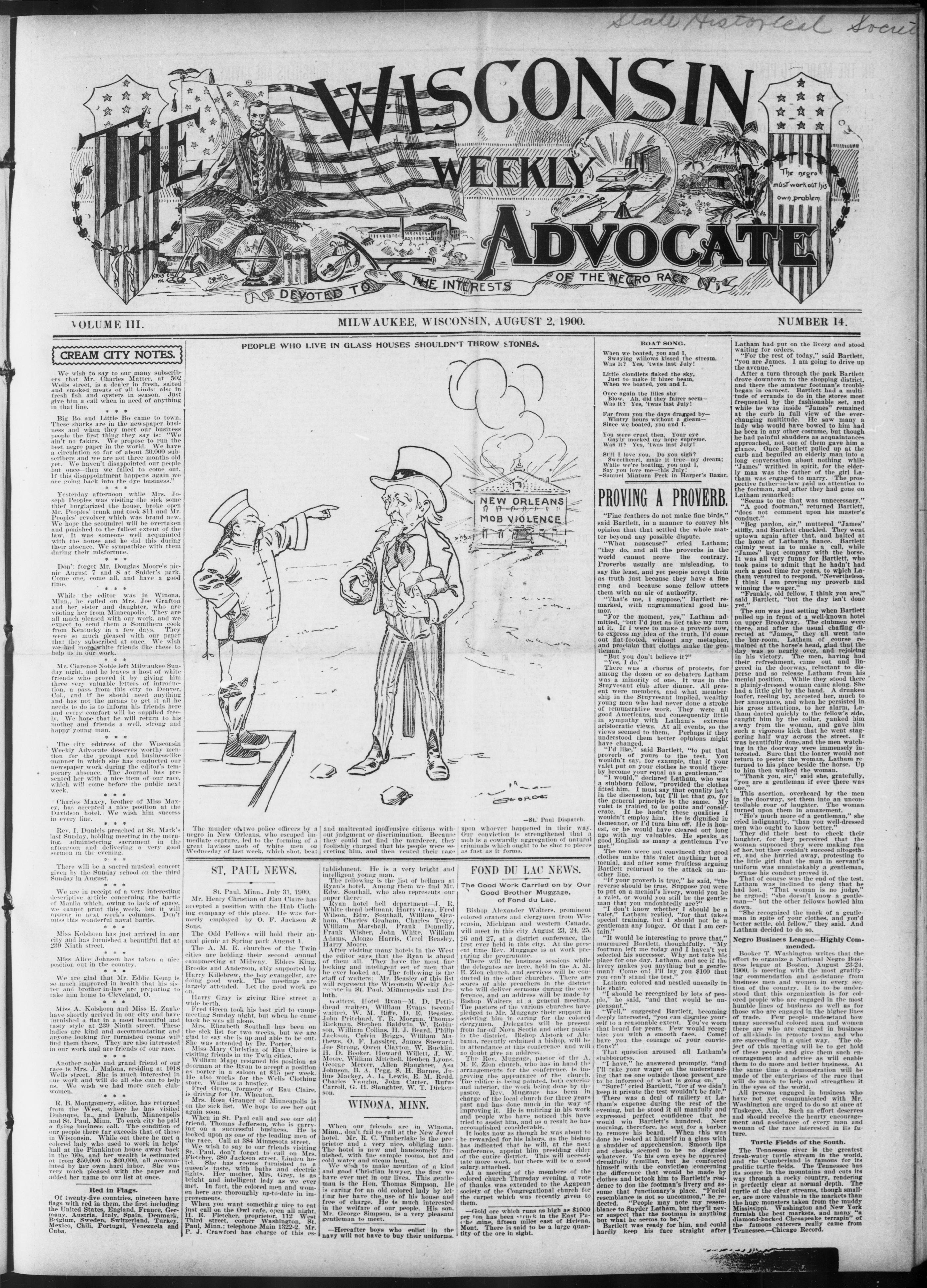
PEOPLE WHO LIVE IN GLASS HOUSES SHOULDN'T THROW STONES.
NEW ORLEANS
MOB VIOLENCE
GEORGE
The murder of two police officers by a negro in New Orleans, who escaped immediate capture, led to the forming of a great lawless mob of white men on Wednesday of last week, which shot, beat
ST. PAUL NEWS.
St. Paul, Minn., July 31, 1900. Mr. Henry Christian of Eau Claire has accepted a position with the Hub Clothing company of this place. He was formerly employed by O. F. Jackson & Sons. The Odd Fellows will hold their annual picnic at Spring park August 1. The A. M. E. churches of the Twin cities are holding their second annual campmeeting at Midway. Elders King, Brooks and Anderson, ably supported by Harry Killebrew, the boy evangelist, are doing good work. The meetings are largely attended. Let the good work go on. Harry Gray is giving Rice street a wide berth.
Fred Green took his best girl to campmeeting Sunday night, but when he came back he was all alone.
Mrs. Elizabeth Southall has been on the sick list for two weeks, but we are glad to say she is up and able to be out. She was attended by Dr. Porter.
Miss Mary Christian of Eau Claire is visiting friends in the Twin cities.
William Mapp resigned his position as doorman at the Ryan to accept a position as porter in a saloon at $15 per week. He also works for the Wells Clothing store. Willie is a hustler.
Fred Green, formerly of Eau Claire, is driving for Dr. Wheaton.
Mrs. Rosa Granger of Minneapolis is on the sick list. We hope to see her out again soon.
When in St. Paul call and see our old friend, Thomas Jefferson, who is carrying on a successful business. He is looked upon as one of the leading men of the race. Call at 384 Minnesota street.
We wish to say to our friends visiting St. Paul, don't forget to call on Mrs. Fletcher, 380 Jackson street, Linden hotel. She has rooms furnished to a queen's taste, with baths and electric lights. Her mother, Mrs. Grey, is as bright and intelligent lady as we ever met. In fact, the colored men and women here are thoroughly up-to-date in improvements.
When you want something nice to eat just call on the Owl cafe, open all night, H. E. Fletcher, proprietor, 112 West Third street, corner Washington, St. Paul, Minn.; telephone Main 1322-2. Mr. P. J. Crawford has charge of this es-
and maltreated inoffensive citizens without judgment or discrimination. Because they could not find the murderer, they foolishly charged that his people were secreting him, and then vented their rage
tablishment. He is a very bright and intelligent young man.
The following is the list of bellmen at Ryan's hotel. Among them we find Mr. Edw. Southall, who also represents our paper there:
Ryan hotel bell department—J. R. White (head bellman). Harry Gray, Fred Wilson, Edw. Southall, William Graham, Charles Graham, Charles Terry, William Marshall, Frank Donnelly, Frank Wisher, John White, William Adams, Alonzo Harris, Creol Beasley, Harry Moore.
After visiting many hotels in the West the editor says that the Ryan is ahead of them all. They have the most fine looking and intelligent set of men that he ever looked at. The following is the staff of waiters: Mr. Beasley of this list will represent the Wisconsin Weekly Advocate in St. Paul, Mifineapolis and Duluth.
waiters, Hotel Ryan—M. D. Pettis (head waiter), William Evans (second waiter), W. M. Riffle, D. E. Beasley, John Pritchard, T. R. Morgan, Thomas Rickman, Stephen Baldwin, W. Robinson, William Collins, H. J. Beard, Philip Jackson, Calvin Briggs, William Matthews, O. F. Lassiter, James Steward, Joe Strong, Owen Clayton, W. Bucklin, H. D. Booker, Howard Willett, J. W. Moore, William Mitchell, Reuben Lyons, George Mercer, Allen Slaughter, Asa Johnson, B. A. Pegg, S. H. Barnes, Julius Mackey, A. L. Lewis, E. M. Redd, Charles Vaughn, John Carter, Rufus Carroll, G. H. Slaughter, W. T. Dickenson.
WINONA. MINN.
When our friends are in Winona, Minn., don't fail to call at the New Jewel hotel. Mr. R. C. Timberlake is the proprietor and a very nice, obliging man. The hotel is new and handsomely furnished, with fine sample rooms, hot and cold water and steam heat. We wish to make mention of a kind and good Christian lawyer, the first we have ever met in our lives. This gentleman is the Hon. Thomas Simpson. He is caring for an old colored lady by letting her have the use of his house and free of charge. He is much interested in the welfare of our people. His son, Mr. George Simpson, is a very pleasant gentleman to meet.
—Hereafter boys who enlist in the navy will not have to buy their uniforms.
-St. Paul Dispatch. upon whoever happened in their way. Our conviction is strengthened that a mob is a cowardly aggregation of natural criminals which ought to be shot to pieces as fast as it forms.
FOND DU LAC NEWS.
The Good Work Carried on by Our Good Brother Muggage, of Fond du Lac,
Bishop Alexander Walters, prominent colored orators and clergymen from Wisconsin, Michigan and western Canada, will meet in this city August 23, 24, 25, 26 and 27, at a district conference, the first ever held in this city. At the present time Rev. Muggage is at work preparing the programme.
There will be business sessions while the delegates are here, held in the A. M. E. Zion church, and services will be conducted in the other churches. There are scores of able preachers in the district who will deliver sermons during the conference, and an address will be made by Bishop Walters at a general meeting. The pastors of the various churches have pledged to Mr. Muggage their support in assisting him in caring for the colored clergymen. Delegates will be present from far-off Nova Scotia and other points in the district. Bishop Alstork of Alabama, recently ordained a bishop, will be in attendance at this conference, and will no doubt give an address.
The Rev. Muggage, pastor of the A. M. E. Zion church, who has in hand the arrangements for the conference, is improving the appearance of the church. The edifice is being painted, both exterior and interior, the work being done by the pastor. Rev. Muggage has been in charge of the local church for three years past and has done much in the way of improving it. He is untiring in his work and people who have noticed this have tried to assist him, and as a result he has accomplished considerable. It looks now as though he was about to be rewarded for his labors, as the bishop has indicated that he will, at the next conference, appoint him presiding elder of the entire district. This will necessitate more work, but there will be a good salary attached.
At a meeting of the members of the colored church Thursday evening, a vote of thanks was extended to the Agapean society of the Congregational church for the carpet which was recently given to them.
Gold ore which runs as high as $1000 per ton has been struck in the East Pacific mine, fifteen miles east of Helena, Mont. There is said to be a large quantity of the ore in sight.
BOAT SONG.
When we boated, you and I,
Swaying willows kissed the stream.
Was it? Yes, 'twas last July!
Little cloudlets flaked the sky,
Just to make it bluer beam,
When we boated, you and I.
Once again the lilies shy
Blow. Ah, did they falrer seem—
Was it? Yes, 'twas last July!
Far from you the days dragged by—
Wintry hours without a gleam—
Since we boated, you and I.
You were cruel then. Your eye
Gayly mocked my hope supreme.
Was it? Yes, 'twas last July!
Still I love you. Do you sigh?
Sweetheart, make it true—my dream;
While we're boating, you and I,
Say you love me—this July!
-Samuel Minturn Peck in Harper's Bazar
PROVING A PROVERB.
PROVING A PROVERB.
"Fine feathers do not make fine birds," said Bartlett, in a manner to convey his opinion that that settled the whole matter beyond any possible dispute.
"What nonsense!" cried Latham; "they do, and all the proverbs in the world cannot prove the contrary. Proverbs usually are misleading, to say the least, and yet people accept them as truth just because they have a fine ring and because some fellow utters them with an air of authority.
"That's me, I suppose," Bartlett remarked, with ungrammatical good humor.
"For the moment, yes," Latham admitted, "but I'd just as lief take my turn at it. If I were to make a proverb now, to express my idea of the truth, I'd come out flat-footed, without any metaphor, and proclaim that clothes make the gentleman."
"But you don't believe it?"
"Yes, I do."
There was a chorus of protests, for among the dozen or so debaters Latham was a minority of one. It was in the Stuyvesant club after dinner. All present were members, and what membership in the Stuyvesant implied, wealthy young men who had never done a stroke of remunerative work. They were all good Americans, and consequently little in sympathy with Latham's extreme aristocratic views. At all events, so the views seemed to them. Perhaps if they understood them better opinions might have changed.
"I'd like," said Bartlett, "to put that proverb of yours to the test. You wouldn't say, for example, that if your valet put on your clothes he would thereby become your equal as a gentleman."
"I would," declared Latham, who was a stubborn fellow, "provided the clothes fitted him. I must say that equality isn't in the discussion, but I'll let that go, for the general principle is the same. My valet is trained to be polite and considerate. If he hadn't these qualities I wouldn't employ him. He is dignified in demeanor, or I'd turn him off. He is houest, or he would have cleared out long ago with my valuables. He speaks as good English as many a gentleman I've met."
The men were not convinced that good clothes make this valet anything but a menial, and after some fruitless arguing Bartlett returned to the attack on another line.
"If your proverb is true," he said, "the reverse should be true. Suppose you were to put on a menial's livery, would you be a valet, or would you still be the gentleman that you undoubtedly are?"
"I don't know whether I should be a valet." Latham replied, "for that takes special training, but I should not be a gentleman any longer. Of that I am certain."
"It would be interesting to prove that." murmured Bartlett, thoughtfully. "My footman left me today and I haven't yet selected his successor. Why not take his place for one day, Latham, and see if the livery makes you anything but a gentleman? Come on! I'll lay you $100 that you can't stand the test."
Latham colored and nestled uneasily in his chair.
"I should be recognized by lots of people," he said, "and that would be unpleasant."
"Well," suggested Bartlett, becoming deeply interested, "you can disguise yourself to a reasonable extent. You've worn that beard for years. Few would recognize you with a smooth face. Come! have you the courage of your convictions?"
That question aroused all Latham's stubbornness.
"I have," he answered promptly, "and I'll take your wager on the understanding that no one outside those present are to be informed of what is going on."
"Sure!" cried Bartlett, "for if we didn't keep it private the test wouldn't be fair."
There was a deal of raillery at Latham's expense during the rest of the evening, but he stood it all manfully and expressed perfect confidence that he would win Bartlett's hundred. Next morning, therefore, he sent for a barber to remove his beard. When this was done he looked at himself in a glass with a shudder of apprehension. Smooth lips and cheeks seemed to be no disguise whatever. To his own eyes he appeared dreadfully familiar, but he comforted himself with the conviction concerning the difference that would be made by clothes and betook him to Bartlett's residence to don the footman's livery and assume that functionary's place. "Facial resemblance is not so uncommon," he reflected. "People may note my resemblance to Snyder Latham, but they'll never suspect that the footman is anything but what he seems to be."
Bartlett was ready for him, and could hardly keep his face straight after
Latham had put on the livery and stood waiting for orders.
"For the rest of today," said Bartlett,
"you are James. I am going to drive up the avenue."
After a turn through the park Bartlett drove downtown to the shopping district, and there the amateur footman's trouble began in earnest. Bartlett had a multitude of errands to do in the stores most frequented by the fashionable set, and while he was inside "James" remained at the curb in full view of the everchanging multitude. He saw many a lady who would have bowed to him had he been in any other costume, but though he had painful shudders as acquaintances approached, not one of them gave him a glance. Once Bartlett pulled up at the curb and beguiled an elderly man into a long conversation about nothing while "James" writhed in spirit, for the elderly man was the father of the girl Latham was engaged to marry. The prospective father-in-law paid no attention to the footman, and after they had gone on Latham remarked:
"Seems to me that was unnecessary."
"A good footman," returned Bartlett,
"does not comment upon his master's
conduct."
"Beg pardon, sir," muttered "James"
stiffly, and Bartlett chuckled. They went
uptown again after that, and halted at
the home of Latham's fiance. Bartlett
calmly went in to make a call, while
"James" kept company with the horse.
It was all very funny for Bartlett, who
took pains to admit that he hadn't had
such a good time for years, to which Latham ventured to respond. "Nevertheless,
I think I am proving my proverb and
winning the wager."
"Frankly, old fellow, I think you are,"
said Bartlett, "but the day isn't done
vet."
The sun was just setting when Bartlett pulled up in front of a well-known hotel on upper Broadway. The clubmen were there, and after the usual chaffing directed at "James," they all went into the bar-room. Latham of course remained at the horse's head, glad that the day was so nearly over, and rejoicing in his victory. The men, having had their refreshment, came out and lingered in the doorway, reluctant to disperse and so release Latham from his menial position. While they stood there a plainly-dressed woman came along. She had a little girl by the hand. A drunken loafer, reeling by, accosted her, much to her annoyance, and when he persisted in his gross attentions, to her alarm, Latham darted quickly to the fellow's side, caught him by the collar, yanked him away from the woman, and gave him such a vigorous kick that he went staggering half way across the street. It was beautifully done, and the men watching in the doorway were immensely interested. Sure that the loater would not return to pester the woman, Latham returned to his place beside the horse. Up to him then walked the woman.
"Thank you, sir," said she, gratefully, "you are a gentleman if ever there was one."
This assertion, overheard by the men in the doorway, set them into an uncontrollable roar of laughter. The woman turned upon them in amazement.
"He's much more of a gentleman," she cried indignantly, "than you well-dressed men who ought to know better."
They did their best to check their laughter, for they perceived that the woman supposed they were making fun of her, but they couldn't succeed altogether, and she hurried away, protesting to the little girl that the man in servant's uniform was unmistakably a gentleman, because his conduct proved it.
That of course was the end of the test. Latham was inclined to deny that he had lost. "That woman is no judge," he argued: "she doesn't know a gentleman—" but the other fellows howled him down. "She recognized the mark of a gentleman in spite of your clothes, and you'd better settle, old fellow," they said. And Latham decided to do so.
Negro Business League—Highly Commended
Booker T. Washington writes that the effort to organize a National Negro Business league at Boston, August 23-24, 1900, is meeting with the most gratifying commendation and assistance from business men and women in every section of the country. It is to be understood that this organization is for colored people who are engaged in the most humble lines of business as well as for those who are engaged in the higher lines of trade. Few people understand how many successful colored men and women there are who are engaged in business of all kinds in remote towns and who are succeeding in a quiet way. The object of this meeting will be to get hold of these people and give them such encouragement and advice as will enable them to do more and better business. At the same time a demonstration will be made of the enterprises of the race that will do much to help and strengthen it in the eyes of the world.
All persons engaged in business who have not yet communicated with Mr. Washington are urged to do so at once at Tuskegee, Ala. Such an effort deserves and should receive the hearty encouragement and assistance of every man and woman of the race interested in its future.
Turtle Fields of the South.
The Tennessee river is the greatest fresh-water turtle stream in the world, and the Cumberland is famous for its prolific turtle fields. The Tennessee has its source in the mountains and cuts its way through a rocky country, rendering it perfectly clear at normal depth. The turtle of the clear streams, though smaller, are more valuable in the markets than the huge monsters taken from the muddy Mississippi. Washington and New York furnish the best markets, and many "a diamond-backed Chesapeake terrapin" of the famous caterers really came from Tennessee.—Chicago Record.
ON THE MARCH TO PEKIN.
About 17,000 Troops Taking Part in the Forward Movement.
Message from Minister Conger Forwarded from Tien Tsin Says All Are Safe and Well.
Tien Tsin, Thursday, July 26, via Chefoo, July 30, and Shanghai, Aug. 1.—The American commander received orders from Washington today not to delay the advance on Pekin. He was also informed that heavy reinforcements are en route.
Great activity is noticeable at Japanese headquarters. Transport preparations are being hurried. It is extremely unlikely that either the Japanese or the British intend to be left behind the Americans, though the British preparations are a long way from completeness. The Japanese organization, on the other hand, excites the admiration of all.
The total strength of the allies here is 17,000. Reinforcements are arriving daily.
London, Aug. 1.—"The allies began the advance from Tien Tsin this morning," announces an agency bulletin dated at Shanghai at 11:10 a.m. today. It is assumed that the Americans, British and Japanese are taking part in this forward movement, whether other nationalities are or not. An advance base will probably be established twenty or thirty miles nearer Pekin, and supplies will be assembled preparatory to a determined stroke at the capital.
Of the 60,000 allies debarked at Pei-Chi-Li ports, English military observers consider that 30,000 are available for an advance beyond Tien Tsin. The Chinese force, according to the vague gatherings of the allies' intelligence offices, up to July 27, were disposed in a great are thirty miles long and distant ten or fifteen miles. The numbers and exact location of the several divisions are utterly unknown. The Pei-Ho river is blockaded by sunken stone-laden junks for twenty miles beyond Tien Tsin and farther up, according to Chinese spies of the allies, a dam has been constructed for the purpose of flooding the low-lying expanse of country.
The First Engagement.
The first engagement of the relief expedition will probably be at Pei Tang, where the viceroy of Yulu personally commands.
The following information was brought to Tien Tsin Wednesday July 25 by a Chinese missionary student who was sent to the British legation at Pekin. He was unable to deliver the message entrusted to him, and left Pekin July 18. He saw a few troops between Pekin and Yant Tsun. No works had been constructed. Food in Pekin was scarce and the city would be quite unable to endure a siege. Among the scraps of information brought by another courier who left Pekin July 14 was the fact that Gen. Ma, a notable Boxer chief, had been killed by the legationers.
Chinese Have 630 Hostages.
London, Aug. 1.—Whatever may be the view of the state department at Washington, the officials here are convinced that the Chinese government, under the guise of protection offered to the legations, is seeking to hold back the allied forces until terms of peace can be settled on a basis of financial indemnities. The legations will be exposed to an attack from regular troops or from the Boxers if the allied army advances from Tien Tsin. The Chinese have 600 hostages, whose blood will be declared to be on the heads of the advancing battalions, and hence it will be dangerous for an army to march on Pekin until the foreigners have been delivered from their critical position.
Press dispatches yesterday were meager, the most important point, being the announcement on Chinese authority that the legations were safe on July 24.
London, Aug. 1.—A member of the Chinese legation today discussed the situation at Pekin. He said:
"Li Hung Chang's statement that the lives of the ministers would be endangered by an advance is not a piece of diplomacy, but a serious prediction of the consequences of such an action. Gen. Tung Fuh Siang is known to be antiforeign in his sentiments, but we cannot dispense with his services; and, having a large number of soldiers under him, he might order a European massacre, which the Emperor and Empress would be unable to prevent.
"My object now is to advise the allies not to do any act of vengeance, but to restore peace and to secure guarantees for the future. This can best be done by co-operating with Li Hung Chang. If you push on to Pekin, I believe you will provoke a general rising throughout the empire, the result of which will be the destruction of the lives and property of foreigners everywhere."
ALIVE AND WELL.
Reassuring Message from United States Minister at Pekin.
Washington. D. C., Aug. 1.—Slowly the mystery that has been surrounding the Chinese capital is being dispelled. Last night the war department received news from Minister Conger at Pekin as follows:
Cheefoo (undated).—Corbin, Washington:
Tlen Tsin, 27th—Message just received from Conger says since 16th, by agreement, no firing. Have provisions several weeks; little ammunition. All safe, well.
I (Daggett) report allied forces soon advance. Practically no looting by Americans, no unnecessary killing, Indiana arrived 26th. Order MaeCann, Sladen, both Allens, Mitchell, Bryce join regiment here.
DAGGETT.
A second dispatch from the same source says:
Cheefoo.—Corbin, Washington.—Tien Tsim. 30th.—Flintshire arrived 27th. Two hundred and fifty seven Ninth infantry sick. Ten doctors, 100 hospital corps men, twenty signal men needed. Unavoidable deploy transports. Foreign troops arriving. DAGGETT.
News from Pekin July 23.
Additional cable dispatches received from China further encouraged the administration officials toward a speedy solution of the Chinese trouble. Lieut.-Col. Coolidge, commanding the Ninth infantry at Tien Tsin, cabled Adjt.-Gen. Corbin by way of Chefoo as follows: Tien Tsin, July 27.—Following letter of Lieut.-Col. Shiba, military attache at the legation of Pekin, dated July 23, arrived Tien Tsin 25, at 9 o'clock in the evening:
"Pekin, July 22, evening. We are all awaiting inpatient arrival of re-enforcing army. When are you coming? All legations have been blockaded since 13th of last month, and since the 20th we have been attacked continually night and day by the Chinese soldiers from more than ten encampments. By a supreme effort we are still defending. We are daily awaiting with the greatest anxiety arrival of re-inforcing army, and if you can't reach here in less than a week's time it is probable that we will be unable to hold out any longer. Emperor and Empress dowager appear to be still at Pekin. Were our re-inforcements to arrive very probable that they would flee to Wan Shoshan. Killed and wounded up to date, eight killed, one a captain of in-
fantry and one an ambassador's attache; seven seri- sly wounded, the first secretary of legation being one of the twenty slightly wounded. The number of Europeans killed is sixty in all." COOLIDGE.
Allies Ready to Start.
There is no doubt whatever that the ministers are alive. Perhaps the most welcome intelligence of the day was the announcement by Gen. Chaffee that the international forces were ready to start for Pekin. According to the date given by him the forward movement began yesterday.
EARL LL INTERCEDED.
Viceroys Memorialized Emperor to Protect Ministers.
Washington, D. C., Aug. 1.—The Chinese minister called at the state department early today and presented to Secretary Hay some of the latest correspondence that has passed between Li Hung Chang and the imperial Chinese government. The minister's dispatches state that on July 19 Li Hung Chang and several of the most influential viceroyos memorialized the Emperor to extend protection to all foreigners in Pekin and elsewhere in China. The reply to this memorial was delayed for some time and the viceroyos presented another petition asking that the ministers should either be given safe escort from Pekin or that free communication should be opened between them and their governments. The reply to this last memorial has not been received, but after its dispatch by the viceroyos, Li Hung Chang received an answer to the first memorial in which the Emperor, by imperial edict, ordered all loyal Chinese to protect foreigners in the empire.
Following is a copy of the dispatch from Li Hung Chang presented to Secretary Hay. It was received by Mr. Wu last midnight from the Chinese minister in London:
Just received a telegram from Pao-Ting-Fu of the sixth moon, 22d day (July 19), that the privy council had that day received an imperial edict as follows:
"We have received the memorial of Li Hung Chang and others imploring us to save and protect the ministers of the various nations. Now the ministers are all safe and well, and Li Hung Chang is directed to wire to Yang Yu and others, so that they may inform the respective secretaries for foreign affairs accordingly. Respect this."
This telegram has been delayed in its transmission. The other day I and other viceroyss sent a joint memorial requesting that the different ministers be escorted out of Pekin or that they first be enabled to freely communicate by letter or wire with their respective governments. When an imperial answer is received I will again wire. Communicate this to Minister Yang at St. Petersburg, Minister Yu at Paris and Minister Wu at Washington, for them to inform secretaries for foreign affairs.
DEFENSE OF SHANGHAI
Foreign Consuls Invite the British Admiral to Take Command.
London, Aug. 1.—Shanghai telegrams of this date say the foreign consuls met yesterday and decided to invite Admiral Seymour to take command of the Shanghai defenses. The United States consul-general, Mr. Goodnow, and the French consul-general, M. De Bezaure, on behalf of the consuls, visited Admiral Seymour and he promised to draw up plans and submit them to a council of officers. The Shanghai municipai council objects to the consular action.
The British Second infantry brigade has been ordered to debark at Hong Kong to form a flying column to serve anywhere in China.
Two more transports with Indian troops on board are due to arrive today. The customs officers at Canton have seized a Chinese junk which had 2000 officers and a number of commissioned
Declined to Leave.
It is reported that another letter from the British minister at Pekin, Sir Claude MacDonald, dated Pekin, Wednesday, July 25, has reached Taku. The Chinese government has renewed the suggestion that the minister leave the capital, but the minister declined. The Belgian government has received news that the allies have already marched eight miles in the direction of Pekin.
HAVE THEIR HANDS FULL.
Russians Have All They Can Do to Cope with Chinese.
St. Petersburg, Aug. 1.—Official dispatches from the far East continue to show that Russian military commanders there have all they can do to cope with armed Chinese in the territory adjacent to Port Arthur. Russian detachments are seeking to disarm native soldiers who are in the neutral zone contrary to treaty stipulations.
Figthing has occurred in various parts of the Lino-Tung peninsula. One detachmetn was twice attacked by imperial troops, clad as civilians and with their military badges concealed by their car tridge boxes.
Another detachment lost ten killed and thirty wounded. A third force was treacherously attacked and lost twenty killed, six wounded and four missing.
NO CIPHER MESSAGES.
Dispatches to Ministers Must be in Ordinary Language.
Brussels, Aug. 1.—The minister of foreign affairs, M. de Favereau, has received the following dispatch from M. de Cartier de Marchienne, secretary of the Belgian legation in China now in Shanghai, dated July 31:
"On July 22 the consul-general of the United States telegraphed the United States minister in Pekin, through the intermediary of the local authorities, Sheng, the taotai, has informed him that the tsung li yamen refuses to transmit messages in cipher to the minister and requests that all dispatches be in ordinary language."
Chefoo, Aug. 1.—The governor of Shan Tung has telegraphed to United Stateh Consul Fowler that the tsung-liyamen directs him to notify the consuls that "as the military operations at Pekin and Tien Tsin are unsettled." only messages in plain language, without cipher or reference to military affairs, will be delivered to the ministers. The governor says that the rebels occupy Pao Ting Fu, and Consul Fowler fears that the missionaries there have been murdered.
Sending Home the Wounded.
Washington, D. C., Aug. 1.—A cablegram was this morning received at the navy department from Admiral Remey stating that he has sent home on the hospital ship Solace those who were wounded at the Battle of Tien Tsin and those who were sick among the American force. His statement that the Japanese hospital ship will be at our disposal for conveying sick and wounded to Nagasaki is welcome intelligence and may relieve the situation materially in case of hard fighting in Pekin.
STORY OF THE SIEGE.
Legationers Worn Out by Constant Guard Duty.
Chicago, Ill., Aug. 1.—A cable dispatch to the Daily News from Chefoo, July 31, via Shanghai, August 1, says that Dr. Robert Coltman, Jr., the staff correspondent of the Chicago Record in Pekin who had not been heard from since June 12, sends the following dispatch: "Pekin, July 21.—Baron von Ketteler, the German minister, was murdered by Chinese troops and his secretary wounded June 20, while on his way to the tsung-li-yamen. The foreign residents are besieged in the British legation and have been under a daily fire from artillery and rifles
"The cowardice of the Chinese fortunately prevented them from making successful rushes. Our losses are sixty killed and seventy wounded. The Chinese losses exceed 1000.
"There has been no word from the outside world. Food is plentiful, such as it is—rice and horseflesh. Yesterday, under a flag of truce, a message was sent by Yung Lu asking if Sir Claude MacDonald, the British minister, would consent to a truce. The minister replied he was willing provided the Chinese came no closer. The shell firing then ceased, and everything is now quiet.
"We now hope that, having defeated the Chinese, relief is nearing us. We are all exhausted with constant standing on guard, fighting, building barricades, and digging trenches both night and day. All the legations except the British are utterly wrecked by shot and shell. The Austrian, Italian, Belgian and Holland buildings are burned to the ground. The British legation is also much shattered. "The United States marines still hold a vital position on the city wall commanding the legations.
"After a brilliant sortie on the night of July 3 Capt. Myers succeeded in driving back the Kausuh mounted troops. During the fight Capt. Myers was slightly wounded. Secretary Squiers of the United States legation deserves the greatest credit for his services throughout the siege. His military experience and energy are invaluable. Many flags and rifles were captured by Capt. Myers. "We fear that treachery is possible when the defeated Chinese troops enter the city. Meanwhile we are living in intense anxiety and hoping for early relief."
MISSIONARIES IN PEKIN.
Eighteen of the Methodist Colony Still at the Capital.
New York, Aug. 1,—Rev. Dr. A. B. Leonard of the Methodist Missionary society today received a cablegram from Rev. Frederick Brown at Chefoo that eighteen persons of the Methodist colony are in Pekin. These include the families of F. D. Gamewell and W. F. Walker, W. H. Hobart, H. E. King, George W. Verity, George R. Davis, George D. B. Lowery, Mrs. Charlotte Jewell, Mrs. Edward K. Lowery, Miss Anna D. Gloss, Miss Alice Terrrell, the Misses Elizabeth and Emma Martin, Miss Gertrude Gilman and Miss Edna G. Terry. He understands also that there are at Tien Tsin James H. Pyke, Victory Martin, Edward K. Lowery and Frederick Brown and Miss Rachel B. Benn.
The following have started home: J. F. Hayner and wife, H. S. Hopkins and wife, Ida M. Stevenson, Frances O. Wilson, Ella J. Glover, Miranda Groucher and May E. Shockley.
A cablegram was received today by Rev. Dr. Arthur C. Brown of the Presbyterian board of foreign missions, from Rev. W. O. Elterich. It came from Chefoo and was as follows:
"People at Pekin holding out. Report Shanghai missionaries Pao-Ting-fu massacred. Chefoo situation unchanged. Continued persecution Christians."
RIDPATH IS DEAD.
Noted Historian Passes Away at New York Hospital-Complication of Diseases.
New York, Aug. 1.—John Clark Ridpath, the historian, died in the Presbyterian hospital last evening from a complication of diseases. He had been a patient in the hospital since April 26. At the time of the historian's death his wife and son, S. B. Ridpath, were at the bedside. The body was later removed from the hospital. The body will be taken to Greencastle, Ind., the historian's late home, where funeral services will be held. There will be no funeral service in this city.
John Clark Ridpath, historian and author, was born in Putnam county, Ind., on April 26, 1840. Through his father he was descended from the Ridpaths of Berwick-on-Tweed and through his mother from Go. Samuel Mathews of Virginia. His parents were poor and emigrated from Montgomery county, Va., into Indiana. John Clark was the eldest of the children, and from childhood gave evidence of great talents. There were many difficulties in the way of his securing an education, but an active mind and much energy enabled him to overcome obstacles, and when he was 11 years old he had acquired all that was taught in the log schoolhouse.
Applies Himself to Study.
For four years after leaving the home school he studied by himself works on natural philosophy, chemistry and history. At 17 he was teaching school and clerking in a store. His father furnished him with funds to pay for the first year at Asbury (now De Pauw) university, from which he was graduated in 1863, having gone through a six-years' course in four years, supporting himself at the university by private teaching and contributions to newspapers. His attainments in Latin and Greek were regarded as phenomenal.
He became principal of Thorntown academy in 1864 and superintendent of the Lawrenceburg, Ind., schools in 1866. In 1869 Asbury called him to the chair of English literature, and in 1871 changed him to the chair of belles lettres. In 1879 he was elected vice-president of the university, and chiefly through his efforts it received its large endowment and change of name to De Pauw.
First Historical Work.
His first historical work, the "Academic History of the United States," appeared in 1874 and was immediately successful. This work was abridged in 1876 and called "Grammar School History," and in this form is still a textbook in the schools of the country. His "Popular History," issued in 1877, reached a sale of 350,000 copies and was translated into German. In the next four years appeared an "Inductive Grammar of the English Language," a monograph on "Alexander Hamilton" and the "Life and Work of Garfield." Seventy-five thousand of the latter work were sold in three months and a German translation made. "The Trial of Guiteau," a monograph, was published in 1882, after the appearance of the first volume of "Universal History," which was made into a four-volume work and was a big success. "Beyond the Sierras" was published in 1888, and "Great Races of Mankind," four volumes, in 1891. "The Life of Columbus" also appeared in 1891.
Mr. Ridpath was a regular contributor to magazines and newspapers, and was one of the editors of the "People's Cyclopedia." Syracuse university in 1880 made him an LL. D.
He was married in 1863 to Hannah R. Smythe, and leaves three daughters and one son.
THE BOAT CAPSIZED
Three of the Six People Who Were in it Were Drowned.
Muskegon, Mich., Aug. 1.—Two men and a young woman lost their lives by drowning in Muskegon lake last night. The drowned are: John Mortwedt, Charles Erickson, Selma Telefson. Three other occupants of the boat were saved. The boat in which the party were rowing capsized about a mile from shore. Mortwedt managed to right the craft and saved two of the girls. This makes a total of nine persons drowned in the vicinity in less than six weeks.
PRINCE ALFRED DEAD.
PRINCE ALFRED DEAD.
Queen Victoria's Second Son Had Cancerous Growth at the Root of His Tongue.
Coburg, July 31.—The Duke of Saxe-Coburg, who died at 10 o'clock last evening at Rosenau castle, by his sudden demise escaped a painful, lingering end. Recently at a consultation of specialists in Vienna it was discovered that there was a cancerous growth at the root of his tongue. At the desire of the duchess and other members of the family who were aware of the nature of his disease, the duke took up his residence at Rosenau. His royal highness was unaware of the real state of his health and hoped he would recover until Friday last, when his condition became such as to preclude hope. Saturday and Sunday he suffered such violent attacks of suffocation that arrangements were made for performing the operation of tracheotomy. Finally the duke died without having suffered severe pain. During the minority of his heir, the Duke of Albany, the government of the duchy will be conducted by the hereditary prince of Hohenlohe-Langenberg, the guardian of the young duke.
Death Unexpected.
London, July 31.—News of the death of the Duke of Saxe-Coburg-Gotha, second son of Queen Victoria, has created a sensation in London, as it was totally unexpected. There were many callers at Clarence and Marlborough houses and the lord chamberlain's offices. The flags were half-masted at the Carleton, Reform, Sports and other West End clubs. The Queen was deeply affected, and the Prince of Wales canceled the arrangements for attending Goodwood today, where his horse Lucknow was the favorite in the race for the Steward's cup.
At Windsor there were many signs of mourning, the bells in the Curfew tower of St. George's chapel being tolled. It is stated that the body of the late duke will be embalmed and brought to England for interment, and that it will lie in state at Windsor.
The duke's successor, the Duke of Albany, arrived in London this morning. The lord mayor of London sent a message of condolence to the Queen on behalf of the citizens of London, expressing the hope that sympathy of the nation would prove a solace and comfort in her bereavement. Numerous public and semi-public functions have been abandoned and the court and society will immediately be ordered into mourning. The funeral of the late duke will be held at Coburg on Friday, August 3. The Prince of Wales will represent the Queen. He will be accompanied to Coburg by either his son, the Duke of York, or his brother, the Duke of Connaught.
Story of the Succession.
The death of Duke Ernes II. of Saxe-Coburg-Gotha, on August 22, 1893, brought to the throne of that duchy an English prince. Duke Ernest was born June 21, 1818, and succeeded to the throne on the death of his father, January 29, 1844. He was a brother of Prince Albert, the husband of the present Queen Victoria of England. According to the latter's marriage settlement, their second son was to succeed to the throne of Coburg in case Duke Ernest should die childless. This event having taken place, Queen Victoria's second son, the Duke of Edinburgh, ascended the throne of Coburg on August 23, 1893. Alfred Ernest Albert, Duke of Edinburgh, was born at Windsor Castle, August 6, 1844, studied modern languages at Geneva, entered the naval service in 1858, and after long years of distinguished service was promoted in 1882 to the rank of vice-admiral of the British fleet, which position he resigned on becoming Duke of Saxe-Coburg-Gotha. In 1862 he was offered the throne of Greece, but declined the offer. On January 23, 1874, he married the Grand Duchess Marie Alexandrovna, only daughter of Czar Alexander II. of Russia. Of the marriage there are issue surviving one son, Prince Alfred, and four daughters. The Duke of Edinburgh took the oath of allegiance to the constitution on August 23, 1893, in the presence of the whole ministry and Emperor Wilhelm II. of Germany.
JOINED THE NAVY.
Heir to a Million Becomes a Landsman #16 a Month.
St. Joseph, Mo., July 30.—A private dispatch from Chicago stating that Samuel Fritz Nave, who gave his age as 19, had joined the navy as a landsman at $16 a month created great surprise in social and commercial circles and grief in the home of the millionaire father of the young man, S. M. Nave, head of the wholesale grocery firm of Nave & McCord and of business houses in Kansas City, Denver, Pueblo and Omaha. The mother of the young man is prostrated over the news. Young Nave was born and raised here and is 17 years old. He is the only son of his parents and heir to considerably more than $1,000,000. His father had planned a course at Harvard college and upon graduation he was to be placed in charge of large family interests. He wires today from Norfolk that he is aboard the receiving ship Franklin.
NIGHT RIDE WITH A LUNATIC.
Court Officer Has a Desperate Struggle with an Insane Man.
Cincinnati, O., July 31.—Deputy Tony Miller of the probate court has returned from a thrilling ride with a lunatic. He bears on his temple the imprint of the insane man's nails, and it may be that he will be marked for life. Miller was directed by Judge Ferris to take William C. Jordan to Hamilton, Mo. Jordan drew a knife on the judge last Friday. Jordan was rational when he got aboard the sleeper. About 3 a. m. the slumbering occupants were roused by a shriek that echoed through the car. Jordan was wild. Miller had taken his knife, but when the maniac found it gone his rage was without bounds. He threw himself upon Miller. The deputy and his ward battled before the gaze of a dozen pairs of eyes. When it was over Jordan lay bandcuffed on the floor, and Miller arose wiping his bleeding face. Jordan was finally landed safely in Hamilton.
Culture in Kansas.
Mrs. John Appleton has been compelled to open a set of books. She owns a copy of "To Have and to Hold," and as fast as her friends ask to borrow it their names are entered next in line. Seven invitations she has received to recent parties she attributes to her possession of the book her friends want to borrow.—Atchison Globe.
Forty years ago, when one man was engaged in perforating banknotes, he took 750 hours to do 150,000, at a labor cost of $150; while now, with machinery, six men are employed, but do the work in 9 hours and 15 minutes, and although they get about double the wages per hour the labor cost is only $1 instead of $150.
The telephone was first practically used in England in 1876, when over 115 miles of wire existed between London and Norwich, but no telegraph exchange was established until 1879.
In China trades and professions are hereditary in families.
BURGHERS ARE GIVING UP.
Twelve Hundred Additional Prisoners Surrender.
A HOPELESS STRUGGLE.
London, Aug. 1.—Lord Roberts has telegraphed to the war office from Pretoria as follows, under date of August 1: "Hunter reports 1200 more prisoners surrendered yesterday with Commandants Rouse and Fontenel, whilst Commandants Depley, Potgieter and Joubert surrendered to Bruce Hamilton, who collected 600 rifles, 650 ponies and an Armstrong gun. Lient. Anderson, a Danish officer in the Staats artillery, also surrendered. Oliver, with five guns and a number of burghers, broke away in the Harrismith district, but Hunter expects the total prisoners will amount to 4000.
"An unfortunate accident occurred near Frederikstadt on the Krugersdorp-Potchefstroom railway. The enemy had torn up rails and a supply train escorted by the Shropshires was derailed, thirteen being killed and thirty-nine injured, although a special patrol had been ordered to prevent trains passing.
"A special inquiry has been ordered to ascertain why the order was disobeyed."
ascertain why the order was disobeyed. London, Aug. 1.—There is probably no truth in the current report that Lord Roberts has telegraphed to Lord Lansdowne that the war will be speedily brought to an end, for the war office has a remarkable talent for keeping its secrets, and Lord Roberts is not in the habit of forecasting events. There is, however, a strong conviction among the members of Parliament that the close of hostilities is in sight.
Only about 1000 burghers, with a single gun, are reported officially as having surrendered to Gen. Hunter in the Caledon valley, but the Harrismith and Vrede commandoes will probably be brought in, with the remaining artillery. The number of prisoners is not likely to exceed 3000 since there are many desertions. The collapse of the Free State forces will be complete when Gen. Dewet and Mr. Steyn are surrounded and compelled to surrender, and to Gen. Botha has been credited the intention of giving up the fight when his allies are dispersed.
Lord Roberts has recalled Gen. Hamilton's column to Pretoria either to reinforce Col. Broadwood or to relieve Gen. Baden-Powell, and Gen. French is either halting at Middleburg until Sir Redvers Buller can send a division northward through Ermelo, or is pushing on to Koomattipoort. Gen. Baden-Powell and Lord Methuen have an enemy in considerable force to fight west of Pretoria, and Gen. Dewet is dangerous until he is caught, but there is a clearing prospect for a speedy close of hostilities in the Transvaal.
Ruined by Paper Money.
Pretoria, Tuesday, Aug. 1.—Mrs. Botha was the guest of Lord Roberts at dinner yesterday evening.
The Boer animosity to President Kruger grows on account of the fact that he and his officials are persuading the people that South African republic paper money is as good as Bank of England notes because it is based on inalienable state securities, even though the state should be conquered. As the English have not recognized this contention, many burghers have been ruined and much misery prevails. The wives and children of the poorer Boers are almost starving.
Gen. Botha's force is kept together by extraordinary inventions. This correspondent has an official circular asserting that Lord Roberts was forced to retreat south of the Vaal and that Lady Roberts escaped in a balloon.
DRIVEN OUT OF TOWN.
Faith-Healers Decorated with Blue Paint and Forced to Leave Mansfield, O.
Mansfield, O., Aug. 1.—Zion Elders Stevens and McChirkin, Evangelist Fisher of Chicago and Elder A. McFarlane of Marion were escorted by the police through a howling mob of 1000 workmen from the shops at noon yesterday and practically thrown on a train and out of town. They still bore the marks of blue paint with which they were decorated last night by part of the crowd that attended to the final send-off. The people have endured them with difficulty for some time, and last night, during a sermon at the home of a Zion member, their patience gave way and they took the elders forth from their temporary tabernacle after a desperate conflict.
They first barricaded the doors and began an attack on the windows with stones. Then they threatened to use dynamite. A howling, frantic mob was outside; weeping and praying women inside. Fisher and McChirkin were dragged away by the mob to the harrow works, where they were stripped and painted from head to foot with blue paint, applied with brooms, and buckets of paint were poured over them. They were then taken to police headquarters, where they were turned over to the police. Elders Stevens and McFarlane were taken by the police in safety to police headquarters.
HAND SEVERELY CUT.
Senator Foraker the Victim of a Painful Accident.
Washington, D. C., Aug. 1.—Senator J. B. Foraker of Ohio is the victim of an accident that may permanently impair the usefulness of his left hand.
With his son, Capt. Benson Foraker, he started from Spring Lake, N. J., yesterday morning for this city. He stopped in Philadelphia to transact some business, and when ready to leave summoned an automobile hansom and started for the station. When near the station the operator of the carriage tried to open the doors, but found them stuck fast.
The operator gave a strong, impatient shove to the door and the glass was shattered. A large piece, weighing probably three pounds, fell edgewise on the back of the senator's left hand. A wound three inches long was inflicted, the cut going to the bone.
A surgeon was hastily summoned, and after the small pieces of glass had been removed it was found that the tendons had not been severed, as was at first feared. After the wound was dressed the senator resumed his journey to this city. His wound is giving Senator Foraker great pain, and a surgeon was called to examine and redress the hand, which is greatly swollen and perfectly rigid.
LINERS FOR TRANSPORTS.
Three Big Ships to Take German Troops to China.
Berlin. Aug. 1.—The German government has chartered the three gigantic steamers Barbarossa, Koenigen Luise, and Friedrich der Grosse, from the North German Lloyd as transports for China.
MR. WOLCOTT ACCEPTS.
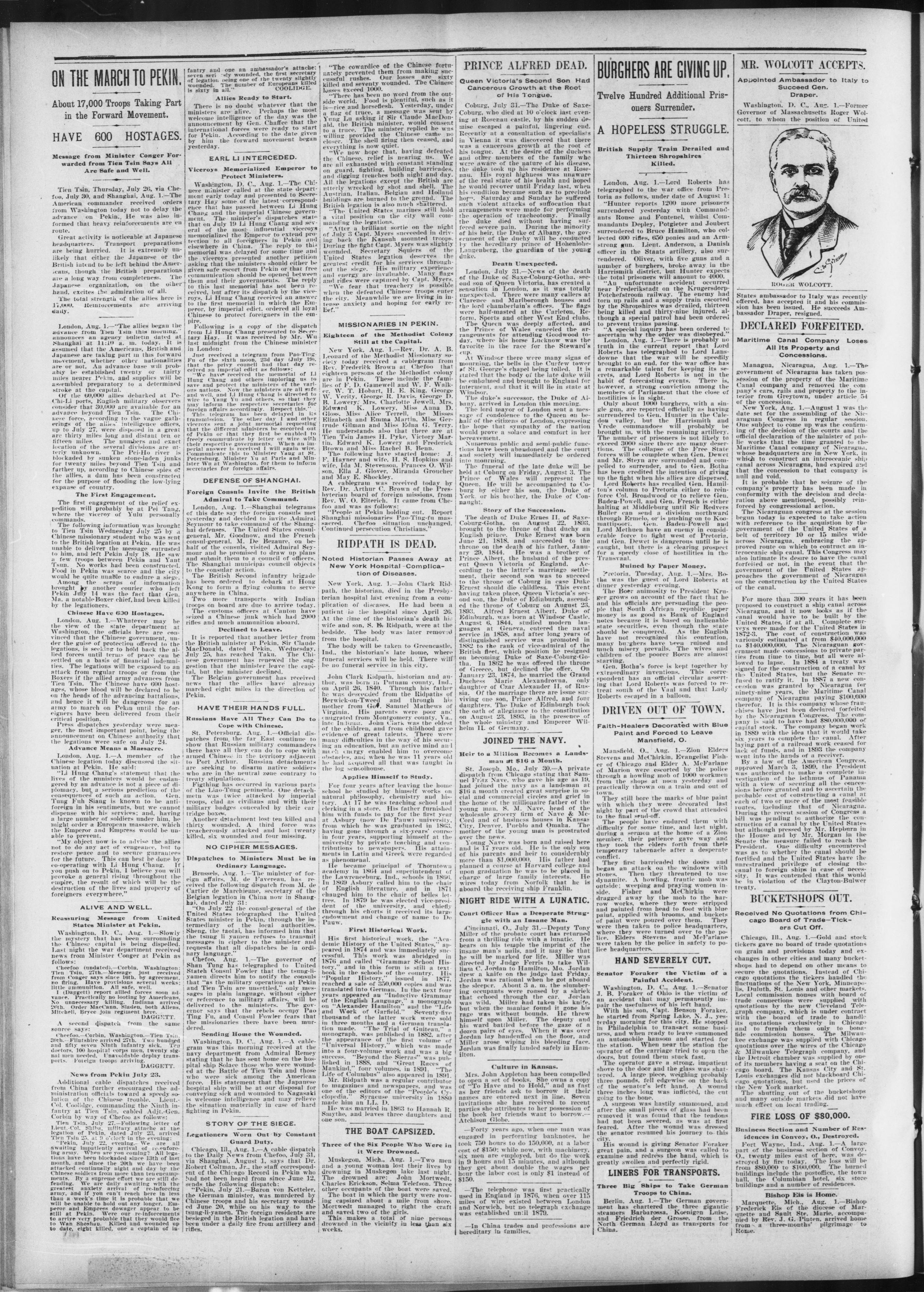
Appointed Ambassador to Italy to Succeed Gen. Draper. Washington. D. C., Aug. 1.—Former Governor of Massachusetts Roger Wolcott, to whom the position of United
ROGER WOLCOTT.
States ambassador to Italy was recently offered, has accepted it and his commission has been issued. He succeeds Ambassador Draper, resigned.
DECLARED FORFEITED.
Maritime Canal Company Loses All Its Property and Concessions. Managua, Nicaragua, Aug. 1.—The government of Nicaragua has taken possession of the property of the Maritime Canal company and removed the company's cars, rails and property to the interior from Greytown, under article 54 of the concession.
New York, Aug. 1.—August 1 was the date set for the assembling of the Nicaraguan Congress in regular session. One subject to come up was the confirming of the decision of the courts and the official declaration of the minister of public works that the time granted to the Maritime Canal company of Nicaragua, whose headquarters are in New York, in which to construct an interoceanic ship canal across Nicaragua, had expired and that the concession to that company is null and void.
It is probable that he seizure of the company's property has been made in conformity with the decision and declaration above mentioned, possibly reinforced by congressional action.
The Nicaraguan congress at the session begun today is expected to take action with reference to the acquisition by the government of the United States of a belt of territory 10 or 15 miles wide across Nicaragua, embracing the approved route on which to construct an interoceanic ship canal. This Congress may also intimate its desire to have the canal forfeited or not, in the event that the government of the United States approaches the government of Nicaragua on the construction by the United States of the canal.
For more than 300 years it has been proposed to construct a ship canal across Nicaragua, and it now looks as if the canal would have to be built by the United States, if at all. Complete surveys were made for the United States in 1872-3. The cost of construction was variously estimated at from $40,000,000 to $140,000,000. The Nicaraguan government made concessions to private parties from time to time, but all were allowed to lapse. In 1884 a treaty was signed for the construction of a canal by the United States, but the Senate refused to ratify it. In 1887 a new concession was granted by Nicaragua for ninety-nine years, the Maritime Canal company of Nicaragua paying $100,000 therefor. It is this company whose franchises have just been declared forfeited by the Nicaraguan Congress. The company is said to have had $80,000,000 of capital stock. The company began work in 1889 with the idea that it would take six years to complete the canal. After laying part of a railroad work ceased for lack of funds, and in 1893 the company went into the hands of a receiver.
By a law of the American Congress, approved March 3, 1899, the President was authorized to make a complete investigation of the isthmus of Panama with a view of securing all the concessions before granted and to ascertain the probable cost of constructing a canal at each of two or more of the most feasible routes, including that of Nicaragua. During the recent session of Congress a bill was pending to authorize the construction of a canal by the United States but although pressed by Mr. Hepburn in the House and by Mr. Morgan in the Senate the measure failed to reach the President. One difficulty encountered was as to whether the canal should be fortified and the United States have the unrestrained privilege of closing the canal to foreign ships in case of necessity. It was contended that this would be in violation of the Clayton-Bulwer treaty.
BUCKETSHOPS OUT.
Received No Quotations from Chicago Board of Trade-Tickers Cut Off.
Chicago, Ill., Aug. 1.—Gold and stock tickers gave no board of trade quotations on grain and provisions today and exchanges in other cities and many bucket-shops had to depend on other means to secure the quotations. Instead of Chicago quotations the tickers handled the fluctuations of the New York, Minneapolis, Duluth, St. Louis and other markets. Local commission nouses with board of trade connections were supplied with quotations by the new Cleveland Telegraph company, which is under contract with the board of trade to handle its quotations exclusively in Chicago and to furnish them only to bonafide commission houses. The Milwaukee exchange was supplied with Chicago quotations over the wires of the Chicago & Milwaukee Telegraph company, and the Detroit chamber was supplied by one of its members having a seat on the Chicago board. The Kansas City and St. Louis exchanges did not blackboard Chicago quotations, but used the prices of the New York market
The shuffling out of the bucketshops and many outside markets did not have much effect on local trading.
FIRE LOSS OF $80,000.
Business Section and Number of Residences in Convoy, O., Destroyed. Fort Wayne, Ind., Aug. 1.—A large part of the business section of Convoy, O., twenty miles east of here, was destroyed by fire today. The loss will be from $80,000 to $100,000. The burned buildings include the postoffice, the town hall, the Columbian hotel, six store buildings and a number of residences.
Bishop Fis is Home.
Marquette, Mich., Aug. 1.—Bishop Frederick Eis of the diocese of Marquette and Sault Ste. Marie, accompanied by Rev. J. G. Pinten, arrived home from a three-months' pilgrimage to Rome.
ROBBERS MOVE A SAFE
Take it Out of Doors and Crack it on the Lawn.
Cracksmen Had Plenty of Room and Didn't Disturb Sleepers-Safe Weighed Several Tons.
Kenosha, Wis., July 30.—[Special.]—Safe-blowers blew open a safe at the Lamb hotel at Camp Lake, in this county, last Saturday evening. The robbery was a most peculiar one. It is supposed to have been committed late in the night. and the safe, which weighed several tons, was taken from the office of the hotel out on the lawn, where it was opened. Although there were over a hundred guests in the hotel, none of them heard any noise from the moving of the safe.
It is impossible to tell how much booty the robbers secured, but there was quite a sum of money in the safe. The robbers also stole a horse and buggy from the stables in connection with the hotel and made their escape in this manner. The case has been reported to the Kenosha police.
A NEW RAILROAD OUT OF MERRILL.
it will Run West to Prentice and East to Antigo-Lumber Road from Star Lake.
Merrill, Wis., July 30.—[Special.]—The movement inaugurated three years ago for the building of a railroad from Merrill west to Prentice and east of here to Antigo, and which project lost life after the preliminary surveys were completed, bids fair to be resurrected; in fact, active steps are being taken to push negotiations for the building of the two roads. Local capitalists only are back of the proposed plan and the object of the enterprise, to those whose capital will be represented, is solely for investment purposes. While it will open a fine section of hardwood and farming lands, the agitators look upon the proposition as one which will afford them a liberal percentage on their money. All who are interested in the organization of the company are busy men, from among, whom some one will probably be selected who can be induced to devote his entire time to superintending the project and bring it to a successful issue. The Merrill Lumber company and the A. H. Stange company are now building eleven miles of railway northeast from Star Lake into timber owned by these corporations. It diverges from the Milwaukee road and will cost $8000 a mile. It will be in operation next winter. Langley & Alderson of this city are the contractors.
BLAZING TALLY-HO.
Society People Narrowly Escape Being Burned to Death Near Racine.
Racine, Wis., July 30.—[Special.]—A singular mishap, which was nearly accompanied by fatal results, marred the pleasure of a coaching party on one of the drives leading from the city to Petrifying springs yesterday. It setts that Francis B. Johnson, the well-known society man of this place, took out a party of ladies and gentlemen in his swell four-in-hand tournout for a pleasure drive. The coach was still decorated with paper flowers, just as it appeared in the Carnival parade last week, and it was these same pretty ornaments which brought disaster to the coach and nearly brought death in a horrid form to the merry passengers. In some way, possibly from a cigarette spark, the floral trimmings of the coach ignited and soon the rig was completely enveloped in flames.
Horrible Death Narrowly Averted.
The horses became frightened and unmanageable. They began to run when Mr. Johnson, showing great presence of mind, jumped onto the tongue of the coach and then onto one of the forward horses and brought the frightened animals to a stop.
In the party were Mr. and Mrs. George W. Peck, Jr., of Milwaukee, Griffin McClellan of Racine, Miss Linda Lee of Louisville and Miss Annie Kimball of Kenosha.
The ladies were dressed in light gowns and the flames, which completely enveloped the coach, threatened to ignite their clothing. Mr. Peck and Mr. McClellan caught up the ladies and dropped them over the back of the brake to the ground and then began smothering the tlames with the robes.
The horses were cut loose from the burning coach and they dashed down the road, while the men did their best to extinguish the fire.
Clothing Burned Off.
Mr. Peck's coat was burned off and Mr. McClellan's and Mr. Johnson's hands were badly burned. The ladies were frightened but, with the exception of Miss Lee, escaped injury. Miss Lee was bruised from her fall to the ground, when thrown off the back of the coach by one of the gentlemen. The coach was soon converted into a mass of iron and charred wood. The pleasure party returned to the city on foot, all tired and the men suffering very much from their burns.
SHOT AT TWO WOMEN.
Unknown Person Attempts to Murder Mrs. McGinty of Byron and Her Daughter.
Fond du Lac, Wis., July 30.—[Special.]
Two shots were fired into a bedroom occupied by Mrs. McGinty and her daughter at their home in the town of Byron shortly after midnight Saturday night. The women were awakened from their sleep by the first shot and the next instant a second bullet crashed through the window and barely missed the daughter. One of the men of the household, arming himself, rushed out of the house and saw a buggy just disappearing out of the driveway. He gave chase and fired several shots. The rig was traced as far as the George Treleven farm, four miles south of the city, where the tracks were lost.
The matter was reported to the police yesterday and every effort will be made to solve the mysterious affair. One of the hoofs of the horse today was found to have been of a very peculiar form and this fact may lead to the discovery of the driver. The family is at an entire loss to explain the occurrence, saying they know of no enemies they have, nor do they recall anything that might give the officers some clue to the man firing the shots.
Will Vote on Waterworks.
Shawano, Wis., July 30.-The people of this city are, on August 24, to vote upon an ordinance authorizing the putting in of a combined electric light and waterworks plant.
Isaac Johnson Falls from Cars Near Warren Station, Ind., on Trip Home. Laporte, Ind., July 31.—[Special.]—Isaac Johnson of Rice Lake, Wis., fell from a Lake Shore train near Warren Station last night and his body was cut in two. Johnson was returning to Rice Lake from a trip to Sweden.
Wrightstown, Wis., July 31.—[Special.]—Otto Zumerlink, aged 17 years, tried to jump the freight train between Little Rapids and this place. He fell under the cars and one leg and the toes from the other foot were cut off. He is in a critical condition and will probably die.
Milton, Wis., July 31.—[Special.]—The 14-year-old son of Mr. and Mrs. George Addie died this morning from the effects of a kick by a horse, which resulted in lockjaw. His skull was fractured.
OPERATOR HELD UP.
Bold Robbery at Isinours, Minn., a Station on the Milwaukee Road.
La Crosse, Wis., July 31.—The night operator at Isinours. Minn., one of the largest stations on the Southern Minnesota division of the Milwaukee road was held up and robbed at an early hour this morning by two men who appeared at the ticket window with a revolver in each hand demanding that the operator hold up his hands. He did so and was taken from the depot bound and gagged and locked in a refrigerator car. The men looted the cash drawer of its contents, amounting to $28.75, and escaped. After being in the car for three hours the operator attracted the attention of passing trainmen, who released him.
Bank of Armstrong, Ill., Robbed.
Chicago, Ill., July 31.—A special to the Post from Champaign, Ill., says that the safe of the Bank of Armstrong, Ill., a village a few miles from Champaign, was blown open with dynamite by burglar last night. The charge of dynamite was so heavy that the entire building was wrecked, and the burglar came near losing their lives in the ruins. The noise of the explosion aroused the villagers, who hastened to the scene armed with guns and revolvers, and a pitched battle ensued between them and the burglar, who were still in the ruins. The latter, however, finally succeeded in escaping in the darkness.
Early today a posse was organized and started in pursuit of the robbers. Bloodhounds were also put on their trail. One of the robbers was evidently wounded, for a stream of blood was found in the road leading out from town. It is believed the men had a wagon in waiting on the outskirts of town and that they escaped in this manner.
ROB FARMHOUSES.
Gang is Operating in the VIclinity of Villages of Outagam-
Appleton, Wis., July 31.—[Special.]—Burglars entered the farmhouse of Clinton B. Ballard, near this city, and after ransacking the house awakened Mr. Ballard by trying to open a bureau drawer in his bedroom. He grappled with one of the intruders, but the man broke away and fled, dropping in his flight a strong-box containing notes and valuable negotiable papers. The only plunder secured was Mrs. Ballard's gold watch and a small gold ring. A considerable amount of money in a coat pocket hanging in the hall where the burglars first entered was overlooked. The same night an attempt was made to enter the farmhouse of J. C. Meyer, about a mile from Ballard's, but the noise made in cutting the screen out of a window roused Mr. Meyer, and the burglars, two in number, were frightened away. Both jobs are believed to be the work of a gang which within the past three weeks has operated about Shiocton, Hortonville, New London, Dale and Freedom, all in Outagamie county, and appear to make a specialty of robbing farmhouses.
CHILDREN WANT TO WED
Would-Be Groom is 18 and the Bride Effect is 16-License Refused.
Appleton, Wis., July 31.—[Special.]—Two young people applied for a marriage license before County Clerk Montgomery Monday. The would-be groom was 18 and the bride 16. The license was refused, and the parents of the children notified. The girl has been sent away to visit relatives in another state, and the lad goes back to school in September. Stevens Point, Wis., July 31.—Emma King, aged 17 years, and Harvey Skeel, aged 18, cloped Sunday at midnight. They had $1 in cash, which they got from the girl's father. They were apprehended yesterday afternoon at Stockton, six miles away, walking slowly along the highway, footsore and weary. Both were glad to return for parental forgiveness. They are from well-known families.
PIGS DEVOUR CHILD.
Little Boy Falls Into Pen and Is Killed and Eaten by Hogs.
Spring Valley, Wis., July 31.—[Special.]—A report comes from El Paso, ten miles west of here, that the infant son of a man named Grant had been almost totally devoured by hogs.
The child had climbed up the side of the pen and was watching the pigs when he lost his balance and fell on his head. He was stunned and made no outcry. The animals, it is thought, immediately attacked the child and killed him.
When Mr. Grant came to the pen he was horrified to find the hogs were eating the body of his dead child. The body was almost totally devoured when the father arrived.
FATHER RICHARDS VERY ILL
A Well-Known Priest of the Green Bay Diocese.
Marinette, Wis., July 31.—Rev. Father Richard, pastor of Our Lady of Lourdes church of this city, is said to be seriously ill at Mt. Clemens, Mich., where he went some time ago for the benefit of his health. There are no hopes of his ultimate recovery, it is said. He is one of the best-known priests in the Green Bay diocese and about a year ago celebrated his silver jubilee as a priest. He was formerly pastor of a church in Wausan.
BLOWN HIGH INTO THE AIR.
Blaster Goes Through Explosion Without Serious Injuries.
Spring Valley, Wis., July 31.—[Special.]—Theodore Anderson, a blaster for the Iron company, was blown up by twenty-five pounds of giant powder at the Wilson quarry. He was brought here for treatment. He was thrown over an embankment twenty feet high, but was not seriously hurt.
GEN. HUNTER IS A HERO.
Great Joy in London Over Capture of Prinsloo's Command.
LESS THAN 1000 TAKEN
Gen. Dewet's the Only Considerable Force Now Left, and that is Held Up Near Reitzburg.
London, July 31.—A dispatch received at the war office today from Lord Roberts materially modifies yesterday's statement of the surrender of 5000 rebels under Gen. Prinsloo. It now appears that Gens. Prinsloo, Villiers and Crowthers surrendered with 986 men, 1432 horses, 955 rifles and a Krupp 9-pounder.
Some of the leaders in more distant parts of the hills hesitate to come in on the plea that they are independent of Gen. Prinsloo. Lord Roberts adds that he has directed Gen. Hunter to resume hostilities forthwith and to listen to no excuses.
New York, July 31. A dispatch to the Tribune from London says: The surrender of the entire force under Gen. Prinsloo was brought about after an exchange of letters. Gens. Clements, MacDonald and Rundle co-operated in this arduous and brilliant campaign, but Gen.
M.
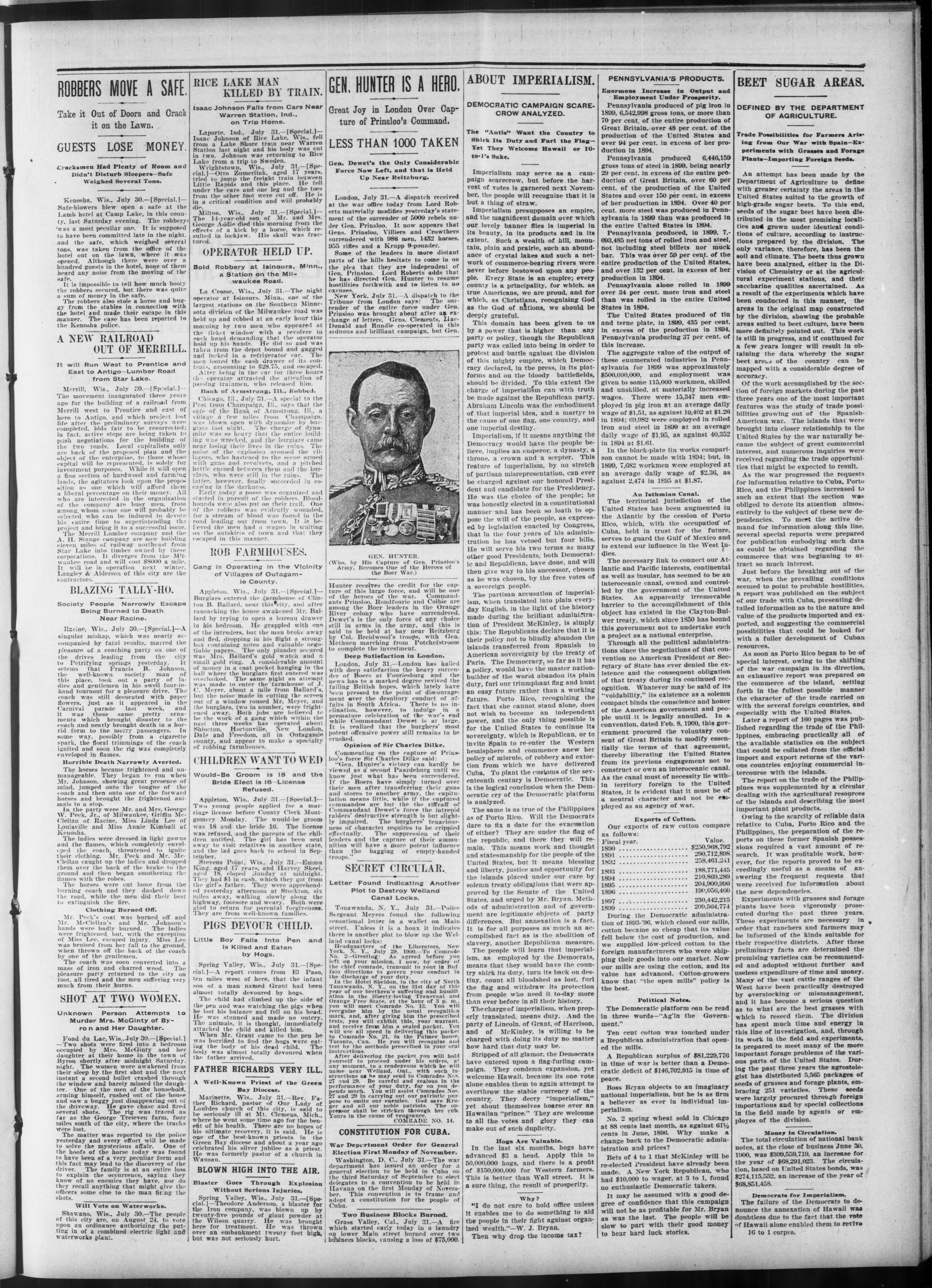
GEN. HUNTER.
(Who, by His Capture of Gen. Prinsloo's Army, Becomes One of the Heroes of the Boer War.)
Hunter receives the credit for the capture of this large force, and will be one of the heroes of the war. Commandants Prinsloo, Rondfourie and Colbie are among the Boer leaders in the Orange River colony who have surrendered. Dewet's is the only force of any choice still in arms in the army, and this is said to be held at bay near Reitzburg by Col. Breidwood's troops, with Gen. Methuen marching from Potchefstroom to complete the investment.
Deep Satisfaction in London.
London, July 31.—London has hailed with deep satisfaction the heavy surrender of Boers at Fouriesburg and the news has to a marked degree revived the failing British hopes, which lately have been pressed to the point of discouragement over the desultory conduct of affairs in South Africa. There is no inclination, however, to indulge in a premature celebration of the war's end while Commandant Dewet is at large. It is realized that the burghers' most potent offensive power still remains to be crushed
Opinion of Sir Charles Dilke.
Commenting on the capture of Prinsloo's force Sir Charles Dilke said:
"Gen. Hunter's victory can hardly be viewed as a second Paardeburg until we know just what has been surrendered. If the Boers have simply turned over their men after transferring their guns and stores to another army, the capitulation means little, while if the captured commandos are but the riffraff of Commandant Dewet's force the intrepid raiders' destructive strength is but slightly impaired. The burghers' tenaciousness of character requires to be crippled effectually. The suppression of their leaders and the capture of their ammunition will have a more potent influence than the bagging of empty-handed troops."
SECRET CIRCULAR.
Letter Found Indicating Another Plot to Destroy Welland Canal Locks.
Tonawanda, N. Y., July 31.—Police Sergeant Meyers found the following sensational letter in a wallet on Main street. Unless it is a hoax it indicates there is another plot to blow up the Welland canal locks:
Headquarters of the Liberators, New York, N. Y., July 29, 1900.—To Comrade No. 2—Greeting: As agreed before you left on your mission, I now, by order of the chief comrade, transmit to your in Buffalo directions to govern your conduct in the discharge of your duty.
In the Hotel Sheldon, in the city of North Tonawanda, N. Y., on the 31st day of this year of our brethren's suffering and humiliation in the liberty-loving Transvaal and Orange Free State, at the hour of 3 p. m., you will meet Comrade No. 13. You will recognize him by the usual recognition mark, and, after giving him the prescribed tests, you will exhibit this, your warrant, and receive from him a sealed packet. You will use all speed in delivering this packet to Comrade No. 21, in the Palmer house, Toronto, Can. He you will recognize and test by the methods prescribed in your oral instructions.
After delivering the packet you will hold yourself to proceed under his orders, at any moment, to a rendezvous which he will name near Welland, Ont., with such instructions as he may send to Comrades Nos. 27 and 29. Be careful and zealous in the performance of your duty, for on you depends much. You will assist Comrades Nos. 27 and 29 in carrying out our patriotic purpose to smite our enemies. God save Kruger and all our noble patriots. The oppressor shall be stricken through her cub. Yours in the cause of vengeance.
CONSTITUTION FOR CUBA.
War Department Order for General Election First Monday of November. Washington, D. C., July 31.—The war department has issued an order for a general election to be held in Cuba on the third Saturday of September to elect delegates to a convention to be held in Havana on the first Monday of November. This convention is to frame and adopt a constitution for the people of Cuba.
Two Business Blocks Burned.
Grass Valley, Cal., July 31.—A fire which started early today in a laundry on lower Main street burned over two business blocks, causing a loss of $75,000.
ABOUT IMPERIALISM
DEMOCRATIC CAMPAIGN SCARE-CROW ANALYZED.
The "Autis" Want the Country to Shirk Its Duty and Furl the Flag—Yet They Welcome Hawaii or 16to-1's Sake.
Imperialism may serve as a campaign scarecrow, but before the harvest of votes is garnered next November, the people will recognize that it is but a thing of straw.
Imperialism presupposes an empire, and the magnificent domain over which our lovely banner files is imperial in its beauty, in its products and in its extent. Such a wealth of hill, mountain, plain and prairie, such an abundance of crystal lakes and such a network of commerce-bearing rivers were never before bestowed upon any people. Every State is an empire; every county is a principality, for which. as true Americans, we are proud, and for which, as Christians, recognizing God as the God of nations, we should be deeply grateful.
This domain has been given to us by a power that is higher than any party or policy, though the Republican party was called into being in order to protest and battle against the division of this mighty empire, which Democracy declared, in the press, in its platforms and on the bloody battlefields, should be divided. To this extent the charge of imperialism can with truth be made against the Republican party. Abraham Lincoln was the embodiment of that imperial idea, and a martyr to the cause of one flag, one country, and one imperial destiny.
Imperialism, if it means anything the Democracy would have the people believe, implies an emperor, a dynasty, a throne, a crown and a scepter. This feature of imperialism, by no stretch of partisan misrepresentation, can ever be charged against our honored President and candidate for the Presidency. He was the choice of the people; he was honestly elected in a constitutional manner and has been so loath to oppose the will of the people, as expressed by legislation enacted by Congress, that in the four years of his administration he has vetoed but four bills. He will serve his two terms as many other good Presidents, both Democratic and Republican, have done, and will then give way to his successor, chosen as he was chosen, by the free votes of a sovereign people.
The partisan accusation of imperialism, when translated into plain everyday English, in the light of the history made during the brilliant administration of President McKinley, is simply this: The Republicans declare that it is their policy not to blindly abandon the islands transferred from Spanish to American sovereignty by the treaty of Paris. The Democracy, so far as it has a policy, would have the master nationbuilder of the world abandon its plain duty, furl our triumphant flag and hunt an easy future rather than a working future. Porto Rico, recognizing the fact that she cannot stand alone, does not wish to become an independent power, and the only thing possible is for the United States to continue its sovereignty, which is Republican, or to invite Spain to re-enter the Western hemisphere and commence anew her policy of misrule, of robbery and extortion from which we have delivered Cuba. To plant the customs of the seventeenth century is Democratic. This is the logical conclusion when the Democratic cry of the Democratic platform is analyzed.
The same is as true of the Philippines as of Porto Rico. Will the Democrats dare to fix a date for the evacuation of either? They are under the flag of the republic, and there they will remain. This means work and thought and statesmanship for the people of the United States, but it means blessing and liberty, justice and opportunity for the islands placed under our care by solemn treaty obligations that were approved by the Senate of the United States, and urged by Mr. Bryan. Methods of administration and of government are legitimate objects of party differences. But annexation is a fact. It is for all purposes as much an accomplished fact as is the abolition of slavery, another Republican measure.
The people will learn that imperialism, as employed by the Democrats, means that they would have the country shirk its duty, turn its back on destiny, count all bloodshed as lost, furl the flag and withdraw its protection from people who need it to-day more than ever before in all their history. The charge of imperialism, when properly translated, means duty. And the party of Lincoln, of Grant, of Harrison, and of McKinley, is willing to be charged with doing its duty no matter how hard that duty may be.
Stripped of all glamor, the Democrats have entered upon a flag-furling campaign. They condemn expansion, yet welcome Hawaii, because its one vote alone enables them to again attempt to overthrow the stable currency of the country. They decry "imperialism," yet shout themselves hoarse over an Hawaiian "prince." They are welcome to all the votes and glory they can make out of such duplicity.
Hogs Are Valuable.
In the last six months, hogs have advanced $3 a head. Apply this to 50,000,000 hogs, and there is a profit of $150,000,000 for Western farmers. This is better than Wall street. It is a sure thing, the result of prosperity.
"I do not care to hold office unless it enables me to do something to aid the people in their fight against organized wealth."—W. J. Bryan. Then why drop the income tax?
PENNSYLVANIA'S PRODUCTS.
Enormous Increase in Output and Employment Under Prosperity
Employment Under Prosperity. Pennsylvania produced of pig iron in 1899, 6,542,998 gross tons, or more than 70 per cent. of the entire production of Great Britain, over 48 per cent. of the production of the United States and over 94 per cent. in excess of her production in 1894. Pennsylvania produced 6,446,159 gross tons of steel in 1899, being nearly 29 per cent. in excess of the entire production of Great Britain, over 60 per cent. of the production of the United States and over 150 per cent. in excess of her production in 1894. Over 40 per cent. more steel was produced in Pennsylvania in 1899 than was produced in the entire United States in 1894.
Pennsylvania produced, in 1899, 7,093,485 net tons of rolled iron and steel, not including steel billets nor muck bar. This was over 59 per cent. of the entire production of the United States, and over 132 per cent. in excess of her production in 1894.
Pennsylvania alone rolled in 1899 over 34 per cent. more iron and steel than was rolled in the entire United States in 1894.
The United States produced of tin and terne plate, in 1899, 435 per cent. in excess of the production in 1894, Pennsylvania producing 37 per cent. of this increase.
The aggregate value of the output of these enumerated industries in Pennsylvania for 1899 was approximately $500,000,000, and employment was given to some 115,000 workmen, skilled and unskilled, at materially increased wages. There were 15,347 men employed in pig iron at an average daily wage of $1,51, as against 10,402 at $1.26 in 1894; 69,982 were employed in rolled iron and steel in 1899 at an average daily wage of $1.95, as against 40,352 in 1894 at $1.61.
In the black-plate tin works comparison cannot be made with 1894; but, in 1899, 7,682 workmen were employed at an average daily wage of $2.36, as against 2,474 in 1895 at $1.87.
An Isthmian Canal.
The territorial jurisdiction of the United States has been augmented in the Atlantic by the cession of Porto Rico, which, with the occupation of Cuba, held in trust for the future, serves to guard the Gulf of Mexico and to extend our influence in the West Indies.
The necessary link to connect our Atlantic and Pacific interests, continental as well as insular, has seemed to be an interoceanic canal, owned and controlled by the government of the United States. An apparently irremovable barrier to the accomplishment of this object has existed in the Clayton-Bulwer treaty, which since 1850 has bound this government not to undertake such a project as a national enterprise.
Through all the political administrations since the negotiations of that convention no American President or Secretary of State has ever denied the existence and the consequent obligation of that treaty during its continued recognition. Whatever may be said of its "voidability," its existence as a solemn compact binds the conscience and honor of the American government and people until it is legally annulled. In a convention, dated Feb. 8, 1900, this government procured the voluntary consent of Great Britain to modify essentially the terms of that agreement, thereby liberating the United States from its previous engagement not to construct or own an interoceanic canal. As the canal must of necessity lie within territory foreign to the United States, it is evident that it must be of a neutral character and not be employed as an agency of war.
Our exports of raw cotton compare as follows:
Fiscal year. Value.
1890 $250,968,792
1891 290,712,898
1892 258,461,241
1893 188,771,445
1894 210,869,289
1895 204,900,990
1896 190,056,460
1897 230,442,215
1899 209,564,774
During the Democratic administration of 1893-96, which closed our mills, cotton became so cheap that its value fell below the cost of production, and we supplied low-priced cotton to the foreign manufacturers who were shipping their goods into our market. Now our mills are using the cotton, and its value has advanced. Cotton-growers know that "the open mills" policy is the best.
Political Notes.
The Democratic platform can be read in three words—"Ag'in the Government."
Ten cent cotton was touched under a Republican administration that opened the mills.
A Republican surplus of $81,229,776 in time of war is better than a Democratic deficit of $146,702,915 in time of peace.
Boss Bryan objects to an imaginary national imperialism, but he is as firm a believer as ever in individual imperialism.
No. 2 spring wheat sold in Chicago at 88 cents last month, as against 61½ cents in June, 1896. Why make a change back to the Democratic administration and prices?
Bets of 4 to 1 that McKinley will be re-elected President have already been made. A New York Republican, who had $10,000 to wager, at 3 to 1, found no enthusiastic Democratic takers.
It may be assumed with a good degree of confidence that this campaign will not be as profitable for Mr. Bryan as was the last. The people will be slow to part with their good money to hear hard luck stories.
BEET SUGAR AREAS.
DEFINED BY THE DEPARTMENT OF AGRICULTURE.
Trade Possibilities for Farmers Arising from Our War with Spain-Experiments with Grasses and Forage Plants-Importing Foreign Seeds.
An attempt has been made by the Department of Agriculture to define with greater certainty the areas in the United States suited to the growth of high-grade sugar beets. To this end, seeds of the sugar beet have been distributed in the most promising localities and grown under identical conditions of culture, according to instructions prepared by the division. The only variance, therefore, has been the soil and climate. The beets thus grown have been analyzed, either in the Division of Chemistry or at the agricultural experiment stations, and their saccharine qualities ascertained. As a result of the experiments which have been conducted in this manner, the areas in the original map constructed by the division, showing the probable areas suited to beet culture, have been more definitely pointed out. This work is still in progress, and if continued for a few years longer will result in obtaining the data whereby the sugar beet areas of the country can be mapped with a considerable degree of accuracy.
Of the work accomplished by the section of foreign markets during the past three years one of the most important features was the study of trade possibilities growing out of the Spanish-American war. The islands that were brought into closer relationship to the United States by the war naturally became the subject of great commercial interest, and numerous inquiries were received regarding the trade opportunities that might be expected to result.
As the war progressed the requests for information relative to Cuba, Porto Rico, and the Philippines increased to such an extent that the section was obliged to devote its attention almost entirely to the subject of these new dependencies. To meet the active demand for information along this line, several special reports were prepared for publication embodying such data as could be obtained regarding the commerce that was beginning to attract so much interest.
Just before the breaking out of the war, when the prevailing conditions seemed to point to probable hostilities, a report was published on the subject of our trade with Cuba, presenting detailed information as to the nature and value of the products imported and exported, and suggesting the commercial possibilities that could be looked for with a fuller development of Cuban resources.
As soon as Porto Rico began to be of special interest, owing to the shifting of the war campaign in its direction, an exhaustive report was prepared on the commerce of the island, setting forth in the fullest possible manner the character of the trade carried on with the several foreign countries, and especially with the United States. Later a report of 160 pages was published regarding the trade of the Philippines, embracing practically all of the available statistics on the subject that could be collated from the official import and export returns of the various countries enjoying commercial intercourse with the islands.
The report on the trade of the Philippines was supplemented by a circular dealing with the agricultural resources of the islands and describing the most important plant products. Owing to the scarcity of reliable data relative to Cuba, Porto Rico and the Philippines, the preparation of the reports on these former Spanish possessions required a vast amount of research. It was profitable work, however, for the reports proved to be exceedingly useful as a means of answering the frequent requests that were received for information about the new dependencies.
Experiments with grasses and forage plants have been vigorously prosecuted during the past three years. These experiments are necessary in order that ranchers and farmers may be informed of the kinds suitable for their respective districts. After these preliminary facts are determined the promising varieties can be recommended and adopted without further and useless expenditure of time and money. Many of the vast cattle ranges of the West have been practically destroyed by overstocking or mismanagement, and it has become a serious question as to what are the best grasses with which to reseed them. The division has spent much time and energy in this line of investigation, and, through its work in the field and experiments, is prepared to meet many of the more important forage problems of the various parts of the United States. During the past three years the agrostologist has distributed 5,565 packages of seeds of grasses and forage plants, embracing 251 varieties. These seeds were largely procured through foreign importations and by special collections in the field made by agents or employes of the division.
Money in Circulation.
The total circulation of national bank notes, at the close of business June 30, 1900, was $309,559,719, an increase for the year of $68,291,023. The circulation, based on United States bonds, was $274,115,552, an increase of the year of $68,851,458.
Democrats for Imperialism.
The failure of the Democrats to denounce the annexation of Hawaii was doubtless due to the fact that the vote of Hawaii alone enabled them to revive 16 to 1 corpse.
Printed in tie Interests of the Negro Race,
MILWAUKEE, WIS.
EE
Richard B. Montgomery...---.-..--+--
Lessee e+seee++»-Kditor and Proprietor
Office 209 Fifth Street.
Telephone Black No. 244.
eS
SUBSCRIPTION RATES.
Any part of the United States and Canada,
postage pald.
One Year .<.-.ccs.cese'es-srendseees S200
Bix Months ....-.--cceteeeceereeesre LBD
Three Months ......2-s--eeeeeeeerees <TD
Send money by Express tong ee P.O.
Money Order or Rezistered Letter to the
Wisconsin Weekly Advocate.
ADVERTISING RATES.
One inch, single insertion....-.-++-+-, 25¢
One inch, per year........-:s+2----- $9.00
Business locals Se per line each insertion.
Apply for rates to the Advocate.
eee
TO CONTRIBUTORS:
All communications must be sent with the
name and address of the sender as an evi-
dence of good faith, but not necessarily for
publication. No manuscript returned if not
accepted, unless accompanied by stamps.
See ee cre tee
All subscribers of the Advocate that fail
to get their paper promptly will please noti-
z a at once. The Advocate, at 209 Fifth
strect.
The Wisconsin Weekly Advocate company
wishes to notify the public that all contracts
and business transactions with this com-
pany must have the company stamp, other-
wise they will be vold. Neither will this
company be responsible for paid subscrip-
tions unless given to duly-accredited agents,
who, on request, will give the company’s re-
ceipt for same. Subscribers callin to re-
celve their papers regularly will kindly nott-
fy the general office. Address all business
communications to the general manager,
209 Fifth street.
Mr. Richard B. Montgomery.
rae ee ee
Entered at tue Milwaukee P. O. as second.
‘ass matter.
—_—_—_—_—_<___——
Present day pugilism is discredited
when a slugger like John L. Sullivan has
to implore the courts to compel somebody
to return a belt.
Grammar and spelling are to be re
vived in the public schools of Washing-
ton, D. C. How old fashioned!
—_—_—__
The automobile rapid-fire gun will be
good for anything but war; which is
equivalent to saying that it will be good
for nothing.
The automobile has one disadvantage
as a vehicle for night travel to summer
resorts. ‘Chere is no level-headed ani-
mal to take the driver home after he
has lost the power of directing locomo-
tion.
“Get at them, if you can,” the dying
words of Col. Liscum, at Tien Tsin, are
strikingly like the dying words of young
Capt. Allyn Capron at Guasimas. The
American soldier forgets self in his zeal
for the proper performance of duty.
Chicago is to lose several thousand sa-
loons as a result of the boosting of the
price of beer by the brewers, and “the
largest glass of beer in Chicago,” udver-
tised to catch free-lunchers, will here-
after be something+smaller than a gar-
It is proposed to collect and send to
Manila a number of standard works of
history, to be placed in an alcove in the
library in the Soldiers and Sailors” club,
as a memorial of the late Col. Egbert.
He was a Philadelphian, a graduate of
the University of Pennsylvania, and
through all the long years of his service
as an officer of the regular army, an
earnest student of history. His widow
is the librarian, and their two daughters
are teaching school in Manila, and their
help will be freely given in making this
memorial library useful.
Yord Wolseley’s retirement from the
position of commander-in-chief of the
British army, in a few months’ time, is
not exciting the amount of public inter-
est which the importance of the position
demands. Under the changes introduced
into the war office in 1895 the period of
office fixed for each holder of the post
was five years, and this term expires in
the case of Lord Wolseley next Septem-
ber. The appointment of his successor
presents a favorable opportunity for the
government to place the war office system
on a thorough and sounder footing, and
there is a widespread impression that this
eagles Bieta as
Since the development of the cold-stor-
age industry the destruction of birds fo.
the table has grown enormously. It is
estimated that the number of birds an-
nually killed for game in the United
States is greater now than it was twen-
ty-tive years ago. Quantities of game
are frequently kept in cold storage fot
months at a time, or even from one sea-
son to another, so that our large cities
can now receive their supplies not only
from neighboring states but from distant
countries. For instance, the South
American tinamouse is shipped from Ar-
gentina to London and then imported into
thie canntry_
A medical writer says that many peo-
ple who call themselves vegetarians are
not such, for the term vegetable diet, if
accurately used, excludes butter, lard,
eggs and milk and every animal product,
even in the process of cooking. If this is
done it is almost impossible to construct
an exclusive vegetable diet in which the
necessary elements are properly propor-
tioned. Even if it were possible, such an
amount of waste and irritating material
would be necessary that it would serious-
ly affect the health. The excessive use of
vegetable compounds and fruits sooner or
later excites intestinal disorders.
A prominent physician of Albuquerque,
N. M., predicts that the territory will
eventually become the greatest health re-
sort in the world on account of its cli-
mate, which is peculiarly favorable for
consumptives, and its mineral springs,
which it is claimed exceed in number, va-
riety and medicinal qualities those of any
other equal area of country in the world.
He says, however, that consumptives
going there should go with money enough
to support themselves in comfort, because
“there are twenty applicants for every
job that is vacant,” and that they must
not expect to be cured in a few months.
When the formal annexation of the
Transvaal and the extinction of the
South African republics are accomplished,
the political cynic will see a saturnine
humor in the fact that the only place
where the Vieurkleur will wave will be in
a foreign land, says the London Chroni-
cle. It is not likely that the Boer com-
missioners will hau! down the flag that
floats over the Transvaal section of the
Paris exhibition, however incongrtous
or ironic its presence may appear. This
suggests a curious question as to the
ownership cf the exhibits. Some of
them, of course, belong to business firms
or private individuals, but it is under-
stood that a large proportion, and these
among the most valuable, were supplied
by Mr. Kruger’s government. When the
government becomes extinet, who will be
able to establish a valid title to the prop-
So,
That Great Britain is waking up to the
fact that she must bestir herself to meet
American and German competition in the
markets of the world, and the first es-
sential is reliable commercial informa-
tion, is evident from a report from Lon-
don to the State Department, which says
that the Secretary of State for Foreign
Affairs has appointed Mr. Henry Arthur
Cooke, Mr. John C. Milligan, Mr. E.
Seymour Bell and Mr. E. H. Melville to
be British commercial agents in Russia,
Switzerland, the United States and Cen-
tral America, respectively, for an experi-
mental period of two years. Mr. Cooke
is to be stationed at Moscow. The head-
quarters for the other commercial agents
have been fixed at Zurich, Chicago and
Guatemala. The business of the agents
will consist in watching and reporting on
the commerce, industries and products of
special districts and in answering in-
quiries on commercial subjects. Indi-
yidual firms applying for information will
have to pay the prescribed fees.
Advices from the Columbia River sal-
mon packing industries indicate the prob-
ability of a deficiency in the total pack.
‘The scarcity of fish now in the river is
pronounced abnormal by all engaged in
the spring and summer season. The one
redeeming feature so far is the fine qual-
ity and size of the fish. Not for many
years has the general average of the sal-
mon caught reached so high a standard.
It is possible that the improved runs
later in the season may operate to some-
what reduce the shortage which now
seems certain. The output of the can-
neries on the Columbia River to June 1st
was a total of 52,600 cases. Perhaps 10,-
000 cases of the prospective falling off in
packing are attributed to the upper river
conditions, where, owing to the stage of
the water, the canneries have practically
concluded operations for the season,
minus that number of cases as contrasted
with 18090.
- An incident which is reported from
Marseilles gives a graphic idea of the
force of the mistral, the strong cold wind
which is common in southern France. A
carriage in which a lady was driving was
blown into a canal, and the passenger
and horse were drowned. In view of this
accident the mayor of Marseilles issued
an order to the effect that hereafter no
carriages are to be allowed to drive along
the canals of the city or a water front
while a mistral is blowing. This wind
oceurs when there is a barometric gradi-
ent to the south from the plateau of cen-
tral France, the cold air flowing quickly
down the gradient. In the districts
which are subject to frequent mistrals
the trees are bent to the southeast undet
‘the influence of the strong northwest
wind, and the gardens are protected by
| means of high walls. The mistral is
often so violent as to cause considerable
damage, and the people are thrown dow:
by it in the streets and not infrequently
severely injured. In fact, ordinary street
traffic in Marseilles is always consider
ably interfered with by a violent or a
long-continued mistral.
An investigation into the comparative
cost of living at the various European
capitals resulted in the following facts:
At Vienna the prices of most articles of
food are lowest; at Madrid they are
dearer than in any other capital, and
such things as bread, meat, sugar and
coal are very expensive indeed. At St
Petersburg also the price of bread is stil!
considered a luxury above the means of
the working classes. Next to Vienna,
Brussels is an inexpensive city; Paris is
a little higher in the scale, while London
is still more expensive. An American
spends on an average $50 a year for
food; a Frenchman, $48; a German, $45;
a Spaniard, $33; an Italian, $24, and a
Russian, $40. Of meat the American
eats 109 pounds a year, the Frenchman
87 pounds, the German 64 pounds, the
Italian 28 pounds and the Russian 51
pounds. Of bread the American con-
sumes 380 pounds, the Frenchman 540
pounds, the German 560 pounds, the
Spaniard 480 pounds, the Italian 400
pounds and the Russian 655 pounds.
Outside of Europe, in times of peace,
Manila is cheaper to live in than any
other city in the world.
There has been a moyement on foot for
the past two years to organize a society
in Illinois to gather up and perpetuate
the history of the men and women who
went into that state in the days when
Illinois was a wilderness. This first took
shape with a number of older citizens,
and a meeting was held on the Ist of
January, 1900, when a committee was
appointed to devise plans and formulate
rules to govern the work. This resulted
in the incorporation of “The Illinois So-
ciety,” May 18, 1900. The membership
is composed, first, of men and women
born in the state prior to January 1,
1850, who are the controlling class; sec-
ond, the honorary members, men and
women who have been residents of the
state since January 1, 1850; third, juni-
ors, men and women, children of parents
who were residents of the state prior to
January 1, 1850, and are 35 years of
age. Active steps will be taken to ex-
tend the organization all over the state.
This society has no reference to the State
Historical society. Their work will be
helpful, one to the other. Already more
than 100 names have been secured.
The Increasing Use of Metal.
In the United States steel cars are be-
ing substituted for wooden ones on rail-
ways, and to this one new departure a
goodly share of steel industry activity is
ascribed. The various uses to which
electricity has been applied in late years,
the water supply of cities, and all kinds
of engineering enterprises have also
greatly increased the demand for iron
and steel in all countries; and lastly, a
new era in railway building has com-
menced in Ruszia, the United States and
some other countries, the great Siberian
enterprises of Russia alone calling for
immense quantities of railway material.
—Cassier’s Magazine.
el
Vege tas Ka eH) ie ie |
i Ye 7S t tit TH ran) Bea ITA i a .
a ae le ners ‘igh MAY eee BB,
high! SE r i mt rae |
elena: Sea cA FPN Gs) Hy Ret ee:
a,
See AVS |
a , Be Fe a ee a= _j me +3} fy) |
aca
= TTL CACAO l
AARON PALMER UNDER TREATMENT AT BELLEVUE HOSPITAL.
BAKING HUMAN BODY
MAN WHO !S ROASTED IN A
GREAT OVEN.
Subjected to Intense Heat in Hope
of Curing a Grave Malady —His
Limbs Were Ossified by an Attack
of Rheumatism.
Once in every twenty-four hours
Aaron Palmer is baked alive in the
great oven of the Bellevue hospital, in
New York City. At a temperature of
from 350 to 400 degrees he is allowed
to roast in the oven for from half to
three-quarters of an hour. Then he is
removed, thoroughly massaged, and
placed in the sun, where a broiling pro-
cess is begun. And all because he is
afflicted with arthritis deformans.
‘Translated that means that he has
gout. Not the plain gout that many
suffer, but an acute rheumatic gout,
which has practically ossified his limbs,
so that for over three years his legs
and arms were as hard as marble, be-
ing frightfully wasted and distorted,
and absolutely incapable of any move-
ment or feeling. His condition was
pathetic in the extreme and it was only
a question of time when the dread par-
alysis would encroach further upon his
body, until it affected some vital or-
gan and thus put an end to his life.
| It was death that Palmer has been
waiting for during these years of suf-
fering. When he was first taken to
Bellevue there was some hope of sav-
ing his life, but that hope speedily de-
parted when it was found that by no
means known were the doctors able
to stimulate a perspiration in any of
the affected parts. Meanwhile the dis-
ease was spreading slowly and surely,
| and at last hope of stopping it was en-
rely abandoned. Vapor, Russian and
Turkish baths failed to aid. Applica-
tions of heat were absolutely useless
and recourse was even tried in wrap-
| ping him up in blankets and placing his
feet as near as they could be placed
with safety to a red-hot stove. None
of the means tried seemed powerful
enough to affect in the slightest the
dread malady which affected him. Had
it not been for the placing of the great
new ovens in the hospital he would
shortly be a corpse. Now, however,
there is hope of saving his life. More
than this, there is every prospect not
only of stopping the encroachments of
the disease, but of relieving parts al-
ready affected. Indeed, the ossifica-
tion, if it can be so spoken of, has
been removed from his arms entirely
except from the fingers, and his legs
have been revived from thigh to knee,
With continued treatment it is expect-
ed that the calves and fingers and feet
will be saved, and that Palmer will be
able to resume his daily life where he
left off four years ago, a cured and
healthy man.
The Disease Held Him Fast.
Twelve years ago Palmer was first
afflicted with rheumatism. He grew
worse in spite of the various treat-
ments which he underwent. Finally
his legs and arms began to draw up
and shrivel, and it was not long ere
he was a helpless cripple. No thought
of sending him to the hospital occurred
to his family until four years ago,
when he was suddenly affected by the
deadening of his limbs. First his feet
were affected. And then the calves
and hands. There seemed every pros-
pect of the whole body succumbing to
the fearful trouble and great interest
was manifested by physicians to see
how long he could live. When his feet
were first deadened they were affected
as though frozen. They became as cold
as in death and then gradually stiffen-
ed. Nostrength was sufficient to move
them. Then, as the ankles and calves
followed, recourse was taken to the
various processes recited above to see
if something could not stave off the
trouble. Finally, when the thighs were
similarly stiffened, it was impossible
for him to do else than breathe and
absorb his food. ‘Che arms came next,
starting with the finger tips. This
spread much more rapidly and in less
than a month the entire limbs were
rendered useless. It was at this stage
that the baking process began. None
of the doctors really thought any effect
could be produced upon Palmer, It
was a month before the slightest en-
couraging sign was seen. It was notic-
ed during this time, however, that no
il effect was produced, so treatment
was persevered in. After this length
of time a single drop of perspiration
was noticed on one thigh, so small that
it was feared that it might be water
dropped upon him by some means.
However, the next day more beads ap
peared, and from that time on a per
spiration was steadily induced. There
was no let up, and it was not a fort
night before the flesh became soft and
pliable, although there was still ne
evidence of power. It was not until
recently that any power was developed
and then only by constant massaging
As the arms were affected quicker than
the lower limbs, so they yielded more
readily to the treatment. They were
in due course treated similarly. When
once the disease began to be dissipat-
ed in them it was speedily conquered.
Less than three weeks ago they were
still held in the marble grasp. To-day
all but the fingers have been released.
The fingers and toes are now drawn
up against the palms of his hands and
soles of the feet. The flesh of the
calves has become pliable and soft and
the knees are almost released from
their captivity. In another fortnight
it is expected that everything, except
possibly the digits, will be well again.
The cause of the trouble has been a
deposit of calcium salts in the tissues
covering the bones in the parts affect-
ed. The flesh has fallen away until
the man has become little better than
a skeleton, except for his trunk. His
weight was down to eighty pounds,
and the limbs were reduced to half
their usual size. Since the restoration
of power he has taken on flesh rapidly
in the relieved parts, and he now
weighs over a hundred pounds. His
normal weight since the beginning of
his illness until the ossification began
was about 130 pounds. Before he was
taken ill he weighed 160 pounds. Palm-
er is a produce dealer living in New
Wants.
Buying a Fan.
Miss Katharine Lee Bates, who
spent some months in Spain last year,
<——S—_—
aa SE)
ae Zo, x
ahh Boh) |
HT hh 8, .
iil
nea
Z
z= vars ely)
> eZ Rid)
PTT Ct reer
Cc
gt IN
SS —————— |
ZN |
MENT AT BELLEVUE HOSPITAL. |
declares that the dark-eyed damsels of
the fan and lace mantilla are quite as
charming as tradition has pictured
them. Ignorant they commonly are,
their education being of the most
meager, but they are not dull. They
are quick-witted, high-spirited and af-
fectionate, and are possessed of a grace
of speech and manner which rarely de-
serts them. Nor do they reserve their
pretty ways only for the ballroom or
the parlor; even ordinary shopping is
lifted into a scene of elegant comedy
by the manner in which it is transact-
ed. This is how a Spanish senorita
bargains for her fan:
There is nothing sordid about it. Her
haggling is a social condescension that
at once puts the black-eyed young
salesman at her mercy.
“But the fan seems to me the least bit
dear, senor!”
“Ah, senorita! You do not see how
beautiful the work is. I am giving it
‘away at six pesetas.”
| She lifts her eyebrows half-incredu-
lously, all bewitching.
“At five pesetas, senor.”
He runs his hand through his black
hair in chivalrous distress.
- “But the peerless work, senorita!
And this other, too. I sacrifice it at
four pesetas.”
She touches both fans lightly.
“You will let me have the two at
seven pesetas, senor?”
Her eyes dance over his confusion.
He catches the gleam, laughs back,
throws up his hands.
“Bueno, senorita! At what you
please!” .
And the senorita trips away content-
ed with a sharp bargain, although—for
Spanish gallantry, even when genuine,
goes farther on the lips than otherwise
—the price was probably not much
more remote from what pleased the
smooth-tongued clerk than from what
she pleased.
Cool and Methodical.
A lawyer who worthily bears a dis-
tinguished name occupies an old-fash-
joned mansion on the edge of New
York. His sister, who lives with him,
tells a laughable story, which is re-
ported in Harper’s Round Table, illus-
trating his coolness and love of meth-
od.
Recently his sister tiptoed into his
room same time after midnight, and
told him she thought burglars were in
the house. The lawyer put on his
dressing-gown, and went downstairs,
In the back hall he found a rough-
looking man trying to open a door that
led into the back yard. The burglar
had unlocked the door, and was. pull.
ing at it with all his might. The law-
yer, seeing the robber’s predicament,
called to him: :
“It does not open that way, ‘you
idiot! It slides back!”
} Ancient Ones.
The wife of a professional joke-
writer had finished cleaning off her
husband’s desk and putting things to
rights before he discovered her. He
dropped the volume of sermons in
which he had been finding needed re-
| laxation and sprang to his feet. “Good
Lord, Martha, have yeu throwu ‘em
into the grate?” “Thrown what, Joe?”
“My last jokes. Pull ’em out quick.”
Mrs. Miller sniffed disdainfully. “Pull
‘em out yourself. I’m no catspaw to
get out your chestnuts for you.”—-Sap
Francisco Wave.
It is the experience of older married
women that a bride is about six weeks
in descending from the pedestal to a
foot stool.
eo a i, calla WEE: Gee Be:
| aa sical Bee 2s
eee] f ‘ EYEE EG. y 4 r.!
Pie : el NS ge ee .
dh eS sas a ae
Jd : Sela = ij 5
ar ee
ne ag O te setae ps
Ci ho | de ye We 3 ae
eee ree
: TT ail eel Becks oes encase
a Reo Sak a Mitre <2 Ae :
fie oe ee He ene wa ei M
<= Bae ee! 5 Pris pha
a
-- LNION....
Laundry and News Co.
328 Wells Street
GEO. W. SAY LES.
» ALL WORK CAREFULLY DONE...
The Emerson Shoe Co.
CORNER GRAND AVENUE AND THIRD STREET,
MILWAUKEE, WIS.
M* GEORGE A. SCHECK, the man-
a ager of R. B. Grover & Co., manu-
facturers of the Celebvated Comfortable Custom
Made Shoes, begs leave to announce to the
many citizens of Milwaukee and vicinity that
they have opened a new store in this city in
the new building on the northeast corner of
Third St. and Grand Ave. and carry a full
line of goods. This makes 31 stores run by
the firm at the present time.
A Goodyear Welt costs $3.50 and a Handsewed
$5.00. The goods are honest all through and inspection is
solicited.
| MILWAUKEE...
GAS STOVE Co.,
ea
PERFECTION GAS RANGES
uneainnten tbanies teerbereets
Adjustable Needle Valve,
tae leh Bis in ts
Before Starting on Your Travels
Geo. Burroughs & Sons
PREMIUM TRUNKS
VALISES, SAMPLE CASES, Ete.
424 & 426 East Water St., Milwankes.
WHEN IN MADISON
Call at the —___-—
Avenue
Hotel eee
M. J. REGAN, Prop.
$2.00 Rate.......'
a—_———__ Free ’Bus.
Fer the Safest and
Quickést Read be-
tween © % ot mM
Milwaukee.
and Chi
icago
Take the Cnaicazo
Milwaukee & Xi.
Paul Raiiwav.us +.
BEFORE PLACING ——————_
FIRE AND BURGLAR ALARMS
in your es would do well
CHAS. DB. MILNE Electrical Contractor
And General Repairwork. The best in the city.
Fel. Main 527 NO MASON ST.
Do You Wish to bea
You know Good Painters make from $5.00 to
$10.00 a day easy.
is so explicit that even Boys can become Masters
of the trade.
PAINTING POINTERS
on Sign, House and Carriage Painting. Decora-
ting, Graining, Gilding, Silvering and Calsomin-
ing.’ This Book will also teach you how to
CONTRACT FOR BUSINESS
on profitable basis. It will tench you all we
know after having spent a life time in the busi-
ness, and will generally
SAVE YOU MONEY.
Mailed postpaid for only 50c.
VAL. SCHREIER SIGN WORKS, Milwaukee, Wis.
REV. G. W. MUGGAGE,
Pastor A. M. E, Zion Church,
a Morris St., Fond du Lac, Wis.
REGULAR SPRVICES—SUNDAYS:
peeenieg.---<--e a.m. and7:30 p. m.
Bunday School.......seeeeeeeeree-+-3 DP.
Prayer Meeting, ........-+++++++--9:30 &. m
Class Meeting. .........eseceeesees+.. 12 me
K.P. G. Ben eee eee eecneecee ees 6:80 Dp. ma
WEEE DAYS:
@hursday Night Prayer Meeting, 7:30 p. m.
Sacraments Quarterly Meeting, 24 Sunday
every 34 month.
Baptit f Inf Special Day.
Baptism of Adults, Waster Day
SPECIAL SERVICES—HASTER DAY.
Missionary Collections.
CHILDREN’S DAY.
Endowment Collection. 50cents Money—Now.
inn ert) eines
BOARD MEETINGS.
ones i—First and third Monday in each
mo!
‘Trustees—Monday after second and fourth
Sunday.
8. 8S. Board—Call of Pastor.
Quarteriy Conference—Call of P. B
Curly Hair Made Straight By
Pte Pex
x Kc. ft ASS z
3 F NCR eas
ees ; pe See
== J gS
A awe
Ay , fi Wh
Sy; “oy Ny G4
44 4 ¢*
TAKEN FROM LIFE: j
BEFORE AND AFTER TREATMEN?.
OZONIZED OX MARROW
THE ORIGINAL—COPYRIGHTED.
This wonderful hair pomade is the only safe
preparation in the worla that makes kinky Lair
straight as shown ‘above. It nourishes the sea!p. |
prevents the hair from sates. out and makes it |
Gfow. Sold over 40 years and used by thousaud>.
Warranted harmless. Testimonials free on r+
quest. It was the first preparation ever sold { r
eee enn eek hair. ware of imitations.
Get the Original Ozonized Ox Marrow,
as the genuine never fails to keep the hair piichic
and beautiful, A tollet necessity for indies and
gentlemen. Elegantly perfumed. ‘The great #-
Vantage of this wonderful pomade is that by its
use you can eaten Fame, own hair at home
Owing to its superior and lasting quality it is the
most economical. It is not possible for anybody
to produce a pre! ion eqens oo 3. Full direc-
Hohe with every bottle. Only GOcents. Sold by
geniers or send ts Bi-4O Postal cr Express
joney Order for express ti
your hame and adress pisiniy'co
AZONIZED OX MARROW CO.,
76 Wabash Ave., Chicago, Ill.
A. H.
DR. TALMAGE, who has been spending a few days in St. Petersburg, sends the following report of a discourse which will be helpful to those who have an appetite for literature and would like some rules to guide them in the selection of books and newspapers; text, Acts xix., 19, "Many of them also which used curious arts brought their books together and burned them before all men, and they counted the price of them and found it 50,000 pieces of silver."
Paul had been stirring up Ephesus with some lively sermons about the sins of that place. Among the more important results was the fact that the citizens brought out their bad books and in a public place made a bonfire of them. I see the people coming out with their arms full of Ephesian literature and tossing it into the flames. I hear an economist who is standing by saying: "Stop this waste. Here are $7,500 worth of books. Do you propose to burn them all up? If you don't want to read them yourselves, sell them and let somebody else read them." "No," said the people; "if these books are not good for us, they are not good for anybody else, and we shall stand and watch until the last leaf has burned to ashes. They have done us a world of harm, and they shall never do others harm." Hear the flames crackle and roar!
Well, my friends, one of the wants of the cities is a great bonfire of bad books and newspapers. We have enough fuel to make a blaze 200 feet high. Many of the publishing houses would do well to throw into the blaze their entire stock of goods. Bring forth the insufferable trash and put it into the fire and let it be known in the presence of God and angels and men that you are going to rid your homes of the overtopping and underlying curse of profligate literature.
The printing press is the mightiest agency on earth for good and for evil. The minister of the gospel, standing in a pulpit, has a responsible position, but I do not think it is as responsible as the position of an editor or a publisher. At what distant point of time, at what far out cycle of eternity, will cease the influence of a Henry J. Raymond, or a Horace Greeley, or a James Gordon Bennett, or a Watson Webb, or an Erastus Brooks, or a Thomas Kinsella? Take the overwhelming statistics of the circulation of the daily and weekly newspapers and then cipher it if you can how far up and how far down and how far out reach the influences of the American printing press.
What is to be the issue of all this? I believe the Lord intends the printing press to be the chief means for the world's rescue and evangelization, and I think that the great last battle of the world will not be fought with swords and guns, but with types and presses, a purified and gospel literature triumphing over, trampling down and crushing out forever that which is depraved. The only way to overcome unclean literature is by scattering abroad that which is healthful. May God speed the cylinders of an honest, intelligent, aggressive, Christian printing press.
Good Books a Blessing.
I have to tell you that the greatest blessing that ever came to the nations is that of an elevated literature, and the greatest scourge has been that of unclean literature. This last has its victims in all occupations and departments. It has helped to fill insane asylums and penitentiaries and almshouses and dens of shame. The bodies of this infection lie in the hospitals and in the graves, while their souls are being tossed over into a lost eternity, an avalanche of horror and despair! The London plague was nothing to it. That counted its victims by thousands, but this modern pest has already shoveled its millions into the channel house of the morally dead. The longest rail train that ever ran over the tracks was not long enough or large enough to carry the beastliness and the putrefaction which have been gathered up in bad books and newspapers in the last twenty years.
Now, it is amid circumstances that I put a question of overmastering importance to you and your families. What books and newspapers shall we read? You see I group them together. A newspaper is only a book in a swifter and more portable shape, and the same rules which will apply to book reading will apply to newspaper reading. What shall we read? Shall our minds be the receptacle of everything that an author has a mind to write? Shall there be no distinction between the tree of life and the tree of death? Shall we stoop down and drink out of the trough which the wickedness of men has filled with pollution and shame? Shall we mire in impurity and chase fantastic will-o'-the-wisps across the swamps, when we might walk in the blooming gardens of God? Oh, no! For the sake of our present and everlasting welfare we must make an intelligent and Christian choice.
Standing, as we do, chin deep in fictitious literature, the question that young people are asking is, "Shall we read novels?" I reply. There are novels that are pure, good. Christian, elevating to the heart and ennobling to the life. But I have still further to say that I believe that 75 out of the 100 novels in this day are baleful and destructive to the last degree. A pure work of fiction is history and poetry combined. It is a history of things around us with the licenses and the assumed names of poetry. The world can never pay the debt which it owes to such writers of fiction as Hawthorne and McKenzie and Landon and Hunt and Arthur and others whose names are familiar to all. The follicies of high life were never better exposed than by Miss Edgeworth. The memories of the past were never more faithfully embalmed than in the writings of Walter Scott. Cooper's novels are healthfully redolent with the
breath of the seaweed and the air of the American forest. Charles Kingsley has smitten the morbidity of the world and led a great many to appreciate the poetry of sound health, strong muscles and fresh air. Thackeray did a grand work in caricaturing the pretenders to gentility and high blood. Dickens has built his own monument in his books, which are a plea for the poor and the anathema of injustice, and there are a score of novelistic pens to-day doing mighty work for God and righteousness.
Ennobling and Purifying.
Now, I say, books like these, read at right times and read in right proportion with other books, cannot help but be ennobling and purifying; but, alas, for the loathsome and impure literature that has come in the shape of novels, like a freshet overflowing all the banks of decency and common sense! They are coming from some of the most celebrated publishing houses. They are coming with recommendation of some of our religious newspapers. They lie on your center table to curse your children and blast with their infernal fires generations unborn. You find these books in the desk of the school miss, in the trunk of the young man, in the steamboat cabin, on the table of the hotel reception room. You see a light in your child's room late at night. You suddenly go in and say, "What are you doing?" "I am reading." "What are you reading?" "A book." You look at the book. It is a bad book. "Where did you get it?" "I borrowed it." Alas, there are always those abroad who would like to loan your son or daughter a bad book! Everywhere, everywhere, an unclean literature. I charge upon it the destruction of 10,000 immortal souls, and I bid you wake up to the magnitude of the evil.
I shall take all the world's literature—good novels and bad, travels true and false, histories faithful and incorrect, legends beautiful and monstrous, all tracts, all chronicles, all poems, all family, city, state and national libraries—and pile them up in a pyramid of literature, and then I shall bring to bear upon it some grand, glorious, infallible, unmistakable Christian principle. God help me to speak with reference to my last account and help you to listen.
I charge you in the first place to stand aloof from all books that give false pictures of life. Life is neither a tragedy nor a farce. Men are not all either knaves or heroes. Women are neither angels nor furies. And yet if you depended upon much of the literature of the day you would get the idea that life instead of being something earnest, something practical, is a fitful and fantastic and extravagant thing. How poorly prepared are that young man and woman for the duties of to-day who spent last night wading through brilliant passages descriptive of magnificent knavery and wickedness! The man will be looking all day long for his heroine in the office, by the forge, in the factory, in the counting room, and he will not find her, and he will be dissatisfied. A man who gives himself up to the indiscriminate reading of novels will be nerveless, inane and a nuisance. He will be fit neither for the store, nor the shop, nor the field. A woman who gives herself up to the indiscriminate reading of novels will be unfitted for the duties of wife, mother, sister, daughter. There she is, hair disheveled, countenance vacant, cheeks pale, hands trembling, bursting into tears at midnight over the fate of some unfortunate lover; in the daytime, when she ought to be busy, staring by the half hour at nothing, biting her finger nails into the quick. The carpet that was plain before will be plainer after having wandered through a romance all night long in tessellated halls of castles. And your industrious companion will be more unattractive than ever, now that you have walked in the romance through parks with plumed princesses or lounged in the arbor with the polished desperado. Oh, these confirmed novel readers! They are unfitted for this life, which is a tremendous discipline. They know not how to go through the furnaces of trial through which they must pass, and they are unfitted for a world where everything we gain we achieve by hard and long continuing work.
Avoid Partially Bad Books.
Avoid Partially Bad Books.
Again, abstain from all those books which, while they have some good things, have also an admixture of evil. You have read books that had two elements in them—the good and the bad. Which stuck to you? The bad! The heart of most people is like a sieve, which lets the small particles of gold fall through, but keeps the great cinders. Once in awhile there is a mind like a loadstone which, plunged amid steel and brass filings, gathers up the steel and repels the brass. But it is generally exactly the opposite. If you attempt to plunge through a hedge of burs to get one blackberry, you will get more burs than blackberries. You cannot afford to read a bad book, however good you are. You say, "The influence is insignificant." I tell you that the scratch of a pin has sometimes produced lockjaw. Alas, if through curiosity, as many do, you pry into an evil book, your curiosity is as dangerous as that of the man who would take a torch into a gunpowder mill merely to see whether it would really blow up or not.
In a menagerie in New York a man put his arm through the bars of a black leopard's cage. The animal's hide looked so sleek and bright and beautiful. He just stroked it once. The monster seized him, and he drew forth a hand torn and mangled and bleeding. Oh, touch not evil, even with the faintest stroke! Though it may be glossy and beautiful, touch it not, lest you pull forth your soul torn and bleeding under the clutch of the leopard. "But," you say, "how can I find out whether a book is good or bad without reading it?" There is always something suspicious about a bad book. I never knew an exception—something suspicious in the index or style of illustration. This venomous reptile always carries a warning rattle.
Again, I charge you to stand off from all those books which corrupt the imagination and inflame the passions. I do not refer now to that kind of book which the villain has under his coat waiting for the school to get out, and then, looking both ways to see that there is no policeman around the block, offers the book to your son on his way home. I do not speak of that kind of literature, but that which evades the law and comes out in polished style, and with acute plot sounds the tog-
sin that rouses up all the baser passions of the soul. To-day, under the nostrils of the people, there is a fetid, reeking, unwashed literature, enough to poison all the fountains of public virtue and smite your sons and daughters as with the wing of a destroying angel, and it is time that the ministers of the gospel blew the trumpet and rallied the forces of righteousness, all armed to this great battle against a depraved literature.
No Apology for Crime.
Again, abstain from those books which are apologetic of crime. It is a sad thing that some of the best and most beautiful bookbindery and some of the finest rhetoric have been brought to make sin attractive. Vice is a horrible thing anyhow. It is born in shame, and it dies howling in the darkness. In this world it is scourged with a whip of scorpions, but afterward the thunders of God's wrath pursue it across a boundless desert, beating it with ruin and woe. When you come to paint carnality, do not paint it as looking from behind embroidered curtains or through lattice of royal seraglio, but as writhing in the agonies of a city hospital. Cursed be the books that try to make impurity decent and crime attractive and hypocrisy noble! Cursed be the books that swarm with libertines and desperadoes, who make the brain of the young people whirl with villainy. Ye authors who write them, ye publishers who print them, ye book-sellers who distribute them, shall be cut to pieces, if not by an aroused community, then at last by the hail of divine vengeance, which shall sweep to the lowest pit of perdition all ye murderers of souls. I tell you, though you may escape in this world, you will be ground at last under the hoof of eternal calamities, and you will be chained to the rock, and you will have the vulture of despair clawing at your soul, and those whom you have destroyed will come around to torment you, and to pour hotter coals of fury upon your head, and rejoice eternally in the outcry of your pain, and the howl of your damnation. "God shall wound the hairy scalp of him that goeth on in his tres-passes."
The clock strikes midnight. A fair form bends over a romance. The eyes flash fire. The breath is quick and irregular. Occasionally the color dashes to the cheek and then dies out. The hands tremble as though a guardian spirit were trying to shake the deadly book out of the grasp. Hot tears fall. She laughs with a shrill voice that drops dead at its own sound. The sweat on her brow is the spray dashed up from the river of death. The clock strikes 4, and the rosy dawn soon after begins to look through the lattice upon the pale form that looks like a detained specter of the night. Soon in a madhouse she will mistake her ringlets for curling serpents and thrust her white hand through the bars of the prison and smite her head, rubbing it back as though to push the scalp from the skull, shrieking: "My brain! My brain!" Oh, stand off from that! Why will you go sounding your way amid the reefs when there is such a vast ocean in which you may voyage, all sail set?
Abjure Impure Pictures.
Much of the impure pictorial literature is most tremendous for ruin. There is no one who can like good pictures better than I do. The quickest and most condensed way of impressing the public mind is by picture. What the painter does by his brush for a few favorites, the engraver does by his knife for the million. What the author accomplishes by fifty pages the artist does by a flash. The best part of a painting that costs $10,000 you may buy for 10 cents. Fine paintings belong to the aristocracy of art. Engravings belong to the democracy of art. You do well to gather good pictures in your homes.
But what shall I say of the prostitution of art to purposes of iniquity? These death warrants of the soul are at every street corner. They smite the vision of the young man with pollution. Many a young man buying a copy has bought his eternal discomfiture. There may be enough poison in one bad picture to poison one soul, and that soul may poison ten, and ten fifty, and fifty hundreds, and the hundreds thousands, until nothing but the measuring line of eternity can tell the height and depth and ghastliness and horror of the great undoing. The work of death that the wicked author does in a whole book the bad engraver may do on a half side of a pictorial. Under the guise of pure mirth the young man buys one of these sheets. He unrolls it before his comrades amid roars of laughter, but long after the paper is gone the result may, perhaps, be seen in the blasted imaginations of those who say it. The queen of death holds a banquet every night, and these periodicals are the invitation to her guests.
Cherish Good Books.
Cherish good books and newspapers. Beware of bad ones. The assassin of Lord Russell declared that he was led into crime by reading one vivid romance. The consecrated John Angell James, than whom England never produced a better man, declared in his old age that he had never yet got over the evil effects of having for fifteen minutes once read a bad book. But I need not go so far off. I could tell you of a comrade who was great hearted, noble and generous. He was studying for an honorable profession, but he had an infidel book in his trunk, and he said to me one day, "De Witt, would you like to read it?" I said, "Yes, I would." I took the book and read it only for a few minutes. I was really startled with what I saw there, and I handed the book back to him and said, "You had better destroy that book." No, he kept it. He read it. He reread it. After awhile he gave up religion as a myth. He gave up God as a nonentity. He gave up the Bible as a fable. He gave up the church of Christ as a useless institution. He gave up good morals as being unnecessarily stringent. I have heard of him but twice in many years. The time before the last I heard of him he was a confirmed inebriate. The last I heard of him he was coming out of an insane asylum—in body, mind and soul an awful wreck. I believe that one infidel book killed him for two worlds.
Go home to-day and look through your library, and then, having looked through your library, look on the stand where you keep your pictorials and newspapers and apply the Christian principles I have laid down this hour. If there is anything in your home that cannot stand the test do not give it away, for it might spoil an immortal soul; do not sell it, for the money you get would be the price of blood; but rather kindle a fire on your kitchen hearth or in your back yard and then drop the poison in it, and the bonfire in your city shall be as consuming as that one in Ephesus.
TEMPERANCE TALKS.
THE RUM TRAFFIC SHOULD BE SUPPRESSED.
Dangers that Always Lurk in the Flowing Bowl - How Bright and Influential Men Have Been Dragged Down by the Demon Drink.
Not many years since a young married couple from the far, "fast-anchored isle," sought our shores with the most sanguine anticipations of prosperity and happiness. They had begun to realize more than they had seen in the visions of hope, when, in an evil hour, the husband was tempted to "look upon the wine when it was red," and to taste of it "when it giveth its color in the cup." The charmer fastened around his victim all the serpent spells of its sorcery, and he fell, and at every step of his rapid degradation from the man to the brute a heart-string broke in the bosom of his sorrowing wife.
Finally, with the last spark of hope flickering on the altar of her heart, she threaded her way into one of those shambles where man is made such a thing as the beasts of the field would bellow at. She pressed her way through bacchanalian crowds who were reveling there in their own ruin. With her bosom full of that despair that preys upon the heart she stood before the plunderer of her husband's destiny, and exclaimed in tones of startling anguish, "Give me back my husband!"
"There's your husband," said the publican, as he pointed towards the prostrate wretch.
"That my husband! What have you done to him? That my husband! What have you done to that noble form that once, like a tall oak, held its protecting shade over the fragile vine that clung to it for support and shelter? That my husband! With what terrible chill have you touched the sinews of that manly arm? That my husband! What have you done to that once noble brow, which he wore high among his fellows, as if it bore the superscription of the Godhead? That my husband! What have you done to that eye, with which he was wont to 'look erect on heaven,' and see in His mirror the image of his God? What Egyptian drug have you poured into his veins, and turned the fountain of the heart into black and burning piich? Give me back my husband! Undo your spells, and give me back the man that stood with me by the altar!"
The ears of the drink-seller, ever since the first bottle of that burning liquor was opened upon our shores, have been saluted at every stage of the traffic with such terrible appeals as this. Such wives, such widows, such mothers, such fatherless children, as never mourned in Israel at the massacre of Bethlehem, or at the burning of the Temple, have cried in his ears morning, night and evening, "Give me back my husband! Give me back my boy! Give me back my brother!"
But has the drink-seller been confounded or speechless at these appeals? No! not he. He could show his credentials at a moment's notice with proud defiance. He always carried in his pocket a written absolution for all he had done, and could do, in his work of destruction. He had bought a letter of indulgence—I mean a license—a precious instrument, signed and sealed by authority of law. He confounded. Why, the whole artillery of civil power was ready to open in his defense and support. Thus shielded by the Aegis of the law, he had nothing to fear from the enemies of his traffic. He had the image and superscription of Caesar on his credentials, and unto Caesar he appealed with success. And unto Caesar, too, his victims have appealed—but they have often appealed in vain. National Advocate.
Overcoming the Enemy.
There was once a great general, who commanded a large army, and yet who was very fond of the wine cup. One day just before a great battle was going to take place, he sat in his tent drawing up his plans. A servant came in and put a flask of wine and a glass upon his table, and then stepped outside to await further orders. The general, thinking he was alone, looked at the wine and said to himself: "If I taste you, I shall have to drink more and more, and then my brain will become confused, and I shall not make my plans properly, and we shall lose the battle to-morrow. I can't let you alone; you are the master of me.'
The young lad who was his servant was so startled on hearing these words that he started forward, and in so doing disturbed the curtains of the tent. "Come in here," said the general, and he went trembling, expecting to be punished. "You heard what I just said?" "Yes," said the boy. "Well, tell me what you think of it." "I think, sir," answered the boy, "that it would be easy to help you out of your difficulty."
He seized the flask of wine and dashed it to pieces on the ground outside the tent. The general looked at him a moment, and then said: "Thank you; you are greater than I am. You are able to overcome an enemy that has always overcome me." Every boy may be a hero and a conqueror by learning how to say "No!"
Great Is License.
Ohio with her balmy climate, rich soil and fertile farms, irrigated with the licensed saloon and watered with the tears of drunkards and their families, has an average savings bank deposit for each citizen of $9.42; while poor Maine, with its bleak climate, its rocky hills and stony valleys, and its incubus (?) of prohibition, has an average savings bank deposit for each citizen of only $80.77. Great is license and the Dow law—Free Baptist.
HOUSEHOLD
DEPARTMENT
A good brown sauce that serves as a foundation for a half dozen other sauces, varied by the addition of lemon juice, mushrooms, wine or tomato, is made as follows: Put two tablespoonfuls of butter into a frying pan on the back of the range and as it begins to sizzle add to it a sliced onion, a small carrot, a bay leaf and a half of a small turnip chopped fine. Cover the pan and, pushing still further back, let the contents "steam" for a quarter of an hour. Pull forward over the fire and allow the vegetables to color, but not before stirring in two tablespoonfuls of flour. When well browned add gradually two cupfuls stock, three cloves, a blade of mace, half a dozen pepper corns and a little salt. Again cover and simmer for twenty minutes. Strain and serve.
Orange Sherbet.
Take the juice of four sweet oranges, juice of one lemon, pulp of two oranges, three cupfuls of cold water, one cupful of boiling water, two cupfuls of sugar and one large spoonful of gelatine. Just cover gelatine with cold water, and, when softened, add to it the cupful of boiling water, stirring till dissolved; then add to it the sugar, orange juice and pulp, lemon juice and remainder of water, turn into the can and freeze.
Orange Jelly.
One box of gelatine, one pint of orange juice, the juice of a lemon, one pint of sugar, a pint and a half of boiling water, half a pint of cold water, and the white and shell of an egg. Soak the gelatine. Add the boiling water, sugar, the fruit juice and the white and shell of the egg, beaten with two tablespoonfuls of cold water. Let the mixture come to a boil, and set back for twenty minutes where it will keep hot, but not boil. Strain through a napkin. Place the mold to the depth of two inches with liquid jelly, and, when this is hardened, put in a layer of oranges, divided into eighths, pour on a little more jelly to set the fruit, and then fill it up with the jelly. Keep in the ice chest six hours and serve with whipped cream.
New Pitcher for Iced Drinks:
New Pitcher for Iced Drinks. The new pitcher for serving iced drinks is an English invention, and beautifully presented in both green and ruby glass. To put ice directly in the beverage weakens its strength and flavor. This is obviated by the introduction into the new pitcher of a glass inner cylinder (resembling a lamp chimney as much as anything, with a silver top and screw cork. In this the cracked ice lasts a long time, the drink poured from the pitcher proper, and renewed again and again as required.
Brief Hints.
Try brightening silverware by rubbing it with oatmeal.
Try cleaning windows with chamois skin, or with a little alcohol.
Try removing a window pane by applying a hot poker to the putty.
Try several thicknesses of carpet lining to make a soft floor covering.
Try to drive away ants with borax mixed with Persian insect powder.
Try feeding caged birds with not only seed, but also lettuce, sorrel, and celery top.
Try washing red table linen in water in which a little borax has been dissolved.
A little cornstarch in your salt sifters will keep the salt from becoming damp or caked.
Try to remember that large pictures, or greatly projecting frames, lessen the apparent size of a room.
Holes may be drilled in glass by a good steel drill fetted with a saturated solution of camphor in oil of turpentine.
Try to toughen lamp chimneys by setting them on the stove in cold water which is allowed to come slowly to a boil.
The best remedy against ants is cayenne pepper. Spread it on the shelves of the store closet under the paper that covers them.
Wafer crackers when spread with grated cheese and slightly browned in oven, make delicious sandwiches to serve with salad.
Try sewing a strip of carpet webbing two inches wide, tightly on the underside of a rug, close to the edge, to prevent it from curling up.
Never finish a meringue by placing it in a hot oven. It should brown slowly in a cool oven, when it will rise high and be light and spongy. When polishing mirrors, windows or picture glass with whiting, the best way to use it is to have it in muslin bags. Dampen the glass lightly, then rub with the bag and polish off with a crumpled newspaper.
CHAS. D. MILNE,
Electrical Contractor
110 Mason St. Tel. Main 527.
General Legal work Estimates Furnished.
TONEY THE ARTIST
FINE ART
Shining Parlor
216½ GRAND AVENUE
Opposite Flanner's Music Store
MILWAUKEE, WIS.
GEO. W. DEWEY,
Furniture, Stoves, Carpets,
General House Furnisher,
230-232 West Water St.,
MILWAUKEE, WIS.
Cash or Easy Payments. Established in 1881. Furniture Exchanged.
THIS IS THE PLACE
If you want a Suit or Overcoat made to order at the lowest price
Cleaning and Repairing
Done Promptly
NEW YORK TAILORING CO.
322 Wells Street
Sustaining Life
on the choice juicy meats served by us is just what our athletic, bicycle riding, tennis playing and golfing twentieth century men and women need. Pie days have gone with the spin ning wheel. Good bone, muscle and tissue is what is needed now. You can get them by patronizing the Chicago Market. Our meats are fresh, tempting and choice, and are sold at prices that will let you feast in comfort.
WILLIAM RASCH GENEVA LAKE, WIS.
RAPIDLY DEVELOPING NORTHERN WISCONSIN.
RAPIDLY DEVELOPING NORTHERN WISCONSIN.
The settler and manufacturer who have located in the northern portion of the Badger State are developing and improving that immense tract of rich country very rapidly. Tillers of the soil are coming in and new factories are going up. There is reason for this. The quality and quantity of iron ore, clay, kaolin, marl and timber lands tell the secret. Nature yields its riches to those who toil. Opportunities are still plentiful, for much of the rich undeveloped land is awaiting the settler and manufacturer. It can be obtained on easy terms and at low figures.
The Wisconsin Central Ry.
The pioneer road of the northern section of Wisconsin, affords cheap and excellent transportation facilities, thus opening the markets of the entire country to the products of that section. Those interested can obtain free illustrated pamphlets and maps upon application to
Jas. C. Pond, Gen. Pass. Agent. Colby & Abbot Building, Milwaukee, Wis.
NORTH WESTERN LINE
Gang Bind Operator at Raymoore and Remove Signal Lights-Daylight Scares Them Away.
Sparta, Wis., Aug. 1.—[Special.]—An intended hold-up of the Pioneer Limited on the Milwaukee road at a station called Raymcore, ten miles east of this city, was only averted by the train being one and one-half hour late, and arriving at the point in daylight. A masked gang of men took down and hid the semaphore lights and prepared to stop the oncoming limited train.
Sandbag a Traveler.
The operator at the lonely station in some manner secured a mask worn by one of the robbers and a heavy revolver. Detectives are now on the grounds.
Bind Station Agent Hand and Foot.
La Crosse, Wis., Aug. 1.—Trainmen from the east end of the Milwaukee road bring a story of an attempt to hold up the Pioneer Limited, westbound, near Lafayette, ten miles east of Sparta, last night. Half a dozen masked men assaulted a passenger, waiting for the train at the station.
They bound Agent O'Dell and took his lantern, removed light from semaphore and went up the track and waited for the train three miles this side of the tunnel.
The train was late on account of a wreck near Reesville and daylight dispersed the gang.
HE WAS NOT MURDERED.
Coroner Investigates the Death of La Crosse Child-Many Suspicious Circumstances.
La Crosse, Wis., Aug. 1.—[Special.]—The coroner's jury this morning eliminated the idea of foul play in the death of Freddie Sieger, whose body was found floating in the Mississippi after two days' absence from home. The evidence showed that the father was away most of the time and the mother on Sunday gave the child a cent to stay away from the house an hour. He was not seen alive since.
His mother was not, however, greatly worried about him, thinking he had gone with his father, who is a deckhand on the steamer Inverness. Sunday an unknown man passed her home and said to her that she had better go to the river, that Freddie was drowned. She did not ask his name, but hastened to the levee. No one there knowing of the incident, she concluded that it was meant as a practical joke.
Since the finding of the body it develops that an unknown man purchased a bottle of beer and took the child out on the river in a skiff. It is supposed that it was he who accosted the mother on Sunday evening.
MARRIED 72 YEARS.
Mr. and Mrs. S. R. Hopkins of Dale, Outagamie County, Wedded Ages Ago.
Appleton, Aug. 1.—[Special.]—Mr. and Mrs. S. R. Hopkins of the town of Dale, Outagamie county, have been married seventy-two years. Mr. Hopkins is 93 years of age, and Mrs. Hopkins 90. They were married in New York state and removed to Milwaukee in 1836. In 1854 they came to Outagamie county, living for a time at Appleton, and since then in Dale. Ten children were born to them, of whom three are living, one of them, Mrs. Jessie Crouch of Appleton, being nearly 70 years old. They have thirty living grandchildren and five great-grandchildren. While Mr. and Mrs. Hopkins lived in Milwaukee, in 1836, Mrs. Crouch and another of their children went to school to Edward West, who was the first public school teacher regularly employed in the territory of Wisconsin, and who is now, at the age of 25, a large water-power owner and capitalist of Appleton. Mr. and Mrs. Hopkins are both in excellent health and very active.
BOTH CLAIM MADE LAND.
La Crosse will Fight Claim of Milwaukee Road.
La Crosse, Wis., Aug. 1.—[Special.]—Prospects are exceedingly good for an interesting legal battle between the Milwaukee railroad and the city over a strip of new-made land on the river front. The railroad claims it and the city will, in all probability, resist their claim. The government is expending $17,500 in making a fine harbor here and in its construction a huge wing dam was built near the tracks of the Milwaukee road. Between it and the railroad a fine piece of new land is forming by deposit of river sediment and the local agent states that it will be appropriated and warehouses built thereon.
AGED WOMAN INJURED.
Mrs. Eliza Folger of Sheboygan is Badly Hurt.
Sheboygan, Wis., Aug. 1.—[Special.]—Mrs. Eliza Folger, one of the pioneer residents of Sheboygan, fell on the street and dislocated her hip. She is 78 years old and owing to her advanced age it is thought will not recover. Her husband was an old sea captain and she used to accompany her husband on whaling expeditions prior to coming to Sheboygan in the '50s from Nantucket. She has no relatives in this part of the country.
MISSING MAN FOUND.
James S. Reach of Chicago Turns Up in La Crosse.
La Crosse, Wis., Aug. 1.—[Special.]—James S. Beach, chief clerk to the superintendent of construction of the Postal Telegraph company of Chiegoap, who disappeared from that city July 11, walked into the company's office here last night. He says his mind was blank until he struck Kansas City. He says he will not return to Chicago on account of domestic trouble.
TWO SERIOUS ACCIDENTS.
Spring Valley People Injured by Sickles of Binders.
Spring Valley, Wis., Aug. 1.—[Special.]—Two serious accidents have happened near here, caused by getting in front of the sickles of binders. A son of Matt Bensereler, near Farm Hill, was badly cut by falling in front of a binder, both legs being nearly cut off. Today Mrs. Henry Plumley tried to stop a team running with a binder. Both legs, both arms and her side were badly cut and her jaw broken. She will probably die.
ENGINES COLLIDE AT REESEVILLE.
Train Crews Jump for Their Lives and Escape Serious. Injuries.
Reeseville, Wis., Aug. 1.—[Special.]—Last night on the Milwaukee road train No. 56 going west ran into the fifth section of train No. 66, going east. Both engines were badly demolished. The engineers and firemen on both engines jumped and escaped with only a few scratches.' The cause of the wreck was due to the airbrakes failing to work on No. 56.
DR. SCHEPELER DEAD.
Well-Known Episcopal Clergyman of Marinette Dies in New York.
Marinette, Wis., Aug. 1.—[Special.]—Dr. Theodore Schepeler, D. D., pastor of St. Paul's Episcopal church of this city, died in St. Luke's hospital, New York city, yesterday.
He left here several weeks ago in poor health to spend his vacation at his old home in Fordham, N.Y. He was about 45 years old. He was a member of the standing committee of the Fond du Lac diocese. He came here from Wausau.
Dr. Schepeler was very well known throughout the state. His body will be brought here for interment.
Benjamin Armstrong, Ashland.
Ashland, Wis., Aug. 1.—[Special.]—Benjamin Armstrong, the oldest white settler on Lake Superior, died this morning of heart disease. He came to this region in 1835 and was associated in trading with the Indians in connection with the American Eur company, of which John Jacob Astor was the head. He was the author of a book of early Lake Superior history.
Capt. Bishoff, the owner of a ferry boat of Chequamegon bay, died this morning from heart disease.
Mrs. Viola Irving, Kenosha.
Kenosha, Wis., Aug. 1.—[Special.]—Mrs. Viola Irving, widow of the late Thomas Irving, died at her home in this city this morning. About six months ago Thomas Irving committed suicide in this city and the wife never recovered from the shock caused by the tragic death of her husband. Mrs. Irving was 45 years of age.
Mrs. Julia Wordley, Baraboo.
Baraboo, Wis., Aug. 1.—[Special.]— Mrs. Julia Wordley, aged 73, who was in usual health yesterday, died without warning last night. Interment will be at Los Angeles, Cal.
Mrs. Ira Wilson, Plymouth.
Plymouth, Wis., Aug. 1.—[Special.]—Mrs. Ira Wilson, a pioneer resident of this vicinity, died of paralysis at her home near this city. She was born in Lewis county, N. Y., in 1818, and came to Plymouth in 1849. Mr. Wilson died last May.
Other Deaths in the State:
Burnett Junction, Wis., Aug. 1—Mrs. Mary Glendenning, widow of Thomas Glendenning, 79 years of age.
Fond du Lac, Wis., Aug 1—Herman Cocker, aged 69 years.
Nine More Bios, aged 14 years.
Sister Mary Blaer, aged 41 years.
SMALLPOX ATWASHBURN
Many Persons Who Were Treated for Chickenpox Have the Dread Disease.
Washburn, Wis., Aug. 1.—[Special.]—A smallpox scare of no mean proportion has struck Washburn broadside and as the result of an examination made there by Dr. Harrison of Ashland, a goodly number of citizens are in a painful state of fright and anxious to escape infection from this most deadly disease. Although numerous cases of smallpox have been present in Washburn all week it was not known or treated as such until Dr. Harrison's attention was called to it when he examined several patients who were being treated for chickenpox and declared their ailments smallpox. Three families, namely Sandy Bushie, wife and three children, E. J. Marque, wife and two children and Edward Fitzgerald and wife were quarantined. Besides these three prominent cases others equally bad in their ultimate effects, are known to exist, some citizens computing the total number as being sixteen.
LOSE SPANISH CANNON.
Big Gun May be Given to Sparta—Relic Lies in Rubbish Heap.
La Crosse, Wis., Aug. 1.—[Special.]—The city is in a good way to lose its Spanish cannon for which Congressman Esch and the citizens have worked so hard. The ordnance department honored Mr. Esch's request for the loan of the big gun and it was received some time ago. Upon its arrival it was allowed to remain on the market until the public demanded that something be done with it. Dr. Anderson finally accepted the offer of the fire department to make a carriage for it and the soldiers of two wars asked that it be placed in the city hall park. The carriage has been made some months and still the big relic lies in a rubbish heap back of one of the fire department houses.
Congressman Esch states that unless something is done with it soon he may be disposed to have the gun recalled to Washington and have it given to the city of Sparta. They wanted a cannon very much and he says would receive it with much pleasure.
ONE HUNDRED MORE ROUTES.
Postal Department to Establish Service in Wisconsin.
Washington, D. C., Aug 1.—Supt. Machen of the free delivery service has completed the list of places in the various states where rural free delivery will be established during the current fiscal year. One hundred additional routes will be established in Wisconsin. There are eighty-two routes in operation in the state at this time. Rural free delivery will be established at Black River Falls, Jackson county, on August 15. The service will cover an area of sixty-seven square miles with a population of 10,000. P. J. Hoffman and B. J. Week are appointed carriers.
La Crosse, Wis., Aug. 1.—[Special.]—Congressman Esch left this morning for a week in Eau Claire and Buffalo counties, where he will continue the work of establishing free rural mail routes. He will be met at Fairchild by Special Agent Ormsby of the postoffice department. They will first visit Mondovi and then Eau Claire, where several routes will center. Mrs. Esch accompanies them. Appleton, Wis., Aug. 1.—Congressman E. S. Minor and Special Agent Walker of Boscobel, in company with Postmaster Barteau inspected the route proposed for a second rural mail route. The gentlemen were pleased with the route and there is little doubt that it will be established.
Child Drowns in Cistern.
Madison. Wis., Aug. 1.—Leon Cauldwell, the 6-year-old son of Mr. and Mrs. John J. Cauldwell of New York city, was drowned in a cistern at the home of Mrs. Charlotte D. E. Doyle.
UNABLE TO HELP DROWNING FRIEND.
UNABLE TO HELP DROWNING FRIEND.
Body of Iver Knudtson of Galesville Found in the Black
Galesville, Wis., July 31.—[Special.]—The body of Iver Knudtson, who was drowned in Black river Saturday, was recovered today. Knudtson was foreman of a pump and windmill crew, and while returning to this city Saturday afternoon, after completing a week's work, stopped at a point near Hunter's bridge to bathe. He had a companion with him and the two had been in the water but a few minutes when Knudtson sank in deep water. His companion, who was unable to swim, was powerless to help him. The other man waited some time for Knudtson to reappear, but, strangely, he did not again come to the surface, and he hastened to town for assistance. The river was dragged for two days and two nights, and large quantities of dynamite were used. The body was found today at a point fifty rods below the place where Knudtson sank. Deceased was 32 years of age and unmarried.
Janesville, Wis., July 31.—Charles Anderson, aged 15 years, son of Mrs. Clara Anderson of this city, was drowned in Rock river while bathing. The body was recovered an hour later.
DR. RICHARDS IS HELD.
Fond du Lac Man Must Stand Trial on Charge of Attempting to Kill Chinaman.
Fond du Lac, Wis., July 31.—[Special.]—Dr. Chauncey E. Richards was bound over this morning to trial in the circuit court on a charge of attempting to kill Sam Woh, a Chinaman. Ban was fixed at $1000. Dr. Richards had his preliminary hearing this morning. The defense offered no testimony and at the end of the taking of the testimony by the prosecution Attorney Maurice McKenna, for the defense, moved that the prisoner be discharged on the grounds that the state had failed to make out a case. The motion was promptly overruled and the accused held for trial.
Sam Woh testified that he has been a resident of America seventeen years and has lived in Fond du Lac for twelve years, during which time he had conducted a laundry. He has known Richards for two years. He says that on the night of the alleged assault Richards came to him and asked if he did not wish to buy a dog. The witness replied that he did not, whereupon, he alleges the doctor called him names and left the shop. Sam Woh further testified that Richards returned to the shop a short time later and asked him to shake hands. This Woh refused to do, as his hands were all starch. Then Richards fired at him. He rushed at Richards with a starch stick and knocked the revolver out of Richards' hand. After the shot had been fired the shop filled with people. The accused stood about 5 feet from Woh and the bullet grazed his forehead. Woh stated that he had never had any trouble with the doctor and was at a loss to know why the assault had been made.
The next witness was E. G. Smith, a clerk in a hardware store, who had filled Richards' revolver with cartridges just before the shooting. He testified as to the purchasing of the cartridges and he says that he told Richards that the gun was loaded and Richards had replied that was what he wanted. Paul Dana stated that he had found the bullet in a partition in the back of the shop. He said that it had passed through two one-inch boards.
WAS SHE DREAMING?
Girl Sees Robber Steal Jewelry and Money but Finds Nothing Missing.
Baraboo, Wis., July 31.—[Special.]—Miss Crissie Wright, a junior in the State university and a daughter of Roadmaster Wright of the Chicago & North-Western, had a peculiar experience early yesterday morning. Her parents arose in time to take their departure on a train leaving about 3 o'clock and left their daughter alone in the residence. After sleeping a short time she was suddenly awakened by some noise and in the faint light of the room noticed a man at the dresser making an examination. She saw him deherrately take some money from her purse and other valuables in the way of jewelry and with a smile on his face leave the room. She at once arose, ran to the nearest residence and awakened A. R. Smith who summoned the police. When the officers arrived they could find no burglar and when an examination of Miss Wright's room was made all of the valuables were exactly where she placed them the night before. The young lady is now wondering whether her fears were inspired by reality or a dream.
BOY KILLED GIRL.
The Revolver was Accidentally Discharged, the Bullet Striking Little Child.
Kice Lake, Wis., July 31.—[Special.]— While the 9-year-old son of Christian Johnson, a farmer living four miles west of this city, was playing with a loaded revolver, it was accidentally discharged and Katie Larson, the 5-year-old daughter of Christian Larson, was killed instantly, being shot in the forehead.
MAY GET THEIR EXTRA PAY.
Second Wisconsin Volunteers May be Paid for Foreign Service
Appleton, Wis., July 31.—[Special.]—Several members of the Second Wisconsin volunteers, who served in the Porto Rican campaign, who were in hospitals here and on the island and were discharged from the service direct from the hospitals, have received official notification that the two-months' extra pay voted by Congress to soldiers who served outside the United States, will be forwarded them very soon. But all soldiers who escaped the hospitals and came home with their regiment have long ago been informed that the two-months' pay does not come to them, for the reason that a ruling has been made in the treasury department that the two-months' furlough at home before being discharged, which was granted the Second regiment, must stand in lieu of the two-months' pay granted by Congress as a bonus for foreign service. The volunteers of the District of Columbia are in the same position as is the Second Wisconsin in regard to the bonus for foreign service, and are fighting their claim in Congress. It is likely that special legislation will be secured granting the bonus to the two regiments mentioned, as well as one or two others similarly situated. All but less than a half dozen regiments which saw foreign service have already received their two-months' extra pay.
Blankets for U. S. Soldiers.
Baraboo. Wis., July 31.—[Special.]—The Island Woolen mill made a shipment today of a carload of woolen blankets to be used by the soldiers of the United States government. The order calls for 10,000 blankets and the mill is running extra time in order to complete the contract within the time specified.
THE KING OF ITALY SLAIN.
Heart of Humbert Pierced by an Assassin's Bullet.
Murderer Arrested and Saved with Difficulty from the Fury of the Populace.
Monza, Italy, July 30.—King Humbert has been assassinated. He was shot here last evening by a man named Angelo Bressi and died in a few minutes.
The King had been attending a distribution of prizes in connection with a gymnastic competition. He had just entered his carriage with his aide-de-camp, amid the cheers of the crowd, when he was struck by three revolver shots fired in quick succession.
One pierced the heart of his majesty, who fell back and expired in a few minutes.
The assassin was immediately arrested, and was with some difficulty saved from the fury of the populace. He gave the name of Angelo Bressi, describing himself as of Prato, in Tuscany.
Rome, July 30. The news of the assassination of King Humbert did not arrive here until after midnight. Signor Saracco, the premier, immediately summoned a meeting of the cabinet, and the ministers will start at the earliest possible moment for Monza. The Prince and Princess of Naples are on board the Yela, yachting in the Levant.
Probably a Mafia Plot.
Monza, July 30.—After the shooting of King Humbert here last night, as soon as his majesty's attendant could realize what had happened, he was placed in his carriage and driven as rapidly as possible to the palace. He was, however, beyond human aid. The assassin's name is variously given as Angelo and Gaetno Bressi. He was born in Prato, November 10, 1869, and is a weaver by trade. He comes from
C. DE FORMY
THE LATE KING HUMBERT.
America, where he had resided at Paterson, N. J. He says he had no accomplices, and that he committed the crime because of his hatred of monarchical institutions. He reached Monza July 27 from Milan, where he stayed a few days. The Temps says the Italian government was warned June 30 that secret anarchist societies had decided on the death of King Humbert and four other sovereigns. As a matter of fact an anarchist was arrested June 20 at Pontafa, on the Austro-Italian frontier who declared he had been selected to assassinate King Humbert. Increased guards were attached to King Humbert, who, however, protested and ordered them withdrawn.
The Temps adds that the Pope was the first to convey condolences to the widow and Queen.
Paterson, N. J., July 30.—The rumor that Angelo Bressi, who was arrested yesterday at Monza, Italy, for the assassination of King Humbert, had lived here, caused quite a sensation in the Italian quarter. After a diligent search among the Italians it was learned that a silk weaver named Angelo Bressi, aged about 32 years, had worked in the silk mills owned by Hamil & Booth in this city up to May 7 last. He left for Italy about that date and nothing has been heard of him since. During his stay here, which was about six months, he lived at the Hotel Bartholdi, 325 Straight street.
Those who knew him say that he was of a quiet temperament, and an inoffensive man. It is said that he had a wife and a 7-year-old daughter, who lived somewhere in Hoboken, and that he visited them regularly every Sunday. Where they lived, or whether they accompanied him on his return to Italy, could not be ascertained this afternoon.
Chosen to Kill Humbert.
New York, July 30.—Ten days ago an Italian in Paterson, N. J., Carbon Speranza, laid down his life and so absolved
C. X. Sriveng
himself from his pledge to kill King Humbert of Italy. He killed Guiseppi Pessina and then took his own life. It is said that he held high place in the Mafia. The two men quarreled and Speranza shot Pessina and blew out his own brains. A very strange letter was found in the murderer's pocket. In the letter which Speranza had prepared he set forth that he was chosen by his anarchist comrades to kill the King of Italy, but that owing to the fact that he was in this country on the date set for the attempt at assassination, he could not fulfill the obligation.
"This is not of my bidding," wrote Speranza, "but the good and brave society wills it. On February 2, in Italy, it was my lot and my order to kill the King. My number came out in America and I could not do it. They
gave me liberty, but ordered that the will of the society must be obeyed. "They have said that because I was in America, that I could do nothing, but I will show that I do not talk only. Companions, either renounce the society or in silence obey the oath of blood."
Sketch of the Royal Victim.
Humbert I, was the eldest son of King Victor Emmanuel, and was born March 14, 1844. At an early age he obtained insight into political and military life, under the guidance of his father, whom
C. L. P.
QUEEN MARGHERITA. (Who Was Widowed by an Assassin's Bullet.)
he attended during the war of Italian independence, although he was then too young to take an active part in the struggle.
The youthful heir to the throne was more closely connected with the movement for the unification of Italy, which followed the events of 1859.
In particular, he took part in the work of reorganizing the ancient kingdom of the two Sicilies, and in July, 1862, he visited Naples and Palermo, where he shared the popularity of Garibaldi.
When the war between Prussia and Austria was imminent, Prince Humbert was dispatched to Paris to ascertain the sentiments of the French government in reference to the alliance between Italy and Prussia.
On the outbreak of hostilities he hastened to take the field, obtained the command of a division of Gen. Cialdini's army with the title of lieutenant-general, and was present at the disastrous battle of Customza (June 23, 1866) when, it is said, he performed prodigies of valor.
On April 22, 1868, he married at Turin his cousin, the Princess Marguerite Marie Therese Jeanne of Savoy, daughter of the late Duke Ferdinand of Genoa, brother of King Victor Emanuel.
A son was born at Naples November 11, 1869, who received the names of Victor Emanuel Ferdinand Mary Januarius, and the title of Prince of Naples.
After the occupation of Rome by the Italian troops in 1870, Prince Humbert and the Princess Marguerite took up their residence in the Eternal City.
Humbert succeeded to the throne on the death of his father, January 9, 1878. He received the Order of the Garter by the hands of the Duke of Abercorn at the Quirinal March 2, 1878.
AS A LAST RESORT.
Mrs. Woodward Resolved to Shoot Herself and Daughter Rather than be Captured.
Chicago, Ill., July 30.—Mrs. M. S. Woodward of Evanston, when she wrote the last letter received by her husband from Pekin, was armed with a five-shooter revoiver. It was her intention, according to the letter, if the band in the legation building were attacked to use the first three cartridges on the assailing Chinese. Then, if with what other defenders were doing the Boxers were not repulsed, she had decided to kill her daughter, Ione, with one of the remaining bullets and shoot herself with the last, so they would not fall alive into the hands of the Boxers.
This piece of news was contained in the letter writter by Mrs. Woodward on June 11 last, after she and her daughter had made a futile attempt to escape from Pekin. They found when they arrived at the depot that so much of the track had been torn up it was impossible for them to depart, so they made their way with difficulty back to the legation.
Mr. Woodward has guarded the letter with extreme care, saying, when asked for its use by newspapers, that it was personal in its tone. However, enough was given out to show that an ineffectual attempt had been made to escape.
Mr. Woodward was out of town yesterday, but his housekeeper, Mrs. Sarah T. Hoaglund, seen at the residence, 1020 Forrest avenue, Evanston, told of the determination of Mrs. Woodward to use the revolver on her daughter and herself, if necessary. Mrs. Hoaglund said:
"I saw the letter. Mrs. Woodward, in addition to what has been printed, wrote that she was armed with a five-shooter revolver and that, if the worst came, she would use three bullets on the Chinese, but would save one bullet for herself and one for her daughter, so that they might not fall alive into the hands of the Boxers.
"She further stated that the marines had been ordered up by Minister Conger and that news had been received of the landing of the relief force, thus showing that she still had hopes that they might be saved."
Mrs. Woodward has had considerable experience with firearms and has the reputation of being a good pistol shot. Her relatives fear the worst has come.
CHILD'S SIGHT DESTROYED.
Boy Gives Little Sister Bottle of Carbolic Acid to Play With.
Sycamore, Ill., July 30.—A terrible accident occurred west of here yesterday, which resulted in the young daughter of Henry Carpenter losing the sight of both her eyes. Two children of the Carpenters, a boy 3 years and a girl 15 months old, were playing in their barn. The boy found a bottle of carbolic acid, which he gave his little sister to play with. She succeeded in removing the cork and poured a large quantity of the poison over her head and face. Her mother was attracted by her screams, and ran to ascertain the cause, and upon seeing the child, became so excited that she could do nothing to relieve the little one's agony. A doctor was summoned, but before proper remedies could be applied the little one's sight was completely destroyed. Her face and head were terribly burned and little hope is entertained of her recovery.
BOY IS CRUSHED TO DEATH.
Henry Snyder of Sidnaw, Mich., Meets with Fatal Accident.
Sidnaw, Mich., July 30.—[Special.]— Henry Snyder, about 16 years of age, was killed instantly this morning by being run over by J. C. Corbin's team and wagon loaded with heavy green slabs. The team became frightened and sprung forward suddenly, throwing the young man under the wheels, crushing him to death. The young man was an only son and the main support of his mother and invalid father, the latter being in Arizona.
Slow growth of hair comes from lack of hair food. The hair has no life.
HAIR
It is starved. It keeps coming out, gets thinner and thinner, bald spots appear, then actual baldness. The only good hair
The food you can buy is —
AYER'S HAIR VIGOR
the roots, stops starvation, and the hair grows thick and long. It cures dandruff also. Keep a bottle of it on your dressing table.
---
It always restores color to faded or gray hair. Mind, we say "always."
"I have found your Hair Vigor to be the best remedy I have ever tried for the hair. My hair was falling out very bad, so I thought I would try a bottle of it. I had used only one bottle, and my hair stopped falling out, and it is now real thick and long."
NANCY J. MOUNTCASTLE.
July 28, 1898. Yonkers, N. Y.
Write the Doctor.
He will send you his book on The Hair and Scalp. Ask him any question you wish about your hair. You will receive a prompt answer free.
Address,
DR. J. C. AYER,
Lowell, Mass.
Try it Vice Versa.
A certain young congressman is going back to Tennessee with the reputation of having made himself quite conspicuous in the House with the help of a ready tongue, much persistence and a series of brilliant neckties. In the cloak-room the other day two or three of the older members were commenting on the career of the Tennesseesean. One of them told a story. When the young man was nominated for Congress a hard-headed old Democratic farmer, a leader of the party in his locality, came to Nashville to demonstrate. "Why," said he, "you don't mean to say you are going to send that boy to Congress? He's a darn fool." "Yes," was the answer, "we know he is a darn fool. Uncle John. But you see, it is like this: We've been sending smart fellows to Congress from this district, and they've come back regularly darn fools. So we thought we'd send a darn fool to Congress and see if it wouldn't work the other way."—St. Louis Globe-Democrat.
Try Grain-O! Try Grain-O!
Ask your grocer today to show you a package of GRAIN-O. the new food drink that takes the place of coffee. The children may drink it without injury as well as the adult. All who try it like it. GRAIN-O has that rich seal brown of Mocha or Java, but it is made from pure grains, and the most delicate stomach receives it without distress. One-fourth the price of coffee. 15c and 25c per package. Sold by all grocers.
Tons of Documents.
Over five tons of documents produced by England in the Venezuelan arbitration case have been removed from Paris. They required two railway cars to take them away.
The population of the five largest cities of Russia are: St. Petersburg, 1,267,000; Moscow, 988,600; Warsaw, 614,750; Odessa, 404,650; Lodz, 314,780.
The Johnsons of Chicago directory note number 5750, and have a clear majority of 1350 over the Smiths.
Lions and tigers are too weak in lung power to run more than half a mile.
Painful Periods
are overcome by Lydia E. Pinkham's Vegetable Compound.
Fifty thousand happy women testify to this in grateful letters to Mrs. Pinkham.
Menstruation is a severe strain on a woman's vitality. If it is painful something is wrong which
Lydia E. Pinkham's Vegetable Compound will promptly set right; if excessive or irregular write to Mrs. Pinkham, Lynn, Mass., for advice.
Evidence abounds that Mrs. Pinkham's advice and medicine have for many years been helping women to be strong. No other advice is so unvaryingly accurate, no other medicine has such a record of cure.
Anti-Foreign Demonstration in Native Quarter of Shanghai.
aN , a "P pga FS
in ters + Madea A Ph ee :
“ea ge wae eee ee) (save. ae a
aM hes ao \Negeain a Shuai
Brey ks haere:
So bitter is the daily-increasing hatred of Americans and Europeans becom~-
ing among the Chinese at that port that the yellow-skins resort to gigantic ex-
pressions of their fury. They, decorate arches with imperial colors, emblems of
,death and placards extremely insulting to Caucasians.
_——————eeeeeeOeeEOEOoaauauyuaEe
7 yr Tp to Lord Russell of Killowen usually sits
A LIBERAL BREAK-UP. | Gord Ttothsehila, and then comes th
———_—-—_—— Duke of Portland, who for wealth is
Formation of a Third Party Gen- ny the peer ot Be tierete himself.
a Ea uring the hour that intervened be-
erally Considered In tween the previous race and the classic
evitable. Derby the duke, the stump of a cigar in
London, July 28.—Almost as remarka-
ble as the breakdown of long-established
social customs before the tropical wave
js the break-up of the Liberal party.
Were a general election far distant the
conditions of the Liberal party would be
serious, but in view of the fact that the
country is face to face with dissolution,
the situation of the opposition seems
hopeless. The formation of a third par-
ty is generally considered almost inevita-
ble, as the result of the internal dissen-
sions now raging in the Liberal
ranks. The imperiaiists have thrown
of the mask and demanded control of the:
party, maintaining that by. numbers and_
influence they are entitled to dictate its,
policy. In this they are pepe by the
“forwards” or anti-imperialist Liberals,
with a viger and bitterness that can
only be compared to the acerbity with
which the Gladstonians assailed the Lib-
eral Unionists when home rule brought
the parting of the ways.
Sustained by a Minority.
The climax of the strife that has been
simmering since the commencement of
the Boer war came Wednesday when
one-third of the Liberal party voted to
condemn the colonial secretary, Joseph
Chamberlain, and all of his works. One-
third voted with the government to sus-
tain him, while the smallest section of
all, including the nominal leader, ab-
stained from yoting at. all.
It is scarcely surprising that Sir Hen-
ry Campbell-Bannerman should be anx-
ions to throw up his thankless task, but
that only reports a minor feature of this
xrave situation. One of the Liberal
whips, William Alexander McArthur,
member for Leicester, has openly thrown
off allegiance by voting with the govern-
ment, an almost unprecedented action on
the part of one holding such a_ position.
Herbert Gladstone, the chief whip, is on
the point of resigning to show disgust
with what he believes to be the disloyal-
ty of Sir Edward Grey and others who
follow him.
Sir Edward Grey for Leader,
Meantime the imperialist secretary has
demanded that Sir Edward Grey assume
the leadership, which would be another
way of bringing Lord Rosebery back into
active political life. Such a development |
would never be swallowed by John Mor- |
ley, Secretary Wilfrid) Lawson, Henry
Labouchere, Leonard Courtney and their
fellowers. Campbell-Bannerman’s con-
sent, under pressure, to temporarily re-
tain the leadership is bit a slim guaran-
tee of peace within the Liberal ranks.
for upon eny repetition of Wednesday's
scene he will promptly resign. It is im-
possible to see how such a repetition can
he avoided, and so another secession
trom the Liberal ranks equaling in grav-
ity the split cf 1886 may confidently be
expected.
Coal for the Navy.
‘The government is considering the ap-
pointment of a royal commission on the
anestion ef the future of the nayal coal
supply. ‘This action is greatly due to
the increasing production and cheapness
of American coal and the diminishiug
Supply. of Welsh steam coal, with which
warships are furnished.
Four members of the ways and means
committee of the United States House of
Representatives were in London this
week, namely Chairman Sereno E.
Iayne and Congressmen Charles H.
Grosvenor of Ohio, G. W. Steele of In-
diana and John Dalzell of Pennsylvania.
All of these gentlemen come in search of
recreation,
Of the host of other American notables
recently arrived may be mentioned
George J. Gould of New York, Charles
'T. Yerkes of Chicago and Archbishop
Corrigan of New York. The latter, with
Cardinal Vaughn was welcomed by the
Duke of Norfolk back to England.
A Burning Question.
Anticipations of the West-Churchill
wedding have formed one of the chief
topics in society this week. Quite a
burning question is whether Lady Ran-
dolph Churehill will retain that name or
he known as Mrs. West. It appears
that everywhere except at court she may
retain her present name, but when pre-
sented to the Queen it must be as oh
Mrs. West. By her remarriage she for-
jeits none of the fortune left by her first
husband. whieh chiefly consists of a life
interest in $80,000, This at her death
xors to. her sons, Winston Spencer
Churchill and John Churchill, in such
proportion as Lady Randolph pleases.
J. S. Taylor, the open golf champion
of England, will sail for America Au-
xust 4. He expects to remain in the
United States about_three months, play-
he matehes with Harry Vardon and
vadug American golfers.
With the elosing of the Lyceum. Hay-
arket, Garrick, Comedy and Gaiety
theaters tenight the theatrical season,
‘hich had been dragging out an exist-
ice during the tropical weather, will
practically end.
Economy is Wealth. |
The Duke of Portland is what the |
The Duke of Portland is what the
Scottish people call ‘a full man,” writes
ihe London correspondent of the Satur-
‘uv Evening Post. He knows he is the
Ihuke of Portland and is prond of his po-
sition in the world without being in any
way conceited or haughty. Always ex-
“wisitely groomed, he is most polite and
affable to all, and consequently is popu-
lar with prince and pauper alike. In
front of the press box at Epsom a seat
runs along, shot out as it were from the
members’ inclosure. On Derby day the
end position on this bench is invariably
vccupied by the lord chief justice. Next
to Lord Russell of Killowen usually sits
Lord Rothschild, and then comes | the
Duke of Portland, who for wealth is
nearly the ea of Rothschild himself.
During the hour that intervened be-
tween the previous race and the classie
Derby the duke, the stump of a cigar in
his mouth, turned to a newspaper man
and said: “Can you oblige me with a
match?”
The journalist sun his fingers into
his pocket and pulled out his last two
wax matches.
“Oh, | may have the two, may 1? | 1
am exceedingly obliged to you,” said his
grace. gratefully.
With the first match he managed to
light the cigar. Then, slipping his fin-
gers into his waistcoat pocket, he brought
out an exquisite gold matchbox, opened
it—and everyone present, including
Rothschild, the lord chief justice and the
newspaper man, saw that it was, half
full of matches. But the duke slipped
the journalist's last match in with the
others and put the box back into his
pocket. |,
“That's the way to get rich and to keep
rich,” whispered one of the onlookers.
and the absent-minded duke could not
for the life of him make out why every-
one in his vieinity was grinning.
THE CHINESE CALENDAR
ea hana’ -
A Possible Reason Why the Dates in
Cable Dispatches Are Some-
times Confusing.
The sojourner in the far East is some-
times driven to wonder why the Chinese
have a calendar at all. They view the
passing of time with superb indifference;
punctuality, if such a thing were ever
to enter into the Celestial calculation,
would be regarded as undignified. Nev-
ertheless, they have a calendar which is
by no means a bad one when one consid-
ers its immense antiquity. A wise mon-
arch named Yao some time about 2300
B. C. revised the calendar in use before
that date to the form in which it is found
at present. A volume would be needed
to explain its peculiarities, but now that
dispatches are mentioning Chinese dates
it is as well to have some idea as to
wherein the Celestial calendar differs
from the Gregorian.
The Chinese year is lunar, and there-
fore consists of 354 days. Before the
time of Yao tradition has it that the
year consisted of 360 days, and that con-
fusion had resulted. That ruler decreed
that time should Le measured by the
moon and that every nineteen years
should contain seven additional months—
almost one extra month every three
years. This reckoning is excellent; it
varies only about an hour every nine-
teen years from the true time.
Although the year 1s lunar, its be-
ginning is replated by the sun. Thus
the new year comes between January 2
and February 6, unlike the Mahometan
new year, which is regulated entirely by
the moon and comes at any time, winter
or summer. The year is divided into
twelve lunar months, called by numbers,
as first, second, and so om. The extra
month that comes about every three
years is not added at the end, as one
would suppose, but is inserted anywhere,
probably according to some system too
subtle for Western minds. The months
are subdivided into three parts, which
are pot again subdivided, so that aChina-
man may ee of an event without
mentioning the exact time within ten
days. The days are also numbered. so
that exactness may be secured if a Chi-
naman should ever happen to want such
a thing. There is no week, but foreign-
ers are gradually teaching the meaning
of such a division. The Chinese hour is
120 minutes long, but in this instance
again the foreigner is making some im-
pression on the ancient custom, and the
Chinese in and near the treaty ports are
familiar with the Western method. It
may be added, incidentally, that Pekin,
is just about twelve hours ahead of New
York in point of time.
The Chinese gather the years together
into cycles, as Occidentals dv, but for
some extraordinary reason the cycle con-
sists of sixty years. This cycle is very
ancient and probably has something to
do with old astrological superstitions.
Another method of numbering years is
by the reigns of the emperors. The
present year is the thirty-sixth year_of
the seventy-sixth cycle, or the year 4536
since the adoption of the present chronol-
ogy.
Each year has a separate name, formed
hy some combination of ten “stem” char-
acters joined with twelve “branch” char-
acters. These are used in an ingenious
way that could be described only by a
lengthy article, and would probably vB
be not quite intelligible to the Western
mind. To go straight to anything is im-
possibie to the Oriental, and the compli-
cated system of naming the years is
proof of Chinese ingenuity.
Of late years it has been supposed that
the Chaldeans and Chinese had some in-
tercourse at the time when Yao reformed
the calendar, and that the two countries
worked together in making the change.
Certain it is that a similar event oc-
curred in Chaldea about the same time.
But whenever the calendar was adopted
it is likely for a long time to withstand
the march of progress. It is correct
enough, and the inconvenience does not
worty the Chinaman in the least—New
York Tribune.
Found in an Ancient Tomb.
The oldest obelisk in the world is that
found by Lepsius, in 1843, in a tomb
near the pyramids of Gizeh, and now
preserved in the royal myseum at Ber-
In. Besides being the oldest it is the
smallest of existing obelisks, being only
2 feet 1% inches high. It has been
classed among the monuments of the IV.-
V. dynasties, about 4000 B. C.. and its
form is that of the earliest’ representa-
tions of an obelisk on Searabej.—Cincin-
nati Enaeuirer,
z a ADOUBLE BARREL BREECH LOADING SiS SHOT 77.
SEND »47 cts SPECIAL OFFER: crip acs BUY MEW winonEsTER rues, 95-07, ww
i ya roprcented, and tne mont onde bargin NEW WINCHESTER SHOT GUnS 816.07,
GiAL OFFER PRICE, $2. SB lew sor $2. 19-20 Prlnchewoes and UM, Vonded Shelte- @ 117 per i
SIAL Offimen flue We '-feraiar Bat fatine UNS AND na onder Loaded Shells. 6.77 per ib :
meal i, cols un Pabedan > GET SHOT, Sirti en Ginn wntttag oar se i fckae h
{olin case. rosin and one of the best instruction books ever « We can save You big dollars on guns Write atone, We ell more Sporting Goods than any OFM,
Bente publishes” Write for masien inntrimentand czansoa hc | ROUGE JN EME WORLB., fens: Hurting Cone fn, Cape Beles Bove shell Barer og Waige Car
CeeAade at half price. PS aaa ERTS SUPPLY HOUSE, MINNEAPOLIS, MINN. | T. M. ROBERTS SUPPLY HOUSE, 717-721 Nicollet Avenuc, MINNEAPOLIS, MINN.
° ° > We Can Suit You Both in
O ou ce rintin g YP Price and Quality of Work.
——__- TRY THIS OFFICEK——
ODD EUROPEAN TOWNS.
Oa ee
Have Some Striking Peculiarities.
Huddersfield, Eng., as a municipality
owns all the public utilities and nearly
everything else in the town. Beginning
life in a model dwelling owned by the
‘town the young workman goes to his
work in a municipal train. He gets his
gas or electric light from the city; his
wife hires her gas stove from the city,
purchases her provisions from the city
market and sends the week's washing to
the municipal washerwoman. Their chil-
dren play in the city parks, their dust-
bin is cleared out by the town authorities
ard their letters are collected by a tram,
the property of the town. If they are ill
they are removed to the town hospital;
if they are unlucky in financial matters
they find a home in the municipal lodg-
ing-houses, and when they die, rich or
poor, they are buried by the town in a
cemetery owned by the town.
The city of Artena, in Italy, claims the
undisputed record of having no man
amoug its inhabitants who has not either
committed murder or tried to de so. For
two centuries the Itahan authorities
have ignored its existence, and when any
criminal succeeds in escaping to Artena
he is left alone. As such wayfarers
reach the town they are asked what
crime they have committed, and should
they not be able to give very clear proof
that they have really committed some of-
fense in the eye of the law they are re-
fus‘d «imittance. Some criminal, see-
ing the humorous side of this, surrepti-
tiously posted the following: “It is easier
for a camel to pass through the eye of a
needle than for an innocent man to enter
Artena.” -
A recent traveler in Batavia writes:
“We entered the town of Nuremburg.
It is the birthplace of the doll. The
archives claim that the first dolls which
were made after the likeness of men
were made in Nuremburg 1600 years ago.
From that date to the present day every
workingman, woman and child, save
those who cater to the wants of the in-
habitants, spends life making dolls. The
whole town lives upon dolls, rates and
every kind of tax being paid by the price
of dolly freedom. Over 30,000,000 dolls
are exported yearly.”"—Baltimore Herald.
COUNTING THE PEOPLE.
How the British Consus of 1901 will
be Taken.
‘The first of the army of 50,000 officials
who will have the task of counting the
population of Great Britain in 1901 have
been already appointed. ‘These are mere-
ly subordinate clerks, but their appoint-
ment records the beginning of the great
work on which the status of every ham-
let, village, town, city and county in
Great Britain is fixed for another decade.
A year hence the census office, a_de-
partment of the registrar-general’s office,
will be hard at work arranging and com:
piling the schedules gathered from every
whabited spot of England, Scotland and
Wales. Hefore that time, however, a
vast amount of preliminary work has to
be done. For the purposes of the census
Great Britain is diveded into 640 dis-
tricts, each under a superintendent regis-
trar. Hach district will contain from
two to twelve subdistricts, approximately
about 2000 in all, and every subdistrict
is again divided into enumeration districts
numbering in reund figures some 40,000.
‘The schedules will be distributed by the
enumerators—one enumerator to each
enumeration district—during the week
preceding Sunday, March 31. 1901, On
that day every occupier of a dwelling will
be required to fill up the schedule, which
will be called for on the following day
by the enumerator. The details of infor-
mation reauired by the census taker are
neither voluminous nor prolix; the name,
sex, age, occupation, condition—married
or single—and birthplace of every person
in the house, and whether blind, deaf,
dumb, imbecile or lunatic; whether more
or less than five rooms constitute the
dwelling; and in Wales and Scotland
whether any person speaks Welsh or
Gaelic Bcd, ges Daily Mail.
Showed Great Endurance.
Thomas Sheridan, the Irish clergyman
and grandfather of Richard Brinsley
Sheridan, the dramatist, had a great dis-
taste for metaphysical — discussions,
whereas his son Tom, the actor, had a
great liking for them. Tom one day
tried to discuss with his father the doc-
trine of necessity. “Pray, father,” seid
he, “did you ever do anything in a state
of perfect indifference—without motive,
I mean, of some kind or other?’ — Sheri-
dan, who saw what was coming, said,
“Yes, certainly.” “Indeed?” “Yes,
indeed.” | “What, total indifference—to-
tal, entire, thorough — indifference?”
“Yes, total, entire, thorough —indiffer-
ence.” “My dear father.” said Tom,
“tell me what it is that you can do with
(mind!) total. entire, thorough indiffer-
ence?” “Why, listen to you, Tom,”
said Sheridan.
The Wavy of Women.
“T haven't seen your wife out lately,
Mr. Goodheart.”
“No, she keeps at home these days.”
“Is she ailing?”
“No, The fact of the matter is, a week
ago I took home two of the handsomest
bonnets I could find in town, and told
her she might have her choice between
them. She has been busy day and night
ever since trying to make up her mind,
and was as undecided ax ever when I
came away this morning.”
“You ought to help her out of her di-
Jemma.”
“How can [?”
“Why, take one of them and carry it
back to the shop. That will be one she'll
want.” —Tit-Bits.
Flattered Himself.
“Do you think he played a perfectly
fair game!” asked Willie Boye after he
had lost all his money to one of the lead-
ing citizens of Crimson Gulch,
“What do you mean?” asked Three-
finger Sam.
“Why, didn’t he stack the eards or
ring in a cold deck or something like
that?” :
“Well, if that ain't egotism! You don't
suppose he'd go to all that trouble for
you, do you?’—Washington Star.
Fish Were HKasily Made.
An old keeper at one of the new trout-
rearing fisheries in England gave it as
his opinion that the great success of the
enterprise was due to precedent. “Fish,”
he said, “were a deal easier to make than
beasts; ‘cause why? ‘twas in the Bible.
God Almighty wouldn't ha’ made they
fish a day before the beasts if he hadn‘t
good reasons. A knowed well enongh
they was better to start, and when ‘em
was made they would keep ‘emselves like,
if so be there was watter to swim in.”
THE BALL BEARING.
How a Sonthern Lad Missed Making
\a Fortune.
“Apropos of inventions,” said a New
Orleans lawyer who does a good deal of
patent Office business, “I'll tell you a
curious little story which is absoluately
true and has never seen print. Nearly
a quarter of a century ago a 12-year-old
boy was Watching the moving of a heavy
piece of furniture at his home in this
city, when it occurred to him that the
castors upon which it rolled were very
clumsy contrivances and might be im-
proved. He was a bright boy, with a
taste for mechanies and drawing, and
turning the matter oyer in his mind, he
hit on the scheme of using a metal ball,
instead of « wheel. The ball, he argued,
could turn in any direction in a socket
and would be a great improvement over
the old-fashioned castor. So he proceed-
ed to make a drawing of the device and
showed it to his father, who thought so
well of it that he went to see a lawyer
with a view of having it patented. The
lawyer Was an eminent man in his pro-
fession and an advocate of great ability,
but he knew nothing whatever of me-
chanics, and when he looked at the draw-
ing the thing struck him as being im-
practicable. “Why, this will never work
in the world,” he said. ‘The pressure on
top of the hall would keep it from turn-
ing.’ If he had stopped to think he might
have realize] that the same argument
could be applied to the axle of a wheel,
but his off-hand opinion ninped the _pat-
ent in the bud, and the father told his
son that the plan wasn't feasible, That
@nded it, and four or_five years later
some fellow in New England patented
exactly the same idea and proceeded to
make a huge fortune. The device which
the boy originally thought out is known
as the ‘ball bearing’ and is unquestion-
ably one of the greatest and most useful
mechanical inventions of the age. It is
employed in everything, from bicycles to
12-inch gun mounts. The lawyer who
said it wouldn't work is now dead and
the boy himself is a clerk at perhaps
$1200 a year. Tle still has the drawing
and showed it to me only the other day.”
—New Orleans Times-Democrat.
FLAGRANT RED TAPE.
Ladysmith's Mayor is Asked to Pay
for Siege Food.
A flagrant exh‘bition of alleged govern-
mental red tape is reported from Natal
by the Central News. It is stated that
during the siege of Ladysmith when food
ran short civilians were necessarily
thrown upon the resources of the impe-
rial government for suppites,
‘The commissariat department were not
authorized to feed the civilian popula-
tion of Ladysmith, which during the
siege numbered about 800, and so it was
found necessary to. ask the mayor of
Ladysmith to give his personal guaran-
tee that in case of a demand for com-
pensation on the part of the imperial
government, he would find the money in
payment for the food consumed,
Of course it was never supposed for a
moment that the imperial government
would ever so far forget its obligations
as to demand payment for the supplies,
but it now appears that this demand has
been made in the most peremptory man-
ner, and the mayor of Ladysmith has
been asked to pay several thousand
pounds to the imperial government. This
extraordinary incident has created an in-
tense sensation throughout Natal, and it
is said that the governor, Sir W. Hely
Hutchinson, has been approached and
is moving in the matter.—London Daily
Mail,
Well-Known Actresses in Dramatized
Novels.
It is interesting to note a few of the
dramatized novels which will be exploit-
ed by stars next season, Among them
are:
Mary Mannering in Paul Leicester
Ford's “Janice Meredith.”
Viola Allen in Marion Crawford's “In
the Palace of the King.”
Marie Burroughs in Gilbert Parker's
“The Battle of the Strong.”
Julia Marlowe in “When Knighthood
was in Flower.”
Gertrude Coghlan in a dramatization
of “Vanity Fair” made by her father,
the late Charles Coghlan.
“Red Pottage,” by Mary Cholmondely.
Mary Johnson's “To Have and to
Hold.”
Molly Elliott Seawell’s “The House of
Egremont,” and also “The Sprightly Re-
mance of Marsec,” by the same author,
are among other popular novels tobe
put on the stage.
If we add to this list the production in
which the masculine gender will figure,
W. IL. Crane in E. N. Westeott's “Da-
yid Harnw.” Henry E. Dixey in Dr,
Mitchell’s*The Adventures of Francois,”
Wilton Lackaye in. Vietor Hugo's “Les
Miserables,” Otis Skinner in Robert
Louis Stevenson's (“Prince Otto.” PF.
Hopkinson Smith's “Caleb West,” Thom-
as Nelson Page's “Red Rock,” James
Lane Allen's “The Choir Invisible,” Rob-
ert Bachanan’s play founded on “The
Heavenly Twins,” and later on Stanley
Weyman’s “Castle Inn,” it is at onee ap-
parent how much of a fad the dramatic
novel ‘has become.—Philadelphia Times.
Not Going Out of Use.
In the rivalry between steam and sail-
ing vessels for the freight traffic of the
ocean the steamship has of late years
had greatly the advantage, increasing
much faster than the sailing vessel in
number and size. But it should not be
inferred that the sailing vessel is going
out of existence. Wind is cheaper than
fuel, and in the case of goods for the de-
livery of which there is no haste its great
power will long be utilized to carry
freights across the sea,—Youth’s Com-
panion.
Fruit Punch.
Make a syrup of one cupful of sugar.
one pint of water and the thinly-grated
peel of one orange. Cook ten minutes,
MMrain and cool. To this syrup founda-
tion add one-half cupful each of straw:
berry and pineapple juice, one wineglass-
ful of brandy and bottle (quart) of claret.
a few whole strawberries, thin lemon
slices and pineapple shavings. Chill and
pour into a howl with shaved ice.—New
York Journal.
The Effect of Heat.
There has been the usual summer droy
of two and one-half feet in the level of
the Brooklyn bridge span, due to the
heat. which has, as usual every summer,
expanded the cables. The level of the
center of the span in the coldest day in
winter is taken as the standard from
which the measurement is made. Last
summer some of the bridge trusses
buckled because of the expansion of the
cables.
—More than half the popnlation of the
earth has direct access to the Pacific.
A DOUBLE BARREL BREECH LOADING $15 SHOT GUN for $7.77.
BUY NEW WINCHESTER RIFLES, $3.07. NEW
BREECH LOADING SHOT GUNS, $4.47.
NEW WINCHESTER SHOT GUNS, 816.07.
Winchester an SL 4
Nitro POT IOu ne aa s 77 wer 7 Pa
as wmabeald Guise ;
, GET SHOT, Sais Ate Ale true onttatog 96 Baigen site nity imchow wi
Wesco LeeLee Wleeneas Cehimenapeinensinen any OTHER
E iN THE WORLD.. Tents Hunting Cont aia, Cape, Beltx Boots, Shel! Bares. Dog WEipe
Boje Je Fas Wiel, gore marche hte sl inom eta eeepets Memes
TM. ROBERTS SUPPLY HOUSE, 717-721 Nicollet Avenue, MINNEAPOLIS, Minn,
WOW.
When a preparation has an advertised
reputation that is world-wide, it means
that preparation is meritorious. If you
go into. a store to buy an article that
has achieved universal popularity like
CASCARETS CANDY CATHARTIC
for example, you feel it has the in-
dorsement of the world. The judgment
of the people is infallible because it is
impersonal. The retailer who wants to
sell you “something else” in place of
the article you ask for, has an ax to
grind. Don't it stand to reason? He's
trying to sell something that is not
what he represents it to be. Why? Be-
cause he expects to derive an extra
prafit out of your credulity. Are you
easy? Don't you see through his little
game? The man who will try and sell
you a substitute for CASCARRTS is a
fraud. Beware of him! He is trying
to steal the honestly earned benefits of
a reputation which another business
man has paid for, and if his conscience
will allow him to go so far, he will go
farther. If he cheats his custemer in
one way. he will in another and it is
not safe to do business with him. Be-
ware of the CASCARET substitutor!
Remember CASCARETS are never
sold in bulk, but in metal boxes with
the long-tailed “C” on every box and
each tablet stamped C. Cc. C.
The Way Lawyets Talk.
“If I were to give you an orange,” said
Judge Foote of Topeka to D. O. Me-
Cray, “I would simply say, ‘I give you
the orange.’ but should the transaction
be intrusted to a lawyer to put in writ-
ing he would adopt this form: ‘I hereby
give, grant and convey to you all my in-
terest, right, title and advantage of and
in said orange, together with its rind,
skin, juice, pulp and pits. and all right
and advantage therein, with full power to
bite, suck, or otherwise eat the same, or
give away with or without the rind, skin,
juice, paip or p'ts, anything hereinbefore
or in any other deed or deeds, instru-
ments of any nature or kind whatsoever
to the contrary in any wise notwithstand-
ing.’”
What Do the Children Drink?
Don't give them tea or coffee. Have
rou tried the new food drink called
GRAIN-O% It is delicious and nourish-
ing, and takes the place of cofee. The
more Grain-O you give the children the
more health you distribute through their
systems. Grain-O is made of pare
grains, and when properly prepared
tastes like the choice grades of coffee,
but costs about % as much. All grocers
well it. We and 25.
Mexican Theater Etiquette.
In a Mexican theater women always
go bareheaded and the men wear their
hats all the time the curtain is closed.
During the performance they remove
them. Frequently men rise in their seats
and sweep the tiers of boxes with large
glasses. Me is considered something of an
honor to have the glasses of a swell be-
low leveled at your box. Smoking is per-
mitted in all theaters.—Indianapolis
News. a
BEST FOR THE BOWELS.
No matter what ails you, headache to a
cancer, you will never get well until your
bowels are put right. CASCARETS help
nature, cure you without a gripe or pain,
produce easy natural movements, cost
you just 10 cents to start getting your
health back, CASCARETS Candy Ca-
thartic, the genuine, put up in metal
boxes, every tablet has C. C. C. stamped
on it. Beware of imitations.
Regulations in Madagascar.
Every Frenchman or foreigner debark-
ing in a port of the French colony in
Madagascar shall make, within forty-
eight hours of his debarkation, a declara-
tion of arrival at the police headquarters,
or, if there is none, at those of the local
administration, giving all information
necessary to. the establishment of his
identity, family and Christian name, date
and place of birth, profession, ete.—Con-
sul Gibbs. Y
Crosby Transportation Co. and
Grand Trunk Ry. system, Grand Haven
Route. “Shortest, cheapest and most
popular line to all points in Michigan,
Canada and the East. Steamers leave
Milwaukee every night at 9:15 p.m.
Write or call at, ticket office, 400 East
Water St.
Paper from Rice Straw.
The experts who have examined the
rice straw are of the opinion that a very
high grade of paper, not oniy adapted to
newspapers but suitable for books as
well, can be made from that material, of
which Louisiona produces thousands of
tons that are now -getten rid of as a
waste product. Here is a promise of a
new industry.—New Orleans Times-Dem-
Do Your Feet Ache and Burn?
Shake into your shoes Allen's Foot-
Ease, a powder for the feet. It makes
tight or new shoes feel easy. Cures
Corns, Bunions, Swollen, Hot and Sweat-
ing Feet. At all druggists and shoe
stores, 25c. Sample sent FREE. Ad-
dress Allen S. Olmsted. LeRoy, N. ¥.
An Alum Mountain.
In China, twelve and a ha'f miles from
the village of Liou-Chek, there is 2 moun-
tain of alum, which, in addition to being
a natural curiosity, is a source-of wealth
to the inhabitants of the country, who
dig from it yearly tons of alum.
Pearls in Cocoanuts.
In the cocoanut palms of the Philippine
islands small pearls have been found,
which, like tte true pearls, are composed
of carbonate of lime. Opals have also
been found in the joints of the bamboo.
The Starling.
The English starling has heen brought
to America, and ix rapidly domesticating
itself. Although introduced only a year
or two ago, it has increased considerably
in numbers.
More pianos are said to be owned by
Chicago firemen than by any other body
of men getting the same pay.
For Infants and Children.
The Kind You Have Always Bought
Bears the
Signature of QAUffUliza
The World's Gold Coin.
The amount of gold coin in actual cir-
culation in the world is estimated by the
Bank of England officials to be about
865 tons.
Lane's Family Medicine
Moves the bowels each day. In order to
he healthy this is necessary. Acts gently
on the liver and kidneys. Cures sic!
headache. Price 25 and Boe.
—Education in Mexico is almost, en-
tirely under government direction. There
are very few private educational institu-
tions, and such are of minor importance.
Halt’s Catarrh Cure
Is a constitutional cure. Price 75 cents.
—Railway freight rates in Austria-
Hungary have been advanced sharply,
on the ground that the rise in coal has
unduly increased operating expenses.
Dropsy treated free by Dr. H. H.
Green's Sons of Atlanta, Ga. The great-
est dropsy specialists in the world. Read
their ad. in another column of this paper.
—The bones of a human being will
bear three times as great a pressure as
oak and nearly as much as wrought iron
without being crushed.
I am sure Piso’s Cure for Consumption
saved = life three years ago.—\Mrs_
‘Thos. Robbins, Maple Street, Norwich,
N.Y., Feb. 17, i900.
—German, Austria, Swedeny-Norway
and Italy are now training aes for use
in war.
LeRoy’s Harmies* Headache Tablets cure
all headaches—by mail anywhere, 25¢-—Sezall’s Drug
Store, 4th and Chestnut Sts, Milwankee, Wis.
—Printing is said to have heen known
in China as early as 202 B.C.
Wisconsin Har & ruff Cure.
A guaranteed dandruff’ cure and Senet
for booklet, Wasconsin Pharmacal Wis.
—Including Formosa, the Mikado rules
over 46,000,000 subjects.
Fishers Flavoring Extracts are Endorse?
hy pure fo t laws and the U.S. go.ernment for their
PU..ALY and SIRENGTH, A. J. Hilbert Co., Milw.
—The average height of an English-
man is 5 feet $*% inches.
Mrs. Winslow's Soorsixe Synur for children
teething, softens the gums, reduces Inflammation,
ailays pin, cures wind colic. 25¢ a bottle.
oe eee
Like the
Deadly
Under-Current
SSS ha
— ae =—-—
<Y-- *#= \\) Fa
~) toh. ~~) kis
Kat —~ Gee's
Re, Gy — On
eras
5)
SSS —
==
which grasps one without warning,
the mucous membrane which lines
the entire body suddenly becomes
weakened in some spot and disease
is established. It may be of the
lungs, the head, throat, stomach,
bowels, or any other organ. Where-
ever it is. and whatever it seems, it
all springs from the same cause—
or inflammation of this delicate pink
membrane.
‘The system is weakened in win-
ter. The delicate lining is more
susceptible to irritation or inflamma-
tion, and thus we have pneumonia,
grip, colds, coughs, fevers, etc., all
catarrhal conditions which may
easily be checked by one catarrh
cure—Pe-ru-na.
That's the only way out of it.
You may dose forever—you will’
not be well until you try the true
cure and that is Pe-ru-na. You
may think your trouble is some
other disease and not catarrh. Call
it what you will, one thing is sure,
your system is affected and must be
treated, and Pe-ru-na is the only
remedy which reaches the right:
place and does cure.
LACE east ceeaoete Sts
sonable prices, Mall srdere promp-
CURTAINS B.szce% to Wrie ThacK
ALTEN, 634 Clintow Street, Miu
25 to 40c pair. waukee, Wis.
ATTENTION! “URES, NILE vou stere
. Falling of Womb; Whiter: Pal
tu the Back; Bearing Down Pains and ali Femaie
Weakness. By mail $1.00. Write to W. A. F., Great
Bridge, Va.
AL Ne Ue cence osceenee cesses eeeeereeceerse sess NO. 31, 1900+
pap BEN. WRITING TO ADVERTISERS
please say you saw the Advertisement’
im this paper.
PE aoe 4 ao) ae
aa CURES WHERE ALL ELSI iS a
Sd Best Cough Syrup. Tastes Good. Use BM
2 in time. Soild by druggists. a
“CONSUMPTION: &
DROPSY NEW DISCOVERY: gives
quick relief & cures worst
Pees of pretigesiats aad 10 DATS’ treatment
Fi ‘Dr. H. UL. Greea’s Sens, Box 8, AUanta, Go
If aMicted with ) Th 5, E W; ti
“sore eves. use ¢ AHOMPSON SEE Water
THE MORMON EXPERIMENT IN MEXICO
A MENHUR
The Mormons in great numbers are settling in Northern Mexico and are growing prosperous in the colonies which they have planted. There are now nearly 5,000 of them in Northern Sonora and Northwestern Chihuahua. There is a steady stream of immigration from Utah and the colonies are rapidly increasing in population. The Mormons are going into the Mexican republic as rapidly as farm lands can be secured for them. They are an agricultural people and occupy only the valleys where irrigation is possible. The enactment of laws in the United
WIND MILL
TYPICAL ADOBE HOUSE.
States against polygamy brought the first Mormon immigration to Mexico. When plural marriage was pronounced illegal there were many Mormons who preferred to leave Utah rather than surrender any of their religious principles or relinquish any of their wives. Mexico appeared to them an inviting country in which to settle, provided they could procure the assurances they needed from the Mexican government. The climate of Chihuahua and Sonora being similar to that of Utah, only milder, and the topography being the same, it only remained for those who proposed to emigrate to secure in advance the necessary concessions from the authorities of the country into which they were about to move.
The proposal of the Mormons to settle in Mexico met with instant approval and encouragement from the officials of that government, since they were known to be thrifty and adapted to the work of developing a new country. Mining companies and ranchmen especially welcomed them because they would readily supply the camps and cattle haciendas with provisions and farm products, formerly imported at considerable cost. Mexico encouraged their immigration by admitting all their household effects, building material and other articles of use in the erection of their homes free of cost. They also received many other concessions and privileges.
The Wilderness Transformed. The country into which they removed was practically a wilderness. Here and there were large ranches, with now and then a mining camp. There were a few Mexican villages, at intervals of fifty or one hundred miles. The country was arid, treeless and uninviting, except in the valleys, where a rich soil only needed irrigation and cultivation to return ample crops of fruits and cereals.
The first colony was planted in 1889, and called Colonia Juarez. It was established in the valley of the Casas Grandes River, sixteen miles from the old Mexican town of Casas Grandes, the present terminus of the Rio Grande, Sierra Madre and Pacific Railroad, constructed in 1897. The settlers arrived from Utah in covered wagons. They lived in tents until they dug irri-
CATIENDA
MORMON TITHING STORE.
gation ditches and made their first crop. Then they began to erect their homes. Besides their teams and camping utensils and a few agricultural implements, they had nothing but muscle and religious enthusiasm. At that time the nearest railroad was El Paso, Texas, while a sandy desert, almost impassable, intervened. The mountains, too, held roving bands of renegade Apaches that occasionally raided the new settlement and drove away cattle and horses.
As to the practice of polygamy in the republic of Mexico, it may be said that the law of the land recognizes but one legal wife. The second or third
wife has no legal status, and her children, in the eyes of the law, are not legitimate. After the first marriage the law has nothing to do with the matter of a Mormon's increasing the number of his wives, except that a second and third wife may not be taken unless the first wife gives her consent. But the Mormons are guided by their religion, not by the law, in the institution of marriage. A Mormon in Mexico never or seldom takes a second or third wife until he is able to support more than one family.
Active Proselyting.
Active Proselyting. Mormon converts are gained invariably from among the most humble classes. Two thousand missionaries are at work all the time in the United States and Canada and in Europe, adding to the Mormon fold. In justice to the Mormons it must be said that the converts they make are usually bettered in every respect. Thrift is a cardinal principle in the Mormon creed and it is exemplified nowhere better than in the colonies of Northern Mexico. Comfortable homes, cultivated fields and abundant crops show that the Mormons on the whole are industrious, frugal and economical. They are obliged to maintain a community of interest. They labor together and assist one another in everything that is to be done.
At present there are eight colonies of Mormons in Mexico, with a combined population of nearly 5,000. They are Colonia Juarez, the capital colony; Colonia Diaz, Dublan, Oaxaca, Pacheo, Garcia, Chuichupa and the recently established colony of Morelos. Colonia Juarez is situated in a narrow valley, and the land is irrigated with water from the Casas Grandes River. The neat brick residences of the settlers are hidden gravevines and thick clusters of pear, plum, peach and apricot trees. The water runs in a clear stream through all the cross streets, and is turned into yard or garden at will. Here the president of the "stake," which embraces all the colonies, resides. He lives in a handsome brick residence that cost $10,000. He guides the destinies of the Mormons in Mexico with the head and hand of a capable captain. He is a man of education and of unusual intelligence, and was at one time a candidate for Governor of Utah. He is the first and last court of resort for all internal troubles and disputes.
Education Not Neglected.
The Mormons build schools in their communities even before they erect a church. All of the colonies have schools and an academy is maintained at Colo-
A
A man stands in front of a large wooden hut, surrounded by a group of women and children. The hut is constructed with a large roof made of logs, and there are several wooden stakes and logs scattered around the area. The sky is filled with a flock of birds, and the landscape is rural with trees and open fields.
JUST ARRIVED FROM UTAH.
nia Juarez. In this colony there is a great mill, a canning factory and other industries. There is a tithing store, the only one in the colony, but there is not a saloon, nor a tobacco shop, nor a policeman in this or any other of the Mormon colonies.
Lublan is the largest colony. It is also the most important commercially. It is four miles from the terminus of the railroad, and is situated in a broad valley. The village, which has about 1,000 inhabitants, is scattered over several square miles of territory. The Mormons of Dublan have thousands of acres of rich land, which produces abundant crops. They have beautiful orchards and gardens. They have laid the foundation of a splendid temple and a large school building. They have a tithing store as in Colonia Juarez, and each Mormon contributes 10 per cent. of his income to the support of the church. He gives labor, lumber, fruit, meat, milk or honey, depositing 10 per cent. of whatever he may have at the tithing store. In addition to this taxation the Mormons of Dublan have a self-imposed income tax of 8 per cent., which is to be used to build and equip their academy.
The Mormon colonies are socialistic communities. Everything is done on a system of co-operation. They use little money in their dealings with one another. Obligations are paid in labor or the products of labor. If one Mormon builds a house his neighbors assist and charge their labor against him. The debt is settled in kind. They have differences of opinion sometimes and occasionally there occurs a dispute, but the elders and bishops settle the trouble or, if they do not, then the president does.
Surprised by the Engine.
The natives of a wild country never fail to wonder over the coming of a railroad, with its snorting locomotive and rattling cars. The antics of the native Egyptians and Arabs, says
```markdown
```
Owen S. Watkins, who was with Kitchener in his Sudan campaign, afforded not a little amusement to the railway battalion under Lieut. Midwinter. The quantity of water consumed by the locomotive was a constant source of wonder. The Arabs had never dreamed of such a thirst as that monster seemed to possess. One day, when the working party climbed abroad after loading all the trucks, the Egyptians cried, "For shame!" charged them with overloading the poor engine, and asked if they thought themselves men.
Once the driver of an engine was asked by an Arab to permit his young wife to crawl under the engine, as she was sure if she could do that, her married life would be blessed.
Sales Drop Off When Authors Marry.
Some one asked quite seriously the other day if I thought that the announced engagement of Mr. Paul Leicester Ford would interfere with the sale of his novels. I smiled the smile of incredulity.
"You need not smile," said the lady. "I know that Richard Harding Davis' marriage has greatly interfered with the sale of his novels. His readers, who are largely young girls, like to think of him as an unmarried man. They find his books more interesting when they so regard him."
"What about Kipling?" I gasped. "Has his stock depreciated because of his wife and babies?"
"Oh, no!" was are reply. "It is different with Kipling. He writes more for men, and then his stories are not love stories."—Harper's Bazar.
Where Land Is Most Valuable. The growth of the land values is one of the most wonderful phenomena of the age. Every inch of land between King William's statue and Trinity square, London, cost £30 10s. or at the rate of £191,000,000 per acre—beyond all doubt the highest price ever paid in England for land. The Southeastern Railway Company was asked at the
A farmer stands in a field, looking out over the landscape. He is surrounded by fallen trees and a small building in the background. The sky is filled with fluffy clouds, and birds are flying overhead.
rate of $65,000,000 per acre for a piece of ground in Bermondsey, which had a depth of sixteen feet only. The demand was so exorbitant that even a railway company had to pause, finally declining to purchase. In the year 1880 land in Cannon street was sold for $30 a square foot, and six years later the price of land in this identical street went up to $75 a square foot.—The Forum.
Hit It by Accident.
At a time when every man, woman and child in Colorado Springs was investing in mining stock and almost every man, woman and child had been badly bitten, it happened that a certain mine owner and stock manipulator died suddenly. The local paper held the press to put in an account of his death headed, "Death Loves a Shining Mark," but when it came out the people with whom he had had his business dealings were surprised and pleased to read, "Death Loves a Mining Shark."—San Francisco Wave.
"It is time," said Gabriel, "to blow my last trump!"
Saying which, he put it on the ace of spades, thereby saving the trick for himself and St. Peter.
The angels, be it known, sometimes engage in little games of whist.—New York World.
"Did you read my latest novel, entitled 'A Terrible Experience?'" asked the novelist.
"Yes," answered the bluntly candid friend, "and that's what it was."—Washington Star.
Hewitt—What did you wife say when she caught you kissing the cook? Jewett—Oh, she said it was all right; that we must do all we could to keep her, and that she knew I was acting from a purely unselfish standpoint.—Bazar.
---
Gabriel's Trick.
Had Read It.
HE ATTEMPTS TO ESCAPE.
A DASH FOR LIBERTY.
Emil Newton of Madison Risks His Life to Gain His Freedom.
Madison, Wis., Aug. 1.—[Special.]—Emil Newton, the colored youth sentenced to two years in prison for burglarizing the store of C. Ellis at Windsor, made a desperate attempt to escape by jumping through a car window while on his way to prison yesterday afternoon. Between Burnett Junction and Chester, the last station before taking a 'bus to Waupun, while the train was making up for lost time at the rate of fifty miles an hour, Newton made his dash for liberty. Officer Owen O'Neil, who had him in charge, sat facing him in a double seat. The window was open, but the prisoner was handcuffed. Newton first tried to get the officer to turn his head by calling his attention to someone in the rear of the car, but the game failed to work. Half a mile further on Newton made a sudden spring and went head first through the window. Officer O'Neil was watching him and was only a second behind, but at that only caught his man by the knees with his body more than half way through the window. He succeeded in dragging him back and set him down with no gentle force on the seat.
"What are you trying to do? Don't you know you would be killed if you jumped out there?" asked the officer. "I don't care. I had as soon be dead as alive," was the prisoner's sullen response. Newton made two or three attempts to escape from the 'bus while going the two and a half miles from Chester to Waupun, but Officer O'Neil did not give him another chance. It was Newton's third trip to the "pen." He was sent up once from Waukesha, where he had been in the reform school for burglary, and on his release was rearrested for breaking into cottages across Lake Mendota, convicted, and just two years ago Wednesday went back for his second term of a year.
RESCUED BY GIRLS.
Two Young Women Save a Swimmer from Drowning on Cedar Lake.
Cedar Lake, Wis., Aug. 2.—[Special.]
—The heroism of two little girls who saved a man from drowning in Cedar lake has excited the almiration of all the summer visitors here.
The man is Will Lewen, who keeps a meat market at Lake Villa. He is 25 years old, and weighs over 200 pounds. The girls are Bertha Boeker, aged 15, and Hedwig Kless, aged 14, both of whom live in Chicago. The two girls together weigh about the same as the man.
Lewen was swimming with a crowd of men and boys at Lake Villa. To show his skill, he left the others and swam a mile out into the lake. He was seized with cramps, and began to wave his hands and shout for help. The two girls were in rowboat at a distance of 100 yards or more from Lewen. They took in the situation at once, and rowed with all possible speed toward the swimmer. As they did so, they saw him sink.
When they reached Lewen he was going down, evidently for the last time. Bertha reached into the water, caught him by the hair and pulled him to the surface. It was no trouble to get his head above the water and to hold it there, but he was unconscious. The problem was to lift the man into the boat without turning it over. They succeeded, but they could hardly tell afterward how they accomplished the almost miraculous feat. While the girls were wrestling with this difficulty there was the greatest excitement on the shore. Hundreds collected in front of the hotel and cottages and watched the struggle with breathless interest. Usual methods of resuscitation were resorted to, but it was an hour or more before consciousness returned and Lewen was out of danger.
SOLD DISEASED COW.
Animal Affected with Tuberculosis is Sent to Chicago Packing House.
Fond du Lac, Wis., Aug. 2.—[Special.]
—When the appraisers appointed by Justice Watson to put a value on a cow belonging to a farmer residing near this city found to be diseased with tuberculosis arrived at the farm they found that the farmer had disposed of the cow by sale. They traced the animal to Chicago where it was slaughtered and its identity lost before the officers arrived. The farmer's is an offense for which the statutes provide a severe punishment. No complaint has yet been lodged against the farmer. The appraisers were J. E. Carpenter, C. E. Atkins and Bana Mack.
INAUGURATES A NEW SYSTEM
All Locomotives on Burlington will Hereafter be Pooled.
La Crosse, Wis., Aug. 2.—[Special.]—Master Mechanic Frey of the Burlington has inaugurated a new system of handling the motive power on the Northern division. Beginning yesterday all of the locomotives will be pooled and no engineer will be assigned to any particular engine. The change is made on account of the varying weights of trains hauled. Under the old system the engine crew first out took their own locomotives, and quite frequently a large engine would be sent out with a train that could easily be handled by a small one, while perhaps the next train would be a heavy one and the crew assigned to it have a small locomotive. Hereafter the engines will be adapted to the size of train and the engineer will take whatever engine is attached to it.
Resigns as Head of Appleton Mill.
Appleton, Wis., Aug. 2.—[Special.]—Augustus Ledyard Smith, Jr., of Appleton who for a number of years has been general manager of the big sulphite pulp mills of the Interlake Pulp company at Appleton and the Great Northern Paper company at Madison, and who was recently elected vice-president of the Great Northern Paper company, with headquarters in New York, has resigned the general management of the Appleton mill. He is succeeded as general manager by William A. Fannon, who has been superintendent of the mill, and Mr. Fannon's place as superintendent has been taken by George Adams, who has heretofore been assistant superintendent
Merrill Man Leaves for Paris.
Merrill, Wis., Aug. 2.—[Special.]—L. N. Anson, of the firm of Gilkey & Anson, lumbermen, intends to depart this week for Paris. He will sail August 9 from New York city. His son and daughter, George and Mae, are now in England.
BIGGEST OF. FLIGHT BIRDS.
Fine Specimen of California Condor—Wings Ten Feet Wide.
The aviary at Golden Gate park received a rare bird a day or two ago when a fine specimen of the California vulture, or condor, arrived from Huron, Fresno county. Although the big bird has not yet recovered its appetite, notwithstanding the rabbits, gophers and liver which the park people have placed before him, he is in good fighting trim and tears fiercely at the timbers of his temporary cage in his efforts to get at inoffensive spectators.
According to H. R. Taylor of Alameda, who ranks as perhaps the foremost authority concerning this gigantic bird, which he has made his particular study, the California vulture or condor—its scientific name is Pseudogryphus Californius—is the largest living bird of flight, measuring from nine and a half to ten feet from tip to tip and exceeding considerably in size the true condor of South America. It is rapidly approaching extinction and is now found only along the crests of certain mountains in this state, usually building its nest in the sand on a ledge of rock protected above and below by precipices or almost inaccessible rocks. The bird lays but one egg each season, large, oval, ashy-green in color and deeply pitted, so distinctive in appearance that it cannot be confounded with any other.
Mr. Taylor was the first to discover and identify the egg and to present it to the scientific world, tracing one by means of an item in the Chronicle to the possession of a backwoodsman in San Bernardino county, who had it lying about his cabin for eighteen years, wholly ignorant of its value. The British museum, which in 1850 had announced that the egg was perfectly round and black, was confounded by the discovery. Mr. Taylor has since taken seventeen eggs from vultures' nests, fourteen of them being perfect specimens.
The monstrous bird of prey now at the park is garbed in glossy black plumage, with a few white plumes in his wings, and his reddish-yellow head is bare, with the exception of some short, dark feathers above his long, curved, yellow beak and between his goggle eyes. His talons are as long as a man's hand. Museums all over the world are eager to secure living specimens of the California condor, but the only one ever exhibited died in London some years ago, and with the exception of a bird near San Jose, the park specimen is believed to be the only one living in captivity.—San Francisco Chronicle.
Art of Eating.
Lord Byron, it is said, used to profess that the spectacle of a pretty woman eating filled him with horror. Theodore Child of cuisine fame, of the other hand, says that, after all, a civilized man devouring, with all possible good breeding, a slice of roast beef is as agreeable a sight as one would care to look upon. But, Mr. Child continues, eating being a necessity, nature and civilization have taken care to surround the operation with everything that tends to distract the attention from the material side, and they have succeeded so completely that not one man out of a thousand knows anything of the physiology of eating or the chemistry of food. Eating has become a social as well as a natural act. It has been sublimated by the idea of hospitality; the festal board has acquired a certain solemnity from its connection with great festivals of the family; the dinner has become the highest function of home life, a daily act to which no other can be compared in importance and results.—Detroit Free Press.
THE BALL-BEARING
DENSMORE
Best for Both Correspondence and
Manifolding.
SEND FOR CATALOGUE.
UNITED TYPEWRITER and
SUPPLIES CO.,
Agents for Wisconsin and
Northern Michigan.
414 BROADWAY,
Milwaukee, Wis.
Telephone 883.
E. D. Haven, Manager.
431 Proudwav. MILWAUKEE, WIS
Pabst MaltExtract The Best Tonic Builds up both the body and nerves; brings refreshing sleep, insures a healthy
appetite, aids digestion and feeds blood, brain and bone It cannot fail to benefit in every case where more strength is required Once tried, you will never take a substitute. AT YOUR DRUGGIST
FIRST MALT EXTRA
The Best York
MALT
HOP
FAST BREWING CO.
WILMUKEE, WI.
FOR RENT—Furnished rooms 31 Vict Street.
1st flat. Morning before 10; evening after 7.
FOR SALE—REAL ESTATE.
$2 DOWN.
$2 PER WEEK.
NO INTEREST.
BUYS A CHOICE LOT
IN TIPPECANOE ADDITION.
A FINE level piece of property, located on Howell avenue car line a short distance south of Tippecanoe lake and town hall, only 12 minutes' ride from business center of Bay View, and 25 minutes' ride from center of Milwaukee. Howell avenue is 100 feet wide at this point. Remember that one 5-cent fare will carry you to the property from any part of the city. Complete abstracts of title furnished. Don't forget the terms; $2 cash as first payment; balance $2 per week without interest until the whole of the purchase price is paid. For plats and prices call on or address CHARLES R. DAVIS.
CHARLES R. DAVIS.
ROOM 23, SENTINEL BUILDING.
TELEPHONE MAIN 1298. 2851
ST. MARK'S A. M. E. CHURCH
Corner Fourth and Cedar Sts.
REV. N. KNIGHT, PASTOR.
Local Preacher, Gilbert Hamilton.
Residence, 256 Seventh Street,
MILWAUKEE, WIS.
SERVICES SUNDAY 10:45 and 7:45 SUNDAY SCHOOL 3 P. M. CHRISTIAN ENDEAVOR 7 P. M. ALL ARE WELCOME.
W. T. GREEN,
Lawyer,
Notary Public.
Offices 17-18 Birchard Block.
105 Grand Avenue.
Telephone 193 Black.
WHEN IN KENOSHA
CALL ON
MATT GREENWALD
Who is Up-to-Date in His Business.
AGENT FOR
E. KLINKERT'S RACINE KEG and BOTTLED BEER. Depot: No. 15 North Main Street. Telephone 163. KENOSHA - WISCONSIN
MR.T.W. BARTO.
of 511 Wells Street. has opened up a new Bakery and Lunch. Has stocked his store with Choice Goods, Fresh Bread, Rolls, Pies, Cakes and Candies and Choice Family Groceries, Milk and Tobacco and Cigars.
511 WELLS ST.
Don't forget to give him a call. Phone 405 Black.
Northwestern House
APPLETON, WIS.
JOHN A. BRILL, - Proprietor.
Terms $1.00 Per Day.
Accommodations the best in the State. When in Appleton stop at the
NORTHWESTERN STRANGERS IN THE CITY and those desiring a first-class place to room should not fail to call upon
Mrs. B. Nicolas
who has the nicest and best equipped rooms in the city. Give her a call.
The Chicago Tribune
is a newspaper for bright and intelligent people. It is made up to attract people who think. Is not neutral or colorless, constantly trimming in an endeavor to please both sides, but it is independent in the best sense of the word. It has pronounced opinions and is fearless in expressing them, but it is always fair to its opponents. Matters of national or vital public interest get more space in THE TRIBUNE than in any other paper in the West. For these reasons it is the newspaper you should read during the forthcoming political campaign. THE TRIBUNE'S financial columns never mislead the public. Its facilities for gathering news, both local and foreign, are far superior to those of any other newspaper in the West.
It presents the news in as fair a way as possible, and lets its readers form their opinions.
While it publishes the most comprehensive articles on all news features, if you are busy the "Summary of THE DAILY TRIBUNE" published daily on the first page gives you briefly all the news of the day within one column.
Its sporting news is always the best, and its Sunday Pink Sporting Section is better than any sporting paper in the country.
It is the "cleanest" daily printed in the West.