Wisconsin Weekly Advocate
Thursday, September 27, 1900
Milwaukee, Wisconsin
Page text (machine-generated)
State Historical Society
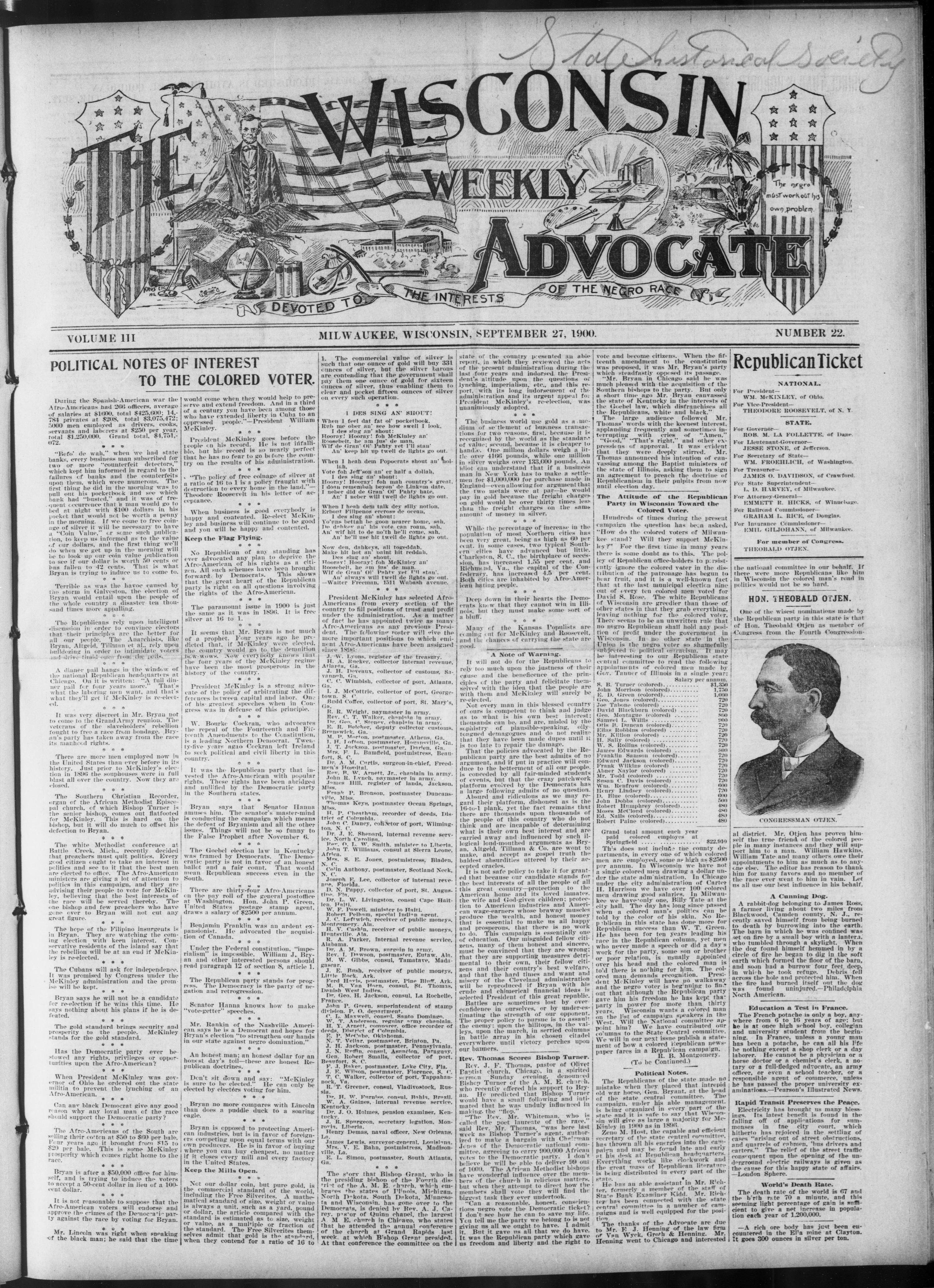
WISCONSIN
WEEKLY
ADVOCATE
DEVOTED TO THE INTERESTS OF THE NEGRO RACE
POLITICAL NOTES OF INTEREST TO THE COLORED VOTER.
During the Spanish-American war the Afro-Americans had 266 officers, average of salaries at $1600, total $425,600; 14,784 privates at $208, total $3,075,472; 5000 men employed as drivers, cooks, servants and laborers at $250 per year, total $1,250,000. Grand total, $4,751,072
```markdown
```
"Befo' de wah," when we had state banks, every business man subscribed for two or more "counterfeit detectors," which kept him informed in regard to the failures of banks and the counterfeits upon them, which were numerous. The first thing he did in the morning was to pull out his pocketbock and see which bank had "busted," and it was of frequent occurrence that a man would go to bed at night with $100 dollars in his pocket that would not be worth a penny in the morning. If we come to free coinage of silver it will be necessary to have a "Coin Value," or some such publication, to keep us informed as to the value of our dollars, and the first thing we'll do when we get up in the morning will be to look up our coin value publication to see if our dollar is worth 50 cents or bas fallen to 42 cents. That is what Bryan is trying to induce us to come to.
Terrible as was the havoc caused by the storm in Galveston, the election of Bryan would entail upon the people of the whole country a disaster ten thousand times more appalling.
The Republicans rely upon intelligent discussion in order to convince electors that their principles are the better for all our people. The Anarchists, like Bryan, Altgeld, Tillman et al., rely upon bulldozing in order to intimidate voters and drive timid ones from the pods.
农 穴 枣
A dinner pail hangs in the window of the national Republican headquarters at Chicago. On it it is written: "A full dinner pail for four years more." That's what the laboring men want, and that's what they'll get if McKinley is re-elected.
东 西 南
It was very discreet in Mr. Bryan not to come to the Grand Army reunion. The veterans of the slaveholders' rebellion fought to free a race from bondage. Bryan's party has taken away from the race its manhood rights.
向之向
There are more men employed now in the United States than ever before in its history. Just prior to McKinley's election in 1896 the souphouses were in full blast all over the country. Now they are closed.
* * *
The Southern Christian Recorder, organ of the African Methodist Episcopal church, of which Bishop Turner is the senior bishop, comes out flatfooted for McKinley. This is hard on the bishop, but it will do much to offset his defection to Bryan.
***
The white Methodist conference at Battle Creek, Mich., recently decided that preachers must quit politics. Every good citizen ought to take an interest in politics and see to it that the best men are elected to office. The Afro-American ministers are giving a lot of attention to politics in this campaign, and they are advising their people to vote for McKinley, believing that the best interests of the race will be served thereby. The one bishop and few preachers who have gone over to Bryan will not cut any great figure.
* * *
The hope of the Filipino insurgents is in Bryan. They are watching the coming election with keen interest. Conservative residents of the island say that the rebellion will be at an end if McKinley is re-elected.
* * *
The Cubans will ask for independence. It was promised by Congress under the McKinley administration and the promise will be kept.
Bryan says he will not be a candidate for re-election if he wins this time. He says nothing about his plans if he is defeated.
* * *
The gold standard brings security and prosperity to the people. McKinley stands for the gold standard.
**
Has the Democratic party ever bestowed any rights, privileges or opportunities upon the Afro-American?
* * *
When President McKinley was governor of Ohio he ordered out the state militia to prevent the lynching of an Afro-American.
* * *
Can any black Democrat give any good reason why any loyal man of the race should support the Democratic party?
* * *
The Afro-Americans of the South are selling their cotton at $50 to $60 per bale. Four years ago it brought from $15 to $20 per bale. This is some McKinley prosperity which comes right home to the race.
* * *
Bryan is after a $50,000 office for himself, and is trying to induce the voters to accept a 50-cent dollar in lieu of a 100-cent dollar.
* * *
It is not reasonable to suppose that the Afro-American voters will endorse and approve the crimes of the Democratic party against the race by voting for Bryan.
Mr. Lincoln was right when speaking of the black man; he said that the time
would come when they would help to preserve and extend freedom. And in a third of a century you have been among those who have extended liberty in Cuba to an oppressed people."—President William McKinley.
隶次串
President McKinley goes before the people on his record. He is not infallible, but his record is so nearly perfect that he has no fear to go before the country on the results of his administration.
** 车 车
· "The policy of free coinage of silver at a ratio of 16 to 1 is a policy fraught with destruction to every home in the land."—Theodore Roosevelt in his letter of acceptance.
爽 乖 乖
When business is good everybody is happy and contented. Re-elect McKinley and business will continue to be good and you will be happy and contented.
Keep the Flag Flying.
No Republican of any standing has ever advocated any plan to deprive the Afro-American of his rights as a citizen. All such schemes have been brought forward by Democrats. This shows that the great heart of the Republican party is right on all questions involving the rights of the Afro-American.
```markdown
```
The paramount issue in 1900 is just the same as it was in 1896. It is free silver at 16 to 1.
* * *
It seems that Mr. Bryan is not much of a prophet. Four years ago he predicted that, if McKinley were elected, the country would go to the demnition now-wows. Now everybody knows that the four years of the McKinley regime have been the most prosperous in the history of the country.
愈 治 幸
President McKinley is a strong advocate of the policy of arbitrating the differences between capital and labor. One of his greatest speeches when in Congress was in defense of this principle.
☆ ☆ ☆
W. Bourke Cockran, who advocates the repeal of the Fourteenth and Fifteenth Amendments to the Constitution, is a leading Northern Democrat. Twenty-five years agao Cockran left Ireland to seek political and civil liberty in this country.
☆ ☆ ☆
It was the Republican party that invested the Afro-American with popular rights. These rights have been abridged and nullified by the Democratic party in the Southern states.
* * *
Bryan says that Senator Hanna amuses him. The senator's master-mind is conducting the campaign which means the defeat of Bryanism and all the other issues. Things will not be so funny to the False Prophet after November 6.
雅 崇 杰
The Goebel election law in Kentucky was framed by Democrats. The Democratic party is not in favor of an honest ballot and a fair count. That would mean Republican success even in the South.
There are thirty-four Afro-Americans on the pay roll of the general postoffice at Washington. Hon. John P. Green, United States postage stamp agent, draws a salary of $2500 per annum.
Benjamin Franklin was an ardent expansionist. He advocated the acquisition of Canada.
* * *
Under the Federal constitution, "imperialism" is impossible. William J. Bryan and other interested persons should read paragraph 12 of section 8, article 1.
* * *
The Republican party stands for progress. The Democracy is the party of negation and retrogression.
* * *
Senator Hanna knows how to make "vote-getter" speeches.
* * *
Mr. Rankin of the Nashville American says he is a Democrat and hopes for Bryan's election "to strengthen our hands in our state against negro domination."
* * *
An honest man; an honest dollar for an honest day's toil—these are honest Republican doctrines.
* * *
Don't sit down and say: "McKinley is sure to be elected." He can only be elected by electors voting for him.
* * *
Bryan no more compares with Lincoln than does a puddle duck to a soaring eagle.
* * *
Bryan is opposed to protecting American industries, but is in favor of foreigners competing upon equal terms with our own producers. He is in favor of buying where you can buy cheapest, no matter if it closes every mill and every factory in the United States.
Keep the Mills Open.
Not our dollar coin, but pure gold, is the commercial standard of the world, including the Free Silverites. A mathematical standard of size, weight or value is always a unit, such as a yard, pound or dollar, the article compared with the standard is estimated as to size, weight or value, as a multiple or fraction of the standard. The Free Silverites themselves admit that gold is the standard, when they contend for a ratio of 16 to
MILWAUKEE, WISCONSIN, SEPTEMBER 27, 1900
1. The commercial value of silver is such that one ounce of gold will buy 331 ounces of silver, but the silver barons are contending that the government shall pay them one ounce of gold for sixteen ounces of silver, thus enabling them to clear and pocket fifteen ounces of silver on every such operation.
```markdown
```
1 DES SING AN' SHOUT!
I des sing an' shout:
Hooray! Hooray! foh McKinley an'
Roosebelt, he am jus' de man,
Wif de Gran' Ol' Pahty vet I'll stan'
An' keep hit up twell de lights go out.
When I heah dem Popocrats shout an' holah,
Vote fo Jeff'son an' er half a dollah,
I des sing an' shout:
Hooray! Hooray! foh mah country's great
I doan remembah beyon de Linkum date,
I neber did de Gran' Ol' Pahty hate,
An' I neber will twell de lights go out.
When I heah dem talk dey silly notion,
Erbout Fillpenos ercross de ocean,
I des sing an' shout:
Yo'uns bettah be goon nearer home, sah,
De debkey an' his vote can roam, sah,
An' wif hit to de no'th he'll come, sah,
An' he'll use hit twell de lights go out.
Now den, dahkeys, all togedddah,
Make hit hot an' paint hit reddah,
※ ※ ※
President McKinley has selected Afro-Americans from every section of the country to fill positions of trust and profit under the administration. As a matter of fact he has appointed twice as many Afro-Americans as any previous President. The following roster will give the more important positions to which eminent Afro-Americans have been assigned since 1896:
J. W. Lyons, register of the treasury.
H. A. Ruecker, collector internal revenue, Atlanta, Ga.
J. H. Deveaux, collector of customs, Savannah, Ga.
C. C. Wimbish, collector of port, Atlanta, Ga.
I. J. McCottrie, collector of port, Georgetown. S. C.
Budd Coffee, collector of port, St. Mary's, Ga.
R. R. Wright, paymaster in army.
M. P. Morton, postmaster, Athens, Ga.
J. H. Lofton, postmaster, Hogansville, Ga.
J. T. Jackson, postmaster, Darden, Ga.
Mrs. F. L. Bamfield, postmistress, Beaufort, S. C.
Dr. A. M. Curtis, surgeon-in-chief, Freedmen's Hospital.
Frank P. Bronson, postmaster Duncansville, Miss.
Thomas Keys, postmaster Ocean Springs, Miss.
H. P. Cheatham, recorder of deeds, District of Columbia.
John C. Dancy, colSector of port, Wilmington, N. C.
Dr. J. E. Shepard, internal revenue service, North Carolina.
Rev. O. L. W. Smith, minister to Liberia.
John T. Williams, consul at Sierra Leone, Africa.
Mrs. S. E. Jones, postmistress, Bladen, N. C.
Colin Anthony, postmaster, Scotland Neck, N. C.
Joseph F. Lee, collector of internal revenue, Florida.
D. N. Pappy, collector of port, St. Augustine, Fla.
Dr. L. W. Livingston, consul Cape Haiti
len. Haiti.
H. V. Cashin, receiver of public moneys,
Huntsville, Ala.
R. A. Parker, internal revenue service,
Alabama.
Dr. A. M. Brown, surgeon in army.
Rev. I. Dawson, postmaster, Eutaw, Ala.
M. W. Gibbs, consul, Tamatave, Madagascar.
J. E. Bush, receiver of public moneys, Little Rock, Ark. Ferd Havis, postmaster, Pine Bluff, Ark. M. B. Van Horn, consul, St. Thomas, Danish West Indies.
Dr. Geo. H. Jackson, consul, La Rochelle, France.
John P. Green, superintendent of stamp division, P. O. department.
C. L. Maxwell, consul. Santo Domingo.
W. T. Anderson, regular army chaplain.
H. Y. Arnett, comparer, office recorder of deeds, District of Columbia.
E. P. McCabe, Oklahoma.
N. T. Vellar, postmaster, Brinton, Pa.
J. H. Jackson, postmaster, Pennsylvania.
J. N. Ruffin, consul, Asunción, Paraguay.
Gen. Robert Smalls, collector of port, Beaufort, S. C.
F. J. Raker, postmaster, Lake City, Fla.
J. E. Wilson, postmaster, Florence, S. C.
T. C. Walker, collector of port, Tappahannock, Va.
R. T. Greener, consul, Vladivostock, Russia.
Dr. H. W. Furniss, consul, Bahla, Brazil.
W. A. Gaines, internal revenue service, Kentucky.
Dr. J. O. Holmes, pension examiner, Kentucky.
J. R. Spurgeon, secretary legation, Monrovia, Liberia.
Henry Demas, naval officer, New Orleans, La.
James Lewis, surveyor-general, Louisiana.
Mrs. V. E. Bahn, postmistress, Madisonville, La.
E. L. Simon, postmaster, South Atlanta, Ga.
我 内 谅
The story that Bishop Grant, who is the presiding bishop of the Fourth district of the A. M. E. church, which embraces the states of Illinois, Michigan, North Dakota, South Dakota, Minnesota and Wisconsin, has gone over to the Democrats, is denied by Rev. A. J. Carey, pastor of Quinn chapel, the largest A. M. E. church in Chicago, who states that he attended the annual conference of the church at Grand Rapids last week, at which Bishop Grant presided. At that conference the committee on the
state of the country presented an able report, in which they reviewed the acts of the present administration during the last four years and indorsed the President's attitude upon the questions of lynching, imperialism, etc., and this report, with its long indorsement of the administration and its urgent appeal for President McKinley's re-election, was unanimously adopted.
```markdown
```
The business world use gold as a medium of settlement of business transactions for two reasons, first, because it is recognized by the world as the standard of value; second, because it is cheaper to handle. One million dollars weigh a little over 4166 pounds, while one million in silver weighs over 133,000 pounds. An idiot can understand that if a business man in New York has to make a settlement for $1,000,000 for purchase made in England—even allowing for argument that the two metals were at par—he would pay in gold because the freight charges on gold would be over thirty times less than the freight charges on the same amount of money in silver.
```markdown
```
While the percentage of increase in the population of most Northern cities has been very great, being as high as 60 per cent, in some cases, two typical Southern cities have advanced but little. Charleston, S. C., the birthplace of secession, has increased 1.55 per cent. and Richmond, Va., the capital of the Confederacy, has increased 4.5 per cent. Both cities are inhabited by Afro-American hating people.
* * *
Deep down in their hearts the Democrats know that they cannot win in Illinois, but they must make some sort of a bluff.
* * *
Many of the Kansas Populists are coming out for McKinley and Roosevelt, and the chances of carrying the state are good.
A Note of Warning.
It will not do for the Republicans to rely too much upon the justness of their cause and the beneficence of the principles of the party and felicitate themselves with the idea that the people are with them and McKinley will surely be re-elected.
Not every man in this blessed country of ours is competent to think and judge as to what is his own best interest; thousands can be, and are, misled by the sophistry of plausible-speaking, oily-tongued demagogues and do not realize that they have been made dupes until it is too late to repair the damage.
That the policies advocated by the Republican party are the best admits of no argument, and if put in practice will conduce to the betterment of all our people, is conceded by all fair-minded students of events, but that the crazy patchwork platform evolved by the Democrats has a large following admits of no question. Absurd and ridiculous as we may regard their platform, dishonest as is the 16-to-1 plank, yet the fact remains that there are thousands upon thousands of the people of this country who do not think and are incapable of determining what is their own best interest and are carried away and influenced by such illogical loud-mouthed arguments as Bryan, Altgeld, Tillman & Co. are wont to make, and accept as gospel truth the baldest absurdities uttered by their accented oracles.
It is not safe policy to take it for granted that because our candidate stands for the best interests of all the people of all this great country—protection to the American home and its loved inmates, the wife and God-given children; protection to American industries and American wage-earners whose brawny muscles produce the wealth, and honest money that is essential to make us all happy and prosperous, that there is no work to do. This campaign is essentially one of education. Our misguided fellow citizens, many of them honest and sincere, must be convinced that they are wrong; that they are supporting measures detrimental to their own, their fellow citizens and their country's best welfare, and that the hard times and want and misery of the Cleveland administration will be reproduced if Bryan with his crude and chimerical financial ideas is selected President of this great republic. Battles are sometimes lost by overconfidence in ourselves, or by under-estimating the strength of our opponent. The proper policy to pursue is to assault the enemy; upon the hilltops, in the valleys, upon the march, in serried columns in battle array in his chosen citadel everywhere until victory perches upon our barmers.
Rev. Thomas Scores Bishop Turner. Rev. J. F. Thomas, pastor of Olivet Baptist church, Chicago, in a spirited sermon Sunday evening, denounced Bishop Turner of the A. M. E. church, who recently offered his support to Bryan. He predicted that Bishop Turner would have a small following and intimated that he was unduly influenced in making the "flog."
"The Rev. Mr. Whiteman, who is called the poet laureate of the race," said Rev. Mr. Thomas, "was here last week as Bishop Turner's agent, authorized to make a bargain with Chairman Jones of the Democratic national committee, agreeing to carry 900,000 African votes to the Democratic party. I don't believe he will be able to deliver 99 out of 1000. The African Methodist bishops have wonderful influence over the members of the church in religious matters, but when they attempt to direct how the members shall vote they will find the biggest task they ever undertook. "Can a reasonable, honest, conscientious negro vote the Democratic ticket? I don't see how he can to save my life. You tell me the party we belong to is not giving us all we ought to have. I admit it. But it gave us all that we do have. It was the Republican party which gave us freedom and liberty and the right to
vote and become citizens. When the fifteenth amendment to the constitution was proposed, it was Mr. Bryan's party which steadfastly opposed its passage. "Mr. Bryan in Chicago said he was much pleased with the acquisition of the Southern bishops to the party. But only a short time ago Mr. Bryan canvassed the state of Kentucky in the interests of the Goebel law, which disfranchises all the Republicans, white and black."
The large audience followed Mr. Thomas' words with the keenest interest, applauding frequently and sometimes interrupting with cries of "Amen," "Good," "That's right," and other expressions of approval. It was evident that they were deeply stirred. Mr. Thomas announced his intention of canvassing among the Baptist ministers of the state of Illinois, asking them to sign an agreement to preach the doctrine of Republicanism in their pulpits from now until election day.
The Attitude of the Republican Party in Wisconsin Toward the Colored Voter.
Hundreds of times during the present campaign the question has been asked, "How do the colored voters of Milwaukee stand? Will they support McKinley?" For the first time in many years there is some doubt as to this. The policy of Republican office-holders to persistently ignore the colored vater in the distribution of the patronage has begun to bear fruit, and it is a well-known fact that at the last municipal election nine out of every ten colored men voted for David S. Rose. The white Republicans of Wisconsin are greedier than those of other states in that they grab everything, leaving nothing for the colored voter. There seems to be an unwritten rule that no negro Republican shall hold any position of profit under the government in Wisconsin. In no other state in the Union is the negro voter so shamefully subjected to political ostracism. It may be interesting to our Republican state central committee to read the following appointments of colored men made by Gov. Tanner of Illinois in a single year:
$1,330
1,750
1,000
720
720
720
800
900
720
720
720
720
720
800
720
720
720
720
720
720
600
720
600
500
480
480
480
480
S. B. Turner (colored).....
John Morrison (colored).....
E. D. Green (colored).....
Geo. Jones (colored).....
Joe Tabone (colored).....
David Blackburn (colored).....
Geo. Montague (colored).....
Samuel L. Willis.....
Otis B. Duncan (colored).....
Elias Robbins (colored).....
Mr. Killion (colored).....
H. Sally (colored).....
W. S. Rollins (colored).....
James Edwards (colored).....
Franklin Sanson (colored).....
Edward Jackson (colored).....
Frank Wilkins (colored).....
Abner Naylor (colored).....
Mr. Todd (colored).....
Susan C. Davis (colored).....
Wm. Renfrow (colored).....
Henry Lindsey (colored).....
D. Blue (colored).....
John Dobbs (colored).....
Robert Humphrey (colored).....
Moses McCloud (colored).....
Ed. Nails (colored).....
Robert Paine (colored)....
This does not include the county departments, in every one of which colored men are employed, some as high as $2500 per annum. In Wisconsin we have not a single colored men drawing a dollar under the state administration. In Chicago under the city administration of Carter H. Harrison we have over 100 colored men drawing good salaries. In Milwaukee we have only one, Billy Tate at the city hall. The day has long since passed when a colored man's politics can be told by the color of his skin. No Republican in this state has done more for Republican success than W. T. Green. He has been for ten years leading his race in the Republican column, yet men who never made a speech or did a day's work for the party, some son or brother or poor relation, is usually appointed over his head and the colored man is told there is nothing for him. The colored man demands recognition. President McKinley will have no walkaway and the negro voter is beginning to find out that although the Republican party gave him his freedom he has kept that party in power for more than thirty years. Wisconsin wants a colored man on the list of campaign speakers in the West. Will the National committee appoint him? We have contributed our columns to the State Central committee. We will in our next issue publish a statement of how a colored Republican newspaper fares in a Republican campaign. R. B. Montgomery.
Political Notes
The Republicans of the state made no mistake when they placed that intrepid old war horse, Gen. Bryant, at the head of the state central committee. The campaign, under his able management, is being organized in every part of the state and it is safe to say that Wisconsin will give as large a majority for McKinley in 1900 as in 1896.
Zeno M. Host, the capable and efficient secretary of the state central committee, has thrown all his energies into the campaign and may be found late and early at his desk at Republican headquarters. Everything works like clockwork and the great mass of Republican literature is being distributed in every part of the state
He has an able assistant in Mr. Richter, formerly a member of the staff of State Bank Examiner Kidd. Mr. Richter has been connected with the state central committee in a number of campaigns and is well equipped for the position.
The thanks of the Advocate are due to Mr. E J. Henning of the law firm of Van Wyck, Groth & Henning. Mr. Henning went to Chicago and interested
RepublicanTicket
NATIONAL.
For President—
WM. McKINLEY, of Ohio.
For Vice-President—
THEODORE ROOSEVELT, of N. Y.
STATE.
STATE.
For Governor—
ROB. M. LA FOLLETTE, of Dane.
For Lieutenant-Governor—
JESSE STONE, of Jefferson.
For Secretary of State—
WM. FROEHLICH, of Washington.
For Treasurer—
JAMES O. DAVIDSON, of Crawford.
For State Superintendent—
L. D. HARVEY, of Milwaukee.
For Attorney-General—
EMMETT R. HICKS, of Winnebago.
For Railroad Commissioner—
GRAHAM L. RICE, of Douglas.
For Insurance Commissioner—
EMIL GILJOHANN, of Milwaukee.
For member of Congress.
THEOBALD OTJEN.
the national committee in our behalf. If there were more Republicans like him in Wisconsin the colored man's read in politics would not be so hard.
HON. THEOBALD OTJEN.
One of the wisest nominations made by the Republican party in this state is that of Hon. Theobald Otjen as member of Congress from the Fourth Congression-
M.
al district. Mr. Otjen has proven himself the true friend of the colored people in many instances and they will support him to a man. William Hawkins, William Tate and many others owe their appointments to him as much as to anyone else. The editor has reason to thank him for many favors and no member of the race ever went to him in vain. Let us all use our best influence in his behalf.
A Cunning Dog.
A rabbit-dog belonging to James Ross, a farmer living about two miles from Blackwood, Camden county, N. J., recently saved himself from being burned to death by burrowing into the earth. The barn in which he was confined was set on fire by a small boy with a lantern, who tumbled through a skylight. When the dog found himself hemmed in by a circle of fire he began to dig in the soft earth which formed the floor of the barn, and soon had a burrow four feet deep, in which he took refuge. Debris fell across the hole and protected him. When the fire had burned itself out the dog was found uninjured.—Philadelphia North American.
Education a Test in France.
The French potache is only a boy, anywhere from 6 to 16 years of age; but he is at once high school boy, collegian and university student from the beginning. In France, unless a young man has been a potache, he can all his life be nothing except a shop clerk or a day laborer. He cannot be a physician or a horse doctor or a chemist's clerk, a notary or a full-fledged advocate, an army officer, or even a school teacher, or a responsible agent of commerce, unless he has passed the proper university examinations.—Pearson's Illustrated News.
Rapid Transit Preserves the Peace.
Electricity has brought us many blessings. Its latest benefit is found in the falling off of applications for summonses in the city court, which hitherto has rejoiced in the settling of cases "arising out of street obstructions, and quarrels of cabmen, "bus drivers and carters." The relief of the street traffic consequent upon the opening of the underground electric railways is given as the cause for this happy state of affairs.—London Sphere.
World's Death Rate:
The death rate of the world is 67 and the birth rate 70 a minute, and this seeming light percentage of gain is sufficient to give a net increase in population each year of 1,200,000.
A rich ore body has just been encountered in the Ella mine at Clayton. It goes 300 ounces in silver per ton.
PRINCE TUAN IS HONORED.
Chinese Butcher Appointed President of Privy Council.
BOXERS ARE PROMOTED
Piracy and Brigandage Said to be Increasing Along the West River
Washington, D. C., Sept. 26.—It is stated in diplomatic quarters that definite and official information has been received that Prince Tuan has been appointed president of the privy council of China, instead of grand secretary, as was first reported, and that a number of other Chinese officials prominent in the recent uprising have been similarly honored. The Chinese minister has not been advised of Prince Tuan's appointment, but he expressed the belief after coming at the state department today that the report probably was true. The position of president of the privy council is said to be one of foremost importance, similar to that of secretary of state or premier.
An Escort Declined.
Washington, D. C., Sept. 26.—The following has been received from Gen. Chaffee, dated Taku, September 25: "Acknowledge your Number 40. Leave for Tien Tsin this afternoon. Will be absent several days. Gen. Wilson remains here. Li Hung Chang at Tien Tsin. Understand starts here soon; have offered him escort; declined; country very quiet; good order in Pekin."
Piracy and Brigandage.
Hong Kong, Sept. 25.—Advices from the West river report that piracy and brigandage are increasing and it is considered probable that the river will relapse into its old state of insecurity during the winter unless active measures are taken. Several minor piratical acts are reported and it is also stated that villages near Kum Chuh have been burned by brigands.
New York, Sept. 26.—A dispatch to the Herald from Hong Kong says: A mob destroyed the Catholic church at Toksahang, a few miles from Canton, and afterward desecrated the American Baptist mission graveyard yesterday. Rowdies also destroyed the American Presbyterian church, just outside Canton.
KAISER WILHELM FOR WAR.
Count Von Walauersee Believed to Have an Ultimatum.
Washington, D. C., Sept. 26.—There is no concealing the fact that the United States and Germany are pulling very far apart in dealing with the Chinese question.
Sincere gratification was felt in Germany when the United States agreed to the appointment of Count von Waldersee as commander-in-chief of the allied forces. Yet orders were issued yesterday by Secretary Long and Lieut.-Gen. Miles, acting secretary of war, directing the withdrawal of the American forces, with the exception of a body of 1800 men, to be known as a legation guard, and therefore exempt from Von Waldersee's orders.
To the proposal made by Germany that as a condition precedent to negotiation that the responsible authors of the Chinese outrages be delivered up to the allies the President returned an emphatic negative, and from present indications the triple alliance will be isolated and Germany will be forced to withdraw from the position she has assumed. Great Britain, Russia and France are known to have adopted the same position as the United States, while Japan has in part approved the President's position, holding that China should punish the perpetrators of the outrages, though she denies they should be punished as a condition precedent to negotiations.
Will Not Please Germany.
It is but natural that the German government is not pleased over the turn affairs have taken. Emperor William had his mind set on a German officer commanding all the foreign troops in China. The United States has already taken steps to nullify this agreement; Russia and France propose to take advantage of technicalities to relieve their troops of service under the command of a foreigner, and Japan, which is undoubtedly suspicious of Germany, will probably direct her officers to think twice before carrying out Von Waldersee's instructions. Great Britain may be willing to permit her force to serve with those of Germany, though undoubtedly precautions would be taken by which British interests will be amply safeguarded.
An Unexpected Grouping.
London, Sept. 26.—Only through the advices from New York does the British public learn that the United States and Great Britain are once again ranged together in opposition to the continental powers. Apparently such a grouping was entirely unexpected in both Berlin and London.
The Daily Chronicle devotes a brief editorial paragraph to the announcement, expressing a hope that it is erroneous and declaring that "the only way in which England can reap the fruit of her exertions in China is by standing shoulder to shoulder with Germany and Japan as the only effective counterpoise to Russo-French machinations and the weak-kneed policy of America."
England is Shocked.
The Times, in an editorial on China's nonrepentant mood, refers to Great Britain's reply and says:
"The country would be both astonished and shocked if our government did not warmly support the German proposal. It is simply inconceivable that the British, of all governments, should refuse to accede to a proposal at once so reasonable and just."
Von Waldersee May Declare War.
Meanwhile the news from China indicates that events are rapidly drifting in the direction of war between China and Germany.
"There is the best reason for believing," says the Shanghai correspondent of the Morning Post, "that Count von Waldersee, on arriving at Taku, will present an ultimatum demanding the surrender of five leaders of the anti-foreign uprising. After a few hours' grace he will formally declare war; and, taking advantage of Germany's position as a bell gerent, he will proceed to seize everything available with the German forces and fleet."
IN CASE OF WAR
United States will Not Participate in Hostilities.
Washington, D. C., Sept. 26.—It is believed that Gen. Chaffee, being at Tien Tsin, has by this time received the instructions cabled him yesterday relative to the reduction of his force in China. If he returns to Pekin to execute the order it will be Monday at least before he can begin the movement toward Tien Tsin. Field Marshal Waldersee is liable to arrive at Taku or Tien Tsin at any moment, and it is desirable that the change of the status of the American trocps shall have taken place before he appears on the scene. The rapid trend of events in China to
ward actual and formal war which is regarded as certain to follow a refusal on the part of Germany and some of the other continental powers to enter into negotiations for a settlement for China, is regarded here as justifying the decision of the state department to withdraw the American troops, now that the purpose for which these troops were sent into China has been accomplished. The department has held from the first that a state of war did not exist with the Chinese government, and it secured the assent of every one of the powers to that proposition. It still does not believe there is sufficient ground for changing that position and refuses to be drawn into war without such ground.
As to the military plans already laid down, they will remain unchanged, it is said here. If the belligerent power or powers seize upon Pekin the American minister will still remain there and Gen. Chaffee's guard will stay with him, but taking no part in the war. The power in possession can find no valid objection to the presence of this legation guard. At Constantinople the legations and embassies all have their cavasses, or legation guards, and while they are not numerous, the principle is recognized, and mere numbers do not affect it.
HOWARD FOUND GUILTY.
Convicted of Being a Principal in Goebel Assassination - To Suffer Death.
Frankfort, Ky., Sept. 26.—James Howard has been found guilty of being a principal in the assassination of Gov. Goebel. The verdict was returned shortly before 10 o'clock this morning and entailed the death sentence.
One of the jurors, after the jury had been discharged, stated to the Associated press that a number of ballots were taken, but the first ballot resulted in a unanimous vote in favor of a verdict of guilty. After that the ballots were as to the degree of punishment and on the ballots ten members voted for the death penalty, while two voted for life imprisonment. This was while the jurors were in the jury room yesterday afternoon. The first ballot today resulted in a verdict, the two jurors who had voted for life imprisonment giving in to the majority and voting for the death penalty. After the verdict had been rendered Howard was remanded to jail, where he was followed by his bosom friend, John G. White, who seemed almost paralyzed by the verdict. Howard's cheeks also blanched as he stood up to accompany the jailer back to his ceil.
The jury which tried the cases was divided politically, 9 Democrats, 1 Republican and 2 anti-Goebel Democrats. The verdict of the jury is believed to have been based largely upon the destruction of Howard's alibi, upon which he depended solely. Howard's attorney will at once apply for a new trial, basing the motion on alleged expressions of several of the jurors made prior to the trial which were hostile to the defendant.
OLD MORTGAGE FOUND.
Mrs. Blaine Discovers an Incumbrance on Her Property Executed in 1831.
Pittsburg, Pa., Sept. 26.—Harriet G. Blaine, widow of James G. Blaine, filed a petition in common pleas court No. 1 asking to be discharged from the incumbrances upon real estate in Forward township acquired by the will of her husband under date of January 7, 1892, and probated in Kennebec county, Me. The property in question consists of 172 acres of coal land. The ground was originally owned by John Munce, who, in April, 1831, delivered to Jacob F. Wall and Garrett Wall, executors of Andrew Wall, a mortgage for $1601.66, which now appears open and unsatisfied upon the records. The petitioner says she believes that on September 2, 1871, when the property was acquired by her husband, James G. Blaine, and down to the present time no demand was made upon her for payment of the interest or principal of the mortgage, and it was not until a short time ago, when negotiations were begun for the sale of the property, that the existence of the mortgage on the record was discovered. The petitioner further says that she has been unable to discover any of the representatives of Andrew Wall, and as it has twenty-one years ago since the principal became due she therefore asks for the satisfaction of the mortgage. The petition is signed by Mrs. Blaine.
PHYSICIAN SUMMONED.
Change for the Worse Reported in the Condition of the Secretary of War.
New York, Sept. 26.—A change for the worse is reported in the condition of Elihu Root, secretary of war, who underwent an operation at Southampton, Long Island, for the removal of a carbuncle from his left breast. Secretary Root's condition is considered alarming. Dr. Francis H. Markoe of this city, who performed the operation, was this afternoon summoned to the bedside of his patient.
Secretary Root suffered for some time with what he supposed was a small boil before seeking medical advice. While in Washington the growth became so painful that the secretary of war, accompanied by Mrs. Root, returned to Southampton on September 7. Home remedies were applied without any beneficial effects, and on the following day Dr. Dixon, a local physician, was called in. Dr. Dixon at once pronounced the growth a carbuncle and advised an operation. Dr. Markoe was summoned from this city, and on September 9 the operation was performed. The carbuncle was found to be deeply imbedded and the surrounding tissues were badly inflamed. Secretary Root withstood the operation very well and it was considered a success. Mr. Root was convalescing. There had been a steady improvement in his condition and it was believed that he would be able to be about in a few days.
IRELAND DECORATED.
French Government Makes Archbishop a Commander of the Legion of Honor.
Paris, Sept. 26.—Archbishop Ireland leaves here for London tomorrow, whence he heals October 10. He was decorated today as a commander of the Legion of Honor by M. Jules Cambon, the French ambassador to the United States, in behalf of the government. Gen. Horace Porter, the United States ambassador to France, and Bellamy Storer, the United States minister to Spain, were among those present.
TOLSTOL UNDER THE BAN.
Novelist Officially Declared an Enemy of the Russian Church.
Lausanne, Switzerland, Sept. 26.—A secret circular, addressed by Joannicius, the metropolitan of Kieff, to all the Russian archbishops, virtually excommunicating Tolstoi, the Russian novelist and social reformer, is published here. It declares that Tolstoi is an avowed enemy of the church and that therefore, unless he recants, the holy synod will prohibit the celebration of all divine services and expiatory masses in the event of his death.
EFFORTS ARE FRUITLESS.
Attempts to Resume Operations at Collieries.
Strikers Continue to Plead with Men Still at Work-No Violation Reported.
Shamokin, Pa., Sept. 25.—The officials of the Cameron colliery, one of the largest operations in this place, endeavored to start the works this morning, but no miners responded to the blowing of the whistles. A fruitless attempt was made to resume work at several other collieries between here and Centralia, but the men remained away. The North Franklin and Locust Spring collieries at Treverton and Locust Gap, operated by the Philadelphia & Reading Coal and Iron company, are still working. Everything is quiet in this district.
Shenandoah, Pa., Sept. 23.—There is no change in the strike situation today. All the mines in this immediate vicinity with the exception of the Cambridge colliery, a small individual operation, are idle. There appeared to be no disposition on the part of mine employees to go to the collieries this morning and the demonstration made by the militia yesterday was not repeated. The governor's troop marched over toward Preston No. 3 at Girardville, and passed other collieries in that vicinity, but no trouble was reported. Provost Marshal Millar took the guard over to Cambridge colliery, but no attempt was made by the strikers to molest the employees of that operation.
Agreed to Arbitrate.
Hazleton, Pa., Sept. 25. About 1 o'clock this morning 300 men gathered at the Cranbury colliery of A. Pardee & Co. and marched to the Tom Hicken nine miles west of here, for the purpose of endeavoring to prevent the men employed at that place from going to work. They reached there before daylight. No trouble has thus far resulted.
A report was received from Jeddo that Clement Elliott, chairman of the grievance committee of the 1900 Markle employees, had called the men together at the bottom of No. 5 slope this morning and informed them that the company had granted all the demands presented ten days ago with the exception of the one calling for reduction of the price of powder, and that the company agreed to arbitrate this grievance.
When John Markle, managing partner of G. B. Markle & Co., was told by a reporter for the Associated press of the report he refused to either confirm or deny it, and referred the reporter to the committee. The members of this body are several hundred feet below the earth's surface and cannot be seen. Mr Markle said he would deliver the answer to the Associated press at 4 o'clock, and the mineworkers would have it before that hour. He would not say whether they already knew the company's intention.
List of Grievances.
The list of grievances was presented on Friday, September 14, after a meeting and the new decided to allow the Markles ten days in which to answer and agreed to disregard the strike order and remain at work pending a reply.
They ask for the enforcement of the semi-monthly pay law; ten hours' pay for ten hours' work; that men engaged in the rubbing of pillars be paid for dead work; that when the slope is over and the men present themselves at the bottom to be hoisted to the surface, a car be provided, so as not to oblige them to wait until the bottom men get ready; that powder be reduced to as low a rate as possible; that the company provide a tool car in the morning and evening to take all tools up and down the slope; that the men receiving $1.75 at present get an advance of 5 per cent. and those below $1.75 an increase of 10 per cent.
Mines Worked by Bosses.
Wilkesbarre, Pa., Sept. 25.—The coal operators of the Wyoming valley claim to have a shade the best of the situation this morning. Several washeries that were idle yesterday resumed operations today. Not many men are employed but the operators claim it is a gain nevertheless over yesterday. At the North American washery in Luzerne borough, about twenty men are at work. The washery at the Stanton mine of the Lehigh & Wilkesbarre Coal company has about thirty men employed. The washeries of the Pennsylvania Coal company at Pittston are also in partial operation. The big mines are all idle with the exception of the colliery of the West End at Monacqua. At strikers' headquarters they make light of the resumption of the work at the washeries. They say the employees are mostly bosses and other employees working on monthly salaries, and that none of the union men have gone back to work.
Wire Fences Erected.
Scranton, Pa., Sept. 25.—There was no apparent change today in the anthracite miners' strike in the Lackawanna region. Extra guards are being placed about some of the breakers and the owners are enclosing their property with wire-rope fences.
At several mines where attempts were made to get engineers and foremen to take up the work of laborers today the men refused and they were at once discharged.
Watchmen at the Bellevue colliery kept firing at intervals during the night, but no crowd was attracted as the strike leaders had warned the men to give the mine operators no excuse for saying a mob was assembling. The strikers hereabouts continue to show a solid front and there is no evidence today of a disposition on the part of any of them to return to work.
Fifty Collieries Idle.
Shenandoah, Pa., Sept. 25.—Reports received here today from various points indicate that out of fifty-five collieries in the Shamokin, Mahanoy City, Mount Carmel and Local District only five are in operation, the Trevorton at North Franklin; Locust Spring at Locust Gap; Bast at Ashland, and the Cambridge and Park Place collieries. Four hundred miners last night marched from Centralia to Locustdale, a distance of four miles, and held a mass meeting. As a result the Pott colliery at that place, employing 200 men, is idle today.
Gen. Gobin at noon said he had received no report of any disturbance in the region. J. C. McGinnis, manager of the Cambridge Coal company, made a statement today in which he denied emphatically the story telegraphed from here yesterday that he advised his men at work to shoot to kill in the event of strikers attacking them.
RAILROAD SHOPS BURNED.
Four Hundred Men Thrown Out of Employment-Loss $250,000. Little Rock, Ark., Sept. 25.-The Iron Mountain shops, located at Baring Cross, were totally destroyed by fire early today. Four hundred men are thrown out of employment. The shops were the largest in this section of the country and were the main shops of the Iron Mountain system. The loss will reach $250,000
Candidate of the Sound Money Democrats for President Four Years Ago.
Springfield, Ill., Sept. 25.—Gen. John M. Palmer, ex-United States senator from Illinois, died at his residence in this city at 8 a. m.
Heart failure was the direct cause of Gen. Palmer's death. He had been in ill-health for more than two years. Last Saturday he attended the funeral of Gen. McClernand, acting as an honorary pall-bearer. After viewing the campaign parade last night, the general retired apparently as well as usual. Shortly after rising today he complained of pains in the chest and expired about 8 o'clock.
Gen. Palmer was the last survivor of the old-school politicians of Illinois, which included such men as Lincoln, Douglas and Oglesby. His public career covered a period of half a century and he secured all the political honors that Illinois could give him. He was familiarly referred to as "the grand old man of Illinois," and in war or in peace he was prominent as a leader. Since 1840 he has
A. B.
GEN. JOHN M. PALMER.
been serving his state or his country in some capacity, and he has always been the same aggressively courageous man, whether on the field of battle, in the political campaign, in the court trial or in legislative debate. Long before he sat in the constitutional convention of 1847 John M. Palmer was a judge on the bench. From 1852 to 1856 he was state senator. He was a delegate to the Republican convention of 1860 and was a Republican elector in the same year. He was a member of the peace conference in Washington in 1861. Then he went to the war. As colonel of the Fourteenth Illinois infantry he did good service and was rapidly promoted. For conspicuous gallantry at the battle of Stone river he was made a major-general in 1862. In 1868 he was elected governor of Illinois, but after his term of service expired he was less fortunate in politics. He had become a Democrat and was three times defeated when before the Legislature as candidate for senator. In 1888 he was defeated as a Democrat for governor, but the next time the grand old man appeared on the political field he won, and was sent to Washington as an Illinois senator.
In 1896 he declined to follow his party into the Bryan camp and was the candidate of the sound-money Democrats for President of the United States. He was born at Eagle Creek, Scott county, Ky., Sept. 13, 1817. He removed to Illinois in 1831. He was admitted to the bar in 1839, and practiced his profession continuously except during the Civil war.
FIRE STARTED BY BURNING BRUSH.
An Area of 150 Square Miles Devastated—Loss Estimated at $1,500,000.
Santa Rosa, Cal., Sept. 25.—Fire which has been burning for several days about Occidental has covered 150 square miles. The damage is estimated at $1,500,000. A stranger who has been fighting the flames is missing and several of the volunteers have had narrow escapes from suffocation.
Burning brush at Freestone started the conflagration. The situation was such that the women and children of the town were placed in cars and carried out of the burning district.
ROW OVER MURDER.
Two Bands of Italians at Cile, Mich. Fight About King's Death
Ironwood, Mich., Sept. 25.—[Special.]
A severe cutting affray occurred in a saloon at Gile between two factions of Italians, called the north and south clans. The cause of the trouble was about the killing of the King of Italy. The south clan was opposed to the murder and the north in sympathy with the Anarchists. Peter Allero's left shoulder was cut twelve to fourteen inches, which necessiated twenty stitches, while five others were also badly cut. A number of arrests occurred, and the offenders will be severely dealt with.
TO BE BROUGHT HOME.
Remains of Soldiers and Sailors Buried in the Philippines.
San Francisco, Cal., Sept. 25.—D. V. Rhodes, inspector of national cemeteries, and fifteen assistants have arrived here from Washington. They will take passage on the transport Hancock on October 1 for the Philippines, where they will attend to the transportation to the United States of the remains of soldiers, sailors and marines who have lost their lives and were buried in the island possessions of the United States and in China. The approximate number of bodies to be exhumed is 1231.
An Unpleasant Exposure.
A Topeka girl went to law in order to secure payment of a claim on an accident insurance company. The company brought out the fact that the girl had corns. This was such a shock to her best fellow that he ceased his visits, and now the girl wonders whether the $47 she got from the company is sufficient compensation for the loss of her beau.
A Valuable Piece of Plate.
The most valuable piece of plate possessed by Queen Victoria is a peacock with outspread tail, made of solid gold and literally covered with diamonds, rubies, emeralds and other precious gems. It originally came from Seringapatam, is safeguarded at Windsor castle, and is worth a fabulous sum.
—In the Prussian government dockyard at Kiel all the great machine shops are to be electrically driven from a central power plant of a capacity of 3500horsepower.
—At a special election at Washburn high license carried by a majority of 121.
Surrender of Boer Army Accomplished by Friendly Intercession of Portuguese. Lourenco Marques, Sept. 26.—The final collapse of the Boer army may be summarized as follows: When the Boers, numbering 2000, evacuated Komatipoort they took up positions between the Lobombo range and the river. They had good positions and could have made a capital stand, but owing to the disorganization and lack of discipline that were prevalent they were only half-hearted.
Wishing to avoid a conflict and unnecessary bloodshed the British consul-general consulted the Portuguese governor-general, Senhor Machado, as to the best course to be pursued to attain this end. He asked that emissaries should be sent up with an address to the Boers, pointing out the uselessness of continuing their resistance and the absolute needlessness of going on further.
Besides, if they continued to fight, there was a fear of the natives rising. Owing to the fact that the Portuguese had been most kind to the Boers, and as they had guaranteed their maintenance and repatriation and promised to send them back to their country free of charge, the scheme succeeded beyond the wildest hopes of its originator. Instead of dozens coming down to Lourenco Marques, 2500 arrived in this wise. Diplomacy therefore triumphed by bringing the war to a speedy and bloodless close.
Lourenco Marques, Sept. 26.—The German steamer Herzog, which sailed for Europe today, had among her passengers the Transvaal postmaster-general, Van Alphen; the assistant secretary of state, Grobler; the state treasurer, Malherbe, and a large quantity of bar gold. The railroad from Delagoa bay to Pretoria is expected to be open for traffic tomorrow.
London, Sept. 26.—Lord Roberts reports that Gen. Ian Hamilton found at the Crocodile river, near Hector Spruit, thirteen guns, including several lost by the British. They were mostly destroyed.
TWO MEN ARE KILLED.
Collision Between Locomotives Running at Full Speed—Mangied Beyond Recognition.
Springfield, Ill., Sept. 26.—While hundreds of people were waiting at the railroad station in the State fair grounds to return to Springfield on the suburban train they saw a locomotive leave the tracks at full speed and dash into another which was running along beside it, heard the crash as the two great engines came together, and later saw the crushed and mangled forms of an engineer and fireman lying beneath the debris in such a manner that neither could be extricated until tons of wreckage were raised.
News of the disaster spread over the fair grounds, and the wildest excitement followed. Women who rushed to the scene screamed and covered their eyes. Some fainted and were borne away. The body of Engineer Ryan was crushed into an unrecognizable mass. An hour later, the upper portion of Fireman Hall's remains were taken out, and some few minutes afterward his legs and lower portion of the body were removed.
Muncie, Ind., Sept. 26.—Mr. and Mrs. William Driscoll, aged 60 and 54 respectively, were instantly killed yesterday afternoon by the Big Four express No. 19, westbound, from New York to St. Louis, with Engineer Cropper in charge. The accident happened at the Grant street crossing while the old couple were driving across the track coming to the city from their country residence at Inlow Springs. The crossing is near the city limits east, and the train was running at a high rate of speed. Driving from the south a saloon building shielded the train from view and the horse was squarely on the crossing before being seen by the engineer. The horse escaped with a few scratches, but the big engine struck the buggy squarely. Mr. Driscoll had his neck broken, while the body of his wife was mangled in a frightful manner.
PAROLE SYSTEM CRITICISED.
Gov. Pingree Refuses to Honor a Requisition from Gov. Tanner.
Detroit, Mich., Sept. 26.—Gov. Pingree recently refused Gov. Tanner's requisition for the extradition of Fred Brueggin, a paroled Illinois convict, who had left the state, contrary to the parole laws. The governor based his refusal on the fact that Brueggin was not able to obtain employment in Chicago by reason of being known, and had taken service on one of the lake ships. This service prevented him from reporting once a month, as required by the Illinois laws.
Gov. Pingree, in refusing the requisition, made some characteristic remarks about the absurdity of the Illinois system, and wrote Gov. Tanner a letter explaining the circumstances. Gov. Pingree yesterday received the following letter from Gov. Tanner:
"I have read carefully your statement of the ground on which you deny the requisition, and I fully approve of the course you have taken, and with the facts at hand would have acted likewise had our positions been reversed."
STORK AGAIN BRINGS TWINS
Pittsburg Man's Six Boys All Bear Well-Known Names.
Pittsburg, Pa., Sept. 26.—Three successive pairs of twins in four years were left by the stork at the home of Victor Beauquiet, a steel worker at the Carnegie Homestead plant. The family lives in Third avenue, Homestead, and the children are all healthy.
When the first pair arrived the father and mother were so elated that they named them Victor Hugo and Napoleon Bonaparte. The second pair was christened General Grant and General McMahon and the last will be William Jennings Bryan and John Purman, the latter being a Democratic leader of Homestead, who was a candidate for Congress two years ago.
SNOW THREE FEET DEEP.
Heavy Fall of Flakes at Red Mountain, in Colorado
Denver, Col., Sept. 26.—Dispatches from various points in the Rocky mountains show that there has been a heavy snowfall. At Red mountain, near Ouray, snow is reported three feet deep. At Leadville there are about two inches of snow on the level. The snow was accompanied by a high wind, which made the weather decidedly disagreeable.
Diaz Unanimously Elected.
Chicago, Ill., Sept. 26.—A dispatch to the Record from the City of Mexico says: Mexico's Congress last night declared the result of the presidential election. Gen. Porfiro Diaz was unanimously elected, and will be inaugurated next December.
Proposed Federation.
Melbourne, Victoria, Sept. 26.—The Fiji islands are taking steps to federate with New Zealand.
Onebec Premier Dead.
Montreal, Que., Sept. 26.-Felix Marchand, premier of Quebec, died last night.
Action Against Rockefeller for Heavy Damages is Decided Adversely. Cleveland, O., Sept. 26. Judge Lamson of the common pleas court today handed down a decision in favor of John D. Rockefeller in the $1,000,000 suit brought against the latter by Capt. James Corrigan.
In 1895 Corrigan placed 2500 Standard Oil certificates in Rockefeller's hands to secure a loan. Rockefeller held the stock as trustee and finally purchased it himself, placing the value at $167 per share. Corrigan afterwards charged him with committing fraud. He alleged that Rockefeller by reason of his position as trustee had superior knowledge of the value of the stock and that the stock was worth 450 instead of 167 per share. The matter was submitted to arbitrators, who decided in favor of Rockefeller. Corrigan refused to accept their findings and took the case into court.
BIG MEN ARD HIT.
Investigation of Traders Insurance Company Develops a Scandal.
New York, Sept. 26.—Through the deathbed confession of Cashier David Allison, driven to his grave by fear of exposure and the searching examination made by state officials, one of the biggest insurance scandals New York has ever known was made public when Chief Insurance Examiner Isaac Vanderpoel's report on the Traders' Fire Insurance company was given out in Albany by State Superintendent of Insurance Hendricks. The report not only charges President William A. Halsey and Secretary Theodore Sutro with gross frauds, but also involves the directors, among whom are men ranking high in the financial world. Mr. Hendricks has furnished certified copies of the papers to the district attorney's office in order that the criminal proceedings might be begun.
Allison, who was cashier of the company, died in Roosevelt hospital on Saturday last. It is said that before his death he confessed to the frauds that were practiced in preparing the statement of the company and detailed to some extent the method of doing so. The charges strike at all the officers and directors of the Traders' company, among whom are Gen. Benjamin F. Tracey, exGov. Levi P. Morton, ex-Senator Warner Miller, Howard Gould, Edwin Goitld, Col. John Jacob Astor, Senator Chaucey M. Depew, J. B. Duke, president of the American Tobacco company; Senator William A. Clark and William T. Wardwell, treasurer of the Standard Oil company, and who was in 1896 the prohibition candidate for President of the United States.
The Evening World today prints a statement credited to the widow of David Allison, the cashier of the Traders Insurance company, who died Saturday. Mrs. Allison is quoted as saying that her husband whispered to her as he was dying, the name of the man who knew of the condition of the Traders Insurance company and was responsible for the framing of alleged false reports of the company's financial standing. Mrs. Allison is quoted as saying she will go on the stand and disclose the name of the man her husband accused.
An Official Statement.
Albany, N. Y., Sept. 26.—Superintendent of Insurance Hendricks has made public the following statement concerning the Traders' Fire Insurance company of New York:
"An examination into the company's affairs was completed under date of September 21, from which it appears that the statement of December 31 last, as sworn to by William A. Halsey, president, and Theodore Sutro, secretary, was grossly false in every essential particular. The cash returned as being in bank at the close of December the statement gives at $4679. This sum was in excess of the true balance in bank. The exact amount of the excess could not be stated definitely, owing to the slovenly manner in which the company's books were kept. The amount due the company on account of gross premiums in course of collection on policies issued within three months of December 1 was given in the company's annual statement at $123,795. The true amount of this it was shown to be $84,838.
The Capital Impaired.
"Summing up the company's condition as of December 31 last, it appeared that they were in possession of total assets amounting to $327,437. Total liabilities, except capital, $326,256. Capital stock paid in, $200,000. Aggregate liabilities, $526,256. Impairment of capital, $198,819. Thus it will be seen that instead of having an unimpaired capital of $200,000 and a surplus over capital and all other liabilities amounting to $10,818, as reported on December 31, 1899, the company's capital was impaired to the extent of about 100 per cent. of the same."
STRUCK BY CLOUDBURST.
Two People Killed and Thirteen Injured—Milwaukee Freight Cars Torn to Pieces.
Ferguson, Ia., Sept. 26.—Two persons were killed and thirteen injured in the tornado and cloudburst which struck this village last night. The dead are: George, aged 3, and Elmo, aged 1, children of John Lovelady, proprietor of the Hudson hotel. Fatally injured; Mrs. John Lovelady, Mamie Holubar, Thomas Peling. The remaining ten received minor hurts and will recover. Half a dozen houses, including the Hudson hotel and St. Paul depot, were demolished. Fourteen Milwaukee freight cars were blown from the track. Several of them were tern to pieces.
DIE OF STARVATION.
Not Enough Norishment in Bark of Trees to Sustain Life.
St. Paul, Minn., Sept. 26.—A Winnipeg (Man.) special to the Dispatch says: G. F. Stevens, a Methodist missionary at Oxford house, in a letter dated Oxford House, September 10, 1900, makes the following horrible announcement:
"During the later winter and early spring of this year between twenty and thirty Indians of the Saulteaux tribe residing at or near Sandy lake and tending into the island lake Hudson Bay company post, died of starvation. Rabbits and deer have failed these people, and although they eat even the bark of trees, etc., yet they are not always able to sustain life during the long winters."
GEORGE H. CAMERON INJUBED.
Oshkosh Lumberman is Run Down by Electric Car.
Oshkosh, Wis., Sept. 26.—[Special.]—George H. Cameron, a prominent humberman, was struck by a street car and is, it is believed, fatally injured. He sustained a fractured hip and is unconscious from concussion of the brain. Mr. Cameron was walking with an umbrella in front of him in the rain and did not see or hear the car coming.
Texas Rivers Still Rising.
Fort Worth, Tex., Sept. 26.—Losses caused by the storms and flood in various sections of the state since the Galveston disaster are estimated at $1,000,000. The rivers are still rising.
THE CHICAGO STRIKE.
MANIPULATED SO AS TO BENEFIT DEMOCRACY.
All Branches of Labor Were Experiencing Good Times Until Democratic Schemers Began to Foment Trouble for Political Effect.
Chicago correspondence:
The prosperous, steadily employed workingmen of this country express themselves as well satisfied with the changed conditions of the past few years. It requires no campaign oratory to convince them and their well-fed and well-clothed families of the advantages that have accrued to them in the change from Democratic to Republican control of the affairs of the nation. The bettered conditions are so evident, and the contentment of laboring people so universal, that no one is able to deny the great and rapid increase in the prosperity of the workingmen generally. Labor organizations of all kinds have flourished and grown as never before, and when wisely and conservatively managed have added to their strength and good influence. The machinists, bricklayers, carpenters, railroad men, hod carriers, plasterers, ironworkers, and in fact all trades, have reaped the benefit of the good times. As might be expected, this condition of things has alarmed the Democratic campaign managers.
The off-year elections in the different States indicated that workmen of all classes were supporting the Republican tickets. It became necessary in the mind of Chairman Jones and others of the National Democratic Committee, and local party bosses in Chicago, that to secure the labor vote in the coming Presidential contest something must be done to stem the wonderful industrial tide, as otherwise the wall of the "calamity howler" would surely fall on deaf ears and Democracy's appeals go unheeded. They saw an opportunity in Chicago to bring about a conflict between laboring men and their employers, and how well they have succeeded can best be told by the thousands of unsuspecting workingmen and their families who have been made to suffer. Strikes were inaugurated in the building trades wherever possible. Leaders in the building trades have been placed on the City Hall payrolls. Men acting as officers of unions connected with the Building Trades Council, as business agents of the union, were given positions paying from $100 to $150 per month. By means of "sixty-day" appointments, and by the connivance of Commissioner Edward Carroll and his Democratic colleague, the civil service law has been trampled under foot.
Is it strange that efforts to bring about a settlement of the labor troubles in Chicago have been fruitless?
What matters it to such men, carried on two payrolls, that the laborers of Chicago are without work? What care Chairman Jones, Willis J. Abbot and Edward Carroil? The Presidential election is almost at hand, and they must not permit this warfare to cease until after the ballots are cast. If they can cause discontent and unrest among the working people, they hope thus to gain a few votes, and the welfare of the people must not stand in the way.
The public's first introduction to the methods of the City Hall "hold-up" labor gang was during the Fall Festival last year. This experience and others of like character was the direct cause of the lockout of last winter. Chairman Jones and Willis J. Abbot, Secretary of the Democratic Press Bureau, then had reason to feel that a calamity of great proportions was settling over Chicago, and they were accordingly cheerful, for calamity is Democracy's friend.
Every department of business and industry of a great city has been made to feel the direful effects of this shameful scheme on the part of the Democratic campaign managers to obtain votes.
PRICES TO FARMERS.
They Can Buy More with Produce than Ever.
A Republican farmer came to town with seventy bushels of oats. He got $10.50 for the load. We asked him if that was prosperity for him. He said it was sound money and that was all he wanted. The man wanted enough wire to put two wires on one side of his quarter. He went to Hutton's and figured on wire. He got wire last year at 2½ cents a pound and was mad when he had to pay 4½ cents this year for the same kind of wire. The wire cost $14. The man gave the seventy bushels of oats and $4.30 for the wire. Last year seventy bushels of oats bought the same amount of wire and the farmer had $5.10 left. The money is very sound when it buys farm products. Splendid money then. Takes lots of oats and wheat to get little of it. The same money is not as good and sound when it buys manufactured goods. Takes lots of money to get a little wire and a few nails.—Hebron, Neb., Champion.
Just such stuff as this is sent out by this class of journals with the sole object of deceiving their readers. Why don't they take up the price list of 1896 and compare them with those of the past or present year. In 1896 the farmer took his load of corn of twenty-five bushels to the market and received the magnificent sum of $3.25 for it. He can take the same number of bushels of corn to the market and get enough money to buy a keg of nails with and have $3 left with which to buy a handsome new dress for his wife.
In 1896 he took his seventy bushels of oats to the market and bought 300 pounds of wire. He can now take the same number of bushels to the market and buy the same amount of wire and have some money left.
In 1896 he took a hundred pounds of wool to the market and received his $9
and invested it in four and a half kegs of nails. This year he takes the same amount of wool to the market and is able to buy nine kegs of nails. This class of calamity howlers, who invariably leave their farming implements out to the weather, in some fence corner, always have a stock of old iron on hand; in 1896 there was no market for such stuff. Now they can ship say 400 pounds of this stuff and get enough money to buy their keg of nails with.
Three years ago the farmer shipped his 3-year-old, 1,000-pound steer to the market and received $22.50 for it; this year he has done the same, but he has received $50 for it. Now in '96 he took his $22, and by adding $2.50 to the pile, he was enabled to buy 1,000 pounds of wire. This year he buys the same amount of wire, but instead of going down into his pocket, and reducing his exchequer $2.50, why, he adds $5 to his wealth.
In 1896 these same fellows said: "If we can get a good paying market for our products we can afford to pay good prices for what we buy." How is it now with these same empty box statesmen? Now they are getting just the reverse—kicking because prices have advanced. Verily, these fellows are hard to please. Don't be fooled by such rubbish; use your brains.
CORN EXPORTS EXPAND.
An Increase of Many Hundred Per Cent During Prosperity. Corn is having a splendid demand in many European markets. Its exportation has been especially fostered by the McKinley administration and there is reason to believe that what is being sent out now is but a beginning to what will be exported a few years hence, if the present policies of the government are persisted in. The exports of corn and corn meal during 1895 (fiscal year) and the fiscal year ending June 30th, 1900, compare as follows:
Value $15,299,611 $87,354,799 It is doubtful if any single article of export shows a better gain. Glucose is a direct product of corn. Not to mention the domestic consumption, which is surprisingly large, there is a rapidly developing export business, which bodes good for the corn producers. How this export business has developed under the Republican administration of affairs this table strikingly shows: Export four years Three years Cleveland. McKinley.
Total value..... $10,405,500 $10,096,868
Average per year 2,601,375 3,365,623
What is most encouraging is that the exports during three years of Republican prosperity are nearly equal to those of four years of Democratic adversity.
The Basic Ball Boys.
There were just a dozen boys in the gang. The oldest of them was not over fourteen, the youngest was about ten.
They tumbled over each other in a heap, rushing into the store of James M. Kane at Fort Wayne, Ind. In chorus they asked for a base-ball. The store-keeper sized them up and got out a 25-cent ball. James Kane has lived in Fort Wayne for quite a number of years. He has a store that is known all around that neighborhood, and does a good business in notions, fancy and sporting goods. His experience led him to believe that he had sized up the boys and judged correctly what was wanted.
But he was surprised when the smallest fellow of the group piped out: "We want a better ball than that. We want a good league ball."
Kane got down the $1.50 balls, which were eagerly handled by the sports, who took three Spalding balls. Kane thought they were guying him, but not a bit of it. The next thing they wanted was some bats. And they wanted the best bats. Then they bought bases. Then they bought masks. And so they went on until they had secured a complete base-ball outfit, which cost them $28.50. Kane was puzzled. But the little fellows were not. The smallest chap in the crowd coughed up the money and paid the $28.50 like a man. The store-keeper Kane staggered back against the showcase. Never in all his business career had he seen a day, as he tells the story, "when mere babies, you might say, could at one time rake up $28.50 for base-balls, or any other kind of sporting goods." Kane had been a life-long Democrat, but he says now "I am for McKinley first, last and all the time, and for every man on the Republican ticket. In short, I am a Republican. I have been a Democrat for forty years, and all that time have been in business here. I found it mighty tough sliding through the last Cleveland administration, but I have never had such good business in all the forty years as under McKinley.
"This little incident that happened a few days ago, just as we were closing up, has settled me. When a crowd of little boys can come in here and spend as much money as they did for a baseball outfit there can be nothing whatever the matter with the condition of affairs in this country. I like to see the little chaps happy, and I just want things to keep right on as they are now. No, sir, I am a Republican for all time. I want no Bryan in mine."
Business on Business Principles. "The people are doing business on business principles, and should be let alone—encouraged rather than hindered in their efforts to increase the trade of the country and find new and profitable markets for their products."—William McKinley.
For Liberty and Law.
"We are not there to establish an imperial government; but we are there to establish a government of liberty under law, protection to life and property, and opportunity to all who dwell there."—William McKinley.
BRYAN'S FINISH:
PROSPERITY
LUCKLESS
PROSPERITY
LUCKLESS
FREE THIEF
Don Quixote Bryan proposes to at tack the prosperity mill.
PROSPERITY
PROSPERITY
PROSPERITY
MORNING
PROSPERITY
MILL
Outcome of the attack.
Scriptural Warnings for Bryanites.
"Behold, I will deliver thine enemy into thine hand, that thou mayest do to him as it shall seem good unto thee."
"The heathen are sunk down in the pit that they made; in the net which they held is their own foot taken."
"He multiplieth words without knowledge. Who is this that darkeneth counsel by words without knowledge?"
"For promotion cometh neither from the East, nor from the West, nor from the South."
"Wisdom is the principal thing; therefore get wisdom; and with all thy getting get understanding."
"He that hath knowledge spareth his words; even a fool when he holdeth his peace is counted wise."
"Whoso diggeth a pit shall fall therein."
"Woe unto them that call evil good and good evil."
"Stand ye at the ways and see and ask for the old paths, where is the good way, and walk therein."
"Amend your ways and your doings." And one of the chamberlains said before the king. 'Behold also the gallows fifty cubits high, which Haman had made for Mordecal, standeth in the house of Haman.' Then the king said, 'Hang him thereon.' So they hanged Haman on the gallows that he had prepared for the Mordecal." He shall be buried with the burial of an ass."—Indianapolis Journal.
One Farmer's Share.
The St. Louis Globe-Democrat tells of a farmer in Nebraska who bought 2,000 sheep in Cleveland's time at $2.25 a head and who has sold them in these prosperous days of McKinley and protection at $4.35 a head, the total amount received being $8,700, and the profit $4,200. This may or may not have been this farmer's "share" of McKinley prosperity, according to the Bryan way of reckoning, but it is a profit well worth making and is about $8,700 more than the farmer would have received for his sheep if Bryan had been elected four years ago and the Cleveland policy of free wool continued. The sum of $8,700 is a long way better than nothing, and to that Nebraska farmer the election of McKinley was just as much better than the election of Bryan as $8,700 is better than nothing. That ought, as it doubtless will be, enough to secure his vote for McKinley, without any fine figuring as to whether he had his full share of prosperity or not. One thing is sure, and that is that he got a far fuller measure of prosperity than he would ever get under free trade.
Not a Good American.
The Burlington Hawkeye has an editorial on "Bryan as the Little American." The title is a good one. There is very little of anything American about Bryan. America is in favor of going ahead; Bryan of lagging behind. America is in favor of financial honesty; Bryan is not. In everything that is distinctively American Bryan is to be found on the opposite side.—Peoria (Ill.) Journal.
The Best Qualification.
President McKinley is not a "flighty" man. William J. Bryan is. His name associated with nearly every cranky political notion ever proposed in the United States. The best qualification which a President can have is common sense. President McKinley has it. San Francisco Chronicle.
Two Campaign Buttons.
The Republican campaign button will have a picture of McKinley and underneath a picture of a full dinner pail. Bryan's physiognomy might surmount a free soup house to carry out the idea for the other side.-El Paso (Texas) Herald.
Weapon of Afghan.
The Afghans never leave their homes without having an arsenal of weapons in their belts. Arms are their ornaments.
On the 110 square miles of London's area 1,000 tons of soot settle yearly.
GIVEN COATS OF TAR.
Two Divine Healers Are Roughly Handled at Mansfield, O.
Mansfield, O., Sept. 24.—Two Dowie elders, Silas Moot of Lima and Ephraim Bassinger of Bluffton, were stripped of their clothing and painted with tar by a mob of 6500 Mansfield citizens yesterday. The two elders were roughly handled by the mob, and Elder Moot, who showed a disposition to resist, was beaten and kicked into submission.
After the tar had been applied the two elders were marched through the streets and greeted with cries of "Two little boys in black," "Hang them!" "Will you know enough to stay away from Mansfield now?"
They presented a sorry spectacle with great quantities of tar dripping from their hair and beards. The two marched arm in arm at the head of the procession, the target for missiles of all descriptions. Moot's clothing hung in tatters. The right leg of his trousers was entirely gone and exposed the black tarred flesh. Both wore stiff hats, smashed almost down over their ears. Bassinger's clothes were not torn and he wore a mackintosh.
Elder Moot Shows Fight.
The two elders arrived in the city at 6:35 o'clock Sunday morning and were recognized as soon as they alighted from the train. They endeavored to hire a cab, but were refused. The two started up into the city, but were soon intercepted by a crowd of 200 people. Moot showed fight and was kicked, pummeled, and his right eye and nose were badly disfigured. Bassinger was also roughly handled. The two were taken to the Richland Buggy company, a mile distant, and ordered to take off their clothes. Bassinger obeyed, but Moot refused and almost had his clothes torn from him in shreds.
The two were placed in a vat and covered from head to foot with tar poured over them with buckets and applied with brushes. They were then allowed to resume their clothing, and were paraded through the streets until a squad of policemen rescued them.
Scrubbed at Police Station.
They were taken to police headquarters, where lard, vaseline and benzine were applied to the elders, and, after a couple of hours' hard work, the tar was removed and the elders were given a bath and provided with a change of raiment from a local clothing store.
Every train as it arrived was met by large crowds, as it had been rumored that William H. Piper of Chicago, overseer-at-large of the Dowieites, was to arrive in the city. Had Piper arrived his life would have been in danger, as indignation against him is high.
Elders Moot and Bassinger were taken to the Erie depot at noon, followed by jeering crowds, and sent on to Lima.
The two elders were anxious to leave the city, and said that they would never return if it was in their power to prevent it.
Willing to Stay Away.
Crowds of people visited the homes of local Zionites today, as it had been rumored that other Dowie elders were in the city, but their search was unavailing. A Dowieite from Crestline who came to Mansfield to attend the Dowie services was mistaken for an elder and narrowly escaped rough treatment before his identity was established. The excitement subsided immediately upon the absence of Dowie preachers from the city. Several local Zionites are moving to more congenial towns.
MANY DROWN IN TEXAS.
Cloudburst Devastates a Wide
San Antonio, Tex., Sept. 24.—A cloud-burst and river flood, far-reaching in loss of life and property damage, devastated a large area of country between the Nueces and Rio Grande rivers Saturday night. The list of dead numbers thus far eighteen, besides a camp of between thirty and forty Italian immigrants, which was swept away, with probably many fatalities. The storm covered a vast stretch of country from Sabina, seventy-four miles west of San Antonio, to and beyond Del Rio. Reports coming in from the ranches say that Col. Egbert McDonald, a wealthy Englishman, together with his major domo, Jesus Contreras, four sheepherders, and one flock of 1700 sheep, perished in the Arroyo Armas, between Brackettsville and Eagle Pass.
In a little Mexican village, L'Aigle, on the Gallardo creek, a branch of the Nueces, not a shack is left standing. A Mexican family of four and two American campers, supposed to have been deer hunters from Eagle Pass, perished. According to a report brought in from Carrizo some forty Italian immigrants, who were permitted to enter the state to help farmers pick cotton, were swept away.
In the valley of the Nueces river, and about twelve miles northwest of Uvalde, the downpour was in the nature of a cloudburst, and the Nueces river at Uvalde rose twenty-five feet in two hours. The flood is making its way down the Nueces valley, carrying ranch property with it, but the alarm has everywhere been given and the ranchmen have driven their cattle to higher ground and have moved most of their effects to places of safety.
RELIC OF SOLOMON'S TEMPLE.
Shekel of Vast Antiquity Turns Up in Philadelphia.
Philadelphia, Pa., Sept. 24.—A shekel claimed to have been found in the ruins of King Solomon's temple was the unique gift received by Recorder of Deeds Virdin Saturday. In a tour of Europe M. S. Meyerhoff, a close friend, came across the shekel and presented it to Mr. Virdin. The odd souvenir is about the size of a half dollar. The metal contains silver and some alloy, but the piece is so discolored by age that the characters and color can hardly be discerned. On the face of the coin is an engraving of a flame flaring up from an urn. The reverse bears the imprint of a bush, the signification of both characters being familiar to Masons. Mr. Virdin, who left yesterday for a sojourn of a few weeks in Virginia, proudly exhibited the present to friends before his departure.
LIEUT. HOBSON IS SORRY.
Denies Interview Taking Glory from Dewey's Deed.
Montreal, Que., Sept. 24.—Lieut. Hobson, who arrived here last evening, was shown the answer made by Admiral Dewey to the interview with the lieutenant sent out from Vancouver. He said he was deeply grieved that Admiral Dewey had taken the matter up in the way reported. He declared that he was not responsible for the statement made in the Vancouver interview. He had been approached by a reporter and in the course of a conversation had said that the Spanish ships had been sunk because the plugs were drawn by the Spanish. He explained that it was impossible to sink a ship by hitting it above the water line. Admiral Dewey had, however, compelled the Spaniards to sink their ship and that was just as effective as sinking them with shells.
GREAT STORM AT NOME
The Beach for Miles In Either Direction is Strewn with Debris.
Seattle, Wash., Sept. 25.—The steamer Roanoke brings news of a most disastrous storm at Nome. It raged with unusual violence for nearly two days, up to the evening of September 13, and was the severest that ever visited Northwestern Alaska.
A number of barges and lighters were driven ashore and totally wrecked. All along the beach for miles, both east and west of Nome, the wind and water have created havoc with tents and mining machinery. A number of lives are believed to have been lost. It is known that Andrew A. Ryan of Los Angeles was drowned. Several captains and seamen on small tugs are missing and it is thought they are lost. Fully 500 people are homeless, while the loss of property and supplies is more than $500,000. There is not an alley leading to the beach that is not filled with debris. Many of Front street buildings abutting on the beach have been damaged. Numerous small buildings were swept completely away.
The heaviest individual losers are probably the Alaska Commercial company and Wild Goose Mining and Trading company. A serious loss is the disappearance of over 2000 tons of coal. Capt. French, in command of troops, has thrown open the government reservation to those rendered homeless by the storm and will extend such other assistance as is possible. From Bennry river came a report of the wreck of the schooner Prosper and the drowning of Capt. Geiser, together with one of his seamen. The Alaska Commercial company's barge York, heavily laden with winter provisions, went ashore at Nome and an hour later the barge Skookum dragged her anchors and was wrecked on the beach. The North American Transportation company lost a tug valued at $20,000, which was broken to pieces.
The steam launch Strae sank at anchor and the Belvedere is a wreck at the Snake river. The little schooner Zenith, which attempted to put to sea, was blown about two miles up the beach, having her passengers aboard. The Roanoke sailed on the evening of September 13. The storm had abated somewhat, but after getting out to sea it increased. The Roanoke was completely at the mercy of the gale. On the third day out the storm subsided and the vessel succeeded in reaching port uninjured.
The steamer Robert Dollar, which sailed from Puget sound four weeks ago, had not arrived at Nome when the Roanoke sailed.
The steamer Charles Nelson sailed from Nome three days ahead of the Roanoke and has not arrived. She had a large number of passengers.
TWO FAMILIES ARE BROKEN UP.
Young Married Woman Elopes to South Africa with a Baptist Preacher.
Chillicothe, O., Sept. 25.—Rev. Elijah M. Willis, prominent in Baptist church circles, and Mrs. J. P. Miller, a handsome young married woman, have taken abrupt leave of their families and friends and write back that pursuit will be useless, since they are on their way to South Africa.
Willis is about 40 years of age, and has lived near Nipgen almost all his life. He has always been highly respected, and has for years been prominent in the councils of the church. Although he has negro blood in his veins, he is handsome, and is credited with more than one conquest.
Mr. and Mrs. Miller moved here from the northern part of the state a few years ago, and Miller proved himself a devoted husband. His wife is a handsome woman about 25 years of age. She was born in Mississippi and possesses the distinctive brunette beauty of the wellbred Southern woman. They have two children and seemed to be happy together until the husband returned after his day's work to find his home empty and his wife gone. She took one of the children with her.
Willis also deserted his wife, and since his departure it is stated that he has been leading a double life for years, and that he has a second wife living in another part of the state. He took all the money he could get, leaving his family destitute.
Miller is heartbroken over his wife's desertion. He is much older than she, but never before had any reason to doubt her constancy.
SOLVE A MYSTERY.
Wreck of the Battleship Maine May Yet Furnish Proof of Responsibility for Disaster.
Washington, D. C., Sept. 25.—Officers of the army and navy are asking each other whether the mystery of the second-class battleship Maine, sunk in Havana harbor on February 15, 1898, is to be solved at last. The late man-of-war is to be raised from the position in which she lies. Secretary Long has decided that the vessel is of no value to the navy and Gen. Wood, governor-general of Cuba, declares she is an obstruction to navigation. Gen. Wood desires to remove the ship, and now that Secretary Long has no objection, this action will be taken.
Whether any evidence can be found to establish the author of the crime the authorities cannot, of course, say, but it may be that the method by which the vessel was destroyed will be definitely established, and this will aid in unraveling the truth. Officials of the administration have never given up hope that some day the man who blew up the Maine will confess his guilt, desirous of securing for himself the obloquy or fame, whichever he may deem the notoriety he will receive, which accompanies the commission of such a stupendous crime.
SPANISH WAR VETERANS.
Second Annual Meeting of the Association in Washington City. Washington, D. C., Sept. 25.—The second annual meeting of the Spanish War Veterans' association of the United States was called to order at the Ebbitt house in this city today by the grand commander, J. Warren Keifer of Ohio. Gen. Keifer in his address recommended a union of organizations of a similar character in the United States. There was some discussion of the question of making soldiers who served in China eligible for membership in the association on the same footing with soldiers who have served in the Philippines since the conclusion of peace. No action, however, was taken. After the appointment of the standing committees the meeting took a recess.
WILL BUILD LUMBER ROAD.
From Cedar River to Spalding in Upper Peninsula. Menominee, Mich., Sept. 25.—[Special.]—Crawford Sons, owners of the sawmill at Cedar River, Mich., will build a logging road from that town to Spalding, Mich., twenty-four mues in length, next spring. The new road will traverse a wealth of hardwood timber land.
William Julius, 35 years old, was instantly killed by an electric car.
Three men with revolvers held up the night clerk and the porter of the Newport hotel and robbed the safe of $65.
F. M. Bradshaw was burned about the head and hands by the explosion of a gasoline stove in his flat. The explosion caused a panic among other tenants of the building.
When Dr. Wagner went to his office he found the gas jet turned on, the room filled with the escaping gas and his coachman, Leon Hart, lying on a couch dead. Hart was 74 years old.
Mrs. Katherine Buroski, a patient at the county hospital, killed herself by leaping from a third-story window. She was under treatment for stomach trouble. She was 25 years old.
Louis Velissaris and Mrs. Malory were run into by a Chicago & North-Western passenger train. Both were thrown from the wagon in which they were riding and badly bruised. The horse was killed and the wagon demolished.
—The police of Rogers Park found Frederick Wolss, a butcher, until recently employed at the stockyards, hanging to a tree in the woods. The police believe the man committed suicide. Wolss was 40 years old, and had only been in this country a short time.
—Three boys were severely burned by a toy engine explosion. One of the boys, Ralph Mason, 19 years old, is at the Passavant hospital suffering from severe burns received about the face and body. The other boys, William Connoly and Ambaldo Castrucci, both 19 years old, received painful burns about the face and hands.
—Charles H. Hanner, former proprietor of the St. Charles and member of the city council of Dayton, O., attempted suicide in his apartments at the Tremont house. He shot himself twice in the head, the second bullet evidently failing to take effect. Hanner was taken to the Emergency hospital, and the physicians say that his chances of surviving are poor.
—An elevator in the Fisher building at Dearborn and Van Buren streets fell from the eighth floor, injuring eight persons who were in the car. They were: L. C. Doggett, T. J. Reynolds, Paul Hamill, Edwin A. Booth, George Topping, J. Ellsworth Gross, Harold C. Mallory and F. R. Southwell. None of the passengers was seriously injured. The accident was caused, it is said, by the bursting of a valve.
—Amzari Edwardo Alzari engaged in a duel with stilettos on Clark street with a fellow countryman, whose identity has not yet been established. Alzari stabbed his opponent in the heart, causing his death in an ambulance as he was being taken to the county hospital. The body was left at the county morgue. Alzari received a deep cut over the left eye and another on the chin. He said he never saw the victim before.
MARKET REPORTS.
Milwaukee, Sept. 26, 1900.
EGG AND DAIRY MARKETS.
MILWAUKEE—Eggs—Market firm; fresh, cases included, 16c; fresh, cases returned, 15½c; old, cases included, 15¾c; held fresh, cases returned, 13@14c; seconds, 7@8c. The receipts were 569 cases.
Butter—Market firm. The receipts were 22,600 lbs today against 6175 yesterday. The market is firm here and is above Egin, owing to the very light receipts. Dairy butter is very scarce and wanted here. Choice dairy will sell above quotations. Already some of the merchants have been obliged to draw from the cold storage. Fancy prints, 22½c; fancy or extra creamy, per lb, 21½c; firsts, 20c; seconds, 17c; dairy prints, 18@19c; extra dairy, 18c; lines, 14@16c; packing stock, 13@14c; whey butter, 11c; grease, 4@6c.
Cheese—Study. The receipts today were 6900 lbs against 21,775 yesterday. Full cream flats, new, colored, 10½%@11½%; New York, full cream flats, new, colored, 10½%@11½%; Young Americas, new, 11½%@12%; brick, 10@10½%; limburger, per lb, 9½%@10%; imported Swiss, 24c; Block Swiss, domestic, 12½%@13; No. 1 imitation loaf, 13½%@14; Sapsa-go, 19@20%; farmers, 10@11c.
PLYMOUTH—Twenty-one factories offered 2462 boxes cheese, all but 43 of which sold as follows: 40 longhorns 11½%; 1429 daisies, 11½%; 180 do 11½%; 340 twins 10½%; 300 Young Americas 11c; 230 do 11½%.
NEW YORK — Butter — Receipts, 6810
pkgs; steady; creamy, 17@22c; June
creamy, 18@21½c; factory, 14@16½c.
Cheese—Receipts, 3795 pkgs; firm; large
white, 11½c; small white, 11½@11½c; lage
colored, 11½c; small colored, 11½c. Eggs—
Receipts, 10,177 pkgs; quiet; Western reg-
ular packing at mark, 12@18½c; Western,
loss off, 20c. Sugar—Raw firm; fair refl-
ning, 4½c; centrifugal, 96 test, 5c; molasses
sugar, 4c; refined steady; crushed, 6.55c;
powdered, 6.25c; granulated, 6.15c. Coffee—
Quiet; No. 7 Rlo, 8½c. nominal.
CHICAGO—Butter—Firm; creameries, 16
@22c; dairies, 13@18c. Eggs—Strong, 16½c.
Iced poultry—Firm; turkeys, 7½@8c; chick-
ens, 9@9½c.
MILWAUKEE LIVESTOCK MARKET.
HOGS—Receipts, 4 cars; market steady;
light, 5.20@5.45; mixed and medium
weights, 5.15@5.40; fair to choice heavy,
5.15@5.35; common to good packers, 5.00@
5.20.
CATTLE—Receipts, 4 cars; steady; butcher steers, medium to medium, 1050 to 1300 lbs, 4.50@5.00; fair to medium, 950 to 1050, 3.85@4.25; heifers, good to choice, 3.25@4.00; cows, fair to good, 2.75@3.50; canners, 2.00@2.60; bulis, common, 2.50@2.85; choice, 3.00@3.50; feeders, 800 to 950 lbs, 3.25@3.75; stockers, 500 to 750 lbs, 3.00@3.50; veal calves, heavy, 3.50@4.50; choice, 5.50@6.50; milkers and springers, common, 20.00@25.00; choice heavy cows, 35.00@45.00.
SHEEP—Receipts, 1 car; market steady, 3.00@3.50; bucks, 2.25@2.75; spring lambs, 4.00@4.75.
Chicago receivs: Hogs, 30.00; cattle
Chicago receipts: Hogs, 30,000; cattle 20,000; sheep, 18,000.
MARKETS BY TELEGRAPH
MILWAUKEE—Flour—Steady. Wheat —
Weaker; No. 2 spring, on track, 73#75c;
No. 1 Northern, on track, 51c. Corn—
Steady; No. 3 on track, 42c. Oats—Steady;
No. 2 white, on track, 25½c; No. 3 white,
on track, 24#25c. Barley—Flrmer; No. 2
on track, 56c; sample on track, 44#6c. Rye
—Steady; No. 1 on track, 56c. Provisions—
Steady; pork, 12.00; lard, 7.05.
Flour is steady at 4.20@4.30 for patents; bakers', 4.30, 3.10, and 2.95@3.10 for rye. Millstuffs are firm and quoted at 14.00@14.25 for bran, 15.00@15.25 for standard middlings, and 16.00@16.25 for Milwaukee flour middlings.
CHICAGO—Close — Wheat — September, 77%@77%c; October, 77%@77%c; November, 78%c; Corn—September, 42%c; October, 40%c; November, 37%c; Oats—September, 21%c; October, 21%@22c; November, 22%@22c; Pork—September, 12.15; October, 12.15; November, 11.30; January, 11.55; Lard—September, 7.02%; October, 7.02%; November, 7.00@7.02%; December, 6.85; January, 6.77%; Ribs—September, 7.72%; October, 7.52%; November, 7.00; January, 6.12%; Flax—Cash N. W., 1.53; S. W., 1.53; September, 1.52; October, 1.49; December, 1.49; Rye—September, 52%; October, 51%c; Barley-Cash, 39@5c; Timothy—September, 4.50; October, 4.45@4.50. Clover
MINNEAPOLIS — Close — Wheat — September,
78%c; December, 79%c@12%c; May, 82%c@12%c; to arrive, No. 1 hard, 82c; No. 1
Northern, 80c; No. 2 Northern, 78%c.
LIVERPOOL — Whe t — Stealy, %@12%d lower;
September, 6s2d; December, 6s4d;
Corn—Steady, unchanged to 1/4d lower; October, 453%d; November, 453d; December, 452%d.
DULULTH—Close — Wheat — No. 1 hard,
83%c; No. 1 Northern, 81%c; No. 2 Northern,
76%c; No. 3 spring, 73%c; to arrive, No. 1 hard,
83%c; No. 1 Northern, 81%c; September,
No. 1 Northern, 81%c; December, No. 1
Northern, 81%c; May, No. 1 Northern, 81%c.
Oats—233%@23%c; Corn—40%c.
KANSAS CITY—Cattle—Receipts, 13,000;
10c lower; native steers, 4.10@5.50; Texas
steers, 2.80@4.90; Texas cows, 2.35@3.00;
native cows and heifers, 1.50@4.20; stockers
and feeders, 3.25@5.00; calves, 4.00@5.50.
Hogs—Receipts, 12,000; steady; bulk of
sales, 5.17%@5.22%; heavy and packers,
5.17%@5.25; mixed, 5.15@5.20; lignat, 5.12%@5.27%;
Sheep—Recelp s, 3000; steady;
ambs, 3.04@5.10; muttons, 2.50@3.80.
The Wisconsin Weekly Advocate
Richard B. Montgomery.....Editor and Proprietor
Office 200 Fifth Street.
Telephone Black No. 244.
One Year ..... $2.00
Six Months ..... 1.25
Three Months ..... 75
Send money by Express Money Order, P. O.
Money Order or Registered Letter to the
Wisconsin Weekly Advocate.
ADVERTISING RATES.
One inch, single Insertion..... 25c
One inch, per year..... $9.00
Business locals 5c per line each insertion.
Apply for rates to the Advocate.
TO CONTRIBUTORS:
All communications must be sent with the name and address of the sender as an evidence of good faith, but not necessarily for publication. No manuscript returned if not accepted, unless accompanied by stamps.
All subscribers of the Advocate that fail to get their paper promptly will please notify us at once. The Advocate, at 200 Fifth street.
The Wisconsin Weekly Advocate company wishes to notify the public that all contracts and business transactions with this company must have the company stamp, otherwise they will be void. Neither will this company be responsible for paid subscriptions unless given to duly-accredited agents, who, on request, will give the company's receipt for same. Subscribers failing to receive their papers regularly will kindly notify the general office. Address all business communications to the general manager, 200 Fifth street.
Entered at the Milwaukee P. O. as second-class matter.
The agility of Corbett and McCoy is now displayed chiefly in dodging accusations and getting in denials.
The ice man is reminded that the time is near at hand when he will have to turn over his scepter to the coal baron.
Chicago thugs are favoring the police by committing robberies and murder in broad daylight, but the police don't seem to "catch on."
The telephone girl at Fort Dodge, Iowa, who has fallen heir to a million will undoubtedly be compelled to say "hello" to a good many matrimonial calls.
The announcement that an imperial decree admits women to practice as physicians and druggists in Austria on the same terms with men shows how reluctant Austria has been to accept the "new woman."
Westerners are not the only people who are careless with fires in the neighborhood of forests. A dispatch from Plymouth, Mass., states that twenty-five square miles have been burned over by a forest fire which originated on the 13th inst.
The officers at the United States ordnance proving ground on Sandy Hook are nettled because the captains of steamers grumble when an occasional shot flies "athwart their bows." Perhaps if the steamers were trying the guns in the direction of Sandy Hook, the artillery officers would themselves clamor for more care.
The raising of water-soaked logs from the bottom of the Kennebec River is a thriving business in Maine. By the use of wide, flat boats the logs are drawn to the surface, towed to landings and split up into cordwood. In this manner a hundred cords of wood are annually reclaimed from the river bed between Westbrook and Mallison Falls alone.
The loss of the Peary supply steamer Lily of the North is deplorable. But it will not be followed by such results as were consequent upon the loss of the Proteus, laden with supplies for the ill-fated Greely expedition. Peary has no large party to feed, and if supplies run short he will live with the natives and partake of their rough but nourishing fare.
Although the new British torpedo-boat destroyer Viper is able to steam at the rate of 37.113 knots an hour, her sister destroyer, the Cobra, fresh from the builders, has eclipsed that achievement by steaming at the rate of 37.7 knots, or 43.5 statute miles an hour. These boats are great advertisements of the Parsons turbine engine, and their success may lead some steamship line to try the turbines in a large transatlantic steamer.
People will be convinced that the Steamer Deutschland was racing to break the record when they read the statement of an American Red Cross worker who was a passenger on the ship, that "we raced so hard that it was necessary to play a hose on the machinery almost constantly; the women were not permitted to see how the engines were being worked; the engineers were stripped to the waist and constantly sprayed with water."
The government is proceeding with commendable promptness in protecting the forests in "our new possessions." The Department of Agriculture is preparing an order setting apart as forest reserves the island of Rombolin, north of the island of Panay, and the island of Pauitaui, one of the extreme group of the Jolo islands in the Philippine archipelago. The lessons consequent upon neglect to safeguard our own forests will not be repeated in the case of the Philippine forests.
The analyses of several varieties of tomatoes by the Minnesota experiment station are interesting just now when this refreshing vegetable is so largely in demand. The object of the investigation was to determine the relative nutritive value of fresh and canned tomatoes. It was found the fresh fruit represented, approximately, 94 per cent, of water, 4 per cent. of sugars of various kinds, one-half of 1 per cent. of malic acid, and the same quantity of protein. It is apparent, therefore, that the sugars are the most important nutritive constituent, and when, in canning, the juices are drained off, it entails a loss of about 22 per cent. of the total sugar present. Accordingly, in canning tomatoes, the juices should all be retained, and con-
centrated by evaporation if this seems desirable. Containing over 90 per cent. of water the tomato is not very nutritious, but it is believed nevertheless to have a useful place in the diet. Its peculiar flavor is relished by most persons, and this, combined with its attractive appearance, are sufficient to account for the estimation in which it is held.
During the excavations in the Roman Forum, three weights of respectively 20, 30, and 100 Roman pounds have recently been found, which are certainly from a period not later than 200 B. C. They are of green marble, contain handles of bronze, and have their respective weights clearly engraved upon them. According to the director of the excavations, Giacomo Boni, these are the most ancient specimens of standard Roman weights which we possess; and as they are well preserved, will prove of great service to archaeologists in reconstructing the system of metrology of primitive Rome. The ancient Latin pound has already been determined from them to have been 325 grammies.
Americans will be inclined to crow over the figures in the British Blue Book concerning the world's merchant marine, until they analyze the record. According to the returns, America is second in the number of vessels. Great Britain has 10,838, the United States 3135, Germany 1710, Norway 2380, France 1214, Italy 1176, Russia 1246, Sweden 1433, Japan 1066, and other countries less than 1000 each. But of the merchant steamers of 3000 tons and upward, Great Britain has more than 1600, while Germany has only 127, the United States 120, and France 60. However, America's merchant marine is growing rapidly, and in another decade the record will tell a different story.
A newspaper of Frankfort, Germany, having stated that certain silver-mounted glass and porcelain wares made in Germany are made poisonous through the use of potassium cyanide in a galvanoplastic process, the United States consul at Mainz has called the attention of the State Department to the fact. It is said that the goods are chiefly exported to this country, from Frankfort, Berlin and Stuttgart. As Germany has been trying her best to find poisonous substances in American canned goods and dried fruits, the United States government should promptly forbid the importation of the poisonous glass and crockery. It is a poor rule that won't work both ways.
The return of Prince Luigi, Duke of Abruzzi, from the Arctic regions, has renewed interest in the fate of Andree, the daring aeronaut. The evidence thus far tends to prove the destruction of the balloon over or in the ice floes northeast of Spitzbergen a few days after July 13, 1897. Most of the theories which prove Andree alive are devoid of probabilities and are not based on meteorological fact. The two letter buoys, one found at Kola, Iceland, and the other at Skerjove, Norway, the empty "North Pole" buoy found on King Charles land, the pigeon message obtained by the sealer Alken on July 15, 1897, are all significant of disaster, and bit by bit the telltale wreckage that is not wholly destroyed may be expected to turn up.
The Philadelphia mint has just received four large barrels, three of which each hold five big, sealed canvas bags, and the fourth three bags. Seventeen of the bags contain 10,000 Spanish pesos, and the eighteenth 9000. These 179,000 pesos, each worth about a dollar, are part of a consignment of $7,000,000 in pesos that the mint is getting in great quantities, for Spanish coin is going out of circulation in Porto Rico, and United States money is taking its place. It is estimated that only 500,000 pesos are left upon the island. For some months the money has been coming fast into the mint. Five women are kept busy counting it. They count each about $20,000 a day. Afterwards the Spanish money is melted into bullion and converted into coin again.
In memory of Abiah Folber, mother of Benjamin Franklin, a granite fountain was last week dedicated at Nantucket, Mass. The fountain is of Quincy granite, rough finished. The bowl, which is 18 inches high and 2 feet wide, rests upon a pedestal 3 feet in height and 3 feet wide. Above the fountain proper is a granite slab 4 feet high, in which is set the bronze tablet presented by the state through the Old Colony commission. The inscription, in raised Gothic letters, reads: "This tablet is erected by the commonwealth of Massachusetts in commemoration of Abiah Folger Franklin, daughter of Peter Folger, wife of Joseph Franklin and mother of Benjamin Franklin. She was born August 15, 1667, in a house which stood near this spot, and died in Boston in 1752."
How Foxes Get Rid of Fleas.
By an old hunter and naturalist of local repute a story has been told here confirming as absolutely true and trustworthy the published account, which has had few believers until now, of how foxes rid themselves of fleas. The fox, according to the book narrative, simply backs slowly into a stream of water, with a portion of the pelt of a rabbit in his mouth, after the fox has made a meal off the rabbit. The water drives the fleas first up the fox's legs and then toward his head, and finally out upon the piece of rabbit fur, and then the fox drops the fur and his pests are done for. The local hunter and naturalist referred to, strange to say, had never heard or read this story when he told of the actions of a fox which he observed the other day in the waters of the Patapsco river. The little animal, he stated, backed into the river slowly, with so much deliberation that he wondered what it meant. It carried something, he did not know what, in its mouth, and dropped the something when out in deep water.
Then the fox hurried away. The object left floated near to the observer, and he hauled it ashore with a stick. Fleas literally swarmed through the object, which was found to be a bit of raw rabbit fur. The observer had a puzzling mystery explained to him. He says his admiration for the shrewdness of the fox grows more and more as he grows older and learns his ways.—Baltimore Sun.
Red Socks in Hot Weather
Red socks and stockings, aided and abetted by hot weather, continue their reign of terror in London. George Mana, a clerk, aged 36 years, was admitted at St. Bartholomew's hospital suffering from a severely-poisoned foot. This is the third case treated in the hospital in the last two days. In all cases the color of the socks was red.
THE BATTLE-FIELDS.
OLD SOLDIERS TALK OVER ARMY EXPERIENCES.
The Blue and the Gray Review Incidents of the Late War, and in a Graphic and Interesting Manner Tell of Camp, March and Battle.
"Capt. Jerome B. Durham, of Kankakee Ill."
This was the reply made by one of Sherman's officers when he entered Atlanta after the siege and took possession of my father's house. The members of my family were in Montgomery, unable to return through the lines, and I, a boy of 16, was in charge of the large and handsome residence which had suffered only slight damage, from the bombardment of forty days. Durham was a quartermaster, and, without asking my permission, he brought his clerks and dishes into the house and made it his residence and office.
"And where am I to go?" I asked. The captain, a fine-looking man of 35, with a frank face, looked at me a moment. "See here, my boy," he said, "there is room here for us all. You take the back part of the house, let your servants do the cooking, and I'll furnish the raps."
This was clever, and I had sense enough to appreciate the stranger's kindness. The captain and his clerks were well dressed, and very gentlemanly. In the course of a few hours I felt reconciled, especially when I saw some of my neighbors turned out of their houses. A wagon load of provisions was soon delivered, and we had the best supper that I had seen since the beginning of the siege.
Durham invited me into the front room, in which he had established his office, and while smoking his cigar he questioned me closely about many important matters. When he learned that my parents were Northern people he became still more genial, and finally he proposed a game of chess. I was a poor player, but this suited the captain, and he seemed to enjoy every victory.
This routine went on for several days and nights, until I was on the best terms with the entire crowd. Still I was somewhat nervous. The captain's office was an unfinished room, and in a hole where the lathing was broken I had deposited a small wooden box containing several hundred dollars in gold and greenbacks. The Federals had taken possession of the house so suddenly that I had been unable to remove my treasure.
Would they find it? Would they confiscate it? These questions bothered me, but one night, when we were all in an unusually friendly mood, I boldly mounted a chair, pulled out my box from its hiding place, and, taking from it the gold and greenbacks, I proceeded to pocket the money, with the brief explanation that I had concealed it there during the siege. The captain looked at his clerks, and then he looked at me.
"Well, by gum!" he said as he brought his fist down on the table.
One of the clerks gave me a money belt and advised me to put my funds in it and buckle it around my body, under my shirt, which I did at once.
After this I felt so much confidence in my new friends that I gave them another surprise. The house was so constructed that in an unfinished part of it we had been able to hide four or five boxes of tobacco, and a sham plank wall had been built. No one would have suspected anything unless he had been an expert or a very close observer. I got acquainted with a sutler, showed him a sample, and sold him the tobacco at a fabulous price. The sutler sent a wagon with two men and some carpenter's tools, and they tore down the sham partition and carried off the tobacco. Durham and his clerks witnessed the whole affair. The captain glared at me and then laughed.
"Well, by gum!" was his comment as he walked back to his office. In all my life I never met a better set of fellows. At last when every citizen had to leave I was ordered to go north of the Ohio, and was furnished with transportation. Having plenty of money, I decided to go to Chicago, and Durham gave me letters to several of his friends which were of great service to me.
Before I had been in Chicago many days I was shocked by the announcement that Sherman had laid Atlanta in ashes and had started on his march to the sea. An exile in a strange land—a boy of 16—with the dread of being homeless after returning to my own town, it was natural that I should feel desolate. I was unable to hear anything from Atlanta until after Lee's surrender. Then I was overjoyed to learn that our house was standing among the few dwellings which had been spared. The neighboring houses had been burned. How had ours escaped?
The mystery was soon solved. My benefactor was Capt. Durham. That gallant soldier and gentleman was determined to stand by the boy who had played chess with him night after night, and when he saw that our house was about to go he formed fifty men in line with buckets, and their tremendous exertions succeeded in saving the place. The fences had to go, but the building was only slightly scorched.
When I returned to Atlanta I wrote Durham a letter, which I have no doubt he preserved, for it was one of the most grateful and appreciative epistles that was ever penned. The captain promptly replied, assuring me of his friendship and expressing his gratification at having been able to save my property. I never saw him again, but I shall never forget those splendid soldiers from Illinois and their kindness to the
lonely lad who was literally at the mercy of the invaders who were destroying anything in their pathway. Doubtless Capt. Durham has gone to his eternal camping ground long before this, but down here among the red Georgian hills there is one who will always remember him as a golden hearted gentleman and a Christian soldier.—Chicago Times-Herald.
First Woman Prisoner.
The first woman captured as prisoner in the War of the Rebellion is now living quietly in Rochester, N. Y., supporting herself by dressmaking.
A slender little woman is Mrs. Jennie A. Curtiss, with gray hair and a gentle, demure manner that holds no trace of the madecap recklessness that got her into a Southern prison in 1861. Mrs. Curtiss, although but a year or two out of her teens, was a widow when the war broke out. She came of abolitionist stock, and her brother, a lad of 16 years, went out with the "three months'" men. Soon afterward a false report of her brother's illness took her to Washington. Learning that he was with his regiment in McDowell's army, then encamped near Arlington, she visited him. Near-by lived a family named Pierce, to whom she had letters of introduction. As the army was about to begin the march to its defeat at Bull Run it was thought best for her to remain at the Pierce house rather than encounter the difficulties of a return to Washington.
Then came the terrible defeat, and the beaten army was swept back past the Pierce house. Chaos followed, and for some days no one seemed to know where the Confederates were. After twitting a visiting Union officer one evening on the general lack of knowledge of the whereabouts of the enemy, Mrs. Curtiss, on a wager of a pair of gloves, declared that she would water her horse at Falls Church, nine miles from Arlington, on the road to Fairfax.
Next day she started to redeem her word. Mounted on a roan horse belonging to the Confederate Gen. Bee, which had been captured at Bull Run, she started with her hostess, Miss Pierce, as companion, and Lieut. Eldridge as escort.
Leaving her companions a mile from the church at a toll gate, Mrs. Curtiss rode forward to carry out the terms of the wager. She reached her goal, but as the horse was drinking she heard the trump of soldiers and saw a company of Confederates rounding a turn of the road. With the readiness of an expert horsewoman she sprang into the saddle and put the roan at a gallop. Coming to the toll gate she found it closed, but she took it as easily as a three-rail fence. One mile further she was forced to halt by a line of fixed bayonets across the road. Then she was captured.
The officer in command, Capt. Presten, told Mrs. Curtiss he had an order for her arrest as a spy.
Mrs. Curtiss was taken to Col. Stewart's headquarters at Fairfax. He told her he considered her arrest a mistake, but as the order had come from Richmond before Bull Run he would be obliged to send her there. Stewart accepted Mrs. Curtiss' parole and she was treated with courtesy. Soon she acquired a reputation for satirical repartee. One of the Confederate officers who called upon her was Fitzhugh Lee, who remarked with a laugh after one of her sharp speeches:
"After we take Washington I will run up to your New York home and we'll open a bottle of champagne."
"Before you get Washington," she retorted, "you will have all the pain you want, no sham pain either."
After two weeks Mrs. Curtiss was taken to Gen. Johnson's headquarters at Manassas, where for slapping the general's nephew, who struck her on the face with a switch, she was placed under guard by the provost marshal.
From there she was sent to Richmond in charge of Capt. Tremol. While in a restaurant on the way a man brushed past and whispered:
"Don't be discouraged. You have friends near."
Tremol heard the whisper and demanded:
"What did that man say?"
"Only another insult," she replied without hesitation.
At Richmond Mrs. Curtiss was closely questioned and placed in charge of Taylor, afterwards keeper of Libby prison.
Some thirty-odd years ago, during a course of acquaintanceship between the armies of the Civil War, in which both taught and learned, the grays were the teachers in one important respect. They were not long in realizing that looks were of very small account in war, and that the nearest possible methods of comfort on the march were desirable as of great advantage. Instead of imitating the Union boys in wearing cumbersome uniforms and bearing awkward packs, they wore short pants stuffed into long socks, which precluded the disagreeable communication of dust to the body, and instead of regulation caps that pressed on the head like weights of iron and offered no resistance to the heat and no protection from the glare, they wore large slouch hats, which greatly mitigated those discomforts. — Nashville Banner.
At the outbreak of the Civil War Gen. Banks delivered an address to the citizens of Worcester, Mass., in the course of which he made this wise remark: "If you want a long war, prepare for a short one. If you want a short war, prepare for a long one."
Breakage of propellor shafts at sea costs an immense sum annually in salvage.
MINE OWNERS GET THE RAISE.
London Middlemen Who Handle Coal
Compain of Small Profits
Who is responsible for the tremendous inflation in the price of coal? The London merchants and middlemen all over the country deny that they are making anything out of it. A member of one of the large retail firms in the coal trade said to a Daily Mail reporter: "The colliery owner is almost entirely responsible for the dear coal. "The owners saw the demand increasing and they determined that they would fill their pockets this year. They cut down their contracts 25 per cent, and also renewed them at prices from 3 shillings to 5 shillings extra per ton. "Thus they have not only made a large profit already, but they have a considerable surplus of coal in hand with which they intend to operate on the market when the prices are at their highest in the winter.
"To show you that the middleman is getting little out of the increased prices, take this example: Silkstone is quoted at 31 shillings per ton. The pit price is 16 shillings 6 pence, while the cost of getting to seaboard is 1 shilling 6 pence, freight charges 4 shillings 6 pence, river lighterage 1 shilling, unloading barges to carts 1 shilling 6 pence, allowance for small 2 shillings 6 pence, and cartage 2 shillings 6 pence, bring up the cost to the merchant to 30 shillings per ton.
"Now it is not a big profit for us to get 1 shilling 6 pence or 2 shillings per ton, and yet that is absolutely the most we are making out of the present high prices."—London Daily Mail.
To Launder Denim.
It is supposed to be a very simple matter to launder the strong, durable denim, now in such popular use for throwing over the hammock and covering the piazza and lawn cushions, yet there is an art in doing it properly. Heavy linen and denim, whether embroidered in white or colors, do not need any starch. They should be ironed when damp, and then will be sufficiently stiff. Wash them in lukewarm suds, rinse carefully, and hang them where they will dry quickly, but not where the sun will pour down on them. Do not use hot water, especially when colored silks or linens have been used, and hasten the laundering as much as possible. Iron embroidered clothes on the wrong side till perfectly dry.
Suffcation is Pleasant.
Death from suffocation is pleasant, according to Joseph Grady, a Winsted (Conn.) plumber, who was in a "cave-in" until unconscious. He said: "I thought of every prayer I had heard and repeated them over and over. I could hear the men working above me. Then came sweet music, the sweetest I ever heard. That was the last I remember."
If you want a Suit or Overcoat made to order at the lowest price
Cleaning and Repairing Done Promptly
322 Wells Street
Do You Wish to be a
MASTER PAINTER
You know Good Painters make from $5.00 to $10.00 a day easy.
OUR BOOK
Is so explicit that even Boys can become Masters of the trade.
PAINTING POINTERS
on Sign, House and Carriage Painting. Decorating, Graining, Gilding, Silvering and Calsomining. This Book will also teach you how to
CONTRACT FOR BUSINESS
on-profitable basis. It will teach you all we know after having spent a life time in the business, and will generally
SAVE YOU MONEY.
Mailed postpaid for only 50c.
VAL. SCHRIER SIGN WORKS. Milwaukee, Wis.
Builds up both the body and nerves; brings refreshing sleep, insures a healthy
appetite, aids digestion and feeds blood, brain and bone It cannot fail to benefit in every case where more strength is required Once tried, you will never take a substitute. AT YOUR DRUGGIST
LAST MALT EXTRE
The Best Tonic
BREWED BY
MALT
BREWING CO.
HOP
PRODUCED BY
FAST BREWING CO.
MILWAUKEE, WI.
For the Safest and Quickest Road between
Milwaukee and Chicago
Take the Chicago; Milwaukee & St. Paul Railway.
Tel. Main 527.
Estimates Furnished.
110 Mason St.
General Repairwork.
FOR RENT—F finished rooms 81 Vict Street. 1st flat. Morning before 10; evening after 7.
FOR SALE—REAL ESTATE.
$2 DOWN.
$2 PER WEEK.
NO INTEREST.
BUYS A CHOICE LOT
IN TIPPECANOE ADDITION.
A FINE level piece of property, located on Howell avenue car line a short distance south of Tippecanoe lake and town hall, only 12 minutes' ride from business center of Bay View, and 25 minutes' ride from center of Milwaukee. Howell avenue is 100 feet wide at this point. Remember that one 5-cent fare will carry you to the property from any part of the city. Complete abstracts of title furnished. Don't forget the terms; $2 cash as first payment; balance $2 per week without interest until the whole of the purchase price is paid. For plats and prices call on or address
CHARLES R. DAVIS
CHARLES R. DAVIS.
ROOM 23, SENTINEL BUILDING.
TELEPHONE MAIN 1298. 2851
ST. MARK'S A. M. E. CHURCH
Corner Fourth and Cedar Sts.
REV. N. KNIGHT, PASTOR.
Local Preacher, Gilbert Hamilton.
Residence, 256 Seventh Street,
MILWAUKEE, WIS.
SERVICES SUNDAY 10:45 and 7:45
SUNDAY SCHOOL 3 P. M.
CHRISTIAN ENDEAVOR 7 P. M.
ALL ARE WELCOME.
W. T. GREEN,
Lawyer,
Notary Public.
Offices 17-18 Birchard Block.
105 Grand Avenue.
Telephone 193 Black.
WHEN IN KENOSHA
CALL ON
MATT GREENWALD
Who is, Up-to-Date in His Business.
AGENT FOR
E. KLINKERT'S RACINE KEG and BOTTLED BEER. Depot: No.15 North Main Street. Telephone 163. KENOSHA - WISCONSIN
MR.T.W. BARTO,
of 511 Wells Street, has opened up a new Bakery and Lunch. Has stocked his store with Choice Goods, Fresh Bread, Rolls, Pies, Cakes and Candies and Choice Family Groceries, Milk and Tobacco and Cigars.
511 WELLS ST.
Don't forget to give him a call.
Phone 405 Black.
Northwestern House
APPLETON, W15.
JOHN A. BRILL, - Proprietor.
Accommodations the best in the State. When in Appleton stop at the
NORTHWESTERN
WHEN IN MADISON
Call at the
Avenue
Hotel...
M. J. REGAN, Prop.
$2.00 Rate......
Free 'Bus.
The Chicago Tribune
is a newspaper for bright and intelligent people. It is made up to attract people who think. Is not neutral or colorless, constantly trimming in an endeavor to please both sides, but it is independent in the best sense of the word. It has pronounced opinions and is fearless in expressing them, but it is always fair to its opponents. Matters of national or vital public interest get more space in THE TRIBUNE than in any other paper in the West.
For these reasons it is the newspaper you should read during the forthcoming political campaign.
THE TRIBUNE'S financial columns never mislead the public.
Its facilities for gathering news, both local and foreign, are far superior to those of any other newspaper in the West.
It presents the news in as fair a way as possible, and lets its readers form their opinions.
While it publishes the most comprehensive articles on all news features, if you are busy the "Summary of THE DAILY TRIBUNE" published daily on the first page gives you briefly all the news of the day within one column.
Its sporting news is always the best, and its Sunday Pink Sporting Section is better than any sporting paper in the country.
It is the "cleanest" daily printed in the West.
TEMPERANCE TOPICS
HOMES ARE RUINED BY STRONG DRINK.
Thousands of Lives, Characters and Fortunes Are Annually Wrecked Along the Gilded Pathway Having Its Beginning in the Wine Room.
Discussion has gone on for many years and is likely to continue for as many to come, as to the effect of the use of alcoholic beverages upon human health, human life, and the question of longevity. Quite recently there has come a statement from Professor Atwater declaring that after years of careful study and investigation he is satisfied that to a certain degree alcohol is a food, and that taken in moderate quantities, say two ounces per day for an adult, is a benefit to health with a tendency to increasing the years of life. In this respect the professor stands almost entirely alone. All the life insurance companies exact explicit information in regard to the use of alcoholic beverages by any applicant for insurance. While in this country we are not aware that this specific question has been carried out to any considerable extent to demonstrate actual results, it is quite true that in Great Britain there are several life insurance companies which insure only total abstainers and the result has been to show a very largely decreased mortality with of course a corresponding decrease in premiums or an increase in dividends.
In a recent communication to a journal in London, Dr. P. J. Strathy presents some pretty formidable facts in this direction. He quotes some of the difficulties which meet insurance companies in this direction. A man applied and was found to be a first-class risk, but in reply to the question. Do you use intoxicating liquors? said "I am a total abstainer." The medical examiner found that he had been declined by another company upon the ground that he was an inveterate drunkard; an agent was sent to examine the matter and he reported that the applicant used intoxicating liquors in moderation but not to excess. The company had on their hands a skein to unravel in those three statements; the total abstainer, the inveterate drunkard, and one who drank but not to excess. It was found that he had been a hard drinker, but for a comparatively short period before application had become a total abstainer. The risk was declined.
On the other hand, Dr. Keating, formerly president of the Association of Life Insurance Medical Directors, asserts that statistics show that in England the mortality is less among moderate drinkers than among teetotalers. Dr. Brinton says that the reformed drinker is not a good life; that his repentance as regards his physical condition comes too late.
In Pollock & Chisolme's Book of Life Insurance it is asserted that "intemperance is perhaps the most formidable enemy to the safe insurance of lives. It ranks before phthisis in its deadly effect upon the human system. Not only is it often inherited, but organic ailments are by it originated, and organic weaknesses crystallized into disease. The tendency to disease—as phthisis, gout, rheumatism, diabetes, etc., are by it converted into actualities. Its slow, insidious effects upon the organs in hardening their connective tissue and thereby contracting as by a band on their blood-vessels and choking off their supply of blood, are exemplified in cirrhosis of the liver, but act also on the kidney and lung. By promoting the fatty degeneration of muscular tissue in the heart and the whole system of arteries, and favoring sclerotic changes in their coats, the circulation from its center to its ultimately terminating branches is affected either by failure of the heart itself, or, depriving the vessels of their elasticity and contractile power, and favoring atheromatous changes in their coats, which lead to rupture and hemorrhages, it becomes a deadly agent. The vessels of the brain are sure to be involved and apoplexy rendered most likely."
Dr. Strathy goes on to say that there are three classes of drinkers, the tipper, who, though seldom drunk, takes too much every day; the man who gets on sprees lasting from a few days to a month, and then until the next spree, drinks nothing; the man who is almost always temperate, but has a little festivity once in a while only lasting for an evening and who is able to show up for work next day. He claims that the first class is the worst, and neither of the first two is insurable, and the last should be rejected if his outbreaks are frequent and if his age and surroundings make you fear that his habit may grow worse instead of better and if his constitution is not of the most robust nature.—Insurance Topics.
Things to Be Remembered. There is no prohibition State, city or town in the country where conditions with regard to the drink evil and its results, even though the law is not so well enforced as it might be and should be, are not better than they ever were under any form of "regulation." There is no State, city or town in the country, from Sitka to Atlanta, where prohibition has been repealed and any form of "regulation" substituted for it without a large increase in drunkenness and the other evils of drink.
For every ounce of real failure to be charged against prohibition, administered by men who are its avowed enemies, a ton stands against "regulation," as administered by officers and political parties favorable toward it and committed to its support.-National Temperance Almanac.
REPUBLICAN COUNTY NOMINEES.
KU KIN-O.
PHOTO
Otis T. Hare,
County Clerk.
M.
Jacob P. Van Lare,
Coroner.
M. B.
Oscar H. Pierce,
Register of Deeds.
Friend Thomas greets us once again,
He's taken to the stump;
He paws the air with might and main
And fairly makes you jump.
As "Mister" now we welcome him,
His pride is not forgot.
We listen with forebodings grim
To Mr. Thomas Rot.
His arguments on any side
Of any case are heard,
And wild commotion far and wide
By what he says is stirred.
He vows the country will be doomed
To ruin like as not—
The very worst must be assumed
By Mr. Thomas Rot.
He says the world is on the verge
Of chaos all complete.
The nation's honor will submerge
'Neath rancor and deceit.
The public will be victimized
By some gigantic plot;
He leaves us gloomy and surprised
Does Mr. Thomas Rot.
There was a happy time when he Was but a merry sprite, Whose antic gambols, light and free,
Was but a merry sprite.
Whose antic gambols, light and free,
Would fill us with delight.
Oh, for that day when laughter bland
Was brought to every spot.
When he was not ambitious and
Was just plain "Tommy Rot."
—Washington Star.
MARRIAGE IN HEAVEN
He was as fine a fellow as ever drew sword; within half an inch of six feet, broad shouldered, and as sound as a bell. Under the tan the bloom of health and youth flushed in his cheek. Through his calm, clear eyes he looked the whole world in the face and owed no man—except his tailor. A fearless fellow this gentleman in khaki, straight as a shaft, true as steel, too good a man to become food for powder.
A whole shipload of his kin and kind were with him, bound for the war. Splendid fellows all, the marvel was that we could count such gallants by the thousand. "This little isle set in the silver sea," was full of such heroes, and we never knew it till the touch of shame had fired our spirits and the martial ardor had spread through the land with quickening energy, bringing forth the bloom of our manhood as the sunshine of spring summons to sudden radiance whole regiments of flowers. The farewell came, the sad adieu, and every heart was full of love's goodby.
He stooped to kiss the one woman of his life. Her arms were about his neck as she clung to him, faint and weeping. His brow was stern and his jaws set, for his English honor compelled him to shed never a tear. So he raised her from the ground to his lips and set her down with a parting that was almost chill, though his full heart was pulsing like a fire engine. Then her people took her and set her on some baulks of timber, wrapped another shawl about her—for they knew all too well how frail she was—and let her weep, as they, too, were weeping. Everyone who knew her, except her soldier lover himself, knew well that they had parted forever in this world, for her days were numbered by the angels.
Her great eyes were like lamps in which the spirit of her life was fast consuming. Her beauty was not of earth. The pallor and the pink alike proclaimed her the bride of Death. In her and in him only reposed the blissful ignorance of this sorrow. Well is it that Love is blind.
The quay was lined with groups of people waving their tearful farewells. Steam whistles and angry snorts from impatient engines rent the air. The great hawers strained taut and were let go, as the dockmen shouted to the pilot. Then, from the crowding soldiers on the ship, swarming bareheaded at the bulwarks and clustering on the rigging and the shrouds, came hoarsely long, loud, reverberating cheers. The screw churned the harbor waters, and out to sea, out into the mist, passed the troopship.
Wide-eyed, with wet rose blossoms on her cheeks, still sat she there gazing—gazing—gazing, seeing one soldier only. till the ship was a little speck at sea and they led her away. Poor, stricken soul! Not for her would ever come the joy of wedding bells. The veldt was like a furnace. The hot
PHOTO BY
STEIN
M. B.
Gabe Ringenoldus,
Clerk of Courts.
M.
South African sun blazed on high. The men in khaki were stretched upon the burning sand, atirsth on the waterless plain. Ahead of them, beyond the aut heaps amid which they sought some trivial shade and cover, stood a kopje full of the Boer enemy. And there water was-or death.
All day those brave English boys lay under the burning sun. Little wreaths of sand curled up and eddied and swept away into the distance like a beautiful cloud. Particles of silica and specks of inpalpable dust hung like a mist over the torrid earth, and the sun played with these glittering particles, gilding and painting the iridescent beauty. But it was an agony and a horror to endure. Eyes and ears and nostrils were full of sand. Every man's water bottle was empty, every tongue was swollen; the men's lips were too parched even to curse.
Suddenly the enemy's Mauser fire reopened at close quarters, and many a man fell. Volley after volley was given back, until out rang the stirring cry, "Fix bayonets!" There was a ring of merry steel and a loud hurrah. But the crack of the Mauser rattled yet from bush and boulder. Many a Briton fell before the Boers were met, and then—then there was carriage and fierce bayonet work, grim fighting and deeds of rage and battle and blood. But the kopje was soon cleared, and the Boers, who do not like cold steel, had vanished in the darkness. Ere this, the thirsty soldiers, with their hands in the mud and their lips in the foul-smelling water, had been drinking deep draughts of the muddy stream. Now that the fight was over, they were again on hands and knees cooling their parched and swollen tongues.
Then one who had slaked his thirst brought his bottle to their lieutenant, for he—our hero—was wounded. One wiped the foam from his mouth and put a cup to his lips, and he drank greedily. But his head fell on one side, so they laid him to sleep under the stars.
And when the morning broke it was seen that this hero among a band of heroes where all are heroes was dead. All his manliness and courage had passed away. Two bullets had gone through his body, the sands had drunk of his blood, and his soul had gone forth to Him who gave it.
The lady whom he loved—she who lived far away across the seas? Ah, how should this grief be told to her?
It was never. There was no need of so great sorrow, for she, too, was emancipated from her clay. At the gates of heaven the bride and bridegroom met—The Sketch.
Irish Wit.
The Irish peasant is still, thank heaven, what Sir Walter Scott called him, after the visit of the great novelist to Ireland in the early thirties—he is still "the gayest fellow in the world under difficulties and afflictions." He has a cheerful way of regarding circumstances which to others would be most unpleasant and disheartening. A peasant met with an accident which resulted in a broken leg. The neighbors, of course, commiserated him. "Arrah." he remarked with a gleam of satisfaction in his eye as he regarded the bandaged limb, "what a blessing it is that it wasn't me neck." Yes, the irrepressible Irishman has a joke for every occasion. Two countrymen who had not seen each other for a long time met each other at a fair. They had a lot of things to tell each other. "Shure it's married I am," said O'Brien. "You don't tell me so!" said Blake. "Faith, yes," said O'Brien. "an' I've got a fine healthy bhyon which the neighbors say is the very picter of me." Blake looked for a moment at O'Brien, who was not, to say the least, remarkable for his good looks, and then said: "Och, well, what's the harrum so long as the child's healthy?" And yet a peasant to whom a witticism thus spontaneously springs may be very simple-minded.
What is a Million.
Most people talk about a million without realizing what it really is. An expert coin counter can count about $3000 in an hour. If he worked ten hours a day it would take him 33 1-6 days to finish the counting of $1,000,000.
PHARO
BAY
STAIN
M.
W. H. Bennett,
District Attorney.
M.
Lynn B. Stiles,
County Superintendent.
ATE BUDS OF WILLOWS.
Diary Kept by Klondike Pospector Who Starved to Death.
Gilbert Dominy, a retired farmer of Independence, Kas., has received word from his nephew, A. L. Dominy, who went to the Klondike two and a-half years ago, and had been given up as lost. Young Dominy came to Independence from Pekin, Ill., and went from there to California, where he met a party going to the Klondike and cast his lot with them. It was in the winter of 1898 that the party started. They went by the Edmonton route, which took them along Peace river by Fort Graham and Sylvester Post. Before they had penetrated far into the desolate regions some of the party began to turn back, and finally, only Dominy and Henry Weyhrick were left. These two kept on and reached the interior of the Northwest territory. They found gold, but not in paying quantities, so they kept on. Winter caught them at the lower end of McPherson lake, on the Yessezoo river, about 500 miles from Dawson and 240 miles from Fort Lizard, where were probably the nearest human beings. They were unable to travel further, nor could they retrace their journey, and there they built their little cabin. It was there that Weyhrick starved to death and Dominy came near meeting a similar fate. They knew that they did not have enough provisions to last them through the winter, but thought they could kill enough game to supply the deficiency.
At first game was plentiful enough, and they got along very well. As the winter wore along their axes began to get dull, and it was with difficulty that they managed to secure enough wood to keep them warm. The thermometer ranged from 40 to 60 degrees below zero. Their provisions began to run low, and the game began to get scarcer and scarcer. The men lived in hopes of getting a moose, which would have provided them with sufficient food for some time. Frequently they saw moose tracks, and occasionally they would get a glimpse of an animal in the distance. When at last a moose was killed Weyhrich was dead.
Dominy brought back with him the diary of Weyhrick, which tells the story of the two as they lived on day after day, staring death in the face, as follows:
"Jan. 8.—We are eating buds of willows to stay gnawing pangs of hunger. Ate one little white weasel for breakfast. Jan. 9.—Our provisions have given out. Cannot see a living thing to kill, not even a squirrel or a bird. We are eating the tips of willows."
For several days following Weyhrick was too weak to write and the record ends on January 16. His paper had given out and his last record was written across his Bible in the Book of Acts. The entry reads; "I have given up all hopes of living. My legs are so weak and thin that they will not support my body. I am a mere skeleton." Two days later Weyhrick died.
The day after Weyhrick's death Dominy killed a squirrel, and a few days later the long-looked-for moose was shot from the cabin window. This saved Dominy's life.
The Kicking Tree at Wells.
The "kicking tree" is a landmark halfway between Wells college and the nearest village, which bears evidence of peculiar treatment from the students of that well-known educational establishment. It is described as a large elm, whose branches shade the walk traversed by the college girls whenever they go to the town to make purchases, and it is about a half-mile from the college. For two or three feet from the ground its trunk is sadly marred. There are scars on it and indications that it was once properly covered with a tree's usual growth, but all of it is gone now. The college girls have done it. Years ago some erratic girl started the fashion of walking as far as the tree and marking progress by administering a vigorous kick upon its side. The fashion came to stay. Now not a college girl thinks of walking by it without touching her foot against the trunk in a casual, matter-of-fact way. Millions of times, probably, has the old elm been thus assailed.—Boston Transcript.
JAMES T. BRETT & SON,
307 REED STREET and Always Open 410 GRAND AVENUE.
Telephones: South 122. Grand 2467. Milwaukee, Wis.
S. F. PEACOCK & SON Funeral Directors AND EMBALMERS
DAYS:
d 7:30 p. m.
....3 p. m.
.9:30 a. m.
.... 12 m.
.6:30 p. m.
Sustaining Life
WILLIAM RASCH GENEVA LAKE, WIS.
---
M.
THE BALL-BEARING
DENSMORE
Best for Both Correspondence and Manifolding.
SEND FOR CATALOGUE.
UNITED TYPEWRITER and SUPPLIES CO.,
Agents for Wisconsin and Northern Michigan.
414 BROADWAY, Milwaukee, Wis.
Telephone 883.
E. D. Haven, Manager.
REV. G. W. MUGGAGE,
Pastor A. M. E. Zion Church.
Residence:
218 Morris St., Fond du Lac, Wis.
REGULAR SERVICES—SUNDAYS:
Preaching.....10:45 a. m. and 7:30 p. m.
Sunday School.....3 p. m.
Prayer Meeting.....9:30 a. m.
Class Meeting.....12 m.
Y. P. C. E.....6:30 p. m.
WEEK DAYS.
Thursday Night Prayer Meeting, 7:30 p. m.
Sacraments Quarterly Meeting, 2d Sunday
every 3d month.
Baptism of Infants, Special Day.
Baptism of Adults, Easter Day.
SPECIAL SERVICES—EASTER DAY.
Missionary Collections.
CHILDREN'S DAY.
Endowment Collection. 50cents Money—Now.
BOARD MEETINGS.
Official—First and third Monday in each month.
Trustees—Monday after second and fourth Sunday.
S. S. Board—Call of Pastor.
Quarterly Conference—Call of P. R.
WONDERFUL
DISCOVERY
Curly Hair Made Straight By
1
THIS WONDERful hair pomade is the only safe preparation in the world that allows kisay hair straightness to grow. It nourishes the scalp, prevents the hair from falling out and makes it grow. Sold over 40 years and used by thousands. Warranted harmless. Testimonials free on request. It was the first preparation ever sold for the hair straightening industry. Get the Original Ozonized Ox Marrow, as the genuine never fails to keep the hair pliable and beautiful. A toilet necessity for ladies and gentlemen. Elegantly perfumed. The great advantage of this wonderful pomade is that by its use you can stretch superior and lasting quality it is the most economical. It is not possible for anybody to produce a preparation equal to it. Full directions with every bottle. Only 50 cents. Sold by dealers or send us $1.40 Postal or Express Money Order for 3 bottles, express paid. Write your name and address plainly to
OZONIZED OX MARROW CO., 76 Wabash Ave., Chicago, Ill.
MILWAUKEE...
GAS STOVE CO.,
MANUFACTURERS OF
AND SPECIALTIES
Instantaneous Cleanable Star Burners,
Adjustable Needle Valve,
For Natural Artificial or Gasoline Gas.
139 Burrell St., Milwaukee, Wis.
BEFORE PLACING
FIRE AND BURGLAR ALARMS
in your residence you would do well
to call in
CHAS. D. MILNE Electrical Contractor
And General Repairwork. The best in the city.
Tel. Main 527
IO MASON ST.
---
MRS. JAMES T. BRETT,
Lady Undertaker.
TONEY THE ARTIST FINE ART Shining Parlor
2161 GRAND AVENUE
Opposite Flanner's Music Store
MILWAUKEE, WIS.
GEU. W. DEWEY,
Furniture, Stoves, Carpets,
General House Furnisher,
230-232 West Water St.,
MILWAUKEE, - - WIS.
Cash or Easy Payments.
Established in 1881. Furniture Exchanged.
431 Broadway. MILWAUKEE F. WI
on the choice juicy meats served by us is just what our athletic, bicycle riding, tennis playing and golfing twentieth century men and women need. Pie days have gone with the spin ning wheel. Good bone, muscle and tissue is what is needed now. You can get them by patronizing the Chicago Market. Our meats are fresh, tempting and choice, and are sold at prices that will let you feast in comfort.
RAPIDLY DEVELOPING NORTHERN WISCONSIN.
The settler and manufacturer who have located in the northern portion of the Badger State are developing and improving that immense tract of rich country very rapidly. Tillers of the soil are coming in and new factories are going up. There is reason for this. The quality and quantity of iron ore, clay, kaolin, marl and timber lands tell the secret. Nature yields its riches to those who toil. Opportunities are still plentiful, for much of the rich undeveloped land is awaiting the settler and manufacturer. It can be obtained on easy terms and at low figures.
The Wisconsin Central Ry.
The pioneer road of the northern section of Wisconsin, affords cheap and excellent transportation facilities, thus opening the markets of the entire country to the products of that section. Those interested can obtain free illustrated pamphlets and maps upon application to
Jas, C. Pond, Gen. Pass, Agent. Colby & Abbot Building, Milwaukee, Wis.
Marquette
Houghton
AND
Calumet
VIA
NORTHWESTERN
Through Sleepers
TO THE
COPPER
COUNTRY
Leave Milwaukee
12.35 a.m.
Daily, and
5.15 a.m.
Daily Except Sunday.
Same Excellent Service
South Bound.
TICKET OFFICES,
Chicago & North-Western Ry.
102 Wisconsin Street and
Depot on Lake Front.
RED JACKET
CALUMET
LAKE LINDEN
HANGOCK
HOUGHTON
L'ANSE
NESTORIA
ISHPEMING
MARQUETTE
NEGAUNEE
WEST
GLADSTONE
ESCANABA
MENOMINEE
MARINETTE
OCONTO
GREEN BAY
APPLETON
NEENAH-MENASHA
OSHKOSH
FCND DU LAQ
MILWAUKEE
RACINE
KENOSHA
CHICAGO
Seven New Cases Develop at Menasha.
REPORT MANY DEATHS.
Strict Quarantine Being Enforced and Members of Afflicted Family Arrested if Found on Streets.
Menasha, Wis., Sept. 26.—[Special.]—Local physicians are in a quandary as to the epidemic of diphtheria which is raging in Menasha at present. Within the past twenty-four hours seven new cases have been discovered by City Physician O. W. Schmidt. During the past month there have been seventeen cases of the disease, of which thirteen have proven fatal. Local physicians state that from the condition of the new cases at least 50 per cent. will prove fatal. The reason assigned by local physicians for their inability to cope with the disease is that the family of the patient fails to call a physician, in almost every instance, until the disease has reached its secondary stage, and the failure of the family to fully carry out the instructions of the attending physician.
In most of the cases the disease has developed in a mild form and its identity was not suspected; when it became malignant a physician was called, but in the majority of instances the blood poisoning had already begun and the system was not amenable to medical treatment.
The origin of the epidemic is somewhat uncertain.
One of the chief difficulties the board experiences is to keep the families of patients in quarantine. Unless an officer guards the house some member of the family, not realizing or caring for the danger, will leave his home to ply his usual vocation. However, orders have been given to the police to arrest such negligent persons, and stringent measures will be adopted to prevent further spread of the disease. Owing to its prevalence the Fourth ward school has been closed by the board of education.
Oshkosh, Wis., Sept. 26.—[Special.]—Five cases of diphtheria in a malignant form are the source of intense worry among residents of the south side. Physicians familiar with the situation are authority for the statement that the seeds of an epidemic have been sown, and that the alarm of residents is well grounded.
MISSING FOR A YEAR.
No Trace of Ford C. Benedict of Randall Has Been Found
Kenosha, Wis., Sept. 26.—[Special.]—The appointment of a guardian in the county court in this city yesterday afternoon revealed the fact that Ford C. Benedict, at one time a well-known resident of the town of Randall, had been missing from his home for more than a year and no trace of him has been found in that time. Benedict left home a year ago yesterday and came to Kenosha. Later he was traced as far as Waukesha, but here it seems that he dropped out of sight. The case was never reported to the police. One of the relatives of the man, in speaking of the case, stated that he had left two children behind and, as they were heirs to quite a large amount of property, it was decided to have a guardian appointed for them until the return of the father.
TO FIGHT ICE TRUST.
Consumers Company of Chicago will Build on Powers Lake in Kenosha County.
Kenosha, Wis., Sept. 26.—[Special.]—The managers of the Consumers Ice company of Chiéago were in Kenosha yesterday and made arrangements for the erection of a mammoth icehouse on Powers lake in this county. The company recently purchased a site for the house on the lake, paying $8000 for it. It is stated that the company will erect a house with a capacity of 100,000 tons of ice. The company are planning to make a fight against the ice trust and will place agencies in all towns in which the Knickerbocker company are now doing business. The new company promise to employ 300 men in this county during the ice harvest.
COLLECT SUBSCRIPTION.
Lawrence University Brings Action Against Estate of the Late John Whorton.
Appleton, Wis., Sept. 26.—[Special.]—A claim was filed yesterday in probate court by Lawrence university against the estate of the late John Whorton, and hearing was set for Friday next. The claim is for a subscription of $2000 to the endowment fund of Lawrence university, and was due in 1898 before the death of the subscriber. Payment was defaulted, and the claim is now brought against the estate. The ground upon which the claim is contested by the estate is a clause in the subscription relating to the possibility of losses in the estate.
HER MOTHER IS NOT INSANE.
Marinette Judge Reprimands Daughter for Bringing Charges. Marinette, Wis., Sept. 26.—[Special.] Mrs. Louis Lange, a well-known resident of the county, was brought before the probate judge for examination as to her sanity. The complaint was preferred by her daughter. Mrs. Lange was declared to be perfectly sane and was discharged. Judge Holgate severely reprimanded the daughter for bringing the charge.
CLUBWOMEN TAKE HOLD.
Committee of Green Bay Ladies will Work for Town Improvements.
Green Bay, Wis., Sept. 26.—[Special.]
The Women's club of this city will take up the work of town improvement. A committee which will be known as the town improvement committee has been added to the list in the club and will have charge of the work of inducing people to maintain better and cleaner streets. Mrs. A. C. Neville is the chairman of the committee.
Wanted for Stealing Mackintoshes.
La Crosse, Wis., Sept. 26.—[Special.]
Chief Byrne of the city police has received word that McGlynn, the man arrested here with several mackintoshes, is wanted at Wabasha, charged with stealing them.
Bayfield, Wis., Sept. 26.—Pohn Morstrom was drowned near here. He and a companion left for Oak island in a sailboat. Morstrom fell overboard and his companion was unable to assist him.
CAR COMPANIES MAY ERECT POLES.
Abutting Property Owners Cannot Sue for Damages- Decision of Supreme Court.
La Crosse, Wis., Sept. 26.—[Special.]
—The Supreme court of Wisconsin has made an important decision in the case of the La Crosse City Electric Railway company against E. C. Higbee of this city. The court holds that electric railway poles may be erected in front of property on streets where they are necessary, without the property owner having any claim for damages, provided the poles are so placed as not to inconvenience the person owning the abutting property, or to interfere with the ordinary use of the street.
The company brought the suit to prevent Mr. Higbee from cutting down a pole erected in front of his property, and the case turned on the right of the company to place such poles without paying the property owner for the alleged damage to his property or securing his consent to placing the pole. Justice Marshall, who made the opinion, reviews the law covering electric street car poles at length, and his opinion will probably be the leading authority on the subject for the future in this state.
METHODIST MEETING.
Fifty-fourth Annual Session of Wisconsin Conference at Appleton.
Appleton, Wis., Sept. 26.—[Special.]—Arrangements are completed for the fifty-fourth annual session of the Wisconsin conference of the Methodist Episcopal church, to be held at Appleton, beginning Wednesday, October 3, and continuing until Monday, October 8. On Tuesday, previous to the opening of the conference, there will be held in the evening a celebration of the Education and Twentieth century anniversary. An attendance of 300 or more delegates and visitors is expected, and accommodations for all have been arranged in the homes of Appleton citizens. Bishop W. F. Mallalieu of Boston, Mass., will preside over the convention, and during his stay here he will be a guest in the family of President Samuel Plantz of Lawrence university. The complete programme of the conference, issued today, is as follows:
7:30 p. m.—Education and Twentieth Century anniversary. Rev. S. W. Naylor, presiding.
Addresses—Rev. Edmond M. Mills, D. D.
Rev. W. F. McDowell, D. D.
WEDNESDAY, OCTOBER 3.
8:30 a. m.-Sacramental and Memorial Services followed by Business Session.
Bishop W. F. Mallalieu, D. D. LL. D. presiding.
2:00 p. m.—Conference sermon by Rev. E. W. F. ReQua.
4:00 p. m.—Pentecostal Service, led by Bishop Mallalieu.
7:30 p. m.—Anniversary of the Missionary Society, Rev. W. P. Leek, presiding.
Addresses—Rev. W. J. Patton; Rev. W. F. Oldham, D. D.
THURSDAY, OCTOBER 4.
8:30 to 9 a. m.—Devotional Service led by Bishop Mallalieu.
9 a. m., to 12 m.—Conference session.
2 p. m.—Woman's Home Missionary Society, Mrs. E. W. F. ReQua, presiding.
Address—Mrs. M. L. Woodruff.
Address for Deaconess Work, Miss Isabel Borton.
4 p. m.—Pentecostal Service, led by Bishop Mallaileen.
7:30 p. m.—Anniversary of the Freedmen's Aid and Southern Education Society, Rev.
J. L. Garvin presiding.
8:30 to 9 a. m.—Devotional Service, led by Bishop Mallalieu.
9 a. m. to 12 m.—Conference session.
2 p. m.—Missionary Sermon by W. W. Warner.
4 p. m.—Pentecostal Service, led by Bishop Mallalieu.
7:30 p. m.—Epworth League and Sunday School Union Anniversaries, Rev. J. R. Reynolds, presiding.
Addresses—Rev. J. J. Lugg, Rev. T. B.
Neev, LL. D.
9 a. m. to 12 m. - Confidence Session.
2 p. m. - Woman's Foreign Missionary Society, Mrs. B. F. Sanford, presiding.
Address, Miss Harriet Kemper.
4 p. m. - Pentecostal Service, led by Bishop op Malialieu.
7:30 p. m.—Anniversary of the Church Extension Society, M. D. Moore, presiding.
Addresses—Rev. H. P. Haylett, Rev. M. S. Hard. D. D.
10:30 a. m.—Preaching by Bishop W. F.
Mallalieu.
Ordination of Deacons.
3:00 p. m.—Preaching by Rev. M. S. Terry,
D. D. LL. D.
Ordination of Elders.
7:30 p. m.—Twentieth Century Forward
Movement, Bishop Mallalieu, presiding.
Addresses—J. S. Berry, D. D. LL. D.; W.
W. Cooper.
MONDAY, OCTOBER 8.
8:30 to 9 a. m.—Devotional Service.
9 a. m.—Conference Session.
SCOURGE OF CHOLERA.
Many Droves of Stock Hogs in Kenosha County Have the
Kenosha, Wis., Sept. 26.—[Special.]—Farmers in the town of Salem in the western part of the county, report that the town is threatened with a scourge of hog cholera. Many droves of stock hogs have already been affected by the disease and many of the hogs have died. Every precaution is being taken to keep the disease from spreading and the state veterinarian has been notified of its prevalence.
PACKER'S PACKAGES PLANT.
A Big Concern will Locate at La Crosse January 1.
La Crosse, Wis., Sept. 26.—[Special.]
—A plant will be started here by January 1 for the manufacture of packers' packages, tin lard pails, etc. The new concern has a capital of $50,000. The stockholders are S. Y. Hyde, Clark Thompson and George W. Weber of St. Paul and A. A. Morse, A. Hirshheimer and H. J. Hirshheimer, of this city.
MIL WAUKEE BOY'S PENSION.
Isaac N. Dolph Gets an Appointment at Washington.
Elgin, Ill., Sept. 26.—[Special.]—Isaac N. Dolph of Milwaukee, whose family resides here, has secured a pension of $6 per month. He served on the auxiliary cruiser St. Paul in the Spanish-American war and was injured in the knee. He has just secured an appointment at Washington as a result of a competitive examination.
ESCAPED THE MASSACRE.
Dr. Jellison and Family Return from China.
Cumberland, Wis., Sept. 26—Dr. E. R. Jellison, wife and five children, arrived here from Nankin, China, yesterday. Dr. Jellison had charge of Methodist hospital there, but was forced to leave. The lives of himself and family were saved by the friendship of the viceroy.
USED GIRL AS A SHIELD.
OFFICER DIDN'T SHOOT.
No Trace of Alleged Highwaymen Who Slipped Away at Madison Can be Found.
Madison, Wis., Sept. 25.—[Special.] After searching all night and most of today the Madison police have come to the conclusion that the alleged highwayman who escaped from a deputy sheriff here, has gotten away from this city. The escape was a very sensational one. Deputy Sheriff Hearst was on his way to Portage with the two men that were captured by the Evansville police for the hold-up on the North-Western train near Morrinac
At Madison the deputy took his prisoners to the Burke hotel for dinner. They asked that their handcuffs be removed while they were eating. Mr. Hearst thought there was no danger and complied. When the meal was about half over the big man, who calls himself Frank Paige, seized a dining room girl as she was waiting on the table, and, holding her in front of him, rapidly backed out of the door.
The deputy drew his revolver, but could not shoot for fear of injuring the girl. He held the other man, who was struggling desperately to get away. Paige reached the door, dropped the shrieking girl and darted around the hotel and escaped. Deputy Sheriff Hearst says he is sure that the man Paige is the fellow that shot Policeman Gates at La Crosse on the night of September 7.
READS HIS OWN EPITAPH
Wisconsin Farmer Returns to His Old Home After Thirty-two Years.
Boonton, N. J., Sept. 25.—Edward Boylan returned from his Wisconsin farm yesterday to read his own epitaph. The monument bearing it has stood there thirty-two years. It tells that Boylan was 22 years of age when he died. Thirty-two years ago Boylan worked in the ironworks here. At the Caledonian games at Paterson on the bank of the Passaic river there was a riot and several men thrown into the river. Boylan was supposed to be among the number never accounted for. On Friday Boylan walked into the house of his brother-in-law, Patrick Cullen. He was not recognized, but soon proved his identity. Boylan said he had been considering the idea of leaving Boonton and while at Paterson he met men from Pennsylvania ironworks, and without sending word home started with them for Pittsburg. He worked there for years and then went to Chicago, where he worked a short time and then went on to Wisconsin, bought a farm and has prospered. He is now on a trip he had been planning for twenty-five years to this city.
MARKED BY A CROSS.
Crape is Hung Over the Spot
Where Freda Naeff Died
at Wausau
Wausau, Wis., Sept. 25.—[Special] Considerable curiosity is manifest over the discovery that a rude cross has been erected over the spot where the remains of Freda Naeff were recently found, on the commons west of Eighth avenue. The cross was formed by a pole being set in the ground and near the top of the pole a crossarm from a telephone pole was nailed. The cross was draped with crape. Who erected the grim reminder of the recent tragedy no one seems to know. Nothing has been discovered to show whether or not the young woman was murdered or committed suicide.
Logger Says the Disease Is Common in the Camps Near Ashland.
Ashland, Wis., Sept. 25. William Sweeney, a woodsman who has been employed in a logging camp near this city, was found on the streets here suffering from smallpox. Sweeney said that the disease was common in nearly all the logging camps, but the patients thought little or nothing of their condition because it did not inconvenience them in the least in performing their regular work. Sweeney was sent to the pest-house.
ATTACKED BY BULL.
Veterinary Surgeon Has a Rough Time with an Infuriated Animal at Two Creeks.
Two Rivers, Wis., Sept. 25.—[Special.]—Dr. Fred Pfunder, a veterinary surgeon residing in the town of Two Creek, had several ribs broken and was otherwise severely injured by an infuriated bull, who attacked him in a pasture.
After knocking Dr. Pfunder down and trampling him under foot, rendering him unconscious, the maddened animal tossed the victim over a fence. The doctor lies at his home in a precarious condition.
THINKS THEY ARE MURDERERS
Police Suspect Men Who Committed Crime on North-Western Train.
La Crosse, Wis., Sept. 25.—[Special.]
—For the first time since the murder of Officer Gates by three holdup men Chief Byrne has expressed an opinion as to the whereabouts of the men. He thinks that the trio who threw Henry Rose and Floyd Hickok from a North-Western train near Baraboo, after robbing them, are the men. Chief Byrne does not think that the men arrested at Evansville for the train crime are the proper men.
WOMAN NEARLY CREMATED.
Farmer's Wife Narrowly Escapes Burning to Death.
Racine, Wis., Sept. 25.—Thomas Williams' farmhouse southwest of the city burned, with most of the contents. The family barely escaped and Mrs. Williams was quite seriously burned. The loss is $1000.
Dane Must Pay Columbia.
Portage, Wis., Sept. 25.—[Special.]—Judge Siebecker has confirmed the referee's report in the case of Columbia county against Dane county. Dane must pay $300 expense incurred in taking care of members of the Kleven family in West Point who were ill with diphtheria. Columbia county took care of them during the illness.
Falls on a Circular Saw.
Ashland, Wis., Sept. 25.—E. A. Smith, an employee in the Spider Lake Lumber company's milt, fell on a moving circular saw and was nearly killed.
COUNCIL EXPELS ELOPING ALDERMAN.
A. K. Linck of Racine will Marry Mrs. Wyman as Her Husband Has Secured Divorce.
Racine, Wis., Sept. 26.—[Special.]—A divorce was granted to Mr. Wyman from his wife, Lena Wyman, in the municipal court. Mrs. Wyman, two months ago, cloped with Ald. Albert K. Linck. The couple were arrested at Springfield, Ill., and released on bail. Ald. Linck has written to Racine friends and stated that he intended to marry Mrs. Wyman as soon as she was divorced. His chair in the city council will be declared vacant and a special election will be held. He was a prominent member of several secret societies. Mrs. Wyman was one of the principal witnesses in the case of the state of Wisconsin against Henry F. Corbett, who was accused of attempting to murder Rey. D. B. Cheney.
CHILD MANGLED BY VICIOUS DOG.
Louise Schimmer of Kenosha May Die from the Injuries She Received.
Kenosha, Wis., Sept. 26.—[Special.]—Louise Schimmer, the 3-year-old daughter of Mr. and Mrs. H. Schimmer, was terribly mangled by a vicious dog yesterday afternoon. The little girl was playing with the dog when the animal leaped at her and caught her by the face. Her face was terribly torn. The doctors, who are attending the case, think that there is little hope for the recovery of the child.
SCHEME FOR FREE TRANSPORTATION
Man Wanting to Get from La Crosse to Stillwater Says He is Escaped Convict. La Crosse, Wis., Sept. 26.—[Special.] Word has been received from Stillwater stating that the authorities find that the man who gave himself up here a couple of days ago, saying that he had escaped from there, had finished his sentence and it was only a scheme to get free transportation back. The scheme did not work, for he was held here until Stillwater was heard from.
MAY BE TORONTO JIM.
Portage Authorities Think Alleged Highwayman is the Much Wanted Cracksman.
Portage, Wis., Sept. 26.—[Special.]—One of the three men charged with assaulting and robbing Henry Rose and Floyd Hickox on a Chicago & North-Western train near Merrimac last Friday night, is in jail here. The prisoner gives his name as Charles Hughes. He was brought before Justice Ernsperger and a continuance of the case was given until next Monday. Hughes is thought by the officials here to be "Toronto Jimmy," a notorious crook and safeblower wanted by the United States authorities for postoffice robbery at DeKalb, Ill. Hughes and two pals were arrested at Jamesville last Saturday, but the two others escaped.
It is thought that the three may have been the men who killed Policeman Gates at La Crosse recently. The La Crosse authorities have been notified to come here and take a look at Hughes.
ATTEMPTED SUICIDE.
Patient Escapes from a Marinette Hospital and Tries to Drown Himself.
Marinette, Wis., Sept. 26.—[Special.]—Richard Rex Babbitt of Williamsburg, Mich., son of the superintendent of the Michigan state fish hatchery, near that place, tried to commit suicide last night in this city. He was picked up some time ago apparently a little unbalanced mentally. He was sent to the hospital and last night escaped from the attendants and ran to the river. He was pursued and overtaken just as he was about to jump into the water. He is a young man and had considerable money when he first arrived here. He is undoubtedly insane.
HEAVY FALL OF RAIN.
Much Damage is Done to Crops in the Upper Mississippi Valley.
La Crosse, Wis., Sept. 26.—Last night and yesterday afternoon a heavy rain and thunder storm broke over the entire upper Mississippi valley, and the driving rain, which continued for several hours, deluged the entire country and made roads almost impassable. The damage to the crops, which are still outside, will be heavy. A similar storm is reported over the whole of the southern Minnesota division of the Milwaukee road, which extended far into South Dakota. There also considerable damage was done to the farmers.
OPPOSE THE EXTENSION.
Racine Business Men Think Water Company's Franchise Should Not be Extended.
Racine, Wis., Sept. 26.—[Special.]—Mayor Higgins has called a meeting for tomorrow night of the committee appointed by him to consider propositions from the Racine Water company. He has also called a meeting of the common council for tomorrow night to take action on the report of the committee in regard to the thirty-year extension of the franchise of the Racine Water company. A number of prominent citizens will go before the council and ask that the extension be not granted.
SUES OSHKOSH BANKER.
P. Semple Wants $5000 Damages from W. J. Hay for Alleged Assault.
Oshkosh, Wis., Sept. 26.—[Special.]—Parlem Semple has brought suit for $5000 damages against W. J. Hay, the local banker. Mr. Hay was recently fined in the municipal court for assault and battery upon the person of Mr. Semple. Mr. Semple now demands damages for the assault.
FALLS FROM SCAFFOLD.
Plasterer at Work at Rio Narrowly E-capes Death.
Portage, Wis., Sept. 26.—[Special.] Christian Krech of this city, a plasterer engaged at work on a building at Rio, was seriously hurt by falling from a scaffold. He only escaped death by striking on a lower scaffold.
HEIR CANNOT BE FOUND.
Man Who Left Kenosha Inherits a Large Fortune.
LOOKING FOR P. FAGAN.
A Reward Has Been Offered for Any Information as to His Whereabouts.
Kenosha, Wis., Sept. 24.—[Special.]—Where is Patrick Fagen? This is the question that is puzzling the police of Kenosha and other cities in southern Wisconsin. Fagen, two months ago, was simply a plain Irish workman, but today the knowledge of his whereabouts would be worth a great deal to several attorneys in Chicago, who are seeking to settle a large estate in Ireland to which the missing workman is one of the two surviving heirs. A little over eight months ago Fagen drifted into Kenosha, weary and footsore. He was without clothing and food and, after being about the city for several days, he secured work at one of the factories. He was a faithful workman until two months ago, when he suddenly disappeared, and since that time no trace of him can be found. At the time of the disappearance the case was reported to the police. A short time later a letter came stating that the missing man had fallen heir to a large estate in Ireland and a large reward was offered for knowledge of his whereabouts. The officers have searched everywhere for the man, but they can find no trace of him more than that he was at work here and suddenly disappeared. Fagen is said to be a man of considerable intelligence, and the men by whom he was employed say that he had evidently seen better days. He was a favorite with the men in the shop where he was employed and all have assisted the police in the search. During the last few days the man was at work he seemed to be dependent and the officers are now inclined to believe that he may have committed suicide. It is reported that the fortune to which the missing man is one of the heirs amounts to a little over $100,000.
AGED WOMAN IS STRUCK BY TRAIN.
Whitewater. Wis., Sept. 24.—[Special.]
—Mrs. Harriet Strunke, about 70 years of age, was struck by a train at this place and seriously injured. No hopes are entertained of her recovery.
GIFT FROM ALUMNAE.
Kemper Hall is Presented with a Large Telescope by Milwaukee Association.
Kenosha, Wis., Sept. 24.—[Special.]—Kemper hall, the young ladies' seminary in this city, conducted by the Sisters of St. Mary, opened for its thirtieth year this morning under the most favorable circumstances and, while only a portion of the students have arrived, it is already evident that the attendance will be larger than ever before. Milwaukee is represented by twenty-five, Chicago being second with twenty-four. The summer has been utilized to advantage and the hall and other buildings have been greatly improved. One of the greatest improvements noted is the addition of an observatory. For many years the alumnae of Kemper Hall have been seeking to purchase a telescope for the use of the girls and at the opening session today it was announced that the Kemper Hall association of Milwaukee had managed during the summer to raise money for the purchase of the instrument and it is now being set in place. The telescope cost several thousand dollars. The Milwaukee association has made its gift all the more complete by also furnishing funds for the erection of a dome in which the new instrument is to be placed. The telescope was made in Germany. It has a four and one-half-inch lens and will be mounted on a revolving dome. The dome is so fixed that the giass may scan the lake as well as the heavens. The new department of astronomy will be in charge of Miss Gill, one of the former teachers, and William Gill, Harvard 1897, will have charge of the observatory. Among the additions to the faculty are Miss Heath, formerly of the Boston School of Technology, who will have charge of the work in the scientific department, and Miss Lyon, formerly of Dr. Anderson's school at New Haven, who will have charge of the new department of physical culture. The enrollment at the hall will probably reach 150, which will be fifty in advance of the enrollment in other years.
VETERAN DIES IN PRISON
Old Soldier Sent Up from Racine for Burglary.
Waupun. Wis., Sept. 24.—[Special.]—William Smith, a convict of the state prison, was found dead in his cell at 7 o'clock Saturday evening. He had been suffering for some time with heart disease, which is supposed to have been the cause of death. Smith was brought here July 13, 1899, from Racine county to serve a two-years' term for burglary. He was 56 years old and was a veteran of the Civil war. Not having any relatives or friends the old man was buried in the prison cemetery.
Orlando Secor, Racine.
Racine, Wis., Sept. 24.—Orlando Secor, one of the oldest pioneers of Racine county died. He was born in New York state May 13, 1816, and come to Racine county in 1840. He was president of the Yorkville & Mount Pleasant Fire Insurance company for many years and at one time was the leading Democrat in this section.
Other Deaths in the State.
Nellisville, Wis., Sept. 24.—[Special.]—J. H. Reddan, the well-known lumberman and logger, died, aged 60.
Hartford, Wis., Sept. 24.—[Special.]—Mrs. Robert McComb, an old and respected resident of this city, died at the Milwaukee hospital.
Milladore, Wis., Sept. 24.—Frank, the 8-year-old son of Justice Jadack.
Beloit, Wis., Sept. 24.—The wife of Prof. C. A. Hutchins died at the age of 72 years.
Madison, Wis., Sept. 24.—Mrs. Caroline Bresilch, wife of Rev. Arthur Bresilch of the German Methodist church of this city.
BUILDING LARGE WAREHOUSE.
Milwaukee Man will Store Tobacco at Sun Prairie.
Sun Prairie, Wis., Sept. 24.—[Special.]
—Henry Miller of Milwaukee will erect a large tobacco warehouse in this place which, when completed, will have a storage capacity of 8000 cases. The basement is arranged to accommodate from seventy-five to 100 sorters. Mr. Miller has opened, assorting rooms each year for some time past and given employment to a large number of hands for at least six months. Work on the building will begin at once, to be ready to put up the new crop the coming season.
MANY NEW STUDENTS.
Attendance at the University of Wisconsin Is Larger than Ever Before.
Madison, Wis., Sept. 25.—[Special] The year at Wisconsin university begins tomorrow and indications, judging from preliminary registrations, are that the attendance will be about 2400, the largest in the history of the institution, and about 200 more than last year. Many of the students are already here, finding boarding places and arranging for the year's work.
The building equipment of the university has been added to this year by the elegant new engineering building, for which the last Legislature appropriated $100,000, and which is just being completed and will be ready for classes at the opening. The new historical library is also located on the university grounds, and, while it is not, properly speaking, a university building, it will contain the university library, and will be patronized by students more largely than by any other class.
The notable addition to the course of instruction is the school of commerce, under the direction of Prof. J. C. Monaghan. Dean Johnson is also enthusiastic over the prospects of his college of engineering, in its new quarters, and says: "It is the best-designed engineering building in the country, and the steam laboratory is the finest in the world. I expect a marked increase in the registration this fall. The total enrollment in the various courses of the department will be about 400, and the freshman class should number 175." There were 327 in the engineering department last year, and 130 in the freshman class.
There will be twenty-two new people in the faculty this year, mostly instructors, and five restorations have been accepted, these being: T. K. Urdnhall, assistant instructor in economics and statistics; R. R. Rueming, instructor in mathematics; J. C. Shedd, instructor in physics; W. H. Sheldon, assistant in philosophy; Alfred Tingle, assistant in advanced chemistry.
The new members of the faculty are:
J. C. Monaghan, professor of commerce.
Howard L. Smith, instructor in law.
Augustus Trowbridge, assistant professor in mathematical physics.
E. E. Sands, instructor in civil engineering.
George R. Noyes, assistant professor of English.
W. G. Bleyer, instructor in English.
H. C. Wolf, assistant in mathematics.
Carl R. Flish, instructor in American history.
E. Roedder, instructor in German.
Victor Lehner, assistant professor of chemistry.
Arthur A. Koch, R. D. Hall and Winifred
Titus, assistants in chemistry.
George W. Wilder and E. R. Wolcott, instructors in physics.
O. E. Loessing, instructor in German.
A. W. Tressler, assistant professor Insp. H. S.
O. E. Zimmerman, instructor des. gee.
A. C. Tilton, instructor European history.
A. C. Ehlman, instructor on violoncello.
W. S. Williams, student assistant in gymnastics.
Roscoe H. Shaw, assistant chemist, agricultural college.
A BOATING PARTY STUCK ON SANDBAR.
La Crosse Society People Spend a Stormy Night in Little Boat on Mississippi.
La Crosse, Wis., Sept. 25.—[Special.]
—The searching party which went up river looking for the launch with ten pleasure seekers that had disappeared from sight, found them stuck hard and fast on a sandbar up the river. They left here at 8 o'clock in the morning and were intending to get back at an early hour in the evening. When they did not appear in the morning telegrams were sent to all the stations upriver, but no trace of the boat and its human freight was found. Late in the day a searching party was formed and they found the party on the sandbar, where they had spent the night and part of the day in the little boat. A bad storm came up in the night and added to the terror of the situation. There were five young women in the party. They were headed by Miss Eva Kelly. The party hailed many steamboats during the night, but the only recognition they received was a flash from the searchlights, the captains evidently not knowing that they were stuck. The young ladies and gentlemen are congratulating themselves that the steamboat waves and the storm did not swamp them. It looked very fierce at times.
GROOM 84 AND BRIDE 40.
Frederick Mockler of Sauk County Decides to Wed at a Ripe Old Age.
Baraboo, Wis., Sept. 25.—[Special.]—Frederick Mockler bears the distinction of being the oldest bridegroom in Sauk county. He is over 84 years old and was married Sunday to Mrs. Anna M. Delcourt. The bride is over 40, and they will reside at Denzer, where the wedding occurred.
HOTEL 'BUS TIPS OVER.
Eight Persons Are More or Less Injured at Portage. Portage, Wis.. Sept. 25.—[Special.]—The Ender hotel 'bus tipped over while going to the Wisconsin Central depot. The eight persons in the 'bus all were more or less injured. J. W. Riley, who travels for the Pitkin Paint company of Chicago, had his right shoulder dislocated.
ACCIDENT TO BLIND MAN.
Orange Brown of Baraboo Falls Into a Cellar.
Baraboo, Wis.. Sept. 25.—[Special.]—Orange Brown met with a serious accident yesterday. He has been totally blind for several years and while walking about the house fell down stairs into the cellar, sustaining severe injuries. He will probably recover.
Robbed Employer's Store.
Ashland, Wis., Sept. 25.—Albert Muchlberg, an employee of R. F. Spencer, is under arrest on the charge of stealing goods from the store. When the officers searched the house here is what they found: Thirty-two horse collars, satchcels, trunks, baseball goods, football paraphernalia, saddles, lap robes, whips, blankets, harnesses, etc., making one of the best assortments of harness wares in the city and valued at $1500.
Mason Falls from Building.
Madison, Wis., Sept. 25.—[Special.]—Joseph Holzmacher, a mason working on the Wisconsin block now in course of construction, fell from the second story, a distance of twenty-two feet. He was picked up for dead, but regained consciousness in a short time. No bones were broken, but he is suffering from internal injuries.
Found After Seven Years.
Hikton, Wis., Sept. 25.-A. M. Latsen, a clerk in the employ of S. H. Van Garden & Son of this place, began to work for the Van Gardens seven years ago. On that day he lost a pocketbook containing $25 in bills. Wednesday, while Van Garden's crew of men were digging his celar deeper, they found the pocketbook well preserved in the dry sand.
Child was Feeding Snake.
The strange sight of a child feeding a snake was witnessed a few days ago at Millstone, Washington County. Solomon Herbert stated that his little grandson, Willie Rice, 2 years old, while playing in the yard, shared his nursing bottle with a great, fat, shiny blacksnake. The child was thought to have an abnormal appetite. He usually took his bottle, after being filled, into the yard, where it was supposed he enjoyed it himself. One day the bottle was filled with coffee, well diluted with cream. The little boy went into the yard, and soon returned for more, calling to his grandfather to go out and see something. Mr. Herbert followed his grandson, who went to where the snake lay. The babe sucked awhile, and then the snake sucked. When the babe sucked too long the snake showed signs of restlessness. When the bottle was finished the reptile crawled down a hole near the cellar door. It is thought that the child has been sharing his bottle with the snake for many days.—Hagerstown (Md.) cor. Baltimore Sun.
Try Grain-O! Try Grain-O!
Ask your grocer today to show you a package of GRAIN-O, the new food drink that takes the place of coffee. The children may drink it without injury as well as the adult. All who try it like it. GRAIN-O has that rich seal brown of Mocha or Java, but it is made from pure grains, and the most delicate stomach receives it without distress. One-fourth the price of coffee. 15c and 25c per package. Sold by all grocers.
Gold and Lead.
After keeping a cylinder of gold and one of lead together for four years at about sixty-five degrees Fahrenheit—that is, a comparatively cool temperature—Sir W. Roberts-Austen found that the gold had slowly but surely made its way into, or mixed with, the lead.
Traction Engines for China
It has been planned to establish a service of traction engines and wagons across the desert of China to compete with the carrying business done by means of cannels. Fifty engines and 2000 wagons would have been at work within a year but for the present troubles.
Shell Scatters Peaches
The minister of the Congregational church at Ladysmith writes that a piece of shell struck a branch of a peach tree at the door of his Kaffir's house and sent flying over 100 peaches.—London Daily Mail.
About Stamps.
Ifa postage stamp will not stick draw it across the mucilage on the envelope until enough of the substance has been transferred to make it adhere.
SUFFERING AND RELIEF
Three Letters from Mrs. Johnson Showing that Lydia E. Pinkham's Vegetable Compound Cures the Ills of Women
Wrote for Mrs. Pinkham's Advice November, 1897
"DEAR MRS. PINKHAM:—I am a great sufferer, have much trouble through the lower part of my bowels, and I am writing to you for advice. Menses are irregular and scanty, am troubled with leucorrhoea, and I ache so through my back and down through my loins. I have spells of bloating very badly, sometimes will be very large and other times very much reduced."—MRS. CHAS. E. JOHNSON, Box 33, Rumford Center, Maine, Nov. 20, 1897.
Improvement Reported December, 1897
"DEAR MRS. PINKHAM:I wish to tell you that I am improving in health. I am ever so much better than when I wrote before. The trouble through the lower part of bowels is better and I am not bloated so badly. I was very much swollen through the abdomen before I took Lydia E. Pinkham's Vegetable Compound. I still have a feeling of fulness across my chest. I have used three bottles of it and am on the fourth."—MRS. CHAS. E. JOHNSON, Box 33, Rumford Center, Maine, Dec. 13, 1897. Enjoying Good Health June, 1899
"DEAR MRS. PINKHAM:—Since a year ago I have been taking your medicine, and am now strong and enjoying good health. I have not been so well for three years, and feel very thankful to you for what Lydia E. Pinkham's Vegetable Compound has done for me. I would advise all who suffer with female troubles to try your medicine."—MRS. CHAS. E. JOHNSON, Box 33, Rumford Center, Maine, June 1, 1899.
The Vine at Hampton Court.
Several curious beliefs are in existence concerning the famous vine, now 132 years old, at Hampton Court. Its roots are popularly supposed to extend as far as and under the Thames, which is nearly 400 yards away. A visitor was actually heard the other day telling his friends quite seriously that the roots of the vine reached as far as Ditton, on the other side of the river, a mile or more away, and the same person asserted that the annual crop consisted of 3000 bunches of grapes. As a matter of fact, the roots to the vine have been found at a distance of about twenty-five yards from the main stem, and, although every year the vine "shows" about 3000 bunches, only 1200 are allowed to remain.—London Globe.
Dodd's Kidney Pills
medicine that will cure Diabetes. Like Bright's Disease, this disease was incurable until Dodd's Kidney Pills cured it. Doctors themselves confess that without Dodd's Kidney Pills they are powerless against Diabetes. Dodd's Kidney Pills are the first medicine that ever cured Diabetes. Imitations—box, name and pill—are advertised to do so, but the medicine that does cure
is Dodd's Kidney Pills. Dodd's Kidney Pills are fifty cents a box, at all dealers.
BLACK WONDER OF THE WHEEL
C
Major Taylor, the colored bicycle rider, who has made such a sensation this season since his reinstatement by the National Cycling association, has recently stated his intention of trying for the short-distance championship of America. Unprejudiced experts say that he will easily realize his ambition. Taylor is undoubtedly the fastest sprinter in the world. This is rather peculiar, as he made his bow in the cycle racing world by competing and gaining a place in a six-day grind in New York.
Scenes and Incidents of Everyday Life in the Paris of America.
The Deutschland is queen of the ocean—
Britannia will take a back seat;
The Deutschland has such a swift motion
She's surely the boss of the fleet.
Each foamy old billow she spurneth,
She plunges through sunlight and haze;
The shark from her path gladly turneth,
The dolphin looks up in a daze.
The sea serpent giveth a wriggle,
A spout riseth high from the whale;
The mermaid bobs up with a giggle
And waveth adieu with her tail,
She stirreth the sea like a potion;
There never was steamer so fleet;
The Deutschland is queen of the ocean.
Britannia can take a back seat.
—Cleveland Plain Dealer.
As the Newport season is about to close, naturally the coming wedding of Miss Elsie French, daughter of Mrs. Francis French, and Alfred Vanderbilt is a much-discussed topic. While there has never been official announcement concerning it, there has never been any doubt but that it would take place in Newport. Some time ago Mrs. French stated that there was no plan for the event this autumn, and this announcement naturally set at rest all thought of a late season on account of it. But it is now learned that the wedding will surely take place at Newport during the winter, for as a matter of fact certain important details are already being arranged by Mrs. French. The definite time, however, is yet a delightful secret, as such a matter usually is till those who have the knowledge and authority to announce it see fit to do so. From the best information that can be obtained, the wedding will take place the first week in January, though there are those who declare that Miss French and Mr. Vanderbilt will not be married till several weeks later. Still, whatever may be the time Newport is sure to have a very notable winter wedding, may be at Trinity Church, followed by a wedding breakfast, at Harbor View, the French villa here, at which two hundred people will be present. In view of this, it is interesting to note that society weddings have not been uncommon in Newport in winter. Amos Tuck French, Miss French's brother, was married here to Miss Leroy in the month of December
An incident of the wedding of Paul Leicester Ford and Miss Grace Kidder at Brooklyn was the slugging of a camera fiend belonging to a yellow journal, by the groom, immediately after the wedding. As the newly-married couple left the house the man with the camera sprang from a neighboring stoop and there was a sudden "click." Drepping his bride's hand, Mr. Ford jumped with long leaps at the photographer. Clinching his fist he brought it down on the lens of the camera, which he tore from the grasp of the astounded photographer, who was a much larger man. Slamming the apparatus to the pavement with all his strength, Mr. Ford then jumped upon it, bringing both heels down with all the force he could summon. "Smash! Crash!" and the camera lay in rubs.
"What did you do that for?" shouted the now infuriated photographer as he struck Mr. Ford. The blow fell short and landed lightly on the bridegroom's chest. Mr. Ford smote the camera man on the nose. Then he swung with his left and landed on the point of his antagonist's jaw. The photographer sat down in a heap, utterly dazed. "Give it to him, Ford!" shouted a man who had been one of the bridegroom's ushers. But it was just here that a policeman thrust himself between Mr. Ford and the camera manipulator. The policeman took the photographer by the collar and led him to the corner, where he told him to "git." He "got."
At the corners of the main thoroughfares, and, in fact, almost every half a dozen blocks in New York city, white streaks, make by a whitewash brush, can be seen across the tracks of the electric surface roads, and it will be noticed that motormen always bring their cars to a stop when they approach one of these white streaks. These streaks of white paint have different significations. At the main corners and on switches they indicate that there is no electric power at that particular point, and the motormen's business is to run the car with sufficient momentum to get over the switches and catch the power again on the other side. If he fails to do this it will be necessary to shove the car ahead by other force than electricity. The white streaks are signals always for coming to a stop. Therefore they can be seen on various streets, notably at corners where a fire engine company is located. The law requires surface cars to come to a stop at streets where fire companies are located, so that, in case an alarm happens to be turned in, the fire engine will have time to pass without any danger of collision. In order to comply with this law, and to remind the motormen constantly of it, these streaks of white paint are placed at the various corners so that the cars will surely come to a stop before them.
But another big of life remains for New York's big roof gardens. They are
scattered about on the tops of hotels, clubs, apartment houses and theaters from Fourteenth street to the other end of Harlem. Work of stripping them for the winter has already begun, and it is no small task. The trees are promptly turned over to garbage men, being much the worse for wear. In many instances additional flooring has to be taken up and stored away. This was the first year of private roof gardens in New York, and it has proved such a success that next summer will have them on almost every house where architecture will permit. All up-to-date boarding-houses must fall in line. An up-town landlady complained the other day about it. Her patrons were asking why she did not do like her competitor across the street. Already she sees big bills for wicker chairs, miniature shrubbery and fancy lanterns. For the busy people who had no time for vacations these resorts have been a veritable blessing during the hot season.
Judgment for $9130 in favor of the First National bank of Hoboken against Perry Tiffany, millionaire and clubman, was obtained in the Supreme court. The note was indorsed by J. Henry Carson, rich clubman and close friend of Mr. Tiffany. Mr. Tiffany has been sued before for much less amounts than the face of the note held in Hoboken. On one occasion the Bancroft company, publishers, sued Mr. Tiffany for $1795 and got judgment. Another time a grain dealer of Hempstead, L. I., got judgment against him for $103 and costs. It was afterwards said that Mr. Tiffany had forgotten to make good the amounts. Perry Tiffany is regarded as one of the rich young men of New York. His wife, who was Miss Marie Hayemeyer, was said to possess jewelry valued at $350,000, and both were supposed to possess large fortunes. Mr. Tiffany's marriage took place in 1893.
Isaac Took, the original "Old Clo's" man, is dead. He started a little shop in the Bowery nearly sixty years ago, and the cast-off garments of some famous people found their way to his counter. He made such a success of the business that other shops sprang up all over the east side, so that partially to old Isaac's example the Bowery owes its present condition. He was one of the curiosities of that district, with his patriarchal beard and wise sayings. The Polish Hebrews regarded him as a little less than inspired and they came to him for advice from all parts of the country. A month ago his two friends who had come from Poland with him in a sailing ship died but a day apart. Old Isaac thought the matter over and concluded he had lived too long. Eighty years is a good while and he wondered that death had missed him when his friends were summoned. So he turned on the gas.
One scene in "Prince Otto," Otis Skinner's latest play, is said to cause a lively demand for the famous product of Milwaukee immediately following the act. The tantalizer is sprung in the scene when the Prince of Kronfeld drinks a hearty toast with his landlord. The way he says "Hoch," together with the cold and sweaty appearance of his stein, gives the average thirsty man a flat of mauve-green envy; so much so, that after the act there is a stampede of unusual eagerness for the man next door.
Negotiations have been completed for the sale of the Bradley Martin dwelling in New York city, 18 to 22 West Twentieth street and 23 West Nineteenth street, all four plats passing into the hands of a firm of real estate operators at a price named as $160,000. Mrs. Cornelia S. Martin will pass title to the property at an early day. The sale of the Bradley Martins' New York home marks the last step in the expatriation of this family. In July, 1897, a London house in Chesterfield Gardens was bought, and since that time only flying visits have been made to this country. Other large holdings of the family consist of Bal-Ma-Caan, a Scottish estate of about 55,000 acres, near Loch Ness. Of course, the Countess of Craven, who is the only daughter of the family, has interests in her husband's estates, and her children, who will inherit some of the best land in England.
Perry Tiffany, well known in society and club circles, explained recently how a judgment for $9130.70 had been obtained against him by the First National bank of Hoboken. The judgment was obtained on a note which had gone to protest with Mr. Tiffany's endorsement on it. The note was payable to J. Henry Carson, president of the Meaker company, manufacturers of street railway supplies. The judgment was a great surprise to Mr. Tiffany, who, while saying he will probably have to make the note good, declares that Mr. Carson must render an accounting of the money first. "I know nothing of the application for judgment, and the notice in the papers came as a surprise to me," Mr. Tiffany said. "I wish it to be plainly understood that I was not the maker but only the endorser of this note."
There is genuine sorrow among New York's artists over the death of "Juda," who was, they declare, the most beautiful child model in New York. Although but 18, "Juda" was married, and her death comes as the climax to an unhappy life. Half a score of paintings must go unfinished unless some child as beautiful as "Juda" can be found. Daniel French, the sculptor, has a model of the girl which will adorn the Municipal building in St. Paul. There are many drawings of her at the Chase Art school, and ar-
tists view with each other in seeing who could make the best reproduction of her striking and perfect beauty. Such men as Harrison Fisher, Will Crawford and Daniel French will attend her funeral today.
Negotiations are pending between Rev. Dr. Newell Dwight Hillis, pastor of Plymouth church, and Rev. Charles M. Sheldon of Topeka, Kas., author of "In His Steps," who tried to run the Topeka Capital for a week on a truly pious plan, for the distinguished author to preach next Sunday in the pulpit made famous by Henry Ward Beecher. The Topeka pastor is under a long vacation, granted by his people, extending over eight months, but he has numerous engagements to speak in different parts of the country, and finds it difficult to adjust his engagements so as to come to Brooklyn.
Edward Sothern now commences his evening performances of "Hamiet" at 7:45 o'clock, so as to end at a reasonable hour. An exceptional thing was the second night's enthusiasm at the garden. Monday all the audience stayed five minutes after the play applauding Mr. Sothern and demanding a speech, which he sensibly refused to make. Not since Maude Adams' memorable engagement at the Empire as Juliet, has an American actor been so complimented on other than a first night.
Mrs. Howard Gould's dogs are the lat-
Gould purchased Princess Zora, said to
est candidates for honors at the bench
show. On her recent trip abroad Mrs.
be one of the two best pug dogs in the
world. This prize pug cost her $1200
and holds a place in its class equal to
that of the prize bulldogs bought in Engla-
land by young Mr. Croker. She also
purchased a terrier and two other pugs,
one of which is called Kelly.
Rents are going to be higher in New
York this winter. Fifth avenue brokers
say society people returning from the
country find difficulty in obtaining resi-
dences for the winter at prices that have
prevailed in past years. The encroach-
ment of trade northward along Fifth
avenue has created a great scarcity of
available private dwellings, while new
structures are held at fancy figures.
Another magnificent residence will soon take shape in "Millionaires' row." Fifth avenue. Mrs. Howard Gould approved the plans for her $750,000 palace, which is expected to be one of the finest along even that exclusive thoroughfare. Mrs. Gould supervised these plans herself, and, having her own ideas as to just how a $750,000 house should be built, gave the architect his orders accordingly.
Among the interesting things in prospect is the theatrical debut in New York city of the divorced wife of a prominent clubman. She will make her appearance in vaudeville, but she says she has higher aspirations. A New York lawyer of renown is backing her theatrical venture, and a press agent is preparing to distribute the lady's photographs.
Mrs. "Jack" Astor won the September cup offered by her husband in the mixed doubles tennis tournament at Newport. Cyril Hatch was her partner. Five sets were necessary to decide the match. At one time it looked as if Mrs. Astor would be defeated. The opposing pair were Miss Alice Blight and Gerald Lowthers.
Only the final touches remain to be put on the contracts which will send Otis Skinner on a six-months' starring tour in Australia beginning on May 1. He will go out at the head of a company of twenty persons, which will be organized in New York. An agreement has been reached and contracts drawn.
Charles Frohman has decided to follow the engagement of "The Rose of Persia" at Daly's week after next with another English musical piece, "San Toy," which has had more than a year's run in London. An American company will act it. The title role will be taken by Marie Celeste.
Miss Julia Arthur, Mrs. Cheney of Boston, whose friends thought she had retired from the stage, has announced to her New York friends that she will appear as "Hamlet" early next March in the metropolis.
It is said that the receipts at the Victoria theater on Monday night, where "The Rogers Brothers in Central Park" opened, were $1936.75. Six hundred and thirty people stood through the performance.
Managers Klaw & Erlanger have arranged with Jaco Litt to present the new De Koven & Smith comic opera, "Foxy Quiller," at the Broadway theater the early part of the coming winter.
Mr. and Mrs. George J. Gould, who are on their way home, recently made an automobile tour of several days through France. On their return to Paris they gave several large dinners.
New Yorkers are to get aristocrats in musical comedy. "The Gay Grisette" will have Lady Francis Hope and the Earl of Yarmouth.
Richard Mansfield's revival of "King Henry V." will open at the Garden theater Wednesday evening, October 3.
DEMAND FOR HALF CENTS.
Competition in Prices Now Calls for the Small Corn in Making Change. The coinage of the half cent is being demanded from numerous quarters. In the early history of the country this coin did not seem to be needed. Business had not reached the degree of division and specialization that rendered it useful. In all new countries, where resources have to be developed, there is a disregard for detail and of small things. As civilization progresses and population increases the trading and everyday business is done on finer lines.
Convenient small coins for use in small transactions conduce to economy and saving. In California in the pioneer days there were no coins less than a dime. All transactions in which change could not be exactly made, less than a dime, caused a loss to one side and a gain to the other. For a long time Californians affected to despise nickels, but the advantage of making closer and justier change gradually recommended itself, and now even the copper cent is gaining ground in that state of great resources and large ideas.
The demand of the half cent comes from those sections of the country where the struggle for existence is becoming more difficult, and where the subdivisions of business and competition in prices cause the loss of even a half cent in making change a serious matter. There are many things sold for a cent which would be sold for a half cent if such a coin existed. The dollars would probably take care of themselves better if the half cent was in existence to be taken care of than they are now when the cent is the least coin that can be looked after. To add the half cent to our coins would increase the profits of small dealers, and the possible economies of that class of people who are obliged to make small purchases. As it is now either the seller or purchaser in these small dealings, which by their number are of great importance, loses or gains.
To save a cent each day amounts to $3.65 a year, and to save a half cent each day effects a saving of one-half of the same. The country should have the half cent—Bankers' Magazine.
Something New.
It has always been conceded that no ordinary paint equalled an enamel for all interior decorative purposes, as the former does not give the beautiful, smooth, mirror-like surface that the latter does.
The economical housewife of to-day has the walls, bath room and bedrooms enameled, as once done it lasts for years. Rubbed with a soft cloth once in a while, such rooms are kept clean and healthy with practically no labor.
Old articles of furniture are made to look like new with a coat of enamel and give good service for years when otherwise it would have been necessary to discard them.
In the past the price of enamel has been almost double that of paint, but Florentine Enamel Colors are sold at the same price as ordinary mixed paint and come ready for use. This brand of enamel is put up in twenty-three colors and comes in all size packages from pint to gallon cans, and we understand that nearly all dealers of paint carry it in stock on account of the great demand that exists for it. By writing to the manufacturers, Bradley & Vrooman Co., 2629-31-33-35 Dearborn street, Chicago, and stating what color is desired, anyone can get a sample package free of charge.
Forestry in New York
A beginning has been made with forestry in the United States. New York has adopted measures to protect the headwaters of the Hudson. In the Adirondack park 2,500,000 acres are reserved, of which 1,000,000 is owned by the state, as much more is in private game preserves and the remainder in the hands of those who will sell to the state when the can get their price. Cornell and Yale conduct practical schools of forestry.
Made Good Use of Pigs
The Australian coasting steamer Kameruka, while going from Eden to Sydney, traveling at full speed, struck on a reef at Moruya head. There being no rockets on the ship, the captain tied a lifeline to some pigs, which formed part of the cargo, and had the animals put overboard. The pigs swam to the shore, taking the line with them, and by establishing communication every soul on board was rescued.
Best for the Bowels.
No matter what ails you, headache to a cancer, you will never get well until your bowels are put right. CASCARETS help nature, cure you without a gripe or pain, produce easy natural movements, cost you just 10 cents to start getting your health back. CASCARETS Candy Cathartic, the genuine, put up in metal boxes, every tablet has C. C. C. stamped on it. Beware of imitations.
Free from Cyclones.
Sunstroke in the arid region is practically unknown. The rainless air that sweeps over it is necessarily dry, and neither breads diseases nor carries their germs. Further than this, the lack of moisture, combined with the configuration, forbids the presence of tornadoes, and it is claimed that the Weather Bureau has absolutely no record of a cyclone or tornado west of the ninety-seventh meridian.
What Do the Children Drink?
Don't give them tea or coffee. Have you tried the new food drink called GRAIN-O? It is delicious and nourishing, and takes the place of coffee. The more Grain-O you give the children the more health you distribute through their systems. Grain-O is made of pure grains, and when properly prepared tastes like the choice grades of coffee, but costs about 1/4 as much. All grocers sell it. 15c and 25c.
To Restore Boston's Shade
To Restore Boston's Shade Trees. Trees are to be restored to Boston's streets by the efforts of the Roxburghe club and the Home club of East Boston, acting in conjunction with the public grounds department and individual citizens. Each club is to furnish 1000 trees this spring, to be given free of charge to citizens who apply for them, on condition that they be planted in good loam and in proper alignment.—Indianapolis News.
Lane's Family Medicine
Moves the bowels each day. In order to be healthy this is necessary. Acts gently on the liver and kidneys. Cures sick headache. Price 25 and 50c.
Some Comet Facts.
No comet, so far as is known, has ever come in contact with the earth or mingled its surface with our atmosphere. The nearest approach ever observed was the comet of 1770, which approached to within 1,400,000 miles of our planet.
TO CURE A COLD IN ONE DAY
Take Laxative Bromo Quinine Tablets. All druggists refund the money if it fails to cure.
E. W. Grove's signature is on each box. 25c.
—In Zante, one of the Ionian islands, there is a petroleum spring which has been known for nearly 3000 years. It is mentioned by Herodotus.
Hall's Catarrh Cure
Is a constitutional cure. Price 75 cents.
Bandarawela, the earthly paradise in Ceylon in which some 2000 Boers are to enjoy a holiday, is 6200 feet above sea level and very healthy.
Piso's Cure cannot be too highly spoken of as a cough cure. J. W. O'Brien, 322 Third Ave., N. Minneapolis, Minn., Jan. 6, 1900.
A large bald eagle was captured in a street of Baker City, Or. It was slightly crippled, which accounts for its alighting in the city.
Each package of PUTNAM FADELESS DYE colors more goods than any other dye and colors them better, too.
Two thousand gallons of air are a grown-up person's allowance for twenty-four hours.
Wisconsin Hair Grower and Dandruff Cure.
A guaranteed dandruff cure and hair promoter. Send
for booklet, Wisconsin Pharmacal Co., Milwaukee, Wls.
—The population of Zululand is 150,
000, of whom only 500 are Europeans.
Fisher's Flavoring Extracts are Endorsed by pure food laws and the U. S. government for their PURITY and STRENGTH, A. J. Hilbert Co., Milw.
—The 24 o'clock system is to be introduced throughout Spain on January 1.
LeRoy's Harmless Headache Tablets cure all headaches—by mail anywhere, 25c—Sezall's Drug Store, 4th and Chestnut St., Milwaukee, Ws.
—The Icelander eats dried fish and butter just as we eat bread and butter.
Farms. Improved or Timberlands in this state for sale or exibue for city property. JOHN PETEUS. 1603 Vliet St., Milwaukee.
—Women clean the streets of Cannes, the cleanest town in the world.
The retired list of the regular army includes 764 officers on half pay, averaging about $3000 each. PERUNA
Many a woman, sick and weary of life, dragged down by weakening drains, painful irregularities, depression, and the hundred and one ailments which affect women only, has found in Pe-ru-na a bright star of hope, which has changed her misery to joy, her suffering to health. No woman need suffer from the derangements peculiar to her sex, if she will give Pe-runa a fair trial.
The majority of weaknesses which make woman's life a burden, spring from a simple cause. The mucous membrane which lines the pelvic organs becomes weakened and inflamed owing to strain, cold, overwork, etc. This causes catarhal congestion, inflammation, painful irregularities, depression of spirits, irritability, weakness and suffering. It shows in the haggard lines of the face, the dull eyes, the sallow complexion and angular form.
For the prompt cure of such ailments try Pe-ru-na. It drives away "the blues," clears the complexion, brightens the eyes, changes thinness to plumpness, and cures pains, aches and drains, because it immediately strikes at the root of such troubles and removes the cause.
M.
$3.00 DOUGLAS
W·DOUGLAS $3.50
SHOES
UNION MADE
M. B.
The real worth of our $3.60 and $3.50 shoes compared with other markets is $4.00 to $5.00. We are the largest makers and retailers of men's $3.00 and $3.50 shoes in the world. We make and sell more $3.00 and $3.50 shoes than any other two manufacturers in the U. S.
Established in 1876.
A TRIAL WILL CONVINCE YOU
Why do you pay $4 to $5 for shoes when you can buy W. L. Douglas shoes for $3 and $3.50 which are just as good.
THE BEST $3.50 SHOE.
Made of the best imported and American leather. The workmanship is unexcelled. The style and size of other masks. They fit like custom made shoes. They will outwear two pairs of other mates at the same prices, that have no reputation. You can safely recommend them to your friends; they please everybody that wears them.
Your dealer should keep them; we give one dealer exclusive sale in each town.
Take no substitute! Insist on having W. L. Douglas shoes with name and price stamped on bottom. If your dealer will not get them for you, send direct to factory, enclosing price and 25c. extra for carriage. State kind of leather, size, and width, plain or can toe. Our shoes will resch you anywhere. Catalogue Free.
W. L. DOUGLAS SHOE CO. Brockton, Mass.
Meats selected from the best that come to this, the world's meat center. Cooked as no one else can cook. Put up in key-opening cans ready for instant serving. You'll never taste anything better.
Veal Loaf Boneless Chicken
Potted Ham Beef and Tongue
Deviled Ham Sliced Dried Beef
Ox Tongue Pork and Beans
Get one kind from your grocer; we'll leave the rest to you.
Libby, McNeill © Libby, Chicago.
Our book, "How to Make Good Things to Eat," sent free.
---
LACE
CURTAINS
25 to 40c pair.
Lattes and Gents' Clothes and al-
kinds of Family Dyeing at real
sonsale prices. Mail orders prompt-
ly attended to. Write, HACK &
ALTEN, 534 Clinton Street, Mil-
waukee, Wis.
APPLE BARRELS—Apple buyers can
get quick ship-
ments of ventilated barrels of KENNETH
W. JACOBS, Nineteenth and St. Paul avenue,
Milwaukee, Wis.
If afflicted with
sore eyes, use { Thompson's Eye Water
M. N. U. No. 39, 1900
WHEN WRITING TO ADVERTISERS
please say you saw the Advertisement
in this paper.
25 CTS
PISO'S CURE FOR
CURES WHERE ALL ELSE FAILS.
Best Cough Syrup. Tastes Good. Use
in time. Sold by druggists.
CONSUMPTION
TALMAGES
(Copyright, Louis Klopsch, 1900.) IN this sermon, which Dr. Talmage sends from Paris, he analyzes the character of the Saviour and urges all Christians to exercise the qualities which were conspicuous in Christ's earthly life. The text is Romans viii., 9. "Now, if any man have not the spirit of (Christ, he is none of his."
There is nothing more desirable than a pleasant disposition. Without it we cannot be happy ourselves or make others happy. When we have lost our temper or become impatient under some light cross, we suddenly awaken to new appreciation of proper equipoise of nature. We wish we had been born with self-balance. We envy those people who bear themselves through life without any perturbation, and we flatter ourselves that however little self-control we may now have, the time will come, under the process of years, when we will be mellowed and softened and the wrong things which are in us now will then be all right, forgetful of the fact that an evil habit in our nature will grow into larger proportions and that an iniquity not corrected will become the grandfather of a whole generation of iniquities. So that people without the grace of God in the struggle and amid the annoyances and exasperations of life are apt to become worse instead of better.
Now, the trouble is that we have a theory abroad in the world that a man's disposition cannot be changed. A man says, "I am irascible in temper, and I can't help it." Another man says, "I am revengeful naturally, and I can't help it." A man says, "I am impulsive, and I can't help it." And he tells the truth. No man can correct his disposition. I never knew a man by force of resolution to change his temperament, but by his grace God can take away that which is wrong and put in that which is right, and I know and you know people who since their conversion are just the opposite of what they used to be. In other words, we may by the spirit of God have the disposition of Jesus Christ implanted in our disposition, and we must have it done or we will never see heaven. "If any man has not the disposition of Jesus Christ, he is none of his."
A Spirit of Gentleness.
In the first place the spirit of Christ was a spirit of gentleness. Sometimes he made wrathful utterance against Pharisees and hypocrites, but the most of his words were kind and gentle and loving and inoffensive and attractive. When we consider the fact that he was omnipotent and could have torn to pieces his assailants, the wonder is greater. We often bear the persecution and abuse of the world because we cannot help it. Christ endured it when he could have helped it. Little children who always shy off at a rough man rushed into his presence and clambered on him until the people begged the mothers to take them away. Invalids so sore with wounds that they could not bear to have any one come near them begged Christ just to put his hand upon the wound and soothe it. The mother with the sickest child was willing to put the little one in Christ's arms. Self righteous people rushed into his presence with a woman of debased character and said, "Now, annihilate her, blast her, kill her." Jesus looked at her and saw she was sorry and repentant, and he looked at them, and he saw they were proud and arrogant and malignant, and he said, "Let him that is without sin cast the first stone at her." A blind man sat by the wayside making a great ado about his lack of vision. They told him to hush up and not bother the Master. Christ stooped to him and said, "What wilt thou that I do unto thee?" Gentleness of voice, gentleness of manner, gentleness of life.
We all admire it, whether we have any of it or not. Just as the rough mountain bluff and the scarred crag love to look down into the calm lake at their feet and as the stormiest winter loves to merge into the sunshiny spring, so the most precipitate and impulsive and irascible nature loves to think of the gentleness of Christ. How little we have of it! How little patience in treating with enemies! We have so little of the gentleness of Christ we are not fit for Christian work half the time. We do not know how to comfort the bereft or to encourage the disheartened or to take care of the poor. Even our voice of sympathy is on the wrong pitch.
The Hand of Sympathy
My sister had her arm put out of joint, and we were in the country and the neighbors came in, and they were all sympathetic, and they laid hold of the arm and pulled and pulled mightily until the anguish was intolerable; but the arm did not go to its place. Then the old country doctor was sent for, and he came in and with one touch it was all right. He knew just where to put his finger and just how to touch the bone. We go out to our Christian work with too rough a hand and too unsympathetic a manner, and we fail in our work, while some Christian, in the gentleness of Christ, comes along, puts his hand of sympathy on the sore spot—the torn ligaments are healed and the disturbed bones are rejoined. Oh, for this gentleness of Christ.
The dew of one summer night will accomplish more good than fifty Caribbean whirlwinds. How important it is that in going forth to serve Christ we have something of his gentleness! Is that the way we bear ourselves when we are assaulted? The rule is an eye for an eye, a tooth for a tooth, retort for retort, sarcasm for sarcasm. Give him as much as he sends! After awhile you look up into the face of Christ, and you see his gentleness, and you say, "Well, now, I must do differently." Then your proud heart says: "Now you have your enemy in a corner. You will never get him in a corner again. Chastise him, and then let him go." So
we postpone the gentleness of Christ. Did you ever know any difficulty to be healed by acerbity or hypercriticism? About forty-five years ago the Presbyterian Church was split into the new school and the old school. The chasm got wider and wider. The most outrageous personalities were indulged in. Good men on one side anathematized good men on the other side. Wider and wider the chasm got, until after awhile some good people tried another tack, and they began to explain away the difficulties, and soon all the differences were healed, and at Pittsburg they shook hands and are one now to be one forever.
You say to a man with whom you had a falling out, "I despise you." He says, "I can't bear the sight of you." You say to him, "I never want you to come to my house again." He says, "If you come to my house again, I'll kick you out." You say, "I'll put you down." "Oh, no," he says: "I'll put you down." But some day the spirit of Christ comes into you, and you go over and say: "My brother, give me your hand. Time is short, and eternity is near, and we can't afford to quarrel. Now, let bygones be bygones, and let us act like Christians." It is all settled. How? By the gentleness of Christ.
How to Love the Father.
Did you ever know a drunkard reclaimed by mimicry of his staggering steps, his thick tongue or his hiccough? No. You only madden his brain. But you go to him and let him know you appreciate what an awful struggle he has with the evil habit, and you let him know that you have been acquainted with people who were down in the same depths who by the grace of God have been rescued. He hears your voice, he responds to that sympathy, and he is saved. You cannot scold the world into anything better. You may attract it into something better. The stormiest wind comes out from its hiding place and says, "I will arouse this sea." And it blows upon the sea. Half of the sea is aroused or a fourth of the sea is aroused, yet not the entire Atlantic. But after awhile the moon comes out, calm and placid. It shines upon the sea, and the ocean begins to lift. It embraces all the highlands; the beach is all covered. The heart throb of one world beating against the heart throb of another world. The storm could not rouse the whole Atlantic, the moon lifted it. "And I," said Christ, "if I be lifted up will draw all men unto me."
Christ's disposition was also one of self-sacrifice. No young man ever started out with so bright a prospect as Christ started out with if he had been willing to follow a worldly ambition. In the time that he gave to the sick he might have gathered the vastest fortune of his time. With his power to popularize himself and magnetize the people he could have gained any official position. No orator ever won such plaudits as he might have won from sanhedrin and synagogue and vast audiences by the seaside. No physician ever got such a reputation for healing power as he might have obtained if he had performed his wonderful cures before the Roman aristocracy. I say these things to let you know what Paul meant when he said, "He pleased not himself," and to show something of the wonders of his self-sacrifice. All human power together could not have thrown Christ into the manger if he had not chosen to go there. All satanic strength could not have lifted Christ upon the cross if he had not elected himself to the torture. To save our race from sin and death and hell he faced all the sorrows of this world and the sorrows of eternity. How much of that self-sacrifice have we?
Clothing Our Nakedness.
What is self-sacrifice? It is my walking a long journey to save you from fatigue. It is my lifting a great number of pounds to save you from the awful strain. It is a subtraction from my comfort and prosperity so that there may be an addition to your comfort and prosperity. How much of that have we? Might not I rather say, "How little have we?" Two children—brother and sister—were passing down the road. They were both very destitute. The lad had hardly any garments at all. His sister had a coat that she had outgrown. It was a very cold day. She said, "Johnny, come under this coat." "Oh, no," he said; "the coat isn't large enough!" "Oh," she said, "it will stretch." He comes under the coat, but the coat would not stretch. So she took off the coat and put it on him. Self-sacrifice pure and simple. Christ taking off his robe to clothe our nakedness. Self-sacrifice. I have not any of it, nor have you compared with that. The sacrifice of the Son of God.
Christ walked to Emmaus, Christ walked from Capernaum to Bethany, Christ walked from Jerusalem to Golgotha. How far have you and I walked for Christ? His head ached, his heart ached, his back ached. How much have we ached for Christ?
The disposition of Jesus was also a disposition of humility. The Lord of earth and heaven in the garb of a rustic. He who poured all the waters of the earth out of his right hand—the Amazon and the Euphrates and the Oregon and the Ohio and the Mississippi—bending over a well to ask a Samaritan woman for a drink. He who spread the canopy of the heavens and set the earth for a footstool, admitting that he had not where to lay his head. He whose chariots the clouds are, walking with sore feet. Husking the tempest on Gennesaret and wiping the spray of the storm from his beard, then sitting down in the cabin beside his disciples, as though he had done no more than wipe the sweat from his brow in Joseph's carpenter shop. Taking the foot of death off the heart of Lazarus and breaking the chain of the grave against the marble of the tomb and then walking out with Mary and Martha without any more pretension than a plain citizen going out in the suburban village to spend the evening. Jostled as though he were a nobody. Pursued as though he were an outlaw. Nicknamed. Seated with publicans and with sinners. King of heaven and earth trailing his robes in the dust.
The Need of Humi'ity.
How much of that humility have we? If we get a few more dollars than other people or gain a little higher position, oh, how we strut! We go around wanting everybody to know their place and say, "Is not this great Babylon that I have built for the honor of my kingdom and by the might of my strength?" Who has anything of the humility of Christ?
The disposition of Christ was also the spirit of prayer. Prayer on the mountains, prayer on the sea, prayer among the sick, prayer everywhere. Prayer for little children: "Father, I thank thee that thou hast hidden these things from the wise and prudent and revealed them unto babes." Prayer for his friends, "Father. I will that they be with me where I am." Prayer for his enemies, "Father, forgive them; they know not what they do." Prayer for all nations, "Thy kingdom come." How little of that spirit you and I have. How soon our knees get tired. Where is the vial full of odors which are the prayers of all the saints? Which of us can keep our mind ten minutes on a prayer without wandering? Not you, not I. Oh, that we might have the spirit of prayer which was the spirit of Christ. We want more prayer in the family, more prayer in the church, more prayer in the legislative hall, more prayer among the sick, more prayer among the aged, more prayer among the young. The great advancement of the church is to be in that direction yet.
While the council of Nuremberg was signing the edict that gave the church its freedom, Martin Luther was away off in a room by himself praying for that accomplishment. Though there was no line of communication between the place where the council was assembled and the room where Martin Luther was praying, Martin Luther suddenly rose from his knees and said, "It is accomplished; the church is free. Victory, victory!" Oh, for this direct line of communication with the throne of God, so that it may be said of us as it was said of Luther, "He got what he asked for!" We want, like Daniel, to pray with our face toward the holy city. We want, like Stephen, to pray gazing into heaven. We want, like the publican, to pray smiting on the heart of conviction. We want, like Christ, to pray, the Christ who emptied his heart of all its lifeblood and then filled it with the sorrows, the woes, the agonies of all nations.
Cold mountains and the midnight air Witnessed the fervor of his prayer.
The Spirit of Hard Work.
The spirit of Christ, I remark lastly, was a spirit of hard work. Not one lazy moment in all his life. Whether he was talking to the fishermen on the beach or preaching to the sailors on the dock or administering to the rustics amid the mountains or spending an evening in Bethany, always busy for others. With hands, heart, head busy for others. Hewing in the Nazareth carpenter shop, teaching the lame how to walk without crutches, curing the child's fits, providing rations for the hungry host. Busy, busy, busy! The hardy men who pulled the net out of the sea filled with floundering treasures, the shepherds who hunted up grassy plots for their flocks to nibble at, the shipwrights pounding away in the drydocks, the winemakers of Engedi dipping the juices from the vat and pouring them into the goatskins, were not more busy than Christ. Busy, busy for others. From the moment he went out of the caravansary of Bethlehem to the moment when the cross plunged into the socket on the bloody mount, busy for others. Does that remind you of yourself? It does not remind me of myself. If we lift a burden, it must be light. If we do work, it must be popular. If we sit in the pew, it must be soft. If we move in a sphere of usefulness, it must be brilliant. If we have to take hold of a load, give us the light end of the log. In this way to heaven fan us, rock us, sing us to sleep. Lift us up toward heaven on the tips of your fingers under a silken sunshade. Stand out of the way, all you martyrs who breasted the fire! Stand out of the way and let this colony of tender footed modern Christians come up and get their crowns!
What has your Lord done to you. O Christian, that you should betray him? Who gave you so much riches that you can afford to despise the awards of the faithful? At this moment, when all the armies of heaven and earth and hell are plunging into the conflict, how can you desert the standard? Oh, backslidden Christian, is it not time for you to start anew for God and anew for heaven?
Now, I have shown you that the disposition of Christ was a spirit of gentleness, a spirit of self-sacrifice, a spirit of humility, a spirit of prayer, a spirit of hard work—five points. Will you remember them? Are you ready now for the tremendous announcement of the text? "If any man have not the spirit of Christ, he is none of his." Are you ready for that statement? Can we stand up and say, "Yes, we have the spirit of Christ?" Not one of us can make that answer to the full question, yet I am to declare to you there is no discouragement in this subject for Christian people. You have the seeds of this character planted in your soul. "It doth not yet appear what we shall be." You might as well blame an acorn for not being an oak of a thousand years as to blame yourself because you are not equal to Christ. You have the implantation within you which will enlarge and develop into the grandest Christian character, and there is no discouragement in this text for you to try to love and serve the Lord. Aim high. Sheathe not your sword until you have gained the last victory. Climb higher and higher until you reach the celestial hills. Crowns bright and radiant for all the victors, but death to every deserter.
God's Skill.—The consummate skill of God is continually engaged to develop the best qualities of man.—Rev. R. T. Davidson, Baptist, Kansas City, Mo.
Character.—We want to be supremely careful about one thing, and that is, that we must be careful to have a supreme thought of character. Character is of value here, and when a man has made it he should keep it beyond the tongue of scandal. In God's grace it is above everything else.—Rev. Dr. McDowell, Methodist, Baltimore, Md.
Sin.—It may be that sin has come between you and your God. As in the case of the people spoken of in Isaiah, "Your iniquities have separated between you and your God, and your sins have hid his face from you that he will not hear." Ask yourself what sin is the trouble. Deal honestly with yourself. Is it a presumptuous sin, one against knowledge and protest of conscience?—Rev. Thornton H. Rice, Presbyterian, Atlanta, Ga.
HOUSEHOLD TALKS
Peas, tomatoes, rice, green corn, spinch and hard-boiled eggs require twenty minutes to boil.
Asparagus, cauliflower, squash, celry, macaroni, potatoes, young cabage, twenty to thirty minutes to boil.
Carrots, onions, turnips, beets, parsnips, lima beans, thirty to forty-five minutes to boil.
Oatmeal, hominy and wheat, one to two hours, or longer.
Rolled beef roast, twelve to fifteen minutes each pound.
Lamb, well done, fifteen to twenty minutes each pound.
Mutton, rare, ten minutes each pound.
Veal, well done, twenty minutes each pound.
Chicken, four pounds, one and a half hours.
Turkey, eight pounds, two hours; ten pounds, three hours.
Goose, eight pounds, two hours.
Small birds, fifteen minutes to each pound.
Fried Stuffed Eggs.
Boll eggs twenty minutes; put then, immediately into cold water; when cold remove the shell; cut them in half lengthwise; carefully remove the yolk; rub them very smooth. To six boiled eggs add one teaspoonful of melted butter, one and a half tablespoonfuls of very finely chopped ham or tongue; salt and pepper; fill the hollow of each white, having the surface level; press one half to another; dip in egg, then in crumbs, then in eggs, then in crumbs again; fry in hot deep fat; remove, drain on a piece of paper, arrange on a hot platter; serve with cream sauce made with one tablespoonful of butter melted, one of flour; cook together; add one cup of milk, salt and pepper; let it boil five minutes.—St. Louis Republic.
To Cure a Cold.
Drinking cold water when one has a cold coming on is one of the best remedies, because it stimulates the system and helps to wash out poisons formed in the body. Living on fruit for two or three days and drinking hot or cold water freely, with milk for nourishment, will often cure an ordinary cold if taken in time. The old proverb "Stuff a cold and starve a fever," is a contradictory one, for a cold is a fever. People suffering from a cold and continuing to eat heartily of beefsteak, mutton steak, roast pork and similar foods are simply adding fuel to the flames as surely as one pours oil on a fire. Such heating food stimulates the morbid processes at work in the body, and far from curing the disease makes it worse.
Bread Making.
I use bakers' yeast or some of my own make. Generally make a sponge during the morning and let stand until evening. In winter make the bread with warm water, slipping into stove when it has cooled after supper. In summer make with cold water and set in cool place to rise. Early in the morning work over, adding a little sugar and soda, set back on table to rise the second time. When I wish rolls for breakfast take a piece of dough before molding loaves and make rolls, putting on front of stove to rise, and can soon bake. Failure in breadmaking is a thing of the past with me. With nice rolls, ham, eggs, butter and coffee, it is no trouble to get a nice breakfast in a little time.—M. Davis.
The Useful Onion.
Onions are a kind of all-around good medicine.
It all comes from the property possessed by the onion, and that is a form of opium.
A whole onion eaten at bed time will by the next morning break the severest cold, inflammation and hoarseness.
If an onion is smashed so as to secure all the juice in it, it will make a most remarkable smelling substance that will quiet the most nervous person.
The strength of it inhaled for a few moments will dull the sense of smell and weaken the nerves until sleep is produced from sheer exhaustion.
Steamed Pudding.
To make a steamed pudding, take one cut of fine cake crumbs and rub into them with the fingers a level tablespoonful of butter; add one gill of molasses and three-quarters of a cup of sour milk in which half a teaspoonful of soda has been dissolved. Beat one egg light and add it to the other ingredients with one cup of flour, a few currants and spices to suit the taste. Turn the mixture into a buttered pudding dish and steam one and one-half hours. Serve with liquid sauce.
French Toast:
Beat one egg in a shallow dish, add a teaspoon of sugar, a pinch of salt and one cup of milk. Soak six slices of stale bread in the custard. Drain and brown them on each side on a wellbuttered griddle. Spread them with jelly or marmalade, and pile them lightly on a dish. Serve at once.
* Fried Eggplant.
Peel an eggplant and cut into slices a quarter of an inch thick. Lay in cold salt water for an hour; wipe each slice dry and dip first in beaten egg and then in cracker dust. Set in a cold place for an hour, and fry in deep boiling fat. Drain in a heated colander before dishing.
EXCURSIONS!! Every Saturday Night TO Grand Haven Muskegon Grand Rapids
ROUND TRIP GRAND HAVEN $1.00
MUSKEGON $1.00
GRAND RAPIDS $1.50
Visit the Fine Summer Resorts on the East Shore. A Ride of 170 Miles for $1.00. Don't Forget these Cheap Excursions Every Saturday During the Summer.
OCEAN
Don't Forget O
SHEBO
ROUND TRIP 5
Fine Military Concert by Daily. New
Steamer Leaves Crosb
ROUND TRIP 50c. CHILDREN HALF PRICE.
Fine Military Concert by Daily News Band. Ref. eshments Served Aboard the Steamers.
Steamer Leaves Crosby Line Dock, Foot of West Water Street,
at 9 A. M. Sharp.
A GOOD TIME AND
A PLEASANT TRIP.
BRING YOUR FRIENDS
THE BAKERY
CORNER GRAND AVENUE AND THIRD STREET MILWAUKEE, WIS.
MR. GEORGE A. SCHECK, the manager of R. B. Grover & Co., manufacturers of the Celebrated Comfortable Custom Made Shoes, begs leave to announce to the many citizens of Milwaukee and vicinity that they have opened a new store in this city in the new building on the northeast corner of Third St. and Grand Ave. and carry a full line of goods. This makes 31 stores run by the firm at the present time.
A Goodyear Welt costs $3.50 and a Handsewed $5.00. The goods are honest all through and inspection is solicited.
Before Starting on Your Travels
CALL ON
Geo. Burroughs & Sons
MANUFACTURERS OF
PREMIUM TRUNKS
VALISES, SAMPLE CASES, Etc.
424 & 426 East Water St., Milwaukee.
Strangers
in the City
and those desiring a first-
class place to room should
not fail to call upon
MRS. B. NICOLAS
325 WELLS STREET
who has the nicest and best equipped
rooms in the city. GIVE HER A CALL.