Wisconsin Weekly Advocate
Thursday, November 1, 1900
Milwaukee, Wisconsin
Page text (machine-generated)
WISCONSIN
WEEKLY
ADVOCATE
DEVOTED TO THE INTERESTS OF THE NEGRO RACE
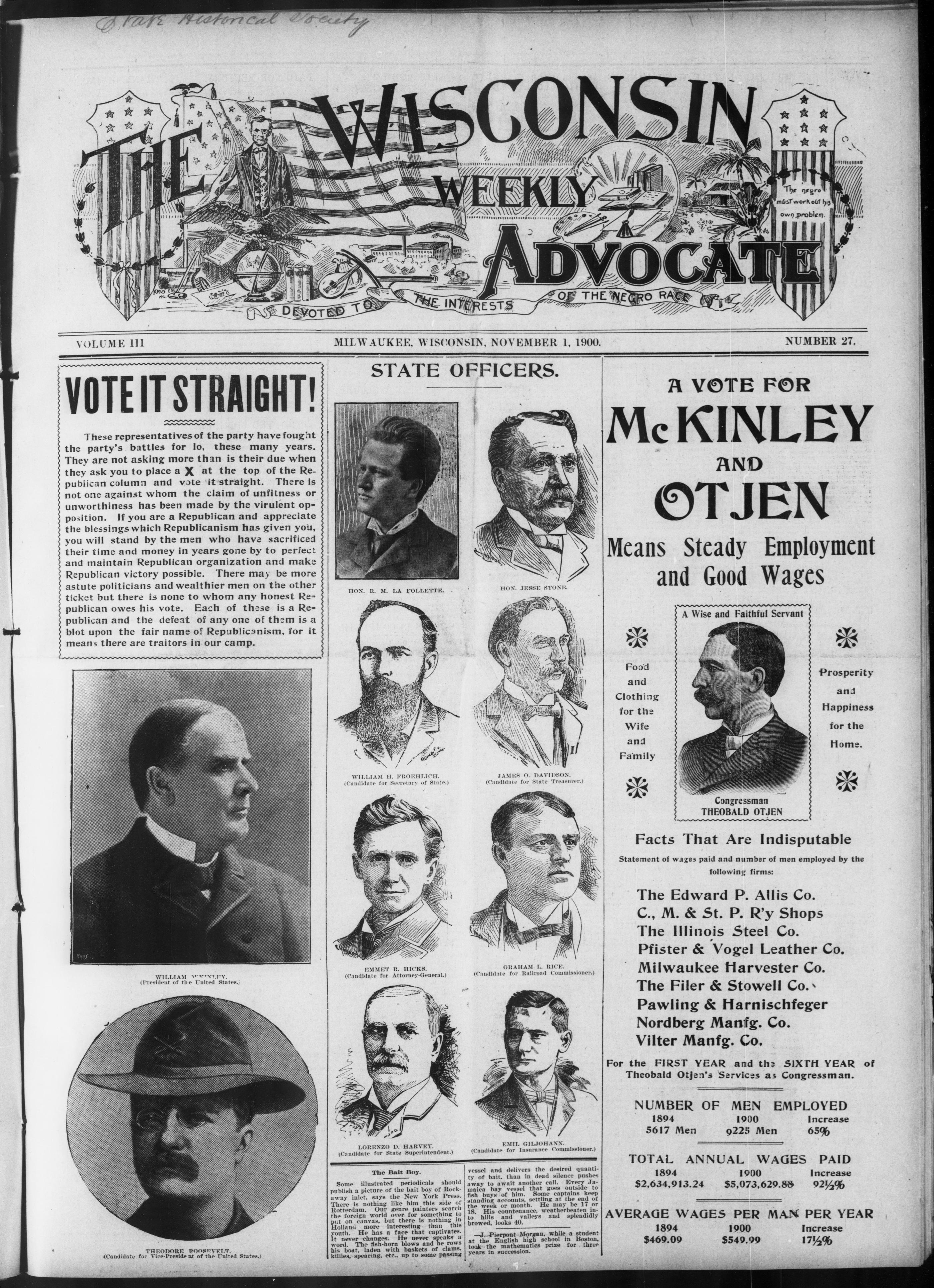
VOTE IT STRAIGHT!
These representatives of the party have fought the party's battles for lo, these many years. They are not asking more than is their due when they ask you to place a X at the top of the Republican column and vote it straight. There is not one against whom the claim of unfitness or unworthiness has been made by the virulent opposition. If you are a Republican and appreciate the blessings which Republicanism has given you, you will stand by the men who have sacrificed their time and money in years gone by to perfect and maintain Republican organization and make Republican victory possible. There may be more astute politicians and wealthier men on the other ticket but there is none to whom any honest Republican owes his vote. Each of these is a Republican and the defeat of any one of them is a blot upon the fair name of Republicanism, for it means there are traitors in our camp.
M. R. W.
[Image of a man wearing a wide-brimmed hat with a cross symbol on the front].
VOLUME III
WILLIAM WICKLEY. (President of the United States.)
MILWAUKEE, WISCONSIN, NOVEMBER 1, 1900.
M.
O. H. B. C.
WILLIAM H. FROEHLICH. (Candidate for Secretary of State.)
J.
EMMET R. HICKS.
(Candidate for Attorney-General.)
M. J.
The Bait Boy
Some illustrated periodicals should publish a picture of the bait boy of Rockaway inlet, says the New York Press. There is nothing like him this side of Rotterdam. Our genre painters search the foreign world over for something to put on canvas, but there is nothing in Holland more interesting than this youth. He has a face that captivates. It never changes. He never speaks a word. The fish-horn blows and he rows his boat, laden with baskets of clams, killies, spearing, etc., up to some passing
McKINLEY AND OTJEN
Means Steady Employment and Good Wages
Statement of wages paid and number of men employed by the following firms:
For the FIRST YEAR and the SIXTH YEAR of Theobald Otjen's Services as Congressman.
AVERAGE WAGES PER MAN PER YEAR
1894 1900 Increase
$469.09 $549.99 1712%
J. W. H. B.
J.
Food and Clothing for the Wife and Family
JAMES O. DAVIDSON.
(Candidate for State Treasurer.)
C. H. H.
KMH. CHIJOHANN
vessel and delivers the desired quantity of bait, than in dead silence pushes away to await another call. Every Jamaica bay vessel that goes outside to fish buys of him. Some captains keep standing accounts, settling at the end of the week or month. He may be 17 or 18. His countenance, weatherbeaten into hills and valleys and splendidly browed, looks 40.
—J. Pierpont Morgan, while a student at the English high school in Boston, took the mathematics prize for three years in succession.
NUMBER 27.
OR
LEY
EN
employment
ages
A Wise and Faithful Servant
Congressman
THEOBALD OTJEN
isputable men employed by the
Facts That Are Indisputable
The Edward P. Allis Co. C., M. & St. P. R'y Shops The Illinois Steel Co. Pfister & Vogel Leather Co. Milwaukee Harvester Co. The Filer & Stowell Co. Pawling & Harnischfeger Nordberg Manfg. Co. Vilter Manfg. Co.
NUMBER OF MEN EMPLOYED
1894 1900 Increase
5617 Men 9225 Men 65%
TOTAL ANNUAL WAGES PAID
1894 1900 Increase
$2,634,913.24 $5,073,629.88 921/2%
Prosperity and Happiness for the Home.
ANSWER OF MR. HAY.
His Reply to the British-German Compact Made Public.
OPEN DOOR AGREEMENT
The Third Clause a Matter with Which the United States is Not Concerned
Washington. D. C., Oct. 31.—The state department today made public the British-German agreement respecting the maintenance of the "open door" and territorial integrity of China, with the answer of the United States government, sent in duplicate to each of the principals to the agreement. Mr. Hay's note to Lord Pauncefote is as follows:
Department of State, Washington. D. C., Oct. 29, 1900.—Your Excellency: I have the honor to acknowledge the receipt of your note of the 23d of October, enclosing the text of an agreement between Great Britain and Germany relating to affairs in China which was signed in London on the 16th inst. by the Marquis of Sallisbury and the German ambassador on behalf of their respective governments and inviting the acceptance by the United States of the principles recorded in that agreement. These principles are:
1. It is a matter of joint and permanent international interest that the ports on the rivers and litteral of China should remain free and open to trade and to every other legitimate form of economic activity for the nationals of all countries without distinction, and the two governments agree on their part to uphold the same for all Chinese territory so far as they can exercise influence.
2. Her Britannic majesty's government and the imperial German government will not on their part make use of the present complication to obtain for themselves any territorial advantages in Chinese dominions and will direct their principal policy toward maintaining undiminished the territorial condition of the Chinese empire.
The United States have heretofore made known their adoption of both these principles. During the last year the government invited the powers interested in China to join in an expression of views and purposes in the direction of impartial trade with that country and received satisfactory assurances to that effect from all of them. When the recent troubles were at their height, this government, on the 3d of July, once more made an announcement of its policy regarding impartial trade and the integrity of the Chinese empire and had the gratification of learning that all the powers held similar views, and since that time the most gratifying harmony has existed among all the nations concerned as to the ends to be pursued, and there has been little divergence of opinion as to the details of the course to be followed. It is therefore with much satisfaction that the President directs me to inform you of the full sympathy of this government with those of her Britannic majesty and the German empire in the principles set forth in the clauses of the agreement cited.
The third clause of the agreement provides:
3. In case of another power making use of the complications in China in order to obtain under any form whatever such territorial advantages, the two contracting parties reserve to themselves the privilege to come to a preliminary understanding as to the eventual steps to be taken for the protection of their own interests in China.
As this clause refers to a reciprocal arrangement between the two high contracting powers, the government of the United States does not regard itself as called upon to express an opinion in respect to it.
Japan is Agreeable.
London, Oct. 31.—The Japanese minister here, Kato Takaaki, informed a representative of the Associated press today he had delivered a note to Lord Salisbury in which Japan unconditionally assents to the Anglo-German agreement on China.
Imperial Treasurer Dead.
Washington, D. C., Oct. 31.—The Japanese legation has received a dispatch giving the death of Wang Wen Shao, imperial treasurer of China, in addition to those high officials whose deaths have been also announced. Wang Wen Shao was one of the loyal adherents of the imperial family, and when they took flight from Pekin he insisted upon following, despite his advanced age. His death came from natural causes, probably from old age and the fatigues of the flight.
AUCTION IN HISTORIC HOUSE.
Relic Hunters Strip Lizzie Vanlew's Home in Richmond.
Richmond, Va., Oct. 31.—The sale of the effects of Miss Lizzie Vanlew by auction opened a house which has long been a hidden curiosity to the public. The chamber in the garret where Miss Vanlew secreted a federal colonel and several of his men when they escaped from Libby prison was for the first time viewed by thousands of people. All of the valuable relics were shipped to Boston a week ago. What was sold consisted of what might be called "odds and ends" of furniture. There was a large file of newspapers printed during the war. These quickly disappeared. The relic hunters carried them off. Many of the visitors broke off twigs from the trees in the yard and carried them away.
FEBBELL FOUND GUILTY.
Train Robber to Suffer Death for
Murder
Marysville, O.. Oct. 31.—The jury in the trial of Rosslyn Ferrell, the train robber charged with the murder of Express Messenger Lane, returned a verdict last night of murder in the first degree, without recommendation. The verdict carries with it the death sentence.
The last day of the trial was a hard strain for Ferrell. He was restless and nervous all morning and afternoon and told Sheriff Robinson that if he was given even a life sentence he would not be on earth long. He had been so ill last night he required the services of a physician and he appeared in court in a condition bordering on collapse.
DIVORCED FROM AUTHORESS.
Col. L. P. Crane Secures Decree on Grounds of Desertion.
San Francisco, Cal., Oct. 31.—A divorce from Alice Rollins Crane, the newspaper and magazine writer, was granted to Col. L. P. Crane by Judge Bahrs on the ground of desertion. Mrs. Crane, who has an adventurous disposition as well as a literary bent, was married in Los Angeles on June 13, 1894, to the colonel, who gained his military title in the Civil war. The couple have no children and no community property was acquired by them. One reason given by Mrs. Crane for leaving her husband was that he had not supported her.
MARRIAGE LAWS TOG LAX.
Kalamazoo Ministers Seek to Abolish Michigan's Gretua Green.
Kalamazoo, Mich., Oct. 31. At the meeting of the Kalamazoo Ministerial association, embracing all the counties in southwestern Michigan, the members disapproved the wholesale marrying business at St. Joseph and adopted a resolution asking the next Legislature to pass an amendment to the present marriage laws, requiring that one of the contracting parties to a marriage must reside in the state at least five days before the license can be issued.
BATTLE WITH BANDITS.
Four Ambushed Highwaymen Hold Up a Pay Clerk but Fail to Get the Plunder.
Connellsville, Pa., Oct. 31.—Vengeance swift and sure fell upon four miners, turned highwaymen, who held up and murdered William Hosmer, pay clerk of the Southwest Connellsville Coke company, yesterday afternoon on a road between Pittsburg and Alverton.
One of the gang was shot dead in a battle with Hosmer and his companion, Harry Burgess. Another was killed by a posse of employees of the company, farmers and officers of the law; a third was wounded terribly and died later, while the fourth surrendered and is in jail at Greensburg, in peril of being brushed
As a result of the brave resistance made by the young messenger, Burgess, the bandits failed, even for a moment to gain possession of the rich booty they sought. This was $4000 in currency, contained in a little iron safe with which Hosmer and Burgess were driving to Alverton. The money was for the pay roll of the Tarr and Alverton works of the sake company.
Fired Upon from Ambush.
Burgess was shot in the left shoulder and two bullets grazed his head. The attack upon him and Hosmer was from ambush. The two men had reached the summit of a hill near Moreton, and above Alverton, when a volley was fired at them from close range. Hosmer fell forward upon the dashboard dead. Burgess, though hard hit, drew a revolver and turned just as the robbers emerged from a clump of bushes, firing as they ran. The young man fired twice quickly, killing one man and wounding another. The unwounded thugs became terrified at the courageous resistance, and, leaving the dead man, set out with the wounded one over the hill to the south in the direction of the Alice mines.
Burgess managed to drive on into Alverton with the body of Mr. Hosmer and the safe and gave the alarm. Mount Pleasant and vicinity, with the clerical force of the coke company, turned out 500 strong, and soon corralled two of the fugitives, who had concealed themselves in a field. Evidently they had hidden their wounded companion.
Battle in the Thickets.
Then a picturesque and desperate conflict ensued. The army of manhunters, which had spread out to entrap the bandits, closed up ranks, surely and speedily. With many the hunt was one of vengeance, for young Hosmer had been generally popular with the workmen. Clerks from the offices tramped side by side with the miners who had come out of the pits half-clad to join the chase. A yell arose when the two fugitives were discovered hiding in the deep thickets. A defiant shout came in retort. Slowly the circle narrowed. Slowly up crept the 500 men, completely surrounding the edge of the dense wood. Then one bandit was seen. A rifle cracked. A dozen joined in the volley. They fired into the thicket at random.
A cry broke from the lips of the bandit and he fell forward close to the edge of the thicket, making one last effort to fire before his strength failed him. Many bullets were sent into the prostrate body. Cautiously the army of maddened men closed into the thicket. The second bandit had not the courage of his fallen comrade. He was cowering when spied. He hastily threw away his weapons and stood with hands up beseeding mercy. He was hustled off to the company store at Alverton.
The Search Renewed.
The posse was still short one member of the gang and the search was renewed with increased fury and augmented numbers. Out in the road there was a high ditch and over this were planks, and this again was covered with the clay of the roadside. Hundreds of pursuers went over this time and time again without suspicion, but finally one member of the posse, looking under the culvert from a distance, saw the fourth member of the gang in hiding.
Another cry arose, a wild charge was made and a hundred guns and revolvers banged on all sides. The clay flew from the boards, but the bandit was unharmed. Closer and closer gathered the crowd. Then the bandit, who was as brave as the man who had fought the posse, made a last dash to do murder before being slaughtered. Out into the open he sprang and fired into the crowd, but a volley answered back and he dropped riddled. The man was still breathing, however, and was loaded into a wagon and also started for Mount Pleasant. Late last night the prisoner was taken from Alverton and lodged in the Greenburg jail, where he died.
Deed of Four Nihilists.
The four bandits proved to be Russian Anarchists. The man shot by Burgess was Basil Nikolow. The bandit shot at the ditch was Sava Jovanow. The other man shot down in the Strom woods was Ivan Petrow.
The survivor is Michael Theaborov. He said he and his companions came to this country in April. He said he had been told that this was a country for the free operation of Anarchistic principles and that the gang was putting them in force. An Italian miner, he said, told him about Hosmer's method of taking gold to the paying office and the robbery was then planned.
STUDENTS ON A STRIKE.
Revolt Against Action of the Faculty in Suspending Their Mates
Alliance, O.. Oct. 31.—As a result of a rigid investigation on the part of the faculty of Mount Union college, three students have been suspended for participating in the midnight demonstration of a week ago, when a large body of students, clad in white robes and closely masked, salied forth and committed numerous depredations. About 175 students held a mass meeting on the college campus, and after discussing the matter decided to go on a strike, pending the reinstatement of the suspended men. Affairs have taken a serious turn, as many students have already left for their homes and more will follow. The faculty is firm in its determination not to yield to the demands of the students, and interesting developments are anticipated.
THIEF BOARDS MOVING TRAIN.
Noted Robber Makes Good His Escape from Pursuing Posse.
Mattoon, Ili. Oct. 31.—Fred Kreiger, a noted diamond thief, stole a thoroughbred horse and buggy from the farm of Z. N. Elliott near this city and eluded a posse of pursuing farmers long enough to dispose of the rig for $60 to a farmer south of Kansas. The trade had hardly been closed when the posse thundered up and Kreiger dashed across country to the Big Four railway, boarded a fast-moving east freight and escaped uninjured, though his pursuers sent a fusillade of shots after him.
OUTBREAK OF SMALLPOX.
Spreads Among Children but Declared Not Epidemic. Kingston, Jamaica, Oct. 31. The British consul at Guayaquil, Ecuador, confirms the report of a smallpox outbreak at that place, but says the disease is not epidemic, though it is spreading among the children.
Two Hundred Girls Were Eating Lunch on Fourth Floor—Many Perish in the Holocaust.
New York, Oct. 29.—About half-past 12 today Greater New York was startled by a booming sound which it has developed was an explosion in the building occupied by Tarrant & Co., wholesale druggists, at the northwest corner of Greenwich and Warren streets. The fire department almost instantly responded to a call, but had not reached the scene when three additional explosions occurred, more violent than the first. A column of debris and smoke and flames was shot up 300 feet into the sky.
Persons in the vicinity say they saw human bodies thrown up in the column of debris when the explosion occurred. Four explosions occurred in rapid succession. Windows in the vicinity and for blocks around were blown in by the concussion or the explosion. Adjoining buildings were soon in danger of destruction by the flames, which spread rapidly.
Escane Cut Off.
Up to 12:45 p. m. eleven injured persons had been taken to the New York hospital. The police reserves from Old Slip, Church street, Oak street and Elizabath stations were called out.
The first explosion occurred at 12:12 p. m. It took the roof off the building. It was followed a minute and a half later by two or three sharper explosions that sent columns of flame and smoke high into the air.
Dozens of persons passing at the time were injured by flying debris.
All the ambulances from hospitals south of Fifty-ninth street have been called to the scene.
In a restaurant next door there were about 200 people eating luncheon. Of these many were injured and it is reported that a score of them lost their lives.
At 1 o'clock it was said that there were fully 150 persons in the building at the time of the first explosion, and few if any of them had time to escape. One young man, who gave his name as Harry Riss, said he was standing on the corner when the explosion occurred. He was blown about ten feet. When he picked himself up he said he saw bodies flying through the air and landing in the flames. Three fire horses were so badly cut by flying glass that they will probably have to be shot. One fire engine was almost completely demolished by the falling walls.
A lithographing establishment, close to Tarrant's place, caught fire and the flames spread to the Irving bank and two other buildings across the street.
The Warren street station of the Ninth avenue elevated railroad, directly in front of the drug establishment, was completely demolished.
Blown to the Street.
A number of persons who were standing upon it waiting for a train were blown to the street and received serious injuries. Several women escaped from the station, however, by walking along the plank platform at the edge of the track. Several buildings at the rear of the drug store were blown down. The flames spread with wonderful rapidity, until the two blocks, from Chambers to Warren and from Washington to Greenwich streets, were on fire.
Three Terrific Explosions.
John M. Elliott of Brooklyn was sitting on the roof of the seven-story building at 66 West Broadway, a block and a half away from the explosion. He says the force of the first explosion was directly upward for a matter of thirty feet, when the column of debris spread and fell downward. It took the roof off the building and he could hear the cries and screams of injured people. Three minutes later the third explosion came, which, he said, was the worst of all. It shook the building where he was and debris fell about him.
Policeman Galvin was in the immediate vicinity of the fire when the first series of explosions occurred. He said that a number of firemen were blown to death on the Warren street side of the building. He said he rescued one of them, but that no living being could have rescued the others.
Two Hundred Killed.
Policeman Galvin said that in his belief not less than 200 persons will be found to have lost their lives. This was on account of the suddenness of the explosions, which rendered it impossible for anybody who was in the building at the time to escape.
The force of the explosion was heard and felt clear down to Wall street. Heavy plate-glass windows were smashed and people were thrown to the street, four blocks away.
The employees of the Irving National bank, whose building stands directly across the street from Tarrant's place, were busily engaged at their desks at the time of the explosion. The first of the explosions came and not a clerk or official of the bank but who was thrown to the floor by the force of the concussion. Thinking that the building was about to fall, several of the officials ran for the cash and had it taken out of the building and to a place of safety. The clerks and other employees then made their way to the sidewalk and ran for places of safety. Every available physician and ambulance surgeon, who could be reached, was called into service and the various stores, which were not damaged by the explosion, were turned into temporary hospitals for the care of the wounded.
Sure Many Escaped.
A representative of the firm of Tarrant & Co. called at the Hudson street hospital this afternoon to inquire as to the condition of persons injured. He said all of the Tarrant employes had been accounted for except one man who is known as "George." Frank Sigler, employed by M. J. Brietenbach & Co., said the fire was known five minutes before the first explosion. He is sure all of the employes of Tarrant & Co., and of Breitenbach & Co. had plenty of time to escape.
FOUR SONS ARE DROWNED
William Stark Takes Children for a Sail, Which Results Fatally.
Port Clinton, O., Oct. 29.—Four children of William Stark were drowned near Plastu Bed, on Sandusky bay, eight miles from here, yesterday afternoon in a boating accident.
Mr. Stark and the children went for a boat ride. On returning to shore the boat became fonled in a fish pond net and the oarsman could not either forge the boat ahead or go back. The children became frightened, and, leaning over the side of the small craft, it capsized, resulting in the four deaths by drowning.
Mr. Stark came here from Toledo three weeks ago. He then had a family of a wife and ten children. Last week Harvey, aged 4, died, and the week before another child, aged 3 months, also died.
$4200 WORTH OF
NETS CONDEMNED.
Chicago Fish Company is Up Against the Michigan Game Warden.
Houghton, Mich., Oct. 30.—[Special.]
—Forty-two hundred dollars' worth of nets belonging to Pentecost Bros., the Chicago fish and game concern, were condemned at Eagle River on the orders of Assistant Game Warden Brewster, who came from the Lansing office to make an investigation into the charges preferred by the Keweenaw county deputy. Mr. Jackson, against the firm.
The nets which were seized were all about 33¼-inch mesh and not allowed for trout fishing, which was what Pentecost Bros. were using them for. However, this size mesh is allowed for certain fish and the Lausing office may decide to sell the nets and get what money it can out of them. If the mesh was so small that it would not be allowable for any kind of fish they would be burned.
AN EARTHQUAKE IN VENEZUELA.
President Gastro Jumps from Second Story of Government House and Breaks a Leg.
Washington, D. C., Oct. 30.—The state department has received the following cablegram from Mr. Russell, secretary of legation at Caracas, concerning the recent earthquake in Venezuela in which Cipriano Gastro, the President of the republic, was injured:
"Severe earthquake this morning; great damage to property, several killed; President Gastro, in jumping from second floor of government house, had a leg broken."
A GHASTLY WELCOME.
Reception to Returning Volunteers Terminates in Lawlessness, Bloodshed and Death.
London, Oct. 30.—The day of welcome to the City Imperial volunteers, just from the Transvaal war, was one of the wildest London has seen for many a year. With unmanageable crowds, helpless policemen and reckless rushes, the number of dead and injured threatens to be amazing. The list of casualties among the welcoming multitude was longer than that of the whole corps in its twenty-six engagements in South Africa. Partial returns from the hospitals and police stations indicate that more than 200 were badly hurt, eight or possibly ten being killed outright.
There were 4000 police and 22,000 troops on duty along the line of march, but they were unable to manage the crowds. Women and girls fainted and were trampled under foot. Stands overloaded with sightseers fell in. Twelve persons out of thirty who were riding on top of a mail wagon whose wheels gave way suffered broken bones. Two children were killed. A man who was leaning over the parapet of the roof of a four-story building lost his balance and fell upon a group of women, killing one and hurting two others, but walked away himself apparently uninjured.
Many of the soldiers on the line of march were hurt in combats with the crowd.
CENSUS IS COMPLETE.
Population of the United States Is Officially Announced by the Washington Bureau.
Washington, D. C., Oct. 30.—The population of the state of Wisconsin as officially announced by the census bureau today is 2,068,963, as compared with 1,685,880, returned by the census of 1890. This is a gain of 382,083 in ten years, or nearly 23 per cent.
It will be noticed that the gain in Wisconsin is a trifle more than the gain shown in the country at large. The following table exhibits the census returns for Wisconsin at each decennial period since 1840:
1840 30,945
1850 305,391
1860 775,881
1870 1,054,670
1880 1,315,497
1890 1,686,880
1900 2,068,963
Washington, D. C., Oct. 30.—The official announcement of total population of the United States for 1900 is 76,295,220, of which 74,627,907 are contained in the forty-five states representing approximately the population to be used for apportionment purposes. There is a total of 134,158 Indians not taxed. The total population in 1890 with which the aggregate population of the present census should be compared was 63,069,756. Taking the 1890 population as a basis there has been a gain in population of 13,225.464 during the past ten years, representing an increase of nearly 21 per cent. The total number of Indians on Indian reservations, except those in Indian territory, is 145,282. The total for the seven territories of the United States is 1,667,313, as compared with 952,945 in 1890.
The Alaskan figures are derived from partial data only, and all returns from Alaska and for certain military organizations stationed abroad, principally in the Philippines, have not yet been received.
WEDDED TO LEGLESS MAN.
Dramatic Sequel to a Romantic Courtship at Fort Wayne Hospital. Wabash, Ind., Oct. 30.—A pathetic culmination of a courtship which began in childhood was reached when Harry Young and Miss Edith Schultz of Huntington were married at St. Joseph hospital, Fort Wayne. Last Thursday Young, going from Huntington to Fort Wayne, fell under a Wabash train and had both legs cut off. His life hung in the balance several days, but Miss Schultz said she would marry him if he survived, and with the groom's father and mother present Justice France united the pair, Mr. Young being so weak he could respond only in a whisper. The couple were to have been married Wednesday.
Forests Owned by Royalty.
The royal Prussian family is the largest owner of forest tracts in Germany. The property consists of not less than 186,200 acres. The southern branch of the Hohenzollerns owns a tract of 136,000 acres. The Prince of Stolberg Wernigerode owns forest covering 119,000 acres, which is about the size of the city of Chicago. The timber lands of the Prince of Pless comprise 104,000 acres.
Presidents' Wives.
New York was the birth state of the wives of six Presidents. Virginia and Ohio each gave four Presidents' wives. Eight other states are represented—New Hampshire, Massachusetts, New Jersey, Maryland, North Carolina, Kentucky, Tennessee and Missouri. There has been only one bachelor President—Buchanan.
—There is room for 54,000 persons in St. Peter's church, Rome; for 37,000 in the Milan cathedral, and for 25,000 in St. Paul's. London.
—Mormonism is getting a strong hold among the Magies in New Zealand.
PAID FOR PERJURY.
An Infamous Bargain Between Prosecution and Witness in the Caleb Powers Case.
Louisville, Ky., Oct. 31.—Finley B. Anderson now swears that as a witness in the Goebel trials he tried to swear away the life of Caleb Powers, former secretary of state of Kentucky, who was given a life sentence in the penitentiary as an accessory to the murder of William Goebel, contestant for the office of governor. Anderson swore to the affidavit which declares him a perjurer in the presence of the attorney of Caleb Powers. Anderson further states that the prosecution paid him for his testimony a little over $300.
The story was related by the self-admitted perjurer last night in a private room at the Galt house. Finley Anderson, who was a telegraph operator at Barbourville, swore on the stand that Powers said of Goebel: "If we cannot get him killed, and it is necessary, I will do it myself." Other evidence almost equally damaging to Powers was given by Anderson. He now swears he was a tool in the hands of smarter men, and has produced letters that seem to bear out in part his belated confession.
Finley Anderson's narrative, subscribed and sworn to, is now in the hands of Caleb Powers' lawyers. Apparently the confessor has reserved nothing. He tells how he was first entangled in Attorney Campbell's web; how Campbell and Arthur Goebel put false statements in his mouth; how he, an ignorant mountain boy, was cajoled and coerced; and how an uneasy conscience drove him to make a full confession of his guilt, so that he may undo the wrong he helped commit. Frankfort, Ky., Oct. 31. In the court of appeals today the judgment of the lower court in the contests over the minor state offices was affirmed, thus establishing the title of the Democratic incumbents of these offices. Three Republican judges dissented. This case applied to all of the state offices except governor and lieutenant governor, the contests over which was settled by the Legislature.
ATTEMPTED SUICIDE.
Forrell, Convicted Assassin, Tries to Smother Himself with Bedclothing.
Marysville, O., Oct. 31.—Rosslyn H. Ferrell, who was last night found guilty of the murder of Express Messenger Lane, attempted to commit suicide during the early hours today by smothering himself. He wrapped the bedclothing tightly about his head and turned over on his face. When his purpose was discovered the guards pulled the clothes off while Ferrell fought to prevent their removal. Judge Melhorn has adjourned court until Friday morning when he will hear arguments on a motion for a new trial which the defense will file today. News of the verdict was not broken to the prisoner's mother until today. Both she and Miss Costelow are prostrated.
BOERS IBRECONCILABLE.
Paget Courteously Informed They will Not Surrender.
London, Oct. 31.—A belated dispatch from Pretoria tells of the failure of the British negotiations with Gen. Botha for the surrender of the Boers. Botha received Gen. Paget's flag of truce courteously and admitted his defeat, but said it was impossible to treat for surrender as long as any burghers wish to continue the war.
President Steyn was more irreconcilable. He refused to even see the bearer of a flag of truce.
SHOOTS THIEF. FINDS CASH.
Indiana Holdup Victim Fires on Departing Robbers.
Flora, Ind., Oct. 31.—Three masked highwaymen held up Sherman Carey, a business man, three miles south of this city, and a number of shots were fired, by which one of the robbers was dangerously wounded. After overpowering Carey they rifled his pockets, securing $350, and fled in the direction of a thicket. Carey opened fire, bringing down one of the bandits, and after a short search found his money lying near a pool of blood.
MET A VIOLENT DEATH.
F. J. Carpenter Crushed Between Car Steps and Station Platform. Chicago, Ill., Oct. 31.—Frank J. Carpenter, treasurer and general manager of the Nye-Jenks Grain company, died today from injuries received in leaving an Illinois Central suburban train last night at the Fifty-seventh street station. He alighted from the rear platform and was crushed between the steps and station platform.
LUBES ELOPING BRIDE HOME.
Utah Woman Makes Trip to Wauke- gan and Learns Ruse.
Waukegan, Ill., Oct. 31.—Madge Bull, the young daughter of Collins Bull of Benton, who recently eloped to Utah and married Elmer Hudson there, has been lured home by a clever ruse. Word was sent Mrs. Hudson that her mother was ill and wished her at home. On arrival Mrs. Bull was found to be enjoying excellent health. The young bride declared herself true to her husband and says she will return to him.
OFFICIALLY DENIED.
Germany Does Not Covet Any American Territory.
Berlin, Oct. 31.—The Cologne Gazette, confirming the dispatch of the Associated press of October 29, authoritatively denies the stories of Germany's contemplated lease from Venezuela of a coaling station at the island of Margarita, and adds: "Germany does nat covet any acquisition in the vicinity of the American continent."
WOMAN'S CLUB PULLS OUT.
Action Due to Course Pursued in Case of Mrs. Ruffin.
Medford, Mass., Oct. 31.—The Medford Woman's club has voted to withdraw from the General Federation of Woman's clubs, because the executive board of the latter organization at the Federation convention at Milwaukee last June refused to seat Mrs. Josephine S. Ruffin, who represented a club of colored women.
Gates Sells His Railroad
New York, Oct. 31.—It is learned on excellent authority that John W. Gates, who recently purchased a controlling interest in the securities of the Kansas City Southern railroad (formerly the Kansas City, Pittsburg & Gulf) has just sold such control to a syndicate representing various connecting roads.
Workmen Terribly Burned.
Pittsburg, Pa., Oct. 31.—By the explosion of an alcoholic vat at the Homestead Steel works early this morning three workmen, Andrew Doliki, Michael Donder and John Harnetti were terribly burned. Doliki and Donder, it is thought, will die.
THANKSGIVING.
President Issues Proclamation for the Observance of the Day.
Washington, D. C., Oct. 29.—The state department today issued the following: By the President of the United States of America—A Proclamation; It has pleased Almighty God to bring our nation in safety and honor through another year. The works of religion and charity have everywhere been manifest. Our country through all its extent has been blessed with abundant harvests. Labor and the great industries of the people have prospered beyond all precedent. Our commerce has spread over the world. Our power and influence in the cause of freedom and enlightenment have extended over distant seas and lands. The lives of our official representatives and many of our people in China have been marvelously preserved. We have been generally exempt from pestilence and other great calamities and even the tragic visitation which overwhelmed the city of Galveston made evident the sentiments of sympathy and Christian charity by virtue of which we are one united people.
Now, therefore, I, William McKinley, President of the United States, do hereby appoint and set apart Thursday, the 29th day of November next, to be observed by all the people of the United States, at home or abroad, as a day of thanksgiving and praise to Him who holds the nations in the hollow of His hand. I recommend that they gather in their several places of worship and devoutly give Him thanks for the prosperity wherewith He has endowed us, for seed-time and harvest, for the valor, devotion and humanity of our armies and navies, and for all His benefits to us as individuals and as a nation; and that they humbly pray for the continuance of His divine favor, for concord and amity with other nations and for righteousness and peace in all our ways.
In witness whereof, I have hereunto set my hand and caused the seal of the United States to be affixed.
Done at the city of Washington, this 20th day of October, in the year of our Lord one thousand nine hundred and of the independence of the United States one hundred and twenty-fifth.
WILLIAM M'KINLEY.
By the President.
JOHN HAY, Secretary of State.
COLLIERIES START UP.
Partial Resumption of Operations In the Anthracite District-Several Mines Tied Up.
Hazleton, Pa., Oct. 29.—Operations were resumed this morning at a majority of the collieries in the Hazleton district, and they will be continued in full blast for the next two months. The strike is still on at the mines of the Lehigh & Wilkesbarre Coal company located at Audenried, Honey Brook and Green Mountain. One of the officials of the company said this morning that the company informed the men that it will abolish the sliding scale and agree to pay the 10 per cent. increase until April 1, and the officials did not know why they refused to report. The mineworkers claim they want a written guarantee in this respect.
The Oneida and Derringer collieries of Coxe Bros. & Co. are also idle because of some misunderstanding on account of the notices posted by the company. All hands probably will be at work tomorrow. The only other colliery that did not resume is the one at Milnesville, where no demands have been granted at all. Before the strike began the company threatened to abandon its mine and it appears that the threat will be carried out. Scranton. Pa., Oct. 29.—Over 5000 mine employees in the Lackawanna valley refused to return to work this morning because the companies for which they had mined coal failed to comply with the terms of the Scranton miners' convention.
The companies affected are the Ontario & Western Railroad company's ten mines employing 4000 men, the Forest Mining company at Archibald, employing 800 men who have been on strike since last July; Green Ridge Coal company, employing 400, and the Clark Tunnel Coal company, employing 100. Shamokin, Pa., Oct. 29. -When the colliery whistles blew this morning 15,000 men and boys between Trevorton, this place and Mt. Carmel reported for work. The only collieries idle are Henry Clay, Excelsior and Corbin. They will be in operation in a few days.
PRINCE VICTOR DEAD.
Grandson of Queen Victoria Succumbs to an Attack of Enteric Fever.
London, Oct. 29.—A dispatch received here from Pretoria announces the death from enteric fever of Prince Christian Victor of Schleswig-Holstein, eldest son of the Princess Helene of England and a grandson of Queen Victoria. He was born in 1867 and was a major in the king's royal rifles.
The war office has received the following from Lord Roberts, dated Pretoria, October 28:
"Knox successfully engaged Dewet October 27. During the Boer retreat Knox caught Dewet in the Rensburg drift. The Boers lost considerably and left two guns and three wagons in Knox's hands. Another ammunition wagon was blown up by a shell. The British casualties were nil."
Referring to the Jacobsdal affair, Lord Roberts says it was due to the treachery of the inhabitants who admitted the Boers to their houses at night. They opened fire at daybreak. Fourteen men were killed and thirteen were wounded, mostly Cape Highlanders. Troops dispatched from the Modder river drove off the Boers. The houses of the treacherous inhabitants were destroyed. Commandant Bosman was killed. Lord Roberts calls attention to the "increasing inclination of the better class of Boers to co-operate with the British to secure peace, 'since they find that guerrilla warfare is visited with heavy punishment.'"
ABSENIC IN THE MILK.
Burglaries Enter a Crematory and Swallow Poisoned Fluid.
Williamsport, Pa., Oct. 29.—Turbotville, the town which was almost wiped out by fire about six weeks ago, has a genuine sensation. On Friday night burglars robbed the office of the crematory and then sampled the milk which was being tested with arsenic. As the milk was mixed strongly with the poison it is believed that the robbers have died. Today scores of people scoured the country near Turbotsville expecting to find the dead bodies.
WOM·N KILLED BY A BULL.
Dehorned Animal / Crushes Mrs. C. Kohier's Face with Its Hoofs.
Anoka, Minn., Oct. 29.—Mrs. C. Kohler, aged 72, was killed by a bull while crossing the yard in which the animal was confined. It had been dehorned, but attacked the aged woman with its hoofs, crushing her face.
FRENCH COUNT KILLED.
D'Anvers Loses His Life in an Automobile Accident.
Paris, Oct. 29.—The Count Cahen d'Anvers, a well-known figure in Parisian society and a commander of the Legion of Honor, was killed in an automobile accident yesterday. The count was making a tour from his chateau at Mainville to Ardennes and had reached a point about half-way, when the accident happened.
"FLOTSAM."
The day before, as I walked down the street, I had seen the doctor turn from his surgery door into the stable yard and, following him inside the green gates, had heard the news from him.
"Yes, it's all over," he said; "the poor little maid died early this morning; went out with the tide."
"I'm sorry," I said, "for the child had been a friend of mine. How does her father take it?"
"Badly," answered the doctor, "very badly; there will be trouble there, I expect. Will you come with me? I'm going into the vate. Lovely drive. No? Then goodly. Come in some evening soon and play chess," and with a cheery nod he got into the dogcart and drove rapidly away.
I stopped to light my pipe, and then went through the doctor's yard, meaning to take a short cut through the fields into the lane that led down to the beach. A rough wooden fence screened the barton from the tennis lawn, and the doctor's wife was attending to a large spray of Jackmanii clematic which had been blown down in the night.
"Monica Gollop's dead," she said as I passed; "isn't it sad?"
"Very sad," I answered; "very sad—for the old man."
"There will be trouble there, I expect," she said, unconsciously echoing her husband's words; "he's all alone now."
"It's an awful thing to be alone," I said, for I knew, and the doctor's wife assented sympathetically. Then I went on for my walk.
That was the day before, and today was the great annual festival of the Burial club. Already the church bells were ringing, and the men folk were strolling up the hill to the big field from which the procession was to start. The green sashes they wore across their broadeloth coats were as incongruous as Paul Kruger's presidential scarf, but they made a brave show and their wearers displayed them proudly.
The children were streaming up the hill in noisy companies, the little girls by themselves in the stiffest of white frocks, with elaborate hats instead of their pretty everyday sunbonnets, and with preposterous parasols; the little boys by themselves in their Sunday suits, with enormous collars, and well-greased boots.
The atmosphere of bustling animation was not congenial to me, for I was picturing Aaron Gollop sitting moodily by the bed on which his dead child was lying. I had known him all his life; a harsh, stern man, who, since the death of his wife in childbirth had centered his affection in his little Monica; a quarrelsome man, whose moods could only be controlled by the prattle of baby lips; a hard-drinking man, who yet would abstain for weeks, and spend long days in the stone kitchen alone with his daughter, netting hammocks for her to swing in, or carving rude dolls for her to play with; an ignorant man, whose reading was confined to the Bible, and whose conversation was a strange mixture of coarse blasphemy and almost Pharisaical pietism.
I could imagine him with dry eyes and rebellious heart sitting alone in the cottage up the hill, listening sullenly to the sounds of the festival outside to which the child looked forward so eagerly; I could imagine the grim expression on his rugged face as he remembered that it was the teast of the Sick and Burial club, and I could imagine him turning away from the placid figure on the white bed, and resolving to take the advice given to Job by his wife and curse God and die.
The vision put me out of conceit with merry-making, so I left the happy village and walked down Sea Lane past the schoolhouse toward the beach. At the end of the lane, upon the right hand, is a deserted factory, where once cement was made, and on the left hand the river zigzags into the sea, a narrow footbridge across it giving access to a battery of guns. I had intended to lie down on the grass-grown earthworks and smoke an idle pipe in the sun, but a figure on the beach attracted me and I went on.
It was Aaron Gollop, in his thick blue jersey, barefooted and bare armed, cutting bait. I could tell from his boat that he had not been long ashore, and I went up to him.
"Morning, Gollop," I said, "what luck?"
"Bad tally, sir," he answered shortly, "bad tally; seven prawns."
He finished cutting up an evil-looking dogfish, and wiped his knife on his trousers. Then he produced some cake tobacco and carefully shredded up a pipeful; with a grunt he accepted the lighted match I offered him, and sucked noisily at his pipe until the tobacco was well aglow.
"Monica's dead," he said suddenly, and in much the same tone that he would have used in telling me it was a fine day. I nodded.
"So the doctor told me. What are you going to do?"
An obstinate line formed round his clean-shaven mouth and another deep one cut up across the furrows in his forehead.
"Bide here till byme-bye," he answered; "tonight I'm going fishin'." Then he added in a softer tone: "There's nought for me to do up along—now." "The doctor did all he could," I said rather lamely.
"Oh! yes," he agreed. "the doctor did all he could. I've no fault to find with the doctor."
Although it is the sense of isolation that makes grief hurt so much, yet the isolation is itself one of grief's most sacred privileges, and I hesitated to intrude upon this man's sorrow. So I was silent, and let my eyes wander past him and drink in the beauty of the place. To the westward, the blue lias cliffs bend slowly out into the sea, and the bay is closed in on that side by the stone cobb o" the neighboring town.
To the eastward, the blue lias gives way to sandstone and the cliffs rise more sharply until they culminate in Golden Cap ablaze with brilliant gorse, when they seem to sink downward again and
end in the needle point of Portland Bill. It is a quiet bay, whose waters are seldom plowed by the keel of any ship larger than the colliers putting into the cobb two miles away. I suppose I love it because it is so quiet; there is no esplanade backed by pretentious villas with stucco fronts and patroled by vapid, fashionable idlers; no long, depressing parade of invalids in bath chairs; no line of decayed landaus and broken-down victorias drawn by ragged ponies. There are no bathing machines and but few boats; the village belongs to the villagers and they seem to wish to keep it to themselves. Therefore. I do not give the name, but it is written on my heart.
Gollop was silent, too, and for quite half an hour no word passed beween us; we smoked in sympathy, and communed with our hearts and were still. But he must have been thinking of his last words, for presently he repeated them, and added his next thought to them.
"No. I've no fault to find with the doctor. My quarrel is with God."
I looked at him, waiting. There was a set expression on his face that was intuitely pathetic.
"Most of us have thought that some time or another," I said. "I've been there myself, and I tell you, man, it's fool'shness."
He shrugged his shoulders.
"I'm a poor hand at an argument," he said, "and if there is one thing that is foolishness more than another it is argument, but if anyone could have steered me to heaven 't was Monica. "T is not only that I loved her; seems to me I needed her."
"Perhaps God needed her," I said. Aaron looked at me. "Talking's no good," I said. "Look here, Gollop, you can steer a boat alone, can't you?"
"'Course I can," he answered.
"Very well, then, go on alone; don't turn back because the helmsman's overboard. There's another thing, too. You know the revolving light on the hill there?"
Gollop nodded.
"Well, a lot of good that would be to a man if he had it in the boat with him. No, you've got to go through this thing alone. I'm going home, but you might think of that—when you are fishing tonight."
So I got up and left him alone with his sorrow, and as I was still in no mood for the festival, I went back to my own house and spent a satisfactory afternoon with my auriculas. Auriculas are a good thing for a man, as teaching him humility and patience.
It was about 3 o'clock next morning when I was awakened by heavy hammering at my door, and going downstairs I found Aaron standing outside with a bundle in his arm. He pushed his way inside the passage.
"Light a lamp or something," he said, "and make one of the maids bring down some blankets. I can't take her home, for there is only the one bed and Monica's on it."
He unbuttoned his coat, which he had wrapped round the child he was carrying, and I saw that it was a girl of 3 or 4 years old. I looked at him inquiringly, and presently, when he had got a fire burning, and the doctor, whom I had sent for, had told us that she might now do well. Gollop told me what had happened.
"I'd gone out for brill," he said. "You know the ground; you get your boat so that you're in line with the factory chimney and with the tower of Wildacres church. A collier had just gone out from the cobb and this child must have fallen overboard, but I couldn't make anybody bear, though I shouted as I never did. Guess she's round the Bill by now, and the child's mine."
He said it fiercely, as if challenging our right to take it from him, and I exchanged looks with the doctor. I thought of the bed in the stone cottage up the hill, which would have been empty next day if it had not been for this child.
"Of course the child's yours," I said: "and unless the father who's fool enough to let her fall overboard chooses to make inquiries, yours she will remain."
"May she bide here until after tomorrow?"
I knew what he meant. The little bed in the stone cottage would not be empty until tomorrow afternoon. "Of course she must," I said; and presently, with a jealous look at the sleeping child, Aaron went away. Next day my blinds were down, but half an hour or so after the church bell had stopped tolling I heard his step come up my gravel path. His eyes were dry and rather bloodshot, but he didn't say a word. I took him into the room and put the child into his arms, buttoning round it the coat in which he had brought it home. She looked at him gravelly, but went to him readily enough, and nestled up against him as if she trusted him. Aaron turned, and, still without speaking, strode down to the gate, which I opened for him. I think he would have tried to speak, but I stopped him.
"That's all right, Gollop." I said; "I'll look you up in a day or two, and if you want any things for her, you know where to come. There are still some here, you know." Sorrow breeds sympathy and sympathy makes one very quick in the uptake. Gollop understood me, for once there had been a child in my cottage, too. As he turned out of the gate and strode up the hill I followed him up with one parting shot. You'd no fault to find with the doctor yesterday. Gollop: your quarrel was with someone else. Go home, man, and make it up while you may."
And although his face was turned from me I could imagine that in those bloodshot eyes a softer light was already dawning as he looked down upon the child who had been so strangely sent to him, and I knew that before many days had passed he would be the first to admit that with both the children it was well.—London Mainly About People.
A sound of doctrine—the science of acoustics.
Inclined to be rather fast—the shoot the chutes.
Most of the mummied Egyptians seem to be hard cases.
The palm tree ought to be able to start a spanking breeze.
Some people look good to our eyes who are not at all good looking.
Our language is not exactly increased by the many words coined in the Mint.
It might be a mistake to say that "blood is thicker than Schuylkill water."
It isn't always the baldheaded man who can't go to bed without a "nightcap."
We suppose they speak of "the cradle of the deep" because of its rock bottom.
The organ-grinder seems to enjoy good health for all he has so many "bad turns."
Nobody can say that eating peanuts is a pastime which doesn't amount to shucks.
If you walk up all the stairs in the city hall, you must admit that you are a high stepper.
ISSUE SQUARELY MET
ISSUE SQUARELY MET
DEMOCRATS HAVE DONE NOTHING TO CONTROL TRUSTS.
Richard Olney, When Attorney General, Refused to Acknowledge the Validity of the Sherman Law and Declared It to Be Unconstitutional.
At Republican National Committee headquarters the trust question is being handled without gloves. Not only is Senator Hanna making trusts the principal feature of his speeches, but it is understood that nearly all of the other speakers acting under the auspices of the Republican National Committee, are devoting much attention to trusts.
The records of the executive departments at Washington during the terms of President Cleveland and the records of various Democratic States, as well as Republican States, have been searched for any evidence that the Democratic party has made effort to restrict the operations of trusts, and to enact or enforce anti-trust laws. Secretary Heath, of the Republican National Committee, stated that not a trace of evidence could be found showing that during the two terms of President Cleveland anything was done in the direction of restricting trust operations.
"On the contrary," said Secretary Heath, "President Cleveland had as Attorney General Mr. Richard Olney, of Massachusetts, who, according to the New York World of Jan. 3, 1894, declared the Sherman anti-trust law to be 'unconstitutional and void.' Mr. Olney further said (quoting the New York World of date given), and the World declared it was quoting from Attorney Olney's report, 'but as all ownership of property is of itself a monopoly, and as every business contract or transaction may be viewed as a combination, which more or less restrains some part or kind of trade or commerce, any literal application of the provisions of the statute is out of the question.'
"The World declared, and the World this year is supporting Mr. Bryan, with Mr. Olney, that 'accordingly Mr. Olney concludes that the law, if it is to be considered as constitutional, must be regarded as applicable only in those cases—which never occur—in which the conspiracy of greed against need backs itself by imposing some legal disability upon others from engaging in the same trade or industry.' The World also said editorially in its issue of Jan. 3, 1894: 'The simple fact is that this man Olney, while serving as Attorney General, is on the other side of the question in all matters affecting the trust conspiracies. It was an affront to the people to make him Attorney General. It is a disgrace to the administration to continue him in office.'
"It is refreshing to note," continued Mr. Heath, "that the New York World, as far back as 1893, and as late as 1894, praised the Sherman anti-trust law, which was proposed by a grand old Republican from Ohio, and passed by a Republican Congress, and sharply criticised President Cleveland's Attorney General for not enforcing the law, when the World and other Democratic newspapers, now favoring the election of Mr. Bryan, are parading Mr. Olney as a great modern Democrat, and one whose influence will do the Bryan cause much good.
"The World of Aug. 11, 1893, editorially stated that Richard Olney, acting for J. B. Greenhut, president of the Whisky Trust, and under indictment for violating the Sherman anti-trust law, declared in his pleadings that the Sherman anti-trust law 'is not within the power of Congress, and is unconstitutional and void;' and then the World inquired in the same editorial: 'Is it not an embarrassment to have as Attorney General one who, in prosecuting trusts, will be confronted with his own contention that the law under which he proceeds is unconstitutional and void—one who, in prosecuting the monopolists, will be forced to send his own best clients to jail?'
"The New York World, Jan. 3, 1894, contained a special telegram from Washington, commenting upon the attitude of Attorney General Olney, which stated that the Republicans are quick to seize the opportunity to score the Democrats on the ground of bad faith;' and that 'the anti-trust law, which bears Senator Sherman's name, was drafted by that able lawyer, ex-Senator Edmunds, of Vermont (a Republican), who had no doubt that its provisions could be enforced,' and that 'Mr. Olney has not given the law a fair construction.'"
Since 1867 the amount paid for the establishment and maintenance of Soldiers' Homes was $47,885,382.
The appropriations for maintenance of Soldiers' Homes for the present fiscal year are:
Dayton ..... $547,000
Hampton ..... 358,250
Santa Monica ..... 296,100
Leavenworth ..... 293,050
Milwaukee ..... 277,050
Togus ..... 269,000
Danville ..... 241,500
Marion ..... 228,500
Total ..... $2,510,450
Clothing ..... 275,000
Salaries and incidentals ..... 48,000
Total ..... $2,833,450
Aid to State Homes ..... 950,000
Total ..... $3,783,450
Bryan the Prophet.
The Republican party produces a policy that makes hard times. All those who love hard times ought to vote for
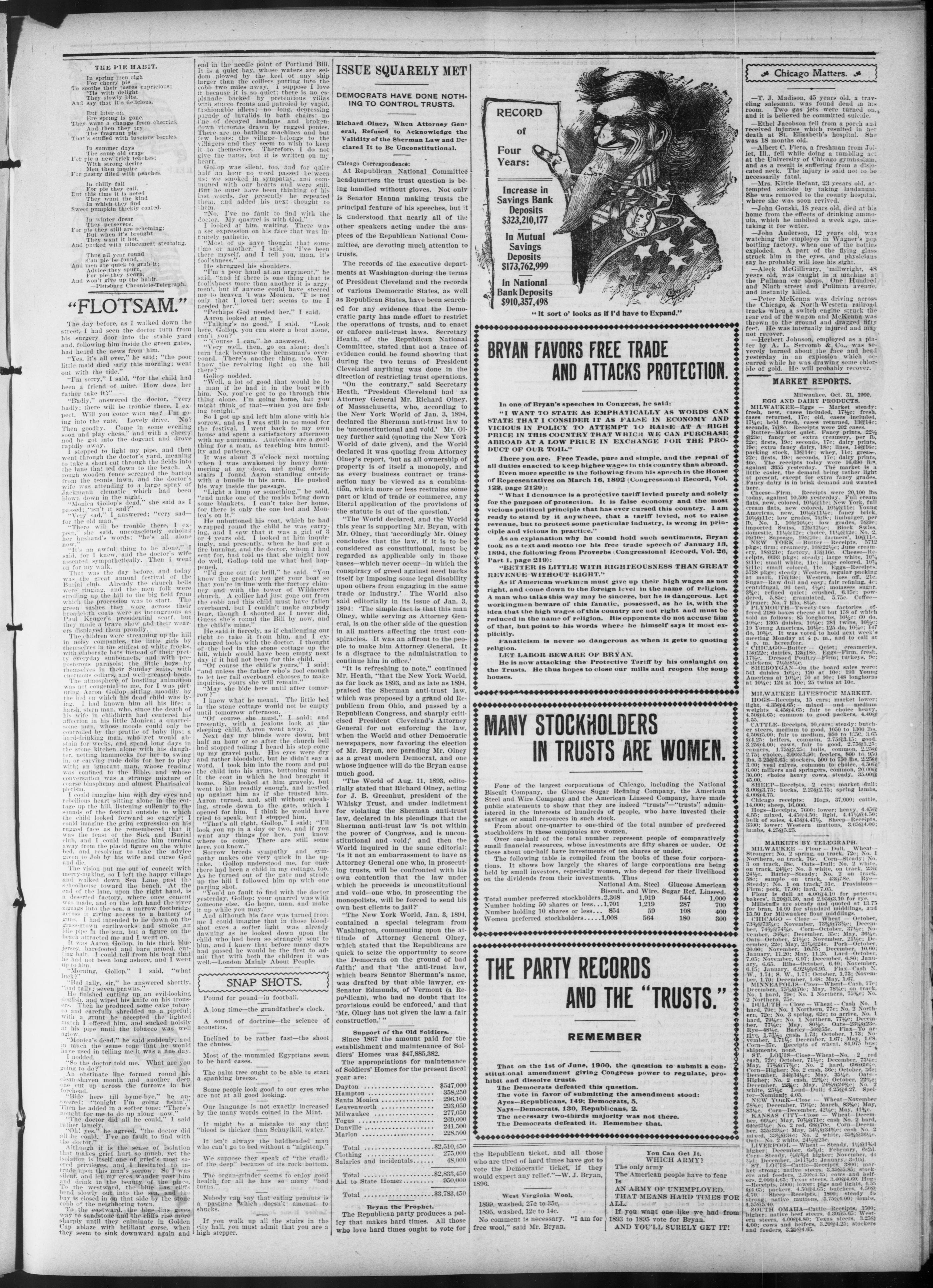
RECORD
of
Four
Years:
Increase in
Savings Bank
Deposits
$323,210,177
In Mutual
Savings
Deposits
$173,762,999
In National
Bank Deposits
$910,357,498
BRYAN FAVORS FREE TRADE AND ATTACKS PROTECTION.
In one of Bryan's speeches in Congress, he said:
"I WANT TO STATE AS EMPHATICALLY AS WORDS CAN STATE THAT I CONSIDER IT AS FALSE IN ECONOMY AND VICIOUS IN POLICY TO ATTEMPT TO RAISE AT A HIGH PRICE IN THIS COUNTRY THAT WHICH WE CAN PURCHASE ABROAD AT A LOW PRICE IN EXCHANGE FOR THE PRODUCT OF OUR TOIL."
There you are. Free Trade, pure and simple, and the repeal of all duties enacted to keep higher wages in this country than abroad.
"What I denounce is a protective tariff levied purely and solely for the purpose of protection. It is false economy and the most vicious political principle that has ever cursed this country. I am ready to stand by it anywhere, that a tariff levied, not to raise revenue, but to protect some particular industry, is wrong in principle and vicious in practice."
As an explanation why he could hold such sentiments, Bryan took as a text and motto for his free trade speech of January 13, 1894, the following from Proverbs (Congressional Record, Vol. 26, Part 1, page 219):
"BETTER IS LITTLE WITH RIGHTEOUSNESS THAN GREAT REVENUE WITHOUT RIGHT."
As if American workmen must give up their high wages as not right, and come down to the foreign level in the name of religion. A man who talks this way may be sincere, but he is dangerous. Let workingmen beware of this fanatic, possessed, as he is, with the idea that the high wages of this country are not right and must be reduced in the name of religion. His opponents do not accuse him of that, but point to his words where he himself says it most explicitly.
Fanaticism is never so dangerous as when it gets to quoting religion.
LET LABOR BEWARE OF BRYAN.
MANY STOCKHOLDERS IN TRUSTS ARE
Four of the largest corporations of Chicago Biscuit Company, the Glucose Sugar Refining Steel and Wire Company and the American Lumber public statements to show that they are indebted in the interests of hundreds of people savings or small resources in such stock.
From about one-quarter to one-third of the stockholders in these companies are women.
Over one-half of the total number represents small financial resources, whose investments are these about one-half have investments of ten s.
The following table is compiled from the relations. It shows how largely the shares of life held by small investors, especially women, who on the dividends from their investments. Thus:
National A. Biscuit, and
Total number preferred stockholders. 2,368
Number holding 50 shares or less... 1,701
Number holding 10 shares or less... 854
Women preferred stockholders... 1,008
THE PARTY RECORDS AND THE
ing the Protective Tar
opes to close our mil-
CKHOLDER
RUSTS ARE
corporations of Chicago,
glucose Sugar Refining
and the American Lines
now that they are indeed
of hundreds of people,
as in such stock.
her to one-third of the
companies are women.
total number represent
whose investments are
in investments of ten sha-
compiled from the book
angely the shares of large
especially women, who o
air investments. Thus
He is now attacking the Protective Tariff by his onslaught on the Trusts. He thus hopes to close our mills and reopen the soup houses.
MANY STOCKHOLDERS IN TRUSTS ARE WOMEN.
Four of the largest corporations of Chicago, including the National Biscuit Company, the Glucose Sugar Refining Company, the American Steel and Wire Company and the American Linseed Company, have made public statements to show that they are indeed "trusts"—"trusts" administered in the interests of hundreds of people, who have invested their savings or small resources in such stock.
From about one-quarter to one-third of the total number of preferred stockholders in these companies are women.
Over one-half of the total number represent people of comparatively small financial resources, whose investments are fifty shares or under. Of these about one-half have investments of ten shares or under. The following table is compiled from the books of these four corporations. It shows how largely the shares of large corporations are being held by small investors, especially women, who depend for their livelihood on the dividends from their investments. Thus National Am. Steel Glucose American
Biscuit. and Wire. Sugar Ref. Linseed.
Total number preferred stockholders.2,368 1,919 544 1,000
Number holding 50 shares or less...1,701 1,219 287 700
Number holding 10 shares or less... 854 59 108 400
Women preferred stockholders.....1,008 564 180 300
stockholders.2,368
s or less...1,701
s or less... 854
holders...1,008
Y RECORD
AND THE
s.2,368 1,919 544 1,000
...1,701 1,219 287 700
... 854 59 108 400
.1,008 564 180 300
CORDS
THE "TRUSTS."
THE PARTY RECORDS AND THE "TRUSTS."
REMEMBER
That on the 1st of June, 1900, the o constitutional amendment giving Congress a hibit and dissolve trusts.
The Democrats defeated this question. The vote in favor of submitting the a Ayes—Republicans, 149; Democrats, 5 Nays—Democrats, 130, Republicans, 2 The necessary two-thirds majority was The Democrats defeated it. Rememb
in June, 1900, the que-
tion giving Congress pro-
tests. Reeled this question.
of submitting the amo-
149; Democrats, 5.
130, Republicans, 2.
thirds majority was
reeled it. Remember
1900, the question to submit a con-
c: Congress power to regulate, pro-
his question.
Setting the amendment stood:
Democrats, 5.
Publicans, 2.
Majority was not there.
Remember that.
You Can Get It.
WHICH ARMY?
The only army
That on the 1st of June, 1900, the question to submit a constitutional amendment giving Congress power to regulate, prohibit and dissolve trusts.
the Republican ticket, and all those who are tired of hard times have got to vote the Democratic ticket, if they would expect any relief."—W. J. Bryan, 1896.
West Virginia Wool.
1899, washed, 27c to 35c.
1895, washed, 12c to 14c.
No comment is necessary. "I am for free wool," said Mr. Bryan.
---
---
---
The American people have to fear Is
If you want one like we had from 1893 to 1895 vote for Bryan.
AND YOU'LL SURELY GET IT!
—T. J. Madison, 45 years old, a traveling salesman, was found dead in his room. Two gas jets were turned on, and it is believed he committed suicide.
—Ethel Jacobson fell from a porch and received injuries which resulted in her death at St. Elizabeth's hospital. She was 18 months old.
—Albert C. Fiero, a freshman from Joliet, Ill., fell while doing a tumbling act at the University of Chicago gymnasium, and as a result is suffering from a dislocated neck. The injury is said not to be necessarily fatal.
—Mrs. Kittie Befant, 23 yesars old, attempted suicide by taking laudanum. She was removed to the county hospital, where she was soon revived.
John Gouski, 18 years old, died at his home from the effects of drinking ammonia, which he imbibed a week ago, mistaking it for water.
John Anderson, 12 years old, was watching the employees in Wagner's pop bottling factory, when one of the bottles exploded. A part of the flying glass struck him in the eyes, and physicians say he probably will lose his sight.
Alec McGillivary, millwright, 48 years old, was caught in a machine at the Pullman car shops. One Hundred and Ninth street and Pullman avenue, and instantly killed.
Peter McKenna was driving across the Chicago, & North-Western railroad tracks when a switch engine struck the rear end of the wagon and McKenna was thrown to the ground and dragged fifty feet. He was internally injured and may not recover.
—Herbert Johnson, employed as a plater by A. L. Sercomb & Co., was severely burned about the face and head yesterday in an explosion which occurred while he was drawing some chloride of gold. He will probably recover.
MARKET REPORTS.
Milwaukee, Oct 31, 1900.
BG AND DAIRY PRODUCTS.
MILWAUKEE—Eggs — Market steady; fresh, new, cases included, 17½c; fresh, cases returned, 17c; old, cases included, 17½c; held fresh, cases returned, 13@14c; seconds, 7@8c. Receipts were 202 cases. Butter—Market quiet. Fancy prints, 22½@23c; fancy or extra cremery, per fi, 22c; firsts, 19c; seconds, 17c; dairy prints, 19c; extra fancy dairy, 18c; lines, 14@16c; packing stock, 13@14c; whey, 11c; grease, 22c; firsts, 19c; seconds, 17c; dairy prints, 46c. The receipts today were 16,600 lbs. against 3655 yesterday. The market is a little casler, the demand being rather light at present, except for extra fancy grades. Fancy dairy is in brisk demand and wanted here.
Cheese—Firm. Receipts were 20,100 lbs today, against 10,590 yesterday. Full cream flats, new, colored, 10%@11c; New York, full cream flats, new, colored, 10%@11c; Young Americas, new, 10%@11c; fancy brick, 10%@11c; low grades, 7%@11c; limburger, per lb. No. 1. 10%@10c; low grades, 7%@19c; imported Swiss, 12%@121c; Block Swiss, domestic, 11%@121c; choice, 111%@121c; No. 2, 9%@10c; Sapsago, 19%@20e; farmers, 10%@11c. NEW YORK—Butter—Receipts, 5712 pkgs; firm; creamery, 19%@221c; June creamery, 18%@21c; factory, 13%@16c. Cheese—Receipts, 6633 pkgs; steady; large white, 10%@11c; small white, 11c; large colored, 10%@11c; small colored, 11c. Eggs—Receipts, 5738 pkgs; steady; Western, regular packing at mark, 17%@19c; Western, loss off, 21c. Sugar—Raw dull and easy; fair refining, 4c; centrifugal, 96 test, 4%c; molasses sugar, 3%c; refined quiet; crushed, 6.15c; powdered, 5.85c; granulated, 5.75c. Coffee—Firmer: No. 7 Rio, 8%c.
PLYMOUTH—Twenty-two factories offered 2180 boxes cheese all but 158 of which sold as follows: 85 longhorns, 10%c; 60 do, 10%c; 1305 daisies, 10%c; 281 twins, 10%c; 19 Young Americas, 10%c; 125 do, 10%c; 147 do, 10%c. It was voted to hold next week's meeting Monday at 4 p. m., and to call at 4 p. m. hereafter.
CHICAGO—Butter — Quiet; creameries, 15%22c; dairies, 13%18c. Eggs—Firm, fresh, 17%c. Dressed Poultry—Firm; turkeys, 9c; quickens, 7%18%c.
SHEBOYGAN-On the board sales were: 541 daisies 10¼c; 120 at 10c; 193 Young Americas at 10¼c; 70 at 10c; 148 longhorns at 10¼c; 124 at 10c; 25 twins at 10c.
MILWAUKEE LIVESTOCK MARKET.
HOGS-Receipts, 15 cars; market lower; light, 4.35@4.65; mixed and medium weights 4.45@4.65; fair to choice heavy, 4.50@4.65; common to good packers, 4.40@4.55.
CATTLE-Receipts, 10 cars; steady; butcher steers, medium to good, 1050 to 1300 lbs, 4.50@5.00; fair to medium, 950 to 1550, 3.65@4.25; helfers, common, 2.75@3.15; good, 3.25@4.00; cows, fair to good, 2.75@3.25; canners, 1.75@2.25; bulls, common, 2.25@2.75; choice, 3.00@3.50; feeders, 800 to 950 lbs, 3.25@3.65; stockers, 500 to 750 lbs, 2.25@3.00; veal calves, common to choice, 4.50@6.00; milkers and springers, common, 20.00@30.00; choice heavy cows, steady, 35.00@45.00.
SHEEP-Receipts, 2 cars; market dull; 3.00@3.75; bucks, 2.25@2.75; spring lambs, 4.00@4.75
Chicago receipts: Hogs, 37,000; cattle,
14,000; sheen, 16,000
14,000; sheep, 16,000.
Hogs->Receipts, 7000; lower; heavy, 4.45@
4.55; mixed, 4.45@4.50; light, 4.471@4.50;
bulk of sales, 4.45@4.471; Sheep->Receipts,
3300; lower; Western muttons, 3.65@4.06;
lambs, 4.25@5.25.
MARKETS BY TELEGRAPH.
MILWAUKEE — Flour — Dull. Wheat — Stronger; No. 2 spring, on track, 72c; No. 1 Northern, on track, 76c. Corn—Steady; No. 3 on track, 38c. Oats—Dull; No. 2 white, on track, 24%c; No. 3 white, on track, 23%c. Barley—Steady; No. 2 on track, 58c; sample on track, 43%78c. Rye—Steady; No. 1 on track, 51e. Provisions—Firm; pork, 17.00; lard, 7.05. Flour is dull at 4.00@4.10 for patents; bakers', 3.20@3.30, and 2.95@3.10 for rye. Millstuffs are steady and quoted at 13.75 for bran, 14.00 for standard middlings, and 15.50 for Milwaukee flour middlings.
CHICAGO -- Close -- Wheat -- October,
73%@73%c; November, 73%@73%c; December,
74%@74%c; Corn—October, 37%c; November,
36%c; December, 35%c; May, 36%c;
Oats—October, 21%c; November, 21%c;
December, 22%c; May, 23%@24c. Pork—October,
20.00; November, 10.55; December, 10.60;
January, 11.20; May, 11.25. Lard—October,
7.05; November, 6.97; December, 6.80; January,
6.65. Ribs—October, 6.40; November,
6.15; January, 6.92%@6.95. Flax—Cash N.
W., 1.74; S. W., 1.71; October, 1.73; November,
1.70; December, 1.68; May, 1.67.
MINNEAPOLIS—Close—Wheat—Cash, 77c;
December, 75%@75%c; May, 78%c; on track.
No. 1 hard, 79c; No. 1 Northern, 75%c; No.
2 Northern, 75c
DULUTH -- Close -- Wheat -- Cash No. 1
hard, 79%; No. 1 Northern, 77%; No. 2 Northern,
72%; No. 3 spring, 62%; to arrive, No. 1
hard, 79%; No. 1 Northern, 77%; December,
77%; May, 80%; Oats-23%@23%;
Rye-48%; Barley-50%@55%;
Flax-To arrive, 1.71%; December, 1.67; May,
1.68;
Corn-37%; Receipts of wheat, 84,975 bus;
shipments, none.
ST. LOUIS-Close-Wheat-No. 2 red
cash, 72%; October, 71%; December, 73%;
May, 77%@77%; No. 2 hard, 69%@69%;
Corn-Higher, No. 2 cash, 36%; October, 36%;
December, 34%@34%; May, 35%; Oats-
Higher, No. 2 cash, 22%; October, 22%;
December, 22%; May, 24%@24%; No. 2
white, 25%; Lead-Dull, 4.25@4.27.
Spelter-Nominate, 4.03.
NEW YORK-Close -- Wheat-November
78%; December, 79%; March, 83%; May,
83%; Corn-Corn, 42%; May, 41%.
85%c. Corn - December, 42%c. May, 12%
KANSAS CITY - Close - Wheat - December,
66%c. May, 70%@17c. cash No. 2 hard,
64%@17c. No. 2 red, 68%@70c. Corn - December,
33%@13c. May, 34%@34c. cash No. 2 mixed,
33%@34c. No. 2 white, 35%@36c. Outs- No. 2 white, 24%@25c.
LIVERPOOL - Wheat - Steady, 11%@1%d higher, December, 65%d. February, 6s2d.
Corn - Steady, %@3%d higher, November, 4s%d. December, 3s11%d. January, 3s10d.
ST. LOUIS - Cattle - Receipts, 3800; market strong; native steers, 3.35@5.8; stockers and feeders, 2.30@4.45; cows and heifers, 2.00@4.65; Texas steers, 3.40@4.60. Hogs - Receipts, 5000; lower; pigs and lights, 4.55@4.65; packers, 4.50@4.65; butchers, 4.50@4.70. Sheep - Receipts, 1800; steady to strong; native mutons, 3.75@4.00; lambs, 4.55@5.40.
SOUTH OMAHA - Cattle - Receipts, 3500; higher; native beef steers, 4.30@5.65; Western steers, 4.00@4.80; Texas steers, 3.25@4.00; cows and heifers, 3.20@4.25; stockers and feeders, 3.25@4.65.
The Wisconsin Weekly Advocate
Printed in the Interests of the Negro Race,
MILWAUKEE, WIS.
Richard B. Montgomery.....
Editor and Proprietor
Office 200 Fifth Street.
Telephone Black No. 244.
SUBSCRIPTION RATES.
Any part of the United States and Canada
postage paid.
One Year ..... $2.00
Six Months ..... 1.25
Three Months ..... 7.75
Send money by Express Money Order, P. O.
Money Order or Registered Letter to the
Wisconsin Weekly Advocate.
ADVERTISING RATES.
One inch, single insertion..... 25c
One inch, per year..... $9.00
Business locals 5c per line each insertion.
Apply for rates to the Advocate.
TO CONTRIBUTORS:
All communications must be sent with the name and address of the sender as an evidence of good faith, but not necessarily for publication. No manuscript returned if not accepted, unless accompanied by stamps.
Entered at the Milwaukee P. O. as second-class matter.
RepublicanTicket
RepublicanTicket
FOR PRESIDENT
FOR VICE-PRESIDENT
WILLIAM MCKINLEY
THEODORE ROOSEVELT
NATIONAL.
For President—
WM. McKINLEY, of Ohio.
For Vice-President—
THEODORE ROOSEVELT, of N. Y.
STATE.
For Governor—
ROB. M. LA FOLLETTE, of Dane.
For Lieutenant-Governor—
JESSE STONE, of Jefferson.
For Secretary of State—
WM. FROEHLICH, of Washington.
For Treasurer—
JAMES O. DAVIDSON, of Crawford.
For State Superintendent—
L. D. HARVEY, of Milwaukee.
For Attorney-General—
EMMETT R. HICKS, of Winnebago.
For Railroad Commissioner—
GRAHAM L. RICE, of Douglas.
For Insurance Commissioner—
EMIL GILJOHANN, of Milwaukee.
For member of Congress.
THEOBALD OTJEN.
Republican Ticket - Winners for County Offices.
County Clerk—OTIS T. HARE.
County Treasurer—HENRY F. SCHULTZ.
Sheriff—THEODORE ZILLMER.
Coroner—JACOB P. VAN LARE.
Clerk of Courts—GABE RINGENOLDUS.
District Attorney—WILLIAM H. BEN-FETT.
Register of Deeds—OSCAR H. PIERCE.
County Surveyor—FRED KIRCHMAN.
County Superintendent—LYNN B. STILES
County Chairman—E. L. PHILIPP.
County Secretary—THEODORE KRONSHAGE.
Notwithstanding a pouring rain a large and enthusiastic audience numbering nearly 1000 persons listened to
Prof. Henry Y. Arnett
Chief Clerk, Recorder of Deeds Office, Washington, D. C.,
son of Bishop B. W. Arnett, member of the National Republican Advisory Committee.
Hon.J.Madison Vance
A Successful Lawyer of New Orleans, La.,
and who seconded the nomination of
PRESIDENT WM. McKINLEY
at the St. Louis National Convention
Hon. J. Madison Vance and
Henry Y. Arnett in the city of Milwaukee.
A great outpouring of the people.
Lincoln Hall crowded to the doors.
The white people turn out in large numbers.
Brilliant oratory and a magnificent presentation of the issues of the campaign.
Mr. Vance discussed in a masterful style the questions uppermost in the public mind, and his arraignment of the Democratic party was grandly e'oquent.
Mr. Arnett's discourse was cogent and forcible and elicited rounds of applause.
Both gentlemen should be proud of the reception they received, for the ovation tendered them was one of the most enthusiastic ever witnessed in Milwaukee.
They were escorted to the hall by the Republican Marching club. W. T. Green presided. In introducing Mr. Vance, he said he was proud to introduce the man who seconded the nomination of William McKinley at the National Republican convention at St. Louis in 1896. At the close of the meeting the presiding officer proposed 3 cheers for McKinley and Roosevelt, and the State and County ticket.
RALLY ON THE CENTER.
The campaign is over. The long roll has sounded; the bugles have called boots and saddles; the boys have fallen into line, touched elbows, and wait with eager impatience to charge the enemy and rout them.
The outposts have all been called in, and from Maine to California they are rallying on the center with a courage that is invincible and a determination that presages victory.
There is not a coward in our ranks, not a living soul who does not feel that when the polls close next Tuesday night the Bryan-Tillman-Altgeld party will be routed horse, foot and dragoons, and will be scurrying hither and yon, utterly demoralized.
"It is a consummation devoutly to be wished," a deserved rebuke for a party that would dishonor our country, debase our money and bring reproach upon the proud title of American citizen.
Altgeld, Tillman, Bryan and their cohorts will pass out of public notice, and will be remembered only as we remember some horrible dream that was filled with dire forebodings and impending disasters.
God Almighty still reigns supreme, and He will continue to guide and direct this country until its mission has been accomplished, and mankind the world over are brothers indeed.
So be of good cheer, fellow republicans, McKinley will surely be reelected—but do not forget to vote for him, and have your neighbors do likewise just to make it certain.
BRYAN NOT OUR FRIEND.
What reasons can any Afro-American, Bishop Turner, or any other, have for throwing his influence in favor of Bryan? Not one can be given. The wisest man cannot assign a single reason for supposing that Bryan's election would effect any good whatever for the Afro-American race, for it cannot be shown that in any one of his numerous speeches he has ever hinted at any of the remotest plans for doing anything of the kind.
He raves about the "consent of the governed," but has it carefully understood that he refers to the Philippine islands and not to South Carolina. He has no word of rebuke for Goebelism in Kentucky, Tillmanism in South Carolina, Crokerism in New York, or Altgeldism in Illinois.
He howls about trusts, always excepting the one of which National Chairman J. K. Jones is president.
He is sorely grieved about alleged violations of the constitution, but never even whispers a word of censure for his friends in South Carolina, Louisiana and Mississippi, who have openly and shamelessly nullified the fourteenth and fifteenth amendments. He cannot do so, for the solid south nullifiers and lynchers and the New York mobocrats are his warmest friends and most enthusiastic admirers.
If by any single incident, vote or saying Bryan has shown any interest in the welfare of the Afro-American race or any individual thereof, history has failed to record the fact.
Several attempts have been made to sound him upon his attitude toward the Afro-American race, without any other effect than to show his wonderful dexterity in dodging. He was afraid to say anything unfavorable, lest he should offend Afro-American voters in states where they held the balance of power, and equally afraid to say anything favorable lest he should offend his friends, the southern lynchers and northern mob.
Bryan represents no correct principle or sensible policy whatever, and all his tendencies are in dangerous directions. And some of the moves made in his behalf seem totally idiotic, as, for instance, that of importing the blackguard Tillman to squirt his filth into the faces of decent people. The single fact that the Goebelites of Kentucky, the mobocrats of New York, the lynchers of the south and the cranks of everywhere, from Carl Schurz down to String-heel Jim, are followers of Bryan, is sufficient evidence that he could not safely be trusted with a much smaller office than that of president.
When before was the hat passed around among school children to aid in electing a president of the United States? When was a man the candidate of two parties as hostile to each other as the democrats and populists? History presents no other such anomaly.
Again, it is the first time that business enterprises are conditioned upon the election or rejection of a presidential candidate. Business men view with apprehension Bryan and his motley followers. They could adapt themselves to any one policy that was announced in advance, but Bryan's policy is a Jacob's coat of many colors—one thing being the paramount issue to-day and another to-morrow.
His 16 to 1 paramount issue disrupted his party, defeated him and was condemned by the entire country. History was full of examples, sad and instructive, of nations which had wrecked their prosperity by benig led
away by a financial craze, but Bryan heeds not the teachings of history, or misunderstands and perverts them. He devotes his entire time to exciting a craze among the disreputable and dangerous elements of society. Afro-Americans have more to fear than any other class the condition of things the election of Bryan would produce. They share the general prosperity of the country. They are among the first to experience the inconveniences of evil times.
Mr. Bryan has not the confidence of business men and he does not pretend to propose any plans for the relief of any class but the Philippine islanders.
There is nothing for the Afro-American in Bryan's policy, nor does he pretend that there is.
Remember the words of the immortal Douglas: "The republican party is the ship, all else the sea," and vote for McKinley and Roosevelt.
It's all over but the shouting.
Fall in and forward to victory.
Vote the straight republican ticket.
Hurrah for the old flag and McKinley.
Vote for McKinley if you value liberty.
Vote the straight republican ticket next Tuesday.
Go to the polls next Tuesday and do your full duty.
A few more days to wait and Bryan will know his fate.
Vote for McKinley if you want 100 cents in your dollar.
Here's to Teddy and Mac,
No votes may they lack.
Vote for McKinley and Roosevelt and good, honest dollar.
"The Negro vote is a purchasable one."—Senator Tillman.
If Bryan is elected Tillman will be secretary of the interior.
Vote for McKinley if you hope for protection and justice in the south.
The democracy is disrupted and on November 6 will be completely routed.
Let us see what a big majority we can give for McKinley, Roosevelt and the old flag.
From east and west, from south and north
The same glad shout swells loudly forth: McKinley, Protection, Victory.
The sensible business and workingmen all over the country are solid for McKinley.
If you desire the election of McKinley, vote for him and get your friends to do likewise.
Remember that southern democrats burn Afro-Americans at the stake for alleged crimes.
Prosperity is arguing against Bryan in his own home, and McKinley will carry Nebraska.
If you do not wish to be at the mercy of such men as Pitchfork Tillman, vote for McKinley.
Line up; marshal every mother's son who loves his country and get ready to vote for McKinley.
Get out every vote and pile up a majority that will strike terror to the souls of the anarchists.
The Bryanites hold the south solid by the forcible suppression of the Afro-American's franchise.
If you wish to prevent Ben Tillman from being the chief of Bryan's cabinet, vote for McKinley.
If you want to eat bologna sausage and stale crackers for your Thanksgiving dinner, vote for Bryan.
Afro-Americans: Vote for McKinley and Roosevelt and against Bryan, Tillman and disfranchisement.
After the election is over Bryan, who has leather lungs, can get a job as a "barker" for a patent corn cure.
Let the stars and stripes wave upon the breeze to-day.
A presage of victory for McKinley, we all say.
Get a hustle upon yourself; see your neighbors and your neighbors' neighbors and induce them to vote for McKinley.
"If we can't get the Negro out of politics peacefully and legally, by the eternal gods we will do it anyway."—Senator Tillman.
No victory was ever won without a battle. Remember that and fight for McKinley and Roosevelt until the polls close November 6.
Bryan is afraid to even mention lynching, but McKinley was not afraid to order out troops to save a black man from lynching.
"We stuffed ballot boxes, we shot them; we are not ashamed of it."—Pitchfork Tillman, in a speech in the United States senate.
Bring out the halt, the lame and the blind, the sound and lusty of limb, the young men who cast their first votes, and blast anarchistic hopes by piling up a great majority for McKinley and Roosevelt.
---
The news that will flash o'er the magic wire
On the night of the 6th of November; Will blast the hopes and put out the fire Of conceit in Bill Bryan—forever.
The democrats of the south charge the Afro-Americans with numbers of crimes of which they are not guilty. Remember that, and vote the straight republican ticket.
During the recent war with Spain Afro-American soldiers traveling in the south were fired upon by southern democrats while they were asleep on the train, and many killed.
Do not sit down and dream that McKinley is sure of election. The enemy is wide-awake and hustling. The only way you can defeat Bryan is by hustling for McKinley.
The alchemists of old tried in vain to make gold out of baser metals. Bryan's task is just as difficult. It is impossible to make 50 cents worth of silver equal to 100 cents in gold.
As the boys in '61 buckled on the knapsack and clutched the gun, resolved that the government should be preserved, so to-day the same spirit animates them and their progeny.
The opinion of the white people in the southern states is that, so far as the Afro-Americans are concerned, the theory of the "consent of the governed" does not apply.
Maj. Mac and Col. Ted
Each in youth brave followers led
When "To arms!" Columbia said.
Maj. Mac and Col. Ted,
Of our party now the head,
By them we're to victory led.
The bugles have sounded the charge! Up, boys, and rout them; chase them from the hill tops, from the woods, from the fence corners, from every coigne of vantage they may possess.
There are more than 200 Afro-American newspapers published in the United States, and of these but six are supporting the democratic ticket. The others are true to the grand old party.
Nearly all of the prominent Afro-Americans who strayed away into the Bryan camp have come back to the republican fold. They say there is no place in the democratic party for the Afro-American.
Think of having Boss Croker as secretary of the treasury. That's the way it will be if Bryan is elected. By the democratic system of disfranchisement in the south a vote in South Carolina counts more than two votes in the state of New York.
Under the theory of the "consent of the governed" the Afro-American citizens of South Carolina should govern that state, but as a matter of fact the whites have driven out the Afro-Americans, making them the governed with out their consent.
Some southern coward, who is afraid to sign his name, has written to the editor of the Chicago Appeal giving him a "roast" on account of the strong articles denouncing southern methods. The letter writer says that the cotton crop of the south is large and a great deal of it is made into ropes to use on "impudent niggers."
Mr. Bryan says:
"I challenge our opponents to find in act or utterance of mine a justification of the charge that if elected I would not enforce the laws of the United States."
Gen. Jackson said that he had sworn to uphold the constitution of the United States—as he understood it. Perhaps Mr. Bryan would, if, etc., enforce the laws of the United States as he understands them; or as Altgeld, Tillman, Waite and Croker would interpret them; and that is just what worries the people. They do not want that kind of enforcement.
Cyrus Field Adams, member of the national republican advisory committee during the present campaign, has had correspondence with more than 7,000 of the most prominent Afro-Americans in the northern states, where the vote of the race is counted and counts for something. These include ministers, professional and business men, secret society leaders and men of general prominence. In their last reports on the political situation they say that the Afro-American vote will be loyal to the republican party, which gave freedom to the slave and enlarged opportunities to the freemen, and that from 90 to 95 per cent. of the vote will be cast for McKinley and Roosevelt.
H. D. Wilson, a member of the Louisiana legislature, and author of the bill requiring separate street cars for the races, is in New Orleans pressing before the city council the separate-car ordinance. Wilson lets the southern cat out of the bag by saying: "It is not only the desire to separate the whites and blacks on the street cars for the comfort it will provide, but also for the moral effect. The separation of the races is one benefit, but the demonstration of the superiority of the white man over the negro is a greater thing. There is nothing which shows it more conclusively than the compelling of the negroes to ride in cars marked for their especial use." It is needless to say that Wilson is a democrat and that the Louisiana separate car law was passed by a democratic legislature.
The democrats of the south say that the Afro-American is unfit to travel in first-class cars and they have passed laws providing special "Jim Crow" cars for his accommodation. No republican legislature has ever passed a separate car law.
The hoodlums who were arrested on the charge of burning the Afro-American schoolhouse in New Orleans have been released "for lack of sufficient evidence." New Orleans is in democratic Louisiana. The rioters in Akron have been indicted. Akron is in republican Ohio.
The spectacle of Bryan weeping and wailing over what the Chicago Chronicle calls a "parcel of saddle colored niggers" in the Philippines, while his party disfranchises hundreds of thousands of American citizens here at home, is a spectacle of hypocrisy which all history may be searched in vain to equal.
It seems that some Kansas democratic politicians to make capital of the obsolete section of Oregon's constitution prohibiting the Afro-American from voting. No attempt has ever been made to enforce it. Every Afro-American in Oregon has as many privileges as any white man, and has always had.
Bishop Turner says that he cares nothing for Bryan's financial policy because the money is all made and handled by white people. That may have been true once upon a time, but under the McKinley administration the Afro-Americans have handled $28,000,000 in payment for their services as office holders. The Afro-American planters of the south have also handled their share of the $500,000,000 paid for cotton produced in that section.
Bryan is holding his peace regarding the course of the southern states which have adopted constitutional amendments discriminating against Afro-American citizens in the exercise of the right to vote. He will leave to the supreme court the duty of determining whether by this action the states have violated the constitution of the United States. With the possibility that some of the present justices may be retired and their places filled by such men as Altgeld and Tillman it is easy to infer what decision would be reached.
Trusts, corporations and syndicates are not necessarily dishonest or injurious. Building associations managed and controlled by bona fide members are good things and benefit the members, assisting them to get homes and become good citizens. Tell City, Ind., was founded many years ago by a Swiss syndicate, every member of which was a participant in the enterprise, and it has been a decided success in a business, social and financial sense. Rugby, in the mountains of Tennessee, is another example of the same kind, and is proving the wisdom of its founders.
"In war or in peace, whether dealing with whites or blacks, foreign or native, President McKinley's course has been dictated by the singleness of purpose—that of faithfully administering the trust placed in his hands. Uninfluenced by prejudice, unmoved by ill-advised clamor, and unruffled by captious criticism, he pursues the even tenor of his way, adhering steadfastly to the right as God gives him the light to see the right, vindicating day by day the judgment of his supporters, and presenting to the nations of the globe the perfect embodiment of the typical American."—Charles H. Grosvenor.
Bishop B. W. Arnett, Cyrus Field Adams and Dr. E. Lyon are members of the republican national advisory committee, with Senator Depew, Senator Platt, Col. Myron T. Herrick, Col. Frank O. Lowden, Thomas Lowry and other leading republicans of the country. The Afro-American race is always given recognition by the republican party. The national democratic committee started a "Jim Crow" department away from the main headquarters for the purpose of catching the Afro-American vote, but J. Milton Turner and the others in charge began fighting among themselves and even this was abandoned. The democrats have given up all hope of getting any appreciable percentage of the Afro-American vote.
The president's lesson to the Afro-Americans: When President McKinley appointed the late ex-Senator Bruce to the position of register of the treasury considerable surprise was felt that he should select an Afro-American to fill so important a position. One day a friend asked him what his reasons were for appointing Bruce. "I have two," replied the president. "The first is the man's fitness for the position. The second is that Bruce's name will appear on every bank bill that will be issued by the government while he is in office, and every Afro-American who gets one of the notes can read on it the name of a man of his own race and see in it the lesson that, with economy, industry, honesty and ambition, this government will recognize him the same as it does men of a lighter color of skin." —Ladies' Home Journal.
```markdown
```
KEEP THE FLAG FLYING.
KEEP THE FLAG FLYING.
```markdown
```
KEEP THE FLAG FLYING.
KEEP THE FLAG FLYING
KEEP THE FLAG FLYING.
HONOR THE FLAG. FLICKING
KEEP THE FLAG FLYING.
KEEP THE FLAG FLYING.
KEEP THE FLAG FLYING.
KEEP THE FLAG FLYING.
KEEP THE FLAG FLYING
KEEP THE FLAG FLYING.
KEEP THE FLAG FLYING.
NORMAN H. BROKAW DEAD
Dies Suddenly at His Home in Kaukauna.
A GREAT PAPERMAKER.
President of State Epworth League At the Head of Six Big Concerns.
Kaukauna, Wis., Oct. 30.—[Special.]—Norman H. Brokaw, aged 43 years, died very suddenly this morning at 7 o'clock. Mr. Brokaw was born at Centerville, Mich., in 1857. At the age of 12 years he became a member of the M. E. church at that place. From the Centerville high school he entered Kalamazoo college at the age of 15, graduating four years later, in 1877. He entered a law office at Three Rivers, and was admitted to the bar in 1878. Practiced law one year with the same firm.
Mr. Brokaw was married in 1880 to Miss May Edmonds and settled in Marianette in 1881. He became identified there with the paper manufacturing business in that city, where he lived for four years. He then removed to Kaukauna, where he has since resided and in which city he has taken great interest. He was prominently connected with four great paper manufacturing plants. He was president of the Falls Manufacturing company of Oconto Falls; president of the Wausau Papermills company at Wausau; vice-president of the Northwestern Paper company at Cloquet, Minn., and secretary, treasurer and manager of the Kaukauna Fiber company of this city. He was also vice-president of the General Paper company, a wholesale company. He was also a director of the bank of Kaukauna. With all these business interests, pressing in their demands for his attention, he always found time for the duties of his church, in which he was an active and zealous worker.
In 1891 he built in this city the first Epworth home in the United States and presented it free of all expense to the local Epworth league. He was also superintendent of the First M. E. church in Kaukauna. Mr. Brokaw was elected district president of the Epworth league in 1896, which office he held for three years. In February, 1899, he was made president of the state Epworth league, which office he held until his death. In September, 1899, the Wisconsin conference elected him lay delegate to the National conference of the M. E. church, and he stood at the head of the lay delegation. He was a leading director on the board of trustees of Lawrence university.
Within the past year Mr. Brokaw became incapacitated for business. Sometimes since he underwent an operation for appendicitis from which he recovered, but chronic ailments set in and he grew gradually worse, and died this morning at 7 o'clock very unexpectedly. Arrangements for the funeral have not been completed.
D. D. Jones, Fond du Lac.
Fond du Lac, Wis., Oct. 30.—[Special.]
—Daniel D. Jones, a pioneer resident of the county, and one of the charter members of the Fond du Lac dairy board, of which he was president many years, died at his home in North Byron Sunday. He was 78 years of age. The funeral will be held at the home tomorrow morning at 10 o'clock, Rev. Henry Happell officiating.
Other Deaths in the State.
Portage, Wis., Oct. 30.—Mrs. Elizabeth Geymann, aged 76 years.
Michael Mahoney, aged 68 years.
Appleton, Wis., Oct. 30.—John Zehner of Dale, aged 82.
Butternut, Wis., Oct. 30.—August Jeske, aged 85 years.
Lake Mills, Wis., Oct. 30.—[Special.]—S. R. Raymond, aged 71.
Racine, Wis., Oct. 30.—Orlando Oreutt, aged 51. BISHOPS ALL ASSENT.
Apostolic Mandate Authorizing Consecration of Coadjutor- Bishop-Elect Weller.
Fond du Lac, Wis., Oct. 30.—[Special.]—Bishop Grafton of the Episcopal diocese of Fond du Lac has received from Rt. Rev. Thomas March Clark, bishop of Rhode Island and primus of the church in America, the apostolic mandate and other papers authorizing the consecration of Coadjutor Bishop elect Reginald Heber Weller, Jr., which will take place at St. Paul's cathedral in this city November 8.
The plans for the consecatory ceremonies, which will be of a gorgeous nature, are well under way and will be conducted with great pomp. Bishop Grafton will act as chief consecrator, upon order of Bishop Clark, who has appointed as co-consecrators Rt. Rev. George Franklin Seymour, D. D., LL. D., bishop of Springfield, and Rt. Rev. Isaac Lea Nicholson, D. D., bishop of Milwaukee. There will be two presenting bishops whose duty will be to present Coadjutor Bishop Weller to the consecrators. They will be Rt. Rev. Gersham Mott Williams, bishop of Marquette, and Rt. Rev. Joseph Marshall Francis, D. D., bishop of Indiana. The consecatory sermon will be delivered by Rt. Rev. William Edward McLaren, bishop of Chicago.
Coadjutor Bishop Weller will be attended by two presbyters selected by himself. He has already made his selections, one of them being his aged father, Rev. Reginald Heber Weller, Sr., of Jacksonville, Fla., who lately arrived from the South and is now visiting his son at Stevens Point. The other attendant of the coadjutor bishop will be Rev. B. Talbot Rogers of Grafton Hall.
Among the other distinguished dignitaries of the church who will attend the ceremonies will be Dr. Hazel White, bishop of Michigan City, Ind.; Rt. Rev. Arthur L. Williams, bishop coadjutor of Nebraska; Rt. Rev. Charles Palmerston Anderson, bishop coadjutor of Chicago, and many others. The clergy of the Fond du Lac diocese and large numbers from all the neighboring dioceses will also attend. Rev. Arthur Chapman of Oakfield will be master of ceremonies. The music will be under the direction of Rev. James M. Raker, subwarden of the cathedral choir school, and Prof. Berry, organist and choirmaster, will drill the choir. Singers of note have been engaged for the occasion.
The services will commence at 10:30 and will be concluded at 2 o'clock. During the day Bishop Grafton will have luncheon served free to all at the parish house, and following the consecration he will banquet all the visiting bishops and clergymen at Grafton Hall. A reception will be given by him in honor of Coadjutor Bishop Weller at the hall in the evening.
POSTMORTEM IS ORDERED
Inquiry Into Cause of Death of Indian Woman.
Oshkosh, Wis., Oct. 30.—[Special.]—A post mortem examination has been ordered to determine the cause of the death of Minnie Witzel, a half-breed Stockbridge Indian, who died at the home of Cyranus Bostwick, a half-breed Indian and negro. This is the second mysterious death at Bostwick's house. Six months ago an old Indian died there.
USE OF TOBACCO CAUSES DIVORCE.
Wife Alleged Husband was Cruel His Nervous System Almost Broken Down.
Baraboo, Wis., Oct. 31.—[Special.]—Judge Siebecker has granted a divorce in the case of Laura Pearl Martin vs. Charles E. Martin, both of this city. Mrs. Martin was given the custody of the two children for the present, $1000 alimony and also the costs of the case, disbursements and $50 suit money. The court made no order for the support of the children for the present.
On account of the excessive use of tobacco and other stimulants the defendant's nervous system was almost broken down and for several years he has not been in Baraboo, an attempt being made to restore his vitality. On account of the alleged cruelty before he left home and on account of his present condition the decree was granted. There is considerable property and this, with the other elements of the case, occupied the attention of the court for two days. The stonecrusher at Devil's lake pays a royalty of about $200 a year and Mrs. Martin, as formerly, will derive the profit from that source.
MYSTERY NOT SOLVED.
Coroner's Jury Finds Cripple Came to His Death by Means to Them Unknown.
La Crosse, Wis., Oct. 31.—[Special.]—The coroner's jury in the case of Peter Sac Mary, the 28-year-old cripple whose body was found near his home at Caledonia, Minn., late last evening brought in a verdict that the man came to his death by means to them unknown. The father, mother and son Philip are still under arrest suspected of murdering him. At the inquest it came out that an empty strychnine bottle was found near the body and just within reach of the left arm of the man. The theory of suicide, however, is not thought to be tenable. If he had died of strychnine poisoning at that place, he would have writhed in agony and the body would have shown it. Another fact that was brought out was that the man's hat was on his head firmly when found, just as though it had been placed there, and the body carefully deposited in the underbrush after the man was dead. The body was so decomposed that the bones had dropped from one another. This covered up any marks of violence if there were any.
T. A. SAVAGE DEAD.
Pioneer Business Man of Prairie du Chien Died Aged 90 Years
Prairie du Chien, Wis., Oct. 31.—[Special.]—T. A. Savage, aged 90 years, a pioneer business man of the city, died last night after a lingering illness. Two Rivers, Wis., Oct. 31.—[Special.]—Fred Schultz, a pioneer resident of this county, died at his home near this city from general debility and old age. The deceased came and settled here over forty years ago and is survived by a number of grown-up children, three of whom are engaged in business here. He was 83 years of age.
MEDAL FOR PROF. WOODS
Society of Arts of London Honors University of Wisconsin
Professor.
Madison, Wis., Oct. 31.—[Special.]—The Society of Arts of London has awarded a silver medal to Prof. R. W. Wood of the physics department of the University of Wisconsin, in recognition of his work on the diffraction process of color photography. Prof Wood visited England in February by special invitation of the society, presenting papers on this and other subjects before the principal societies of London.
WISCONSIN IS RISING.
People at Grand Rapids Fear There will be Another Flood
Grand Rapids, Wis., Oct. 31.—[Special]—The Wisconsin is again rapidly rising and the flood of three weeks ago will be repeated, unless the weather clears up, as it has been raining hard for the last week. All trains are delayed by washouts.
REPORTS ARE VARIED
Threshers in St. Croix County Are Bothered by Rains.
New Richmond, Wis., Oct. 31.—[Special.]—Reports of a decidedly varied nature are received from the threshers at work in various portions of St. Croix county, who are making such progress as the rains will permit. In the vicinity of Boardman the oats will not on the average pay the expense of threshing. The straw, grain and all are being used for fodder, which is short owing to the protracted drought of last summer. In the same territory some farmers report a yield of wheat not exceeding four bushels per acre. In that same township one farmer reports nineteen bushels of wheat to the acre. The quality is above fair. The harvest of the potato crop and the corn crop continues as fast as the rains will permit. Both got in safely ahead of the killing frosts, but thousands of bushels of potatoes are rotting in the ground. The corn crop is quite up to the average in quality, though the yield is short per acre. Flax is a good crop in both quality and quantity.
GALESVILLE FLOODED
People Had to Go About in Boats.
Galesville, Wis., Oct. 31.—The lower portion of the city has been under water for two days. The excessive rains of last week raised Beaver river to an unusual height and carried away the mill-dam at Ettrick, nine miles north of here. The water in the lake rose 7 feet in two hours, and there was imminent danger of the dam giving way. The water swelled the river below until the lower part of the town was flooded, and the inhabitants were obliged to resort to boats to move from one point to another. The power plant of the waterworks was entirely submerged, and for twenty-four hours the pumps could not be operated. The water is now subsiding.
FARMERS PUT IN 'PHONES.
New Telephone Line Started in Rock County.
Janesville, Wis., Oct. 31.--[Special.]--Another telephone line will soon branch into the country from this city. This new line will be under construction within a short time and will run to Emerald Grove via Johnstown Center. The Rock County Telephone company will control the line which will be constructed of the best of material regardless of expense. Twenty farmers have already signed contracts to put in 'phone service,' the contracts calling for a period of five years.
THE COUNTRY IS FLOODED.
Railways Washed Out in Western Part of State.
In Twenty-four Hours 7.27 Inches of Rain Fell at La
La Crosse, Wis., Oct. 29.—Traffic on the various roads entering La Crosse, which was suspended all day yesterday, was resumed at a late hour last night and now, save for the delays which are due to the soft condition of the track, all trains are running.
The storm was the worst that has occurred since the flood of two years ago, when not a train entered the city for a week. The damage cannot yet be estimated with any degree of correctness, but it is believed that it will reach $100,000.
The rain continued from 8 o'clock Saturday afternoon until a late hour yesterday morning. During most of that time the rain fell in torrents. The streets were rushing rivers of water and the sewers were unable to dispose of the immense volume, and many basements in the business district were flooded, a large amount of damage resulting.
La Crosse seemed to be the center of the storm which extended over the entire Northwest. The southern Minnesota division of the Milwaukee railroad reports very heavy rain and numerous small washouts. The principal trouble lay between here and West Salem, Wis., where the tracks of the North-Western and Milwaukee roads were washed out in numerous places and nearly the entire distance the tracks were covered with water. As soon as this went down large crew of men were put at work making repairs and by this morning the tracks are in such shape that trains can be run over.
All through the surrounding country roads and bridges are washed out and traffic is impossible.
Remarkable Fall of Rain.
A rainfall of 7.27 inches in twenty-four hours is unparralleled in October. Many bridges and some milldams have suffered. The dam at Hokah, which holds a body of water known as Lake Como, broke yesterday morning.
On H. Goddard's hay farm a house was undermined and tipped forward on its front gable. The family took refuge in a tree until rescued early in the morning.
The Burlington road has had some track undermined at Grand Crossing, but traffic has been but little delayed.
The Green Bay road has a washout on the marsh thirty feet wide and ten feet deep, which will require at least three days to repair. On the Southern Minnesota division the track was buried by earth so deep in some places that teams with scrapers were required to clear it. There is a great deal of damage through the country, but reports are not definite.
Loss is $100,000.
Storm damage continues to grow, as all of the rivers converging here are still rising. A conservative estimate places the damage at $100,000. Residents of the lower portion of the city are moving to higher ground today. In some places it has almost reached the second-story windows. At West Salem it is feared the dam will go out. Traffic on some of the roads is resumed. In twenty-four hours 7.27 inches of rain fell, and it is clouding up again. This is the greatest fall in twenty-nine years' record of the weather bureau.
Winona, Minn., Oct. 29.—This city and vicinity were visited by the worst storm in many years Saturday and yesterday. Lightning did considerable damage in the city. The North-Western had 1000 feet of track washed out near Rockland, Wis., and 1000 feet near West Salem, Wis. The Milwaukee road has two washouts near here, one at Kings Cooley and another at Lamoille. All passenger trains on the river division of the Milwaukee are abandoned.
Damage at Sparta.
Sparta, Wis., Oct. 29.—[Special.]—The heavy rains of Saturday have raised the streams in this vicinity so as to cause much damage to bridges and other property. Many washouts on railroads are reported. The recent flood caused thousands of dollars worth of damage to city property. Many bridges and approaches are washed out. A woman and two children were rescued at midnight from a house surrounded by water. The water was rushing into the windows. Railroad traffic has been resumed.
At Black River Falls.
Black River Falls, Wis... Oct. 29.—[Special.]—One of the most disastrous rainstorms in recent years swept over this section of the state last night. As a result dams on all the small streams are swept away and the highways leading into the country are in an unpassable condition. The river is rapidly rising and fears are entertained that the water will reach a higher point than it did a few weeks ago when it hovered near the danger point. In this city much damage was done to property by the flood that swept down the stream carrying away outbuildings and washing away embankments. Julius Rhods, owner of the foundry and machine shop, was the heaviest loser in this locality.
TROUBLES OF RAILROADS.
Both the North-Western and Milwaukee Tracks Were Damaged.
The heaviest rainfall ever experienced on the line of the Chicago, Milwaukee & St. Paul company, in Wisconsin, within any twenty-four hours, was that which visited Sparta and within a radius of fifteen miles of that place, on Saturday afternoon and Sunday, up to last evening. Within the twenty-four hours a total of eight inches of water fell, causing a great deal of damage to the tracks of the Milwaukee road on the River division and resulting in diverting the routes of all through trains Saturday night and yesterday, and up to 7 o'clock last evening. The rainfall, as to the unusual volume, was entirely local, and no other part of the system suffered in this state from washouts or overflows.
In all there were fourteen washouts and bridge overflows on the Milwaukee main line, between New Lisbon and La Crosse, during Saturday night, and repairs sufficient for the passage of trains were not completed until 7 o'clock last evening. During Saturday night and yesterday morning the Pioneer limited trains were run to and from St. Paul and Milwaukee via the Prairie du Chien division and the line west of the Mississippi from North McGregor, while other lighter trains were run via Camp Douglas via the North-Western's Omaha line. All breaks were reported temporarily repaired last evening and through trains resumed their regular route, running somewhat behind time.
The Chicago & North-Western also came in for its share of trouble Saturday night, and about 2000 feet of its tracks near La Crosse were washed out. The company was still experiencing a great deal of trouble this morning from the high water in that part of the state, and in La Crosse, it was reported, the Bur
lington's tracks were completely under water and trains were unable to get through. Altogether, the damage done by water was the worst railroads have experienced in years, from a sudden storm of short duration.
At the weather office this morning Dr. Wilson stated that the railway officials were evidently correct in their reports of a fall of fully eight inches in twenty-four hours, remarkable as such a fall in that time is. The weather man states that La Crosse this morning reported a rainfall during the previous twenty-four hours of 7.18 inches, and he has no doubt the vicinity of Sparta received fully eight inches. Dr. Wilson added that only on three or four occasions since the weather service has been in operation has a total of eight inches of rain fallen in Wisconsin within twenty-four hours, and but once in the history of the service in this state has that amount been exceeded. That was at Butternut, Wis., on July 25, 1897, when a rainfall of 10.15 inches was reported. At Delavan, in June, 1897, a total of eight inches was recorded within twenty-four hours. The total fall in Milwaukee during Sunday night, for twenty-four hours, was but .37 of an inch.
Railway officials report that there is no trouble from water at Prairie du Chien and along the Mississippi, La Crosse and Sparta and the vicinity of those towns being the only points where serious damages occurred.
RIOT CASE SETTLED.
Husband Deserts His Bride After Two Days of Married Life
Baraboo, Wis., Oct. 29.—[Special.]—The famous Dellona riot case has at last been settled. Several years ago Thomas O'Malley was married to Emma Staples at Kilbourn. After living with the bride for two days he deeded the farm to his sister, Mrs. Bridget Fricke. As soon as this was done he left for parts unknown and has not put in his appearance since at time. His sister took possession
farm and this was followed by suit for a divorce by Mrs. O'Malley and for possession of the property. In the circuit court here she won the case, although it was hotly contested by the relatives of the departed O'Malley. The matter was taken to the Supreme court of the state and there the order was set aside on the ground that the publication of the notices was defective. Mrs. Fricke continued to hold the fort on the big farm and the opponents became very restless at the snail-like procedure of the courts and officers sworn to execute the laws. Some of the friends of the O'Malley faction incited the widow of the absent citizen to enlist the aid of her friends, go to the farm, create a great demonstration and frighten the rightful owners away. There was great excitement there one night, but luckily no one was seriously injured. Some of the property was destroyed and several people were arrested for being implicated in a riot. By means of the attorneys and the court the matter has been settled and Mrs. Fricke continues to rule the farm.
PLAYERS IN COLLISION.
Sixteen Members of the "King Rastus" Company Are Injured at Appleton.
Appleton, Wis., Oct. 29.—Sixteen members of the Isham's King Rastus company, a colored theatrical organization, were injured here Saturday night at 7 o'clock in a railway collision. The more seriously injured:
HARRIS, E. T., leg broken.
ROSS, ANNIE, skull fractured.
BEARD, DORA, injured about head.
CLARK, ALICE, injured about head.
M'INTOSH, MISS T., hurt internally.
PETERS, J. L., spine injured.
MASON, EARNEST, back injured.
SMART, WALTER, head badly bruised.
The company was eating supper when a switch engine collided with the show cars, which were standing on a siding, dashing into the forward end of the baggage car. Isham had just finished supper and escaped without injury. The accident was found to have been one for which the train crews could not be held responsible. The injured people are all on the road to recovery, and all the members of the cast will appear on the stage in a week. They left for Wausau yesterday afternoon.
HE SPENT THE MONEY.
Young Man Claimed Purse Found by Woman but Which Belonged to Another.
Baraboo, Wis., Oct. 29.—[Special.]—For a very peculiar crime George Ellwood has been sentenced to the state reformatory at Green Bay for a term not to exceed five years. One day last winter young Ellwood saw Mrs. Jacob Ott pick up a purse containing about $100 and he secured possession of it by stating that it belonged to his aunt and that he was then searching for it. Mrs. Ott did not know him, but turned over the property to the youth. The next day she read an advertisement in a local paper to the effect that the money had been lost by Nathan Smith and she reported the matter to him at once. With the aid of the police the young man was located after several days' search, but by that time the money had all been spent. When Judge Siebecker came to pass sentence upon him Saturday evening he limited the punishment to Green Bay because the criminal is under age, because it was his first serious offense and because he has been in jail several months already. No part of the money was ever recovered.
BANKER CLAPP IS DEAD.
Passes Away at His Home in Fort Atkinson.
Fort Atkinson, Wis., Oct. 29.—[Special.]—Joseph Dorr Clapp, a banker and for many years a highly-respected citizen of this town, died, aged nearly 89 years. He was born in Westminster, Vt., December 31, 1811. In 1839 he came to Wisconsin and settled in the town of Milford, his first venture here being the purchase of 800 acres of land from the government. He tilled this land until 1857 when he sold it and came to Fort Atkinson. In 1859, in company with former Congressman L. B. Caswell, he started the Koshkonong bank, which later was merged into the First National bank; Mr. Clapp was made president and has held this office continuously ever since.
DANE COUNTY TELEPHONES.
Many Farmers Are Customers of the Company.
Deerfield, Wis., Oct. 29.—The Deerfield, Nora and Utica Telephone line was completed a few days ago, with toll offices at Deerfield, Nora, West Church parsonage and Utica. At Utica it connects with the Prairie Queen line, which runs to Cambridge. On the two lines there are about fifteen farmers' telephones and another line is being built from Utica to Stoughton, where it will connect with the Badger line. The two lines will be connected with the Utica Stoughton line, and through ta. Badger all the lines will reach Madison and other points on its system. N. A. Lee is president and N. Holman secretary of the Deerfield, Nora and Utica line.
Dig Masonic Initiation will be Held at Oshkosh Next Sunday.
Oshkosh, Wis., Oct. 31.—[Special.]—Next Sunday Ching Gong Hoar of New York will be here to conduct the initiation of fifteen candidates for admission to the Masonic order. The local society has leased a vacant store in which the ceremonies will take place. The initiation will last all night and Chinamen from all parts of the Northwest will be here to participate in the ceremony.
Sam Lee left the city today. He will
Sam Lee left the city today. He will return to China.
DOCK FIRE IS UNDER CONTROL.
After a Hard Fight West Superior Firemen Check the Flames on Coal Docks.
West Superior, Wis., Oct. 31.—[Special.]—A firetug, city fire engine and the pumps at the Youghiogheny & Lehigh coal dock here have finally got under control the fire which had threatened to destroy the entire structure and thousands of tons of soft coal. In order to save the outer end of the dock it was necessary to turn the streams on the pile 120 feet wide at the base and 35 feet high so as to cut the pile right in two. Hundreds of tons were thrown into the bay, but the pile was cut just in time to stop the progress of the fire. The outer end of the dock has not a filled floor. If the fire had gotten that far it would have been impossible to have saved the dock or the four big steel rigs there. A large force of men has been put at work removing piles of coal which are still in danger. The company was fortunate in that a large amount of the coal burned was slack.
TERRIFIC STORM CAUSES WASHOUTS.
Trains Are Unable to Get Into Tomah Except by Way of La Crosse.
La Crosse, Wis., Oct. 31.—A Tomah special to the Republican and Leader says: A terrific rainstorm visited the country along the Wisconsin Valley division of the Milwaukee road last night, resulting in much damage. Several large washouts occurred and it is impossible to run trains over that division today. Trains are able to reach that part of the state by running around by way of this city.
SPRING COMES BACK.
Jack Frost Has Not Yet Put in His Appearance in Northern Wisconsin.
Oconto, Wis., Oct. 31.—[Special.]—There is seldom a year in which frost does not show itself and do damage in this part of the state long before now, but this year is an exception and though the leaves and foliage are dropping from the trees and shrubbery yet this is due to their having become ripe and not on account of frost, for we have had none. It may seem strange but it is a fact nevertheless that raspberry shrubbery and strawberry vines are bearing their second crop of fruit. A farmer living near the city has picked from his vines many quarts of strawberries and in the fence corners along the highway can be found raspberries as large and juicy as you could find them in June or July. Where leaves are ripened and fallen off in many cases on shrubs if a person looks closely they can perceive buds swelling and if the present warm weather continues young leaves will soon appear. These conditions might not seem strange to people of warmer climes but for northern Wisconsin they are extraordinary.
LOST CHILD FOUND.
Baraboo Boy Wanders About for Three Days Trying to Find His Home.
Baraboo, Wis.. Oct. 31.—[Special.] After searching three days James Donahue found his 6-year-old son, who has been missing since Sunday. The child strayed away from home and became lost. He was exhausted when found but will recover.
LETS MEAT CONTRACTS.
Supplies for State Institutions Are Ordered.
Madison, Wiz., Oct. 31.—[Special.]—The state board of control let the contracts for the meat supply of the state institutions to Libby, McNiel & Libby of Chicago, as follows, $6.60 for prime native steers, delivered, at all the institutions except the state public school at Sparta, the state reformatory at Green Bay and the Home for the Feeble-Minded at Chippewa Falls. At these institutions the price is $6.75, owing to different freight rates. The price of veal is $7.50 a hundred, and mutton $7.50. The total contract is about $5000 a month.
The new dormitory at Chippewa Falls will be opened December 1. It will hold 10) additional patients. It will cost when completed $50,000.
A PECULIAR CASE.
Counter Claims Are Filed in Sheboygan Probate Court.
Sheboygar, Wis., Oct. 31.—[Special.]
—Quite an unusual case was heard in probate court yesterday. Minnie Gollhardt filed a claim for $110 against the estate of John C. Nack for services in nursing and boarding the decedent. The administrator objected to the payment, for the reason that no such sum was due, and if it was, it is barred by the statute of limitation. He also holds a note of the claimant for $600, which, he claims, is an offset for the amount asked. In her reply the claimant denies that she owes the estate that amount, and if she did it was barred by the statute of limitation.
RAN AWAY AND GOT MARRIED.
Platteville Girl Weds and Then Wires Home for Forgiveness.
Platteville, Wis., Oct. 31.—[Special.]—Miss Laura Segelke and Sleeman Hazelton took a train last evening and were married at Galena, Ill. Mrs. Mary Segelke, mother of the bride, received the following telegram: "We are married; forgive us." The young lady was born and raised in Platteville and has been a clerk in one of the leading dry goods stores. The groom has been employed in a barbershop here, but his home is Cuba City.
IT IS NOW MURDER.
Man Hurt in Saloon Fight at North Leeds is Dead.
Portage. Wis., Oct. 31.—William Kreier, who was injured in a drunken row in a saloon at North Leeds Monday, died yesterday. Sheriff Leith was called there yesterday afternoon to serve a warrant. Kreier was hit on the head with a cuspier.
A Trial Bottle Free.
A Trial Bottle Free.
The winning of a million of people from sickness to health is a noble pursuit.
Our enormous mail is the wonder of the age. We are flooded, simply flooded, each morning with letters containing orders for "5 DROPS," the wondrous cure for the terrible, painful diseases, Rheumatism, Sciatica and Neuralgia.
Rheumatism, Sciatica and Neuralgia withstand every other medicine, but yield on the instant to "5 DROPS." Within a day of getting "5 DROPS" and using it, your disease begins to disappear.
Thousands of men and women, who see their friends gladly relieved of their terrible suffering, write us in haste. Hundreds of testimonials from grateful correspondents reach us daily. To enable all sufferers to test this wonderful remedy, we will send free a trial bottle on receipt of 5 cents to pay for mailing. Large bottles of 300 doses $1.00, sent prepaid by mail or express. "5 DROPS" is a preventive as well as a curative, for the following diseases: Rheumatism, Sciatica, Neuralgia, Gout, Dyspepsia, Backache, Asthma, Hay Fever, Catarrh, Liver and
"5 DROPS" is a preventive as well as a curative, for the following diseases: Rheumatism, Sciatica, Neuralgia, Gout, Dyspepsia, Backache, Asthma, Hay Fever, Catarrh, Liver and Kidney Troubles, Sleeplessness, Nervousness, Nervous and Neuralgic Headaches, Earache, Toothache, Heart Weakness, LaGrippe, Malaria, Paralysis, Creeping Numbness, and a long list of other ills. Write us in haste and stop your suffering. Agents wanted. SWANSON RHEUMATIC CURE CO. 160 Lake Street, Chicago, IL.
Alpine Routes Abandoned by Tourists
Alpine Routes Abandoned by Tourists How few tourists now take the trouble to see the great passes of the Alps, where the scenery is always grander and more varied than it is in the valleys or on the summits! Grandest among these passes is the St. Gothard, but the road over it is well-nigh deserted, for the swarms of travelers make no halt between Lucerne and Como and are content with glances from the car windows before and after entering the tunnel. The Simplon is another impressive pass, where the mechanics are now tunneling from each end. The road travel over it is already light during the summer, and when the railway is completed the diligences will be taken off and the route be abandoned, as the highway over the Great St. Bernard has been emptied from Martigny to Aosta.-New York Tribune Correspondence.
Nuns as Brickmakers.
A recent traveler in South Africa tells of Benedictine nuns who have undertaken not only to build their house, but even to manufacture the bricks. These devoted women have already made over 100,000 bricks with their own hands.
Baccarat Barred in Russia.
Baccarat is now prohibited in Russia, even in private houses, by a ukase of the Czar. For the first offense the punishment will be a heavy fine, for a second a long term of imprisonment.
The new Turkish university at Constantinople will not accept students over 18 years of age. Except the theological courses (Koran, etc.), which will be open to thirty students, no faculty will accept more than twenty-five students.
Heart Disease
is a symptom of Kidney Disease. A well-known doctor has said, "I never yet made a post-mortem examination in a case of death from Heart Disease without finding the kidneys were at fault." The Kidney medicine which was first on the market, most successful for Heart Disease and all Kidney Troubles, and most widely imitated is
Dodd's Kidney Pills. 50c a box; 6 boxes $2.50. All dealers or by mail on receipt of price. DODDS MEDICINE CO., Buffalo, N. Y.
ABSOLUTE SECURITY.
Genuine Carter's Little Liver Pills.
Must Bear Signature of
Grant Wood
See Fac-Simile Wrapper Below.
Very small end as easy to take as sugar.
CARTER'S LITTLE LIVER PILLS.
FOR HEADACHE.
FOR DIZZINESS.
FOR BILIOUSNESS.
FOR TORPID LIVER.
FOR CONSTIPATION.
FOR SALLOW SKIN.
FOR THE COMPLEXION
Price
25 Cents
GENUINE MUST HAVE SIGNATURE.
Purely Vegetable.
CURE SICK HEADACHE.
PISO'S CURE FOR
CURES WHERE ALL ELSE FAILS.
Best Cough Syrup. Tastes Good. Use
in time. Sold by druggists.
CONSUMPTION
GERMAN TURF AS FUEL.
Its Utility Now Being Considered on
Account of Dear Coal.
At the present price of coal the use of
turf as fuel in Germany commands spe-
cial attention. Hitherto all attempts to
{ise turf as fuel and for the production
cf gas on a large scale have failed, for
the reason that no means existed to dry
it cheaply and quickly, nor could it be
pressed into a_small volume. Turf con-
tains about 75 per cent. of water, of
which it loses very little in ordinary
“drying.” It is now proposed to reduce
the turf to pulp and destroy the fiber, af-
ter which the mass is easily dried, get-
ting quite hard and furnishing an excel-
jent charcoal. There is no reason why
this turf coal should not be used for elec-
tric stoves and in the manufacture of
carbide of calcium.
In distilling the turf coal, paraffin, am-
monias and a strong illuminating ft are
found. In using it as a fuel for locomo-
tives a heat equal to that of 93.25 per
cent. of the best coal has been attained,
while it shows only 2.62 per cent. of
ashes, thus being equal in purity to high-
grade Derbyshire coal. The cost of con-
verting turf into coal has been caleulat-
ed at @1 cents per ton.—Consul Hughes.
Beware of Ointments for Catarrh
that Contain Mercury,
fs mercury will surely destroy the sense of
finell and completely derange the whole
fester: when entering It through the mu-
cous surfaces, Such articles should never
be used except on prescriptions from repu:
table physicians, as the damage they will
Go Is tenfold to the good you, can porsibly
derive from them. ‘Hall's Catarrh Cure,
manufactured by F. J. Cheney & Co., To-
ledo, O:, contains no mercury, and is taken
internally, acting directly upon the blood
and mucous surfaces of the system. In
buying Hall's Catarrh Cure be sure you get
the genuine. It is taken internally, and
made in Toledo, Ohio, by F. J. Cheney &
Co. Testimonials free. zi
‘Sold by druggists, price 75¢ per bottle.
—A man working a 14-inch radius
crank, 8 hours a day, whose wage is 70
cents per day, can. produce a horsepower
hour at a cost of 85 cents.
—The Hamburg-American line has
awarded a contract for a steamer 750
feet long to a Belfast firm.
—A rubber tree 4 feet in diameter
yields twenty gallons of sap, making for-
ty pounds of dried rubber.
———
WHO ARE ALWAYS TIRED.
“I do not feel very well, I am so
tired all the time. 1 do not know what
is the matter with me.”
You hear these words every day; as
often as you meet your friends just so
often are these words repeated. More
than likely you speak the same signifi-
cant words yourself. and no doubt you
do feel far from well most of the time.
Mrs. Ella Rice, of Chelsea, Wis.,
whese portrait we publish, writes that
she suffered for two years with bear-
jng-down pains, headache, backache,
and had all kinds of miserable feelings,
ell of which was caused by falling and
inflammation of the womb, and after
doetoring with physicians and numer-
ous medicines she was entirely cured by
lk wars
{ et eek
eae Ff
a a
i oe 3
Ph FE
Mrs. Erta Rice
Lydia E. Pinkham’s Vegetable Com-
pound.
If you are troubled with pains,
fainting spells, depression of spirits,
reluctance to go anywhere, headache,
backache, and always tired, please re-
member that there is an absolute
remedy which will relieve you of oes
suffering as it did Mrs. Rice. Proof
is monumental that Lydia E. Pink-
ham’s Vegetable Compound is the
greatest medicine for suffering women.
No other medicine has made the cures
that it has, and no other woman has
helped so many women by direct advice
as has Mrs. Pinkham; her experience
is greater than that of any living per-
son. If you are sick, write and get
her advice: her address is Lynn, Mass
$ OO U y :
1B ‘SHOES $ 3b:
UNION MADE
If you have been pay-
ing 84 to 85 for shoes, f
atrialof W. L. Doug- f Zl
Jas $3. or $3.50 shoes ee ;
will convinee you that Py
they are just as good] — fig@e®
in every way and cost ay
from $1 to $1.50 less. 7
Over 1,000,000wearers: 7
es i Z
mo we PN AN
USE S i
my, One prir of W. L. Douglas
See COLORS Wy” "S3er $350'shoeswil
D, will positively cutwear
AL EYELETS \ 2, so pao ergary
FACTO : >, $3 or S30
q YER
moron yy
a A ccna ae
Weare the largest makers of men's $3
and 83.50 shoes In the world, Wo make
and sell more $3 and $3.50 shoes than any
other two manufacturers in the U. 8.
Douglas $800 und $5.80 thoes 40F
Fr x 8 for
BEST | csit'cmnttore and vearit grows | BEST
Tiny have bo pie better sutisioc:
$3.50 tio’ than ether” mates becasee| ©O,00
the standard has alwaye been
SHOE. Placed so Nigh thet the wearers SHOE.
Expect “more for. thelr money
than they can get elecwhere.
‘THE IERASON more W-L, Douglas 3 and $3.50
shoes ure nold then aay other make is because EBL
AKE TRE BEST. Your dealer should keep
them 1 we give one dealer exclusive sale in each town.
Take no substitute! Insist on having W. L.
Douglas shoes with uaime and price stamped om bottom,
1! ‘our dealer will not get them for you, send. direct 10
fecvorv, ‘enclosing price and 25e. extra for carriage.
& te kind oe ee sigan ree
shoes will rench you nere.
W. L“Dougias Shoe Co. Brockton, Mana,
Boe RRH
and
CLIMATIC Ely'S
Nothing but a lecal CR yaa
remedy or change of elle Cay rh)
mate will cure we CURES COLD
CATARRH. un es)
The specific is
A, ; S .
Ely's Cream Balm E
Tt is quickly Absorbed, So iee
Gives Relief at once. . 7 i
Opens and cleanses the a —o
massages.
Allys Inflammation. q
fatal Paes te COLD '’ HEAD
Membrane. Restores the Senses of Taste and Smell
No Mercury, ‘No lujarious drag, Regular Size: 8
cents ; Family Size, $1.00 at Drugeists or by mail.
ELY BROTHERS, 66 Warren Street, New York
DAINTY FLANNEL WAIST.
VG SD I SS
GL AG LY Mp EELZ
VETS LY fy Li : Loe
TET TR Bn, SS)
Jhaty fod: Ss
iy Y \. . S La)
~S-) kg
i - es y
ey Eve | te
y) fF 7 \ WWWestae = Z
V4 4 == a BY A AY Ve i)
4 3 Se \\ yh o|\\\\ ae Na
" Se i |), dy os inact
eo oe iS
. Waist of terra-cotta flannel with white embroidered spots. The enure front
is laid into box plaits, between which cre strips of cream Cluny lace insertion.
Gold buttons fasten the fronts and the narrow cuffs.
jul
‘
UAT ALA van, :
. pee
Scenes and Incitents of Everyzay ¢
Life in the Paris of America. ut ‘
eee
CHANCE FOR INVENTIVE GENIUS.
The man who'll make a brand-new shoe
Feel easy as the old,
Or make the old look good as new,
Will gather lots of gold.
—Philadelphia Press.
Claims, of experts in the Molineux case
aggregating $41,380.67 are still unpaid.
Mrs. George Law will probably remain
for some months in New York, or for a
longer period than she has spent here
since her widowhood,
“The Golden Cup” is the title selected
for the new musical comedy in which
Charles Frohman intends to present
Miss Edna May jhere this winter.
;
__ Prof. Alex. Agassiz has left Newport
‘for Michigan to inspect his mines there.
Max Agassiz has gone to Wellesley for
a visit, and will pass the winter in En-
rope.
Mrs. Levi P. Morton did not return
with ex-Goy. Morton and their daughters
from Europe. She will spend the next
‘two months in Paris, where she is at the
| Hote! La Perouse.
Mrs. Mareus Daly and her family have
taken possession of their new house on
Fifth avenue. Mr. Daly, who is at pres-
ent at the Netherland hotel, is recovering
from his illness, and expects to go to his
home the latter part of this week.
| James Gordon Bennett sailed for Eu-
| rope on Tuesday. He arrived on October
14 from Havre on La Lorraine. His
brief stay was devoted principally to
looking over his newspaper property. His
last previous visit to this country was in
eo
Mrs. Frederick W. Vanderbilt has ar-
ranged to give her anntal Thanksgiving
dinner to the newsboys and messenget
boys of Newport. It will be in charge
of members of the King's Daughters of
the city, and will be served in Masonic
hall, which holds 500, The mayor will
make an address.
“Strange, is it not?” said a Republican
at the Fifth Avenue hotel to a New
York Times reporter. “Between Twenty-
third street and the battery there are
fifty-one flags and banners. Of these
forty-eight are for McKinley and Roose-
velt ‘and three for Bryan. Another case
of 16 to 1.”
Mrs. Calvin S. Briec, who was re-
ported as seriously ill, is no worse
than she has been at any time dur-
ing the past year. Her health for
two years has been failing, and_ it
has jong been known to her rela-
tives and friends that she was not like~
ly to ever again resume her place in so-
cial life. Mrs. Brice has spent the: past
two summers at a camp on Upper Sara-
nace lake, in the Adirondacks.
As a matter of “principle” Graham
Polley, widely known as the treasurer
of the Hoffman house, is in jail. He
is reputed to be a man of large wealth
and weil known as a “man-about-town.”
Civil proceedings, instituted by a sister,
resulted in his arrest. A deputy sheriff
took him away from his desk in the Hoff-
man house. By paying a certain amount
he could satisfy the claim and_regain his
freedom. ‘Not much,” said Mr. Polley
the other day. “It's a matter of princi-
ple. Raymond street jail is not as com-
fortable as the Hoffman, but here I stay.”
Haltie Ermine Rives, the young South-
ern author, is seriously ill at her studio.
It may be necessary to move her to a
sanitarium. She is suffering from nery-
ous prostration, caused by adverse criti-
cism of her recent book, “A Furnace of
Earth.” Not since “The Quick or the
Dead.” by her cousin, Amelie Rives, now
the Princess Troubetskoy, nas a_ book
been handled so sharply by the critics.
Miss Rives’ attack was hastened, it is
said. by_a condemnation of her book by
Father MacMahon, director of the Ca-
thedral library. In his official condem-
nation Father MacMahon said: “The
book is utterly against morals. It be-
longs to a class which is forbidden on
general grounds.”
| Among the novei and handsome cos-
j tumes seen on the White Star wharf af-
| ter the arrival of the Oceanic the other
day was one worn by a handsome bru-
nette in the “L” section. This was of
| black cloth. The elaborate Eton jacket
| was finished with pale green velvet cov-
| ered with insertions of heavy. cream lace
and finished with bands of mixed gailoon
\in silver and gold and black and green,
Si se eee :
SS SRL Se se Soe eee
the green predominating. The stunning
gown was topped by a white Contivertal
hat relieved with bows aud folds of black
velvet. The velvet ends at one Corer
were tipped with tiny gold spikes. Mrs.
Clarence Mackay was gowned in deep
blue cloth relieved with touches of white,
and her large hat was of blue velvet tc
match, simply draped with the velvet
folds.
Mrs. Ellen Corcoran, the little Irish
woman who sells papers at the Bridge
entrance, had recently purchased a six-
story tenement in Catherine street for
45,000. The rentals of the building
amourt to about $4700 a year and it is
estimated that Mrs. Corcoran’s invest-
ment will yield her about 15 per cent,
Mrs. Corcoran is about 60 years oid and
her husband is about 75. Mrs. Corcoran
has sold papers in Park row for many
years and ever since the Bridge opened
has established herself at the south side
of the entrance. She is there daily from
early morning until 9 or 10 o'clock at
night. The stand she takes is the best in
the neighborhood, but she has held it only
by waging incessant war on competitors
who wonld have ousted her long ago if
they could.
It is rnmored on good authority that in
the near future the matrimonial engage-
ment of J. Lawrence Van Alen to Miss
Daisy Post, a niece of Mrs. Frederick W.
Vanderbilt, will be announced. | The
young couple are here and are daily in
each cther’s company. Van Alen, who is
21 years of age. is a grandson_of Mrs.
William Astor, and inis father, James J.
Van Alen, was once appointed and _con-
firmed 2s American minister to Italy.
but he declined to Foreer Mrs, Astor
favors the match. Miss Post is a daugh-
ter of the lere William Post of New
York and she is one of the belles of New-
port. Miss Post is without wealth. Her
sister, Mrs. T. H. Howard, a favored
niece of Mrs. Fred Vanderbilt, has had
exclusive use of the latter's villa this
season, she being abroad.
An engagement which is associated
with a_pretty romance is that of Miss
Nellie Harben Knight of this city and
Maj. M. E. Cathew Yorstoun, an officer
in the Queen's service. The wedding
will take place in India, where Miss
Knight will go to meet her fiance. as it
impossible for him to leaye his command
of the Poona Horse, a cavalry regiment.
Miss Knight is a member of the choir
in the Madison Avenue Jteformed
church, Madison avenue and Fifty-sev-
enth street. She is the daughter of Mr.
and Mrs. Ray Knight. Ber father has
held a trusted position with the Southern
railway for twenty-five years. Miss
Knight first met Maj. Yorstoun when,
in company with her mother. she visited
Sir Henry and Lady Harben at their
country seat near London, Maj. Yors-
toun was also a guest of the Harbens.
He surrendered at once to the American
girl. ¥
There is one scene in the production
of “L'Aiglon” at the Knickerbocker
which has aroused a great deal of ad-
verse criticism on the part of those who
were lucky enough to see Sarah Bern-
hardt play the role in Paris. It is the
great climax in the end of the second
act, where the eaglet snatches the can-
delabra from Metternich and smashes
the mirror. This scene in many ways
is the greatest climax in the play.
It is an expensive scene, of course—
or it was in Paris —because Mine, Bern-
hardt actually smashed a real mirror ev-
ery night. At the Knickerbocker the
mirror is merely a yee of glazed tin.
In the position ‘in which it is placed it
‘is perfectly obvious to at least half the
audience that the mirror is not the gen-
uine article, and this impression is con-
| firmed when Miss Adams stands in front
of _it.
But the greatest disappointment comes
when she actually throws the candelabra
and only succeeds in making a dull dent
in the middle of it. ne \
The wind machine plays a noteworthy
part in the weird and touching episode
on the battlefield of Wagram in “L’Aig-
lon.” The little duke, his feverish dream
of empire completely destroyed, is left
alone, by his own command, at midnight
on the field near Schonbrunn, beside bis
dying grenadier, who has stabbed him-
‘self rather than retarn to France to. be
shot as a traitor. The youth has never
before looked on death, and the dying
agony of his faithful friend increases the
excitement caused by his recent exploit
and the arrest and dispersal of lis few
adherents. _ He remembers that he is on
the field where many thousands of his
father’s followers and their enemies bled
to death, It seems to him, in his mood
of self-exaltation, that this is the expia-
tion. As the night wind rises he hears
the wailing of the dying soldiers. “Their
groans grow londer and then die away
‘as the wind falls. Then, when it rises
‘again, he hears the shouts of the victors.
The management of this peculiar effect
is admirable, the greans, wails and
shouts blending well with the whistling
scund of the wind.
| Four dashing, gushing, high-strung,
imported Casino beauties from New
York have been brutally mobbed in the
streets of London. %
The girls upon whom this indignity has
been heaped are Marion Worthington,
Mildred De Vere. Lulu Sheppard and
Vashti Earle. They were specially im-
ported to appear in “The Casino. Girl”
at the Shaftesbury and were going home
after the performance.
| All or them live in Bedford place and
were not quite sure of their’ way, so
they wandered into the fastnesses of
“Seven Dials,” where they came upae
shige first experience of the female Hoo-
gan.
“I cant remember the name of the
street.” says Miss Worthington, “but I
reckon it was a reugh spot, for as soon
as we walked past feur or five women
called out:
“"Get onto that hat! "Ere, Mary, ‘ave
a look at this!’ We girls got horribly
scared. and started to run up a side
street, but the women followed. One of
them grabbed me by the collar of my
cloak, tore my hat ‘off, and, still hold-
ing me by the neck, ran me ahead of
her along the sidewalk.
“I was so scared that I almost
dropped. but at the corner of another
street the Hooligans let us go and the
whole gang of them jeered at us 2s we
flew toward howe. Say, what are those
women, anyhow? Why did they hold us
oC.
The Casino girls have changed their
boarding place.
It was thought last fall that the
height of the fad for beefsteak dinners
ef the cellar and holein-:he-wall sort
had been reached. Then everybody who
wanted a hand in anything that was out
of the ordinary had to go to some place
like “The Morgue” and eat beefsteak and
arink ale, dispensing with the use of
knives and forks, plates. and napkins.
and all other evidence of civiliza ion and
sanity. It was the proper thing tor the
Fifth avenue set, and their profess‘onal
amuser and wine agent headed a loz of
parties to various spots where beefsteak
was served in the most primitive man-
ner possible, Then the swagger actresses
followed suit. and the “Johuxjes” and
the chorus girls came trailing on afier
Ithe mobs of all grades of social Lie.
Gamblers made it a fad and the horse-
track crowd took it up. The craze went
|a:l through the winter life ef the town.
(It was at once said that it was the sort
jot thing that would quickly wear itse:t
jont, and that nothing — would — be
heard of these dinners in the sea-
son of 1900-1901, Probably the preph-
ets were wrong, for the propr:etor
of one of the cellars where this craze
fairly ran riot last winter said to a New
; York Times reporters that the outlook
| as favorable for an even greater craze
this year. “The season has not opened
yet,” said he, “but I have aiready on my
book dates reserved for forty-two of the
exclusive sort of parties that are willing
to pay the highest prices for the best [
can give 'em if absolute exctusiveness is
thrown in, They will get the exclusive-
ness, :!l right. About half of them have
their dinners so Jate that I shail ve able
to accommodate two parties of an even-
ing. One oi the biggest swells in town
j; made a date yesterday for a party which
lis to meet at my place at 1 o'clock in the
morning after a certain opera night. The
party is going to the opera first, after a
swell dinner somewhere or other, I sup-
pose, and I am to fill them up after the
show with beefsteak au naturel and mus-
iy ale. About the same crowd was here
a year ago, and they did not leave until
5 o'clock in the morning.- They made
things very lively while they staid. The
ladies are regular opera-box occupants,
and their names always figure in the big
society events here and at Newport.
There's nothing shoddy about ‘em. When
such sort of people make dates weeks
| ahead, I know that the fad will be better
than ever this winter, for with them to
set ‘he pace there is no end to the fol-
lowing that would never think of coming
to such a place as mine unless the real
nobs started the guys into the running.”
BRITISH ARTISANS DECLINING.
Piecework System Has Put the Amer-
ican Workman Var Abend.
It is not so many years ago that the
‘British artisan was generally admitted to
be without his compeer in the werld. It
will now be acknowledged even, albeit
gradingly, by the British artisan him-
self, that the American is his superior.
How is this? a
‘There can be little or no doubt that his
deteriorated Retin is due chiefiy to the
interests of his trade union. The trade
union fixes an arbitrary wage which,
| without regard to capacity, the employer
must pay. No trade unionist, therefore,
must work too hard, for he will be giv-
ing too much for his wages, and, beside,
will be setting a standard to his feilows
with which many of them will be un-
willing to comply. They will attribute
the display of enthusiasm on his part in
the fultillment of his duties to a desire
to curry favor, and will resent it. As
the inevitable result the standard of
work in manufactories where large num-
pers of men are employed in similar vo-
cations will tend toward the lowest and
not, as iu the United States, where dit-
ferent conditions prevail, toward the
highest.
Tn a typical American works the ma-
chines, automatic and semi-automatic,
‘are kept at a speed much higher than
in this country, for no effort is spared
to extract the utmost possible amount of
work from them. This tends to the em-
ployer’s interest as well as that of his
men, for he obtains the largest output for
his capital, while the men take their pay-
ment for piecework. The harder they
work the more they get paid. Ee
If, therefore, English trade unions
would abolish the principle of the fixed
wage and substitute for it rates for piece
work, they would be benefiting not only
their menibers, but the country at large.
—Lordon Express.
Starch Made from Potatoes.
Nearly 16,000 tons of potato starch are
turned out annually in this country.
The potatoes used for starch are the
small and injured ones of the crop. Six-
ty bushels of them yield a barrel of
starch, They are washed and reduced
to 7a by machine, and the pulp is car-
ried by water into tanks, at the bottom
of which the starch settles. The starch
is then transferred by shovels to anoth-
er receptacle, where it is stirred and
beaten to a cream. After settling again,
to remove all impurities, it needs only
to be dried in order to be fit for com-
mercial use. The drying is done in kilns,
by steam coils, and, when the starch
comes out, it is so white and beautiful
as to resemble driven snow.
The commercial starches in use today
are made from maize, potatoes, rice,
wheat, sago flour and tapioca flour. Rice
starch commands the highest price, and
maize starch is the cheapest. Wheat
starch comes next in value to rice starch,
and potato starch third on the list.—
Philadelphia Saturday Evening Post.
Presidents Get Threatening Letters.
This is the time of year when people
who have claims against the government
or things they want done for their own
benefit or the benetit of others attempt to
blackmail the administration. A fecze
part of the letters received by the Presi-
dent every day contain threats of opposi-
tion and warnings of defeat unless he
makes certain appointments or instructs
his cabinet officers to pay certain claims
that have been held up for some reason
or another. For example, the fate of the
Republican ticket in Maryland hangs
upon the action of the administration
concerning a claim made by a citizen of
that state several years ago to certain
property down in the Fiji islands.—Chi-
cago Record.
ze 31,
SF ag~ . Yaris
: NY, ES
REE “yout WEBAY
FS £
VEE
Ee Ya 7 rs
Sige f SSN eS Sos
rs SNS Me fx 5 the ‘
MLE Soe C7 PNET RS
ey eS NN
as Rae oP SSE NSS
i, 1 (ey ZEA ge
eit ent Sat Set a
BS ee, er) (\ Me? a S . i
a 4 ON ;
OV have’) = Ar a) aN)
4 C a [SS V Ne i ra ZA\ NSS
Was 7. | ON a yi
We ES UY, BOT LS Sees
GE ‘ 7 \ a Se Se LBS
ZX 6 ORNS LS aPO)
j ZX . Lae 2 a Se) fl
4) Yh. rf am ar~ Lae, -
(HA ae Y GG aE
A) do =
ae GN |
LEO? IN
ni Pal pI DS i
>
< a Z
SEPP <
NG 2 e BF eV
Mr. and Mrs, Thomas Hallows, of Peckham St., Globe Village, Fall River,
Mass., have cause to thank Dr. Greene’s Nervura for restoring to health, and
probably preserving the life of their little son. Almost from infanay Everett
Hallows was troubled with indigestion and nervous troubles, and nothing
seemed to help him. Finally Dr. Greene's Nervura was recommended and tried
with success. A few bottles were sufficient to effect a cure, and to-day the littie
one is enjoying the best of health. By the use of Dr. Greene’s Nervura the
sickly child was transformed into a heppy, heart, rcbust boy.
Thousands of other children can then Dr. Greene and his wonderfcl
remedy for the strength and health they enjoy. Children to whom it is given
_have less sickness, better’ calth, better growth, and longer and more vigorous
lives. Parents should realize that it is their duty to give it toevery child who
is not in perfect health. There are no diseases more dreaded by parents than
fits, epilepsy, and St. Vitus’dance. Yet no child would be troubled by them
if Dr. Greene's Nervura were given when the first symptoms appear.
Charles L. McBay, a highly esteemed police
officer, who resides at 14 Myrtle St., Kew Bedford,
Mass., says:
. ‘< About two years ago my little daughter became run down in kealth and suffered
from St. Vitus’ dance, after she was prostrated by rheumatism, which severely
affected her low limbs.
“ After eying various remedies without obtaining relief. she began taking Dr.
Greene's Nervura blood and nerve remedy, and experienced immediate benefit. She
continued - ~— — after —e five — her oe ar, cured. ae
appetite returned, her pains disay |, she was ‘in able to walk without lameness,
‘General health was restored, and she was ablo't attend school and to play like other
children.”
Dr. Greene’s Nervura blood and nerve remedy, is the prescription and
discovery of the well-known Dr. Greene, of 35 West 14th Street, New York
City, who is the most successful specialist in curing all forr-- of nervous
and chronic complaints, and he can be consulted in any case, free of charge,
personally or by letter.
INCHESTE
FACTORY LOADED SHOTGUN SHELLS,
“New Rival,’’ “Leader,”’ and “‘iepeater ss
Insist upon having them, take no others anc ;on will ge: the best shells that money can bay.
ALL DEALERS KEEP THEM. :
Best for the Bowels.
No matter what ails you, headache to
a cancer, you will never get well until
your bowels are put right. CASCA-
RETS help nature, cure you without a
cripe or pain, preduce easy natural move-
ments, cust you just 10 cents to ee
ting your health back. CASCAR:
Candy Cathartic, the genuine, put up in
metal boxes. every tablet has C. C. C.
stamped en it. Beware of imitations.
A Gentle Hint.
“George.” said Mrs. Ferguson, as they
went to dinner, “I wish you would tell
Benny, in some way so it will not offend
him, that he takes too much sugar in his
coffee. It isn't gecd for bim and I know
his mother wouldn’t allow it.”
“Benny,” said Mr. Ferguson, a few
minutes later, turning to the young neph-
ew who was visiting him, “you don’t mix
auite enough coffee with your sugar.”—
Chicago Tribune.
Giraffe Skins.
A good giraffe skin is worth from $10
to $20 in South Africa today, and much
more in Europe. On_ their hunting
trips 10 or 15 years ago it was a common
matter for one hunter to kill 40° or 50
giraffes in one day.
« €7 CURE A COLD IN ONE DAY
| Take Laxative Bromo Quinine Tablets. All
druggists refund the money if it fails to cure.
_E. W. Grove's signature is oneach box. 25~
__—An Egyptian cotemporary — says:
“Our whole island is now girdled with
golf courses. All the worid is no longer
a stage, but a golf links.”
- Piso's Cure cannot be too highly spok-
en of as a cough cure.—J. W. O'Brien,
322 Third Ave. N. Minneapolis, Minn.,
Jan. 6, 1900.
—During the present century 400
human lives, $125,000,000 and 200 ships
have been lost in fruitless efforts to find
the North pole.
_ Carter's Ink is just as cheap as poor
ink and is the best ink made. Always
use Carter's.
—Lambeth palace, in England, cor-
tains examples of every style of archi-
tecture since 1170.
Dyeing is as simple as washing when
you use PUTNAM FADELESS DYES.
—California stands fifth among the
states as an oil-producer.
FITS few'iny'e the et Drs Kime rest nerve. He
storer. nend for FREE @8.00 trial bottie and treatice.
DK. kK. H. KLIXE. Ltd.. 931 Arch St., Philadelphia, Pa.
—The date palm has been successfully
introduced in Australia.
Fisher's Flavoring Extracts are Endorse!
by pure food laws and the U. 8. Petes on for their
FUAIY and STRENGTH, A. J. Hilbert Co, Mitw
~—Many Chinese use their hollow idels
as savings banks.
Cockroneh Exitor is a sur: exterminator for
cockroaches, bedbugs. red ants, etc. Sent by mall f>~
a1. M. Frye &Co., 218 Sycamore St.. Milwaukee, Wis,
—A windmill costs about 2 cents per
horse-power hour.
gy
Br. Greene’:
Thousands of other children can than!
remedy for the strength and health they enjo
have less sickness, better ’ calth, better grow'
lives. Parents should realize that it is their d
is not in perfect health. There are no disease
fits, epilepsy, and St. Vitus’ dance. Yet no c
if Dr. Greene’s Nervura were given when the |
Charles L. McBay, a hie
officer, who resides at 14 My
Mass., says:
“ About two years ago my little daughter becs
from St. Vitus’ dance, m after she was prosti
affected her low limbs.
“ After trying. various remedies without ob
Greene's Nervura blood and nerve remedy, and
continued its — — after —e five a her rhe
appetite returned, her pains disay , She was aga
duaeel' Wealth sae somone), eal abe rae anbesty
children.”
Hailstones.
Hailstones begin their fall as drops of
rain. These get frozen into ice by cross-
ing a cold current of air on their way
down.
Two Big Pains
sms toto ot te
Rheumatism
Neuralgia
2 St: Jacobs Oil
eee ii
TO PURCHASE,
Homestead Rights of Union
Soldiers, their widows -or
heirs, who made a Hone=
y stead Filing on less than
160 acres before June 2,
1874, no matter whethe?
fis! proof was made or not.
Will pay $1.25 A.cash,
Send stamp fer par
HOMESTEADS s2cesecne
Murdesiy, Okis.
ARTIFICIAL LIMBS.
Latest Patented Improved Legs.
Braces for Al Deformities—Catalogue Fre>
ya? Miwauke>
The Doerflinger Artificial Limb Co, wisconsin:
LAC E Ladies’ and Gents’ Clothes and ail
kinds of Family Dycing at rea-
souable prices, Ma lorders prowpt-
CURTAINS iy stecndea te. Write, “TACs
: ALTEN, 534 Clinton Street, Mil
| 25 to 45¢ pair waukee, Ws.
| BR AL AD sascsecoreecesnsoreee torvsseshonsee ens OD, Ss FOOD)
ee WHEN weimina To ADVERTISERS
piease Say you saw the Advertisement
in this papee. ’
| Don't bet on the election before having a
‘lucky Horseshoe with an artistic painting of your
| candidate, McKinley or Bryan. Send 25c in stamps,
1. HAAS, 518 Paterson Avenue,
| Wesi Hobeken, N. J.
a 5 | for the
thank Dr. Greene and his wonderfcl
yenjoy. Children to whom it is given
growth, and longer and more vigorous
their duty to give it toevery child who
liseases more dreaded by parents than
| no child would be troubled by them _
n the first symptoms appear.
highly esteemed police
Myrtle St., New Bedford,
er became run down in kealth and suffered
; prostrated by rheumatism, which severely
out obtaining relief, she began taking Dr.
, and experienced immediate benefit. She
her rheumatism was practically cured. Her
ras again able to walk without lameness, ber
ble to attend school and to play like other
Two points to note,
But it's different, quite, when a girl says
"No."
When a girl says "No,"
It's so different—O!
No kiss, ten sighs,
Two tear-dimmed eyes.
There's a vision of things
That poverty brings—
A winter complete
On Uneasy Street,
A temptation to rob,
A twelve-dollar job,
A boarding-house meal,
And you say "A new deal!"
For it's different, quite, when a girl says
"No." —Tom Hall in Harlem Life.
You little knew when first we met
That some day you would be
The lucky fellow I'd choose to let
Pay for my Rocky Mountain Tea.
Your blood goes through your body with
jumps and bounds, carrying warmth and
active life to every part, if you take
Rocky Mountain Tea.
It brings to the little ones that priceless
gift of healthy flesh, solid bone and muscle.
That's what Rocky Mountain Tea
does. 35c.
—At a street fair in Wichita this fall
one of the chief features was an arch
40 feet high, constructed entirely of apples.
WHEN IN MADISON
Call at the
Avenue
Hotel...
M. J. REGAN, Prop.
$2.00 Rate . . . .
Free 'Bus.
WHEN IN KENOSHA
CALL ON
MATT GREENWALD
Who is Up-to-Date in His Business.
AGENT FOR
E. KLINKERT'S RACINE KEG and
BOTTLED BEER.
Free 'Bus.
Depot: No.15 North Main Street. Telephone 163. KENOSHA = WISCONSIN
Northwestern House
APPLETON, WIS.
JOHN A. BRILL, - Proprietor.
Terms $1.00 Per Day.
Accommodations the best in the State. Whe in Appleton stop at the
NORTHWESTERN
NORTHERN WISCONSIN RAILROAD LANDS
Are increasing in value from year to year. Railroads are the great civilizers, for they give the settler as well as the manufacturer equal opportunity to work in undeveloped fields, thereby rapidly settling the country and bringing forth its undiscovered riches. Northern Wisconsin is rich in iron ore, clay, kaolin, marl, timber and fine farm lands. It has made many a settier independent and added to the wealth of manufacturers who have sought this territory. Opportunities have not passed, as there is still a generous supply of land which can be obtained at low figures and on easy terms.
THE WISCONSIN CENTRAL RY.
Was one of the first roads to penetrate the vast Northern Wisconsin Wilderness which stretches across the State from east to west. It, also, has developed from year to year and today offers the best of transportation facilities, enabling all to ship the products of that section to any market in the world. Illustrated pamphlets and maps which are interesting as well as instructive can be obtained by addressing W. H. KILLEN. Land & Industrial Commissioner; Geo. T. Jarvis, Gen. Mgr.; Burton Johnson, G. F. A., or Jas. C. Pond, G. P. A., Colby & Abbot Building, Milwaukee, Wis.
The Chicago Tribune
is a newspaper for bright and intelligent people. It is made up to attract people who think. Is not neutral or colorless, constantly trimming in an endeavor to please both sides, but it is independent in the best sense of the word. It has pronounced opinions and is fearless in expressing them, but it is always fair to its opponents. Matters of national or vital public interest get more space in THE TRIBUNE than in any other paper in the West. For these reasons it is the newspaper you should read during the forthcoming political campaign.
THE TRIBUNE'S financial columns never mislead the public.
Its facilities for gathering news, both local and foreign, are far superior to those of any other newspaper in the West.
It presents the news in as fair a way as possible, and lets its readers form their opinions.
While it publishes the most comprehensive articles on all news features, if you are busy the "Summary of THE DAILY TRIBUNE" published daily on the first page gives you briefly all the news of the day within one column.
Its sporting news is always the best, and its Sunday Pink Sporting Section is better than any sporting paper in the country.
It is the "cleanest" daily printed in the West.
SHEAR
NONSENSE
"Do you believe that one man can
love two women at the same time?"
"Yes; if neither of them notices it!"—
Unsere Gesellschaft.
A Clever Turn: "What a pretty felt hat that is of Mrs. Flypp's." "Yes; that's her summer hat turned around with the back to the front."—Cleveland Plain Dealer.
Fitznoodle (to gamekeeper)—When I was in Australia I shot the biggest kangaroo the natives said they ever saw! Gamekeeper—Hindeed, sir! What was you a-halim' at?—Tit-Bits.
Mrs. O'Reagan—Did yez ever hov yer palm read, Mrs. O'Reilly? Mrs. O'Reilly—Phwat a question, Mrs. O'Reagan. Haven't Oi had ten children an' had to spank all of thim?—Judge.
Chance for a Hero: "When I marry, it will be a brave hero, who fears nothing." May—Yes, dear; I am sure you will never wed any other kind of a man.—Philadelphia Bulletin.
"As I came by the kitchen window, Jane, I thought I saw you on a young man's knee!" "Well, ma'am, it is an artist friend of mine, and I have been giving him a few sittings."—Fun.
Barber—Shall I take a little of the ends of your hair off, sir? Customer—Yes; I think you had better take it off at the ends, unless you can get it out of the middle.—Glasgow Evening Times.
She—If you love me so much, why don't you prove it by some act of courage. He—Great Scott! haven't I been hanging around for two hours when you were playing golf?—Brooklyn Life.
The Three Degrees: Johnny—Paw, what do they mean when they say a man "takes things easy?" Paw—That he is either a philosopher, a kodak fiend, or a kleptomaniac.—Baltimore American.
Mother—Tommy, what makes you so late? Tommy—Had some words with the teacher, and she kept me in after school. Mother—You had words with the teacher? Tommy—Yes, mother. I couldn't spell 'em.—Tit-Bits.
A Clever Compliment: Husband You surely do not intend to buy that magnificent hat—why, people would think that you wished to distract their attention from your face!—Meggendorfer Blaetter. Teacher—Now, children, suppose this class-room were suddenly enveloped in flames, and escape cut off, what would be the best thing to do to prevent loss of life? Tommy Tatters—Keep cool. Judge.
"It has always been my rule," said Mr. Borem. "to spend as I go." "Indeed," exclaimed Miss Sharpe, glancing significantly at the clock. "In that way I suppose you have saved considerable money."—Philadelphia Press.
"It's been four years now," said the deserted lady, "since he left me and his happy home. I remember it just as well as yesterday—how he stood at the door, holding it open till six flies got in the house."—Indianapolis Press.
Mrs. Highblower—How quiet your little boy is, Mrs. Slimson! Really a model youth. Willie Slimson—Well, mother told me not to say anything to embarrass you while I was here, and I haven't dared to open my mouth. Smart Set.
The Sure Road: The Old-stager—Young man, if you would be successful, you must do two things. First, get some enemies. The Aspirant—And second? The Old-stager—Second, irritate them so that they will make you prominent.—Bazar.
"Ah, George," she sighed, "do you remember how we used to sit on one chair at papa's?" "That was all right at papa's," replied the practical George. "but I'm not agoing to forget that these chairs cost me good money!"—Cleveland Plain Dealer.
"Do you know," said his confidential clerk, breaking it to him as delicately as he could, "that some people accuse you of leading a double life?" "By George, I do!" exclaimed Mr. Spoteash, tue eminent merchant; "I work twice as hard as any man in my employ."—Chicago Tribune.
"This a great story," said the new reporter, "but I can't think of a good head for it. It's about a trusted employee, whose accounts were found to be crooked, and when he was accused of it dropped dead." "That's easy," said the Snake Editor, helpfully; "head it 'Died from Exposure.'"—Philadelphia Press.
Noble Little Georgie: Proud Mamma
—Wasn't Georgie a noble little gentleman to insist upon Nellie's helping herself to a peach before he took one himself? Uncle Henry—Oh, yes, very noble. George, what made you let Nellie help herself first? Georgie—Because there wasn't but two peaches, a great big one and a little bit of one. I knew Nellie would be too polite to take the big one.—Boston Transcript.
Some idea of the magnitude of the electric-lighting machinery in this country may be obtained from the statement that the public lighting stations of New York City alone supply incandescent lamps each year to the number of 2,125,000. This is independent of those furnished by private plants.
What a noiseless world this would be if women were as quiet all the time as they are when it comes to telling their age.
There are 18,267 Afro-Americans in the public service.
Ten cent cotton means many votes for McKinley in the south.
The democratic party opposes every high aspiration of the Afro-American.
As we near the frosts of November, Bryan stock, like silver, keeps declining.
Bryan now yearns for the 47-cent dollar just as he yearned four years ago.
A vote for Bryan is a vote for a 50-cent dollar and an empty market basket.
There are 2,517 Afro-Americans on the pay rolls in the District of Columbia.
The danger which threatens our national life is the democratic disregard for law.
Democratic newspapers publish column upon column of matter slandering the Afro-Americans.
Rally on the center; touch elbows; clutch arms; charge all along the line, and victory is ours.
George Smith, an Afro-American of Indianapolis, said to be 105 years old, declares that he will vote for McKinley.
The 34 Afro-Americans who are employed in the Savannah (Ga.) post office draw salaries amounting to $34,-940 per annum.
The southern democrats always dominate in the national democracy. Pitchfork Tillman would rule in case of Bryan's election.
The democrats of the south say that the Afro-American is all right—in his place. They assume the right to designate the place.
Mr. Bryan's election would. I think, throw governmental and business affairs into confusion.—Ex-President Benjamin Harrison.
The republican party recognizes ability and fitness and rewards it accordingly. All Afro-Americans look alike to the democrats.
It is reasonable to presume that there will be republican gains in the south. The south has had its share of McKinley prosperity.
No victory was ever won without a battle; remember that, and fight for McKinley and Roosevelt from now until the polls close November 6.
Black men, before you vote the democratic ticket, remember that the people who burn your brothers at the stake in the south are democrats.
Buckle on your armor, unsheath your sword, throw away your scabbard and wade into the thickest of the fight, determined to win victory.
From all quarters comes the democratic shriek of "fraud." It is the old cry of "Stop thief!" uttered by the thief himself to throw the people off their guard.
Twenty-eight millions of dollars is a great sum. That's what the Afro-Americans who hold government positions have drawn during the administration of President McKinley.
Bryan with his Chinese tactics has been running around the country making a big noise and deluding himself with the thought that he is convincing people to vote for free silver.
In the office of the collector of customs at Chicago, there are eight Afro-Americans, at an aggregate compensation of $7,087 per annum. The number on the pay roll is greater than at any previous time.
The democratic party has never had any fixed principles or policies. It has ever been the blind instrument of every bad element that might for the time being be uppermost or seem to promise-party success.
Mr. Bryan is very much worried about the disfranchisement of the people of the District of Columbia, but while he was a member of congress he made no attempt to give the ballot to the citizens of the district.
Pitchfork Tillman says he would rather be a "southern nigger" than an "ignorant foreign Pennsylvania miner." Like all southern democrats who get up in the world, Tillman despises the poorer classes, white and black.
The democrats of New Orleans are striking at the race in another way. The school board has decided that no school for the race is to give instruction in any grade higher than the fifth. The southern democrats seem determined to keep the Afro-American down.
Anti-imperialists who sweat blood because McKinley, in obedience to the senate, assumes to place the flag in Manila and to defend it there, are silent over the fact that Louisiana and Mississippi pass laws that admit the vote to white men who cannot read and write and deny it to black men because they cannot read and write.— Lewiston Journal.
PERSON & RIEGEL CO.
FRIDAY BARGAINS
New Autumn-A great purchase and sale of new goods at 1/4 to 1/2 less than ruiing prices. A great gathering of this season's pretty plaids, checks and mixtures also plain colors in cashmeres bought to retail at 15c the yard. Special for..... 8 cents
Rainy Day-If you're wise, you'll come early. Skirts . . . These $3.50 and $4.00 values are here in Oxford and mixed materials, flaring bottom, with rows of stitching, inverted plait, Friday..... $2.62
Women's Cotton-A phenomenal purchase of Stockings . . . Women's Fast Black Cotton Hose, with soft fleecing, plain with ribbed tops, extra good grade at 15c. Friday the pair for 8 cents
WONDERFUL DISCOVERY Curly Hair Made Straight By
TAKEN FROM LIFE:
BEFORE AND AFTER TREATMENT.
OZONIZED OX MARROW
THE ORIGINAL—COPYRIGHTED.
This wonderful hair pomade is the only safe preparation in the world that makes kinky hair straight as shown above. It nourishes the scalp, prevents the hair from falling out and makes it grow. Sold over 40 years and used by thousands. Warranted harmlessness. Testimonials free on request. Ever sold straightening kinky hair. Beware of imitations. Get the Original Ozonized Ox Marrow, as the genuine never fails to keep the hair pliable and beautiful. A toilet necessity for ladies and gentlemen. Eligently perfumed. The great advantage of its disposable pomade is that it can maintain hair at home. Owing to its superior and lasting quality it is the most economical. It is not possible for anybody to produce a preparation equal to it. Full directions with every bottle. Only 50 cents. Sold by dealers or send us $1.40 Postal or Express Money Order for 3 bottles, express paid. Write your name and address plainly to
OZONIZED OX MARROW CO., 76 Wabash Ave., Chicago, Ill.
Sustaining Life
on the choice juicy meats served by us is just what our athletic, bicycle riding, tennis playing and golfing twentieth century men and women need. Pi days hawe gone with the spin ning wheel. Good bone, muscle and tissue is. what is needed now. You can get them by patronizing the Chicago Market. Our meats are fresh, tempting and choice, and are sold at prices that will let you feast in comfort.
WILLIAM RASCH
GENEVA LAKE, WIS.
For the Safest and
Quickest Road between
Milwaukee and Chicago
Take the Chicago; Milwaukee & St. Paul Railway.
Marquette
Houghton
AND
Calumet
RED JACKET
CALUMET
LAKE LINDEN
HANGOCK
HOUGHTON
L'ANSE
NESTORIA
ISHPEMING
MARQUETTE
NORTH WESTERN
LINE
C & N WRY
MENOMINEE
MARINETTE
Through Sleepers TO THE
COPPER COUNTRY
Leave Milwaukee
12.35 a.m.
Daily, and
5.15 a.m.
Daily Except Sunday.
Same Excellent Service
South Bound.
TICKET OFFICES,
Chicago & North-Western Ry.
102 Wisconsin Street and
Depot on Lakq Front.
GREEN BAY
APPLETON
NEENAH-MENASHA
OSHKOSH
FOND DU LAO
MILWAUKEE
RACINE
KENOSHA
CHICAGO
BRETT & SON,
JAMES T. BRETT & SON,
JAMES T. BRETT & SON,
307 REED STREET and Always Open 410 GRAND AVENUE.
Telephones: South 122. Grand 2467. Milwaukee, Wis.
UNION.....
New and News Co.
432 State Street
W. SAYLES
CAREFULLY DONE...
and Satisfaction Guaranteed.
Person Shoe Co.
D AVENUE AND THIRD STREET,
MILWAUKEE, WIS.
GE A. SCHECK, the man-
R. B. Grover & Co., manu-
celebrated Comfortable Custom
gles leave to announce to the
Milwaukee and vicinity that
had a new store in this city in
on the northeast corner of
Grand Ave. and carry a full
This makes 31 stores run by
present time.
It costs $3.50 and a Handsewed
are honest all through and inspection is
THE BAKERY
The Emerson Shoe Co.
The Emerson Shoe Co.
CORNER GRAND AVENUE AND THIRD STREET MILWAUKEE, WIS.
MR. GEORGE A. SCHECK, the manager of R. B. Grover & Co., manufacturers of the Celebrated Comfortable Custom Made Shoes, begs leave to announce to the many citizens of Milwaukee and vicinity that they have opened a new store in this city in the new building on the northeast corner of Third St. and Grand Ave. and carry a full line of goods. This makes 31 stores run by the firm at the present time.
A Goodyear Welt costs $3.50 and a Handsewed $5.00. The goods are honest all through and inspection is solicited.
---
Shoe Sale
An extraorlinry Friday Shoe opportunity. Some 500 pairs of Women's, Misses', Boys' and Children's Shoes — Sanals—Slippers—bought at less than cost of manufacture. Splendid bargains every pair of them—all prices for Friday's sale, for only
$1.00
JAMES T. BR
M.
UNI
Laundry and
No. 432 St
GEO. W.
...ALL WORK CAF
Lowest Prices and S
The Emersen
CORNER GRAND AVENUE
MILWAU
MR. GEORGE A.
ager of R. B.
facturers of the Celebrate
Made Shoes, begs leave
many citizens of Milwaukee have opened a new building on the Third St. and Grand Line of goods. This is the firm at the present.
A Goodyear Welt cost $5.00. The goods are honestly solicited.
TONEY THE ARTIST FINE ART Shining Parlor
2161 GRAND AVENUE
Opposite Flanner's Music Store
MILWAUKEE, WIS.
Just a wild grab from counters piled high with equally interesting bargains.
One Case Just 60 pieces in the pile containing Shirting Flannels each from 50 to 60 yards, mostly dark shades in neat stripes and checked effects. They're our regular 8: grade, and we don't expect the lot to last all day. The Friday price being only. $ ^{3}_{2} C $
Huck Toweling at Less Than Cost A most interesting bargain. One bale—100 pieces of 18-inch extra good grade of Huck Toweling worth 6c the yard. Friday. at. $3_{2}^{1}c
Men's Socks Cheap Another supply of those 8-cent gray, brown and blue mixed Cotton Socks—for Friday's sale—all sizes—while they last the pair for. 4 cents
EMBALMERS and FUNERAL DIRECTORS
MRS. JAMES T. BRETT,
Lady Undertaker.
Before Starting on Your Travels
CALL ON
Geo. Burroughs & Sons
MANUFACTURERS OF
PREMIUM TRUNKS
VALISES, SAMPLE CASES, Etc.
424 & 426 East Water St., Milwaukee.