Wisconsin Weekly Advocate
Thursday, March 14, 1901
Milwaukee, Wisconsin
Page text (machine-generated)
State Historical Society
WISCONSIN
WEEKLY
ADVOCATE
DEVOTED TO THE INTERESTS OF THE NEGRO RACE
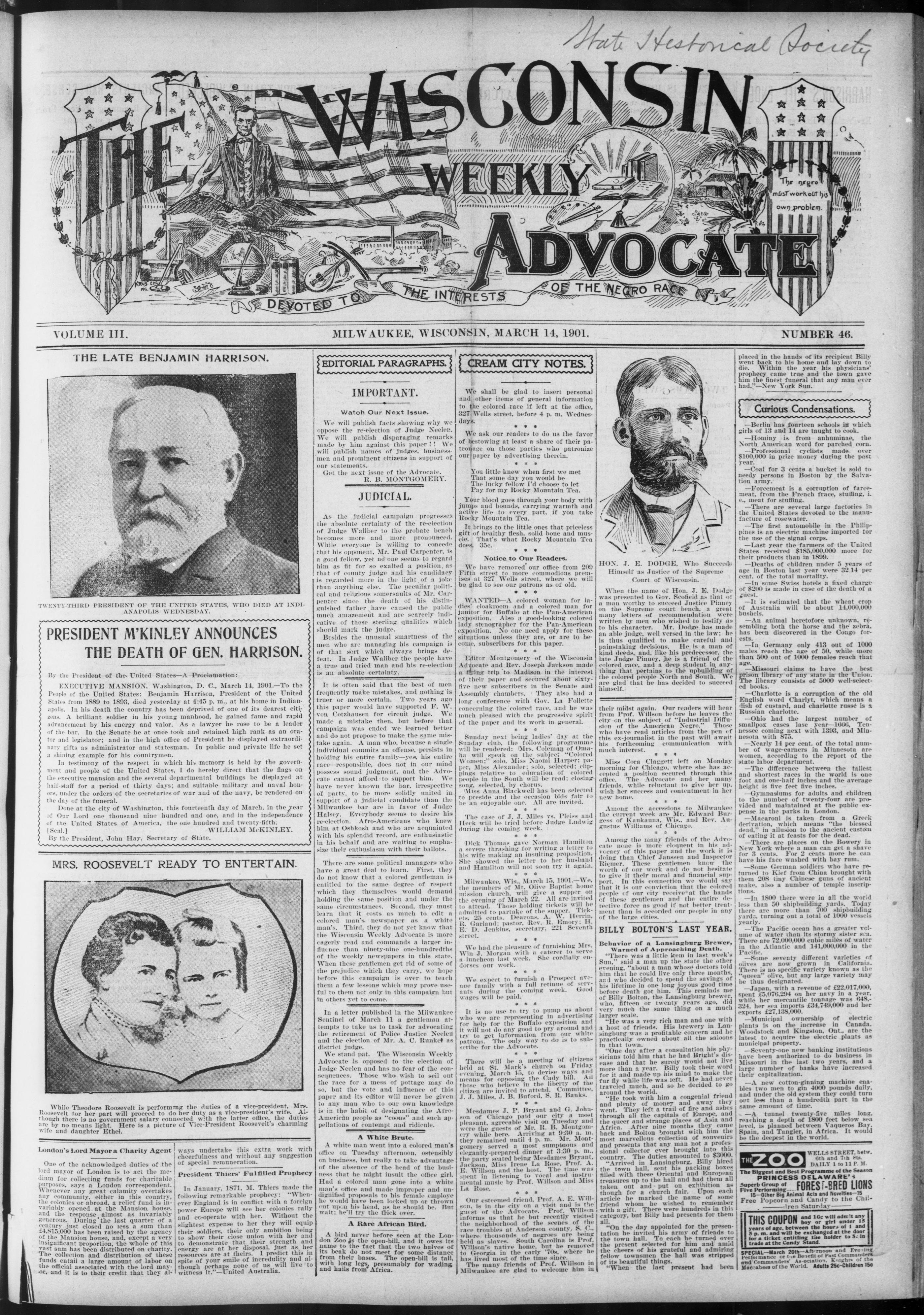
THE LATE BENJAMIN HARRISON.
TWENTY-THIRD PRESIDENT OF THE UNITED STATES, WHO DIED AT INDIANAPOLIS, WEDNESDAY.
PRESIDENT M'KINLEY ANNOUNCES THE DEATH OF GEN. HARRISON.
By the President of the United States—A Proclamation:
EXECUTIVE MANSION, Washington, D. C., March 14, 1901.—To the People of the United States: Benjamin Harrison, President of the United States from 1889 to 1893, died yesterday at 4:45 p. m., at his home in Indianapolis. In his death the country has been deprived of one of its dearest citizens. A brilliant soldier in his young manhood, he gained fame and rapid advancement by his energy and valor. As a lawyer he rose to be a leader of the bar. In the Senate he at once took and retained high rank as an orator and legislator; and in the high office of President he displayed extraordinary gifts as administrator and statesman. In public and private life he set a shining example for his countrymen.
In testimony of the respect in which his memory is held by the government and people of the United States, I do hereby direct that the flags on the executive mansion and the several departmental buildings be displayed at half-staff for a period of thirty days; and suitable military and naval honors, under the orders of the secretaries of war and of the navy, be rendered on the day of the funeral.
Done at the city of Washington, this fourteenth day of March, in the year of Our Lord one thousand nine hundred and one, and in the independence of the United States of America, the one hundred and twenty-fifth. [Seal.] WILLIAM McKINLEY. By the President, John Hay, Secretary of State.
MRS. ROOSEVELT READY TO ENTERTAIN.
THE FAMILY OF MARY AND JOHN
While Theodore Roosevelt is performing the duties of a vice-president, Mrs. Roosevelt for her part will proceed to do her duty as a vice-president's wife. Although there is no government salary connected with the latter office, the duties are by no means light. Here is a picture of Vice-President Roosevelt's charming wife and daughter Ethel.
VOLUME III.
THE LATE BENJA
TWENTY-THIRD PRESIDENT OF THE JUDICIAL ANAPOLIS WEST
PRESIDENT M'KINLAND
THE DEATH OF
By the President of the United States.
EXECUTIVE MANSION, Washington.
People of the United States: Benjamin States from 1889 to 1893, died yesterday apolis. In his death the country has beenzens. A brilliant soldier in his young advancement by his energy and valor of the bar. In the Senate he at once governor and legislator; and in the high official gifts as administrator and statesman a shining example for his countrymen.
In testimony of the respect in whicht ment and people of the United States the executive mansion and the several half-staff for a period of thirty days,ors, under the orders of the secretaries, the day of the funeral.
Done at the city of Washington, the of Our Lord one thousand nine hundred of the United States of America, the [Seal.]
By the President, John Hay, Secretary
MRS. ROOSEVELT RE
While Theodore Roosevelt is performing Roosevelt for her part will proceed to die though there is no government salary cone are by no means light. Here is a picture wife and daughter Ethel.
London's Lord Mayora Charity Agent
One of the acknowledged duties of the lord mayor of London is to act the medium for collecting funds for charitable purposes, says a London correspondent. Whenever any great calamity overtakes any community, either in this country, the colonies or abroad, a relief fund is invariably opened at the Mansion house, and the response almost as invariably generous. During the last quarter of a century just closed no less a sum than £4,815,000 has been raised by the agency of the Mansion house, and, except a very insignificant proportion, the whole of this vast sum has been distributed on charity. The collection and distribution of these funds entail a large amount of labor on the official associated with the lord mayor, and it is to their credit that they al-
---
ways undertake this extra work with cheerfulness and without any suggestion of special remuneration.
President Thiers' Fulfilled Prophecy
In January, 1871, M. Thiers made the following remarkable prophecy: "Whenever England is in conflict with a foreign power Europe will see her colonies rally and co-operate with her. Without the slightest expense to her they will equip their soldiers, their only ambition being to show their close union with her and to demonstrate that their strength and energy are at her disposal, just as her resources are at theirs. I predict this in spite of your smile of incredulity and although perhaps none of us will live to witness it."—United Australia.
EDITORIAL PARAGRAPHS.
IMPORTANT.
Watch Our Next Issue.
We will publish facts showing why we oppose the re-election of Judge Neelen. We will publish disparaging remarks made by him against this paper!! We will publish names of judges, businessmen and prominent citizens in support of our statements.
Get the next issue of the Advocate.
R. B. MONTGOMERY.
JUDICIAL.
As the judicial campaign progresses the absolute certainty of the re-election of Judge Wallber to the probate bench becomes more and more pronounced. While everyone is willing to concede that his opponent, Mr. Paul Carpenter, is a good fellow, yet no one seems to regard him as fit for so exalted a position, as that of county judge and his candidacy is regarded more in the light of a joke than anything else. The peculiar political and religious somersaults of Mr. Carpenter since the death of his distinguished father have caused the public much amazement and are scarcely indicative of those sterling qualities which should mark the judge.
Besides the unusual smartness of the men who are managing his campaign is of that sort which always brings defeat. In Judge Wallber the people have a true and tried man and his re-election is an absolute certainty.
It is often said that the best of men frequently make mistakes, and nothing is truer or more certain. Two years ago this paper would have supported F. W. von Cotzhausen for circuit judge. We made a mistake then, but before that campaign was ended we learned better and do not propose to make the same mistake again. A man who, because a single individual commits an offense, persists in holding his entire family—yes, his entire race—responsible, does not in our mind possess sound judgment, and the Advocate cannot afford to support him. We have never known the bar, irrespective of party, to be more solidly united in support of a judicial candidate than the Milwaukee bar are in favor of Judge Halsey. Everybody seems to desire his re-election. Afro-Americans who knew him at Oshkosh and who are acquainted with his splendid record, are enthusiastic in his behalf and are waiting to emphasize their enthusiasm with their ballots.
There are some political managers who have a great deal to learn. First, they do not know that a colored gentleman is entitled to the same degree of respect which they themselves would demand holding the same position and under the same circumstances. Second, they must learn that it costs as much to edit a colored man's newspaper as a white man's. Third, they do not yet know that the Wisconsin Weekly Advocate is more eagerly read and commands a larger influence than ninety-nine one-hundredths of the weekly newspapers in this state. When these gentlemen get rid of some of the prejudice which they carry, we hope before this campaign is over to teach them a few lessons which may prove useful to them not only in this campaign but in others yet to come.
In a letter published in the Milwaukee Sentinel of March 11 a gentleman attempts to take us to task for advocating the retirement of Police Justice Neelen and the election of Mr. A. C. Runkel as district judge. We stand pat. The Wisconsin Weekly Advocate is opposed to the election of Judge Neelen and has no fear of the consequences. Those who wish to seil out the race for a mess of pottage may do so, but the vote and influence of this paper and its editor will never be given to any man who to our own knowledge is in the habit of designating the Afro-American people as "coons" and such appellations of contempt and ridicule.
A White Brute:
A white man went into a colored man's office on Tuesday afternoon, ostensibly on business, but really to take advantage of the absence of the head of the business that he might insult the office girl. Had a colored man gone into a white man's office and made improper and undignified proposals to his female employee he would have been locked up or thrown out upon his head, as he should be. But wait; he'll try the trick over.
A Bare African Bird.
A bird never before seen at the London Zoo is the open-bill, and it owes its name to the fact that the two halves of its beak do not meet for some distance from their bases. The open-bill is tall, with long legs, presumably for wading and hails from Africa.
CREAM CITY NOTES.
We shall be glad to insert personal and other items of general information to the colored race if left at the office, 327 Wells street, before 4 p. m. Wednesdays.
* * *
We ask our readers to do us the favor of bestowing at least a share of their patronage on those parties who patronize our paper by advertising therein.
* * *
You little knew when first we met
That some day you would be
The lucky fellow I'd choose to let
Pay for my Rocky Mountain Tea.
Your blood goes through your body with jumps and bounds, carrying warmth and active life to every part, if you take Rocky Mountain Tea. It brings to the little ones that priceless gift of healthy flesh, solid bone and muscle. That's what Rocky Mountain Tea does. 35c.
Notice to Our Readers.
We have removed our office from 209 Fifth street to more commodious premises at 327 Wells street, where we will be glad to see our patrons as of old.
***
WANTED—A colored woman for ladies' cloakroom and a colored man for janitor for Buffalo at the Pan-American exposition. Also a good-looking colored lady stenographer for the Pan-American exposition. No one need apply for these situations unless they are, or are to become, subscribers for this paper.
* * *
Editor Montgomery of the Wisconsin Advocate and Rev. Joseph Jackson made a flying trip to Madison in the interest of their paper and secured about sixty-five new subscribers in the Senate and Assembly chambers. They also had a long conference with Gov. La Follette concerning the colored race, and he was much pleased with the progressive spirit of the paper and its work in general.
* * *
Sunday next being ladies' day at the Sunday club, the following programme will be rendered: Mrs. Coleman of Omaha will speak on the subject "Colored Women;" solo. Miss Naomi Harper; paper, Miss Alexander; solo, selected; clippings relative to education of colored people in the South will be read; closing song, selected, by chorus. Miss Anna Blackwell has been selected to preside and the occasion bids fair to be an enjoyable one. All are invited.
* * *
The case of J. J. Miles vs. Pleiss and Heck will be tried before Judge Ludwig during the coming week.
***
Dick Thomas gave Norman Hamilton a severe thrashing for writing a letter to his wife making an insulting proposition. She showed the letter to her husband and Hamilton will not soon try it again.
Milwaukee, Wis., March 15, 1901.—We, the members of Mt. Olive Baptist home mission church, will give a supper on the evening of March 22. All are invited to attend. Those holding tickets will be admitted to partake of the supper. Tickets, 25 cents. Deacons, A. W. Herrin, R. Garland; pastor, Rev. R. Emory; H. E: D. Jenkins, secretary, 221 Seventh street
※ ※ ※
We had the pleasure of furnishing Mrs. Win J. Morgan with a caterer to serve a luncheon last week. She cordially endorses our work.
* * *
We expect to furnish a Prospect avenue family with a full retinue of servants during the coming week. Good wages will be paid.
***
It is no use to try to pump us about who we are representing in advertising for help for the Buffalo exposition and it will not do any good to pry around and try to get information from our white patrons. The only way to do is to subscribe for the Advocate.
☆ ☆ ☆
There will be a meeting of citizens held at St. Mark's church on Friday evening, March 15, to devise ways and means for opposing the Cady bill. All those who believe in the liberty of the citizen are invited to attend. Committee, J. J. Miles, J. B. Buford, S. R. Banks.
* * *
Mesdames J. P. Bryant and G. Johnson of Chicago paid our city a most pleasant, agreeable visit on Tuesday and were the guests of Mr. R. B. Montgomery while here. Arriving at 9:30 a.m. they remained until 4 p. m. Mr. Montgomery served a most sumptuous and elegantly-prepared dinner at 3:30 p. m., the party seated being Mesdames Bryant, Jackson, Miss Irene La Rose, Prof. A. E. Willson and the host. The time was spent in listening to vocal and instrumental music by Prof. Willson and Miss La Rose.
* * *
Our esteemed friend, Prof. A. E. Willson, is in the city on a visit and is the guest of the Advocate. Prof. Willson informs us that he but recently visited the neighborhood of the scenes of the race troubles at Anderson county, S. C., where thousands of negroes are being held as slaves. South Carolina is Prof. Willson's native home, but he removed to Georgia in the early '70s, where he has lived most of the time since. The many friends of Prof. Willson in Milwaukee are glad to welcome him in
L. M.
HON. J. E. DODGE. Who Succeeds Himself as Justice of the Supreme Court of Wisconsin.
When the name of Hon. J. E. Dodge was presented to Gov. Scofield as that of a man worthy to succeed Justice Pinney on the Supreme court bench, a great many letters of recommendation were written by men who wished to testify as to his character. Mr. Dodge has made an able judge, well versed in the law; he is thus qualified to make careful and painstaking decisions. He is a man of kind deeds, and, like his predecessor, the late Judge Pinney, he is a friend of the colored race, and a deep student in anything that pertains to the upbuilding of the colored people North and South. We are glad that he has decided to succeed himself.
their midst again. Our readers will hear from Prof. Willson before he leaves the city on the subject of "Industrial Diffusion of the American Negro." Those who have read articles from the pen of this ex-journalist in the past will await his forthcoming communication with much interest.
乖乖
Miss Cora Claggett left on Monday morning for Chicago, where she has accepted a position secured through this office. The Advocate and her many friends, while reluctant to give her up wish her success and contentment in her new home.
★ ★ ★
Among the accessions to Milwaukee the current week are Mr. Edward Burgess of Kaukauna, Wis., and Rev. Augustus Williams of Chicago.
☆ ☆ ☆
Among the many friends of the Advocate none is more eloquent in his advocacy of this paper and the work it is doing than Chief Janssen and Inspector Riçmer. These gentlemen know the worth of our work and do not hesitate to give it their moral and financial support. In this connection we would say that it is our conviction that the colored people of our city receive* at the hands of these gentlemen and the entire detective force as good if not better treatment than is accorded our people in any of the large cities.
BILLY BOLTON'S LAST YEAR.
Behavior of a Lansingburg Brewer, Warned of Approaching Death.
"There was a little item in last week's Sun," said a man up the state the other evening, "about a man whose doctors told him that he could live only three months, and who decided to spend the savings of his lifetime in one long joyous good time before death got him. This reminds me of Billy Bolton, the Lansingburg brewer, who, fifteen or twenty years ago, did very much the same thing on a much larger scale.
"He was a very rich man and one with a host of friends. His brewery in Lansingburg was a profitable concern and he practically owned about all the saloons in that town."
"One day after a consultation his physicians told him that he had Bright's disease and that he surely would not live more than a year. Billy took their word for it and made up his mind to make the fur fly while life was left. He had never traveled much, and so he decided to go around the world.
"He took with him a congenial friend and plenty of money and away they went. They left a trail of fire and ashes through all the capitals of Europe, and the queer and strange places of Asia and Africa. After nine months they came back and Bolton brought with him the most marvellous collection of souvenirs and presents that any man not a professional collector ever brought into this country. The duties amounted to $3000. "Arrived in Lansingburg, Billy hired the town hall, sent his packing boxes filled with these Oriental and European treasures up to the hall and had them all taken out and put on exhibition as though for a church fair. Upon each article he marked the name of some friend whom he wished to remember with a gift. There were hundreds in this category, but Billy had presents for them all.
"On the day appointed for the presentation he invited his army of friends to the town hall. To each he turned over the present selected for him and amid the cheers of his grateful and admiring fellow townsmen the hall was stripped of its beautiful things.
"When the last present had been
placed in the hands of its recipient Billy went back to his home and lay down to die. Within the year his physicians' prophecy came true and the town gave him the finest funeral that any man ever had."—New York Sun.
Curious Condensations.
—Berlin has fourteen schools in which girls of 13 and 14 are taught to cook.
—Hominy is from anhuminae, the North American word for parched corn.
—Professional cyclists made over $100,000 in prize money during the past year.
—Coal for 3 cents a bucket is sold to needy persons in Boston by the Salvation army.
—Forcemeat is a corruption of farcemeat, from the French frace, stuffing, i.e., meat for stuffing.
—There are several large factories in the United States devoted to the manufacture of rosewater.
—The first automobile in the Philippines is an electric machine imported for the use of the signal corps.
- Last year the farmers of the United States received $185,000,000 more for their products than in 1899.
- Deaths of children under 5 years of age in Boston last year were 32.14 per cent. of the total mortality.
- In some Swiss hotels a fixed charge of $200 is made in case of the death of a guest.
- It is estimated that the wheat crop of Australia will be about 14,000,000 bushels.
- An animal heretofore unknown, resembling both the horse and the zebra, has been discovered in the Congo forests.
- In Germany only 413 out of 1000 males reach the age of 50, while more than 500 out of 1000 females reach that age.
—Missouri claims to have the best prison library of any state in the Union. The library consists of 5000 well-selected books.
—Charlotte is a corruption of the old English word Charlyt, which means a dish of custard, and charlotte russe is a Russian charlotte.
—Ohio had the largest number of smallpox cases lase year-1666, Tennessee coming next with 1393, and Minnesota with 875.
—Nearly 14 per cent. of the total number of wage-earners in Minnesota are women, according to the report of the state labor department.
—The difference between the tallest and shortest races in the world is one foot and one-half inches and the average height is five feet five inches.
—Gymnasiums for adults and children to the number of twenty-four are provided and maintained at the public expense in the parks in London.
—Macaroni is taken from a Greek derivation, which means "the blessed dead," in allusion to the ancient custom of eating it at feasts for the dead.
—There are places on the Bowery in New York where a man can get a shave for 3 cents. For 2 cents more he can have his face washed with bay rum.
—Some German soldiers who have returned to Kief from China brought with them 208 tiny Chinese guns of ancient make, also a number of temple inscriptions.
In 1800 there were in all the world less than 50 shipbuilding yards. Today there are more than 700 shipbuilding yards, turning out a total of 1000 vessels yearly.
The Pacific ocean has a greater volume of water than its stormy sister sea. There are 72,000,000 cubic miles of water in the Atlantic and 141,000,000 in the Pacific.
Some seventy different varieties of olives are now grown in California. There is no specific variety known as the "queen" olive, but any large variety may be thus designated.
Japan, with a revenue of £22,017,000, spent £5,076,294 on her navy in a year, while her mercantile tonnage was 648,324, her sea imports £34,749,000 and her exports £27,138,000.
—Municipal ownership of electric plants is on the increase in Canada. Woodstock and Kingston, Ont., are the latest to acquire the electric plants as municipal property.
—Seventy-one new banking institutions have been authorized to do business in Missouri in the last two years, and a large number of banks have increased their capitalization.
—A new cotton-ginning machine enables two men to gin 4000 pounds daily, and under the old system they could turn out less than a hundredth part in the same amount of time.
—A tunnel twenty-five miles long, reaching a depth of 1800 feet below sea level, is planned between Vaqueros Bay, Spain, and Tangier, in Africa. It would be the deepest in the world.
THIS COUPON and 10c will admit any boy or girl under 15 years of age, between the hours of 1 and 5 p. m. and will be exchanged at the door for a ticket entitling the holder to 5c in trade at the Candy Stand.
SPECIAL—March 20th—Afternoon and Evening Performance or the Benefit of Past Commanders and Commanders' As-ocation. Knights of the Macebees of the World. Adults 25c-Children 15c
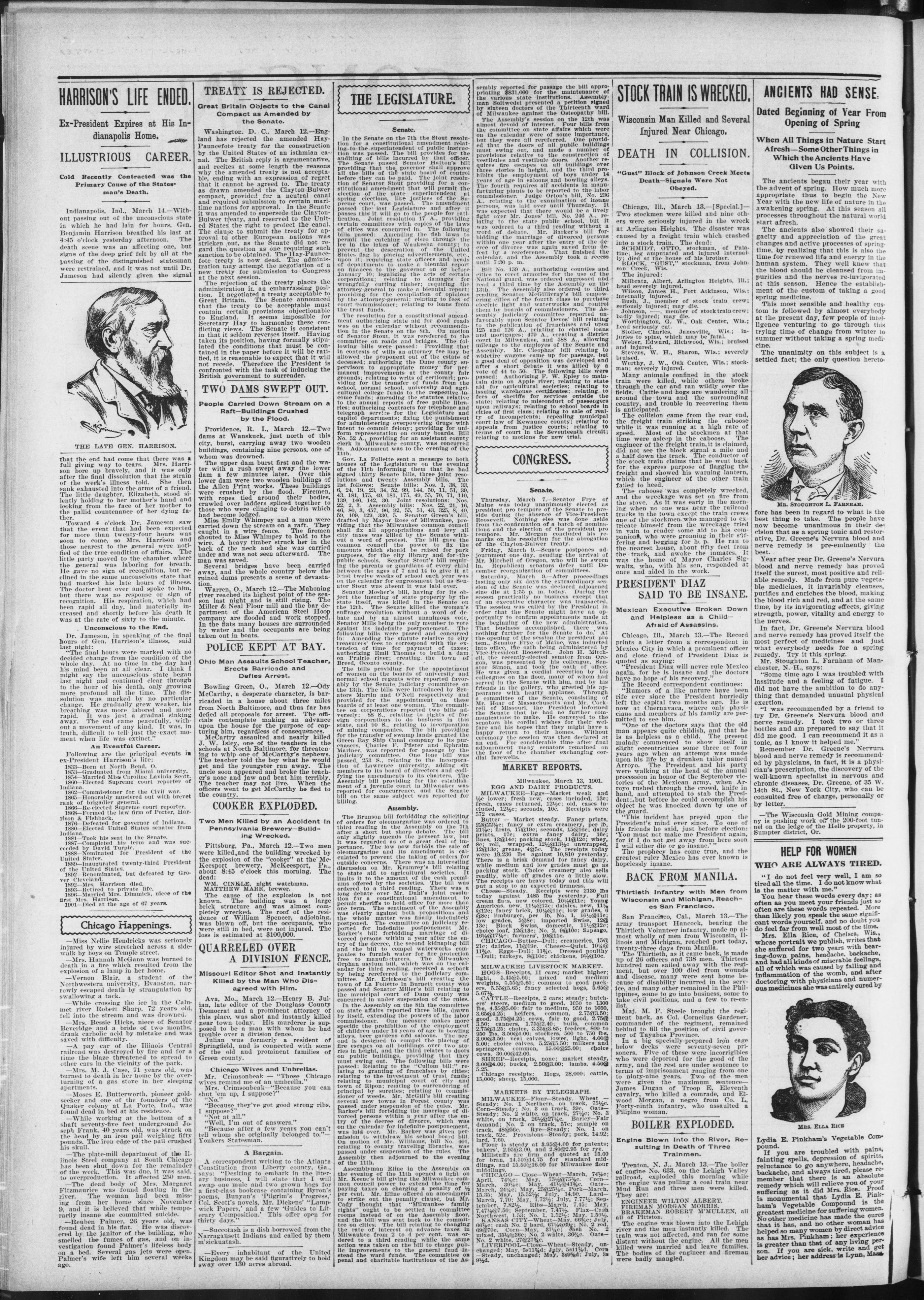
HARRISON'S LIFE ENDED.
Cold Recently Contracted was the Primary Cause of the Statesman's Death.
Indianapolis, Ind., March 14.—Without passing out of the unconscious state in which he had lain for hours, Gen. Benjamin Harrison breathed his last at 4:45 o'clock yesterday afternoon. The death scene was an affecting one, but signs of the deep grief felt by all at the passing of the distinguished statesman were restrained, and it was not until Dr. Jameson had silently given the signal
S. S. Sims
that the end had come that there was full giving way to tears. Mrs. Harrison bore up bravely, and it was only after the final dissolution that the strain of the week's illness told. She then sank exhausted into the arms of a friend. The little daughter, Elizabeth, stood silently holding to her mother's hand and looking from the face of her mother to the pallid countenance of her dying father.
Toward 4 o'clock Dr. Jameson saw that the event that had been expected for more than twenty-four hours was soon to come, so Mrs. Harrison and those nearest to the general were notified of the true condition of affairs. The little party moved to the chamber where the general was laboring for breath. He gave no sign of recognition, but reclined in the same unconscious state that had marked his late hours of illness. The doctor bent over and spoke to him, but there was no response or sign of recognition. His respiration, which had been rapid all day, had materially increased and shortly before his death it was at the rate of sixty to the minute.
Unconscious to the End.
Dr. Jameson, in speaking of the final hours of Gen. Harrison's illness, said last night:
"The final hours were marked with no decided change from the condition of the whole day. At no time in the day had his mind been at all clear. I think I might say the unconscious state began last night and continued clear through to the hour of his death, only growing more profound all the time. The dissolution was marked by no particular change. He gradually grew weaker, his breathing was more labored and more rapid. It was just a gradual sinking away. The end came peacefully, without a movement of any kind. It was, in truth, difficult to tell just the exact moment when life was extinct."
An Eventful Career.
Following are the principal events in ex-President Harrison's life:
1833—Born at North Bend, O.
1833—Graduated from Miami university.
1854—Married Miss Caroline Layinla Scott.
1860—Elected Supreme court reporter of Indiana.
1862—Commissioner for the Civil war.
1865—Honorably mustered out with brevet rank of brigadier general.
1866—Re-elected Supreme court reporter.
1868—Formed the law firm of Porter, Harrison & Fishback.
1876—Defeated for governor of Indiana.
1880—Elected United States senator from Indiana.
1881—Took his seat in the Senate.
1887—Completed his term and was succeeded by David Turple.
1888—Nominated for President of the United States.
1889—Inaugurated twenty-third President of the United States.
1892—Renominated, but defeated by Grover Cleveland.
1892—Mrs. Harrison dled.
1893—Retired to private life.
1896—Married Mrs. Dimmick, niece of the first Mrs. Harrison.
1901—Died at the age of 67 years.
—Miss Nellie Hendricks was seriously injured by wire stretched across a sidewalk by boys on Temple street.
—Mrs. Hannah McGann was burned to death in a fire which resulted from the explosion of a lamp in her home.
—Vernon Blair, a student of the Northwestern university, Evanston, narrowly escaped death by strangulation by swallowing a tack.
—While crossing the ice in the Calumet river Robert Sharp, 72 years old, fell into the stream and was drowned.
—Mrs. Bessie Hicks, niece of Senator Beveridge and a bride of two months, drank carbolic acid by mistake and was saved with difficulty.
A pay car of the Illinois Central railroad was destroyed by fire and for a time the blaze threatened to spread to other cars in the vicinity of the park.
Mrs. M. J. Case, 71 years old, was burned to death in her home by the overturning of a gas stove in her sleeping apartments.
Moses E. Butterworth, pioneer gold-seeker and one of the founders of the Quaker colony at La Porte, Ind., was found dead in bed at his residence.
While working at the bottom of a shaft seventy-five feet underground Joseph Frank, 40 years old, was struck on the head by an iron pail weighing fifty pounds. The iron edge of the pail crushed his skull.
The plate-mill department of the Illinois Steel company at South Chicago has been shut down for the remainder of the week. This was due, it was said, to overproduction. It affected 250 men. The dead body of Mrs. Margaret Fitzmaurice was found floating in the river. The woman had been missing from her home since November 9, and it is believed that while temporarily insane she committed suicide. Reuben Palmer, 26 years old, was found dead in his flat. He was discovered by the janitor of the building, who smelled the fumes of gas, and on investigation found Palmer's lifeless body on a bed. Several gas jets were open. Palmer's wife left him several weeks ago.
TREATY IS REJECTED.
Great Britain Objects to the Canal Compact as Amended by the Senate.
Washington. D. C.. March 12.—England has rejected the amended Hay-Pauncefote treaty for the construction by the United States of an isthmian canal. The British reply is argumentative, and recites at some length the reasons why the amended treaty is not acceptable, ending with an expression of regret that it cannot be agreed to. The treaty as drawn amended the Clayton-Bulwer compact, provided for a neutral canal and required submission to certain maritime nations for approval. In the Senate it was amended to supersede the Clayton-Bulwer treaty, and reserved to the United States the right to protect the canal. The clause to submit the treaty for approval to other European nations was stricken out, as the Senate did not regard the question as one requiring such sanction to be obtained. The Hay-Pauncefote treaty is now dead. The administration may attempt the negotiation of a new treaty for submission to Congress at the next session.
The rejection of the treaty places the administration ir. an embarrassing position. It negotiated a treaty acceptable to Great Britain. The Senate announced that the treaty to be acceptable must contain certain provisions objectionable to England. It seems impossible for Secretary Hay to harmonize these conflicting views. The Senate is consistent in that it seldom reverses itself. Having taken its position, having formally stipulated the conditions that must be contained in the paper before it will be ratified, it is reasonable to expect that it will not recede. Therefore the President is confronted with the task of inducing the British government to surrender.
TWO DAMS SWEPT OUT.
People Carried Down Stream on a Raft-Buildings Crushed by the Flood.
Providence, R. I., March 12.—Two dams at Wanskuck, just north of this city, burst, carrying away two wooden buildings, containing nine persons, one of whom was drowned.
The upper dam burst first and the water with a rush swept away the lower dam a few minutes later. Over this lower dam were two wooden buildings of the Allen Print works. These buildings were crushed by the flood. Firemen, with ropes tied around their bodies, crawled over ladders spliced together to those who were clinging to debris which had become lodged.
Miss Emily Whimpey and a man were carried down the stream on a raft. They caught in a wire fence. The firemen shouted to Miss Whimpey to hold to the wire. A heavy timber struck her in the back of the neck and she was carried under and was not seen afterward. The man was saved.
Several bridges have been carried away, and the whole country below the ruined dams presents a scene of devastation.
Warren, O., March 12.—The Mahoning river reached its highest point of the season last night and is still rising. The Miller & Neal Flour mill and the bar department of the American Steel Hoop company are flooded and work stopped. In the flats many houses are surrounded by water and the occupants are being taken out in boats.
POLICE KEPT AT BAY.
Ohio Man Assaults School Teacher, Erects Barricade and Defies Arrest.
Bowling Green, O., March 12.—Ody McCarthy, a desperate character, is barricaded in a house about three miles from North Baltimore, and thus far has defied all proposals for arrest. The officials contemplate making an advance upon the house for the purpose of capturing him, regardless of consequences. McCarthy assaulted and nearly killed J. W. Isley, one of the teachers in the schools at North Baltimore, for threatening to whip one of McCarthy's nephews. The teacher told the boy what he would get and the youngster ran away. The uncle soon appeared and broke the teacher's nose and jaw and beat him terribly. The teacher may not live. When the officers went to get McCarthy he fled to the country.
COOKER EXPLODED.
Two Men Killed by an Accident In Pennsylvania Brewery-Building Wrecked.
Pittsburg, Pa., March 12.—Two men were killed, and the building wrecked by the explosion of the "cooker" at the McKeesport brewery, McKeesport, Pa., about 8:45 o'clock this morning. The dead:
WM. CINKLE, night watchman.
MATTHEW MARR, brewer.
The cause of the explosion is not known. The building was a large brick structure and was almost completely wrecked. The roof of the residence of William Spencer, adjoining, was blown off, but the occupants, who were still in bed, were not injured. The loss is estimated at $100,000.
QUARRELED OVER A DIVISION FENCE.
Missouri Editor Shot and Instantly Killed by the Man Who Disagreed with Him.
Ava, Mo., March 12.—Henry B. Julian, late editor of the Douglass County Democrat and a prominent attorney of this place, was shot and instantly killed near town today. His murderer is supposed to be a man with whom he had trouble over a division fence. Julian was formerly a resident of Springfield, and is connected with some of the old and prominent families of Green county.
Mr. Crimsonbeak — "Those Chicago wives remind me of an umbrella."
wives remind me of an umbrella." Mrs. Crimsonbeak—"Because you can
Mrs. Crimsonbeak—"Because you can shut 'em up, I suppose?"
"No."
"Because they've got good strong ribs, I suppose?"
"Not at all."
"Well, I'm out of answers."
"Because after a few years you can't tell whom she originally belonged to."—Yonkers Statesman.
A Bargain.
A correspondent writing to the Atlanta Constitution from Liberty county, Ga., says: "Desiring to embark in the literary business, I will state that I will swap one mule and two grown hogs for a first-class bookcase containing Byron's poems, Bunyan's 'Pilgrim's Progress,' Col. Scott's novels, Mr. Dickens' 'Lampwick Papers,' and a few 'Guides to Literary Composition.' This offer open for thirty days."
— Succetash is a dish borrowed from the Narragansett Indians and called by them m'sickuatash.
— Every inhabitant of the United Kingdom may be said figuratively to hold sway over 130 acres abroad.
THE LEGISLATURE.
Senate.
In the Senate on the 7th the Stout resolution for a constitutional amendment relating to the superintendent of public instruction was passed. The bill provides for the auditing of bills incurred by that officer. The Senate passed Senator Hatton's bill providing that the governor shall approve all the bills of the state board of control before they can be paid. The joint resolution of Senator Stout providing for a constitutional amendment that will permit the election of the state superintendent at spring elections, like justices of the Supreme court, was passed. The amendment passed the last Legislature and after it passes this it will go to the people for ratification. Joint resolution 17 A., providing certain committees with copies of the laws of cities was concurred in. The following bills passed: Amending the fish laws to permit the catching of clsoe through the ice in the lakes of Waukesha county; to prevent the desecration of the United States flag by placing advertisements, etc., upon it; requiring state officers and heads of departments to make a biennial report on finances to the governor on or before January 10; legalizing the acts of certain corporations; relating to damages for wrongfully cutting timber; requiring the attorney-general to make a biennial report; providing for the compilation of opinions by the attorney-general; relating to fees of court commissioner; relating to loans from the trust funds.
The resolution for a constitutional amendment authorizing state aid for good roads was on the calendar without recommendation in the Senate on the 5th. On motion of Senator Stout, it was rereferred to the committee on roads and bridges. The following bills were passed: Providing that in contests of wills an attorney fee may be allowed the proponent out of the estate of deceased; authorizing the Dane county supervisors to appropriate money for permanent improvements at the county fair grounds; relating to writs of certiorari; providing for the transfer of funds from the school, normal school, university and agricultural college funds to the respective income funds; amending the statutes relative to the annual reports of free public libraries; authorizing contracts for telephone and telegraph service for the Legislature and capitol departments; fixing the punishment for administering overpowering drugs with intent to commit felony; providing for uniform representation on county boards. Bill No. 52 A., providing for an assistant county clerk in Milwaukee county, was concurred in. Adjournment was to the evening of the 11th.
Gov. La Follette sent a message to both houses of the Legislature on the evening of the 11th informing them that he had signed thirty Senate bills, three joint resolutions and twenty Assembly bills. The list follows: Senate bills: Nos. 1, 38, 33, 6, 24, 19, 23, 34, 52, 99, 144, 50, 11, 51, 39, 43, 181, 175, 49, 181, 175, 49, 55, 70, 71, 110, 139, 140, 142, 30. Joint resolutions: Nos. 22, 2, 3. Assembly bills: Nos. 22, 21, 16, 46, 80, 3, 457, 96, 92, 55, 51, 43, 325, 8, 40, 59, 109, 129, 330, 5. Senator Green's bill, drafted by Mayor Rose of Milwaukee, providing that the Milwaukee common council shall fix all appropriations and levy all city taxes was killed by the Senate without a word of protest. The bill gave the common council the power to fix the amounts which should be raised for park purposes, for the city library and for the public schools. Senator Stout's bill requiring the parents or guardians of every child between the ages of 7 and 14 to give it at least twelve weeks of school each year was on the calendar for engrossment but as Senator Stout was absent it was laid over.
Senator Mosher's bill, having for its object the insuring of state property by the state itself, was killed in the Senate on the 12th. The Senate killed the woman's suffrage resolution without a word of debate and by an almost unanimous vote, Senator Mills being the only member to vote against its indefinite postponement. The following bills were passed and concurred in: Amending the statute relative to city treasurers' fees to correspond with the extension of time for payment of taxes; authorizing Emil Thomas to build a dam on Prairie river; creating the town of Breed, Oconto county.
The bills providing for the appointment of women on the boards of university and normal school regents were reported favorably by the Senate judiciary committee on the 13th. The bills were introduced by Senators Martin and O'Nell respectively and provided for the appointment on these boards of at least one woman. The committee on corporations reported two bills adversely: 88 S., relating to rights of foreign corporations to do business in this state, and 90 S., relating to incorporation of mining companies. The bill providing for the transfer of swamp lands granted the Green Bay Ship Canal company to its purchasers, Charles F. Pfister and Ephraim Mariner, was reported for passage by the judiciary committee. One lone bill was passed, 253 S., relating to the incorporation of Lawrence university, adding six members to its board of directors and codifying the amendments to its charters. The Assembly bill providing for the establishment of a juvenile court in Milwaukee was reported for concurrence, and the Senate bill on the same subject was reported for killing.
Assembly.
The Brunson bill forbidding the soliciting of orders for oleomargarine was ordered to third reading in the Assembly on the 7th after a short but sharp debate. The bill only slightly amends the present law, but it was regarded as of a great deal of importance. The law now forbids the sale of oleomargarine and its amendment is calculated to prevent the taking of orders for outside concerns. There was an interesting discussion on Mr. Krumrey's bill relating to state aid to agricultural societies. It limits it to the amount of the cash premiums offered by the societies. The bill was ordered to a third reading. There was a long debate over Mr. Dahl's joint resolution for a constitutional amendment to permit sheriffs to hold office for more than one term. The sentiment of the Assembly was clearly against both propositions and the whole matter was finally indefinitely postponed. The committee on judiciary reported for indefinite postponement Mr. Barker's bill forbidding marriage of divorced persons within a year after the entry of the decree, the second kidnapping bill and the bill to compel waterworks companies to furnish water for fire protection free to manufacturers. The Milwaukee Orphan asylum bill, which was on the calendar for third reading, received a setback by being rereferred to the judiciary committee. Mr. Erickson's bill creating the town of La Follette in Burnett county was passed and Senator Miller's bill relating to the municipal court of Dane county was concurred in under suspension of the rules. In the Assembly on the 8th the committee on state affairs reported three bills, drawn by itself, extending the powers of the labor commissioner. One measure makes more specific the prohibition of the employment of children under 14 years of age in bowling alleys, beer gardens and saloons. The second is designed to compel the placing of fire escapes on all buildings over two stories in height, and the third relates to doors on public buildings, providing that they must swing out. The following bills were passed: Relating to the "Cullom bill;" relating to granting of franchises by cities; relating to the investment of trust funds; relating to municipal court of city and town of Ripon; relating to surrendering of principal by sureties; relating to commissioner of weeds. Mr. McGill's bill creating several new towns in Forest county was passed under suspension of the rules. Mr. Barker's bill forbidding the marriage of divorced persons within a year after the entry of the decree of divorce, which was on the calendar for indefinite postponement, was laid over. Mr. Barker was given permission to withdraw his school board bill. On motion of Mr. Williams, bill No. 401, relating to county traveling libraries, was passed under suspension of the rules. The Assembly then adjourned to the evening of the 11th.
Assemblyman Elline in the Assembly on the evening of the 11th opened a fight on Mr. Keene's bill giving the Milwaukee common council power to extend the time for paying taxes on charging a penalty of $1/2 per cent. Mr. Elline offered an amendment to strike out the penalty clause, but Mr. Cady thought that "Milwaukee family rights" ought to be settled in committee rooms instead of on the Assembly floor, and the bill was sent back to the committee on cities. The bill relating to changing the rate of interest on advance taxes in Milwaukee from 2 to 4 per cent. was ordered to a third reading while the same action was taken on the bill to charge public improvements to the general fund instead the ward funds. The committee on penal and charitable institutions of the As-
sembly reported for passage the bill appropriating $831,000 for the maintenance of the various state institutions. Assemblyman Soltwedel presented a petition signed by sixteen doctors of the Thirteenth ward of Milwaukee against the Osteopathy bill.
The Assembly's session on the 12th was almost devoid of interest. Four bills from the committee on state affairs which were on the calendar were of some importance, but they were all referred. One provided that the doors of all public buildings must swing out, and made a number of provisions relative to the construction of vestibules and vestibule doors. Another requires fire escapes on all buildings over three stories in height, and the third prohibits the employment of boys under 14 years of age in saloons and bowling alleys. The fourth requires all accidents in manufacturing plants to be reported to the labor commissioner. Judge Orton's bill, No. 236 A., relating to the examination of insane persons, was laid over until Thursday. It was expected that there would be a lively fight over Mr. Jones' bill, No. 246 A., relating to the state public school, but it was ordered to a third reading without a word of debate. Mr. Barker's bill forbidding the marriage of divorced persons within one year after the entry of the decree of divorce was again saved from defeat by a rereference. That finished the calendar, and the Assembly took a recess until 7:30 p. m.
Bill No. 159 A., authorizing counties and cities to erect armories for the use of the National guard, was ordered engrossed and read a third time by the Assembly on the 13th. The Assembly also ordered to third reading Senator McGillivray's bill empowering cities of the fourth class to purchase electric light and waterworks and control them by boards of commissioners. The Assembly judiciary committee reported unfavorably upon Senator Devos' bill relating to the publication of franchises and upon 125 and 126 A., relating to chattel loans and mortgages; 479 A., creating a district court in Milwaukee, and 588 A., allowing mileage to the employees of the Senate and Assembly. Mr. Cleophas' bill relating to widetire wagons came up for passage, but a good deal of opposition was developed and after a short debate it was killed by a vote of 44 to 50. The following bills were passed: Authorizing F. W. Epley to maintain dam on Apple river; relating to state aid for agricultural societies; relating to issuing warehouse certificates; relating to fees of sheriffs for services outside the state; relating to misconduct of passengers upon railways; relating to school boards in cities of first class; relating to sale of reality of incompetent; repealing municipal court law of Kewaunee county; relating to appeals from justice courts; relating to terms of court in the Seventeenth circuit; relating to motions for new trial.
Senate.
Thursday, March 7.—Senator Frye of Malne was today unanimously elected as president pro tempore of the Senate to preside during the absence of Vice-President Roosevelt. Nothing else was done aside from the confirmation of a batch of nominations and the election of the president pro tempore. Mr. Morgan concluded his remarks on his resolution for the abrogation of the Clayton-Bulwer treaty.
Friday, March 9.—Senate postpones adjournment one day, pending the arrival of Mr. Mitchell of Oregon, who will be sworn in. Republican senators defer until December reorganization of committees.
Saturday, March 9. After proceedings lasting only six days the extraordinary session of the Senate was declared adjourned sine die at 1:55 p. m. today. During the session practically no business except that of an executive character was transacted. The session was called by the President in order that the Senate might have an opportunity to confirm appointments made at the beginning of the new administration. That business accomplished, there was nothing further for the Senate to do. At the opening of the session the president pro tem., Senator Frye of Maine, was inducted into office, the oath being administered by Vice-President Roosevelt. John H. Mitchell, the recently-elected senator from Oregon, was presented by his colleague, Senator Simon, and took the oath of office. He was given a cordial reception by his colleagues on the floor, many of whom had served in the Senate with him, and by his friends in the gallery, who greeted his appearance with hearty applause. Through a committee of the Senate, consisting of Mr. Hoar of Massachusetts and Mr. Cockrell of Missouri, the President informed the Senate that he had no further communications to make. He conveyed to the senators his cordial wishes for their welfare and his hopes that they might have a happy return to their homes. Without ceremony the session was then declared at an end. For considerable time after final adjournment many senators remained on the floor of the chamber exchanging cordial farewells.
MARKET REPORTS.
MILWAUKEE—Eggs—Market weak and 1/2c lower; fresh new, cases included, 13c; fresh, cases returned, 12/2c; old, cases included, 12/2c; seconds, 10c. Receipts were 572 cases.
Butter — Market steady. Fancy prints, 22@22/2c; fancy or extra creamery, per lb, 21/2c; firsts, 17@19c; seconds, 15@16c; dairy prints, 17c; extra fancy dairy, 16c; lines, 13@14c; packing stock, 11@12c; whey, 8c; roll, wrapped, 12/2@13/2c unwrapped, 12@13c; grease, 4@5c. The receipts today were 19,236 Ibs against 10,810 yesterday.
There is a brisk demand for fancy dairy, while medium and low grades must go as packing stock. Choice creamery also sells readily, while off grades are a little slow. The receipts are heavy today and this will put a stop to an expected firmness.
Cheese—Steady. Receipts were 2130 lbs today against 1485 lbs yesterday. Full cream flats, new colored, 10½¼11c; Young Americas, new, 11½¼12c; daisies, new, 11½¼12c; fancy brick, 10½¼11c; low grades, 6½8c; limburger, per lb, No. 1, 10½¼11c; low grades, 5½8c; imported Swiss, 12½413c; Block Swiss, domestic, 11½¼12c; choice loaf, 12½13c; No. 2, 9½10c; Sapsago, 10½¼17½c; farmers', 10½11c.
CHICAGO—Butter—Dull; creameries, 15½21c; dairies, 11½19c. Cheese—Qulet, 10½¼11¾c. Eggs—Dull; 11½¾c. Dressed poultry—Dull; turkeys, 8½10c; chickens, 9½¼10c.
MILWAUKEE LIVESTOCK MARKET.
HOGS—Receipts, 11 cars; market higher; light, 5.45¾5.00; mixed and medium weights, 5.55¾5.65; common to good packers, 5.55¾5.65; fancy selected hogs, 5.65¾5.67½.
CATTLE—Receipts, 2 cars; steady; butchers' steers, medium to good, 1050 to 1300 lbs, 4.35@5.00; fair to medium, 950 to 1050, 3.65@4.25; helfers, common, 2.75@3.50; good, 3.75@4.25; cows, fair to good, 2.75@3.50; canners, 1.75@2.40; bulls, common 2.75@3.25; choice, 3.35@3.85; feeders, 800 to 950 lbs, 3.50@4.00; stockers, 500 to 750 lbs, 3.00@3.50; calve lals, lower, light, 4.00@5.00; choice calves, 5.25@5.50; milkers and springers, common, 15.00@25.00; choice cows, 30.00@42.00.
SHEEP—Receipts, none; market steady, 3.00@4.00; bucks, 2.50@3.00; lambs, 4.50@5.25
Chicago receipts: Hogs, 28,000; cattle, 15,000; sheep, 15,000.
MARKETS BY TELEGRAPH.
MILWAUKEE—Flour—Steady. Wheat — Steady; No. 1 Northern, on track, 75½c. Corn—Steady; No. 3 on track, 39c. Oats—Steady; No. 2 white, on track, 27½c; No. 3 white, on track, 26½@27½c. Barley—Fair demand; No. 2 on track, 57c; sample on track, 48@56c. Rye—Steady; No. 1 on track, 52c. Provisions—Steady; pork, 14.92; lard, 7.60.
Flour is steady at 3.95@4.00 for patents; bakers', 2.95@3.00, and 2.80@2.95 for rye.
Millstuffs are firm and quoted at 15.00 for bran, 14.50@14.75 for standard middlings, and 15.50@16.00 for Milwaukee flour middlings.
CHICAGO — Close—Wheat—March, 74%c;
April, 74%c; May, 75%12@41%c. Corn—
March, 39%c; May, 41%12@41%c. Oats—
March, 24%c; May, 25@25%c. Pork—March,
15.35; May, 15.52%; July, 14.90. Lard—
March, 7.70; May, 7.72%; July, 7.77%; Sept-
ember, 7.82%; Rlbs—March, 7.45; May,
7.47%12@7.50; September, 7.47%12 Flax—Cash
Northwest, 1.53; No. 1, 1.52%; May, 1.50%12
KANSAS CITY—Wheat—May, 66%c; July,
66%c; cash No. 2 hard, 67%12@69; No. 2 red,
69@70c. Corn—May, 37%c; cash No. 2
mixed, 35%12@36; No. 2 white, 36%c. Oats—
No. 2 white, 27@27%c.
LIVERPOOL—Close—Wheat—Steady, un-
changed; May, 51%12d; July, 51%12d. Corn—
Steady, unchanged; May, 39%d; July, 35
9%d.
STOCK TRAIN IS WRECKED
Wisconsin Man Killed and Several Injured Near Chicago.
"Gust" Block of Johnson Creek Meets Death—Signals Were Not Obeyed.
Chicago, Ill., March 13.—[Special.] Two stockmen were killed and nine others were seriously injured in the wreck at Arlington Heights. The disaster was caused by a freight train which crashed into a stock train. The dead:
SCHMIDT, OTTO, stockman, of Palatine; leg amputated and injured internally; died at the house of his brother. BLOCK, "GUST," stockman, from John
"BLOCK, "GUST," stockman, from Johnson Creek, Wis.
The injured:
Milbratz, Albert, Arlington Heights, Ill.;
head severely injured.
Wilson, James H., Fort Atkinson, Wls.; Internally injured.
Bush, J., member of stock train crew; seriously injured; may die. Johnson, —, member of stock train crew; badly injured; may die. Worthington, G. W., Oak Center, Wis.; head seriously cut. Stoller, Charles, Janesville, Wis.; injuries to spine, which may be fatal. Weber, Edward, Richwood, Wis.; bruised and injured.
injured.
Stevens, W. H., Sharon, Wis.; severely
brutalized.
Worthy, J. W., Oak Center, Wis.; stockman; severely injured.
Many animals confined in the stock train were killed, while others broke through the car and ran wildly over the fields. Cattle and hogs are wandering all around the town and the surrounding country, and trouble in recovering them is anticipated.
The collision came from the rear end, the freight train striking the caboose while it was running at a high rate of speed. Most of the stockmen at that time were asleep in the caboose. The engineer of the freight train, it is claimed, did not see the block signal a mile and a half down the track. The conductor of the stock train claims that he went back for the express purpose of flagging the freight and showed his warning lantern, which the engineer of the other train failed to heed.
The caboose was completely wrecked, and the wreckage was set on fire from the stove. As it was early in the morning when no one was near the railroad tracks in the town except the train crews one of the stockmen who managed to extricate himself from the wreckage tried in vain to render some aid to his companion, who were groaning in their suffering and begging for help. He ran to the nearest house, about fifty feet from the track, and awoke the inmates. It was the home of Mayor Charles Sigwaltz, who, with his son, responded at once and aided in the work.
PRESIDENT DIAZ SAID TO BE INSANE.
Mexican Executive Broken Down and Helpless as a Child— Afraid of Assassins.
Chicago, Ill., March 13.—The Record prints a letter from a correspondent in Mexico City in which a prominent officer and close friend of President Diaz is quoted as saying:
"President Diaz will never rule Mexico again, for he is insane and the doctors have no hope of his recovery."
The Record correspondent continues:
"Rumors of a like nature have been rife ever since the President hurriedly left the capital two months ago. He is now at Cuernavaca, where only physicians and members of his family are permitted to see him.
"One of the doctors says that the old man appears quite childish, and that he is as helpless as a child. The present malady commenced to show itself in slight eccentricities some three or four years ago when an attempt was made upon his life by a drunken tailor named Arroyo. The President and his party were walking at the head of the annual procession in honor of the September victories of the Mexican army, when Arroyo rushed through the crowd, knife in hand, and attempted to stab the President; but before he could accomplish his object he was knocked down by one of the guard.
"This incident has preyed upon the President's mind ever since. To one of his friends he said, just before election: 'You must not make me President again, for if I do not get away from here soon I will either die or go insane.'"
The prophecy has come true, and the greatest ruler Mexico has ever known is hopelessly insane.
BACK FROM MANILA.
Thirtieth Infantry with Men from Wisconsin and Michigan, Reaches San Francisco.
San Francisco, Cal., March 13.—The army transport Hancock, bearing the Thirtieth Volunteer infantry, made up almost wholly of men from Wisconsin, Illinois and Michigan, reached port today, twenty-three days from Manila.
The Thirtieth, as it came back, is made up of 26 officers and 738 men. Thirteen hundred men sailed away with the regiment, but over 100 died from wounds and disease, many were sent home because of disability incurred in the service, and many other remained in the Philippines, some to go into business, some to take civil positions, and a few to re-enlist.
Maj. M. F. Steele brought the regiment back, as Col. Cornelius Gardener, commander of the regiment, remained behind to fill the position of civil governor of Tayabas Province. In a big specially-prepared iron cage below decks were seventy-seven prisoners. Five of these were incorrigibles who were deported for the good of the army, and the rest are under sentence to terms of imprisonment ranging from one to ninty-nine years. Two of the men were given the maximum sentence—James Dugan of Troop E, Eleventh cavalry, who killed a comrade, and Elwood Morgan, a negro from Co. L, Forty-ninth infantry, who assaulted a Filipino woman.
BOILER EXPLODED.
Trainmen.
Trenton, N. J., March 13.—The boiler of engine No. 633, on the Lehigh Valley railroad, exploded this morning while the engine was pulling a coal train near Mud Run and three men were killed. They are:
ENGINEER WILTON ALBERT.
FIREMAN MORGAN MORRIS.
BRAKEMAN ROBERT M'MULLEN, all all of Pittston.
The engine was blown into the Lehigh river and the men instantly killed. The train was not affected, and ran for some distant without the engine. All the men killed were married and leave families. The bodies of the engineer and fireman were badly mangled.
ANCIENTS HAD SENSE.
Dated Beginning of Year From Opening of Spring
When All Things in Nature Start Afresh—Some Other Things in Which the Ancients Have Given Us Points.
The ancients began their year with the advent of spring. How much more appropriate thus to begin the New Year with the new life of nature in the awakening spring. At this season all processes throughout the natural world start afresh. The ancients also showed their sagacity and appreciation of the great changes and active processes of springtime, by realizing that this is also the time for renewed life and energy in the human system. They well knew that the blood should be cleansed from impurities and the nerves re-invigorated at this season. Hence the establishment of the custom of taking a good spring medicine.
This most sensible and healthy custom is followed by almost everybody at the present day, few people of intelligence venturing to go through this trying time of change from winter to summer without taking a spring medicine. The unanimity on this subject is a settled fact; the only question hereto
J.
MR. STOUGHTON L. FARNHAM. fore has been in regard to what is the best thing to take. The people have now become unanimous in their decision that as a spring tonic and restorative, Dr. Greene's Nervura blood and nerve remedy is pre-eminently the best. Year after year Dr. Greene's Nervura blood and nerve remedy has proved itself the surest, most positive and reliable remedy. Made from pure vegetable medicines, it invariably cleanses, purifies and enriches the blood, making the blood rich and red, and at the same time, by its invigorating effects, giving strength, power, vitality and energy to the nerves.
In fact, Dr. Greene's Nervura blood and nerve remedy has proved itself the most perfect of medicines and just what everybody needs for a spring remedy. Try it this spring.
Mr. Stoughton L. Farnham of Manchester, N. H., says:
"Some time ago I was troubled with lassitude and a feeling of fatigue. I did not have the ambition to do anything that demanded unusual physical exertion.
"I was recommended by a friend to try Dr. Greene's Nervura blood and nerve remedy. I took two or three bottles and am prepared to say that it did me good. I can recommend it as a tonic as I know it helped me."
Remember Dr. Greene's Nervura blood and nerve remedy is recommended by physicians, in fact, it is a physician's prescription, the discovery of the well-known specialist in nervous and chronic diseases, Dr. Greene, of 35 W. 14th St., New York City, who can be consulted free of charge, personally or by letter.
The Wisconsin Gold Mining company is pushing work on the 200-foot tunnel on the ledge of the Hello property, in Sumpter district, Or.
HELP FOR WOMEN
WHO ARE ALWAYS TIRED.
"I do not feel very well, I am so tired all the time. I do not know what is the matter with me."
You hear these words every day; as often as you meet your friends just so often are these words repeated. More than likely you speak the same significant words yourself, and no doubt you do feel far from well most of the time.
Mrs. Ella Rice, of Chelsea, Wis., whose portrait we publish, writes that she suffered for two years with bearing-down pains, headache, backache, and had all kinds of miserable feelings, all of which was caused by falling and inflammation of the womb, and after doctoring with physicians and numerous medicines she was entirely cured by
A.
MRS. ELLA RICE Lydia E. Pinkham's Vegetable Compound.
If you are troubled with pains, fainting spells, depression of spirits, reluctance to go anywhere, headache, backache, and always tired, please remember that there is an absolute remedy which will relieve you of your suffering as it did Mrs. Rice. Proof is monumental that Lydia E. Pinkham's Vegetable Compound is the greatest medicine for suffering women. No other medicine has made the cures that it has, and no other woman has helped so many women by direct advice as has Mrs. Pinkham; her experience is greater than that of any living person. If you are sick, write and get her advice; her address is Lynn, Mass.
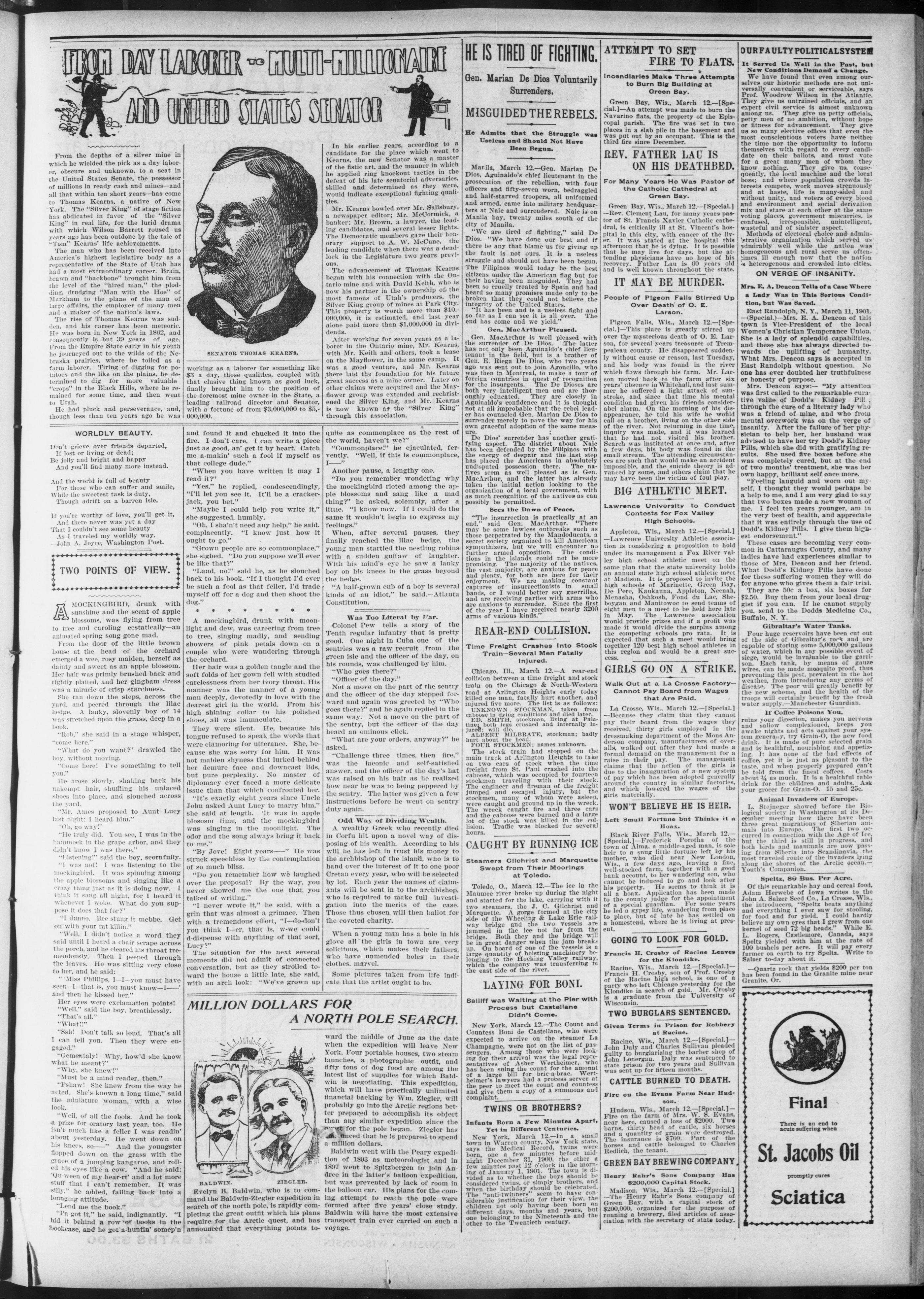
FROM DAY LABORER TO MULTI-MILLIONAIRE AND UNITED STATES SENATOR
From the depths of a silver mine in which he wielded the pick as a day laborer, obscure and unknown, to a seat in the United States Senate, the possessor of millions in ready cash and mines—and all that within ten short years—has come to Thomas Kearns, a native of New York. The "Silver King" of stage fiction has abdicated in favor of the "Silver King" in real life, for the lurid drama with which Wilson Barrett roused us years ago has been outdone by the tale of "Tom" Kearns' life achievements.
The man who has been received into America's highest legislative body as a representative of the State of Utah has had a most extraordinary career. Brain, brawn and "backbone" brought him from the level of the "hired man," the plodding, drudging "Man with the Hoe" of Markham to the plane of the man of large affairs, the employer of many men and a maker of the nation's laws.
The rise of Thomas Kearns was sudden, and his career has been meteoric. He was born in New York in 1862, and consequently is but 39 years of age. From the Empire State early in his youth he journeyed out to the wilds of the Nebraska prairies, where he toiled as a farm laborer. Tiring of digging for potatoes and the like on the plains, he determined to dig for more valuable "crops" in the Black Hills, where he remained for some time, and then went to Utah. He had pluck and perseverance, and, though less than ten years ago he was
WORLDLY BEAUTY.
Don't grieve over friends departed,
If lost or living or dead;
Be jolly and bright and happy
And you'll find many more instead.
And the world is full of beauty
For those who can suffer and smile,
While the sweetest task is duty,
Though adrift on a barren isle.
If you're worthy of love, you'll get it,
And there never was yet a day
That I couldn't see some beauty
As I traveled my worldly way.
John A. Joyce, Washington Post.
TWO POINTS OF VIEW.
MOCKINGBIRD, drunk with sunshine and the scent of apple blossoms, was flying from tree to tree and caroling ecstatically—an animated spring song gone mad.
From the door of the little brown house at the head of the orchard emerged a wee, rosy maiden, herself as dainty and sweet as an apple blossom. Her hair was primly brushed back and tightly plaited, and her gingham dress was a miracle of crisp starchness.
She ran down the steps, across the yard, and peered through the lilac hedge. A lanky, slovenly boy of 14 was stretched upon the grass, deep in a book.
"Rob," she said in a stage whisper, "come here."
"What do you want?" drawled the boy, without moving.
"Come here! I've something to tell you."
He arose slowly, shaking back his unkempt hair, shuffling his unlaced shoes into place, and slouched across the yard.
"Mr. Ames proposed to Aunt Lucy last night; I heard him."
"Oh, go way!"
"He truly did. You see, I was in the hammock in the grape arbor, and they didn't know I was there."
"Listening!" said the boy, scornfully. "I was not! I was listening to the mockingbird. It was spinning among the apple blossoms and singing like a crazy thing just as it is doing now. I think it sang all night, for I heard it whenever I woke. What do you suppose it does that for?" "I dunno. Bee stung it mebbe. Get on with your rat killin." "Well, I didn't notice a word they said until I heard a chair scrape across the porch, and he cleared his throat tremendously. Then I peeped through the leaves. He was sitting very close to her, and he said:
"Miss Phillips, I—I—you must have seen—I—that is, you must know—I—" and then he kissed her."
Her eyes were exclamation points!
"Well," said the boy, breathlessly.
"That's all."
"What!!"
"Ssh! Don't talk so loud. That's all I can tell you. Then they were engaged."
"Gementaly! Why, how'd she know what he meant?"
"Why, she knew!"
"Must be a mind reader, then."
"Pshaw! She knew from the way he acted. She's known a long time," said the miniature woman, with a wise look.
"Well, of all the fools. And he took a prize for oratory last year, too. He isn't much like a feller I was readin' about yesterday. He went down on his knees, so—" And the youngster flopped down on the grass with the grace of a jumping kangaroo, and rolled his eyes like a cow. "And he said: 'Qu-ween of my hear-rt' and a lot more stuff that I can't remember. It was silly," he added, falling back into a lounging attitude.
"Lend me the book."
"Pa got it," he said, indignantly. "I hid it behind a row of books in the bookcase, and he got a-huntin' somep'n
MILLION DOLLARS FOR A NORTH POLE SEARCH.
[Illustration of a man with a mustache and a bow tie.]
SENATOR THOMAS KEARNS.
working as a laborer for something like $3 a day, those qualifies, coupled with that elusive thing known as good luck, finally brought him to the position of the foremost mine owner in the State, a leading railroad director and Senator, with a fortune of from $3,000,000 to $5,- 000,000.
and found it and chucked it into the fire. I don't care. I can write a piece just as good, an' get it by heart. Catch me a-makin' such a fool if myself as that college dude."
"When you have written it may I read it?"
"Yes," he replied, condescendingly, "I'll let you see it. It'll be a cracker-jack, you bet."
"Maybe I could help you write it," she suggested, humbly.
"Oh, I sha'n't need any help," he said. complacently. "I know just how it ought to go."
"Grown people are so commonplace," she sighed. "Do you suppose we'll ever be like that?"
"Land, no!" said he, as he slouched back to his book. "If I thought I'd ever be such a fool as that feller, I'd trade myself off for a dog and then shoot the dog."
A mockingbird, drunk with moonlight and dew, was careering from tree to tree, singing madly, and sending showers of pink petals down on a couple who were wandering through the orchard. Her hair was a golden tangle and the soft folds of her gown fell with studied carelessness from her ivory throat. His manner was the manner of a young man deeply, devotedly in love with the dearest girl in the world. From his high shining collar to his polished shoes, all was immaculate.
They were silent. He, because his tongue refused to speak the words that were clamoring for utterance. She, because she was sorry for him. It was not maiden shyness that lurked behind her demure face and downcast lids, but pure perplexity. No master of diplomacy ever faced a more delicate issue than that which confronted her. "It's exactly eight years since Uncle John asked Aunt Lucy to marry him," she said at length. 'It was in apple blososm time, and the mockingbird was singing in the moonlight. The odor and the song always bring it back to me."
"By Jove! Eight years—" He was struck speechless by the contemplation of so much bliss.
"Do you remember how we laughed over the proposal? By the way, you never showed me the one that you talked of writing."
"I never wrote it," he said, with a grin that was almost a grimace. Then with a tremendous effort, "I—do-don't you think I—er, that is, w-we could d-dispense with anything of that sort, Lucy?"
The situation for the next several moments did not admit of connected conversation, but as they strolled toward the house a little late, she said, with an arch look: "We've grown up
THE MASTER OF THE WORLD
Evelyn B. Baldwin, who is to command the Baldwin-Ziegler expedition in search of the north pole, is rapidly completing the great outfit which his plans require for the Arctic quest, and has announced that everything points to
In his earlier years, according to a candidate for the place which went to Kearns, the new Senator was a master of the fistic art, and the manner in which he applied ring knockout tactics in the defeat of his late senatorial adversaries, skilled and determined as they were, would indicate exceptional fighting qualities.
Mr. Kearns bowled over Mr. Salisbury, a newspaper editor; Mr. McCormick, a banker; Mr. Brown, a lawyer, the leading candidates, and several lesser lights. The Democratic members gave their honorary support to A. W. McCune, the leading candidate when there was a deadlock in the Legislature two years previous.
The advancement of Thomas Kearns began with his connection with the Ontario mine and with David Keith, who is now his partner in the ownership of the most famous of Utah's producers, the Silver King group of mines at Park City. This property is worth more than $10,000,000, it is estimated, and last year alone paid more than $1,000,000 in dividends.
After working for seven years as a laborer in the Ontario mine, Mr. Kearns, with Mr. Keith and others, took a lease on the Mayflower, in the same camp. It was a good venture, and Mr. Kearns there laid the foundation for his future great success as a mine owner. Later on other claims were acquired and the Mayflower group was extended and rechristened the Silver King, and Mr. Kearns is now known as the "Silver King" through this association.
quite as commonplace as the rest of the world, haven't we?"
"Commonplace!" he ejaculated, fervently. "Well, if this is commonplace, I——"
Another pause, a lengthy one.
"Do you remember wondering why the mockingbird rioted among the apple blossoms and sang like a mad thing?" he asked, solemnly, after a litue. "I know now. If I could do the same it wouldn't begin to express my feelings."
When, after several pauses, they finally reached the lilac hedge, the young man startled the nestling robins with a sudden guffaw of laughter. With his mind's eye he saw a lanky boy on his knees in the grass beyond the hedge.
"A half-grown cub of a boy is several kinds of an idiot," he said.—Atlanta Constitution.
Was Too Literal by Far.
Colonel Pew tells a story of the Tenth regular infantry that is pretty good. One night in Cuba one of the sentries was a raw recruit from the green isle and the officer of the day, on his rounds, was challenged by him.
"Who goes there?"
"Officer of the day."
Not a move on the part of the sentry and the officer of the day stepped forward and again was greeted by "Who goes there?" and he again replied in the same way. Not a move on the part of the sentry, but the officer of the day heard an ominous click.
"What are your orders, anyway?" he asked.
"Challenge three times, then fire," was the laconic and self-satisfied answer, and the officer of the day's hat was raised on his hair as he realized how near he was to being peppered by the sentry. The latter was given a few instructions before he went on sentry duty again.
Odd Wax of Dividing Wealth
A wealthy Greek who recently died in Corfu hit upon a novel way of disposing of his wealth. According to his will he has left in trust his money to the archbishop of the island, who is to hand over the interest of it to one poor Cretan every year, who will be selected by lot. Each year the names of claimants will be sent in to the archbishop, who is required to make full investigation into the merits of the case. Those thus chosen will then ballot for the coveted charity.
When a young man has a hole in his glove all the girls in town are very solicitous, which makes their fathers, who have unmended holes in their clothes, marvel.
Some pictures taken from life indicate that the artist ought to be.
ward the middle of June as the date when the expedition will leave New York. Four portable houses, two steam launches, a photographic outfit, and fifty tons of dog food are among the latest list of supplies for which Baldwin is negotiating. This expedition, which will have practically unlimited financial backing by Wm. Ziegler, will probably go into the Arctic regions better prepared to accomplish its object than any similar expedition since the coast for the pole began. Ziegler has announced that he is prepared to spend a million dollars.
Baldwin went with the Peary expedition of 1893 as meteorologist and in 1897 went to Spitzbergen to join Andree in the latter's balloon expedition, but was prevented by lack of room in the balloon car. His plans for the coming attempt to reach the pole were formed after five years' close study. Baldwin will have the most extensive transport train ever carried on such a voyage.
HE IS TIRED OF FIGHTING.
MISGUIDED THEREBELS.
He Admits that the Struggle was Useless and Should Not Have Been Begun.
Marila, March 12.—Gen. Marian De Dios, Aguinaldo's chief lieutenant in the prosecution of the rebellion, with four officers and fifty-seven worn, bedraggled and half-starved troopers, all uniformed and armed, came into military headquarters at Naic and surrendered. Naic is on Manila bay, twenty miles south of the city of Manila.
"We are tired of fighting," said De Dios. "We have done our best and if there be any that blame us for giving up the fault is not ours. It is a useless struggle and should not have been begun. The Filipinos would today be the best citizens under the American flag but for their having been misguided. They had been so cruelly treated by Spain and had heard so many promises made only to be broken that they could not believe the integrity of the United States.
"It has been and is a useless fight and so far as I can see it is all over. The end has come and we yield."
Gen. MacArthur Pleased.
Gen. MacArthur is well pleased with the surrender of De Dios. The latter has not only been Aguinaldo's chief lieutenant in the field, but is a brother of Gen. E. Riega De Dios, who two years ago was sent out to join Agoncillo, who was then in Montreal, to make a tour of foreign countries in quest of recognition for the insurgents. The De Dioses are both very intelligent men and are thoroughly educated. They are closely in Aguinaldo's confidence and it is thought not at all improbable that the rebel leader has counseled Gen. Marian De Dios to surrender merely to pave the way for his own graceful adoption of the same measure.
De Dios' surrender has another gratifying aspect. The district about Naic has been defended by the Filipinos with the energy of despair and the last step has placed the Americans in absolutely undisputed possession there. The natives seem as well pleased as is Gen. MacArthur, and the latter has already taken the initial action looking to the organization of a local government, with as much recognition of the natives as can possibly be permitted.
Sees the Dawn of Peace.
"The insurrection is practically at an end," said Gen. MacArthur. "There may be some lawless outbreaks such as those perpetrated by the Mandoducats, a secret society organized to kill American sympathizers, but we will encounter no further armed opposition. The conditions in the islands could not be more promising. The majority of the natives, the vast majority, are anxious for peace and plenty, for both are here for their enjoyment. We are making constant captures of insurrectionists in small bands, or I would better say guerrillas, and are receiving parties with arms who are anxious to surrender. Since the first of the year I have received nearly 3200 arms of various kinds."
REAR-END COLLISION.
Time Freight Crashes Into Stock Train—Several Men Fatally Inlured.
Chicago, Ill., March 12.—A rear-end collision between a time freight and stock train on the Chicago & North-Western road at Arlington Heights early today killed one man, fatally hurt another, and injured five more. The list is as follows: UNKNOWN STOCKMAN, taken from caboose in dying conditions and died later. ED. SMITH, stockman, living at Palatine, both legs crushed and internally injured; will die.
ALBERT MILBRATE, stockman; badly hurt about the head.
FOUR STOCKMEN; names unknown.
The stock train had stopped on the main track at Arlington Heights to take on two cars of stock when the time freight from St. Paul crashed into the caboose, which was occupied by fourteen stockmen traveling with their stock.
The engineer and fireman of the freight jumped and escaped injury, but the stockmen, many of whom were asleep, were caught and ground up in the wreck. The wreck caught fire and three cars and the caboose were burned and a large lot of the stock was killed in the collision. Traffic was blocked for several hours.
CAUGHT BY RUNNING ICE
Steamers Gilchrist and Marquette Swept from Their Moorings at Toledo.
Toledo, O., March 12.—The ice in the Maumee river broke up during the night and started for the lake, carrying with it two steamers, the J. C. Gilchrist and Marquette. A gorge formed at the city side of the Wheeling & Lake Erie railway bridge and the two vessels are jammed in the ice not far from the bridge. Both they and the bridge will be in great danger when the jam breaks up. On board of one of the vessels is a large quantity of hoisting machinery belonging to the Hocking Valley railway, which the company was transferring to the east side of the river.
LAYING FOR BONI.
Baillff was Waiting at the Pier with Process but Castellane Didn't Come.
New York, March 12.—The Count and Countess Boni de Castellane, who were expected to arrive on the steamer La Champagne, were not on the list of passengers. Among those who were looking for their arrival was the legal representatives of Asher Wertheimer, who has been suing the count for the amount of a large bill for bric-a-brac. Wertheimer's lawyers had a process server at the peer to meet the count and countess and give them a copy of a summons and complaint.
TWINS OR BROTHERS?
Infants Born a Few Minutes Apart, Yet in Different Centuries.
New York, March 12.—In a small town in Warren county, New York state, says the Medical Record, twins were born, one a few minutes before midnight December 31, 1900, the other a few minutes past 12 o'clock in the morning of January 1, 1901. The town is divided as to whether the boys should be considered twins, or simply brothers, and when the birthday should be celebrated. The "anti-twinners" seem to have considerable justification for their view, the children not only having been born on different days, months and years, but one belonging to the Nineteenth and the other to the Twentieth century.
Incendiaries Make Three Attempts to Burn Big Building at Green Bay.
Green Bay, Wis., March 12.—[Special.]—An attempt was made to burn the Navarino flats, the property of the Episcopal parish. The fire was set in two places in a slab pile in the basement and was put out by an occupant. This is the third fire since December.
REV. FATHER LAU IS ON HIS DEATHBED.
For Many Years He Was Pastor of the Catholic Cathedral at Green Bay.
Green Bay, Wis., March 12.—[Special.]
—Rev. Clement Lau, for many years pastor of St. Francis Xavier Catholic cathedral, is critically ill at St. Vincent's hospital in this city, with cancer of the liver. It was stated at the hospital this afternoon that he is dying. It is possible that he may live for days, but the attending physicians have no hope of his recovery. Father Lau is 60 years old and is well known throughout the state.
IT MAY BE MURDER.
People of Pigeon Falls Stirred Up Over Death of O. E. Larson
Pigeon Falls, Wis., March 12.—[Special.]—This place is greatly stirred up over the mysterious death of O. E. Larson, for several years treasurer of Trempealeau county. He disappeared suddenly without cause or reason, last Tuesday, and his body was found in the river which flows through his farm. Mr. Larson moved back to the farm after six years' absence in Whitehall, and last summer he suffered a light attack of sunstroke, and since that time his mental condition had given his friends considerabel alarm. On the morning of his disappearance, he told his wife he would call on a brother, living on the other side of the river. Not returning in due time, inquiry was made, and it was learned that he had not visited his brother. Search was instituted at once and, after a few days, his body was found in the small stream. The attending circumstances are such that would make an accident impossible, and the suicide theory is advanced by some, and others claim that he may have been the victim of foul play.
BIG ATHLETIC MEET.
Lawrence University to Conduct Contests for Fox Valley High Schools.
Appleton, Wis., March 12.—[Special.]
—Lawrence University Athletic association is considering a proposition to hold under its management a Fox River valley high school athletic meet on the same plan that the state university holds an annual state high school athletic meet at Madison. It is proposed to invite the high schools of Marinette, Green Bay, De Pere, Kaukauna, Appleton, Neenah, Menasha, Oshkosh, Fond du Lac, Sheboygan and Manitowoc to send teams of eight men to a meet to be held here late in May. The Lawrence association would provide prizes and if a profit was made it would divide the surplus among the competing schools pro rata. It is expected that such a meet would bring together 120 best high school athletes in this region and would be a great success.
GIRLS GO ON A STRIKE.
Walk Out at a La Crosse Factory Cannot Pay Board from Wages that Are Paid.
La Crosse, Wis., March 12.—[Special.]
—Because they claim that they cannot pay their board from the wages they received, thirty girls employed in the dressmaking department of the Mons Anderson company, manufacturers of overalls, walked out after they had made a formal demand on the management for a raise in their pay. The management claims that the action of the girls is due to the inauguration of a new system of pay which has been adopted generally around the country in similar factories, and which lowered the wages of the girls materially.
WON'T BELIEVE HE IS HEIR.
Left Small Fortune but Thinks it a Heavy.
Black River Falls, Wis., March 12. [Special.]—Frederick Porotha of the town of Alma, a middle-aged man, is sole heir to a snug little fortune left by his mother, who died near New London, Wis., a few days ago, leaving a fine, well-stocked farm, together with a good bank account, to her wandering son, who cannot be induced to go and look after his property. He seems to think it is all a hoax. Application has been made to the county judge for the appointment of a special guardian. For some years he led a gypsy life, wandering from place to place, but of late he has settled on a homestead, where he is living at present.
GOING TO LOOK FOR GOLD.
Francis H. Crosby of Racine Leaves for the Klondike. Racine, Wis., March 12.—[Special.]—Francis H. Crosby, son of Prof. Crosby of the Racine high school, is one of a party who left Chicago yesterday for the Klondike in search of gold. Mr. Crosby is a graduate from the University of Wisconsin.
TWO BURGLARS SENTENCED.
Given Terms in Prison for Robbery at Racine.
Racine, Wis., March 12.—[Special.]—John Daly and Charles Sullivan pleaded guilty to burglarizing the barber shop of John Lonergan. Daly was sentenced to state prison for two years and Sullivan was sent up for fifteen months.
CATTLE BURNED TO DEATH.
Fire on the Evans Farm Near Hudson.
Hudson, Wis., March 12.—[Special.]—Fire on the farm of Mrs. W. S. Evans, near here, caused a loss of $2000. Two barns, thirty head of cattle, six horses and a quantity of grain were destroyed. The insurance is $700. Part of the horses and cattle belonged to Charles Redlich, the tenant.
GREEN BAY BREWING COMPANY
Henry Rahr's Sons Company Has $200,000 Capital Stock. Madison, Wis., March 12.—[Special.] The Henry Rahr's Sons company of Green Bay, with a capital stock of $200,000, organized for the purpose of running a brewery, filed articles of association with the secretary of state today.
OURFAULT POLITICALSYSTEM
It Served Us Well in the Past, but
It Served Us Well in the Past, but New Conditions Demand a Change. We have found that even among ourselves our historic methods are not universally convenient or serviceable, says Prof. Woodrow Wilson in the Atlantic. They give us untrained officials, and an expert civil service is almost unknown among us. They give us petty officials, petty men of no ambition, without hope or fitness for advancement. They give us so many elective offices that even the most conscientious voters have neither the time nor the opportunity to inform themselves with regard to every candidate on their ballots, and must vote for a great many men of whom they know nothing. They give us, consequently, the local machine and the local boss; and where population crowds interests compete, work moves strenuously and at haste, life is many-sided and without unity, and voters of every blood and environment and social derivation mix and stare at each other at the same voting places, government miscarries, is confused, irresponsible, unintelligent, wasteful and of sinister aspect.
Methods of electoral choice and administrative organization which served us admirably well while the nation was homogeneous and rural serve us often times ill enough now that the nation is heterogenous and crowded into cities.
ON VERGE OF INSANITY.
Mrs. E. A. Deacon Tells of a Case Where a Lady Was in This Serious Condition, but Was Saved.
East Randolph, N. Y., March 11, 1901. (Special.)—Mrs. E. A. Deacon of this town is Vice-President of the local Women's Christian Temperance Union. She is a lady of splendid capabilities, and these she has always directed towards the uplifting of humanity. What Mrs. Deacon says is accepted in East Randolph without question. No one has ever doubted her truthfulness or honesty of purpose.
Mrs. Deacon says:— "My attention was first called to the remarkable curative value of Dodd's Kidney Pill, through the cure of a literary lady who was a friend of mine, and who from mental overwork was on the verge of insanity. After the failure of her physician to help her, her husband was advised to have her try Dodd's Kidney Pills, which she did with gratifying results. She used five boxes before she was completely cured, but at the end of two months' treatment, she was her own happy, brilliant self once more.
"Feeling languid and worn out myself, I thought they would perhaps be a help to me, and I am very glad to say that two boxes made a new woman of me. I feel ten years younger, am in the very best of health, and appreciate that it was entirely through the use of Dodd's Kidney Pills. I give them highest endorsement."
These cases are becoming very common in Cattaraugus County, and many ladies have had experiences similar to those of Mrs. Deacon and her friend. What Dodd's Kidney Pills have done for these suffering women they will do for anyone who gives them a fair trial. They are 50c a box, six boxes for $2.50. Buy them from your local druggist if you can. If he cannot supply you, send to the Dodds Medicine Co., Buffalo, N. Y.
Gibraltar's Water Tanks.
Four huge reservoirs have been cut out of the side of Gibraltar's rock and are capable of storing some 5,000,000 gallons of water, which in any possible event of siege, would be invaluable to the garrison. Each tank, by means of gauze wires, can be made mosquito proof, thus preventing this pest, prevalent in the hot weather, from introducing any germs of disease. The poor will greatly benefit by the new scheme, and the health of the troops will certainly benefit by the fresh water supply.—Manchester Guardian.
If Coffee Poisons You.
ruins your digestion, makes you nervous and sallow complexioned, keeps you awake nights and acts against your system generany, try Grain-O, the new food drink. It is made of pure selected grain and is healthful, nourishing and appetizing. It has none of the bad effects of coffee, yet it is just as pleasant to the taste, and when properly prepared can't be told from the finest coffees. Costs about $1/4 as much. It is a healthful table drink for the children and adults. Ask your grocer for Grain-O. 15 and 25c.
Animal Invaders of Europe.
L. Stejneger showed before the Biological society in Washington at its December meeting how there have been three great migrations of Siberian animals into Europe. The first two occurred in connection with the Age of Ice, but the third is still in progress, and both birds and mammals are now passing from Siberia into Scandinavia, the most traveled route of the invaders lying along the shores of the Arctic ocean. Youth's Companion.
Speltz, 8Q Bus. Per Acre.
Of this remarkable hay and cereal food, Adam Herwebe of Iowa writes to the John A. Salzer Seed Co., La Crosse, Wis., the introducers, "Speltz beats anything and everything I ever saw for stooling, for food and for yield. I could hardly believe my own eyes that I grew from one kernel of seed 72 big heads." While E. L. Rogers, Castlemore, Canada, says Speltz yielded with him at the rate of 100 bushels per acre. It will pay every farmer on earth to try Speltz. Write to Salzer to-day about it.
—Quartz rock that yields $200 per ton has been found in the Granite mine near Granite, Or.
Final
There is an end to acute suffering when
St. Jacobs Oil
promptly cures
Sciatica
The Wisconsin Weekly Advocate
Printed in the Interests of the Negro Race,
MILWAUKEE, WIS.
Richard B. Montgomery.....
.....Editor and Proprietor
Office: 327 Wells Street.
Telephone Black No. 244.
SUBSCRIPTION RATES.
Any part of the United States and Canada,
postage paid.
One Year ..... $2.00
Six Months ..... 1.25
Three Months ..... .75
Send money by Express Money Order, P. O.
Money Order or Registered Letter to the
Wisconsin Weekly Advocate.
ADVERTISING RATES
One inch, single insertion. 25c
One inch, per year. $9.00
Business locals 5c per line each insertion.
Apply for rates to the Advocate.
TO CONTRIBUTORS:
All communications must be sent with the
name and address of the sender as an evidence
of good faith, but not necessarily for
publication. No manuscript returned if not
accepted, unless accompanied by stamps.
All subscribers of the Advocate that fail
to get their paper promptly will please notify
us at once. The Advocate, at 327 Wells
street.
The Wisconsin Weekly Advocate company wishes to notify the public that all contracts and business transactions with this company must have the company stamp, otherwise they will be void. Neither will this company be responsible for paid subscriptions unless given to duly-accredited agents, who, on request, will give the company's receipt for same. Subscribers failing to receive their papers regularly will kindly notify the general office. Address all business communications to the general manager, 327 Wells street. Mr. Richard B. Montgomery.
Entered at the Milwaukee P. O. as second-class matter.
The Helping Hand Colored Mission
incorporated under the laws of the State of Wisconsin has for its object the supplying of qualified colored help to those requiring the same. In order to be able to get servants from the mission it is necessary, that in order to partly cover expenses incurred, those parties desiring help should become subscribers for this paper. No actual charge is made. Parties who secure situations through this agency are also
expected to become subscribers. We have at present on our books: Cooks, General Servants, Waitresses, Laundresses, Nurses, Coachmen, Porters, Waiters. Office hours 9-12 and 1-4.
R. B. MONTGOMERY, Mgr. 327 Wells St., Milwaukee.
Pat Crowe seems to be in mortal dread of abduction.
New York's naval arch idea has at last taken to the water.
When Mrs. Nation re-entered Topeka jail after surrendering herself, she was undoubtedly searched for hatchets.
The appointment of Capt. "Bob" Evans to the position of admiral puts an "old sea dog" in command of a fleet.
Explorer Baldwin seems to be trying to provide his expedition with condensed food supplies that can be carried in a hat.
Civic reformers in New York might get "pointers" by reading an account of the subjugation of the tiger in the Indianapolis "Zoo."
British matrimonial gossip shows that the nobility has not changed its habit of taking to the stage through the door of the green-room.
After the New York Hall of Fame is opened the janitor will post warnings to the ambitious man with the lead pencil, to keep off the walls.
Cervera has beaten both Sampson and Schley in the race for a vice-admiralcy, although he couldn't beat either of them in his race out of Santiago.
The National Guard in states where Judge Lynch holds court have an advantage over their comrades of other states in the number of emergency drills. When Evelyn R. Baldwin finds the north pole he will spike upon it an empty Chicago meat can as a testimonial of the value of prepared foods in promoting Arctic exploration.
Boston's would-be cup defender has been named the Independence, which designation will match Eagle, that is said to be the name chosen for the Bristol yacht. American patriots will therefore have an opportunity to scream whether Boston or Bristol wins out in the trial races.
Watson, the builder of Sir Thomas Lipton's new challenger, is said to have discovered a new principle in designing, which will become public property after it is too late for the Americans to save the America cup; but apprehensive yachtsmen on this side of the water know that such bugaboo stories precede the coming of all challengers for the historic silverware.
The census of Germany has just been announced. The population reaches the large aggregate of 56,345,000. This is only 20,000,000 less than that of the United States, and shows a 7 per cent. increase over the census of 1895. Germany is steadily growing in population, while France is at a standstill. Their military forces are now so unequal that France will not invite another war.
The censure of the Pacific Mail Steamship Company for having Chinese crews on their steamers was expected from the coroner's jury, as a result of the sinking of the City of Rio de Janeiro, and the verdict will therefore occasion little surprise. In time of trouble the passengers of a steamer have little to hope for from a band of chattering Chinese who require an interpreter to transmit orders.
An order has just been filled in Connecticut for a million pounds of trolley wire for an electrical road in India. It is hard-drawn copper wire, and is the
largest export order for this material ever received in the state. The reels upon which the wire was wound required nearly 100,000 feet of lumber for their construction, and the reels and wire combined will weigh one and one-half million pounds. Twenty-seven cars and two engines will be used in transporting the shipment to tidewater.
Prof. Vines of the British association expressed recently his regret that the century had closed without bringing a solution of the much-discussed question of the ascent of sap. One of the suggested explanations, he said, requires that in a tree 120 feet in height the transpiration force must equal a pressure of 360 pounds to the square inch, but there is no evidence that anything like such a force exists in a tree. This is one of the problems in science that the Nineteenth century has bequeathed to the Twentieth.
There are now sixteen prisoners in solitary confinement in the Massachusetts state prison at Charlestown, the most dangerous of the lot being Jesse Pomeroy, "the boy murderer." He is constantly laying plans to escape, and keeps the guards ever on the alert to thwart them. He once pulled down the ventilator over his cell door and made a saw of a portion of the material. Then the place was walled up and fresh air introduced into his cell in other ways. He has now been imprisoned on a life sentence twenty-seven years.
The Courrier des Etats-Uni publishes the following statistics of accidents in France during the month of October last: By the horse 967, of which 82 were fatal; by the bicycle 119, of which 6 were fatal; by the automobile 38, of which 2 were fatal; by the railroads 145, of which 8 were fatal. As is frequently the case with statistics, these figures fail to afford an intelligent basis for comparison, for there is no statement of the number of persons who were subjected during the month to the possibilities of accident by each of the different modes of locomotion represented in the report.
The manner in which horses and cattle on the great ranges of the West drift during the severe storms of winter is shown by the fact that at the present time between 2000 and 2500 head of strange horses are scattered over a small area in the vicinity of Midland postoffice, in the interior of the ceded Sioux lands between the Missouri river and the Black hills, South Dakota. The animals do not belong to South Dakota stockmen, nor do their brands show them to be the property of stockmen in either Montana or Wyoming, as the brands borne by them are not recorded in the official brand books of the three states, so the natural inference is that they have drifted to the South Dakota ranges from states either farther away than Montana or Wyoming. It is thought the animals may be from as far away as Idaho.
Aid is being sought in the North in furtherance of a plan to assist the negroes in many places in the black belt of the South to become land-owners, thus freeing them from the bondage of the landlord system, under which, too often, the tenant does not receive a just share of the product resulting from his efforts. The plan also looks to the forming of communities among self-respecting colored farmers. To this end the Dixie Industrial corporation has been organized. This company has raised about $16,000, largely through friends in New York city, and with this it has paid one-half of the cost price of 5100 acres of land in the vicinity of Kowaliga, Ala. It has also secured options on as many more acres. More than the present amount of capital is needed, and philanthropic persons in the North are asked to aid by buying stock of the company.
The death of Capt. Francis Martin of the United States revenue-cutter marine service, who was drawing salary up to the day of his death and is probably the only man who ever drew a salary after he was 100 years old, attracts attention to another veteran mariner. Reference is made to Rear-Admiral Thomas O. Selfridge, who has been on the retired list since 1866. He was born in 1804, and was appointed a midshipman in 1818, so that he is probably the only living American who participated in the official sorrow expressed by the navy when George III. died in 1820. Capt. Martin drew a salary for only sixty-nine years, having been appointed to the revenue-cutter service by Jackson in 1832. Admiral Selfridge's record of eighty-three years on the pay roll, even if it were to close today, will probably stand for centuries.
The peninsula, as the country lying between the Atlantic ocean and the Chesapeake bay is known in the fruit world, was for years the source of the best peaches in the markets. But, with the advent of the yellows and with the establishment of peach orchards in other localities, the interest for the fruit in the peninsula has declined, and with the decline fruit-growers have been asking to what to give their land. Some growers seem to have foreseen the need for change in advance of the rest, and set out apple orchards, and their success in the abundant crops and good prices and in the honors gained in the Paris competition have combined to turn the thoughts appleward. The experiment station of Delaware, too, has thrown its influence in the same direction by top grafting old trees with new and valuable varieties, and by suggestions, advice and example.
At a meeting of the Colonial society of Massachusetts held in Boston the other day, Worthington C. Ford communicated an unpublished diary of Washington kept at Mt. Vernon from the 27th of September, 1785, till the end of that year. The diary affords an interesting glimpse of Washington as the country gentleman interested in agricultural pursuits, riding to hounds, dispensing an elegant hospitality not only to his kinsfolk, his neighbors and his former comrades-in-arms, but also to titled foreigners and others from abroad, all of whom are mentioned by name. It records the arrival of Houdon for the purpose of making a bust of Washington, and the preparation made by the sculptor and his three assistants for performing their work. The diary also makes clear Washington's minute attention to small matters of domestic concern, instances being recorded of his experiments to determine the relative
TRADE MARK
REGISTERED 1892.
U.S.PATENT OFFICE
WASHINGTON, D.C.
BEFORE USING
AFTER USING
Hartona will make the hair grow long and soft, straight and beautiful. Makes the hair grow on bald and thin places. Restores GRAY HAIR to its original color. Hartona cures Dandruff, Baldness, falling out of the hair, itching, and all scalp diseases. Hartona does not have to be used all the time, as it straightens the hair and gives it fresh life and lustre, and the hair stays and grows naturally beautiful and straight after the use of Hartona. No hot irons necessary. No pasting the hair down with grease. Hartona is positively harmless—one box can be used by everyone in the family. Benefits and improves children's hair just the same as adults. To meet the popular and ever-increasing demand for Hartona Hair-Grower and Straightener, we have placed it on sale in 25c. and 50c. sizes, in our special round, patent box. See that the word Hartona is on every box.
Money positively refunded if you are not absolutely delighted with the Hartona remedies. Remember, we handle no fake goods, and you are positively protected by our $100.00 guarantee to any one proving otherwise. All our remedies are trade-marked, registered and copyrighted at United States Patent Office at Washington, D. C., in the years 1892 and 1900. We refer you, as to our responsibility, to the City Bank of Richmond, Va., Adams and Southern Express Companies, and to the editor of this paper.
We want lady and gentlemen agents, white or colored, in every city and town in the United States. Write to us to-day, no matter if you are employed or not, and we will show you how to make a splendid living, with easy and pleasant work, and no risk of losing your good money. Write to us and we will send you a book of over one hundred genuine testimonials in your own State of people who have used and are using Hartona remedies. Is this not fair and honest enough?
HARTONA FACE WASH.
Hartona Face Wash will gradually turn the skin of a black person five or six shades lighter, and will turn the skin of a mulatto person perfectly white. The skin remains soft and bright without continual use of the face wash. One bottle does the work. Hartona Face Wash will remove wrinkles, dark spots, pimples, blackheads, freckles, and all blemishes of the skin. You can regulate the shade of skin on neck, face and hands to any shade you wish. Full directions with each bottle. Hartona Face Wash is perfectly harmless, and is sent to any part of the United States on receipt of price, 50c. per bottle; securely sealed from observation. It is your duty to look as beautiful as possible. Thousands of delighted patrons send us testimonials every year. Please remember that your money is positively refunded if you are not perfectly satisfied and delighted with the Hartona remedies. We want agents in every city in the United States. Write to us, no matter if you are employed or not, and we will show you how to make money without risking any of your own money.
Hartona No-Smell will remove all smells and bad odors of the body; cures sore and aching feet, chafed limbs, etc. Hartona No-Smell is a God-send to all persons suffering from disagreeable odors caused by perspiration of the feet, arm-pits, etc. Sent anywhere on receipt of price, 10 cents and 25 cents a package. Address all orders to
Send us One Dollar, and mention this paper, and we will send you three large boxes of Hartona Hair-Grower and Straightener, two large bottles of Hartona Face Wash, and one large box of Hartona No-Smell. Goods will be sent securely sealed from observation. Write your name and post-office and express-office address very plainly. Money can be sent by post-office money order, or enclosed in a registered letter, or by express. Address all Orders to
cost of tallow and spermaceti candles. Mention is also made of the arrival at Boston of one of the pair of jackasses sent over as a gift to Washington by the King of Spain, and of his sending his overseer, John Fairfax, to conduct the animal and his keeper, a Spaniard, to Mt. Vernon. The diary notes its author's attendance at the races, at fox hunts—his special pleasure—and at meetings of the canal company. There is also a schedule of his horses and cattle, and mention of many other interesting matters, including an amusing reference to Bishop Seabury.
Deepest Well in France
A Paris correspondent of the New York Sun says that the deepest hole in France is a well in the coal mines of Ronchamp, upper Seine, which was completed in December, 1900. Its depth is 3600 feet and its utilizable diameter is 13 feet. The shaft is walled from top to bottom and lined with copper where its traverses water-bearing strata. To complete it sixty months were required. At thirty feet below the surface the temperature of the rock is 50 degrees Fahrenheit; at the bottom the temperature is 117 degrees Fahrenheit, although the highest temperature of the air in the shaft (without artificial ventilation) is 88 degrees.
S. F. PEACOCK & SON
Funeral Directors
AND
EMBALMERS
131 Broadway. MILWAUKEE, WIS.
The
Chicago
Tribune
is a newspaper for bright and intelligent people. It is made up to attract people who think. Is not neutral or colorless, constantly trimming in an endeavor to please both sides, but it is independent in the best sense of the word. It has pronounced opinions and is fearless in expressing then, but it is always fair to its opponents. Matters of national or vital public interest get more space in THE TRIBUNE than in any other paper in the West. For these reasons it is the newspaper you should read during the forthcoming political campaign. THE TRIBUNE'S financial columns never mislead the public.
Its facilities for gathering news, both local and foreign, are far superior to those of any other newspaper in the West. It presents the news in as fair a way as possible, and lets its readers form their opinions. While it publishes the most comprehensive articles on all news features, if you are busy the "Summary of THE DAILY TRIBUNE" published daily on the first page gives you briefly all the news of the day within one column.
Its sporting news is always the best, and its Sunday Pink Sporting Section is better than any sporting paper in the country.
It is the "cleanest" daily printed in the West.
HARTONA REMEDY CO., 909 E. Main St., Richmond, Va.
Sustaining Life
on the choice juicy meats served by us is just what our athletic, bicycle riding, tennis playing and golfing twentieth century men and women need. Pie days have gone with the spin ning wheel. Good bone, muscle and tissue is what is needed now. You can get them by patronizing the Chicago Market. Our meats are fresh, tempting and choice, and are sold at prices that will let you feast in comfort.
WILLIAM RASCH
GENEVA LAKE, WIS.
WHEN IN MADISON
Call at the
Avenue
Hotel...
M. J. REGAN, Prop.
$2.00 Rate.....
Free 'Bus.
BayView Mission
ST. JOHN'S E. M. E. CHURCH 310 SUPERIOR STREET.
..HARTONA..
Preparations for the
arations for the
ons for the Hair
Preparations for the Hair!
The Original and Only Hartona.
watchless and Positively ening all Kinky, Harsh, C
beautiful. Makes the hair grow on be ing out of the hair, itching, and a rich life and lustre, and the hair stai ning the hair down with grease. Children's hair just the same as we have placed it on sale in 25c.
with the Hartona remedies. Remembe rotherwise. All our remedies are years 1892 and 1900. We refer us, and to the editor of this paper city and town in the United St adid living, with easy and pleas s hundred genuine testimonials in through?
FACE WASH
on five or six shades lighter, and a usual use of the face wash. One b blackheads, freckles, and all ble Full directions with each bottle of the United States on receipt able. Thousands of delighted pati e are not perfectly satisfied and deli no matter if you are employed o
NO-SMELL
body; cures sore and aching feet, disagreeable odors caused by per- Address all orders to
DNA REMEDY CO., 909 E. AND OFFER.
You three large boxes of Hartona -Smell. Goods will be sent secu plainly. Money can be sent by
9 E. Main St.,
...UN
Laundry a
No. 432 S
GEO. W
...ALL WORK CA
Lowest Prices and
JAMES T. BR
and Positively Unequaled for
g all Kinky, Knotty, Stubby
Harsh, Curly Hair.
Does the hair grow on bald and thin places. Re-
ceive hair, itching, and all scalp diseases. Hair
stret, and the hair stays and grows naturally
down with grease. Hartona is positively l
air just the same as adults. To meet the
need it on sale in 25c. and 50c. sizes, in our
nea remedies. Remember, we handle no fake g
All our remedies are trade-marked, register
and 1900. We refer you, as to our respons
e editor of this paper.
Down in the United States. Write to us to do
with easy and pleasant work, and no risk o
one testimonials in your own State of peo
E WASH.
For shades lighter, and will turn the skin of a
one face wash. One bottle does the work.
Freckles, and all blemishes of the skin. Y
ations with each bottle.
United States on receipt of price, 50c. per box
bands of delighted patrons send us testimoni
actly satisfied and delighted with the Hartona
if you are employed or not, and we will sho
-SMELL.
Store and aching feet, chafed limbs, etc.
Odors caused by perspiration of the feet, a
orders to
EDY CO., 909 E. Main St., Richmond
OFFER.
Large boxes of Hartona Hair-Grower and Stra
oods will be sent securely sealed from observa
money can be sent by post-office money order
Main St., Richmond
...UNION...
Landry and News
No. 432 State Street
GEO. W. SAYLES
WORK CAREFULLY D
Lowest Prices and Satisfaction Guarantee
ES T. BRETT & S
Itively Unequaled for Straight, Stinky, Knotty, Stubborn, Wash, Curly Hair.
Now on bald and thin places. Restores GRAY, and all scalp diseases. Hartona does not hair stays and grows naturally beautiful and crease. Hartona is positively harmless—one name as adults. To meet the popular and in 25c. and 50c. sizes, in our special round.
Remember, we handle no fake goods, and your lies are trade-marked, registered and copyed. We refer you, as to our responsibility, to the paper.
United States. Write to us to-day, no matter and pleasant work, and no risk of losing yourials in your own State of people who have
WASH.
Per, and will turn the skin of a mulatto per-One bottle does the work.
All blemishes of the skin. You can regu-ach bottle.
In receipt of price, 50c. per bottle; securely patrons send us testimonials every year.
And delighted with the Hartona remedies, deployed or not, and we will show you how to
HELL.
G feet, chafed limbs, etc.
By perspiration of the feet, arm-pits, etc.
09 E. Main St., Richmond, Va.
HART.
Hartona Hair-Grower and Straightener, twont securely sealed from observation.
Sent by post-office money order, or enclosed
St., Richmond, Va.
UNION...
New and News Co.
432 State Street
W. SAYLES
CAREFULLY DONE...
and Satisfaction Guaranteed.
BRETT & SON,
Matchless and Positively Unequaled for Straightening all Kinky, Knotty, Stubborn, Harsh, Curly Hair.
THE BAKERY
...UNION.... Laundry and News Co. No. 432 State Street GEO. W. SAYLES ...ALL WORK CAREFULLY DONE... Lowest Prices and Satisfaction Guaranteed.
JAMES T. BRETT & SON,
M.
307 REED STREET and Always Open 410 GRAND AVENUE.
Telephones: South 122. Grand 2467. Milwaukee
Telephones: South 122. Grand 2467. Milwaukee, Wis. ES going to visit Hot Springs, this winter, should pa the
PARTIES
intending to Ark., this w tronize the RAMMEL BATH HO MARK S
ntending to visit HotSark., this winter, shouronize the MMELSBERG TH HOUSE, MARK SARGENT, M
intending to visit HotSprings Ark., this winter, should patronize the
MARK SARGENT, Manager. 21 BATHS $3.00
EMBALMERS and FUNERAL DIRECTORS
MRS. JAMES T. BRETT, Lady Undertaker.
GREAT RAIL RECORDS MADE. Fast Runs on the Steel Highway, Here and Abroad, but America Is in the Lead.
```markdown
```
INCE the invention of the railway locomotive, since the day when the first train went shrieking over the iron rails to the intense consternation of the natives there has always existed the greatest popular interest in fast runs. Time and again records have been made only to be smashed until it would be difficult to pick out a run and make the unconditional statement that it was the greatest run ever made by a railroad train. A disagreement sometimes arises even as to what is a railroad train, for some great examples of speed are to credit locomotives to which were attached single coaches, and some authorities do cline to admit that such combinations are trains. Americans and Englishmen have always been and probably always will be the leaders of the world in all matters pertaining to railways and the speed of trains. Between the two countries there has always existed more or less rivalry over the speed accomplishments of their respective locomotives, and the rivalry will likely continue as long as it is possible to make improvements of any character. Perhaps Americans as a whole give the subject greater attention than do the British, for we seem to be interested in all things of the superlative degree much more deeply than our cousins. Every now and then friendly rivalry—sometimes, however, it is not extremely friendly—breaks out between the various great railways of the country, and every time there is a contest one great record or more is completely smashed.
One of the greatest, if not the great.
```
THE TRAIN
ENGINEER ON A FAST RUN.
est, runs ever made in the world was accomplished on the Lake Shore and Michigan Southern Railroad between Chicago and Buffalo on Oct. 24, 1895. It seems that one cause of this race against time was a desire to eclipse an English record made on the twenty-second of the preceding August between London and Aberdeen. The distance between these two towns is 540 miles, and a train on the London and Northwestern made the trip at an average speed of 63.93 miles per hour. The English public was quite jubilant over the fact that this trip broke all previous records and that the world's record was once more held in England. But the very next month a train on the New York Central road ran from New York to East Buffalo, a distance of a little over 436 miles, at an average speed of 64.26 miles per hour. Of course, this beat the English record, but it seems that there was objection to it from across the water on the ground the trip was not long enough to be classed as a long-distance run, which should be at least 500 miles in length. So the record for a run of 500 miles and over was still in England. There are few stretches of railroad 500 miles in length in this country which are perfectly adapted for remarkable runs. There are hills to mount or curves to cut around which interfere more or less with efforts to break records. One of the stretches of road having no such impediments is on the Lake Shore and Michigan Southern line between Chicago and Buffalo. The officers of the road concluded that they would try to beat the long-distance record over this bit of track.
Over Ninety Miles an Hour.
Arrangements for the speed test were quietly made, for in view of the possibility of a failure the officials did not care for any premature advertisement. At 3:30 o'clock in the morning of Oct. 24 the train pulled away from the starting point, which was at 100th street, Chicago, and plunged into the darkness on what was to be a remarkable and a record-breaking trip. It goes without saying that the fewest possible number of stops and the fewest possible changes of engines were arranged for. The train stopped about five times, at four of which engines were changed. In less than eight hours the train shot into Buffalo with the English record hanging in tatters on the cowcatcher of the engine. The distance of 510.1 miles had been covered
---
at an average speed of 65.07 miles per hour. During one burst of speed the train flew over the tracks at the rate of 92.3 miles per hour. Although great records for single miles had been previously made, it is said, that never before did a train reach a speed of eighty miles an hour and maintain it for half an hour, eighty-five miles an hour and hold it for ten minutes or ninety miles an hour and hold it for three or four consecutive miles. Every one who was in Chicago or most anywhere else in the country two years ago will well remember the great races which took place for several days between the Burlington and Chicago and Northwestern roads over their routes between Chicago and Omaha. The distance between the two cities is 500 miles in round numbers. The Northwestern route is 489.9 miles long, while the Burlington is 500.2 miles. The Northwestern train was due to leave Chicago at 10 o'clock at night and to arrive in Omaha the next morning at 8:15. The Burlington left at 9:30 in the morning and arrived in the Nebraska city at 7:55 the next morning. Thus the two trains ran practically the same rate of speed.
Very Close Competition.
The Burlington train had a little over ten miles more than the Northwestern to run, and she used ten minutes more than the latter to make Omaha, so it would be splitting hairs to say which road operated the fastest train. In the contests which took place the trains of both roads did such remarkable work that the government mail contract, for
```markdown
```
which they were contending, was divided between the two lines. It is said that no trains on earth ever made such remarkable runs daily and kept up the pace as these trains. These runs of about fifty miles an hour are made without making any allowance whatever for stoppages, slow down and delays of any kind. This means that the trains necessarily attain a speed in some parts of the routes of eighty or ninety, or perhaps even a hundred miles an hour. Some have made the claim that the trains occasionally reached a speed of 120 miles per hour.
Less than three years ago another great run was made which attracted much attention, especially in Chicago and the West. The Rock Island road had concluded to increase its service between Chicago and Denver by the addition of four new trains. Two of these trains were sent out to Denver and two were kept in Chicago, so that the new service could be properly inaugurated in both cities at the same time. It was decided by the officials that one of the trains going should attempt to break the record time to Denver. This was a magnificently equipped train, with a full complement of sleepers, dining car, buffet smoker, etc. The passengers were composed of Rock Island officials and a large party of newspaper men from Chicago, Denver and a number of other cities along the route, all of those from a distance having come to Chicago especially to accompany the party.
Threw a Drive Wheel.
At exactly 2:30 in the afternoon on May 5, 1898, the train pulled out of the Rock Island station on its way to Denver. In a few seconds the train was well under way and making great time through the city. When once beyond the suburbs full steam was turned on and the train was soon going at the rate of a mile a minute. Everything indicated that Rock Island would be reached in record-breaking time. The passengers began to wonder what was the matter after the train had been stopping for several minutes near the little station of Green River. Shortly the train backed up the tracks and several of the party became aware of the nature of the trouble for the first time when they looked out of the window and saw a great three ton and a half driving wheel lying on its side in a wheat field. The journal of the rear drive wheel on the left side had broken squarely off, having been over-
---
heated in a hot box, and the momentum of the train had hurled the wheel down the track as if it were a buggy wheel. For some time the wheel had remained on edge like a boy's hoop. It hopped over to a side track and then gradually veered to the outer edge, where it crossed the outside rail and ran off into a field, where it soon went down in the soft earth. This accident, of course, caused a most serious delay. The railroad officials telegraphed to Rock Island for another engine, but it did not arrive for over an hour. Finally, however, the relief locomotive came and the train was a few seconds afterward speeding on its way. Nearly all of the rest of the way to Denver the train was pushed to record-breaking time. It arrived at the Denver station the next afternoon, after starting at 1:32, exactly twenty-four hours and two minutes after it left Chicago, breaking the record for a full train going from this city to the Rocky Mountain city.
Dash for Mail Connection.
In November, 1897, a very remarkable run was made between Cheyenne and Omaah, over the Union Pacific railroad. It is still maintained by many that this was the fastest long-distance run ever made, for the running time was not properly reduced to the correct figure by deducting time for stops. The distance between the two cities is 519 miles and the mail train on Nov. 29 made the distance in 520 minutes, including stops as was stated. This run was not made in any vainglorious desire to smash records, but for the purpose of avoiding a heavy government fine which would have been imposed if the train had missed connections for the East at Omaha. When the discovery was made at Cheyenne that unless an extraordinary run was made the mail connection would be missed the two mail cars were cut loose from the rest of the train and started with the engine and tender alone on the fast trip. Six stops of from three to five minutes were made for coal and water, and the train had to be slowed down for ten minutes in passing through South Omaha and the yards of Omaha. So there can be no doubt that this was one of the swiftest runs ever made on rails. In April, 1899, a remarkable run was made by a train on the Burlington road between Creston, Iowa, and Omaha. When the train arrived at the former town it was an hour and six minutes late. When the flyer arrived at Omaha it was only 29 minutes late, having covered the intervening distance of 104 miles in 113 minutes, or, deducting stops, in the actual running time of 103 minutes. The Burlington considers this section between these two cities its poorest division for making fast time, on account of hills and curves, so all things considered, the burst of speed made on April 5, 1899, was most remarkable.
THOSE TERRIBLE EYES.
Senator Cass Could Annihilate a Man with a Look.
Giant heads, bodies and brains were Webster and Cass. All the strength of New Hampshire granite was concentrated in those two sons. To look upon them made the ordinary man feel small. One removed to Massachusetts, the other to Michigan, and never were two states more highly honored. When these men met in the United States senate they were the cynosure of all eyes, for they were as imposing as Mount Washington, under whose shadow they were reared. Wonderful eyes they possessed, and men have been known to shiver with dread when one or the other allowed his glance to fall upon them. Cass could look through a stranger in a way to make his brain burn and his knees knock together. One searching stare seemed to destroy all mentality and fill the victim with paralytic emotions.
The other day I saw a man slap Senator Hanna on the back, cry "Hello, senator!" and receive a pleasant salute in reply. No man dared take liberties with Cass. In 1846 the proprietor of the National hotel in Washington was a man who so closely resembled the great senator from Michigan that he was often mistaken for him. An old friend, returning from a journey, entered the lobby, and, seeing him leaning against the desk, slipped up behind and hit him a terrific whack on the shoulder, saying cheerily and simultaneously. "Hello, old man; here I am, back again! How are you?" Senator Cass straightened up his six feet three, and, turning upon the assailant, his terrible blood-shotten eyes almost annihilated him with a look. Not a word was spoken. That look was ample. The stranger was so "rattled" that he could not even apologize, but slunk dejectedly out of the hotel.
Later in the day, when congress was supposed to be in session, the stranger returned to the hotel to shake hands with the proprietor and tell him all about the Cass incident. Walking bravely up he laid his hand down on his friend's shoulder, and without waiting for a greeting, surprised him with: "See here, old fellow, you got me in a deuce of a scrape this morning. Why you know I took old Cass for you; slapped him on the back, nearly taking off a shoulder, and the old fool looked at me as if he wanted to commit murder. The darned old lunatic—why doesn't he stay out of here? He knows—" Again the great senator from Michigan straightened up his six feet three, again he turned his blood-shotten eyes, again he looked and again the victim fled. Two mistakes of that kind in one day.—New York Press.
It can usually be depended upon that those who stay home after the marriage could have well afforded a wedding trip.
Some people are so foolish and easily worked that an agent could sell them a contagious disease.
Miss Lorena Jarrett
BRIGANDS ORDERED THEM TO DISMOUNT.
HER WEIGHT IN GOLD.
BIG RANSOM PAID A MEXICAN BRIGAND.
He Had Stolen the Tutor of a Rich Man's Children and the Sweetheart of His Son-A Romance of the Mountains.
From the mountains of Mexico comes a story that reads more like a romance of medieval times than a narration of occurrences in modern life. Indeed it hardly seems possible that even in Mexico such an event could occur. One hundred and twenty pounds of gold and alongside it 120 pounds of girl! The gold ransomed the girl and the son of the man who paid the ransom now is the husband of the girl.
Among the last lingering bandits of mexico Luigi Cortinas still holds place, his abode, if it may be so called, being the mountains of Western Chihuahua, where offshoots off the Sierra Madres cut away from the main range by the Gulf of California afford him a hiding place. The rurales have not yet found him, nor is it likely they will, for Cortinas has just retired from 'business' with the proceeds of his new venture, estimated at $40,000. It is an ideal bandit story.
Senor Poyerima, grown rich by his mines, realized, when no longer young, that his children's education was defective. His friend, La France, suggested that he send for Lorena Jarrett, his niece, and make her the tutor of his children. Lorena lived in Texas. She was sent for and came quickly. She became more than a tutor to the children. The son saw in her much to admire. They became lovers. Frequently
Miss Lorena Jarrett.
BRIGANDS ORDERED
they rode out together into the mountains.
It was on one of these joyous, free rides that the shadow of Cortina fell upon them. It happened that Miss Jarrett and young Poyerima were riding along in the foot hills, drinking in the scenery and stimulated by the wine-like atmosphere of autumn, when two men stepped from the wood, and pointing their rifles at them ordered them to dismount.
Of course they complied. In fact resistance was impossible, and they offered none. The bandits tied the hands of their captives behind them and ordered them to move on. The orders were not delivered in most choice language, but there was no misunderstanding them. Their horses were ridden by their captors; and so they slowly clambered the steep, narrow trail in the hills. At last they reached a spot that seemed to suit the views of their captors for a stopping place. The camping was brief and simple. They were ordered to sit down-on the ground. They complied.
The captors then went to playing cards, not for amusement, but to divide the spoils. The winner was to have the girl-la muchacha—and the loser must content himself with the boy. It became evident before they had played very many minutes that neither of them wanted the boy, and that whichever got him would lose no time in shooting him.
While the game was still in progress, amid much cursing as luck seemed to vibrate from one side to another and then back, a tall, typical Mexican strode into the recess and looked on. He seemed oblivious to the presence of the two captives, but very much interested in the game. But, seeing no stakes, which in Mexico are always kept in sight, he inquired what the game was for.
When the two players had replied the tall Mexican with the mustache strode over to where the two captives were crouched, and asked them who they were. The very instant young Poyerima had made known his identity he remarked:
"I am Cortina."
His name was sufficient. Young Poyerima practically felt his doom sealed. But Cortina continued:
"I know your father well. We were
muleteers together in the old days before he grew rich, and he knows me. He knows my word is perfectly good, and you need have no fear if you will follow my directions. Come with me!" He took the young man aside and then told him his plans. They were simple and brief.
In short, Cortina remarked that he was anxious to abandon his career as a brigand, but must have money enough to live as a gentleman should. He then told young Poyerima to go to his father and tell him that he could ransom the girl on paying her weight in gold—'which," continued Cortina, "is cheap, as she is not very heavy."
There was an agreement as to a place and time for meeting, and young Poyerima rode away with his own horse, leaving Miss Jarrett to wonder what fate had in store for her.
Young Poyerima lost no time in hurrying home. He speedily acquainted his father with the facts. Ordering the pack animals to the front of the hacienda, he loaded two of them with sacks of gold, partly in bars and partly in coin, and, the son leading the way, the party set out to the hills to keep Cortina's appointment. Reaching there, they found that a scale had been made by balancing a pole over the bough of a tree, and at one end a hoop of leather thongs showed where the young woman, who was to be the weight, should sit. At the other an open-mouthed sack hung ready to receive Poyerima's gold.
Miss Jarrett was brought from the woods and placed in the seat. She almost fainted with fear, for she knew nothing of the strange ceremony in which she was taking part, although the presence of the Poyerimas, father and son, reasured her. But she realized her position when the peons began pouring the gold into the sack.
THEM TO DISMOUNT.
Just as the pole tipped Cortina stepped forward. "Not another peso!" he called out, grandiloquently. "I said her weight in gold, and that is enough." Then she was given into the care of Poyerima, while Cortina, with many flourishes and bows and adios, followed his men back into the woods. There was a wedding soon after, as might be expected. Mrs. Poyerima lives with her young husband at the marble quarry in Texas, just across the line, and tells the story only when the neighbors press her to. But the Mexicans call her "La sposa del oro"—the wife of gold.
Spanish Titles for Sale.
An agent in Paris is sending out a circular marked "confidential" to rich but untitled people in Europe offering to sell them titles of Spanish nobility. Some circulars have been received in this country, but have met with few or no responses. When an American wants to buy a title these days he is mighty particular as to the quality and buys it in the open market after a careful examination of the goods. Not so a European, who will take any old title which he can buy and be thankful. The enterprising Paris broker offers the title of baron, viscount or count at prices ranging from $500 to $1,000 and declares that the letters patent conferring the title chosen will be attested legally by the Spanish government.
Discouraged.
"You used to be something of an altruist," said the friend.
"Yes," answered Willie Wishington. "I was a Theosophist for a while, too. But I had to give up. I've tried being a whole lot of things, but I never got far enough along to find out what the names by which they are called actually meant."—Washington Star.
Horses in Des Moines.
DesMoines has more horses in proportion to her population than any other city or town in the United States, the census showing a total of 6,031, or one horse for every ten of the population.
In China.
First Statesman-Then we have agreed to the demands of the powers? Second Statesman-Yes. The next question is how shall we avoid complying with them?-Puck.
JOLLY JOKER
"I hear Higbee left town rather hurriedly." "Yes; he lost control of his automobile."—Ex.
She—Did you ever take part in amateur theatricals? He—Once; but I'm all right now.—Town Topics.
"What do you think of a man who overdraws his bank account?" "It isn't much to his credit."—Town Topics.
One of His Friends—Does he write for publication? Another—Oh, no! Merely for circulation among the editors.—Puck.
Caddie (in stage whisper to Biffin, who is frightfully nervous)—Don't you get nervous, sir! It's all right; I've gold every one of 'em you can't play!—Punch.
Housekeeper-I'd just like to know why you go tramping through the country? Mouldy Mike—Well, mum, I've heard that these 'ere palace cars is rather stuffy, mum.
Mrs. Gallagher—Rumors fly, don't they, Missis Flannigan? Mrs. Flannigan—Indade they do; awnly this week wan left me widout payin' his rint. Columbus (Ohio) State Journal.
Accommodating old man: He-I asked your father's consent by telephone. She-What was his answer? He-He said: "I don't know who you are, but it's all right."-Harvard Lampoon.
Mamma (plying the strap)—There, there, and there! Now, don't let me catch you in the pantry again. Tommy—Boo! hoo! I tried not to let you catch me this time.—Philadelphia Record.
The romances of history: "And what did the teacher say when Johnny Goop said that Richard Carvel discovered America?" "He said Johnny shouldn't take those historical novels so seriously."—Baltimore American.
A Writer's Aspirations: They were looking through the library. "If you had the divine gift, what would you rather write?" asked the romantic young woman. "Checks," replied the sordid young man.—Philadelphia Record.
Lady—Well, what do you want? Tramp—Leddy, believe me, I'm no ordinary beggar. I was at the front—Lady (with interest)—Really—Tramp—Yes, ma'am; but I couldn't make anybody hear, so I came round to the back.—Punch.
Mr. Johnsing—Am yo' sho' yo' kin support mah daughtah in de style to which she hab been accustomed? Mr. White—Yes, sah; but ob cou'se we'll hab to lib wif yo' fo' a yeah or so, till I git well acquainted wif de style yo' speak ob.
Aikson—What are you doing for your grip? Paynes—Nothing. My wife says it's providential I've got it. Twice since I caught it my coughing and sneezing in the middle of the night have scared burglars away from the house.—Chicago Tribune.
Social Rivalry: "Has your wife much social ambition?" "Social ambition! When she read about Lady Curzon's elephant party in India, she said if she knew where she could rent some whales, she'd give a whale party."—Detroit Free Press.
Patrick was a true son of Erin, always happy, and always ready for his joke. One day a farmer in passing him shouted, good-humoredly: "Bad luck to you, Patrick!" "Good luck to you, sir," was Pat's answer, "and may nayther of us be right."
The Cake Fell: Mrs. Newlywed—I had horrid luck with my cake. Mrs. Binthare—Too bad—did it fall? Mrs. Newlywed—Yes; I placed it on the window-ledge to cool, and my husband, either by accident or design, pushed it off."—Cleveland State Journal.
"Where is Josiar?" asked Mrs. Corntossel uneasily. "Well," answered her husband, as he proceeded to fill his pipe, "I won't say fur certain. If the ice is as strong as he thinks it is, he's gone skatin'; and if it ain't, he's gone swimmin'."—Washington Star.
Those Dear Girls: Tess—Mamma was rummaging through the attic today, and she found the cradle I used when I was a baby; she was going to throw it out, but I wouldn't let her. Jess—I should say not; antiques are all the rage now.—Philadelphia Press.
Sadly Overrated: "That city man that was visiting me is an overrated cuss," remarked the farmer. "How so?" "Oh, the papers all said he was a great hand at watering stock, but I found he couldn't work the pump five minutes without laming his arm."—Chicago Evening Post.
Fooling the Cabman: He had just got home at 2 in the morning, after a long drive. "Stop a bit, cabman," he said; "you must wait until I bring a light; I've dropped a $10 bill somewhere in the bottom of your cab." The cabman drove off furiously—but he didn't find the money.—Chicago Tribune.
Mr. Le Jecks—Well, Miss Coldcash, I suppose you received a good many birthday cards? Miss Coldcash (sweetly)—Oh, yes; and there was one particularly dainty and artistic. I'm sure it came from you. Mr. Le Jecks (delighted)—What makes you think so? Miss Coldcash—Because I sent it to you on your last birthday.—Tit-Bits.
"Let me congratulate you on your charming playing, Miss Bangs," said the new next-door neighbor, who had dropped in: "I heard you at the piano for several hours this afternoon. Was that Wagner you were playing?" "Oh, dear, no," fluttered Miss Bangs with a titter, "that was the plano-tuner."—Philedalphia Evening Bulletin
BRANDON BANK ROBBED.
Private Institution of F. R. Foster & Son Burglarized.
Safety Deposit Boxes Are Broken Open and Contents Taken-Bank's Treasure Untouched.
Brandon, Wis., March 13.—[Special.]— The private bank of F. R. Foster & Son was broken into some time last night or early this morning and considerable booty was secured. The outer and inner doors of the vault were wrecked and several private deposit boxes were broken into and much jewellery and money was taken. The burglars secured $600 worth of postage stamps kept in the bank by the postmaster. The timelock vault, containing several thousand dollars, was not touched so that the bank sustained no loss by the burglary. The bank carries $10,000 burglary insurance.
The men effected their entrance into the building by the front door which they must have opened with skeleton keys. They dynamited the safety deposit it vault and had little trouble breaking into the boxes after they had gotten into the vault. It was evidently the work of professionals. A farmers' institute was held here yesterday and it is thought the thieves mingled with the crowd and so escaped notice. There are no clues on which the officers can work.
A SMASHING CRUSADE.
Waukesha Colored Man Declares War on Saloons for Refusing Him Drinks.
Waukesha, Wis., March 13.—[Special.]—"I'll smash ebery saloon in dis yere town," said William Holmes, colored, as he started on his crusade, but he was stopped very abruptly in his career by the police and placed in jail.
He obtained a hammer from a hardware store and then proceeded to make small work with the saloons. The object which he had in view was practically the same as Mr. Nation's in her Kansas crusade. He had been reading of her work, but the cause of his desire for the destruction of the saloons was different. He had been refused drinks by a number of saloonkeepers and this aggravating him, he made up his mind to destroy their property. He was partially intoxicated, and putting a bottle of carbolic acid in his pocket and taking the hammer he started out to have a glorious time. As he walked along the street he whacked a number of people on the head as a sort of preliminary round. It was then his probable intention to make his way to the nearest saloons, but his desire was not realized, because of the near proximity of Policeman Boyd. He was taken to the jail, followed by a large crowd. Upon nearing the lockup he suddenly became ugly and it was only by a hard fight that he was subdued and put in a dark cell.
He was employed as a porter at the Big Barber shop on Main street and was well liked by his employers and had been working for them for a number of months. He is about 20 years of age. He was arraigned in the municipal court before Judge Tullar this morning and his bail was fixed at $200, which was not furnished, and he was committed to the jail. He was bound over until the September term of the municipal court for trial.
LOOKING FOR WIVES.
Wisconsin Central Employees Apply to Officials of Road for Help in Selecting Better Halves.
Fond du Lac, Wis., March 13.—[Special.]
—Superintendent of Motive Power Cleaver of the Wisconsin Central shops at North Fond du Lac has been called upon to assume a role as a matrimonial agent. The request was made through Chief Clerk McMurty, who was waited upon by two laborers in the shops who each filed an application for "a better half." Supt. Cleaver will probably appoint Clerk McMurty as head of the bureau, but whether it will be established as a temporary or permanent adjunct of the superintendent's office is not determined.
John Jordan, aged 40 years, described as a good-looking American, and John Donovan, aged 36 years, of Irish descent and famous for his St. Patrick's day steps, which he executes with or without orchestral accompaniment, are the applicants. Donovan will give his associate in the matrimonial market the little the best of it as to looks, but will meet him on any other points. Both are industrious men, with excellent reputations. They are moved by no sentimentalities, the proposition being a practical business one for each of them. They have filed the requirements that they will expect their 'spouses' to fill with their applications.
FIRE IN BACINE IRON WORKS.
Belle City Mallecable Iron Co.'s Plant is Damaged.
Racine, Wis., March 13.—[Special.]—Fire in the core-room of the Belle City Malleable Iron company's plant did damage to the building and stock amounting to $2500. Sheboygan, Wis., March 13.—[Special.]—At 2:10 this morning fire was discovered in a two-story frame building occupied by Louis Schneider as a blacksmith shop. The building is a total loss of about $1200.
ADVENTISTS AT GRAND RAPIDS
State Conference will be Held June 2 Services in Three Languages. Grand Rapids, Wis., March 13.—[Special.]—The Seven-day Adventists have concluded to hold their annual conference and camp meeting in this city June 2. They expect an attendance of about 1500 members from the state, beside many prominent speakers of national reputation. The services will be in three languages, German, Norwegian and English.
DEATH ENDS AGONY.
Mrs. Anna Brown of Racine Dies of Her Injuries.
Racine, Wis., March 13.—[Special.]— Mrs. Anna Brown, a colored woman, whose clothing caught fire yesterday, died at St. Mary's hospital this morning. From the time of the accident until death the woman was conscious and suffered terribly.
CHURCH FIFTY YEARS OLD.
Presbyterian Society at Baraboo will Hold Celebration.
Baraboo, Wis., March 13.—[Special.]
—The First Presbyterian church society will celebrate its golden jubilee on Sunday, March 17.
OLD SHIPBUILDER DIES AT KENOSHA.
James H. Cameron was Well Known In Early-Day Marine Circles Once Lived in Milwaukee.
Kenosha, Wis., March 13.—[Special.]
—James H. Cameron, the oldest man in Kenosha county and one of the pioneer shipbuilders of the great lakes, died very suddenly at the home of his son, Capt. B. G. Cameron, in this city yesterday afternoon. He was well known to nearly every vessel owner on Lake Michigan. A Scotch-Canadian by birth he was raised on the banks of the St. John's river, near the village of Holton, New Brunswick. From his earliest manhood he engaged in the business of shipbuilding and when Chicago began to develop into a shipping center he came West and opened a small shipyard near the site of the old Rush street ferry station. In this little yard he built many of the early vessels which were used for the lake traffic. The good ship America, which recently went down on Lake Michigan, was one of the first boats turned out at the Cameron shipyards. After Mr. Cameron had been in business in Chicago for some ten years he went to Milwaukee in 1848 and for a while he was engaged in shipbuilding in Milwaukee. In 1850 he came to Kenosha and since that time he has resided here. At the time of his death he was in his ninety-second year. His son, Capt. B. G. Cameron, who is in charge of the United States Lifesaving station in this city, is the sole survivor of the Cameron family.
Mrs. G. L. Ridsdale, Marinette.
Marinette, Wis., March 13.—[Special.]
—Mrs. G. L. Ridsdale, a prominent resident, died here today of paralysis, aged 54 years. Her maiden name was Clevaver and her father was at one time a prominent lawyer of Milwaukee.
Mrs. Catherine T. McIndoe, Wausau.
Wausau, Wis., March 13.—[Special.]
—Mrs. Catharine Taylor McIndoe, widow of W. D. McIndoe, died yesterday, aged 76 years. Mr. and Mrs. McIndoe came to Wausau before Wisconsin was a state.
J. B. Penn, Platteville.
Platteville, Wis., March 13.—[Special.] J. B. Penn, aged 82 years, was found dead in bed this morning. His wife died ten days ago. He was the earliest settler of this section of the state and was at one time very prominent in business here.
Charles A. Silberzahn, West Bend.
West Bend, Wis., March 13.—[Special.]—Charles A. Silberzahn, a prominent citizen of this place, died last night, aged 47 years. He was the secretary and treasurer and also general manager of the Silberzahn Manufacturing company of this city. He leaves a wife and three children. Mr. Silberzahn was a member of the local Masonic and Woodmen lodges. The funeral will be held next Friday afternoon at 2 o'clock. Mr. Silberzahn was a member of Kilbourne lodge of Milwaukee.
Other Deaths in State.
Portage, Wis., March 13.—[Special.]— George Anacker, aged 79 years. Mrs. Carl Bilke, aged 65 years. Sauk City, Wis., March 13.—[Special.] — Peter Witwen, aged 60.
LAID OUT MADISON.
Franklin Hatheway Who Arranged Site for Statehouse Dies in Chicago.
Chicago, Ill., March 13.—[Special.] Franklin Hatheway, who laid out Madison, Wis., arranged the site of the capitol under direction of Territorial Gov. James D. Doty, died at his home in this city yesterday, aged 83 years. Gov. Doty of Wisconsin hired him to lay out the site of the statehouse after several other engineers had failed. The governor did not believe Hatheway could succeed where much older men had lost "their bearings," but the young man did his work well and agreeably disappointed Gov. Doty.
Mr. Hatheway came West when seventeen years of age, landing in Green Bay, Wis. Soon after arriving there he joined a surveying party, having studied civil engineering in the East, and on Christmas day, 1835, started out to survey along the shores of Lake Michigan, where Kenosha and Racine, Wis., are now located. Later he laid out Madison, successfully arranging a site for the statehouse. In the spring of 1843 he removed to Milwaukee, engaging in the real estate business with an uncle. He remained there several years, and came to Chicago in 1847.
SAVES WIFE'S LIFE.
Sergeant-at-Arms of the Assembly Rescues Wife from Awful Death
Madison, Wis., March 13.—[Special.]— Mrs. Anderson, wife of the sergeant-at-arms of the Assembly, had a narrow escape from being burned to death yesterday afternoon at her temporary home here. Her husband arrived just in time to save her, and burned his hands severely in his efforts.
Wood alcohol caused the blaze. Mrs. Anderson was using some of it in heating water on a small heater, and held the bottle in her hand while she lit a match. The vapor from the alcohol caught fire, and instantly Mrs. Anderson's clothing was in a blaze.
Her husband, who was uptown, arrived home at this critical point and succeeded in beating out the flames. The blaze started in the room was subdued with small damage.
INSURANCE COMPANY LOSES.
Actna Resisted Payment on Death of Manitowoc Man.
Manitowoc, Wis., March 13.—[Special.]—A. C. Fraser as executor of the last will and testament of Albert Landreth brought an action against Aetna Life Insurance company to recover $5000 upon a policy issued by the company on Mr. Landreth's life. The annual premiums were paid regularly except the last which was paid three days later. The company resisted payment claiming that the last payment was made after default and while Mr. Landreth was not insurable. Judge Kirwan has ordered judgment to be entered for the plaintiff for $5000, with interest and costs.
VICTIM OF CORNSHREDDER.
Emerald Grove Farmer Dies of His Injuries. Beloit, Wis., March 13.—[Special.] Thorval Hansen, a former resident, died at Emerald Grove from the effects of an accident sustained in a cornshredder.
Periodical Disturbances.
The sun's surface is known to be subject to greatly increased disturbances every eleven years, known as the sunspot period. Auroral displays and disturbances of the earth's magnetism have a similar period, and the pictures of the corona which have been obtained show markedly characteristic varieties of form dependent also upon the sunspot period. So one of the principal efforts of scientists of late years has been to obtain pictures of the corona with as much detail as possible.
Dispute at Oshkosh as to Who Found Riehl's Body.
Body Discovered in River Which is the Dividing Line of Officers' Territories.
Oshkosh, Wis., March 12.—[Special.]—There promises to be a contest among several persons who claim they found the body of Jacob Riehl, who committed suicide December 22. A trainman named McDougal saw the body floating down the river while he was crossing the railroad bridge on a switch engine. He notified the police. A young man named Kickhaefer claims he saw the body and notified Emil Hoepner. Hoepner went in a boat and recovered the body and now he claims the reward. The family offered a reward of $50.
There was also a clash between two coroners when the body was recovered. Coroner Charles Bauman has jurisdiction for the territory south of the Fox river. Coroner Fred Kaerwer has jurisdiction for the north side. The body was recovered in the river, which is the dividing line.
When the body was brought to shore there was a dispute between the two coroners, who had both been summoned. The body having been towed to the shore on the north side it was decided that the work of holding the inquest should go to Kaerwer, after a wordy encounter.
J. W. LOSEY IS DEAD.
Leading Corporation .Lawyer of Northwest Dies at His Home in La Crosse.
La Crosse, Wis., March 12.—[Special.]
—Joseph W. Losey died very suddenly of heart failure yesterday. Mr. Losey was one of the best corporation lawyers in the Northwest. He had just finished a hard week's work in connection with the railroad tax matter before the Legislature, and then went on to Chicago, returning Sunday morning.
Mr. Losey came to La Crosse in 1856, just from Amherst college. He studied law in the office of Denison & Lyndes, and in October, 1857, was admitted to the bar and the next month he was chosen district attorney. Mr. Losey was, after Mr. Denison's death, a partner of Mr. Lyndes.
In 1861 Mr. Losey formed a law partnership with Angus Cameron under the name of Cameron & Losey, and the connection continued till 1889. In 1889 Mr. Losey associated himself with Col. G. M. Woodward under the style of Losey & Woodward, and within the past year the firm name was changed to Losey, Woodward & Lees, another partner being taken in. Mr. Losey served many years in the common council and has been one of the most valuable and vigorous promoters of public improvements the city ever had. He was a Democrat, but took little part in politics.
He was born at Honesdale, Pa., December 30, 1834. In 1859 he was married to Miss Florence T. Lehman who with three daughters survive him. They are Mrs. Dr. Behrendt of Berlin, Germany; Mrs. L. F. Easton, Miss Fanny Losey, the noted violinist, and Joseph Walton Losey, now an undergraduate at Princeton.
Joseph Fay, La Crosse.
La Crosse, Wis., March 12.—[Special.] Joseph Fay, a pioneer resident of this city, died yesterday at his home in this city at the advanced age of 80 years. Old age was the cause of death. He came to La Crosse in 1855 and conducted a hotel and wholesale liquor store here for several years. He was a native of Prussia and is survived by a large family.
Mrs. Charles Comstock, Racine.
Racine, Wis., March 12.—[Special.]—A telegram received from Norwalk, Conn., announces the death of Mrs. Charles Comstock at that place. She was formerly a resident of Racine.
Miss Mary Freeman, Prairie du Sac.
Prairie du Sac, Wis., March 12.—[Special.]—Miss Mary Freeman died at Sauk City. She was the only daughter of one of the earliest settlers of this valley, Smith Freeman, who in his boyhood was intimately associated with old Commodore Vanderbilt on Staten island and New Jersey.
Mrs. J. P. Schmit, Green Bay.
Green Bay, Wis., March 12.—[Special.]—Mrs. J. P. Schmit, a well-known resident of this city, died suddenly of heart disease. She was a widow and is survived by seven young children.
Other Deaths in the State.
Sheboygan, Wis., March 12.—[Special.]
—Mrs. Mary Kehde died of old age at her residence at her home in Newton. Decedent was born in Holland in 1814 and came to America in 1857.
Mrs. Peter Verhulst of Sheboygan Falls died Saturday of consumption at the age of 33 years. She leaves a husband and two children. The funeral will take place Tuesday with burial at Cedar Grove.
Poynette, Wis., March 12.—J. M. Wardle, aged 77.
Wrightstown, Wis., March 12.—Mrs. Chris, Koch, aged 80 years.
BODY FOUND IN RIVER.
Oshkosh, Wis., March 12.—The mystery that for three months surrounded the disappearance of Jacob Richl was solved by the discovery of his body floating in the Fox river just below the North-Western railroad bridge. Richl had been for twenty-nine years in the employ of the North-Western road. It is supposed that he committed suicide. He was a veteran of the Civil war.
John Schneider, Residing Near Houghton, is Wounded. Houghton, Mich., March 12. John Schneider has two bullets in his head as a result of an encounter with Bernard Nova. The men quarreled last week and Nova had been waiting opportunity for revenge since then. Nova barricaded himself in his home after the shooting but was captured without bloodshed by a ruse of the officers. It is thought Schneider will recover.
PLACE OFFERED TO HEG.
Superintendent of Wisconsin Reformatory May Resign His Position. Green Bay, Wis., March 12.—Supt. J. E. Heg of the Wisconsin state reformatory has been offered the position of general superintendent of the new reformatory of the state of New Jersey, with a large increase in the salary.
Burglars Beat Slot Machin
Wrightstown, Wis., March 12.—[Special.]—Burglars entered the saloon of Henry Egan's and secured about $7 from a slot machine.
WORKING GIRLS AT LA CROSSE STRIKE.
WORKING GIRLS AT LA CROSSE STRIKE.
Demand Higher Wages and Better Hours-General Walk Out May Occur. La Crosse, Wis., March 13.—[Special.] All the girls employed in the Gateway City laundry, at this place, walked out late yesterday afternoon because the management refused to grant them an increase of their wages, which would give them $5 per week. There seems to be a movement on foot among the hundreds of working girls employed in the various factories of La Crosse for higher wages and better hours. It would not be a great surprise if a general strike went into effect at any time.
NOT SURE THAT HE IS A MARRIED MAN.
Strange Point is Raised for Judge Gilbertson of Sheboygan to Decide.
Sheboygan, Wis., March 13.—[Special.]
—Whether William Strassburger is married or not, is a question for the county judge to decide. Yesterday testimony relative to this matter was heard by Judge Gilbertson. He was left by will a bequest of $4000, which was not to be paid until he was married. The relatives wanted to get him married off as soon as possible so as to pay him his $4000 and have the lien removed from the estate. For certain reasons he could not get married under the laws of Wisconsin, but the relatives found a woman and then removed the scene of their operations to Michigan, where the marriage took place. Now the guardian wants to know if the marriage is all right and Strassburger is entitled to his bequest.
STORM RAGING IN NORTHERN WISCONSIN
Trains Are Stalled and Snow Has Drifted, Blocking the Country Roads.
Glenwood, Wis., March 13.—[Special.]
—The worst storm of the season is raging today. A foot of snow has fallen and is badly drifted. The country roads are blocked and westbound trains all from six to eight hours late.
New Richmond, Wis., March 13.—[Special.]—For the first time in twenty-four hours the blizzard ceased hostilities this afternoon. Over a foot of snow has fallen, but did not drift badly. The railroads thus far have experienced little delay in this immediate vicinity. The Chicago-Milwaukee train on the Wisconsin Central, due here at 7 a. m., has not yet been heard from and it is not known when it will get through.
Marinette, Wis., March 13.—[Special.]
—Another blizzard has been raging here for the last twelve hours and over a foot of snow has fallen. It is badly drifted and roads and streets are blocked. Wires are also down and trains several hours late.
Cumberland, Wis., March 13.—[Special.]—The worst blizzard for years is raging in northwestern Wisconsin. Heavy snow is falling and drifting badly.
Grand Rapids, Wis., March 13.—[Special.]—A heavy snow storm prevails in this section. The roads are blocked, and the wind is blowing a gale.
Menomonie, Wis., March 13.—[Special.]—The worst storm of the season is raging here. Six inches of snow has already fallen, and the county roads are practically blockaded.
HIS THROAT WAS CUT.
Dead Body of O. J. Angus of Oshkosh Found in Church Ruins.
Oshkosh, Wis., March 13.—[Special.]—Harry Quatermass, a brother of Former District Attorney W. W. Quatermass, made a ghastly find last night while returning home about 8 o'clock. He stopped for a moment to look into the basement of the First Baptist church, which was recently destroyed by fire, and in the uncertain light of a neighboring electric lamp saw the form of a man living in blood.
He ran horror-stricken from the place and notified a policeman, who went into the basement and was about to place the man under arrest for being drunk and disorderly. He laid a hand on the man's coat and turned his face to the light. A gaping wound in the throat met his gaze. The officer was horrified. The soughing wind, the blackened walls of the church and the blood all combined to give the officer the scare of his life.
The policeman recognized the man as O. J. Angus, a well-to-do cheese and commission merchant doing business on Algoma street. In the man's pockets were found checks for several hundred dollars, besides a bankbook which showed that Mr. Angus had deposited over $700 in the National bank yesterday. He had a gold watch and some jewelry on his person. No trace of the weapon with which the man's throat was cut could be found. A coroner's jury was empaneled and adjournment was taken until today at 2 o'clock. Nothing except the fact that there seems to have been no motive for a murder points to a theory of suicide. The deceased is survived by a wife and a daughter. He was about 40 years of age.
If it is a case of suicide no motive is known for the deed except that he was a sufferer from dyspepsia.
MR. LOSEY'S FUNERAL.
It will be Held at the Episcopal Church in La Crosse on Thursday
La Crosse, Wis., March 13.—[Special.]
—The funeral of J. W. Losey will be held at the Episcopal church in this city Thursday afternoon, at 3 o'clock. The city council, city officials, La Crosse County Bar association, of which he was president, delegations, of the police and fire departments, he being the head of the police and fire commission, and other orders will attend in a body. Whalton Losey, the only son, will arrive tomorrow from Princeton, where he is attending Lawrenceville college.
BATTLES WITH STORM.
Adolph Greenwood of Marinette Loses His Way in the Fierce Blizzard.
Marinette, Wis., March 13.—[Special.]
—Adolph Greenwood, who it was thought was lost in Sunday's blizzard, reached Little Sturgeon, in Door county, after a terrible battle with the storm. He went many miles out of his intended route.
Racine Man Injured.
Racine, Wis., March 13.—John B. Hanson, head bookkeeper of the Racine Wagon and Carriage company, was caught between a building and a freight car of the Chicago, Milwaukee & St. Paul railway and three ribs and a collar boen were fractured.
BIG STORM IN THE STATE.
Fierce Blizzard Sweeps Over Wisconsin.
Reports from Marinette Say that People Were Caught on the Ice by Storm.
Milwaukee, Wis., March 11.--[Special.]
—Wisconsin was swept by a fierce storm Saturday night and yesterday. From all parts of the state come reports of great damage done. Telegraph and telephone wires are down and railway trains are impeded. The rivers have been swelled by the constant downpour of rain, and it is feared that several serious floods may result. La Crosse reports that at 8 o'clock last evening a foot of snow had fallen and a fierce wind piled it up, seriously interfering with traffic of all kinds. Reports received at La Crosse show that the storm was general over the Northwest. The same story is told by reports from Black River Falls, Eau Claire, Chippewa Falls, Prairie du Chien and other western Wisconsin cities.
Reports from lake shore cities, north of Milwaukee, show that the storm in that section of the state was fierce and did much damage. A Fond du Lac special says that all the wires of the telephone and telegraph companies were down early yesterday and that trains were badly tied up.
Lives May Have Been Lost.
Marinette, Wis., March 11.—[Special.]
The blizzard which raged all of Sunday was the worst storm of the season. About a foot of snow fell. There was great anxiety for all who started to cross Green bay before the storm commenced.
Friends of Adolph Greenwood of this city are now trying to find trace of him and it is feared that he was lost in the storm. He started driving over the ice with a load of lumber and telephone messages this morning state that he has not yet reached the other side.
Similar reports of people lost are expected from other places as a great many people cross Green bay on Sunday to and from Door county.
Great concern is felt for the large numbers of fishermen who are out in the ice of the bay, and relatives are anxiously waiting for news from them. Hundreds of men practically make their homes in small shanties on the ice of the fishing grounds so as to make the most of their time, and no communication has been had with them since the storm began. The ice was very solid before the storm, but if the warm weather continues it will honeycomb and become very unsafe in a short time.
Racine, Wis., March 11.—[Special.] The electric light system is completely crippled, and the fire alarm system and police patrol service and a portion of the street car system is practically useless, while the streets are filled with broken poles, wires, limbs of trees and water and slush, all on account of the worst storm that ever struck the Belle city, prevailing from 11 o'clock Saturday night until late yesterday afternoon.
RAISE TOBACCO IN WESTERN WISCONSIN.
Experiment Proves Successful and Many Acres will be Planted with Seed This Year.
La Crosse, Wis., March 11.—[Special.]
—Tobacco raising in La Crosse county is an assured success, experiments last year having proved this fact and tobacco will be raised extensively in this county this year. S. Y. Hyde, president of the Hyde Elevator company, will plant twenty acres of his land, near the city limits, with tobacco. He has lumber on the ground preparatory to erecting sheds for the proper storing of the tobacco. Last year C. E. Bennett, who is associated with Mr. Hyde, planted ten acres of land with tobacco, and harvested 3500 pounds of fine tobacco. It was of fine texture, thin leaves and sweet. Mr. Bennett will also plant several acres of his land with the weed. Other farmers are contemplating the same thing.
Eau Claire, Wis. March 11.—[Special.] Representative Esch has forwarded to Eau Claire a quantity of tobacco seed for distribution in the agricultural districts and also pamphlets giving instructions on tobacco culture which promises to be an important feature in northwestern Wisconsin.
CONVICT "LEFTY" FITZGERALD
Meets His Waterloo in Municipal Court at Waukesha.
Waukesha, Wis., March 11.—[Special.]—James Hickey, alias "Lefty" Fitzgerald, was sentenced last Saturday afternoon, in the municipal court, by Judge Tullar. He was given seven months in the county jail. The jury, which found him guilty, remained out about six hours before they decided on a verdict. He was found guilty of being an accessory after the fact. The crime for which he was found guilty of being an accessory was the burglary of the lumber office at Eagle on the 26th of August, 1899. There were a large number of witnesses who testified to seeing "Lefty" at Eagle on the day the robbery was committed, in company with Rufus Jowles, who pleaded guilty to the robbery and is now serving a term at Waupun. After the theft had been made, the robbers proceeded towards North Prairie, near which town they were arrested by Sheriff King. They were thoroughly searched, but nothing was found upon them which would indicate the robbery. It is supposed that they had hidden the watch and small amount of money, which were the articles stolen, somewhere on the road between North Prairie and Eagle. Fitzgerald is one of the best-known high-class robbers in this part of the state. He has committed robberies innumerable around here and has nearly always gotten away free because of insufficient evidence against him. It was thought that the same reason would set him free from the custody of this county, but the jury evidently thought the evidence sufficient.
NEW BUILDING AT OSHKOSH.
National Union Bank will Have Handsome Home.
Oshkosh, Wis., March 11.—[Special.]
—A six-story structure will be built this spring at the corner of High and Main streets for the National Union bank. The lower floor will be occupied by the bank and the other floors will be fitted up for offices. The block will have an elevator and all modern appointments, and will cost about $50,000.
Memorial Services for Three.
Hudson, Wis., March 11.—[Special.]—Mrs. J. D. Whillen died Saturday of pneumonia. Her husband, Joshua D. Whillen, and his aged mother, widow of the late Rev. Thomas Keeley, passed away within a day or two of each other and their funeral was held here Tuesday. Memorial services for the three will be held soon in the Baptist church.
We are talking about your cough. One cold no sooner passes off before another comes. But it's the same old cough all the time. And it's the same old story, too. There is first the cold, then the cough, then pneumonia or consumption, with the long sickness and life trembling in the balance.
Ayer's Cherry Pectoral
loosens the grasp of your cough. The congestion of the throat and lungs is removed; all inflammation is subdued; the parts are put perfectly at rest, and the cough drops away.
Three sizes: 25c., 50c., $1.00. All druggists. J. C. AYER Co., Lowell, Mass.
British Mints.
The establishment of a mint in Canada will make the fourth branch of the British mint in operation outside London. The other three are located in Australia, in Melbourne, Sydney and Perth, respectively. The value of the gold coin output from these four mints during 1899 was as follows: The royal mint, London, $42,601,555; Melbourne, $28,138,835; Sydney, $16,620,000; Perth, $3,458,530.
STATE OF OHIO, CITY OF TOLEDO, LUCAS COUNTY.
Frank J. Cheney makes oath that he is the senior partner of the firm of F. J. Cheney & Co., doing business in the city of Toledo, county and state aforesaid, and that said firm will pay the sum of ONE HUNDRED DOLLARS for each and every case of Catarrch that cannot be cured by the use of Hall's Catarrh Cure.
FRANK J. CHENEY.
Sworn to before me and subscribed in my presence, this 6th day of December, A. D.
1886.
A. W. GLEASON,
Notary Public.
SEAL
Hall's Catarrh Cure is taken internally and acts directly on the blood and mucous surfaces of the system. Send for testimonials, free.
F. J. CHENEY & CO., Toledo, O. Sold by Druggists, 75c.
Chinese Clothing.
All Chinese clothes are built on the same pattern. This is economical. The clothing that the great-great-great-grandfather wore is thus available for the son, the grandson, the great-grandson, the great-great-grandson, and so on down the generations to the day that there is not a thread of it left. The difference in the clothing of a Chinaman is in the material, and never in the cut.
Coughing Leads to Consumption.
Kemp's Balsam will stop the cough at once. Go to your druggist today and get a sample bottle free. Sold in 25 and 50 cent bottles. Go at once; delays are dangerous.
—Hamburg is headquarters for wild animals and zoo stock of all kinds.
DO YOU
COUGH
DON'T DELAY
TAKE
KEMP'S
BALSAM
THE BEST
COUGH
CURE
It Cures Colds. Coughs, Sore Throat, Croup, Influenza, WhoopingCough, Bronchitis and Asthma. A certain cure for Consumption in first stages, and a sure relief in advanced stages. Use at once. You will see the excellent effect after taking the first dose. Sold by dealers everywhere. Large bottles 25 cents and 50 cents.
THE GENUINE
TOWER'S
TRADE
MARK
FISH BRAND
POMMEL
SLICKER
BLACK OR YELLOW
• WILL KEEP YOU DRY
NOTHING ELSE WILL
LOOK FOR ABOVE TRADE MARK. TAKE NO SUBSTITUTES
CATALOGUES FREE
CATALOGUES FREE
SHOWING FULL LINE OF GARMENTS AND HATS
A.J.TOWER CO., BOSTON, MASS.
160 ACRE
FARMS IN
WESTERN
CANADA
FREE
EXCURSION RATES
to Western Canada and particulars as to how to secure
160 acres of the best Wheat
growing land on the Continent, can be secured on application to the Superintendent of Immigration,
Ottawa, Canada, or the undersigned. Specially con-
160 ACRE IN FARMS IN WESTERN CANADA FREE
EXCURSION RATES to Western Canada and particulars as to how to secure 160 acres of the best Wheat growing land on the Continent, can be secured on application to the Superintendent of Immigration Ottawa, Canada, or the undersigned. Specially conducted excursions will leave St. Paul, Milwaukee on the 1st and 3rd Tuesday in each month, and specially low rates on all lines of railway are being secured for excursions leaving St. Paul on March 28th and April 4th, for Manitoba, Assiniboia, Saskatchewan and Alberta.
Write to F. Pedley, Supt. Immigration, Ottawa, Canada, or the undersigned, who will mail you atlases, pamphlets, etc.; free: T. O. Currie, 1 New Insurance Building, Milwaukee, Wis., Agent for Government of Canada.
MAN.WANTED
AT ONCE
With rig to sell our POULTRY MIXTURE; straight salary $15.00 per week and expenses; year's contract; weekly pay. Address with stamp, EUREKA MFG. CO., Department 6, East St. Louis, Ill.
PISO'S CURE FOR
CURES WHERE ALL ELSE FAILS.
Best Cough Syrup. Tastes Good. Use in time. Sold by druggists.
CONSUMPTION
MRS. EDDY DELUGED WITH LETTERS.
SR te er ee eee ee yee ee ee eee ee
a a aes A coe eae rig
| Se
7 ae Se ee oe KS }
' ee Cl
Pee ee gems
p: oe foo Bi s se a
We eee ; i ee
i ° Ribera can - we s &
\ ie}: Scere i ee
Bt ee ie 4 : Se 4
ee cat i ~~ 8° /
i] a e% co Bay a EES) a 4
\ Hi eee Wee s J ee 2
\ GIRS Mary. Baker EDpy.
Nowrthat Christian Science is attracting-so much pore attention on account
of recent litigation in a New York court, Mrs. Mary Eddy finds herself a wom-
an of great public demand. Thousands of curious correspondents make her life
miserable by etter of inquiry and the strain is getting to be greater than Mrs.
Eddy can bear.
t SIUM 2S See 3
'The wives of the Sultan of Turkey are
said to be in mortal fear of him. Ab-
dul always was a_harem-scar ‘em sort of
fellow.—Kansas City Star.
Doctor—“Why have you deducted a
quarter from my bill?” Patient—*That
is for the six cigars you broke when you
thumped my chest.”—Philadelphia Rec-
ord.
A Sure Sign—“I am certain that Min-
nie intends to marry Frank.” “What
makes you so certain?” “I heard her
scolding him for sending her such valu-
able presents.”"—Harlem Life.
“Advertisin’ is one er de fus’ laws 0°
nature,” said Unele Eben. “A hen’s
business is layin’ aigs, an’ ev’y time she
completes a transaction she stahts right
in to cackle.”—Washington Star.
Changed Plans.—Miss Gabbeigh—“As
a penance during Lent I am not going to
gossip.” Mrs. Sezzit—"Oh, that’s too
bad. | intended to come and listen to you
as my penauce.”—Baltimore American.
Said Isabelle: “So you have broke with
oveet Mabel replied, “I ean’t brook him.
He's so Slings, you see, ‘twas disgusting
to me,
And the first chance I got I just, shook
him.” —Philadelphia Press.
She (pining for pleasant words)—“Uh,
George, [ cannot understand it. Why do
you lavish this wealth of love on me
when there are so many girls more beau-
tiful and more worthy than 1?” £
He—“I'm blowed if I know.”—Tit-
Bits.
His Reason—Miss Romanz—*Which do
you like best, Mr. Hardhead, long poems
or short ones?” Mr. Hardhead—“The
long ones.” Miss Romanz—*Really ?”"
Mr. Hardhead—"Yes. ‘They don’t run
so much chance of being published.”—
Philadelphia Press.
Overheard in a Scotch Hotel.—Traveler
(seating himself at the breakfast table)—
“Well, waiter, what's for_ breakfast?”
Waiter (cheerfully)—“Calves’ brains,
sir, fried liver, deviled kidneys——”
Traveler—“Oh, hang your complaints!
Give me the menu!”—Glasgow Times.
Mrs. Newwife—‘I feel sure that Al-
fred will bring me a lovely present from
the city today.”
Miss Confidante—“An anniversary or
birthday, dear?”
Mrs. Newwife—“Oh, dear, no! But we
had such a dreadful quarrel this morn-
ing.”"—Tit-Bits.
A Jersey farmer visiting New York
stood looking at a sign in a bookstore
window: “Dickens’ Works All This
Week For Two Dollars.” “Wal,” he re-
marked, “my “pinion is that that Dickens
feller is either a mightly poor workman
or else he’s confounded hard up for a
job.”—Boston Courier.
Mr. Meddergrass—“Hi Slocum an’ Bill
Hocorn ain't speaking now.”
Mrs. Meddergrass—“Do tell! What's
up?
Mr. Meddergrass—“Hi claims _ his
th'mometer averages *10 degrees lower 'n
Bill's in winter an’ 15 degrees higher in
summer.”—Baltimore American.
She—“I think that doctor is just as
mean as he can be!’
He—*What's he done?”
“Vaccinated me on the right arm, and
T can't use it at all.”
“It might be worse.”
“I can't see how.”
“He might have vaccinated you on the
tongue.”"—Yonkers Statesman.
Visilor—"Why, that’s the fourth time
you've sharpened that seythe this morn-
ing!
, ‘Amateur Farmer—‘Well, you see this
is a _horrowed grindstone. and it goes
away today, and I must fix the
scythe so it will stay sharp all summer!”
—Chicago News.
An Optimist—Don’t you think the re-
public is in danger?” asked one politician.
«7 Of course it is,” answered the other.
It it wasn’t in danger how could we
siatesmen come forward every election
and save it? And we're going to keep on
coming forward and saving it until the
end of time.”—Washington Star.
“Your friend Tackey is ‘way off in
Honolulu now.’ Doesn’t that surprise
you?
“It does and it doesn’t.”
“Heard he was going there, eh?”
No, I didn’t know he was in_Hono-
lulu, but T knew he was ‘way off when
he was here.”—Philadelphia Record.
“Dear,” said young Mrs. Jellus, “I
thought you ought to know; there's a
married man who is violently in love
with me.”
“What? he cried. “Who is he?”
“Ie I tell you, will you give me those
earrings I wanted?”
“Yes. Who is it?”
“You."—Philadelphia Press.
Towne—“He's in hard luck. He had
pretty geod backing for an army com-
tuission, but his name queered him. He
ase sign his application ‘A. Cow-
Browne—“Why did he have to sign it
that way?
‘Towne—“Because that’s his name.”
Browne—*But wouldn't it have been
better to write his first name in full?”
Towne—“Hardly, His first name's
Adam, —Philadelphia Press.
How the Janitor Got Some Snuff.
How the Janitor Got Some Snuff.
A parish in the Highlands had bee.
cut off from communication with the
nearest town owing to a severe snow-
storm. Supplies began to give out, and
the minister was much perturbed in
mind, as his “mull” was a empty.
The Sabbath came round. How was he
to get through his discourse without the
aid of his usual stimulant? He appealed
to his faithful henchman, the sexton.
Alas! he was in a similar unsatisfactory
predicament. How was it to be reme-
died? Andrew shook his head, thought
long, and suddenly disappeared. Pres-
ently he returned with something resem-
bling snuff wrapped carefully in paper.
The minister took a hearty pinch or two.
and then asked—*Where did you get it,
Andrew?” ‘Please, sir, I just went and
sweepit the pulpit oot,” was the reply.
AARON BURR’S LOVE.
Pathetic Affection of Ill-Starred
Statesman for Beautiful Daughter,
There is no phase of the strangely-
checkered career of Aaron Burr in which
such of the finer qualities as the man
had in his best days are more delight-
fully revealed than in his correspondence
with his daughter, writes William Per-
.tine of “The Beautiful Daughter of
Aaron Burr,” in the Ladies’ Home Jour-
nal. “Your dear Theodosia,” wrote her
mother to him when tne child was still
hardly more than an infant, “cannot
hear you spoken of without apparent
melancholy; in so much that her nurse
is obliged to exert her invention to di-
vert her, and myself to avoid mention
of you in her pee She was one
day wholly indifferent to everything but
your name. Her attachment is not of a
common nature.” She was only in her
‘ninth year when he began. to write to
her criticising her handwriting or giving
her advice as to her behavior and stud-
ies. Once in his solicitude for the child
he wrote to his wife: “If I could fore-
see that Theodosia would become a mere
fashionable woman with all the attend-
vant frivolity and vacuity of mind,
adorned with whatever graces and_al-
| Iurement, I would earnestly pray God to
take her forthwith hence.” No matter
‘how busy Burr might be in his political
and official tasks he always had time
to write to Theodosia. He admonished
her to tell him all about her most trifling
actions, corrected her spelling, gave her
directions how_to pursue her studies. in
Greek, Latin, French and music, and im-
pressed upon’ her particularly the value
of keeping a personal journal.
| Dress Dotlets.
Ox-blood shades, or, as some call them,
old rose hues, with castor and biscuit,
will Jead in favor in the foulard world
this season. Ciel blue will be far more
popular than the Yales and navy blues
of former seasons.
Innumerable yards of baby velvet rib-
bon in contrasting colors to the dress run
through gold beading, is a distinctly new
note in trimmings.
New foulards are satin-faced on twilled
surfaces, and in many instances the de-
sign is enhanced by dots, stars or small
crosses of gold and silver woven in the
goods.
Panne cloth is promised as a certainty
among the novelties for summer wear,
and is sure to become popular: in fact,
it is thought that it will develop into a
formidable rival of crepe de chine, as it
combines the softness and pliability of
that material with the firmness and gloss
of lightweight broadcloth.
Grenadines in light pastel shades are
much sought after for gowns for the sum-
mer girl. So also are embroidered
batistes. Many of these are shown with
an entire knee flounce of embroidery,
which is accompanied by an embroidered
bolero or Eton, which can be utilized as
an early summer wrap.
Black embroidered batiste gowns will
be considered ultra for street wear, while
the white embroidered batiste affairs will
be decidedly fashionable for afternoon
and summer evening wear.
Next to the batistes come the thin
white veilings, which are so adaptable to
the various modes of tucked skirts, and
which combine beautifully with Persian,
gold or silver bands of embroidery for
waist decorations.
Dotted Swisses are shown with embroi-
dered borders in contrasting colors. One
in white had an inch and a half wide
hemstitched edge in yellow, with an em-
broidery in yellow running into the body
of the goods. Another in yellow had the
hem and embroidery in lavender. These
come in all manner of pretty combina-
tions and make most effective and dressy
| ewmmer gowns.—Philadelphia Telegraph.
“Honey”? Knew.
On a recent early morning trip of the
Hyde park night owl car a party of col-
ored people took seats with becoming
gravity and dignity. Evidently they had
been participants in what had seemed an
important event, and the occasion was
soon revealed to the occupants of the
car. They had been toa wedding. Va-
rious features were being discussed.
when one matron broke in with: | “I
dunno, but dar’s sumfin awful ‘sterious
*bout dis heah mahriage. Di'n you see
how de preacher done fold up dat 'stifi-
eate and put it in his pocket? Never
did dat w’en you an’ me was mah'ed,
did ’e. honey?’ “‘Huh! de preacher he
done do dat dis ebenin’ ‘cause dey stood
dma off,” said her honey.—Kansas City
‘tar.
0 000L000000000000000006005000000000090009099090900'
3 (
,
3 orms
{
»
{
p CASCARETS are a sure cure for tape worms and those other pests of worms that make the lives of peter (
> and their mothers miserable. Any variety of parasites that live in the human eon and _ = o
> substante which should properly nourish the body, are dislodged by Cascarets —. at! oe an a ues.
y One or two tablets usually drive them out, and persistent use is sure to do away wit! the unwe — intru' : .
> Many children and older people suffer from worms without knowing yore get oo —— a their |
> appetite is good. The best way to find out is to take Cascarets. lever accept a substitu
4 tes: tee, *! on the Mau of tue hous:” | 4% ;
: al enire s
7 Ae ~ 4A tape worm eighteen fect long at _ :
: ‘the | EkScaners. “aie tam sare bon csowea |#2¢, |
: <os| Spanner sane: | oe :
; sex- eo ea Baird, Miss. o,
The judge ber=n to understand, and | ba-” ’
> 720- J x
4 |
> |
> |
»
q |
S
> E ;
; BEST FOR BOWELS AND LIVER.
» THISIS : 10.
UT
Ms a 25c. 50c.
; ect bY ad 0124 nec YOU 2 aaa NEVER SOLD IN BULK.
2a 1 a oe
» THE TABLET DRUGGISTS
Dac QUARANTINED TO CoRR an renstecenmcr. crmpsictie maveoem: | qateeatne, kona shae Pinleteaete Sete eats eg
p Heese pee peeeareet rere ceer | Guach eemts pa Dee pure ce
fener ts, Geeta iene pare er Rete: | Retake teegie tel saemapsaectme tee Geran cae ee
Despre ween Daina meee teeta: | EA eriaw ea facepiece trameerene wk peg oe
Eee es ee | RSE Vig a a
De aa ee Re ae a ee ee
AMERICA THE LAND OF HOPE.
Veretgnuners Zave sae Set
‘ties of Uucte Sam's Domain.
No one can watch a load of immigrants
and without being struck by the aston-
shing signs of hope and confidence about
them ae says a writer in Scribner's.
There has never been any exaggeration
of this. Incredible as it may seem to
dne who knows how grim is the struggle
for life among the masses in America it
's evident that this is still the land of
promise to the poor of Europe. They
trooped up gangplank, See Te their
great bags of luggage behind them or
bearing it strapped to their backs. Most
of the women wore thick boots and short
calico dresses, with shawls over their
aeads and shoulders. The children, cling-
ing to their skirts, looked as if they had
aever cried or asked for anything. They
were nearly all Russians from the south-
arn provinces and Russian Poles. Even
the babies of this race seem to bear
whatever comes to them with a calm
and sturdy patience.
_ The men, as they hurried past the of-
ficers at the entrance, made a hasty
abeisance, ducking their bodies and un-
covering their heads. The officers, to
whom all this is a part of the day's
grind, only answered with loud orders
to “move along,” to “get on,” to “shove
ahead with you there; but the eager
faces, the strange manners and costumes
got into my wits, and I found myself
bowing and smiling in answer. A num-
ber of them, catching my eye, trotted
over to shake hands with me and cry
“Jacksemas.” The crowd was kept mov-
ing rapidly, until they stood in a close
herd before the door leading to the floor
above—an immense hall—where the first
inspection takes place.
THE QUEEN AND THE EMPIRE.
Victoria’s Personality Had Much to
Do in Holding Her Colonies.
It is not too much to say that the
whole~British empire has been built up
around the Queen. For the Queen the
Siv Hrndred charred at Boletlayva. For
“The Window of Windsor’ Tommy At-
kine has veen compagumg againsc the
Hillmen of India and the Fuzzies of the
Soudan. For the Queen colonial and
Englishmen have been fighting shoulder
to shoulder in the Transvaal. At every
regimental mess, at every public dinner,
from Caleutta to London, and from Lon-
don to Vancouver, where the English flag
floats, the toast of the evening for half a
century has been “The Queen,” and the
men who drink it, have answered “God
bless her!” with their hearts.
But though Australian and Canadian,
as in the case of the Boer war, have dis-
pensed with considering the merits of the
Acar and have fought cheerfully “for
the Queen,” it is not certain that they
will do the same for his most Christian
majesty, Edward VII.
It will be interesting, therefore, to
wateh the course of public opinion during
the next decade in Canada and Australia.
as well as in Great Britain. If the long
arrested spirit of local nationality, the
patriotism which springs up in those of
Wnglish blood for the soil on which they
live, does not gain rapid head in the
colonies, it will be contrary to all the
precedents of history.—Saturday Evening
i ate
A Remedy for the Grippe.
Physicians recommend KEMP'S BAL-
SAM for patients aftlicted with the grip,
as it is especially adapted for the throat
and lungs. Don't wait for the first symp-
toms, but get a bottle to-day and meee it
on hand for use the moment it is needed.
If neglected the ee brings on pneumo-
nia, KEMP'S BALSAM prevents this
by keeping the cough loose and the lungs
free from inflammation. All druggists,
25¢ and 50c, +
—A deal involving the sale of the Co-
lumbia mine in the Cove district, Oregon,
to a syndicate of Chicago and North-
eastern men on a basis of $1,000,000 is
currently reported.
What Do the Children Drink ?
Don’t give them tea or coffee. Have
you tried the new food drink called
GRAIN-O? _ It is delicious and nour-
ishing and takes the place of coffee.
The more wrain-O you give the children
the more health you distribute through
their systems. Grain-O is made of pure
grains, and when properly prepared
tastes like the choice grades of coffee, but
costs about 44 as much. All grocers sell
a 2. ane ee
—A new vein has been opened in the
Butterfly-Terrible mine, Ophir district,
San Miguel county, Col., that carries $75
per ton in gold, silver and lead.
Lane's Family Medicine
Moves the bowels each day. In order
to be healthy this is necessary. Acts
gently on the liver and kidneys. Cures
sick headache. Price 25 and 50c.
—The area of tea culture in India at
the end of 1899 was 516.700 acres.
AFTER THE GRIP GOMES CATARRH.
i: Do ie RH
FSi a OY. )
ise -f : pl os oo
a SP es cai ae R
— 5 a Sk me 4 “
Se Cas
~ ; : a ew a rr
Like a terrible cyclone grip bacillus has
(aap over our country, from the At.
antic to the Pacific, leaving behind it a
dark cloud of anguish and despair.
Catarrh follows grip as effect follows
cause.
A multitude of catarzh victims will
spring up in the trail of the awful epi-
demic of grip that has just passed ove1
our fair country?
The hope to these people is Peruna.
Most people know this already.
Everyone who has had the least touch
of grip, should not fail to take a course
of treatment with Peruna.
Peruna eradicates every vestige of the
disease and leaves the system in a nor-
mal condition.
Hon. Joseph B. Crowley, Congressman
from Illinois, writes from the National
Hotel, Washington, D. C., as follows:
“After giving Peruna a fair trial I can
cheerfully recommend your remedy to
anyone suffering with coughs, colds, la
grippe and all catarrhal complaints.”—
J.B. €rowley.
Hon. George H. White, Congressman
from North Carolina, writes:
“IT am more than satisfied with Peru-
na, and find it to be an excellent remedy
for the grip and catarrh. I have used it
Cannon for Shiloh Battlefield.
To a Chattanooga firm has been award-
ed the contract for the manufacture of
200 cast-iron artillery gun carriages for
the Shiloh Battlefield park. ‘There were
many competitors.
Piso’s Cure is the best medicine we
ever used for ail affections of the throat
and lungs.—Wm. O. Endsley, Vanburen,
Ind., Feb. 10, 1900.
—Ore running $175 in silver and two
ounces in gold to the ton has been found
near Ouray, Col.
Each package of PUTNAM FADE-
LESS DYE colors more goods than any
other dye and colors them better, too.
—The Japanese taiko, or drum, is
placed upon a permanent support and
rests upon pivots.
MRS. WINSLOW'S SOOTHING SYRUP for
Children teething; softens the gums, reduces in-
flammation, allays pain, cures wind colic. 25
cents a bottle.
—A single workman can cut by hand
6000 watch glasses a day.
Ce ee
WANTED—Young men to learn telegraphr. See
letters from graduates with railroads. Milwau-
kee Telegraph School, Germania bidg., Milwaukee
—The British government is the owner
of over 25.000 camels.
THE SPENCERIAN BUSINESS College. | Mi
waukee, is the oldest and best school of business
and shorthand in Wisconsin, Circulars free.
—The Chinese caiigraphist uses two
colors—black and red.
ee te
Farms. Improved or Timberlands in. this
state for sale or exchange for city property. JOHN
PETERS, 1603 Vilet 8t., Milwaukee.
—American books are beginning to sell
very well in Britain.
in my family, and they all join me in
recommending it as an excellent rem-
edy.”—George H. White.
Hon. J. P. Megrew, Superintendent U.
S. Capital Police Force, of Washington,
D. C., says:
“Having suffered from the grip, I was
advised by a friend to use your Peruna.
I also used it for my catarrh, and I can
now cheerfully recommend your remedy
to anyone who is suffering from the grip
and catarrh.”—J. P. Megrew.
Miss Anna Russell, Past Worthy Coun-
selor, Loyal Mystic Legion, 293 Endicott
Building, St. Paul, Minn., writes:
“For years I have unfortunately found
my system in a peculiarly receptive con-
dition for catarrh when I was exposed
in any way to inclement weather. At
those times I would be severely afflicted
with la grippe and its unpleasant con-
sequences.
“Now for the past year and a half 1
have used Peruna in such cases and
have found that it not only cures me
quickly, but it also cleanses my blood and
‘renders me less liable to catch cold. It
is the finest preventative of colds that I
know of and a very superior tonic.”—
| Anna Russell.
Miss Alice Dressler. 1313 North Bry-
o :
Ely’s Cream Balm /Aaus>
QUICKLY CURES eames
rot) 4
COLD NHEADY
Druggists, 50 Cts. Boe
Apply Balm into each nostril. PE sie
efPBRosre Waren Stay. Mo ieeetene
/ DrBull’sN
Cures all Tineat and Lung Affections,
couse SLR
is SURE
Savane Oil cures Raeemation. 05 & 25 cts.
POPHAM'S ASTHMA SPECIFIC
Gives relief in FIVE minutes. Send
Prusditte® One Hos sent postpaid
on receipe of $1.00, ‘is bones 82,00.
Address THOS, POPHAM, PHILA, Pa.
Ladies’ and Gents’ Clothes and all
Kinds of Family Dyeing at ren-
sonable prices. Mall orders prompt-
CURTAINS iy sensed to. Write, NIdK. AL:
6 to 400 pair. es Clinton Street. Milwau-
kee,
DM, Ne Uni esccssosveseseen cesses nsseeneesecosersoms NO. 11,1901
- amioted wth Th OMDSON'S Lye Water
ant avenue, Minneapolis, Minn., writes:
“Last spring I suffered from la gri;
and was partially cured, but the bea
after-effects remained through the sum-
mer, and somehow I did not get strong
as I was before. In the fall 1 caught a
cold after getting my feet wet and at-
tending a lecture in a cold hall, and I
suffered a relapse. An unpleasant ca-
tarrh of the head and throat followed,
and as I was in a weak condition physi-
cally previous to this, it took but little
to break me down completely.
| “One of my college friends who was
Visiting me, asked me to try Peruna,
and I did so and found it all and more
than I had expected. It not only cured
me of the catarrh, but restored me to
perfect health, built up the entire sys-
tem, and brought a happy feeling of
buoyaney which I had not known for
years.”—Miss Alice Dressler.
If you do not derive prompt and satis-
factory results from the use of Peruna,
write at once to Dr. Hartman, giving a
full statement of your case and he will
be pleased to give you his valuable ad-
vice gratis.
Address Dr. Hartman, President of
The Hartman Sanitarium, Columbus, O.
fit tae eee
sSAIZERS SEEDS DICH!
s
y WILL MAKE YOU +f
5 e “
Rar: BROMUS INERMIS
BD UNREMGRS. Greatest Permaneat "fy
Epa Delis Grass of tbe
pe RRA pot
itees ys) anecnway
ess RHEs «and "we have. scoured [
Mii osttescscs|
K A) , ti all otbers illand bura
4 aN) KA up from excessive heat &
pay ee 7 end lack of sudictent
PC moisture. Grows where #
Lt Sap Nes Z™. all others winter =
apes Mipee and freeze out. Sto? #
L Sepa tone of magnificent hay
fr af a per.sere and lots of pas.
SCAN aS ——
PERN Re $1.20 and up ag
a SWS Ba: 1 ad
E AAMAS ‘NY Largest potato and
MGS GST ELS Tcl I
Re Tien aS et yelding wack, a
RPS CG Catalogue Tere. Ml
Pw —
© For (0 Cents and this Notice (
our big catalogue will be mailed you free, to 4
M fetes Ginnie cine adeanty ieee tas Bl
by Billion Dollur Grase with its 12 tonsof hay per
dere, tne Feasat—a startling food '
by the Victoria Reape Marvel, thé
Ey Sats: ctevin all. 10 packages As XS a
S fully worth #i0to get a i aa}
Sears for, Joe te temps, coed &
ae DEPT 5
cROS
B JOHN A SALZER SEED CO wis." s
a
WITHOLT FEE
unless successful.
Send description;
Pr free opinion.
MILO B. STEVENS & (O.._ Estab. 1564.
Div. 6, 417—14th Street, WASHINGTON, D. C.
Branch offices: Chicago, Cleveland and Detrott,
WE TELL YOU ALL ABOUT IT IN
The BOOK OF THE New Century
The finest Catalogue ever issued is yours on request. If interested in typewriters, you ought to have it.
UNITED TYPEWRITER and SUPPLIES CO.
Agents for Wisconsin and Northern Michigan—414 Broadway, Milwaukee, Wis.
Northwestern House
Northwestern House
APPLETON, WIS.
JOHN A. BRILL, - Proprietor.
Terms $1.00 Per Day.
Accommodations the best in the State. When in Appleton stop at the
NORTHWESTERN TONEY THE ARTIST FINE ART Shining Parlor
216½ GRAND AVENUE
Opposite Fianner's Music Store
MILWAUKEE, WIS.
Money Loaned on Securities and Wages Collected
Notary Public and Real Estate Brokers.
Houses and Flats to Rent.
W.F. Hunter&Co.
Attorneys at Law,
Office, 3240 STATE STREET,
Chicago, Ill.
Office Hours 8 a. m. to 8:30 p. m. Telephone
1100 So. and 1008 So. Parties desiring to deal
in Real Estate or having any business such as
mentioned above, can not do better than place
their business with this firm.
MILWAUKEE...
GAS STOVE CO..
MANUFACTURERS OF
PERFECTION GAS RANGES
AND SPECIALTIES
Instantaneous Cleanable Star Burners,
Adjustable Needle Valve,
For Natural, Artificial or Gasoline Gas.
139 Burrell St., Milwaukee, Wis.
MASTER PAINTER
You know Good Painters make from $5.00 to
$10.00 a day easy.
OUR BOOK
is so explicit that even Boys can become Masters
of the trade.
PAINTING POINTERS
on Sign, House and Carriage Painting. Decorat-
ing, Graining, Gilding, Silvering and Calsomin-
ing. This Book will also teach you how to
CONTRACT FOR BUSINESS
on profitable basis. It will teach you all we
know after having spent a life time in the busi-
ness, and will generally
SAVE YOU MONEY.
Mailed postpaid for only 50c.
VAL. SCHREIER SIGN WORKS. Milwaukee, Wis.
MR.1.W. BARTO.
of 511 Wells Street. has opened up a new Bakery and Lunch. Has stocked his store with Choice Goods, Fresh Bread, Rolls, Pies, Cakes and Candies and Choice Family Groceries, Milk and Tobacco and Cigars.
511 WELLS ST.
Don't forget to give him a call.
Phone 405 Black.
Before Starting on Your Travels
CALL ON
Geo. Burroughs & Sons
MANUFACTURERS OF
PREMIUM TRUNKS
VALISES, SAMPLE CASES, Etc.
424 & 426 East Water St., Milwaukee.
TALMAGESSERMON
A. B.
VAST audience crowded the Academy of Music in New York City Sunday to hear Dr. Talmage. Discoursing on "The Ministry of Tears," he put the misfortunes of life in a cheerful light, showing that if they were borne in the right spirit they might prove to be advantages. His text was Rev. vii., 17, "And God shall wipe away all tears from their eyes."
What a spectacle a few weeks ago when the nations were in tears! Queen Victoria ascended from the highest throne on earth to a throne in heaven. The prayer more often offered than any prayer for the last sixty-four years had been answered, and God did save the queen. All round the world the bells were tolling, and the minute guns were booming at the obsequies of the most honored woman of many centuries. As near four years ago the English and American nations shook hands in congratulation at the queen's jubilee so in these times two nations shook hands in mournful sympathy at the queen's departure. No people outside Great Britain so deeply felt that mighty griew as our people. The cradles of many of our ancestors were rocked in Great Britain. Those ancestors played in childhood on the banks of the Tweed or the Thames or the Shannon. Take from our veins the English blood or the Welsh blood or the Irish blood or the Scotch blood and the stream of our life would be a mere shallow. They are over there bone of our bone and flesh of our flesh. It is our Wilberforce, our Coleridge, our De Quincey, our Robert Burns, our John Wesley, our John Knox, our Thomas Chalmers, our Walter Scott, our Bishop Charnock, our Latimer, our Ridley, our Robert Emmet, our Daniel O'Connell, our Havelock, our Ruskin, our Gladstone, our good and great and glorious Victoria.
The language in which we offered the English nation our condolence is the same language in which John Bunyan dreamed and Milton sang and Shakespeare dramatized and Richard Baxter prayed and George Whitefield thundered. The Prince of Wales, now king, paid reverential visit to Washington's tomb at Mount Vernon, and Longfellow's statue adorns Westminster abbey, and Abraham Lincoln in bronze looks down upon Scotland's capital. It was natural that these two nations be in tears. But I am not going to speak of national tears, but of individual tears and Bible tears.
Riding across a Western prairie, wild flowers up to the hub of the carriage wheel, and while a long distance from any shelter, there came a sudden shower, and, while the rain was falling in torrents, the sun was shining as brightly as I ever saw it shine, and I thought, What a beautiful spectacle is this! So the tears of the Bible are not midnight storm, but rain on pansied prairies in God's sweet and golden sunlight.
The Ministry of Tears.
The Ministry of Tears.
You remember that bottle which David labeled as containing tears, and Mary's tears and Paul's tears and Christ's tears, and the harvest of joy that is to spring from the sowing of tears. God mixes them; God rounds them; God shows them where to fall; God exhales them. A census is taken of them, and there is a record as to the moment when they were born and as to the place of their grave. Tears of bad men are not kept. Alexander in his sorrow had the hair clipped from his horses and mules and made a great ado about his grief, but in all the vases of heaven there is not one of Alexander's tears. I speak of the tears of God's children. Alas, me, they are falling all the time! In summer you sometimes hear the growling thunder, and you see there is a storm miles away, but you know from the drift of the clouds that it will not come anywhere near you. So, though it may be all bright around about you, there is a shower of trouble somewhere all the time. Tears, tears!
What is the use of them anyhow? Why not substitute laughter? Why not make this a world where all the people are well and eternal strangers to pains and aches? What is the use of an eastern storm when we might have a perpetual nor'wester? Why, when a family is put together, not have them all stay, or, if they must be transplanted to make other homes, then have them all live, the family record telling a story of marriages and births, but of no deaths? Why not have the harvests chase each other without fatiguing toil? Why the hard pillow, the hard crust, the hard struggle? It is easy enough to explain a smile or a success or a congratulation, but come now and bring all your dictionaries and all your philosophies and all your religions and help me explain a tear. A chemist will tell you that it is made up of salt and lime and other component parts, but he misses the chief ingredients—the acid of a soured life, the viperine sting of a bitter memory, the fragments of a broken heart. I will tell you what a tear is. It is agony in solution. Hear, then, while I discourse of the ministry of tears or the practical uses of sorrow:
First, it is the design of trouble to keep this world from being too attractive. Something must be done to make us willing to quit this existence. If it were not for trouble, this world would be a good enough heaven for us. You and I would be willing to take a lease of this life for a hundred million years if there were no trouble. The earth, cushioned and upholstered and pillared and chandeliered at such expense, no story of other worlds could enchant us. We would say: "Let well enough alone. If you want to die and have your body disintegrated in the dust and your soul go out on a celestial adventure, then you can go, but this world is good enough for me." You might as well go to a man who has just entered the Louvre at Paris and tell him to hasten off to the picture galleries of Venice or Florence. "Why," he would say, "what is the use of my going there?
There are Rembrandts and Rubenses and Titians here that I have not looked at yet." No man wants to go out of this world or out of any house until he has a better house.
To cure this wish to stay here God must somehow create a disgust for our surroundings. How shall he do it? He cannot afford to efface his horizon or to tear off a fiery panel from the sunset or to subtract an anther from the water lily or to banish the pungent aroma from the mignonette or to drag the robes of the morning in mire. You cannot expect a Christopher When to mar his own St. Paul's cathedral or a Michael Angelo to dash out his own "Last Judgment" or a Handel to discord his "Israel in Egypt," and you cannot expect God to spoil the architecture and music of his own world. How, then, are we to be made willing to leave? Here is where trouble comes in.
New Heaven and New Earth. After a man has had a good deal of trouble he says: "Well, I am ready to go. If there is a house somewhere whose roof does not leak, I would like to live there. If there is an atmosphere somewhere that does not distress the lungs, I would like to breathe it. If there is a society somewhere where there is no title tattle, I would like to live there. If there is a home circle somewhere where I can find my lost friends, I would like to go there." He used to read the first part of the Bible chiefly; now he reads the last part of the Bible chiefly. Why has he changed Genesis for Revelation? Ah, he used to be anxious chiefly to know how this world was made and all about its geographical construction. Now he is chiefly anxious to know how the next world was made and how it looks and who live there and how they dress. He reads Revelation ten times now where he reads Genesis once. The old story, "In the beginning God created the heavens and the earth," does not thrill him half as much as the other story, "I saw a new heaven and a new earth." The old man's hand trembles as he turns over this apocalyptical leaf, and he has to take out his handkerchief to wipe his spectacles. That book of Revelation is a prospectus now of the country into which he is soon to emigrate; the country in which he has lots already laid out and avenues opened and mansions built.
It is trouble, my friends, that makes us feel our dependence upon God. We do not know our own weakness or God's strength until the last plank breaks. It is contemptible in us that only when there is nothing else to take hold of we catch hold of God. Why, do you know who the Lord is? He is not an autocrat, seated far up in a palace, from which he emerges once a year, preceded by heralds swinging swords to clear the way. No. He is a father, willing at our call to stand by us in every crisis and predicament of life. I tell you what some of you business men make me think of. A man is unfortunate in his business. He has to raise a good deal of money, and raise it quickly. He borrows on word and note all he can borrow. After awhile he puts a mortgage on his house. After awhile he puts a second mortgage on his house. Then he puts a lien on his furniture. Then he makes over his life insurance. Then he assigns all his property. Then he goes to his father-in-law and asks help. Well, haying failed everywhere, completely failed, he gets down on his knees and says, "Oh, Lord, I have tried everybody and everything; now help me out of this financial trouble." He makes God the last resort instead of the first resort.
A young man goes off from home to earn his fortune. He goes with his mother's consent and benediction. She has large wealth, but he wants to make his own fortune. He goes far away, falls sick, gets out of money. He sends for the hotelkeeper where he is staying, asking for lenience, and the answer he gets is, "If you do not pay up Saturday night, you'll be removed to the hospital." The young man sends to a comrade in the same building. No help. He writes to a banker who was a friend of his deceased father. No relief. Saturday night comes, and he is moved to the hospital. Getting there, he is frenzied with grief, and he borrows a sheet of paper and a postage stamp, and he sits down, and he writes home, saying, "Dear mother, I am sick unto death. Come." It is twenty minutes of 10 o'clock when she gets the letter. At 10 o'clock the train starts. She is five minutes from the depot. She gets there in time to have five minutes to spare. She wonders why the train that can go forty miles an hour cannot go eighty miles an hour. She rushes into the hospital. She says: "My son, what does all this mean? Why did you not send for me? You sent to everybody but me. You knew I would and could help you. Is this the reward I get for my kindness to you always?" She bundles him up, takes him home and gets him well very soon.
The Last Resort.
Now, some of you treat God just as that young man treated his mother. When you get into a financial perplexity, you call on the banker, you call on the broker, you call on your creditors, you call on your lawyer for legal counsel, you call upon everybody, and when you cannot get any help then you go to God. You say: "Oh, Lord, I come to thee. Help me now out of my perplexity." And the Lord comes, though it is in the eleventh hour. He says: "Why did you not send for me before? As one whom his mother comforteth, so will I comfort you." It is to throw us back upon God that we have this ministry of tears.
I like what Martin Luther said to Philip Melanchthon when Melanchthon has gone to bed discouraged and saying to Luther: "Our cause is lost. We have had all our work for nothing. I am in a state of despair!" Then Luther said: "Come, Philip; we have had enough of such talk! Let us sing the Forty-sixth Psalm of David: 'God is our refuge and strength, a very present help in trouble, therefore will not we fear though the earth be removed and the mountains cast into the midst of the sea. Though the waters thereof roar and be troubled, though the mountains shake with the swelling thereof. Selah!."
Where did Paul get the ink with which to write his comforting epistles? Where did David get the ink to write his comforting psalms? Where did John get the ink to write his comforting Revelation? They got it out of their own tears. When a man has gone through the curriculum and has taken a course of dun-
geons and imprisonments, he is qualified for the work of sympathy.
Your troubles are educational. I go into the office of a lapidary, an artificer in precious stones, and I see him at work on one precious stone for a few minutes, and he puts it aside finished. I see him take up another precious stone, and he works on that all the afternoon, and I come in the next day and still find him working on it, and he is at work on it all the week. I say to him, "Why did you put only twenty minutes' work on that one precious stone and put a whole week on this other?" "Oh," he says. "that one upon which I put only twenty minutes' work is of but little worth, and I soon got through with it. But this precious stone upon which I have put such prolonged and careful work is of vast value, and it is to flash in a king's coronet." So God lets one man go through life with only a little cutting of misfortune, for he does not amount to much; he is a small soul and of comparatively little value. But this other soul is of great worth, and it is cut of pain and cut of bereavement and cut of persecution and cut of all kinds of trouble and through many years, and I ask, "Dear Lord, why all this prolonged and severe process?" And God says: "This soul is of infinite value, and it is to flash in a king's coronet. He shall be mine in the day when I make up my jewels."
The Sympathy of Jesus.
Jesus had enough trial to make him sympathetic with all trial. The shortest verse in the Bible tells the story, "Jesus wept." The scar on the back of his either hand, the scar on the arch of either foot, the row of scars along the line of the hair, will keep all heaven thinking. Oh, that Great Weeper is just the one to silence all earthly trouble, wipe out all stains of earthly grief! Gentle! Why, his step is softer than the step of the dew. It will not be a tyrant bidding you hush your crying. It will be a father who will take you on his left arm, his face beaming into yours, while with the soft tips of the fingers of the right hand he shall wipe away all tears from your eyes.
You have noticed when the children get hurt and their mother is away from home they always come to you, the father, for comfort and sympathy, but you have noticed when the children get hurt and their mother is at home they go right past you and to her, and you are of no account. So, when the soul comes up into heaven out of the wounds of this life, it will not stop to look for Paul or Moses or David or John. These did very well once, but now the soul shall rush past, crying: "Where is Jesus? Where is Jesus?"
Methinks it will take us some time to get used to heaven, the fruits of God without one speck, the fresh pastures without one nettle, the orchestra without one snapped string, the river of gladness without one torn bank, the solferino and the saffron of the sunrise of the eternal day that beams from God's face.
Friends, if we could get any appreciation of what God has in reserve for us it would make us so homesick we would be unfit for our everyday work. Prof. Leonard, formerly of Iowa University, put in my hands a meteoric stone—a stone thrown off from some other world to this. How suggestive it was to me! And I have to tell you the best representations we have of heaven are only aerolites flung off from that world which rolls on, bearing the multitude of the redeemed. We analyze these aerolites and find them crystallizations of tears. No wonder, flung off from heaven! "God shall wipe away all tears from their eyes."
Have you any appreciation of the good and glorious times your friends are having in heaven? How different it is when they get news there of a Christian's death from what it is here! It is the difference between embarkation and coming into port. Everything depends upon which side of the river you stand when you hear of a Christian's death. If you stand on this side of the river, you mourn that they go. If you stand on the other side of the river, you rejoice that they come. Oh, the difference between a funeral on earth and a jubilee in heaven—between requiem here and triumph there; parting here and reunion there! Together! Have you ever thought of it? They are together. Not one of your departed friends in one land and another in another land, but together in different rooms of the same house—the house of many mansions! Together!
Take this good cheer home with you. These tears of bereavement that course your cheek and of persecution and of trial are not always to be there. The motherly hand of God will wipe them all away. What is the use on the way to such a consummation—what is the use of fretting about anything? Oh, what an exhilaration it ought to be in Christian work! See you the pinnacles against the sky? It is the city of our God, and we are approaching it. Oh, let us be busy in the days that remain for us!
A Serious Fault.—It has been a serious fault of Christian people and of organized Christianity to regard the kingdom of God as something unearthly, mysterious, ghostly; as something belonging more to the future than to the present, and as a state that must be labored for and realized only, or chiefly, through special religious exercises. But whatever truth there may be in this assumption, it is not by any means the whole truth; for it is clear to the candid reader of the Gospel that our Lord was interested in and sought the regeneration of the whole secular life of man.—Rev. Dr. Merriman, Worcester, Mass.
Life a Success.—In the present day we hear people talk of the waning power of Christianity, of the waning influence of the church. There may be dissensions in the church, but there never was a time when Christ's teachings were so eagerly sought out and studied as to-day. There is just one great reason why Christ is more supreme to-day than ever before. In his life he has answered the great problem of life, how life shall be made a success. That is a problem that confronts every man. Life at best is a struggle. Wealth and position do not always make life a success. In the life of him we see the answer to the problem. If we follow him our lives will be successful.—Rev. A. C. McGiffert, Presbyterian, New York City.
HOUSEHOLD TALKS
A few drops of Worcestershire sauce, it is thought by many, is a grateful addition to any oyster preparation, even a plain stew being improved by it.
To get the best results from canned vegetables and fruits, the contents of the cans should be turned into a bowl and placed in the open air for a time before using, in order to allow for reoxygenation. No canned goods should be allowed to stand in the tins after they are opened.
Chopped watercress is a pleasant addition to cabbage salad. Instead of this the salad can be served on a bed of watercress, with a garnish of shredded red peppers.
New chafing dishes are porcelainlined, with, it is claimed, an improvement in their cooking qualities. "Vinegar and brown paper" is stiil a good remedy for a bruise. Keep the paper or the cloth wet, and both swelling and discoloration will be less. Half the benefit from the liniment is from the rubbing. Therefore rub long and gently. Do not injure the skin.
Wagon grease can often be removed from cloth by the following method: Rub with lard or unsalted butter, then after fifteen minutes wash out thoroughly with hot water and soap. The prettiest thing in name cards for luncheons or dinners are petals of flowers in tinted cardboard, crumpled exactly as the petals of genuine roses would be. One of these at each plate to agree with roses, which form the table decoration, is very pretty and dainty.
Gingerbread Nuts.
Put a pound of brown sugar in the mixing bowl; add one-fourth pound of butter and a pint of molasses; stir these until well blended; add a tablespoonful of freshly ground ginger, a tablespoonful of caraway seeds and half a cupful of candied orange peel cut in tiny pieces. Mix well, add two beaten eggs; then stir in a pint of flour sifted with a teaspoonful of soda. Mix well and add as much more flour as may be necessary to form a firm dough. Break off little bits about half the size of a hen's egg and then roll into small balls; put a tiny square of candied orange peel on top of each. Place on baking sheets so that they do not touch and bake in a slow oven for half an hour.—Exchange.
Laundering Linen.
To laundry embroidered linen make a suds with a fine soap and warm water. Do not soak, rub or wring the piece, but squeeze the suds through and through until it is clean. Rinse in clear water and dry between towels. It is well not to expose embroidery to the air when it is wet, and it should never be dried in the sun, nor should it be folded or rolled while damp. Before it is entirely dry iron it on a piece of thick flannel on a soft, padded board. Lay the embroidered side down, cover it with a dry cloth, over that place a wet cloth and press with a moderately hot iron. Instead of folding it, roll it on a large, round wooden stick.
Fowl and Rice Croquettes.
The remains of cold fowl, a little white sauce, one quart chicken stock, three ounces butter, egg wash and bread crumbs. Chop the fowl quite small and mix with the bechamel, which should be quite thick. Boil the rice in the stock gently for half an hour, then add the butter and boil until soft and dry. When the rice has cooled to allow handling form into balls, making a hollow in each of them, which must be filled with the minced fowl and covered with rice. Then egg and crumb. Fry and serve with oyster sauce.
Corn Soup.
One can of corn, one quart of milk, butter the size of a walnut, one tablespoonful of flour, and salt. Put the milk on to heat. When boiling hot, add the corn, letting it just heat in the milk. Remove from the fire and rub through a sieve. Return it to the fire, and when boiling hot add the butter, flour and salt rubbed smoothly together and moistened with a little milk. Stir constantly until slightly thickened. The cost of this should not exceed: One can corn, 10 cents; one quart of milk, 6 cents; butter, 2 cents.
Pumpkin Ple.
One cup of mashed pumpkin, one tablespoonful of flour, mix with half a cup of sugar, half a teaspoonful of ginger, one teaspoon even full of cinnamon. Mix these together, and when quite smooth add one cupful of sweet cream. This will fill one pie, and if any one says it is inferior to an egg-made pie then give that person eggs in his pie next time.
Sponge Cake.
Two eggs beaten well, one cup of sugar (beat as you stir), ten teaspoonfuls of cold water, one heaping cup of flour before sifting, one and one-half teaspoonfuls of baking powder sifted with the flour. Fold flour in lightly and bake in a quick oven.—A. R. A.
For a Cold.
Put one-fourth teaspoonful of cayenne pepper in a tea cup. Pour over it hot water to fill the cup, sweeten with honey or sugar. Strain through a cloth and drink very warm just before retiring. Put a hot brick to the feet.—A. R. A.
BLACK SKIN REMOVER.
REGISTERED
IN
PATENT OFFICE
U.S.
BEFORE AFTER
A Wonderful Face Bleach,
AND HAIR STRAIGHTENER
both in a box for $1, or three boxes for $2,
guaranteed to do what we say and to be the
best in the world." One box is all that is
required if used as directed.
A WONDERFUL FACE BLEACH
A PEACH-LIKE complexion obtained if used is directed. Will turn the skin of a black or brown person four or five shades lighter, and a mulatto person perfectly white. In forty-eight hours a shade or two lighter will be noticeable. It does not turn the skin in spots but pleaches out white, the skin remaining beautiful without continual use. Will remove wrinkles, freekles, dark spots, pimples or bumps or black heads, making the skin very soft and smooth. Small pox pits, tan, liver spots removed without harm to the skin. When you get the color you wish, stop using the preparation.
THE HAIR STRAIGHTENER
that goes in every one dollar box is enough to make anyone's hair grow long and straight, and keeps it from falling out. Highly perfumed and makes the hair soft and easy to comb. Many of our customers say one of our dollar boxes is worth ten dollars, yet we sell it for one dollar a box.
Any person sending us one dollar in a letter or Post-Office money order, express money order or registered letter, we will send it through the mail postage prepaid; or if you want it sent C. O. D., it will come by express, 35c. extra.
In any case where it fails to do what we claim, we will return the money or send a box free of charge. Packed so that no one will know contents except receiver.
THOS. B. CRANE,
122 West Broad St.,
RICHMOND, VA.
CURLY HAIR
MADE STRAIGHT
BY THE
TAKEN FROM LIFE.
BEFORE AND AFTER TREATMENT.
WONDERFUL DISCOVERY
ORIGINAL
OZONIZED OX MARROW
[COPYRIGHTED.]
Will straighten your hair, quickly and easily so that you can do it yourself at home no matter how kinky or curly it is. This wonderful hair made has made and sold many years giving perfect satisfaction to everybody. It is the only safe preparation in the world that straightens kinky hair as shown above. Nourishes the scalp, cures dandruff, prevents falling, and makes the hair grow. Sold over forty years. Warranted harmless. Testimonials free on request. It was the first preparation ever sold for straightening hair. Made by our imitations. Get the Original Ozonized Ox Marrow as the genuine never fails to keep the hair pliable and beautiful. A toilet necessity for ladies and gentlemen. Elegantly perfumed. Owing to its superior and lasting quality it is the most economical. It is not possible for straighten to produce a preparation equal to it. Full directions will every bottle. Only 50 cents. Sold by dealers or we will ship you express paid one bottle for 65 cents or three for $1.40. Send postal or express money order, as we do not send goods C. O. D. Write your name and address plainly to OZONIZED OX MARROW CO., 76 Wabash Ave., Chicago, Ill.
For the Safest and Quickest Road between
Milwaukee and Chicago
Take the Chicago; Milwaukee & St. Paul Railway.
NORTHERN WISCONSIN RAILROAD LANDS
Are increasing in value from year to year. Railroads are the great civilizers, for they give the settler as well as the manufacturer equal opportunity to work in undeveloped fields, thereby rapidly settling the country and bringing forth its undiscovered riches. Northern Wisconsin is rich in iron ore, clay, kaolin, marl, timber and fine farm lands. It has made many a settler independent and added to the wealth of manufacturers who have sought this territory. Opportunities have not passed, as there is still a generous supply of land which can be obtained at low figures and on easy terms.
THE WISCONSIN CENTRAL RY.
Was one of the first roads to penetrate the vast Northern Wisconsin Wilderness which stretches across the State from east to west. It, also, has developed from year to year and today offers the best of transportation facilities, enabling all to ship the products of that section to any market in the world. Illustrated pamphlets and maps which are interesting as well as instructive can be obtained by addressing W. H. KILLEN, Land & Industrial Commissioner; Geo. T. Jarvis, Gen. Mgr.; Burton Johnson, G. F. A., or Jas. C. Pond, G. P. A., Colby & Abbot Building, Milwaukee, Wis.
Pabst
MaltExtract
The Best Tonic
Builds up both the body
and nerves; brings refresh-
ing sleep, insures a healthy
appetite, aids
digestion and
feeds blood,
brain and bone
It cannot fail
to benefit in
every case
where more
strength is re-
quired. Once
tried, you will
never take a
substitute. ©
AT YOUR DRUGGIST