Wisconsin Weekly Advocate
Thursday, March 28, 1901
Milwaukee, Wisconsin
Page text (machine-generated)
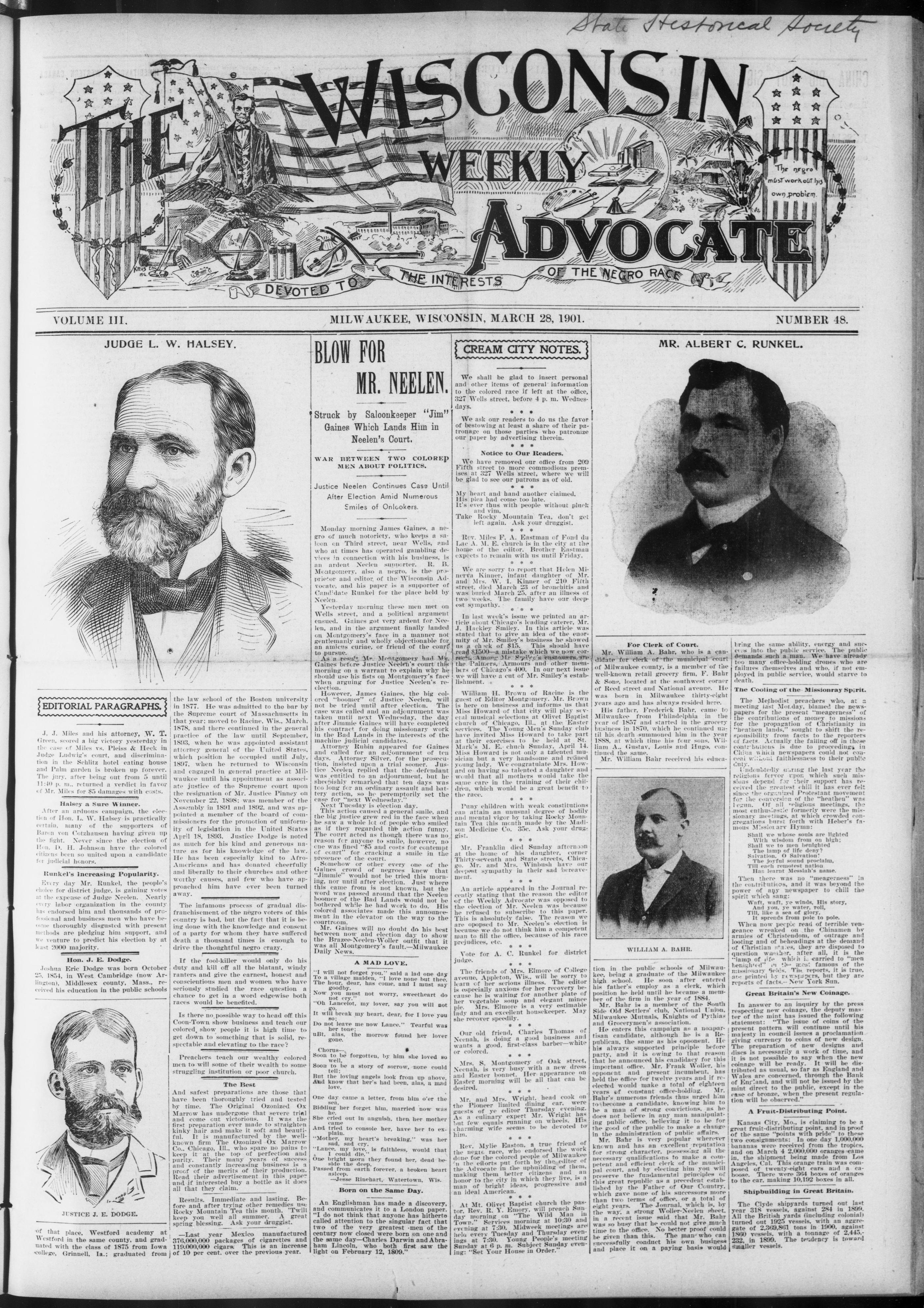
State Historical Society
WISCONSIN
WEEKLY
Advocate
DEVOTED TO THE INTERESTS OF THE NEGRO RACE
JUDGE L. W. HALSEY.
VOLUME III.
JUDGE L.
EDITORIAL PARAGRAPHS.
J. J. Miles and his attorney, W. T. Green, scored a big victory yesterday in the case of Miles vs. Pleiss & Heck in Judge Ludwig's court, and discrimination in the Schlitz hotel eating house and Palm garden is broken up forever. The jury, after being out from 5 until 11:40 p. m., returned a verdict in favor of Mr. Miles for $5 damages with costs.
Halsey a Sure Winner:
After an arduous campaign, the election of Hon. L. W. Halsey is practically certain, many of the supporters of Baron von Cotzhausen having given up the fight. Never since the election of Hon. D. H. Johnson have the colored citizens been so united upon a candidate for judicial honors.
Runkel's Increasing Populari
Every day Mr. Runkel, the people's choice for district judge, is gaining votes at the expense of Judge Neelen. Nearly every labor organization in the county has endorsed him and thousands of professional and business men who have become thoroughly disgusted with present methods are pledging him support, and we venture to predict his election by at least 2000 majority.
Hon. J. E. Dodge.
Joshua Eric Dodge was born October 25, 1854, in West Cambridge (now Arlington), Middlesex county, Mass., received his education in the public schools
JOHN G.
JUSTICE J. E. DODGE.
of that place, Westford academy at Westford in the same county, and graduated with the class of 1875 from Iowa college, Grinnell, Ia.; graduated from
the law school of the Boston university in 1877. He was admitted to the bar by the Supreme court of Massachusetts in that year; moved to Racine, Wis., March, 1878, and there continued in the general practice of the law until September, 1893, when he was appointed assistant attorney general of the United States, which position he occupied until July, 1897, when he returned to Wisconsin and engaged in general practice at Milwaukee until his appointment as associate justice of the Supreme court upon the resignation of Mr. Justice Pinney on November 22, 1898; was member of the Assembly in 1891 and 1892, and was appointed a member of the board of commissioners for the promotion of uniformity of legislation in the United States April 18, 1893. Justice Dodge is noted as much for his kind and generous nature as for his knowledge of the law. He has been especially kind to Afro-Americans and has donated cheerfully and liberally to their churches and other worthy causes, and few who have approached him have ever been turned away.
The infamous process of gradual disfranchisement of the negro voters of this country is bad, but the fact that it is being done with the knowledge and consent of a party for whom they have suffered death a thousand times is enough to drive the thoughtful negro crazy.
If the fool-killer would only do his duty and kill off all the blatant, windy ranters and give the earnest, honest and conscientious men and women who have seriously studied the race question a chance to get in a word edgewise both races would be benefited.
Is there no possible way to head off this Coon-Town show business and teach our colored show people it is high time to get down to something that is solid, respectable and elevating to the race?
Preachers teach our wealthy colored men to will some of their wealth to some struggling institution or poor church.
The Best
And safest preparations are those that have been thoroughly tried and tested by time. The Original Ozonized Ox Marrow has undergone that severe trial and come out victorious. It was the first preparation ever made to straighten kinky hair and make it soft and beautiful. It is manufactured by the well-known firm The Ozonized Ox Marrow Co., Chicago, Ill., who spare no pains to keep it at the top of perfection and purity. Their many years of success and constantly increasing business is a proof of the merits of their production. Read their advertisement in this paper and if interested buy a bottle as it does all that they claim.
Results. Immediate and lasting. Before and after trying other remedies use Rocky Mountain Tea this month. 'Twil keep you well all summer. A great spring blessing. Ask your druggist.
—Last year Mexico manufactured 376,000,000 packages of cigarettes and 119,000,000 cigars. This is an increase of 10 per cent. over the previous year.
Struck by Saloonkeeper "Jim" Gaines Which Lands Him in Neelen's Court. WAR BETWEEN TWO COLORED MEN ABOUT POLITICS.
Justice Neelen Continues Case Until After Election Amid Numerous Smiles of Onlookers.
Monday morning James Gaines, a negro of much notoriety, who keeps a saloon on Third street, near Wells, and who at times has operated gambling devices in connection with his business, is an ardent Neelen supporter. R. B. Montgomery, also a negro, is the proprietor and editor of the Wisconsin Advocate, and his paper is a supporter of Candidate Runkel for the place held by Neelen.
Yesterday morning these men met on Wells street, and a political argument ensued. Gaines got very ardent for Neelen, and in the argument finally landed on Montgomery's face in a manner not gentlemanly and wholly objectionable for an amicus curiae, or friend of the court to pursue.
As a result Mr. Montgomery had Mr. Gaines before Justice Neelen's court this morning on a warrant to explain why he should use his fists on Montgomery's face when arguing for Justice Neelen's reelection.
However, James Gaines, the big colored "boomer" of Justice Neelen, will not be tried until after election. The case was called and an adjournment was taken until next Wednesday, the day after Jimmie Gaines will have completed his contract for doing missionary work in the Bad Lands in the interests of the machine judicial candidates.
Attorney Rubin appeared for Gaines and called for an adjournment of ten days. Attorney Silver, for the prosecution, insisted upon a trial sooner. Justice Neelen replied that the defendant was entitled to an adjournment, but he sheepishly remarked that ten days was too long for an ordinary assault and battery action, so he peremptorily set the case for "next Wednesday."
Next Tuesday is election day.
This action caused a general smile, and the big justice grew red in the face when he saw a whole lot of people who smiled as if they regarded the action funny. The court acted as though there was no reason for anyone to smile, however, no one was fined "$5 and costs for contempt of court" for cracking a smile in the presence of the court.
Somehow or other every one of the Gaines crowd of negroes knew that "Jimmie" would not be tried this morning, nor until after election. Just where this came from is not known, but the word was passed around that the Neelen boomer of the Bad Lands would not be bothered while he had work to do. His colored associates made this announcement in the elevator on the way to the courtroom.
Mr. Gaines will no doubt do his best between now and election day to show the Brazee-Neelen-Woller outfit that it was all Montgomery's fault.—Milwaukee Daily News.
A MAD LOVE.
"I will not forget you," said a lad one day. To a village maiden, "I love none but thee, The hour, dear, has come, and I must say goodby.
Now you must not worry, sweetheart do not cry."
"Oh Lancelot, my lover, say you will not go.
It will break my heart, dear, for I love you so;
Do not leave me now Lance." Tearful was her tone;
uBt. alas, the morrow found her lover gone.
Chorus—
Soon to be forgotten, by him she loved so well.
Soon to be a story of sorrow, none could tell;
But the loving angels look from up above.
And know that her's had been, alas, a mad love.
One day came a letter, from him o'er the sea.
Bidding her forget him, married now was he.
She cried out in anguish, then her mother came
And tried to console her, have her to explain.
"Mother, my heart's breaking," was her sad, sad cry.
"Lance, my love, is faithless, would that I could die."
One bright morn they found her, dead beside the deep.
Passed from earth forever, a broken heart asleep.
—Jesse Rinehart, Watertown, Wis.
Born on the Same Day.
An Englishman has made a discovery, and communicates it to a London paper. "I do not think that anyone has hitherte called attention to the singular fact that two of the very greatest men of the century now closed were born on one and the same day—Charles Darwin and Abraham Lincoln, who both first saw the light on February 12, 1809."
We shall be glad to insert personal and other items of general information to the colored race if left at the office, 327 Wells street, before 4 p. m. Wednesdays.
* * *
We ask our readers to do us the favor of bestowing at least a share of their patronage on those parties who patronize our paper by advertising therein.
We have removed our office from 209 Fifth street to more commodious premises at 327 Wells street, where we will be glad to see our patrons as of old.
* * *
My heart and hand another claimed.
His plea had come too late.
It's ever thus with people without pluck and vim.
Take Rocky Mountain Tea, don't get left again. Ask your druggist.
* * *
Rev. Miles F. A. Eastman of Fond du Lac A. M. E. church is in the city at the home of the editor. Brother Eastman expects to remain with us until Friday.
* * *
We are sorry to report that Helen Minerva Kinner, infant daughter of Mr. and Mrs. W. I. Kinner of 210 Fifth street, died March 23 of bronchitis and was buried March 25, after an illness of two weeks. The family have our deepest sympathy.
In last week's issue we printed an article about Chicago's leading caterer, Mr. J. Hackley Smiley. In this article was stated that to give an idea of the enormity of Mr. Smiley's business he showed us a check of $15. This should have read $1500—a mistake which we now correct. Among Mr. Smiley's customers are the Palmers, Armours and other members of Chicago's 400. In our next issue we will have a cut of Mr. Smiley's establishment.
William H. Brown of Racine is the guest of Editor Montgomery. Mr. Brown is here on business and informs us that Miss Howard of that city will play several musical selections at Olivet Baptist church of Chicago, Ill., at the Easter services. The Young Men's Sunday club have invited Miss Howard to take part at their exercises to be held at St. Mark's M. E. chuch Sunday, April 14. Miss Howard is not only a talented musician but a very handsome and refined young lady. We congratulate Mrs. Howard on having so talented a daughter and would that all mothers would take the same care in the training of their children, which would be a great benefit to the race.
***
Puny children with weak constitutions can attain an unusual degree of bodily and mental vigor by taking Rocky Mountain Tea this month made by the Madison Medicine Co. 35c. Ask your druggist.
* * *
Mr. Franklin died Sunday afternoon at the home of his daughter, corner Thirty-seventh and State streets, Chicago. Mr. and Mrs. Winbush have our deepest sympathy in their sad bereavement.
* * *
An article appeared in the Journal recently stating that the reason the editor of the Weekly Advocate was opposed to the election of Mr. Neelen was because he refused to subscribe to this paper. This is absolutely false. The reason we are opposed to Mr. Neelen's election is because we do not think him a competent man to fill the office, because of his race prejudices, etc.
* * *
Vote for A. C. Runkel for district judge.
The friends of Mrs. Elmore of College avenue, Appleton, Wis., will be sorry to learn of her serious illness. The editor is especially anxious for her recovery because he is waiting for another plate of her vegetable soup and elegant mince pie. Mrs. Elmore is a very estimable lady and an excellent housekeeper. May she recover sneedily.
***
Our old friend, Charles Thomas of Neenah, is doing a good business and wants a good, first-class barber—white or colored.
* * *
Mrs. S. Montgomery of Oak street, Neenah, is very busy with a new dress and Easter bonnet. Her appearance on Easter morning will be all that can be desired.
* * *
Mr. and Mrs. Wright, head cook on the Pioneer limited dining car, were guests of ye editor Thursday evening. As a culinary expert Mr. Wright has but few equals running on wheels. His charming wife seems to be devoted to him.
\* \* \*
Rev. Mylie Easton, a true friend of the negic race, who endorsed the work done for the colored people of Milwaukee in the efforts put forth by the editor of the Advocate in the upbuilding of them, making them better citizens and an honor to the city in which they live, is a man of bright ideas, progressive and an ideal American.
* * *
At Mt. Olivet Baptist church the pastor, Rev. R. Y. Emory, will preach Sunday morning on "The Wild Man in Town." Services morning at 10:30 and evening at 7:30. Midweek meetings are held every Tuesday and Thursday evenings at 7:30. Young People's meeting Sunday at 6 p. m. Subject Sunday evening: "Set Your House in Order."
Y.
For Clerk of Court.
Mr. William A. Bahr, who is a candidate for clerk of the municipal court of Milwaukee county, is a member of the well-known retail grocery firm, F. Bahr & Sons, located at the southwest corner of Reed street and National avenue. He was born in Milwaukee thirty-eight years ago and has always resided here. His father, Frederick Bahr, came to Milwaukee from Philadelphia in the year of 1857 and started in the grocery business in 1870, which he continued until his death summoned him in the year 1888, at which time his four sons, William A., Gustav, Louis and Hugo, continued the same. Mr. William Bahr received his educa-
M. B.
WILLIAM A. BAHR.
tion in the public schools of Milwaukee, being a graduate of the Milwaukee high school. He soon after entered his father's employ as a clerk, which position he held until he became a member of the firm in the year of 1884. Mr. Bahr is a member of the South Side Old Settlers' club, National Union, Milwaukee Mutuals, Knights of Pythias and Grocerymen's association.
He enters this campaign as a nonpartisan candidate, although he is a Republican, the same as his opponent. He his always supported principle before party, and it is owing to that reason that he announced his candidacy for this important office. Mr. Frank Woller, his opponent and present incumbent, has held the office for twelve years and if reelected would make a total of eighteen years of constant office-holding. Mr. Bahr's numerous friends thus urged him to become a candidate, knowing him to be a man of strong convictions, as he does not believe in any man manipulating public office, believing it to be for the good of the public to make a change in the administration of public affairs.
Mr. Bahr is very popular wherever known and has an excellent reputation for strong character, possessing all the necessary qualifications to make a competent and efficient clerk of the municipal court, and by electing him you will preserve the fundamental principles of this great republic as a precedent established by the Father of Our Country, which gave none of his successors more than two terms of office, or a total of eight years. The Journal, which is, by the way, a strong Woller-Neelen sheet, in a recent issue said that Mr. Bahr was so busy that he could not give much time to the office. No better proof could be given than this. The man who can successfully conduct his own business and place it on a paying basis would
NUMBER 48.
T C. RUNKEL.
bring the same ability, energy and success into the public service. The public demands such a man. We have already too many office-holding drones who are failures themselves and who, if not employed in public service, would starve to death.
The Cooling of the Missionray Spirit
The Methodist preachers who, at a meeting last Monday, blamed the newspapers for the present "meagerness" of the contributions of money to missions for the propagation of Christianity in "heathen lands," sought to shift the responsibility from facts to the reporters of facts. Actually the falling off in these contributions is due to proceedings in China which newspapers could not conceal without faithlessness to their public duty.
Undoubtedly during the last year the religious fervor upon which such missions depend for their support has received the greatest chill it has ever felt since the organized Protestant movement for the conversion of the "heathen" was begun. Of all religious meetings, the most enthusiastic formerly were the missionary meetings, at which crowded congregations burst forth with Heber's famous Missionary Hymn:
Shall we whose souls are lighted
With wisdom from on high;
Shall we to men benighted
The lamp of life deny?
Salvation, O Salvation!
The joyful sound proclaim,
Till each remostest nation
Has learnt Messiah's name.
Then there was no "meagerness" in
the contributions, and it was beyond the
power of any newspaper to chill the
spirit which sang:
Waft, waft, ye winds, His story,
And you, ye water, roll,
Till, like a sea of glory.
When now people read of terrible vengeance wreaked on the Chinamen by armies of Christendom, of outrage and looting and of beheadings at the demand of Christian states, they are disposed to question whether, after all, it is the "lamp of life which is carried to "men benighted" on the most famous of the missionary fields. The reports, it is true, are printed by newspapers, but they are reports of facts.-New York Sun.
Great Britain's New Coinage.
In answer to an inquiry by the press respecting new coinage, the deputy master of the mint has issued the following statement: "The issue of coins of the present pattern will continue until his majesty in council issues a proclamation giving currency to coins of new design. The preparation of new designs and dises is necessarily a work of time, and it is not possible to say when the new coinage will be ready. It will be distributed as usual, so far as England and Wales are concerned, through the Bank of England, and will not be issued by the mint direct to the public, except in the case of bronze, when the present regulation will be observed."
A Fruit-Distributing Point.
Kansas City, Mo., is claiming to be a great fruit-distributing point, and in proof of the same "points with pride" to these two consignments: In one day 1,000,000 bananas were received from the tropics, and on March 4 2,000,000 oranges came in, the shipment being made from Los Angeles, Cal. This orange train was composed of twenty-eight cars and a caboose. There were 364 boxes of oranges to the car, making 10,192 boxes in all.
Shipbuilding in Great Britain.
The Clyde shipyards turned out last year 318 vessels, against 284 in 1899. All the British yards (including colonial) turned out 1925 vessels, with an aggregate of 2,369,861 tons in 1900, against 1860 vessels, with a tonnage of 2,445. 232, in 1899. The tendency is toward smaller vessels.
CHINA DID NOT SIGN.
Others Powers Now Disposed to Protect Their Interests as They May Decem Advisable.
Pekin, March 27.—The Chinese had not signed the Manchurian agreement last night when the time expired. London, March 27.—The officials of the Japanese embassy confirm the report that an imperial decree has been issued by the court at Sian-Fu, through LiuKun-Hi, the viceroy of Nankin, ordering that the Manchurian convention should not be signed March 26, the date fixed by Russia. An intimation of this decree has been telegraphed to the various governments concerned.
Washington, D. C., March 27.—Great Britain, Germany and Japan have given notice to the United States that they will regard the signature of the Manchuria treaty as freeing them from the obligations they assumed last summer to preserve the integrity of China, and that they will proceed to consider such measures for the protection of their interests as they may deem advisable. The United States will not protest against the Manchurian treaty. Its policy will depend to a large extent upon the provisions of the convention. If Great Britain, Germany and Japan use the convention as a pretext for the partition of China, then the president and Secretary Hay will take measures for the protection of American commerce by the preservation of the "open door."
Protest from Great Britain.
Washington, D. C., March 27.—A dispatch was received here today from one of the foreign offices to its representative stating that the British government had made a protest against China's negotiating a convention with any power touching territorial or financial affairs until the present troubles in China are settled. The protest was made through Sir Ernest Satow, British minister at Pekin. It is understood to have been made within the last day or two. The Russian agreement is not specifically referred to, but it is stated the British action is clearly directed against that government.
The Russian View.
St. Petersburg, March 27.—The correspondent of the Associated press is informed on competent authority that the Russo-Chinese agreement probably will be signed shortly. However, the negotiations continue and the result is not yet certain. While it is possible the details will be slightly modified the arrangements will be substantially as demanded. According to the Russian point of view, an abatement of what are here regarded as moderate demands would be inconsistent with Russian interest and would not sufficiently safeguard the frontier and railroad. The agreement will be designed for the protection of existing interests and rights and not for the acquisition of new things. It is diplomatically admitted that Russia is seeking certain guarantees for future security, and it is positively certain that no powers have protested, even Japan refraining from this attempt to interfere between two other governments.
RIVERS STILL RISING.
Dam on Grand River Goes Out and Citizens Are Preparing for Disaster.
Lowell, Mich., March 27. The dam which furnished power for the municipal electric light plant located eight miles above here on the Grand river gave way this morning. It is feared the dam just above the village will also go out. Citizens here are preparing for great damage when the water sweeps by the village. The Flat river, which flows into the Grand at this point, is the highest ever known, and business firms and families are moving off its adjacent lowlands which are being flooded. The Grand river is within seven inches of its highest water mark.
St. Joseph, Mich., March 27.—For the second time this spring the factory district between this city and Benton Harbor is flooded. The river, which is higher than for many years, continues to rise and apprehension is felt regarding the safety of the bridges. Denver, Col., March 27.—Another heavy snowstorm, the second within a week, began here early today. Up to 9 a.m. six inches of snow had fallen. Reports from eastern Colorado towns indicate that the stock losses resulting from the blizzard of Sunday and Monday will not exceed 3 per cent.
Grand Rapids, Mich., March 27.-The Grand river is nearly a foot higher than yesterday and is still rising. A score or more houses are cut off from land by the waters and the occupants are using boats. Basements for several blocks back on both sides of the river in the business districts are flooded.
MORGAN IN PERIL.
Trust Promoter, Threatened by Assassins, Postpones His European Trip.
New York, March 27.—Letters threatening the life of J. Pierpont Morgan are said to have fallen into the hands of the Scotland Yard detectives. They take cognizance of Mr. Morgan's coming trip to Europe and blame him for the present distress among British workingmen. The writers declare that Mr. Morgan's industrial operations are ruining British trade and are causing starvation among the workingmen dependent upon that trade for a living. The authorities at Scotland Yard have taken unusual precautions to protect Mr. Morgan when he arrives.
Mr. Morgan had originally planned to sail for Europe to attend the listing in London of the United States Steel company's stock. It was said in Wall street that the financier had been advised by cable of possible attempts on his life and that these alleged threats had had much to do with a postponement of his trip. It is now said that he will remain in this country until the middle of April.
VOLCANO FOR ST. LOUIS FAIR.
Bold Scheme of Arcidas R. Farmer for World's Exposition.
St. Louis, Mo., March 27.—A volcano in eruption, 1000 feet high, with a ropeless elevator to carry tourists to the top, with a blazing light on the summit, which will illuminate the World's fair grounds and which may be seen within a radius of fifty miles of the city, is the bold conception of Arcidas R. Farmer. Mr. Farmer says that a ropeless elevator could be constructed in a shaft and operated by screws revolving in a threaded socket. Farmer claims to have a certain method of illumination which will make the volcano a miniature Vesuvius in eruption.
ANNOYED F. S. BOND.
Woman Claims to be the Commonlaw Wife of Vice-President of Milwaukee Road. New York, March 26.—Mrs. Mary Louise Bond, an elegantly dressed, gray-haired woman, was arraigned before Magistrate Brann in the Yorkville police court yesterday afternoon, charged with disorderly conduct. The woman was arrested by Policeman Wertlaufer at the instance of Bernard Smith, the butler in the employ of Frank S. Bond, vice-president of the Chicago, Milwaukee & St. Paul railroad, who resides at 38 West Fifty-Seventh street.
Smith stated that the woman entered the hallway of the house and refused to leave. He told the judge he did not know the woman and had never seen her in the house.
"Don't say that," said the woman. "Don't you know me? I've been there many times, and, I say, you do know me. I want to say, Judge," turning to Magistrate Brann, "that Frank S. Bond, vicepresident of the Chicago, Milwaukee & St. Paul Railroad company, is my common-law husband. He is living in luxury and I am destitute."
In Arrears for Rent.
The woman told Magistrate Brann that she had sustained the relations she had mentioned with Bond for sixteen years. She lived at 240 West One Hundred and Fourteenth street. Bond, she said, paid all of her expenses. Finally she got in arrears for rent and wrote to Bond. She received no answer, and was dispossessed. A truckload of furniture was taken from her flat and driven in front of Bond's house, at 38 West Fifty-first street.
Finally Senator John Gilmore Boyd, counsel for the woman, appeared in court and had a conference with her. Senator Boyd told Magistrate Brann that his client was destitute. He declared that she was the common-law wife of Bond, and that there was pending in the Supreme court a suit begun by he against Bond for damages for breach of promise. This suit was begun two years ago. He declared that up to the time of the bringing of the suit Bond had called at the residence of his client, but had now abandoned her. Mr. Knevals, attorney for Mr. Bond, declared that there was no relation whatever between the woman and Mr. Bond.
"We have an affidavit in our office," said Mr. Knevals, "in which this woman specifically states that she is not the wife of Bond. I am sorry that this matter has been brought out. I have endeavored to keep it from becoming public for some time, but we cannot permit this woman to go to the house of Mr. Bond and continually annoy him. She is sometimes known as Wahl and sometimes as Morse."
Signed a Paper.
The woman explained that over two years ago she was asked to sign a blank piece of paper. She did this, she said. She said there was no writing above it. She was assured at the time she signed the paper that she had not relinquished any of her rights. She said that two years ago she was given $2000 by Bond and that she had been living on that money ever since. Now it was all gone and she had no money to live on.
"He bought the furniture," said Mrs. Bond, "which is standing in front of his house. I have returned the furniture to him. He has deserted me and I do not want his furniture."
Magistrate Brann, after further hearing, warned the woman not to annoy Mr. Bond and discharged her.
When asked about the matter Mr. Bond said: "I have just arrived at my home, where I learned about the affair. I think the least said about it the better. A woman came here, attempted to get into the house, and her arrest was caused by my butler. I know who she was. She was, taken to court, after saying that she was having some things sent here. The things came. They were two wagons full of furniture. At court, I am told, the magistrate told her to take her furniture away and to cease troubling me, or he would put her under bonds. That is all I have to say."
WOMAN CLAIMS BIG ESTATE.
Suit Against Columbus, O., Banker's Executors Causes Scandal.
Columbus, O., March 26.—A hidden chapter in the life of the late Carey B. Paul, the millionaire banker and capitalist, was disclosed when Mrs. Mary Fleming, a handsome widow, of Indianapolis, came to the city and placed her claim for a portion of the big estate in the hands of local attorneys. Her claim against the estate, she says, arises from business transactions in which she was interested with Mr. Paul. She says she intrusted her fortune to him, amounting to more than $50,000. She also claims to hold notes amounting to $7000, which remain unpaid, owing to the sudden death of Mr. Paul.
Mrs. Fleming, it is stated, was engaged to marry Paul, but the engagement was broken just prior to his marriage to the present Mrs. Paul. Then Paul, it is alleged, adjusted the widow's claim by making a financial settlement. It is said Paul's devotion to Mrs. Fleming was the cause of much discord in his family. Mrs. Paul will fight Mrs. Fleming's claim.
MURDERER'S CURSE TRUE
Holmes' Invective on Enemies Coincides with Disease of Detective.
Philadelphia, Pa., March 26.—A few moments before Multimurderer H. H. Holmes went to his doom on the gallows in Moyamensing prison some little time since he launched a curse upon those who had brought him to justice. It was a horrible invective and the first to fall under his fearsome ban is Detective Frank I. Geyer, the man whose efforts were solely responsible for Holmes' undoing, and now the curse of Holmes is recalled. Geyer lies in the grip of a disease the progress of which is causing extreme physical suffering. While enduring these physical tortures Geyer's mind is being preyed on by his own thoughts and in his paroxysms he continually raves. "It is Holmes' curse, Holmes' curse."
Geyer is one of the most successful police officers on the Philadelphia force and has been in the service since the centennial in 1876.
Descendants of Chinese.
The ancestors of the civilized natives of Formosa are immigrants from China, who brought with them the custom of paying religious respect and reverence to ideographs. These Formosans call any piece of paper containing writing by the dignified name of "sacred remains," and venerate it as some superstitious Japanese people venerate the cards symbolizing deities which are called "ofuda."
One Way to Secure Husbands
Marriageable women in Servia have a queer way of announcing that they are in the matrimonial market. A dressed doll hanging in the principal window of a house indicates that there is living there a woman who is anxious to become a bride.
—The geographical divisions of the United States are the North Atlantic group, the South Atlantic group, the North central group, the South central group and the Western group.
—Detroit, Mich., has 3,721,717 square yards of wooden block pavement.
COLONIALS CAPTURED.
Boers Strip the Prisoners of Their Accouturments and Set Them at Liberty.
Cape Town, March 27.—Indecisive encounters at widely-separated points are reported daily. Fighting took place yesterday at Tarkastad and Henningfontein, both in Cape Colony. The casualties were few. A commando numbering 200, under Commandant Fourie, was dispersed at Thaba N'Cnu. According to reports received here the hills above Dewetsdorp, just reoccupied by Gen. Bruce Hamilton, were also the scene of a fight lasting several hours yesterday.
London, March 27.—The Cape Town correspondent of the Daily Express reports the capture by 100 Boers of 130 colonials in a rocky defile near Richmond last Thursday. He asserts that the colonials lost thirteen men before they surrendered, adding that they were all liberated after having been stripped of their accoutrements. Vryheid, Monday, March 27.—Gen. Franch, with Dartnal's and Pulteney's columns, has arrived here, having killed, wounded and captured 1200 Boers. He has also taken several cannon, 1000 rifles, 1800 wagons and 226,000 head of horses, cattle and sheep. London, March 27.—The war office received the following from Gen. Kitchener, dated Pretoria, March 25:
"Babington's force, including Shekleton's column, attacked Delarey, 1500 strong, southwest of Ventersdorp and, having defeated him, followed him up rapidly, with the result that the Boer rear guard was driven in and their convoy, including the guns, captured at Vaals bank.
"Our troops displayed great gallantry and dash. They captured two fifteen-pounder guns, one pompom, six Maxims, 320 rounds of big ammunition, 15,000 rounds of small ammunition, 160 rifles, fifty-three wagons and twenty-four carts, besides taking 140 prisoners. Our losses were slight. Many Boers were killed or wounded."
The official casualty list issued last evening indicates a renewal of active operations since the failure of the negotiations between Lord Kitchener and Gen. Rotha.
Cape Town, March 27.—The bubonic plague situation is assuming a graver aspect. The proportion of European victims of the disease is increasing. Among those attacked yesterday were three soldiers belonging to different corps. A native employed in the navy died at Simonstown. Eight other colored cases and two of Europeans are reported from there and one native has died. London, March 27.—Past Assistant Surgeon Thomas at London reports that at Cape Town on February 23 there were twenty-one cases remaining under treatment and there had been a total of seven deaths. "It would seem from reports," says Surgeon Thomas, "that the infection of Cape Town was carried by diseased rats and an active crusade is being waged against these rodents."
From Singapore three cases of plague were reported between February 22 and 24. New York. March 27.—Charles D. Pierce, the representative of the Orange Free State, today said that there was no truth in the story circulated in Paris that Mr. Kruger was to come to this country to give a series of lectures.
CLAIM $60,000,000.
Heirs of Cideon Mercer Plan to Divide Large Amount of Property in New York City.
East Liverpool, O. March 27.—A little band of hopeful and somewhat exultant people met at the home of T. H. Campbell. They were heirs of Gideon Mercer of New York. The property they hope to possess consists of 212 acres in the heart of New York city, valued at $60,000,000, which belonged to Gideon Mercer, who rented it on a ninety-nine-year lease in 1778. Attention was called to the matter a few years ago by one of the Vanderbilts, who attempted to sell some of the property, to which he claimed to have a clear title. The title was looked up by the prospective purchaser, who discovered the true state of affairs. Vanderbilt tried to prove his claim to it, and it was finally brought before the Supreme court, which rendered a decision saying that the Gideon Mercer heirs were the rightful owners.
Eastern heirs employed H. P. Mast of Springfield, O., to look after their claims. Mast to receive 10 per cent. of the money collected. He spent several years on the matter, and, it is claimed, compromised for $600,000, but the heirs are now seeking to set aside the compromise. Altogether there are 925 heirs who have established a clear claim to the estate, and it is said positively that the matter is very close to a settlement.
TEXAS GRAIN CROP BEING DESTROYED.
Austin, Tex., March 27.—Col. James Gunter of Sherman stated here today that the entire wheat and oats crop of northern Texas is threatened with destruction by Hessian fly. Texas last year produced 20,000,000 bushels of wheat and 30,000,000 bushels of oats. This year the acreage of wheat is slightly less.
LIVES AFTER BRAIN IS CUT.
Patient in St. Louis Hospital Submits to Perilous Operation.
St. Louis, Mo., March 27.—Though the surgeon's knife probed almost to the center of his brain Tuesday morning and removed a bunch of nerve tissue which lay against the base of the brain, Alexander Johns of 1029 South Twelfth street, an inspector in the water department, still lives at the city hospital and has a good chance of recovery.
The operation is the only one of its kind that has been performed on a living subject in St. Louis, and is one of the most difficult known to medical science.
Dr. Robert F. Amyx, assistant superintendent of the hospital, was in charge of the operation. Johns was a sufferer from trifacial neuralgia.
BUSTY PAIL A SAFE BANK.
Farmer Secretes $2700 and Burglars,
Though Close, Fail to Find It.
Mattoon, Ill., March 27.—W. C. Neaves, a wealthy farmer of Gays, drew $2700 from a bank in this city and upon his return home placed the money in a rusty pail, which was secreted among a lot of tinware in the pantry. Last night burglars carried all the tinware to the yard, but failed to find the currency.
TRYING TO PROVE MARRIAGE.
Racine Man Looking for Record at Wankegen.
Waukegan, Ill., March 27.—[Special.]
—A Racine man has been looking up the marriage license records to see if his daughter was secretly married here last December to Michael Reardon. He could not prove it, but believes they were married anyway. Reardon has died and the woman wishes to prove her relationship to secure some property as she has no marriage certificate.
The good roads constitutional amendment authorizing state aid in highway improvements was on the Senate calendar on the 21st, reported from committee without recommendation, but was laid over. The joint resolution for a constitutional amendment providing for a joint government of the city and county of Milwaukee was also laid over. Senator Roehr's bill, 231 S., changing the form of government of the city of Milwaukee, making the mayor the chief executive officer, etc., was reported for indefinite postponement by the Senate committee on corporations. The bill making it an offense for fire insurance companies or their agents to combine to regulate rates, charges and methods of doing business was reported for indefinite postponement. The same fate was recommended by the committee for 141 S., providing for the effect of forfeitures on contracts of insurance and 293 S., relative to township school boards. The committee on state affairs reported for indefinite postponement 300 S., providing that the state shall fill the outlet to Muskego lake in Waukesha county. There was another discussion Senator Miller's bill giving the title of "colonel" to professors of military science in colleges, universities, etc. The bill was killed—19 to 13. The following bills were passed: Relating to boards of fire underwriters and fire patrols; relative to collection of taxes; relative to levy of taxes; authorizing the Jackson bank of Black River Falls to reduce its capital stock to $25,000; relating to tax warrants; relating to assessment and taxation of buildings on leased lands. Two Assembly bills were concurred in: Providing that the polling places of the fourth class may be at the city hall; providing for the loan of two flags to the Grant Monument association.
The Saturday session was headed off in the Senate as soon as it met on the 22d, through a motion by Senator McDonough, carried unanimously, that when adjournment be taken it be to the evening of the 25th. The committee on fish and game reported for indefinite postponement 133 S., prohibiting the sale of any wild animal, bird or fish for food or millinery purposes, the taking or killing of which is prohibited, and 135 S., prohibiting the buying of the same. The judiciary committee reported for nonconcurrence 547 A., relating to official bonds. The bill 341 S., authorizing the district attorney of any county to appoint assistants, clerks or stenographers, and 224 S., creating the town of Port Wing, Bayfield county, were reported adversely by the committee on town and county organization. Senator Roehr moved reconsideration of the vote by which 18 S., the bill designed to confer the title of colonel upon Capt. C. A. Curtis, professor of military science at the state university, and the motion was carried. Senator O'Nell's bill providing for the appointment of a woman on the board of university regents was passed without discussion or opposition. Senator Whitehead's bill, prohibiting the locking of horses, was passed with only one "no" against it. Senator Roehr's bill, creating a pension fund for the Milwaukee fire department, and Senator Devos' bill making a similar provision for the police department, were passed unanimously.
The primary election bill was not reported to the Senate on the evening of the 25th, as was expected. When the upper house was called to order it was found that there was no quorum and the Senate adjourned until the following day. The bill will be referred to the committee on privileges and elections and that committee will hold an informal meeting in the afternoon to discuss a plan for dealing with the bill. On the afternoon of the 27th another meeting will be held when the members will receive amendments and suggestions on the bill.
The primary election bill was received in the Senate from the Assembly on the 26th, and without a word of comment was referred to the committee on privileges and elections. It is not likely to come back from the committee before seven or eight days, in view of the adjournment over election in the Assembly. The Senate deferred action on the joint resolution passed by the Assembly providing for adjournment after the session of the 29th until the evening of the 3d prox. The resolution was concurred in, but later Senator Whitehead moved reconsideration of the vote and that the motion lie over. The motion prevailed. Gov. La Follette's veto of the bill exempting the Milwaukee exposition from taxation, on the ground that it was unconstitutional, was read in the Senate at Senator Roehr's request. Action on the veto was postponed until the 4th, it being said there was a chance that the governor's objections might be overcome by another bill. The Senate killed Senator McGillivray's good roads resolution looking to an amendment to the constitution to permit state aid in good road building. After lengthy debate Senator McGillivray offered an amendment providing that the counties and towns must raise two-thirds of the amount to be expended in any appropriation. He moved that the amendment and bill be laid over, but the motion was lost, 16 to 10. The amendments to the resolution were then lost by a vote of 18 to 12, the test coming on the substitute resolution. The original resolution, which contained an error, was then voted down 28 to 2.
At the evening session of the Senate on the 20th Mr. Eaton's bill providing for the licensing of stationary engineers was ordered to engrossment after a short debate. The joint committee on claims reported for passage several appropriation bills. Among them was Senator Jones' bill providing for the payment of half of the face value of the county orders issued by the Waukesha Keeyle institute under an invalid law in 1895. Senator Mosher's bill making an annual appropriation to the state historical society of $10,000 for the maintenance of the library of the society was also reported favorably. Senator Stout's bill appropriating $2000 to the free library commissioner to make an index of all public documents published by the state, and supervise the distribution of such documents to the public libraries of the state was also favorably reported. Another important bill on which similar action was taken was Senator Hatton's bill providing that the $25,000 appropriated for repairs and new buildings of the state normal schools by the Legislature of 1889, but never paid over, should now be paid.
Senator Roehr's joint resolution for a constitutional amendment authorizing a joint system of government for the city and county of Milwaukee was adopted unanimously by the Senate on the 27th. The Assembly amendment to Senator Mosher's bill adopting the national standard of weights and measures was concurred in. The following bills were passed: Relating to publication of Supreme court reports, correcting an error in the revision of the statutes as to time of letting contracts; increasing the salary of the custodian of the Milwaukee register of deed's office from $60 to $75 a month, and of two clerks from $50 to $65; amending the charter of Brockway college at Rilpon. The following bills were concurred in: Authorizing county judges to act for judges in other counties upon request; providing for the placing of battle flags and other war relics in a memorial hall in the capitol building; providing fees for sheriffs bringing back prisoners from without the state, where no requisition is required; amending the statutes relative to adoption of children; extending the powers of police and fire commissioners relative to removals of chiefs; amending the statutes relating to enforcement of liabilities against corporations; relating to terms of court in the eighth judicial circuit.
The Senate held a short session on the evening of the 27th to receive committee reports.
Assembly.
The Assembly on the 21st ordered the first of the apportionment bills to a third reading. A motion to lay the bill over until the senatorial bill was reported was killed by a vote of 28 to 66, and the bill was then ordered engrossed by a vote of 86 to 9. The Owen bill giving common councils the right to amend franchises and to alter rates was on the Assembly calendar for engrossment, and it caused a de, bate which was not concluded. Mr. Jones' bill, providing for the admission of bables to the Sparta home, over which there was a bitter contest in the committee, was passed without discussion, and the Smith bill to establish a memorial hall for soldiers and sailors in the capitol and requiring the return of the battleflags from the historical library building went through in the same manner. The Assembly passed several bills of more than ordinary importance. The first was the Brunson bill, relating to the sale of oleomargarine. It amends the present law so as to forbid the solicitation of orders to be filled by outside concerns, and is designed to prevent an evasion of the law through which it is said a large amount of oleomargarine is brought into the state. The Young bill, relating to armories for the National guard, was also
passed. In all there were thirteen bills passed. An agreement has been reached by which the primary election bill is to be on the calendar on the 22d and is to be made a special order for 10 o'clock. A long debate over the Owen franchise bill took up so much time that the Assembly took a recess until evening without finishing its calendar.
Two important bills were killed by the Assembly at the evening session on the 21st—the Owen franchise bill and Mr. Thiessenhusen's bill relating to moving the Milwaukee isolation hospital outside the city limits. A vote on the amendment of Mr. Owen was first taken and the amendment was killed by a vote of 22 to 57. Seeing that the bill had no chance for passage, Mr. Owen gave up the fight and moved for indefinite postponement, which motion prevailed.
The substitute for the primary election law passed the Assembly, after some debate, on the 21st, by a vote of 51 to 48. E. A. Miller, who would have voted for the bill, was absent because of the death of his son. The vote was as follows: Ayes—Alnsworth, Anderson, Andrew, Babb, Brinson, Cady, Clark, Coapman, Cook, Dahl, Erickson, Evans David Jr., Fenelon, Frost, Galaway, Gilman, Hall, Hanson, Henry, Hodgins, Holland, Johnson H., Jones, Krumrey, Lane, Lenroot, McCormick, McGill, McMillan, Manuel, Middleton, Overbeck, Price, Rankl, Roe, Rogers, Root, Rossman, Sarau, Smalley, Steiger, Stevens, Sturdevant, Swenhoit, Thomas, Valentine, Whitson, Willott, Young, Zinn, Mr. Speaker—51. Noes—Barker, Barlow, Benson, Burdeau, Cleophas, Collins, Dodge, Dow, Duerwaechter, Eager, Ela, Eline, Esau, Evans Evan W., Fesenfeld, Flaherty, Gagnon, Gawin, Haggery, Hartung, Jensen, Johnson F., Johnston, Karel, Katz, Keene, Kern, McCabe, McComb, Meloney, Miller Herman, Miner, Moldenhauer, Norton, Orton, Owen, Park, Pomrening, Rasmussen, Schellenberg, Silkworth, Slade, Smith, Soltwedel, Spratt, Thlessenhous, Williams E. A., Williams J. C.—48. A motion to reconsider was voted down. Great confusion ensued, on which there were several attempts to adjourn. On a roll call, the Assembly by a vote of 51 to 38 refused to adjourn, but in the confusion there were so many changes that it was finally lost. The Hall railroad commission bill and the Silkworth 2-cent-fare bill came in from the committee on railroads with a recommendation for indefinite postponement. The committee on public health and sanitation reported without recommendation the barbers' bill, which was once before reported for indefinite postponement. The judiciary committee reported the homestead exemption bill for amendment and passage. The Assembly had a very long calendar, but it did not make much progress with it, a debate on Mr. Spratt's bill to pension members of police and fire departments and the vote on the primary election bill having taken up a large part of the time. Adjournment was to the evening of the 25th.
Assemblyman Hall's railway commission bill was on the calendar for indefinite postponement in the Assembly on the evening of the 25th, but was not reached, as all the bills listed for killing were laid over. Mr. Hall is ill and consideration of his bill will probably be postponed until his return. Mr. Keene's bill extending the time for building the Milwaukee lake shore drive was among the bills ordered engrossed. Bills were passed as follows: Relating to the municipal court of Oneida county; relating to the incorporation of Lawrence institute. The Assembly agreed on the 26th to adjourn at noon on the 27th until the 4th prox., at 8:30 p. m., in order to give the members a chance to attend the elections. A joint resolution offered by Mr. Keene and amended by Mr. Overbeck was adopted and sent to the Senate. Before the long calendar war reached the Assembly reconsidered the vote by which it refused to order Mr. Gliman's bastardy bill to third reading, and that action was followed by another long argument on the subject. The bill was ordered engrossed. The Assembly had a lively little fight over Mr. Lenroot's bill to permit daily and semi-weekly newspapers to publish the session laws as the weekly papers do. Mr. Dodge offered an amendment to cut down the amount from $100 to $75 and Mr. Barker moved to lay the amendment on the table. His motion prevailed by a vote of 42 to 37, which carried the bill with it. Mr. Cady's bill, No. 491 A., providing for the survey of certain lands, and Mr. Alnsworth's bill, No. 158 A., relating to fish and game, were ordered to a third reading. The Assembly then took acess until evening.
The Assembly on the evening of the 20th refused to kill the Torrens land bill and also the bill of Mr. Spratt to repeal the corrupt practice act. The railroad committee recommended for indefinite postponement various 2-cent a mile railroad fare bills. After some debate they were killed. The Assembly killed the bill authorizing Milwaukee to acquire land outside of the city for a new isolation hospital. The judiciary committee recommended for indefinite postponement the bill waiving the statutes of limitation and giving S. D. Carpenter authority to begin suit in the Supreme court to determine what, if anything, the state owes him under a disputed contract when he was state printer many years ago. Mr. Barker's bill to prohibit marriage within one year after the granting of a decree of divorce, was also reported for indefinite postponement.
The Assembly on the 27th passed the Rohr bill re-enacting the charter of the Milwaukee Orphan asylum. The Assembly apportionment bill was passed by the Assembly without debate. The ayes and noes had to be called and there were only six dissenting votes, Messrs. Collins, Erickson, Frost, Galaway, Silkworth and Spratt. The Miller bill to punish desecration of the flag gave the Assembly a chance to show its patriotism. Messrs. Dodge, Barker, Smith and Spratt made speeches in favor of it, and it was ordered to a third reading without a dissenting vote. There was a long debate over Senator Kreutzer's bill increasing the salaries of the Supreme judges from $5000 to $6000 and of the circuit court judges from $3500 to $4000, with an allowance of $400 for expenses. The bill was finally ordered to a third reading. Gov. La Follette's message relating to the new system of bookkeeping was received and referred to the committee on state affairs. The following bills were passed or concurred in: Relating to report of commissioners of insurance; relating to support of poor by counties; relating to bridge across Menomonie river; inspection of sanitary condition of public buildings; to encourage attendance on free high schools; to prevent adulteration of meat products. Consideration of Mr. Whitson's bill relating to causes for divorce and Mr. Barker's bill forbidding divorced persons to marry within one year, was deferred until tomorrow. Mr. Holland's bill making it a felony to administer narcotics with criminal intent was ordered to a third reading
ordered to a third The Assembly at the evening session on the 27th killed two bills, one by Mr. Burdeau (No. 149 A.) relating to coroners, and another by Mr. Young (No. 447 A.) relating to contempt proceedings.
A Pretty Easter Gift.
One of the pretty little bits that girls are making now is a penwiper in the shape of a carnation. The little oddity is useful for the writing table and is easily made. The wiper part consists of small circles of dark cloth or of chamois; if the former, see to it that the cloth has not a fuzzy surface to clog the pen. A lower part, consisting of a piece of green felt, is made with eight points. The lower part may be made of glove kid, which is very much prettier than the cloth, the luster of the kid carrying out the idea of the flower. The end of a kid glove will do. It is five inches in diameter. The pieces of chamois should be two inches in diameter, or small enough to be hidden beneath the pointed foundations. The blossom is made of white, pink, or yellow kid or chamois. There should be seven circles, each three and a quarter inches in diameter. These are notched around the edges to resemble the pink, and if you are handy with the water colors, should be tinted about the edges, the tinting extending in irregular lines towards the center of the flower for about half an inch all the way around. If made of white kid, the tinting should be of light pink, with dark pink at the extreme edge. If pink or yellow kid, deep pink should be used. Put the color on with a camel's-hair brush and do not apply too much at a time. If no water colors are handy, carmine ink will answer the purpose. Fold four of the circles, making both sides to fold alike. Now fold the other three circles. Catch the four circles down to the center of the green kid by needle and thread, letting the folds stand up as the petals of the flower you are trying to copy do.—Philadelphia Telegraph.
—England spends about $600,000 a year in the purchase of canary birds.
Indian Reservations and Other New Districts to Be Opened Up This Year.
In the Great Saskatchewan Valley, and the Fertile Plains of Assiniboia.
To the Editor:
Dear Sir—The past three or four years have demonstrated to a large number of Americans the value of the grain-growing and ranching lands of Western Canada. Tens of thousands have taken advantage of the offer made by the Canadian Government as well as of the exceedingly low prices asked for lands by the railway, colonization and other companies. The experience of those who have been settled there for some little time is of a highly gratifying character. So much so that the Canadian Government, who has control of the immigration into Western Canada, has decided to open up some new districts this year in the well-known Saskatchewan Valley and also in the fertile plains of Assiniboia. These districts are probably the most productive in the entire West, and in close touch to largely settled communities as well as being situated on some of the most important lines of railway. They are within easy reach of markets, schools, churches and other social advantages. In some of these districts lands may be homesteaded as well as purchased outright at very low prices. Now as to what can be done on these lands. The evidence of the settlers in the neighborhood of the lands now about to be opened for settlement (some of them being located in one of the best Indian reservations) goes to show that the very best results have followed even most indifferent methods. Cases are given where farmers having gone there with most limited means, barely enough to erect a small house and break up a little land, have in three or four years' time become prosperous, all debts paid and money in the bank. The soil in the districts mentioned, Assiniboia and Saskatchewan, is a rich black loam, fifteen inches to three feet deep. As a settler says, "it appears like the accumulation of decayed vegetation and ashes for centuries (the subsill is a stiff, putty clay)." On this soil it is possible to raise from forty to fifty bushels of wheat to the acre, oats seventy-five to one hundred bushels, all of which bring good prices at the local market. For mixed farming these new districts are probably among the best in Western Canada. Stock fatten easily on the wild grasses. Hay is plentiful, and prices splendid. Another settler, writing to a friend in Iowa, says; "The climate is all that could be desired, plenty of rainfall in summer, with no hot dry winds. On the 28th of September I saw prairie flowers in full bloom, sweet corn, potato and tomato vines that had not been touched a particle with frost, and the winters are milder than those in the State from which I came. After the holidays the winter sets in clear and cold, with plenty of snow for good sleighing; no high winds or blizzards are known. Horses live out all winter and pick their own living, while cattle live all winter in open sheds and around the hay ricks. Wheat, oats and barley are the principal grain crops. Potatoes and all other roots and vegetables do well, the yield being enormous as compared to those in the States. Wild fruits, such as strawberries, raspberries, cranberries, gooseberries and all varieties of currants yield in abundance." As a reader of your valuable paper for a number of years, I feel that I should inform you of the progress and advancement being made in Canada within the past few years and the inducements and advantages that will follow settlement in Western Canada. Those who desire information can do as I did, and apply to any agent of the Canadian Government, whose name I see appears in advertisements appearing elsewhere in the columns of your paper, and when writing ask particularly about the Saskatchewan Valley or Assiniboia Districts. Yours truly,
Third Bridge at St. Louis.
The new bridge over the Mississippi at St. Louis, just authorized by Congress, is to be finished in 1903 for the World's fair. The first bridge over the river was begun in 1807, when St. Louis had a population of 225,000, but when the bridge was finished in 1874 the population had risen to 325,000. When the second bridge was opened to traffic in 1890 the population was 451,000, and it was evident that a third bridge was needed, owing to the city's greatly-increased business activity.
If Coffee Poisons You.
ruins your digestion, makes you nervous and sallow complexioned, keeps you awake nights and acts against your system generally, try Grain-O, the new food drink. It is made of pure selected grain and is healthful, nourishing and appetizing. It: has none of the bad effects of coffee, yet it is just as pleasant to the taste, and when properly prepared can't be told from the finest coffees. Costs about $1/4 as much. It is a healthful table drink for the children and adults. Ask your grocer for Grain-O. 15 and 25c.
—When the first census was taken in 1790 Pennsylvania's population was 94,253, greater than that of New York. By the census of 1900 New York's population leads that of Pennsylvania by 965,897.
Coughing Leads to Consumption.
Kemp's Balsam will stop the cough at once. Go to your druggist today and get a sample bottle free. Sold in 25 and 50 cent bottles. Go at once; delays are dangerous.
—There are ten railway lines in England and Wales, five in Scotland and six in Ireland.
FARMS IN WESTERN CANADA FREE
EXCURSION RATES to Western Canada and particulars as to how to secure 160 acres of the best. When growing land on the Continent, can be secured on application to the Superinventor, Canada, or the undersigned. Specially con-
FARMS
WESTERN
CANADA
FREE
EXCURSION RATES
to Western Canada and particulars as to how to secure
160 acres of the best Wheat
growing land on the Continent, can be secured on application to the Superintendent of Immigration, Ottawa, Canada, or the undersigned. Specially con-
ducted excursions will leave St. Paul, Minn., on the last
and 8d Tuesday in each month, and specially low rates
on all lines of railway are being quoted for excursions
leaving St. Paul on March 28th and April 4th, for Manitoba, Assiniboia, Saskatchewan and Alberta.
Write to F. Pedley, Supt. Immigration, Ottawa,
Canada, or the undersigned, who will mail you at
lases, pamphlets, etc., free: T. O. Currie, 1 New
Insurance Building, Milwaukee, Wis., Agent for
Government of Canada.
Special Excursions to Western Canada during March and April.
Buy a Virginia Farm—Good hands, fine climate, schools unexcelled. Seat of University of Virginia. McKennie, Charlottesville, Va.
The Countess of Strafford will remain in New York until April 2, when she will return to England. At present the countess is at Lakewood with her mother, Mrs. Samuel Smith.
Mr. Villard stated that the report that Mr. and Mrs. Edwin Gould had leased Thornwood, the country seat of the late Henry Villard, was not true. There have not been any negotiations looking toward a lease.
The rumor of the engagement of Craig Wadsworth and Miss May Goelet, daughter of the late Ogden Goelet, which has for some days been current, in society, is not yet confirmed by either Mrs. Goelet or Miss Goelet.
The Duchess of Manchester and her sister, Lady Lister Kaye, are at present at the Savoy hotel. They will remain there for some weeks, pending the settlement of the estate of their deceased brother, Fernando Yznaga.
For the coming exhibition by the Society of American Artists 500 out of 1500 canvases have been accepted, among them three paintings by John W. Alexander. One is his "Autumn." a medal picture at Paris. The exhibition will be the feature of the local art season.
Another new record price for a seat on the New York stock exchange was made on Wednesday, when a seat sold for $52,000. This is $500 higher than the last price, when $51,500 was paid by Charles Gates, son of John W. Gates. The name of the last purchaser was not disclosed.
Harry Lehr stopped two runaway horses attached to a victoria in which Mrs. Harold Blake of Chicago was seated on Thursday afternoon. Neither Mrs. Blake nor the horses were injured, and Mr. Lehr escaped with only a slight sprain to his ankle. The coachman, Michael Fagan, whose fall from the box had caused all the trouble, damaged himself slightly on the asphalt of Fifth avenue, where the runaway took place.
Adele Ritchie is to become an owner and campaigner of trotters. She has a small-sized mint to draw on, and she will have the best. She is a comic opera comedienne, and her permanent address is Germantown, Philadelphia. Her representative bid $6500 on Emma Winter at Madison Square garden the other evening, and is to make several more bold efforts to purchase fast ones. Miss Ritchie was at the garden and displayed remarkable familiarity with the fine points of the trotters.
A dozen big seagoing yachts are undergoing their annual spring house-cleaning in the Erie basin. The millionaire sailors, who spend a good part of the hot weather season afloat, are arranging to put their craft in commission. It is said that a greater number of American steam yachts will go abroad this year than usual. Two are being fitted for North cape cruises and the usual Mediterranean-Black Sea voyage. Then there are any number of small coasting vessels that will go out of winter quarters in a week or two.
Plans for the Union club's new building were submitted by the architects today. It will be situated at the corner of Fifth avenue and Fifty-first street, with a frontage of 75 feet on Fifth avenue. It will be constructed of brick, marble and Indiana limestone, and will be three and a half stories high. The cost of the structure, with equipment, has been estimated at $450,000. Its location is directly across from St. Patrick's cathedral, on the Fifty-first street side, and from the Sloan residence on Fifth avenue.
Mrs. James Brown Potter has again been denying that she was about to be married. This time it was not a noble duke, nor a famous general with whom her name has been connected, but Frank Gardner, the American who went to live in England after he had made a fortune in Australian mining stocks. Mrs. Potter says she is not going to marry Mr. Gardner, in spite of all gossip to that effect, and that her acquaintance with him is the result of their meeting several years ago in Australia, when he advised her so judiciously in regard to her investments that she is now independent.
Reyer's "Salambo," the most elaborate spectacle attempted here in years, has been produced for the first time in America at the Metropolitan opera house. It is a ponderous, pretentious and Parisian affair, yet one in which every lover of French opera will find much to admire. The performance lasted until long after midnight and a number of patient spectators who were determined to get their money's worth ate supper between the acts and grimly held on until the finish. "Salambo" is sensational as well as spectacular. In the last act Albert Saleza takes a fall out of a flight of stairs, compared to which the famous achievements of Francis Wiison look like were stepping stones. As a rivai to the Madison square bicycle coaster of a year ago M. Saleza creates a genuine sensation.
Luigi Counga, a silver cleaner at the Waldorf-Astoria, was caught in the act of smuggling out $500 worth of silver plate belonging to the hotel. Recently Chief Steward Van Armound noticed a shortage in the silverware count. At first the losses were confined to small pieces like knives, forks and spoons, but of late big silver trays, urns, coffee pots and the like began to take wings along with the knives and forks. When the cleaners went off duty the other morning a detective was on watch. When Luigi came out he appeared twice his usual size and queer lumps bulged from his clothing. He was stopped and searched. A large tea tray was found in the seat of his trousers and another under his shipt. In the front of his trousers were held a dozen coffee pots that bulged out from the waist. Knives and forks were scattered all over his person.
Klaw & Erlanger have arranged the following route for N. C. Goodwin and Miss Maxine Elliott in their revival of "The Merchant of Venice," in which they will play Shylock and Portia respectively. They will begin their tour on Monday, May 6, in Syracuse, and will then play in Rochester, Buffalo, Chicago, St. Louis, Louisville, Indianapolis, Cincinnati, Columbus, Cleveland, Pittsburg, Washington, Baltimore, Philadelphia, New York, Brooklyn, New Haven, Hartford and Providence, and close in Boston at the Colonial theater on Friday and Saturday, May 31 and June 1. All these engagements, excepting those in New York, Chicago, Boston and Cleveland, are for one performance only. Three performances will be played in New York at the Knickerbocker theater on Friday and Saturday, May 24 and 25. The actors will visit twenty cities, and will play in all but twenty-eight performances.
It is now believed John Armstrong Chanler, the millionaire and former husband of Amelie Rives, now the Princess Troubetskoy, who escaped from Bloomingdale asylum at White Plains on Thanksgiving day last, sailed for Europe shortly after his escape. From a reliable source it was learned that the millionaire
has wealthy friends in Europe and that on the day he disappeared he mailed a letter to London. Princess Troubetskoy, it is reported, expects to leave next month for Europe. Some of Chanler's friends are of opinion that she may be going to meet Chanler. Supt. Lyons said: "It may be possible that Chanler did sail for Europe. But I am not aware of it. I don't think the princess would join him, because they are divorced. I cannot say where he is." At the asylum it is stated that Chanler frequently talked about his divorced wife and told one of the attendants only a short time before he ran away that he hoped to see her again.
Along upper Broadway the new woman has asserted her rights in the boot-black question, now patronizing the outdoor stands. It required some courage at first to perch upon a pedestal before a wondering, even if admiring, crowd and submit to the shoe-polishing operation as though it was the most natural thing in the world. Now, however, you can find any number of feminine patrons among the bootblacks in the theatrical and shopping districts. The other afternoon a vision of loveliness in a new hat and a raglan coat climbed into a chair at Thirty-third street and Broadway, just under the downtown elevated station. Nonchalantly she pulled out an evening paper, seated herself comfortably and treated the street throng with disdain. A British tourist with a single-barreled eyeglass, who had ventured a square and a half from the Holland house on a tour of exploration, stopped, gasped feebly and murmured, "By Jove. They don't do it in London, you know. What a stunning country this is, you know." But the raglan girl never looked up.
That the shoemaker should stick to his last, is the lesson Pat Sheedy reads to the gamblers and politicians of New York. Mr. Sheedy is a gambler of international reputation. He has operated an establishment in Cairo, Egypt, for the last six winters and many well-known Americans, among them "Joe" Leiter of Chicago, have been his debtors as a result of their Cairo experience. Mr. Sheedy, after looking the local field over critically, announces that not one real gambler has been arrested in the recent raids. All are "pikers." He has counted the real gamblers in New York, and says there are just three. These three are not doing business, and will not, until the touts, bartenders, politicians and porch-climbers go back on their original calling, "There's no money in the business here," he continued. "The men who try to hang on are fools. Let's say that Broadway is the road to success. Success, we'll say, is at the south end. All the business and professional men are headed South. Every blooming gambler is headed North. They don't know when to lay low."
Propped up in bed and flanked by siphons of vichy, the redoubtable John L. Sullivan begged to enter an emphatic denial today of the story that he had been ejected from Shanley's restaurant last night after attempting to preside over a meeting of the Clan-na-Gael which was being held there. As the story was spread broadcast, Mr. Sullivan asked that a denial be likewise sent from Maine to Texas that any three waiters had, or could, put him out of a restaurant. "Why don't they leave me alone?" he exclaimed from between the blankets. "I've been on my back since Sunday morning, laid up with—what is it, Billy? Oh, yes, stomach trouble. I never tried any monkey business with the Clan-na-Gaels. I'm old enough to know better than that. Mebbe I'm not as spunky as I used to be, or mebbe they think so, but their thinking machines will need adjusting if they go beyond the limit with the old man. I done nothing to be ashamed of in me life and they oughtn't to spring old gags like this on me." And John L. adjusted his bed clothes, took a nip of tonic, with a wry face, and went to sleep.
GHOST OF THE CAGE.
Optical Illusion Responsible for Many Fatal Mine Shaft Accidents
Every year there are hundreds of elevator accidents, said the old inspector, and very few of them are from the breaking of cables or brakes. The majority of the cases on record can be traced to this one fact: The victim stepped into the shaft. Now, why on earth would a sane man do such a thing? Why, he simply thought he saw the elevator car in its accustomed place, and when he stepped on what he thought was solid floor he went to his death. The first of these remarkable elevator accidents that was ever noticed came to light in the mining regions of Colorado. Years ago I was out in that section of the country engineering for different companies, and in regard to these accidents I speak from what I actually saw. The first accident of this kind I ever heard of was in one of the deep silver mines of Leadville.
One of the oldest men in the employ of the company, a man who had been following mining for half of his life and knew this mine as he knew the streets of Leadville, ran a car of ore over the edge of the shaft on the third level and was dragged down to the bottom with it. He was mortally injured, but before he died he told the doctor that he saw the "cage" at the shaft.
Since that time there have been any number of accidents of a like nature in the mines out West. Some times the victims were all killed at once, but those who survived always swore that they saw the cage. I have talked to old miners, and they say they dread nothing more than the "ghost of the cage." They say that it comes to men who have worked all their lives in the mines. In fact, the longer a man has worked in a mine the more apt is he to see the "ghost of the cage."
So, taking it all together, I firmly believe that those who lose their lives by stepping into open elevator shafts really see the elevator car. It is one of the most fatal optical illusions in the world, but such it must be. The victim has become accustomed to seeing the cage at the shaft when he needs it, and the picture of it is fixed in his brain. When the fatal step is taken that sends him to death, he really sees it—the ghost of the cage.—Memphis Scimitar.
Copper-Covered Cars.
Twenty-five copper-covered passenger cars for the Erie railroad and four for the New York & New Jersey are now being made at Springfield. The Republican of that city thus describes the metal veneer:
"The cars will be quite distinct in color from any other passenger coaches, being of blue-black, unpolished hue, and the color will not change with age. The chemicals make it absolutely proof against corrosion. The copper is fastened to the wood before the pieces are matched together. The greater part of the copper covering is 12-1000ths of an inch thick, the letter boards being 14-1000ths and the hoods 51-1000ths in thickness. The weight of the copper adds about one thousand pounds to each car. The coloring process applied to the copper is a very interesting one. The bright glistening copper is by the application of the chemical made to look as if it had been exposed to the weather for years."
Two copper-covered cars have been in use on the Consolidated railroad between New York and Boston for some years and may be seen any week day at the station in this city, en route. They are the coaches numbered 365 and 368 and do not at first glance look very different
from the ordinary dark green car of the company. They never require painting and are quite as attractive as those subjected to the older process. It has sometimes been a cause for questioning why other coaches have not been similarly sheathed. The painting process is costly and a long time is required for a freshlyvarnished car to dry.—Boston Herald.
MISCELLANEOUS ITEMS.
About one-sixteenth of the paper output of the world is converted into books. A new law in Montana provides that the judge's charge shall precede the arguments of counsel. The German Society for the Saving of Shipwrecked Persons has 115 stations on the north and east coasts.
—Nearly one-fourth of Mexico's foreign trade was handled through the port of Tampico last year.
—A day has been set aside throughout all Italy for the planting of trees by the youth of the public schools.
—California did not figure in the census returns of the United States until 1850. Then its population was 92,597.
—Women lawyers of New York must take off their hats when practicing their profession in the criminal court.
—The United States is nearly thirty-two times as large as the United Kingdom of Great Britain and Ireland.
A doctor out West claims that applecider vinegar taken in reasonable quantities is a sure preventive of smallpox.
The Bank of New York, which was founded by Alexander Hamilton, celebrated its 117th anniversary recently.
Human skeletons valued at $1202.21 were imported into this country from Australia in a single quarter last year.
The per capita of money in circulation in the United States on July 1, 1900, was $26.93. On July 1, 1878, it was $15.32.
Of the hundreds of thousands of passengers carried by British ships in 1890 only 116 lost their lives through shipwreck.
The life of a steel rail under regular traffic is not more than twelve years. On a siding or spur it will serve for a long period.
—Notwithstanding the war, the people in the Philippine islands still continue to raise and export the best hemp in the world.
—The English say number two is an unlucky number. They say no monarch tied to "two" in any way has been a success.
—Medical opinion in London is strongly against street drinking troughs for horses, as desseminators of glanderous material.
—Old Nottingham is the richest town in England. It has established the only university college maintained by the municipality.
—At the census of 1790 New York was outranked in population by Virginia, Pennsylvania, North Carolina and Massachusetts.
—Imitation thunderstorms, with the electricity generated by Niagara Falls, will be one of the features of the Buffalo exhibition.
—American exports of bicycles were more than $7,000,000 in 1898, only $4., 820,000 in 1899 and a trifle over $3,000., 000 in 1900.
—During the short period of three years there has been an increase of nearly $1,000,000 in the Tammany salary list in New York.
—Beavers have become so numerous in the southern part of Colorado that the ranchmen want them killed off to save their property.
—Spain's kingdom of Asturias, according to the British Medical Journal, boasts of twenty-eight centenarians in a population of 600,000.
Since 1880 140,000 British farm laborers have been displaced by machinery. This machinery could be made by 4500 men in one year.
The railway from Geneva to Chamounix is now completed, so that one can now visit the Mer de Glace and return to Geneva in one day.
Over a million dollars' worth of Sumatra tobacco was imported from Holland into this country during the quarter ending September 30, 1900.
Nine different languages and dialects are used in the text of the new Austrian banknotes, which are designed by Alexander Hegedues, the eminent Hungarian artist.
Bengal is suffering from the cocaine habit and efforts are being made to restrict the sale of the drug, which the Hindoos are using as a substitute for opium.
Mr. Whimper, who first sealed the Matterhorn, is going to try the Canadian Rocky mountains next summer, with Swiss guides. His first attempt will be on Mt. Assiniboia.
Fancy names for girls are going out of fashion. A New York clergyman, who for some reason is particularly in demand at christenings, is the authority for the statement.
The density of population in Rhode Island is 394.98 inhabitants to the square mile, which is the greatest of any state or territory in the United States, except District of Columbia.
—It is the opinion of experts that the opening of China and Siberia will disclose large deposits of gold, and that Asia after a while will furnish a large part of the world's supply.
—Alfred the Great founded the University of Oxford in 886 A. D., while an academic institution was founded at Cambridge by Sigebert, King of East Angila, as far back as 644 A. D.
—The naval authorities at Brest have just disposed by auction of the old cruiser Arethuse, recently struck off the list of the French navy. She was sold for £9700, plus the usual 5 per cent.
—The lot of the prefect of police in St. Petersburg can hardly be happy. According to the tragic record of the last forty years, assassination has left the position open for a new prefect upon the average once in about six years.
Will Cut Bears' Whiskers.
Whiskers have been tabooed at the Zoo, and a crusade against them will shortly be started. Within a few days the keepers will trim the bears' mus taches, which have grown very long and annoy the beasts.
The whiskers have curled around so far as to tickle the bears every time they move their heads. The hairs are fully eight inches in length, and caused one bear to cut himself so badly with his claws in trying to push them away that the keepers feared for a time that serious results would follow.
The trimming of the bears' whiskers will require several days, and is a dangerous operation. Each bear has to be cornered and placed in a cage so small that in it he is unable to move. The objectionable whiskers are then trimmed with long shears. The position of zoo barber is not much sought after.
The animals often struggle and fight until exhausted before they will submit to the operation, and it takes all the patience of the keepers to bring it through successfully. The day for the trimming of the whiskers has not been set yet, but it will be a lively one at the Zoo.—Philadelphia Press.
Pecans Rivaling Peaches.
The cultivation of the pecan nut promises to run a close second, from the point of profit, to the Georgia peach in the course of a few seasons—Baltimore Sun.
BRITAIN'S OBJECTIONS.
Reasons Given for Rejecting the Hay-Pauncefote Treaty.
ANSWER OF ENGLAND.
Wants Canal to Remain Neutral, as Provided in Clayton-Bulwer Convention.
Washington, D. C., March 26.—The answer of the British government expressing its inability to accept the Hay-Pauncefote treaty as amended by the United States Senate begins by showing there was no desire on the part of the British government to change the Clayton-Bulwer treaty, and then says President McKinley through Secretary Hay agreed in December, 1898, to abide by this treaty. Lord Lansdowne goes on:
But in view of the strong national feeling in favor of the construction of a Nicaragua canal, the United States government were prepared to undertake it themselves upon obtaining the necessary powers from Congress. For that purpose, however, they must endeavor (according to Secretary Hay) by friendly negotiations to obtain the consent of Great Britain to such a modification of the Clayton-Bulwer treaty as, without affecting the "general principle" therein declared, would enable the great object in view to be accomplished for the benefit of the commerce of the world.
First Hitch Due to Alaska Line.
The result of the discussions was the treaty which Mr. Hay handed to Lord Pauncefote in January, 1899. Serious difficulties had arisen in seeking to arrange affairs then pending before the joint high commission, and Lord Salisbury did not see how her majesty's government could sanction any convention for amending the Clayton-Bulwer treaty, as the opinion of this country would hardly support them in making a concession which would be wholly to the benefit of the United States at a time when they appeared to be so little inclined to come to a satisfactory settlement in regard to the Alaskan frontier.
Later the introduction of the Nicaragua canal bill in Congress revived attention to the treaty and it was accepted, Lord Lansdowne saying: "Her majesty's government, after due consideration, determined to accept the convention unconditionally, as a signal proof of their friendly disposition and of their desire not to impede the execution of a project declared to be of national importance to the people of the United States."
Lord Lansdowne then discusses the right of the United States to annul the Clayton-Bulwer treaty, saying:
The Clayton-Bulwer treaty is an international contract of unquestionable validity; a contract which, according to well-established international usage, ought not to be abrogated or modified, save with the consent of both parties to the contract.
Objection to "War" Clauses.
Lord Lansdowne opposes the Senate amendment declaring that the Clayton-Bulwer treaty is "hereby superseded." He lays most stress, however, upon the other amendments, and says they present more formidable difficulties. On these he says:
The first of them, which reserves to the United States the right of taking any measures which it may find necessary to secure by its own forces the defense of the United States, appears to his majesty's government to involve a distinct departure from the principle which has until now found acceptance with both governments—the principle, namely, that in time of war, as well as in time of peace, the passage of the canal is to remain free and unimpeded, and is to be so maintained by the power or powers responsible for its control. If the new clause were to be added the obligation to respect the neutrality of the canal in all circumstances would, so far as Great Britain is concerned, remain in force; the obligation of the United States, on the other hand, would be essentially modified. The result would be a one-sided arrangement under which Great Britain would be debarred from any warlike action in or around the canal, while the United States would be able to resort to such action to whatever extent they might deem necessary to secure their own safety.
Sees Double Meaning in Clauses.
Respecting the contention that there is a specific prohibition in the Hay-Paucefete treaty against the erection of fortifications, and that this would sufficiently insure the free use of the canal, Lord Lansdowne says this "contention is one which his majesty's government is quite unable to admit." After calling attention to the vagueness of the language in the amendment, he says:
Even if it were more precisely worded, it would be impossible to determine what might be the effect if one clause permitting defensive measures and another forbidding fortifications were allowed to stand side by side in the convention.
To his majesty's government it seems that the amendment might be construed as leaving it open to the United States at any moment, not only if war existed, but even if it were anticipated, to take any measures, however stringent or far-reaching, which, in their own judgment, might be represented as suitable for the purpose of protecting their national interests. Such an enactment would strike at the very root of that "general principle" of neutralization upon which the Clayton-Bulwer treaty was based, and which was reaffirmed in the convention as drafted.
Britain Curbed, Other Powers Free.
The third Senate amendment struck out the provision inviting the adherence of other powers. As to this Lord Lansdowne says:
The amendment not only removes all prospect of the widen guaranty of the neutrality of the canal, but places this country in a position of marked disadvantage compared with other powers. It would follow, were his majesty's government to agree to such an arrangement, that while the United States would have a treaty right to interfere with the canal in time of war, or apprehended war, and while other powers could with a clear conscience, disregard any of the restrictions imposed by the convention, Great Britain, alone, in spite of her enormous possessions on the American continent, would be absolutely precluded from resorting to any such action, or from taking measures to secure her interests in and near the canal.
Lord Lansdowne concludes by asking Lord Pauncefote to inform Secretary Hay why Great Britain prefers to retain the Clayton-Bulwer treaty.
LOCOMOTIVE PLANT SOLD.
Rogers Works at Paterson, N. J., Are Bought by New York Men. New York, March 26.—New York capitalists have closed a deal by which the Rogers Locomotive works at Paterson were bought outright. William Barbour, one of the receivers, said: "It is impossible for me to make known any of the conditions of the sale. I will say, however, that the sale is practically closed, and that within two or three weeks at the latest the works will be running full capacity and that 2000 or more men will be employed. The sale will be made to New York capitalists, who think they see not only profit to themselves, but profit to Paterson, by starting the works."
FARMHAND TAKES LIFE.
Has Violent Infatation for a Ranchman's Wife.
Los Angeles, Cal., March 26.—Clarence Crawford, a farmhand, last night mortally wounded Ralph Mulherron, killed W. C. Stratton, a prosperous rancher, attempted to kill Mrs. Stratton and then committed suicide by shooting himself four times through the chest and once in the head. Crawford is supposed to have become temporarily deranged, through a violent infatuation for Mrs. Stratton.
BLOW UP THE CZAR.
Discovery of a Mine Under the Palace of Russian Monarch Near St. Petersburg.
London, March 26.—A dispatch to the Exchange Telegraph company from Paris states on the highest authority that a mine has been discovered beneath the palace of Emperor Nicholas at Tzarskoe-Selo, seventeen miles south of St. Petersburg. Several notables, the dispatch further says, are implicated in the plot against his majesty. The Russian press was not permitted to mention the affair. St. Petersburg, March 26.—The vigilance of the secret police who have charge of the personal attachments of the Czar has been rewarded by the discovery of a hidden mine which is all ready to spring under the sleeping apartments of his imperial highness at Tzarskoe-Selo. It is known that several prominent nobles are in the plot, and the statement is made that many of these will be caused to disappear suddenly before a week passes. The officials are doing all in their power to keep the facts from becoming public, but it is at least safe to say that there are twice as many people killed by the police in the endeavor to restore order as had been at first imagined.
A ministerial council was held Saturday in the Tsarkoe-Selo to discuss the riots, the continuation of which is causing the Czar much uneasiness. The announcement that bands of soldiers had been ordered to shoot down at sight all students gathered in a demonstration was effective in causing the rioters to abandon their plans for a hostile meeting. The police openly displayed their reserve forces, massing several thousand dvorniks, or household police, in the courtyards adjoining the Kazan cathedral.
A circular issued by the minister of the interior blames the police for not crushing the demonstrations at the outcrop by the dispersion of gathering crowds. It is said the police must learn where and when demonstrations are planned and mass their forces there. Above all, order must be restored at all cost, and the authorities must not fear to use the necessary force and severity. The military, the circular further says can be called upon when firing is necessary and the cavalry may be summoned upon any occasion to clear the streets.
A student at the St. Petersburg university named Proskuriakoff, who had been sentenced to two years' military service and drafted into a regiment soon to leave for Turkestan, a woman student named Smhrnova and Lieut. Kutness of a sapper battalion have been found dead near Yamaburg, in the St. Petersburg province. The student held a revolver and it was evident that the three persons had committed suicide.
EIGHTEEN ARE KILLED.
Property Loss by the Birmingham Storm is Estimated at $200,000.
Birmingham, Ala., March 26.—Detailed reports show that yesterday's tornado visited practically every hamlet in Jefferson county, after passing through this city. Although no complete list of the dead and injured has been compiled, eighteen persons are known to have been killed and between thirty and forty badly injured. In this city the property loss is estimated at $200.000. Adamsville, Mich., March 26.—A tornado and waterspout caused considerable porperty damage and seriously injured one woman in this vicinity late yesterday. Mrs. Frank Kerr was alone in a farmhouse near Eagle Lake. The house was destroyed and Mrs. Kerr received serious injuries. A waterspout was formed by the wind which sucked all the war
the wind which sucked all the wa out of Christiana creek. Manling Bros.' store was demolished. Near Edwardsburg fifteen acres of timber was uprooted. Atlanta, Ga., March 26.—A terrific wind and rain storm passed over this city early today. A thousand telephones were temporarily put out of service. Otherwise the damage was nominal. Julesburg, Col., March 26.—The blizzard that has been raging at Julesburg and vicinity is the worst since 1890. Many cattle have perished. No trains are coming in and eight or ten passenger trains are blockaded here.
SEMBRICH IS ILL.
She Suffers from a Severe Throat Trouble and May Never Sing Again.
San Francisco, Cal., March 26.—Mme. Sembrich may never sing in public again. Her physicians have advised the famous soprano to cancel all engagements and retire to her home in Dresden for a rest. In compliance with this advice Mme. Sembrich will start East tomorrow. Manager Graff has disbanded the company and the entire organization will return to New York. Mme. Sembrich was attacked with severe throat trouble in Salt Lake and on her arrival in this city there was no improvement. She insisted on appearing on the opening night, however, and since that time has been confined to her rooms and has gradually grown worse. Her voice is said to have been overtaxed.
A short time ago Sembrich sang in Milwaukee, at the Pabst theater. She was in good voice at that time and seemed to be in good health.
STRUCK BY LIGHTNING.
St. Andrew's Cathedral at Grand Rapids, Mich., with Costly Furnishings Destroyed.
Grand Rapids, Mich., March 26.—St. Andrew's cathedral was struck by lightning in the first thunderstorm of the season Sunday night, and the interior was destroyed by the fire which followed. The bolt struck the church at 10:30 p. m., but the flames were not discovered until 2:15 yesterday morning, when they were beyond the control of the firemen. The building was valued at $60,000, and the furnishings brought the total much higher. Only the walls and spire were left standing. The large $10,000 pipe organ was ruined; nine painted stations of the cross were destroyed, and the altars and statues were badly damaged. Insurance. $20,000.
FURNITURE MEN TO UNITE.
Consolidated Company with Big Capital to be Formed. Grand Rapids, Mich., March 26.—Announcement is made that organization of the furniture trust, capitalized at $6, 900,000 or $8,000,000, will be completed about May 1. The trust will take in the leading Grand Rapids manufacturers. Charles R. Flint of New York is conducting the negotiations. The manager of the new company and most of the directors will be Grand Rapids men. The companies that will go into the combine are: Berkey & Gay, Widdicomb company, Phoenix, Slyh, William A. Berkey company, John Widdicomb company, Oriel, Grand Rapids Chair, Michigan Chair, Royal New England, Fancy, Luce and Nelson and Matter companies.
Blue Frock Coats.
A London tailor has had many orders lately for dark blue frock coats with ribbon-bound edges. Add this fact to the circumstance of spats, frilled shirts, tight sleeves and fancy waistcoats having threatened to come in strongly again, and one has a picture of what the spring of 1901 may possibly have in store for the man of fashion. The modish man is undoubtedly looking backward for ideas when spring necessitates the change in styles that are designed to keep him from looking like every other man. The man who keeps in advance of the calendar will not look unlike the daguerreotype of his grandfather. Some men are even wearing the trouser straps of the mid-century period, which is quite in keeping with the trend of sartorial affairs.—New York Commercial Advertiser.
Queer Cash—Donkeys and Cleavers.
Queen Cash, Donkeys and Cleavers
A striking light on the life of 6400 years ago has been obtained by the recent discovery at Susa, in the Tigro-Euphrates valley, of some most remarkable Babylonian inscriptions. Chief among these is a granite obelisk, four feet high, on which are engraved the title deeds of most extensive estates, purchased by one "Manishtu-irba," king of the city of Kish, one of the oldest kingdoms of Chaldea. A highly-organized state of society is indicated by the terms of the agreement as shown by the names of trades, officials and the relations between the King and his tenants. The price of one field includes many miscellaneous items, such as cleavers and wedges, donkeys, jars of oil and male and female slaves.—London Express.
Ginseng Can be Cultivated.
A Kentucky farmer claims to have succeeded in cultivating ginseng. This has hitherto been considered an impossibility.
MARKET REPORTS.
Milwaukee, March 27, 1901.
EGG AND DAIRY PRODUCTS.
MILWAUKEE—Eggs—Market firm; fresh new, cases included, 12½c; fresh, cases returned, 12c; seconds, 8c. Receipts were 662 cases.
Butter — Market firm. Fancy prints, 21½½c; fancy or extra creamery, per lb, 21@12½c; firsts, 17@19c; seconds, 15@16c; dairy prints, 17c; extra fancy dairy, 16c; lines, 13@14c; packing stock, 11@12c; whey, 8c; roll, wrapped, 12½½c; unwrapped, 12@13c; grease, 4@5c. The receipts today were 20,107 lbs against 9981 yesterday. There is a good demand for all choice goods and 21½c is readily paid for extras. The supply of choice creamery is not equal to the demand. Low grades are rather slow.
Cheese—Steady. Receipts were 835 lbs today against 1400 lbs yesterday. Full cream flats, new colored, 10½¼¹1c; Young Americas, new, 11½¼¹2c; daisies, new, 11½¼¹12c; fancy brick, 10½¼¹1c; low grades, 6½³c; limburger, per lb. No. 1, 10½¼¹1c; low grades, 5½³c; imported Swiss, 12¹³c; Block Swiss, domestic, 11½¼¹12c; choice loaf, 12¹³c; No. 2, 9½¹0c; Sapsago, 16½¼¹7½³c; farmers', 10¹1¹c.
NEW YORK—Butter—Receipts, 5104 pkgs; firm; fresh creamery, 16¹2³c; factory, 9¹4½¹4c; Cheese-Receipts, 1668 pkg; firm; fancy large colored and white, 11½¼¹12c; do small do, 12½¼¹2c; fancy small white, 12½¼¹2c; Eggs-Receipts, 17,631 pkgs; strong; Western at mark, 13½¼¹3³c; Southern at mark, 13½¼¹3³c; Sugar-Raw firm; fair refining, 3½¼¹3 17.32c; centrifugal, 96 test, 4 1·32c; molasses sugar, 3 9·32³ 5·16c; refined firm; crushed, 5.75c; powdered, 5.35c; granulated, 5.25c. Coffee—Dull and nominal.
CHICAGO—Butter—Firm; creameries, 15
@21c; dairies, 11@18c. Cheese—Steady, 11
@12½c. Eggs—Firm; fresh, 12½c. Dressed
poultry—Quiet; turkeys, 6@11½c; chickens,
10@15c; ducks, 9½@11c.
MILWAUKEE LIVESTOCK MARKET.
HOGS—Receipts, 7 cars; market slow; light, 5.85@6.00; muxed and medium weights, 5.90@6.05; common to good packers, 5.75@6.00; fancy selected hogs, 6.05@6.10.
CATTLE—Receipts, 2 cars; steady; butchers' steers, medium to good, 1050 to 1300 lbs, 4.75@5.25; fair to medium, 950 to 1050, 3.85@4.50; heifers, common, 3.25@3.75; good, 4.00@4.50; cows, fair to good, 2.85@3.75; canners, 2.00@2.65; bulls, common, 2.75@3.25; choice, 350@4.00; feeders, 800 to 950 lbs, 3.50@4.25; stockers, 500 to 750 lbs, 3.25@3.75; veal calves, light, 4.00@4.75; choice calves, 5.00@5.50; milkers and springers, common, 15.00@25.00; choice cows, 30.00@45.00.
SHEEP—Receipts, 1 car; market steady, 3.50@4.50; bucks, 2.50@3.00; lambs, 4.50@5.00.
Chicago receipts: Hogs, 26,000; cattle, 20,000; sheep, 15,000.
POTATO MARKET.
CHICAGO, Ill., March 27.—[Special.]—Coyne Brothers report: Fancy Rurals, 41@43c; Burbanks, 30@41c; Hebrons, 30@38c; Klings, 30@38c; mixed white, 34@36c; mixed red, 33@35c; mixed white and red, 30@33c; Rose, 43@46c; Ohios, 52@55c. Market steady; receipts, 33 cars.
MARKETS BY TELEGRAPH.
MILWAUKEE-Flour-Steady. Wheat — Dull; No. 1 Northern, on track, 75¢. Corn — Firmer; No. 3 on track, 40¢. Oats—Firm; No. 2 white, on track, 28¢; No. 3 white, on track, 27¢—Barely Steady; No. 2 on track, 57¢; sample on track, 48¢—Rye—Firm; No. 1 on track, 54¢. Provisions — Firm; pork, 15.57; lard, 8.05.
Flour is steady at 3.95/4.05 for patents; bakers', 2.95/3.00, and 2.80/2.95 for rye.
Millstuffs are steady and quoted at 15.75/6.100 for bran, 15.50/16.50 for standard middlings, and 16.00/16.50 for Milwaukee flour middlings.
CHICAGO — Close — Wheat — March, 74%; April, 75%; May, 75% at 16¢. Corn — March, 41%; May, 42%; Oats — March, 24% at 25¢; May, 25%; Pork — March, 15.00; May, 15.72%; July, 15.15; Lard — March, 8.15; May, 8.05/8.07¢; July, 8.00; September, 8.02%; Ribs — March, 8.00; May, 8.00; July, 7.81%; September, 7.82% at 7.85.
MINNEAPOLIS — Close — Wheat — Cash,
74c; May, 74½%—74c; July, 75½%—76c; on
track, 1¼ hardr; 76c; No. 1 Northern,
74c; No. 2 Northern, 69½%—70½c.
DULUTH—Close — Wheat — Cash No. 1
hard, 76½%c; No. 1 Northern, 74½%c; No. 2
Northern, 68½%—72½c; No. 3 spring, 63½%—
68½c; to arrive, No. 1 hard, 72½c; No. 1
Northern, 75½c; May, 76½c; July, 77½c;
Corn—40½c; May, 41c; Rye—51c. Barley—
355½c. Flax-To arrive, 1.59; cash, 1.59;
May, 1.62; September, 1.13%. Receipts of
wheat, 61,152; shipments, none.
ST. LOUIS — Cattle — Receipts, 3500;
steady; native steers, 3.80@5.75; stockers
and feeders, 2.45@4.65; cows and heifers,
2.00@3.80; Texas and Indian steers, 3.55@
4.70. Hogs—Receipts, 10,000; lower, lights,
5.85@5.95; packers, 5.85@5.95; butchers¹,
6.00@6.15. Sheep—Receipts, 500; strong¹;
muttons, 4.00@4.50; lambs, 5.00@5.35.
Wheat—Futures today were steady.
Cables were ½d higher. March ranged
74½c and May 75½%—75½c.
KANSAS CITY—Cattle—Recelpts, 700; strong to higher; native steers, 4.65@5.00; Texas steers, 4.00@4.90; cows and helfers, 2.75@4.75; stockers and reeders, 4.00@5.25; Hogs—Recelpts, 15,000; weak to 5c lower; bulk of sales, 5.85@5.95; heavy, 5.90@5.97%; mixed, 5.85@5.90; light, 5.75@5.85; Sheep—Recelpts, 5000; steady; muttons, 4.25@5.00; lambs, 5.10@5.30.
KANSAS CITY—Close — Wheat — May, 67%c; July, 68%c; cash No. 2 hard, 68@71c; No. 2 red, 72@73c; No. 2 spring, 68c; Corn—May, 38%c; cash No. 2 mixed, 38%c; No. 2 white, 40c; Oats—No. 2 white, 28%c; LIVERPOOL—Close—Wheat—Steady, unchanged to 1/4 higher; May, 68%d; July, 68%d; Corn—Steady, 1/4 higher; May, 3s 10%d; July, 3s10%d.
SOUTH OMAHA—Cattle—Recelpts, 3200; market steady; native steers, 4.20@5.40; Texas steers, 3.00@4.00; cows and heifers, 3.30@4.40; stockers and feeders, 3.25@4.85; Hogs—Recelpts, 6100; lower; heavy, 5.87½@5.92½; mixed, 5.85@5.87½; light, 5.80@5.85; bulk of sales, 5.85@5.90. Sheep—Recelpts, 5700; steady; sheep, 3.75@5.00; lambs, 4.50@5.30.
NEW YORK — Close — Wheat — May, 80%c; July, 80%c. Corn—May, 48c; July, 47%c.
ST. LOUIS—Wheat — No. 2 red cash, 72%c; May, 73%c; July, 73%c; No. 2 hard, 71%c. Corn—No. 2 cash, 41c; May, 41c; July, 41%c. Oats—No. 2 cash, 26%c; May, 26%c; July, 24%c; No. 2 white, 28½@29c. Lead—4.22½. Spelter—3.70.
—Considerable excitement has been caused at Boise, Idaho, by the discovery of petroleum on the south side of Snake river, about thirty miles south of Boise City.
Printed in the Interests of the Negro Race,
MILWAUKEE, WIS.
Richard B. Montgomery.....
.....Editor and Proprietor
Office: 327 Wells Street.
Telephone Black No. 244.
One Year ..... $2.00
Six Months ..... 1.25
Three Months ..... .75
Send money by Express Money Order, P. O.
Money Order or Registered Letter to the
Wisconsin Weekly Advocate.
ADVERTISING RATES.
One inch, single insertion..... 25c
One inch, per year..... $9.00
Business locals 5c per line each insertion.
Apply for rates to the Advocate.
TO CONTRIBUTORS:
All communications must be sent with the name and address of the sender as an evidence of good faith, but not necessarily for publication. No manuscript returned if not accepted, unless accompanied by stamps.
All subscribers of the Advocate that fail to get their paper promptly will please notify us at once. The Advocate, at 327 Wells street.
The Wisconsin Weekly Advocate company wishes to notify the public that all contracts and business transactions with this company must have the company stamp, otherwise they will be void. Neither will this company be responsible for paid subscriptions unless given to duly-accredited agents, who, on request, will give the company's receipt for same. Subscribers failing to receive their papers regularly will kindly notify the general office. Address all business communications to the general manager, 327 Wells street.
Mr. Richard B. Montgomery.
Entered at the Milwaukee P. O. as second-class matter.
The Helping Hand Colored Mission
incorporated under the laws of the State of Wisconsin has for its object the supplying of qualified colored help to those requiring the same. In order to be able to get servants from the mission it is necessary, that in order to partly cover expenses incurred, those parties desiring help should become subscribers for this paper. No actual charge is made. Parties who secure situations through this agency are also expected to become subscribers
expected to become subscribers. We have at present on our books: Cooks, General Servants, Waitresses, Laundresses, Nurses, Coachmen, Porters, Waiters. Office hours 9-12 and 1-4.
R. B. MONTGOMERY, Mgr. 327 Wells St., Milwaukee.
It is better for a city to be Carnegied than to be Carrienationed.
It has been demonstrated that De Rodays can't hit a calf at twenty-five paces.
It may be that the dancing at Lawrence University would cease if the prohibition were removed.
The allegation that President Diaz is insane is probably the Mexican imitation of an American campaign lie.
Now that King Edward is wheeling again, the fashionable status of the bicycle is likely to be restored.
From trying vainly to keep their heads above water, some of the gold hunters in the Klondike have taken to submarine mining.
Mrs. Nation's scoring of women who try to display beauty of form may foreshadow a crusade against the corset counter.
The insult to the Count de Castellane has been drowned in blood. There was not a great deal of blood, but it was not a large insult.
If the Russo-British differences lead to war, Dewet can secure a star engagement in Asia at the close of his long run in South Africa.
Mrs. Carrie Nation has grown quieter. As the governor of North Carolina would have remarked, "It's a long time between smashes."
The Kansas couple who were married by megaphone probably replied to the usual questions "Wilt thou?" with "You're just shoutin'."
The government's difficulty in the purchase of horses for cavalry battalions is the result of Great Britain's purchases for the South African war.
Corbett and Jeffries have again placed themselves in position to receive fresh advertising through discussion as to whether one or the other will back down.
Another million for Chicago University gives cause for wonder how the institution will dispose of its money when its buildings are all up and the cash still continues to flow in.
Woolesley's spat with Landsdowne in the House of Lords is an echo of political quarreling that has been responsible for many of the mistaken notions as to the strength and determination of the Boers.
The declaration of the seconds of Deroulede and Buffet that they have dodged the police sufficiently to satisfy the honor of both the would-be duelists, points a new way out of so-called "affairs of honor."
The story that the Rothschilds have taken hold of the Georgian bay canal proposition probably has no other basis than the well-grounded opinion that it will require a deep purse to construct the canal.
The distribution of the prize money of the Santiago naval victory brings into prominence the cash reward system of the navy which seems to have been overlooked by those who are quarreling because this or that officer hasn't been advanced on the list.
The killing of a Pittsburg fireman by a live wire with which he came in contact calls attention to a new danger for firemen which must be guarded against, if possible. It is never safe to touch
wires, unless the person who handles them is properly insulated.
The sailors who deserted from the ships at Norfolk are evidently youngsters who conceived erroneous ideas as to the opportunities for shore play enjoyed by the "Jackies" from romances of the sea. The average sailor travels more than mortals generally, but sees less in proportion to his travels.
The prevailing talk about statues of Gen. Harrison and Andrew Carnegie proves that the monument proposition still holds its popularity "on the spur of the moment." If all such schemes were carried to success, the United States would bristle like a hair brush with cenotaphs to the departed.
In international marriages heretofore America has usually contributed the young lady, but in the Cutting-Cuffe nuptials, to be celebrated in London next month, this well be reversed. W. Bayard Cutting, Jr., is the private secretary of Ambassador Choate, while Lady Sybil Marjorie Cuffe is the youngest daughter of the Earl of Desart.
Mulzudi Uganda, the prophet who announces that he has come out of the solitude of a forest with a new message for Islam, is said to allow his followers three vices in place of those permitted under the dispensation of Mohammed. Conservative Mussulmans will not be likely to give up their old vices till they learn what the new ones are.
American athletes generally hope that Oxford and Cambridge will accept the challenge of Harvard and Yale for a series of track games in New York next July. Since the field contests in England when the Americans scored so handsomely, and the more recent contests in Paris, there has been a strong desire for an international meet on this side of the Atlantic.
The withdrawal of two prominent railroads from the so-called "presidents' agreement," because the compact has not resulted in the maintenance of rates shows the necessity of having a national law governing the competition of common carriers. It also shows how difficult it is to apply a law where the word of honor of competitors is violated at convenience.
It is the intention of the Longfellow Memorial association to erect, some time in the future, a monument in stone on the Longfellow park on Brattle street, Cambridge, as a further memorial to the great poet whose life and works were so closely identified with the city of the university. The time of the erection of the monument depends upon how rapid is the accumulation of funds. Prof. Charles Eliot Norton is the president of the association.
A syndicate of American capitalists has just closed a deal for the purchase of 500,000 acres of timber land situated in one body in the Sierra Madres a short distance south of Casas Grandes, state of Chihuahua, Mexico. The great tract of land is covered with gigantic pine trees and the purchasing syndicate proposes to invest $1,000,000 in the establishment of sawmills and the building of a short-line railroad to connect the logging and lumber camps with the railroad at Casas Grandes.
The introduction in the New Hampshire Legislature of a bill to establish a traveling library system directs attention to the claim of precedence of the state in public libraries. The library established in Peterboro in 1833 is believed to be the first free public library in history. This pre-eminence of the state was fortified in 1849, when the first general law authorizing taxation for library purposes was passed. Seven years ago such taxation was made compulsory, and now each town is obliged to raise funds for library support. Finally, New Hampshire has the distinction of having instituted and maintained the first state library in this county, grants having been made for that object prior to the war of the Revolution.
The retirement of Rear-Admiral Hichborn from the office of chief of the bureau of construction of the navy has been followed by the issuance of an order against the proposed sheathing and coppering of a number of the new ships under contract. Admiral Hichborn was so strenuous an advocate of the policy of sheathing and coppering that he succeeded in getting the naval board to compromise on the subject by providing a number of the new ships with sheathed bottoms. The idea of thus constructing the bottoms of ships is to make them proof against rust and barnacles; but it has not been demonstrated that ships can be benefited in that way, as in several instances through fault in the covering the hulls of ships have been dangerously corroded by galvanic action set up through the contact of copper and steel in the salt water.
A novel sanitary suggestion in New Orleans, now being pressed on the attention of the board of health, is for the use of refrigerator cars on the street railroads, in which to convey meats from the abattoirs in the suburbs to the public markets in the city. It is pointed out that the present method of transportation in wagons subjects the meat to contamination by germs ambuscaded in the street dust. While the heat of thorough cooking would render these germs harmless, many persons, particularly those of foreign birth, eat certain meats raw, or very "rare." There is also danger of putrefaction in the transit through a heated atmosphere. A stronger argument, however, when addressed to the city authorities, is that under existing conditions local capital is placed at some disadvantage in competition with the slaughtering companies of the West, whose product comes to the city in refrigerated cars.
The Kansas Legislature has passed a joint resolution asking the federal government to cede to the state a few acres of ground now included in the Fort Riley military reservation in central Kansas, on which stands nothing but an old decaying structure. It is roofless and the walls are crumbling, while in one end is a large hole, yet the old building is one of the most historic places in the West. The hole was made by a cannon ball many years ago and the old building was the first capitol of Kansas. As it stands on
a military reserve, Kansas has no jurisdiction over it, and the state wishes to acquire such jurisdiction that the old building may be saved from total destruction. It stands close by the Union Pacific railroad track, about three miles east of the Fort Riley station, but there is nothing to indicate to travelers between Kansas City and Denver that the old building has a history out of the ordinary.
Orders have been received by the equipment department of the Charlestown navy-yard to make twenty-two anchors, each weighing 16,500 pounds, wrought of iron instead of steel, for new battleships of the Virginia class and new cruisers of the California type. These exceed by several tons in weight any anchors now carried and will be the heaviest and largest ever forged. Their general shape will resemble the widespread anchor so generally pictured as emblematic of Hope and will be of the graceful old type with long shank and stocks. They will measure 14 feet 11 inches in height, standing upright, and 9 feet 4 inches from tip to tip of the flukes and massive palms. The crown and flukes will be one foot in thickness, and each stock will be 12 feet 6 inches in length, and the end tipped with a ball $ 13\frac{1}{2} $ inches in diameter. Orders for 700 tons of chain of $ 2 \frac{1}{2} $ inch diameter and for wire and rope hawers were also received.
WESTERN MINING NOTES.
—Ore assaying from $60 to $16,000 per ton in gold has been encountered in block No. 2 of the Deadwood mine near Victor, Col.
—The product of Utah's mines for February amounted to $2,292,450, and is an unprecedented record.
—A Butte syndicate has secured a bond for $25,000 on the Polaris silver mine near Dillon, Mont., and will operate it on an extensive scale.
—In the desert region of Lower California, Joseph Leege has located four claims on a dyke 150 feet wide of free gold, which horns about $30 a ton.
—Ore has been struck in the Evening Star group near Silverton, Col., which gives returns of sixty-one ounces in silver, $21 gold and 27 per cent, lead.
A good strike has just been made by the Mary J. Mining company in the Delesseps mine, located in Gilson gulch. The ore runs $42 gold, $10.80 silver and 50 per cent. lead.
The output of British mines and quarries rose from 11,000,000 tons in 1801 to 55,000,000 tons in 1850, and at present reaches 280,000,000 tons, of which 220,000,000 are coal.
On Iron creek, Kellar district, Washington, a strike has been made in the Merrimac group at a depth of 50 feet. The ledge is 9 feet wide, the ore assaying $800 in copper and silver.
Advices from Dawson state that hereafter there will be no crown reservations of mining claims in the Klondike or Northwest territory. All claims still held by the crown will be thrown open for staking.
-The Dominion government, it is announced, has decided to reduce the Yukon royalty on gold from 10 to 5 per cent. James H. Ross has been appointed commissioner of the Yukon in place of William Ogilvie.
-The first clean-up of gold has been made at the cyanide plant of the Spearfish Mining company at Ragged Top, S. D. Something like 200 ounces of gold was sent to the company headquarters at Colorado Springs, Col.
-A dispatch from Tucson, Ariz., says that a body of ore measuring 27 feet in width and assaying $203 a ton has just been reported in the Vulture mine, giving assurance that the property will again become a leading producer.
A new and very important strike has been made by lessees on the Blue Bell claim of the Blue Bell company on Gold hill, Cripple Creek. An ore body of over a foot in width is being followed down and values of $50 to the ton are obtained. The somewhat celebrated Geyser mine in Silver Cliff district, Colorado, with all its appurtenances, hereditamens, liens, mortgages and incidental calamities, has been sold to the First National bank of Denver for the paltry sum of $9000. Denver owners of property in the Mogollon district of New Mexico are greatly interest in a recent Gila forest-reserve order of the secretary of the interior which it is said will work a great hardship to the mining industry of that section.
A number of small nuggets of gold have been found in the district of Tromsoe, in northern Norway. The value of the auriferous tract will be investigated as soon as a scientific examination can be commenced. This cannot take place before spring.
The mining outlook at Leadville, Col., continues to grow brighter, and this is far from being on paper alone. The output of the camp today is over 2700 tons daily of all classes of ore, while additional shippers will be added to the list within a short time.
The London capitalists who purchased the Britannia group of copper mines on Howe sound, B. C., for $775,000 cash last week have also purchased the Goldsmith group, which composed the western extension of the Britannia, the consideration being $300,000.
Denver papers state that the lessees on the Four Brothers claim of the Agnes Gold Mining company have just opened two strong seams of sand carbonates in the vein from which they are shipping. Assays are now obtained running as high as 75 ounces in gold to the ton.
The Salt Lake Tribune announces the sale of the property of the Dixie Mining company, comprising 200 acres of copper-bearing ground and a copper-smelter of thirty tons capacity, to the Bingham and Eastern Copper company of New Haven, Conn., for $200,000.
Convincing proof of the great possibilities in placer mining in the Sumpter gold fields was shown at the Bank of Sumpter. There were displayed about 100 nuggets, ranging in value from $1.30 to $300 each, specimens from the Winterville placer grounds, in the Bonanza district, Or.
—News has been received of a strike made on the California side of the Colorado river in San Bernardino county, Cal., about sixty miles south of Needles. The strike is reported to be one of gold and copper in a ledge 4 to 16 feet in width, assaying from 16 to 26 per cent. copper and $40 to $60 gold.
—Rich ore has been struck in the Bullion-Beck, a Utah property. The full face of the drift is said to be in ore which shows 60 ounces silver, 40 to 50 per cent. lead, 23 per cent. copper and $10 in gold per ton. An average assay of the face of the drift is said to show the above values.
-News comes from Cape Nome that during December a rich bar was staked, which is beneath Behring sea and parallels the coast for about 100 miles up from Snake river. Those who located the claims had to cut through five feet of ice to reach the sand and gravel, which was very rich. In'summer the claims will be totally submerged.
-The General Electric company of New York has just closed a deal involving the purchase of mine interests of
There Can Be No Friday BargainsGreaterThanThese
Here are bargains of note—every one of which is worth looking up and will save you money. It's a case of the more you buy the more you save.
An Extraordinary Sale of New Spring Suits,
about 260, bought under price from a retiring manufacturer; under ordinary conditions they would cost about double the price we ask. Every suit new and made for this season's trade,and every suit in the lot to be sold at a sacrifice.
More New Silk Shin first class-there are the tucked, corded We have them in all sizes. The prices r
Super Sale—About 115 Hours
75c values, more
over two to a customer, at.....
Spring Elegant
Boundless bargains in this dept
and complete stock for you to se
40c quality
new weave
Ingrain Carpets,
price.....30c
ins, mag-
terns.....45c
n, full
ment...60c
60c quality Sm
hall and stair o
colors......
85c choice Rox
full line of de
without border
stair......
$1.25 Dobson's
floral and orien
and stair to m
Rugs-
well made, lined, all sizes-not over two
Friday's Wrapper Sale About 115 House Wrappers, that are honest 75c values, mostly dark gowns well made, lined, all sizes—not over two to a customer, at..... 42c
large range of patterns. Sale price..... 55c quality extra choice Ingrains, magnificent colors and elegant patterns..... 75c Best 2-ply All-wool Ingrain, full extra super, an excellent assortment...
large range of patterns. Sale price..... 55c quality extra choice Ingrains, magnificent colors and elegant patterns..... 45c 75c Best 2-ply All-wool Ingrain, full extra super, an excellent assortment... 60c
Bigelow and Lowell Rugs
Best quality made and the newest pro-
tions of the loom, suitable for the most h
somely furnished parlors.
$35.00 grade, size 9x12. Sale
price.....$30
$30.00 grade, 8 feet 3 inches by
10 feet 6 inches. Sale price.....$27
Best quality made and the newest productions of the loom, suitable for the most handsomely furnished parlors.
Millions from the National Treasury Are at His Command.
It is not difficult to discover the secret of executive power. A golden stream flows through the white house to the remotest corner of the United States. Its source is the national treasury, says a writer in the Forum. To the President of the United States is given the opportunity to divert a good part of this stream where and whither he will—into the pockets, generally, of his personal friends, but invariably to the financial benefit of his political supporters. If money is the lever that rules the world, the President can dispense it with a largeness that is startling. Postmasters, collectors of customs, revenue officials, marshals, attorneys, consuls, foreign ministers—all these and more are among the recipients of the President's bounty. The only check is the approval of the United States Senate; and the members of that body, knowing that their constituents are drinking deeply of the golden stream, rarely interpose an objection.
There is no occasion to deal in generalities. The records of the departments at Washington present accurate detail of the number of offices which are directly filled by the President, with the amount of their annual salaries. Let me present this information as 1 have gathered it from official sources: State department, 318 consular and diplomatic appointments, $1,000,000; treasury department, 743 customs, revenue, marine hospital, etc., $617,355; postoffice department, 4015 postmasters, $6,931,000; interior department, 747 pension officials, land office agents, etc., $1,997,640; department of
---
---
for $12.50 new spring tailor made suits, all colors in an excellent quality cheviot, jacket taffeta lined, skirt flare effect, percaline lined and velveteen bound, suits that are up to the minute in style.
$13.50
for choice of $25 camel's hair pebble cheviot and Oxford suits, an array of tailor made suit elegance that completely eclipses any offering we made, all the known fashionable kinds.
$2.00 for $4.00 all over tucked tafetta waists.
#
giant proportions in Arizona and Old Mexico. Eighty-two copper mines and prospects located in the neighborhood of Metcalf are included in the deal, as are two mines located in the district adjoining the Copeta property in central Sonora. The purchase price will approximate something over a million dollars. Denver papers state that an important find has been made on the property of the Leon Consolidated company, on Galena hill. At a depth of thirty feet from the surface a streak of ore has come into the shaft which gives very encouraging average assays. Some run as high as $68.40 in gold to the ton.
A deal involving property on North Bull hill, Cripple Creek, valued at $135,000, has been closed by representatives of a new mining corporation known as the Flying Cloud Gold Mining company. The property is the Sarah Ann McDonald, Flying Cloud, Royal Age and a portion of the Brindsaal claims, about ten acres immediately adjoining the Pinnacle.
—The Gleason mining district, near the famous Tombstone camp in southern Arizona, promises to become a new El Dorado. A great gold strike has been made, causing excitement in mining circles and a stampede to the gold fields. The gold is found in a talc formation, literally filled with the yellow metal, and rich "stringers" of gold remain in each prospector's pan. No assay has been made here, but undoubtedly much of the rock uncovered carries from $1500 to $4500 to the ton.
Children Lack Enthusiasm.
The greater number of children never become enthusiastic over anything, writes President Andrew Draper in the Youth's Companion. They lead only ordinary lives. Nothing quickens their souls or stirs them to real, high-minded effort. A teacher who can wake a child up and get him to working for something is a real teacher. Such a teacher will have learned that this cannot be accomplished by terrorizing the child or by trying to shape the life of the child just like his own life. The work of the school must be of a kind which the child can like to do. If the child enjoys one kind of work better than another he should be encouraged most in the kind he likes best. Let him learn to like something; let him accomplish something, and in a little time he will like other and greater things.
$2.75 for $5.50 fancy corded and tucked sink waists.
Spring Elegance in Carpets
Boundless bargains in this department these days. A large and complete stock for you to select from.
40c quality 60c quality Smith Tapestry Carpets—parlor, new weave hall and stair effects—choice 45c
Ingrain Carpets, colors......
pets, 30c 85c choice Roxbury and Smith Tapestry—price..... full line of designs and colorings, with or
us, mag- 45c without borders—also hall and stair 70c
erns.....full
ment... 60c $1.25 Dobson's Velvet Carpets in handsome floral and oriental designs—hall and stair to match. $1.00
New Smyrna Rugs-
A splendid assortment of new pattern extra good grade, handsome colors. $15.00 Smyrna Rugs, sizes 9x12. $12.00 sale price..... $12.00 quality Rugs, varied assortment of 7 it. 6 in. x10 it. 6 in., at... $9.00
The lambkin down on 'change one day
Was spotted by a bear,
And when he left the pit he was
Away up in the air.
Now Mary has no little lamb,
For, having a great head.
She shook him when he lost his nose
And took the bear instead.
POWER OF THE PRESIDENT.
$30.00
$27.00
MARY'S LAMB.
Mary had a little lamb, Possessed of many rocks. And also very much inclined To deal in railroad stocks.
for choice of a fine line of $20 covert, Venetian and cheviot suits, bell sleeve coat silk lined, skirts all have the new back tell your friends about this sale—no matter how high their expectations may be, they will not be disappointed.
$16.50
for $30 stunningly stylish suits in new and elegant fabrics, Russian jackets, silk lined—you will positively pronounce these the most sensational suit bargains ever offered—positively worth $30.00. Marvelous values, the styles are excellent, the colors and designs effects, with stock collars to match.
$4.25 for $8.50 exquisite designs in fancy evening waists.
15 House Wrappers, that are honest
less, mostly dark gowns,
42c
lance in Carpets
this department these days. A large
u to select from.
City Smith Tapestry Carpets—parlor,
stair effects—choice
45c
ce Roxbury and Smith Tapestry—
of designs and colorings, with or
borders—also hall and
70c
Jabson's Velvet Carpets in handsome
and oriental designs—hall
to match.....$1.00
old assortment of new patternus
good grade, handsome colors.
amyrna Rugs, sizes 9x12.
$12.00
quality Rugs, varied assort-
7 ft. 6 in. x 10 ft. 6 in., at...
$9.00
justice, judges, attorneys, marshals, etc.,
$1,126,000; total, $11,671,995.
It needs no argument to prove that the hand which controls this enormous output of the national wealth is a hand of power. The spoils of office which figured so largely in Jackson's administration were as a tiny rivulet compared with the mighty patronage of a President at the present time. It is, therefore, a question worthy of consideration whether this tremendous power has been or could be used to accomplish definite results desired by a President of the United States.
Briton's Scheme to Raise the Maine.
A well-known London salvage expert and an associate member of Lloyd's is organizing an international ship carrying, dredging and towing company to operate on the high seas of the world. The first work of the company will be to endeavor to raise the American warship Maine, which was sunk in Havana harbor by a submarine mine just before the outbreak of the Hispano-American war. Some time ago the American board of ordnance and fortifications approved Mr. Parker's present plan for raising the Maine, and he will now ask the Washington government for permission to carry it out. He proposes to take the Main to the mainland of the United States and to set it up for the housing of a war museum. He anticipates little difficulty in lifting the historic wreck from the mud of Havana harbor.—London Express.
When Might is Right.
While conceding with the Chinese thinkers that great is the might of right, one must qualify that with the thought that great also is the right of might. Where the most powerful states are the most civilized, not only have they the right, but it is their duty sometimes to impose their will on others—only in proportion as they are mighty and civilized, so should their action be considerate, discriminating and just.—Cosmopolitan.
A Fact and an Application
In Munich they have a penalty of $125 and two weeks' imprisonment for not filling a glass with beer to the limit, which means that all the froth must be blown off. If we applied this to a great many men what would we have left? Florida Times-Union.
WE TELL YOU ALL ABOUT
IT IN
The BOOK OF THE
New Century
The finest Catalogue ever issued is
yours on request. If interested in
typewriters, you ought to have it.
UNITED TYPEWRITER
and SUPPLIES CO.
Agents for Wisconsin and Northern
Michigan—414 Broadway, Milwaukee, Wis.
Northwestern House
APPLETON, WIS.
JOHN A. BRILL, - Proprietor.
Terms $1.00 Per Day. Accommodations the best in the State. Where in Appleton stop at the
NORTHWESTERN TONEY THE ARTIST FINE ART Shining Parlor
216 GRAND AVENUE Opposite Flanner's Music Store
Money Loaned on Securities and Wages Collected
Notary Public and Real Estate Brokers.
Houses and Flats to Rent.
W.F. Hunter&Co.
Attorneys at Law,
Office, 3240 STATE STREET,
Chicago, Ill.
Office Hours 8 a. m. to 8:30 p. m. Telephone
1100 80. and 1003 80. Parties desiring to deal
in Real Estate or having any business such as
mentioned above, can not do better than place
their business with this firm.
MILWAUKEE...
GAS STOVE CO.,
MANUFACTURERS OF
PERFECTION GAS RANGES
AND SPECIALTIES
Instantaneous Cleanable Star Burners,
Adjustable Needle Valve,
For Natural, Artificial or Gasoline Gas.
139 Burrell St., Milwaukee, Wis.
Do You Wish to be a
MASTER PAINTER You know Good Painters make from $5.00 to $10.00 a day easy.
PAINTING POINTERS on Sign, House and Carriage Painting, Decorating, Graining, Gilding, Silvering and Calsomining. This Book will also teach you how to CONTRACT FOR BUSINESS on profitable basis. It will teach you all we know after having spent a life time in the business, and will generally SAVE YOU MONEY. Mailed postpaid for only 50c. VAL. SCHRAFIER SIGN WORKS. Milwaukee, Wis.
MR. I. W. BARTO.
of 511 Wells Street, has opened up a new Bakery and Lunch. Has stocked his store with Choice Goods, Fresh Bread, Rolls, Pies, Cakes and Candies and Choice Family Groceries, Milk and Tobacco and Cigars.
511 WELLS ST.
Don't forget to give him a call.
Phone 405 Black.
Before Starting on Your Travels
CALL ON
Geo. Burroughs & Sons
MANUFACTURERS OF
PREMIUM TRUNKS
VALISES, SAMPLE CASES, Etc.
424 & 426 East Water St., Milwaukee.
TOLEDO ENGR. CO.
TWO FRIENDS.
I honor him who needs must chop the stone,
Must pluck the root up, murder beast and
bird,
Then label with a very butcher's word
The bleeding pieces. Though he build his
throne
On brittle stalks and hollow carcass bone.
Still by a princely purpose is he stirred;
And such his thirst for knowledge long
deferred.
Kind Nature counts him in among her own.
But him I love the Muses make their care,
Leading his feet wherever he may go,
To spell the gentle magic of the air,
Of golden boughs and darkest brooks that
flow.
He hath now heart; for perfect things and
He has my heart; for perfect things and fair.
He finds, and leaves them fairer than they grow.
John Vance Cheney in Harper's Magazine.
SUSAN'S LUCKY SHOT.
It was a very pretty prospect that confronted Miss Susan Galton Brown. The scattering white homes among the trees in the valley, the blue hills beyond with their fringes of pine trees, the clear sky that was such a novelty to the girl from the great manufacturing town—it was all bright and fresh and so delightfully clean. Miss Susan Galton Brown looked back on the peaceful prospect for a lingering moment or two and then pressed ahead up the mountain road.
She certainly was an unusual figure for that quiet neighborhood. Attired in a close-fitting suit of gray with a short walking skirt and a wide-brimmed gray felt hat that concealed her beautiful hair, she might at a distance—save for the skirt—have been taken for an extremely handsome boy. Her gait would have carried out the impression, there was such an unconstrained swing to it. But her high boots were not a boy's boots and her hands were neatly gloved. Miss Susan Galton Brown carried something under her arm. It was a light magazine rifle, the gift of an adoring father. For she could shoot and fish and swim and run, and do it all in a way that met that adoring father's critical approval. She had minor talents, of course—an education rounded off in a finishing school, a pleasing smattering of music, taste for art that was only second to her taste for nature. But all these were quite dwarfed in her daddy's opinion by those manlier attributes that he so assiduously cultivated. She was his companion on long hunting and fishing trips and an ideal companion at that.
It is needless to say that quiet Elmwood looked upon this accomplished young woman with a very doubtful expression. She was a little too advanced—that was the term they used—for Elmwood's old-fashioned ideas of maidenly modesty. The mothers of Elmwood held her up as an example of the baneful coming woman, and the girls of Elmwood thought her dreadfully bold—and secretly envied her. As for the men—well, there were but few of them in Elmwood whose opinion was worth recording, and of these a mere handful dared to express an honest opinion in the face of the universal feminine condemnation. Of these independent souls it must be admitted that John Cortwright stood first and foremost.
If Miss Susan Galton Brown knew of the unfavorable light in which her short skirt and her Teddy hat had placed her—and there is no doubt she did—the matter failed to worry her in the least. She had come down to Elmwood to stay a month with her maiden aunt—her dead mother's only sister—who lived in the big white mansion on Main street, just beyond the Baptist meeting house. It was this fond aunt who had invited Jack Cortright to call, and although this was a particular youth, with high ideals of womanhood, he called again, and again, and again. What was strange about it, too, was that Jack hailed from the East, and from Puritan surroundings at that. Yet with all this discreet bringing up he certainly was fascinated with the wild Western hoyden.
They all said that Jack Cortwright was a rising young man. Boston capitalists had sent him—fresh from college—to the Western town to look after their interests in certain undeveloped coal-mining property that lay a few miles north of Elmwood. And Jack had taken off his coat, metaphorically, and gone to work to develop it. There was plenty of capital behind him, and he had built a railway branch to the mine, and started a bank in Elmwood, of which he was temporary cashier, and stirred the little town into making certain improvements that had long been discussed. In short, Jack Cortwright was recognized even by those who didn't approve of his revolutionary tactics to be the liveliest factor of progress the sleepy little hamlet had ever known.
Miss Susan Galton Brown had poor luck that bright October afternoon. She didn't rouse a solitary rabbit. But, after all, it was the tramp she was after rather than the game. Still she must have a shot at something. So she pinned a brilliant leaf to a tree trunk and at twenty paces—split it at the first trial.
The sun was still high above the hills when she started to return to her aunt's. As she went down the old state road a sudden clattering caused her to turn her head. Three men mounted on powerful horses came trotting down the slope. Susan stepped aside to let them pass and one of the horses, catching sight of her, suddenly sprang aside and almost un-
seated his rider. Susan looked up anxiously and saw to her astonishment that the man's heavy beard was twisted very much to one side. But he quickly regained his seat with an oath, and, striking the horse, clattered after his companions. Susan wondered why the man was disguised and dimly fancied that the three rough-looking strangers were up to some mischief. But she was thinking of Jack the next moment and the strange incident was shelved.
A few moments of brisk walking brought her to the brow of the hill where the road turned sharply and ran at an oblique along the side of the steep descent. Susan seated herself on a log and looked down into the village, which lay, as it were, at her very feet. She traced the one long street of the hamlet, which was but a continuation of the highway, and followed its dusty line past her aunt's trim home, and the little park with its soldiers' monument, and the town hall, and then along to the bank—Jack's bank—and there her gaze rested.
Miss Susan's eyes were good ones and the air was very clear. She saw a horseman sitting in his saddle at the bank door. He was holding the bridles of two riderless horses. Even as she noted this the two riders rushed from the building and leaped into their saddles. There were puffs of white smoke and sharp detonations. Susan could see people running in wild confusion. Then the three riders started at a sharp canter up the road. Every dozen yards or so one would turn in his saddle and fire down the roadway.
Susan knew what this strange scene meant. It was a daylight bank robbery, one of a series that terrorized all the countryside during the past summer. The three robbers were retreating with their plunder. What had happened in the bank? Why was Jack not pursuing them? She suddenly turned sick and cold.
Then an indescribable impulse seized her. She let herself over the edge of the bank and began a mad scramble down the steep declivity. She meant to intercept the ruffians. She slid, she stumbled, once she fell, but she never let go her hold on her precious rifle. And then, as the earth suddenly seemed falling away from her, she reached the level ground in a confused heap. But she was on her feet in a moment. The highway was directly before her. The robbers were cantering by. The man in the rear was the man with the beard, and he had a coarse bag flung across the saddle before him. He was directly opposite Susan as she plunged down to the edge of the roadway. He must have taken her for an enemy, for his glittering revolver flew up and he fired in her direction quite at random. Susan felt a sudden twitch at her broad-brimmed hat and quickly dropped behind some bushes that lined the roadway. The barrel of her rifle rose. The robber was rapidly increasing the distance between them. Could she shoot this man in cold blood? She had him covered. A moment more and it might be too late. She thought of Jack and fired.
The horse of the fleeing man suddenly leaped to one side and flung his rider heavily to the earth. As he went down he dragged the bag of plunder with him. The riderless horse galloped after his companions. Then Susan Galton Brown sprang into the roadway and fired five shots in rapid succession after the two horsemen. She did not aim to hit them, but rather to frighten them away. They hesitated a moment and then dashed madly ahead; the riderless horse galloping in the rear. Susan ran forward to the prostrate man. He was unconscious. She stooped over him for a moment and then drew away the coarse bag. As she suspected, it was half filled with currency. She shuddered as she looked at the livid face of the ruffian and then at the blood that was slowly saturating his coatsleeve. She began to feel a little faint.
She was aroused by the sound of wheels and the shouting of a man. A light phaeton was coming toward her. In a moment she recognized the driver as the local livery stable proprietor. He leaped out beside her.
"Nailed him, didn't you?" he shouted in a paroxysm of excitement. "I was just ready to drive out o' my stable when they pelted by. As I got into the roadway I saw you blazin' away. Kill him?"
"No," said Susan. "He is stunned by the fall from his horse. I only aimed to break his shoulder."
"You done it all right," cried the liveryman. "By George!" he shrieked, "it's Jim Bascom himself!"
Susan felt her head going round.
"Mr. Tompkins," she said, "will you kindly drive me to the bank as quickly as you can?"
"Yes, ma'am, I will," he replied, with great heartiness. "You've got the stuff there, haven't you? Jump in?"
And a moment later they were speeding toward the bank. They had not gone twenty yards when they met the first group of hastily-armed men who were on the trail of the robbers.
"You'll find Jim Bascom lvin' up there," shouted the liveryman. "She shot him an' we've got the bank stuff all here!" And he touched up his horse again. And the next group heard the same story, and the next, and the next. And they all turned and stared after blushing Susan Brown.
And then they were at the bank. There was a little crowd about the door. But they quickly made way for Susan, and the liveryman, and the precious bag.
And there was Jack sitting up in a big chair, and somebody was bathing his had, and he was blinking queerly like a man slowly waking up. But he suddenly seemed to regain his faculties when Susan Brown, forgetful of all the curious eyes about her, suddenly dropped on her knees beside him and put up her loving arms and cried, "Oh, Jack!"
"Why, Susan, dear!" murmured Jack.
"There, there, don't worry. I'm just a little dazed. One of them hit me over the head with something from behind and stunned me. I'm almost all right again."
I thought they might have killed you, and—and I shot the man, and—and and got the money back—oh, oh, oh!" And here poor Susan quite broke down, and putting her face against Jack's coat, sobbed convulsively. And Mr. Tompkins told what he knew, and then the astonished and delighted Jack turned the recovered treasure over to his assistant, who had been temporarily absent at the time of the attack, and, borrowing the happy Mr. Tompkins' phaeton, drove Susan to her aunt's.
"Oh, Jack," she murmured on the way, "it was so unwomanly and so cold-blooded."
"I'm afraid it was, my dear," said Jack in a painfully-solemn voice; "but as it saved the bank in which I am intimately interested $37,000 in cold cash, and at the same time appears to have broken up the most desperate gang of thieves the state has ever known, I fear I must condone the fault. But you will promise not to do it again, won't you, dear?"
GROWTH OF GERMAN CITIES.
All but One of the Larger Places Show Increases in Population. Frank H. Mason, consul general at Berlin, reports the following populations of thirty-two German cities having more than 100,000 inhabitants and the percentage of increase since 1895, when the last preceding census was taken:
1900. Increase since 1895.
Number. Per Cent.
Berlin ... 1,884,345 207,041 12.3
Hamburg ... 704,669 79,117 12.7
Munich ... 498,503 87,502 22.4
Llepsic ... 455,120 55,126 13.8
Bresiau ... 422,415 49,246 13.2
Dresden ... 395,349 58,909 17.5
Cologne ... 370,685 49,121 15.2
Frankfort ... 287,813 58,534 25.5
Nuremburg ... 260,743 98,357 60.6
Hanover ... 234,986 24,451 12.1
Magdeburg ... 229,732 15,308 7.1
Dusseldorf ... 212,949 36,964 21.0
Stettlin ... 209,988 69,264 49.2
Chemnitz ... 296,584 45,567 28.3
Charlottenburg ... 189,300 56,923 43.0
Koenigsberg ... 187,186 14,390 8.3
Stuttgart ... 176,318 17,997 11.4
Altona ... 160,885 11,941 8.0
Bremen ... 160,823 18,929 13.3
Halle ... 156,631 40,327 34.7
Elberfeld ... 156,503 17,166 12.3
Strassburg ... 150,268 14,660 17.5
Dortmund ... 142,418 31,180 *28.0
Barmen ... 141,435 14,443 11.4
Mannheim ... 140,384 42,604 43.6
Danzig ... 138,108 12,503 10.0
Aix la Chappelle ... 135,287 24,736 22.2
Brunswick ... 126,052 10,914 9.5
Posen ... 116,151 42,912 58.6
Kiel ... 107,071 21,405 25.0
Crefeld ... 106,887 *358 *0.3
Cassel ... 105,055 23,703 *29.1
*Doegrance
To these may be added Essen, the exact statistics of which have not yet been published, but which is known to have passed the 100,000 limit, its present population being reckoned at 110,000.
The Purchase of Law.
Populistic demagogues make all sorts of mistakes and mislead their adherents and set back their own cause by complicating it with schemes that are as essentially dishonest as the methods they attack, writes Richard T. Ely in World's Work. But they make no mistake when they point to the purchase of law, and say that there is the citadel in which arbitrary power has taken refuge and which must be captured before the next step in the development of justice can take place.
A Valuable Relic.
A solid silver cross was recently received in Montreal from Michael Cit Col, an Indian, who had found it while digging in the Lake Lemargarningue district. A Jesuit has recognized the cross, which has two bars, as one of the fifty silver crosses presented to the Huron Indians in the early part of the Sixteenth century, to bribe them to fight for France against the Iroquois Indians, who were then friendly to England.
Lightning Statistics.
The number of buildings damaged or destroyed by lightning in 1899 was 5527; in addition to these 729 caught fire as a result of proximity to other structures that were fired by lightning. The approximate loss in 2825 cases was $3,016,000. In 3431 cases the amount of loss was not reported. A conservative estimate of the total loss by lightning during the year would be $6,000,000.
THE ZOO
DAILY 1 TO 11 P. M.
The Last Days Present the World's Best Features
SATURDAY, MARCH 30th
Children's Last Festival.
This coupon and 10c will admit any school
child on above date—candy souvenirs for all.
Adults, 25c Children, 15c
Mount Olive Baptist Church
221 SEVENTH ST. Prayer Meeting Services, Tuesdays.
General Preaching,
Thursday Evening, 7:30 P. M.
Young People's Union,
Sunday Evening, 6:30 P. M.
Covington Meeting,
First Sunday Each Month.
Business Meeting
Last Friday of Each Month.
Rev. R. Emory.
NORTH OR SOUTH
Always ask for tickets via the Monon Route THE SHORT LINE BETWEEN Chicago, Indianapolis, Cincinnati,
Louisville
Six trains daily between Chicago and the Ohio river.
For folders, rates, etc., call at any Monon ticket office or address
FRANK J. REED,
Gen'l Pass. Agent, Chicago.
S. B. JONES,
C. P. Agent, 232 Clark St., Chicago.
Useful Product from Coal Tar.
Tar camphor is really not camphor at all, though somebody discovered, about twelve years ago, that it would take the place of camphor in preventing the ravages of moths. For many years it was thrown away; it was a puzzle to get rid of it. It comes, in a roundabout way, from bituminous coal. When this kind of coal is heated in a certain way it is split up into gas (used for lighting), a heavy, black liquid (coal-tar), and coke; and it is from the coal-tar that tar camphor is made.—St. Nicholas.
Discourages the Military Spirit.
The St. Etienne municipality has voted a sum of money to buy new toys for the children of the local creche, but on the distinct instructions that neither drums nor trumpets are purchased, "in order that the children may run no risk of acquiring the military spirit."
Polo at West Point.
West Point cadets are to take up polo as part of their athletic training, and the government has purchased ponies for the purpose.
—Kangaroo skins to the value of $267., 859.36 were imported from Australia into the United States during the quarter ending September 30, 1900.
BLACK SKIN REMOVER.
REGISTERED
IN
PATENT OFFICE
U.S.
BEFORE AFTER
A Wonderful Face Bleach.
AND HAIR STRAIGHTENER.
both in a box for $1, or three boxes for $2. Guaranteed to do what we say and to be the "best in the world." One box is all that is required if used as directed.
A WONDERFUL FACE BLEACH
A PEACH-LIKE complexion obtained if used as directed. Will turn the skin of a black or brown person four or five shades lighter, and a mulatto person perfectly white. In forty-eight hours a shade or two lighter will be noticeable. It does not turn the skin in spots but bleaches out white, the skin remaining beautiful without continual use. Will remove wrinkles, freckles, dark spots, pimples or bumps or black heads, making the skin very soft and smooth. Small pox pits, tan, liver spots removed without harm to the skin. When you get the color you wish, stop using the preparation.
THE HAIR STRAIGHTENER
that goes in every one dollar box is enough to make anyone's hair grow long and straight, and keeps it from falling out. Highly perfumed and makes the hair soft and easy to comb. Many of our customers say one of our dollar boxes is worth ten dollars, yet we sell it for one dollar a box.
Any person sending us one dollar in a letter or Post-Office money order, express money order or registered letter, we will send it through the mail postage prepaid; or if you want it sent C. O. D., it will come by express, $3c. extra.
In any case where it fails to do what we claim, we will return the money or send a box free of charge. Packed so that no one will know contents except receiver.
THOS. B. CRANE,
122 West Broad St.,
RICHMOND, VA.
BY THE
TAKEN FROM LIFE.
Will straighten your hair, quickly and easily so that you can do it yourself at home no matter how kinky or curly it is. This wonderful hair pomade has been made and sold many years giving perfect satisfaction to everybody. It is made with soft, lightweight straightens kinky hair as shown above. Nourishes the scalp, cures dandruff, prevents falling, and makes the hair grow. Sold over forty years. Warranted harmless. Testimonials free on request. It was the first preparation ever sold for straightening kinky hair. Beware of mutations. Do not use. Mow as the genuine never fails to keep the hair pliable and beautiful. A toilet necessity for ladies and gentlemen. Elegantly perfumed. Owing to its superior and lasting quality it is the most economical. It is not possible for anybody to produce a preparation of this hair. Only 50 cents. Sold by dealers or we will ship you express paid one bottle for 65 cents or three for $1.40. Send postal or express money order, as we do not send goods C. O. D. Write your name and address plainly to OZONIZED OX MARRROW CO., 76 Wabash Ave., Chicago, IL.
For the Safest and Quickest Road between
Milwaukee and Chicago
Take the Chicago; Milwaukee & St. Paul Railway.
NORTHERN WISCONSIN RAIL- ROAD LANDS
Are increasing in value from year to year. Railroads are the great civilizers, for they give the settler as well as the manufacturer equal opportunity to work in undeveloped fields, thereby rapidly settling the country and bringing forth its undiscovered riches. Northern Wisconsin is rich in iron ore, clay, kaolin, marl, timber and fine farm lands. It has made many a settler independent and added to the wealth of manufacturers who have sought this territory. Opportunities have not passed, as there is still a generous supply of land which can be obtained at low figures and on easy terms.
THE WISCONSIN CENTRAL RY.
Was one of the first roads to penetrate the vast Northern Wisconsin Wilderness which stretches across the State from east to west. It, also, has developed from year to year and today offers the best of transportation facilities, enabling all to ship the products of that section to any market in the world. Illustrated pamphlets and maps which are interesting as well as instructive can be obtained by addressing W. H. KILLEN, Land & Industrial Commissioner; Geo. T. Jarvis, Gen. Mgr.; Burton Johnson, G. F. A., or Jas. C. Pond, G. P. A., Colby & Abbot Building, Milwaukee, Wis.
Builds up both the body and nerves; brings refreshing sleep, insures a healthy
appetite, aids digestion and feeds blood, brain and bone It cannot fail to benefit in every case where more strength is required Once tried, you will never take a substitute. AT YOUR DRUGGIST
CLESSU MALT EXTRACT
The Best Tonic
MALT EXTRACT HOPP
PRODUCT OF FIRST BREWING CO.
MILWAUKEE, WI.
MYSTERIOUS SHOOTING.
Stranger Tries to Kill Man Near Augusta.
MAY CAUSE HIS DEATH.
Nathan Powell, or Caldwell, of Split Rock, Refuses to Tell Why He Shot Kelly.
Eau Claire, Wis., March 27.—[Special.]—A tall, raw-boned, rough-looking man about 50 years of age, walked into the sheriff's office last evening and gave himself up. He said his name was Nathan Powell, and he then made a long statement to the officer. He was locked up, and the officer refused to say any more than that Powell is the man known as Nathan Caldwell, who is charged with shooting Joseph W. Kelly on a farm near Augusta yesterday afternoon.
A dispatch from Augusta says: "Joseph W. Kelly, a farmhand living near here, was shot and probably fatally wounded yesterday morning by a man named Nare Caldwell, who came here last Friday from North Dakota. Caldwell was about Augusta from Friday until this morning, when he hired a liverman named Richard to take him to the farm of T. A. Randall, about seven miles south of this place. Caldwell had a Winchester and when they were within half a mile of Randall's, Richard refused to go further and Caldwell walked to the farm, where he found Kelly at work with Randall in the field. He told Kelly that he wanted him to come with him. Kelly asked, "have you got a warrant." Caldwell replied, "No, I haven't, I don't need a warrant." He then began shooting. Two shots were fired, one passing through Kelly's arm shattering it. The other passed through his body, entering at the back. Kelly fell upon his face saying, "forgive me." All was done quickly and Randall, who was present, had scarcely time to protest. After the shooting Caldwell told Randall that he had done more for Kelly than he would do for his brother and that Kelly had swindled him. He had come for revenge and had got it. He said that he had intended to kill Kelly and then kill himself, but that he had changed his mind and would go to Eau Claire and give himself up. He walked off across the field. Randall and the neighbors took Kelly to Eau Claire, where the wounds were dressed."
where the wounds were made.
Powell says his home is at Split Rock, Wis. He refuses to talk to anybody except the sheriff about the shooting. It is hinted there is a woman in the case.
Joseph Kelly, the wounded man, is reported as doing well at hospital in this city and will probably recover. One bone of the left arm is shattered, the other ball touching no vital spot.
Kelly refuses to say anything in regard to the shooting.
DIDN'T KILL HIMSELF.
Missing Racine Hotel Keeper is Found in Chicago and Taken Home.
Racine, Wis., March 27.—[Special.]—Fred Derrick, the hotel proprietor who left the city suddenly Monday afternoon, leaving a note to his wife to the effect that he would commit suicide, was brought to his home this morning and is now confined to his bed with nervous prostration. Derrick was met in Chicago yesterday noon by Henry Schroff, city clerk of Racine, who knew nothing of the sudden disappearance. He noticed that Derrick acted strangely and learned that he intended purchasing a ticket for California and doing away with himself at some place where he was unknown. Schroff remained with Derrick until 3 o'clock this morning before he was able to get the man to return to Racine.
FLOOD IS SUBSIDING.
Reports from the State Are Less Alarming.
Fond du Lac, Wis., March 27.—[Special.]
The waters in both branches of the Fond du Lac river subsided during the night and the large flooded areas in the west side were free of water this morning. Huge cakes of ice and other debris covered the fields. Most of the cellars into which the waters had gained access, making it impossible to start furnace fires the past few days, are also drained out. The authorities are confident that the worst is over and that there will be no more danger of a repetition of the conditions of the past week.
Danger at Plainfield.
Plainfield, Wis., March 27.—[Special.]
The worst storm in many years has prevailed furiously for two days, raining in torrents and the wind blowing a gale. Coming so suddenly on good sleighing when only a week ago the roads were almost blocked with snow, it has made a spring freshet and the whole country is flooded and travel is almost at a standstill. Many culverts and small bridges have been washed away and every ravine and ditch is a roaring river of water. Considerable fear is entertained as the water is rising today and much damage is likely to result.
La Crosse is Flooded.
La Crosse, Wis., March 27.—[Special.] Owing to the bursting of the Sparta dam, the entire valley of the La Crosse river is overflowed and that portion of North La Crosse which suffered from the flood last June is inundated to so great an extent that the residences of the entire quarter are standing in from two to three feet of water. So evil are the general consequences that Poor Commissioner Scharpf has received applications for assistance from many of the poorer classes.
Chilton, Wis., March 27.—[Special.]—The Manitowoc river has reached the high water mark here. The lowlands along the entire course of the stream are inundated. Huge masses of ice buoyed up by the turbulent stream are pressing against bridges and threaten to cause their utter demolition. At this point immense floes of ice were stranded on the bank of the mill dam and it was necessary to use dynamite to save the structure
Narrow Escape from Drowning.
Baraboo, Wis., March 27.—[Special.]
—The sudden thaw and heavy rains have broken up the ice in the Wisconsin river, which is now on a rampage. The river has overflowed its banks and the low lands between here and Portage are flooded. Traffic between these two points has been suspended.
William J. Bell, manager of the Baraboo Telephone company, had a narrow escape from being drowned. He drove from Portage last night and was caught in a washout and had to swim his horses for several rods.
Prairie du Chien, Wis., March 27. [Special.]—The Wisconsin Western railway is still unable to run its trains in the Kickapoo valley and the prospects are that there will be no service on the road this week. The high water still covers the tracks to a depth of over two feet near Steuben, but the roadbed is still intact. Beloit, Wis., March 27.—[Special.] Rock river keeps at a high stage, but is making no trouble beyond inconvenience by the flooding of basements. The stage is stationary.
FATHER SEES SON KILL HIMSELF.
Young Man, While Insane, Rushes to River and Throws Himself In.
Oshkosh, Wis., March 27.—[Special.]
—At the coroner's inquest in the suicide of Albert Frank, the young man's father testified that his son was insane. He said he had sat up all night with him, but that in the morning Frank jumped from his bed and rushed out of the house. The father followed and reached the river bank just as the insane man plunged into the water. The jury returned a verdict of suicide while insane.
STATE BOOK-KEEPING.
Gov. La Follette Sends a Special Message to the Legis-
lature.
Madison, Wis., March 27.—[Special.]
—Gov. La Follette this morning sent to the Legislature a special message on the new system of book-keeping, inaugurated during Gov. Scofield's term, urging the Legislature to take such action as may be necessary to secure the complete adoption of the system. The last Legislature authorized the governor, the secretary of state and the state treasurer to employ experts to devise a new system of book-keeping to supersede the complicated and cumbersome system which was then in vogue. The committee employed G. D. Bartz and S. W. Gilman to devise a new system. They worked upon it for months and finally submitted a report which was adopted by the committees. It was put in force in October last, but the university and normal school regents refused to adopt it because of the conflict in the laws bearing on the subject. Further legislation is needed on the matter and it is now brought to the attention of the Legislature. The message, which was signed by the secretary of state and state treasurer as well as the governor, reads as follows:
To the Honorable the Legislature: The Legislature of 1899 passed an act to "Unify and simplify the system of book-keeping in the state offices." Under the provisions of this law the governor, secretary of state and state treasurer were authorized to employ an expert accountant and an assistant to make an examination of the system of "keeping the books and accounts of the state," and to "submit a plan or system of book-keeping applicable to all the offices and departments of the capitol."
Acting under this authority, the state officers therein named appointed accountants who prepared and submitted a plan and recommendations designed to secure a uniform and improved system in the books and accounts of the state. This plan covered all departments of the state business and was so framed that its efficiency and practical workings depended very largely upon its adoption in the administration of business in all state institutions, not excepting the state university, normal schools, state commissions and other boards which were not provided for by the law.
The state officers, upon whom was imposed the responsibility of adopting the new system, certified the plan adopted to the various departments of state government. Owing to the fact that the laws governing the expenditure of various state funds was in conflict with the plan adopted, some of the boards and commissioners declined to accept the proposed new regulations or to change their system of accounts to conform to the same. In consequence, the revised system of accounting has been made applicable only in a few departments of the state government and has been only partially adopted in such offices.
An investigation of the laws in connection with the system proposed makes it apparent that additional legislation will be necessary to apply the change to many branches of the state business. The importance of a more uniform system in keeping the accounts of the state cannot be exaggerated. It is essential to an intelligent understanding of the condition of state affairs and needful to provide checks upon carelessness and extravagance in public expenditures. The very comprehensive report of the experts engaged in this work is on file in the office of the secretary of state. The subject is presented as worthy of further legislative consideration and your honorable body is respectfully urged to such action as in your wisdom is most desirable to insure to the state all possible benefits from the work already accomplished.
LIKE A LOVE FEAST.
Examination of Prisonor in Fond du Lac Jail was Much Like
Fond du Lac, Wis., March 27.—[Special.]
—The examination of Michael Berenz, on the eventful night of May 11, 1899, at the county jail, by Detective "Jack" Riley of the North-Western road and former Sheriff Keys, instead of being an occasion on which Berenz was pounded with a "billy," knocked down with fists, kicked and mauled into insensibility, as he alleges in his complaint in the $5000 damage suit against the former county official, was, according to witnesses of the defense, a sort of a love feast, or more definitely described, a "smoker." The denomination of Detective Riley taken
The deposition of Detective Riley, taken in Chicago, and read in court yesterday afternoon and corroborated by Mr. Keys, was an emphatic denial of all the sensational allegations of the complaint and both testified that while Mr. Riley was engaged in questioning Berenz that night Mr. Keys had gone down town, purchased cigars and returning passed them around, all three of the gentlemen lighting up and enjoying a smoke until Berenz was removed to his cell for the night.
Mr. Keys, the defendant, was then called and denied many of the statements made on the stand by Berenz, Sheriff Sheridan and other witnesses for the complainant. He stated that he had ordered Sheridan, his undersheriff at that time, out of the jail that evening, because he was convinced that his assistant was working against him in the murder case.
WANTED A DANCER.
Indian Chief Says His Daughter was Abducted.
La Crosse, Wis., March 27.—[Special.]
—John Waukon, the young Indian who eloped with Chief Whiteboy's daughter. has been located in Chicago. Chief Whiteboy says that a show company in Chicago wanted the girl to dance and sent a storekeeper at Black River Falls a check to cover the expenses of abducting her and sending her to Chicago. The chief has raised money on some property he has in Kansas and the girl's mother has gone to the Windy City to recover her daughter.
PETITIONS IN BANKRUPTCY.
Oshkosh Grocery Firm Goes Under—
Plight of Neenah Farmer.
Oshkosh, Wis., March 27.—[Special.]
—H. C. Nash & Co., retail grocery
firm, filed a petition in bankruptcy
today. The liabilities are $3000 with
$2000 assets.
Jacob Lockbaum, a farmer of the town
of Neenah, filed a petition in bankrupt-
cy, giving his liabilities as $562.51 and
his assets as nothing. A commission
has been appointed to see if he has not
some assets.
BUYS INDIAN LOGS.
Holister of Oshkosh Puts in Highest Rid
Oshkosh, Wis., March 27.—[Special.]
—S. W. Holister of Oshkosh secured 15,-
000,000 feet of Indian logs on a bid of
$13.25 per 1000. Bids were opeend at
Washington yesterday afternoon.
CUT DOWN JUST IN TIME.
Drunken Men Fasten Rope Around John Novak's Neck and Hang Him to Tree.
Kenosha, Wis., March 26.—[Special.]
—John Novak, a Jewish peddler residing at Waukesha, came near losing his life as the result of a practical joke. Novak had been working at Zion City, south of here, and had started to walk to Kenosha. On the way he was overtaken by two Kenosha icemen and was permitted to ride with them. Both the men were intoxicated, and they decided to scare the peddler. The rig was driven under a tree and a rope placed around the neck of the peddler. The other end of the rope was wound around the limb of the tree. Then one of the men struck the horses and they dashed forward, leaving the peddler hanging from the limb. When the men saw the effect of the joke they hurried back and cut him down, but he was faint, and for a moment it was thought that his neck had been broken by the fall. Later he recovered and after spending the night at a farmhouse he came on to the city. He has consulted an attorney and will make the men pay for the fun.
Chief of Police Pfister went to Kenosha this afternoon to search for Derrick in that city. The county is being scoured for some trace of the missing man.
FEAR RACINE MAN COMMITTED SUICIDE.
Search Is Being Made for Fred Derricks, Who May Have Killed Himself.
Racine, Wis., March 26.—[Special.]—Fred Derricks, proprietor of the Wagner hotel, has disappeared and it is feared by many that he has committed suicide. Yesterday afternoon at 3 o'clock he left the hotel, but, before doing so, took all the money and papers from the safe and placing them in a satchel with a note sent it upstairs to his room. His wife did not open the satchel until this morning when she believed that something was wrong, her husband not having been at home during the night. Derricks in the note stated: "I shall not return and you will probably hear of my being found in jail, the prison or the lake." The police are investigating the matter. For some time past it has been known that Derricks has not been attending to his business. He has been drinking heavily, it is said. Yesterday afternoon Derricks boarded a southbound Milwaukee, Racine & Kenosha car, and that is the last trace that can be found of him. It is learned that Derricks also stated in his note that as long as the chief of police and others were after him he might as well leave town. Derricks was arrested a few weeks ago charged with keeping his saloon open after midnight. He paid a heavy fine.
W. H. CHANDLER DIES.
Prominent Educator Passes Away at His Sister's Home in Sun Prairie.
Madison, Wis., March 26.—W. H. Chandler of Sun Prairie, Dane county, died Sunday at his farm near that village. He had been in bad health for several months. Mr. Chandler was one of the best-known educators in Wisconsin, and has held many important posts in the educational system of the state. He was for many years one of the most active members of the state board of normal school regents. He served for four years as state high school inspector under the administration of state superintendent J. Q. Emery. Mr. Chandler was formerly in the Legislature, and served three years in the lower House and four in the Senate, and was for one term president pro tem. of the Senate. He was born at Battleboro, Vt., in 1830, and his first wife was Lucinda Wellman of Hinsdale, N. H., and they came to Wisconsin about two years before the Civil war. Mrs. Chandler died many years ago, and about four years ago Mr. Chandler married Miss Harriet Salisbury of Whitewater, a sister of President Albert Salisbury of the Whitewater State Normal school. She died about two years ago.
END OF WATER POWER CASE.
Great Pulp and Paper Mills for Grand Ranida.
Grand Rapids, Wis., March 26.—J. D. Witter and N. Johnson, stockholders in the Consolidated Water Power company, have purchased of T. E. Nash his claim against the company. The case of the Consolidated Water Power company vs. Thomas E. Nash has been in litigation for years and the Supreme court last week gave a decision in favor of the defendant, reversing the one of the circuit court. The purchase assures the building of the large pulp and paper mills in this city, which will cost, including dam, in the neighborhood of $300,000.
ICE GOING OUT OF RIVER.
Expected that Mississippi will Soon be Clear.
La Crosse, Wis., March 26.—[Special.]
—It is expected that the ice will go out of the Mississippi river by tonight or tomorrow at the latest. The ice is very weak at present, and, as the water is rising at the rate of a foot every twenty-four hours, it cannot hold very much longer. It has been raining for two days. The stage is now seven feet. La Crosse and Black rivers are practically clear of ice, and the river in front of the downtown district is about clear of ice also.
LA CROSSE PHYSICIAN DIES.
Dr. C. R. Stoddard Passes Away in California.
La Crosse, Wis., March 26.—[Special.]
—Dr. Charles R. Stoddard, a former resident of this city and widely known in Wisconsin, died in California last week at the age of 65 years. He came here in 1877 and practiced medicine until 1892, when he went to California.
Badly Hurt at Wausaukee.
Wausaukee, Wis., March 26.—[Special.]—William Reed was badly hurt at the railroad crossing while attempting to board a freight train. He slipped and was thrown down. Three ribs were broken and the side of his face badly lacerated.
Ex-Convict Divorced.
Oshkosh, Wis., March 26.—[Special.] —Wilhelmina Below was divorced Saturday from Ernst Below for cruelty and because he was sentenced in 1898 to one year in prison for train robbery. She was acquitted at the time on a charge of receiving stolen goods.
MOTHER CAN'T GET HER CHILDREN BACK.
They Were Adopted While She was Poor, but She is Now We'll Off.
Oshkosh, Wis., March 26.—[Special.]—Caroline Fahres of Milwaukee is here and is trying to regain possession of her two children, whom she relinquished when she was in poverty in 1892. She allowed her children to be sent to the Sparta school on an order of the Milwaukee poor commissioner. In 1893 they were adopted by two Neenah families. Now the mother, who has remarried and is in comfortable circumstances, wants her children, but is now unable to get them. Her husband is willing. She proposes to test the state law which gives the board of control power to consent to adoption of children from the school. F. W. Houghton of Milwaukee is her attorney.
FOUR MEN INJURED.
Engineer Falvin of Stanley in Wreck on the Wisconsin Central Road.
St. Paul, Minn.. March 26.—A freight .ain of the Wisconsin Central was wrecked under the Mississippi street bridge today. The injured are: Tom Falvin, engineer, badly scalded and crushed under the engine.
Emil Probst, fireman, scalded and crushed. D. A. Woodbury, badly injured under wreckage. Henry Doll and Thomas La Plant, slightly injured. Falvin, Probst and Woodbury are very badly injured. The train was pulling up the heavy grade toward the Mississippi street bridge. Just as the first engine reached the curve near the bridge it jumped the track and the second engine knocked the first engine directly across the track. Both engines and many of the cars were totally wrecked and the loss is heavy.
New Richmond, Wis., March 26.—[Special.]—John Falvin, one of the oldest engineers in the employee of the Wisconsin Central, whose home was in Stanley, was injured this morning between St. Paul and Minneapolis. He was on board a switch engine pulling freight train No. 23, which was running a double-header over the Great Northern tracks. Both engines jumped the track and went into a ditch.
HIT STRAIGHT HOME.
Father's Complaint Unexpectedly Causes the Arrest and Punishment of Son.
Madison, Wis., March 26.—[Special.]
—Henry Shetter of McFarland has been to Madison and conferred with Gov. La Follette and the game warden with reference to the enforcement of the laws against fishing, particularly on the lake near his home. Sheriff Burmeister was called upon to make a special effort to enforce the laws and he detailed two deputies who went to McFarland. The first man caught was Fred Shetter, a son of the complainant. In his possession were two pickerel which he had caught as they came close to shore to spawn. Young Shetter pleaded guilty and was fined $25 and costs.
DEATHS IN THE STATE.
Kaukauna, Wis., March 26.—[Special.]—John H. Funck, aged 64 years, a soldier of the War of the Rebellion, died here yesterday at the home of his sister, Mrs. John Surgis. Mr. Funck served in Co. D. Nineteenth Wisconsin infantry. His son Louis survives.
Alfred Mills, Kaukauna.
Kaukauna, Wis., March 26.—[Special.]—Alfred Mills, aged 24 years, died of consumption at the home of his parents, Mr. and Mrs. August Mills, yesterday.
John Landgraf, Kaukauna.
Kaukauna, Wis.. March 26.—[Special.]—After an illness of only two days from pneumonia John Landgraf, aged 36 years, succumbed to the disease. His wife and three small children survive.
Miss Clara Hallaner, Two Rivers.
Two Rivers, Wis.. March 26.—[Special.]—Miss Clara Hallaner of this city died at her home here today from appendicitis, aged 28 years. She was the daughter of George Hallaner, an old and respected citizen.
Henry Diegel, Osceola.
Osceola, Wis.. March 26.—[Special.]—Henry Diegel, a pioneer resident of Poplar Lake, is dead, aged about 65 years.
SUPERINTENDENTHEGRESIGNS
He Leaves the State Reformatory at Green Bay.
Green Bay, Wis., March 25.—[Special.]—Supt. James E. Heg of the state reformatory, this afternoon, forwarded formal resignation to the state board of control to take effect not later than May 1. In response to an urgent telegram from the New Jersey state board of control he wired his acceptance of the position of superintendent of the new reformatory to be opened at Rahway, N. J., shortly after May 1, on a contract for five years.
STEAMER SINKS AT ALMA.
Goes Down When the Ice Went Out of the River.
Alma, Wis., March 26.—[Special.]—The steamer E. Douglas, which has been in winter quarters near West Newton, sunk when the ice went out. There is about two feet of water above the deck, and a large crew of men are at work trying to raise the boat. The steamer is owned by the Mississippi River Logging and Boom company.
OSHKOSH MAN KILLS HIMSELF.
Long Illness Causes Him to Commit Suicide.
Oshkosh, Wis., March 26.—[Special.]
—Albert "rank, a carpenter, aged 37 years, committed suicide by drowning himself in the river. He had been ill for some time. A wife and five children survive him.
RUNAWAY COMES TO GRIEF.
Portage Lad, Who Went to Texas, Sent to Reform School.
Portage, Wis., March 26.—[Special.]
—Perry Forbes, the lad who ran away from home and went to Texas several months ago, attempted to leave again. He was caught at Madison and was sent to the Industrial school at Waukesha.
Can't be Found.
Green Bay, Wis., March 26.—John Dolezal who is wanted in this city for obtaining money under false pretenses, and was released from trial on March 1 by a writ of habeas corpus, was captured in Milwaukee on March 2 and held there for some time awaiting instructions from Sheriff Burke of Brown county, and was finally released when no reply was obtained. After Dolezal's release, another warrant for his arrest was sworn out, but Dolezal was gone.
AFTER-EFFECTS OF LA GRIPPE.
THE after-effects of the grip are often disastrous. It is commonly known to the medical fraternity that the numerous ailments and complications which follow the grip are apt to be more serious than the acute stage of the disease.
Some people have the grip very lightly. They may be confined to the house only a day or two, and yet a long train of disagreeable, disabling symptoms follow. All sorts of tonics and stimulating remedies have been devised to meet this condition. None of them can compare in results with Peruna,
Everyone who has had the grip ought to take a short course of Peruna. Read what the following people have to say about it:
If you do not derive prompt and satisfactory results from the use of Peruna, write at once to Dr. Hartman, giving a full statement of your case, and he will be pleased to give you his valuable advice gratis. Address Dr. HARTMAN, President of The Hartman Sanitarium, Columbus, Ohio.
Washington, Feb. 4, 1899.
The Peruna Medicine Co., Columbus, O.:
Gentlemen — "I
Gentlemen — "I have taken Peruna now for two weeks, and find I am very much relieved. I feel that my cure will be permanent. I have also taken it for la grippe, and take pleasure in recommending Peruna as an excellent remedy to all fellow-sufferers." — M. W. Howard.
1900
Congressman Howard.
Congressman Howard. Congr essman Howard's home address is Fort Payne, Ala.
Grip Produces Catarrh.
Henry Distin, the inventor and maker of all the band instruments for the Henry Distin Mfg. Co., at Williamsport, Pa., writes: 1441 South Ninth Street, Philadelphia, Pa., May 6, 1899. Dr. S. B. Hartman—Dear Sir: "I write to inform you that I had a bad attack of la gripe last December which lasted more than three months and which left me with catarrh, when several of my friends advised me to try your wonderful medicine. Peruna. I began with a bottle the first week in March, and it certainly did me a great deal of good. I was so well satisfied that I purchased another bottle and followed your directions, which you furnish with every bottle, and I am glad to say that it has cured me. I shall certainly recommend the Peruna to all my friends."
D. D. Wallace, a charter member of the International Barber's Union, writes from 15 Western avenue, Minneapolis, Minn.:
GRIP CAUSED NERVOUS DYSPEPSIA.
"Following a severe attack of la gripe I seemed to be affected
badly all over. I suffered with a severe backache, indigestion and numerous ills, so I could neither eat nor sleep, and I thought I would give up my work, which I could not afford to do. "One of my customers who was greatly helped by Peruna advised me to try it, and I procured a bottle the same day. I used it faithfully and felt a marked improvement. During the next two months I took five bottles, and then felt splendid. Now my head is clear, my nerves are steady, I enjoy food, and rest well. Peruna has been worth a dollar a dose to me."—D. L. Wallace.
PRESIDENT HAS PRIVATE FUND
The Public Never Knows How it is Expended-Used in Emergencies. What is called the President's private fund, known in law as the emergency fund, stands nominally to the credit of the secretary of state. But Mr. McKinley is really the secretary of state and he draws on this appropriation just when and how he pleases. The manner of its expenditure is always secret, and nobody knows what is done with the money. Even Congress has no right to inquire, and has never done so, the idea being that there are certain matters, especially such as relate to diplomatic negotiations, which may not properly be placed before the public—that is to say without injury to the public wea. This fund varies in amount, but of late years it has been between $30,000 and $100,000 per annum.
The memoranda relating to the expenditure of the private fund are kept in a safe at the department of state. Nobody, save a few privileged officials, have ever seen them, but, if they could be published they would throw a picturesque light upon the inside workings of the government, particularly in regard to its relations with foreign powers. If anything turns up which makes it expedient to obtain certain information abroad in a quiet way a draft is made upon the fund by a voucher which the President himself signs and sends over to the secretary of state, this voucher being equivalent to a check on the treasury. The negotiations of the preliminaries of a treaty, such as that for the purchase of the Danish possessions in the West Indies, may make another call upon this personal credit of the executive, which is likewise drawn upon to pay for entertainment when a royal or official visitor from foreign parts comes to Washington. —Saturday Evening Post.
SEAFARING MEN
KNOW THE VALUE OF
TOWER'S
TRADE
MARK
FISH BRAND
OILED CLOTHING
IT WILL
KEEP YOU DRY
IN THE
WETTEST WEATHER
LOOK FOR ABOVE TRADE MARK
ON SALE EVERYWHERE
CATALOGUES FREE
SHOWING FULL LINE OF GARMENTS AND HATS.
A.J.TOWER CO., BOSTON, MASS.
Ely's Cream Balm
WILL CURE
CATARRH
Druggists, 50 Cts.
Apply Balm into each nostril.
ELY BROS., 56 Warren St., N.Y.
Dr.Bull's
COUCH SYRUP
Cures a Cough or Cold at once.
Conquers Croup, Whooping-Cough, Bronchitis,
Gripple and Consumption. Quick, sure results.
Dr. Bull's Pills cure Constipation. 50 pills 10c.
The Peruna Medic Gentlemen—"About two months ago I was taken very ill with la gril ppe and was obliged to go to bed. I took three bottles of Peruna with very beneficial results and was able to leave my bed in a week, and regained my usual strength very soon. I have nothing but the highest praise for it to those similar can."—Frances M.
MARY C.
Grip Poisoned Her Blood.
Mrs. T. W. Collins, Treasurer of the Independent Order of Good Templars of Everett, Wash., writes:
"After having a severe attack of la gripe I continued in a feeble condition even after the doctor called me cured. My blood seemed poisoned.
"I also suffered with dyspepsia, and had either to starve or suffer from what I was eating. A neighbor who was using Peruna praised it so highly that she induced me to try it, and I soon found this was what I really needed.
"I could soon eat my regular meals with relish, my system was built up, my health returned, and I have remained in excellent strength and vigor now for over two years."
Miss Alice Dressler, of 1313 N. Bryant avenue, Minneapolis, Minn., writes as follows concerning Peruna: "Last spring I suffered from la grippe and was partially cured, but the bad after-effects remained through the summer, and s get as strong as I was bef
through the summer, and somehow I did not get as strong as I was before.
"In the fall I caught cold after getting my feet wet and attending a lecture in a cold hall, and suffered a relapse. Catarrh of the throat and head followed, and as I was in a weak condition physically previous to this, it took but little to break me down completely. One of my college friends, who was visiting me, asked me to try Peruna and I did so and found it all and more than I had expected. It not only cured me of the catarrh, but restored me to perfect health."—Alice Dressler.
and satisfactory results from the Dr. Hartman, giving a full state pleased to give you his valuable HTMAN, President of The Hartman
DO YOU
COUGH
DON'T DELAY
TAKE
KEMP'S
BALSAM
THE BEST COUGH CURE
At Cures Colds, Coughs, Sore Throat, Croup, In-
luonza, WhoopingCough, Bronchitis and Asthma.
A certain cure for Consumption in first stages,
and a sure relief in advanced stages. Use at
once. You will see the excellent effect after
taking the first dose. Sold by dealers every-
where. Large bottles 25 cents and 50 cents.
GREEN RAPE costs 25 cents! per TON!
Greatest, Cheapest Food on Earth
for Sheep, Swine, Cattle,
Poultry, etc.
Will be worth £100 to you to read what
Salzer's catalog says about rape.
Billion Dollar Grass
will positively make you rich; 12 tons
of hay and lots of pasture per acre, so also
Bromus, Peanat, Spelt (400 bu. corn, 250
bu. cots per a.) etc. etc.
For this Notice and 100,
we mail big catalog and 10 Farm Seed
Novelties, fully worth 210 to get a start.
For 14c, 7 splendid vegetable and 3
brilliant flower seed packages and catalog.
MAN WANTED
AT ONCE
With rig to sell our POULTRY MIXTURE; straight
salary $15.00 per week and expenses; year's con-
tract; weekly pay. Address, with stamp, EUREKA
MFG. CO., Department 6, East St. Louis, Ill.
ASTHMA
POPHAM'S ASTHMA SPECIFIC
Gives relief in FIVE minutes. Send
for a FREE trial package. Sold by
Drugsite. One Box sent postpaid
on receipt of $1.00. Six boxes $5.00.
Address THOS, POPHAM, PEDLA., PA.
PATENTS WITHOUT FEE
unless successful.
Send description;
and get free opinion.
MILO B. STEVENS & CO. Estab. 1864.
Div. 6, 817-14th Street, WASHINGTON, D. C.
Branch offices: Chicago, Cleveland and Detroit.
If afflicted with
weak eyes, use Thompson's Eye Water
WANTED! Thousand Red Fox Cubs. Always in the
market. R. G. MASON, KIRKSVILLE, MO.
M. N. U. No. 13, 1901
WHEN WRITING TO ADVERTISERS
please say you saw the Advertisement
PISO'S CURE FOR
CURES WHERE ALL ELSE FAILS.
Best Cough Syrup. Tastes Good. Use
in time. Sold by druggists.
CONSUMPTION
TRYING TO SUPPRESS TERRIBLE TURK.
5
The coming match between Neuralah, the terrible Turk, and Paul Pons, the French wrestler, will be a contest of strength vs. science. Pons is by no means a weakling, but he is a feeble infant compared to the Turk, who has more than once broken his adversary's rib by clashing him in his vise-like embrace. The Turk, however, wholly lacks in science, whereby the Frenchman will have a great advantage.
Humorous Items.
New Cook (who has just been scolded) — "I must call your attention to the fact that I am writing my autobiography, and everything you have said to me will soon appear in print." — Fliegende Blaetter.
COMING CANADIAN CENSUS.
Effort to Show as Large a Population as Possible for the Dominion.
A great deal of interest is felt in Canada in the result of the census which is to be taken this year; and it is with the object of showing as large a figure as
Gobbled the Cash.-Reporter-"I am told that your trusted cashier has left the bank?" Bank President-"Did he? Thank heavens, we have the building to start with again!"-Ohio State Journal.
Magistrate—"Will you take the consequences of pleading guilty?"
Ephraim Chalkeye—"Deed, jedge, I won't take nuffin ef yo' lets me off fo' stealin' dem two pullets."—Ohio State Journal.
Beneath His Dignity.—"Joe Jefferson doesn't resort to any such advertising dodge as having his diamonds stolen."
"No. He's afraid the papers might refer to it as Jeffersonian simplicity."—Leslie's Weekly.
Bobbie—"Pop, are we among the best people?"
Papa—"We are, Bobbie."
Bobbie (after a thoughtful silence)—"Pop, is the best always the cheapest?"—Leslie's Weekly.
Butcher—"Come, John, be lively now. Break the bone in Mr. Williamson's chops, and put Mr. Smith's ribs in the basket for him."
John (briskly)—"All right, sir; just as soon as I've carved off Mr. Murphy's leg!"—Tit-Bits.
Mr. Courtenay (flatteringly)—"I had the blues awfully when I came here tonight, Miss Fisher, but they are all gone now. You have as good as medicine."
Miss Fisher's Little Brother—"Yes, father says she will be a drug in the market if she doesn't marry you."—Tit-Bits.
Ethel—"Mamma told me I could stay in the parlor last night while Mr. Huggard was calling on sister Bess." Elsie—"Did she?" Ethel—"Yes, and it was great fun. We played 'blind man's buff,' and they let me he the blind man nearly all the time."—Philadelphia Press. Tommy had been boasting about his new brother. "How old is he, Tom?" asked the policeman. "Two weeks," said Tom.
weeks. and Tom.
"He's very small, isn't he?"
"Yes," said Tom, "he's pretty small—
that is, all except his voice."—Tit-Bits.
that is, all except his voice."—Tit-Bits.
"Gazzam has been going without his breakfast for a month to reduce his flesh." said Twynn.
"With what effect?" asked Tripplett.
"He is losing two pounds a week, and is very much tickled over it."
"Well, if he keeps on at that rate he'll be tickled to death."—Detroit Free Press.
Church—"Have you a cozy corner in your house?"
Gotham—"Oh, yes; my wife has arranged two of them."
"You must enjoy them after a hard day's work."
"Enjoy nothing! The cat has one, and my wife's dog occupies the other!"—Yonkers Statesman.
The Youth's Companion reports a fine illustration of the text, "Out of the mouths of babes and sucklings," etc.
"Did your playmate enjoy her visit?" said mamma to her small daughter, who had just bidden adieu to her little friend.
"Why, yes, mamma. I think she did," replied the child. "I called her 'my dear very often, in that dressy tone you use when you have company'"
Jack's father and mother were having a very heated discussion at the table one day. They entirely forgot him, and, as the argument waxed fiercer, he looked from one to the other with real concern on his chubby face. Presently, during a lull, he cleared the air by asking, pointedly:
"Papa, did you marry mamma, or did mamma marry you?"—Brooklyn Life.
"I never thought he would propose to her."
"He didn't."
"Then how did she get him?"
"Well, he was slightly inebriated and she misconstrued his remarks. He asked her to tarry with him at the punch how! and she thought he asked her to marry him. At any rate she accepted him, and he's too gallant to dispute her version of the affair."—San Francisco Town Talk.
Hank (the blacksmith)—"Haow de do, Rube?"
Rube—"How de do, Hank? Can't complain. Haow's everything with yew? How's yer family?"
Hank—"Fust rate! Anything I ken dew fer yew, Rube?"
Rube—"Yes, guess yer kin. Sa-ay, Hank?"
Hank—"Well?"
Bank—Well?
Rube—"I kem around tew see ef yew wouldn't loan mother yer ladder. Our house is on fire"—Judge.
COMING CANADIAN CENSUS.
Effort to Show as Large a Population as Possible for the Dominion. A great deal of interest is felt in Canada in the result of the census which is to be taken this year; and it is with the object of showing as large a figure as possible that both the Dominion and the provincial governments have been offering all kinds of inducements to Canadians who have crossed the border to return to swell the population returns. It is calculated that the population is now about 6,000,000, but there is nothing in the ratio of increase shown at the three previous countings to justify the estimate, and in the province of Ontario the birth rate has fallen so low as to attract the attention both of the moralist and the economist, while among the prolific French-Canadians a decided tendency to limit families has begun to show itself.
A sketch of the progress of Canada in population has a certain interest on account of the relatively-slow rate of increase as compared with the United States. The first official census of Canada was made in 1665, a little more than half a century after Champlain had founded Quebec. At the time it was taken New France, as Canada was then called, counted 538 families, comprising 3215 persons. Of these Montreal had 625, the largest aggregation in one locality at that time in the country. Quebec came next with 547, and Three Rivers with 455 souls. Around Quebec there was a comparatively-concentrated population, there being at Beaupre 533, at Beauport 185, and on the island of Orleans 452 persons. The royal French troops, numbering about 1200 souls, divided into twenty-four companies, were not included. Of the total of 3215 persons, 747 were engaged in the different professions and commerce, and of these 401 were merely servants or subordinates. The clergy comprised one bishop with eighteen priests and other ecclesiastics, and there were thirty-one Jesuit priests and brothers, chiefly engaged in teaching and in missions to the Indians. There were also eighteen nuns of the Ursuline order, twenty-three of the Hotel Dieu and four of the Congregation. There were 1019 married persons and 42 widows and widowers, and 1252 children under 15 years of age. The males in the population exceeded the females by 853.
During the Eighteenth century there were twelve counts of the population, and there were a number of irregular counts made during the first half of the last century, the Nineteenth. It was not until 1860-61 that a complete census of the whole country was taken simultaneously. The census of 1871 gave a total of 3,635,204; that of 1881, 4,324,810; and the last, that of 1891, a total of 4,833,239. Since then immigration has been artificially stimulated, and repatriation, especially of French Canadians, has been encouraged in every possible way.
The first census of the United States, in 1790, gave a population of 3,929,214 souls. At the same date the number of inhabitants of the territory now comprised in the Dominion of Canada, exclusive of the Indians, was 228,000.
Origin of the Yosemite.
It is perfectly obvious to those familiar with glacial phenomena that Yosemite is quite an ordinary and necessary product of glacial erosion, under the conditions prevailing in that locality. The main glacier came down Tenaya canyon, cutting it to a steep but fairly-uniform grade. Yosemite valley is but a continuation of that gorge. The end of the glacier at the time that it was cutting Yosemite extended not far beyond Fort Monroe. It remained there for a long time and therefore plowed out the bottom of the valley to a considerable depth. Branch glaciers joined the Tenaya glacier when it filled Yosemite, coming down the valleys of Yosemite, Little Yosemite, Illilouette and Bridal Veil and other creeks, and forming hanging valleys at the junction points. The formation of the vertical cliffs of the valley may have been due to undermining, and may have been aided by the cleavage of the rocks. On the recession of the glacier doubtless the bottom of the valley was occupied by a lake, which has since been partially filled by detritus and drained by the erosion of Merced river cutting through the rock wall at the foot of the valley.—National Geographic Magazine.
Benefits of Tree Planting:
A tree-planting association in New Jersey, after an experience of several years, reports that "the results in improved appearance, general attractiveness and comfort during the summer season are most favorable and out of all proportion to the comparatively small cost." _____
—Recent arrivals report that the next big British Columbian placer find will be on the Findlay river.
Bowels Don't Move?
Caused by over-work! Over-eating! Over-drinking! No part of the human body receives more ill treatment than the bowels. Load after load is imposed until the intestines become clogged, refuse to act, worn out. Then you must assist nature. Do it, and see how easily you will be cured by CASCARETS Candy Cathartic. Not a mass of violent mercurial and mineral poison, but a pure vegetable compound that acts directly upon the diseased and worn out intestinal canal, making it strong, and gently stimulating the liver and kidneys; a candy tablet, pleasant to eat, easy and delightful in action. Don't accept a substitute for CASCARETS.
I'll bring a surgeon. Jeweler's Weekly.
"I have gone 14 days at a time without movement of the bowels. Chronic constipation for seven years placed me in this terrible condition; I did everything I heard of but never found any relief until I began using CASCARETS. I now have from one to three passages a day, and if I was rich I would give $100.00 for each movement; it is such a relief." AYLMER L. HUNT,
1659 Russell St., Detroit, Mich.
More Information.
Tommy—P that do they put later in
Cascarets
BEST FOR BOWELS AND LIVER.
THEY WORK WHILE YOU SLEEP
THIS IS
CCC
THE TABLET
10c.
25c. 50c.
NEVER SOLD IN BULK.
DRUGGISTS
GUARANTEED TO CURE all bowel troubles, appendicitis, billionsness, bad breath, bad blood, wind on the stomach, bloated bowels, foul mouth, headache, indigestion, plumps, palms after eating, liver trouble, headache, indigestion, dizziness. When you are getting sick, it is more people than all other diseases together. It is a starter for the chronic alliments and long years of suffering that come afterwards. No matter what all you, start taking CASCARETS if you never get well and be well all the time until you your bowels right. The CASCARETS today, under an absolute guarantee to cure or money refunded. 449
A Political Walnut.
An amusing episode occurred at a political meeting at Lavendon during the general election. After hearing the speeches of the candidate and his supporters, an aged Conservative from Wolverton mounted the platform and caused some mystery by dramatically holding aloft a walnut, when he proceeded to say:
"This is a political walnut. The rough shell represents the Radicals; the next, the thin, bitter skin, is the Liberals, and the kernel represents the good Conservative."
A man in the audience cried out: "Now crack it." The Wolverton Tory did so, when, lo and behold! the kernel was rotten! The admixture of laughter and chagrin that followed may be imagined.—Spare Moments.
NEARLY GONE.
Mrs. Julia A. Mallahan, of Owosso, Mich., Has a Very Narrow Escape- The Doctor Had Little Hope. Owosso, Mich., March 25.—(Special.)—Ellite Rebekah Lodge, No. 2, I. O. O. F., of this town, came very nearly losing their esteemed and capable Secretary, Mrs. Julla A. Mallahan Mrs. Mallahan caught a severe cold last winter, and like many others, failed to recognize the dangerous possibilities until it had settled in her kidneys, and left her with very severe bearing down pains and almost constant backache. It almost carried her off. Mrs. Mallahan tells the story this way:—
"I caught a cold last winter, which I neglected until it settled in my kidneys, causing severe bearing-down pains and almost constant backache. My health had previously been so good that I paid little attention to these symptoms, until the disease had gone so far that my doctor entertained but a slight hope of my recovery.
Fortunately one of our Lodge Members mentioned Dodd's Kidney Pills. Her description of the cures they had effected sounded like a fairy tale, but I sent for a box, deciding to give them a trial. I soon found that she had but half told the story of what they could do. I bless the day I first tried them, and have nothing but the highest praise for them."
Many very valuable lives have been saved by the timely use of Dodd's Kidney Pills, and not a few of these have been in Owosso and other neighboring Michigan towns. There seems to be no case of kidney trouble or backache that Dodd's Kidney Pills will not cure. They are 50c a box, six boxes for $2.50. Buy them from your local druggist if you can. If he cannot supply you, send to the Dodds Medicine Company, Buffalo, N. Y.
Missouri Not Patriotic.
The Missouri statehouse does not display a national flag and does not own one. A resolution authorizing the purchase of one has been referred to the House committee on federal relations. The belief in Jefferson City is that the committee will pigeonhole it.
---
CLIPPING AGENCY.
Government to Aid the Various Scientific Departments in Their Work
In connection with various departments at Washington is a newspaper-clipping bureau. Here are received all the publications of the country, and their contents carefully scanned, clipped and the articles sorted into batches in which the several departments may be interested. Thus all those having a scientific bearing find their way to the National museum, where they are again sorted and placed in the hands of the several curators. By this means if anyone is reported to have dug up a mastodon, the account of it reaches the paleontologist and inquiry is made in regard to the reported discovery. One of the things which have been of special use in the report of the falling of any meteoric body in which the institution is much interested. Only recently the museum gained a valuable accession by this means. A telegram from some obscure Southern town told of the fall of a meteorite there, and this was brought to the attention of the curator of the meteorites, and he immediately communicated with the postmaster, who, being a government official, was bound to aid in the search.—Philadelphia Record.
How's This?
We offer One Hundred Dollars Reward for any case of Catarrh that cannot be cured by Hall's Catarrh Cure.
F. J. CHENEY & CO., Props., Toledo, O.
We, the undersigned, have known F. J. Cheney for the last 15 years, and believe him perfectly honorable in all business transactions and financially able to carry out any obligation made by their firm.
West & Truax, Wholesale Druggists, Toledo, O.
Walding, Klnnan & Marvin, Wholesale Druggists, Toledo, O.
Hall's Catarrh Cure is taken internally, acting directly upon the blood and mucous surfaces of the system. Price, 75c. per bottle. Sold by all Druggists. Testimonials free.
Flaxgrowing in Idaho
F. W. Kettenbach of Lewiston, Ida., states that the farmers on Nez Perces Prairie will put in a still larger acreage of flax this year. Flax-growers are making contracts with the grain dealers to deliver flax at any of the Clearwater Short Line shipping points for a minimum price of 90 cents a bushel, the arrangement being that the farmer shall receive at least 90 cents a bushel, and if the price be higher than that the dealer will pay within 30 cents a bushel of the Chicago quotation.
Speltz, the Richest Food Out.
The articles in the John A. Salzer Seed Company's catalog, La Crosse, Wis., on Speltz, Bismarck Hog Food Pen, Billion Dollar Grass, Victoria Rape and Bromus Inermis are worth $500.00 of any wideawake farmer's money, particularly the one on Speltz is remarkably interesting on account of the wonderful richness of this productive, prolific hay and grain food. We urge every farmer to get Salzer's catalog and read about Speltz.
Filling a Post.
"I think, sir," said the applicant for a situation, "that I can fill any post you may happen to have vacant in your establishment."
"Do you think," said the old merchant, who was a student of language, "that 'fill a post' is a correct figure of speech?"
"Perhaps I should have said," the applicant went on, "that I can fill any posthole you may happen to have vacant."—Pittsburg Chronicle-Telegraph.
What Do the Children Drink?
Don't give them tea or coffee. Have you tried the new food drink called GRAIN-O? It is delicious and nourishing and takes the place of coffee. The more Grain-O you give the children the more health you distribute through their systems. Grain-O is made of pure grains, and when properly prepared tastes like the choice grades of coffee, but costs about 1/4 as much. All grocers sell it. 15c and 25c.
Mosquitoes and Malaria.
In consequence of the increasing number of cases of chronic malaria in the neighborhood of Moscow, Prof. Zegraf made investigations of a most searching character, and he confirms the opinion of the English scientists that the disease is communicated by a certain kind of mosquito.
You Can Get Allen's Foot-Ease FREE.
Write to-day to Allen S. Olmsted, Le Roy, N. Y., for a FREE sample of Allen's Foot-Ease, a powder to shake into your shoes. It cures tired, sweating, damp, swollen, aching feet. It makes new or tight shoes easy. A certain cure for Corns and Bunlons. All druggists and shoe stores sell it. 25c.
The number of persons visiting the Library of Congress on inauguration day was 72,672 by actual count kept by a mechanical register. In three days Saturday, Sunday and Monday-the total was over 100,000 persons.
UNDER THE SNOW.
GhastlyTruths Revealed on the Disappearance of Winter's White Mantle.
GUARANTEED TO CURE: Five years ago the first box of CASARETS was sold. Now it is over six million boxes a year, greater than any similar medicine in the world. This is absolute proof of great merit, and our best testimonial. We have faith, and will sell CASARETS absolutely guaranteed to cure or money refunded. Go buy today, two 50C boxes, give them a fair, honest trial, as per simple directions, and if you are new, get your money after using one 50C box, return the unused 50C box to us by mail, or the drugist from where you purchased it, and get your money back for both. We provide a service—no matter what all you—start today. Buy CASARETS. Book free by mail. Add: STERLING HEADY CO., New York or Chicago.
Pacific Coast Needs Manufactories.
Pacific Coast Needs Manufactories. The future of the Pacific coast, if it is to have any worthy of the name, is dependent on the manufacture of the raw material produced within its limits and drawn from outside, to supply the wants of its own production and those of the available foreign territory. In other words, the Pacific coast must have such a future as is connected with the history of the industrial, commercial and financial supremacy of Great Britain during the Nineteenth century, such a future as is visibly dawning for the United States, with its center on the Atlantic seaboard, during the Twentieth century—or it must remain forever in a condition of commercial subserviency.—Engineering Magazine.
Lasting Quality of Musk Odor
It is said that a grain of musk will diffuse a perceptible odor through a room for twenty years. It does this by filling the air with particles of its substance, that being the way in which all perfumes act; and yet so infinitesimally small are the particles that the grain of musk shows no diminution of weight at the end of the twenty years.
Lane's Family Medicine
Moves the bowels each day. In order to be healthy this is necessary. Acts gently on the liver and kidneys. Cures sick headache. Price 25 and 50c.
Mostly in the Country
In British India only $ 9 \frac{1}{2} $ per cent. of the population live in cities.
A Month's Test Free.
If you have Rheumatism, write Dr. Shoop, Racine, Wis., Box 149, for six bottles of his Rheumatic Cure, express paid. Send no money. Pay $5.50 if cured.
—For the first time in its history the British Church Missionary society has passed the £400,000 point in its annual receipts.
It requires no experience to dye with PUTNAM FADELESS DYES. Simply boiling your goods in the dye is all that's necessary. Sold by druggists.
—Illiteracy has decreased among Southern negroes 50 per cent. in twenty years.
I do not believe Piso's Cure for Consumption has an equal for coughs and colds.—John F. Boyer, Trinity Springs, Ind., Feb. 15, 1900.
—In density of population Arizona has 1.09 inhabitants to the square mile.
MRS. WINSLOW'S SOOTHING SYRUP for Children teething; softens the gums, reduces inflammation, allays pain, cures wind colic. 25 cents a bottle.
—Northumberland is the worst county for drunkenness in England.
WANTED—Young men to learn telegraphy. See letters from graduates with railroads. Milwaukee Telegraph School, Germania bldg., Milwaukee.
—Berlin people can say "hello" on 50,-350 telephones.
UNDER TI GhastlyTruthsRevea ance of Winter
Deadly dangers lurk in the ground left bare by the departing snow. All Winter long there have been accumulating deadly disease germs.
These have been protected and kept alive by the covering of snow and now, with the first warm days, these death-bringing microbes are awakened by the rays of the sun, and as the ground dries they are carried to all corners of the community in the dust that is blown everywhere by the Spring winds.
The human body at this time is particularly susceptible to these germs, especially the germs of fevers. The system has been depleted by the foregoing Winter. The blood is sluggish and filled with impurities. The nerves have not recovered from the tension they have been under for the past months. The stomach, the bowels, the kidneys, the liver are all at their worst.
It is, therefore, not strange that these germs of disease find fertile ground in which to thrive, flourish and develop into deadly lils.
Spring is the time of year when one should fear an attack of fever, especially when the system is depleted, one should dread any severe illness. The vitality is at a low ebb. There is less power of resistance to throw off disease, and it is on this account that fatalities are so much greater during the Spring months than at any other time of the year. There is but one way to ward off such
n't Mo
No part of the human body rec
testines become clogged, refuse
will be cured by CASCARETS
the vegetable compound that acts di
ently stimulating the liver and K
THE DUTY OF MOTHERS.
What suffering frequently results from a mother's ignorance; or more frequently from a mother's neglect to properly instruct her daughter!
Tradition says "woman must suffer," and young women are so taught. There is a little truth and a great deal of exaggeration in this. If a young woman suffers severely she needs treatment, and her mother should see that she gets it.
Many mothers hesitate to take their daughters to a physician for examination; but no mother need hesitate to write freely about her daughter or herself to Mrs. Pinkham and secure the most efficient advice without charge. Mrs. Pinkham's address is Lynn. Mass.
MISS PFALZGRAF
Mrs. August Pfalzgraf, of South Byron, Wis., mother of the young lady whose portrait we here publish, wrote Mrs. Pinkham in January, 1899, saying her daughter had suffered for two years with irregular menstruation—had headache all the time, and pain in her side, feet swell, and was generally miserable. Mrs. Pinkham promptly replied with advice, and under date of March, 1899, the mother writes again that Lydia E. Pinkham's Vegetable Compound cured her daughter of all pains and irregularity.
Nothing in the world equals Mrs. Pinkham's great medicine for regulating woman's peculiar monthly troubles.
DENSION JOHN W.MORRIS,
Washington, D.C.
Successfully Prosecutes Claims.
Late Principal Examiner U.S. Pension Bureau.
3 yrs in civil war, 15 adjudicating claims, attiny since
HE SNOW. led on the Disappear- s White Mantle.
dangers, and that is to fortify the human body so that it will become impregnable to the germs of invading disease.
To do this take Dr. Greene's Nervura blood and nerve remedy. It will build you up quickly, it will re-establish your waning appetite, it will give you restful nights of sleep, it will give vim and vigor to the nerves, and it will dispel all existing poisons that have accumulated in the body besides counteracting the effects of others that may accumulate.
Following is an instance that will illustrate the wonderful power of Dr. Greene's Nervura blood and nerve remedy.
Sheriff Jonas T. Stevens, who is sheriff of Hyde Park, Vt., says:—I have used Dr. Greene's Nervura blood and nerve remedy especially as a blood purifier. I had a very severe humor on my arms, accompanied by a very bad itching, so severe that I could not sleep nights, causing me great inconvenience by the loss of sleep by the itching. A friend advised me to take Dr. Greene's Nervura blood and nerve remedy, which I did with the most satisfactory results, for the trouble has entirely disappeared, and I can now rest comfortably nights and have none of my former misery from the burning, itching sensations."
Remember Dr. Greene's advice will be given to any one desiring same absolutely free if they will write or call upon him at his office 35 W. 14th St., New York City.
ve?
reives more ill treatment to act, worn out. Then Candy Cathartic. Not a directly upon the diseased kidneys: a candy tablet.
CARNEGIE RANKS FIRST AMONG PHILANTHROPISTS.
These are the amounts donated for public purposes by America's most liberal persons:
Andrew Carnegle ..... $21,898,252
George Peabody ..... 8,325,000
John D. Rockefeller (approximately) ..... 8,000,000
Senator and Mrs. Leland Stanford (approximately) ..... 20,000,000
New York libraries. $5,200,000
Pittsburg pension and libraries. 5,000,000
Atlanta library. 100,000
Atlanta library. 20,000
Canton library. 50,000
Perth Amboy library. 20,000
Yonkers library. 50,000
Tacoma library. 75,000
Greenville (O.) library. 15,000
Sydney (N. S.) library. 15,000
Newcastle (Pa.) library. 40,000
Ottawa (Ont.) library. 100,000
Gloversville library. 25,000
Port Jervis library. 20,000
South St. Joseph (Mo.) library. 25,000
Montgomery (Ala.) library. 50,000
Ashtabula (O.) library. 15,000
Carnegie Institute, Pittsburg. 2,000,000
Carnegie Institute, Pittsburg. 1,000,000
Carnegie Institute, Allegheny. 300,000
Homestead Institute. 500,000
Johnstown Institute. 300,000
Braddock Institute. 500,000
Fairfield (O.) library. 40,000
Duquesne Institute. 500,000
Bellevue Medical College. 76,000
Greensburg library. 60,000
Pittsburg Observatory. 20,000
Carnegie (Pa.) library. 210,000
Edinburgh library. 250,000
Edinburgh Technical School. 50,000
Ayr library. 50,000
Stirling library. 30,000
Aberdeen library. 5,000
Jedburgh library. 10,000
Inverness library. 8,500
Wick library. 15,000
Peterhead library. 5,000
Dumfries library. 50,000
Carnegie Institute, Pittsburg. 1,750,000
Public library, Washington. 350,000
Birmingham (Eng.) University. 250,000
Polytechnic library, Louisville. 125,000
Public library, Atlanta. 125,000
Dunfermline, Scotland. 100,000
Grand Total. 5,200,000
State College, Bellefonte, Pa. $100,000
Lincoln (Neb.) library. 75,000
Ft. Wayne (Ind.) library. 75,000
Muncle (Ind.) library. 50,000
Marlon (Ind.) library. 50,000
Ft. Worth (Tex.) library. 50,000
Oakland (Cal.) library. 50,000
Stevens Institute, Hoboken. 50,000
Connellsville, Pa. 50,000
McKeesport, Pa. 50,000
Houston, Texas. 50,000
Sedalia, Mo. 50,000
Uniontown, Pa. 50,000
Davenport, Iowa. 50,000
Sandusky, Ohio. 50,000
Tyrone, Pa. 50,000
Duluth, Minn. 50,000
Dallas, Texas. 50,000
East Liverpool, Ohio. 50,000
Steubenville, Ohio. 50,000
San Diego, Cal. 50,000
Allegheny, Pa. 25,000
Oakmont, Pa. 25,000
Oklahoma City. 25,000
Tueson, Ariz. 25,000
Crawfordsville (Ind.) library 25,000
Peru (Ind.) library. 25,000
Newport, Ky. 20,000
Wabash (Ind.) library. 20,000
Madison (Ind.) library. 20,000
X. X. I. Women's Club, Denison, Texas. 17,000
Blairsville, Pa. 15,000
Portland (Ind.) library. 15,000
Washington (Ind.) library. 15,000
Alameda Cal. 10,000
Zoological Gardens, N. Y. 5,000
Hazelwood, Pa. 4,000
Caledonian Club, N. Y. City 2,752
Dallas, Texas. 1,000
Seaboard Air Line 1,900
Eastport, Me. 600
Oil City, Pa. 500
Blue Rapids, Kan. 500
Monteflore Home. 1,000
Syracuse library. 200,000
Upper Iowa University. 225,000
Cooper Union. 300,000
Richmond Free Library. 100,000
Carnegie Laboratory. 50,000
Covington (Ky.) library. 40,000
$21,898,252
```markdown
```
ABOUT WEATHER KITES.
The Taking of Meteorological Observations at a Great Distance.
In 1895 Prof. Willis L. Moore, the present chief of the Weather Bureau, decided to undertake by means of kites the most complete survey of the upper air. The plan adopted was to equip with kites a given number of stations
M.
distributed over the United States, and to make daily ascensions, sending up automatic instruments to the nearly uniform height of a mile, if possible, the object being to secure a record of the meteorological conditions in the air Earlier experiments made in the Weather Bureau and elsewhere had demonstrated the possibility of using kites for such a purpose, but much remained to be done to bring the whole kite apparatus to that state of efficiency required in securing a successful execution of so difficult an undertaking.
While the Weather Bureau has been doing this work of daily observations a mile high above the earth, independent kite ascensions have been made by several private individuals, the most important of which in the United States are the ascensions made at the Blue Hill Observatory, near Boston.
The results from a single station of this sort serve to show only the change in atmospheric conditions as the kites pass up or down through successive strata; or, if the kites are kept continuously at a fixed elevation, the observations show the change in conditions from hour to hour.
The modern scientific kite is a far more efficient structure than any of the well-known toys, but its construction is correspondingly complicated, and, in most cases, somewhat more than the average mechanical skill and facilities are required to build one. The illustration of the kite printed herewith is of
A
one of those used by the Weather Bureau in its aerial work.
One of the hand reels employed at kite stations has a large drum, containing between two and three miles of fine steel piano wire, joined in one length. The greater part of this often is carried out by the kite in making a high ascension. This wire is the highest, and, relatively, the finest and strongest material known for the purpose. The unwinding of the wire under the pull of the kite is controlled perfectly and easily by a brake.
The instrument sent up with the kite
to secure the automatic record of the conditions of the air is called a meteorograph. It is a complicated and remarkable affair, and, withal, light, weighing only about twenty-one pounds. The sheet on which the record is produced is wound around the cylinder seen at the bottom of the figure. A clockwork inside the cylinder causes it to revolve at a slow and uniform rate of one revolution in twelve hours.
Four different meteorological conditions are recorded by the four pens of this instrument. The pen on the right traces a line on the paper which shows the humidity of the air, the pen being actuated by a strand of human hairs stretched inside the long tube seen at the top of the figure. These hairs lengthen when subjected to moist air and shorten in dry air. The next pen toward the left traces a line upon the record sheet which shows the pressure of the air, the pen being actuated by the gang of five round, thin objects seen between the pressure and humidity pens in the figure.
The next pen traces a line showing the temperature of the air, which acts upon a special form of thermometer contained within the long tube at the top. When the instrument is attached to the kite the wind blows directly through this tube, thereby acting strongly upon both the thermometer and the hair hygrometer inside. The pen at the extreme left is designed to record, electrically, the velocity of the wind. For this purpose a small anemometer is fixed to the kite and connected to the instrument by wires. The pen makes little marks on
STANDARD FORM WEATHER KITE.
the record sheet corresponding to every two miles of wind movement.
The Weather Bureau kites attain an altitude of a mile and a half in some cases, and frequently reach 7,000 feet in height.
When flying at an elevation of from 5,000 to 7,000 feet one of the Weather Bureau kites, supporting its instrument, will pull from 60 to 80 pounds, if not more, and from 8,000 to 10,000 feet of wire will be out.
The great importance in meteorological studies and weather forecasting of such observations as can be obtained by means of kites is apparent. These give the conditions prevailing in the free atmosphere, often in and above the clouds themselves, at points far removed from the disturbing effects of great cities, forests, the earth's surface, etc. In fact, observations thus obtained are characteristic conditions of great masses of the atmosphere, and when determined regularly and completely they afford far more exact and probably earlier indications of important forthcoming atmospheric changes than the most elaborate observations taken at the surface. The tops of our highest buildings, after all, are only an insignificant distance up in the free air, and all surface conditions always are modified as a result of the actual contact of the air with the earth and the immediate effect of the latter upon adjacent portions of the air.
Oil in Fishing Boats.
The fishermen of Iceland now regularly carry oil in their boats to smooth the waves, which enables them to continue at work in weather that before they would not have dared to face.
A good way to do reform work is to lead such a clean, useful, sober life that others will try to follow your example.
TRADE MARK
REGISTERED 1892.
U.S.PATENT OFFICE
WASHINGTON, D.C.
BEFORE USING
HARTONA
AFTER USING
HARTONA
Hartona will make the hair grow long and soft, straight and beautiful. Makes the hair grow on bald and thin places. Restores GRAY HAIR to its original color. Hartona cures Dandruff, Baldness, falling out of the hair, itching, and all scalp diseases. Hartona does not have to be used all the time, as it straightens the hair and gives it fresh life and lustre, and the hair stays and grows naturally beautiful and straight after the use of Hartona. No hot irons necessary. No pasting the hair down with grease. Hartona is positively harmless-one box can be used by everyone in the family. Benefits and improves children's hair just the same as adults. To meet the popular and ever-increasing demand for Hartona Hair-Grower and Straightener, we have placed it on sale in 25c. and 50c. sizes, in our special round, patent box. See that the word Hartona is on every box.
Money positively refunded if you are not absolutely delighted with the Hartona remedies. Remember, we handle no fake goods, and you are positively protected by our $100.00 guarantee to any one proving otherwise. All our remedies are trade-marked, registered and copyrighted at United States Patent Office at Washington, D. C., in the years 1892 and 1900. We refer you, as to our responsibility, to the City Bank of Richmond, Va., Adams and Southern Express Companies, and to the editor of this paper.
We want lady and gentlemen agents, white or colored, in every city and town in the United States. Write to us to-day, no matter if you are employed or not, and we will show you how to make a splendid living, with easy and pleasant work, and no risk of losing your good money. Write to us and we will send you a book of over one hundred genuine testimonials in your own State of people who have used and are using Hartona remedies. Is this not fair and honest enough?
HARTONA FACE WASH.
Hartona Face Wash will gradually turn the skin of a black person five or six shades lighter, and will turn the skin of a mulatto person perfectly white. The skin remains soft and bright without continual use of the face wash. One bottle does the work. Hartona Face Wash will remove wrinkles, dark spots, pimples, blackheads, freckles, and all blemishes of the skin. You can regu
Hartona Face Wash will remove wrinkles, dark spots, pimples, blackheads, freckles, and all blemishes of the skin. You can regulate the shade of skin on neck, face and hands to any shade you wish. Full directions with each bottle.
Hartona Face Wash is perfectly harmless, and is sent to any part of the United States on receipt of price, 50c. per bottle; securely sealed from observation. It is your duty to look as beautiful as possible. Thousands of delighted patrons send us testimonials every year. Please remember that your money is positively refunded if you are not perfectly satisfied and delighted with the Hartona remedies. We want agents in every city in the United States. Write to us, no matter if you are employed or not, and we will show you how to make money without risking any of your own money.
Hartona No-Smell will remove all smells and bad odors of the body; cures sore and aching feet, chafed limbs, etc. Hartona No-Smell is a God-send to all persons suffering from disagreeable odors caused by perspiration of the feet, arm-pits, etc Sent anywhere on receipt of price. 10 cents and 25 cents a package. Address all orders to
Send us One Dollar, and mention this paper, and we will send you three large boxes of Hartona Hair-Grower and Straightener, two large bottles of Hartona Face Wash, and one large box of Hartona No-Smell. Goods will be sent securely sealed from observation.
Write your name and post-office and express-office address very plainly. Money can be sent by post-office money order, or enclosed in a registered letter, or by express. Address all Orders to
American Goods Invade Switzerland.
Seven years ago the cutlery, boot and shoe trades of Switzerland were entirely in the hands of English firms. At present two-thirds of the cutlery and leather goods imported into Switzerland come from America, writes a Geneva correspondent. It was American capital which enabled the Swiss government to buy out one of the wealthiest raiway companies in the country. Five of the largest towns in Switzerland have American tramways. American representatives come to Switzerland, study the tastes of the people, learn their language, and carefully watch the commercial market for an opening for American goods. The English compare badly in this respect.
A Bad Nile This Year.
The prospects of the rise of the Nile this year are so poor that, as the sequel to a conference of the Mudirs of the different riverain provinces, held recently, says a Cairo correspondent, the government has decided to prohibit the sowing of rice crops this year. Should the situation become worse it is not improbable that the sowing of durra may also be forbidden. The planting of cotton is much retarded.
—Detroit capitalists have taken a bond for $150,000 on the famous old Tiewalkoo property at Bingham, Utah.
S. F. PEACOCK & SON
Funeral Directors
AND
EMBALMERS
431 Broadway. MILWAUKEE, WIS
The Chicago Tribune
is a newspaper for bright and intelligent people. It is made up to attract people who think. Is not neutral or colorless, constantly trimming in an endeavor to please both sides, but it is independent in the best sense of the word. It has pronounced opinions and is fearless in expressing them, but it is always fair to its opponents.
Matters of national or vital public interest get more space in THE TRIBUNE than in any other paper in the West.
For these reasons it is the newspaper you should read during the forthcoming political campaign.
THE TRIBUNE'S financial columns never mislead the public.
Its facilities for gathering news, both local and foreign, are far superior to those of any other newspaper in the West.
It presents the news in as fair a way as possible, and lets its readers form their opinions. While it publishes the most comprehensive articles on all news features, if you are busy the "Summary of THE DAILY TRIBUNE" published daily on the first page gives you briefly all the news of the day within one column. Its sporting news is always the best, and its Sunday Pink Sporting Section is better than any sporting paper in the country. It is the "cleanest" daily printed in the West.
HARTONA REMEDY CO., 909 E. Main St., Richmond, Va.
Sustaining Life
on the choice juicy meats served by us is just what our athletic, bicycle riding, tennis playing and golfing twentieth century men and women need. Pi days have gone with the spin ning wheel. Good bone, muscle and tissue is what is needed now. You can get them by patronizing the Chicago Market. Our meats are fresh, tempting and choice, and are sold at prices that will let you feast in comfort.
WILLIAM RASCH GENEVA LAKE. WIS.
WHEN IN MADISON
Call at the
Avenue
Hotel...
M. J. REGAN, Prop.
$2.00 Rate.....
Free 'Bus.
BayView Mission
ST. JOHN'S E. M. E. CHURCH
310 SUPERIOR STREET.
Rev. JOSEPH A. JACKSON, Pastor.
Services at 11 a. m. and
7:30 p. m. Sundays.
Wednesday and Friday Evenings,
at 8:30 p. m.
WHEN IN KENOSHA
CALL ON
MATT GREENWALD
Who is Up-to-Date in His Business. AGENT FOR E. KLINKERT'S RACINE KEG and BOTTLED BEER. Depot: No. 15 North Main Street. Telephone 163. KENOSHA - WISCONSIN
ARK
ED 1892.
TOFFICE
TON,D.C.
THE BAKERY
...UNION.... Laundry and News Co. No. 432 State Street GEO. W. SAYLES ...ALL WORK CAREFULLY DONE... Lowest Prices and Satisfaction Guaranteed.
JAMES T. BRETT & SON.
A. H.
307 REED STREET and 410 GRAND AVENUE. Always Open
MRS. JAMES T. BRETT,
Lady Undertaker.
Telephones:
South 122.
Grand 2467. Milwaukee, W
MRS. JAMES T. BRETT,
Lady Undertaker.
Telephones:
South 122.
Grand 2467. Milwaukee, Wis.
ES
going to visit HotSprings,
this winter, should pa-
the
ELSBERG
HOUSE,
K SARGENT, Manager.
21 BATHS $3.00
RTONA..
PARTIES
intending to
Ark., this w
tronize the
RAMMEL
BATH HO
MARK S
21
.HAR'
ntending to visit HotS
ark., this winter, shou
ronize the
MMELSBERG
TH HOUSE,
MARK SARGENT, M
21 BATHS $3.0
ARTON
intending to visit HotSprings Ark., this winter, should patronize the
MARK SARGENT, Manager. 21 BATHS $3.00
..HARTONA..
THE GRANDEST OF ALL Preparations for the
arations for the
arations for the Hair The Original and Only Hartona.
atchless and Positively ening all Kinky, Harsh
and Positively Unequaled for g all Kinky, Knotty, Stub Harsh. Curly Hair.
tively Unequaled for Straight inky, Knotty, Stubborn, sh. Curly Hair.
Matchless and Positively Unequaled for Straightening all Kinky, Knotty, Stubborn, Harsh, Curly Hair.
EMBALMERS and FUNERAL DIRECTORS