Wisconsin Weekly Advocate
Thursday, June 27, 1901
Milwaukee, Wisconsin
Page text (machine-generated)
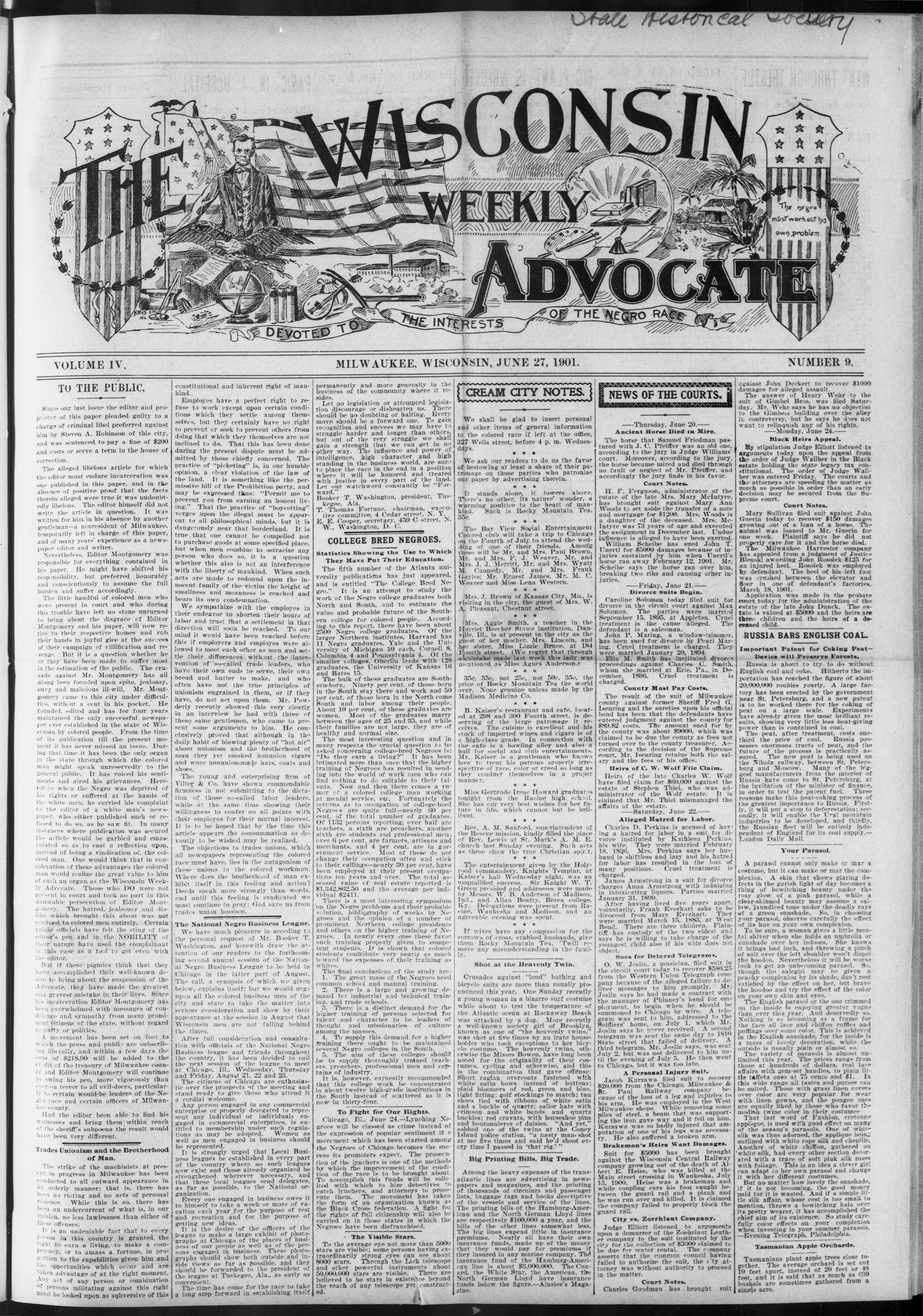
WISCONSIN
WEEKLY
ADVOCATE
DEVOTED TO THE INTERESTS OF THE NEGRO RACE
TO THE PUBLIC.
Since our last issue the editor and proprietor of this paper pleaded guilty to a charge of criminal libel preferred against him by Steven A. Robinson of this city, and was sentenced to pay a fine of $200 and costs or serve a term in the house of correction.
The alleged libelous article for which the editor must endure incarceration was one published in this paper, and in the absence of positive proof that the facts therein alleged were true it was undoubtedly libelous. The editor himself did not write the article in question. It was written for him in his absence by another gentleman—a nonresident of Milwaukee, temporarily left in charge of this paper, and of many years' experience as a newspaper editor and writer. Nevertheless, Editor Montgomery was responsible for everything contained in his paper. He might have shifted his responsibility, but preferred honorably and conscientiously to assume the full burden and suffer accordingly.
The little handful of colored men who were present in court and who during this trouble have left no stone unturned to bring about the disgrace of Editor Montgomery and his paper, will now retire to their respective homes and rub their hands in joyful glee at the success of their campaign of villification and revenge. But it is a question whether he or they have been made to suffer most in the estimation of the public. The crusade against Mr. Montgomery has all along been founded upon spite, jealousy, envy and malicious ill-will. Mr. Montgomery came to this city under difficulties, without a cent in his pocket. He founded, edited and has for four years maintained the only successful newspaper ever established in the state of Wisconsin by colored people. From the time of its publication till the present moment it has never missed an issue. During that time it has been the only organ in the state through which the colored man might speak unreservedly to the general public. It has voiced his sentiments and aired his grievances. Heretofore when the Negro was deprived of his rights or suffered at the hands of the white man, he carried his complaint to the editor of a white man's newspaper, who either published such or refused to do so, as he saw fit. In many instances where publication was secured the article would be garbled and emasculated so as to cast a reflection upon, instead of being a vindication of, the colored man. One would think that in consideration of these advantages the colored man would realize the great value to him of such an organ as the Wisconsin Weekly Advocate. Those who DO were not present in court and took no part in this damnable persecution of Editor Montgomery. The hatred, jealsousy and dislike which brought this about was not confined to colored men entirely. Certain public officials have felt the sting of the editor's pen and in the NOBILITY of their nature have used the complainant in this case as a tool to get even with the editor.
But if these pigmies think that they have accomplished their well-known desire to bring about the suspension of the Advocate, they have made the greatest and gravest mistake in their lives. Since his incarceration Editor Montgomery has been overwhelmed with messages of condolence and sympathy from many prominent citizens of the state, without regard to party or politics.
A movement has been set on foot to which the press and public are subscribing liberally, and within a few days the sum of $218.90 will be added to the credit of the treasury of Milwaukee county and Editor Montgomery will continue to swing his pen, more vigorously than ever—a terror to all evil-doers, particularly to certain would-be leaders of the Negro race and certain officers of Milwaukee county.
Had the editor been able to find his witnesses and bring them within reach of the sheriff's subpoena the result would have been very different.
Trades Unionism and the Brotherhood of Man.
The strike of the machinists at present in progress in Milwaukee has been conducted to all outward appearance in an orderly manner: that is, there has been no rioting and no acts of personal violence. While this is so, there has been an undercurrent of what is, in our opinion, no less lawlessnes than either of these offenses.
It is an undeniable fact that to every person in this country is granted the right to earn a living, to make a competency, or to amass a fortune, in proportion to the capabilities given him and the opportunities which occur and are taken advantage of at the right moment. Any act of any person or combination of persons militating against this right must be looked upon as subversive of this
constitutional and inherent right of mankind.
Employees have a perfect right to refuse to work except upon certain conditions which they settle among themselves, but they certainly have no right to prevent or seek to prevent others from doing that which they themselves are not inclined to do. That this has been done during the present dispute must be admitted by those chiefly concerned. The practice of "picketing" is, in our humble opinion, a clear violation of the law of the land. It is something like the permissive bill of the Prohibition party, and may be expressed thus: "Permit me to prevent you from earning an honest living." That the practice of "boycotting" verges upon the illegal must be apparent to all philosophical minds, but it is dangerously near that borderland. It is true, that one cannot be compelled not to purchase goods at some specified place, but when men combine to ostracize any person who does so, it is a question whether this also is not an interference with the liberty of mankind. When such acts are made to redound upon the innocent family of the victim the height of smallness and meanness is reached and bears its own condemnation.
We sympathize with the employes in their endeavor to shorten their hours of labor and trust that a settlement in that direction will soon be reached. To our mind it would have been reached before this if employers and employes were allowed to meet each other as men and settle their differences without the intervention of so-called trade leaders, who have their own ends to serve, their own bread and butter to make, and who often have not the true principles of unionism engrained in them, or if they have, do not act upon them. Mr. Powderly recently showed this very clearly in an interview he had with three of these same gentlemen, who came to present some arguments to him. He conclusively proved that although in the daily habit of blowing plenty of "hot air" about unionism and the brotherhood of man they yet smoked nonunion cigars and wore nonunion-made hats, coats and shoes.
The young and enterprising firm of Vilter & Co. have shown commendable firmness in not submitting to the dictation of those so-called labor leaders, while at the same time showing their willingness to confer on all points with their employees for their mutual interest. It is to be hoped that by the time this article appears the consummation so devoutly to be wished may be realized.
The objections to trades unions, which all newspapers representing the colored race must have, lies in the antagonism of these unions to the colored workman. Where does the brotherhood of man exhibit itself in this feeling and action? Deeds speak more strongly than words, and until this feeling is eradicated we must continue to pray: God save us from trades union bossism.
The National Negro Business League. We have much pleasure in acceding to the personal request of Mr. Booker T. Washington, and herewith draw the attention of our readers to the forthcoming second annual session of the National Negro Business League to be held in Chicago in the latter part of August. The call, a synopsis of which we given below, explains itself; but we would urge upon all the colored business men of the city and state to take the matter into serious consideration and show by their appearance at the session in August that Wisconsin men are not falling behind the times.
After full consideration and consultation with officials of the National Negro Business league and friends throughout the country, it has been decided to call the next session of the league to meet at Chicago, Ill., Wednesday, Thursday and Friday, August 21, 22 and 23. The citizens of Chicago are enthusiastic over the prospects of the meeting and stand ready to give those who attend it a cordial welcome. Any person engaged in any commercial enterprise or properly delegated to represent any individual or individuals engaged in commercial enterprises, is entitled to membership under such regulations as may be adopted. Women as well as men engaged in business should be represented.
It is strongly urged that Local Business leagues be established in every part of the country where no such leagues now exist and those already organized be strengthened wherever necessary, and that these local leagues send delegates, as far as possible, to the National organization. Every one engaged in business owes it to himself to take a week or more of vacation each year for the purpose of rest and recreation and for the purpose of getting new ideas.
It is the desire of the officers of the league to make a large exhibit of photographs at Chicago of the places of business of our people as well as of the persons engaged in business. These photographs should show both outside and inside views as far as possible, and they should be forwarded to the president of the league at Tuskegee, Ala., as early as convenient. The time has come for the race to take a long step forward in establishing itself
permanently and more generally in the business of the community where it resides. Let no legislation or attempted legislation discourage or dishearten us. There should be no doubting or halting. Every move should be a forward one. To gain recognition and success we may have to struggle harder and longer than others, but out of the very struggle we shall gain a strength that we can get in no other way. The influence and power of intelligence, high character and high standing in the business world, are sure to place the race in the end in a position where it will be honored and treated with justice in every part of the land. Let our watchword constantly be "Forward."
Booker T. Washington, president, Tuskegee, Ala.
T. Thomas Fortune, chairman, executive committee, 4 Cedar street, N. Y.
E. E. Cooper, secretary, 459 C street, N.
W. Washington, D. C.
COLLEGE BRED NEGROES.
Statistics Showing the Use to Which They Have Put Their Education.
The fifth number of the Atlanta university publications has just appeared, and is entitled "The College Bred Negro." It is an attempt to study the work of the Negro college graduates both North and South, and to estimate the value and probable future of the Southern college for colored people. According to this report, there have been about 2500 Negro college graduates. Of the larger Northern institutes, Harvard has 11 Negro graduates, Yale and the University of Michigan 10 each, Cornell 8, Columbia 4 and Pennsylvania 4. Of the smaller colleges, Oberlin leads with 128 graduates, the University of Kansas 16 and Bates 15.
The bulk of these graduates are Southern-born. Ninety per cent. of those born in the South stay there and work and 50 per cent. of those born in the North come South and labor among their people. About 10 per cent. of these graduates are women. Most of the graduates marry between the ages of 25 and 35, and while their families are not large, they are of healthy and normal size.
The most interesting question and in many respects the crucial question to be asked concerning college-bred Negroes is: "Do they earn a living?" It has been intimated more than once that the higher training of Negroes has resulted in sending into the world of work men who can find nothing to do suitable to their talents. Now and then there comes a rumor of a colored college man working at menial service, etc. Fortunately the returns as to occupation of college-bred Negroes are quite full—nearly 60 per cent, of the total number of graduates. Of 1132 persons reporting, over half are teachers, a sixth are preachers, another sixth are students and professional men; over 6 per cent, are farmers, artisans and merchants, and 4 per cent, are in government service. Most of these do not change their occupation often and stick to their callings—nearly 30 per cent. have been employed at their present occupations ten years and over. The total assessed value of real estate reported is $1,342,862.50 and the average per individual $2411.
There is a most interesting symposium on the Negro problems and their probable solution, bibliography of works by Negroes and the opinion of a number of prominent Northern college presidents and others on the higher training of Negroes. In nearly every case these favor such training properly given to competent students. It is shown that colored students contribute very nearly as much toward the expenses of their training as whites. The final conclusions of the study are: 1. The great mass of the Negroes need common school and manual training. 2. There is a large and growing demand for industrial and technical training, and trade schools.
3. There is a distinct demand for the higher training of persons selected for talent and character to be leaders of thought and missionaries of culture among the masses.
4. To supply this demand for a higher training there ought to be maintained several Negro colleges in the South.
5. The aim of these colleges should be to supply thoroughly trained teachers, preachers, professional men and captains of industry.
It is, however, earnestly recommended that this college work be concentrated in about twelve high-grade institutions in the South instead of scattered as it is now in thirty-four.
To Fight for Our Rights
Chicago, Ill., June 24.—Lynching Negroes will be classed as crime instead of the expression of popular sentiment if a movement which has been started among the Negroes of Chicago becomes the success its promoters expect. The prosecution of the lynchers is one of the methods by which the improvement of the condition of the race is to be brought about. To accomplish this funds will be solicited with which to hire detectives to catch lynchers, and attorneys to prosecute them. The movement has taken the form of an organization known as the Black Cross federation. A fight for the rights of full citizenship will also be carried on in those states in which the Negroes have been disfranchised.
The Visible Stars.
To the average eye not more than 5000 stars are visible; some persons having extraordinarily strong eyes can see about 8000 stars. Through the Lick telescope and other powerful instruments about 50,000,000 stars are visible. There are believed to be stars in existence beyond the reach of any telescope yet constructed.
CREAM CITY NOTES.
We shall be glad to insert personal and other items of general information to the colored race if left at the office, 327 Wells street, before 4 p. m. Wednesdays.
***
We ask our readers to do us the favor of bestowing at least a share of their patronage on those parties who patronize our paper by advertising therein.
***
It stands alone, it towers above. There's no other, its nature' wonder, a warming poulice to the heart of mankind. Such is Rocky Mountain Tea. 35c.
* * *
The Bay View Social Entertainment Colored club will take a trip to Chicago on the Fourth of July to attend the wedding of one of their friends. Among these will be Mr. and Mrs. Paul Brown. Mr. and Mrs. F. J. Weaver, Mr. and Mrs. J. J. Merritt, Mr. and Mrs. Wyatt M. Cannedy, Mr. and Mrs. Frank Gayles; Mr. Ernest James, Mr. M. C. Weaver and Miss Lena Western.
***
Mrs. J. Brown of Kansas City, Mo., is visiting in the city, the guest of Mrs. W. A. Pleasant, Chestnut street.
* * *
Mrs. Aggie Smith, a teacher in the Harriet Beecher Stowe institution, Danville, Ill., is at present in the city as the guest of her mother, Mrs. Lincoln, and her sister, Miss Lizzie Bruce, at 184 Fourth street. (We regret that through a mistake made last week this lady was mentioned as Miss Agnes Anderson.)
***
35c, 35c, not 25c, not 50c, 35c, the price of Rocky Mountain Tea the world over. None genuine unless made by the Madison Medicine Co.
---
B. Kaiser's restaurant and cafe, located at 298 and 300 Fourth street, is deserving of the large patronage it receives. The cuisine is excellent and his stock of imported wines and cigars is of a high-class grade. In connection with the cafe is a bowling alley and also a hall for social and club entertainments. Mr. Kaiser is a gentleman who knows how to treat his patrons properly irrespective of race, color or creed so long as they conduct themselves in a proper manner.
* * *
Miss Gertrude Irene Howard graduates tonight from the Racine high school. She has our very best wishes for her future in life, which cannot but be brilliant.
* * *
Rev. A. M. Sanford, superintendent of the Rescue mission, kindly filled the place of Rev. Lewis at St. Mark's A. M. E. church last Sunday evening. Such acts as these show the true Christian spirit.
The entertainment given by the Holy-rood commandery, Knights Templar, at Kaiser's hall Wednesday night, was an unqualified success. Sir Knight W. T. Green presided and addresses were made by Messrs. W. B. Anderson of Madison, Ind., and Allan Beatty, Berea college, Ky. Delegations were present from Racine, Waukesha and Madison, and an agreeable evening was spent.
* * *
If wives have any compassion for the sorrows of cross, crabbed husbands, give them Rocky Mountain Tea. 'Twill remove any misunderstanding in the family.
Shot at the Heavenly Twin.
Crusades against "loud" bathing and bicycle suits are more than usually pronounced this year. One Sunday recently a young woman in a bizarre surf costume while about to test the temperature of the Atlantic ocean at Rockaway Beach was attacked by a dog. More recently a well-known society girl of Brooklyn, known as one of "the heavenly twins," was shot at five times by an irate householder who took exceptions to her bicycle costume. The heavenly twins, otherwise the Misses Bowen, have long been noted for the originality of their costumes, cycling and otherwise, and this is the combination that gave offense: Short raglan overcoats fastened with white satin bows instead of buttons; plaid bloomers of red, green and blue, tight fitting; golf stockings to match; tan shoes tied with ribbons of white satin and a buckle of quartz; sailor hats with crimson and white bands and quartz buckles; red cravats, with horseshoe pins and boutonieres of daisies. "And yet," sobbed one of the twins at the Coney Island police station. "a nasty man shot at me five times and said he'd shoot every time I passed in 'that rig.'"
Big Printing Bills, Big Trade.
Among the heavy expenses of the transatlantic lines are advertising in newspapers and magazines, and the printing of thousands of circulars and passenger lists, baggage tags and books descriptive of the vessels and service of the lines. The printing bills of the Hamburg-American and the North German Lloyd lines are respectively $100,000 a year, and the bills of the other lines somewhat less. The big lines expend little in insurance premiums. Nearly all have their own insurance funds, made up of the money that they would pay for premiums if they insured in any marine company. The insurance fund of the Hamburg-American line is about $3,000,000. The Cunard, the White Star, the American, the North German Lloyd have insurance funds below the figure.—Ainslee's Magazine.
Thursday, June 20. Ancient Horse Died in Mires.
The horse that Samuel Friedman pastured with J. C. Pfeiffer was an old one, according to the jury in Judge Williams' court. Moreover, according to the jury, the horse became mired and died through no fault or neglect of Mr. Pfeiffer, and accordingly the jury finds in his favor.
Court Notes.
H. F. Ferguson, administrator of the estate of the late Mrs. Mary McIntyre, has brought suit against Mary Ann Woods to set aside the transfer of a note and mortgage for $1200. Mrs. Woods is a daughter of the deceased. Mrs. McIntyre was 73 years of age and executed the assignment in December last. Undue influence is alleged to have been exerted. William Scheibe has sued John T. Unertl for $5000 damages because of injuries sustained by him when Unertl's horse ran away February 12, 1901. William Scheibe says the horse ran over him, breaking two ribs and causing other injuries.
Caroline Solomon today filed suit for divorce in the circuit court against Max Solomon. The parties were married September 15, 1895, at Appleton. Cruel treatment is the cause alleged. The defendant is a salesman. John P. Maring, a window-trimmer, has been sued for divorce by Pearl Maring. Cruel treatment is charged. They were married January 20, 1894. Ella M. Smith has instituted divorce proceedings against Charles C. Smith, whom she married at Erie, Pa., in December, 1896. Cruel treatment is charged.
County Must Pay Costs.
The result of the suit of Milwaukee county against former Sheriff Fred G. Isenring and the sureties upon his official bond has been that the defendants have entered judgment against the county for $89.82 costs. The amount sued for by the county was about $9000, which was claimed to be due the county as fees not turned over to the county treasurer. According to the decision of the Supreme court, Mr. Isenring retains both the salary and the fees of his office.
Heirs of C. W. Wolf File Claim:
Heirs of the late Charles W. Wolf have filed claim for $60,000 against the estate of Stephen Thiel, who was administrator of the Wolf estate. It is claimed that Mr. Thiel mismanaged the affairs of the estate.
Saturday. June 22.
Alleged Hatred for Labor.
Charles D. Perkins is accused of having a hatred for labor in a suit for divorce instituted by Kathleen Perkins, his wife. They were married February 18, 1896. Mrs. Perkins says her husband is shiftless and lazy and his hatred for labor has resulted in the loss of many positions. Cruel treatment is charged.
James Armstrong in a suit for divorce charges Anna Armstrong with indulging in intoxicating liquors. Parties married January 31, 1899.
After having lived five years apart, voluntarily, Frank Everhart asks to be divorced from Mary Everhart. They were married March 15, 1883, at West Bend. There are three children. Plaintiff has custody of the two eldest and says he is willing to take charge of the youngest child also if his wife does not object.
Sues for Delayed Telegrams.
O. W. Joslin, a musician, filed suit in the circuit court today to recover $586.25 from the Western Union Telegraph company because of the alleged failure to deliver messages to him promptly. Mr. Joslin says he had made a contract with the manager of Phinney's band for employment, to begin when he should be summoned to Chicago by wire. A telegram was sent to him, addressed to the Soldiers' home, on July 1, which Mr. Joslin says he never received. A second telegram was sent the same day to 1810 State street that failed of delivery. A third telegram, Mr. Joslin says, was sent July 2, but was not delivered to him until the evening of July 5. He then went to Chicago, but it was too late.
A Personal Injury Suit.
Jacob Kurzawa filed suit to recover $20,000 from the Chicago, Milwaukee & St. Paul Railway company because of the loss of a leg and injuries to his arm. He was employed in the West Milwaukee shops. While removing some piles of steel, a beam that was supporting the iron gave way and it fell on him. Kurzawa was so badly injured that amputation of one of his legs was necessary. He also suffered a broken arm.
Brakeman's Heirs Want Damages.
Suit for $5000 has been brought against the Wisconsin Central Railway company growing out of the death of Albert E. Heise, who was killed at the Main street crossing in Waukesha, July 13, 1900. Heise was a brakeman and while coupling cars his foot caught between the guard rail and a plank and he was run over and killed. It is claimed the company failed to properly block the guard rail.
City vs. Zoerhlaut Company.
Judge Elliott listened to arguments upon a demurrer of the Zoehrlaut Leather company to the suit instituted by the city for the collection of $3600 claimed to be due for water rental. The company asserts that the common council having failed to authorize the suit, the city attorney was without authority to proceed in the matter.
Court Notes.
Charles Goodman has brought suit
against John Deckert to recover $1000 damages for alleged assault.
The answer of Henry Wehr to the suit of Gimbel Bros. was filed Saturday. Mr. Wehr says he has no objection to the Gimbees building over the alley in controversy, but he says he does not want to relinquish any of his rights.
Black Heirs Appeal.
By stipulation Judge Elliott listened to arguments today upon the appeal from the order of Judge Wallber in the Black estate holding the state legacy tax constitutional. The order of Judge Wallber was entered Friday. The courts and the attorneys are speeding the matter as much as possible in order than an early decision may be secured from the Supreme court.
Court Notes.
Mary Sullivan filed suit against John Guerin today to recover $150 damages growing out of a loan of a horse. The animal was loaned to Mr. Guerin for one week. Plaintiff says he did not properly care for it and the horse died. The Milwaukee Harvester company has appealed from a judgment of Justice Blenski awarding John Rosolek $125 for an injured heel. Rosolek was employed by defendant. The heel of his left foot was crushed between the elevator and floor in one of defendant's factories, March 18, 1901. Application was made in the probate court today for the administration of the estate of the late John Dunck. The estate is valued at $5000 and the heirs are three children and the heirs of a deceased child.
RUSSIA BARS ENGLISH COAL.
Important Patent for Coking Peat-
Russia is about to try to do without English coal and coke. Hitherto the importation has reached the figure of about 20,000,000 roubles yearly. A large factory has been erected by the government near St. Petersburg, and a new patent is to be worked there for the coking of peat on a large scale. Experiments have already given the most brilliant results, showing very little less heat-giving power than is contained in coal.
The peat, after treatment, costs one-third the price of coal. Russia possesses enormous tracts of peat, and the future of the process is practically assured. The new peat is being used on the Nikola railway, between St. Petersburg and Moscow. Many of the biggest manufacturers from the interior of Russia have come to St. Petersburg, at the invitation of the minister of finance, in order to test the patent fuel. Three reasons make this peat-coking process of the greatest importance to Russia. Firstly, it will put a stop to deforestation; secondly, it will enable the Ural mountain industries to be developed, and thirdly, the Russian fleet will be entirely independent of England for its coal supply.—London Daily Mail.
Your Parasol
A parasol cannot only make or mar a costume, but it can make or mar the complexion. A skin that shows glaring defects in the garish light of day becomes a thing of bewitching beauty under the rosy glow of a pink parasol, while a clear-skinned beauty may assume a sallow, jaundiced tone under the deadly rays of a green sunshade. So, in choosing your parasol, observe carefully the effect of its hue on your own complexion.
To be sure, a woman gives a little mental shiver when she holds an umbrella or sunshade over her indoors. She knows it brings bad luck, and throwing a pinch of salt over the left shoulder won't dispel the hoodoo. Nevertheless it will be worse luck to get an unbecoming parasol. So, though the salegirl may be given a peachy complexion by its shade, don't rest satisfied by the effect on her, but brave the hoodoo and try the effect of the color on your own skin and eyes.
The English parasol or the one trimmed on the inside is enjoying greater vogue than ever this year. And deservedly so. Nothing is so becoming as a frame for the face all face and chiffon ruffles and puffings over some color. This is achieved in the English sunshade, for the inside is a mass of lovely decoration, while the outside is usually plain or almost so.
The variety of parasols is almost unlimited this year. The prices range from those at hundreds of dollars, real lace affairs with gem-set handles, to plain little taffeta ones at 75 cents and $1. In this wide range all tastes and purses can be suited. Those with grass linen covers over color are very popular for wear with linen gowns, and the pongee ones are equally liked by those who favor themish twine color in their costumes. That last word of Fashion, cretonne applique, is used with good effect on many of the season's parasols. One of whit silk was thus adorned, the applique being outlined with white rope silk and chenille. Another of white chiffon, gathered on white silk, had every other section decorated with a trace of soft pink silk roses with foliage. This is an idea a clever girl can adapt to her own parasol and change it with her different costumes.
But no matter how lovely the sunshade, if it is not becoming, the good money paid for it is wasted. And if a simple little silk affair, whose cost is too small to mention, throws a bewitching halo over its pretty weaker, it has accomplished the chief aim of its existence. So study carefully color effects on your complexion when investing in your summer parasols. —Evening Telegraph, Philadelphia.
Tasmanian Apple Orchards,
Tasmanians plant apple trees close together. The average orchard is set out 10 feet apart, instead of 20 feet or 49 feet, and it is said that as much as 600 bushels are sometimes gathered from a single acre.
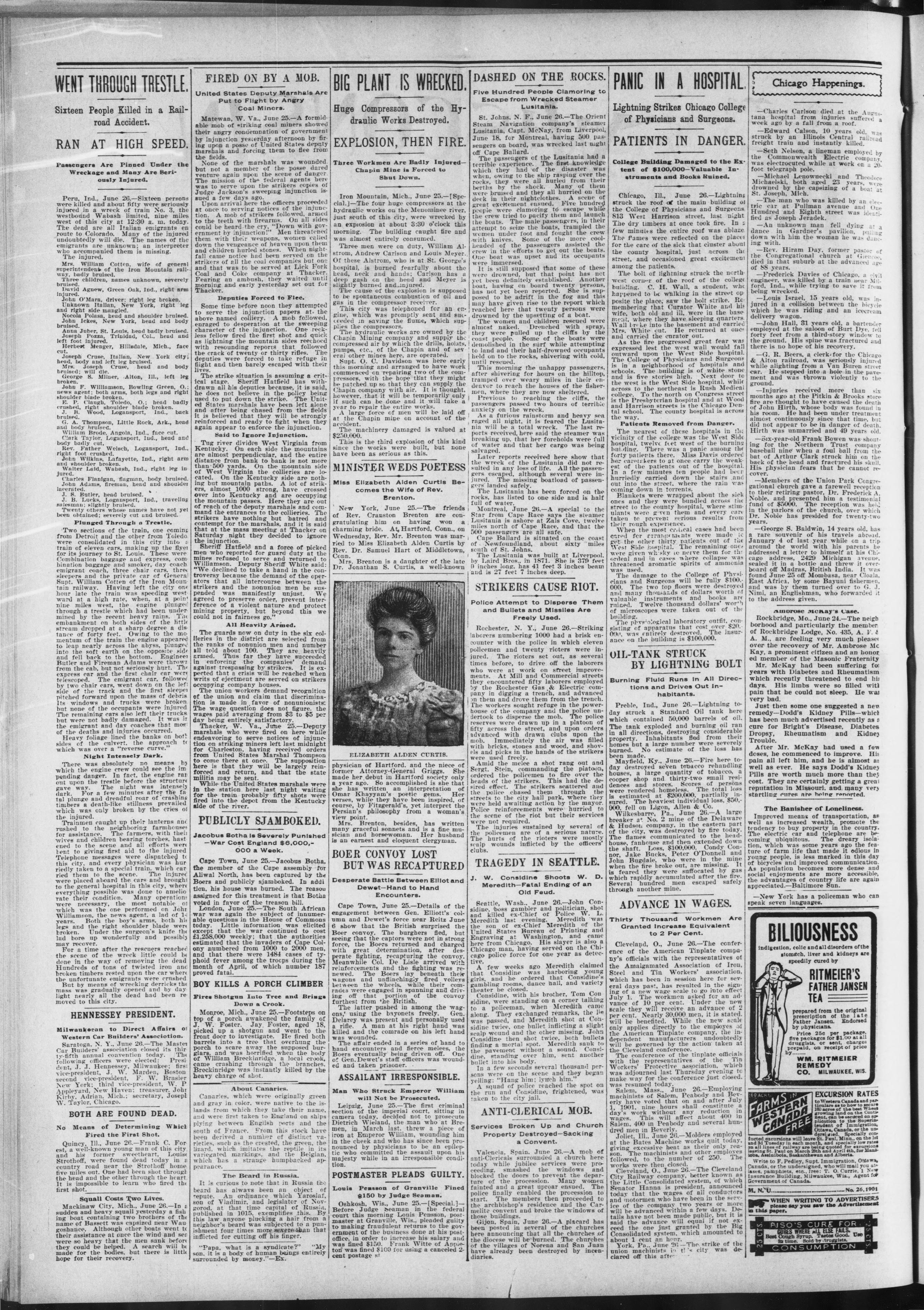
WENT THROUGH TRESTLE.
Passengers Are Pinned Under the Wreckage and Many Are Seriously Injured.
Peru, Ind., June 26.—Sixteen persons were killed and about fifty were seriously injured in a wreck of train No. 3, the westbound Wabash limited, nine miles west of this city at 12:30 a. m. today. The dead are all Italian emigrants en route to Colorado. Many of the injured undoubtedly will die. The names of the emigrants are unknown; an interpreter who accompanied them is missing. The injured.
Mrs. William Cotten, wife of general superintendent of the Iron Mountain railway, badly bruised.
Three children, names unknown, severely bruised.
David Agnew, Green Oak, Ind., right arm injured.
John O'Mara, driver: right leg broken.
Unknown Italian, New York, right leg and right side mangled.
Nocola Polasa, head and shoulder bruised.
John Ickes, New York, head and body bruised.
Anna Juber, St. Louis, head badly bruised.
Joseph Pozza, Trinidad, Col., head and left foot injured.
Herbert Menger, Hillsdale, Mich., face cut.
George S. Milner, Alton, Ill., left leg broken.
John F. Williamson, Bowling Green, O.; news agent; both arms, both legs and right shoulder blade broken.
E. P. Clangh, Toledo, O.; head badly crushed, right shoulder blade broken.
J. B. Wood, Logansport, Ind., back bruised.
G. A. Thompson, Little Rock, Ark., head and body bruised.
William Brode, Angola, Ind., face cut.
Clark Taylor, Logansport, Ind., head and body badly cut.
Rev. Father Welsch, Logansport, Ind., right foot crushed.
John Wilkins, Lafayette, Ind., right arm and shoulder broken.
Walter Laid, Wabash, Ind., right leg injured.
Charles Flanigan, flagman, body bruised. John Adams, fireman, head and shoulder lacerated. J. S. Butler, head bruised. J. B. Lucks, Logansport, Ind., traveling salesman; slightly bruised. Twenty others whose names have not yet
Twenty others whose names have not yet been obtained; severely cut and bruised.
Two sections of the train, one coming from Detroit and the other from Toledo were consolidated in this city into a train of eleven cars, making up the flyer for its journey to St. Louis. These were Combination baggage and express, combination baggage and smoker, day coach, emigrant coach, three chair cars, three sleepers and the private car of General Supt. William Cotten of the Iron Mountain railway. Having left the city one hour late the train was speeding westward at a high rate, when, at a point nine miles west, the engine plunged through a trestle which had been undermined by the recent heavy rains. The embankment on both sides of the little stream dropped at a sharp degree a distance of forty feet. Owing to the momentum of the train the engine appeared to leap nearly across the abyss, plunged into the soft earth on the opposite side and fell back to the bottom. Engineer Butler and Fireman Adams were thrown from the cab, but not seriously hurt. The express car and the first chair car were telescoped. The emigrant car, followed by two chair cars, went down on the left side of the track and the first sleeper pitched forward upon the mass of debris. Its windows and trucks were broken, but none of the occupants were injured. The remaining cars also left their trucks, but were not badly damaged. It was in the emigrant and day coaches that most of the deaths and injuries occurred.
Heavy foliage lined the banks on both sides of the culvert. the approach to which was over a "reverse curve."
Night Intensely Dark.
There was absolutely no means by which the engine crew could see the impending danger. In fact, the engine ran out upon the trestle before the structure gave way. The night was intensely dark. For a few minutes after the fatal plunge and dreadful roar of crashing timbers a death-like stillness prevailed which was only broken by the cries of the injured.
Trainmen caught up their lanterns and rushed to the neighboring farmhouses for assistance. The farmers, with their wives and children bearing torches, hastened to the scene and all efforts were bent to giving first aid to the injured. Telephone messages were dispatched to this city, and every physician was hurriedly taken to a special train, which carried them to the scene. The injured were placed aboard the cars and brought to the general hospital in this city, where everything possible was done to ameliorate their condition. Many operations were necessary, the most notable of which was the one performed on John Williamson, the news agent, a lad of 1-years. Both the boy's arms, both his legs and the right shoulder blade were broken. Under the surgeon's knife the lad bore up wonderfully and possibly may recover.
For a time after the rescuers reached the scene of the wreck little could be done in the way of removing the dead. Hundreds of tons of twisted iron and broken timbers rested upon the car where the unfortunate emigrants were crushed. But by means of wrecking derricks the mass was gradually opened and by day light nearly all the dead had been removed to this city.
HENNESSEY PRESIDENT.
Milwaukocan to Direct Affairs of Western Car Builders' Association.
Saratoga, N. Y., June 26.—The Master Car Builders' association closed its thirty-fifth annual convention today. The following officers were elected: President, J. J. Hennessey, Milwaukee; first vice-president, J. W. Marden, Boston; second vice-president, F. W. Brasier, New York; third vice-president, W. P. Appleyard, New Haven; treasurer, John Kirby, Adrian, Mich.; secretary, Joseph W. Taylor, Chicago.
BOTH ARE FOUND DEAD.
No Means of Determining Which Fired the First Shot.
Quincy, Ill., June 26.—Frank C. Forest, a well-known young man of this city, and his former sweetheart, Louise Strothoff, were found dead today in a country road near the Strothoff home five miles out. One had been shot through the head and the other through the heart. It is impossible to learn who fired the first shot.
Small Costs Two Lives.
Mackinaw City, Mich., June 26.—In a sudden and heavy squall yesterday a fishing boat containing two brothers of the name of Bassett was capsized near Waugoshance. Although other boats went to their assistance at once the wind and sea were so heavy that the men sank before they could be helped. A search will be made for the bodies, but there is little hope for their recovery.
FIRED ON BY A MOB.
United States Deputy Marshals Are Put to Flight by Angry Coal Miners.
Matewan, W. Va., June 25.—A formidable mob of striking coal miners showed their angry condemnation of government by injunction yesterday afternoon by firing upon a posse of United States deputy marshals and forcing them to flee from the fields.
None of the marshals was wounded, but not a member of the posse dared venture again upon the scene of danger. The mission of the federal agents here was to serve upon the strikers copies of Judge Jackson's sweeping injunction issued a few days ago.
Upon arrival here the officers proceeded at once to serving notices of the injunction. A mob of strikers followed, armed to the teeth with firearms. On all sides could be heard the cry, "Down with government by injunction!" Men threatened them with their weapons, women called down the vengeance of heaven upon them and children hurled stones. When nightfall came notice had been served on the strikers of all the coal companies but one and that was to be served at Lick Fork Coal and Coke company at Thacker. Fearing an ambush, they waited until morning and early yesterday set out for Thacker.
Deputies Forced to Flee.
Some time before noon they attempted to serve the injunction papers at the above named colliery. A mob followed, enraged to desperation at the sweeping character of the injunction. One reckless fellow fired the first shot and quick as lightning the mountain sides reeched with resounding reports that followed the crack of twenty or thirty rifles. The deputies were forced to take refuge in flight and then barely escaped with their lives.
The strike situation is assuming a critical stage. Sheriff Hatfield has withdrawn all his deputies because, it is said, he does not believe in the policy being used to put down the strike. The United States marshals have been left alone and after being chased from the fields it is believed that they will be strongly reinforced and ready to fight when they again appear to enforce the injunction.
Said to Ignore Injunction.
Tug river divides West Virginia from Kentucky. On each side the mountains are almost perpendicular, and the entire distance from bank to bank is not more than 500 yards. On the mountain side of West Virginia the collieries are located. On the Kentucky side are nothing but mountain paths. A lot of strikers, almost 1000 strong, have crossed over into Kentucky and are occupying the mountain passes. Here they are out of reach of the deputy marshals and command the entrances to the collieries. The strikers have nothing but hatred and contempt for the marshals, and it is said that at the mass meeting at Thacker on Saturday night they decided to ignore the injunction.
Sheriff Hatfield and a force of picked men who reported for guard duty at the mines refused to serve and returned to Williamson. Deputy Sheriff White said: "We declined to take a hand in the controversy because the demand of the operators that all intercourse between the strikers and the nonunion men be suspended was manifestly unjust. We agreed to preserve order, prevent interference of a violent nature and protect mining property, but beyond this we could not in fairness go."
All Heavily Armed.
The guards now on duty in the six collieries in the district are selected from the ranks of nonunion men and number all told about 100. They are heavily armed. Thus far they have succeeded in enforcing the companies' demand against trespassing by strikers. It is expected that a crisis will be reached when writs of ejectment are served on strikers occupying company houses. The union workers demand recognition of the union and claim that discrimination is made in favor of nonunionists. The wage question does not figure. the wages paid averaging from $3 to $5 per day being entirely satisfactory.
Thacker, W. Va., June 25.—Deputy marshals who were fired on here while endeavoring to serve notices of injunction on striking miners left last midnight for Charleston, having received orders from United States Marshal Thompson to come there at once. The supposition here is that they will be largely reinforced and return, and that the state militia may be sent.
While the United States marshals were in the station here last night waiting for the train probably fifty shots were fired into the depot from the Kentucky side of the river.
PUBLICLY SJAMBOKED.
Jacobus Botha is Severely Punished
—War Cost England $6,000,-000 a Week.
Cape Town, June 25.—Jacobus Botha, the member of the Cape assembly for Aliwal North, has been captured by the Boers and publicly sjamboked. In addition, his house was burned. The reason assigned for this treatment is that Botha voted in favor of the treason bill. London, June 25.—The South African war was again the subject of innumerable questions in the House of Commons today. Little information was elicited except that the war continued to cost £1,258,000 weekly; that the authorities estimated that the invaders of Cape Colony numbered from 1000 to 2000 men, and that there were 1484 cases of typhoid fever among the troops during the month of April, of which number 187 proved fatal.
BOY KILLS A PORCH CLIMBER
Fires Shotgun Into Tree and Brings Down a Crook.
Monroe, Mich., June 25.—Footsteps on top of a porch awakened the family of J. W. Foster. Jay Foster, aged 18, picked up a shotgun and went to the front door to investigate. He fired both barrels into a tree that overhung the porch to scare away the supposed burglars, and was horrified when the body of William Breckinridge, a local crook, came crashing through the branches. Breckinridge was instantly killed by the heavy charge of shot.
About Canaries.
Canaries, which were originally green and gray in color, were native to the islands from which they take their name, and were first taken to England on ships plying between English ports and the south of France. From this stock have been derived a number of distinct varieties, such as the crested, the green, the lizard, which imitates the reptile in its variegated markings, and the Belgian, which has a strange humpbacked appearance.
The Beard in Russia
It is curious to note that in Russia the beard has always been an object of repute. An ordinance which Yaroslaf, son of Vladimir, and legislator of Novgorod, at that time capital of Russia, published in 1015, exemplifies this. By this law anyone plucking a hair from a neighbor's beard was subjected to a punishment four times more severe than that inflicted for cutting off his finger.
"Papa, what is a syndicate?" "My son, it is a body of human beings entirely surrounded by money."—Ex.
BIG PLANT IS WRECKED.
Huge Compressors of the Hydraulic Works Destroyed.
EXPLOSION, THEN FIRE.
Three Workmen Are Badly Injured Chapin Mine is Forced to Shut Down
Iron Mountain, Mich., June 25.—[Special.]—The four huge compressors at the hydraulic works on the Menominee river, just south of this city, were wrecked by an explosion at about 3:30 o'clock this morning. The building caught fire and was almost entirely consumed.
Three men were on duty, William Alstrom, Andrew Carlson and Louis Meyer. Of these Alstrom, who is at St. George's hospital, is burned fearfully about the head, neck and hands; Carlson has a deep gash on the head and Meyer is slightly burned and injured.
The cause of the explosion is supposed to be spontaneous combustion of oil and gas in the compressor receiver.
This city was telephoned for an engine, which was promptly sent and succeeded in saving the flume, which supplies the compressors.
The hydraulic works are owned by the Chapin Mining company and supply the compressed air by which the drills, hoists, pumps, etc., of the Chapin and of several other mines here, are operated.
Supt. O. C. Davidson was here early this morning and arranged to have work commenced on repairing two of the compressors, with the hope that they might be patched up so that they can supply the Chapin company with air. It is thought, however, that it will be temporarily only if such can be done and it will take a year to repair the entire works.
A large force of men will be laid off at the Chapin mine on account of the accident.
The machinery damaged is valued at $250,000.
This is the third explosion of this kind since the works were built, but none have been as serious as this.
MINISTER WEDS POETESS
Miss Elizabeth Aiden Curtis Becomes the Wife of Rev. Brenton.
New York, June 25.—The friends of Rev. Cranston Brenton are congratulating him on having won a charming bride. At Hartford, Conn., on Wednesday, Rev. Mr. Brenton was married to Miss Elizabeth Alden Curtis by Rev. Dr. Samuel Hart of Middletown, Conn.
Mrs. Brenton is a daughter of the late Dr. Jonathan S. Curtis, a well-known
Mary E.
ELIZABETH ALDEN CURTIS. physician of Hartford, and the niece of former Attorney-General Griggs. She made her debut in Hartford society only a year ago. So accomplished is she that she has written an interpretation of Omar Khayyam's poetic gems. Her verses, while they have been inspired, of course, by Fitzgerald's, yet interpret the Persian's philosophy from a woman's view point. Mrs. Brenton, besides, has written many graceful sonnets and is a fine musician and horsewoman. Her husband is an earnest and eloquent clergyman.
BOER CONVOY LOST BUT WAS RECAPTURED
Desperate Battle Between Elliot and Dewet-Hand to Hand Encounters.
Cape Town, June 25.—Details of the engagement between Gen. Elliott's column and Dewet's force near Reitz June 6 show that the British surprised the Boer convoy. The burghers fled, but seeing that the captors were not in strong force, the Boers returned and charged with great determination, after desperate fighting, recapturing the convoy. Meanwhile Col. De Lisle arrived with reinforcements and the fighting was renewed. The Boers lay beneath their wagons and unfilinchingly fired volleys between the wheels, while their comrades were engaged in spanning and driving off that portion of the convoy furthest from the British.
The latter pushed in among the wagons, using the bayonets freely. Gen. Delarey was present and personally used a rifle. A man at his right hand was killed and the comrade on his left hand was wounded.
The affair ended in a series of hand to hand encounters and fierce melees, the Boers eventually being driven off. One of Gen. Dewet's staff officers was wounded and taken prisoner.
ASSAILANT IRRESPONSIBLE.
Man Who Struck Emperor William will Not be Prosecuted. Leipzig, June 25.—The first criminal section of the imperial court, sitting in camera today, decided not to prosecute Dietrich Wieland, the man who at Bremen, in March last, threw a piece of iron at Emperor William, wounding him in the cheek and who has since been pronounced by physicians to be an epileptic who committed the assault upon his majesty while in an irresponsible condition.
POSTMASTER PLEADS GUILTY.
Louis Pemson of Granville Fined
£150 by Judge Seaman.
Oshkosh, Wis., June 25.—[Special.]—Before Judge Seaman in the federal court this morning Louis Penssson, postmaster at Granville, Wis., pleaded guilty to making fraudulent returns to the government of the business done at his postoffice, in order to increase his salary and was fined $150. Frank Witte of Appleton was fined $100 for using a canceled 2-cent postage st
DASHED ON THE ROCKS.
Five Hundred People Clamoring to Escape from Wrecked Steamer Lusitania.
St. Johns, N. F., June 26.-The Orient Steam Navigation company's steamer Lusitania, Capt. McNay, from Liverpool, June 18, for Montreal, having 500 passengers on board, was wrecked last night off Cape Ballard.
The passengers of the Lusitania had a terrible experience. The first knowledge which they had of the disaster was when, owing to the ship rasping over the rocks, they were all hurried from their berths by the shock. Many of them were bruised and they all hurried on the deck in their nightclothes. A scene of great excitement ensued. Five hundred people were clamoring to escape while the crew tried to pacify them and launch the boats. The male passengers, in their attempt to seize the boats, trampled the women under foot and fought the crew with knives. Some of the more cool-headed of the passengers assisted the crew in the efforts to get out the boats. One boat was upset and its occupants were immersed.
It is still supposed that some of these were drowned, but that point has not yet been definitely established. Another boat, having on board twenty persons, has not yet been reported. She is supposed to be adrift in the fog and this may have given rise to the report which reached here that twenty persons were drowned by the upsetting of a boat.
The women and children rescued were almost naked. Drenched with spray, they were pulled up the cliffs by the coast people. Some of the boats were demolished in the surf while attempting to land and their half-drowned occupants held on to the rocks, shivering with cold, until rescued.
This morning the unhappy passengers, after shivering for hours on the hilltop, tramped over weary miles in their endeavor to reach the houses of the fishermen, where they are now sheltered.
Previous to reaching the cliffs, the passengers passed two hours of terrible anxiety on the wreck.
As a furious rainstorm and heavy sea raged all night, it is feared the Lusitania will be a total wreck. The last reports received, here said the steamer was breaking up, that her foreholds were full of water and that her cargo was being salvaged.
Later reports received here show that the wreck of the Lusitania did not resulted in any loss of life. All the passengers escaped, although several were injured. The missing boatload of passengers landed safely.
The Lusitania has been forced on the rocks, has listed to one side and is half full of water.
Montreal, June 26.—A special to the Star from Cape Race says the steamer Lusitania is ashore at Zals Cove, twelve miles north of Cape Race, and that the 500 passengers are all safe.
Cape Ballard is situated on the coast of Newfoundland, about sixty miles south of St. Johns.
The Lusitania was built at Liverpool, by Laird Bros., in 1871. She is 379 feet 9 inches long, has 41 feet 3 inches beam and is 27 feet 7 inches deep.
STRIKERS CAUSE RIOT.
Police Attempt to Disperse Them and Bullets and Missiles Are Freely Used.
Rochester, N. Y., June 26.—Striking laborers numbering 1000 had a brisk encounter with the police in which eleven policemen and twenty rioters were injured. The rioters set out, as several times before, to drive off the laborers who were at work on street improvements. At Mill and Commercial streets they encountered fifty laborers employed by the Rochester Gas & Electric company in digging a trench, and advanced in them and drove them from the trench. The workers sought refuge in the powerhouse of the company and the police undertook to disperse the mob. The police reserves were drawn up in a platoon of fifty across the street, and upon orders advanced with drawn clubs upon the mob. Immediately the air was filled with bricks, stones and wood, and shovels and picks in the hands of the strikers were used freely.
Amid the melee a shot rang out and Sergt. Stein, commanding the platoon, ordered the policemen to fire over the heads of the strikers. This had the desired effect. The strikers scattered and the police chased them through the streets to the city hall park, where they were held awaiting action by the mayor. Police reinforcements were hurried to the scene of the riot but their services were not required.
The injuries sustained by several of the policemen are of a serious nature. The hurts of the rioters were mostly scalp wounds inflicted by the officers' clubs.
TRAGEDY IN SEATTLE.
J. W. Considine Shoots W. D. Meredith-Fatal Ending of an Old Feud
Seattle, Wash.. June 26.—John Considine, boss gambler and politician, shot and killed ex-Chief of Police W. L. Meredith last evening. Meredith was the son of ex-Chief Meredith of the United States Bureau of Printing and Engraving at Washington, and came here from Chicago. His slayer is also a Chicago man, having served on the Chicago police force for one year as detective. A few weeks ago Meredith claimed that Considine was harboring young girls, and he ordered that Considine's gambling rooms, dance hall, and variety theater he closed.
Considine, with his brother, Tom Considine, were standing on a corner talking to a policeman, when Meredith came along. They exchanged remarks, the lis was passed, and Meredith shot at Considine twice, one bullet inflicting a slight scalp wound and the other missing. John Considine then shot twice, both bullets finding a mortal spot. Meredith sank to the pavement without a sound. Considine, standing over him, sent another bullet into his body.
In a few seconds several thousand persons were on the scene and they began yelling: "Hang him; lynch him."
A squad of police reached the spot on the run and Considine, frightened, was taken to the city jail.
ANTI-CLERICAL MOB.
Services Broken Up and Church Property Destroyed-Sacking a Convent.
Valencia, Spain. June 26.—A mob of anti-Clericals surrounded a church here today while jubilee services were proceeding, smashed the windows and blocked the doors to prevent the departure of the procession. Many women fainted and a great uproar ensued. The police finally enabled the procession to start. The members then proceeded to the archbishop's residence and the Carmelite convent and broke the windows of those buildings. Gijon, Spain, June 26.—A placard has been posted in several of the churches here announcing that all the churches of the diocese will be burned. The churches of the villages of Norena and San Juan have already been destroyed by incendiaries.
PANIC IN A HOSPITAL
College Building Damaged to the Extent of $100,000-Valuable Instruments and Books Ruined.
Chicago, Ill., June 26.—Lightning struck the roof of the main building of the College of Physicians and Surgeons. 813 West Harrison street, last night. The dry timbers at once took fire. In a few minutes the entire roof was ablaze. The fames were reflected on the places for the care of the sick that cluster about the county hospital, just across the street, and occasioned great excitement among the patients.
The bolt of lightning struck the northwest corner of the roof of the college building. C. H. Wall, a student, who happened to be walking in the street opposite the place, saw the bolt strike. Remembering that Curator White and his wife, both old and ill, were in the basement, where they have sleeping quarters. Wall broke into the basement and carried Mrs. White out. He returned at once and carried the curator out.
As the fire progressed great fear was expressed lest the west wall would fall outward upon the West Side hospital. The College of Physicians and Surgeons is in a neighborhood of hospitals and schools. The building is of white stone and is five stories high. Next door to the west is the West Side hospital, while across to the northeast is Rush Medical college. To the north on Congress street is the Presbyterian hospital and at Wood and Harrison streets is the Chicago Dental school. The county hospital is across the way.
Patients Removed from Danger.
The nearest of these hospitals in the vicinity of the college was the West Side hospital, twelve feet west of the burning building. There was a panic among the forty patients there. Miss Davis ordered her caretakers to at once carry the weakest of the patients out of the hospital. In a few minutes ten people had been hurriedly carried down the stairs and out into the street, where the rain was coming down in torrents. Blankets were wrapped about the sick ones and they were bundled across the street to the county hospital, where stimulants were given them and every care taken to prevent serious results from their rough experience.
When the most critical cases had been cared for arrangements were made to get the other thirty patients out of the West Side hospital. The remaining ones were given whisky to nerve them for the ordeal and in cases where collapse was threatened aromatic spirits of ammonia was used.
The damage to the College of Physicians and Surgeons will be fully $100.000. The two top floors were destroyed and many thousands of dollars worth of valuable instruments and books are ruined. Twelve thousand dollars' worth of microscopes were taken out of the building.
The physiological laboratory outfit, consisting of apparatus that cost over $20.000, was entirely destroyed. The insurance on the building is $100,000.
OIL-TANK STRUCK BY LIGHTNING BOLT
Burning Fluid Runs In All Directions and Drives Out Inhabitants.
Preble, Ind., June 26.—Lightning today struck a Standard Oil tank here which contained 50,000 barrels of oil. The tank exploded and burning oil ran in all directions, destroying considerable property. Inhabitants fled from their homes but a large number were severely burned. No estimate of the loss has been made. Mayfield, Ky., June 26.—Fire here today destroyed seven tobacco rehandling houses, a large quantity of tobacco, a cooper shop and thirty-two small residences and stores. Scores of persons were rendered homeless. The total loss is estimated at $200,000, partially insured. The heaviest individual loss, $50,000, fell on Ligon, Allen & Co.
Wilkesbarre, Pa., June 26.—A large breaker at No. 2 mine of the Delaware & Hudson company, in the eastern part of the city, was destroyed by fire today. The flames communicated to the headhouse, fanhouse and then extended down the shaft. Loss, $100,000. Condy Connor, Jake Bucks, Peter O'Donnell and John Bugdale, who were in the mine when the fire broke out, are missing. It is feared they were suffocated by gas which rapidly accumulated after the fire. Several hundred men escaped safely through another mine.
ADVANCE IN WAGES.
Thirty Thousand Workmen Are Granted Increase Equivalent to 2 Per Cent.
Cleveland, O., June 26.—The conference of the American Tinplate company's officials with the representatives of the Amalgamated Association of Iron, Steel and Tin Workers' association, which has been in session here for several days past, has resulted in the signing of a new wage scale to go into effect July 1. The workmen asked for an advance of 10 per cent. Under the new scale they will receive an advance of 2 per cent. Nearly 30,000 men, it is stated, will be benefited. While the new scale only applies directly to the employees of the American Tinplate company, the independent manufacturers undoubtedly will be governed by the action taken at the Cleveland conference.
The conference of the tinplate officials with the representatives of the Tin Workers' Protective association, which was adjourned last Thursday evening to make way for the conference just closed, was resumed today.
Salem, Mass., June 26.—Employing machinists of Salem, Peabody and Beverly have voted that on and after July 1, 1901, nine hours shall constitute a day's work without any reduction in wages. This will affect about 400 in Salem, 400 in Peabody and several hundred men in Beverly.
Joliet, Ill., June 26.—Molders employed at the Bates Machine works quit today, giving excessive heat as their only reason. The machinists and other employees followed, to the number of 250. The works were then closed.
workers were closed.
Cleveland, O., June 26.—The Cleveland City Railway company, better known as the Little Consolidated system, of which Senator Hanna is president, announced today that the wages of all conductors and motormen who have been in the service of the company two years or more will be advanced within a few days. Details have not been made public, but it is said the advance will equal if not exceed the one just granted by the Big Consolidated system, which amounted to about 1 cent an hour.
York, Pa., June 26.—The strike of the union machinists in its city was declared off this after
—Charles Carlson died at the Augustana hospital from injuries suffered a week ago by a fall from a roof.
—Edward Calson, 10 years old, was struck by an Illinois Central railroad freight train and instantly killed.
—Seth Nelson, a lineman employed by the Commonwealth Electric company, was electrocuted while at work on a 20-foot telegraph pole.
—Michael Lenownecki and Theodore Michaelski, both aged 23 years, were drowned by the capsizing of a boat at St. Joseph, Mich.
—The man who was killed by an electric car at Pullman avenue and One Hundred and Eighth street was identified as Joseph Jeradek.
An unknown man fell dying at a dance in Gardner's pavilion, pulling down with him the woman he was dancing with.
Rev. Hiram Day, former pastor of the Congregational church at Glencoe, died in that suburb at the advanced age of 88 years.
Frederick Davies of Chicago, a civil engineer, was killed by a train near Milford, Ind., while trying to save it from being wrecked.
Louis Israel, 15 years old, was injured in a collision between the bicycle which he was riding and an icecream delivery wagon.
John Hall, 31 years old, a bartender employed at the saloon of Burt Dye, fell forty feet from a third-story window to the ground. His spine was fractured and there is no hope of his recovery.
—G. R. Beers, a clerk for the Chicago & Alton railroad, was seriously injured while alighting from a Van Buren street car. He stepped into a hole in the pavement and was thrown violently to the ground.
—Injuries received more than six months ago at the Pitkin & Brooks store fire are thought to have caused the death of John Hirth, whose body was found in his room. He had been under treatment almost continuously since that time, but did not appear to be in danger of death. Hirth was unmarried and 49 years old.
—Six-year-old Frank Bowen was shouting for the Northern Trust company baseball nine when a foul ball from the bat of Arthur Clark struck him on the back of the head and fractured his skull. His physician fears that he cannot recover.
Members of the Union Park Congregational church gave a farewell reception to their retiring pastor, Dr. Frederick A. Noble, and presented him a testimonial fund of $5000. The reception was held in the parlors of the church, over which Dr. Noble has presided for twenty-two years.
George S. Baldwin, 14 years old, has a rare souvenir of his travels abroad. January 4 of last year while on a trip around the world with his parents he addressed a letter to himself at his Chicago address, 2429 Michigan avenue, sealed it in a bottle and threw it overboard off Madras, British India. It was found June 25 off Mombasa, near Cloala, East Africa, by some Bayuni fishermen, and was by them turned over to G. J. Nimi, an Englishman, who forwarded it to the address given.
Amprose McKay's Case
Rockbridge, Mo., June 24.—The neighborhood and particularly the members of Rockbridge Lodge, No. 435, A. F. & A. M., are feeling very much pleased over the recovery of Mr. Ambrose McKay, a prominent citizen and an honored member of the Masonic Fraternity Mr. McKay had been suffering for years with Diabetes and Rheumatism which recently threatened to end his days. His limbs were so filled with pain that he could not sleep. He was very bad. Just then some one suggested a new remedy—Dodd's Kidney Pills—which has been much advertised recently as a cure for Bright's Disease, Diabetes Dropsy, Rheumatism and Kidney Trouble.
After Mr. McKay had used a few doses, he commenced to improve. His pain all left him, and he is almost as well as ever. He says Dodd's Kidney Pills are worth much more than they cost. They are certainly getting a great reputation in Missouri, and many very startling cures are being reported.
The Banisher of Loneliness.
Improved means of transportation, as well as increased wealth, promote the tendency to buy property in the country. The electric car and telephone are becoming ubiquitous. The dreary isolation, which was some years ago the feature of farm life that made it odious in young people, is less marked in this day of bicycles and improved communication. As population becomes more dense and social enjoyments are more accessible, the advantages of country life are again appreciated.—Baltimore Sun.
—New York has a policeman who can speak seven languages.
BILIOUSNESS
indigestion, colic and all disorders of the
stomach, liver and kidneys are
speedily cured by
RITMEIER'S
FATHER JANSEN
TEA
prepared from the original
prescription of the late
Father Jansen. Endorsed
by physicians.
Price 25c per package,
five packages for $1.00 at all
druggists, or sent, charges
prepaid, on receipt of price
by......
WM. RITMEIER
REMEDY
CO. MILWAUKEE, WIS.
EXCURSION RATES
to Western Canada and particul-
tures as to how to how to
180 acres of the Wheat
land on the Conti-
nent, can be secured on ap-
plication to the Superi-
ntendent of Immigration,
Ottawa, Canada, or the
understated. Specially con-
FARMS IN WESTERN CANADA FREE
EXCURSION RATES to Western Canada and participants as shown to secure 160 acres of the best Wheat growing land on the Continent, can be secured on application to the Superintendent of Immigration, Ottawa, Canada, or the undersigned. Specially conducted excursions will leave St. Paul, Minn., on the list on all lines of railway are being quoted leaving St. Paul on March 30th and April 4th, for Manitoba, Assiniboia, Saskatchewan and Alberta.
Write to F. Pedley, Supt. Immigration, Ottawa, Canada, or the undersigned, who will mail you atases, pamphlets, etc., free: T. O. Currie, 1 New Insurance Building, Milwaukee, Wis., Agent for Government of Canada.
M. N. U. No. 26, 1901
WHEN WRITING TO ADVERTISERS please say you saw the Advertisement in this paper.
FJSO'S CURE FOR
CURES WHERE ALL ELSE FAILS.
Best Cough Syrup. Tastes Good. Use
in time. Sold by truggists.
CONSUMPTION
The Wisconsin Weekly Advocate
Richard B. Montgomery.....Editor and Proprietor
Office: 327 Wells Street.
Telephone Black No. 244.
SUBSCRIPTION RATES
Any part of the United States and Canada, postage paid.
Send money by Express Money Order, P. O. Money Order or Registered Letter to the Wisconsin Weekly Advocate.
ADVERTISING RATES
One inch, single insertion ..... 25c
One inch, per year ..... $9.00
Business locals 5c per line each insertion.
Apply for rates to the Advocate.
TO CONTRIBUTORS:
All communications must be sent with the name and address of the sender as an evidence of good faith, but not necessarily for publication. No manuscript returned if not accepted, unless accompanied by stamps.
All subscribers of the Advocate that fail to get their paper promptly will please notify us at once. The Advocate, at 327 Wells street.
The Wisconsin Weekly Advocate company wishes to notify the public that all contracts and business transactions with this company must have the company stamp, otherwise they will be void. Neither will this company be responsible for paid subscriptions unless given to duly-accredited agents, who, on request, will give the company's receipt for same. Subscribers failing to receive their papers regularly will kindly notify the general office. Address all business communications to the general manager, 327 Wells street
Mr. Richard B. Montgomery.
Entered at the Milwaukee P. O. as second-class matter.
The Helping Hand Colored Mission
incorporated under the laws of the State of Wisconsin has for its object the supplying of qualified colored help to those requiring the same. In order to be able to get servants from the mission it is necessary, that in order to partly cover expenses incurred, those parties desiring help should become subscribers for this paper. No actual charge is made. Parties who secure situations through this agency are also
expected to become subscribers. We have at present on our books: Cooks, General Servants, Waitresses, Laundresses, Nurses, Coachmen, Porters, Waiters. Office hours 9-12 and 1-4.
R. B. MONTGOMERY, Mgr. 327 Wells St., Milwaukee
A Great Bargain.
Any one desirious of possessing a complete set of cooking utensils suitable for either private or restaurant purposes can hear of the same by applying at the office of this paper, 327 Wells street.
The mechanical brain tester invented by an Iowa professor is not a slot machine, although the latter have through temptation tested the capacity of many a head.
Young Alfonso's first bull fight probably convinced him that beef can be slaughtered to slow music at a bigger profit than can be made by less spectacular bu:chers.
Forester lodges which put their candidates through the ceremony which is responsible for the precarious condition of a Philadelphia man, should be compelled to establish hospitals for initiates.
Sir Thomas Lipton's efforts to get into the Royal Yacht Club in no way involves the Shamrock's opportunity to race for the America cup, as the yacht flies the flag of the Royal Ulster club, which does not exclude shopkeepers, even though they be commercial kings.
Chicago's proposition to mark the grave of the last survivor of the Boston Tea Party may prompt the numerous patriotic Revolutionary orders to properly recognize the courage of the remainder of the tea destroyers. The patriots who died first got less satisfaction through contemplation of their act than those who lived to a "green old age," and if monuments are to be awarded they should be counted in.
The record was broken the past week in the sale of unoccupied lands in Nebraska, Wyoming and Kansas. Over 50,000 acres were disposed of, the largest amount in any one week in the history of the land department. The majority of sales have been to Dunkards or German Baptists, who attended the conference of that sect at Lincoln. Large numbers have been induced to give up their Eastern homes—most of them in Pennsylvania—and settle in the West.
A scientific observer, who has spent much time in forest and jungle, says that animals certainly talk. Perhaps it is going too far to call it "talking," but they certainly have a way of communicating with each other by sounds made with the mouth. He had seen a herd of monkeys hold a conference before making some move, and has heard a gorilla distinctly call to its mate when it found some choice berries. He one day saw some gorillas approach a man's field to rob it, and when they found that it had already been stripped of everything that they cared for they laughed and guifawed just as men would do if a joke had been played on them.
Mr. Bowers, chief of the United States fish commission, favors the Japanese and German systems of fish farming. He argues that there is no reason why a farmer should not raise his own fish as well as his own chickens or pork, and the cultivation of fish for market in the interior country he believes will soon become a fixed and profitable industry. Fish farming is possible wherever there is a pond or a stream, and the government fish commission will furnish a good supply to start with. Fish ponds can be created in villages and even cities wherever there is running water, and Mr. Bowers believes it to be practicable for every housewife to raise her own fish.
About a year ago there was invented an electric light buoy, the power for
which was generated by the motion of the waves. No practical use of the invention has been made until recently, when one of the buoys was moored in the North Sea off Bunsum, in Holstein. There are very dangerous sands at that place, and the tests that have been given the automatic light have proven so satisfactory that it has been determined to place them along the entire coast. Even a slight motion of the waves generates sufficient electricity for illumination, and to regulate the clockwork in the interior of the apparatus, which shows and extinguishes the light at intervals of one-half a minute.
In order that efforts may be made to restore the old-time prosperity to an important industry of Delaware bay and river—sturgeon fishing—the Pennsylvania fish commission and the New Jersey fish and game commission, at a joint meeting the other day determined to try and propagate sturgeon in the old shad hatchery at Bristol. With more than $1,000,000 invested in the plants of the sturgeon fisheries of the Delaware all the boats engaged in the industry except two have lost money this season. Pennsylvania and New Jersey recently appropriated $750 each for an experiment in the propagation of sturgeon, and it was arranged that the work should be done at Bristol, under the direction of the Pennsylvania commission.
The three famous caravels which came over from Spain during the world's fair are rotting in Jackson Park, Chicago, for lack of attention, and the park commissioners say it is only a matter of a few years when they will have to be taken to pieces and removed in order that they may not become an eyesore. The three ships, Santa Maria, Nina and Pinta, came under the care of the Field Columbian Museum at the close of the fair, and the historic vessels have been anchored in the "court of honor" lagoon and buffeted about by the high seas. They have had no repairs nor paint, and have sprung so many leaks that they have filled with water and now rest on the sand bottom. It is feared that a stiff wind will soon blow them over on their sides and that the park commissioners will then have to take some action looking to their removal.
Indicative of the magnitude of this country's export trade, its commercial relations with foreign countries, and the increased demand for its goods are the hundreds of inquiries and letters concerning American manufactures that have been received at the Philadelphia Commercial museums in the past week. Importers from all over the world, from Macedonia, in Greece, to Honolulu, have sent lengthy communications requesting advice how to satisfactorily negotiate with American shippers and manufacturers. Merchants in Copenhagen, Denmark, and importers and commission merchants in Rustchuk, Bulgaria, have also asked for letters of introduction to this country's leading manufacturers. According to a letter from Copenhagen, merchants throughout Denmark are anxious to buy electrical supplies, dynamos, cable wire, arcs and cast iron pipes in this country. Bulgaria, on the other hand, is in the market for the following materials: Phonographs, iron bedsteads, bicycles, cotton oil, drugs, salad oils, cotton waste, raw cotton, yarn and all kinds of leather used in making shoes.
It is said that there were at least 200,000 mustangs scattered over the plains of Arizona, New Mexico and Texas ten years ago, and that now nearly all of them are gone. A few were caught and kept by the Indians in their reservations, but the wild horse, in his natural state, is practically extinct. Three causes are assigned for this: First, the better horse of the East, cheapened by the trolley car and the bicycle, could be bought at a moderate price, and the mustang was shot by the stockmen as a useless consumer of pasturage; second, that the breed deteriorated, and naturally died out; and third, that they were shot and made into "canned beef." The ranchmen now breed and raise high-grade horses, and find a ready market for them not only in the Eastern states, but in England and Germany for army use. The Western climate makes them hardy, long-winded and speedy.
In compliance with a resolution adopted by the House of Representatives, on March 1, 1901, the flag that for the past fifteen years has hung above the speaker's desk has been transferred to the department of agriculture, and will be carefully preserved. It was presented by the Woman's Silk Culture Association of the United States in 1885. This magnificent silken emblem, the product of the United States, spun and woven by American machinery in the hands of Americans, is in a perfect state of preservation. Its only defect lies in the insufficiency of stars, there being but thirty-eight, the number of states in the Union at the time the flag was presented. Speaker Henderson desired that this flag should be replaced by one containing stars representing the full number of the sisterhood of states at the commencement of the new century, and so the old flag came down and a new silken banner, with forty-five stars, was draped in its place.
The vast cavern containing a large lake inhabited by blind fish, and whose subterranean passages are filled with nature's handiwork, recently discovered by hunters eight miles west of Red Bud, Ill., was explored last week. An attempt was made to reach the north end of the cave, but after covering a distance of about ten miles the explorers had to return on account of the lateness of the hour. They discovered huge rooms containing innumerable stalactites, stalagmites and waterfalls. Great rocks that have been carved into a thousand fantastic shapes by water that has labored for centuries to complete its work are scattered about the cave. Huge and beautiful stalagmites that have been built by drops of water falling in the same place for ages extend thirty feet from the floor to the roof. In some rooms the stalactites alone are to be seen; they hang from the ceiling in great bunches. There are narrow passages in this subterranean wonder that are nearly blocked by stalagmites that stand out like fungus growths on each side of what were large rooms. At one time this subterranean wonder was a river. This has resulted in making long rooms instead of broad and round chambers.
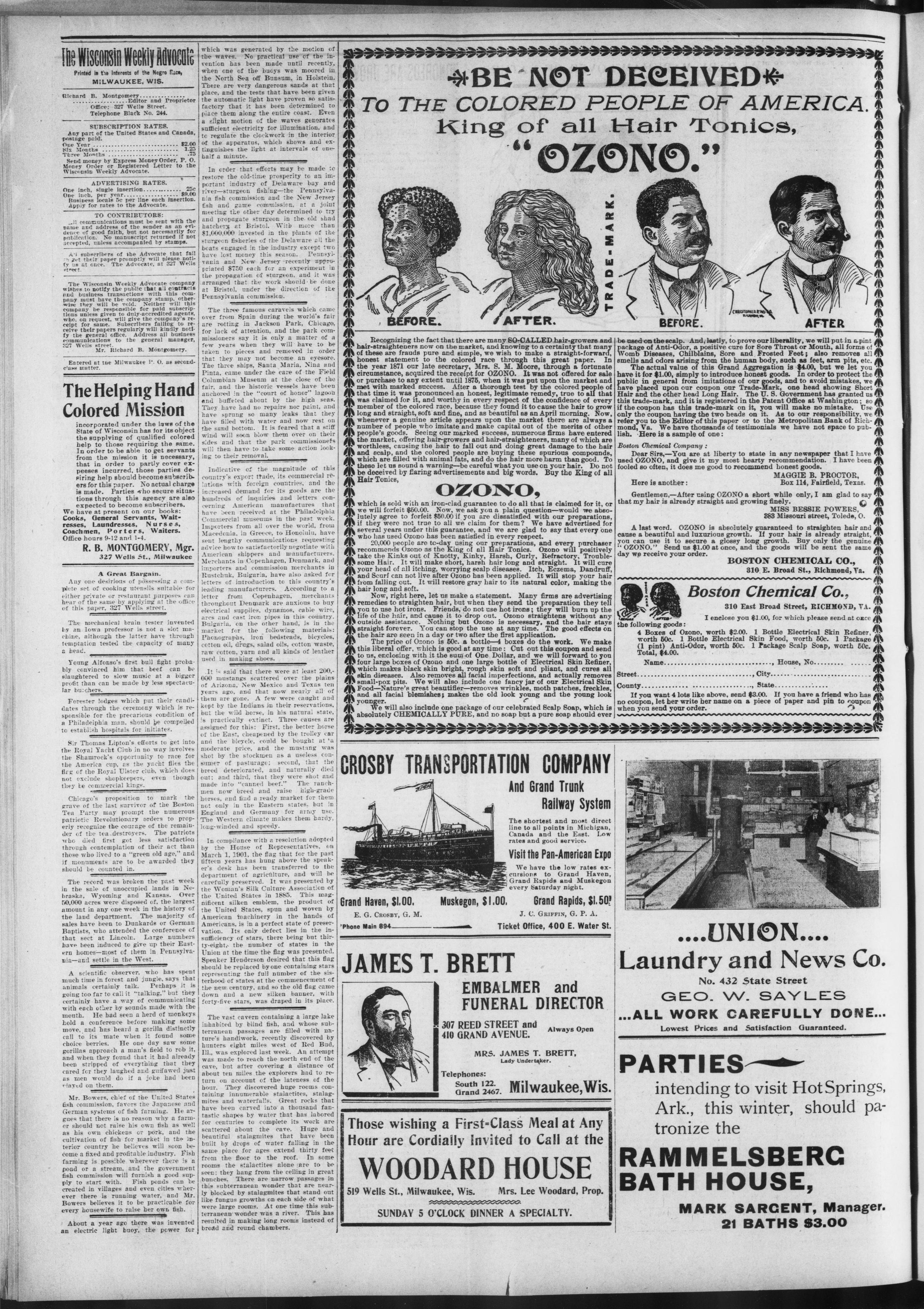
BE NOT DECEIVED
TO THE COLORED PEOPLE OF AMERICA
King of all Hair Tonics,
"OZONO."
BEFORE. AFTER. TRADE-MARK. BEFORE. AFTER. CHRISTOPHER ENG.
Recognizing the fact that there are many SO-CALLED hair-growers and hair-straighteners now on the market, and knowing to a certainty that many of these are frauds pure and simple, we wish to make a straight-forward, honest statement to the colored race through this great paper. In the year 1871 our late secretary, Mrs. S. M. Moore, through a fortunate circumstance, acquired the receipt for OZONO. It was not offered for sale or purchase to any extent until 1875, when it was put upon the market and met with marked success. After a thorough test by the colored people of that time it was pronounced an honest, legitimate remedy, true to all that was claimed for it, and worthy in every respect of the confidence of every member of the colored race, because they found it to cause the hair to grow long and straight, soft and fine, and as beautiful as an April morning. Now, whenever a genuine article appears upon the market there are always a number of people who imitate and make capital out of the merits of other people's goods. Seeing our marked success, numerous firms have entered the market, offering hair-growers and hair-straighteners, many of which are worthless, causing the hair to fall out and doing great damage to the hair and scalp, and the colored people are buying these spurious compounds, which are filled with animal fats, and do the hair more harm than good. To these let us sound a warning—be careful what you use on your hair. Do not be deceived by flaring advertisements and big words. Buy the King of all Hair Tonics.
OZONO.
which is sold with an iron-clad guarantee to do we will forfeit $50.00. Now, we ask you a plain lately agree to forfeit $50.00 if you are dissatisfied if they were not true to all we claim for them several years under this guarantee, and we are who has used Ozono has been satisfied in every 20,000 people are tc-day using our prepara recommends Ozono as the King of all Hair To take the Kinks out of Knotty, Kinky, Harsh, some Hair. It will make short, harsh hair long your head of all itching, worrying scalp diseases and Scurf can not live after Ozono has been applied from falling out. It will restore gray hair to its hair long and soft.
Now, right here, let us make a statement. remedies to straighten hair, but when they serve you to use hot irons. Friends, do not use hot in life of the hair, and cause it to drop out. Ozono outside assistance. Nothing but Ozono is new straight forever. You can stop the use at any the hair are seen in a day or two after the first.
The price of Ozono is 50c. a bottle—4 box this liberal offer, which is good at any time: O to us, enclosing with it the sum of One Dollar, four large boxes of Ozono and one large bottle which makes black skin bright, rough skin so skin diseases. Also removes all facial imperfections small-pox pits. We will also include one fan Food—Nature's great beautifier—removes wrinkles and all facial blemishes; makes the old look younger.
We will also include one package of our cell absolutely CHEMICALLY PURE, and no soap.
iron-clad guarantee to do all that is claimed for it, or not. Now, we ask you a plain question—would we abso-
fri$50.00 if you are dissatisfied with our preparations,
to all we claim for them? We have advertised for
this guarantee, and we are glad to say that every one
has been satisfied in every respect.
We-day using our preparations, and every purchaser
the King of all Hair Tonics. Ozono will positively
Knotty, Kinky, Harsh, Curly, Refractory, Trouble-
ake short, harsh hair long and straight. It will cure
worrying scalp diseases. Itch, Eczema, Dandruff,
after Ozono has been applied. It will stop your hair
will restore gray hair to its natural color, making the
set us make a statement. Many firms are advertising
hair, but when they send the preparation they tell
Friends, do not use hot irons; they will burn up the
use it to drop out. Ozono straightens without any
nothing but Ozono is necessary, and the hair stays
can stop the use at any time. The good effects on
day or two after the first application.
Ozono is 50c. a bottle—4 boxes do the work. We make
hair is good at any time: Cut out this coupon and send
the sum of One Dollar, and we will forward to you
Ozono and one large bottle of Electrical Skin Refiner,
in bright, rough skin soft and pliant, and cures all
removes all facial imperfections, and actually removes
will also include one fancy jar of our Electrical Skin
beautifier—removes wrinkles, moth patches, freckles,
les; makes the old look young and the young look
Make one package of our celebrated Scalp Soap, which is
ALLY PURE, and no soap but a pure soap should ever
which is sold with an iron-clad guarantee to do all that is claimed for it, or we will forfeit $50.00. Now, we ask you a plain question—would we absolutely agree to forfeit $50.00 if you are dissatisfied with our preparations, if they were not true to all we claim for them? We have advertised for several years under this guarantee, and we are glad to say that every one who has used Ozono has been satisfied in every respect.
20,000 people are tc-day using our preparations, and every purchaser recommends Ozono as the King of all Hair Tonics. Ozono will positively take the Kinks out of Knotty, Kinky, Harsh, Curly, Refractory, Troublesome Hair. It will make short, harsh hair long and straight. It will cure your head of all itching, worrying scalp diseases. Itch, Eczema, Dandruff, and Scurf can not live after Ozono has been applied. It will stop your hair from falling out. It will restore gray hair to its natural color, making the hair long and soft.
Now, right here, let us make a statement. Many firms are advertising remedies to straighten hair, but when they send the preparation they tell you to use hot irons. Friends, do not use hot irons; they will burn up the life of the hair, and cause it to drop out. Ozono straightens without any outside assistance. Nothing but Ozono is necessary, and the hair stays straight forever. You can stop the use at any time. The good effects on the hair are seen in a day or two after the first application.
The price of Ozono is 50c. a bottle—4 boxes do the work. We make this liberal offer, which is good at any time: Cut out this coupon and send to us, enclosing with it the sum of One Dollar, and we will forward to you four large boxes of Ozono and one large bottle of Electrical Skin Refiner, which makes black skin bright, rough skin soft and pliant, and cures all skin diseases. Also removes all facial imperfections, and actually removes small-pox pits. We will also include one fancy jar of our Electrical Skin Food—Nature's great beautifier—removes wrinkles, moth patches, freckles, and all facial blemishes; makes the old look young and the young look younger. We will also include one package of our celebrated Scalp Soap, which is absolutely CHEMICALLY PURE, and no soap but a pure soap should ever
CROSBY TRANSPORTATION COMPANY
THE JAPAN
Grand Haven, $1.00. Muskegon, $1.00.
E. G. CROSBY, G. M.
'Phone Main 894 Ticket
Muskegon, $1.00. Grand Rapids, $1.50 J. C. GRIFFIN, G. P. A.
JAMES T. BRETT
EMBALMER and
FUNERAL DIRECTOR
307 REED STREET and
410 GRAND AVENUE. Always Open
MRS. JAMES T. BRETT,
Lady Undertaker.
Telephones: South 122. Grand 2467. Milwaukee, Wis. a First=Class Meal at Any dially Invited to Call at the
Those wishing a First=Clas Hour are Cordially Invited WOODARD H
Those wishing a First=Class Meal at Any Hour are Cordially Invited to Call at the
519 Wells St., Milwaukee, Wis. Mrs. Lee Woodard, Prop. SUNDAY 5 O'CLOCK DINNER A SPECIALTY.
M.
The shortest and most direct line to all points in Michigan, Canada and the East. Low rates and good service.
Visit the Pan-American Expo
We have the low rates excursions to Grand Haven, Grand Rapids and Muskegon every Saturday night.
Ticket Office, 400 E. Water St.
be used on the scalp. And, lastly, to prove our liberality, we will put in a pint package of Anti-Odor, a positive cure for Sore Throat or Mouth, all forms of Womb Diseases, Chilblains, Sore and Frosted Feet; also removes all smells and odors arising from the human body, such as feet, arm pits, etc. The actual value of this Grand Aggregation is $4.00, but we let you have it for $1.00, simply to introduce honest goods. In order to protect the public in general from imitations of our goods, and to avoid mistakes, we have placed upon our coupon our Trade-Mark, one head showing Short Hair and the other head Long Hair. The U. S. Government has granted us this trade-mark, and it is registered in the Patent Office at Washington; so if the coupon has this trade-mark on it, you will make no mistake. Use only the coupon having the two heads on it. As to our responsibility, we refer you to the Editor of this paper or to the Metropolitan Bank of Richmond, Va. We have thousands of testimonials we have not space to publish. Here is a sample of one:
Dear Sirs,—You are at liberty to state in any newspaper that I have used OZONO, and give it my most hearty recommendation. I have been fooled so often, it does me good to recommend honest goods.
ter using OZONO a short while only, I am glad to say you straight and growing finely. MISS BESSIE POWERS, 883 Missouri street, Tolede, O. ZONO is absolutely guaranteed to straighten hair and luxurious growth. If your hair is already straight secure a glossy long growth. Buy only the genuine as $1.00 at once, and the goods will be sent the same order.
Gentlemen,—After using OZONO a short while only, I am glad to say that my hair is already straight and growing finely.
MISS BESSIE POWERS,
383 Missouri street, Toledo, O.
A last word. OZONO is absolutely guaranteed to straighten hair and cause a beautiful and luxurious growth. If your hair is already straight you can use it to secure a glossy long growth. Buy only the genuine "OZONO." Send us $1.00 at once, and the goods will be sent the same day we receive your order.
Boston Chemical Co.,
4 Boxes of Ozono, worth $2.00. 1 Bottle Electrical Skin Refiner, worth 50c. 1 Bottle Electrical Skin Food, worth 50c. 1 Package (1 pint) Anti-Odor, worth 50c. 1 Package Scalp Soap, worth 50c. Total, $4.00.
If you want 4 lots like above, send $3.00. If you have a friend who has no coupon, let her write her name on a piece of paper and pin to coupon when you send your order.
THE BAKERY
PARTIES
intending to visit HotSprings Ark., this winter, should patronize the
MARK SARGENT, Manager. 21 BATHS $3.00
Boston Chemical Company:
Dear Sirs,—You are at used OZONO, and give it fooled so often, it does me g
Here is another:
Gentlemen,—After usin that my hair is already stra
A last word. OZONO cause a beautiful and luxur you can use it to secure "OZONO." Send us $1.00 day we receive your order.
the following goods:
4 Boxes of Ozono, w
worth 50c. 1 Bottle
(1 pint) Anti-Odor
MAGGIE B. PROCTOR,
Box 114, Fairfield, Texas.
BOSTON CHEMICAL CO. 310 E. Broad St., Richmond, Va.
310 East Broad Street, RICHMOND, VA. I enclose you $1.00, for which please send at once
TRAGIC END OF SPREE.
Traveling Man Meets Death While on a Tear at Ashland.
CHICAGOANISDROWNED
T. D. Simpson Wanted to Go Fishing but is Killed Before He Reaches His Boat.
Ashland, Wis., June 26.—[Special.]—T. D. Simpson, a traveling salesman for the A. M. Slater & Bro. Dry Goods house of Chicago, was drowned in Chequamegon bay, this city, at 6:30 o'clock this morning. Simpson came to Ashland about three weeks ago and had not drawn a sober breath since his arrival. His firm advanced him over $300 in the past three weeks and every cent of it, save $7. found on his person after the drowning, had been spent for liquor and gambling. This morning early he asked the bartender at the hotel for some fishing tackle, saying that he would like to go down to the bay and angle for trout. He went down to the bay and in walking across a trestle staggered and fell into the water. The place where he fell into the water was only two feet deep, but he was so stupefied by his long carousel that he could not help himself ashore. Only yesterday he received a letter from his employers asking him to come to Chicago and admonishing him strongly for his extravagance and negligence. A corner's jury returned a verdict of accidental drowning. The remains will be shipped to Chicago this evening for interment. Simpson is a man of small stature, about 30 years old, smooth-shaven face and finely-cut features.
EIGHTEEN ARE HURT.
Passenger Train Collides with a Switch Engine at Elroy. Wis.
Elroy, Wis., June 26.—[Special.]— As passenger train No. 4 of Winona was leaving the yards here it collided with a switch engine, which was standing on the main track without protection. Eighteen passengers were injured, but not seriously and they were able to continue on their journey after a short time. The train was in charge of Conductor Phil. Wichand, and Engineer T. A. Ward. The following is a list of the injured:
Mrs. E. Gruenzner, La Crosse; knee hurt. Norman Gruenzner, La Crosse; bruise on head and right eye. Issie Spaulding, Cudahy; bruised on side of head. Hugo Krieg, Logansville; bruise on back of head.
of head.
Mrs. Louis Lelsner, Jackson, Wis.; ankle
injured and head bruised.
Charles Kelce, Nellsville; left knee
bruised.
A. Rolles, Madison; foot hurt.
Rev. C. L. Robinson, Madison; right el-
bow bruised.
Louis Amussen, Menominee, Mich.; fore-
head bruised.
A. F. James, Chicago, back injured.
S. Miodkowski, Logansville, Wls., left hip bruised.
A. E. Treleven, Fond du Lac, knee bruised.
C. S. Law, Chicago, left arm bruised.
Mrs. F. W. Scoville, Germania, Wls., neck hurt.
Mrs. Ellen Valkenstern, Baraboo, collarbone injured.
Michael Riney, superintendent of bridges and buildings, Madison division, Baraboo; knee bruised.
Thomas Cummings, Baraboo; cut on face.
W. H. Collins, baggageman, Elroy; slightly bruised.
MANY FARMERS RUINED.
Estimated that $10,000 Damage was Done by Storm Near Eau Claire.
Eau Claire, Wis., June 26.—[Special.]
—Further reports of the effects of the recent hailstorm along a track, two miles wide, between Osseo and Eau Claire, indicate heavy damage, some farmers being ruined. The losses number about thirty, and the total damage is estimated as high as $10,000.
OSHKOSH NORMAL CONTRACTS.
Milwaukee Firm will Install the Heating Plant.
Oshkosh, Wis., June 26.—[Special.]—The board of normal school regents, at a meeting held here yesterday, awarded contracts for the completion of additions to the Oshkosh normal school and the building of a cottage for the janitor. J. T. Raycraft of this city secured the construction contract at $6453. The heating plant will be installed by Mueller & Co. of Milwaukee, who are to get $6500 and who are to complete the task by August 20. All of the improvements are to be completed by October 1. The regents who were present at yesterday's meeting were Messrs.. Ross of Superior, Lord of River Falls, McDill of Stevens Point, Secretary Rockwood of Madison and Thompson of Oshkosh. The board went to Stevens Point today to let some contracts for the normal school there.
WON'T WORK ON THE FOURTH.
Merchants of Marinette Have Threatened Strike on Thgir Hands.
Marinette, Wis., June 26.—[Special.]—The merchants of Marinette have a threatened strike on their hands. They have decided to keep open the Fourth of July on account of the Marinette fair, which will be in session at that time. The clerks held a meeting this week and decided to walk out at noon, if the stores were kept open after that time. The merchants do not intend to recede and there is much speculation as to what will result. The Clerks' union of Marinette numbers about 300 members and they have the support of all the other unions in the city.
FRANK ZIMMERMANN WEDS.
Milwaukee Business Man is Married at Manitowoc,Q
Manitowoc, Wis., June 26.—[Special.]
At the St. Boniface Catholic church in this city, at 9 o'clock this morning, were united in marriage Miss Eleanor Simon of this city and Frank Zimmermann of Milwaukee.
The bride is the daughter of Mrs. M. Simon of this city. The groom is a well-known young business man of Milwaukee, the son of Mr. and Mrs. Valentine Zimmermann, the former being a member of the large Milwaukee business house of Zimmermann Bros.
SILVER MAY CAUSE DEATH.
A. W. Wattannon of La Crosse is Ill with Blood-Poisoning.
La Crosse, Wis., June 26.—[Special.]
A. W. Wattannon, a commercial traveler for the La Crosse Cracker and Candy company, lies at his home critically ill, as the result of running a sliver in his hand. He picked it with a needle, blood-poisoning ensued, and now his whole system is affected.
MADISON CARNIVAL IS KNOCKED OUT.
MADISON CARNIVAL IS KNOCKED OUT.
Mayor Holds Council Has No Right to Allow Streets to be Used for a Fair.
Madison, Wis., June 26.—[Special.]—There will be no street fair here this year, as the council has sustained the mayor's veto of the resolution allowing the Forty Thousand club to use the streets of Madison for a carnival. Several days ago the ordinance was passed by a preponderance of votes, and then Justice J. B. Winslow of the Supreme court published a communication in one of the local newspapers holding that the measure, if approved, would be illegal, because the council had no authority to grant the use of the streets for any other purpose than that for which they were created, namely, for highway purposes. The mayor asked the city attorney for an opinion on the question. The latter was of the same opinion as Justice Winsow, and the mayor thereupon vetoed the ordinance, the council last night sustaining the veto.
The Woman's club of Madison started the fight against the proposition to hold another carnival on account of the immoral exhibitions held last year. The business men are still determined to have a street fair, and say that the fight has only begun.
VERDICT OF SUICIDE IN SUNDLER CASE.
VERDICT OF SUICIDE IN SUNDLER CASE.
Prominent Farmer of Woodlake Found Dead with a Bullet in His Heart. Grantsburg, Wis., June 26.—[Special.]—The coroner's jury this morning returned a verdict of suicide in the Sundler shooting case. H. W. Sundler, a prominent settler of Woodlake, this county, was found dead yesterday with a bullet through his heart. His wife says he committed suicide, but this story was doubted, as she told different tales as to where the shooting actually occurred.
FIND HIS DEAD BODY.
Charles Blume of Pewaukee Wanders Away from His Home and Dies.
Pewaukee, Wis., June 26.—[Special.]
—Charles Blume, an old and wealthy soldier of this village, who mysteriously disappeared on Monday noon, was found dead near a straw stack a mile from his home, at 10 o'clock this morning. The coroner is investigating. It is thought that he was overcome by heat, although many think he committed suicide.
Mr. Blume left home on Monday, saying he intended to feed his horse. He did not return and by evening his family was alarmed and a search was made. Searching parties went out scouring the surrounding country and dragging Pewaukee lake.
Steven Verdenbright of Waukesha, son-in-law of Mr. Blume, and Rev. Mr. Kilbourn, the Congregational clergyman here, found the body.
No foul play is suspected, as Mr. Blume had no money or valuables on his person. He signed a number of certificates of deposits shortly before his departure. He leaves a wife and two daughters. One of them is the wife of Burt Steele, who is employed with the Bethesda Mineral Spring company in Waukesha. He was 61 years of age. Mr. Blume was a member of Co. G, Twenty-eighth Wisconsin volunteers, during the War of the Rebellion and was well known all over this county.
TWO WOMEN DROWNED.
Tragic Death of Mrs. William Conley and Her Daughter at Mercer.
Ironwood, Mich., June 26.—[Special.]
—Mrs. William Conley and her daughter, Mrs. William Hobbs, were drowned at Rio lake, near Mercer, Wis., yesterday. Both are residents of Ironwood.
They were fishing and had caught a large muskellunge. In the excitement the boat was overturned.
A young son of Mrs. Conley was on shore when the accident occurred. He jumped into a boat and went to the rescue. He caught his mother by the hair and dragged her to shore, but she was drowned.
Mrs. Conley was to leave this week for South Africa, where her husband is a member of the mounted police.
The body of Mrs. Hobbs has not been recovered. Eau Claire, Wis., June 26.—[Special.] Mrs. William Conley and her daughter, Mrs. William Hobbs, were drowned at Mercer, Wis. Relatives of the dead women reside here.
MRS. HYZER WEDS AGAIN.
Becomes the Wife of Charles Putnam at Ianesville.
Janesville, Wis., June 26.—[Special.]
—Charles Putnam, the well-known Janesville furniture dealer, was married this morning to Mrs. Harriet Hyzer by Rev. R. C. Denison at the Congregational church parsonage. The marriage was performed under a special permit issued by the judge of the county court. The bride is the former wife of Edward M. Hyzer, the North-Western railway attorney, who was married to Miss Mary Cantillon at St. Paul last Sunday. Mrs. Hyzer, now Mrs. Putnam, secured a divorce from her lawyer-husband some two years ago.
ACADEMY HAS A NEW NAME.
Catholic Girls' School in Sinsinawa is Now St. Clara's College.
Sinsinawa, Wis., June 26.—[Special.]
—The forty-seventh annual commencement at St. Clara's took place yesterday and was signalized by changing the name from St. Clara's academy to St. Clara's college.
Besides laurels for proficiency in studies, deportment, etc., gold medals were awarded to the following for Christian doctrine: Frances Bach, Milwaukee, conferred by Rev. M. J. Ward, Beloit, Wis.; Rose Curtis, Chicago, conferred by Rev. P. Schweitzer, Sinsinawa, Wis.; Ethel Devlin, Topeka, Kan., conferred by Rev. George Durnin, chaplain of the college.
TRY TO DESTROY HIS PLANTS.
Attempt is Made to Drain Farmer's Land.
La Crosse, Wis., June 26.—[Special.]
—A. Hoffman of Norway Ridge, a few miles from here, tells of several attempts to destroy his crop of cranberries by shutting the sluiceway gate, draining his land and thereby flooding his plants. Each time it has been discovered in time. The damage would be several thousand dollars. No clue to the per-
Marries a University Professor.
Beloit, Wis., June 26.—[Special.]—A social event of more than passing interest will be the marriage this evening of Prof. W. J. H. Strong and Miss Martha Leavitt. Mr. Strong is a son of William B. Strong and a professor at Wooster, O., university. Miss Leavitt is a daughter of Rev. Dr. George R. Leavitt.
ENGINEER DIES AT POST.
Milwaukee Passenger Train is Wrecked at Portage.
Locomotive Goes Over Embankment Into River—Fireman Riley Badly Injured.
Portage, Wis., June 25.—[Special]—Passenger train No. 22, in charge of Conductor Michael McQueeney, which leaves this city over the main line of the Chicago, Milwaukee & St. Paul road for Milwaukee at 7:25 o'clock, every morning, was wrecked at Ketchum's Point, inside the city limits, this morning. Engineer C. W. Snow was killed and Fireman Patrick Kiley was badly cut and bruised.
The accident occurred at the canal drawbridge, just after the bridge had been drawn for the yacht race, which took a pleasure party up the Fox river. The bridge had just been closed, but the derailing switch had not been closed and the train ran into it.
Dies at His Post.
The bridgetenders and bystanders assert that the semaphore showed the danger signal and that the accident was the fault of the trainmen.
The engine and tender were demolished and the baggage and mail cars damaged. The engine went into the canal.
Engineer Snow died at his post and was taken from the cab after the engine had buried itself in the mud and water at the bottom of the canal. He had been in the employ of the Milwaukee road for over thirty years and had made a million and a half miles since his connection with the road. He was about 60 years of age.
Cyrus Washington Snow, one of the oldest, best and most universally popular engineers on the Chicago, Milwaukee & St. Paul road, lost his life at 7:30 o'clock this morning, at his post of duty. His engine, as the result of an open draw at the Portage canal, one mile east of Portage city, was derailed by the automatic derailing device, and being under considerable headway at the time, was thrown down a 5-foot embankment, into the river, and the skull of the veteran engineer was crushed. He died in a few minutes after being taken from the wreck and the river.
One of the company's surgeons, Dr. Meacher of Portage, was on the train at the time of the accident, as were several other physicians, and they rendered prompt aid, but nothing could be done for the dying engineer. Fireman Kiley, who went over with the engine, escaped with slight injury, and walked from the wreck. The mail car was also thrown over the bank, and the baggage car and coaches derailed, but no others were injured in the least. Conductor McQueeney, well-known in this city, was in charge of the train, which arrives here daily from Portage at 10:30 o'clock and leaves now at 4:45, being for years the 5-o'clock train out of Milwaukee.
Details of the Accident.
The train, known as No. 22, leaves Portage at 7:25 a. m., and it pulled out on time this morning. At the Portage canal bridge is a signal intended to notify engineers when the draw is open or opening, and in addition, as a safeguard, an automatic derailing device is in operation a reasonable distance from the bridge. For some reason, this morning, the engineer failed to note the usual signal of danger, or it did not work perfectly, is not now clear. At all events, he did not come to a stop and the train neared the bridge at a fair rate of speed. Striking the automatic device, the engine was at once derailed, but owing to the speed it was plunged over the embankment and rolled into the canal, drawing one car and derailing the others. Engineer Snow received a crushed skull in the wreck as the engine went over, and it was at first reported that he had been drowned beneath the locomotive. This was not the case, however, as he was removed from the wreck and was still alive, although dying from his injuries a few minutes later. On account of the accident, the train did not reach Milwaukee until about 2 o'clock this afternoon.
The Jolly Old Man.
The dead engineer made his home for years at Portage, where he leaves a wife. They had no children. He was about 60 years of age, and had been in charge of engines for the Milwaukee company for thirty years or longer. He was known as "the jolly old man," it being said of him by officials and others on the road that he was never known to have lost his temper or to have abused anyone. He was looked up to by the young generation of engineers and trainees as a sort of father, and his advice was frequently sought and freely given for the good of men in the service. In cases of sickness of employees he was one of the first to visit the man and was always performing some kind of service for others. With his record and usefulness as an engineer and man, "Wash" Snow will be long remembered and his memory honored by the large number of officials and employees who knew him best and loved him most for his uniform kindness and geniality of nature—a sunny disposition that shed brightness in many places where shadows were wont to gather.
WEDS HER FORMER LOVER.
Racine Society Girl Surprises Her Parents.
Racine, Wis., June 25.—[Special.]—Louise Lathrop, one of the prettiest, most accomplished and popular society women of the city, was married to Carl Mellows a few days ago at Boston. Mr. and Mrs. Lucas Lathrop, parents of the young woman, did not have the least inkling of the event. Last September their daughter, a pianist of rare ability, left for Berlin, accompanied by Miss Belle Field, another cultured Racine woman, to receive instructions from the best masters. Two weeks ago they arrived in New York. Miss Field came home, but Miss Lathrop remained behind. Mr. Mellows was a resident of Racine ten or twelve years ago, and at that time was very attentive to Miss Lathrop. It was supposed at that time that the attachment between the two was broken.
NEW APPLETON POWERHOUSE
Plant to Cost $70,000 will be Built Immediately.
Appleton, Wis., June 25.—[Special.] The contract for the construction of the new powerhouse to be erected by the Fox River Electric Railway company in this city was awarded to O'Keefe & Orbison this morning. The new plant is to operate the Fox River Electric railroad between Neenah and Kaukauna and furnish power for the Appleton electric light system. It will have a 2500-horsepower water power and will also be equipped with a duplicate steampower. Work upon the building, which is to cost $70,000, will be commenced at once, and will be completed about December 1. The Kaukauna extension of the interurban road will be finished about September 1 and will in the meantime be operated by the present temporary powerhouse.
MRS. GOVE IS DEAD.
Wife of the Mayor of Waukesha Passes Away Shortly After Midnight.
Waukesha, Wis., June 25.—[Special.]
-Mrs. Jennie Stone Gove, wife of Mayor R. L. Gove, died this morning at 12:30 o'clock. Mrs. Gove had been ill for the past few months but it was only within the last three days that it was
Mary C.
known that there was no hope for her recovery. She was formerly Miss Jennie A. Stone, niece of the late H. O. Stone of Chicago. She was born in Michigan, and after living there during her girlhood moved to Port Washington, where she lived a number of years. She was married to R. L. Gove May 2, 1859. She is survived by her husband and five children, Mrs. Ione-Gove Hawley, wife of Fred Hawley of Chicago; Richard L. Gove, a photographer of Milwaukee; Mrs. Jennie May Hawes, wife of G. I. Hawes of Waukesha, and Jay Gove of West Milwaukee. The funeral will be held at 10 o'clock Thursday morning from the residence. Rev. W. A. McKillop will officiate.
DAMAGED BY STORM.
Northern Wisconsin is Swept by a Terrific Wind and Fierce Rain.
West Superior, Wis., June 25.—[Special.]—Northern Wisconsin was swept by a violent wind and rainstorm yesterday afternoon and last night. The storm was accompanied by terrific lightning and much damage was done. Railroads suffered severely through washouts, rendering roads generally unsafe. Telegraphic communication was greatly hampered and at some points entirely destroyed. The long-distance telephone company suffered especially in this respect, connections with several towns on the iron range being severed. It is estimated that $20,000 damage was done.
Trains Are Delayed.
Ashland, Wis., June 25.—[Special.]—Along the line of the Wisconsin Central and North-Western railways the towns have suffered much from the winds. Near Mercer and Norway large pine trees were carried on the railroad tracks by the wind and greatly delayed incoming trains. Many washouts also occurred. At Park Falls the high wind and lightning were very disastrous in every portion of the town. The large burner at the Williamson & Libby Lumber company's mill was blown down completely and lumber was scattered all over the yard. This mill is owned by Williamson & Libby of Oshkosh. Similar reports are coming in from the outlying towns and it is certain that the damage done by yesterday's storm is the greatest in the history of this region.
Three Lakes Suffers.
Three Lakes, Wis., June 25.—[Special.]—A severe windstorm of hurricane velocity struck this village yesterday afternoon and lasted about ten minutes. The two-story saloon building of Joe Corsky was moved and badly bent, the front being completely blown out. The grocery stores of F. S. Campbell and J. D. Innelly & Co. had fronts blown in. The chimney on John Small's meat market was blown down and many other buildings were more or less damaged. The rain which fell was the heaviest known in this section.
Animals Burned to Death.
Kenosha, Wis., June 25.—[Special.]—During a terrific electrical storm which passed through this county late last evening a barn on the farm of William Hahn. near Winthrop Harbor, was struck by lightning and destroyed. Two horses and a number of cattle were burned to death. The loss is $2000, with partial insurance.
New Richmond, Wis., June 25.—[Special.]—A hailstorm swept over Somerset, and in a strip through the town about half a mile in width all small grain, vegetables and fruit were destroyed.
Woodland, Wis., June 25.—[Special.]—During a heavy thunderstorm three cows owned by F. Lichtenberg were killed by lightning.
MURDERS HIS WIFE.
Alfred Anderson Kills Woman Because She Stayed Out All Night.
West Superior, Wis., June 25.—[Special.]—John Anderson killed his wife with a hammer at 5 o'clock this morning. The tragedy occurred at the home of the couple on John avenue. Anderson was lighting the fire when his wife returned home from where, no one knows, after being out all night. She claimed she had been to the home of her son-in-law, but that was not true and Anderson jumped on her with a hammer in his hand. He did not consider, but hit her in the head killing ther almost instantly. Officer Thurber arrested the man and he admits the crime.
The woman had her head cut open big enough for a man to put his hand in without trouble. The hammer, a common-sized one, is at police headquarters. It is covered with blood and hair. The couple had been married for fifteen years and, it is alleged, were reported always engaged in quarrels. The man had just come in from his mining claim, a couple of days ago, and is reported to have been enraged at the actions of his wife. Anderson is 52 years old and his wife was 43.
FELL OFF HIS BICYCLE.
Factory Inspector Badly Injured While Trying to Make a Bow.
La Crosse, Wis., June 25.—[Special.]
—Factory Inspector August Lenhoff,
while tipping his hat to an acquaintance,
lost control of the wheel he was
riding and dashed into an electric light
post, cutting his face frightfully on an
iron projection, the blow rendering him
unconscious.
MYSTERY STILL UNSOLVED
Theory that She Eloped is Believed by the Police-Anonymous Letter Received.
Janesville, Wis., June 24.—[Special.]— Helen Fifield has been missing for five days and absolutely nothing is known of her whereabouts. The police have theories which are being carefully investigated, but as yet nothing definite in regard to the actions of the girl, after she left her father's home early Thursday morning, can be learned.
Believes She Eloped.
Firm in the belief that Miss Fifield, who disappeared early on Thursday morning from her home, has eloped, Chief of Police Hogan has authorized a reward of $100 for information, leading to the location of the young woman. Relatives of the young woman have insisted from the first she had no sweetheart, and the police worked on the theory she was suffering from mental derangement. Chief Hogan says he has discovered that a young traveling salesman named Samuel Warner, whose home is in Janesville, had been calling on Miss Fifield regularly when he visited the city.
"From everything I have been able to learn, I am disposed to think Miss Fifield's disappearance was planned deliberately," said Chief Hogan. "She took $90 from the bank, made such purchases as she deemed necessary, and then left home on an early morning train. Her clock was found in an adjoining bedroom, indicating she had concealed her clothing there, and when she arose took her clock to the room so she would not miss the train to Chicago. Registering at the Home hotel as Mrs. Daisy Taylor of Milwaukee is significant, when the other facts are taken into consideration.
"I learned in my investigations that Miss Fifield went driving with Warner last Sunday evening. Warner is 22 years old, was raised in Janesville, and visits his home frequently. On these homecomings he always called on Miss Fifield, or has been seen with her. He left Janesville on Monday morning and Miss Fifield disappeared on Thursday morning. We have worked on all the other theories advanced, but I am disposed now to look on the elopement theory as the most substantial."
"Fake" Letter is Received.
On Saturday night an anonymous letter was received by Mr. Fifield stating that his daughter had been married in Milwaukee on that day. The letter is looked upon as a "fake" and no attention was paid to it after it was learned that no one had secured a marriage license for a Miss Fifield, nor had anyone answering her description registered at any of the Milwaukee hotels.
Mr. Flifield stated to the Evening Wisconsin's correspondent this morning that the whereabouts of his daughter was a mystery and that nothing had been heard from her since her disappearance last Thursday. He has offered $500 for information leading to her apprehension.
Believe Her Still in Chicago.
Chicago, Ill., June 24.—No trace of Miss Helen Fifield of Janesville can be found. Dr. George Fifield, Miss Fifield's cousin, and H. R. King, a friend, Detective Sergeants Darrow and Murtaugh of the central station and Chief of Police Hogan of Janesville reported they had visited every hotel in the city, but had not found a person who had seen the young woman after she left the Home hotel, 222 Washington street, the morning of her arrival.
The local police believe Miss Fifield could not have disappeared so completely after her arrival here unless she met someone who knew the city, because she would have left some trace of herself by making inquiries. They think she had a second address to which she went after leaving the Washington street hotel.
To stimulate inquiry and induce the public to seek the identification of young women who appeared for the first time on Thursday, Chief Hogan authorized a reward of $100 for any information that will lead to the finding of Miss Fifield. The local police will continue the search as nothing has been obtained leading them to believe Miss Fifield has left the city. It was learned today that a girl, who bore a striking resemblance to Miss Fifield, had attempted to secure a position as a servant at 287 Ontario street on Thursday night. This girl was well dressed and from this fact the people residing at the house were led to believe that the circumstances which led her to apply for a position were not ordinary ones. With this belief her application for a position was refused.
THIRTY ARE SHOCKED.
Ashland Visited by Violent Electrical and Wind Storms, Doing Much Damage.
Ashland, Wis., June 24.—[Special.]— The worst electrical storm in the history of the city struck Ashland about 3 o'clock this morning and has continued with slight intermission since. During the hours of the forenoon the storm was decidedly severe, and was featured strongly with brilliant electrical display and high wind, which did much damage. The Ashland Cigar and Tobacco company's manufactory was struck by lightning this morning and the building and stock were damaged to the extent of $5000, fully covered by insurance. Thirty employees, all at work at the time, were thrown from their seats and several were injured.
Lightning also struck the Ashland Iron & Steel company's plant and numerous dwelling houses, in each instance of places being struck by lighting the damage will be great and in total may exceed $8000. Rain poured in torrents. Mrs. A. Johnson and child were injured by lightning during the action of the storm, and the mother may die. The child is sure of recovery.
NO HOOCHEE COOCHEE.
Eau Claire Carnival Decides to Bar Oriental Dances.
Eau Claire, Wis., June 24.—[Special.]
—County Judge-Elect George L. Blum, in accepting in a letter the presidency of the Eau Claire Street Fair association, does not make direct reply to the recent resolutions of the Eau Claire Women's club against so-called oriental dances and the like, but he says: "I can give assurance that the greatest care will be exercised to eliminate from all features and amusements in the fair programme and in the attractions subject to our control everything of an objectionable character, even to the slightest degree."
Fire Cracker Explodes in His Hand.
Black River Falls, Wis., June 24.—[Special.]
—Henry Peterson, the 8-year-old son of J. P. Peterson of this city, lost his thumb and two fingers by the explosion of a firecracker in his hand.
Insurance Commission Holds that Evidence Against Milwaukee Man is Insufficient. Madison, Wis., June 26.—[Special.] Insurance Commissioner Giljohann today dismissed the complaint made against A. Lorenze of Milwaukee by H. B. Locote of Tomah, charging him with violating the insurance law by offering him a rebate of 20 per cent, on his policy. The commissioner found the evidence insufficient to sustain the complaint.
BOYS DID NOT TELL OF THE DROWNING.
Lied When Asked About Their Companion's Disappearance-Verdict of Accidental Death.
Green Bay, Wis., June 26.—[Special.]
An inquest was held over the body of Louis Brehner, who was drowned at Duchateau's stone quarry Sunday afternoon. It is reported that the boys who accompanied Brehner in bathing rat home after he had drowned and did not mention it to their parents and, after eating their supper, went to bed, but were aroused by Mr. Brehner, the father of the child, who came in search of the boy, and on being asked where he was they said he had gone home another way. After searching some time the boy's clothes were found on the bank of the quarry. At the inquest the jury turned in the verdict of accidental death
WILL CUT TOLL RATES.
Bell Telephone Company is to be Given Warm Competition by Independents.
La Crosse, Wis., June 26.—[Special.]
—The principal topic of the last day's session of the Wisconsin Independent Telephone company's convention has been the toll-line question. An effort will be made to adopt a uniform system of rates throughout the state. The Bell lines are to be given hot competition on their toll lines. It was decided that in territory where the Independent companies were obliged to connect with the Bell to get messages through toll lines are to be built over the same ground, so that the Bell company will not have to be depended upon at all and in places where Bell tolls are thought to be exorbitant some cutting in rates may be expected.
A motion to expel all members connected with the Bell company was laid over.
A grievance committee is one of the new features added at this meeting. The next gathering is to be at Milwaukee.
GIRL BURIED IN MUD.
Heat Causes Her to Become Demented and to Seek Relief In Swamp.
La Crosse, Wis., June 26.—[Special.]
—The heat today is terrific, private themometers about town registering as high as 101 and 103 in the shade. At the Burlington shops 118 degrees was reached in one of the south rooms exposed to the sun. Three prostrations are reported. Frank Woodward fell unconscious from a city sprinkling cart, but recovered. A. Dube, in the same business was also overcome. Eugene Gleason of the Imperial Camera company is also a sufferer.
Late yesterday a girl in the south end of the city became demented and sought refuge from the heat in a swamp. The police found her buried in the mud up to her shoulders and sinking fast. She was rescued.
An express horse dropped dead this afternoon. More prostrations will occur if the heat continues. The weather bureau records 96, but there are much hotter places in town.
EPIDEMIC OF MATRIMONY.
Six Marriages Take Place at Oshkosh Today.
Oshkosh, Wis., June 26.—[Special.]—There were six weddings here today and in one instance, after the bridesmaid had performed the offices for a friend, she became a bride. The double wedding was on Mt. Vernon street and the first couple were Bryan J. Kenny and Miss Winifred Walt, the latter being attended by Miss Elizabeth Holland, who afterward was married to Bert A. Greeley of Appleton.
Miss Gertrude Goe of this city and Alfred R. Hussey of Chicago were married this morning. The groom is connected with an electrical firm in Chicago.
Mr. Jewell of Ironwood, Mich., and Miss Christiansen were married here. Miss Catherine Schragg became the bride of Ald. Henry F. Kitz today.
This evening Herbert Mueller of Fond du Lac and Miss Jessie Farr of this city will be married.
BUY A LUMBER TOWN.
La Branche Brothers of Fanus Pur chase Perronville, Mich.
Marinette, Wis., June 26.—One of the most important deals in lumbering property ever made in the northern peninsula was closed yesterday, by which La Branche Bros. of Fanus become the owners of the village of Perronville, Spalding township, a few miles east of Fanus on what is known as Ten-mile creek. The transfer will include a sawmill and shingle mill, a large acreage of timber land, logging equipment, store and stock of goods, also houses and a large boarding house and saloon. The purchase price of the mill and village of Perronville is not known for a certainty, but is said to be a sacrifice bargain, the whole thing going for less than $50,000.
TEMPLARS ELECT OFFICERS.
Decide to Hold Next Convention at Shawano.
Marinette, Wis., June 26.—[Special.]
—The Grand Templar convention closed this afternoon. The new officers elected are as follows: D. J. Fisher, Marinette chief templar; George Johnson, Appleton, vice-chief templar; A. J. Smith Amherst, recorder; Mrs. Lipke, Appleton, treasurer; Mrs. F. S. Rood, Mariette, chaplain; Ben Marten, Wausau kee, usher; B. B. Huntington, Shawano guardian. The next meeting will be held at Shawano.
PLACES ARE NOT FILLED
Board of Control Has Not Yet Elected Superintendents.
Madison, Wis., June 26.—[Special.]—No election of a superintendent of the school for the blind at Janesville or the school for the deaf at Delavan has yet been made by the board of control and some of the members think there will be no election at this session. Good men for both places are being looked for, but the applicants are few, Harvey Clark, who wanted the blind superintendency, being the only person who has applied to the board for either place. The board spent the morning session auditing bills and discussing plans for the new residence for superintendents at Mendota and Oshkosh.
Mathilde—"Mr. Hungerford is a man who thoroughly believes in himself." Elaine—"How very gurlible he must be."—Town and Country.
Not What He Meant.—"What a debt we owe to medical science." he said as he put down the paper. "Good heavens!" she exclaimed, "haven't you paid that doctor's bill yet?"—Chicago Post.
'Arriet On Her Holiday—Guide (awaking the echoes of the lake)—"And may all—the ladies here—he married—before the end of the year!" Echo—"Yearl Year!" 'Arriet—"I like echoes."—Punch.
Too Fast for Her.—Miss Elden—"There are so many fast young men nowadays." Miss Youngly—"H'm—yes; you do seem to have difficulty in catching one."—Philadelphia Evening Bulletin.
Couldn't Fool Him.—Teacher—"Where is Chicago?" Willie Tuff—"Which one?" "Why, there is only one." "Come off! Dey's two teams. One in de nashal league an' de udder in de 'Merican."
Queens—"I called on four ladies last night," said the fickle beau. "Gee whiz!" exclaimed Jack Potts, "you must be a lobster. I'd keep on raising all night if I had a hand like that."—Philadelphia Press.
Poetic Bridegroom—"I could sit here forever, gazing into your eyes and listening to the wash of the ocean." Practical Bride—"Oh, that reminds me, darlings; we have not paid our laundry bill yet."—Brooklyn Life.
Nurse—"Listen, Baby, to the donkey braying. What a noise he is making! Naughty donkey." Little Girl—"Oh what a shame, nurse! He isn't a naughty donkey. He's only got the hiccups!"—Punch.
Mrs. O'Toole—"What puzzles me intirelly is that the owld house should lake to sinch an ixtint whin it's covered wid insurance." Mr. O'Toole—"Yis, me darlint! but it's fire insohorance, not water, de ye noind."—Harlem Life.
Nozitt—"Yes, young Bliggers had to make an assignment. He lost all his money playing bridge whist."
Sezzitt—"Hum! Seems to me they ought to call it suspension bridge whist."—Baltimore American.
"Oh, my dear daughter, you should not be frightened and run from the goat. Don't you know you are a Christian Scientist?" "But, mamma," excitedly exclaimed the little girl of 6, the billy-goat doesn't know it."—What to Eat.
At the Apothecary's,—Poet—"How much for this prescription?" Apothecary—"Two dollars, please." Poet (soilioquizing as he pays)—"And the publishers tell me that poetry is a drug in the market. Oh, that it were!"—Boston Transcript.
Old Bachelor (to his housekeeper)—"I don't think this is the usual kind of tea, Martha. What sort of packet did it come in?" Martha—"Faix, an' I think, now, the tay merchant said it came in a stame packet all the way from Ceylon."—Pick-Me-Up.
Sam Cole—"Miss Yallerby done treat me scand'lous. She done tole me yestid'y dat I was black as de ace o' spades."
Jim Crow—"Dat's on'y half as bad as what she sez 'bout me. She tole me I was black as de deuce."—Catholic Standard and Times.
Prison Missionary—"Don't you think that after you regain your liberty you can do better?"
Burglar—"Well, I'll know enough not to have another pal that's so durn deaf he can't hear a pliceman till he's right on us."—New York Weekly.
It was Mutual.—"Bridget, I didn't like the looks of that man you were entertining in the kitchen last evening." "Shure, an' the same t' you, mam. 'E said ez how 'e wondered Oi could worruk fer th' snippy thing 'e took yez t' be."—Philadelphia Evening Bulletin.
"Br'er Williams," interrupted an old brother in the amen corner, "you is giving' out a text dar wid de Bible upside down."
"Yes," replied the parson, "en dat's des de way you'll be ef you interrupt me one mo' time!"—Atlanta Constitution.
"Mamma, I don't think the people who make dolls are very pious people," said a little girl to her mother one day. "Why not, my child?" "Because you can never make them kneel. I have always to lay my doll down on her stomach to say her prayers."—Glasgow Evening Times.
No Sport About It.—"I see that the cup defender Constitution takes trial trips on Sunday. Is it right to indulge in a sport on the day of rest?" "Trips in a cup defender don't come under the head of sport. They are classed as dangerous scientific experiments."—Cleveland Plain Dealer.
So Sweet of Her!—Mrs. Chatterleigh—"Fancy, dear, at the Browns' last night they were all saying how glad they were to hear you were at last engaged! Of course, I didn't believe the report, dear, and I said I wondered any one could be so stupid as to imagine anything so absurd."—Punch.
Poor Child.—"You've got a little brother," said the nurse at breakfast. "He was born last night." "Really?" exclaimed Tommy. "And last night was Sunday. Poor kid!" "Why do you say that?" "'Cause his birthdays won't do him any good. Sunday's a holiday, anyhow."—Philadelphia Press.
Trying to Explain.—"Josiar," said Mrs. Corntossel. "what is these neglijay shirts I see advertised in the bargain sales?" "Well, they ain't quite so prim an starchy as a b'iled shirt—that is to say, a regular hardb'iled shirt. I reckon neghijay is what you might call a softb'iled shirt."—Washington Star.
After the ball is over—
The hedge just across the way,
After you've searched an hour
(For that's the fifth one that day),
Many a man has spoken
Words he'dain recall
When on the links he's been searching—
After the ball! —London Fun.
Papa (severely)—"Did you ask mamma
if you could have that apple?" Five-
Year-Old—"Yes, papa." Papa—"Be caref-
ful now. I'll ask mamma, and if she
says you didn't ask her I'll whip you for
telling a story. Did you ask mamma?"
Five-Year-Old—"Papa, I asked her. (A
pause.) She said I couldn't have it."—
Tit-Bits.
Pat—"Arrah, now, but railways are a
meighty foine invintion, annyway."
Friend—"I shouldn't have thought you could see much to admire in them. Pat, seeing that you lost your leg in a railway accident."
Pat—"Faith, an' didn't Oi get £200 damages? Begorra, if it had only been my head Oi'd have owned the loine."—Tit-Bits.
Order Countermanded.—Foreman (job office)—"What are you working at now?" Boy—"Runnin' off some business cards of a young woman who wants to do mending for gents and families." Foreman—
"Gee whizz! Didn't you get word not to print 'em? The order is countermanded. Quick as the boss saw that girl's card he rushed off and married her."—New York Weekly.
Pretty Things to Wear.
A novel idea for trimming boleros is to edge the lower hem with long pendant loops of ribbon or gold braid. Through these loops the waistband is passed. A waistband of a color different from that of the ribbon trimming is preferable.
Gold effects on white are much fancied now for either day or evening wear. Ceintures of gilt are always pleasing, but a decidedly new idea is a boa of gold tissue, edged with finger-width white mousseline de scie or with tiny ostrich plumes.
Something extremely practical to keep erect the dainty muslin and pique stocks now so much worn is a perforated neckband of celluloid. It is easily fastened inside the stock, and may be purchased at almost any notion or neckwear counter.
Among the fancy hose of the season a variation from the usual lace patterns has been seen in some pairs of black silk, embroidered with jet paillettes. One pretty design consists of three bowknots of closely-set paillettes on the instep. Another has lines of paillettes running up and down the instep. Some of the latest patterns also contain gold thread, in stripes, alternating with openwork.
The most appropriate trimming for sailor hats this season is a puffing of silk, which hides nearly the entire brim, as well as the crown. The silk may be set off to best advantage by a buckle or a long, sweeping plume, laid on flat.
Extremely chic is a little Empine coatee of black glace silk, with inch-deep tucks. As suggested by its name, the little coat hangs loosely from over the bust. It has wide revers, and deep collar of white moire, with broad edge of black satin appliqued with ecru lace, on which are embroidered black spots. The coatee is lined with white satin, and is the daintiest thing imaginable.
A lovely gown made for Newport is of wood brown veiling, with hemstitched border on skirt and bolero. The satin chemisette is of ivory white, with transparent guipure collar. A plateau hat to be worn with it is of ivory straw, covered with calceolaria blossoms of shaded browns and orange.
Some of the new chambrays are charming. One of pastel blue is trimmed with insertions of Valenciennes lace, and is made with a bolero, worn over a chemisette of white batiste, finished with a pointed belt of black velvet, studded with steel "nailheads."
Quite the newest "throatlet" is of rich black lace, lightly studded with diamonds and passing through jeweled gold slides. Jeweled lace in many applications is becoming fashionable in Paris and London, and probably will appear at the summer resorts here before long.
The sweetest of morning jackets is made of accordion crepe lisse, with deep ruffle of lace. The sleeves are elbow length, and also lace ruffled. A fichu, the lower edge of which is threaded with black velvet ribbon, fastened with rosette and ends at the back, extends across the bust, and is caught under a similar fastening. A black velvet threading and rosette completes the sleeve at the elbow.
The delicate gowns to be worn this summer demand the daintiest of petticoats. Some silk skirts will be worn, but in general the white-lawn and batiste will have the preference. These are many flounced and much embroidered, and are extravagantly charming.
Entirely bewitching is a tea gown of ivory crepe de chine. Empire in design. The full front is composed of cross-tucked ivory chiffon, and the yoke of the same is covered with ecru guipure. At each side of the square yoke, in the front, is a long end of accordioned chiffon, fastened under a large rosette of heliotrope glace ribbon.
Coats of taffeta are extremely dressy for carriage wear, and are capable of every conceivable treatment, some being preferred quite plain and others elaborately decorated with lace. White, tan, old ivory or delicate tea green and gray are shades most preferred. Collars and cuffs of duchess lace are frequently seen, and one coat of white taffeta, covered entirely with black Chantilly lace, is particularly effective.
In the wash ties and neckbands fashion has produced something as practically useful and durable as it is pretty. The pique stocks of white, with a narrow colored lawn tie, always look fresh with a cotton gown. The knot seems to be superseding the bow. Oblong ties with rounded ends are among the newest, and some are ornamented with tiny pearl buttons.—New York Tribune.
A suggestion of color on the handkerchief is coming more and more into general favor. Narrow hemstitched borders of a color matching the summer suit are used, and many of the French initial handkerchiefs have the letters set on a shield of pink, blue or green.
Corn Our Most Important Cereal. Draw a mental picture of a vast field of corn, 83,000,000 acres in extent, and you have a view of the consolidated cornfields of America, says George H. Phillips in the Saturday Evening Post. This is the present corn acreage. As a companion picture let the imagination depict a mountain of corn containing two billion bushels of the beautiful yellow cereal. This is one year's harvest from the great field—simply an average annual crop! The immensity of these figures may well stagger the imagination of the ordinary matter-of-fact man and cause him to ask: "Where and how is this monster harvest used?" That the demand for corn should far exceed so prodigal a supply seems almost impossible. But the facts show that the world's call for corn is far outstripping, and in rapidly-increasing ratio, this enormous output of this country's cornfields.
An active crusade against the wearing of corsets is being carried on at Budapest. The Hungarian minister for public instruction has issued an energetic order against their use, forbidding all girl pupils attending the public and private day schools in Hungary to wear them. Herr von Wlassics declares in his order that the corset prevents the full development of the bodily organs and stunts the growth. He desires a uniform blouse to be adopted in its stead. This order has been sympathetically received in educational circles, but regret is expressed that the female teachers have not been included in it, as it is thought their example may be prejudicial to their pupils. London Telegraph.
Ships in Wholesale Lots
Heretofore the merchant fleets of the nations have been built up ship by ship. When American combinations of capital go into the business it is natural that they should carry American methods with them and do their buying by wholesale. If we are ready for a merchant marine we can get one ready made. If we choose we may again become the carriers of the world, and the indications are that we choose.—Saturday Evening Post.
Accept
No
Substitute.
IT WILL
CURE YOU!
PE-RU-NA
CURES
CATARRH
OF THE
HEAD, THROAT, LUNGS,
STOMACH,
KIDNEYS,
BLADDER,
AND
FEMALE ORGANS.
Liver Don't Act?
You know very well how you feel when your liver don't act. Bile collects in the blood, bowels become constipated and your whole system is poisoned. A lazy liver is an invitation for a thousand pains and aches to come and dwell with you. Your life becomes one long measure of irritability and despondency and bad feeling. CASCARETS act directly, and in a peculiarly happy manner on the liver and bowels, cleansing, purifying, revitalizing every portion of the liver, driving all the bile from the blood, as is soon shown by increased appetite for food, power to digest it, and strength to throw off the waste. Beware of imitations!
GUARANTEED TO CURE all bowel troubles, appendicitis, billiousness, bad breath, bad blood, wind on the stomach, bloated bowels, foul mouth, headache, indigestion, pimples, pain after eating, liver trouble, sallow complexion and dizziness. When your bowels don't move regularly you are getting sick. Constipation kills more people than all other diseases together. It is a starter for the chronic ailments and long years of suffering that come afterwards. No matter what all you, start taking CASCARETS today, for you will never get well and be all the time until you put your bowels right. Take our advice; start with CASCARETS today, under an absolute guarantee to cure or money refunded.
Scots Had an Eye to Business. The medievel university differed in many respects from our idea of a modern university. It was primarily a guild of teachers and scholars, formed for common protection and mutual aid. It was a republic of letters, whose members were exempt from all services private and public, all personal taxes and contributions, and from all civil procedure in courts of law. The teaching function was often secondary and often entirely overlooked. The Scottish university from the beginning, however, emphasized the teaching function and created an atmosphere academic rather than civil or political. The early curriculum was crude, but fully abreast of the age, comprising in the main, philosophy, theology, canon and civil law. All instruction was in Latin and the writing of latin dissertations was the daily task of the student—a straight and narrow way of learning.—Scribner's Magazine.
There is more catarrh in this section of the country than all other diseases put together, and until the last few years was supposed to be incurable. For a great many years doctors pronounced it a local disease, and prescribed local remedies, and by constantly falling to cure with local treatment, pronounced it incurable. Science has proven catarrh to be a constitutional disease, and therefore requires constitutional treatment. Hall's Catarrh Cure, manufactured by F. J. Cheney & Co., Toledo, Ohio, is the only constitutional cure on the market. It is taken internally in doses from 10 drops to a teaspoonful. It acts directly on the blood and mucous surfaces of the system. They offer one hundred dollars for any case it fails to cure. Send for circulars and testimonials. Address. F. J. CHENEY & CO., Toledo, O. Sold by Druggists, 75c.
What Pemmican Is.
It is an interesting fact that no pemmican has been made in this country since the Greely expedition. A concern in London has a plant for making it. Pemmican is not in reality the mixed sort of sausage-meat described in the "Swiss Family Robinson," but is simply dried and pulverized meat mixed with suet and flavored with dried currants and other seasoning.
Don't Act
our liver don't act. Bile collects in th
al. A lazy liver is an invitation for a thou
ne long measure of irritability and despo
y happy manner on the liver and bowel
the bile from the blood, as is soon show
y off the waste. Beware of it
swimmin."—Washington St.
"I have been troubled a great deal with a torpid liver, which produces constipation. I found CASCARETS to be all you claim for them, and secured such relief the first trial that I purchased another supply and was completely cured. I shall only be too glad to recommend Cascarets whenever the opportunity is presented." J. A. SMITH, 2020 Susquehanna Ave., Philadelphia, Pa.
"He did it quickly and automatically and
Poor Lo's Salvation is Work.
The attitude of our government toward the Indian, in allowing him in idleness to follow his own untrammeled will on the reservation, is a relic of the old French and Spanish original discoverers. Are these wards of the government never to have homes, but be always condemned to tribal relations? Are they never to know the mental uplifting of a wife's hands, but be always fated to burden-bearing squaw life? Some day a statesman will arise and point the way for these aboriginal Americans to become men and women among us, and truly citizens of our states. Until that time—until Indians are alienated from their savage surroundings—their treatment is a proposition not reached by any pink-tea standard of ethics. National Magazine.
Do Your Feet Ache and Burn?
Shake into your shoes, Allen's Foot-Ease, a powder for the feet. It makes tight or New Shoes feel Easy. Cures Corns, Bunions, Swollen, Hot and Sweating Feet. At all Druggists and Shoe Stores, 25c. Sample sent FREE. Address Allen S. Olmsted, LeRoy, N. Y.
—The Presbyterians hope to secure pledges to the amount of $20,000,000 for their Twentieth century fund for religious work before the close of the year.
Piso's Cure is the best medicine we ever used for all affections of the throat and lungs.—Wm. O. Endsley, Vanburen, Ind., Feb. 10, 1900.
—The city of Seattle is to care hereafter for the grave of the Indian chief of that name.
FITS Permanently Cured. No fits or nervousness after first day's use of Dr. Kline's Great Nerve Restorer. Send for FREE $2.00 trial bottle and treatise. DR. K. H. KLINE, Ltd., 931 Arch St., Philadelphia, Pa.
Glow-worms are much more brilliant when a storm is coming than at other seasons.
MRS. WINSLOW'S SOOTHING SYRUP for Children teething; softens the gums, reduces inflammation, allayz pain, cures wind colic. 25 cents a bottle.
Villa formerly meant a farm and not a house.
HUMOURS
Complete External and Internal Treatment Cuticura THE SET
Consisting of CUTICURA SOAP to cleanse the skin of crusts and scales, and soften the thickened cuticle, CUTICURA OINTMENT to instantly allay itching, irritation, and inflammation, and soothe and heal, and CUTICURA RESOLVENT to cool and cleanse the blood, and expel humour germs. A SINGLE SET is often sufficient to cure the most torturing, disfiguring skin, scalp, and blood humours, rashes, itchings, and irritations, with loss of hair, when the best physicians, and all other remedies fail.
MILLIONS USE CUTICURA SOAP
Assisted by CUTICURA OINTMENT, for preserving, purifying, and beautifying the skin, for cleansing the scalp of crusts, scales, and dandruff, and the stopping of falling hair, for softening, whitening, and soothing red, rough, and sore hands, for baby rashes, itchings, and chafings, and for all the purposes of the toilet, bath, and nursery. Millions of Women use CUTICURA SOAP in the form of baths for annoying irritations, inflammations, and excoriations, for too free or offensive perspiration, in the form of washes for ulcerative weaknesses, and for many sanative, antiseptic purposes which readily suggest themselves to women and mothers. No amount of persuasion can induce those who have once used these great skin purifiers and beautifiers to use any others. CUTICURA SOAP combines delicate emollient properties derived from CUTICURA, the great skin cure, with the purest of cleansing ingredients and the most refreshing of flower odours. No other medicated soap is to be compared with it for preserving, purifying, and beautifying the skin, scalp, hair and hands. No other foreign or domestic toilet soap, however expensive, is to be compared with it for all the purposes of the toilet, bath, and nursery. Thus it combines in ONE SOAP at ONE PRICE, the best skin and complexion soap, and the BEST toilet and baby soap in the world.
nternal and Internal Treatment for Every Humour
Consisting of CUTICURA SOAP, to cleanse the skin of crusts and scales, and soften the thickened cuticle; CUTICURA OINTMENT, to instantly allay itching, inflammation, and irritation, and soothe and heal; and CUTICURA RESOLVENT, to cool and cleanse the blood. A SINGLE SET is often sufficient to cure the most torturing, disfiguring, itching, burning, and scaly skin, scalp, and blood humours, rashes, itchings, and irritations, with loss of hair, when outgout the world. British Depot: F. NEWBERY & SONS, 27 Charter C. BOSTER DRUG AND CHEM. CORP., Sole Prope, Boston, U. S. A.
GUARANTEED TO CURE: Five years ago the first box of CASCARETS was sold. Now it is over six million boxes a year, greater than any similar medicine in the world. This is absolute proof of great merit, and our best testimonial. We have faith, and will sell CASCARETS absolutely guaranteed to cure or money refunded. Go buy today, two 50e boxes, give them a fair, honest trial, as per simple directions, and if you are not satisfied after using one 50e box, return the unused box to us and we will purchase it and get your money back for both boxes. Take our advice—no matter what all you start today. Health will quickly follow and you will bless the day you first started the use of CASCARETS. Book free by mail. Add: STERLINGREED CO., New York or Chicago.
The owners of automobiles in Ohio constitute a new force in the good roads movement. There is a plan under way for the building of a boulevard from one end of the state to the other, touching the cities and largest towns.
Suicide and Civilization.
Dr. Shrady gives out the opinion that the number of suicides increases with advancing civilization. One wonders if this would be so were the civilization really what it purports to be.—Boston Transcript.
BLACK SKIN REMOVER.
REGISTERED
IN
PATENT OFFICE
U.S.
BEFORE AFTER
A Wonderful Face Bleach.
AND HAIR STRAIGHTENER.
both in a box for $1, or three boxes for $2. Guaranteed to do what we say and to be the "best in the world." One box is all that is required if used as directed.
A WONDERFUL FACE BLEACH.
A PEACH-LIKE complexion obtained if used as directed. Will turn the skin of a black or brown person four or five shades lighter, and a mulatto person perfectly white. In forty-eight hours a shade or two lighter will be noticeable. It does not turn the skin in spots but bleaches out white, the skin remaining beautiful without continual use. Will remove wrinkles, freckles, dark spots, pimples or bumps or black heads, making the skin very soft and smooth. Small pox pits, tan, liver spots removed without harm to the skin. When you get the color you wish, stop using the preparation.
THE HAIR STRAIGHTENER
that goes in every one dollar box is enough to make anyone's hair grow long and straight, and keeps it from falling out. Highly perfumed and makes the hair soft and easy to comb. Many of our customers say one of our dollar boxes is worth ten dollars, yet we sell it for one dollar a box.
Any person sending us one dollar in a letter or Post-Office money order, express money order or registered letter, we will send it through the mail postage prepaid; or if you want it sent C. O. D., it will come by express, 35c. extra.
In any case where it fails to do what we claim, we will return the money or send a box free of charge. Packed so that no one will know contents except receiver.
THOS. B. CRANE,
122 West Broad St.,
RICHMOND, VA.
CURLY HAIR MADE STRAIGHT
BY THE
TAKEN FROM LIFE.
BEFORE AND AFTER TREATMENT.
WONDERFUL DISCOVERY
ORIGINAL
OZONIZED OX MARROW
[COPYRIGHTED.]
Will straighten your hair, quickly and easily so that you can do it yourself at home no matter how kinky or rough it is. This wonderful hair pomade has been made. And sold many years giving perfect satisfaction to everybody. It is the only safe preparation in the world that straightens kinky hair as shown above. Nourishes the scalp, cures dandruff, prevents falling, and makes the hair grow. Sold over forty years. Warranted a harmless. Testimonials free on request. It was the first preparation ever for straightening kinky hair. Beware of imitations. Get the OZONIZED OX MARROW, as the genuine never fails to keep the hair silkable and beautiful. A toilet necessity for indies and gentlemen. Elegantly perfumed. Owing to its superior and lasting quality it is the most economical. It is not possible for anybody to produce a preparation equal to it. Full directions with every bottle. Only 50 cents. Sold by dealers we will ship you express paid one bottle for 45 cents or three for $1.40. Send postal or express money order, as we do not send goods C. O. D. Write your name and address plainly to OZONIZED OX MARROW CO., 76 Wabash Ave., Chicago, Ill.
For the Safest and Quickest Road between
Milwaukee and Chicago
Take the Chicago; Milwaukee & St. Paul Railway.
NORTHERN WISCONSIN RAILROAD LANDS
Are increasing in value from year to year. Railroads are the great civilizers, for they give the settler as well as the manufacturer equal opportunity to work in undeveloped fields, thereby rapidly settling the country and bringing forth its undiscovered riches. Northern Wisconsin is rich in iron ore, clay, kaolin, marl, timber and fine farm lands. It has made many a settler independent and added to the wealth of manufacturers who have sought this territory. Opportunities have not passed, as there is still a generous supply of land which can be obtained at low figures and on easy terms.
THE WISCONSIN CENTRAL RY.
Was one of the first roads to penetrate the vast Northern Wisconsin Wilderness which stretches across the State from east to west. It, also, has developed from year to year and today offers the best of transportation facilities, enabling all to ship the products of that section to any market in the world. Illustrated pamphlets and maps which are interesting as well as instructive can be obtained by addressing W. H. KILLEN, Land & Industrial Commissioner; Geo. T. Jarvis, Gen. Mgr.; Burton Johnson, G. F. A., or Jas. C. Pond, G. P. A., Colby & Abbot Building, Milwaukee, Wis.
Builds up both the body and nerves; brings refreshing sleep, insures a healthy
appetite, aids digestion and feeds blood, brain and bone It cannot fail to benefit in every case where more strength is required Once tried, you will never take a substitute. AT YOUR DRUGGIST
BEST MALT TEXTURE
The Best Tonic
MALT BREWING CO.
MILWAUKEE, WI.
Dangers that Lurk in the Flowing Bowl-How Bright and Influential Men Have Been Dragged Down by the Demon Drink-Suppress the Traffic.
You were placed by God in this earthly life;
You were made a child of light.
To shine till the day from above would dawn
On a world in sin and night.
Then a beacon be for the cause of Christ.
Let your light beam out afar.
That some shattered bark may be brought to port
Through the waves that sweep the bar.
How will you vote, my brother?
How will you vote to-day?
In the fear of God, and the love of Christ,
Will you vote for rum to stay?
Whatever we eat, whatever we drink,
Whatever is said or done.
Should he done with thanks to the Lord
Should be done with thanks to the Lord of all
For His gifts through Christ the Son.
Then live that the smallest act of your life
May a full sweet service be;
Then vote that the Father who lives above
May be glorified through thee.
How will you vote, my brother?
How will you vote to-day?
In the fear of God, and the love of Christ,
Will you vote for rum to stay?
By the Cross where the Savior died for men
By His judgment seat where each man some day
An account to Him must give How will you wish that your vote had
been cast
In the strife with rum to-day?
When your dying day unto you has come
And your soul must pass away—
How will you vote, my brother?
How will you vote to-day?
In the fear of God, and the love of Christ,
Will you vote for rum to stay?
Not the will of the mass for God's true child
Is reckoned of any worth.
Is recalled of any word,
But he works and votes that his Father's will
May be done through him on earth;
He votes by himself, if the need must be,
For his Master's smile is all;
And he knows, at last, to the Lord above
And he knows, at last, to the Lord above He must surely stand or fall.
In the fear of God, and the love of Christ,
Will you vote for rum to stay?
—National Temperance Almanac.
A lady happening to be passing a public house in West Kensington just as a little girl was coming out of it with a brimming jug of beer. Seeing the child stop to drink greedily, the lady spoke to her, and taking the ethical side of the matter as easiest to be understood, asked if she did not know it was wrong to drink her mother's beer. The answer was: "Oh, but Mr. —— (the publican) told me he had put some in for me, and that mother would still have her full pint left; and it is so nice! Wouldn't you like to taste it? He gave me these, too," displaying a handful of sweets. "I'm to have them when I go in, and Mrs. So-and-So has promised to let me fetch her beer, too!" The child was not yet 8 years old, and as Mrs. So-and-So lived close by the lady made it her business to call and remonstrate, finally succeeding in obtaining a promise that the little creature should not be sent again. A day or two later this same woman accosted the lady in the street to inform her she had kept her promise, but that the child had "gone on dreadful," when told she would not be allowed to fetch her beer for her any more, "screaming and crying like anything!" There, sir, is a drunkard of less than 8 in rapid process of formation!
A liquor organ sneeringly points to prohibition Kansas as having six distilleries, while high license Nebraska has but one, as recorded in the report of the Commissioner of Internal Revenue. Very true, but if our liquor friend will look at page 101 of the report he will see that while the six distilleries of Kansas consumed but 663 bushels of grain and malt, the one distillery of Nebraska consumed 479,667 bushels of grain and malt. Thus we see that the one distillery of Nebraska used 723 times as much grain as the six distilleries of Kansas.
Again in this report we find that during the fiscal year 1899, 2,190 illicit distilleries were seized by United States marshals, 2,101 of which were destroyed, and the remainder carried away. In these raids 711 persons were arrested, one man killed and three wounded, and what is very suggestive, every one of the distilleries seized was in a license State and not a solitary one in any prohibition State. These figures do not include 352 more distilleries seized during the year, all in license States, but which cases had not been disposed of during the year.—National Temperance Almanac.
"To jail rather than drink," was Mrs. Margaret Cullamore's choice. She askede Magistrate Teale in Brooklyn to send her to prison, telling him she could not restrain her love for liquor. He committed her. She is refined looking and has been an expert seamstress. Her husband divorced her.
Good breeding consists in having no particular mark of any profession, but a general elegance of manners.—Johnson.
TRADE MARK
REGISTERED 1892.
U.S.PATENT OFFICE
WASHINGTON, D.C.
BEFORE USING
HARTONA
AFTER USING
HARTONA
Hartona will make the hair grow long and soft, straight and beautiful. Makes the hair grow on bald and thin places. Restores GRAY HAIR to its original color. Hartona cures Dandruff, Baldness, falling out of the hair, itching, and all scalp diseases. Hartona does not have to be used all the time, as it straightens the hair and gives it fresh life and lustre, and the hair stays and grows naturally beautiful and straight after the use of Hartona. No hot irons necessary. No pasting the hair down with grease. Hartona is positively harmless-one box can be used by everyone in the family. Benefits and improves children's hair just the same as adults. To meet the popular and ever-increasing demand for Hartona Hair-Grower and Straightener, we have placed it on sale in 25c. and 50c. sizes, in our special round, patent box. See that the word Hartona is on every box.
Money positively refunded if you are not absolutely delighted with the Hartona remedies. Remember, we handle no fake goods, and you are positively protected by our $100.00 guarantee to any one proving otherwise. All our remedies are trade-marked, registered and copyrighted at United States Patent Office at Washington, D. C., in the years 1892 and 1900. We refer you, as to our responsibility, to the City Bank of Richmond, Va., Adams and Southern Express Companies, and to the editor of this paper.
We want lady and gentlemen agents, white or colored, in every city and town in the United States. Write to us to-day, no matter if you are employed or not, and we will show you how to make a splendid living, with easy and pleasant work, and no risk of losing your good money. Write to us and we will send you a book of over one hundred genuine testimonials in your own State of people who have used and are using Hartona remedies. Is this not fair and honest enough?
HARTONA FACE WASH.
Hartona Face Wash will gradually turn the skin of a black person five or six shades lighter, and will turn the skin of a mulatto person perfectly white. The skin remains soft and bright without continual use of the face wash. One bottle does the work.
Hartona Face Wash is perfectly harmless, and is sent to any part of the United States on receipt of price, 50c. per bottle; securely sealed from observation. It is your duty to look as beautiful as possible. Thousands of delighted patrons send us testimonials every year. Please remember that your money is positively refunded if you are not perfectly satisfied and delighted with the Hartona remedies. We want agents in every city in the United States. Write to us, no matter if you are employed or not, and we will show you how to make money without risking any of your own money.
HARTONA NO-SMELL.
Hartona No-Smell will remove all smells and bad odors of the body; cures sore and aching feet, chafed limbs, etc. Hartona No-Smell is a God-send to all persons suffering from disagreeable odors caused by perspiration of the feet, arm-pits, etc. Sent anywhere on receipt of price, 10 cents and 25 cents a package. Address all orders to
Send us One Dollar, and mention this paper, and we will send you three large boxes of Hartona Hair-Grower and Straightener, two large bottles of Hartona Face Wash, and one large box of Hartona No-Smell. Goods will be sent securely sealed from observation.
Write your name and post-office and express-office address very plainly. Money can be sent by post-office money order, or enclosed in a registered letter, or by express. Address all Orders to
HENDRIK HUDSON'S HAUNTS HOLCOMBIZED.
SIR JOHN BURTON
The illustration depicts George Ober, the leading actor in the new drama, as he will appear in making a one-and-one-half-minute change from young to "Old Rip." During the transformation an innovation will be introduced in the form of moving pictures, which will make a novel combination of natural and artificial figures and scenery. Willard Holcomb is the author of the "Compound Drama."
A MANILA BEAN.
A Traveling Agent Afraid to Trust a Professional Florist.
Quite an excitement has been created in Kensington by so small a matter as a bean. The bean was brought from Manila two years ago by a traveling agent for a large manufactory, who had seen a tree covered with beautiful flowers and beans while traveling in Luzon, and had secured one of the pods. Fearing that if he confided it to a professional florist, he would lose the honor and glory of introducing a new flower to Philadelphia, he turned over the bean to a Kensington woman, agreeing to pay $1 a month for its care and culture until it produced flowers. The bean has been two years growing, but is not yet over two inches in height. Local botanists say it is not a bean, but a date seed, which has been planted in mistake. The owner, who paid $12 for one year's board for the bean, thinks the caretaker should now keep it for company, but she says she has had three doorbells worn out by curious visitors. Recently the owner dug the plant up to see what the root looked like, and found that while there were only three inches of stem and leaves, a large 16-inch
HARTONA REMEDY CO., 909 E. Main St., Richmond, Va.
pot was filled with fibrous roots. He thought it would be a good plan to clip the roots, since which time the Manila bean has been but a little faded flower. The caretaker asserts that in two years she has served the bean with 1400 gallons of water and taken 20,000 steps in carrying it around the house to give it the full benefit of sunshine. It was as much trouble and care as a baby, only it did not cry at night.—Philadelphia Record.
Inventors of Wood Pulp Paper.
A writer in a London newspaper, speaking of the ingenuity of wasps in building their nests, says: "Like a trained spaniel, she finds at last some old stump or sill of wood, some fallen trunk or weatherworn wound in growing timber whereon she setties and proceeds to bite off bits of wood and chew them into paste. With this she dies to the hole again, and with jaws, and head, and feet, molds the thin-drawn paste into fine gray paper, silky, strong and waterproof. Here is an invention—"paper from wood-pulp"—which has been littered before the blind eyes of man ever since in prehistoric ages he first destroyed wasps' nests, but was reserved to be his "triumph" at the end of the Nineteenth century of our modern era!
..HARTONA..
Preparations for the Hair!
The Original and Only Hartona. Matchless and Positively Unequaled for ening all Kinky, Knotty, Stub
and Positively Unequaled for g all Kinky, Knotty, Stub
Matchless and Positively Unequaled for Straightening all Kinky, Knotty, Stubborn, Harsh, Curly Hair.
beautiful. Makes the hair grow on bal-
bling out of the hair, itching, and al-
fresh life and lustre, and the hair stay-
lasting the hair down with grease. If
children's hair just the same as
we have placed it on sale in 25c. a
with the Hartona remedies. Remember
ing otherwise. All our remedies are
two years 1892 and 1900. We refer y
ties, and to the editor of this paper.
City and town in the United States
endid living, with easy and pleasa
hundred genuine testimonials in y
enough?
FACE WASH
person five or six shades lighter, and w
annual use of the face wash. One be-
sis, blackheads, freckles, and all blen-
n. Full directions with each bottle
part of the United States on receipt
sible. Thousands of delighted patrons
are not perfectly satisfied and deli-
us, no matter if you are employed or
NO-SMELL
body; cures sore and aching feet, c
disagreeable odors caused by pers-
Address all orders to
TONA REMEDY CO., 909 E. N.
GRAND OFFER.
You three large boxes of Hartona No-Smell. Goods will be sent securely plainly. Money can be sent by p
99 E. Main St.,
D. C Adams
GROCER
Terms Cash. Telephone
Cor. Third and Wells
MILWAUKEE, - WISCO
uses the hair grow on bald and thin places. Re-
ceive hair, itching, and all scalp diseases. Hair
stretre, and the hair stays and grows naturally
down with grease. Hartona is positively lice
just the same as adults. To meet the
need it on sale in 25c. and 50c. sizes, in our
nea remedies. Remember, we handle no fake g
All our remedies are trade-marked, register
and 1900. We refer you, as to our respons
e editor of this paper.
own in the United States. Write to us to-d-
with easy and pleasant work, and no risk o
one testimonials in your own State of peo
E WASH.
For shades lighter, and will turn the skin of a
one face wash. One bottle does the work.
Freckles, and all blemishes of the skin. Y
tations with each bottle.
United States on receipt of price, 50c. per box.
Bands of delighted patrons send us testimoni-
actly satisfied and delighted with the Hartona
if you are employed or not, and we will sho
-SMELL.
Store and aching feet, chafed limbs, etc.
Odors caused by perspiration of the feet,
and orders to
EDY CO., 909 E. Main St., Richmond
OFFER.
Large boxes of Hartona Hair-Grower and Straw-
oods will be sent securely sealed from observa-
tion. Money can be sent by post-office money order.
Main St., Richmond
C Adams,
PROCER
Cash. Telephone 6155
Third and Wells Sts.,
KEE, - WISCONSIN.
D. C Adams, GROCER
Terms Cash. Telephone 6155 Cor. Third and Wells Sts., MILWAUKEE, - WISCONSIN.
A NEGRO SEMINARY.
Colored Methodists Decide to Open a Thoological School at Milwaukee
Oshkosh, Wis., June 25.—[Special.]—The closing business meeting of St. John's Evangelist M. E. church (colored) was held today and the following appointments were announced: A. P. Nelson of Oshkosh, traveling evangelist for the Illinois and Wisconsin district; Joseph A. Jackson of Milwaukee, missionary bishop with supervision of churches at North Oshkosh, Wis., Louisiana, Mo., and South Bend, Ind.; Rev. Charles W. Hunt of Chicago, pastor of Bay View church, Milwaukee; Rev. I. W. Spitzer of Oshkosh, pastor of South Side colored church, Oshkosh; Elder J. H. Jones of Chicago, pastor of St. John's church on Tweety-second street, Chicago, and also churches at Niles, Mich., and Beloit, Wis.
A new departure for the conference will be the establishment at Milwaukee of a theological seminary, under direction of Rev. H. B. Alexander. In the future no pastors will be admitted to the conference unless they have completed the course of this seminary. Pastors now in the conference are not affected. The Woman's Missionary board, an auxiliary organization, elected the following officers this morning: President, Mrs. Anna Jackson, Milwaukee; first vice-president, Mrs. Lina Johnson, Chicago; second vice-president, Mrs. M. Nelson, Oshkosh; third vice-president, Mrs. Hannah Spitzer, Oshkosh; general secretary, Miss Bessie Washington, Chicago; assistant general secretary, Miss Ella Hunt, Chicago; general treasurer, Mrs. Elizabeth Russell, Chicago; general traveling agent, Mrs. Minnie Harvey, Oshkosh.
The X-Ray for Mechanical Uses
Science is ever at work producing, by new discoveries, wonderful changes in mechanical designs and enlarging the field of invention, writes Rear Admiral Hichborn in the Youth's Companion. The principle of the X-ray, at first but a scientific toy, has been developed and applied successfully not only to the uses of surgery but to a number of mechanical purposes. It is now stated that developments in this line have resulted in a torpedo, now being experimented with in Sweden, which can be controlled by the invisible rays of light from a station on board ship or ashore, the torpedo being steered by this invisible force on its mission of destruction to the enemy's vessel. Further experiments are said to be in progress to adapt this weird power to the control of the flight of the aerial torpedo.
Opium Consumption.
A Vermont physician says that in the regular drug stores and in 160 of the 1.2 general stores in that state there is sold every month 3,300,000 doses of opium, besides what is dispensed in patient medicines, and besides what the doctors dispense, which gives one and one-half doses of opium to every man and woman in the state above the age of 21 years every day of the year.
Unequaled for Straight Knotty, Stubborn,
and thin places. Restores GRAY
scalp diseases. Hartona does not
and grows naturally beautiful and
Hartona is positively harmless—one
adults. To meet the popular and
and 50c. sizes, in our special round,
er, we handle no fake goods, and you
grade-marked, registered and copy-
you, as to our responsibility, to the
es. Write to us to-day, no matter
at work, and no risk of losing your
your own State of people who have
SH.
will turn the skin of a mulatto per-
tle does the work.
ishes of the skin. You can regu-
of price, 50c. per bottle; securely
ns send us testimonials every year.
ighted with the Hartona remedies.
not, and we will show you how to
LL.
nafed limbs, etc.
piration of the feet, arm-pits, etc.
Main St., Richmond, Va.
Hair-Grower and Straightener, two
y sealed from observation.
post-office money order, or enclosed
Richmond, Va
Jobber in Catsups, Mustards, Olives and all kinds of Country Produce.
You Can Buy a Fine Piano for $10.00 Cash and $1.50 Per Week
S.A. MONDSCHEIN PIANO CO.0 Corner Broadway and Mason St. While in city visit . . .
STEPHENS HOTEL and RESTAURANT First-Class Accommodations Home Cooking a Specialty...
No. 2832 State St., CHICAGO, ILL.
S. F. PEACOCK & SON
Funeral Directors
AND
EMBALMERS
#31 Broadway, MILWAUKEE, WIS.