Wisconsin Weekly Advocate
Thursday, July 31, 1902
Milwaukee, Wisconsin
Page text (machine-generated)
State Histor Society of Madison
WISCONSIN
WEEKLY
ADVOCATE
DEVOTED TO THE INTERESTS OF THE NEGRO RACE
We intimated in our last issue that we were enlisted in the fight now on to secure the unconditional return of Hon John C. Spooner to the United States Senate, so far as it lies within our limited power, against the oligarchical element of the Republican party in this state as represented by La Follette, Stephenson et al.
Since that unholy assemblage at Madison the plain people have been doing some thinking along unbiased lines; are beginning to take matters into their own hands and act independently for themselves to the consternation of the demagogic political bosses.
The latest returns from the interior of the state, where nominations have been made for members of the Legislature, clearly indicate this fact and bespeaks a general healthy condition. The people who comprise the rank and file of the G. O. P. when thoroughly aroused to the importance of a duty, such as new confronts them, may be relied upon to act with circumspection and decision.
Boss rule must go, and the "peanut" politician with it; the dominant faction now misrepresenting the will of the majority and the Republican party is becoming prurient and are "running to cover" to avoid the righteous indignation now overspreading the state. The shrewder of the bosses perceive with alarm the handwriting on the wall; while the ranks of the unthinking followers are badly dismayed. Senator Spooner will succeed himself. In another column of this paper a call is issued by prominent Republicans in behalf of Senator Spooner's political interest. We feel as a race that we cannot permit the retirement of this truly great man without exerting our efforts to forestall it to the fullest extent of our capability. We do not propose to act other than as Republicans and will not be read out of the party by those who consider themselves "honorary" doctors of political quackery and who prescribe populistic nostrum as a regimen.
We believe in the great principles of Republicanism as represented in the national party by Theodore Roosevelt and his admirable cabinet. We believe the nation to be greater than the state as Lincoln contended it was, and so decided by Grant, after four years of horrid war. John C. Spooner is in harmony with the national party and the recognized representative in the Senate of the present administration. The Republicanism of Lincoln, McKinley and Roosevelt is the kind we embody and become imbued with; we consider it broader and more far-reaching in its effects and benefits than that which relates to certain insignificant reforms in the state of Wisconsin.
For his failure to endorse these so-called reforms and without notification that such was expected of him, Senator Spooner is told by the party in control of the late convention that his Republicanism was in doubt and for that reason could not be given the hearty endorsement of the party.
But, as said before, the rank and file of the party has had time to think, as well as regret the rashness of that convention, reason has returned and asseris itself, common sense disrobes the "goddess of reform" of the veil that has hidden the chicanery of false leadership
It is ordained in the very nature of things that Mr. Spooner must remain in his present high position, where he will continue great in the councils of his party and country long after his enemies have sunk beyond the horizon into political omvion.
We prefer to march under the banner of Roosevelt and Spooner to that of La Follette and Walter Houser.
The long looked for reply from Gen. Bryant to Gen. Winkler's open letter is out. It is a lawyer's evasive argument of answering a few plain questions and conveys nothing new to the layman. The truth in a nutshell to our mind lies in the fact that both of these gallant old war-horses fought with the Union against sectionalism and state rights. Just how at this late day Gen. Bryant has allowed the principles of '61 to become dormant and contend that the local party of a state is paramount to the national party is matter that we cannot become reconciled to.
We agree with Gen. Winkler in every particular. His questions are plain, simple and manly.
The time has long passed when members of a political party in a republic of free government must bow to the will of a dictator or fall into line at the crack of the party whip.
A Deadly Snuff.
Snuff is the local name of a mysterious malady which has already caused the deaths of many sheep in Cardiganshire, Wales.
—It takes about three seconds for a message to go from one end of the Atlantic cable to the other.
ST. PAUL AND MINNEAPOLIS NEWS.
The editor has lately returned from Minneapolis and St. Paul, where he has been since the session of the National Afro-American Council. He met, while there, many representative citizens of both races. The colored citizens of both cities are making rapid progress along commercial, educational and industrial lines and are second to none. Mr. Adolph Thirrl of Milwaukee, Wis., and well known in the twin cities, has lately been added to the Advocate editorial staff. The Advocate deserves to be congratulated upon its good luck in acquiring the services of this enter- prising young man.
Among the many friends visited were many formerly residents of Milwaukee, and all seem to be doing well. Mr. and Mrs. Hargrove are living in a cozy home at 444 Farrington avenue. Mrs. Hargrove is in good health as is evidenced by her looks. Mrs. Burnett is in her same lively form and looking well. Mr. Geo. Wheeler of Milwaukee is at the Ryan hotel and is doing nicely. At the Ryan are also Mr. Chas. Barker and James Stewart. Mr. Stewart is going on hi vacation shortly and will visit Milwaukee on his trip. Mr. Barker will send for his family soon.
Messrs. Al Keel, Will Davis and Charles Sharp, former Milwaukeeans, are railroad men and running between St. Paul and various points. Mr. Sharp is married to Miss Van Patter, whom Milwaukeeans will remember as one of us some years ago. They own a nice house. Mr. J. M. Brown, manager of the Twin City Club, has gone to Mississippi on a visit, where he will remain about fifteen days.
Mrs. Jack Hunter, well and favorably known in Milwaukee, has established in St. Paul a large and commodious rooming and boarding house, where she is prepared to entertain her friends and the traveling public. Her establishment is known as the Hotel de Hunter, and is situated at 376 Jackson street, upper flat, and is comfortable, commodious and well and neatly kept. Mrs. Hunter's charges are reasonable, she gives perfect satisfaction and the Advocate wishes her success. Joseph S. Strong, treasurer of the Small Loan Company, is a thriving business man. He has been connected with the Small Loan Company for several years. The concern is located at Room 410, Washburn Building, and has a large patronage. Mr. Strong is also a local preacher.
Mr. and Mrs. Edward Blackwell own a handsome residence in St. Paul and are living happily.
Mr. Harry Johnson, formerly of Milwaukee, is a resident of Minneapolis. J. E. Potter, M. D., is one of St. Paul's most popular physicians and has more patients than he can attend to. He has an elegant suite of offices in the Washburn building. Mr. J. J. Hirschfield of Ried & Hirschfield has gone East on a visit. He will remain at Orchard Beach all summer. When our people are able to take such vacations there must be something weighty back of it. Another prominent St. Paul gentleman is Mr. E. P. Wade, who was formerly messenger to the governor. He will take the stump in the coming election for Gov. Van Sant and the whole state ticket.
Mr. Thos. H. Lykes conducts shaving and bathing parlors at 20 East Fourth street, and they are second to none. He is a bright business man and he and his brilliant and accomplished wife are among the best known citizens of St. Paul.
Assistant Secretary of State.
Peter G. Sjoblom (Rep.), was born in Gothenburgh, Sweden, June 26, 1866. Arrived in America, Indiana, six month later and in Minnesota, at Red Wing, 1869. Educated in common schools and high school of Red Wing, University of Minnesota and University of Michigan, Ann Arbor. Taught district and city schools. Member of faculty of Augustana College, Rock Island, 1890-1894. Public service, municipal court of Minneapolis, February, 1899; United States internal revenue service, August, 1898, from which position was appointed assistant secretary of state and commissioner of statistics January 7, 1901. Married and resides in Minneapolis. In newspaper work since a boy and at present editor and publisher of the Minneapolis Telegram. Mr. Peter G. Sjoblom is the man who made J. Frank Wheaton of Minneapolis, the colored lawyer who was elected to the House of Representatives of the state of Minnesota.
Hon. Carl G. Schulz
The assistant superintendent of public instruction of the state of Minnesota, Carl G. Schulz, was born in Nicollet county, town of New Sweden, Minn., in 1867. His father, a farmer by occupation, came to Minnesota from Sweden, his native country, in 1865 and settled on a farm in Nicollet county. Carl's early education was obtained in the district schools of the county.
He then attended the Gustavus Adolphus College at St. Peter for four years, preparing for higher education, after which he entered Augustana College at Rock Island, Ill., and graduated in the class of 1888. He chose the profession of teacher, and first taught in a district school. After several years of this work he was appointed principal of the schools at Winthrop, Minn., where he served for one year. In January, 1890, he was
appointed superintendent of schools of Nicollet county, Minn., to succeed Judge Gresham. He then showed such capacity and efficiency that he was continued in the position at the first election following, and he was repeatedly re-elected at every election until he was appointed to his present position of assistant superintendent of public instruction, in January, 1901. In politics Mr. Schulz has always been an active, unswerving Republican, taking an active part in public affairs. P. S. The editor on entering the office of Prof. Schulz met with the heartiest and cordial welcome. Everyone in the office is polite and generous, pains taken in seeing that everyone is treated well. The office shows culture and refinement such as are found among all educators.
Wallace Barton Douglas
of Moorhead, Minn., was born at Leyden, N. Y., September 20, 1852. His father, Ashahel M. Douglas, was a farmer. His mother's maiden name was Alma E. Miller. He traces his ancestry from Deacon William Douglas, who emigrated from Scotland to America in 1640 and settled in New England with his two children. Robert and Ann. His wife's maiden name was Anna Mattle. She was a daughter of Thomas Mattle of Ringstead, Northamptonshire, Eng. From this union sprang the leading branch of the Douglas family in America. The Hon. Stephen A. Douglas, who was United States senator from Illinois, held the first rank in the family membership.
W. B. Douglas had a common school education, supplemented by less than one year's instruction at the old and famous Cazenovia Seminary in Cazenovia. When he was 15 years of age his father moved to Momence, Ill. From this point he attended the University of Michigan, graduated from the law department in 1875. From 1875 to 1883 he practiced law in Chicago, his office being next to Emory A. Storr's. He was treated almost as a protege by that noted counselor, and acquired much valuable information and not a little inspiration from him. In 1883 his health required a change of climate. He came to Minnesota and settled at Moorhead, where he has lived and practiced law.
Mr. Douglas has always been a Republican and has taken an active part in politics. He held the office of city attorney at Moorhead five years, was county attorney of Clay county six years and is recognized as one of the best known and ablest attorneys in Northwestern Minnesota. He was elected to the Legislature, 1895-1896, from the Fiftieth senatorial district, which was Democratic and Populist by a majority of 871 for the Republican party. In the following session of the Legislature he lent prominent aid in support and in securing the passage of the Red river drainage appropriation and had full charge of the measure after its constitutionality was attacked. He succeeded in convincing the House and Senate judicial committee that the legislation was strictly constitutional, and all this, too, after the attorney general had declared the enactment void. The law has since been upheld and respected. He was the author and promoter of the legislation changing the right of appeals from the decisions of the board of R. and warehouse commissioners to the county wherein the complaint resided. When the park board of Minneapolis offered Loring park to the Legislature as a site for the new capitol, it was Mr. Douglas who succeeded in showing that the park board had no power to make such a donation. He is a good debater and a hard fighter—a man whose aid is courted and resistance feared.
Should be Nominated.
Ross Clarke, the well known attorney of St. Paul, Minn., is a candidate for the Republican nomination for the office of clerk of the district court. Mr. Clarke has been a resident of that city for fifteen years and is well and favorably known by the residents of the city. He is an orator of much ability and for many years has been on the staff of Republican campaign speakers and has made speeches throughout the state and in many states. He has always taken a lively interest in public affairs and in local politics. He is a member of the chamber of commerce and of the Commercial Club and several other public organizations. Mr. Clarke has done much effective work for the Republican party. In 1896 he organized the sound money demonstration held in October of that year. This demonstration was admitted to be the greatest success of the campaign of 1896 and it was one of the most effective things done in Minnesota for the cause of McKinley and sound money. Mr. Clarke has always been a consistent friend of the colored race. He is a firm believer in a greater and better destiny for the black man and has ever been ready to lend a helping hand to anything looking to that end. Mr. Clarke, although he has helped many others get office, has never before sought an office for himself. He believes in rotation in office and is much opposed to a third term for any but judicial offices.
W. W. P. McConnell.
The food and dairy commissioner of Minnesota, has demonstrated to the world that in dairy products she takes the stand pre-eminently in the foremost ranks. One of the chief means that has given to her this distinction has been the working of the dairy and food commissioner. This department was created by an act of 1885, giving to it the execution of laws enacted to protect the dairy and guard against the foes of the butter interest such as oleomargarine and by the products that have assumed the name of butter. Under the supervision of Mr. McConnell and his deputies there has been a rigid inspection of the herds of the state. It was at first regarded as an unlawful interference by them in the liber-
ties of many of the dairymen, but has resulted in their welcoming and carrying into execution such reform as have been for the best. There are 582 creameries and 60 cheese factories in actual operation during the year 1900. These creameries receive milk from 331,512 cows, producing 972,799,299 pounds of milk per annum, realizing to the patrons producing amount of $6,959,914.35 during the year 1900. While the dairy interest has kept well in the lead of all our agricultural industries in the state, the wise management of Mr. McConnell will be a wonder to all agriculturists of the state.
State Printer Expert
Charles C. Whitney is a native of New Hampshire and 54 years of age. He was engaged in the printing and newspaper business in Massachusetts from 1865 to 1880, when he came to Minnesota and has since been engaged in newspaper work, publishing the News-Messenger at Marshall, in Lyons county. He was elected state expert printer in November, 1895. Mr. Whitney served in the Union army in Co. I. Sixth Massachusetts regiment, and Co. D. Massachusetts Battalion of Twenty-sixth New York cavalry. His family comprises a wife and five children.
URANIUM AND VANADIUM
Metals that Increase the Tensile Strength of Steel.
During the last few years there has been some demand for these metals for experimental work as to their beneficial effect upon steel. Uranium is found in the forms uraninite, gummite and carnotite. The principal occurrences of uraninite are at the Wood, the Black Hawk and the Kirk mines, near Central City, Gilpin county, and on the Dolores river at the mouth of Disappointment Creek, Montezuma county, Col. It has also been found on the eastern slopes of Paradox valley, Montrose county, Col. It has been found in doubtful quantity in the Ross Hannibal mine in the Ruby basin of the Black Hills, South Dakota; in the President mine, near Elizabethtown, Colfax county, N.M., and, with gummite also, in some of the pegmatitic dikes of Mitchell county, N.C.
Carnatite, which contains the oxides of both uranium and vanadium, occurs at La Salle Creek, six miles from Cashin, Montrose county, Col., and it is reported from the western slopes of the La Salle mountains in Southeastern Utah. The other principal source of vanadium is canadinite, which has been found in some quantity at the Vulture and the Phoenix mines in Maricopa county, and at the Mammoth mine, near Oracle, Pinal county, Ariz., and at Lake Valley, Sierra county, and at the Mimbres mines, near Georgetown, Grant county, New Mexico. Vanadium has been obtained from certain slags at Creusot, France, and it has also been found in the ash of certain coals—a source that it attracting the interest of manufacturers and chemists.
Both uranium and vanadium, as ferroalloys, increase to a remarkable degree the tensile strength and toughness of steel, though no commercial steel seems thus far to have been made with them. Uranium compounds are used in manufacturing and decorating porcelain and glass, and canadium is used for vanadium bronze in the place of gold bronze. The production of uranium and vanadium minerals during 1901, confined for the most part to Colorado, amounted to about 375 short tons of the crude ore. The highest record price for the crude ore was $150 per ton; uranium oxide has been sold as high as $1.20 per pound.—Electrical Review.
On a "Whaler."
Of the little remnant of twenty-four sailing vessels that ye hail from New Bedford most go far into the Arctic ocean during the short open summer and there remain until the ice freezs them in. The frozen-in ship is then their home for from one to two years. Sails are taken down and stowed away, and the deck is roofed over like an old-time English prison ship. As a further protection against the cold, snow and ice is piled solidly and packed about the ship's sides as high as the rails. Near the stern a hole is cut through the ice to the water, that there may be an abundant supply in case of fire, and it is a part of the regular duty of the men to keep this hole clear of ice. Arctic game furnishes fresh meat, and in this the crews are aided by the Eskimos, with whom they maintain most friendly relations. When a ship has finished her short summer's whaling, and has frozen in for the winter, the natives within an area of a hundred miles make the spot their headquarters. They help not only in getting game but in making time pass during the eight months' idle season. For this the good old American games serve well when the weather permits, and there is many an Eskimo whose entire vocabulary in English consists of the words "one strike" and "foul." When, as is often the case, a dozen or more New Bedford whalers winter close together, the all-important problem of vanishing ennui becomes easy.—Boston Transcript.
Effect of the Night.
James Russell Lowell told a story about his butcher. One morning the man expatiated upon the loveliness of the moonlight of the night before, says an exchange, and just as the poet was thinking that he had done him an injustice in never having given him credit for refinement of soul, the butcher added: "The night was so fine I jest couldn't sleep, and had to get up and go to killin'"
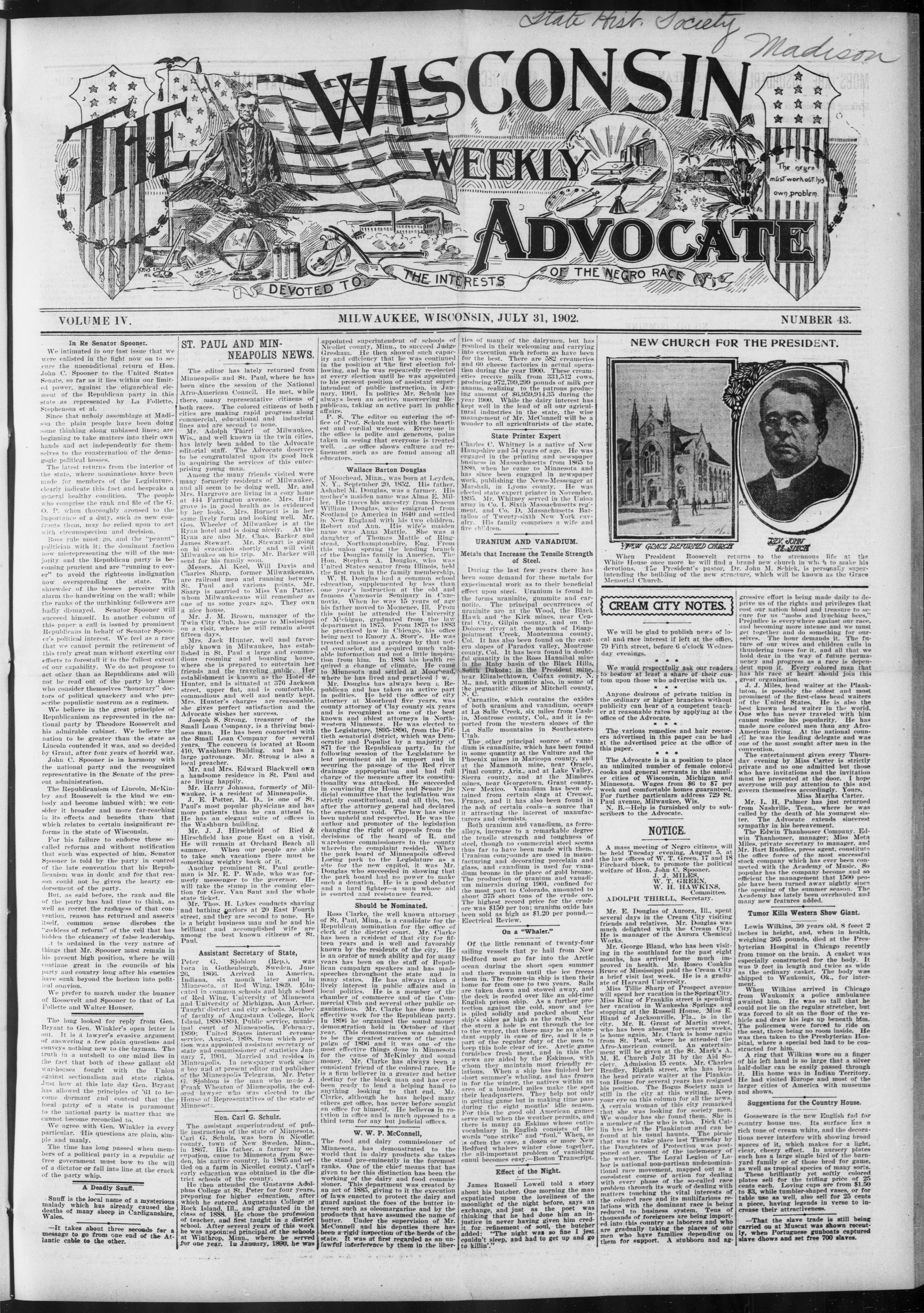
NEW CHURCH FOR THE PRESIDENT.
NEW GRACE REFORMED CHURCH
REV. JOHN
P. SHICK
When President Roosevelt returns to the strenuous life at the White House once more he will find a brand new church in which to make his devotions. The President's pastor, Dr. John M. Schick, is personally superintending the building of the new structure, which will be known as the Grace Memorial Church.
CREAM CITY NOTES.
---
We will be glad to publish news of local and race interest if left at the office, 79 Fifth street, before 6 o'clock Wednesday day evenings.
We would respectfully ask our readers to bestow at least a share of their custom upon those who advertise with us.
Anyone desirous of private tuition in the ordinary or higher branches without publicity can hear of a competent teacher at reasonable rates by applying at the office of the Advocate.
The various remedies and hair restorers advertised in this paper can be had at the advertised price at the office of this paper.
The Advocate is in a position to place an unlimited number of female colorad cooks and general servants in the smaller cities of Wisconsin, Michigan and Minnesota. Wages from $6 to $7 per week and comfortable homes guaranteed. For further particulars address 729 St. Paul avenue, Milwaukee, Wis. N. B.—Help is furnished only to subscribers to the Advocate.
NOTICE
A mass meeting of Negro citizens will be held Tuesday evening, August 5, at the law offices of W. T. Green, 17 and 18 Birchard block, to promote the political welfare of Hon. John C. Spooner.
ADOLPH THIRLL. Secretary.
Mr. E. Douglas of Aurora, Ill., spent several days in the Cream City visiting friends and relatives. Mr. Douglas was much delighted with the Cream City. He is manager of the Aurora Chemical Works. Mr. George Bland, who has been visiting in the southland for the past eight months, has arrived home much improved in health. Mr. Rosco Conklin Bruce of Mississippi paid the Cream City a brief visit last week. He is a graduate of Harvard University.
Miss Tillie Sharp of Prospect avenue will spend her vacation in the Spring City. Miss King of Franklin street is spending her vacation in Waukesha Springs and stopping at the Russell House. Miss E. Bland of Jacksonville, Fla., is in the city. Mr. R. Grant of Martin street, who has been absent for several weeks, is home again. Mr. Clark is home again from St. Paul, where he attended the Afro-American council. An entertainment will be given at the St. Mark's A. M. E. Church July 31 by the Aid Society. Admission 15 cents. Mr. Charles Bradley, Eighth street, who has been the head private waiter at the Plankinton House for several years has resigned his position. The Bogus Society man is still in the city at this writing. Keep your eye on this column for all the news. A certain woman of this city remarked that she was looking for society men. We wonder has she found them. She is a member of the who is who. Dick Catlin has left the Plankinton and can be found at his usual haunts. The picnic that was to take place last Thursday by the Daughters of Protection was postponed on account of the inclementy of the weather. The Loyal Legion of Labor is national non-partisan undenominational race movement, mapped out as a consistent course of action for dealing with every phase of the so-called race problem through its work of dealing with matters touching the vital interests of the colored race and its multifarious relations with the dominant race is being reduced to business system. Tens of thousands of foreigners are being imported into this country as laborers and who are gradually taking the places of our men who have families depending on them for support. A stubborn and ag-
NUMBER 43.
R THE PRESIDENT.
REV. JOHN
M. SHICK
turns to the strenuous life at the brand new church in which to make his
Dr. John M. Schick, is personally super-
ture, which will be known as the Grace
gressive effort is being made daily to deprive us of the rights and privileges that cost our nation blood and treasure to secure for us "mobs and lynching bees." Prejudice is everywhere against our race, and becoming more intense and we must get together and do something for ourselves. The hour demands it. The future of our wives and children calls in thundering tones for it, and all that we hold dear in the way of future permanency and progress as a race is dependent upon it. Every colored man that has his race at heart should join this great organization
J. J. Miles, head waiter at the Plankinton, is possibly the oldest and most prominent of the first-class head waiters of the United States. He is also the best known head waiter in the world. One who has never traveled with him cannot realize his popularity. He has made more colored men than any Afro-American living. At the national council he was the leading delegate and was one of the most sought after men in the convention. The entertainment given every Thursday evening by Miss Carter is strictly private and no one admitted but those who have invitations and the invitation must be presented at the door. I hope everyone will pay attention to this and govern themselves accordingly. Yours,
Mr. L. H. Palmer has just returned from Nashville, Tenn., where he was called by the death of his youngest sister. The Advocate extends sincerest sympathy in his bereavement. The Edwin Thanhouser Company. Edwin Thanhouser, manager; Miss Meta Miles, private secretary to manager, and Mr. Bart Ruddles, press agent, constitute the office force of the most successful stock company which has ever been connected with the Academy of Music. So popular has the company become and so efficient the management that 1500 people have been turned away nightly since the opening of the summer season. The Academy has lately been overhauled and many new features added.
Tumor Kills Western Show Giant.
Lewis Wilkins, 30 years old, 8 feet 2 inches in height, and, when in health, weighing 365 pounds, died at the Presbyterian Hospital in Chicago recently from tumor on the brain. A casket was especially constructed for the body. It was 9 feet in length and twice as wide as the ordinary casket. The body was shipped to Waukomix, Ok., for interment. When Wilkins arrived in Chicago from Waukomix a police ambulance awaited him. He was so tall that he could not lie on the regular stretcher, but was forced to sit on the floor of the vehicle and draw his legs up beneath him. The policemen were forced to ride on the seat, there being no room inside. He was then taken to the Presbyterian Hospital, where a special bed had to be constructed for him.
A ring that Wilkins wore on a finger of his left hand is so large that a silver half-dollar can be easily passed through it. His home was in Indian Territory. He had visited Europe and most of the larger cities of America with museums and shows.
Suggestions for the Country House.
Gosseware is the new English fad for country house use. Its surface has a rich tone of cream white, and the decorations never interfere with showing broad spaces of it, which makes for a light, clear, cheery effect. In nursery plates each has a large single bird of the barnyard family or of those bred for game, as well as tropical species of many sorts. These brilliantly yet softly colored plates sell for the trifling price of 25 cents each. Loving cups are from $1.50 to $3, while tumbler-shaped vases, or for table use as well, also sell for 25 cents a piece, having legends in verse to increase their attractiveness.
That the slave trade is still being carried on at Muscat was shown recently, when Portuguese gunboats captured slave dhows and set free 700 slaves.
---
Striking Mineworkers are Becoming Desperate.
Number of Nonunion Workmen are Driven from the Engines, Pumps and Fire Rooms.
Shenandoah, Pa., July 30.-The attitude of the striking mine workers here is daily becoming more demonstrative. All last night a mob of fully 1000 men and boys were on the march. They first visited West Shenandoah colliery and drove the nonunion workmen from the engines, pumps and fire rooms. The workmen were compelled to seek refuge in the camp of the coal and iron police. The strikers assailed the breaker with stones, doing considerable damage to window glass. From the West Shenandoah mine, the mob proceeded to Indian Ridge colliery, where they were confronted by a body of special police whose presence prevented violence.
Squads of strikers picketed the approaches to several mines where pumping is in progress and urged the men employed to quit work. Deputy Sheriff Coombs, Union Organizer Ginley and a posse of deputy sheriffs are here endeavoring to maintain order.
Strikers Growing Restless.
Shamokin, Pa., July 30.—Hundreds of strikers lined the roads leading to different collieries today and prevented the nonunion men from going to work. John Shipman and son, nonunion men, were brutally beaten. Strike leaders are busily engaged in trying to calm the strikers, who have grown more restless. President Mitchell will visit here as soon as possible to address the men in an endeavor to keep them from breaking the law and also to urge them to remain away from the mines.
Seek Other Employment.
Wilkesbarre, Pa., July 30.—The departure of miners from the anthracite region to the bituminous fields continues. About thirty men left today for Indiana. The officials of the United Mine Workers find they cannot provide place for all the applicants who want to leave and this is causing some dissatisfaction among the strikers.
Press Feeders Go Out.
New York, July 30.—A strike of press feeders was ordered in six job printing establishments here today by the Press Feeders' Union because of the refusal of Master Printers to grant a demand for $14 per week for that class of labor. About 150 men are out, but unless the difficulty is settled before tomorrow evening the union officials threaten to call out the men employed in about forty shops which will involve about 1000 feeders.
Differences Adjusted.
Washington, D. C., July 30.—The differences between the striking electricians and the New York contractors having in charge the electrical work at the white house have been satisfactorily adjusted and the men have returned to work.
DISBROW HEIR TO FORTUNE
Inmate of New York Jail Inherits $50,000 from the Estate of His Grandfather.
New York, July 30.—Held by the grand jury of Suffolk county on the charge of causing the death of Clarence W. Foster and "Dimple" Lawrence at Good Ground, L. I., Louis A. Disbrow, in a cell at Riverhead jail, is believed to be heir to $50,000 from the estate of his grandfather, Hosea B. Perkins, who has just died. He had been sick for more than a year and when the Good Ground tragedy and Disbrow's connection with it became known there was much speculation as to whether he would make any change in his will, which it is understood provided a legacy of $50,000 for each of his grandchildren.
Mr. Perkins' condition of health was such that news of the tragedy probably would have hastened the end, so he never was informed of his grandson's plight. Mr. Perkins was 83 years old.
SUNK IN COLLISION.
Two British Steamers Come Together Off Malacca with Disastrous Results
Singapore, July 30.—In a collision off Malacca, Straits Settlement, between the British steamers Prince Alexander and Ban-Hin-Guan, the former vessel was sunk and forty lives were lost. The steamer Prince Alexander was built at Papenburg, Prussia, in 1878. It was 132.7 feet in length, with a net tonnage of 138 and sailed under the British flag. The Ban-Hin-Guan also was built in 1878 at Glasgow. It was 180.3 feet long, with a gross tonnage of 449.
PAUL VAN DER VOORT DIES.
Was Commander-in-Chief of the Grand Army of the Republic in 1882.
Puerto Principe, Cuba, July 30.--Paul Van Der Voort, past commander in chief of the Grand Army of the Republic, died yesterday of paralysis of the heart. He was born in Ohio in 1846. He enlisted for the three months' service in the Sixty-eighth Illinois infantry and reenlisted in Co. M. Sixteenth Illinois cavalry, and was with his regiment in the ninth and twenty-third corps and the cavalry corps of the military division of the Mississippi. He was discharged August 1, 1865, as sergeant. Past Commander Van der Voort joined the Grand Army in Illinois in 1866, and was assistant adjutant general to Department Commander Hilliard. He resigned the position on his removal to Omaha, where he was mainly instrumental in the reorganization of the department of Nebraska, to which he was assigned as provisional commander. On the formation of the department he was elected department commander. He was elected senior vice commander in chief in 1878 and commander in chief in 1882.
TOOK A DOSE OF RAT POISON
Menominee (Mich.) Man Whose Wife Refused to Return Home.
Menominee, Mich., July 30.—[Special.]
—Because his wife had left him and lent a deaf ear to his entreaties for her to return home, George Murry, a middle-aged man who resided with his two small children, took a dose of rat poison. Murry is in great agony, but the doctors think they can save his life. Since she left her husband Mrs. Murry has been working in a restaurant and yesterday Murry visited the place and besought her to come home. She refused, and on his way to his home he stopped at a drug store and bought the poison. Mrs. Murry was told of her husband's deed, but declined to go home until her work at the restaurant had been finished.
USED COMPANY'S MONEY
TRUSTED CASHIER BECOMES DEEPLY INVOLVED.
Turns Over All of His Property to Make Good a Shortage of About Eighty Thousand Dollars.
Cedar Rapids, Ia., July 30.—Charles A. Perkins, cashier of the district office of the Northwestern Mutual Life Insurance Company, admits that he has been speculating with the company's money. The shortage is not less than $80,000, and may go above that sum. Perkins said he began to take the company's funds for personal investments ten years ago, when he was suddenly confronted with the necessity of providing for three families.
He thought he could invest the money, make it bring him a good income, and return it to the company without loss. A short time ago he found he was getting deeply involved and then he confessed to the general agent, H. A. Munger. He has turned over all his stocks in various companies to Munger, also giving him a mortgage on his interests in his fine home in this city. Munger will have to make good the
NO OIL COMBINE.
Standard Oil Attorney Says London Story is False from Beginning to End.
New York, July 30.—Regarding the cabled report that the Standard Oil Company has entered or will enter into an agreement with the Rothschilds and Nobel interests to control the world's production, M. F. Elliott, the secretary of the Standard Oil Company, today made the following statement:
"I am authorized to say that the story has absolutely no foundation in fact. It is false from beginning to end. Furthermore, the Standard Oil Company has at no time considered a plan of this kind, and at no time has that company entered into negotiations about this matter."
London, July 30.—James McDonald, general representative of the Standard Oil Company and manager of the Anglo-American Oil Company, denies the story printed in the Daily Mail to the effect that the oil interests of Rockefeller, Rothschild and Nobel have entered into a working agreement. Mr. McDonald said to a representative of the Associated Press:
"Nothing of the sort has been accomplished or contemplated. The rumor must have sprung from the fact that the Shell Trading Company, which handles much Russian product in the East, was negotiating in the direction of securing the export trade of the whole Russian output. There had been some slight negotiation towards taking over the Shell business by the Standard Oil Company, but this was without result. It is improbable that the Standard Oil Company will depart from its policy of handling the American product only, so long as that remains sufficient to supply the trade."
CONFIDENCE RESTORED.
Result of Notice by Commander McCrea that Foreign Residents Would Have Protection.
Cape Haytien, Hayti, July 30.—Gen. Albert Salnave, commanding an army in support of M. Firmin's candidacy for the Presidency, is camped with a large body of troops about three miles from this place. Gen. Nord, who went out to give battle to Gen. Salnave, was defeated and his army retreated in panic to Cape Haytien. The volunteers have abandoned their posts. Confidence has been restored among the foreign residents of the city, thanks to the energetic measures taken by Commander McCrea of the United States gunboat Machias and United States Consul Livingston to guarantee them protection in case of an attack on the city.
Carupano, Venezuela, July 30.—The French trans-Atlantic line steamer Saint Germain, escorted by the French man-of-war Suchet, has touched at Carupano without having encountered a Venezuelan warship. This is regarded as new evidence that the blockade of Venezuelan ports is ineffective.
M. P. GOES TO JAIL.
Will Serve Three Months for Contempt of Court at Sligo.
London, July 30.—Patrick A. McHugh, Nationalist member of Parliament for the North division of Leitrim, left the House of Commons tonight, accompanied by the governor of the Sligo jail, in which place Mr. McHugh is to serve a sentence of three months' imprisonment.
Mr. McHugh was arrested on June 15 on a bench warrant issued by the special court assembled at Sligo under the crimes act, charging him with contempt of court.
In the course of Mr. McHugh's trial in April, 1901, when he was accused of publishing seditions libels in his newspaper, the Sligo Champion, it is charged that he called the presiding magistrate a "d—d liar" and that he refused to apologize.
WATCHMAN WENT TO SLEEP.
Meanwhile Building is Set on Fire and One is Burned to Death.
Des Moines, Ia., July 30.—Firemen early today found one man dead and another dying in the Stoner Wall Paper Company's building in South Des Moines while trying to put out a fire which destroyed $50,000 worth of property. The dead man's name is David Watt, night watchman for the company. The dying man's name is I. P. Miller, night guard for the Long Shore mill. It is believed that the two men secured a quantity of liquor, repaired to the office of the wall paper company and after drinking the liquor, went to sleep. In some manner the building was set on fire and before the firemen could reach the factory the flames had gained such headway that it was impossible to save much of the stock and machinery.
KUBELIK HELD CAPTIVE
Manager will Not Allow Violinist to Visit His Mother.
Vienna, July 30.—Wenzel Kubelik, brother of Jan Kubelik,, the violinist, has written to the Pestor Lloyd a long letter complaining of the way the impresario Skivan has exploited his brother. He charges that Skirvan has lost the greater part of his brother's earnings through speculations, thus seriously injuring the artist's nervous system. By every possible means Jan is prevented from coming under the salutary influence of his friends. He is not allowed to visit his mother, the pretext given being that a great artist like Jan must not share even and hour with his mother in her habitation.
VESSELS ARE WRECKED
Gulf of California Visited by a Tornado.
ARE DASHED ON SHORE.
Tucson, Ariz., July 29.—A tornado visited the gulf of California on Thursday night, wrecking vessels and damaging many buildings in the coast cities. The wires have been down and news of the disaster has just been received. At Guaymas five vessels in the bay were dashed ashore and later sunk. Two of them, El Luella and El Gravina, were large steamers engaged in coastwise trade.
The pubile building containing the offices of the harbormaster and collector of customs was detroyed. The residence of the English vice-consul was unroofed and otherwise wrecked. The streets of Guaymas in many places were strewn with fallen trees and wreckage. At Mazatlan the Pomoroy Ruby, a large passenger steamer, was driven ashore and sunk. Five passengers were drowned and the rest reached the shore on wreckage and driftwood. Another large vessel in the bay was also damaged by the tornado. Between Guaymas and Mazatlan a great deal of wreckage drifted ashore and it is supposed that many small vessels were wrecked and a large number of lives lost.
EARTHQUAKES IN WEST.
Strange Rumbling Sound Drives People from Their Homes.
Omaha, Neb., July 29.—Cities and towns of Nebraska, Western Iowa and South Dakota experienced yesterday the terrors that come with an earthquake. With a strange rumbling sound the surface of the earth shook and buildings rocked, while dishes rattled on shelves or tables and the people in some cases fled from their homes to escape death under walls they felt certain were going toumble.
Reports show that the earthquake was severest at Tilden, Elgin, Norfolk, Pierce, Plainview, Creighton, O'Neill, Petersburg, Oakdale, Battle Creek and Santee agency, Neb.; Yankton, Elk Point, Vermillion and Gayville, S. D. By the side of the Missouri river near Lonia, Neb., is a smoking crater known for years as a volcano. Shortly after the volcanic disturbances in the West Indies this volcano showed signs of violent eruption.
Causes Alarm in Yankton.
Reports from Yankton say the earthquake shock occurred at 12:45 o'clock and lasted 12 seconds. It was accompanied by rumbling noises and caused considerable fright. A dispatch from Santee agency, Nebraska, says a distinct earthquake shock was felt there at 12:40 o'clock. The shock seemed to move from west to east. In some homes the dishes rattled. A telephone report said that Battle Creek had been badly damaged by the earthquake. The report came from Norfolk, but Battle Creek later reported that beyond the shaking of houses, rattlign of dishes and the fright of inhabitants no damage had been done.
At Tilden the first shock was the heaviest, lasting 15 seconds. The second shock was experienced in slightly over 2 minutes afterward and was but a slight quivering of the earth. The people were thrown into a panic by the first shock, and when the second began they fled in terror.
PACIFIC COAST SHAKEN.
Fifteen Distinct Shocks Experienced in Southern California.
Santa Barbara, Cal., July 29.—What is regarded as the most severe earthquake ever felt in Southern California caused much damage Sunday night in Northern Santa Barbara county. The shocks lasted for fifteen minutes, and the district most affected was from Lompoc to Santa Maria. The most curious result was the filling of a dry stream bed with water. The first shock was felt a few minutes past 11 o'clock, the vibrations continuing for several minutes. Shortly after there were fourteen distinct shocks, but none as severe as the first. Nearly fifteen minutes elapsed between the first and final shocks. In the Careaga oil fields large fissures were cut in the earth. Two tanks containing 3000 barrels of oil each were wrecked and oil flooded the section.
Nearly all the surface pipe lines used for conveying oil and water several miles were twisted or so broken that renewal will be necessary. None of the wells over 2000 feet deep was affected. At Los Alamos adobe buildings were thrown to the ground, while in the business places windows were broken and goods on the shelves thrown to the floor. Lomoroc, several miles to the Southwest, fared badly. The city is practically without water supply, as the mains were broken and the water has been flooding low levels.
The Santa Ynez river, which in the summer is a small stream but in winter a torrent, was comparatively dry Sunday. Today water is rushing over the river bed as in a freshet. No one will attempt to explain this remarkable phenomenon, and the presence of such a large volume of water at this time is considered part compensation for the great damage. Over 100 years ago Franciscan fathers undertook to establish a mission at Lompoc. The large building was nearly completed after several years of hard work when an earthquake visited the district and utterly destroyed the edifice. Further attempts to build a structure at that point were abandoned.
From several of the sparsely settled districts reports are received in this city that the damage done was great to buildings of every description. Only a slight shock was felt in Santa Barbara.
YAQUIS OVERWHELMED
Remnant of Hostile Band Which Took to Warpath Some Time Ago.
San Francisco, Cal., July 29.—A special from Tucson, Ariz., says: Driven to desperation by hunger and thirst, a band of thirty Yaquis, nearly half of them women, swooped down upon the Carmen ranch near Hermesillo Saturday and a fierce fight followed. When a patrol of Mexican troops galloped down to the rescue two of the women and five of the men lay dead. The Yaquis were completely overwhelmed. These Indians are supposed to be the last remnant of those who took to the warpath some time ago.
Shot by His Stepson.
Memphis, Tenn., July 29.—A Simitax special from Piggott, Ark., says: "H. L. Hinkley was called out of his house at Crockett and shot dead yesterday by Edgar Williams, his stepson. Williams has not been arrested."
EMPEROR'S GIFTS.
Berlin, July 30.—The German Emperor has conferred a number of decorations on Americans incidental to the visit to the United States of Prince Henry of Prussia. The Red Eagle of the third class is bestowed on Samuel H. Ashbridge, mayor of Philadelphia; Julius Fleischmann, mayor of Cincinnati; Rolla Wells, mayor of St. Louis; David R. Francis, former governor of Missouri; Arthur Eddy, Chicago, and Gustav H. Schwab, New York. The Red Eagle of the fourth class is given to W. S. McChesney, general manager of the St. Louis terminal; Gustav Fischer, president of the German Maennerchor of Chicago; Chief of Police Kiely of St. Louis; Prof. Camillo von Kleuze of Chicago, and Rev. Dr. Gustav Zimmerman of Chicago.
Those who received the crown order of the third class are John N. Patridge, police commissioner of New York; Detective Capt. Titus, New York; Henry Rubens, Chicago, and William Vocke, Chicago. The Crown order of the fourth class is conferred on Consular Agent Baumbach, Milwaukee; George C. Boldt, manager of the Waldorf-Astoria hotel, New York; F. F. Coakley, stationmaster St. Louis, and Wilhelm Schmidt, Chicago.
The Emperor presents autograph photographs of himself to the designers of the yacht Meteor III., C. C. Cary Smith and Henry Barhey.
For Army Officers.
The foreign office announces a list of presents made by Prince Henry. Some of them were conferred by the prince while he was in the United States, but most of them were sent recently. David J. Hill, assistant secretary of state, received a gold snuff box bearing the letter "H" and a crown in diamonds. Rear Admiral Robley D. Evans was given an enamel portrait of the Prince surrounded by diamonds.
Maj. Gen. H. C. Corbin's present was a gold cigarette case on which was the Prince's portrait in diamonds. Col. Theodore A. Bingham and Commander W. S. Cowles each received a gold cigarette case on which were a crown in diamonds and the letter "H." A bracelet bearing the prince's portrait in rubies and diamonds was presented to Mrs. H. H. D. Pierce, wife of the third assistant secretary of state, and to Mr. Pierce was given a framed portrait of the prince.
Other presents were given as follows: Maj. Richard Sylvester, superintendent of the Washington, D. C., police department; John Wilkie, chief of the United States secret service; John C. Stubbs, railway official; Cornelius VanCott, postmaster at New York, and J. B. Reynolds, secretary to the mayor of New York, diamond scarf pins; McDougall Hawkes, dock commissioner, New York, a gold scarf pin; Thomas Sturgis, fire commissioner, New York, and Detective Thurston, New York, gold cuff buttons; Police Inspectors Cortright, Brooks, Harley, Thompson, Kane and Cross; Police Captains Schmittberger and Wendell and Capt. Smith of the harbor police, all of New York; Assistant Supt. Hunsdorffer of the Pinkerton bureau; Mr. Deutsch, who was telegraph agent at the Thirty-fourth street pier, New York, where the Hohenzollern iay, and Louis Murphy of the United States secret service, all receive scarf pins.
Framed Portraits.
Postmaster Frederick E. Coyne of Chicago is given a gold cigarette case, Chief of Police Frank O'Neill of Chicago a gold scarf pin and the manager of Willard's hotel, Washington, a gold cigarette case. Framed portraits of the Prince are sent to Seth Low, mayor of New York; Patrick A. Collins, mayor of Boston; Carter H. Harrison, mayor of Chicago; to the navy department at Washington; to the naval and military academies, the New York Yacht Club, the University Club, New York; to the armory of Squadron A, New York, and to the Milwaukee public museum.
Among those who receive photographs of the prince are Govs. Nash of Ohio, Durbin of Indiana, Yates of Illinois, Van Sant of Minnesota, La Follette of Wisconsin and Odell of New York; Mayor Gans of Albany; J. Pierpont Morgan, Charles Stewart Smith, Morris K. Jessup, Hermann Ridder, Abram S. Hewitt, Joseph Speyer, Carl Schurz, John Crosby Brown, Judge Henry E. Howland and Ernst Thalmann, all of New York; Rear Admiral Albert S. Barker and Commander Richard Wainright, U. S. N.; Maj.-Gen. J. R. Brooke, U. S. A., and several members of his staff; former Secretary of the Navy John D. Long and Gen. H. V. Boynton.
GREAT FIRE AT LOURDES.
An Entire Block of Buildings Destroyed and a Number of People
Paris, July 30.—A dispatch to the Temps from Tarbes gives news of a terrible fire at Lourdes, the town famous for its shrine to Our Lady, to which many pilgrims go. The fire brigade was unable to check the flames and when the dispatch was sent an entire block of houses had been destroyed and a number of persons had been victims of the fire.
Place Tendered to Marquette's Editor and Mavor.
Marquette, Mich., July 30.—James Russell, editor of the Mining Journal and mayor of this city, has been offered the position of warden of the branch penitentiary located near here, and it is believed he will accept, taking charge of the institution October 1. There has been much trouble at the prison, growing out of friction between Deputy Warden Mosher, who was removed, and Warden Freeman, who subsequently resigned. Mr. Russell was state commissioner of mineral statistics and has been postmaster at Marquette.
UNDER WA_ER 02 SECONDS.
David Poquette Easily Wins a Wager at Menominee, Mich.
Menominee, Mich., July 30.—[Special.] David Poquette, a well-known "boom" man on the Menominee river, won a bet that he could not stay under water for more than a minute. Watches were held by interested spectators and Poquette was beneath the surface of the river exactly ninety-two seconds, coming up fresh and with strength enough to swim to the boom, some distance away.
THEIR BOAT CAPSIZED.
Two Young Ladies Precipitated Into the Water—Both Drowned.
Monticello, Minn., July 30.—Miss Mabel Wells of this place and Eva Sasker and Laura Tye, both of Farihault, all young ladies, were drowned in Lake Jefferson, Le Seuer county, last evening. Their boat capsized during a storm. Profs. Bingham and Hanson of Minneapolis were with them, but could not save them.
One Killed and Several Injured at Escanaba, Mich.
Escanaba, Mich., July 29.—[Special.]
—This morning at 5:30 o'clock the fast mail on the Chicago & North-Western railway, with two engines attached, ran into a freight train in the yards in this city. One man was instantly killed, two were badly injured and several of the passengers and crew were shaken up and sustained bad injuries. The dead:
M'KENNA, JOHN—Home at Escanaba; engineer on passenger train; jumped and was instantly killed; survived by his wife and two sons and one daughter, all grown.
The injured:
Thomas Greene, Escanaba, engineer; shoulder dislocated.
Steve Lyon, fireman, Escanaba; shoulder
Steve Lyon, nieman, Escanaba; shoulder dislocated.
Couldn't Stop Train.
The passenger train was running at the rate of fifty miles an hour when the accident occurred. The freight was standing on the main track and the engineer on the front locomotive of the passenger train was unable to stop the train, although signaled to do so. It is said that the airbrakes were not connected with the engine.
The head locomotive had been sent to Narenta to help the regular engine of the passenger train, which had been disabled. The relief engine hitched up to the train but it is said that the crew neglected to attach the airbrakes.
Switch Left Open.
The train dashed into this city at a fifty-mile-an-hour gait, and it was impossible for the engineer to bring the train to a sudden stop. Someone had left the switch into the yard open and the train dashed onto the track on which the freight train was standing. In a moment a signal was given to the engineer to stop but he was powerless and the big train dashed on, crashing into the locomotive.
Jumped for His Life.
Engineer McKenna saw that it was impossible for him to save his train and so, shouting to his fireman to make his escape, he jumped. He struck a switch and was instantly killed.
The crew of the freight train were able to escape with but slight injuries and the passengers were more frightened than hurt.
John McKenna, the killed engineer, was one of the veteran employees of the North-Western road and expected to retire from service this fall. Mrs. W. R. Smith of this city, who with her husband is spending a few weeks at Atlantic City, is his daughter.
Due to a Misunderstanding.
A misunderstanding of trainmen caused the wreck. The brakeman supposed the air to be controlled by the second engine and did not connect the air between the first and second engines. Engineer McKanna on the first engine thought the connection made and Engineer Greene on the second engine cut out his air thinking the conection made with the first engine. Railroad rules are that the first engine controls the air. Had the freight not been on the track loading, the passenger train would have run through the roundhouse and several people would probably have been killed.
Wreck on Milwaukee Road.
La Crosse, Wis., July 29.—A Milwaukee fast freight and a loaded gravel train going at high speed crashed together head on north of River Junction, across the Mississippi, last night. Wrecking trains have been sent to the scene. Both engines were crushed to masses of twisted iron and cars were thrown fifty feet. Engineer Emerson and Fireman Knapen of the freight escaped death by jumping. No one was killed or injured. All traffic north was blocked by wreckage.
FUNERAL IN LONDON.
Requiem Mass for Repose of Soul of Late J. W. Mackay—Widow Still Prostrated.
London, July 29.—Many American and English friends of the family were present today at a requiem mass said in St. Mary's Roman Catholic Church, Cadogan square, for the repose of the soul of John W. Mackay. The members of the family present were Clarence Mackay, the Princess Colonna, with her young son, and the daughter and two sons of the Countess Telfner. Mrs. Mackay, who is still prostrated, remained at home with her mother, Mrs. Hungerford. The Countess Telfner is quite ill at the Walsinham hotel.
Mr. Mackay's body was taken last evening to Nottinghill convent, where it will remain until taken to America in September or October, when Mrs. Mackay will accompany it.
Today's service was confined to the celebration of the mass for the dead. The floral decorations for the chancel consisted chiefly of large bunches of lilies of the valley.
TREASON TRIAL ENDS
Evidence that Col. Lynch Acted as Public Prosecutor in Trial of British Spies.
London, July 29.—The case of the government against Col. Arthur Lynch, who was elected to represent Galway City in the House of Commons and who was accused of high treason, ended in police court today and Lynch was remanded to give his counsel opportunity to review the evidence. Among the last witnesses called to identify Col. Lynch were Geo. Grieg, an American who was caretaker of a mine near Johannesburg, and another American named Worthington. Both these witnesses testified that they were arrested by Boers near Vereeniging, charged with being British spies, and that Col. Lynch acted as public prosecutor at their trial.
NO MOI F WOMEN ON B. & O.
President Loree Thinks They are Not Fitted for Railroad Business.
New York, July 29.—President L. F. Loree of the Baltimore & Ohio has issued orders that no more women stenographers be employed in the operating departments of that road. The women now in the company's service are not to be discharged, but President Loree desires that hereafter only men shall be trained in the operating departments. He believes in promotions and wants all leks to fit themselves for higher places. Women, he thinks, are not competent to grasp the railroad business in the way that men do.
London, July 29.—Colonial Secretary Chamberlain appeared in the House of Commons this afternoon for the first time since his recent accident. He was greeted with hearty cheering and later he was warmly congratulated by Sir Henry Campbell-Bannerman, Liberal leader in the House.
Sir Henry Campbell-Hannerman supplemented his congratulations by asking for information of the colonial conference. He expressed the hope that lenient treatment would be extended to the Boers in South Africa: Mr. Chamberlain replied that Lord Milner, the high commissioner, had telegraphed spontaneously that he did not think further legislation necessary to make the banishment proclamation effective. The government would refuse to allow the return of persons who showed themselves inimical to good order and peace. "We are not going to allow the result of the war to be undermined," said Mr. Chamberlain, "by intrigues carried on by nominally constitutional means.
Regarding the future status of South Africa the colonial secretary said the imperial government had established a crown colony in the strictest sense. The next step would be to add a nominated official element. Thereafter there would be an elected official element and then nothing but circumstances and time would separate the new colonies from full self-government. All must understand, however, that the government would not be rushed nor hustled into any action which circumstances did not warrant. There remained many questions to be dealt with; a new tariff must be arranged, and the taxation of mines be settled, but he wished to say that nothing would be done to punish owners of mines as had been suggested in many quarters.
The government would do nothing to interfere with a quick revival of development of the country. Subject to that consideration, Mr. Chamberlain continued, no man was more anxious than he to recover some considerable part of the cost of the war from South Africa. He thought it would be perfectly fair to lay a fair part of the cost of the war on the principal industry of the Transvaal, but what amount it was too soon to say.
Burgher and Briton Shake Hands.
Mr. Chamberlain dealt comprehensively with the past and future of South Africa. "We have no intention," he declared, "that the Boers should break with their old traditions. We desire that they should preserve all the best characteristics of their race and hope they will shake hands with us, thus securing prosperity in South Africa under the flag which protects different races and different religions."
Dealing with the much discussed labor question, Mr. Chamberlain said he believed every inducement to labor should be held out to the blacks, but no scheme of compulsory labor would receive the slightest government support. There was no intention of packing the country with Britishers, but so much Transvaal land was lying idle that the colonies could only be made a great com-producing factor by bringing in British settlers.
TAKES HIS OWN LIFE.
Prominent Chicago Merchant Driven to Suicide by Ill Health and Business Troubles.
Chicago, Ill., July 29.—Abram M. Rothschild, until recently head of the big State street store which bears his name, committed suicide by shooting himself in the head with a revolver yesterday afternoon. Mr. Rothschild's act is attributed to an attack of temporary insanity brought on by acute insomnia, from which he had been a sufferer for a long time. Business affairs also, it is said, added to his mental depression. The retirement of Mr. Rothschild from the company, after serving seven years as its head, was the cause for stories that he had come to serious differences with his father-in-law, Nelson Morris, who owned a large interest in the establishment.
Another thing which it is said caused Mr. Rothschild much trouble was the fire in the store on September 19, 1901, with the fall of a big water tank from the roof to the bottom and the destruction of a part of the stock by water. The insurance companies refused to pay for the damage, and the firm brought suit against sixty-eight companies for an aggregate sum of $250,000.
This started an investigation, and the underwriters made the statement that the accident was caused by repairs being made to the building for which a permit had not been taken out at the city building department.
This is said to have widened the breach between Mr. Morris and Mr. Rothschild, and resulted in the retirement of the latter.
DELGADO UNDER ARREST
Prominent Cuban Officer Charged with Assassination — Sensational Trial Promised.
Havana, July 29.—Gen. Perico Delgado is under arrest, charged with having assassinated Antonio Acosta, a nephew of Col. Baldomero Acosta.
The arrest has caused a profound sensation, as Gen. Delgado is one of the best known Cubans. He commanded the Cuban sharpshooters who operated against Weyler's black Spanish guerillas in the late revolution. He is now an officer of the Cuban rural guard.
Gen. Delgado's trial promises to be sensational, as there has been much mystery surrounding the disappearance of young Acosta from his home six weeks ago. It is said that Col. Acosta, the young man's uncle, obtained private information that his nephew was seized by guards under Delgado's direction and afterward was seen taken from the police station at night, handcuffed and between two of Delgado's men.
Thunderstorm Headaches.
There is no doubt that the unfavorable effects on the feeling of well-being experienced by many individuals, such as headache and oppression and nervous distress on the advent of a thunderstorm are due to the same electrical differences of potential, the effects passing away as the disturbed condition of the atmosphere or the storm subsides.—London Lancet.
The Sea Birds' Cry.
The beauty of the sea birds' cry is one entirely of suggestion; its appeal is through the imagination, not the senses. Speaking in human terms, it occupies musical ground ignored by Mozart, appropriated by Wagner. And its suggestions are of desolate seas and savage shores; of an eager, maybe joyous life; but of one, unlike that of the woodland songster, entirely alien from and indifferent to our own.—The Outlook.
Lady Warwick has a peacock which is said to be 100 years old.
RAIN ON THE ROOF.
When the humid darkness gathers
Over all the starry spheres.
Flows and falls like sorrows softly
Breaking into happy tears.
Then how sweet to press the pillow
Of a cottage chamber bed.
And lie listening to the raindrops
On the low roof overhead.
To the quick beats on the shingles
Answer echoes in the heart:
And dim, dreary recollections
Into form and being start,
And the busy fairy, Fancy,
Weaves her air-threads, warp and woof,
As I listen to the patter
Of the light rain on the roof.
Now in memory comes my mother,
As she used, far summers gone,
Taking leave of little faces
That her loving look shone on;
And I feel that fond look on me
As I feel the old refrain
Here repeated on the shingles
By the patter of the rain.
Then my little seraph-sister,
With the wings and waving hair,
And her star-eyed cherub-brother—
A serene, angelic pair—
Glide around my wakeful pillow
With sweet praise or mild reproof,
As I shut my eyes and listen
To the soft rain on the roof.
And another comes to thrill me
With her eyes bewitching blue,
And I mind not, musing on her,
That my heart she never knew;
I remember but to love her
With a passion kin to pain,
And my quickened pulses quiver
To the patter of the rain.
Art hath naught of tone or cadence,
Naught of music's magic spell,
That can thrill the secret fountain
Whence the tears of rapture swell
Like the weird nocturne of Nature,
That subdued, subduing strain
Which is played upon the shingles
By the patter of the rain.
THE BEST OF THE LOT.
They were sensible, hard-working girls, were the Thurlows, and every one liked and admired them. The two elder ones made quite nice little sums of pocket money by their poultry and vegetables, which they drove into the market themselves and sold right well, for their things were always of the best and found a ready sale.
It was a brilliant June morning and the pony was waiting with the little cart at the door, stamping his little feet with impatience, for it was Monday, and "Jan" was fresh from his stable.
"Angela," cried a fresh young voice, "hurry up. Jan is at the door and the baskets are in. Do make haste; we shall be dreadfully late."
"I'm coming. Oh, wait a moment, Rita; I must take some of those pink roses from the south wall. I'm sure they'd sell."
It was just 8 o'clock, and a lovely day. Overhead hung a cloudless blue sky, but it was no bluer than the azure depths of Angela's eyes, and the sunlight was scarce brighter than her glorious hair, which coiled round her head in masses of warm color. She was known as the "best of the lot," and she certainly deserved that position in the family looks on this glorious morning, as she came round breathlessly from the south wall, where she had been gathering a large handful of delicious pink roses, all wet with dew.
"Now, then, my, good Rita, as hard as you and Jan like," said Angela gaily, as she got into the cart.
And, with a flick of the whip across his shaggy shoulders, away went Jan down the narrow avenue, out into the lane which led into the highroad to the town, four miles distant.
Pats of yellow butter set out on a neighboring table, which was presided over by a fat farmer's wife, made a delicious contrast to the piles of vegetables, baskets of brown eggs and the loose bunch of pink roses which the girls speedily set out in their turn; and there was no lack of customers as the morning went on. Strangers glanced curiously at the lovely face of the girl in the blue cotton gown and the sunbonnet, which half concealed her loveliness, and presently a carriage which was passing stopped and two people—a man and a lady—got out and came slowly into the market.
They were strangers to the Thurlows. Possibly they were staying in the neighborhood, which was famous for its scenery and its natural sporting advantages. But they had no time to waste in staring idly at passersby, for they were besieged by customers, and soon their pile of produce had nearly vanished—all but the pink roses and a few eggs.
"Miss Rita, my dear," whispered the fat woman at the next stall, hurriedly, "will you look after my things while I run out to speak to my daughter for a minute? She passed by, and I must see her at once."
"Of course, Mrs. Radley," said Angela; "and I'll have sold all you've got by the time you come back!"
"Thank you kindly, Miss Angela, dear!"
And Mrs. Radley hurried off, while Angela took the vacant seat at the stall. It was getting hot, and she leant back against the wall with a feeling of drowsiness, when she was roused by a voice, saying:
"By Jove! there's a pretty girl! I say, Maude—"
She glanced in the direction of the voice, and saw the two strangers she had noticed getting out of the carriage. They were coming toward her, and her eyes met those of the man, who was looking at her with frank admiration in his handsome face.
"My dear Geoff, do be careful!" said the lady, with a laugh; and then she advanced to the stall where, as a rule, the worthy Mrs. Radley presided over the destinies of her butter and chickens.
"Is this Mrs. Radley's stall?" she
"Is this Mrs. Radley's stall?" she asked, with a surprised glance at the girl, who rose from her seat.
"Yes, ma'am," said Angela, with the demurest air. "She has just gone out of the market for a moment, but I am looking after the things for her. What can I serve you with, ma'am?"
The man was still looking at her, but Angela took not the faintest notice of him.
"A dozen eggs, please," said the lady, getting out her purse, and looking about her; "and—— Oh, what lovely roses those are on the next stall! Are those yours?"
"Yes, ma'am," said Angela with alacrity. "Will you take some! They are quite fresh this morning."
"Give me half the bunch, will you, please? How much? That is right, I think. Perhaps you could bring them out to the carriage for me?"
"Let me take them, Maude," said the man stepping forward. "There is no need to trouble anyone to carry your parcels when I am here. Is that all?"
"Yes. You look rather absurd with that basket of eggs and the roses, Geoff; but have your own way. Good morning."
The man cast a glance at Angela and lifted his hat, as he followed the lady from the stall; and Angela withdrew to her seat with a mischievous smile curving her red lips.
Of course, he thought she was a farmer's daughter or something of that sort, and she laughed to herself at the recollection. He was such a nice looking, soldierly man, too; and she wondered who he was, and where he came from, with that frank interest in the doings of the world in general which was part and parcel of her quiet home life.
"Rita," she said, "I wonder who those
THE MUSEUM OF THE WESTERN WORLD
All over the Union the announced engagement of Rt. Rev. Codman Potter of New York and Mrs. Alfred Corning Clark topic of conversation. Bishop Potter is the best known and clergyman in America. His prominence in civic matters as working as a theologian has earned him a national and international bride-to-be is one of New York's richest women. She is the w lionaire who controlled the Singer Sewing Machine Company, a be worth over $30,000,000. She is known far and wide for he was probably this noble quality which attracted the bishop.
Mrs. Clark has announced that she will not lease her country leigh, at Cooperstown, all summer. She is alone at Fernleigh companion and her youngest son, Stephen.
The announcement of Mrs. Clark's purpose to remain at her coupled with the absence of wedding cards, leads the friends of and his bride-to-be to the belief that the wedding ceremony will at Fernleigh and that the nuptials will be devoid of aught sav tion.
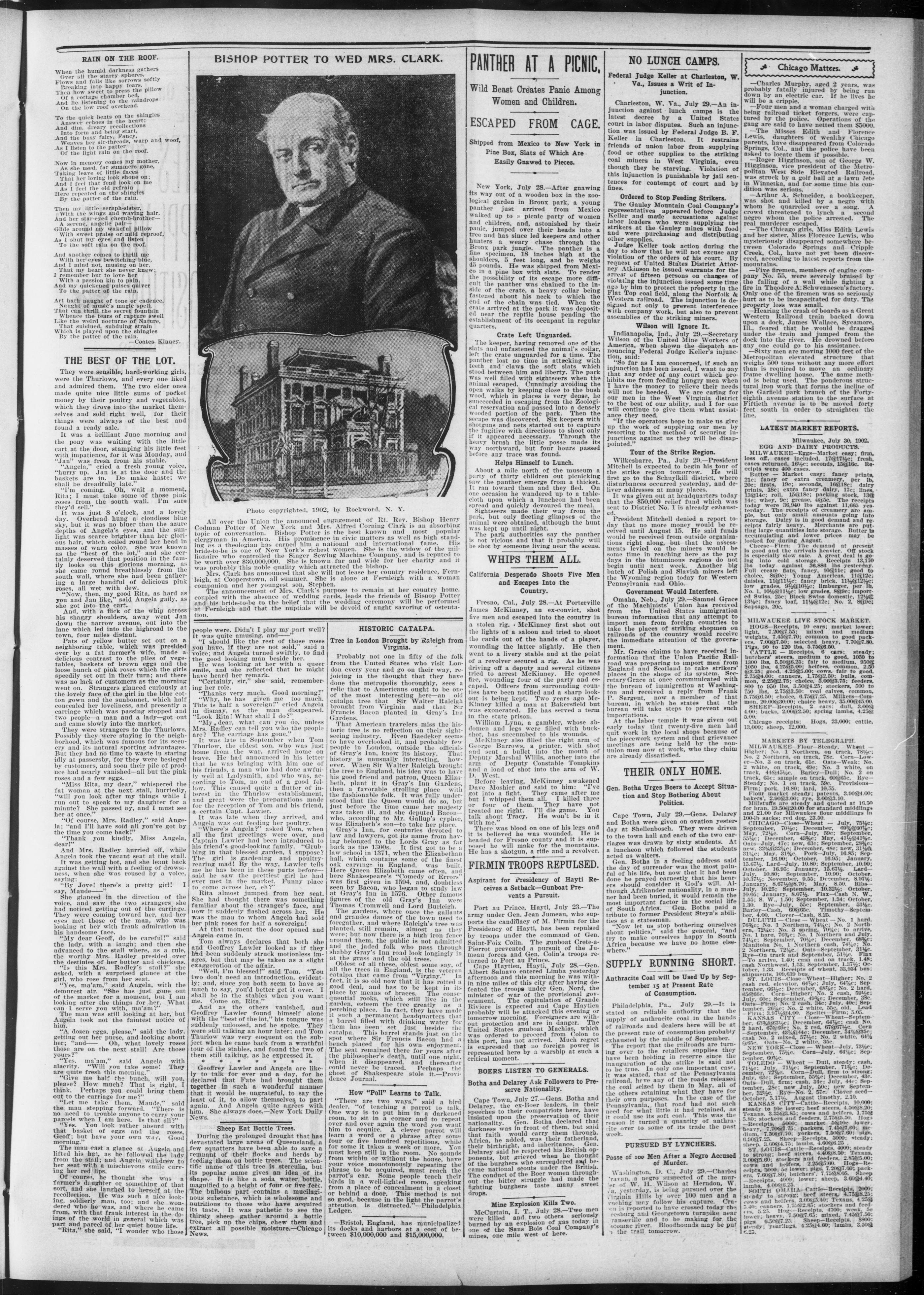
All over the Union the announced engagement of Rt. Rev. Bishop Henry Codman Potter of New York and Mrs. Alfred Corning Clark is an absorbing topic of conversation. Bishop Potter is the best known and most popular clergyman in America. His prominence in civic matters as well as high standing as a theologian has earned him a national and international fame. His bride-to-be is one of New York's richest women. She is the widow of the millionaire who controlled the Singer Sewing Machine Company, and is reputed to be worth over $30,000,000. She is known far and wide for her charity and it was probably this noble quality which attracted the bishop.
Mrs. Clark has announced that she will not lease her country residence, Fernleigh, at Cooperstown, all summer. She is alone at Fernleigh with a woman companion and her youngest son, Stephen.
The announcement of Mrs. Clark's purpose to remain at her country home, coupled with the absence of wedding cards, leads the friends of Bisnop Potter and his bride-to-be to the belief that the wedding ceremony will be performed at Fernleigh and that the nuptials will be devoid of aught savoring of ostentation.
people were. Didn't I play my part well?
HISTORIC CATALPA.
"I should like the rest of those roses you have, if they are not sold," said a voice; and Angela turned swiftly, to find the good looking man beside her.
He was looking at her with a queer smile, and she reflected that he might have heard her remark.
"Certainly, sir," she said, remembering her role.
"Thanks very much. Good morning!"
"Why, he has given me too much. This is half a sovereign!" cried Angela in dismay, as the man disappeared.
"Look Rita! What shall I do?"
"My dear, what can you do, unless Mrs. Radley can tell you who the people are? The carriage has gone."
It was late in September when Tom Thurlow, the eldest son, who was just home from the war, arrived home on leave. He had announced in his letter that he was bringing with him one of his friends, a man who had done awfully well at Ladysmith, and who was, according to Tom, no end of a good fellow. This caused quite a flutter of interest in the Thurlow establishment, and great were the preparations made for the reception of Tom and his friend, a certain Capt. Lawier. It was late when they arrived, and Angela was out feeding her poultry.
"Where's Angela?" asked Tom, when all the first greetings were over, and Captain Lawler had been introduced to his friend's good-looking family. "Grubbing in that blessed garden, I suppose? The girl is gardening and poultry-rearing mad! By the way, Lawler tells me he has been in these parts before—said he saw the prettiest girl he had ever met in the market. Funny place to come across her, eh?" Rita almost jumped from her seat. She had thought there was something familiar about the stranger's face, and now it suddenly flashed across her. He was the man to whom Angela had sold her pink roses for half a sovereign! At that moment the door opened and Angela came in.
Tom always declares that both she and Geoffrey Lawler looked as if they had been suddenly struck motionless images, but that may be taken as a slight exaggeration of the affair.
"Well, I'm blessed!" said Tom. "You two don't need an introduction, evidently; and, since you both seem to have so much to say, you'd better get it over. I shall be in the stables when you want me. Come on, Rita."
And as the others vanished, and Geoffrey Lawler found himself alone with the "best of the lot," his tongue was suddenly unloosed, and he spoke. They were still talking an hour later; and Tom Thurlow was very eoquent on the subject when he came back from a wrathful tour of the stables, and found the two of them still talking, as he expressed it.
Geoffrey Lawler and Angela are likely to talk for ever and a day, for he declared that Fate had brought them together in such a wonderful manner that it would be ungrateful, to say the least of it, to allow themselves to part again. And Angela quite agrees with him. She always does.—New York Daily News.
Sheep Eat Bottle Trees
During the prolonged drought that has devastated large areas of Queensland, a few squatters have been able to save a remnant of their flocks and herds by feeding them on bottle trees. The scientific name of this tree is sterculia, but its popular name gives an idea of its shape. It is like a soda water, bottle, magnified to a height of four or five feet. The bulbous part contains a mucilaginous substance, which is wholesome and nutritious to those who have acquired its taste. It was pathetic to see the thirsty sheep gather around a bottle tree, pick up the chips, chew them and extract all possible moisture.—Chicago News.
```markdown
```
engagement of Rt. Rev. Bishop Henry
ers. Alfred Corning Clark is an absorbing
is the best known and most popular
tree in civic matters as well as high stand-
national and international fame. His
most women. She is the widow of the mil-
lion Machine Company, and is reputed to
own far and wide for her charity and it
attracted the bishop. Will not lease her country residence. Fern-
ne is alone at Fernleigh with a woman
en.
purpose to remain at her country home.
cards, leads the friends of Bisnop Potter
the wedding ceremony will be performed
will be devoid of aught savoring of ostenta-
HISTORIC CATALPA.
Tree in London Brought by Raleigh from Virginia.
Probably not one in fifty of the folk from the United States who visit London every year and go on their way, rejoicing in the thought that they have done the metropolis thoroughly, sees a relic that to Americans ought to be one of the most interesting here—an old catalpa tree that Sir Walter Raleigh brought from Virginia and that Sir Francis Bacon planted in Gray's Inn Gardens.
That American travelers miss the historic tree is no reflection on their sightseeing industry. Even Baedeker seems to have overlooked it, and probably few people in London, outside the officials of Gray's Inn, know its history. That history is unusually interesting, however. When Sir Walter Raleigh brought the tree to England, his idea was to have his good friend and patron, Queen Elizabeth, plant it in Gray's Inn Gardens, then a favorable strolling place with the fashionable folk. It was fully understood that the Queen would do so, but just before the time came her majesty was taken ill, and she deputed Bacon—who, according to Mr. Gallup's cypher, was Elizabeth's son—to take her place.
Gray's Inn, for centuries devoted to law and lawyers, got its name from having belonged to the Lords Gray as far back as the 1300s. It first got to be a law school in 1371, when the Elizabethan hall, which contains some of the finest oak carvings in England, was built. Here Queen Elizabeth came often, and here Shakespeare's "Comedy of Errors" was first given in 1594, and, doubtless seen by Bacon, who began to study law at Gray's Inn in 1576. Other famous figures of the old Gray's Inn were Thomas Cromwell and Lord Burleigh.
The gardens, where once the gallants and grandes dames of the town used to foregather, and where Raleigh's tree was planted, still remain, almost as they were; but now there is a high iron fence around them, the public is not admitted and the jaded folk who pass through shabby Gray's Inn road look longingly in at the grass and the old trees.
Oldest of all these, oldest some say, of all the trees in England, is the veteran catalpa that came from "Virginy." In fact, it is so old now that it has rotted a good deal, and has to be kept in its place by means of braces. The consequential rooks, which still live in the garden, esteem the tree greatly as a perching place. In fact, they have made it such a permanent headquarters that a barrel filled with drinking water for them has been set just beside the catalpa. This barrel stands just on the spot where Sir Francis Bacon had a bench placed for his own enjoyment. The seat remained there for years after the philosopher's death, until one night, when it disappeared, and thereafter could never be traced. Perhaps the ghost of Shakespeare stole it.—Providence Journal.
How "Poll" Learns to Talk
"There are two ways," said a bird dealer, "of teaching a parrot to talk. One way is to put him in a darkened room, to sit in a corner and to repeat over and over again the word you want him to acquire. A clever parrot will learn a word or a phrase after some four or five hundred repetitions, while for some it takes a week or more. You must keep still in the room. No sounds from within or without the house, have your voice monotonously repeating the phrase to be acquired, must reach the parrot's ear. Some people teach their birds in a well-lighted room, speaking from a place of concealment in a closet or behind a door. This method is not so good, because in the light the parrot's attention is distracted."—Philadelphia Ledger.
Bristol, England, has municipalized its docks and harbors at a cost of between $10,000,000 and $15,000,000.
PANTHER AT A PICNIC.
ESCAPED FROM CAGE.
Shipped from Mexico to New York in Pine Box, Slats of Which Are Easily Gnawed to Pieces.
New York, July 28.—After gnawing its way out of a wooden box in the zoological garden in Bronx park, a young panther just arrived from Mexico walked up to a picnic party of women and children, and, astonished by their panic, jumped over their heads into a tree and has since led keepers and other hunters a weary chase through the Bronx park jungle. The panther is a fine specimen, 18 inches high at the shoulders, 5 feet long, and he weighs 45 pounds. He was shipped from Mexico in a pine box with slats. To render the possibility of its escape more difficult the panther was chained to the inside of the crate, a heavy collar being fastened about his neck to which the end of the chain was tied. When the crate arrived at the park it was deposited near the reptile house pending the establishment of its occupant in regular quarters.
Crate Left Unguarded.
The keeper, having removed one of the slats and unfastened the animal's collar, left the crate unguarded for a time. The panther lost no time in attacking with teeth and claws the soft slats which stood between him and liberty. The park was well filled with sightseers when the animal escaped. Cunningly avoiding the open walks by keeping close to the bush wood, which in places is very dense, he succeeded in escaping from the Zoological reservation and passed into a densely wooded portion of the park. Then the scape was discovered. Six keepers with shotguns and nets started out to capture the fugitive with directions to shoot only if it appeared necessary. Through the heavy brush the little posse made its way northward, but four hours passed before any trace was found.
Helps Himself to Lunch.
About a mile north of the museum a party of thirty children out picnicking saw the panther emerge from a thicket. It ran toward them and they fled. On one occasion he wandered up to a table-cloth upon which a luncheon had been spread and quickly devoured the meal. Sightseers made their way from the park, but only fleeting glimpses of the animal were obtained, although the hunt was kept up until night. The park authorities say the panther is not vicious and that it probably will be shot by someone living near the scene.
WHIPS THEM ALL.
California Desperado Shoots Five Men and Escapes Into the Country
Fresno, Cal., July 28.—At Porterville James McKinney, an ex-convict, shot five men and escaped into the country in a stolen rig. McKinney first shot out the lights of a saloon and tried to shoot the cards out of the hands of a player, wounding the latter slightly. He then went to a livery stable and at the point of a revolver secured a rig. As he was driving off a deputy and several citizens tried to arrest McKinney. He opened fire, wounding four of the party and escaped. Officers from surrounding counties have been notified and a sharp lookout is being kept. Two years ago McKinney killed a man at Bakersfield but was exonerated. He has served a term in the state prison.
William Lynn, a gambler, whose abdomen and legs were filled with buckshot, has succumbed to his wounds.
McKinney also filled the right arm of George Barrows, a printer, with shot and sent a bullet into the mouth of Deputy Marshal Willis, another into the arm of Deputy Constable Tompkins and a load of shot into the arm of W. D. West.
Before leaving, McKinney awakened Dave Moshi and said to him: "I've got into a fight. They came after me but I whipped them all. I killed three or four of them. They have not treated me right. I'll die game. You talk about Tracy. He won't be in it with me."
There was blood on one of his legs and it is believed he was wounded. He is headed for Fresno county and it is supposed he will make for the mountains. He has a shotgun, a rifle and a revolver.
FIRMIN TROOPS REPULSED.
Aspirant for Presidency of Hayti Receives a Setback—Gunboat Prevents a Pursuit.
Port au Prince, Hayti, July 23.—The army under Gen. Jean Jumeau, who supports the candidacy of M. Firmin for the Presidency of Hayti, has been repulsed by troops under the command of Gen. Saint-Foix Colin. The gunboat Crete-a-Pierrot prevented a pursuit of the Jumeau forces and Gen. Colin's troops returned to Port au Prince.
Cape Haytien, Hayti, July 28.—Gen. Albert Salnavo entered Limba yesterday afternoon and this morning he was within nine miles of this city after having defeated the troops under Gen. Nord, the minister of war of the provisional government. The capitulation of Grande Riviere is expected and Cape Haytien probably will be attacked this evening or tomorrow morning. Foreigners are without protection and are in danger. The United States gunboat Machias, which was ordered to proceed from Colon to this port, has not arrived. Much regret is expressed that no foreign power is represented here by a warship at such a critical moment.
BOERS LISTEN TO GENERALS.
Botha and Delarey Ask Followers to Preserve Nationality.
Cape Town, July 27.—Gens. Botha and Delarey, the ex-Boer leaders, in their speeches to their compatriots here, have insisted upon the preservation of their nationality. Gen. Botha declared that darkness was in front of them, but said that faith would carry them through. Africa, he added, was their fatherland, their birthright, and inheritance. Gen. Delarey said he respected his British opponents, but grieved when he thought of the burghers who surrendered and became national scouts under the British. The conduct of the Boer women throughout the bitter struggle had made the fighting burghers taste many sweet drops.
Mine Explosion Kills Two.
McCurtain, I. T., July 28.-Two men were killed and two others seriously burned by an explosion of gas today in one of the Saus Bois Coal Company's mines, one mile west of here.
NO LUNCH CAMPS
Federal Judge Keller at Charleston, W. Va., Issues a Writ of Injunction.
Charleston, W. Va., July 29.—An injunction against lunch camps is the latest decree by a United States court in labor disputes. Such an injunction was issued by Federal Judge B. F. Keller in Charleston. It restrains friends of union labor from supplying food or other supplies to the striking coal miners in West Virginia, even though they be starving. Violation of this injunction is punishable by jail sentences for contempt of court and by fines.
Ordered to Stop Feeding Strikers.
The Gauley Mountain Coal Company's representatives appeared before Judge Keller and made accusations against labor leaders who were supplying the strikers at the Gauley mines with food and were purchasing and distributing other supplies. Judge Keller took action during the day to show that he will not excuse any violation of the orders of his court. By request of United States District Attorney Atkinson he issued warrants for the arrest of fifteen persons on changes of violating the injunction issued some time ago by him to protect the property in the Flat Top coal field, along the Norfolk & Western railroad. The injunction is designed not only to prevent interference with company work, but also to prevent assemblies of the striking miners.
Wilson will Ignore It.
Indianapolis, Ind., July 29.—Secretary Wilson of the United Mine Workers of America, when shown the dispatch announcing Federal Judge Keller's injunction, said:
"So far as I am concerned, if such an injunction has been issued, I want to say that any order of any court which prohibits me from feeding hungry men when I have the money to relieve their needs will not be heeded. We are caring for our men in the West Virginia district to the best of our ability, and I for one will continue to give them what assistance they need.
"If the operators hope to make us give up the work of supplying our men by resorting to the method of securing injunctions against us they will be disappointed."
Tour of the Strike Region.
Wilkesbarre, Pa., July 29.—President Mitchell is expected to begin his tour of the strike region tomorrow. He will first go to the Schuylkill district, where disturbances occurred yesterday, and deliver addresses at many places. It was given out at headquarters today that the $50,000 relief fund which was sent to District No. 1 is already exhausted. President Mitchell denied a report today that no more money would be received until August 15. He said funds would be received from outside organizations right along, but that the assessments levied on the miners would be some time in reaching here as the pay days in the bituminous regions do not begin until next week. Another big batch of Polish and Slavish miners left the Wyoming region today for Western Pennsylvania and Ohio.
Government Would Interfere.
Omaha, Neb., July 29.—Samuel Grace of the Machinists' Union has received from the United States immigration bureau information that any attempt to import men from foreign countries to take the places of striking shopmen on railroads of the country would receive the immediate attention of the government.
Mr. Grace claims to have received information that the Union Pacific Railroad was preparing to import men from England and Scotland to take strikers' places in the shops of its system. Secretary Grace at once communicated with the bureau of immigration at Washington and received a reply from Frank P. Sargent, now a member of that bureau, in which he states that the bureau will take steps to prevent such importations.
At the labor temple it was given out early today that twenty-five men had quit work in the local shops because of the piecework system and that grievance meetings are being held by the nonunion men now at work, who they claim are already dissatisfied.
THEIR ONLY HOME.
Gen. Botha Urges Boers to Accept Situation and Stop Bothering About Politics.
Cape Town, July 29.—Gens. Delarey and Botha were given on ovation yesterday at Shellenbosch. They were driven to the town hall and each of the two carriages was drawn by sixty students. At a luncheon which followed the students acted as waiters. Gen. Botha in a feeling address said the day of surrender was the most painful of his life, but now that it had been done he prayed earnestly that his hearers should consider it God's will. Although Afrikander nationality, in a manner had been buried, it would remain the most important factor in the social life of South Africa. Gen. Botha paid a tribute to former President Steyn's abilities as a statesman.
"Now let us stop bothering ourselves about politics," said the general, "and try to make ourselves happy in South Africa because we have no home elsewhere."
SUPPLY RUNNING SHORT.
Anthracite Coal will be Used Up by September 15 at Present Rate of Consumption.
Philadelphia, Pa., July 29.-It is stated on reliable authority that the supply of anthracite coal in the hands of railroads and dealers here will be at the present rate of consumption probably exhausted by the middle of September.
The report that the railroads are turning over to the retailers supplies they have been holding in reserve since the inauguration of the strike is said not to be true. In only one important case, it was stated, that of the Pennsylvania railroad, have any of the roads released the coal seized by them in May, all of the others retaining what they have for their own purposes. In the case of the Pennsylvania, that road had not such need for what little it had retained, as it could use its soft coal. This was the reason it turned a quantity of anthracite over to some of its trade the past week.
PURSUED BY LYNCHERS.
Posse of 100 Men After a Negro Accused of Murder.
Washington, D. C., July 29.—Charles Travan, a negro suspected of the murder of W. H. Wilson at Herndon, W. Va., yesterday, is being pursued over the Virginia Hills by over 100 men and a pursuing may follow his capture. Craun is reported to have crossed today the crescentburg and Georgetown turnpike near transeville and to be making for the otomac river. Bloodhounds may be put in the trail tomorrow.
—Charles Murphy, aged 2 years, was probably fatally injured by being run down by an electric car. If he lives he will be a cripple.
—Four men and a woman charged with being railroad ticket forgers, were captured by the police. Operations of the gang are said to have netted them $5000.
—The Misses Edith and Florence Lewis, daughters of wealthy Chicago parents, have disappeared from Colorado Springs, Col., and the police have been asked to locate them if possible.
—Roger Higginson, son of George W. Higginson, vice president of the Metropolitan West Side Elevated Railroad, was struck by a golf ball at a lawn fete in Winnetka, and for some time his condition was serious.
Arthur A. Schneider, a bookkeeper, was shot and killed by a negro with whom he quarreled over a song. A crowd threatened to lynch a second negro whom the police arrested. The real murderer escaped.
The Chicago girls, Miss Edith Lewis and her sister, Miss Florence Lewis, who mysteriously disappeared somewhere between Colorado Springs and Cripple Creek, Col., have not yet been discovered, according to latest reports from the mountains.
Five firemen, members of engine company No. 55, were severely bruised by the falling of a wall while fighting a fire in Theodore A. Schwennenesen's factory. Only one of the firemen was so seriously hurt as to be incapacitated for duty. The property loss was small.
—Hearing the crash of boards as a Great Western Railroad train backed down upon a dock, James Wallace, Sycamore, Ill., feared that he would be dragged under the train and jumped from the dock into the river. He drowned before any one could go to his assistance.
—Sixty men are moving 1000 feet of the Metropolitan elevated structure that weighs 500 tons without any more effort than is required to move an ordinary frame dwelling house. The same method is being used. The ponderous structural iron work that forms the incline of the Garfield park branch of the Fortyeighth avenue station to the surface at Fiftieth avenue is to be moved forty feet south in order to straighten the line.
LATEST MARKET REPORTS.
Milwaukee, July 30, 1902.
DAIRK PRODUCTS
EGG AND DAIRY PRODUCTS.
MILWAUKEE—Eggs—Market easy; firm, loss off, cases included, 17@17½c; fresh, cases returned, 16½c; seconds, 15@16c. Receipts were 400 cases.
Butter — Market easy; fancy prints, 21c; fancy or extra creamery, per ib, 20c; firsts, 19c; seconds, 16@18c; dairy prints, 18c; extra fancy dairy, 17c; lines, 13@14c; roll, 15@18c; packing stock, 13@14c; whey, 9c; grease, 4@5c. The receipts today were 36,940 lbs against 11,665 yesterday. The receipts of creamery are ample, but only small amounts going into storage. Dairy is in good demand and receipts fairly heavy. Merchants are putting large quantities into storage. Butter is accumulating and lower prices may be looked for during August.
Cheese—Firm: The demand at present is good and the arrivals heavier. Off stock is especially slow sale. A great deal is going into cold storage. Receipts 13,170 lbs today against 36,880 lbs yesterday. Full cream flats, fancy, 10@11c; good to choice, 8@9c; Young Americas, 11@12c; daisies, 11@11½c; fancy brick, 11½@12½c; low grades, 9½@10½c; limburger, per lb, No. 1, 10½@11½c; low grades, 8@9c; imported Swiss, 25c; Block Swiss domestic, 12½¾c; fancy loaf, 11½@12c; No. 2, 8@9c; Sapsago, 20c.
MILWAUKEE LIVE STOCK MARKET.
HOGS—Receipts, 10 cars; market lower; light, 7.20@7.55; mixed and medium weights, 7.45@7.70; common to good packers, 7.00@7.50; selected heavy, 7.70@7.80. Pigs, 90 to 120 lbs, 5.75@6.50.
CATTLE — Receipts, 6 cars; steady; butchers' steers, medium to good, 1050 to 1300 lbs, 5.50@6.25; fair to medium, 950@1050 lbs, 4.25@5.00; helfers, common, 2.50@3.25; good, 4.25@5.00; cows, fair to good, 2.75@4.00; canners, 1.75@2.50; bulls, common, 2.25@2.75; choice, 3.00@3.75; feeders, 800 to 950 lbs, 3.50@4.25; stockers, 500 to 750 lbs, 2.75@3.50; veal calves, common, 5.75@6.50; choice, 6.75@7.25. Milkers—Common, 20.00@30.00; choice heavy, 35.00@45.00. SHEEP—Receipts, 2 cars; dull, 3.00@4.00; bucks, 2.00@2.50; spring lambs, 4.25@5.00. Chicago receipts: Hogs, 23,000; cattle, 13,000; sheep, 12,000.
MARKETS BY TELEGRAPH
MILWAUKEE—Flour—Steady. Wheat —Higher. No. 1 Northern, on track, 78½c; No. 2 Northern, on track, 78c. Corn—Lower—No. 3 on track, 61c. Oats—Weak; No. 2 white, on track, 49c; No. 3 white, on track, 44@45½c. Barley—Dull; No. 2 on track, 65c; sample on track, 60@65c. Rye—Steady; No. 1 on track, 59c. Provisions—Firm; pork, 16.80; lard, 10.55. Flour market steady; patents, 3.90@4.00; bakers', 2.90@3.00; rye, 3.00@3.10. Millstuffs are steady and quoted at 16.50 for bran, 19.50@20.00 for standard middlings and 21.00 for Milwaukee flour middlings in 100-lb sacks; red dog, 23.50.
CHICAGO—Close—Wheat — July, 75%; September, 70%; December, 69%@60%; May, 72%; Corn—July, 59; September, 55%; December, 43%; May, 41%@41%; Oats—July, 47; new, 63%; September, 28%; new, 32%@32%; December, 48%; new, 31%@31%; May, 31%; Pork—July, 16.85; September, 16.90; October, 16.95; January, 15.67%; Lard—July, 10.80; September, 10.90; October, 16.95; January, 15.67%; Lard—July, 10.80; September, 10.90; October, 10.37%; November, 9.55; December, 8.97%; January, 8.67%@8.70; May, 8.50; Ribs—July, 10.25; September, 10.32%; October, 10.05; January, 8.07%; Flax—Cash N. W., 1.55; S. W., 1.50; September, 1.34; October, 1.30; Rye—July, 55; September, 53%; Barley—Cash, 60@65; Timothy—September, 4.00; Clover—Cash, 8.25
NEW YORK—Close — Wheat—July, 73½¢; September, 75½¢; Corn—July, 64½¢; September, 60½¢.
TOLEDO — Wheat — Dull; steady; cash, 71½¢; July, 71½¢; September, 71½¢; December, 72½¢; Corn—Dull, firm to strong; July, 63¢; September, 55½¢; December, 43¢; Oats—Dull, firm; cash, 34¢; July, 44¢; September, 28¢; new July, 50¢; new September, 32½¢; Rye—No. 2, 57¢; Clover seed—October, 5.17¢. August timothy, 2.10.
KANSAS CITY—Cattle—Receipts, 10,000; steady to 10¢ lower; beef steers, 4.50¢@8.20; Texans, 3.35¢@3.85; cows and heifers, 1.75¢@5.80; stockers and feeders, 2.75¢@5.50. Hogs—Receipts, 5000; market $10¢@10¢ lower; heavy, 7.70¢@7.75; packers, 7.45¢@7.60; medium, 7.50¢@7.70; yorkers, 7.60¢; plops, 6.90¢@7.25. Sheep—Receipts, 3000; steady; sheep, 3.60¢@7.55; lambs, 4.60¢@3.25.
ST. LOUIS—Cattle—Recelpts, 4000; steady to strong; beef steers, 4.40@8.50; Texans, 3.00@5.60; stockers and feeders, 2.85@5.00; cows and heifers, 2.25@5.00; Hogs—Recelpts, 3000; 5c lower; pligs, 7.20@7.00; packers, 7.60@7.80; butchers', 7.75@8.05; Sheep—Recelpts, 4000; lower; sheep, 3.60@4.40; lambs, 4.00@6.25.
SOUTH OMAHA—Cattle—Recelpts, 2000; steady to strong; beef steers, 4.75@8.25; cows and heifers, 3.00@5.40; Texans, 4.25@5.40; canners, 1.75@2.85; stockers and feeders, 5.25; Hogs—Recelpts, 4700; weak, 5c lower; heavy, 7.50@7.65; mixed, 7.45@7.50; pligs, 6.50@7.25; Sheep—Recelpts, 8800; steady; yearlings, 4.25@4.00; lambs, 3.50@5.25.
NORTHERN WISCONSIN RAIL-
ROAD LANDS
RVAY LANVO
‘Are increasing in value from year tt
year. Railroads are the great civilizers,
for they give the settler as well as the
manufacturer at opportunity to work
in undeveloped fields, thereby rapidly set-
ae the country and bringing forth its
ered riches. Northern Wiscon-
gin is rich in iron ore, clay, kaolin, marl,
timber and fine farm lands. It has made
many a settler independent and added to
the wealth of manufacturers who have
sought this territory. Opportunities have
wot passed, as there is still a generous
supply of land which can be obtained at
low figures and on easy terms.
THE WISCONSIN CENTRAL RY.
‘Was one of the first roads to penetrate
the vast Northern Wisconsin Wilderness
which stretches across the State from
east to west. It, also, has developed
from year to year and today offers the
best of transportation facilities, enabling
all to ship the products of that section to
any market in the world. Illustrated
pris and maps which are interest-
ing a8 well as instructive can be obtained
by addressing W. H. KILUEN,
Land & Industrial Commissioner:
WISCONSIN CENTRAL RAILWAY,
TICKET OFFICE, 400 EAST WATER ST. Tel. 626.
To axp Fro« weave | aunivs
Bt, Paul, Minneapolia, Iron | *5:00em| *7:15em
Towns. Ashland, Sdperior. se:45 pm} *8:00pm
Duluth, Pacitic Coast .....5 (eo... sede cistecsses
Mareifelt. Chippewa rm} ear eel eee
» Bet Cluwre .....ceceeeseseee 12:01 pm] B3gR
Xe nt 95:00 am|_*7:15 ai
Font 4m Lac. Osbkosh,’ Nee- || *7:85am|t10:18 08
Mab, Menasha......cccoseee 4 [T12:01 pin} 14:20 pm
ll eae °6:15 pm
*$:45 pm! °8:00 pm
PDaly. Dany except Suny. SSS
E. F. POTTER, Gen'l Supt.
JAS. C. POND, Gen’l Pass. Agt.
Milwaukee, Wis.
SRAVAAAAAAAAARAARAAAAA AAAS
ys
, , y
, %
y ¥
7
4 ¥
y
Y
4Curly Hair Made Straight By
{ete at a oe
x S, f
A fs ¥ a
, aaa —
, iS = ae
y FA, zx Y
4 AD? JENA ¥
eo ‘TAKEN FROM LIFE:
j BEFORE AND AFTER TREATMENT.
y ORIGINAL
y
Z0ZONIZED OX MARROW
2 (Copyrighted.) J
¥, This wonderful hair pomade is theonly safe
% preparation in the world that makes Kinky OF
J curly hair straight as shown above. It nour-
ishes the scalp and prevents the hair from
% talling out or breaking off, cures dandruff and
Y makes the hair grow long and silky. Sold over
J forty yearsand used by thousands. Warranted
¥ Larinloss. Testimoniais free on request. It
Zwas the first preparation ever sold for
straightening kinky hair. | Beware of imita-
Arlons. Get the Driginat ‘Ozonized Ox
4 Marrow asthe genuine never falls to weep Y
the hair ant soft and beautiful. A toilet
necessity for fadies, gentlemen and children.
Z Bienantly perfumed. | ‘The great advantage of
Z this wonderful pomade is that by its use you
f canstraighten your own hair at Bome. Owing
poles superior and lesting erties itis the Y
4 best and most economical. It is not possible
4 tor anybody to produce a preparation equalto %
fic” Fullairections with every bottle. Only 50
Zcente, Sold by druggists and dealers or send
#, us SO cents for one bottle or $1.40 forthree
Z dottles. Wa pay all express charges. Bend
postal on expose money order. Write your
Y dame and address pisinty to e
4, 7 OZONIZED OX MARROW CO.,
%,76 Wabash Avenue, Chicago, Illinois.
AAAAAAS
‘MILWAUKEE...
GAS STOVE CO.,
MANUFACTURERS OF
PERFECTION GAS RANGES
AND SPECIALTIES ©
omarion
Por Natural, Artificial or Gasoline Gas.
139 Burrell St., Milwaukee, Wig
WHEN IN MADISON
Call at the =
Avenue
Hotel...
M, J. REGAN, Prop.
$2.00 Rate....0--
a_——— Free ’Bus.
Northwestern House
JOHN A. smi, - aes
NORTHWESTERN
SF PEACOCK & SON
Funcral Directors
EMBALMERS
F
iv ELDUUIE 6
Printed in tre Interests of the Negro Race,
MILWAUKEE, WIS.
ee
Telephone Black No. 244.
SUBSCRIPTION RATES.
Avy part of the United States and Canada,
postage paid.
One Year .....0-cs2ce--eececcer cesses $2.00
Six Months ......22+---eeeeeereeeeee L2G
Three Months .........eeececeeeeeees — 7S
Send money by Express oe nt P.O.
Money Order or Registered tter to the
Wisconsin Weekly Advocate.
ADVERTISING RATES.
One inch, single insertion............+, 25¢
One inch, aad FOAL. osc ceee ees ce nse ($9.00
Business locals 5e per line each Insertion.
Apply for rates to the Advocate.
ay pe ee
TO CONTRIBUTORS:
_Il communications must be sent with the
aame and address of the sender as an evi-
dence of good faith, but not necessarily for
publication. No manuscript returned if not
accepted, unless accompanied by stamps.
The Wisconsin Weekly Advocate company
wishes to notify the public that all contracts
and bnsiness transactions with this com-
pany must have the company stamp, other-
wise they will be void. Neither will this
company be responsible for paid subscrip-
tons unless given to duly-accredited agents,
who, on request, will give the company’s re-
eeipt for same. Subscribers Pak to re-
ceive their papers regularly wil) kindly noti-
fy the general office. Address all business
commmnications to the general manager,
79 Fifth street.
Entered !n the Postoffice at Milwaukee as
Second-class matter.
The Panama hat will have a shorter
career of fashion than was accorded te
the wheel.
_
Mrs. Nation now buys hatchets for ad-
vertising purposes only.
—
Count MatsuKkata’s fears are of course
intended for home consumption, Amer.
icans are too busy to be frightened by
imported bugaboos.
—_—
The weekly newspaper at Pana, Illin-
ois, which has begun a serial publica-
tion of the Bible, will of course give the
authors due credit.
. ———
| “Never, never,” says Ella Wheeler
‘Wilcox, “should the woman propose.”
Ella’s motto, no doubt is “The man pro-
poses. but the woman disposes.””
_—
_ Carrie Nation has taken to the lec-
‘ture platform, and her advance agent
has found it necesssary to assure people
‘that her intentions are not cyclonic.
_ After a prolonged residence, it is now
said that the Sphinx can no longer stand
the climate of Egypt. This may be mere
rumor, as the Sphinx remains silent on
the subject.
When Buller writes his history of the
tate Boer war, he will tell why he crossed
and recrossed the Tugela; but what he
has to say on the subject will not be
news to the Boers.
_
A Kentucky feud has ended in one
man being shot three times, a fact that
conflicts with the state’s reputation for
having every shot count one notch on
the stock of the weapon.
—
Baseball is developing into a game in
which the umpire is to be “the whole
thing.” At Cannelton, Indiana, an um-
pire brought down a base-runner with
two bullets, to enforce a ruling.
The Japs 2t Vancouver who refuse to
fish at the prices fixed by the salmon
fishers’ union on Frazer river, are prob-
ably of the opinion that they are on the
way to ruin through cheap American la-
bor.
Now that international courtesies
have taken a form implying interest in
sculptural art, what European ruler will
be the first to think of offering the Khe-
dive of Egypt an umbrella for the
sphinx?
Sharkey’s announcement that he has
landed in New York isn’t quite as im-
‘portant to his backers as would have
been an announcement that he had land-
ed on Ruhlin’s solar plexus in the re-
cent “mill.”
The captain of the schooner which
sailed from San Francisco for the
“South Seas” to recover $70,000,000 in
treasure, undoubtedly left a stock promo-
ter behind, to work the scheme from the
ground floor.
Count Matsukata’s fear that “the too
rapid progress of the United States is
likely to experience a sudden set-back in
the near future,” does not check the
rush to purchase “Americans” on the
London stock exchange.
The allied troops having led the way,
vholera has made its appearance in the
Forbidden City, at Pekin, which can
now be said to be a forbidden place
only when its holders ure strong
enough to keep others out.
———
Tne signing by the American Ship-
building Company of the twenty-fifth
contract for new tonnage made by it
thus far this season is fresh evidence of
‘the activity of shipbuilding on the great
lakes. No. 25 is to be 416 feet long, and
aget £9R0.000.
Viewing the situation from the land-
lubber’s standpoint, all that the owners
of the big whaleback steamer Thompson
will have to do to get the steamer off
the beach at Point aux Barques is to
take her off her top work and roll her
into deep wster.
——=
Critics who were in haste to attack
Rear-Admiral Crowninshield for the mis-
hap to the battleship Illinois at Chris-
titna, Norway, are informed by the find-
ing of the court of inquiry that a ship’s
rudder can sometimes be as contrary 4s
Mrs. O'Leary's cow.
—S
Six weeks will be required to repair
the damage to the United States steam-
er Michigan, which was run down by a
large freighter at Erie. The navy would
be a gainer by the collision if the chief
constructor should conclude to make re-
pairs by completing the cut through the
hnll of the Michigan and throwing both
“nds away.
To the Necro Citizeas of Wisconsin.
Having been commissioned by the di-
rectors of the Middle,states and Missis-
sippi valley exposition to be held as
above to solicit exhibits representative
of the industrial genius of the Negro
race, I earnestly urge upon all my fel-
low cicizens to at once contribute. some-
thing to the cause that will properly and
intelligently represent the progress of the
-race in this great commonwealth.
The state of Wisconsin has afforded
ample opportunities withou: prejudice or
distinction as to race, creed, color or
previous conditions for all to make their
mark therein.
The opportunity, therefore, now pre-
sented for the Negroes of Wisconsin to
show to the general public what has
been accomplished under these favorable
conditions should not be neglected.
I therefore respectfully request that
every Negro—man, woman and child—
who has accomplished anything of merit,
either with hand, pen, brush, pencil or
needle, will at once communicate with
me relative to having the same entered
as a part of the Wisconsin exhibit. Such
entries should be placed in my hands be-
fore August 1.
SHELTON M. MINOR,
. 138 Mason Street,
Commissioner for the State of Wisconsin,
ese
James Hale Porter, Director General,
A. C. Harris, Chairman Executive Com-
inittee.
Mrs. Agnes Moody, Chairman Woman's
Committee.
M.S. & M. V.
EXPOSITION
At the First Regiment Armory
For the Benefit of the
Endowment Fund for the Homp of
Aged and Infirm Colored People
Exposition from August 14th to September
14th, 1902.
——The Commissioners on Education,——
Prof. W. 8. Searborough, Wilberforce.
John W. E. Bowen, Gammon Theological
Seminary.
Jon Hope, Baptist College, Atlanta.
W. D. Byrd, Meharra Medical College.
W. H. Council, Normal, Alabama.
T. Thos. Fortune, New York.
Mrs. J. Silone Yates, Pres. W. N. F.
Prof. Wm. Roseboro, Mus. Ed. N. B. P.
Co.
Geo. L. Knox, Indiana.
Mrs. Amanda’ Smith, Ilinois.
C,H. Parrish, Kentucky.
it. I Wright, Jr., Wilberforce, 0.
— The. State’ Commissioners.—
J. R.A. Crossland, U. S. Minister to Li-
beria, Missouri.
D. Augustus Straker, Michigan.
Shelton M. Minor, Wisconsin.
Mrs. Julia B. Hudlin, Iowa.
Hon. James Hill, Mississippi.
Hon, Anthony Overton, Kansas.
J. Madison Vance, La.
Hon, F, L. McGee, Minnesota.
Prof. Harrison, Tennessee.
W. Pratt, Annis, Kentucky.
Dr. Thos. W. Burton, Ohio.
Rev. Chas. W. Newton, Georgia.
Jobn Mitchell. Virginia.
W. H. Coleman, Concord, N. C.
J. M. Batchman, Illinois.
Kev. E. T. Coltman, Oakland, Cal.
PLS. Williams, Miss.
—Commissioners of the Hospital and Sus-
gical Department.—
Dr. R. F. Boyd, Tennessee.
Dr. F. H. Shadd, Washington. D. C.
Dr. Clarence E.’ Howard, Philadelphia.
Dr. Rebt. W. Brown, Washington.
Dr. James R, White, Chicago.
Dr. George C. Hall, Chicago.
Dr. A. F, Perry, Chicago.
Joseph L. Friedman, Treasurer, 12-14
Dearborn street.
Mrs. J. C. Snowden, Secretary.
——Aldermanic Committee.—
George Leininger, chairman; Wm. C.
Dever, W. C. Kuester, F. A. Hart, Chas.
Alling. >
—Ways and Means Committee.—
J. H. Porter, J. W. Camp, Cyrus Field
Adams, Mrs. M, V._Deatherage, Mrs. Ga-
Driella Smith, Mrs. J. C, Snowden, Mrs. J.
P. Stewart, Wm. R. Smith, Mrs. Agnes
Moody, A. ©, Harris, Mrs. R. L. Jefferson,
Mrs. J. E. Bish, Mrs. Mary Borroughs,
Chas, L. Webb, L. W. Washington, Mrs.
Hattie Moore Lee, P. T. Tinsley, Win. R.
Cowan, Mrs. Martha Jackson, Jas, A. Scott,
Julius 'F. Taylor, 8. B. Turner, S.A. Me-
Gowan, B.D. Wilder, Joseph H, Hudinn,
W. H. A. Moore, J. R. Wheeler, Miss Salli¢
Harden.
PRPPOMPAMIIE
——Special Days of Exposition.——
Aug. 14—Dpening day, governor, mere.
Rowen, Matthews, chorus.
Aug. 15—Old_ settlers” day.
Aug. 16—Children’s day.
Ang. 17—Saered concert and chorus.
Aug. 18—County board.
Ang. 19—Mayor and city counell, Chicago
day. Grand concert.
Aug. 20-Middie states and District of Co-
lumbia.
‘Ang. 21—Knights Templar. Prize drills.
‘Aug. 22—Women’s congress. Mis. Yates,
Carter, Jerrome, Henrotin et al.
‘Aug. 23—Kansas day. Governor and state
senators.
Aug. 24—Sacred concert. Christian En-
deavor Society.
‘Aug. 25—Knights of Tabor. Prize drills,
Aug. 26—Iowa day. Governor of Iowa.
Aug. 27—Educational day. Searborough
and others. Literature and science.
Ang. 28—Odd Fellows’ day. Prize drills.
Aug. 20—Women's societies. Prize for the
largest turnout.
Aug. 30—Foresters’ day. Prize drills.
Aug. 21—Sacred concert and chorus.
Sent. 1—Waiters’ Union and Labor day,
Sept. 2—
Sept. 3—Knights of Pythias. Prize drills,
Sept. 4—South Atlantic and gulf states.
Sept. 5—Agricultural day. “Jessie Bart:
lett Davis,
Sept. 6—Colored press.
Sept. 7—Sacred concert. Young People’s
Baptist Union,
Sept. S—Men’s clubs. W. H. Lewis, Dr.
R._F. Boyd. a
Sept. !—Mississippi valley day.
Sept. 10—Grand Army day. Camp fire.
Sept. 11—Military organizations. — Gov:
ernor of Ilinois.
Sent. 12—Music and art. Jessie Bartlett
Davis.
Sept. 18—United Brothers of Friendship.
Prize drills.
Sept. 14—Sacred concert and chorus.
Illinois Newspaper to Print the Bible as
a Serial Story.
The bible as a serial story is the
undertaking proposed by the Assump-
tion Independent, a weekly newspaper
published at Pana, Ill. The publisher
announces that he will begin with
an installment from Genesis and
will print additional chapters in each is-
sue until the work is finished. He esti-
mates he will need fif:y years to com-
plete the publication.
The editor of the Independent says he
has read many of the modern historical
romances and that none of them com-
pared with the scriptures for plot,
dramatic situations and sustained inter-
est. By breaking off each installment at
a critical point in the narrative he ex-
pects to arouse curiosity in the sue-
ceeding issues and he believes he will
not only increase the sales of his paper,
but will also secure widespread inter-
est in a work which he declarés _ is
grossly neglected in the modern house-
hold. x
eae ee
Passing of the Smock.
The farmer used to be proud of his
smock, and it was often adorned with
much beaut?ful work, and was worth
from £20 to £30, but now the garment is
almost wholly’ discarded. No “farmer
wears it, and even the farm laborer ob-
jects to it in its cheaper form, though
here and there in out-of-way hamlets of
Berkshire and Wiltshire Downs the rus-
tic may occasionally be seen clad accord-
ing to the old fashion. This is but
seldom, however, as the cheap tailor
has long been familiar in Arcadia,
and the rural swain goes in the same at-
tire as the city bean.—Country Life.
——————_-__
a uc eg ee oe en a el a
se ae
‘They Are Coming On to Chi
: They Are Coming On to Ghicago
| :
;
TO BE HELD IN CHICAGO |
AUG. 14th to SEPT. 14th, 1902,
i WES
5 5 |
First Regiment Armory
The first practical demonstration ever given to the
people of the North of the development and growth of
the negro race in this section.
‘
‘
s ‘
A Grand Display of Race Progress
The nation’s first big event of the 20th century. Chica- |
go is the freest and most hospitable city in the United
States, the greatest summer resort in the west.
The principal feature of the Charleston Exposition
will be seen. Do not fail to visit Chicago and the |
greatest of all Race Expositions.
‘
SPECIAL RAILROAD RATES
For information, address
THE COMMITTEE,
Suite 70i. 167 Dearborn St., Chicago.
RRO
hs Baye
Clea Ue!
To make the savory jelly use two
qaarts of good meat stock, a quarter
of a pint of sherry, one-eighth of a pint
of tarragon>vinegar, four ounces of
sneet gelatine, and three whipped
whites of eggs. Put all the ingredients
into a saucepan, and whisk them to
cether until they boil, then leave them
to boil gently for five minutes. Strain
iue jelly through a coarse teacloth,
stretched fairly tight, into a basin,
strain again into another basin, and
so on until the jelly is perfectly clear,
using a clean basin each time. It is
ne-- ready for use. This of course
makes rather a large quantity, but by
halving the amount of the ingredients
a smaller quantity can be made.
To Clean Carpets.
If carpets be very dirty they will
look better and.brighter for being
washed with soap. Beat the carpet
to free it of dust,.then nail it down on
the floor and wash it with a lather
made with yellow soap dissolved in
hot water, with the addition of a little
soda. Rub the mixture into the carpet
with a house flannel, and then rinse
with clean water and rub with a dry
cloth. Only attack a little piece of the
carpet at a time and finish before go-
ing on to another part. If, after it Is
dry, the colors do not look bright. ap-
ply to the carpet a weak solution of
alum in water,
BWects About Kees.
Eggs boiled twenty minutes are moze
easily digested than if boiled ten. They
aredry and mealy, and are readily acted
upon by the gastric juice. The yolk of
anegg well beaten is a very good substi-
tute for cream in coffee. An egg will
season three cups. Hoarseness and
tickling in the throat are relieved by a
gargle of the white of an egg beaten to
a froth with a tumblerful of warm,
sweetened water. Beat an egg fifteen
minutes with a pint of milk and a pint
of water, sweeten with granulated
sugar, bring to boiling point, and when
cold use as a drink. It is excellent for
a cold.
Anrone for Housemaids.
In well-regulated houses the house
maids are supplied with large gingham
working aprons that replace or cover
the white apron while the work of
uusting or cleaning is going on. These
aprons are of pink and blue plain
gingham, made with a square bib and
a deep pocket. The skirt is long and
full, protecting the dress thoroughly.
.- + mistresses add to the outfit a
duct cap to match, By keeping the
caps and aprons in ‘sets of different
colors and patterns and insisting that
they shall be so worn it is easy to see
that they are laundered sufficiently
often.
A. BAIRD, Cutter. Telephone Black 9343.
The New York Tailoring Co.
S25 WELLS STREET
(Bet. 3d and 4th Sts.)
Ladies’ and Gents’ Suits Made to Order, <
We, sto, Clean, Press: Revels. Milwaukee, Wis.
Satisfaction Guaranteed. ... -
Roly-Poly #udding of Tinned Fruit.
Make a light suet or butter crust for
boiling, roll it out the size required,
and have the contents of a tin of
peaches or apricots or plums chopped
rather ‘small, without the syrup, and
dusted with caster sugar and flour.
Spread it on the crust, roll up tightly,
and them roll and tie in a cloth and
steam or boil three hours. The syrup
should be boiled and thickened with a
little arrowroot or cornflour, and serve¢
with the pudding as sauce.
Swectbread Croquettes,
eS a
Scat oe
fe HARTONA
ho wands AN
es 28 4
a POSITIVELY STRAIGHTENS mY apes
Gi? —ALL— Pm
POMS Lee . ‘ > 4 iy
Rene Kinky, Knotty, Stubborn, “awesss
‘BErORc USING = * * arvenvsing
HARTONA Harsh, Curly Hair. HARTONA
HARTONA makes the hair esr long, roel geri soft,
and glossy. Cures Dandruff, Jdness, ‘Itching, ezema, and all
Scalp Diseases. Prevents Falling Out of the Hair and’ Prema-
ture Baldness. HARTONA POSITIVELY STRAIGHTENS THE
KINKIEST HAIR. Guaranteed harmless. Sent anywhere on
arr of Rea ace and 50c. aE box.
ARTONA FACE BLEACH will gradually turn the skin of a
black or dark person five or six shades lighter, and will turn the
skin of a mulatto person_almost white. HARTONA FACE
BLEACH removes Wrinkles, Dark pos Pimples, Freckles, Black-
heads, and all Blemishes of the Skin. Guaranteed absolutely
eae) Sent to any address on receipt of price—25c. and 50c.
er bottle.
S _ Hartona Remedies are absolutely guaranteed, and yore money
is positively refunded if you are not perfectly satisfied. Write to
us, and we will send you free a book of testimonials of more than
one hundred people in your own State who have used and are
using Hartona Remedies.
SPECIAL GRAND OFFER. Send _us One Dollar and
{ ————————=——wWHwwww____ooms mention this aka and
we will send zou three large boxes of HARTONA HAIR GROWER
AND STRAIGHTENER, two large bottles of HARTONA FACE
f BLEACH, and one large box of HARTONA NO-SMELL, which
{ ee odors caused by Perspiration of the Feet,
| Arm-Pi C.
Goods will be sent acura sealed from observation. Write
Ae name and post-office and express office address very plainly.
ioney can be sent in Stamps or a Money Order or
enclosed in Registered Letter or by Express.
P Address all orders to—
RADE-MARK. ‘TRADE-MARK.
my MARTONA REMEDY CO.
F 909 E. Main Street,
q =
BY. RICHMOND, VIRGINIA. & ;
3 ip S eeaatieamtamemmend vat P
ee B AGENTS WANTED in Every Town and ys
~~ ss City. Liberal Salary Paid. ak a
AFTER USING 3 vse
ee is
Prepare two sweetbreads, parboil
them and cut in small pieces, cut one
can mushrooms into simall pieces also.
Put into a saucepan one tablespoonful
each of flour and butter, and when
mee smooth add one-half a cup of
cream; heat and add the sweetbreads
and mushrooms. When very hot, take
from the fire and add two well-beaten
yolks of eggs. When cool, form inte
croquettes and dip in egg and crumbs
end fry in hot fat.
Gingerbread.
One teaspoonful of ground ginger, the
same of baking powder, added to one
pound of flour; warm together one
pound of golden syrup and a quarter of
a pound of clarified dripping or butter,
and mix this well into the flour, add
one egg beaten up with a tablespoon:
ful of new milk. Have ready some
shallow baking tins, buttered and
warm, pour the mixture at once inte
them, and bake one hour in a moder.
ate oven.
Ham with Cream Sauce.
Heat a frying pan very hot, and into
it put slices of raw ham. Do not use
any fat to fry it. When crisp take it
out and lay it on a hot platter. Add
one cupful of milk to the fat in the
pan; when it boils thicken it with one
tablespoon of flour; season with salt
and pepper. Pour the sauce over the
ham and serve.
How to Cat Meat.
In cutting breakfast bacon, lay the
rind side down on the meat board, cut
down to the rind as many slices as are
needed, then cut it off in a block. Turn
edgeways and cut off one end, then the
other end, the insidc, and last the rind,
and you will have trimmed all the slices
nearly as quickly as you could have
trimmed one.
Gin iee Ee
Cut the boiled lobster fine; put it in
a stewpan with a little milk or cream.
Boil up once; add one tablespoonful of
butter, a little pepper, and serve plain
or on toasted crackers. Cook the lob-
ster just long enough to heat it, as
cooking it loriger renders it tough.
THE PO
By Rev. Reuben A. Beard, D. D.
"As for God, his way is perfect."—II. Samuel, xxlii., 31.
The attitude of perfection belongs to nothing that is man-made. Only God can be perfect, either in attainment or achievement. First, is God's way in the physical world a perfect way? So far as we may judge, his work is thoroughly done. Every minute detail is complete. Nothing has been hurriedly done. The rocks are the result of long ages of sand deposits, grain by grain. All forms of life, animal and vegetable, are produced and developed by the aggregation, one by one, of particles of matter so small as to defy the powers of the strongest glass.
There is also order. Among all revolving and swift-flying planets there is not a clash or a jar. In the heavens above, in the earth beneath, and in the waters under the earth all nature is harmonious. Then, too, what variety! No two created things are exactly alike. No two leaves, blades of grass, or even grains of sand are exactly alike.
Still again, what a world of beauty. In form, color and texture we find all nature possessed of indescribable beauty. When God puts his bow in the sky he paints it with colors unapproachable in beauty. The tints of the flowers and the hues of the sunlit skies are all so beautiful that the works of the greatest painters seem but miserable daubs. As we contemplate the perfection of God's way in the physical world, we are led to exclaim with the Psalmist: "The heavens declare the glory of God, and the firmament showeth his handiwork. Oh, Lord, how manifold are thy works; in wisdom hast thou made them all."
Second, is God's way in the moral world a perfect way? Let us ask first, Is God just? Moses declares, "and without iniquity, just and right is he." Isaiah declares, "He is a just God." And to the same effect testify all the writers of the Old and New Testaments. Man instinctively admires the quality of justice in any act. But how many things come in to prevent justice when the laws are administered by man. How many times has ignorance sent a man to the gallows who was innocent, or let loose upon the word a criminal of the deepest dye. But God in his administration of justice knows all the facts, and so is able to deal justly.
Again, prejudice often interferes with human justice. When Charles Wesley was conducting his famous revival meetings in Cork, mobs destroyed the houses and took the lives of some of his converts. Twenty-eight depositions were presented to the grand jury of the assizes against the offenders, but they were all thrown out, and the jury made a remarkable presentment, which still stands on the city records, and which declares: "We find and present Charles Wesley to be a person of ill-fame, a vagabond and a common disturber of the majesty's peace, and we pray that he may be transported." This is what prejudice will do in human courts. No such sentiment, for a moment, disturbs God in his administration of justice. God is interested in the welfare of all his creatures, and so administers his justice for the good of all.
Another question, the answer to which will help in determining the character of God's administration of the moral world, is this: Is God merciful, as well as just? If God's way in the moral world be perfect, he must be merciful in his administration of justice and just in his administration of mercy. Paul, in speaking of the mercy and forbearance which God exercises toward those who believe in Christ, declares it to be so granted that God is still "just and the justifier of him that hath faith in Jesus."
It is important to notice not only that God is merciful, but to notice also the many forms which his mercy takes. There is mercy in the form of compassion. When the leper came to Jesus and cried out, "Lord, if thou wilt thou canst make me whole," "Jesus looked upon him with compassion and healed him." When Jesus saw the widow of Nain weeping for the loss of her son "he was moved with compassion" and restored her son to life again. We read also, "And when Jesus looked upon the multitude he was moved with compassion." Jesus who came to earth to reveal the Father was in these acts of compassion revealing the mercy in the form of compassion which God has for all mankind.
There is also mercy in the form of gentleness. And here, too, Jesus is the revealer of the Father. "A bruised reed he will not break, the smoking flax he will not quench." When the woman taken in sin was brought to him he did not rail at her and charge her with sinning against her sex, against the family, against society, and all the rest. But with the deepest tenderness in tone and manner he said to her, "Woman, go and sin no more." When Thomas was not willing to be convinced of the Lord's resurrection except he could see for himself "the print of the nails." Jesus had no word of reproach for him, but made the disciples in that upper room a second Sunday night visit for no other purpose than to win Thomas. And at this visit he gave Thomas an opportunity to "put his finger into the print of the nails and to thrust his hand into his side." And after Peter had committed that sin which makes him easily the capital sinner of the New Testament, Judas not excepted, still Christ's attitude toward him and his method with him was as gentle as that of a mother with her babe.
The first opportunity Jesus had, after Peter's denial, for a private conversation with him is the one mentioned in the last chapter of John. There are three or four clear indications, in the account of this incident, that after the early morning meal of broiled fish was over Jesus and Peter retired a short distance for a private interview. Concerning that terrible sin which was now, no doubt, uppermost in Peter's thought, Jesus said never a word. He said simply: "Simon, son of Jonas, lovest thou me more than these?"
The pathos, the tenderness, the love which Jesus put into that thrice repeated question none but Peter will ever know. But we do know that from that moment we have a new Peter, so that on the day of Pentecost, the man who was once afraid to confess Christ to a Jewish maid now proclaims him to the assembled multitude of those who had scourged and crucified him.
God's mercy shown itself, also, in the form of patience and long suffering. "The Lord is not slack concerning his promise as some count slackness, but is long suffering toward you, not wishing that any should perish, but that all should come to repentance." Oftentimes we get impatient, like James and John, who wanted to call down fire from heaven on the Samaritans. But God, although he marks the smallest sin, and although he hates sin with an infinite hatred, yet he never lets anything move him to haste or impatience.
This forgiveness is not a forgiveness that allows our sins to be continually flaunted in our faces after we have been pardoned. "I will forgive their iniquity, and I will remember their sins no more." When our sins are forgiven they are buried something as the body of Moses was buried! not only was his body buried, but his grave and the graveyard were buried also; so that "no man knoweth his sepulchre unto this day." "Thou, Lord, art great and ready to forgive." God is always ready to forgive.
Still a third question needs to be asked and answered before we are ready to determine the character of God's administration of the moral world. That third question is this: Is God faithful? His justice might be perfect in the quality of it, but if it were only administered occasionally God's way would not be perfect. But we find combined with these attributes of justice and mercy the attribute of faithfulness. This completes the trinity of his perfections. He is a just God. "His mercy endureth forever." "Thy faithfulness is unto all generations." In view of all these considerations can we not say with the writer of our text, "As for God, his way is perfect?"
SOME RIVALRIES RIGHTEOUS.
By Rev. A. G. Bergen
"But covet earnestly the best gifts." I. Cor. xii., 31.
In religion, as in business, we ought to aspire to that which is best. He who has no ambition for better things either in society, business or religion, has already run his race and has practically dropped out of the procession. There is such a thing as a holy, laudable ambition for the sake of the good which we may accomplish, a holy rivalry, a righteous competition. It is to this that I would have Endeavorers aspire.
The up-to-date Endeavorer possesses certain characteristics: First, he has an experimental acquaintance with God.
He has at some time realized his unsaved condition. He has seen himself as a sinner in the sight of God and realized his helplessness. He has humbly and fully confessed his sins to Christ and now realizes that God for Christ's sake has forgiven him and accepted him as his child. These fundamental conceptions of our holy religion are deeply in-wrought into his inner experience.
Second—He seeks continually for a deeper experience of grace. Life manifests itself in growth. The true Endeavorer greatly desires to become more Christ-like, to know more about His word, to enjoy more of His spirit, to grow in grace and a knowledge of the truth as it is in Christ. He is also anxious to be fitted for better service. He has a sympathetic interest in every member of the society, especially in the associate members, and is desirous of helping all those everywhere who know not Christ. Third—He conscientiously keeps his pledge, not in the letter only, but in the spirit also.
The patriotic soldier endures hardship not because the army regulations require it, but because he loves his country. So it is with the Endeavorer. Whatever Jesus would have him do that he wishes to do, and will gladly and cheerfully attempt to do. For him what Jesus requires is not a burden. He does his duty because he loves to do it. He loves to keep his pledge and receives a blessing in doing so.
Fourth—He will keep himself informed on Endeavor work and will be ready to help his society, his church or the cause of Christ at all times.
The up-to-date business man is on the lookout for the best bargains and the best methods of advertising his wares, so the Endeavorer will be on the watch for the best methods of Bible study or committee work. He is an intelligent man and an aggressive worker. We get out of Endeavor work about what we put into it. The Indian legend that a spring on the side of Pike's Peak gives forth an increased product of whatever has been dropped into it beautifully and faithfully illustrates the reward of service for Christ and the church.
SERMONETTES
Only Ritual.—The Lord's prayer is the only ritual the Savior has left, and it is a complete statement of the fundamentals of religion.—Rev. Dr. E. E. Hale, Unitarian, Boston, Mass.
Mystery of Suffering.—The doubt of some is based upon the sudden ending of many lives. But the fact that 40,000 people have died to-day instead of to-morrow, is one of the least of the problems. At best, for those who live, and those who die, the end cannot be long delayed; happily the sentence of death, from which no hero and no martyr has ever escaped, is a sentence that will soon include each of us. As the setting sun comes each eventide to lend a golden hue to cloud and sky, and city, so death is a universal event that will soon lend its dignity and beauty to all of us.—Rev. Dwight Hillis, Congregationalist, Brooklyn, N. Y.
The True Hair Grower and Hair Straightener IS FOUND AT LAST.
Acts Quicker. Smells Sweeter, and Easier Applied than Any Other Preparation. IT WILL TAKE THE PLACE OF ALL OTHER HAIR TONICS.
Cures Dandruff, Tetter, Itch, and all Scalp Diseases at once and forever. Straightens curly troublesome Hair in from 7 to 30 days, without the use of hot irons or any other mediums. When the Hair has become straight, which it surely will if you use GLOSSINE, it will stay straight forever. It will stop the Hair from falling out in 2 to 4 days. It will restore Gray Hair to its natural color in 30 to 60 days. It will grow Hair on the baldest head in from 10 to 40 days. It will improve the hair at once. You do not have to wait. Just as soon as it is applied the Hair will become soft, lustrous, pliant, and wavy, so that you can dress it in any style you wish. It has never failed to straighten and beautify the most obstinate, curly, refractory, troublesome Hair, and will be sure to give you supreme satisfaction. It is good for all kinds of Hair for white or colored, for ladies and gentlemen, children or grown-up people, babies, and boys and girls. Good for the Hair, the Mustache, and the Eye-Brows. It is made from roots and herbs and leaves, and is
HERE IS A TRUE AND GENEROUS OFFER-Not a Bluff to get your money, but a chance we offer you to secure a beautiful head of hair, besides putting money in your pocket.
HERE IS A TRUE AND GENEROUS CITY
JUST READ THIS.
Now you must send to us only which will sell at retail for 50 agree to use it on your own I have commenced to use it) you done for you, they will eager receive for same, to compensate with us, and do us all the good you actually $6.00 worth of have seen your Hair, they will GLOSSINE. PLEASE DO NOT of GLOSSINE and seen its and acme of all Hair Tonics
To Continental CITY
Enclosed please find the HAIR TONIC, worth 50 sell all that I do not use at nation of you allowing me to me is not true, you are to ret the future, I will endeavor to privileges as specified above.
HERE IS A TRUE AND GENEROUS OFFER-Not a Bluff to get JUST READ THIS. Now, here is the gloss. Now you must send to us only $2.00 and the very which will sell at retail for 50c. each or $6.00. We agree to use it on your own Hair: 2d. Just as soon have commenced to use it) you must talk it up to done for you, they will eagerly buy it. 3d. You receive for same, to compensate you for your kind with us, and do us all the good you can, by showing you actually $6.00 worth of goods for only $2.00. have seen your Hair, they will buy thousands of GLOSSINE. PLEASE DO NOT WAIT A MINUTE of GLOSSINE and seen its good effects you will and acme of all Hair Tonics by the best people of
$4.00—This O
Special Trick
To Continental Chemical Co.
Enclosed please find the sum of $2.00, for your HAIR TONIC, worth 50c. each, or $6.00 in a sell all that I do not use at no less than 50c. per application of you allowing me to keep the money that me is not true, you are to return the $2.00 that I the future, I will endeavor to find some one who privileges as specified above.
Name
Street
State
Nearest Express
JUST READ THIS. Now, here is the glorious opportunity we offer you. Remember, GLOSSINE sells at 50c. for an extra large box Now you must send to us only $2.00 and the very moment we receive the money we will at once send to you 12 extra large boxes of GLOSSINE which will sell at retail for 50c. each or $6.00. We exact of you only the following easy conditions, which are easily complied with: 1st. You agree to use it on your own Hair: 2d. Just as soon as you see the improvement in your own Hair (which will be in a few days only after you have commenced to use it) you must talk it up to your friends, showing your own Hair to prove its merits, and, as they will see what it has done for you, they will eagerly buy it. 3d. You are to sell it for no less than 50c. per box, and you are to keep all of the money that you receive for same, to compensate you for your kind efforts in introducing the great remedy in your locality. All we ask is that you act fair with us, and do us all the good you can, by showing the people, white and colored, what GLOSSINE has done for you. REMEMBER, we send you actually $6.00 worth of goods for only $2.00. Why? Because we know it will give you a beautiful head of Hair, and, when the people have seen your Hair, they will buy thousands of boxes. Every one whom you sell a box, white or colored will be a walking advertisement for GLOSSINE. PLEASE DONOT WAIT A MINUTE, but fill out the Coupon and mail to us at once, and after you have received the $6.00 worth of GLOSSINE and seen its good effects you will certainly become our Agent. Remember that GLOSSINE is now recognized as the standard and acme of all Hair Tonics by the best people of the country, who are sending us hundreds of testimonials daily.
Enclosed please find the sum of $2.00, for which please send me at once twelve (12) of your regular extra large boxes of GLOSSINE HAIR TONIC, worth 50c. each, or $6.00 in all. In return for this favor, I hereby bind myself to use GLOSSINE on my own Hair, and to sell all that I do not use at no less than 50c. per package. I also agree not to cut the price under any consideration. And for and in consideration of you allowing me to keep the money that I receive for same, I agree to act as your Agent in the future. But if all that you have told me is not true, you are to return the $2.00 that I hereby send to you. If free lackness or any other good reason, I cannot act as your Agent in the future, I will endeavor to find some one who will take the Agency in my place. To all these agreements I hereby bind myself for the privileges as specified above. If you send only $1.00, 6 boxes, worth $3.00 will be sent to you.
To Each Subs
To the Wisconsin Week will present a handsof an elegantly gotten President McKinley.
To Each Subscriber
To the Wisconsin Weekly Advocate we will present a handsome souvenir in not an elegantly gotten up portrait of President McKinley.
To Each Subscriber
To the Wisconsin Weekly Advocate the editor will present a handsome souvenir in the form of an elegantly gotten up portrait of the late President McKinley.
Wiped Off the Sea
In 1846 there were 736 vessels carrying the American flag (practically all were from New Bedford), hunting whales in every corner of the watered world, from Okhotsk to Arabia. That was a mighty fleet. Of it today are left but 39 small barques and schooners. January 1, 1859, a year before the Civil War began, there were 625 vessels; by 1866, the figures had fallen to 263. The annals of runed New Bedford fortunes will tell how much of the decrease was caused by the vindictive Alabama. The whalers would be coming home from four-year-long cruises in the Arctic. They knew nothing of the war that had begun since they left port in peace. Their holds were loaded down with oily cargo, and the crews reefed and tacked cheerfully enough to the thought of homeward bound. Then would come the astonished encounter with the Alabama, and the whaling captain would pace the Confederates' deck a prisoner and watch the fruit of his toil roll off across the sea in big billows of dense black smoke. The Alabama scourge was artificial. After the war, the trade picked up. In 1869 there were 338 vessels. Then came the striking of oil in Pennsylvania, and the whaling industry was doomed.
Of the remnant of the fleet still afloat, 24 hail from New Bedford, 4 from Providencetown, 2 from Boston and 10 from San Francisco. These are scattered through the North and South Atlantic,
---
WHAT GLOSSINE WILL DO.
Now, here is the glorious opportunity we have $2.00 and the very moment we receive the discount, each or $6.00. We exact of you only to Fair: 2d. Just as soon as you see the impulse you must talk it up to your friends, showing you buy it. 3d. You are to sell it for no less than your kind efforts in introducing you can, by showing the people, white and goods for only $2.00. Why? Because we will buy thousands of boxes. Every one will wait a minute, but fill out the Good effects you will certainly become our by the best people of the country, who are
$4.00—This Coupon is with Special Trial-Order Chemical Co., 1700 Lucas Street, sum of $2.00, for which please send me, each, or $6.00 in all. In return for this less than 50c. per package. I also agree to keep the money that I receive for same, I turn the $2.00 that I hereby send to you. Find some one who will take the Agency. If you send only $1.00, 6 boxes,
Name
Street
(if any)
State
Nearest Express Office
fred A. Grunitz
DEALER IN
Salted & Smoked Meats
OF ALL KINDS.
Fish and Oysters in Season
502 WELLS ST.
describer
Weekly Advocate the editor
me souvenir in the form
up portrait of the late
in Hudson Bay and in the Japan and Okhotsk seas. With the sailing vessels, the old fashion of long voyages that took a large gap from the sailors' lives, still persists. Some of the New Bedford whalers have been away from port since '96. —Boston Transcript.
Deserted Husband Gives Wife Money to Depart.
When Mrs. Fred A. Ruhman of Evansville, Ind., told her husband that she did not love him but loved Alexander Edmondson instead the husband gave her money to aid in her departure with the man of her choice.
Ruhman, who had lived happily with his wife for twelve years, was astonished at her confession. First he went to see Edmondson about the matter. The latter said he loved Mrs. Ruhman and would marry her as soon as a divorce could be procured.
Ruhman agreed to the proposition. The plan for Mrs. Ruhman to leave with Edmondson was adopted, and Ruhman agreed to apply for a divorce at once. The husband sobbed as he bade his wife farewell, but wished her happiness.
No Missionaries in Afghanistan.
The new Ameer of Afghanistan has declared against the admission of missionaries to his country.
—Neuralgic ache in the ear, catarrh, bronchitis and inflamed eyes are some of the afflictions of chauffeurs.
GLOSSINE THE WONDER
QUEEN OF ALL HAIR TONICS
FOR DIRECTIONS
BEFORE
AFTER
SEE INSIDE
STRAIGHTENS CURLY KINKY
KNAPPY HAIR
CONTINENTAL CHEMICAL CO
ST. LOUIS, MO.
your money, but a chance we offer you to secure a
various opportunity we offer you. Remember
moment we receive the money we will at o
We exact of you only the following easy con
on as you see the improvement in your own
your friends, showing your own Hair to pr
are to sell it for no less than 50c. per box, w
and efforts in introducing the great remedy in
the people, white and colored, what GLOS
Why? Because we know it will give you
boxes. Every one whom you sell a box, w
TE, but fill out the Coupon and mail to us a
certainly become our Agent. Remember
the country, who are sending us hundreds
Coupon is worth $4.00 to
Real-Order Agent
, 1700 Lucas Ave., St. Louis
which please send me at once twelve (12) of
all. In return for this favor, I hereby bind
package. I also agree not to cut the price
I receive for same, I agree exact as your A
hereby send to you. If fro
ckness or an
will take the Agency in my place. To all
only $1.00, 6 boxes, worth $3.00 will be se
P. C.
House No.
(if any)
Press Office
Grunitz
IN
smoked Meats
NDS.
letters in Season
S ST.
the editor
in the form
f the late
Launch
---
THE BANK
No. 208 Sixth Street GEO. W. SAYLES ...ALL WORK CAREFULLY DONE... Lowest Prices and Satisfaction Guaranteed.
ELEGANT NEW
TONSORIAL PARLORS,
Second to None in the World.
Visitors to the city and those who appreciate
Cleanliness, Elegance and Comfort should
patronize
Slaughter's Turf Hotel Tonsorial Parlors,
217 Wells Street, Milwaukee.
Hot and Cold Baths in Connection. Franklin A. Hackley, Mgr.
so harmless that it can do no injury—not even to a three-day-old baby. Three boxes are sure to complete the treatment, and in most instances one box alone is sufficient. It is very cheap—50c. for an extra large size box, or $1.00 for three extra large size boxes, guaranteed a full and complete treatment. You will never have to use more than three boxes. After you have used that quantity your Hair will be in a perfect condition, and you will never have to use any Hair Tonic of any kind again. It is the greatest wonder of the century, and will take the place of all other Hair Tonics now on the market. No one, after once using GLOSSINE, will use any other Hair Tonic, because there is nothing to equal it in the whole wide world. Everybody be they white or colored, old or young, who will only use it, cannot fail to have a beautiful head of long, fine Hair. It is a wonder and as sure as sunrise. Who is it that will let a $1.00 bill prevent them from having a beautiful head of Hair?
Waukesha "Scoot" Strikes Freight Train at Elm Grove.
Required Several Hours' Work to Extricate Engineer's Body—Locomotives Smashed.
Milwaukee, Wis., July 30.—[Special.]
—A collision on the Milwaukee road at Elm Grove station, at 7:30 o'clock this morning, resulted in the instant death of Dennis W. Connell, engineer of the Waukesha "scoot" and a brother of J. H. Connell, engineer of the Michigan street bridge. Fireman Thomas Chambers of the Waukesha train was quite badly injured, though not fatally.
Buried in the Wreck.
Engineer Connell was buried in the wreck and it was some hours before his body was recovered. The wreck was the result of a collision between the passenger train and freight train No. 196, west-bound. Both engines were badly smashed up, together with two or three freight cars, and the wreck stopped traffic on that line for some hours, all trains being run over the Soldiers' Home line to and from Brookfield Junction.
The Cause of the Accident.
Freight train No. 169 left Merrill park a few minutes late and with a heavy train. The conductor figured that they could make Elm Grove, about seven miles west of Milwaukee, and meet the "scoot" as usual. Upon reaching the station there the freight ran beyond the station to clear for the sidetrack which is on this side of the station and the train was being backed in onto the siding when the Waukesha train arrived. There is a very slight curve at Elm Grove, but not sufficient to prevent trains from being seen for some distance in either direction. The "scoot" continued to approach as the freight was backing in, Engineer Connell, no doubt figuring that before he reached them they would be entirely clear of the main track. In this he miscalculated and a moment later the crash came and the two engines were in a badly mixed up heap.
The engine of the scoot left the track and went partly over, carrying Engineer Connell with it and burying him beneath the wreck. His fireman, Thomas Chambers, jumped from the engine as it went over and escaped with several bad bruises and cuts.
Others Escape Injury.
The engineer and fireman of the freight escaped without injury, although the engine was badly stove up. They had the advantage of receding and the impact came with greater force to the approaching engine. There were but few passengers on the Waukesha train at the time, and no one else was in the least injured. This train leaves Waukesha daily at 7:10 for Milwaukee, being simply a Waukesha-Milwaukee accommodation train. At Wauwatosa about 100 business men take the train every morning at 7:38.
Engineer Connell.
The dead engineer, Dennis W. Connell, who was 51 years of age, had been in the employ of the Milwaukee road for thirty-two years, and for many years ran on the west end of the Prairie du Chien division, later running to and from Madison. Less than a year ago he was given the Waukesha scoot run as a reward for years of faithful service. He is survived by a son, James Connell, a telegraph operator at Prairie du Chien, a daughter, and his brother, J. H. Connell, formerly with the Milwaukee road, but now engineer of the Michigan street bridge. The wife of the dead engineer died about four years ago.
Engineer Connell resided at 511 Maple avenue in Waukesha, his daughter, Miss Sadie Connell, keeping house for him since her mother's death. Mr. Connell was a native of Chatham, Four Corners county. N. Y., where he was born April 13, 1851.
Wreck Cleared Away.
The body of the dead engineer was removed from the wreck at 10 o'clock and a half hour later it was taken to his home in Waukesha. The wreck was cleared entirely by 11 o'clock, at which hour the movement of trains over that line was resumed.
There were several peculiar features connected with the collision. The death of Engineer Connell was caused by the tender of his engine "telescoping" the cab at the time of the impact, the force having been sufficient to send the tender up into the cab with great force, thus catching the engineer and crushing him to death. He was also scalded by escaping steam. Neither engine left the track, as at first stated, but both were badly damaged. The engine of the passenger train naturally suffered the greatest damage on account of it going forward while the other was rapidly receding.
Funeral at Madison.
The funeral of the engineer will be held at Madison, where he lived for many years and where his wife is buried. His mother, aged 86 years, and one sister, Mrs. Patrick Finuerty, reside there. The aged mother was making arrangements to visit her son at Waukesha next week, and she was then coming to Milwaukee to visit her son, J. H. Connell. Fireman Chambers was taken to Waukakee during the morning. He will re
Fireman Chambers was taken to Waukesha during the morning. He will recover.
TAKES POISON AND THEN HANGS HIMSELF.
James Pedix, Residing Near Fond du Lac, Wanted to Make His Suicide a Certainty.
Fond du Lac., Wis., July 30.—[Special.]—James Pedix, aged 65 years, committed suicide this morning at his home four miles from this city. He was found hanging to a tree. He was not dead when cut down and there was hopes of saving his life until it was discovered that he had taken a dose of Paris Green before hanging himself. He was a veteran of the Civil war.
SAWMILL SET ON FIRE.
Plant at Dry Wood, Owned by Jasper Shaw, is Totally Destroyed— Loss $2500.
Chippewa Falls, Wis., July 30.—[Special.]—The sawmill at Dry Wood, fifteen miles north of here, owned by Jasper Shaw, was destroyed by fire yesterday morning. The loss is $2500 with $1500 insurance. The fire is believed to be of incendiary origin.
Orphan Asylum's Anniversary
Green Bay, Wis., July 30.—[Special.]
Tomorrow is the twenty-fifth anniversary of the founding of the St. Joseph Orphan Asylum in this city. The event will be observed with ceremony in the chapel at the institution.
WHERE STATE AND COUNTY FAIRS ARE TO BE HELD.
Name of Fair. Place. Date.
Arkansas—Plne Bluff . . . Oct. 20-25
California—Sacramento . . . Sept. 8-20
Canada—Toronto . . . Sept. 1-15
Central Canada—Ottawa . . . Aug. 22-30
Colorado—Pueblo . . . Sept. 15-19
Connecticut—Darbury . . . Oct. 6-11
Georgia—Valdosta . . . Oct. 29-Nov. 8
Illinois—Springfield . . . Sept. 29-Oct. 4
Indiana—Indianapolis . . . Sept. 15-21
Iowa—Des Moines . . . Aug. 23-30
Kentucky—Louisville . . . Sept. 22-27
Minnesota—Hamline . . . Sept. 1-6
Maine (State)—Lewiston . . . Sept. 1-5
Maine—Bangor . . . Aug. 26-29
Massachusetts—Worcester . . . Sept. 1-4
Maryland—Timonium . . . Sept. 2-6
Maryland—Hagerstown . . . Oct. 14-17
Missouri—Sedalla . . . Sept. 22-27
Milwaukee Industrial Exposition . . Sept. 6-27
Michigan—Pontiac . . . Sept. 22-26
North Carolina—Raleigh . . . Oct. 27-31
New Hampshire—Concord . . . Aug. 26-29
Nebraska—Lincoln . . . Aug. 29-Sept. 5
New Jersey—Trenton . . . Sept. 29-Oct. 3
New York—Albany . . . Sept. 8-13
Ohio—Columbus . . . Sept. 1-5
Ohio (Trl-State)—Toledo . . . Sept. 15-20
Oregon—Salem . . . Sept. 15-20
Pennsylvania—Mt. Gretna . . Aug. 18-22
Pennsylvania—William's Grove . Aug. 25-30
St. Louis Fair . . . Oct. 6-11
South Dakota—Yankton . . . Sept. 8-12
Texas—Dallas . . . Sept. 27-Oct. 12
Texas—San Antonio . . . Oct. 18-30
Utah—Salt Lake City . . . Sept. 30-Oct. 4
Vermont—Rutland . . . Sept. 9-11
West Michigan—Grand Kaplds . . . Sept. 29-Oct. 4
Wisconsin—Milwaukee . . . Sept. 8-13
West Virginia—Wheeling . . . Sept. 8-12
Washington—North Yakima. Sept. 29-Oct. 4
Provide Farmer
LEONARD COLEMAN DEAD.
VETERAN HOTEL MAN OF WAUKE SHA PASSES AWAY.
Came to Milwaukee in 1847 and Since Then Made His Residence in
Waukesha, Wis., July 30.—[Special.]
—Leonard Coleman died this morning at 9 o'clock at his home on East avenue. He was suffering from a general breakdown caused by over work, and his death has been expected hourly for the past three days. Mr. Coleman was born in 1824 at Fort Ann, Washington county, N. Y., and came to Milwaukee when 23 years of age on a prospecting tour. During the following year he decided to make Wisconsin his permanent residence place and after his marriage to Miss Marcena Barlow in 1848 he moved to the town of Summit, so called from its elevation of nearly 400 feet above Lake Michigan, and conducted a farm there for twenty-five years. He lived five years at Pensaukee, conducting a hotel which was destroyed by a cyclone, together with a large part of the village. In the fall of 1877 he came here to manage the American house, and after seven years in charge of that hostelry he rented the Park hotel and conducted it four seasons, until 1888, when he built the Coleman house. He has always managed this, with the aid of his wife, until this spring when the aged couple were compelled to retire on account of Mr. Coleman's failing health. He is survived by his wife and one daughter, Mrs. H. G. Morgan. He was an earnest church worker, a member of the Congregational Church, and has held several offices on the Republican ticket.
The funeral will take place Friday morning from the Congregational Church. The burial will be at Summit, Wis.
OFFICERS ARE NAMED.
Annual Election of the State Building and Loan Association's League Next Meeting at Racine.
Green Bay, Wis., July 30.—[Special.]
—The Building and Loan Associations'
League which has been in convention
here for the last two days elected officers
this afternoon as follows: President,
Martin Bergh, La Crosse; vice president,
F. J. Barber, Oshkosh; treasurer, Miss
Elizabeth McGill, Appleton; secretary,
Frank Armitage, Milwaukee; executive
committee, C. S. Van Auker of La
Crosse, F. J. Hiller of Milwaukee,
Andrew Deitrich of Racine, E. P. Parish
of Green Bay; legislative committee, W.
C. Palmer of Racine, M. B. Hubbard of
Eau Claire, J. M. Crowley of Milwaukee;
finance committee, Mathew Mott of
Neenah, H. Weisenbach of Kaukauna,
George W. Johnson of Oshkosh. The
next meeting will be held in Madison
next February during the meeting of the
Legislature. The next summer meeting
will be held a year hence in Racine. The
convention has been a great success.
Thirty secretaries were present.
C. P. CARY RESIGNS.
Gives Up Place as Superintendent of Deaf School—Position Offered to Prof. Walker.
Madison, Wis., July 30.—[Special.]—The resignation of C. P. Cary, Republican candidate for superintendent of public instruction, as superintendent of the state school for the deaf at Delavan, has been accepted by the state board of control to take effect September 1. The board today tendered the place to E. W. Walker, a professor in the normal school at Superior, and an institute conductor. Prof. Walker was present at the meeting of the board today. He is undecided yet as to whether he will accept as his compensation now amounts to $2700 per year, while the salary at Delavan is $2000 and subsistance for his family. Before going to Superior Prof. Walker was superintendent of schools at Whitewater.
SICK WOMAN ENDS LIFE
Mrs. Bucus of Fond du Lac Attemprs to Open Her Arteries with
Fond du Lac, Wis., July 30.—[Special.]—Mrs. Bucus, residing on Macy street between First and Second, attempted suicide yesterday afternoon by slashing her wrists with a razor. She inflicted several deep gashes before the razor could be taken from her, but none of them were deep enough to reach the arteries. Mrs. Bucus had been ill for several days and her attempt to end her life was probably due to despondency. Mrs. Bucus died this morning. She is survived by her husband, William Bucus. She was an elderly woman.
E. F. LARSON IN JAIL.
Held for Trial at Durand on Forgery Charge—Unable to Secure Necessary Bail.
Durand, Wis., July 30.—[Special.]—Elyn F. Larson waived examination and was bound over to the fall term of court on the charge of forging the name of John Brunner to a note of $1500. In default of bail, which was fixed at $3000, he was committed to the county jail.
Name of Fair. Place. Date.
Ashland—Ashland . Sept. 23-25
Barron—Rice Lake . Sept. 9-11
Burnett—Grantsburg . Sept. 24-26
Chippewa—Chippewa Falls . Sept. 16-19
Clark—Neillsville . Sept. 2-5
Columbia—Portage . Sept. 16-19
Columbia—Kilbourn . Sept. 2-5
Dodge—Beaver Dam . Sept. 29-Oct. 3.
Dunn—Menomonie . Sept. 16-19
Grant—Lancaster . Sept. 10-12
Grant—Bloomington . Sept. 3-5
Grant—Boscobel . Oct. 1-3
Grant—Platteville . Sept. 2-5
Green—Monroe . Sept. 3-0
Green Lake—Berlin . Sept. 23-26
Iowa—Mineral Point . Aug. 19-22
Jackson—Black River Falls . Aug. 27-29
Jefferson—Jefferson . Sept. 23-26
Juneau—Elroy . Aug. 26-28
Juneau—Mauston . Sept. 9-12
La Crosse—West Salem . Sept. 23-26
La Crosse—La Crosse . Sept. 22-27
Lafayette—Darlington . Aug. 26-29
Manitowoc—Manitowoc . Sept. 3-5
Marathon—Wausau . Sept. 2-5
Monroe—Sparta . Aug. 19-22
Monroe—Tomah . Sept. 15-18
Outagamie—Hortonville . Sept. 17-19
Outagamie—Appleton . Sept. 3-5
Portage—Amherst . Sept. 9-12
Price—Phillips . Sept. 24-26
Rock—Beloit . Aug. 19-22
Rock—Evansville . Sept. 2-5
Sauk—Baraboo . Sept. 23-25
Shawano—Shawano . Sept. 30-Oct. 2
Sheboygan—Plymouth . Sept. 1-1
St Crox—Nev Richmond . Sept. 17-19
Trempealeau—Gainesville . Aug. 20-22
Vernon—Vlroqua . Sept. 16-19
Walworth—Eikhorn . Sept. 16-19
Washington—West Bend . Sept. 18-29
Waukesha—Waukesha . Sept. 2-5
Waupaca—Weyauwega . Sept. 16-19
Waupaca—Nev London . Sept. 25-26
TELLS STORY OF MURDER
EDWARD BARRY MAKES CONFESSION IN GREEN BAY.
Green Bay, Wis., July 30.—[Special.]
—Edward Barry, arrested charged with being one of the three men who shot and killed Conductor Young at Monico Junction, made a confession while in jail here. He admits being one of the party ordered to get back into the train, by the contdoctor, but denies that he did the shooting. He says that the fatal shot was fired by a tall, dark man whose name is unknown to him. Barry admitted that he escaped from the jail at Jeffernson at the same time the murderer, Stephenson, did. He says that he went to Pelican Lake, where he met two tramps, one named O'Donnel, now in jail at Rhinelander, and the other a tall dark man. They got some liquor and got very drunk and noisy at Pelican Lake and were ordered out of town. They got into a box car and road to Manico Junction. When the train slowed up they got out of the car, but were seen by Conductor Young, who ordered them back into the car. He pointed a revolver at them. The tall dark man drew a revolver and shouting that he would show the conductor how to shoot began firing.
Barry and O'Donnel climbed under the car until after the duel had ended. They were told by the tall man that they had better run as the conductor had been hurt. The hid in the woods for several hours. The next day they met a man who ordered them to surrender. The tall man began firing and the others took to their heels and escaped. They separated and Barry says he has no idea where the murderer of Conductor Young went. The police have his description and think they have a clue as to his whereabouts.
TRIES SUICIDE TO GAIN NOTORIETY.
Lad in Jail at Waukesha Anxious to Get His Name in the News-
Waukesha, Wis., July 30.—[Special.]
—James Swan, aged 19 years, who was found guilty on a serious charge some time ago and sentenced to the Green Bay reformatory, made an ineffectual attempt to commit suicide Monday night in his cell at the county jail, where he has been held pending the arrival of an officer from the reformatory. Some of his fellow prisoners heard an unusual noise in the cell, it being afterward discovered that this was caused by Swan's feet kicking the door when the choking commenced to pain him considerably, and Undersheriff McKay was called. He found Swan suspended from the top of the door and cut him down with his pocket knife. The lad was almost insensible and if the relief had not come within a few moments his attempt might not have proved futile.
It seems that Swan is naturally of a very morbid disposition, in fact a degenerate, and there is little doubt but that when he took off his suspenders and after making a loop around his neck with them and then hanging himself to the grating, he was more influenced by the desire for notoriety than because he wanted to die. On the day following the deed Swan insisted on seeing all of the newspapers, and was apparently much disappointed in not seeing an account of his act, this having been suppressed temporarily by the officers in view of the lad's morbid desire for publicity, regardless of the character in which his name was presented to the public. He suffered no serious effects from his rash deed.
SUCCEEDS WIFE AS SCIENCE PASTOR.
New Reader is Chosen for the Church of Christ at Sheboygan—Pea Pickers are Busy.
Sheboygan, Wis., July 30.—[Special.] Henry Bangs has been chosen first reader of the Church of Christ, Scientist, succeeding his wife, now in Boston. Miss Gussie Bangs is second reader. The congregation passed resolutions of regret on the resignation of Mrs. Bangs, who gave up her work as reader on request of Mrs. Eddy, who wished her in other fields. The congregation is one of the largest in the city.
LAD'S DROWNING MAY CAUSE MOTHER'S DEATH
Little Boy of Green Bay Disappears and His Body is Found in the River.
Green Bay, Wis., July 30.—[Special.]
—The body of Otto Emich, the 8-year-old son of Louis Emich, residing at 1214 Cherry street, was found in the East river after a search of twenty-four hours. The boy was missed by his parents early Monday morning and was last seen by one of his playmates going towards the river. Mrs. Emich, who has been very ill for some time past, is now in a critical condition and her recovery is very hopeless.
STRIKERS ARE VIOLENT.
Firemen in Appleton Plant Try to Force Out Nonunion Men.
FIGHT IN PAPER MILL.
Appleton, Wis., July 29.—[Special.] As the result of a refusal by the Riverside Fiber and Paper Company of this city to accede to the demands of a number of stationary firemen in their employ, who asked that a non-union man be dismissed from the service, a strike was ordered which for a time threatened to cause a shut down of the entire plant. The local stationary firemen recently organized a union and nearly every fireman in the local paper mills has become a member.
The union men who went out on the strike at the Riverside mills yesterday were given their dismissal and after a few hours an entirely new force was engaged. About 9 o'clock last evening several of the strikers who had been released returned to the mill and demanded that they be reinstated. They were rejected and the men proceeded to the boiler room and a general fight ensued, several of the men receiving severe wounds about the face and body. Warrants for the arrest of two of the union men were taken out today and they will tomorrow be arraigned before a local justice on the charge of assault and battery.
No definite action has as yet been taken by the local Brotherhood of Papermakers in regard to the letter received yesterday from the Kimberly & Clark Company in which they requested a change from the present hour schedule, but it is expected that the men will within the next few days forward a letter to the company stating that they will agree not to work on Monday mornings and receive no pay for that half day.
TERRORIZES JEFFERSON.
Intoxicated Man with a Gun Causes Great Excitement—Nearly Kills Several Persons.
Jefferson, Wis., July 29.—William Mantz, a laborer, almost killed his son Edwin and shot at his wife with a muzzle-loading shotgun. He is said to have been intoxicated at the time. Mantz saw several boys bathing in a pond near his home and shot at them but no one was hurt. After this he chased several children up the track. Under-Sheriff O'Byrne and Turnkey O'Neill went to his home and caught Mantz but he freed himself, stepped into a buggy, grabbed the reins, lashed the horses and dashed away to liberty. He tore down Main street with the officers in a rig after him. Near the chair factory he jumped and the sheriff's horses, unable to stop, went ahead. The officers found him talking to Night Watchman Buchta at the chair factory. He gave up without a struggle and is confined in the jail to await a preliminary hearing.
DR. ADAMS AT REST.
Funeral of the Former President of Wis consin University is Held at Redlands, Cal.
Redlands, Cal., July 29.—[Special.]— The funeral of Dr. Charles Kendall Adams was held from his late residence, Kendall place, at 9 o'clock this morning. Rev. Dr. J. H. Williams officiated. The interment was at Hillside cemetery in this city. The pallbearers were: Joseph H. Bohon, City Councilman Chauncey L. Haynes, D. M. McDonald, Dr. E. E. Major, City Clerk L. W. Clark, Henry B. Ely, Rev. W. M. Brooks and Dr. E. Bedford. Mrs. Adams is standing the strain remarkably well, although she has been in poor health for the last three weeks.
TELEPHONE LINEMEN STRIKE.
Work on the Line from Hartford to Mayville Has Been Stopped.
Mayville, Wis., July 29.—[Special.]—Work on the Wisconsin Telephone Company's line from Hartford to this city has been stopped on account of a strike of the linemen. There are twenty in the crew.
"WATER CURE" FOR CHILDREN
Appleton Man's Pleasant Way of Awakening Them.
Appleton, Wis., July 29.—Thad Stevens was convicted of a charge of assault preferred by his wife, Annie. While on the witness stand the woman alleged that her husband was in the habit of awakening his children by pouring cold water upon them.
ASSAULTED BY THUGS.
West Bend Man is in a Critical Condition as a Result.
West Bend, Wis., July 29.—[Special.]
Jim Gorman, a carpenter residing in West Bend, was brutally assaulted and maltreated by two unknown men on the highway near Myra, a small hamlet six miles east of here, and lies in a critical condition at a farm house. The sheriff of Washington county is now in pursuit of the thugs.
TOOK POISON BY MISTAKE
Error of Monroe Young Man Caused His Death.
Monroe, Wis., July 29.—Walter McCool, 25 years old, living on a farm near this city, took a dose of carbolic acid in mistake for medicine and died in two hours.
Wausau Man Killed.
Wausau, Wis., July 29.—[Special.]— Frank Zahara was struck by the limb of a tree this morning while cutting timber in the woods in the vicinity of Rib Falls, this county, dying almost immediately. He leaves a wife and four children.
May Not Leave Marinette
Marinette, Wis., July 29.—The Marinette Iron Works Manufacturing Company, owing to difficulty in procuring structural steel for the new plant at Warren, Pa., will probably abandon the project of moving from Marinette.
New Bank at Dartford.
Dartford, Wis., July 29.—A bank was opened in Dartford Monday with $25,000 capital, known as the Green Lake State Bank. A building is being erected. Chas S. Morris of Berlin is president of the bank. Goodby is a contraction of "God be with you."
Rector of St. Paul's Cathedral at Fond du Lac May Go to Grace Church at Madison, Wis.
Fond du Lac, Wis., July 29.—[Special.]—A call has been extended to Cayon J. C. H Barry, rector of St. Paul's Cathedral, by Grace Church, Madison, at a salary of $1800 a year. Mr. Barry is out of the city and will not decide the matter until he returns.
FIND DEAD BABY OF MURDERED WOMAN.
Corpse of Infant of Mrs. George Wolf Discovered in Woods Near Chippewa Falls.
Chippewa Falls, Wis., July 29.—[Special.]—Parties searching for the supposed dead body of Mrs. George Wolf, who mysteriously disappeared June 27, unearthed the body of her infant in the woods. The police are positive that the woman has been murdered and are working on several clues. Citizens are taking the matter up and if the county board refuses to offer a reward, subscriptions will be taken up to defray search expenses.
RACINE MAN ROBS HIS OWN HOME.
Wanted Money Which Wife Had and so Played Burglar—Woman Didn't Recognize Him.
Racine, Wis., July 29.—[Special.]—Mrs. Paul Pousley reported to the police that her home had been entered by a burglar during the absence of her husband and that some clothes and $3 were stolen. Mrs. Pousley described the man to the detectives and they immediately saw that the description tallied with that of Pousley himself. He was questioned by the police and at last admitted that he wanted the money which his wife had and so played burglar to get it. The matter was then dropped and Mr. and Mrs. Pousley left the station together.
SHARES PROPERTY WITH CLAIMANTS.
Farmer Gave Estate to Son Before Death and Other Heirs Thought They Would Have to Fight.
New Richmond, Wis., July 29.—[Special.]—The promised sensational litigation growing out of the Rollin Hemenway estate has been settled and this matter will not go to the courts. The deceased was a wealthy farmer of the town of Star Prairie. Previous to his death he deeded all his property, real and personal, to his second son, Norris. The widow, his third wife, feared this was an effort to shut out herself and her child as well as the children of the second wife, who died some years ago, of their lawful share of the estate, and suits were instituted to break the transfer. Norris disclaimed any such intention, and his voluntary distribution of the estate in such a manner as to satisfy the claimants proves this.
OBITUARY MENTION.
John Waala, Wild Rose.
Wautoma, Wis., July 29.—[Special.]— The funeral of John Waala of Wild Rose was held from his late residence yesterday. Deceased died Saturday evening after a long illness of typhoid pneumonia. He was a former hardware merchant of this village and had held the offices of town clerk and treasurer for a number of years. He is survived by a wife and several children.
August Priebe. Merrill.
Merrill, Wis., July 29.—August Priebe was found dead on Grand avenue yesterday. He was a member of the Merrill Maennerchor and took part in the Saengerfest. He left home when the concert was over and was evidently taken ill and sat on the sidewalk and died. The cause of death was paralysis of the heart.
J. W. Twiggs, Formerly of Washburn.
Washburn, Wis., July 29.—[Special.]—John W. Twiggs, for years one of the best known real estate men in northern Wisconsin, died in Detroit, Mich., yesterday. Mr. Twiggs disposed of his interests in this region two years ago and became heavily interested in Idaho and was the founder of Fossil. He also had large interests in oil wells. He was the father of Mrs. D. M. Maxey of this city, whose husband is one of the owners of the Bayfield County Bank.
Mrs. Aurora V. Off. Watertown.
Watertown, Wis., July 29.—[Special.]
—Mrs. Aurora V. Off, widow of Capt.
Ernest Off, died after an illness of a few
months. Mrs. Off had a slight stroke of
apoplexy last spring. Mrs. Off was one
of the pioneers of this section. She
leaves two children, Will C. Off of Kansas
City and Mrs. George P. Mathes of
Milwaukee.
Mrs. Isaac Thompson, Waupun.
Waupun, Wis., July 29.—[Special.]—Mrs. Isaac Thompson, an old resident of this city, died after a week's illness.
Jilted Lover Fined in Police Court
Racine, Wis., July 29.—[Special.]—John Peterson was fined $3 and costs for disorderly conduct. He was jilted by a young woman and since that time has greatly annoyed her. He attempted to drown himself but was rescued and has since decided that he did not care to commit suicide.
Racine Autos for England.
Racine, Wis., July 29.—The Racine Boat Manufacturing Company is building three new patent automobiles for H. E. Pennington, one of the best known automobile promoters in the United States and England. They will be put on sale in London.
Niskern May Build Hotel.
Marinette, Wis., July 28.—General Passenger Agent Niskern of the North-Western road will visit Marinette during the Chautauqua session, with a view of ascertaining the prospects for a summer hotel which he proposes to build on the beach.
North Freedom Miner Killed.
Baraboo, Wis., July 29.—[Special.]—A block of wood fell fifty feet and struck Charles Richards on the head in the shaft of the North Freedom iron mine. Richards was taken out unconscious.
Well Diggers Raise Prices.
Spring Valley, Wis., July 29.—[Special.]—The well diggers of Pierce, St. Croix, Dunn and Pepin counties were here yesterday in force to form a union. They will raise the prices for work.
Drops Dead While Working
Drops Dead While Working
Manawa, Wis., July 29.—[Special.]—
While working in a field John O'Brien
ropped dead. Heart disease was the
CHARLES K. ADAMS DIES.
Former President of Wisconsin University Passes Away.
BURIAL IN CALIFORNIA
Funeral Will Be Held at Redlands-End of a Brilliant Career of a Great Man.
Redlands, Cal., July 28.—[Special.]—The body of Dr. Charles Kendall Adams will not be taken East for burial, but will be interred in the cemetery at this place.
The funeral will be held tomorrow morning at 9 o'clock from the residence.
Dr. Adams passed peacefully away at his home in this city shortly after 6 o'clock Saturday evening.
His wife and nephew, John Cutter Shedd, were at Dr. Adams' bedside when death came. Bright's disease was the cause of death. Mrs. Adams is prostrated with grief and exhaustion, she having nursed her husband for many weeks.
Dr. Adams came to California to die. All that he hoped for in coming to this semi-tropic climate was that the end might be deferred until he could complete certain literary work. Two weeks ago Dr. and Mrs. Adams moved into the fine house he had built in this place.
Worked His Way Through College.
Dr. Adams was 67 years of age. He was born in Derby, Vt., and his early education was gained in the public schools of his birthplace and Derby academy. In 1856 his parents removed to Iowa, and his education was continued there under the tutorship of Rev. H. K. Edson of Denmark academy. In the fall of the following year he was admitted to the University of Michigan, and, working his way through, was graduated in 1861. Four years later, however, he returned to the university to become instructor in Latin and history. In 1865 he was promoted to the position of assistant professor, and when two years afterwards, Prof. White accepted the presidency of Cornell University, Mr. Adams was appointed his successor in the chair of history.
Builds Up Cornell and Wisconsin.
When President White of Cornell retired from office in 1885 Prof. Adams was chosen to fill the vacancy, becoming the second president of the school. A period of remarkable growth began the Adams administration, and his term was marked by a complete reorganization of the departments. In 1885 the university had a staff of fifty-four instructors and an attendance of 573 students; in 1892, when President Adams resigned the presidency of Cornell to assume control of the University of Wisconsin, the corps of instructors numbered 135 and the enrollment had grown to 1506. In October, 1901, Dr. Adams resigned the presidency of the Wisconsin University, but for many months the regents refused to accept his resignation, in hopes that he would recover and would be able to assume his work as president.
Among his prominent literary works are "Democracy and Monarchy in France," "Life and Work of Columbus" and "Manual of Historical Literature." He was editor-in-chief of Johnson's Universal Cyclopedia."
CRUSHED UNDER WALL.
Workman at Portage Buried Alive While Clearing Away Debris of Burned Building.
Portage, Wis., July 28.—[Special.]—Theodore Giller, a workman employed in removing the debris from the site of the Corning house which was destroyed by fire several months ago, was killed by the falling of a wall early this forenoon. He was about 40 years old and leaves a wife and three children.
TWO GIRLS NEARLY DROWN.
Maud and Bertha Whitehead of Milwaukee Have Narrow Escape
Fox Lake, Wis., July 28.—The Misses Maud Lyons and Bertha Whitehead of Milwaukee narrowly escaped drowning here. They were guests at Hotel Camoreux, Elmwood, and were bathing with a number of other young people when they got into deep water. Their screams were heard, by W. F. Garretson and Will Beveridge, also of Milwaukee, who struck out for them and succeeded in reaching the girls after they had come up the second time. Charles Dichlman, another Milwaukee boy, who had started from shore with a boat at the first alarm, reached the struggling young people just in time and managed to get the girls into the boat, after which the boys swam to shore. The girls were uninjured.
WILLIAM C. GRIFFITHS DEAD.
Superintendent of the Beaver Dam Public Schools
Beaver Dam, Wis., July 28.—Supt. of Schools William C. Griffiths died yesterday at the age of 77 years. Mr. Griffiths was born in Chatham, Upper Canada, June 24, 1825, and graduated from the Montreal College as a physician and druggist in 1846, and came to Wisconsin in 1853. He was a pioneer druggist of Beaver Dam, coming here in 1862. He left here in 1894 and opened a drug store in Waupun, where he was in business not quite four years, after which he returned here and had been engaged in the drug business actively ever since. He was mayor of this city three different terms. Besides his widow there survive one daughter, Mattie Cortelyou of Sisteson, S. D., and three sons—Orville of Giddes, S. D.; Herbert of Watertown, S. D., and Will J. of this city.
SET HIS HAND ON FIRE.
Novel Cure for Flesh Wound Not a Success
La Crosse, Wis., July 28.—The advice of a friend in the treatment of a flesh wound may cause Vincent Wojczil of Hale, north of here, to lose the use of a hand. Wojczil, in reaching through a barb wire fence to pick a few berries, scratched his hands on the barbs. It was a painful wound but not serious. A friend suggested that he pour alcohol on the bandage, saturate it thoroughly and fire it with a slow match. The advice was followed. The fire was so fierce that it could not be put out until every vestige of inflammable material was burned to a crisp.
TWO FALL FROM ROOFS.
Seymour Men Break Their Bones in Accidents
Seymour, Wis., July 28.—[Special.] Henry Hudson, living four miles north of here, fell from the roof of a barn, breaking both of his arms above the elbow.
Nick Huff, an Oneida Indian, while working on a house, fell from the roof and got caught in a ladder, breaking his leg so bad that it had to be amputated above the knee.
900 DROPS
CASTORIA
A Vegetable Preparation for Assimilating the Food and Regulating the Stomachs and Bowels of
INFANTS CHILDREN
Promotes Digestion, Cheerfulness and Rest. Contains neither Opium, Morphine nor Mineral. NOT NARCOTIC.
Recipe of Old Dr. SAMUEL PITCHER
Pumpkin Seed -
Aix, Senna -
Rochelle Salix -
Anise Seed -
Peepermine -
BiCarbonate Salix -
Worm Seed -
Clarified Sugar
Wintergreen Flavor.
A perfect Remedy for Constipation, Sour Stomach, Diarrhoea Worms, Convulsions, Feverishness and LOSS OF SLEEP.
Fac Simile Signature of
Char. H. Flitcher.
NEW YORK.
At 6 months old
35 Doses - 35 CENTS
EXACT COPY OF WRAPPER.
CASTORIA
For Infants and Children.
The Kind You Have Always Bought
Bears the Signature of
Char. H. Flitcher.
In Use
For Over Thirty Years
CASTORIA
THE CENTAUR COMPANY, NEW YORK CITY.
The electrical power transmitted 200 miles from Yuba, Cal., has proved perfectly reliable.
"DEAR MRS. PINKHAM:—When I passed through what is known as 'change of life,' I had two years' suffering,—sudden heat, and as quick chills would pass over me; my appetite was variable and I never could tell for
1830
MRS. E. SAILER, President German Relief Association Los Angeles, Cal. a day at a time how I would feel the next day. Five bottles of Lydia E. Pinkham's Vegetable Compound changed all that, my days became days of health, and I have enjoyed every day since—now six years.
"We have used considerable of your Vegetable Compound in our charitable work, as we find that to restore a poor mother to health so she can support herself and those dependent upon her, if such there be, is truer charity than to give other aid. You have my hearty endorsement, for you have proven yourself a true friend to suffering women."—Mrs. E. SAILER, 756½ Hill St., Los Angeles, Cal.—$5000 forfeit if above testimonial is not genuine.
No other person can give such helpful advice to women who are sick as can Mrs. Pinkham, for no other has had such great experience—her address is Lynn, Mass., and her advice free—if you are sick write her—you are foolish if you don't.
W. L. DOUGLAS
$3 & $3.50 SHOES
UNION MADE
$3 & $3.50 SHOES
UNION MADE
W. L. Douglas shoes are the standard of the world. This is the reason
W. L. Douglas makes and sells more men's $3.00 and $3.50 shoes than any other two manufacturers.
W. L. DOUGLAS $4 SHOES
CANNOT BE EXCELLED.
1899 sales, $1,103,820 1902 sales, $2,340,000
1st 6 months, 1st 6 months, Best imported and American leatherers, Hegl's Patent Calf, Enamel, Box Calf, Calf, Vicl Kid, Corona Colt, Kang. Kangoo. Fast Color Eyellets used.
Caution! The genuine have W. L. DOUGLAS name and price stamped on bottom.
Shoes by mail, 25c. extra. Illus. Catalog free.
W. L. DOUGLAS, BROCKTON, MASS.
PISO'S CURE FOR
GURES WHERE ALL ELSE FAILS
Best Cough Syrup. Tastes Good. Use
in time. Sold by druggists.
CONSUMPTION
75,000 BOXES FREE.
John A. Smith of Milwaukee can sympathize with rheumatic sufferers, because he was himself tortured by this disease for years. He made a thorough study of his own case and of the causes of the disease, following this with the experimental use of remedies suggested by the knowledge thus gained. Ultimately he found a combination of herbs which completely rid his system of every trace of rheumatism, and, though years have elapsed, he is still perfectly free from any symptom of the old ailment. Neighbors and friends to whom Mr. Smith gave the remedy were cured with equal thoroughness and permanence and "Gloria Tonic," as Mr. Smith named the discovery, began to be in demand. Since that time many thousands have by its use been relieved of the terrible affliction of rheumatism. Mr. Smith has 75,000 sample packages of this remedy which he desires to distribute, free of charge, among rheumatic sufferers. He therefore authorizes the announcement that any reader of this paper may obtain a free trial package of "Gloria Tonic" by addressing John A. Smith, No. 80 Germania building, Milwaukee, Wis.
An Improved Telescope
The medial telescope is the name applied by the inventor, Prof. Schupmann of Aachen, to a refractor of peculiar construction. The objective of an ordinary refractor consists of two lenses of different densities. This combination is necessary in order to correct for spherical and chromatic aberration. In the medial telescope, however, the objective consists of one lens, and the light which falls upon it passes through uncorrected. Near the eye piece is placed a somewhat complicated optical system, which not only corrects for spherical and chromatic aberration, but does it better than is possible with the ordinary objective. For, even with, two lenses of different densities, it is not possible to correct entirely for chromatic aberration; there is left what opticians call the "secondary spectrum," the effect of which is to make the images somewhat indistinct in even the best of telescopes. With the medial telescope the secondary spectrum is greatly reduced in intensity.
A telescope of this description has been built at Urania Observatory in Berlin; its aperture is 13 inches and its focal distnace is 16 feet. The secondary spectrum is only one-twentieth as intense as that in an ordinary refractor of these dimensions. It is reported to be of excellent definition and to give surprisingly faultless views of the planets, even under bad atmospheric conditions. By simply turning a small screw, the image of a star may be broadened out into its spectrum with any desired degree of dispersion. The advantages of this instrument are its almost perfect achromatism and its inexpensive construction. Its disadvantages are its small field and the great loss of light which arises from the character of its optical system.—From the Journal of the Astronomical Society of the Pacific.
The Art of Camping.
Rubber mattresses are good and sleeping bags are excellent, but in all my experiences as a camper I have found nothing so satisfactory or so comfortable as the bed built of fresh pine boughs. When these beds are carefully constructed there isn't, to my mind, a hair mattress in the universe that can compare with this primitive but deliciously comfortable affair.
If you are stopping only two or three nights in one spot and then going on in your search for game or for scenery, your guide will not take the trouble to make your bed in a very thorough manner. He will simply heap up some freshly cut pine boughs and arrange them with the soft green needles for the top layer of the bed. The truly satisfactory bed of pine boughs requires some time and some skill to construct, and not every guide who inhabits the Quebec or Aroostook pine jungles knows how or is willing to bother with making one properly. In the first place long logs are cut for the length of the bed, and shorter ones are put across the ends.
Into this low box are piled, first, large freshly hewn boughs to build the bed up to the height of the box sides. On top of these boughs softer ones are laid, with the new green parts on top to form a covering for the springy moss. When plenty of the soft green needles are put over the other boughs you have a bed that is at once deliciously soft and comfortable. The best part of it is that the aromatic pine balsam is a remedy in itself, and the elasticity of the bed lasts for days.—Martha Coman in the Outlook.
Great Britain and Ireland import about 265,000,000 pounds of cheese each year. Canada supplies about 60 per cent. of the whole.
IN FLY TIME.
I love the darling little fly
That hovers 'round my pate,
Then dances on the ceiling high
With heart and wings clate.
I love its darling little ways
And everything it does,
For all its life it sings the praise
Of us-us-uz.
UPON COMMON TRUTHS.
Weighty Affairs of State Hung Fire While Literature was Being Discussed.
The principal feature of the secretarial institute which was held in the Y. W. C. A. building in Milwaukee recently was the address given by L. Wilbur Messer, general secretary of the Young Men's Christian Association in Chicago. He took for his theme "The Evangelical Basis of Christian Association Work," and set forth his thought in such manner as to emphasize each point clearly and distinctly.
"Every aggressive or progressive organization or movement has a clearly defined purpose," said Mr. Messer, and the aim of the Young Women's and Young Men's Christian Associations is distinctly the religious work of evangelization, which includes Christian culture. The uniformity of action is dependent on the association of those who recognize this fundamental aim, and to this uniformity is largely due the fact that for nearly sixty years the Young Men's Christian Association has held together, growing stronger each day."
Basis of Uniformity
In speaking of the plans for this basis of uniformity, Mr. Messer said that it had never been found advisable to have an association creed, but that membership in churches holding in common the verities of the great religious truths had been regarded in forming this basis. He told of the organization of association work in 1844 with the vitw that members need be only of good moral character, thus admitting those who might hold the views of the infidel to active membership. But the founders soon saw the need of having a common religious basis, and at the first World's Congress, held in Paris in 1855, a belief in the Lord Jesus Christ and an effort to extend the work of His Kingdom was made the foundation. Only those who are members of some one of the evangelical churches can be admitted to active membership in the association, although a very large number from the non-evangelical churches the received as associate members.
Mr. Messer said that it was a very difficult question to decide just what to do with the various "isms" coming up in religion, whose believers united under the name of a church. Many associate members are from these classes and they are requesting the rights of active members. As an example a prominent Chicago man, a follower of the Dowie faith, holds a life associate membership, but can never be given the rights of an active member, although he has requested them.
"The great builwark of our safety and power is the evangelical church," said Mr. Messer, "and this evangelical basis emphasizes the deity of Jesus Christ, the personality of the Holy Spirit, the new birth, the divine authority of the holy scriptures, and the belief in future reward and punishment."
That this basis need not in any way interfere with the work of the association in influencing large numbers not in evangelical churches was shown by Mr. Messer as he told of the work carried on by the railroad associations. That this work is of value has been acknowledged by the heads of great railway companies who have expressed themselves, after the organization of various clubs for the benefit of their employees, that the work done for their men by the Young Men's Christian Association is of the greatest practical value and in every way is more beneficial than could be obtained through any other channel.
OLD THEATER IS TO GO.
"Sadler's Wells," 200 Years Old, to be Demolished in London.
"Sadler's Wells," the oldest of all the London theaters, not even excluding Drury Lane itself, is about to share the fate of so many of the metropolis' ancient landmarks and be pulled down. The quaint little play house where Pinero laid the scene of one of the most affecting of his comedies, "Trelawney of the Wells," first raised its curtain over 200 years ago, when George II. was King. Starting as a humble "music-house," as they were called then, there was much theatrical history made at "Sadler's Wells" until the '60s, when it reached its palmy days as the "home of legitimate drama" in London.
After all, the last state of the historic play house is no worse than the first, for in the beginning it was just a plain little drinking house, with a stage for tumbling and acrobatic performances, out in a field, quite a walk from London town. But the city, which has now completely surrounded the meadow land of those days, crept nearer and the landlord of "Sadler's Wells" had to take out a license and, says a queer old writer gossiping about the theater, "thought it necessary to regulate his small stage and increase his bill of fare." And so he did, and the "increase" proved such a good business venture that the theater was enlarged still more and gradually got to be the best known place of the kind in London.
Some of the play bills of that time, 1741, make mightily funny reading. The genial proprietor of the house aimed to cater, continues the old London writer, severely, "for people who find or make leisure hours to spend in the summer season." Musical plays and gymnastics, also "postures" (probably a kind of living pictures) used to constitute the bill. "Swan Hopping, or a Voyage to Staines," was one of the musical comedies of those times; "into which will be introduced," promises the play bill, "a grand procession of boats and barges." Orchestra seats at the old "Wells" were three and sixpence, about 80 cents, the pit was 2 shillings and the gallery 1. There were two performances every day, "at 2 and 6 precisely."
Lessons in English.
The efforts of teachers to increase the vocabulary of young pupils by giving them words to use in sentences of their own formation results often in wondrous combinations. An Italian boy in Philadelphia, doing his best to master English, was aided in a peculiar way by an observation of his father's vocabulary. The other day his teacher asked the class to write a sentence to include the word disarrange. The word is in advance of the Italian boy's stock of English, and he was sorely puzzled, but too proud to confess the fact. Later he handed up a paper on which the following was written in round, boyish characters: "When a fodda lighta the fire in the morning he says, 'Damma-dis-arange.'"—New York Tribune.
Make Your Money Earn More
While the present rates of interest paid by savings banks, and, as a rule, by individual borrowers, are very low, we are in a position to offer you safe investments that will net from 5 to 9 per cent. We handle only secured investments and have nothing speculative to sell. Do not be satisfied with returns of only $2 \frac{1}{2}$ to $4 \frac{1}{2}$ per cent. on your money when we can enable you to obtain a much higher rate.
GUARANTEED 7% STOCK—We have a small amount of 7 per cent. preferred stock in one of the largest and most successful retail dry goods concerns in Wisconsin. Interest and principal are guaranteed. This stock may be bought in amounts from $50 up.
IMPROVED PROPERTY NETTING 9%—We have for sale improved city real estate, including modern flat buildings, that will net 9 per cent. on the investment.
FIRST MORTGAGES NETTING 5%—To those seeking an investment in mortgages we can offer opportunities to place almost any amount. These mortgages are secured by improved property and will net 5 per cent.
A SAFE INDUSTRIAL STOCK—We have for sale a limited amount of stock in a large Iron Manufacturing Company. This concern is backed by large moneyed interests and we are confident that its stock will pay 10 per cent. or better.
These are but a few of the opportunities which we can place at your disposal. If you have money to invest and want to put it where the principal will be perfectly safe and the income sure, we can serve you, and, if desired, will take pleasure in sending you lists in addition to the above. We especially invite correspondence from administrators who have trust funds to invest.
W. H. SHENNERS & CO., 348 NATIONAL AVENUE, MILWAUKEE, WIS.
BIG GAME IN MEXICO.
Stirring Hunting Tales Told by Civil Engineer of Life in Coahuila.
A civil engineer recently returned from the hacienda of Jimuico in Coahuila, an immense property containing over 2000 square kilometers, tells some stirring tales of shooting wild game. Antelopes abound, but great care is necessary in approaching these wily creatures, owing to their habit of always placing one or two on guard while the rest of the herd is feeding. The sentinels, faithful to their duty, remain with head erect, peering and sniffing to the four points of the compass, and give a swift alarm the moment an enemy appears in sight.
Not long since a party of young men were hunting the javali, or wild hog, and, coming up with a number, one of the hunters succeeded in killing one and dismounted to secure it. As he approached his prey a dozen or more javali that were hiding in the tall grass attacked him ferociously, and one fastened his tusks in the hunter's heel, hanging on like grim death. The others came to their companion's assistance and the brute was killed, but the tusks were sunk so deep into the heel that the hog's jaws had to be pried apart with a gun barrel before the man was freed. Strange as it may seem, the wound closed quickly and with no serious results.
On this same hacienda are both wild dogs and wild burros, the latter being remarkably swift and hard to take. Some time ago a pup was caught and tamed, developing into a fine watch dog, but though every effort was made to secure a mate for him it has not been possible.
It is not generally realized that the mountain lions of Mexico will attack a man, but several recent encounters show them to be as dangerous for men as for beasts. One of the mozos in a recent hunting party had but one hand, the stump of his left arm bearing witness to a terrible struggle with a lion he had shot and then approached, thinking the brute was dead. A gentleman who has hunted in the state of Senora tells of a certain spring where two men have been killed by lions while camping there for the night. These brutes follow a man for miles, like the panther, lured on by the human scent and hopes of finding an opportunity to spring on the traveler. A mountain lion was recently killed in Michoacan that measured three meters from tip to tip.—Mexican Herald.
A Foolish Lift.
Stratford, Wis., July 28.—William Junemann was working with a farmer near this place last summer and one day they got stuck with a load of grain. Mr. Junemann says: "We had to lift like fools and my back cracked and started to hurt me so that I couldn't stand it any longer. The man I was working with took me home and I went to bed. I saw an advertisement of Dodd's Kidney Pills in the paper and I sent and got one fifty-cent box. Before I had this box used up I began to feel better and I kept on and very soon my back was well again.
"I can't say enough for Dodd's Kidney Pills and I cannot understand why anyone should continue to suffer with backache when Dodd's Kidney Piils will cure it so quickly."
A Plea for Courtesv.
We have lost the old flowery forms of politeness, and now we never waste "thank you" on a fellow creature who is not of our own immediate circle. A tradesman does, but he knows it will be charged in the bill. I wonder what will bring us back to the old sweetness of manner? Why should not the customer in the tea shop or the customer in the postoffice say "please" when he gives his order, and the other spare a "thank you" when he has paid his bill? It makes life run so much more easily.—Girl's Realm.
Municipal Ownership in Great Britain.
There are in Great Britain, 931 municipalities owning water works, 99 owning street railways, 240 owning gas works and 181 supplying electricity.
The city of Norwich, Conn., at a recent election gave a strong vote for municipal ownership of gas and electric light plants.
MRS. WINSLOW'S SOOTHING SYRUP for Children toothing; softens the gums, reduces inflammation, allays pain, cures wind colic. cents a bottle.
Berlin, Berne and Rome will be connected by telephone in August.
MEDICAL EXAMINER
mend Pe-ru-na.
Miss Blanch Grey, 174 Alabama street, Memphis, Tenn., a society woman of Memphis, writes: "To a society woman whose nervous force is often taxed to the utmost from back of rest and irregular meals I know of nothing which is of so much benefit as Peruna. I took it a few months ago when I felt my strength giving away, and it soon made itself manifest in giving me new strength and health."—Miss Blanch Grey. Mrs. X. Schneider, 2409 Thirty-seventh Place, Chicago, Ill., writes:
"After taking several remedies without result, I began last year to take your valuable remedy, Peruna. I was a complete wreck. Had palpitation of the heart, cold hands and feet, female weakness, no appetite, trembling, sinking feeling nearly all the time. You said I was suffering with systemic catarrh, and I believe that I received your help in the nick of time. I followed your directions carefully and can say to-day that I am well again. I cannot thank you enough for my cure."
Peruna cures catarrh wherever located. Peruna is not a guess nor an experiment—it is an absolute scientific certainty. Peruna has no substitutes—no rivals. Insist upon having Peruna.
A free book written by Dr. Hartman, on the subject of catarrh in its different phases and stages, will be sent free to any address by The Peruna Medicine Co., Columbus, Ohio.
Catarrh is a systemic disease curable only by systemic treatment. A remedy that cures catarrh must aim directly at the depressed nerve centers. This is what Peruna does.
If you do not derive prompt and satisfactory results from the use of Peruna write at once to Dr. Hartman, giving a full statement of your case, and he will be pleased to give you his valuable advice gratis.
Address Dr. Hartman, President of The Hartman Sanitarium, Columbus, O.
Child's Quaint Idea.
Children's views of many common phenomena are often very entertaining. A little girl, 5 years old, asked what happened to the sun after it set, promptly replied: "It rolls itself up in a little ball like a hedgehog. And that's the moon." —London Express.
Do Your Feet Ache and Burn?
Shake into your shoes Allen's Foot-Ease, a powder for the feet. It makes tight or New Shoes feel Easy. Cures Corns, Bunions, Swollen, Hot and Sweating Feet. At all Druggists and Shoe Stores, 25c. Sample sent FREE. Address Allen S. Olmsted, LeRoy, N. Y.
What He Wants.
A genteel carver always sits when he carves, says a work on etiquette. Perhaps he does; but it is pretty certain that there are times when he yearnfully yearns to put one foot on the table and the other on the bird while struggling with the fowl.—Pearson's Weekly.
Hall's Catarrh Cure
Is taken internally. Price, 75c.
The parks committee of Hull, England, has refused the gift of a polar bear because it would cost $1000 to dig a pit and build a house for the animal.
I can recommend Piso's Cure for Consumption for Asthma. It has given me great relief.—W. L. Wood, Farmersburg, Ind., Sept. 8, 1901.
Essential oils may be got from wood by placing the wood in a bottle and pouring ether on it.
Practically all of the nitrate supply of the world comes from Chili.
CANDY CATHARTIC
Cancarets
BEST FOR THE BOWELS
10c.
25c. 50c.
Druggista.
Dr. Llewellyn Jordan.
DR. LLEWELLYN JORDAN, Medical Examiner of the U. S. Treasury Department, graduate of Columbia College, and who served three years at West Point, has the following to say of Peruna:
"Allow me to express my gratitude to you for the benefit derived from your wonderful remedy. One short month has brought forth a vast change and I now consider myself a well man after months of suffering. Fellow sufferers, Peruna will cure you."
Peruna immediately invigorates the nerve-centers which give vitality to the mucous membranes. Then catarrh disappears. Then catarrh is permanently cured.
Aerial view of the city of Oslo, Norway. The city is surrounded by mountains and forests, with a large church in the center. The streets are lined with buildings, including a large shopping center. The city is known for its rich history and cultural heritage.
The University of Notre Dame, NOTRE DAME, INDIANA.
FULL COURSES in Classics, Letters, Economics and History, Journalism, Art, Science, Pharmacy, Law, Civil, Mechanical and Electrical Engineering, Architecture.
Thorough Preparatory and Commercial Courses.
Rooms Free to all students who have completed the studies required for admission into the Junior or Senior Year of any of the Collegiate Courses.
Rooms to Rent. Moderate charge to students over seventeen preparing for Collegiate Courses. A limited number of candidates for the Ecclesiastical state will be received at special rates.
St. Edward's Hall, for Boys under 13 years, is unique in the completeness of its equipment.
The 59th Year will open September 9, 1902. Catalogues Free. Address
REV. A. MORRISSEY, C. S. C., President.
HAMLIN'S WIZARD OIL FOR HEADACHE
ALL DRUGGISTS SELL IT
We have a few choice NO. MISSOURI FARMS for sale at very reasonable prices. Soil 1 fertile and well located. For further information address HICKS, YUTZ & CO., Macon, Mo. Office over postoffice.
M. N. U. ..... NO. 31, 1902
WHEN WRITING TO ADVERTISERS please say you saw the Advertisement in this paper.
WANTED Man for the United States Navy; able bodied, age 18 to 35, and boys age 15 to 17. Write for information. Naval Recruiting Rendezvous. 1421 Masonic Temple, Chicago
If afflicted with weak Eyes, use Thompson's Eye Water
WANTED—FARM. If you want to sell your farm, send description and price at once. J. H. MYERS, 14 Mack Block, Milwaukee.
For mining stock investments write DAN. P. BAGNELL & CO., Spekane, Wash.
Monon Route THE SHORT LINE BETWEEN
Chicago,
Indianapolis,
Cincinnati,
Louisville
Six trains daily between Chicago and the Ohio river.
For folders, rates, etc., call at any Monon ticket office or address
FRANK J. REED,
Gen'l Pass. Agent, Chicago.
S. B. JONES,
C. P. Agent, 232 Clark St., Chicago.
GEORGE HAYS
Turning Mill and
Box Factory
Rockers and all kinds of Restaurant
Blocks, Extension Ladders, Tea Caddies, Boxes, Turning, Sawing, Mitchell
Improved Washers, Trestels, Swinging
Scaffolds. Repair Work PromptlyAttended to
228-230 Fifth St., Milwaukee, Wis.
While in city visit . . .
STEPHENS'
HOTEL and RESTAURANT
First-Class Accommodations
Home Cooking a Specialty...
No. 2832 State St., CHICAGO, ILL.
WILLIAM T. GREEN
Lawyer
Notary Public
Rooms 17-18 Birchard Block.
105 GRAND AVENUE.
Telephone White 9214 MILWAUKEE.
WANTED--AGENTS
We want 100 agents in every city, town and hamlet in the U. S. for the Wisconsin Weekly Advocate. It will be devoted to the interest of the Negro race and will contain the news of their sayings and doings throughout the world.
60 Per Cent. Commission
ADDRESS
WISCONSIN WEEKLY ADVOCATE
MILWAUKEE, WIS.
Before Starting on Your Travels
CALL ON
Geo. Burroughs & Sons
PREMIUM TRUNKS VALISES, SAMPLE CASES, Etc. 424 & 426 East Water St., Milwaukee.
TONEY THE ARTIST
FINE ART
Shining Parlor
2164 GRAND AVENUE
Opposite Flannar's Music Store
MILWAUKEE, WIS.
50 YEARS' EXPERIENCE
PATENTS
TRADE MARKS
DESIGNS
COPYRIGHTS &C.
Anyone sending a sketch and description may quickly ascertain our opinion free whether an invention is probably patentable. Communications strictly confidential. Handbook on Patents and free. Oldest agency for securing patents.
Patents taken through Munn & Co. receive social notices, without charge, in the
Scientific American. A handsomely illustrated weekly. Largest circulation of any scientific journal. Terms, $3 a year. four months, $1. Sold by all newsdealers. MUNN & Co. 361 Broadway. New York Branch Office, 25 F. St., Washington, D. C.
AGRICULTURAL
THE HORSE
GERALD M'KINNIE AT THE AGE OF FOUR MONTHS.
Humbert
The seeds of crimson clover, when sown in corn, are put in at the last cultivation of the corn, in July or August, according to locality and the growth of the corn. It is the general practice to simply scratch the seed in and while this is often sufficient it results in loss in seasons when drought prevails or even when the season is only a little more than ordinarily dry. Twelve to fifteen pounds of seed should be used per acre, and it should be put in just before the last cultivation of the corn so that the latter process will cover it well. Of course it will not stand the winter in all sections, but if handled in the manner suggested it will do well in most sections where the red clover succeeds. The feeding value of clover hay is high, as is its fertilizing value, to say nothing of the value of having a clover crop on the soil during the winter, so that every farmer should make great efforts to
GERALD M'KINNIE AT THE
have a stand of crimson clover even though they fail for several times in succession.
Enlarging the Wheelbarrow.
When wheeling corn fodder and other light stuff, a wheelbarrows capacity is too limited for convenience. The illustration shows a simple attachment that can be slipped into the bar-
AN ENLARGED WHEELBARROW. row on such occasions, to the great increase of its capacity. The side pieces should be hardwood strips. The attachment may be supported by hooks from the strips to the top of the wheelbarrow's back if preferred.
Fertilizing the Strawberry.
Fertilizing the Strawberry. From a careful study of the anatomy of the strawberry plant the Wisconsin station is of the opinion that a liberal top dressing with fine manure or a very fertile soil after the fruiting season is the most rational method of fertilizing the strawberry plantation. This dressing protects the crowns of the plants from excessive summer heat and furnishes the young roots with abundant nourishment throughout the growing season, developing strong plants which are able to store up in the short stems a good supply of reserve material for the first leaf growth the following spring.
Quality of Eggs.
We often hear people say that eggs from some breeds of fowls are richer than those from others, and that those with dark shells are richer than those with white shells. Such differences, or, rather, the source of such differences is purely imaginary. Neither the breed nor the color of the shell affect the quality of the egg. It is the food, and that alone, which affects the flavor and delicate quality of the egg. If hens are carefully fed on wholesome foods they will remain healthy, and their eggs will be very different from those laid by poorly conditioned hens.
Hay Crop Substitute.
There is always an excellent substitute for clover and timothy when the hay crop is short, and that is millet. It is a quick-growing summer crop that may be seeded in May or June, and it seldom fails to produce a large yield of hay. It is also one of the best eradicators of weeds that can be used, and it grows so rapidly as to crowd the weeds to destruction. A crop of Hungarian grass may also be seeded down for a summer yield of hay, as it may
```markdown
```
be mowed three or four times during the season, being also, like millet, a weed destroyer.
Chance for Eastern Farmers. The high price of cattle is leading many of our New England farmers to raise their calves and to use more steers and oxen on the farm; and, in fact, to be in line to have more cattle to sell year by year. This is a healthy sign for New England agriculture, as nothing seems to be such clear gain as turning off a pair or two of fat cattle every year. Cattle raising has been too much neglected in the New England States during the past twenty years, and it is a pleasure to note that on many farms cattle husbandry is again coming to the front. No better beef in the world is raised than that which is pastured on New England hillsides, even if it topped off with Western corn, though we believe that cattle husbandry will lead to large areas of corn fodder and corn to be harvested in the grain. Nothing seems to improve the farm faster than increased attention to the producing of beef and raising the necessary fodder crops and grain crops. Massachusetts Ploughman.
Colt Inherits Speed.
The colt Gerald McKinnie, is the property of Wm. M. McKinnie, of Fort Wayne, Ind., and without doubt inherits extreme speed. A glance at his
E AGE OF FOUR MONTHS.
picture can but convince one of his wonderful development of bone and muscle. His sire is the great Cresceus, with a trotting record of 2:021/4, who is rich in the best blood of American trotters. He holds six world's wagon and harness records on mile and half-mile tracks, and it is predicted by those who are judges that he will yet go a mile in two minutes flat. Mr. Ketcham, of Toledo, the owner of Cresceus, trains and drives his own horse. The dam of Gerald McKinnie (Mary Centlivre, 2:12) was a wonderful mare, possessing speed equal to the sire, and some are of the opinion more. She had to her credit a half mile paced in 591/2 seconds. Her family relations are high class and among the fastest. She was purchased by Mr. McKinnie of the Centlivre Brothers. The Gerald colt at the time the picture was taken was four months old. He is a beautiful black, with not a white hair on him, and shows a wonderful gait for his age.
To Mend a Broken Leg.
A broken leg of a fine young purebred pullet was mended by winding carefully with surgeon's plaster, which can be bought for a rew cents per roll at the drug store. It is not the same as court plaster. Wind closely, the courses overlapping, but not so tightly as to stop circulation. The bird was turned loose at once and
L
received no further care, but the leg seems as good as ever after four or five weeks.—D. H. B. in Farm and Home.
The Metropolitan and Rural Home gives the following sensible advice. Fruits should be planted and kept up on rented farms. There is no reason why a landlord should not take interest and see that the tenants are supplied with small fruits, grapes, etc. The leases should be for a long time and plants and vines should be furnished, the renter to plant and take care of them. Strawberries fruit the year after planting, raspberries the second year, blackberries and grapes the third year and tree fruits from the third to the seventh year. There is no reason why both landlord and tenant should not take an interest in these things.
Lima beans demand considerable potash and lime. Wood ashes are consequently beneficial to them, but if ashes are unobtainable the potash salts will be found excellent. A light application of nitrate of soda will give the young plants a good start.
65c Wash Silks—All our finest quality Habutai Wash Silks—stripes and printed warp effects, worth up to 65c a yard.
At only 29c a.yard.
Friday
A Friday
Challie Bargain
39c Challies-Large assortment of beautiful satin stripe challies best colorings and latest designs, worth up to 39c a yard.
At only 19c
Friday a yard
Embroidery Special
25c Embroideries — A large, well assorted lot of Cambric Embroidery Edgings, Insertions and Flouncings, etc., 3 to 8 inches wide, worth up to 6c a yard. Friday
At only 10c a yard
Allovers
Remnants
1000 Short Lengths—Man-
ufacturers' sample line
of Tucked Muslins, Lace
Embroidery and Silk All-
overs, worth up to $3 a
yard. Friday
At only
15c
a piece
At only 15c
Keyless Clock for the Kaiser.
The German Emperor will get a good idea of the skill of American workmanship when he receives a keyless clock which will be shipped to him next week as a gift from Prince Henry. During his recent visit to this country Prince Henry became interested in the keyless clock and expressed a desire to give one to his brother, the Emperor. The keyless clock has its base made of the richest of onyx, trimmed with finest gold decoration. The jewels in the works have been especially selected. The clock will run continuously and keep accurate time for one year without change of battery. The glass casing is an oval dome of unusual clearness, exposing the works to view on all sides. The hands of the clock are of pure gold, and the dial has been artistically illuminated. The clock is the invention of a New Yorker who worked on it for thirty years.
Eat Carload of Fish a Day.
It is estimated that about a carload of Holland herring and other kinds of dried fish is being used daily in Milwaukee at the present time. This is the result of the continued high prices of meat of various kinds.
The neighborhood of Palermo, Italy, has yielded three remarkable human skeletons—one in 1410, one in 1516 and the last in 1550. The first was 21, the second 30 and the third 54 feet in height.
The Oliver Typewriter ..
GUYER
Philadelphia, 1899. Earls Court, London, 1899. Omaha, 1899. Paris 1900. Venice, 1901. Lille (France), 1901. Buffalo, 1901.
It is displacing old style machines everywhere, and holds first place in the estimation of the majority of leading representative business and professional men. Write for Catalogue.
Wm. C. Kreul
434-436 Broadway, Corner Mason Street
MILWAUKEE
Beware of Impostors
of different professions soliciting money in Wisconsin for purposes unknown to any person in that state and for use elsewhere. Driven out of other states they are overrunning this. We think it an imperative duty on us as being the only negro paper in the state, to protect its generous philanthropists. From now on, we shall warn the mayor and chief of police of every city in Wisconsin against such adventurers.
---
argain Day FRIDAY Wash Goods WONDER
Special Sale
12½c and 15c Huck
Towels, 20x40 size,
for.....9c
10c 36-inch long
Crash Towels
for.....6½c
25c and 35c bleached and un-
bleached Towels, ass-
sorted kinds, 24x48
size, for.....19c
MEN'S
ShirtSpecial
Sale Towels
9c 20c Bleached and Unbleached Bath Towels 12½c for.....
6½c 8c Brown Crash Toweling 5½c for.....
9c 6c Double Twill Roller Toweling 3c for.....
FRIDAY
Underwear
BARGAINS
Special Sale Towels
THE WISCO WEEKLY AD Is in a position to place Help in the following ranging from $4 to $7 per
SCONSIN ADVOCATE place Colored Female wing cities at wages $7 per week:
THE WISCONSIN WEEKLY ADVOCATE
Is in a position to place Colored Female Help in the following cities at wages ranging from $4 to $7 per week:
aupun
dress
NTGOMERY
For particulars address
R. B. MONTG Wisconsin Weekly Advocate,
R. B. MONTGOMERY
THE MOST PERFECT
Hair Dressing
EVER DISCOVERED.
Guaranteed Perfectly Harmless.
ELEGANTLY PERFUMED.
Do not ruin your hair by using dangerous and worthless preparations when you can get this reliable remedy.
Nelson's Straightline Not only ishing out, removes dandruff, cures itching, irrita long and beautiful head of hair. It is used people in all sections of this country. We from all injurious chemicals, and cannot inju make the hair sticky or gummy, and will not sold at all drug stores. Price, 25 cents a your druggist does not keep it he will get it securely wrapped, on receipt of 30c. in stam
NELSON MANUFACT
Agents can make big money. Write
Not only straightens the hair, but, by nourishing the roots, prevents it from falling, irritating scalp diseases, and gives a It is used and highly endorsed by the best entry. We guarantee. Straightine to be free cannot injure the hair. Straightine does not and will not become rancid. Straightine is 25 cents a can (one month's treatment). If will get it for you, or we will send it by mail, Oc. in stamps. Address,
MANUFACTURING CO., Richmond, Va.
y. Write for terms.
Nelson's Straightine Not only straightens the hair, but, by nourishing the roots, prevents it from falling out, removes dandruff, cures itching, irritating scalp diseases, and gives a long and beautiful head of hair. It is used and highly endorsed by the best people in all sections of this country. We guarantee. Straightine to be free from all injurious chemicals, and cannot injure the hair. Straightine does not make the hair sticky or gummy, and will not become rancid. Straightine is sold at all drug stores. Price, 25 cents a can (one month's treatment). If your druggist does not keep it he will get it for you, or we will send it by mail, securely wrapped, on receipt of 30c. in stamps. Address,
NELSON MANUFACTURING CO., Richmond, Va.
Those wishing a First=Class Meal at Any Hour are Cordially Invited to Call at the WOODARD HOUSE 519 Wells St., Milwaukee, Wis. Mrs. Lee Woodard, Prop. SUNDAY 5 O'CLOCK DINNER A SPECIALTY.
4 and 5 in. wide all silk liberty Taffeta and Louisine in plain and novelty stripes, worth up to 35c a yard. Friday
50c Fancy Shirts Everything in Men's Fancy Soft Bosom & Stiff Bosom Shirts with and without collars, which sell at 50c each, go on
Appleton Calumet Eau Claire Florence Fond=du=Lac Jefferson Kenosha Manitowoc
NELSONS
STRAIGHTINE
TRADE MARK
THE
LATEST DISCOVERY
FOR MAKING
KNOTTY, KINKY, CURLY HAIR STRAIGHT
BEFORE
AFTER
Assorted lot of fancy and plain Leather Belts—goods worth 25c, 50c, 75c, all go at, each
25c Wash Goods
Thousands of yards
of Dotted Swisses, Imported Dimities, Shirt
Waist Madras, 36-in.
English Percales and
Plain Lawns, regular
15c, 20c and 25c goods.
Friday
25c Boys' Drawers
—Boys' Rib and
Balbriggan Drawers, ecru and gray,
all sizes 24 to 34
regular 25c kind
Friday
10c
Neenah
Neillsville
Marinette
Marquette
Oconomowoc
Racine
Sheboygan
Waupaca
79 Fifth Street, Milwaukee