Wisconsin Weekly Advocate
Thursday, January 8, 1903
Milwaukee, Wisconsin
Page text (machine-generated)
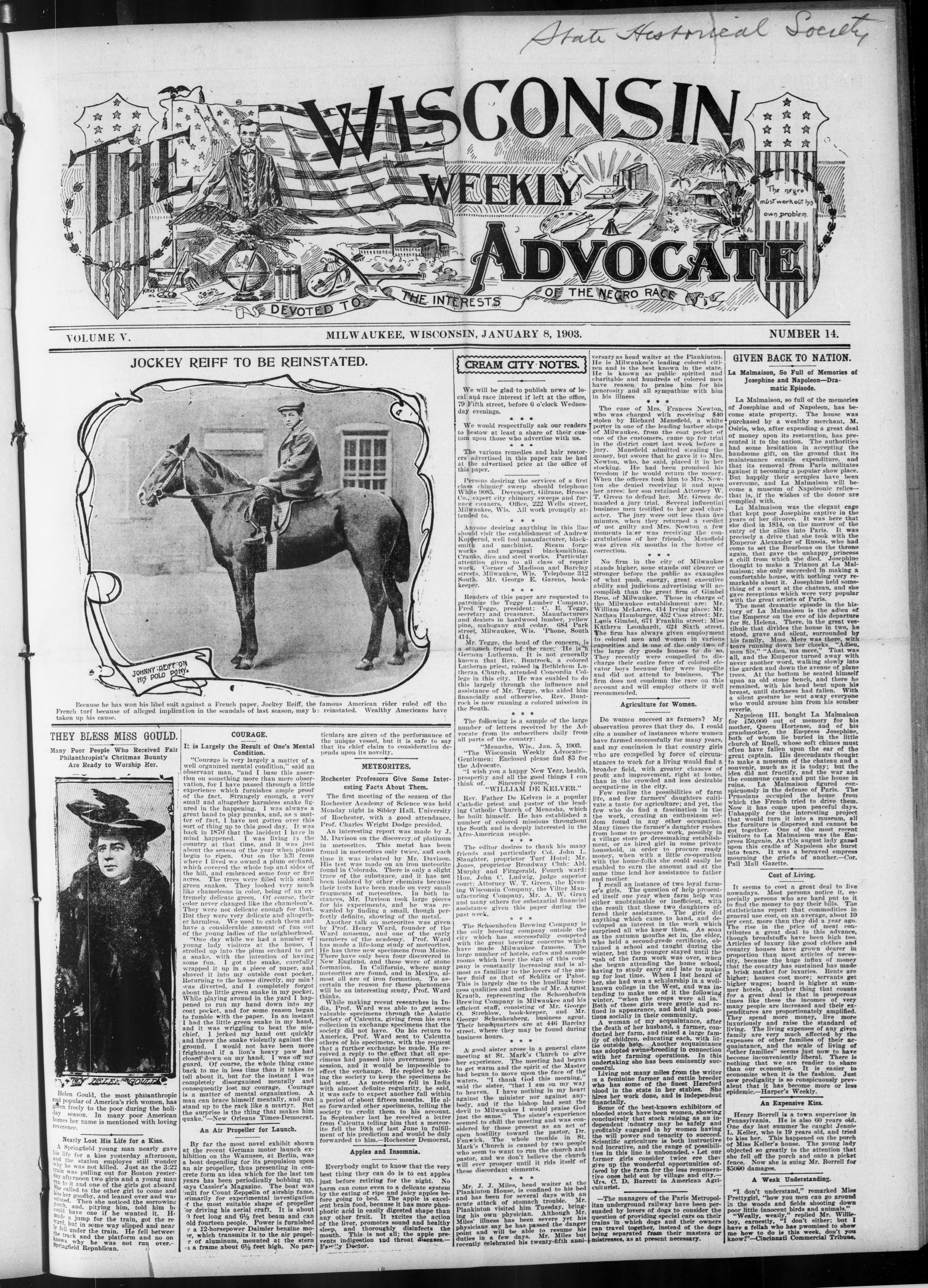
WISCONSIN
WEEKLY
ADVOCATE
DEVOTED TO THE INTERESTS OF THE NEGRO RACE
JOHNNY-REIFF-ON
HIS POLO PONY
Because he has won his libel suit against a French paper, Jockey Reiff, the famous American rider ruled off the French turf because of alleged implication in the scandals of last season, may be reinstated. Wealthy Americans have taken up his cause.
VOLUME V.
JOCKEY
JOHNNY REIFF
HIS POLO PO
Because he has won his libel suit
French turf because of alleged implication
taken up his cause.
THEY BLESS MISS GOULD.
Many Poor People Who Received Fair Philanthropist's Chritmas Bounty Are Ready to Worship Her.
TY LELEX GOULD
Helen Gould, the most philanthropic and popular of America's rich women, has given freely to the poor during the holiday season. In many poor American homes her name is mentioned with loving reverence.
Nearly Lost His Life for a Kiss.
A Springfield young man nearly gave his life for a kiss yesterday afternoon, and the station employees still wonder why he was not killed. Just as the 3:22 train was pulling out for Boston yesterday afternoon two girls and a young man ran to it and one of the girls got aboard. She called to the other girl to come and kiss her goodby, and leaned over and was saluted. Then she noticed the sorrowing youth, and, pitying him, told him he could have one if he wanted it. He made a jump for the train, got the reward, but in some way slipped and nearly fell under the train. He fell between the track and the platform and no one why he was not run over. Springfield Republican
---
COURAGE.
It is Largely the Result of One's Mental Condition.
"Courage is very largely a matter of a well organized mental condition," said an observant man, "and I base this assertion on something more than mere observation, for I have passed through a little experience which furnishes ample proof of the fact. Strangely enough, a very small and altogether harmless snake figured in the happening. I was always a great hand to play pranks, and, as a matter of fact, I have not gotten over this sort of thing up to this good day. It was back in 1870 that the incident I have in mind happened. I was living in the country at that time, and it was just about the season of the year when plums begin to ripen. Out on the hill from where I lived we owned a plum orchard, which covered the whole top and sides of the hill, and embraced some four or five acres. The trees were filled with small green snakes. They looked very much like chameleons in color, being of an extremely delicate green. Of course, their color never changed like the chameleon's. They were not delicate enough for that. But they were very delicate and altogether harmless. We used to catch them and have a considerable amount of fun out of the young ladies of the neighborhood.
"One day while we had a number of young lady visitors at the house, I strolled up into the plum orchard to get a snake, with the intention of having some fun. I got the snake, carefully wrapped it up in a piece of paper, and shoved it into my outside coat pocket. Returning to the house directly, my min' was diverted, and I completely forgot about the little green snake in my pocket. While playing around in the yard I happened to run my hand down into my coat pocket, and for some reason began to fumble with the paper. In an instant I had the little green snake in my hand, and it was wriggling to beat the mischief. I jerked my hand out quickly and threw the snake violently against the ground. I would not have been more frightened if a lion's heavy paw had closed down on my hand. I was off my guard. Of course, the whole thing came back to me in less time than it takes to tell about it, but for the instant I was completely disorganized mentally and consequently lost my courage. Courage is a matter of mental organization. A man can brace himself mentally, and can stand up to the rack like a martyr. But the surprise is the thing that makes him quake."—New Orleans Times-Democrat.
An Air Propeller for Launch.
By far the most novel exhibit shown at the recent German motor launch exhibition on the Wannsee, at Berlin, was a boat depending for its propulsion upon an air propeller, thus presenting in concrete form an idea which for the last ten years has been periodically bobbing up, says Cassier's Magazine. The boat was built for Count Zeppelin of airship fame, primarily for experimental investigation of the most suitable shape of propeller for driving his aerial craft. It is about 10 feet long and $6\frac{1}{2}$ feet beam and can hold fourteen people. Power is furnished by a 12-horsepower Daimler benzine motor, which transmits it to the air propeller of aluminum, mounted at the stern in a frame about $6\frac{1}{2}$ feet high. No par-
MILWAUKEE, WISCONSIN, JANUARY 8, 1903.
ticulars are given of the performance of the unique vessel, but it is safe to say that its chief claim to consideration depends upon its novelty.
METEORITES.
Rochester Professors Give Some Interesting Facts About Them.
The first meeting of the season of the Rochester Academy of Science was held Monday night in Sibley Hall. University of Rochester, with a good attendance, Prof. Charles Wright Dodge presided.
An interesting report was made by J. M. Davison on the discovery, of platinum in meteorites. This metal has been found in meteorites only twice, and each time it was isolated by Mr. Davison. His test was made on an iron meteorite found in Colorado. There is only a slight trace of the substance, and it has not been isolated by other chemists because their tests have been made on very small fragments of meteorites. In both instances, Mr. Davison took large pieces for his experiments, and he was rewarded by finding a small, though perfectly definite, showing of the metal.
Another talk on meteorites was given by Prof. Henry Ward, founder of the Ward museum, and one of the early members of the academy. Prof. Ward has made a life-long study of meteorites. He has three new specimens from Maine. There have only been four discovered in New England, and these were of stone formation. In California, where many meteorites are found, and in Mexico, almost all are of iron formation. To ascertain the reason for these phenomena will be an interesting study, Prof. Ward thinks.
While making recent researches in India, Prof. Ward was able to get some valuable specimens through the Asiatic Society of Calcutta, giving from his own collection in exchange specimens that the society did not have. On his return to America, Prof. Ward sent to Calcutta others of his specimens, with the request that a further exchange be made. He received a reply to the effect that all specimens had passed into government possession, and it would be impossible to effect the exchange. He replied by asking the society to keep the specimens he had sent. As meteorites fell in India with almost definite regularity, he said, it was safe to expect another fall within a period of about fifteen months. He also forwarded other specimens, telling the society to credit them to his account. In September last he received a letter from Calcutta telling him that a meteorite fell the 10th of last June in fulfillment of his prediction and would be duly forwarded to him.—Rochester Democrat.
Apples and Insomnia.
Everybody ought to know that the very best thing they can do is to eat apples just before retiring for the night. No harm can come even to a delicate system by the eating of ripe and juicy apples before going to bed. The apple is excellent brain food, because it has more phosphoric acid in easily digested shape than any other fruit. It excites the action of the liver, promotes sound and healthy sleep, and thoroughly disinfects the mouth. This is not all; the apple prevents indigestion and throat diseases.—Family Doctor.
CREAM CITY NOTES.
We will be glad to publish news of local and race interest if left at the office, 79 Fifth street, before G o'clock Wednesday evenings.
We would respectfully ask our readers to bestow at least a share of their custom upon those who advertise with us.
The various remedies and hair restorers advertised in this paper can be had at the advertised price at the office of this paper.
Persons desiring the services of a first class chimney sweep should telephone White 9085. Devenport, Gilrane, Brooks Co., expert city chimney sweeps and furnace cleaners. Office, 222 Wells street, Milwaukee, Wis. All work promptly attended to.
* * *
Anyone desiring anything in this line should visit the establishment of Andrew Copperud, well tool manufacturer, blacksmith and machinist. Steam forge works and general blacksmithing. Cranks, dies and steel works. Particular attention given to all class of repair work. Corner of Madison and Barclay streets, Milwaukee, Wis. Telephone 312 South. Mr. George E. Garens, book-keeper.
Readers of this paper are requested to patronize the Tegge Lumber Company, Fred Tegge, president; C. E. Tegge, secretary and treasurer. Manufacturers and dealers in hardwood lumber, yellow pine, mahogany and cedar. 684 Park street, Milwaukee, Wis. 'Phone, South 414.
Mr. Tegge, the head of the concern, is a staunch friend of the race. He is in German Lutheran. It is not generally known that Rev. Buntrock, a colored Lutheran priest, raised in Bethlehem Lutheran Church, attended Concordia College in this city. He was enabled to do this largely through the influence and assistance of Mr. Tegge, who aided him financially and otherwise. Rev. Buntrock is now running a colored mission in the South.
The following is a sample of the large number of letters received by the Advocate from its subscribers daily from all parts of the country:
"Menasha, Wis., Jan. 5, 1903.
"The Wisconsin Weekly Advocate—Gentlemen: Enclosed please find $3 for the Advocate.
"I wish you a happy New Year, health, prosperity and all the good things I can think of. Sincerely yours.
"WILLIAM DE KELVER."
Rev. Father De Kelven is a popular Catholic priest and pastor of the leading Catholic Church of Menasha, which he built himself. He has established a number of colored missions throughout the South and is deeply interested in the Afro-American people.
```markdown
```
The editor desires to thank his many friends and particularly Col. John L. Slaughter, proprietor Turf Hotel; Mr. Jones, proprietor Broadway Club; Ald. Murphy and Fitzgerald, Fourth ward; Hon. John C. Ludwig, judge superior court; Attorney W. T. Green, the Evening Wisconsin Company, the Vilter Manufacturing Company, Mr. A. W. Grau and many others for substantial financial assistance given this paper during the past week.
The Schoenhofen Brewing Company is the only brewing company outside the city which has successfully competed with the great brewing concerns which have made Milwaukee famous. The large number of hotels, cafes and sample rooms which bear the sign of this company is constantly increasing and is almost as familiar to the lovers of the amber fluid as that of Schlitz or Pabst. This is largely due to the hustling business qualities and methods of Mr. August Krauth, representing the Schoenhofen Brewing Company in Milwaukee and his efficient staff, consisting of Mr. George O. Strehlow, book-keeper, and Mr. George Schenkenberg, business agent. Their headquarters are at 446 Barclay street, where they may be found during business hours.
A good sister arose in a general class meeting at St. Mark's Church to give her experience. The meeting had begun to get warm and the spirit of the Master had begun to move upon the face of the waters. "I thank God this morning," said the sister, "that I am on my way to heaven. I have nothing in my heart against the minister nor against anybody, and if the bishop had sent the devil to Milwaukee I would praise God just the same." The sister's experience seemed to chill the meeting and was considered by those present as an act of open hostility toward the pastor, Dr. Fenwick. The whole trouble in St. Mark's Church is caused by two people who seem to want to run the church and pastor, and we don't believe the church will ever prosper until it rids itself of these discordant elements.
***
Mr. J. J. Miles, head waiter at the Plankinton House, is confined to his bed and has been for several days with an acute attack of stomach trouble. Mr. Plankinton visited him Tuesday, bringing his own physician. Although Mr. Miles' illness has been severe yet his physicians say he has passed the danger point and will be able to resume his duties in a few days. Mr. Miles but recently celebrated his twenty-fifth anni-
versary as head waiter at the Plankinton. He is Milwaukee's leading colored citizen and is the best known in the state. He is known as public spirited and charitable and hundreds of colored men have reason to praise him for his generosity and all sympathize with him in his illness
***
The case of Mrs. Frances Newton, who was charged with receiving $40 stolen by Richard Mansfield, a white porter in one of the leading barber shops of Milwaukee, from the coat pocket of one of the customers, came up for trial in the district court last week before a jury. Mansfield admitted stealing the money, but swore that he gave it to Mrs. Newton, who, he said, placed it in her stocking. He had been promised his freedom if he would return the money. When the officers took him to Mrs. Newton she denied receiving it and upon her arrest her son retained Attorney W. T. Green to defend her. Mr. Green demanded a jury trial. Several influential business men testified to her good character. The jury were out less than five minutes, when they returned a verdict of not guilty and Mrs. Newton a few moments later was receiving the congratulations of her friends. Mansfield was given six months in the house of correction.
No firm in the city of Milwaukee stands higher, none stands out clearer or stronger before the public as examples of what push, energy, great executive ability and judicious advertising will accomplish than the great firm of Gimbel Bros. of Milwaukee. Those in charge of the Milwaukee establishment are: Mr. William McLaren, 414 Irving place; Mr. Nathan Hamburger, 452 Cass street; Mr. Louis Gimbel, 671 Franklin street; Miss Kathryn Leonhardt, 624 Sixth street. The firm has always given employment to colored men and women in various capacities and is one of the only two of the large dry goods houses to do so. They recently were compelled to discharge their entire force of colored elevator boys because they were impolite and did not attend to business. The firm does not condemn the race on this account and will employ others if well recommended.
Agriculture for Women.
Do women succeed as farmers? My observation proves that they do. I could cite a number of instances where women have farmed successfully for many years, and my conclusion is that country girls who are compelled by force of circumstances to work for a living would find a broader field, with greater chances of profit and improvement, right at home, than in the crowded and less desirable occupations in the city.
Few realize the possibilities of farm life, and few farmers' daughters cultivate a taste for agriculture; and yet, the few who do find a fascination in the the work, creating an enthusiasm seldom found in any other occupation. Many times the farmer's daughter rushes from home to procure work, possibly in a village store or dressmaking establishment, or as hired girl in some private household, in order to procure ready money, when with a little co-operation with the home-folks she could easily be enabled to earn the amount and at the same time lend her assistance to father and mother.
I recall an instance of two loyal farmer's girls. The question of help presented itself one year when farm help was either unobtainable or inefficient, with the result that these two daughters offered their assistance. The girls did anything which came to hand, and developed an interest in the work which surprised all who knew them. As soon as the autumn months set in, the elder, who held a second-grade certificate, obtained a school and taught during the winter, but the younger stayed until the rush of the farm work was over, when she began attending the home school, having to study early and late to make up for lost time. When I last heard of her, she had won a scholarship in a well-known college in the West, and was intending to make use of it the following winter, "when the crops were all in." Both of these girls were gentle and refined in appearance, and held high positions socially in their community.
A woman of my acquaintance, after the death of her husband, a farmer, conducted her farm, and raised a large family of children, educating each, with little outside help. Another acquaintance has adopted swine-breeding in connection with her farming operations. In this undertaking she has been eminently successful.
Living not many miles from the writer is a feminine farmer and cattle breeder who has some of the finest Hereford blood in the state in her stables. She hires her work done, and is independent financially.
Some of the best-known exhibitors of blooded stock have been women, showing conclusively that stock raising as an independent industry may be safely and profitably engaged in by women having the will power and tenacity to succeed. Scientific agriculture is both instructive and lucrative, and the range of possibilities in this line is unbounded. Let our farmer girls consider twice ere they give up the wonderful opportunities offered by the farm for the less remunerative ones held out by village and city. Mrs. C. D. Barrett in American Agriculturist.
The managers of the Paris Metropolitan underground railway have been persuaded by lovers of dogs to consider the question of providing special cars on their trains in which dogs and their owners can travel together, instead of the dogs being separated from their masters or mistresses, as at present necessary.
GIVEN BACK TO NATION.
La Malmaison, So Full of Memories of Josephine and Napoleon—Dramatic Episode.
La Malmaison, so full of the memories of Josephine and of Napoleon, has become state property. The house was purchased by a wealthy merchant, M. Osiris, who, after expending a great deal of money upon its restoration, has presented it to the nation. The authorities had some hesitation in accepting the handsome gift, on the ground that its maintenance entails expenditure, and that its removal from Paris militates against it becoming a popular show place. But happily their scruples have been overcome, and La Malmaison will become a museum of Napoleonic relics—that is, if the wishes of the donor are complied with.
La Malmaison was the elegant cage that kept poor Josephine captive in the years of her divorce. It was here that she died in 1814, on the morrow of the entry of the allies into Paris. It was precisely a drive that she took with the Emperor Alexander of Russia, who had come to set the Bourbons on the throne again, that gave the unhappy princess a chill from which she died. Josephine thought to make a Trianon at La Malmaison; she only succeeded in making a comfortable house, with nothing very remarkable about it. Josephine held something of a court at the chateau, and she gave receptions which were very popular with the great artists of Paris.
The most dramatic episode in the history of La Malmaison is the adieu of the Emperor on the eve of his departure for St. Helena. There, in the great vestibule that divides the house in two, he stood, grave and silent, surrounded by his family. Mme. Mere was there, with tears running down her cheeks. "Adieu, mon fils," "Adieu, ma mere," That was all, and the Emperor turned away with never another word, walking slowly into the garden and down the avenue of plane trees. At the bottom he seated himself upon an old stone bench, and there he remained, with his head bent upon his breast, until darkness had fallen. With a silent gesture he sent away everyone who would arouse him from his somber reverie.
Napoleon III. bought La Malmaison for £50,000 out of memory for his mother, Queen Hortense, and of his grandmother, the Empress Josephine, both of whom lie buried in the little church of Ruell, whose soft chimes must often have fallen upon the ear of the great captain. His descendants thought to make a museum of the chateau and a souvenir, much as it is today; but the idea did not fructify, and the war and the commune came and put the house in ruins. La Malmaison figured conspicuously in the defense of Paris. The Prussians occupied the house from which the French tried to drive them. Now it has come upon peaceful days. Unhappily for the interesting project that would turn it into a museum, all the furniture is dispersed and cannot be got together. One of the most recent visitors to La Malmaison was the Empress Eugenie. As this august lady gazed upon this cradle of Napoleon she burst into tears. It was a bereaved empress mourning the griefs of another.—Cor. Pall Mall Gazette.
Cost of Living.
It seems to cost a great deal to live nowadays. Most persons notice it, especially persons who are hard put to it to find the money to pay their bills. The statisticians report that commodities in general use cost, on an average, about 10 per cent. more than they did a year ago. The rise in the price of meat contributes a great deal to this advance, though breadstuffs have been high too. Articles of luxury like good clothes and country houses have grown dearer in proportion than most articles of necessity, because the huge influx of money that the country has sustained has made a brisk market for luxuries. Rents are higher; houses cost more; servants get higher wages; board is higher at summer hotels. Another thing that counts for a great deal is that in prosperous times like these the incomes of very many people are increased and their expenditures are proportionately amplified. They spend more money, live more luxuriously and raise the standard of living. The living expenses of any given family are very much affected by the expenses of other families of their acquaintance, and the scale of living of "other families" seems just now to have become inconveniently liberal. There is nothing that we are readier to share than our economies. It is easier to economize when it is the fashion. Just now prodigality is so conspicuously prevalent that it has become more or less epidemic.—Harper's Weekly.
An Expensive Kiss.
Henry Borrell is a town supervisor in Pennsylvania. He is also 60 years old. One day last summer he caught Jennie L. Keller, who is 19 years old, and tried to kiss her. This happened on the porch of Miss Keller's house. The young lady objected so greatly to the attention that she fell off the porch and onto a picket fence. Now she is suing Mr. Borrell for $5000 damages.
A Weak Understanding
"I don't understand," remarked Miss Prettygirl, "how you men can go around in the woods and fields shooting down poor little innocent birds and animals." "Weally, weaily," replied Mr. Willieboy, earnestly, "I don't either; but I have a fellah who has pwomised to show me how to do is this week. don't you know!"-Cincinnati Commercial Tribune.
FIERCE BLIZZARD RAGING
Wisconsin and Minnesota in the Grip of Furious Hurricane.
WORST IN MANY YEARS
Fears Entertained for Settlers Out on Shelterless Prairies Where Fuel is Very Scarce.
St. Paul, Minn., Jan. 7.—Specials to the Dispatch today indicate that the blizzard which set in in both Dakotas last night has swept across Minnesota into Wisconsin and today prevails over the entire Northwest. At Crookston, Minn., the lack of earlier snow has modified the severity of the storm and trains are but slightly delayed. It was only 10 above zero at Morris, Minn., this morning, but the storm was the worst in many years. In Southern Minnesota it is even worse, Albert Lea reporting business practically suspended because of the blizzard which has delayed all trains.
Reports from the telegraph companies show that the wires all through the Northwest are badly crippled. In some of the western stations no details can be learned, as the wires are all down, and a number of places have been cut off from communication with the outer world. A number of towns in Montana and the Dakotas are snowbound, and it is feared that great damage will be done to stock.
Railroad traffic throughout the Northwest is seriously crippled. Almost every train into St. Paul this morning was from two to nine hours late.
The storm is said to be the worst experienced in many years; the wind is blowing a gale and the snow is drifting so that it is impossible for the trains to get through in some places.
State House Badly Damaged.
Bismarck, N. D., Jan. 7.—This city was swept by a great midwinter hurricane, in which the wind reached a velocity of sixty-four miles an hour, the greatest ever recorded in January. Just after the two houses of the Legislature adjourned the windows in the House and Senate chamber were driven in by the wind. Heavy glass in the skylight was blown down and fell with a crash into the capitol rotunda, narrowly missing several persons who stood near. Decorations for the inaugural ball were ruined, a portion of the capitol roof was torn off and the cupola windows beaten in.
Many narrow escapes of individuals were reported throughout the city from flying glass, sign boards and brick. The cornice and brick work on top of the Webb block fell into the street, covering the sidewalk with seven tons of debris, and chimneys, windows, fences and smaller buildings in all parts of the city were wrecked.
Store Fronts Blown In.
Council Bluffs, Ia., Jan. 7.—A high wind storm prevailed here, doing a great amount of damage. It blew in store fronts, unroofed a portion of the Marion block and greatly damaged the furnishings of the Gannymede Club. A score of residences were damaged. Sioux City, Ia., Jan. 7.—Sioux City and surrounding territory suffered severely from the effects of a high wind, which attained a velocity of 72 miles an hour. The damage was considerable in Sioux City, signs being blown down and a number of plate glass store fronts smashed. A number of buildings were damaged.
Temperature Falls Rapidly.
Des Moines, Ia., Jan. 7.—A furious blizzard raged last night in Des Moines. The wind at 7 o'clock was blowing thirty miles an hour, and since then the storm has rapidly increased in intensity and the gale has risen in velocity, accompanied by a light snowfall. Much damage is being done. Telephone lines are down, signs torn off and plate-glass windows broken. The temperature is falling rapidly.
In Central Illinois.
Bloomington, Ill., Jan. 7.—A blizzard is raging in Central Illinois with the heaviest snowfall of the winter. Railroads report heavy drifts and delayed traffic. It is getting colder.
Snow Drifts at La Crosse
La Crosse, Wis., Jan. 7.—A severe blizzard has been raging here all night and is keeping up during the day. The velocity of the wind, which is from the northwest, is thirty miles an hour. The temperature is 20 degrees above, but a drop of twenty or more degrees is promised by tomorrow. Snow accompanied the blizzard and has drifted badly. Railroads are considerably hampered by the storm.
Strikes West Superior.
West Superior, Wis., Jan. 7. A blizzard from the northwest struck the head of the lakes early this morning. Drifting snow is interfering badly with traffic. A sudden drop in temperature accompanied the high wind.
EIGHTEEN SAILORS DROWN
Port Townsend, Wash., Jan. 7.—News of the wreck of the Norwegian bark Prince Arthur and the death by drowning of eighteen of the crew was received today. On the night of January 2 the vessel ran into breakers and was soon hard and fast on the rocky shore two miles south of Ozette, on the Washington coast, and fifteen miles from Cape Flattery.
As the Umatilla light vessel lies about three miles off shore from Ozette, it is believed that the Prince Arthur mistook the lightship for Tatoosh island and sailed eastward, believing he was entering the straits instead of running blindly to her fate. Of twenty members of the Prince Arthur's crew only two were saved and they were nearly exhausted when they were washed ashore. The bodies of eighteen drowned seamen are being buried by ranchers and Indians living near the scene of the disaster as they come ashore.
It was also declared in Maj. Glennn's argument that Gen. Chaffee had sent a telegram to the department of Southern Luzon, where Caballe's force was operating, clad in American uniforms. The text of this telegram is given as follows: The division commander directs that no matter what measures be adopted information as to the whereabouts of this force must be obtained. The defense argued that his order was authorization for the application of the water cure, and said that officers in the field so interpreted it.
WASHINGTON'S NEW LIBRARY
President Roosevelt and Cabinet Attend Dedication Exercises.
Washington. D. C., Jan. 7.—Washington's new public library, donated by Andrew Carnegie, was dedicated this afternoon. President Roosevelt and members of his cabinet were present. Mr. Carnegie, who contributed $350,000 for its construction, delivered the principal address.
GAVE BOYS POISON TO CONCEAL ROBBERY.
Paul Woodward Hanged for Murder at Camden, N. J.—Pleas of Insanity Fruitless.
Camden, N. J., Jan. 7.—Paul Woodward was hanged at 10:05 o'clock today for the murder, on October 4 last, of John Coffin, aged 11 years, and Price Jennings, aged 14 years. The boys disappeared from their homes on October 1 and their bodies were found in a wood near Haddon Heights, six miles from here, on November 4. Previous to the discovery of the bodies Woodward had gone to the home of young Coffin and said he could find the boy if a suitable reward was offered. This cast suspicion upon him, and on investigation it was learned that Woodward had been seen in company with the lads on the day of their disappearance and that the three had purchased pies near where the murder was committed. Woodward was subsequently arrested. An analysis of the boys' stomachs showed that they died from arsenical poisoning. The police officials learned that Woodward had bought arsenic a few days prior to the boys' disappearance and upon having been indicted by the grand jury, was placed on trial and convicted of murder in the first degree. After being sentenced by Judge Garrison an appeal was made to the pardoning board on the ground of insanity, but the board refused to take any action.
Counsel for the prosecution claimed that Woodward had poisoned the boys for the purpose of robbery. When they left home the boys had $10 in their possession, but when the bodies were found the pockets of the clothing did not contain a penny.
TURKEY DEFIES BRITAIN.
Allows Russian Warship to Pass Through Dardanelles in Spite of England's Protest.
Constantinople, Jan. 7.—The British embassy has addressed a note to the Porte protesting against the passage of four Russian torpedo destroyers through the Dardanelles to the Black sea. The note pointed out that such action constituted a violation of the international treaties providing for the closing of the Dardanelles to war vessels of all countries. The note goes on to say that if Russian vessels are allowed to pass Great Britain reserves the right to demand similar privileges for her warships. The protest has caused a bad impression and even irritation in Russian quarters.
There is much concern in Turkish circles over the British attitude. The view of Great Britain is that the character of a warship is in no way changed by her disarmament, and the hoisting of a commercial flag is regarded as a device by Russia to secure the passage of the boats in question. On the other hand, Russia maintains that boats treated in that way cannot be regarded as warships. The matter came up last September and the Porte finally concluded that the Russian way of thinking was right, and therefore authorized the passage of the boats, and they will be allowed to sail through the Dardanelles immediately.
CHAFFEE TO BLAME,
SAYS MAJ. GLENN.
Latter Produces General's Order Authorizing Him to Torture Filipino Prisoners if Necessary.
Manila, Jan. 7.—Maj. Edwin F. Glenn of the Fifth Infantry was for the second time placed on trial on the charge of killing seven Filipino prisoners of war by torture. Maj. Glenn created a sensation by declaring that he was authorized to torture his prisoners by written orders from Maj. Gen. Adna R. Chaffee. He charged that the records of the Sixth Brigade, commanded by Gen. Jacob Smith, had been tampered with and that important documents had been abstracted.
Maj. Glenn requested the presence of Gens. Chaffee and Smith from the United States as witnesses, but Secretary of War Root refused and ordered Maj. Glenn to submit a list of questions to be submitted to those generals. Maj. Glenn refused to submit these questions and renewed his request that the generals be sent from the United States.
DR. L. E. TOWNE OF BRODHEAD IS DEAD.
Well Known Physician Passes Away at Kis Home After Long and Useful Career.
Brodhead, Wis., Jan. 7.—[Special.]—Dr. L. E. Towne died at his residence last evening at the age of 76 years. He was born in Vermont and came to Wisconsin in 1848 and began reading medicine under an eminent physician. That same year he came to Rock county and became a teacher. Two years later he began the practice of medicine and moved to Green county. In 1862 he came to this place and two years later went to Rush Medical College, from which institution he graduated in 1868. He soon built up a large practice in this place. He has held several local offices and aided much in the building up of this part of the state. One son survives him. The funeral will take place at 1 o'clock tomorrow afternoon from the family residence. Services will be conducted by the Masonic lodge.
OSHKOSH WOMAN CLAIMS AN ESTATE.
St. Paul, Minn., Jan. 7.—Mrs. Priscilla Tanner of Oshkosh, Wis., has come forward with the claim that she is the wife of the late Col. William A. Tanner, whose connection with the Ames administration as "business manager" was frequently mentioned during the various trials. The woman has made affidavit to the claim and wants the estate. She says she was married to Tanner and that there has never been a divorce. Helen D. Tanner of Minneapolis, who was married to Tanner in Kentucky and lived with him until his death, says she had never heard of the woman who says she is Tanner's legal wife, and says she believes the Oshkosh woman to be an imposter. Tanner died in April, leaving an estate valued at about $10,000.
SERVE NOTICE ON CHINA.
Pekin, Jan. 7.—At a meeting today all the foreign ministers except United States Minister Conger signed the joint note informing the Chinese government that a failure to fulfill its obligations in refusing to pay the war indemnity on a gold basis as provided for by the peace protocol would entail grave consequences.
SENOR SAGASTA IS DEAD
Famous Spanish Diplomat Expires at Madrid.
Was Chief in Many of the Intrigues and Revolutions Which Mark the History of Spain.
Madrid, Jan. 6.—Senor Don Praxedes Mateo Sagasta, ex-prime minister of Spain, died at half past 6 o'clock last evening. He had been suffering for some time from bronchitis. His family were by his bedside. Several Liberal ex-ministers also passed the day at the house of their old leader.
King Alfonso sent twice to inquire as to Senor Sagasta's condition. His majesty had expressed his intention of going to the bedside to bid farewell to the country's old servant, but high officials objected, on the ground, that it would be contrary to court etiquette, and the King regretfully abandoned his purpose. Praxedes Mateo Sagasta was born at Torrecilla de Cameros, in the province of Logrono, on July 24, 1827. He began life as a civil engineer, but at the
L. A.
age of 27 drifted into politics. Spain's history during the last half-century has been a stormy one, and Senor Sagasta had a hand in most of the exciting events that occurred.
He took a prominent part in the insurrection of 1856, and when that affair miscarried he had to fly the country. He took refuge in France, but when a general amnesty was announced he returned to his native country and threw himself into journalism. He eagerly took part in the insurrection of June, 186C. It was a dismal failure, however, and the future prime minister was again compelled to fly to France. He did not return to Spain until after the fall of Queen Isabella II.
In the republican regime of 1874 he was in office as foreign and home secretary and as premier. The "coup" which restored the Bourbons to the throne sent Sagasta into a brief retirement. Upon the death of the King in 1885 and the retirement of the entire Conservative government Sagasta found himself at the head of affairs, and successfully combat ed the clamors of the republicans, who shrieked for universal suffrage, till the birth of the little King, when Sagasta, confident in the strength of the Liberals, dissolved the Cortes and won by a small majority.
The assassination of Senor Canovas compelled the Queen Regent to appeal to him as the only available statesman. In spite of his age he came to the rescue, formed a government and exercised considerable wisdom in dealing with the many difficult problems which confronted Spain at that time, chief of which was the insurrection in Cuba, where Weyler was butchering the natives and otherwise creating the troubles that eventually caused the Spanish-American war. The cabinet at a meeting today decided on a state funeral for the late premier, Senor Sagasta, similar to that of former premier Canovas del Castillo. The body will be embalmed and lie in state in the chamber of deputies. The funeral services will take place Friday at the Pantheon, and subsequently in the Antooche Church, where the interment will take place.
FELL FROM A TRESTLE.
Colon Price Struck on His Head in Two Feet of Water, but Was Not Killed.
Houghton, Mich., Jan. 6.—[Special.] Instead of being dashed to death in a fall from a trestle, as his companions expected he would be, Colon Price, employed in railroad construction, escaped with a cold bath and a bruise on the head. Price was at work on a bridge near Lake Linden, guiding a timber that was being hoisted. The rope broke and Price was precipitated into the stream, forty feet below. He struck on his head in two feet of water and in his dazed condition had a hard struggle to keep from drowning.
AGED COUPLE TORTURED.
Cruelly Burned Until They Told Where Money Was Hidden.
Connelsville, Pa., Jan. 6.—Levi Eicher, aged 95 years, and his wife, residing in Springfield township, were tortured by masked thieves until they told where their money was hidden. The robbers held a lighted lamp to Mrs. Eicher's feet and burned them until the flesh fell off before she would consent to show them the strong box where $225 in bills was hidden. Then they bound their victims to their bed with ropes and left them, taking a horse and saddle from the barn. Eicher, it is said, recognized one of the thieves.
ASKED TO NAME PRICES
Armour & Co. Would Purchase Butter Output of Central New York.
Syracuse, N. Y., Jan. 6.—Representatives of Armour & Co. of Chicago have been through the dairy sections of Central and Northern New York asking the creameries to name terms under which that firm could purchase the entire butter output of this district, amounting to several million pounds of first-class creamery butter per annum. No terms of contract have been offered by the agents, who have simply asked the creameries to name prices at which they will sell exclusively to Armour & Co.
ASKS COURT FOR PROTECTION
Mascagni Files Bill for Restraining Order Against Suitors.
Chicago, Ill., Jan. 6.—Signor Pietro Maseagni, the Italian composer, today filed a bill in the circuit court petitioning for an injunction to restrain the prosecution of several suits pending against him.
FOUR DIE BY FIRE.
Woman and Two Daughters are Burned or Suffocated in a Chicago Hotel
Chicago, Ill., Jan. 6.—Three persons lost their lives and a fourth was fatally injured in a fire at the Hotel Somerset, an eight-story brick structure at Wabash avenue and Twelfth street, early today. Three of the victims, Mrs. E. T. Perry, aged 35, and her two daughters, 8 and 9 years old respectively, were burned or suffocated to death in their room on the fourth floor. The fourth victim, a woman, whose name has not been learned, jumped from the window of a room on the same floor to the street and was fatally hurt. William A. Parker, a guest, jumped from the window of a room on the fourth floor to the roof of a two-story building adjoining the hotel. He sustained a broken ankle and severe bruises. The financial loss was about $2000.
A short time after it was discovered that lives had been lost, William Clemons, a porter, was arrested. The police explain that from what could be learned from panic-stricken guests the fire originated mysteriously. Clemons was awake, it is said, at the time, and the police will hold him until the fire has been investigated. There were about 100 guests in the hotel at the time.
From admissions made by Clemons, it is believed that he caused the fire by accidentally igniting his bedclothes while smoking a cigarette.
The fourth victim, believed to be Miss Ehel Saunders, 2535 Indiana avenue, died in the ambulance on her way to the hospital. She is said to have been the niece of Mrs. Perry.
It is thought that Mrs. Perry first became aware of the fire and aroused her daughters. The latter, however, appear to have been quickly overcome, both having been found on their beds while the body of Mrs. Perry lay on the floor near the window. The elevator conductor ran his car to the top floor, shouting a warning and carrying many of the guests from the building.
Although the woman and her daughters who perished in the fire were registered at and known about the hotel under the name of Perry, Edward Saunders, a coachman employed on the south side, declared them to be his wife and daughters, and gave the names of the children as Rita and Marie. It was learned, however, that Saunders was known in Toronto as Perry and assumed the former name when he came to Chicago.
The young woman who died in the ambulance, and who was partially identified as Ethel Saunders, is now believed to be another daughter of Mrs. Perry.
Taking a Vapor Bath.
New York, Jan. 6.—Miss Evelyn Burden, a daughter of I. Townsend Burden, was seriously burned in a fire at the family residence in East Twenty-sixth street, Madison square, today. She was taking a vapor bath. In some way the lamp upset and Miss Burden was severely burned about the limbs. She was carried into the residence of Mrs. Iselin near by. A maid whose name was said to be Garda Fagerquest was severely burned while trying to rescue Miss Burden. Two maids who were on the upper floor were rescued by firemen. The house, a four-story brown stone mansion, was considerably damaged.
NO FURTHER TROUBLE.
Colored Postmistress of Indianola, Miss., Leaves Town and Would Not Again Take the Office.
Indianola, Miss., Jan. 6.—Mrs. Minnie Cox, the colored postmistress of this place at whose resignation the government ordered the postoffice here closed, left Indianola today for Birmingham, Ala., accompanied by her mulatto assistant. It is now thought there is little danger of further trouble, and although the sentiment of the people is against the action of the government in closing the office and consequent partial parlysis of business, no violence is anticipated. Before she left tonight Mrs. Cox made a statement in which she denied that she had been subjected to any indignities, and stated that no violence had been threatened her. She said, however, that she would not again take the office of postmaster under any circumstances. Her husband, who is employed in the United States railway mail service, also made a statement in which he said that his wife had not been threatened, but that he understood the race problem in the South and had advised her to give up the place. "There is no doubt," he continued, "that there is a general sentiment here against a negro postmaster."
BOER OFFICERS PRESENT.
Botha, Cronje and Delarey Attend Mrs. Chamberlain's Garden Party.
Pretoria, Jan. 6.—All doubts as to whether the Boers would participate in the entertainments given in honor of Colonial Secretary Chamberlain and Mrs. Chamberlain were dissipated by the appearance of Gens. Botha, Delarey, Cronje and Smuts at the garden party given by the governor yesterday. When Gen. Cronje was introduced to Mrs. Chamberlain she at first did not catch his name, but immediately after she heard it was Gen. Cronje, Mrs. Chamberlain sent for him and engaged in a lengthy conversation with the noted general.
SLOT MACHINES ALLOWED.
Jury Refuses to Convict Manitowoc Man
for Running Gambling Device.
Manitowoc, Wis., Jan. 6.—[Special.]—Slot machines can be operated in the saloons of Manitowoc county without interference from the law. This is a result of a case decided by the jury in the municipal court today in which Justice Mrshkosh was dismissed from the charge of operating a slot machine. Matt Giefer alleged that his son was spending a large amount of money in playing slot machines. The defense claims that the case was instituted for spite. Another case of similar character is pending in Centerville and will probably be discontinued, as it is not thought that a conviction could be secured.
Edwin Forrest's Watch.
Sir Henry Irving possesses among his most valued treasures two articles to which peculiar interest attaches. One is a little purse made of green silk thread, with a silver band. It was found in the pocket of Edmund Kean on the death of the latter and did not contain a single coin. The other article is a silver timekeeper which formerly belonged to Edwin Forrest. The hands point to 5:30, at which moment the great actor expired and the watch stopped.—Exchange.
Peach Pits as Fuel.
In California it is found that peach stones burn as well as the best coal, and give out more heat in proportion to weight. The stones taken out of the fruit that is tinned or dried are collected and sold at the rate of 24 shillings a ton. Apricot stones also burn, but not so well as peach, and do not command so good a price.—Exchange.
ROUTINE OF CONGRESS.
Proceedings in the Senate.
In the Senate on the 5th, Mr. Hoar (Mass.) gave notice that he would address the Senate the following day on his antitrust bill. A concurrent resolution was adopted providing for the preparation under the direction of the attorney general of a compilation of all laws enacted by the various states relating to trusts or to combinations in restraint of trade and for the regulation and reorganization of corporations. Mr. Lodge (Mass.) urged the suspension for ninety days of the duty on coal in order to relieve the suffering existing at present. Mr. Culberson (Texas) introduced a joint resolution providing for the admission of anthracite coal free of duty. He urged immediate consideration of the resolution, but Mr. Platt (Conn.) objected. The secretary of war was directed to inform the Senate as to the effect of a system of railroads in the Philippine islands in maintaining law and order. The resolution of Mr. Jones (Ark.) referring to the petition charging the existence of an illegal combination or conspiracy among certain railroads in the shipment of anthracite coal, and calling for the evidence accumulated by the attorney general, was discussed. The resolution was not disposed of when the omnibus statehood bill was called up. Mr. Nelson (Minn.) addressed the Senate in favor of a single state to be composed of Oklahoma and Indian Territory. Mr. Nelson had not concluded when the Senate adjourned.
The day in the Senate on the 6th was eventful because of a notable speech by Senator Hoar on his bill regulating trusts and an attack by Senator Vest on protected industries through the operation of the Dingley law. Senator Vest used as a text for his remarks his resolution introduced the day before instructing the committee on finance to prepare and report a bill removing the duty on coal. Mr. Aldrich took exception to some of Mr. Vest's statements, and at his request the resolution went over for a day, when Mr. Aldrich will make reply. Upon the conclusion of Mr. Hoar's speech Mr. Nelson resumed his remarks in opposition to the omnibus statehood bill. Mr. Taliaferro secured the adoption of a resolution calling on the commissioner of fish and fisheries for all information regarding the sponge fisheries of foreign countries, with the view of encouraging the industry in the state of Florida.
The Senate on the 7th discussed the bill for the reorganization of the militia and also the statehood bill. Mr. Mallory lee the Democratic senators in opposition to the section of the militia bill providing for a reserve force of trained men, the contention being that it not only infringed the rights of the several states, but also increased the standing army by 100,000 men. A resolution offered by Mr. Stewart was adopted, directing the committee on the District of Columbia to make inquiry regarding the wholesale and retail price of coal in Washington and to ascertain whether or the scarcity of coal is the result of fallure in shipments to Washington or whether there is any lack of prompt and efficient distribution among the people. Mr. Nelson had not concluded his speech on the statehood bill when the Senate went into executive session. It adjourned shortly thereafter.
Proceedings in the House.
The House on the 5th resumed work after a recess of two weeks, but within two hours the machinery broke down for lack of a quorum. The bill to create a general staff in the army was the issue. An attempt was made to pass it under suspension of the rules, which requires a two-thirds majority. Opposition developed because of the hurried manner in which it was proposed to pass the bill, and the division—108 to 59—developed that it did not command the support of two-thirds of those present. A call of the House followed, but as the roll call showed about thirty less than a quorum, the House adjourned.
After the general staff, bill had been passed in the House on the 6th by a vote of 153 to 52. six members in succession—Messrs. Cooper (Wis.), Lamb (Va.), Morrell (Pa.), Burk (Pa.), Cassel (Pa.) and Adams (Pa.)—denied the published reports to the effect that they had joined with other members to "pool" their clerical work. A number of bills of a minor character were passed, the most important being one to increase the pension of soldiers totally deaf from $30 to $40 a month. Bills were also passed to fix the times for holding United States court in Utah; to provide additional punishment-for persons twice convicted of counterfeiting; to change the boundaries of the southern and central judicial divisions of Indian Territory; to authorize Washington and Westmoreland counties, Pennsylvania, to construct a bridge across the Monongahela river.
The session of the House on the 7th lasted a little more than two hours. The Senate bill for the redemption of the silver coinage of the Hawaiian islands and its recoinage into United States coin was passed without division after an hour's debate. It provides for the redemption of silver coins by being received either in Hawaii or the United States in the payment of dues. Standard silver coins of the United States may be exchanged for coin of Hawaii at their face value. Hawaiian silver coins will be legal tender until January 1, 1904; Hawaiian silver certificates shall be redeemed before January 1, 1905, and thereafter they cannot lawfully circulate as money. Several bills of minor importance also were passed. The Philippine constabulary bill was made a special order for the following day. A Senate bill to refund certain tonnage taxes was passed. A resolution was adopted which called upon the secretary of war for the reports upon the operation of the law of February 2, 1901, which prohibits the sale of beer and light wines at post exchanges. A Senate bill was passed to grant the town of Juneau, Alaska, title to lands now used for school purposes. A resolution was adopted to request state authorities to co-operate with the census office in securing a uniform system of death registration.
NO MORE SOUP.
It Makes the Face Red, and is Therefore Plebeian.
Cooks are railing at fickle fashion in Paris, which has practically abolished one of the most important branches of their art. The "potage" has been ousted from its place on the menu. The art of soup making is consequently in abeyance. The cook's hand can no longer lovingly compose mysterious veloutes and quintessential creams of vegetables, nor can his imagination find vent in imparting to them strange, exquisite hues, from flesh pink to opal green, and in devising curious edible ornaments to be set floating on their surface. No self-respecting Parisian hostess will now permit her cook to serve aught up for the first course of dinner except cold consomme, a sadly simple dish and distressingly inartistic.
The humble broth is set before the guests in bowls, either of silver and of ancient make or of modern "art" pewter.
The most remarkable thing about the new fashion is the way in which it originated. Parisian ladies found that hot soup destroyed the interesting pallor of their cheeks and gave them, in fact, red faces. This being obviously intolerable, and any kind of cold "potage" except consomme being out of the question, the decree which distresses conscientious cooks who love the subtleties of their art went forth.—Philadelphia Bulletin.
Coal Consumption.
It is calculated by an engineer that 930,000,000 tons of coal are used annually throughout the world. Of this amount 148,000,000 are burnt in the United States; Great Britain comes in second with an annual consumption of 140,000,000.—Exchange.
Rattlesnake Virus.
A rattlesnake that is 5 or 6 feet in length will yield a tablespoonful of venom two or three times a month. It takes its poison sacs at least a week to fill again after they have been emptied.
Castles on the Rhine.
From the mouth to the source of the Rhine 725 castles, formerly the homes of warlike chiefs, are to be found overlooking its waters.
Berlin will shortly possess a motor car race course 938 yards long.
OLD MACHINERY.
Britons Find Interest in Pronouncement of an American Scientist.
British manufacturers are so often told that they do not abandon old machinery soon enough that the following note from an American scientific journal is of peculiar interest:
"Owing to the great development in electrical art a generation of electricity is now only three years. This is a startling announcement and sets one thinking.
"What becomes of all the old machinery and who pays for the new? How long will it be before a company can install a plant and feel assured that the machinery will not have to come out within a year or two? Does not this continual scrapping of machinery mean a loss somewhere?"—London Express.
Spreading the Good News.
Whatcom, Wash., Jan. 5.—Mrs. A. M. Ferguson, who came here from Winnipeg, Mnitoba, relates how that great destroyer of Kidney Complaints, Dodd's Kidney Pills, first reached the extreme northwest corner of the United States:
"I had used Dodd's Kidney Pills for what the doctors pronounced Bright's Disease in Winnipeg," Mrs. Ferguson says, "and the disease disappeared entirely. That was about three years ago and I enjoyed good health till about two years later, when I removed to Whatcom.
"Whether it was the change of climate I can't tell, but my old trouble returned in full force. My legs were swelled to nearly twice their size. I could not go up or down stairs for about two months.
"My husband hunted Whatcom for Dodd's Kidney Pills, but could get none till a druggist sent away and got them for him.
"I began to get well as soon as I began taking them." Others in Whatcom have learned to know and appreciate Dodd's Kidney Pills.
A. Mouse Stops a Train.
Did anyone ever imagine that a mouse could stop a railway train?
It seems to be impossible. Nevertheless, it was done at the town of Carpi, near Modena, in Italy. On the Italian railroads an electrical apparatus, upon the departure of a train from any station, rings six strokes upon a gong in the next station. The station master at Carpi, hearing the gong ring three strokes where there should be six, immediately came to the conclusion that something was wrong on the line, and ordered up the electric signal of warning. The train, which by this time was under full headway, came to a dead stop. Then began a transfer of telegraphic messages. The passengers were anxious to know what was the matter. They waited while the messages went back and forth.
The inquiry established the fact that everything was right on the line, and the train was ordered forward after considerable delay.
The station master about this time thought it might be well to look into his gong, and there he found, stuck fast between the cogs of the electrical apparatus, a poor little mouse. The unhappy little animal had happened to be in the interior of the clock when it "struck one," and down he attempted to run, but was caught between the murderous wheels.
His little body was big enough to stop the whole apparatus, and, consequently, the train as well.—St. Louis Republic.
A Lurking Danger.
There is a lurking danger in the aching back. The aches and pains of the back tell of kidneys overworked. Go to the kidneys' assistance when backache pains warn you.
A man in a suit and hat holding a cane.
A kidney warning should be promptly heeded, for dangerous diabetes, Bright's disease, dropsy are only a step away. Read how the danger can be averted.
CASE NO. 15.14.1
Rev. Jacob D. Van
Doren, of 57 Sixth street, Fond du Lac, Wis., Presbyterian clergyman, says: "A man or woman who has never had kidney complaint or any of the little ills consequent upon irritated or inactive kidneys knows very little about what prolonged suffering is. I had attacks which kept me in the house for days at a time, unable to do anything, and to express what I suffered can hardly be adequately done in ordinary Anglo-Saxon. As time passed, complications set in, the particulars of which I will be pleased to give in a personal interview to any one who requires information. I used plenty of remedies, and, ever on the outlook for something that might check or benefit my condition, I began taking Doan's Kidney Pills. This I can consciciously say, Doan's Kidney Pills caused a general improvement in my health. They brought great relief by lessening the pain and correcting the action of the kidney secretions."
A FREE TRIAL of this great kidney medicine which cured the Rev. Jacob Van Doren will be mailed on application to any part of the United States. Address Foster-Milburn Co., Buffalo. N. Y. For sale by all druggists, price 50 cents per box.
The Changing Fashion in Novels.
Literary fashions are almost as changeable as fashions in dress, and Wilkie Collins is today out of fashion. True, many of his novels have acquired the fame of the sixpenny edition. But his is not a name to conjure with, and if reference is ever made to him it is as the producer of sensational novels of a type which long ago lost its freshness. Mr. Hardy holds that modern writers have no story to tell. Wilkie Collins had, and knew well how to tell it. He, like the Ancient Mariner, holds the reader with his glittering eye from first to last. So potent is his power that even in those stories that are not his best one is compelled to read on. His methods are not the methods of today—but the admission is not a condemnation, and many a modern novelist who sneers at his technique might, if he would, learn a much-needed lesson from Wilkie Collins.—London Speaker.
A. Prolonged Cricket match.
Apia, in Samoa, has been holding a cricket match, for the benefit of the church, that has lasted three months. There is no entrance fee for the spectators, but anyone who chooses can bat on paying a shilling, and when he is bowled out can go in again on paying once more.
The nationality suffering most from cancer is the German.
THE OLD-FASHIONED FIRE.
I.
To steam heat the cities aspire
As they shiver and shake in the cold;
But give me the old-fashioned fire—
The round, rosy backlog of old!
The warmth and the light
Of its flame, leaping bright—
The drowsy heads huddled around it at
night!
II.
In the darkness the winter-wind sighing
Made the flame take a ruddier glow.
The sparks up the broad chimney dying—
Like witch-eyes that gleamed in the snow!
Oh, the warmth and the light
Of those red flames so bright.
And the comfort and joy of the wild winter
night!
III.
Far better that friendly old fire
Than buildings of simmering steam,
With never a flame to admire,
And never a beautiful dream!
Oh, the love and the light
Where those flames danced so bright.
And the old-fashioned joy of the old-fash-
loned night. —Atlanta Constitution.
IN THE SPIDER'S WER.
"I simply cannot bear the man, so it's no use speaking any more about it! Do you know," and sitting down she spoke reflectively without the slightest touch of humor, "he's all legs; his legs dominate him, he has no more control over their movements than I have. They come round the corner first and he follows them; follows them in a cab, for all I know"—and then Maisie Dorchester looked at her sister, at the grave, seldom smiling sister whose eyes twinkled, and lay back and laughed. "My dear, money has its advantages; we are poor; dear dad is worried to death about income tax, or property tax, or whatever it is, and says things generally; for two years his temper has been awful—you will allow that—and now, to uphold the family tradition of hospitality, I am to marry Longlegs—a case of the spider and the fly," and Maisie laughed again, but her voice had a ring of pain.
She turned impulsively to her sister. "A wee fly in the spider's web," she said sadly. Now, all this turmoil had ensued because Maisie, who had been Jim Conway's greatest chum from babyhood to school days, from school days to the time when he joined a cavalry regiment, where long legs did not matter much, had suddenly bethought her that Jim Conway, a poor man, was now Lord Culworth, a very rich one, and people would say that she was mercenary. She was a proud girl, and the idea hurt her—hurt her considerably.
Most stories contain a brutal father, who, not being well off, bullies his daughter until he has coerced her into marrying a rich man, but in this case it was different. Col. Dorchester was a good fellow who was always in a muddle with his accounts, and, having no wife, was as helpless as a baby; so when Jim came on the scene as Lord Culworth he made him heartily welcome, and was glad Blankton barracks were only a mile away.
Helen Dorchester looked at her sister looked deeper, perhaps, than she thought. She saw that Maisie was eating her heart out for her old chum, and that now pride stepped in, and if the former boy and girl intimacy were to be resumed people would say, "What a mercenary girl!" and poor, sterling little Maisie would hear of it, and it would hurt her, and then Helen began to think things over once more.
Looking out of the window, the two girls saw Lord Culworth cross the lawn, glancing up in their direction.
A long legged, healthy, good looking youngster was he, "clean bred to the finger tips," and the colonel met him effusively on the lawn.
"Culworth, you're welcome. I thought you had gone on leave or something, it's a week since you were here——"
"Well, I had a nasty cropper, and—look here, colonel, that last screw you sold me would make the fortune of any one starting a bathing machine," and then both laughed.
"Come into the house," and his lordship made his way to the library—and here Helen met him.
"What has come over Maisie?" he asked glumly.
"Nothing, except that you are a rich man and are titled and so on."
"I can't drop the title, but—"
"Couldn't you lose all your money in some awful speculation and let her think you are poor?"
He pulled his mustache and grinned.
"Yes," he said, "I—might—I'll try," and the long legged youth looked before him, ruminating, "not really, of course, but—shall I lie about it?" and then Maisie joined them.
"I have brought you cards of invitation for the regimental ball," he said, laughing, "the post being prosaic. Say you will come."
"And with one of them considerably less," put in Lord Culworth dryly. Maisie, when Jim had taken his leave, looked wistfully at her sister, choking back something. "What a pity Spider is a lord," she said, and sighed.
Culworth was closeted with Col. Dorchester.
"The girl is a perfect idiot. Culworth."
"Perhaps from her point of view she is right. I have had a long talk with Helen. Maisie is exceptionally sensitive, and some kind friend suggested to her that she is popularly supposed to be angling for my fortune—which is rot, of course. Now, will you help me with my little plan?"
"Certainly. What is it?"
"You told me the other day you had some shares in the Kangaroo mine."
"And they are not worth the paper they are written on."
"Exactly. I learned today that the company is on its last legs. I will give you £100 for your shares."
"You must be mad. Culworth."
"Never more sane in my life. I look upon it as a good investment. I shall take care one or two of Ours know I have bought some shares, though, of course, not how many. I shall give out I am heavily dipped, a poor man, in fact, and perhaps bring Maisie to her bearings. I can think of no better way." And the documents were signed.
The —th Lancers were next on the roster for foreign service, and as this might be the last ball they would give in Blankton, every effort was made to score a big success.
One of two youngsters, whom of course Maisie knew, looked on her curiously. Kate Ogilvie, her special aversion, looked
JACK MONROE
Since his lucky blow which floored Champion Jim Jeffries at Butte, Mont., Miner Jack Munroe has become a prominent figure in the pugilistic world. McCoy, Ruhlin and Sharkey are all anxious to cut short his championship aspirations, which they think will be an easy job for any of them. Nevertheless the husky miner is looking confidently to another bout with Jeffries.
Since his lucky blow which floored Champion Jim Jeffries at Butte, Mont., Miner Jack Munroe has become a prominent figure in the pugilistic world. McCoy, Ruhlin and Sharkey are all anxious to cut short his championship aspirations, which they think will be an easy job for any of them. Nevertheless the husky miner is looking confidently to another bout with Jeffries.
at her with eyes of triumph, and then she saw Spider cross the room and ask Kate for a dance.
For months past, ever since Jim came into the title, Kate had thrown herself at his head, and lost no opportunity of turning up at every party and dance at which the good looking lancer was likely to be present.
What did it all mean? Maisie felt her brow wrinkling when Teddy Dacres joined her and led her off.
"Yes, Jim," very softly.
"You will never go back or that dear?"
"Never, never," and he slipped the engagement ring on her finger, and she kissed the gems. "We may be poor, but we shall have each other, dear old boy. You must start as an army crammer or something."
"You will never repent having accepted me, dear?"
"What a question! I am the happies.
They took two or three turns, and Maisie could keep silent no longer.
"What does it all mean, Mr. Dacres?"
"Oh, you mean about your dear old Spider?"
"What has he done?" she gasped.
"He has been putting money into some rotten company that has failed."
"Has he lost much—has he lost everything?"
"We do not know full particulars yet, but Spider never did anything by halves; he is badly hit. I should say."
"Will he have to leave the service?" she faltered.
"Impossible to say, but I suppose so."
* * * * * *
"Oh, Jim, is it true?" They occupied a retired nook in the conservatory.
"That I have lost money in a rotten company? Yes."
"And you must cut the service?"
"I was thinking of sending in my papers," he said, after a pause, and it was true.
"Jim," she said, looking up into his face, "will you come and see me tomorrow?"
"Of course, Maisie—after morning parade?"
"Yes!" and then her partner claimed her.
The girl's brain was in a whirl when she reached home, half glad and half sorry at the turn events had taken. No one could accuse her of being mercenary now. He would call and should have his answer, even if they half starved together, and her face flushed happily.
"It must be awful to be poor after being rich," she thought, and then as the early summer dawn broke she went to her jewel cases. A crisp £5 note which the colonel had given her from the proceeds of the Kangaroo shares lay atop. This she slipped into an envelope, and directly after breakfast induced one of her maids to address it, and it was soon on its way to Blankton barracks.
"Five pounds is not much, I know," she said to herself, "but, please God, it will help."
* * * * *
When Lord Culworth re-entered his quarters after parade he took a small velvet case from his pocket and looked once more at the diamond ring it contained, laughing happily.
"The plot seems to have succeeded," he said to himself, and then his eyes fell upon the letter.
"What a vile hand," and he handled the envelope gingerly, but a subtle scent of violets saluted him. "Maisie?" he cried, "Maisie?"
For a moment his blood turned to ice. Had she repented of her decision? He hesitated for some moments to open it, and the strong man trembled like a leaf. At last he tore it open and out dropped the £5 note, and something very like a tear rose to his eyes, and he grew scarlet.
"Good God," he said under his breath, "I have carried the joke too far," and calling his servant he jumped into mufti and drove over to Dorchester house.
Maisie sat alone in the drawing room. She heard her lover dismiss the dog-cart, and a moment later, with the privilege of a welcome guest, he had crossed the hall, and without waiting to be announced stood before her.
For a moment neither spoke; she had risen at his entrance.
"You are welcome, Jim," she said, flushing, and their hands met. The man seemed the more agitated of the two.
"Jim! Jim! Months ago you asked me a question. You honored me by asking me to be your wife, and I refused you because you were rich. Now you are poor. Jim, Jim, dear; ask me again!"
The man extended his arms toward her, and she flew into them blushing rosily, laughing happily. He kissed her on the lip and brow.
"Will you marry me, Maisie dear?"
"Yes, Jim," very softly. "You will never go back or that, dear?" "Never, never," and he slipped the engagement ring on her finger, and she kissed the gems. "We may be poor, but we shall have each other, dear old boy. You must start as an army crammer or something." "You will never repent having accepted me, dear?" "What a question! I am the happiest girl in England."
"Maisie, dear, I am rich, I only lost a hundred in that old Kangaroo mine."
What her reply may have been it is impossible to say, for he had sealed her lips with a kiss. "Jim, you have taken me in," breathlessly. "Yes, little girl," and his arm was round her now. "A case of the Spider and the Fly.—New York Daily News.
TREE AS AN INQUISITOR.
Used as a Means of Ascertaining a Criminal's Guilt or Innocence.
One of the most deadly trees in the world is to be found in Madagascar, where it is known as the tangen tree. Its scientific name is Tanguinia venenifera, the latter word signifying poisonous. By the natives it is regarded with a sort of horror, and for excellent reasons. For centuries it was the custom to use the fruit of the tangen for the purpose of ascertaining whether criminals charged with grave offenses were guilty or not.
In each case the prisoner was brought into court and the judge thereupon solemnly handed him a fruit from a tangen tree and told him that if he ate it and it did him no harm he would be considered innocent, but that if it killed him he would be considered guilty. As there is a great deal of poison in the fruit it can readily be seen that very few, if indeed any, were able to pass through this ordeal unscathed.
It is said that some criminals who had great political influence or considerable wealth managed to escape through the connivance of the judges; but, on the other hand, the criminal records tell of many cases in which prisoners died a horrible death very soon after they had eaten the noxious fruit.
More civilized methods of jurisdiction now prevail in Madagascar, but though this barbarous custom is obsolete, the tangen tree is regarded with almost as much aversion as it ever was. A proof of this may be found in the fact that a French naturalist recently tried to obtain some branches and fruit of the trees, but, though he asked several natives to aid him in the search, he was unable to obtain the slightest assistance from any of them.
Rise in Spruce Gum
While there is no rise in price as yet for confirmed gum chewers who purchase their supply in 5-cent packages or 1-cent slats, manufacturers who buy spruce gum by the quantity say that it has gone up from 50 to 75 cents a pound. A scarcity of genuine black spruce trees in the Maine woods is the cause. Prior to the time when the large pulp mills were built there was no trouble in securing the gum, many of the professional harvesters having retained large tracts of forest for their own use. The pulp industry spoiled all these preserves by cutting off the best trees to be converted into sulphite pulp for paper, and the gum pickers were forced to seek other forests further away from the routes of travel. As the new trees had to be scarred for several years before they came into full bearing, the supply of gum grew scarce and the price has doubled inside of a year.—New York Times.
Sap and Splitting Trees.
The general opinion is that the sap of trees goes up in the spring and down in the fall, just before the cold weather sets in. This is not so, according to one authority. He says the water in trees increases from the time the leaves wither, so that there is much more moisture in the trees in the winter than in the summer. It is not until the warm weather absorbs this moisture from the branches that the sap begins to go up.
As to trees that split, this is not caused from the freezing of the water in the trees, but from the contraction of the trunk because of the cold. The same thing occurs when wood is placed in the kiln to dry. In the spring, when the thaw comes, the tree expands to its original dimensions.
LED DANES TO RACINE.
Norgens Christensen Dies After Long and Useful Life.
EXPIRES AT OLD HOME.
Racine, Wis., Jan. 5.—[Special.]—Mogens Christensen, who died at the age of 86 years on Saturday, settled in Racine in 1862. Before his arrival there was but one other Danish family in the city, while today, forty years later, Racine has a larger Danish population than any other city in the state and is one of the principal Danish settlements in the West.
It was a matter of mere chance that Mr. Christensen came to Racine. On shipboard he became acquainted with two sisters who were bound for America. He had purchased passage for himself and his family to America, landing in Quebec. The sisters were bound for Racine, where their brother-in-law, whose name was Nelson, had settled, and they advised Mr. Christensen to go with them. He did so, and his was the second Danish family in the city.
His Home the Mecca for Danes.
Before the end of the summer immigrants from Denmark flocked in in large numbers and Mr. Christensen's home
1890
was their Mecca. Here was a station from which they could make a start in the new world to which they had come and it often happened that his humble home was filled to its utmost capacity with new arrivals. One night, shortly after the arrival of Mr. Christensen and his family, a knock was heard at the door at midnight. The door was opened and thirty persons stood outside waiting a welcome. The house was small, it contained only four rooms, and the sleeping accommodations were exceedingly limited, yet the hospitality of the place was extended to the newcomers. They were thankful even for a bed on the hard floor and for the coffee and bread which was given them.
Mr. Christensen was a cooper and had opened a little shop near his home which was then at 1223 Liberty street. The crowds of people who came to his house on their arrival in the city became a drain upon his purse almost too great to be borne, for it was during the Civil war and prices of provisions were exceedingly high. He did not wish to close his doors to the immigrants, so he made a uniform price of 25 cents per head for supper, lodging and breakfast. Usually on the day following their arrival the immigrants found new homes, many of them settling in Racine. Some went to neighboring farms to work out their share of the prosperity of the new country.
Acted as a Doctor.
Mr. Christensen for many years was also the physician to whom the new comers went at periods to be bled. His wife had been subjected to the operation of bleeding in the old country and on his arrival here he was obliged to purchase an instrument with which to continue the ancient operation. The immigrants learned that he knew how to perform the operation and many times during the week he was called from his work to bleed people who believed they would be relieved of their ailments as a result.
The draft upon his hospitality and his time became so great that at the end of four years he resolved to remove to a farm a short distance from Racine. Later he removed to Neenah in this state, but after a few years he returned to Racine, where he resided until his death.
The funeral will be held Tuesday afternoon from the home of his daughter, Mrs. H. Jasperson, 730 Racine street. He is survived by two sons and two daughters.
ELOPER IS SENT TO STATE REFORMATORY.
Edward Sykes of Racine Must Stay in Prison Three Years for Having Robbed a Friend.
Racine, Wis., Jan. 5.—[Special.]—Edward Sykes, arrested in Chicago with Kate Finch, where they had gone to get married, pleaded guilty this morning to a charge of robbing a friend of $300 and was sent to the state reformatory for three years. He did not show the slightest emotion when sentenced, but his sweetheart, who was in court, cried and had to be taken out of the room. The charge against her, as being an accessory, has been dropped. The man who was robbed is trying to get back part of the stolen money and hopes to recover $150.
CHURCH ON FIRE DURING FUNERAL.
Marshfield, Wis., Jan. 5.—[Special.]—While funeral services were being held in the Methodist Episcopal Church here yesterday over the remains of G. A. Lupient, an old soldier, a defective furnace set fire to the floor directly under the casket. A rush for the doors was made, and the coffin was carried out over the seats. When the cortege was returning from the graveyard Rev. Mr. McKinney, the officiating pastor, was struck by a runaway team and sustained serious injuries.
JACKSON I. CASE DEAD.
THE FORMER MAYOR AND POSTMASTER OF RACINE.
Prominent Manufacturer and Horseman Succumbs to Kidney Trouble—Christian Science Failed to Save Him.
Racine, Wis., Jan. 6.—[Special.]— Jackson I. Case died at his home in this city this afternoon. He was born in 1865. Mr. Case had been ill with kidney trouble for some time and his death had been expected for two days. Mr. Case was formerly mayor of Racine and late postmaster. He was prominent in business circles and was one of the best known horsemen in the Northwest.
Mr. Case was the son of the late Jerome I. Case, millionaire manufacturer and horseman. He was, up to a year ago, an athlete of splendid build. Suddenly illness began to show itself and he soon found himself forced to admit that he was rapidly losing his health.
Became a Christian Scientist.
Physicians told Mr. Case that he was afflicted with an incurable disease and that he could do nothing to save himself from death. He then turned to Christian Science and became a firm believer in their creed. He was resolved to live and the battle for life that he made was remarkable. Several weeks ago it was reported that he was dying, but he rallied and felt better than he had for months. Suddenly on Sunday Mr. Case was again taken dangerously ill and yesterday all hopes for his recovery were abandoned. When he survived the night it was thought that he might rally and live a few weeks, but during the morning his condition changed for the worse and death soon came.
Leaves Wife and Five Children.
A wife and five children survive Mr. Case. Mr. Case inherited one-fourth of his father's immense estate and he leaves a large amount to his wife and each of his children.
He was largely interested in many of the most prominent business concerns in the city, including the Case Plow Company, the J. I. Case Threshing Machine Company, the street railway company and others.
The arrangements for the funeral have not been made.
FOUND DEAD AFTER FIGHT
Charles Laravire Quarrels with Brothers and His Corpse Is Later Discovered Near Home.
Prairie du Chien, Wis., Jan. 6. Charles Laravire, aged 22 years, was found dead on an island in the Mississippi river opposite Lynxville. He had been missing from his home since Friday night, when he and two brothers, who had been to Lynxville, quarreled on the way home and a fist fight ensued, all three of the combatants being badly marked. Charles, the youngest, said he was going to go back to the village, but he did not appear at that place and a search was instituted, resulting in the finding of his lifeless body a mile from the cabin on the island, where he had wandered away in the brush. Before the officers arrived the brothers had taken the body home on a handsled. No arrests have yet been made.
THREE MINERS FALL SIX HUNDRED FEET.
THREE MINERS FALL SIX HUNDRED FEET.
They Lose Their Balance While Being Lowered Into Windsor Mine Near Hurley.
Hurley, Wis., Jan. 6.—Three miners were killed yesterday in the Windsor mine. They were descending into the mine, riding on the skip, and lost their balance, falling 600 feet. Their bodies were mangled almost beyond recognition. One of the men, Dominick Marlow, leaves a wife and two small children. The other two, George Davis and Frank Boruchette, were single.
MR. HOUSER'S STAFF.
Secretary of State Makes Additional Appointments—Office Force is Now Complete.
Madison, Wis., Jan. 6.—[Special.]—Secretary of State Houser this afternoon announced the appointments in his office. Additional to those predicted in the Evening Wisconsin last Saturday, all of which are correct, they are: Recording clerk, George H. Short, Geneva lake; shipping clerk, George Howitt, Waukesha; statistical clerk, J. C. McKenzie, Columbus; vault clerk, Joseph Edwards, Milwaukee; assistant printing clerk, Albert Anderson, Polk county; clerks, Peter J. Smith, Eau Claire, and Max J. Kelly, Milwaukee; stenographer, Laura D. Dunn, Oshkosh.
MAN AND WOMAN HELD
New London Alleged Elopers Must Stand Trial.
New London, Wis., Jan. 6.—[Special.]
—Joseph Fleury and Mrs. Cora Wait,
who left here December 31 and went to
Appleton, were arrested there and
brought to this city yesterday morning.
Fleury has a wife and five children and
Mrs. Wait has a husband and two children.
They deny improper relations. In
the hearing this morning they both waived examination and were bound over to the spring term of circuit court of Outagamie county, which meets in April.
Mrs. Wait's bond was fixed at $250 and Fleury's at $500.
INSPECT STATE INSTITUTIONS.
Legislators and Board of Control Start on Tour.
Madison, Wis., Jan. 6.—[Special.]—The legislative visiting committee, consisting of Senator George H. Miller of Madison and Assemblymen Dahl of Vernon county and Evans of Sauk county, accompanied by Messrs. Treat, Grotophorst and Nelson of the board of control, left this afternoon to inspect the state school at Sparta, home for feeble-minded at Chippewa Falls, industrial school at Waukesha and veterans' home at Waupaca.
SLIGHT HURT KILLED HIM.
Injury to Mineral Point Man's Hand Caused Blood Poisoning.
Mineral Point, Wis., Jan. 6.—[Special.]—Judd Beardsley of this city died at his home from blood poisoning which resulted from slightly injuring the hand. He was 77 years of age and a wife and three children survive him.
Plans a Creamery Trust.
Kenosha, Wis., Jan. 6.—The Kenosha creamery has purchased the plants of the Star and Paris creameries in the town of Paris. It is reported that the Kenosha company is seeking to form a consolidation of the dairy interests of the county.
Building for Winter Homes.
Another matter to which attention ought to be paid is the construction of houses with a view to economizing fuel. Solidity, good workmanship and compactness are obvious means of protection against cold weather. The suggestion has been made that the winter sunshine might be utilized more extensively than it is at present. The verandas, which are now becoming every year more common, might be incased in glass during the winter months, and so converted into sun parlors. Even when there is no scarcity of fuel it is pleasant and healthful to bask in the winter sun, and it is customary to advertise the sun parlor as one of the attractions of winter resort hotels. There is no reason why this luxury should not be more generally enjoyed; the cost of the glass would be soon paid for in the saving in coal, and a pleasant room would be added to the house.—Toronto (Ont.) Globe.
LATEST MARKET REPORTS.
MILWAUKEE, JANUARY 7, 1903.
EGG AND DAIRY MARKETS.
MILWAUKEE—Eggs—Market firm; strictly fresh, loss off, cases included, 23@23½c; fresh, cases returned, 22½@23c; seconds, 16c; fancy storage, 20@21c; pickled, 19@20c; receipts of fresh eggs continue very light; demand is good. Receipts were 105 cases.
Butter—Market steady. Fancy prints, 23½c; fancy or extra creamery, per lb, 29c; firsts, 26½c; seconds, 24c; June creamery, 25@25½c; dairy prints, 23c; extra fancy dairy, 22@23½c; lines, 19@20c; packing stock, 17@18c; renovated butter, 21½@22c; whey, 13c; grease, 5@6c; supply of creamery is only fair; demand is good and offerings rather light. Receipts, 22,500 lbs; yesterday, 18,000 lbs.
Cheese — Firm. The demand continues good; full cream flats, fancy, 13@14c; good to choice, 11c; Young Americas, 14c; daisies, 14c; fancy brick, 12@12½c; low grades, 10@11lc; limburger, per lb. No. 1, 11½@12c; low grades, 10@11lc; imported Swiss, 25c; Block Swiss, domestic, 12½@13c; fancy loaf, 14c; No. 2, 11@12c; Sapsago, 20c. Receipts, 5500 lbs; yesterday, 11,000 lbs.
EGGS.
Eggs—Market firm; strictly fresh, loss off, cases included, 23@23½c; fresh, cases returned, 22½@23c; seconds, 16c; fancy storage, 20@21c; pleckled, 19@20c; receipts of fresh eggs continue very light; demand is good and market keeps cleaned up closely. Choice lots city candled will bring as high as 24c. Receipts, 405 cases; yesterday, 140 cases.
CHICAGO--Butter--Qulet, steady; creameries, 18@28c; dairies, 17@25c. Eggs--Qulet, steady; loss off, cases returned, 25c. Cheese--Dull, steady; twins, 13½c; daisies, 13½c@14c; Young Americas, 14c. Dressed poultry--Steady; turkeys, 15@17c; chickens, 8@12½c.
MILWAUKEE LIVE STOCK MARKET.
HOGS--Receipts, 6 cars; market strong; light, 130 to 160 lbs, 5.65@6.00; mixed, 180 to 225 lbs, 6.00@6.35; good to choice, 200 to 250 lbs, 6.15@6.45; selected heavy, 250 to 300 lbs, 6.35@6.50; pigs, 80 to 110 lbs, 5.00@5.50
CATTLE — Receipts, 2 ears; steady;
butchers' steers, medium to good, 1050 to
1300 lbs, 4.25@5.00; fair to medium, 950 to
1050, 3.50@4.25; heifers, common, 2.50@
3.25; good, 3.50@4.25; cows, fair to good,
2.85@3.50; canners, 1.50@2.25; cutters, 2.40@
2.75; bulls, common, 2.75@3.25; choice, 3.50@
4.00; feeders, 800 to 950 lbs, 3.25@3.75;
stockers, 500 to 750 lbs, 2.25@3.00; veal
calves, common to choice, 5.00@7.00; Milkers,
lower; common, 15.00@25.00; choice,
35.00@45.00.
SHEEP-Receipts, 1 car; firm, 2.50@
3.25; bucks, 2.25@2.75; light lambs, 3.50@
4.25; choice, 4.50@5.25.
Chicago receplts: Hogs, 30,000; cattle, 20,000; sheep, 18,000.
MILWAUKEE HAY MARKET
Timothy, firm; carlots, choice timothy,
12.00@12.25; No. 1 timothy, 11.50@11.75;
No. 2 timothy, 9.00@10.50; clover and clover
mixed, 9.00@10.50.
Prairie hay steady; choice Kansas. 11.50
@12.00; No. 1 Kansas, 11.00@11.25; No. 2,
8.50@9.00.
Wisconsin prairie, 8.00@8.50.
Straw, steady; rye, 7.00@7.50; oats, 5.00@
5.50; wheat, 4.00@4.50; packing hay, 6.50.
Potatoes—Market firm; supply fairly good; demand good; per bus, carlots, on track. Rurals and Burbanks, fancy large up to 45@ 48c; choice Rose and Peerless, 43@45c; inferior stock down to 38c. CHICAGO, Ill., Jan. 7.—[Special.]—Coyne Brothers report: Receipts, 24 cars; market steady; white stock, 45@47c; mixed, 40@42c.
MARKETS BY TELEGRAPH
MILWAUKEE—Flour—Steady. Wheat — Firm; No 1 Northern, on track, 76½c; No 2 Northern, on track, 75½c. Corn—Steady; No 3 on track, 44c. Oats—Higher; No 2 white, on track, 33½c; No 3 white, 32@ 33½c. Barley—Steady and unchanged; No 2 on track, 65c; sample on track, 42@65c. Rye—Steady; No 1 on track, 51c. Provisions—Firm; pork, 17.45; lard, 9.90.
Flour market steady; patents, 3.85@2.95;
bakers, 2.85@2.95; xrg, 2.95@3.00
Millstuffs are firm and quoted at 15.50@ 16.00 for bran, 16.00 for standard middlings and 17.75 for Milwaukee flour middlings in 100-lb sacks; red dog, 20.00. Delivered to country points, 1.00 extra.
CHICAGO—Close — Wheat — January, 71%c; May, 75%12%c; July, 73c. Corn—January, 47c; May, 43%c; July, 42%c; September, 42%c. Oats—January, 32%c; May, 34%c; July, 32c. Pork—January, 17.45; May, 16.12%c. Lard—January, 9.82%c; May, 9.45%14%c; July, 9.32%c. Ribs—January, 8.57%c; May, 8.75; July, 8.75. Rye—May, 50%10%c. Flax-N. W., 1.21; S. W., 1.14; May, 1.23@1.25. Timothy—January, 4.25. Cloverseed—January, 11.25. Barley—Cash, 40@58c.
NEW YORK—Close—May wheat, 79%c; July, 77%c. Corn—May, 48%c; July, 47%c. MINNEAPOLIS — Close — Wheat — May, 74%14%c; July, 74%c; on track. No. 1 hard, 74%c; No. 1 Northern, 73%c; No. 2 Northern, 73%c.
KANSAS CITY—Close—Wheat—May, 67% @67%c; July, 66% @66%c; cash No. 2 hard, 67%@8c; No. 2 red, 67%@9; Corn—January, 37% @47%c; May, 38c; cash No. 2 mixed, 38% @35%c; No. 2 white, 39c. Oats-No. 2 white, 35c.
ST. LOUISE—Close—Wheat—Higher; No. 2 cash red elevator, 72c asked; May, 75% @75%c asked; July, 71c bid; No. 2 hard, 66% @68c; Corn—Higher; No. 2 cash, 40%@41c; May, 40%@40%c; Oats—Higher; No. 2 cash, 34c; May, 34%c bid; No. 2 white, 35%@36c. Lead—Steady, 3.97% Spelter—Firm, 4.45 asked.
TOLEDO—Wheat—Dull, unchanged; cash and January, 77c; May, 80c. Corn—Dull, unchanged, January, 45c; May, 44c. Oats—Dull, steady; January, 34%c; May, 35%c. Rye—Quiet; January, 52%c. Seed—Dull, lower; January, 6.70; March, 6.80. Prime timothy, 1.70; prime alsie, 8.25
SOUTH OMAHA—Cattle—Receipts, 1800;
slow, weak; beef steers, 3.25@5.70; cows
and heifers, 3.00@4.40; Texans, 1.40@4.25;
canners, 2.50@4.25; stockers and feeders,
4.00@4.30. Hogs—Receipts, 3500; shade
stronger; heavy, 6.40@6.45; pigs, 5.00@6.10.
Sheep—Receipts, 5000; strong; sheep, 4.20@
4.65; lambs, 4.50@5.50.
KANSAS CITY—Cattle—Receipts, 9000;
steady to 10c lower; beef steers, 3.35@6.00.
Texans, 2.00@4.20; cows and heifers, 1.75@
4.00; stockers and feeders, 2.50@4.25. Hogs
—Receipts, 8000; strong; heavy, 3.60@3.65.
packers, 6.20@6.40; yorkers, 6.25@6.35; pigs,
5.00@5.75. Sheep—Receipts, 4000; firm;
sheep, 3.00@4.10; lambs, 3.00@5.70.
ST. LOUIS—Cattle—Receipts, 4500; market
steady; beef steers, 4.00@5.80; stockers
and feeders, 2.75@4.00; cows and heifers,
2.25@5.00. Texans, 2.45@4.35. Hogs—Receipts,
6000; strong for best, others steady;
pigs, 5.90@6.25; packers, 6.15@6.40; butchers,
6.35@6.65. Sheep—Receipts, 2000;
steady; sheep, 3.75@4.35; lambs, 4.60@5.70.
Medical men say that books and paper money carry the microbes of disease, and yet the employees of public libraries, who handle hundreds of books daily, and bank officials, who handle thousands of notes, do not "catch" the diseases. The reason is that library people do not wet their fingers with their lips to turn over the leaves of books, and bank officials do not wet their fingers in the same way to count money.
Sweden has 324 co-operative societies with a membership of over 8000.
The Wisconsin Weekly Advocate Printed In the Interests of the Negro Race MILWAUKEE, WIS.
Telephone Black No. 244.
Any part of the United States and Canada,
postage paid.
One Year ..... $2.00
Six Months ..... 1.25
Three Months ..... .75
Send money by Express Money Order, P. O.
Money Order or Registered Letter to the
Wisconsin Weekly Advocate.
ADVERTISING RATES.
One inch, single insertion..... 25c
One inch, per year..... $9.00
Business locals 5c per line each insertion.
Apply for rates to the Advocate.
TO CONTRIBUTORS:
All communications must be sent with the name and address of the sender as an evidence of good faith, but not necessarily for publication. No manuscript returned if not accepted, unless accompanied by stamps.
The Wisconsin Weekly Advocate company wishes to notify the public that all contracts and business transactions with this company must have the company stamp, otherwise they will be void. Neither will this company be responsible for paid subscriptions unless given to duly-accredited agents, who, on request, will give the company's receipt for same. Subscribers failing to receive their papers regularly will kindly notify the general office. Address all business communications to the general manager, 79 Fifth street.
Entered in the Postoffice at Milwaukee as Second-class matter.
EDITORIAL PARAGRAPHS.
"I know of the bravery and character of the Negro soldier. He saved my life at Santiago, and I have had occasion to say so in many articles and speeches. The Rough Riders were in a bad position when the Ninth and Tenth cavalry came rushing up the hill carrying everything before them. The Negro soldier has the faculty of coming to the front when he is needed most. In the Civil war he came 400,000 strong, and I believe he saved the Union."—President Roosevelt.
If gazing into a looking-glass wards off sea-sickness, it is no wonder that the mermaids are exempt.
Arbitration of the Venezuela dispute, it is said, will take two years. But war often takes longer than that.
The greenest thing noticeable in connection with Christmas, 1902, was the prophet who predicted that it would be a green Christmas.
The advertising which the Crown Princess of Saxony is securing will be uscful to her if she finds it necessary to go upon the stage.
All those who have evidence of prosperity to match it, should step forward and show how close to Mr. Morgan's $42,000,000 they have come.
The seismic disturbance that began in Guatemala seems to be making the circuit of the globe. As a result of the recent earthquake at Tien Chang, China, 600 people lost their loves.
The story from Berlin that the Kaiser may pick Alice Roosevelt as the proper bride for the Crown Prince utterly ignores the wishes of the young lady. This is to leave room for another guess.
---
Indoor football attracted a crowd at Madison Square Garden, New York, a few nights ago. When they get to playing the game on a parlor table, with ping-pong balls and racquets, they may be able to dispense with the attendance of surgeons.
---
There's lots of good in the world, however gloomy the outlook now and then. William Waldorf Astor has his disagreeable traits, but surely no one will dispute the magnanimity of his Christmas gift of $250,000 for a hospital for poor children.
---
If Gov. Bailey of Kansas were the Bailey of the Barnum copartnership he would find the old-time show very tame in comparison with the matrimonial circus he has experienced since the newspapers advertised him as a man in search of a wife.
---
The story that lemon juice is a preventive of typhoid will probably increase the consumption of lemonade at points where the drinking water is known to be bad. Incidentally, it will enliven the market for lemons, which may be the real object of the story.
The fact that oysters are causing a spread of typhoid fever in England should not condemn the oyster so much as the practice of raising him or taking him in contaminated waters. Wherever the oyster is taken from estuaries that receive the drainage of cities, there is danger.
---
The appointment of Admiral Cervera to be chief of staff of the Spanish navy will be heartily endorsed by the American officers who gave him a warm reception at Santiago. During the temporary breach of friendship, Admiral Cervera so conducted himself that he won the hearts of his enemies.
Of what avail is distinction that comes after death? The Egyptian mummy examined recently by English physicians, and found to have been operated upon for perityphilitis 2000 years ago, passed away from a world of vanity ignorant of the glory of having the same disease as Edward VII., King of Great Britain and Ireland and Emperor of India.
The stand taken by the Postoffice Department for good roads as a vital requisite for the maintenance of the rural mail delivery service will have more influence for good in the improvement of this country's highways than anything that has ever been done in that direction. Incidentally, it may lead to a change in
methods in line with the ideas of road reformers. The department should adhere to its demand.
Boston is displeased because the new owner of the old cup defense centerboard yacht Puritan intends to sit her with an engine and thus make her an "auxiliary." The Puritan won her honors seventeen years ago, and the fact that she is good for additional years of service ought to make Boston proud instead of sorry. The modern racing machine doesn't remain out of the scrap heap for seventeen years.
---
There has been a wide sale in the East for preparations sold under the attractive name of "fuel stimulants." They are advertised as making poor coal do service equal to the best grades, and are disposed of at a profit amounting to several thousand per cent. A railway company is said to have been among the purchasers. But Engineering News pronounces them worthless, and avers that people who endeavor to stimulate their fires with anything but fuel and air are wasting their money. Engineering News is likely to know what it is talking about, and a word to the wise is sufficient.
---
Contemporaneously with the report from England of the death of the Dean of Winchester and a number of other prominent residents of that old cathedral city from typhoid fever contracted by eating oysters containing the bacilli of the disease, comes a report from France to the effect that a serum has been discovered which makes the poison secreted by the typhoid bacillus innocuous. All that is required to save the life of a patient suffering from typhoid fever, if the French physicians are not mistaken, is to inject at his elbow ten or twelve centigrammes of the serum. If the treatment is as efficacious as described, the French have to their credit the most important medical discovery of the year. But in any case the proprietors of oyster bews will do well to keep them out of range of contamination by sewage.
The extraordinary prices charged for coal are beginning to affect some of the mills in the East. It is said that the advance in price amounts to as much as an increase of 10 per cent. in wages in adding to the cost of production. Bituminous coal is selling at $8 per ton wholesale f. o. b. at New Jersey tidewater points. The cost of the best grades of bituminous in the East is now $4.50 to $9 per ton above the quotations current on the 1st of April last. That is a serious thing to manufacturers who have not contracted ahead, but purchase their fuel in the market as they need it. The present state of things can not go on long without affecting the prices of manufactured goods. Then what? It is to be hoped that the shadow of the coal strike of 1902 will not be blackly projected into 1903.
---
While we are shivering under the sharp blasts of an arctic winter throughout the Northwest, it may be pertinent to add Constantinople, which has been distinguished for the mildness of its winter climate, is shivering under a blizzard of snow so extraordinary that it has interrupted travel by land and by sea. We have been in the habit of reading current events, and we have no previous recollection of such a snow storm at Constantinople. The severity of the atmosphere is more keenly felt, because very few people at Constantinople are provided with fuel more than sufficient to prepare their food. So while we are anathema-zizing our climate let it not be forgotten that the residents of Eastern Europe near the renowned Bosphorus and Dardanelles are suffering even more sharply. So let us remember our blessings and forget our misfortunes.
The Crown Princess of Saxony has published a written statement in Switzerland in which she declares she is very happy, and cannot live without her French lover, M. Giron. She says her marriage was one of convenience merely, and that there was no affection on either side. She would like to marry Giron, but she cannot as her husband is a very "devout Catholic," while, she says, she is a broad-minded Catholic. In her statement she makes no reflection upon her husband's character and conduct. They simply did not and could not love each other; therefore when she met Giron she saw her fate and her better half. She intimates that her husband is so devout a Catholic that he will never consent to the dissolution of the marriage tie. It is possible that the Crown Princess may drift to the United States, and if she becomes an actress she will draw a greater crowd even than Mrs. Langtry.
A Forlorn Hope.
During the late campaign Representative Champ Clark of Missouri, and a minister who had dyspepsia, but who was helping out in the Prohibition cause by making speeches along on Clark's trail, met at a farm house and stopped to dinner. The farmer's wife bustled around and cooked a fine dinner consisting of fried chicken, fresh ham, pork chops, steak, vegetables and three kinds of pie. Mr. Clark was eating everything set before him. The minister sipped a cup of hot water.
"Won't you have some chicken?" asked the host.
"No, thank you," replied the minister.
"Won't you take some steak?"
"Thank you, no."
"Or some ham or pork chops?" persisted the farmer.
"No," replied the minister.
The young son of the house then leaned over to his father and whispered hoarsely:
"Maybe he'll suck an egg, pap."—New York World.
Insuring Loaded Coffins.
Everything is insurable nowadays, says the London Daily Chronicle, even coffins. The steamship Ventnor, bound from Wellington to Hong Kong with 5000 tons of coal and 500 coffins, containing the remains of good Chinamen who desired their bones to rest in their native land, struck on the New Zealand coast and became a total wreck, with some loss of life, although the nine Chinese attendants on the coffins were saved. The coffins, however, are at the bottom of the sea, and 500 pious and patriotic Mongolians therefore run some risk of exclusion from the Confucian paradise. Two companies joined in insuring the coffins for £4650. Who will benefit by the payment of the insurance money and what Confucius thinks of the transaction are interesting conundrums.
OLD SOLDIERS TALK OVER ARMY EXPERIENCES.
The Blue and the Gray Review Incidents of the Late War, and in a Graphic and Interesting Manner Tell of Camp, March and Battle.
For more than a week before General Butler occupied New Orleans the Confederate officers in command kept all their men busy attending to the hauling to the "Jackson Railroad" depot of such stores as could be shipped away. The delay between Farragut's arrival and Butler's possession of the city was thoroughly improved. Telegrams were sent up the road for all the rolling stock that could be gathered, and as fast as the cars came in they were loaded and sent out.
It was necessary to take them beyond Pass Manchac in order to be out of reach of the Federal gunboats, which took possession of the lakes nearly as soon as the river. The old "Jackson Railroad" depot never before or since presented such a busy appearance as during the few days of no rule in New Orleans and the departure of the Confederate military forces and supplies. For a mile the different side tracks were dotted with the quick-moving forms of men hard at work, and the hasty arrival and departure of drays and floats. Carriages, also, with the sweethearts and lady friends of the soldiers, stood thickly scattered along the outer edge of the circle of busy humanity.
The glitter of steel in the sunlight told plainly, even in the distance, that all of this almost superhuman effort was guided and controlled by military authority. The first train out had time to reach Camp Moore, on the outskirts of the station of Tangipahoa, about eighty miles north, unload and return before the Federal commander saw fit to put a stop to it. The last trains out were unusually heavy, and crowded with soldiers as well. Slow time was made generally, but as we reached Kennerville, ten miles above the city, the road ran within a half mile of the river, in plain view, and it was necessary to make as quick time as possible to avoid the chance of a shot from the gunboats.
The commander of the Federal fleet seemed to have gained some information as to our movements, for a couple of gunboats were cruising slowly up and down the river. Our train was one of the latest, and all the pressure of the steam was forced on the drive wheels as we passed Kennerville. There was about a mile of open plantation before we entered the swamp, and the gunboats opened on us as we cleared the town. At least a dozen shots were fired at us, but except a crash through one or two box cars, no damage was done.
Above Kennerville we got along finely until we passed Bayou de Sair, where we had a stretch of about eight miles of soft, trembling cypress swamp, and the wooden trestlework would spring and sway as we passed along. When within three miles of Pass Manchac the trestlework gave way and let down two or three box cars. All hands took hold and rolled them over, so that we could patch up the track and go on, as we feared being cut off by some of the Federal gunboats at the Pass. We saw nothing as we rolled quietly out of the dense growth of the swamp, upon the lower edge of Lake Maurepas and thundered upon the bridge. The train was hardly its length on the bridge before we saw a Federal gunboat approaching from below, and at almost the same time the swash of a shell in the water beside us impressed us fully with our dangerous position. The gunboat was barely three-fourths of a mile away and coming as fast as possible. Out of a score of shots but thir- or four struck our train; one of the shells entering a box car and exploded, blowing out both doors. It did not take us long to cross that bridge.
Fortunately for us, the draw was closed, and we darted out upon the trestlework of Johnson's Island like a flash of lightning. It was only two or three miles across to the bridge over North Pass, but our speed was too great for the decaying timber of the trestlework, and the rear portion of our train broke through again.
It was too bad a break to attempt to repair, with the enemy in shelling distance, and the locomotive, with the few cars remaining on the track, proceeded on toward Pontchatoula, expecting to send back a returning train to assist, if possible, in saving the contents of the ditched cars. A detail of about a dozen men were left to guard the property and watch the enemy.
We expected the Federal gunboat to pass through the drawbridge and come around the upper end of the island to the North Pass bridge, and thus cut off all chance of our saving the cars; but our guard informed us that, after repeated trials to open the draw, the gunboat gave it up, and set fire to the bridge. The bridge was built on piles, and only the stringers and some of the cross-timbers were burned, but sufficient to prevent any crossing of cars until near the close of the war, when it was completely renewed.
We continued on beyond Pontchatoula nearly to the Southern car works before we met a train bound south. As soon as they were informed of the condition of things they pulled out for the swamp. Another large detail, however, was sent with the train to assist in transferring the goods from the wrecked cars. As we reached Pontchatoula it was so near night the train was laid up until morning.
At daylight we proceeded on down to the pass. As we approached Owl Bayou we saw a smoke rising to our right, apparently in the pass, and directly some of our guards stepped out of the thick bushes and the train came to a stop. Our guards told us that the enemy succeeded in getting through the draw, and they of course retreated across the bridge to avoid being taken prisoners, or compelled to stay in the mud and water an indefinite time. While the guards were giving us this explanation a shell hurtled through the cypress limbs over our heads, evidently fired at the position of our locomotive, from which the smoke was rising, and we hastily took our way backward without accomplishing anything more.—American Tribune.
A Conductor in Command.
"The funniest thing I saw during the war," said the Colonel, "happened in my regiment. One of my Captains had been a railroad conductor before the war. He was a good disciplinarian and kept his men well drilled. One day he had a squad of men out
A man raises his hand in a gesture of surrender as a group of soldiers march in formation behind a fence.
"DOWN BRAKES! DOWN BRAKES!"
marching them by flank, when he turned to speak to a friend. When he looked again his squad, marching like veterans, were in the act of 'butting' into a high board fence.
"In the emergency he forgot for a moment that he was a soldier and became again a railroad conductor.
"Running forward towards the squad he shrieked at the top of his voice, 'Down brakes! Down brakes!'
"He was one of the best soldiers, just the same, and led his men into many a hot fight."—Chicago Tribune.
Scriptural Injunction.
"At the second battle of Bull Run," remarked a member of one of the New York posts, "the famous 35th Regiment from Jefferson County, New York, suffered terribly, and efforts were immediately made by the friends at home to fill its thinned ranks. Among the first to spring to its rescue was one Augustus Buel, who was famous as a hunter in John Brown's tract, and distinguished for being a capital fellow and an excellent marksman. His uncle, Deacon Weatherby, met Gus a day or two after he had enlisted and said:
"Well, Augustus, I understand you have enlisted in the 35th.
"'Yes, uncle, I have,' was the reply, 'and I am to start for the regiment tomorrow morning.'
"That's right, my boy, that's right,' continued the deacon. 'I am very glad to hear you have enlisted,' and you have my prayers and blessings. And now, Augustus, boy, let me give you a little advice: When you go into battle have your gun well charged and in good order. When the order is given to advance on the rebels, I want you, my dear boy, to remember the scriptural injunction, "It is more blessed to give than to receive.'"—The Banner.
Two Frank Confederate Generals. The present writer once asked a Confederate general, long after the civil war (but now many years ago), how he really felt about the failure of himself and his associates to establish a separate government. He said: "Dou you want me to tell you the truth?" The answer was, of course, "Yes." "Well," said the honest old veteran, "I am sorry we failed; I think we should have done well as a separate nation. "We honored him for his frankness and afterward told the incident to another Confederate general, who said: "Did General — say that? Well, he always was a failure"
We find it difficult to believe that the stubborn old Confederate, were he living to-day, would still declare that he was "sorry." But if he did so, he would be, as the years went on, still more of an exception, still more of a psychological curiosity.—Century
An Unexploded Shell.
A woodsman felling a tree on the battleground of Chickamauga, Tenn., the other day, discovered an unexploded shell in the trunk. It was partly inclosed by over twenty years of tree growth, the size of the tree at the time the shell was fired being apparent. Another feature which a woodsman would notice is the luxuriant growth of moss on the side of the tree opposite the shell, indicating the north side of the tree, and proving conclusively that the shot was fired from the south, and hence by the Confederates, as they held the southern position in the battle.—Chicago News.
Sickan—Are the street cars crowded on your line? Tired—Well, I should say not. They are at least two miles apart.
Dillgence is the mother of good fortune.—Cervantes.
WE CONTINUE TO WARN THE BENEVOLENT PUBLIC AGAINST THE NUMEROUS BEGGARS FOR ALLEGED CHARITABLE INSTITUTIONS IN BEHALF OF THE NEGRO RACE. LOOK WELL TO THE CREDENTIALS OF SUCH MENDICANTS AND INQUIRE OF SOME REPUTABLE NEGRO CITIZEN REGARDING THE TRUTHFULNESS OF THEIR STATEMENTS.
Open Day and Night.
The Tur
Oysters, Game, Fish, Ste
Delicacy the Sea
Banquet Rooms for Dinner Parties
Table D'
NOTE—We have neither private rooms, n
general p
The Turf Cafe
Game, Fish, Steaks, Chops a
Delicacy the Seasons Afford.
rooms for Dinner Parties, Etc. Cuisine Pa
Table D'Hote.
have neither private rooms, nor "private" people, b
general public.
The Turf Cafe Oysters, Game, Fish, Steaks, Chops and Every Delicacy the Seasons Afford.
Banquet Rooms for Dinner Parties, Etc. Cuisine Par Excellent. Table D'Hote.
NOTE-We have neither private rooms, nor "private" people, but cater to the general public.
DINNER FROM 5:30 TO 8:00, 35c.
J. L. SLAU 194 Third Street, Milwaukee "The Bachele
J. L. SLAUGHTER, Street, Milwaukee, Wis.
J. L. SLAUGHTER, Prop. 194 Third Street, Milwaukee, Wis.
Steam Heat. Electric Light. Telephone in Every Room.....
...THE TURF EUROPEAN
TURF EUROPEAN HO A New and Modern Establishment for Gentlemen Only.
217 Wells Street,
Milwaukee.
Cafe in Connection: Prices
with Accommodat
C. C. GITTINGS, Pres. E. E. BAILEY, Vice
GOLD M
Folding F
MANUFACTU
Gold Medal Camp F
Incorporated February, 1892.
Street, Milwaukee. J. L. SLAUCE Prop
Connection: Prices Moderate and with Accommodations Furnished.
S, Pres. E. E. BAILEY, Vice-Pres. W. G. GITTINGS
GOLD MEDAL
Building Furniture
MANUFACTURED BY...
Medal Camp Furniture Mf.
dated February, 1892. RACINE, WIS., U
217 Wells Street, J. L. SLAUGHTER, Milwaukee. Prop. and Mgr. Cafe in Connection: Prices Moderate and Consistent with Accommodations Furnished.
C. C. GITTINGS, Pres. E. E. BAILEY, Vice-Pres. W. G. GITTINGS, Sec--Treas.
GOLD MEDAL
Folding Furniture
....MANUFACTURED BY....
Gold Medal Camp Furniture Mfg. Co.
Incorporated February, 1892.
RACINE, WIS., U. S. A.
A. BAIRD, Cutter.
New York Tailoring 322 WELLS STREET
The New York 322 WELLS
The New York Tailoring Co.
The New York Tailoring Co.
322 WELLS STREET (Bet. 3d and 4th Sts.)
Ladies' and Gents' Suits Made to Order. We also Clean, Press, Repair and Dye All kinds of Ladies' and Gents' Garments. Satisfaction Guaranteed. . . .
Alfred A. Grue
DEALER IN
Fresh, Salted & Smoked
OF ALL KINDS
Fresh Fish and Oysters
HOTEL. MAIN 6253. 502 WELLS ST.
ELEGANT NEW
INSORIAL PARLO
Second to None in the World.
visitors to the city and those who appreciate cleanliness, Elegance and Comfort should patronize
Fighter's Turf Hotel Tonsorial P
217 Wells Street, Milwaukee.
Cold Baths in Connection. Franklin A. Hack
Western House
LETON, WIS.
RILL, - Proprietor.
$1.00 Per Day
While in city visit .....
STEPHE
HOTEL and REST
BULL
TEL. MAIN 6253.
ELEGANT
TONSORIAL
Second to None
Visitors to the city and
ELEGANT NEW
TONSORIAL PARLORS,
Second to None in the World.
Visitors to the city and those who appreciate
Cleanliness, Elegance and Comfort should
patronize
Slaughter's Turf Hotel Tonsorial Parlors,
217 Wells Street, Milwaukee.
Hot and Cold Baths in Connection. Franklin A. Hackley, Mgr.
---
For Ladies and Gentlemen.
rf Cafe
Steaks, Chops and Every
Reasons Afford.
es, Etc. Cuisine Par Excellent.
D'Hote.
nor "private" people, but cater to the
public.
UGHTER, Prop. ee, Wis. lors' Home"
EPEAN HOTEL...
J. L. SLAUGHTER,
Prop. and Mgr.
Moderate and Consistent
ations Furnished.
ice-Pres. W. G. GITTINGS, Sec—Treas.
MEDAL
Furniture
TURED BY....
Furniture Mfg. Co.
RACINE, WIS., U. S. A.
Telephone Black 9343.
Tailoring Co.
S STREET
d 4th Sts.)
Milwaukee, Wis.
fred A. Grunitz
DEALER IN
Salted & Smoked Meats
OF ALL KINDS.
Fish and Oysters in Season
502 WELLS ST.
NT NEW
L. PARLORS,
one in the World.
and those who appreciate
e and Comfort should
Hotel Tonsorial Parlors,
Steet, Milwaukee.
on. Franklin A. Hackley, Mgr.
While in city visit . . .
STEPHENS'
HOTEL and RESTAURANT
First-Class Accommodations Home Cooking a Specialty...
No. 2832 State St., CHICAGO, ILL.
OVER
VENUS
Philadelphia, 1899. Earls Court, London, 1899. Omaha, 1899. Paris 1900 Venice, 1901. Lille (France), 1901 Buffalo, 1901.
It is displacing old style machines everywhere, and holds first place in the estimation of the majority of leading representative business and professional men. Write for Catalogue.
Wm. C. Kreul
434-436 Broadway, Corner Mason Street
MILWAUKEE
BARGAIN HUNTERS
Clothing to fit without being measured for. Prices less than you ever bought them for. Our specialty is misfit and uncalled-for custom tailor made clothing. Tailors' prices for full dress or Tuxedo suits from $30 to $50; our price from $15 to $18. English walking or good business suits made to measure by best of tailors from $18.00 to $35.00. Our price $8.00 to $18.00. Every suit bears our guarantee label. All garments bought of us are kept repaired and pressed free of charge for one year. To be convinced see our window display.
MILLER BROS.
Open evenings till 9 p. m.; Sundays till 12 m.
MILWAUKEE...
GAS STOVE CO..
MANUFACTURERS OF
PROFESSION
MACHINERY CO.
AND SPECIALTIES
Instantaneous Cleanable Star Burners,
Adjustable Needle Valve,
For Natural, Artificial or Gasoline Gas.
139 Burrell St., Milwaukee, Wis.
Beware of Impostors
of different professions soliciting money in Wisconsin for purposes unknown to any person in that state and for use elsewhere. Driven out of other states they are overrunning this. We think it an imperative duty on us as being the only negro paper in the state, to protect its generous philanthropists. From now on, we shall warn the mayor and chief of police of every city in Wisconsin against such adventurers.
G. V. MASHEK
HARDWARE,
NAILS,
CUTLERY,
UNIVERSAL STOVES &
RANGES
HOUSE
FURNISHING
GOODS.
KEWAUNEE, WIS.
S. F. PEACOCK & SON
Funeral Directors
AND
EMBALMERS
431 Broadway. MILWAUKEE, WIS.
In these strenuous days when it is alleged that the toiling masses have practically abandoned Christianity, and when the cold and harsh, though brilliant and polished, utterances of an occasional pulpit would almost excuse such a suicidal policy, I desire to invite your attention to the Christ, the author, the central sun of Christianity itself. Let us study His antecedents, His environment, His spirit, His purpose, if happily we may learn what Christianity really is. The cry should not be back to politics, or polemics, or philosophy, or metaphysics, or rhetoric; not back to the old creeds, or the old customs, or the old methods; not back to the dogmas of the Jews or the Gentiles, of the Protestants or of the Roman Catholics; but rather back to the Christ Himself.
Let us have in all our pulpits less of politics, less of vain discussions of economics, less of ill-grained assaults on rulers and governments, less of the vain babblings of oppugnant theologians, who are never quite so happy as when fighting over some utterly futile and puerile hypothesis, and more of the meek and gladsome and unmurmuring and all-sympathetic and all-helpful Christ. Christ was the embodiment, the incarnation, of Christianity. What the world wants, what humanity needs, what the church must have or perish, is more and more of the spirit of Christ. "If any man have not the spirit of Christ he is none of His." Restore Christ to His rightful place in the preaching of the pulpit, and in the purposes and activities of the pew, and Christianity will more than repeat her glorious triumph of the past. In Christ we see the thought, the passion, the boundless democracy, the endless and infinite lovingness of God. "He that hath seen Me hath seen the Father."
Consider His Antecedents. I propose to prove that Jesus of Nazareth is the toiling man's and the toiling woman's changeless and omnipotent friend, and that to abandon Him for any cause soever is the maddest folly. First, consider His antecedents. With what a wonderful genealogy are we confronted at the front door of the New Testament! The Old Testament opens with the book of the generation of the world, but the New Testament begins with the book of the generation of the Maker of the world. Crowned heads point with pompous pride to their ancestry. The nobility are diligent students of the peerage book. In most countries ancestry decides everything. And where ancestry fails artificial rank steps in.
But look at the genealogy of Jesus. Behold what honor He placed upon the humble who could not claim the honors of primogeniture. Not one of His great ancestors could claim this distinction. Even Abraham had older brothers, as did also Jacob, Judah, David, Nathan, Rhesa and others. He descended from the heirless members of His ancestral halls. You will observe that four women are here enthroned. The world does not count genealogy along maternal lines, but Jesus does. While man would silence woman, pass Salic laws and dethrone her, withhold the ballot and thus decitizenize her, make of her first a darling and then a drudge, Jesus says: "Write her name high in the fame of My family. She is man's equal in birth and endowments; in My kingdom she shall be man's equal in power, position and prerogative. Write her name there, and write it in gold, and there let it abide forever!"
Again, behold his parentage! Who was His father? Tiberius Caesar? Some nobleman of high renown? Some prince of the royal blood? Some publicist of mighty fame? Some commercialaire with musk-laden caravans and with gem-laden fleets? Some philosopher with alabaster brow "sicklied o'er with the pale cast of thought?"
And who was His mother? Some Persian queen, or Egyptian princess, or Jaelic goddess of war, or sorceress of song, or famous beauty, or gorgeous leader in society, or oracless of Delphic shrine, or crowned and jeweled seeker of wisdom? O, no! they were simple peasants. The father, according to the reckoning of men, was only an apparition. He came without heraldry, tarried only a little while, without comment, and then dropped out without notice. The mother was equally humble. Her entrance upon life and her exit were unannounced. Reared a mechanic, in the home of a mechanic, in the midst of the homeliest poverty, and from about His twelfth year a fatherless lad, Christ is qualified by every experience and by every hallowed memory to be the toilers' changeless and omnipotent Friend.
Again, observe his birthplace! Here was the nether depth of poverty. He had to share the hospitality of the muleteer and the donkey driver, with mouse and ass and barnyard fowl. A wisp of straw was His only pillow, a saddle blanket His only covering, and grunt and crow and guffaw His only music. Heaven stooped down and kissed the Bethlehem dunghill and angels serenaded the lowliest group in all the universe. Instead of the bending arch and the laughing fresco there was naught but the rude trappings of a
subterranean barn. Here extremes truly meet; glory and humiliation, honor and abasement, star-crowned king and outcast peasant, highest wealth and deepest poverty. O, toiling humanity, behold thy Brother, shut out from every home, denied shelter at every public inn, and driven from the face of the earth and compelled to burrow in the ground! Still farther:
Did He walk with princes, haunt the salons of the elite and ape the manners of the bontonaire? Like Absalom of old, did He oil His drooping locks, train Hls shapely hands and with earkissing flatteries seduce the people? Like another prince royal, did He hold that the indigent are criminal and that poverty is a crime? Or like yet another prince, did He parade the streets in a gilded chariot commanding the lictor and the charioteer to flay the poor that impeded his pompous progress? No, no, no! Art pictures Him in the squalid shop. Legend represents Him as the companion of the simplest and rudest villagers. Not one of all His boyhood friends is mentioned in history. When the oriflamme of His deity was radiating about Him and He was the most famous man in all the world He was still the unswerving democrat. Though the Pilates and Herods and Caesars desired to see Him He never once crossed their thresholds. Though the aristocracy of wealth and rank rejoiced to entertain Him and to lodge Him in their costliest chambers. He never went back on the poor. His favorite home was at the Bethany cottage.
His illustrations were usually drawn from the farm, the highway and the barnyard. His solicitude was always for the poor. "The poor ye have with you alway," was his pathetic exclamation. What wonder "the common people heard Him gladly!" The humblest rushed into His arms and He hurried them into His heart. Then, as now, He was the only true and changeless friend they had. You will therefore not be surprised at the trade He chose. How he could have revealed in the law. But He who is the Fountain of all legal lore and justice and the Arbiter of all men and nations deliberately denied Himself that delight.
How he could have gratified every trembling instinct of His deity as a physician! But though the Maker of every medicine—allopathic, homeopathic, eclectic and botanic—He left that art to others.
What an orator, statesman, minister of finances or gentleman of leisure He might have been! Yet all these He resigned and submitted to such poverty that he had to appeal to a Galilean fisherman for money with which to pay his taxes and to make the humiliating confession: "The foxes have holes and the birds of the air have nests, but the Son of Man hath not where to lay His head." And yet with all of His abstemiousness His glorified mind and heart thrilled with delight at every thought of the refined and elegant and sublime. And am I not right in saying that He is humanity's changeless and omnipotent friend?
Photograph His Cabinet.
Photograph His Cabinet.
Whom did he honor with the portfolio of state? Paul, a Tarsean tentmaker. Whom did He appoint minister of the exchequer? Judas, a Mammon-worshiping farmer. Whom did He select as his private chaplain and most intimate companion? John, a Galilean fisherman. Not one king, prince, priest, preacher, philosopher, commercialaire or landed proprietor did He take into His cabinet. Here was the great Prince and Founder of Christianity making up His cabinet, and every member of it was a day laborer, sun-tanned and weather-beaten. Were toilers ever so throned and crowned and honored before?
My friends, Jesus is the great and unfailing Pythias. He is serenading all the poor, all the sorrowing, all the unfortunate, all who have been driven away by the cold church, by the harsh creed, by the unfeeling preacher, by the overbearing and neglectful member. Beneath thy window He sings, He woos, He pleads, He beseeches, with matchless beauty, and with boundless love.
Throw open the window of thy soul just now and answer: "Yes, Lord, blessed Christ, Savior, Lover, Redeemer, I come, I come immediately. Thee I can understand. Thee I do love already. Thee I will serve forever." Christianity is but the diffusion of the spirit of Christ in the hearts of men; that Christianity is not forms, not creeds, not liturgies, not confessions, but the spirit of Christ; and that whoever has the spirit of Christ is of necessity a Christian, and an heir of eternal life!
SERMONETTES
```markdown
```
Heart of Love.—It is not logic that the world wants so much as a big heart of love.—Rev. H. W. Gilchrist, Evangelist, San Francisco, Cal.
The True Christian.—The true Christian can live for God and grow in spiritual beauty in any place where duty calls him.—Rev. Dr. Swift, Methodist, Chicago, Ill.
Labor—Labor is the hand upon which the eye depends. We cannot do without labor, no matter how much wealth we may have, no more than the eye can serve the body perfectly without the help of the hand.—Rev. L. R. Dyott, Congregationalist, Brooklyn, N. Y.
SHORT TEMPERANCE SERMONS.
Among the practical ways for dealing heavy blows to the saloon which have come to my notice I have been especially interested in what the Columbus, Ohio, Y. M. C. A. is doing. Two years ago the railroad branch of the association started to be as generous as the saloons at Grogans, in the neighborhood of the Columbus, Sandusky & Hocking Valley Railroad construction shops, by cashing the checks of the employees of the railroad company. In the vicinity of the shops there are about two saloons to one general store, and the wholesale liquor dealers were in the habit of sending large sums of money to the retail liquor dealers with which to cash the men's pay checks. This took a great many of them to the saloons, as there was no bank at hand, and a good deal of time and money would have been consumed if the men had visited the city for that purpose.
On the first pay-day after the association opened up, checks amounting to $2,137.88 were cashed. That was two years ago. On the last pay-day, 157 checks, amounting to $6,762.36, were cashed; but the largest record was in September, which was for $7,204.25. In the first year nearly $50,000 was handled in this way, and last year 1,500 checks were cashed, amounting to $79,778.47. At first the saloonkeepers made no objection, but their representatives have gone to the owner of the rooms used for cashing the checks at least three times and urged him to cancel the lease to the association. I am told that this association is one of probably fifty railroad organizations which habitually do this for the men each month.
It strikes me that this is a work which should receive greater attention from Christian business men. Why should it not be as profitable, for instance, for a Christian storekeeper to cash the checks of such employes, as for a saloon? Every dollar kept from the saloon is so much happiness brought into the homes of workingmen. The Y. M. C. A. is doing a Christian work to take up this neglected opportunity.—Ram's Horn.
A Temperance Lesson.
Some time ago, as the workmen were busily storing away a show in winter quarters in an Ohio town, they noticed a motion in a bundle of rubbish in one corner of the large building. Upon closer observation they were convinced that some living thing must be there. After consultation they decided upon a plan of attack. Tearing away the rubbish, they discovered an immense boa-constricor which had escaped from winter quarters two years previously. By her side were eight baby boas, each one weighing twenty to thirty pounds. When she first escaped her weight was only thirty-five pounds and her length twelve feet. Now she tipped the scales at sixty-eight pounds and measured over nineteen feet. Upon being driven from her hiding place she attempted the lives of the men and gave them all the fight they wanted for five hours. In the struggle she killed a Great Dane dog valued at $250. For two years this terrible snake had been in the vicinity of the people of that town, but they knew it not. For two years their lives had been in jeopardy while they slumbered on in ignorance and tranquillity. How startling to think of! Yet a rum-constrictor, immensely larger and more ferocious, is known to exist in almost every community from Boston to San Francisco. It not only exists, but is protected by powerful legal safeguards, endorsed by the vote of great majorities of the American people. Occasionally communities rouse up and have a tussle with this monster. If they subdue him for a season he usually finds some way of asserting his beastly power. It is indeed a fierce and fearless foe.—Christian Uplook.
No more liquors will be sold in the Samoan Islands by authority of the United States. Shortly after this country came into possession of Tutuila a license was granted for the sale of liquor in that island. The effect upon the natives was found to be bad, and the naval governor, urged by missionaries and, others who had the welfare of the Samoans at heart, secured the revocation of the license. The man who owned the license had, however, built a hotel, and he made a protest against the naval governor's act. The Navy Department has investigated the matter and decided against the owner of the hotel. This decision will please all those who know the lovable qualities of the native Samoans, and have too much pride in the United States to wish to see the country do anything to injure them.
Intemperance.
One day a man was cutting thistles out by the road. Another, passing by, asked him why he was cutting those thistles, remarking, "They are not on your let."
"No," replied the other, "they are not on my lot now, but if left the seed will ripen and the wind will blow them to my lot, and then I will have to crop the thistles." So it is with intemperance. So long as saloons exist there is danger of this thistle entering our homes, or of our loved ones in some way being injured by them. We are not to wait until our own has been injured but to do at all times all we can do to save the fallen, and to make the way safe for those who shall follow.—Exchange.
IT'S THE ONLY PLACE Just What You Have Been Looking For Afro-American News Office 3104 STATE STREET
Here all the best and leading weekly journals and magazines from all parts of the U. S. can be found every week, including all other standard magazines, weekly and daily publications. Following is a list of the leading weekly papers for sale:
Wisconsin Weekly Advocate, Milwaukee; Reformer, Richmond, Va.; Planet, Richmond, Va.; Odd Fellows Journal, Philadelphia, Pa.; Guardian, Boston, Mass.; Atlanta Age, Atlanta, Ga.; State Capitol, Springfield, Ill.; Cairo Standard, Cairo, Ill.; Gazette, Cleveland, Ohio; Kentucky Standard, Louisville, Ky.; Detroit Informer, Detroit, Mich.; Colored American, Washington, D.C.; New York Age, New York City, N. Y.; Freeman, Indianapolis, Ind.; Recorder, Indianapolis, Ind.; Conservator, Monitor, Broad Ax, Chicago, Ill.
Magazines Published Every Month:
The Colored American, Porters and Waiters Mag, also the Buffalo Tragedy Oration, entitled: "Climba Rugged," by Alton H. Blair
A Full Line of Stationer
Papers sent through the mail to a call and see for yourself. If was your order and we will get it for you
REMEMBER THE M
Afro-American
E. H. FAULKNER, Manager. 310
SEE OUR B
Good Warm Cheaper T
HERMAN
Mercha
235. Thin
Milwaukee.
The Colored American, Boston, Mass.; R. R. Porters and Waiters Magazine, Philadelphia, Pa.; also the Buffalo Tragedy by King Jefferson, and Oration, entitled: "Climb, 'Though the Rocks be Rugged," by Alton H. Blake (the Boy Orator.)
A Full Line of Stationery, Cigars and Tobacco
Papers sent through the mail to any part of the country. Give us a call and see for yourself. If we have not what you want, leave your order and we will get it for you.
REMEMBER THE NAME AND PLACE
Afro-American News Office
E. H. FAULKNER, Manager. 3104 STATE ST., CHICAGO.
SEE OUR BARGAINS!
Good Warm Clothes Are Cheaper Than Coal.
HERMANN NOLDE,
Merchant Tailor.
235 Third Street.
Milwaukee. Wisconsin.
SINGER SEWING MACHINE
Wheeler & Wilson
HAS ADVANTAGES CONTAINED IN
NO OTHER SEWING MACHINE.
Three Times
The Value of
Any Other
One Third Easier
One Third Faster
The only Sewing Machine
that does not fail in any
point.
406 Grand Avenue,
Milwaukee.
How to Drink Water.
A beginning of kidney trouble lies in the fact that people, especially women, do not drink enough water. A tumbler of water sipped in the morning immediately on rising, another at night, are recommended by physicians. Try to drink as little water as possible with meals, but take a glassful half an hour to an hour before eating. This rule persisted in day after day, month after month, will improve the complexion, and the general health otherwise. Water drunk with meals should be sipped, as well as taken sparingly.
Ice water ought never to be taken with one's meals, and as little as possible between meals. One never knows what is being taken into the stomach in water filled with chipped ice. It is safer to fill bottles with water and allow them to stand beside ice to chill until required. Tests have been made which show that one gill of ice water, which means an
Boston, Mass.; R. R. Magazine, Philadelphia, Pa.; by King Jefferson, and 'Though the Rocks be like (the Boy Orator.)
y, Cigars and Tobacco
any part of the country. Give us have not what you want, leave you.
AME AND PLACE
News Office
4 STATE ST., CHICAGO.
BARGAINS!
Clothes Are Than Coal.
N NOLDE,
nt Tailor.
d Street.
Wisconsin.
ELK EXPRESS CO.
G. J. CHARLESTON, Mgr.
63 E. Sixth Street,
ST. PAUL, MINN.
The Opportunity of a Life Time
WANTED
for a first-class hotel in a city in the interior of the state of Wisconsin, the followlng colored help—
1 MEAT COOK, Female.
1 PASTRY COOK, Female.
1 LAUNDRY MAID.
2 CHAMBER MAIDS, one to assist in serving dinners and suppers.
2 DINING ROOM GIRLS.
2 DISH WASHERS.
This is an exceptional opportunity for a club of Southern girls to make for themselves a comfortable home in Wisconsin. The proprietor is a Southern gentleman who understands and appreciates the negro. Apply at once to the office of the WISCONSIN WEEKLY ADVOCATE, 79 Fifth Street, Milwaukee, Wis.
average tumblerful, poured hastily down the throat reduces the temperature of the stomach from 100 to 70 degrees, and it takes more than half an hour to recover the heat it has lost. Cold water, slowly sipped, will not be followed by such a result, cooling the system pleasantly in hot weather without chilling the glands of the stomach so that digestion cannot take place.-Detroit Free Press.
A Four-Cornered Fight.
Jim and Lou Smizer of near Paris killed a bald eagle under unusual circumstances a few days ago. It attacked a big turkey. While it and the turkey were fighting, some crows attacked the eagle. The eagle clung to the turkey with its talons while it beat off the crows with its beak and wings. The contest was getting interesting when one of the Smizers fired into the fluttering bunch and killed the eagle. It measured 78 inches from tip to tip.—Kansas City Journal.
OFFICERS TAKE THE OATH.
Sworn in by Chief Justice Cassoday at Madison.
Capitol Gaily Decorated—Mrs. La Follette Gives Reception—Inaugural Ball.
Madison, Wis., Jan. 5.—This is the day prescribed by the state constitution for the inauguration of newly-elected state officers, and the people of Madison did all that they could to make it a gala affair. The statehouse was appropriately decorated and there is a considerable number of citizens in town to participate in the ceremonies which, in general terms, followed the lines which have prevailed on similar occasions in former years. The exercises began in the Assembly chamber at noon. There was no military parade, as was proposed, and owing to the fact that all but two of the officials had previously arrived, the usual procession from the train to the capitol was abandoned. The installation ceremonies proper consisted merely of administering the oath to each officer by Chief Justice Cassoday of the supreme court.
Escorted to the Capitol.
Prof. C. P. Cary, superintendent of public instruction, and Insurance Commissioner Zeno M. Host, with their wives, arrived at 10:30 a. m. over Milwaukee road, and were met at the depot by an escort in carriages. Justice
M. B.
Marshall was unavoidably absent, in attendance at a meeting of bank directors in another city. Justice Dodge, who was also out of the city, and it was feared could not be here, arrived in time to take part in the ceremonies.
At 11:55 each party proceeded to the Assembly chamber. The gentlemen who acted as escorts for the respective state officers were:
GOV. R. M. LA FOLLETTE—Hon. R. M. Bashford, Mayor John W. Groves.
LIEUT. GOV. J. O. DAVIDSON—Prof.
LIEUT-GOV, J. O. DAVIDSON—Prof.
W. A. Heury, ex-Mayor, John Corsoct
SECRETARY OF STATE W. L. HOUSER
-Hon. H. C. Adams, Hon. George B.
Burrows.
STATE TREASURER JOHN J.
KEMPFF-F. W. Arthur, Dr. Clarke Gap-
e
ATTORNEY GENERAL L. M. STURDEVANT-Frank W. Hall, J. Crawford Harper.
STATE SUPT. C. P. CAREY-Prof. F. J. Turner, Assemblyman-elect M. S. Dudgeon. RAILROAD COMMISSIONER J. W. THOMAS-Jas, E. Conklin, John D. Gurnee. INSURANCE COMMISSIONER ZENO M. HOST-Carl J. Hausmann, H. B. Hobbins.
Ex-Gov. George W. Peck was also of the party, with Col. George W. Bird and Col. C. F. Cooley as escort.
In the Assembly Chamber.
From the executive office to the Assembly chamber ex-Gov. Peck acted as escort for Gov. La Follette and the retiring state officers acted as escorts for their predecessors.
Entering the Assembly chamber from opposite sides, the judges and the state officers, with their escorts, proceeded to the front of the speaker's stand, and at 12 precisely Chief Justice Cassoday administered the oath of office to Gov. La Follette, and in turn to each of the other state officers, the entire ceremony occupying but a few moments. The chamber was elaborately decorated in the national colors, the gallery railings, posts, etc., wound with red, white and blue bunting, while flags were numerous. The Third Regiment Band of Marinette furnishes music both at the inaugural and for the ball this evening.
Presented by R. M. Bashford.
R. M. Bashford was master of ceremonies for the inauguration and opened the ceremonies with the following address:
Ladies and Gentlemen: The hour has arrived for the inauguration of the state officers elect. Two years ago, in this place, the first native-born citizen of the state was inaugurated as chief magistrate, he having been elected by the highest vote ever cast for a candidate for that office. Today the same distinguished citizen enters upon a second term, he having been re-elected by the largest majority ever given a candidate for governor in this state in an off year. The people have faith in the man and have pronounced their approval of his record and the principles he represents. In obedience to their will and in compliance with the law, Hon. Robert M. La Follette, governor-elect, will now be presented by Former Gov. Peck to Chief Justice Cassoday of the supreme court, by whom the oath of office will be administered.
Applause greeted the conclusion of Mr. Bashford's remarks and when Gov. La Follette approached the speaker's desk, Gov. Peck, in presenting the governor, said: "Hon. Chief Justice, I have the honor to present Hon. Robert M. La Follette, governor-elect of the state of Wisconsin."
The Governor's Promise.
Gov. La Follette inclined his head and, following the gesture of the chief justice, raised his right hand and listened intently while the oath was administered. His "I do" rang out firmly and clearly when the chief justice concluded. Then came the other officers-elect in turn. Lieut-Gov. Davidson was presented by M. C. Clark; Secretary Houser by H. B. Froehlich; Treasurer Kempf by Burr W. Jones; Atty.-Gen. Sturdevant by E. R. Hicks; Supt. Cary by L. D. Harvey; Railroad Commissioner Thomas by Graham L. Rice, and Insurance Commissioner Host by Emil Giljohann. Applause greeted the presentation of each. The ceremonies occupied exactly ten/minutes from the time the party entered the assembly chamber.
At the conclusion of the inauguration ceremonies each officer was escorted to his department, and all dispersed for lunch.
This afternoon, from 3 to 5, Gov. La Follette held an informal reception in the executive chamber, similar receptions being held by the other state officers and their wives in their respective departments.
Mrs. La Follette held a reception this afternoon from 3 to 5 at the executive mansion for the incoming state officers and department clerks and their wives. She was assisted in receiving by the wives of the outgoing officers. It was an informal affair to which several Madison people were invited, the purpose being to give the newcomers opportunity to get acquainted and meet Madison people. On account of this reception Mrs. La Follette did not join the governor in the reception at the executive chamber.
Among Milwaukee people present at the inaugural are Gov. and Mrs. George W. Peck, Mr. and Mrs. W. D. Duke and daughter, Mr. and Mrs. C. A. A. McGee, Cr. Trump and son, Henry Tyrrell, W. W. Brown, John Meyer, Judge J. C. Kerwin, wife and daughter, Miss Alice; Joseph G. End of Sheboygan, who was a candidate for the Republican nomination for state treasurer. A. Pugh and C. C. Getting of Racine are also here to attend the inaugural ceremonies.
The formal reception by all of the officials with their wives, takes place this evening, from 8 to 10, at the university gymnasium, precedent to the opening of the inaugural ball.
The Inaugural Ball.
The ball this evening, which is expected to be one of the most elaborate ever held at an inaugural, will open with a grand march, led by Dr. Phil Fox, the family physician and close friend of the governor, and his niece, Miss Eleanor Wilson. The march will end in a state quadrille, danced by Gov. and Mrs. La Follette, ex-Gov. and Mrs. George W. Peck, Mr. and Mrs. A. E. Proudfit and Dr. Fox and Miss Wilson. A programme of twenty dances will follow, with intermission for supper. The big auditorium is in gala attire for the occasion. At the north end a large reception platform has been built, brilliantly illuminated with electric lights. Above the platform is a canopy heavy with flags and bunting, the university cardinal being a prominent color, the whole surmounted with an electric piece, "Wisconsin," with the state motto, "Forward," underneath. The orchestra, which will play both during the reception and dance, will be placed in a suspended box at the east side of the hall.
Former Gov. George W. Peck of Milwaukee, the only Democratic governor the state has had since William R. Taylor rode in on the granger vote, has a prominent part in the inaugural exercises. Former Gov. Hoard, who is in El Paso, Tex., has sent his regrets at not being able to be present, saying that in his judgment this will be the most important inauguration Wisconsin has ever had. Former Gov. Lewis of Columbus has also written, expressing regret that the infirmities of age will prevent his attendance.
Two ex-Governors Present.
Madison. Wis., Jan. 5.—[Special.]— Considerable comment has been occasioned by the fact that of all the living ex-governors of Wisconsin but two were present at the ceremonies today and both of these were Democrats. Aside from George W. Peck, former Gov. W. R. Taylor was the only other present. Gov. Taylor is now nearly 80 years of age and in feeble health.
Officers Reappointed
Gov. La Follette's first official act was to sign the commission continuing in office for another term Col. Jerre Murphy as private secretary; Charles R. Boardman of Oshkosh as adjutant general; Joshua Hodgins of Marinette as quartermaster general, and Gen. George E. Bryant, superintendent of public property. The state central committee met this afternoon to audit accounts and close up minor matters of the campaign.
GIVES WARNING TO UNION.
Big Wisconsin Paper Company May Return to the Old Time System
Appleton, Wis., Jan. 5.—The Kimberly & Clark Paper Company, which operates nine paper mills at Appleton, Neenah, Kimberly and Niagara, Wis., sent a communication to the Brotherhood of Papermakers announcing that the concessions of shorter hours and freedom from Saturday night and Sunday work granted last January has proved a failure, inasmuch as the union has not succeeded in getting a majority of other mills in the state to grant similar hours after a year of effort. The notice intimates that a return to the old hours and Saturday night work is contemplated soon. The action of Kimberly & Clark will surely be followed by eleven other mills in the Fox river valley. Over 2000 men and girls will be concerned in the strike if it comes.
CHEAP GAS FOR GREEN BAY
Knox Construction Company Applies for Franchise for an Opposition Plant.
Green Bay, Wis., Jan. 5.—[Special.]—Green Bay will have a new gas plant running by the end of the present year. It will be owned and operated by the Knox Construction Company, which has the franchise for the new street railway through Depere. The Knox company had planned to purchase outright the plant owned and operated by the Green Bay Light and Power Company, and waited upon the officers for this purpose. The company refused to sell at any price. The Knox company is now determined to build an opposition plant and promises to give gas to consumers at one-half the present price and also promises to furnish a better quality of gas. A franchise will probably be granted.
VALUE OF KISSES
IS CUT DOWN $200.
Oshkosh Judge Allows Girl Less Than Jury Did for Three Stolen Kisses
Oshkosh, Wis., Jan. 5.—Judge G. W. Burnell in the circuit court Saturday cut down the price of kisses fixed recently by a Winnebago jury. Ida Zachers, a domestic formerly employed in the household of Miner H. Ballou, a wealthy mill owner of Neenah, was some days ago given a verdict of $500 for three kisses forcibly snatched from her by Mr. Ballou. Judge Burnell Saturday cut down the amount to $300, and judgment for that sum was entered.
RACINE HAS BAD BLAZE.
Racine, Wis., Jan. 5.—Fire Saturday night damaged the stock and building of the New York store on Main street to the extent of $20,000. Mrs. M. Sklute, owner of the store, says her stock was worth $35,000. She thinks the loss will be 50 per cent. She carries $18,000 of insurance. The loss on the building will be from $1500 to $2000.
FIGHT WITH ROBBER GANG
Four Alleged Bank Robbers Chased for Miles by Posse.
Eagle, Wis., Jan. 7.—[Special.]—After waiting hours for an opportunity to break into the Bank of Eagle and being foiled, four men stole a horse and sleigh from the livery stable of E. J. Whittman and escaped from the village. They were seen to drive away by Mr. Whittman, who gave the alarm, and a posse of citizens were soon in pursuit. The men were traced for three miles east of here and were finally overtaken. A fight took place in which several shots were fired. One of the posse narrowly escaped being hit by a bullet from a revolver in the hands of one of the robbers and one of the fugitives was slightly wounded. The wounded man was caught, but the other three made their escape.
It is reported that two men suspected of being members of the gang were caught at Burlington and Waterford.
Dog Gives Alarm.
Early this morning Mrs. E. J. Whittman, wife of the liveryman, was awakened by hearing the dog in the stable bark. She aroused her husband, and he went to the window just in time to see four men drive away in one of his sleighs drawn by one of his best horses. He hurriedly dressed and rushed to where his hired man was sleeping and then they aroused the town. The marshal and several citizens in sleighs quickly harnessed horses and were soon following the tracks left by the fugitives in the new snow.
After a while they heard the tinkle of the bells on a sleigh in front of them and they knew that they were nearing the robbers. They whipped up their horses and were soon in sight of the fleeing men.
The Fight in the Snow.
As the posse drew near, the robbers stopped the horse and drew revolvers and started to fire. They were on the outskirts of a woods and after several volleys they broke and ran for the woods. The posse returned the fire and one of the men fell wounded in the leg. The others were successful in reaching the trees and in a moment were lost to view. As the men approached the fallen robber he suddenly arose and aiming his revolver at George Cummings fired. The bullet narrowly missed hitting him and in a moment the robber was overpowered and bound with ropes. He struggled desperately for a moment and then remarked: "Well, I guess I'm up against it, this time," and quietly took his place in the sleigh.
Cracksman's Outfit Found
In the stolen sleigh was found a complete kit of cracksmen's tools and liquid in a bottle which is supposed to be nitro-glycerine.
"You fellows had better be careful with that stuff," calmly remarked the robber, when the men began to examine the nitro-glycerine, "as there is enough of it to blow us all to everlasting goodby."
The posse handled the stuff with great care after the kind warning.
Planned to Rob Bank.
The wakefulness of the telephone operator at Eagle last night was all that saved the bank from being robbed. The captured robber is reported to have said that he and his companions watched all night for the operator to go to bed and that when morning approached and the light in the telephone office still burned brightly, they had decided to get out and leave the job for another night.
The telephone operating room is directly over the bank and they feared that the operator would hear the noise of opening the vault, and would give the alarm. The men broke into the office of Harvey Clements, opposite the bank, and watched for the operator to go to bed when they planned to break into the bank and make away with the money. They watched from early in the evening until 2 o'clock in the morn-
Sheriff in Pursuit
The sheriff arrived from Waukesha this morning and he immediately started in pursuit of the other men. He has several deputies with him and is accompanied by the captured man. It is thought that the fugitives will be captured, as every town in the vicinity has been notified to watch for them. Their tracks have been covered up by the snow which has fallen since they left the sleigh. The captured man refuses to give his name. He is 5 feet 6 inches tall, about 30 years of age, weighs 150 pounds and has dark hair and is slightly bald. He wears a sealskin hat and black broadcloth overcoat. He is handsomely dressed and does not look like a crook.
THREE ROBBERS ARE CAUGHT
Others of Gang Arrested at Burlington and Waterford.
Waukesha, Wis., Jan. 7.—[Special.]—The alleged robber who was caught by a posse near Eagle was brought to the city this morning by Sheriff Sholl. He refuses to give his name, residence, or make any statement. He is about 35 years old, 5 feet high, dark hair, smooth-shaven and well dressed. On him was found a most complete set of burglar tools in a leather case, skeleton keys, chisel, two jimmies, keyhole saws, dynamite sticks, a bottle of nitro-glycerine, and a number of fuses. In his pocket was also found a photograph of a baby, which was taken at Rothschilds & Sons, Chicago. He told the sheriff that it was the picture of his baby, but that was all he would say. The sheriff has just received a report that two more men have been caught, one at Burlington and one at Waterford.
SURPRISED AT BURLINGTON
Suspect Arrested as He Passed Through on Freight Train.
Burlington, Wis., Jan. 7.—[Special.]—A man supposed to be one of the robbers who stole a horse and rig from Eagle was arrested at 10 o'clock this morning by City Marshal Storey. The man bought a ticket for Chicago at Mukwonago and boarded a way freight. Word was sent ahead to the marshal here to arrest the man. The officers were waiting when the train pulled into the station here and arrested the man without any trouble. The man was heavily armed, but he was so completely surprised that he had no opportunity to draw a gun.
Word was received here that one of the men had bought a ticket for Chicago at Honey Creek, but that he had not taken the train but had hired a horse and cutter and started in the direction of Rochester. Officers are in pursuit and it is probable that he will be caught as every place in the vicinity has been notified.
BRIDEGROOM ROBBED ON WAY TO WEDDING.
BRIDEGROOM ROBBED ON WAY TO WEDDING.
Pocketbook Containing $75 Taken from Him at Cumberland—Other Robberies Reported.
Cumberland, Wis., Jan. 7.—[Special.]
—H. A. Reese of Superior spent yesterday in this city and left under the impression that he had been touched to the tune of $75. When he bought his ticket at the depot he missed his pocketbook and all efforts to find it have proven futile. The book contained all his cash. He was on his way to Henderson, Minn., where he was to have been married this morning. Last week James Peterson lost a book containing $75 and a bank certificate for $125, and the week before Mrs. A. J. Chubb lost $20 and W. Shellito a similar amount.
Animal Runs Through Racine, Biting People on the Streets—Canine Finally Killed.
Racine, Wis., Jan. 7.—During a raging blizzard a mad dog appeared on State street and created consternation among pedestrians. The following persons were seriously bitten on the legs, arms or body: Mrs. John Mierhoff. Vigo Petersen, age 14. Gertrude Heinse, age 13. All of the injured persons were taken to their homes in the police ambulance. The dog continued to run east on State and then into Main, people dodging in every direction to get out of its way. Policeman Clausshaus succeeded in killing the animal. Marinette, Wis., Jan. 7.—The third mad dog to be killed within ten days was shot yesterday. An epidemic of rabies is feared.
FUNERAL OF J. I. CASE.
Christian Scientists Will Conduct the Services—He Left $125,000 Life Insurance.
Racine, Wis., Jan. 7.—[Special.]—The funeral of Jackson I. Case will be held from the family residence Friday afternoon at 2:30 o'clock. Christian Scientists from Chicago will conduct the services. The body will be placed in the family vault at Mound Cemetery. At the time of Mr. Case's death Dr. C. I. Shoop, a personal friend of Mr. Case, was with him. It is not known whether or not the doctor was attending him as a physician. Five minutes before death came Mr. Case said: "Doctor, please excuse me, but I feel as if I would like to go to sleep." With these words he turned over, closed his eyes and sank into a sleep. In a few moments the doctor felt Mr. Case's pulse and found he had passed away. Mr. Case left $125,000 life insurance to his wife and children.
GEORGE W. SMITH NAMED.
Congressman Esch Will Recommend Him as the Postmaster of Eau Claire.
Washington, D. C., Jan. 7.—[Special.]
—Congressman Esch announced that he will recommend George W. Smith to be appointed as postmaster at Eau Claire, Wis.
Eau Claire, Wis., Jan. 7.—[Special.]
Perry C. Atkinson was appointed assistant postmaster by Postmaster Smith, who has just been recommended by Congressman Esch for reappointment.
AGED MAN BADLY BURNED.
Clothes Became Saturated with Kerosene While Filling Lantern.
Portage, Wis., Jan. 7.—[Special.]—William Henyon, a former resident of this city, but now residing in the town of Marcellon, was seriously burned yesterday morning, He filled a lantern with kerosene without noticing that the oil was leaking out upon and saturating his clothing. When he struck a match to light the lantern his clothing took fire and he was burned. The fire was extinguished by the aid of a man who was passing. Mr. Henyon is about 72 years of age.
DIVIDED OVER SCHOOL
Portage County Supervisors Hear Report on Training Institute.
Portage, Wis., Jan. 7.—[Special.] The committee appointed at the last session of the board of supervisors to inquire into the advisability of the establishment of a county training school for teachers, made two reports to the county board at today's session. The committee is evenly divided on the question. The matter will be further considered by the board.
HORLICK LOSES THE CASE.
Elgin Company Allowed to Use Term "Malted Milk"
Elgin, Ill., Jan. 7.—[Special.]—The appellate court has affirmed the decision of the lower courts in the case of the Elgin Milkine Company against the Horlick Company of Racine, Wis. The decision favors the Elgin company. The Horlicks had tried to restrain the Elgin company from using the term "malted milk."
JUDGE RYAN'S CONDITION.
Appleton Editor is Not Considered Critically Ill.
Appleton, Wis., Jan. 7.—[Special.] The report that Judge Sam Ryan is dangerously ill is not true. He is confined to his home, but is not considered as being in a critical condition. He is 78 years old and is editor of the Appleton Crescent.
Fires in the State.
Oshkosh, Wis., Jan. 7.—The clothing store of J. A. Nemitz & Co. was badly damaged by fire yesterday. The firm places the value of its stock at $7000 or $8000. The loss is covered by insurance amounting to $5000. The clothing firm consists of Maj. J. A. Nemitz and Adj-Gen. C. R. Boardman.
Manawa, Wis., Jan. 7.—The Green Bay & Western depot at Scandinavia was burned, a small amount of freight and express being lost. Several potato warehouses narrowly escaped destruction.
No Pulpwood Blockade.
Appleton, Wis., Jan. 7.—[Special.]—The annual rush of pulpwood is now on. Eighty-five cars were received yesterday anw 100 cars a day are expected during the next few months. The North-Western road has made special arrangements for handling the wood and there will be no blockade this year.
Score of Lives Lost.
Vienna, Jan. 7. About a score of lives have been lost in Austria as the result of floods, caused by the breaking up of the ice in the river.
LYDIA E. PINKHAM'S
VEGETABLE
COMPOUND
I Did Not
Feel That
I Could
Walk
"DEAR MRS. PINKHAM:—It is with thankfulness I write that Lydia E. Pinkham's Vegetable Compound has been of the greatest help to me. My work keeps me standing on my feet all day and the hours are long. Some months ago it didn't seem as though I could stand it. I would get so dreadfully tired and my back ached so I wanted to scream with the pain. When I got home at night I was so worn out I had to go right to bed, and I was terribly blue and downhearted. I was irregular and the flow was scanty, and I was pale and had no appetite. I told a girl friend who was taking your medicine how I felt, and she said I ought to take it too. So I got a bottle of Lydia E. Pinkham's Vegetable Compound and commenced to take it. It helped me right off. After the first few doses menstruation started and was fuller than for some time. It seemed to lift a load off me. My back stopped aching and I felt brighter than I had for months. I took three bottles in all. Now I never have an ache or pain, and I go out after work and have a good time. I am regular and strong and am thankful to you for the change.
"I recommend Lydia E. Pinkham's Vegetable Compound whenever I hear of a girl suffering, for I know how hard it is to work when you feel so sick."—Miss MAMIE KEIRNS, 553 9th Ave., New York City.
Women should not fail to profit by the experiences of these women; just as surely as they were cured of the troubles enumerated in their letters, just so certainly will Lydia E. Pinkham's Vegetable Compound cure others who suffer from womb troubles, inflammation of the ovaries, kidney troubles, irregular and painful menstruation, nervous excitability, and nervous prostration; remember that it is Lydia E. Pinkham's Vegetable Compound that is curing women, and don't allow any druggist to sell you anything else in its place.
Miss Amanda T. Petterson, Box 131, Atwater, Minn., says:
"DEAR MRS. PINKHAM.—I hope that you will publish this testimonial so that it may reach others and let them know about your wonderful medicine.
"Before taking Lydia E. Pinkham's Vegetable Compound I was troubled with the worst kind of fainting spells. The blood would rush to my head, was very nervous and always felt tired, had dark circles around eyes.
"I have now taken several bottles of Lydia E. Pinkham's Vegetable Compound and am entirely cured. I had taken doctor's medicine for many years but it did me no good.
"Please accept my thanks for this most excellent medicine which is able to restore health to suffering women."
other female medicine in the world has spread and unqualified endorsement. No such a record of cures of female troubles. No refuse to accept anything else are re-ousand times, for they get what they want suggests everywhere. Refuse all substitutes. We cannot forthwith produce the original letters and signatures of which will prove their absolute genuineness.
Lydia E. Pinkham Medicine Co., Lynn, Mass.
CHESTER
MIC CARTRIDGES.
For our 30 years of gun making, we have learned many things about ammunition that could learn in any other way. Ourries in this line, together with years of since manufacturing ammunition, enable us body many fine points in Winchester for rifles and revolvers which make them easy to all other brands upon the market. Dies in all calibers are accurate, sure-fire being made and loaded in a modern expert. If you want the best WINCHESTER MAKE OF CARTRIDGES.
No other female medicine in the world has received such widespread and unqualified endorsement. No other medicine has such a record of cures of female troubles.
No other fem-
received such widespread and
other medicine has such a recor-
Those women who refuse t
warded a hundred thousand ti-
—a cure. Sold by Druggists ever
$5000 FORFEIT if we cannot forthw
above testimonials, which will prov
Lydia
WINCH
METALLIC
Those women who refuse to accept anything else are rewarded a hundred thousand times, for they get what they want—a cure. Sold by Druggists everywhere. Refuse all substitutes.
$5000 FORFEIT if we cannot forthwith produce the original letters and signatures of above testimonials, which will prove their absolute genuineness.
Lydin E. Pinkham Medicine Co., Lynn, Mass.
WINCHESTER METALLIC CARTRIDGES.
URING our 30 years of gun making, we have discovered many things about ammunition that no one could learn in any other way. Our discoveries in this line, together with years of experience manufacturing ammunition, enable us to embody many fine points in Winchester
to embody many Metallic Cartridges for rifles and superior in many ways to all of Winchester cartridges in all of and exact in size; being man manner by skilled experts. INSIST UPON HAVING WINCH
Metallic Cartridges for rifles and revolvers which make them superior in many ways to all other brands upon the market. Winchester cartridges in all calibers are accurate, sure-fire and exact in size; being made and loaded in a modern manner by skilled experts. If you want the best INSIST UPON HAVING WINCHESTER MAKE OF CARTRIDGES.
"THE GRANARY OF THE WORLD."
"THE LAND OF SUNSHINE."
The NATURAL FEEDING GROUNDS for STOCK.
Area under Crop in 1902-1,987,380 Acres.
Yield in 1902-117,922,754 Bushels.
It Cures Colds, Coughs, Sore Throat, Croup, Influenza, Whooping Cough, Bronchitis and Asthma. A certain cure for Consumption in first stages, and a sure relief in advanced stages. Use at once. You will see the excellent effect after taking the first dose. Sold by dealers everywhere. Large bottles 25 cents and 50 cents.
To prove the hearing and cleansing power of Paxtine Toilet Antiseptic we will mail a large trial package with book of instructions absolutely free. This is not a tiny sample, but a large package, enough to convince anyone of its value. Women all over the country are prais
DR J. CAVANEY DISEASES OF THE LUNGS A SPECIALTY OFFICE 411 GRAND AVE. Milwaukee.
Over the country are planning Paxtine for what it has done in local treatment of female illis, curing all inflammation and discharges, wonderful as a cleansing vaginal douche, for sore throat, nasal catarrh, as a mouth wash, and to remove tartar from the teeth. Send to-day; a postal card will do. Sold by druggists or sent postpaid by us, 50 cents, large box. Satisfaction guaranteed. R. PAXTON CO. 216 Columbus Ave. Boston, Mass.
Boston, mass.
---
a
D
DO YOU
COUGH
DON'T DELAY
TAKE
KEMP'S
BALSAM
THE BEST COUGH CURE
PAXTINE
TOILET
ANTISEPTIC
160 ACRE
FARMS IN
WESTERN
CANADA
FREE
WESTERN
CANADA.
The Vast Areas of this Remarkable Agricultural Country are attracting more attention than any other district in the world.
Abundance of Water; Fuel; Plentiful. Cheap Building Material; Good Grass for pastures and Hay; a fertile soil, a sufficient rainfall, and a climate giving an assured and adequate season of growth. Homestead Lands of 160 Acres Free: close to Churches, Schools, etc.; Railways tap all settled districts.
Send for Atlas and other literature to Superintendent of Immigration, Ottawa, Canada, or to T. O. Currie, 1 New Insurance Building, Milwaukee, Wis., Agent for the Government of Canada, who will supply you with certificate giving you reduced railway rates, etc.
DR. McNAMARA.
Established 1861 for the cure of Nervous Debility, Exhaustion of Brain Energy, Sexual Weakness, Kidney Affections, Blood Diseases, Barrenness, Monthly Period and Marriage. Unsure passed facilities and life-long experience. Apply in confidence at 680 Broadway, Milwaukee, Wis.
DR. McNAMARA.
Established 1861 for the cure of Nervous Debility, Exhaustion of Brain Energy, Sexual Weakness, Kidney Affections, Blood Diseases, Barrenness, Monthly Period and Marriage. Unsure passed facilities and life-long experience. Apply in confidence at E50 Broadway, Milwaukee, Wis.
Barron Co., Wis. from station and good soil and wa- particulars of J. Milwaukee, Wis.
FARM FOR SALE. 120 acres, Barron Co., Wis. 2½ miles from station and good market. 90 acres cleared, good soil and water. A bargain, easy terms. Particulars of J. H. MYERS, G 14 Mack block, Milwaukee, Wis.
M. N. U. No. 2, 1903.
WHEN WRITING TO ADVERTISERS please say you saw the Advertisement in this paper.
Indigestion, congested liver, impure blood, constipation, these are what afflict thousands of people who do not know what is the matter with them. They drag along a miserable existence; they apply to the local doctors occasionally, and sometimes obtain a little temporary relief, but the old, tired, worn-out, allgone, distressed feeling always comes back again worse than ever, until in time they become tired of living, wonder why they were ever born, and why they are alive unless to endure constant suffering. To such sufferers there is a haven of refuge in Dr. August Koenig's Hamburg Drops, which was discovered more than 60 years ago, and which is a wonderful medicine. One trial will convince the most skeptical that any or all of these difficulties may be removed, and a perfect cure effected, by taking Dr. August Koenig's Hamburg Drops. Get a bottle at once, before it is too late.
Stale Bread for Fuel.
The use of bread for fuel will probably shock the sensibilities, but this is exactly what a baker of East Baltimore is doing, according to his own statement. Last Sunday he supplied a patron with a loaf, and the customer thought he had been imposed upon, as the diet seemed a little stale. He upbraided the baker, who denied indignantly that he was guilty of the offense charged.
"Well, then, what do you do with your stale bread, if you don't sell it?" he was asked.
"Since the price of coal has gone so high we burn it," replied the indignant baker.
"I have heard of the Kansas farmer burning corn," said the customer, "but this is the first time any one ever told me of using bread for fuel."—Baltimore News.
1
The Medicated Air Treatment
BREATHE IT IN
will cure Coughs, Colds,
Catarrh, Headache, Asthma,
Bronchitis, and all
nasal and throat diseases.
Prevents La Grippe and
Pneumonia.
Sold by all druggists or sent
by mail on receipt of price.
Send address on postal card for
further information
$3.00
W.L. DOUGLAS
SHOES $3.50
UNION MADE
W. L. Douglas makes and sells more
men's $3.50 and $3.00 shoes than any other
two manufacturers in the world, which
proves their superiority;
they are worn by more
people in all stations of
life than any other make.
of usrda and
Because W. L. Douglas is the largest manufacturer he can buy cheaper and produce his shoes at a lower cost than other concerns, which enables him to sell shoes for $3.50 and $3.00 equal in every way to those sold elsewhere for $4 and $5.00. W. L. Douglas $3.50 and $3 shoes are worn by thousands of men who have been paying $4 and $5, not believing they could get a first-class shoe for $3.50 or $3.00.
A gain of $2,850,436.70 in Four Years.
W. L. DOUGLAS $4.00 GILT EDGE LINE,
Worth $6.00 Compared with Other Makes.
The best imported and American leathers, Heyl's
Patent Calf, Enamel, Box Calf, Calf, Vici Kid, Corona
Colt, and National Kangaroo, Fast Color Eureuels.
Caution: The genuine have W. L. DOUGLAS
name and price stamped on bottom.
Shoes by mail, 25c, extra, Illus, Catalog free.
W. L. DOUGLAS, BROCKTON, MASS.
Capsicum Vaseline
Put Up in Collapsible Tubes.
A substitute for and Superior to Mustard or any other plaster, and will not blister the most delicate skin. The pain allaying and curative qualities of this article are wonderful. It will stop the toothache at once, and relieve headache and sciatica. We recommend it as the best and safest external counter-irritant known, also as an external remedy for pains in the chest and stomach and all rheumatic, neuralgic and gouty complaints.
A trial will prove what we claim for it, and it will be found to be invaluable in the household. Many people say "It is the best of all your preparations."
Price 15 cents, at all druggists, or other dealers, or by sending this amount to us in postage stamps, we will send you a tube by mail.
No article should be accepted by the public unless the same carries our label, as otherwise it is not genuine.
CHESEBROUGH MANUFACTURING CO.
17 State St., New York City.
ARE YOU SATISFIED?
Are you entirely satisfied with
the goods you buy and with the
prices that you pay?
Over 2,000,000 people are trading with
us and getting their goods at wholesale
prices.
Our 1,000-page catalogue will be sent
on receipt of 15 cents. It tells the story.
Montgomery Ward Co.
1
CHICAGO
The house that tells the truth.
ELY'S CREAM BALM
CATARRH OVERS COLD
IN ROSE COLL
WAD
HAY-FEVER
BOCTE. HERBERTS
MEDICINE
THOMAS MURRAY
ELY BROS.
NEW JOHN
ELY'S CREAM BALM
Cures CATARRH.
It is placed into the nostrils,
spreads over the membrane
and is absorbed. Relief is immediate.
It is not drying, does
not produce sneezing.
Druggists, 50 cts. or by mail.
ELY BROS.. 56 Warren St.. N.Y.
If so, address Lock Box O, RUSSIAVILLE, INDIANA. Everything strictly confidential. CANCER CURE FREE. A cure found at last. SEPTICIDE kills the cancer germs, and is curing the most malignant cases. We will send a FREE bottle to any cancer sufferer who will send full description of their case. SEPTICIDE MFG. CO., Milwaukee, Wis.
Scenes and Incidents of Everyday Life in the Paris of America.
The Langham Hotel, at the northeast corner of Fifth avenue and Fifty-second street, has been purchased by the United States Realty and Construction Company.
A $3000 necklace lost by Miss Anna Norris of Chicago in a Sixth avenue shop has been recovered. A watchman in the store found the necklace and it was returned to Miss Norris.
William Colford Schermerhorn, the oldest of his family, who has kept his residence in the old Schermerhorn mansion at 49 West Twenty-third street while the shops moved up to and around him and then beyond him, is dead. He was in his eighty-second year.
A new bit of slang is beginning to make itself known. When a man has been relating something that he alleges he has heard from someone else, and when one hearer desires to suggest to another that it is a dream instead of a recital of fact, he merely remarks: "That's wireless."
The recent death of Mrs. John C. Fremont recalls the fact that a tablet has been placed in a former home in this city of the famous "Pathfinder," and first Republican candidate for President. The house is on West Nineteenth street, and the tablet in Fremont's honor was placed upon the walls of a room once occupied by Mrs. Fremont as a boudoir.
More than 1000 letters have been received at the home of Cornelius Vanderbilt from all parts of the country in which the writers expressed sympathy for the sick young millionaire and hope that he would recover. The family is much touched by this evidence of good will toward Mr. Vanderbilt. Most of the writers were not acquainted with the patient or his relatives.
Charles Wessel, aged 65 years, dropped dead of apoplexy on a crowded elevated train. Mr. Wessel was one of the best-known metallurgists in the country. He was a member of the Holland Society and was connected with the Riverside Metal Company, the International Smelting and Refining Company of Philadelphia and the American Nickel Steel Company of Pittsburg. Mr. Wessel was 65 years old and weighed 225 pounds.
The sudden death of Gouverneur Iselin will put a large family connection in mourning. Mr. Iselin was the younger son of Mrs. John M. Iselin and a nephew of Harry and Isaac Iselin and Mrs. Henderson. He was 25 years old. His brother married Miss Goodridge, and his sister is the wife of Frederick Goodridge. His mother was a Miss Gouverneur, and she inherited the beautiful old place near Garrisons, called Eagle's Nest. It is now occupied by Gen. Louis Fitzgerald and family.
Plans to remove the body of Henry Ward Beecher to a suitable tomb in Plymouth Church were inaugurated at a meeting of the members of the church and society on New Year's morning. The suggestion was to make Plymouth Church a second Westminster Abbey. Dr. Hillis suggested the erection of a handsome memorial building in the colonial style of architecture to be the repository of memorials of Mr. Beecher. Remarks enthusiastically endorsing the project were made by several members and $7775 was at once subscribed.
Two more big purchases have been made in the immediate vicinity of Mr. Carnegie's house at Ninetieth street and Fifth avenue. Another in Eighty-sixth street, nearby, is pending. Herbert A. Sherman sold for George C. Edgar's sons the 51.10x100.8-foot vacant plot on the north side of Eighty-sixth street, 180 feet east of Fifth avenue. The buyer was said to be Jay Phipps, a son of Henry Phipps. As the latter has built a fine mansion adjoining this plot, it is likely that this report is true, though it could not be verified. The Eighty-sixth street plot will be improved with one mansion and occupied by a prominent banker.
A popular source of revenue for country constables around the suburbs of New York is putting rich automobilists under the speed laws. These fellows hide behind bushes that skirt the most inviting pieces of roadway, and then, if the victim moves faster than an asphalt steam roller, they swoop down on him. The oath of a gentleman avails nothing against the testimony of a constable before the average county justice. The other day after a prominent New Yorker swore that his machine was geared for twelve miles an hour and could not possibly do better, one of these country justices merely stroked his lambrequins and imposed a fine of $50.
A "demnation drawft" assailed the small of Richard Mansfield's back on the stage of the Herald Square Theater the other night and the noble Brutus broke out in a characteristic fashion. He went about the stage barking like a tankful of sea lions. A score of his personal retainers were at once organized into a tissue paper squad, and after going up and down the stage with long strips of flimsy waving over their heads they finally traced the "drawft" to its lair. It proved to be the peep-hole in the curtain, and Richard thereupon issued the royal edict: "Close the peep-hole for my engagement. It is an unhealthful and barbaric relic of an in-artistic age!"
Mrs. Patrick Campbell threatens to take the little theater in West Forty-fourth street, just vacated by Mrs. Osborn, and make it a playhouse of a kind never known before in New York. She will not attempt to make it a "Johnny" theater, of the type it has just failed to be, but a playhouse altogether devoted to serious drama. Mrs. Campbell usually has been her own manager in England. The reason of that is perfectly plain to everybody who has come in contact with her here. She has found somebody willing to provide the capital necessary for her new venture, and some misunderstanding over the lease is said to cause the only delay in her plan. Mrs. Campbell will not begin her American career as a manager until next month, when her contract with Charles Frohman comes to an end.
One of the unique social organizations among New York women is the Cat Club. The members frown upon any kind of publicity, and, chiefly for this reason, they have no regular club quarters. Once a month these women, each with a cat in a bag, meet at the home of some one of the members, when puss is discussed, criticised and fed on delicacies fit for an epicure's palate. While the cat constitutes the background and forms a good excuse for its existence, the club in reality is merely an organized body of 5 o'clock tea devotees. Great formality is observed in introducing a debutante or the four-footed ward of a new member. Small fortunes for engraved bells, silver collars, perfumed baths and the like are expended upon the restless, catawauling company. The fee of admission to club membership
has been placed at a prohibitive figure to prevent those who are not in the high social swim from participating in the club's unique pleasures.
There are seats enough in the New York theaters to hold every night the population of a city? About 43,000 persons can be seated in the theaters. But even this number is not thought large enough to supply the demand and when the playhouses now under way are completed, there will be seats enough to accommodate 58,000 persons. Of course, there are few evenings in the year when all of the seats now available are occupied. The theatrical facilities of the city are nevertheless to be increased by 25 per cent. within this year. Not New Yorkers alone are counted on to supply audiences for all these theaters. The city has a floating population of nearly 200,000, according to the usually accepted estimate, and these transient dwellers do more than their share of the theater going. The hotel population at the approach of night inclines theaterward to a man. At least that is the theory on which New Yorkers are compelled to pay advanced prices at the hotels for theater tickets.
At a dinner recently served for a New Yorker able to pay for what he wanted the round table at which twenty-two guests sat was made of a thick sheet of plate glass. Under the table were the electric lights that supplied the solitary illumination in the room. Every other light in the room had been extinguished. A thick damask cloth was used on the table, and this so tempered the light that all glare was prevented. Yet the glow of the lights was sufficient to keep the room from being dark without making the light too strong for comfort. The flowers and decorations on the table were in a half shadow on the glowing white surface. None of the guests who were impressed first on entering the room by the brilliancy of the table had any idea how the result had been accomplished. It was remarkably beautiful, and the idea was first invented for a dinner given several years ago in honor of the King of England while he was still Prince of Wales.
Until recently the barber who opened a shop in one of the big office buildings was reasonably certain of most of the tenants in the building as customers. But that is all changed now. Only a small percentage of the tenants patronize the building barber shop, and the number seems to be growing less. A thoughtful barber accounts for this condition by saying that the heads of firms do not like to come in because they are averse to meeting their clerks, and the clerks go somewhere else, so the bosses will not know they are getting shaved in the time belonging to the firm. Talking about barber shops, one marvels at the rents they are able to pay. There is to be a shop in the basement of the new Knickerbocker hotel and the yearly rental is to be $6500. The one in the Waldorf brought $5000 a year before the Astoria was built, and no doubt brings much more now. The shop in the new Astor hotel will be let at a big figure, and there are many bidders. Along Broadway all the shops have been forced into the basement by big rents.
An electric restaurant has been opened in Broadway. It is called "The Automat." The customer puts a coin in the slot, following directions given on the electric bill of fare, and an instant later the viands are silently set before him. There is no sweet smile from a pretty, white-capped waitress to aid digestion, but the absence of the tray goddess is compensated for in other ways. When one orders a cup of coffee he does not hear himself translated into "Draw one!" As a diversion, at least, the thing is a bit hit. Lots of fashionable women tried it today and said it was perfectly lovely. The machinery of the place is as intricate as a linotype and as mysterious as a phonograph. Yet it does the business. The elevators are fitted with countless little shelves. Hot coffee, chocolate and cocoa are automatically served from tanks. A nickel in the slot opens the faucet just long enough for a cupful of the liquid to run out. All kinds of mixed drinks, from Manhattans to a special "automatic cocktail," can be obtained. Vermont cider, side by side with foreign wines and imported beers, comes streaming out in response to the coin dropped into the slot.
The Hesper Club's goose-eating contest at the Silver Dollar Hotel in Essex street was instrumental in healing up the differences between Martin Engel and the Sullivans. Engel gave the dinner, and he laughed loud and long when the Sullivan family, including the "Big" and the "Little" Tims, came to the goose eating.
A prize of $50 was offered to the best goose eater, and the only contestants were big Jack Martin of the Bowery and Joe Levy, the Duke of Essex street. Martin weighs 300 pounds and Levy 180. Platters with six pounds of goose meat on each of them were set in front of the contestants. Big Tim Sullivan bet $100 to $50 on Martin.
A pistol shot was fired and the contestants started. Engel and Big Tim held stop watches. When two minutes had elapsed Martin gave a gasp, turned blue in the face and fell on the floor. Levy kept on eating, and while two doctors were struggling over Martin, Levy ate up the portion in front of him.
The doctors discovered that a hairpin had lodged in Martin's throat.
Phil Wissig showed up later and shook hands with Engel, whom until the goose feed he declared to be his arch enemy.
In the neighborhood of Andrew Carnegie's mansion on Fifth avenue, between Eighty-eighth and Eighty-ninth streets, speculative builders are erecting small mansions which they hope to dispose of for about $400,000 each. In all the side streets builders are erecting costly dwellings to meet the demand which is sure to come when all these mansions are occupied. Every one of the houses now being erected or in the course of construction is fireproof. To the uninitiated it looks as if a row of skyscrapers were being put up. Heavy steel girders are used everywhere, not a foot of wood being discernible in the frames of these buildings. Now everyone agrees that it is one of the handsomest sites for dwellings on the east side. The property overlooks Central park, which at this point is the most beautiful. There is a carriage entrance and a bridle path at Ninetieth street, so that, in a measure, this colony, which is now known as
"Millionaires' Row," is really a part of Central park. In a year from now there will stand, on the northeast corner of Fifth avenue and Eighty-eighth street, a mansion which will eclipse anything of its kind for modern architecture, and will represent an outlay of $2,500,000. This will be the mansion of H. Carnegie Phipps. Work is already under way. The ground on Ninety-first street, on the north side, near Madison avenue, is also being improved. Indeed, two of the finest houses in New York are being erected. This plot was purchased by W. D. Sloane and he is building two houses, both alike, which, when finished, he will present to his daughters, Mrs. James A. Burden, Jr., and Mrs. John Henry Hammond. These two houses, when ready for occupancy, will be the most modern mansions ever erected. They will cost $600,000 each. D. H. McAlpin, who acquired the small parcel of property or Ninetieth street next to the Carnegie house, is erecting a $400,000 house. Both the Sloane and McAlpin houses will be ready for occupancy next September.
A MILLION HEALTHY, MANLY AMERICAN MEN, fathers of families, business men, statesmen, mechanics, farmers, lawyers, ministers, doctors, bookkeepers, bankers, sailors, soldiers, traveling salesmen, railroaders, laboring men, men in every walk of life, in every line of activity, keep their bowels regular with CASCARETS Candy Cathartic. They tell other men about the wonderful merit of this wonderful little tablet. They take CASCARETS home to their wives and families. The consequence is a sale of nearly A MILLION BOXES A MONTH, made by merit and appreciation. A man who keeps his bowels regular with CASCARETS Candy Cathartic, can keep strong and healthy even without much exercise, for when the bowels are regular and the digestion strong the system is safe and the muscles, brain and nerves will have inexhaustible elasticity and life. All druggists, 10c, 25c, 50c. Never sold in bulk. The genuine tablet stamped CCC. Sample and booklet free. Address Sterling Remedy Co., Chicago or New York.
TURKEY, PHEASANT AND BEAR.
Queer Combination in the Woods of Pennsylvania.
Hunters who have passed considerable time in the mountains in the vicinity of Salladsburg, Pa., tell of a black bear that has been living in that neighborhood for months, a wild turkey and a pheasant-that they have been traveling together all season.
Within a month this bear, pheasant and turkey have been seen no less than fifteen times, but not once was the gunner within shooting distance. One sportsman in discussing the matter said that while he was hunting on the mountain side he saw a bear in the distance. It was too far away to permit a shot, and as he gradually worked his way toward bruin he saw a good-sized turkey drinking from a small stream, and near the turkey stood a pheasant. The gunner had visions of all kinds of game and for a moment he stood and tried to think out some plan whereby he could at least get more than one out of the three. While he was doing the figuring the turkey and pheasant flew toward the bear.
"I imagine my surprise," he continued, "when I saw both turkey and pheasant alight on the back of the big bear. It simply paralyzed me. I had never heard of such a thing in all my life, but there it was right before my eyes. And to think that I could not get one shot at all that game!
"Well, the bear walked around for a short time with the burden on his back and seemed to act as if he was used to it. Later Bruin started away on a trot, and I did not see him for a week afterward, when, to my utter astonishment, he was still accompanied by the two feather denizens of the woods."
Kindly Thought for the Absent Ones.
A Chicago woman whose life is full to the brim of work for others always takes pains to remember at Christmas time her old school and college friends with a personal letter. Sometimes there is a sprig of nolly inclosed; again a choice bit of Christmas cheer or thought crystallized in verse.
"Christmas wouldn't be Christmas," said one of her classmates on the Pacific coast recently, "without Florence's letter, which she has never omitted in all the twenty years since she left school."
Another Philadelphia woman has not failed in more than that number of years to send an old friend a fine but not expensive handkerchief, with—and here lies its special value—the recipient's name daintily marked in the corner in indelible ink.
For the busy woman, who hates taking the time to mark her own handkerchiefs, this is indeed a boon, while the sight of the graceful, familiar chirography brings a happy thought of the donor every time the eve rests upon it.
Why Dewey Cut the Cable.
An instance of the peculiar machinery of the navy department came to the surface recently when Admiral Dewey cabled Secretary Moody of the plans of the maneuver fleet for the Christmas holidays. The dispatch was turned over to the bureau of navigation, and when inquiry was made there, this was the reply:
"Leint. Belknap has not yet approved of it, and any statement based upon it in its present condition might be misleading."
The inquirer protested. "But does an order of the admiral commanding the navy have to be approved by a lieutenant of the service?"
The reply was: "Well, we have known an ensign to thwart the plans of a rear admiral, and this order will have to be approved in regular form before it is recognized by the department."
This may throw light upon Dewey's cutting of the cables at Manila.
A College Journalism.
Friend—How's that? Lost your position already? I thought you were the highest honor graduate in the great American college of journalism.
Young Journalist—That's what's the matter. All the professors kept dinging into my head the great journalistic motto, "Boll it down."
"Well?"
"Well, the first work I was given was editing the special cable dispatches. I boiled 'em down to about three inches, and this morning the proprietor kicked me out."—New York Weekly.
Mother Gray's Sweet Powders for Children.
Successfully used by Mother Gray, nurse in the Children's Home, in New York. Cure Feverishness, Bad Stomach, Teething Disorders, move and regulate the Bowels and Destroy Worms. Over 30,000 testimonials. At all druggists, 25c. Sample mailed FREE. Address Allen S. Olmstead, LeRoy, N. Y.
— Fifteen thousand natives are now being inoculated weekly with anti-plague serum in the Punjab.
FITS Permanently Cured. No fits or nervousness after first day's use of Dr. Kline's Great Nerve Restorer. Send for FREE $2.00 trial bottle and treatise. DR. K. H. KLINE, Ltd., 931 Arch St., Philadelphia, Pa.
— A new anesthetic preparation is known chemically as alkyloxyphenyl-quaindin.
MRS. WINSLOW'S SOOTHING SYRUP for Children teething; softens the gums, reduces inflammation, allays pain, cures wind colic. 20 cents a bottle.
Insurance against automobile accidents can now be had.
PROMINENT PHYSICIANS USE AND ENDORSE PE-RU-NA.
C.B. CHAMBERLIN, M.D.
OF WASHINGTON, D.C.
SHOES
the FARMER, MINER, LABORER, strong and tough leather. They are respect and are guaranteed to give 0 up. Ask your dealer for our shoes trade mark stamped on the sole of
F. MAYER BOOT & SHOE CO.,
MILWAUKEE, WIS.
Mayer's SHOES
Mayer's shoes for the FARMER, MINER, LABORER, etc., are made of strong and tough leather. They are reliable in every respect and are guaranteed to give satisfactory wear.
PRICE from $2.00 up. Ask your dealer for our shoes and look for the trade mark stamped on the sole of every shoe.
F. MAYER BOOT & SHOE CO.,
MILWAUKEE, WIS.
actually penetrates to the pain and cures where other liniments and salves either absolutely fail or fall far short of complete success.
Medical Examiner U. S. Treasury.
Dr. Llewelllyn Jordan, Medical Examiner of U. S. Treasury Department.
graduate of Columbia College and who served three years at West Point, has the following to say of Peruna:
M.
"Allow me to express my gratitude to you for the benefit derived from your wonderful remedy. One short month has brought forth a vast change and I now consider
myself a well man after months of suffering. Fellow-sufferers, Peruna will cure you."—Dr. Llewellyn Jordan. Geo. C. Havener, M. D., of Anacostia, D. C., writes:
The Peruna Medicine Co., Columbus, O.: Gentlemen—"In my practice I have had occasion to frequently prescribe your valuable medicine, and have found its use beneficial, especially in cases of catarrh."—George C. Havener, M. D.
If you do not receive prompt and satisfactory results from the use of Peruna, write at once to Dr. Hartman, giving a full statement of your case, and he will be pleased to give you his valuable advice gratis.
Address Dr. Hartman, President of The Hartman Sanitarium, Columbus, Ohio.
Always ask for tickets via the Monon Route THE SHORT LINE BETWEEN Chicago, Indianapolis, Cincinnatl,
Louisville
Six trains daily between Chicago and the Ohio river.
For folders, rates, etc., call at any Monon ticket office or address
FRANK J. REED,
Gen'l Pass. Agent, Chicago.
S. B. JONES,
C. P. Agent, 232 Clark St., Chicago.
GEORGE HAYS Turning Mill and Box Factory
Rockers and all kinds of Restaurant Blocks, Extension Ladders, Tea Caddies, Boxes, Turning, Sawing, Mitchell Improved Washers, Trestels, Swinging Scaffolds. Repair Work PromptlyAttended to TELEPHONE MAIN 252. 228-230 Fifth St., Milwaukee, Wis.
WHEN IN MADISON
Call at the
Avenue
Hotel...
M. J. REGAN, Prop.
$2.00 Rate .....
Free 'Bus.
WILLIAM T. GREEN
Lawyer
Notary Public
Rooms 17-18 Birchard Block.
105 GRAND AVENUE.
Telephone White 9214
MILWAUKEE.
WANTED--AGENTS
We want 100 agents in every city, town and hamlet in the U. S. for the Wisconsin Weekly Advocate. It will be devoted to the interest of the Negro race and will contain the news of their sayings and doings throughout the world.
50 Per Cent. Commission
ADDRESS
WISCONSIN WEEKLY ADVOCATE
MILWAUKEE, WIS.
Before Starting on Your Travels
CALL ON
Geo. Burroughs & Sons
MANUFACTURERS OF
PREMIUM TRUNKS
VALISES, SAMPLE CASES, Etc.
424 & 426 East Water St., Milwaukee.
TONEY THE ARTIST
FINE ART
Shining Parlor
2161 GRAND AVENUE
Apposite Flanner's Music Store
MILWAUKEE, WIS.
50 YEARS' EXPERIENCE
PATENTS
TRADE MARKS
DESIGNS
COPYRIGHTS & C.
Anyone sending a sketch and description may
quickly ascertain our opinion free whether an
invention is probably patentable. Communications strictly confidential. Handbook on Patents sent free. Oldest agency for securing patents.
Patents taken through Munn & Co. receive special notice, without charge, in the
Scientific American.
A handsomely illustrated weekly. Largest circulation of any scientific journal. Terms, $3 a year four months, $1 Sold by all newsdealers.
MUNN & Co. 361Broadway. New York
Branch Office, 625 F St., Washington, D. C.
FARMS AND
Harrow for Vineyards and Orchards. To the constant working of the soil, the pulverizing of clods and removal of the weeds is due in large measure the productiveness of the best orchards and vineyards, and if this work be done with an ordinary cultivator it not infrequently happens that the machine comes in contact with the trees or vines, injuring the bark and endangering the life of the trees. It is the idea of the inventor in introducing the cultivator here illustrated to provide a machine especially for this class of work, which will enable the driver to run in close proximity to the trees or vines, and even come in contact with them, without injury to the bark. In manufacturing this machine a circular frame of channel iron is used as a mounting for the teeth, with spokes leading to a central hub, the latter being connected directly to the beam of the cultivator. The outer edge of the circular frame is grooved to receive a cushion, which is made by winding soft rope, felt or rubber into
WILL NOT BARK THE TREES OR VINES.
the groove, until it projects beyond the surface of the frame, and serves as a guard when the cultivator comes in contact with the bark of a tree or vine. The draft bar is pivoted on the shaft of the rotary frame, and a swinging weight arm serves to regulate the speed of rotation as the machine is drawn over the ground.
Decline in Dairy Exports.
Decline in Dairy Exports. Official figures show quite a decline in our exports of dairy products, says National Stockman. It may at first seem deplorable that a great export trade in these products cannot be maintained, but closer study will leave small reason for regret. A big export trade in butter and cheese is based on low prices and cannot exist otherwise. When prices here are good, they are too high for foreigners, and they cease to buy largely. All efforts to stimulate the export trade have been futile in the face of this fundamental fact and always will be. Inferior products have done much to injure our trade in dairy products abroad, but that is the only quality that could be secured cheap enough to suit the foreigner. Fraudulent products are no longer a drawback, and if our export trade does not increase it is for the good reason of dollars and cents in favor of the home market.
Handy Can Cart.
A necessary adjunct to a cow stable is a convenient, easy mode of transferring the milk cans from the stable dairy to the wagon or milk stand. The cut shows a cart that may be used to advantage for either one large can or four small ones. The advantage of such a cart is that it has wheels large enough to run easily over uneven ground and the body of the cart is
CART FOR CARRYING MILK.
wide enough to prevent upsetting. There is a similar cart manufactured, but it may be made out of a discarded axle and pair of light wheels that may be picked up in almost any community. The bar, a, shows the axle bent down at right angles from the hub bearing. A bar the same size is welded on and carried across to the other side. This drop axle forms a cradle to support the box or frame.—H. S. Eames in Farm and Home.
Butter that Will Keep
It may be laid down as a given rule that the longer you churn the more water will be retained in the butter, says L. S. Hardin in Jersey Bulletin. On this question the Wisconsin station reports that in trials, stopping the churn when the granules were from the size of clover seed to the size of grains of corn, the average water contents of the butter churned to large granules was 13.80 per cent and of the butter churned to small granules 12.15 per cent, with, of course, similar working and salting. The old style of churning until all the butter formed in one large lump put the greatest quantity of water in it, which had to be worked out at the imminent peril of its grain. Conclusion: To make dry, long-keeping, well-flavored butter, stop the churn when the butter breaks to the size of clover seeds, and wash the milk out with cold water; then press that water out with as light working as possible.
Be Kind to the Team. The boy who has a penchant for flailing his team upon the least provo-
cation, says an exchange, ought to have three or four acres of beans on the barn floor for him to test his flailing qualities. If he is not too large a boy the father ought to take a hand in the flailing business. But few horses need much whipping. Most horses get too much and a more patient animal will be difficult to find. Be kind to the team and be sure it understands what you want to do before beginning hostilities.
Wide Tires and Good Roads.
Wide Tires and Good Roads. One of the greatest aids to better roads is the use of wider tires on the wagons. No matter what kind of material is used for the construction of the road, the width of the tire is of vital importance. It is also vastly to the interest of almost every farmer from an economic standpoint to have at least a 3 or 4-inch tire in place of the old-fashioned narrow tire. The loads will draw more easily about his fields and on almost all kinds of roads. The wide tired wheels are much stronger and more lasting and present much less trouble in the shape of loose tires. In many sections their economic advantages are being recognized and they are rapidly replacing the narrow tire. This transition should be hastened as rapidly as possible. All new purchases should be of the wide sort. So thoroughly has the relation of wide tires to good roads been recognized abroad that laws have been passed regulating the width of tires. In Germany 4-inch tires are required. In France traffic tires must be from 3 to 10 inches wide, according to the weight of the load, and the front axle must be shorter than the rear axle, to prevent "tracking." In Austria wagons carrying more than two and a quarter tons are required to have tires at least 4 1-3 inches wide and every load over four and a half tons must be carried on tires of $6 \frac{1}{4}$ inches in width.—Prairie Farmer.
Keep a Few Goose.
Geese are scavengers, like sheep. They will thrive in summer on any rough pasturage accessible to water. A bog meadow covered with wild grass just suits them. They will foul more food than they will eat, if allowed to roam with stock in clean meadows. They should not be permitted to have the freedom of the farm, if kept in any considerable numbers. We do not think a large flock requires special facilities, while a small flock can be trusted to take care of themselves for nine months in the year. Geese are as much grazing animals as horses or cattle. In summer they need very little grain if they have grass or vegetables. In winter they will enjoy life better and make better breeders in the spring if their diet is composed principally of cut hay, corn-stalks, and vegetables. For shelter a rough shed with a good roof is all they require. A Toulouse gander and Embden geese make a good market combination. Denver Farm.
Carrying a Lantern.
How many people have tried carrying a lantern on a dark night while out driving and have found it unsatisfactory? The manner of carrying them usually blinds the horse and also the driver. If put on the dashboard the shadow of the horse is in the way and the horse is continually dodging his own shadow. If held in the hand it blinds the driver and the horse experiences the same difficulty. The best plan is to get an extraordinarily heavy strap and buckle the lantern to the throat latch of the horse and there will be no trouble unless the flame should occasionally become extinguished. A good lantern will withstand this treatment. Try it.
Poultry Noter
Keeps eggs in a cool place until marketed.
No flock of poultry will ever pay unless healthy and vigorous.
The eggs of the hens grow smaller as moulting season approaches.
The second year a hen is more profitable than at any other time.
A dry, gravelly spot is absolutely necessary to healthful conditions.
If the fowls are too fat an exclusive diet of oats will soon reduce them.
The purslane in the garden can be fed to the geese and ducks to advantage.
A hen is in her best condition only when she is seen industriously at work.
A lazy, idle hen will often lay soft shelled eggs or be in mischief of some kind.
To keep hens for eggs alone is to lose the profit that may be made in chickens.
Bait the rat trap with cheese rinds. This will catch them where nothing else will.
The best bred fowls will fail to be profitable if neglected, and will rapidly run down.
Turkeys are like chickens—if in a good condition they are marketable at any time of the year.
While anybody can raise chickeus, perhaps it is not everybody that can raise them profitably.
You can make a handy egg case by taking the bottom of a tobacco box for bottom of crate and building up as high as you want it. Every two and four inches in depth will hold three dozen eggs in filler—more without—Rural Home.
THE HOUSEHOLD
Honeycomb Pudding.
One-half cupful of butter, one-half cupful of sugar, one-half cupful of milk, one-half cupful of flour, one cupful of molasses, four eggs and one teaspoonful of soda; mix the sugar and flour together, add the molasses, warm the butter in the milk, then add the eggs, which must have been well beaten; lastly, put in one teaspoonful of soda, dissolved in a little hot water; stir well together and bake half an hour in buttered pudding dish. Serve hot, with sauce. To make the sauce, beat the whites of two eggs and one-half cupful of powdered sugar to a stiff froth; add a little wine or lemon juice.
Fillet of Chicken Broiled.
From the breast of a chicken cut the four fillets, which can be easily separated, and remove every particle of fat or skin. Dust lightly with salt. Butter a piece of heavy white letter paper and wrap it lightly about the meat. Lay on a broiler over a clear fire and move constantly over the heat. The paper will brown and gradually char, but before it takes fire—you must lift it from the fire just before this happens—you will find the fillet nicely cooked and much less dry than if cooked directly over the coals.—Good Housekeeping.
Sealed Ham.
Cut from the ham large slices as for the table; remove the outer rind, heat thoroughly in the oven (nearly done). Have a large crock or jar ready, into which put the ham in layers, and after it is full, or the ham all in, cover with the fat deep enough to conceal it from exposure. This is always ready for use, and it is especially good for families that have no good cold storage and cannot always get fresh meat. Enough can be taken from the jar for a meal, when it should be sealed again for future use.
Cranberry Whip.
Stew one quart of berries until soft; press through a sieve; return pulp to stewpan and add same measure of sugar; stew until like marmalade. Beat four egg whites until stiff, then drop the hot pulp in by spoonfuls and beat constantly; then add one teaspoonful of vanilla extract; turn into a mold and bake in oven for thirty minutes. Unmold and garnish with whipped cream and plumped Sultana raisins.—What to Eat.
Crystallized Popcorn.
Put into an iron kettle one tablespoonful of butter, three tablespoonfuls of water and one teacupful of white sugar; boil until ready to candy, then throw in three quarts of nicely popped corn, stir briskly until the candy is evenly distributed over the corn. Care should be taken not to have too hot a fire, or the corn will be scorched while crystallizing. Nuts of any kind may be treated in the same way.
Stuffed Figs.
An excellent dinner sweet is stuffed figs. To prepare them, cut an opening in the side of nice fresh figs and take out the inside with a spoon. To this add some salted almonds or salted peanuts that have been chopped fine. Mix these thoroughly together and moisten with a little brandy. Put this mixture into the fig shells and press the sides of the opening together. Roll the filled figs in powdered sugar.
Remedy for Burns.
One of the best remedies for burns is the following: Put the yolk of an egg in a very hot pan, turning and pressing it constantly till all the oil is out of it; let cool and apply to the burn. This has been known to cure several burns that were considered incurable by a physician. Of course it requires several eggs, as one makes but a small quantity of the oil.
Duchess Potatoes.
Remove the inside from hot baked potatoes and whip this well with a fork. For half a dozen medium-sized potatoes have two eggs well beaten, the yolks and whites separately. Season the potatoes with pepper and salt, put in the egg yolks, then the whites, and put all into a baking-dish. Sprinkle melted butter over the top, and brown very quickly in a hot oven.
Lemon Taffy.
Boll together two cupfuls of granulated sugar, one-half cupful water, three tablespoonfuls of vinegar, one teaspoonful of cream of tartar. When done add a teaspoonful of lemon extract and a teaspoon of fruit acid, and pour the candy upon a buttered tin. When sufficiently cool to pull, butter the tips of the fingers only and pull until white.
Chocolate Creama
Melt some chocolate over boiling water and after the little balls are dry stick a piece of wire in each and roll in the melted chocolate. The nut and fruit candies may be dipped in the chocolate if desired. The cream may be flavored and colored brown by stirring in melted chocolate before shaping.
Virginia Muffins.
To one quart of sifted flour add one pint of buttermilk, one tablespoonful of butter, three well-beaten eggs and a pinch of salt. Heat the muffin rings very hot, then grease them. When this is done add to the mixture one even teaspoonful of soda dissolved in a little hot water, and bake at once
Green Bay, Wis. Packing House & Freezers, Foot of N. Jefferson St.
SHE IS A SOCIETY BELLE. Daughter of Governor Stone of Pennsylvania Who Recently Made Her Debut.
A
Gov. Stone's young daughter, who recently made her debut into Pennsylvania society, is one of America's most beautiful girls. This is her latest photograph, taken at the time of her coming out.
The latest reports of the county councils of England show a continuing increase in the number of paupers and in the cost of their maintenance. The cost of caring for the pauper insane last year was £857,562, as compared with £623,840 the previous year. The total number was 100,656, an increase in three decades of 29.3, 18.7 and 28.1 per cent, respectively. Last December there were 712,382 paupers, an increase in a year of 18,667, the total number approximating one to every 40 of population, or 2.5 per cent. There has, however, been a marked decrease of late years in the number of able-bodied paupers. Paupers sum cost England and Wales last year 111,548,885, or an annual charge of 7s. $ \frac{1}{2} $d. per head of the estimated population. In London the cost was 13s. $ \frac{11}{4} $d. per head. The average cost per head of the mean number of indoor paupers believed in London was $ \frac{35}{11} $s. $ \frac{3}{4} $d. and $ \frac{24}{2} $s. $ \frac{7}{4} $d. in the provinces. The total sum raised in England and Wales by the poor-rate was $ \frac{27,646,713}{} $as compared with $ \frac{18,454,460}{} $ten years ago. The rate per pound has risen in ten years from 2s. to 2s. 10d.
The Cuban Game of Pelota.
It is very possible that a novel and extremely fascinating game may be introduced to lovers of athletic sports in this country. The possibilities of pelota are described in an entertaining article by H. H. Lewis in the December Pearson's magazine:
"Pelota is to Spain and Latin-American countries what cricket is to the English and baseball to the Yankee.
"The space devoted to the game is a rectangle about 240 feet in length by 39 feet wide, with a floor covered with tile or good hard cement, which is called the 'cancha.'
"At once end of this rectangle is a wall of brick or stone covered with hard cement—the fronton. This wall has two metal bands, one placed one metre (39 inches) above the floor, and the other twelve metres (39 feet). The ball used in playing must strike between these two bands or the 'serve' is lost.
"From the left-hand corner of the fronton, and along the longer side of the rectangle, is another wall constructed in the same manner. This wall is called the 'parad,' and it has only a single metal band, the same height as the upper band of the fronton. All balls which strike above this band lose the 'serve.'
"On this wall are marked, starting from the fronten, vertical lines three or four metres apart. The spaces between these lines are called 'cuadros' (squares), and their number varies from fifteen to eighteen. These lines are about as high as a man, and at their upper extremity is placed a number corresponding to the square, with the exception of the seventh, which bears the letters 'Vta,' which mean return. A ball which passes this line, or does not reach the fourth, is lost.
"The bat with which this wonderful game is played is called the cesta. This is fastened to the hand by means of a glove attached thereto, and is of wicker-work. Its shape is approximately that of an arc of a circle with a rather large radius. It is fastened to the wrist with thongs in order to prevent wabbling, and the front should be shorter and narrower than the back. The skill with which the pelota players handle the apparently clumsy cesta is almost inconceivable."
Our navy department is often charged with being too conservative. The wisdom of its course is sometimes demonstrated by the mistakes of others, like the recent one, for example, of the French marine department. Some brilliant mind suggested the experiment of anunching the Kleber fully equipped with her military masts, guns, engines and boilers. The result has been, according to the French service papers, that the sides of the vessel have been severely strained and the whole construction much weakened.
Hostess (at party)—And does your mother allow you to take two pieces of cake when you are at home, Willie? Willie (who has asked for the second
England's Paupers.
A Costly Experiment:
He Took the Cake.
The Opportunity of a Life Time WANTED
for a first-class hotel in a city in the interior of the state of Wisconsin, the followlng colored help—
1 MEAT COOK, Female.
1 PASTRY COOK, Female.
1 LAUNDRY MAID.
2 CHAMBER MAIDS, one to assist in serving dinners and suppers.
2 DINING ROOM GIRLS.
2 DISH WASHERS.
This is an exceptional opportunity for a club of Southern girls to make for themselves a comfortable home in Wisconsin. The proprietor is a Southern gentleman who understands and appreciates the negro. Apply at once to the office of the WISCONSIN WEEKLY ADVOCATE, 79 Fifth Street, Milwaukee, Wis.
Long Distance Phone 80
RAILWAYS.