Wisconsin Weekly Advocate
Thursday, March 19, 1903
Milwaukee, Wisconsin
Page text (machine-generated)
WISCONSIN
WEEKLY
ADVOCATE
DEVOTED TO THE INTERESTS OF THE NEGRO RACE
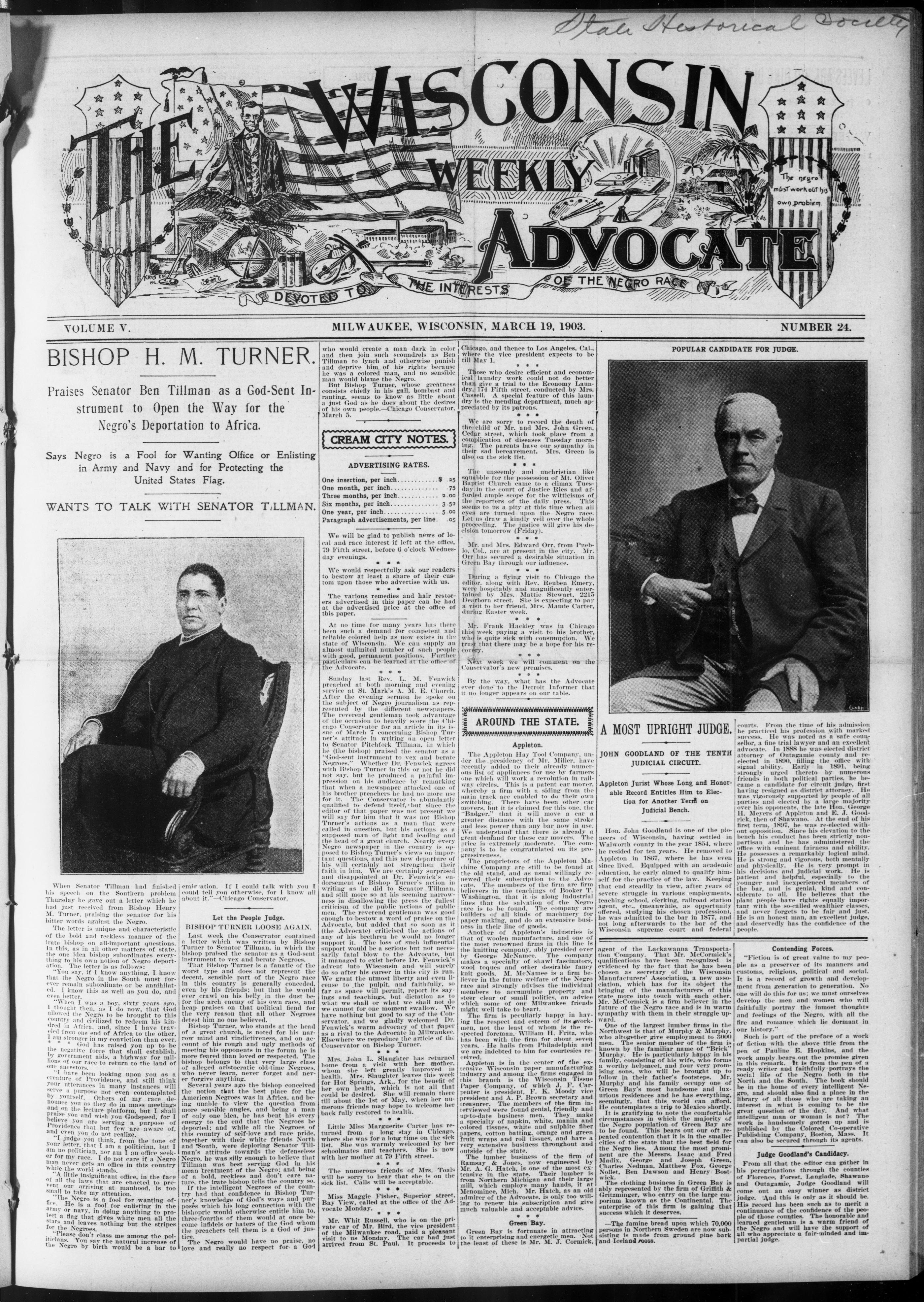
BISHOP H. M. TURNER.
Praises Senator Ben Tillman as a God-Sent Instrument to Open the Way for the Negro's Deportation to Africa.
Says Negro is a Fool for Wanting Office or Enlisting in Army and Navy and for Protecting the United States Flag.
WANTS TO TALK WITH SENATOR TLLMAN.
VOLUME V.
BISHOP H.
Praises Senator Ben T. strument to Open Negro's Deport
Says Negro is a Fool for in Army and Navy United S
WANTS TO TALK WITH
When Senator Tillman had finished his speech on the Southern problem Thursday he gave out a letter which he had just received from Bishop Henry M. Turner, praising the senator for his bitter words against the Negro.
The letter is unique and characteristic of the bold and reckless manner of the irate bishop on all-important questions. In this, as in all other matters of state, the one idea bishop subordinates everything to his own notion of Negro deportation. The letter is as follows:
"You say, if I know anything, I know that the Negro in the South must forever remain subordinate or be annihilated. I know this as well as you do, and even better.
"When I was a boy, sixty years ago, I thought then, as I do now, that God allowed the Negro to be brought to this country and civilized to redeem his kindred in Africa, and, since I have traveled from one end of Africa to the other, I am stronger in my conviction than ever. * * * * God has raised you up to be the negative force that shall establish, by government aids, a highway for millions of our race to return to the land of our ancestors.
"I have been looking upon you as a creature of Providence, and still think your utterances in many instances will serve a purpose not even contemplated by yourself. Others of my race denounce you as they do in mass meetings and on the lecture platform, but I shall praise you and wish you Godspeed, for I believe you are serving a purpose of Providence that but few are aware of, and even you do not realize.
"I judge you think, from the tone of your letter, that I am a politician, but I am no politician, nor am I an office seeker for my race. I do not care if a Negro man never gets an office in this country while the world stands.
"A little insignificant office, in the face of all the laws that are enacted to prevent our arriving at manhood, is too small to take my attention."
The Negro is a fool for wanting office. He is a fool for enlisting in the army or navy, in doing anything to protect a flag that gives white men all the stars and leaves nothing but the stripes for the Negroes.
"Please don't class me among the politicians. You say the natural increase of the Negro by birth would be a bar to
emigration. If I could talk with you I could tell you otherwise, for I know all about it."—Chicago Conservator.
Let the People Judge
Last week the Conservator contained a letter which was written by Bishop Turner to Senator Tillman, in which the bishop praised the senator as a God-sent instrument to vex and berate Negroes. That Bishop Turner is a fanatic of the worst type and does not represent the decent, sensible part of the Negro race in this country is generally conceded, even by his friends; but that he would ever crawl on his belly in the dust before the arch enemy of his own race, and heap praises on that political fiend for the very reason that all other Negroes detest him no one believed.
Bishop Turner, who stands at the head of a great church, is noted for his narrow mind and vindictiveness, and on account of his rough and ugly methods of meeting his opponents in the forum he is more feared than loved or respected. The bishop belongs to that very large class of alleged aristocratic old-time Negroes, who never learn, never forget and never forgive anything.
Several years ago the bishop conceived the notion that the best place for the American Negroes was in Africa, and being unable to view the question from more sensible angles, and being a man of only one idea, he has bent his every energy to the end that the Negroes be deported: and while all the Negroes of this country of self-love and race pride, together with their white friends North and South, were deploring Senator Tillman's attitude towards the defenseless Negro, he was silly enough to believe that Tillman was best serving God in his mean treatment of the Negro; and being of a bold, reckless and don't care nature, the irate bishop tells the country so.
If the intelligent Negroes of the country had that confidence in Bishop Turner's knowledge of God's ways and purposes which his long connection with the bishopric would otherwise entitle him to, three-fourths of them would at once become infidels or haters of the God whom the preachers tell them is a God of justice. The Negro would have no praise, no love and really no respect for a God
who would create a man dark in color and then join such scoundrels as Ben Tillman to lynch and otherwise punish and deprive him of his rights because he was a colored man, and no sensible man would blame the Negro. But Bishop Turner, whose greatness consists chiefly in his gall, bombast and ranting, seems to know as little about a just God as he does about the desires of his own people.—Chicago Conservator, March 5.
ADVERTISING RATES.
One insertion, per inch..... $ .25
One month, per inch..... 75
Three months, per inch..... 2.00
Six months, per inch..... 3.50
One year, per inch..... 5.00
Paragraph advertisements, per line..... 05
We will be glad to publish news of local and race interest if left at the office, 79 Fifth street, before 6 o'clock Wednesday evenings.
We would respectfully ask our readers to bestow at least a share of their custom upon those who advertise with us.
The various remedies and hair restorers advertised in this paper can be had at the advertised price at the office of this paper.
At no time for many years has there been such a demand for competent and reliable colored help as now exists in the state of Wisconsin. We can supply an almost unlimited number of such people with good, permanent positions. Further particulars can be learned at the office of the Advocate.
Sunday last Rev. L. M. Fenwick preached at both morning and evening service at St. Mark's A. M. E. Church. After the evening sermon he spoke on the subject of Negro journalism as represented by the different newspapers. The reverend gentleman took advantage of the occasion to heavily score the Chicago Conservator for an article in its issue of March 7 concerning Bishop Turner's attitude in writing an open letter to Senator Pitchfork Tillman, in which he (the bishop) praised the senator as a "God-sent instrument to vex and berate Negroes." Whether Dr. Fenwick agrees with Bishop Turner in this or not he did not say, but he produced a painful impression on his audience by remarking that when a newspaper attacked one of his brother preachers he had no more use for it. The Conservator is abundantly qualified to defend itself, but since the editor of that paper was not present we will say for him that it was not Bishop Turner's actions as a man that were called in question, but his actions as a supposed man of light and leading and the head of a great church. Nearly every Negro newspaper in the country is opposed to Bishop Turner's views on important questions, and this new departure of his will certainly not strengthen their faith in him. We are certainly surprised and disappointed at Dr. Fenwick's endorsement of Bishop Turner's action in writing as he did to Senator Tillman, and still more so at his seeming narrowness in disallowing the press the fullest criticism of the public actions of public men. The reverend gentleman was good enough to bestow a word of praise on the Advocate, but added that so soon as it (the Advocate) criticised the actions of any of his brethren he would no longer support it. The loss of such influential support would be a serious but not necessarily fatal blow to the Advocate, but it managed to exist before Dr. Fenwick's advent into Wisconsin and will surely do so after his career in this city is run. We grant the utmost liberty and even license to the pulpit, and faithfully, so far as space will permit, report its sayings and teachings, but dictation as to what we shall or what we shall not do we cannot for one moment swallow. We have nothing but good to say of the Conservator, and we gladly welcomed Dr. Fenwick's warm advocacy of that paper as a rival to the Advocate in Milwaukee. Elsewhere we reproduce the article of the Conservator on Bishop Turner.
***
Mrs. John L. Slaughter has returned home from a visit with her mother, whom she left greatly improved in health. Mrs. Slaughter leaves this week for Hot Springs, Ark., for the benefit of her own health, which is not all that could be desired. She will remain there till about the 1st of May, when her numerous friends may hope to welcome her back fully restored to health.
求求
Little Miss Marguerite Carter has returned from a long stay in Chicago, where she was for a long time on the sick list. She was warmly welcomed by her schoolmates and teachers. She is now with her mother at 79 Fifth street.
** **
The numerous friends of Mrs. Toals will be sorry to hear that she is on the sick list. Calls will be acceptable.
* * *
Miss Maggie Fisher, Superior street, Bay View, called at the office of the Advocate Monday.
* * *
Mr. Whit Russell, who is on the private car of Mr. Bird, the vice president of the Milwaukee road, paid a pleasant visit to us Monday. The car had just arrived from St. Paul. It proceeds to
Chicago, and thence to Los Angeles, Cal., where the vice president expects to be till May 1.
* * *
Those who desire efficient and economical laundry work could not do better than give a trial to the Economy Laundry, 174 Fifth street, conducted by Mrs. Cassell. A special feature of this laundry is the mending department, much appreciated by its patrons.
```markdown
```
We are sorry to record the death of the child of Mr. and Mrs. John Green, Cedar street, which took place from a complication of diseases Tuesday morning. The parents have our sympathy in their sad bereavement. Mrs. Green is also on the sick list.
* * *
The unseemly and unchristian like squabble for the possession of Mt. Olivet Baptist Church came to a climax Tuesday in the court of Justice Ries and afforded ample scope for the witticisms of the reporters of the daily press. This seems to us a pity at this time when all eyes are turned upon the Negro race. Let us draw a kindly veil over the whole proceeding. The justice will give his decision tomorrow (Friday).
Mr. and Mrs. Edward Orr, from Pueblo, Col., are at present in the city. Mr. Orr has secured a desirable situation in Green Bay through our influence.
During a flying visit to Chicago the editor, along with Rev. Reuben Emery, were hospitably and magnificently entertained by Mrs. Mattie Stewart, 2215 Dearborn street. She is expecting to pay a visit to her friend, Mrs. Manie Carter, during Easter week.
Mr. Frank Hackley was in Chicago this week paying a visit to his brother, who is quite sick with consumption. We trust that there may be a hope for his recovery.
Next week we will comment on the Conservator's new premises.
By the way, what has the Advocate ever done to the Detroit Informer that it no longer appears on our table.
Appleton.
The Appleton Hay Tool Company, under the presidency of Mr. Miller, have recently added to their already numerous list of appliances for use by farmers one which will work a revolution in railway circles. This is a patent car mover, whereby a firm with a siding from the main track are enabled to do their own switching. There have been other car movers, but it is claimed for this one, the "Badger," that it will move a car a greater distance with the same stroke and less power than any bar now in use. We understand that there is already a great demand for these car movers. The price is extremely moderate. The company is to be congratulated on its progressiveness.
The proprietors of the Appleton Machine Company are still to be found at the old stand, and as usual willingly renewed their subscription to the Advocate. The members of the firm are firm believers in the teachings of Booker T. Washington, that it is along industrial lines that the salvation of the Negro race is to be found. The company are builders of all kinds of machinery for paper making, and do an extensive business in their line of goods.
Another of Appleton's industries is that of woolen manufacture, and one of the most renowned firms in this line is the knitting company, ably presided over by George McNamee. The company makes a specialty of shawl fascinators, wool toques and other desirable fancy knit goods. M. McNamee is a firm believer in the future welfare of the Negro race and strongly advises the individual members to accumulate property and steer clear of small politics, an advice which some of our Milwaukee friends might well take to heart. The firm is peculiarly happy in having the respect and esteem of its workmen, not the least of whom is the respected foreman, William H. Fritz, who has been with the firm for about seven years. He hails from Philadelphia and we are indebted to him for courtesies received
Appleton is in the center of the extensive Wisconsin paper manufacturing industry and among the firms engaged in this branch is the Wisconsin Tissue Paper Company, of which J. F. Carpenter is president, F. K. Moody vice president and A. P. Brown secretary and treasurer. The members of the firm interviewed were found genial, friendly and up-to-date business men. They make a specialty of napkin, white, manila and colored tissues, white and sulphite fiber papers, cotton batting, orange and green fruit wraps and roll tissues, and have a very extensive business throughout and outside of the state.
The lumber business of the firm of Ramsay & Jones, now engineered by Mr. A. G. Hatch, is one of the most extensive in the state. Their lumber is from Northern Michigan and their large mill, which employs many hands, it at Menominee, Mich. Mr. Hatch, as an old admirer of the Advocate, is only too willing to renew his subscription and give much valuable and acceptable advice.
Green Bav.
Green Bay is fortunate in attracting to it enterprising and energetic men. Not the least of these is Mr. M. J. Cormick,
CLARK
JOHN GOODLAND OF THE TENTH JUDICIAL CIRCUIT.
Appleton Jurist Whose Long and Honor able Record Entitles Him to Election for Another Term on Judicial Bench.
Hon. John Goodland is one of the pioneers of Wisconsin, having settled in Walworth county in the year 1854, where he resided for ten years. He removed to Appleton in 1867, where he has even since lived. Equipped with an academic education, he early aimed to qualify himself for the practice of the law. Keeping that end steadily in view, after years of severe struggle in various employments, teaching school, clerking, railroad station agent, etc., (meanwhile, as opportunity offered, studying his chosen profession), he was admitted to the bar in 1877, and not long afterwards to the bar of the Wisconsin supreme court and federal
agent of the Lackawanna Transportation Company. That Mr. McCormick's qualifications have been recognized is evidenced by the fact that he has been chosen as secretary of the Wisconsin Manufacturers' Association, a new association, which has for its object the bringing of the manufacturers of this state more into touch with each other. Mr. McCormick is a firm believer in the future of the Negro race and is in warm sympathy with them in their struggle upward.
One of the largest lumber firms in the Northwest is that of Murphy & Murphy, who altogether give employment to 3000 men. The senior member of the firm is known by the familiar name of "Brick" Murphy. He is particularly happy in his family, consisting of his wife, who forms a worthy helpmeet, and four very promising sons, who will be brought up to follow in their father's footsteps. Mr. Murphy and his family occupy one of Green Bay's most handsome and luxurious residences and he has everything, seemingly, that this world can afford. He contemplates a trip to Mexico shortly.
It is gratifying to note the comfortable circumstances in which the majority of the Negro population of Green Bay are to be found. This bears out our oft repeated contention that it is in the smaller cities of the state that the best field for the Negro lies. Among the most prominent are the Messrs. Isaac and Fred Madix, George and Joseph Green, Charles Nedman, Matthew Fox, George Nollet, Ben Dawson and Henry Bostwick.
The clothing business in Green Bay is ably represented by the firm of Griffith & Gritzminger, who carry on the large emporium known as the Continental. The enterprise of this firm is gaining that success which it deserves.
The famine bread upon which 70,000 persons in Northern Sweden are now subsisting is made from ground pine bark and Iceland ross.
NUMBER 24.
DATE FOR JUDGE.
courts. From the time of his admission he practiced his profession with marked success. He was noted as a safe counsellor, a fine trial lawyer and an excellent advocate. In 1888 he was elected district attorney of Outagamie county and re-elected in 1890, filling the office with signal ability. Early in 1891, being strongly urged thereto by numerous friends in both political parties, he became a candidate for circuit judge, first having resigned as district attorney. He was vigorously supported by people of all parties and elected by a large majority over his opponents, the late Hon. George H. Meyers of Appleton and E. J. Goodrick, then of Shawano. At the end of his first term, 1897, he was re-elected without opposition. Since his elevation to the bench his conduct has been strictly non-partisan and he has administered the office with eminent fairness and ability. He possesses a remarkably logical mind. He is strong and vigorous, both mentally and physically. He is very prompt in his decisions and judicial work. He is patient and helpful, especially to the younger and inexperienced members of the bar, and is genial, kind and considerate to all. He believes that the plant people have rights equally important with the so-called wealthier classes, and never forgets to be fair and just. He is an honest man, an excellent judge, and deservedly has the confidence of the people.
Contending Forces
"Fiction is of great value to my people as a preserver of its manners and customs, religious, political and social. It is a record of growth and development from generation to generation. No one will do this for us; we must ourselves develop the men and women who will faithfully portray the inmost thoughts and feelings of the Negro, with all the fire and romance which lie dormant in our history."
Such is part of the preface of a work of fiction with the above title from the pen of Pauline E. Hopkins, and the work amply bears out the promise given in this remark. It is from the pen of a ready writer and faithfully portrays the social life of the Negro both in the North and the South. The book should be in the home of every intelligent Negro, and should also find a place in the library of all those who are taking an interest in what is coming to be the great question of the day. And what intelligent man or woman is not? The work is handsomely gotten up and is published by the Colored, Co-operative Publishing Company, Boston, Mass. It can also be secured through its agents.
Judge Goodland's Candidacy.
From all that the editor can gather in his peregrinations through the counties of Florence, Forest, Langlade, Shawano and Outagamie, Judge Goodland will come out an easy winner as district judge. And this is only as it should be. His record has been such as to merit a continuance of the confidence of the people of those counties. The honorable and learned gentleman is a warm friend of the Negro and will have the support of all who appreciate a fair-minded and impartial judge.
---
LEVEES ARE HOLDING OUT.
One Break Reported Twenty Miles North of Memphis.
Leon Gasman Meets Death and Henry Gasman is Badly Hurt—Roads
Memphis, Tenn., March 18.—The river stands at 39.6 feet this morning and is stationary. The levees continue to hold and the only one break reported is at Trice landing, twenty miles north of here. The waters of the big stream are rushing through this crevasse at a fearful rate and flooding the Arkansas basin south. The town of Marian, in Crittenden county, is in desperate straits, and its inhabitants are greatly alarmed at the rapid encroachment of the flood. Hundreds of refugees are in Marian and every available building is being used to house these unfortunates. The 'Frisco railroad, which runs through the town, is under water, and there is no means of getting them out.
Reports of loss of life in remote sections are current, but only in two cases can they be verified. The body of an unknown white woman was found in the water near Mound City and the corpse of a negro was taken from the overflowed district. The levee here is crowded by poor negroes who are picked up by steamboats. The city authorities have turned over several buildings for their use, and they are being cared for by the Sunshine Society. A meeting of prominent negro citizens has been called for tonight and steps will be taken to help care for the refugees.
A dispatch from Covington, Tenn., states that island 35, which is considered one of the highest in the north end of the river, is flooded for the first time in its history. Sixty persons were rescued from the island this morning by a steamer. Reports from Helena state that the people of North Helena are alarmed over the flood situation. The levee before that part of the town will hold only one foot more of water. New Orleans, La., March 18.—The river situation here remains practically unchanged. The fact that there has been no rise of consequence since Saturday and that the weather continues clear has enabled the state, federal and district authorities materially to improve the temporary levees in front of the city.
Washington, D. C., March 18.—The Ohio river has fallen 1.2 foot at Cairo and as a consequence the Mississippi river, while slightly higher at Memphis, can rise but little more.
TREATY RATIFIED
But Five Negative Votes When Final Action in the Senate is Taken
Washington, D. C., March 18. By the ratification of the treaty with Colombia last evening the construction of the Panama canal, under the direct management of the government of the United States, practically is assured.
The ratification was accomplished by the overwhelming vote of 73 to 5. Those in opposition were all Democrats, but party ties were broken. The five in opposition were the two Alabama senators, the two from Virginia, and Mr. Teller of Colorado, who opposed the canal chiefly because he said nature never intended to connect the two oceans on the line of the isthmus.
Both parties are entitled to the credit of ratifying the treaty; because, although the Republicans voted solidly for it, some of them actually were opposed to the canal, while there could have been no ratification at all without the Democratic votes.
Action by Colombia.
In view of the overwhelming vote and the fact that the treaty was ratified wholly without amendment, it is believed that the government of Colombia will act upon the treaty with similar completeness. Any amendment made on the isthmus would require action by the United States Senate, and this would put the whole matter over until next winter, because the President would not call another extra session of the Senate for such a purpose.
The ratifications of the treaty, therefore, probably will be exchanged within the next sixty days, the payment of the $40,000,000 to the Panama Company will be made immediately thereafter, and the actual, if not technical, sovereignty over a wide strip of land on the isthmus of Panama will be transferred at once to the United States.
Walker to Head Commission.
It is learned upon the highest authority that the President will not announce the canal commission until he returns from the Western trip. From the same source, however, it is learned that some of its members have already been decided upon. Rear Admiral Walker, U. S. N., will be the head of the commission. Ex-Senator Jones of Arkansas will be a member, as undoubtedly will be exCongressman Mercer of Nebraska. Two of the four engineers of the present commission, Noble, Ernst, Haines and Burr, will be chosen.
Canal Shares Advance.
Paris, March 18.—The announcement of the ratification of the Panama canal treaty by the United States Senate was received with satisfaction by the officials and others here who have long been interested in this project. Although the government of France has no connection with the Panama Canal Company, the former has always taken a deep interest in the success of the late Count de Lesseps' project, owing to the great number of French investors in the canal company.
On the bourse today Panama 3 per cents., which closed at 46 francs yesterday, advanced to 47 and 48 francs. These represent the bonds having a face value of 500 francs, which sold almost at par during the palmy days of Count de Lesseps. They had been greatly depressed during recent years, but have advanced steadily since the United States began the discussion of the treaty with Colombia.
TRAIN IN THE DITCH.
Several Passengers Were Injured, but None Fatally.
Guelph, Ont., March 18.—Grand Trunk passenger train No. 175 going north ran off the track into the ditch between here and Elora today. It is reported that quite a number of passengers were injured, but none fatally.
KING EDWARD'S PRESENT.
Buffalo Bill Receives Scarf Pin with Royal Cipher in Diamonds.
London, March 18.—King Edward has sent Col. Cody (Buffalo Bill) a handsome scarf pin with the royal cipher in diamonds surmounted by the crown as a souvenir of his visit last Saturday to the wild west show.
RIVER SITUATION BECOMES CRITICAL.
Water Pouring Over Tops of Levees Near Memphis and a. Serious Break is Feared.
Washington, D. C., March 17.—The river situation in the Memphis district has become critical. The stage this morning is 39.4, a rise of 0.5 foot since Monday morning and 1.1 feet above the high water stage of 1898. Unofficial reports of the breaking of levees north of Memphis have been received. These breaks, if extensive, will doubtless modify the condition somewhat. Nevertheless, a further rise to 40 feet or slightly over may be expected at Memphis within the next thirty-six hours. Below Helena the situation is unchanged. The stage at Vicksburg is 49 feet, a rise of 0.2 foot, while at New Orleans the river is stationary at 19.2 feet.
The Louisiana tributaries continue to rise, the Shreveport gauge recording 31.9 feet this morning. The Ohio is falling except at Cairo, where the decline will probably begin today.
Memphis, Tenn., March 17.—At Trice's Landing, two miles north of Hollybush, and eighteen miles north of here, the St. Francis levee is overtopped by the water for a distance of three-quarters of a mile. Water is flowing over the embankment in a stream almost six inches deep, and there is every indication that a crevasse nearly a mile wide will be made.
A force of 500 men, under the personal charge of President Killough of the St. Francis levee board, is making an effort to sack the levee and stop the flow of the water. Should the levee give way before the flood, a vast area of Crittenden county, Ark., will be inundated and untold damage result.
Rock Springs, Wyo., March 17.—The Red Desert is inundated for miles east of Rock Springs and the salt wells drilling station is completely under water. Large quantities of supplies belonging to the Belgo-American Drilling Company have been ruined or swept away. The water has backed up against the Union Pacific embankment to a depth of 20 feet in places. The embankment has not yet been cut, but there is danger that this will occur and track walkers are kept constantly on the move over the threatened section.
SEARCH FOR EGAN HAS BEEN RENEWED.
Widow and Friends of the Missing Rail road Official Seek to Recover His Body
St. Paul, Minn., March 17.—With the coming of spring the search for the body of Supt. Egan of the Montana division of the Great Northern, who was lost in the mountains near Helena last November has been taken up again. The widow and friends of the missing man are pushing the search, and it is possible Great Northern officials may take a hand in the matter.
Mr. Egan carried life insurance to the amount of $25,000. Not a cent of this has been paid the widow, and probably will not be if the body is not found, without a considerable amount of litigation. This will delay the payment for a long time, and friends of the widow are anxious to have the matter settled for her sake.
It is believed that if the body is found early enough in the spring that it will be easily recognizable, as Mr. Egan disappeared during cold weather and probably died from exposure. He went up into the mountains, with which he was quite familiar, in early part of November on a hunting trip, and has not been heard from since. The railroad company, at this time, took up the search, but no trace of the missing man could be found.
SOUVENIR OF FAMINE.
Piece of the Awful Bread Made from Straw, Bark and Rye.
Menominee, Mich., March 17.—[Special.]—A Menominee county citizen has received rather a pitiful souvenir of the famine in Sweden and Finland in the shape of a piece of bread, the same kind which the people there were forced to eat. It came direct from the famine stricken district of Finland and gives a fair idea of what the people of that country have to subsist on. The bread is very dark in color, almost black, and is made of straw, pine bark and a small portion of roasted rye.
KAISER'S SON HAS MEASLES
Prince Eitel Friedrich Contracts Disease at a Drinking Bout.
Berlin, March 17.—Prince Eitel Friedrich, second son of the Emperor, is suffering with measles, which he contracted while attending a "commers," or students' drinking bout, recently.
One of the students present came directly from the room of his sister, who was suffering with the disease. Six other students caught the disease at the commers.
It is believed that Crown Prince Friedrich Wilhelm contracted the disease from his brother.
CIVIL WAR ROSTER BEGUN
Names of All Who Fought on Both Sides to be Published
Washington, D. C., March 17.—By direction of Secretary Root the war department has embarked on the extensive work of compiling and publishing a complete roster of the officers and enlisted men of the Union and Confederate armies. The publication will be enormous in size, including no less than thirty volumes as large as the rebellion records.
OFFERED TO S. N. D. NORTH
Tariff Expert Succeeds Merriam as Director of Census.
Washington, D. C., March 17.—The President has tendered the position of director of the census to S. N. D. North formerly chief statistician of manufactures of the census bureau, to succeed Director Merriam, resigned. Mr. North has accepted and will enter upon his duties some time in May.
Railway Hotels.
Several of the wealthiest and most enterprising railroad corporations in Great Britain, France and elsewhere on the continent of Europe have built gigantic hotels at their terminals. That sort of investment by rich transportation lines has not been entered upon extensively in many cases in this country. But it is now expected that railway hotels of the skyscraper kind will be set up on Manhattan island. What is to be the limit in this generation for the raising of enormous inns and taverns in this borough?—New York Tribune.
W. H. Liginger, president of the A. A. U., says the trouble regarding the prize awarding at the Philadelphia Sportsmen's show has been satisfactorily adjusted with Pyrah, the swimmer, who was not awarded his prize for winning the long plunge contest, and consequently the sanction for the Cleveland Sportsmen's show will no longer be withheld. This means that the New York water polo team will go there and the M. A. C. team may also compete.
Proceedings in the Senate.
The open session of the Senate on the 12th lasted five minutes. Mr. Kean (N. J.) reported back favorably from the committee on contingent expenses the resolution introduced by Senator Allison to authorize the committee on rules to secure the recess for the purpose of examining the rules and it was adopted. In this connection Mr. Platt (Conn.) gave notice of a modification of the rules which he proposed by which the Senate at any time by a three-fifths vote in the Senate could make an order fixing the time at which a vote should be taken upon any pending question and fixing the limit of time any senator could occupy in debate pending such final vote. This proposition for cloture was in the form of a resolution. It was ordered to lie on the table. The Senate agreed to a resolution offered by Mr. Hoar directing the committee on printing to ascertain and report the cost for each session of the last four congresses of all documents other than executive or legislative documents printed by order of the Senate or by the request of individual senators. Mr. Teller introduced the following resolution, which was allowed to lie on the table: "Resolved, that the judiciary committee be directed to report to the Senate whether the President by and with the advice of the Senate can negotiate treaties with foreign governments by which the duties levied by Congress on importations can be changed or abrogated."
can be changed. Ten minutes after convening on the 13th, the Senate, on motion of Mr. Cullom, went into executive session. Senator Morgan entered on a discussion of Attorney General Knox's opinion as to the validity of the title to the Panama canal property which can be given by the new Panama Canal Company. When Senator Morgan concluded Senator Spooner took the floor, but did not proceed, it having been decided that his speech should be deferred for a day. Immediately after the Senate convened Saturday, the 14th, an executive session was ordered, and Senator Spooner began his speech in support of the Panama canal treaty, answering Senator Morgan. When he had finished several amendments were offered, and then at 5:40 p. m. adjournment until Monday was voted.
The Senate spent six hours in executive session on Monday, the 16th, in its effort to pass on the amendments to the Panama canal treaty in preparation for the final vote on the treaty the 17th. The greater part of the day was devoted to debate on the matter of insuring American defense of the canal, the Democrats contending that the United States should be given the initiative in that respect, and the Republicans urging that the interests of this country are sufficiently safeguarded by the terms of the treaty as it stands. A substitute for the provision of the treaty placing the defence of the canal primarily in the hands of the government of Colombia resulted in a test vote. The Democrats cast a solid vote in support of the amendment, the Republicans voting as solidly against it. The vote was 24 for the amendment to 46 against it. During the day Senator Morgan offered a number of his amendments, but none of them received more than ten or twelve votes. Levi Ankeny, the new senator from Washington, was sworn in. At 6 p. m. the Senate adjourned.
The Senate on the 17th voted to ratify without change the treaty with Colombia for the construction of an isthmian canal. The vote was 73 in the affirmative to 5 in the negative. The day was given up almost entirely to general debate on the treaty, the speakers being Senators Morgan, Cullem, Daniel, Bacon, Teller, Balley, Spooner, Hoar and others. The only party vote of the day was taken on the substitute for article 4, which was agreed upon by the Democratic caucus, and had reference to the acquisition of territory in Central and South America by the United States. This was voted down. 51 to 27. The Senate adjourned at 7 o'clock.
The Senate met at 11 a. m. on the 18th and soon thereafter Mr. Money (Miss.), in accordance with notice previously given, spoke on the Indianola (Miss.) postoffice case. At 1:17 o'clock the Senate went into executive session and took up the Cuban reciprocity treaty. Mr. McEnery of Louisiana spoke in oposition to the measure. Mr. Newlands made a plea for the annexation of Cuba, and presented an amendment inviting the island to join the Union. Senators Spooner, Teller, Nelson, Cullom, Gorman, Bailey and Carmack spoke. A unanimous agreement to vote on the treaty at 3 o'clock on the 19th was reached, after which the Senate at 7 o'clock adjourned.
—Phillip Boehmer, 40 years old, was stricken with an attack of heart failure while hurrying along State street and fell dead.
—Frank O'Connor was struck by a northbound Clark street cable car, sustaining severe bruises and probably a fracture of the skull.
—John Ryan, a laborer, dropped dead. He had been ill with consumption several months and had just asked the county agent to send him to the poor farm at Dunning.
—While at work on the roof of a building Martin Runkel, 59 years old, a cornice maker, lost his balance and fell twenty feet. He died without regaining consciousness.
—Philip Ryan, 37 years old, was found drowned in a reservoir owned by the Chicago & North-Western Railroad Company by a searching party. His friends believe he committed suicide.
—A verdict of suicide while temporarily insane was returned by a coroner's jury at an inquest over the body of William Whittman, who, after attempting to kill his wife, sent a bullet into his own brain.
—Miss Kittie Galvin, 25 years old, was seriously injured while attempting to alight from a car as it rounded a curve. She fell and was drawn under the wheels, which crushed her left leg below the knee and injured her arm.
William Weigman, a teamster, was severely injured by being thrown from his wagon when his horses became unmanageable. Weigman was thrown against a telegraph pole and was made unconscious. He sustained internal injuries.
Benedict Fischer, president of the American Encautic Tile Company and vice president of the Mauser Manufacturing Company, died at the Hudson Street Hospital. He was taken there after a sudden attack of paralysis on an electric train.
From an office with $75,000 as its prize the place of city treasurer was reduced by the aldermen into a position with $25,000 attached. The reduction gives the head of the city exchequer 25 per cent. of the interest on public funds instead of 60 per cent.
Adolph Loeb, for many years in the real estate business in Chicago, died at the home of his son-in-law, Henry M. Greenbaum. Mr. Loeb had been a resident of Chicago for forty years, coming from Germany when 24 years of age. A widow and eight children survive him.
Lucian Prentiss Cheney, who for twenty years kept a drug store at North Clark street and Chicago avenue, died yesterday morning at his home, aged 45. A year ago Mr. Cheney was attacked with Bright's disease, of which he died. He leave a widow.
As the result of injuries received through a fall down the stairs of his boarding house steps in New Orleans, David Bell, the well-known golf professional, who for three years was connected with the Midlothian Country Club, died in the Crescent city.
—Word has been received of the death at Santa Barbara, Cal., of Elliott H. Phelps, a former Chicagoan, following a paralytic stroke during a golf game. The decedent was formerly prominent on the Chicago board of trade. He was 53 years old.
Proceedings in the Senate.
When the Senate met on the 12th Mr. McGillivray presented a petition in favor of pure food. Two others were offered in favor of the free library bills before the committee of education. The Senate adopted a resolution offered by Mr. Stout calling for the printing of 1000 extra copies of the committee's report on the mill tax. The following bills were passed: Allowing Milwaukee supervisors to regulate salary of stenographers appointed by the district attorney; allowing villages in Milwaukee county to borrow money to construct sewers; providing that no minor under 16 years of age shall be allowed to work over sixty hours a week; providing for three commissioners to report on the feasibility of a state park at Devil's lake; providing for exemption of park lands from taxation, when held merely on a land contract.
Another taxation measure—the bill to abolish the taxation of credits—was reported to the Senate at the evening session on the 12th by the committee on assessment and collection of taxes. Two members of the committee. Senators Hatten and Stout, dissented from the report in favor of the passage of the bill. Mr. Hatten and Mr. Stout take position with the governor and against the tax commission in favor of taxing intangible property, so-called. The bill was made a special order for the evening of the 18th on motion of Senator Whitehead, chairman of the taxation committee.
The joint resolution constituting the joint committee on claims and special committee to visit normal schools at Milwaukee and Platteville was concurred in at the session of the Senate on the 13th. Senator Hagemelster offered an amendment, which was adopted, making it optional with the committee to attend instead of it being compulsory. The bill establishing a state board of veterinary medical examiners and Assembly bill relating to admissions to the bar, were laid over until Tuesday. One Assembly bill was concurred in: 178A, relating to special town meetings. No. 429A, relating to abstract of tax sales in Shawano county, was laid over. No. 198A, authorizing counties to pay a bounty on rattlesnakes, was laid over until March 26 on motion of Mr. North. Bills 290A, to authorize the Antigo Island Club to erect a dam over Pelican river in Oneida county, and 433A, relating to temporary logging highways, were ordered to a third reading. The 7-10th mill tax bill was on the calendar, but was referred to the committee on claims. Senator Hudnall moved that a recess be taken until evening. This was done in order to permit the committee on engrossed bills to report. This was carried. A motion was made and carried that when the Senate adjourn it be until 9 p.m. on the 16th.
At the session of the Senate on the evening of the 16th the governor sent his veto to bill No. 180A, regulating the importation of Western branded or range horses into the state. He held the measure as it was phrased in the bill would be ineffective. The session was opened by a song by Rev. H. W. Bolton, instead of prayer. Indefinite leave of absence was granted to Senators Rogers and Eaton, both of whom are reported sick at their homes in Milwaukee with the grippe. The Senate concurred in Assembly bill No. 290, authorizing the Antigo Island Club to build a dam across Pelican river. Two bills in relation to a dam across St. Croix river to supply St. Paul and Minneapolis with electricity were ordered to a third reading. The Senate adjourned.
The Senate on the 17th, on motion of Senator Roehr, recalled the Lenroot franchise bill from the committee on judiciary, whether it had been sent on motion of Senator Hudnall at the request of Mr. Lenroot, and ordered it referred to the committee on corporations. Because the bill applied to cities it was originally sent to the committee on corporations. The motion was carried by a rising vote of 12 to 3, less than a quorum voting. The judiciary committee reported a substitute bill, providing for a repeal of that part of the act establishing a district court for Milwaukee county, which provides that the reporter shall transcribe free of charge the evidence and the charge of the judge when the accused is sent to the industrial school for boys.
The Senate concurred in the Assembly bill to allow the St. Croix Improvement Company to build a dam across the St. Croix river. The bill to license barbers was recommended for indefinite postponement and was laid over for one week, on motion of Senator Hudnall.
Senator Hatten's resolution for a conference on the negro question, at Atlanta, July 4, was the special order in the Senate on the 18th, and when it came up the senator, after a speech, asked that it be referred to the committee on education. a request that was promptly acceded to. The Senate passed the following bills: No. 100, to provide for reprinting the first ten volumes of Wisconsin historical reports; No. 247, providing that banks shall not be subjected to double taxation on their buildings. The following Assembly bills were ordered to a third reading: No. 537, providing that each village and town of Milwaukee county shall be in the same position as the city with reference to paying for prisoners in the house of correction; No. 538, authorizing Milwaukee to establish building lines for boulevards and condemn property if necessary. Senator Roehr's bill in relation to criminal anarchy was ordered engrossed with amendments providing for terms in state prison and reducing fines. The bill to refund the inheritance tax was also ordered engrossed.
By a vote of 20 to 9 the Senate at the evening session on the 18th ordered to a third reading the bill to abolish the taxation of credits. Three hours of oratory preceded the vote, which was reached at 11 o'clock. The committee on corporations reported a substitute for the bill relating to pensions to Milwaukee firemen and policemen. The substitute provides for uniform assessments and for the distribution of the funds.
Proceedings in the Assembly.
The Smalley bill limiting the school tax to $850,000 as amended was laid over for one week in the Assembly on the 12th. The bill providing for the examination and license of barbers, recommended for passage by the committee on public health and sanitation, was the special order in the Assembly. A. H. Smith offered a comic amendment providing that Turkish bath establishments shall be placed under the purview of the act. The amendment was ruled out of order. Mr. Cady offered an amendment providing that the law shall not take effect until July 1 next. This was adopted. Mr. Freray offered an amendment defining the word "occupation" as used in the bill, so as to provide that no barber shall be thrown out of business whether he has devoted all or part of his time to the business. The amendment was adopted without further debate, the roll was called and the bill defeated, 47 to 52. Mr. Smalley moved that 77A, providing ward option on granting license, be withdrawn from the committee on state affairs and referred to the judiciary committee. Opposition was manifested, but the motion carried, 45 to 25. The bill permitting the location of isolation hospitals outside the city was favorably reported by the committee on health and sanitation, with an amendment to include third-class cities. The Senate amendment to 52A, amending the law relative to guardians for insane persons, was concurred in. The joint resolution constituting the joint committee on claims a special committee to visit the normal schools at Milwaukee and Platteville to investigate and report on their needs was adopted. The following bills were passed: Authorizing the La Crosse and Black River Railroad Company to build a dam across Black River in Jackson county; prohibiting county judges from taking fees in administration of estates; providing for separate guardians for person and estate of minors; prescribing sanitary regulations for factories, workshops, mills, stores, etc.; amending the law relative to care of dependent children in Milwaukee county; Creating the town of Wright from the towns of Rock Falls and Scott in Lincoln county; dividing the town of Tomahawk, Lincoln county, and creating the town of Bradley; increasing the pay of drainage commissioners from $2 to $3.50 per day; providing that franchises granted by cities must be submitted to vote of the people on petition of 10 per cent. of the voters; creating the town of Goodrich in Taylor county; amending the law prescribing conditions entitling persons from outside districts to attend high school; providing for the establishment of a state park about Devil's Lake; providing that life insurance policies shall have the complete contract printed on them; providing that the state treasurer may furnish a surety bond, the cost to be borne by the state, vote—50 to 34.
The Assembly began business on the 13th by singing "Nearer, My God, to Thee." Chaplain Bolton leading, and following with a brief prayer. Mr. Morgan, who introduced the bill prohibiting double-header trains, asked that the bill be withdrawn from the railroad committee and returned to him. The request was granted. Mr. Barker moved that his bill 308A, prohibiting the taking of liquor into election booths, be withdrawn from the committee and sent to the committee on ways and means, of which he is chairman. The motion carried. The committee on assessment and collection of taxes reported favorably the bill passed by the Senate making the tax commission a board of assessment for taxation of express, sleeping car, freight line and equipment companies. On motion of Mr. Frear the Senate was requested to return 70S, non-concurred in on the 12th, for amendment. The bill provides that district attorneys may appoint assistants. The committee on public health and sanitation rec-
ommended concurrence in 49S, extending the law prohibiting sale of liquor to minors so as to apply it to wholesalers. The Assembly concurred in the Senate bill changing the boundaries of towns in Forest county and creating the towns of Hiles and Laona. The Timlin bill authorizing cities to restrict storage and use of fireworks and old explosives was killed, it being found that the present statute is sufficient. 70S, permitting district attorneys to appoint assistants, came back from the Senate in response to request and Mr. Frear moved to reconsider the vote by which the bill was killed on the 12th. The motion carried and the bill was rereferred to the judiciary committee. Adjournment was then taken till the evening of the 16th.
The Assembly received the governor's veto to bill No. 180A on the evening of the 16th. The judiciary committee reported a substitute for the Moldenhauer bill, providing for the licensing and regulating of automobiles and motor vehicles. The substitute makes the owners liable for damages for injury caused to person or property by the unskillful, negligent, or careless running or operating of such machines. The committee on assessment and collection of taxes recommended for concurrence the Senate bill providing for the taxation of gifts, inheritances, bequests, legacies, devises and succession in certain cases. It recommended that the Assembly bill on the same subject be killed. It recommended for passage the Timlin bill exempting pianos, organs, melodeons and other musical instruments from taxation. The committee on public health and sanitation introduced a bill regulating the practice of medicine in the state. It is intended to take the place of several bills on the same subject now before the committee. The North bill, empowering county boards to appropriate not to exceed $10,000 for a monument for soldiers and sailors who served in the Civil war, was on the Assembly calendar for the 16th for concurrence. H. Johnson moved that the vote by which is was ordered to third reading be reconsidered and that the motion lie over until the 17th. An effort is to be made to kill the measure. On motion of C. H. Smith, his bill repealing the section of the statutes giving the governor authority to appoint an auxiliary member of the state board of control, which was on the Assembly calendar for the 16th was laid over until the 17th. Assemblyman Timlin of Milwaukee withdrew his pool selling bill from the lower house.
In the Assembly on the 17th the Milwaukee issolution hospital bill was amended. An effort to send the Lang anti-drug trust bill back to committee was lost by vote of 26 to 52 and the bill was passed. The North bill allowing county boards to appropriate not to exceed $10,000 for the purpose of erecting a monument for soldiers and sailors, was ordered to a third reading. Assemblyman Kinney wanted his bill, increasing the hours of a day's work for highway taxes from eight to ten hours, recommitted to any committee in order to save it from slaughter, but he failed, the Assembly killing the measure by a vote of 71 to 22. The Assembly state affairs committee introduced a new bill increasing the tax on telephone companies. It provides that the fee for companies earning over $100,000 annually shall be increased from 3 to 4 per cent. of such earnings and for companies earning less than that amount it shall be increased from $2¼ per cent to 8 per cent.
The Assembly adopted the Coffland bill, making "spite" fences over six feet high a nuisance, and concurred in the Stout bill, increasing the salary of the state superintendent of public instruction to $5000 a year, and in the Senate bill, introduced by the committee on assessment and collection of taxes, making the state tax commission the state board of assessment for the taxation of express, sleeping car, freight and equipment companies. The Assembly killed the Ray bill, requiring all voters who neglect to exercise their right of suffrage to pay a poll tax of $5 a year.
The Assembly on the 18th by a vote of 49 to 46 refused to concur in the Senate bill allowing county boards to appropriate not to exceed $10,000 for a monument for soldiers and sailors who served in the Civil war. Under the present law the question of making such an appropriation must be referred to a vote of the people, and can only be made after being approved by a majority of the voters of a county. The Assembly without debate concurred in the Senate bill providing for the taxation of gifts, inheritances, bequests, and legacies. Among the bills passed was the Timlin measure empowering cities to regulate the use and storage of dangerous acids. The C. H. Smith bill, repealing that section of the statutes giving the governor authority to appoint an auxiliary member of the state board 1 of control at a salary of $6.50 a day and expenses, was on the calendar for indefinite postponement, but on motion of Assemblyman Coffland of Richland county it was rereferred to the committee on charitable and penal institutions. The Senate bill empowering a grand jury to employ a stenographer to make a record of the proceedings before it was recommitted to the judiciary committee for amendment. The bill is intended especially for the benefit of Milwaukee county. The Assembly committee on state affairs adversely reported the Dudgeon bill providing for the licensing of stationary engineers. The number of the bill is 426A, and it was drawn and introduced at the request of the Stationary Engineers' Association of the state.
A. 16-Foot Elephant
There has lately arrived in one of the German ports the hide and skeleton and tusks of the largest elephant on record. The monster is stated to have measured 10 feet 9 inches in height from the fore foot to the shoulder, which is no less than over 3 feet more than the tallest elephant hitherto known. Up to now the record has been held by Dr. Donaldson Smith, the American explorer, who, during his first trip to Lake Rudolph, shot an elephant which stood 13 feet 4 inches in height. The present giant is also of the African species, and if the measurements are correctly stated he equals in size the huge mammoth of prehistoric times. The tusks, strange to say, are in no way remarkable.—Exchange.
Trying to Flatter Him.
Uncle Seth Sampson of Turner is a gaunt old chap, with a keen bit of humor under his wrinkled skin. He was down to Auburn attending court one day and droppel into the Elm House office. He wore cowhide boots, a coonskin cap and a calfskin vest, with the hair outside.
Later John Swasey of Canton and Judge Enoch Foster came along. The judge thrust out a glad hand.
"How are you, Uncle Seth?" he cried jocosely. "Do you know, someone told me the other day that we looked a sight alike."
"Don't ye believe 'em," replied Uncle Seth calmly. "They was tryin' to flatter ye!"—Lewiston Journal.
A. Classical Puzzle
Having secured the Olympian games, St. Louis is now trying to figure out whether they are played with golf sticks or with blue chips.—Indianapolis Sentinel.
—To pay for the reorganization of the Korean army the government has decided to put an additional tax of $20 per acre on land.
—Latest returns show that the securities held by the French Government Savings Bank amount to £29,600,000.
LEFT AN ACTOR HANDCUFFED.
Brooklyn Stage Manager Didn't Bring Back the Key for Many Hours.
C. L. Maitland, an actor, who plays the part of a villain in a lurid melodrama at a Brooklyn playhouse, has registered a vow that he will quit unless the stage manager is made to remain behind the scenes until the last actor has left the stage.
In his role Maitland had to wear handcuffs. They were locked on his wrists by the stage manager, who pocketed the key and walked off to his dinner. When the curtain fell the actor, still handcuffed, searched for the stage manager with the key. Neither was to be found. Maitland was hungry. Finally, in desperation, he walked to police headquarters and asked Sergeant Foster to take the cuffs off.
Cant do it, replied the sergeant. Maitland had his dinner served in his dressing room. Finally the stage manager reappeared, but what passed in a conversational way between the two men cannot be written. Now the key to the handcuffs is kept hanging on a nail just off the stage.—New York Herald.
All Tired Out.
1 Out.
The weary, worn out, all-tired feelings come to everybody who taxes the Kidneys. When the Kidneys are over-worked they fail to perform the duties nature has provided for them to do. When the Kidneys fail dangerous diseases quickly follow. Urinary disorders, diabetes, dropsy, rheumatism, Bright's dis-
ease. Doan's Kidney Pills cure all kidney and bladder ills. Read the following case:
Veteran Joshua Heller of 706 South Walnut street, Urbana, Ill., says: "In the fall of 1899 after getting Doan's Kidney Pills at Cunningham Bros.' drug store in Champaign and taking a course of the treatment I told the readers of this paper that they had relieved me of kidney trouble, disposed of a lame back with pain across my loins and beneath the shoulder blades. During the interval which has elapsed I have had occasion to resort to Doan's Kidney Pills when I noticed warnings of an attack. On each and every occasion the results obtained were just as satisfactory as when the pills were first brought to my notice. I just as emphatically endorse the preparation to-day as I did over two years ago."
A FREE TRIAL of this great kidney medicine which cured Mr. Heller will be mailed on application to any part of the United States. Medical advice free. Strictly confidential. Address Foster-Milburn Co., Buffalo, N. Y. For sale by all druggists, price 50 cents per box.
Laving Up Treasures.
The Third Bank of Japan received a deposit of 3000 yen, which will remain for 250 years, from G. Abe, dealer in coal and coke at Tokio. The bank has contracted to pay the sum of 1,208,411,-179 yen at the end of 250 years. The father of the depositor was a jinriksha man, and he himself was an ice boy some twenty years ago. Lately the father lost a ship in a storm. The ship had been insured for 3000 yen. The money received from the insurance company was deposited in behalf of his posterity.-Japan and America.
-A San Francisco theater labels union acts.
An Ideal Woman's Medicine.
Mary
So says Mrs. Josie Irwin, of 325 So. College St., Nashville, Tenn., of Lydia E. Pinkham's Vegetable Compound. Never in the history of medicine has the demand for one particular remedy for female diseases equalled that attained by Lydia E. Pinkham's Vegetable Compound, and never during the lifetime of this wonderful medicine has the demand for it been so great as it is to-day.
From the Atlantic to the Pacific, and throughout the length and breadth of this great continent come the glad tidings of woman's sufferings relieved by it, and thousands upon thousands of letters are pouring in from grateful women saying that it will and positively does cure the worst forms of female complaints.
Mrs. Pinkham invites all women who are puzzled about their health to write her at Lynn, Mass., for advice. Such correspondence is seen by women only, and no charge is made.
SOLID FACTS!
ALL WEARERS
OF THE ORIGINAL
TOWER'S
TRADING
FISH BRAND
OILED CLOTHING
(BLACK OR YELLOW)
SAY IT IS
THE BEST
IN THE WORLD
AND SAY IT
EMPHATICALLY!
ON SALE
EVERYWHERE
TAKING NO SUBSTITUTES
A. J TOWER CO. BOSTON, MASS. U.S.A.
105 TOWER CANADIAN CO., LIRR. TOBUNTO, CAN
TO MY MOTHER.
Her hand is on my hair: her tireless hand—
All day at tasks for me she longs to
bless—
Lies half in benediction, half cares.
She is so wistful just to understand
How that star-dusty, straying baby-strand
Of silk she used to twine has changed to
tress
Of woman's hair, for all her tenderness
That tried to keep me in the shelter-land.
Her eyes, prayer-pure, are on my eyes. Her
best.
Ah, sacred, all! But more than I can
THE HUMAN WAY.
"I wonder," muttered young Mrs. Perry, jerking a hatpin from the cushion, "if I'll ever in this life possess suitable and seasonable things to wear?"
She thrust a hatpin rather viciously through the dainty summer creation that crowned her head.
"One would suppose I didn't know," she indignantly told her reflected image, "that a trim, tailor-made dress and walking hat are the correct dress for autumn. One would suppose I didn't realize how shabby and out of taste is this hat, winter skirt and odd spring jacket. But what use to know these things, when one has no money?"
She sighed despairingly and rummaged in a box for her oft-cleaned tan gloves. The sight of them lying beside a small pile of newly washed neck ribbons provoked a fresh burst of scorn.
"Oh, the littleness of it!" she cried, bitterly. "To spend one's God-given energies in cleaning and mending and turning and dyeing—all because of a miserable, soul-pinching lack of money."
Catching up gloves and pocketbook she passed into the sitting-room of the little flat.
"Be sure to take good care of Freddie while I'm gone, Dora," she adjured her cousin, who bent above her school book, the 2-year-old youngster playing at her feet."
"I'll try," was the rather weary answer. "He's always getting into mischief, though, no matter how I watch him."
The mother sighed impatiently. "I suppose," she said aggrievedly, "that I ought really to stay with him. But it does seem as if I might have some recreation once in a while even if it's no more than going to do a little shopping. But then, I'm always made to feel guilty whenever I demand any release from the daily grind."
She kissed the child hastily. "Goodby, Freddie—mamma's coming back soon. Gracious! how dirty, that dress is, and I just put it on an hour ago. I must make him some new things this week. Oh! the hundreds of things crying to be done. Shall I ever, ever have any leisure?"
"It isn't right," she protested, as she hurried along the street, "that any human being should be obliged to waste precious powers on miserly economies and paltry strivings There should be time for something else than getting meals and making beds and keeping clothes in order. There should be leisure! Time to think and study and develop the higher regions of one's being. Time to appreciate the beauties of the finer things of life. Oh, there's something wrong with the system of things!"
The sight of gorgeous shop windows only accentuated her bitter mood. Mrs. Perry did not possess the philosophy that enables one to enjoy beauty regardless of possession. The display of exquisite garments only filled her with wretchedness.
"It is cruel!" she persisted. "Cruel to be deprived of these things, when one has the taste and the artistic ability to appreciate them so keenly."
It was half an hour later, as she stood at a counter making modest purchases that the sound of a woman's voice nearby arrested her attention. There was something exceedingly familiar in the well-modulated tones.
Glancing up, she saw that her surmise was correct. The perfectly appareled woman who stood looking at silks was no other than a friend of her girlhood. The recognition was mutual. The friends moved toward each other with outstretched hands and glowing eyes. "Why, Clara! Is this you?" "And you, Margaret?" Then followed the rush of questions and comments most natural under the circumstances. "Come with me," said Clara Eberly, drawing Mrs. Perry from the counter; "we'll go to my hotel, where we can talk over old times to our hearts' content. Shopping can wait for a day or two."
She was so sweet, so cordial, so like the Clara of former days, that Mrs. Perry forgot for the moment that her dress showed a disheartening contrast to the exquisitely fitting gown of gray.
Once in the street, however, the realization smote her. A hansom was waiting for Clara. The two women got into it, and again the questions and comments ran on.
It was but a few minutes' ride to the hotel. Mrs. Perry followed her friend into the handsome entrance, trying very hard not to be envious.
"And now," cried Mrs. Eberly as they reached her room, "we can have a cosy afternoon all by ourselves."
She rang the bell and ordered refreshments.
"Do sit back and relax and forget if you can all about the duties waiting for you at home. I shan't listen to your going under two hours at the least. Dinner to get? Oh! well, can't you let it go for today? There! Perhaps it is thoughtless for me to talk so. You see, I have no responsibilities whatever. I've lived in hotels ever since I married. Howard is out of town so much, it really wouldn't be sensible to keep house. And then I travel with him most of the time." Mrs. Perry leant forward impulsively. "What an ideal life!" she cried. "Just what I've always wanted. You have leisure—time to think and study and see the world and accomplish great things. Oh! Clara, you should be very thankful."
Mrs. Eberly laughed rather helplessly. "Accomplish great things!" she repeated. "Why, Margaret, I don't accomplish anything. If you ask me why, I am sure I cannot tell. All I know is that I am constantly on the go and yet I do nothing. My life is absolutely of no use to the world. Doesn't it sound dreadful? Especially when you think of my essays
at school on the subject of higher living and all that. I'm sure you must be shocked—” "I'm not shocked, but greatly astonished. I thought-I was sure—that having money and opportunities would make a difference. You don't have to spend your forces worrying about dress—"
"Dress! 'Tis the bane of my existence. That is just it. The tailor and the milliner and the modiste and all the rest of the terrible train take up so much of my existence that I sometimes long to cry out for release. Fashion makes greater demands upon women every year. Oh, it's a problem! I don't pretend to know the solution of it. But I sometimes yearn for a simple, quiet life—for a life utterly free from all this foolish frippery and nonsense. I would like a little home that I could care for myself. Oh! what joy I would take in making it sweet and attractive for my husband! And I would be willing to wear simple clothes and to have only a few of them—numerous clothes are such a burden—and I would be happy—oh, so happy!—for to me that would be living!"
On her way homeward an hour later Mrs. Perry gazed musingly at the shop windows. "Strange!" she sighed. "People always want what they do not possess. And somehow I really believe Clara meant what she said."—New York News.
FACTS AND FANCIES.
First Eskimo—What time is it?
Second Eskimo—Two weeks before daylight.—Toledo Blade.
"What did old Hardnut say when the preacher told him money was a curse?"
"He said he would be d—d!"
"No, he merely has a wonderful capacity for rest."—San Francisco Town Talk.
He—That little girl has her mother's looks.
She—Yes, and her father's temper—Nordiske Blade.
Binks—Why didn't Jones take philosophy?
Jinks—He didn't dare; he walks in his sleep,—Harvard Lampoon.
Wife—You used to call me the light of your life.
Husband—Ah, but I had no idea then how much it would cost to keep it burning,—Syea.
"Can no child tell me what kind of a bird Noah sent out of the ark?" asked the superintendent. "Billy can," volunteered the children. "His father keeps a bird store."—Judge.
Mrs. Riley—Are yez on callin' terms wid our neighbor?
Mrs. Murphy—Av course I am. She called me a thafe and I called her another.—Tit-Bits.
Reporter—You are your own manager, are you not?
Actor—I am, just at present, but my wife is coming back from Europe next week.—Smart Set.
Mrs. Watts-Trumps—Oh, yes, we had a delightful time. We played cards the whole evening. Mr. Watts-Trumps—Nonsense, Lucy; we only played between the anecdotes.—Tit-Bits.
"Now children, we are going to have prune cake today, and if you are very good I will let you throw the pips out of the window at the people as they pass."—Fliegende Blaetter.
A youth exceedingly canny
One day remarked to his granny:
"A canner can can
Everything that he can.
But he can't can a can, can he?"
—Canner's Journal.
He—I hope you didn't believe what they said about me. She—I make it a point never to believe more than half I hear. "But the trouble is you women generally believe the wrong half."—Brooklyn Life.
"Dear," said the ardent lover, "the date you have set for our wedding falls upon a Friday. You're not superstitions about that, I hope." "Oh, no," replied the popular actress; "it'll never phase me if I'm married on thirteen Fridays."—Philadelphia Press.
Spartacus—They tell me that some royal dwellings are surrounded by guards standing so close together as to resemble a fence.
Smartacus—A sort of picket fence, I suppose; yet in reality they are only palace aides.—Baltimore American.
THE DIFFERENCE.
Here's the difference, I'm told.
'Twixt the new pledge and the old:
Temp'rance folk, opposed to treating.
Keep the pledge between their eating,
While converted Pat, methinks.
Keeps the same—between his drinks.
—London Tatler.
Old Gentleman—So you think my daughter loves you, sir, and you wish to marry her?
Dudleigh—That's what I called to see you about. Is there any insanity in your family?
Old Gentleman—No, sir! and there's not going to be any!—Medical Record.
A RURAL FANCY.
I look upon the dreamy cow
That's dining with the sheepelet,
And then at my five-cent cigar
I take a little peepelet.
At once my fancy quickly turns
From this old mundane grab age
To pleasant and delightful thoughts
Of good corned beef and cabbage.
—F. P. Fitzer in Judge.
TOMMY'S CONCLUSION.
Whenever little Towser
Wants anything to eat
He sits up like a kangaroo
And smiles a smile most sweet.
Am I am pretty certain
The kangaroo so gay
That sits up just like Towser must
Be hungry all the day.
--R. K. Munkittrick in the Delineator.
Marvelous Marine Architecture.
Marvelous progress has been made in marine architecture and equipment within the past few years. There was a time when the wheelhouse of a big ocean steamer contained eight stalwart men, who in rough weather would find it almost a herculean task to manage the wheel. Nowadays the light touch of an infant's hand upon the wheel is sufficient power to turn a vessel completely around. Huge boats are steered by a steam apparatus which is as quick and effective as the touch upon the ordinary electric button.
This country invented the parlor, sleeping and dining cars, the pressed-steel freight car, many of the best features of the modern locomotive, the airbrake, the automatic coupler and a host of related devices, and it runs the fastest long-distance trains.
---
NEW BOAT IS LAUNCHED.
Sir Thomas Lipton's Challenger Takes to Water at Glasgow.
SHAMROCK III. AFLOAT.
Glasgow, March 17.—The Shamrock III. was launched at 1:15 today. The ceremony was witnessed by an immense crowd from all parts of the country. Those who seem best qualified to judge of the racing abilities of the Shamrock III. say that in their estimation it is by far 2the best ever built on European shores. Many new ideas are embodied in the challenger, which may prove a surprise to the Americans.
The Shamrock III. is shorter than the preceding Shamrocks or the Valkyrie, is thoroughly British and not at all planned after the American yachts. It has about twenty-five feet beams with a draft of little more than twenty feet. No attempt has been made to bid for light weather qualities, as was the case with its predecessors.
Steel instead of bronze material has been used and the bracing of the hull is nearly the same as in the former challengers. From mast to hull the yacht puts
Lipton's Tribute to Yankee Yacht Builders.
After the launching Sir Thomas Lipton said to a correspondent of the Associated Press:
My third and perhaps my last attempt at lifting the America's cup will be the most serious and I think hopeful of my efforts. The Reliance may beat us but it will not be because I have not got the best boat British brains and workmen can produce.
if the cup stays in America it will stay there because of the extraordinary genius of the American yacht builder. If he can produce a still further improvement in his art I shall begin to think he is a bit more than human. There is no question but that the best boat wins in the international races. I believe the Shamrock III. will come near filling that bill. To my mind she is a marvel in which Fife and Watson have outdone themselves. With good trial races and no accidents her arrival in New York should mark the coming of the most formidable challenger ever sent over. I scarcely need add that much as I long to win and expect to win, a third defeat will only increase my admination for a people who can beat us at a game that was once our own.
---
up a trim and beautiful appearance and there is little wonder that her many admirers and those who understand her possibilities confidently expect victory.
Christened by Lady Shaftesbury.
Sir Thomas Lipton escorted Lady Shaftesbury to the christening dias. Among others on the platform were the Earl and Countess of Mar and Kellie, Lord Overtoun, provost of Glasgow, Charles Russell, Reginald Ward, William Fife and Capt. Wringe and Bevis.
At 1:15 p. m., Lady Shaftesbury broke the bottle, saying: "I christen you Shamrock; may God bless you and may you bring back the cup."
Then, amid loud cheers, the Shamrock III. slid easily into the water. After more cheers the visitors proceeded to luncheon.
An examination of Shamrock III. as the yacht was revealed in the launching shed showed that Fife had struck out boldly on entirely novel lines, instead of trying to tinker or improve on either of the previous Lipton challengers. Like her predecessors, however, the Shamrock III. is built close up to the 90-foot water line limit. Her length over all is 140 feet. The most striking feature of the challenger is her extremely short fin. It is just 20 feet long. Her draught is 19 feet and the fin is almost level along the bottom. The lead in the hull is drawn well down to the fin, suggesting the deep body typical of the British cutter, rather than the extreme flat floored type, adapted from the American centerboard yachts and used in all the recent challengers.
Profits by Experience.
American wheel steering for the first time replaces the British tiller and the lesson learned with the Shamrock L. through her pounding in head seas has led to a longer and finer drawn bow, giving the challenger the appearance of being a boat capable of negotiating comfortably any moderate sea. With less drast and less flatness of floor when compared with the previous Shamrocks, the challenger will not have so much stability, so Fife has either gone in for a light weather boat or he has cut down her sail area. There are daring novel features in the design, the effect of which cannot be accurately gauged, except by actual trial. They suggest the possibility of difficulty in getting the new boat to trim, steer and carry her canvas. If, however, she accomplishes these objects well she will prove to be by far the most formidable challenger ever sent here.
The underbody of the Shamrock III is painted with a white anti-fouling composition. Her topsides are white and she has broad bands of green along the waterline and rail.
Deck of Aluminum.
Her hull, frames and plates are all of nickel steel, specially made. The deck is of aluminum plates, covered with wood fiber, which gives a safe foothold. The workmanship of the yacht is superb in every detail, no dent, rivet or joint is visible under the polish of her paint.
Sir Thomas Lipton voiced the general sentiment of hopefulness by saving:
Reliance Defends the Cup.
New York, March 17. The name of the new cup defender to meet the Shamrock III. will be the Reliance. This was officially announced last night by the secretary of the New York Yacht Club on behalf of Adrian Iselin.
JUDGE DAY CONVALESCENT.
Physician Says Patient Has Passed the Critical Stage.
Washington, D. C., March 17.—Dr. Hardin, after his morning visit to Justice Day, issued the following bulletin: "Justice Day slept well last night and is doing well this morning. He has passed the critical stage of the disease and convalescence has apparently begun."
Poisoned by Butter Colorins
Pound, Wis., March 17.—[Special.]— Mrs. McNealy, the miller's wife, drank buttermilk containing butter coloring and then ate an orange. She was soon taken violently sick and would have died had she not been promptly attended to by a physician.
ASSAILS MERGER
Hill-Morgan-Harriman Combine is Antagonized by the Govern-
St. Louis, Mo., March 18.—The hearing of arguments in the anti-merger case of the United States government against the Northern Securities Company of New Jersey began at 10 o'clock this morning in the United States court of appeals before Judges Sanborn, Caldwell, Thayer and Vandeyanter.
Assistant Attorney General Beck, representing the government, contended that a "holding corporation" such as the Northern Securities Company is, was far more inimical to the public interest than the traffic arrangements or technical trusts which the law has hitherto condemned. The failure of the attempt made in 1893 to unite the Northern Pacific and Great Northern interests he declared was simply the prelude to the merger of 1901. He described the contest between James J. Hill, J. P. Morgan and E. H. Harriman, "the great triumvirate of this colossal transcontinental combine, for the control of the Northern Pacific railway and through it the Burlington system, which culminated in the panic of May 9, 1901, when Northern Pacific rose to $1000 a share. After this panic had shaken the financial world the contestants entered into a definite treaty of peace and are harmonized into a "community of interest" plan.
Enormous Power of Three Men.
The organization of the Northern Securities Company was nothing more than the exchange of certificates of ownership—the part owner of the Northern Pacific railway, or the Great Northern, found himself a part owner of the property of both. Had the two companies formally consolidated no different result would have been accomplished. A majority of the Northern Securities Company, namely $201,000,000, controls the Burlington, Northern Pacific and Great Northern systems and all subsidiary companies whose aggregate capitalization, including funded debt, exceeds $1,000,000—a vast and immeasurable power concentrated in the hands of a few. All motive and necessity for competition was eliminated, and a working combination effected which controlled the three thanscontinental systems, otherwise competitive, whose total trackage was over 33,000 miles. He declared that the Sherman anti-trust law clearly prohibited such a combination; that public policy requires free competition between competing lines; that the police power extends to corporations engaged in a public service, and that it is competent for the Legislature of a state, with respect to domestic trade and Congress with respect to interstate trade, to prohibit corporations from combining, either directly or indirectly, to restrict competition or create monopoly.
Griggs Speaks for the Company.
Mr. Beck was followed by former Attorney General Griggs in behalf of the Northern Securities Company. He contended that the acts of the defendant do not constitute a contract, combination or conspiracy in restraint of interstate trade or commerce within the meaning of the Sherman act. He declared that the purpose was not to monopolize trade and commerce, but to strengthen, augment and extend the trade and business of the two companies in both transcontinental and world-wide competition with other public carriers.
CLEVELAND TO MAKE AN EXTENDED TOUR.
Former President to Spend Two Months in Traveling About the Country. New York, March 18. President Roosevelt and former President Cleveland will meet at the dedication of the St. Louis fair grounds on April 20. Politicians here see in this event the possible opening of the presidential campaign of 1904. There is a deep significance in the fact that the two foremost men in the two great political parties would face each other at the ceremony.
Mr. Cleveland's stay in St. Louis will be short. He has planned a two months' trip throughout the West, a tour he has not made since he left the white house, with the bitter enmity of a great majority of the Western Democrats carried away by the Bryan fever. Had he then made the trip he is now contemplating, it would have been one long series of insults. But times have changed. The sage of Princeton is certainly considered by many as an available candidate for the Democratic nomination.
Princeton, N. J., March 18.—When questioned last night concerning the itinerary of his Western trip Mr. Cleveland said: "I don't know anything regarding my trip yet, nor do I know under whose charge the arrangements will be made. It is early yet. I suppose one of these days I shall hear about the arrangements. I know absolutely nothing at present."
FIVE BOYS DROWNED.
Were Playing on a Raft Which Capsized All of the Bodies Were
Recovered.
Joplin, Mo., March 18.—News of the death by drowning of five boys was received here today from Chant, I. T. They were playing on a raft, which capsized. The dead are: Raymond Crocroft, Ralph Oaks, Charles Oaks, Peter Berry and Luther Berry. The ages of the boys ranged from 5 to 9 years. The bodies were recovered.
CALL OUT NATIONAL GUARD
Fighting Between Rebels and Government Forces Near Montevideo.
Montevideo, Uruguay, March 18. Fighting between the revolutionists and government forces is reported to have occurred near this city and members of the Red Cross Society have started for the scene of the operations. Four delegates have been sent from here to treat for peace. The government proposes to call out the National guard and declare a state of siege.
Washington, D. C., March 18.—United States Minister Finch has advised the state department of the causes for the revolution in Uruguay, as follows: "The white party rebelled, dissatisfied with the new President (Ordonez) who succeeded President Cuestas, and the recent appointments of departmental prefects. No disorder in the capital. The government is hurrying troops to meet the revolutionists."
PURCHASED THREE ROADS.
Plan of Pere Marquette Company to Get Into, Chicago.
Detroit, Mich., March 18.-F. W. Stevens of this city, general counsel for the Pere Marquette, has purchased three short lines in the southwestern part of the state, the South Haven & Eastern, Milwaukee, Benton Harbor & Columbus, and Benton Harbor, Colima & Paw Paw. The Pere Marquette will begin operating them April 1. It is believed that the South Haven & Eastern will be a link in the proposed New Short line of the Pere Marquette's from Detroit to Chicago.
PRESIDENT'S ITINERARY.
Mr. Roosevelt's Tour will Cover 13,833 Miles—His Programme is Now Complete.
Washington, D. C., March 17.—The itinerary of President Roosevelt's trip has been completed with the exception of the time of arrival and departure of the President from a few places. During the trip the President will make many speeches and travel 13,833 miles. A majority of them will be delivered from the platform of his car, but many of them will be sustained efforts of notable importance. Dates as at present arranged for all stops are as follows: April 1—Leave Washington and proceed directly, via the Pennsylvania railroad, to Chicago, arriving there the next morning.
April 3—President will address the Legislature in the morning. Then he will go to Waukesha, and after a brief stop will proceed to Milwaukee, where he will be entertained at a banquet by the Merchants and Manufacturers' Association.
April 4—After a two hours' stop at La Crosse the President will go to St. Paul and thence to Minneapolis, leaving the latter city late that night.
April 5—Arrive in Sioux Falls, S. D., for a brief stop.
April 6—Brief stops at Yankton, Mitchell and Aberdeen, S. D., and Edgeley, N. D.
April 7—Reach Fargo, N. D., and during the day will visit Jamestown, Bismarck, Mandan and Medora, all in North Dakota.
April 8—Visit Livingston, Mont., and arrive at Clenahar, Mont., at noon.
April 8-24 Cinnabar is at the entrance of the Yellowstone park. The President's train will be sidetracked there until Friday, April 24. President Roosevelt, accompanied by Secretary Root and John Burroughs, the poet-naturalist of New York, who has been invited to accompany the party on the trip, will make an extended tour of the Yellowstone National park under the guidance of Maj. J. Pitcher, the park superintendent. On this trip the President will be escorted by a picked detail of soldiers. It is understood that Secretary Loeb and the other members of the President's party will remain on the train at Cinnabar during the President's absence, but communication will be maintained with the President daily during his absence.
April 24—Leave Cinnabar and pass through Livingstone, Mont., and Billings, Mont.
April 25—Arrive at Alliance, Neb., late in the afternoon for a short stop.
April 27—The President will visit in the order named Hastings, Lincoln, Fremont and Omaha. He will spend the night at Omaha.
April 28—Reach Shenandoah, Ia., early. During the day the President will make brief stops at Clarinda, Van Wert, Osceola, Des Moines, Oskaloosa and Ottumwa, passing the night on the train.
April 29—Arrive at Keokuk, Ia. During the day will visit Quincy, Ill.; Hannibal, Mo.; Louisiana, Mo., and Clarksville, Mo. Will arrive at St. Louis late in the afternoon.
April 30—The President will remain in St. Louis, participating in the ceremonies incident to the dedication of the Louisiana Purchase Exposition grounds.
May 1—Arrive at Kansas City, Mo., and remain there several hours, visiting Kansas City, Kan.; Lawrence, Kan., and Topeka, Kan., the same day. The night will be spent at Toneka.
May 2—Brief stops at Manhattan, Junction City, Abilene, Salina, Ellsworth, Russell, Hay and Wakeny, and arrive at Sharon Springs, Kan., late in the evening.
May 2—Sunday will be missed at Sharon
May 3-Sunday will be passed at Sharon Springs.
Springs.
May 4—The President will visit Cheyenne Wells, Denver, Colorado Springs, Pueblo and Trinidad, all in Colorado.
May 5—Stops at Santa Fe, N. M., and Albuquerque.
May 6—Day will be spent at Grand Canyon, Arizona, and Sellgman, Arizona.
May 7—Arrive at Barstow, Cal. Redlands and San Bernardine, Cal., will be visited and the President will arrive at Riverside, Cal., late that day and spend the night there.
May 8—Stop at Claremont and Pasadena, Cal., reaching Los Angeles early in the afternoon, where he will remain until the next morning.
May 9—Visit to Ventura, Santa Barbara and San Luis Obispo.
May 10—Day will be spent at Monterey.
May 10-Day will be spent at Monterey, Cal.
May 11—Will visit Pajaro, Santa Cruz and San Jose, the night being spent at the last named city.
May 12—The President will stop at Palo Alto and Burlingame and will arrive at San Francisco early in the afternoon.
May 13-14—Two days will be spent in San Francisco, Oakland and Berkeley, Cal.
May 15-19—The President and party will then go to Raymond, Cal., where four days will be spent in the Yosemits valley and big tree region.
May 19—The President will enter Nevada, stopping at Reno and Carson. That evening he will return to California for a few hours' stay at Sacramento.
May 20- Stops at Redding, Cal., and Sisson, Cal., and at Ashland, Ore.
May 21—Will spend day at Salem, Ore., reaching Portland early that afternoon, where he will remain until the next morning.
May 22:23—From Portland the President will go into Washington, stopping at Chehalis, Centralla, Olympia and Tacoma.
May 23—At Tacoma the President and the entire party will take a boat trip on Puget sound, touching at Bremerton and Everett, the trip ending at Seattle late that afternoon. The special train will be run empty from Tacoma to Seattle.
May 27—Will reach Helena, Mont., and during the day will visit Butte. May 28—He will go into Idaho, stopping at Pocatello, Boise, Nampa, Mountain Home, and Shoshone.
May 29—Will reach Salt Lake City, Utah, remaining there several hours. During the afternoon and evening he will stop at Ogden, Utah, and Evanston, Wyo.
May 30—Laramie, Wyo., will be renched. At this point the President will leave the train.
May 30—The President will spend the day in a manner suitable to memorial day and will rejoin his train at Cheyenne.
May 31—Day will be passed at Cheyenne.
June 1—The trip homeward to Washington will begin. The only stop that day will be at North Platte, Neb.
June 2—The President will enter Iowa early in the morning, touching at Council Bluffs, Dennison, Fort Dodge, Cedar Falls, and Dubuque. At the last named place he will spend the night.
June 3—Brief stops at Freeport, Rockford, Rochelle, Aurora, Joliet, Dwight, Pontiac, Lexington and Bloomington, all in Illinois. The night of June 3 will be spent in Bloomington.
June 4—Visit to Lincoln, Ill.; Springfield, Ill.; and Decatur, Ill., and will arrive at Indianapolis that night. Thenoe he will proceed directly to Washington, via the Pennsylvania lines, making only necessary stops.
June 5 (Friday)—Arrive at Washington.
Convict Free but a Short Time
Marquette, Mich., March 17.—A local hardware store was robbed. Suspicion fell on Frank Feeney, who was released from the Marquette prison last Thursday after serving five years for burglary. At the city lockup, as the officer was preparing to search the man, he unexpectedly found himself looking into a gun. The marshal, however, knocked the revolver out of Feeney's hand. The stolen property was found on Feeney's person and he waived examination and was held for trial, with the prospects of a stiff sentence to the penitentiary.
Ringling Circus Man Dies.
Baraboo, Wis., March 17.—[Special.] J. J. Collins, aged 35, employed by Ringling Brothers, died this morning of pneumonia.
He Understood
Maurice Grau is telling a story about a French singer who recently attended a reception at the home of a lady noted for her parsimoniousness. The hostess tried to converse with the Frenchman in his native tongue. He noticed that her lack of fluency was embarrassing her, and with commendable politeness exclaimed:
"Pardon, madame, somewhat the French is difficult for you. But I am able to understand your meanness if you will the English speak!"—New York Times.
Powerful Fighting Ship.
The Chilean battleship Libertad, a sister to the Constitution, launched at Barrow-in-Furness, Eng., was but ten months in building. The contract for the unfinished Missouri was let more than four years ago and she is but 400 tons larger. "It is claimed for the Libertad, and we think with much show of truth," says Scientific American, "that she is, for her size—11,800 tons—the most powerful fighting ship afloat."
England's Biggest Income at the Bar
Lord Alverstone, the lord chief justice of England, as Sir Richard Webster, certainly made a larger income at the bar than any of his contemporaries, amounting, it is believed, in one special year, to no less than £40,000. Sir Charles Russell never achieved such results, though he figured more prominently in the public eye.—London Law and Land.
LATES MARKET REPORTS.
MILWAUKEE, MARCH 18, 1903.
EGG. AND DAIRY. MARKETS.
MILWAUKEE—Eggs—Market weak. The receipts are increasing and as a result an easier feeling prevails. At present it is simply a speculative market. Strictly fresh, loss off, cases included, $13\frac{1}{2}$c; fresh, cases returned, 13c; fancy storage, 10c. Receipts were 850 cases. Butter—Market firm. There is a good demand for all grades of creamery, which is very scarce just now and wanted. There is an unusual shortage of fancy butter, both in creamery and dairy, and all such grades arriving is taken quickly. Creamery, per lb, 20c; prints, $29\frac{1}{2}$c; firsts, 24@25c; seconds, 17c; June creamery, 18@24c; extra fancy dairy, 19c; lines, 15@16c; roll, 15@18c; packing stock, 12$\frac{1}{2}$c; whey, 10c; grease, 5@8c. Receipts were 19,500 lbs.
Lc; Sapsago, 20c. Receipts were 2020 10s
CHICAGO—Butter—Firm; creameries, 18
@28c; dalries, 14@24c. Eggs—Easler; at
mark, cases included, 13@13½c. Cheese—
Steady; twins, 13c; dalsies, 13@13½c; Young
Americas, 13@13½c. Dressed poultry—
Steady; turkeys, 15@18c; chickens, 10@13c.
MILWAUKEE LIVE STOCK MARKET.
MILWAUKEE LIVE STOCK MARKET.
HOGS—Receipts, 8 cars; market 5@10c lower; light, 130 to 175 lbs, 6.60@7.10; mixed, 180 to 225 lbs, 7.05@7.30; good to choice, 200 to 250 lbs, 7.15@7.35; selected heavy, 250 to 300 lbs, 7.35@7.45; pligs, 80 to 110 lbs, 5.50@6.25.
CATTLE—Receipts, 3 cars; steady; butchers' steers, medium to good, 1050 to 1300 lbs, 4.50@5.50; fair to medium, 950 to 1050 lbs, 4.00@4.50; helfers, common, 2.75@3.50; good, 3.75@4.50; cows, fair to good, 3.00@3.75; canners, 1.75@2.25; cutters, 2.50@3.00; bulls, common, 2.75@3.25; choice, 3.50@3.85; feeders, 800 to 950 lbs, 3.75@4.50; stockers, 500 to 750 lbs, 3.25@3.75; veal calves, light, 90 to 105 lbs, 4.00@5.25; good, 110 to 140 lbs, 5.75@6.50. Milkers—Common, no demand; fancy heavy, 35.00@50.00.
SHEEP—Receipts, 1 car; steady, 3.00@4.25; bucks, 3.00@3.50; lambs, common to choice, 5.00@7.25.
Chicago receipts: Hogs, 25,000; cattle, 16,000; sheep, 20,000.
MILWAUKEE HAY MARKET.
Timothy, higher; carlots, choice timothy,
12.25@12.50; No. 1 timothy, 11.50@11.75;
No. 2 timothy, 9.50@10.50; clover and clover
mixed, 9.00@10.00.
Prairie hay steady; choice Kansas, 11.50
@12.00; No. 1 Kansas, 11.00@11.25; No. 2,
8.50@9.00.
Straw, steady; rye, 6.75@7.00; oats, 5.75@
6.25; wheat, 4.00@4.50; packling hay, 6.50.
Wisconsin prairie, 6.50@7.50.
MILWAUKEE POTATO MARKET.
Potatoes—Marker quiet. Carriots, on track,
per bus, Ruralis and Burbanks, fancy large,
40c; Rose and Peerless, 38@39c; small stock,
26c.
MILWAUKEE—Flour—Steady. Wheat —
Firmer; No. 1 Northern, on track, 79c; No.
2 Northern, on track, 77½c. Corn—Steady
and unchanged; No. 3 on track, 40½c.
Oats—Steady and unchanged; No. 2 white,
on track, 35½c; No. 3 white, on track, 34@
35c. Barley—Steady and in fair demand;
No. 2 on track, 64c; sample on track, 42@
64c. Rye—Steady; No. 1 on track, 52c.
Provisions—Steady; pork, 17.90; lard, 9.90.
Flour market steady; patents, 3.90@4.00;
bakers', 2.90@3.00; rye, 2.90@3.00.
Milstuffs are steady and quoted at 16.25
for bran, 17.00 for standard middlings and
18.00 for Milwaukee flour middlings in 100
lb sacks; red dog, 20.00. Delivered to coun-
tory points, 50c extra.
CHICAGO—Close — Wheat — May, 741c;
July, 7114@711c; September, 697@70c.
Corn—March, 42c; May, 44c; July, 438@
438c; September, 43c; Oats—March, 337c;
May, 348c; July, 311c; September, 281c;
Pork—March, 17.85; July, 16.871; September,
16.60. Lard—May, 9.871; July, 9.721;
September, 9.721; Ribs—May, 9.671@9.70;
July, 9.45; September, 9.321; Rye—May,
5014@501c; Barley—Cash, 42@54c. Flax—
Cash N. W., 1.1212; S. W., 1.10; May, 1.121
Timothy—March, 3.5212. Clover—March,
12.25.
NEW YORK—Close — Wheat — May,
791c; July, 761c; Corn—May, 501c; July,
491c.
KANSAS CITY—Close — Wheat — May,
641c; July, 628@621c; cash No. 2 hard,
69@71c; No. 2 red, 70@72c. Corn—April,
351c; May, 381c; July, 381c; cash No. 2
mixed, 3814@39c; No. 2 white, 39@40c. Oats
- No. 2 white; 68%c; No. 2 mixed, 34c
MINNEAPOLIS - Close - Wheat-May, 74c; July, 74%@47%c; on track, No. 1 hard, 76%c; No. 1 Northern, 75%c; No. 2 Northern, 74%c.
TOLEDO - Wheat - Dull, higher; cash, 74%c; May, 76%c; July, 73%c; Corn-Dull, steady; March, 43%c; May, 42%c; July, 43%c. Oats-Dull, steady; March, 36%c; May, 35c; July, 31%c. Rye-Dull; No. 2, 54c. Seed-Active, strong; cash, 7.40; March, 7.32%; April, 7.10; October, 5.50; prime timothy, 1.60; prime alsth, 7.50. Oil -No change.
ST. LOUIS-Close - Wheat-Higher; No. 2 cash elevator, 68%c, nominal; May, 69%c; July, 68%c; No. 2 hard, 70@73c. Corn-Higher; No. 2, 40c; May, 40c; July, 40c. Oats-Firm; No. 2 cash, 35c, nominal; May, 33%@33%c; July, 30c, nominal; No. 2 white, 38c. Lead-Firm, 4.57%. Spelter-Strong, 5.27%@57%c
DULUTH—Close — Wheat — To arrive.
No. 1 Northern, 74%c; No. 2 Northern, 72%c; May, 74%@74%c; July, 74%c. Flax.
Cash, 1.10%; to arrive and on track, 1.11%;
May, 1.12%; July, 1.13%; September, 1.14%;
October, 1.13; November, 1.11. Oats-To
arrive and on track, 32%c; May, 33c. Rye-
To arrive and on track, 49c; May, 50%c.
Barley-35%51c. Receipts—Wheat, 50,250
bus; shipments, 604 bus.
ST. LOUIS—Cattle—Receipts, 2500; market
steady to strong; beef steers, 3.50%
5.30; stockers and feeders, 2.30@4.50; cows
and heifers, 2.25@4.50; Texans, 2.30@4.40.
Hogs—Receipts, 5500; market 10c lower;
pigs, 6.75@7.00; packers, 6.90@7.25; butchers',
7.10@7.40. Sheep—Receipts, 1500;
strong to 10c higher; sheep, 4.00@5.00;
lambs, 5.00@7.40.
KANSAS CITY—Cattle—Recelpts, 8000; steady; beef steers, 3.75@5.25; Texans, 2.00@4.35; cows and heifers, 2.00@4.45; stockers and feeders, 2.50@4.90. Hogs—Recelpts, 9000; market weak to 5c lower; heavy, 7.15@7.35; packers, 7.00@7.20; yorkers, 7.05@7.10; pligs, 6.00@6.90. Sheep—Recelpts, 4000; market steady; sheep, 3.80@6.00; lambs, 4.00@6.80. OMAIIA—Cattle—Market active, strong; beef steers, 4.00@5.25; cows and heifers, 3.25@4.10; canners, 1.75@5.00; stockers and feeders, 3.00@4.65. Hogs—Recelpts, 5000; market 5@10c lower; heavy, 7.05@7.15; pligs, 6.50@6.90; bulk of sales, 6.95@7.10. Sheep—Recelpts, 6500; market steady; sheep, 5.50@6.35; lambs, 6.70@7.00.
The Wisconsin Weekly Advocate
Telephone Black No. 244.
Any part of the United States and Canada,
postage paid.
One Year ..... $2.00
Six Months ..... 1.25
Three Months ..... 7.75
Send money by Express Money Order, P. O.
Money Order or Registered Letter to the
Wisconsin Weekly Advocate.
ADVERTISING RATES.
One inch, single insertion ..... 25c
One inch, per year ..... $9.00
Business locals 5c per line each insertion.
Apply for rates to the Advocate.
TO CONTRIBUTORS:
All communications must be sent with the name and address of the sender as an evidence of good faith, but not necessarily for publication. No manuscript returned if not accepted, unless accompanied by stamps.
The Wisconsin Weekly Advocate company wishes to notify the public that all contracts and business transactions with this company must have the company stamp, otherwise they will be void. Neither will this company be responsible for paid subscriptions unless given to duly-accredited agents, who, on request, will give the company's receipt for same. Subscribers failing to receive their papers regularly will kindly notify the general office. Address all business communications to the general manager, 79 Fifth street.
Entered in the Postoffice at Milwaukee as Second-class matter.
EDITORIAL PARAGRAPHS.
"I know of the bravery and character of the Negro soldier. He saved my life at Santiago, and I have had occasion to say so in many articles and speeches. The Rough Riders were in a bad position when the Ninth and Tenth cavalry came rushing up the hill carrying everything before them. The Negro soldier has the faculty of coming to the front when he is needed most. In the Civil war he came 400,000 strong, and I believe he saved the Union."—President Roosevelt.
Beware of Impostors
Beware of Impostors
of different professions soliciting money in Wisconsin for purposes unknown to any person in that state and for use elsewhere. Driven out of other states they are overrunning this. We think it an imperative duty on us as being the only negro paper in the state, to protect its generous philanthropists. From now on, we shall warn the mayor and chief of police of every city in Wisconsin against such adventurers.
As usual, Sir Thomas Lipton is confident that he will "lift" the America's cup.
Two popular sports, golfing and automobiling, are involved in Buffalo's compound Burdick-Pennell tragedy.
It is worthy of note that the United States cruiser Chattanooga was launched without the development of a "wine incident."
The Wisconsin Klondiker who panned cut $500 of his fortune of $1500 to Chicago "con" men must feel like a pretty cheap sort of "pay dirt."
M. Santos-Dumont's difficulty in finding passengers for his airship might have been expected. People will have to be educated to the use of air lines.
The passage of a Jim Crow car bill by both houses of the Arkansas Legislature is further proof that the South is working out the race problem in its own peculiar way.
By the way, now that milder weather gives promise of approaching summer, it is time for settling the policy to be pursued with regard to the costly Panama hats purchased in 1902.
The St. Louis trick of dumping 107 barrels of germs into the Chicago drainage canal to show that the flow of the canal poisons the water of the Mississippi river proved also that the prodegrosus is a long-distance swimmer.
The cork covering to afford a rooting on the aluminum deck of the sloop Republic, which is to defend the America's cup, this year, will probably also enable the yacht to "soak" out to windward of the Shamrock.
A Rock Island train was without water twelve hours, an experience that almost matches that of the train that carried the Milwaukee aldermen "down South" and back again. But the Milwaukeeans never complained.
The discovery of a serum cure for scarlet fever will be hailed by parents with a sigh of relief. The reported success of a new serum used in New York is encouraging, but until further tests are made, doubt will naturally linger.
Another encounter between the battleship Oregon and a typhoon has put that historic ship to a test which has again proved her seaworthiness. Her boats were carried away, and her seven-ton steam launch knocked against the turrets like a mere toy. But the Oregon stayed above the water, and proved that she is a good seaboat, despite the lowness of her freeboard in comparison with the later ships, of the Wisconsin class.
THE LIQUOR TRAFFIC
SHORT, IMPRESSIVE TEMPERANCE SERMONS.
Dangers that Lurk in the Flowing Bowl-How Bright and Influential Men Have Been Dragged Down by the Demon Drink-Suppress the Traffic.
I. H. Gambell, in the Baptist Standard, vouches for the following:
In the town of ——, Texas, a young man lay dying of wounds received in a saloon row. Neighbors, male and female, crowded the parental home. "The scene," says an eye witness, "was indescribable in its intense agony." On the right of the bed sat the father and on the left sat the mother, each holding a hand of their boy, while the death damp gathered on his handsome brow. Solemn awe was on each face, and the death stillness was disturbed only by the heavy breathing of the drink victim.
Quietly the mother arose from her seat, and turning her deathly pale face to the silent watchers said: "My boy is dying on the altar of society. I charge you women with his blood. From your hands he received the wine glass; with you he drank at the punch bowl over his mother's protest. I charge you men with his blood. You voted to place the gilded saloon before him, and it beguiled him to this awful end. Each of you have known full well that the wine glass, punch bowl and the saloon cannot be maintained without victims.
"My husband and my sons, I charge you before God with the blood of your son and brother. You gave the saloon your influence, and votes for business, and now you would give all your business to close the gaping wounds and light again these sightless eyes. Won't you let this victim be enough, and spare the lives of other boys and hearts of other mothers?" Then she staggered and fell.
A month later this mother's heart ceased to ache, and her emancipated spirit went up before the Great Judge, to testify against the murderers of her boy, male and female. Society women and business men, "Are you ready for the judgment day?" How many victims have you helped to send on before? How many are to come after you, as contributions to your society and business? Are any of these victims your friends, neighbors, brothers, sons?
The Saloon Must Go.
The saloon must go,
With its crime and woe,
And all of its evils that burden us so.
The careless church member—
Who fails to remember
That duty should spur him to master the
foe—
His actions say no;
But yet it will go.
The saloon must go.
Though the drunkard says no,
For blear-eyed and wretched he hugs
his worst foe.
While for a short season,
Bereft of his reason,
The poor hardened sinner his "wild
oats" will sow.
But, oh, the sad reaping,
The wailing, the weeping
The saloon must go,
Though drunkards say no.
The saloon must go,
Though brewers say no.
For profits unrighteous from beer barrels
flow.
They find their chief pleasure
In heaping up treasure
That's wrung from hearts broken with
sorrow and woe.
Though the brewers say no,
The saloon must go.
The saloon must go,
Though the barkeepers say no.
While each year more hardened and shameful they grow.
They cause all the sorrow, the hunger and woe
That evermore come
To the victims of rum.
Barkeepers say no;
But still it must go.
The saloon must go.
Though the devil shouts no!
While viewing the heartaches, the ruin
and woe,
The brewer and the vender,
In spite of their splendor.
Must shoulder; though for it they heaven
forego.
The saloon must go,
Though the devil shouts no!
Awake! Face the foe!
Fan the embers aglow,
That still in the conscience are slumber-
ing low.
While victims are weeping
Can Christians lie sleeping!
For God and his cause strike the death-
dealing blow.
The saloon must go,
For God's word says so.
—Ram's Horn.
The saloons recently closed in Ohio, under the Beal law, if lined up in a row, it is estimated, would make a line two miles long. Lady Cecilia Roberts, daughter of the Earl and Countess of Carlisle, speaking at Yelverton, England, on the subject of temperance, said if they could destroy the drink traffic they would be able to abolish nine-tenths of the prisons.
A report just issued states that the growth of the public house trust movement throughout England has been remarkable. It is said that there is now hardly a county in England in which a public house trust is not either projected or actively at work, and public houses on trust principles are now opened in ten counties in Scotland. There are about fifty houses in England, and sixteen in Scotland.
THE PO
By Rev. W. W. Boyd, of St. Louis.
1 Timothy, 6.9 and 10. (R. V.) "But they that desire to be rich fall into a temptation and a snare and many foolish and hurtful lusts, such as drown men in destruction and perdition. For the love of money is a root of all kinds of evil."
The evil of this gaming spirit is that it tends to corrupt the whole social body. It leads to vicious desires, destruction of morals, abandonment of industry and honest work, a loss of self-control and respect, a ruin of fortunes.
We have just had an object lesson of the disastrous effects of the gambling mania. St. Louis has been the scene of great mental suffering, and the anguish experienced by our neighbors has been felt by others in hundreds, perhaps thousands, of cities and towns throughout the United States.
We have seen crowds of men and women with babes in their arms, standing in line on the St. Louis streets—the line extending for half a city block—all waiting to gain entrance to one of the office buildings in which, during the last year, certain gambling concerns have flourished by means of alluring inducements offered depositors in the matter of exorbitant rates of interest on their money.
In these throngs were men about town, and a few women, who knew, when they risked their dollars, that they were embarking in a gambling proposition. For them no sympathy can be wasted. They went into the speculation with their eyes open. They knew that the larger the interest offered them, the greater risk they ran of parting with their money. Confirmed gamblers, they have staked and lost. No one can commiserate them.
But the others—and they are in the majority—the men and the women of the poorer class, the poorly educated, and those whose education, though qualifying them for the ordinary business of life, did not give them an insight into such financial methods as have recently been exploited—these were the sufferers, and for them the greatest compassion must be felt.
It was an interesting but pathetic thing to study the faces of those whose little fortune, drawn perhaps from the savings bank and invested in these fraudulent concerns, was now lost forever.
We smiled as we read the "get-rich-quick" advertisements, but these ignorant persons did not. No. They believed what they read in their family newspaper to be true. On one page they saw the advertisement of a large dry goods house, in which certain articles were marked down as a bargain sale. A visit to the store demonstrated the truth of the notice. Previous visits had proved to them the truth of previous notices.
On another page, finely set up, they saw an advertisement that a certain corporation, with so much capital stock and in offices owned and controlled by a bank or by men whose names are among the highest in the community, would pay them five per cent a week on their money and let them withdraw their capital whenever they desired.
Of course many of them believed what they saw. We could not understand at the time how anyone could be so taken in, but we do now. The reason in many cases is plain. And that is why I say that a grave responsibility rests with somebody; let me say it in all kindness, it rests with the newspapers and other periodicals that publish the alluring, seductive advertisements of these swindling institutions.
And now, for a moral for ourselves. The pulpit has erred in not calling the attention of the people to these nefarious concerns and warning them against all gambling methods. I have sinned. But one doesn't like to be always appearing in the role of a critic. And to speak out now seems like locking the stable door after the horse has been stolen.
Nevertheless, I want with all earnestness to warn you against quick methods of getting money. They invariably end, sooner or later, in failure.
Industry, economy, enterprise, let this be your rallying cry. Spend less than you earn. Put the balance into a good savings bank until the sum accumulated warrants a better investment. Then you are a capitalist, and the result is that he who began life as a common laborer drives about in his own carriage before its close.
Do not let the great fortunes, springing up like a mushroom in a night, tempt you into some "get-rich-quick" scheme. The property which is rapidly gained is often quite as rapidly dissipated. Come to your climax slower; it will be more impressive and lasting.
Shun all forms of gambling. Their gains, like apples of Sodom, will turn to ashes in the grasping. Be alert, be honest, be truthful, be diligent, and you shall stand before kings.
"This above all: To thine own self be true, and it must follow, as the
night the day, thou canst not then be false to any man."
"BIRDS AND BEASTS OF SATAN."
By Rev. Dr. P. H. Swift.
Children of godly parents often grow up and go to the bad. Many church-goers are without the fruits of godliness in their lives. There are many nominal Christians whose souls are barren of the fruits of the spirit.
The parable of the sower reveals the secret of failure. As with fields, so with souls. Truth is powerless unless it gets into the heart.
Resisted conviction, unrepented sin, unresisted temptation, unconquered bad habits, are the names of some of the beasts whose feet trample down the soil and crush the seeds of truth that have fallen upon the heart.
Every surrender of a principle or virtue lessens the love and desire for that principle or virtue.
Truth is jealous. She will not live with the man who has chosen falsehood. A prepared heart is ever an honest heart. It must also be an obedient heart.
But some of the seed was stolen away. Jesus Himself interprets the parable. Satan is ever busy in stealing away the truth that has been sown in men's hearts. He has a great flock of unholy birds who are forever busy. Some of these birds have evil names.
But it is not these that are most to be feared. Carlyle was right when he said: "The good is the enemy of the best."
I know that the impure, the unholy, the openly wicked and the sensual are the ruination of life.
But that is not the whole truth. Some of the birds of Satan have harmless names.
Listless inattention is a great robber. Truth does not transform till it is mastered. The careless hearer or reader does not make the truth his own.
Prejudice is a bird who bears away some of the most precious grains of truth. If we are to be benefited by the truth we must be moved by the scientific spirit. The true scientist cares more for the truth than for any theory. This must be the case with the student of God's word. How frequently that is not the case.
We have creeds to bolster up, pet theories to vindicate and systems of theology to prove true. Let us away with theories and seek the naked truth.
Spiritual lethargy is another of Satan's flock that makes sad havoc with the seeds of truth. "Use or lose" is the law of the universe.
Truth was never meant for an ornament. It was given to be lived. If you will not use a power nature will take it from you. If you will not live the truth it will leave you. If you will not do the truth you hear on Sunday it will say good-by to you before the coming Saturday night.
DEFINITION OF CHRISTIAN.
One of the most vital questions to the church of Christ and the kingdom of God is, "What is a Christian?"
On the correct answer to this question by Christian thinkers and leaders will depend the spiritual prosperity of the Christian church.
Intellectual assent to truth is not Christianity. The doctrines of Christianity do not make a man a Christian. They should be a help in building him up.
A man who believes in the church as a divine institution, who is able to repeat the Apostles' Creed, who admires a high ritualistic form of worship, who shares in the sacraments of the church, is generally called a Christian. He may be and he may not be a Christian. Creed is not Christianity.
A man who is kind in disposition and manner, who helps those in need, who pays his honest debts, who is a kind neighbor and a loving friend, is generally called a Christian. But morality is not Christianity. It is part of Christianity. Morality does not give us scope and vision enough for a definition of a Christian.
A Christian is a man vitally and intimately connected with Christ. A Christian is a man who breathes the spirit of Christ, thinks his thoughts and lives His life. A Christian may be a theologian, an ecclesiastic, a moral man he must be, but above all he must be a Christ-man.
Basis of Preaching.—If we are Christ's we are all called of God to be preachers. Does it seem to you to be an impossible thing to go to the man who stands next to you, your neighbor and friend, and say to him: "I have found Christ?" If it is, why, there must be something sadly defective in your experience. The basis of preaching is personal experience—what Christ is to you. Experience is the test of Christian truth. There is no one of us who has not seen the power of Christ's emancipation in the faces and in the lives of some who are to-day praying for us.—Rev. Dr. Alexander Presbyterian, New York City.
Christ.—Christ is the summing up of human life. He is the climax of all development and progress. Beyond him we cannot see—no, beyond him we cannot think.—Rev. Dr. Clarke, Presbyterian, Brooklyn, N. Y.
Do You Know
that singers are scoring a great hit with Lee Harrell's latest successes, "The Heart that I Love" and "My Nana Lou," and that professional piano players are more than pleased with his latest march hit "The Whirling Polka." You can obtain these pieces at any leading music store, and direct from the publisher by sending 25c a copy and they'll be forwarded to you at once. LEE HARRELL, Publisher of Music, 214 Fourth St., MILWAUKEE, WIS.
Makes the Hair grow with lightning-like rapidity. No waiting for results. ZOMODONE prevents falling Hair, Grey Hair, Brittle Hair, Curly Hair, Harsh Hair, and Scurr, Cures Dandruff, Itch, Tetter, Eczema, and Ring-Worm. No more Bald Heads, Scanty Partings, Splitting Ends, and Bald Temples. ZOMODONE grows long, luxurant, soft, fine, silky Hair. Makes the Hair grow down to and below the waist line in most every instance in which it is used. ZOMODONE is a direct Hair food, and softens and lengthens the Hair, so that it can be arranged in any style desired. Not a fraud or a fake, to get your money, but an honest remedy, tried and true. ZOMODONE acts quickly; results are seen at once. If you want Hair down to your waist, send in your order right now—do not delay. No free samples sent; a sample is not sufficient to do good. Send us only $1.00, and we will send promptly all of the following great remedies, worth at retail $4.50: 3 large jars of ZOMODONE, worth $3.00; 1 large package of ALBUNA (Egg Shampoo), worth 50c., and 1 large package of CORALINE, the most exquisite and absolutely certain skin brightener and perfector known to science, worth $1.00. We will send four complete treatments for $3.00.
AGENTS WANTED. Everythi
to make money. Write quick for territory
THE HELEN MARTIN TOILET CO
IT'S THE O
Just What You Have
Afro-American
3104 STAT
Here all the best and
and magazines from all
be found every week, inc
ard magazines, weekly
Following is a list of ths
for sale:
Wisconsin Weekly Advoca
Richmond, Va.; Planet, Ri
Journal, Philadelphia, Pa.;
Atlanta Age, Atlanta, Ga
field, Ill.; Cairo Standard,
land, Ohio; Kentucky St
Detroit Informer, Detroit
can, Washington, D. C.; N.
City, N. Y.; Freeman, Ind.
Indianapolis, Ind.; Conse
Ax, Chicago, Ill.
AGENTS WANTED. Everything is in favor of the Agent. LIBERAL CREDIT EXTENDED: This is an unprecedented chance to make money. Write quick for territory and particulars. Address THE HELEN MARTIN TOILET CO., 910 E. Leigh St., Richmond, Va.
IT'S THE ONLY PLACE Just What You Have Been Looking For Afro-American News Office
Here all the best and leading weekly journals and magazines from all parts of the U. S. can be found every week, including all other standard magazines, weekly and daily publications. Following is a list of the leading weekly papers for sale:
Wisconsin Weekly Advocate, Milwaukee; Reformer, Richmond, Va.; Planet, Richmond, Va.; Odd Fellows Journal, Philadelphia, Pa.; Guardian, Boston, Mass.; Atlanta Age, Atlanta, Ga.; State Capitol, Springfield, Ill.; Cairo Standard, Cairo, Ill.; Gazette, Cleveland, Ohio; Kentucky Standard, Louisville, Ky.; Detroit Informer, Detroit, Mich.; Colored American, Washington, D.C.; New York Age, New York City, N. Y.; Freeman, Indianapolis, Ind.; Recorder, Indianapolis, Ind.; Conservator, Monitor, Broad Ax, Chicago, Ill.
Magazines Published Every Month:
The Colored American, Porters and Waiters Magician also the Buffalo Tragedy Oration, entitled: "Climb, Rugged," by Alton H. Blair
A Full Line of Stationers
Papers sent through the mail to a call and see for yourself. If we your order and we will get it for you
REMEMBER THE NATIONAL AFRO-AMERICAN
E. H. FAULKNER, Manager. 310
SEE OUR BEST
Good Warm Cheaper T
HERMAN
Mercha
235 Thir
Milwaukee.
Colored American, Boston, Mass.; lives and Waiters Magazine, Philadelphia; the Buffalo Tragedy by King Jefferson; entitled: "Climb, 'Though the Roof,'" by Alton H. Blake (the Boy Orator)
Line of Stationery, Cigars and
ent through the mail to any part of the country for yourself. If we have not what you need we will get it for you.
MEMBER THE NAME AND PLACE
American News
KNER, Manager. 3104 STATE ST., C
E OUR BARGAIN
Good Warm Clothes Are Cheaper Than Coal.
ERMANN NOLL
Merchant Tailor.
235 Third Street.
ee.
The Colored American, Boston, Mass.; R. R. Porters and Waiters Magazine, Philadelphia, Pa.; also the Buffalo Tragedy by King Jefferson, and Oration, entitled: "Climb, "Though the Rocks be Rugged," by Alton H. Blake (the Boy Orator.)
A Full Line of Stationery, Cigars and Tobacco
Papers sent through the mail to any part of the country. Give us a call and see for yourself. If we have not what you want, leave your order and we will get it for you.
SEE OUR BARGAINS!
Good Warm Clothes Are Cheaper Than Coal.
HERMANN NOLDE,
Merchant Tailor.
235 Third Street.
Milwaukee. - - - Wisconsin.
G. V. MASHEK
HARDWARE,
NAILS,
CUTLERY,
UNIVERSAL STOVES & RANGES
HOUSE
FURNISHING
GOODS.
KEWAUNEE. WIS.
---
---
Actual Results from Baldness After Only 4 Months' Use of ZOMODONE.
Boston, Mass.; R. R.
pine, Philadelphia, Pa.;
by King Jefferson, and
Though the Rocks be
(the Boy Orator.)
Cigars and Tobacco
any part of the country. Give us
ave not what you want, leave
ME AND PLACE
News Office
STATE ST., CHICAGO.
ARGAINS!
Clothes Are
man Coal.
NOLDE,
Tailor.
Street.
- - Wisconsin.
MILWAUKEE...
GAS STOVE CO.
MANUFACTURERS OF
PROFECTION
PERFECTION GAS RANGES
AND SPECIALTIES
Instantaneous Cleanable Star Burners,
Adjustable Needle Valve.
For Natural, Artificial or Gasoline Gas.
139 Burrell St., Milwaukee, WI
IN ADD. 4
Ite re eran ‘ae
Fe r Ba oNn
Anan
= Han Va ate ee
Te :
BRS eee
yaaa 6S My Reg
Po | ee eee >
es Le 2 ae hy
— Ps20% . PS
Baas
Folding Skeleton Stairs.
It is often desirable to have the stairs
In the wagon house or barn so arranged
that they may be removed quickly. As
this is not often practicable, the next
best plan is to have them so constructed
as to fold up out of the way. A good
method of doing it is shown by the
sketch, in which a shows one side of
the stairs, the dotted lines representing
= a ea, a
SS ae
ep or ae
Mhige bel ase GeO
PLAN OF FOLDING STAIRCASE,
the various steps. The steps should not
be less than three feet in length and
eight inches wide. The upper end of
the lower portion of each side Is hinged
to the side of the building at f, while
the lower end is hooked to the floor at
g. A-rope, b, is attached to the stairs,
passes over two pulleys, and is there
fastened to a weight, c, which is just
heavy enough to raise the free end of
the stairs up to the ceiling. When the
lower end of the steps is released the
whole folds up closely against its up-
per floor and is entirely out of the
way. Two or three feet of the rope are
allowed to dangle as seen at+ 4d, by
which the whole appartus is again
pulled down into position. The weight,
¢, should slide up and down close to
the side of the building, so as to be en-
tirely out of the way.—D. E. Smith, in
Farm and Home.
Home-Made Carriace Yack.
While the heavy jacks used on wag-
ons answer very well for the carriage
as well, a lighter jack, such as is shown
in the illustration, is easier to handle.
It will take but a little time to make a
jack of this kind by any one who is at
all handy with tools. The standard is
made of inch-and-a-quarter stuff, three
inches wide and tapered to two inches;
GOOD CARRIAGE JACK.
it is thirty inches long. The lifter ts
also one and a quarter inches thick,
five feet and six inches long and four
inches wide. Twenty inches from the
bottom cut a notch and seven inches
above another notch; six inches farther
up bore a hole for a three-eighths-inch
bolt and bolt the piece on to the stand-
ard, so it will swing freely. To use the
appliance, place the notched bar under
the axle of the carriage, lifting the
wheel clear from the grounG, and the
standard will swing into place and hold
securely. Easily made and light, such
a Jack should be owned by every man
who has a carriage to oil.
Movable Fences for Sheen.
It would pay grain farmers to have
a movable fence, or, as they are called
in England, hurdles, to inclose a flock
of sheep where they have taken off
oats, rye or wheat and do not want to
put in another crop at once to keep up
the fertility of the soil, says American
Cultivator. In England they gre used
not only for this, but they often break
such fields and sow them to the Eng-
lish or flat turnip and then hurdle the
sheep on them to eat the turnips after
they are fairly well grown. This doubly
enriches the field, which is one reason
why the fields in England have a heay-
fer turf than we often produce here,
and why they carry more cattle and
sheep to the acre than we average.
Management of Steen Slanca
some very good land is located on
rather steep slopes, but goes as pasture
because the owner fears to break it up
and run the chance of serious injury
by washing. Such fields, when culti-
vated, should be covered with some-
thing all the time. Rye sown early in
fall will do much to hold the soi! dur-
ing the season of heavy rain. ‘The
land should be kept in sod much of the
time to supply vegetable matter, which
makes the soll like a sponge to take up
and hold the water. Clover is grand
crop to follow a hoed crop and Tye on
these steep fields.
The Forcing of Pole Beans.
‘The forcing of dwarf or bush beans
under glass has been a favorite practice
at certain seasons of the year with most
gardeners, but the use of the pole or
running varieties is just beginning to
receive attention. The pole bean, like
cucumbers, tomatoes trained to one
stem, sweet corn, etc., must have plen-
ty of head room or space above the
bench or bed in which to develop, and
doubtless this accounts for its not hay-
ing been considered heretofore. The
modern lettuce and cucumber houses
with the beds directly on the ground
are well adap 4d for this crop. The
soil should be well enriched, containing
an abundance of available plant food,
preferably a sandy loam composted by
mixing equal parts of rich dark loam,
sand and manure. The beds may be
made directly upon the ground, with
the prepared soll averaging about seven
inches in depth—Denver Field and
Farm.
Grain Foods, Good and Bad.
Among the hundreds of feeds inge-
niously combined from the ground
grains, or containing portions of these
grains left as byproducts in the man-
ufacture ‘of malt and spirituous liq-
uors, of starch, sugar and glucose, of
breakfast foods or of vegetable oils,
the feeder finds a wide range of puz-
zling compounds. Led only by his
eye, touch or taste (helpful as these
are to the purchaser who is guided by
good understanding of principles) he
would find It exceedingly difficult to
make a sure selection of the feeds best
suited to his needs. Oat hulls, corn
cobs, coffee hulls, cottonseed hulls and
other materials are very skillfully used
as adulterants, so that in some feeds
now for sale the percentage of fiber is
so great that nearly all the energy rep-
resented in the food must be used to
masticate the material and pass tt
through the animal's body. Of corn
and oat feeds on the market at least
ten brands examined by the New York
station contained from ten to neariy
‘sixteen per cent of fiber; while a mix-
ture of equal parts of corn and oais
should contain less than six per cent.
Good oats normally contain less than
ten per cent of fiber, while several oat
feeds examined contained from twen-
ty-two to twenty-nine per cent and
sold for from $20 to $30 or more a ton.
Prices of feeds of equal value also
vary remarkably in markets lying side
by side. One dealer in New York sells
a certain brand for $30 a ton, another
dealer in the same city asks $40. Good
‘bulletins for those who feel the need
ie studying the subject are Nos. 217
of the station at Geneva, N. Y., and 85
of the station at Amherst, Mass. Some
‘of the new feeds are desirable, and
‘some are decided frauds. Fortunately
the States are investigating so closely
and testing so many samples that it Is
possible to size up the various products
at pretty nearly their true feeding val
ue.—American Cultivator.
For the Farmer.
Six million two hundred thousand
farmers’ bulletins on 140 different sub-
jects were printed for the Department
of Agriculture during the past fiscal
year. As there are about six million
farmers, exclusive of agricultural la-
borers, in the United States, this is
one pamphlet for each one. If any
farmer did not get his copy, it was be-
cause he did not apply for it, for they
are nearly all turned over to the mem-
bers of Congress for free distribution.
There is hardly a subject in which
farmers are interested that is not dis-
cussed in some one of the various bul-
letins. Information is contained in
them about the feeding of farm ant.
mals, hog cholera, how to kill weeds
the care and feeding of chickens, but-
ter-making and the care of milk, the
vegetable garden, good roads, breeds
of dairy cattle, bread-making, how to
raise apples, rice culture, tomato grow-
ing, sugar as food, insects affecting
tobacco, cotton and grapes; diseases of
potatoes and apples, how to detect
oleomargarine and renovated butter,
tree-planting on rural school grounds,
the Angora goat, and scores of other
things.
It would be difficult to estimate with
any degree of accuracy the financial
benefit which has accrued to the farm-
ers from the perusal of these bulletins.
Such men as believe they must be con-
tinually studying to keep abreast of
the times and to understand the possi-
bilities of their business have been the
most diligent readers of the publica-
tions of the Department of Agricul-
ture. It is the benefit which these men
have derived that justifies the contin-
ued expenditure of money by the gov-
ernment for free education of this
kind, an education almost as necessary
to national prosperity as that provided
for the children in the public schools.
Demand for Horses.
Express horses continue in the most
active request in the Chicago and oth-
er wholesale horse markets. One reason
for this is that the forwarding corpora-
tions are doing an immense business.
In the United Kingdom there is a short-
age of desirable horses of this type.
Farm Notes.
The cost of weeds to the farmers in 9
community is enormous compared with
certain other expenses. Weeds rob the
soil and entail labor from spring until
fall. If the farmers in each community
would unite and determinedly fight
weeds for three years, not allowing a
single one to grow if possible, they
would find their expenses greatly re
duced, owing to the cost of production
of weeds and their destruction being re-
moved.
Cold water will absorb about 36 per
cent of its own weight of salt, and boil-
ing about 40 per cent. This makes what
is known as a saturated brine, which
always means all the salt that the wa-
ter will absorb. In salting butter the
brine is seldom made stronger than 30
or 34 per cent of salt-
The man who attempts to produce
several pure-bred varieties of corn on
a small farm will soon find all of his
varieties mixed. Ordinarily it is very
difficult to keep a single variety on the
quarter section farm, for the reason
that the breezes will waft pollen across
the road from the neighbor's field.
S » ZG Gq 5
ue tA ay =
— Ne
mit ps
Fok
LS eg See Se ee ee ee) eee
‘a beefsteak. A real large one, as my
‘eyesight is very poor.—Ex.
| Economical Robbie: “Do you say
your prayers every night, Robbie?—
“No; some nights I don’t want any-
thing.”—Ex.
Yeast—“It’s hard to keep a good man
down.” Crimsonbeak—“That’s why
they put such heavy monuments over
some of them, I suppose.”—Yonkers
Statesman.
Softleigh—Are you quite sure Miss
Banks is not in? The Maid—Of course
lam. She gave me one of your photo-
graphs in order to make me doubly
sure.—Chicago Dally News.
“Bryan still seems to think he’s very
much like Thomas Jefferson.” “And
so he is.” “Nonsense!” “Fact. The
only difference is that Jefferson is
buried.”—Philadelphia Press.
Mrs, Upjohn—*What beautifut floors!
How do you keep them so nicely pol-
ished?’ Mrs. Gaswell (giving her the
icy glare)—“I don’t. I leave that to
the housemaid.”—Chicago Tribune.
Lawyer—“Have you ever seen the
prisoner at the bar?’ Witness—‘No,
sir; but I have seen him many times
when I strongly suspected he had been
at it.”—Philadelphia Evening Bulletin.
Mrs. Watts-Trumps—Oh, yes, we
had a delightful time. We played
cards the whole evening. Mr. Watts-
‘Trumps—Nonsense, Lucy; we only
played between the anecdotes.—Tit-
Bits.
Lady Caller (to old family servant)—
Well, Bridget, did Master Arthur shoot
any tigers in India? Bridget—Of
coorse he did. Shure we baye the
horns of the craychurs hung in the
hall!—Punch.
Progressing.-She—“How's the motor
car getting on, Sir Charles?’ He—
“Well, fact is, 've seen very little of
it. You see, I've only had it three
months, and when it isn’t in the hospi-
tal, T am.”"—Punch.
“If you kiss me again, sir, I shall call
my mother!” “What's the use of that?”
said Chollie Freshe; “you know I'd
prefer to kiss you, and, besides, your
father might object to my kissing the
old lady.”—Baltimore Herald.
A Vision of Bliss.—Rastus—“Ah
dreamed ob heaben las’ night." Zeke
—"Am dat so? An’ what did it look
like?” Rastus—“*A monst’us big chick-
en roose in de middle ob a watermil-
lion patch!’—San Francisco Bulletin.
Subbubs—We've got a new girl at
our house. Backlotz—Hah! It's easy
enough to get a new girl, but can you
keep her? Subbubs—The doctor thinks
so. He declares she weighs nine
pounds at least.—Philadelphia Press.
| Blessed sleep: “Supposing you
woke up some day and found yourself
a millionaire—what'd you do?” “Go
right to sleep again, so that the knock-
ing of the tax assessors on the door
wouldn't annoy me!”"—Baltimore Her-
ald.
Satisfied Quite.—Nervous Old Lady—
“I hope your horse is quiet, cabman.
What's she laying back her ears like
that for—look!” Cabby (complacently)
—“Oh, that’s only her feminine curiosi-
ty, mum. She likes to hear where she’s
a-goin’ to!’—Tit-Bits.
Why John Was Absent.—The follow-
Ing brief but explicit telegram was
sent from a near-by State to Georgia
recently: “Reason John didn't git
home fer Christmas wuz—he stopped
in a hotel fer the first time in his life,
an’ blowed out the gas.”—Atlanta Con-
stitution.
‘Tallent—What'’s — this? “Lost, a
house dog; a liberal reward will be
paid for his return.” Why, man,
there’s your dog out in the yard this
moment. Gilfore—Yes; somebody'll
come along and steal him as soon as
that advertisement gets about.—Bos-
ton Transcript.
Scribbler — “Confound it, Maria!
didn’t I tell you not to let the baby
‘touch anything on my desk?” His
Wife—“Well, you know I can’t watch
her all the time. Has she done any
mischief?’ Scribbler—“I should say
‘she has! She’s written a historical
novel.” —Judge.
Public spirit rewarded: “I see Sbhen-
son is assessed twice as much on bis
personal property as he was last year.”
“Yes; the assessor found out he was
the only man living in the block that
paid anything for having the street
sprinkled last summer, and we socked
it to him.”—Chicago Tribune.
“I see it's become so windy on the
corner where the Flatiron Building
has been erected in New York that
sometimes people are blown off their
feet.” “How humiliating it must be
for a New Yorker to be carried off his
feet by anything that doesn’t come
from Furope.’—Chicago Record-Her-
Fish and Oysters
Green Bay, Wis,
Packing House & Freezers, Foot o
: eS a ee fem eee tee a Se ee ee
ECONOMY
{74 Fifth Street
Shirts 6e Each Peineres
Other Work Proportionate.
BEST WORK IN CITY.
ee Se ia
A ee J LY 1
lt ese
ao LATEST
Wheeler & Wilson
HAS ADVANTAGES CONTAINED IN
NO OTHER SEWING MACHINE, |
; Three Times |
The Value of
Any Other —
One Third Easier
One Third Faster:
The only Sewing Machine }
that does not fail in any :
pon... :
406 Grand Avenue,
-» Milwaukee.
THE AUTOMATIC GIRL.
Latest Sensation of Keith Vaudeville Cir-
cuit Keeps Audiences
Guessing.
The latest sensation of the Keith vau-
deville circuit is the automatic girl. Her
movements on the stage are not much
more lifelike than those of the ordinary
automatan. After the performance she
; = Es
i
a i oy
oe
ee hh a
ae a kod
1] :
oe a.
is handed around among the audience for
inspection. When she is placed ou the
stage again, she suddenly becomes alive
and the audience are surprised to find
that what they took for a doll is really
a live girl.
>
An Indoor Snow Storm.
Nature tells of an indoor snowstorm on
a very clear, cold evening at a party giv-
en in Stockholm, Sweden. Many people
were gathered in a single room, which be-
came so warm as to be insufferable. The
window sashes were found frozen and 4
pane of glass was smashed out. A cold
air current rushed in, and at the same in-
stant flakes of snow were seen to fall to
the floor in all parts of the room. The
atmosphere was so saturated with moist-
ure that the sudden fall in temperature
produced a snowfall indoors.
———
—The people of Lincoln, Neb., boast of
having the largest creamery in the world,
not only in capacity for butter making
but in the size of the plant and the floor
space of the building. |
Not
ina
Trust
The Opportunity
ofa Life Time
for a first-class hotel in a city in
the interior of the state of Wis-
consin, the followlng colored
| help—
| 1 MEAT COOK, Female.
| 1 PASTRY COOK, Female.
| 1 LAUNDRY MAID.
|. 2 CHAMBER MAIDS, one to
assist in serving dinners and
“suppers.
| 2 DINING ROOM GIRLS.
| 2 DISH WASHERS.
| This is an exceptional oppor-
‘tunity for a club of Southern
|girls to make for themselves a
|comfortable home in Wisconsin.
|The proprietor is a Southern
‘gentleman who understands and
appreciates the negro.
| Apply at once to the office of
[the WISCONSIN WEEKLY
| ADVOCATE, 79 Fifth Street,
| Milwaukee, Wis.
CHICAGO & NORTH-WESTERN RY,
Office 99 ‘Wisconsin St Station Foot of Ser St
*Datiy.. ax. Sar, xMon. oniy._ NUUWAUKEE
a) ae | LEAVE | aRgive
SS
| ° 47:15 ain} Sices
| 87:40 am{ $6318 am
*9:00 am|*71:90 ain
- Onleano, Racine, Renowha and } /*11:09a| 41:43 pm
WADKCEAR....s.seeneseeenes | 33s 14:39 pw
“7:18 pm| e215 pm
| ae *10:10 pm
MEI jea2:go am
| Racine, Cufahy ant South (| *7:45em/*11:20 am
: Hawa Bpedtl.nctn. M418 an seg om
27:20 pm| 97:35 am
Dutatnand Superior... | saeere) {seem
*Sorwantentenenneee} te40 am 17:50 em
JOTUNWOM...seeneeeeensee $2zgpm| [end em
{8:58 a0) 17:60 am
46:20 em| 48:05 am
‘Madison and Wankeshs....,. "$esdoraia fi0i60 am
230m] #8:
SSioopa| “8:80pm
| Freeper... -0.-.2csscaes see seer Se aon
Has =item | omer
MOLE seessesveesennseennnss | $2580 am! 78:55 pin
tn 6:55am
| 288 am 46:45 aia
| Fond du Lac. Oshkosn, Nes- P tf
| BAR, Appiston end “Green Biden ashe
seveearweseccesenererees bt to
s18:38pm edaasam
| °12:40am|..... see
ay Ww via Fond dof foo. if cc
Yacend Senkows-cese es Hiab pia S835
Marinette and Menominee, | |¢{9:56 8m aagee
MIN ..reresevecrecesseesene 200 pm (£19145 am
39:28 Dm) ---nnenne
Marquette, Houghton and 73:18 em| “a:88 ain
OMUERSE...s.ssecceenee-nee $f Soe Een) beeee Bm
fi 3
Negeaneoand Tehpeming .... {/"40:18 pi i788 pre
LaCrosse, Winona, Mintiesota } |“+9:40 am 5:88 5m
‘and Bouth Dakote.......... 72:00pm) 79:00 pm
Bam! °7:
‘foot ind Hurley cree, }| *7:800m) 19:90 pm
Iron Mountain and Flareace. Eas 7:98pm
7:10 am w
rt Washington, Shchoygen 256 am|t10:56 am
Mind ManltSwee: ree 19:58 am 13:50 pm
33:30 pm| 48:30 pm
Ripon, Gree Lake ant “97:86 aim |t1045 am
TIMOSION . ...eeseceveneeee | 15:00pm 17:05 pm
CHICAGO. MILWAUKEE& ST. PAUL RY
“Dany, sSun. only, fix. Gun.) MILWAUKEE
! 3x. Sat. $Bx. Mon ———_—
| Sat only. © oMon. only. | LEAVE | aRRiva
| LaCrome, Winona, St. Paul { [+12 :0 amje12:20 am
| and Minneapolis....-....+06 11:98 sls 7:00 pm
| “ThePioncer Limited”. .|* 6:60 %a/* 7:00 am
4:50 amy 4.25 am
Bou. Minn, Potnte........-+.+ } 311:05 am/¢ 6:50em
7:15 pmiq 7:00am
| Iowa and Dakota Potnts........|1 7:15 pm/q 6:50 am
| Prairie du Chien, lows’ aiid { }11:0am|7 9:50 any
Minnesote ....e-eseceeeoees {if 7:28 pmait 1:00 pat
265 am|t 1:00 pm
Mineral Polut Lime....sss.... {lt Gy pit 7:10 pat
7:65 am|°10:00 am
7:50 am|t 1:00 pm
Tamesville .....seeecegseeeeee-4 [11:80 am]* 7:10 pm
4:10pmi§ 7:10pm
7:18 pm}..00- 00...
9:00 amn/+"6:40 am
Rac, &@ BW. DIV... ss ceeseee } [t1 2:26 Pmt 8:10 pm
it 8:20 pmit 8:40 pm
Council Bluffs, Omaha and {|* 4:00 pmn|*13:00 aa
MansasCity......sceceeeseee tft, 7:20 pinlt 1:45 pm
\* 4:45 am}*19:30 om
7:20 am|* 4:45 am
Bh en 1:00 am
a °11:00 am, x
210080. cseseesseseerseeereee tL aB DIME aoe Be
It $:00pm}> 7:10pm
| P 7:23pm B:4u pm
acison (via Watertown |......|f 7:48 ain [71060 am
| = (vie Pr. du ©. Diy.)/2.§ 7:50 ami 6:50am
« (viaPr. au C. Dly.)..(/T11:3¢ am/e;0:00 am
“(via Watertown)... -..1/t 5:0upm|+ 3:46 pm
% (via Pr. da ©, Div.j-2°* 7:15pmlt 1:00 pm
(mar 400, Div). 310 pm
It 7 140 ain 2 aD
Morthern Division.cessoooees 1b Big pms 9.18 pin
7:65 ain/S 6:50 am
if 7:30 «ult 7:50 am
ff 8:6 au /910:0 ans
2-30 iti{D10:50 am
Waukee ...cccererseceeseees ||? 255 pit 1:00 pip
3:10 put 3:46 pm
6:10 pin|* 7:10pm
7:15 PIM). sse-se-oe0
k 4:60.0m/*" 4:05 am
7:45 7:00 am
(22:05 am 840 am
2:56 pm/t10:50 am
Oconomowoc and Watertown | 'f 4.45 pmit 3:45 pm
5:00 6:45 pm
a iret cates
Sirens. Houghton asd 12:45 emf* 4:15 0m
‘Superior esse Ut 7:15 amnjt 6:66pm
WISCONSIN CENTRAL RAILWAY,
TICKET OFFICE, 400 EAST WATER ST. Tel. 624,
To axp Faox Leave aERIVE
5S See | Stes
60 sia| SF 8 am
MS Cie cert eenenn renee 2S OR BE) Tespopm
Food 4 Lac, Osbikoah, Koo: oF2eam|tiolsam
Bab, steeeeseeerees 18:86 pel ae
°6:45 pm! 8:00pm
“aly. thal acct sada. €6~—SCS SS
Long
Distance
Phone 80
RAILWAYS.
: ~~ ee
NORTH OR SOUTH
Always ask fer tickets
via the
THE SHORT LINE BETWEEN
Chicago,
Indianapolis,
Cincinnatil,
Louisville
Six trains daily between Chicago an:i
the Ohio river.
Fer folders, rates, etc., call at anr
Monon tieket office or address :
FRANK J. REED,
Gen’! Pass. Agent, Chicage.
S. B. JONES,
C. P. Agent, 232 Clark 8t., Chicago
: .
Turning Mill and
Box Factory
Rockers and all kinds of Restaurant
Blecks, Extension Ladders, Tea Cad-
dies, Boxes, Turning, Sawing, Mitchell
Improved Washers, Trestels, Swinging
Bcaffolds. Repair Work PremptlyAttendsd to
TELEPHONE MAIN 252.
228-230 Fifth St., Milwaukee, Wis.
eee
WHEN IN MADISON
Call at the am.
Avenue
Hotel...
M, J. REGAN, Prop.
$2.00 Rate.......-
a—_———____Free "Bus.
Fe ee
WILLIAM T, GREEN
} Lawyer
} Notary Public
i 17-18 Birchard Block.
105 GRAND AVENUE.
Telephone White 9214 =m
} MILWAUKEE. |
a ee te
WANTED-- AGENTS
We want 100 agents in every
city, town and hamlet in the
U. 8. for the Wisconsin Week-
ly Advocate. It will be do-
yoted to the interest of the
Negro race and will contain the
news of their sayings and
doings throughout the world.
50 Per Cent. Commission
——-ADDRESs———
WISCONSIN WEEKLY ADVOCATE
si“ s MAILWAUKEE, wis,
Before Starting on Your Travels
Ge0, Burroughs & Sons
PREMIUM TRUNKS
VALISES, SAMPLE CASES, Etc.
424 & 426 East Water St., Milwanton
TONEY ihrer
FINE ART
Shining. Parlor
2164 GRAND AVENUE
. 50 YEARS*
EXPERIENCE
Trace Mars
Desicns
Copynricuts &c.
Anyone sending a sketch and a may
quickly ascertain our opinion free whether an
invention is Bropably patentee. Communica
Wie fia Chgent atte soy waa pata
sen
Patents taken Mon rece!"
"Scientific Fin in the
A handsomely fitustrated weekly. Largest cir-
culation of aby scientific jouruai. - Terms. 63
ear four monthe, $1. Bold by ali newsdeslers.
MUNN & Co,22°2-=s-0. New York
Branch Office, 625 F 81. Washington, D.C,
MR. HAUGEN EXPLAINS.
Tax Commissioner Makes Answer to Railway Companies.
HE ADMITS PREJUDICE.
Any Board Making Investigation Into a Given Subject Must Form
Madison, Wis., March 17.—[Special.] The state tax commission admits the truth of the statement made by the railroad companies that it is a prejudiced body on the subject of railway taxation. Because of this fact the companies are protesting against being obliged to go before a board which has both formed and expressed an opinion, but the tax commission asserts the position of the railroad companies in this regard is absolutely untenable.
Commissioner Haugen says it would be idle to claim that the commission was not prejudiced. Anyone who has opinions, he says, is necessarily prejudiced, and the board having worked four years in investigating the values of railroad properties and estimating the amount of taxes that ought to be paid on such property would be absolutely worthless if it did not have opinions.
The plan proposed by the railroad companies of an impartial board and to have the tax commission appear in the role of a prosecuting counsel is a very pretty one, Commissioner Haugen says, but it is wholly impossible and impractical. If that plan were followed it would be necessary for the commission to produce proof that the property would be worth so much as in the trial of any civil action in court. It is impractical, Commissioner Haugen maintains, to require the state to assume the burden of proof, and he illustrates the statement by taking the case of an assessor who assesses the value of old and used farm implements. He would have to bring witnesses to prove the value of the implements and to establish it to to the satisfaction of the court. Clearly such a thing is impractical as applied to taxation of property. The farmer has his remedy. If he thinks his property is assessed too high he can appeal when he is required to assume the burden of proof, and that is all that the ad valorem bill requires the railroads to do. The tax assessor makes up his judgment as to values as he proceeds with his work. The plan of the railroad company would oblige tax assessors to present proof to the judge of any court as to the value of the property assessed by him. Under such conditions it would take many years to complete the work of a single assessment. It is an absolute impossibility to ascertain the true value of every piece of property. Mr. Haugen stated. A fair value was all that was sought to be reached and that is all that is practical. The most that can be obtained is a "conscientious" board; an impartial and disinterested one, without any knowledge of the values of railroad property is not practical.
In the event that the railroad companies carry out the expressed intention of appearing before the Senate committee on assessment and collection of taxes for the purpose of presenting oral arguments. Mr. Haugen and the other members of the commission will probably do the same.
REPORT A SUBSTITUTE.
Outo Drivers, When Negligent, Made Re
sponsible for Damages.
Madison, Wis., March 17.—[Special.]
A substitute bill has been drawn for the Moldenhauer automobile bill by Chairman Cady and Representative Martin, as a sub-committee of the Assembly judiciary committee, whereby the drivers of automobiles are made responsible for all damages resulting through negligent acts on their part. It was reported for passage by the committee last night.
The registration features of the Moldenhauer bill, and which were contained in the substitute offered in behalf of the Milwaukee Automobile Club, are retained in the committee bill with the exception that a fee of $5 is to be required in place of $1. Registration must be with the secretary of state. All automobiles are to be numbered. In addition to the numbers the secretary of state must be furnished with a brief description of the character of the vehicle. The bill also requires automobiles to be equipped with lanterns, which must be lighted within one hour after sunset.
The speed regulation features of the Moldenhauer bill is done away with. That is to be left to the various municipalities to regulate by ordinance. The section of the Moldenhauer bill, considered by the automobile owners as the most obnoxious, which required the automobile drivers to stop on a signal given by any person driving a horse or any animal along the highway, is eliminated and in its place is the provision holding the drivers and owners of automobiles responsible for all damage. The committee is of the opinion that careful drivers will have no difficulty, while a law cannot be made too drastic to reach the offenders, those who delight to speed along the highways at a break-neck speed, regardless of the rights of others.
The automobile owners wanted the committee to enact a speed regulation ordinance so that the regulation would be uniform throughout the state in every municipality, but the committee takes the ground that that duty devolves upon the municipality and the Legislature ought not to interfere.
DEFEAT RATE BILL.
Railway Companies Seek to Secure Cooperation of Large Manufacturers.
Madison, Wis., March 17.—[Special.] Unless the plans of the railroad companies fail the freight rate bill will be killed in the Assembly. In pursuance of this policy every effort is being made to induce prominent manufacturers to come to Madison to personally interview their representatives and to pledge them to work against the passage of the measure. Many of the members were interviewed by the forces working against the bill last Sunday and this morning a big delegation reached the capitol to continue the work and to appear and file protest with the committees which are meeting in joint session this afternoon.
Because of the big crowd the session of the committee is being held in the Assembly chamber. General Freight Agent Eyman and Attorney Hyzer of the North-Western road, Burton Hansen of the Milwaukee road, together with the regular railroad lobbyists are making the principal arguments.
Fully 100 shippers and nearly all members of both houses were present at 2 o'clock when the hearing began. Burton Hanson, in behalf of the railroad companies, argued that there was no demand for the bill; that shippers were satisfied with present rates; they were just as reasonable and any interference with rates would cause havoc among shippers. Mr. Hanson quoted liberally from the governor's message and maintained that the tables of reports were full of errors and misleading. If the figures were correctly
presented he said it would show that the average rates were much lower than in Iowa.
VETOED BY GOVERNOR.
Measure Relating to Western Range Horses Found Objectionable.
Madison, Wis., March 17.—[Special.]—Gov. La Follette last night sent his third veto message to the Assembly, returning unsactioned the bill relative to the importation of Western range horses. The governor approves of the purpose of the bill, but says the measure is so loosely drawn that it is doubtful whether its provisions can be enforced. He says it is doubtful whether power can be conferred upon a local officer to kill a horse as provided in the bill without first providing a hearing for the owner.
DRINK IS RESPONSIBLE.
Horrible Tragedy at Wautoma Leaves Little Children Parentless and Homeless.
Wautoma, Wis., March 17.—[Special.]
—Two small children are left parentless and homeless by a horrible tragedy here late yesterday afternoon. Julius Gramse, a blacksmith, while crazed with liquor, shot and killed his wife and then blew his brains out. The two frightened children were the only witnesses of the fearful scene.
Liquor was the Cause.
Gramse was 32 years old and his wife was a year younger. When Gramse let liquor along the family were very happy and prospered, but drink seemed to make the man wild. Yesterday he staggered home from a saloon, where he had secured all the liquor he wanted, and securing a revolver shot his wife twice.
She fell dead at his feet and then the murderer realized what he had done. He saw his poor little children crouching in the corner of the room and he saw the dead body of their mother. He cried out in anguish and then placing the revolver to his head, fired and fell on the body of the dead woman.
When neighbors entered the room they found the man dead and the children terror-stricken.
Begs Saloonkeepers to Refuse Him Drink. It is said that Mrs. Gramse had often begged saloonkeepers not to sell liquor to her husband, but that they paid no attention to her. The coroner's jury returned a verdict that "Julius Gramse came to his death by a pistol fired by himself, and Mrs. Gramse by a shot fired by her husband." Mrs. Gramse was a daughter of Mr. and Mrs. Daniel Schmudlock of Crystal Lake, Marquette county, and had threatened to go home to them if her husband continued drinking. This threat may have enraged the intoxicated man and led to the shooting. Both Mr. and Mrs. Gramse were well-to-do in their own rights.
CHIPPEWA FALLS PLANS FOR THE G.A.R. REUNION.
Money is Being Solicited and Every Effort will be Made to Make Veterans Comfortable.
Chippewa Falls, Wis., March 17.—[Special.]—With an appropriation of $500 from Chippewa county and also an appropriation of $200 from the city council, the citizens' committees having charge of arrangements for holding the G. A. R. department encampment on June 9 and 10 are in a fair way to proceed with the work. James Comerford post of this city has appropriated $200 for the occasion and the soliciting committee is calling upon the business men for funds. It is expected that the amount of money raised will reach $2500. The post has secured the opera house as its headquarters and the Woman's Relief Corps and Ladies of the G. A. R. will have their headquarters in the M. E. and Presbyterian churches during encampment days, while the Sons of Veterans will keep open house in the city council chamber. Those who have accommodations at their homes for taking care of visitors who may be crowded out of the hotels are handing in their names and it is certain that there will be no hitch in locating all of the visitors. Congressman John J. Jenkins has been appointed to secure prominent speakers from Wisconsin cities. It is the intention of the decoration committee to decorate the city elaborately, to even eclipse anything that was ever attempted here on the days when the Northern Wisconsin State fairs were held.
TWO AGED PEOPLE DIE IN THEIR CHAIRS.
Baraboo, Wis., March 17.—[Special.]
—Last evening James Dykins fell asleep in his rocking chair after supper and when called by his wife she found him dead. He was 83 years old and lived in Baraboo fifty years. He was married fifty-seven years ago.
The neighbors of Mrs. G. G. Armstrong heard a noise at her residence last night, but failed to investigate. This morning her daughter found her dead in her rocking chair by the window with her reading lamp burning.
Mrs. James Kilpatrick, Platteville.
Platteville, Wis., March 17.—[Special.]
—Mrs. James Kilpatrick died Sunday morning after a brief illness. She was 74 years old and one of Platteville's oldest settlers. An aged husband survives her
Charles Williams, Poynette. Portage, Wis., March 17.—[Special.] Charles Williams, aged 60 years, died at Poynette.
THEY WED IN SECRET.
Milwaukee Woman Becomes the Bride of a Racine Manufacturer—Married Last August.
Racine, Wis., March 17.—[Special.]— It has become known that Chauncey R. Flegle, a well-known manufacturer, was married August 30, 1902, to Miss Camille Pheil of Milwaukee. The marriage has been kept a secret, but no reason is given by those concerned. Mrs. Flegle has continued to live at her home in Milwaukee. The ceremony was performed at Holland, Mich., and was witnessed by Miss Leone Pheil of Milwaukee and Mrs. F. L. Reikauf of Racine, sisters of the bride.
TROLLEY CAR IS HELD UP.
Highwayman Forces Motorman to Give
Kim Contents of Cash Box.
Green Bay, Wis., March 17.—[Special.]—A highwayman held up a trolley car at the Main street terminus late Sunday night and forced the motorman to hand over the contents of the cash box, amounting to $10. The robber pressed a revolver to the motorman's head and threatened to kill him if he did not comply with his demand.
FLOODS CAUSED BY RAINS
Dam at Martell in Pierce County is Carried Away.
ONE MAN IS DROWNED.
Arkansas Basin is Flooded and Hundreds of Refugees Seek Places of Safety.
Spring Valley, Wis., March 18.—[Special.]—Very heavy rains last night caused floods on all the small rivers. At Martell, on the Rush river, a mill dan went out, taking three men, two of whom were rescued. Leon Gasman was drowned and Henry Gasman is badly hurt. Five railroad bridges are out between here and Elmwood, a distance of eight miles.
The roads are almost impossible. Milwaukee, Wis., March 18.--[Special.]
As a result of the heavy rains and swollen condition of rivers throughout the West and Northwest, all through trains on the Milwaukee road from the west arrived in this city from four to six hours late this morning. A bad washout last night between Hastings and Etter, Minn., on the River division of the main line between Milwaukee and St. Paul held the Pioneer Limited and other trains from St. Paul for several hours, The Limited, due here at 7 a. m., did not reach Milwaukee until 11:30. Train No. 56, due in this city at 5 o'clock this morning, arrived at 10 and became a part of the regular train for Chicago, leaving here at 11 o'clock.
It was stated at the offices of the company here that the worst part of the trouble was overcome this morning and that there would be no delay to west-bound trains.
LABOR AGITATORS CAN'T GET WORK.
Manufacturers at Racine Form an Association to Guard Against Trouble with Employes.
Racine, Wis., March 18.—[Special.]—The manufacturers of the city are to form an association to guard against all strikers or labor agitators. The plan is for each manufacturer who enters the association to prepare a list of all employees to be given to the secretary of the association and when any employees are found to be labor agitators they are to be reported to the secretary, who in turn notifies all of the members of the association. This will guard against the labor agitators and no man appearing as such will be able to secure employment in any other factory in the city, of which the proprietor is a member of the association.
WAUSAU PRIEST DIES.
Rev. Nicodemus Kolasinski Passes Away
—Bishop Messmer May Attend
the Funeral.
Green Bay, Wis., March 18.—[Special.]—A telegram was received yesterday afternoon by Bishop Messmer announcing the death of Rev. Nicodemus Kolasinski at Wausau. The funeral will be held Friday morning. It is not known whether or not Bishop Messmer and C. J. Fix will be able to attend. Rev. Kolasinski has been in charge of the Polish Church at Wausau for the past three or four years, prior to which time he was located in the town of Eden, and is probably well known in that section. He began his work in that section in 1893.
HUBER IS NAMED AS EXECUTIVE CLERK.
Stoughton Attorney Takes Place of A. T. Rogers in the Governor's Office
Madison, Wis., March 18.--[Special.]— Gov. La Follette today appointed H. A. Huber of Stoughton executive clerk, to succeed A. T. Rogers, who resigned some weeks ago. The salary is $1800. Mr. Huber is a young attorney and has been an active worker for the governor.
HE BATTLED WITH DEATH.
Marinette Man Has Chilling Experience in Idaho.
Marinette, Wis., March 18.—Riley Lake, a well known prospector of this city, is telling a thrilling story of a three days' struggle with death in a snow blizzard near Boise City, Id. He had started on Norwegian snowshoes on a mountain divide to Fall creek, where the Marinette men are camped. The snow was seven feet deep and falling fast. After half the distance had been covered a snowshoe broke and he crawled on his hands and knees in a frozen condition for miles in the storm. He missed the cabin, but finally found an empty shanty on the second day, where he slept over night. Starved and frozen, he managed on the third day to struggle to a little cabin where he knew food was stored, and on the fourth day friends came to his rescue.
TAKES UP CLARK'S INVENTIONS.
Company Formed at Portage will Erect Large Plant.
Portage, Wis., March 18.—[Special.]
—The James H. Clark Company, controlling the inventions of James H. Clark, including the Clark fuel saver and heat regulator and the Clark automatic railway safety device, has been organized here with a capital stock of $25,000, with F. L. Sanborn, president; J. E. Jones, secretary, and James M. Russell treasurer. The erection of a large factory for the manufacture of the inventions controlled by the company is contemplated.
WILL OPEN UP SILVER MINE
Valuble Property Located Near Eastman, This State.
Prairie du Chien, Wis., March 18.—[Special.]—William Worm of Mifflin, Wis., and T. C. Davis of Platteville, two expert miners, were in the city last night on their way to Eastman, where they have prospects for a silver mine. Samples recently assayed show silver sufficiently to warrant the working of the property. A thorough examination will be made.
SUICIDE OF FORMER INSANE MAN
Wife Finds His Dead Body Hanging in Wood Shed.
Portage, Wis., March 18.—[Special.]—John Grotzke, a German farmer residing near Corning Station, committed suicide early this morning. About 6 o'clock his wife found him hanging in a shed used for sheltering farm machinery. He was an inmate of the asylum at Mendota several years ago. His age was about 50 years.
SAVE
THE
COUPONS
FROM
PEERLESS STANDARD
EXCELSIOR OLD TOM
KING BIRD BADGER
SMOKING TOBACCO.
AS TO SIGNING NAMES.
Some Idiosyncrasies of Women in This Respect.
Large firms which have had a great deal of correspondence with women are often very much put to it to discover whether or not the writers of the letters they receive should be addressed as "Miss" or as "Mrs." Almost invariably there is nothing in the epistle to indicate. Lucy Smith signs her name Lucy Smith, apparently with the supremest confidence that the head of the firm will know she married John Smith in 1900, and has been happy ever since, and also that her name before she was married was Lucy Jones.
They comes the by no means easily solved problem to the business people of how they shall address their letter to her. If they make the envelope read "Mrs. Lucy Smith" and that woman is a spinster she is apt to become offended, and transfer her custom to some other house. If she is addressed as "Miss Lucy Smith" and is a matron she's sure to get furious, and she remarks to whoever is near by that if Boots, Shoes & Co. think she's an old maid she'll show them. So the astute manager of the mailing department is fain to write her down plain "Lucy Smith" and let it go at that.
The postman must decide whether she's maid, wife or widow.
shes maid, wire or widow.
The rules that women should follow in signing their letters, business and social, are expounded every now and then in the inquiry department of newspapers, white whole pages in books of deportment are devoted to the subject, and still nine out of every ten letters received by the editor who handles a large correspondence are subscribed, as before explained, without nary a handle at all, or else are written out flatly, "Mrs. Mary Jones," just as if Mary had been baptized "Mrs." and that word was a legitimate part of her.
There are also still a few women who complacently sign themselves "Mrs. Dr. Brown" or "Mrs. Capt. Green," just because their husbands have a right to those titles, and "what's his is hers." This is the worst mistake of all, of course, and, luckily, has at last disappeared from country newspapers.—Baltimore News.
He Means It.
New Berlin, Ill., March 16.—Mr. Frank Newton of this place speaks very earnestly and emphatically when asked by any of his many friends the reason for the very noticeable improvement in his health. For a long time—over two years—he has been suffering a great deal with pains in his back and an all over feeling of illness and weakness. His appetite failed him and he grew gradually weaker and weaker till he was very much run down.
A friend recommended Dodd's Kidney Pills and Mr. Newton began to take two at a dose, three times a day. In a very short time he noticed an improvement; the pains left his back and he could eat better. He kept on improving and now he says: "Yes, indeed! I am a different man and Dodd's Kidney Pills did it all. I cannot tell you how much better I feel. I am a new man and Dodd's Kidney Pills deserve all the credit."
Sixty-four Years in One Family.
It is quite refreshing in these days to read of a servant remaining in the employment of one family for sixty-four years, as related in the Hampstead and Highgate Express. Ann Elizabeth Etyles, that is her name, was born a slave in Jamaica and made free in 1834 (she was then 11 years of age). Four years later she entered the service of an English lady, with whom she came to England and in whose family she remained until her death. An even more remarkable case of long service is shown on a tombstone in Battle churchyard, Sussex, in memory of Isaac Ingall, who died in 1798, at he age, it is said, of 120 years. He was in the service of the Webster family of Battle Abbey for ninety years and his photographs are still obtainable at Battle.—London Chronicle.
A Food Fad for Horses.
In an Eastern city, according to a telegraphic dispatch, thousands of horses are being fed on molasses, in lieu of oats, because "it is cheaper and better than oats." Horses, it is said, do not have time to masticate and properly digest dry oats and other fodder. Therefore, molasses is being mixed with cut hay, bran and meal, and fed to the horses "in a digestible condition." Thus it appears that the poor defenseless dumb brute is to be made the victim of the food fad the same as the human being has been. The horse will be fortunate, indeed, if he is not provided next with a cure for dyspepsia, as he certainly will be if he is forced along over the same course his master has followed.—Cleveland Leader.
Many School Children Are Sickly.
Many School Children Are Sickly. Mother Gray's Sweet Powders for Children, used by Mother Gray, a nurse in Children's Home, New York, Break up Colds in 24 hours, cure Constipation, Feverishness, Headache, Stomach Troubles, Teething Disorders, move and regulate the bowels and Destroy Worms. Sold by all druggists or by mail, 25c. Sample malled FREE. Address Allen S. Olmsted, Le Roy, N. Y.
Advised Investment.
Widow (tearfully)—Yes, my daughters are now my only resources.
Friend—Take my advice, and husband your resources well.—Princeton Tiger.
A Mistake in Names.
Mr. Roy (giving directions)—Are you sure you have it all down pat?
New Groom—Me name's Barry, sor.—Princeton Tiger.
—Mr. McKenzie, the new Victorian minister for lands, is totally blind.
MILWAUKEE
F.MAYER B.&S.CO.
MADE MARK
CUSTOM MADE
Mayer's
SHOES
SHOULD BE WORN BY EVERYBODY because they are made on good fitting lasts and patterns that are up-to-date.
We employ only skilled workmen and use the best material in everything we make.
Mayer's shoes give satisfaction where others fail.
ASK YOUR DEALER FOR OUR SHOES and see that the trade mark is stamped on every sole.
F. MAYER BOOT & SHOE CO.,
MILWAUKEE, WIS.
W.L.DOUGLAS $3.00 $3.50 SHOES UNION MADE
W. L. Douglas makes and sells more men's Goodyear Welt (Hand-Sewed Process) shoes than any other manufacturer in the world.
$25,000 REWARD will be paid to anyone who can disprove this statement.
Because W. L. Douglas is the largest manufacturer he can buy cheaper and produce his shoes at a lower cost than other concerns, which enables him to sell shoes for $3.50 and $3.00 equal in every way to those sold elsewhere for $4 and $5.00.
The Douglas secret pro
can disprove this statement.
Because W. L. Douglas is the largest manufacturer he can buy cheaper and produce his shoes at a lower cost than other concerns, which enables him to sell shoes for $3.50 and $3.00 equal in every way to those sold elsewhere for $4 and $5.00.
The Douglas secret process of tanning the bottom soles produces absolutely pure leather; more flexible and will wear longer than any other tannage in the world. The soles have than doubled the past four years, which proves their superiority. Why not give W. L. Douglas shoes a trial and save money.
Notice Increase (1890 Sales: $2,203,983,81
in Business: 1902 Sales: $5,024,340,00
W. L. DOUGLAS $4.00 CILT EDGE LINE,
Worth $6.00 Compared with Other Makes.
The best Imported and American leather, Heyl's
Patent Calf, Enamel, Box Calf, Calf, Vicl Kid, Corona
Colt, and National Kangaroo. Fast Color Eyelets
Caution: The genuine have W. L. DOUGLAS
Caution : name and price stamped on bottom.
Shoes by mail, 25c. extra. Illus. Catalog free.
W. L. DOUGLAS, BROCKTON, MASS.
DO YOU
COUGH
DON'T DELAY
TAKE
KEMP'S
BALSAM
THE BEST COUGH CURE
It Cures Colds, Coughs, Sore Throat, Croup, Influenza, Whooping Cough, Bronchitis and Asthma. A certain cure for Consumption in first stages, and a sure relief in advanced stages. Use at once. You will see the excellent effect after taking the first dose. Sold by dealers everywhere. Large bottles 25 cents and 50 cents.
WESTERN CANADA HAS FREE HOMES FOR MILLIONS!
Upwards of 100,000 Americans have settled in Western Canada during the last 5 years. They are occupying apartments, and there is room still for them. Wonderful yields of Wheat and other grains. Best Grazing Lands on the Continent. Magnificent schools, and independent railway facilities.
400 ACRE
FARMS IN
WESTERN
CANADA
FREE
climate, plenty of
accomplished churches.
Free Homestead of 160 Acres. Free
the only charge being $10 for entry. Send to the following for an Atlas and other literature, as well as for certificate, giving you reduced railway rates, etc.: Superintendent of Immigration, Ottawa, Can., or to T. O. Currie, Callahan Building, Milwaukee, and J. M. MacLachlan, Wausau, Wis., the authorized Canadian Government Agents.
YOU CAN DO IT TOO
Over 2,000,000 people are now buying goods from us at wholesale prices—saving 15 to 40 per cent on everything they use. You can do it too.
Why not ask us to send you our 1,000-page catalogue?—it tells the story. Send 15 cents for it today.
Montgomery Ward Co.
3
CHICAGO
The house that tells the truth.
Farm For Sale Marquette County. 100 acres. Good house, barn and other buildings. 120 acres under plow, rich soil, abundant water. Price, $6400. Write HILES & MYERS, G. 14, Mack block, Milwaukee, Wis.
10WA FARMS$4 PER CASH BALANCE CROP PILT PAID MILWAUKEE
STEDMAN'S MENTHOL INHALERS
I
The Medicated Air Treatment
BREATHE IT IN will cure Coughs, Colds, Catarrh, Headache, Asthma, Bronchitis, and all nasal and throat diseases. Prevents La Grippe and Pneumonia. Sold by all druggists or sent by mail on receipt of price. Send address on postal card for further information
Libby's
GOOD
THINGS
TO
EAT
Libby's Natural Flavor Food Products
These delicious preparations allow of all sorts of impromptu spreads without the impromptu appearance, and permit the hostess to enjoy rather than slave. Our booklet, "How to Make Good Things to Eat," free to housekeepers." Libby's Atlas of the World, containing 32 new maps, published expressly for us by the largest map and atlas publishers in America, is ready now. Indexed, and gives new maps of China, South Africa, the Philippines, Cuba, Porto Rico, and is of as much practical use as any atlas published. We mall it to any address for 5 two-cent stamps
Libby, McNeill & Libby, Chicago
The World's Greatest Caterers
Will be worth $100 to you to read what
Sailor's catalog says about rape.
Billion Dollar Grass
will positively make you rich; 13 tons
of boy and lots of pasture per acre, so
also Bromins, Peaot, Speltr, Macaroni
wheat for arid, hot soils, 63 bus. per
acre. 26th Century Oats, 250 bus. per
acre and Teosinte, Yields 100 tons
Green Fodder per acre.
JOHN A. SALZER SEED CO., LA CROSSE, WIS.
DR. McNAMARA.
Established 1861 for the cure of Nervous Debility, Exhaustion of Brain Energy, Sexual Weakness, Kidney Affections, Blood Diseases, Barrenness, Monthly Period and Marriage. Unsurpassed facilities and life-long experience. Apply in confidence at 580 Broadway, Milwaukee, Wis.
DR. McNAMARA.
Established 1861 for the cure of Nervous Debility, Exhaustion of Brain Energy, Sexual Weakness, Kidney Affections, Blood Diseases, Barrenness, Monthly Period and Marriage. Unearnpassed facilities and life-long experience. Apply in confidence at 580 Broadway, Milwaukee, Wis.
DENSION JOHN W. MORRIS,
Washington, D.C.
Successfully Prosecutes Claims.
Late Principal Examiner U.S. Pension Bureau.
3 yrs in civil war. 15 adjudicating claims, atty since
A. C. Carey This Boston inventor declares that he discovered the principles of wireless telegraphy long before Marconi announced his discovery. He declares Marconi's Coherer is an adaptation of his own.
This Boston inventor declares that he discovered the principles of wireless telegraphy long before Marconi announced his discovery. He declares Marconi's Coherer is an adaptation of his own.
IN GAY NEW YORK.
The portrait of Marie Anne de Scheedt by Sir Anthony Van Dyck, which was imported last autumn from England by T. J. Blakeslee of this city, has been sold by him to the Boston Art Museum. The price paid, it is reported on good authority, was $50,000.
Williams and Walker, the comedians, send to the press an announcement that Mrs. Walker, the negress, who was one of the entertainers at a dinner given by Mrs. Paget, was the partner of Robert Hargous in a dance, and that other men also danced with her.
Harry Cornish denies a current report that he has married Mrs. Florence Rogers, daughter of Mrs. Kate Adams, for whose death Roland Molineux was tried. Cornish is now managing a Broadway restaurant. "It is not true that Mrs. Rogers and I are married," he said.
C. B. Small, a negro porter on the Erie railroad ferryboat J. G. McCullough, while cleaning out the women's cabin on the boat, found a $1000 gold certificate on the floor. He at once took it to Capt. Sherry, the ferry superintendent, and Capt. Sherry, in turn, handed it over to Supt. Slade.
Graham Polley, aged 58 years, formerly treasurer of the Hoffman house, New York, and partner of the late Edward S. Stokes, who for many years has been well known along Broadway, was found dead in his bed at the Hoffman house. Death is believed to have been due to heart disease.
There is a rumor on the Rialto that Miss Viola Allen, one of the most popular stars now managed by Liebler & Co., will leave that firm next October, when her contract expires, and accept the management of another firm. Like all profitable stars, she has doubtless been sought for by every manager on Broadway.
Special preparations are being made to guard the comfort and safety of Miss Alice Roosevelt, the President's daughter, when she sails for Porto Rico on the steamship Coamo. The company will allow no one on the pier at Pacific street, Brooklyn, without a special permit. A detail of police will enforce this order.
Miss Ethel M. Smyth, the composer of "Der Wald," left for Boston, where she went especially to see the mural decorations painted by her friend, John Sargent, in the public library. After her return to New York and the production of her opera again she will sail for Strassburg, where her opera will be heard.
The American Missionary Association announces the election of Rev. W. L. Tenny of North Adams, Mass., as district secretary for the Western district of the association, with headquarters at Chicago. Mr. Tenny was trained in Oberlin and Harvard, and has held pastorates in Ohio, Michigan and Massachusetts.
Michael J. Shandley, a Tammany leader in the days of the Tweed ring, died in his seventy-fourth year. He was born in the old Seventh ward, which he led in his political days. Since his retirement from politics about twenty-five years ago he had lived a quiet life at the home of a sister. He left no family. His wife died many years ago.
Suffering from blood poison as the result of scratching his thumb while dressing a wound, Dr. Paul T. Kimball, George J. Gould's family physician, has been brought from Lakewood to a hospital here. He was operated upon after he had received an injection of antistreptococic serum. It is said at the hospital that it may be some days before Dr. Kimball can be pronounced out of danger.
After seeing Millie James play in "The Little Princess" at Boston, Lotta M. Crabtree, the noted "Lotta" of twenty years ago, decided to surrender to Miss James the rights to plays which she has jealously refused to give up. Among these plays, which gave Miss Crabtree fame and in which Millie James will appear next season, are "Musette," "Bob." "Little Nell and the Marchioness" and "Zip."
Rodney Stone, the bulldog for which Richard Croker, Jr., paid $5000, is dead after an illness of some time. He had been in poor condition all winter. He was last exhibited at Orange, when the decision of the Madison Square garden show, in which he was beaten by Chibiabos, was reversed. Rodney Stone was by John of the Tunnells, out of Lucy Loo, and was whelped in 1897 in the kennels of Walter Jeffreys of London.
Conanicut park, a summer resort at
the north end of Conanicut island in Narragansett bay, has been sold, it is said, by the heirs of Henry Lippitt of Providence to a Chicago syndicate, headed by Dr. Allen of that city. The purchasers, it is understood, will expend a large sum of money on the park and particularly upon the hotel, which will be opened as a sanitarium. The park consists of about 300 acres of land, upon which there are a hotel and several cottages.
W. K. Vanderbilt, Jr., has purchased of the estate of the late Col. Harry McCalmont the steam yacht Tarantula, the first ever fitted with turbine machinery. The yacht is now at Southampton or Cowes, and Mr. Vanderbilt will sail from New York in a few days to join her. After cruising abroad for a month or so the Tarantula will leave New York. The Tarantula is of steel, schooner rigged, 152.5 feet long, 15.3 feet beam and 8.4 feet deep. She has three turbines and two water-tube boilers.
H. C. Webster, a young Cleveland engineer, recently secured from the aqueduct commission of New York city a contract for building fourteen highway bridges in the Bronx for $309,250. As soon as he was told that he was the fortunate bidder he said he did not want the contract, and begged the city officials to take the job off his hands. After thorough investigation the commission decided it would be useless to try to compel Webster to take the contract, and the next lowest bid was accepted.
As a result of an almost scandalous rush on the part of wealthy New Yorkers to swear off their personal property taxes the Bar Association will ask the Legislature to pass a bill, now before that body, giving power to the officials of the different tax districts in the state to select what property they shall impose taxes upon. New York realty men favor the bill, although it would take personal property off the taxing list. This, they say, is because it will make New York a more desirable place to live in, and will improve the value of real estate.
The first of two nights' sale of pictures from the estates of the late Clarence King and Theodore G. Weil and others resulted in a total of $30,205 for thirty-four water colors and sixty-eight oils. The highest figure of the sale was $2050 for a small and superior example of Jules Dupre. The highest price paid at the sale just held of seventy-one pictures, eleven of which are said to have been in the De Peyster family for many years, was $5300 for "The Gleaner," by Jules Breton. The purchaser was J. N. Thornton of Houston, Tex. The total receipts were $18,612.
The Sun says that Justice O'Gorman signed an order permitting the trustees of the Reform Club to sell the club house and property at Fifth avenue and Twenty-seventh street for $400,000. The trustees have been trying to sell the property for the last six years. It is too costly for the present needs of the members, and not productive of enough revenue. The club's assets in personality are valued at $20,000, while the indebtedness amounts to $336,916. Tariff reform is the club's specialty. The club will move probably further uptown, while the new Hotel Brunswick will occupy the entire block on Fifth avenue between Twenty-sixth and Twenty-seventh streets.
The Thompson Clothing Company, at Thirteenth street and Broadway, is a sure enough thirteen hoodoo. On Friday, March 13, thieves broke a $175 plate glass window in the front of the store and stole two spring overcoats. Here is where the thirteens multiply. The company has been in business thirteen months. This is the thirteenth time the window has been broken. The overcoats stolen make thirteen garments that have been purlined from the store. The overcoats are size thirteen. There are thirteen arc lamps in the store and thirteen employees. Thompson says he is going to get rid of one of the thirteen arc lamps and bounce one of his thirteen employees or engage a fourteenth.
Prizes have been awarded in a competition held by the Dressmakers' Protective Association in Masonic hall. These awards were made: Special prize of $100 for the best American gown in the exhibit, Miss E. E. Nagle, Baltimore, Md.; best evening gown, first prize, Miss E. Theresa Brach, Brooklyn, N. Y.; best street gown, first prize, H. Schneider, New York; second prize, Miss Battles, Rock Island, Ill.; third prize, Miss Clara Read, Sedalia, Mo.; best dinner gown, first prize, Miss E. E. Nagle, Baltimore, Md.; second prize, Levi & Girkinds, Cleveland, O.; third prize, Mrs. C. Waller, Dallas, Tex.; best shirt waist, first prize, B. Lucas, New York; second prize, Miss McM. Squires, New York; third prize, Miss Pauline Kingman, Kansas City, Mo.
一
一
ELECTRICITY VS. LOCOMOTIVE.
Steam Not Soon to be Displaced for Trunk Line Service.
To the traveling public the idea of being hurled across the continent in an electrically-driven train at a speed of 100 miles an hour is a very seductive prospect, but to those more or less familiar with the difficulties it is yet an iridescent dream.
The number of long-distance electric transmissions installed in the past few years, transmitting power economically and commercially for distances up to 150 miles, has led some people to believe that electricity on trunk lines is in sight. This, however, is an erroneous impression, due primarily to the fact that long-distance transmissions are of necessity very high-tension alternating currents, while the successful railway motors are invariably low-tension and of the direct-current type.
In order to use high-tension alternating currents for railway work, it has been necessary to interpose both static and rotary transformers and this, of course, very greatly increases the expense, both in original investment and in operation, since these transformers must be located in substations at more or less frequent intervals along the line.
As a little extension into the field of possibilities, I asked my friend Mr. Graham for some figures on the motive power on the 400 miles of the Oregon R. R. & Navigation Co.'s line, between Portland and Huntington. Trying to displace this power with electricity is a good deal like attempting to realize the distance to the sun, but, roughly speaking, it would require four main generating stations, with a combined capacity of probably 40,000 HP., and costing probably $6,000,000 to install. It would also require at least twenty substations, each with a capacity of at least 3000 HP., to take care of the concentrated loads, and costing at least $6,000,000 more, or $12,000,000, in station equipment alone. The feeders to convey the necessary current along the line would probably reach a sum nearly, if not quite, $5,000,000, or, say $17,000,-000 for power and line.
Electric locomotives of a capacity equal to the present steam locomotives would involve an additional expenditure of something like $750,000, or a grand total of nearly $18,000,000. to displace locomotives costing perhaps 3 or 4 per cent. of that sum.
When we consider that, with the greatest success possible in the present experiments, at least one-third this sum would be required, we must conclude that trunkline electric transportation is like express service to the moon—interesting, but improbable.
As a matter of fact, unless some heaven-born genius is sent us to entirely revolutionize present methods, electricity is absolutely out of the race for long-distance work; and, while some experimental roads using alternating current motors are in existence, or building, there is no particular reason to suppose that the problem is any nearer solution today than it was five or even ten years ago. C. F. Sweigert in Engineering News.
Frauds in Schools.
An American professor, after visiting a large technological institute in Germany, said that the school and its equipment was ahead of anything at home. When this compliment was repeated afterward to a prominent instructor in the institute, he replied: "Why, that is exactly what I said of your technical schools after my trip to America, and that is the only way I could get the money to make ours what it is today."
Hiles & Myers, successors to J. H. Myers, who has been advertising with us for a long time, have recently sold the farms of Eugene Soloman and F. H. Seavy in Marquette county, and the farm of John H. Liebe in Wood county. If any of our readers in Wisconsin desire to buy or have a farm they desire to sell, they will find it to their interest to communicate with Hiles & Myers, whose address is G 14, Mack Block, Milwaukee, Wis.
—Berkeley, the birthplace of President William Henry Harrison, near Richmond, Va., known as Harrison's Landing in the Civil war, has been destroyed by fire.
—More than 150 books on the war in South Africa have been published.
There is a town of 600 inhabitants on the top of the Mount of Olives.
The five volcanoes active last year destroyed 60,000 lives.
THE MEN AND WOMEN
Who Enjoy the Choicest Products of the World's Commerce.
Knowledge of What Is Best More Important Than Wealth Without It.
It must be apparent to every one that qualities of the highest order are necessary to enable the best of the products of modern commerce to attain permanently to universal acceptance. However loudly heralded, they may not hope for world-wide preeminence unless they meet with the general approval, not of individuals only, but of the many who have the happy faculty of selecting, enjoying and learning the real worth of the choicest products. Their commendation, consequently, becomes important to others, since to meet the requirements of the well informed of all countries the method of manufacture must be of the most perfect order and the combination the most excellent of its kind. The above is true not of food products only, but is especially applicable to medicinal agents and after nearly a quarter of a century of growth and general use the excellent remedy, Syrup of Figs, is everywhere accepted, throughout the world, as the best of family laxatives. Its quality is due not only to the excellence of the combination of the laxative and carminative principles of plants known to act most beneficially on the system and presented in the form of a pleasant and refreshing liquid, but also to the method of manufacture of the California Fig Syrup Co., which ensures that uniformity and purity essential in a remedy intended for family use. Ask any physician who is well informed and he will answer at once that it is an excellent laxative. If at all eminent in his profession and has made a special study of laxatives and their effects upon the system he will tell you that it is the best of family laxatives, because it is simple and wholesome and cleanses and sweetens the system effectually, when a laxative is needed, without any unpleasant after-effects. Every well-informed druggist of reputable standing knows that Syrup of Figs is an excellent laxative and is glad to sell it, at the regular price of fifty cents per bottle, because it gives general satisfaction, but one should remember that in order to get the beneficial effects of Syrup of Figs it is necessary to buy the genuline, which is sold in original packages only; the name of the remedy—Syrup of Figs and also the full name of the Company—California Fig Syrup Co.—printed on the front of every package.
The Grip Leaves Thousands in Its Path Weak, Nervous, Dyspeptic, Catarrh Wrecks.
"For Grip and the after effects like debility, nervousness, dyspepsia and other catarrhal conditions resulting from the Grip, in the entire Materia Medica I have found no remedy that equals Peruna forpromptaction." —Dr. S. B. Hartman, President The Hartman Sanitarium.
From N.Y. Journal. "During the recent Grip epidemic, claiming a million victims or more, the efficiency of Peruna in quickly relieving this malady and its after-effects has been the talk of the continent."
Universally Accepted as The Best Family Laxative
SYRUP OF FIGS
is Recommended by Many Millions of The Well-Informed Throughout the World—Manufactured by
CALIFORNIA FIG SYRUP CO.
LIKE A DEMON grip has crossed our country, leaving behind scores of physical wrecks.
Victims of catarrh of the head, catarrh of the throat, catarrh of the lungs, catarrh of the stomach, catarrh of the kidneys, catarrh of the pelvic organs, are to be counted by hundreds of thousands. Grip is epidemic catarrh, and sows the seeds of chronic catarrh within the system.
This is so true that few grip sufferers are able to make a complete recovery until they have used Peruna.
Never in the history of medicine has a remedy received such unqualified and universal eulogies as Peruna.
A New York Alderman's Experience.
Hon. Joseph A. Flinn, alderman Fifth District, writes from 104 Christopher street, New York City, as follows:
"When a pestilence overtakes our people we take precaution as a nation to preserve the citizens against the dread disease.
"La gripe has entered thousands of our homes this fall, and I noticed that the people who used Peruna were quickly restored, while those who depended on doctor's prescriptions, spent weeks in recovering, leaving them weak and emaciated.
"I had a slight attack of la gripe and at once took Peruna, which drove the
The impression that British North America is covered with valuable timber is fallacious. Black walnut, red cedar and white oak are not found north of Toronto. A line drawn from the city of Quebec to Sault Ste. Marie will designate the northern limit of beech, elm and birch. The north shore of Lake Superior will mark the northern boundary of sugar hard maple.
ELY'S LIQUID CREAM BALM is prepared for sufferers from nasal catarrh who are used to an atomizer in spraying the diseased membranes. All the healing and soothing properties of Cream Balm are retained in the new preparation. It does not dry up the secretions. Price, including spraying tube, 75 cts. At drugists' or Ely Bros., 56 Warren street, New York, mail it.
The managers of the Swedish state railway have ordered a locomotive built especially for burning peat in the generation of steam.
disease out of my system in a few days and did not hinder me from pursuing my daily work.
"I should like to see our Board of Health give it official recognition and have it used generally among our poor sick people in Greater New York."—Joseph A. Flinn.
D. L. Wallace, a charter member of the International Barber's Union, writes from 15 Western avenue, Minneapolis, Minn.:
"Following a severe attack of la gripe I seemed to be affected badly all over. I suffered with a severe backache, indigestion and numerous ills, so I could neither eat nor sleep, and I thought I would give up my work, which I could not afford to do.
"One of my customers who was greatly helped by Peruna advised me to try it, and I procured a bottle the same day. I used it faithfully and felt a marked improvement. During the next two months I took five bottles, and then felt splendid. Now my head is clear, my nerves steady, I enjoy food, and rest well. Peruna has been worth a dollar a dose to me."—D. L. Wallace.
Mr. O. H. Perry, Atchison, Kansas, writes:
"Again, after repeated trials of your medicines, Peruna and Manalain, I give this as my expression of the wonderful
—At Edinburgh, Scotland, a lady has been found insane who left $2000 to provide a fund for the rescue of sane persons improperly placed in lunatic asylums.
MRS. WINSLOW'S SOOTHING SYRUP for Children teething; softens the gums, reduces inflammation, allays pain, cures wind colic. 20 cents a bottle.
—Near Tiverton, Devonshire, there is to be seen a blackbird with a white head and speckled back.
FITS Permanently Cured. No fits or nervousness after first day's use of Dr. Kline's Great Nerve Restorer. Send for FREE $2.00 trial bottle and treatise. DR. E. H. KLINE, Ltd., 281 Arch St., Philadelphia, Pa.
—Fifty-seven inmates of Salisbury workhouse, Wiltshire, Eng., are over 70 years of age.
PUTNAM FADELESS DYES are fast to light and washing.
Providence labor unions are projecting a new labor temple.
results of your very valuable medicine in its effects in my case after repeated trials.
"First, it cured me of chronic bronchitis of fifteen years' standing by using two bottles of Peruna in January, 1894, and no return of it.
"After I was cured of bronchitis I had la gripe every winter for several winters. But, through the use of Peruna, it got gradually weaker in its severity, until it dwindled down to a mere stupor for two or three days. Now the stupor does not trouble me any more."—O. H. Perry.
Peruna Medicine Co., Columbus, Ohio:
Gentlemen—"I am more than satisfied with Peruna, and find it to be an excellent remedy for the grip and catarrh. I have used it in my family and they all join me in recommending it as an excellent remedy."
Very respectfully,
George H. White.
If you do not receive prompt and satisfactory results from the use of Peruna, write at once to Dr. Hartman, giving a full statement of your case, and he will be pleased to give you his valuable advice gratis.
Address Dr. Hartman, President of The Hartman Sanitarium, Columbus, O.
WE PUBLISH and would be pleased to furnish upon application our weekly stock letter, giving very valuable information on stocks, also daily grain letter. Address
THE HADDEN-RODEE CO.
(Incorporated)
9 and 10 Chamber of Commerce
Milwaukee, Wis.
Private Wires to Chicago, New York,
Boston and Principal Wisconsin and
Illinois Cities.
Dr. R. F. Nolte
3d St. and Grand Ave., Milwaukee
Four years student and assistant to
Prof. N. Semn, M. D., Ph. D., L. L. D.,
world's greatest surgeon. Four years at
Columbia University College of Physi-
cians and Surgeons, world's greatest
and best medical school. Dr. Nolte
makes a specialty of curing PRIVATE.
Home treatment successfully given to those who cannot call in person. Write for rates of treatment. No charge over $1 to $2 per week for medicine and treatment.
X-Ray Examination ..... $1.00
Office Consultation ..... .50
Out-of-Town Consultation ..... $1.00
I don't pretend to cure in one sitting, nor in a few days, but I guarantee a complete cure with legitimate methods.
I pay NO railroad fare, nor give something for nothing.
Office Hours—9-12 a. m., 2-5 and 7-9 p. m.
Capsicum Vaseline
Put Up in Collapsible Tubes.
A Substitute for and Superior to Mustard or any other plaster, and will not blister the most delicate skin. The pain alaying and curative qualities of this article are wonderful. It will stop the toothache at once, and relieve headache and sciatica.
We recommend it as the best and safest external counter-irritant known, also as an external remedy for pains in the chest and stomach and all rheumatic, neuralgic and gouty complaints.
A trial will prove what we claim for it, and it will be found to be invaluable in the household. Many people say "It is the best of all your preparations."
Price 15 cents, at all druggists, or other dealers, or by sending this amount to us in postage stamps, we will send you a tube by mail.
No article should be accepted by the public unless the same carries our label, as otherwise it is not genuine.
CHESEBROUGH MANUFACTURING CO.
17 State St., New York City.
POTATOES $2.50
a Bbl.
Largest growers of Seed Potatoes in America.
The "Kural New Yorker" gives Salzer's Early Wisconsin a yield of 746 bus. per a Piece.
Hirt cheap. Mammoth seeded and sample of Toconaite, peanut and Cornul Wheat, 68 bus. per a Glint Clover, etc., upon receipt of 10c postage.
JOHN A. SALZER SEED CO. La Crosse, Wis.
M. N. U.....No. 12, 1903.
WHEN WRITING TO ADVERTISERS please say you saw the Advertisement in this paper.
MEMORIES
OF THE
WAR
It was in the first week of November, 1862, that some thousands of volunteer soldiers were put aboard steam transports at Baltimore, with a view to sending them on "distant service." These soldiers had some curiosity to know just what that expression in the order was intended to mean; but, as most of them had been in service more than two months, their first state of military greenness had faded out, and they knew better than to ask troublesome questions. Had they asked an officer high enough in rank, they probably would have been told that it was none of their business. Now, of course it was some of their business; who else, pray, was more deeply concerned in the question as to where the soldier was to be taken than the soldier himself? But some of these high officers did have dreadful impolite ways, to be sure.
There never was any army regulation or general order that sought to prevent the independent American soldier from exercising his constitutional right of guessing Guesses were plenty. We guessed we were going up the James; to Mobile, to Galveston; to New Orleans. Time proved the latter guess the correct one. But the way was to be a long and tedious one to some of us, and thick with the perils of the sea; and when, five minutes after we had got up steam, the Atlantic, Arago and Thames ran aground on a bar, a joker who had thus far been silent, said he guessed we were going to stay right here awhile.
We on the Thames stayed on the bar about twenty-four hours, when a noisy little tug came along and took us into deep water. The interval was a doleful one for us. It was a raw, chilly day, the vessel was crowded (when was there a government troop transport that was not?) and we looked disconsolately shoreward at the spires and monuments of the pleasant city where we had passed two delightful months, drilling, guarding the hospitals, which were filled to overflowing with the victims of the great Antietam battle, and having a good time in town. But change is the rule of the soldier's life; and fair Baltimore, full of very good Union men and very bad secesh, most of us were not to see again during the war; for when mustered out, in June, 1865, at Washington, we passed through the city of our first camps in the night.
We steamed out into Chesapeake Bay and down to Fortress Monroe. Here were fourteen transports of all sizes, from the great ocean steamers to the Collins line down to our own insignificant tub, that held 300 men with uncomfortable crowding, and which, as bitter experience afterward taught us, was not fit to go out of sight of land. But the sight was a brave one! The great expanse of Hampton Roads was calm and placid; on one side were the vast and extended walls of Fort Monroe, black with heavy guns; opposite was the rugged fortification of the Rip Raps; Craney Island and Sewell's Point were in the distance, and the nearer shore curved round to the mouth of the James River; Norfolk was out of sight beyond the point. The fleet, taken as a whole, looked stately enough; thousands of soldiers in blue were on the decks; inspiriting music from brass and martial bands was heard, and small steamers and tugs from the fort were darting about in every direction, and making much noise with their screaming whistles.
Now, I do not wish to moralize; but here is a good specimen of the way things were often done in the army, to the great and unnecessary suffering of the soldiers; and something may be said about it. Here were about 10,000 men, who, in conjunction with as many more at New York, were to be taken to Louisiana under General N. P. Banks. Anybody would say that a reasonable delay aboard ship before the start was to be expected, perhaps a week—although it is hard to see why good management, with a little brains in it, might not have avoided that. But what will the reader say when I tell him that these poor fellows were confined to the steamers a whole month before the expedition started? The veteran will probably smile, and say it was just what he should expect; the civilian will say that it was an unnecessary outrage, and ask who was responsible for it. That is a question that never has been and never will be answered. The Quartermaster's Department in our war was a very big thing; it made woeful blunders sometimes, for which, generally speaking, nobody was held accountable. But in this case some higher authority was to blame.
For a month the soldiers sickened there aboard ship; some died; many were left at the Hampton Hospital when we went South. The largest steamers drew twelve feet of water, and then men could only be taken ashore by lighters. So they had to remain on board. Fortunately for us on the Thames, our condition was different. Although worse than useless as a seaboat, she was light of draught, and could go anywhere about the Roads. We went over to Norfolk to
coal, and there our detachment was sent ashore under the charge of the writer, when we took a pleasant march over to the fort, and had a picnic in the woods. The little city of Norfolk was strongly secesh in those days, and was quiet and listless under military occupation.
From these we steamed down to Newport News, at the mouth of the James, passing on the way a flag and buoy, marking the spot where the dreaded Merrimac was sunk. At the News there were vacant log barracks which had been occupied the previous winter by the Seventeenth New York Infantry. We took possession of them for a day and a night, and made them mildly lively. The men had liberty to bathe, and were astonished to find that they could catch a quantity of oysters, which, though small, were good. That night, in the log house occupied by several of us "officers and gentlemen," there was heard singing and story-telling, and our cares were much lightened. Ah, how time passes! I heard of the death of Captain D. D. Bullock; and it hardly seems possible that it was years ago that he, with his solemn race, garnished with a great black beard, his serious manner, and his deep bass voice, sent us off into shrieks of laughter there in that log house by the James, with his inimitable story of how the minister tried to preach from Job on a scorching hot night on a Mississippi steamboat; how he was continually beset by a cloud of mosquitoes; how he would slap and paw and scratch and grimace, while going on with his sermon; how, finally, irritated beyond endurance, he wound up with the assertion that "Job was the most patient man under trials that the world has ever seen; but if he could be here to-day, I know he would say, 'The devil take these mosquitoes.'"
We visited Hampton, between the river and the fortress, with its ancient graveyard and ruined church, said to be the oldest made by the Englishmen in this country. One Sunday we marched over to the ruins of the temple where man had worshiped in the time of King James L., and there our Chaplain held service. Among the broken stones and fallen monuments in the graveyard, one was found which showed by its almost illegible inscription that Captain Wilson was there buried, who died in 1701, aged 128 years.
But I think that nothing about the Roads so impressed us as the wrecks of the Cumberland and Congress, sunk by the Merrimac the previous spring, and which lay near the shores of Newport News. The Congress went down all afire, and, exploding near the land, her blackened rim was visible above the water. The Cumberland was fought till the last, and sunk with her colors flying. When we were there her masts projected twenty feet or more out of the water, the flag still at the main. Some of our men went over in a small boat and secured relics from these memorable wrecks.
Lastly, we saw the brave little Monitor, the pioneer of our iron ships, and the successful antagonist of the giant Merrimac. I improved an opportunity to go aboard her, and have always been glad that I did; for, a few weeks later, the noble vessel went down in a storm off the Carolina coast.
So the days sped pleasantly enough with at least one detachment of the Banks Expedition in Hampton Roads. Then there came a change. One stormy, threatening day of the first week of December, the "blue peter" went up at the masthead of the Baltic, there was a gun fired from the fort, the whistles screamed, the bands played, and our fourteen steamers, in two long ines, went out upon the Atlantic. J. F. F., in American Tribune.
Wanted an Eye for an Eye.
About the 15th of April, 1863, we were ordered to a place called Fort Larned, situated in Pawnee County, Kansas. Our duty there would be to guard trains through to Santa Fe, and keep a kind of watch over the different tribes of Indians, the Comaches, Kiowas, Arapahoes, Shawnees, Cheyennes, and Apaches, so it proved to be a discult task to preserve anything like what might be termed harmony. Not long after we were located there one of our boys, and boy he was, too, for he was only thirteen years of age when he joined our ranks, while in line of duty shot and killed an Indian chief who was violating his treaty. The Indians, true to their heathen natures, never got tired of making demands for pay for their chief. They wanted to offer sacrifice for their chief, and wanted to substitute United States soldiers in place of rams and bullocks, and we were not anxious to be sacrificed. So the Indians surrounded us and our hopes for life grew very faint; but a little before midnight we sent up a few sky-rockets. The Indians vamosed the ranch, and left to confer with their great medicine man for further orders. About a week later they tried us again; but we met them at the breastworks, and after thirty minutes with shell and canister the Indians fell back again for another week's counsel. At the end of that time we were re-enforced and the Indians gave up their chief.
The limit of span for wooden truss bridges was, practically, 200 feet. The wonderful development of the cantilever bridge, having a truss on the beam principle, has resulted in its being oftenest used in spans up to 2,000 feet. When the distance between piers must be 2,000 or 3,000 feet the suspension bridge is used.
The increase in immigration over last year is 138,000, and the proportion of the dangerous and ignorant element is also large.
THE
HOUSEHOLD
Cover a four-pound chicken with hot water and simmer until tender. Add to the water four onions, a clove of garlic chopped fine, a stick of cinnamon, ten whole allspice and cloves, three red Chile peppers, one and a half teaspoonful of salt. When the chicken is cooked remove it from the pot and cut into very small pieces. Strain the liquor and put the chicken meat into it. Then add enough yellow meal to make a thick mush, boiling about ten minutes. Have ready green corn from a dozen ears, two pounds of raisins, seeded; if you desire you can also add string beans and peas; put into the mush and mix. Add one-half teaspoonful of red pepper. Fill corn husks with the mixture, tying up securely at both ends. When the husks are filled throw into hot water and boil for half an hour. Then serve.
Mincemeat
One pound of lean beef boiled and chopped, half-pound of beef suet minced to a fine powder; two and a half pounds of apples peeled, cored and chopped; ove pound of seeded and halved raisins; half-pound of cleaned Sultana raisins, one pound of citron cut into tiny dice, one tablespoonful each of cinnamon and mace, half-tablespoonful each of cloves, allspice and salt, half teaspoonful of ground nutmeg, one and a quarter pounds of brown sugar, a pint each of sherry and brandy. Mix well and pack down in a crock or in glass jars.
Victoria Buns.
The ingredients for this are two eggs, half a cup of powdered sugar, half a cup of ground rice, half a cup of butter, one-quarter pound currants, two ounces candied peel. Beat the eggs and sugar together and add the butter beaten to a cream. Stir in the rice, currants and candied peel and add as much flour as will make the mixture the consistency of biscuit dough. Mold into rolls and bake for about half an hour in a moderately brisk oven. The buns must be put in the oven as soon as molded, or they will be heavy.
Dill Pickles.
To each gallon of water add a cup of coarse salt. Wash the cucumbers and put them into a crock or keg. To each peck of pickles use four or five stalks of dill. Put the dill on top of the cucumbers and your brine over all. Lay a white cloth over the top and then a weight and plate. The pickles must be kept well under the brine and the cloth must be washed well, dried and replaced about every two weeks.
Scotch Broth.
Cover a neck of mutton with cold water, quarter one turnip and carrot and grate one-quarter of each; cut the remaining quarters in small pieces and put the whole in the pot with the mutton. Add one large onion and half a small cabbage cut fine. Simmer slowly for three hours. Half an hour before it is time to serve add half a cup of barley, and salt to taste. This makes an excellent broth.
Fried Oysters.
Drain the liquor from large oysters and pat each dry between the folds of a clean dish towel. Dip each first in cracker dust, then in beaten egg and again in the salted cracker dust. Spread on a platter and set on the ice for several hours before frying them in very hot butter or salad oil.
Brief Suggestions.
A temporary relief for a squeaky door is to rub lard or butter on the parts that come in close contact with each other.
Onions should be kept in a cool, dry place, but they should never be placed in the icebox. They will keep well if put in paper bags and hung up.
Try kerosene on a gas range and see how fast it will eat away the dirt and grease. It is also good to clean the coal range, but in both cases one must be very careful that there is no heat in the stove.
Fruit tarts made in the shape of small pyramids are a novelty in the confectionery line. They are made by placing one ring a little smaller than the one beneath it, the top one being very small, bringing the tart almost to a point. A little of the fruit which has been placed inside during the building peeps out from the small hole in the top ring.
It is sometimes difficult to keep raisins, figs and dates away from annoying little ants and roaches, but this is easily accomplished by putting them in paper bags that have been well brushed over with strong borax water and dried before the fruit is put in. The little pests do not like the borax and will not gnaw through the sack when thus prepared.
Cream of celery is quite one of the best winter soups when nicely made. Chop the root of celery, add three-quarters of a pint of water and half a teacupful of rice. Simmer steadily for half an hour. Scald one gill of cream and half a teacupful of milk in a double boiler. Pass rice and celery through a hair sieve, keeping back the water; add this to the pulp later; stir into the hot milk and cook slowly for twenty minutes. Season with white pepper, salt and a squeeze of lemon juice.
WE CONTINUE TO WARN THE BENEVOLENT PUBLIC AGAINST THE NUMEROUS BEGGARS FOR ALLEGED CHARITABLE INSTITUTIONS IN BEHALF OF THE NEGRO RACE. LOOK WELL TO THE CREDENTIALS OF SUCH MENDICANTS AND INQUIRE OF SOME REPUTABLE NEGRO CITIZEN REGARDING THE TRUTHFULNESS OF THEIR STATEMENTS.
Ladies Wishing to Have the Very Best
Easter Hats and Bonnets
Should pay a visit to the establishment of
M. MORGAN & CO.
513 Grand Avenue.
Banquet Rooms for Dinner Parties, Etc. Cuisine Par Excellent. Table D'Hote.
NOTE-We have neither private rooms, nor "private" people, but cater to the general public.
DINNER FROM 5:30 TO 8:00, 35c.
J. L. SLAUGHTER, Prop.
194 Third Street, Milwaukee, Wis.
"The Bachelors' Home"
Steam.Heat. Electric Light. Telephone in Every Room....... THE TURF EUROPEAN
TURF EUROPEAN HO A New and Modern Establishment for Gentlemen Only.
217 Wells Street,
Milwaukee.
Cafe In Connection: Prices
with Accommodat
C. C. GITTINGS, Pres. E. E. BAILEY, Vice
GOLD M
Folding F
MANUFACTU
Gold Medal Camp F
Incorporated February, 1892.
Street, Milwaukee. J. L. SLAUCE Pro
Connection: Prices Moderate and G
with Accommodations Furnished.
S, Pres. E. E. BAILEY, Vice-Pres. W. G. GITTINGS
GOLD MEDAL
Building Furniture
....MANUFACTURED BY....
Medal Camp Furniture Mfr.
dated February, 1892. RACINE, WIS.,
217 Wells Street, J. L. SLAUGHTER, Milwaukee. Prop. and Mgr. Cafe in Connection: Prices Moderate and Consistent with Accommodations Furnished.
C. C. GITTINGS, Pres. E. E. BAILEY, Vice-Pres. W. G. GITTINGS, Sec—Treas.
GOLD MEDAL
Folding Furniture
....MANUFACTURED BY....
Gold Medal Camp Furniture Mfg. Co.
Incorporated February, 1892. RACINE, WIS., U. S. A.
A. BAIRD. Cutter.
New York Tailoring 322 WELLS STREET (Bet. 3d and 4th Sts.)
The New York 322 WELLS (Bet. 3d and
The New York Tailoring Co.
322 WELLS STREET
(Bet. 3d and 4th Sts.)
Ladies' and Gents' Suits Made to Order.
We also Clean, Press, Repair and Dye
All kinds of Ladies' and Gents' Garments.
Satisfaction Guaranteed. . .
Milwaukee
Alfred A. Grun
DEALER IN
Croch Salted V Smoke
Bison
TEL. MAIN 6253.
ELEGANT
TONSORIAL
TONSORIAL PARLORS,
Visitors to the city and those who appreciate Cleanliness, Elegance and Comfort should patronize
PEAN HOTEL...
J. L. SLAUGHTER,
Prop. and Mgr.
Moderate and Consistent
ns Furnished.
es. W. G. GITTINGS, Sec—Treas.
EDAL
urniture
ED BY.....
urniture Mfg. Co.
RACINE, WIS., U. S. A.
Telephone Black 9343. Tailoring Co. STREET Sts.) Milwaukee, Wis.
d A. Grunitz DEALER IN
The Opportunity of a Life Time WANTED
for a first-class hotel in a city in the interior of the state of Wisconsin, the followlng colored help—
1 MEAT COOK, Female.
1 PASTRY COOK, Female.
1 LAUNDRY MAID.
2 CHAMBER MAIDS, one to assist in serving dinners and suppers.
2 DINING ROOM GIRLS.
2 DISH WASHERS.
This is an exceptional opportunity for a club of Southern girls to make for themselves a comfortable home in Wisconsin. The proprietor is a Southern gentleman who understands and appreciates the negro. Apply at once to the office of the WISCONSIN WEEKLY ADVOCATE, 79 Fifth Street, Milwaukee, Wis.
The Oliver Typewriter ..
The Standard Visible Writer
GOLD MEDALS AND FIRST AWARDS.
Philadelphia, 1899. Earls Court, London, 1899. Omaha, 1899. Paris 1900 Venice, 1901. Lille (France), 1901 Buffalo, 1901. It is displacing old style machines everywhere, and holds first place in the estimation of the majority of leading representative business and professional men. Write for Catalogue.
434-436 Broadway, Corner Mason Street
MILWAUKEE
BARGAIN HUNTERS
Clothing to fit without being measured for. Prices less than you ever bought them for. Our specialty is misfit and uncalled-for custom tailor made clothing. Tailors' prices for full dress or Tuxedo suits from $30 to $60; our price from $15 to $18. English walking or good business suits made to measure by best of tailors from $18.00 to $35.00. Our price $8.00 to $18.00. Every suit bears our guarantee label. All garments bought of us are kept repaired and pressed free of charge for one year. To be convinced see our window display.
MILLER BROS.
213-15-17 West Water St.
Milwaukee, Wis.
Open evenings till 9 p. m.; Sundays
till 12 m.
While in city visit . . .
STEPHENS'
HOTEL and RESTAURANT
First-Class Accommodations
Home Cooking a Specialty...
No. 2832 State St., CHICAGO, ILL.
Northwestern House
APPLETON, WIS.
JOHN A. BRILL, - Proprietor.
Terms $1.00 Per Day.
Accommodations the best in the State. When in Appleton stop at the
NORTHWESTERN
S. F. PEACOCK & SON
Funeral Directors
AND
EMBALMERS
431 Broadway. MILW4UKFE. WIS
ELK EXPRESS CO.
G. J. CHARLESTON, Mgr.