Wisconsin Weekly Advocate
Thursday, April 30, 1903
Milwaukee, Wisconsin
Page text (machine-generated)
WISCONSIN
WEEKLY
Advocate
DEVOTED TO THE INTERESTS OF THE NEGRO RACE
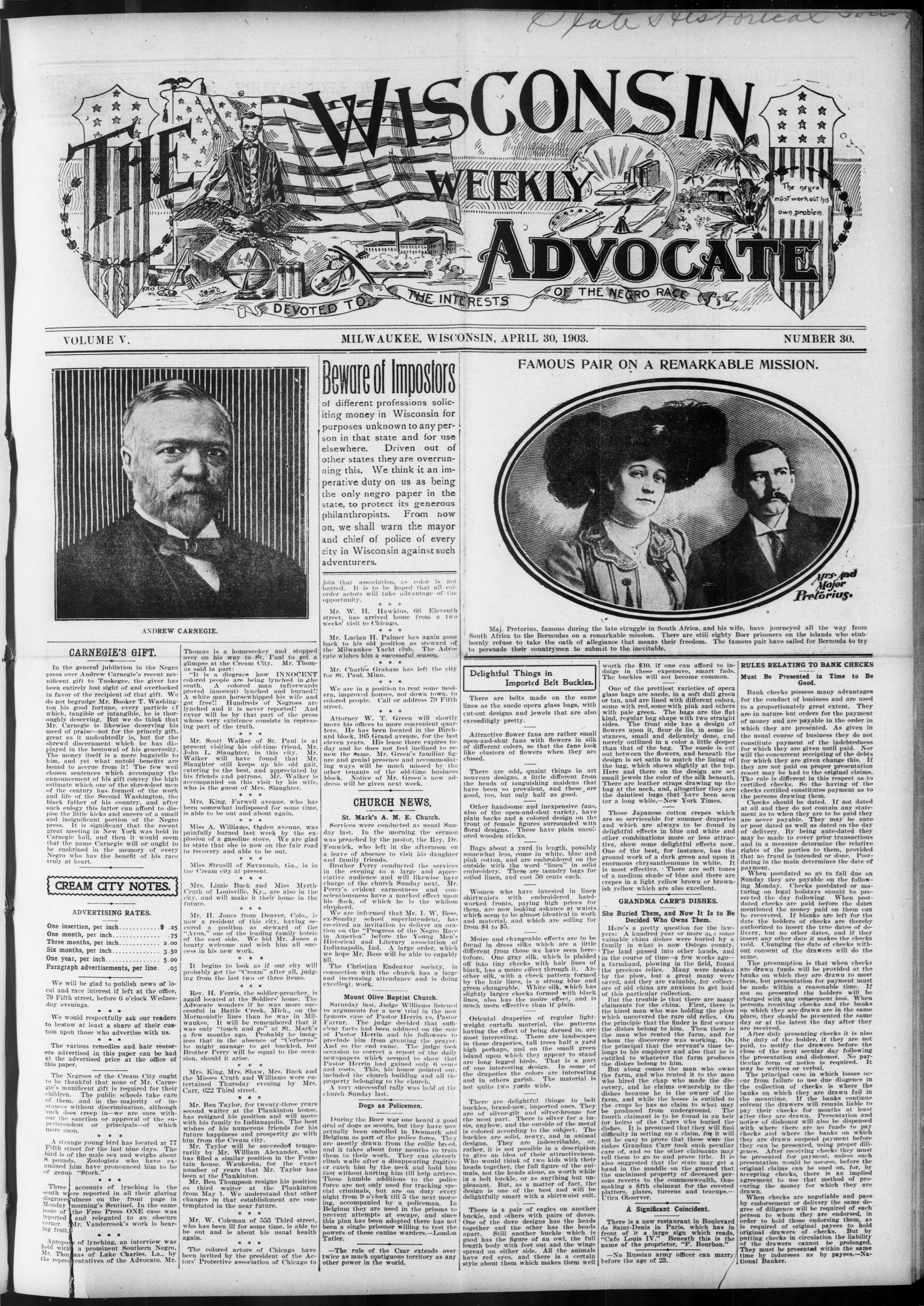
ANDREW
[Portrait of a man in formal attire with a bow tie and a white shirt, set against a striped background. The image is black and white, with no visible text or additional details.]]
ANDREW CARNEGIE
CARNEGIE'S GIFT.
In the general jubilation in the Negro press over Andrew Carnegie's recent munificent gift to Tuskegee, the giver has been entirely lost sight of and overlooked in favor of the recipient of that gift. We do not begrudge Mr. Booker T. Washington his good fortune, every particle of which, tangible or intangible, he is thoroughly deserving. But we do think that Mr. Carnegie is likewise deserving his meed of praise—not for the princely gift, great as it undoubtedly is, but for the shrewd discernment which he has displayed in the bestowal of his generosity. The money itself is a mere bagatelle to him, and yet what untold benefits are bound to accrue from it! The few well chosen sentences which accompany the announcement of his gift convey the high estimate which one of the shrewdest men of the century has formed of the work and life of the Second Washington, the black father of his country, and after such eulogy this latter can afford to dispise the little kicks and sneers of a small and insignificant portion of the Negro press. It is significant that the recent great meeting in New York was held in Carnegie hall, and then it would seem that the name Carnegie will or ought to be enshrined in the memory of every Negro who has the benefit of his race truly at heart.
CREAM CITY NOTES.
One insertion, per inch. $ .25
One month, per inch. .75
Three months, per inch. 2.00
Six months, per inch. 3.50
One year, per inch. 5.00
Paragraph advertisements, per line. .05
We will be glad to publish news of local and race interest if left at the office,
79 Fifth street, before 6 o'clock Wednesday evenings.
We would respectfully ask our readers to bestow at least a share of their custom upon those who advertise with us.
The various remedies and hair restorers advertised in this paper can be had at the advertised price at the office of this paper.
The Negroes of the Cream City ought to be thankful that none of Mr. Carnegie's munificent gift is required for their children. The public schools take care of them, and in the majority of instances without discrimination, although such does creep in—we are sure without the sanction or approval of the superintendent or principals—of which more anon.
A strange young bird has located at 77 Fifth street for the last nine days. The bird is of the male sex and weighs about 8 pounds. Zoologists who have examined him have pronounced him to be of genus "Stork."
* * *
Three accounts of lynching in the south were reported in all their glaring disgracefulness on the front page in Monday morning's Sentinel. In the same issue of the Free Press ONE case was reported and relegated to an obscure corner. Mr. Vandercook's work is bearing fruit.
* * *
A proposal of lynching, an interview was held with a prominent Southern Negro, Mr. Thomas of Lake Charles, La., by the representatives of the Advocate Mr.
```markdown
```
VOLUME V.
ADVERTISING RATES.
华 华 华
* * *
* * *
Thomas is a homeseeker and stopped over on his way to St. Paul to get a glimpse at the Cream City. Mr. Thomas said in part:
"It is a disgrace how INNOCENT colored people are being lynched in the south. A colored man (afterwards proved innocent) lynched and burned!! A white man horsewhipped his wife and got free!! Hundreds of Negroes are lynched and it is never reported! And never will be by that part of the press whose very existence consists in repressing part of the truth.
Mr. Scott Walker of St. Paul is at present visiting his old-time friend, Mr. John L. Slaughter, in this city. Mr. Walker will have found that Mr. Slaughter still keeps up his old gait, catering to the best, and appreciated by his friends and patrons. Mr. Walker is accompanied on this visit by his wife, who is the guest of Mrs. Slaughter.
* * *
Mrs. King. Farwell avenue, who has been somewhat indisposed for some time, is able to be out and about again.
* * *
Miss A. Williams, Ogden avenue, was painfully burned last week by the explosion of a gasoline stove. We are glad to state that she is now on the fair road to recovery and able to be out.
Miss Stensill of Savannah, Ga., is in the Cream city at present.
* * *
Mrs. Lizzie Buck and Miss Myrtle Cruth of Louisville, Ky., are also in the city, and will make it their home in the future.
* * *
Mr. H. Jones from Denver, Colo., is now a resident of this city, having secured a position as steward of the "Avon," one of the leading family hoteis of the east side. We bid Mr. Jones a hearty welcome and wish him all success in his new work.
* * *
It begins to look as if our city will probably get the "Cream" after all, judging from the last two or three items.
Rev. H. Ferris, the soldier-preacher, is again located at the Soldiers' home. The Advocate wonders if he was more successful in Battle Creek, Mich., on the Mormonistic lines than he was in Milwaukee. It will be remembered that it was only "touch and go" at St. Mark's a few months ago. Probably he imagines that in the absence of "Cerberus" he might manage to get buckled, but Brother Perry will be equal to the occasion, should it arise.
Mrs. King, Mrs. Shaw, Mrs. Buck and the Misses Cruth and Williams were entertained Thursday evening by Mrs. Carr, 622 Third street.
Mr. Ben Taylor, for twenty-three years second waiter at the Plankinton house, has resigned his position and will move with his family to Indianapolis. The best wishes of his numerous friends for his future happiness and prosperity go with him from the Cream city.
Mr. Taylor will be succeeded temporarily by Mr. William Alexander, who has filled a similar position in the Fountain house. Waukesha, for the exact number of years that Mr. Taylor has been at the Plankinton.
Mr. Ben Thompson resigns his position as third waiter at the Plankinton from May 1. We understand that other changes in that establishment are contemplated in the near future.
Mr. W. Coleman of 553 Third street, who has been ill for some time, is able to be out and is about his usual health again.
The colored actors of Chicago have been invited by the president of the Actors' Protective association of Chicago to
* * *
***
```markdown
```
※ ※ ※
* * *
* * *
承 承 忠
***
* * *
MILWAUKEE, WISCONSIN, APR11 30, 1903.
Beware of Impostors
of different professions soliciting money in Wisconsin for purposes unknown to any person in that state and for use elsewhere. Driven out of other states they are overrunning this. We think it an imperative duty on us as being the only negro paper in the state, to protect its generous philanthropists. From now on, we shall warn the mayor and chief of police of every city in Wisconsin against such adventurers.
join that association, as color is not barred. It is to be hoped that all color order actors will take advantage of the opportunity.
Mr. W. H. Hawkins, 66 Eleventh street, has arrived home from a two weeks' visit to Chicago.
Mr. Lucian H. Palmer has again gone back to his old position as steward of the Milwaukee Yacht club. The Advocate wishes him a successful season.
Mr. Charles Graham has left the city for St. Paul, Minn.
We are in a position to rent some modern, improved houses, not down town, to colored people. Call or address 79 Fifth street.
* * *
Attorney W. T. Green will shortly move his offices to more convenient quarters. He has been located in the Birchard block, 105 Grand avenue, for the last eleven years. His lease there expires today and he does not feel inclined to renew the same. Mr. Green's familiar figure and genial presence and accommodating ways will be much missed by the other tenants of the old-time business block. Notice of Mr. Green's new address will be given next week.
CHURCH NEWS.
St. Mark's A. M. E. Church.
Services were conducted as usual Sunday last. In the morning the sermon was preached by the pastor, the Rey. Dr. Fenwick, who left in the afternoon on a leave of absence to visit his daughter and family friends. Brother Perry conducted the services in the evening to a large and appreciative audience and will likewise have charge of the church Sunday next. Mr. Perry's evident earnestness and conscientiousness have a marked effect upon his flock, of which he is the whilom shepherd.
We are informed that Mr. I. W. Bess ex-Sunday school superintendent, has received an invitation to deliver an oration on the "Progress of the Negro Race in America" before the Young Men's Historical and Literary association of Indianapolis, Ind. A large order, which we hope Mr. Bess will be able to capably fill. The Christian Endeavor society, in connection with the church has a large and increasing attendance and is doing excellent work.
Mount Olive Baptist Church
Saturday last, Judge Williams listened to arguments for a new trial in the now famous case of Pastor Herrin vs. Pastor Farrar. The judge decided that sufficient facts had been adduced on the side of Pastor Herrin and his followers to preclude him from granting the prayer. And so the end came. The judge took occasion to correct a report of the daily newspapers which seemed to show that Pastor Herrin had gained only 6 cents and costs. This, his honor pointed out, included the church building and all the property belonging to the church.
A very successful rally was held at the church Sunday last.
Dogs as Policemen.
During the Boer war one heard a good deal of dogs as scouts, but they have now actually been enrolled in Denmark and Belgium as part of the police force. They are mostly drawn from the collie breed, and it takes about four months to train them to their work. They can cleverly climb walls after a disappearing fugitive or catch him by the neck and hold him fast without hurting him till help arrives. These humble additions to the police force are not only used for tracking special criminals, but are on duty every night from 9 o'clock till 5 the next morning, accompanied by a policeman. In Belgium they are used in the prisons to prevent attempts at escape, and since this plan has been adopted there has not been a single prisoner willing to test the powers of these canine warders.—London Tatler.
The rule of the Czar extends over twice as much contiguous territory as any other power in the world.
Mrs. And
Major
Pretorius.
Maj. Pretorius, famous during the late struggle in South Africa, and his wife, have journeyed all the way from South Africa to the Bermudas on a remarkable mission. There are still eighty Boer prisoners on the islands who stubbornly refuse to take the oath of allegiance that means their freedom. The famous pair have sailed for Bermuda to try to persuade their countrymen to submit to the inevitable.
Maj. Pretorius, famous during the late struggle in South Africa, and his wife, have journeyed all the way from South Africa to the Bermudas on a remarkable mission. There are still eighty Boer prisoners on the islands who stubbornly refuse to take the oath of allegiance that means their freedom. The famous pair have sailed for Bermuda to try to persuade their countrymen to submit to the inevitable.
Delightful Things in Imported Belt Buckles.
There are belts made on the same lines as the suede opera glass bags, with cut-out designs and jewels that are also exceedingly pretty.
Attractive flower fans are rather small open-and-shut fans with flowers in silk of different colors, so that the fans look like clusters of flowers when they are closed.
There are odd, quaint things in art nouveau designs, a little different from the heads of languishing maidens that have been so prevalent, and these are good, too, but only half as good.
Other handsome and inexpensive fans, also of the open-and-shut variety, have plain backs and a colored design on the front of female figures surrounded with floral designs. These have plain uncolored wooden sticks.
Bags about a yard in length, possibly somewhat less, come in white, blue and pink cotton, and are embroidered on the outside with the word "linen" in solid embroidery. These are laundry bags for soiled linen, and cost 50 cents each.
Women who have invested in linen shirtwaists with embroidered hand-worked fronts, paying high prices for them, are now looking ancease at waists which seem to be almost identical in work and material, and which are selling for from $4 to $5.
Moire and changeable effects are to be found in dress silks which are a little different from those we have seen heretofore. One gray silk, which is plaided off into tiny checks with hair lines of black, has a moire effect through it. Another silk, with a check pattern formed by the hair lines, is a strong blue and green changeable. White silk, which has slightly larger checks formed with black lines, also has the moire effect, and is much more effective than if plain.
Oriental draperies of regular lightweight curtain material, the patterns having the effect of being darned in, are most interesting. There are landscapes in these draperies, tall trees half a yard high perhaps, and on the small green island upon which they appear to stand are long legged birds. That is a part of one interesting design. In some of the draperies the colors are interesting and in others garish. The material is not quite two yards wide.
There are delightful things in belt buckles, brand-new, imported ones. They are of silver-gilt and silver-bronze for the most part. There is silver for a basis, anyhow, and the outside of the metal is colored according to the subject. The buckles are solid, heavy, and in animal designs. They are indescribable, or, rather, it is not possible in a description to give an idea of their attractiveness. Who would think of two kids with their heads together, the full figure of the animals, not the heads alone, as worth while in a belt buckle, or as anything but unpleasant. But, as a matter of fact, the design is one of the best and will be delightfully smart with a shirtwaist suit.
There is a pair of eagles on another buckle, and others with pairs of doves. One of the dove designs has the heads together and the other has the heads apart. Still another buckle which is good has the figure of an owl, the full length body with feet out and the wings spread on either side. All the animals have red eyes, and there is a certain style about them which makes them well
worth the $10, if one can afford to indulge in these expensive, smart fads. The buckles will not become common.
One of the prettiest varieties of opera glass bags are suede, in a soft dull green or tan, and are lined with different colors, some with red, some with pink and others with pale green. The bags are the flat kind, regular bag shape with two straight sides. The front side has a design of flowers upon it, fleur de lis, in some instances, small and delicately done, and merely outlined in a color a little deeper than that of the bag. The suede is cut out between the flowers, and beneath the design is set satin to match the lining of the bag, which shows slightly at the top. Here and there on the design are set small jewels the color of the silk beneath. There are leather straps drawing up the bag at the neck, and, altogether they are the daintiest bags that have been seen ter a long while.—New York Times.
Those Japanese cotton crepes which are so serviceable for summer draperies and which are always to be found in delightful effects in blue and white and other combinations more or less attractive, show some delightful effects now. One of the best, for instance, has the ground work of a dark green and upon it enormous chrysanthemums in white. It is most effective. There are soft tones of a medium shade of blue and there are crepes in a light yellow brown or brownish yellow which are also excellent.
GRANDMA CARR'S DISHES
She Buried Them, and Now It Is to Be Decided Who Owns Them.
Here's a pretty question for the lawyers: A hundred year or more ago some valuable china dishes were buried by a family in what is now Ostego county. The land passed into other hands, and in the course of time—a few weeks ago—a farmhand, plowing in the field, found the precious relics. Many were broken by the plow, but a great many were saved, and they are valuable, for collectors of old china are anxious to get hold of this particular collection.
But the trouble is that there are many claimants for the china. First, there is the hired man who was holding the plow which uncovered the rare old relics. On the principle that the finder is first owner the dishes belong to him. Then there is the man who rented the farm, and for whom the discoverer was working. On the principal that the servant's time belongs to his employer and also that he is entitled to whatever the farm produces the dishes belong to him.
But along comes the man who owns the farm, and who rented it to the man who hired the chap who made the discovery, and he claims ownership to the dishes because he is the owner of the farm, and while the lessee is entitled to the crops he has no claim to what may be produced from underground. The fourth claimant is to be found in an heir (or heirs) of the Carrs who buried the dishes. It is presumed that they will find difficulty in setting up a claim, for it will not be easy to prove that these were the rishes Grandma Carr took such peculiar care of, and so the other claimants may tell them to go to and prove title. It is also suggested that the state may get a hand in the muddle on the ground that the unclaimed property of deceased persons reverts to the commonwealth, thus making a fifth claimant for the coveted platters, plates, tureens and teacups. Utica Observer.
A Significant Coincident.
There is a new restaurant in Boulevard de Saint-Denis in Paris, which has in front of it a large sign which reads, "Cafe Louis IV." Beneath this is the name of the proprietor, "F. Bourbon." —No Russian army officer can marry before the age of 23.
NUMBER 30.
LE MISSION.
Mrs. And
Major
Pretorius.
fe, have journeyed all the way from
Boer prisoners on the islands who stub-
nous pair have sailed for Bermuda to try
RULES RELATING TO BANK CHECKS
Must Be Presented in Time to Be Good.
Bank checks possess many advantages for the conduct of business and are used to a proportionately great extent. They are in nature but orders for the payment of money and are payable in the order in which they are presented. As given in the usual course of business they do not constitute payment of the indebtedness for which they are given until paid. Nor will the concurrent receipting of the debts for which they are given change this. If they are not paid on proper presentation resort may be had to the original claims. The rule is different in this respect as to certified checks. So the having of the checks certified constitutes payment as to the persons drawing them.
Checks should be dated. If not dated at all and they do not contain any statement as to when they are to be paid they are never payable. They may be ante or post dated as well as dated on the day of delivery. By being ante-dated they may be made to cover prior transactions and in a measure determine the relative rights of the parties to them, provided that no fraud is intended or done. Post-dating in the main determines the date of payment.
When postdated so as to fall due on Sunday they are payable on the following Monday. Checks postdated or maturing on legal holidays should be presented the day following. When postdated checks are paid before the dates mentioned the money paid on them can be recovered. If blanks are left for the date the holders of checks are thereby authorized to insert the true dates of delivery, but no other dates, and if they insert any other date it makes the checks void. Changing the date of checks without consent of the drawers will do the same.
The presumption is that when checks are drawn funds will be provided at the banks on which they are drawn to meet them, but presentation for payment must be made within a reasonable time. If not so presented the holders will be charged with any consequent loss. When persons receiving checks and the banks on which they are drawn are in the same place, they should be presented the same day or at the latest the day after they are received.
After duly presenting checks it is also the duty of the holder, if they are not paid, to notify the drawers before the close of the next secular day following the presentation and dishonor. No particular form of notice is required. It may be written or verbal.
The principal case in which losses occur from failure to use due diligence in the collection of checks is where the banks on which they are drawn fail in the meantime. If the banks continue solvent the drawers will remain liable to pay their checks for months at least after they are drawn. Presentation and notice of dishonor will also be dispensed with where there are no funds to pay checks and where the banks on which they are drawn suspend payment before they can be presented, using proper diligence. After receiving checks they must be presented for payment, unless such presentation would be useless, before the original claims can be sued on, for, by accepting checks, there is an implied agreement to use that method of procuring the money for which they are drawn.
When checks are negotiable and pass by endorsement or delivery the same degree of diligence will be required of each person to whom they are endorsed, in order to hold those endorsing them, as is required of original payees to hold original drawers of checks. But by putting checks in circulation the liability of the drawers cannot be prolonged. They must be presented within the same time by indorsees as by payees.—National Banker.
SALT FEEDS THE FLAMES.
South Chicago Blaze Takes 150 Freight Cars and Three Grain Boats.
Swept.
Chicago, Ill., April 29.—[Special.]—South Chicago was the scene of a spectacular and disastrous fire last night. At 7:30 p. m. an alarm was sounded from the International Salt company's docks at 102d street and the Calumet river. The blaze started in the engine room of the big plant and spread rapidly until all the buildings had been attacked and practically destroyed. It also reached three grain boats lying in the Calumet river, and although they were towed away all were burned to the water's edge. The total loss is estimated at $1,250,000, that of the salt company reaching a possible $800,000.
Included in the company's loss are the docks extending 1500 feet along the Calumet river, these being 250 feet wide. South of the plant along the slip were two huge hoisting machines for lifting salt from the boats and on the slip to the west are four similar machines.
The steamer Mary E. Kelton was in a slip adjoining the burning sheds when the fire broke out, and, so swift was the progress of the flames, it was with the utmost difficulty that the vessel was saved. There was enough steam up, however, to permit the crew to back the craft into the river, though with blazing rigging and the sides of the boat considerably scorched. Three grain boats in the next slip were not so fortunate. All three were in flames when towed into the river, and, though the fire on one of the number was brought under control before the craft had been entirely consumed, the other two were burned to the water's edge.
The fireboat Yosemite, which was pouring water on the salt sheds from the southern end of the plant, was summoned to save the boats, but before it could reach them they sank, having burned to the water's edge.
One hundred and fifty freight cars were standing on the tracks within the company's plant loaded with salt ready for shipment. When the fire began to spread switch engines were hurried into the yards and the cars were moved as rapidly as possible. Finally the engine crews refused to continue at their work, and almost 100 cars were destroyed.
To the east of the plant, near the river, were fifty cars, belonging to the Lake Shore & Michigan Southern railroad, all loaded with salt. The flames attacked these, and all were destroyed before they could be moved.
The fire is thought to have cost one, possibly two, lives. James O'Shea, a Lake Shore & Michigan Southern can inspector, is missing and is believed to be dead. John McCue, an employee of the salt company, has not been seen since the fire started and may have perished. It is believed the fire was of incendiary origin.
PRESIDENT AT KEOKUK.
He Is Presented with a Flag by the Great-grand-daughter of Betsy Ross.
Keokuk, Ia., April 29.—The President left Iowa at 10 o'clock this morning over the Burlington, en route to Quincy and St. Louis. At the station in this city Gov. Cummins of Iowa bid him good-bye and Gov. Dockery of Missouri welcomed him to the state of Missouri. The party arrived at 8:30 over the Rock Island road from Ottumwa and was met by the reception committee and escorted to carriages. He was escorted by the old Fiftieth band and six companies of the Iowa National guard. At Rand park the President made a ten-minute speech which was heartily applauded. The grave of the Indian chief, Keokuk, from whom this city gets its name, is located here, and the carriages were halted a few moments beside his monument. The party was then driven back to the train and departed southward at 10 o'clock. The President while here was given a miniature fac-simile of the first American flag, as made by Betsy Ross. This banner was of silk with the thirteen stars and was made by Mrs. Rachael Albright of Fort Madison, Ia., who is the 91-year-old great-grand-daughter of Betsy Ross.
President Roosevelt today received a telegram from New York, informing him that the court of appeals of that state has handed down a decision declaring constitutional the franchise tax law. The President is highly gratified over the outcome of the case.
CASTRO'S DRASTIC EDICT.
Foreigners Are Forbidden to Take Any Part in Political Affairs of Venezuela.
Caracas, April 29. The publication of the full text of the decree issued on April 17 last by President Castro, which defines the relations of foreigners to the conditions of the country, has attracted wide attention and no little criticism. In the endeavor to prevent foreigners giving any assistance to revolutionary schemes the edict absolutely forbids any foreigners, whether resident or transient, to express any opinion on political affairs, denies them the right to hold any public office, to edit a newspaper or to do anything in which the criticism of the administration might find an outlet. In consequence of this many Americans who are now resident in the city and who had hoped for a larger degree of personal liberty will leave the country and will dissuade others from coming.
VANDERBILT WEDDING TO BE INVESTIGATED
English Clergymen Ask Bishop of London to Investigate "Scandalous and Deplorable Incident."
London, April 29.—At today's session of the London diocesan conference the Bishop of London read a letter from representatives of the clergy of the diocese drawing attention to the Vanderbilt-Rutherford wedding and requesting him to make such reference during the conference "to this scandalous and deplorable incident." The bishop said he was obliged by law to issue a license to divorced persons if any clergyman could be found to marry them. The bishop added that he had already summoned Rev. Mr. Hadden, who performed the ceremony, and after seeing him he would give his opinion of the whole matter.
IRVING M. SCOTT DEAD.
Builder of the Battleships Wisconsin and Oregon Passes Away in California.
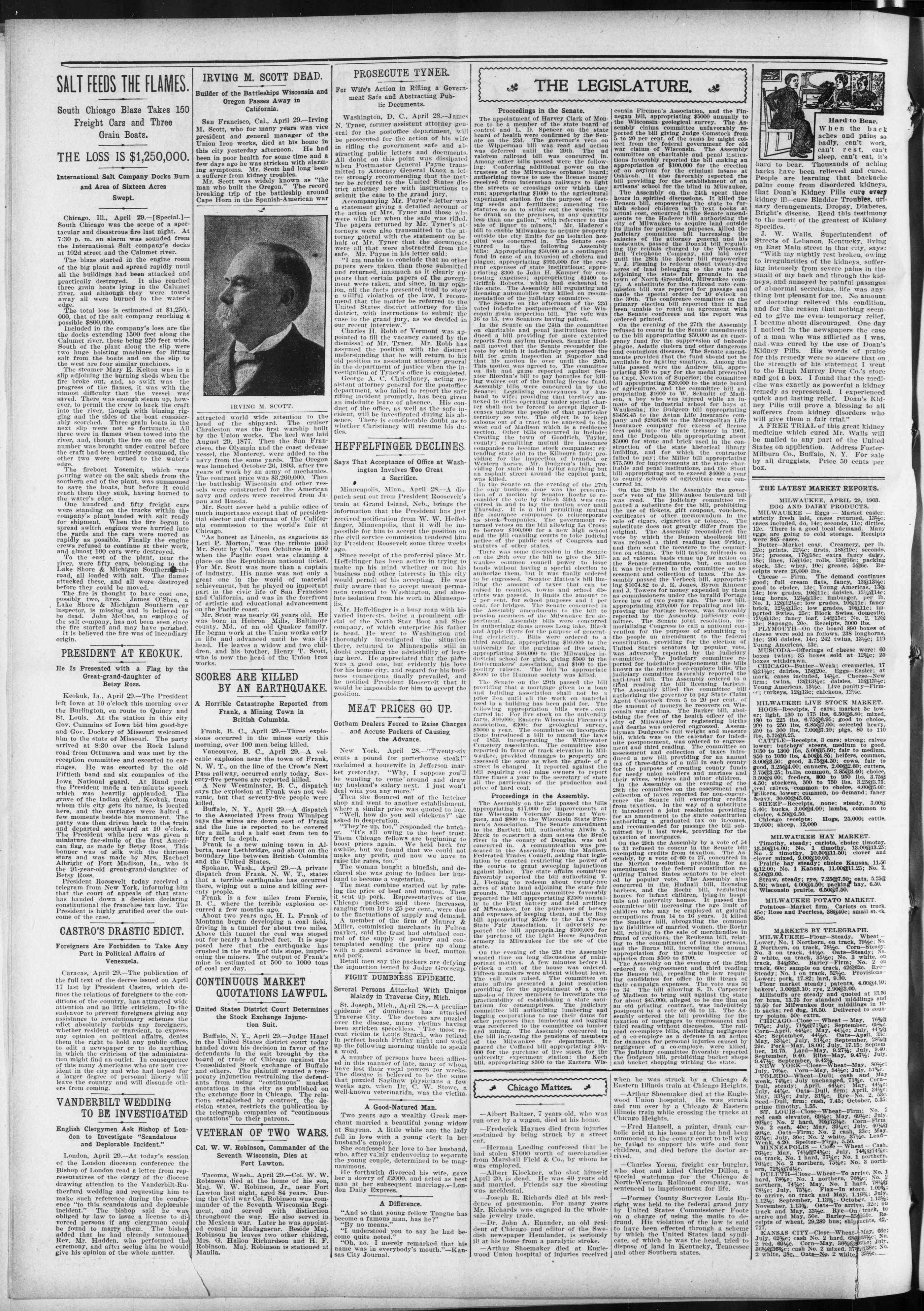
San Francisco, Cal., April 29.—Irving M. Scott, who for many years was vice president and general manager of the Union Iron works, died at his home in this city yesterday afternoon. He had been in poor health for some time and a few days ago he was stricken with alarming symptoms. Mr. Scott had long been a sufferer from kidney troubles. Mr. Scott was widely known as "the man who built the Oregon." The record breaking trip of the battleship around Cape Horn in the Spanish-American war
[Picture of a man in a suit and bow tie].
attracted world wide attention to the head of the shipyard. The cruiser Chraleston was the first warship built by the Union works. The keel was laid August 29, 1877. Then the San Francisco, the Olympia and the coast defense vessel, the Monterey, were added to the navy from the same yards. The Oregon was launched October 26, 1893, after two years of work by an army of mechanics. The contract price was $3,260,000. Then the battleship Wisconsin and other vessels were constructed for the American navy and orders were received from Japan and Russia. Mr. Scott never held a public office of much importance except that of presidential elector and chairman of the California commission to the world's fair at Chicago.
"As honest as Lincoln, as sagacious as Levi P. Morton," was the tribute paid Mr. Scott by Col. Tom Ochiltree in 1900 when the Pacific coast was claiming a place on the Republican national ticket. For Mr. Scott was more than a captain of industry. His name was not only a great one in the world of material achievement, but he played on important part in the civic life of San Francisco and California, and was in the forefront of artistic and educational advancement on the Pacific coast. Mr. Scott was nearly 66 years old. He was born in Hebron Mills, Baltimore county, Md., of an old Quaker family. He began work at the Union works early in life and advanced until he was its head. He leaves a widow and two children, and his brother, Henry T. Scott, who is now the head of the Union Iron works.
SCORES ARE KILLED BY AN EARTHQUAKE.
A Horrible Catastrophe Reported from Frank, a Mining Town in British Columbia.
Frank, B. C., April 29.—Three explosions occurred in the mines early this morning, over 100 men being killed.
Vancouver, B. C., April 29.—A volcanic explosion near the town of Frank, N. W. T., on the line of the Crow's Nest Pass railway, occurred early today. Seventy-five persons are reported killed.
A New Westminster, B. C., dispatch says the explosion at Frank was not volvanic, but that seventy-five people were killed.
Buffalo, N. Y., April 29.—A dispatch to the Associated Press from Winnipeg says the wires are down east of Frank and the line is reported to be covered for a mile and a half east from ten to fifty feet in depth.
Frank is a new mining town in Alberta, near Lethbridge, and about on the boundary line between British Columbia and the United States. Spokane, Wash., April 29.—A private dispatch from Frank, N. W. T., states that a terrible earthquake has occurred there, wiping out a mine and killing seventy people. Frank is a few miles from Fernie, B. C., where the terrible explosion occurred a few months ago. About two years ago, H. L. Frank of Montana began developing a coal field, driving in a tunnel for about two miles. Above this tunnel the coal was stopped out for nearly a hundred feet. It is supposed here that the earthquake has crushed in the walls of this stope, imprisoning the miners. The output of Frank's mine is estimated at 500 to 1000 tons of coal per day.
CONTINUOUS MARKET QUOTATIONS LAWFUL
CONTINUOUS MARKET QUOTATIONS LAWFUL
United States District Court Determines the Stock Exchange Injunc-
tion Suit.
Buffalo, N. Y., April 29.—Judge Hazel in the United States district court today handed down his decision in favor of the defendants in the suit brought by the board of trade of Chicago against the Consolidated Stock exchange of Buffalo and others. The plaintiff wanted a temporary injunction restraining the defendants from using "continuous" market quotations in this city as published on the exchange floor in Chicago. The relations established by contract, the decision states, restricts the publication by the telegraph companies of "continuous quotations" to their patrons.
VETERAN OF TWO WARS.
Col. W. W. Robinson, Commander of the Seventh Wisconsin, Dies at Fort Lawton.
Tacoma, Wash., April 29.—Col. W. W. Robinson died at the home of his son, Maj. W. W. Robinson, Jr., near Fort Lawton last night, aged 84 years. During the Civil war Col. Robinson was commander of the Seventh Wisconsin Regiment, and served with distinction throughout the war. He also served in the Mexican war. Later he was appointed consul in Madagascar. Beside Maj. Robinson he leaves two other children, Mrs. G. Hallon Richardson and H. F. Robinson. Maj. Robinson is stationed at Manila.
PROSECUTE TYNER.
For Wife's Action in Rifling a Government Safe and Abstracting Public Documents.
Washington, D. C., April 28. James N. Tyner, former assistant attorney general for the postoffice department, will be prosecuted for the action of his wife in riffing the government safe and abstracting public letters and documents. All doubt on this point was dissipated when Postmaster General Payne transmitted to Attorney General Knox a letter strongly recommending that the matter be referred to the United States district attorney here with instructions to submit the case to the grand jury.
Accompanying Mr. Payne's letter was a statement giving a detailed account of the action of Mrs. Tyner and those who were with her when the safe was riffed. The papers returned by Mr. Tyner's attorneys were also transmitted to the attorney general with the statement on behalf of Mr. Tyner that the documents were all that were abstracted from the safe. Mr. Payne in his letter said:
"I am unable to conclude that no other papers were taken than those submitted and returned, inasmuch as it clearly appears that certain papers of the government were taken, and since, in my opinion, all the facts presented tend to show a willful violation of the law, I recommend that the matter be referred to the United States district attorney for this district, with instructions to submit the case to the grand jury, as we decided in our recent interview."
Charles H. Robb of Vermont was appointed to fill the vacancy caused by the dismissal of Mr. Tyner. Mr. Robb has assumed the position with the distinct understanding that he will return to his old position as assistant attorney general in the department of justice when the investigation of Tyner's office is completed. George A. C. Christiancy, acting assistant attorney general for the postoffice department, who failed to report the safe rifling incident promptly, has been given an indefinite leave of absence. His conduct of the office, as well as the safe incident, will be investigated during his absence. There is considerable doubt as to whether Christiancy will resume his duties.
HEFFELFINGER DECLINES
Says That Acceptance of Office at Washington Involves Too Great a Sacrifice
Minneapolis, Minn., April 28.—A dispatch sent out from President Roosevelt's train at Grand Island, Neb., brings the information that the President has just received notification from W. W. Heffelfinger, Minneapolis, that it will be impossible for him to accept the position on the civil service commission tendered him by President Roosevelt some three weeks ago.
Since receipt of the preferred place Mr. Heffelfinger has been active in trying to make up his mind whether or not his business and other interests in this city would permit of his accepting. He was fully aware that to accept meant permanetn removal to Washington, and absolute isolation from his work in Minneapolis.
Mr. Heffelfinger is a busy man with his varied interests, being a prominent official of the North Star Boot and Shoe company, of which enterprise his father is head. He went to Washington and thoroughly investigated the situation there, returned to Minneapolis still in doubt regarding the advisability of leaving here. He appreciated that the place was a good one, but evidently his love for his home city, and regard for his business connections finally prevailed, and he notified President Roosevelt that it would be impossible for him to accept the position.
MEAT PRICES GO UP.
Gotham Dealers Forced to Raise Charges and Accuse Packers of Causing the Advance.
New York, April 28.—"Twenty-six cents a pound for porterhouse steak!" exclaimed a housewife in Jefferson market yesterday. "Why, I suppose you'll be wanting to come around and draw my husband's salary next. I just won't deal with you any more."
Then she flounced out of the butcher shop and went to another establishment, where a similar price was quoted to her.
"Well, how do you sell chickens?" she asked in desperation.
"They're up, too," responded the butcher. "It's all owing to the beef trust. Them Chicago fellows are beginning to boost prices again. We held back for awhile, but we found that we could not make any profit, and now we have to raise the rates, too."
The woman bought a bluefish, and declared she was going to induce her husband to become a vegetarian. The meat combine started out by raising the price of beef and mutton. Then it sent up pork. Representatives of the Chicago packers said these increases, ranging from 10 to 25 per cent., were due to the fluctuations of supply and demand. A member of the firm of Maurer & Miller, commission merchants in Fulton market, said the trust had obtained control of the supply of poultry and contemplated sending the price up along with a general advance in beef, mutton and pork. Retail men say the packers are defying the injunction issued by Judge Groscup.
FIGHT DUMBNESS EPIDEMIC.
Several Persons Attacked With Unique Malady in Traverse City, Mich.
St. Joseph, Mich., April 28.—A peculiar epidemic of dumbness has attacked Traverse City. The doctors are puzzled over the disease, many victims having been stricken speechless. The most recent victim is Louis Strack, who retired in perfect health Friday night and woke up the following morning unable to speak a word.
A number of persons have been afflicted in this manner of late, many of whom have lost their vocal powers for weeks. The disease is believed to be the same that puzzled Saginaw physicians a few weeks ago, when Dr. C. W. Stowe, a well-known veterinarian, was the victim.
A Good-Natured Man
Two years ago a wealthy Greek merchant married a beautiful young widow at Smyrna. A little while ago the lady fell in love with a young clerk in her husband's employ. She confessed her love to her husband, who, after vainly endeavoring to separate the young couple, determined to be maguanimous. He forthwith divorced his wife, gave her a dowry of £2000, and acted as best man at her subsequent marriage. London Daily Express.
A Difference.
"And so that young fellow Tongue has become a famous man, has he?"
"By no means."
"I understood you to say he had become quite noted."
"Oh, no. I merely remarked that his name was in everybody's mouth."—Kansas City Journal.
THE LEGISLATURE.
Proceedings in the Senate.
The appointment of Harvey Clark of Monroe to be a member of the state board of control and L. D. Spencer on the state board of health were confirmed by the Senate on the 23d. The governor's veto on the Wipperman bill was read and action was deferred until the 29th. The ad valorem railroad bill was concurred in. Among other bills passed were the following: Conferring additional power on the trustees of the Milwaukee orphans' board; authorizing towns to use the license money received from interurban railways to light the streets or crossings over which they run; appropriating $1000 to the agricultural experiment station for the purpose of testing seeds and fertilizers; amending the statutes so as to strike out the words: "to be drank on the premises, in any quantity less than one gallon," with reference to the sale of liquor to minors." Mr. Haderer's bill to enable Milwaukee to acquire property outside the city limits for an isolation hospital was concurred in. The Senate concurred in the following Assembly bills: Appropriating $50,000 as a contingent fund in case of an invasion of cholera and plague; appropriating $995,000 for the current expenses of state institutions; appropriating $300 to John H. Kamper for contesting expenses; appropriating $1400 to Griffith Roberts, which had escheated to the state. The Assembly bill regulating and licensing automobiles was killed on recommendation of the judiciary committee.
The Senate on the afternoon of the 23d voted indefinite postponement of the Wisconsin grain inspection bill. The vote was 16 to 15, two Senators having paired.
In the Senate on the 24th the committee on charitable and penal institutions introduced a bill providing for more extended reports from asylum trustees. Senator Hudnall moved that the Senate reconsider the vote by which it indefinitely postponed the bill for grain inspection at Superior and that his motion lie over until the 29th. This motion was agreed to. The committee on fish and game reported against Senator Riordan's bill to pay bounties for killing wolves out of the hunting license fund. Assembly bills were concurred in by the Senate: Legalizing conveyances by husband to wife; providing that territory annexed to cities operating under special charter shall not be forced to accept liquor licenses unless the people of that particular territory so vote. The object is to keep saloons out of a tract to be annexed to the west end of Madison which is a residence section. Other bills concurred in include: Creating the town of Goodrich, Taylor, county; permitting mutual fire insurance companies to become stock companies; extending state aid to the Kilbourn fair; providing for the inspection of branded or Western horses. Mr. Dudgeon's bill, providing for state aid in laying anything but an asphalt street around the capitol park, was killed.
In the Senate on the evening of the 27th the only business done was the presentation of a motion by Senator Koehr to reconsider the vote by which 399A was concerned in and to lay the motion over until Thursday. It is a bill permitting mutual life insurance companies to reincorporate as stock companies. The government returned vetoes on the bill allowing La Crosse to borrow $100,000 for a new high school and the bill enabling courts to take judicial notice of the public acts of Congress and statutes of other states.
There was some discussion in the Senate on the 28th over the bill to give the Milwaukee common council power to issue bonds without having a special election to authorize them, but it was finally ordered to be engrossed. Senator Hatten's bill limiting the amount of taxes that can be raised in counties, towns and school districts was passed. It limits the amount to 2 per cent, for school purposes and 1 per cent, for bridges. The Senate concurred in the Assembly amendments to the bill to pension members of the Milwaukee fire department. Assembly bills were concurred in authorizing dams across Long lake, Black and Apple rivers for the purpose of generating electricity. Bills were ordered to a third reading, appropriating $10,000 to the university for the purchase of live stock, appropriating $46,000 to the Milwaukee industrial school for girls, giving $500 to the Buttermakers' association, and $100 to the poultry raisers. The bill to appropriate $500 to the Humane society was killed.
The Senate on the 29th passed the bill providing that a mortgage given to a loan and building association shall not be a prior lien until all the work on material used in a building has been paid for. The following appropriation bills were concurred in: For live stock on the university farm, $10,000; Eastern Wisconsin Firemen's association, $300; for geological survey, $5000 a year. The committee on incorporations introduced a bill to amend the laws of 1853, incorporating the Whitewater Cemetery association. The committee also reported in favor of track elevation in Milwaukee, provided damages to property are assessed the same as when the grade of a street is changed. It reported against the bill requiring coal mine owners to report three times a year to the secretary of state all the particulars of the production and price of hard coal.
Proceedings in the Assembly.
The Assembly on the 23d passed the bills appropriating $17,000 for improvements at the Wisconsin Veterans' Home at Waupaca, and $800 to the Wisconsin State Firemen's Association. The Senate amendment to the Bartlett bill, authorizing Alwin A. Muck to construct a dam across the Brue river in the county of Douglas, was not concurred in. A communication was presented in the Assembly from the Madison Federated Trades Council, asking that legislation be enacted restricting the power of the courts to grant sweeping injunctions against labor. The state affairs committee favorably reported the bill authorizing T. J. Fleming to redeem about twenty-five acres of state land adjoining the state fair grounds. The claims committee favorably reported the bill appropriating $2500 annually to the First battery and field artillery of Milwaukee, for the purchase of horses and expenses of keeping them, and the Ray bill appropriating $2500 to the La Crosse State Fair Association. It adversely reported the bill appropriating $100,000 for the purchase of the Light Horse Squadron armory in Milwaukee for the use of the state.
On the evening of the 23d the Assembly wasted time on long discussions of unimportant matters. A few minutes before 11 o'clock a call of the house was ordered. Fifteen members were absent without leave. The call was raised. The committee on state affairs presented a joint resolution providing for the appointment of a commission of three members to investigate the practicability of establishing a state sanitarium for consumptives. The judiciary committee bill authorizing lumbering and logging corporations to use their dams for other purposes than lumbering and logging was reereferred to the committee on lumber and mining. The Assembly concurred in the bill increasing the pensions of members of the Milwaukee fire department. It passed the Coffland bill appropriating $10,000 for the purchase of live stock for the university experiment station: the Koch bill, appropriating $300 to the Eastern Wis-
Chicago Matters.
Albert Baltzer, 7 years old, who was run over by a wagon, died at his home.
Frederick Haynes died from injuries sustained by being struck by a street car.
Herman Loeding confessed that he had stolen $1000 worth of merchandise from Marshall Field & Co., by whom he was employed.
Albert Klockner, who shot himself April 20, is dead. He was 40 years old and married. Friends say the shooting was accidental.
—Joseph R. Richards died at his residence of pneumonia. For many years Mr. Richards was engaged in the wholesale jewelry trade. Dr. John A. Enander, an old resident of Chicago and editor of the Swedish newspaper Hemlandet, is seriously ill at his home from a paralytic stroke. Arthur Shoemaker died at Englewood Union hospital of injuries received
consin Firemen's Association, and the Finnegan bill, appropriating $5000 annually to the Wisconsin geological survey. The Assembly claims committee unfavorably reported the bill giving Judge Comstock from 5 to 20 per cent. of the sums he might collect from the federal government for old war claims of Wisconsin. The Assembly committee on charitable and penal institutions favorably reported the bill making an appropriation of $100,000 for the erection of an asylum for the criminal insane at Oshkosh. It also favorably reported the bill providing for the establishment of an artisans' school for the blind in Milwaukee.
The Assembly on the 24th spent three hours in spirited discussions. It killed the Benson bill, empowering the state to furnish school children with text books at actual cost, concurred in the Senate amendments to the Haderer bill authorizing the city of Milwaukee to acquire land outside its limits for pesthouse purposes, killed the judiciary committee bill increasing the salaries of the attorney general and his assistants, passed the Donald bill regulating the rentals charged by the Wisconsin Bell Telephone Company, and laid over until the 28th the Roehr bill empowering T. J. Fleming to redeem about twenty-five acres of land belonging to the state and adjoining the state fair grounds in the town of North Greenfield, Milwaukee county. A substitute for the railroad rate commission bill was reported for passage and made the special order for 10 o'clock on the 30th. The conference committee on the primary election bill reported that it had been unable to reach an agreement with the Senate conferees and the report was ordered printed.
On the 28th in the Assembly the governor's veto of the Milwaukee boulevard bill was read. The judiciary committee reported a substitute for the bill, prohibiting the use of tickets, gift coupons, vouchers, certificates or other memorandum in the sale of cigars, cigarettes or tobacco. The substitute does not greatly differ from the original. The Assembly reconsidered the vote by which the Benson shoolbook bill was refused a third reading last Friday, and then sent the measure to the committee on claims. The bill taxing railroads on an ad valorem basis came up for action on the Senate amendments, but, on motion it was re-referred to the committee on assessment and collection of taxes. The Assembly passed the Verbeck bill, appropriating $1074.82 to J. E. Jones, Byron Kinnear and J. Towers for money expended by them as commissioners under the invalid Portage levee law of two years ago. The new bill, appropriating $20,000 for repairing and improving the Portage levees, was favorably reported by the Assembly judiciary committee. The Senate joint resolution, memorializing Congress to call a national convention for the purpose of submitting to the people an amendment to the federal constitution, providing for the election of United States senators by popular vote, was adversely reported by the judiciary committee. The judiciary committee reported for indefinite postponement the bills known as the railroad co-employee bills. The judiciary committee favorably reported the anti-trust bill. The Assembly ordered to a third reading the bill licensing barbers. The Assembly killed the committee bill authorizing the governor to pay Claim Agent Comstock from 5 to 20 per cent. of
the amount of money he recovers on Wisconsin war claims. The Barker bill, abolishing the fees of the health officer of the city of Milwaukee for registering births and deaths was ordered engrossed. Assemblyman Dudgeon's full weight and measure bill, which was on the calendar for indemnite postponement, was ordered to engrossment and third reading. The committee on assessment and collection of taxes introduced a new bill providing for an annual tax of three-fifths of a mill in each county for the purpose of creating county funds for needy union soldiers and marines and their wives, widows and minor children.
In the Assembly on the evening of the 28th the committee on the assessment and collection of taxes reported for non-concurrence the Senate bill exempting credits from taxation. In the way of a substitute it introduced a joint resolution providing for an amendment to the state constitution authorizing a graduated tax on incomes, and recommended for passage the bill submitted by it last week, providing for the taxation of mortgages.
On the 29th the Assembly by a vote of 54 to 31 refused to concur in the Senate bill exempting credits from taxation. The Assembly, by a vote of 60 to 27, concurred in the Merton resolution providing for an amendment to the federal constitution requiring United States senators to be elected by popular vote. The Assembly also concurred in the Hudnall bill, licensing barbers, and the Roehr bill, regulating homes for infant children, lying-in hospitals and maternity homes. It passed the committee bill increasing the age limit of children who may be employed at gainful occupations from 14 to 16 years. It killed the Smelker bill, abrogating the common law liabilities of married women, the Roehr bill, relating to the sale of merchandise in fraud of creditors, the Reukema bill, relating to the commitment of insane persons, and the Burns bill, increasing the annual appropriation for the state inspector of injuries from $500 to $700.
The Assembly on the evening of the 29th ordered to engrossment and third reading the Benson bill, repealing the law requiring candidates for office to file items of their campaign expenses. The vote was 50 to 34. The bill allowing S. D. Carpenter of Madison to bring suit against the state for about $45,000, alleged to be due him on an old printing contract, was indefinitely postponed by a vote of 66 to 13. The Assembly ordered the bill providing for the taxation of mortgages to engrossment and third reading without discussion. The railroad co-employee bills, abolishing negligence of a co-employee as a defense in an action for damages for personal injuries caused by negligence of a co-employee, were killed. The judiciary committee favorably reported the Dudgeon bill, prohibiting bucket shops and bucket shopping withing the state.
when he was struck by a Chicago & Eastern Illinois train at Chicago Heights.
Arthur Shoemaker died at the Englewood Union hospital. He was struck and run over by a Chicago & Eastern Illinois train while crossing the tracks at Chicago Heights.
Fred Hansell, a printer, drank carbolic acid at his home after he had been summoned to the county court to tell why he failed to support his wife and four children, and died before the doctor arrived.
Charles Yoran, freight car burglar, who shot and killed Charles Dillon, a special watchman for the Chicago & North-Western Railroad company, was sentenced to imprisonment for life.
—Former County Surveyor Louis Enright was held to the federal grand jury by United States Commissioner Foote on a charge of using the mails to defraud. His violation of the law is said to have been effected through a scheme by which the United States land syndicate, of which he was the head, tried to dispose of land in Kentucky, Tennessee and other Southern states.
Hard to Bear. When the back aches and pains so badly, can't work, can't rest, can't sleep, can't eat, it's
hard to bear. Thousands of aching backs have been relieved and cured. People are learning that backache pains come from disordered kidneys, that Doan's Kidney Pills cure every kidney ill-cure Bladder Troubles, urinary derangements, Dropsy, Diabetes, Bright's disease. Read this testimony to the merit of the greatest of Kidney Specifies. J. W. Walls, Superintendent of Streets of Lebanon, Kentucky, living on East Main street in that city, says:
"With my nightly rest broken, owing to irregularities of the kidneys, suffering intensely from severe pains in the small of my back and through the kidneys, and annoyed by painful passages of abnormal secretions, life was anything but pleasant for me. No amount of doctoring relieved this condition, and for the reason that nothing seemed to give me even temporary relief, I became about discouraged. One day I noticed in the newspapers the case of a man who was afflicted as I was, and was cured by the use of Doan's Kidney Pills. His words of praise for this remedy were so sincere that on the strength of his statement I went to the Hugh Murrey Drug Co.'s store and got a box. I found that the medicine was exactly as powerful a kidney remedy as represented. I experienced quick and lasting relief. Doan's Kidney Pills will prove a blessing to all sufferers from kidney disorders who will give them a fair trial."
A FREE TRIAL of this great kidney medicine which cured Mr. Walls will be mailed to any part of the United States on application. Address Foster-Milburn Co., Buffalo, N. Y. For sale by all druggists. Price 50 cents per box.
THE LATEST MARKET REPORTS.
MILWAUKEE, APRIL 29, 1903.
EGG AND DAIRY PRODUCTS.
MILWAUKEE — Eggs — Market easler:
strictly fresh laid, cases returned, 1312c;
cases included, do, 14c; seconds, 11c; dirtles,
12c. There is a good local demand. Many
eggs are going to cold storage. Receipts
were 845 cases.
Butter—Market easy. Creamery, per lb,
22c; prints, 2212c; firsts, 1819c; seconds,
16c; process, 17@18c; extra fancy dairy,
18c; lines, 15@16c; rolls, 15@16c; packing
stock, 13c; whey, 10c; grease, 5@6c. Receipts
were 26,000 lbs.
Cheese — Firm. The demand continues
good; full cream flats, fancy, 13@1312c;
good to choice, 13c; Young Americas, 13@
14c; low grades, 10@11c; dalsies, 1512@14c;
long horns, 1212@13c; limburger, per lb.
No. 1, 12@1212c; low grades, 10@11c; fancy
brick, 1212@13c; low grades, 10@11c; impor-
tated Swiss, 25c; Block Swiss, domestic,
1212@13c; fancy loaf, 14@15c. No. 2, 12@
13c; Sapsago, 20c. Receipts, 3000 lbs.
PLYMOUTH—On the board 890 boxes of cheese were sold as follows. 238 longhorns, 14c; 206 daisies, 14c; 242 twins, $13\frac{1}{2}$c; 119 Young Americas, 13c.
MUSCODA—Offerings of cheese were: 60 boxes twins; 35 boxes sold at $12\frac{1}{4}$c; 25 boxes withdrawn.
CHICAGO—Butter—Weak; creameries, 17 @$21\frac{1}{2}$c; dairies, 15@20c. Eggs—Easier; at mark, cases included, $14\frac{1}{4}$c. Cheese—New firm; twins, $13@13\frac{1}{4}$c; daisies, $13@13\frac{1}{4}$c. Young Americas, $13\frac{1}{2}$c. Live poultry—Firmer; turkeys, $12@13$c; chickens, $12\frac{1}{2}$c.
MILWAUKEE LIVE STOCK MARKET.
HOGS-Recelpts, 7 cars; market ac lower; light, 130 to 175 lbs, 6.50@6.80; mixed, 180 to 225 lbs, 6.75@6.95; good to choice, 200 to 250 lbs, 6.85@7.00; selected heavy, 250 to 300 lbs, 7.00@7.10; pligs, 80 to 110 lbs, 5.75@6.25.
CATTLE-Recelpts, 3 cars; strong; calves lower; butchers' steers, medium to good, 1050 to 1300 lbs, 9.50@5.50; fair to medium, 950 to 1050 lbs, 4.50@4.85; helfers, common, 3.00@3.50; good, 3.75@4.50; cows, fair to good, 3.25@4.00; canners, 2.00@2.60; cutters, 2.75@3.25; bulls, common, 2.85@3.40; choice, 3.50@4.00; feeders, 800 to 950 lbs, 3.75@4.50; stockers, 500 to 750 lbs. 3.25@3.75; veal calves, common to choice, 4.00@5.00; milkers, lower; common, no demand; fancy heavy, 30.00@45.00.
SHEEP-Recelpts, none; steady, 3.00@5.40; bucks, 3.00@4.00; lambs, common to choice, 4.50@6.50
Chicago receipts: Hogs, 25,000; cattle, 19,000; sheep, 12,000
MILWAUKEE HAY MARKET.
Timothy, steady; carolls, choice timotay, 13.50@14.00; No. 1 timothy, 13.00@13.25; No .2 timothy, 10.50@11.50; clover and clover mixed, 9.00@10.00.
Prairie hay steady; choice Kansas, 11.50@12.00; No. 1 Kansas, 11.00@11.25; No. 2, 8.50@9.00.
Straw, steady; rye, 7.25@7.50; oats, 5.25@5.50; wheat, 4.00@4.50; packing hay, 6.50.
Wisconsin prairie, 6.50@7.50.
Potatoes—Market firm. Carlots on track, 45c; Rose and Peerless, 38@40c; small stock, 35c.
MARKETS BY TELEGRAPH.
MILWÄUKEE—Flour—Steady. Wheat—Lower; No. 1 Northern, on track, 79½c; No. 2 Northern, on track, 78½c. Corn—Steady; No. 3 on track, 44½c. Oats—Steady; No. 2 white, on track, 35½c; No. 3 white, on track, 34@35c. Barley—Firm; No. 2 on track, 60c; sample on track, 42@62c. Rye—Steady; No. 1 on track, 52½c. Provisions—Lower; pork, 17.82; lard, 9.30. Flour market steady; patents, 4.00@4.10; bakers, 3.00@3.10; rye, 2.90@3.00.
Millstuffs are steady and quoted at 13.50 for bran, 13.75 for standard middlings and 15.50 for Milwaukee flour middlings in 10 lb sacks; red dog, 16.50. Delivered to country points, 50c extra.
CHICAGO—Close—Wheat—May, 76%@76%c; July, 71%@71%c; September, 69%@69%c; Corn—April, 44%c; May, 44%c; July, 44%@45%c; September, 44%c. Oats—April, 33%@33%c; May, 33%c; July, 31%c; September, 28%@29c. Pork—May, 18.00; July, 17.15; September, 16.75. Lard—May, 9.27%; July, 9.40; September, 9.40. Ribs—May, 9.47%; July, 9.47%; September, 9.42%.
NEW YORK—Close—Wheat—May, 80%; July, 76%; Corn—May, 54%; July, 51%;
July, 76%c. Corn—May, 54%c; July, 51%c.
TOLEDO—Wheat—Dull; cash and May
weak, 74%c; July unchanged, 71%c. Corn—
Dull, steady; April, 44%c; May, 44%c;
July, 44%c. Oats—Dull, firm; April, 34%c;
May, 33%c; July, 31%c. Rye—No. 2, 53c.
Seed—Dull, firm; cash, 7.45; October, 5.35;
prime timothy, 1.55.
ST. LOUIS—Close—Wheat—Flrm. No. 2
red cash elevator, 69%c; May, 69%c; July,
66%c. No. 2 hard, 70@73%c. Corn—Flrm.
No. 2 cash, 40c; May, 39%c; July, 40%c@
40%c. Oats—Flrm. No. 2 cash, 33c; May,
32%c; July, 30c. No. 2 white, 37%c. Lead-
Weak, 4.20. Spetter—Flrm, 5.50.
MINNEAPOLIS — Close — Wheat — Cash,
76%c. May, 74%@74%c; July, 74%@74%c;
on track. No. 1 hard, 77%c; No. 1 northern,
76%c. Nc. 2 northern, 75%c; No. 3 northern,
72%@74%c.
DULUTH—Close—Wheat—To arrive, No. 1 hard, 78%c; No. 1 northern, 76%c; No. 2 northern, 74%c; May, No. 1 hard, 78%@ 78%c; July, 75%c. Flax-In store, 1.09%; to arrive, on track and May, 1.10%; July, 1.12%; September, 1.13%; October, 1.13%; November, 1.13%. Oats—To arrive, 32c; on track and May, 33%c. Rye—On track, to arrive and May, 50c. Barley-35%@51c. Receipts of wheat, 29,289 bus; shipments, 42,717.
KANSAS CITY—Close—Wheat—May, 66c; July, 62%c; cash No. 2 hard, 68@68%c; No. 2 red, 60%c; Corn—May, 36%@36%c; July, 36%@36%c; cash No. 2 mixed, 37%@38c; No. 2 white, 38c; Oats-No. 2 white, 33%c.
THE HEART'S DESIRE.
God made her body out of foam and flowers. And for her hair the dawn and midnight blent; Then called two planets from their heavenly
towers,
And in her face, divinely eloquent,
Gave them a nirmament.
God made her heart of rosy ice and fire.
Of snow and flame, that freezes while it
burns;
And of a star-beam and a moth's desire
He shaped her soul, toward which my
longing turns,
And all my dreaming yearns.
So is my life a prisoner unto passion,
Enslaved of her who gives nor sign, nor
word;
So in the lovely cage her sweet looks fashion
Is love endungeoned, like some golden
bird
That sings but is not heard.
Could it but once convince her with be-
seeching!
But once compel her as the sun the South!
Could it but once, fond aims around her
reaching
Upon the red carnation of her mouth
Dew its eternal drouth!
Then might I rise victorious over sadness.
O'er fate and change, and, w'th but little
care.
Torched by the glory of that moment's
gladness,
Breast the black mountain of my life's
despair:
And die, or do and dare.
—Madison Cawein in Smart Set.
PERICLES.
The foundations of the Burden fortunes had come out of Gould and Curry away back in the early '50s, and on this foundation "Old Ike" Burden had raised a substantial monument that in passing through the hands of his son, Johnny, had, if not increased In size, been very tastefully ornamented. After the death of his wife, Johnny, now the Hon. Jonathan Burden, had devoted himself solely to the education of his daughter Adelaide. After her escape from the hands of her preceptors, at the age of 20, father and daughter had spent five years in travel, visiting a few of the known points of interest and a great many of the unknown. Then the Hon. J. Burden had peacefully departed this life leaving all his worldly possessions to his daughter.
Perhaps some of this was passing through Miss Burden's ever busy brain as she sat idly chipping the rock beside her with the odd looking little hammer she held. Perhaps—and what is more probable—she was thinking of one or the other of her new nobbies—geology and children. Of the two, children—and the raggeder and the dirtier apparently the better—held the first place in Miss Adelaide Burden's heart.
"Say! you hain't prospecting, be ye?" Miss Burden prided herself on her nerves. So it was when this abrupt question was fired into her solitude, she merely raised her eyes slowly till they met those of the speaker. Then she started, and for a moment gazed in surprise. Over the rock she had been listlessly chipping appeared the head of an angel—a shock of waving golden ringlets framing a face of perfect oval, with a skin of the traditional "roses and milk;" violet blue eyes shaded by long raven black lashes, and cupid bow lips of moist carmine parted to show beyond a gleam of pearls.
"You hain't, be ye?" inquired the angel, impatient for reply.
"Well, no—that is, not exactly," replied Miss Burden slowly, eyeing the angelic face wonderingly.
The angel, minus the wings, now came around the rock and took up its stand in front of her, resolving itself into a very dirty little boy of 12 or 13.
"I didn't know," explained the boy, "I see ye had er lot of spec'mens, and ye was hackin' at their outcrop like ye was."
Miss Burden's answer was to take one of the grimy little hands in hers and draw the boy down on the rock beside her, where with one arm around him she nestled him close against her. The boy viewed this performance with wondering eyes, but offered no resistance to the cares.
Once snugly ensconsed Miss Burden said: "Now tell me your name—mine is Adelaide Burden."
"Mine's Perciles Finerty. Wheredju live?"
"Where do I live? 'Most anywhere.' At this the boy turned a solemn, questioning look upon her, then remarked, gravely: 'Now you're kiddin'."
"No, I'm not, really," protested Miss Burden.
"Well, then, whatjer mean by that?"
Miss Burden smiled.
"It is this way," she explained. "I have a little money and no relatives and like to travel, so that really I have no home."
The boy's blue eyes opened wider still and they fairly sparkled as he said:
"By Jove! ain't that great." Then seeing the surprised look on her face: "Say, that ain't swear, is it?" "Oh, no, that's not swearing. But what makes you ask?" "Oh, dad says no gent'man swears in the presence of a lady, and that swearin' is a useless sort of vice." "Does your father ever swear?" "Oh, lots, but he says it's only cause when you're in Philistia do as Phil'stines do." This was too much for Miss Burden's gravity, and she laughed long and loud, the boy's high falsetto joining in until the rocks rang with the music. "Say!" said the boy, suddenly, "'ju want some zirkins?"
"I guess so. I know where they're some dandies."
"Yes, I would like to get some."
"All right, come on; 'taint far."
"Now tell about yourself," she questioned, as they climbed the steep hillside.
"Where do you live?"
"Up there," with a nod up the canyon.
"With your father and mother?"
"Mother's dead. Dad an' I bach it."
"What is your father, a miner?" she persisted.
The boy did not answer, and the glimpse she caught of his face showed it hard and set in an ugly, defiant scowl.
Miss Burden saw she was treading on dangerous ground and at once changed her tactics. Taking a base advantage of her sex she said: "Don't go so fast; you must remember I can't climb like you can. I must rest a moment," and she sank down on the rock apparently completely exhausted.
In a moment the boy was beside her, the hard look gone, his face long with contition.
"Please forgive me," he pleaded, "I—I didn't think."
"Why, certainly, dear," she said. "But
```markdown
```
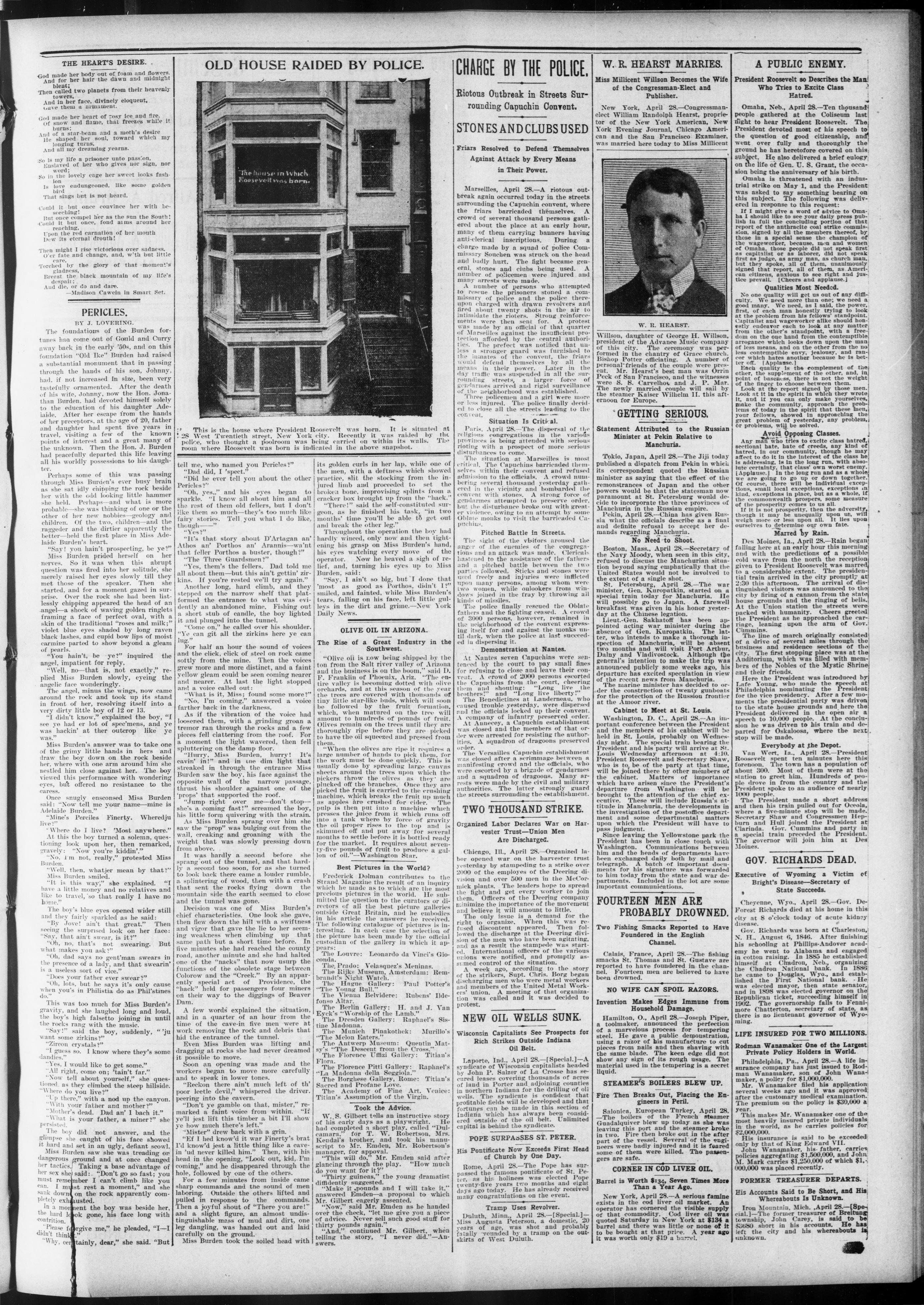
OLD HOUSE RAIDED BY POLICE.
The house in which
Roosevelt was born.
tell me, who named you Pericles?"
"Dad did, I 'spect."
"Did he ever tell you about the other Pericles?"
"Oh, yes," and his eyes began to sparkle. "I know all about him and all the rest of them old fellers, but I don't like them so much—they's too much like fairy stories. Tell you what I do like, though——"
its golden curls in her lap, while one of the men, with a deftness which showed practice, slit the stocking from the injured limb and proceeded to set the broken bone, improvising splints from a cracker box brought up from the "hack." "There!" said the self-constituted surgeon, as he finished his task, "in two months' time you'll be able to get out and break the other leg."
"It's that story about D'Artagan an' Athos an' Porthos an' Arannis—wan't that feller Porthos a buster, though?" "The Three Guardsmen?" "Yes, them's the fellers. Dad told me all about them—but this ain't gettin' zirkins. If you're rested we'll try again." Another long, hard climb, and they stepped on the narrow shelf that platformed the entrance to what was evidently an abandoned mine. Fishing out a short stub of candle, the boy lighted it and plunged into the tunnel. "Come on," he called over his shoulder. "Ye can git all the zirkins here ye can lug."
For half an hour the sound of voices and the click, click of steel on rock came softly from the mine. Then the voices grew more and more distinct, and a faint yellow gleam could be seen coming nearer and nearer. At last the light stopped and a voice called out:
"What is it, Miss; found some more?"
"No, I'm coming," answered a voice farther back in the darkness.
As if the vibration of the voice had loosened them, with a grinding groan a tremor ran through the rocks and a few pieces fell clattering from the roof. For a moment the light wavered, then fell spluttering on the damp floor.
"Hurry, Miss Burden, hurry! It's cavin' in!" and in one dim light that streaked in through the entrance Miss Burden saw the boy, his face against the opposite wall of the narrow passage, thrust his shoulder against one of the 'props' that supported the roof.
"Jump right over me—don't stop—she's a coming fast!" screamed the boy, his little form quivering with the strain.
As Miss Burden sprang over him she saw the "prop" was bulging out from the wall, creaking and groaning with the weight that was slowly pressing down from above.
It was hardly a second before she sprang out of the tunnel, and that hardly a second too soon, for as she turned to look back there came a louder rumble, a splintering of wood, then with a crash that sent the rocks flying down the mountain side the earth seemed to close and the tunnel was gone.
Decision was one of Miss Burden's chief characteristics. One look she gave, then flew down the hill with a swiftness and vigor that gave the lie to her seeming weakness when climbing up that same path but a short time before. In five minutes she had reached the county road, another minute and she had halted one of the "nacks" that now usurp the functions of the obsolete stage between Colorow and the "Creek." By an apparently special act of Providence, the "hack" held for passengers four miners on their way to the diggings of Beaver Dam.
A few words explained the situation, and in a quarter of an hour from the time of the cave-in five men were at work removing the rock and debris that hid the entrance of the tunnel.
Even Miss Burden was lifting and dragging at rocks she had never dreamed it possible to move.
Soon an opening was made and the workers began to move more carefully and to speak in lower tones.
"Reckon there ain't much left of th' poor leetle devil," whispered the driver. peering into the cavern.
"Don't ye gamble on that, mister," remarked a faint voice from within. "If ye' jest lift this timber a bit I'll show ye how much there's left."
"Ef I hed know'd it war Finerty's brat I'd know'd jest a little thing like a cavein 'ud never killed him." Then, with his head in the opening, "Look out, kid, I'm coming," and he disappeared through the hole, followed by one of the others.
For a few minutes from inside came sharp commands and the sound of men laboring. Outside the others lifted and pulled in response to the commands. Then a joyful shout of "There you are!" and a slight figure, an almost undistinguishable mass of mud and dirt, one leg dangling, was handed out and laid carefully on the ground.
Miss Burden took the soiled head with
its golden curls in her lap, while one of the men, with a deftness which showed practice, slit the stocking from the injured limb and proceeded to set the broken bone, improvising splints from a cracker box brought up from the "hack." "There!" said the self-constituted surgeon, as he finished his task, "in two months' time you'll be able to get out and break the other leg." Throughout the operation the boy had hardly wined, only now and then tightening his grasp on Miss Burden's hand, his eyes watching every move of the operator. Now he heaved a sigh of relief, and, turning his eyes up to Miss Burden, said:
"Say, I ain't so big, but I done that 'most as good as Porthos, didn't I?" smiled, and fainted, while Miss Burden's tears, falling on his face, left little gullets in the dirt and grime.—New York Daily News.
OLIVE OIL IN ARIZONA
The Rise of a Great Industry in the Southwest.
"Olive oii is now being shipped by the ton from the Salt river valley of Arizona and the business is on the boom," said D. F. Franklin of Phoenix, Ariz. "The entire valley is becoming dotted with olive orchards, and at this season of the year the trees are covered with thousands of tiny little star-like buds, which will soon be followed by the fruit formation, which, when matured on the tree will amount to hundreds of pounds of fruit. Olives remain on the trees until they are thoroughly ripe before they are picked to have the oil squeezed and pressed from them.
"When the olives are ripe it requires a large number of hands to pick them, for the work must be done quickly. This is usually done by spreading large canvas sheets around the trees upon which the pickers throw the olives as they are plucked off the branches. Once they are picked the fruit is carried to the crushing machine, which breaks the fruit up much as apples are crushed for cider. The pulp is then put into a machine which presses the juice from it which runs off into a tank where by force of gravity the oil proper rises to the top and is skimmed off and put away for several months to settle before it is bottled ready for the market. It requires about seventy-five pounds of fruit to produce a gallon of oil."—Washington Star.
Best Pictures in the World?
Frederick Dolman contributes to the Strand Magazine the result of an inquiry which he made as to which are the most precious pictures in the world. He submitted the question to the curators or directors of all the best picture galleries outside Great Britain, and he embodies in his article the answers he received. The following catalogue of pictures is interesting. In each case the selection of the picture has been made by the official custodian of the gallery in which it appears:
The Louvre: Leonardo da Vinci's Gioconda.
The, Prado: Velasquez's Meninas.
The Rijks Museum, Amsterdam: Rembrandt's Night Watch.
The Hague Gallery: Paul Potter's "The Young Bull." The Vienna Belvidere: Rubens' Ildefonso Altar. The Berlin Gallery: H. and J. Van Eyck's "Worship of the Lamb."
The Dresden Gallery: Raphael's Sistine Madonna.
The Munich Pinakothek: Murillo's "The Melon Eaters." The Antwerp Museum: Quentin Matsy's "The Descent from the Cross." The Florence Uffizi Gallery: Titian's Flora. The Florence Pitti Gallery: Raphael's "La Madonna della Seggiola." The Borghese Gallery, Rome: Titian's Sacred and Profane Love.
The Academy of Fine Art. Venice: Titian's Assumption of the Virgin.
Took the Advice.
W. S. Gilbert tells an instructive story of his early days as a playwright. He had completed a short play, called "Dulcamara," for T. W. Robertson, Mrs. Kendal's brother, and took his manuscript to Mr. Emden, Mr. Robertson's manager, for approval.
"This will do," Mr. Emden said after glancing through the play. "How much do you want for it?"
"Thirty guineas," the young dramatist diffidently suggested.
"Make it pounds and I will take it," answered Emden—a proposal to which Mr. Gilbert eagerly assented.
"Now," said Mr. Emden as he handed over the check, "let me give you a piece of advice. Never sell such good stuff for thirty pounds again."
"And," continued Mr. Gilbert, when telling the story, "I never did."—Answers.
CHARGE BY THE POLICE.
Riotous Outbreak in Streets Surrounding Capuchin Convent.
STONES AND CLUBS USED
Marseilles, April 28.—A riotous outbreak again occurred today in the streets surrounding the Capuchin convent, where the friars barricaded themselves. A crowd of several thousand persons gathered about the place at an early hour, many of them carrying banners having anti-clerical inscriptions. During a charge made by a squad of police Commissary Souchen was struck on the head and badly hurt. The fight became general, stones and clubs being used. A number of policemen were injured and many arrests were made.
A number of persons who attempted to rescue the prisoners stoned a commissary of police and the police thereupon charged with drawn revolvers and fired about twenty shots in the air to intimidate the rioters. Strong reinforcements were then sent for. A protest was made by an official of that quarter of Marseilles against the insufficient protection afforded by the central authorities. The prefect was notified that unless a stronger guard was furnished to the inmates of the convent, the friars would defend themselves by all the means in their power. Later in the day traffic was suspended in all the surrounding streets, a larger force of gendarmes arrived and rigid surveillance of the neighborhood was established.
Three policemen and a girl were more or less injured. The police finally decided to close all the streets leading to the convent.
Situation Is Critical.
Paris, April 28.—The dispersal of the religious congregations in the various provinces is being attended with serious rioting with a prospect of more serious disturbances to come.
The situation at Marseilles is most critical. The Capuchins barricaded themselves within their convent and refused admission to the officials. A crowd numbering several thousand yesterday gathered in the vicinity and bombarded the convent with stones. A strong force of gendarmes attempted to preserve order, but the disturbance broke out with greater violence, owing to an attempt by some Oblate monks to visit the barricaded Capuchins.
Pitched Battle in Streets.
The sight of the visitors aroused the anger of the enemies of the congregations and an attack was made. Clerical hastened to the assistance of the fathers and a pitched battle between the two parties followed. Sticks and stones were used freely and injuries were inflicted upon many persons, among whom were two women, while onlookers from windows joined in the fray by throwing all kinds of missiles.
The police finally rescued the Oblate fathers and the fighting ceased. A crowd of 3000 persons, however, remained in the neighborhood of the convent expressing itself for and against the monks until dark, when the police at last succeeded in dispersing it.
Demonstration at Nantes.
At Nantes seven Capuchins were sentenced by the court to pay small fines for refusing to close and leave their convent. A crowd of 2000 persons escorted the Capuchins from the court, cheering them and shouting: "Long live the brothers!" and "Long live liberty!" The Benedictines at Lauderneau, who caused trouble yesterday, were dispersed and the officials locked up their convent. A company of infantry preserved order. At Annecey, a Capuchin establishment was closed and the members of that order were arrested for resisting the authorities. A squadron of dragoons preserved order.
The Versailles Capuchin establishment was closed after a scrimmage between a manifesting crowd and the officials, who were escorted by a brigade of gendarmes and a squadron of dragoons. Many arrests were made by the civil and military authorities. The latter strongly guard the streets surrounding the establishment.
TWO THOUSAND STRIKE.
Organized Labor Declares War on Harvester Trust—Union Men Am Discharge
Chicago, Ill., April 28.—Organized labor opened war on the harvester trust yesterday by stampeding to a strike over 2000 of the employees of the Deering division and over 500 men in the McCormick plants. The leaders hope to spread the fight and get every worker to join them. Officers of the Deering company minimize the importance of the movement and believe it will amount to little. The only issue is a demand for the right to organize. When this was refused discontent appeared. Then followed the discharge at the Deering division of the men who have been agitating, and as a result the stampede was started. International officers of the various unions were notified, and promptly assumed control of the situation.
A week ago, according to the story of the strikers, Supt. Chris. Borg began discharging men who were metal workers and members of the United Metal Workers' union. A meeting of that organization was called and it was decided to protest.
NEW OIL WELLS SUNK
Wisconsin Capitalists See Prospects for Rich Strikes Outside Indiana Oil Belt.
Laporte, Ind., April 28.—[Special.]—A syndicate of Wisconsin capitalists headed by John P. Salzer of La Crosse has secured leases covering thousands of acres of land in Porter and adjoining counties in northern Indiana for the drilling of oil wells. The syndicate is confident that profitable fields will be developed and that fortunes can be made in this section of Indiana which has always been considered outside of the oil belt. Unlimited capital is behind the syndicate.
POPE SURPASSES ST. PETER.
His Pontificate Now Exceeds First Head of Church by One Day.
Rome, April 28.—The Pope has surpassed the famous pontificate of St. Peter, as his holiness was elected Pope twenty-five years two months and eight days ago today. He has already received many congratulations on the event.
Tramp Uses Revolver.
Duluth, Minn., April 28.—[Special.]—Miss Augusta Peterson, a domestic, 20 years of age, was shot and probably fatally wounded by a tramp on the outskirts of West Duluth.
W. R. HEARST MARRIES.
Miss Millicent Willson Becomes the Wife of the Congressman-Elect and Publisher.
New York, April 28.—Congressman-elect William Randolph Hearst, proprietor of the New York American, New York Evening Journal, Chicago American and the San Francisco Examiner, was married here today to Miss Millicent
J. B.
Willson, daughter of George H. Willson, president of the Advance Music company of this city. The ceremony was performed in the chantry of Grace church. Bishop Potter officiating. A number of personal friends of the couple were present. Mr. Hearst's best man was Orrin Peck of San Francisco, and the witnesses were S. S. Carvelhoe and J. P. Mar. The newly married couple will sail by the steamer Kaiser Wilhelm II. this afternoon for Europe.
GETTING SERIOUS.
Statement Attributed to the Russian Minister at Pekin Relative to Manchuria
Tokio, Japan, April 28.—The Jiji today published a dispatch from Pekin in which its correspondent quoted the Russian minister as saying that the effect of the remonstrances of Japan and the other powers would be that the statesman now paramount at St. Petersburg would decide to incorporate the three provinces of Manchuria in the Russian empire. Pekin, April 28.—China has given Russia what the officials describe as a final and definite refusal to accept her demands regarding Manchuria.
No Need to Shoot.
Boston, Mass., April 28.—Secretary of the Navy Moody, when seen in this city, refused to discuss the Manchurian situation beyond saying emphatically that the United States would not be involved to the extent of a single shot.
St. Petersburg, April 28.—The war minister, Gen. Kuropatkin, started on a special train today for Manchuria. He will possibly go to Japan. A farewell breakfast was given in his honor yesterday at the Chinese legation.
Lieut.-Gen. Sakhatoff has been appointed acting war minister during the absence of Gen. Kuropatkin. The latter, who intends to make a thorough inspection of Manchuria, will be absent two months and will visit Port Arthur, Dalny and Vladivostock. Although the general's intention to make the trip was announced publicly some weeks ago, his departure has excited speculation in view of the recent news from Manchuria. The marine minister has decided to order the construction of twenty gunboats for the protection of the Russian frontier at the Amoor river.
Cabinet to Meet at St. Louis.
Washington, D. C., April 28.—An important conference between the President and the members of his cabinet will be held in St. Louis, probably on Wednesday night. The special train bearing the President and his party will arrive at St. Louis Wednesday afternoon at 4:10. President Roosevelt and Secretary Shaw, who is to be of the party at that time, will be joined there by other members of the cabinet. Matters of importance which have arisen since the President's departure from Washington will be brought to the attention of the chief executive. These will include Russia's attitude in Manchuria, the developments in the investigation of the postoffice department and some departmental matters upon which the President will have to pass judgment.
Since leaving the Yellowstone park the President has been in close touch with Washington. Communications between him and the heads of departments have been exchanged daily both by mail and telegraph. A batch of important documents for his signature was forwarded to him today from the state and war departments. Included in the lot are some important communications.
FOURTEEN MEN ARE PROBABLY DROWNED.
Two Fishing Smacks Reported to Have Foundered in the English Channel.
Calais, France, April 28.—The fishing smacks St. Thomas and St. Gustave are reported to have foundered in the channel. Fourteen men are believed to have been drowned.
NO WIFE CAN SPOIL RAZORS.
Invention Makes Edges Immune from Household Damage.
Hamilton, O., April 28.—Joseph Piper, a toolmaker, announced the perfection of a marvelous process for tempering steel. He gave a public demonstration, using a razor of his manufacture to cut pieces from nails and then shaving with the same blade. The keen edge did not show any sign of its rough usage. The material used in the tempering is a secret liquid.
STEAMER $ ^{f} $ S BOILERS BLEW UP.
Fire Then Breaks Out, Placing the Engineers in Peril.
Salonica, European Turkey, April 28. The boilers of the French steamer Guadalquiver blew up today as she was leaving this port and the steamer broke in two. Fire then broke out in the after part of the vessel. Several of the engineers were badly injured and it is feared some of them were killed. The passengers are safe.
CORNER IN COD LIVER OIL
Barrel is Worth $134, Seven Times More Than a Year Ago.
New York, April 28.—A serious famine exists in the cod liver oil market. An operator has cornered the visible supply or that commodity. Cod liver oil was quoted Saturday in New York at $134 a barrel and there was little or none of it to be bought at that price. A year ago it was worth only $19 a barrel.
President Roosevelt so Describes the Man Who Tries to Excite Class Hatred.
Omaha, Neb., April 28.—Ten thousand people gathered at the Coliseum last night to hear President Roosevelt. The President devoted most of his speech to the question of good citizenship, and went over fully and thoroughly the ground he has heretofore covered on this subject. He also delivered a brief eulogy on the life of Gen. U. S. Grant, the occasion being the anniversary of his birth. Omaha is threatened with an industrial strike on May 1, and the President was asked to say something bearing on this subject. The following was delivered in response to this request:
If I might give a word of advice to Omaha I should like to see your daily press publish in full the concluding portion of that report of the anthracite coal strike commission, signed by all the members thereof, by those in a special sense the champion of the wageworker, because, men and women of Omaha, those people did not speak first as capitalist or as laborer, did not speak first as judge, as army man, as church man, but they spoke, all of them, unanimously signed that report, all of them, as American citizens, anxious to see right and justice prevail. [Cheers and applause.]
Qualities Most Needcd.
No one quality will get us out of any difficulty. We need more than one; we need a good many. We need, as I said, the power, first, of each man honestly trying to look at the problem from his fellows' standpoint. Capitalist and wageworker alike should honestly endeavor each to look at any matter from the other's standpoint, with a freedom on the one hand from the contemptible arrogance which looks down upon the man of less means, and on the other from the no less contemptible envy, jealousy, and rancor which hates another because he is better off. [Applause.]
Each quality is the complement of the other, the supplement of the other, and, in point of baseness, there is not the weight of the finger to choose between them.
Look at the report signed by those men. Look at it in the spirit in which they wrote it, and if you can only make yourselves, make the community, approach the problems of today in the spirit that these men, your fellows, showed in approaching the great problem of yesterday, any problem, or problems, will be solved.
Avoid Opposing Classes.
Any man who tries to exelte class hatred, sectional hate, hate of creeds, any kind of hatred, in our community, though he may affect to do it in the interest of the class he is addressing, is in the long run, with absolute certainty, that class' own worst enemy. [Applause.] In the long run and as a whole we are going to go up or down together. Of course, there will be individual exceptions, small local exceptions, exceptions in kind, exceptions in place, but as a whole, if the commonwealth prospers, some measure of the prosperity comes to us all.
If it is not prosperity, then the adversity, though it may be unequally upon us, will weigh more or less upon all. It lies upon ourselves to determine our own fate.
Marred by Rain.
Des Moines, Ia., April 28.—Rain began falling here at an early hour this morning and with the predictions of a possible cold wave from the north the reception given to President Roosevelt was marred to a considerable extent. The presidential train arrived in the city promptly at 2:30 this afternoon. The arrival of distinguished visitors was announced to the city by firing of a cannon from the state house grounds and the ringing of bells. At the Union station the streets were packed with humanity. Cheers greeted the President as he approached the carriage, leaning upon the arm of Gov. Cummins.
The line of march originally consisted of a drive of several miles through the business and residence sections of the city. The first stopping place was at the Auditorium, which was filled with members of the Nobles of the Mystic Shrine and their friends.
Here the President was introduced by Lafe Young, who made the speech at Philadelphia nominating the President for the vice presidency. After a few moments the presidential party was driven to the state house grounds and here the President delivered in the open air a speech to 10,000 people. At the conclusion he was driven to his train and departed for Oskaloosa, where the next stop will be made.
Everybody at the Depot.
Van Wert, Ia., April 28.—President Roosevelt spent ten minutes here this forenoon. The town has a population of about 300. Most of them were at the station to greet him. Hundreds of people drove in from the country and the President spoke to an audience of nearly 1000 people. The President made a short address and then his train pulled out for Oceola, where a five-minute stop will be made. Secretary Shaw and Congressmen Hepburn and Hull joined the President at Clarinda. Gov. Cummins and party in a special train preceded the President. The governor will join him at Des Moines.
GOV. RICHARDS DEAD.
Executive of Wyoming a Victim of Bright's Disease—Secretary of State Succeeds.
Cheyenne, Wyo., April 28.—Gov. DeForest Richards died at his home in this city at 8 o'clock today of acute kidney disease.
Gov. Richards was born at Charleston, N. H., August 6, 1846. After finishing his schooling at Phillips-Andover academy he went to Alabama and engaged in cotton raising. In 1885 he established himself at Chadron, Neb., organizing the Chadron National bank. In 1886 he came to Douglas, Wyo., and established the First National bank. He was elected mayor, then state senator, and in 1898 was elected governor on the Republican ticket, succeeding himself in 1902. The governorship falls to Fennimore Chatterton, secretary of state, as there is no lientenant governor of Wyoming.
LIFE INSURED FOR TWO MILLIONS.
Rodman Wanamaker One of the Largest Private Policy Holders in World.
Philadelphia, Pa., April 28.—A life insurance company has just issued to Rodman Wanamaker, son of John Wanamaker, a policy for $1,000,000.
Mr. Wanamaker filed his application several weeks ago and it was approved after the customary medical examination.
The premium on the policy is $30,000 a year.
This makes Mr. Wanamaker one of the most heavily insured private individuals in the world, as he carries policies for $2,000,000.
His insurance is said to be exceeded only by that of King Edward VII. John Wanamaker, his father, carries policies aggregating $1,500,000, and John M. Mark carries $1,250,000 of which $1,000,000 was placed recently.
FORMER TREASURER DEPARTS.
His Accounts Said to Be Short, and His Whereabouts Is Unknown.
Iron Mountain, Mich., April 28.—[Special.]—The former treasurer of Breitung township, John Carey, is said to be $3680 short in his accounts. He has left the city and his whereabouts is unknown.
The Wisconsin Weekly Advocate
SUBSCRIPTION RATES.
Any part of the United States and Canada,
postage paid.
One Year ..... $2.00
Six Months ..... 1.25
Three Months ..... .75
Send money by Express Money Order, P. O.
Money Order or Registered Letter to the
Wisconsin Weekly Advocate.
ADVERTISING RATES
One inch, single insertion ..... 25c
One inch, per year ..... $9.00
Business locals 5c per line each insertion.
Apply for rates to the Advocate.
TO CONTRIBUTORS:
All communications must be sent with the name and address of the sender as an evidence of good faith, but not necessarily for publication. No manuscript returned if not accepted, unless accompanied by stamps.
The Wisconsin Weekly Advocate company wishes to notify the public that all contracts and business transactions with this company must have the company stamp, otherwise they will be void. Neither will this company be responsible for paid subscriptions unless given to duly-accredited agents, who, on request, will give the company's receipt for same. Subscribers failing to receive their papers regularly will kindly notify the general office. Address all business communications to the general manager, 79 Fifth street.
Entered in the Postoffice at Milwaukee as Second-class matter.
EDITORIAL PARAGRAPHS.
"I know of the bravery and character of the Negro soldier. He saved my life at Santiago, and I have had occasion to say so in many articles and speeches. The Rough Riders were in a bad position when the Ninth and Tenth cavalry came rushing up the hill carrying everything before them. The Negro soldier has the faculty of coming to the front when he is needed most. In the Civil war he came 400,000 strong, and I believe he saved the Union."—President Roosevelt.
When it is made unlawful to sell game, the pot hunter will "fold his tent like an Arab and silently steal away."
Cod liver oil has been cornered. There is a large juvenile contingent that would contemplate with equanimity the cornering of castor oil as well.
The thoughtless people who declare there is no reason for the advance in meats forget that the packers were sentenced to pay a $5000 fine for entering into an illicit combination.
The marl beds reported to have been discovered near Portage constitute another of Wisconsin's many natural advantages. Marl is a valuable material, as the use of cement and concrete work is increasing very rapidly.
Would that English vicar have been reprimanded for marrying W. K. Vanderbilt to Mrs. Rutherfurd if the groom had been a clerk on $1200 a year? Probably not. But probably in that case Mr. Vanderbilt would not have been married to Mrs. Rutherfurd.
The April fire loss exceeded that of March by nearly $4,000,000, amounting to $13,549,300, which was about equal to the April fire loss of 1902. The loss for the first four months of the current year foots up $52,714,100, compared with $61,984,500 for the corresponding period of 1902 and $56,956,000 for the first four months of 1901.
---
The story that the Reliance was outpointed and outsailed by the Columbia in a short brush to windward in a very light breeze will serve to increase interest among yachtsmen in the approaching trial races between the Reliance, Constitution and Columbia. It is confidently expected that the Reliance will outsail the Columbia. If she does the Shamrock will not cause any further alarm.
The old-time lake marine is recalled by an item from Lake Ontario to the effect that "before the wrecking tug Ferris reached the schooner Reuben Doudashore at Charlotte, New York, the vessel slid from her resting place until her rails were five feet under water." The Doud was built at Winneconne, Wisconsin, in 1873, and her model was so much like that of a cattle trough that the sailors of that time affectionately dubbe! her the "Bull of the Woods."
---
The new cup defender Reliance is the largest sloop yacht, in tonnage, that has ever been built to meet a challenger, but she is comparatively small in the water, the bulk of her hull being above the surface. She has a waterline length of between 88 and 90 feet and an overall length of 142 feet, the overhangs at bow and stern having a combined length of 52 feet or over. But this proportionate overhanging of the hull is surpassed by that of the hull of a new yacht just built at Boston, as a contestant for the challenge cup of San Francisco bay. This yacht has a water-line length of only 28 feet, but is nearly 70 feet long above water. The skimming dish seems to be skimming.
One of his American experiences which might have excited the ire of the celebrated Dr. Lorenz of Vienna, but which only made him laugh, because he has a perception of humor, was the necessity for his appearance before the state board of medical examiners of Illinois to go through the form of proving his fitness to practice before he could legally give the little daughter of the Armours the treatment which he had been summoned from Austria to perform. This sort of thing will not last forever. The agreement between the six states of Wisconsin, Iowa, Michigan, Indiana, Ohio and Kansas that physicians receiving a license from the medical board of any one of them shall be free to practice in all is a move in the right direction.
RECITALS OF CAMP AND BATTLE INCIDENTS.
Survivors of the Rebellion Relate Many Amusing and Startling Incidents of Marches, Camp Life, Foraging Experiences and Battle Scenes.
At a recent impromptu camp-fire in this city several old fellows, as usual, had much to say of the civil war, particulraly concerning events and circumstances in which they either had participated or were able to relate with the soundest reasons for belief in their truthfulness. Every man in the little group had snuffed the odor of hostile powder, and each had hearkened to the "rebel yell" as it came from trenches, over fields, on mountain tops and in the valleys.
On this special occasion incidents more or less relating to the battle of Gettysburg were talked about. An old clerk in one of the departments, who carries with him constantly a souvenir of that terrific struggle in the shape of an empty sleeve, told of certain experiences that befell him after he became hors de combat. He was residing in Green Mountain State when bugles first called men to arms to save the union, and though he had not been advanced to man's estate, he enlisted promptly in a Vermont regiment, and from first to last had its full share of fighting. His story, embellished with many points of humor, had yet considerable pathos with it, and is given as nearly as the writer can recollect, in his own vernacular.
"I received my quietus," he said, "on the second day of the Gettysburg fight. One thing I recollect perfectly and that is the day was a scorcher. I'm talking about the calorie in the atmosphere now, not about the heat of the fight. Men on both sides knew all about that. About four o'clock in the afternoon I was kneeling on one knee, all ready to take another shot, when all of a sudden I thought a hornet stung me. Well, it was a hornet; but it was made of lead and came out of a confederate rifle. I soon found that out and reported to the rear in double quick order. I had been on the fighting line nearly the entire day, and was perfectly fagged out.
"Well, as I could show blood, I was passed on, and I swear that then I felt as if I were on a vacation. I wanted a drink of good, cool water, for that remaining in my canteen was as hot as if it had been boiled; so I went on looking for a river, or a brook, or spring, or any place where I could quench my thirst. Soon I found one in a sort of little grove. It was just bubbling, and gurgling, and sparkling, and I thought it was one of the prettiest sights I ever saw in my life. I just lay down on my stomach and, with my wounded arm thrust deep into the water, I drank my fill. I never had such a refreshing draught in all my born days. It put new life in me, and I remember to this day that I sat down for a long time and wondered, among other things, if there wasn't good trout fishing in the stream. Then, after the long rest, I resumed my journey. I knew I was bound to pull up somewhere, and I didn't care much where.
"I hadn't gone far, when I met two officers. They had boxes under their arms, and it was not difficult for me to recognize them as medical officers. They were young men, both of them, and after a short talk with me and an examination of my wounded 'wing,' they began to talk to each other about mortification and amputation, and all that sort of thing, at the same time informing me that it was necessary to cut my arm off then and there. They assured me of their regret that they had nothing in the nature of anaesthetics. I kicked, metaphorically and physically, I wanted to go to a hospital, but they said nay, and the result is here," and he held up what remained of the arm.
"One of the doctors fixed me up and made me feel very comfortable, and the other gave me the biggest drink of brandy I ever had in my life--that made me more comfortable.
"And now comes the third scene in this eventful tragedy."
Here the veteran waxed pathetic and grew poetic.
"It was nearing or quite sundown when the surgeons met me, and I enjoyed their company for about half an hour, when I went my way and they continued on their journey. About eight o'clock over a little range of hills, I saw the big, round, yellow moon flooding the country with light. The evening was growing cooler, and I was ready for all the repose I could get. I saw by the moonlight a barn or outbuilding of some kind, and I made for it. When I looked in the door I saw it was already occupied, but there was room for one more. The temporary tenants were scattered around in all directions, some sitting up against the wall, and others supine on their backs on the floor. They were all soldiers, and I noticed particularly one who was sitting down with his musket between his knees. He was leaning against some boards. Nobody said anything to me, so I entered without the slightest ceremony and was asleep before the second hand of a clock could traverse the tenth part of its circle. The sun was high in the heavens when I awoke, and I noticed that my roommates were still asleep. The man with the rifle between his knees was in the same attitude and so were all the others. Yes, they were all in a slumber from which they will never awake until a trumpet louder
than any yet sounded on earth shall call them back to life again."
Another member of the little company related an incident which came under his personal observation at or near Gettysburg during that three days' fight. He told of a soldier in a company that went in early in the engagement and came out after its share of fighting only for the reason that nearly every man in it was either killed or wounded. The soldier referred to played on the fiddle, the veteran said. He was in love with his fiddle, and, as a general thing, when he wasn't fighting he was fiddling. The spirit of war and the soul of music both were vital essences of his being. His story, however, which was inspired by the events related by the comrade of the empty sleeve, was to the effect that on the morning of the third day of the battle he, wandering by a barn attached to a hostelry known as "The Tavern of the Three Stars," head sounds coming from it and looking in found it to be a sort of hastily improvised hospital.
"There were at least a score of soldiers laid out in cots on the floors, all more or less wounded. Several of them were past all surgery. To his amazement he saw the musician, who had suffered the loss of a leg. He was, of course, lying on his back, but the stump of his limb was propped up. He had a pleased expression on his countenance, his well-beloved fiddle under his chin and was filling the room with music.
"The most beautiful and pathetic part of the picture was the calm, sweet and smiling expression of the poor fellows who were being regaled with its melodies.
"It seemed," said the speaker, "as if a beatification from heaven rested upon the place and its cheerful glory shone in the countenance of every poor sufferer within it."—Detroit Free Press.
Lee's Refusal to Disperse.
General E. P. Alexander relates in the Century these interesting words of General Lee, just before the surrender. General Alexander having proposed that the Confederate soldiers be authorized to disperse, and report to General Johnston or to the Governors of the States, General Lee replied:
"Suppose I were to adopt your suggestion, how many do you suppose would get away?"
I replied: "I think two-thirds of us could get away. We should be like rabbits and partridges in the bushes, and they could not scatter like that to catch us."
"Well," he said, "I have less than sixteen thousand infantry with arms in their hands. Even if two-thirds of these got away it would be too small a force to accomplish any useful result, either with Johnston or with the Governors of the States. But few would go to Johnston, for their homes have been overrun by the enemy, and the men will want to go first and look after their families. As to any help from Europe, I have never believed in it. I appreciate that the surrender of this army is, indeed, the end of the Confederacy. But that result is now inevitable and must be faced. And as Christian men, we have no right to choose a course from pride or personal feelings. We have simply to see what we can do best for our country and people. Now, if I would adopt your suggestion and order this army to disperse, the men, going homeward would be under no control, would be without food. They are already demoralized by four years of war, and would supply their wants by violence and plunder. They would soon become little better than bands of robbers. A state of society would result throughout the South, from which it would require years to recover. The enemy's cavalry, too, would pursue to catch at least general officers, and would harass and devastate sections that otherwise they will never visit. Moreover," he said, "as to myself, I am too old to go to bushwhacking, and even if it were right to order the army to disperse, the only course to pursue would be to surrender myself to General Grant. But," he added, "I can tell you for your comfort that Grant will not demand an 'unconditional surrender.' He will give us honorable and liberal terms, simply requiring us not to take up arms again until exchanged." He then went on to tell me that he was in correspondence with Grant, and expected to meet him in our rear at 10 a.m., when he would accept the terms that had been indicated.
Josh Billings' Philosophy.
Faith iz a long chain with a hook at each end of it; hope hath a brite eye, and kan see in the dark az well az in the light; charity iz the kreed ov heaven.
Thare are fu people az wize az they think they are, and less so foolish az they are supposed to be.
To be idle, and not indolent, iz a wize man's prerogative.
Man waz not made for peace, but for war and never iz so happy (nor progressive) as when he iz fiteing sumthing.
We should be very blest indeed if we waz only haff az happy az we try to make others think we are.
It seems to be the study ov a cunning man to pass himself off for more than he iz worth, and of a wize one, for less.
Thare iz no better evidence ov a man's real superiority, than to see him anxious to praise the same superiority in others.
A careful examination of the trees that are struck by lightning shows that over half of them are poplar. From this fact scientists conclude that the poplar has some value as a conductor of lightning. Therefore, agriculturists are advised to plant these trees in the vicinity of their farm buildings.
The Opportunity of a Life Time
WANTED for a first-class hotel in a city in the interior of the state of Wisconsin, the followlng colored help— 1 MEAT COOK. Female.
2 CHAMBER MAIDS, one to assist in serving dinners and suppers.
2 DINING ROOM GIRLS.
2 DISH WASHERS.
This is an exceptional opportunity for a club of Southern girls to make for themselves a comfortable home in Wisconsin. The proprietor is a Southern gentleman who understands and appreciates the negro.
Apply at once to the office of the WISCONSIN WEEKLY ADVOCATE, 79 Fifth Street, Milwaukee, Wis.
SINGER SEWING MACHINE
Wheeler & Wilson
HAS ADVANTAGES CONTAINED IN
NO OTHER SEWING MACHINE.
Three Times
The Value of
Any Other
One Third Easier
One Third Faster
The only Sewing Machine
that does not fail in any
point.
406 Grand Avenue,
Milwaukee.
NORTH OR SOUTH
Always ask for tickets
via the
Monon Route
THE SHORT LINE BETWEEN
Chicago,
Indianapolis,
Cincinnati,
Louisville
Six trains daily between Chicago and the Ohio river.
For folders, rates, etc., call at any Monon ticket office or address
FRANK J. REED,
Gen'l Pass. Agent, Chicago.
S. B. JONES,
C. P. Agent 232 Clark St. Chicago
WANTED--AGENTS
We want 100 agents in every city, town and hamlet in the U. S. for the Wisconsin Weekly Advocate. It will be devoted to the interest of the Negro race and will contain the news of their sayings and doings throughout the world.
WISCONSIN WEEKLY ADVOCATE
MILWAUKEE, WIS.
50 YEARS'
EXPERIENCE
PATENTS
TRADE MARKS
DESIGNS
COPYRIGHTS & C
Anyone sending a sketch and description may quickly ascertain our opinion free whether an invention is probably patentable. Communications strictly confidential. Handbook on Patents sent free. Oldest agency for securing patents. Patents taken through Munn & Co. receive special notice, without charge, in the
A handsomely illustrated weekly. Largest circulation of any scientific journal. Terms, $3 a year four months, $1. Sold by all newsdealers. MUNN & Co. 361 Broadway. New York Branch Office, 625 F St., Washington, D. C.
```markdown
```
Alfred A. Grunitz DEALER IN Fresh, Salted & Smoked Meats OF ALL KINDS. Fresh Fish and Oysters in Season IN 6253. 502 WELLS ST.
IT'S THE O
Just What You Hav
Afro-American
IT'S THE ONLY PLACE Just What You Have Been Looking For Afro-American News Office
3104 STATE STREET
Here all the best and best magazines from all be found every week, in and magazines, weekly Following is a list of the for sale:
Wisconsin Weekly Advocacy Richmond, Va.; Planet, Rid Journal, Philadelphia, Pa.; Atlanta Age, Atlanta, Ga. field, Ill.; Cairo Standard, land, Ohio; Kentucky St Detroit Informer, Detroit can, Washington, D. C.; N City, N. Y.; Freeman, Ind Indianapolis, Ind.; Conse Ax, Chicago, Ill.
All the best and leading weekly in magazines from all parts of the U.S. every week, including all other magazines, weekly and daily publishing is a list of the leading weekly
Insin Weekly Advocate, Milwaukee; Ref. Bond, Va.; Planet, Richmond, Va.; Odd H. al, Philadelphia, Pa.; Guardian, Boston, Ga. Age, Atlanta, Ga.; State Capitol, S. Ill.; Cairo Standard, Cairo, Ill.; Gazette, Ohio; Kentucky Standard, Louisville, Int Informer, Detroit, Mich.; Colored A Washington, D. C.; New York Age, New N. Y.; Freeman, Indianapolis, Ind.; Redcapolis, Ind.; Conservator, Monitor, Chicago, Ill.
Here all the best and leading weekly journals and magazines from all parts of the U. S. can be found every week, including all other standard magazines, weekly and daily publications. Following is a list of the leading weekly papers for sale:
Wisconsin Weekly Advocate, Milwaukee; Reformer, Richmond, Va.; Planet, Richmond, Va.; Odd Fellows Journal, Philadelphia, Pa.; Guardian, Boston, Mass.; Atlanta Age, Atlanta, Ga.; State Capitol, Springfield, Ill.; Cairo Standard, Cairo, Ill.; Gazette, Cleveland, Ohio; Kentucky Standard, Louisville, Ky.; Detroit Informer, Detroit, Mich.; Colored American, Washington, D. C.; New York Age, New York City, N. Y.; Freeman, Indianapolis, Ind.; Recorder, Indianapolis, Ind.; Conservator, Monitor, Broad Ax, Chicago, Ill.
Magazines Published Every Month:
The Colored American, Porters and Waiters Mag also the Buffalo Tragedy Oration, entitled: "Climba Rugged," by Alton H. Blair
A Full Line of Stationer
Papers sent through the mail to a call and see for yourself. If we your order and we will get it for you
REMEMBER THE N
Afro-American
E. H. FAULKNER, Manager. 310
MILWAUKEE...
GAS STOVE CO.,
Colored American, Boston, Mass.; Press and Waiters Magazine, Philadelphia; The Buffalo Tragedy by King Jefferson; an, entitled: "Climb, 'Though the Roof,'" by Alton H. Blake (the Boy Orator)
Line of Stationery, Cigars and T
ent through the mail to any part of the county see for yourself. If we have not what you and we will get it for you.
REMEMBER THE NAME AND PLACE
American News
KNER, Manager. 3104 STATE ST., CH
KEE...
TOVE CO.,
ECON
The Colored American, Boston, Mass.; R. R. Porters and Waiters Magazine, Philadelphia, Pa.; also the Buffalo Tragedy by King Jefferson, and Oration, entitled: "Climb, 'Though the Rocks be Rugged," by Alton H. Blake (the Boy Orator.)
A Full Line of Stationery, Cigars and Tobacco
Papers sent through the mail to any part of the country. Give us a call and see for yourself. If we have not what you want, leave your order and we will get it for you.
REMEMBER THE NAME AND PLACE
Afro-American News Office
E. H. FAULKNER, Manager. 3104 STATE ST., CHICAGO.
MANUFACTURERS OF
PERFECTION
AND SPECIALTIES
Instantaneous Cleanable Star Burners,
Adjustable Needle Valve,
Per Natural, Artificial or Gasoline Gas.
139 Burrell St., Milwaukee, Wis.
TONEY THE ARTIST FINE ART Shining Parlor
Notary
EY THE ARTIST
NE ART
ng Parlor
Rooms 17-18 B
105 GRAND
Telephone White
MILWA
2161 GRAND AVENUE
Opposite Flanner's Music Store
MILWAUKEE, WIS.
Before Starting on Your Travels CALL ON
Geo. Burroughs & Sons
MANUFACTURERS OF
PREMIUM TRUNKS
VALISES, SAMPLE CASES, Etc.
424 & 426 East Water St., Milwaukee.
---
Not in a Trust
leading weekly journals
parts of the U. S. can
including all other stand-
and daily publications.
leading weekly papers
e, Milwaukee; Reformer,
Amond, Va.; Odd Fellows
Guardian, Boston, Mass.;
State Capitol, Spring-
cairo, Ill.; Gazette, Cleveland,
Louisville, Ky.;
Mich.; Colored Ameri-
new York Age, New York
Anapolis, Ind.; Recorder,
Evator, Monitor, Broad
Boston, Mass.; R. R.
Zine, Philadelphia, Pa.;
by King Jefferson, and
Though the Rocks be
(e the Boy Orator.)
Cigars and Tobacco
any part of the country. Give us
have not what you want, leave
AME AND PLACE
News Office
STATE ST., CHICAGO.
ECONOMY
LAUNDRY
174 Fifth Street
Shirts 6c Each Delivered
at Office.
Other Work Proportionate.
BEST WORK IN CITY.
WILLIAM T. GREEN
Lawyer
Notary Public
Rooms 17-18 Birchard Block.
105 GRAND AVENUE.
Telephone White 9214
MILWAUKEE.
G. V. MASHEK
HARDWARE,
NAILS,
CUTLERY,
UNIVERSAL STOVES & RANGES
HOUSE
FURNISHING
GOODS.
KEWAUNEE, WIS.
---
The Marah and Elim incident of scripture is rich in its suggestiveness. After the passage of the Red sea the people plunged, with their flocks and herds, into the wilderness with its new and strange experiences. They pressed forward, but, at the end of three days, found their supply of water exhausted. Animals and people were driven almost mad. They burned with thirst, their eyes became bloodshot, they panted with fever under the sun, and longed for water. Their condition was not simply uncomfortable, but positively dangerous.
While in this sad plight good news came to them. The cry was heard, "Wells of water ahead; fountains where they might quench their thirst and cool their fever." Faster and faster they pressed forward, only to find disappointment. For "when they came to Marah, they could not drink of the waters of Marah, for they were bitter."
What does all this mean? That their journey was a type of ours; that we have experiences similar to theirs. Is it not a fact that to most of us life is a wilderness, a desert, often a disappointment, Marah, bitterness? All have Marah experiences, though there is more of joy then sorrow in life, more of sunshine than shadow.
"Most of life is to most men made up of much disappointment. Men crave happiness, and expect it here and seek it through some earthly, some temporal means, wealth, or power, or fame, or a peaceful domestic life, or social success, or literary eminence—and no sooner do they obtain their desire and hold it in their grasp than they find its savor gone, its taste bitter, that they do not care to drink."
Under such circumstances we feel that God is unkind and we complain against him. Has he no plan in all this for us? Yes. The hard experiences of life are God's discipline by which he tests us and purges out the dross that the pure gold may appear. We do not know what impatience, rebellion, sin lurks in our heart until we pass through God's fiery tests. The incident we are considering exhibits to us the fact that in times of trial and disappointment God's people act in different ways.
We see how the people murmured. "What shall we drink?" They complained against their best friend, Moses. They acted as if they thought him God. Had he not acted unselfishly? Did he not, for their sakes, step down from a place of eminence and power? It was for them, that they might become free men and free women, that he became an outcast and sojourned forty years in the solitudes of the desert, keeping sheep instead of ruling men.
At Marah the people mades Moses their scapegoat; they threw all the blame of their misfortunes upon him. In so doing they reveal a base trait in human character—men's willingness to blame others for their misfortunes instead of calmly and patiently assuming the responsibility themselves. The people murmured against Moses instead of counting their experiences as a valuable part of their wilderness discipline.
With Moses it was different. Though under a fearful strain and in danger, he was patient and prayed to God. He did not rebuke the people, but sympathized with them in their distress. He sought God's guidance and found it, for in answer to his fervent prayer God healed the bitter waters. The prayer of Moses brought sweetness out of bitterness, joy out of sorrow, and light out of darkness. The Gethsemanes of life always turn out to the Christian's advantage. Agonizing prayer that brings drops of blood is generally answered. When all else falls God accomplishes many things by the prayers of his people. Learn to pray. Walk in the footsteps of the great and good of the ages.
We have an instance of God's gracious kindness to his people. He led them out of their trials. They did not stop and perish at Marah, but went on to Elim, with its palm groves and wells of water.
In life Elim often follows Marah. God opens up for us a broad way out of our difficulties. There are, in the providence of God, many sweet resting places after our times of bitterness. We are wise when we learn in life to take the bitter with the sweet.
God led his people out of bondage and gave them liberty. In their darkest and most discouraging hours God never forsook them. They had the presence of Moses as friend and guide. They went through many hard and trying experiences, but at last they arrived at the end of their destination and entered Canaan.
So it is with us. Now we are on our hard and dangerous journey. There are enemies on every side. Often we are discouraged. We faint under our heavy loads. We murmur against the providences of God.
This is not what God desires us to do. We are to learn patience, to trust God.
to go forward under the guidance of the great leader, Jesus Christ, until at last the end of the journey will come and we shall enter our heavenly Canaan and be forever with our God.
TALKS OF LARGE FAMILIES.
By Rev. M. M. Mangasarian.
In ancient Athens the propagation of the race was not left entirely to accident, but all possible precautions were taken to prevent the birth of the unfit. How to educate their successors so as to render them not only capable to continue, but also to improve what had already been attained, was the Greek ideal. Hence the quality of one's children rather than their number determined the value of a citizen's contributions to the preservation of the state. But statistics show that the greatest men have come from large families.
The "only" child has rarely ever risen to renown. Perhaps this is because a houseful of children not only offers to the little ones the opportunities of defense and attack—namely, of development—but it also enables each to find its affinity, without which there can only be the isolation which produces mental sterility. Moreover, parents who have had only one or two children do not have the experience and knowledge which those with a large family of children have and therefore cannot show as good results.
This does not apply to the inferior races. Aside from the economic causes which render small families desirable there is the increasing unwillingness of modern women to become mothers. There is a great deal of "enforced motherhood" among the poor, while among the well-to-do there is a decided dread of maternal responsibilities. The policy of excluding women from the public life of the world, of exacting duties from them while denying them the rights is indirectly the cause of her reluctance to contribute generously to an institution that discriminates against her. Not being able to take up arms, she avenges her wrongs by cutting off the supply of the world's forces.
ADVICE TO YOUNG MEN.
This is pre-eminently the age of the young man. Great corporations, banks, railroads, newspapers, pulpits, the bar and nearly every business and profession is crying for young blood. It may be sad, but it's true, that in most places to-day age is at a discount. How great, therefore, the responsibilities, as well as the opportunities, of youth!
Make up your mind to do something and do it quickly, persistently and honorably. Every road to true success runs through a righteous purpose. Don't wait for "something to turn up," but go out and turn it up! The world admires a hustler. There is no promise in the Bible to either a lazy man or a coward. Humanity despises both.
NEEDS OF THE OLD FOLKS.
Many are the needs of the old folks. How the children are crowded with business. They long to hear from their offsprings, of whom they have such tender regard. How in the long ago they cared for them. Why does not the long-looked-for letter come? Often parents have no greater need than to hear from those that used to be their constant care. How often they had rocked them to sleep when tired out from play, tucked them in when the night was cold and the ground was white. In retrospection how often the old folks see the children, little and helpless, clinging to their skirts when they could put their hands upon them and caress the darling of their life.
Corrupt Politics. There are rotten spits in politics. One has just been shown up in St. Louis, one in Minneapolis, another in Delaware and they crop out from time to time in New York. It is because these things smell to heaven—and to the other place, too—that we think politics are rotten. I prefer to think that these are weak spots.—Rev. L. C. Barnes, Baptist, Worcester, Mass.
The Ideal Man.—The ideal man has not yet been discovered among those who are mere men. No one of our noblest men was a spotless sun; no one reached sinless perfection. From all our loftiest specimens of manhood I turn dissatisfied to Jesus Christ, and in him I find that the ideal becomes actual, the dream real and the hope fruition.—Rev. R. S. McArthur, Baptist, New York City.
Friendship.—Any man who is making plenty of money can have all the friends of a certain kind that he wants as long as the money lasts. But when stocks go down and one reverse after another overtakes him, where are they? They've left him high and dry on the beach and have gone to fish in other and deeper waters.—Rev. B. E. Dickhant, Lutheran, Brooklyn, N. Y.
Idleness.-The idle class of women has increased with the increase of luxury and the easier conditions of the economic world. In the primitive epochs of civilization women of all classes thought it a sin and a shame to spend a day in idleness.-Rev. J. K. Smith, Presbyterian, Louisville, Ky.
TEMPERANCE TALKS.
THE RUM TRAFFIC SHOULD BE SUPPRESSED.
Dangers that Always Lurk in the Flowing Bowl-How Bright and Influential Men Have Been Dragged Down by the Demon Drink.
I would not touch whisky if it was to save my life. I have seen too much of its work. I have seen the misery it has made for my mother. I have seen, too, the brute it made of my stepfather when he was under its influence. If it were not for whisky, our trouble would never have happened and I would not be in jail. I never touched the stuff, and I've made a vow that I never will.
There are not words of an impassioned temperance theorist. They are the calm, deliberate utterance of a young man who killed his drunken stepfather in defense of his mother and was incarcerated in a Cleveland police station. A police lieutenant had pressed a glass of whisky upon him, urging him that his weakened condition demanded it. But he knew whisky and he had no use for it.
Here is what might well be accepted as an expert opinion upon the effects of whisky. This young man has had experiences that have shown him what whisky will do. He does not need to theorize. He speaks with positive information. But for whisky he would not have been in jail. Decidedly true. And equally true it is that but for whisky few other people ever would be in jail. It is not putting it too strongly to say that whisky causes nine-tenths of the crimes that get people into jail. This young man has seen the misery whisky has made for his mother. And who cannot call up from one's own recollection dozens of mothers whom whisky has made miserable? Scarcely a community or social circle but has several-often good, patient, uncomplaining heroines who have given up hope, and whose desolated hearts are left to feed on the agony of despair. They bear the deprivations, the neglect, the abuse, the blows, and utter no moan but in their hearts, where there is moaning always.
The earth has been salted with tears shed by mankind in sympathy with the brave women who send their husbands and sons to battle, sitting alone at home with tears and fears; but such women are happy, proud, exalted, compared with the drunkards' wives, crouching with tears and fears and shame, while their husbands give their lives up to the devil. Drink.
The bright, sweet hopes of their bridal days have become a mockery. The vows upon which they staked their life happiness have proved as air. The love that once bade fair to be a shelter in every storm has been beaten down and torn to ruin by whirlwinds of bestial passions. There are millions of women like this. "I have seen, too," says this young man, "the brute whisky has made of my step-father when he was under its influence."
Yes, there is the truth. It makes a man a brute. He may be good and kind and tender, when he is sober, but whisky makes him a brute. He may be provident and thrifty when he is himself, but, filled with whisky, he becomes an entirely different class of being. Sober, he may not be able to realize that he can be a brute when drunk. He may be the last one to know the misery that his drunkenness causes in his home. He cannot view himself in correct perspective.
But this young man who was sent to jail because of whisky speaks the simple truth. He has seen how whisky turned a good man into a brute, a happy wife into a miserable drudge, and a devoted son into an unwilling murderer. And whisky is no respecter of persons. What it does in one family it will do in another. What it makes of one man it has made of millions. The woe of this one woman is a woe that ever goes crying and moaning throughout the earth.—Des Moines News.
Unique Definition of Tectotalism. Paying a visit of inspection one day to a large English school, an inspector found a teacher exercising a class in the subject of definitions. One interrogation put to them seemed for a moment a great puzzle. The question was: "What is teetotalism?"
At last one tiny girl, whose pinched face and shabby clothes bespoke hard times at home put up her hand and cried out: "I know, teacher!"
Both teacher and visitor felt lumps rise in their throats as the answer came, in the thin, piping treble: "Teetotalism means bread and butter."
With tears welling in her eyes, the teacher said: "You must explain that." And the small damsel promptly replied: "Because when father's teetotal we get bread and butter, and when he is not we have to go without."
Temperance Notes.
Out of 1,000 newspapers in the State of Kansas, 787, it is said, will not publish a liquor advertisement at any price.
The French chamber of deputies has appropriated $240,000 over the protest of the minister of war, for the purpose of supplying the troops with wine.
The fifty-sixth annual report of the Pennsylvania commissioners on lunacy, shows that the increase of insanity from intemperance is from 0.6 per cent in 1900 to 21.1 per cent in 1902. The ratio of intemperance to any other cause is given as five to one.
for a first-class hotel in a city in the interior of the state of Wisconsin, the followlng colored help—
1 MEAT COOK, Female.
1 PASTRY COOK, Female.
1 LAUNDRY MAID.
2 CHAMBER MAIDS, one to assist in serving dinners and suppers.
2 DINING ROOM GIRLS.
2 DISH WASHERS.
This is an exceptional opportunity for a club of Southern girls to make for themselves a comfortable home in Wisconsin. The proprietor is a Southern gentleman who understands and appreciates the negro. Apply at once to the office of the WISCONSIN WEEKLY ADVOCATE, 79 Fifth Street, Milwaukee, Wis.
The Oliver
Typewriter . .
Philadelphia, 1899. Earls Court, London, 1899. Omaha, 1899. Paris 1900 Venice, 1901. Lille (France), 1901 Buffalo, 1901. It is displacing old style machines everywhere, and holds first place in the estimation of the majority of leading representative business and professional men. Write for Catalogue.
Wm. C. Kreul
434-436 Broadway, Corner Mason Street
MILWAUKEE
BARGAIN
HUNTERS
Clothing to fit without being measured for. Prices less than you ever bought them for. Our specialty is misfit and uncalled-for custom tailor made clothing. Tailors' prices for full dress or Tuxedo suits from $30 to $60; our price from $15 to $18. English walking or good business suits made to measure by best of tailors from $18.00 to $35.00. Our price $8.00 to $18.00. Every suit bears our guarantee label. All garments bought of us are kept repaired and pressed free of charge for one year. To be convinced see our window display.
MILLER BROS.
213-15-17 West Water St.
Milwaukee, Wis.
Open evenings till 9 p. m.; Sundays
till 12 m.
While in city visit . . .
STEPHENS'
HOTEL and RESTAURANT
First-Class Accommodations
Home Cooking a Specialty...
No. 2832 State St., CHICAGO, ILL.
Northwestern House
APPLETON, WIS.
JOHN A. BRILL, - Proprietor.
Terms $1.00 Per Day.
Accommodations the best in the State. When in Appleton stop at the
NORTHWESTERN
S. F. PEACOCK & SON
Funeral Directors
AND
EMBALMERS
131 Broadway. MILWAUKEE, WIS
WE CONTINUE TO WARN THE BENEVOLENT PUBLIC AGAINST THE NUMEROUS BEGGARS FOR ALLEGED CHARITABLE INSTITUTIONS IN BEHALF OF THE NEGRO RACE. LOOK WELL TO THE CREDENTIALS OF SUCH MENDICANTS AND INQUIRE OF SOME REPUTABLE NEGRO CITIZEN REGARDING THE TRUTHFULNESS OF THEIR STATEMENTS.
Open Day and Night.
The
Oysters, Game, Fish
Delicacy
Banquet Rooms for Dinner
NOTE—We have neither private
DINNER
J. L. S.
194 Third Street, M
"The Back
Steam
Teleph
...THE TURF
The Turf Cafe
Game, Fish, Steaks, Chops and
Delicacy the Seasons Afford.
rooms for Dinner Parties, Etc. Cuisine Pa
Table D'Hote.
ve neither private rooms, nor "private" people, but
general public.
DINNER FROM 5:30 TO 8:00, 35c.
J. L. SLAUGHTER, R
Street, Milwaukee, Wis.
e Bachelors' Hom
Banquet Rooms for Dinner Parties, Etc. Cuisine Par Excellent. Table D'Hote.
NOTE- We have neither private rooms, nor "private" people, but cater to the general public.
DINNER FROM 5:30 10 8:00, 35c.
194 Third Street, Milwaukee, Wis.
"The Bachelors' Home"
Steam Heat. Electric Light. Telephone in Every Room.....
TURF EUROPEAN HO
...THE TURF EUROPEAN HOTEL...
A New and Modern Establishment for Gentlemen Only.
217 Wells Street,
Milwaukee.
Cafe in Connection:
with Acco
C. C. GITTINGS, Pres. E. E.
GOL
Folding
...MAN
Gold Medal C
Incorporated February, 18
SEE OU
Good W
Cheap
HERM
M
238
Milwaukee.
Street, J. L. SLAU
Milwaukee. Pro
217 Wells Street, J. L. SLAUGHTER, Milwaukee. Prop. and Mgr. Cafe in Connection: Prices Moderate and Consistent with Accommodations Furnished.
C. C. GITTINGS, Pres. E. E. BAILEY, Vice-Pres. W. G. GITTINGS, Sec—Troas.
GOLD MEDAL
Folding Furniture
....MANUFACTURED BY....
Gold Medal Camp Furniture Mfg. Co.
Incorporated February, 1892.
RACINE, WIS., U. S. A.
SEE OUR BARGAINS!
Good Warm Clothes Are Cheaper Than Coal.
HERMANN NOLDE,
Merchant Tailor.
235 Third Street.
Milwaukee. Wisconsin.
ZOMODONE, THE NEWEST AND MOST RAPID HAIR GROWER IN EXISTENCE.
Makes the Hair grow with lightning-like rapidity. No waiting for results. ZOMODONE prevents falling Hair, Grey Hair, Brittle Hair, Curly Hair, Harsh Hair, and Scurf. Cures Dandruff, Itch, Tetter, Eczema, and Ring-Worm. No more Bald Heads, Scanty Partings, Splitting Ends, and Bald Temples. ZOMODONE grows long, luxurant, soft, fine, silky Hair. Makes the Hair grow down to and below the waist line in most every instance in which it is used. ZOMODONE is a direct Hair food, and softens and lengthens the Hair, so that it can be arranged in any style desired. Not a fraud or a fake, to get your money, but an honest remedy, tried and true. ZOMODONE acts quickly; results are seen at once. If you want Hair down to your waist, send in your order right now—do not delay. No free samples sent; a sample is not sufficient to do good. Send us only $1.00, and we will send promptly all of the following great remedies, worth at retail $4.50: 3 large jars of ZOMODONE, worth $3.00; 1 large package of ALBUNA (Egg Shampoo), worth $50, and 1 large package of CORALINE, the most exquisite and absolutely certain skin brightener and perfector known to science, worth $1.00. We will send four complete treatments for $3.00.
Actual Results from Bald-
ness After Only 4 Months'
Use of ZOMODONE.
AGENTS WANTED. CREDIT
to make money. Write quick 1
THE HELEN MARTIN TO
AGENTS WANTED. Everything is in favor of the Agent. LIBERAL CREDIT EXTENDED. This is an unprecedented chance to make money. Write quick for territory and particulars. Address THE HELEN MARTIN TOILET CO., 910 E. Leigh St., Richmond, Va.
Visitors to the city and those who appreciate Cleanliness, Elegance and Comfort should patronize
Hot and Cold Baths in Connection. Franklin A. Hackley, Mgr.
MARIE DE BOURBON
For Ladies and Gentlemen.
of Cafe
breaks, Chops and Every
season Afford.
Etc. Cuisine Par Excellent.
ote.
"private" people, but cater to the
public.
TO 8:00, 35c.
GHTER, Prop.
Wis.
rs' Home"
PEAN HOTEL...
J. L. SLAUGHTER, Prop. and Mgr.
Gov. La Follette Sends Message to Legislature.
Characterized as a Shame and Reproach to the State—Manufacturers
Madison, Wis., April 29.—[Special.]— Gov. La Follette this morning sent to the Legislature his special message relative to state regulation of railroad rates. It vies in length with the message submitted at the opening of the Legislature and comprises 185 printed octavo pages.
The governor does not mince matters much in referring to the all-powerful influence exerted by the railroads in controlling legislation in Wisconsin and, while at times he is both sarcastic and indignant, he is at all times dignified in his utterances. The message is intended for use not only as an argument in securing the passage of the freight commission bill, but also, it is understood, as a document to convince the voters of the state of the dominating influence of the railroads in shaping legislation and to remove any doubt in the voter's mind as to the necessity for railroad legislation of the kind attempted.
The governor makes the somewhat surprising statement that merchants and manufacturers who came to oppose the bill and who sent letters and telegrams setting forth their opposition, informed him as well as the members that they favored the bill at heart, but were afraid to openly voice their convictions, being fearful of retaliation at the hands of the railroads. The opposition to the bill, he takes occasion to remark, is merely what was expected and in that connection he refers to the endeavors made to prevent the passage of the commission bill in Iowa.
Concerning the present laws relating to railroad control the governor denominates them as a shame and a reproach to the state. They may be satisfactory to the railroads, but he says they never will be to the people.
In concluding the governor says:
Neither at this nor at any subsequent session will you. I am confident, be called upon to determine a question of greater concern in a material way to your constituents, not only today but in the years to come.
We are making records that are to stand for all time of the legislative history of this state. No one charged with official responsiblity in this connection can afford to assume or seek to maintain any wrongful position. No one can afford to be driven from any rightful position.
The legislative and executive departments of government are invested with the highest authority by the people of this state. Upon us there rests the gravest responsibility. We are bound to discharge this impartially, without fear or favor. It is our duty to represent not one interest but all interests; not one industry, but all industries; not one class, but all classes. The highest standard of right conduct is required of the man in public life. We shall be held strictly accountable to all the people whom we represent for what we do or fail to do respecting their business committed to our charge. Special interests, and the agents of special interests, may be conspicuous in the legislative committee rooms and on the legislative lobby. They properly are heard here day after day; they meet and mingle with the public officials as they come and go. They seem to be everywhere present and to occupy the entire field of interest on the consideration of this legislation. They appear to be the only ones concerned.
Let us not be misled. Out in the state, back in your respective districts, are the thousands who will not consent to pay higher rates upon everything which enters into their daily lives in order that a small number of favored individuals may rest secure in some privileges. Whether he works upon the farm, in the factory or in the railway service every may in this state is coming to know that he pays the freight when he houses and clothes and arms and feeds his family, and that exorbitant transportation charges, falling upon each article of consumption, in the aggregate becomes a burdonsome tax upon every man who must take account of the rapidly increasing cost of living.
He well understands that it is not offset as to him by some slight advance in the price of his products or in the scale of his wages, or in that phase of prosperity which is represented in the enormously increased fortunes of those who are favored with special rates.
We may then rest assured that this important question will be settled, and rightly settled, either by this Legislature or by the people through their representatives in another Legislature. Upon us, therefore, falls the responsibility so to discharge the duty which official obligation imposes, that we shall be able to render a good account of our stewardship to those who sent us here to guard with equal and impartial care the interest of all.
The message was to have been presented at the session of the Assembly last night, but a mistake by the printer in making up the last pages made it impossible.
Theory in Regard to Weight Advanced by Prof. Babcock of Madison.
Madison, Wis., April 29.—[Special.]—Prof. S. M. Babcock, chief chemist of the agricultural experiment station and professor of agricultural chemistry in the State university, last night before the Science club of the university advanced one of the most fundamental contributions to science that has been made in this generation. His hypothesis is that the weight of a body is inversely proportioned to its inherent energy, potential or kinetic, or, in other words, that the weight of the body is an inverse function of the heat which a body has.
JUSTICE IS VERY SWIFT.
Term of Circuit Court at Wautoma Lasts Forty-five Minutes.
Wautoma, Wis., April 28.—[Special.] The spring term of circuit court for Waushara county was one of the shortest ever held, although several important cases were listed for trial. The state versus Royal Johnson for perjury and the state versus John Magrave for embezzlement were continued. The case against Norman Frank for larceny was nolled. Theodore Ryerson, charged with forgery, plead guilty and he was sentenced to one year in the state prison at Waupun. The balance of the cases were quickly disposed of and the judge discharged the jury after a session of court lasting about forty-five minutes.
BIG MEAT CONTRACT LET.
Nelson Morris Company of Chicago Furnishes Food for Nine Institutions.
Madison, Wis., April 29.—[Special.]—The state board of control today let the quarterly contract for fresh meats for the nine state charitable and penal institutions to the Nelson Morris company of Chicago.
La Crosse Sawmill Sold.
La Crosse, Wis., April 29.—[Special.]
—The Davidson Lumber company, formerly operating the largest sawmill in La Crosse, has sold its mill property at Wood River, Ore., for $135,000. Daniel Thayer, manager of the company since
Vengeance Wreaked on Man Who Attempted Murder.
VICTIM MAY NOT LIVE.
La Crosse, Wis., April 29.—[Special.]
—Frank Schreck of Trempealeau, a deck hand on the steamer Musser, was brought here late yesterday afternoon with his skull fractured and his head so crushed in that his eyes were literally pushed out of his head. The instrument that did the deadly work was a stick of cordwood and it is alleged that it was in the hands of William Tibbets of Genoa.
The terrible affair occurred between Genoa and Victory, where Tibbets owns a woodyard. The steamer Musser wanted fuel and tied up near the yard. Tibbets did not want them there and insisted that they go away which they refused. Tibbets then came on board and it is alleged proceeded to pick a fight with Schreck, who was much more powerful than Tibbets and who with the assistance of some others of the crew threw Tibbets overboard. Tibbets is a good swimmer and came out of the water all right.
A few minutes later Tibbets again boarded the boat where Scheck was working. Scheck was at that time bending over, when Tibbets, according to witnesses on the boat, picked up a heavy stick of cordwood and raising it in the air brought it down on Scheck's skull with all the force at his command. Scheck sank to the deck. He never regained consciousness.
The enraged boatcrew at once caught Tibbets and would have done him violence then and there, but wiser counsels prevailed and instead they decided to turn him over to the wrathy Mississippi for vengeance. The water at this point is some miles wide and the current rushes like a mountain stream. Tibbets was tied hand and foot, as the story reaches this city, put on a wood barge and the boat turned loose in the waters of the deep river, without any oars or other boat's implements at hand. The steamer Musser at once came to La Crosse with Scheck, who was taken to the Marine hospital.
BLIZZARD IS RAGING.
Worst Storm of the Year Reported from West Superior and Du-
West Superior, Wis., April 29.—[Special.]—The worst blizzard of the year has been raging since early morning. There is a strong gale of wind and snow has been falling steadily. The temperature at 7 a. m. was 7 degrees below the freezing point. Traffic is practically at a standstill. Duluth, Minn., April 29.—Duluth is experiencing a heavy, blustering snowstorm, following several days of warm spring weather. It commenced to rain last evening, turning to snow early this morning. The storm increased during the forenoon and several inches of snow have fallen, drifting considerably in some places.
Sioux City, S. D., April 29. With a temperature of 31 and rain and sleet falling all night, much damage was done to fruit trees in this vicinity. Ice has borne down telegraph and telephone wires and trolley cars had difficulty for many hours this morning. Early vegetables, it is thought, will escape much damage unless a clear cold snap comes tonight, which is possible.
LARGE PLOT OF LAND OPENED FOR ENTRY.
Doney's Island in Green Bay Belongs to the Federal Government and Will Welcome Homesteaders.
Wausau, Wis., April 29.—[Special.]— The United States land office in this city will have a busy day next month, when a ten-acre plat of land not included as part of Wisconsin's territory will be opened for entry by the federal government. The land to be opened is a small point known as Doney's island or Little Tail point and juts out into Green bay. The plat of the United States survey will be filed in the land office here May 29 at 10 o'clock. The land is subject to homestead entry for three years or to soldiers' additional homestead entry.
MASONS' CELEBRATION
Fraternal Lodges of Antigo Dedicate Their New Home With Impressive Ceremonies.
Antigo, Wis., April 29.—[Special.]—The new Masonic temple, erected at a cost of $20,000, was dedicated yesterday. Representatives of the grand lodge, with Grand Secretary N. W. Perry of Milwaukee acting as master of ceremonies conducted the exercises. An address on "Economy of Time" was directed to the younger members of the order. About 600 guests were present and the ceremonies were impressive. The temple is one of the most imposing structures in the city, three stories high and occupied by different fraternal lodges and their business offices.
CALLED BACK ON WEDDING EVE.
Detective Takes His Racine Bride Away and Leaves Guests in the Lurch.
Racine, Wis., April 29.—[Special.]—The receipt of a telegram by the groom was the cause of hastening a marriage ceremony and which the invited guests were unable to witness. It was the marriage of Miss Barbara Peehan of this city and John E. Sebree of Frankfort, Ky. The marriage was to have been celebrated last night at 8 o'clock, but the telegram was received in the afternoon and at 3 o'clock the couple were wedded and left for New York. The groom is one of the head men of the Pinkerton detective agency and met his bride in Racine. The young lady was employed as stenographer at the Case Plow works at the time of the strike and Sebree was sent here at that time.
TRY TO RELEASE M'SWEENEY.
Charged With Running a Fake Race at Clinton, Ia. Last January.
Racine, Wis., April 29.—[Special.]— An effort is being made by attorneys to secure the release of Charles McSweeney, who was arrested in Milwaukee while there as a witness to prove an alibi for John Connors and William Henderson, the two men who are accused of working T. W. Saveland out of $10,000 on a fake running match. It is charged that McSweeney, with others, secured $3000 from Jacob Carbiener on a fake race run on the ice at Clinton, Ia., last January.
Village of Kimball, Near Hurley, Swept Away by Flames.
Hurley, Wis., April 28.—[Special.] Forest fires are raging to the north, west and south of Hurley and there is danger of a great loss to property. Kimball, a small village ten miles west of here, was swept by fire last night. The general store owned by Kimball & Clark, the Chicago & North-Western railway's depot, the Kimball & Clark's boarding house, one-half the mill yard and seven residences were completely destroyed. The Kimball & Clark loss is $23,000, with only $5000 insurance.
The fire caught in a house in the rear of the store and spread rapidly and consumed seven houses and the depot before it could be brought under control. The sawmill seemed in danger at one time, but by earnest efforts of the bucket brigade a greater loss was averted. The flames spread rapidly eastward and 10,000 cords of wood near Hinckle, owned by the Ashland Iron and Steel company, are now in danger. The loss is estimated between $35,000 and $40,000 with only about $5000 insurance.
Kimball & Clark are the principal losers with $23,000. No lives were lost.
Bayfield Saved by Rain.
Bayfield, Wis., April 28.—[Special.]—Had it not been for rain which started at 9 o'clock last evening Bayfield would this morning be a heap of smoking ruins. Forest fires which have been raging for several weeks got very near to the city last night and the people were thrown into a state of panic. It was seen that the fire could not be checked by the facilities and many were preparing to flee from their homes when suddenly rain began. There was a good downpour and the fires were subdued.
Forest Fires Raging.
Forest fires of considerable magnitude have been raging in Ashland, Douglas and Bayfield counties. Telephone and telegraph wires are down and it is impossible to give any estimate of the damage done in the vicinity.
Col. Knight Suffers Loss.
Ashland, Wis., April 28.—[Special.]— Considerable damage was done to buildings and stock on Col. J. H. Knight's farm, east of Ashland, last evening. Some outbuildings took fire from forest fires raging near by.
Forest Fires in Upper Peninsula.
Houghton, Mich., April 28.—Threatening forest fires are reported to be raging north of Outonagon and Mass City, in the lower end of Houghton county. Details are meager, but a telegram received from McMillan Brothers, lumbermen at Outonagon, said their No. 2 camp was afire and requested their tug, the Grayling, which is being fitted out and repaired here, to be sent with all dispatch. The tug cannot get away before Wednes-
Woods as Dry as Tinder.
Dense smoke overhangs Hancock and Houghton, and the county to the south. Everything in the woods is as dry as tinder, as there has been no rain thus far this season, and if a heavy rain does not fall soon the fires may spread to an alarming extent.
Valuable Post Pile Is Destroyed.
Escanaba, Mich., April 28.—Fire destroyed 150,000 cedar posts and poles piled in the yards of A. P. Hopkins & Co., two miles northwest of this city. The loss is estimated at $15,000, with insurance of $3000. The greater part of the property destroyed was owned by Erickson & Bissell of this city.
MAY HAVE TO WAIT.
Eau Claire Postoffice Fight Can Be Appealed to the Supreme Court Any Time Within a Year.
Washington, D. C., April 28.—[Special.]—A press dispatch from Chicago states that the circuit court of appeals has decided against J. G. Ingram, who owns a slice of the property which the government wishes to purchase as a site for the new public building in Eau Claire, Wis., and which he does not desire to sell. It is further stated that there can be no appeal from the decision of the Chicago court. Upon inquiry Assistant Secretary Taylor learns that Mr. Ingram may appeal his case to the United States supreme court if he desires and further, under the law, he has one year in which to make this appeal. "The government," said Assistant Secretary Taylor today, "can very well manage to get along without a new federal building at Eau Claire if the citizens of Eau Claire can stand it."
TWO BOYS ARRESTED.
Charged With Assaulting and Attempting to Kill, but Both Maintain Their Innocence.
Racine, Wis., April 28.—[Special.]— Two boys, aged 18 and 19 respectively, are under arrest charged with robbing Sylvester Stevens of $25 and then attempting to kill him. Stevens captured the younger boy, Leo Dooley, who says he is from Chicago. The other boy, Frank Coleman of Denver, Col., was caught at Caledonia. Both boys deny the charge.
INJURIES NOT FATAL
Ole Abrahamson, Although Hit by Railway Train, Still Lives.
Superior, Wis., April 28.—[Special.]—Ole Abrahamson, a lumberman who was struck by a South Shore train on election night and thought to be fatally injured, has so far recovered that it is thought that he will live, although he will probably lose the use of his legs through paralysis. The back is broken, but the patient is steadily improving.
ASHLAND CONDUCTOR SHOT
Hunter's Stray Bullet Pierces the Skull, but Will Not Prove Fatal.
Ashland, Wis., April 28.—[Special.] While bringing in her regular train on the Wisconsin Central Saturday morning, Conductor R. W. Curry was shot in the head by a stray bullet from a hunter's rifle. The ball pierced the skull and is embedded in the brain covering. Mr. Curry will probably survive. It is not known who fired the shot.
Two Deaths at Genesee.
Genesee, Wis., April 28.—[Special.]— William Flitzeh, aged 25, died last night at 10 o'clock at the home of his parents. Mrs. Ole Johnson died yesterday afternoon at 1 o'clock. She leaves a husband and four children.
RUSSIA DOESN'T ASK EXCLUSIVE RIGHTS.
Government Flatly Repudiates Report That It Is Trying to Block Foreign Trade in Manchuria.
Washington, D. C., April 29.—[Special.]—The state department has received a dispatch from Ambassador McCormick at St. Petersburg to the effect that the Russian minister for foreign affairs has assured him that the published reports of the proposed convention between Russia and China relating to Manchuria are absolutely incorrect and that there is no foundation for the report that Russia demands that China shall refuse the requests of other powers for treaty ports and consulates in Manchuria. He has been assured that the Russian government has no intention to exclude other countries from advantages now enjoyed in Manchuria, or to confer exclusive privileges upon Russia; that the United States may be sure that nothing will be done to close doors now open and that American commerce and American capital are those which Russia most desires to attract. It is understood also that similar assurances were received by the secretary of state from the Russian ambassador yesterday afternoon.
Sir Michael Herbert, the British ambassador, called on Secretary Hay this morning and was acquainted with the nature of the report made by Mr. McCormick and it is presumed that he had similar advices from his own government.
Baron von Sternburg, the German minister, in company with Baron Scheller, the new second secretary of the German embassy, also called at the state department and he likewise was advised of the latest developments in the case. These advices have done much to remove the feeling of anxiety and apprehension which was aroused in Washington by the first reports from Pekin of Russia's intention to dominate Manchuria. The officials are glad to take the Russian disclaimer just as it comes without stopping to raise any point as to whether there has not really been a complete change in the Russian demands rather than an error in the original statement from Pekin.
There is no disposition to be hypocritical, but the fact that nothing is said about Russian evacuation according to the original treaty will of course justify our government in keeping a close watch on North China and Mongelia as well as Manchuria.
To Preserve Peace
St. Petersburg, April 29.—A semi-official note on the subject of Russian policy towards Manchuria just issued characterizes the demands ascribed to Russia in the dispatches from Pekin as being simply inventions, as already cabled to the Associated Press on the authority of the Russian foreign office.
"No change has occurred." says the note, "in the intentions of Russia with reference to Manchuria. The exchange of views about to occur between the Russian minister and the Chinese government can relate only to the measures to be adopted for ensuring the preservation of order and tranquility after the Russian troops have marched out of the province.
"Russia has absolutely no intention to place impediments in the way of foreign trade."
Russians Route Turks.
Berlin, April 29.—A dispatch from St. Petersburg to the Lokal Anzeiger says it is reported from Kars, Asiatic Russia, that a squadron of Turkish cavalry crossed the Russian frontier seventy versts from Sara Kamysh, Transcaspian Territories, and showed intention of advancing. A Russian frontier post gave the alarm to a regiment of Cossacks, which fired on the Turks, killing an officer and six troopers. The Russians suffered no loss. The Turks then retreated across the frontier.
Vienna, April 29.—Telegrams received here from Sofia, Bulgaria, announce that a fierce fight between Turkish troops and a large band of insurgents has occurred on the right bank of the river Stumm in the district of Dschuna, European Turkey.
Russians Evacuate.
Yokohama, April 29.—The Japanese foreign office today published a telegram announcing that Russia had completely evacuated the Shing King province of Manchuria.
LEE GIVES NAMES OF THE BOODLE GANG.
Former Lieutenant Governor of Missouri Gives Circuit Attorney an Account of His Part in the Steal.
St. Louis, Mo., April 29.—John A. Lee, former lieutenant governor, has furnished Circuit Attorney Folk a long typewritten statement of his connection with boodling in the Legislature, telling the story of how he was induced to enter the combine and giving the names of senators and representatives whom he knows to have accepted boodle for the suppression or enactment of legislation in the general assembly during the sessions of 1901 and 1903.
Mr. Folk declines to give Lee's statement out at present, but the circuit attorney is thoroughly satisfied that the expose is complete, the names and dates being carefully recorded, and it is believed that men who have not hitherto figured in the state steal will be found to be smirched as badly as those already indicted.
Another $1000 bill came to light yesterday. It was deposited in the Citizens' bank of Jefferson county at Festus, by a state senator, and R. W. Donnell, cashier of the bank, has been cited to appear before the grand jury and give the name of the senator who deposited it. Jefferson City Mo., April 20.—From evidence now being gathered by the authorities it is predicted that before the investigation is ended a prominent official of the $20,000,000 baking powder trust and one of its largest stockholders will be under indictment.
FORCE THE DEERING PLANT TO CLOSE.
Chicago Harvester Works Shut Down on Account of the Great Strike.
Chicago, Ill., April 29.—The entire Deering plant of the International Harvester company was shut down at noon, a notice being posted to the effect that the works would be closed until further notice. Between 6000 and 7000 persons were employed at the beginning of the strike.
TRADE LABEL IS PROTECTED.
Typographical Union Sustained in Fight Against Job Printers' Union.
Chicago, Ill., April 29.—In a decision handed down by the branch appellate court yesterday the circuit court was sustained in issuing an injunction restraining the Job Printers' union of Chicago from using a label similar to that of the International Typographical union. The defendant organization relied mainly upon the assertion that its label was not an imitation of that used by the Typographical union.
MRS. RATH'S BABY
Tired Mother's Touching Story of Anxiety and Suffering.
Cuticura Brings Blessed Cure to Skin Tortured Baby and Peace and Rest to Its Worn Out Mother.
It is no wonder that Mrs. Helena Rath was taken sick. Single-handed, she did all the housework and washed, cooked and mended for her husband, Hans, and their six children. After a plucky fight to keep on her feet, Mrs. Rath had to yield, and early in 1902 she took to her bed. What followed she told to a visitor, who called at her tidy home, No. 821 Tenth Ave., New York City.
The agonizing, itching, and burning of the skin as in eczema; the frightful scaling, as in psoriasis; the loss of hair, and crusting of the scalp, as in scaled head; the facial disfigurements, as in pimples and ringworm; the awful suffering of infants, and anxiety of worn-out parents, as in milk crust, tetter and salt rheum,—all demand a remedy of almost superhuman virtues to successfully cope with them. That Cuticura Soap, Ointment, and Resolvent are such stands proven beyond all doubt. No statement is made regarding them that is not justified by the strongest evidence. The purity and sweetness, the power to afford immediate relief, the certainty of speedy and permanent cure, the absolute safety and great economy have made them the standard skin cures, blood purifiers and humour remedies of the civilized world.
CUTICURA REMEDIES are sold throughout the civilized world. PRICES: Cuticura Resolvent, 50c, per bottle (in the form of Chocolate Coated Pills, 25c, per vial of 60); Cuticura Ointment, 50c, per box, and Cuticura Soap, 25c, per tablet. Send for the great work. "Humour of the Blood, Skin, and Scalp, and How to Cure Them." 64 pages, 300 Diseases, with Illustrations, Testimonial and Directions in all languages, including Japanese and Chinese. British Depot, 27-28 Charterhouse Sq., London, E.C. French Depot, 5 Rue de la Paix, Paris. Australian Depot, R. Towns & Co., Sydney. POTTER DRUG AND CHEMICAL CORPORATION, Sole Proprietors, Boston, U. S. A.
The "Blessed Letter 'B.'"
A writer in the Garden has discovered that many of the worst foes of the horticulturist begin with "w," and he instances worms, weevils, wind and other workers of wickedness. This (writes a correspondent) suggests a question as to whether there is any natural grouping of good or evil things under particular letters. Take "b," for example, and consider how many boons and blessings to man begin with it. The baker, butcher and brewer bring him bread, beef and beer. For additional foods he has bacon, beans, bovril, bloaters, broccoli, broth, bivalves, bananas, berries, biscuits, buns and butter. After a banquet of bonnes-bouches he may bring out his briar and blow his baccy while he bestrides his bicycle. Finally, with his "boko" on the bolster he may find bliss in bed between the blankets. These are but a few of the beneficent things included under that blessed letter "b." Now, as a contrast, take "d," and among the first words we think of are damp, dark, dreary, dismal, dirty, depressed, despairing, dead drunk, and — so on, the very sound of which is enough to drive one into doleful dumps.—London Chronicle.
After Four Months in Bed.
Powersville, Ky., April 27.—Mrs. J. J. Monson, who has been ill for over eight years, says:
"Yes, it is truly wonderful. I am 36 years of age and for the last eight years I have suffered with acute Kidney trouble.
"I tried all the doctors within reach and many other medicines, but got no relief till I used that new remedy, Dodd's Kidney Pills.
"I was confined to my bed for four months this winter and had such a pain in my side I couldn't get a good breath. I had smothering spells, was light-headed and had given up all hope, for I didn't think I could live long.
"After I had taken a few of Dodd's Kidney Pills I began to improve and I kept on till now, as you can see, I am well.
"I have been up and doing my own work for sometime now and haven't felt pain or weakness since.
"I praise the Lord for my wonderful restoration to health and will always recommend Dodd's Kidney Pills."
A score of little houses are being put in the trees in the upper part of Central park, New York, as winter homes for the gray squirrels.
Within twenty years the South has increased its railway mileage 162 per cent, and it exports 50 per cent.
MRS. RAT
Tired Mother's T
Anxiety and
Cuticura Brings Bl
Tortured Baby an
to Its Worn
It is no wonder that Mrs.
Single-handed, she did all the ho
mended for her husband, Hans,
plucky fight to keep on her feet,
in 1902 she took to her bed. W
who called at her tidy home, No.
"I hired a girl to mind the children and to do whatever else she could. I couldn't stay in bed long. Sick as I was, it was easier for me to crawl around than to lie and worry about my little ones. So I got up after a few days, and let the girl go. I had noticed that she had sores on her face, hands and arms, but I paid no attention to that until Charlie, my youngest, began to pick and scratch himself. He was then ten months old, and the girl had paid more attention to him than to any of the others. Charlie was fretful and cross, but as he was cutting teeth, I didn't think much of that. Even when a rash broke out on his face I wasn't frightened, because everybody knows that that is quite common with teething babies. Several of my others had it when little, and I thought nothing about it.
"But the rash on Charlie's poor little face spread to his neck, chest, and back. I had never seen anything quite like it before. The skin rose in little lumps, and matter came out. My baby's skin was hot, and how he did suffer! He wouldn't eat, and night after night I walked the floor with him, weak as I was. Often I had to stop because I felt faint and my back throbbed with pain. But the worst pain of all was to see my poor little boy burning with those nasty sores.
"I believed he had caught some disease from the girl, but some of the neighbors said he had eczema, and that is not catching, they told me. Yes, I gave him medicine, and put salves and things on him. I don't think they were all useless. Once in a while the itching seemed to let up a bit, but there was not much change for the better until a lady across the street asked me why I didn't try the Cuticura Remedies. I told her I had no faith in those things you read about in the papers. She said she didn't want me to go on faith nor even to spend any money at first. She gave me some Cuticura Ointment—I think the box was about half full—and a piece of Cuticura Soap. I followed
The agonizing, itching, and the frightful scaling, as in psoriasis of the scalp, as in scalled head pimples and ringworm; the awful of worn-out parents, as in milk or demand a remedy of almost sucope with them. That Cuticura are such stands proven beyond regarding them that is not just The purity and sweetness, the p the certainty of speedy and per and great economy have made the purifiers and humour remedies of
CUTICURA REMEDIES are sold throughout ent, 50c. per bottle (in 'the form of Chocolat Ointment, 50c. per box, and Cuticura Soap, 25c. of the Blood, Skin, and Scalp, and How to Cure Testimonials and Directions in all languages,
Lilys
GOOD
THINGS
TO
EAT
On the Lawn.
Libby Luncheons
We sell the product in key-opening cans.
Turn a key and you find the meat exactly
as it left us. We put them up in this way:
All natural flavor foods—palatable and wholesome. Your grocers should havethem "How to Make Good Things to Eat" will be sent free to any address for the asking
Libby, McNeill & Libby
Chicago, Illinois
WESTERN CANADA
HAS FREE HOMES
FOR MILLIONS!
Upwards of 100,000 Americans have settled in Western Canada during the last 5 years. They are contented, happy and prosperous, and there is room still for millions: Wonderful yields of Wheat and other grains. Best Grazing Lands on the Continent. Magnificent water and fuel. Good schools, and splendid railway facilities.
100 ACRE
FARMS IN
WESTERN
CANADA
FREE
climate, plenty of
the only charge being $10 for entry. Send to the following for an Atlas and other literature, as well as for certificate, giving you reduced railway rates, etc.; Superintendent of Immigration, Ottawa, Can., or to T. O. Currie, Callahan Building, Milwaukee, and J. M. MacLachlan, Wausau, Wis., the authorized Canadian Government Agents.
ELY'S CREAM BALM
Cures CATARRH.
It is placed into the nostrils, spreads over the membrane and is absorbed. Relief is immediate. It is not drying, does not produce sneezing.
Druggists, 50 cts. or by mail.
ELY BROS., 56 Warren St., N.Y.
ELY'S CREAM BALM
Cures CATARRH.
It is placed into the nostrils,
spreads over the membrane
and is absorbed. Relief is im-
mediate. It is not drying, does
not produce sneezing.
Druggists, 50 cts. or by mail.
ELY BROS..55 Warren St. N.Y.
TH'S BABY
Touching Story of
d Suffering.
Pressed Cure to Skin
d Peace and Rest
Out Mother.
Helena Rath was taken sick.
housework and washed, cooked and
and their six children. After a
Mrs. Rath had to yield, and early
that followed she told to a visitor,
1821 Tenth Ave., New York City.
the directions, bathing Charlie and putting that nice Ointment on the sores.
"I wouldn't have believed that my baby would have been cured by a little thing like that. Not all of a sudden, mind you. Little by little, but so surely. Charlie and I both got more peace by day, and more sleep by night. The sores sort of dried up and went away. I shall never forget one blessed night when I went to bed with Charlie beside me, as soon as I got the supper dishes out of the way and the older children undressed; when I woke up the sun was streaming in. For the first time in six months I had slept through the night without a break.
1
"Yes, that fat little boy by the window is Charlie, and his skin is as white as a snow flake, thanks to the Cuticura Remedies. I think everybody should know about the Soap and also the Ointment, and if it is going to help other mothers with sick babies, go ahead and publish what I have told you."
burning of the skin as in eczema;asis; the loss of hair, and crusting; the facial disfigurements, as in mental suffering of infants, and anxiety crust, tetter and salt rheum,—all superhuman virtues to successfully Soap, Ointment, and Resolvent all doubt. No statement is made justified by the strongest evidence. Power to afford immediate relief, permanent cure, the absolute safety them the standard skin cures, blood of the civilized world.
At the civilized world. PRICES: Cutieura Resolv- te Coated Pills, 25c. per vial of 60; Cutieura per tablet. Send for the great work, "Humours Them," 64 pages, 300 Diseases, with Illustrations,
Henry Clay.
Henry Clay's birthday was celebrated on Easter Sunday in Hanover, Va., where he was born 126 years ago. He has not failed of this honor since his death in 1852. In Kentucky also he is remembered. Few persons now live to recall the magic of Clay's presence and the love of the people for him—for while the others of the great three—Clay, Calhoun and Webster—were admired, Clay was loved.—Springfield (Mass.) Republican.
North Carolina and Mississippi have state schools for the study of textile fabrics.
A.
Mrs. Laura L. Barnes, Washington, D.C., Ladies Auxiliary to Burnside Post, No.4, G.A.R., recommends Lydia E. Pinkham's Vegetable Compound.
"In diseases that come to women only, as a rule, the doctor is called in, sometimes several doctors, but still matters go from bad to worse; but I have never known of a case of female weakness, which was not helped when Lydia E. Pinkham's Vegetable Compound was used faithfully. For young women who are subject to headaches, backache, irregular or painful periods, and nervous attacks due to the severe strain on the system by some organic trouble, and for women of advanced years in the most trying time of life, it serves to correct every trouble and restore a healthy action of all organs of the body.
"Lydia E.Pinkham's Vegetable Compound is a household reliance in my home, and I would not be without it. In all my experience with this medicine, which covers years, I have found nothing to equal it and always recommend it."—MRS. LAURA L. BARNES, 607 Second St., N. E., Washington, D. C. — $5000 forfeit if original of above letter proving genuineness cannot be produced. Such testimony should be accepted by all women as convincing evidence that Lydia E. Pinkham's Vegetable Compound stands without a peer as a remedy for all the distressing ills of women.
DO YOU
COUGH
DON'T DELAY
TAKE
KEMP'S
BALSAM
THE BEST COUGH CURE
I Cures Colds, Coughs, Sore Throat, Croup, Influenza, Whooping Cough, Bronchitis and Asthma. A certain cure for Consumption in first stages, and a sure relief in advanced stages. Use at once. You will see the excellent effect after taking the first dose. Sold by dealers everywhere. Large bottles 25 cents and 50 cents.
WE PUBLISH and would be pleased to furnish upon application our weekly stock letter, giving very valuable information on stocks, also daily grain letter. Address
THE HADDEN-RODEE CO.
(Incorporated)
9 and 10 Chamber of Commerce
Milwaukee, Wis.
Private Wires to Chicago, New York, Boston and Principal Wisconsin and Illinois Cities.
This old salt with his look of comfort and sautecation in his suit of Fish Brand Waterproof Oiled Clothing is thinking of the time when he was a boy and took his turn at the wheel clad in the same old reliable Tower's oiled clothing. Were you to ask him he would tell you that black or yellow waterproof coats, skirts, suits and hats, for all kinds of wet weather were weather on the sea or inland could be bad of reliable dealers everywhere and that THE SIGN every gourmet bearing the Sign of the TOWER'S Fish is guaranteed to give satisfaction. A.J. TOWER CO. BOSTON, MASS. U.S.A. TOWER CANADIAN CO. TORONTO, U.S.A.
Health at Home
through Hires Rootbeer—a delightful preparation of
roots, herbs, barks and
berries. Nature's own pres-
cription. Benefits every
member of the family.
Hires
Rootbeer
purifies the blood, quenches the thirst
and pleases the palate. A package
makes five gallons. Sold everywhere
or by mail, 25c. Beware of imitations.
Charles E. Hiros Co., Halvern, Pa.
M. N. U. No. 18, 1903
WHEN WRITING TO ADVERTISERS
please say you saw the Advertisement
in this paper.
---
WHAT HAPPENED.
She pressed her ruby lips to his
In one ecstatic kiss;
They seemed at peace with all the world,
Enrapt in holy bliss.
But, with the osculation o'er,
It was not hard to find
That, though she took her lips away,
The ruby stayed behind!
—Smart Set.
FACTS AND FANCIES.
It goes without saying—an automobile. —Columbia Jester.
Never can your peaches before they are blossoms.—Judge.
"No matter where I hide," sighed the leopard, "I'm always spotted."—Cornell Widow.
"That's no fare," said the conductor when the man gave him a counterfeit nickel.—Cornell Widow.
Estate Agent (to Laborer's Son)—Here, my boy, where can I find your father? Boy—In the pig stye, sir. You'll know 'im by 'is brown 'at!—Punch.
Mr. Jones will have a dance Friday night; the last one is sure to be the best, as each proves better than the last.—Pierre (S. D.) Stock Journal.
"Is it true that Piker is financially embarrassed?"
"He is awfully in debt, but it doesn't seem to embarrass him at all."
"So you lose again." "Of course."
"Couldn't the horse you bet on run?"
"Yes; he could run very well. But he couldn't swim."—Washington Star.
Knox—Why do you always put "dictated" at the bottom of your letters? You have no stenographer.
Knix—Well, you see, I'm a very poor speller.
Employer—Yes. I advertised for a strong boy. Think you will fill the bill?
Applicant—Well. I just finished lickin' nineteen other applicants out in de hall.
—St. Louis Star.
The Daughter—Jack promised that if I accepted him he would mend his ways.
The Mother—Humph! I haven't much faith in this repairing done while you wait.—Brooklyn Life.
Little Clarence—Pa!
Mr. Calliners—Well, my son?
Little Clarence—Pa, is a double eagle one that is married, or a pair of 'em that are twins?—Smart Set.
"What's the audience howling about?" demanded the excited manager.
"That cursed Juliet," gritted the angry Romeo. "She leaned too far out on the balcony and fell overboard!"—Indiana-polis Sun.
Pete—When yer dad was lickin' yer I heard him say it pained him more than it did you. Ain't dat a chestnut? Jimmy—Naw; 'twas de truth dis time. Do switch broke an' flew in his eye.—Philadelphia Record.
Bob—There is a word of one syllable in the English language that is always spelled wrong, even by the most educated people.
Bob's Chum—What is that?
Bob—Wrong!—Tit-Bits.
"Dasher and his brother fell out the other day and now they don't speak."
"You don't say?"
"Yes, they fell out of their automobile while going at the rate of eighty miles an hour."—Philadelphia Press.
"There's one thing about me that I don't understand," said Tommy, thoughtfully, "and that's why it is that making marks on wallpapers is such lots of fun, and making 'em in copy books in school is such hard work."—Tit-Bits.
Mrs. Black—Norah, weren't you unusually long hanging out the clothes today?
Servant—P'r'aps I was, mum; but I had to tell Mis' Tattle's girl about that quarrel you had with Mr. Black.—Boston Transcript.
"What's the difference between a bishop and a monsignor?" a friend asked of Archbishop Ryan. "Well," answered the Philadelphia prelate after a moment's reflection, "a monsignor is a sort of counterfeit bishop. The genuine bishop you may know by the ring."
NO PROBLEM IN HIS.
Dey talks erbout race problems,
But I ain't seen nary one;
After I eats my 'possum
I goes ter sleep in de sun.
De only problem I knows on
Is cookin' the 'possum done!
—Atlanta Constitution.
Mr. Wredink (the old book-keeper)--
Today marks my fortieth year of service
with you, sir.
Mr. Hides—I was aware of it, Mr.
Wredink, and I arranged a little surprise
for you. Take this alarm clock, with my
best wishes for your continued punctuality.—Exchange.
He—Miss Workman, I'm going to pro-
pose to you—
She—Really, Mr. Phoxy, I'm so sorry,
but
He—That we have some ice cream
She—Oh! I shall be delighted to
He—Some evening when the weather
gets warmer.—Philadelphia Press.
I am thankful that the sun and moon
Are both hung up so high.
That no reforming hand can reach
To take them from the sky.
For if they weren't, I have no doubt
That some presumptuous ass
Would move to take them from their place
And light the world with gas.
—The Growler.
"The idea of sending children to bed
early to punish 'em!" exclaimed Mrs.
Cossel, who was discussing her relatives.
"That's isn't any way to erect them."
"Of course it isn't," answered her husband. "If you want to convince 'em that you mean business, make 'em get up an hour or so earlier in the morning."—Exchange.
Some Tactless Remarks.
A writer in Truth, discussing tact, tells of tactless remarks made by women, among them such mistakes as are supposed to be less usual than among men:
A woman who would consult her husband on his deathbed as to what mourning she would wear for him might fairly be pronounced lacking in tact. You agree with me? I should not hesitate to say that she had not proved herself a perfect wife. "Monstrous!" I hear you say. Yet this really occurred the other day. The woman in question belongs to that class in which reticence is a quality almost unknown, and in which arguments are conducted by means of lighted paraffine lamps and sharp-edged fenders. Think of the poor man clinging to life and cherishing a hope that he would get better, and being plunged into an abyss of desolation by the wife of his bosom murmuring tenderly in his ear: "The doctor says you are too far gone to recover, 'Arry. What sort of a widow's bonnet shall I buy?" Several instances of a want of tact
---
have come before me lately. One was the case of a wife who had gone abroad and sent home a foreign postcard to the following effect:
Safely arrived, and have just enjoyed the first well cooked meal I have had for months.
Her husband wrote to her:
What madness possessed you to write what you did on a postcard? You have bitterly exasperated my mother and her cook, and the house is in such a turmoil in consequence that I am most uncomfortable.
The peccant wife's reply was this:
I can't forgive myself, and I am sure you will never forgive me for writing that idiotic postcard. You will scarcely believe me when I tell you that writing in Germany as I did, some ridiculous idea possessed me that a postcard in English could not be understood, forgetting that its destination was England.
Novelties for Spring Displayed in Shops.
One of the prettiest of scarfpins is in the form of a wild goose enameled in natural colors. Next to this there is nothing prettier than a pin showing three wild geese a little lighter in color.
A charming little watch has one of the hunting scenes. It shows two horses and riders with red coats and green sleeves.
One of the lots of hemstitched note paper has on the outside an entomological collection of beetles and ladybugs. They are not the real things, but they are natural enough.
One of the prettiest white belts is of white moire ribbon, plaited, and perhaps an inch and a half wide in the back, where it is held in place by a long, simple, square-cornered buckle of gilt. The ribbon is plaited more closely, and is narrow in the front, where the belt fastens with a similar buckle, but not half the size.
This season's turbans are deep at the rim. One pretty turban, which is extra deep, is of dark blue straw, and it has on the top of the rim at one side a big cluster of red velvet poppies.
The wide-rimmed hats, the erstwhile flats, are developing, and here and there one sees a startling crown, a regular Gainsborough in height.
Another hat of a sailor shape is trimmed with white silk. It has a wide band of black moire on the edge of the rim, and at one side a cluster of the marvelous cherries of the season, in black, red, bright blue, green and yellow.
Large and entirely artificial but charming daisies are appearing in the millinery. A child's pretty hat in pale blue is trimmed with green daisies, with deep yellow centers. The petals of the flowers are of a soft, dull green.
Velvet ribbon is to be seen on many of the hats this year. One pretty hat that is trimmed with it is white and of a sailor shape, with a wide binding of white moire around the edge of the rim. At different points around the top of the crown are loops of pale blue velvet ribbon, and at one side of the hat is a rosette of black berries and leaves. The berries are in the center, black, with little touches of red to show that they are not quite ripe, and are surrounded by the green leaves.
Another hat is trimmed with big black and white and yellow daisies, and a third with all black daisies.
A really smart hat is of a bright, rich yellow straw, a made hat, something of a turban shape, though rather larger. This has black lace around the deep edges, not loosely drapeen, for this is intended for more of a tailor hat, but drawn smooth, and on the crown is a black wing.
Very soft straw, delicately colored hats for children are big flats, bent into simple ple shapes and trimmed simply. A couple of these of different delicate color tones are trimmed alike, but with different colored velvet ribbon, perhaps an inch and a half wide, with one many looped long bow across the front of the hat. On one the velvet is a delicate pale green and on the other a delicate pink.
Another large hat for a child is of a dark blue and red and yellow mixed straw, very little of the yellow being seen and only noticeable when a special search is made for it. But the hat is trimmed with a bow of yellow velvet ribbon that encircles a part of the crown. It is a rather pale shade, and where the under side is shown it has a changeable effect.
A similar mixed blue straw, but without the red, is trimmed with blue and green ribbons.
Very charming dress hats for children are made of dull white straw, a soft, coarse braid in the form of a big poke, and trimmed with white ribbon and white ostrict feathers.—New York Tribune.
Would Eat it. Anyhow.
Representative Cushman of Washington state told a new story in the Republican cloak rooms a few days ago. He stated that a number of years ago the lawyers of that state at once of the meetings of the state bar association gave a banquet to all the lawyers present. "One of the old-timers," said Mr. Cushman, "was on hand from the wilds of Wahkiagum. He had practiced law in the territory when Grant was in the white house. The old fellow wore a long-tailed, claw-hammer coat, with brass buttons, and other prehistoric raiment.
"When he took his seat at the table there was before him in the center of the table a large silver pudding dish filled with custard, upon the top of which was floating an inviting snow-white frosting. The old gentleman, not recognizing the conventionalities of the occasion, went for it like a Dolly Varden trout for a salmon egg. He reached over the table and pulled the dish gently toward him, dipped the silver ladle deep into the delicious compound, and sucked the ladle dry with one distinctly audible smack. Just as he dipped the ladle in a second time one of the colored waiters spied him, and, hurrying up to the old man, whispered in his ear:
"Don't eat dat, mistah. Dat's de dessert."
"The aged lawyer looked up in innocent amazement, with the ladle poised in air, and said:
"'Dessert, eh? —, I'm not afraid of it. I'd eat it if it was a wilderness'"— Washington Post.
A Chip of the Old Block
At a recent children's party there was the 4-year-old son of a leading actor, who has never been noted for his gentleness in dealing with the members of his company. One of the actor's fads is that his son shall be kept in ignorance of his father's connection with the stage. But blood and the dramatic instinct will come out.
When the children had exhausted all their games and were trying to think of new amusement, said the actor's son to a boy of his own age:
"Come on, Jimmie, let's play theater. You be the bad dragon, I'll play the prince that walks all over you."—New York Sun.
PROMINENT PHYSICIANS PRESCRIBE PE-RU-NA.
Dr. M. C. Gee, of
"Pe-ru-na is o
fit to
ROBERT R.
ROBERTS, M.D.
Robert R. Roberts, M. D., Washington, D. C., writes: "Through my own experience as well as that of many of my friends and acquaintances who have been cured or relieved of catarrh by the use of Hartman's Peruna, I can confidently recommend it to those suffering from such disorders, and have no hesitation in prescribing it to my patients." ---Robert R. Roberts.
CONSTANTLY increasing number of physicians prescribe Peruna in their regular practice. It has proven its merits so thoroughly that even the doctors have overcome their prejudice against so-called patent medicines and recommend it to their patients. Peruna occupies a unique position in medical science. It is the only internal systemic catarrh remedy known to the medical profession to-day. Catarrh, as every one will admit, is the cause of one-half the diseases which afflict mankind. Catarrh and catarrhal diseases afflict one-half of the people of United States. F. H. Brand, M. D., of Mokena, Ill., uses Peruna in his practice. The following case is an example of the success he has through the use of Peruna for catarrh.
Dr. Brand says: "Mrs. 'C.' age 28, had been a sufferer from catarrh for the past seven years; could not hear plain and had watery eyes. She came to me almost a physical wreck. She had tried the Copeland cures and various other so-called specialists, and had derived no benefit from them. She told me she did
Once When Edison Got Mad
Thomas A. Edison is of the opinion that it was anger that first turned him toward the greatest and most successful, financially speaking, of his inventions, the incandescent light.
That was, of course, in the early days, and Edison was then quite the inventor that one reads of—poor, enthusiastic, never sleeping. He lived in a small house, innocent of anything approaching a laboratory; scientific apparatus were in every room, and all the money went for experiments. Then, one day, came the crisis in the guise of the collector for the gas company. He had been to the house often, but Edison hardly heeding his calls, had waved him away, saying: "Don't bother me." On this last call, the collector's instructions were peremptory. He must turn off the gas. "But man," protested Mr. Edison, "I can't stop this experiment tonight. I'll pay the bill, of course. I didn't know about it. I must finish this work with no interruption."
But the man was a gas collector and the lights went out.
"That night, as I sat helpless in the darkness," says the great inventor, "I swore a deep, solemn and far-reaching oath that I would make an electrical light that would put all the gas companies in the world out of business. I haven't done quite that, but I did the best I could."—Brooklyn Eagle.
Do Your Feet Ache and Burn?
Shake into your shoes Allen's Foot-Ease, a powder for the feet. It makes tight or New Shoes feel Easy. Cures Corns, Bunions, Swollen, Hot and Sweating Feet. At all Druggists and Shoe Stores, 25c. Sample sent FREE. Address Allen S. Olmsted, LeRoy, N. Y.
The missing link from Fashoda to Ujiji, in the telegraph line from Cape Town to Cairo, will be supplied by wireless instruments.
"The Klean, Kool Kitchen Kind" is the trade mark on stoves which enable you to cook in comfort in a cool kitchen.
Japan's government report shows that insurance policies aggregating $99,-083,939 are carried by Japanese.
PUTNAM FADELESS DYES do not stain the hands or spot the kettle, except green and purple.
—Prof. Tizzoni of Rome believes he has discovered a serum for curing pneumonia.
MRS. WINSLOW'S SOOTHING SYRUP for Children teething; softens the gums, reduces in flammation, allays pain, cures wind colic. 25 cents a bottle.
—Italy has 95,701 acres of orange and lemon groves containing 16,739,907 trees.
—It is said that nine-tenths of the people of New York city live in tenements.
—Andrew Carnegie's benefactions now aggregate $67,212,923.
FITS Permanently Cured. Noits or nervousness after first day's use of Dr. Kline's Great G nerve Restorer. Send for FREE $2.00 trial bottle and treatise. DR. K. H. KLINE, Ltd., 924 Arch St., Philadelphia, Pa.
Bank deposits have increased 85 per cent, in ten years.
Dr. M. C. Gee, of San Francisco, Says, "Pe-ru-na is of Especial Benefit to Women."
W. L. DOUGLAS
$3.50 and $3.00 Shoes Union Made
You can save from $3.00 to $5.00 yearly by wearing W. L. Douglas $3.50 or $3 Shoes.
They are just as good in every way as those that have been costing you from $4.00 to $5.00. The immense sale of W. L. Douglas shoes proves their superiority over all other makes.
Sold by retail shoe dealers everywhere.
The genuine have name and price stamped on the bottom. Take no substitute. Fast Color Eyellets used.
W. L. Douglas $4 Glit Edge
Line cannot be equalled at any price.
SHOES BY MAIL
25¢ EXTRA
CATALOG FREE
W.L.DOUGLAS.BROCKTON.MASS.
BEST $3.50 & $3.00 SHOES IN THE WORLD
Established 1876.
The Douglas secret process of tanning the bottom sales produces more flexible and longer wearing leather than any other tannage. The sales have more than doubled the past four years, which proves its superiority.
1890 Sales: $2,203,883.21
1902 Sales: $5,024,340.00
W. L. Douglas makes and sells more men's Goodyear welt (hand-sewed process) shoes than any other manufacturer in the world.
$25,000 Reward will be paid to anyone who can disprove this statement Made of the best imported and American leathers.
A
not want to spend any more money on medicines unless I could assure her relief
not want to spend any more money on medicines unless I could assure her relief.
"I put her on Peruna and told her to come back in two weeks. The effects were wonderful. The cast-down look she had when I first saw her had left her and a smile adorned her face. She told me she felt a different woman, her hearing was improved and her eyes did not trouble her any more.
F. H. Brand, M. D.
"I put her on Peruna and told her to come back in two weeks. The effects were wonderful. The cast-down look she had when I first saw her had left her and a smile adorned her face. She told me she felt a different woman her hearing was improved and her eyes did not trouble her any more.
"This is only one case of the many I have treated with your valuable medicine."—F. H. Brand, M. D.
Catarrh may invade any organ of the body; may destroy any function of the body. It most commonly attacks the head, nose and throat, but thousands upon thousands of cases of catarrh of
Mayer's
Made with and over the instep. All recommend them to person and comfortable shoes.
They fit like a glove and The elastic retains its st worn out. Price from $1.
If your dealer does not to us and we will help you trade mark on the soles.
F. MAYER BOOT
MILWAUKEE
W.
$3.5
by w
SHOES BY MAIL
25¢ EXTRA
CATALOG F
W.L.DOUGLAS.BROCKTO
BEST $3.50 & $3.00 SHOES
Established 1876.
The Douglas secret process of tanning the bottom soles produces more flexible and longer wearing leather than any other tannage. The sales have more than doubled the past four years, which proves its superiority.
1890 Sales: $2,208. $843.21
1902 Sales: $5,024,340.00
DALMATIAN
DR. McNAMARA.
Established 1861 for the cure of Nervous Debility, Exhaustion of Brain Energy, Sexual Weakness, Kidney Afections, Blood Diseases, Barrenness, Monthly Period and Marriage. Unsurpassed facilities and life-long experience. Apply in confidence at 580 Broadway, Milwaukee, Wis.
Farm For Sale Ashland Co., Wis. 80 acres, rich top and subsoil, good buildings, timber and water in abundance. Particulars of HILES & MYERS, G 14, Matthews Bldg., Milwaukee, Wis.
—Our sun at the distance of Arcturus would be invisible to us.
---
the lungs, stomach, kidneys, bladder and other pelvic organs have been cured by Peruna. Peruna is able to cure catarrh wherever it may be located by its direct action upon the mucous membranes. Catarrh means inflamed mucous membranes. Peruna acts at once to cleanse and invigorate the catarrhal condition of the mucous membrane no matter where it may occur in the body. Its action is the same on the mucous lining of the nose as on the mucous lining of the bowels. It cures the catarrhal inflammation wherever it may occur. Dr. R. Robbins, Muskogee, I. T., writes:
"Peruna is the best medicine I know of for cough and to strengthen a weak stomach and to give appetite. Beside prescribing it for catarrh, I have ordered it for weak and debilitated people, and have not had a patient but said it helped him. It is an excellent medicine and it fits so many cases.
"I have a large practice, and have a chance to prescribe your Peruna. I hope you may live long to do good to the sick and suffering."
We say Peruna cures catarrh. The people say Peruna cures Catarrh. Prominent men and women all over the United States from Maine to California do not hesitate to come out in public print to say that Peruna is what it is recommended to be, an internal, systemic catarrh remedy that cures catarrh wherever it may be located.
Dr. M. C. Gee's Experience.
Dr. M. C. Gee is one of the physicians who endorse Peruna. In a letter written from 513 Jones street, San Francisco, Cal., he says:
"There is a general objection on the part of the practicing physician to advocate patent medicines. But when any one medicine cures hundreds of people, it demonstrates its own value and does not need the endorsement of the profession.
"Peruna has performed so many wonderful cures in San Francisco that I am convinced that it is a valuable remedy. I have frequently advised its use for women, as I find it insures regular and painless menstruation, cures leucorrhoea and ovarian troubles, and builds up the entire system. I also consider it one of the finest catarrhed remedies I know of. I heartily endorse your medicine."---M. C. Gee. M. D.
Women are especially liable to pelvic catarrh, female weakness as it is commonly called. Especially in the first few weeks of warm weather do the disagreeable symptoms of female weakness make themselves apparent. In crisp, cold weather chronic sufferers with pelvic catarrh do not feel so persistently the debilitating effects of the drain upon the system, but at the approach of summer with its lassitude and tired feelings, the sufferer with pelvic catarrh feels the need of a strengthening tonic. Peruna is not only the best spring tonic for such cases, but if persisted in will effect a complete cure. Write for a copy of "Health and Beauty," written especially for women by Dr. Hartman. If you want to read of some cures also, write for a copy of "Facts and Faces." That will surely convince you that our claims are valid.
If you do not derive prompt and satisfactory results from the use of Peruna, write at once to Dr. Hartman, giving a full statement of your case, and he will be pleased to give you his valuable advice gratis. Address Dr. Hartman, President of The Hartman Sanitarium, Columbus, Ohio.
MFORE SHOES
A silk goring on the sides all styles and grades. Weons wishing easy wearing
and always look stylish. Strength until the shoe is 75 up.
I keep Mayer's shoes, write you get them. Look for the
T & SHOE CO.,
KEE, WIS.
L. DOUGLAS
50 and $3.00 Shoes Union
You can save from $3.00 to $5.00 yearly wearing W. L. Douglas $3.50 or $3 Shoes.
They are just as good in every way as those that have been costing you from $4.00 to $5.00. The immense sale of W. L. Douglas shoes proves their superiority over all other makes.
Sold by retail shoe dealers everywhere.
The genuine have name and price stamped on the bottom. Take no substitute. Fast Color Eyelets used.
W. L. Douglas $4 Gilt Edge
Line cannot be equalled at any price.
W. L. Douglas makes and sells more men's Goodyear welt (hand-sewed process) shoes than any other manufacturer in the world.
$25,000 Reward will be paid to anyone who can disprove this statement Made of the best imported and American leather.
SALESMEN WANTED
sure to Make $20 Per Week
season Now at Its BEST
end for Terms.
THE HAWKS NURSERY CO.
Wauwatoes, Wis.
$2.50 for a silk elastic stocking for cure
of varicose veins, milk leg, spasios,
swellings, rheumatism, etc. Send for price list
and order slip. WM. BEIMLER, 38 Second avenue,
New York City.
10WA FARMS$4 PER
CASH BALANCE CROP TILL PAID
---
THOMAS JEFFERSON'S PEN.
When the press is free and every man able to read all is safe-Jefferson
This picture is a facsimile of the pen with which Thomas Jefferson drafted the Declaration of Independence.
.
BUTTERCUPS.
I wandered here forgetful, gay,
Until a sudden glare of gold,
From fields flame-kindled after cold,
Recalled me to that other May.
And you were with me, down a way
Roofed low by branches tender-green;
The sun smiled through with gracious
mien
And, Midas-like, made gilt of gray.
There hangs an old gate by a brook,
So like another which we spanned
When through the field our steps we took
With childish chatter, hand in hand.
Our arms with buttercups we heaped,
You wore them in your gown, your
hair:
Our senses in spring joys were steeped— It cannot be you did not care!
I deemed the past, so passing sweet, Forgot, and I grown blithe and cold; These flowers a-bloom beneath my feet Have thrilled me with May memories old.
HAD all but done the trick when suddenly the room was illuminated by a brilliant flood of electric light. So unexpectedly it came and so dazzlingly, that I was struck all of a heap, as it were, and stood stupidly caught in the very act, with one hand lingering over my booty and the other raised instinctively to shield eyes and face from the blinding glare.
A pretty position for a professional burglar. Taken completely at a disadvantage, like any greenhorn. Held up, as you might say, at the very psychological moment and by a girl—the prettiest creature, I swear, that ever denned lace and cambric for the distraction of mankind.
She sat up in bed, a symphony in white, all be-laced and be-ribboned, and confronted me, bending upon me two eyes as blue as twin sapphires, in which was neither alarm nor supplication, but satisfaction only—satisfaction complete and apparently long anticipated.
The loveliest hand in the world, white as the lawn that fell back kindly to reveal it, and molded like that of the Medicean Venus, held, as if well-acustomed to it, a silver-mounted revolver—a toy, yet unmistakably a weapon; a trinket such as a dainty woman might hang at her chatelaine, but still sufficiently convincing to hold me planted there deprived of any inclination to run the risk of testing its mettle.
"Well," said my apprehender, in a voice that betrayed no more emotion than did her lovely face, which was so intoned as to set my susceptible heart beating, "at last I've got you! Now, drop into that chair if you please. No, keep your hands in front of you, if you don't mind. Yes, so; and let me talk to you. Good gracious! But I'm in luck! To think of my getting hold of a burglar at last!"
Her charming features beamed with delight. She even smiled, revealing a double row of the whitest, dearest little teeth it is possible to imagine. Still keeping the muzzle of the little pistol leveled straight at me with a hand that never trembled; with the other she reached down to the foot of the bed and drew up a delicate woolen wrap of pale blue, which she flung deftly about her shoulders, after which she raised the pillows at her back so that they should support her in an upright position, and sank back upon them with a luxurious air of establishing herself in comfort. It was evident from look, tone and gesture that the situation was exceedingly agreeable to her, and that she was bent upon enjoying it to the utmost.
"Now," she commanded, "tell me about yourself. All my life I've longed to hear something of a burglar's history from his own lips. Pardon me, but would you very much mind removing your mask? It is only anticipating matters a little, you know. The police will do it anyhow when they come in." "The police!" I exclaimed involuntarily. She nodded. "Yes; they're all over the place, you know. Or perhaps you didn't know that we were warned of your coming? One of their confidence men (stool pigeons, I think they call them) discovered your intentions and divulged them."
"Confound it!" I ejaculated beneath my breath. "That skunk of a Boynton!"
"What did you trust him for?" she said with a note of reproof in her voice.
"Heaven only knows," I replied in fierce self-condemnation. "But he'll pay for it yet. Just let him wait till I get my grip on him——"
My fair captor interrupted with a mocking laugh.
"He'll have to wait a long time, I expect," she remarked. "I shouldn't wonder if you get about five years for this. Shouldn't you consider that would be about it?"
I regarded her anxiously through the eye-holes in my mask.
GUANTANAMO, OUR PROSPECTIVE NAVAL FORTRESS IN WEST INDIES, A GIBRALTAR.
GUANTANAMO, OUR PROSPECTIVE NAVAL FORTRESS IN WEST INDIES, A GIBRALTAR.
GUANTANAMO BAY has been selected as the site of the principal naval fortress of the United States in the West Indies. Bahia Honda, the other Cuban port ceded on the north coast of the island a short distance west of Havana, is likely to become merely a coaling station subsidiary to Key West, on the opposite side of Florida Strait.
There could have been no better location chosen for the projected naval stronghold than Guantanamo, which was the base of operations of our fleet against Santiago during the Spanish war. Guantanamo Bay is one of those bottle-shaped indentations which are so numerous on the Cuban coast, with a narrow and easily defended entrance and room enough inside to harbor an armada. The vicinity of Guantanamo abounds in small mountain streams and springs from which a supply of excellent water can be obtained; the whole of Cuba could be drawn upon for fresh beef and other provisions; a few batteries of high-power guns would make the bay impregnable, and with a dry dock, repair shop and a stock of coal a fleet could operate from Guantanamo independently of a home base for years if necessary.
On top of all these advantages, which are greater than would be afforded by St. Thomas or any other point in the West Indies that has been thought of as a possible naval base in that quarter, Guantanamo has the advantage of being located in the strategic center of the Caribbean Sea. It dominates the Windward passage between Cuba and Hayti, and an attack on the Panama Canal by way of any other interinsular channels leading into the Caribbean Sea could be readily intercepted by a squadron issuing from Guantanamo, because this harbor is much nearer to the isthmus than are any of the passages through which a hostile force could enter that sea. An assailing squadron coming from the other side of the Atlantic would be obliged to coal and revictual before venturing to engage our ships with their full bunkers and storerooms; and on the first news brought in by our naval scouts of the approach of a hostile fleet a line of battle could be drawn up to dispute its progress in the narrowest part of the American inland sea. Just as Gibraltar and Malta are the real British defenses of the Suez Canal, so would Guantanamo become the true point of defense for the Panama Canal. It would be the Gibraltar to our Mediterranean.—Philadelphia Record.
"So you mean to give me up, then?" I hazarded. She returned my scrutiny with a look of humorous surprise. "What had you supposed I meant to do with you?" she asked. "Wear you on my watch chain as a curiosity, or fill your pockets with those trinkets, which appear to have caught your fancy, and show you a safe and sure way of making off with them?"
"I don't know," said I, gloomily, for I really appeared to be in rather a bad hole. "Women sometimes have tender hearts. Beauty and youth have often shown themselves generous and merciful to the unfortunate——" I broke off doubtfully.
The gleam of humor in her eyes deepened.
"Yes," s'he remarked, "the female heart might well be moved to pity a man in your embarrassing position. Are you, perhaps, an orphan? And is your present condition solely the result of the evil influence to which you have been exposed since early youth?"
I shook my head, entering into her mood. The girl was certainly a character, and I lost sight of my own danger for the moment in enjoyment of her raillery.
"Ah, poor man!" she exclaimed. "No wonder you have been driven to irregular courses with such incentives to crime. Now, would you mind removing your mask? I am consumed with curiosity as to your looks. But wait a moment; I feel quite nervous over the event. You see I've been anticipating this moment for years. I've formed a dozen pictures of you in my mind, and do so hope you won't disappoint me. Tell me first, are you good-looking?"
"On the honor of a house-breaker, an Adonis," I answered, immensely amused.
A troubled expression crept over her face.
"Hm—m," she mused, half aloud. "I don't think you should be. It's rather upsetting, don't you know. I didn't look for it at all. Aren't you in the least ruffianly looking?"
"Not in the least," I said with conviction.
She looked quite dissatisfied.
"Perhaps you are not a competent judge," she suggested hopefully.
"I have perfect confidence in my own discernment," said I firmly. "But since you doubt me, pray permit me to——" I raised my hand to the mask, but she cried out loud and sharp.
"No, no; you are not to move your hands, you know. It is never allowed."
"Pray, then, my dear young lady, how am I to uncover my face?"
She considered a moment.
"I think," she remarked presently, "that I shall be obliged to do it for you. Please come nearer."
Still with my hands uplifted in the traditional attitude and covered by the small revolver, I advanced to the side of the bed. When I got quite close she reached out a beautiful hand and touched the mask that hid my face. I breathed the perfume of the exquisite flesh, and felt my heart beat in ecstasy at the near proximity of the lovely form. Joy was it to be a burglar, to find one's self detected in crime, to suffer imprisonment—aye, even death itself, for the delight of feeling that soft hand steal to one's cheek, of drinking deep of the intoxicating beauty of those wonderful violet eyes, of tasting that fragrant breath upon the lips.
One moment—and the fair shapely hand dropped again to its former position, the mask held daintily between its white fingers. Another, and a soft murmur of pleasure and approval escaped the curved, red lips. My divinity was evidently well pleased with her capture. She smiled
triumphantly. And I—I was completely captured in more senses than one.
But hark, what was that? A noise overhead! With astonishing rapidity I was transformed from the spell-bound lover to the commonplace burglar.
My divinity was far too much occupied at her own anxiety as to the noise to notice my change of expression. Burglar-like I took advantage of her pre-occupation and deftly snatched the revolver from her hand, and in another second was gazing back at her from the window-sill. She had completely recovered her self-possession.
"Yes, perhaps you'd better go," she suggested, "but please leave my revolver on the garden seat below."
I needed no second bidding, for footsteps were plainly audible. In another minute I was in the garden, expecting every moment to run into the arms of the police. But my divinity had lied. Not a soul did I meet, and my only memento of that night's adventure is a pretty little revolver which has not left my person from that day to this.—New York News.
HE WAS CURED OF LYING
Slugular Instance Which Broke a Boy of a Bad Habit.
Rev. Dr. Twining, when he was pastor of the Congregational Church in Hinsdale, Mass., told of the paradoxical way in which the habit he had when a little boy of telling startling big stories to his mother was once for all and completely broken up, says a writer in the Independent. He had prevailed on his mother, after much earnest entreaty, he said, to buy for him half a dozen Shanghai hens—Kinsley giving as reason for the purchase that the Shanghai was a vastly better layer than the ordinary hen.
After waiting a good while for some evidence of this greater fecundity his mother said to him one day: "How about your big Shanghai, Kinsley? Instead of laying better, they don't seem to have laid at all." "Yes, they are laying. I tell you, mother; there's a nest now under the cow's crib with twenty-three eggs in it." "Well, Bridget, go and get Kinsley to show you where they are and bring them in."
"Well," said the doctor, "I did not even know for certain that there was a nest there, much less that there were any eggs in it. However, as I was in for it, I went to the barn with Bridget, put my arm down into the hole in the corner of the cow's crib, felt and took out an egg and put it in the basket. Then I reached in and took out in all just twenty-three eggs. Outwardly," continued the doctor, "I was triumphant, but I was soon smitten with not only remorse, but terror—terror because I thought that Satan was encouraging me to cast in my lot with him by helping me out with my mendacity. That was the last of my wrong story telling!"
About the Pepper Plant
The pepper plant—piper nigum which produces the white and black pepper of commerce, is a climbing, vinelike shrub, found growing wild in the forests of Travancore and the Malabar coast of India. Pepper is entirely tropical in its requirements. The white pepper is the black pepper decorticated by maceration and rubbing.
The Use of Coffee
The 1,000,000,000 pounds of coffee imported, which gives each adult person in the United States two pounds a month, is 80 per cent Brazilian and but 2 1-5 per cent Java.
"Disease" of Galvanized Iron.
A white rust is an unexplained "disease" of English and German galvanized iron that has developed within a year or two.
Why Suffer from Disease? Robinson's Alfalfa-Nutrient
Positively cures Rheumatism, Locomotor-Ataxia, all Stomach, Liver and Kidney Troubles and all Nerve and Blood Diseases. Send us your name and address and we will mail you absolutely free a ten days' trial treatment of this wonderful medicine together with a scientific booklet, "How to Secure Perfect Physical Health." Address
ALFALFA-NUTRIENT CO. Room 8, 59 Dearborn St., Chicago.
A.
Why Suffer f
Robinson's A
Positively cures Rheumatism,
Liver and Kidney Troubles
eases. Send us your name
you absolutely free a ten days'
ful medicine together with
Secure Perfect Physical Health
ALFALFA-NU
Room 8, 59 Dear
THE WORKING WOMAN'S HEALTH
Rules of Physical Culture to Be Followed by All.
The working woman, more than any one else, should have health, and this is possible if the simple means is thoroughly understood and carried out. That tired feeling and general inertia, of which so many business women complain, can easily be prevented or overcome by a systematic treatment. The ordinary working woman has no time for long and elaborate treatment, nor has she, as a rule, the money for doctors' bills; and realizing these facts, together with her lack of strength and miserable condition generally, she is apt to despair of ever being well. If she could only realize that her physical welfare lies to a great extent in her own hands, the problem would be solved.
The means to health is simple. It consists of air, food, exercise and water. In the first place, she must breathe pure air night and day, in as well as out of doors. The poisons in impure air are so insidious as to undermine in time the whole system. Headache, dyspepsia, anemia and nervous depression invariably result from breathing vitiated air. For this reason the ventilation of the rooms and offices should be perfect. Let the windows at night be open at the top, and place an old book or a ruler under the lower sash. This affords a constant stream of fresh air. Let the bedclothing be warm and light, and lie with the head low.
Rise early, in order not to be obliged to jump into your clothes and dispatch your breakfast. Digestion under these conditions is impossible, and one is apt to be "out of sorts" for the whole day. The daily bath is an important question. A plunge into tepid water, followed by a cold sponge and a vigorous rubdown, has a wonderfully invigorating effect that lasts for the whole day and makes work a pleasure rather than a drudgery. A few simple gymnastic exercises after the bath, if only for a few moments, help to stimulate the circulation and clear the brain, besides developing the figure.
Soft, warm woolen stockings and snug, thick boots are a necessity for cold, wet feet are a source of many ailments, besides being disastrous to the complexion. Beware of the habit of dosing with drugs. Such a course never cures, but, on the contrary, is liable to aggravate the ailments. Simple hygienic treatment, if exercised regularly, is far better than doctors. It is the little things, so easily and unconsciously neglected, that are of the greatest importance, and as a substitute for which many resort to medicine and periodical pick-me-ups. Pay strict attention to breathing, eating and sleeping, and nature will do the rest.—Jessie Fordyce in American Queen.
THE AMAZONS ARE UPON US.
Woman's Increased Height Due to Outdoor Sports.
While it is not unusual for women to look down upon man intellectually, the statement that she will soon be able to do so from the physician viewpoint will be somewhat of a shock to the creature called by courtesy the "lord of creation." Yet, in the words of an eminent American physician, "the present century will witness striking changes in the comparative physiques of men and women. During the two final decades of the Nineteenth century the average stature of the American woman showed a gain of over an inch. While it is absurd to think of an indefinite continuance of this progression, it is probable that within fifty years the 6-footer feminine will be a common sigh in our city streets, and the average masculine stature will not exceed 5 feet 8 inches."
That the increase in woman's height has been due to her enthusiastic adoption of outdoor sports cannot be doubted, but why man's stature should dwindle, instead of increasing or remaining in status quo, is not so susceptible of explanation. The suggestion that, with woman's growing predilection for a public life, man has become of a "shrinking disposition," must be rejected as a trifling with a serious subject, for serious it is—to man. Equally unworthy of consideration is the theory that "matrimonial expenses keep a man 'short.'" Whatever the explanation, timely warning should be accorded man that he is shortly to be "looked down upon." Whether high-heeled boots or other artificial aids can be utilized advantageously by the dethroned monarch to maintain his dignity, remains to be proved. It is the condition of looking up to his wife that confronts man—not the theory. And it is a condition to which many a husband would take a long time to get accustomed.—The Housekeeper.
The Hurry Habit.
If there is one lesson more than another that Americans, and especially American women, need to learn, and at once, it is to make haste slowly. Hurry is the most destructive of our national habits. It is the chief cause of our national disease, nervous prostration, and one of the principal allies of the undertaker. Hurry and worry always go together. In differentiating between haste and hurry a noted alienist cites the numerous quick-lunch restaurants which have sprung up during the last decade in all American cities. The sign itself, "quick lunch" or "a meal in a minute," is enough to set one to hurrying. The sight of the spry waiters rushing about apparently half frantic from having twice as much to do as they should, the rattling of the dishes, the spectacle of his neighbor bolting his food without sufficient chewing, the very element of hurry that seems to be in the atmosphere about one, all have their effect upon the impressionable patron of the modern lightning express restaurant. The consequence is imperfect mastication, dyspepsia and nervous prostration.
Hurry destroys thoroughness. The per-
son who hurries cannot have his heart in his work. Thinking constantly of what is to be done next, the task of the present is slighted by borrowing unnecessarily from the future. Paradoxical as it may sound, hurry is the subterfuge of the lazy. A man or woman who is lazy at heart often hurries to make a pretence of working and detract attention from real idleness. Little time is required to compute the results achieved by the person who bustles breathlessly about with nerves unstrung and putting everyone within hearing in the same condition.
Hurry and haste are not synonymous. A puffing, blowing, whistling tug hurries; an ocean steamship makes haste. A little less steam at the whistle and a little more at the piston rod would add immensely to the national health without spoiling the speed of our progress.—The Housekeeper.
AMERICAN WOMAN IN BUSINESS
Her Accent Deplored by English—Her Energy Admired.
The leading woman's journal of Great Britain is somewhat surprised at the aptitude of the American woman in business occupations and comments at some length upon their growing tendency to engage in callings hitherto exclusively reserved for members of the opposite sex. It speaks of the part women will take in the coming St. Louis exposition and of the appointment of Miss Florence Hayward to the important position of commissioner to Europe, and says: "This really remarkable instance of the growing powers and responsibilities of women could at present occur only in a country and among a people existing under the economic and social conditions which obtain in the United States. For obviously two causes have conducted to such a state of things. One is the general respect paid to woman by all sections of the Anglo-Saxon race and the other the absence of the conventions which are imposed upon women in the states of the old world, which, though sometimes galling to the individual and repressive to the development of the sex, were yet founded for their protection and have resulted in the present high position enjoyed by English speaking women all over the world.
"Thus, while not detracting for one moment from the many benefits accruing to women by reason of well established conventions, we must admit that the absence from many of them has resulted in woman's taking in the United States a higher intellectual and commercial status than is enjoyed by the majority of women in a similar rank of life in England. Thus it has become possible in America for a woman to be commissioned by a great public body to travel abroad and make arrangements with the leading artists and manufacturers of Great Britain, France, Holland and Germany to exhibit their respective products at an international exhibition.
"The personality of and the work done by Miss Florence Hayward are themselves evidence of the status to which woman has attained in the great American republic and the characteristic of the kind of woman with whom Europeans generally come in contact. In her own words she has written on most subjects from pig iron to grand opera, shingled a roof, run a circus and studied metallurgical industries and art with equal impartiality.' It is this admixture of theoretical learning and practical experience which constitutes the chief charm in Englishmen's eyes of the average American woman. For they not only know as much as a Girton girl but are able to express their knowledge and, if need be, translate it into action with the swiftness and certainty of a trained business man.
"And, though we admire neither the accent nor the brusquerie of the average American woman, we cannot but admit that her English sister has a good deal to learn from her in the matter of entering more thoroughly into a man's life and mode of thought and claiming from him as a matter of course an equality of treatment, both in the practical and intellectual planes of life. Vulgarities of expression are doubly offensive when they come from the mouth of a woman, and an undue familiarity with the ways and slang of her brothers does not tend to increase a man's respect for a woman. On the other hand, an intelligent and appreciative interest in the life and work of a man adds very largely to the attraction of the woman possessing it, and many English women would do well to take to heart the lesson to be learned from the fact that the person chosen to represent the world's fair of 1904 in the leading countries of Europe is a woman—even though an American one."
A Fourteenth Century Code
The following quaint table of fines inflicted on Hooligans in the year 1314, under Louis X. of France, has just been brought to light:
For a blow with the fist . . . ½d
For throttling a man . . . 2½d
For spitting in the face . . . 3d
For a blow on the nose drawing blood . 5d
For a kick . . . 5d
A broken arm . . . £7
It is to be presumed, although the table makes no mention of the fact, that a punch on the nose which did not draw blood might be inflicted at considerably lower rates than 5d.—London Daily Express.
Advertising Did It.
He didn't have a dollar; he didn't have a dime. His clothes and shoes were looking just as though they'd served their time. He didn't try to kill himself to dodge misfortune's whacks. Instead, he got some ashes and he filled five dozen sacks. Then, next he begged a dollar. In the paper in the morn he advertised tin polish that would put the sun to scorn. He kept on advertising, and, just now, suffice to say, he's out in California at his cottage on the bay.—Lyre.
TAKEN FROM LIFE;
BEFORE AND AFTER.TREATMENT.
OZONIZED OX MARROW
THE ORIGINAL COPYRIGHT
This wonderful hair pomade is the only safe preparation in the world that makes kinky hair straight as shown above. It nourishes the scalp, makes it hair dryer friendly, and makes it grow. Sold over 40 years and used by thousands. Warranted harmless. Testimonials free on request. It was the first preparation ever sold for straightening kinky hair. Beware of imitations. Get the Original Ozonized Ox Marrow, as the gemmine never fails to keep the hair pliable and膏质it to toilet necessity for ladies and gentlemen. Elegant hair styling vantage of this wonderful pomade is that by its use you can straighten your own hair at home. Owing to its superior and lasting quality it is the most economical. It is not possible for anybody to produce a preparation equal to it. Full directions with every bottle. Only 50 cents. Sold by dealers or send us $1.40 Postal or Express Money Order for 3 bottles, express paid. Write your name and address plainly to
OZONIZED OX MARROW CO.,
76 Wabash Ave., Chicago, Ill.
RAILWAYS
CHICAGO,MILWAUKEE& ST. PAULRY
*Daily. †Sun. only. †Ex. Sun. †Ex. Sat. †Ex. Mon. †Sat. only. †Mon. only.
MILWAUKEE
LEAVE ARRIVE
LaCrosse, Winona, St. Paul and Minneapolis
"The Pioneer Limited"
Sou. Minn. Points
Iowa and Dakota Points
Prairie du Chien, Iowa and Minnesota
Mineral Point Line
Janesville
Rac. & S. W. Div.
Council Bluffs, Omaha and Kansas City
Chicago
adison (via Watertown)
(via Pr. du C. Div.)
(via Pr. du C. Div.)
(via Watertown)
(via Pr. du C. Div.)
(via Pr. du C. Div.)
Northern Division
Wankesha
Oconomowoc and Watertown
Green Bay
Marquette, Houghton and Lake Superior Points
*12:40 am
*4:50 am
*11:05 am
*8:50 am
*4:50 am
*11:05 am
*7:15 pm
*7:15 pm
*11:30 am
*7:15 pm
*7:55 am
*4:10 am
*7:55 am
$7:50 am
*11:30 am
*4:10 am
*7:15 pm
*9:00 am
*12:15 pm
*3:20 am
*4:00 am
*7:20 am
*4:45 am
*7:20 am
*9:00 am
*11:00 am
*1:45 pm
*4:00 pm
*7:20 pm
*7:45 am
*7:50 am
*11:30 am
*5:00 pm
*7:15 pm
*7:40 am
*5:10 am
*7:55 am
*7:50 am
*8:45 am
*11:30 am
*1:55 am
*4:10 am
*6:10 am
*7:15 pm
*4:50 am
*7:45 am
*11:06 am
*1:55 pm
*4:45 am
*5:00 am
*8:50 pm
*5:05 pm
*12:45 am
*7:15 am
*12:20 am
*4:25 am
*7:00 pm
*7:00 am
*4:25 am
*6:50 am
*7:00 am
*6:50 am
*6:50 am
*1:00 pm
*1:00 pm
*7:10 pm
*10:00 am
*1:00 am
*7:10 pm
*10:00 am
*7:10 pm
*8:40 am
*3:10 am
*8:40 am
*11:00 am
*1:45 pm
*12:30 am
*4:45 am
*11:00 am
*1:45 pm
*4:55 pm
*7:10 pm
*8:40 am
*10:50 am
*7:50 am
*10:00 am
*3:45 am
*1:00 am
*7:10 am
*10:45 am
*7:15 pm
*6:50 am
*7:50 am
*10:00 am
b10:50 am
1:00 am
3:40 am
*7:10 pm
*4:05 am
*7:00 am
*8:40 am
*10:50 am
*3:45 am
*6:45 am
*7:00 am
*10:35 am
*4:15 am
*8:55 am
WISCONSIN CENTRAL RAILWAY.
TICKET OFFICE, 400 EAST WATER ST. Tel. 624.
TO AND FROM
LEAVE
ARRIVE
St. Paul, Minneapolis, Iron
Towne, Ashland, Superior,
Daluth, Pacific Coast .....
*5:00 am
*8:45 pm
*7:15 am
*8:00 pm
Marshfield, Chippewa Falls,
Kau Claire .....
*5:00 am
*12:01 pm
*8:45 pm
*7:15 am
*8:00 pm
Fond du Lac, Oshkosh, Neeshah, Menasha .....
*7:35 am
*12:01 pm
*4:35 pm
*8:45 pm
*10:15 am
*3:20 pm
*8:00 pm
*7:15 am
*10:15 am
*8:15 pm
*8:00 pm
The threats of the labor unions of Burlington, Ia., to enter the ice business with an independent company and sell only union-made ice, is an last to be made good. It is the intention of the new company to purchase or build an ice house that will hold about 400 tons of ice, and to enter into competition with the dealers of the city for the public business. The new company has been capitalized at $5000.