Wisconsin Weekly Advocate
Thursday, August 27, 1903
Milwaukee, Wisconsin
Page text (machine-generated)
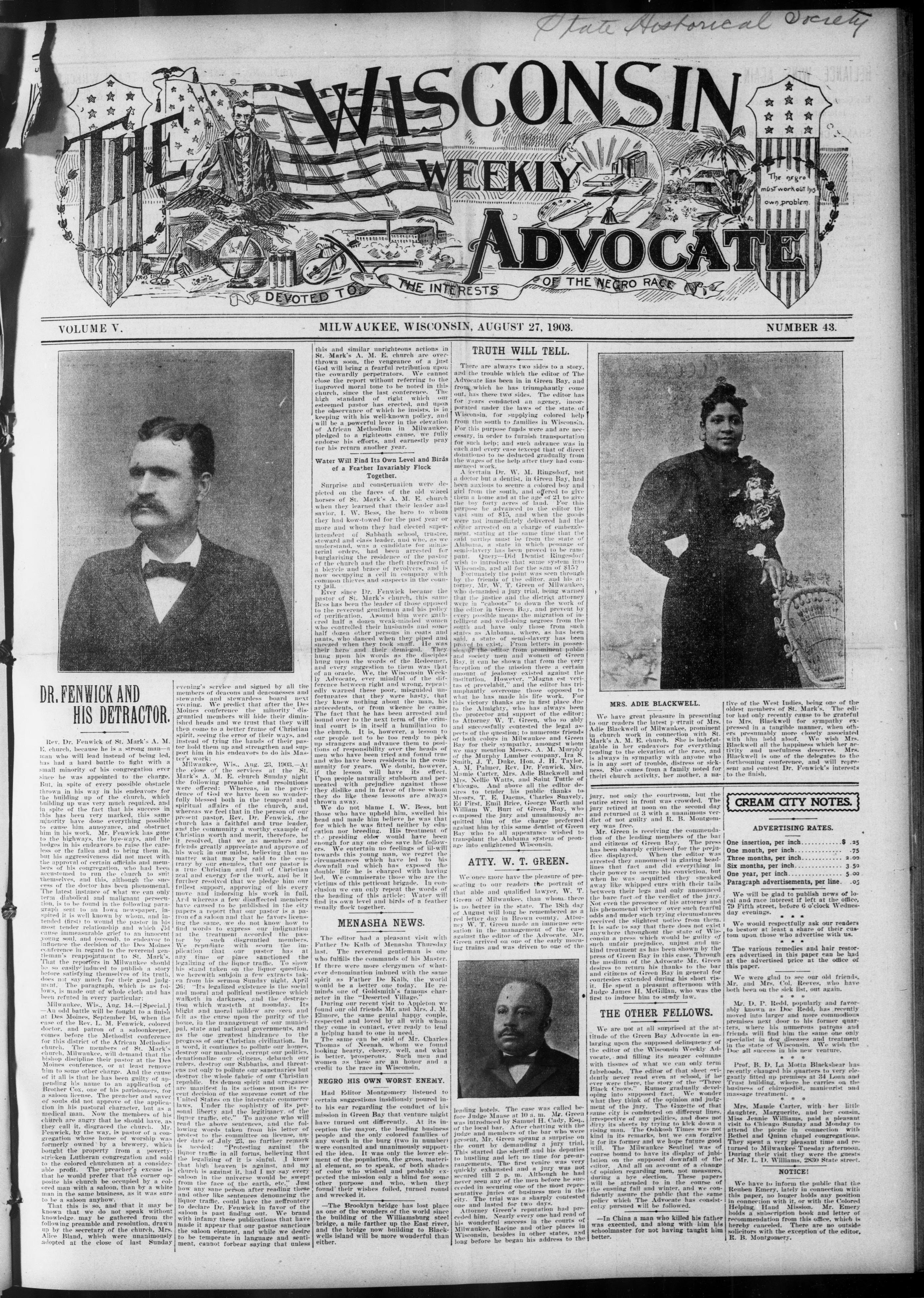
WISCONSIN
WEEKLY
ADVOCATE
DEVOTED TO THE INTERESTS OF THE NEGRO RACE
[Name not visible in the image]
VOLUME V.
[Name]
DR. FENWICK AND HIS DETRACTOR.
Rev. Dr. Fenwick of St. Mark's A. M. E. church, because he is a strong man—a man who will lead instead of being led, has had a hard battle to fight with a small minority of his congregation ever since he was appointed to the charge. But, in spite of every possible obstacle thrown in his way in his endeavors for the building up of the church, which building up was very much required, and in spite of the fact that his success in this has been very marked, this same minority have done everything possible to cause him annoyance, and obstruct him in his work. Mr. Fenwick has gone to the highways, the bye-ways, and the hedges in his endeavors to raise the careless or the fallen and to bring them in, but his aggressiveness did not meet with the approval of certain officials and members of his congregation, who had been accustomed to run the church to suit themselves, and this, although the success of the doctor has been phenomenal. The latest instance of what we can only term diabolical and malignant persecution, is to be found in the following paragraph sent to an Iowa newspaper, inspired it is well known by whom, and intended (first) to wound the pastor in his most tender relationship and which Id cause immeasurable grief to an innocent young soul, and (second), to endeavor to influence the decision of the Des Moines conference in regard to the reverend gentleman's reappointment to St. Mark's. That the reporters in Milwaukee should be so easily induced to publish a story before satisfying themselves of its truth, does not say much for their good judgment. The paragraph, which is as follows, is made out of whole cloth and has been refuted in every particular:
Milwaukee, Wis., Aug. 14.—[Special.]
An odd battle will be fought to a finish at Des Moines, September 16, when the case of the Rev. L. M. Fenwick, colored doctor, and patron of a saloonkeeper, comes before the Methodist conference for this district of the African Methodist church. The members of St. Mark's church, Milwaukee, will demand that the bishop discipline their pastor at the Des Moines conference, or at least remove him to some other charge. And the cause of it all is that he has been guilty of appending his name to an application of Brother Cox, one of his parishioners, for a saloon license. The preacher and saver of souls did not approve of the application in his pastoral character, but as a medical man. Now the members of his church are angry that he should have, as they call it, disgraced the church. Mr. Fenwick, by the way, is pastor of a congregation whose house of worship was formerly owned by a brewery, which bought the property from a poverty-stricken Lutheran congregation and sold to the colored churchmen at a considerable profit. The preacher's excuse is that he would prefer that the corner opposite his church be occupied by a colored man with a saloon, than by a white man in the same business, as it was sure to be a saloon anyhow.
That this is so, and that it may be known that we do not speak without knowledge, may be gathered from the following preamble and resolution, drawn up by the secretary of the church, Mrs. Alice Bland, which were unanimously adopted at the close of last Sunday
evening's service and signed by all the members of deacons and deaconesses and stewards and stewardess board next evening. We predict that after the DesMoines conference the minority 'disgruntled members will hide their diminished heads and we trust that they will then come to a better frame of Christian spirit, seeing the error of their ways, and instead of tying the hands of their pastor hold them up and strengthen and support him in his endeavors to do his Master's work:
Milwaukee, Wis., Aug. 23, 1903.—At the close of the services at the St. Mark's A. M. E. church Sunday night the following preamble and resolutions were offered: Whereas, in the providence of God we have been so wonderfully blessed both in the temporal and spiritual affairs of the church, and, whereas we feel that in the person of our present pastor, Rev. Dr. Fenwick, the church has a faithful and true leader, and the community a worthy example of Christian worth and merit, therefore, be it resolved, that we as members and friends greatly appreciate and approve of his work in our midst, believing that no matter what may be said to the contrary by our enemies, that our pastor is a true Christian and full of Christian zeal and energy for the work, and be it further resolved that we pledge him our fullest support, approving of his every move and indorsing his work in full. And whereas a few disaffected members have caused to be published in the city papers a report that our pastor is a patron of a saloon and that he favors licensing the same, we do not know how to find words to express our indignation at the treatment accorded the pastor by such disgruntled members. We repudiate with scorn the implication that our pastor has at any time or place sanctioned the legalizing of the liquor traffic. To show his stand taken on the liquor question, we herewith subjoin a few extracts taken from his sermon Sunday night, April 26: "Its legalized existence is the social and moral and political pestilence which walketh in darkness, and the destruction which wasteth at noonday. Its blight and moral mildew are seen and felt as the curse upon the purity of the home, in the management of our municipal, state and national governments, and as the one greatest hindrance to the progress of our Christian civilization. In a word, it continues to pollute our homes, destroy our manhood, corrupt our politics, denationalize our citizens, debauch our rulers, destroy our Sabbaths, and threatens not only to pollute our sanctuaries but destroy the whole fabric of our Christian republic. Its demon spirit and arrogance are manifest in its actions upon its recent decision of the supreme court of the United States on the interstate commerce laws. Under the sophistry of its personal liberty and the legitimacy, of the liquor traffic, etc." To anyone who will read the above sentences, and the following words taken from his letter of protest to the committee on license, under date of July 23, no further remark is needed: "Protesting against the liquor traffic in all forms, believing that the legalizing of it is sinful. I know that high heaven is against, and my church is against it, had I my say every saloon in the universe would be swept from the face of the earth, etc." Just how any sane person after reading these and other like sentences denouncing the liquor traffic, could have the aeffrontery to declare Dr. Fenwick in favor of the saloon is past finding out. We brand with infamy these publications that have made it appear that our pastor sanctions the saloon element, and while we desire to be temperate in language and sentiment, cannot forbear saying that unless
this and similar unrighteous actions in St. Mark's A. M. E. church are overthrown soon, the vengeance of a just God will bring a fearful retribution upon the cowardly perpetrators. We cannot close the report without referring to the improved moral tone to be noted in this church, since the last conference. The high standard of right which our esteemed pastor has erected, and upon the observance of which he insists, is in keeping with his well-known policy, and will be a powerful lever in the elevation of African Methodism in Milwaukee, pledged to a righteous cause, we fully endorse his efforts, and earnestly pray for his return another year.
Water Will Find Its Own Level and Birds of a Feather Invariably Flock Together.
Surprise and consternation were depicted on the faces of the old wheel horses of St. Mark's A. M. E. church when they learned that their leader and savior, I. W. Bess, the hero to whom they had kow-towed for the past year or more and whom they had elected superintendent of Sabbath school, trustee, steward and class leader, and who, as we understand, was a candidate for ministerial orders, had been arrested for burglarizing the residence of the pastor of the church and the theft therefrom of a bicycle and brace of revolvers, and is now occupying a cell in company with common thieves and suspects in the country jail.
Ever since Dr. Fenwick became the pastor of St. Mark's church, this same Bess has been the leader of those opposed to the reverend gentleman and his policy of purification. Around him were gathered half a dozen weak-minded women who controlled their husbands and some half dozen other persons in coats and pants, who danced when they piped and sneezed when they took snuff. He was their hero and their demi-god. They hung upon his words as the disciples hung upon the words of the Redeemer, and every suggestion to them was that of an oracle. We, the Wisconsin Weekly Advocate, ever mindful of the difference between right and wrong, repeatedly warned these poor, misguided unfortunates that they were hasty, that they knew nothing about the man, his antecedents, or from whence he came. The fact that he has been arrested and bound over to the next term of the criminal court is in itself a humiliation to the church. It is, however, a lesson to our people not to be too ready to pick up strangers and advance them to positions of responsibility over the heads of men who have been tried and found true and who have been residents in the community for years. We doubt, however, if the lesson will have its effect. Upon people naturally stubborn and permeated with prejudice against those they dislike and in favor of those whom they do like these lessons are always thrown away.
We do not blame I. W. Bess, but those who have upheld him, swelled his head and made him believe he was that for which he was fitted neither by education nor breeding. His treatment of the presiding elder would have been enough for any one else save his followers. We entertain no feelings of iil-will towards this young man, we regret the circumstances which have led to his downfall and which has exposed the double life he is charged with having led. We commiserate those who are the victims of this petticoat brigade. In conclusion we can only repeat the words of the heading of this article: Water will find its own level and birds of a feather usually flock together.
MENASHA NEWS.
The editor had a pleasant visit with Father De Kalb of Menasha Thursday last. The reverend gentleman is one who fulfills the commands of his Master. If there were more clergymen of whatever denomination imbued with the same spirit as Father De Kalb, the world would be a better one today. He reminds one of Goldsmith's fainous character in the "Deserted Village."
During our recent visit to Appleton we found our old friends Mr. and Mrs. J. M. Elmore, the same genial happy couple, respected and loved by all with whom they come in contact, ever ready to lend a helping hand to one in need.
The same can be said of Mr. Charles Thomas of Neenah, whom we found looking hearty, cheery, well, and what is better, prosperous. Such men and women as these are an honor and a credit to the race in Wisconsin.
NEGRO HIS OWN WORST ENEMY.
Had Editor Montgomery listened to certain suggestions insidiously poured into his ear regarding the conduct of his mission in Green Bay that venture might have turned out differently. At its inception the mayor, the leading business people and the only colored families of any worth in the burg (two in number) were consulted and unanimously supported the idea. It was only the lower element of the population, the gross, material element, so to speak, of both shades of color who wished and probably expected the mission only a blind for some other purpose and who, when they found their wishes foiled, turned round and wrecked it.
The Brooklyn bridge has lost place as one of the wonders of the world since the building of the Williamsburg steel bridge, a mile farther up the East river, and the bridge now building to Blackwells island will be more wonderful than either.
TRUTH WILL TELL.
There are always two sides to a story, and the trouble which the editor of The Advocate lias been in in Green Bay, and from which he has triumphantly come out, has these two sides. The editor has for years conducted an agency, incorporated under the laws of the state of Wisconsin, for supplying colored help from the south to families in Wisconsin. For this purpose funds were and are necessary, in order to furnish transportation for such help; and such advance was in each and every case (except that of direct donations) to be deducted gradually from the wages of the help after they had commenced work.
A certain Dr. W. M. Ringsdorf, not a doctor but a dentist, in Green Bay, had been anxious to secure a colored boy and girl from the south, and offered to give them a home and at the age of 21 to give the boy forty acres of land. For this purpose he advanced to the editor the vast sum of $15, and when the goods were not immediately delivered had the editor arrested on a charge of embzezlement, stating at the same time that the said parties must be from the state of Alabama, a state in which peonage or semi-slavery has been proved to be rampant. Query—Did Dentist Ringsdorf wish to introduce that same system into Wisconsin, and all for the sum of $15?
Fortunately the point was seen through by the friends of the editor, and his attorney, Mr. W. T. Green of Milwaukee, who demanded a jury trial, being warned that the justice and the district attorney were in "cahoots" to down the work of the editor in Green Bay, and prevent by every possible means the migration of intelligent and well-doing negroes from the south and have only those from such states as Alabama, where, as has been said, a state of semi-slavery has been proved to exist. From letters in possession of the editor from prominent public and society men and women of Green Bay, it can be shown that from the very inception of the mission there a certain amount of jealousy existed against the institution. However, "Magna est veritas et prevelabit," and the editor has triumphantly overcome those opposed to what he has made his life work. For this victory thanks are in first place due to the Almighty, who has always been the protector and support of the editor; to Attorney W. T. Green, who so ably and successfully contested the legal aspects of the question; to numerous friends of both colors in Milwaukee and Green Bay for their sympathy, amongst whom we may mention Messrs. A. M. Murphy of the Murphy Lumber company, Ira S. Smith, J. T. Duke, Hon. J. H. Taylor, A. M. Palmer, Rev. Dr. Fenwick, Mrs. Mamie Carter, Mrs. Adie Blackwell and Mrs. Nellie Watts, and Saint Tuttle of Chicago. And above all the editor desires to tender his public thanks to Messrs. T. E. Daems, Charles Snavely, Ed First, Emil Brice, George Worth and William W. Burt of Green Bay, who composed the jury and unanimously acquitted him of the charge preferred against him by this same dentist of Green Bay who to all appearance wished to transplant the Alabama system of peonage into enlightened Wisconsin.
ATTY. W. T. GREEN.
We once more have the pleasure of presenting to our readers the portrait of that able and qualified lawyer, W. T. Green of Milwaukee, than whom there is no better in the state. The 18th day of August will long be remembered as a red letter day in Brown county. Attorney W. T. Green made an immense sensation in the management of the case against the editor of the Advocate. Mr. Green arrived on one of the early morning trains and was driven to one of the
[Picture of a man in a suit with a bow tie].
leading hotels. The case was called before Judge Maase at 10 a. m. Mr. Green was introduced by Samuel H. Cady, Esq., of the local bar. After chatting with the judge and members of the bar who were present, Mr. Green sprang a surprise on the court by demanding a jury trial. This started the sheriff and his deputies to hustling and left no time for pre-arrangements. The first venire was very quickly exhausted and a jury was not secured till 2 p. m. Although he had never seen any of the men before he succeeded in securing one of the most representative juries of business men in the city. The trial was a sharply contested one and lasted for two days.
one and lasted for 10 years. Attorney Green's reputation had preceded him. Nearly every one had read of his wonderful success in the courts of Milwaukee, Racine and other places in Wisconsin, besides in other states, and long before he began his address to the
(222)
MRS. ADIE BLACKWELL.
We have great pleasure in presenting to our readers the latest portrait of Mrs. Adie Blackwell of Milwaukee, prominent in church work in connection with St. Mark's A. M. E. church. She is indefatigable in her endeavors for everything tending to the elevation of the race, and is always in sympathy with anyone who is in any sort of trouble, distress or sickness. She comes from a family noted for their church activity, her mother, a na-
jury, not only the courtroom, but the entire street in front was crowded. The jury retired at noon on the second day and returned at 3 with a unanimous verdict of not guilty and R. B. Montgomery was free.
Mr. Green is receiving the commendation of the leading members of the bar and citizens of Green Bay. The press has been sharply criticised for the prejudice displayed. When the editor was arrested they announced in glaring headlines that fact and did everything in their power to secure his conviction, but when he was acquitted they sneaked away like whipped curs with their tails between their legs and only announced the bare fact of the verdict of the jury. Not even the presence of his attorney and his phenomenal victory over such fearful odds and under such trying circumstances received the slightest notice from them. It is safe to say that there does not exist anywhere throughout the state of Wisconsin a press which would be guilty of such unfair prejudice, unjust and unkind treatment as has been shown by the press of Green Bay in this case. Through the medium of the Advocate Mr. Green desires to return his thanks to the bar and citizens of Green Bay in general for courtesies extended during his short visit. He spent a pleasant afternoon with Judge James H. McGillan, who was the first to induce him to study law.
THE OTHER FELLOWS.
We are not at all surprised at the attitude of the Green Bay Advocate in enlarging upon the supposed delinquency of the editor of the Wisconsin Weekly Advocate, and filling its meager columns with tissues of what we can only term falsehoods. The editor of that sheet evidently never read even at school, if he ever were there, the story of the "Three Black Crows." Rumor gradually developing into supposed fact. We wonder what they think of the opinion and judgment of the jury. The Gazette of that same city is conducted on different lines, irrespective of any politics, and does not dirty its sheets by trying to kick down a rising man. The Oshkosh Times was not kind in its remarks, but we can forgive it for its former and we hope future good will. The Milwaukee Sentinel was of course bound to have its display of jubilation on the supposed downfall of the editor. And all on account of a change of opinion regarding men, not measures, during a bye election. These papers will be attended to in the course of the ensuing fall and winter, and we confidently assure the public that the same policy which The Advocate has consistency pursued will be followed.
-In China a man who killed his father was executed, and along with him his schoolmaster for not having taught him better.
NUMBER 43.
THE WOMEN'S HERITAGE
tive of the West Indies, being one of the oldest members of St. Mark's. The editor had only recently cause to be grateful to Mrs. Blackwell for sympathy expressed in a tangible manner, when others presumably more closely associated with him held aloof. We wish Mrs. Blackwell all the happiness which her activity and usefulness deserves. Mrs. Blackwell is one of the delegates to the forthcoming conference, and will represent and contest Dr. Fenwick's interests to the finish.
CREAM CITY NOTES.
ADVERTISING RATES.
One insertion, per inch..... $ .25
One month, per inch..... 75
Three months, per inch..... 2.00
Six months, per inch..... 3.50
One year, per inch..... 5.00
Paragraph advertisements, per line..... 0.05
We will be glad to publish news of local and race interest if left at the office, 79 Fifth street, before 6 o'clock Wednesday evenings.
We would respectfully ask our readers to bestow at least a share of their custom upon those who advertise with us.
The various remedies and hair restorers advertised in this paper can be had at the advertised price at the office of this paper.
We were glad to see our old friends, Mr. and Mrs. Col. Reeves, who have both been on the sick list, out again.
Mr. D. P. Redd, popularly and favorably known as Doc Redd, has recently moved into larger and more commodious premises next door to his former quarters, where his numerous patrons and friends will find him the same one only specialist in dog diseases and treatment in the state of Wisconsin. We wish the Doc all success in his new venture.
Prof. B. D. La Motta Blackshear has recently changed his quarters to very elegantly fitted up premises at 34 Loan and Trust building, where he carries on the business of chiropodist, manicurist and massage treatment.
Mrs. Mamie Carter, with her little daughter, Marguerite, and her cousin, Miss Jennie Williams, paid a pleasant visit to Chicago Sunday and Monday to attend the picnic in connection with Bethel and Quinn chapel congregations. They spent a very pleasant time and returned to Milwaukee Tuesday afternoon. During their visit they were the guests of Mr. L. D. Williams, 2830 State street.
NOTICE!
We have to inform the public that the Reuben Emery, lately in connection with this paper, no longer holds any position in connection with it, or with the Colored Helping Hand Mission. Mr. Emery holds a subscription book and letter of recommendation from this office, which is hereby canceled. There are no outside solicitors with the exception of the editor, R. B. Montgomery.
RELIANCE WINS AGAIN.
Has Close Call in Second Race of International Series.
SHAMROCK'S POOR START.
OFFICIAL TIME OF RACE.
Start.
Reliance ..... 11:00:36
Shamrock ..... 11:02:00
First Turn.
Reliance ..... 12:21:00
Shamrock ..... 12:23:30
Second Mark.
Reliance ..... 1:17
Shamrock ..... 1:21
Finish.
Reliance ..... 2:15:30
Shamrock ..... 2:20:10
Elapsed Time.
Reliance 3:14:54
Shamrock 3:18:10
Deducting handicap of 1:57 the Reliance's margin of victory is 1 minute 19 seconds.
New York, Aug. 22.—On the fifty-second anniversary of the winning of the Queen's cup by the America, the Shamrock III., Sir Thomas Lipton's third candidate for the international trophy now known as the America's cup, was defeated by the Reliance, time allowance excluded from the reckoning, by 8 minutes 59 seconds. With the time allowance the Reliance won by 7 minutes and 2 seconds.
Start—Shamrock, 11:45:17; Reliance, 11:45:21.
Finish—Reliance, 3:17:45; Shamrock, 3:26:40.
New York, Aug. 25.—The Reliance won the second race of the international cup series by one minute and nineteen seconds, official time. This figures in the time allowance of the Shamrock of one minute and fifty-seven seconds.
An hour and a quarter before the time set for the start the sky, although partly cloudy, gave no indications of any disagreeable weather during the day. The wind, which had been about south, southeast, during the early morning, hauled a bit to the southward, blowing a point or two east of south. It still continued, however, about a 7-knot gait and these conditions seemed to prevail over a wide stretch of water, so that there was at this time every prospect that the race would not only be started on time, but that the boats would be able to cover the course within the time limit of five and a half hours.
Both Yachts at Start.
Soon after 10 o'clock both yachts had arrived at the lightship and cast off their tows. Nearly an hour remained before the starting gun was to be fired and the yachts sailed back and forth about the lightship which the committee did not reach till sometime later. When Shamrock dropped her tow she immediately struck out her jib and holding away from the lightship on the port tack, sent up her topsail. The crew worked smartly and inside of ten minutes all the large sails were placed. The topsail of Reliance while inside the hook proved somewhat smaller than the weather conditions warranted and Capt. Barr, finding the sea smooth and the wind comparatively light, decided to change for a still larger one. The tug therefore kept her head up into the wind while the sail was sent down and the bigger one substituted. This work consumed about fifteen minutes.
Triangular Course.
At 10:25 the signal was hoisted for a triangular course, the regatta committee tug Navigator coming to anchor about half a mile to the westward of the lightship. At 10:30 the course signals were hoisted. Five minutes after the regatta committee had set the signal for a triangular race the three sets of flags were broken out on the triatic stay, denoting the direction of the three legs. As read from shore the first leg was south, giving the boats a beat down the Jersey shore. The next was northeast by east one-half east which under the conditions of the wind prevailing at the time, would give the yachts a broad reach from the first to the second mark on the starboard tack. The next leg was northwest by west to the finish at the lightship and a broad reach on the part tack.
Reliance Follows Shamrock
The preliminary signal was fired at 10:45 and immediately after the fight for position began. As usual Reliance followed Shamrock in her various maneuvers about the line, neither boat going very far away from the starting point. When the warning signal was fired at 10:55 the Shamrock was close to the committee boat. She immediately headed along the line on the starboard tack and Reliance, coming down from the windward, attempted to blanket her.
Start Was Very Poor.
Four minutes before the start the skipper of the Irish boat started for the lightship and rounded it to port. Capt. Barr outgeneraled his rival, Capt. Wringe, at the outset. He sent the Reliance across the starting line 1 minute and 24 seconds ahead of Shamrock III. More than that, the American boat was a full quarter of a mile to the windward of the British boat. The start of today's race accordingly lacked all of the thrilling features which made the beginning of Saturday's contest a sight long to be remembered. A few minutes before the starting gun was fired Shamrock III. seemed to go away awry. For a moment it appeared that something had gone wrong aboard. She overran the committee boat at the leeward end of the line, and when the starting signal was fired the Lipton boat was away to leeward of the line and the handicap gun boomed as the cup hunter bore down across the line and got away.
Shamrock Handled in Poor Manner.
Experts say it was amateurish. At all events the American was off under decidedly encouraging conditions.
The official time of the start was: Reliance, 11:00:36; Shamrock III., 11:02:00. The wind at this time was puffy from the south, southeast and had not exceeded four miles. It hauled around more to southeast and half an hour later had freshened to six knots.
The excursion fleet was hardly as large as on Saturday, but the spectacle was impressive. The patrol fleet succeeded, except for a brief interval, in giving the yachts wide sea room. Between the first two guns, as the boats were running along to the leeward of the line, a tank steamer interfered somewhat with the movements of the racers.
Reliance Begins to Gain.
On getting nearer the shore the breeze seemed to be a trifle stronger and Reliance began to gain. At 11:40 she had pulled out until she was from three-eighths to one-half mile ahead of Shamrock, being a quarter of a mile to the windward and the same distance out ahead of the challenger. The boats sailed very slowly, scarcely more than four or five miles an hour.
At 11:42:30, Reliance being about three miles off Seabright, tacked to starboard, having held the port tack for
forty minutes. Shamrock held on until she got well to weather of the Reliance's wake, when she also tacked. At 11:45 both boats were heading off shore on the starboard tack, Reliance in the lead, but the Shamrock pointing fully as high. The wind began to shift to west of south and it looked as though the boats would be able to turn the first mark without another tack.
Race Becomes Exciting.
This tack proved to be fully as long as the first one and the race was developing into an exciting contest. Neither boat seemed to be able to secure any decided advantage, although the Reliance was leading. Shamrock held the windward position.
At 12:21:00 Reliance went about on the port tack and headed in shore. Shamrock followed at 12:23:30. At this time the weather was thick and it was difficult to discern the yachts in the haze.
At 12:10 Reliance felt the shift of wind and Capt. Barr made out the turning mark through the haze. He bore away at once, but Shamrock had cut down her lead greatly through the favorable shift of wind. Nearing the mark rapidly the jib topsail was taken in by the bowsprit men on Reliance.
Turn First Buoy.
At 12:20 Shamrock's crew lowered their jib topsail and ran up the balloon jib in stops. Reliance made the mark very quickly and bore around it with a rush at 12:21:00 (unofficial). Sheets were eased to port for the reach to the second corner of the triangle. For some reason that could not be learned the balloon jib was not broken out immediately after turning. There was no unnecessary delay in breaking out the ballooner on Shamrock and she gained perceptibly. The English yacht was timed as turning at 12:23:30 (unofficial). The jibs and forestay sails on both yachts were lowered and the ballooners had been broken out. Balloon forestay sails were broken out to take their places, but a few minutes afterwards the wind took another sharp shift to the west of south, so that the racers were enabled to carry spinakers for a short time on the second leg.
Wind Works Back to South.
At 12:55 the wind had worked back into the south and sheets had to be trimmed well aft to hold the course for the second mark. The wind appeared to have dropped on this leg, but the racers made fairly fast time in covering the stretch of ten miles. Reliance gained considerably on the reach. She gybed prettily around the mark at 1:17 ((nuo-official), the balloon jib was set, but Reliance found she could not carry this sail, so it was hastily taken in.
Shamrock Gains on Run Home.
Shamrock gained in the run home for the finish line, but she was the rear boat and as the wind was off shore she gained by pointing higher and clearer. The wind shifted during the race from southeast to almost due west.
COLORED PICNICKERS ENGAGE IN A RIOT.
Train Load of Negroes Stone Marshal When He Endeavors to Arrest One of Them.
Chicago, Ill., Aug. 25.—The attempt of a colored woman to pick flowers on the lawn in front of the residence of Mrs. Robert Burton, a wealthy resident of Batavia, led to a riot, in which the sheriff of Kane county, a force of deputies, the mayor of Batavia, his police force, and a body of 1000 townspeople were arrayed against a trainload of negro picnickers from Chicago.
The negro woman, who afterwards gave her name as Fannie Shelby, was taken from the car under the rifles of the sheriff's deputies. With her was arrested a negro, who said he was Harry Bell. Bell and the Shelby woman are said to have entered Mrs. Burton's yard. Mrs. Burton said that she was insulted and struck. She retreated at once into the house and telephoned for Marshal Kelly. When he appeared with his aides he was confronted by a crowd of negroes, who, by all accounts, stoned him viciously. One stone knocked him unconscious, The negroes then retreated to the picnic grounds. The woman wanted was found on a step of the excursion train, crowded behind Bell and another man. She was arrested, as was Bell, and any attempt to rescue the prisoners was checked by the show of firearms.
TWO WOMEN FALL DOWN STEEP GLACIER.
Tourists Climbing Huge Mass of Ice Are Precipitated Upon Rocks Far Below—Neither Killed.
Idaho Springs, Colo., Aug. 25.—Two young women met with a painful accident on the Yankee hill glacier, near Alice, Colo., which nearly cost them their lives. The glacier is one of the summer attractions here. Miss Mills of Iowa, a tourist, and Miss Champion of this city were climbing the huge mass of ice and snow when Miss Mills lost her footing. She caught her companion and together they were precipitated down the steep side of the glacier 300 feet upon the rocks below. Miss Mills' left leg was broken and both were terribly bruised. They were seen by campers, who took them to a near-by hotel and called a physician.
INSURED FOR $510,000.
Life Policies for More Than Half a Million Dollars Held by Late R. H. Foerderer.
Philadelphia, Pa., Aug. 25.—Insurance companies will be obliged to pay to the estate of Robert H. Foerderer more than $500,000.
The largest amount held by any one company is $200,000, for which Representative Foerderer was insured in the Equitable Life of New York. The other policies are thus divided: New York Life, $100,000; Provident Life and Trust, $50,000; Massachusetts Mutual Life, $50,000; New England Mutual Life, $35,000; Berkshire Life, $35,000; Washington Life, $30,000; Pennsylvania Mutual Life, $10,000, making a total of $510,000.
Military Forces Feel Confident of Defeating the Fleet in the Mimic War. Portland, Me., Aug. 25.—When the bugles sounded in the various camps on Cape Elizabeth and other points around Portland harbor this morning, the army of defense which is to protect this city from any enemy's fleet considered itself prepared for any move which the hostile commander might make.
FRENCH STEAMER LOST.
It Is Feared Fifty-seven Persons Perished in Destruction of the Admiral Gueydon Bound for Colombo. Marseilles, Aug. 25.—The French steamer Admiral Gueydon, which sailed July 15 for Colombo, has not since been reported and has been given up for lost. There were 57 persons on board.
CALLS A GREAT ARMY.
Turkish Government Puts All Its Reserve Forces In Field.
Sofia, Bulgaria, Aug. 26.—A private telegram from Dubnizta says a number or Bulgarian officers leading a band of 150 insurgents recently forced their way past the Turkish post at Feka and now occupy an unassailable position. Rumors are current here of serious massacres at Vasiliko and Kiok-Killisseh. Ten persons are said to have been killed. Details and confirmation are lacking.
Constantinople, Aug. 26.—The government has decided to call to the colors all the remaining European reserves belonging to the Second and Third Army corps and a number of other reserves, which will bring the total of the Turkish soldiers in Macedonia up to 350 battalions, or almost double the force utilized in the Turkish-Greek war. The enrollment of such large bodies of troops indicates the scruciousness with which Turkey views the situation and her determination to use all the means at her disposal to repress the rebellion. Ibrahim Pasha, the new commander of the troops, is a young and capable officer. Seven battalions have been dispatched to Florina from Monastir.
The valis of Monastir and Salonic telegraph that they are now able to guarantee the maintenance of order in their respective towns.
Utmost Limits of Barbarism.
London, Aug. 26.—According to a Sofia telegram to The Times, the Turkish repressive measures in Macedonia have reached the utmost limits of barbarism and it is said it is the intention to accomplish by degrees the total extirpation of the Bulgarian population.
Within the last few days, says The Times correspondent, twelve more Christian villages have been handed over to fire and sword and the women, children and the aged have been massacred indiscriminately. Convoys of prisoners despatched to Monastir have been murdered by their escorts on the way.
May Murder Consuls.
A private letter from a foreign resident in Monastir says even the local Turks are disgusted and meditate assassinating the consuls in order to provoke European intervention. The insurgents are doubtless taking a terrible revenge and are executing the revolutionary programme to the letter.
The reported concentration of large Turkish forces in the Adrianople district at Mustaph, Kisylagach and other points on the Bulgarian frontier is regarded with much apprehension in Sofia as it is well known that in case of war, an invasion would occur from this direction.
Gloomy View Taken.
In the special dispatches from the nearest points, published this morning, a gloomy view is taken of the crisis in the Balkans. According to reports from Constantinople a rumor was current that war had already been declared against Bulgaria. It was proved to be unfounded, but the state of popular feeling is said to be such that no other issue is regarded as possible.
Russian Fleet at Hand.
It is further stated that although the Russian squadron was withdrawn from Inidia it continues to cruise near the Bosphorus.
It is reported that several Italians have been murdered by Turks at Ismid, a seaport in Asia Minor, fifty-three miles southeast of Constantinople.
From Belgrade it is announced that a big mass meeting of Macedonians, intended to be held August 23, has been postponed to August 30 by order of the government, on account of Turkish protests.
Christians Won't Pay Taxes
It is also stated from Monastir that the revolutionary committees are appealing to the Christian population to refuse to pay taxes and that their appeal is meeting with much success. The insurgents in the Debr district are said to be destroying the villages and murdering their inhabitants.
Turkey Takes Powers' Advice.
In taking more energetic measures of the suppression of the revolution Turkey is acting in accordance with the advice of the powers. The forthcoming conference of King Edward with Emperor Francis Joseph and King George of Greece, at Vienna, and the visits of the Czar and Emperor William to Vienna and of the Czar and Foreign Minister Lamsdorff to Rome, will enable the monarchs to thoroughly discuss Balkan affairs, and before the conclusion of the* conferences Turkey proposes so far as possible to restore order, so that international action will be unnecessary. An official of the Turkish embassy here said to a representative of The Associated Press today:
"The calling out of additional troops by Turkey is due solely to the decision to suppress the insurrection at once."
Soldiers Refuse to Serve
London, Aug. 26.—According to a dispatch from Belgrade many of the soldiers belonging to the reserves called out by Turkey are refusing to join the colors as the troops in the field have not received any pay for months.
WILL WED POLISH PRINCESS
Chicagoan Goes to Claim Bride Whom He Loved at First Sight.
Chicago, Ill., Aug. 26.—With a Polish princess as a bride, Louis Van Norman expects to return to Chicago in the fall, notwithstanding previous governmental objections. He will sail from New York on Friday for Europe and travel direct to Cracow, where he is to marry the Princess Donia Kratnowski. Van Norman met the Princess Donia in 1893 in New York city, where her family had found temporary shelter after being exiled from home. It was a case of love at first sight on both sides. The young woman is said to have a great reputation as a pianist. She is described as being slight in build and of striking beauty. Van Norman is a traveler and writer and editor of The Chautauquan.
NARROW ESCAPE UNDER TRAIN
Boy's Life Saved Though Engine and Tender Pass Over Him.
Crystal Falls, Mich., Aug. 26.—[Special.]—An exceedingly close call from death is reported from Iron River. Gilbert Williams is driver of a delivery wagon. His horse was frightened by the approach of a train and in running away threw its driver onto the track directly in front of the locomotive. He had landed between two ties that had not been ballasted full. The train was stopped after the engine, tender and mail car had passed over the lad. Aside from the broken leg Williams had only sustained a slight fracture of the skull and severe bruises and it is expected that a few weeks will find him at his work again.
MR. ROOT RESIGNS.
The President Accepts and Appoints Gen. Wm. E. Taft to Succeed Him.
Oyster Bay, L. L., Aug. 25.—Secretary Root, under date of August 19, presented his resignation formally to the President. The resignation was accepted by the President with the understanding that Mr. Root continue as secretary of war at least until January.
Gov. Gen. William E. Taft of the Philippines will succeed Secretary Root as secretary of war.
President's Statement.
President Roosevelt today authorized the following statement:
"The President some months ago tendered the secretaryship of war to Judge Taft and at that time it was arranged that he would succeed Secretary Root. Secretary Root will go out of office some time in January and Judge Taft will assume the duties of the office shortly afterwards. The President also authorized the publication of the correspondence between him and Secretary Root concerning the latter's resignation. In full, the correspondence follows:
Dear Mr. President: You have been good to asseat to the sufficiency of the reasons for which I have wished to retire to private life as soon as practicable after the establishment of the general staff of the army and the completion of my full four years of service as secretary of war. While you will probably not arrange to fill the office as you wish before the end of the year and that I am to remain in office in the meantime. It is probable that you will be ready to send a name to the Senate in November or December and before you do so my resignation should be in your hands. I find myself on the eve of sailing for England to attend the sessions of the Alaska boundary tribunal; quite unable to judge how many months I shall be kept away from this country, and I therefore now tender my resignation of the office of secretary of war to take effect upon the appointment and qualification of my successor. I shall carry with me unabated loyalty to your administration, confidence in the sound conservatism and patriotic unselfishness of your policy and enduring gratitude for the kindness and consideration with which your friendship has honored me. I shall not cease to appreciate the sympathy and loyalty to President McKinley with which you took and carried on his work—and I shall always be happy to have been a part of the administration directed by your sincere and rugged adherence to right and devotion to the true interests of the country.
I am, with great respect and esteem always faithfully yours.
The President's Letter
Oyster Bay, L. L., Aug. 25.—Hon. Ellhu Root, Secretary of War, Washington, D. C.
My Dear Mr. Root—it is hard indeed for me to accept your resignation; and I do so not only with keen personal regret, but with a lively understanding of the gap your withdrawal will create in public life. My sense of personal loss is very great; and yet my sense of the loss to the nation as a whole is even greater. You have been over four years secretary of war. I wonder, if you, yourself realize how much you have accomplished during that period. If you will turn to your first reports and will read therein the recommendations you made in order that the army might be put on an effective basis, you cannot but be pleased with the way in which these recommendations have now been adopted by Congress as well as by the administration, and have become enacted into law or crystallized into custom. We have never had a public servant of the government who has worked harder than you have worked during these four years and a half, and this not merely in point of time, but above all in point of intensity, and your success has been equal to your labor. The only reward you have had, or can have, is the knowledge of successful achievement, of the performance in fullest fashion of a great public duty the doing of which was of vital importance to the nation's welfare.
Success in Philippines.
Your duties have included more than merely the administration of the department, and the reorganization of the army on an effective basis. You have also been the head of a department which dealt with the vast and delicate problems involved in our possession of the Phillipine Islands and your success in dealing with this part of your work has been a signal as your success in dealing with the purely military problems. To very few statesmen, in any country, is it given at one and the same time to achieve signal and striking triumphs in the administration and reform of the military branch of the government and in the administration of what was in effect a department of insular dependencies, where the problems were new to our people and were in themselves of great difficulty.
More, aside from your work in these two divisions of the government service, I appreciate most keenly the invaluable advice and assistance you have rendered me in innumerable matters of weight not coming directly in your departmental province, but in which I sought your aid with the certainty of not being disappointed. Your position on the Alaskan boundary commission at the present moment is an illustration of the services.
May all good fortune attend you wherever you are; the American people wish you well and appreciate to the full the debt due you for all that you have done on their behalf. Fraternally yours.
THEODORO ROOSEVELT.
Gov.-Gen. William E. Taft of the Philippine islands has been appointed by President Roosevelt as secretary of war to succeed Mr. Root, who has formally resigned and whose resignation has been accepted.
NEW WEAPON OF HOLDUP MAN.
Footpad Squirts Vaporized Chloral Into Face of Intended Victim.
St. Louis, Mo., Aug. 25.—A scientific application of vaporized chloral shot through a syringe into the victim's face was the climax of a long series of street robberies. This improved method of highway robbery was applied on the street, the victim being Owen Morgan, a railroad telegraph operator. Morgan was waiting for a car when a well dressed stranger walked up and without a word of warning thrust the syringe close to Morgan's face, and shot the heavy gas toward his nostrils. Morgan became dizzy, but the sense of self-preservation made him start to run from the stranger. He staggered and fell unconscious. Policemen approached, and the robber fled. At the city dispensary it was said that Morgan was suffering from chlorine gas, which benumbs the senses completely in a short time.
A Deceived Editor.
It may be onbecoming in us to look a gift horse in the mouth, but we have been bilked and we are sore. We received an invite to the Lyceum, down to Memphis, to attend the opery called "Cavallerria Rush-the-Can-o," and we turnt our shirt and split the wind and was there. There was nothing but singin'—not a can of beer endurin' of the whole performance. It must 'a' ben what the French call a Jew de Motts.—Hardeman Free Press.
Algebra as an Anarchy Breeder
A young peasant in a village in the Russian province of Minsk, who was trying to educate himself, was arrested for being in possession of a book on algebra. The justice of the peace before whom he was brought acquitted him of the charge of conspiracy made against him by the police, but warned him not to buy books which tended to make an Anarchist and infidel of him.
There are more wrecks in the Baltic sea than in any other place in the world. The average is one wreck a day throughout the year.
PORTLAND IS SAFE.
City Able to Keep Off the Attacking Fleet in the Great War Game.
Portland, Me., Aug. 26.—Through dense smoke and the tumult of continuous firing of cannon, the battleships Kearsarge, Illinois and Alabama entered this port early today, having stormed the main entrance to the harbor in connection with the great war game which is going on this week in this vicinity. From midnight, when the scouts of the hostile fleet were discovered by the pickets of the army on shore, until daylight, when the battleships came up the channel. Portland was treated to an experience very much like real war. Where the victory, if any, is not apparent to shore observers.
Approach at Midnight.
The night was a sleepless one, not only for all actually engaged in the maneuvers but for many in the city. It was near midnight when the searchlights of the forts disclosed two torpedo boat destroyers in the outer harbor. Firing began at once and then ceased. An hour later the presence of a battleship was revealed by the searchlights and the forts opened fire on her. This vessel returned the fire, and after that the cannonading became general. A cutter and launch containing landing parties were captured and at 2:25 a. m. all the outer forts were engaged in action with the three big vessels, which afterwards were recognized as the Illinois, Kearsarge and Alabama. While two torpedo boat destroyers and other small crafts had been detailed to the duty of threatening the various passages of the harbor, the movement against the main channel had been reserved for the little ships. For more than an hour the big vessels stood off the main entrance to the harbor.
Battleships Advance.
At 4 o'clock they began the advance. With the Kearsarge leading and the Illinois and Alabama immediately behind, each belching broadsides at the forts, they sailed slowly towards the city. Forts William, Preble and Levett poured uninterrupted fire toward the ships. In turn each ship seemed to concentrate fire on one fort after another until the vessels had reached the inner harbor. As the ships crept on the forts, the firing ceased slowly and by 7 o'clock the echo of guns on the eastern side of the bay, where a minor engagement was going on was all that could be heard.
The battleships then maneuvered for a time and then they went back towards the outer harbor, where they began cruising about among the islands. Early in the forenoon the scene of action shifted to the passage into Hussey's Sound, between Peaks and Long Island. From this vicinity great clouds of smoke were arising and the roar of many guns was heard and the Olympia leading a fleet against Fort McKinley. As at the main entrance, they came in slowly, the Olympia was closely followed by the Baltimore.
Action Suddenly Ceases.
There were four other vessels in this fleet, the principal one being the training ship Newport. The others were the converted yacht Vixen and the torpedo-boat destroyers Worden and Stewart. For a time the firing was as violent as that marking the passage of the battleships. Then the action ceased suddenly.
Victory for Army.
Division Headquarters, Fort Levett, Cushings Island, Aug. 26.—The army under the command of Col. S. M. Mills, it is believed, gained a victory over a portion of the fleet commanded by Admiral Barker in an engagement which lasted for three hours this morning. This forenoon it was learned that a concentrated attempt of the attacking fleet to make a landing during the night had been unsuccessful.
THREE MEN KILLED IN MILL EXPLOSION.
Second Time Within Month That Carthage (Mo.) Plant Has Been Wrecked.
Carthage, Mo., Aug. 26.—An explosion at the works of the Independent Powder company, four miles southwest of Carthage on Center creek, early today, wrecked the mixing room, killing three persons and injuring three others, one fatally.
Dead:
ROLLA, W. O., superintendent.
PEARMAN, ERNEST.
HAWORTH, JERRY, all of Carthage.
Thirty other workmen escaped injury.
Today's explosion is the second to occur at the Independent company's works within a month. The mill had just been rebuilt and the making of dynamite for blasting in the lead and zinc mines of this territory resumed. When the explosion occurred Supt. Rolla, Pearson and Haworth were all in the mixing room, which is secluded from all other mill buildings behind a hill.
Supt. Roll's legs were blown off below the knees and the bodies of Pearman and Haworth were shattered. Supt. Roll is a well known manufacturer of powder, having been connected with Indiana mills for fifteen years before coming here two years ago.
JUDGE KNOCKS THE GOVERNOR DOWN
Supreme Court Justice Pushes Executive of Arkansas Off Speaking Stand.
Little Rock, Ark., Aug. 26.—Judge Carroll L. Wood of the Arkansas supreme court, who is opposing Gov. Davis as candidate for a third term, knocked Gov. Davis off a speaking stand four feet to the ground, during the campaign at Bismarck yesterday. Gov. Davis was not hurt and friends prevented further trouble. Judge Wood was immediately arrested on a charge of assault and battery. Questions asked by the governor angered Wood.
EXPECTS EARTHQUAKES ALL OVER THE WORLD.
Scientist Says Great Eruptions Will Come Before the End of the Month. Naples, Aug. 26.—Prof. Krull of Munich predicts a great eruption and earthquakes all over the world before the month ends. Vesuvius is again active and the authorities have given warnings to people living near the mountain that a violent eruption is probable soon.
SEVEN SAILORS DROWN.
Schooner Is Capsized On South Norwalk, Conn., and Seven Lives Are Lost.
South Norwalk, Conn., Aug. 26.—The schooner Will C. Newton of Bangor Me., capsized off Norwalk light during the storm last night and the crew, believed to number seven men, were drowned. One body has been recovered.
Kansas City, Mo., Aug. 26.—A Special to The Star from Sedalia says: "Missouri, Kansas & Texas passenger train No. 3, which left St. Louis at midnight for Texas, crashed into a freight train that was taking a siding at Rhinelands early today. The caboose was reduced to kindling wood and the passenger engine and the platforms of the two forward coaches were damaged. None of the passengers were injured. Fred Daniels, fireman of the passenger train, was killed and J. M. Birch, the passenger engineer, and Sam White, a tramp, were seriously hurt.
CLOUDBURST LOSS IS HALF A MILLION.
Frankfort, Kan., Aug. 26.—The damage to farms in Nemah and Marshal counties by yesterday's cloudburst is greater than at first estimated, and is now placed at $500,000. Great quantities of grain were swept away, while many farmers lost all their cattle and hogs, according to reports today. Business at Frankfort is at a standstill. Dozens of bridges are washed away.
AMERICAN LAD IS "SHANGHAIED." New York Lad Is Stolen by French Sailors and Carried Away in Vessel.
New York, Aug. 26.—Begging that he be taken off the ship and returned to his home, a small boy was "shanghaied" on the French bark Marechal De Gontant, which sailed today for Yokohama. The police received a message to the effect that an American boy was being "shanghaied" on board the French steamer. Help was at once sought from the revenue cutter and the police boat, but before anything could be done the French vessel was out past Sandy Hook.
The Marechal De Gontant had been anchored for several days off Stapleton, Staten Island. Today some men on board a water boat went out to the vessel. As they reached the ship they saw the lad climb overboard, crying out, "For God's sake, take me ashore." Several French sailors carried the boy back and took him below. A few minutes more the ship started to sea.
LYNCH MOB LEADER IS FOUND GUILTY.
Must Go to Prison for Leading Rioters at Danville, Ill.—Others Will Be Convicted.
Danville, Ill., Aug. 26.—One member of the mob which terrorized the town of Danville on the night of July 25, lynched one negro, and then attacked the Danville jail only to be routed by Sheriff Whitlock and deputies, who fired when necessary, has been convicted. The other indicted rioters are terror stricken at the realization of the fact that such convictions are possible and are almost certain to be made as fast as the courts can take up the cases. The convicted man was one of the leaders of the mob, Winfield Baker, and came from Kentucky and posed as a "bad man." He must now serve an indeterminate sentence in the penitentiary. The charge brought against him was assault with intent to kill Sheriff Whitlock and of rioting.
HUNDREDS DROWNED.
Awful Loss of Life in the Great Floods at Che Foo, China—Town Almost Washed Away.
Victoria, B. C., Aug. 26.—According to mail advices from Shanghai, several hundred lives were lost in the great floods at Che Foo, briefly reported by cable. After a thunder storm with heavy rain, a cloudburst occurred and torrents of water poured down on the town, rushing seaward and carrying houses, buildings, trees and people before it. Stores and warehouses were flooded by the sudden flood and the property loss will reach millions. The water swept with such force as to sweep 400 tons of coal into the sea. The beach was strewn with wreckage and dead and presented an awful sight. Over 300 Chinese were known to be dead at Che Foo alone. No foreigners are known to have been drowned, but a sailor from the U. S. S. New Orleans had a narrow escape.
SHIP IS BURNING IN NEW YORK HARBOR.
Amsterdam Is in Flames and Is Beached on Jersey Flats—Firemen Are Overcome.
New York, Aug. 26.—The ship Amsterdam caught fire at pier 12, East river. The ship was hauled out of her slip by several tugs and is being towed to the Jersey flats to be beached.
The fireboat New Yorker is alongside. Three firemen were taken to hospitals overcome by smoke.
The loss on the cargo is estimated at $100,000.
GEN. WRIGHT TO BE PHILIPPINE GOVERNOR.
Will Succeed Judge Taft When He Becomes the Secretary of War.
Oyster Bay, N. Y., Aug. 26.—Gen. Luke E. Wright, vice governor of the Philippine Islands, will succeed Judge William H. Taft as governor general of the islands when he becomes secretary of war, January 1, 1904. Gen. Wright is a Gold Democrat.
PROF. CHEEVER AT WAUKEGAN
Supt. Taylor of Kenosha, Also, Is at Teachers' Institute.
Waukegan, Ill., Aug. 26.—[Special.]—About 200 present or prospective teachers of Illinois and Wisconsin are attending the Lake County Teachers' institute here. Prof. W. H. Cheever of Milwaukee is one of the instructors. Supt. Taylor of the Kenosha county, Wis., school spoke on school work in Kenosha.
YOUNG MINER CAUGHT IN CAVE-IN.
Polish Workman Killed in Mine at Ironwood.
Ironwood, Mich. Aug. 26.—[Special.]—A Polish miner, named Joseph Schulz, was caught in a cave-in of a shaft of the Aurora mine yesterday and instantly killed. He was 21 years old and unmarried.
Your lips, dear girl, were roses,
Your hair was ripened wheat,
The brook forgot his song to hear
The music of your feet.
Your hands were swift white butterflies,
Your eyes were wells of blue,
Oh, what a riot in my heart
Was wrought by June and you!
And now for years beneath the grass
Your heedless hands have lain,
And recollection wakes in me
A hurt that scarce is pain.
Asleep with Nature, breast to breast,
How peacefully you lie!
Above your heart the care-free flowers,
And over them—the sky.
Boston Transcript.
USH, children! There's your father coming!"
Mr. Jobson fell, metaphorically speaking, like a wet blanket on the bosom of his family. They all trembled as he came in. Charley dropped the "Robinson Crusoe" that he was reading, and deftly substituted an arithmetic in its place. Juliet sewed harder than ever at her patchwork. Mrs. Jobson made haste to fling another log upon the fire, and the old grandmother in the corner drew her knit woolen shawl closer around her shoulders with a little shudder.
"Dear me!" said Mr. Jobson; "dear me! It's just as I said. There's another cold wave coming from the northwest, and coal is two shillings a ton higher. Goodnes knows what's to become of us all."
Presently he looked around inquiringly.
"Eh? How? What's that I smell? Chickens? Actually chickens roasting! Where's the cold pork that was left from yesterday's dinner?"
"I thought," said Mrs. Jobson apologetically, "that as we had so many young chickens coming on——"
"Every one of those chickens," said Mr. Jobson, speaking slowly and counting off the syllables on his fingers, "will be as good as a crown piece when the holidays come on. Poultry is going up—up—up, as steadily as a rocket, and here you are roasting it for an everyday dinner. I never saw such an extravagant manager as you are, Jane. Hereafter I shall count the fowls, and if one is taken away, I shall take means to know the reason why. And those in this house who are too dainty to eat cold pork may live on bread and cheese."
Mrs. Jobson murmured something about "trying to do what seemed right always," and a gloomy silence fell over the whole group.
"There's the wing of the old kitchen," said he. "I've put Naomi Brush out of it this morning."
Mrs. Jobson looked up in surprise.
"Put Naomi Brush out?" she repeated; "and what is the poor soul going to do?"
"That's her lookout," said Mr. Jobson; "she has preyed long enough on me and mine. I've got an offer of a crown a month from Tom Diggs for the old room. And I may as well say, now, that I don't at all approve of the way you women have been going on about old Naomi. I never could teach you the necessity for being economical. How am I ever to pay Jones the two hundred pounds that I owe him, if this is the way we are to go on? How——" But here the old grandmother spoke out in a mild tone. "Not by being economical at the expense of other people, Calvin," said she gently.
"God has said, 'Give, and it shall be given unto you.' He has not said, 'Scrape and pinch, and grind the faces of the poor, and you will get rich.' Naomi Brush is solitary and friendless, and when you turned her from the scle shelter she has, you did a cruel and ungenerous thing."
And, taking up her knitting, the good old woman went quietly out of the room.
The children all stared.
Mrs. Jobson looked apprehensively at her husband, and Mr. Jobson himself turned all manner of colors.
"That settles the matter," said Mr. Jobson hoarsely to himself, as he walked out of the house with his hands in his pockets. "It isn't every son-in-law who would have borne the burden of a helpless old woman as cheerfully as I have done. But when Mrs. Price undertakes to dictate to me, she assumes a little too much. I'll tell Jane, this afternoon, that she must find some other home for her mother. I suppose she'll cry and make a great fuss over it, but I can't help that. Grandmother must go. I don't at all doubt that it's she who has been putting Jane up to all this senseless extravagance in the matter of charity.
In his intent self-absorption he almost stumbled over a portly little man in a fur-trimmed overcoat, who had ben coming in his direction with a resolute step.
"Oh, it's you, is it, Squire Jones?" said he obsequiously.
"Yes, it's me," said the squire, recovering his equilibrium with some difficulty. "I was just coming to see you, Jobson, about that little note of yours. I think I told you last week that I wanted the money. And I wish you to understand that I must have it, or I shall find myself compelled to foreclose on the mortgage."
"Isn't this rather sudden?" said he faintly.
The squire shrugged his shoulders.
"What would you have?" said he.
"The money is overdue, and there's a
Amateur
Photography
Masking Negatives.—Very effective results can be obtained by masking negatives so that a narrow white line appears around the border. To do this it is necessary to have some masks cut to definite sizes, but as very many are often required to suit the necessary size of picture required it is a somewhat troublesome business to cut out so many of them. A very simple plan is to make two right angles of some opaque material, such as the backing of roll film. If these two right angles are made sufficiently long and wide, they can be utilized for very many various sizes, say, from half-plate downward. The method is to place them over the film side of the negative, so as to inclose the requisite amount of view, and then to temporarily tack the two pieces together with stamp edging. The sensitive paper is then carefully adjusted over all, and the printing proceeded with.—Ex.
considerable amount of interest still unpaid. To tell you the truth, Jobson, I don't like this way of doing business, and I want my money one week from to-day." Mr. Jobson tore his hair.
"Two hundred pounds," he cried. "And in a week. Why, who ever heard of anything so cruel?"
"Cruel!" echoed the squire. Is it cruel of a business man to want his own back again? You should have thought of that before you borrowed it."
And the squire walked on.
Mr. Jobson kept his weary way, racking his brains to conjure up some escape out of the dilemma. Two hundred pounds! And in a week! How was the thing to be done?
By the side of a miserable old shanty by the road there was assembled a little knot of women. They whispered and glanced at him as he passed. He stopped mechanically.
"What's the matter?" said he. "It's old Naomi Brush," said they. "She's dead. "Dead, is she?" said Mr. Jobson curtly. "She ought to have died half a dozen years ago." When he came some in the clear winter twilight, he had fully resolved to cut down all unnecessary expenses. Grandmother must go.
"If there's no other place for her," he reasoned, "there are plenty of 'Homes for Aged and Indigent Women,' where I dare say we could get her in. Her influence over Jane isn't good. She teaches her to give to every tramp and beggar that comes along. Grandmother must go!" But, as he came in, Mrs. Jobson met him at the door.
"Oh, Calvin," she cried breathlessly, "what do you think has happened? Old Naomi Brush, poor soul, is dead. She died suddenly of that heart difficulty which has been hanging over her so long!"
"Humph!" said Mr. Jobson. "And what is all that to me, I'd like to know?"
"More than you think," said Mrs. Jobson eagerly. "They found two hundred pounds, Calvin—yes, two hundred pounds—hidden away in a bag of rags which had formed her pillow for more years than anybody could remember. And there was a scrap of a will in her dress pocket, which Lawyer Hyde says is perfectly legal and correct—and every penny of it is left to—whom do you suppose? Why, to grandmother. To grandmother, who was so good to her for so many years."
"Yes," said the old lady mildly. "And I am going to give it to you, Calvin, to help you out with that debt to Squire Jones. Money is of no use to me, except as it may be of aid to my daughter and her husband—and in the country which I am nearing so fast, one of old Naomi Brush's prayers will be of more value to me than all the gold which was ever minted."
"Grandmother," said Calvin Jobson, with a suffocating lump in his throat, "I don't deserve this. No, I don't! I'm a mean, grasping, avaricious—"
"Hush, my son," said the old lady, "hush! We all have our failings. But we are none of us too old to learn better.
So the nightmare of a debt was paid—and grandmother still sits by the Jobson fireside. And Calvin is a wiser and a better man for the lesson he has had.—Hearthstone.
PROFIT FROM NICKELS.
It Has Made This Man Several Times a Millionaire.
The goddess Success does not confine her habitation to Wall street, to the giant trusts, to gold mining, to the cattle ranches of the west, or to the newly discovered oil fields of Texas. She may be found and wooed and won in every walk of life, and always stands ready to reward industry, integrity and ability. To win her
F. W. WOOLWORTH.
A. B.
golden favors it is not necessary to deal in railroads or to erect and combine giant manufacturing plants. She has smiled as encouragingly on the man dealing in five and ten cent articles as on the men who build locomotives for the trans-Siberian railroad. Fifty-one years ago there was born on a farm at Rodman, Jefferson County, a boy baby. The baby grew to manhood with no better prospects than
has each of a thousand and one farmer's boys. At 21 he went to Watertown, the nearest town of importance, and secured a clerkship in a store. For a month he worked for nothing. For the next three months he received $3.50 per week. Then for six months he worked for $4 a week. At the end of six years he was receiving $10 a week and had married. He seemed to be at the top of the only ladder in sight.
But he made up his mind there were other and higher ladders in the great outside world. From his employer he secured on credit a stock of goods to the amount of $350 and came to Utica, N. Y. Here he opened the first strictly five-cent store. Only a partial success followed. He removed to Lancaster, Pa., secured a store 14x35 feet and did his best. Success followed in a modest way. He opened a branch store in Harrisburg, Pa., 12 feet by 20 in dimensions; then another at York. He made a point of paying back his first loan as quickly as possible, saving every cent possible and buying and selling for cash. From this insignificant beginning the business has branched out until to-day the farmer's boy, Frank W. Woolworth, conducts 74 five and ten-cent stores in various parts of the country, sells goods to the amount of $10,000,000 a year, is worth several millions in the clear, and has just been elected President of the Guardian Trust Company, of New York. His advice to young men is:
"Live well within your means; save at least one-fourth your income, no matter how small; never run in debt; select that business which will be a pleasure to you."-Utica (N. Y.) Globe.
OYSTER SHELL "CULM HEAP."
Great Banks Find Ready Sale for Several Purposes.
The average citizen may not know that oysters are planted, cultivated and harvested like any other crops says the Philadelphia North Americans a person who engages in the industry being known as an oyster planter. Thousands of acres of oysters are under cultivation in Hampton Roads which, during the harvesting season, is often literally alive with the reaping machines of the oystermen.
When the oysters are from one and a half to two years old they are usually large enough to be sold, and, as a rule, part of them are sold at this age and the rest in the third or fourth year, after which time the ground is allowed to rest a year before being planted again. Great care must be exercised in the selection of bottoms for oyster planting, if the planter would be financially successful.
The largest packer in Hampton opens from 100,000 to 200,000 bushels of oysters in a year. In this house, as the men open the oysters, they drop the shells on an inclined plane, from which they slide into a trough and are carried along by scrapers attached to an endless chain called a "shell conveyor," which takes them without further labor to the shell pile in the yard. When a shucker has filled his gallon measure he carries it to the strainer, where the oysters are strained and measured. They are then emptied into large casks kept full of fresh water, by means of which any loose shell or grit is washed out. From these casks the oysters are dipped into a second strainer, and when separated from the water are again measured and packed.
The shells are sold for from 1 to 3 cents a bushel, and are used extensively by oyster planters for the propagation of oysters. They are placed in small piles on grounds found suitable for the purpose, where the spat or small oyster will attach itself to the shells. They are also used for making shell lime and for building the excellent shell roads found in some parts of the Virginia penisula.
Uncle Beuben Says:
Now an' den I h'ar a man declarin' dat life am a failure, or axin' if life am wuth de libin'. In sich cases I allus figger dat he's found he can't borry any mo' money, or dat his father-in-law has axed him to go out an' airn his own board.
Fact and Fancy
"He says he caught a mammoth catfish the other day that seemed to be just a big head and no tail."
"I'll bet if you were to investigate you'd find it was just a big tale."—Philadelphia Press.
The Lord would have a mighty poor opinion of Himself if He answered some prayers that are sent up.
NO POLISH BISHOP.
Rome, Aug. 26.—Rev. Wenceslaus Kruszka, rector of St. Wenceslaus church, Ripon, Wis., and deputy of the Catholic Polish congress of the United States, and Rowland B. Mahany, general counsel for that body, have been in Rome for some time past trying to obtain the appointment of a Polish bishop in the United States, not for any special diocese, but having jurisdiction over all American-Polish Catholics. Their proposal has been received coldly both by the vatican and the congregation of the propaganda and is not likely to be accepted, being opposed to the spirit of ecclesiastic hierarch as is established in the United States and also against the rules of the council of Baltimore.
Opens an Old Controversy.
New York, Aug. 26.—Documents have been received here from William J. D. Croke, private chamberlain to Pope Pius X., relating to the endeavors that are being made to secure for the Polish population in the United States a representation of their nationality in the American hierarchy. This action opens again the controversy which caused so much friction in 1900 concerning the Italian, Slovak, Lithuanian and Bohemian representation.
Chamberlain Croke says the presence in Rome of Rev. Wenceslaus Kruszka, rector of St. Wenceslaus, Ripon, Wis., deputy of the Catholic Polish congress of the United States, is to obtain for the Catholic Poles this representation. The applicants, it is stated, urge the appointment of Polish bishops, though they would be satisfied for the time with vicars-general.
Will Be Taken Up by Pope.
"Out of fourteen cardinals concerned these deputies have seen eleven," says the communication, "and they have been welcomed and gratified with substantial agreement in each case and the matter will immediately be taken up by the new Pope."
UNITED WORKMEN HOLD THEIR ANNUAL PICNIC.
UNITED WORKMEN HOLD THEIR ANNUAL PICNIC.
An Interstate Association Is Formed— Next Gathering Is to Be Held in Minnesota.
New Richmond, Wis., Aug. 26.—[Special.]—Although the weather was very much against it, the fourteenth annual convention and picnic of the Northern Wisconsin Association of the Ancient Order of United Workmen was a great success. When the special trains left Duluth and West Superior there was a heavy downpour of rain. The programme of parades, drills, speeches, etc., was carried out. At the business meeting the name of the association was changed to the Interstate Association of the Ancient Order of United Workmen, in order to take into its jurisdiction lodges of the order in Minnesota. The next picnic and convention will be held in Minneapolis. New officers elected were: President, William J. Hathaway, New Richmond; vice president, John Barron, Eau Claire; secretary, M. H. McDevitt, Minneapolis; treasurer, G. J. Briggs, Superior.
HEBREWS WANT THEIR OWN COUNTRY.
Chicago Jews Beg Zionists Not to Aband don Palestine Project Until All Efforts Are Exhausted.
Chicago, Ill., Aug. 26.—The following cable message was sent to Leon Zolotkoff, delegate to the International Congress of Zionists at Basil, Switzerland, last night:
Urge congress to leave African proposition to executive committee. Zion not to be abandoned until all efforts exhausted.
BERNARD HORWICH,
For Chicago Zionists.
The action was a result of a meeting of 300 leaders in the local Zionist movement. It is believed that the message voices the sentiment of a majority of the orthodox Jews of this city.
"If we abandon the Palestine colonization project, Zionism is dead," declared Bernard Horwich.
"All our efforts have been directed towards re-establishing the Jewish nation in Zion. East Africa may be a desirable place for colonization, but it is not our country."
MAN IS SHOT DOWN BY A JEALOUS WOMAN.
MAN IS SHOT DOWN BY A JEALOUS WOMAN.
She Held His Wife and Child at Bay Until His Return and Then Wounded Him.
Seattle, Wash., Aug. 26.—Frank Tangenbaugh, a floorwalker in the employ of Frederick & Nelson, was shot and fatally wounded in his own lodgings shortly after midnight this morning by Mrs. H. E. Finley, a stenographer. The shooting took place in the presence of Tangenbaugh's wife and 6-year-old child, who claim to have been menaced by a revolver in the hands of Mrs. Finley for twenty minutes before her husband appeared on the scene. Tangenbaugh had barely entered the room before Mrs. Finley levelled her revolver at him and fired two shots. It is not believed he can survive. Jealousy is believed to be at the bottom of the affair.
"RED" PERIL FOUND.
Federal Government Warns Vermont Against Anarchist Paper Published at Barre.
Montpelier, Vt., Aug. 26.—The state department at Washington has informed Gov. John G. McCullough of Vermont that there is a revolutionary Anarchist paper being published at Barre, Vt. The notification carries with it the obvious suggestion that the Vermont officials are expected to take steps immediately to see that the publication is kept within bounds or stopped entirely This action is along the lines established by the administration to drive anarchism from the United States. The paper is called the Cronaca Sovversvia, purporting to be published by F. M. Ariani for the "Circola Studi Sociali" of that town.
WALKING DELEGATE SENT TO SING SING.
Sam Parks, New York Labor Leader, Must Serve a Term in Prison.
New York, Aug. 26.—Sam Parks, business agent for the Housesmiths and Bridgemen's union, was sentenced today to not less than two years and six months, nor more than three years and six months, in Sing Sing on a charge of extortion.
DIES FROM RAT'S BITE.
ASSEMBLYMAN D. G. WILLIAMS OF CAMBRIA PASSES AWAY.
Blood-Poisoning Sets in as the Result of a Slight Injury and Causes His Death.
Portage, Wis., Aug. 26.—[Special.]—Assemblyman David G. Williams died at Cambria at 2:15 this afternoon. About three weeks ago he was bitten by a rat and blood poisoning set in which resulted in his death. He was born in Denbig-
M. B.
shire, North Wales, in 1840. He was a member of the Thirty-second Wisconsin regiment during the Civil war. He had served as sheriff of Columbia county and had held other minor offices. He was elected to the Legislature from the Second district in 1902. He leaves a wife and three children.
WAS A TERRIFIC STORM.
Damage to Crops Reported at Plainfield Lightning at Wautoma and Fond du Lac.
Plainfield, Wis., Aug. 26.—[Special.]—A terrible thunder storm prevailed here last night and a soaking rain fell. Farmers feel greatly discouraged over the unfavorable conditions.
Wautoma, Wis., Aug. 26.—[Special.]—During the heavy electrical storm which visited this place lightning struck the large barn of Ferdinand Rohde. It was totally destroyed.
Fond du Lac, Wis., Aug. 26.—[Special.]—Lightning during the recent storm struck the steeple on the Friedens Kirche and splintered it.
Negaunee, Mich., Aug. 26.—[Special.]
The women, and not a few men of this city, have been terribly frightened during the past twenty-four houds. A terrible rainstorm, accompanied by fierce lightning and loud claps of thunder, has been raging. The house of William Buzzo was struck by lightning. George Buckingham was knocked senseless.
Lightning entered the home of Mrs. Edward Laughtin and broke a sewing machine into a thousand pieces, but did no other damage.
WAUPUN LIFER ESCAPES.
After Short Hunt the Man Is Captured
—The First Prison Delivery in
Warden Town's Reign.
Waupun, Wis., Aug. 26.—[Special.]—A convict serving a life sentence in the prison escaped this morning while the gang were loading a car in the "bull pen." He made direct for a cornfield about a mile distant, but was captured after a short hunt by Clerk Campbell and Deputy Warden Harvey. This is the first escape from the prison during Warden Town's term. The name of the prisoner who escaped is Mathew Bitson, who was sent up from Rock county for murder in the first degree.
RECORD HOLDERS COMING.
Some of the Fastest Automobiles in the World to Enter Competition at Wisconsin State Fair.
Madison, Wis., Aug. 26.—Some of the fastest automobiles in the world will be entered in the automobile race at the state fair in Milwaukee September 9. Secretary John M. True received a telegram from Fred Pattee stating that arrangements had been closed for the entry of Tom Cooper of the Cooper & Oldfield company, with the racers "Red Devil" and "999." These machines, wires Mr. Pattee, hold world's records, and will go after the $1000 prize offered by the managers of the Wisconsin state fair.
"BLIND PIG" IS RAIDED.
Mount Horeb Officers Arrest Two Charged with Selling Liquor Without Licenses—One Up Before.
Madison, Wis., Aug. 26.—[Special.]—A second raid on the Mount Horeb alleged "blind pig" resulted in the arrest of Herman Paetz and Louis Martin, who were before the municipal court today. Paetz was arrested on a charge of selling liquor without a license July 3, and it is alleged that after paying his fine, he resumed business. Both pleaded not guilty today and demanded jury trials. Their cases went over to September 8 and 9.
CHARGED WITH VIOLATING LAWS.
Arrest at Superior Because of Alleged Infraction of Insurance Statutes.
Superior, Wis., Aug. 26.—[Special.]—C.A. Jones of St. Paul was arrested here last night on the charge of violating the state laws in regard to the operation of home building loan propositions. He was immediately released on bail and went to St. Paul to consult attorneys. Mr. Jones claims that his plan is entirely legal under the Wisconsin laws.
PLANS A MONTHLY MAGAZINE.
Editor of Kilbourn Mirror-Gazette Will Publish Illustrated Periodical.
Portage, Wis., Aug. 26.—[Special.] James E. Jones, for many years editor of the Kilbourn Mirror-Gazette, contemplates the establishment of a monthly illustrated magazine. His plan is to deal with local history and current events in such a manner as to make the publication of interest to every family in the surrounding territory.
Dangers for Timid Diners
If one were to study the subject and rigidly avoid eating all things that are reputed to be bad for one's health in one way or another, it would probably be difficult to keep starvation at bay. The list of things which cannot be eaten with safety by those who have a tendency to appendicitis is a very long one. Sir Frederick Treves declares that one of the deadliest sweetmeats is preserved ginger; but pineapple, fresh or preserved, is almost equally risky, while oranges, figs, raspberries—in fact, all fruit with pips—are also very dangerous eating. To still further limit our dietary, there are a number of other things which may not be eaten by those who fear typhoid. The oyster scare has led to suspicion of all other shellfish, not only lobsters and crabs, but even the hitherto considered harmless though necessary shrimps and prawns.—St. James' Garette.
LATEST MARKET REPORTS.
MILWAUKEE, AUGUST 26, 1903.
EGG AND DAIRY MARKETS.
MILWAUKEE—Eggs—Market firm; strictly fresh laid, loss off, cases returned, 17c;
cases included, do, 17½c; at mark cases included, 15½@16½c; cases returned, 15@
15½c; seconds, 12c; dirties, 12c; checks, 13c.
There is a good local demand. The supply of fancy fresh eggs is very light. Receipts
were 462 cases.
Butter—Firm; creamery, extra, per lb, 19c; prints 19½c; firsts, 16@17c; seconds, 14@15c; dairy prints, 17c; fancy dairy, 16c; lines, 12@14c; packing stock, 12½@13c; whey, 10c. Receipts were 41,996 lbs.
Cheese—Easy. The demand continues good; American full cream, twins, 10½@11c; Young Americas, 11@11½c; daisies, 11@11½c; long horns, 11½@12c; low grades, 9@10c; limburger, per lb, old, No. 1, 10@10½c; low grades, 6@8c; new No. 1, 9@10c; off grades, 7@8c; fancy new brick, 9½@10c; low grades, 8@9c; imported Swiss, 25c; Block Swiss, domestic, 14@14½c; fancy loaf, 15½@16c; No. 2, 13@14c; Sapsago, 20c. Receipts were 7300 lbs.
FOND DU LAC—Offerings 475 twins and 322 daisies, with bids of 9½c for twins and 10½c for daisies, and no sales.
SEYMOUR—Sales of cheese were 619
double daisies at 10%c; 31 twins, 9½c; 83
twins, 9¾c; 35 withdrawn.
PLYMOUTH—Twenty-three factories offered 2442 boxes cheese, and all sold, as follows: 517 longhorns, 11c; 75 do, 11½c; 1000 dalsles, 10½c; 78 do, 10½c; 129 twins, 10c; 40 do, 9½c; 303 Americas, 11c; 290 do, 11½c; 10 do, 10½c.
UTICA, N. Y.-No change in cheese price of last week.
CHICAGO—Butter—Firm; creamerles, 14 @19c; dairles, 13@17c. Eggs—Firm; at mark, cases included, 14@16c. Cheese—Easler; dalsles, 10@10½c; twins, 7@9½c; Young Americas, 11@11½c. Poultry—Iced steady; turkeys, 11@12c; chicks (hens), 10@10½c; springs, 11½@12c.
MILWAUKEE LIVE STOCK MARKET.
HOGS—Recelpts, 6 cars; market lower; light, 130 to 175 lbs, 5.50@5.85; mixed, 180 to 250 lbs, 5.35@5.70; packers, 4.90@5.25; coarse heavy stags, 4.50@4.75.
CATTLE—Receipts, 4 cars; lower; calves steady; butchers' steers, medium to good, 1050 to 1300 lbs, 4.00@4.75; fair to medium, 950 to 1050 lbs, 3.40@3.85; heifers, common, 2.25@2.73; good, 3.25@4.00; cows, fair to good, 2.50@3.25; canners, 1.50@2.00; cutters, 2.25@2.40; bulls, common, 2.25@2.50; choice, 2.75@3.15; feeders, 800 to 950 lbs, 2.90@3.40; stockers, 500 to 750 lbs, 2.25@2.75; veal calves, common to choice, 4.50@7.00. Milkers, common, 18.00@25.00; choice, 30.00@45.00.
SHEEP—Receipts, 1 car; steady, 2.75@3.50; bucks, 2.50@3.00; lambs, 4.00@5.00. Chicago receipts: Hogs, 32,000; cattle, 27,000; sheep, 30,000.
MILWAUKEE HAY MARKET.
Timothy, lower; inside quotations are for new hay; carlots, choice timothy, 12.00@13.50; No. 1 timothy, 11.00@12.50; No. 2 timothy, 9.25@11.25; clover and clover mixed, 8.00@9.00.
Prairie hay steady; choice Kansas, 12.00@12.25; No. 1 Kausas, 11.50@11.75; No. 2, 8.50@9.00.
Straw steady; rye, 7.50@7.75; oats, 4.75@
5.00; wheat, 4.00@4.50; packing hay, 6.50@
6.75.
Wisconsin prairie, 6.50@7.50.
MARKETS BY TELEGRAPH.
MARKETS BY TELEGRAPH.
MILWAUKEE—Flour-Steady. Wheat
Firmer; No. 1 northern, new, on track, 86c;
No. 2 northern, new, on track, 85c. Corn-
Dull; No. 3 on track, 54c. Oats—Steady;
No. 2 white, on track, 37c; No. 3 white, on
track, 34½—36c. Barley—Firm, good
demand; No. 2 on track, 60c; sample on track,
46@00c. Rye—Dull; No. 1 on track, 54c.
Provisions—Lower; pork, 12.65; lard, 8.12.
Flour market steady; patents, 4.70@4.80;
bakers', 3.70@3.80; rye, 3.00@3.10.
Milstuffs are firm, quoted at 14.75@15.00
for bran, 17.25 for standard middlings and
19.50 for Milwaukee flour middlings in 10
lb sacks; red dog, 22.00. Delivered at coun-
try points, 60c extra.
CHICAGO—Close — Wheat — September,
80%@80%c, old, 80%c; December, 82%c;
old, 82%c; May, 84%@84%c. Corn—August,
50%c; September, 50%c; December, 51@
51%c; May, 51%@51%c. Oats—August,
34%@35%c; September, 34%@35%c; December,
36@36%c; May, 37%@38c. Pork—
September, 12.65; October, 12.85; May,
13.05. Lard—September, 8.02; October,
7.62%c; December, 7.00; January, 6.97%c
Ribs—September, 7.67%c; October, 7.77%c
January, 6.00; May, 6.75. Rye—September,
52c; December, 54@54%c; May, 55%c. Flax
cash N W., 1.01%c. S. W., 97%c; September,
97%c; October, 99c. Timothy—September,
3.12%c; October, 3.10. Clover—October,
9.00. Barley—Cash, 45@56c.
NEW YORK—Close — Wheat—September,
87%c; December, 87%c. Corn—September,
57%c; December, 57%c.
ST. LOUIIS—Close—Wheat—Higher; No. 2 red cash, elevator, 81c; September, 81½c; December, 85c; May, 88c; No. 2 hard, 79@80½c. Corn—Higher; No. 2 cash, 47c; September, 47c; December, 47½c; May, 48½c. Oats—Higher; No. 2 cash, 34c; September, 35½c; December, 35½c; May, 37½c; No. 2 white, 39c. Lead—Strong; 4.15. Spelter-5.70.
KANSAS CITY—Close—Wheat—September, 70½c; December, 71½c; cash No. 2 hard, 73½@74c; No. 3, 71½@72½c; No. 4, 65@68c; rejected, 63@66c; No. 2 red, 75½c; No. 3, 74@75c. Coin—September, 44½c; December, 43½@44c; cash No. 2 mixed, 45½c; No. 2 white, 45½c; No. 3, 45c. Oats—No. 2 white, 40c; May, 36@37c.
MINNEAPOLIS—Close—Wheat—September, 82c; December, 80½c; on track, No. 1 hard, 86@87½c; No. 1 northern, 85@86½c; No. 2 northern, 83@83½c; No. 3 northern, 87@90c.
DULUTH—Close—Wheat—In store, old, No. 1 hard and No. 1 northern, 87½¢; new, to arrive, No. 1 hard, 83½¢; No. 1 northern, 82½¢; No. 2 northern, 80½¢; new No. 1 northern, in store or to arrive in August, 84½¢; Macaroni—No. 1, 60¢; No. 2, 55¢; September, 82½¢; December, 80½¢; May, 83½¢. Flax—In store, on track, to arrive and September, 1.00; October, 1.00�%; November and December, 1.01; May, 1.05. Oats—To arrive and on track, 35¢. Rye—On track and to arrive, 51½¢; Barley, 35½¢; Receipts—Wheat, 7787. Shippments, none.
ST. LOUIS—Cattle—Receipts, 6000; market steady; beef steers, 3.70@5.50; stockers and feeders, 2.70@4.00; cows and helpers, 3.00@4.50; Texas steers, 2.00@4.00. Hogs—Receipts, 7500; market steady to 10c lower; plgs, 5.50@6.10; packers, 5.40@5.90; butchers and best heavy, 5.75@6.00. Sheep—Receipts, 5000; market steady; sheep, 3.00@3.50; lambs, 4.00@4.25.
KANSAS CITY—Cattle—Receipts, 10,000; market weak to 10c lower; beef steers, 4.00 @5.35; Texans, 2.10@3.70; cows and heifers, 1.75@4.85; stockers and feeders, 2.90@4.20. Hogs—Receipts, 9000; market steady to 15c lower; heavy, 5.60@5.75; packers, 5.60@5.89; yorkers, 5.85@5.90; plugs, 5.30@5.85. Sheep—Receipts, 3000; market steady to lower; sheep, 3.50@4.50; lambs, 3.00@4.50.
SOUTH OMAHA—Cattle—Receipts, 3300; market steady; beef steers, 4.00@5.40; cows and heifers, 3.00@4.10; western steers, 3.00 @4.25; Texas steers, 2.75@3.65; cows and heifers, 2.25@3.25; stockers and feeders, 2.50 @4.25. Hogs—Receipts, 11,000; market 15c lower; heavy, 5.20@5.50; plugs, 5.50@5.65. Sheep—Receipts, 2000; market steady; sheep, 2.00@3.40; lambs, 4.00@5.10.
Three-fourths of the great mass of manufactures which enter into international commerce are composed of iron and steel, copper and cotton, of which we are the world's largest producers, and for the manufacture of which we have facilities at least equal to those of any other country.
The Wisconsin Weekly Advocate
Telephone Black No. 244.
SUBSCRIPTION RATES
Any part of the United States and Canada, postage paid.
One Year ..... $2.00
Six Months ..... 1.25
Three Months ..... 7.75
Send money by Express Money Order, P. O.
Money Order or Registered Letter to the
Wisconsin Weekly Advocate.
ADVERTISING RATES.
One inch, single insertion.....25¢
One inch, per year.....$9.00
Business locals 5¢ per line each insertion.
Apply for rates to the Advocate.
TO CONTRIBUTORS:
All communications must be sent with the name and address of the sender as an evidence of good faith, but not necessarily for publication. No manuscript returned if not accepted, unless accompanied by stamps.
The Wisconsin Weekly Advocate company wishes to notify the public that all contracts and business transactions with this company must have the company stamp, otherwise they will be void. Neither will this company be responsible for paid subscriptions unless given to duly-accredited agents, who, on request, will give the company's receipt for sane. Subscribers failing to receive their papers regularly will kindly notify the general office. Address all business communications to the general manager, 79 Fifth street.
Entered in the Postoffice at Milwaukee as Second-class matter.
EDITORIAL PARAGRAPHS.
"I know of the bravery and character of the Negro soldier. He saved my life at Santiago, and I have had occasion to say so in many articles and speeches. The Rough Riders were in a bad position when the Ninth and Tenth cavalry came rushing up the hill carrying everything before them. The Negro soldier has the faculty of coming to the front when he is needed most. In the Civil war he came 400,000 strong, and I believe he saved the Union."—President Roosevelt.
The story that the state of Wisconsin is being Pasteurized at Chicago is one of the fictions of the hydrophobia scare.
The discovery of diamonds in Liberia may lead to changes in the map, as did the discovery of gold in the late South African republics.
It was only the model of the Langley airship that dived into the Potomac the other day. The real ship will soon have its test. Stand from under!
As a centenarian, Chicago can't deny the justness of the criticism that she is old enough to know better in relation to a good many things municipal.
"Jack" Glenister, the swimmer who wanted to navigate the Niagara rapids in his own skin, may thank the officials who prevented him from making the attempt.
Applied slugging is very profitable at $1000 a minute, but not every slugger can apply his art as did Jeffries when he received the flattering compensation referred to.
With hair clipping and face massaging done by electricity, there is room for hope that eventually a fellow can get shaved by electricity while he waits, instead of waiting for the other fellow.
There is no reason why graduates of the Pulitzer school of journalism should not be equally able with other bright young fellows to make a success in the profession—if they possess the qualifications for the work.
---
Lou Dillon did not beat the world's trotting record, held by Cresceus, and the great Toledo trotter will therefore continue to hold the speed ribbon. He would have remained king, just the same, had Lou beaten him, but he would have been a king tied to a queen's apron string.
Mr. Munroe of Butte, Montana, has succeeded in getting Champion Jeffries to give him an opportunity to experience either the chin or the solar-plexus knockout. This will enable Mr. Munroe to get almost as much advertising as did another Butte unknown, named Mary MacLane.
There is no need of worry over the fact that many Kickapoos and Shawnees are disposed to leave Oklahoma for Mexico. If under the law they can neither take nor sell their property, they can be looked for in the near future, from the direction of the Land of the Montezumas, from which they will make their way after they have had a little experience with the climate and its insects.
—The famous automobile, "Red Devil," with which Henry Fournier, the French automobilist, made the world's mile record, was caught between two cars on Broadway, at Twenty-eighth street, New York, and almost completely demolished.
ELK EXPRESS CO.
G. J. CHARLESTON, Mgr.
63 E. Sixth Street,
ST. PAUL, MINN.
Dixon's Place
Ladies' and Gents' Shining Parlör.
Cigars, Tobacco, all Negro Newspapers.
2638 State St., Chicago.
We keep for Sale: Wisconsin Advocate, Freeman, Conservator, New York Age, Atlanta Age, Northwestern Vine, Colored American, Cleveland Gazette, Dallas Express, Richmond Planet, True Reformer, Broad-Ax, Monitor, Detroit Informer, Christian Recorder, Voice of Missions, and all other Negro papers of the country.
RED CLOUD, CHIEF OF THE SIOUX, NEAR DEATH.
Mrs. SUSIE
KILLS CHIEF
Red Cloudy
daughter
RED CLOUD
The above portraits of Chief Red Cloud, his wife and daughter are from the latest photographs taken of this most interesting family. The career of Red Cloud has been a most notable one. He rose from obscurity to the command of all the Sioux nations, a position won by his personal bravery. As the most notable aborigine of this continent, the passing of Red Cloud should be considered an historic and epochal event.
AT SEA.
O. there's a roar of the storm torn sea. The hiss of foam, the spume to lea. The flying caps of the windy swell.
The flying caps of the windy swell.
And the watch's cry, "Eight bells, all's well."
Or the glassy glint of the sunlit calm.
The creaking slat of the sails that slam.
Now port, now st'bird, back again.
And you whistle for wind as she pitches then.
There's the gurgle for'ard in a sailing breeze.
The smoky froth in the wake she leaves.
With her wind'ard rigging stiff as steel
And the glint of copper above her keel.
That's mill pond sailing—a toy ship day.
With catspaw breezes that only play.
Only the breathing, sleepy swell.
And the watch's cry, "Eight bells, all's well."
Then the unenasy cry of a restless gull,
A bank of clouds and a creaking hull,
A murmuring noise in the hurrying air,
"Shorten mains'l, lively there"
"Reef your fors'l, tops'l stow!
In with your canvas afore the blow!
Extra lash your boats all 'round!
Hurry 'n batten yer hatches down!
"Aft there, at the wheel. How d'ye lead?"
"East-sou'east, sir." "How's the lead?"
"No bottom, sir." "Then keep her so."
"Belay all! For'ard there! Port watch below!"
Then the booming roar of the boarding sea.
The hissing spray that drives to lea—
The flying wrack of the howling gale—
The bending reach of the straining sail.
- El Comanche in Field and Stream
The Emperor's Decision.
"To be shot at dawn; those are your orders, sire!"
"Yes, general. There will be no reprieve," said Napoleon quietly with a frown and his chin on his breast.
A momentary gleam of satisfaction, nay, triumph, for an instant flashed across Gen. Lazelle's face. It did not escape the eagle eyes of Napoleon, which saw everything.
"A clear case of desertion?" queried Napoleon sharply.
"Yes, sire. He, a drummer in your own guards, was found hiding among the rocks near the Somossierra pass after yesterday's engagement."
"Found by whom, general?"
"By his own corporal. The prisoner admits running away."
"One of my guards, too," said the Emperor sadly. "I thought they were all proof against fear. What is his age, general?
"Eighteen."
"He is young, but—well, general, he must pay the penalty—at dawn tomorrow."
Gen. Lazelle saluted.
"Send his corporal to me immediately." In another moment Napoleon Bonaparte was alone.
It was the day after the Somossierra pass engagement. The enemy had been routed from an almost impregnable position by the combined forces of the Spanish and French. A superb dash for the enemy's trenches by the pick of Napoleon's guards and Spanish infantry had carried the day—a day that will stand out conspicuously in the history of the Peninsular war.
The Emperor's heart kindled when he thought of it.
"My brave guards, it was you who won the battle, not I! Ah! my guards. They are magnificent," he thought.
He sat at a small table in his tent. Writing materials were at hand, and he had just signed the deserter's death warrant. The plain, black chapeau was at his side, and his uniform was that of a general. There was nothing to indicate his high rank save the Legion of Honor which decorated his breast, and that wonderful face with its fierce eyes and square jaws, which, once seen, were never forgotten.
"You summoned me, sire," said a voice, interrupting the Emperor's train of thought. The corporal for whom he sent stood at the salute.
"Yes, corporal," returned the Emperor, looking up. "Ah, Corp. Gavairre," he added, with an almost imperceptible smile. "still at it?"
"Still fighting for my Emperor, sire. Heaven grant I may yet go through as many campaigns as I already have done."
The grim old martinet, who had fought in numerous engagements, was a favorite of the Emperor's. Gavairere stood motionless, but very pale. Napoleon noticed it.
"I want particulars of the deserter," said Napoleon, closely scanning the features of the corporal. "What is his name?"
"Gavairere, sire."
A slight tremor passed over Napoleon.
"A relation of yours?" "Son, my Emperor."
ARY RED CLOUD
ARY REP CLOUD.
Again the hawk-like eyes of the great leader flashed and seemed to pierce Gavairre through and through.
Then came silence.
"It is unfortunate, my corporal."
There was no answer, save for the jerky, labored breathing of Gavairre.
The tone of voice in which the last words were spoken meant volumes. The corporal could have borne a torrent of abuse. The stinging, biting sarcasm was worse than anything.
"Repeat all you know," said the Emperor coldly.
"A corps of your imperial guards at the entrance of the Somossierra pass in the early hours of yesterday morning." began the corporal, in halting, measured tones. "A volley of musketry rang out, followed by another and another, right down the ravine. The guards paused, and drew back. Then a drummer stepped slowly forward, quickly beating the charge. A cheer rang out, and the men, daunted for a while, were thrilled. They began to advance. The drummer still beat the charge with his right hand—his left was shot away. The men steadily marched on, and then they saw their beloved Emperor on his charger. That instilled them with fresh courage. They rushed the ravine. In the excitement and melee the drummer, in the thick of the shot and shell, lost his head—and, well, sire, you know the rest," concluded Gavairre, white as death.
The hitherto impassive countenance of the Emperor kindled with momentary enthusiasm.
"I remember the incident, corporal. Who was the drummer?"
"My son, sir."
"Your son is a brave fellow. How came he to desert?"
"It was his first taste of shot, sir. He confesses he tried to run away."
"Does Gen. Lazelle know of the Somossierra incident?"
"Yes, my Emperor."
A look of anger passed over Napoleon's face. He remembered the general's intensely satisfied expression when the death warrant was handed him.
"He never mentioned it to me, my corporal. It was an important omission. It was unjust. Gavairre," put in the Emperor suddenly, "what I ask you is for no ears but yours. Perhaps it may be irrelevant to the subject and contrary to strict military discipline, but—I am Emperor."
The last words were proudly said.
"Listen! Do you know if your son has offended Gen. Jazelle, in any war?"
offended Gen. Lazelle in any way?"
Lazelle had risen from the ranks. In those days promotion was swift, however humble the soldier's birth.
"Sire, they are rivals in the game of love," answered Gavairre.
"Ah!"
The exclamation escaped the Emperor almost unawares. In a moment he gained complete self-possession, and was once more calm, inflexible, impassive.
"Sire, sire!" cried the corporal suddenly, forgetting all save his son, or in whose presence he was, and flinging military discipline to the winds by kneeling at the Emperor's feet; "a word from you, my Emperor—"
"Gavairre! You forget you are a corporal in my guard," said Napoleon, icily. In a moment the man rose, and once more stood at the salute, pale motionless.
Silence once more. Nothing could be heard but the thumping of the corporal's heart, which beat as fast as his son's drumsticks.
"The warrant for his execution has been sent in. I signed it half an hour ago, my corporal." began Napoleon at length. "He must pay the penalty, if only as an example to others."
"As you say, my Emperor."
"That's all, corporal."
The man turned to go.
"One moment. Gavairre."
Napoleon wrote a hurried note, signed and sealed it.
"Deliver this to the head of your son's guards at once. I promise nothing, mind you—hold out no hope, Capt. Gavairre."
"Captain, sire?"
"You are captain from this moment. Go."
The gray shadows of the early dawn crept stealthily over the camp. Faint sounds of life once more began to be heard; men moved about and guards were changed. Presently the steady but muffled tramp, tramp of eight men, with loaded rifles, a captain and a prisoner with his right arm bound, his left in a rough sling, and eyes bandaged, approached a ready-dug grave, near which stood a group of silent men, among whom were Napoleon and Gen. Lazalle there
for the purpose of seeing that all was properly carried out.
"Halt!"
The prisoner was deadly pale. He showed no other sign of fear. He stood still and erect to the eight rifles leveled at him.
"Ready!" The command rang out sharp and clear.
"Present!"
"Fire!" The volley was simultaneous. The smoke rolled slowly away.
The prisoner remained standing—calm, motionless—but, if possible, paler than ever.
"What has happened?" whispered Lazelle. "Someone has blundered."
"It is well," said the Emperor, calm and impassive as ever. "The rifles were loaded with blank cartridges. Gavairre's punishment will suffice. The shock has been great."
"But, sire," expostulated the general, in a fever, "it is—"
"Silence, general; it was my order!" thundered the Emperor.
Lazelle saluted, meeting with difficulty the hawklike gaze of Napoleon.
The sun was just rising.—New York Daily News.
Man Under Life Sentence in Kansas Trying to Master Half a Dozen.
John Collins of Topeka, serving a life sentence in the Kansas penitentiary under conviction of the murder of his father has taken up the study of foreign languages. He has determined on becoming a linguist, and will master the French, Italian, Spanish, German, Russian, and Scandinavian languages. He is well on in the study of French and Italian, and it is said that he is showing great aptitude for acquiring foreign languages. He is receiving some assistance from a guard at the penitentiary.
To an outsider it would seem a little strange that a man in a place for life where there is little or no talking of any kind allowed, would put his spare time in acquiring a knowledge to speak half a dozen languages, but Collins is doing this so that he will be a linguist and have it among his accomplishments when he is released, as he fully expects to be. Collins is still clerk in the north wing cell house. He keeps the records well and is a good prisoner in every way. Collins has a large photograph of his father in his cell, which he gazes upon a great deal. He has a big scrapbook also, containing newspaper clippings giving an account of the murder of his father and of his (John Collins) trial. He reads from these clippings frequently.
Collins is not free to talk to strangers about himself or his case. To the prison officials he is different. He talks freely about his father, and in mentioning him does it in the same way that any affectionate son would who cherished the memory of his parent. It might be said that most of the prison officials believe Collins is innocent of murder, and that sooner or later it will be demonstrated.—Topeka (Kan.) Capital.
No Large Sturgeon in the Columbia.
An old-time fisherman, who used to send many sturgeon to the Portland market in the days before they were practically exterminated in the Columbia to be smoked and sent to the New York market, says it takes a long time for them to attain their growth. Sturgeon of 100 to 200 pounds were once numerous, and specimens much larger were not uncommon, but such are never seen now. It has been quite a long time since fishing for sturgeon came to an end here, and there are yet very few in the rivers which weigh over twenty pounds. This old fisherman is of the opinion that a sturgeon of 100 pounds weight is 40 years old at least and he thinks that some of the largest caught in the Columbia must have been 200 years old. Some fish sharp might throw light on this question by marking a lot of the 20-pound sturgeon now being caught and thrown back into the river by affixing tags to them, having their weight and the date stamped thereon. Speaking of the 11-pound carp caught by a colored boy at the steamship dock a day or two ago, this old fisherman says that was not a very large one. He says that Jerry Covatch caught one several years ago which weighed twenty-eight pounds. Perhaps in 100 or 200 years they may grow as large as the sturgeon used to be, for it is not many years since the first carp were planted here.—Portland Oregonian.
THE FAMILY DOCTOR
Drowning.—Do not forget that persons who have been under water half an hour have recovered. Keep working at them. Roll the body on a barrel, breath into the mouth, bathe with ammonia or alcohol, work his arms and legs. Keep at work for an hour at least and you will probably save his life.
The Drum of the Ear.—The drum is the ear is as thin as paper, and this is stretched like a curtain between the air outside and that within, and thus, having nothing to support it, and being extremely delicate, a slap with the hand on the side of the face, made with the force which sudden and violent anger gives it, has in multitudes of cases ruptured this delicate membrane, resulting in the affliction of deafness for life. As the right hand is almost always used, it is the left ear which is stricken; this aids in accounting for the fact that the left ear is more frequently affected with deafness than the right.
Many of the ailments for which physicians prescribe bismuth and a variety of other "aids to digestion" would be entirely relieved by exercise as much as possible in the open air. Even a frail person, one who has fairly reached the age of decrepitude, should be encouraged to use the wheel chair, receive massage and be taken out of the bed everyday for a while. The day should be varied as much as possible, and the body exercised so that it will be possible for it to rest naturally during the long periods of rest which the disease, whether acute or chronic, necessitates. There are certain diseases which are called fatigue diseases—tremor, writer's cramp and local spasm. These are all caused by the excessive use of special muscles, and no one so afflicted should fail to stop for a certain time each day as long a time as can be spared, and let the part have the repose which it demands. This suggestion is specially meant for teachers and operators on the typewriter, and clerks—men and women—who spend long days at the desk working over figures.
A RELIC OF CAESAR.
Rochester Castle, England, Originally Built by Him. Rochester Castle, one of the oldest of English strongholds, lies in the country between London and the sea where English history has its beginning. It owes its origin to Julius Caesar, who built it during the Roman invasion. Since then its walls have endured the
RHOSENBURGH
ROCHESTER CASTLE.
assaults of many sieges and it has been several times rebuilt. William Rufus once stormed it. In Henry I.'s reign the filching of it from the church, it having passed to the see of Canterbury, was one of Becket's accusations against the King. Among its royal prisoners have been Robert, Earl of Gloucester, and Isabel, Queen of Robert Bruce. In the thirteenth century Simon Montfort and the barons attacked the cattle. Strategically it is now worthless, but it stands as a memorial of the times when primitive armaments prevailed and its value was undoubted.
Worth an Admission Fec.
A new hand at golf lately had an experience which the New York Sun describes. The man tried to get to the links early, when no one was there to witness his lack of skill. A caddie followed him to the tee, and offered to go round with him for fifty cents.
"Never mind, son. I'll get along."
With that he made a magnificent swing at the ball and missed it by a foot.
"Say, mister," said the caddie, "I'll go round with you for a quarter."
The player declined and tried to look self-possessed. He made another swing at the ball and missed it again.
"Say, mister," said the boy, "I'll go with you for fifteen cents."
By that time the man was "rattled," and struck at the ball three times. The boy, who had retreated some distance, called:
"Won't you take me for nothing? I'll go round for the fun of it."
Somehow a pony impresses us as unfavorably as a dwarf man in a side show.
Some people never seek religion as long as there is a dollar in sight.
CHICAGO,MILWAUKEE& ST. PAULRY
TICKET OFFICE, 400 EAST WATER ST. Tel. 624.
TO AND FROM
*LEAVE*
*ARRIVE*
St. Paul, Minneapolis, Iron
Towns, Ashland, Superior.
Duluth, Pacific Coast ...
*5:00 am*
*8:45 pm*
*7:15 am*
*8:00 pm*
*5:00 am*
*7:15 am*
Marshfield, Chippewa Falls.
Eau Claire ...
*12:01 pm*
*8:45 pm*
*8:00 pm*
*5:00 am*
*7:15 am*
Fond du Lac, Oshkosh, Neenah,
Menasha ...
*7:35 am*
*10:15 am*
*12:01 pm*
*14:35 pm*
*6:15 pm*
*8:45 pm*
*Daily. $ \dagger $Daily except Sunday.
Before Starting on Your Travels
CALL ON
Geo. Burroughs & Sons
MANUFACTURERS OF
PREMIUM TRUNKS
VALISES, SAMPLE CASES, Etc.
424 Y 426 East Water St., Milwaukee.
1
This wonderful hair pomade is the only safe preparation in the world that makes waxy hair straight as shown. No need to the scalp, prevents the hair from falling out and makes it grow. Sold over 40 years and used by thousands. Warranted harmless. Testimonials free on request. It was the first preparation ever sold for straightening kinky hair. Beware of imitations. Get the Original Ozonized Ox Marrow, as the genuine never falls to keep the hair pliable and beautiful. A toilet necessity for ladies and gentlemen. Elegantly perfumed. The great advantage of this wonderful pomade is that by its use you can straighten your own hair at home. Owing to its superior and lasting quality it is the only product for anybody to produce a preparation equal to it. Full directions with every bottle. Only 50 cents. Sold by dealers or send us $1.40 Postal or Express Money Order for 3 bottles, express paid. Write your name and address plainly to
OZONIZED OX MARROW CO.,
76 Wabash Ave., Chicago, Ill.
AGRICULTURAL
For Watering Stock.
No matter how pure a source of supply may be at hand for watering stock, if it is pumped into an open trough and left exposed for any length of time it soon becomes polluted and unfit for the animals to drink. This will not be the case, according to the inventor, if the stock watering apparatus here shown is put into use. If pure water is furnished to the tank or barrel to which this fountain is attached it is claimed that there is no way by which the animal that is drinking can make it foul. The waterer consists of a double drinking
5
SECTIONAL VIEW OF THE WATERER.
bowl, made of cast iron, which is attached to the outside of a tank or barrel. On the inside is another chamber, inclosed in which is a brass float and lever controlling the flow of the water to the outside bowl. The fountain is automatic in its action, as the float rises with the water in the bowl and cuts off the supply when the proper height has been reached. As the valve is always closed except when water is flowing from the tank to the drinking bowl, there is no opportunity for foreign matter to find its way to the interior of the storage reservoir.—Denver Field and Farm.
Root Crops for Stock:
There is not a farmer in business but who can readily spare an acre or two of ground on which to grow root crops. If he has any number of heads of stock he will find that he can not grow anything on the farm to greater profit than the small area named put into root crops. Mangel wurzels are among the easiest of the root crops to grow and they will grow on any soil if the soil is properly prepared. The seed bed should be deep and harrowed several times after thorough plowing. Seeds should be drilled in and from two to four pounds of seed an acre will be required. The space between rows should be kept free from weeds and when the plants are three or four inches high they should be thinned out so that they will stand fifteen inches apart.
It will be necessary to keep the field hoed or cultivated until the plants get strong enough to overcome any weed growth. After this no care is necessary until fall harvest. Under this sort of cultivation it is possible to grow from 600 to 1,000 bushels on an acre, according to the condition of the soil. Carrots and turnips can be easily raised on the same plan, although for general feeding the mangels are, perhaps, more desirable.
Thumps in Piga.
More cases of thumps among pigs are reported this year than in some time before, owing, doubtless, to the rainy weather, which prevented the pigs from getting the sunshine they so much needed. If there is anything farmers need to learn about the handling of young pigs it is that they need sun and exercise, both in considerable quantities. An ideal pasture for young pigs is a place that may be fenced off from the main pasture where there is one or more trees which will provide shade, but where there will also be a large space of comparatively dry ground, in grass, on which the pigs may run. If there is white clover in the grass, so much the better for the pigs, and they will need less corn. Sun and exercise will prevent thumps, which disease usually means death.
Lice Tronbling Pigs
It is not unusual for swine, and particularly the young pigs, to be afflicted with lice, and the trouble is usually due to unclean quarters. If the pigs are constantly scratching they should be closely examined for lice, and if the vermin are found the pigs should be taken from the pen and the latter thoroughly cleansed. Scrub the pen thoroughly and then whitewash it. The pigs should also be scrubbed with a solution of sulphur or by using some of the sheep dips, of which there are many good ones on the market. If no lice are found on the pigs, then the trouble generally comes from improper feeding of the sow while she is nursing. If this is thought to be the case, cut the corn out of the ration for the sow and feed her largely on
middlings, bran and milk for a while. Clean the pigs with the sheep dip, as suggested, which will allay the irritation.
Sheep for the Farm:
If one is in the raising of sheep exclusively, one can afford to go into the question of fancy breeds suited to the market to which he is catering, but the average farmer who raises sheep simply as one more crop from which he hopes to derive an income, should select the breed from those most common in his section. The general purpose ewe, if this term may be applied to sheep, is the one with some Merino blood in order to obtain the heavy fine fleece. It has been observed that the animal with the close, dense fleece is the vigorous, hardy animal. The ram should be of a good cross or a pure bred, if desired, but care should be taken that he is of a breed suited to thrive in the section where he is to remain and under the conditions with which he will be surrounded. In selecting sheep for the farm it is generally wise to look after the merits of each individual regardless of the breed to which she belongs, for there are good breeds with poor members of the family just as there are good members in breeds that are not so highly rated. In most sections where sheep may be raised to advantage there is room for many more than are now raised. If farmers would go into this industry, carefully increasing their holdings as they gain experience, they could make sheep raising profitable.
Handy Workshop Tool.
I have a cheap force feed drill press that is very useful on my farm. A timber a, 4x6x6 feet, is supported by legs e, like a trestle. The uprights b and d should be longer than shown, that they may be tied together at the top, as the outward strain is considerable; both center uprights are 2x4x 12 inches. All uprights are braced as shown at f f f. The bit stock c is made by bending a $ \frac{1}{2} $ or 1 in round rod into shape as shown, or may be purchased at a hardware store. A feed screw is shown at d, which may screw into the wood, or a nut may be attached to the front side of rear upright. A tool chuck g is screwed to the end of the bit stock. Loose blocks
WOOD OR IRON DRILL.
of wood are placed between the bit and the front post b as needed. By using twist drills, either wood or iron may be lored.—George T. Price, in Farm and Home.
Farm Notes.
A farmer should know enough about law to keep out of it.
No one can be found now who objects to dehorning cattle.
In butter making, next to controlling the temperature is to churn often while the cream is in good condition.
lows are given access to their mother, but as they soon find but little to supply their needs they become disgusted and readily adopt the idea of paddling their own canoe.
A stall for a horse should be five feet wide. If wider the horse will turn over and get east, if narrower he can't rest. The floor should be even and level if the horse gets the rest he should have. Many a runaway has resulted just because too much confidence has been placed in a team. There is always a feeling that "they'll stand." It pays to make teams secure before leaving them.
The first rainy day that comes, pass a copy of this paper to your neighbor and ask him to look it over and tell you how he likes it. There is no better way one can befriend a neighbor than to hand him a good paper. He will appreciate the paper and your kindness.
Some men folks on farms never think of helping make or cultivate the garden. This is considered too small a job for them, and yet they never object to partaking of what comes from it. It is "my wife's garden" when the garden is put in and when the crops are reaped it is 'our garden.'
Of Uncle Sam's domain of over two billion acres only 500,000,000 are left for settlement. Under the present system of land laws it will only last five years. During the first ninety days of this fiscal year 6,000,000 acres were filed upon. Uncle Sam intends that everybody shall have a farm as long as they last. His farms are going fast.
Whenever one reads of a combine where farmers are going to control prices of farm products, one should rest assured that somebody else is going to be enriched by the scheme. It is not among the possibilities to control the prices of staple farm products. All attempts to do so will prove failures. When approached to lend aid to any scheme of this character it will be well to look for the African in the fuel; he's there.
SOLDIERS AT HOME.
THEY TELL SOME INTERESTING ANECDOTES OF THE WAR.
How the Boys of Both Armies Whiled Away Life in Camp-Foraging Experiences, Tiresome Marches-Thrilling Scenes on the Battlefield.
"The death of Major Pond," said the Captain, "recalled to a good many old soldiers one of the strangest chapters in the history of the Civil War. The engagement at Baxter Springs was fought at a point remote from other military operations, in the country of the Cherokees, in Southeastern Kansas. Most of the Cherokees, it will be remembered, went over to the Confederates, and a military post had been established at Baxter Springs, on the road between Fort Scott and Fort Smith and about fifty miles from the former.
"At first the fort there was occupied by a company of the Fourteenth Kansas (colored) mounted infantry, but early in October, 1863, General J. G. Blunt, commanding at Fort Scott, ordered Lieutenant James B. Pond of the Third Wisconsin Cavalry to Baxter Springs with Company C of his regiment. Lieutenant Pond at once began the enlargement of the fort, and on Oct. 6 sent the most of his cavalry on a foraging expedition. In the absence of this force, and while his men were at dinner outside the fort, the camp was rushed by Quantrill's men dressed in Federal uniforms. The rebels were in the fort as soon as Pond's men, and there was a confusing rough-and-tumble fight.
"Pond, however, rallied his men, drove the rebel advance out, and, seeing that the main body of the enemy, two or three hundred strong, was advancing upon him, went outside his breastworks to a howitzer, and without assistance turned this on the enemy, firing so effectively as to check the charge. Meantime he heard firing over the ridge not more than 400 yards away, and supposed his foraging expedition had been attacked. At this juncture he was surprised to see Major B. S. Henning of his regiment, whom he had left at Fort Scott, break through the enemy's line and come at a gallop into the fort.
"Henning explained that Major General Blunt, moving his headquarters from Fort Scott to Fort Smith, had been surrounded and attacked not 400 yards away, that his escort had been dispersed, his train captured, and he asked Lieutenant Pond to send his cavalry to the rescue. Pond could muster only seven mounted men, and Henning at the head of these, dashed out of the fort and through the enemy's lines to find General Blunt. This left Pond with only fifty men to beat off the enemy, but, as he said to Henning, he had the howitzer.
"Blunt had rallied fifteen men and was making a fight when re-enforced by Henning. They together hung on the nank of the enemy and saw Quantrill move his whole force again on the fort. A flag of truce was sent forward and then the rebel force was withdrawn and marched southward. Finding Pond ready for hot work, Quantrill decided not to make an assault in the face of what he reported to General Price as a superior force. Going over the field, General Blunt found that Major Curtis, Lieutenant A. W. Farr, Lieutenant Ralph E. Cook, fourteen members of the brigade band, all of his orderlies and clerks, and forty-one soldiers had been shot through the head after they had surrendered and that all his wagons had been burned.
"Pond had sixteen men killed and as many wounded, but he drove off the enemy. So far as I know, Major Pond of the later day never referred to this fight, and yet he was specially mentioned in three reports and was respectfully referred to in Quantrill's report. In this same report Quantril reported General Blunt, Major Henning, and other officers dead, as he could not believe their dash through his lines had been successful. In the report he admitted that he didn't bring any prisoners away with him.
"At this time Quantrill and his gang were not a part of the regular Confederate army. Many of his men were deserters from Confederate regiments, and all had been outlawed by the Union commanders. They made no pretense of being governed by the rules of war, and yet Quantrill claimed to hold the commission of Colonel in what he called the Army of the South. It is a matter of record that, in a letter written some time after this fight at Baxter Springs, General Price urged that some means be found to attach Quantrill and his regiment of freebooters to the Confederate army. Many Confederates, however, disapproved of any recognition of the guerrilla leader, who made war on the guerrilla plan.
"In this engagement at Baxter Springs the unexpected happened to all parties concerned. Quantrill, according to the story told by his men who were taken prisoners, did not know there was a fort at Baxter Springs. He was moving south to the Canadian to rest men and horses, and, hearing that there was a Union train moving in the same direction, he veered to the right to capture it. He made the attack on Lieutenant Pond before he knew of the proximity of General Blunt and his escort. As his main object was to capture the train he called off most of his men and they rode down upon General Blunt and his escort, the latter believing them to be Union cavalry.
"Here, then, was a tringular fight, in which none of those in command un-
derstood the situation or the strength of the opposing forces. It is certain that Quantrill's men shot every man captured and every man that surrendered except three of the Union wounded who pretended to be dead. After he had killed his prisoners he sent a flag of truce to Lieutenant Pond, asking how many Confederates Pond held as prisoners, and declaring that if Lieutenant Pond properly cared for the prisoners in his hands Quantrill would take proper care of the Union prisoners captured by his own men.
"The ghastly impudence of this proposition was apparent the next day, when it was clearly demonstrated that all the men captured by Quantrill's men, whether white or colored, soldier or civilian, had been shot through the head, some of them half a dozen times. Major Pond and his men naturally felt very bitterly on this question, and possibly for that reason the subject was not often discussed with their friends." —Chicago Inter Ocean.
The Iowa Grayhounde.
I was a soldier in Missouri, a member of Company C, First Iowa, known as the "Iowa Greyhounds." I can never forget the long marches, night and day, the hardships and desperate fighting that characterized campaigning in Missouri.
It has been said that the first enlistment represents largely the scum. I think that statement is true. The cream is the scum of the milk. That is the kind of scum that characterized the personnel of the First Iowa, with a few exceptions. I have in mind one young man just from college who paid $10 to another volunteer for his place in the ranks. We had a glee club, composed of Eugene Ware, present Pension Commissioner; Kilmartin, the noted fifer; Charley Fowler, and other musical and poetic members of the scum of society.
The march from Boonville, crossing the Osage River, en route, was long and arduous—the Greyhounds in advance, followed by the First Missouri, First and Second Kansas, Totten's and Du Bols' batteries. The Missouri miles were long—the longest I ever traveled. I never could tell just how far we had advanced. From the early start in the morning to the finish late at night was about the length of a Missouri mile.
One day in the latter part of July, 1861, a German friend, whom I was visiting in Sigel's camp at Pond Springs, solemnly requested me to accompany him outside of the encampment. Stopping beside a newly-made grave, he said, in accents soft and tender: "Dis is his time. He fights mit Sigel no more. He is dedt alretty once."
The story of Wilson's Creek is history. I shall add very little to the story here. Captain Mason, of Company C, was killed. I have never seen anything so white as his face, pale in death. I can see it now. Our gallant first sergeant held up the beautiful silk flag, golden fringed, and the Greyhounds stayed with it. Some of them are there yet, awaiting the 'final reveille. The forenoon was hot; so was the fight. Some careless Johnny spilled melted lead on my leg, and while I was examining the damage to my anatomy the sergeant, Jim Grant, a soldier of four enlistments, Mexican service included, stood above me waving the flag. Mopping his face with the other hand, he looked down and said: "It's pretty —— hot, ain't it?" Being still mad at the careless reb aforesaid, I curtly exclaimed, "Yes, it is p. d. h.!"
Totten, whose battery had done effective work, remarked that the Iowa boys were all right, and permitted a number of the wounded, among them little Bob Armstrong, to ride back to Springfield on his limbers.
Do the boys remember the big colonel of one of Sigel's regiments? A man of his immense physique must have supreme courage to go fooling around where six-pound shells are out for business.
How the wounded endured the march back to Springfield and from there to Rolla and St. Louis passes my comprehension. A comrade of Company H. shot through the bowels, died by my side, on the night of our arrival at the arsenal in St. Louis. We certainly were hard to kill. The Pension Commissioner declares that only one man was discharged from the regiment for disability. I know that Commissioner Ware himself re-enlisted, joining the Sixteenth Iowa.—American Tribune.
Gen. Joe Wheeler's Trade.
The inimitable Champ Clark tells this one on General Joe Wheeler:
"When the Spanish war was brewing, General Wheeler was anxious to get into the fight, if there was to be one. An ex-Confederate met him on the avenue, and said:
'General, why are you so anxious for a scrap with Spain?'
"Sir,' replied the General, 'it's my trade—my trade.'
"His daughter said to the General that surely he had had enough of fighting to satisfy any reasonable man from 1861 to 1865, and that he should sit at home and let the young men do the fighting. 'Now, daughter,' said the General, 'if a fish had been out of the water thirty odd years and came in sight of a nice looking lake, he would wiggle a little at any rate, wouldn't he?' And the old warrior did wiggle into the thickest of the fight."—Cincinnati Enquirer.
Sicily is the home of sulphur. The island exports 360,000 tons a year, of which the United States gets one-third.
In all things it is better to hope than despair.—Goethe.
WE CONTINUE TO WARN THE BENEVOLENT PUBLIC AGAINST THE NUMEROUS BEGGARS FOR ALLEGED CHARITABLE INSTITUTIONS IN BEHALF OF THE NEGRO RACE. LOOK WELL TO THE CREDENTIALS OF SUCH MENDICANTS AND INQUIRE OF SOME REPUTABLE NEGRO CITIZEN REGARDING THE TRUTHFULNESS OF THEIR STATEMENTS.
Open Day and Night.
The T
Oysters, Game, Fish
Delicacy
Banquet Rooms for Dinner
NOTE—We have neither priva
DINNER
J. L. S
194 Third Street, MI
"The Back
Steam I
Telepho
...THE TURF
The Turf Cafe
Game, Fish, Steaks, Chops a
Delicacy the Seasons Afford.
rooms for Dinner Parties, Etc. Cuisine Pa
Table D'Hote.
have neither private rooms, nor "private" people, b
general public.
DINNER FROM 5:30 TO 8:00; 35c.
J. L. SLAUGHTER, P
Street, Milwaukee, Wis.
e Bachelors' Hor
Banquet Rooms for Dinner Parties, Etc. Cuisine Par Excellent. Table D'Hote.
NOTE—We have neither private rooms, nor "private" people, but cater to the general public.
DINNER FROM 5:30 TO 8:00; 35c.
J. L. SLAUGHTER, Prop.
194 Third Street, Milwaukee, Wis.
"The Bachelors' Home"
Steam Heat. Electric Light. Telephone in Every Room.....
TURF EUROPEAN HO
A New and Modern Establishment for Gentlemen Only.
217 Wells Street,
Milwaukee.
Cafe in Connection:
with Acco
C. C. GITTINGS, Pres. E. E.
GOL
Folding
MAN
Gold Medal Ca
Incorporated February, 18
SEE OUI
Good W
Cheap
HERMA
M
235
Milwaukee.
Street, J. L. SLAUKE Milwaukee. Pro
217 Wells Street, J. L. SLAUGHTER, Milwaukee. Prop. and Mgr. Cafe in Connection: Prices Moderate and Consistent with Accommodations Furnished.
C. C. GITTINGS, Pres. E. E. BAILEY, Vico-Pres. W. G. GITTINGS, Sec.—Troas.
GOLD MEDAL
Folding Furniture
....MANUFACTURED BY....
Gold Medal Camp Furniture Mfg. Co.
Incorporated February, 1892. RACINE, WIS., U. S. A.
SEE OUR BARGAINS!
Good Warm Clothes Are Cheaper Than Coal.
HERMANN NOLDE,
Merchant Tailor.
235 Third Street.
Milwaukee. - - - Wisconsin.
Makes the Hair grow with lightning-like rapidity. No waiting for results. ZOMODONE prevents falling Hair, Grey Hair, Brittle Hair, Curly Hair, Harsh Hair, and Scurr. Cures Dandruff, Itch, Tetter, Eczema, and Ring-Worm. No more Bald Heads, Scanty Partings, Splitting Ends, and Bald Temples. ZOMODONE grows long, luxuriant, soft, fine, silky Hair. Makes the Hair grow down to and below the waist line in most every instance in which it is used. ZOMODONE is a direct Hair food, and softens and lengthens the Hair, so that it can be arranged in any style desired. Not a trand or a fake, to get your money, but an honest remedy, tried and true. ZOMODONE acts quickly; results are seen at once. If you want Hair down to your waist, send in your order right now—do not delay. No free samples sent; a sample is not sufficient to do good. Send us only $1.00. we will send promptly all of the following great remedies, worth at retail $4.50: 3 large jars of ZOMODONE, worth $3.00; 1 large package of ALBUNA (Egg Shampoo), worth 50c., and 1 large package of CORALINE, the most exquisite and absolutely certain skin brightener and perfector known to science, worth $1.00. We will send four complete treatments for $3.00.
Actual Results from Baldness After Only 4 Months' Use of ZOMODONE.
AGENTS WANTED. CREDIT to make money. Write quick for THE HELEN MARTIN TOILET
AGENTS WANTED. Everything is in favor of the Agent. LIBERAL CREDIT EXTENDED. This is an unprecedented chance to make money. Write quick for territory and particulars. Address THE HELEN MARTIN TOILET CO., 910 E. Leigh St., Richmond, Va.
ELEGANT NEW
TONSORIAL PARLORS,
Second to None in the World.
Visitors to the city and those who appreciate
Cleanliness, Elegance and Comfort should
patronize
Slaughter's Turf Hotel Tonsorial Parlors,
217 Wells Street, Milwaukee.
Hot and Cold Baths in Connection. Franklin A. Hackley, Ngr.
A.
For Ladies and Gentlemen.
of Cafe
kks, Chops and Every
cons Afford.
Etc. Cuisine Par Excellent.
ote.
"private" people, but cater to the
lic.
) 8:00; 35c.
GHTER, Prop.
Wis.
rs' Home"
PEAN HOTEL...
J. L. SLAUGHTER, Prop. and Mgr.
TRAIN BLOWN UP.
The Eastern Daily Express from Budapest to Constantinople Is Dynamited.
SEVEN PERSONS KILLED.
Explosion Was the Work of a Revolutionist Who Was Riding on the Train.
EVERY CAR SMASHED BY BOMB
Sofia, Aug. 27.—The eastbound daily express from Budapest to Constantinople was blown up near Muleli Burgas, about twenty-five miles south of Adrianople, early today. Seven persons were killed and fifteen were injured. Dynamite bombs were used. Every car was smashed. Apparently, the outrage was the work of revolutionists who traveled on the train.
ASK FOR INJUNCTION RESTRAINING POLICE.
Strikers at Hoboken Seek to Prevent Interference with Their Pickets Under What They Call Legal Rights.
New York, Aug. 27.—Strikers of the W. & A. Fletcher machine shops in Hoboken seek to enjoin the Fletchers and the police from interfering with what the strikers call their legal rights in the stationing of pickets and the privileges of these pickets while on duty. The preliminary argument on the part of the strikers was heard in Newark by Vice Chancellor Stevens, who issued an order to show cause on Monday next why a wait should not issue. This is the first time in the history of New Jersey that such a movement has been made by strikers.
OPTICIANS AT LA CROSSE.
Enthusiastic but Not Very Well Attended Sessions Are Being Held—Several Milwaukeeans There.
La Crosse, Wis., Aug. 27.—[Special.]
—The opticians of the state of Wisconsin are having enthusiastic but not very well attended sessions. They were called to order this morning after a meeting of the board of examiners and heard the report of the legislative committee, A. J. Stoessel of Milwaukee, chairman. I. M. Addleman made the report of the programme committee and W. F. Hayes did the same for that on membership.
Among those in attendance are:
A. J. Stoessel and J. M. Webster, Milwaukee; R. P. Outerbridge, Reedsburg; J. N. Wilcox, Waterloo; H. P. Toms, Richland Center; A. G. Larson, Chicago; L. Barrett, Freeport, Ill.; Harry Smith, Chicago; W. A. Edwards, W. T. Irvine, La Crosse; Mr. and Mrs. Alvin Snyder, Beloit; A. P. Herzy, Grand Rapids.
NOTED MURDERER TAKEN.
Irish Fugitive Has Led Police a Chase All Over Ireland and America.
Chicago, Ill., Aug. 27.—Under the assumed name of "James Lynchbaum," James Lynchehaun, a notorious Irish criminal and escaped convict, was arrested in Indianapolis yesterday after a man hunt which began last August. The trail of the fugitive, after traversing every corner of Ireland, crossed the ocean and led into Chicago.
On the night of October 6, 1894, Valley house, an ancient manor in Achill Island, on the Irish coast, occupied by an aged woman of wealth, went up in flames. Next morning the dead body of the old lady was found in the ruins. She evidently had been murdered. The brutal crime was laid at the door of Lynchehaun, who some time before had taken service in the household as steward. He was captured and while being taken handcuffed to prison by two constables on a side car he escaped and remained at large until the following January, when he was again taken. Brought before the Castlebar assizes in July, 1895, he was convicted and sentenced for life. Lynchehaun made his escape from prison soon after this and has since been at liberty.
Roy Howell Jones Is Wedded to an Omaha Girl.
Appleton, Wis., Aug. 27. The marriage of Roy Howell Jones of this city and Miss Sadie Shaver of Omaha, formerly a student of Lawrence university, took place at the summer home of relatives of the bride at Benson, a suburb of Omaha. Members of the bridal party were Claude D. Cole of Elcho, Francis Nash of Manitowoe and Robert O. Bright of this city. Mr. and Mrs. Jones will be at home here after October 1.
WOULD LIKE TO ARREST DEER
Justice of Peace Issues Warrant for Wild Animals.
Houghton, Mich., Aug. 27.—[Special.]
—One of the queerest warrants ever issued from a justice of the peace's office was sworn out at the office of Justice Samuel Chynoweth of Elm river last Saturday. Vivian filled out the warrant as follows:
Deputy's report of alleged violation.
Parties accused: Deer.
P. O. address: Everywhere.
Offense: Destroying Paul Kratt's garden to the amount of $150.
About when committed: Night of August 23.
Information furnished by Paul Kratt.
Dr. Welcher's 10-Year-Old Son Succumts to Appendicitis.
Menominee, Mich., Aug. 27.—[Special.]—Hans Welcher, the 10-year-old son of Dr. Welcher of Milwaukee, died of appendicitis yesterday afternoon on the steamer Hackley. The body will be shipped to Milwaukee tonight.
W. L. Snow of Osceola Dead
Osceola, Wis., Aug. 27.—W. L. Snow, a prominent farmer of Osceola, died at the home of his brother-in-law, Charles Gibson, in Minneapolis, of appendicitis, aged 40 years.
Waunakee Couple Marry at Rockford.
Waunakee, Wis., Aug. 27.—[Special-]
—Harry Williamson and Miss Maud Blanchar, both of Waunakee, were married at Rockford, Ill.
CHICAGO HAS NIGHT OF BAD BLAZES.
Fire Department Has Many Conflagrations to Fight During Hard Rain Storm.
Chicago, Ill., Aug. 27.—The local fire department was worked almost to the Jlimit last night, there being more fires burning at one time than there have been in the last ten days put together. The most serious fire of the night was that in the freight house of the Rock Island road, situated at the corner of Polk and Sherman streets. Special calls for additional engines were made and all the fireboats in the service of the city were put at work, but in spite of the utmost efforts of the department the building and its contents were almost entirely destroyed. The freight house, which was a block long, 200 feet wide and two stories high, was filled with outgoing freight and it will be impossible for several days to state the loss with accuracy. It is estimated that it will amount to $500,000.
Just before this fire broke out the store of A. H. Revell & Co., at Adams street and Wabash avenue, was damaged by fire to the extent of $40,000. Five other fires which were small affairs were burning at the time of the freight house fire. They were for the most part within a few squares of the freight house. At the time the fires were in progress the heaviest rain of the season was falling.
VESSELS COLLIDE;
SIX MEN DROWN.
Stonington, Conn., Aug. 27.--The Metropolitan steamship H. M. Whitney from New York to Boston ran down and sank the schooner John Booth just west of New Haven last night. The Whitney rescued the captain of the Booth; the Maine of the Stonington line saved a sailor, but the five other men in the Booth's crew and a passenger who belonged in Salem, Mass., were drowned.
MORMONS TRY TO KIDNAP GIRL.
Elders Have Designs on the Daughter of a Methodist Preacher.
Dublin, Ind., Aug. 27.—A daring attempt to kidnap the 14-year-old daughter of Mrs. D. T. Hedges from her home at Connersville, twelve miles south of here, was made by a Mormon elder from Salt Lake City, but through the efforts of Marshal George Tippen the plot was frustrated. Rev. D. T. Hedges, formerly pastor of the Methodist church at Connersville, six months ago suddenly disappeared, leaving his wife and four children. It was afterward learned that he had gone to Salt Lake City to become a Mormon. For some time four Mormon elders have been dogging the movements of the eldest daughter. Tippen had been previously informed by the mother that her daughter was being watched and he had been guarding her. Tuesday night while the girl was sitting on the veranda one of the elders stole up and seized her, but no sooner had he done so than Tippen threw him off. He escaped and the three other elders have also fled.
FATHER IN PITY URGES DEATH.
Appeals to Doctors to Give Boy Poison and End His Miserv.
St. Louis, Mo., Aug. 27.—"Give the boy carbolic acid and put him out of his misery," was the prayer of the father of little Joseph Hammer to the physicians operating upon the youth, who had been run over by an Iron Mountain train. The boy is but 14, and his arm was taken off at the shoulder and his leg a few inches below the body. Should he survive his injuries he will be a hopeless cripple. He cannot wear an artificial leg, as there is nothing to which it can be attached, nor can he hold a crutch under the stump of his arm.
AMBERG IS BEING REBUILT
New Town Will Be Comlier Than One Which Burned.
Marinette, Wis., Aug. 27.—[Special.]—The business portion of the town of Amberg, which was almost entirely destroyed by fire a few weeks ago, is to be rebuilt at once. Men and teams are now at work clearing away the wreckage. Wright Brothers will build a large brick store. John B. Wood will rebuild the Commercial hotel, M. Corn his grocery store and P. Fortin the Pike River house. The other burned structures will be rebuilt and new Amberg will be a much comelier town than the old town.
STEALS BANK CHECKS.
Gets $65,000 in Paper, but Returns Money When Found Unnegotiable.
Chicago, Ill., Aug. 27. Certified checks representing a value of $65,000 were stolen from George Nelson, a bank clerk, yesterday on a Milwaukee avenue cable car. The thief found the paper was not negotiable and less than an hour after, when the authorities all over the city had been stirred by the report of the robbery, he telephoned that the satchel containing the checks would be found in a restaurant on South Canal street. The checks were all recovered.
SETTLES CLAIM OUT OF COURT
Man Injured at Fireman's Tournament at Hancock Releases Carnival Co. Hancock, Mich., Aug. 27.—[Special.]—The damage suit brought by Fred Brunelle against the Rice & Potter Carnival company has been settled out of court. Brunelle sued the company for $20,000 damages sustained by a fall from a car of a Ferris wheel operated by the company during the firemen's tournament at Hancock. He has been in the hospital ever since.
DROWNED IN THE FOX RIVER
Joseph Beaupre Loses Life Near Kaukauna—Body Not Recovered.
Kaukauna, Wis., Aug. 27.—[Special.]
—Joseph Beaupre was drowned here in the Fox river. No one saw him fall overboard, but he was seen struggling in the water and almost instantly sank. The body has not yet been recovered.
DAY OF FAIR WAS A FIZZLE
A Drizzling Rain Makes Racing Impossible at Tomah.
Tomah, Wis., Aug. 27.—[Special.]—The second day of the Tomah fair was what might be termed a "fizzle." A drizzling rain throughout the entire day made racing impossible. Efforts will be made to include yesterday's race programme with that of the last two days.
Old Taylor Mine Will Be Reopened.
L'Anse, Mich., Aug. 27.—[Special.]—The old Taylor mine, eight miles south of L'Anse, will be reopened after being idle for twenty years. Thomas Tracey of Marquette and others have been exploring in the vicinity and have uncovered a rich vein of iron ore.
MUST TAKE OATH.
Employes of Public Printing Office Must Swear Allegiance to Government.
MAKE STRIKE IMPOSSIBLE.
Officials Decide to Make All Men in Office Subscribe to Civil Service Oath:
IN CONNECTION WITH MILLER CASE
Washington, D. C., Aug. 27.--Consternation has been created at the government printing office, where recently there has been so much trouble between the unions and the government over the case of Foreman Miller, when Public Printer Palmer ordered all the heads of divisions to appear before a notary public and take an oath of allegiance to the United States government. The order will be extended to take in not only the heads, but every employee, union or non-union, in the government printing office.
Mr. Palmer said he issued this order at the direction of a high government official whose name he did not give.
The union members are bewildered and cannot account for the move, yet they feel they have been dealt what they will find to be a hard blow if they attempt to carry out any of the numerous threats to strike if the government does not dismiss Miller on account of the personal charges now pending against him.
The oath of allegiance which is taken by all the members of the typographical union and by the members of other unions is held by some persons to be in direct contravention of the oath of allegiance to the United States government. The significant part of the typographical union oath is the following:
"I hereby solemnly and sincerely swear that my fidelity to the union and my duty to the members thereof shall in no sense be interfered with by any allegiance I may now or hereafter owe to any other organization, social, political or religious."
While nothing can be gained from any official here beyond the statement that this action is merely taken to put the per diem employees on the same basis as those employed by the year, it is confidently believed here that this action will enable the government to hold every member, of a union who attempts to strike guilty of a violation of his oath. All the employees of the government printing office hereby are put in the same relation to the government under the oath to serve it faithfully as the employees of the other departments.
The threats to strike are not considered sincere, but with the strikers under an oath of allegiance to the United States government a refusal to work because of the continued employment of Foreman Miller would put them in the position of considering the allegiance to their union greater than to the United States government. In that event the President would be justified in summarily discharging them. There is strong feeling in the unions and elsewhere that Miller will be continued in office despite the charges against him, for the present at least, or until the trouble has subsided. The oaths administered are those prescribed for government clerks by the civil service laws.
LIVES SAVED BY BRAVE WOMAN.
Husband and Three Children Taken from Burning House in Storm.
St. Louis, Mo., Aug. 27.—With her lungs filled with smoke and with flames blazing beneath her, Mrs. Richard Rolfe carried her three children from a burning house in a terrific thunderstorm. Breathing a prayer for the preservation of her children, she dashed back into the building and dragged her husband from the bed. The parents had barely escaped when they discovered that their eldest child, Charles, aged 6, was missing. The intrepid woman darted into the dwelling a second time and found the boy asleep on the bed, to which he had returned in a stupor. She quickly carried him out to safety.
RESPITE COMES ON GALLOWS.
Message Received as Black Cap Is Drawn
Over, Preacher's Face.
Cuero, Tex., Aug. 27.—Samuel Stiles, a negro preacher sentenced to hang yesterday for murder, was resisted for two days by Gov. Lanham, but it was about as close a call as a human ever had. The message came to the sheriff as he was lowering the black cap over Stiles' face.
HURLS PLATE AT WIFE: IS SHOT.
Alton, Ill., Man Is Fatally Wounded by Spouse During a Quarrel.
Aiton, In., Aug. 27.—Tierce W. Nichols of Upper Alton threw a breakfast plate at his wife's head during a quarrel. Mrs. Nichols dodged and the plate dashed against the wall. She then ran into a bedroom, got a shotgun and fired both barrels at her husband, inflicting what are believed to be fatal wounds.
Dowie to War on Mormonism.
Chicago, Ill., Aug. 27.—Mormonism is threatened with extinction more absolute than could be attained by any mere legislation. The innermost fortress of the Mormons at Salt Lake City is to be attacked next year by the legions of John Alexander Dowie. "Conversion to Zion City tenets" will be the slogan of the Dowie battle array.
Hancock's Labor Day Programme.
Hancock, Mich., Aug. 27.—[Special.]—The programme for the Labor day celebration in Hancock is complete. There will be a civic parade, exercises at the Hancock grove and a baby show.
Office for Iron Mountain Man
Iron Mountain, Mich.. Aug. 27.—[Special.]—The Eastern Star Benevolent Fund of Americin elected J. W. Burbank of this city second vice president at its annual meeting at Detroit;
Regular Soldiers En Route from Camp Douglas to Fort Sheridan.
Portage, Wis., Aug. 27.—[Special.]—The artillery battalion, composed of the Fourteenth and Twenty-first batteries, which have been at Camp Douglas for the past month, arrived in this city last evening on the return to Fort Sheridan. The command is under Capt. W. P. Newcombe of the Fourteenth, and Capt. P. G. Berry of the Twenty-first, and numbers 200 men and 250 horses. Thirty-five men deserted on the trip into Wisconsin. The Fourteenth battery returned from the Philippines only a few months ago.
Lake Mills, Wis., Aug. 27.—[Special.]
—H. E. Moore of this city and Miss Ella
Owen of Franksville were married yesterday at the bride's home.
SAFE IS CRACKED.
Whitewater Police Nonplussed by Clever Job Done at the Postoffice.
TOOK CASH; LEFT STAMPS.
Too Smart to Handle Anything but Currency--The Cracksmen Make Good
NOT EVEN A STRANGER IN TOWN.
Whitewater, Wis., Aug. 27.—[Special.]
The postoffice here was broken open last night and a considerable amount of cash was taken. The lock on the outer door of the building was picked and the glass of the private inner door was smashed, the burglars thus gaining entrance to the office. They then bored a hole in the safe door, and blew it open with dynamite. They took $300 in currency, but left the stamps untouched, although there were several hundred dollars worth that they might have taken. The burglary must have occurred between 12 and 1 o'clock. The night watchman visited the place at 12, and everything seemed all right. The lamp was burning as usual, and was found burning this morning at 6 o'clock when the robbery was discovered. No trace or clue of the robbery has been found and the police say that there was not even a stranger in town yesterday. Every possible effort is being made to apprehend the thieves, and telegraphic messages are being sent in every direction.
PUT THEFT AT $1,000,000.
Brokers Sue Estate of Defaulting Employee Who Committed Suicide.
Philadelphia, Pa., Aug. 27.—Howard T. Goodwin, confidential man for Cassatt & Co., who committed suicide last December, misappropriated $1,000,000, according to allegations in a bill of equity filed by John G. Johnson, counsel for the firm of brokers. Cassatt & Co. ask the court to order the executrix of Goodwin's estate, Lizzie Goodwin, to render an accounting of all the property owned by her husband at the time of his death, including shares of stock in various corporations, promissory notes and art treasures.
RAISING ALLIGATORS.
One Breeder Has Farms in Arkansas and Florida
The departure by express from New Orleans of two cages of small live alligators to Hot Springs, Ark., disclosed the existence at that place of an alligator ranch for the purpose of raising alligators for the market and that another alligator ranch, owned by the same breeder, is in operation in Florida. The hunting of alligators has almost exterminated them in Louisiana and Florida, and it is evident that in a few years the wild alligator will be extinct. In view of this and the great demand for alligators for zoological departments an effort is being made to raise them by hand. A considerable part of this year's hatchings instead of being mounted is being sent to the Arkansas and Florida ranches and raised for the market.
It is a slow process but it is thought that the alligator will become so much more valuable when the wild ones are killed off that it will pay to raise them.
TWO LITTLE GIRLS FROM ASHLAND
Are Taken by Superior Police and Sent Home.
Superior, Wis., Aug. 27.—[Special.]—Two little girls from Ashland and just in their teens were caught here by the police and sent back home today. They were runaways of a week's experience, and declared to the police that the sleeping accommodations that they had at police headquarters at the ladies' cell were the best they had had since they left home. The girls are Elizabeth McBain, aged 15, and Laura Hurdt, aged 16. They are both pretty, well-dressed girls.
GIRL DEAD: MAN INSANE.
Fatal Outcome of a Runaway Accident at Pawtucket, R. I.
Pawtucket, R. I., Aug. 27.—Jennie Montague, a telephone operator, is dead and her companion, John F. Bannon, is said to be insane as a result of a runaway accident. For half a mile the pair clung to their seat in the carriage. Then they jumped. Miss Montague died an hour later. Bannon was painfully bruised. As soon as he learned of his companion's condition he became mad with grief.
Strange Offertories Are Smoke-Farthings
Smoke-farthings were offerings paid in olden days at Whitsuntide to the priest, according to the number of chimneys in his parish. Sometimes these dues were demanded by the bishop of the diocese, as an old manuscript records: "The bishop of Elie hath out of everie parish in Cambridgeshire a certain tribute called smoke-farthings, which the church wardens do levie according to the number of chimneys that be in a parish." Peter's pence or smoke-money was still paid at the end of the Sixteenth century in many English parishes. Similar to this was a chimney tax levied from time to time to raise funds. This was most obnoxious to the people, and Pepys in his diary notes: "Much clamour against chimney-money; and the people say they will not pay it without force." It was abolished in the reign of William and Mary.
American Tea.
The tea garden of Dr. Shephard Summerville, twenty miles inland from Charleston, S. C., now covers 100 acres and yields 8000 pounds of tea worth a dollar a pound. The United States imposes no duty on tea, while England taxes it 12 cents a pound and France 30 cents. A duty of 15 cents on foreign teas, says Dr. Shephard, would enable the American planter to meet competition and would exclude the "trashy" teas, while adding but one-twenty-fifth of a cent to the cost of one's cup of tea.
Aged Resident of West Point Dies.
Portage, Wis., Aug. 27.—[Special.]—D. H. Fellows died at his home in West Point, aged 76 years. He had resided in this county since 1857. He was a native of Rensellaer county, New York.
Funeral of Assemblyman Williams.
Cambria, Wis., Aug. 27.—[Special.]— The funeral of Assemblyman D. G. Williams, who died yesterday, will be held Saturday at 1 o'clock.
SENATOR C. SARAU DIES.
Succumbs to Injuries Received by Being Run Over by a Car.
WAS MARCHING IN PARADE
He Was Walking with Milwaukee Pythians When the Accident Occurred—Leg Cut Off.
Oshkosh, Wis., Aug. 25.—[Special.]—After intense suffering of three hours State Senator Chris Sarau succumbed to injuries received by being run over by an electric car yesterday afternoon.
Mr. Sarau was marching with other members of the Knights of Pythias lodge at the head of a military band, escorting a Milwaukee delegation of Pythians from the armory to North park. The street car, going very fast, turned a corner behind the procession.
On nearing the procession it slowed up, but the crowd parted to let it pass through. A large number of marchers heard the car and stepped to one side.
M. B.
THE LATE SENATOR SARAU. However, those in the front row did not hear it until it was upon them. James Laing and F. C. Schneider were marching on either side of the senator. When they heard the car coming they reached for him, but too late.
Dragged by Car.
The car struck him, knocked him down and rolled him over sixty feet. His left leg was run over below the knee and the right foot was crushed. He received a severe scalp wound also. Mayor John Mulva was just back of Mr. Sarau, but was able to step to one side.
The injured man was pulled from under the car conscious. The city ambulance was called and he was taken to St. Mary's hospital. He lost consciousness on the way to the hospital, where Dr. C. W. Oviatt, Dr. Burton Clark and Dr. Noyes administered an anesthetic, amputating the left leg above the knee. He rallied after the operation and was able to speak. The shock was too great, however, and he passed away at 5 o'clock.
Native of Germany.
Christian Sarau, the deceased senator of the Nineteenth district, was born in Segeberg, Holstein, Germany, June 7, 1839. He came to Wisconsin with his parents in 1848, the family settling upon a farm in the town of Mishicott, Manitowoc county. He removed to Oshkosh in 1854 and this city has been his home ever since. Mr. Sarau received a common school education in Manitowoc county and here. He was admitted to the bar in 1878.
In 1861 he was chosen city assessor, holding the office six years. In 1866 he was elected justice of the peace, which office he held many years. He was appointed court commissioner in 1898.
In the Legislature.
He served in the Assembly in 1899 and was chairman of the committee on federal relations and a member of the committee on cities. He was re-elected in 1900 and was a member of the same committees. In 1902 he was elected to the state Senate. He leaves five children, Chris Sarau, Jr., Mrs. Eber Simpson, Mrs. Fred Hoppe and Mrs. Edward Siewert, all of this city, and Attorney George Sarau of Princeton.
Mr. Sarau was a member of the F. & A. M., I. O. O. F. and K. of P. lodges. Oshkosh, Wis., Aug. 25.—[Special.]—Benjamin Hathaway, motorman in charge of the electric car which ran over and killed State Senator Sarau, was arraigned in municipal court upon the charge of manslaughter. The examination was set for September 9 and his bail fixed at $1000, which was furnished by F. H. Josslyn.
WILL MEET AT MANITOWOC
The National Fraternal League Plans Grand Lodge Gathering to Take Place September q.
Manitowoc, Wis., Aug. 25.—[Special.] Arangements are being made for the entertainment here September 9 of the grand lodge, National Fraternal league. More than 100 are expected to be present. The meetings will be held at the opera house and in the evening a literary and musical entertainment will be followed by a banquet and dance. There are four councils of the order in this county. Frank Zahorik, the Zander farmer who was terribly burned by escaping steam from a threshing machine Saturday, died of his injuries yesterday. The funeral was held today.
BOY SHOOTS A FARMER.
Madison, Wis., Aug. 25.—[Special.]—Phil Lounsbury, a market gardener, was shot in the forehead last evening by a revolver in the hands of a boy, one of a crowd of eight or ten who were trying to steal melons from his wagon. Lounsbury struck one of the boys with his whip and the boy fired, the bullet striking him in the right eyebrow. The boys then ran. The bullet struck the bone and dropped out. It was from a small revolver and the wound will not prove serious.
Janesville Marshal Is Honored.
Janesville, Wis., Aug. 25.—[Special.]— In recognition of twenty-three years as city marshal, citizens of Janesville presented John W. Hogan a gold badge and purse of money.
COUNTY FAIR DATES.
Madison, Wis., Aug. 25.—The season of the pumpkin show is at hand. Agricultural exhibitions, state, county and district fairs, to the number of forty-five are scheduled for the present season in Wisconsin. The biggest of them all is the state fair in Milwaukee during the week of September 7 to 11. Three fairs are in progress this week, at Beloit, Westfield and Mineral Point. Next week there are to be three, at Berlin, Darlington and Galesville. After that they come thick and fast, the last being the fair at Seneca, during the first week in October, and the fair at Gay's Mills, during the second week of October. The complete list of fairs and names of secretaries of associations is as follows:
EXCURSION STEAMER STUCK NEAR NEENAH.
The Belle Gets Fastened on a Rock and Seasick Passengers Are Kept Out All Night.
Appleton, Wis., Aug. 25.—[Special.]—The steamer Belle, of the Hart Steamboat line of Green Bay, laden with an excursion party consisting of several hundred persons, struck a rock about a mile off the Neenah lighthouse on Lake Winnebago, at 10 o'clock Sunday night. The boat became so thoroughly fastened that it was impossible to move her. The excursionists for a time were panic-stricken and feared that the craft might spring a leak and sink. A high sea was on the lake and most of the passengers were seasick. Distress signals were hoisted and whistles were sounded, but the wind was off land and the sound was not heard at Neenah.
Early Monday morning a passing steamer saw the Belle and came to the rescue, taking many of the passengers to shore. The excursion was from this city and much anxiety was caused by the delay of the party in not returning home at the usual time. The Belle was in charge of Capt. Dezenier of Green Bay.
BELOIT FOOTBALL DATES
Schedule for This Includes Games at Minneapolis, Ann Arbor, Chicago and Rock Island.
Beloit, Wis., Aug. 25.—[Special.]—The Beloit college football schedule for this season as arranged for is as follows: October 10, Minnesota at Minneapolis; October 17, Wisconsin at Madison; Michigan at Ann Arbor; Chicago at Chicago; Knox college at Rock Island.
COL. KNIGHT'S FUNERAL
Grave.
Madison, Wis., Aug. 25.—[Special.]—The remains of Col. John H. Knight were interred at Forest Hill today. The funeral party arrived from Watertown at 10:45 and were joined by a number of Madison friends, who proceeded in carriages to the cemetery, where services were held.
Wisconsin Pensions.
Washington, D. C., Aug. 25.—[Special.]—The following pensions were granted to Wisconsin people during the past week:
Morgan Silverthorn, $6; William A. Howlett, Jr., $12; August Perelewitz, $12; Michael Brunner, $10; Ann Eliza Most, $12; Ella N. S. Goodhue, $12.
Israel Crottean, $12; Robert King, $12;
David Oakley, $8; Sarah A. Lindsley, $12;
Arlotha Thatcher, $8.
Carl Orth, $6; Rufus Gordon, $6; Wilhelm Stolke, $6; Henrietta Marks, $8.
Charles R. Fiss, $6; George M. Brown, $8; Elliza Bowen, $12.
Joseph R. Brown, $12; Joseph Huberkorn, $46; Henry N. Forsythe, $55; John E. Winter, $17; Peter Delmar, $46; Peter Mills, $12; Ezra J. Clark, $46; Oscar D. Lester, $8; Jacob Stauff, $10.
Samuel V. Schulze, $8; Sidney S. Hall, $10; Simon Kennedy, $10; Benjamin B. Brownnell, $12; James F. Adams, $10; Edwin B. Troynman, $12; Joanna Kruger, $8; Elizabeth L. Freen, $8; Eva A. Harrington, $8; Anna Larson, $8; Christiana Cockayne, $12.
Not in His Line.
When Will McConnell was the man-
ager for Amelia Bingham some few
months ago he acquired the habit of leav-
ing the theater immediately after the
house was “counted up.” He found the
Lambs club or some billiard room a more
pleases loafing place than the theater.
Miss Bingham noticed his absence once
or twice, and then spoke to him, sug:
gesting that he stay at the theater until
the curtain was rung down on the last
act. a
“But why should I stay around the
theater?’ asked Mr. McConnell. “There
is nothing I can do here.”
“Something might happen,” suggested
Miss Bingham. ‘The theater might eateh
fire.” = :
“What if it did?” asker her manager.
“pm net a fireman.”"—New York Times.
———
taw’s This?
We offer One Hundred Dollars Reward for any
case of Catarrh that cannot be cured by Hall’s
Catarrh Cure.
F. J. CHENEY & CO., Toledo, O.
We the undersigned have known F. J. Cheney
for the last 16 years. and believe him perfectly
honorable In all business transactions and finan-
cially able to carry out any obligations made by
their.firm.
West & TRUAX. Wholesale Druggists, Toledo, 0.
WALDING. KINNAN & Marvin, Wholesale
Dee. Toledo, O.
Hall's Catarrh Cure ts taken internally, hog
directly upon the blood and inucous surfaces
the system. Price 75c. per bottle. Sold by all
Druggists.
Hall's Family Pills are the best.
ee gee
How They Bought a Baby.
A returned missionary tells the story
of a tiny baby girl who was brought to
her dispensary in Soochow. Two young
Chinamen were carrying it and in a very
awkward and embarrassed manner they
told her the story. They had found, it
in a straw shanty, its mother dying, and
had left $10 with her and brought the
baby where it would have proper care.
Though they were taking the baby only
for its own good, their ideas of honesty
would not permit them to do so without
leaving a sum of money with the one
they considered the “rightful owner.”
A bottle of Bruder'’s “Botanical” Zen-
tah Balsam is better than a doctor in
the house. See ad this issue.
ees
—Sawdnst and other mill waste is now
used in paper making in Texas.
ee ee
4 aoe fe a
ata Oe ae
eee ,
<Syew :
mee
ee (@& 5
na Y
des a
7
tees eat
Ais 25
; S any
x wi
; , xs
~ ray,
On
: cS
ret iF — i
reerieres | —
” Mrs. Anderson, a prominent
society woman of Jacksonville,
Fla., daughter of Recorder cf
Deeds, West, says: ‘ge.
“There are but few wives and
mothers who have not at times en-
dured agonies and such pain as only
women know of. I wish such women
knew the value of Lydia E. Pink-
ham’s Vegetable Compound. It
is a remarkable medicine, different in
action from any other I ever knew and
thoroughly reliable.
“T have seen cases where women
doctored for years without permanent
benefit who were cured in less than
three months after taking your Vege-
table Compound, while others who
were chronic and incurable came out
cured, happy, and in perfect health
after a thorough treatment with this
medicine. I have never used it myself
without gaining, great benefit. A
few doses restores my strength and
appetite, and tones up: she entire
system. Your medicine been tried
and found true, hence I fully endorse
it.”— Mus. R, A. ANDERSON, 225 Wash-
ington St., Jacksonville, Fla. — 5000
forfelt If original of above testimonial proving genu-
Ineness cannot be produced. De
The experience and tes‘ ny
of some of the most noted women
of America go to prove, beyond
a question, that Lydia E. Pink-
ham’s Vegetable Compound will
correct all such trouble at once
by removing the cause, and re-
storing the organs to a healthy
and normal condition.
RA ce Sei tds ee ed
ai ier ken Sa it
(SF foes Smet aa Ce ee,
payee Nice
* Ade Le EN, Yn
Pe SK Ps Gn CR eae
Peas ap Fhe, Cota ees Shite oa
pit Gee Ee eee
veh: Aa ae BEES as
tase eas ae La er
The University of Notre Dame,
NOTRE DAME, INDIANA,
FULL COURSES IN Classics, Letters, Eco-
nomics and History, Journalism, Art, Science,
Pharmacy, Law, Civil, Mechanical and Elec=
trical Engineering, Architecture.
Thorough Preparatory and Commercial
Courses.
ROOMS FREE to all student who have completed
the studies required for admission into the Sopho
more Junior or Senior Year of any of the Collegiate
wa
ROOMS TO RENT, moderate charge to students
ever seventeen prepairing for Collegiate Courses.
A limited number of Candidates forthe Ecclesias
tical state will be received at special rates
ST. EDWARD'S MALL, for boys under 13 years, is
The 60th Year will open September 8, 1908,
Catalogues Free. Address
REV. A. MORRISSEY, C. S. ¢., President, Box 2464.
AXTINE To prove the healing and
P. cleansing power of Pax-
Aas tine Toilet Antiseptic
"i we will mail a large trial
iy ie Package with book of in-
i ‘6 structions absolutely
i & | free. This is not a tiny
fi 4 sample, butalarge package,
enough to convi
Snore ie value. ‘Women “ail
2 over the count i
fing Paxtine for what it has Gone Ay iocet
treatment of female ille, curing all inflam.
mation and discharges, wonderful as a cleans.
Zo soncha. for sore throat, nasal ca
tarrh, as @ mouth wash, an Temove
and whiten the teeth.” Send todayrs tarat
pg Pa ce er sent postpaid by us, £0
us,
large box. Satisfaction guaranteed
RUPAXTON CO. 216 Columbus Ave estos, Mase.
a re ee NN,
Skin diseases, no matter of what nature,
are bu: outward signs of functional disor:
der. t treatment often prevents seri-
ons results: If you have Rose Hash, Ulecrs,
‘Tamors, Boils, Abscesses, Carbuncles, Pace
Eraptions, Salt Rheam’ or Serofuia, sy
specific treatment will cure you.
OR. FS. McNAMARA, M. D., 580 Broad-
way, Milwaukee, Wis. (Est. 1861.)
HE IS CHESS-CRAZY.
J. Henry Smythe, the Philadelphia Chess
Expert, Whose Mind Is Giv-
ing Way.
fan mm
ae re. % ae
a, DM -
f i Le a
iM F Ce |
i
hb Me
ue Gh
Ce - 7
ie
beg SSO aR ES SS Sg
Young Smythe, who recently became a
conspicuous ‘figure in chess-playing cir-
cles, was tak@h to a sanitarium recently.
He promised to become one of the cleyer-
est players in the world, but must now
forego the game until he recovers.
Pere Rea eae
§ FACTS AND FANCIES. }
Elsie—Mamma, are marriages made in
heaven? ‘Mrs. Dimpleton—Yes, dear.
“Have I got to wait that long ?’’—Life.
“A pain I have from eating jam,”
Said philosophic Mary Jane;
“But oh, how glad, how glad T am,
My bed has got a counterpane!”
—Haryard Lampoon.
He-- What did you think when I first
made love to you?
She--I was afraid you were in earnest.
—Smart Set.
He—Then you regret our engagement,
do you?
She—Oh, no; but I am glad it is no
worse.—Sinart Set.
“All the world does love a ioyer—
I'm sure of that,” said he;
“Bess loves me, 1 discover,
And she's all the world to me."
—Philadelphia Press.
“We are in the hands of a_receiver,”
writes a Billville editor, ‘‘and may the
Lord make him duly thankful for what
he is about to receive!”—Atlanta Consti-
tution,
Hewitt—How did Gruet come to go to
Utah and become a Mormon
Jewett—He said there wasn't anyone
woman who could support him.—Town
Topics.
Barnes Tormer (as Hamlet)—There is
something rotten in the state of Den-
mark,
Voice (from the gallery)—You're it, old
man.—Smart Set.
Hungry Customer—Waiter, bring me
two cess, please. Boil them four miu-
vies, +
- Waiter—Yes, sir; he ready in half a
second, sir.—Youth.
Baxter (at seaside resort)—There comes
young Mrs. Shine. They say she’s very
fond of dressing.
Waxter—She dresses very little here.—
Baltimore American.
There was a fair maid named Pomona—
The first time she ate of bologna
She said: “It is queer,
But I really fear :
You must kelp me remove its kimona.”*
—Chicagoe Tribune.
Slowpay—Doctor, I suppose you can
recommend your tailor to me?
Doctor—Certainly, but you will have
to get someone else to recommend you
to my tailor.—Medical Brief.
A clergyman learned was be,
Ina very abnormal degree.
He'd an old violin,
And could play it like sin,
And the people said: “Fiddle D.D."
—Philadelphia Record.
Botanical Old Gent (in Central Park)—
Can you tell me if this plant belongs to
the arbutus family?
Gardener learn, sir, it don't; it
belengs to the city. —New Yorker.
Future Work.
Ten thousand folks, good people,
Won't light the fire here,
But still we trust to Providence
Theg'll light it over there!
—Atlanta Constitution.
Singleton—Hello, Doubleday! You
twins look so much alike IT never can tell
you apart. Who are you, yourself or
your brother? Doubleday—Neither. 1
am my brother's brether.—Boston ‘Tran-
script.
Madge—Why does she at last own up
that they are in love?
Marjorie—She had to. They sat on the
sand yesterday, and never noticed the
tide coming in until they were drenched.
Smart Set. ©
Downer—I am glad it is good form not
to wear a watch with a dress suit.
Upper—Why?
Downer—Because I never have had
any watch and my dress suit at the same
time.— Pick-Me-Up.
His Chariot.
The hired man’s King:
The hired girl's Queen;
The man with a hoe
Rides a threshing machine.
New York Evening Sun.
He—I see that a French pbysician
says yawning is beneficial to the health.
She—Indeed!_ I've wondered a number
of times why I have been to unusually
well since you commenced coming here to
spend the evenings——New York Daily
News.
Mrs. Tootles—I told you, in so many
words, that I wonld not put up with your
coming home in this disgraceful condition.
Mr. Tootles—Thash er trouble, m’ dear.
You teld me in sho manis’ ~ordish zat
I ey couldn't remember "m.—Kansas
City Journal.
“How are you coming along at golf?”
“Oh! fine.” | Break any records yet?”
“Well, I've broken twenty-six golf sticks,
the front gate, the eee vine, the
cat's back and my Ae leg since I began
playing. so T guess I'm coming strong.”"—
rookirn Eagle.
ber, the eminent specialist ?
Weakly—Yes, I have; but I don't see
how you can call him an “eminent spe-
cialist” when he told me that one treat-
ment was enough and I needn't come
again.—Boston Transcript.
Harry Lehr was accosted by a chum
the other night, and commiserated on a
cold he seemed to be suffering from.
“It's not_a cold, dear fellow,” was the
answer, “it's hay fever. I canght it
dancing with that little grass widow last
night.”—New York Times.
“So you met the usual fate,” seid the
man who sneers. “You went into Wall
street intending to be a bull or a bear
and find yourself merely x lamb.” *No,”
was the answer; “i'm not a lamb, I've
been on the losing side persistently for
years. [I'm a sheep.”—Washington Star.
She—Mr. Kawm is certainly a good
man. He—Think so? Profanity is a
grave sin to answer for, you know. “Pro-
fanity? Why, he never savore in his
life.” “No, but he’s one of those aggra-
vatingly cool Christians who make every-
body else swear.”—Catholic Standard
and Times.
Initial Buck'es Worn
With Smurtest Beits.
Those crush belts of leather, made very
broad and the soft leather set in plaits,
the whole thitig 2% or 3 inches wide,
have been among the smartest of the
belts this year. They are used most in
red and in white.
Initial buckles are worn with them fre-
quently, the letters in the big harness
style used on other articles of leather.
and of silver, gold and copper. These
may be used singly er combined. One
rather small round buckle has three
initials, one in copper, one in silver, and
the third in gold. One of the handsomest
of the buckles is a broad oval, over 3
inches wide and baving three initials on
it, this all in the gold. The latter metal
has the effect of the brass that is used
in fine harnesses. A crush belt with a
buckle like this will cost $12.50.
There are broad belts of the pliable
leather, made, hewever, each of one
straight piece without the folds. These
have plain square-cornered buckles, the
width of the belt and narrow, covered
with leather the color of the belt. They
come in delicate shades, the pale pinks
axd blues as weil as the reds and whites.
They are pretty, but there has not been
the demand for them that there has been
for the crush belts.—New York Times.
Identifving Her Husband.
the man at the news stand might
know, Mrs. Gibbons hovered uncertainly
around the pictorial exhibit, trying te
screw up a suddenly waning courage,
und then found yoice to say engagingly:
“IT am looking for my husband.”
“What did you say, lady?” The man
stopped in his work of sorting papers.
“I'm looking for my husband. He's
been waiting for me here a jong time—
with a party—but he’s gone now. I
thought perhaps he had left some mes-
sage here with you.”
“What kind of looking man was he?
asked the news clerk. He leaned for-
ward companionably.
“He—he’s tall, and clean shaven, with
a light overcoat, and blue eyes—and—"
She groped around for some distinguish-
ing characteristic to elicit a gleam of re-
sponse—“a square chin—with a dimple in
it.” She felt her own fatuousness,
“You—you'd know him if you saw him.”
The clerk turned to a boy who had ap-
peared behind the counter,
“Did you see a man with a light over-
coat, and—” a spasm passed over his
face—“and a dimple in his chin? Did
he leave any message here?’ Mrs. Gib-
bons felt hotly that he was laughing at
her, although he looked impassive.
“Naw,” said the boy, “he didn't leave
no message with me.” He added on re-
fiection, “I ain't seen no owe hanging
‘round but a chunky feller with a black
mustache.”
“He hasn't seen any one but a’ stout
man with a black mustache,” reported
the clerk officially, while two pairs of
eyes stared at her in a disconcerting
manner.
“That's him,” she said, with a sich of
evident relief.—McClure’s Magazine.
Love a La Mode.
The oak heralded his approach to the
maple, and the maple whispered it to
the chestnut that stood at the other side
of the straight-backed, divisioned park
bench, and sheltered it with protecting
arms against the sprinkling drops that
had just begun to fall.
“He cometh,” said the oak.
wee is with him,” answered the ma-
ple.
The chestnut, keenly alert, sighed and
waited.
Presently they cane, leisurely, making
straight for the bench. He threw away
‘the end of his cigar and opened his um-
brella, tipping it sideways so as to com-
pletely bar the view of the oak, the ma-
ple and the policeman at the near cross-
ing.
“What are they saying?’ the others
asked of the chestnut.
“Nothing!”
“What are they doing?’ -
But the chestnut was too deeply inter-
ested to respond,
Presently the rain ceased to patter and
the moon broke throngh, but the two,
oblivions, still held the open umbrella
close to their heads.
A distant clock poetically toiled 11.
The near poheeman brutally ordered
them to move on. They got up as from
a dream. He struck a match, lit a cigar-
ette, and then they walked away arm in
arm,
“Such is love.” sighed the maple.
“Aye, aye.” responded the oak.
“Oh, pshaw!” interjected the chestnut,
“it is a different girl every time.”—The
Owl in Town Topics.
Woman’s Weight and Height.
5 feet 1 ich.........+++-+++++++-120 pounds
5 feet 2 inches. .....--...-.+...-126 pounds
5 feet 3 inches. .......--.---....188 pounds
5 feet 4 inches.......-----------136 pounds
5 feet 5 inches........-..-...-..142 pounds
5 feet G inches........-..-.....-145 pounds
5 feet 7 inches. ..........--.-...145 pounds
5 feet & inches...........+.+-...149 pounds
5 fect 9 inches. ......--.........15% pounds
5 feet 10 inches............-.---162 pounds
5 feet 11 inches. .......-..-.-.--169 pounds
G feet... eee ence eee cee er cess ee 178 pounds
ei eee geese
Thirty at Least.
He—Miss Sere is a very good young
woman, anyway.
She—I guess that’s what accounts
for_it. z
He—Aceounts for what ?
She—She says she has only been in the
world twenty-three years. I surges the
other seven or eight have heen deducted
for good behavior.—Philadelphia Press.
RATTLESNAKE DONE IN STONE.
Strange Explanation of Peculiar Mark-
Ings on a Public Buildinc.
—— a a Se
Gne of the plinths in the north front of
the new federal building promises ill for
the peace of mind of the inveterate
toper, for on its surface, in a delicate
tracery, is apparently the outline ot
many rattlesnakes. An old stone man
from the Bedford quarries called atten-
tion to the freak several days ago, and
said that such markings were very un-
usual.
According to his story these snakes
existed many years ago, in prehistoric
times, back in the era when the plots
for fairy stories were laid. Possibly
these snakes were cold, according to his
story, anyway they coiled closely to one
another and in that form were petrified
and were gradually turned into stone.
The stone expert also pointed out where
the ratties of the snake may be seen
plainly.
One of the most peculiar features of
the stone is the fact that the tracery
shows most plainly during damp weath-
er, and if it were on the south side of
the building, it is said, the sun would
scon bleach its delicate tracery until it
would be no longer discernible. On ac-
count of its present situation the sun
seldom reaches it, but when it does the
outlines of the snakes completely dis-
appear.—Indianapolis News.
IS YOUR PIPE TIRAMALI?
If So, It Is Genuine, but It May Be
Something Else.
Meerschaum, the beautiful white earth
which is used for expensive pipes, is
found in exceptional quantities in the
village of Brussa, in Asiatic Turkey,
where 2000 small mines are being worked
now.
Most of the miners are Perisans and
Kurds. They dig a hole into the earth
till they strike a bed of red clay in which
‘the meerschaum lies in kidney-shaped
pieces, usually about as big as a walnut
and rarely larger than an apple. After a
pee is dug out of the clay it is cleaned
by ee the surface with a knife
and is then ready for sale.
Every Friday the dealers gather, and
‘the mcerschaum is sold in open market.
‘There are four qualities—tiramali, birem-
birlik, pambukli and dakme. he buyers
come from Eskischehr and about a dozen
of them control the market. They wrap
the meerschaum carefully in cotton and
sell it for high prices. Only about 3000
pounds of Hskischehr meerschaum are
obtained in a year.
————-___.
| Te Chektikis Ae
| SUL Springs, Jenn. Aug. 24.—
Many questions are being asked of Mr.
C. D. Holt of this piace in regard to
“his wonderful recovery. For over two
| years he has been down with his back.
He was so very bad that he could not
| even lace his shoes, and from this con-
dition he suddenly appeared well and
strong as ever,
It is no wonder therefore that his
friends are asking him “How did you
do it?’
He tells them all: “Dodd's Kidney
Pills did it,” and adds: “This remedy is
a genutne good medicine and one that
{ can heartily recommend to every-
body.
“Everyone around here knows how
very bad 1 was. I was so weak In my
back that I couldn't do anything that
needed stooping or bending over, and
‘three boxes of Dodd’s Kidney Pills
| Made uve as you see, as well as ever I
was.”
“They certainly had a wonderful ef-
fect on my case.”
Could Not Keep the Peace.
A correspondent sends me the follow-
ing, apologizing in advance if it is a
“chestnut.” A woman, in a domestic
brawl, but off a piece of her husband's
ear. The magistrate characterized the
assault as a degrading and disgusting
case; but, as the woman had no previous
conviction, added that he would merely
bind her over to keep the peace, to which
she replied that she was sorry she could
not do that, as she had given it to the
cat.—Glasgow Evening Times.
$$
Drunkenness Cured at Home, Easily.
Write today, In full confidence, for par-
ticulars, facts and results regarding the suc-
cessful cure of inebriety (the Hquor habir
at home, at moderate expense, and with
absolute’ permanency. Many have been
cured by us, who tried other means and
were sadly disappointed. All communica-
tions strictly confidential. Booklet sent In
plain enyelope. Write now, to the WELL-
INGTON HOME TREATMENT CO.. Even:
ing Wisconsin Bldg., Milwaukee, Wis.
eee eee
—Kadium emits excessively minute
corpuscles with such intense velocity that
the emergy of a_ single millogram of
them represents about three and a halt
million foot tons.
pittance IE
—There are nearly 270 different reli-
gions in the United Kingdom.
FREE PROOF FORBIDS DOUBT.
Gawves, Pa., August 3, 1903.—"I received your sample of Doan’s Kidney Pills and since have taken
two boxes, and I ean truthfully say they are as good as they are recommended to be. When I began
zaking them I could not bend my back enough to pick up a stick of wood — sometimes could not walk
or move my feet —had two doctors but did not get relief. Tsaw your ad.. and got a trial box and
have taken two besides, and I am able to do a very hard day's work. Doan's Kidney Pills are a God-
send to humanity."— Mrs, Euta A. Marrison, Gaines, Pa., Box 186.
The great fame of [ Gatesnvra, I1t., March 31,
Doan's Kidney Pills Is - Weiney Fille cnbee we head
cat x AG came .
wee ae ee Se ae [Doan's FSS I also got one S0-cent box
power of the free trial to a WS Src oir doupdiot aati aa
demonstrate surprising || BA Kidney .N® thankful to "aay the pai
merit. BA Se Pill FASNG || across the small of my back
—_ “ee IIs, eS disappeared like a snow bank
Oe "raice so cents.” FENG |] in hot sun. Doan's Pills
Aching backs are eased. O A SPECINIG FOR CSS reach the spot.”
Hip, back, and ee oe mS x pre>s cs St > Pimen WaARPEL.
overcome.’ Swelling of the a t
limbs, dropsy signs, and Camnnra, Wro.—"Previous
theumatic pains vanish. jE ME err ee sarge of
They correct urine with | Doan’s kidney Pills I could
prick dust sediment, high Pre Co —anestenetneenemneneniaenesnesieroameninenene ee Now
colored, pain in passing, | I can sleep all night and
Gribblingy frequency, bed |] STATE ~~~ fl] rarely have to get up, and
wetting. Doan’s Kidney Pills |] por trae trial box. mail this conpom to || that aching across my back
remove calculi and vel, Foster-Milburn Co.. Baffaio, N.Y. If above @ little above my hips, iz
Relieve heart palpation, spore is insufiiclent, write addres: on sepa |} gone.”
cium Benaeehs, Lee ee Issac W. Srevexs.
ge—~- LIVER TONIC
> CANDY GATHARTIC ‘
re
250. 500. £3 ST FORTHE BOY etl ae
ALL DRUGGISTS "GM I A
ALL DRUGGISTS
all bowel troubles, See. bilious-
ness. bad breath, bad blood, wind on the
stomach, bloated See foul mouth, head-
ache, ion, pimples, pains after eat-
ing. liver trcuble, ey complexion and dizziness.
en your bowels don’t move regularly Po are poting
sick, Constipation kills more people all other
diseases oo it is a starter for the chronic ail-
ments and long years of suffering that come afterwards.
No matter what ails you, start taking CASCARETS to-
day, for you will never get well and be well all the time
until you put zon" bawels right. Take our advice;
start with CASCARETS OO aoe an absolute
cuaraatec to cure or money led. e
The great fame of
Doan’s Kidney Pills is
won by the wondrous
power of the free trial to
demonstrate surprising
merit,
Aching backs are eased.
Hip, back, and i
e—- oe, the
ragcome. 3
Meamatie patos vanish,
‘They correct. urine with
brick gust seating me high
sable, rower, ba
weetee calcul and gravel
Relieve heart Palplation,
sleepleseness, headache,
nervousness, dizziness.
CATARRH DESTROYS THE KIDNEYS
Was Miserable—Could Not Stand Up or Walk—
Pe-ru-na Cured.
Many Persons Have
Catarrh and Don't
Know It.
Mr. James M. Powell, 633 |
Troost street, Kansas ee
Mo., Vice Grand of I. O.
O. F., of Cherryville, Kan.,
writes:
“About four years ago!
suffered with a severe ca-
tarrh of the bladder, which |
caused continued irritation |
and pain. I was miserable
and could not stand up or |
walk for any length of |
time without extreme |
weariness and pain. I be- |
gan taking Peruna and it |
greatly relieved me, andin |
eleven weeks I was com- |
pletely cured and felt like |
anew man.’’"—James M. |
Powell. |
Hundreds of Dollars Spent |
in Vain. 1
Mr. Cyrus Hershman, =
Sheridan, Ind., writes: sS>
“Two years ago I was a EEE
sick man. Catarrh had set- EE
tled in the pelvic organs, —
making life a burden and
giving me little hope of
recovery. I spent hundreds } ~~~~~~~
of dollars in medicine which did
me no good. I was persuaded by a friend
to try Peruna. I took it two weeks
withont much improvement, but I kept
on with it and soon began to get well
and strong very fast. Within two
months 1 was cured, and have been well
ever since. I am a strong advocate of
Peruna.”"—C. Hershman,
Peruna cures catarrh of the kidneys,
liver and other pelvic organs, simply
because it cures eatarrh wherever lo-
GaN erg Fe aad ae SS
Van re TV LITESTER
eee ci ==
BOs “NEW RIVAL” ca
RVI Loaded Black Powder Shells
ae shoot stronger and reload better Fe
Lay than any other black powder Bw.
=) G4 shells on the market, because Bi\ii}
in = they are loaded more carefully
f=¥and made more scientifically. fay y/mé
=, * ge Try them. They are j
See , (HE HUNTER’S FAVORITE gf
& MADE TO CURE YOUR PAIN ’
Will Cure Colic in 3 66) 33
Norse ng Ca | Bruder’s “Botanical
and Cholera in Price Every-
Chickens wen ree Lentah Balsam
Ss ~——~| Is honestly guaranteed in such a manner that you will really
Hf your dealer cannot sup- | get your money back, if not satisfied. Will Positively eure
ply you, wesendit direct. | any case of Cramps, Colic and Diarrhoea and is the best all:
_——$—_—————— | roun . linimen:in the world
Our Customers are FOR INTERNAL AND EXTERNAL USE.
all satisfied ones. Madé Only by the BOTANICAL DRUG CO. (inc.), MAYVILLE, Wis. j
—A short time ago a Sicilian advocate
was found guilty of sixty-three differeat
acts of fraud. For his industry and
enthusiasm in the cause of dishonesty
he was sentenced to 189 years’ imprison-
ment.
I can recommend Piso's Cure for Con-
sumption for Asthma. It has given me
great relief.—W. L. Wood, Farmersburg,
Ind., Sept. 8, 1901.
ee
—Three persons believed to have been
submerged 25 minutes, two 15 minutes,
one 14 minutes and one 3 minutes have
been resuscitated,
—_+— ——_.
MRS. WINSLOW'S SOOTHING 5S:
Gilldren teething: softens ‘the gums, reduces ine
fiammation, sllaye pain, cures wind colle. 23
cents a bottle.
——_-_____
—The French domain in Africa com-
prises one-third of the surface of the
continent.
a
ORBIDS DOUBT.
sample of Doan’s Kidney Pills and since have taken
od as they are recommended to be. When I began
pick up a stick of wood — sometimes could not walk
get relief. saw your ad..and got « trial box and
ry hard day's work. Doan's Kidney Pills are a God-
es, Pa., Box 186,
{
1 ae ae |
aes SS A
eee s< A
Cy
Gatesevra, Int., March 31,
1903.—" The sampie of Doan‘s
Kidney Pills came to hand.
I also got one 50-cent box
from our druggist, and J] am
thankful to say the pain
across the small ‘of my back
ee like a snow
in t sun. Doan's Pills
reach the —
LMeR WARPEL.
Camnnta, Wro.—“Previous
to taking the TT of
Doan’s kidney Pills I could
ee Now
I can sleep ail night and
rarely have to get up, and
that aching across soy beet
a little above my hips, it
gone.”
Issac W, STEVENS.
Cambria, Wyo.
faa. Wawkelooeo tants
SNe cane
Sia eae eee
acres eget cdg cere cian Soe
Pat arn ira Wie are
STERLING REMEDY CO., KEW WORM or CHICAGO
JAMES M. POWELL.
eee
‘|eated. No other systemic catarrh rem-
||edy has as yet been devised. Insist
}jupon having Peruna. There are no
-| medicines that can be substituted.
; If you do not derive prompt and satis-
»| factory results from the use of Peruna,
|| write at once to Dr. Hartman, giving a
‘|full statement of your case, and he will
be pleased to give you his valuable ad-
_| vice gratis.
; Address Dr. Hartman, President of
The Hartman Sanitarium. Columbus. O.
—The university of Zurich is about to
establish a chair of journalism.
IF XOU ARE EAGER to add to your store
of useful information, add a practical train-
ing for business, such as you can get at Mc-
Donald's, and you will have talent that can-
not be denied admittance to the best busi-
ness houses.
Learn bookkeeping, shorthand, typewriting,
spelling, arithmetic’ and penmanship.
‘No vacations, You don't have to wait.
Begin NOW.
M'DONALD BUSINESS INSTITUTE,
Matthews Ruliding. 307 Grand Avenue.
MILWAUKEE, Wis.
Send for catalogue.
DAY AND NIGHT SCHOOL ALL YEAR.
80 ACRE FARM for sale in Chippewa County.
a 40 acres under plow, 150,000
feet good pine on one forty. Tools and wagons
go with farm. Price $3500. We bare ather
farms in this and other counties. HILES «&
MYERS, G-14, Matthews bidg., Milwaukee, Wis.
SEND FOR A FREE TRIAL treatment of
SWANKA NERVE FOOD. A Pure Food. that
feeds the Nerves. Every tablet a stepping Stone
to Health and ‘Happiness. Write to Swanka
Remedy Co., East. Agt.. Box 1705, New York City.
tat ie ut $ Eye Water
weak Lye, uss ye :
EN WANTED Machine bands, bench hands and cab-
inet worke pend omy loymegt at
good wages. The Hamilton Mfg. Oo, Two Rivers. Wis.
MOR Micka 5
Be HEN weitine To Apvermisers
please say you saw the Advertisement
tn this paper.
Re PISO’S CURE FOR af
CORES WHERE All PLSE FAILS
id Best Cough Syrup Good. Use #
fe] in time. Sold by drugs 8
CONSUMPTION “
Beware of Impostors
Beware of Impostors
ot different professions soliciting money in Wisconsin for purposes unknown to any person in that state and for use elsewhere. Driven out of other states they are overrunning this. We think it an imperative duty on us as being the only negro paper in the state, to protect its generous philanthropists. From now on, we shall warn the mayor and chief of police of every city in Wisconsin against such adventurers.
The Oliver Typewriter . .
OUYER
MUNICIPAL
Philadelphia, 1899. Euris Court, London, 1899. Omaha, 1899. Paris 1900 Venice, 1901. Lille (France), 1901 Buffalo, 1901.
It is displacing old style machines everywhere, and holds first place in the estimation of the majority of leading representative business and professional men. Write for Catalogue.
434-436 Broadway, Corner Mason Street MILWAUKEE BARGAIN HUNTERS
Clothing to fit without being measured for. Prices less than you ever bought them for. Our specialty is misfit and uncalled-for custom tailor made clothing. Tailors' prices for full dress or Tuxedo suits from $30 to $50; our price from $15 to $18. English walking or good business suits made to measure by best of tailors from $18.00 to $35.00. Our price $8.00 to $18.00. Every suit bears our guarantee label. All garments bought of us are kept repaired and pressed free of charge for one year. To be convinced see our window display.
MILLER BROS.
213-15-17 West Water St.
Milwaukee, Wis.
Open evenings till 9 p. m.; Sundays
William T. Green
Lawyer,
Notary Public
Rooms 216-217-218 Empire Bldg.,
14 Grand Avenue.
Office Telephone—Black, 8075
Residence " White 8553
MILWAUKEE.
While in city visit . . .
STEPHENS'
HOTEL and RESTAURANT
First-Class Accommodations Home Cooking a Specialty...
No. 2832 State St., CHICAGO, ILL.
Northwestern House
APPLETON, WIS.
JOHN A. BRILL, - Proprietor.
Terms $1.00 Per Day.
Accommodations the best in the State. When in Appleton stop at the
NORTHWESTERN
S. F. PEACOCK & SON
Funeral Directors
AND
EMBALMERS
431 Broadway. MILWAUKEE, WI
THE PO
The actual men and women with whom we have to deal are so crude, so angular, compared with the men and women that we create out of the subtle element of thought. The actual society in which we live is so mediocre, so lusterless, so wanting in proportion, compared with the society that we have lived with on the heights of imagination, on the peaks where we dream our fairest dreams. Now, this servitude is an inevitable result of an unbalanced subjectivity, and the cure for it is to get into the habit of living less inside ourselves, and more outside ourselves in the great world of nature, and in that yet more interesting world made up of actual women and actual men.
What we want to learn to do is to see things as they are, and to do so we must objectivize our consciousness, our life. Here, for instance, is a person afflicted with what in England is so appropriately called "the hurries." When in England people are in a state of great internal agitation, fretfulness, nervousness or undue anxiety, they say they have "the hurries." So many of us have this malady, of disordered and incoherent nerves. And this malady has its roots in subjectivity. We live too much within ourselves, and this interior world of ours, great though it be, is far too small a sphere for the soul to realize its infinite possibilities and to attain its largest and its richest life.
The secret of calm, the secret of a balanced and an ordered mind; the secret of poise, is not Christian science; it is the secret of common sense, of living out in touch with nature, the best of all physicians, the most perfect therapeutic and the most salubrious of all the forces that can minister to the mind diseased or to the heart distressed.
Here is a woman who is unhappy in her marital relations. Her husband is a good man, a plain, simple man, like any one of a thousand other men. A little while ago she was quite happy in the possession of "her man," whom she voluntarily chose to be her husband, "for better, for worse, for richer, for poorer." and now she is dissatisfied, restless, unhappy. Why? The reason I think in the great majority of instances is traceable to the subjective disease of excessive idealization. She pictures to herself an ideal man, in all things perfect, chivalrous, gracious, tender, intellectual, urbane, endowed with all the talents and with all the charms, but she forgets that this ideal man is not to be found anywhere upon this planet earth.
He is the creature of her dreams, a pattern that exists only in the mount of imagination. And I believe that a great deal of this sorrow of the home would be dispelled like mist before a breeze if men and women were to cease thinking so much of the ideal and to live more in the actual.
If instead of living so much within ourselves with the ideal husband that we have not married, or the ideal wife that we have not married, we would, while our young love was yet intense and warm and strong, dedicate ourselves unreservedly to the actual man or the actual woman we have married; if we would say he is not perfect, she is not perfect, but I shall do my best to make him perfect, my best to make her perfect. I am sure that an immense weight of sorrow would, by this very simple process of objectivity, be lifted from the heart of the world.
How, too, the externalization of thought makes for freedom and catholicity in the matter of religion. One of the sad facts of the world today, as in all past days, is the fact of exclusiveness in our religious life. The Protestant lives so exclusively in his Protestantism that he will not see any truth in Catholicism. The Catholic lives so exclusively in his Catholicism that he will not see any truth in Protestantism. And they are both honest, both sincere. The Protestant is honest, sincere in his narrowness; the Catholic honest, sincere in his narrowness.
The trouble is they do not understand each other. They live too entirely within themselves, within their own notions, within their own creeds and symbols, within the narrow confine of their own church. And not knowing each the other's point of view, not knowing each the other's belief, the other's history, the other's contribution to civilization, they fear and antagonize each the other.
And what is the remedy for this? Again it is objectivity, living in the other man's world, trying to understand the process of his thought, living in his tradition, in his belief, in his liturgy, in his ceremonials. And were the churches so to externalize their thought, though the unity of Christendom might be yet far distant, Christians would at least live in happy amity, and the churches in perfect concord.
BELIEF IN A PERSONAL CHRIST.
By Rev. Charles H. Parkhurst. Heresy hunters, by which I mean men who go about sniffing after here-
sy, are a diminishing factor in our midst. Breadth is in keeping with the wide, embracing spirit of the gospel. One reason why, just in this age of the world, men would welcome a theology that displaces personal commitment to a personal Christ by personal commitment to the general cause Christ came to promote is that the latter idea carries with it the idea of doing something. It means action, and action is the genius of our generation, at least in the States.
But when a preacher says that the fundamental fact in Christianity is not conversion to the humanitarian work that Christ came to do and encourage, he is giving the direct lie to facts as the gospel states them, to the truth as Christ declared it and to the spirit as the first disciples exemplified it.
PASTOR CLOSE TO PEOPLE.
Like the famous picture of Rembrandt, painted by himself, so this is Christ's own portraiture by Christ's own pencil. It would be interesting to trace the parallel between the oriental shepherd in his relations to his flock and Christ in His relations to His people, but my purpose is rather to point out the bearing of this parable of the good shepherd upon the life work of a Christian pastor. For the name "pastor" is only the Latin term for a shepherd. In the representation of Himself as the great shepherd of the sheep our Lord has defined exactly what the pastor of a congregation should aim to be.
I wish that less were said nowadays about the authority of the ministry and more about its special work. Men are not driven by authority into the kingdom of Christ. Our Lord says that the good shepherd is one who goes before the flock and, instead of driving, leads them. In Palestine the business of the shepherd was to lead his sheep to pasturage where the food indispensable to life is to be found. In the same way the one duty of the Christian shepherd is to make sure that his sheep are fed. That fact should determine the character of preaching. Not of necessity the preaching which collects a crowd. The beating of a gong can do that. Nor the delivery of learned and eloquent lectures. Real preaching is that which feeds the soul. Men go away, not saying: "How beautiful!" "How eloquent!" but "How helpful!" "How it touched my conscience!" "How it strengthened me for my battles!"
But this pastoral feeding of the flock is not limited to pulpit effort. The good shepherd "calls his sheep by name, and they know his voice." Clearly something is wrong in our methods when the minister is called a "pastor," that is, a shepherd, and yet knows as little of his people as a railway conductor knows of the passengers under his charge. The pastor who is a stranger to the inner lives and to the homes of his people is like one who tries to evoke music from the instrument whose strings or keys he does not know one from another. In our great cities the clergy are not wholly in fault when they have given up the effort to know their people. Too much outside work is laid upon them which laymen would do as well or better.
How far from the standard I have set up to-day my own long ministry has been I am more conscious than you. But it is the only standard. When my work is ended, rather than any other epitaph would I have this written above my dust: "He was a pastor who fed the flock."
WORLD NEEDS THE BIBLE.
Man needs a revelation of deity. Greece, the brain of the world in its clearest philosophic age, had its Athens with an altar bearing the piteous inscription, "To the unknown God." Socrates, the greatest pagan thinker, acknowledged this need of revelation, saying: "We must of necessity wait till some one from Him who careth for us shall come and instruct us how we ought to behave toward God and toward men." Plato said: "We cannot know of ourselves what petition will be pleasing to God, or what worship we should pay to him, but it is necessary that a lawgiver should be sent from heaven to instruct us. Oh, how greatly do I long to see that man!"
Man needs a revelation of duty. Ancient philosophers and modern skeptics give us no code of morals comparable to the Bible code. Those familiar with classics and with the history of Greece and Rome in their balmiest days, as well as the writings and lives of modern skeptics, such as Rousseau, Voltaire, Palne and others, need no demonstration of the world's need of such a code as the Bible supplies. Professor Huxley, the father of modern agnotisticism, pleaded with the school board for the Bible as the source of the highest education for children; he also confessed perplexity "to know by what practical measures the religious feeling, which is the essential basis of conduct, was to be kept up in the present utterly chaotic state of opinions on these matters without the use of the Bible." Matthew Arnold recommended the study of the Bible for the same reason.
Saxony has one of the best-regulated systems of forestry in the world, the net profits from the forests amounting annually to over $2,000,000.
TEMPERANCE TALKS.
THE RUM TRAFFIC SHOULD BE SUPPRESSED.
Dangers that Always Lurk in the Flowing Bowl-How Bright and Influential Men Have Been Dragged Down by the Demon Drink.
Hope was drowned in that bottle. Prospects were wiped out in it. Manhood was left at the bottom of it. It is small, but contains the story of half the world's sorrows and failures. A man comes into the world prepared to do his share of the world's work, well or ill, as his brain and his physical strength may decide. Of all his qualities the most important practically is balance. The whisky in that bottle destroys the balance, both mental and physical. It dulls the conscience, which alone can make men do their duty, in spite of temptation, and struggle on to success in spite of exhaustion.
Keep away from this bottle and keep away from those who praise it. He who hands it to his fellow man is a criminal, and he who hands it to a young man is a worse criminal and a villain.
It is a well established fact that in the usual course of events drunkenness would be handed down from father to son, and hundreds of thousands of families would be ultimately wiped out by whisky. It is not true, fortunately, that the son of a drunkard actually inherits drunkenness fully developed. But a drunkard gives to his son weakened nerves and a diminished will power, which tend to make him a drunkard more easily than his father was made a drunkard before him.
Whisky gives a great many things to men-negative gifts, most of them. Of these gifts here are a few: Lack of friends, lack of will, lack of self-reliance, lack of nervous force-lack of everything save the hideous craving that can end only with unconsciousness, and that begins again with increased suffering when consciousness is restored.
With the fear of whisky, there should be impressed upon children sympathy and sorrow for the unfortunate drunkard. One of the ablest men, and one of the most earnest in America, said to his friends recently: "I never drink, as you know, but when I see a man lying drunk in the gutter I know that he has probably made that very day a nobler struggle to control himself than I ever made in my life. He has yielded and fallen at last, but only because all of his strength is insufficient to overcome the disease that possesses him."
Teach your children that drunkenness is a horrible disease, as bad as leprosy. Teach them that it can be avoided; that the disease is contracted in youth through carelessness, and that it is spread by those who encourage drinking in others. Tell them that the avoiding of whisky is not merely a question of morals or obedience to parents, but a question involving mental and physical salvation, success in life, happiness and the respect of others. Chicago American.
Proof Against the Plague.
The organization of the first abstinence society in Austria in July, 1899, followed a peculiar chain of circumstances, being the direct result of the sudden and great popularity which overtook a young abstaining physician, Dr. Rudolph Poech, during the days of the plague in 1898. A servant of the pathological institute, while helping in experiments the physicians of the Austrian plague expedition recently returned from India, became infected and died. In caring for this man, the physician in charge, Dr. Hermann Mueller, and a man nurse were stricken down also. When these two and a second nurse who was suspected of being infected were placed in an isolated apartment of the epidemic hospital, Dr. Poech of his own accord asked to be given the case, although he was under no obligation to do so. As the youngest member of the plague expedition he had learned to know the disease in Bombay.
For fifteen days Dr. Poech lived in the isolated apartment, separated from his friends by a grating through which they passed him medicine and food, connected with the world outside by telephone alone. The sick physician and the nurse soon died and he had to bury them himself within the pest quarters. The hospital directors did not omit to lighten the severe, self-imposed task of the heroic physician by offering him succour in the form of that strongest of liquors, champagne. But to their astonishment, he sent the champagne back to them, stating that he preferred to place his confidence in mineral water and tea.
On being released fom quarantine, Dr. Poech found himself the most prominent physician in Vienna, and he at once took advantage of this situation to open a campaign against alcohol, the result being the present abstinence society.
Temperance Notes.
A large lumber company recently refused to build its factories in a California town unless they were given a sufficient guarantee that no liquor would be sold in the town or within six miles of it.
A young man was shot down in the streets of Atlanta some years ago. He had been drinking. The man who shot him had been drinking. In his pocket was found a list containing the names of 85 young men. On the paper was written: "These young men to my knowledge during the past few years have gone to their graves by liquor in Atlanta, Ga."
FREE
Why Suffer for
Robinson's A
Positively cures Rheumatism,
Liver and Kidney Troubles
eases. Send us your name
you absolutely free a ten days'
ful medicine together with
Secure Perfect Physical Health
ALFALFA-NU
Room 8, 59 Dear
IT'S THE O
Just What You Have
Afro-American
Why Suffer from Disease? Robinson's Alfalfa-Nutrient
Positively cures Rheumatism, Locomotor-Ataxia, all Stomach, Liver and Kidney Troubles and all Nerve and Blood Diseases. Send us your name and address and we will mail you absolutely free a ten days' trial treatment of this wonderful medicine together with a scientific booklet, "How to Secure Perfect Physical Health." Address
ALFALFA-NUTRIENT CO.
Room 8, 59 Dearborn St., Chicago.
IT'S THE ONLY PLACE Just What You Have Been Looking For Afro-American News Office
3104 STATE STREET
Here all the best and best magazines from all be found every week, ind and magazines, weekly. Following is a list of the for sale:
Wisconsin Weekly Advocacy Richmond, Va.; Planet, Ri Journal, Philadelphia, Pa.; Atlanta Age, Atlanta, Ga field, Ill.; Cairo Standard, land, Ohio; Kentucky St Detroit Informer, Detroit can, Washington, D.C.; N City, N. Y.; Freeman, Ind Indianapolis, Ind.; Conse Ax, Chicago, Ill.
All the best and leading weekly and magazines from all parts of the U.S. all every week, including all other magazines, weekly and daily publishing is a list of the leading weekly
Insin Weekly Advocate, Milwaukee; Ref. Bond, Va.; Planet, Richmond, Va.; Odd Fail, Philadelphia, Pa.; Guardian, Boston, Ga. Age, Atlanta, Ga.; State Capitol, St. Ill.; Cairo Standard, Cairo, Ill.; Gazette, Ohio; Kentucky Standard, Louisville; Informer, Detroit, Mich.; Colored A Washington, D. C.; New York Age, New N. Y.; Freeman, Indianapolis, Ind.; Redcapolis, Ind.; Conservator, Monitor, Chicago, Ill.
Here all the best and leading weekly journals and magazines from all parts of the U. S. can be found every week, including all other standard magazines, weekly and daily publications. Following is a list of the leading weekly papers for sale:
Wisconsin Weekly Advocate, Milwaukee; Reformer, Richmond, Va.; Planet, Richmond, Va.; Odd Fellows Journal, Philadelphia, Pa.; Guardian, Boston, Mass.; Atlanta Age, Atlanta, Ga.; State Capitol, Springfield, Ill.; Cairo Standard, Cairo, Ill.; Gazette, Cleveland, Ohio; Kentucky Standard, Louisville, Ky.; Detroit Informer, Detroit, Mich.; Colored American, Washington, D.C.; New York Age, New York City, N. Y.; Freeman, Indianapolis, Ind.; Recorder, Indianapolis, Ind.; Conservator, Monitor, Broad Ax, Chicago, Ill.
Magazines Published Every Month:
The Colored American, Porters and Waiters Mag. also the Buffalo Tragedy. Oration, entitled: "Climba Rugged," by Alton H. Blair
A Full Line of Stationer
Papers sent through the mail to a call and see for yourself. If we your order and we will get it for you
REMEMBER THE N
Afro-American
E. H. FAULKNER, Manager. 310
Colored American, Boston, Mass.; News and Waiters Magazine, Philadelphia; The Buffalo Tragedy by King Jefferson, in, entitled: "Climb, 'Though the Roof,'" by Alton H. Blake (the Boy Orator)
Line of Stationery, Cigars and T
sent through the mail to any part of the county see for yourself. If we have not what you and we will get it for you.
REMEMBER THE NAME AND PLACE
American News Co.
KNER, Manager. 3104 STATE ST., CH
The Colored American, Boston, Mass.; R. R. Porters and Waiters Magazine, Philadelphia, Pa.; also the Buffalo Tragedy by King Jefferson, and Oration, entitled: "Climb, 'Though the Rocks be Rugged," by Alton H. Blake (the Boy Orator.)
A Full Line of Stationery, Cigars and Tobacco
Papers sent through the mail to any part of the country. Give us a call and see for yourself. If we have not what you want, leave your order and we will get it for you.
REMEMBER THE NAME AND PLACE
Afro-American News Office
E. H. FAULKNER, Manager. 3104 STATE ST., CHICAGO.
WANTED--AGENTS
We want 100 agents in every city, town and hamlet in the U. S. for the Wisconsin Weekly Advocate. It will be devoted to the interest of the Negro race and will contain the news of their sayings and doings throughout the world.
50 Per Cent. Commission
ADDRESS
WISCONSIN WEEKLY ADVOCATE
MILWAUKEE, WIS.
MONON ROUTE
NORTH OR SOUTH
Always ask for tickets
via the
MONON ROUTE
THE SHORT LINE BETWEEN
Chicago,
Indianapolis,
Cincinnati,
Louisville
Six trains daily between Chicago and the Ohio river.
For folders, rates, etc., call at any Monon ticket office or address
FRANK J. REED,
Gen'l Pass. Agent, Chicago.
S. B. JONES,
C. P. Agent, 232 Clark St., Chicago.
---
A.
leading weekly journals
parts of the U. S. can
including all other stand-
and daily publications.
leading weekly papers
e, Milwaukee; Reformer,
Amond, Va.; Odd Fellows
Guardian, Boston, Mass.;
State Capitol, Spring-
Cairo, Ill.; Gazette, Cleveland,
Louisville, Ky.;
Mich.; Colored Ameri-
new York Age, New York
Manapolis, Ind.; Recorder,
Evator, Monitor, Broad
Boston, Mass.; R. R.
Zine, Philadelphia, Pa.;
by King Jefferson, and
Though the Rocks be
(e the Boy Orator.)
y, Cigars and Tobacco
any part of the country. Give us
have not what you want, leave
AME AND PLACE
News Office
STATE ST., CHICAGO.
MILWAUKEE... GAS STOVE CO.,
PERFECTION
AND SPECIALTIES
Instantaneous Cleanable Star Burners,
Adjustable Needle Valve,
For Natural, Artificial or Gasoline Gas.
139 Burrell St., Milwaukee, Wis.
50 YEARS
EXPERIENCE
PATENTS
TRADE MARKS
DESIGNS
Anyone sending a sketch and description may quickly ascertain our opinion free wheteth, an invention is probably patentable. Communications strictly confidential. Handbook on Patents sent free. Oldest agency for securing patents. Patients taken through Munn & Co. receive special notice, without charge, in the Scientific American. A handsomely illustrated weekly. Largest circulation of any scientific journal. Terms, $3 a year, four months, $1. Sold by all newsdealers. MUNN & Co. 361 Broadway. New York Branch Office, 625 F St., Washington, D.C.