Wisconsin Weekly Advocate
Thursday, September 10, 1903
Milwaukee, Wisconsin
Page text (machine-generated)
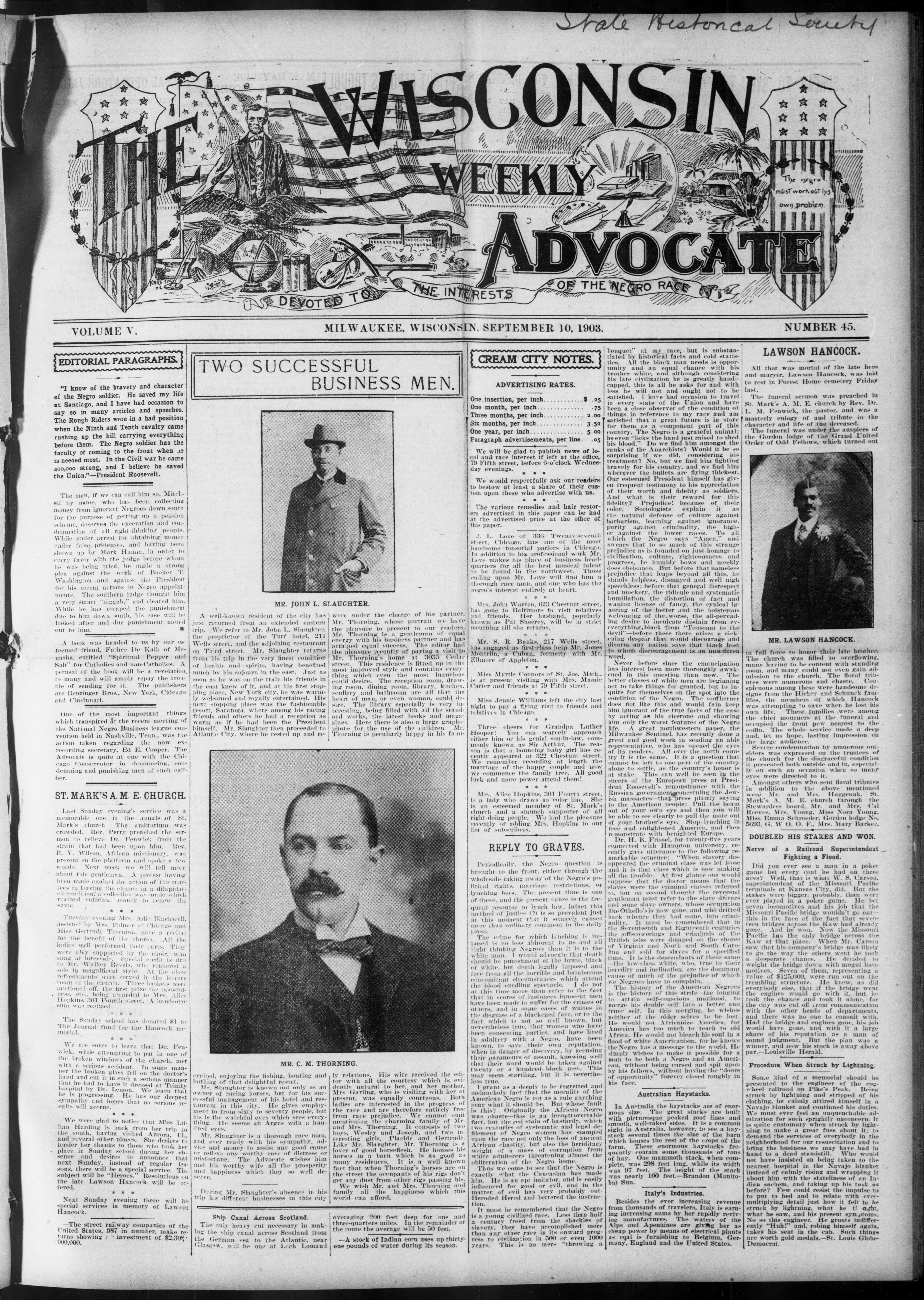
WISCONSIN
WEEKLY
ADVOCATE
DEVOTED TO THE INTERESTS OF THE NEGRO RACE
EDITORIAL PARAGRAPHS.
"I know of the bravery and character of the Negro soldier. He saved my life at Santiago, and I have had occasion to say so in many articles and speeches. The Rough Riders were in a bad position when the Ninth and Tenth cavalry came rushing up the hill carrying everything before them. The Negro soldier has the faculty of coming to the front when he is needed most. In the Civil war he came 400,000 strong, and I believe he saved the Union."—President Roosevelt.
The man, if we can call him so, Mitchell by name, who has been collecting money from ignorant Negroes down south for the purpose of getting up a pension scheme, deserves the execration and condemnation of all right-thinking people. While under arrest for obtaining money under false pretenses, and having been shown up by Mark Hanna, in order to curry favor with the judge before whom he was being tried, he made a strong plea against the work of Booker T. Washington and against the President for his recent actions in Negro appointments. The southern judge thought him a very smart "niggah," and cleared him. While he has escaped the punishment due to him down south, his case will be looked after and due punishment meted out to him.
A book was handed to us by our esteemed friend, Father De Kalb of Menasha, entitled "Spiritual Pepper and Salt" for Catholics and non-Catholics. A perusal of the book will be a revelation to many and will amply repay the trouble of sending for it. The publishers are Benzinger Bros., New York, Chicago and Cincinnati.
One of the most important things which transpired at the recent meeting of the National Negro Business league convention held in Nashville, Tenn., was the action taken regarding the now ex-recording secretary, Ed E. Cooper. The Advocate is quite at one with the Chicago Conservator in denouncing, condemning and punishing men of such caliber.
ST. MARK'S A. M. E. CHURCH.
Last Sunday evening's service was a memorable one in the annals of St. Mark's church. The auditorium was crowded. Rev. Perry preached the sermon to relieve Dr. Fenwick from the strain that had been upon him. Rev. B. V. Wilson. African missionary, was present on the platform and spoke a few words. Next week we will tell more about this gentleman. A protest having been made against the action of the trastees in leaving the church in a dilapidated condition, a collection was made which realized sufficient money to renew the same.
宗雍唐
Tuesday evening Mrs. Adie Blackwell, assisted by Mrs. Palmer of Chicago and Miss Gertrude Thornton, gave a recital for the benefit of the church. All the ladies well performed their parts. They were ably supported by the choir, who sang at intervals. Special credit is due to Mr. Walker Revels, who rendered a solo in magnificent style. At the close refreshments were served in the lecture room of the church. Three baskets were auctioned off, the first prize for tastefulness, etc., being awarded to Mrs. Alice Hopkins, 301 Fourth street. A handsome sum was realized.
The Sunday school has donated $1 to The Journal fund for the Hancock memorial.
We are sorry to learn that Dr. Fenwick, while attempting to put in one of the broken windows of the church, met with a serious accident. In some manner the broken glass fell on the doctor's hand and cut it in such a serious manner that he had to have it dressed at Trinity hospital by Dr. Lemon. We learn that he is progressing. He has our deepest sympathy and hopes that no serious results will accrue.
***
We were glad to notice that Miss Lillian Harding is back from her trip to the south, having visited Aurora, Ill., and several other places. She desires to tender her thanks to those who took her place in Sunday school during her absence and desires to announce that next Sunday, instead of regular lessons, there will be a special service. The subject will be "Heroes." Resolutions on the late Lawson Hancock will be offered.
Next Sunday evening there will be special services in memory of Lawson Hancock.
The street railway companies of the United States, 987 in number, make returns showing investment of $2,308,000,000.
TWO SUCCESSFUL BUSINESS MEN.
THE BOSTON EDITOR
MR. JOHN L. SLAUGHTER.
A well-known resident of the city has just returned from an extended eastern trip. We refer to Mr. John L. Slaughter, the proprietor of the Turf hotel, 217 Wells street, and the adjoining restaurant on Third street. Mr. Slaughter returns from his trip in the very finest condition of health and spirits, having benefited much by his sojourn in the east. Just as soon as he was on the train his friends in the east knew of it, and at his first stopping place. New York city, he was warmly welcomed and royally entertained. His next stopping place was the fashionable resort, Saratoga, where among his racing friends and others he had a reception as warm as if he had been the President himself. Mr. Slaughter then proceeded to Atlantic City, where he rested up and re-
1890
M. B. BURROWS
cruited, enjoying the fishing, boating and bathing of that delightful resort.
Mr. Slaughter is known not only as an owner of racing horses, but for his successful management of his hotel and restaurant in this city. He gives employment to from sixty to seventy people, but his is the watchful eyes which sees everything. He seems an Argus with a hundred eyes.
Mr. Slaughter is a thorough race man, and ever ready with his sympathy, advice and money to assist any good cause or relieve any worthy case of distress or misfortune. The Advocate wishes him and his worthy wife all the prosperity and happiness which they so well deserve.
During Mr. Slaughter's absence in his trip his different businesses in this city
Ship Canal Across Scotland.
The only heavy cut necessary in making the ship canal across Scotland from the German sea to the Atlantic, near Glasgow, will be one at Lech Lomand
MILWAUKEE, WISCONSIN, SEPTEMBER 10, 1903.
were under the charge of his partner, Mr. Thorning, whose portrait we have the pleasure to present to our readers. Mr. Thorning is a gentleman of equal energy with his business partner and has attained equal success. The editor had the pleasure recently of paying a visit to Mr. Thorning's home at 3035 Cedar street. This residence is fitted up in the most improved style and contains everything which even the most luxurious could desire. The reception room, drawing room, dining room, library, kitchen, scullery and bathroom are all that the heart of man, or even woman, could desire. The library especially is very interesting, being filled with all the standard works, the latest books and magazines. Here there is also a large graphophone for the use of the children. Mr. Thorning is peculiarly happy in his fami-
ORNING.
ly relations. His wife received the editor with all the courtesy which is evidently natural to her, and her mother, Mrs. Garling, who is visiting with her at present, was equally courteous. Both ladies are interested in the progress of the race and are therefore entirely free from race prejudice. We cannot omit mentioning the charming family of Mr. and Mrs. Thorning. It consists of two boys, Wesley and Joseph, and two interesting girls, Placide and Gertrude. Like Mr. Slaughter, Mr. Thorning is a lover of good horseflesh. He houses his horses in a barn which is as good as many residences. It is a well known fact that when Thorning's horses are on the street the occupants of his rigs don't get any dust from other rigs passing his. We wish Mr. and Mrs. Thorning and family all the happiness which this world can afford.
averaging 200 feet deep for one and three-quarters miles. In the remainder of the route the average will be 50 feet.
A stock of Indian corn uses up thirty-one pounds of water during its season.
CREAM CITY NOTES.
ADVERTISING RATES
One insertion, per inch . $ .25
One month, per inch . .75
Three months, per inch . 2.00
Six months, per inch . 3.50
One year, per inch . 5.00
Paragraph advertisements, per line. .05
We will be glad to publish news of local and race interest if left at the office, 79 Fifth street, before 6 o'clock Wednesday evenings.
We would respectfully ask our readers to bestow at least a share of their custom upon those who advertise with us.
The various remedies and hair restorers advertised in this paper can be had at the advertised price at the office of this paper.
J. L. Love of 336 Twenty-seventh street, Chicago, has one of the most handsome tonsorial parlors in Chicago. In addition to his professional work Mr. Love makes his place of business headquarters for all the best musical talent to be found in the northwest. Those calling upon Mr. Love will find him a thorough race man, and one who has the negro's interest entirely at heart.
心 心 心
Mrs. John Warren, 623 Chestnut street, has gone to Baltimore to visit relatives and friends. Her husband, popularly known as Pat Sheerey, will be in strict mourning till she returns.
Mr. S. R. Banks, 217 Wells street, has engaged as first-class help Mr. Jones Montriin, a Cuban, formerly with Mr. Ellmore of Appleton.
Miss Myrtle Connors of St. Joe, Mich., is at present visiting with Mrs. Mamie Carter and friends at 79 Fifth street.
Miss Jennie Williams left the city last night to pay a flying visit to friends and relatives in Chicago.
```markdown
```
Three cheers for Grandpa Luther Hooper! You can scarcely approach either him or his genial son-in-law, commonly known as Sir Arthur. The reason is that a bouncing baby girl has recently appeared at 322 Chestnut street. We remember recording at length the marriage of the happy couple and now we commence the family tree. All good luck and more power attend them!
清 宏 秀
Mrs. Alice Hopkins, 301 Fourth street, is a lady who draws no color line. She is an esteemed member of St. Mark's church and a staunch supporter of all right-doing people. We had the pleasure recently of adding Mrs. Hopkins to our list of subscribers.
REPLY TO GRAVES.
Periodically, the Negro question is brought to the front, either through the wholesale taking away of the Negro's political rights, marriage restrictions, or lynching bees. The present time is one of these, and the present cause is the frequent resource to lynch law, infact this method of justice (?) is so prevalent just at this moment that it scarcely causes more than ordinary comment in the daily press.
The crime for which lynching is imposed is no less abhorent to us and all right thinking Negroes than it is to the white man. I would advocate that death should be punishment of the brute, black or white, but death legally imposed and free from all the horrible and barabarous concomitant circumstances which attend the blood curdling spectacle. I do not at this time more than refer to the fact that in scores of instances innocent men have been made to suffer for the crimes of others, and in some cases of whites in the disguise of a blackened face, or to the fact which is not so well known, but nevertheless true, that women who have been consenting parties, and have lived in adultery with a Negro, have been known, to save their own reputation, when in danger of discovery, by accusing their paramours of assault, knowing well that their word would be taken against twenty or a hundred black men. This may seem startling, but it is nevertheless true.
I grant as a deeply to be regretted and melancholy fact that the morality of the American Negro is not as a rule anything near what it should be. But whose fault is this? Originally the African Negro was chaste—this is an incoprovertable fact, but the red stain of bastardry, which two centuries of systematic and legal defilement of Negro women has stamped upon the race not only the loss of ancient African chastity, but also the hereditary weight of a mass of corruption from white adulterers threatening almost the obliteration of the Negro home.
Thus we come to see that the Negro is exactly what the Caucasian has made him. He is an apt imitator, and is easily influenced for good or evil, and in the matter of evil has very probably out-Heroded Herod and bettered the instruction.
It must be remembered that the Negro is a young civilized race. Less than half a century freed from the shackles of slavery, they have accomplished more than any other race in its onward progress to civilization in 500 or even 1000 years. This is no mere "throwing a
bouquet" at my race, but is substantiated by historical facts and cold statistics. All the black man needs is opportunity and an equal chance with his brother white, and although considering his late civilization he is greatly handicapped, this is all he asks for and with less he will not and ought not to be satisfied. I have had occasion to travel in every state of the Union and have been a close observer of the condition of things in reference to my race and am satisfied that a great future is in store for them as a component part of this country. The Negro is a grateful animal; he even "licks the hand just raised to shed his blood." Do we find him amongst the ranks of the Anarchists? Would it be so surprising if we did, considering his treatment? No, but we find him fighting bravely for his country, and we find him wherever the bullets are flying thickest. Our esteemed President himself has given frequent testimony to his appreciation of their worth and fidelity as soldiers. And what is their reward for this fidelity? Prejudice! because of their color. Sociologists explain it as the natural defense of culture against barbarism, learning against ignorance, purity against criminality, the higher against the lower races. To all which the Negro says "Amen," and swears that to so much of this strange prejudice as is founded on just homage to civilization, culture, righteousness and progress, he humbly bows and meekly does obeisance. But before that nameless prejudice that leaps beyond all this, he stands helpless, dismayed and well nigh speechless; before that general disrespect and mockery, the ridicule and systematic humiliation, the distortion of fact and wanton license of fancy, the cynical ignoring of the better and the boisterous welcoming of the worse, the all-pervading desire to inculcate disdain from everything, black from "Toussant to the devil"—before these there arises a sickening despair that would discourage and disarm any nation save that black host to whom discouragement is an unwritten word.
Never before since the emancipation has interest been more thoroughly awakened in this question than now. The better classes of white men are beginning not to take things for granted, but to inquire for themselves on the spot into the condition of the Negro. The southerner does not like this and would fain keep him ignorant of the true facts of the case by acting as his cicerone and showing him only the worst features of the Negro life. A great northwestern paper, the Milwaukee Sentinel, has recently done a great and good work in sending an able representative, who has opened the eyes of its readers. All over the north country it is the same. It is a question that cannot be left to one part of the country alone to settle, as the country's honor is at stake. This can well be seen in the suecers of the European press at President Roosevelt's remonstrance with the Russian government concerning the Jewish massacres—that press plainly saying to the American people: Pull the beam out of your own eye and then you will be able to see clearly to pull the mote out of your brother's eye. Stop lynching in free and enlightened America, and then demonstrate with heightened Europe.
Dr. H. B. Frissel, for twenty-five years connected with Hampton university, recently gave utterance to the following remarkable sentence: "When slavery disappeared the criminal class was let loose and it is that class which is now making all the trouble. At first glance one would suppose that the doctor means that the slaves were the criminal classes referred to, but on second thought the reverend gentleman must refer to the slave drivers and some slave owners, whose occupation like Othello's is now gone, and who drifted back whence they had come, into criminality. It must be remembered that in the Seventeenth and Eighteenth centuries the offsowerings and criminals of the British isles were dumped on the shores of Virginia and North and South Carolina and sold for slaves for a specified time. It is the descendants of these same—the low-class white, who, true to their heredity and inclination, are the dominant cause of much of the prejudice of which we Negroes have to complain.
The history of the American Negroes is the history of this strife—the longing to attain self-conscious manhood, to merge his double self into a better and truer self. In this merging, he wishes neither of the older selves to be lost. He would not Africanize America, for America has too much to teach to old Africa. He would not bleach his soul in a flood of white Americanism, for he knows the Negro has a message to the world. He simply wishes to make it possible for a man to be both a Negro and an American, without being cursed and spit upon by his fellows, without having the "doors of opportunity" forever closed roughly in his face.
Australian Haystacks.
In Australia the haystacks are of enormous size. The great stacks are built with picturesque peaked roof lines and smooth, well-raked sides. It is a common sight in Australia, however, to see a haystack several times the size of the barn which houses the rest of the crops of the farm. These enormous haystacks frequently contain some thousands of tons of hay. One mammoth stack, when complete, was 298 feet long, while its width was 97 feet. The height of the stack was nearly 100 feet.—Brandon (Manitoba) Sun.
Italv's Industries.
Besides the ever increasing revenue from thousands of travelers, Italy is earning increasing sums by her rapidly reviving manufactures. The waters of the Alps and Apennines are giving her as cheap power by means of electrical plants as cqal is furnishing to Belgium, Germany, England and the United States.
LAWSON HANCOCK.
All that was mortal of the late hero and marytr, Lawson Hancock, was laid to rest in Forest Home cemetery Friday last.
The funeral sermon was preached in St. Mark's A. M. E. church by Rev. Dr. L. M. Fenwick, the pastor, and was a masterly eulogy of and tribute to the character and life of the deceased.
The funeral was under the auspices of the Gordon lodge of the Grand United Order of Odd Fellows, which turned out
M. B.
MR. LAWSON HANCOCK.
in full force to honor their late brother. The church was filled to overflowing, many having to be content with standing room, and many could not even gain admission to the church. The floral tributes were numerous and chaste. Conspicuous among these were handsome designs from the Hickey and Schunck families, the members of which Hancock was attempting to save when he lost his own life. These families were among the chief mourners at the funeral and occupied the front pew nearest to the coffin. The whole service made a deep and, let us hope, lasting impression on the large audience.
Severe condemnation by numerous outsiders was expressed on the trustees of the church for the disgraceful condition it presented both outside and in, especially on such an occasion when so many eyes were directed to it. Amongst others who sent floral tributes in addition to the above mentioned were Mr. and Mrs. Haggenak, St. Mark's A. M. E. church through the Stewardess board, Mr. and Mrs. Cal Reeves, Mrs. Young, Miss Nora Young, Miss Emma Schroeder, Gordon lodge No. 5693, G. W O. O. F., Mrs. Mary Barker,
DOUBLED HIS STAKES AND WON.
Nerve of a Railroad Superintendent Fighting a Flood.
Did you ever see a man in a poker game bet every cent he had on three aces? Well, that is what W. S. Carson, superintendent of the Missouri Pacific terminals at Kansas City, did. But the stakes were bigger, probably, than were ever played in a poker game. He bet seven locomotives and his job that the Missouri Pacific bridge wouldn't go out—this in the face of the fact that seventeen bridges across the Kaw had already gone. And he won. Now the Missouri Pacific has the only bridge across the Kaw at that place. When Mr. Carson saw that his company's bridge was likely to go the way the others went he took a desperate chance. He decided to weight the bridge down with mogul locomotives. Seven of them, representing a value of $125,000, were run out on the trembling structure. He knew, as did everybody else, that if the bridge went the engines would go with it, but he took the chance and took it alone, for the city was cut off from communication with the other heads of departments, and there was no one to consult with. Had the bridge and engines gone, his job would have gone, and with it a large share of his reputation as a man of sound judgment. But the plan was a winner, and now his stock is away above par.—Louisville Herald.
Procedure When Struck by Lightning.
Son.e kind of a memorial should be presented to the engineer of the cog-wheel railroad on Pike's Peak. Being struck by lightning and stripped of his clothing, he calmly attired himself in a Navajo blanket and continued his duties. We must ever feel an unquenchable admiration for such sprightly unconcern. It is quite customary when struck by lightning to make a great fuss about it; to demand the services of everybody in the neighborhood for our resuscitation and to bring the business we may have had in hand to a dead standstill. Who would not have insisted on being taken to the nearest hospital in the Navajo blanket instead of calmly rising and wrapping it about him with the stateliness of an Indian sachem, and taking up his task as before? Few could resist the impulse to to put to bed and to relate with ever-multiplying detail just how it felt to be struck by lightning, what he tl oght, what he saw, and his present symptoms. No so this engineer. He grunts indifferently "Huh!" and, robing himself again, takes his seat in the cab. Such things are worth gold medals.—St. Louis Globe-Democrat.
HAS SPREAD TO SYRIA.
The Macedonian Uprising in Turkey Is Growing Worse.
RIOTING IS RENEWED.
Admiral Cotton Has Marines in Readiness to Land at Beirut Should Occasion Require.
Paris, Sept. 9.—The following telegram has been received from Cairo, Egypt:
"Disquieting rumors are current in regard to the situation in Syria. Bedouins arriving here from the Arish desert say the Druses are in arms and fears are entertained of a massacre in Lebanon."
Official reports from Beirut show the growing gravity of the situation there. Another Christian was killed yesterday. The Turkish soldiers are making common cause with the Mussulmans during the attacks on Christians, a number of houses have been pillaged, one French shop was completely destroyed and the French residents, becoming terrified at these depredations, have abandoned their homes and sought refuge at the French college, where between 400 and 500 refugees are now gathered. The American naval commander, it is asserted in the dispatches received here, proposed to land marines at Beirut, but the foreign consuls believed the step inadvisable at this time, as it might lead to an increase of the excitement prevailing and precipitate a crisis.
Vali Weak and Incompetent.
The vali of Beirut has proved himself to be weak and incompetent to deal with the situation and therefore Nesim Pasha, the vali of Damascus, was ordered to assume the direction of affairs at Beirut, Nesim Pasha, who has already arrived at his new post, is displaying, great energy. The consuls express the hope that he will be able to stem the disorder. The nearest French warship to Beirut is in the Gulf of Volo, Greece, but unless Nesim Pasha speedily restores order and completely safeguards French citizens, France will act decisively by dispatching warships from Toulon.
Review of Situation.
London, Sept. 9.—The official and press reports from the near east today emphasize the seriousness of the situation there and confirm the belief of the authorities here that owing to the general irritation throughout European and Asiatic Turkey toward the Christians, as a result of the Macedonian revolt, the Sultan may be swept by the uncontrollable sentiments of his Ottoman subjects into a war with Bulgaria, despite the unwillingness of the Porte to precipitate such a conflict. The Turkish officials express gratification at the Russia-Austrian proposal for coercive diplomatic action on the part of the thee powers at Sofia. They are confident it will be acceded to by France, but whether it is adopted or not, the Sultan's hand has already been greatly strengthened, as he is in a better position to act than hitherto.
There is no question in official circles here that the Porte will take energetic measures to suppress any trouble at Beirut. The announcement is made of the arrival at Beirut of Nazim Pasha, the vali of Syria, who is expected by the Turkish officials to promptly restore order. That the task is difficult is shown by the fact that there have been further riots at Beirut. France may order warships to that point to protect her interests, but Germany has asserted that she will not do so. Great Britain, whose missionary interests in iSyria are practically nil, has not as yet sent any vessels to Beirut, relying upon the American warships to protect the consulates.
Russia May Send Fleet.
A high diplomatic authority repeated today that Russia has not dispatched, at present at least, any vessels of her Black sea fleet to Turkish waters. He asserted, however, that when Russia submits to the Porte her proposals for the pacification of Macedonia she may dispatch her Black sea fleet to Turkish water and it may make a much longer stay there than did the Russian squadron at Iniada bay. He added that Turkey could not be expected to inaugurate new reforms until order was restored.
The St. James' Gazette this afternoon says an arrangement has been arrived at between Great Britain and Austria, which will come into operation under certain eventualities.
Want American Ships Withdrawn
The Turkish embassy issued another statement today declaring that the reports of massacres emanate from the Bulgarian side and are purposely exaggerated in the hope of securing European intervention. It reiterates disbelief in the seriousness of the Beirut situation and adds:
"The Turkish government, therefore, hopes the American warships will depart as speedily as possible as their presence only tends to incite the people. From Constantinople the embassy is informed that there is no reason for the assembling of the American ships at Beirut."
Fifty Thousand Slain.
Sofia, Sept. 9.—Turkey is succeeding well in her effort to exterminate the Bulgarians. From 30,000 to 50,000 are believed to have been massacred by the Turks, and every Bulgarian village in the vilayet has been destroyed.
The refugees in the mountains and forests are dying of starvation by thousands.
The Turkish forces in Macedonia number 300,000. It is feared that the Sultan is planning an attack on Bulgaria.
The Porte has issued an order that all European correspondents must leave Macedonia at once.
MAYOR LOW WILL ACCEPT NOMINATION.
He Decides to Head the Fusion Ticket in Greater New York—C. V. Fornes for Head of Board of Aldermen. New York, Sept. 9.—Mayor Low is willing to run again, and he will be selected for renomination at the fusion conference unless his plans upset the ticket as arranged. Charles V. Fornes of Manhattan will be nominated for president of the board of aldermen.
FIGHT WITH BURGLAR.
Thief Shoots Col. Mordecai Williams of Ashland, Ky., After Desperate Sabre Encounter.
Ashland, Ky., Sept. 9.—Sheriff Hene, with a posse, is hunting a burglar who shot and seriously wounded Col. Mordecai Williams in his country home before daylight yesterday. Col. Williams in discovering the burglar ransacking the house fought him with a saber until the burglar shot him and escaped. Col. Williams is resting well today.
LAKE GEORGE STATUE.
Lake George, N. Y., Sept. 8.—In the presence of thousands of excursionists from all nearby towns, the governors of New York, Vermont, Massachusetts and Connecticut stationed at the four corners of the battle monument today pulled the fastening which unveiled the bronze memorial of the battle of Lake George. The bronze figures of monument were designed by Albert Weinert, and represent the Indian chieftain King Hendrick, demonstrating to Gen. Johnson the futility of dividing his forces. The figures which stand on a granite pedestal are nine feet high.
Commemorates Great Event.
The monument stands in the center of Battle park overlooking the lake. On the east face is the following inscription: 1963-The Society of Colonial Wars erected this monument to commemorate the victory of the Colonial forces under Gen. Johnson and the Mohawk allies under Chief Hendrick over the French regulars commanded by Baron Dieskau with the Cana-
dian and Indian allies.
On the south face—Defeat would have opened the road to Albany to the French.
The north—Confidence inspired by the victory was of inestimable value to the American army in the war of the revolution.
tion.
On the west face are the words: Battle
George, September 8, 1755.
of Lake George, September 8, 1955.
The day's ceremonies began at 10
o'clock with a review of the troops by
thequarterte of governors.
Senator Chauncey M. Depew was the orator of the day.
Letter from President.
A letter from President Roosevelt was read as follows:
Oyster Bay, N. Y., Aug. 29, 1903.—My Dear Mr. Ferris: It is with real regret that I find myself unable to be present at the dedication of the monument to commemorate the battle of Lake George. I very earnestly believe in the wisdom in this new country of ours of keeping alive a sense of continuity with the historic past. It is a good thing from every standpoint to commemorate in striking form the deeds that made Lakes Champlain and George famous in colonial and revolutionary days, and again in the War of 1812. There is a peculiar appropriateness in placing a monument on the line of these two lakes which formed a highway of warfare followed by the war parties of Indians, of colonial troops, of French and British, and finally of American soldiers.
ANTHONY Hoping that you will have a thoroughly successful celebration, I am, very sincerely yours, THEODORE ROOSEVELT. Mortis P. Ferris, Secretary Society of Colonial Wars, New York City, N. Y.
BIG FIRE AT PITTSBURG.
Entire Block Consumed, Loss $263,000,
and Sixty Horses Burned—Conflag
ration Still Spreading.
Pittsburg, Pa., Sept. 8.—A revised estimate of the losses by the early morning fire on Liberty avenue today places the total loss at $263,000. The Pittsburg Plate Glass company estimate their loss at $160,000, that of the Comstock Brass Manufacturing company is only $100. The Thueeler Manufacturing company lost about $800 on their building, while the Pittsburg Transfer company lost $90,000 besides an estimated loss of about $12,-000 on their building. The greater part of the loss is covered by insurance. At least sixty horses were burned. At 2 o'clock this morning three alarms were turned in for a fire that was consuming the block bounded by Liberty avenue and Spring, Sixteenth and Seventeenth streets.
SUSPECTS ARE ARRESTED.
Two Men Alleged to Have Participated in the Chicago Car Barn Murder and Robbery.
Chicago. Ill., Sept. 8.—James Redmond, alias William O'Neil, and Arthur Tobetts have been arrested on a charge of complicity in the murders committed in the barons of the Chicago City Railway company a week ago. The evidence against Redmond is circumstantial, the chief part of it being his heavy expenditure of money during the last week. Redmond formerly lived in Kansas City and was tried there in 1900 for the murder of a girl. He was acquitted of the charge. Tibbetts was arrested because Redmond was living in his house.
NEGRO BOY A MURDERER
Colored Lad, Aged 12, Confesses to Killing Caroline Link in Baltimore Wanted to Rob Till.
Baltimore, Md., Sept. 8.—Charies Jones, a negro, 12 years old, confessed to the police today that he murdered Miss Caroline Link, August 28, in this city, giving details of the crime. Miss Link was found dying in the candy and confectionery store of her employer. At first it was supposed she had fallen and fractured her skull. She died without returning to consciousness. Subsequently a bleody club was found and since then the police have been looking for the perpetrator of the crime. The boy admitted that he entered the store to rob the till and finding Miss Link there, struck her and ran away.
BISHOP CLARK IS DEAD.
Presiding Prelate of the Protestant Episcopal Church in America Passes Away, Aged 91 Years.
Providence, R. I., Sept. S.—Rev. Dr. Thomas M. Clark, Episcopal bishop of Rhode Island and presiding bishop of the denomination in the United States, died at his home here last night, aged 91 years.
He was born in Newburyport, Mass., and educated at Amherst and Yale. Early in life he taught school, became a deacon in 1836 and a clergyman soon after. He had charges in Portland, Me.; Boston, and Hartford, and was in the latter city when elected bishop of Rhode Island in 1854. Many honors and degrees had been conferred on him.
Economic
Old Uncle Ben wanted to have his portrait painted, but he did not care to pay very much for it.
"Surely that is a very large sum," he said when the artist named the price.
The artist protested and assured him that, as portraits went, that was very little to ask.
Uncle Ben hesitated. "Well," he said at length, "how much will it be if I furnish the paint?"—Lippincott's.
A young man was sailing a yacht.
When he exclaimed: "Great scacht!
The tide's going out;
I should turn about—
But how it is done I've forgacht."
—Chicago News.
-Mrs. Bembridge of Sidmouth, England, who is in all likelihood the oldest resident in Devonshire, celebrated her 102d birthday recently.
-A stock of Indian corn uses up thirty-one pounds of water during its season.
RIGHT TO DISCHARGE.
Carroll D. Wright, Umpire in Coal Strike Disputes, Says Reason Does Not Have to Be Given.
Scranton, Pa., Sept. 9.—That the owner of a coal mine has the right to discharge an employee for any reason, other than membership in a labor union, and is not compelled to give the cause of the discharge, is the decision of Carroll D. Wright, the umpire to whom was referred the disputes between the anthracite miners and operators before the board of conciliation. Mr. Wright, in making this decision, calls attention to the fact that the employee is free to leave his work for any reason he may have, and the same holds good with the employer.
The decision was made by Mr. Wright in taking up several cases over which the conciliation board had come to a deadlock. The conciliation board, representing both operators and miners equally, was organized to finally decide several disputes over the rulings of the arbitration board which settled the miners' strike.
SENSATION COMING.
Man Very Prominent in Official Circles Will Be Indicted by Grand
Washington. D. C., Sept. 9.—One of the persons indicted yesterday by the federal grand jury in connection with the postal investigation is George W. Beavers, formerly chief of the division of salary and allowances. It is understood that the charge is conspiracy. Another of the indictments is against August W. Machen on a new set of facts, involving him with Beavers. The charge is conspiracy.
While the officials refuse to disclose the names of the four remaining persons who were indicted yesterday it is said that none of them is or has been connected with the postoffice department and that one is a man of some prominence. It was stated at the city hall today that the climax of the investigation is to come shortly when a person not connected with the department, but equally as well known as the postmaster-general himself, undoubtedly will be indicted for complicity in the postoffice frauds. The grand jury began hearing the evidence in this particular case today and it is stated that when a report is made it will in all probability conclude the investigation in Washington.
New York, Sept. 9.—Seventeen additional indictments against persons said to be implicated in the postoffice frauds have been turned over to Charles J. Bonaparte of Baltimore, who has been retained by the government to aid in the prosecution of nearly two score of its employees. Mr. Bonaparte has just returned from his vacation at St. Andrews, N. B. He has received the formal drafts of indictments against George W. Beavers, August W. Machen, Congressman Edmund H. Driggs, Maurice Runkle, George E. Lorenz, George F. Miller and Thomas W. McGregor. He declared that the cases in which indictments are returned by the grand jury will be published as rapidly as the evidence at hand will permit.
ATTACK SOLDIERS.
It Is Supposed That Strikers at Victor, Colo., Attempted to Destroy the Mine.
Victor, Colo., Sept. 9.—An attack upon a militiaman acting as guard at the Taylor and Brunton sampler aroused the officers commanding the troops and within a few minutes every available man in the camp was patrolling the hills. Shortly after the guard had been placed at the sampler he noticed a man prowling about the building. He ordered the man to halt, which order was not obeyed. The guard fired at the figure and started in pursuit, firing as he ran. As the soldier passed the building he was felled by a rock thrown by a second man. The shooting aroused other sentinels, who arrived just as the two men disappeared over the edge of Bull Hill. A volley was fired at them but they escaped beyond range of the muskets.
The injured infantryman was picked up and medical aid summoned. He was not seriously injured, though unconscious when found, and soon revived.
The mine owners have notified the officers of the militia that a number of threats have been made against both property and the guards and at a number of places the guards have been doubled.
The finding of the body of an unidentified man with a bullet through his heart about a mile from Clyde has caused excitement.
Pueblo, Colo., Sept. 9.—District Organizer John Gehr of the United Mine Workers of America is on his way to Trinidad to complete organization of the miners of that district, preparatory to the anticipated strike for the eight-hour day and bi-monthly pay day. It is estimated fully 20,000 coal miners will go out.
FARMERS IN A TRUST.
Forming a Combine in Chicago Which Will Keep Prices of Product at High Level.
Chicago, Ill., Sept. 9.—Amalgamation of all the farmers' associations in the country is being sought at a convention opened yesterday in the Grand Pacific hotel. The new organization will aim to protect the producers against market fluctuations by enabling them to sell their product when prices are up and will seek to help them in various other ways. These ends are expected to result from the establishment of a committee which will keep all members informed on prices and crop and market conditions. It will aim to provide warehouse facilities also. The promoters hope to bring into the organization the producers of grain, dairy products, eggs, cotton and all staples.
LONDON BARS NEGROES.
Colored Man Says He Was Refused Service at a Hotel Because He Is Black.
London, Sept. 9.—London has begun to draw the color line. Complaint has just been made to a magistrate by a negro of gentlemanly appearance who said that he and some friends had been refused refreshments by a publican simply because of their color. The applicant wished to know whether he and his friends, who were from different parts of the British dominions, were to be treated little better than wild beasts. The magistrate said that, while a publican was bound to supply anyone with food or refreshments as a traveler, there was nothing in the law to compel anyone to sell anything to any body.
Fighting in Streets Between Mussulmans and Christians.
COTTON MAYLAND MARINES
Powers Consider It Fortunate That American Warships Are in Harbor as Situation Is Becoming Desperate.
Washington, D. C., Sept. 8.—The navy department has received the following cablegram from Rear Admiral Cotton, dated Beirut, September 7:
"Violence and bloodshed between Mohammedans and native Christians occurred at Beirut Sunday. Six Greek Christians, two Mohammedans and one Turkish soldier killed; three Greek Christians, three Mohammedans and three Turkish soldiers wounded seriously. Other murders reported. Flag lieutenant and United States consul were present Sunday and Monday in the disturbed quarter and verify details statement. Turkish government willingly afforded facility for their investigation and guards; promise 1000 more Turkish soldiers. Turkish soldiers present sufficient if properly disposed of to handle situation at Beirut. Well patrolled and all quiet Sunday night and today. Monday Turkish governor promises to do all in his power to restore authority. Many houses closed and business suspended. I have prepared to land force for protection of property of American citizens if situation demands. Will act with caution. Present trouble due to animosity between inimicable and native Christians and failure to control crimes.
The last portion of Admiral Cotton's cable is unintelligible and the cipher experts at the navy department worked all the morning to translate it. Copies of the report were sent at once to the President and to the state department.
The Outbreak in Beirut.
London, Sept. 8.—Officials and diplomatic circles here regard the conflict between Mussulmans and Christians at Beirut as evidence of the development of hostile feeling throughout Turkey as a result of the Macedonian revolt. This is borne out by the threatened uprising in Smyrna. The Turkish embassy today received a dispatch from Constantinople, in relation to the Beirut affair, as follows:
"Some of the orthodox inhabitants of Beirut attacked four Mussulmans who were passing through the Mezrea quarters, fired upon them and rioting ensued. The imperial authorities immediately sent troops to the scene of the disturbance, which put an end to the strife. One soldier was killed and three were injured. One civilian was killed and one was injured. Order and tranquility are perfectly maintained in all parts of the vilayet."
Christians the Aggressors.
A high Turkish official pointed out that the Christians were the aggressors, but he said it would not have been even surprising had the Mussulmans precipitated the row, "for throughout Turkey indignation is felt at the conduct of the revolutionists in Macedonia."
The official added: "The Christians at Reirut have been greatly encouraged by the appearance of the American squadron, the presence of which could not be regarded sympathetically by the Mohammedan population, because it had come, not to pay a friendly call, but to enforce demands."
It is understood here that Turkey is anxious to induce the United States to withdraw the American warships from Turkish waters, believing that such action would discourage the Christians, who hope for American intervention, and the Porte is now expected to make concessions in compliance with the American representations.
Turks Claim Trouble Is Over.
Constantinople, Sept. 8.—A consular dispatch from Beirut, received at one of the embassies here, states that a fierce brawl occurred there yesterday between parties of Mussulmans and Christians. It was due to a shot fired by a Mussulman upon a Christian employed at the American college. The Christian was wounded.
The fight broke out while the vali was on board the United States cruiser Brooklyn returning Admiral Cotton's visit. No further details have been received.
In diplomatic circles here the affair is regarded as being serious and a renewal of the disturbances is feared.
An official version of the Beirut affair telegraphed later to the Ottoman ambassadors abroad for communication to the powers says that Christians were the assailants, they having fired upon four Mussulmans. A fight ensued during which Mussulmans and Christians came to the assistance of their respective compatriots. This, says the report, compelled the troops to intervene and they succeeded in restoring order. Three soldiers were wounded and one was killed, while one Christian was killed and one wounded. These figures evidently are incorrect, as the rioters must have lost more heavily than the military.
The British consul at Beirut, immediately after the riot, called upon the vali and threatened to ask Rear Admiral Cotton to land marines from the American squadron in the event of the renewal of the disturbances. In official circles here the disturbances are attributed to the arrival of the American squadron and the belief is expressed that the Christians at Beirut are endeavoring to bring about the landing of marines from the warships.
Insurgent Leader May Be Dead.
All the reports received here continue to record Turkish successes in Macedonia. No confirmation has been received of the report of the death of Boris Sarafoff, the revolutionary leader, but should it be true the Macedonians will admit that a great blow has been struck at the cause.
WIPED OFF THE MAP.
Hurricane.
New Orleans, La., Sept. 8.—Steamship advices of the destruction of San Miguel, a town on the east coast of Yucatan, by a hurricane were received here. The town was wiped off the face of the earth, not a building being left standing. The steamer Breakwater, which passed San Miguel on her way from New Orleans to Belise, found the place in ruins and not a living being in sight. SanMiguel was the oldest town in Mexico. It was the place where Cortez landed when he discovered Mexico, and there he established his headquarters. He married the daughter of an Indian chief, and the little stone church, the battered ruins of which is all that is visible from the decks of steamers as they approach the harbor.
From the deck of the Breakwater the ruined village could be plainly seen. The hurricane caused immense damage along the Mexican coast and many lives were lost.
MRS. MAYBRICK MAY BECOME RICH.
Sues to Recover Part of Immense Estate of Her Grandfather—Term in Prison Expires Soon.
New York, Sept. 9.—Fighting to secure a fortune for Mrs. Florence Elizabeth Maybrick, whose release from an English prison is expected next July, counsel today begun proceedings to recover more than $40,000. That is all that is left of the immense fortune of Darius Blake Holbrook, grandfather of the American woman now spending the last months of a fifteen-year term in an English prison.
Attorneys for Mrs. Maybrick will appear before a referee and ask an accounting from Hamilton B. Bradshaw and William H. Gardiner of New York. They were the executors of the will of Mr. Holbrook, who left his vast estate to his daughter, now the Baroness von Roques and a resident of Rouen, France, with a reversionary interest to her daughter, Mrs. Maybrick.
Tens of thousands of that fortune went to save Mrs. Maybrick from the gallows, when she was sentenced to death in 1889 for poisoning her husband.
Dairus Holbrook also owned 2500 acres of coal and iron lands in Virginia and West Virginia and suits to recover them have been instituted. Should they be successful, Mrs. Maybrick may become one of the wealthiest women in the United States.
Mr. Holbrook was a capitalist of Mobile, Ala. He was associated with Cyrus Field in the laying of the first transatlantic cable. He founded the town of Cairo, Ill., and was one of the promoters of the Illinois Central railroad. When he died in 1868 he was considered one of the wealthiest men in the south.
PANAMA DROPPED.
The United States Might as Well Turn Seriously to Nicaragua
New York, Sept. 9.—According to the latest reports received from Bogota the Hay-Herran canal treaty is now generally regarded in the capital as dead and buried, and it is declared, asserts The Herald's Panama correspondent, that the United States might as well turn seriously to negotiations with Nicaragua.
Treaty Proposed by Colombia.
Bogota, Sept. 6.—The bill which Congress is now discussing authorizing President Marroquin to negotiate a new Panama canal treaty with the United States contains the following stipulations:
The perpetual use of the canal zone is granted provided that at the expiration of each 100 years the United States shall pay during the succeeding 100 years 25 per cent. more premium and rental than for the preceding term, the premium beginning at $400,000.
The mixed tribunals in the canal zone shall try suits between foreigners or between Colombians and foreigners.
The police and sanitary measures shall be practically in charge of the United States.
Twenty million dollars is fixed as the price of the concession, besides the rental of $10,000,000 payable by the canal company in consideration of Colombia's ap proval of the transfer of shares. The railroad shall in sixty-four years revert to Colombia, but the United States may buy it under a valuation.
A term shall be fixed within which the canal must be begun and finished.
The contract shall provide for a means to settle differences which may arise between the governments during the construction and execution of the contract.
Serious Trouble for Colombia.
Washington, Sept. 9.—There will be a lot of trouble for Colombia if that government has been holding up the telegraphic dispatches between the state department in this city and United States Minister Beaupre at Bogota. A comparison of notes and dates between Secretary Hay and Minister Beaupre show that a number of the telegraphs from Washington to our diplomatic representative in Bogota have been delayed several days, while some messages have failed to reach Minister Beaupre at all.
WAR CLOUDS IN THE FAR EAST LIFTED.
Japan Says That the Russian Concessions Regarding Manchuria Remove Possibilities of a Conflict.
London, Sept. 9.—The Japanese legation here sees in the Russian concessions regarding Manchuria the lifting of the war clouds in the far east. No confirmation has been received of the London Times' Pekin dispatch saying that the Russian minister there in his note to the Chinese foreign office engaging that New Chwang and Moukden shall be evacuated by the Russians on October 8, undertook that China shall be permitted to resume administrative right in the three provinces of Manchuria under certain conditions, but the report is regarded as well founded.
The Japanese legation says:
Three events, if the reports are correct, have occurred which are calculated to simplify the situation, namely—the Russian terms which M. Lessar has apparently presented, mark the abandonment of the proposals which the powers found objectionable: Russia has announced her withdrawal from Manchuria next month and we believe she is sincere and negotiations are progressing between Japan and Russia for a definition of their respective rights in Manchuria and Corea. These are secret and it is impossible to foretell the outcome, but we are hopeful that the results will be satisfactory to both governments.
JUDGE FLANDRAU DIES.
One of the Most Prominent Pioneer Citizens of Minnesota and Ex-Justice of Supreme Court.
St. Paul, Minn., Sept. 9.—Judge Charles E. Flandrau, one of the most prominent pioneer citizens of Minnesota, died at his home in this city early today after an illness extending over a period of some months.
Judge Flandrau came to St. Paul in 1853. President Pierce appointed him agent for the Sioux Indians of the Mississippi, and in that capacity he gave constant aid to hundreds of homeless refugees fleeing from the Indians' tomahawks. He was a member of the first constitutional convention, and later became associate justice of the supreme court.
When the Sioux broke out into a fierce rebellion about New Ulm in 1862, Judge Flandrau organized a company, marching immediately to the scene of action. When he reached New Ulm he was chosen commander in chief of the volunteer force in the field. After a fierce fight lasting forty hours Judge Flandrau and his band saved New Ulm from devastation and its women and children from massacre. Politically, Judge Flandrau was a Democrat and was the candidate of that party for governor in 1867.
HELD IN CONTEMPT FOR NOT ANSWERING COURT.
Topeka, Kan., Sept. 8.—Judge Hazen today sentenced Mine Operators John Jack and John Bell to jail until such period as they might conclude to answer the questions of the attorneys in the coal trust inquiry. The men had refused to testify on the theory that it might incriminate them. The prisoners will appeal to the supreme court.
STEAMER LOUISE DIDN'T GO DOWN.
Arrived Safely at Leamington, Ont., and Did Not Leave for Sandusky Until After Midnight.
Sandusky, O., Sept. 8.—The fishing tug Louise, which, it was feared, had gone down with over 100 passengers in the big storm on Lake Erie yesterday, arrived here safely early today from Leamington, Ont. The Louise started from here for Leamington early Monday morning, carrying the Star Baseball club of this city and 100 excursionists.
Rough weather was encountered just outside the harbor, but Capt. Hugh Declute decided not to turn back. The boat plowed through seas that had her decks awash half the time, and everybody on board was sick.
Leamington was finally reached at noon. At 6 o'clock the party started on the return trip, in even a rougher sea than was encountered on the way over. After a terrific struggle with the waves, the Louise got into the lee of Pelee island, where she lay several hours until the storm had subsided. She arrived here at 4 o'clock this morning with everybody safe but sick. Scores of the friends and relatives of those on the vessel remained on the docks all night in great anxiety.
Detroit, Mich., Sept. 8.—The Journal's Leamington, Ont., correspondent informed that paper on the long distance telephone this morning that the steamer Louise reported last night from Sandusky as missing, left Leamington at midnight for Sandusky. The little steamer arrived safely at Leamington from Sandusky at 12:30 o'clock yesterday and did not leave until midnight, after the passengers had spent the day in picnicking ashore.
BEAVERS SURRENDERS.
Appears Before Court to Answer to Postal Indictments—More Arrests Are to Follow.
New York, Sept. 8.—George W. Beavers, the former head of the salary and allowances division of the postoffice department at Washington, under indictment in connection with the postal investigation, surrendered himself in the office of United States Commissioner Hitchcock today and gave $5000 bail for his appearance before Commissioner Hitchcock September 15.
Bench Warrant Issued.
United States District Attorney Burnett last week notified Beavers' counsel that a bench warrant had been issued for the arrest of Mr. Beavers, that he would be taken into custody forthwith if he did not immediately surrender himself. The defendant's lawyers then verbally informed the federal authorities that they would produce their client Tuesday.
The indictment against the former head of the salaries and allowance division was returned two months ago in Brooklyn and charges him with having received a check for $810 from the Brandt-Dent Manufacturing company of Watertown, Wis., which, it is alleged, was paid to him by the firm as a part commission on a number of automatic cashiers furnished the postal department by that firm. Mr. Beavers was indicted in company with Congressman Driggs of Brooklyn and George F. Miller, the local manager of the Brandt-Dent company. It is claimed by the government that a conspiracy was entered into between the company, Congressman Driggs and Mr. Beavers, wherein the automatic machines were sold to the government at prices greatly in excess of the customary market quotations.
Stern has not yet been arrested but officials expect news of the arrest within twenty-four hours. The extraditability of the offense is not yet certain.
More Postal Indictments.
Washington, D. C., Sept. S.—The federal grand jury has returned seven indictments in postal cases. The names of the indicted have not been divulged. Although there are seven indictments there are but six defendants, indicating that one of them is indicted twice. The officials of the district attorney's office refuse to disclose the names of the party indicted until warrants for their arrests have been served. Some of those indicted reside outside of Washington.
Fngitive Is in Canada.
Washington, D. C., Sept. 8.—A dispatch to the postoffice department today announces that Leopold J. Stern, who was indicted several weeks ago for complicity in alleged fraudulent contracts for furnishing letters carriers satchels to the government, has been located at Toronto, Canada.
PRIMATE BISHOP OF EPISCOPAL CHURCH.
Rt. Rev. Daniel S. Tuttle of Missouri Is Now Oldest Prelate in the United States. New York, Sept. 8.—Rt.-Rev. Daniel S. Tuttle, bishop cf Missouri, has become senior bishop of the Protestant Episcopal church by the death of Rt.-Rev. Thomas M. Clark, bishop of Rhode Island. Dr. Tuttle was consecrated bishop in 1867.
Newport, R. I., Sept. 8.—The funeral of Rt. Rev. Thomas M. Clark, D. D. L.L. D., bishop of Rhode Island, will take place Thursday at Trinity church here. The interment is to be at Portsmouth.
Former Marinette Man Visits Nearly All the Countries of Europe and Spends but $172.
Marinette, Wis., Sept. 8.--[Special.]—Dr. Edward Linder of Chicago, a former Marinette young man, returned this week after a tour of Europe. He visited almost all of the countries abroad, and spent four months there. His total expense was $172, which included passage over and back. He made the trip with a young college friend. It is supposed to be the record breaking European trip as far as expense is concerned.
DOWN TO THE CROSSROADS STORE
You can talk abaout yer Congressmen.
An' Senators and such.
Lebatin' daown t' Washin'tun
In a way to beat the Dutch:
Wavin' their arms wild in the air.
And stampin' on th' floor—
But the place where things gits settled is
Daown to the Crossroads store.
We gather there 'most every night
When all the work is through.
An' sorter glance the kentry o'er.
Takin' a bird's-eye view
Of politics, diplomacy.
Religion, crops; and soar
To patriotic heights—you bet!—
Daown to the crossroads store.
Whut Italy's about.
Then Granpop White jumps up from his cheer
An' grabs an ole axe-helve.
"By gum!" he squeaks, "that's what we done
Walt Disney twinkle!"
'Way back in Eighteen-twelve!'
"A LOVE GAME."
BY ELSA BURROWES
"Game and set," he said in accents of triumph, and sent his racket skimming up toward the quivering blue vault overhead, catching it as it returned, with a dexterity born of practice. "A love set, too, by Jove!"
She nodded indifferently and flung her rocket down beside her.
"Take your revenge now, or later?" he asked.
"Oh! later; it's too hot to bother about revenge at present. Don't you think so?"
"I think the shade of the cedars would be more in my line," he admitted. "let's go there; I believe I see chairs set out purposely for us."
"Then I'll take the iron one—no, I want to, really; the basket one creaks so; besides which it has—associations."
He subsided into its comfortable depths and cast an interrogative glance at her; as her face was turned from him it was wasted.
"Associations?" he said. "Pleasant, I hope."
"Oh! so-so. A judicious mixture of pleasure and pain. I was never fond of doing up other people's boots for them, especially when the laces were made of cowhide or some sort of horribly hard concoction."
"Look here, if you are going to talk to me in enigmas * * * * and in this heat, too. Really, Miss Mason * * * * you might have some pity on a poor thing like me."
"Then you don't remember?"
"Remember what?"
"The house made of basket chairs? The pears, and oatmeal biscuits, and the boot episodes?"
away a stone or two; then turned to her with a twinkle or mirth in his eyes.
"By Jove!" he said, "of course I remember. What a joly time we had together as kiddies, didn't we? Pity all those things pass. Why. I can see it now; the house made of basket chairs turned upside down; a rug thrown over the whole show, under which we used to creep; there was always a woolly, ruggy smell, too. And then there were pears—jolly good they tasted, and oatmeal biscuits, fearfully crumby things!"
"You forget the boots."
"No. I don't, I remember how you tangled the jaces into hopeless knots, and then refused point blank, with rank mutiny, to undo them. Oh, I haven't forgotten your misdeeds, Miss Mason. Ah! well; that's long, long ago."
"Oh, well—not so very. I suppose every child plays house; it's the natural instinct."
"I fancy we did it rather well, too, you and I. Did we quarrel ever? We did. Then I'm sure we made it up again; 'kissed again with tears,' that sort of thing as some poet says. Never can remember poets' names somehow. Jove! I shouldn't mind doing it again."
"What—play houses?"
"Um—yes, and all other details, you know."
Silence.
"You're too big," she said, with a comprehensive glance at the six foot of manhood in the basket chair, "much, much too big. We should fight over the best place in the house; there'd be hardly room for me at all, and, oh! how we should quarrel!"
"Takes two to do that," said he, lazily; "you're too small to fight with."
"I'm not so very small; five feet four—it's quite the average."
"As much as that? I thought you were about the—what do they call it? 'as high as my heart' sort of business. I know some Johnny put it that way once; thought it rather good, myself. But, as you say, it's all over and done with."
"Tout casse, tout lasse, tout passe," she said, cynically.
"Don't believe it. If only that old idiot of an uncle of ours—well, he was your uncle in a kind of a way—had not thought fit to interfere in our private concerns with his beastly old will and his limitations, upon my word, I believe we might have played the game of house all over again—now."
"I don't know; it wouldn't have been the same thing," she said, digging at the gravel at their feet with the point of her pink parasol.
"It would have been considerably better," he said, with finality.
"But it was always absurd and impossible," she protested.
"Of course, that's what I complain of; tie up a couple of people with an outrageous lot of conditions, put the stumbling block of thousands between them, give them each a little of that article called proper pride, and there you have the whole impossible situation cut and dried."
"You needn't get cross about it; I can't help it."
"I'm not cross, and I never said you could help it. It takes two to do that. The person I blame is that confounded interfering—"
"Dear old uncle," she finished sweetly.
"Oh, if you are going to take his part," he said, huffly.
"I dare say he thought he was doing us both a good turn," she added, pacifically; "after all, you couldn't expect him to know—unless you told him—that you had already set your affections on—sone one else."
"Now you are beginning your enigmas again. May I ask the interpretation of that one?"
"Don't be absurd; you know perfectly well what I mean."
"I don't; honest Injun, as we used to say in the basket-chair-pear-oatmeal-biscuit days. Come, out with it!"
"Couldn't you have told him that you wanted to marry—that Miss Bell, with the auburn hair?"
"If I had wanted to tell him a—it's an ugly word—lie, I could certainly have told him so; but what advantage would that have been?"
"I thought—it was true," she said, digging industriously at what looked like a small grave.
"Well, it's not. What I might have told him, if I had thought of it, and if it had been my business, which I didn't think it was * * * I might have told
him that you wouldn't smile on his little plan, 'cause you had other arrangements in view."
"I had other arrangements?" she said, staring full at him, with her pretty brows drawn into horseshoes of astonishment.
"Yes—you. It was common property—the news, I mean. That's why I was sorry for you when the will was read. . . . It complicated matters still more, you see."
"But I don't see. What do you mean?"
"My good girl, why beg the question? Couldn't any one with half an eye see which way the wind blew with you and Morrison?"
"Hubert Morrison?"
"Hubert Morrison. I suppose so. I'm not interested in his Christian name. You ought to know it."
He has such a number. Let me see now—"
"Don't rack your brains for my benefit, please. As I said before, I am not interested specially in Mr. Hubert Morrison."
"But I am, because you see we shall be so nearly related before long."
"I knew it! Then it's true?"
"I never said so. What I do say is, that we shall be nearly related before long. He is going to marry my cousin, Mary Mason—do you remember her? A pretty girl with gray eyes?"
"Remember her! I should think I do! Bless her; may they both be as happy as—look here, we both seem to have made a mistake somehow."
"We all cre sometimes," she said do-
"We all err sometimes," she said de-
"If I apologize, will you say you're
sorry, and let's cry quits?" he asked,
getting out of the basket chair and stand-
ing before her, straight and masterful.
"Oh! well, if you put it that way,"
she said, "it was stupid, wasn't it,"
to make such a mess of each other's affairs?
But even now I don't see that
we have made them much straighter."
"Don't you?" He drew her up from her chair, and held her hands fast in his. "Don't you, Celia? Don't you think we might play that old, old game all over again? Couldn't we really play houses once more—you and I? I wouldn't plague you to undo my boots. * * * Honest Injun! and you should have the Benjamin's portion of the pears and oatmeal biscuits. Celia, I believe the old uncle knew us better than we knew ourselves; wasn't he right all the time?"
"Perhaps he was. Oh! I am not sure yet. Still, it does seem a pity to let everything go wrong—to let, all that money be wasted when we might do such a lot of good with it mightn't we, Jim?"
"Speaking for myself, I think we might." he said; "still, of course, Celia, one does not marry—at least, we don't—for money, or duty either."
"No; one marries for—love."
"We shall."
"Well, how went the game?" said a voice from behind the tree; "you don't seem to be doing much just at present."
"It was a love game," said Jim, happily "and I believe I won it, didn't I, Celia?"—New York Daily News.
SECRET OF CHEAP WINES
Fictitious Beverages Not Extensive in England.
Ingenuity, not to say deception, has, according to a medical journal, entered into the manufacture of cheap wines, and many consumers will probably learn with surprise that some brands of champagne have home-made imitations. A member of one of the largest firms of wine merchants doing an extensive business in London and the country confessed to an interviewer that the impeachment was based on fact, though he added, solemnly, "Heaven forbid that we should be among those who thus deceive the public."
The basis of these cheap wines was believed to be grapes concentrated by evaporation. This fruit was fermented in England, and the different brands were prepared by blending, on scientific principles, the juice of black cherries, crushed raisins, pulverized cinnamon and crude tartar. In the case of home-made champagne, cognac, with the addition of a few drops of sulphuric ether and extract of celery roots, was an indispensable ingredient.
"And despite this formidable list of ingredients the wines are palatable, though as to the extent to which the human stomach is benefited or deranged by their consumption I have an opinion which I prefer not to express."
"Has the excise ever intervened in this phase of English manufacture?"
"A few years ago the attention of the chancellor of the exchequer was, I believe, called to it, but as certain brands bear the names of foreign-made wines there seems to be a difficulty in bringing them within the scope of the excise laws. It is therefore exemption from duty that mainly enables the manufacturers to undersell the retailers of genuine imported wines."
This view is supported by a wine merchant's evidence before the departmental committee on food preservatives. "Home-made" claret is, for instance, offered to the public at about 9d per bottle, as against 1s for the cheapest imported article. The reason for the cheapness of the latter is explained by the fact that in the wine-producing countries the juice of the grape is so plentiful and so cheap that there is no reason for adulteration. In continental countries a still cheaper wine is made from raisins, but this production is so low in alcoholic strength that it can, as a witness pointed out, never be shipped, for it would not stand the journey.
It is reassuring to learn, however, that the manufacture in this country of fictitious wines is not extensive.—London Daily News.
A Rare Old Clock
An Augusta, Me., collector of antique furniture has just discovered an old Washington clock in a New Hampshire town which he prizes highly. He found it in a deserted house which was built early in the last century, and it was stowed away in the garret. He succeeded in buying it, and it will arrive in Augusta in a few days. More than a century has elapsed since it first began to tick. The designs were drawn in England and it was manufactured in the mother country. It is nine feet in height and the material is mahogany. It sets on lions' feet. The works are brass. On the dial are oil paintings of George Washington, the famous cherry tree which he cut, the chapel where he attended divine worship and the Potomac river. The case is inlaid in brass wishbone work. At the top is a brass bell with a rosette on each side and a Queen Anne head. It is an eight day clock. The new owner thinks there is not another such a rare old timepiece in New England. There is a great demand for old furniture in the cities, so that collectors are exploring the whole state for it. There is hardly a town which has not been carefully ransacked.
Under Water Gladly.
Ordinarily a diver is able to remain under water from one to two and a half minutes. James Finney, a professional diver, in London, stayed under water four minutes and 29 seconds. Prof. Enochs stayed under water at Lowell, Mass., for four minutes 46 seconds. Prof. Beaumont, of Australia, made a record of four minutes. 35 seconds.
DIED AMID HER GOWNS.
Draga's Love for Dress Delayed Flight Too Long.
If King Peter of Servia is at all superstitious there is one evening walk in Belgrade he will not take alone.
Only a few steps from the new konak where he has his royal apartments stands the old konak where his predecessors were assassinated. The one has been refurnished and redecorated to receive the new King. The other stands untenanted; a guard watches its gloomy doors to prevent the intrusion of inquisitive visitors; and within, according to late dispatches, little has been done to cover up the evidences of the regicide of June 10.
Doors, ceilings, walls and shutters are so defaced by bullet holes and sabre slashes that it is said this part of the building will have to be reconstructed to wipe out all traces of the assassins' crime.
When the conspirators broke into the old konak by way of its garden gates they were unable to find either King or Queen for more than an hour. In their anger they demolished all they could lay their hands on. They hunted through the vestibule, the reception rooms, the royal bedroom and the Queen's boudoir. For a time they believed their quarry had escaped.
The bedroom and boudoir awoke their special hatred. Here they found evidences of the sensual, fastidious life which the weak Alexander and the wilful Draga led. On the King's table lay a pile of French novels, with one boor open where he had last been reading. In Draga's boudoir they discovered numberless jeweled toilet articles, perfumeries, cosmetics, paints and powders. With rude jests the conspirators scattered these dainty things around the room. They tore up the King's novels, and, to make their search sure, they riddled the bed and draperies with bullets. They mutilated the portraits of the King and Queen, shattered the mirrors and vases, and slashed the arras with their swords.
It is said that Queen Draga's love of dress not only caused her downfall, but her death. To buy her silks and laces Alexander was compelled to let the army go without pay; and when, a few days before his death, the King heard of the plot, he was obliged to delay flight because Draga's traveling dresses had not arrived from Paris.
If the story is true, it had a strange sequel. Alexander and Draga were found in the wardrobe room, to which they had fled from their bedroom, and they were slain amid the Queen's dresses. This retreat was revealed to the murderers by the King's adjutant, Lazar Petrovics, who confessed it at the point of a pistol. Although his life was promised to him, he was killed as soon as his master and mistress were found.
The wardrobe room is a small apartment, 7 by 15 feet, with a high ceiling. After the royal couple had been slain there, the Venetian shutters of the window were broken and the bodies cast into the yard below.
LARGEST BOTTLE IN BLOWN GLASS
It Holds Sixty-five Gallons and Is a Little Less Than Five Feet High.
The largest blown glass bottle in the United States, or in the world, so far as the makers know, is on exhibition in a window in Barclay street, just above Greenwich. It holds sixty-five gallons and is shaped something like a baby's nursing bottle—narrow at the bottom, bulging at the middle, with a small neck and mouth. The bottle is a trifle less than 5 feet high, and is about 4 feet in circumference at its widest part.
The man who blew it at the factory in New Jersey is just about as tall as the bottle. If he could manage to squeeze through the neck, he could sleep very comfortably inside of it. If the surface area of the glass blown into the bottle were spun silk, it would make a gown for a moderately large and stout woman. Although blowing by guesswork, tempered with long experience, the man exceeded by only half an ounce his instructions as to the size of the bottle—sixty-five gallons.
The firm read in a western newspaper of a "hitherto unaccomplished feat," as alleged, of a blown bottle holding forty gallons. The Barclay street makers sent one of that size to the Philadelphia Centennial, more than twenty-five years ago. Just to show that it was still in the ring, this sixty-five-gallon bottle was made. The manager says that he could blow a hundred-gallon bottle if he had a place to put it in his window. Pinned to a card at the base of the big bottle is the smallest bottle in the world, its appropriate runng mate. It holds just four drops, and must be filled with a hypordermic syringe. It is so small that it has to be fastened against a jet-black background in order that persons looking in at the window can see it. More time was required to make the fourdrop bottle than the sixty-five-gallon one.
The substitution of machinery for human labor in glass bottle factories is not making much headway. For the finer grades of work machinery is no good at all. Skilled mechanics are at work improving it all the time, and they promise to succeed some day, just as they did with the typesetting machines. Meanwhile the efficient glassblower has the call. There is a great deal of boy labor in the factories, which are scattered through New York, New Jersey, Pennsylvania, Illinois, Ohio and Indiana. Each blower requires from two to three boys to carry bottles from the molder to the annealing oven. In some factories the blowers are required to furnish their own boys.—New York Sun.
Oueer Superstitions.
The following are some curious superstitions that are still extant among English-speaking people:
If you kill frogs your cows will "go dry."
Tickling a baby will cause the child to stutter.
To thank a person for combing your hair will bring bad luck.
To kill a ghost it must be shot with a bullet made of silver coin.
To dream of a live snake means enemies at large: of a dead snake, enemies dead or powerless.
To dream of unbroken eggs signifies trouble to come; if the eggs are broken the trouble is past.
If you boast of your good health, strike wood immediately with your fist, or you will become ill.
To allow a child to look into a mirror before it is a month old will cause it to have trouble in teething.
A child will have a nature and disposition similar to those of the person who first takes it out of doors.—Philadelphia Inquirer.
Tandem Compound Locomotive
The Baltimore & Ohio Railroad company has placed an order with the American Locomotive company for a tandem compound locomotive that will be, when completed, the heaviest ever built in this country. The entire weight of the locomotive, 285,000 pounds, rests on the drivers, the number of driving wheels being twelve. This locomotive is being built as an experiment, and will be used as a helping engine on some of the heavy mountain grades to demonstrate its usefulness in this class of service.
BITTEN BY MAD HORSE.
ANIMAL AFFLICTED WITH RABBIES INJURES LA CROSSE MAN.
Dog with Hydrophobia Had Bitten Horse
—Frenzied Canine Breaks Up
Picnic Near Racine.
La Crosse, Wis., Sept. 7.—[Special.]—G. Nack had a thumb chewed so badly by a mad horse that it will have to be amputated. The horse had rabies and Nack is in danger of his life. Three weeks ago a dog in his possession became mad and a policeman was detailed to shoot it, but it disappeared. Yesterday his horse became violently mad and Nack, in attempting to pacify it, was bitten. He then remembered the dog affair and called a veterinary surgeon, who pronounced the disease rabies, and the horse, a valuable animal, was shot. Nack's wounds were cauterized, but give him much pain. Nack is a city garbage collector.
Racine, Wis., Sept. 7.—[Special.]—A mad dog caused the wildest excitement among campers at Horlick's Rapids Sunday. The dog attacked James Peterson, an employee of the Horlick company, and bit three other dogs. The campers sought safety in houses and by leaping into boats and rowing out into the river.
TRIBUTE TO DEPARTED.
Ex-Chief Justice Cole of Milwaukee and Justice Bardeen of Wausau Commemorated.
Madison, Wis., Sept. 7.—[Special.]—Tributes to ex-Chief Orsamus Cole of Milwaukee and Justice Charles V. Bardeen of Wausau were paid in the supreme court this afternoon, memorials being presented and addresses made by leading members of the bar, and response by justices of the court. The exercises were attended by many members of the local bar as well as several from other cities. A number of friends of the deceased justices, not members of the legal profession, were also in attendance.
Gen. F. C. Winkler of Milwaukee presented the memorial of the Milwaukee Bar association to ex-Chief Justice Cole, adopted at the time of his death a few months ago, paying also a personal tribute to the deceased. H. M. Lewis of this city, who was a warm personal friend and admirer of Judge Cole, spoke also of the respect and esteem in which he was held by members of the bar, and those outside the legal profession. Chief Justice J. B. Cassoday, who was admitted to practice in the supreme court while Justice Cole was on its bench, and who became a member of the court on the same day that Justice Cole was advanced to the position of chief justice, November 11, 1880, made response on behalf of the court, and paid an earnest and feeling tribute to his old associate, who through the longest period ever spent by one man on the supreme bench of Wisconsin, thirty-seven years, from June 19, 1855, to January, 1892, the last twelve years as chief justice, earned the confidence, love, respect and esteem of not only his associates, but all who knew him well, by his personal character, his manly integrity and his wealth of legal knowledge.
Judge W. C. Silverthorn, who succeeded Judge Bardeen on the circuit bench, presented the resolutions of the Sixteenth circuit bar adopted at the time of his death, also giving a brief address. Addresses were also given by Neal Brown of Wausau, who spoke of the high regard in which Judge Bardeen was held by members of the bar in the Sixteenth circuit, and by Burr W. Jones of this city, who voiced the esteem in which Judge Bardeen was held both as a man and jurist by members of the bar and all who knew him. Justice John B. Winslow responded on behalf of the court.
WILD CAT ENCOUNTER LEADS TO MARRIAGE.
WILD CAT ENCOUNTER LEADS TO MARRIAGE.
Wealthy Farmer Courts Florence School Teacher After Reading of and Admiring Her Bravery.
Florence, Wis., Sept. 7.—[Special.]—A very pretty romance culminated recently, when Miss Jennie Foss of this place and John E. Bower, a wealthy farmer of Madison, Ind., were united in marriage. Last January while teaching a country school in this county, Miss Foss had an encounter with a wildcat. The episode was published in nearly every state in the Union, and Miss Foss received many flattering offers of marriage as the result of her bravery. Mr. Bower, being one of her admirers, kept up a correspondence with the plucky schoolma'am and finally won her, after a six months' courtship by mail.
PHILIPPINE HERO BURIED.
Private John Wannbo Laid to Rest with Military Honors at Washburn Was Massacred.
Washburn, Wis., Sept. 7.—The remains of Private John Wannbo, who was killed in the Philippines, were buried here with military honors. The funeral was attended by the Spanish-American and Civil war veterans, secret societies, drum corps and the Ashland military company.
Wannbo went to the war from this city, afterwards re-enlisting in the regular army, and was massacred with fifty comrades a year and a half ago.
TO ARREST TORMENTORS.
Pleasant Prairie Farmer Swears Out Warrants Against Those Who Are Said to Have Tarred Him.
Kenosha, Wis., Sept. 7.—[Special.]—John Schmitz, the Pleasant Prairie man who was given a coat of tar by a mob a week ago, and who is said to have been paid to leave the county, having returned, it is stated that warrants will be issued for the arrest of leading citizens of the village. Some of the men connected with the tarring have left town.
FOR RELIGIOUS TEACHERS.
Elk Mound Pastor Strives for Establishment of Normal Course.
Elk Mound, Wis., Sept. 7.—Rev. H. R. Vaughn, Congregational pastor here and at two other villages in Dunn county, has been working hard to establish a normal course for Sunday school teachers. The "Bible Teachers' Association of Northwest Wisconsin" was organized and work will be carried on along broader lines next year. Buildings will be erected and a library will be established. Visitors from other parts of the state declared that similar schools would be organized also in their districts next year.
CONVICTED LEADER HEADS LABOR PARADE
CONVICTED LEADER HEADS LABOR PARADE
Sam Parks, Out of Prison on Bail, Central Figure in the Procession in New York.
New York, Sept. 7. The central feature of the Labor day celebration in this city was the parade of union labor which took place this morning, representatives of unions in the board of building trades and of some outside unions marching un-
[Image of a man with a mustache and a bow tie, wearing a suit and a hat.]
der the leadership of Sam J. Parks, walking delegate of the Housesmiths and Bridgemen's union. Behind Parks and his associate walking delegates came an open carriage containing William S. Devery, former chief of police. Parks is out from Sing Sing prison on bail, having been convicted of extortion. Parks' progress along the route was marked by cheering and hissing, applause and jeers, insulting remarks and plaudits.
OIL WELLS RUINED.
Prominent Texans Charge a Conspiracy Against All of the Independent Companies.
Dallas, Tex., Sept. 7.—The Fort Worth Telegram prints the most startling story that has ever come out of the Beaumont oil fields, and states that its informant is one of the most prominent men of Fort Worth.
This man declares that the Standard Oil company has perpetrated a most gigantic swindle in the Beaumont fields. The independent oil companies of Beaumont are the victims, many of which have been wrecked by the Standard's work.
The Standard Oil company long ago built a pipe line from Beaumont to the Gulf of Mexico. A pumping station was erected at Beaumont and another at the gulf. Oil was pumped through the pipe line to the gulf and thence shipped to various parts of the world. Suddenly many wells of independent companies had salt water in them.
The ruin of the owners is part of the history of the field. One day not long ago one of the pumping stations got out of working order, and oil pumping to the gulf had to be suspended while repairs were being made.
Suddenly wells that had been giving out fully one-half salt water began flowing nothing but oil, good fuel oil, it is declared.
That put the investigation on foot. The investigators secretly, at night, plugged up the pipe line at the Beaumont end. They drove several miles into the country, dug into the ground over the pipe line, made a tapping into the line, and salt water gushed into the air nearly 100 feet. It is claimed that the pressure was from the gulf pumping station, and that salt water was being pumped to Beaumont and into the wells that the Standard company's conspirators desired to wreck.
COAL TRUST IN KANSAS.
United States District Attorney Ordered to Begin Suits—No Instructions at Kansas City.
Topeka, Kan., Sept. 7.—J. S. Dean, United States district attorney for Kansas, received orders from the department of justice at Washington to begin prosecutions against the members of the alleged coal trust in this state. "I am so certain that there is a combine or trust among the coal operators in Kansas that I am going to probe the matter to the bottom," said Assistant District Attorney McKeever. Kansas City, Mo., Sept. 7.—No instructions to proceed against coal operators have been received by Maj. William Warner, United States district attorney for western Missouri.
SAYS POPE DID NOT
DIE OF PLEURISY.
SAYS POPE DID NOT
DIE OF PLEURISY.
Noted Italian Doctor Issues a Pamphlet Showing that Pontiff's Treatment Was Not Correct.
Rome, Sept. 7.—Senator Antonio Cardarelli, one of the best known Italian physicians and a professor at the University of Naples, whose name was among those mentioned when it was proposed to call in additional physicians for consultation with Drs. Lapponi and Mazoni during the illness of the late Pope Leo, but who was not called because he was a senator and therefore had taken the oath of allegiance to the King, is on the point of publishing a pamphlet with the intention of proving that the Pope did not die of pleurisy.
MAY TIE UP ST. LOUIS FAIR
St. Louis, Mo., Sept. 7. Thirty-five hundred union carpenters threaten to walk out on the exposition grounds on Tuesday. If the contemplated action takes place they doubtless will be joined by the other 2500 union craftsmen employed on the work. The difficulty is occasioned by the presence of about twenty-five non-union bridge builders at work erecting trestles for the intra-mural railway on the exposition site.
SHOT BY A WORKMAN.
SHOT BY A WORKMAN.
Italian Wounds William Hooper, a Pittsburg Manufacturer—May Die of His Injury.
Pittsburg, Pa., Sept. 7.—William Hooper of the firm of Hooper Brothers, brick manufacturers, was shot and perhaps mortally wounded by an Italian employe this afternoon who imagined, it is reported, that Hooper had done him an injury. The Italian was arrested.
Infatuation.
"Who, pray, are you?" queried Love, touching the stranger inquiringly, for Love is blind.
"Infatuation is my name," replied the other.
"Indeed, and might I know who taught you my arts?" Love asked severely.
"And so masqueraded in my name!" interrupted Love angrily. "Heaven forbid! I am no blasphemer," ejaculated Infatuation piously. "If foolish mortals call me Love in spite of warnings, that I cannot help." "True." answered Love thoughtfully. "I see that I have misclassed you with one other." "The Base Born?" "Aye, he who cajoles weak women in the holy name of ros."
"I know him well," nodded Infatuation. "his mother is Greed—"
"And his sire is Satan," finished Love, turning his ear attentively towards the murmuring city, which was, as usual, calling him.-Minna Thomas Antrim in Lippincott's.
LATEST MARKET REPORTS.
MILWAUKEE, SEPTEMBER 9, 1903.
EGG AND DAIRY MARKETS
EGG AND DAIRY MARKETS.
MILWAUKEE—Eggs—Market firm; strictly fresh laid, loss off, cases returned, 18c; cases included, do, 18½c; at mark, cases included, 16@16½c; cases returned, 15½@16c; seconds, 12c; dirtles, 12c; checks, 10c. There is a good local demand. The supply of fancy eggs is very light. Receipts were 340 cases.
Butter—Firm; there is a good demand for creamery and fancy dairy; low grades of dairy are slow sale; creamery, extra, per lb, 19½c; prints, 20c; firsts, 16@17c; seconds, 14@15c; dairy prints, 17c; fancy dairy, 16c; lines, 12@14c; packing stock, 12½@13c; whey, 10c. Receipts were 8900 lbs.
Cheese—Easy. The demand continues
good; American full cream, twins, 10½¼¢; Young Americas, 11½¼¢; daisies, 11½¼¢; long horns, 11½¼¢; low grades, 9½¼¢; limburger, per lb, old, No. 1, 10½¼¢; low grades, 6½¢; new, No. 1, 9½¼¢; off
grades, 7½¢; fancy new brick, 9½¼¢; low grades, 8½¢; imported Swiss, 25¢; Block Swiss, domestle, 14½¼¢; fancy loaf, 15½¼¢; No. 2, 13½¼¢; Sapsago, 20¢.
Recepts were 10,100 lbs.
SEYMOUR—Sales of cheese were 505
flats, 9½¢; 989 double daisies, 10¢; 148
daisies, 10½¢.
PLYMOUTH ≠ Twenty-five factorles
offered 2442 boxes cheese and all sold as follows: 458 longhorns, 11½¢; 174 do, 11½¢; 894 daisies, 11¢; 40 twins, 10¢; 131 do,
10½¢; 80 do, 10½¢; 665 Americas, 11¢.
CHICAGO—Butter — Steady; creameries, 14@19c; dairies, 13@17c; Eggs—Firm; at mark, cases included, 16½@17½c. Cheese—Steady; daisies, 10@10½c; twins, 9½@10c; Young Americas, 11@11½c. Poultry—Steady; turkeys, 12c; chickens (hens), 11c; springs, 12@12½c.
MILWAUKEE LIVE STOCK MARKET.
HOGS—Receipts, 6 cars; market firm; light, 130 to 175 lbs, 5.50@6.10; mixed, 180 to 250 lbs, 5.50@5.95; packers, 5.15@5.60; coarse heavy stags, 4.50@4.75.
CATTLE—Receipts, 8 cars; steady; calves lower, butchers' steers, medium to good, 1050 to 1300 lbs, 4.00@4.75; fair to medium, 950 to 1050 lbs, 3.40@3.85; heifers, common, 2.25@2.75; good, 3.25@4.00; cows, fair to good, 2.50@3.15; canners, 1.50@2.00; cutters, 2.25@2.40; bulls, common, 2.25@2.50; choice, 2.75@3.15; feeders, 800 to 950 lbs, 2.90@3.40; stockers, 500 to 750 lbs, 2.25@2.75; veal calves, heavy, 3.00@4.00; choice, 5.50@6.75. Milkers—Common, 18.00@25.00; choice, 30.90@45.00.
Chicago receplts: Hogs, 21,000; cattle,
18,000; sheep, 25,000.
MILWAUKEE HAY MARKET.
Timothy lower; cariots, choice timothy,
11.50@11.75; No. 1 timothy, 10.75@11.25; No.
2 timothy, 9.00@11.00; clover and clover
mixed, 8.00@8.50
Prairie hay steady; choice Kansas, 11.50
@11.75; No. 1 Kansas, 11.00@11.50; No. 2,
8.50@9.00.
Straw steady; rye, 7.50@7.75; oats, 4.75@
5.00; wheat, 4.00@4.50; packing hay, 6.50@
6.75.
Wl consin prairie, 6.50@7.50.
MARKETS BY TELEGRAPH.
MILWAUKEE—Flour — Firm. Wheat—Easy; No. 1 northern, on track, 90c; No. 2 northern, on track, 88%c. Corn—Steady; No. 3 on track, 54c. Oats—Steady; No. 2 white, on track, 38%c. No. 3 white, on track, 37@38c. Barley—Steady and good demand; No. 2 on track, 65c; sample on track, 47@65c. Rye—Firm; No. 1 on track, 56%c. Provisions—Higher; pork, 13.10; lard, 3.20.
Flour market firm; hard spring wheat patent, in wood, 4.60@4.70; hard spring wheat straight, in wood, 4.45@4.55; export patent, in sacks, 3.90@4.00; first clear, in sacks, 3.50@3.40; low grade, in sacks, 2.55@2.65; rye flour, country pure, in sacks, 2.95@3.05; city pure, in wood, 3.15@3.25.
Millstuffs are firm, quoted at 15.50 for bran, 17.50 for standard middlings and 20.00 for Milwaukee flour middlings in 10-lb sacks, red dog, 23.00. Delivered at country points, 50c extra.
CHICAGO — Close — Wheat — September,
80%; old, 80%; December, 82%/82%; old,
82%; May, 84%; Corn — September, 51%;
December, 51%; May, 51%/51%; Oats—
September, 35%; December, 37%; May,
39%/39%; Pork — September, 13.40; October,
13.60; May, 13.50. Lard — September,
9.15; October, 8.30; November, 7.75; December,
7.40; January, 7.25. Ribs — September,
8.52%; October, 8.70; January, 8.67%; Rye—
September, 54%; December, 55%; May,
57%; Timothy — Cash, 2.50/3.05; September,
3.20; October, 3.15. Clover — Cash, 9.15;
October, 9.00. Barley — Cash, 45%/59%. Flax—
Cash northwest, 1.01; southwest, 95%; September,
95%; October, 96%.
NEW YORK — Close — Wheat — December,
88%; May, 89%. Corn — December, 58%; May,
57%;
KANSAS CITY — Close — Wheat — September,
71c; December, 711c; cash No. 2 hard,
73½@75½c; No. 3, 71@72c; No. 4, 67@60c;
rejected, 64@66½c; No. 2 red, 79½@80½c;
No. 3, 78@79c; Corn — September, 45 1-9c;
December, 44½@44½c; cash No. 2 mixed,
45½c; No. 2 white, 46½c; No. 3, 46½@46½c;
Oats—No. 2 white, 39c; No. 2 mlxed, 35@
36c.
DULUTH—Close — Wheat — Old No. 1
hard and No. 1 northern, 85½c; new No. 1
hard, to arrive, 83½c; No. 1 northern, 82½c;
No. 2 northern, 80½c; new No. 1 northern,
on track, 83½c; No. 2 northern, 81½c; Sept-
ember, 82½c; December, 80½c; May, 83½c;
Flax—In store, on track, to arrive, September
and October, 90½c; November and De-
cember, 1.00; May, 1.03; Oats—On track
and to arrive, 36½c; Rye—On track and to
arrive, 53c; Barley, 40@57c; Receipts—
Wheat, 74,072 bus; shipments, 56,720 bus.
MINNEAPOLIS — Close — Wheat — December,
80½c; May, 83½c; on track, No. 1
hard, 85½c; No. 1 northern, 84½c; No. 2
northern, 83c; No. 3 northern, 76@82c.
ST. LOUISE—Close—Wheat-Higher; No. 2 red cash elevator, 82c; September, 82c; December, 85%!85%!85%; May, 88%88%!85%; No. 2 hard, 78%80%!80%; Corn—Steady; No. 2 cash, 48%!8%; September, 48%!8%; December, 47%!8%; May, 48%!8%; Oats-Higher; No. 2 cash, 35%!8%; September, 34%!8%; December, 36%!8%; May, 37%!8%; No. 2 white, 40%!8%; Lead-Strong, 4.25. Spelter-Firm, 5.60@5.70.
KANSAS CITY—Cattle—Recelpts, 11,000; market steady to strong; beef steers, 3.20@5.50; Texans, 1.40@4.60; stockers and feeders, 2.25@4.00. Hogs—Recelpts, 8000; market steady: heavy, 5.60@5.75; packers, 5.70@5.80; yorkers, 5.90@6.00; plugs, 5.50@5.90. Sheep—Recelpts, 4000; market weak; sheep, 2.30@4.00; lambs, 2.90@5.25.
ST. LOUIS—Cattle—Receipts, 5500; market steady; beef steers, 3.00@6.55; stockers and feeders, 2.70@4.00; cows and helfers, 2.25@4.50; Texas steers, 2.40@3.90. Hogs—Receipts, 6000; market strong; pligs, 3.85@6.10; packers, 5.45@5.90; butchers and best heavy, 5.00@5.95. Sheep—Receipts, 2500; market steady; sheep, 3.00@3.50; lambs, 4.25@5.50.
SOUTH OMAHA—Cattle—Receipts, 5000; market steady, strong; beef steers, 4.25@5.65; cows and helfers, 3.00@4.25; western steers, 3.00@4.40; Texas steers, 2.75@3.65; cows and helfers, 2.25@3.25; stockers and feeders, 2.75@4.10; calves, 3.00@5.00. Hogs—Receipts, 8000; market steady; heavy, 5.40@5.55; llight, 5.00@5.80; pligs, 5.00@5.50. Sheep—Receipts, 13,500; market steady; sheep, 2.25@3.65; lambs, 3.25@4.50.
—The population of Ireland, which fifty years ago was over 8,000,000, is now less than 4,500,000.
The Wisconsin Weekly Advocate
Telephone Black No. 244.
SUBSCRIPTION RATES.
Any part of the United States and Canada, postage paid.
One Year $2.00
Six Months 1.25
Three Months .75
Send money by Express Money Order, P. O.
Money Order or Registered Letter to the
Wisconsin Weekly Advocate.
ADVERTISING RATES.
One inch, single_insertion ..... 25c
One inch, per year ..... $9.00
Business locals 5c per line each insertion.
Apply for rates to the Advocate.
TO CONTRIBUTORS:
all communications must be sent with the name and address of the sender as an evidence of good faith, but not necessarily for publication. No manuscript returned if not accepted, unless accompanied by stamps.
The Wisconsin Weekly Advocate company wishes to notify the public that all contracts and business transactions with this company must have the company stamp, otherwise they will be void. Neither will this company be responsible for paid subscriptions unless given to duly-accredited agents, who, on request, will give the company's receipt for same. Subscribers failing to receive their papers regularly will kindly notify the general office. Address all business communications to the general manager, 79 Fifth street.
Entered in the Postoffice at Milwaukee as Second-class matter.
Mary Anderson isn't the first of Eve's daughters who "swore she'd ne'er consent, and then consented."
Lovers of sport would like to see the acceptance of the proposition for a race between the Reliance and the Shamrock with their crews exchanged.
If the America's cup were as easy to "lift" as were the silver and napkins on the Erin, Sir Thomas would be happy despite the raid on his lockers.
Prof. Langley's airship has sailed down the Potomac successfully-on the deck of a houseboat that dragged her anchor during a gale. The airship didn't get wet.
The King of Italy reviews his troops in an automobile. Why can't the Emperor of Germany, when it rains on a field-day, supply his gallant army corps with umbrellas?
If Sir Thomas, in spite of losing the race, has captured an American girl for a bride, he will go home with the comfortable conviction that his loss is less than his gain.
The souvenir cranks who carried Sir Thomas Lipton's silver and napery from the cabin of the steam yacht Erin did what people in less fortunate social circumstances could not do without getting into trouble.
Women in Wisconsin won't be likely to wear the remains of song birds on their hats if they are compelled to warble explanations to the game wardens, whose determination to begin a millinery crusade is commendable.
Sir Thomas' declaration that Great Britain is behind the United States may be the first step toward American citizenship; in which event Lipton might eventually have a chance to win a yacht race with a defender.
---
Berliner's aeroplane flying machine is credited with a short flight and a successful return to earth from a height of eight feet. The wonder is not that the flyer reached the tremendous height of eight feet with sky-rocket power, but that it escaped unhurt. It is one thing to fly, but quite another to alight without damage.
A feature of the world's fair at St. Louis next year will be the provision of a novel mode of locomotion for sightseers who will pay the price. The price will be fifty cents an hour, and the novelty will be automobile chairs propelled by electricity. Each chair will contain two seats—a sociable arrangement that will be appreciated by the patrons, and each chair will be adjusted to a maximum speed of three miles an hour. This will prevent accidents. There are many people who prefer nature's means of locomotion to any other, but for such as are unequal to the physical strain of protracted walking, what could be more luxurious and delightful than an electric automobile chair?
When You Want a
FIRST CLASS SHINE
Call on
BOB WISE
Proprietor of
The Ladies' and Gents'
Shining Parlor
197 THIRD ST., Near Wells
MILWAUKEE, WIS.
ELK EXPRESS CO.
G. J. CHARLESTON, Mgr.
63 E. Sixth Street,
ST. PAUL, MINN.
Dixon's Place
Ladies' and Gents' Shining Parlor.
Cigars, Tobacco, all Negro Newspapers.
2638 State St., Chicago.
Phone, 2351 Brown.
We keep for Sale: Wisconsin Advocate, Freeman, Conservator, New York Age, Atlanta Age, Northwestern Vine, Colored American, Cleveland Gazette, Dallas Express, Richmond Planet, True Reformer, Broad-Ax, Monitor, Detroit Informer, Christian Recorder, Voice of Missions, and all other Negro papers of the country.
---
PAPERS BY THE PEOPLE
HORSES FOR MARKET AND BREEDING.
Perhaps in no other line of work has there been such a lack of systematic study among farmers in America, and in the practical application of known principles, as in horse breeding. Farmers throughout the entire country have practiced haphazard methods of breeding for many years. They simply bred and reared horses without any regard to the demands of the consumer. In any business which is carried on without any definite purpose or object in view sooner or later a crisis will come. Horse breeding, when judiciously carried on, has always been and is likely to be a reasonably profitable
business for the American farmer. If horses are bred with a definite object in view the breeder will not be seriously affected by overproduction. There has always been and there always will be a fair demand for any of the recognized market types of horses.
business for the American farmer. If ho
a definite object in view the breeder wi
affected by overproduction. There has
there always will be a fair demand for
uized market types of horses.
Under existing conditions there are at
classes of horses which most farmers o
duce. The first and most important is
horse, next the carriage or coach horse,
horse, and the saddle horse. There is a
classes of horses at the present time. B
commands high prices and most of the
which are bound to appear from time to
to produce horses of the first four classes.
The heavy draft horse is one of the
classes of horses that the farmer can
colt can be bred with less risk and li
than those of the lighter classes. Some
points to be considered in selecting a draft
feet and legs, plenty of weight, a well
and good style and action. A draft horse
from 1,800 upward, the more the better, pro
ained with quality and good feet and legs.
Next in importance to the draft horse
horse. Some men who are naturally ada
and training horses can produce carriage
profitably than draft horses. The ideal
horse is an animal of high excellence of f
speed and education. He must be of go
from 15.3 to 16.2 hands high and weighin
hood of 1,200 pounds and upward. Anoth
in good demand at the present time is
driving horse, or more commonly known.
A good and valuable roadster should not
necessarily a racehorse. Few racehorses
factory roadsters. The saddle horse is a
mand. The real, high class thoroughbred
quality than any other breed of horses
class are often called combination animal
a saddle or harness horse.
Under existing conditions there are at least four distinct classes of horses which most farmers can profitable produce. The first and most important is the heavy draft horse, next the carriage or coach horse, then the roadster horse, and the saddle horse. There is a market for other classes of horses at the present time, but none of them commands high prices and most of them are the misfits which are bound to appear from time to time in the effort to produce horses of the first four classes mentioned.
The heavy draft horse is one of the most profitable classes of horses that the farmer can breed. The draft colt can be bred with less risk and liability to accident than those of the lighter classes. Some of the essential points to be considered in selecting a draft horse are: Good feet and legs, plenty of weight, a well developed body, and good style and action. A draft horse should weight from 1,800 upward, the more the better, provided it is combined with quality and good feet and legs.
Next in importance to the draft horse is the carriage horse. Some men who are naturally adapted to educating and training horses can produce carriage horses much more profitably than draft horses. The ideal carriage or coach horse is an animal of high excellence of form, style, action, speed and education. He must be of good size, standing from 15.3 to 16.2 hands high and weighing in the neighborhood of 1,200 pounds and upward. Another class of horses in good demand at the present time is the gentleman's driving horse, or more commonly known as the roadster. A good and valuable roadster should not be considered as necessarily a racehorse. Few racehorses ever make satisfactory roadsters. The saddle horse is always in good demand. The real, high class thoroughbred possesses more quality than any other breed of horses. Horses of this class are often called combination animals, being useful as a saddle or harness horse.
THE USE OF ELECTRICITY AS A MEDICINE.
By Siegmund Saubermann, Electrical
A noteworthy fact and one of professional circles is the little tached to the numerous elect with which the human organi tact, and that the application of medical purposes should be res few cases. The French and I medical profession are a laud this respect, for they do not bind direction by refraining from the use of practice. On the contrary, they not only f tice. On the contrary, they not only fa along that line, but themselves use this their practice whenever possible.
With these facts before us it is to electro-therapeutics, as the new science is
A noteworthy fact and one much debated in professional circles is the little importance attached to the numerous electrical phenomena with which the human organism comes in contact, and that the application of electricity for medical purposes should be restricted to only a few cases. The French and Italian men of the medical profession are a laudable exception in this respect, for they do not hinder progress in this direction by refraining from the use of electricity in their practice. On the contrary, they not only favor investigation tice. On the contrary, they not only favor investigation along that line, but themselves use this natural force in their practice whenever possible.
With these facts before us it is to be expected that electro-therapeutics, as the new science is called, should be
BRIGHAM YOUNG'S BEGINNING
Had a Hard Struggle as a Carpenter 'Near Rochester.
About the year 1830, Brigham Young and family settled in Port Byron, says the Rochester Post-Express. It was then known as Bucksville, and boasted of 100 inhabitants. There was no canal or railroad in those days, and the settlers had to hew down trees in order to make a clearing in which to build a house. During the first few years of Young's stay he made his home with 'Squire Pine', who lived in the corner of Pine and South streets. The Pine house is now about 100 years old. It is now owned and occupied by Mr. and Mrs. James D. Dixon.
Brigham Young* was a carpenter, and old residents of Port Bryon say that he was an expert at his trade, but work was scarce and he was always hard up. It was a long time before he saved money enough to buy lumber to build his own house. It was his intention to build himself a fine house, but it turned out to be a very ordinary frame structure. It was built soon after the Erie canal was put through, and was located near the heel path side of the canal. The Young house has long since been moved. A part of the original structure now stands back of the Newkirk livery stables, and is unoccupied.
Brigham Young's family comprised his wife and one son, Brigham, Jr., who died recently at Salt Lake City. Young at that time was a firm believer in Mormonism. He left Port Byron, or Buckville, in 1850, and went to Utah, and subsequently became famous as the leader of the Mormons. In after years, when he was famous, one of his old acquaintances wrote to him and asked him if he was the Brigham Young of Port Bryon, and if he were could he pay 'Squire Pine for a large board bill. 'Squire Pine was then an old man and in poor circumstances. In a short time 'Squire Pine received a letter from Young, and closed was the money in full for his board with interest. Young was then a rich man and said he was very glad to pay up his old debts.
A BRILLIANT AMERICAN WOMAN.
Countess Von Waldersee, Who Has Been a Power in German Politics.
One of the most influential American women in Europe is the Countess Von Waldersee, who is now on a visit to her early home in this country. For
A. B.
horses are bred with will not be seriously is always been and for any of the recog- at least four distinct can profitable pro is the heavy draft, then the roadster a market for, other but none of them are the misfits so time in the effort uses mentioned. the most profitable breed. The draft liability to accident one of the essential draft horse are: Good with a small currun- nally increased in experiment upon an seemed to experienc- ment. Pinching, ce to cause the least off the animal awo apparently sufferin physical or mental electrically induced with the same resi that the human boo electrical current cocaine is injected harmless method wether in performing weak heart which thetics are used.
horse should weight it provided it is com-
egs.
Horse is the carriage adapted to educating
age horses much more
and carriage or coach
form, style, action.
good size, standing
ing in the neighbor-
ther class of horses
is the gentleman's
own as the roadster.
Not be considered as
ever make satis-
always in good deed possesses more
es. Horses of this
als, being useful as
E.
Real Engineer, Berlin.
He much debated in
tittle importance at-
tractical phenomena
ism comes in con-
of electricity for
restricted to only a
Italian men of the
dable exception in
under progress in this
electricity in their
favor investigation
favor investigation
is natural force in
to be expected that
is called, should be
Love and
resistible
loves a lo-
class of o
about o
pected, i
women e
one into
have no
to attempt
curiosity, meddleso-
busy themselves un
interest, and genera
Of all ill advise
who take part in h
peacemaker is not a
who fan the flames
sured. When love
stand aside and let
selves. If they can
they should agree
merely a lovers' tiff
the air or as a sum
and misunderstand
It is not well t
lovers to kiss and b
without a surgeon;
tion they rarely o
tactful people who
see fair play without
intuition just when
just how at the rig
persuading the love
and meant no harm
tiffs too seriously;
but lightly. In more
than a tragedy, and
showing some ten
wounding in future
years she has been a power at the German court and in times past was pitted against the great Bismarck. The countess was Miss Esther Lee, daughter of David B. Lee, a pioneer wholesale grocer on South street. New York. When her father died her mother took her and her sisters to Paris. There Esther was educated. In 1857 she married Prince Frederick Von Schleswig-Holstein. She was very young then, while the German prince was an old man. The prince
COUNTESS
WALDERSEE
gave up his titles and made her his bride. Six months later he died of apoplexy, leaving his girl wife $4,000,000. The princess, who held the honorary title of Princess De Noer, was at Weisbaden in 1858, when she met Count Alfred Von Waldersee, whom she married two years later.
The countess became a confidant of the Emperor and was said to have caused Bismarck's overthrow. She was ambitious as well as brilliant and she wished that her husband should succeed the "iron chancellor." During the closing years of Bismarck's life she was identified with every movement that seemed to weaken his hold on imperial favor. Dr. Stoker, the court chaplain whom Bismarck dismissed, was her coadjutor and adviser. Her salon was a hotbed of anti-Bismarck intrigue.
Count Von Waldersee was raised to practical command of the army and in 1900 was appointed to the command of the allied forces in China, succeeding Von Moltke as a field marshal, a position he new holds.
The marriage to the count was one of the foreign alliances that proved
successfully developed in those countries and our own scientists outdone in this important field. Already they successfully treat certain skin diseases and other disorders with the electrical bath and the Roentgen ray. France is in the lead, and at the universities of that country much experimenting is done with the new method.
Much is expected to result from an experiment performed by Professor Stephen Leduc, of Nantes, a member of the French Academy of Science, which proves with certainty that a small alternating current acting on the body will induce sleep and put the body in a state of absolute freedom from pain. That is, the activity of the brain can be stopped by means of such a current without the least pain being experienced or the impairing of the functions of the respiratory organs or the circulation.
So far the experiments have been conducted upon animals only, but the results are nevertheless conclusive. The successful experimenter used a small electrical machine with a small current at first, but which could be gradually increased in strength. A rabbit was first used to experiment upon and later a shepherd dog. Neither animal seemed to experience any unpleasantness from the experiment. Pinching, cutting, pricking, or burning did not seem to cause the least pain. As soon as the current was shut off the animal awoke, jumped up, and ran about contented, apparently suffering no injurious effect either as to his physical or mental condition. Indeed, the duration of this electrically induced sleep could be protracted for hours with the same result. Furthermore, it has been proved that the human body when under the influence of the Leduc electrical current is totally insensible to pain as when cocaine is injected. Eminent specialists declare that this harmless method will supersede the use of chloroform and ether in performing those operations upon persons with a weak heart which so often prove fatal when these anesthetics are used.
DON'T MEDDLE IN LOVERS' QUARRELS.
Love affairs, to all appearances, possess an irresistible attraction for outsiders. "All the world loves a lover." Love stories are the most popular class of literature with the masses, and gossip about other people's love affairs, real or suspected, is sure to be afloat whenever men or women engage in social chat. The "love pie" is one into which, more than any other, people who have no visible connection therewith are sure
Q
to attempt to introduce a nigger, and with which he meddledomeness, and mischief making frequently himself under the cloak of good nature, friendly and general kind heartedness. It will advised meddlers the most idiotic are those to part in lovers' quarrels. Even the part of the older is not always blessed in such case, while those of the flames of discord cannot be too severely cen-When lovers quarrel it is the part of wisdom to hide and let them settle the matter between them-if they cannot agree together it is far better that they agree to disagree, while 'if the quarrel be lovers' tiff it may act as a thunder storm to clear as a summer shower which sweeps away doubts understandings which have clouded the sky. Not well to try too hard to persuade dissenting skiss and be friends. The wounds of love do best in surgeon; if they do not heal by the first inten-rarely or never heal at all. There are a few people who can "stand by," in the naval sense, and play without intermeddling. Such people know by just when to soothe, without seeming to do so, or at the right moment to turn the tiff into a jest, the lovers, each, that the other was only in fun at no harm. Usually it is wise not to take lovers' seriously; it is far better to treat them tenderly, by. In most cases the quarrel is more of a comedy, agedy, and probably will do good in the end by some tender spot which affection will avoid in future.
to attempt to introduce a huger, and with when curiosity, meddlesomeness, and mischief making frequently busy themselves under the cloak of good nature, friendly interest, and general kind heartedness.
Of all ill advised meddlers the most idiotic are those who take part in lovers' quarrels. Even the part of the peacemaker is not always blessed in such case, while those who fan the flames of discord cannot be too severely censured. When lovers quarrel it is the part of wisdom to stand aside and let them settle the matter between themselves. If they cannot agree together it is far better that they should agree to disagree, while if the quarrel be merely a lovers' tiff it may act as a thunder storm to clear the air or as a summer shower which sweeps away doubts and misunderstandings which have clouded the sky.
It is not well to try too hard to persuade dissenting lovers to kiss and be friends. The wounds of love do best without a surgeon; if they do not heal by the first intention they rarely or never heal at all. There are a few tactful people who can "stand by," in the naval sense, and see fair play without intermeddling. Such people know by intuition just when to soothe, without seeming to do so, or just how at the right moment to turn the tiff into a jest, persuading the lovers, each, that the other was only in fun and meant no harm. Usually it is wise not to take lovers' tiffs too seriously; it is far better to treat them tenderly, but lightly. In most cases the quarrel is more of a comedy than a tragedy, and probably will do good in the end by showing some tender spot which affection will avoid wounding in future.
proved
happy, the count and countess having been devoted to each other.
Seeking an Everlasting Ink.
Seeking an Everlasting Ink.
Government chemists are much interested in obtaining ink which will be lasting. Many government documents have to be written in ink, and it is desirable that the ink should remain legible as long as the document remains intact. Notwithstanding the popular idea that everything made in the olden times was perfect the oldtime inks were by no means perfect. The original copy of the Declaration of Independence is almost undecipherable. Only one signature, that of John Hancock, stands out clear and bold.
All acts of congress are filed with the State department for safe-keeping and registered. Up to a few years ago it was customary to engross the acts of congress by hand with pen and ink, but now they are printed. It is claimed that printer's ink will outlast writing fluid and that there will be no trouble for future generations to read the acts of the present congress.
A Leprosy Patrol
The Hawaiian government employs agents who travel all over the islands looking for indications of leprosy in remote places. Banishment is so dreaded that frequently the family of a leper will keep him secreted for a year or two before discovery is made. A person who is supposed to have the disease is sent to the receiving station in Honolulu, where he is examined by five medical experts. If "a leper" be the verdict money, position, influence, race or color cannot change the decree which sends the patient to Molokai.
Making Mother Happy.
Tommy remembered his mother's birthday, says the Philadelphia Press, and told her that he wished he had a dollar to buy her a present.
"That is very thoughtful of you, my dear," she said, "but why do you need a dollar?"
"Cause that's the price of it. It's the dandiest catcher's mask you ever saw."
Small Motor Cars.
Motor cars are to be introduced on some of the local railways in lower Australia. Each will carry forty persons and be divided in two classes.
What has become of the old fashioned patent right man who used to come along, and sell "territory!"
By Helen Oldfield.
SHEAR
NONSENSE
"Do you think he would accept a bribe?" "Certainly not, if any one was looking."
Micky—Say, Jimmy, how long is de circus performance? Jimmy—Oh, about two bags of peanuts.
She—He can't bear to have girls get ahead of him. He—Then why doesn't he stop running after them.
Mrs. Gaswell—The Czar of Russia has now four little daughters. Mrs. Malaprop—Oh, the dear little Czardines.
Stella—But aren't you afraid of going out beyond your depth? Bella—Oh, no! All the men around here think I'm an heiress.—Puck.
"This," said the young and timid lawyer, "is but a rough draught of the will." "Then," said the old lawyer, curtly, "it needs filing."
Caroline—Does Winifred expect many wedding presents? Margaret—Oh, yes; but she has no idea she will receive as many as she expects.
Gertrude—Uncle, what would you advise me to do to find a husband? Uncle Gayboy—Let the husbands alone, my dear. Look out for a single man.
Helen—I have just refused to marry Mr. Gingerly. Edith—Oh! Did he propose? Helen—Well, I can't say positively, but that is how I construed his incoherent remarks.
He—It is said that many railway engineers have real affection for their locomotives. She—I wonder if the locomotives ever reciprocate? He—Certainly they do. They all have tender attachments.
"Sir!" cried Mr. Pecksniff, indignantly, "how dare you accuse me of such things? My reputation, sir, is spotless." Your reputation may be, sir," replied the detective, "but you're not. We spotted you some time ago."
"So you don't mind my piano-playing, Mr. Skorcher?" remarked Miss Nexdore. "Not at all," replied Skorcher. "I like it best when you're coasting." "When I'm coasting?" "Yes, when you keep your feet off the pedals."
Great Specialist—There doesn't seem to be anything the matter with you organically. Have you any mental anxiety? Patient—Yes, I have. "You must open your mind to me. What is it?" "I'm wondering how much you will charge me."
Conclusive.—Briggs—It's too bad about Winkle and the girl he is engaged to. Neither of them is good enough for the other. Griggs—What makes you think that? Briggs—Well, I've been talking the matter over with both families.—Life.
Trouble then: Ascum—Of course your wife always insists upon your doing her bidding? Henpeck—Not always. Once she got mad because I did. She took me to auction with her one day, and somehow we got to bidding against each other without knowing it.—Philadelphia Press.
Wanted to have it over: "Mamma," said Bennie, as there came a brief pause in the conversation on the part of the callers, "isn't it time for you to ask me what I learned at the kindergarten to-day? If you don't do it pretty soon I'll forget what you told me to say."—Chicago Tribune.
Friends of the family: "I see your neighbors, the Highmores, have shut their immense house up. Mrs. Highmore told me the other day they were going somewhere into the interior for the summer." "They've gone further back than that. They are living in the kitchen."—Chicago Tribune.
The commercial sense: Suburbs—But I tell you I haven't any use for a stable. Real Estate Agent—But, man, this is the only barn in this region, and it is so situated that you can make twice your mortgage interest by having patent medicine advertisements painted all over it.—Judge.
Kind Lady—How many are there in the family besides yourself? Little Amy—Four—mamma, papa, sister and a distant relative. "That is only three. The distant relative is not a member of the family." "Oh, yes, he is. He is my brother." "Your brother? Then he isn't a distant relative." "Yes, ma'am—he is in the Philippines!"
"I have decided to study dentistry," said the young man. "It is a fine profession; but do you think it would suit your tastes?" "I'm sure of it. You see, I'm naturally a great practical joker. I don't believe I would enjoy anything more than to fill a man's mouth with rubber, mortar, zinc filings, carbolic acid and Turkish toweling, and after getting a firm grip on his jaw tell him he must be sure to let me know if I am hurting him."
Live Stock Quotations:
Giraffes—High; good demand.
Monkeys—Lively.
Tigers—Uncertain.
Hippopotami—Opened well; closed with a slump.
Kangaroos—Went up and down all day.
Leopards—Some spots report good buying.
Tortoises—Quiet; some snaps offered.
Crocodiles — Opened nicely; some traders bitten at the close.
Cameis—Quiet; stock carries too much water.
Lions—Roaring trade all day.
Snails—Sluggish.—Life.
CHICAGO,MILWAUKEE& ST,PAULRY
TICKET OFFICE, 400 EAST WATER ST. Tel. 624.
TO AND FROM LEAVE ARRIVE
St. Paul, Minneapolis, Iron
Towns, Ashland, Superior,
Duluth, Pacific Coast ... 5:00 am *7:15 am
*8:45 pm *8:00 pm
Marshfield, Chippewa Falls,
Eau Claire ... 5:00 am *7:15 am
+12:01 pm *3:20 pm
+8:45 pm *8:00 pm
+5:00 am *7:15 am
Fond du Lac, Oshkosh, Nee-
nah, Menasha ... 7:35 am *10:15 am
+12:01 pm *3:20 pm
+4:35 pm *6:15 pm
*8:45 pm *8:00 am
Daily. Daily except Sunday.
Before Starting on Your Travels
CALL ON
Geo. Burroughs & Sons
MANUFACTURERS OF
PREMIUM TRUNKS
VALISES, SAMPLE CASES, Etc.
424 426 East Water St., Milwaukee.
WONDERFUL
DISCOVERY
Curly Hair Made Straight By
TAKEN FROM LIFE:
THE ORIGINAL—COPYRIGHTED.
This wonderful hair pomade is the only safe preparation in the world that makes kinky hair straight as shown above. It nourishes the scalp, prevents the hair from falling out and makes it grow. Sold over 40 years and used by thousands. Warranted harmless. Testimonials free on request. It was the first preparation ever sold or brightening kinky hair. You will be invited. Get the Original Ozonized Ox Marrow, as the genuine never fails to keep the hair pliable and beautiful. A toilet necessity for ladies and gentlemen. Elegantly perfumed. The great advantage of this wonderful pomade is that by its use you can straighten your own hair at home. Owing to its superior and lasting quality it is the most economical. It is not possible for anybody to produce a preparation equal to your own with it. Only 40 cents. Sold by dealers or send us $1.40 Postal or Express Money Order for 3 bottles, express paid. Write your name and address plainly to OZONIZED OX MARROW CO., 76 Wabash Ave., Chicago, Ill.
---
THE FIELD OF BATTLE
INCIDENTS AND ANECDOTES OF THE WAR.
The Veterans of the Rebellion Tell of Whistling Bullets, Bright Bayonets, Bursting Bombs, Bloody Battles, Camp Fire, Festive Bugs, Etc., Etc.
It is a common thing for soldiers to make pet animals their companions when they go to war. In the Crimean campaign many of the Russians carried cats in their knapsacks. In the American Civil War a Minnesota regiment bore into many engagements a half-grown bear, which was subsequently returned to Minnesota in good condition. The Forty-ninth Illinois carried two game cocks. The One Hundred and Second Pennsylvania had a large black and white dog, named Jack, which smelt powder in twenty battles and was wounded at Malvern Hill, captured at Salem Heights and imprisoned with most of his regiment at Belle Isle. The Twelfth Wisconsin Battery was accompanied by a raccoon, and several other Wisconsin regiments had badgers. But the most famous of all the animal pets which shared the hardships of Union soldiers during the Civil War was the American eagle, Old Abe, carried by the Eighth Wisconsin Volunteers. The fame of the eagle was reflected upon his bearers, who came to be known as
"OLD ABE." the Eagle Regiment. In the military history of the world there was never another dumb creature which gained celebrity equal to that of this Wisconsin bird. He was recognized as the emblem of the republic. He was loved for the personal traits which he exhibited on the march, in the camp, and in battle.
Old Abe was young when he was captured in the summer of 1861 by Indians of the Lake Flambeau tribe. He was purchased at Eau Claire by the volunteers of the Eighth Wisconsin. He was in thirty-six battles and skirmishes, beginning with that of Fredericktown, Md., Oct. 12, 1861, and ending with that of Hurricane Creek, La., Aug. 13, 1864. Among the list were the engagements attending the assault upon Vicksburg, May 22, 1863, and its surrender on the Fourth of July in the same year. On the 22d of September, 1864, Old Abe became the property of the State of Wisconsin, being accepted by Governor Lewis, on behalf of the Commonwealth from Captain Victor Wolf, the Eagle Regiment having served the three years for which its members had enlisted, and been mustered out.
Old Abe's career did not end with that. He was a notable figure at the Northwest Sanitary Commission Fair in Chicago, and at the Soldiers' Home Fair in Milwaukee, in 1865. The sale of his pictures at both off these fairs realized a great deal of money, which was used for the benefit of the soldiers. In 1876 Old Abe was a conspicuous figure at the Centennial Exposition. Sometimes eagles live to be a hundred years old. If Old Abe died when he was little beyond twenty years of age, the fact may be attributed to the strenuous character of the life which he led, as well as to the fact that his myriad friends fed him with a great deal of stuff that eagles in a wild state are likely to escape. He was a martyr of the republic, Old Abe was, like his immortal namesake, though, of course, in a humbler way. —Milwaukee Wisconsin.
Belle Boyd, the Rebel Spy.
The recent marriage in this city of the eldest daughter of Belle Boyd, the rebel spy of the civil war, will recall to many who were participants in the struggles of 1861-5 incidents in the career of this noted woman, says the New York Tribune. The daughter, who was married to Charles W. Chase a few days ago, was the eldest of the three children of Belle Boyd and her second husband, Col. John S. Hammond. She was a few years ago regarded as having much of her mother's disposition and daring.
Belle Boyd, as she always preferred to be called, was born in Martinsburg, W. Va., in 1846, and she came from an excellent family, notwithstanding her reputation as a spy and a much-married woman—for she had six husbands in all. They were Lieut. Samuel W. Harding, a volunteer navy officer; Col. Hammond of Philadelphia; Cole Younger, "Sam" Starr, "Jim" Star and "Nat" R. High. She had excellent girl associations and though not a pretty woman she was attractive because of her dashing and fearless manner. As a girl she won a reputation as a horsewoman, riding in men's clothes as often as in women's dress. She was well educated; her father was a prominent merchant and her mother was of good family.
She was in sympathy with the South
at the outbreak of and during the Civil War, and her secret service proved invaluable to the Southern commanders, especially to "Stonewall" Jackson in the Virginia campaign. Her first work as a spy was in the course of a visit to Winchester, Va., after war was declared, when, learning of a movement which threatened her "beloved South," as she called it, she gallantly rode by night to "Stonewall" Jackson's headquarters and gave him the details. From that time she was attached to Jackson's brigade, and became the pet and pride of the army.
Later when Jefferson Davis stated that he wanted the trustworthy services of some one to carry an important document to England Jackson recommended Belle Boyd, and she was selected. She sailed from Wilmington, N. C., on the swift English blockade runner Greyhound as one of the crew on May 8, 1864, and a few days later the vessel was captured by the United States gunboat Massachusetts, on which vessel Harding was an officer, and she was taken to Boston, where the prize vessel and her cargo were sold.
It was stated that Harding secured a large part of the proceeds of the sale, for he went to Europe soon afterward. Belle Boyd had once before been captured, court-martialed and sentenced to be shot, but her sentence was commuted to banishment to the South. At Boston she was again courtmartialed and a second time ordered to be shot, but Harding, through the influence of some political friends, had her sentence commuted to banishment and she afterward went to England. Harding followed her soon afterward and married her in London on Aug. 25, 1864. He disappeared a few years later and it was reported that he had died, when Belle Boyd married Col. Hammond. Harding subsequently enlisted in the navy and was one of the crew of the United States warship Juniata when she went to the Arctic regions in 1873 in search of the Hall-Polaris castaways, and on which vessel Commodore De Long and Lieut. Chipp made their first Arctic cruise. At the same time Harding had a suit in the Court of Claims for his pay as a lieutenant, he having found that he had neither been discharged nor dismissed from the navy. General Butler was his counsel.
War's Greatest Spectacle.
A cavalry charge, met by a countercharge of cavalry, is still perhaps the most terrible spectacle witnessed in war. If the reader has never seen such a charge, he can form little conception of its awe-inspiring fury. Imagine yourself looking down from Gettysburg's heights upon the open, widespread plain below, where 5,000 horses are marshaled in battle line. Standing beside them are 5,000 riders, armed, booted and spurred, and ready to mount. The bugles sound the "mount," and instantly 5,000 plumes rise above the horses as the riders spring into their saddles. In front of the respective squadrons the daring leaders take their places. The fluttering pennants or streaming guidons, ten in each regiment, mark the left of the companies.
On the opposite slope of the same plain are 5,000 hostile horsemen clad in different uniforms, ready to meet these in countercharge. Under those 10,000 horses are their hoofs, iron-shod and pitiless, beneath whose furious tread the plain is soon to quiver. Again on each slope of the open field the bugles sound. Ten thousand sabers leap from scabbards and glisten in the sun. The trained horses chafe their restraining bits, and as the bugle notes sound the charge, their nostrils dilate and their flanks swell in sympathetic impulse with the dashing riders. "Forward! Forward!" As this order thrills through eager ears, sabers flash, and spurs are planted in palpitating flanks. The madly flying horses thunder across the trembling fields, filling the air with clouds of dust and whizzing pebbles. Their iron-rimmed hoofs in remorseless tread crush the stones to powder and crash through the flesh and bones of hapless riders who chance to fall. As, front against front, these furious riders plunge, their sweeping sabers flashing edge against edge, cutting a way through opposing ranks, gashing faces, breaking arms and splitting heads, it is a scene of wildest war, a whirling tempest of battle, short-lived but terrible.—Gen. John B. Gordon, in Scribner's.
Vitality and Pluck.
As an instance of remarkable vitality and pluck I believe a surgical case we had in the battle of Lexington, Mo., in September, 1861, will equal anything during the war.
A member of Company E, Thirteenth Missouri, was struck by a cannon ball which carried away his arm and shoulder, and also lacerated his chest. This happened about 4 p. m. the first day of our fight. The boy was picked up and carried to the hospital, but as the case was considered hopeless and many others to attend to nothing was done for him until 11 p. m., when all the other wounded had been cared for. Finding him still alive, he was carried to the table and his wounds carefully dressed, but with no expectation of recovery. On the seventh day Price's men captured our hospital, which was in a brick building some two hundred yards to our right, and our wounded were put in a cellar to be out of the way of bullets. When our men charged to retake the hospital this boy seized a gun in one hand, run out with arms at trail from the cellar, and led the charge into and through the building. He lived through the trials and exposures of our imprisonment and is living to-day.
Our Schools Must Be Sanitary
---
The modern school is nothing if not sanitary. It has sanitary plumbing, sanitary ventilation, sanitary playgrounds, and sanitary blackboards. And its sanitary anxiety for its pupils is beyond all praise. Here is a dialogue of the period, the speakers, of course, being teacher and scholar:
"Tommy, have you been vaccinated?"
"Yes, ma'am."
"Have you had your vermiform appendix removed?"
"Yes, ma'am."
"Do you use sterilized milk?"
"Yes, ma'am."
"Is your home connected with the city sewer?"
"Yes, ma'am."
"Have you shed all your milk teeth?"
"All but one."
"Have you a certificate of inoculation for the croup, chicken-pox, and measles?"
"Yes, ma'am."
"Is your lunch put up in Dr. Koch's patent antiseptic dinner pail?"
"Yes, ma'am."
"Have you your own sanitary slaterag and disinfected drinking cup?"
"Yes, ma'am."
"Do you wear a camphor bag round your throat, a collapsible life belt, and insulated rubber heels for crossing the trolley line?"
"All of these."
"Have you a pasteurized certificate of baptism?"
"Yes, ma'am."
"And a life insurance, non-forfeitable policy against the encroachments of old age?"
"Then you may hang your cap on the insulated peg set opposite your distinguishing number, climb into your seat, and proceed to learn along sanitary lines."—Selected.
AUTOMOBILE LAWN MOWER
THE WASHINGTON MUSEUM
What is believed to be the first automobile lawn mower used in this country is employed on the grounds around the Whitehouse and the Capitol in Washington, where it may be seen almost every day cutting grass. The statement is made that it does its work neatly and expeditiously, and at the same time does no damage to the beautiful lawns.
Latest Thing in Kisses.
The new scientific kiss is not a kiss at all. Those great men who study the dark ways of the wily germ and the ubiquitous bacillus frown upon lip-kissing as an indulgence leading to disease. Consequently, when two fair women meet they formally lift their veils and the velvety right cheek of one is pressed for an instant against the satiny left cheek of the other, says an observer. This is as nice a substitute for the old and dangerous method of greeting as the most demonstratingly affectionate individuals could desire.
Certain husbands, brothers and nearest cousins to rosy cheeks, who have experimented with the new method, declare that it is "not half bad," though hardly up to the standard of the old style kiss. It is considered as rude to offer to press the cheek of your friend without lifting your veil as it is to kiss lip fashion through the dotted mask, or to offer your left hand for shaking.
In a Glass House.
Nothing displeases Dr. R. Ogden Doremus more than indistinct speaking. He rarely fails to show his disapproval of it. While lecturing at the city college recently, having occasion to ask a question of a student, he received a mumbled reply.
"H'm, h'm, h'm; h'm, h'm," mimicked the irate professor. "Can't you speak so I can hear you? If you've anything to say, speak out and don't mumble your words."
The answer was a trifle disconcerting. "I said," replied the student, "that I did not hear your question."
Mail by the Siberian Road.
European mail can now be dispatched to the far east by means of the great Trans-Siberian railroad. Letters can to-day be sent from Paris, Berlin or Vienna via Moscow to Vladivostock and Port Arthur in from twenty-two to twenty-four days, while the time required by steamer mail via the Suez canal route is from six to eight weeks.
Cheap Horsepower in Frisco.
The melting snows and glaciers of the Rockies, and petroleum now furnish such abundant power for San Francisco that the cost of one horse power one hour is two cents.
Some people have such a disagreeable memory that they can remind you of things you did a thousand years ago.
RUFUS YOUNG
A Man Who Passed His Life in Stealing Horses.
The career of Rufus Young, the horse thief who died at the Rutland county jail yesterday, says the Rutland Herald, is typical enough to be more than a curiosity. It is no sporadic case. Years ago in New York State he ran a hotel; but this was only his avocation. His vocation was that of a horse thief. His hotel was only a side issue. He was the leader of a gang of men who picked up other people's horses and sold them. It could hardly be said that Young had a passion for making money. He never made any amount of money at stealing horses, and he spent at least thirty-two years of his life in prison as a penalty for plying his trade. He simply had a propensity for taking horses wherever found. He probably never tried to break into a jewelry store nor a bank, nor was he ever known to hold up a lonely traveler or to adroitly "touch a man's leather for his money." Young was after horses, and he wanted to sell them, too, the moment he captured one. He finished a twenty-two year term in prison less than two months ago, and probably half a dozen times between that and his death he broke into barns in search of horses.
We would say that Young was mentally sick. We do not think that he was amenable to religious instruction. So far as horses are concerned, he had no sense of right and wrong. He was beyond the influence of prayer or moral tuition. He needed a doctor rather than a minister. Why should he not have placed in a hospital for incurables rather than in a prison? Scientists tell us that the criminal impulse runs in families. Young's disease, if we may so term it, may have been a case of atavism, a revival or recrudescence of a criminal disposition that could be traced back to his ancestors. In that event the person to punish would be Young's great-grandfather, perhaps, and not him. He needed medical treatment and care. We wonder whether the world will so develop in wisdom on these matters that the insane criminals will be eventually separated from the vicious and placed where they cannot harm the community.
The Smallpox Marks in the Kansan's Face Wore a Badge of Honor.
Face Were a Badge of Honor. C. R. Snyder, who is writing a history of Kansas, gives a chapter to Senator Preston B. Plumb, and quotes Joseph Bratton, one of the Osage pioneers, as saying:
"I fought and licked a man once who said that Plumb was a coward. I knew that he was no coward from a Burlingame instance with which I was familiar. Along about the spring of 1800, when we were running the hotel, and the stage from Lawrence to Emporia stopped at our place for meals, Preston B. Plumb was on it one night, and during supper heard talk of smallpox having broken out here. A man stopping with I. B. Titus came down with the disease, and as soon as it was known what it was he was carried off half a mile up on the hill to an empty hut and left there alone to die.
"No one being willing to nurse him, Plumb, hearing of the case, resolved to stop off and go and look after the man, even at the risk of his own life. He got George Bratton to fix up a basket of toast and eatables, take his light and a roll of blankets, and show him to the sick man. Mr. Bratton did so, going near enough to help Plumb all he could. Plumb found out the sick man's condition, and cared for him that night. The next morning, learning that Abel Polley had once had the small-pox, he got him to admit the sick man to his cabin, because it was more comfortable. They two cared for the man the best they knew how until he died.
"When all was over Plumb cleaned up, changed his clothes, and continued his journey on to Emporia, only to be taken down with the dreadful disease himself and to be carried off to one side and undergo the forced absence of friends' care; and at last, when he was over the disease, to be branded with the marks the balance of his life. That was true courage."
Sea's Bottom Is Falling.
Sea's Bottom Is Falling. Scientists tell us that, counting from the sea level, the lowest body of water on the globe is the Caspian sea. For centuries its surface has been gradually settling down until now it is eighty-five feet lower than that of its near neighbor, the Black sea, which also lies far below the level of the oceans. The common conclusion all along has been that the Caspian was simply losing its waters by evaporation, but recent investigation shows that this is not the case. Soundings made and compared with records of soundings made over 100 years ago reveal the astounding fact that there is even a greater depth of water now than then. This leaves but one hypothesis that would seem at all tenable—that the bottom of the sea is actually sinking.
Volcanoes Interfere with Telegrams.
Since the great volcanic disturbances in the Windward islands it has been impossible to maintain unbroken cable connections between the islands of Martinique and Gaudaloupe and the French government has established a wireless telegraph service between the two. The distance exceeds 100 miles.
Probably one reason a boy's hands are always grimy is that he is never given a chance to knead the bread.
There are few things in this world more irritating than a woman with a cooing voice.
Green Bay, Wis.
Packing House & Freezers,
Packing House & Freezers, Foot of
FRE
Why Suffer from Disease
Jenson's Alfalfa-Nutrients Rheumatism, Locomotor-Ataxia, Kidney Troubles and all Nerve and Muscle issues. Use your name and address and freely free a ten days' trial treatment or be together with a scientific book on Physical Health." Address
ALFA-NUTRIENTS
Room 8, 59 Dearborn St., Chicago
THE ONLY PL
What You Have Been Looking
American News
Packing House & Freezers, Foot of N. Jefferson St.
FREE
Why Suffer from
Robinson's A
Positively cures Rheumatism, I
Liver and Kidney Troubles a
eases. Send us your name a
you absolutely free a ten days'
ful medicine together with a
Secure Perfect Physical Health
ALFALFA-NU
Room 8, 59 Dear
IT'S THE O
Just What You Have
Afro-American
Positively cures Rheumatism, Locomotor-Ataxia, all Stomach, Liver and Kidney Troubles and all Nerve and Blood Diseases. Send us your name and address and we will mail you absolutely free a ten days' trial treatment of this wonderful medicine together with a scientific booklet, "How to Secure Perfect Physical Health." Address
Room 8, 59 Dearborn St., Chicago.
IT'S THE ONLY PLACE Just What You Have Been Looking For Afro-American News Office
3104 STATE STREET
Here all the best and best magazines from all be found every week, inc. ard magazines, weekly Following is a list of the for sale:
Wisconsin Weekly Advocat Richmond, Va.; Planet, Ric Journal, Philadelphia, Pa.; Atlanta Age, Atlanta, Ga field, Ill.; Cairo Standard, land, Ohio; Kentucky St Detroit Informer, Detroit can, Washington, D. C.; N City, N. Y.; Freeman, Ind Indianapolis, Ind.; Conse Ax, Chicago, Ill.
All the best and leading weekly in magazines from all parts of the U.S. every week, including all other magazines, weekly and daily publishing is a list of the leading weekly
Insin Weekly Advocate, Milwaukee; Ref. Bond, Va.; Planet, Richmond, Va.; Odd Fail, Philadelphia, Pa.; Guardian, Boston, Ga. Age, Atlanta, Ga.; State Capitol, S. Ill.; Cairo Standard, Cairo, Ill.; Gazette, Ohio; Kentucky Standard, Louisville, St Informer, Detroit, Mich.; Colored A Washington, D. C.; New York Age, New N. Y.; Freeman, Indianapolis, Ind.; Recapolis, Ind.; Conservator, Monitor, Chicago, Ill.
Here all the best and leading weekly journals and magazines from all parts of the U. S. can be found every week, including all other standard magazines, weekly and daily publications. Following is a list of the leading weekly papers for sale:
Wisconsin Weekly Advocate, Milwaukee; Reformer, Richmond, Va.; Planet, Richmond, Va.; Odd Fellows Journal, Philadelphia, Pa.; Guardian, Boston, Mass.; Atlanta Age, Atlanta, Ga.; State Capitol, Springfield, Ill.; Cairo Standard, Cairo, Ill.; Gazette, Cleveland, Ohio; Kentucky Standard, Louisville, Ky.; Detroit Informer, Detroit, Mich.; Colored American, Washington, D.C.; New York Age, New York City, N. Y.; Freeman, Indianapolis, Ind.; Recorder, Indianapolis, Ind.; Conservator, Monitor, Broad Ax, Chicago, Ill.
Magazines Published Every Month:
The Colored American, Porters and Waiters Mag also the Buffalo Tragedy Oration, entitled: "Climb, Rugged," by Alton H. Blah
A Full Line of Stationer
Papers sent through the mail to a call and see for yourself. If we your order and we will get it for you
REMEMBER THE N
Afro-American
E. H. FAULKNER, Manager. 310
Colored American, Boston, Mass.; Press and Waiters Magazine, Philadelphia; the Buffalo Tragedy by King Jefferson; an. entitled: "Climb, 'Though the Roof is d,' by Alton H. Blake (the Boy Orator)
Line of Stationery, Cigars and T
sent through the mail to any part of the country see for yourself. If we have not what you need we will get it for you.
REMEMBER THE NAME AND PLACE
American News Co.
KNER, Manager. 3104 STATE ST., CH
The Colored American, Boston, Mass.; R. R. Porters and Waiters Magazine, Philadelphia, Pa.; also the Buffalo Tragedy by King Jefferson, and Oration, entitled: "Climb, "Though the Rocks be Rugged," by Alton H. Blake (the Boy Orator.)
A Full Line of Stationery, Cigars and Tobacco
Papers sent through the mail to any part of the country. Give us a call and see for yourself. If we have not what you want, leave your order and we will get it for you.
REMEMBER THE NAME AND PLACE
Afro-American News Office
E. H. FAULKNER, Manager. 3104 STATE ST., CHICAGO.
WANTED--AGENTS
We want 100 agents in every city, town and hamlet in the U. S. for the Wisconsin Weekly Advocate. It will be devoted to the interest of the Negro race and will contain the news of their sayings and doings throughout the world.
50 Per Cent. Commission
ADDRESS
WISCONSIN WEEKLY ADVOCATE
MILWAUKEE, WIS.
MONON ROUTE NORTH OR SOUTH Always ask for tickets via the
MONON ROUTE
THE SHORT LINE BETWEEN
Chicago,
Indianapolis,
Cincinnati,
Louisville
Six trains daily between Chicago and
the Ohio river.
For folders, rates, etc., call at any
Monon ticket office or address
FRANK J. REED,
Gen'l Pass. Agent, Chicago.
S. B. JONES,
C. P. Agent, 232 Clark St., Chicago.
---
---
A.
y, Wis.
Freezers, Foot of N. Jefferson St.
FREE
from Disease?
Falfa-Nutrient
ocomotor-Ataxia, all Stomach,
and all Nerve and Blood Dis-
nd address and we will mail
trial treatment of this wonder-
scientific booklet, "How to
" Address
NTRIENT CO.
born St., Chicago.
NLY PLACE
Been Looking For
News Office
leading weekly journals
parts of the U. S. can
including all other stand-
and daily publications.
leading weekly papers
e, Milwaukee; Reformer,
Diamond, Va.; Odd Fellows
Guardian, Boston, Mass.;
State Capitol, Spring-
Cairo, Ill.; Gazette, Cleve-
landard, Louisville, Ky.;
Mich.; Colored Ameri-
new York Age, New York
Manapolis, Ind.; Recorder,
Evator, Monitor, Broad
Boston, Mass.; R. R. Zine, Philadelphia, Pa.; by King Jefferson, and Though the Rocks be (the Boy Orator.)
y, Cigars and Tobacco
any part of the country. Give us have not what you want, leave
AME AND PLACE
News Office
4 STATE ST., CHICAGO.
MILWAUKEE...
PERFECTION
AND SPECIALTIES Instantaneous Cleanable Star Burners, Adjustable Needle Valve. For Natural, Artificial or Gasoline Gas.
50 YEARS EXPERIENCE
PATENTS
TRADE MARKS
DESIGNS
COPYRIGHTS &C.
Anyone sending a sketch and description may quickly ascertain our opinion free whether an invention is probably patentable. Communications strictly confidential. Handbook on Patents sent free. Oldest agency for securing patents.
Patents taken through Munn & Co. receive special notice, without charge, in the
Scientific American.
A handsomely illustrated weekly. Largest circulation of any scientific journal. Terms, $3 a year, four months, $L. Sold by all newsdealers.
MUNN & Co. 301 Broadway. New York
Branch Office. 625 F St., Washington, D. C.
Long Distance Phone 80
SHEVLIN IS SET FREE.
Judge Belden Decides That He Has Been Wrongfully Detained.
Racine, Wis., Sept. 9.—[Special.]—In the circuit court this morning Judge Belden ordered that Edwin Charles Shevlin be discharged from custody. It is held that Judge Lyon of the Walworth county court did not have jurisdiction over Shevlin to have him brought before the court to be examined as to his mental condition, and, further, because proper notice had not been given of such examination. The attorneys for William Elstone, the deputy sheriff who made answer in the habeas corpus proceedings, asked for a stay of proceedings until a writ of error could be secured from the supreme court.
Don't Want Him in Asylum.
From statements made by officers here from Walworth county, it is not the desire of Edwin Charles Shevlin's relatives to have him confined in an insane asylum, but they want him to remain in the custody of an officer until his wife and two children return from Europe, they expecting to sail September 12, and as soon as Mrs. Shevlin arrives she will take charge of her husband.
It is alleged by Shevlin's relatives that when he is under the influence of liquor he imagines that they are seeking to railroad him to an insane asylum and then secure his large property interests. Shevlin desires to go to New York and meet his wife and children, but his brother, Thomas Shevlin, fears that he will drink heavily and be unable to care for himself. William J. Elstone was appointed a special deputy sheriff to look after Shevlin.
Does Not Appear Insane.
When the answer to the writ of habeas corpus was made in court yesterday by attorneys for J. Elstone, Shevlin entered court with four attorneys and in custody of Elstone. From his actions no one would believe the man insane. He sat with his attorneys, but being very deaf could not hear the remarks of attorneys and frequently asked to be informed of what was said.
Shevlin's attorneys claimed that he was not taken in custody in this state, but at Hebron, Ill., and that although he was a man worth thousands of dollars he was now compelled to go to his custodian for money with which to pay for a meal. Mr. Elstone strongly denied this and stated that Shevlin had at least $20 in his pockets and it was his custom to give him $10 or $15 whenever he desired money and that since being in his charge Shevlin has spent $100 a week. Elstone stated that Thomas Shevlin, brother of Edwin, frequently sent him drafts for $50 and $100.
Judge Belden denied the application for a stay of proceedings and a bill of exceptions was thereupon filed. Attorney Keye stated that it was the desire of Thomas Shevlin that his brother remain in a sanitarium. It is stated that Thomas Shevlin has been paying $300 per month to a sanitarium for his brother's care. Immediately upon his release Shevlin went to the office of Kearney & Thompson, his attorneys, and received $50,000 in securities which he had given them for safe keeping during the time he remained in custody. Shevlin expects to go to New York to meet his wife on her return from Europe.
Shevlin Leaves Racine
Shevlin left Racine at 11:30 o'clock this morning for Chicago in company with his attorney, Thomas N. Kearney, and refused to make any statements at this time. He will do so as soon as he finds how the business affairs of the Shevlin Carpenter company of Minneapolis are. His attorney, Kearney, claimed that during the past two years this company has had a net profit of $160,000 and that Shevlin's brother, Thomas, has failed to give an accounting of the company's business, and this Shevlin demands. He says that unless this is done he will bring suit against his brother for an accounting. Judge Berden, in his decision and the order for discharge, said that the return to writ of habeas corpus fails to state any legal cause for detention of the petitioner.
LINEMAN BADLY INJURED.
Jacob Jacobson Barely Escapes Electrocution While Changing Wires—Falls and Is Hurt Internally.
Racine, Wis., Sept. 9.—[Special.]—Jacob Jacobson, a lineman employed by the Milwaukee Electric Railway company, came near being electrocuted while at work this morning. He was changing wires from one pole to another when in some manner he was caught by a live wire. In some way he broke his hold on the wire and fell a distance of twenty feet and was seriously injured internally. His hands were badly burned.
RELATIVE CHARGES HORSE THEFT.
Man Held at Darlington Accused of Stealing Host's Rig.
Darlington, Wis., Sept. 9.—John Heinen appeared in court charged with stealing a team of horses, harness and buggy from Cuba City. The hearing was continued.
Heinen lives at Galena, Ill. His first wife was Anna Fiege, sister of Henry Fiege, a farmer of Elk Grove, this county. Heinen visited the Fiege farm about two weeks ago, claiming to be sick.
He remained as a guest of the Fieges until about a week ago, when he wanted a team to drive to New Diggings. Fiege refused to allow him to take the horses unless his son, Bartel Fiege, went with them. They took the team and drove to Cuba City. Young Fiege went into store. When he came out Heinen was gone and so were the horses.
DIED AT FORT WINNEBAGO.
Mrs. Walter Kelly Resided There Since the Early '50s.
Portage, Wis., Sept. 9.—[Special.]—Mrs. Walter Kelly died Monday at her home in Fort Winnebago, where she had resided since the early '50s. Her age was 70 years. She was a native of Ireland and came to America when a child. She leaves seven children. The funeral will be held Thursday morning at 9 o'clock.
LAST TO SEE DANIEL WEBSTER.
Henry C. Delano Dies at Madison—Was Employed by Statesman.
Madison, Wis., Sept. 9.—[Special.]— Henry C. Delano of Marshfield, Mass.. died of paresis yesterday while visiting his grand-daughter, Mrs. M. W. Keeley. For thirty years he was employed by Daniel Webster and he was the last to look on the great statesman's face, closing the lid on the coffin.
THE COURT HOUSE
The above is a picture of the Lincoln county courthouse at Merrill, Wis., which has just been completed at a cost of $120,000. The courthouse is one of the finest in Wisconsin, the interior furnishing being very handsome and said to be unequaled by anything in the state. The building was erected by the English Construction company of Merrill and Van Ryn & De Gelleke of Milwaukee were the architects. The new building is to be dedicated with imposing ceremonies on September 23. The above picture is by Nordlund of Merrill.
MAN SLAYS TWO WOMEN.
Fiend Shoots Down Aged Mother-in-Law and Divorced Wife Without Word of Warning.
Spring Green, Wis., Sept. 9.—[Special.]—Mrs. Mary Murphy, aged 60 years, while seated peacefully on the porch of her farmhouse home, six miles south of this village, was shot and killed by a bullet fired at her from behind from a revolver in the hands of George Brandt, her son-in-law.
Not content with the death of the aged and harmless woman, he crept softly to the barn where he knew his former wife, the woman from whom he had lately been divorced, would be engaged in her daily tasks about the stock. Finding her there, he shot her, killing her instantly.
Motives Are Unknown.
What motives worked in his mind are unknown. No quarrel beyond the separation is known, and the two had not lived together for several years. Mary Brandt, the wronged and murdered wife, was 32 years of age. Brandt makes his home near Spring Green, on this side of the river. A 12-year-old boy, the son of George and Mary Brandt, lived at the home of his grandmother. This lad was the only witness of the terrible double crime.
Gave Victims No Warning.
As the sun was setting last night, Mrs. Murphy was sitting peacefully on the porch near the doorway, reading her Bible. Without a word of warning, as stealthily as a redskin might have approached, Brandt crept up behind and at close range fired at the woman, and with scarcely a groan she fell from her chair lifeless. Without noticing the boy who was inside the house, too frightened to move to warn his mother, stealthily as a cat, the man crept away from the house, to the barn. Here, without the slightest warning, he stoie up behind a preoccupied woman, this time one he had sworn to love and cherish, and remorselessly took her life. The lad in the house, trembling with fear lest he should be discovered and should share the fate of his mother and grandmother, remained hidden and in quiet.
Boy Gives Alarm.
When it had become quite dark, and his father was no longer in sight, he crept softly away from the scene of carnage, and started toward the village. His tramp was a long and hard one. Six miles in the darkness of the night, almost fainting with fear for his own safety, and with the memory of the frightful events which had robbed him at once of his two dearest and only friends through the agency of his unnatural father. On reaching the village, he related his story, but so wild and improbable in details that the people would not believe it. At last a party was organized, and this morning the posse went in search of the man, hardly crediting the story.
Find the Murderer
On reaching the Murphy farm, they found that the boy's story was only too true. The bodies were found where they had fallen, reeking in their own blood, Scouring the immediate neighborhood, the men were not long in finding Brandt in Van Blarcom's barn on a neighboring farm. Severel slight flesh wounds on the man's forehead and temple indicate that he made abortive attempts at suicide, but failed in nerve to point the pistol straight at his own head and succeeded only in inflicting wounds that will quickly heal.
Admits the Crimes.
While making no statement of his motives, he readily admits the shooting and even showed the revolver. Brandt was taken to the scene of the crime by the officers where an inquest over the bodies was held. Those who know the circumstances judge from the ferocity of the act, express doubts of Brandt's sanity.
DOCTORS ELECT OFFICERS.
Meeting of Washburn-Sawyer-Burnett Counties' Medical Society at Spooner.
Spooner, Wis., Sept. 9.—[Special.]—The first annual meeting of the Washburn-Sawyer-Burnett County Medical society was held here. A large number of prominent physicians from Wisconsin and Minnesota were in attendance. Dr. J. B. Trowbridge of Hayward was elected president; Dr. J. P. Cox of Spooner, vice president, and Dr. Hering of Shell Lake, treasurer. A banquet followed the convention.
FIND SMUGGLING ON GIGANTIC SCALE.
Sensational Developments Expected in Connection with Passing Clothing from Canada to United States.
Montreal, Que., Sept. 9.—Sensational developments in connection with the passing of English tailor-made goods from Canada into the United States without payment of duty are expected shortly. Large consignments of these goods lately have been brought from England and shipped in trunks to New York marked as having been examined by customs officials. There is a duty of 90 per cent. on such goods brought from England into the United States, but the duty from Canada is 33 per cent., less one-third from the preference by Canada to English goods.
Two Men Meet Death in a Freight Wreck on Central Road at Waupaca.
Waupaca, Wis., Sept. 9.—[Special.]—Thomas Killdorf and John Lox were killed in a freight wreck that occurred last evening on the Wisconsin Central road in this city. No material damage was done to the equipment. The wreck was caused by the breaking in two of the train. The men were stealing a ride on a flat car loaded with lumber and not a whole bone was left in their bodies.
STATE SANITARIUM FOR TUBERCULOSIS.
Commission Appointed by the Last Legislature to Make Plans Meets at Madison.
Madison, Wis., Sept. 9.—[Special.]—The commission appointed under resolution of the last Legislature to report on the advisability of the establishment of a state sanitarium for treatment of tuberculosis and to select and report on a site, meets this afternoon. All members are present, being Prof. H. L. Russel, Madison; Gustave Schmidt, Milwaukee, and Michael Raven, Marinette.
GRAVES LAID BARE.
Abandoned Cemetery Near Peshtigo Is Desecrated by Vandals—Commentary on Modern Civilization.
Marinette, Wis., Sept. 9.—[Special.]—Three miles north of Peshtigo Harbor, on the banks of the Peshtigo river, is a small graveyard that was used years ago. There are between thirty and forty graves. Some time ago the action of the water laid bare one of the graves and since that time the little cemetery has been despoiled by vandals.
Many of the graves have been opened and the bodies scattered about. A Marinette man who came from there yesterday said that human skulls and bones were lying all around there, a rather grim comment on modern civilization. People now avoid that portion of the country.
MUST FILE ACCOUNT.
Executor of Estate of Bertha Hagman at Racine Accused by Legatees of Denying Their Rights.
Racine, Wis., Sept. 9.—[Special.]—William L. Hagman, executor of the estate of his mother, Bertha Hagman, has been ordered to file an account of the estate within twenty days, as his mother died some three years ago and certain legacies which she desired paid as soon as possible after her death have not been paid. Attorneys for these parties have made a demand that an accounting be made and that the legacies be paid at once.
ROSA SCHOEN DISMISSES SUIT
Litigation Over Strike and Walkout at Racine Is Ended.
Racine, Wis., Sept. 9.—[Special.]—In the circuit court this morning an order was entered by the attorney for Rosa Schoen, representing the Schoen Manufacturing company, dismissing suit for $10,000 damages brought by her against Matthew Bidinger and twenty-five other parties of the Trades and Labor council of this city. This suit was brought by her for alleged damage to business of the company caused by a general strike and walkout of employees. The defendant to the suit will not pay any of the court costs.
Attorneys for Charles Edward Shevlin Argue for Release Before Court at Racine.
Racine, Wis., Sept. 8.—[Special.]—William Elstone is the deputy sheriff of Walworth county who has charge of Edward Charles Shevlin, who was adjudged insane by doctors of the city of Lake Geneva, August 17, and who demanded a jury trial which was adjourned until August 19, and then again until September 21. William Elstone in his answer to habeas corpus proceedings which was tried this afternoon, states that he is not holding Shevlin in custody for himself, but because of orders of Sheriff Joseph P. Flanders of Walworth county, and he was given charge of Shevlin by the county court of Walworth county August 17, and as Shevlin desired to come to Racine to consult attorneys, which was allowed. Elstone denies that he has held Shevlin otherwise than under order of the court. Shevlin, it is said, was deprived of his liberty on August 17, on request of W. A. McAfferty, and Arthur M. Kaye, residents of the city of Lake Geneva, and William Stearns, the superintendent of Oakwood sanitarium of Lake Geneva. J. F. Lyon of Walworth county asked that the mental condition of Edward Shevlin be looked into. Drs. Hurlbut and Young of Lake Geneva were appointed to examine him and they adjudged him insane. Henry Madigan, the attorney for Shevlin, asked for adjournment until August 19, and then demanded a jury trial and asked for adjournment until September 21.
It was agreed between all parties that Shevlin should remain in charge of William J. Elstone, who was an attendant at the sanitarium of Lake Geneva and who was appointed as deputy sheriff upon request of Shevlin and it was agreed that he should have him in charge until the trial in September. Shevlin was given the right to go about the state and he came to Racine to consult attorneys. Saturday a writ of habeas corpus was secured, answerable today, to say why the court had any right to hold Shevlin as he is a non-resident of the state. In the court record, in the answer made by Elstone, it is shown that Shevlin is 36 years old, born at Albany, N. Y., and has a wife and two children, the youngest being $4\frac{1}{2}$ years old. He was several years in the lumbering business in Minneapolis.
It appears that the disease manifested came upon him in March, 1903. It is said that Shevlin has hallucinations in regard to his brother and his brother's spiritual influence over him. It is also charged that Edwin Shevlin attempted homicide at Buffalo and was then placed in a sanitarium at Danville, N. Y., and was then taken to Oakwood sanitarium at Lake Geneva by Dr. Stearns, the superintendent, on request of his relatives. Henry Madigan, attorney for Shevlin, claims that it was the desire of the relatives to have Shevlin sent to the insane asylum, in order that they may secure possession of all of his property interest at Minneapolis and that the doings of these relatives will be made public and the matter brought into court.
KILLING FROST IN THE BADGER STATE.
Summary of the Crop Report Issued by the Government Weather Bureau. Washington, D. C., Sept. 8.—The weather bureau's weekly summary of crop conditions is in part as follows:
The weather conditions of the week ending September 7 were generally favorable in the lake region. Light to killing frosts occurred in North Dakota, Minnesota, Wisconsin, portions of Ohio and high districts in Utah, with little or no damage except on low lands in Wisconsin. Early corn is maturing rapidly. Spring wheat harvest is nearly completed in the northern Rocky mountain states and threshing is general. Rains have again delayed, stacking and threshing in North Dakota and this work has been somewhat retarded by damp grain in shock in South Dakota and by cloudy and damp weather in southern Minnesota, which has caused damage to wheat in shock and stock. Prospects for an average crop of apples are reported.
OPENS A WAR MUSEUM.
"Doc" Aubrey Engages in the Exhibition Business at Oshkosh—Historical Relics Only to Be Shown.
Oshkosh, Wis., Sept. 8.—[Special.]—“Doc” Aubrey, the veteran newsboy of the famous Iron brigade, has connected himself with Al Dalton of Oshkosh, and together they will open a dime museum of historical and war relics, and a part of the collection contained in the Libby Prison museum of Chicago, which is now owned by Mr. Aubrey. Freaks and fakes are to have no place in this institution. Mr. Aubrey is an honorary member of the Iron Brigade association, a sir knight in Masonry, honorary member of the National guard, secretary of the Survivors of the Battle of Bull Run, and also an Odd Fellow.
ACCIDENTS MAR SPORT.
Mishaps on Race Tracks at Sheboygan Spoil Pleasure—Tommy H. Beats Olesa.
Sheboygan, Wis., Sept. 8.—[Special.]—Tommy H. easily bested Olesa yesterday at the special Labor day races held by the Gentlemen's Driving club, making the best time in 1:05½. Voltaire easily won its race, though for a time it seemed as if Vetrix would give him a hard chase for the prize.
Several accidents to horses, drivers and spectators, none of which were serious, marred the thorough enjoyment of the sport by one of the largest audiences ever gather at a race track in this county.
DEATH OF OSHKOSH YOUNG MAN.
Theodore E. Gibson Passes Away Suddenly at Durango, Colo.
Oshkosh, Wis., Sept. 8.—[Special.]—Theodore E. Gibson, a well-known Oshkosh young man, passed away Sunday morning at Durango, Colo., while on his way to New Mexico for his health. He was employed in the German-American bank. It is believed that weak lungs and a weak heart caused the young man's death. He was 24 years of age. He was born in this city and attended the normal school before entering the service of the bank. The father and a sister, Martha, survive. The remains will be brought to this city for interment.
VILLAGE BANK
The above is a picture of the new town hall at Kewaskum. The building is a handsome one, 45x52 feet in dimensions and two stories high, built of solid brick, with a stone basement. It is faced with red sandstone and moulded brick laid in Flemish bind. The basement is to be used for boiler and storage rooms. The first story has an engine room for the fire department, a council chamber, a committee room and a jail with six cells. Large, open stairways lead to the hall on the second floor, which has a stage and ante-rooms. The seating capacity of the hall is 350. The office of the village president is also on the second floor. The building is to be lighted throughout with electricity. The contracts for the construction have been let to Louis Brand of Kewaskum, the structure to be completed by October 15. The plans and specifications were made by H. Messmer & Son, architects, of Milwaukee.
Madison, Wis., Sept. 8.—[Special.]—James Lowe, who is serving an eight-year term in prison at Waupun for assault with intent to kill his wife, Amanda Lowe, at Neillsville, June 12, 1899, was granted a new trial by the supreme court today and the prisoner is remanded to the custody of the sheriff of Clark county.
At the trial Lowe set up the plea of insanity, on which the jury disagreed. An order was then issued for that forthwith, but later a continuance was taken and Lowe was not sentenced until December 12, 1900. Numerous errors were claimed in the trial and the supreme court finds sufficient of them to order a new trial.
The Lowe case was one of about twenty argued at the January term, decisions in which went over the summer vacation. Seven others of these were decided today as follows: David J. Etzell, respondent, vs. William Knight et al. Reversed.
Thomas Upthegrove, by guardian, respondent, vs. Jones & Adams Coal company. Reversed.
Robert A. Lang, respondent, vs. Menasha Paper company, appellant. Affirmed.
William O'Brien, administrator, etc., appellant, vs. Wisconsin Central Railway company, respondent. Reversed.
Artemus Ward et al., respondent, vs. American Health Food company, appellants. Reversed.
Anna Howtelet, respondent, vs. Albert E. Mielez, impleaded, etc., appellants. Reversed.
In re estate of H. C. Moulton, deceased, Anna Moulton, contestant and appellant, vs. George Gavitt, proponent and respondent. Affirmed.
Among the cases argued at the January term still undecided are: The Oshkosh Library case; Sewell W. Danforth et al., appellants, versus city of Oshkosh et al., respondents; the Superior election case; state ex rel. Dietrich et al. versus Patterson, clerk, etc., which involved the question of the necessity of plurality or majority for a caucus nomination. The last Legislature amended the law so as to make the requirement of a majority definite.
TO DANCE AND COURT DENOUNCED AS WRONG.
Marinette Catholic Pastor Causes Sensation in His Flock by Berating Popular Pastimes Among Children.
Marinette, Wis., Sept. 8.—[Special.]—Rev. Fr. Lochman, pastor of Our Lady of Lourdes church, the English-speaking Catholic congregation of this city, has announced his intention to rigidly prohibit courting among the children of his parish and also dancing. Sunday, from the pulpit, he made the announcement that any boy or girl in the school "keeping company" would be immediately expelled and if they attended any dances during the school year that they would also be expelled for this offense. There are over 500 children in his parish school and the new order has created something of a sensation among the parishioners.
He concluded his sermon by bitterly denouncing the custom of young people parading the streets at night, a custom that prevails quite generally here, and he said it was productive of more evil among them than all the other influences combined.
WANTS HIS RIG RETURNED.
Racine Liveryman Finds Property, but Can't Get It Back.
Racine, Wis.. Sept. 8.—[Special.]—Unless Austin McDonough, a former policeman of Evanston, Ill., returns a horse and buggy to A. McAvoy, a Racine liverman, he will be arrested. McDonough purchased for $45 and outfit from Albert Rifield, who, with Marie Harrison, alias Anna Dolson, stole it a week ago from McAvoy. McDonough demands $55 from the owner. The horse and buggy are valued at $300.
TOWN OF KENDALL
IS BEING REBUILT.
Village Which Was Nearly Wiped Out by Fire Is Growing Up Again— New Bank Ready.
Kendall, Wis., Sept. S.—[Special.]—The Kendall State bank will be ready for business in about thirty days. A building for the bank is now nearly completed.
All the buildings destroyed in the fire that nearly wiped out the village three months ago have been replaced by solid brick structures. The new hotel building is 60x100 feet and three stories high. This building when completed will be one of the best in this section of the state and certainly not excelled in any other village of 700 inhabitants.
SERVED IN PHILIPPINES.
New Centerville Soldier Contracted Fatal Disease While in Line of Duty Was in Regular Army.
Baldwin, Wis., Sept. 8.—[Special.]—Knute Larson of New Centerville, a member of the Thirteenth Minnesota Volunteers in the Spanish-American war, was buried yesterday at the North Rush River Lutheran cemetery. His death was caused from pulmonary tuberculosis contracted while in line of duty. He enlisted in the Thirteenth Minnesota Volunteers October 12, 1888, as a private in the hospital corps for three years, serving in the United States and Cuba, and received his honorable discharge August 1, 1889, at Havana, Cuba, and on August 8, 1899, he re-enlisted in the regular army, serving with army of occupation from March 27., 1899, to December 12, 1899, and also in the Philippines, and received his honorable discharge December 23, 1901, at the general hospital at Fort Bayard, N. M., December 23, 1901, on account of sickness.
WISCONSIN PENSIONS.
Washington, D. C., Sept. S.—[Special.]
—The following pensions have been granted to Wisconsin people during the past week:
Albert G. Patten, $6; David Schwleger,
$6; Conrad Schnelder, $8; Edward D. Brigham, $8; Jacob Jacobs, $6; John N. Norton,
$8; William G. Wilke, $8; Mary Ducate, $8; minor of Phylander Tallman, $10; Eilzabeth Holman, $8; Anna Spyhla Breitag, $8; Rosanna Beggs, $12.
Eilsha Moore, $50; Robert Stephenson,
$12; Charles Wegner, $12; Andrew J. Wood,
$10; George Phelph, $10; Amelia Smith, $8;
Anna Strief, $8; Mary E. Giles, $8.
Ephraim P. Mead, $10; William Harlin, $10; Samuel B. Vannatta, $10; David Brunette, $46; John T. Vorus, $8; Benjamin F. Southain, $10; Isaac Denton, $12; Joseph W. Larne, $8; Charles C. Smith, $8; John A. Brow, $10; Henry Gaylord, $8; Thomas Kelley, $12; William H. Gallup, $8; John Ross, $6; Gottileb Seefeld, $12; James H. Murray, $12; William B. Summers, $6; R. Kinney, $8; Lottie E. Chandler, $12; Adelade Gercan, $12.
John H. Bennett, $10; George A. Richardson, $10; Joseph G. Elliott, $10; Henry A. Gruhlke, $12; Mathew Webber, $6; Wm. Schmitz, $6; Giles A. Joslen, $8; Amos N. Strong, $8; Philip Schram, $8; Sophia Brinker, $8; Josephine L. Garber, $8; Mary E. Lupent, $8.
Anthony Premo, $14; Cyrus G. Hubbay
$12; James Farkins, $17; Rudolph Schmalfuss, $12; John H. Brokaw, $10; John F. Friend, $10; James W. Harrlman, $14; Eugene A. Shores, $6; Heinlrch Grunwaldt, $10; Edward G. Crosby, $6; George W. French, $10; Sebastian Fuchs, $12; Richard P. Koppe, $6; Bryan Walker, Jr., $8; Frank Thelen, Jr., $4.
Omar L. Harder, $12; John Dyer, $14; Martin Briggs, $17; George C. Smith, $10; Edward G. Harlow, $10; Baron L. Stow, $12; James H. Rhodes, $14; Thomas Ryan, $12; John M. Koll, $10; Nicholas Senpp, $8; Theo F. Funstan, $14; Joseph Critzer, $10; Henry Southwick, $10; Andrew Stratton, $8; Franz Friedrich, $8; Ferd Scholz, $10; Charles Head, $17; William Hilditch, $12; Oren L. Hine, $6; Henry C. Gosling, $8; Ann Phillips, $8; minors of David F. Babker, $12; Fannie Vose, $8; Emerett Smith, $8; Laura A. Pritchett, $8.
BOLD DAYLIGHT ROBBERY.
Madison, Wis., Sept. 8.—[Special.]—A robbery of a jewelry store was committed during the Labor day celebration in broad daylight. The store of James A. Buckmaster was entered by a thief and booty amounting to $1600 was secured. The thief entered through a rear basement window, sawing a lock and iron bars. He took $25 in money, fourteen watches of various values, and some diamonds. There is no clue.
Taming the Zebra.
Dr. Robert Stordy, a government veterinary surgeon in British East Africa, has been making experiments in the domestication and training of the zebra in a huge inclosure at Naivasha. Baron Bronsort van Shellendorf recently brought down thirty zebras safely across a belt infested by the tsetse fly to Mombasa for export to Germany. He had a conference with Dr. Stordy on the question. A grandson of Thomas Pringle, the poet and South African pioneer, of the Kilimanjaro Trading company, also brought down fifteen zebras to Mombasa, destined for Hamburg.
Drunkenness Cured at Home, Easily.
Drinkiness
Write today, in full confidence, for particulars, facts and results regarding the successful cure of inebriety (the liquor habit) at home, at moderate expense, and with absolute permanency. Many have been cured by us, who tried other means and were sadly disappointed. All communications strictly confidential. Booklet sent in plain envelope. Write now, to the WELLINGTON HOME TREATMENT CO., Evening Wisconsin Bldg., Milwaukee Ws.
Steam Life Boat.
A steam lifeboat has been built in England and sent to Australia. The craft is 56 feet long, 13 feet wide and draws 3 feet 7 inches. The hull is made of steel; the engines have 220-horsepower and the boat will make 15 miles an hour.
One consequence of the Belgium antigambiling law is that even the game of loto has been prohibited in the fishermen's public houses at Blankenberghe, near Ostend.
If you want Nature's medicine to cure your bodily ills, use Bruder's Red Clover Compound. See ad this issue.
A new lighthouse costing over $2,500,000 is in course of erection at Folkestone.
A.
A Young New York Lady Tells of a Wonderful Cure;—
"My trouble was with the ovaries; I am tall, and the doctor said I grew too fast for my strength. I suffered dreadfully from inflammation and doctored continually, but got no help. I suffered from terrible dragging sensations with the most awful pains low down in the side and pains in the back, and the most agonizing headaches. No one knows what I endured. Often I was sick to the stomach, and every little while I would be too sick to go to work, for three or four days; I work in a large store, and I suppose standing on my feet all day made me worse.
"At the suggestion of a friend of my mother's I began to take Lydia E. Pinkham's Vegetable Compound, and it is simply wonderful. I felt better after the first two or three doses; it seemed as though a weight was taken off my shoulders; I continued its use until now I can truthfully say I am entirely cured. Young girls who are always paying doctor's bills without getting any help as I did, ought to take your medicine. It costs so much less, and it is sure to cure them. — Yours truly, ADELAIDE PRAHL, 174 St. Ann's Ave., New York City." — $5000 forfelt if original of above letter proving genuineness cannot be produced.
108
The Genuine TOWER'S
POMMEL
SLICKER
HAS BEEN ADVERTISED
AND SOLD FOR A
QUARTER OF A CENTURY.
LIKE ALL
TOWER'S
FISH BRAND
WATERPROOF
CLOTHING.
It is made of the best
materials, in black or yellow,
fully guaranteed, and sold by
reliable dealers everywhere.
STICK TO THE
SIGN OF THE FISH.
TOWER CANADIAN CO. Limited. A J. TOWER CO.
TORONTO, CAN. BOSTON, MASS. U.S.A.
PAXTINE
TOILET
ANTISEPTIC
To prove the healing and cleansing power of Faxine Toilet Antiseptic we will mall a large trial package with book of instructions absolutely free. This is not a tiny sample, but a large package, enough to convince any of its value. Women all over the country are praits.
ing Paxine for what it has done in local treatment of female illis, curing all inflammation and discharges, wonderful as a cleansing vaginal douche, for sore throat, nasal catarrh, as a mouth wash, and to remove tartar and whiten the teeth. Send to-day; a postal card will do.
Soffl by druggists or sent postpaid by us, 50 cents, large box. Satisfaction guaranteed.
R. PAXTON CO., 218 Columbus Ave. Boston, Mass.
Don't Be Weak
Do not let the last flame of your vitality flicker out.
Enuild up your tired, exhausted, wasting body.
Become strong, mentally and physically. Thousands cured during 48 years of uninterrupted practice in Milwaukee. Consult confidentially DR. McNAMARA,
580
Don't Be Weak
Do not let the last flame of your vitality flicker out.
Build up your tired, exhausted, wasting body.
Become strong, mentally and physically. Thousands cured during 48 years of uninterrupted practice in Milwaukee. Consult confidentially DR. McNAMARA, 580 Broadway.
Fine Marathon County Farm for sale. 160 acres. 40 acres cleared; 100 acres hardwood timber. Clay and clay loam soil. Two springs and fine well. Never-falling supply of pure water for stock. Only one-half mile from good market town. HILES & MYERS, G-14, Matthews bldg., Milwaukee, Wis.
If afflicted with weak Eyes, use Thompson's Eye Water
MEN WANTED Machine hands, bench hands and cabinet workers. Steady employment at good wages. The Hamilton Mfg. Co., Two Rivers, Wis.
PISO'S CURE FOR
CURES WHERE ALL ELSE FAILS
Best Cough Syrup. Tastes Good. Use in time. Sold by druggists.
CONSUMPTION
MAKING NEW BICYCLE RECORD.
9
Iver Lawson, not content with the big record he has recently made here, intends first to compete in Australia and then cover the various countries of Europe, in this way covering all the cycling tracks of the world as far as possible.
FACTS AND FANCIES.
Don't you suppose Adam ever called Eve his "little apple dumpling?"—Philadelphia Evening Bulletin.
Willie—Pa, if a warship is called "she" why isn't it a woman-of-war? Father—It's your bedtime, Willie.—Boston Post.
Mr. Gotrox—What are your resources? Cholly Nervine—Well, I have six other girls willing to marry me besides your daughter.—Judge.
"How does you manage ter pull thoo' de dark days, Br'er Williams?" "By lightin' de gas en trustin' in de Lawd fer money ter pay de gas bill!"—Atlanta Constitution.
"Girls can't walk on stilts," said the brother, contemptuously. "No," said the sister, haughtily: "but boys can't wear high-heeled shoes when they get older."—Washington Star.
Mr. Noodle—Clever? Why, she has brains enough for two, Miss Cutting.
Miss Cutting—Has she? Then she is just the girl you ought to marry, Mr. Noodle.—New Yorker.
"When you makes fun o' what you doesn't understand," said Uncle Eben, "you wants to stop a minute an' guess whether you is showin' yoh smartness or yoh ig'nance."—Washington Star.
Col. Blood—Congressman Mims is terribly cut up about his being found drunk in the street in Washington. Maj. Begad-sir—Should thing he might be! The policeman who arrested him was a negro.—Life.
Tommy Atkins—Aw! g'on, Mike, yer a lobster! Mike—Ye flatther me. Shure, a lobster's a wise animal, fur green is the color fur him as long as he lives, an' he'll die before he puts on a red coat.—Philadelphia Press.
"Sail, ho!" called the lookout.
"Where away?" asked the first mate.
"Six p'ints off the lee bow."
"Make it eight pints," ordered a thirsty passenger. "I can drink a quart, myself, any time."—Judge.
Smithers—Do you know anyone who has a horse to sell?
She—Yes. I suspect old Brown has.
Smithers—Why?
She—Well, papa sold him one yesterday.—London Punch.
Mrs. Goodart—See here! If I give you some money I don't want you to spend it in that saloon over there.
Thirsty Tim—All right, lady. If you're toutin' for some udder joint I'll be glad ter patronize it.—Philadelphia Press.
Savs Uncle Sam:
O. Columbia, down on the fisthmus,
If you do not straighten out thisthmus,
I rather suppose
That you'll find in your hose
A large bunch of nothing at Christhmus,
—Chicago Tribune.
"Tell me what you eat," says Brillat-
Savarin, "and I will tell you what you are."
That's easy.
Anybody who can tell what he eats these days is a clairvoyant.—Detroit Free Press.
"That man says you are very reckless in making promises."
"That's where he's wrong," answered Senator Sorghum. "One of the most careless and indiscreet things a man in politics can do is to refuse to promise."—Washington Star.
Sufferer—I can't stand it any longer. I'm going to the dentist's this instant to have this tooth out.
Scientist — Nonsense! Your tooth doesn't ache; it's only your imagination.
Sufferer—Then I'll have him pull out my imagination. — Boston Christian Register.
She—Of course, George, it is a foolish thing, but I hear you snore awfully, and I don't know as it would be right for me to marry a snoring husband.
He—But, darling, I only snore when I'm asleep.
She—Oh, is that so? I'm so glad!—Boston Transcript.
nice looking a man as one could wish to see, and they say he would make an ideal husband.
Blanche—That's just what's the matter. I never could abide ideal men; I prefer real ones.—Boston Transcript.
"I don't reckon dat anybody am gwine to lib to be much better or much wuss. Most of us will keep on payin' our pew rent on Sundays an' mixin' cotton wid de wool doorin' de odder six days. It's too much of a strain on human nature to be either all good or all bad."—Detroit Free Press.
"Say," whispered the stranger in church, "what's this connection for?" "This offering," replied the man with the collection plate, "is for foreign missions." "That's all right, then," said the stranger, producing a dollar. "I was goin' to say if it's fur the choir it ain't worth it." —Philadelphia Press.
Gritty George — Why are you an' Sandy lookin' so done up?
Dusty Dennis — Why, when de people in de last town asked about our ragged clothes we told dem we were chauffeurs thrown out of our racing automobile.
Gritty George — Did dey receive yer wid open arms?
Dusty Dennis — dey tried to lynch us. —Philadelphia Record.
STEAM YACHTS.
More Than $50,000,000 Invested in This Sport in America.
More than $50,000,000 is invested in America's yachting fleet and of this fully $40,000,000 is invested in steam yachts. The latter number more than 600 vessels.
The approximate annual cost of running this fleet may be figured as follows: Wages of 5000 professionals, seamen, engineers, firemen, cooks, stewards, waiters and coal passers, $1,500,000; stores, including coal, ice, provisions, wine and entertaining, $3,500,000; repairs of all kinds and insurance, $1,000,-000. In other words, a grand total of $6,000,000 a season is paid by the American people for the pleasure of steam yachting.
In estimating the cost of keeping these vessels in commission, allowance should be made for those that are on the sale list and not fitted out.
There are, however, at least 5000 professionals employed each year for an average of three months. At $30 a month each, the regular pay of abled bodied seamen, their wages would amount to $450,000. But when it is taken into consideration that the pay of captains and engineers varies from $60 to $300 per month, and that mates, quartermasters, boatswains, assistant engineers and firemen are paid extra, also that the cooks and stewards command high wages on the large vessels, it is well within bounds to figure the wages of the 5000 men at $1,500,000. To this must be added 50 cents a day for feeding this vast army of men, or a daily average of $2500 for food alone.
That there is a growing demand for steam yachts is shown by the ease with which they are now chartered. It is far easier for an owner to rent a first-class steam yacht than to rent an estate at Lenox or Newport. While there is no fixed rate at which yachts may be chartered, the price is usually at the rate of $10 a month for each yacht "ton." W. K. Vanderbilt's Valiant registers 2184: the Margarita, owned by A. J. Drexel, registers 1979 tons, and the Virginia about 470 tons. This would make the rental of a boat like the Valiant more than $20,000 a month, the Margarita $17,000 and the Virginia about $4500.
Yachtsmen who have had experience in that line say that the other expenses connected with maintaining a yacht are in keeping with the owner's tastes and inclinations. They can hardly be determined or estimated any more than one can estimate a man's living expenses at home.—Duncan Curry in Illustrated Sporting News.
W. L. DOUGLAS
$3.50 & $3 SHOES
UNION MADE
You can save from $3 to $5 yearly by
wearing W. L. Douglas $3.50 or $3 shoes.
They equal those that have been costing you from $4.00 to $5.00. The immense sale of W. L. Douglas shoes proves their superiority over all other makes.
J.
Sold by retail shoe dealers everywhere. Look for name and price on bottom. That Douglas uses Corona Colt proves there is value in Douglas shoes. Corona is the highest grade Pat. Leather made. Fast Color Eyelips used. Our $4 Glit Edge Line cannot be equalled at any price. Shoes by mall, 25 cents extra. Illustrated Catalog free. W. L. DOUGLAS, Brockton, Mass.
LIVER TONIC
ASCARETS
CANDY CATHARTIC
BEST FOR THE BOWELS
10c.
25c. 50c.
ALL DRUGGISTS
CURE
all bowel tronibles, appendicitis, billions-
ness, bad breath, bad blood, wind on the
stomach, bloated bowels, foul mouth, head-
ache, indigestion, pimples, pains after eat-
ing, liver trcuble, sallow complexion and dizziness.
When your bowels don't move regularly you are getting
sick. Constipation kills more people than all other
diseases together. It is a starter for the chronic al-
ments and long years of suffering that come afterwards.
No matter what ails you, start taking CASCARETS to
day, for you will never get well and be well all the time
until you put your bowels right. Take our advice;
start with CASCARETS to-day, under an absolute
guarantee to cure or money refunded.
GUARANTEED
This is absolute proof of cure or money refunded. Go buy to-day, two 50c boxes, give them a fair, honest trial, as per simple directions, and
if you are not satisfied, after using one 50c box, return the un-
used 50c box and the empty box to us by mail, or the druggist
from whom you purchased it, and get your money back for both
boxes. Take our advice—no matter what all you start today.
Health will quickly follow and you will bless the day you first
started the use of CASCARETS. Book free by mail. Address
STERLING REMEDY CO., NEW YORK or CHICAGO
ODD GUARDIANS.
Birds as Sheep Herders and Jelly Fish Protect False Mackerel.
The natives of Venezuela and adjoining countries on the north side of the river Amazon often avail themselves of the services of a native crane to care for their poultry, and also in the place of collies or shepherd dogs, to guard and herd their domestic animals. This remarkable bird, which the Indians call yakamik, and the ornithologists psophia crepitans, is found in a wild state in the great forests which lie between the northern coasts of South America and the Amazon river, particularly in Venezuela and British Guiana. The birds never leave the forests unless shot or captured. They may be trusted with the care of a flock of sheep or domestic fowls, and every morning will drive the ducks and poultry to their feeding places, and carefully collecting any stragglers, bring them safely home at night. A yakamik soon learns to know and obey the voice of his master, follows him, when permitted, wherever he goes, and appears delighted at receiving his caresses.
It pines at his abscense and welcomes his return and is extremely jealous of any rival. Should any dog or cat approach it flies at it with the utmost fury, and, attacking it with wings and beak drives it away. It presents itself regularly during meals, from which it chases all domestic animals, and even the Negroes who wait on the table, if it is not well acquainted with them, and only asks for a share of the eatables after it has driven away all who might aspire to a favorable notice from the family.
A singular case of guardianship has just been made known by M. Gadeau de Kerville. It concerns the young of the marine fishes called false mackerel, which are almost always found in company with the large jelly fish known as rhizostomes. These young fishes swim parallel with the long axis of the jellyfish, and in the same direction as the latter. They remain above, beneath and behind the animal, but rarely advance beyond it. It frequently happens that some of them introduce themselves in to the cavities of the jellyfish and are then visible from the exterior, owing to the transparency of the host. Sometimes the school of fishes wanders a few yards away from the medussa, but at the least harm immediately returns with great rapidity to occupy its former position. It is evident that the jellyfish very efficaciously protects the young fish by means of its innumerable stinging capsules. This is demonstrated by the fact that when the fishes become larger they no longer protect themselves by accompanying the medusae.—Brooklyn Eagle.
Dennard, Ark., Sept. 7.-Mr. E. J. Hicks, merchant of this place, has written for publication an account of a personal experience, which is very interesting.
"I am an old Federal soldier," writes Mr. Hicks, "and shortly after the close of the war I was taken sick. I had aches and pains all over me, fluttering of the heart and stomach trouble. I just simply was never a moment without pain. I could not sleep at night, and I was always tired and fearfully weak.
"I took medicine all the time, but for a long time I was more dead than alive. Altogether I suffered for over twenty years, and I believe I would have been suffering yet, or in my grave, if I had not read of Dodd's Kidney Pills.
"I got an almanac which told me of this remedy, and I bought some of it. I started with three pills a day, but increased the dose to six pills a day. I had not used many till my pains began to disappear. I kept on, and now I can sleep and eat as well as ever I could, and I feel like a new man, with no pains or aches left.
"I will always recommend Dodd's Kidney Pills, for they are a wonderful remedy."
Second Story Work
"Well, Stebbins, how did you get along with that gold mining company?"
"Forget it."
"But I thought you——"
"Cut it out."
"But weren't you let in on the ground floor?"
"That's the trouble," remarked Stebbins, with sudden volubility and much heat. "That's the trouble. It was a second story gang that got away with everything in that company, while the rest of us were sitting in the parlor figuring up our profits and smiling at each other like a set of stuffed cherubs."—New York Evening Sun.
STATE OF OHIO, CITY OF TOLEDO, LUCAS COUNTY.
FRANK J. CHENEY makes oath that he is the senior partner of the firm of F. J. CHENEY&Co., doing business in the City of Toledo, County and State aforesaid, and that said firm will pay the sum of ONE HUNDRED DOLLARS for each and every case of CATARRH that cannot be cured by the use of HALL'S CATARRH CURE.
FRANK J. CHENEY.
Sworn to before me and subscribed in my presence, this 6th day of December, A. D. 1886.
A. W. GLEASON.
Notary Public.
Hall's Catarrh Cure is taken internally and acts directly on the blood and mucous surfaces of the system. Send for testimonials, free.
F. J. CHENEY & CO., Toledo, O.
Sold by Druggists, 75c.
Hall's Family Pills are the best.
—The Yellowstone Park proper is one-third larger than Delaware and the adjoining government forest reserves make an area nearly equal to that of New Jersey.
—It is said that Texas alone, markets $50,000,000 worth of cattle annually.
GRATEFUL. HAPPY WOMEN
WINCHESTER
RIFLE & PISTOL CARTRIDGES.
"It's the shots that hit that count." Winchester Rifle and Pistol Cartridges in all calibers hit, that is, they shoot accurately and strike a good, hard, penetrating blow. This is the kind of cartridges you will get, if you insist on having the time-tried Winchester make.
ALL DEALERS SELL WINCHESTER MAKE OF CARTRIDGES.
Laclede County, Missouri THE KING OF THE OZARKS
Leads the world in Apples, Small Fruits and Stock Raising, unequaled by any country on earth for all-around farming, fruit and stock; 1400 feet above sea level. Beautiful, healthful climate, short winters, January and February. Pure air, pure water, abundant and fine range, where all grains, grasses and fruits grow to perfection. If you want a cheap productive farm where you can make money and enjoy living, this is the place. We can sell you at the present time finest improved farms from $10 to $25 an acre. Will positively double in price a year from now. Don't delay or make the mistake of buying elsewhere till you have investigated this spot. But write at once to J. H. QUIN & CO., Lebanon, Mo., for particulars.
Every claim of dissatisfaction or no-cure will be and always has been promptly paid. We can afford it.
Made Only by the BOTANICAL DRUG CO. (Inc.), MAYVILLE, WIS.
Kate Muriel Armstrong
Female Weakness Is Pelvic Catarrh.
Always Half Sick are the Women Who Have Pelvic Catarrh.
Catarrh of any organ, if allowed to progress, will affect the whole body. Catarrh without nervousness is very rare, but pelvic catarrh and nervousness go hand in hand.
What is so distressing a sight as a poor half-sick, nervous woman, suffering from the many almost unbearable symptoms of pelvic catarrh? She does not consider herself ill enough to go to bed, but she is far from being able to do her
WINCH
RIFLE & PISTOL
"It's the shots that Rifle and Pistol Cartridges they shoot accurately and trating blow. This is the if you insist on having the ALL DEALERS SELL WINCH
Laclede County
THE KING OF T
Leads the world in Apples, Small Fruits any country on earth for all-around fahrenge above sea level. Beautiful, healthful on February. Pure air, pure water, abundant grasses and fruits grow to perfection. If where you can make money and enjoy sell you at the present time finest in acre. Will positively double in price and make the mistake of buying elsewhere But write at once to J. H. QUIN & CO.
MADE FOR YOUR HEALTH
No More Rheumatism, Headache or Constipation. Nervousness Positively Cured.
If Your Dealer Cannot Supply You, We Will Send it Direct.
Our Customers are All Satisfied Ones.
BRUDEY
Red Clow
A NATURAL PRODUC
Will Positively
The Med
Every claim of dis-
has been promptly
Made Only by the BO
—Golden eagles are increasing in the Scottish Highlands owing to the efforts made by large land owners for their preservation.
Piso's Cure for Consumption promptly relieves my little 5-year-old sister of croup.—Miss L. A. Pearce, 23 Pilling street, Brooklyn, N. Y., Oct. 2, 1901.
The foreign holdings of American securities are now the smallest in many years.
MRS. WINSLOW'S SOOTHING SYRUP for Children teething: softens the gums, reduces inflammation, allays pain, cures wind colic. 25 cents a bottle.
There are nearly 650,000 women dressmakers in the United Kingdom.
PUTNAM FADELESS DYES color Silk, Wool and Cotton at one boiling.
Last year America imported only $,000,000 bushels of potatoes.
LIVER TONIC
ocar
CANDY CATHARTIC
FOR THE BO
Thank Pe-ru-na for Their Recovery After Years of Suffering.
Miss Muriel Armitage, 36 Greenwood Ave., Detroit, Mich., District Organizer of the Royal Templars of Temperance, in a recent letter, says: "I think that a woman naturally shrinks from making her troubles public, but restored health has meant so much to me that I feel for the sake of other suffering women it is my duty to tell what Peruna has done for me.
"I suffered for five years with uterine irregularities, which brought on hysteria and made me a physical wreck. I tried doctors from the different schools of medicine, but without any perceptible change in my condition. In my despair I called on an old nurse, who advised me to try Peruna, and promised good results if I would persist and take it regularly. I thought this was the least I could do and procured a bottle. I knew as soon as I began taking it that it was affecting me differently from anything I had used before, and so I kept on taking it. I kept this up for six months, and steadily gained strength and health, and when I had used fifteen bottles I considered myself entirely cured. I am a grateful, happy woman to-day."—Miss Muriel Armitage.
Peruna cures catarrh of the pelvic organs with the same surety as it cures catarrh of the head. Peruna has become renowned as a positive cure for female ailments simply because the ailments are mostly due to catarrh. Catarrh is the cause of the trouble. Peruna cures the catarrh. The symptoms disappear.
work without the greatest exhaustion. This is a very common sight and is almost always due to pelvic catarrh.
It is worse than foolish for so many women to suffer year after year with a disease that can be permanently cured.
disease that can be permanently cured. Peruna cures catarrh permanently. It cures old chronic cases as well as a slight attack, the only difference being in the length of time that it should be taken to effect a cure. If you do not derive prompt and satisfactory results from the use of Peruna, write at once to Dr. Hartman, giving a full statement of your case, and he will be pleased to give you his valuable advice gratis. Address Dr. Hartman, President of The Hartman Sanitarium, Columbus, Ohio
WHESTER
CARTRIDGES.
It hit that count." Winchester
cartridges in all calibers hit, that is,
and strike a good, hard, pene-
ne kind of cartridges you will get,
the time-tried Winchester make.
WINCHESTER MAKE OF CARTRIDGES.
enty, Missouri
THE OZARKS
Fruits and Stock Raising, unequaled by
farming, fruit and stock; 1400 feet
climate, short winters, January and
industant and fine range, where all grains,
if you want a cheap productive farm
toy living, this is the place. We can
improved farms from $10 to $25 an
a year from now. Don't delay or
till you have investigated this spot.
D., Lebanon, Mo., for particulars.
HER'S "BOTANICAL"
Over Compound PRICE
$1.00
DUCT OF NATURE. THE KING OF MEDICINES.
Help Cure All Blood and Nerve Diseases.
Medicine With a Good Reputation.
Missatisfaction or no-cure will be and always
only paid. We can afford it.
BOTANICAL DRUG CO. (Inc.), MAYVILLE, WIS.
McDonald Business Institute
IF YOU ARE EAGER to add to your store of useful information, add a practical training for business, such as you can get at McDonald's, and you will have talent that cannot be denied admittance to the best business houses.
Learn bookkeeping, shorthand, typewriting, spelling, arithmetic and penmanship.
No vacations. You don't have to wait.
Begin NOW.
M'DONALD BUSINESS INSTITUTE,
Matthews Building, 307 Grand Avenue.
MILWAUKEE, WIS.
Send for catalogue.
WHEN WRITING TO ADVERTISERS please say you saw the Advertisement in this paper.
ieto
OWELS
NEVER
SOLD IN BULK
Beware of Impostors
ot different professions soliciting money in Wisconsin for purposes unknown to any person in that state and for use elsewhere. Driven out of other states they are overrunning this. We think it an imperative duty on us as being the only negro paper in the state, to protect its generous philanthropists. From now on, we shall warn the mayor and chief of police of every city in Wisconsin against such adventurers.
The Oliver Typewriter ..
OUVER
MUNIA
Philadelphia, 1899. Earls Court, London, 1899. Omaha, 1899. Paris 1900 Venice, 1901. Lille (France), 1901 Buffalo, 1901. It is displacing old style machines everywhere, and holds first place in the estimation of the majority of leading representative business and professional men. Write for Catalogue.
434-439 Broadway, Corner Mason Street
MILWAUKEE
BARGAIN HUNTERS
Clothing to fit without being measured for. Prices less than you ever bought them for. Our specialty is misfit and uncalled-for custom tailor made clothing. Tailors' prices for full dress or Tuxedo suits from $30 to $50; our price from $15 to $18. English walking or good business suits made to measure by best of tailors from $18.00 to $35.00. Our price $8.00 to $18.00. Every suit bears our guarantee label. All garments bought of us are kept repaired and pressed free of charge for one year. To be convinced see our window display.
MILLER BROS.
213-15-17 West Water St.
Milwaukee, Wis.
Open evenings till 9 p. m.; Sundays
till 10 m.
William T. Green
Lawyer,
Notary Public
Rooms 216-217-218 Empire Bldg.,
14 Grand Avenue.
Office Telephone—Black, 8075
Residence " White 8553
MILWAUKEE.
While in city visit . . .
STEPHENS'
HOTEL and RESTAURANT
First-Class Accommodations
Home Cooking a Specialty...
No. 2832 State St., CHICAGO, ILL.
Northwestern House
APPLETON, WIS.
JOHN A. BRILL, - Proprietor.
Terms $1.00 Por Day.
Accommodations the best in the State. When in Appleton stop at the
NORTHWESTERN
S. F. PEACOCK & SON
Funeral Directors
AND
EMBALMERS
131 Broadway. MILWAUKEE, WIS
WHAT IS MAN?
By A. Lincoln Moore.
When I consider thy heavens, the work of thy fingers, the moon and the stars, which thou hast ordained; what is man, that thou art mindful of him? and the son of man, that thou visitest him?-Psalms, viii., 3. 4.
We are in constant danger of indulging in wrong thoughts of man. We are too apt to regard man as a weak, ephemeral creature, of the utmost insignificance when compared with a star, a moon, a sun—with the material universe. As we direct our attention to the glorious page of heaven unfolded overhead, alive with clustering constellations whose bright destinies move at an infinite altitude above the petty waves of time, and whose passionless purity and eternal peace seem to mock the soul, the spontaneous utterance of our hearts finds expression in the Psalmist's words: "When I consider thy heavens, the work of thy fingers, the moon and the stars, which thou hast ordained; what is man, that thou art mindful of him? and the son of man, that thou visitest him?"
As David looked upon the resplendent orbs of heaven he was filled with profound humility and cried out in awful astonishment: "What is man?" Modern astronomy has given us a faint conception of the magnitude of space and the physical universe. We cannot help feeling that such magnitude and vastness are worthy of God. We cannot help acknowledging our littleness and weakness in comparison. That such a God, so vast in conception, so mighty in operation, so wonderful in wisdom, so august in execution, should have special thought for every one of the millions of infinitesimal men crowding the world—faith staggers at such a thought. The divine greatness becomes appalling. We cry out: "What is man, that thou art mindful of him?"
But David did not stop with this exclamation. Upon second thought he wisely concluded man could not be inferior to the heavens, for God has not made him but little lower than the angels; or, as I read in my Hebrew text, a little lower than "Elohim"—God. So far from being insignificant in comparison with the heavens, man is of infinitely more value than they. The worth of man in these days needs constantly to be emphasized, for a striking tendency of modern thought is to think less of man in proportion as larger views are taken of the universe in which man dwells. Man is the greatest and noblest work of God. The old Roman conception of man as the lord of creation approaches the truth. God's glory unfolds as we rise in the upward scale of creation, culminating in that being who, made but little lower than the angels, bearing the image and superscription of God, crowns the highest pinnacle of creation.
On earth there is nothing great but man; In man there is nothing great but mind. True greatness consists not in weight, bulk or extension, but in intellectual power and moral worth. Man is created in the image of God. God is spirit. The soul of man is spirit. Man as a spiritual being is in a peculiar sense God's offspring and partaker of God's nature. Man therefore is self-determining as God is; he is free as God is free. He is a person as God is a person. This material image of God man never loses. So long as he continues he continues a person. Man is immortal. He is more than a plant, more than a mere animal—he is a man. Man is man not because he is strong, ingenious, affectionate, but because he is God's inbreathing, God's image, God's son. So, though lost he may be recovered, though a wanderer he may return and feast, forgiven, at his Father's table, because though a prodigal he is still a son.
In view of these transcendent truths what should be our proper attitude toward man? We should respect and love him. But, you say, it is difficult to respect some men, for they daily violate the most sacred laws, betray the highest trusts, abuse our confidence and prove recreant to the most binding of human obligations. Such cases, however, are the exception and not the rule. The great majority of men are honest and true; they stand uncorrupted, unimpeached and incorruptible. A man may sink into vice and degradation, yet he cannot completely efface the image of God which is stamped upon him.
Yet in this feeble, stunted, sinful specimen of humanity, in this ruin of noble manhood, lie wrapped wonderful possibilities. For let the favorable conditions come, let the spirit of the living God breathe His energizing power into this darkened, chaotic soul, and at once there is order, light, purity, peace. The image of God is renewed from within, the prodigal son returned home and there is joy in the presence of the angels of God. Man's greatness is revealed by God's thought of him. Though a sinner, God did not disown him as an
incorrigible son. He would save man. History is the demonstration of His great purpose. The key to history is redemption. "God so loved the world that He gave His only begotten Son that whosoever believeth in Him should not perish, but have everlasting life." The cross of Christ is God's estimate of man's transcendent worth. O thou man! immortal mortal, over whom the angels stoop; Heir of sin and yet of pardon—of despair and yet of hope!
Living, dying, loving, hating, feeble, mighty, vile, beloved;
mighty, vile, beloved Thou of whom the heavens take knowledge
What shall be thy final holding—ageless blessedness or doom?
"What shall it profit a man if he shall gain the whole world and lose his own soul? Or what shall a man give in exchange for his soul?"
STAR PREACHERS
By Rev. Jos. H. Smith. These are growing scarcer, and there is more demand for them. We would recommend to every young man (or woman) contemplating the ministry, whether in the pastorate or in evangelism, that they foster an ambition to be star preachers.
The Bible recognizes this order, though the colleges do not always give them degrees, and the cabinet may sometimes discount them. The star preachers (if you will hunt up their record in the Bible) are "those who turn many to righteousness." You see, there are two orders of ministers—those who teach (our version says "that be wise," but the margin says "teach") and those that turn. The first is a shining class, brilliant as the firmament; but the second is more lustrous, for they shall shine as the stars, forever and ever. That's the reason I call them "star preachers." They are turners.
And what do I mean by turners? Well, you would call them exhorters, may be. They are rousers, agitators, movers, persuaders. They get men to act. Teachers furnish the light, turners supply the fire; teachers lay the track, turners start the train; the one applies truth to the understanding, the other applies it to the will. Turners are result producers.
The will. Ah! that is the objective point of an auctioneer or of any other salesman. It is the bull's eye, too, at which the pleading lawyer is aiming. But lots of preachers have no eye. They do not preach for results. They would be surprised if anybody turned—squarely turned around and came out and sought salvation, at the close or in the middle of the sermon
Now Jesus, the carpenter's son, wants some apprentices. He wants to teach them turning. There is need of skilled laborers on this line and a good pay. There is much material. Not worth much in the rough, so that it can really be had handily and without the capital of a college education; but when this material is turned it is the most valuable product in the universe. It is the stuff that soul winners' crowns are made of, and it has a power of setting stars in their orbit so that they shine forever.
Now, if you will read Paul's commission, you will find that he, too, was called to be a turner. Not merely a theologian, nor a teacher, nor an expositor, but a turner. "I send this, saith God, to open their eyes and to turn them from darkness to light and from the power of Satan unto God." It must be, then, that the gospel turner has great resources of power at his command when by some means he can actually turn men from the grip of the devil and land them in the embrace of God. Those that do it are star preachers, sure enough.
Revolt.—A revolt against authority may be treason; a revolt against law is crime; a revolt against love is sin. Rev. A. Lewis, Congregationalist, Worcester, Mass. Man.—A man is the whole encyclopedia of facts. The creation of a thousand forests is in one acorn, and Egypt, Greece, Rome, Gaul, Britain, America, lie folded already in the first man.—Rev. E. H. Rudd, Congregationalist, Dedham, Mass.
The Laws of Life.—We all come to realize, sooner or later, that life is controlled by a few fundamental laws. Honesty, sobriety, righteousness, truthfulness, faith, love these are in general the laws of life. One may regard or disregard them as he will, but eventually his life will feel virtually his relation to these fundamental principles.—Rey, J. B. Clark, Presbyterian, Detroit, Mich.
A Serious Thing.—The average Christian does not take his religion seriously. With folded hands we sing piously. For any person who is endowed with this human form divine and with this mind, with three score and ten years of opportunity in this resourceful world, to sing or talk seriously about returning to God empty-handed is to stultify himself in the presence of both heaven and earth.—Rev. W. B. Millard, Congregationalist, Geneseo, IU.
HOMES ARE RUINED BY STRONG DRINK.
Thousands of Lives, Characters and Fortunes Are Annually Wrecked Along the Gilded Pathway, Having Its Beginning in the Wine Room.
Two friends of mine, a couple who had been married for twenty years, came to the conclusion that marriage was a failure for them.
Years before, the man had been well off, but had lost everything through speculation. He took to drink and soon degenerated to a worthless burden upon the wife, who supported the family by taking boarders.
For ten years these two had lived together in the same house, the estrangement widening as the husband's folly increased, until she could endure it no longer. The papers were made out and the day came when he was to leave the home he had made so wretched.
I happened to be a witness to their parting, writes J. C. Smiley in The Oaks. There was no one in the house at the time but we three. She packed up his shirts and collars, which she had that day ironed with her own hands, and he stood on the threshold with the parcel under his arm, beside a trunk which contained his other personal belongings. Scarce a word was spoken. Both seemed to feel that a crisis in their lives had come.
For twenty years these two had been together, through light and shade, in good fortune and ill, and now they were to part forever. Twenty years before, buoyant with youth and hope and confidence in each other, these two had linked their lives together. They had come to look alike, so potent had been the force of association.
What touching memories must have surged through both their hearts as they stood thus, she leaning against the stairway in the hall, and he standing on the doorstep with the dusky twilight closing in about him as if to emphasize the darkness of the future years.
The hour seemed strangely in keeping with this strange parting. There are moments so tragic in life that speech is dumbly inadequate. This was one of them.
"Have-I—got everything—Annie?" he slowly said, in a dazed way, as he turned toward the door.
"All but this, Frank—do you want it?" and she handed him a packet of faded letters tied with a crumpled ribbon.
He turned pale as a corpse, as if not until that instant realizing all the parting meant. He looked at the packet, slowly untied the ribbon and wound it about his hand, his whole frame trembling violently.
"Keep them—Annie—for me!" he sobbed, made one convulsive step toward the woman, then turned and walked out into the night.
And she?
Well, an hour later I stepped softly into the hallway, alarmed at the deathly silence. Still leaning against the stairway she stood, the letters clutched tightly in her frigid hands, her eyes strained out upon the night as if they saw the ghosts of bygone days when faith and happiness were hers! That look will haunt me forever.
Vote for Us Boys.
Recently at Gerard, Ohio, the people voted whether they would have saloons or not. Just before election 250 schoolboys got up a huge banner, on which, in flaming letters, was the inscription, "Vote Dry for Us." These boys paraded the streets with this banner, asking the people for their sake to vote down the saloon. And, as might be expected, a big temperance vote was cast as the result. The boys' appeal touched the hearts of the good citizens of Gerard.
Commenting upon this, the Dial of Progress says:
"Is there any appeal for aid more touching and binding than that of a helpless boy or girl struggling for life? And yet what kind of an answer do the American people make to themselves 100,000 of whom every year get started on the road to a fate worse than death through the saloons? Why, the answer is 250,000 legalized sinks of iniquity, which set their traps on every hand to catch our innocent, unsuspecting boys and girls, for they know they must have a boy to take the place of every drunkard who dies, or their business would soon come to an end. If, then, the American voter has no mercy for our boys, let us push the twentieth century pledge-signing campaign all the harder, and thus save them, if possible, from a fate worse than death itself."
A Bishop's Testimony.
Bishop Tucker of Central Africa, giving his experience of teetotalism to a press representative, said: "I have been a teetotaler for twenty years. So far from regretting it, I would commence it sooner if I had the chance again. I find that in Africa not only is a teetotaler better fitted to cope with the climate, but he is better fitted for the great physical exercise which he has to undergo. I have marched some 10,000 miles in Africa, and have never felt the want of anything like a stimulant. Indeed, I felt sure that if I had not been a teetotaler it would have been impossible to undergo the fatigue involved in some of the marching." The Bishop in his previous pastoral visit covered about a thousand miles, entirely on foot.
WE CONTINUE TO WARN THE BENEVOLENT PUBLIC AGAINST THE NUMEROUS BEGGARS FOR ALLEGED CHARITABLE INSTITUTIONS IN BEHALF OF THE NEGRO RACE. LOOK WELL TO THE CREDENTIALS OF SUCH MENDICANTS AND INQUIRE OF SOME REPUTABLE NEGRO CITIZEN REGARDING THE TRUTHFULNESS OF THEIR STATEMENTS.
Open Day and Night.
The T
Oysters, Game, Fish
Delicacy t
Banquet Rooms for Dinner
NOTE—We have neither private
DINNER F
J. L. S.
194 Third Street, Milwaukee
"The Back
The Turf Cafe
Game, Fish, Steaks, Chops a
Delicacy the Seasons Afford.
rooms for Dinner Parties, Etc. Cuisine Pa
Table D'Hote.
have neither private rooms, nor "private" people, b
general public.
DINNER FROM 5:30 TO 8:00; 35c.
J. L. SLAUGHTER, B
Street, Milwaukee, Wis.
e Bachelors' Hom
Banquet Rooms for Dinner Parties, Etc. Cuisine Par Excellent. Table D'Hote.
NOTE- We have neither private rooms, nor "private" people, but cater to the general public.
DINNER FROM 5:30 TO 8:00; 35c.
J. L. SLAUGHTER, Prop.
194 Third Street, Milwaukee, Wis.
"The Bachelors' Home"
Steam Heat. Electric Light.
Telephone in Every Room.....
...THE TURF E
TURF EUROPEAN HO
...THE TURF EUROPEAN HOTEL...
A New and Modern Establishment for Gentlemen Only.
C. C. GITTINGS, Pres. E. E. BA
GOLD
Folding
.... MANU
Gold Medal Can
Incorporated February, 1892.
SEE OUR
Good Wash
Cheape
HERMA
Mer
235 T
Milwaukee.
connection: Prices Moderate and with Accommodations Furnished.
Cafe in Connection: Prices Moderate and Consistent with Accommodations Furnished.
C. C. GITTINGS, Pres. E. E. BAILEY, Vice-Pres. W. G. GITTINGS, Sec—Troas.
GOLD MEDAL
Folding Furniture
....MANUFACTURED BY....
Gold Medal Camp Furniture Mfg. Co.
Incorporated February, 1892. RACINE, WIS., U. S. A.
SEE OUR BARGAINS!
Good Warm Clothes Are
Cheaper Than Coal.
HERMANN NOLDE,
Merchant Tailor.
235 Third Street.
Milwaukee. - - - Wisconsin.
Makes the Hair grow with lightning-like rapidity. No waiting for results. ZOMODONE prevents falling Hair, Grey Hair, Brittle Hair, Curly Hair, Harsh Hair, and Scurf. Cures Dandruff, Itch, Tetter, Eczema, and Ring-Worm. No more bald Heads, Scanty Partings, Splitting Ends, and Bald Temples. ZOMODONE grows long, luxuriant, soft, fine, silky Hair. Makes the Hair grow down to and below the waist line in most every instance in which it is used. ZOMODONE is a direct Hair food, and softens and lengthens the Hair, so that it can be arranged in any style desired. Not a fraud or a fake, to get your money, but an honest remedy, tried and true. ZOMODONE acts quickly; results are seen at once. If you want Hair down to your waist, send in your order right now—do not delay. No free samples sent; a sample is not sufficient to do good. Send us only $1.00, and we will send promptly all of the following great remedies, worth at retail $4.50: 3 large jars of ZOMODONE, worth $3.00; 1 large package of ALBUNA (Egg Shampoo), worth $50c., and 1 large package of CORALINE, the most exquisite and absolutely certain skin brightener and perfector known to science, worth $1.00. We will send four complete treatments for $3.00.
AGENTS WANTED. E
CREDIT E
to make money. Write quick for t
THE HELEN MARTIN TOILE
ELE
TONSORI
AGENTS WANTED. Everything is in favor of the Agent. LIBERAL CREDIT EXTENDED. This is an unprecedented chance to make money. Write quick for territory and particulars. Address THE HELEN MARTIN TOILET CO., 910 E. Leigh St., Richmond, Va.
ELEGANT NEW
TONSORIAL PARLORS,
Second to None in the World.
Visitors to the city and those who appreciate
Cleanliness, Elegance and Comfort should
patronize
Slaughter's Turf Hotel Tonsorial Parlors,
217 Wells Street, Milwaukee.
Hot and Cold Baths in Connection. Franklin A. Hackley, Mgr.
217 Wells Street, Milwaukee.
Actual Results from Baldness After Only 4 Months' Use of ZOMODONE.
For Ladies and Gentlemen
of Cafe
banks, Chops and Every
sons Afford.
Etc. Cuisine Par Excellent.
ote.
"private" people, but cater to the
lic.
) 8:00; 35c.
GHTER, Prop.
Wis.
rs' Home"
PEAN HOTEL...
J. L. SLAUGHTER, Prop. and Mgr. Moderate and Consistent Ins Furnished.