Wisconsin Weekly Advocate
Thursday, November 10, 1904
Milwaukee, Wisconsin
Page text (machine-generated)
WISCONSIN
WEEKLY
ADVOCATE
DEVOTED TO
THE INTERESTS
OF THE NEGRO RACE
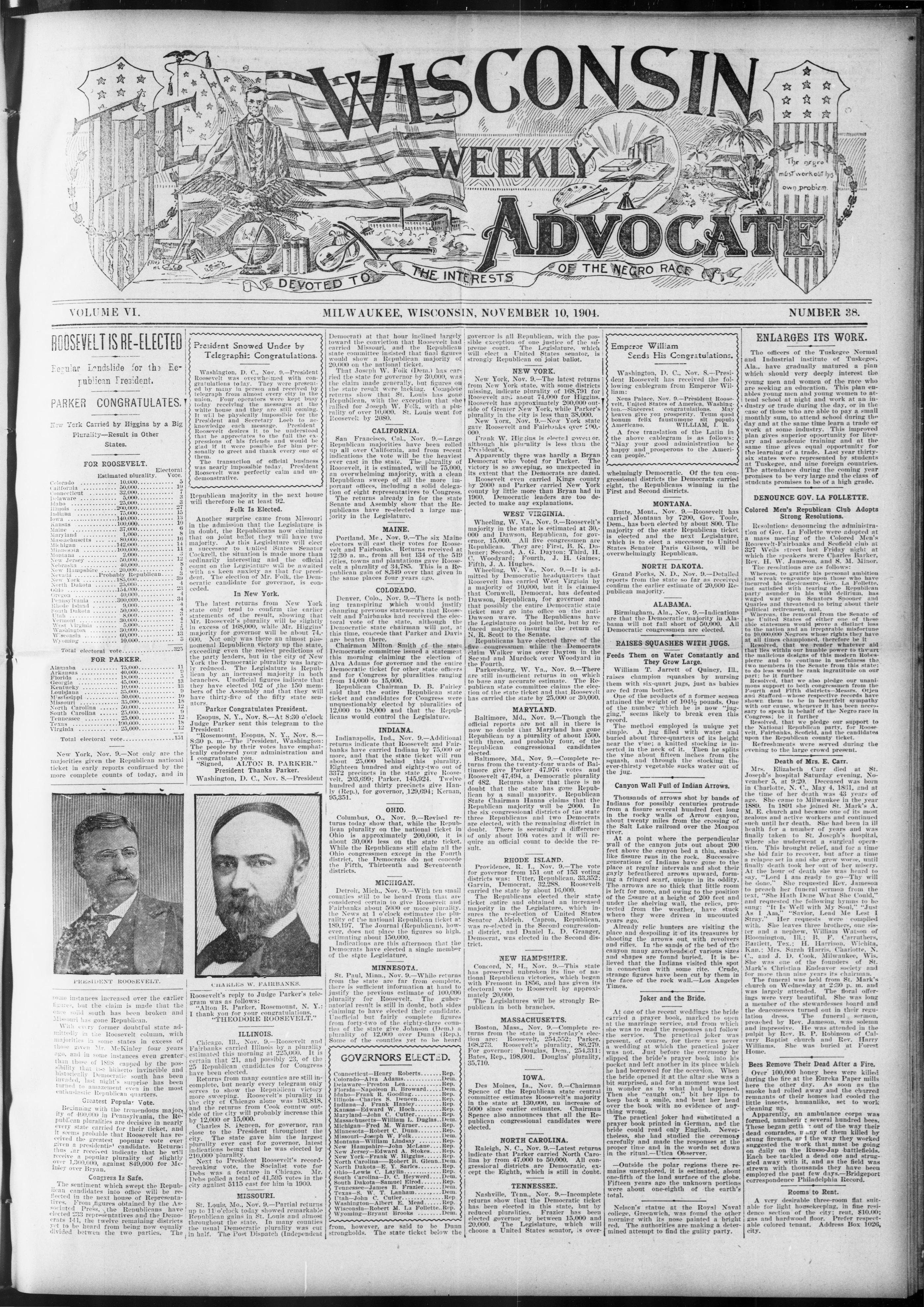
ROOSEVELT IS RE-ELECTED
Regular Landslide for the Republican President.
PARKER CONGRATULATES.
New York Carried by Higgins by a Big Plurality—Result in Other
FOR ROOSEVELT
<table><thead><tr><th></th><th>Estimated plurality.</th><th>Electoral Vote.</th></tr></thead><tbody><tr><td>Colorado</td><td>10,000</td><td>5</td></tr><tr><td>California</td><td>50,000</td><td>10</td></tr><tr><td>Connecticut</td><td>32,000</td><td>7</td></tr><tr><td>Delaware</td><td>5,000</td><td>3</td></tr><tr><td>Idaho</td><td>25,000</td><td>3</td></tr><tr><td>Illinois</td><td>200,000</td><td>27</td></tr><tr><td>Indiana</td><td>75,000</td><td>15</td></tr><tr><td>Iowa</td><td>140,000</td><td>13</td></tr><tr><td>Kansas</td><td>100,000</td><td>10</td></tr><tr><td>Maine</td><td>37,000</td><td>6</td></tr><tr><td>Maryland</td><td>1,000</td><td>8</td></tr><tr><td>Massachusetts</td><td>80,006</td><td>16</td></tr><tr><td>Michigan</td><td>142,000</td><td>14</td></tr><tr><td>Minnesota</td><td>100,000</td><td>11</td></tr><tr><td>Montana</td><td>2,000</td><td>3</td></tr><tr><td>New Jersey</td><td>50,000</td><td>12</td></tr><tr><td>Nebraska</td><td>40,000</td><td>8</td></tr><tr><td>New Hampshire</td><td>20,000</td><td>4</td></tr><tr><td>Nevada</td><td>Probably Republican</td><td>3</td></tr><tr><td>New York</td><td>185,000</td><td>39</td></tr><tr><td>North Dakota</td><td>25,000</td><td>4</td></tr><tr><td>Ohio</td><td>154,000</td><td>23</td></tr><tr><td>Oregon</td><td>40,000</td><td>4</td></tr></tbody></table>
Pennsylvania
Rhode Island
South Dakota
Utah
Vermont
West Virginia
Washington
Wisconsin
Wyoming
FOR PARKER.
75,000.....11
40,000.....9
18,000.....7
45,000.....13
10,000.....13
35,000.....9
50,000.....10
35,000.....18
50,000.....12
25,000.....9
25,000.....12
90,000.....18
25,000.....12
Alamaba ..... 75,000 ..... 11
Arkansas ..... 40,000 ..... 9
Florida ..... 18,000 ..... 5
Georgia ..... 45,000 ..... 13
Kentucky ..... 10,000 ..... 13
Louisiana ..... 35,000 ..... 9
Mississippi ..... 50,000 ..... 19
Missouri ..... 35,000 ..... 18
North Carolina ..... 50,000 ..... 12
South Carolina ..... 25,000 ..... 9
Tennessee ..... 25,000 ..... 12
Texas ..... 100,000 ..... 18
Virginia ..... 25,000 ..... 12
Total electoral vote.....151
New York, Nov. 9.—Not only are the majorities given the Republican national ticket in early reports confirmed by the more complete counts of today, and in
T. E. B.
some instances increased over the earlier figures, but the claim is made that the once solid south has been broken and Missouri has gone Republican. With every former doubtful state admittedly in the Roosevelt column, with majorities in some states in excess of those given Mr. McKinley four years ago, and in some instances even greater than those of 1898 capped by the possibility that the hitherto invincible and historically Democratic south has been invaded, last night's surprise has been turned to amazement even in the most enthusiastic Republican quarters.
Greatest Popular Vote
Beginning with the tremendous majority of 400,000 in Pennsylvania, the Republican pluralities are decisive in nearly every state carried for their ticket, and it seems probable that Roosevelt has received the greatest popular vote even given a presidential candidate. Return thus far received indicate that he will receive a popular plurality of slightly over 1,300,000, against 849,000 for Meinley over Bryan.
Congress Is Safe
The sentiment which swept the Republican candidates into office will be reflected in the next house of Representatives. From figures obtained by the Associated Press, the Republicans have elected 233 representatives and the Democrats 141, the twelve remaining districts yet to be heard from being now equally divided between the two parties. The
Washington, D. C., Nov. 9.—President Roosevelt was overwhemed with congratulations today. They were presented by many in person and received by telegraph from almost every city in the union. Four operators were kept busy today receiving the messages at the white house and they are still coming. It will be physically impossible for the President and Secretary Loeb to acknowledge each message. President Roosevelt desires it to be understood that he appreciates to the full the expressions of his friends and would be glad if it were possible for him personally to greet and thank every one of them.
The transaction of official business was nearly impossible today. President Roosevelt was perfectly calm and undemonstrative.
Republican majority in the next house will therefore be at least 92.
Folk Is Elected.
Another surprise came from Missouri in the admission that the Legislature is in doubt, the Republicans now claiming that on joint ballot they will have two majority. As this Legislature will elect a successor to United States Senator Cockrell, the situation is made more than ordinarily interesting and the official count on the Legislature will be awaited with as keen anxiety as that for president. The election of Mr. Folk, the Democratic candidate for governor, is con-
In New York.
The latest returns from New York state only tend to confirm the earlier statements of the result, showing that Mr. Roosevelt's plurality will be slightly in excess of 168,000, while Mr. Higgins' majority for governor will be about 74,000. Not only was there an almost phenomenal Republican victory up the state, exceeding even the rosiest predictions of the party leaders, but in the city of New York the Democratic plurality was largely reduced. The Legislature is Republican by an increased majority in both branches. Unofficial figures indicate that they have elected 102 of the 150 members of the Assembly and that they will have thirty-five of the fifty state senators.
Parker Congratulates President
Esopus, N. Y., Nov. 8.—At 8:30 o'clock Judge Parker sent this telegram to the President: "Rosemount, Esopus, N. Y., Nov. 8.— 8:30 p. m.—The President, Washington: The people by their votes have emphatically endorsed your administration and I congratulate you.
"Signed, ALTON B. PARKER." President Thanks Parker. Washington, D. C., Nov. 8.—President
J. H.
CHARLES W. FAIRBANKS.
Roosevelt's reply to Judge Parker's telegram was as follows:
"Alton B. Parker, Rosemount, N. Y.:
I thank you for your congratulations.
"THEODORE ROOSEVELT."
ILLINOIS
Chicago, Ill., Nov. 9.—Roosevelt and Fairbanks carried Illinois by a plurality estimated this morning at 225,000. It is certain that 21, and possibly 23, of the 25 Republican candidates for Congress have been elected.
Returns from many counties are still incomplete, but nearly every telegram only serves to show the Republican victory more sweeping. Roosevelt's plurality in the city of Chicago alone was 103,818, and the returns from Cook countw outside of the city will probably increase this by 12,000 or 15,000.
Charles S. Deneen, for governor, ran close to the President throughout the city. The state gave him the largest plurality ever cast for governor, latest indications being that he was elected by 210,000 plurality.
Next to President Roosevelt's recordbreaking vote, the Socialist vote for Debs was a feature in Chicago. Mr. Debs polled a total of 41,595 votes in the city against 5115 cast for him in 1900.
MISSOURI
St. Louis, Mo., Nov. 9.—Partial returns up to 11 o'clock today showed remarkable Republican gains in St. Louis and almost throughout the state. In many counties the usual Democratic plurality was cut in half. The Post Dispatch (Independent
Democrat) at that hour inclined largely toward the conviction that Roosevelt had carried Missouri, and the Republican state committee insisted that final figures would show a Republican majority of 20,000 on the national ticket.
That Joseph W. Folk (Dem.) has carried the state for governor by 30,000, was the claim made generally, but figures on the state result were lacking. Complete returns show that St. Louis has gone Republican, with the exception that she rallied for Joseph W. Folk, with a plurality of over 10,000. St. Louis went for Roosevelt; by 2080.
CALIFORNIA
San Francisco, Cal., Nov. 9.-Large Republican majorities have been rolled up all over California, and from recent indications the vote will be the heaviest ever cast in the state. The plurality of Roosevelt, it is estimated, will be 75,000, an overwhelming majority, with a clean Republican sweep of all the more important offices, including a solid delegation of eight representatives to Congress.
The returns already in for the state Senate and Assembl show that the Republicans have re-elected a large majority in the Legislature.
MAINE.
Portland, Me., Nov. 9.—The six Maine electors will cast their votes for Roosevelt and Fairbanks. Returns received at 12:30 a. m., from all but 134 of the 519 cities, towns and plantations gave Roosevelt a plurality of 34,785. This is a Republican gain of 8,349 over that given in the same places four years ago.
COLORADO.
Denver, Colo., Nov. 9.—There is nothing transpiring which would justify changing previous statements that Roosevelt and Fairbanks had received the electoral vote of the state, although the Democratic state chairman will not, at this time, concede that Parker and Davis are beaten there.
Chairman Milton Smith of the state Democratic committee issued a statement this morning claiming the election of Alva Adams for governor and the entire Democratic ticket for other state officers and for Congress by pluralities, ranging from 14,000 to 15,000.
Republican Chairman D. B. Fairley said that the entire Republican state ticket and candidates for Congress were unquestionably elected by pluralities of 12,000 to 18,000 and that the Republicans would control the Legislature.
INDIANA
Indianapolis, Ind., Nov. 9.—Additional returns indicate that Roosevelt and Fairbanks have carried Indiana by 75,000 or more, and that the state ticket will run about 25,000 behind this plurality. Eighteen hundred and eighty-two out of 3372 precincts in the state give Roosevelt, 203,699; Parker, 145,924. Twelve hundred and thirty precincts give Hanly (Rep.), for governor, 129,694; Kernan, 95,351.
OHIO
Columbus, O., Nov. 9.—Revised returns today show that, while the Republican plurality on the national ticket in Ohio is approximately 200,000, it is about 30,000 less on the state ticket. While the Republicans still claim all the Ohio congressmen except in the Fourth district, the Democrats do not concede the Fifth, Thirteenth and Seventeenth districts.
MICHIGAN.
Detroit, Mich., Nov. 9.—With ten small counties still to be heard from that are considered certain to give Rooseveit and Fairbanks about 5000 or more piurality, the News at 1 o'clock estimates the plurality of the national Republican ticket at 189,197. The Journal (Republican), however, does not place the figures so high, estimating about 150,000. Indications are this afternoon that the Democrats have elected a single member of the state Legislature.
MINNESOTA
St. Paul, Minn., Nov. 9.—While returns from the state are far from complete, there is sufficient information at hand to justify the previous estimate of 100,000 plurality for Roosevelt. The gubernatorial result is still in doubt, both sides claiming to have elected their candidate. Unofficial but fairly complete figures from forty-two of the eighty-three counties of the state give Johnson (Dem.) a plurality of 12,000 over Dunn (Rep.). Some of the counties yet to be heard
GOVERNORS ELECTED.
Connecticut—Henry Roberts.....Rep.
Colorado—Alva Adams.....Dem.
Delaware—Preston Lea.....Rep.
Florida—Napoleon B. Broward.....Dem.
Idaho—Frank R. Gooding.....Rep.
Illinois—Charles S. Deneen.....Rep.
Indiana—J. Frank Hanley.....Rep.
Kansas—Edward W. Hoch.....Rep.
Maryland—John C. Cutter.....Rep.
Massachusetts—William L. Duglas.....Dem.
Michigan—Fred M. Warner.....Rep.
Minnesota—Robert C. Dunn.....Rep.
Missouri—Joseph W. Folk.....Dem.
Montana—William Lindsay.....Rep.
New Hampshire—John McLane.....Rep.
New Jersey—Edward A. Stokes.....Rep.
New York—Frank W. Higgins.....Rep.
North Carolina—Robert B. Glenn.....Dem.
North Dakota—E. Y. Sarles.....Rep.
Ohio—Lewis C. Laylin.....Rep.
South Carolina—D. C. Heywerd.....Dem.
South Dakota—Samuel Elrod.....Rep.
Tennessee—James B. Frazier.....Dem.
Texas—S. W. T. Lanham.....Dem.
Utah—John C. Cutler.....Rep.
Washington—Albert E. Mead.....Rep.
Wisconsin—Robert M. La Follette.....Rep.
Wyoming—Bryant Brooks.....Dem.
from, however, are said to be Dunn
strongholds. The state ticket below the
governor is all Republican, with the possible exception of one justice of the supreme court. The Legislature, which will elect a United States senator, is strongly Republican on joint ballot.
NEW YORK.
New York, Nov. 9.—The latest returns from New York state, with some districts missing, indicate plurality of 168,791 for Roosevelt and about 74,000 for Higgins. Roosevelt has approximately 200,000 outside of Greater New York, while Parker's plurality in the city is less than 38,000.
New York, Nov. 9.—New York state gave Roosevelt and Fairbanks over 200,000.
Frank W. Higgins is elected governor, although his plurality is less than the President's.
Apparently there was hardly a Bryan Democrat who voted for Parker. The victory is so sweeping, so unexpected in its extent that the Democrats are dazed.
Roosevelt even carried Kings county by 2000 and Parker carried New York county by little more than Bryan had in 1900. Democratic leaders are too dejected to make any explanations.
WEST VIRGINIA.
Wheeling, W. Va., Nov. 9.—Roosevelt's majority in the state is estimated at 30,000 and Dawson, Republican, for governor, 15,000. All five congressmen are Republican. They are: First, B. K. Dohener; Second, A. G. Dayton; Third, H. C. Woodyard; Fourth, J. H. Gaines; Fifth, J. A. Hughes.
Wheeling, W. Va., Nov. 9.—It is admitted by Democratic headquarters that Roosevelt has carried West Virginia by a majority of 10,000, but it is claimed that Cornwell, Democrat, has defeated Dawson, Republican, for governor and that possibly the entire Democratic state ticket may go into office on the anti-Dawson wave. The Republicans have the Legislature on joint ballot, but by reduced majority, insuring the return of N. R. Scott to the Senate.
Republicans have elected three of the five congressmen while the Democrats claim Walker wins over Dayton in the Second and Murdock over Woodyard in the Fourth. Parkersburg, W. Va., Nov. 9.—There are still insufficient returns in on which to base any accurate estimate. The Republican state committee claims the election of the state ticket and that Roosevelt has carried the state by 25,000 or 30,000.
MARYLAND.
Baltimore, Md., Nov. 9.—Though the official reports are not all in there is now no doubt that Maryland has gone Republican by a plurality of about 1500, with three, and probably four, of the Republican congressional candidates elected
Baltimore, Md., Nov. 9.—Complete returns from the twenty-four wards of Baltimore give Parker 47,976 votes and Roosevelt 47,494, a Democratic plurality of 482. Returns show that there is no doubt that the state has gone Republican by a small majority. Republican State Chairman Hanna claims that the Republican majority will be 2000. In the six congressional districts of the state three Republicans and two Democrats are elected, with the remaining district in doubt. There is seemingly a difference of only about 100 votes and it will require an official count to decide the result.
RHODE ISLAND
Providence, R. I., Nov. 9.—The vote for governor from 151 out of 153 voting districts was: Utter, Republican, 33,352; Garvin, Democrat, 32,288. Roosevelt carried the state by about 16,000.
The Republicans elected their state ticket entire and obtained an increased majority in the Legislature, which insures the re-election of United States Senator Aldrich. Capron, Republican, was re-elected in the Second congressional district, and Daniel L. D. Granger, Democrat, was elected in the Second district.
NEW HAMPSHIRE.
Concord, N. H., Nov. 9.—This state has preserved unbroken its line of national Republican victories, which began with Fremont in 1856, and has given its electoral vote to Roosevelt by approximately 20,000. The Legislatures will be strongly Republican in both branches.
MASSACHUSETTS.
Boston, Mass., Nov. 9.—Complete returns from the state in yesterday's election are: Roosevelt, 254,552; Parker, 168,273. Roosevelt's plurality, 86,279. For governor: Douglas, Dem., 254,311; Bates, Rep., 198,601. Douglas' plurality, 35,710.
IOWA
Des Moines, Ia., Nov. 9.—Chairman Spence of the Republican state central committee estimates Roosevelt's majority in the state at 130,000, an increase of 5000 since earlier estimates. Chairman Spence also announces that all the Republican congressional candidates were elected
NORTH CAROLINA
Raleigh, N. C., Nov. 9.—Latest returns indicate that Parker carried North Carolina by from 47,000 to 50,000. All congressional districts are Democratic, except the Eighth, which is still in doubt
TENNESSEE
Nashville, Tenn., Nov. 9.—Incomplete returns show that the Democratic ticket has been elected in this state, but by reduced pluralities. Frazier has been elected governor by between 15,000 and 20,000. The Legislature, which will choose a United States senator, is over-
Emperor William
Washington, D. C., Nov. 8.—President Roosevelt has received the following cablegram from Emperor William:
Neus Palace, Nov. 9.—President Roosevelt, United States of America, Washington.—Sincerest congratulations. May heaven give you prosperity. Teum quod bonum felix faustumque sit populo Americano. WILLIAM, I. R.
A free translation of the Latin in the above cablegram is as follows: "May your good administration be happy and prosperous to the American people."
whelmingly Democratic. Of the ten congressional districts the Democrats carried eight, the Republicans winning in the First and Second districts.
MONTANA
Butte, Mont., Nov. 9.—Roosevelt has carried Montana by 7200, Gov. Toole, Dem., has been elected by about 800. The majority of the state Republican ticket is elected and the next Legislature, which is to elect a successor to United States Senator Paris Gibson, will be overwhelmingly Republican.
NORTH DAKOTA.
Grand Forks, N. D., Nov. 9.—Detailed reports from the state so far as received confirm the earlier estimate of 20,000 Republican majority.
ALABAMA
Birmingham, Ala., Nov. 9.—Indications are that the Democratic majority in Alabama will not fall short of 50,000. All Democratic congressmen are elected.
RAISES SQUASHES WITH IUGS
Feeds Them on Water Constantly and They Grow Large.
William T. Jarrett of Quincy, Ill., raises champion squashes by nursing them with six-quart jugs, just as babies are fed from bottles.
One of the products of a former season attained the weight of 104½ pounds. One of the number which he is now "jugging," seems likely to break even this record.
The method employed is unique yet simple. A jug filled with water and buried about three-quarters of its height near the vine; a knitted stocking is inserted in the neck of it. Then he splits the vine about fifteen inches from the squash, and through the stocking the ever-thirsty vegetable sucks water out of the jug.
Canyon Wall Full of Indian Arrows.
Thousands of arrows shot by bands of Indians for possibly centuries protrude from a fissure several hundred feet long in the rocky walls of Arrow canyon, about twenty miles from the crossing of the Salt Lake railroad over the Moapoa river.
At a point where the perpendicular wall of the canyon juts out about 200 feet above the canyon bed a thin, snake-like fissure runs in the rock. Successive generations of Indians have gone to the place at regular intervals and shot their gayly befeathered arrows upward, forming a fringed scarf, unique in its oddity. The arrows are so thick that little room is left for more, and owing to the position of the fissure at a height of 200 feet and under the shelving wall, the relics, protected from the weather, have stuck where they were driven in uncounted years ago.
Already relic hunters are visiting the place and despoiling it of its treasures by shooting the arrows out, with revolvers and rifles. In the sands of the bed of the canyon many arrowheads of various sizes and shapes are found buried. It is believed that the Indians visited this spot in connection with some rite. Crude, strange figures have been cut by them in the face of the rock wall.—Los Angeles Times.
Joker and the Bride
At one of the recent weddings the bride carried a prayer book, marked to open at the marriage service, and from which she was to read the responses and follow the service. The practical joker was present, of course, for there was never a wedding at which the practical joker was not. Just before the ceremony he slipped the bride's prayer book into his pocket and left another in its place which he had borrowed for the occasion. When the bride opened it at the altar she was a bit surprised, and for a moment was lost in wonder as to what had happened. Then she "caught on," bit her lips to keep back a smile, and bent her head over the book with no evidence of anything wrong.
The practical joker had substituted a prayer book printed in German, and the bride could read only English. Nevertheless, she had studied the ceremony carefully and made the responses at the proper time and in the words set down in the ritual.—Utica Observer.
—Outside the polar regions there remains unexplored, it is estimated, about one-fifth of the land surface of the globe. Fifteen years ago the unknown portions were about one-eighth of the earth's total.
Nelson's statue at the Royal Naval college, Greenwich, was found the other morning with its nose painted a bright red. The authorities are making a determined attempt to find the guilty party.
ENLARGES ITS WORK.
The officers of the Tuskegee Normal and Industrial institute of Tuskegee, Ala., have gradually matured a plan which should very deeply interest the young men and women of the race who are seeking an education. This plan enables young men and young women to attend school at night and work at an industry or trade during the day, or in the case of those who are able to pay a small monthly sum, to attend school during the day and at the same time learn a trade or work at some industry. This improved plan gives superior opportunity for literary and academic training and at the same time gives equal opportunity for the learning of a trade. Last year thirty-six states were represented by students at Tuskegee, and nine foreign countries. The attendance during the coming year promises to be very large and the class of students promises to be of a high grade.
DENOUNCE GOV. LA FOLLETTE.
Colored Men's Republican Club Adopts Strong Resolutions.
Resolutions denouncing the administration of Gov. La Follette were adopted at a mass meeting of the Colored Men's Rosevelt-Fairbanks and Scofield club at 327 Wells street last Friday night at which the speakers were Charles Barker, Rev. H. W. Jameson, and S. M. Minor. The resolutions are as follows:
Whereas, to gratify his personal ambition and wreak vengeance upon those who have incurred his displeasure, Gov. La Follette, not satisfied with tearing the Republican party asunder in his wild delirium, has waged war upon Senators Spooner and Quarles and threatened to bring about their political retirement, and.
Whereas, the removal from the Senate of the United States of either one of these able statesmen would prove a distinct loss to the nation and an irreparable misfortune to 10,000,000 Negroes whose rights they have at all times championed, therefore be it
Resolved, that we render whatever aid that lies within our humble power to thwart the malicious designs of this modern Robes-pierre and to continue in usefulness the two members in the Senate from this state; to do less would be rank ingratitude on our part; be it further
Resolved, that we also pledge our unanimous support to both congressmen from the Fourth and Fifth districts—Messrs. Otjen and Stafford—whose respective records have shown them to be in heartfelt sympathy with our cause, whenever it has been necessary to speak in behalf of the Negro race in Congress; be it further
Resolved, that we pledge our support to the National Republican party, for Roosevelt, Fairbanks, Scofield, and the candidates upon the Republican county ticket.
Refreshments were served during the evening to the large crowd present.
Death of Mrs. E. Carr
Mrs. Elizabeth Carr died at St. Joseph's hospital Saturday evening, November 5, at 9:20. Deceased was born in Charlotte, N. C., May 4, 1861, and at the time of her death was 43 years of age. She came to Milwaukee in the year 1889. In 1891 she joined St. Mark's A. M. E. church and became one of its most zealous and active workers and continued such until her death. She had been in ill health for a number of years and was finally taken to St. Joseph's hospital, where she underwent a surgical operation. This brought relief, and for a time she bid fair to recover, but after a time a relapse set in and she grew worse, until finally death took her out of her misery. At the hour of death she was heard to say, "Lord I am ready to go—Thy will be done." She requested Rev. Jameson to preach her funeral sermon from the text, "She Hath Done What She Could," and requested the following hymns to be sung: "It Is Well with My Soul," "Just As I Am," "Savior, Lead Me Lest I Stray." Her requests were complied with. She leaves three brothers, one sister and a nephew, William Watson of Bloomington, Ill.; B. F. Carruthers, Bartlett, Tex.; H. Harrison, Wichita, Kan.; Mrs. Sarah Harris, Charlotte, N. C., and J. D. Cook, Milwaukee, Wis. She was one of the founders of St. Mark's Christian Endeavor society and for more than nine years its chairman.
The funeral was held from St. Mark's church on Wednesday at 2:30 p. m. and was largely attended. The floral offerings were very beautiful. She was long a member of the stewardesses board and the deaconesses turned out in their regulation dress. The funeral sermon, preached by Rev. Jameson, was solemn and impressive. He was attended in the pulpit by Rev. B. P. Robinson of Calvary Baptist church and Rev. Harry Williams. She was buried at Forest Home.
Bees Remove Their Dead After a Fire.
Over 100,000 honey bees were killed during the fire at the Eureka Paper mills here the other day. As soon as the smoke had rolled away and the charred remnants of their homes had cooled the little insects, humanlike, set to work cleaning up. Apparently, an ambulance corps was formed, numbering several hundred bees. These began getting out of the way their dead comrades, many of them killed by stung firemen, and the way they worked suggested the work that must be going on daily on the Russo-Jap battlefields. Each bee tackled a dead one and struggled away with it, and as the field was strewn with thousands they have been employed the past few days.—Bridgeport correspondence Philadelphia Record.
Rooms to Rent.
A very desirable three-room flat suitable for light housekeeping, in fine residence section of the city; rent, $10.00; gas and hardwood floor. Prefer respectable colored tenant. Address Box 1026, city.
Miscellaneous Items.
-There are many signs of a great commercial development in the western islands of Alaska.
-Geese are driven to the great Prague fair with their feet incased in tar boots to prevent injury.
-The San Francisco police advocate the establishment of a public whipping post for footpads.
There are 12,520 boys and 4050 girls in the industrial schools of Great Britain at present.
The first threshing machine was recently set up in Damascus. It is a steam thresher from Indiana.
A Kansas man claims to have a swarm of bees that made twenty pounds of honey in three days.
Automobile trains are to be run on wagon roads in German East Africa as feeders to the railway lines.
The rubber exported from the Amazon river in the season of 1093-04 amounted to 67,314,116 pounds.
According to the latest returns to the territorial board of equalization, there are 237,696 cattle in Arizona, valued at $1,578,625.
—In Korea two years of every three have twelve months each of twenty-nine or thirty days. The third year has thirteen months, with 385 days.
—Glass houses of a very substantial kind can be built now. Silesian glassmakers are turning out glass bricks for all sorts of building purposes.
—Canadian railroads are offering as high as $1.50 and $1.75 a day for laborers for construction work, but are unable to procure sufficient men.
—The Italian Mediterranean Railway company has decided to purchase fifty special cars for carrying grain at a cost of $71,000. The company's chief offices are in Rome.
The amount of beer consumed in 1900 per inhabitant was 370 liters in Munich, 232 at Lille, 160 in Berlin, 145 in Vienna, 48 in Budapest, 28 in Moscow and 11 in Paris.
The British government committee on physical deterioration has recommended a law requiring every house occupied by a single family to have a grate suitable for cooking purposes.
When the oil in a big tank in Fresno county, Cal., was fired by lightning a cannon ball was shot into the tank and the oil ran out through trenches that had been dug for the purpose.
Probably the largest life insurance policy ever applied for by a woman was presented when the application for $500,-000 on the life of Mrs. Charles Netcher of Chicago was filed the other day.
—In London, according to the latest statistics, there is only one telephone for every sixty families. In New York there is one for twelve, in Boston one for six, in San Francisco one for four.
—The Japanese captured a lot of records of court martials in Liao Yang, and among the lot were some which showed that a number of staff officers had been tried for drunkenness and cowardice.
—A Canadian government agent who has just returned to England says the Douknobors in Canada are making progress. "They no longer work their women instead of their cattle in the fields."
One of the most remarkable old men in the world is Saikab Imamedda, regimental chaplain of the Eighteenth Bengal infantry in the English army. He is 130 years old and can still read without glasses.
The editor of the Bangor News, in discussing the copyright laws, boasts that he once secured copyrights of the Lord's prayer and the multiplication table, and that he still holds the papers duly signed and numbered.
The wild ducks have shed their feathers earlier than usual, and there is more than the usual amount of down under their feathers. Hence, expect an early cold and disagreeable winter, says the weather-wise man.
Canadians are said to be engaged extensively in shipping from Pacific ports cargoes of flour for Port Arthur—a risky, but, with fair luck, very lucrative business. Montreal firms are said to be particularly active.
The first number of the official organ of the Austrian Divorced Catholics' club has appeared. According to it there are in Austria no fewer than 200,000 divorced persons, the majority of whom desire to marry again.
There is a big Maltese cat in the railroad shops at Indianapolis which is the pet of all the railroad men in that city. She is said to have killed 10,000 rats and mice in her time, but now she has adopted a family of four baby mice and is carefully bringing them up.
The Japanese language contains no fewer than eighteen synonyms for the personal pronoun "I," one for each class of people; and etiquette makes it unlawful for a person belonging to one rank in society to make use of the pronoun pertaining to another.
A report compiled by W. J. Semelroth of St. Louis, chief secretary for the world's fourth Sunday school convention, held at Jerusalem, in April of this year, shows that this country contains 139,817 Sunday schools, or more than half the number existing in the entire world.
Egypt's imports of textiles in 1903 were valued at $24,785,880, which was about one-third of the total value of the country's imports. Great Britain's share was nearly $15,000,000; Austria-Hungary's, $2,186,000; France's, $2,035,000; Italy's, $1,780,000; Turkey's, $965,000; that of English colonies in Asia, $965,000; Germany's, $955,000.
In the village of Altenburg, on whose borders three countries meet, there are no soldiers, no police, no taxes and its people are ruled by no monarch. The inhabitants speak a queer jargon of French and German combined, and spend their time cultivating the land or working the valuable calamine mine, which is the boast of the village.
A Liverpool sugar expert has been making a thorough investigation into the practicability of attempting to raise sugar beets in that country and now announces that 1,000,000 acres of land in the United Kingdom are suitable for the purpose. He has made more than 1000 experiments to test British soil and climate and they have satisfied him that these essentials are even better adapted to the production of sugar than those or Germany.
The Canadian authorities are delighted over the success of their experiment in instructing their fishermen in the Scotch methods of catching and packing herring. A shipment to New York of Canadian herring put up by Prof. Cowie and his Scotch fishermen at Canso brought from $12 to $15 a barrel, which is equal to the highest price obtained for Scotch or Norwegian herring. The ruling price heretofore received for the Canadian catch has been from $5 to $6.
Black Chipmunk Rare
I have lived in a chipmunk region all my life and have never seen a black one, yet black ones do occur. I have just received a photograph of one seen in the Catskills, and a correspondent at Bath, N. Y., writes me of one she has seen there for two seasons.
I have not yet heard of a black red squirrel, though black gray ones are occasionally seen. Black woodchucks and black foxes are probably the result of the same law of variation.—John Burroughs in Outing.
HER BONNET
Her bonnet's just the sweetest thing,
It flouts the world as she goes by.
It's tied down by the sweetest string,
I'd love to be that string, but my!
The bonnet might not be the thing
So sweet if I should be the string.
Her bonnet's just the sweetest thing,
It tips a bit above her eye.
The birds, the birds begin to sing,
They want to sing as she goes by.
They think it's daybreak, and, oh my!
It's just because she's passing by.
Her bonnet's just the sweetest thing,
It roofs in just the sweetest hair.
And eyes and mouth—the birds will sing,
They think it's spring when she is there,
It's just because she's passing by,
I want that bonnet, but, oh my!
White rose of roses, why be shy
About the sweetest bonnet string?
The lads, the lads will sigh and sigh,
For God's white rose that makes it spring
And daybreak for the birds, and I--
Just want that bonnet, but, oh my!
—From "Echoes from the Glen." by William Page Carter in Leslie's Monthly.
A STRANGE PROVIDENCE.
San Geronimo dozed in a tropical sun the picture of lazy contentment. The gently swaying leaves of the trees and the soft, slow fall of the water in the stone basin of the fountain was a mute protest against a strenuous life. Padre Antonio stepped from the dusty little train and as his quick eye took in the evident signs of inertness he felt a sense of keen disappointment.
The young priest possessed the energy of his race and the zeal of his calling. He wished for a busy, a useful life: small chance for either, he thought, here. An American by birth, he had been educated in Rome for the Spanish missions, and this little Mexican village was his first charge. His predecessor had lived among the people here for more than twenty years, "greatly loved, and when death removed him truly mourned." Unconsciously he repeated these words of the good bishop when the latter told him of his wish that he should come to this village.
The year was drawing to a close and during this time only two unimportant incidents had broken the calm monotony of Padre Antonio's life. Once some American tourists stopped for a few hours to visit the quaint old town. Some of his flock heard him talking English to the strangers and the word went round that the new pastor had great learning. The other was a trifling incident in itself, but it suggested the idea that there might be an opportunity for a real kindness. Several times during some special service he noticed "a stranger in their midst." The man looked ill and prematurely old, but it was evident that he had seen better days. Padre Antonio decided that he would speak to him, but when the service was over he had disappeared. It was always the same. He would hurriedly leave the church, and as no one knew him the priest found his intention thwarted.
One dreary, rainy evening Padre Antonio sat alone in the large bare room that he called his study. That tantalizing question, which he had begun to regard as a kind of temptation, persisted in returning again and again. Why, of all places, should he have been sent to San Geronimo? Suddenly there echoed through the long corridor a loud knock. It was imperative, too, and for once, at least, the pertero lost no time in answering the summons. Was it here the padre lived who spoke English? Yes. "Then he is sent for. Back in the mountains a poor fellow—a foreigner—is dying."
It was a wild, rough ride through the rain and darkness. The stout little Mexican ponies had all they could do to climb the steep mountain path. The guide led the way to an adobe hut, a door stood partly open, and out of the shadows an old woman scrambled and reverently kissed the hand of the priest. "Yes, he is awake and conscious. Please enter," she said.
At the sound of approaching footsteps the sick man turned a pair of eager eyes on the priest and the latter recognized the stranger whom he had seen in the church.
"I heard that you spoke English. I sent for you to talk over a matter of much importance. It was impossible for me to tell my story in Spanish. I hope you will understand me." "I am an American," answered the priest gently.
"This is more than I deserve," he said fervently. After a short pause he continued. "For me there is little to be done, but I feel sure you will help right a great wrong. In my trunk you will find a small box—in it is a large sum of money that must be returned. Every cent is there with my written statement of the theft and the innocence of the man who is now being punished for me." The story which was told the priest in the lonely watches of the night was the oft repeated story of temptation and weakness. Every day the press repeated it—the trusted employee who for one cause or another violates the confidence of his superior. This case was made unusually sad by the knowledge that another was bearing the burden of his shame. Padre Antonio heard the name of a big western city and that of the dying man. In the almost forgotten past of his boyhood there lingered a memory which these names stirred into life.
John Halliday was the clever boy of the school and one of fortune's favorites. Everything came to him while he, Antonio, must work and stint for every inch of his way. He recalled how he had admired, yes, and envied Jack Halliday in those old days when the world smiled upon him and called him a "winner." Should he tell him that an old comrade was near? He was still in doubt when Halliday answered it for him.
"To die like a hunted animal in a foreign country—surely this is tasting the bitterness of death. It wouldn't be so hard to go if only some one who had ever known me before this crime blasted my career could be with me now."
The priest laid a gentle hand on the sufferer's head.
"Jack," he said softly. "do you remember Anthony Murphy? It is he who is with you."
John Halliday's hold on the things of earth was too slight for him to feel any great surprise."
"So you are little Anthony," he said. "In my misspent life what have I done that my last wish should be answered?"
Later he pressed Padre Antonio's hand and with a sigh of infinite content murmured, "Heaven sent you to San Geronimo."
A sunbeam crept into the half-open
door of the adobe hut. It rested upon the white, peaceful face of Jack Halliday and well upon the bowed head of Padre Antonio.—F. M. in Mexican Herald.
Gaudy is the one word which will describe adequately the buttons of the present season. They flash and gleam and flaunt myriad colors into the shopper's eyes, and bewilder her even more than do the color combinations in millinery.
Above all things the button of 1904-05 is ornamental rather than useful. It is employed to give a finishing touch to an outdoor garment, or to relieve the suggestion of somberness in a house gown, or to trim, like sequins or embroidery, the girdles and stocks of the hour. Extravagances in the button line show jeweled effects. Buttons composed entirely of rhinestones vary in diameter from a quarter of an inch to an inch and a half. The center is generally a good-sized rhinestone, with slender spokes of small, fine rhinestones radiating from it to an outer circle of the small stones.
Again, the stones are set so close together that there is neither mounting nor dress fabric to be seen between them. The rhinestones used for these solid looking buttons are generally very fine and cut with many faces, so that the button sparkles, no matter how the light strikes it. Colored jewels are combined with rhinestones exactly as they are used with diamonds in brooches. A striking button or marquis lines shows a large jewel, either turquoise, amethyst, emerald, garnet, sapphire, topaz or opal, overlaid with a filagree effect in silver, set with rhinestones. The marquise is in turn encircled by tiny rhinestones, and the button measures nearly two inches in length. These jewels will be matched with the color of the gown; emerald on a green dress, sapphire on blue, topaz on brown, etc., and they will be used in all colors on black velvet.
Sometimes the arrangements of the jewels is reversed. For instance, the center will be a large, many-faced rhinestone, from which radiate slender rays or spirals of jewels. These rays are built of wash gold, set with jewels to match the color of the gown, and topaz seems to be enjoying a particular vogue in combination with the new brown cloths. Opal centers, with petal effects in rhinestones, are used for velvet dresses and for evening cloaks in broadcloth. Pearls, rhinestones and opals form the centers of jet buttons, which vary in size from a quarter of an inch to an inch in diameter. These are not for use on mourning gowns, as the jeweled effect is not in good taste for individuals presumably grieving.
A new button, which is particularly effective on evening coats in white or pale colors, is of tinted horn, ornately carved. The button is about two inches in diameter and exceedingly flat. It shows a wreath of fine leaves and blooms, shading delicately from sea green to pink. From the lower part of this circle rises an open flower, flat and in full bloom, with a rhinestone center to simulate a dewdrop. This leaves quite a space between the circle of leaves and blooms and the single flower through which the cloth will show.
For gowns which are trimmed in Persian bands come enamel buttons to match every imaginable shade of embroidery. The button proper is of wash gold, crossed and recrossed with enameled bands, in which are reproduced the most delicate colorings of the Persian and Dresden effects.
Small buttons will be used in clusters as trimming, and a most effective example of this decoration is a low pyramid of gold about a quarter of an inch in diameter. The apex is cut off and a tiny jewel to match the dress is set therein. Each of the four sides show a smaller pinhead jewel. These may be secured with jewels ranging in color from pearls and opals to the most vivid emeralds and sapphires.—Washington Star.
OIL TRUST'S GREATEST FEAT.
Pipe Line When Finished to Kansas Will Have Cost $85,000,000.
The Standard Oil company is now at work upon some improvements which for magnitude eclipse anything of the kind hitherto undertaken. It is finishing the last link in its great pipe line from the prairies of Indian territory to the Atlantic. This link is between Kansas City and Whiting, I. T. It will take 20,000 barrels of oil to fill this before the oil begins to run at Kansas City. The production of oil in the Osage Nation has increased to 8000 barrels a day and is of fine quality.
The line from Kansas City to the Osage fields, including the big storage plants at Caney, Kan., cost upward of $14,000,000; the link between Kansas City and Whiting will cost $11,000,000 more, and the existing line to the seaboard cost $60,000,000. In the Kansas field there are now about 4000 producing wells. At Chanute, Kan., an additional storage tank is to be erected with a capacity of more than 1,000,000 barrels in excess of that already under contract in that place. The increase in production of oil will tax even this enormous capacity, though at the present time the Standard Oil company can take care of more than 5,000,000 barrels a day.
The company has also started the erection of the five biggest oil tanks in this country. They are at Van Buskirk's farm, Bayonne, N. J. Each will be 115 feet in diameter and 36 feet high, and each will have a capacity of 2,719,483 gallons of oil.New York Tribune.
Longevity in Virginia.
"Mine is the prize state for longevity," said a Virginian who was registered at a Chestnut street hotel. "I can produce a list of nineteen former citizens and slaves of my state whose years when they died aggregated 2241 years. Of the nineteen persons named the youngest when he died was 110 years old. Two lived to be 130. one to be 126, two to be 121, one to be 116, two 115, three 114, one 113, two 112, two 111, one 110, one 120, and one, a negro, lived to the ripe old age of 136 years. Of the nineteen persons only six were negroes; all the others were whites
"While I am in the humor I will tell another one. There is, or was, a few years ago, standing on the banks of Nebasco creek, Virginia, a tombstone carrying probably the oldest monumental inscription in the United States. The date is 1608, and it is thought that the deceased was one of John Smith's men. This is the inscription: 'Here lies ye body of Lieut. William Herris, who died May ye 16th, 1608; aged 65 years; by birth a Briton; a good soldier; a good husband and neighbor.'"—Philadelphia Press.
Snails Pull a Cart.
For the sake of amusement a little French boy caught two snails, to the back of each of which he glued a bent pin; then, when the glue was hardened he fastened to each pin a piece of thread, the ends of which he attached to a little tin cart on wheels. This cart and the snails he placed on a level surface and waited to see what would happen. After a time the snails started to move, stopping for a moment when the thread became taut; then they commenced to draw the cart, apparently without any effort, even though the heaviness of it was increased later on by the addition of a two-pound weight
HOW TO CATCH A TROLLEY.
Trolley cars are very swift:
Trolley cars are quickly miffed,
Many a time I've seen a trolley
Kick its heels and run like golly
Just because some little wit
Waved his silly hand at it.
Now, to catch a trolley car,
Certain iron-bound rules there are,
First of which is not to let it
Ever guess you wish to get it.
Second, wear a deep disguise;
Carry bundles great in size,
So the car will never dream
You can run--you see the scheme?
When it rolls remorseless by,
Drop your bundles there and fly!
Run like mad, however far;
Throw away your fresh cigar,
Throw away your parasol,
Throw away your hat and all,
Run until you catch the car,
Fall aboard, and there you are!
New York Every Day.
James M. Thaw, president of the Grand National Curling club of America and one of the most devoted enthusiasts of the game in America, is dead at his home in Hoboken, N. J. He was born in Scotland in 1858.
A representative of a prominent steel manufacturing concern said that if the Standard Oil carries out its plan to pipe oil from the western oil territory to Chicago, more than 200,000 tons of pipe, costing $7,000,000, will be required.
The anonymous donor of $200,000 to the New York Historical society for the erection of a new building is Henry Dexter, who gives it for a memorial to his son, Orlando P. Dexter, who was murdered in the Adirondacks a year ago.
The newest thing in cigar cases is a holder that one can adjust inside a derby hat. It consists of a steel band arched along the crown of the hat, the ends of which can be inserted beneath the lining. The arch has a row of ten crooked teeth, which act as catches to hold the cigars. When first seen it looks more like a musical instrument than a cigar holder.
Capr. Robert Stangland of the Columbia university football team is suffering from an injury received in the game with Yale. Stangland has been hurt in nearly every game this season, and in the Yale contest was hurt about the head. He rejoined the team at once, but soon afterwards complained of severe pains in the head and has since lost his senses of smell and taste.
The New York Central railroad has decided to replace wooden with steel ties on its entire system. This is the outcome of a recent conference of officials of the road held in this city. There was no opposition to the plan. An order for 7000 of the new ties has been placed with the Carnegie Steel company. Within the next few weeks the New York Central will place a much larger order.
Mrs. Isabel E. Miller has presented an application to Judge Amend in the supreme court to compel her husband, John B. Miller, to contribute to her support in accordance with his means, which she places at $18,000 a year. John B. Miller is a brother of the late Mrs. Jay Gould, and the couple were married in Chicago April 14, 1891, and have no children. Mrs. Miller is suing her husband for absolute divorce.
Pew No. 40, in the south transept of Grace church, was sold in the New York real estate salesroom by auction for the trustees of the Ray estate. The bidding started at $250, and, after a series of $50 bids, it was knocked down for $1550 to Hamilton G. King, employed in the office of the Rhinelander estate. King said he had purchased the pew for some one, but refused to disclose the name. The pew has six seats.
Harry Pennington Toler, the broker who startled New York a year ago by setting up as a biblical prophet and claiming for himself and a select coterie a $3,000,000,000 slice of Harlem, has separated from his wife. By mutual agreement they decided to dissolve the domestic partnership. This decision, it is said, was reached after Mrs. Toler found she could not entertain a belief in the doctrines of Christian Science.
Several hundred after-theater diners at the Marborough Hotel Rathskeller were thrown into a state of excitement by the descent of a squad of police, who blocked every exit, while detectives made prisoners of half a dozen waiters charged with defrauding the management. It is stated at least $10,000 has been stolen. Checks were being tampered with, and a girl whose duty it was to mark and check the waiters' tabs, was found to be implicated.
Six exquisite vases, valued at $15,000, have been stolen from John S. Melcher, a lawyer and art collector. Mr. Melcher recently moved into a new house. He had five Cloisonne vases, worth $2000 each, and a sixth jewel-inlaid vase, worth $5000. He prized these so much that he asked to have them carted in a separate van. Thieves learned of this request, backed up to Mr. Melcher's house with a van, packed the vases into it and coolly drove away.
Rev. Dr. Benjamin F. DeCosta, the Episcopal clergyman who became a convert to the Roman Catholic church and was ordained a priest, is dead. He was 74 years old. Before entering the Roman Catholic church Dr. DeCosta for thirty-eight years was pastor of St. John's Protestant Episcopal church, holding a prominent place in the religious life of this city. He was the author of more than thirty religious and historical works and a novel, "The Rector of Rocksburg."
Dr. August G. Siebert has just completed a series of tests of air in the subway. He said they showed one of the subway stations at One Hundred and Third street with as little as 11.9 per cent of oxygen in the air. The average amount of oxygen in surface air is about 20.8 per cent. Dr. Siebert says atmosphere that contains less than 14 per cent is detrimental to health. Dr. Siebert found his library, which hadn't been ventilated for several hours, contained 18 per cent of oxygen.
Another echo of the financial difficulties of the Countess de Castellane resounded in the United States circuit court when Judge Lacombe signed a judgment authorizing George J. Gould and Helen Miller Gould as receivers for the income of their sister Anna, to pay certain lawyers an annual sum for attending to the legal affairs of the countess. Judge Lacombe ordered that John F. Dillon eb paid $1500, Coudert Brothers of New York, $3000, Coudert Freres of Paris, $3500, and Charles A. Gardiner of New York, $1000 a year.
Michael Davitt arrived on the White Star line steamship Cedric. He said he came on private business and would return to Ireland in December. "I believe the Russian fleet firing on the fishing fleet was the result of some misunderstanding. Russia knew that when she was on the coast of England she was on the coast
of an enemy just as surely as though England had declared open war upon her. She was certainly justified, in view of the facts, in taking no chances. No one, not even in England, believes that Russian naval officers would fire on fishermen if they knew them to be such."
Louis B. Adams, one of the three sons of Al Adams, the former policy king, who was recently released from Sing Sing prison, made an attempt to shoot his father in the real estate office of Pocher & Co. Young Adams was drunk at the time, and his ire had been aroused by the refusal of his father to meet his demands for money. He was restrained with the greatest difficulty and locked up. Next day he was sent to the island for six months by Magistrate Barlow in the Jefferson Market court at the request of his father, who believes a little prison life will have a sobering effect on him.
"Doc" Owen. the transatlantic card sharp, who arrived from Liverpool aboard the White Star line steamer Cedric, sailed under his own name, W. J. Owen, to which he declares he is legally entitled, and which he asserted he should use hereafter on his ocean traveling. He declared he had decided to act hereafter on the "dead level," as he found honesty to be really the best policy. He astonished the purser and others, who recognized him, by not playing cards at all on the voyage. However, he could not resist the temptation to enter a little gentlemanly betting on the ship's daily runs, and on the fifth day out he won a pool of $50.
Considerable mystery surrounds the identity of a stylishly gowned woman whose report to the police that $10,000 worth of diamonds had disappeared has set every detective in Greater New York to work. The advertisement stated that the finder, by returning them to the diamond firm of Black, Starr & Frost on Fifth avenue, would be liberally rewarded. Neither the police nor this firm would tell the name of the woman, excepting that she is a member of a prominent family and has sailed for Europe. Later the announcement was made that the diamonds had been recovered by a young woman who said she found them on the street. She was well rewarded.
The Hamburg-American line announces some novelties in the construction of their new monster ships, the Kaiserin Auguste Victoria and the America, now building respectively at the Vulcan works at Stettin and the yards of Harland & Wolf in Belfast. Each of the liners will have a grillroom of the proportions of a modern a la carte restaurant, where the passengers may dine when they please and may arrange luncheon and dinner parties for friends whom they may meet on board. There will be passenger elevators running through all five stories or decks where there are passenger accommodations. There will be also Turkish baths and a large gymnasium.
Louis Mare Philippe and Antonio Gaston Philippe, princes of Orleans, son of Prince Louis Philippe Gaston and Princess De Bragance, daughter of Dom Pedro, late Emperor of Brazil, have returned to New York after a tour lasting three months, during which they have visited Boston, Lenox, Newport, Chicago, St. Louis and Philadelphia.
"We have had a fine time," said Prince Louis, the edler of the brothers, "and we have been treated handsomely by the Americans, who are so cordial, so courteous and so hospitable."
Both pronounced America a great country from their point of view and declared their intention of coming on another visit when they can procure leave of absence from the Austrian regiments in which they serve.
"Here, my dear," said George Crocker to his step-daughter, Alice Rutherford, "you are to be married tomorrow. I have been so busy and worried of late that I have not been able to buy you a wedding present. Take this and get something for yourself with it, my love." With this he handed her a folded paper. Now Miss Alice had in some occult way known that her step-father had not bought her any present and she was beginning to feel rather sad. But she knew of Mr. Crocker's sorrow over her mother's death and that was an excuse for much. But when she opened the folded paper she read: "Pay to the order of Mrs. J. Langdon Erving $50,000." Langdon Erving took place at Mr. Crocker's home.
After a search of three years through the cities and towns of three states Mrs. Julia Van Alstyne of Auburn, N. Y., found in an unmarked grave in the potter's field the body of her grandson. The gray haired woman has secured an order to disinter the body and bury it at the side of the boy's mother in a little cemetery near Auburn. Three years ago the boy, then 19 years old, disappeared from the Asylum for the Feeble Minded, in Rome, where his grandmother had placed him a year before. Thousands of dollars were spent in the search, and finally the grandmother came here, and, aided by her son, visited all the public institutions, carrying with her a photograph of the boy. Her search was rewarded at the Bronx morgue, where the keeper recognized the picture as that of a boy who had shot himself and then taken carbolic acid in Bronx Park July 21, 1904. leaving nothing behind by which he could be identified.
His mind affected by a passion for rare old books, Patrick McGuire was ordered sent to Bellevue hospital when he was arraigned for having shot his brother James in the right leg. McGuire is a junk dealer, 65 years old.
"Until Pat lost his head after finding a copy of Shelley's poems worth $5000 he was as fine a fellow as you would want to see," said an elder brother, James, in court.
"I guess you'd call him a book miser now. When he first opened his junk shop in the '80s he bought a truck load of old stuff for $2.30. In that load was a copy of Shelley's poems. It was a first edition and Pat learned through a London catalogue that it was worth $5000.
"Would he sell it? Not for anything. He put it under his mattress and kept it as a miser hoards his gold.
"A few days ago he accused me of having stolen the volume. We had a quarrel. When I met him last evening he shot me."
The captain of the great Kaiser William emitted a roar the other day when the ship landed against the practice, which has been growing recently among women, of carrying pet dogs. There were 6000 passengers and 175 dogs. The day after the ship left Cherbourg Capt. Hogemann had several dogless passengers protest against the familiarity of the dog fanciers. Capt. Hogemann had spent a sleepless night listening to the howling of the animals above the roar of a southeast gale, and he decided to curtail the dog freedom of the floating city. The patrons of the smoking room said the only real live sport during the trip was dog fighting. One passenger said he counted sixty-four distinct fights. Everybody treated the dog incident as being highly amusing and bets as to the outcome of the latest snarling match were frequent. Even on the pier yesterday the doggies' disposition to scrap would not down, and longshoremen and stewards had their hands full separating the warring dog factions.
SELF-SACRIFICE.
My Uncle Jim he's jes' about
The smartest man on earth.
He knows jes' where the muskrats live
An' what their skins is worth;
He knows jes' when to plant yer oats
And when to cut yer hay
An' what the Russians ought to do
To hold the Japs at bay.
He's allus' goin' 'round about
As busy as kin be.
A-givin' all the folks he knows
This information free.
An' people kind o' laughs to see
His luck grow wuss an' wuss.
You see that's what a feller gets
Fur bein' generous.
—Washington Star.
FARM AND GARDEN.
Sandv Soil for Poultry.
That an open, porous soil can be kept comparatively clean with much less labor than a clay soil will be evident to those who are at all acquainted with the habits of domestic fowls. When the fowls are confined in buildings and yards that part of the yard nearest the buildings will become more or less filthy from the droppings and continual tramping to which it is subjected. A heavy or clay soil not only retains all of the manure on the surface, but by retarding percolation at times of frequent showers, aids materially in giving to the whole surface a complete coating of filth. If a knoll or ridge can be selected where natural drainage is perfect, the ideal condition will be nearly approached.—United States Department of Agriculture.
Indigestion in Fowls.
"There is no question but that indigestion might be blamed for much of the trouble with poultry. It brings about bowel trouble in both old and young. It causes a looseness of the bowels, and a fermentation in the bowels and gizzard of the old fowls that is quite injurious and detrimental. This is caused oftentimes by the feeding of unnatural or over-rich food to the fowl. The feeding of slops, sour milk or food of any kind that is likely to ferment in the crop or gizzard, brings about this ailment.
"The best way to be rid of it," says the Feather, "is to prevent it through care in feeding. Never feed to the poultry food which is likely to grow sour or ferment in the crop or gizzard. One of the most valuable foods to prevent this trouble is small, broken charcoal. This should be kept constantly where the poultry can help themselves."
"When poultry is fed for a large egg production upon every manner and kind of food that is likely to increase the egg yield, it is absolutely necessary that they should have sharp grit, some broken charcoal and a plentiful supply of water and green food. If all of these are provided there is not so much likelihood of the poultry suffering from indigestion. A full supply of grit enables them to handle more quickly all that goes into the gizzard and reduce it to a pulp, and pass it along into the intestines for final assimilation and distribution."
Feeds Chickens and Cows from Same Barrel.
The poultry authority, P. H. Jacobs, in the Farm and Fireside quotes a leading and successful poultryman as saying that he made it a rule to feed his hens the same as he did his cows, "feeding grain, hay, ensilage, cooked roots, and adding to the rations of the hens ground meat and bone, good clean bone meal also being given to the cows. There is no reason, says Mr. Jacobs, why poultry should be fed almost exclusively on concentrated foods. Such practice is not economical, is not the best mode, and is sometimes injurious. If horses and cows were kept on corn or ground grain to the exclusion of that which is bulky, they would soon fail to give satisfaction to their owners, and this is so well known to farmers that none of them attempts to keep stock without supplying grass in summer and hay in winter.
"The hens will eat grass, and they will also eat hay in winter, provided it is chopped for them, and especially if it is steeped in water and softened. They prefer coarse food to grain exclusively, and they lay oftener with such food and keep in health. The hens on farms where food is given but three or four times a week can derive all they wish by consuming the herbage of the fields. Some farmers sow rye in the fall and oats in the spring for the hens, and find that it pays them to do so. The gizzard works in its grinding capacity to its best advantage when the hens are provided with a variety of food, and better digestion is thereby secured. It is cheaper to use bulky food with grain than to confine the hens to concentrated materials, and they will produce more eggs by such treatment."
Silage as Sheep Feed.
"Some sheep growers are enthusiastic in their praises of corn silage as a food for sheep; on the other hand, a large number do not think nearly so well of it. All those who have tried it are agreed with reference to the wisdom of feeding a moderate quantity to the flock when the silage has been properly cured. On the other hand, quite a number have found considerable trouble from feeding it in large quantities." says Wool Markets and Sheep. "On the whole it is not to be considered as satisfactory food for sheep as feed roots since, more especially when there is much corn in the silage, it has a tendency to produce a heated condition of the system which with breeding ewes is not desirable.
"It is not well, perhaps, to feed corn silage to a breeding flock more than once a day, and when so fed the aim should be to give them clover hay or alfalfa at least once a day in order to produce a proper balance in the ration. In cold weather it is probably wiser to feed the silage at noon than morning or night. When exposed to such weather for only a few minutes to temperature as cool as is frequently found in sheep sheds, it will freeze more or less, or if it does not freeze it becomes very cold. For this reason it is better to feed it in the middle of the day in cold weather as at that time the temperature is usually many degrees warmer than in the morning.
"It is not common to feed more than two to four pounds of silage per head per day to sheep, but some farmers who grow winter lambs feed as much as that twice a day, more especially after the lambs have been born. A great advantage over silage as a food for sheep consists in its cheapness. It furnishes the cheapest food that may be fed to them and when properly fed there should be no fear of hurtful results from feeding silage well made. The best plan is to try it properly and have both roots and silage for the flock, one of these, however, will be much better than neither, even though the other fod given should be suitable in character."
Probate Court Souvenir.
Gen. Bull, the first probate judge of Osborne county, Kan., was killed by an elk in that county just twenty-five years ago. The horns of the elk that did the killing have been procured by T. M. Walker from a relic collector and will be mounted and hung in the probate courtroom.—Kansas City (Mo.) Journal. This year's lavender crop in England is one of the most abundant for years.
GOSSIP FOR THE LADIES.
```markdown
```
Love's Fulfilling.
Oh, love is weak
Which counts the answers and the gains,
Weighs all the losses and the pains,
And eagerly each fond word drains
A joy to seek.
When love is strong
It never tarries to take heed,
Or know if its return exceed
Its gift; in its sweet haste no greed,
No strifes belong.
It hardly asks
If it be loved at all; to take
So harren seems, when it can make
Such bliss, for the beloved sake
Of bitter tasks.
Its ecstasy
Could find hard death so beauteous,
It sees through tears how Christ loved us,
And speaks, in saying, "I love thus."
No blasphemy.
So much we miss
If love is weak, so much we gain
If love is strong, God thinks no pain
Too sharp or lasting to ordain
To teach us this.
—Helen Hunt Jackson.
You Will Never Be Sorry.
For telling the truth.
For living a pure life.
For your faith in Christ.
For doing your very best.
For confessing your sins.
For thinking before acting.
For being kind to the poor.
For hearing before judging.
For forgiving your enemies.
For helping a fallen brother.
For being candid and frank.
For thinking before speaking.
For being honest in business.
For being loyal to your church.
For standing by your principles.
For stopping your ears to gossip.
For harboring only pure thoughts.
For bridling a slanderous tongue.
For being courteous and kind to all.
For sympathizing with the afflicted.
For money given to the Lord's cause.
For faithfulness in keeping your prom
ises.
For asking pardon when you have done wrong.—Rev. J. W. Neymen.
What Shall They Do?
Many girls, on returning home "for good" after graduating from school or college, feel very restless and out of place. For years they have been accustomed to a very regular life filled with varied interests and to associating with others whose different views and standards had a broadening effect. To leave all this and return to be one of a household, to take part in the domestic routine and to identify herself entirely with family and social interests, is not easy for any active-minded girl. Such a girl cannot, perhaps, realize what a disappointment it may be to her father and mother to have her so out of touch with her home life. The parents have been looking forward to the time when she would be at home to stay and be the companion and helper. To find that she is at home only to be discontented and restless is a great trial and helps to justify those who decry the higher education of women. This restlessness very often takes the form of deciding the girl to "do something." Some will attend classes and do post-graduate work at home. Some will take some of the many branches of charitable work. Others again, to whom neither of these lines appeals, will take up some form of paid work—teaching, stenography or clerical work of some kind. It is to this latter class that the writer wishes to talk. She would like to ask them to stop and consider very carefully what they are doing. Do they realize that every girl who lives at home and has all she needs, when she enters the field of paid labor makes thus more difficult the path of the girl who must not only earn her bread and butter, but who perhaps helps others? The girl of well-to-do parents can afford to take low wages, for she works partly for occupation and interest, and partly for extra money for dress and amusements. She thus lowers the scale of wages paid, besides taking a place which may be sorely needed by someone else. If girls fortunately placed feel they must teach, for instance, by all means let them gratify their inclinations, but let them do it as a "labor of love." If they do not care to do volunteer work in any of the great charitable schools or settlement houses, let them look about and see if they cannot find a school in which the teacher much needs an assistant she cannot afford to pay. One girl (a college graduate), looking for employment, took the work during afternoons off of three assistants in a busy public library, thus enabling each girl to have one afternoon a week instead of one in a fortnight, as had been the case previously.—Harper's Bazar.
Don'ts for Shoppers.
Do stop at home long enough to eat a nutritious breakfast. Chasing bargain sales on an empty stomach is the surest way of landing finally in the sick room of a department store. The physician and the nurse who preside over the emergency room in a department store state that ninety-nine cases out of a hundred which come under their care can be traced directly to shopping on an empty stomach. Sick headaches, nausea and many trifling ailments which make the day of shopping a period of torture can all be traced to the same cause.
Neither should breakfast be swallowed too hastily, because an unmasticated, undigested mass in the stomach will ferment under the combined influence of excitement, exertion and the polluted air incidental to a shopping excursion. All the modern stores are equipped with soda water fountains or lunch counters, where bouillon or clam broth can be purchased for a song, and when a woman begins to feel a sense of "goneness" at the pit of her stomach it will pay her to stop for a hot, nourishing drink. She will go back to her task strengthened and refreshed. If she is out for the entire day, she should stop at noon not only for a light lunch, but for fifteen minutes of absolute relaxation of muscles and nerves, taken in the ladies' parlor.
Don't wear a new pair of shoes on a shopping excursion. And, especially, don't wear shoes with very high heels unless you are thoroughly accustomed to wearing Louis Quinze shoes. The sole of the foot is a nerve center, and nothing will react more quickly on nerves and temper than pain in the feet.
Don't tell a clerk you will come back after your package and change, and then hurry away in search of another bargain. Unless you are an exceptional woman, you will forget one of these return trips before the day is over.
Don't ask for samples on Saturday or during the busiest hours of the day. If samples you must have, try to collect them before 10 or 10:30 a.m. By so doing you will get better attention from the clerks, because they are not missing sales as they will be later in the day. Many of the more exclusive shops confine the giving out of samples to the early morning hours.
Do have a little patience with the clerks. If you are a quick-witted, well-educated woman, trained to move and act quickly, just bear in mind that the girl who draws $6 a week does not possess a $60 mentality; if she did she would not be standing behind a counter.
Do plan your shopping as systematically as you can. If you are going downtown to match a dress with ribbons, gloves or a hat, attend to these things first, while your energies and perceptions are fresh and keen. A woman can dally around a department store until her head aches, her nerves are stretched to the breaking point, and she is almost color blind from exhaustion. She is in no shape then to match colors or patterns, and she blames it all on the clerk. Don't take children shopping with you if you can possibly avoid putting this tax upon their young shoulders. Bargain hunting is not a juvenile pastime. But if you cannot leave the child at home, ascertain where there is a nursery or playroom for children in the store.
Don't ask a clerk whether she thinks you should wear this or that color. Nine chances out of ten she has not even looked at you, and she will sell you a garment or a fabric which she is most anxious to dispose of. The tenth clerk is conscientious enough to make a study of the harmony of dress, but she does not remain a clerk long, and within a short time she becomes the head of a department.—Kansas City Star.
Why Do Women Gossip?
The feminine retort to the question, Why do women love to gossip? would probably be: "The men are as bad as the women." This may be true in some instances, but it does not answer the query. It is likely enough that the majority of ladies might readily admit a fondness for gossip, but they might not be quite so ready with a reason for that fondness.
Yet if they took notice and analyzed their feelings a little a variety of reasons might easily be discovered which would amply explain a liking for gossip.
Probably women gossip chiefly because of their intense curiosity on domestic, social and kindred topics. A woman's interest is in the home and a good wife never fails to realize this. She does not care a pin for politics, but she will chat about domestic joys and troubles by the hour.
Women like to gossip because they like news. Especially local news. A woman's favorite paper is usually the local paper. But there is plenty of news which is never printed and which is only circulated privately—by gossip. Local dances, engagements, weddings, christenings, funerals and bankruptcies generally receive full discussion. Then there is the approximate cost of Mrs. Brown's new costume. Mrs. Jones' new bonnet and Mrs. Smith's new suite of furniture to be debated and considered. The secret of the charm which gossip holds for many women lies, of course, in the almost universal craving for social intercourse. Friendship and social intimacy are the chief things which make life worth living. Women, perhaps, do not really grasp this any more than men, but they act as though they did.
Men are generally more reserved than women. The ladies are less cautious than the opposite sex. They like to have plenty of friends, and to converse with them often. They can also, apparently, love their enemies with greater ease and skill than mere men.
The liking which some women exhibit for gossip is vague enough. In other instances it is more solid and methodical. Gossip is merely a charming pastime with some folk. With others it is a deliberate, profitable, yet withal pleasant business.
The wife of a certain successful private detective is said by her husband to be of great assistance to him in his work. The neighborhood in which he lives is almost wholly ignorant of his profession, though it is chiefly practiced in the district.
His wife is an inveterate but cute gossip. In conversation she knows how to relate a considerable amount of unimportant matter, while receiving valuable secrets in exchange. These secrets are speedily imparted to her husband, who often finds them handy in his detective work. Those for which he has no immediate use are recorded in books lent for the purpose in case they may happen to be useful at any future time. A more worthy kind of gossip is that indulged in almost daily by the wife of a popular clergyman in a poor city parish. This lady, like hundreds more in similar positions of life, finds pleasure for herself in giving joy to her poor parishioners by chatting with them at every opportunity.
She does not preach at them in season and out of season, but has a light conversation about everyday matters, with which they are fully acquainted, and in which they are deeply interested. Her husband declares that it is her cheerful influence which mainly helps him to fill his church.
Of course, there is gossip and gossip. No one would commend a mere tattler or malicious tale-bearer. Much mischief is sometimes caused by idle prating. But puəməməmər o qɪnɪnəmər dɪsəʊr ɪŋpənɪd it. In many cases it is healthful and educative. Some girls and matrons know this.
Thousands of persons have derived the greater part of their education from gossip. Silence is not always a sign of wisdom. It may be profitable to listen to a gossip, and it may be a good practice to do a little gossiping one's self.—Columbus Dispatch.
Counting the Cost.
It was a lovely rose. It nodded its beautiful head and looked up at him temptingly. Its faint, delicious fragrance whispered, "Buy me. I would make her so happy as she lies in that little dark room." He looked at it longingly; he fumbled in his ragged pocket and fished up a 5-cent piece.
"Ten cents," said the flower seller.
He shook his head and walked slowly away.
She hurried out of the big railway station, a coat and umbrella in one hand and a heavy suit case in the other. It was about as much as she could manage, that suit case. It taxed her frail frame, and her face went white as she set it down and shifted it to the other hand. "Hack, Miss?" "Carriage? Carriage?" "Carry your bag, lady?" A dozen voices swarmed around her. Strong hands laid hold on her bag, and would have seized it. But she shook her head. She could stagger along with it somehow. Hacks and little boys meant money. She had counted the cost, and shook her head and went painfully on.
shook her head and went pummeled.
"This is very good style, madame. Or you may prefer this script."
She bent over the samples.
"Which costs the least?"
Which costs the least. The stationer indicated the script.
"I like the other better," she sighed, "but I will take the script. How much will it cost?"
He told her.
"Oh!" she exclaimed, looking troubled.
"What would the paper cost perfectly plain, without any engraving?"
"Three dollars less, madame."
She sighed and opened her shabby purse.
"I will not have it engraved this time," she said quietly. "Let me have the plain paper, please."
"I ought to go, I know," she thought, looking longingly at the poster on the fence. "They say it's a real education to see it, and dear knows I'm getting old and rusty with this horrible grind of work. But there's the rent this week, and the children's shoes and John has to
have heavy underwear. It's been ten years since I have been to a concert or a lecture or a play." She choked back a little sob and trudged wearily on. "But, mother, I want that one so much! Don't you like it better?"
much. Don't you like it better?
"It's lovely, dear, but mother can't afford it."
"Oh, mamma!" The red lips pouted and the pretty little figure flung itself into a chair. "I love plumes, mama," she said. "Why can't I ever have plumes? Other girls do."
The mother looked troubled.
The mother looked troubled. "Dorothy," she said, gravely, "mother has just five dollars to spend on your hat, and that one costs fifteen. Don't you understand?" The girl sighed, and laid aside the pretty hat which had transformed her into a little beauty. It was the same old story. She looked subdued and patient, as they bought the plainer hat, in which she simply looked like an ordinary nice little school girl.
Up and down the menu card she went. Her eyes fell hungrily on delectable dishes carried past her, smoking hot. She loved broiled oysters, and chicken salad, and ice cream, and sweetbreads, and pates, and broiled chicken, and puddings with rich sauces. She was ravenously hungry, too. She would like, say, broiled oysters on toast, a lettuce salad, biscuits, chocolate and a frozen custard. She looked these things up on the menu just for fun. One dollar and a half! She laughed a little to herself, signed a little, and ordered a sandwich and a cup of coffee, paying for them with next to her last quarter.
Oh, ves, these things go on all the time. It's a game millions are playing every day. Some grow bitter at it and curse their luck. But many, bless them! put up a brave, smiling game, and get what fun out of it they can.—Philadelphia Evening Bulletin.
If There Is Love in
It is an old saying that we are given our relatives, but we choose our friends. "I have found brothers and sisters, mother and father outside my family." said a dear little woman to me the other evening.
And so it is with many of us.
And so it is with many of us. How often there exists between blood relations an indescribable barrier, a frigid, impassable something which is without name and beyond description, a line over which you fear to cross. Among friends you may discover one of whom your heart goes out directly in sympathy, who understands your tastes and your particular kind of humor, who sort of peeks into your soul and—understands. Then the relative who never permits you to creep near his or her heart complains that you have greater trust and interest in your friends than you have in your own family.
There are individuals who keep you at arm's length. They would die for you, suffer for you, care for you, fight for you and protect you, but when you want to lay your tired head on somebody's shoulder and sob out your foolish little sorrows he or she is not the one to whom you will turn.
What is the strange chill that keeps you aloof? You cannot say, you do not know; it is something undefinable, beyond the powers of understanding. Sometimes this strangemental and spiritual estrangement exists between parent and child. It is weirdly unnatural and scarcely believable.
It may be caused by withholding little evidences of affection, in restraining the sweet, absurd nothings that are so endearing that take up such a tiny bit of time and which keep us all smiling, even on the dullest and drearliest day.
It was not intended that affection should be bottled up like preserves, for how can we tell if it exists unless we are convinced by pressure of the hand, an embrace, a fond look?
Surely there are many in this world who, coming to the last lap of the race, must regret that they buckled up inside their hearts all the sweetness that, given freedom and sent out like birds that bear messages, would have brought home such tender answers that the toilsome journey would have been made an excursion of joy and happiness instead of a tortuous plodding under gray clouds and a mist of tears.—Philadelphia Inquirer.
Putting Away Worry.
We hear much in these days of the need of taking life more restfully, of keeping a quiet spirit and avoiding the wear and strain of worry. Such injunctions are wise and by no means to be put aside as valueless, but it would be well for most of us to consider also how much needless worry we may take from other lives.
Do you ever think of the burden of care and anxiety that wears upon human hearts every day—this day—because of the delays, neglects, and small carelessnesses of those who would never be wilfully unkind? In the aggregate it is something awful—the waiting, the heartache, the hours of sickening dread that a little thoughtfulness might prevent. The sick boy away from home has grown better, the threatened illness proved trifling, and in the interests of returning health he postpones for a day or two the letter that should relieve those at home. Two such days for anxious love to live through! We have succeeded in the mission undertaken for a friend, and he will be glad and thankful when we let him know—on the morrow. One more night he bears a burden of uncertainty and doubt the weight of which we cannot understand. The request quickly granted, the prompt reply, the doing at once what the hand finds to do in matters that may seem trivial to us may mean much at the other end of the line. By all means let us put useless worry out of our own lives, but let us take care that no neglect of ours puts it into the life of a neighbor.—Forward.
Too Much Manners
"Politeness should be tempered with discretion, otherwise it is apt to be a bore," remarked an older woman, commenting on what was considered good manners among young people. "Too much manners is almost as bad as no manners at all," she continued. "That is to say, it is even more annoying. For instance, if I go into a room where several friends of my daughter are sitting chatting, I think it is but right and proper that they should rise to their feet as I come in, and give me greeting, but that is enough. To have them bob up every time I leave my chair irritates me. I like to move about as I like, without feeling that I am stopping the conversation and interfering with their pleasure. Treating a middle aged woman with too much solicitude is also, I consider, untactful. It emphasizes her age. I do not like to have my places found for me in the hymn book, or to be helped carefully into a carriage. Attention to an older woman must be unobtrusive to be agreeable."
There is a tendency nowadays to overdo polite observances with girls who pride themselves upon their good manners, which, if they only could realize it, do not please, for the reason that they are too effusive.
"How about Violet W.?" queried a young woman who, with her mother, was making up a list for a house party.
"Oh, pray, do not ask that girl," exclaimed the latter. "She bores me to death. She is always following me about to wait upon me, as if I were an old, feeble woman, that had to be tenderly taken care of. I almost prefer that rough, boyish Miss C——, who has no manners at all!"—New York Tribune.
YOUNG FOLKS' COLUMN.
A Question of Taste.
Up a certain crooked city street, through which I often pass.
There's a narrow little window, set with tiny panes of glass.
Where it seems to me the moments must in sweetness slip away.
For a little candy-maker stands at work there every day.
He wears a cap and apron which are picturesquely French;
There are snowy flour and sugar scattered all about his bench;
In fact, I almost fancy, seeing things so spick-and-span.
That this little candy-maker is a little candy man!
But how queer a candy man can be I never really knew
Just to see the kind of candy he would eat at luncheon-time.
Then the sight was so surprising that my vision seemed to fall.
For from underneath his sugared bench he drew a dinner-pail.
And, as if he didn't care at all for any sort of sweet.
This funny candy-maker fell to eating bread and meat!
Consider what a diet he could easily arrange:
On solid things like taffy-balls, for instance, he could dine:
For luncheon, candied violets—so delicate and fine!
And on leaving in the evening, when the honeyed day had fled.
And molded candies all the day behind a sugared bench?
A Trip to the Moon.
How would you like to take a trip to the moon? It would be a long journey, taking more than six months if you went with the speed of an express train; or if you traveled with the swiftness of a ball from a modern cannon, it would take about as long as a trip across the Atlantic in a fast steamer. Under average atmospheric conditions, a large telescope gives up a view of the moon as it would be without the telescope at a distance of 800 miles from us.
The necessary outfit for the journey must be much more extensive than for any trip on the earth, even the trip to the North pole. There will be no chance "to live off the country." In addition to warm clothing and food you must carry with you all you need to drink, and the problem of keeping it from freezing or thawing it out if frozen will not be an easy one to solve. There is practically no air on the moon, and you must take along a supply for breathing. If you expect to make a fire and cook your dinner you must take, in addition to fuel, an additional supply of air to keep your fire going.
But suppose that in some way you are landed on the moon with a supply of things necessary for sustaining life. If you are on a part of the moon on which the sun is shining you will marvel, perhaps, first of all at the dazzling brilliance of the sunlight and the intense blackness of the shadows. Everything in the shade will be in almost total darkness, as there is no air filled with little dust particles to scatter the sunlight so that it may illuminate the places out of the direct path of its rays.
And what a sense of desolation will present itself to your view! The Desert of Sahara would look like a luxuriant park in comparison with the lunar landscape. Not a blade of grass, not a tree, or brook, or lake—nothing but a vast, stony, silent desert. There are plains, not quite as level as our western prairies and great numbers of mountains, most of them much steeper than those on the earth; they are not grouped in long ranges, as our terrestrial mountains generally are, but are scattered all over the surface, singly and in irregular groups. Most of them are shaped more or less like our terrestrial volcanoes, and they probably were volcanoes ages ago, before the moon cooled off.
If you happen to land on a part of the
HUMOROUS ITEMS.
"Don't you think Miss Lingerlong's face looks rather worn?"
"Well, she has been wearing it since 1868."—Town Topics.
"Can you give me a few minutes of your time?"
"Yes, I'll give you two minutes to get out of here."—Cleveland Plain Dealer.
This fact, howe'er commendable,
She's just as cold as ice.
—Pennsylvania Punch Bowi.
"What would you give for a novel of 60,000 words?"
"Well," replied the editor, "if I had the authority I'd give six months!"—Atlanta Constitution.
Mrs. Crimsonbeak—Don't you think a man ought to tell his wife everything?
Mr. Crimsonbeak—No; only as much as he thinks the neighbors ought to know.—Yonkers Statesman.
The innocent maiden who went into a drug store and asked for a camel's hair brush was greatly astonished when the innocent clerk handed her but a hair brush—Somerville Journal.
The Spoils of the Chase.
Some men like to shoot the deer,
While others hunt the fox;
My specialty is "wild cats."
Which I keep in my tin box.
The Lamb
make much difference in his home life?
Crabshaw—Yes. His wife changed
her love for him to the baby and he
transferred his to the nurse.—Town Topics.
Friendly Old Lady (to little girl sitting
on porch beside dog)—Ah, my dear, your
dog is a setter, isn't he?
Little Girl—Oh, no, ma'am; he gets up
an' plays around sometimes.—Harper's
Weekly.
The New Version.
Mary had a little door.
Which came to with a slamn;
Oh, then it was, as ne'er before,
She had a little lamn!
"Yes," said the giraffe, "I've got a sore throat. Can you imagine anything worse than that?" "Well," replied the centipede, "I had my feet frostbitten once."—Philadelphia Public Ledger.
Autumn Song
The rays come slanting from the sun,
A haze upon the headland lies;
The leaves are falling one by one,
Save when they've falling otherwise.
—Chicago Record-Herald.
Annette—Shall I throw away these
moon where it is early morning you will have plenty of time for explorations before night comes on. The sun rises and sets as it does on the earth, but the time between sunrise and sunset is nearly fifteen of our days. Then during the long lunar night our earth will act like the moon, and will light up that part of the moon's surface which is turned toward it. Only there will be this curious difference: It will not rise and set, but will remain nearly stationary in the same region of the sky. From the side of the moon which is always turned away from us the earth, of course, can never be seen at all.—St. Nicholas
The Story of a Squirrel.
He was small and plump, of a redbrown color, with a beautiful bushy tail curling over his back. Have you guessed that he was a squirrel? Then look up his name in the dictionary and you will find out why he was called Chickaree. He lived in the trees behind the Brown House, waiting for the butternuts to get ripe. A big butternut tree grew close by the fence. Mr. Squirrel's bright eyes had spied the nuts early in the summer, and he made up his mind to have them—every one. So as soon as the ripe nuts began to fall with a thump to the ground, Chickaree was to be seen—as busy as a bee all day long, storing up food for next winter.
The two ladies who lived in the Brown House used to watch him from the windows, and were never tired of saying how cunning he was, and how glad they were to have him get the butternuts. He must have a snug little nest in some tree near by—he would carry off a nut and be back again so quickly. But, though they watched carefully, they never could discover where the nest was, and by and by they gave up watching and forgot all about him.
One morning, late in October, Miss Anne came to breakfast rather late and cross, saying to her sister "Sally, I believe this house is full of rats! There was such a racket last night I hardly slent a wink!"
Miss Sally had slept scoundly, and she laughed at the idea. Bat? There had never been rats in that house. It was just "Anne's nonsense."
Miss Anne still insisted, and was awakened almost every night by the noise. "The rats in the barn have moved into the house for the winter," she said. So the rat trap was brought from the barn, baited with cheese, and placed close to a hole in the underpinning, which looked as if it might be a rat hole. There it stayed till the trap grew rusty and the cheese moldy, but no rat was caught.
One day Miss Sally brought home a bag of peanut candy—"peanut brittle," she called it; and to keep it cool overnight she put it in the workshop, where were kept the hammers and nails, the woodbox, and garden tools. This shop opened into Miss Anne's studio, and had an outside door near the butternut tree.
The candy was forgotten until the next afternoon, when Miss Anne went to get a piece. All that she found was a heap of torn and sticky paper. Every scrap of peanut brittle was gone!
"Those rats!" she declared. "But how did they get in here?"
The "how" was soon explained. Near the outside door they found a hole in the floor.
Miss Sally was indignant, and putting a thick board over the hole, pounded in enough wire nails to keep out a regiment of rats.
As they stood in the open door a butternut dropped at their feet, and Miss Sally, in a flash, exclaimed, "Anne, do you think it could be that squirrel?—the nuts in the candy, you know?"
But Miss Anne thought not. "The noises in the attic—that could not be a squirrel. There are wire screens in the windows—he could not possibly get in."
Couldn't he? That same afternoon as Miss Anne crossed the yard, she saw the squirrel, with a nut in his mouth, spring from the fence to the low shed roof, then to the house roof and suddenly vanish under the eaves. And, looking with all her eyes, she spied a small round hole.
The mystery was explained; this was the candy thief and the "rat" that danced jigs in the garret night after night!—St. Nicholas.
stockings, ma'm'selle? They are worn out at the top.
Miss Flatiron—Oh, my, no, Annette! They'll still do to wear—in the house.—Town Topics.
Policeman—What makes you think this dog was stolen from a lady?
Detective—Because I walked down Woodward avenue with it, and it stopped in front of all the store windows.—Detroit Free Press.
Brown—I say, old man, who's that very plain elderly lady you were walking with—now sitting here?
Smith (the impecunious, who has married money)—Oh, that's my wife.
Brown—Your wife! But—(lowering his voice)—She has only one eye—and so awfully—I beg your pardon—but— Smith (pleasantly)—You needn't whisper, old man. She's deaf.—London Punch.
Scratch and Be Warm
Now we must call the courage up Of half a dozen Daniels
McFlub—Now, what sort of a chap is this fellow? I want to know all about him.
Spinks—Well, he wears a celluloid collar and his—
Agent-I would like a few words with your wife, if you please, sir.
Man of the House-So should I, my man, occasionally, but I have never been able to hold her down to less than about 200 a minute.-New Orleans Times-Democrat.
Us Humorists.
Us Humorists.
Whene'er a joke gets frazzled,
And sort of seedy, then
We dress it in another garb
And send it out again.
—Louisville Courier-Journal.
Bragg—No man can call me a liar with impunity. I'd fight him if he was seven feet high.
Bragg—Huh! You're not seven feet high.—Philadelphia Ledger.
"Your children seem to be very well behaved," remarked the friend.
"They're not my children, then," replied Henpeck. "My wife only admits they're 'our children' when they're bad; when they're good they're 'her children.'"—Philadelphia Press.
Small Angelica's family were moving
away from their native town. The night before they were to leave, Angelica was heard to conclude her customary bed-time prayer as follows " * * * * and now good-bye. God, for tomorrow we're going to move to Chicago.—Harper's Weekly.
Mr. Smart—What's the reason you are always willing to lend coffee to Mrs. Jones, while you always tell Mrs. Brown that you are "just out?"
Mrs. Smart—Because Mrs. Jones always returns with a good deal more expensive kind, and Mrs. Brown's coffee isn't any better than ours.—Detroit Free Press.
CHINESE FOR MEXICO.
Government Shows a Disposition to Encourage Immigration of Celestials.
The Mexican government has of late years shown a disposition to encourage Chinese immigration to the republic, making a concession, among other things, to a Chinese steamship line to engage in the transportation of Mongolian laborers to its western ports. Now the Chinese minister, at a reception to his countrymen in the City of Mexico, is reported to have given the extraordinary advice to them to cut off their queues, sever their home ties, become citizens of Mexico and thoroughly identify themselves with their adopted country.
This is a wide departure from the past policy of the Chinese, for not only has it been the purpose of every Chinese emigrating from the shores of Asia to return to his native land, whether alive or dead, but he has regarded the preservation of his queue as a matter of the first importance. If the Chinese minister to Mexico was sincere in his advice, and it is followed by those of his race who are now in that country, they will not only expatriate themselves, but will also part with one of their most distinctive and sacredly cherished adornments.
So far as Mexico is concerned, it will be her misfortune to have the Chinese minister's advice adopted by his countrymen. That part of it relating to marrying Mexican women will probably be eagerly followed, in which event the Mexicans will in later years have good cause to rue the day when they encouraged the yellow man to settle among them. Whenever the Chinese in other countries have intermarried in large numbers with an alien race the half-breed progeny has invariably developed into an aggressive and dangerous element in the body politic, driving the original inhabitants out of the seaboard's industries and monopolizing the country's trade to the disadvantage of the original inhabitants, as they did in the Philippines. The proposition of marriage with the Mexican women is, moreover, a mockery, for most of the Chinese immigrants there, like those who have entered this country, have wives and children at home. The Mexican relationship will, therefore, be merely a form of concubinage, which the Chinese will abandon, and the progeny born of it, whenever it suits his whim or his purpose to return to his own country. Possibly the Mexican government may intervene against the formation of these mixed alliances to prevent the evils which they produce and the possible burden which the results may impose upon the state.—San Francisco Chronicle.
Yankees of the Past.
James Stillman, president of the National City bank of New York, was talking at the recent convention of the American Bankers' association about the Yankees of the past. "They were represented," he said, "as lean, sallow, stoop-shouldered, hollow-chested fellows, carelessly dressed, with wisps of haycolored whiskers on their chins. In character they were considered tricky and sly, and innumerable were the stories of their trickiness and slyness that went the rounds of the native and foreign humorists
"One—and this one really had, I believe, some truth in it—concerned a Yankee peddler. He was in a western town during a water famine. Water was so scarce that it actually sold for 25 cents a glass. The Yankee, by some means or other, got hold of a lot of sweet cider, and, putting up a tent, he began to dispense the drink at 20 cents a glass—just 5 cents less than the market price of the water.
"Business went well with him at first. Then it fell off unaccountably. Where his tent had been crowded before, now hardly one patron an hour straggled in. He sat whittling and musing—he could not account for the slump in trade—when a young miner entered and exclaimed, on hearing the price of cider:
"Twenty cents a glass? Why, I can get just as good cider as that for a nickel."
"No, you can't,' said the Yankee. 'There isn't a pint of cider in town outside of my stock.'
"Why, I know better,' the miner insisted. 'I just had a glass of cider for a nickel.'
"Where did you get it?'
"Right around here.'
"Will you show me the place?'
"Sure. It's only just behind yours.'
"And only just behind, sure enough, another cider emporium was in full blast. A second Yankee had put up an awning similar to the first one; he had tapped the rear end of the first's cider barrel through a board, and all the morning he had been selling the cider at 5 cents a glass to a frantic rush of customers."—Philadelphia Bulletin.
Arab Butter Making
Among the Arabs an interesting department of woman's duty is dairy work. This, like all other operations, is carried out on an old-fashioned and patriarchal plan. To make butter, for instance, a small sheepskin is filled with milk and tied to a ring on the wall. The woman then sits flat on the floor and rocks it to and fro till little baiis of butter begin to form within. These grow larger and larger and accumulate and are finally brought out as one big lump. The remaining milk is then boiled on the fire with bits of meat. The male members of the family now come together; a large dish of cooked rice is placed before them and the boiled milk poured over it. Then, making balls of the mixture with their hands, each member quickly swallows his share and rises to wash his hands. This done, the girls and mother sit down and eat what the men are pleased to leave.—Waverly Magazine.
A Bum Hero.
"Pa," said little Johnny, "what are you readin' about?"
"About a hero named 'Horatius,' my son."
"Was he a baseball hero, pa?"
"No."
"A football hero, then?"
"No, my child."
"What sort of a hero was he, pa?"
"He was a hero," replied the patient father. "who held the enemy at bay and saved his city from destruction."
Fish and the Sixth Sense
It is stated that there are some indications that fishes possess a sixth sense, the organs of which are the pores of the head and of the lateral band. This band is a row of little canals connected with the external world by holes through the scales. In these cavities, under which runs a large nerve, are found nerve heads or terminations like those of other sense organs. The use of this apparatus is unknown.
THE WISCONSIN WEEKLY ADVOCATE.
R. B. Montgomery, Editor and Publisher.
P. A. Sample, Associate Editor and Business Manager.
Published Every Thursday at No. 79 Fifth Street.
A Representative Journal Devoted to the Interest of All the People.
ADVERTISING RATES.
One inch, one year.....$15.00
Two inches, one year.....25.00
Three inches, one year.....35.00
Four inches, one year.....42.00
For larger space, special rates.
Locals, 10 cents per line.
TERMS OF SUBSCRIPTION.
One year ..... $2.00
Six months ..... 1.00
Three months ..... .50
Direct all communications to
R. B. MONTGOMERY.
79 Fifth Street.
HOW TO SEND MONEY.—Post Office
Order, Express Order, Draft or Registered
Letter. R. B. Montgomery will not be re-
sponsible for loss when sent in any other
way.
TO CONTRIBUTORS:
All communications must be sent with the name and address of the sender as an evidence of good faith, but not necessarily for publication. No manuscript returned if not accepted, unless accompanied by stamps.
"I know of the bravery and character of the Negro soldier. He saved my life at Santiago, and I have had occasion to say so in many articles and speeches. The Rough Riders were in a bad position when the Ninth and Tenth cavalry came rushing up the hill carrying everything before them. The Negro soldier has the faculty of coming to the front when he is needed most. In the Civil war he came 400,000 strong, and I believe he saved the Union."—President Roosevelt.
Theodore Roosevelt.
The election of Theodore Roosevelt last Tuesday to the presidency of the United States by the largest electoral vote and the greatest popular plurality ever given to any man for that exalted office in the history of this country is most gratifying to his personal friends and all lovers of true American manhood, courage, honesty and valor. It was the personality of Theodore Roosevelt on trial before the bar of the American people. The people emphasized in no uncertain way their verdict of their approval of this remarkable man, whose only offense has been an honest effort to see that every man has a "square deal," regardless of his race, creed or condition, and to be the chief executive of all the people, south as well as north, west as well as east, without bias and to the best of his ability, by a vote of acquittal from the irrational aspersions that have been cast against his sincerity and integrity by the billingsgate of Parker, Watterson, et al. It was a magnificent tribute to an ideal American citizen.
ine Result in Wisconsin.
It was fortunate for Gov. La Follette that this was the year for the election of the President of the United States, as it was the tidal wave of Roosevelt's popularity that pulled him through, even though at a greatly reduced plurality. To anyone but La Follette this would be regarded as humiliating, if not rebuke, but the man is devoid of the finer sensibilities that belong to conscientious people and, hence, is too thick skinned to consider his position in the proper light. We have opposed La Folletteism with no little vigor and will continue to follow our line of argument against doctrines that are dangerous and threaten to disrupt the peace of our citizenship. In our criticism of the governor we have fought squarely in the open, without fear and without favor, for what we believe to be right. Our first and principal charge against him is his lack of sincerity. Could we but believe in his honesty, we would forgive him for his misconceptions and also overlook his vainglorious bump of conceit. But we still believe him to be an actor, playing upon the cupidity of the weak and unthinking element of our people by his array of class against class, for the sake of furthering his personal ambition in whatever way that suits him best. However, now that he has emerged from the wave of Roosevelt's popularity, and is again the governor of the state, we trust that those who have opposed his legislation will not fetter him from the carrying out of all of his pet theories, but will give him free rein to do just as he pleases. He has posed as an enemy to the railroads, now let him show the people to what extent he proposes to regulate their business and curtail their power. Let him make good his pledges, if he will, to the rabble that elected him. We judge the man by a careful observation of his past political career, and from behind his veneer we can see the retirement of Senator Quarles at Caesar's behest and the donning of his senatorial Toga by Robert Marion La Follette.
The people who are responsible for La Follette will have to look to another leader to carry out their idea of reforms. The position of United States senator is too luscious a morsel for "Bob" to refuse next winter, since Senator Spooner will not accept the invitation of the Free Press to resign, in or-
der that Hal Cooper may fight it out with W. D. Connor, Senator Stout, Judge Webb, and Uncle Isaac.
La Follette will have his run, and should not be hampered in carrying out his intentions, as the sooner they are put into action the sooner will the people get wise to the deception that has been practiced upon them by this prestigiiator.
La Follette emerges from the debris of grinding, crunching, worlds with a black eye and personal disfigurement.
The schoolboy orators who whooped it up for "Little Bob" threatened to knife Roosevelt and elect their candidate by a larger plurality than the latter, but their efforts to scuttle the ship failed to carry.
We remain loyal to Quarles, Spooner and Scofield.
We are still ready to fight for stalwartism as represented by conservative Republicans in Wisconsin.
"All men up rather than some men down."—President Roosevelt.
P. A. SAMPLE, JR.,
City Editor and Business Manager.
We will be glad to publish news of local and race interest if left at the office, 79 Fifth street, before G o'clock Wednesday evenings.
day evenings.
We would respectfully ask our readers to bestow at least a share of their custom upon those who advertise with us.
The various remedies and hair restorers advertised in this paper can be had at the advertised price at the office of this paper.
Mrs. Nora Young of 35 Juneau avenue was taken to the Milwaukee hospital, where she is to undergo a very delicate operation. We wish her God speed.
***
At the Exposition hall last Saturday evening our senior senator of Wisconsin, Hon. John C. Spooner, delivered a very effective speech on the national issues in this country. Just before his speech he was presented with a large bouquet of American Beauty roses by Mrs. Mabel Bugg of 521 Wells street as a token of esteem from his many colored friends in Milwaukee. The above lady is one of the handsomest colored ladies of our city. She is an active member in St. Mark's church and a member of the choir.
* * *
The popularity of President Theodore Roosevelt, was shown at the various voting booths of the west side last Tuesday and what do you think of the landslide?
* * *
Mrs. Nora Fields Taylor of Chicago gave a series of special meetings at St. Mark's church which were very successful and added six members to the congregation, while sixteen others presented themselves at the altar for prayer. Mrs. Taylor is a very pleasant speaker and won the esteem and respect of all who heard her. We gladly welcome her return to our city.
***
The pastor, Rev. Jameson, preached both morning and evening service to a large and appreciative audience last Sunday. A new financial system has been inaugurated which does away with the old system of parading up the aisles and places the church in the list of first class charges. The semi-annual bazaar will be given under the auspices of the various auxiliaries Thanksgiving week, beginning November 24 and continuing until Friday, November 25. Special programmes will be rendered every evening.
\* \* \*
Lloyd De Coursey was killed at Aurora during an altercation with another man, Scott, over a woman by the name of Rose Patterson. De Coursey was a cousin of the Blands.
* * *
And what do you think of that 200,000 majority for Roosevelt and Fairbanks in Illinois? Can you beat that? And carried our esteemed colored citizens, Oscar D. Priest for county commissioner, and Ed. Green for legislator along with them.
* * *
Don't forget the St. Mark's literary society, every Thursday evening.
* * *
Mrs. A. Shaw, 571 Market street, gave a party for the benefit of the A. M. church, last Wednesday evening.
* * *
It is an old saying, and true one, "It is a cold day when an alderman gets left." How about John McCoy?
I wonder what John Temple Graves, Ben Tillman, Vardaman, Williams and company, thinks of that 325 against 151. Please keep knocking, for every knock is a boost.
Calvary Baptist literary society was called to order by the president, Mr. George H. Ewing, at the Calvary Baptist church Tuesday evening, November 8. Although election evening, it entertained one of the largest audiences in the history of the church. A paper was read by Miss Parker of Chicago, teacher at the Bay View Industrial school, on the influence of the Afro-American women. It was elegantly rendered, and we appreciate Miss Parker's ability. It was replied to by Mrs. Jackson, Rev. Harry Williams and others. Solos by Mrs. Edith James, Miss L. Washington; also short addresses by the Rev. H. B. Alexander of the Bay View Industrial school. The Suwanee River quartette, composed of Messrs. Reeve, Hallago, Baker and Frazer, were kind enough to attend our meeting and sang several songs, to which the society extends their hearty thanks. Everybody invited to attend Tuesday evening.
Rev. Harry Williams will preach at the Calvary Baptist church, Sunday evening. The reverend gentleman needs no introduction. He is well liked by all who know him. Come and hear him.
* * *
The Calvary Baptist church will give a grand Thanksgiving dinner. All the delicacies of the season will be served: Opossum with sweet potatoes, young turkey with cranberry sauce, young pig with apple sauce, mince meat pie (southern style) and apple dumplings. Come one, come all. Dinner will be served all day. Preaching services at 11:30 a. m.
—There is said to be a shortage in the world's supply of wool.
LA FOLLETTE THE VICTOR.
Re-elected Governor of Wisconsin by Safe Purity.
PRIMARY LAW CARRIES
Ten Congressmen Re-elected—Speaker Lenroot Returned to the Legislature Milwaukee County Republican.
Madison, Wis., Nov. 9.—[Special.]— Gov. La Follette estimates his plurality at 60,000. He says:
"The vote in Wisconsin and neighboring states is significant of a great change coming over political parties. Our principles are bound to win."
Milwaukee, Wis., Nov. 9.—[Special.]— At 3:15 this afternoon reports indicated that La Follette's plurality would be at least 50,000.
At 2 o'clock, with 52 counties heard from, La Follette has 39,724 plurality. The vote is still incomplete and La Follette's plurality will be much greater.
Gov. Robert M. La Follette was re-elected governor by a plurality by over 40,000
Roosevelt's Vote Large.
The state has probably given the President 100,000 and these figures may be increased. Returns are coming in slowly and there is no way to fix exact figures.
Secretary Bentley Gives Up.
At 1:30 o'clock this morning Secretary F. R. Bentley of the National Republican state central committee said: "It looks as if the state would give La Follette from 15,000 to 25,000 plurality. Roosevelt will carry the state by 75,000 to 100,000. Milwaukee county will not give La Follette more than 3000 plurality, while Roosevelt will have at least 12,000." F. A. Warden, chairman of the Democratic state central committee, would make no definite statement at 12 o'clock last night in regard to the election, although he practically conceded that La Follette had been elected. "I do not care to make any statement until we have heard from all the counties from which returns have not yet been received," said Mr. Warden. "Then if there is anything to say I will be willing to say it."
Scofield Vote Light
Scofield received but few votes. This showed that the Stalwarts did not vote for the former governor, but threw their support to the Democrats.
Stalwarts Blame Democrats.
A dispatch from Madison says: "Returns from Madison city are not in yet, but La Follette undoubtedly carries the city. John Nelson, the governor's confidential man, says the Republicans elect the senator and all three assemblymen in Dane county. John M. True of Baraboo concedes that Babcock is elected to congress, but says his majority will be small. Madison city, with the exception of the Second ward, gives La Follette 252 majority. The missing ward will probably increase his majority to 300. The Stallwarts were overwhelmed by the Democrats who voted for the governor."
Primary Bill Passed.
Latest returns show that the primary election amendment to the constitution was adopted by a safe majority. The city of Milwaukee contributed a large share towards this. In many cases party lines were obliterated in behalf of this law, according to the face of returns.
Lenroot Is Elected.
Speaker Irving L. Lenroot of Superior is re-elected to the Assembly by an increased majority. State Senator Freer of St. Croix also scored a decided victory. Both the results gratify the La Follette adherents especially. It is believed Mr. Lenroot will again be speaker of the Assembly at the next session of the Legislature. There are seventy-one counties in the state.
Republicans Elect Ten Congressmen.
The indications are that the Republicans have re-elected ten of eleven congressmen. The Wisconsin delegation in Washington will again be as follow:
First District—H. A. Cooper, Racine, Rep.
Second—H. C. Adams, Madison, Rep.
Third—J. W. Babcock, Necedah, Rep.
Fourth—Theobald Otjen, Milwaukee, Rep.
Fifth—W. H. Stafford, Milwaukee, Rep.
Sixth—C. H. Weisse, Sheboygan, Dem.
Seventh—J. H. Esch, La Crosse, Rep.
Eighth—J. H. Davidson, Oshkosh, Rep.
Ninth—E. N. Minor, Sturgeon Bay, Rep.
Tenth—W. E. Brown, Rhinelander, Rep.
Eleventh—J. J. Jenkins, Chippewa Falls,
Milwaukee County Republican
President—Theodore Roosevelt, 13,054.
Governor—R. M. La Follette, 4450.
Lieutenant Governor—J. O. Davidson, 6612.
Secretary of State—W. L. Houser, 7181.
State Treasurer—J. J. Kempf, 3346.
Attorney General—L. M. Sturdevant, 7264.
Railroad Commissioner—J. W. Thomas, 7441.
Insurance Commissioner—Z. M. Host, 5035.
Congressman, Fourth District—Theobald Otjen,
4284.
Congressman, Fifth District—W. H. Stafford,
2050.
County Clerk—Frank O. Phelps, 6956.
County Treasurer—George Thuering, 8810.
Sheriff—William J. Cary, 9849.
Coroner—Henry J. Broegran, 8569.
Clerk of Courts—Albion A. Wieber, 9047.
District Attorney—Francis E. McGovorn, 8377.
Register of Deeds—Otto Seidel, Jr., 8694.
County Surveyor—Fred Kirchman, 8855.
Primary Election Law—Approved, 3395.
The Republicans carried Milwaukee county by a handsome plurality at the election on Tuesday, thus again demonstrating that while the city is Democratic, the city and county combined is safely Republican. The feature of the result was the poor showing made by John McCoy, the Democratic nominee for sheriff. The Democrats had made their fiercest fight to elect him, but he got less votes than any other man upon their county ticket.
County Clerk Frank O. Phelps, County Treasurer George Thuering, Clerk of the Courts A. A. Wieber, Coroner Henry Broegman and County Surveyor Fred Kirchman got new terms of office. Ald. W. J. Cary of the Seventeenth ward succeeds Fred Tegtmeyer as sheriff, that office remaining with the south side. The mayor will have a chance to appoint a new alderman in place of Cary.
Francis E. McGovern, assistant district attorney, succeeds his chief, W. H. Bennett, at the first of the new year, thus insuring a continuance of the warfare upon grafters. Supervisor Seidel of the Sixth ward will retive from the county board to become register of deeds in place of Oscar H. Pierce. The aldermen of the Sixth ward will name the new supervisor from that ward.
FOND DU LAC.
Fond du Lac, Wis., Nov. 10.—[Special.]—President Roosevelt has carried Fond du Lac county by a majority of 2500 and Gov. La Follette lost by about 300. Roy L. Morse carried the county by about 400 and lost the Sixth district to Charles H. Weisse by 2600. The entire county ticket is elected by the Republicans by pluralities ranging from 150 to 1500 and the primary election bill has at least that majority. The fight just ended has been the most noted in years and developed into a battle between the Democrats and stalwart fac-
tion of the Republicans against the supporters of La Follette. Otto A. Piggott, who spent thousands of dollars trying for the state senatorship only to land it for Charles H. Smith, lays his defeat to the fractional differences, as does also Roy L. Morse. Full returns are as follows on President, governor and Legislature.
Parker, 4280; Roosevelt, 6406; Peck, 5733; La Follette, 4963; Welsse, 5342; Morse, 5371; Smith for senator, 6083; Piggott, 5200; Assemble, First district, Pickart (Dem.), 2855; Fairbank (Rep.), 2537; Second district, Bannon (Dem.), 1567; Powell (Rep.), 2211.
CALUMET
Chilton, Wis., Nov. 10.—[Special.]—In Calumet county, Roosevelt receives 1750 votes; Parker, 1332; Peck, 1601; La Follette, 1447; Crane, 1342; Davidson, 1697. Plurality for Curtis, Republican nominee for Assembly, over Rupp, Democrat, 211, Curtin receiving 1629 votes and Rupp 1418. Entire Republican county ticket elected by large majorities. Returns on primary election bill very slow, but enough in to carry measure in county.
MANITOWOC.
Manitowoc, Wis., Nov. 10.—More complete returns on the election of Tuesday from the county of Manitowoc give Roosevelt a plurality of 1250; Peck, 240 plurality; Zeman, Democrat, for treasurer, the only Democrat to be elected, a plurality of less than 200; Sedvina for assemblyman in the Second district will have a plurality of more than 500, being the first Republican ever elected from that district.
BUFFALO
Alma, Wis., Nov. 10.—[Special.]—I returns not all in. Eight out of 21 town in Buffalo county give Roosevelt 173 La Follette, 1626; Parker, 779; Pee 965. Roosevelt's plurality over 100 La Follette's over 800.
CLARK.
Neillsville, Wis., Nov. 10.—[Special.]— The returns in Clark county so far received give Roosevelt a large plurality and La Follette a plurality of 250. The rest of the state and county ticket also was carried.
OCONTO COUNTY.
Oconto, Wis., Nov. 9.—[Special.]— Twenty-three precincts out of thirty-four give Koosevelt, 1300; La Follette, 850; Minor, 1200; Hagemeister, 1100, and Henry Johnson, assemblyman, 1000 majority. Full Republican county ticket is elected by a majority ranging from 400 to 1500. The primary election has carried in the county. Peck carried the city by 163 plurality.
OUTAGAMIE COUNTY.
Appleton, Wis., Nov. 9.—[Special.]—Complete returns for Outagamie county not in. Twenty precincts out of thirty-nine give Parker, 2152; Roosevelt, 3686; Peck, 2735; La Follette, 3052. For Congress, McGechan, 2894; Minor, 2311. No estimate can be made of the remaining precincts, although it is thought they will go Republican. Wilcox (Rep.), is elected senator and Peterson (Dem.), is elected to the Assembly. It is impossible to tell who will carry the county for Congress, it being claimed for Minor by a small majority.
Kaukauna, Wis., Nov. 9.—[Special.]— Returns from Kaukauna give for President: Roosevelt, 756; Parker, 325. For governor, La Follette, 575; Scofield, 31; Peck, 512. For Congress, Minor, 572; McGeehan, 512. Hogen for Assembly, 99 majority. Returns indicate that Roosevelt has 431 plurality in this city and that La Follette has 91 plurality. Republican gain since last presidential election here is 318; La Follette's gain is 10.
ROCK COUNTY.
Milton, Wis., Nov. 9.—[Special.]—Milton Village—Roosevelt, 246; Parker, 22; La Follette, 176; Peck, 129; Scofield, 20; Cooper, 226; Stewart, 37; Whitehead, 199; Richmond, 50. Total vote 291.
Lima, township—Roosevelt, 150; Parker, 27; La Follette, 101; Peck, 76; Cooper, 129; Whitehead, 121; Richmond, 49; Stewart, 41. Total vote 193. Primary election defeated. County returns show Whitehead undoubtedly elected.
Beloit, Wis., Nov. 9.—[Special.]—Official city returns are, for president, Roosevelt, 1620; Parker, 344. For governor, La Follette, 1348; Scofield, 145; Peck, 991. Congress, Cooper, 1771; Stewart, 411.
Janesville, Wis., Nov. 9.—[Special.]— Roosevelt carried the county by about 3000 plurality; Whitehead by about 1800 plurality, and the Republican county ticket carried the county by between 2500 and 3000.
RACINE COUNTY.
Racine, Wis., Nov. 9.—[Special.] Returns from all towns and precincts in Racine county are: Roosevelt, 5672; Parker, 2595; La Follette, 4636; Scofield, 637; Peck, 3639; Cooper, 4870; Stewart, 3321. Indications are that Roosevelt has 3100 plurality in this county and La Follette 997, a Republican gain over four years ago of 900. William H. Bell and John O. Thomas, Republicans, will represent the First and Second Assembly districts respectively.
WINNEBAGO COUNTY.
Neenah, Wis., Nov. 9.—[Special.]—Returns are now complete. La Follette, 596; Peck, 554; Scofield, 39; Ciark, 24; Arnold, 75. La Follette carried every ward in the city. For senator in the Nineteenth district, Stevens, (Rep.) received 664; McComb, (Dem.) 475; Monroe, 37. Congress, Eighth district, Davidson, 786; Crane, (Dem.) 325. Assembly, Second district, Eldrege, (Rep.) 697; Schoelz, (Dem.) 424. Roosevelt, 673; Parker, 403; Debs, 81; Swallow, 8. Same figures hold good for the state and county tickets.
WINNEBAGO COUNTY
Oshkosh, Wis., Nov. 9.—[Special.]—Returns from all the towns and precincts in Winnebago county give for President Roosevelt, 7669; Parker, 4063; La Follette, 5419; Scofield, 453; Peck, 6106; for Congress, Davidson, 7512; Crane, 4318. Peck has 687 plurality in this county and Roosevelt has 3606 plurality. The entire Republican county and legislative tickets were elected. Perry (Rep.), First assembly district, 268 plurality; Eldridge (Rep.), Second district, 422 plurality; Fridd (Rep.), Third district, 946 plurality; Stevens (Rep.), senator, 2271 plurality.
KENOSHA COUNTY
Kenosha, Wis., Nov. 9.—[Special.] Returns from thirteen wards and towns give Roosevelt a plurality of from 1400 to 1600; La Follette has a plurality of 400. The legislative and congressional Republican tickets have about the same plurality. The entire Republican county ticket was elected. There are three precincts yet to be heard from.
SHAWANO COUNTY
Shawano, Wis., Nov. 9.—[Special.]— Returns from twenty election precincts in Shawano county give: For Presidep, Roosevelt, 1500 plurality; for La Follette, 917 plurality; for Brown, congressman, over 1500 plurality; for Swenhost, assemblyman, 1500 plurality; for Wilcox, state senator, over 1200 plurality.
The whole Republican county ticket was elected by from 1200 to 1800 majority.
IRON COUNTY.
Hurley, Wis., Nov. 9.—[Special.]—Unofficial returns give La Follette a plurality of 350 in Iron county. Two years ago La Follette's plurality was 875. Brown, congressman, Wright, senator, Everett, Assembly, all Republicans, have large pluralities. Roosevelt will have a plurality of 800. Much splitting was done in Hurley, Peck carrying the city by 118 plurality, but La Follette gained considerable in the outlying districts.
LA CROSSE COUNTY
La Crosse, Wis. Nov. 9.—[Special.]— Incomplete returns indicate that Roosevelt carried this county against Parker by from 1500 to 1000 and La Follette lost to Peck by from 100 to 300. Congressman Esch has a considerable large vote over Norris. Bacheler, for the Democrats, made a slight gain in the county, which is normally Republican. Norris, a La Follette man, is elected to the state Senate by between 2000 and 3000 plurality. The returns indicate that Thomas Johnson, a La Follette man, is returned to the Legislature and John G. Durland, stalwart, on the regular Republican ticket, is returned, in place of Mr. Ray. The Republican county ticket is elected by about 200.
CONGRESS REPUBLICAN.
Chicago, Ill., Nov. 9.—Returns received by the Associated Press from the congressional districts at 12:15 o'clock today show that congressmen have been elected in the different state as follows:
States. Repub- lican. Demo- crats. Miss- ing.
Alabama. .. .. 9 .. ..
Arkansas. .. .. 7 .. ..
California. 8 .. .. 1
Colorado. 2 .. .. ..
Connecticut. 5 .. .. ..
Delaware. 1 .. .. ..
Florida. .. .. 3 ..
Georgia. .. .. 11 ..
Idaho. 1 .. .. ..
Illinois. 23 1 1
Indiana. 11 2 ..
Iowa. 11 .. .. ..
Kansas. 8 .. .. ..
Kentucky. 1 10 ..
Louisiana. .. .. 7 ..
Maine. 4 .. .. ..
Maryland. 3 2 1
Massachusetts. 11 3 ..
Michigan. 12 .. .. ..
Minnesota. 9 .. .. ..
Mississippi. .. .. 8 ..
Missouri. 4 11 1
Montana. 1 .. .. ..
Nebraska. 5 .. .. 1
Nevada. .. .. 1
New Hampshire. 2 .. .. ..
New Jersey. 9 1 ..
New York. 26 11 ..
North Carolina. .. .. 10 ..
North Dakota. 2 .. .. ..
Ohio. 20 1 ..
Oregon. 2 .. .. ..
Pennsylvania. 31 1 ..
Rhode Island. 1 1 ..
South Carolina. .. .. 7 ..
South Dakota. 2 .. .. ..
Tennessee. 2 8 ..
Texas. .. .. 16 ..
Utah. 11 .. .. ..
Vermont. 2 .. .. ..
Virginia. 1 9 ..
Washington. 3 .. .. ..
West Virginia. 4 .. .. 1
Wisconsin. 10 1 ..
Wyoming. 1 .. .. ..
Totals. 238 141 7
Chicago, Nov. 9.—Dispatches to the Associated Press up to 11:30 this morning show that the Republicans have elected 233 congressmen and the Democrats 141. Of the other twelve districts six are now represented by Republicans and six by Democrats.
DOGS, CATS, BIRDS, ETC.
Dog Market.—All kinds of pups; broken Llewellen setter; also hounds for sale. D. P. REDD, 317 State street. Send stamp for reply.
A Little Licorice.
Pretty nearly $2,000,000 worth of licorice is used up in this country every year, says the Philadelphia Ledger. It all comes from lands bordering on the Mediterranean. Most people think that licorice comes from the wooden twigs and branches of a tree. But in reality the licorice wood is the root part of a very pretty, dainty plant, which has beautifully shaped leaves that are colored bright green on one side and pale silver green on the other. The licorice plant is a perennial, and in England, where they are trying to make an industry of raising it, the experimenters plant it in rows between cabbages and potatoes. In the Mediterranean and Oriental countries great plantations are given up to it altogether. The licorice plant throws out immensely fleshy roots, full of juice when they are fresh. They spread and burrow far into the earth and a good, big hole has to be dug to get them out. The licorice wood, as we see it here, represents only about half the original weight and size of the root, for fully 50 per cent. of the juice is lost drying it. Therefore the licorice dealers are getting to be more and more in favor of squeezing the juice out of the roots on the spot and then shipping this extract.
Taxation Without Representation.
In the old days in Vermont many of the towns were without facilities for carrying their dead from their earthly habitations to the burying ground. Therefore the good people went from house to house soliciting contributions for the purchase of a town hearse. It was a difficult matter to raise the necessary $40 or $50, but in the town of R. it was finally accomplished. At each recurring funeral different farmers loaned horses to draw the hearse.
In the course of time the old hearse came to the end of its labors, even as those whom it had carried to the little burying ground had come to the end of their labors. The subscription committee made a second canvass of the town, and visited an old farmer who had contributed towards the first hearse and laid before him the necessity of a second hearse. Old Graybeard regarded them narrowly, and then said with determination— "Me and my family ain't never had no use of t'other hearse, and I don't calcerate ter pay out a dern cent more." Florence Gilman McCoilom in Lippincott's.
The Gold Piece in the Plate.
It is reported by an Ionia county paper that the recent church collection included a $5 gold piece and a notice was published that in case it was contributed by mistake the contributor was to call and get it back. It is unworthily hinted that the publication was for the purpose of ascertaining whether the donor really was generous or willing to be known for a mean, stingy cuss who intended to give only a cent.—Detroit Tribune.
The oldest woman who married in Berlin last year was 72; 228 were over 50 years and one over 16. A trifle more than one-half of the brides were under 25 years of age. About one-fourth of the bridegrooms were under 25; the oldest was 81. The total number of pairs was 20,141. Of the men 2191 married the second time, 214 the third, 15 the fourth one the fifth and one the sixth time. Of the women 1476 married the second, 99 the third, six in the fourth and one in the fifth time.
of different professions soliciting money in Wisconsin for purposes unknown to any person in that state and for use elsewhere. Driven out of other states they are overrunning this. We think it an imperative duty on us as being the only negro paper in the state, to protect its generous philanthropists. From now on, we shall warn the mayor and chief of police of every city in Wisconsin against such adventurers.
The Oliver Typewriter ..
The Standard Visible Writer
GOLD MEDALS AND FIRST AWARDS.
Philadeiphia, 1899. Eurls Court, London, 1899. Omaha, 1899. Paris 1900
Venice, 1901. Lille (France), 1901
Buffalo, 1901.
It is displacing old style machines everywhere, and holds first place in the estimation of the majority of leading representative business and professional men. Write for Catalogue.
Wm. C. Kreul
484-486 Broadway, Corner Mason Street MILWAUKEE
RAILWAYS.
CHICAGU & NORTH-WESTERN RY,
Office 99 Wisconsin St. Station Foot of Wisconsin St.
MILWAUKEE.
*Daily, 1ex. Sat, 2Mon. only.
tex. Sun. $Sun. only.
LEAYE ARRIVE
*5:00 am
+7:15 am
+7:40 am
+9:00 am
*11:00 am
+1:45 pm
+4:00 pm
+4:30 pm
+7:15 pm
*10:10 pm
*12:30 am
*7:45 am
*11:20 pm
*11:55 pm
*8:50 pm
*8:00 pm
*8:50 pm
*9:40 am
*10:50 am
*12:40 pm
*11:05 am
*12:15 pm
*12:40 am
*12:50 pm
*13:00 pm
*13:55 pm
*14:55 am
*15:00 pm
*15:20 pm
*15:45 pm
*16:00 pm
*16:25 pm
*16:50 pm
*17:00 pm
*17:25 pm
*17:50 pm
*18:00 pm
*18:25 pm
*18:50 pm
*19:00 pm
*19:25 pm
*19:50 pm
*20:00 pm
*20:25 pm
*20:50 pm
*21:00 pm
*21:25 pm
*21:50 pm
*22:00 pm
*22:25 pm
*22:50 pm
*23:00 pm
*23:25 pm
*23:50 pm
*24:00 pm
*24:25 pm
*24:50 pm
*25:00 pm
*25:25 pm
*25:50 pm
*26:00 pm
*26:25 pm
*26:50 pm
*27:00 pm
*27:25 pm
*27:50 pm
*28:00 pm
*28:25 pm
*28:50 pm
*29:00 pm
*29:25 pm
*29:50 pm
*30:00 pm
*30:25 pm
*30:50 pm
*31:00 pm
*31:25 pm
*31:50 pm
*32:00 pm
*32:25 pm
*32:50 pm
*33:00 pm
*33:25 pm
*33:50 pm
*34:00 pm
*34:25 pm
*34:50 pm
*35:00 pm
*35:25 pm
*35:50 pm
*36:00 pm
*36:25 pm
*36:50 pm
*37:00 pm
*37:25 pm
*37:50 pm
*38:00 pm
*38:25 pm
*38:50 pm
*39:00 pm
*39:25 pm
*39:50 pm
*40:00 pm
*40:25 pm
*40:50 pm
*41:00 pm
*41:25 pm
*41:50 pm
*42:00 pm
*42:25 pm
*42:50 pm
*43:00 pm
*43:25 pm
*43:50 pm
*44:00 pm
*44:25 pm
*44:50 pm
*45:00 pm
*45:25 pm
*45:50 pm
*46:0
CHICAGO,MILWAUKEE&ST.PAULRY
SPECIAL NOTICE THE "TURF" CAFE DINNER BILL
Dinner 11:30 to 2 p. m. and 5 to 8 p. m.
Sliced Tomatoes, 10c. Radishes, 10c.
Cucumbers, 10c. Green Onions, 10c.
Lettuce, 10c.
BEAN SOUP.
Boiled Trout and Mint Sauce, 25c.
Boiled Leg of Mutton, Egg Sauce, 25c.
Roast Pork and Apple Sauce, 25c.
Short Ribs of Beef with Brown Potatoes, 25c.
Fricasseed Chicken, 25c.
ENTREES.
String Beans. Green Peas.
Boiled and Mashed Potatoes.
Apple and Lemon and Custard Pie.
Rice Pudding.
Coffee and Tea and Milk.
Anything ordered not mentioned on this bill will be charged for extra.
MONROE BROS., Prop's.
194 THIRD ST.
MONON ROUTE NORTH OR SOUTH Always ask for tickets via the
MONON ROUTE
THE SHORT LINE BETWEEN Chicago, Indianapolis, Cincinnati, Louisville
Six trains daily between Chicago and the Ohio river.
For folders, rates, etc., call at any Monon ticket office or address
FRANK J. REED,
Gen'l Pass. Agent, Chicago.
S. B. JONES,
C. P. Agent, 232 Clark St., Chicago.
MILWAUKEE...
GAS STOVE CO.,
MANUFACTURERS OF
PERFECTION
MANUFACTURERS OF
PERFECTION GAS RANGES
AND SPECIALTIES
Instantaneous Cleanable Star Burners,
Adjustable Needle Valve,
For Natural, Artificial or Gasoline Gas.
139 Burrell St., Milwaukee, WI.
While in city visit . . .
STEPHENS'
HOTEL and RESTAURANT
First-Class Accommodations
Home Cooking a Specialty...
No. 2832 State St., CHICAGO, ILL.
S. F. PEACOCK & SON
Funeral Directors
AND
EMBALMERS
431 Broadway. MILWAUKEE, WIS
WONDERFUL DISCOVERY Curly Hair Made Straight By
TAKEN FROM LIFE
BEFORE AND AFTER TREATMENT.
ORIGINAL
OZONIZED OX MARROW
(Copyrighted.)
This wonderful hair salon is the only safe preparation in the world that makes kinky or curly hair straight as shown. It nourishes the scalp, prevents the hair from breaking or breaking off, cures dandruff and makes the hair grow long and silky. Sold over forty-five years and used by thousands. Warranted harmless, it was the first preparation ever sold for straight kinky hair. Beware of imitations. Remember that the Original Ozonized OX Marrow is put up by only fifty cent size. Do not be led up by institutes that claim to be just as good—but always insist upon getting the genuine, as it never fails to keep the hair straight, soft and beautiful, giving it that healthy, life-like appearance so much desired. A toilet necessity for ladies, gentlemen and children. Elegantly perfumed, going to its superior and lasting qualities it is the most and most economical. It is not possible for other preparations equal to it. Full directions with every bottle. Only 50 cents. Sold by drugstores and dealers, or send us 50 cents for one bottle, postpaid, or $1.40 for three bottles, express. We pay all postage and express charges. Send postal or express money order. Please mention name of this paper when ordering. Write your name and address plainly to OZONIZED OX MARROW CO., 76 Wabash Ave., Chicago, Illinois. Agents wanted everywhere.
---
---
Lighting the Barn Safely.
One cannot be too careful using lights of any kind in barns, but there is little danger if a lantern is used and some way provided so that it may be securely hung beyond the reach of danger. The illustration shows a simple way of doing this. If there are several places in the barn where light is likely to be needed stretch a strand of smooth fence wire so that it will hang taut over these places first sliding on another strip of wire with a ring and with a snap at the other end. When the lantern is to be put in place simply snap over the bale of the lantern as shown in the illustration.
If the lantern is to be placed where there is little chance of any one running against it, a long hoop may be made of one end of the wire, instead of the snap, and the bale of the lantern slipped over it. By making the hook long and pinching the upper end so that there will be just room enough
THE BARN LANTERN.
to slip the handle of the lantern between, the danger of knocking it off is much lessened, although this plan is not as safe as the snap.
Small Yards for Poultry.
Small Yards for Poultry. When it is not possible to supply a range of considerable size for the fowls and they must be practically kept in yards, an excellent plan is to divide the yard into two or three sections, according to its size, and treat them in the following manner: Plow or spade each yard, and in one or two, if divided into three spaces, plant some early vegetables that will require some cultivation—radishes, for example. When the crop is taken out, turn the fowls into this yard and plant the others in the same way. When the yards are divided into three, one of them may be prepared thoroughly and grass seeds or oats or millet sown in it, with the vegetables in the second yard, while the fowls occupy the third. When the grass or small grain gets two or three inches high, turn the fowls in this yard and sow the soil in the yard they occupied, in a like manner. By the time they have cleaned out the grass lot, the one in which the vegetables are grown will be ready for them to scratch over. It is surprising how well the fowls will do under this plan, even though each yard is very small.
Good Pig Trough.
O. C. Burch, of Nebraska, sends Iowa Homestead a plan for making a pig trough to prevent the hogs getting in it. "I have mine," says Mr.
GOOD PIG TROUGH.
Burch, "with a number of holes in the uprights at the ends of the trough so it can be adjusted to suit different sized hogs. The top piece or rail can be taken out in cleaning out the trough. A trough of this kind is almost always clean and such a thing as mud is unknown about a trough of this kind."
The Perennial Plants.
More and more people who love flowers are getting into the way of growing the old-fashioned flowers such as the sweet william, hollyhock, larkspur and others familiar to most people who have reached middle life. This class of plants are among the easiest to grow and are particularly useful on the farm grounds where it is not always easiest to care for tender plants over winter. The one complaint about hardy perennials is that they are not so profuse in blooming the second season of flowering. With many of the classes this may be remedied by planting the seeds as soon as they ripen, in the late summer, in the places where you want the plants to grow and bloom.
A Make-Shift Ice House.
A New York dairy farmer secured a supply of ice which lasted nearly all summer by packing it in one end of a shed which was floored with poles, filling with ice, partitioned with slabs battened with boards, the spaces around the ice filled with sawdust.
Fruit in Wrappers.
Wrapping fruit in tissue, parchment, paraffin or newspaper has been found to prolong the storage season of winter apples and late-keeping pears, preserv-
ing their fresh appearance, preventing accumulation of mould on the stem or at the calyx, lessening the decay and preventing evaporation from the fruit. Little difference was noticeable in the efficiency of the different wrappers. It is believed that with all fancy fruit for long keeping wrapping is worthy of commercial consideration.
Plea for Organization.
There seems to be no good reason why an organization among farmers for mutual benefit should not be as successful as similar organizations in other lines. It is not intended that such organization should increase the cost of farm produce to the consumer, for this is unnecessary. But there is certainly room for a plan which will enable the producer to market his crops at a price which will give him a fair return for his labor.
The subject is too large to treat exhaustively in one item, for there are many essential things to do to make such an organization a success. The idea is worth serious consideration, but it must be based on business principles, the lack of which has caused the failure of nearly every attempt at organization among soil workers. Here are a few of the things which must be done to win success: Every member should bear a proportion of the expense in accordance with the proportion of his crop to that of other members. Crops of unequal quality should be marketed on their merits.
In other words, the grower of inferior fruit or any other crop, must not expect to share equally with the man whose shipment is of the first grade. The manager should be selected with care and then be given proper control. If these few essentials seem too formidable, work up to them by combining with one or two growers whose crops are of the same quality as your own and select a good commission man and all work together. A year or two in this line will give you faith in the larger organization plan.—Indianapolis News.
Fertilizers Tested.
Bulletin No. 253 of the New York Agricultural Experiment Station (Geneva) gives the results of analyses of commercial fertilizers for the spring 1904. There were collected 468 samples representing 371 different brands. While eighty-one of these brands fell short of their guarantees in nitrogen, twenty-nine brands in available phosphoric acid and seventy-five brands in potash, a general average of all shows that the guarantee was exceeded in these ingredients. Farmers who are purchasing commercial fertilizers should send for this bulletin in order to ascertain the standing of the goods they are using.
Turkeys Grow Fat on Acorns.
A farmer from western Massachusetts writes that he has successfully fattened turkeys on sweet acorns with very little other food. The turkeys would go to the oak groves in the morning and stay there nearly all day, and soon got themselves into fine market condition. As soon as they are well fattened, they should be sold off, as they show a tendency to go off condition when the supply of acorns begins to fail.
Look Out for Ticks and Scab:
Your sheep should be carefully looked after before winter. Ticks and scab should be removed. It does not pay to feed ticks on expensive food during the winter months.
Poultry Pickings
In feeding ground bone to young fowls, be sure to have it fresh.
Young chickens may be fed almost anything that is clean and wholesome.
The dust heap is absolutely necessary for fowls.
Feather pulling is a vice that comes from confinement and idleness.
Allow no filth of any kind to accumulate within reach of the fowls.
Thoroughness in detail in poultry raising is the great secret of success.
Common fowls do not possess the characteristic qualities of thoroughbreds.
When fowls are permitted to roost in foul, damp houses it causes droopishness.
Caponizing should be performed when the cockerels are three or four months old.
After the fowls begin to moult they should be given a little ground bone once every day.
Exercise is cheaper than medicine.
The brood still under the mother's care should be liberally fed.
By giving young fowls a free range it will aid materially to develop a strong, healthy constitution.
Fowls will eat a great deal of granulated charcoal. As a preventive of disease it is invaluable.
Poultry should always have access to green food when possible, and when they cannot it should be supplied.
It is easier to keep fowls in a good condition now than to allow them to run down and then build up again.
The only sure and safe way to keep large flocks, whether young or old, is to separate them into small lots, each one to occupy a place for itself.
The distinguishing characteristics of the Sylesbury breed of ducks are their fecundity and early maturity, combined with their great aptitude to fatten.
TEMPERANCE TOPICS
HOMES ARE RUINED BY STRONG DRINK.
Thousands of Lives, Characters and Fortunes Are Annually Wrecked Along the Gilded Pathway, Having Its Beginning in the Wine Room.
A man whose widow testifies that he was never drunk in his life, died in a New York hospital the other day of delirium tremens, the doctors declare. His habit was to take two drinks of whisky daily, one in the morning and the other at night. He was not robust physically, and these two drinks, steadily repeated every 24 hours for some thirty years, finally alcoholized his tissues, undermined his nervous strength and killed him.
Laymen have scoffed at the doctors for holding that two drinks a day can do one any harm, much less send him raving to a drunkard's grave; but the doctors stand their ground, and come back at the moderate drinkers in a way to alarm these comfortably selfindulgent and easy-minded persons. Men so eminent in their profession as Drs. Shrady, Danforth, Somerset and Bailey assert that those who cannot drink in moderation, but lose control of themselves whenever they touch alcohol, are really in less danger than those who seldom or never drink to excess, but imbibe steadily—the strong-willed tipplers who "carry their liquor like gentlemen" and pride themselves on being able to "take it or leave it alone." Dr. Shrady puts it thus:
As between the habitual drinker and the dipsomaniac, the latter has the better chance of a good old age. It is just the difference between the flame which burns itself out quickly and is done with, and the smoldering fire, which slowly but surely eats into the vital organs, produces degeneration of the arteries and brings on a premature old age. It is not so much the quantity of alcohol a man drinks as the regularity and frequency with which he drinks that works the havoc with his system.
The safe course for the young man who has his way to make in the world is to eschew drinking altogether. He may be among the fortunate upon whom alcohol can take no hold, but then again he may have the physical and nervous susceptibility which makes it unsafe to trifle with the tempter.—National Advocate.
The Price of a Drink:
"Five cents a drink!" Does anyone think That that is really the price of a drink? "Five cents a glass!" I hear you say, "Why, that isn't very much to pay." Ah, no, indeed, 'tis a very small sum. You are passing it over 'twixt finger and
And if that were all you gave away
It wouldn't be very much to pay.
The price of a drink? Let that one tell
Who sleeps to-night in a prisoner's cell.
Honor and virtue, love and truth,
All the glory and pride of youth,
Hope of manhood, the wealth of fame,
High endeavor, and noble aim—
These are the treasures thrown away
For the price of a drink from day to day.
"Five cents a glass!" How Satan laughed
As over the bar the young man quaffed
The beaded liquor; for the demon knew
The terrible work that drink would do.
The price, if you want to know
What some are willing to pay for it, go
Through the wretched home, where,
With dingy windows and broken stair,
Where foul disease like a vampire crawls
With outstretched wings o'er the moldy
Where the innocent ones are there accurs*
To pay the price of another's thirst.
"Five cents a glass!" O, if that were all
The sacrifice would indeed be small;
But the money's worth is the least
amount
We pay, and whosoever will keep ac-
count
Will learn the terrible waste and blight
That follows the ruinous appetite.
"Five cents a glass!" Does anyone think
That that is really the price of a drink?
—National Advocate.
Temperance Notes.
The Swedish Railroad Men's Total Abstinence Union recently held its national convention at Gothenburg. This organization has 1,631 members, distributed over forty-six railroad lines. One of the most prominent saloonkeepers of Chicago, who lives in a prohibition suburb, gives his reason for choosing such a locality by saying that he prefers to bring up his family as far away from the saloon as possible.
Prof. Pfluger, of the University of Bonn, maintains that one-third of all the deaths registered in Munich are due to heart disease, brought on by the immoderate use of beer, and that tobacco also claims a large percentage of the victims.
A gentleman in France has had half a million picture postcards printed, illustrating the evils of drunkenness. They have such titles as "The Drunkard's Doom," "Death in the Bottle," and "The Drink Fiend," and the author suggests that they might be posted to inebriates.
Out of some 2,000,000 persons who have publicly professed conversion in the public meetings of the Salvation Army throughout the world during the last ten years, it is estimated that at least ten per cent—no less than 200,000 have been converted from lives of drunkenness. Besides the tens of thousands who have joined churches, at least 100,000 converted drunkards are to-day marching in the ranks and devoting their lives to the rescue of others.
The late German landscape painter, Peter Becker, was so completely absorbed in the middle ages that he even wore medieval clothes and lived in a medieval house.
BARGAIN HUNTERS
Clothing to fit without being measured for. Prices less than you ever bought them for. Our specialty is misfit and uncalled-for custom tailormade clothing. Tailors' prices for full dress or Tuxedo Suits from $30 to $50; our price from $15 to $18. English Walking or good Business Suits made to measure by best of tailors from $18.00 to $35.00. Our price $8.00 to $18.00. Every suit bears our guarantee label. All garments bought of us are kept repaired and pressed free of charge for one year. To be convinced see our window display.
MILLER BROS.
213=15=17 West Water St., Milwaukee, Wis. Open Evenings Till 9 P.M. Sundays Till 12 M.
One-Third Saving Sale
Warranted Watches, Jewelry, Silverware, Clocks, Opera Glasses, Cutlery, etc.
C. J. DEWEY, 234 WEST WATER ST.
A. CLARK. J. CLARK.
When You Need Anything in Our Line Call on
CLARK BROS.
DEALERS IN
GROCERIES, SALT MEATS,
FRESH EGGS AND BUTTER
Cigars, Tobacco and Candies.
Tel. Douglas 2474. 3233 STATE ST., CHICAGO.
R. SAVITZKY THE UP-TO-DATE TAILOR
Telephone Clark 9652 703 GRAND AVENUE. Suit made-to-order from $18 and up Pants to order $4 and up.
Gents, in Need of First-Class Goods at a Reasonable Price Should Call on LOUIS COHEN Men's Furnishing Goods Hats and Caps. Tel. Black 8974. 213-217 West Water St., MILWAUKEE
PEOPLE'S TAILORING CO.
JOS. POLACHECK, Prop.
Suits to Order $15.00
Leaders for This Week
UNCALLED FOR SUITS AT HALF PRICE.
```markdown
```
A. CLARK.
When You Need Anything
CLARK
GROCERIES
FRESH
Cigars,
Tel. Douglas 2474.
R. SA
THE UP-T
Telephone Clark 965
Suit made-to-
Pants to orc
Not in a Trust
G. S
Fish
Packing
Gents, in Need of
able P
LOUI
Men's Fur
Ha
Tel. Black 8974.
PEOPLE'S
JOS. P
Suits to
Leaders for The
UNCALLED FO
M
TRUFF MARK
MILWAUKEE, WIS
6 7
---
Long Distance Phone 80
Green Bay, Wis.
House & Freezers, Foot of N. Jefferson S
First-Class Goods at a Reason-
ice Should Call on
S COHEN
Furnishing Goods
its and Caps.
113-217 West Water St., MILWAUKEE
TAILORING CO.
OLACHECK, Prop.
Order $15.00
is Week
FOR SUITS AT HALF PRICE.
J. MUNKO
PRACTICAL SHOEMAKER
126 2nd Street, Milwaukee.
...REPAIRS NEATLY DONE...
Milwaukee
Rubber Heels 50c
a pair a Specialty.
Orders Promptly
Attended
---
Lost Mine Rediscovered.
After a search extending over nearly fifty years, resulting in the sacrifice of a number of lives and several fortunes, "Lost Cabin" mine in Modoc county, California, at last has been discovered. The find was made by F. C. Hess, an old resident of Canby, who arrived in Alturas recently, bringing with him some virgin gold, with samples of ore taken from the mine, which, he says, really is a vein eight feet across and practically on the surface of the ground. It is twelve miles north of Alturas, in almost inaccessible mountains. Remnants of the "Lost Cabin" still are in evidence. The cabin was made of logs, plastered with mud. The cooking utensils of the old prospector who made the rich discovery also were found.
"Lost Cabin" for many years has been considered a myth, though many attempts have been made to find it. Nearly fifty years ago, when the Modoc Indians were hostile, an old prospector hobbled into the settlement one day and displayed a quantity of gold, announcing that he had found a mine of untold richness and has built a cabin on it. With a portion of the gold he purchased provisions and left. Two men followed him, but he eluded them. From that day to this the prospector has not been seen, though his story never has been forgotten, and Hess' find proves the story to have been founded on fact.
Best in the World.
Cream, Ark., Nov. 7.—(Special.)—After eighteen months' suffering from Epilepsy, Backache and Kidney Complaint, Mr. W. H. Smith of this place is a well man again and those who have watched his return to health unhesitatingly give all the credit to Dodd's Kidney Pills. In an interview regarding his cure, Mr. Smith says: "I had been low for eighteen months with my back and kidneys and also Epilepsy. I had taken everything I knew of and nothing seemed to do me any good till a friend of mine got me to send for Dodd's Kidney Pills. I find that they are the greatest medicine in the world, for now I am able to work and am in fact as stout and strong as before I took sick."
Dodd's Kidney Pills cure the Kidneys. Cured Kidneys cleanse the blood of all impurities. Pure blood means good health.
BREADTH IN EDUCATION.
Methods in United States Not Subject to Criticism for Pettiness.
Education methods in the United States and in other parts of the world, particularly in Germany, have been discussed at a reception given by the Society of Educational Research in New York a short time ago in honor of Drs. Von Seeberg, Duncker and Kuypers. Dr. Von Seeberg and Dr. Duncker are privy councillors of the German government and members of the German ministry of commerce, while Dr. Kuypers is superintendent of schools at Dusseldorf. In the last six weeks they methods in various parts of America. Dr. Duncker spoke in high praise of the American system of education as he and his colleagues found it. He has discovered, he said, that our instructors teach pupils not to depend too much upon others, but to help themselves.
"I don't find in America anything like 'kleinlicheit' (pettiness), as we call it in Germany," observed the doctor. "Smallness or pettiness seems to be entirely absent from your nature."
Dr. Kuypers said he was greatly impressed with the desire of American teachers to perfect themselves in their art, and especially as they would be in their profession only for a short period. He said he could not understand how so many attractive women teachers could be induced to stick to their work and thought it would be an excellent thing if they could be persuaded to marry and then to interest their husbands in educational works.
Dr. Von Seeberg complimented the American teachers for their enthusiasm and said he was glad to see that education here was regarded as a prime means of Americanizing foreigners.
Dr. Pabst, an expert in industrial training in Germany, defined education in this side of the ocean as a system of 'working through work." He had found, he said, that even the most insignificant endeavor in this country was respected and honored.
TILL NOON.
The Simple Dish that Keeps One Vigorous and Well Fed.
When the Doctor takes his own medicine and the grocer eats the food he recommends some confidence comes to the observer.
A Grocer of Ossian, Ind., had a practical experience with food worth anyone's attention.
He says: "Six years ago I became so weak from stomach and bowel trouble that I was finally compelled to give up all work in my store, and in fact all sorts of work, for about four years. The last year I was confined to the bed nearly all of the time, and much of the time unable to retain food of any sort on my stomach. My bowels were badly constipated continually and I lost in weight from 165 pounds down to 88 pounds.
"When at the bottom of the ladder I changed treatment entirely and started in on Grape-Nuts and cream for nourishment. I used absolutely nothing but this for about three months. I slowly improved until I got out of bed and began to move about. I have been improving regularly and now in the past two years have been working about fifteen hours a day in the store and never felt better in my life.
"During these two years I have never missed a breakfast of Grape-Nuts and cream, and often have it two meals a day, but the entire breakfast is always made of Grape-Nuts and cream alone.
"Since commencing the use of Grape-Nuts I have never used anything to stimulate the action of the bowels, a thing I had to do for years, but this food keeps me regular and in fine shape, and I am growing stronger and heavier every day.
"My customers, naturally, have been interested and I am compelled to answer a great many questions about Grape-Nuts.
"Some people would think that a simple dish of Grape-Nuts and cream would not carry one through to the noonday meal, but it will and in the most vigorous fashion."
Name given by Postum Co., Battle Creek, Mich.
Look in each pkg. for the famous little book. "The Road to Wellville."
PAPERS BY THE PEOPLE
HOW QUACKS PERFORM "MIRACLES."
Quacks have two advantages over regular practitioners. In the first place, all the quack's successes are trumpeted abroad by his grateful patients, while of his failures the world hears nothing, since no one likes to confess the silliness of having had recourse to a charlatan. Few events in history are so well attested as the miracles wrought upon the tombstone of Deacon Francois de Paris in the churchyard of St. Meret they were derided by the Jesuits, because
dard, and yet they were derided by the Jesuits, because they were Jansenist miracles; by the Protestants, because they were Catholic miracles; by the doctors, because they were quackery; and by the scientific, because they were assumed to be supernatural. Yet medical men and men of science, Protestant, Catholic, and Jesuit, would one and all have admitted the evidence for some of the most startling of these miracles to be overwhelming if their creed, or calling, or training had not prejudiced them against all evidence. The tombstone not only cured neurotics but inspired the convulsionaires that stood or lay upon it with supernatural eloquence, or knowledge, or endurance.
dard, and yet they were derided by all they were Jansenist miracles; by the Hes they were Catholic miracles; by the do were quackery; and by the scientific, or assumed to be supernatural. Yet med of science, Protestant, Catholic, and Jesse all have admitted the evidence for some ling of these miracles to be overwhelm or calling, or training had not prejudice evidence. The tombstone not only cure spired the convulsionaires that stood or supernatural eloquence, or knowledge, or Imagination is quite as effective to k physicians walking together in the out-stopped to experiment upon a laborer, thus addressed him: "My good man, to be at work, or to be out, or to be an Allow me to examine you." Having lo felt his pulse, and sounded with a stee the doctor shook his head ominously and to go home and to bed forthwith. The perfect health, went home and to be never rose. He was dead within a week.
"The fear of death is more to be of itself," is one of the wise maxims of Puf Isabella puts it, "the sense of death is sion." Only the other day George Meretors and parsons fostered an artificial this was also the opinion of Montaigne, Taylor. Here, too, imagination plays a times in hastening, and always in misre
Imagination is quite as effective to kill as to cure. Two physicians walking together in the outskirts of Edinburg stopped to experiment upon a laborer. The senior doctor thus addressed him: "My good man, you've no business to be at work, or to be out, or to be anywhere but in bed. Allow me to examine you." Having looked at his tongue, felt his pulse, and sounded with a stethoscope his lungs, the doctor shook his head ominously and ordered the man to go home and to bed forthwith. The man, who was in perfect health, went home and to bed—from which he never rose. He was dead within a week.
"The fear of death is more to be dreaded than death itself," is one of the wise maxims of Publius Syrus; or, as Isabella puts it, "the sense of death is most in apprehension." Only the other day George Meredith said that doctors and parsons fostered an artificial fear of death; and this was also the opinion of Montaigne, Bacon and Jeremy Taylor. Here, too, imagination plays a great part, sometimes in hastening, and always in misrepresenting death.
WHY SHOULD MAN FEAR DEATH.
For the first time in history, we have a nation which combines the oriental disdain of death with a perfect mastery of the means which the Western world has contrived for inflicting it on others. We see a whole people aparently without a nervous system. A wounded Japanese soldier waiting for an operation will calmly look on while the patient who has the first turn is cut and carved. The death roll is received in Japan
with Spartan calm. Hitches, emergent officers and officials serenely imperturbate, and also undeniably most formidable than Russia may possibly discover before chapter is reached.
What of the great mass of working women who are still the backbone of any one test it who will in the wards of Here least of all do you hear of the fear disablement, fear for wife or family winner, fear for the berth or the job when the discharge is delayed—all this you poured out, but fear of death never.
with Spartan calm. Hitches, emergencies, reverses find officers and officials serenely imperturbable. It is magnificent, and also undeniably most formidable, as other nations than Russia may possibly discover before the end of the chapter is reached.
What of the great mass of working class men and women who are still the backbone of every nation? Let any one test it who will in the wards of a great hospital. Here least of all do you hear of the fear of death. Fear of disablement, fear for wife or family left without breadwinner, fear for the berth or the job which may be lost if the discharge is delayed—all this you may hear freely poured out, but fear of death never. The stoicism is mass-
YOUTH AND LOVE.
Youth and Love fell out one day,
Said Youth to Love: "I'll go my way
And leave you broken hearted
And leave you broken-hearted.
I'll go through life without your aid;
I'll gaze on neither man nor maid"—
And foolishly they parted.
Off went haughty Youth alone;
He hummed a tune in merry tone
And never looked behind him;
While Love, at home, was sad and sore,
And longed for merry Youth once more.
Alas! she could not find him!
But Youth had not been walking long
Before he hushed his merry song—
His heart was full of sorrow. He found it hard to stay away From Love, if only for a day— He came back on the morrow.
For Love and Youth apart would die Like flowers without dew or sky— They'd fade if they would sever! As long as there is tide and time In every land, in every clime,
Youth and Love will be together. —Philadelphia Times.
Mary and the Hero.
THERE was no question as to hero of the Huntville cadets' annual ball. Maurice Haworth, lieutenant in the United States army, stationed at West Point and detailed to inspect the Huntville military school, looked the part and played it, too.
If Lieutenant Haworth were the hero, Mary Morris was at least the belle of the ball. She had always been the most popular girl in the town.
She was sympathetic, jolly, intelligent, generous and very sure of herself, whether discussing the cost of the gown she was graduated in, the ten commandments or the conduct of love affairs, she gave definite, assured and unchangeable opinions.
Mary, coming to the ball rather late, was immediately surrounded by a clamoring group of very young cadets and very old bachelors, men who had gathered around generations of Huntville girls.
From this masculine ambush, she eyed the lieutenant making himself agreeable on the other side of the room. His appearance impressed her—in fact, impressed her very deeply.
"Haworth wants to meet you," said her stout, unimaginative brother; "shall I bring him over?"
"Is he as good as he looks" questioned Mary.
"First rate," returned Jim. "I met him at the school, last night." Then added with a grin. "Quite the sort
---
Q
CSA
By T. P. O'Connor.
one Protestants, because doctors, because they fic, because they were medical men and men Jesuit, would one and some of the most start- operate more power enttains for himself To think of death a er"—to think thus peace at last.
induced them against all cured neurotics but inod or lay upon it with ease, or endurance.
to kill as to cure. Two outskirts of Edinburg over. The senior doctor man, you've no business be anywhere but in bed. I looked at his tongue, a stethoscope his lungs, and ordered the man. The man, who was in bed—from which he week.
be dreaded than death of Publius Syrus; or, as is most in apprehen-Meredith said that docial fear of death; and none, Bacon and Jeremy says a great part, some-representing death.
Nature and no doubt lifetime. how a tool in the jaw is to be a begin to be shaped pro-The build cones is from the une towards the surface, together, unite, and the top, or grinding.
Now, the influence micro-organisms, or may abhor the idea, opment. They are some bad, and pos breathe is full of the—are essential to our.
If we comprehend he does not attack a gnaws into wood, for They, however, feed on the films of food.
By Dr. Andrew Wilson.
agencies, reverses find burbable. It is magnifi- dable, as other nations before the end of the working class men and of every nation? Let ids of a great hospital. fear of death. Fear of ly left without bread- do which may be lost if you may hear freely The stoicism is mass- of the mouth, corro- Once begun, films readily. The pits are favorable places for come the places where Once acavity is for-quent multiplicity of Personal efforts from injurious agent pits and caverns. mistake to neglect it not only be put in to their fellows is re-
you're always talking about—a 'girl's ideal.'"
Under the influence of a moment's rash conviction, Mary whispered:
"Jim, I believe you're right. I have a feeling I'll meet my fate when I meet him."
Even as she spoke the words she wished them unsaid, for Jim's eyes twinkled wickedly.
However, when the lieutenant stood before her, tall, broad-shouldered, brown-eyed; when she found his bow, his smile, his voice exactly what they should be, she realized she had met the man of her dreams and promptly forgot her rash confidence to her brother.
He begged for all the dances she had left. She hesitated, knowing that every girl in the room would count them and hate her. Then he looked into her eyes and she let him write his name four times.
"How you can dance!" he exclaimed, after their first turn.
"It takes two to make poetry of motion," she replied.
"Why don't you and your brother come up to one of our balls? I always go, in spite of being an old stager."
"Singularly well preserved for an antique!" she exclaimed with sparkling eyes. "I wish we could come."
After the third dance they went out into the warm, clear night and strolled in silence through the dimly lighted grounds. When they reached the wall overlooking the river they stopped by mutual, unspoken consent.
"How beautiful the world is!" breathed Mary, after a long minute.
"Some one in a story I read somewhere wondered why it was that the people you loved best to talk to, you also loved best to be silent with."
"Yes, I remember," said Mary; "it's true, too, isn't it?"
"Why can't all life be like this?" questioned the lieutenant, "beautiful and harmonious."
"Because," replied Mary, with a quick, indrawn breath, "it wouldn't be good for us. I must go back. The boy is young enough to be hurt if I cut his dance."
When their last dance was over they sought a cozy corner in the hall.
"It has been a perfect evening to me," he began; then with a curious change in his voice, he went on: "It's a fine little town. Next time I come I mean to bring Mrs. Haworth with me. She visited here once in her childhood."
His wife! Had he struck her she could not have felt more repulsed and humillated. He had thought her a flirt and trifled with her deliberately.
Staggering as the blow was to her self-esteem, she betrayed it only by a slight alteration in her voice as she replied:
"Indeed you must bring her. We
ive, and simple, and profoundly touching. Perhaps there is something bracing and sustaining in the atmosphere of the place, with its constant reminder that death and pain are the common lot, to be borne with fortitude, that each may help the other at the last. It is a place, according to general testimony, of peace and happiness, and, in spite of pain and death, we feel the presence of the Giver of Life.
Many a man or woman who can face death stanchly for themselves quail and turn coward at the thought of the death of others. The slaughter of affection—that is, or seems to be, the great tragedy, and if faith decays it may operate more powerfully than any fear that the individual entertains for himself. Faith alone can exorcise this terror. To think of death as of "passing from one room to another"—to think thus for oneself and for others, is to have peace at last.
cones is from the under side, and the completed part pushes towards the surface. Eventually these several parts come together, unite, and fill in the intervening spaces, forming the top, or grinding, surface of the tooth. Now, the influences that cause decay of teeth are due to micro-organisms, or bacteria, and the mouth, much as we may abhor the idea, is a hotbed for their culture and development. They are there in endless variety; some good, some bad, and possibly some indifferent. The air we breathe is full of them, and some—the good ones, no doubt—are essential to our health.
If we comprehend the microbe we will understand that he does not attack a tooth, singly or collectively, as a rat gnaws into wood, for they have no designs on the teeth. They, however, feed and thrive and multiply enormously on the films of food that will cling somewhere about the teeth despite our best care. In doing that they give out an acid that has a corrosive action upon tooth structure; and also a glutinous substance that covers and protests them to a certain extent against their enemies, or the saliva that might in the right condition render the acid inert. This glutinous patch, or plague, forms anywhere on a tooth, and especially in recesses and on surfaces not readily kept free by the action of tongue and lips and the use of the teeth in masticating. If not dislodged by these means or by the brush, or if not rendered inert by other conditions of the mouth, corrosion of the tooth substance begins. Once begun, films of food will attach themselves more readily. The pits and fissures referred to are exceedingly favorable places for food accumulation, and next to them come the places where teeth are in contact with each other. Once acavity is formed it fills with food and the consequent multiplicity of microbes.
Personal efforts will do much to keep the teeth free from injurious agencies, but it is futile as concerns deep pits and caverns. When decay has once started it is a mistake to neglect it. Decaying teeth, taken in time, may not only be put in good repair and saved, but a menace to their fellows is removed.
WHY TEETH DECAY.
Q
By R. B. Tuller, D. D. S.
made teeth perfect in the beginning, doubt they were intended to serve a full Relatively few people have any idea tooth is developed. From the germ deep by a bit of enamel begins to form. If it is grinding tooth from two to five bits form separately, or one for every cone dominence the completed tooth will have, gelling up and broadening out of these wider side, and the completed part pushes. Eventually these several parts come in the intervening spaces, forming a surface of the tooth.
Are that cause decay of teeth are due to bacteria, and the mouth, much as we are a hotbed for culture and development in endless variety; some good, possibly some indifferent. The air we them, and some—the good ones, no doubt our health.
And the microbe we will understand that a tooth, singly or collectively, as a rat or they have no designs on the teeth. And and thrive and multiply enormously and that will cling somewhere about the first care. In doing that they give out an invasive action upon tooth structure; and substance that covers and protests them against their enemies, or the saliva right condition render the acid inert. Such, or plague, forms anywhere on a in recesses and on surfaces not readily motion of tongue and lips and the use of eating. If not dislodged by these means if not rendered inert by other conditionsosion of the tooth substance begins. Of food will attach themselves more and fissures referred to are exceedingly for food accumulation, and next to them there teeth are in contact with each other. Formed it fills with food and the consec-
microbes.
We will do much to keep the teeth free of caries, but it is futile as concerns deep. When decay has once started it is a test. Decaying teeth, taken in time, may be good repair and saved, but a menace removed.
will do our best to make it pleasant for her."
He left her, and sinking back on the seat she covered her face with her hands. She could have liked him as much—in a different way—had she known. Many of her firmest men friends were married.
"Miss Morris," said Lieutenant Haworth in the doorway.
Mary rose, pride helping her to regain her self-ontrol.
"I have done a most contemptible, most ungentlemanly thing. I am not a married man. By Mrs. Haworth I meant my stepmother."
"You assume," said Mary, her face flaming, "that it makes a difference to me what you are."
He flushed and bit his lip.
"You are quite justified in being angry," he said, "only please be charitable and see that I do not mean to be presumptuous."
"This is no question of charity," she retorted, "there is no need of explanation. Be good enough to let me pass."
"You shall listen to me," Haworth said quietly, blocking the doorway with his outstretched arms. Mary sank on the seat behind her helplessly.
"Your brother," he went on, "asked me to give the impression I was married. Since he thought that was a joke, I have been willing to oblige him—until now."
"I can see," interrupted Mary, coolly, "what this has to do with me or your keeping me here."
"But it has everything to do with me," he replied. "If I had a wife what I have felt toward you this evening would have been disloyalty to her. But, being free, it is my right to say that my admiration for you is the most honest, the most sincere, the deepest sentiment I have ever had for any woman."
He put out both his hands: "In memory of the walk in the garden won't you forgive me?"
Impelled by the pleading in his eyes, she laid her hands in his.
"Not for that," she said, "but for a lesson I shall never forget, I forgive you—everything."—Indianapolis Sun.
Time Needed.
Wife—Breakfast will be served in about fifteen minutes. Husband—Why, I thought the cook had everything ready. Wife—So she has; everything but that new "instantaneous breakfast food."—Philadelphia Ledger.
"The fortune-teller says I shall marry a rich man."
"Did she say whether he would be blind or not?"—Illinois State Journal.
Kisses that are not intoxicating are the kind that drive men to drink.
HOW IT WAS EXPLAINED.
Hotel Guest Was a Hold-Up Man, but Was Folled.
"The queerest thing that ever happened to me," said the hotel clerk to a Boston Budget writer, "came off when I was on the night desk of a small hotel in a Connecticut town. It was a second-rate establishment, frequented mostly by drummers, and the situation was rather lonely at night. There were stores all about, and they closed early, so that after 10 o'clock ours was the only place on the block open. For that reason I kept a revolver in the money drawer. One night about 11:30 o'clock a pleasant-spoken, well-dressed young fellow came in and asked for a room. We talked for a few minutes; then I told him as tactfully as I could that as he didn't have any baggage he would have to pay in advance. "All right,' he said. 'Take it out of that.'
"He handed me a $10 bill. I pulled out the money drawer to change it. There was my revolver in plain sight, and another one with it. The second gun had been left in his room by a departing guest, and I'd tucked it into the drawer with mine for want of a better place to put it.
"What do you want with two revolvers?" asked the stranger. 'Oh,' said I, joshing, 'suppose some one should come in and find me with the till out and get one gun and start to hold me up. I'd have another handy.'
"My God! What's that? yelled the stranger, and pointed to the window. It's an old trick, but it caught me. I looked. When I looked back there was the stranger standing with the extra revolver, which he'd reached over and got out of the till. 'Suppose,' said he, 'that I should grab a revolver while you weren't looking and cover you—as I'm doing now—and tell you to hand over the till, and that if you made a move to get your gun I'll scatter your brains all over the place—where would your extra revolver be then? Hey?"
"And suppose,' said I, truthfully, 'that I told you the gun you are holding on me hasn't been loaded for a month and has a broken firing pin.' And while that was being telegraphed through his brain I snatched my own gun and covered him.
"It would show quick wit on your part,' he said, and he laid down the unloaded revolver. 'And now, if you will give me my change, I guess I'll quit the game of suppose, and go to bed.'
"Well, I'll leave it to you if that wasn't enough to puzzle any man. Had he tried to hold me up, or was it just a fool game of his? Somehow I couldn't just make up my mind. So I gave him his change and let him go to his room, and I figured on it all night without getting any nearer a conclusion. But next morning things happened which cleared the matter up. About 11 o'clock the chambermaid reported that she couldn't get any answer from the room to which I had assigned the stranger. They unlocked the door. His bed had not been touched. There was an open window to the fire escape in the hall. Furthermore, the boss asked me to explain how I'd happened to turn over a counterfeit $10 bill with my cash."
HIGH HEEL CAUSED DEATH.
SCUTTLE
ROD RIVER
5TH FLOOR
14TH FLOOR
FLOOR
2ND FLOOR
GROUND
4TH FLOOR
A high-heeled slipper in the height of fashion caused the death of Mrs. Cantua Latassa. She had gone to the roof of a New York apartment house, and her slipper turned. She fell over the banister and clutched her friend, Mrs. Gauvey. Together they fell to the ground floor, five stories below. Mrs. Latassa was instantly killed and Mrs. Gauvey was seriously injured. Cincinnati Post.
Safe.
"Your pa and ma are going to take you to Europe with them, aren't they?" asked the caller.
"Yes'm," replied the little boy.
"And aren't you afraid?"
"No'm; I ain't afraid o' nothin'. I'm been vaccinated." — Philadelphia Ledger.
A foolish story starts, and people believe it, while a fact of the greatest importance receives no attention from the people. Millions of people believe that every big circus, when it visits a small town, divides, sending the other half to some other small town. There never was such a thing known as a circus dividing. It is a foolish, impossible tale, yet millions of people believe it, without the slightest evidence. Look over your beliefs; you may have a lot of fool ones in your collection.
Actions speak louder than words, but they do not speak as often.
MAN IN THE CABOOSE
JACK RUMSEY'S SECRET FOR SECURING SLEEP.
A Missouri Pacific Railroad Conductor Tells How He Prevents the Wreck of His Nerves.
A great deal of fatigue and anxiety is housed up in the little red box that swings at the tail end of every freight train and shares in every jolt of the string of heavy cars that precedes it on the rails. The men in it are good, hearty fellows who bear cheerfully the hazards connected with the great problem of transportation. They are astir night and day on a vast network of lines and the sympathies of tens of thousands of peaceful little homes go with them on their runs. The great public must have its supplies and these are the men who must get them through at the cost even of their lives.
Mr. Jack Rumsey, of Council Grove, Kansas, is an energetic, frank, good-natured member of this brotherhood and he bears a load of worries that makes it necessary for him to seek help to keep his excited nerves from wearing him out. He says:
"What troubled me most was my inability to get sleep when the chance came and a most irritating sensitiveness of my whole nervous system, growing out of the irregularities and anxieties connected with my daily work. Three or four years ago a clerk in the superintendent's office of the Missouri Pacific, at Osawatomie, advised me to use Dr. Williams' Pink Pills for Pale People. I acted on his advice and got help right away. So I keep them on hand all the time and whenever the strain begins to tell on me I take a few doses. They quiet down my excited nerves and make it possible for me to sleep just like a child. They are mighty good medicine for a railroad man. That is the absolute truth, as far as my experience goes, and I am right glad to recommend them."
Dr. Williams'Pink Pills for Pale People are unlike other medicines because they act directly on the blood and nerves. They are a positive cure for all diseases arising from impoverished blood or shattered nerves. They are sold by all dealers, or will be sent postpaid on receipt of price, fifty cents a box, or six boxes for two dollars and fifty cents, by addressing Dr. Williams Medicine Company, Schenectady, N. Y.
No Ill Effects.
Dr. Edward Everett Hale tells a story of a New York clergyman who had received a call to a fashionable suburb of Boston. A gentleman who had in his employ two English grooms accidentally overheard the following conversation between the two servants.
It appears that the first groom, who had for some time been endeavoring to get the second groom to attend services at the church presided over by the New York clergyman, said:
"Didn't you like the sermon?"
"Very much," replied the other, "very much, even hif 'e is a bit 'Igh Church and Hi a Methodist. Hi thinks as 'ow I'll prob'ly hattend the haafternoon service, too."
"Hi just knew you'd change your mind," remarked the first groom, triumphantly. "As Hi told yer, I've 'eard 'im twict, an' what 'arm 'as it done me?"—Collier's Weekly.
QUICK RESULTS.
W.
cord,
J. Hill, of Con N. C., Justice of the Peace, says: "Doan's Kidney Pills proved a very efficient remedy in my case. I used them for disordered kidneys and backache, from which I had experienced a great deal of trouble and pain. The kidney secretions
were very irregular, dark colored and full of sediment. The Pills cleared it all up and I have not had an ache in my back since taking the last dose. My health generally is improved a great deal." FOSTER-MILBURN CO., Buffalo, N. Y. For sale by all dealers, price 50 cents per box.
Cycles in Her Nightdress.
The "bicycle ghost," which has frightened residents of North Fort Dodge, Ia., out of their wits for the past month, has been discovered in the person of a young society girl, who is a somnambulist, but instead of walking in her sleep she rode around on her bicycle in her nightdress.
The apparition has been seen many times lately and recently two young men with their wheels waited for the ghost. When the figure appeared, speeding down the avenue, they pursued and caught up with it.
Just as the pursuers caught up with the speeding girl her wheel struck a rock and with a scream she fell. This awakened her and she immediately fainted. She was taken to her home by the young men.
The Daily Newspaper.
Are you a reader of daily newspapers? If so the Evening Wisconsin is noted for its interesting special features which have anchored it in the homes of Milwaukee and the state at large: The "Spinning Wheel," a department of humorou stories and witticisms; the "Woman's World," a page devoted to the interests of women; a review of books and periodicals, and Sunshine and Christian Endeavor news. A daily short story is also a strong attraction. If you are not already reading the Evening Wisconsin you should do so. Terms, $1.00 for three months by mail.
THE EVENING WISCONSIN CO.
Milwaukee, Wis.
Fifty Goats' Fatal Spree.
Fifty drunken goats caused a great deal of excitement in Old Forge. Some men dumped a quantity of fermented wheat in a vacant lot near where a number of goats were pasturing.
The odor arrested the attention of the goat as being very tempting. They swarmed down the mountain and had a glorious time eating the wheat. The effect on the "butters" proved fatal, as they had eaten so much that they were poisoned. The residents feel the loss severely, as they derived their milk supply from the goats.—Montrose Independent
Two severe cases of Overian Troul
and two terrible operations avoided. Mrs. Emmons and Mrs. Coleman each tell how they were saved by the use of Lydia E. Pinkham's Vegetable Compound.
"DEAR MRS. PINKHAM:—I am so pleased with the results obtained from Lydia E. Pinkham's Vegetable Compound that I feel it a duty and a privilege to write you about it.
"I suffered for more than five years with ovarian troubles, causing an unpleasant discharge, a great weakness, and at times a faintness would come over me which no amount of medicine, diet, or exercise seemed to correct. Your Vegetable Compound found the weak spot, however, within a few weeks—and saved me from an operation—all my troubles had disappeared, and I found myself once more healthy and well. Words fail to describe the real, true, grateful feeling that is in my heart, and I want to tell every sick and suffering sister. Don't dally with medicines you know nothing about, but take Lydia E. Pinkham's Vegetable Compound, and take my word for it, you will be a different woman in a short time."—Mrs. LAURA EMMONS, Walkerville, Ont.
Another Case of Ovarian Trouble Cured Without an Operation.
"DEAR MRS. PINKHAM:—For several years I was troubled with ovarian trouble and a painful and inflamed condition, which kept me in bed part of the time. I did so dread a surgical operation.
"I tried different remedies hoping to get better, but nothing seemed to bring relief until a friend who had been cured of ovarian trouble, through the use of your compound, induced me to try it. I took it faithfully for three months, and at the end of that time was glad to find that I was a well woman. Health is nature's best gift to woman, and if you lose it and can have it restored through Lydia E. Pinkham's Vegetable Compound I feel that all suffering women should know of this."—Mrs. LAURA BELLE COLEMAN, Commercial Hotel, Nashville, Tenn.
It is well to remember such letters as above when some druggist tries to get you to buy something which he says is "just as good" That is impossible, as no other medicine has such a record of cures as Lydia E. Pinkham's Vegetable Compound; accept no other and you will be glad.
Don't hesitate to write to Mrs. Pinkham if there is anything about your sickness you do not understand. She will treat you with kindness and her advice is free. No woman ever regretted writing her and she has helped thousands. Address Lynn, Mass.
$5000 FORFEIT if we cannot forthwith produce the original letters and signatures of above testimonials, which will prove their absolute genuineness.
Lydia E. Pinkham Medicine Co., Lynn, Mass.
Sale Ten Million Boxes a Year.
THE FAMILY'S FAVORITE MEDICINE
CASCARETS
CANDY CATHARTIC
10c.
25c. 50c.
THEY WORK WHILE YOU SLEEP
890
All
Druggists
BEST FOR THE BOWELS
was and of t
but who the took of t
won
It is well to rememember such let-
to get you to buy something which he he
sible, as no other medicine has such a
ham's Vegetable Compound; acco
Don't hesitate to write to Mr
about your sickness you do not
with kindness and her advice is
writing her and she has helped t
$5000 FORFEIT if we cannot forthw
above testimonials, which will pro-
Lydi
Sale Ten Million
THE FAMILY'S FA
CANDY CA
10c,
25c, 50c.
THEY WORK WH
BEST FOR T
The board of health in one of the larger South American cities recently offered a bounty of 10 cents for every dead rat taken to them. A company was at once formed by some of the leading renegades of the place and rats imported by the thousands. The company got rich before the plan of campaign was discovered.
DO YOU
COUGH
DON'T DELAY
TAKE
KEMP'S
BALSAM
THE BEST COUGH CURE
I Cures Colds, Cough, Sore Throat, Croup, Influenza, Whooping Cough, Bronchitis and Asthma. A certain cure for Consumption in first stages, and a sure relief in advanced stages. Use at once. You will see the excellent effect after taking the first dose. Sold by dealers everywhere. Large bottles 25 cents and 50 cents.
HAVE YOU A COUGH?
If you have, take SABINE'S VEGETABLE COUGH BALSAM. It will cure it. The genuine Sabine Medicines bear the name "LEMKE" on each package. For Sale by All Druggists.
F. A. Sabine Medicine Co. 300 12th St., Milwaukee, Wis.
PISO'S CURE FOR CURES WHERE ALL ELSE FAILS. Best Cough Byrup, Tastes Good. Use in time. Sold by druggists.
CONSUMPTION
---
Aunt Sallie Willing to Give Him a Trial. A certain family in Tennessee is about to lose the best cook that ever baked "salt rising" or turned a hoe-cake. "Aunt Sallie" is her name, and she measures about four yards around. She is going to marry a strange darky, who is said to have been married several times before. Her mistress undertook to remonstrate, saying that no one could tell anything about the prospective bridegroom—that he might have a living wife for all they knew, and might be a very undesirable partner indeed. Her admonitions were not unmixed with a tinge of self-interest, and she made quite an eloquent plea. "Aunt Sallie" listened with respectful attention, and replied with cheerful philosophy:
"Well, Mis' Mary, you know how it is wid dese here men—we kin but try 'em!" -Philadelphia Public Ledger.
Catarrh Cannot Be Cured
with LOCAL APPLICATIONS, as they cannot reach the seat of the disease. Catarrh is a blood or constitutional disease, and in order to cure it you must take internal remedies. Hall's Catarrh Cure is taken internally, and acts directly on the blood and mucous surfaces. Hall's Catarrh Cure is not a quack medicine. It was prescribed by one of the best physicians in this country for years, and is a regular prescription. It is composed of the best tonics known, combined with the best blood purifiers, acting directly on the mucous surfaces. The perfect combination of the two ingredients is what produces such wonderful results in curing Catarrh. Send for testimonials, free.
F. J. CHENEY & CO., Props., Toledo, O.
Sold by Druggists, price 75c.
Hall's Family Pills are the best.
Tons of Diamonds.
It is estimated that the total world production of diamonds up to date approximates 85,000,000 carats. According to the system used by those who weigh their diamonds in ton quantities, the result would be in the neighborhood of 20 to 25 tons of sparklers now appearing as factors in the joys and the miseries of a world which has substituted diamonds for the beads and wampum of its ancestors.
WAITING.
I wait in the twilight shadows, love,
For your kiss of long ago,
And the press of your hand on my weary
brow.
And the smile I used to know.
I am tired and footsore, and long is the way,
And the years drift slowly by.
And the glory of life has slipped from me,
And the voice of the world is a cry.
Which thrilled its heart of wood?
Alas, it is gone, and silence reigns
On the crags the shades crept o'er,
And the glory of life has gone from me,
Yet I wait for my love of yore.
Come over the wreckage of crumbled dreams
Of days that are dead, sweet olden guest,
And bear me away in your tender arms
To the Isles of Eternal Rest.
-Millidge Sherwood in Sunset Magazine.
TRAINING HIM
"What you need," said the younger Miss Rodman to the big young man who lounged on the rail, "is a thorough course of sprouts. You can't expect to win Nan's heart with five-pound boxes of candy and expensive flowers alone."
"I imagine I am a trifle—er—raw in these things" said Hicks, smiling at the earnest face before him.
It was an attractive face, full of pretty dimples and prone to flash upon you some surprising expression you had never dreamed could be so entrancing.
"I am a rather faint-hearted courtier, I'll admit," he added, with an easy laugh.
I'll admit, he added, with an easy laugh. "You are, that's true," said Miss Rodman. "Girls—especially girls like Nan—admire aggressiveness in men. You are altogether too passive. It fairly made my blood boil the way you let that presumptuous young Williams take Nan from you for a drive just now. What made you let her go?" she asked suddenly. "My dear Miss Rodman," said he, "I am not Nan's keeper. What right had I to say whether she should go or stay?" "Act as if you had the right, anyway," she advised. Hicks laughed. "I'm fearful of the consequences if I did," said he. "You see all those years when I dwelt at the mines with only the society of half-breeds and Greasers have done their full work. In the society of such women as your sister I'm as bashful as a schoolboy"
She looked at him, and a frank smile curved the corners of her mouth.
"I'll help you," she said. "If you were like the other men here I'd never offer my services; but you're so big and good-natured and so helpless. I'll take pity on you."
"Thanks," he said. "I need help badly. What do you intend to do?" "Educate you," she said, "or educate the fear of women out of you. I believe I'm the only girl here you're not afraid of." "May I ask for some hints as to your methods?" he said. "I'll serve as dummy and instructor in one," she explained. "You must devote two weeks to me. Begin as if you had just met me; take me driving and to the dances and all that sort of thing. In short, make love to me and finally propose. I'll watch you carefully and give you points. When you've taken your diploma in this course strike out for Nan." Hicks straightened himself on the veranda rail.
"I'm awfully grateful to you," he said, with conviction. "It's no end kind of you to take this interest and trouble. When do we begin?"
"No time like the present," she laughed. "You may go down to the stable and get the cab and tak me for a drive."
"Look here," said Hicks, "I'll do my very best, and I'll try to get my lessons thoroughly. I'll bring some candy along, too."
"Not yet," she said. "That will come in the advanced lessons."
She watched him walk briskly down the walk, and a bewildering smile brought out all her dimples.
"I wouldn't have gone with Williams if I'd been Nan," she said, pointedly, as she went into the house to array herself for the drive.
The next two weeks were busy ones for Hicks. He was devotion itself to the younger Miss Rodman. He took her to the Casino dances and sent her endless supplies of candy and flowers. They drove together through the surrounding country; they poked about the river in a punt, and discovered all sorts of jolly retreats and quaint little lover's nooks.
The elder Miss Rodman looked on with condescending approval. She began to treat Hicks with sisterly frankness. Two weeks earlier this would have made him extremely uneasy. Now he did not care.
Hicks and his instructor were punting on the river one afternoon. The girl looked up suddenly.
"You're coming on all right," she said, encouragingly. "I didn't know you could say such rice things as you have this afternoon."
"Neither did I," he said, with a frankness that set them both laughing. "I think," said she. "you've got about all you can out of this course. Therefore, I give you your diploma, and you'd better begin on Nan."
"Just a little langer," Hicks objected. "I need more confidence yet."
He looked at the girl quizzically, and their eyes met—only for a moment, for hers suddenly fell.
"If you like, then," she said, and laughed rather artificially. Two evenings later they sat in a quiet corner of the Casino veranda. Through the open windows came the dreamy notes of a waltz. Hicks leaned toward the girl and took one of her hands in his. In the moonlight he saw the tell-tale color creep into her cheeks. "You haven't any idea what your instruction has come to mean to me," he said. "But now that I have learned what it means, I can't live without it. You must instruct me through life. I shan't say will you marry me, but you must marry me, Betty."
She started, then laughed softly
She started, then laughed sorry.
"Oh, yes, of course, the proposal," she said, lightly. "I've no criticism to make it's very well done. Only you must remember at the really critical time that my sister's name is Nan, not Betty."
"This is the critical time," said he, gravely, "and you know I'm not rehearsing. I've not given Nan a thought since that first ride of ours. I've been in earnest, terribly in earnest, all the time. Don't say you haven't been, too."
She was silent.
"Weren't you in earnest?" he asked, in pleading tones.
Her eyes were looking pensively, far away, but her hand tightened about his.
"Did you ever suppose I was a kindergarten for Nan's suitors?" she asked.
—Harry Preston in San Francisco Call.
Largest Flower in the World.
The Rafflesia is a strange plant. It grows in Sumatra and derives its names from Sir Stamford Raffles, governor of Sumatra at one time, and his friend Dr. Arnold, a naturalist. They were the first white men to discover the wonderful plant. It is said to be the largest and most magnificent flower in the world. It is composed of five roundish petals, each a foot across and of a brick-red color, covered with numerous irregular yellowish white swellings. The petals
UNCLE SAM—“A Remedy That Has
Such Endorsements Should
Be In Every Home.”
W.L. DOUGLAS
3.50 SHOES FOR MEN
THE VALUE GREATLY PRICES HERE
W. L. Douglas makes and sells more men's $3.50 shoes than any other manufacturer in the world.
The reason W. L. Douglas $3.50 shoes are the greatest sellers in the world is because of their excellent style, easy fitting and superior wearing qualities. If I could show you the difference between the shoes made in my factory and those of other makes and the high-grade leather used, you would understand why W. L. Douglas $3.50 shoes cost more to make, why they hold their shape, fit better, wear longer, and are of greater intrinsic value than any other $3.50 shoe on the market to-day, and why the sales for the year ending July 1, 1904, were $6,263,040.00.
W. L. Douglas guarantees their value by stamping his name and price on the bottom. Look for it—
I have worn in W. L. Douglas $3.00 shoes for the last twelve
satisfaction. I find them superior in fit, comfort and wear to others costing from
$3.00 to $7.00."—B. S. McCUE, Dept. Coll., U. S. Int. Revenue, Richmond, Va.
W. L. Douglas uses Corona Coltkin in his $3.50 shoes. Corona Colt is conceded to
be the finest Patent Leather made. Fast Color Eyellets used exclusively.
W. L. DOUGLAS, Brockton, Massachusetts.
TARGET
William Van Eltz, a German nobleman of Laporte, Ind., has been given employment as a fireman on the Michigan Central railroad, the appointment being made through President Ledyard. His run is from Jackson to Michigan City, and he will be promoted to other positions that he may acquire knowledge of every branch of railroading. Then he will return to Germany and take charge of an extensive railroad system.
You can earn from $5 to $15 per week in selling Meadows' Nasal Cream, McCaigue's Stomach Powders, Meadow Tea and Meadows' Headache Powders. Write S. H. Meadows, Milwaukee, Wis.
Advertising plays such a great part in business today that originality counts for more than extensiveness. A shop keeper recently announced that he would give $5000 to anyone who was perfectly contented with his lot. Of course, many people applied for the prize, and each one met with the reply:
"You are not content, for if you were you would not wish the $5000."—Boston Record.
We are never without a bottle of Piso's Cure for Consumption in our house.—Mrs. E. M. Swayze, Wakita, Okla., April 17, 1901.
—Capt. B. George Nich, the Salvation Army officer in command at Burnley, Lancashire, always preaches from a coffin. It is stood upright and he stands in it.
MRS. WINSLOW'S SOOTHING SYRUP for Children teething; softens the gums, reduces inflammation, allays pain, cures wind colic. 25 cents a bottle.
—The Russian department of commerce and navigation has decided to allow women to become employees in it as book-keepers and typewriters.
MEXICAN
Mustang Liniment
cures Sprains and Strains.
FREE—DO YOU WANT A LIFE-SIZE PORTRAIT $ $ $ of yourself free? Send photo and ten names and addresses of people interested in portraits. No money—just the photo and names. THE GARTMAN STUDIO, Oshkosh, Wis. 206 Sixteenth street.
---
surround a cup nearly a foot wide, the margin of which bears the stamens. This cup is filled with a fleshy disc, the upper surface of which is everywhere covered with projections like miniature cow's horns. The cup when free from its contents would hold about twelve pints of water. The flower weighs fifteen pounds. It is very thick, the petals being three-quarters of an inch in thickness. With its beauty one is led to expect sweetness, but its odor is that of tainted beef, and Dr. Arnold supposed that even the flies were deceived by the smell and were depositing their eggs in the thick disc, taking it for a piece of carrion.
OLD TREASURE IS FOUND.
An Euton Purchase Proves a Remarkable Book.
Musty Pages Tell of Unfortunate Child Which Learned to Speak, Except in the Dark.
At a recent sale of ancient English books held in Milwaukee Cashier Grant Fitch of the National Exchange bank bought a small package which he has discovered to be a valuable publication of the Seventeenth century. It is a small book, with this legend:
: Some Letters, Containing an Account :
: of what Seemed most Remarkable in :
: Traveling Through Switzerland, Italy;
: some Parts of Germany, etc., in the :
: Years 1685 and 1686; Written by G. :
: Burnet, D. D.
The writer publishes a running descriptive account of his travels and observations, and one of the most remarkable, as well as one of the most interesting accounts given, is one descriptive of the remarkable achievements of a child who was practically deaf and dumb. Some of her achievements suggest the marvelous acquirements, as a result of years of careful education, of Helen Keller of the present day. In its odd style, and with the use of the old-fashioned long "s" which is like the "f" of the present day, the story of 1685 says of this child:
Tale of a Remarkable Child.
And since I am on the subject of the changes that have been made in nature, I shall add one of another sort, that I examined while at Geneva: There is a minister of S. Gervais, Mr. Gody, who hath a daughter, that is now 16 years old. Her nurse had an extraordinary thickness of hearing; at a year old the child spoke all those little words, that children begin fully to learn at that age, but she made no progress: yet this was not observed, till it was too late; and as she grew to be two years old, they perceived then that she had lost her hearing, and was so deaf that ever since though she hears great noises, yet she hears nothing that one can speak to her.
But the child hath by observing the motions of the mouths and lips of others, acquired so many words, that out of these she hath formed a sort of jargon, in which she can hold conversation whole days with those that *en* speak her own language. I could understand some of her words, but could not comprehend a period; for it seemed to be a confused noise.
Could Not Speak in Dark.
She knows nothing that is said to her, unless she sees the motion of their mouths that speak to her; so that in the night, when it is necessary to speak to her, they must light a candle.
Only one thing appeared the strangest part of the whole narration. She hath a sister, with whom she has practiced her language more than with any others; and in the night, by laying her hand on her sister's mouth, she can perceive by that, what she says, and so can discourse with her in the night. It is ture, her mother told me that this did not go far, and that she found out only some short period in this manner, but it did not hold out very long; thus this young woman, without any pains taken on her, hath mearly by a natural sagacity, found out a method of holding discourse, that doth in a great measure lessen the misery of her deafness. I examined this matter critically, but only the sister was not present, so that I could not see how the conversation past between them in the dark.
Case Like Helen Keller's.
Inasmuch as one of the most marvelous achievements of Miss Keller, after years of painstaking instruction and practice with her constant teacher and companion, Miss Sullivan, is to readily and easily read the lips of the speaker, this remarkable case in the Seventeenth century becomes a most interesting instance of similarity in achievement 200 years ago.—Evening Wisconsin.
A Kindly Critic.
"At your request," said the kindly critic to the young author, "I have read your book from beginning to end."
"So good of you!" returned the young author. "And now I want you to feel that you can speak frankly and tell me just what you think about it. I suppose you saw a great deal in it that you would change if it were left to you."
"No-o," replied the kindly critic, thoughtfully. "On the whole I think i may say there was very little."
"Really!" exclaimed the young author, delightedly. "Do you know, I had an idea you'd tear the whole book to pieces, figuratively speaking, of course. I can't tell you how pleased I am. But, of course, there are some changes that you would advise relative to the publication of a second edition. What are they?"
"There's only one that's of much importance," said the critic.
"And that?" asked the young author, inquiringly.
"Why, that's where the hero jumps from the yacht into the ocean to save the heroine from drowning."
"Is it too thrilling? Wouldn't you have him jump after her?" inquired the young author, anxiously.
"No, it's not too thrilling," was the reply. "and of course I would have him go in after her; but you see, they're both rescued. I would not have that."
"You-you wouldn't have them rescued?"
"Certainly not. Let them both drown."
"But this happens in the first chapter-almost the first thing in the book."
"Precisely; that's just when it ought to happen."—Tit-Bits.
How Maine School Children Study Birds.
The pupils of one of Biddeford's public schools are taking quite an interest in birds. Last spring they identified about forty specimens as they arrived from warmer homes. A school record of birds is kept each season which goes back to 1897. At this season bird homes are studied and deserted nests brought into school.
The other day two pupils came in with a maple stub three feet long, containing a fine specimen of a yellow hammer's style of architecture. A hole had been chiseled into the dead wood and then down the stub some fifteen inches by the birds. In the afternoon another pupil brought in another maple stub eight inches through and five feet long containing a yellow hammer's last summer's nest. This term nests of the catbird, robin, yellow warbler, king bird, chipping sparrow and barn swallow have been brought in.—Lewiston Journal.
Election Returns That Interest All Parties.
"It's the shots that hit that count." Winchester Rifle and Pistol Cartridges in all calibers hit, that is, they shoot accurately and strike a good, hard, penetrating blow. This is the kind of cartridges you will get, if you insist on having the time-tried Winchester make. ALL DEALERS SELL WINCHESTER MAKE OF CARTRIDGES.
Nobleman Shovels Coal.
How About Your Spare Time?
A Safe Offer.
WET WEATHER COMFORT
"I have used your FISH BRAND Slicker for five years and can truthfully say that I never have had anything give me so much comfort and satisfaction. Enclosed find my order for another one." (NAME AND ADDRESS ON APPLICATION)
You can defy the hardest storm with Tower's Waterproof Oiled Clothing and Hats
TOWER3
TEAM
FISH BRAND
Ask your dealer to show you the new
MILWAUKEE
FMAYER
BASCO
CUSTOM MADE
Western Lady
It is a perfect shoe, the final result of years of experience in shoe making—graceful in every line, handsomely modeled after the newest patterns; very stylish, extremely comfortable and unusually durable It represents the highest type of shoe quality produced under the Mayer
name and trade-mark. If you want the most for your money get the "Western Lady."
Your dealer has or can get Mayor "Western Lady" shoes for you. Send us his name and receive our elegant new style book. We also make "Martha Washington" shoes. Our trade-mark is stamped on every sole.
F. MAYER BOOT & SHOE CO.
MILWAUKEE, WIS.
Where you have green grass for stock the entire year. Where the winter does not consume what the summer produces. Where land will produce from one to four crops per year. Where perimeter砂砾 goes above 90 of hobble leag. Where cattle sheep, mules and hogs can be raised at lowest cost and the greatest profit. Where land properly cultivated will produce from $50 to $500 per acre. Where land can be bought for from $8 to $10 per acre. Write for particulars. H. H. WEFEL, JR., Mobile, Alabama.
M. N. U. No. 46, 1904.
WHEN WRITING TO ADVERTISERS please say you saw the Advertisement in this paper.
THE PO
By Rev. Nathan A. Seagle. Where there is no vision the people perish.—Proverbs. xxix., 18.
There seems to be in the going through of a definite, fixed routine day after day and week after week something which saps and robs life of that which is best and noblest in it. Certainly those who lead such a life have, some more, some less, their vision obscured and their horizon contracted. Perhaps it is due to want of variety, perhaps to want of stimulus. Whatever the cause, the fact remains. It is generally admitted that one of the dangers of our age is that in our large use of machinery we ourselves are liable to become too machinelike.
We have little regard for what is known technically as the "visionary man," but what we really dislike is his impracticable, not his visionary side. Successful men are all more or less visionary. In fact, there is perhaps no other quality so pre-eminently essential to success as that faculty which enables one to look ahead to foresee and forecast the future. Where there is no vision we fail.
There is, perhaps, no better example of the power of vision than that of Columbus. History tells us how patiently and persistently he labored to secure assistance to follow up his vision and make it real to the world. He labored to gain his vision and he labored to realize it. We wonder that such a glorious vision should have remained so long unseen. The reason is apparent. The world's brightest visions are reserved as rewards to persistent and painstaking effort and to diligent and untiring research.
It is a mistake to think that all important visions have already been seen and realized. There still are worlds to discover and to conquer. Brighter visions than those which are unfolding themselves in our day and generation the world has never seen. Those who are catching glimpses of them we call geniuses or wizards. But they are in reality thinkers, workers. It is thus that they make their inspiration.
Visions indeed have played a mighty part in the world's history. They have led the most famous warriors to glorious victory. They have given us, from the pens of the most gifted poets and men of letters, our choicest bits of literature. They have advanced the world and uplifted the church.
Our tall buildings, our great bridges, our marvelous modern inventions of machinery, our almost magic means of travel and communication by land and by sea, first existed in mind as visions of future possibility. Before a shovel was taken in hand or a stone upturned, the great underground railway through our city stood out as a completed whole before the vision of some mind or minds. The objective real is invariably preceded by the subjective ideal.
Christ's vision of the universal brotherhood was of all visions the most splendid and glorious. We are learning more and more of it, but we do not begin to appreciate it yet. He who crushes and robs the poor cannot, by putting money so gained into institutions, however good, catch even a glimpse of the beautiful vision which Christ saw in the brotherhood which He came on earth to establish, and which is to have its final and complete consummation in heaven.
It is a fearful thing to have the widow's tears and the laborer's blood crying out from the ground and reaching up to the very ear of God against unrighteousness and ill-gotten gain. The rich man who has made his money honestly and who is merciful and liberal need not fear when the time comes to render an account of his stewardship. Visions of a camel standing before the needle's eye or of Dives calling to Abraham and Lazarus need not trouble him.
Religion furnishes us higher ideals, broadens our sympathies, uplifts our minds, gives us inspiration and strength in our daily efforts, furnishes just that which the world cannot give. In the spiritual life of that righteous father and of that saintly mother (who, perhaps, have passed to their blessed reward) we caught glimpses of visions—visions which revealed something of the divine and which never have ceased to beckon us heavenward.
We have no fear of perishing, because we have visions which lead us onward and upward to that "building of God, an house not made with hands, eterna! in the heavens."
NEW CANON ON DIVORCE.
Among the questions to which much attention was given at the recent Episcopalian convention in Boston was that of marriage and divorce. The new canon makes it next to impossible for any remarriage of divorced persons to take place in an Episcopal church. Few ever did, still fewer ever will. Some of the newspapers, departing from the position taken generally by the press, have condemned this attitude and sought to diminish its influence by alleging that, after all, marriage and divorce are questions for the State and not for the church.
Some religious ceremony, some out-
ward and visible sign that God is blessing their marriage, most people desire. Even divorced people getting remarried not infrequently try to salve their conscience and secure some degree of respectability for their conduct by invoking the sanction of the church, and it does mean much when a great, historical church solemnly says that marriage of divorced persons is wrong and shall not take place at her altars.
FOUR LAWS OF STRENGTH.
Quit you like men, be strong.—I.
Cor., xvi., 13.
The first quality in a really strong life is something we call depth. The iceberg is steadied because the great mass of its bulk is beneath the surface. So the life of the strong man must go deep. On the surface are fashion, conventionality, the current talk and gossip, the schemes of popularity and advertisement, the shrewd adaptation of means to ends. The man whose life consists in these things is essentially a superficial man. But underneath the surface lie the great principles that endure, truth and justice and rectitude and the things that make for wholesome life and character. And the man of depth is the man who feels these things as big and vital realities.
The second principle of strength is steadiness. It corresponds to the length of the great steamer, by which it bridges over the waves and does not rise and fall with every one. The strong man is the steady man, who when the storm is on holds himself quietly at his post, keeping up his courage and the courage of others. We all know what the weak man is. This morning he sees everything through rose glasses, and the next he is equally sure that all is lost. Mere trifles become magnified into signs of the times because they happen to lie immediately in his field of vision. He becomes confused and distracted that something desperate must be done at once. All these are marks of weakness, survivals of childhood. A few men standing firmly by well considered loyalties, not easily excited, with quiet confidence in time, in human nature, and in God, can accomplish great things.
A third law of strength is responsibility. An empty ship, be it ever so well built, cannot ride well in the storm. And the same is true of a man. The very burdens we are carrying are a part of our strength. You will never find how much there is in your life until it is loaded with a task that taxes its utmost capacity. It is a man's misfortune if life does not lay its heavy hand upon him and compel him to take his place in the ranks of those who are carrying heavy burdens, in the home, in business, in the church, in the community. It is not without reason that the men of real strength, the men upon whom you can always call for new and greater service, are those who are already loaded to the water's edge. The habit of carrying responsibility with quiet reserve of power has increased their strength.
A fourth law of strength is the law of co-operation. Most of the work of life is work that has to be done with others. Here it is that many a man otherwise well equipped fails. The man who simply says, "I will do my share if the rest will do theirs," can never be a strong leader of men. It is rather the man who says, "Now, men, a long pull and a pull all together, and we can put this thing through," who has the strength of leadership. The strong man for co-operative work is the one who instinctively so relates himself to others that he is continually saying, not "I and they," but "we."
Let a man, then, strike deep until he feels the throbbing of the eternal laws; let him hold himself steady through the vicissitudes of the day as one whose life is to endure through the eternal years; let him load his ship down with the responsibilities of life until it acquires its full momentum; and then let him remember that he is not alone; that his ship is one of a great squadron, and that there is a signal at the masthead of the flagship upon which we must keep our eye fixed that all may move together.
MOTIVES IN RELIGION.
Religion has been subject to and is still subject to many motives. A few predominate. The first religious motive was fear. Religion began in fear. The traditional theology was built chiefly on fear. The appeal of the pulpit was to the fear in man. Fear no longer creates or maintains the church. The church, which is the organized machinery of religion, exists from higher motives.
A second motive to the creation and maintenance of the church as the exponent of religion is society—the desire for companionship. The last and highest, as it is the latest, motive in creating and maintaining the church is service. The church as a center for service must interest itself in the problems of this world.
Doing Things.—Don't stop to ask what you can do; go ahead and do something. Some of us are so impractical that we like to think about things, but do not seem to have the power to map out a course of action.—Rev. W. W. Nevins, Baptist, Washington, D. C.
When faith and love go to work together they never stop to think of the weather.
HOUSEHOLD TALKS
Take quarter pound butter, six ounces sugar, three-quarters teacupful milk, three-quarters teaspoonful baking powder, three-quarters pound flour, quarter pound raisins, two eggs, one and a half teaspoonfuls mixed spice, quarter teaspoonful tartaric acid. Put the butter and sugar into a basin and beat with a wooden spoon till soft and creamy looking, then add the eggs well beaten and mix, then the milk. Mix the flour and spices, tartaric acid and soda, add them, and beat well. Have the raisins stoned, add them, and pour into a cake tin that has been greased and floured. Bake in a moderate oven for about one hour, till firm.
Tomato Catsup.
Cut the stem ends from a peck of tomatoes and boil until very soft. Rub first through a colander, then through a sieve. Put in the preserving kettle with a tablespoonful each of salt, ground black pepper, powdered cloves and celery seed (the spices tied up in a cheesecloth bag), a teaspoonful of cayenne and three tablesponofuls of ground mustard. Boil for six hours, stirring occasionally. During the last hour of the six stir almost continuously. Pour into a stone jar until cool, then add a pint of good vinegar. Take out the spice bag, bottle, cork and seal. Keep in a dark, cool place.
A Quick Dessert.
When an emergency arises where a dessert must be prepared quickly, open a can of peaches, apricots, raspberries or any available fruit. Put it in a rather large kettle with a close-fitting cover. While it is heating mix one pint of prepared flour with one beaten egg and one scant cupful of milk. Drop this like dumplings in a stew over the fruit, cover closely and steam from ten to fifteen minutes. Unless the fruit is juicy, there is danger that it will burn on the kettle while the dumplings are cooking. Serve the dumplings and fruit together with sugar and cream or with a hard sauce.
Split Pea Soup.
Soak a quart of split peas over night in a large kettle. In the morning pour off the water and rinse, cover with three pints of water and put on the fire, with a spoonful each of salt and sugar and two cloves of garlic. Do not omit the garlic. Remember the bane of American cookery is lack of flavor. If you have a ham bone or a chicken bone to put in, so much the better. Let the soup simmer for several hours on the back of the stove; then add one or two cupfuls of milk, a bit of butter and a dash of pepper, and it is ready to serve.
Potatoes and Bacon.
A delicious breakfast or luncheon dish is potatoes stewed with tender bacon. Cut the bacon into large dice and fry until very slightly colored. The bacon should not be allowed to crisp. Drain and mix with creamed potatoes prepared in the usual manner, that is, cut in cubes, and warmed in a rich cream sauce. Let the potatoes and bacon simmer for a few moments before serving, that the two flavors may have a chance to mingle. Sprinkle with minced parsley.
Fruit Salad.
Blanch a cupful of shelled English walnuts by covering with boiling water and standing thus until the skins slip off easily. Skin and let the nuts get cold. Cut the lobes of five oranges into bits. Cut three slices of pineapple into small dice. Seed carefully two dozen large Malaga grapes. Mix all these ingredients together, heap in a glass dish lined with crisp lettuce leaves and cover with a good French or mayonnaise dressing. Serve very cold.
Short Suggestions.
Tough meat may be made tender by sprinkling with vinegar.
Lamb chops are delicious if dipped in lemon juice just before broiling.
Kerosene oil and a soft cloth will keep mahogany furniture in fine condition.
Discolorations on china baking dishes and custard cups can be removed with whiting.
Soak lamp wicks in vinegar, then dry them thoroughly to keep the lamp from smoking.
To remove rust from steel cover the article with sweet oil and leave it for two or three days, then dust it thickly with finely powdered, unslacked lime and rub till the rust disappears. Flatirons should be washed every week and always kept in a clean, dry place. Few housekeepers use sufficient wax in ironing. Do not allow your irons to become red hot, as they will never again retain the heat. To remove iron stains on marble apply to them a mixture of oxalic acid and methylated spirits, leave it on a short time and then rub dry with a soft cloth. Lemon juice will sometimes remove the stains.
Sugar should be bought in small quantities, as it dies and loses flavor if kept; raisins, currants and candied peel will not keep long. Vinegar soon loses its flavor if kept, and so does Lucca oil. Macaroni will not keep, and spice, pepper and roasted coffee, too, soon deteriorate.
HORSE
WAUSAU LUMBER AND COAL CO.
The American Steam Laundry
173 SECOND STREET
Our wagons speed all over town,
All hours of every day,
Depositing and picking up
Big bundles on the way.
We've got the best machinery,
And expert help galore;
We make your linen glisten and gleam
Like sea-foam on the shore!
We do not slight an article,
However coarse or fine;
Oh, everything's immaculate
On The American Laundry Line.
And so we bid for patronage,
At least a wholesome share
Of collars, cuffs and shirts and gowns,
And rumpled underwear.
We set the pace and from our point Our banner shall not fall. We fling it to the breeze and reach Going higher than them all.
Laundry left before 8 a. m. can be called for at 6:30 p. m. same day, Saturdays excepted.
We Spend Money With Those Who Spend Money With Us.
L. DEUSTER & CO.
—DEALERS IN—
Fancy Groceries and Meats
GAME A SPECIALTY.
Tel. Black 8692 46 Martin Street.
50 YEARS EXPERIENCE
PATENTS
TRADE MARKS
DESIGNS
COPYRIGHTS & C.
Anyone sending a sketch and description may quickly ascertain our opinion free whethe; an invitation is probably patentable. Communications strictly confidential. Handbook on Patents sent free. Oldest agency for securing patents.
Patents taken through Munn & Co. receive special notice, without charge, in the
Scientific American.
A handsomely illustrated weekly. Largest circulation of any scientific journal. Terms, $3 a year four months, $1. Sold by all newsdealers. MUNN & Co. 361Broadway. New York Branch Office. 625 F St., Washington, D. C
COAL! COAL! COAL!
Get Your Coal from
B. M. GLASPY,
2609-13 State St.,
CHICAGO.
Best in the City.
WANTED--AGENTS
We want 100 agents in every city, town and hamlet in the U. S. for the Wisconsin Weekly Advocate. It will be devoted to the interest of the Negro race and will contain the news of their sayings and doings throughout the world.
50 Per Cent. Commission
ADDRESS
WISCONSIN WEEKLY ADVOCATE
MILWAUKEE, WIS.
Before Starting on Your Travels
CALL ON
Ceo. Burroughs & Sons MANUFACTURERS OF PREMIUM TRUNKS VALISES, SAMPLE CASES, Etc.
424 7 426 East Water St., Milwaukee.
ELK EXPRESS CO.
G. J. CHARLESTON, Mgr.
63 E. Sixth Street,
ST. PAUL. MINN.
Calvary Baptist Church
221 Seventh St., Milwaukee
Morning service, 11 a. m.; Sunday school, 1 p. m.; evening service, 7:45.
B. P. Robinson, pastor.
Luke 19:13—Be busy till I come.
WANTED—NURSE GIRL FOR FAMILY of two. Children attend kindergarten during the forenoon. Apply office of Advocate, 79 Fifth street.
Don't Trust to Luck
when you go to buy lumber and building material, but come where you know the grades and prices are right.
North Milwaukee, Wis.
When you buy a suit of clothes you consider quality, as well as price. You should apply the same principle to your paint buying. The cheapest paint to buy is the one which will cover the most surface and wear the longest, because it costs just as much to spread poor paint as good paint. The shrewd paint buyer always asks first: "What is the guarantee for durability?" Then,—"What is the covering capacity?" Satisfied on these points, it is time to ask the price-not before.
Our replies to all these questions will please you.
MILWAUKEE PAINT AND VARNISH CO.
191-193 THIRD STREET.
S. M. MINOR, President.
LA MODE IM
PARISIAN
President. MISS C. S. B
DE IMPORTI
SIAN MILLI
n St. MILWAU
573 Fourth St. Open Day and Night.
e Turf Ca
e, Fish, Steaks, Ch
cacy the Seasons Affe
Dinner Parties, Etc. Cui
Table D'Hote.
ner private rooms, nor "private" p
general public.
WINNER FROM 5:30 TO 8:00; 35c.
ROE BROS., P
et, Milwaukee, Wis.
FRE
Suffer from Dise
on's Alfalfa-He
Rheumatism, Locomotor-At
y Troubles and all Nerv
your name and address
see a ten days' trial treatme
ogether with a scientific
physical Health." Address
FA-NUTRIEN
8, 59 Dearborn St., C
Anything in Our Line C
M. LOGA
Feed Store
PRESSING AND MOV
eet,
PHONE GREEN 976.
The Tur
Oysters, Game, Fish, S
Delicacy the S
Banquet Rooms for Dinner Parti
Table I
NOTE—We have neither private rooms,
general
DINNER FROM 5:30
MONROE B
194 Third Street, Milwaukee
Banquet Rooms for Dinner Parties, Etc. Cuisine Par Excellent. Table D'Hote. NOTE-We have neither private rooms, nor "private" people, but cater to the general public.
194 Third Street, Milwaukee, Wis.
FREE
Why Suffer f
Robinson's A
Positively cures Rheumatism, Liver and Kidney Troubles and eases. Send us your name and you absolutely free a ten days' ful medicine together with a Secure Perfect Physical Health
ALFALFA-NU
Room 8, 59 Dear
If You Need Anything in
WM. L
Cash Feed S
EXPRESSING
2807 State Street,
PHONE G
Robinson's Alfalfa-Nutrient
Positively cures Rheumatism, Locomotor-Ataxia, all Stomach, Liver and Kidney Troubles and all Nerve and Blood Diseases. Send us your name and address and we will mail you absolutely free a ten days' trial treatment of this wonderful medicine together with a scientific booklet, "How to Secure Perfect Physical Health." Address
ALFALFA-NUTRIENT CO.
Room 8, 59 Dearborn St., Chicago.
If You Need Anything in Our Line Give Us a Call
WM. LOGAN
Cash Feed Store Coal, Wood and Ice
EXPRESSING AND MOVING
2807 State Street, CHICAGO, ILL.
PHONE GREEN 976.
—Lake Lucerne is the busiest lake in Europe. Last year the 20 steamers on it carried 1,529,000 passengers and over 1000 tons of baggage.
---
A.
MISS C. S. BLACK, Manager.
PORTING CO.
MILLINERY
MILWAUKEE, WIS.
For Ladies and Gentlemen
Arf Cafe
Steaks, Chops and Every
seasons Afford.
s, Etc. Cuisine Par Excellent.
O'Hote.
nor "private" people, but cater to the
public.
TO 8:00; 35c.
ROS., Prop's.
ree, Wis.
REE
from Disease?
Malfalfa-Nutrient
Locomotor-Ataxia, all Stomach,
and all Nerve and Blood Dis-
and address and we will mail
trial treatment of this wonder-
scientific booklet, "How to
" Address
NUTRIENT CO.
born St., Chicago.
Our Line Give Us a Call
LOGAN
Store Coal, Wood
and Ice
AND MOVING
CHICAGO, ILL.
REEN 976.
The sum of $1,110,000 is to be expended by the Mersey Docks and Harbor board, Liverpool, for dock extension and the erection of storage sheds.