Wisconsin Weekly Advocate
Thursday, December 1, 1904
Milwaukee, Wisconsin
Page text (machine-generated)
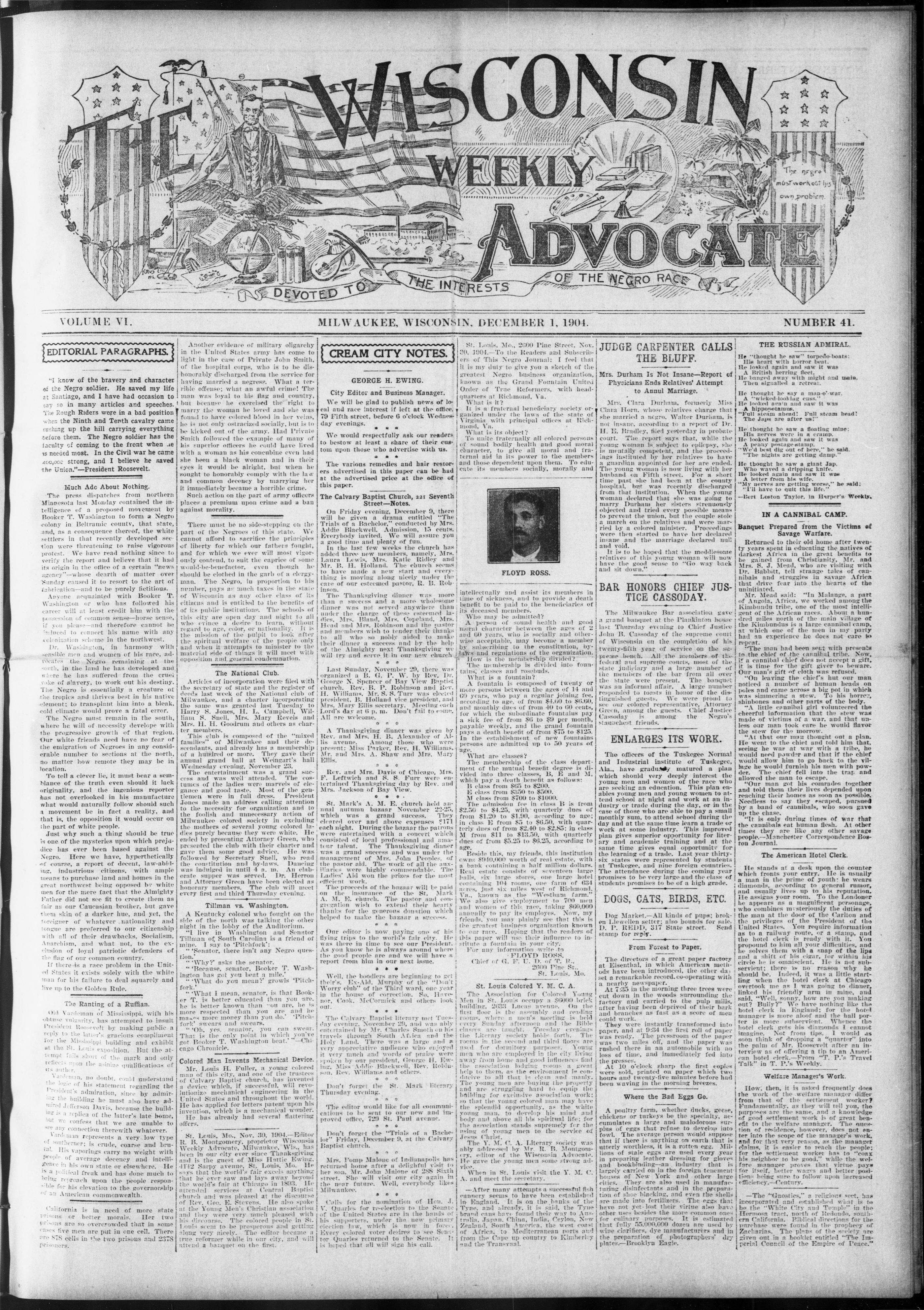
WISCONSIN
WEEKLY
ADVOCATE
DEVOTED TO THE INTERESTS OF THE WEGRO RACE
EDITORIAL PARAGRAPHS.
"I know of the bravery and character of the Negro soldier. He saved my life at Santiago, and I have had occasion to say so in many articles and speeches. The Rough Riders were in a bad position when the Ninth and Tenth cavalry came rushing up the hill carrying everything before them. The Negro soldier has the faculty of coming to the front when he is needed most. In the Civil war he came 400,000 strong, and I believe he saved the Union."—President Roosevelt.
Much Ado About Nothing.
The press dispatches from northern Minnesota last Monday contained the intelligence of a proposed movement by Booker T. Washington to form a Negro colony in Beltramic county, that state, and, as a consequence thereof, the white settlers in that recently developed section were threatening to raise vigorous protest. We have read nothing since to verify the report and believe that it had its origin in the office of a certain "news agency"—whose dearth of matter over Sunday caused it to resort to the art of fabrication—and to be purely fictitious.
Anyone acquainted with Booker T. Washington or who has followed his career will at least credit him with the possession of common sense—horse sense, if you please—and therefore cannot be induced to connect his name with any colonization scheme in the northwest. Dr. Washington, in harmony with sensible men and women of his race, advocates the Negro remaining at the south, in the land he has developed and where he has suffered from the cruel voke of slavery, to work out his destiny. The Negro is essentially a creature of the tropics and thrives best in his native element; to transplant him into a bleak, cold climate would prove a fatal error.
The Negro must remain in the south, where he will of necessity develop with the progressive growth of that region. Our white friends need have no fear of the emigration of Negroes in any considerable number to sections at the north, no matter how remote they may be in location. To tell a clever lie, it must bear a semblance of the truth even should it lack originality, and the ingenious reporter has not overlooked in his manufacture what would naturally follow should such a movement be in fact a reality, and that is, the opposition it would occur on the part of white people.
Just why such a thing should be true is one of the mysteries upon which prejudice has ever been based against the Negro. Here we have, hyperthetically of course, a report of decent, law-abiding, industrious citizens, with ample means to purchase land and homes in the great northwest being opposed by white men for the mere fact that the Almighty Father did not see fit to create them as fair as our Caucasian brother, but gave them skin of a darker hue, and yet, the toreigner of whatever nationality and tongue are preferred to our citizenship with all of their drawbacks, Socialism, Anarchism, and what not, to the exclusion of loyal patriotic defenders of the flag of our common country.
If there is a race problem in the United States it exists solely with the white man for his failure to deal squarely and live up to the Golden Rule.
The Ranting of a Ruffian.
Old Vardeman of Mississippi, with his obtuse vulgarity, has attempted to insult President Roosevelt by making public a reply to the latter's gracious compliment for the Mississippi building and exhibit at the St. Louis exposition. But the attempt fails short of the mark and only reflects upon the asinine qualifications of its author.
Vardeman, no doubt, could understand the logic of his statement regarding the President's admiration, since by admiring the building he must also have admired Jefferson Davis, because the building is a replica of the latter's late home, but we confess that we are unable to see any connection therewith with historer.
Vardeman represents a very low type of southerner; is crude, coarse and brutal. His vaporings carry no weight with people of average decency and intelligence in his own state or elsewhere. He is a political freak and has done much to bring reproach upon the people responsible for his elevation to the governorship of an American commonwealth.
California is in need of more state prisons or better morals. Her two prisons are so overcrowded that in some cases five men are put in one cell. There are 878 cells in the two prisons and 2378 prisoners.
Another evidence of military oligarchy in the United States army has come to light in the case of Private John Smith, of the hospital corps, who is to be dishonorably discharged from the service for having married a negress. What a terrible offense; what an awful crime! The man was loyal to his flag and country, but because he exercised the right to marry the woman he loved and she was found to have colored blood in her veins, he is not only ostracized socially, but is to be kicked out of the army. Had Private Smith followed the example of many of his superior officers he could have lived with a woman as his concubine even had she been a black woman and in their eyes it would be alright, but when he sought to honorably comply with the law and common decency by marrying her it immediately became a horrible crime.
Such action on the part of army officers places a premium upon crime and a ban against morality.
There must be no side-stepping on the part of the Negroes of this state. We cannot afford to sacrifice the principles of liberty for which our fathers fought, and for which we ever will most vigorously contend, to suit the caprice of some would-be-benefactor, even though he should be clothed in the garb of a clergyman. The Negro, in proportion to his number, pays as much taxes in the state of Wisconsin as any other class of its citizens and is entitled to the benefits of of its public institutions. The schools of this city are open day and night to all who evince a desire to learn, without regard to age, color, or nationality. It is the mission of the pulpit to look after the spiritual welfare of the people only and when it attempts to minister to the material side of things it will meet with opposition and general condemnation.
The National Club
Articles of incorporation were filed with the secretary of state and the register of deeds last week of the National club of Milwaukee, and a charter incorporating the same was granted last Tuesday to Harry S. Jones, H. L. Campbell, William S. Snell, Mrs. Mary Revels and Mrs. H. H. Goodrum and others as charter members. This club is composed of the "mixed families" of Milwaukee and their descendants, and already has a membership of a hundred or more. They gave their annual grand ball at Weingart's hall Wednesday evening November 23.
The entertainment was a grand success and was well attended. The costumes of the ladies were marvels of elegance and good taste. Most of the gentlemen were in full dress. President Jones made an address calling attention to the necessity for organization and to the foolish and unnecessary action of Milwaukee colored society in excluding the mothers of several young colored ladies purely because they were white. He ended by presenting Attorney Green, who presented the club with their charter and gave them some good advice. He was followed by Secretary Snell, who read the constitution and by-laws. Dancing was indulged in until 4 a. m. An elaborate supper was served. Dr. Herron and Attorney Green have been elected as honorary members. The club will meet every first and third Thursday evening.
Tillman vs. Washington
A Kentucky colonel who fought on the side of the north was talking the other night in the lobby of the Auditorium.
"I live in Washington and Senator Tillman of South Carolina is a friend of mine. I say to 'Pitchfork':
"'Senator, there isn't any Negro question."
'Why?' asks the senator.
'Because, senator, Booker T. Washington has got you boot a mile.'
ington has got you beat a little.
"What do you mean?" growls 'Pitchfork.'
"What I mean, senator, is that Booker T. is better educated than you are, he is better known than you are, he is more respected than you are and he makes more money than you do.' 'Pitchfork' swears and swears.
"Oh, yes, senator, you can swear. That is the only point in which you've got Booker T. Washington beat."—Chicago Chronicle.
Mr. Louis H. Fuller, a young colored man of this city, and one of the trustees of Calvary Baptist church, has invented a device which, if successful, will revolutionize mechanical engineering in the United States and throughout the world. He has applied for letters patent upon his invention, which is a mechanical wonder. He has already had several flattering offers.
St. Louis, Mo., Nov. 30, 1904.—Editor R. B. Montgomery, proprietor Wisconsin Weekly Advocate, Milwaukee, Wis., has been in our city ever since Thanksgiving and is the guest of Miss Hattie Ewing, 4142 Sarpy avenue, St. Louis, Mo. He says that the world's fair excels anything that he ever saw and lays away beyond the world's fair at Chicago in 1893. He attended services at Central Baptist church and was pleased at the discourse of Rev. Geo. E. Stevens. He also spoke at the Young Men's Christian association and they were very much pleased with his discourse. The colored people in St. Louis seem to be prosperous and getting along very nicely. The editor became a true reformer while in our city, and will attend a banquet on the first.
MILWAUKEE, WISCONSIN, DECEMBER 1, 1904.
CREAM CITY NOTES.
GEORGE H. EWING.
We will be glad to publish news of local and race interest if left at the office, 79 Fifth street, before G o'clock Wednesday evenings.
We would respectfully ask our readers to bestow at least a share of their custom upon those who advertise with us.
The various remedies and hair restorers advertised in this paper can be had at the advertised price at the office of this paper.
The Calvary Baptist Church, 221 Seventh Street—Notes.
On Friday evening, December 9, there will be given a drama entitled "The Trials of a Bachelor," conducted by Mrs. Addie Blackwell. Admission, 15 cents. Everybody invited. We will assure you a good time and plenty of fun. In the last few weeks the church has added three new members, namely, Mrs. Laura Lewis, Mrs. Katie Ridley and Mr. B. H. Holland. The church seems to have made a new start and everything is moving along nicely under the care of our esteemed pastor, R. B. Robinson.
The Thanksgiving dinner was more than a success and a more wholesome dinner was not served anywhere than under the charge of these esteemed ladies, Mrs. Bland, Mrs. Copeland, Mrs. Head and Mrs. Robinson and the pastor and members wish to tender their thanks to all who so nobly aided to make their dinner a success and by the help of the Almighty next Thanksgiving we will try and serve it in our new church.
私 私 私
Last Sunday, November 29, there was organized a B. G. P. W. by Rev. Dr. George N. Spencer of Bay View Baptist church. Rev. B. P. Robinson and Rev. H. Williams. Mr. S. S. Turr was elected president, B. Holland vice president, and Mrs. Mary Ellis secretary. Meeting each Lord's day at 6 p.m. Don't fail to come. All are welcome.
```markdown
```
A Thanksgiving dinner was given by Rev. and Mrs. H. B. Alexander of Allis avenue. Among those who were present; Miss Parker, Rev. H. Williams, Mr. and Mrs. A. Shaw and Mrs. Mary Ellis.
Rev. and Mrs. Davis of Chicago, Mrs. F. Leftwich and S. S. Furr were entertained Thanksgiving day by Rev. and Mrs. Jackson of Bay View.
St. Mark's A. M. E. church held annual autumn bazaar November 22-25, which was a grand success. They cleared over and above expenses $171 each night. During the bazaar the patrons were entertained with a concert which consisted of local professional and amateur talent. The Thanksgiving dinner was a grand success and was under the management of Mrs. John Peoples, of the pastor aid. The work of all the auxiliaries were highly commendable. The Ladies' Aid won the prizes for the most efficient work.
The proceeds of the bazaar will be paid on the insurance of the St. Mark A. M. E. church. The pastor and congregation wish to extend their hearty thanks for the generous donation which helped to make the bazaar a success.
Our editor is now paying one of his flying trips to the world's fair city. He was there in time to see our President. As you know he is always around where the good people are and we will have a report from him in our next issue.
```markdown
```
Well, the boodlers are beginning to get their's. Ex-Ald. Murphy of the "Don't Worry club" of the Third ward, one year in the house of correction. So, Havenor, Cook. McCormick and others look out.
---
The Calvary Baptist literary met Tuesday evening, November 29, and was ably entertained by Mr. Charles Smoth on his travels through South Africa and the Holy Land. There was a large and a very appreciative audience who enjoyed it very much and words of praise were spoken by our president, George H. Ewing, Miss Addie Blackwell, Rev. Roblson, Rev. Williams and others.
Don't forget the St. Mark literary Thursday evening.
The editor would like for all communications to be sent to our new and improved office, 729 St. Paul avenue.
Don't forget the "Trials of a Bachelor" Friday, December 9, at the Calvary Baptist church.
Mrs. Pomp Malone of Indianapolis has returned home after a delightful visit to her son, Mr. John Malone of 288 Sixth street. She will visit our city again in the near future. Well, everybody likes Milwaukee.
Calls for the nomination of Hen. J. V. Quarles for re-election to the Senate of the United States are in the hands of his supporters, under the new primary election law, which is now in force. Every colored voter desires to see Senator Quarles returned to the Senate. It is hoped that all will sign his call.
St. Louis, Mo., 2600 Pine Street, Nov. 30, 1904.—To the Readers and Subscribers of This Negro Journal: I feel that it is my duty to give you a sketch of the greatest Negro business organization, known as the Grand Fountain United Order of True Reformers, with headquarters at Richmond, Va. What is it? It is a fraternal beneficiary society organized under the laws of the state of Virginia with principal offices at Richmond, Va.
What is its object. To unite fraternally all colored persons of sound bodily health and good moral character, to give all moral and fraternal aid in its power to the members and those dependent upon them. To educate its members socially, morally and
FLOYD ROSS.
intellectually and assist its members in time of sickness, and to provide a death benefit to be paid to the beneficiaries of its deceased members.
Who may be admitted?
A person of sound health and good moral character between the ages of 2 and 60 years, who is socially and otherwise acceptable, may become a member by subscribing to the constitution, by laws and regulations of the organization.
How is the membership divided?
The membership is divided into fountains, classes and rosebuds.
A fountain is composed of twenty or more persons between the ages of 14 and 60 years, who pay a regular joining fee, according to age, of from $4.60 to $6.60, and monthly dues of from 40 to 60 cents, for which the subordinate fountains pay a sick fee of from $6 to $9 per month, payable weekly, and the grand fountain pays a death benefit of from $75 to $125. In the establishment of new fountains persons are admitted up to 50 years of age.
What are classes?
The membership of the class department of the mutual benefit degree is divided into three classes, B, E and M, which pay a death benefit as follows:
B class from $65 to $200.
E class from $350 to $500.
M class from $700 to $1000.
The admission fee in class B is from $2.50 to $4.25, with quarterly dues of from $1.20 to $1.90, according to age; in class E from $5 to $6.50, with quarterly dues of from $2.40 to $2.85; in class M from $11 to $13.50, with quarterly dues of from $5.25 to $6.25, according to age.
Beside this, my friends, this institution owns $940,000 worth of real estate, with a bank containing a half million dollars. Real estate consists of seventeen large balls, six large stores, one large hotel containing 104 rooms, one farm of 634 acres, just six miles west of Richmond, Va., known as the "Westham farm." We also give employment to 700 men and women of this race, taking $60,000 annually to pay its employees. Now, my friends, you may plainly see that this is the greatest business organization known to our race. Hoping that the readers of this paper will use their influence to institute a fountain in your city.
St. Louis Colored Y. M. C. A.
The Association for Colored Young Men in St. Louis occupy a $6000 brick building, 2633 Lucas avenue. On the first floor is the assembly and reading rooms, where a men's meeting is held every Sunday afternoon and the Bible classes are taught. Tuesday evenings the Literary society holds forth. The rooms in the second and third floors are used for dormitory purposes. Young men who are employed in the city living away from home and good influences find the association lodging rooms a great help to them, as the environment is conducive to all that is clean and manly. The young men are buying the property and are struggling hard to equip the building for exclusive association work; so that the young colored man may have the splendid opportunity, as the white young man, to develop his mind and body and above all his spiritual life; for the association stands supremely for the using of young men to the service of Jesus Christ
The Y. M. C. A. Literary society was ably addressed by Mr. R. B. Montgomery, editor of the Wisconsin Advocate. He gave the young men some strong advice.
When in St. Louis visit the Y. M. C. A. and meet the secretary.
After many attempts a successful fish cannery seems to have been established in England. It is on the banks of the Tyne, and already, it is said, the Tyne brand cans have found their way to Australia, Japan, China, India, Ceylon, New Zealand, South America, the west coast of Africa, to Mediterranean ports and from the Cape up country to Kimberley and the Transvaal.
JUDGE CARPENTER CALLS THE BLUFF.
Mrs. Durham Is Not Insane—Report of Physicians Ends Relatives' Attempt to Annul Marriage.
Mrs. Clara Durham, formerly Miss Clara Horn, whose relatives charge that she married a negro, Walter Durham, is not insane, according to a report of Dr. H. E. Bradley, filed yesterday in probate court. The report says that, while the young woman is subject to epilepsy, she is mentally competent, and the proceedings instituted by her relatives to have a guardian appointed for her are ended. The young woman is now living with her husband on Fifth street. For a short time past she had been at the county hospital, but was recently discharged from that institution. When the young woman declared that she was going to marry Durham her sisters strenuously objected and tried every possible means to prevent the union, but the couple stole a march on the relatives and were married by a colored minister. Proceedings were then started to have her declared insane and the marriage declared null and void.
It is to be hoped that the meddlesome relatives of this young woman will now have the good sense to "Go way back and sit down."
BAR HONORS CHIEF JUSTICE CASSODAY.
The Milwaukee Bar association gave a grand banquet at the Plankinton house last Thursday evening to Chief Justice John B. Cassoday of the supreme court of Wisconsin on the completion of his twenty-fifth year of service on the supreme bench. All the members of the federal and supreme courts, most of the state judiciary and a large number of the members of the bar from all over the state were present. The banquet was an informal affair. A large number responded to toasts in honor of the distinguished guests. We were proud to see our colored representative, Attorney Green, among the guests. Chief Justice Cassoday is among the Negro's staunchest friends.
ENLARGES ITS WORK.
The officers of the Tuskegee Normal and Industrial institute of Tuskegee, Ala., have gradually matured a plan which should very deeply interest the young men and women of the race who are seeking an education. This plan enables young men and young women to attend school at night and work at an industry or trade during the day, or in the case of those who are able to pay a small monthly sum, to attend school during the day and at the same time learn a trade or work at some industry. This improved plan gives superior opportunity for literary and academic training and at the same time gives equal opportunity for the learning of a trade. Last year thirty-six states were represented by students at Tuskegee, and nine foreign countries. The attendance during the coming year promises to be very large and the class of students promises to be of a high grade.
DOGS, CATS, BIRDS, ETC.
Dog Market.—All kinds of pups; broken Llewellen setter; also hounds for sale. D. P. REDD, 317 State street. Send stamp for reply.
From Forest to Paper.
The directors of a great paper factory at Eisenthal, in which American methods have been introduced, the other day set a remarkable record. co-operating with a nearby newspaper.
At 7:35 in the morning three trees were cut down in the woods surrounding the factory and carried to the pulp mills, after having been deprived of their bark and branches as fast as a score of men could work.
They were instantly transformed into paper, and at 9:34 the first roll of paper was ready. The pressroom of the paper was two miles off, and the paper was rushed there in an automobile with no loss of time, and immediately fed into the presses.
At 10 o'clock sharp the first copies were sold, printed on paper which two hours and twenty-five minutes before had been waving in the morning breezes.
Where the Bad Eggs Go.
A poultry farm, whether ducks, geese, chickens or turkeys be the specialty, accumulates a large and malodorous surplus of eggs that refuse to develop into fowl. The average person would suppose that if there is anything on earth that is utterly worthless, it is a rotten egg. Millions of stale eggs are used every year in preparing leather dressing for gloves and bookbinding—an industry that is largely carried on in the foreign tenement houses of New York and other large cities. They are also used in manufacturing disinfectants and in the preparation of shoe blacking, and even the shells are made into fertilizers. The eggs that have not yet-lost their virtue also have other uses besides the more common ones for culinary purposes. It is estimated that fully 55,000,000 dozen are used by wine clarifiers, dye manufacturers and in the preparation of photographers' dry plates.—Brooklyn Eagle.
NUMBER 41.
THE RUSSIAN ADMIRAL
He "thought he saw" torpedo-boats:
His heart with horror beat.
He looked again and saw it was
A British herring fleet.
He banged away with might and main,
Then signalled a retreat.
He thought he say a man-o'-war.
A "wicked-looking cass."
He looked again and saw it was
A hippopotamus.
"Full steam ahead! Full steam head!
The Japs are after us!"
He thought he saw a floating mine:
His nerves were in a cramp.
He looked again and saw it was
A penny postage-stamp.
"We'd best dig out of here," he said.
"The nights are getting damp."
He thought he saw a giant Jap.
Who waved a dripping knife.
He looked again and saw it was
A letter from his wife.
"My nerves are getting worse," he said;
"I'll have to quit this life."
—Bert Leston Taylor, in Harper's Weekly
IN A CANNIBAL CAMP.
Banquet Prepared from the Victims of Savage Warfare.
Returned to their old home after twenty years spent in educating the natives of darkest Africa in the great benefits to be gained from Christianity, Mr. and Mrs. S. J. Mead, who are visiting with Dr. Babbitt, tell strange tales of cannibals and struggles in savage Africa that drive fear into the hearts of the uninitiated.
Mr. Mead said: "In Malange, a part of Angola, Africa, we worked among the Kimbundu tribe, one of the most intelligent of the African races. About a hundred miles north of the main village of the Kimbundus is a large cannibal camp, at which one of the men in my party had an experience he does not care to repeat.
"The man had been sent with presents to the chief of the cannibal tribe. Now, if a cannibal chief does not accept a gift, it is time for the gift giver to beware. Our man's gift of cloth was refused.
"On leaving the chief's hut our man noticed a number of human heads on poles and came across a big pot in which was simmering a stew. To his horrice, shinbones and other parts of the body.
"A little cannibal girl volunteered the cheerful information that the stew was made of victims of a war, and that unless our man took care he would flavor the stew for the morrow.
"At that our man thought out a plan. He went to the chief and told him that, seeing he was at war with a tribe, he would need powder and that if the chief would allow him to go back to the village he would furnish his men with powder. The chief fell into the trap and allowed the man to escape.
"Our man got his comrades together and told them their lives depended upon reaching their homes as soon as possible. Needless to say they escaped, pursued by a band of cannibals, who soon gave up the chase.
"It is only during times of war that the cannibals eat human flesh. At other times they are like any other savage people.—Manchester Correspondence Boston Journal."
The American Hotel Clerk.
He stands at a desk upon the counter which fronts your entry. He is usually a man in the prime of youth; he wears diamonds, according to general rumor, and usually lives up to his reputation. He assigns your room. To the Londoner he appears as a magnificent personage, who combines mysteriously the duties of the man at the door of the Carlton and the privileges of the President of the United States. You require information as to a railway route, or a stamp, and the hotel clerk is ready with it. You propound to him all your difficulties, and he solves them with a snap of the lips and a shift of his cigar, for within his circle he is omniscient. He is not subservient; there is no reason why he should be. Indeed, it was a little startling when the hotel clerk at Chicago overtook me as I was going to dinner, linked his friendly arm in mine, and said, "Well, sonny, how are you making out? Bully?" We have nothing like the hotel clerk in England; for the hotel manager is more aloof and the hall porter is more subservient. Whence the hotel clerk gets his diamonds I cannot imagine. Not from tips. I would as soon think of dropping a "quarter" into the palm of Mr. Roosevelt after an interview as of offering a tip to an American hotel clerk—From "T. P.'s Travel Talk" in T. P.'s Weekly.
Welfare Manager's Work.
How; then, it is asked frequently does the work of the welfare manager differ from that of the settlement worker? Fundamentally, as they will tell you, the purposes are the same, and a knowledge of good settlement work is of great benefit to the welfare manager. The question of residence, however, does not enter into the scope of the manager's work, and for that very reason, as the manager claims, it is easier to reach the people; for the settlement worker has to "coax his neighbor to be good," while the welfare manager proves that virtue pays for itself, better wages and better positions being sure to follow upon increased efficiency.—Century.
—The "Gnostics," a religious sect, has incorporated and established what is to be the "White City and Temple" in the Hermosa tract, north of Redondo, southern California. Biblical directions for the purchase were found in the prophecy of Zacharias. The plans of the society are given out in a booklet entitled "The Imperial Council of the Empire of Peace."
NOTES OF INTEREST.
The cost of living has doubled in Spain in the last few years and emigration is increasing rapidly.
Bretton Woons, N. H., has an automobile school for horses that is proving successful.
Owing to the use of artificial indigo, manufactured in Germany, the production of natural indigo has greatly diminished in East India. The latter country last year exported only 65,000 hundredweights of this article, against 170,000 hundredweights in 1897.
An apparatus called the telecryptograph, which telegraphs and records in print messages over ordinary telephone lines, without interfering with the telephone, is said to have been invented by Signor Melcotti, an Italian electrician.
-At Versailles is a pomegranate tree which is said to be the oldest in France. It is in an old orangery and was planted in 1685. In exceptionally warm seasons the tree still puts forth a few flowers, but it has borne no fruit for many years.
-The median age of negroes is 19.4 years—that is, half the negroes in the United States are below that age. The median age is four years below that of the whites (23.4 years), a difference closely connected with the high birth rate and high death rate of the negroes.
-An article in the London Daily Telegraph shows that at the end of July, 1904, 730,214 persons were receiving indoor and outdoor relief in England and Wales, representing 21.6 for every thousand inhabitants, an increase of 34,339, compared with the same time in 1903.
—in a fight between troopers of the Ninth cavalry (colored) and Fourth cavalry and Fifteenth infantry in a low resort at Monterey, Cal., on the night of October 20, Sergeant Tooley of the Fourth was killed and Private Moore of the Fifteenth wounded, perhaps fatally.
—A man brought up at St. Albans as an incorrigible rogue was proved to have married his aunt. His children are therefore his first cousins and he is his own uncle. His grandmother and his mother-in-law are the same person. Apparently the judge sympathized with him, for he was discharged.
In one of the London public schools a teacher asked her class what turf was. Nobody could tell. She next asked what grass was. There was a long pause, and then the smartest scholar raised a hand. "Well?" asked the teacher. "Please'm, it's what you got to keep off of," was the reply.
An expedition to the Niam Niam country will be England's next "little war." The country is 800 miles southwest of Khartoum, and can muster a fighting force of 25,000. The expeditionary force will consist of 2000 Soudanese troops under British officers. The start is to be made next month.
A number of Philadelphia business men have organized what is to be known as the Downtown club, each member of which is pieds de war on ripping. They have become tired of feeing waiters at noon in order to secure reasonably quick service, and the Downtown club is their way of overcoming the nuisance. In 1893 there was established at Hanover, through the instrumentality of the German Association of Copper-smiths, a school for the instruction of young men in the copper-working industry. This school was organized as a department of the school for mechanics and industrial arts located in that city.
The first regularly ordained and inducted woman pastor of an English church is Miss Gertrude von Petzold, M. A. (Edinburgh), who conducted her first service in the Free Christian church, Leicester, on September 29. She is the daughter of a German army officer and is 28 years old. She has had a notable scholastic career.
The other night the Japanese in San Francisco gave a war drama for the benefit of the widows and orphans of the Japanese army. The audience was Japanese, large and enthusiastic. A newspaper report of the play says the handling of the "Russians" in it was "fierce." One Cossack received a three-inch cut on his arm from a Jap's sword.
—The Spaniards met with the potato in Peru, where it had long been cultivated by the natives, but it was well-nigh a hundred years before it was taken over to Europe. In 1587 we hear of its being introduced into Spain, while in the previous year Sir Walter Raleigh began to cultivate it in Ireland from seed which was taken over from North Carolina.
—The value of real estate in California is officially estimated to be worth $882,104,539, the improvements on real estate $316,208,123, the value of personal property $239,623,282, the money and solvent credits $42,906,248, and the total value of property as returned by auditors is $1,480,842,195, exclusive of the railroads, which are assessed at $69,669,566 by the state board of equalization.
The Cuyama and Culata tribesmen, whose country is situated near the German frontier in Southwest Africa, and who have risen against the Portuguese, who hold their country, can put 20,000 men into the field. They have 50,000 Mauser rifles, a great stock of ammunition and many horses. A number of Boers are with the Portuguese expedition that has just been defeated in a collision with the tribesmen.
Recently in a paper read before a technical society at Odessa Mr. Lokuzjejewski described a way of killing the young of insects in fields by electricity. A dynamo is carried on a wagon (horse or automobile), and the current excites an induction coil, giving a high tension discharge. One pole of the coil is to the metal tires and the other to metal brushes passing over the ground. The discharge kills the grubs, etc., in the soil.
After eight months' work the bronze figure that is to be placed on top of the McKinley monument in Golden Gate park, San Francisco, has been cast. It is that of a draped woman, crowned with bay and holding in one hand a spear and in the other an extinguished torch and palm branches. The statue will be mounted on a square granite column, on the front of which will be a large marble medallion of William McKinley, and at the base on the four sides, a seat. The shaft will be on a circular granite platform reached by steps surrounding the entire edifice.
Whites Rebuilding Negro College
In many of the white churches Sunday collections were taken for the rebuilding of Lane college at Jackson, Tenn., and the responses were liberal. Bishop Lane, the negro at the head of this institution, is a man who commands the confidence and esteem of the southern white people, and an appeal from him in behalf of his race is not likely to go unheeded. The expressions of regret at the loss sustained by Lane college have been numerous in the southern press, and the occasion has brought out many emphatic tributes to the worth and integrity of Bishop Lane. The time has never been and will never be in the south when a good and worthy negro is not appreciated and well treated by the white people.—Nashville (Tenn.) News.
Corner on Graves.
The Sydney (Australia) Bulletin says that Melbourne Women's hospital discovered lately that a local undertakers' ring had bought up nearly all the vacant plots in the general cemetery, and, having put up its prices for funerals at the new Spring Vale necropolis in order to divert trade to its own ground, was retailing its corner in graves at a handsome profit.
HOW TO CATCH A TROLLEY.
Trolley cars are very swift;
Trolley cars are quickly miffed.
Many a time I've seen a trolley
Kick its heels and run like golly
Just because some little-wit
Waved his silly hand at it.
Now, to catch a trolley car.
Certain iron bound rules there are.
First of which is not to let it
Ever guess you wish to get it.
Second, wear a deep disguise;
Carry bundles great in size.
So the car will never dream
You can run--you see the scheme?
When it rolls remorseless by,
Drop your bundles there and fly!
Run like mad, however far:
Throw away your fresh cigar,
Throw away your parasol,
Throw away your hat and all.
Run until you catch the car,
Fall aboard, and there you are:
Saturday Evening Post.
HOW TWO MATGES WERE MARRIED.
HOW TWO MATGES WERE MARRIED.
BY GILBERT DAYLE.
I had reached Monte Carlo in the morning, selected my hotel, and after an agreeable dejeuner had sauntered out to take my first fill of the sunshine. Already I had seen many familiar faces, and now, as I gently sank into a seat on the casino terrace, I wondered how long it would be before the most interesting young person I knew discovered my arrival in the gilded principality. I was not kept long in suspense, for presently I heard a voice utter a little exclamation of surprise, and, looking up, saw Miss Pattie Hetherton standing before me.
"Oh, the usual thing," I replied, with a nod at the casino. A smile dimpled over her face as she sat down beside me.
"It's hereditary," I continued, gloomily. "Have you ever heard of my great-grandfather, who gambled away his estates at Crockford's in a single night? He was one of the original dandies." But she was unconvinced. "Clerks in the war office don't generally come to Monte Carlo in February," she observed. "Why not? Even a war office clerk takes a holiday some time or other, and we are not very busy now." "I suppose the war office—" she began. "Oh, please don't make a joke about the dear old place!" I interrupted, pleadingly. "The professional humorist has already nearly succeeded in getting us ranked with the mother-in-law, and, if you if you make jests yourself on the topic, how can you hope to laugh when you hear them on the stage or see them in the papers?"
She looked very humble—and, incidentally, more than usually pretty. If girls only knew how humility suited them!
"I was merely going to observe that I supposed the war office wouldn't miss you," she said, meekly.
"The apology is accepted," I said in a tone of relief.
"I haven't yet learned why you are here," she continued, gazing at me critically. "And why—why are you wearing that ridiculous little black tie with your flannel suit?"
I gave one reason.
"It serves as a reminder of what I've lost after a year of hope," I said, with a laugh.
It must be explained that I had seen a good deal of Pattie in town, and I think we should have seen a great deal more of each other had it not suddenly occurred to Mrs. Hetherton that it was merely a poor clerk in the war office. (Why, in heaven's name, did my dandy of a great-grandfather spend that night at Crockford's?) As a result of the dawning of this idea she had promptly removed her daughter from my sphere of influence and myself from her mental list of desirable acquaintances.
Of course, it might be said that, if Pattie truly loved me, she might have ultimately won me by a steady resistance to her parent's wishes. Exactly! But, then, I had no reason to think that Pattie looked upon me as much more than an agreeable conservatory companion, and, in fact, my merely civil attentions to a certain Mrs. Van Oppen, a delightful American widow, had estranged even these relations on the last occasion we had met.
And now she was engaged to Lord Ernest Blakenhurst, a monstrously stupid young man who had only escaped matrimony before by a series of lucky accidents. He had no vices beyond his extreme foolishness, and no virtues in addition to his title and money. He was, therefore, an excellent "catch," and, knowing Mrs. Hetherton's strength of character and Blakenhurst's weakness of mind, I had very little doubt as to how the present state of affairs had been arrived at.
"I've never been engaged," I observed, presently. "I suppose one is very, very happy?"
"Yes, very happy!" she answered, decisively, closing her little lips firmly together.
I wondered whether she was merely loyal to a bargain her mother had thrust upon her, or did she care for him? She was very bright, and he infinitely stupid. But you can never tell.
She looked up at me quickly, and her next sentence told me that this part of the discussion was closed.
"I don't think it's gambling," she said, deliberately. "Mrs. Van Oppen is here!" she added, after a pause, as if there were no need of further explanation.
As far as I knew, Mrs. Van Oppen might have been in Peru, but I was a little startled by the coincidence. Pattie, however, was a long way from the true state of affairs—which was just as well.
"So you have guessed my poor little secret?" I said, with a laugh.
She turned to me with an air of incredulity.
"And do you really hope? Mrs. Van Oppen, with her yacht, her mansions, and millions of dollars?" she asked.
"I would overlook those inconveniences. It is only the woman I consider," I answered.
"And if she had the bad taste to refuse you?" she continued. (I am half afraid a touch of sarcasm was intended here.)
"Oh, I shall go back to the war office and—my thousand a year!" I said, with a yawn.
She gave a little start.
"Your two thousand a year! I thought—"
I touched the black tie. "There was another reason. Aunt Selina," I explained.
"That quaint old body you told me about in the north of England, who would never even recognize your existence?" she cried, in wonderment.
"The same. In dying she atoned for all her lamentable shortcomings. Her will decreed that her fortune was to be shared between myself and a dogs' home. I have two thousand a year, and the other half has gone to the dogs."
There was a long pause.
"I must congratulate you," she said at length, in rather a thoughtful tone.
"Thanks," I answered, miscrabbly.
Of course, two thousand a year was nothing to being Lady Blakenhurst, but, if only Aunt Selina had seen fit to die a few months previously, I think it might have been managed. But, there, it always seemed to be my luck to be just too late for everything.
A few minutes later Mrs. Hetherton and the feeble Blakenhurst appeared on the scene. The former surprised me by the cordiality of her reception, but the
meaning dawned upon me. Now Pattie was securely engaged, I no longer constituted a danger and might be tolerated as a not too intimate acquaintance. I was accordingly invited to luncheon on the morrow.
Presently I left, the trio, and, wandering again, had the good fortune to meet Mrs. Van Oppen, who, in the latest Parisian triumph, looked more bewilderingly magnificent than ever.
"I am pleased to see you, Hugo Trench!" she cried. "You'll just spare half an hour right away to chat with me."
So we strolled round to the terrace again and sat down. I learned that her yacht, the Gadfly, was in the port, and that she was taking her father, Col. Silas Hibbert, and a few other friends for a short cruise. She rattled on for some time vivaciously, then suddenly paused.
"I suppose you know the Hethertons are here—with him?" she said, with a tightening of her lips.
Mrs. Van always treated me as a confidential friend. It was this attitude that had led Pattie to a wrong assumption.
"Yes, I have met them. How are you taking it? Am I to commiserate with you, or doesn't it matter now?" I asked, for I knew the exact state of affairs.
"It matters more than ever. I was never so disappointed in my life. To think that another day with him last autumn and I should have been Lady Blakenhurst! Just pure ill luck that he was called away at that moment!" she exclaimed.
She was not exaggerating. It showed a deplorable lack of originality for a wealthy American, but the fact remained that it was Mrs. Van's one ambition in life to marry into the English aristocracy and secure a title, and she had been within an ace of capturing the weak-minded Blakenhurst.
"I am more sorry than I can say," I said, sympathetically. This was perfectly genuine, for I was thinking of Pattie. "And to be beaten by Mrs. Hetherton!" cried Mrs. Van. She paused, as if words were too much for her. "Of course, I know that that dear girl, Pattie, had nothing to do with the entanglement—it was purely her wretched mother's doing. She had the opportunity, and she utilized it. As you know, anyone can manage poor Ernest—that is, anybody with a will—and she had the chance," she finished, ruefully.
"Chance is everything—particularly at Monte Carlo," I remarked, not knowing quite what to say.
"And I firmly believe the dear boy would have been happier with me. I could manage him better than an inexperienced girl like Pattie."
Mrs. Van had certainly managed one husband very efficiently. He had worked commendably hard to make money, and then, just as commendably, died.
"I hate Mrs. Hetherton!" cried the little widow, vindictively. "And if I had him to myself for an hour or so—even now!" she continued, meditatively.
I gave a start.
"Has he not seen you yet?"
"No; but I am going to send him a note—just to remind him of old times!"
"Oh, I shouldn't!" I put in, hastily. "Wouldn't it be rather embarrassing for all parties?" Mrs. Van's eyes twinkled mischievously.
"I wouldn't mind embarrassing Mrs. Hetherton," said she. Later in the day I met her father, the gallant "colonel," who belonged to a somewhat rougher school than his brilliant daughter, but he was amusing, and I rather liked him. He was intensely proud of Mrs. Van's progress, and was just as anxious for her to marry into the English aristocracy as she herself. I dined with them that evening on the Gadfly, and had an enjoyable time. Two days slipped away; I saw a little of Pattie, and too much of Mrs. Hetherton and the dull Blakenhurst. Then one day at luncheon time I received a note from Mrs. Van asking me to dine again that evening on the yacht. It was their last day in Monte Carlo, she explained, as they were sailing at dawn.
On my way down to the Gadfly that evening I called in at the Hetherton's hotel to say I would be pleased to accept their invitation to go to the Nice races next day with their party. I happened to run across Pattie.
"And where is the lucky Blakenhurst?" I asked, with a smile.
"Oh, poor Ernest got a sick headache during the afternoon, and went to bed before dinner. I hope it's nothing serious," she said, anxiously.
"Oh, no," I said, reassuringly. "I think I saw him looking at an intelligent book this morning—that doubtless brought it on. Au revoir."
I hurried away down to the port, and in a few minutes was on board the Gadfly—one of the latest things in yachts for millionaires. Mrs. Van welcomed me effusively.
"Only a small party—just ourselves and —" She turned to a tall young man standing in the background. "I think you know Lord Ernest Blakenhurst?"
Sick headache, indeed! I could have almost laughed, if I had not thought of the deception practiced on poor Pattie.
Mrs. Van caught hold of his arm, and he came forward, looking somewhat sheepish.
"Hullo, Trench!" he said, with a stupid nod. "No idea you were coming."
"The surprise is not all on your side!" I replied, attempting to instill a proper touch of severity into my tone.
The little widow's eyes were almost dancing with unholy joy as they met mine.
"I told you I should like to," she whispered to me, triumphantly.
I shook my head reprovingly. Still as the yacht was saiing in a few hours' time, no harm could be done.
We went in to dinner, which, like all Mrs. Van's entertainments, was in the way of an object lesson on the advantages of wealth. As I watched her handling of the inane Ernest I confess it was moved to admiration. It was art in the highest sense, and I was more than thankful, for Pattie's sake, that the Gadfly was departing almost immediately.
Afterward the colonel led Blakenhurst and myself—we were the only men of the party—to the smoking room, where he insisted on personally mixing some wonderful American drinks. Presently I seized an opportunity to join the others in the drawing room, and left the colonel mixing another "dream" (the term was his) for Blakenhurst.
Mrs. Van seemed not in the least surprised that I came alone.
"Is father telling Lord Plakenhurst his experiences in the Rockies?" she asked. "I know it is perfectly hopeless trying to draw him from the smoking room when once he has got a really good listener."
Later on I slipped away for a moment, thinking it time to see how the poor Blakenhurst was faring. I met the connel—he was just shutting the door to a deck cabin. He put a finger to his lip mysteriously.
"I gave him a 'Chicago Twist' to finish up with, and he suddenly collapsed," he whispered. "I guessed the best way was to help him to a bunk and let him sleep for half an hour. That'll put him as right as the President!"
I don't know the exact cause—perhaps it was something in the old colonel's tone—but a sudden suspicion entered my mind.
I said nothing, however, until, a few minutes later, I chanced to be alone with Mrs. Van. She had come out on deck, and we were standing by the taffrail, enjoying the cool night air.
"I have just heard that your father
has put Blakehurst into a bunk," I observed. "Perhaps you may have heard of the merits of the colonel's 'Chicago Twist?' "
She gave a little laugh.
"He'll sleep the clock round, you know, unless some one wakes him," I added, meaningly.
She suddenly faced me.
"Supposing nobody did wake him—that he slept right on until tomorrow morning? Of course, we shouldn't know he was in the cabin!" she said, in a low voice of suppressed excitement.
So it was a plot!
"It's abduction!" I said, firmly.
She laughed gaily.
"To take a trip on a friend's yacht?
Don't you see how ingenious it all is?
He will wake up and find himself on the way to Genoa! And two days in my society! Do you grasp it?"
"Oh, I quite see!" I said, slowly. I knew very well that Blakenhurst, left in her hands, would be as clay. If the yacht once sailed with him, Pattie's chance of becoming Lady Blakenhurst would vanish completely. He would throw her over and marry Mrs. Van within a month. I had not the slightest doubt as to the little widow's ability to do this if given the present chance.
"I should just like to inquire why you invited me tonight?" I said. "Wouldn't a maneuver of this type have been better with as few witnesses as possible?" She linked her arm within mine.
"I thought, dear Mr. Trench, being such a good friend of mine," she began, persuasively, "that tomorrow, when you discovered that poor Ernest had been left on the yacht by mistake, you might tell his valet to pay his hotel bill and bring his things on to Genoa. You see, otherwise his disappearance might cause some surprise."
"I think it may probably cause surprise under any circumstances," I said, dryly, having Mrs. Hetherton in mind.
Mrs. Van positively gurgled in her enjoyment of the situation.
"Isn't it just cute, Mr. Trench? I knew it would please you. Hush!" she said, warningly, as one or two of the others came up.
I had no further chance of talking alone with the good but enterprising widow, so followed the little party into the music saloon. Presently—Mrs. Van was about to sing—I managed to slip out quietly. I felt I wanted to think.
Pacing the deck, I turned the thing over in my mind. The question was, Should I let Pattie lose her chance? Whatever his mental abilities, it was a big thing for her to become Lady Blakenhurst, and she might possibly care for him. Anyway, she would look very foolish being jilted in this fashion. Could I let Mrs. Van do it?
"No, I'm hanged if I can—it isn't cricket!" I exclaimed, as I came to a decision.
I crept up to the music saloon. Mrs. Van was singing lustily, and likely to be doing so for some minutes. Then I hurried up to the deck cabin and let myself in. Blakenhurst was lying on the bunk in a heavy sleep. I picked up a water bottle and dashed some of the contents in his face.
"What's that?" he said drowsily.
I persevered with the water bottle, and soon had him in a sitting position and able to take in my remarks. I told him he had behaved abominably, and that Mrs. Van would never forgive him.
"Your only chance to save your honor is to slip away quietly this very moment without seeing any one. Mrs. Van is singing, and you will not be noticed," I said.
His mind was too blurred to criticise the sense of my argument, and he accepted my decree without demur. I explained to him the means of getting away, and fetched his coat and hat. Finally, I pushed him out of the cabin and told him to waste no time. I saw him lurch away, and returned to the music saloon just in time to congratulate Mrs. Van on the progress she had made under the Parisian masters.
Shortly afterward I rose and said I must be going. Mrs. Van protested against my early departure.
"The truth is, I'm rather nervous. I've never been mixed up in an abduction before," I explained.
"You have helped to give a deserving woman what she wants. I don't know how to sufficiently thank you, M.. Trench!" she said, as she clasped my hand in farewell.
I hurried away, thinking that, perhaps, her thanks were a trifle profuse.
On my way back I looked in at the Hethertons' hotel, wishing to make certain that Blakenhurst had safely returned. I was passing the reading room, on the entresol floor, when the door opened and I came face to face with Pattie. She had a book in her hand, and seemed annoyed.
"I was just running up to see Ernest—to inquire if he were any better?" I stammered, some explanation of my presence being necessary.
"Oh. he has come back!" she said, wearily. "I saw him disappearing up the staircase just now."
Come back! I looked sharply at her. As she saw the slip she had made a little look of confusion swept over her face.
"What do you know?" I said, quickly.
She hesitated; then a defiant look came into her eyes.
"This morning I was sitting on the terrace, and Mrs. Van Oppen and her father came close to me—they did not notice that I was within earshot. I heard them talk the plan over, and deliberately eavesdropped," she finished, slowly, a spot of color coming to her cheek.
I listened in amazement.
"You were hoping they would be able to carry it out?" I cried, excitedly.
"Well, if they did, no one could blame me for not being Lady Blakenhurst—not even mother," she said, a demure smile creeping into her eyes.
To think I had actually brought him back for her sake, and all the time she would have welcomed his abduction as a good "get out." A mad idea came to me.
"Just one question," I stuttered. "Supposing he had been carried off, would the fact of quaint Aunt Selina's recent decease have inclined you for another courtship?
Her eyes dropped before mine.
"Perhaps," she answered, softly. "But what's the good? He is here still," she added, regretfully.
On the impulse, I caught hold of her hand and kissed it.
"Yes, but he won't be long!" I said. "I'll just put him back on the yacht again. Thank heaven he's a man that can be managed! Goodby! Don't go to bed until I return."
I heard her give a little gasp of amazement, then raced away and up to Blakenhurst's room two stairs at a time. I found him lying on his bed, still fully dressed. I caught hold of his shoulder.
"Awfully sorry, Blakky, but I made a frightful mistake in getting you away just now!" I cried, breathlessly. "It appears the colonel told Mrs. Van, as an excuse for you, that you'd been unavoidably called away for an hour, but that he had extracted your solemn promise to return for the remainder of the evening. So I came on at once to bring you back."
He was very muddled, but I found a water bottle again.
"You simply must make the effort, else Mrs. Van will never forgive you. A point of honor, my dear old son!" I continued.
With a few more unserupulous argu-
ments I managed to get him on to his staggering rect and out of the room. In another quarter of an hour we were on board the yacht, and I put him in the cabin--just for a few minutes, to pull himself together, as I told him. He laid his weary form in the bunk, and I knew that thirty seconds after I left he would be asleep again.
Then I picked up a cigarette case, belonging to the colonel and made my way round to the music saloon. Mrs. Van was still singing. I explained how I had discovered I had taken away the case by mistake and thought it better to return it at once.
Mrs. Van and the colonel came out on to the deck to see me off for the second time. We passed the cabin and the colonel couldn't resist opening the door and peeping in.
"Sleepin' like a babe!" he remarked, contentedly, as he turned the key in the lock and slipped it into his pocket.
"I somehow feel as if my conduct left a little to be desired this evening," I said, thoughtfully.
"But the end justifies the means, dear Mr. Trench!" cried Mrs. Van, as she gave me a parting affectionate pressure of the hand.
And as, ultimately, all of us seemed highly pleased with the result, I suppose it did.
The only one who was, perhaps, not completely charmed from the outset was Mrs. Hetherton. On discovering that Lord Ernest had actually taken his departure on Mrs. Van Oppen's yacht, she was terribly annoyed, for, of course, she realized that her prize had been snatched from her. I pacified her to the best of my ability.
"Beyond a doubt he was 'managed'!" I said. "The only thing now is to save the situation and get the first laugh. There is but one way to do that—of course, I am only speaking as a friend!" I said, apologetically.
"Well?" said Mrs. Hetherton, impatiently.
"I would suggest Pattie's immediate engagement to another man—some deserving, hard working fellow, tried and trusty, with, say, two thousand a year."
Mrs. Hetherton glanced up sharply, and caught her daughter smiling at me in the most barefaced manner. She now calls me by my Christian name. I suppose one must allow a mother-in-law some license.—The Sketch.
The Boll Weevil and the Wind
The naturalists in the employ of the federal department of agriculture who are watching the habits of the boil weevil in Texas have found that, like the locust that years ago plagued Kansas, the most destructive of all cotton pests is a wind-blown insect, advancing not by flight of its own volition, but by the force of the prevailings winds. It is explained, in support of this discovery, that the boll weevil has advanced over much of Texas by reason of the fact that the prevalent wind is from the southwest during the summer months. The weevil has simply been blown by the wind across the Rio Grande from Mexico. It never flies against the wind or shows a disposition to migrate. This being true, it is possible to tell in advance the way the boll weevil will spread. Our west winds do not come at a time of year when the weevil is migrating, but rather when it is hibernating. There is no summer wind that can blow the boll weevil from the infected districts to the southeastern cotton belt.—Atlanta (Ga.) Constitution.
Singing Negroes in the Cotton Fields
Since the cotton picking season began negroes in the south, and, in fact, any one who could pick cotton, have been rolling in wealth. It does not take much for the average plantation darky to feel very prosperous, so he has been flush since he began harvesting the south's great staple. And as he picked he sang. Neither a roustabout nor a negro cotton picker is "worth shucks" unless he has music in his soul. If there is no melody near him to spur his energy to renewed exertion he will furnish it himself, and his plaintive songs will float far over the plantation from early morning until the shades of evening begin to fall. Northern people who are in search of a striking picture should come south in the cotton picking time and look out over the broad plantations dotted white with cotton bolls and pickers bending over the stalks as they chant their weird, half-African songs. It is a picture to be seen nowhere else in the world and one that is the pride of the sunny south.--Birmingham (Ala.) Age-Herald.
One of Them.
As a companion piece to "The Maid's Conclusion," published in "Walnuts and Wine" in July Lippincott's, I have this to relate: With a comedy company performing at my house, the Olympia theater, a few months ago, was a little midget about 9 years old, who was the life of the company. She never took a back seat in any assemblage, great or small. When the manager of the attraction posted his "Rules" from time to time she was about the first to read and comment upon them. Near the prompter's desk, one day, appeared the following rather arbitrary item—
"And lady of this company who hereafter accepts invitations to supper after the performance from any gentleman not a member will be fined $5."
The little prodigy climbed upon a chair, and after deciphering the manuscript, turned to the writer, with the semblance of a scowl on her sweet face, and said—"Now, ain't that pretty tough on us ladies?"—Lippincott's.
Kaiser's Wedding Gift.
The Emperor has informed the crown prince and his betrothed, the Duchess Cecilia, that he intends presenting them with the picturesque country seat of Babelsberg, near Potsdam, as their future summer residence. In this charming castle the late Empress Frederick spent many happy hours. Indeed, her late majesty furnished the rooms in its upper story in imitation of those at Balmoral. Various alterations are already being made in the castle, including the addition of a new wing, containing a dining hall capable of seating 150 guests, and stabling for sixty horses. The whole is to be ready for use in 1906. —London Standard.
Had No Faith in the Automobile
An action for damages alleged to have been received in an automobile accident was recently brought in an adjoining county. A woman had been thrown from a carriage, the horse attached to which was frightened by an automobile.
She landed in a ditch and was not dangerously injured. Upon being assisted to her feet, it is related, some one spoke of calling a doctor and suggested a physician who visits his patients in an automobile. The injured woman protested, saying: "No, don't call him. I don't want an automobile doctor. Get me a horse doctor."—Utica Observer.
Smallest Inhabited Island
The smallest inhabited island in the world is that on which the Edystone lighthouse stands for at low water it is only 30 feet in diameter. At high water the base of the lighthouse, which has a diameter of only a little over 22 feet, is completely covered by water.
--The Western Passenger association has granted a rate of 1 cent a mile for the Grand Army encampment, to be held in Denver next summer.
HUNTING TIME.
They're comin' from the city to the country russet brown. With their rifles and their shotguns to hunt the farmer down,
Them city hunters 'pear to think it's off the farmer, too.
Soon the landscape will be punctured with a lot of bullet holes.
An' everybody will be dodgin' to save their precious souls.
For when them city fellers go cavortin' with a gun.
An' plug somebody full o' lead, they call it "havin' fun."
An' then somehow it seems to me they allers 'pear to fail
To make a fair discrimination 'twixt a farmer and a quail. For anythin' that rustles, if it shows a tail or head,
An' isn't plainly labelled, they'll pump it full o' lead.
Au' when a charge o' double-B has taken off the crown
An' sometimes when you are absorbed in the field a-pullin' beans,
You'll be mightily surprised with a bullet in your jeans.
They'll come an' board with you, then some mornin' 'fore you're up
Oh, it's strenuous times we're havin' in the country jes' 'bout now,
An' if 'twan't for new inventions we'd be hidin' in the mow.
But don't you for a minnit think the farmer hain't progressed,
An' traveled 'long in the procession with the spirit of the rest.
A country store these later days is fairly out o' date,
Unless it keeps upon its shelves suits lined with armor plate.
An' now we're all a-waitin', really want to get a chance
To demonstrate the quality of our antibullet pants.
So come along, you city dudes, with your goggles an' your gun,
Don't hesitate a second, but come out an' help us laugh, While you ponder on the diff'rence 'twixt a farmer and a calf. Cleveland Leader
NAB JAPANESE BIRD SLAYERS.
United States Authorities Arrest Seventy-Seven Plumage Hunters. The United States revenue cutter Thetis put in at Honolulu a while ago with seventy-seven prisoners, all Japanese plumage hunters, who had been captured on an American island while engaged in their illegal operations, says a writer in Field and Stream. These men were sent out as hunters by a Tokyo firm and their destination was Liniasky Island, known in many regions as a wonderful nesting place for plumage birds.
This island is in mid-Pacific not far from Midway Island. The fact that it belongs to the United States did not seem to deter these oriental plumage hunters. They had, besides the hunters, a corps of skinners and taxidermists. They went to work last January and collected a great many thousands of skins. Late in the same month an ocean gale destroyed their schooner, drowned some of the men and left the rest marooned upon the island.
A second Japanese vessel brought about forty more hunters, who were left to join the others, the ship leaving word that she would presently return. She did not return. Meantime the war with Russia broke out, of which the plumage hunters heard nothing. In any case they were very hungry when finally discovered by the United States revenue steamer, rescued and imprisoned.
Captain Hamlet of the Thetis says they had wrought an appalling destruction. There were 335 cases of plumage collected, and in all likelihood more than 300,000 plumage birds had been destroyed. It would seem that the records of the orient rival those of Florida, Mississippi, Louisiana and other parts of the United States, where the very acme of thoughtless destruction would seem to have been reached.
Spots on the Fur of Animals
Although we are told that the leopard can not change his spots, it is certain that the markings on the fur of some animals do change. Especially is this true where the animal has a distinctive winter coat. This change has been studied by Barrett Hamilton, a British naturalist, who is of opinion that whitening of the fur generally accompanies development of fatty tissue, which is a manifestation of insufficient oxidation, and hence of atrophy, which shows itself in a whitening of the hair. In some animals—man, for instance—this atrophy is manifested by baldness. That fat men are often bald is thus something more than a coincidence.—Success.
We must all have some one to blow our money on.
GOSSIP FOR THE LADIES.
---
"Imprerted."
Youth has its griefs, its disappointments
keen,
Its baffled longings and its memories;
Its aguish in a joy that once hath been;
Its languid settling in a sinful case.
And age has pleasures, rosy, fresh and
warm.
And glad beguilements and expectancies;
Its heart of boldness for a threatened
storm;
Its eager launching upon sunny seas.
Youth has its losses, sad and desolate;
Its wreck of precious freight where all
was sent;
Its blight of trust, its helpless heart of fate;
Its uncary knowledge of illusion spent.
For life is but a day; and, dawn or eye,
The shadows must be long when suns are
low.
Old age may be surprised and loath to
leave:
and youth may weary wait and long to
50. Mary Mages Dodge, Book of Verses.
Do Not Settle Into Ruts.
One reason why the average woman wears out and grows old before her husband is that through a mistaken sense of duty she lays out for herself at the beginning of her married life a scheme or plan of duty and employment for her time, every hour filled with work, with care and short intervals of relaxation. This plan she follows religiously for years, feeling that she has done her duty because every household event occurs regularly and on time, while she soon becomes a mere machine, a thing with life or volition. She settles into her rut and goes on round and round on the same track everlastingly. Can any woman keep brightness, originality of thought or speech, or even mere prettiness with such a life? And without these things how can she keep her husband and growing children full of love and admiration, which is the strongest chain next to duty by which she can bind them to her. Her neighbor's wife drops in, and how bright and jolly she seems when she calls. In nine cases out of ten it is because the surroundings and talk of this home are variety to her, and rouses her in originality and brightness of speech. In her own rut she may be as dull as anyone. By this little talk it is not meant that the wife and mother should spend her time gossiping with her neighbors, for the mother is the most sacred of earth, and the wife's duty to her home, husband and children the written law of God. But that duty will teach her to keep on with good literature, the best current topics, and to continue to cultivate the nameless graces which won her husband's heart when he came courting that she may never seem to grow old in his eyes, but, on the contrary, to grow mentally with his growth, to be in thought, and in deed, his companion and helpmate and counsellor, and the unfailing source to which her children may go for every useful information. She may accomplish this by setting aside a part of every day for reading, or if time presses by utilizing "odd moments" in reading. There is a wonderful science in "odd minutes," and the woman who puts these to account intellectually is best fulfilling her duty to her husband, her children and herself.—Selected.
Women and Bridge.
"How did Mrs. A.'s bridge party go off last night?" repeated her brother in answer to her inquiry at the breakfast table. "Oh, it was that funny, conversational, feminine bridge, that women seem to enjoy so much, and that men detest. I can stand sheer stupidity better than that. Why," he exclaimed, with uncomplimentary frankness, "I would rather play 'bumble puppy' bridge with you than to sit at a table with Mrs. A. or Mrs. B., although they are both good players, for they will talk about all sorts of things during the interval of play, distracting the attention of the rest, although they themselves are not in the least affected by it. They keep it up straight through the game, and it gets on my nerves, although the women who play do not seem to mind it. 'Why, there is Milly B.' Mrs. A will call out. 'Milly dear, there is something I must tell you,' and she will jump up, saying, 'Call me when the cards are dealt.' Then, coming back, she will continue to talk about something 'Milly' has told her, while arranging her cards. For a minute after she will be silent and play very good bridge, but as soon as the hand is finished she will begin anew: 'Did you hear that Vobby White's engagement to Miss R. is on again? I heard that he has taken the Keeley cure and that she has forgiven all his sins,' and so on, the other women joining in and keeping it up until their partners insist upon their paying attention to the game. I went home resolving, as I have resolved before, never again to attend a mixed card party."
At a house party recently where the tables had been arranged for bridge after dinner, and the men were anxious to begin, the women began to argue whether a certain piece of gossip was true or not. The discussion ran high, and the card players waited impatiently. Finally the host appeared on the scene. "Knowing that there would be no intelligent bridge played until this important matter was settled," he announced, sarcastically, "I want to the telephone and called up Mrs. X. (the heroine of the story) and explained to her the situation, asking her if she would not settle the question, and allow our game to proceed, which she very kindly did. The facts are thus and so." "Jim, you never could have done a thing like that!" exclaimed his wife. "I did, though," he answered, "and as the matter is now settled, I hope we can have our bridge in peace."—New York Tribune.
Woman as a Voter.
When I asked Mrs. Finis P. Ernst of Denver if she wasn't a politician she looked at me a trifle indignantly and said:
"No. I'm not: I'm a home maker. Why. I've raised nine children, and how could I find any time for politics when I was doing that?" When one considers the amount of detail that is incident to the proper handling of even a single baby, the truth of Mrs. Ernst's rather indignant remark is very apparent. But Mrs. Ernst is the president of a political club and I knew it, so I observed with a very apologetic air: "You're the president of a political organization, though, aren't you, Mrs. Ernst?"
"Ye-es," she said, hesitating a little. "If women are entitled to suffrage in Colorado, they should be interested enough to vote. Why, do you know—" Mrs. Ernst was beginning to get interested herself—"that 50 per cent. of the total vote was cast by women? Our organization differs in no way from any other political club. We have city committees, ward organizations and precinct committees, and we have accomplished a great deal of good for women and children in the ten years that we have had the right to have a voice in state affairs. The club of which I am president has 3000 members in Denver alone, and the members vote and see that others vote when any vital question is involved."
"Why don't you elect a woman governor, then?" I asked Mrs. Ernst, out of pure curiosity.
"Why," she said, with apparent surprise, "we haven't ever thought of that, really we haven't. We're all too busy
with our home affairs to give up the time. Now, I really believe that a woman's first duty is to be a homemaker, and I believe that she can do more good by raising a small family like I have than in any other way. But the women of Colorado have accomplished real good since the right of suffrage was given them, and don't care for office except in a few instances where abuses needed correction. I have never let politics interfere with either my home or my social duties, and home always comes first; but when I do interest myself in politics, I do so in a matter of fact, business way, and ask no favors that are based upon the fact that we are women instead of men."—National Magazine.
German vs. Boston Child Culture
She was a dear little Boston girl of 4½ years, and naturally—in Boston—she had been brought up on the most exalted plane of human intelligence as applied to motherhood. However, such is the original and persistent corruption of humanity, one day the beautifully brought-up little girl got angry at her 2-year-old brother, and she kicked him and scratched him and—horror of horrors that we should have to say it!—she spat upon him. Then did her mother, after best approved Boston methods, take the little girl to one side and speak eloquently and sadly to her of the odiousness of her action.
"Surely," said the mother, in conclusion, "surely it was not my own dear, sweet little girl who treated her brother so! It was an ugly black devil who had got into her dear little heart."
"Yes," admitted the child, quite readily, "it was an ugly black devil who made me do the scratching and the kicking; but the spitting—that was my own idea."
The innocent claim to some slight degree of personal accountability in wrong-doing was, if the Boston mother could have seen it, the most promising outlook possible for enduring reform. The Germans have a method of child-culture, operating in marked contrast to our own, which for its simplicity is said to have recommended itself strongly to a modern American father traveling recently by a German steamer from Hong Kong to Hamburg. He relates that when two children quarreled, the mother, saying nothing, picked up first one and then the other, and spanked both hard. Was a child discovered eating something not good for its stomach, with no preliminary lecture on the value of dietetics the child was simply picked up and given a thorough spanking. Did an older child make a grammatical error, he, without other instruction, was treated to a severe spanking; the general result being, in the opinion of the downtrodden, exhausted American father, that an immense amount of intellectual effort was saved the parent, while intellectual effort on the part of the child was constantly stimulated in a necessary endeavor to understand each time for what in the world it was being spanked, and what change it could make in its habits to avoid being again spanked for the same thing.
Convincing a child that the evil he does is altogether his own idea, and by swift retributory action causing him to further perceive the absolute incompatibility of this idea with his mother's ideas, might perhaps in the United States do something to promote the idea of being good. But what American mother would dare make the experiment in her own family?—Harper's Bazar.
Gifts for Christmas.
The Christmas season is drawing near and as one of the chief features of our celebration of this season is the exchange of gifts, it is time for prospective givees to put on their "thinking caps" and to call their ingenuity to their aid. Sometimes Christmas gifts are a drain on slim pocketbooks, and the question of meeting the demands of the season in this line causes much worry to many whose hearts are large, but whose means are small.
The object of a gift is, or should be, to give pleasure to the recipient, and when this is our object, pure and simple, we are in no danger of erring in what we give, no matter how simple the gift may be.
One young woman distributed among her friends bonbonnieres of her own making. Small round boxes, about six inches in diameter, were deftly covered with crepe paper, which, on the lids, was made to represent different flowers, the scarlet paper imitated large poppies, the pink of various shades made lovely roses; the yellow, chrysanthemums, etc. These were filled with bonbons of home manufacture. Various nuts were incased in confectioner's sugar, flavored with coffee, pistaches, chocolate, and many fruit juices, and colored appropriately to the flavor with the harmless extracts that cheat the taste into fuller appreciation—for one sense helps another. The wrapping paper and ribbons tying the parcels matched the bonbonnieres in color, making the offerings more dainty.
Another young woman bought of an upholsterer a small remnant of brocade and some gilt braid, out of which she fashioned photograph frames, covering pasteboard smoothly with the brocade and binding the edges with the broad braid—dipped in vinegar and ink to give an unique effect.
A third made charming cardeases for her friends. Buckram cut to the proper size was covered with pearl-gray suede kid—procured at a glove manufacturer's—which she embroidered with tiny steel beads and spangles in a pattern outlining the edges, and forming a monogram in the center. Mock turquoises were introduced among the steel beads on some. Others were covered with black moire embroidered in jet, and yet others resembled bits of rococo jewelry, with gilt beads, infinitesimal spangles, and mock stones of various colors, while those of white kid or moire with steel beads, pink coral, and the tiniest of pearls were exquisite.
Articles of our own handiwork, that are taken up at odd times, in leisure moments, get themselves made almost insensibly, if begun in good season; and, though no present is, perhaps, less welcome than the abomination called "fancy work," that women take up in idleness, because they are easy or convenient for piazza occupation, under the impression that they will "come in play for somebody"—a gift adapted to the special taste or need of some friend, which has kept that person lovingly or pleasantly in mind during the patient, painstaking labor of its fashioning, is usually prized and treasured above things bought at a shop.
Buying things that will do for someone is also a waste of time and money. Such almost always miss the mark, and please no one. The personality of the intended recipient should be kept vividly in mind. There are those who complain that they have "champagne tastes and beer pockets." Such people should bring their artistic faculty to the fore and select simple things that are perfect of their kind. These are desk furnishings—penholders, stamp boxes, paper cutters, pen extractors, calendars, mucilage bottles, penwipers, etc.—that, if they perfectly fulfill the purpose for which they were intended, and have some little added grace of appearance, will recall the giver pleasantly to mind nearly every time they are used—and that is the
end and aim of a gift. "Presents endear absents."—Los Angeles Herald.
She Had No Brothers.
It's a good thing for a girl to have a brother or two, if only to teach her that she's not so many, after all, and that all men were not made for the express purpose of waiting upon her.
There's nothing to keep a girl within bounds, in this respect, like a big, selfish, tyrannizing brother, who says: "Fetch me my slippers, sis," and "confound your beastly little dog," and declares with brutal frankness that it always did give him the meejums to see a woman snivel.
It may hurt her feelings to be advised that her hair is frowly, and her complexion indicative of a shumeless waste of flour, and that he won't go out with her in such a silly "body," and neither will he wait two minutes past the appointed time. All these things, and even more, will the heartless brother tell the trusting female who was brought up to share his toys and defer to his opinions.
Yet, it can't be denied that such gentle criticisms are improving to her. This course of training, cruel though it seems, instructs a girl in the ways of men, teaches her the trig, trim appearance they most admire, and schools her in habits of punctuality and consideration for which some man, one of these days, will rise up to call her blessed.
It is easy for the discerning eye to tell the girl with brothers from the unfortunate creature who has had to grow up without these natural restraints on feminine vanity and inconsideration.
In the orchestra circle at one of the theaters the other night there was a girl who never had brothers, or if she had, they must have died in infancy. She was a pretty girl, with many airs and graces, and the young man who came in with her looked supremely content. He essayed to help remove her coat, but she declined haughtily, and kept it on. When the first act had progressed to an interesting stage, she slowly arose and intimated that her companion should now lend his aid in removing her wrap. Slowly and thoughtfully, looking at the stage all the time, she pulled out one arm, then the other, settled her collar, patted her hair and "felt of her belt," while the man folded her wrap and arranged it on the chair, and the people in back dodged wildly to see the stage and thought their own thoughts.
Just as the young man got back in the spirit of the play she dropped her opera glass bag, and he spent two minutes scrambling around with his head in close proximity to the floor, while she patted her hair, arranged her frills and looked about her.
In the second act she dropped her handkerchief twice, her opera glass once, and its bag twice, so her escort spent most of his time with his head under the seats.
In the third act she whispered that she was cold, and she stood up and he stood up and put on her coat, while the man behind said something awful.
When her escort wasn't groping around on the floor she was asking him languidly, in the middle of interesting speeches on the stage, whether her hair was mussed and if he saw the Smith-Joneses in the third row front, seven seats to the left.
As for that unfortunate young man he spent the remainder of the evening staring blankly at his programme, wondering vaguely what the play was about, and why everybody laughed so much.
It wouldn't take a Sherlock Holmes to decide that that girl is a spoiled only child, with lots of beaux and no brothers to keep her in check.
As the man behind her savagely observed, the only thing that will settle her now is a good case of mother-in-law.
And all the girls around, who had had a proper bringing up at the hands of their brothers, severely agreed with him. Philadelphia Evening Bulletin.
Women's Work at the County Fair;
Christmas Gifts and Various Suggestions
Women upon the farm require something outside of routine of home duties to brighten and quicken their lives. There is an emptiness in their hearts which must be filled by something else than hard work and the planning for the comfort of their families. They need to get outside of their little world and rub up against other interests and another environment. We have the rural free delivery and the telephone, which keeps us in touch, day by day, with the world's great romance and tragedy, but we need something more.
I will endeavor to tell the farmers' wives of one scheme which is, as far as we can ascertain, entirely original—the only thing of the kind in the United States. It is a woman's congress, which we have held in connection with our county fair for the last eight years. We have, on the average, two sessions a day for three days out of the five of the fair, and the audiences are always large. The officers represent each township in the county, and the programme committee is composed of two women from the country and one from the city. The management furnishes us with a large tent, well seated, with platform for rostrum and piano, and the programme committee endeavors to secure as speakers men and women foremost in the work of the world. We have had some of the most noted divines, physicians, superintendents of public institutions, presidents of colleges, presidents of reform societies, teachers of manual training, directors of experiment stations, trained nurses, demonstrators in cooking from the agricultural colleges, music and elocution, and last, but not least, papers and discussions from farm women of our own county, who have surprised college presidents with their ability.
Now, what is the outcome of all this work? It has brought women of different environments but congenial tastes together upon one common ground. The congress has furnished a resting place, where all at any time during its sessions might discuss the problems of the home with great thinkers, and hear things which give them an inspiration toward higher living. It has gradually eliminated from the fair grounds nearly all that was objectionable, leading the management to seek attractions of a higher standard, and making the fair a safe place for our boys and girls. The congress is conceded by all to be one of the great events of southern Michigan, and it is esteemed so highly by the fair association that it intends to build a large auditorium for its sessions.
Is not this an idea that might be carried out by other women at their county fairs? Our husbands and sons are working at the fairs to raise the standard in stock and farm products. Why should not we work side by side with them to elevate the standard of public amusements and right living?—Mrs. George F. Nokes in New York Tribune Farmer.
The Charming Woman.
What is charm? One might as well try to analyze and account for the savor of herbs, or scent of lavender. If anyone could define its elements and elaborate a recipe for obtaining them, he would achieve a reputation far in excess of the successful pillmaker or he who manufactures beautifying complexion creams. Charm is more than "skin deep," and its absence is more deplorable in human intercourse than dyspepsia. Does charm reside in physical beauty? A beautiful woman, imperially confident of perfection of power, radiant with exquisite coloring, is always charming to men. She may not have enough intellect to cover the surface of a dime, but the royal heritage of her face insures the ad-
miration that we give to a flower, not demanding of it more or less than its nature.
Men will forgive everything in a woman—silly conversation, apathy, narrow-mindedness, frivolousness, lack of sympathy—if she but possess beauty, lovely with that loveliness that is beyond question; that claims its subjects by divine right. But this sets forth another problem: Does such loveliness exist? To some, Dido will always be a dowdy, Cleopatra a gypsy, Laura a kitchen maid. Beauty may be the greatest of all gifts, but it is not charm!
One might go on with the process of elimination forever. It is not a native wit; it is not culture; nothing that our skill can detect, or our eloquence proclaim can intensify the impression produced by it. You feel it "all at once or not at all" and if not at all, the definer, though he spoke with the tongues of angels, could avail nothing.
If we reflect upon the people we know who are charming, it is ten to one that we shall find they are cultured, although our minds will at once turn to a dozen or more who are cultured and not in the least charming.
Think of this, you women who are young—whether you are pretty or plain; cultivate your minds in just one direction whether you are rich or poor; whether beautiful or plain—cultivate charm, that comes from the possession of happiness and reflect that life like every other blessing, derives its value from its use alone, and a good bit of advice to follow in the pursuit of the indefinable something called Charm, is to remember that tomorrow and all of the tomorrows will be brightened by the memory of today. The diffusing of sunshine cannot help but bring it to our own hearts, from whence it again radiates.—Columbus Dispatch.
THE SHRINE
Dear, I have built in a wood
A shrine that is sacred to you.
And there would I dream if I could.
But there's duty to do.
Deep in the forest it stands,
Fragrant with balsam and pine,
Built not by arduous hands
But by fancy divine.
Out of its twilight your eyes
Look into mine, with a gaze
Eloquent, wistfully wise,
Of impossible days.
Yet, though my joy and my woe
Fade with the dimness of years.
Still to your shrine will I go
For my laughter, my tears.
Louise Morgan Sill, in Harper's Weekly.
THE ALTERED WILL.
All the inhabitants of V---- knew the irresistible Vicomte de Serrigny, lieutenant in the Thirty-sixth Dragoons. Everyone had an opportunity of appreciating the elegance of his manners, the distinction of his appearance, and many a teninine heart beat high with hope or tightened with jealousy as he strolled along the avenue or held in his prancing chestnut under the windows of some aristocratic mansion in Drouetsquare.
Our lieutenant was owner of so much that was captivating-youth, beauty, birth and fortune! Oh, fortune especially! The mothers of marriageable daughters grew thin with uneasiness lest any wind should blow this treasure away from them; and the daughters themselves (who are no longer wanting in brains) were kept busy calculating what numbers of bracelets, hats and dresses they would be able to buy from the millions of this adorable little husband.
Poor innocents! Albert de Serrigny never felt his heart throb one beat the faster for one of you; not, indeed, that he was an enemy to marriage, but, like you, he also wanted to make a good bargain when he entered the serious contract! And there was quite a natural reason for this desire on his part: The brilliant lieutenant had for his sole fortune—his appearance.
He had lately, as a last expedient, almost sold his beautiful young sister, who had a most passionate attachment for him, to an old, infirm husband of 60. M. de Legarde, however, was colossally rich, and all Albert's fine show was kept up at his expense.
After having thrown sufficient dust in the eyes of the world of V----, at the end of about two years the Lieut. de Serrigny thought it was time to change from his cool indifference toward the feminine element. The daughter of the general was his selection.
The general was a widower, an old African campaigner, frank and brusque.
Serrigny raised the seige in military fashion.
"General, I love Mlle. Jeanne. Will you give your consent to my marriage with her?"
"You love her very sincerely, truly?"
"With all my heart, general, I swear to you."
"Then give me your hand, lieutenant. You can be my son-in-law as soon as you like."
"As to fortune, general," continued De Serrigny. "I know how much money adds to happiness, and I would never have thought of Mlle. Jeanne if I had not enough to keep her in a state befittink her rank."
"Enough, lieutenant. You are a gentleman—I understood all that."
Thanks to the complaisance of an unserupulous notary, and the connivance of his sister, Mme. de Lagarde, Albert was able to arrange a contract showing an income of sixteen thousand pounds, four of which he made as a settlement on his young wife. Two months after himself and his young wife were spending their honeymoon under the blue sky of Provence.
Albert, apparently, was wildly gay and happy. Nevertheless, he was not without subjects of preoccupation. The future was shadowed by clouds; debts pressing everywhere around, and for the present no possible means of paying them. For Mme. de Lagarde, to satisfy the exigencies of the marriage of her brother, had exhausted all her resources, even every possible pretense of obtaining money fro mher husband.
The lieutenant's last demand for money had been without the least result, and on receipt of his sister's excuses he had replied by a letter full of vindictiveness and bitterness, containing, among other things, the following charming suggestion:
"You would not even put an end to the old monkey-faced miser; then we might do as we liked with his money."
Then one night at Nice, on his return from the theater, Serrigny found a telegram which had been forwarded from Cannes:
"Husband died suddenly at 2 o'clock. Come at once. HENRIETTE."
It was an unexpected piece of news, but not too hard to be borne.
Albert, without a change of expression, passed the telegram to his wife; and as she seemed very much surprised and sad-
When mother reads aloud, the past
Seems real as every day;
I hear the trump of armies vast.
I see the spears and lances cast.
I join the thrilling fray;
Brave knights and ladies fair and proud
I meet, when mother reads aloud.
Oh, thick and fast the visions crowd
My eyes when mother reads aloud!
—Hannah G. Fernald in St. Nicholas
Homer and His Turkeys
On Thanksgiving afternoon the Colonial theater, the best vaudeville house in the city, held a throng that had dined well and was happy enough to appreciate any sort of fun. The children—hundreds of them—shrieked with delight over every act. The women laughed, the men applauded with great hearty handclaps. A little buzz of excitement went round the house when, at the end of the fourth turn, two boys, instead of setting up the regulation big red number, displayed a brand new card. It read: "Extra Number—Homer Tidd and His Performing Turkeys." A shout of delighted anticipation went up from the audience. Every paper in town had made a spectacular story of the ruin at Finch & Richards'. Nothing could have been so splendid a surprise. Everybody broke into applause—everybody except one little woman who sat in the front row of the orchestra. Iier face was pale, her hands clasped and unclasped each other tremulously. "Homer, boy," she whispered to herself.
The curtain rolled up. The stage was set for a realistic farm-yard scene. The floor was scattered with straw. an old pump leaned over in one corner, hay tumbled untidily from a barn loft, a coop with a hen and chickens stood by the fence. From her stall stared a white-faced old cow; her eyes blinked at the glare of the footlights. The orchestra struck up a merry tune; the cow uttered an astonished moo; then in walked a sturdy lad with fine broad shoulders, red hair and freckles. His boots clumped, his blue overalls were faded, his sweater had once been red. At his heels stepped six splendid turkeys straight in line, every one with its eyes on the master. Homer never knew how he did it. To minutes earlier he had said to the manager, desperately: "I'll cut an' run right off as soon as I set eyes on folks." Perhaps he drew courage from the anxious gaze of his mother's eyes. Hers was the only face he saw in the great audience. Perhaps it was the magnificent aplomb of the turkeys that inspired him. They stepped serenely, as if walking out on a gorgeously lighted stage was an everyday event in their lives. Anyhow, Homer threw up his head and led the turkey march round and round past the footlights, till the shout of applause dwindled into silence. The boy threw back his head and snapped his fingers. The turkeys retreated to form in line at the back of the stage.
"Gettysburg." cried Homer, pointing to a stately plump hen. Gettysburg stepped to the center of the stage. "How many kernels of corn have I thrown you, Getty?" he asked.
The turkey turned to count them, with her head cocked reflectively on one side. Then she scratched her foot on the floor.
"One, two, three, four, five!"
"Right! Now you may eat them, Getty."
Gettysburg wore her new-won laurels with an excellent grace. She jumped through a row of hoops, slid gracefully about the stage on a pair of miniature roller skates; she stepped from stool to chair, from chair to table, in perfect time with Homer's whistle and a low strain of melody from the orchestra. She danced a stately jig on the table, then, with a satisfied cluck, descended on the other side to the floor. Amanda Ann, Mehitable, Nancy and Farragut achieved their triumphs in a slow dance made up of dignified hops and mazy turns. They stood in a decorous line awaiting the return of their master, for Homer had dashed suddenly from the stage. He reappeared, holding his head up proudly. Now he wore his blue uniform and jaunty cap of a soldier boy; a gun leaned on his shoulder.
The orchestra put all its vigor, patriotism and wind into "Marching Through Georgia." Straight to Homer's side.
dened, said, with a sigh, as full of relief as of regret:
"What can we do, my darling? It is very hard on Henriette, to be sure. But when a couple are so very badly assorted such premature separations must be expected."
The next day, while traveling, husband and wife thought vaguely now and again that they were going to see someone interred; but that was all.
Albert was irreproachable in the manner with which he performed the last duties for his brother-in-law. Then the distressing functions over, he went back to V—— with his sister, presumably to distract her from the contemplation of her sorrow, in reality to wait feverishly, nervously for the opening of the will.
For there was a will. M. Onesime Gaudarey, notary, had announced it on the day of the funeral, adding that after the usual conventional delay he would make known its contents to those interested.
The important day came at last. Serrigny, becoming more and more anxious, got permission to remain away from the parade in order to have the news at the earliest possible moment.
At 3 o'clock Mme. de Lagarde was with her brother, telling in a few words the terrible details of the will.
M. de Lagarde left to his widow an income of 8000 francs, which could neither be transferred nor negotiated. The remainder of his immense fortune was left to distant relatives and public charities.
And detail most overwhelming of all; Attached to the will was a certain letter of Albert de Serrigny's, which ended in these words:
"You would not even put an end to the old monkey-faced miser; then we might do as we liked with his money."
Across the letter in red ink was written:
"This is the only reason for my present will. Were it not for this letter, my wife would have had all I possess."
It was the husband who had received the letter, and he took good care never to show it to Mme. de Lagarde.
The Vicomte de Serrigny was obliged to quit the army; and whilst his wife is seeking a divorce from him, it is still
when they heard his whistle, wheeled the turkey regiment, ready to keep step to fall in line, to march and counter-march. Only one feathered soldier fell. It was Dan'l Webster. At a bang from Homer's rifle he dropped stiff and stark. From children here and there in the audience came a cry of horror. They turned to ask in frightened whispers if the turkey was "really shooted." As if to answer the question, Dan'l leaped to his feet. Homer pulled a Stars and Stripes from his pocket and waved it enthusiastically; then the orchestra dashed into "Yankee Doodle." It awoke some patriotic spirit in the soul of Dan'l Webster. He left his master and, pulling himself to his stateliest proportions, stalked to the footlights to utter one glorious, soul-stirring gobble. The curtain fell, but the applause went on and on. At last out again across the stage came Homer, waving "Old Glory." Dan'l Webster, Gettysburg, Amanda Ann, Nancy, Mehitable and Farragut followed in triumphal march. Homer's eyes were bent past the footlights, searching for the face of one little woman. This time the face was one radiant flush and her hands were adding their share to the deafening applause.
"Homer, boy," she said fondly. This time she spoke aloud, but nobody heard it. An encore for the "extra turn" was so vociferous it almost shook the plaster from the ceiling.—Isabel Gordon Curtis in St. Nicholas.
Some Giant Fishes
At the mention of giant fishes many young folk will at once think of the sharks, among which, indeed, are found the largest existing fishes. Of the numerous kinds of sharks noteworthy on account of their size there are four in the front rank; these are the sleeper-shark, the man-eater shark, the basking shark and the whale shark.
The sleeper-shark, whose scientific name (Somniosus microcephalus, meaning sleepy small-headed fish), fits it so admirably, appears to have developed its body at the expense of its brain, for it is a sluggish, stupid glutton, about six times as long as the average man. Its home is in the Arctic regions, but it sometimes makes visits as far south as Massachusetts, Oregon and the British isles. It is usually seen lying quietly at the surface, apparently dozing, and is easily approached by vessels; but sometimes, when hungry, it rouses itself and goes in search of its prey, fiercely attacking and injuring whales, apparently unconscious of the great difference in their respective sizes.
One of the largest, and perhaps the most formidable, of sharks is the "man-eater," or great blue shark (Carcharodon carcharias). It roams through all temperate and tropical seas, and is everywhere dreaded. Its maximum length is forty feet and its teeth are three inches long. While there are few authentic records of sharks attacking human beings, there have undoubtedly been many cases of sharks simply swallowing people who have fallen overboard, just as they would swallow any other food. How easy it would be for a man-eater to devour a person, may be judged from the finding of a whole hundred-pound sealion in the stomach of a thirty-foot shark on the California coast. A certain man-eater, thirty-six and a half feet long, had jaws twenty inches wide and teeth two and a half inches long.
The basking-shark, known also as the elephant shark and bone-shark (Cetorhinus maximus), is an inhabitant of the polar seas, but is occasionally observed as far south as Virginia and California, and some years ago was not rare on the English and New England coasts. It reaches a maximum length of fifty feet, and is exceeded in size by only three or four animals now alive. Provided with small teeth, it feeds on fishes and floating crustaceans, and is not of a ferocious disposition. It is dangerous only because of its great bulk, and when attacked its powerful tail easily demolishes small boats. The basking-shark was formerly hunted on the coasts of Norway and Ireland for its oil. It was also sought on the shores of Massachusetts in the early part of the last century, and many of these sharks from twenty-five to thirty-eight feet long were recorded. The liver of a large specimen sometimes yielded twelve barrels of oil.
The largest of all fishes, the largest of all cold-blooded animals, and the largest of all existing animals, except a few kinds of whales, is the whale shark. (Rhineodon typicus), originally discovered at the Cape of Good Hope, but now known in Japan, India, South America, Panama, California and elsewhere, a specimen having recently been obtained in Florida. This shark is said to attain a length of seventy feet, and is known to exceed fifty feet.—St. Nicholas.
his sister who, touched with pity, gives him a home and secures him from want.—From the French of Paul de Garros.
Vinegar for Smallpox.
The vinegar treatment as a preventive against contagion of smallpox, introduced some little time since, has, it is said, been efficient in several hundred cases of exposure. Many of these exposures have been the nurses, as well as many others, and it was impossible to isolate from the original case or smallpox for the want of room. It is claimed that anyone, vaccinated or not, can nurse a case of smallpox without fear of contracting the disease, if, at the same time, he uses vinegar in tablespoonful doses four times daily in half a cup of water. Even after the person has run almost the entire incubation period, the use of vinegar will either abort the disease entirely, or modify to the extent of having all the prodromal symptoms without the disfiguring eruptions.
To get the immediate control of a small-pox epidemic in a community everyone, according to a trans-Atlantic contemporary, should take a course of vinegar for a week, whether exposed or not. Diluted vinegar applied locally will, according to the same authority, control the itching of small-pox. A slippery elm poulice applied to the face while in the vesicular stage will not only abort the pustular stage, but prevent the pitting; but the poulice must not be used until the vesicles have formed.—Health.
A German Parrot
A stranger in a strange land—that was the predicament in which a parrot unable to speak anything but the German language found himself when he left his home in Tioga to seek adventure. He had been missing about two weeks when the warning which had been sounded broadcast throughout the neighborhood by his owner, a well-known jeweler, brought tidings of his whereabouts. He was being given the best of care in the home of a family who couldn't talk or understand anything but English, and thereby hangs the sad tale.
Unable to talk to one another, they lived together until the jeweler heard about it, when he sent his wife to bring the lost one home. Instantly Mr. Parrot saw his mistress there was a flutter and he mournfully wailed:
"Oh, nehme mich nach hause (O, tako me home)."
THE WISCONSIN WEEKLY ADVOCATE
R. B. Montgomery, Editor and Publisher. George H. Ewing, Associate Editor and Business Manager.
The Wisconsin Weekly Advocate after three years' residence at 79 Fifth street, has moved its headquarters to 729 St. Paul Ave., where we will receive our guests and trans- act our business in future.
A Representative Journal Devoted to the Interest of All the People.
ADVERTISING RATES.
One inch, one year.....$15.00
Two inches, one year.....25.00
Three inches, one year.....35.00
Four inches, one year.....42.00
For larger space, special rates.
Locals, 10 cents per line.
One year ..... $2.00
Six months ..... 1.00
Three months ..... .50
Direct all communications to
R. B. MONTGOMERY.
79 Fifth Street.
HOW TO SEND MONEY.—Post Office
Order, Express Order, Draft or Registered
Letter. R. B. Montgomery will not be
responsible for loss when sent in any other
way.
TO CONTRIBUTORS
All communications must be sent with the name and address of the sender as an evidence of good faith, but not necessarily for publication. No manuscript returned if not accepted, unless accompanied by stamps.
The robbery of slot machines at Mariette to the extent of $700 will arouse no sympathy for the losers. The machines are in the same business.
It is now planned to build a railroad up Grays peak in Colorado. The railroad will be the highest in the world, the last station being 200 feet above that on Pikes peak.
Perhaps the Chicago coach who asserted that football affects the brains of players meant that it is likely to do after a collision between a player's head and the spiked brogans of an opponent.
Women inspectors visit the public schools at London and send home all the children who are dirty. Already several cases have been found where children smeared themselves with mud on their way to school.
A man recently died in Turkestan who was said to have been born in 1762, and there was good proof that this was so. He was an inveterate smoker, however, and this is thought to have shortened his life some years.
The export of bicycles from Germany has been constantly increasing and this year promises to be a record-breaker in the trade. Germany's principal markets are Denmark, the Netherlands, Austria and Russia. Japan also takes a few.
Anent the destruction of the Missouri state building, all that can be said is that the close of the fair is the proper time for buildings to go up in smoke. The summer hotel usually burns in the fall, and the winter hotel in the spring.
It is estimated that about 20 per cent. of the young men who recently applied to enter the naval academy have failed in the physical test, and the failure was largely due to the use of tobacco, resulting in the irregular beating of the heart.
It has been discovered that the wild silkworm produces a silk with more luster than does the pampered worm of captivity. Those who are up on silk culture claim that the tame worm has lost much of its power because it is taken care of se well.
```markdown
```
What is believed to be the largest deposit of tungsten in the world has been uncovered in Boulder county, between Eldora and Nederland, Colo. The mineral assays from $18 to $300 a ton, and is valuable in connection with the manufacture of iron and steel.
Germany's reported discovery of a way by which meats can be preserved without embalming them is of interest to consumers as well as to war offices. If things eatable must be "doctored," it is better that they should be treated with harmless preparations than with slow poisons.
A Paris cabinetmaker has named his thirteen sons, respectively: William II., Charles VI., Edward VII., Charles VIII., Charles IX., Louis X., Louis XI., Louis XII., Alfonso XIII. and Louis XIV. He did this in order to be able to distinguish one from the other according to their ages.
The custom of marrying girls when they are mere children of 9 or 10 years is increasing rather than decreasing in Bengal and other parts of India. The resulting racial degeneration is becoming so obvious that laws have been passed in several regions forbidding the marriage of girls under 14.
```markdown
```
Louis Tas, one of the best-known diamond brokers, estimates the output of the De Beers mines annually at $10,000,-000 and of other mines at $4,500,000. Add to this the cost of labor, the profits of the syndicates, etc., and he thinks that the annual output of diamonds is worth about $35,000,000.
Russian railroad officials are much alarmed over the increase in attempts to wreck trains in that country. The attempts average one in three days, and 11 per cent, result in damage. It is proposed to arm all railway officials and give ex-soldiers positions whenever possible and in this way put a check to the
```markdown
```
The posetal authorities have discovered that the money order system is now being extensively used by people who like to hoard their money. Those who formerly used their stockings now purchase money orders and lay them away. The order is payable within seven years, and
unless destroyed or defaced is as good as a government bond without the interest within the period named.
The soil of Cuba is extremely fertile. Cabbages there are so large that heads weighing twenty pounds each are common. All vegetables do well. Radishes may be eaten from fourteen to eighteen days after sowing, lettuce in five weeks after sowing, while corn produces three crops per year. Sweet potatoes grow all the year.
They have a queer way of holding auctions in Japan, and these affairs are entirely without noise. The auctioneer puts up the object to be sold and asks for bids on it. Each bidder then writes his highest price on a bid and deposits it in a box. The box is opened and the object given to the one who has offered the most for it.
It is calculated that one right angle bend in a pipe through which water flows will make necessary 9 per cent. more pressure for a given flow than is required for a straight pipe of like size and structure. With three sharp bends at right angles, the pressure needed is 13 per cent. more than that which is used in a straight pipe.
The announcement that an American corporation has purchased a Scotch whisky distillery for the purpose of making the smoky beverage may have been conceived as a checkmate to the report that Scotch whisky is made on this side of the Atlantic, by compounders who smoke out the dollars with creosote and other tinctures.
The postoffice department is sending out its winter stamps now. Few know that there is a difference between winter stamps and summer stamps. In the cold months the gum on the stamps is a little thinner and softer, while that on those to be used during the summer and in southern states is not so easily affected by heat.
```markdown
```
Anson Phelps Stokes' new globular coast-defense battleship would be a terrifying engine of war above the water; but what about her bottom, and its ability to withstand submarine mines? The naval fighting in Manchurian waters has shown that big fighters can be laid low in a moment, by attack from below the surface of the water.
James J. Jeffries should stick to his determination to give up pugilism and be the only retired champion. The sporting world needs an exhibition of commonsense among the heavy-weights, who have heretofore persisted in trying to remain champions for life only to be knocked out by age or by dissipation resulting from over-confidence.
The only place in the world where violin making may be said to constitute the staple industry is Markneukirchen, in Saxony, with its numerous surrounding villages. There are altogether about 15,000 people in this district engaged exclusively in the manufacture of violins. The inhabitants, from the small boy and girl to the wrinkled, gray-headed veteran and the aged grandmother, are employed throughout the year in making some part or other of this instrument.
```markdown
```
September 6, 1620, the Mayflower, with one hundred passengers, set sail from Plymouth, England. Nine weeks from that time the Pilgrims beheld the shores of Cape Cod, but their landing on the New England coast at the place which they named Plymouth in memory of the last town they had touched at in their native country did not occur till later. The date of their setting foot on Plymouth Rock was November 21. So severe were the privations of the long winter that half of the little colony died before the following spring. But the brave souls who survived persisted in their determination to establish in the wilderness a home for themselves and their descendants. The great free nation of eighty-five millions of people whose institutions are a model for the world dates from that bleak landing-place and that chill November day two hundred and eighty-four years ago.
Sounds That Are Hard to Imitate.
"That man can imitate perfectly the jingle of money," said, in a tone of eulogy, a young woman.
"Well, what of that?" objected her companion. "That ought not to be hard to do."
"Try to do it."
The objector, after summoning into his mind the sound of jingling money, tried. "R-r-r-tat-tat," he went. "Br-br-bra-ra-ra. Chk-chkk-chk." Then he smiled apologetically, for he had failed. Not by the furthest stretch of the imagination could it be said that he had uttered a sound that resembled money's jingle in the least degree.
"I knew you couldn't do it," said the young woman. "It is amazing how many simple sounds there are that we can't imitate, try as we will. There is, for instance, the sound of a person walking, the sound of a typewriting machine in operation, the sound of running water, the sound of a breaking dish. You can't imitate those commonplace noises, and I doubt if any one in the world can. Our vocal capacity seems to us large, but it is really limited enough—as limited as many animals', and much more limited than certain birds. That is why I honor a man who can extend his vocal capacity sufficiently to imitate the pleasant, silvery sound of money's jingle."—Baltimore Herald.
The Doctor Says Claret.
A plea is made by the London Lancet for the more general use of claret, the demand for which has diminished. According to this authority there is no finer wine—no wine of a more wholesome character or possessing more delicacy of flavor—than a light, sound, relatively non-acid claret. Sound claret invariably contains the least proportion of acid of all wines. Again, red Bordeaux wines are certainly less acid than white wines. In health the individual would undoubtedly be better for drinking a pleasing light claret rather than a glass of ardent spirits and water. Good, sound claret need not contain more alcohol than does ale or stout, while it is free from the extractive matters of the latter. In countries where the staple beverage is via ordinaire the people who are content with such a simple but withal generous drink have sober inclinations, show a good bill of health and are free from the demoralizing influences of spirit drinking.
THE STAR IN THE EAST.
O, a new star, a new star
Blazed like a lamp of gold.
For close pressed to Mary's breast
The Saviour Jesus lay at rest,
As prophets had foretold.
(But little Judas, as he slept.
Stirred in his mother's arms and wept.)
O, the worship, the worship
And myrrh and incense sweet.
Which shepherd kings from far away
Had brought with golden gifts to lay
At the Saviour Jesus' feet.
(But little Judas, as he slept.
Stirred in his mother's arms and wept.)
O, the shadow, the shadow.
Of the cross upon the hill.
But yet the babe, who was to hear
The whole world's weight of sin and care
On Mary's heart lay still.
(But Judas' mother, with a cry, Kissed him and wept, she knew not why. --By Virginia Bloren Harrison, In Leslie' Monthly Magazine.
A DUMMY PROPOSAL
"Which it ain't nature," said Ambrose Jessop solemnly, "an' not to be expecte that two doors an' a mere common stair case can 'old them two hearts apart much longer. You're a mere child at the game it takes a man"—Mr. Jessop tapped him self solemnly on the breast—"a man, tell you, to understand the game o love. An' if you'd lived in my place with the guv'nor for a year or two an' 'a card 'im sigh as Iave, you'd know wha it meant, too. It's bin a liberal education."
"Pity you don't profit by it." exclaimed Miss Jane Tilbury, setting her eye straight at the glass. "I ate backwardress."
"Wen I've seen the guv'nor settled an in 'is right mind again I may turn my thoughts to me own personal 'appiness,' said Ambrose Jessop, vigorously shaking up a lay figure and setting it in a proper attitude on a chair.
"Same 'ere,' said Jane Tilbury. "O the other side of the landing is my mistress, Miss Mary Ryland, thinking there' no one like Frank Webley in the world: yet as for giving 'im a hint—no, thank you. I'm glad, Mr. Jessop, that you and me was born in a different station. Nice time us poor girls 'd have if we couldn't make known our feeling occasionally—even if to a block of wood." This last with a vicious jerk of the head in Mr. Jessop's direction.
"Easy now—easy," said Mr. Jessop imploringly. "It's the guv'nor I'm thinking about. It seems to me that you an' me—with our superior knowledge of what you might call the world—ought to be able to do something for my master an' your missis. You can't expect a man that dabs away with brushes on canvas and makes 'imself sticky with paint to know much about what to do w'en in love, can you?"
"Neither can you expect a young lady that writes stories and articles for the papers to know the proper way to approach the man that might, under Providence, be her intended," exclaimed Miss Jane Tilbury. "Bah! I've no patience with men!"
Jane Tilbury flounced out of the door of the studio, and across the passage, and into another door on the opposite side. Ambrose Jessop shook a duster mournfully in her direction, and sighed.
"Nice girl, that—if she wouldn't bite at a man so," he soliloquized. "If ever the guv'nor does make up 'is mind about the lady over the way I might do worse than 'ave a shot at—— Mornin', sir."
Frank Webley tossed his hat and coat on to a chair and strolled moodily across to the fireplace. He was a tall, well-built young fellow, with the dreamy eyes of the artist; his clothes were neat, but decidedly well-worn. He set to work in a desultory fashion, arranging a cloak over the shoulders of the lay figure and setting a hat rakishly on its head. The thing already had a skirt fixed upon it, and Frank Webley was merely painting drapery; the face he had already. It was the face of a bright-eyed, dark-haired girl—with a little mischief lurking in the depths of the dark eyes.
"I never shall be able to do justice to you," muttered Frank, looking at the pictured face with his head on one side. "I can't get all the charm and sweet bravery into your eyes that I've seen there so often myself. But it's not bad," he added critically, "not at all bad, considering it's done from memory."
There are many rooms and many floors in Valentia buildings, Chelsea, and on the opposite side of the staircase to that on which Frank Webley's rooms were situated the original of the picture was working away that afternoon, as if for dear life, on certain sheets of paper. The rapid pen flew over line after line, and sheet after sheet was cast aside at a breathless rate; for you can't live, even in Valentia buildings, Chelsea, without money, and the sheets meant money.
Miss Jane Tilbury, in a somewhat discontented frame of mind by reason of the fact that things seemed to be at a standstill, so far as any possibility of romance for her or for her mistress was concerned, came in on the pretense of having something to do in the room.
"Rare doings over the way, miss," said Jane, as she watched her mistress. "Poor Mr. Webley don't seem to be able to settle to anything—not in the way of work."
"Why, what's the matter, Jane?" asked Mary Ryland, bending her face closer over the envelope she was addressing for a moment. "Is Mr. Webley ill?"
"Not what you might call ill, miss," said Jane cautiously. "Something troubling 'im, Mr. Jessop seems to think—though whether it's anything to do with what you might call 'is heart—"
"Jane, I want you to run and post this letter for me at once, please," broke in Mary hurriedly, and Jane ran.
She returned up the staircase of Valentia buildings with a disappointed face. It certainly was difficult to help people in this world if they refused to help themselves. She made up her mind, however, that her own little affair with Ambrose Jessop should take a proper course. With that idea in her mind she listened for a moment or two at the studio door, and hearing no sound within, quietly walked in.
The studio was empty. Disappointed, Jane looked about her, wondering whether Jessop was in the diminutive kitchen attached to the flat. The sight of the lay figure arranged on a chair on the model throne suggested a mischievous idea to her.
Wild ideas of plots and intvignes were rushing through her brain. She thought of many scenes, but had to dismiss one after the other as impracticable. At last there dawned upon her one that might, with care, prove successful. "Bit of a pity Mr. Jessop 'asn't got more of a figure, miss, ain't it?" she
HORSE
WAUSAU LUMBER AND COAL CO.
The Turf Cafe Oysters, Game, Fish, Steaks, Chops and Every Delicacy the Seasons Afford.
Banquet Rooms for Dinner Parties, Etc. Cuisine Par Excellent. Table D'Hote. NOTE- We have neither private rooms, nor "private" people, but cater to the general public.
194 Third Street, Milwaukee, Wis.
'Phone North 69.
Open Day and Night.
The Tu
Oysters, Game, Fish, S
Delicacy the S
Banquet Rooms for Dinner Parti
NOTE-- We have neither private rooms
general
DINNER FROM 5:30
MONROE B
194 Third Street, Milwaukee
asked casually the next day, as Mary Ryland sat before the fire reading.
"You seem to take an interest in Jessop's figure, Jane," said Mary.
"Not on my own account, miss, believe me," said Jane severely; "but more on account of poor Mr. Webley. I won't say that Mr. Jessop 'asn't got 'is good points, if you look for 'em; on'y thing is, if 'e was more of a figure 'e might sit for his master sometimes, instead of that stupid lay figure. Times are 'ard, otherwise Mr. Webley might be able to engage a model——"
"What has put all this into your head, Jane?" asked Mary Ryland. "You seem to take an interest in Mr. Webley also."
"I appened to look in yesterday, miss, to borrow something from Mr. Jessop—and you could have knocked me down with a feather when I saw your face looking at me in Mr. Webley's room."
"My face, Jane? I'm afraid I don't understand."
"The most lovely painting you ever set eyes on—you to the life, miss," said Jane solemnly. "And all I say is that 'e ought never to 'ave had to do it from memory; 'e ought to have asked you to sit for the picture—instead of that ridiculous object."
Mary Ryland said nothing at the time, but she determined to investigate. Late that afternoon she slipped across the staircase and knocked softly at the opposite door. There was no response, and after listening for a moment or two she opened the door and went in. With a beating heart Mary closed the door. Listening cautiously for a moment, she went up to the precious picture and drew aside the cloth which covered it. started, and blushed.
The lay figure drew her attention; she walked across to it. Perhaps she thought then of the patient young artist who had remembered her face so well as to convey it secretly to his canvas and yet had had to work from the lifeless, stuffed thing in the chair. And as she thought of that she remembered the words of Jane Tilbury.
Why not? Suppose she took the figure's place; suppose, in that silent way, she showed her gratitude for his kindly thought of her? She arrayed herself in the hat and cloak, and flinging the unlucky figure behind the throne, seated herself in the chair with a mischievous laugh.
When Frank Webley strolled in a minute or two later he suddenly discovered by a glance at the high window of the studio that there was just about ten minutes of daylight left for work; he whipped off his hat and coat and flung them aside, then took up his brushes and palette.
"Now, my dear old faithful one," he said, "we'll get a little more out of you before the light fails. There's one beauty about you, and that is that you don't change and you don't want rests as a living model might do. Yet I wish that you were alive, and I wish that you had on your shoulders the little head of the woman I love.
"If you were flesh and blood—and the most beautiful flesh, and blood in all the world—I might be tempted to tell you so; I might put some life and some glow into this cold work—the life and glow that belongs to you. If you were sweet Mary Ryland (you're getting very shaky on your pedestal, old lady; I shall have to screw you up a bit) I might tell you that I love you; I might say that though we were both poor and alone, yet we should work so much better if we had the right to help and encourage each other. That's what I should say, or that's what I think I should say. Some one richer and better than I am will marry her, and she'll never know that I broke my heart for love of her, and would have been so glad to stand between her and the world, and to work hard for her."
He threw down his brushes, and then stood quite still, looking at his lay figure. For the lay figure had slipped, and its arms had gone up in a most extraordinary fashion, and its face was buried in its hands. Wondering and hesitating, he got across to it and dropped a hand delicately on one shoulder of it, started, and twisted it round, and dropped on his knees before it, and then, for the first time, discovered that the lay figure was half way between smiles and tears.
"Mary! You don't mean to say that you've been here all the time——"
"I—I couldn't help it," she whispered.
"Of course, if you'd like to take back anything you've said that you didn't mean—or if you were only pretending to be kind to me—or if you——"
She never completed the sentence—un-
when you go to buy lumber and building material, but come where you know the grades and prices are right.
North Milwaukee, Wis.
For Ladies and Gentlemen
rf Cafe
Steaks, Chops and Every
Seasons Afford.
es, Etc. Cuisine Par Excellent.
D'Hote.
nor "private" people, but cater to the
public.
30 TO 8:00; 35c.
ROS., Prop's.
ee, Wis.
less she whispered it to him at some other time. Ambrose Jessop, coming in hurriedly, coughed and retreated as hurriedly as he had entered; he smiled to himself outside on the staircase, and then tiptoed across to Miss Ryland's flat and knocked on the door. "Nothin' like a good example," said Mr. Jessop, softly.—Tom Gallon in London Mail.
THIS EVERYDAY LIFE OF OURS.
We Expect Too Much of Everybody Except Our Own Selves. If you sum it all up you will surely decide that the whole trouble is that we expect too much of everything and every body except ourselves. We are astonished because the weather gets the sulks. We are amazed that some member of the household is inconsiderate enough to have a headache. We rebe when the neighbor has a party and disturbs the night air with laughter. We wonder why the cook is criss-cross when denied her usual Thursday vacation or an hour or so.
Alas for human selfishness. What power it is. And what a hold it has no most of us. How simple a matter to fo get that we, too, have headaches, that we give parties and disturb others, that we rebel when deprived of a little pleasure—in fact, that we and the neighbor and the cook and everybody else are a more or less alike, being endowed plentifully with that very unpleasant in heritance which we call human nature because we don't know what else to term it. We fret and fume and lift our voices in lamentations and soak our handkerchief to the hem. And for what? For a lot of foolish trifles that are plainly the human lot of all, or for actual trials that are unavoidable and as sure to come to one at that the stars will fade at the coming o tomorrow's dawn.
Learn to take things as they are marked on the calendar of your life. Remember it is not tomorrow that you will live, but it is today that you are living. The affairs of yesterday as are dead a Julius Ceasar, the affairs of tomorrow are mysteries which only tomorrow will unfold. Next week will be very much like this one, so let us not anticipate too much. This day you are anxious about the health of a friend, tomorrow you are worried over a debt, the next day it is a disappointment, the next a new care, a storm, a quarrel, your own health perhaps—but always something, for these things are sure to line up for you just as they do for others. Bear them bravely and smilingly, for you might as well, and you will wear a good deal longer and be a greater joy to yourself and your friends.—Record Herald.
How It Came About.
He was a politician—the sort that boasts he is "selfmade," and seldom lets an opportunity go by without an allusion to the poverty of his early surroundings. Opposite sat a thin, sad-looking man, but with the ghost of a twinkle in his eye and a rather satirical droop to the corners of his mouth. The other guests at the hotel table need no description. "No, I don't take sugar in my coffee," said the self-made politician to the waiter in a loud tone of voice; "when I was a boy my folks was always too poor to buy sugar, and we all had to drink our coffee without! Never have learned to use it since!"
"No cream, thank you." in turn said the thin, satirical man to the waiter in the gentlest tone imaginable; "not used to it! I'm of Irish descent, and 150 years ago my great grandfather, Shamus O'Meara of County Wicklow, was so unfortunate as to lose his goat. The whole family thus had to go without milk for their coffee, and though each succeeding generation of O'Mearas has struggled manfully, none of us was ever able to get together enough money to replace that goat!"
Every one smiled except the negro waiter, who said "ke-he!" and the self-made politician, who appeared to be thinking deeply.—New Orleans Times-Democrat.
"Train Catarrh" in Arizona.
Train catarrh has as yet no name in America or anywhere else, but here is its christening. The present writer has lately spent four nights in sleeping berths on American trains, and he has spent many other nights on continental trains. Always there has resulted the catarrh, produced, one may presume, by changes of temperature and dust. Many travelers have suffered in the same way. What do the doctors say about this of disease?—London Chronicle
—The University of Washington is investigating the discovery—testified to by dozens of miners—that a live toad was found on October 10 in the coal mines at Newton, sixty miles from Seattle, in a solid stratum of coal 300 feet below the surface. It was carried to the surface and lived several hours. It is said to have been of unusual size.
---
The American Steam Laundry
173 SECOND STREET
HELLO, MAIN 1524.
Our wagons speed all over town,
All hours of every day,
Depositing and picking up
Big bundles on the way.
We've got the best machinery,
And expert help galore;
We make your linen glisten and gleam.
Like sea-foam on the shorel
We do not slight an article,
However coarse or fine;
Oh, everything's immaculate
On The American Laundry Line.
And so we bid for patronage,
At least a wholesome share
Of collars, cuffs and shirts and gowns,
And rumpled underwear.
We set the pace and from our point
Our banner shall not fall,
We fling it to the breeze and reach
Going higher than them all.
Laundry left before 8 a. m. can be
called for at 6:30 p. m. same
day, Saturdays excepted.
We Spend Money With Those
Who Spend Money With Us.
L. DEUSTER & CO.
—DEALERS IN—
Fancy Groceries and Meats
GAME A SPECIALTY.
Tel. Black 8692
46 Martin Street.
50 YEARS EXPERIENCE PATENTS TRADE MARKS DESIGNS COPYRIGHTS & C
Anyone sending a sketch and description may quickly ascertain our opinion free whether an invention is probably patentable. Communications strictly confidential. Handbook on Patents sent free. Oldest agency for securing patents. Patents taken through Munn & Co. receive special notice, without charge, in the
A handsomely illustrated weekly. Largest circulation of any scientific journal. Terms, $3 n year, four months, $1. Sold by all newsdealers.
MUNN & Co., 361 Broadway, New York
Branch Office, 625 E. St., Washington, D.C.
COAL! COAL! COAL!
Get Your Coal from
B. M. GLASPY, 2609----13 State St.,
Best in the City.
WANTED--AGENTS
We want 100 agents in every city, town and hamlet in the U. S. for the Wisconsin Weekly Advocate. It will be devoted to the interest of the Negro race and will contain the news of their sayings and doings throughout the world.
50 Per Cent. Commission
WISCONSIN WEEKLY ADVOCATE
MILWAUKEE, WIS.
before starting on your travels
CALL ON
Ceo. Burroughs & Sons
MANUFACTURERS OF
PREMIUM TRUNKS
VALISES, SAMPLE CASES, Etc.
424 7 426 East Water St., Milwaukee
ELK EXPRESS CO.
G. J. CHARLESTON, Mgr.
63 E. Sixth Street,
ST. PAUL. MINN.
221 Seventh St., Milwaukee
Morning service, 11 a. m.; Sunday school, 1 p. m.; evening service, 7:45. B. P. Robinson, pastor.
Luke 19:13—Be busy till I come.
WANTED—NURSE GIRL FOR FAMILY of two. Children attend kindergarten during the forenoon. Apply office of Advocate, 79 Fifth street.
ing men of France, of Germany, and of Italy. Their leaders are ever deprecating any recrudescence of the military spirit that has conducted so often to war in the past. It is the spirit that animates our own workingmen. If we were attacked they would need no military tomfooleries in national schools to induce them to fight for their country. But they know that peace is the best of policies for them, as never has there been a war which has not been harmful to those engaged in industry. Napoleon infused a military spirit into Frenchmen. What did the workingmen of France gain by his conquests? What do British workers gain by our annexations of Uganda, of the Soudan and of the empire of Sokoto? What have they gained by our war in South Africa, except having to pay more for some of their necessaries and the knowledge that it has paved the way for the introduction of Chinese chattels to work in the Transvaal mines for the benefit of cosmopolitan millionaires?
Beware of Impostors
Beware of Impostors
of different professions soliciting money in Wisconsin for purposes unknown to any person in that state and for use elsewhere. Driven out of other states they are overrunning this. We think it an imperative duty on us as being the only negro paper in the state, to protect its generous philanthropists. From now on, we shall warn the mayor and chief of police of every city in Wisconsin against such adventurers.
The Oliver Typewriter . .
The Standard Visible Writer
GOLD MEDALS AND FIRST AWARDS.
Philadelphia, 1899. Euris Court, London, 1899. Omaha, 1899. Paris 1900
Venice, 1901. Lille (France), 1901
Buffalo, 1901.
It is displacing old style machines everywhere, and holds first place in the estimation of the majority of lead in representative business and professional men. Write for Catalogue.
Wm. C. Kreul
434-434 Broadway, Corner Mason Street
MILWAUKEE
RAILWAYS.
TO AND FROM
LEAVE
ARRIVE
St. Paul, Minneapolis, Iron
Towns, Ashland, Superior.
Duinth, Pacific Coast.....
Marshfield, Chippewa Falls,
Eau Claire.....
Fond en Lac, Oshkosh, Neenah, Menasha.....
*Daily News
PAPERS BY THE PEOPLE
By Henry Labonchere.
I prefer teaching our children that war is one of the direst curses that afflict this earth, and that, while all should be prepared, if needs be, to defend our independence, our persistent aim should be to avoid all wars, and—as was well said by Lord Percy—"nations should consider, not how little they can concede to one another, but how far they can meet each other's views." This is the spirit that now animates the work-
of France, of Germany, and of Italy. Their leadover depreciating any recrudescence of the military that has conducted so often to war in the past. It is that animates our own workingmen. If we were they would need no military tomfooleries in nathools to induce them to fight for their country. I know that peace is the best of policies for them, it has there been a war which has not been harmose engaged in industry. Napoleon infused a millit into Frenchmen. What did the workingmen be gain by his conquests? What do British work by our annexations of Uganda, of the Soudan and empire of Sokoto? What have they gained by our south Africa, except having to pay more for some necessaries and the knowledge that it has paved for the introduction of Chinese chattels to work in issvaal mines for the benefit of cosmopolitan mil-?
One of savages is always cultivating a military spirit. occupation is war, and the arts of peace are des contemptible to men of spirit. Among civilized are ought to be a higher ideal, and there would be that there are usually too many missionaries of among them ever appealing to the baser passions to persuade their fellow-countrymen that there being noble and elevating in war and that a soldier noblest of human beings. Armies are necessary for my part I prefer a procession of trade-union-me marching by of armed regiments, and the simply garb of a worker to the tawdry trappings of war. I respect a man who honorably fulfills his is a soldier, but he is no better in my eyes than the honestly labors in other and more peaceful avoca-
of Italy. Their lead-escence of the military war in the past. It is kingmen. If we were cry tomooleries in night for their country. It of policies for them, which has not been harm-poleon infused a millidid the workingmen What do British workda, of the Soudan and we they gained by our to pay more for some edge that it has paved use chattels to work in "After a royal salute in the island of Je were lodged in the tinguished. On the perceived to issue fzine, and the alarm teered their service and break open the sons of wood, filled stood an open bar was almost burned supported, the roof fire was extinguish of gunpowder, best
creating a military spirit. Parts of peace are de-
spirit. Among civilized
and there would be
many missionaries of
into the baser passions
countrymen that there
war and that a soldier
Armies are necessary
cession of trade-union-
ments, and the simple
tawdry trappings of
honorably fulfills his
her in my eyes than the
more peaceful avoca-
tion.
By T. P. O'Connor.
Every great city, and in
thousands of men,
a latent capacity of
the unnoted or despised,
evoked it. Again, the
man of those heroisms
is often accidental.
Opportunely, when at-
taching which imposes
In the same week in
the Norge was in every
of our own, who threw
to seize a little brother
the cost of his own life,
instance of a woman's
say: "The count d'Artois
and works. I well re-
specting the lines in
both of them with
on the ground to shun
a part of the barracks
To assis-
other the
but of a p
mined by
is to asses-
spect of a
ly made,
find it in
certainly
side of physiology,
matter of tricks, s
ing at large better
an American critic
truth or reality in
tune on the turf by
the stock exchange
and that if a life
revelations regardi
would be retained
That which als-
tured people occur-
telling. I have rea-
a lady looking into
she had never with
themselves, familiar
more exact evidence
vestigation we she
and every possibility
would require to be
stances under which
tal, construed by
the scenes, were ca-
instance this plan w
the care we exercise
tensions of the for-
grounds, we might
for accounting for
secious memory and
palmists, let us de-
them. On this point
A tribe of savages is always cultivating a military spirit. Its sole occupation is war, and the arts of peace are despised as contemptible to men of spirit. Among civilized men there ought to be a higher ideal, and there would be were it that there are usually too many missionaries of strife among them ever appealing to the baser passions and trying to persuade their fellow-countrymen that there is something noble and elevating in war and that a soldier is the noblest of human beings. Armies are necessary evils, but for my part I prefer a procession of trade-unionists to the marching by of armed regiments, and the simple and homely garb of a worker to the tawdry trappings of men of war. I respect a man who honorably fulfills his calling as a soldier, but he is no better in my eyes than the man who honestly labors in other and more peaceful avocations.
There are hundreds in every great city, and in every country there are thousands of men, women and children with a latent capacity of heroism who go through life unnoted or despised, because no accident has evoked it. Again, the recognition or irrecognition of those heroisms which accident has evoked is often accidental. They happen, perhaps, inopportunely, when attention is absorbed by something which imposes on the public imagination. In the same week in the name of the boy hero of the Norge was in every hand on every lip a boy hero of our own, who threw in front of an express train to seize a little brother him aside off the track at the cost of his own life, hardly a moment's notice.
But records the following instance of a woman's during the siege of Gibraltar: "The count d'Artois St. Roch to visit the place and works. I well re-that his highness, while inspecting the lines in with the Duke de Crillon, both of them with te, alighted, and all lay flat on the ground to shunts of a bomb that fell near a part of the barracks
There are hundreds in every great city, and in every country there are thousands of men, women and children with a latent capacity of heroism who go through life unnoted or despised, because no accident has evoked it. Again, the recognition or irrecognition of those heroisms which accident has evoked is often accidental. They happen, perhaps, inopportunity, when attention is absorbed by something which imposes more upon the public imagination. In the same week in which the name of the boy hero of the Norge was in every paper and on every lip a boy hero of our own, who threw himself in front of an express train to seize a little brother and fling him aside off the track at the cost of his own life, attracted hardly a moment's notice.
Dumout records the following instance of a woman's heroism during the siege of Gibraltar: "The count d'Artois came to St. Roch to visit the place and works. I well remember that his highness, while inspecting the lines in company with the Duke de Crillon, both of them with their suite, alighted, and all lay flat on the ground to shun the effects of a bomb that fell near a part of the barracks
There was no heat in the cab, no noise save the whirring of the air compressors for the brakes and no smoke to pollute the clear country air, yet this huge machine with its 3,000 horse power pulled a train of ten cars, weighing 600 tons, at the rate of 56 miles an hour and actually beat an express train which passed on another track. It also pulled a 400-ton train of five cars at a speed of 62 miles an hour. The locomotive is one of a number
NEW YORK CENTRAL'S NEW ELECTRIC LOOK
NEW ELECTRIC LOCOMOTIVE.
8000
demonstrated that it will ulti-
provide high speed motive pow-
railroad traffic. It is expected
develop a speed of 100 miles an
official tests of the big, 95-ton-
er locomotive took place on a
of four miles of especially pre-
track near Schenectady, and in
essence of many leading railroad
s and hundreds of deeply inter-
spectators. This extraordinary
active, the most powerful trans-
on engine in the world, pulled
of four heavy coaches at the
that will be used by the Central for
hauling through passenger trains
through the Park avenue tunnel in the
metropolis. With one of this type,
trains of ten or more cars may be hau-
led at express speed of 60 to 10 miles
per hour, and the design and method of
control are such that two or more locomotives can be coupled together and
operated by a single engineer from the
leading cab, so that the size of the
train that may be under the control
of one engineer is practically unlimited so far as the question of motive power is concerned.
The locomotive is double-ended and can be run in either direction with equal facility. The maximum horse power of this locomotive is approximately 3.000, which is considerably greater than that of the largest steam locomotive.
WHAT WOMAN CONFESSED.
When Wealth and Business Came in Love Flew From the Hearth.
"Did anybody ever tell you that in some far prehistoric time I was in love with my husband?" said Mrs. Romaine carelessly. "Well, I was. I used to go to afternoon services in Lent and pray for that love to last, because the sensation was so much to my taste. I used to have ecstatic feelings when his foot was on the stair and I sat sewing little baby clothes. We lived in a plainish way then; $3 spent in two
---
CIVILIZED MEN SHOULD BE ABOVE WAR.
```markdown
```
ing men of France, of Germany, and of Ita- ers are ever deprecating any recrudescence spirit that has conducted so often to war in the spirit that animates our own workingmen attacked they would need no military to- tional schools to induce them to fight for. But they know that peace is the best of pe- as never has there been a war which has a- ful to those engaged in industry. Napoleon- tary spirit into Frenchmen. What did t- of France gain by his conquests? What do- ers gain by our annexations of Uganda, of- of the empire of Sokoto? What have they war in South Africa, except having to pay of their necessaries and the knowledge ther- the way for the introduction of Chinese cha- the Transvaal mines for the benefit of col- lionaires?
A tribe of savages is always cultivating its sole occupation is war, and the arts o- spised as contemptible to men of spirit, men there ought to be a higher ideal, and were it that there are usually too many strife among them ever appealing to the and trying to persuade their fellow-country is something noble and elevating in war and is the noblest of human beings. Armies evils, but for my part I prefer a processionists to the marching by of armed regiments and homely garb of a worker to the tawd- men of war. I respect a man who honor calling as a soldier, but he is no better in no man who honestly labors in other and more- tions.
WHY HEROES' FAME IS ACCIDENTAL.
There are hundreds in every country there are thousands women and children with a late heroism who go through life unnoticed because no accident has evoked recognition or irrecognition of which accident has evoked is on. They happen, perhaps, inopportunity is absorbed by something more upon the public imagination. In the which the name of the boy hero of the Norse paper and on every lip a boy hero of our own himself in front of an express train to seize and fling him aside off the track at the cost attracted hardly a moment's notice.
Dumont records the following instance heroism during the siege of Gibraltar: "The came to St. Roch to visit the place and we member that his highness, while inspecting company with the Duke de Crillon, both their suite, alighted, and all lay flat on the effects of a bomb that fell near a part
NEW ELECTRIC LOCOMOTIVE.
Future Railroading May Be Greatly Changed by Speedy Engine. A new electric locomotive which may revolutionize the motive power on railroads was given a trial at Schenectady, N. Y., a few days ago, while scores of men prominent in railroad and electrical circles watched the tests. The locomotive was built in that city for the New York Central terminal service in New York City, and the
NEW YORK CENTRAL'S NEW
trials demonstrated that it will ultimately provide high speed motive power for railroad traffic. It is expected to develop a speed of 100 miles an hour.
The official tests of the big, 95-ton electric locomotive took place on a stretch of four miles of especially prepared track near Schenectady, and in the presence of many leading railroad officials and hundreds of deeply interested spectators. This extraordinary locomotive, the most powerful transportation engine in the world, pulled a train of four heavy coaches at the rate of 72 miles an hour, and only the shortness of the track prevented it from attaining an even higher velocity. In the cab of the locomotive when it left its shed for the trial was W. K. Vanderbilt, Jr., who worked the controller. The engine was pronounced a great success and all who watched the tests were strong in the belief that it will be a great feature in railroading in the future.
This locomotive is the first built of 40 ordered by the New York Central for its New York terminal. It had had several preliminary trials, but this was the official test for speed, drawing capacity and acceleration. Prominent electrical engineers and railroad men from all over the country were present. There is little doubt in the minds of the officials who witnessed the tests that a speed of 90 to 100 miles an hour can be made.
where a Frenchwoman had a canteen. This woman, with two children on her arm, rushes forth, sits with the utmost sangfold on the bombshell, puts out the match, and thus extricates from danger all that were around her. Numbers were witnesses of this incident, and his highness granted her a pension of three francs a day and promised to promote her husband after the siege. The Duke de Crillon imitated the Prince's generosity and insured to her a payment of five francs a day."
Here, from a contemporary journal, is an account of an act of similar intrepidity, giving the names of the heroes: "After a royal salute from the principal fort, St. Heliere, in the island of Jersey, the matches used on the occasion were lodged in the magazine without being properly extinguished. On the evening of the same day smoke was perceived to issue from an air hole in one end of the magazine, and the alarm was soon spread. Three men volunteered their services and were bold enough to advance to and break open the magazine, where they found two caissons of wood, filled with ammunition, on fire, near which stood an open barrel of gunpowder. A flannel cartridge was almost burned through and some of the beams that supported, the roof were on fire. By their exertions the fire was extinguished. The magazine contained 200 barrels of gunpowder, besides charged bombs."
FORTUNE TELLING IS UNSCIENTIFIC.
To assume that in some mysterious fashion or other the indications, not of character merely, but of a person's past and future, are to be determined by a survey of certain lines on the palm, is to assert a doctrine which is monstrous in respect of its absurdity. Such a statement is easily made, but when one calls for proof he does not find it in the results of the palmist's practice, and certainly no explanation is forthcoming from the
I
physiology. The whole soothsaying business is a sort of tricks, such as can impress the credulous alone. Heard the case against palmistry and fortune-tell-arge better summed up than in the expression of American critic. He declared that if there was any reality in the art, the palmist could make his for-the turf by backing winners, that his operations on bank exchange would soon render him independent, but if a life insurance company could trust to his sons regarding the duration of life of insurers, he be retained by it at the salary of a president.
In which also surprises me is the faith which culpople occasionally are found to place in fortune. I have read of cases in which it was averred that looking into a crystal described to bystanders scenes never witnessed, but with which scenes they were sees familiar. Now, one would wish here for much exact evidence than mere hearsay. In a scientific inon we should have all the evidence duly noted, try possibility of fraud or error avoided. There require to be an exact inquiry into all the circum-under which the alleged reproductions in the crystrued by the brain of a person unfamiliar with eyes, were carried out. I do not know if in a single this plan was pursued. Why should we not apply we exercise in ordinary matters of life to the pre- of the fortune-teller? Besides, even on scientific we might find in certain brain-vagaries materials hunting for the phenomena on the lines of uncon-emory and reproduction of impressions. As for the let us devoutly hope we have heard the last of on this point I have my doubts.
side of physiology. The whole soothsaying business is a matter of tricks, such as can impress the credulous alone. I never heard the case against palmistry and fortune-telling at large better summed up than in the expression of an American critic. He declared that if there was any truth or reality in the art, the palmist could make his fortune on the turf by backing winners, that his operations on the stock exchange would soon render him independent, and that if a life insurance company could trust to his revelations regarding the duration of life of insurers, he would be retained by it at the salary of a president.
That which also surprises me is the faith which cultured people occasionally are found to place in fortune-telling. I have read of cases in which it was averred that a lady looking into a crystal described to bystanders scenes she had never witnessed, but with which scenes they were themselves familiar. Now, one would wish here for much more exact evidence than mere hearsay. In a scientific investigation we should have all the evidence duly noted, and every possibility of fraud or error avoided. There would require to be an exact inquiry into all the circumstances under which the alleged reproductions in the crystal, construed by the brain of a person unfamiliar with the scenes, were carried out. I do not know if in a single instance this plan was pursued. Why should we not apply the care we exercise in ordinary matters of life to the pretensions of the fortune-teller? Besides, even on scientific grounds, we might find in certain brain-vagaries materials for accounting for the phenomena on the lines of unconscious memory and reproduction of impressions. As for the palmists, let us devoutly hope we have heard the last of them. On this point I have my doubts.
---
theater tickets was a tremendous outlay; and we walked out to dinners—I tucking up the train of my best gown under a long cloak and laughing if the wind snatched it away from me at the corners and whipped it around my feet. Then he grew richer, and we broadened the borders of our phylactery, and then—how—when—dear knows if I can remember, we grew farther and father away from each other. Now, when he is at home, I am aware of it, because he is there behind a newspaper; but that is all! When our lips meet it is like two pieces of dry pith coming together. I know nothing of his affairs, nor he of mine. I have money in abundance. Money—money—who cares for money when a man's heart and soul and brain have gone into it?"
The above is a true experience in many a woman's life, says George T. Angell in Our Dumb Animals, and in reading it the thought comes what a blessing it would be if a hundred thousand American girls, now striving to get places in shops and stores and do unhealthy work in offices, could thoroughly prepare themselves for domestic life, and, marrying young men of about their own age, be content as we were years ago to hire a little house out of town at $150 rent, and living with economy, with no need of wealth, have more of heaven in this world than they are ever likely to get in any other way.
That the minute traces of metallic substances found in living bodies are not accidental, but essential to the performance of the functions of life. is asserted by Herrera, a French biologist. He goes so far as to say that zoology and botany are but chapters of mineralogy, so important is the role played in organic life by these so-called inorganic substances. For instance, all the phenomena of movement in an animal are, he asserts, due to oxidation. As to nutrition, it is impossible, he says, when the food is deprived of its mineral elements. Dogs fed on substances from which the salt and other inorganic matter has been carefully removed die of starvation. At the bottom of our vital processes, asserts this writer, are fermentation and oxidation, or their analogies; and these depend on the presence of certain mineral bodies in the tissues. Even the role of pepsin in digestion seems to depend on the presence of iron. In short, the organic substances on which life depends are, he says, "prepared in inorganic workshops with mineral reagents;" and thus a living being is practically a member of the mineral kingdom.—Success.
A man's relatives should live so far away that he feels like putting on a clean shirt when he goes to see them.
WE CONTINUE TO WARN THE BENEVOLENT PUBLIC AGAINST THE NUMEROUS BEGGARS FOR ALLEGED CHARITABLE INSTITUTIONS IN BEHALF OF THE NEGRO RACE. LOOK WELL TO THE CREDENTIALS OF SUCH MENDICANTS AND INQUIRE OF SOME REPUTABLE NEGRO CITIZEN REGARDING THE TRUTHFULNESS OF THEIR STATEMENTS.
W. T. GREEN
LAWYER
NOTARY PUBLIC
Rooms 216-217-218 Empire Building
TELEPHONE BLACK 8633
14 Grand Ave., Milwaukee, Wis.
Why Suffer from Disease? Robinson's Alfalfa-Nutrient
Positively cures Rheumatism, Locomotor-Ataxia, all Stomach, Liver and Kidney Troubles and all Nerve and Blood Diseases. Send us your name and address and we will mail you absolutely free a ten days' trial treatment of this wonderful medicine together with a scientific booklet, "How to Secure Perfect Physical Health." Address
ALFALFA-NUTRIENT CO.
If You Need Anything in Our Line Give Us a Call
WM. LOGAN
Cash Feed Store Coal, Wood and Ice
EXPRESSING AND MOVING
2807 State Street,
PHONE GREEN 976.
CHICAGO, ILL.
course.
But
affords
appeal
Wh
It's
better,
M.
Milwa
140
By Andrew Wilson.
A.
Robin Positively cu
Why do you use paint?
To preserve and beautify your home.
But if the paint you use comes from words no protection and the ugliness is real to a blind man.
Why not use paint that won't cause it’s cheaper in the end, it certainter, and the first cost is only a trifle.
M. P. V. Paint Won’t Com
Milwaukee Paint & Varnis
W. T. GREEN
LAWYER
NOTARY PUBLIC
Rooms 216-217-218 Empire Build
TELEPHONE BLACK 8633
4 Grand Ave., Milwaukee
FREE
Why Suffer from Disease
Robinson’s Alfalfa-Nutrients
Only cures Rheumatism, Locomotor-Ataxia and Kidney Troubles and all Nerve ailments. Send us your name and address and absolutely free a ten days’ trial treatment of medicine together with a scientific book. Perfect Physical Health.” Address
ALFALFA-NUTRIENTS
Room 8, 59 Dearborn St., Chicago
You Need Anything in Our Line Give
WM. LOGAN
Cash Feed Store
Expressing and Moving
State Street,
PHONE GREEN 976.
D Sores and Piles C
RONES OINTMEN
Les Chronic Ulcers, Scrofulous Ulcers, Fever Sores, Piles, Cuts and all old sores of long failures.
Address all orders to
To preserve and beautify your home, of course.
But if the paint you use comes off, it affords no protection and the ugliness would appeal to a blind man.
Why not use paint that won't come off?
It's cheaper in the end, it certainly looks better, and the first cost is only a trifle more.
M. P. V. Paint Won't Come Off
Milwaukee Paint & Varnish Co.
FREE
Room 8, 59 Dearborn St., Chicago.
RONES OINTMENT
Cures Chronic Ulcers, Scrofulous Ulcers, Indolent Ulcers, Fever Sores, Piles, Cuts, Burns, Bruises and all old sores of long standing. No failures.
C. D. RONES
BOX 134 MILWAUKEE
PRICE 50c, SENT BY MAIL ON RECEIPT OR
PLEASE MENTION THIS PAPER.
P. O. BOX 134 MILWAUKEE, WIS. PRICE 50c, SENT BY MAIL ON RECEIPT OF PRICE. PLEASE MENTION THIS PAPER.
FAMILY SECRETS.
When Bobby kicks the furniture
I know there's somethin' doin'.
He's either played the nags an' lost
An' doesn't want to pay the cost,
Or somethin'.
When Mabel's eyes an' nose are red
An' troubles great seem brewin'.
She's either had a fight with Ned
(Her bean) or got cold in her head,
Or somethin'.
When Ma cats breakfast with a frown
And Pa to work goes stewin',
It's either parlor curtains, or
"Persian rug for her 'boodwore,'"
Or somethin'.
An' Pa? He's always bright as steel,
Por when they're all a chewin'.
He grabs his hat and leaves the house,
Or goes upstairs, still as a mouse,
Or somethin'.
'Bout me? I've troubles of my own,
An' others yet accurin',
But I can always grin-an-bear,
Or tear the other feller's hair,
Or somethin'.
—Lippincott's Magazine.
THE POINT OF VIEW.
"That which the palmer-worm hath left hath the locust eaten, and that which the locust hath left hath the canker-worm eaten, and that which the canker-worm hath left hath the caterpillar eaten."
She swung to and fro in the old-fashioned kitchen rocker rolling out the words with angry vehemence. The vivid picture of desolation appealed to her seemed made for her. Then with a sudden unconscious change from the dramatic to the commonplace she said: "And you reedn't expect Eben Armstrong, with starvation staring us in the face, that there'll be any pretense of thanksgiving in this house tomorrow, for there won't, so far as I am concerned, anyway," she added. Her husband looked out of the window at the November landscape, then around the cheery room and having a sense of humor he smiled instead of sighing.
"Seems to me you take things most too hard, Lois. I do think we've something left to be thankful for. I do now, for a fact."
"I'd like to know what 'tis. I, for one, am not such a hypocrite and liar as to say I'm thankful for winds that blight and burn, for sunshine and drought that make the earth cry out against the brazen sky, for floods that drown, for a mortgaged farm and for a shylock that holds our home in his greedy hands."
Again Eben smiled, but he did not sneak. He was a wise man.
speak. He was a wise man.
"And," she went on, "I'm not so mean-spirited that I can thank God because in the midst of the desolation there may be a mill of beans and a nubbin of corn left, and that's about all we have; that and broken courage and strength and a fearful looking forward to worse. And you know it, Eben, as well as I do."
"But there are other things, Lois," he began.
"Yes, there are the graves of our children in the buryin' ground and the undutiful son that forgets his own father and mother out in the world somewhere. If you feel like singing hymns of praise over that you can do it, but don't ask me to sing with you."
"I won't ask you, Lois," said Eben. "Songs ain't worth a cent unless the heart's in 'em. Perhaps you can't help feeling the way you do. We've had hard work and hard lines, Lois. We've been sorely tried, but never beyond our strength which is His strength. And as a matter of fact we've had no palmerworms nor yet locusts, and now we're speaking of it. It beats me how they could all keep eating when each lot finished up what the last ones left."
"If you can see anything to laugh at in this, Eben, I'm glad."
"So am I, Lois," he responded heartily.
"I'd be a heap wuss off than I am if I couldn't. I wish you could, Lois. Besides, wife," he continued gravely, "there's always been a way out of every trouble that we've seen and there always will be. I've trusted God for sixty years or thereabouts, and I'm going to keep right on trusting him to the end."
"I suppose you think the man who holds the mortgage will be seized with softness of the heart and return it to you canceled, or that Horace will come home with his heart full of repentance and his pockets full of money and set everything right. That's the way the story-writers fix things up for Thanksgiving."
"I don't know how nor when," said Eben softly, "but it will be His time and his way and so will be right, and, Lois, there's nothing too good to expect of God. You want to bear that in mind, Lois."
"That's all very well," she replied, "but I say the Lord has kindled his wrath against me, my kinsfolk have failed me and my familiar friends have forgotten me. He hath destroyed me on every side, and my hope hath he removed like a tree. Our inheritance is turned to strangers and our house to aliens."
"You've read the Lamentations and the imprecatory Psalms too much. Lois. Now hear me." His thin voice rose with a note of triumph. "The Lord is my light and my salvation, whom shall I fear? The Lord is my strength and my life of whom shall I be afraid? The Lord is the portion of mine inheritance and my cup. He maintaineth my lot. Rejoice in the Lord and again I say rejoice. And in everything give thanks. And, Lois, we had some pleasant weather and fair skies, though we are sitting in the shadow just now. And more than all, Lois" (he spoke softly) "we have each other. God gave us love and that he never takes away. For that I can sing his praises with a grateful heart."
"Of all the sentimental, soft-hearted idiots," she began.
"Guess you better not say it. Lois. Guess you better not, for you don't mean it, and I know you don't. But it's getting well on toward supper time. I'll go out and tend to the critters and, say, don't you think some of your light biscuits would go well for supper?"
It seemed to her as though it had never taken him so long to attend to the small work at the barn. The light biscuits had dried to a crisp and the delicate slice of ham in the pan had put on a hopelessly overdone look. She grew anxious and at last went out to see what had happened. She found him on the floor of the barn, speechless, helpless. She never could tell what she did next, how the neighbors got there nor who they were that brought him into the house. Quite dead; heart failure they said.
O. the dreadfulness of the days that followed! and the cruel preparations—the coming and going of friends, the very ones whom she said had forsaken her. Their words of praise for him, of sympathy for her. She could not bear it, and
yet her tears would not come and her voice failed her when she would have cried out in her agony. Out through the window she saw only the snow-covered ground, the "big road" that stretched in a straight line almost to the little church where they were going to take him. Then she remembered so many things. All the small pleasures they had shared together, inten-sified now a thousand-fold: all the troubles and trials, how insignificant and trifling they appeared. And these days of good or ill, with him beside her, were never, never coming back.
Then, too, she remembered her last words to him; angry, unreasonable words. Would they haunt her and hurt her all the rest of her life. She wondered. What happiness, what comfort she had despised; what sweetness of soul she had ignored, nay, she had scoffed at it.
Her very body was inert and heavy with her grief as she sought to go once more and look upon his face. Why was it that she could not move? Was she too stricken? What strange sounds were those she heard? How much noise they were making—these men who were coming to take him away. Who called her? Then, ah, dear God, someone said: "Lois, Lois, lazy Lois; sound asleep yet!" Then, their. Ah, it was the stamping outside that wakened her, and there was Eben standing in the kitchen with the milk-pail in his hand. "Come, Lois," he said, "and look out the winders and see what wonders the night has wrought. The world is uncommon beautiful this morning." She sprang from the bed and with a cry threw her arms around him. "O Eben, Eben, it isn't true; it isn't true. You are not dead! Not dead!"
"Why no, Lois; of course I'm not dead. Haven't felt so much alive in twenty years. Look out and see. 'He hath said to the snow be thou on the earth.'"
"I can't see anything in the world but you, Eben."
"That's a pity; there are lots prettier things to look at. However, its wuth something to have you feel that way. Did you have a bad dream, Lois?"
"Yes, a bad dream," she said.
He helped her get breakfast, refraining meantime from speech. For a man, Eben was tactful and intuitive. At last he said:
"You don't seem to be enjoying your breakfast, Lois. It tastes extra good to me."
"O! I never enjoyed one so much in my life."
"And you haven't taste! a morsel; look at your plate. Must be saving you're appetite for Thanksgiving turkey. O, I forgot, we're going to skip Thanksgiving this year."
"Eben, I want to say that I'm the most thankful woman in the world today, and we're not going to skip Thanksgiving this year."
"That's good, Lois; that's good. But things are about as they was last night, as fur as you know, ain't they!"
"Nothing will ever be the same to me as last night. In His goodness He has opened my eyes. My heart is singing psalms of joy. I can cry with a loud voice of his goodness and mercy."
Then she told him about the dream, saying as she ended: "And I suffered most, Eben, because of the hard words I spoke the night before."
"Don't mention it, Lois. I knew you didn't mean' em, and the good Lord who is wiser and kinder than we are, knew you didn't. He remembers our fame, Lois."
"Lois," he continued, "things are about as they was last night, fur as you know. The change is in your own way of looking at 'em; in your point of view, in your attitude toward 'em. And the Book had all the uplifting promises in it last night, just as it has this morning. We can't really be any nearer to Him one time than another. What we want is to be more conscious of the nearness. The trouble is with us, not with Him. It's always all right at the other end of the line, Lois. And I was going to tell you that rural delivery is a great thing now, isn't it? The fellow was along this morning. You see, it was awful late when I got up; must have been much as 7 o'clock, and he brought this letter. And you'll see by reading it that there's nothing to fear. Horace is going to have the money for that payment by the time it is due. And, Lois, he's coming to himself—his real self, just as he should—just as he knew he would when he asked it, didn't he? Curious that folks are mostly a little surprised when their prayers are answered."
"I think, Eben, it's about time we began to get ready for church. And I'm going to bring some of our friends home with us to diuner—anyone who doesn't seem to have an invite anywhere else."
"Do you think you can manage a dinner for company; you haven't made any preparations, I reckon."
"Eben Armstrong, was there ever a time when there wasn't enough in this house, inside or cut, for a dinner good enough for anybody?"
"Come to think of it, I guess not," said Eben, "and yet the palmer-worm"—besides, Eben," interrupted Lois, softly, "over a crust I could give thanks today."—By Carlotta Perry in The Evening Wisconsin.
Rules for the Sick Room.
In a sick room open the door promptly without rattling the handle.
Walk in quietly, but do not take ostentations care to glide in absolute silence. Don't pause and murmur inquiries to the nurse, but go straight to the bed and speak in a clearly audible, everyday tone to the patient.
Choose topics of interest that will entertain without being exciting, leaving a few new ideas with your invalid as food for pleasant reflection after your leave-taking, and making only a passing reference to the present malady.
Look as fresh and pretty as the power in you lies, and thereby act as an unconscious tonic to your friend. Avoid any article of dress that jingles or rustles.
Having risen to say good-bye, go instantly without lingering over last words or pouring forth exaggerated condolences and hopes.
A growing plant with scentless blossoms is a pretty gift for an invalid.—New York World.
Arbitration Treaties.
Arbitration treaties have been concluded between France, Germany, Italy, Spain, Sweden and Norway and the United Kingdom. The court of The Hague is more and more becoming recognized as the tribunal which has to settle international disputes. The most remarkable arbitration treaty is that concluded between Denmark and the Netherlands, because it submits all questions which may arise between the two powers to arbitration without any exception. Other governments make an exception for such questions as concern their vital interests, but the precedent of Denmark and the Netherlands is most valuable.
BY-LOW. BY-LOW.
Here's the way she sang to me,
By-low, by-low.
As she held me on her knee,
Long ago, long ago.
Oh, the years between are long
And their haunting specters throng,
Yet I hear her olden song:
By-low, by-low.
I have wearied on the way--
By-low, by-low--
And the sunset is but gray.
Well I know, well I know,
Yet, my mother, through the stress
Comes your song, my heart to bless;
Comes your song, like a caress--
By-low, by-low.
Hold me, mother, as of old—
By-low, by-low—
Let your song of love untold
Ebb and flow, ebb and flow;
Hold me to your loving breast—
I am worn and fain would rest—
Sing the song of songs the best:
By-low, by-low.
New York Every Day.
Former Judge Alton B. Parker, recently candidate for President on the Democratic ticket, and Mrs. Parker will spend the winter in New York city at the Hotel Netherlands. He has engaged the suite formerly occupied by Marcus Daly. The apartments front on Fifth avenue and are considered to be the most expensive in the hotel. Judge and Mrs. Parker will arrive in New York November 28.
The Vanderbilts have completed their independent long-distance telephone line between New York and Chicago. The Lake Shore & Michigan Southern Railway company constructed one part of the line between Chicago and Buffalo, and the New York Central officials constructed the other part along the route of the West Shore road, between Buffalo and Weehawken. All that now remains is to carry the system from Weehawken to the Grand Central station.
Once worth $300,000, which he says he lost through the indiscriminate indorsement of friends' notes, Francis Wayland Glen, a well known writer on economics and prophet of universal happiness through international peace, is an inmate of Ludlow street jail for non-payment of the paltry sum of $60 which Miss Josephine Marlon Kneelau, a free lace stenographer, says he owes her. In a letter he wrote after receiving the summons, Glen traces all his troubles to the work of the Orangemen, who, he says, have been antagonistic to his peace crusade among Catholies.
Registering as living at Zion City, Ill., and accompanied by Carl Hodler and Freeman Hathnell, representatives of Dowie, Miss Ruth Hoefer, the reputed wealthy young Swiss woman who is reported to be engaged to Gladstone Dowie, son of John Alexander Dowie, sailed on the Lucania.
Solomon Rothfeld of Rothfeld, Stern & Co., importers, at 92 Bleecker street, who died on November 3, made a will on August 12 last bequeathing $13,500 to various charities and $5000 to the Society for Ethical Culture. A bequest of $5000 is made to Dr. Felix Adler personally "as a slight token of his unselfish devotion to the cause of humanity and of his untiring efforts to make the higher law of morality supreme among men."
Catholic priests of the New York diocese hereafter must obtain the consent of their bishop before holding fairs or euchre parties for the benefit of the church. There is a rule which makes it incumbent on the priests to seek this permission before holding such entertainments, and Archbishop Farley called the attention of the 600 priests to it during the session of the triennial diocesan synod in St. Patrick's cathedral. It was said at the cathedral that church euchre parties and fairs have not been forbidden, but that church authorities disapprove of them, and only give permission in cases where their value is clearly recognized and where they are hedged about with proper precautions.
The civil service commission of Greater New York has ruled that the commission of medical experts appointed last year by the authorities of New York city to investigate pneumonia and its causes, cannot employ assistants in other cities unless the physicians so employed first come to New York and undergo a municipal civil service examination. The ruling has surprised the expert commission, which comprises some of the most distinguished medical men in the country. To pay the expense of the commission's work the board of estimate made an appropriation of $10,000, and it was proposed to pay these physicians $100 a month.
Mgr, Ambrose Agius, archbishop of Palmyra and apostolic delegate to the Philippines, arrived on the Minnetonka from London. "During my stay," said he, "I will visit the archdioceses of Chicago, St. Paul, and San Francisco. On Tuesday I will go to Washington to pay my respects to Mgr. Falconio, and I hope to have the honor of meeting the President of the United States."
"Grand opera for everybody" is a dream of Heinrich Conried's, which he believes is near realization. Conried, who is director of the Metropolitan Opera house, is convinced that grand opera even there can be given as well and profitably at one-half the present prices preliminary to the "popular price" season again after the regular winter season.
The idea is to open with "popular prices" and then run $5 performances for the fashionables, as now, and wind up in the spring with another "pop" period. This, too, in spite of the fact it was Conried who put the price of "Parsifal" tickets at $10 each.
Chew Ngon Wing, said to be the only Chinaman in New York state who is a citizen and who voted for President Roosevelt, has received a card from the white house, on which the President had personally written: "The President extends hearty thanks for your congratulations."
Frederick Bond, the veteran actor, who is at the head of a company playing in the Circle theater in a farce entitled "My Awful Dad," was arraigned in the Essex market police court, charged with abandoning his wife. The only question before the court was the settling of the amount of money that Bond should pay his wife for her support and that of her 12-year-old son. Mrs. Bond's counsel declared that Bond made $350 a week. Bond said it was only $250 a week, out of which he had to pay his understudies. "I am willing to pay a reasonable sum to keep her away from me," said Bond. "She drinks whisky and chases me around. She often prevents me from getting engagements."
Charges are made that there exists in the department of correction, New York city, a system which permits vicious begars sent to the workhouse for six months to buy their release. According to James Forbes, chief of the bureau of mendicancy in the Charity Organization society, the industry has become so well established that several discharges may now be had for from $10 to $50 each. The fee is considered well within the
reach of the average professional mendicants, many of whom have accumulated small fortunes. There are at least 200 of these beggars at large in New York.
Purnett Young Tiffany still considers himself "comparatively poor" on $18,000 a year, and has directed his counsel to file objections to ex-Judge Lawrence's report as referee in approving the decision of the executors of his father's estate limiting his yearly income to that amount. Tiffany through his counsel, contends that he is entitled to $60,000, that being the full income of one-eighth of the estate of his father, Charles L. Tiffany, which was left in trust for his benefit.
"It is a moral duty to keep the holy Sabbath. I don't think rum-selling is a holy thing. But the sale of liquor Sundays cannot be prevented, and to do away with the Raines' law hotels and with blackmail I am in favor of having the saloons open Sundays during certain hours." District Attorney Jerome made this statement, after announcing that it is his intention to go before the next Legislature to ask that a new excise law be passed for the city of New York permitting saloons to be kept open Sundays between 1 p. m. and 11 p. m.
The North German Lloyd recently has established its own department of insurance at Hamburg, issuing accident policies covering the sea voyage on Lloyd steamers as a special accommodation to its passengers. The policies issued cover during the term of the sea voyage alone, at a rate of $1.85 for each $2500 of insurance against death or permanent disablement for a term of fifteen days: at a premium of $3.70 up to one month, $5 up to two months, with a minimum premium of $2.50 for any policy. A so-called "world policy" is issued, covering the return trip, including stay and travel in foreign countries, at a rate of $4.50 for each $2500 of the amount insured for a term of one month, at a rate of $6.25 for two months, $8.25 for three months, and $25 for twelve months. Passengers also are in a position to insure their luggage, for which the premium is fixed at 1-10 of 1 per cent, of the value for each 1000 miles to be covered, with a minimum premium of 75 cents.
Over 1000 boys under the age of 16 years have been discharged from the employ of the Singer Manufacturing company, at Elizabeth, N. J. This was done in compliance with the state law, the violation of which is punishable by a fine of $50 in each case. This wholesale dismissal of boys will cause great hardships to hundreds of families in Elizabeth, Newark and other nearby places, where the youths were the main support of the family. There is no appeal from the decision of the company, and the pleadings today of scores of women to have their boys taken back were unavailing.
Improvements representing an expenditure of nearly $20,000,000 are approaching completion or about to be begun on the New York division of the New York, New Haven and Hartford railroad. This is in addition to the extensive bridge work and track improvement in progress at numerous points on the lines of the system. So important is this work considered and so anxious are the New Haven officials to push it to completion as rapidly as possible that Second Vice President Fayette S. Curtis, who has general charge of all construction work, is about to transfer his headquarters from Boston to New Haven in order to be in direct touch with the extensive projects under way on this division of the road.
Henry Brooks, his wife, five children, and two grandchildren are living in a tent pitched on the "four corners" in East Chester because Brooks says he cannot find any landlord in the Bronx who will rent him apartments because of his many small children. According to Brooks he has gone all over the Bronx in an unsuccessful hunt for rooms. He visited twenty landlords in one day, but without success. The storm of a recent day tipped his tent over the stove and set fire to it. He is fearful what will happen if his big family should still be living in the tent when cold weather and snow come.
It seems to have become the fashion among the ex-mayors of New York to become millionaires after quitting office. True, Mayor Low was a millionaire before taking office, but he has lately increased his real estate holdings. Hugh Grant was not rich when he became mayor. He accumulated a million two years after leaving office. Hewitt died leaving about $5,000,000, and now along comes former Mayor Van Wyck with a profit of half a million in a realty deal made three years ago. He has just closed out his holdings in Bronx realty at a price he never dreamed of. The Tammany men have all been lucky latey. John F. Carroll, who was only a district leader, is now worth a million; Charlie Murphy, the present boss of Tammany Hall, entered the charmed circle of millionaires a year ago, and the only poor man left is the present mayor of the city, McClellan. The son of "Little Mac" is yet under 40 and has lots of time to join his brethren.
Rt. Rev. P. J. Donohue, Roman Catholic bishop of Wheeling, W. Va., will receive the major portion of the estate of Sarah C. Tracey, valued at more than $250,000, under the terms of the will filed in the surrogate's office in New York city. The will requests that Bishop Donahue use the estate to erect and maintain an industrial school for unfortunate poor in memory of the testator's grandfather, Keating Rawson, and two orphan asylums in memory of her dead brother, Edward Tracey.
Bishop Donohue is bequeathed $1000, together with all the books, paintings, horses and carriages owned by the testatrix for his own use. He is to sell her rare laces and jewels and devote the proceeds to charity.
Bishop Donohue is made residuary legatee and the testatrix explains that he is to account to no person. The institutions may be erected at such places as may seem best to the bishop. If sufficient funds remain the will directs that a church is to be erected and dedicated to the "Blessed Virgin, Mother of God." Should Bishop Donohue die, Archbishop Farley is to carry out the plans.
Arthur Palmer, 27 years old, son of A. M. Palmer, the well known theatrical manager of New York, escaped from a Stamford sanitarium at Stamford, Corn., and is yet at large. The simultaneous disappearance of a young nurse leads the sanitarium authorities to believe she assisted Palmer in his escape and may be with him. Palmer was receiving treatment for a nervous disorder.
Mrs. Clemence Dodge Morse is the lawful wife of Charles W. Morse, the banker and former president of the American Ice company, according to a decision handed down by the appellate division of the supreme court. The decision affirms the action of the lower court in the case of Clemence Dodge against Charles F. Dodge, in which she sought to have the previous order setting aside the decree of divorce from Charles W. Morse vacated. Mrs. Morse was married to Charles F. Dodge, proprietor of a hotel at Atlanta, Ga., in 1877. In 1898 she brought an action against him for absolute divorce. She obtained a decree which provided that she could remarry, but that Dodge could not during her lifetime. In 1901 she was married to Charles W. Morse, the millionaire ice
king of New York. Dodge was dissatisfied with the terms of the divorce and sought to have the decree set aside on the ground that he had never been summoned in the proceedings and that the lawyer who appeared for him did so without his knowledge. He won and Mrs. Morse found herself the wife of two men.
Thomas Kean, one of the characters of the Tenderloin, whose profession was unique, was found dead in his Sixth avenue office. Kean was known as "the Black Eye Artist." He made a business of treating damaged optics by painting over the discoloration, and had a great following, which covered all classes of society.
Dr. Samuel J. Holley, a prominent physician of Lexington, Ky., and Mrs. Holley, who are in New York city, have reported to the Central Detective bureau that one of their trunks has been robbed of jewelry valued at nearly $20,000. The stolen jewels consist of a string of gems worth $15,000, an heirloom which had been in the possession of the Holley family for over a century.
F. P. Demarest, a lawyer and politician whose vote elected D. B. Hill United States senator, has been convicted of fraud.
David Belasco has hired the convention hall at Washington, D. C., and will build in it a movable stage to put on Mrs. Carter's new play. All of the Washington theaters are under control of the theatrical syndicate, and he says he is forced to do this. He declares he will fight the trust in this way everywhere. Te stage will cost $20,000.
"The baroness was proud of her family connections. She was an aristocrat, though democratic in many ways. She did not have as well bred table manners as one might have expected from her antecedents," testified James M. Giles, a witness before Surrogate Thomas, New York city, in the contest of the will of Baroness Sarah Morris de Vaugrigneuse.
The baroness left more than $500,000 to her business agent, J. Herbert Carpenter. Relatives who were not mentioned are endeavoring to prove that the testatrix was not competent to make a will, while representatives of the American Geographical society and Grace church declare she was of sound mind.
That she was in the habit of picking her teeth with a fork was one of the points brought in favor of the former contention. "How much did she drink at a meal?" inquired the surrogate of a maid.
"She always took two glasses of champagne, a tumbler full of claret, some water, a little wine, and a glass of whisky for lunch," replied the girl.
J. P. Morgan, ex-Lieut.-Gov. Timothy L. Woodruff, Alfred G. Vanderbilt, and others are named as co-defendants with the state of New York in proceedings to recover a vast tract of forest lands in the Adirondacks now being instituted by the heirs of the late George T. Downing, a mulatto, who died in Newport two years ago. According to Rufus L. Perry, a lawyer of Brooklyn, who has been retained by the executors of the Downing estate, the property involved aggregates between 5000 and 6000 acres and is valued at $1,000,000 or more. It was sold by the state for non-payment of taxes. The present suit will attack the validity of this sale and incidentally seek to show that the present holders of the land purchased it under a misapprehension. The property originally belonged to Gerrit Smith, the abolitionist and anti-slavery leader, who signed Jefferson Davis' bail bond, who held it by inheritance from his father. Smith gave the land to Downing.
Miss Katherine Engel of Hoboken and Samuel N. Hertel of Jersey City Heights were to have been married on the night of November 17. The bridegroom did not appear, and after waiting two hours for him the guests started to play euchre and kept up the game for four hours in the hope he would arrive. The minister sat watching the players until he gave up hope. Then he went home. The prospective bridegroom is still missing and the bride-elect is prostrated. Nearly 200 guests had assembled at the home of the young woman. Messengers were sent out, but they reported that they could not find Hertel. Then someone suggested progressive euchre. The cards were brought and the guests played until after midnight. The wedding presents were put up as prizes.
"We had a nice time of it, anyway," said the bridegroom's closest friend. "I won a nice umbrella that I had presented the young man who was to have been married, so I saved that. The more valuable articles, however, we left for the bride."
Losses of $500,000 through shoplifting have been suffered during the last year by twenty-one department stores in New York city, whose proprietors, because of such losses, have formed an alliance to fight petty pilfering. The fact that such an alliance had been formed came out when a woman was given a fifteen-day sentence in the court of general sessions, after having pleaded guilty to a charge of stealing goods valued at $5.04 from a department store. Hitherto the store-keepers have been willing to let offenders off with a fine, and the court, as a rule, has acted accordingly. Before sentence was imposed the attorney who had prosecuted the case said that his law firm had been retained by an alliance of twenty-one department stores to prosecute every case of shoplifting. The several justices declared that they believed they had been too lenient in shoplifting cases, because most of the defendants had been women. Justice Wyatt, speaking for the entire bench, said that he would make the woman's sentence severe enough to serve as an example for others.
The last chapter in the love idyll of "Hen" Sayres, once town constable of Waynesburg, Pa., and Miss Idalia Hayes, who, he said, "hugged and kissed me so I could hardly get away," was written the other day entirely to "Hen's" satisfaction. The jury which for three days listened to the history of the most delicious rural pastoral ever unfolded in a New York court decided that Miss Hayes was not entitled to the $25,000 she demanded of her friend "Hen" for breach of promise. Miss Hayes wept when she heard the verdict. Sayres, who is 68 years old and has had a wife back in Waynesburg for thirty-seven years, smiled pleasantly at every one in the courtroom.
The love story of "Hen" Sayres and Miss Hayes dated back to the Waynesburg fair in 1897, when someone told him that "two girls over to the tea booth" wanted to see him. He went and found Miss Hayes, who fell in love with him when she found that he was an old soldier. She was then just out of her teens and pretty. The testimony at the trial was a history of trips which the two took together and letters which he addressed to "My Sweet Ida." He said she made him write the letters.
When asked why he kissed "his sweet Ida." "Hen" responded with a modest smile: "It was just human nature. She kissed me and wanted me to kiss her."
-Lord Newton, who is president of a British horse show society, suggests that the country's revenue might be increased properly by a tax on horse racing.
PETERKIN
The crown of cats who trod as if
Shed in a moccasin.
He tested his milk with a delicate sniff.
He leapt on mice like a hippogrif.
And no wonder at all that Pendleton
Thought a shadow had crossed the sun
When beneath his hand lay cold and stig
His Peterkin.
With folded paws poor pussy lay.
Mute as a violin
On which the fiddler forgets to play.
And his little master to grief gave way.
"If my other friends should die," wept he.
"I could bear it, mamma, for I should see
Them all again in heaven some day.
—But Peterkin."
dogs wait
To welcome us in at the dear home gate.
Please God, where the loved and the loring meet.
Is Peterkin.
—Katherine Lee Gates in National Magazine.
HUNTED HUSBAND'S SLAYERS.
Pioneer Woman Who Became a Sweta Enemy of the Sioux.
In the officers' circle around the flagstaff in the United States National cemetery at Fort Gibson is a plain white marble slab, with this inscription:
Sacred to the memory of
MARY ELIZABETH MIX,
Wife of Capt. Charles Mix.
Died May 26, 1814. Aged 51 Years.
Capt. Mix was one of the earliest commanders at the old frontier military post of Fort Gibson. I. T., when this whole vast region, now under the influence of civilization, was a wilderness, occupied only by wily beasts and roving bands of wild Indians.
Capt. Mix had plenty of work to do in affording protection to the scattered whites and in resisting the wild tribes of the plains, with whom he was in almost constant turmoil. The captain had come from the east, and was accompanied by his wife. She was a fine horseback rider and enjoyed outdoor life, often riding out with her husband on the prairies around Fort Gibson, engaging in the hunt and sometimes on expeditions against the Indians, thus making life to her an almost continual round of romance and adventure.
In one of the military expeditions against the fierce Sioux, in which several companies of the United States troops were engaged, Capt. Mix was ambushed and killed with a number of his command. The sad news seemed to have changed the whole tenor of the life of Mrs. Mix, who was inconsolable for the loss of her husband and companion. She brooded over the matter, and came to the conclusion to revenge the tragic death of her husband. She assumed male garb and never missed an opportunity to join an expedition against the Sioux to fight them, being daring and reckless almost to madness, distinguishing herself in many a hard and bloody fight.
Mrs. Mix in her male disguise as scout continued her warfare of revenge for about eight years, undergoing many hardships and dangers and becoming noted for reckless bravery and good fortune, so that she attracted attention of head officers of the army and others.
In one of the expeditions against the enemy the whites were ambushed, some killed and others captured, among the latter being Mrs. Mix. She managed to escape from her captors, and after a long journey through the wilderness in winter weather reached the fort in a famished and almost dying condition, when her sex became known. Although possessing a strong constitution, she never recovered from her journey through the wilderness, becoming a physical wreck, and died at the fort about a year later.—Fort Gibson Post.
NO SPIRIT OF LOVE
It Does Not Dominate the National Life of Japan.
The boys and girls, the young men and young women, of Japan do love each other, I suppose, but one never sees the slightest shadow of evidence to prove it. The spirit of love does not dominate the national life as it does in America and the countries of Europe. Japan's poets do not sing of love; her story-writers tell no tales of love that can thrill an Anglo-Saxon heart, and her artists paint no pictures of love that can reach the Anglo-Saxon understanding. Now, considering all this, how can there be such a thing as "a good old summer time" in this land of the sunrise? And yet there is, and it is especially delightful in its way, too. because the Japanese are a nation of feasters and picnickers, of nature lovers and world beautifiers, and if one can only lose sight of the fact that everywhere one goes the poor little women toddle meekly along behind the men, who stalk pompously ahead as if they owned the earth, one may almost enjoy one's self.
One never sees a woman caressed in Japan, not even with a glance; one seldom sees a baby fondled; in fact, all human tenderness, or expression of human tenderness, is conspicuous by its absence, and I believe that is the one impassable great gulf that is fixed between us and this people which is endeavoring so earnestly to become one of us. And yet the people are happy, with a simple sweet happiness that is charming. That is it. It is an atmosphere that mildly charms, but never thrills, the western heart. All the nation's love is concentrated upon the Emperor, and the highest note of the national life is sounded in yamatodamashi, Japan spirit—patriotism; and even this is beyond our comprehension, because it is empty of romance and unsatisfactory to us, who cannot separate the interests of "fair women and brave men" even upon the battlefield. Eleanor Franklin's Japan Letter in Leslie's Weekly.
First Day Nurseries Ever Opened.
The first day nursery in the United States was opened in New York fifty years ago and for twenty-five years this and the Philadelphia institution were the only ones at work in our country. Today 11,000 children are cared for daily in the nurseries throughout the country, and these nurseries number about 250, located in over 100 cities. Greater New York leads with 57, Chicago 14, Philadelphia 12, Boston 10, Cleveland and St. Louis 5 each. The development has been not merely numerical, as present methods include those of reaching the mothers and developing the children morally and mentally; the meager plans of the pioneer nurseries aimed to care for children during the working hours of the day in regard to their physical welfare and safety. The more highly developed nurseries have genuine neighborhood service features, not unlike those of the settlements. With this evolution of the day nursery has come also a refinement of the methods of actual care, a closer study of dietaries and of the problems of the physical and moral training of the children. Their influence in the community is not only direct, but there is a noteworthy encouragement of hygienic living among children and parents and a strengthening of preventive medicine. Ten thousand children were admitted to the day nursery of the Columbian exposition during six months and the furthering of sanitary instruction and ideals was doubtless of as great benefit as all others combined.—Columbus Dispatch.
It penetrates to the seat of torture as no other external remedy has been known to do and thousands certify to cures. Price 25c. and 50c.
The Pills That Cure
Sick Nerves
Mrs. Dora B. Frazier, No.140 Althea St., Providence, R. I., has been cured of Nervous Prostration by the use of
Dr. Williams' Pink Pills For Pale People.
She says: "I suffered for three years and was several times at the point of death. My weight went down to seventy-five pounds. I was afflicted with nervousness, dizziness, suffocating spells, swelling of limbs, sleeplessness and irregularities. I had a good doctor but he could not help me. The first box of Dr. Williams' Pink Pills did me good and I continued their use until I was cured. I am now perfectly well." These pills are a specific for all disorders of the nerves from neuralgia to partial paralysis.
Queer Time Recorder
In Malay the natives keep a record of time in the following way: Floating in a bucket filled with water they place a cocoanut shell having a small perforation through which by slow degrees the water finds its way inside. This opening is so proportioned that it takes just one hour for the shell to fill and sink. Then a watchman calls out, the shell is emptied and the process is begun again.
I cannot praise Piso's Cure enough for the wonders it has worked in curing me.—R. H. Seidel, 2206 Olive street, St. Louis, Mo., April 15, 1901.
Jews whose language is Spanish abound in the east. Constantinople has 52,000, Salonica 50,000, Smyrna, 22,000.
Dr. David Kennedy's Favorite Remedy,
the Great Kidney and Liver Cure. World Famous. Write Dr. Kennedy's Sons, Rondout, N. Y., for free sample bottle.
There is no generally accepted explanation of the origin of the term "Hoosier" as applied to the people of Indiana.
MRS. WINSLOW'S SOOTHING SYRUP for Children teething; softens the gums, reduces inflammation, allays pain, cures wind colic. 25 cents a bottle.
By September 2 the widows and orphans' fund raised by the Japanese colony in London had reached $100,000.
DO YOU COUGH DON'T DELAY TAKE KEMP'S BALSAM THE BEST COUGH CURE
It Cures Cold, Couuchs, Sore Throat, Croup, Influenza, Whooping Cough, Bronchitis and Asthma. A certain cure for Consumption in first stages, and a sure relief in advanced stages. Use at once. You will see the excellent effect after taking the first dose. Sold by dealers everywhere. Large bottles 25 cents and 50 cents.
WE WIN SUCCESS
Bunde & Upmeyer Co.
Jewelers
MILWAUKEE
BY DESERVING IT
Christmas Presents
We make these two statements—and the statements are backed up in the store:
(1) Qualities being equal, we sell at infinitely lower prices than does anybody else in our line; (2) Our big HOLIDAY STOCK was never so complete, and never so satisfactory, as it is this season.
Ask us to send to you our new Booklet and Price-List. It's free.
Bunde & Upmeyer Co.
MILWAUKEE, WISCONSIN.
If afflicted with core Eyes, use Thompson's Eye Water
M. N. U.
WHEN WRITING TO ADVERTISERS please say you saw the Advertisement in this paper.
Penetration is the
St. Jac
in the tre
Rheu
It penetrates to the seat of tort
has been known to do and
Price 25c. and 50c.
THE COUNTRY GIRL'S COSMETICS.
Nature Supplies Her Lavishly with Fresh Materials
The girl living on a farm has so many materials at hand with which to make acceptable gifts to city friends, and not the least of these are the ingredients for harmless but helpful cosmetics. And, by the way, did you know that word cosmetic was derived from a Greek term signifying skilled in the art of decoration or ornament? From the first, rhubarb sprouts and lettuce leaves on through spinach (for coloring creams and lotions) strawberries, cucumbers, watermelons and quince, with honey and milk and nuts, the girl on the farm has the best and purest materials to choose from and work with. An expensive Italian cream is made from the ground green seeds of cucumbers, melons and pumpkins made into flour which is slightly perfumed and made into a paste with sweet cream.
The basis of nearly all washes for chapped hands is quince seeds, so one can make their own at slight expense by adding extract of witch hazel to the emulsion. With care the girl living on a farm should have the proverbial rose leaf or peaches and cream complexion until she is at least 75 years of age. The juice of cucumbers enters largely into the preparation of many fancy creams and watermelon juice is a famous southern face wash. Tomato juice is fine for an oily, greasy skin and the acid of strawberries rivals that of lemons as a bleaching agent. The basis of the most satisfactory cream is clarified mutton tallow, which, made creamy with almond oil, sweet with your favorite perfume and colored with the juices of lettuce, spinach, rose petals or currants will give both beauty and pleasure to the recipient. Try out mutton suet in a double boiler just as lard is rendered, and when it is cold, use the top portion, melting it in a bowl set in hot water, strain through a hair sieve, then through cheese cloth, and heat in the almond oil or other ingredients while still creamy. The addition of one dram of tincture of benzoin or one half a dram of salicylic acid will prevent the emulsion from becoming rancid.—Pilgrim.
A Teacher's Testimony
Hinton, Ky., Nov. 28.—(Special.)—It has long been claimed that Diabetes is incurable, but Mr. E. J. Thompson, teacher in the Hinton school, has pleasing evidence to the contrary. Mr. Thompson had Diabetes. He took Dodd's Kidney Pills and is cured. In a statement he makes regarding his cure Mr. Thompson says:
"I was troubled with my kidneys for more than two years and was treated by two of the best doctors in this part of the State. They claimed I had Diabetes and there was little to be done for me. Then I started to use Dodd's Kidney Pills and what they did for me was wonderful. It is entirely owing to Dodd's Kidney Pills that I am now enjoying good health."
Many doctors still maintain that Diabetes is incurable. But Diabetes is a kidney disease and the kidney disease that Dodd's Kidney Pills will not cure has yet to be discovered.
Increased Demand for Small Coins.
That the demand for small change to supply the retail trade is rapidly increasing is shown by a statement issued by Supt. Landis of the United States mint. This demand is generally taken as a criterion of the prosperous condition of the United States and is considered one of the most accurate gauges. The following figures represent the smaller coinage at the mint since President Roosevelt became President: $5,540,000 in half dollars, $7,800,000 in quarter dollars, $5,800,000 in dimes, $4,500,000 in nickels, and $2,600,000 in cents. This makes a total of $26,000,000 of subsidiary silver and minor coins during the three years. The nickel coinage during the three years mentioned represents about one-fifth of the entire nickel coinage of the country and the cent coinage represents about one-seventh of the entire cent coinage since the organization of the federal government.—Philadelphia Press.
To Ladies Only.
The wish to be beautiful is predominant in every woman, and none can say she does not care whether she is beautiful or not. Dr. T. F. Gouraud's Oriental Cream, or Magical Beautifier elicits a clear, transparent complexion, free from Tan, Freckles or Moth Patches, and so closely imitating nature as to defy detection. It has the highest medical testimony as well as professional celebrities, and on its own merits it has become one of the largest and a popular specialty in the trade. FEKD. T. HOPKINS, Sole Proprietor, 37 Great Jones street, New York. For sale by all Druggists and Fancy Goods Dealers throughout the United States, Canadas and Europe.
But Won't Do for Steady Diet
How are children so often able without injury to swallow such sharp things as pins, needles, tacks and bits of glass? The secret, as disclosed by Dr. Albert Exner of Vienna lies in the fact that, when a pointed or sharp-edged body comes into contact with the lining of the stomach or intestine, the part touched contracts and puckers so as to thicken itself in that place. At the same time it withdraws itself in such a manner as to form a little pocket, and gradually twists the object around so as to turn the edge or point away, pushing the thing along. New York Tribune.
FRANK J. CHENEY makes oath that he is the senior partner of the firm of F. J. CHENEY & Co., doing business in the City of Toledo, County and State aforesaid, and that said firm will pay the sum of ONE HUNDRED DOLLARS for each and every case of Catarrh that cannot be cured by the use of HALL'S CATARRH CURE.
FRANK J. CHENEY.
Sworn to before me and subscribed in my presence, this 6th day of December, A. D. 1886.
SEAL
A. W. GLEASON.
Notary Public.
Hall's Catarrh Cure is taken internally, and acts directly on the blood and mucous surfaces of the system. Send for testimonials, free.
The city of Sheffield charges $10.50 for cremating in the city crematory the bodies of residents and $21 for the bodies of non-residents.
A TOAST.
Let him who will drink to his love,
Or pledge a friend in wine;
A rousing toast I'll give to thee,
O enemy of mine!
Four forth the amber liquid; fill
Your glasses to the brim;
Here's to the man whose heart for me
Bears naught but hatred grim!
How oft when steep ascents I climb
Would I cast down my load,
Did not his royal enmity
My lagging footsteps goad!
So drink again! your bumpers raise
And gally clink with me;
-Blanche Goodman in Smart Set
FACTS AND FANCIES.
He was taken and now there is much rejoicing over the family reunion.—Philadelphia Press.
Butler—Here are the olives, ma'am.
Mrs. Lakeside—Yes, John, but you haven't put any toothpicks on the table to cat them with.—Town Topics.
A millionaire I'd like to be.
Alas! 'Tis scarcely fair.
The others get the millions
And I only get the air.
She--Has your friend long been baid? He looks so young!
He (pathetically)—He was born so. She (much moved)—The poor thing!—London Tit Bits.
The Father—A rolling stone gathers no moss, my son.
The Boy—I know it, pop; but it does strike some "rocks" now and then.—Yonkers Statesman.
A youth went back home to Eau Claire His love to a girl to declare. But a thought about pop Made his heart take a dip.
made his heart take a hop.
So he muttered: "Oh, no; I don't daire."
—Pennsylvania Punch Bowl.
Patience—What use are finger bowls, anyway?
Patrice—Why, they remind one to go and wash her hands after leaving the table.—Yonkers Statesman.
Aunt Hannah—Have you told any one of your engagement to Mr. Sweetser?
Edith—No, I haven't told a soul—except Bessie Miller, who thought he was going to ask her.—Boston Transcript.
After Dinner
We dine on predigested food:
Then come the talking stars.
We'll listen soon to pretold jokes
And puff smoked cigars.
"Brethren," says a Georgia philosopher, "take this comfort to your heart: Even when you strike the deep waters, you'll never drown so long as you can kick, an' holler fer rope!"—Atlanta Constitution.
"But, auntie, I think there are worse things than being kissed by a young man."
"What, for instance?"
"Why—er—not being kissed by a young man."—Houston Post.
"Do you think a man's importance is measured by his pocketbook?"
"Certainly not," answered Senator Sorghum. "A pocketbook couldn't hold enough to amount to anything. It's the bank book that counts."—Washington Star.
Ragson Tatters—Git on to de style of Weary, carryin' a cane an' a half a eyeglass. He's a hobo dude fur fair, ain't he?
Harvard Hasben—Yes, he's what you might call the Hobeau Brummell.—Philadelphia Press.
First Barber—Whew! That barn-stormer must be a bad actor!
Second Ditto—Why?
First Barber—When I asked him if he wanted an egg shampoo he jumped right out of the chair and made for the door!—Detroit Free Press.
"The Bullions are having a little retiring room put in their new home, close to the front entrance."
"That's where the guests are to be searched before they leave the house."—Cleveland Plain Dealer.
Tommy Figgjam—Paw?
Paw Figgjam—Yes, my son.
"Do they kick on the street railway service everywhere?"
"No, my son; only where they have street cars."
"Oh!"—Baltimore American.
"Yes, sir, he was the laziest man on record. What do you reckon he did when his house was on fire?"
"Dunno."
"Warmed his hands at the blaze, and thanked God he didn't have to split the wood for it!"—Atlanta Constitution.
"A musician out of work, are you?" said the house keeper; "well, you'll find a few cords in the woodshed. Suppose you favor me with an obligato."
"Pardon the pronunciation, madam," replied the bright tramp, "but Chopin is not popular with me."—Philadelphia Ledger.
Miller—I say, old chap, does your wife still call you by the sweet names she used to?
Farmer—Oh, yes—that is to say, with some slight variations. Instead of "honey," for example, she now uses the kindred term "old beeswax."—Boston Transcript.
First Scot—What kin' o' man is McPherson?
Second Scot—A gey queer kin' o' man. I went to his hoose and he askit me to tak some whusky. When he began to poor it oot I said, "Stop! Stop!" And he stoppit! That's the kin' o' man he is.—The Tatler.
"Talk about your clever chauffeurs!" remarked the Brooklyn man. "You should see Peckham."
"Why, he hasn't any automobile, has he?"
"Oh, no, but you should see how he can guide the baby carriage through a crowd."—Philadelphia Ledger.
She—And what did she say when you attempted to kiss her?
He—She said she thought I was a gentleman.
"Well?"
"Oh, after I got through kissing her she didn't think anything about it; she knew it."—Yonkers Statesman.
The Friend (who has been abroad)—And how is your wife, old man?
Ex-Husband—Oh, I haven't any wife now. She got a divorce last spring and is now on the stage.
The Friend—Ah, an actress, eh?
Ex-Husband—Oh, no; she's merely on the stage.—Kennebec (Me.) Journal.
"It is said that the New York tragedy where men died from drinking wood alcohol and burned sugar for whisky could
not have happened in Paris, where police frequently visit the places wher liquors are sold."
"I suppose you think the New Yor police shun such places?" — Houston (Tex.) Post.
"Of course, yor always take a bottle with you on a fishing trip?" said the northern visitor.
"A bottle, suh?" demanded the Ken tuckian. "What foh, suh?"
"Oh, come now! You don't mean to say you'd go fishing without whisky——
"We take a jug, suh."—Philadelphia Ledger.
Uncle John—So you don't like your teacher, Tommy?
Tommy (savagely)—No. I don't. I wish he was at the bottom of the sea!
Uncle John—O! come now, Tommy. That's too much to say.
Tommy—Well. I wish he was at the bottom of Jones' mill pond, then.—Philadelphia Press.
Mother—Have you informed Mr. Higgins of my decision that the gas in the parlor must be turned out promptly at 10 o'clock.
Pretty Daughter—Oh, yes!
Mother—How did he receive the information?
Pretty Daughter—Oh, he thanked me, and said he'd be here at exactly three minutes to 10 hereafter.—Harper's Bazar.
Fuddy—Everybody is astonished that so exemplary a man as Fodgers should turn out an embezzler.
Duddy—Everybody but me. I'm not a bit astonished. I happened to know of his going home in a drenching shower when he might have hooked an umbrella without the least danger of being found out. From that moment I suspected Fodgers was a man who was not to be trusted.—Boston Transcript.
AN APOSTROPHE.
TIPS A WAITER RECEIVED.
They Include Jewelry, Books, Clothes, Besides Money.
Jacques of the Carlton hotel, known as "the best head waiter in Europe," invited me up to his room at the top of the house, where he unlocked a heavy steel cabinet and displayed the finest collection of "tips" probably in the world. "This is just to show you that every pourboir we waiters receive is not in hard cash," he said. There were jewelled pins, cuff links and shirt studs, gold and silver ciffar cigarette cases and match boxes: ivory curios, a book or two and a lot of autographs.
"At the time of the late Queen's funeral, and again at the time of the coronation of the King," said Jacques, "this hotel was packed with potentates and nobles from all over the earth. If the total of tips given here in those days had actually amounted to 10 per cent. of what those folks paid in restaurant bills we would all be rich. As a matter of fact, the tips scarcely average 5 per cent. of the restaurant receipts at any time, yet many of my waiters make $20 or more a week, and some of them possess more available cash than some of the patrons whom they serve.
"That beautiful scarf pin was given to me by the Alake of Abe-something-or-other only a few weeks ago, and these studs were given to me by the German minister of the interior not ten days ago. Then here's a watch charm given to me years since by Prince Henry of Prussia; that cigarette case was handed to me by a grand duke of Russia after I had served a dinner for him of thirty covers. Here are the autographs of Lord Rosebery, Mr. Balfour and Mr. Chamberlain. An American gentleman offered me a little fortune just for the autographs, and another American, Mr. Carnegie, gave me this book on 'How to Succeed.'
"What do I prize most? This!" And Jacques opened a wardrobe and took out a dress coat. "I'd like," he said, "to give that coat back to the one who gave it to me. He was a young English lord. He went broke in this hotel, and rather than go away without tipping me he gave me this dress coat. He had no money and had to leave his luggage to cover his bill. He went to America and made a name there."
Jacques was now sharpening his pencil with a little golden pocket knife. "That a tip, too?" I asked.
"Crown Prince of Sweden," he replied, dropping the knife back in his pocket, where there was a jingle of gold sovereigns that represent the backbone of the tipping system.—Tit-bits.
A Positive Engagement
Mrs. Cummings was busy at her desk when Ned, an "old-time" darky who had been a servant in her family since "befo' de wah" days, approached her, and with many apologies for the interruption asked, "Miss Sally, can I git off two weeks from today? I has to go to town. Ma'am."
"Two weeks from today. Why, I think so, Ned. What are you going to do in town?" inquired Mrs. C. kindly.
"I wants to go to a fun'al, Miss Sally, a frien' of mine's gwine to be buried den," said Ned.
"You do not mean two weeks, then, Ned," returned Mrs. C.
"Yase, 'm, Miss Sally, it's two weeks from today, hain't dat de twenty-fust?" "Yes, two weeks from today will be the twenty-first, but you must be mistaken, they could not keep the body so long except in a vault."
Mrs. C. was now thoroughly puzzled by the old darky's request and wondered what it could all mean. She knew none of Ned's "set" could afford to pay for a vault, and how could they be making arrangements for a funeral two weeks hence, with the prospective corpse still alive? The thought made her shudder.
"Well, 'm, dat de day," said Ned.
"But how can you be so sure? Suppose your friend is not dead by that time?"
"Oh, yase, 'm, he sholy will be by de twenty-fust; dat's de day he's gwine to be buried 'nless he git out befo'."
"Ned, what do you mean? When did he die?" asked Mrs. C.
"Oh, he hain't daid yet, Miss Sally, but he sholy will die, 'case he's gwine to be hung dat day, and dey'll be a fun'al all right."—Prudence Baxter in Lippincott's.
Unlucky Thirteen.
A gentleman who had been dining at a restaurant, and who often ordered a lozen oysters, counted them one day, and found but eleven. Still another day he counted them, with the same result. Then he said to the waiter: "Why do you only give me eleven oysters when I order a dozen?"
"Oh, sir," answered the waiter. "I didn't think you wanted to be sittin' thirteen at table."—Spare Moments.
A prominent Southern lady, Mrs.
Blanchard, of Nashville, Tenn., tells how she was cured of backache, dizziness, painful and irregular periods by the use of Lydia E. Pinkham's Vegetable Compound.
"DEAR MRS. PINKHAM:—Gratitude compels me to acknowledge the great merit of your Vegetable Compound. I have suffered for four years with irregular and painful menstruation, also dizziness, pains in the back and lower limbs, and fitful sleep. I dreaded the time to come which would only mean suffering to me.
"Better health is all I wanted, and cure if possible. Lydia E. Pinkham's Vegetable Compound brought me health and happiness in a few short months. I feel like another person now. My aches and pains have left me. Life seems new and sweet to me, and everything seems pleasant and easy.
"Six bottles brought me health, and was worth more than months under the doctor's care, which really did not benefit me at all. I am satisfied there is no medicine so good for sick women as your Vegetable Compound, and I advocate it to my lady friends in need of medical help."—Mrs. B. A. BLANCHARD, 422 Broad St., Nashville, Tenn.
When women are troubled with irregular, suppressed or painful menstruation, weakness, leucorrhoea, displacement or ulceration of the womb, that bearing-down feeling, inflammation of the ovaries, backache, bloating (or fatulence), general debility, indigestion, and nervous prostration, or are beset with such symptoms as dizziness, faintness, lassitude, excitability, irritability, nervousness, sleeplessness, melancholy, "all-gone" and "want-to-be-left-alone" feelings, blues and hopelessness, they should remember there is one tried and true remedy. Lydia E. Pinkham's Vegetable Compound at once removes such troubles. Refuse to buy any other medicine, for you need the best.
A Severe Case of Womb Trouble Cured in Philadelphia.
"DEAR MRS. PINKHAM: I have been cured of severe female troubles by the use of Lydia E. Pinkham's Vegetable Compound. I was nearly ready to give up, but seeing your advertisement I purchased one bottle of your medicine, and it did me so much
good that I purchased another, and the result was so satisfactory that I bought six more bottles, and am now feeling like a new woman. I shall never be without it. I hope that my testimonial will convince women that your Vegetable Compound is the greatest medicine in the world for falling of the womb or any other female complaints."—Mrs. May Cody, 2660 Birch St., Philadelphia, Pa.
other, and the result was so satisfactory that I
and am now feeling like a new woman. I shall
peace that my testimonial will convince women
bound is the greatest medicine in the world
for any other female complaints." — Mrs. May
Delphia, Pa.
Woman is cordially invited to write to Mrs.
thing about her symptoms she does not
iss is Lynn, Mass., her advice is free and
ailing woman who asks for it.
For
Lumbaço, Frost Bites
Mexican
ing Liniment
medy For Piles
Million Boxes a Year.
BILLY'S FAVORITE MEDICINE
carets
DY CATHARTIC
WORK WHILE YOU SLEEP
AB
Druggists
OR THE BOWELS
Remember, every woman is cordially invited to write to Mrs. Pinkham if there is anything about her symptoms she does not understand. Her address is Lynn, Mass., her advice is free and cheerfully given to every ailing woman who asks for it.
For
Rheumatism, Lumbaço, Frost Bites
use Mexican
Mustang Liniment
Best Remedy For Piles
Sale Ten Million Boxes a Year.
THE FAMILY'S FAVORITE MEDICINE
ASCARETS
CANDY CATHARTIC
THEY WORK WHILE YOU SLEEP
10c.
25c. 50c.
AB
Druggists
BEST FOR THE BOWELS
---
with situ
sleep
"wa
hope
tried
Veg
trou
you
good that I purchased another, and bought six more bottles, and am now never be without it. I hope that that your Vegetable Compound is for falling of the womb or any other Cody, 2660 Birch St., Philadelphia,
Remember, every woman is Pinkham if there is anything understand. Her address is Lyn cheerfully given to every ailing
Rheumatism Lun
use M
Mustang
Best Reme
Sale Ten Million
THE FAMILY'S FA
CANDY CA
10c.
25c. 50c.
THEY WORK WH
BEST FOR T
160 ACRE
FARMS IN
WESTERN
CANADA
FREE
THE FARMERS
ON THE
FREE HOMESTEAD LANDS
OF WESTERN CANADA
carry the banner for yields of Wheat and other grains for 1804. 100,000 FARMERS receive $55,000,000 as a result of their Wheat Crop alone. The returns from Outs, Barley and other grains, as well as cattle
at once, or purchase from some reliable dealer while lands are selling at present low prices. Apply for information to Superintendent of Immigration, ottawa, Canada, or to T. O. Currie, Room I2, B. Callahan Block, Milwaukee, Wis., Authorized Government Agent. Please say where you saw this advertisement.
Milwaukee Newsp Union & Madison Lists.
BECOME A TRAINED NURSE
"the Milwaukee Co. Hospital Training School for Nurses (Incorporated under the laws of the State of Wisconsin) Offers a Superior Course of Training to bright, ambitious women who desire to enter the profession of Nursing; instruction in hospital wards (400 beds), lectures by eminent physicians. The nurses home building separated from the hospital, is large, commodious and affords all modern sanitary improvements. Monthly Cash Allowance For book et and application write Secretary Milwaukee County Hospital Training School for Nurses, Wauwatosa, Wisconsin.
PISO'S CURE FOR
CURES WHERE ALL ELSE FAILS.
Best Cough Syrup, Tastes Good. Use in time. Sold by druggists.
CONSUMPTION
SPECIAL NOTICE THE "TURF" CAFE
DINNER BILL
Regular Dinner 25c
Dinner 11:30 to 2 p. m. and 5 to 8 p. m.
Sliced Tomatoes, 10c. Radishes, 10c.
Cucumbers, 10c. Green Onions, 10c.
Lettuce, 10c.
BEAN SOUP.
Boiled Trout and Mint Sauce, 25c.
Boiled Leg of Mutton, Egg Sauce, 25c.
Roast Pork and Apple Sauce, 25c.
Short Ribs of Beef with Brown Potatoes, 25c.
Fricasseed Chicken, 25c.
ENTREES.
String Beans. Green Peas.
Boiled and Mashed Potatoes.
Apple and Lemon and Custard Pie.
Rice Pudding.
Coffee and Tea and Milk.
Anything ordered not mentioned on this bill will be charged for extra.
MONROE BROS., Prop's.
194 THIRD ST.
MONON ROUTE
NORTH OR SOUTH
Always ask for tickets
via the
MONON ROUTE
THE SHORT LINE BETWEEN
Chicago,
Indianapolis,
Cincinnati,
Louisville
Six trains daily between Chicago and
the Ohio river.
For folders, rates, etc., call at any
Monon ticket office or address
FRANK J. REED,
Gen'l Pass. Agent, Chicago.
S. C. JONES,
C. P. Agent, 232 Clark St., Chicago.
MILWAUKEE...
GAS STOVE CO.,
MANUFACTURERS OF
AND SPECIALTIES
Instantaneous Cleanable Star Burners,
Adjustable Needle Valve,
Por Natural Artificial or Gasoline Gas.
139 Burrell St., Milwaukee, WI
While in city visit . . .
STEPHENS'
HOTEL and RESTAURANT
First-Class Accommodations Home Cooking a Specialty...
No. 2832 State St., CH'CAGO. ILL.
S. F. PEACOCK & SON
Funeral Directors
AND
EMBALMERS
431 Broadway. MILWAUKEE, WIS
WONDERFUL
DISCOVERY
Curly Hair Made Straight By
TAKEN FROM LIFE
BEFORE AND AFTER TREATMENT.
ORIGINAL
OZONIZED OX MARROW
(Copyrighted.)
This wonderful hair pomade is the only safe preparation in the work that makes hair grow long and silky. It nourishes the scalp, prevents the hair from falling out or breaking off, cures dandruff and makes the hair grow long and silky. Sold over forty-five years and used by thousands. Warranted harmless. It was the first preparation ever sold for straightening kinky hair. Warranted harmless. It was the first preparation ever sold for straightening kinky hair. Warranted harmless. Ozonized Ox Marrow is put up only in fifty cent size. Do not be misled by substitutes that claim to be just as good—but always insist upon getting the genuine, as it never fails to keep the hair straight, soft and beautiul, giving it that healthy, life-like appearance so much desired. Ozonized Ox Marrow is necessary for orthopedic and children. Eleastly perfumed. Owing to its superior and lasting qualities it is the best and most economical. It is not possible for anybody to produce a preparation equal to it. Full directions with every bottle. Only 50 cents. Sold by druggists and dealers, or send us 50 cents for one bottle, postpaid, or send us 100 cents for two bottles. We pay all postage exage charges. Send post or express money order. Please mention name of this paper when ordering. Write your name and address plainly to OZONIZED OX MARROW CO., 76 Wabash Ave., Chicago, Illinois. Agents wanted everywhere.
---
THE PO
LOVE AND LIFE.
By Dr. R. A. White,
The greatest of these is Love.—1.
Cor. xiii., 13.
Life moves under a variety of impulses. Many dynamic forces mingle in apparent confusion in every act and
T.
ing. Any attempt, therefore, to define one motive as predominatingly superior to another, or to seek to measure the activities of life by one or more motives to the exclusion of all others, is an injustice to the truth of our human
REV. R. A. WHITE. nature. Life is a unity in diversity, and only the impact of the totality of human motives and impulses explains life as it really is.
Remembering this, we are still permitted to select from the mass of human impulses and motives those which seem to predominate. Generally speaking, the dynamic forces of life fall into three great classes or impulses—fear, ambition, and love. Now we are told in the ancient book that the greatest of these virtues is love. We can easily agree with the book. Fear and ambition have played and still play an important part in the drama of life. But neither apart nor together do they yield the supremest results.
Love has ever completed and sanctied whatever ambition or fear wrought which was worthy. Fear sent the ancient Venetians to build their first rude huts on the restless bosom of the Adriatic, but love created the matchless architecture of Torcello and Murano. Fear and ambition chained the shifting sands of the sea with deep driven piles and bordered the sea swept isles with stately palaces. But love reared St. Mark's—set it with priceless columns of porphyry and alabaster, filled its domes with deathless mosales, its spandrils with richest traceries, and crowned its gables with gentle angels.
Fear and ambition set ancient Florence within ramparts of invulnerable stone, but love created the masterpieces of Angelo, the singing boys of Della Robbia, the Gothic shaft of immortal Giotto, and the heavenly dome of Bruneleschi. Ambition and no little of malice winged the stiletto like the verse of a Dante, but the longing and love of a homesick exile gave them immortality and a universal message. No really enduring creation of the highest order exists except love has been the master hand in its creation.
The hope of the modern home is love. Fear never made a home. Show me a home governed by fear and you show me a home barren and cheerless as the winter earth under gray winter skies. Show me a home ruled by love and you show me a home soft as a summer dream, beautiful as sunset skies, loveller and sweeter than a summer twilight when the birds twitter their soft good night and the departing day hangs poised on the rim of night.
Fear never made an abiding church or religion. Love alone makes religion inspirational. Fear or ambition never made a really great religious leader. Love tips the tongue with persuasive eloquence and fashions the stuff that religious heroes and martyrs are made of. Love alone is the measure of events. Is a thing right or wrong? Does love sit supreme at the heart of the deed is the searching counter question.
Is war ever justifiable? We are in the midst of war. Titanic forces are massing for war. Grim, savage faces leer upon us from behind our Christian pretensions of the fatherhood of God and the brotherhood of man. Behind the priest stands half concealed the armed soldier. Ill concealed by the temple of religion stands the grim lines and embattlements of war. The smoke of cannon in the far east obscures the smoke of incense from the altars of religion. Followers of the gentle Nazarene let loose the hounds of war the earth over, and with pious prayers to the god of battle feed countless cannons with the choicest sons of battle frenzied nations.
Is war ever justified? Is it, can it ever be, Christian to fight? Lay the measure of love upon the question. Is war waged from pure love of country, in defense of home and fireside, to strike the shackles from limbs that are bound, to set the face of the slave toward freedom's holy light? Then war, I should say, is justified. For love can be fierce and dauntless and demand the sacrifice of life in certain great crises of human history when the welfare and rights of people are at a hazard and weakness writhes helpless under the feet of tyranny.
Life itself is a struggle and a battle, and the rightfulness or wrongfulness of it all is measured by the motives which inspire, by the better things won for mankind.
And once more the measure of men is love. Has a great hero been a lover of men? Has he toiled for them, died for them? Then his benign face
shines upon us from the fading years. Generations come and go, each loving tenderly the lover of men. Why does Jesus hold so lastingly a place in the world's memory? Chiefly because the one universal and undying virtue with which believer and unbeliever have alike invested him is the virtue of love. Compared to Plato he was ignorant, his death was no more sublime than the death of Socrates. Yet Plato is a syllogism, Socrates a fragrant memory, Jesus an inspiration. Jesus was one of the supremest embodiments of love the world has witnessed. Other great men the world remembers.
Alexander, Caesar, Napoleon. The world will not forget these. They scarred it too deeply, they wounded it too sore, and, withal, benefited it no little without doubt. They were earthquakes and the tremor of their convulsions has not yet died out of the affairs of men. They were volcanoes and the light of their deeds still crimson the skies of history. They are curiosities, but not inspirations.
Never a study of Caesar or Napoleon sent a soul headlong toward some great deed of unselfishness. When men want inspiration, courage to sacrifice and suffer, they seek the companionship of those who have loved. It is not Solomon or David whose light illumines with rarest splendor the history of incomparable Israel, but Jonathan, the lover and tried friend, Loyola, the Jesuit, is the largest figure in Catholic history. But Catholic and Protestant alike recall with devotion the hero of love in the monk's habit, Francis of Assisi.
England rears masterful monuments to her great soldiers and statesmen, and with good cause. But the richest inheritance England has is the memory of John Howard and Elizabeth Fry, and her noblest matron lingers between the twilight and the darkness by the soft flowing Derwent. Love, then, is the supreme vitalizing element in life. Because it is the best it is the latest born. The best wine at the feast of life is kept for the last. Love holds the secret of all great life. Art is made immortal by it, and literature glorified by love burns with an undying splendor.
Above all, love lays its hands upon the restless self within us and curbs and calms it into high service, bends it to great tasks. Angelo, the prince of artists, wore, it is said, a small lamp fastened to the rim of his cap that no shadow of himself might fall upon his work. Self and self interests are the black beasts whose shadow darkens our effort.
Love took up the harp of life, and
Smote on all the chords with might;
Smote the chord of self,
That, trembling, pass'd in music out of sight.
To receive the false is to reject the true.
No man ever stays long in the suburbs of sin.
All great reforms start where charity begins.
True patriotism never thinks of the premiums.
The church gets no grip when it tries to graft.
The best way to silence conscience is to obey it.
The cost of a thing cannot be measured by its price.
Most people who think they are deceiving others only succeed in deceiving themselves.
The self-sufficient are never deficient.
Love is never deepened by damming it up.
Compassion knows nothing of condescension.
Life's bric-a-brac makes its biggest burden.
One tallow dip is worth a bushel of dead lamps.
He who sows happiness reaps an unending harvest.
Sorrow may be essential to the song of the universe.
People who have culture are never conscious of it.
Reverence will not follow where respect does not lead.
A rough remedy is better than the most elaborate regrets.
A man is not even civilized who loves cash more than country.
Educating your conscience into elasticity will not relieve you from guilt.
Tying pink ribbons on a dog's neck is not the same as love for the lowly.
"Casting all your cares on him" does not include your care for others.
Blue windows to the soul turn the milk of human kindness into clabber.
The best way to make sure of heaven is to make your homes like heaven here.
Those who try to make the best of everything generally get the best of everything.
The world could worry along with a good deal less smartness in stock if only it might carry a heavier line of sympathy and a simple neighborliness.
SHORT TEMPERANCE SERMONS.
Now, what another man says somebody told him he heard I said, I stand ready to dispute on general principles. That is not evidence in any court in the world. But let me say it myself, and I'll stand by it to the last comma and hyphen. Now hear me say it myself.
About the power of prohibitory laws to prohibit—the laws of the State against murder do not entirely prevent murder. But nevertheless, I am opposed to licensing one murderer to every so many thousand persons, even on petition of a majority of the property-owners in the block, that we may have all the murder that is desirable in the community under wise regulations, with a little income for the municipality. I beli ve in the absolute prohibition of murder.
The laws of the country prohibiting stealing do not entirely prevent stealing. Neverthless, I am opposed to a high license system of stealing, provided that all theft shall be restricted to certain authorized thieves, who shall steal only between the hours of 6 a. m. and 11:30 p. m., except Sunday, when no stealing shall be done except by stealth, entrance to be made in all cases on that day by the back door and at the thief's risk. I believe in laws that absolutely forbid theft at any hour on any day of the week.
And, on the same ground, and just as positively, do I believe in the prohibition of the liquor traffic. And I never said that I didn't. And I say that I did. And I do.
I do say that the best way to make a man a temperate man is to teach him not to drink. But a saloon is not a kindergarten of sobriety. Your town is under no obligation to any saloon. All that it is, in respectability and permanent prosperity, it has grown to be without the assistance of the liquor traffic. You don't owe a dollar to a merchant or a resident; you don't owe one item of the attractiveness and popularity of your town to the refining and educating influence of the corner ginmill, with a group of sidewalk loafers.
It is deliberately claimed by some people, who appear to be sane on other subjects, that properly to instruct a sober people in the ways of sobriety and to teach abstainers the beauty and virtues of temperance, you must license the selling of liquors in the town. The man who originated that idea ought to have it stuffed and exhibit it, and he should be leaned up beside it as a part of the exhibit.
There was once a man who owned a parrot. It swore like a pirate. A neighbor owned a parrot that would not swear at all, but habitually used only the most decorous language. "Let me have your parrot for a month," said the owner of the good bird: "I will keep him in the same room, and mine will teach yours not to swear." The birds were caged side by side. And anyone who knows enough to know anything knows which parrot had its vocabulary enriched with new and startling words.
Keep your town clean from evil. If men will violate a law in order to gratify evil habit and taste, don't try to cure the sin of law-breaking by enacting a law which it would be easy and wicked to obey.
If the saloon men insist on quoting me on this topic, let them commit this to memory, that they may repeat it as they need it: I do not know one good thing about the saloon. It is an evil that has not one redeeming thing in all its history to commend it to good men. It breaks the laws of God and man. It desecrates the Sabbath; it profanes the name of religion; it defies public order; it tramples under foot the tenderest feelings of humanity; it is a moral pestilence that blights the very atmosphere of town and country; it is a stain upon honesty; a blur upon purity; a clog upon progress; a check upon the nobler impulses; it is an incentive to falsehood, deceit, and crime. From such a hateful fountain head can there flow a clear stream? Can you name one good thing the saloon has ever done for humanity—one good thing—one instance in which it has brought forth fruits unto righteousness—one influence, sweet and healthful, and pure, gracious, and beautiful, which will linger lovingly in the memory of men, when you have buried the rum power, to make them say, "God bless the saloon for the good it did?" Search through the history of this hateful thing and read one page over which some mother can bow her grateful head and thank God for all the saloon did for her boy. There is no such record. All its history is written in tears and blood, with smears of shame and stains of crime, and dark blots of disgrace. Men, are you going to stand for this thing? Are you going to put into office, in city or county, men who will be the tools of the saloon power? As you love the fair name of your city, get together and make your lives and your united strength tell for all that is best and cleanest in good government. — Bob Burdette.
The opinion of the medical men of Belgium has been asked on the subject of a law for the prohibition and sale of absinthe and such-like liquors. Out of 5,360 circulars sent out over 3,000 have been returned favorable to the proposed law.
Dare to say no. To refuse to do a bad thing is to do a good one.—George Herbert.
BARGAIN HUNTERS
Clothing to fit without being measured for. Prices less than you ever bought them for. Our specialty is misfit and uncalled-for custom tailormade clothing. Tailors' prices for full dress or Tuxedo Suits from $30 to $50; our price from $15 to $18. English Walking or good Business Suits made to measure by best of tailors from $18.00 to $35.00. Our price $8.00 to $18.00. Every suit bears our guarantee label. All garments bought of us are kept repaired and pressed free of charge for one year. To be convinced see our window display.
MILLER BROS.
213-15-17 West Water St., Milwaukee, Wis. Open Evenings Till 9 P.M. Sundays Till 12 M.
One-Third Saving Sale
Warranted Watches, Jewelry Silverware, Clocks, Opera Glasses Cutlery, etc.
C. J. DEWEY, 234 WEST WATER ST.
A. CLARK. J. CLARK.
When You Need Anything in Our Line Call on
CLARK BROS.
DEALERS IN
GROCERIES, SALT MEATS,
FRESH EGGS AND BUTTER
Cigars, Tobacco and Candies.
Tel. Douglas 2474. 3233 STATE ST., CHICAGO.
Packing House & Freezers, Foot of N. Jefferson St
Gents, in Need of First-Class Goods at a Reasonable Price Should Call on
JOS. POLACHECK, Prop. Suits to Order $15.00 Leaders for This Week UNCALLED FOR SUITS AT HALF PRICE.
A. CLARK.
When You Need Anything
CLARK
GROCERIES
FRESH
Cigars,
Tel. Douglas 2474.
Not in a Trust
G. S.
Fish
Packing
Gents, in Need of
able P
LOUI
Men's Fur
Ha
Tel. Black 8974.
PEOPLE'S
JOS. I
Suits to
Leaders for T
UNCALLED FO
M
TRADE MARK
MILWAUKEE, MIS
6
7
---
Long Distance Phone 80
Green Bay, Wis.
House & Freezers, Foot of N. Jefferson S
First-Class Goods at a Reason-
ice Should Call on
S COHEN
Furnishing Goods
s and Caps.
13-217 West Water St., MILWAUKEE
TAILORING CO.
POLACHECK, Prop.
Order $15.00
this Week
FOR SUITS AT HALF PRICE.
J. MUNKO
PRACTICAL SHOEMAKER
126 2nd Street, Milwaukee.
...REPAIRS NEATLY DONE...
Milwaukee
Rubber Heels 50c
a pair a Specialty.
Orders Promptly
Attended
---