Wisconsin Weekly Advocate
Thursday, March 23, 1905
Milwaukee, Wisconsin
Page text (machine-generated)
State Historical Society
WISCONSIN
WEEKLY
The negro must work out his own problem.
ADVOCATE
DEVOTED TO THE INTERESTS OF THE NEGRO RACE
VOLUME VII.
C
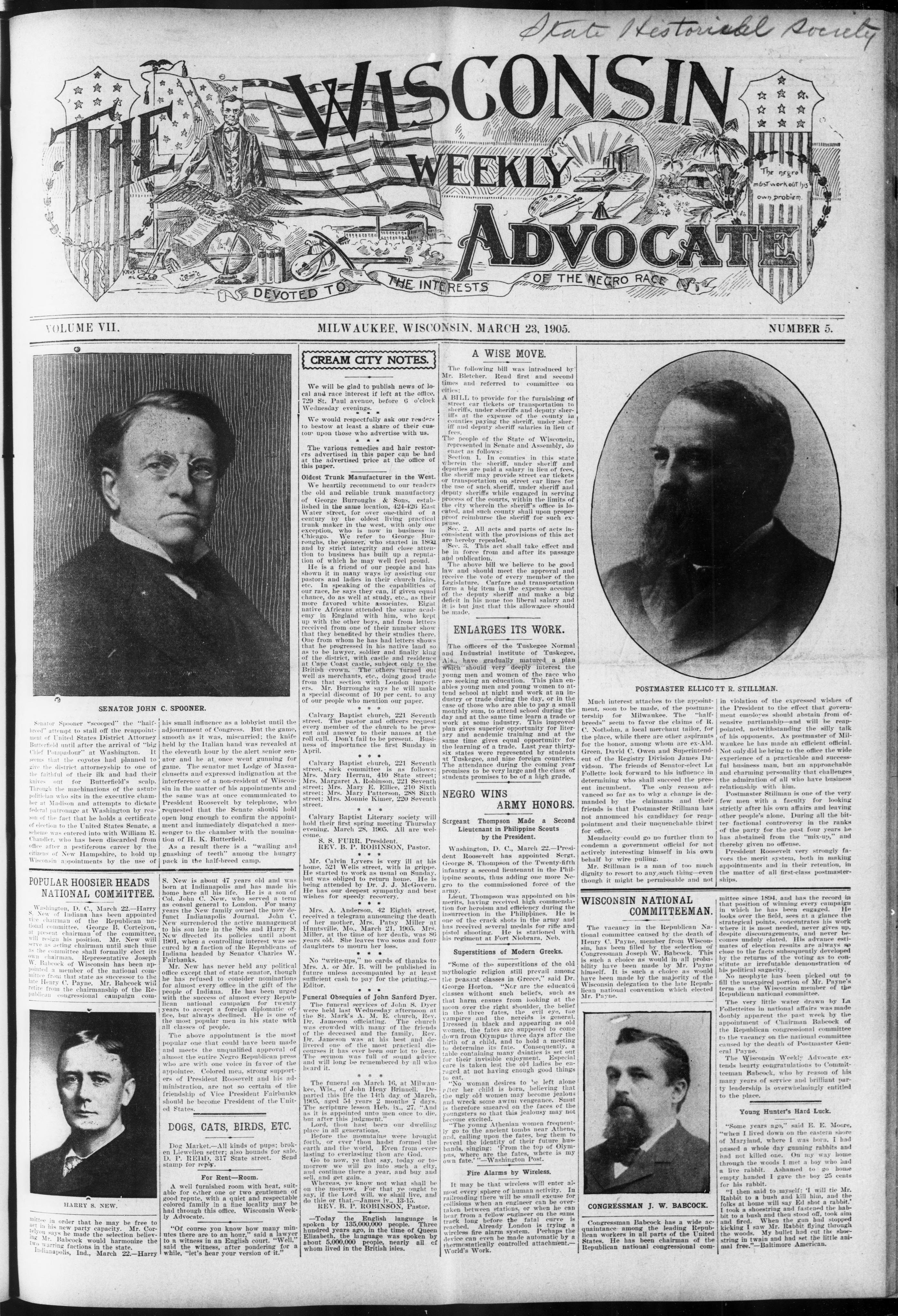
SENATOR JOHN C. SPOONER.
Senator Spooner "scooped" the "haifbreed" attempt to stall off the reappointment of United States District Attorney Butterfield until after the arrival of "big Chief Pompadour" at Washington. It seems that the coyotes had planned to give the district attorneyship to one of the faithful of their ilk and had their knives out for Butterfield's scalp. Through the machinations of the astute politician who sits in the executive chamber at Madison and attempts to dictate federal patronage at Washington by reason of the fact that he holds a certificate of election to the United States Senate, a scheme was entered into with William E. Chandler, who has been discarded from office after a pestiferous career by the citizens of New Hampshire, to hold up Wisconsin appointments by the use of
POPULAR HOOSIER HEADS NATIONAL COMMITTEE
POPULAR HOOSIER HEADS NATIONAL COMMITTEE
Washington, D. C., March 22.—Harry S. New of Indiana has been appointed vice chairman of the Republican national committee. George B. Corteiyou, at present chairman of the committee, will resign his position. Mr. New will serve as acting chairman until such time as the committee shall formally elect its own chairman. Representative Joseph W. Babcock of Wisconsin has been appointed a member of the national committee from that state as successor to the late Henry C. Payne. Mr. Babcock will retire from the chairmanship of the Republican congressional campaign com-
[Picture of a man in a suit with a tie].
muffin in order that he may be free to act in his new party capacity. Mr. Cortelyon says he made the selection believing Mr. Babcock would harmonize the two warring factions in the state.
Indianapolis, Ind., March 22.—Harry
HARRY S. NEW
his small influence as a lobbyist until the adjournment of Congress. But the game, smooth as it was, miscarried; the knife held by the Italian hand was revealed at the eleventh hour by the alert senior senator and he at once went gunning for game. The senator met Lodge of Massachusetts and expressed indignation at the interference of a non-resident of Wisconsin in the matter of his appointments and the same was at once communicated to President Roosevelt by telephone, who requested that the Senate should hold open long enough to confirm the appointment and immediately dispatched a messenger to the chamber with the nomination of H. K. Butterfield.
As a result there is a "wailing and gnashing of teeth" among the hungry pack in the half-breed camp.
S. New is about 47 years old and was born at Indianapolis and has made his home here all his life. He is a son of Col. John C. New, who served a term as consul general to London. For many years the New family owned the now defunct Indianapolis Journal. John C. New surrendered the active management to his son late in the '80s and Harry S. New directed its policies until about 1901, when a controlling interest was secured by a faction of the Republicans of Indiana headed by Senator Charles W. Fairbanks.
Mr. New has never held any political office except that of state senator, though he has refused to consider nominations for almost every office in the gift of the people of Indiana. He has been urged with the success of almost every Republican national campaign for twenty years to accept a foreign diplomatic office, but always declined. He is one of the most popular men in his state with all classes of people.
The above appointment is the most popular one that could have been made and meets the unqualified approval of almost the entire Negro Republican press who are with one voice in favor of the appointee. Colored men, strong supporters of President Roosevelt and his administration, are not so certain of the friendship of Vice President Fairbanks should he become President of the United States.
DOGS, CATS, BIRDS, ETC.
Dog Market.—All kinds of pups; broken Llewellen setter; also hounds for sale. D. P. REDD, 317 State street. Send stamp for reply.
A well furnished room with heat, suitable for either one or two gentlemen of good repute, with a quiet and respectable colored family in a fine locality may be had through this office. Wisconsin Weekly Advocate.
"Of course you know how many minutes there are to an hour," said a lawyer to a witness in an English court. "Well," said the witness, after pondering for a while, "let's hear your version of it."
For Rent—Room.
MILWAUKEE, WISCONSIN, MARCH 23, 1905.
CREAM CITY NOTES.
We will be glad to publish news of local and race interest if left at the office, 729 St. Paul avenue, before 6 o'clock Wednesday evenings.
We would respectfully ask our readers to bestow at least a share of their custom upon those who advertise with us.
The various remedies and hair restorers advertised in this paper can be had at the advertised price at the office of this paper.
Oldest Trunk Manufacturer in the West.
We heartily recommend to our readers the old and reliable trunk manufactory of George Burroughs & Sons, established in the same location, 424-426 East Water street, for over one-third of a century by the oldest living practical trunk maker in the west, with only one exception, who is now in business in Chicago. We refer to George Burroughs, the pioneer, who started in 1860 and by strict integrity and close attention to business has built up a reputation of which he may well feel proud.
He is a friend of our people and has shown it in many ways by assisting our pastors and ladies in their church fairs, etc. In speaking of the capabilities of our race, he says they can, if given equal chance, do as well at study, etc., as their more favored white associates. Eight native Africans attended the same academy in England with him, who kept up with the other boys, and from letters received from one of their number show that they benefited by their studies there. One from whom he has had letters shows that he progressed in his native land so as to be lawyer, soldier and finally king of the district, with castle and residence at Cape Coast castle, subject only to the British crown. The others turned out well as merchants, etc., doing good trade from that section with London importers. Mr. Burroughs says he will make a special discount of 10 per cent. to any of our people who mention our paper.
* * *
Calvary Baptist church, 221 Seventh street. The pastor and officers request every member of the church to be present and answer to their names at the roll call. Don't fail to be present. Business of importance the first Sunday in April.
* * *
Calvary Baptist church, 221 Seventh street, sick committee is as follows: Mrs. Mary Herran, 410 State street; Mrs. Margaret A. Robinson, 221 Seventh street; Mrs. Mary E. Ellice, 210 Sixth street; Mrs. Mary Patterson, 288 Sixth street; Mrs. Monnie Kimer, 220 Seventh street.
* * *
Calvary Baptist Literary society will hold their first spring meeting Thursday evening, March 28, 1905. All are welcome.
***
Mr. Calvin Lyvers is very ill at his home, 521 Wells street, with la grippe. He started to work as usual on Sunday, but was obliged to return home. He is being attended by Dr. J. J. McGovern. He has our deepest sympathy and best wishes for speedy recovery.
* * *
Mrs. A. Anderson, 42 Eighth street, received a telegram announcing the death of her mother, Mrs. Patsy Miller at Huntsville, Mo., March 21, 1905. Mrs. Miller, at the time of her death, was 86 years old. She leaves two sons and four daughters to mourn her loss.
※ ※ ※
No "write-ups," no cards of thanks to Mrs. A. or Mr. B. will be published in future unless accompanied by at least sufficient cash to pay for the printing. Editor.
休息
Funeral Obsequies of John Sanford Dyer.
Funeral Obsequies of John Sanford Dyer. The funeral services of John S. Dyer were held last Wednesday afternoon at the St. Mark's A. M. E. church, Rev. Dr. Jameson officiating. The church was crowded with many of the friends of the deceased and the family. Rev. Dr. Jameson was at his best and delivered one of the most practical discourses it has ever been our lot to hear. The sermon was full of sound advice and will long be remembered by all who heard it.
☆ ☆ ☆
The funeral on March 16, at Milwaukee, Wis., of John Henry Brinnell. Departed this life the 14th day of March, 1905, aged 54 years 2 months 7 days. The scripture lesson Heb. ix., 27, "And as it is appointed unto men once to die, but after this judgment."
Lord, thou hast been our dwelling place in all generations.
Before the mountains were brought forth, or ever 'thou hadst formed the earth and the world, Even from everlasting to everlasting thou are God.
Go to now, ye that say, today or tomorrow we will go into such a city, and continue there a year, and buy and sell, and get gain.
Whereas, ye know not what shall be on the morrow. For that ye ought to say, if the Lord will, we shall live, and do this or that.—James iv., 13-15.
REV. B. P. ROBINSON, Pastor. Today the English language is spoken by 135,000,000 people. Three hundred years ago, in the time of Queen Elizabeth, the language was spoken by about 5,000,000 people, nearly all of whom lived in the British isles.
A WISE MOVE.
The following bill was introduced by Mr. Bletcher. Read first and second times and referred to committee on cities: A BILL to provide for the furnishing of street car tickets or transportation to sheriffs, under sheriffs and deputy sheriffs at the expense of the county in counties paying the sheriff, under sheriff and deputy sheriff salaries in lieu of fees. The people of the State of Wisconsin, represented in Senate and Assembly, do enact as follows:
Section 1. In counties in this state wherein the sheriff, under sheriff and deputies are paid a salary in lieu of fees, the sheriff may provide street car tickets or transportation on street car lines for the use of such sheriff, under sheriff and deputy sheriffs while engaged in serving process of the courts, within the limits of the city wherein the sheriff's office is located, and such county shall upon proper proof reimburse the sheriff for such expense. Sec. 2. All acts and parts of acts inconsistent with the provisions of this act are hereby repealed. Sec. 3. This act shall take effect and be in force from and after its passage and publication.
The above bill we believe to be good law and should meet the approval and receive the vote of every member of the Legislature. Carfare and transportation form a big item in the expense account of the deputy sheriff and make a big deficit in his none too liberal salary and it is but just that this allowance should be made.
ENLARGES ITS WORK.
The officers of the Tuskegee Normal and Industrial institute of Tuskegee, Ala., have gradually matured a plan which should very deeply interest the young men and women of the race who are seeking an education. This plan enables young men and young women to attend school at night and work at an industry or trade during the day, or in the case of those who are able to pay a monthly sum, to attend school during the day and at the same time learn a trade or work at some industry. This improved plan gives superior opportunity for literary and academic training and at the same time gives equal opportunity for the learning of a trade. Last year thirty-six states were represented by students at Tuskegee, and nine foreign countries. The attendance during the coming year promises to be very large and the class of students promises to be of a high grade.
NEGRO WINS
ARMY HONORS.
Sergeant Thompson Made a Second Lieutenant in Philippine Scouts by the President.
Washington, D. C., March 22.—President Roosevelt has appointed Sergt. George S. Thompson of the Twenty-fifth infantry a second lieutenant in the Philippine scouts, thus adding one more Negro to the commissioned force of the army.
Lieut. Thompson was appointed on his merits, having received high commendation for heroism and efficiency during the insurrection in the Philippines. He is one of the crack shots in the army and has received several medals for rifle and pistol shooting. He is stationed with his regiment at Fort Niobrara, Neb.
Superstitions of Modern Greeks.
"Some of the superstitions of the old mythologic religion still prevail among the peasant classes in Greece," said Dr. George Horton. "Nor are the educated classes without such beliefs, such as that harm ensues from looking at the moon over the right shoulder, the belief in the three fates, the evil eye, the vampires and the nereids is general. Dressed in black and appearing as old women, the fates are supposed to come down from Olympus three days after the birth of a child, and to hold a meeting to determine its fate. Consequently, a table containing many dainties is set out for their invisible enjoyment. Especial care is taken lest the old ladies be enraged at not having enough good things to eat.
"No woman desires to be left alone after her child is born, believing that the ugly old women may become jealous and wreck some awmi vengeance. Smut is therefore smeared on the faces of the youngsters so that this jealousy may not become excited.
"The young Athenian women frequently go to the ancient tombs near Athens, and, calling upon the fates, beg them to reveal the identity of their future husbands, singing: 'From the top of Olympus, where are the fates, where is my own fate.'"—Washington Post.
Fire Alarms by Wireless.
It may be that wireless will enter almost every sphere of human activity. In railroading there will be small excuse for collisions when an engineer can be overtaken between stations, or when he can hear from a fellow engineer on the same track long before the fatal curve is reached. Already London is trying a wireless fire alarm system. Perhaps the device can even be made automatic by a thermostatically controlled attachment.—World's Work.
[Image of a man with a long beard and a full head of hair, wearing a suit and a bow tie. The background is a plain, light color, and the portrait is oval-shaped.]
POSTMASTER ELLICOTT R. STILLMAN.
Much interest attaches to the appointment, soon to be made, of the postmastership for Milwaukee. The "halfbreeds" seem to favor the claims of R. C. Notbohm, a local merchant tailor, for the place, while there are other aspirants for the honor, among whom are ex-Ald. Green, David C. Owen and Superintendent of the Registry Division James Davidson. The friends of Senator-elect La Follette look forward to his influence in determining who shall succeed the present incumbent. The only reason advanced so far as to why a change is demanded by the claimants and their friends is that Postmaster Stillman has not announced his candidacy for reappointment and their unquenchable thirst for office.
Mendacity could go no further than to condemn a government official for not actively interesting himself in his own behalf by wire pulling.
Mr. Stillman is a man of too much dignity to resort to any/such thing—even though it might be permissable and not
WISCONSIN NATIONAL COMMITTEEMAN.
The vacancy in the Republican National committee caused by the death of Henry C. Payne, member from Wisconsin, has been filled by the selection of Congressman Joseph W. Babcock. This is such a choice as would in all probability have been made by Mr. Payne himself. It is such a choice as would have been made by the majority of the Wisconsin delegation to the late Republican national convention which elected Mr. Payne.
1
CONGRESSMAN J. W. BABCOCK
Congressman Babcock has a wide acquaintance among the leading Republican workers in all parts of the United States. He has been chairman of the Republican national congressional com-
in violation of the expressed wishes of the President to the effect that government employees should abstain from offensive partianship—and will be reappointed, notwithstanding the silly talk of his opponents. As postmaster of Milwaukee he has made an efficient official. Not only did he bring to the office the wide experience of a practicable and successful business man, but an approachable and charming personality that challenges the admiration of all who have business relationship with him.
Postmaster Stillman is one of the very few men with a faculty for looking strictly after his own affairs and leaving other people's alone. During all the bitter factional controversy in the ranks of the party for the past four years he has abstained from the "mix-up," and thereby given no offense. President Roosevelt very strongly favors the merit system, both in making appointments and in their retention, in the matter of all first-class postmasterships.
mittee since 1894, and has the record in that position of winning every campaign in which he has been engaged. He looks over the field, sees at a glance the strategical points, concentrates his work where it is most needed, never gives up, despite discouragements, and never becomes unduly elated. His advance estimates of election results are always so close to the facts subsequently developed by the returns of the voting as to constitute an irrefutable demonstration of his political sagacity. No neophyte has been picked out to fill the unexpired portion of Mr. Payne's term as the Wisconsin member of the Republican national committee.
The very little water drawn by La Folletteites in national affairs was made doubly apparent the past week by the appointment of Chairman Babcock of the Republican congressional committee to the vacancy on the national committee caused by the death of Postmaster General Payne. The Wisconsin Weekly Advocate extends hearty congratulations to Committeeman Babcock, who by reason of his many years of service and brilliant party leadership is overwhelmingly entitled to the place.
Young Hunter's Hard Luck.
"Some years ago," said E. E. Moore, "when I lived down on the eastern shore of Maryland, where I was born, I had passed a whole day gunning rabbits and had not killed one. On my way home through the woods I met a boy who had a live rabbit. Ashamed to go home empty handed I gave the boy 25 cents for his rabbit.
"I then said to myself: 'I will tie Mr. Rabbit to a bush and kill him, and the folks at home will say Ed shot a rabbit.' I took a shoestring and fastened the habbit to a bush and then stood off, took aim and fired. When the gun had stopped kicking I saw Mr. Rabbit flying through the woods. My bullet had cut the shoestring in twain and had set the little animal free."—Baltimore American.
The movement in England for restoring the use of knee breeches is making considerable progress.
The outside walls of many of the houses in Mexico are from 3 to 6 feet thick to withstand earthquake shocks.
Every inhabitant of London eats 173 pounds of potatoes in a year. A Parisian consumes on an average only 49 pounds a year.
A man at Geneva, Switzerland, claims to have remained in the water for one month. He used a rubber suit of his own invention.
Thirty young women recently left England in a troopship to become married, each being engaged to a soldier serving in India.
The total length of the Russian railway system on January 14 was 37,571½ miles. In 1904 there were thrown open to traffic 679 miles
The worker in a Massachusetts factory gets 27 per cent. of what he produces, while the laborer in South Carolina gets only 19 per cent.
Russian exiles in London rejoiced over the news of the fall of Port Arthur, seeing in it "the beginning of the end of the tyranny of Russia."
Morris Casperson, a coachman employed by Mrs. Potter Palmer, was injured when one of the Palmer carriages collided with a heavy truck.
A Tokio dispatch says that Japan is grave over the report that 200,000 reserves are to be called to the colors. Russia must feel about the same.
- Of the 720,000,000 acres of land making up the total area of Argentina, 24,000,000 are arable. The principal crops are corn, wheat and flax.
- The stroke of a lion's paw is the third strongest force in the animal world. The first is the blow of a whale's tail and the second the kick of a giraffe.
- An immense coal field has been discovered in Roumania. If properly exploited this field, it is said, could well supply the demand for all the Balkan states.
- The annual consumption of salt in England is 10 pounds, Russia 18 pounds, Austria 16 pounds, Prussia 14 pounds, Spain 12 pounds and Switzerland 8 pounds.
Australia is now shipping many crates of eggs to Ireland, and the keen Irish merchants are quickly reshipping them to England, where they sell as fresh Irish eggs.
The invasion of Tibet by a British force was a "mission." The army of 2500 men now being sent into the Nyam-Nyam country, Central Africa, is officially a "patrol."
When his wagon was overturned Jacob Simon suffered injuries which may result fatally. Simon was taken to his home by the police and it is said he is injured internally.
The ink plant of Colombo is a curiosity. The juice of it can be used as ink without any preparation. At first the writing is red, but after a few hours it changes to black.
A former army officer plays a hand organ on the streets of Sheffield and between times lectures on the methods of the British war office, which, he says, reduced him to penury.
Infant mortality is reported to be greater in Prussia than in any country except Russia. The death the first year are 6 to 7 per cent. in Sweden, 15 in France and 23.6 in Prussia.
Fox hunting seems to be on the wane in England. Some attribute this to the inroads of the automobile and others to hard times and "the loss of many hunting men during the South African war."
Pilgrims to the number of 92,500 from all parts of Islam reached Mecca last year. Five thousand are known to have died on the way, and 10,000, who started but did not arrive, are unaccounted for.
—Col. "Bill" Sapp, the chairman of the Kansas state Democratic committee, is the direct descendant of a French ducal house. One of his grandfathers was a teacher of Napoleon at one of the military schools.
—Mrs. Olga M. Steele, wife of Capt. Oliver D. Steele, died at her husband's residence, of heart disease. Mrs. Steele organized the Ladies' Auxiliary Spanish War Veterans, which met the returning First Illinois infantry at Montauk Point.
—Having taken a dislike to his daughter and her husband, Louis Rung of Basle, Switzerland, poisoned 300 apple trees in their orchard with arsenic. The next time they made a pie those who ate it nearly died. Rung confessed and was sentenced to five years' imprisonment.
The authorities of the Congo Free State are endeavoring to popularize travel through their territory, and it has just been officially announced that the Congo railway has reduced the rate for first-class fares to £2 for a journey of 240 miles. This is a great reduction on former fares, and is the lowest rate in West Africa.
The manufacture of motor cars and their accessories has become one of the most important French industries. From a total of 1850 automobiles in 1898 valued at $1,602,000, the output in 1904, according to the Chamber Syndicate de l'Automobile de France, has grown to 22,000 cars, of an estimated value of $34,000,000.
—Rio Grande do Sol, the most southern state in Brazil, adjoins Uruguay on the south, and has about 1,400,000 population, 800,000 of whom are Germans or of German descent. The principal product of the state is cattle, of which it produces more than any other three states of Brazil. The climate is very fine and the country rolling.
—A silver tobacco pipe with a stem ten inches long is used by the Empress of Japan. The bowl is small—in fact, only a quantity of tobacco sufficient to give the smoker two or three whiffs can be put into it. Then the ashes are knocked out, and the pipe is carefully cleaned before it is refilled—a process gone through many times in the course of an afternoon.
According to the laws of good society in China young widows should not marry. Widowhood is, therefore, held in highest esteem, and the older the widow grows the more agreeable her position becomes. Should she reach 50 years she may, by applying to the Emperor, get a sum of money with which to buy a tablet on which her virtues are inscribed. The tablet is then placed over the door at the principal entrance to her house.
An ingenious new lamp is now being shown in St. Louis, the merit claimed for which is that the danger of oil overflow in filling is averted. This is done by means of a piece of glass of prism shape inserted in the top of the reservoir, and with one portion extending down into the oil space. Thus it is possible to tell as soon as the oil reaches the lower part of the glass extension and the exact leel of the oil can be seen and followed as it rises toward the inlet through which the lamp is being filled.
On the Safe Side
An old woman who persisted in bowing during church service whenever the name of Satan was mentioned, was reprimanded by the minister for so unseemly a habit. The reproof had, however, no effect, and the minister asked her finally, in exasperation, why she thought it necessary to bow.
"Well," she replied, "civility costs nothing, and you never know what will happen."—Harper's Weekly.
THE CHANT OF THE VULTURES.
Fight on in the hell of the treets: we publish your fame with a croak!
Ye will lie in dim heaps when the sunset blows cold on the reddening sand:
do we clamor for more:
Vast, vast is our hunger, as vast as the sea-hunger gnawing the shore.
Tis well ye are swift with your signals—the blaze of the banners, the blare
Of the bugles, the boom of battalions, the cannon breath hot on the air.
It is for our hunger ye hurry, it is for our feast ye are met:
or green we are.
Our lineage rose from the Night, and we go without fellow or friend.
We were, ere our servant Sesostris spread over the Asian lands.
The smoke of the blood of the peoples, the ashes he blew from his brands.
We circle in revel for ages above the Assyrian stream.
While Babylon builted her beauty, and faded to dust and to dream.
We scattered our laughter on Europe—and Troy was a word and a waste.
The glory of Carthage was ruined, the grandeur of Rome was effaced!
And we blazoned the name of Timour, as he harried his herd of kings.
And the host of his nords wound on, a dragon with undulant rings.
And we slid down the wind upon France, when the steps of the earthquake passed.
When the Bastile bloomed into flame, and the heavens went by on the blast.
We hung over Austerlitz cheering the armies with jubilant cries;
We scented three kings at the carnage, and croaked our applause from the skies.
O kings, we have catered to vultures—have chosen to feed us forsooth
hope of the world and her youth.
O kings, ye are diligent lackeys: we laurel your names with our praise.
For ye are the staff of our comfort, for ye are the strength of our days.
Then spur on the host in the trenches to give up the sky at a stroke:
We tell all the winds of their glory; we publish their fame with a croak!
-Edwin Markham in Collier's Weekly.
THE SMART SET.
Roderick Ben Nevis, Earl of Peebles, allowed the servant to assist him out of his fur coat. He had been motoring, and had returned, after a spin of seventy miles in two hours, with his fair companion to the Rapid club in Piccadilly.
The Rapid club, as every one knows, is the home of the smart set. If you are extremely fast indeed, they will be pleased to have you as a member.
Mrs. Tom Brunton, who had accompanied the earl, now joined him once more in the smoking room. She put a Turkish cigarette between her dainty lips, and spoke:
"Didn't the car run over something, Roderick?"
"Ya-as, a boy."
"Think it hurt him?"
"No. Killed him instantly." There was no denying the fact that the speaker belonged to the smart set.
"Are you going home to dine?" he asked.
"Nothing so old-fashioned." she protested. "I am going home to dress."
"Where shall we dine, after?"
"Carlton."
"All right; and I'll book a box at the Empire. Supper at the Savoy?"
"Certainly."
"Very well. I'll go and fix up things. Whta'll you do meanwhile?"
"I'm going to the card room for bridge." "Got your money with you?" "Yes, had a check this morning from Mr. Brunton's lawyer."
"Mr. Brunton?"
"Yes, my husband, as you know."
"Oh, of course! Stupid of me! But I always forget about the old buffer. Have I ever met him?"
"Certainly not."
"Thought not. You see, we get about so much together that it almost seems as if we're married. But that's absurd."
"Rather! If we were married, we should never be seen together."
"Not in our set?"
"No, no. Quite so. If you were my wife I shouldn't take you out."
"Nobody would expect you to do such a ridiculous thing. Well, by-by. Meet you at dinner."
Mrs. Tom Brunton was just about to disappear into the cardroom for her inevitable hand of bridge, but something occurred to detain her.
Just as Lord Peebles disappeared, a pretty, slightly built girl, with fair hair and blue eyes, entered the smoking room. She was habited in a plain tailor-made costume, and several occupants of the room, in startling afternoon toilets, stared in amazement at an intruder garbed so prosaically.
But the girl did not seem to care for inquisitive eyes. After a glance around, she made straight toward Mrs. Tom Brunton, just as that lady was gathering up her belongings.
"Mother!" cried the girl.
"I beg your pardon?" replied Mrs. Brunton, with a haughty stare.
"Oh, mother, don't you know me? I'm Elsie."
"Elsie? Elsie? Yes—let me see—I did have a daughter named Elsie."
"I'm Elsie, mother." She put out her arms and her lips for a mother's greeting, but the other lady drew back. She had a horror of scenes, especially in the club.
"But Elsie went to stay with aunt," she said.
"That was ten years ago, mother. And I've grown up since then, and I've been to the house, and the servants told me I should most likely find you here."
"So you are Elsie, are you?" Mrs. Brunton settled herself resignedly in her chair. "You've grown quite a big girl." "It's ten years, mother." "Sit down. Don't keep saying 'mother!' It sounds so dreadfully common. Everybody has mothers nowadays. Sit down. What'll you have to drink?" "Nothing, thank you, mo——! That is, I only drink lemonade." "That isn't a drink; that's an infliction. Have you seen your father?"
"Really? How interesting! I haven't seen the man for three months, except once, when he was getting out of a cab." "Oh, mother!" "There you go again! So horribly vulgar. But you have grown. You're quite a big girl!" "Well, you see, it is ten years. * * But I want to tell you something." "No bad news, I hope?" "I'm going to be married, mother." "That is bad news."
"Oh, no! It is good news, mother, dear."
"Hush, child! Going to be married? Let me see; how old are you, Elsie?"
"I'm 21."
"Twenty-one? Really? Well, well, how time does fly! To think of me with a daughter that age! It seems terrible."
She called for a brandy and soda.
"Bring it quick," she commanded. She felt it was necessary. "I didn't ask for your lemonade," she explained to her daughter. "They wouldn't know in the club what it was."
"That's all right, mother, dear. But, aren't you glad?"
"Glad? Oh, about you getting married. I suppose I am. Who's the man?" "Such a dear boy!"
"Oh, no; only 25."
"What a pity. Not old, and not rich. Now, if you had married a rich, old man, you might have become one of us!"
"One of—you?"
"One of the smart set! As it is, I am afraid you are hopeless."
Somehow, the girl did not seem to betray any anxiety to become a member of that select circle. She actually shuddered.
Mrs. Brunton, having negotiated her brandy and soda in one guip, felt recuperated, and remembered her duties.
She held out her hand.
"Well, good-bye," she said; "I have to go and play bridge. So pleased to have seen you again."
The daughter's eyes filled with tears. "Won't you kiss me, mother, and wish me joy?"
"I wish you joy, of course, but I'm afraid you won't have it, under the circumstances. Pity you're not marrying somebody rich and old. Good-bye."
"Won't you kiss me?"
"What! In the club? My dear, do have some sense."
And so mother and daughter parted, in the correct, unemotional fashion that is so universal nowadays. The mother went to her card game.
The daughter, stupid enough to have some feelings, pulled down her veil to hide her tears.
"Roderick, would you believe that I saw my daughter this afternoon?"
"Didn't know you had one."
"Well, I was surprised, rather. I think it upset me. I lost a cool six hundred afterward at bridge."
"How stupid! That's what comes of being plagued with children."
"But this one isn't a child now. She's going to be married."
"Hang it, that's worse!"
"It was a shock to me, I can assure you. It seems only the other day that she went to stay with her uncle and aunt."
"What sort of people are they?"
"He's my brother. Horribly prosaic. He's a kind of clergyman."
"Dear me!"
"Oh, I never acknowledge him. And now the girl returns quite a young woman—and is going to be married."
"Who to?"
"There!" said Mrs. Tom Brunton.
"Upon my soul, I quite forgot to ask her."
It was about three months afterward. The scene was Monte Carlo.
Mrs. Tom Brunton, staying at the Hotel Royal, was sunning herself in the grounds, reclining in a deck chair, and reading the latest onslaught on the smart set by a lady novelist. "How absurd!" she meditated.
Robert Ben Nevis, Earl of Peebles, came along the gravel path. Staying at the Hotel Russe, almost opposite, he was, of course, a frequent and privileged visitor.
"But she lifted her eyes in surprise. 'Is the motor ready, then?' she asked. 'I didn't expect you for an hour.'"
"'Tain't the motor," said the earl, "but this is the funniest thing I've read for a long time."
She then observed that he was waving a copy of the Morning Post.
"What's that?" she inquired. "Something funny? Tell me at once."
"Read this," he gurgled.
He handed her the paper, pointing at the same time to a marked paragraph under the heading of "Marriages."
And this is what she read:
"Ben Nevis-Brunton—On the 9th instant, at St. Mary Abbot's, Kensington, by the Bishop of Double-Gloucester, uncle of the bride, assisted by Rev. James Brown, M. A., Bernard Roderick Ben Nevis, only son of the Earl of Peebles, to Elsie, only daughter of Thomas Brunton, M. P., of Berkeley Square, W."
"What!" cried. Mrs. Brunton, "my daughter!"
"And my son?"
"Only daughter of Thomas Brunton!' Why, my name is not even mentioned! 'By the Bishop of Double-Gloucester!' That's my brother. I told you he was a kind of clergyman."
"And my rascal of a son never asked my permission."
"Have I ever seen your son?"
"Certainly not. Haven't seen him myself since he went to Eton."
"Well, of all the——"
"That's my opinion, too. Ain't it funny? Ha-ha-ha!"
She arose grandly from her chair.
"Well, there is one consolation," she observed, as she took the proffered arm of the peer, "they will never be admitted into Our Set!"
In a neat little house in Kensington live Mr. and Mrs. Ben Nevis. He is a barrister, with a rising practice, and she is a happy little wife, merry as the day is long.
A few special friends look them up and call now and then, to find them in one of the coziest nests in London. Thomas Brunton, M. P., is a frequent and honored and dearly loved visitor.
The Earl of Peebles has never called. Mrs. Tom Brunton has never called.
But, then, the young couple are not in the "Smart Set!"—Ally Sloper's Holiday.
Establish "Physical Culture City."
Nineteen hundred acres of land were sold for a physical culture city in Middlesex county, New Jersey. A New York representative of wealthy capitalists will establish a physical culture settlement. He already has given two contractors of Jamesburg a contract for the erection of a building 48=224 feet, and an extensive printing plant will be moved to their new city when completed. A monthly magazine will be published and the printing establishment will employ at the start at least 200 hands. The miniature city will bear the name of "Physical Culture City."
"OH. ASK ME NOT."
Love, should I set my heart upon a crown,
Squander my years, and gain it.
What recompense of pleasure could I own
For youth's red drops that stain it?
Much have I thought on what our life may
mean,
And what its best endeavor;
Seeing we may not come again to glean,
But, losing, lose forever.
Seeing how zealots, making choice of pain,
From home and country parted
Have thought it life to leave their fellows
slain,
Their women broken-hearted;
How teasing truth a thousand faces claims,
As in a broken mirror,
And what a father died for in the flames
His own son scorns as error;
How even they whose hearts were sweet
with song
Must quatt oblivion's potion.
And soon cr late their sails be lost along
The all-surrounding ocean.
Oh, ask me not the haven of our ships,
Nor what flag floats above you!
I hold you close, 1 kiss your sweet, sweet
lips.
And love you, love you, love you!
—John Charles McNeil in the Century.
New York Every Day.
Two seats on the New York stock exchange have ben sold for $83,000 each. This is a new high record price, exceeding the previous highest price, paid a few days ago, by $500.
Henry R. Reed, the wealthy Boston man who was found dead in a suite of rooms at the Grand Union hotel, New York city, died of heart disease. This conclusion was reached by the coroner's office.
Fire broke out among the life preservers on the ferryboat Kentucky while crossing the East river. The flames were extinguished after a ten minutes' fight. Fifty women and children on the boat were considerably alarmed, but were quieted by the crew.
The Christian Science publication committee of New York combat the statement that Miss Grace Carpenter, who died a maniac in New York city recently, was a victim of infatuation for their cult. The committee claims that parental opposition to her accepted faith affected the young woman, who was never strong and who was also subject to spells of melancholia.
George W. Young, president of the United States Mortgage and Trust company, is an applicant for membership to the New York stock exchange. Two seats at $83,000, the high record figure, have been transferred, one to Francis C. Carley and another to John D. Chapman. One of the latest purchasers is announced to be E. Drexel Godfrey of Philadelphia.
Four men charged by officials of the New York Central railroad with forging and selling passes over that road have been arrested. They are Albert Neuman, Max Ziveifach, Isidor Hauptmann and Louis Bringbaum, the latter three being partners. The New York Central has been victimized for more than a year, forged passes representing a traffic value of $6000 having been sold.
Ada Rehan, the actress, appeared in the supreme court before Justice Truax as a witness in her suit to recover about $7000 from the estate of Augustin Daly for salary from January to May, 1899, in June of which year Mr. Daly died. The executors, Mary D. Daly, Joseph F. Daly and Richard Dorney, assert that nothing is owing to Miss Rehan, as she signed a settlement agreement in December, 1899.
An effort was made to have James H. Eckels, president of the Commercial Bank of Chicago, succeed R. L. Edwards as president of the National Bank of North America of New York city, but Mr. Eckels declined to go to New York in this capacity for a salary of $40,000 a year, believing his Chicago prospects to be better. It is understood H. L. Burrage, president of the Elliott National Bank of Boston, will succeed Mr. Edwards, who appears to have been forced to resign by Charles W. Morse.
"Dick" Weeks, a "nighthawk" known to the "White Light" district in New York city before Inspector Williams coined the designation "Tenderloin," is dead. He passed away in Bellevue. He was 60 years of age, and three days ago went to Bellevue, penniless, suffering from a gangrenous wound he had received in falling from his cab. At the Haymarket a collection of $200 was quickly raised to save Dick from a pauper's grave. One of Dick's great friends was John L. Sullivan. No trip of his about the city was complete unless Dick drove the cab.
Former Congressman Jefferson M. Levy gave a dinner at the Waldorf-Astoria to Sir Charles Wyndham and his leading woman, Miss Mary Moore, who have sailed for England. Outside of a successful theatrical season in this country, Wyndham and Miss Moore each are $40,000 richer as the result of a stock market deal into which they were put by Levy. He told them to buy Hudson Bay company on the London stock exchange soon after their arrival here. It has gone up 22 points since then. Miss Moore last year made $150,000 in Anaconda mining stock on a "tip" from the former congressman.
Through the filing of papers in a divorce suit in the supreme court today it came out that the wife of Richard K. Fox, proprietor of the Police Gazette, has been missing two months. She is declared to have eloped with Alfred Stein, a handsome young Austrian. Mrs. Fox is said to be 58 years old and Stein 30. According to the affidavits, Mrs. Fox told her husband last January he had been working too hard and ought to take his son Charles to Palm Beach for a few days. She would stay and keep house. The men of the family took her advice. Fox is 62 years old. He married the present Mrs. Fox in London in 1885.
Complants have been served upon counsel representing Edwin Hawley, Frank H. Ray and Daniel J. Sully in suits for $960,000 brought by David Miller, trustee in bankruptcy of the firm of Daniel J. Sully & Co. Mr. Miller is acting in behalf of the creditors of the Sully firm and has retained former Secretary of War Elihu Root as associate counsel. The purpose of the suits is to hold Hawley and Ray responsible for the sums alleged to be due creditors on joint accounts which Sully testified they ventured with him. One of the suits is directed against Ray, Hawley and Sully for $717,715, and another is against Ray and Sully for $150,720.
The police raided a poolroom and gambling house in Forty-second street, which they declare was patronized almost exclusively by wives of wealthy New Yorkers. The evidence was obtained by a woman detective. The alleged poolroom was situated in a fashionable apartment house. The police had to break down two doors to reach the room. Their entrance was followed by a scene of wild excitement, the women, most of
whom were gathered around a roulette table, screaming and attempting to escape by the windows and doors. After they had given their names, the women were allowed to go. Besides the charges of conducting a poolroom and gambling house, Frederick Bush, the alleged proprietor is accused of attempting to bribe a policeman.
Senator Chauncey M. Depew escaped being summoned before the supreme court to answer for contempt after it had been explained by J. J. Paulding, who appeared as his counsel, that he was attending a special session of the United States Senate. Justice Dowling, who denied the application for the order, however, informed counsel for the plaintiff that if the senator does not appear next Friday when the suit comes up another similar application can be made to the court. The application was made on behalf of James F. Muldoon, Jr., who, as administrator of the estate of Arthur Muldoon, is suing to recover damages for the death of the latter by being run over by a New York Central train. Senator Depew was summoned, but failed to appear when the case was called today.
Steamship agents predict that there will be more Americans crossing the Atlantic this summer than ever before. From eight to fifteen sailings are already booked "full up," there are long waiting lists for favorite dates, and the second-cabin accommodations of some new steamers could be sold at first-cabin rates if the first-class dining room would only hold the travelers at one sitting. Americans sailing from New York last year spent in fares an aggregate of $35,379,050. The 67,835 saloon passengers spent $13,567,000. The 56,825 second-cabin passengers spent $5,682,500, and 322,983 steerage passengers spent $16,129,550. As the average American spends while abroad four times the cost of his passage, America must have contributed to Europe's wealth $131,516,200. Of the 525,175 persons who sailed from America, 447,643 took passage from New York.
Nitrogen's Love of Freedom
When left alone to its natural functions nitrogen pursues a perfectly peaceful course; but when man succeeds in capturing it and combining it with other elements it becomes a dire potentiality for evil, as is obvious in the recent events of the war in the far east and in the crime committed last week in the streets of Moscow. The love of freedom, so to speak, characteristic of nitrogen is terribly exemplified in the explosion of the bomb in which it is imprisoned and bound to other elements. On the slightest provocation—a spark, a shock, a fuse—the nitrogen suddenly expands from seemingly nothing, as regards the space which it occupies, into infinity. This is, in reality, what happens when dynamite, lyddite or other unstable nitro-compounds explode when hurled in shells in warfare and in bombs in desperate attacks on human lives. Nitrogen, against its natural disposition, is locked up in an uncongenial space in these compounds, from which it is set free by very simple means in an enormously expanded gaseous state with deadly effect, returning, in fact, to its normal peaceful mission once more. It is the analogue of the sword and the plough-shares; in the nitro-explosive, nitrogen is the modern engine of warfare and crime; in the free state in the atmosphere it ministers directly to the quiet and peaceful needs of plant and human life.—Lan-
Dog's Estate Causes Worry.
Judge Francis W. Downs of Binghamton, N. Y., applied to Surrogate Robert S. Parsons for the appointment of an administrator for the estate of his dog, Lee, which was run over by a fire engine and killed. Judge Downs several years ago bought $20,000 worth of western mining stock, which, for several years, was supposed to be worthless. A year ago, when it was announced that an assessment was to be made on this stock, the judge formally transferred his stock to Lee in order to avoid paying the assessment. The assessment was not made and the mining stock soon began to appreciate, until now it is worth $10,000. Downs now wants to regain the stock, but the only way will be to have the estate of the dog settled up by an administrator. As the dog died intestate the question arises whether Downs will be able to prove that he is next of kin to Lee and legally entitled to the estate.
United After Twenty-five Years.
Twenty-five years ago William D. Sicklen left his home in Laporte, Ind., and went out into the world to seek his fortune. Three years later his sister, Cordelia, married and moved to South Chicago with her husband. From that time on she heard nothing of her brother. The other day they met on the street in that city and the recognition was mutual. The brother is now wealthy. He was on his way to the La Salle station to board a train for the east when he met his sister. She is now a widow and for several years has been in straitened circumstances. Sicklen has given up his trip to New York and will remain for an indefinite period at his sister's home in South Chicago.
Novel Use for Postage Stamps.
The monks at the hospital of St. Jean de Dieu, at Ghent, have in their leisure moments decorated the walls with gorgeous landscapes, glowing with color and full of life, formed entirely by means of the postage stamps of all the nations of the world. Palaces, forests, streams and mountains are represented, butterflies flit about in the air, birds of beautiful plumage perch on branches, snakes and lizards glide about, and innumerable animals find places here and there. The pictures are most artistic, in the style of Chinese landscape gardening, and already between 9,000,000 and 10,000,000 of stamps have been used.
Sells Trousers High Priced.
Thomas Pays, aged 25, a Parisian without resources, conceived the idea of declaring that a pair of checked trousers he possessed had belonged to Victor Hugo. He immediately started to sell portions to credulous collectors, who paid $20 even for a button. Then he began to sell the legs of the trousers, but when he sold a fifth leg he was arrested in the company of one of his dupes.
Loses $7000 in Street.
Mrs. L. C. Bohle of St. Louis jumped to dodge a speeding automobile in a down town street and soon afterward discovered she had lost $7000. The money, in bills, was wrapped in a newspaper, and Mrs. Bohle was taking it from a safety deposit vault. She is the widow of the former United States marshal in St. Louis. Detectives are seeking the cash.
Eggs May Be Manufactured.
French chemistry has produced a plausible imitation of the ordinary egg of commerce. The shell is made with a blowpipe, the combination being lite and bismuth. The white is made of sulphur, carbon and beef fat and the yolk of beef blood and magnesia colored with chrome yellow.
California Condor on Wav.
A magnificent living specimen of the California condor has been shipped from San Francisco for the Central park zoo in New York. It measures 11 feet from tip to tip.
SEEDING IN PROGRESS IN WESTERN CANADA
Mild Weather Is Bringing Thousands of Settlers.
The splendid yields of wheat, oats and barley produced by the farmers of Western Canada and the excellent prices received for the same, have been the means of giving an increased interest throughout the United States. As a result the inquiries made of the agents of the Canadian Government have nearly doubled over those of the same period last year. Railroad companies are putting on increased carrying capacity to meet the demand made upon them for carrying passengers and freight. Everything points to a most prosperous year. There is room for hundreds of thousands additional settlers, much new land having been opened up for settlement this year.
It is quite interesting to look through the letters received from the Americans who have settled in Western Canada during the past few years, and considering the large number, it is surprising how few there are who have not succeeded. An extract from a letter written by Mr. Geo. W. Griswold, of Red Deer, Alta., formerly of Greber, Mont., written on the 2d of January, is as follows:
"I am located one and one-half miles from a beautiful lake ten miles long, where there is church, school, three stores, creamery and two postoffices. The fine stock, both cattle (cows and steers), horses, hogs and sheep are rolling fat, grazing in pastures to-day, just a little snow, hardly enough for good sleighing; as we just had a chinook which has melted the roads and laid bare the fields and pasture. There are fine wheat, oats, barley and flax raised here, also winter wheat and timothy hay for export to British Columbia. This is a mixed farming and dairy country. This is the right time to get a foothold in the Canadian West, as it was some years ago in the United States. We are free from wind gumbo and alkali here and have fine, clear, soft well and spring water at a depth of from five to twenty-five feet, and lots of open overflowing springs."
Telegraphic advices from Medicine Hat say that seeding has commenced at Medicine Hat, Lethbridge, and other points. At the former place the temperature moderated gradually until on the 19th the maximum was 45 and the minimum 26. Thermometer readings since then have been as follows: 20th, 47 and 38; 21st, 54 and 34; 22d, 56 and 39; 23d, 48 and 40; 24th, 48 and 26.
During the last few days in February considerable ploughing was done near Lethbridge. P. A. Pulley, a recent arrival from Montana, ploughed and harrowed fifteen acres and E. Laliborty about the same amount. Rev. Coulter White has also been harrowing his farm. All report the ground frost free and in excellent condition. Bricklaying has also begun in town. At Hartney, further east, on the 25th of February, the sun was warm and bright, wheeled carriages were in use and the plowed fields look as if they are ready for the press drills. There is every appearance that spring has arrived, but farmers do not wish to be deceived by appearances and consequently have not commenced to use their bluestone and seed wheat.
Not Lonesome.
Seated on the grass in front of a sod cabin in Oklahoma was a man cleaning a double-barreled shotgun, and after we had conversed for a few minutes I asked him how far it was to the nearest neighbor's.
"A trifle over two miles," he replied.
"As far as that? You must find it rather lonesome here."
"No, I can't say as I do."
"Perhaps you are not one of the lonesome kind."
"No, I'm not. But, you see, I mortgaged this claim for $400."
"Yes."
"And I couldn't pay and they foreclosed on me."
"I see."
"That was two years ago, and the sheriff has been trying to get possession ever since. He comes twice a week and we have a shot at each other, and at least twice a week some durned fool comes along and wants to know if I ain't lonesome, and when you add the claim jumpers, the rattle snakes and the skunks, this life is about the excitingest thing I know of. There comes the sheriff now, and you had better get down behind that log and keep clear of his buckshot."—Topeka (Kan.) Journal.
Around the World
"I have used your Fish Brand Slickers for years in the Hawaiian Islands and found them the only article that suited. I am now in this country (Africa) and think a great deal of your coats."
(NAME ON APPLICATION)
HIGHEST AWARD WORLD'S FAIR, 1904.
The world-wide reputation of Tower's Water-proof Oilled Clothing assures the buyer of the positive worth of all garments bearing this Sign of the Fish.
A. J. TOWER CO., Boston, U. S. A.
TOWER CANADIAN CO., LIMITED,
Toronto, Canada.
EXCURSIONS
TO THE
FREE GRANT LANDS
OF WESTERN CANADA
During the months of March and April, there will be Excursions on the various line of railway to the Canadian West. Hundreds of thousands of the best Wheat and Grazing lands on the Continental free to the settler. Adjoining lands may be purchased from railway and land companies at reasonable prices, as to route, etc. Apply for information to Superintendent of Immigration, Ottawa, Canada, or to T. O. Currie, Room I2, B. Callahan Block, Milwaukee, Wis., Authorized Government Agents.
Please say where you saw this advertisement.
Milwaukee Newsp Union & Madison Lists.
GOSSIP FOR THE LADIES.
```markdown
```
The Valley Road.
At eventide I shade my eyes
And peer into the west,
Where, winding down the shining plain,
And round each wooded crest.
The highroad goes the sunset way,
Upon the endless quest.
Full many a traveler I have seen
(And one was passing fair)
Go down the valley from my door,
And swiftly vanish there.
Some I have sped upon their path,
And lightened some of care.
One day I too shall take my staff
And down the valley go.
For one who went was passing fair,
And waits for me, I know,
And I shall find her-O my soul!—
Beyond the sunset glow!
James Owen Tryon in New England
Magazine.
Girls Dislike Housework.
Factories are overwhelmed with applicants for work, sweat shops flourish on cheap and abundant labor, department stores turn away thousands of would-be salesgirls, typewriters are legion, there are more teachers than there are places, and the cry of the unemployed is often heard in the land. Yet households are broken up, cages glitter, restaurants iso cheap meal tickets, boarding houses
multiply, and the American home is yearly growing less, because the American housekeeper cannot obtain willing and competent service. In factories are girls who would rather cook, in shops women who would make good housekeepers, hundreds of typewriters are reeling off badly spelled words who would make creditable waitresses, and many are teaching school who should be doing anything else in the world. The Woman's Educational and Industrial union of Boston made a systematic effort to attract the workers in shops and factories to domestic service, but with signal fail-
Keep a Tight Hold on Yourself.
The cool head conduces to a successful meeting of emergencies with a feeling that everything is going to come out all right. The feeling of quiet, self-control in itself makes one the better able to work toward the good result. To a mother this self-possession is invaluable. In a large family small events calculated to upset the domestic machinery constantly occur. To the mother it seems to be a law of nature that children should continually have hairbreadth escapes and come out within an inch of their lives.
But it is equally a law of nature that they should escape. And whenever the critical moment arrives in her own life or in the life of another, it is important for a woman to remember that the worst thing she can do at that moment is to lose her head; the best thing she can do is to keep her mind in control. To keep her head cool means that she is a help instead of a hindrance, an assistance instead of a drag.
In an emergency it is better to seem heartless than to be inefficient. Better be the one person who stands coolly by the sufferer and sees the way to help him than the ten persons who are ready to cry out and faint and shed tears over his calamities and pains. Affection and sympathy are sometimes best proved by ignoring them, particularly when the moment arrives for action, not tears.—Philadelphia Inquirer.
Grandmother's Jewelry.
Grandmother liked her finger rings to look neat and very refined. That is why the extraordinary showy ones of yesterday, with their huge stones and gorgeous settings, are declining in favor, and simple hoops and half hoops are coming into fashion again. The stones are cut all of the same size, and are set quite close together, so that they produce very little show, but look exceedingly well.
But that is not the only way in which the women of this generation are copying their clever grandmothers. They are displaying their jewelry in divers forms, though it must be remembered that the jewelers are not quite so generous as to permit them to wear exactly the same large brooches and wide bracelets that were modish years and years ago. That would not be at all good for trade. But it is often quite possible to have a family treasure such as a cameo reset in modern guise, or to take from an ancient and too heavy bracelet the big amethyst that figured in it as the principal gem and adapt it to the requirements of the moment, say, as a pendant or brooch.
Some women occupy their time very pleasantly and profitably delving and diving into the old curiosity shops, where such things as bead necklaces, curious old girdles, set with seashore stones like agate and carnelian, and like quaint gewgaws are stored away. These they are adapting to their needs with excellent results.—London Mail.
Genuine Hospitality
Becoming a Lost Art.
The loss of true hospitality is a matter which is demanding much attention from the observer of the trend of modern life. A writer in the London Queen comments on the fact that in these days a "serious friendship" is almost an impossibility and that entertaining is regarded by many as a "bore" and a "nuisance." What with their social duties and their club duties, their present passion for reforming the world, women have no time to entertain the stranger within the gates, or the old friend, and so much of the grace and spontaneity of life is lost.
Like the art of conversation, the art of genuine hospitality is becoming a lost tone. The days of the French salon, when Mme. Recamier gathered about her in her little apartment in the Abbaye Aux Bois the choicest spirits of the day, and when Mme. Geoffrin had but to tell another story to make her guests forget the roast was lacking, are no more.
The "at home" day, when no real intercourse is possible between the hostess and her guests, has come to take the place of real hospitality. The limited time, the ceaseless comings and goings, preclude anything like friendship, and to those who can barely afford the car fares or the extra expenditures involved in attending, an invitation to such a function is a mockery. How seldom it occurs to the well-to-do woman, comments the above-mentioned writer, that she has it in her power to bestow much kindness by practicing hospitality toward her poorer fellow women, and that it could be exercised at very little cost beyond a slight expenditure of time and trouble. And furthermore, the exercise of such extended and liberal hospitality toward friends who have not the means to enjoy little luxuries in their own homes would do much to lessen the sorridness of many lives.
The casual invitation is no invitation at all, and in the majority of households the casual guest is discouraged. The announcement that a friend from a distance is coming to spend a day fills
the heart of the average housewife with consternation. She dreads the visit because the presence of even the most agreeable outsiders in the home upsets ordinary arrangements and entails considerable extra expense. The guest chamber is a thing of the past, and the dwellers in flats have hardly a place to lay their own heads, to say nothing of disposing of an unexpected guest.
But there are other homes in which the boast is made that the coming of guests causes no trouble, and such guests are often left very much to their own devices, and sometimes put up with rather meager fare, so that the housewife may "visit with them." The guest in such a household will recall long afterward the homesick feeling with which she sat down to a scanty, ill-cooked dinner, while her hostess remarked smilingly. "I knew you would rather have me visit with you than stay in the kitchen." —Providence Journal.
What Parents Owe to Their Children.
We hear and read so much of what the child owes the parents, that it is well to keep in mind the fact that parents owe much to the child. Their duty is not done when the child has been fed, clothed and sent to school, although many parents think they have done all that God or man demands when this is accomplished.
It is right to exact obedience from a child, and show him why it is best to do certain things. The pert and precocious child is never obedient. He thinks himself above the law of obedience, and grows into a disagreeable young person who makes no friends.
Parents owe it to the children to make of them men and women whom all will delight to honor. This must be done by both precept and example. It is useless to tell a boy it is wrong to gamble, and then play cards for stakes in his presence. The precocious child will always see a chance of making money in an easy way, and before he is old enough to gamble in cards he will use his marbles and playthings as a source of revenue. He learned the fundamental principle from his parents, and they have only themselves to blame.
The parents owe it to the child to teach him honesty, not because it is the best policy, but because it is right. The child should be taught to respect the belongings of every member of the family. Honesty begins there. These belongings are not common property, and he should be made to understand this; nor should he be permitted to impose upon his playmates, and rob them of their toys. Their marbles and other playthings must not be obtained fraudulently, unless the parents are willing to see him grow up without honor and principle. The precocious boy can usually "get on in the world," but he does not always accomplish it fairly.
If parents indulge in liquors in the presence of the child, they can scarcely expect him to grow into a sober man. If he does, it is by sheer force of his own good sense and principle. Precept and example must be the motto of the parents. They cannot follow "The primrose path of dalliance," and expect the child to climb "the steep and thorny way to heaven." Shakespeare taught us more wisely than that.
The life of the parents must be one of self-denial, and a renunciation of everything that makes life pleasant, if that be necessary to the proper training of the child. He who is so brought up surely will never go astray. It is usually the pert boy, who feels that he is just a little wiser than his parents, who becomes the bragging irresponsible man.
The child will often place the blame of some personal shortcoming on the parents as an excuse for himself. Said I to a boy, one day:
"Why do you smoke? Your father did not use tobacco."
"No," he replied, "I inherit my taste from my grandfather."
That was not a manly nor a kind thing to say, but he was one of the irresponsibles who put upon the shoulders of others his own shortcomings. He was a precocious boy who reasoned for himself.
After all, the highest ambition of parents for the child should not be to make of him the most brilliant and successful man, but the best and kindest. Kindness is one of the things to be prayed for every day.—Madame.
The Craze for a Career.
Girls leave home because nine young women out of ten are victims of the career craze.
Home, sweet home, whether it is a father's home or a husband's home, is no longer the goal of a girl's ambition. It does not even appeal to her. A cynical man once declared that home was a place to which to go when one couldn't go anywhere else, and the modern maiden looks at it pretty much from that point of view. Home is a place in which to stay if you haven't enough talent or intelligence to make a living outside of it.
She considers the making of a home as an occupation unworthy of a woman of intelligence, and she regards the domestic woman with a certain pitying contempt.
This isn't what she wants of life. What she yearns for is a career. The women she envies are actresses, singers, lecturers, popular writers—people who are always standing in the full glare of publicity. This idea that a woman finds a more lucrative field for her activities, more happiness or a wider scope for her missionary efforts outside of a home is the most mischievous theory in the world. But it is epidemic. It is as contagious as the measles. It rages through every girls' school, and every girl has it at some time before she is twenty. If Sallie can draw a female figure that can be recognized at sight as the picture of a woman, without having to have the title written underneath, she forthwith begins to sigh for life in a studio.
If Mary can read aloud so that you can understand her, or sing a ballad without falling on and off the key, she immediately begins to dream of the stage. If Lucy is a noble and serious-minded young woman who really has a desire to be of use to her fellow-creatures, she yearns to go away and elevate society in the slums. It never seems to even occur to any of these girls to apply their talent to making their homes more beautiful, more cheerful, more interesting, or that parents might enjoy the exercise of the accomplishments that they have cultivated in their daughters, or that an older sister might have an ennobling influence in forming the ideals of the younger members of the family.
No, indeed. Not much. The home is too narrow for the young girl of today. So far as my personal experience goes—and every year I get thousands of letters from girls from all over the country telling me of their ambitions and soliciting my aid—the first burning desire of every young woman's heart is to become an actress. The second is to be an artist, the third to do newspaper work, and, failing these three careers, to become a stenographer, but not one girl has ever expressed an inclination to stay at home. If all girls were geniuses, or if all girls were forced to support themselves, this exodus of girls from home would be bad enough, but it would at least be justified by glorious achievements or excused by hard necessity. The pitiful part, however, is that most
of the girls who leave home to seek their fortunes have not one iota of talent, or any real need for earning money, and they crowd into occupations for which they have no fitness simply and solely because they are bitten by the career mania.
It sounds too incredible to be true, but it is a fact, nevr-theless, that in all of our large cities there are thousands of young women who have turned their backs upon good, comfortable homes and kind parents, and who are actually starving while they futilely and frantically struggle to do something that nature never intended them to do. These are the girls who have answered somebody else's call to write, to paint, to act.
They live in bare hall bedrooms and cook messes over the gas jet, while they wait in heart-breaking anxiety for the postman, who brings back the wishy-washy poetry and inane stories with which they have flooded editors; they haunt the theatrical agencies where flyby-night companies are organized; they hawk dauby pictures around from dealer to dealer, and spend their days waiting with their bundles of impossible drawings in the outer offices of publishers. There is no form of privation, and heartbreaking despair they do not know, and no sensible person can witness it without longing to say to these poor, silly little geese, that if they have a good home, for heaven's sake to go back to it, and stay in it, and be contented.
They might do so much in their home, and they can do so little out of it—they would be such gorgeously talented amateurs, and they are such rank failures as professionals.
Probably no girl will believe this. She has been misled by stories of country girls who had never even seen the stage, and were immediately offered a million dollars a night to play Lady Macbeth, or who, without previous experience, wrote a story that magazine editors fought over, or of girls whose first picture brought them in enough to buy a mansion. These things never happen in real life, but the girl doesn't know it, and it is the glittering fallacy that lures her away from home.
The career craze is the Moloch before which the modern young woman sacrifices herself, and until she finds out herself that it is a false god nothing can be done about it. She will keep on leaving home, for she is joined to her idols.—Dorothy Dix in Peril Bulletin.
Bridge for the Game's Sake
An eminent author, who shall be nameless, remarked recently that "women cannot play an honest game of cards, provided there are prizes offered or money as a stake.
Naturally, the statement aroused no little dissension, and the question, pro and con, has been violently discussed ever since among his hearers. The writer has interviewed a number of well known bridge players in New York, with a result not altogether flattering to women players. "I can only tell you," said one prominent hostess whose bridge parties are a feature of the season, "that I make it a point to invite a sufficient number of guests to fill my tables, excluding my daughter and myself, since I have found that invariably one or more of the ladies will leave in a temper or from a fit of hysteria, and my daughter or myself will inevitably be called upon to fill the vacant place."
"Do they cheat?" exclaimed another. "I cannot say they all do, but there are cases! Last week I was playing with Mrs. X. as my partner. As you know, she is considered an authority on bridge. So I had not the temerity to remonstrate when I fancied I detected her leading twice from the dummy. I am only a beginner myself, and I could not believe my eyes. However, when the hand was nearly played, she found herself with three cards in her hand, and but two in the dummy. 'Dear me,' she exclaimed, 'what is wrong? I must have made a misdeal—we'll have another,' gathering the cards together as she spoke. By that time my startled nerves were under control. 'Pardon me,' I ventured feebly, 'but I think it is the fault of your having led at the wrong time from the dummy.' 'No, indeed, my dear,' she returned in a most dignified tone. 'I have played bridge for some years.' 'Then,' I pursued, hopefully, 'is there no penalty? Do you not forfeit a trick, or perhaps the deal?' My only answer was a glance of hauteur, while the scornful lady dealt the cards, won the game, and retired in triumph with the afternoon's prize clasped closely to her bosom."
"I have been compelled to change the position of the mirrors in my drawing room," remarked another woman. "I found that when the stake happened to be high my 'bridge' guests were not above taking advantage of reflections—or anything else. Unfortunately the woman is not born who can keep control of her emotions where money or prizes are concerned, and if she gives herself rein the results are sensational. Why, I have seen two elderly, prominent, and really benevolent dowagers destroying each other's Marcel-waved hair in a drawing room where such conduct would have seemed impossible. Bridge is a fever—I have it myself, and, alas, I know of no aconite for cards. One beautiful young matron has such suspicious luck at bridge that she has won a reputation that will stay with her longer than her other winnings—her husband's good fortune is not free from question, and, entertaining as they both are, one hardly dares to invite them to one's table."
The solution of the problem was offered by a well known expert who never plays any stake on the ground that it warped her judgment and alloyed her pleasure in the game for the game's sake. "Unlike poker," she says, "bridge needs no jeopardy to make it interesting. It is of its own nature full of the excitement of true sport.
"It is not so conventional as duplicate whist, but has much more variety and opportunity for delightful individual play. The pitting of one's wits in the management of the twenty-six cards against the combined intelligence of the opponents; the drawing of proper inferences from the fall of the cards, and the placing of the leads in such manner as to cause the superior cards held by the enemy to lose much or even all of their value, have a charm that is simply absorbing. When there is a stake, either money or a prize more or less valuable, a feverish excitement possesses the mind and frequently warps the judgment. To open a poor hand gives at once a sense of disappointment, while the stupid hands that play themselves and cannot help winning, no matter how they are played, are eagerly welcomed because they are adding to the score. If it is exasperating to meet players, lucky in holding cards, but who have no idea of the true principles of the game, nor even enough intelligence to recognize the fine management of an almost hopeless hand, and yet invariably walk off victorious, how much more irritating must it be when money is in question. Without a stake, however, there is a delightful sense of freedom in the coming battle, unhampered by the fear of a possible loss to one's partner.
"To make a dangerous finesse with success, and often with an inferior hand, by clever, well-thought play, to wrest an unexpected trick from the adversaries in other words, to play the cards for their own sakes, and for all they are worth, with due attention to the rules and principles of the game, and yet with spirit and individuality all one's own, is to have an amount of enjoyment and satisfaction that is quite incredible.
"Let us by all means have bridge, and without other reward than the pleasure of the contest, sit down for a quiet even-
ing's enjoyment like Mrs. Sarah Battle, with 'a clear fire, a clean hearth, and the rigors of the game.' —Exchange.
MUKDEN AS A CITY
Famous Eastern Battleground Had 250, 000 Population Before the War.
Mukden, now in the hands of the Japanese, is the capital of Manchuria and of the province of Shingking. It is an important city on the railroad connecting Harbin with Port Arthur, and is on a fertile plain, 110 miles northeast of New Chwang. Its population before the war was estimated at 250,000, but now is believed to be much less. Many Chinese deserted it after the Russians made it their headquarters last August and September, following the battle of Liao Yang. Mukden suffered severely in the boxer uprising. A huge brick wall surrounds the city, which is solidly and regularly built. It contains a number of large stores run by thrifty Chinamen who have reaped a harvest since the Russian occupation.
Near the city outside the walls are the tombs of the ancestors of the present reigning family in China. These tombs and the ancient temples near them are looked upon as especially sacred. They have been respected by the Russians, and the Japanese, under the orders of Oyama, will see that they are not molested. Tieling, or Tie pass, is approximately thirty-five miles north of Mukden. It is a station on the Harbin-Port Arthur branch of the Trans-Siberian railroad, which runs just west of the old highway traversing Manchuria from north to south. Between Tieling and Mukden are several small stations and villages, the most important of which is Yillu. To the east of the highway and railroad are hills and mountains of considerable size, while toward the west is a continuation of the Mukden plain.
The Liao river, the largest stream in Manchuria, comes close to Tieling on the west and receives a number of branches flowing down from the eastern hills. One of them is named on the maps the Sha river. A second Sha river flows into the Liao at or just below Tieling.
Some military authorities declare that Tieling is a stronger position and more easily defended than Mukden or Liao Yang, but others point out that the general topographical features are the same, except that the hills come closer to the town and are more rugged and difficult to traverse.
A. Gambling Gamble
"There was a sure thing gambler down in Mississippi named Gamble—good name, by the way," said John Sharp Williams. "He never made a bet unless he was sure he would win. He was out at a country fair, staying at a hotel. One morning a man who was in the sporting line himself got up early and looked out of the window. He saw Gamble carefully measuring with a tape line the hitching post in front of the hotel. He knew something was up, and when Gamble went out to the fair he went out and measured the hitching post himself. Then he took a sledge hammer and drove the post into the ground an inch and a half.
"That night after supper, while they were all sitting on the hotel porch, Gamble craftily led the conversation around to the difficulty of judging distances and heights.
"Now,' he said, 'there's that hitching post out yonder. I'll bet a hundred I can come nearer to its height than anybody here."
"How high would you reckon it is?' asked the sledge hammer artist, who, after a lot of conversation, had put up the hundred with Gamble.
"Oh,' said Gamble, 'I'll take it at thirty inches."
"Oh, no,' replied the other man, 'you are wrong. I'll bet it is less than twenty-nine."
"They measured and it was twenty-eight and a half. Gamble hasn't smiled since that day."—New York Tribune.
Beef Tea.
This story was told by an old physician who had practiced for nearly fifty years in a small country town. One day he was summoned to a farmhouse, where he found a woman in a high fever and evidently exceedingly ill. He said to her husband, who was the only other person in the house:
"Your wife is very sick, and must have nothing to eat except milk and beef tea, but I want you to give her a cup of one or the other every two hours." When he came the next morning and asked about his patient, her husband said:
"That beef tea don't agree with her, doctor. It certainly don't. She began to feel bad as soon as she took it."
"That's odd," said the doctor. "You didn't give her any little bits of the meat in it, did you?"
"No, sir: I strained it first on account of the grounds."
"Grounds!" roared the doctor. "What did you make that beef tea out of?"
did you make that beer tea out of?
"Corn beef and the best green tea. I boiled 'em together all yesterday afternoon to get the strength out. But it don't agree with her, doctor. It certainly don't."—Youth's Companion.
New Hymn Wanted for Weddings
I wish some one would write a new wedding hymn or two, as there is a great need for more appropriate ones than are generally used at present.
In spite of the dismal tale of failures set forth in newspaper correspondence, and the lamentably ill matched pairs in "double harness" lately introduced to us, one does like a young couple to be launched into the new life with some signs of rejoicing, and the hymns ought certainly to have a festal tone rather than that of a dirge.
"Oh, Perfect Love," though a most beautiful hymn, and now very generally used at weddings, is unsuitable, because set to music of intense sadness, and the line, "Theirs be the peace that calms all earthly strife," though of course not intended to be taken in that way, is really too terribly suggestive of what may ensue. "The voice that breathed o'er Eden" is very much more suitable, and as it has now been resting for some time, pending the composition of new ones, it might well be revived."—Lady's Pictorial.
Enlists as Last Resort
A. W. Jaffray, one time society man in New York, and at another an officer in the English army, conspicuous because of the romantic features attending the divorce which his wife obtained in Chicago less than a year ago, applied to be enlisted as a private in the Twentyninth United States infantry at Fort Douglas, Utah. Jaffray was born in New York, went to England, where he obtained a commission in the British army; went to Germany and then came back to the United States. He was conspicuous in the younger set of New York. Then he married an actress. They traveled and two years ago in Denver their troubles began, when he learned he had overdrawn his share in his grandfather's estate. He obtained work as a laborer in the stockyards. In Havana last June he learned his wife had instituted proceedings for divorce, and he went to pieces. He announced he would either commit suicide or enlist, and decided on the latter alternative.
-Inga Anderson, 14 years old, died at her home of scalds suffered a week ago. The girl stepped into a pail containing boiling water.
Young Folks' Column.
The Blues.
How'd they come I'd like to know,
Sittin' there, all in a row,
Actin' like they'd stay to tea
Such a doleful set to see—
Oh, I'd like to run away,
If the Blues are goin' to stay.
They are airin' out my trials,
Makin' them in great big piles
All around my feet so thick,
(I declare it makes me sick)
Till the piles have grown so high,
I can't see the bright blue sky.
But King Hope—he comes along,
Singin' me a merry song.
Never even stops to think,
If he finds the door'll unlock.
On he comes, when lo! he views
All the family of Blues.
Then he stops and laughs outright.
At the doleful forlorn sight,
And he says to Mother Blue.
"Why hello! how do you do?
Guess you've got in the wrong stall.
Better move out, one and all."
Then they all go marchin' out,
And I feel my heart grow stout.
For my trials have all grown dim
Since I let old King Hope in.
When the Blues come to your room,
Put this card out—Not at home.
Traveling Companions.
An excellent test of a friend is the making of a journey in his company. Many who are most agreeable amid the little events of every day at home, or in an accustomed round, are unable to withstand the petty annoyances that come with travel—the deferred meals, early rising, loss of sleep, the minor discomforts we all have suffered. But none of these affects the temper of a favorite book. It is ever ready for your amusement, yet never resents being put aside. It has no choice as to your route, and asks no more than a little corner of your traveling bag, or, at a pinch, will go into a pocket as snugly as a pet squirrel. The London Academy says: "Indeed, of all traveling comrades books are the most genial and the most gentle; not books of travel—they are for the home fireside, but tales that have for background the scenery you are looking upon, or histories which deal with men and women who have dwelt and worked in the cities you are visiting."—St. Nicholas.
The Greedy Cormorant.
When I was a keeper in the National Zoological park in Washington, I observed a remarkable example of the well known greediness of the cormorant.
Four little cormorants came to the Zoo, and were placed in a cage in which dogs had once been kept. Outside was a pebbly yard in which the dogs had exercised. The cormorants waddled about this yard and seemed to be having a fine time, until one morning I noticed that one of them was sitting on the ground, unable to rise. He did not waddle up to get his meal of whole fish, each usually about half as long as his own body; and as the others came rushing toward me to get their share, I knew that he was ill. I went into the cage and lifted him up. What was my amazement to hear something grating and clanking inside of him! And he seemed suprisingly heavy. I at once called the head keeper, who decided to investigate by means of a surgical operation.
He took out 2 pounds of stones, one of which was 4 inches long, $2\frac{1}{2}$ inches wide and about $1\frac{1}{2}$ an inch thick! The poor chap seemed to feel relieved. In a few days he became convelescent, ate his food regularly, and seemed to be doing well. Then that hooked bill reached under the feathers and tore out some of the surgeon's stitches, which were undoubtedly irritating, as the wound was beginning to heal. As the result of this interference, the wound opened, and, as the weather was hot, the patient died five days after the operation.—St. Nicholas.
A Story of Two Painters
There is a story related by Houbraken, which may or may not be true, that Van Dyck, passing through Haarlem, where Hals lived, sent a messenger to seek him out and tell him that a stranger wished to see him, and on Hals putting in an appearance asked him to paint his portrait, adding, however, that he had only two hours to spare for the sitting. Hals finished the portrait in that time, whereupon his sitter, observing that it seemed an easy matter to paint a portrait, requested that he be allowed to try to paint the artist. Hals soon recognized that his visitor was well skilled in the materials he was using. Great, however, was his surprise when he beheld the performance. He immediately embraced the stranger, at the same time crying out: "You are Van Dyck! No one but he could do what you have just now done!"
Assuming the story to be true, how interesting it would be if the two portraits existed, that one might see what Frans Hals, accustomed to the heavier type of the Dutch burghers, made of the delicately refined features of Van Dyck, and how the latter, who always gave an air of aristocratic elegance of his portraits, acquitted himself with the bluff, jovial Hals, who was as much at home in a tavern as in a studio. For no two men could be more different, both in their points of view and in their methods, though they were alike in this one particular that each was a most facile and skillful painter.—From Charles H. Caffin's "How to Study Pictures" in St. Nicholas.
Funny Stock.
Come good crops or bad, the wild animal farm does a thriving business. Its cosmopolitan population, gathered from Asia, Africa, India, from every clime, do not take kindly to farm work. The camels refuse to plow; no amount of urging will induce the zebras to do the work of horses; nor will the yaks or the sacred cows do the work of ordinary oxen. Actually the farm is a great animal boarding house, with "boarders" from all over the world. The farm, which comprises some 300 acres, is located near Allentown, Pa. Its population last year numbered more than 300 "head" of different kinds of stock and comprised a large and fairly complete menagerie.
During the summer months the entire population of the wild-animal farm travel about the country in the vans of the "Greatest Show on Earth." Early each fall the animals return to their quiet Pennsylvania farm to enjoy a well-earned vacation. It is a great day for the countryside, for miles in all directions, when the circus comes to the country. The great herds of camels, dromedaries, yaks, buffalo, llamas, and the rest, are shipped to the nearest railroad point and paraded across country to their winter quarters. The caravan makes a very pretty picture as it moves slowly along, up hill and down dale, over the quiet country roads.
The winter residents of the wild-animal farm are known in the circus as the "led stock." In the cross-country march to the farm it might more correctly be called the "pulled, pushed, or hauled stock." The journey is usually very exciting. In the various parades of the Barnum and Bailey circus throughout the country, these same animals will remain perfectly passive in the streets of great cities, no matter how loudly the band may play, the calliope whistle, or the small boys shout. But, strange to say, a quiet country lane effects them
very differently, and they will balk as only a camel can, shy at the most innocent bush or tree, crash through high fences or hurdle them, and go flying over the surrounding farms, to the consternation of the farmers. The caravan starts on its journey promptly at sunrise, and it is usually late in the day before the farm is reached and the last unruly runaway rounded up and safety stabled.—St. Nicholas.
A Mark Twain Anecdote
The following story comes from York Harbor, Me.: "Say, yer know the literary chap that hed the Furness cottage up on the hill, two years ago last summer—Mark Twain, I b'lieve they called 'im! Gee! ye'd never think ter look at 'im that he could write books!
"Wal, he uster come over ter my house an' set fer hours to a time while I spun yarns an' told 'im abaout York folks an' things. Seemed ter be reel sociable like—liked ter smoke an' talk, an' joke with an' old fool like me.
"Wal, one day he come ter me lookin' kind o' worried like, an' his hair was all ruffled up like he'd been aout in a stiff nor' easter, an' he sez: 'Cap'n Brooks, can you tell me if there is an osteopath at the Harbor?' 'Wal,' sez I, 'the' mebe, but I ain't never ketched one on 'em an' I've been fishin' here nigh outer forty years.' He looked at me kind o' queer, an' then sed he guessed he'd go up ter the drug store an' enquire.
"Wal, I went home an' told the old woman abaout it, an' she sez: "You big fool, Jed Brooks, 'taint no fish, 'tis a bird.' So then I went inter the best room an' took daown the cyclopedium my boy Steve had when he was ter Harvard college, an' I'll be durned if it want no fish at all, nor no bird neither, but a new-fangled kind of a doctor!"—Harper's Weekly.
A Well Paid Courtesy.
The London correspondent of Brooklyn Life gives the following story of the Countess of Warwick: This reminds me of the shop which the Countess of Warwick used to own in Bond street some years ago. She waited on a customer one day—a raw-boned Australian—and when he bought heavily of the goods offered him the titled shopkeeper said: 'Thank you, my friend.' The next day the man called at Lady Warwick's house and sent up his name. She did not recognize it and sent the servant to ask the stranger's business. 'Tell her ladyship,' the Australian replied, 'that it's her friend, Simmons.' Still bewildered, her ladyship, anxious to see for herself, asked that her friend be sent up, and she had a long fit of laughter when he explained to her that he had taken her at her word and had called as a friend. She treated him very nicely, as she does everybody, and she has lost nothing by her courtesy, for her friend Simmons died at Perth two years ago, leaving a couple of millions of pounds in gold mines in West Australia, and among other things he left £10,000 'to my friend the Countess of Warwick, who along among the great people at home treated me with courtesy and kindness.'
Goose Imprisoned in Shaft.
The frantic quacking of John Kemple's old goose from the bowels of an abandoned shaft of the McKinley mine at Oxford, N. J., summoned a hero to its rescue after it had been 400 feet underground for three days. The goose was trying to fly over the mouth of the mine, but, gauging the distance inaccurately, butted its head against the opposite side of the opening and fell into the shaft. For two days the townspeople flocked around the mine, throwing food down into the hole and making attempts to fish the bird out with worm-baited hooks. Louis Albert, a young engineer, volunteered to be lowered at a rope's end. A 600-foot length of rope was brought and Albert fastened it around his waist. A hundred ready hands held it while he slowly descended. Three hundred feet below the surface he struck a ledge and from the quacking he knew the goose was there. The moment his hand touched it, however, the bird, frightened; flapped its wings and plunged off the support. It fell to a second ledge, about 100 feet below. Albert was let down to its new resting place and was finally drawn up with the goose in his arms.
Lips and Tongue Caught in Clock.
With his lips and tongue held fast in the works of an alarm clock, Harry, the 10-year-old son of William Lewis of East St. Louis suffered agony for half an hour while a watchmaker and a physician labored to extricate him from his predicament.
Harry got hold of the family alarm clock and began to take it apart. First taking the back off, he removed the works from the case. This did not satisfy his craving for mechanical knowledge, and he proceeded to get closer to his subject. He held the clock to his ear. Satisfied with the action, as evidenced by the sound of the works running, the thought struck Harry that all of this action might produce feeling also. He held it to his lips—it tickled. Fascinated, he pressed his lips closer to the cogwheel. The wheel took the lip with it on its journey. Harry cried aloud and tried to release his lip with his tongue. His tongue followed the lips into the cogwheels; followed as far as the strength of the machine could overcome the resistance of the boy, and then stopped. Harry was fast to the clock, from the hold of which his frantic mother could not extricate him.
Reunion of Brothers Expected
The reunion of Calvin and Anderson Smith, brothers, who have been separated for forty years, is expected to follow a letter which was received by the sheriff at Mattoon, Ill., from the former, in which he asks for tidings of the latter. Calvin Smith is a resident of Ellington, Cumberland county, Ky., and his brother lives in Mattoon, Ill. Both were residents of Kentucky at the time the Civil war broke out. Anderson joined the Union forces and his brother threw in his lot on the Confederate side. This caused the separation of the two and the whereabouts of the one was unknown to the other until a few weeks ago, when the man in Kentucky accidentally learned that his brother was alive and resided at Mattoon.
Wed Seventeen Years on License
After seventeen years of domestic happiness Arthur Franco and Mary Zeo-dof, residing at Valparaiso, Ind., discovered that a license to wed did not make them husband and wife. They were united in marriage by Rev. H. L. Davis, pastor of the local Methodist church. The couple had come from Belgium and were living at Knox, Ind., when seventeen years ago they decided to marry. Franco got a license and supposed that made him the husband of Mary. Since then four children have been born to the couple and the family has moved to Valparaiso, where Franco got a new license for the wedding ceremony.
Whiskers Seven Feet Long.
Andrew Jackson Shiddell died at his home at Lexington, Ky., aged 72 years. During the Civil war Shiddell made a vow that unless the southern Confederacy was recognized he would never cut his whiskers, and as a result he wore at the time of his death whiskers 7 feet long which he kept curled up and pinned under his chin. Shiddell also believed that mice could be bred without tails, and at his home he had many pets of the white variety, both with and without tails.
THE WISCONSIN WEEKLY ADVOCATE.
R. B. Montgomery, Editor and Publisher.
The Wisconsin Weekly Advocate after three years' residence at 79 Fifth street, has moved its headquarters to 720 St.
Paul Ave., where we will receive our guests and transact our business in future.
A Representative Journal Devoted to the Interest of All the People.
ADVERTISING RATES.
One inch, one year.....$15.00
Two inches, one year.....25.00
Three inches, one year.....35.00
Four inches, one year.....42.00
For larger space, special rates.
Locals, 10 cents per line.
TERMS OF SUBSCRIPTION.
One year ..... $2.00
Six months ..... 1.00
Three months ..... .50
Direct all communications to
R. B. MONTGOMERY
729 St. Paul Avenue.
HOW TO SEND MONEY.—Post Office
Order, Express Order, Draft or Registered
Letter. R. B. Montgomery will not be
responsible for loss when sent in any other
way.
All communications must be sent with the name and address of the sender as an evidence of good faith, but not necessarily for publication. No manuscript returned if not accepted, unless accompanied by stamps.
EDITORIAL PARAGRAPHS.
"I know of the bravery and character of the Negro soldier. He saved my life at Santiago, and I have had occasion to say so in many articles and speeches. The Rough Riders were in a bad position when the Ninth and Tenth cavalry came rushing up the hill carrying everything before them. The Negro soldier has the faculty of coming to the front when he is needed most. In the Civil war he came 400,000 strong, and I believe he saved the Union."—President Roosevelt.
Beginning with the next issue of the Wisconsin Weekly Advocate we will publish a serial of articles on the so-called race problem, north as well as south, which will throw a ray of light upon this much mooted question and we hope be the means of changing the opinions of many who do not enjoy a proper understanding of the Negro race in America. We do not propose to deal with anything but substantial facts, nor will we attempt to offer any scheme or panacea for the settling of the race question other than to advocate fairness and an impartial and unprejudiced consideration for it from the standpoint of moral and intellectual worth.
Our aim is simply educational. We would have the people of the North know more about the Negro so that they could no longer be deluded by the Tillman's, or the Graves', etc., who through their blind prejudice continue to misrepresent the race by downright falsehoods.
The Galled Jade Winces.
The two-cent Robespierre in the executive mansion at Madison is grievously disturbed because Mr. Babcock has been determined upon to succeed the late Henry C. Payne on the national Republican committee. He purposes that his state central committee shall officially protest against this misrepresentation of Wisconsin Republicanism.
That the state central committee will do this if asked may be expected. For what, do they exist but to add glory to the tinsel despot in the capitol? He framed their attempted steal of the state convention. Even the motions made in that five hours' fight for liberty were from his typewritten copy. Under the same counsel they later gravely reviewed their own action and declared it above criticism. Surely, he can have anything he wants from them.
Meanwhile in Washington councils have been had for the interest of the Republican party of America—the dominant party of 80,000,000 of people. To that party the most serious issues have been committed, issues vital to the welfare of our citizens and the integrity and honor of the republic. In the White House is the nation's unquestioned choice for President, to whom north and south, east and west, Alaska and the Philippines, look for wise leadership and successful battling with present malodorous civic wrongs. If he is to be successful in his work for the people he must have the loyal support of the party in Congress.
Mr. Babcock has for twelve years been chairman of the national congressional committee. In those years the Republican party has had unvarying success, always holding a majority in Congress. If what is wanted, in the place left vacant by the lamented Mr. Payne, is trained competency and proven success, where else in our state could it be so well found? Is it possible that Robespierre wanted the place for himself? What does he know about national politics? He cannot appoint game wardens and oil inspectors all over the country. Or, perhaps, yes, that is it—this was the berth for Mr. Chynoweth, "an able lawyer, and I can personally guarantee." Too bad, too bad. But no. Brother Chynoweth must need get his share from the basket of plums which is to fall to Cass Gilbert—the final scheme through which for twenty years to come the state is to papsuck Robespierre and his following.
In Washington there are a few men who have not yet fallen under the conqueror's whip. They have regard for national interest and national success. They are not concerned with Mr. Babcock's relations to the politician who crept into place through lying pledges to Mr. Babcock and then tried to destroy him. But they know Mr. Babcock, and they know his efficiency and want it. That is all.
Dear, dear, this man hath grown so large, "he doth bestride the world like a colossus," or try to. Reaching out to the Senate, of which he is not yet a member, and through that other pest, Chandler, holding up Senator Spooner's recommendation of H. K. Butterfield for United States district attorney! This is the man who so foams at any encroachment of power. Yet, while governor, attempts to use the functions of the office of senator! He failed to prevent the appointment of Mr. Butterfield. He succeeded in revealing to his prospective associates in the Senate both his methods and his alignment in that body! La Follette and Chandler! Did you ever see two spiteful, gossipy, garrulous old grannies swapping scandal?
The wreck of a great possibility becomes more apparent in our Robespierre. Like his greater prototype he is foredoomed by his narrowness, his selfishness, his ingratitude and treachery, which pervert all his intense energies and heap up the influences which will react to his complete overthrow. The 105,000 Republicans who stood against him last November are 150,000 now.
Wm. E. Cramer Seriously Ill.
The veteran editor of the Evening Wisconsin has been very low from the effects of pneumonia for the past ten days at his apartments in the Plankinton house and his life has been despaired of. At last reports—previous to our going to press—he was said to have had a change for the better and his physicians feel more hopeful of his case. Mr. Cramer is nearly 87 years of age, and possesses to a remarkable degree all of the mental force and vigor that characterized his younger days. For over fifty years he has been continuously in the editorial harness as editor of the Evening Wisconsin.
He is a man of large and generous impulses, a sympathizer with the weak against the oppression of the strong in all of life's stern battles. He was an abolitionist of pronounced conviction and was a power in moulding public sentiment against the institution of slavery. The Negro residents of Wisconsin join the Wisconsin Weekly Advocate in hoping that the life and usefulness of this venerable journalist may be spared for many years to come.
The numbers of postal pieces mailed last year in Germany, England and France were 6,894,899,000, 4,251,709,000 and 2,849,577,000. Per capita, the highest numbers of pieces mailed were: Switzerland, 130; Germany, 114; the Netherlands, 86, and France, 83. In the telegraphic service Germany ranks fifth, with 67 messages to every 100 inhabitants. The countries which surpass Germany are England, 214; France, 114; the Netherlands, 78, and Switzerland, 72—messages each for every 100 residents. The German postoffice at the end of the year enjoyed a surplus of 61,449,931 marks ($14,624,095), being surpassed only by England, which had a surplus of $20,088,947. In France the surplus amounted to $14,063,519.
---
Enormous energy is being thrown by French engineers and capitalists into the gigantic task of enabling France to meet the severe competition which the opening of the Simplon tunnel will enable Geneva to bring to bear against Marseilles. One of the projects determined upon for counteracting Italy's advantage is a great navigable canal connecting Marseilles with the Rhone. This will cost £2,840,000 and will involve a boring or tunnel four and a half miles long, costing £1,320,000. At Havre harbor improvements are in progress which will take four years to complete, and will make the port the finest in France.
A really curious question has been raised by the Boston Herald. Why, it asks, does a Maine man always speak of his part of the country as "the state of Maine," instead of calling it simply "Maine," as a New Yorker would say "New York," or a Nebraskan "Nebraska?" As an adequate answer to the inquiry it says: "Maine was not one of the original states; but up to 1829 was a part of Massachusetts. It was then known as the District of Maine. In 1820 Maine achieved her independence and became a separate state of the Union.
Under the will of the late Rev. Dr. William Edmond Roope of Under Rock, Bonchurch, Isle of Wight, a priest of the Roman Catholic church, munificent bequests of £10,000 each are made to his two servants, Ruth Blaza and Cecily Guy. To the latter he also left a life interest in his freehold house, Under Rock, and he appointed both as executrices of his will. Dr. Roope's estate is valued at £45,725 gross.
The town of Plymouth is unusually favored with bells made by Paul Revere. There are many of these in existence, but not usually more than one in a town. Plymouth has three. The one on the First church was melted in a fire and recast, while those on the Memorial and Universalist churches are in the same form as cast at the works of the old hero.
Displayed at a sale of work at a Nonconformist church in London recently was a gorgeous quilt, bearing the autographs of over 400 persons, mainly members of the congregation. The signatures, originally made in pencil on diamond-shaped pieces of blue and white drill, were feather-stitched in colored cotton by the women of the church.
Honey is shipped from Cuba to Germany, the United States, France and other countries. The amount gathered this year exceeds $600,000 in value. About 80 per cent. of the wax exported is shipped to Germany, the rest to the United States, France and other countries; the total annual value is about $500,000.
In spite of the war the cultivation of European classical music is rapidly extending among the better classes in Japan. A native Beethoven society has been formed at Tokio.
"I have never known a deserving case of street begging." was the remarkable statement Sir Eric A. Buchanan, secretary of the London Mendicity society, made the other day.
TWO BABES HIDE AND BURN TO DEATH.
SET HOUSE ON FIRE WHILE PLAYING AND CRAWL UNDER BED.
Mother with Difficulty Saves Third Child from Flaming Building.
Superior, Wis., March 23.—[Special.]
While their father was away and their mother was in a barn doing chores, two little children of E. Syning of Brule played with the kitchen stove and set the house afire. They ran to hide from their mother under a bed and were burned to death, while the mother with difficulty saved a third child, who attempted to get out of the house.
Waterloo, Wis., March 23.—[Special.] Arthur Leaver, the 11-year-old son of John Leaver, died this morning as a result of a scald, caused by tipping a skillet of boiling water over himself.
TO GET 20,000 SETTLERS
Polish Commission Begins Campaign in Eastern States to Settle Northern Wisconsin.
Chippewa Falls, Wis., March 23. [Special.]—Polish colonies for Chippewa, Barron and Douglas counties seem assured. Five thousand people may be brought here next summer, and 20,000 within a few years. T. E. Gayeski, who has been largely interested in the movement, has just returned from a trip to Pennsylvania in connection with the plans for the colony. He said: "On my return I stopped at Milwaukee to see Peter Pawinski of the Polish commission and he said that there is no reason why the colonies once started should not be recruited up to at least 20,000 in a few years. "We expect to begin the active campaign in Pennsylvania and other parts of the east for settlers as soon as the arrangements are completed."
One thing that has had the effect of bettering the outlook for immigration is the fact that the larger portion of the foreigners at present in this section are prosperous to a greater or less degree and have been able to save up enough money to buy a ticket from the old country to the United States for relatives who desire to come over.
SELL QUEEN ANNE FLATS.
Milwaukee Interests Buy Into Moser Stone and Lime Company at Fond du Lac.
Fond du Lac, Wis., March 23.—[Special.]—The Moser Stone and Lime company, which has had general offices in this city, is to be reorganized, with headquarters in Milwaukee. President August Moser and Secretary Fred W. D. Moser will retire.
The change was brought about by the transfer of the Moser interests in the company to Milwaukee contractors, valued at $12,000. The Mosers took over the Queen Anne flats, Queen Anne place, Milwaukee, valued at $42,000, and besides the stone and lime shares give several pieces of property.
The company operates quarries eight miles out of Fond du Lac on the St. Paul road, and last summer did a large business in crushed stone for paving. The concern was organized about three years ago by W. D. Cornell with $25,000 capital. The stock is now held by Henry M. Fellenz, Lewis T. Doyle, Dr. H. T. Sackett, Edward Mascraft, W. D. Cornell and others at Appleton and Oshkosh. Until a short time ago, Mr. Fellenz was secretary and manager. Offices were maintained in an old Savings Bank building.
ORIGINAL D. A. R. IS DEAD.
Mrs. Rebecca Tylee, Aged 96, Passes Away in Superior—Father Fought with Washington.
Superior, Wis., March 23.—[Special.]
—Mrs. Rebecca Tylee, aged 96 years, one of the five original Daughters of the Revolution, died today at the home of her daughter, Mrs. A. K. Smith of this city. Mrs. Tylee was the daughter of Austin Smith, a veteran of the revolutionary war. He entered the continental army in 1774. He lived to be 93 years old, dying in 1867. Mrs. Tylee was born in 1809. Up to the time of her death she was in fairly good health and recently visited Tacoma, Wash. It was in that city some years ago that she joined the Daughters of the Revolution, being voted in with special honors, as there were only four others in the country belonging to the order who could boast of being daughters of men who fought in Washington's day.
MAN SHOT THREE TIMES.
Rhinelander Affray Leads to Arrest of Stevens Point Youth—Other Is in Critical Condition.
Rhinelander, Wis., March 23.—[Special.]—As a result of shooting at Soik's boarding house last night Joe Koshski, a young Pole, lies at the point of death. In an altercation with Mike Jaskya, Koshski was shot three times, it is alleged, two bullets striking him in the stomach and one in the head. Jaskya is in custody. He pleaded not guilty before Municipal Judge Browne and his case was continued until March 29. He is from Stevens Point, and is 19 years of age.
CALL REV. DR. BROWN.
West Allis Minister Is Wanted by the First Baptist Church in Kenosha.
Kenosha, Wis., March 23.—[Special.]
—The First Baptist church has extended a call to Rev. Harvey Dee Brown, Ph. D., of West Allis. Mr. Brown has preached at the church for the past two or three weeks, and it is understood that he will accept the call in May. The Kenosha church is one of the strongest in the denomination in Wisconsin and it has been without a regular pastor since November, when Rev. E. C. Kunkle resigned to accept a call to Philadelphia.
ROLLINS GOES TO OXFORD.
Oshkosh Lad Gets Cecil Rhodes Scholarship and Will Begin His Term Next September.
Appleton, Wis., March 23.—[Special.]
—Athol Rollins of Oshkosh, who graduated at Lawrence university last year, has been awarded the Cecil Rhodes scholarship. He will commence his term at Oxford next September.
HORSE
WISHING
FOOT
CLUB
DEATH IN ALASKAN AVALANCHE. Grim Disaster in Which a Party of Gold Seekers Perished. News of a tragedy of the far north has just reached here after many years. The lives of twenty-seven human beings were snuffed out in a twinkling by an avalanche of ice and snow, and their frozen bodies, found months afterward, were all that remained to tell the awful story of the grim disaster.
In the spring of 1898 a party of Colusans, among whom was Leonard Gallard, left here for Alaska in search of gold. Months went by without a word from any member of the party, and then friends and relatives began to feel uneasiness. Letters and messages of all sorts were sent to the far away country in the hope of hearing of or from the party. In the end nearly all were accounted for in some way or other except Gaillard. It was generally believed by Gaillard's friends that he had perished, but it was only a few days ago that the true story of his death was made known by Richard Williams, formerly of this place, but now of Chico.
In the spring of 1899 Williams met Guillard in Dawson. The later was one of a party of twenty-seven who had come into the town with their dog sleds to get their supplies for the winter. He told Williams where he was mining and how to reach the place. He said the journey would require ten or twelve days' time and that he would start on the return trip in a day or two. He did so. But he never reached his diggings, and it was the last seen alive of either him or his party of twenty-six men.
On the long way home an avalanche of ice and snow swooped down upon them, burying them from sight until the summer came, bringing with it weather warm enough to melt their cold covering and expose their bodies to view. They were all there—the entire twenty-seven. Their bodies were in a good state of preservation when found. There was no evidence of a struggle to retain life. The avalanche had done its cruel work swiftly and well. Death had claimed them for its own on the instant.
With the frozen bodies were found the dead sled dogs. All had perished without a struggle save one. The leader of one of the sled teams had not been buried entirely by the avalanche and it was evident he had struggled fiercely for life and liberty. But his harness had held him a prisoner, and he could not get away. Finally hunger added its terrors to that of the piercing cold and the dog in desperation had eaten of the one nearest him until his own life blood froze in his veins and the end came.—Colusa Cor. Sacramento Bee.
Egg Membrane for Skin Grafting.
The surgeon in the Charity hospital in New Orleans, believing that the membrane of eggs would do just as well as skin to replace the destroyed skin, resolved to try it, as it could not possibly do any harm if the experiment were not a success. He accordingly broke an egg and poured out the contents. Then he carefully removed the membrane which separates the white and yolk from the shell, and placed this membrane on parts of an improvised arm. The wound was washed with normal salt solution, a wet dressing applied and the arm was bandaged. A few days afterward the surgeon decided to look at the arm and see what the results were. The bandage was removed and the results were as he hoped they would be. He immediately sent for more eggs, and the same operation was performed on other parts of the arm till the entire wound was covered. It is about twelve inches long and three inches wide. To cover this with the membrane of eggs, taken in small pieces, required patience and dexterity; but the surgeon saw his first attempt was a success, and he wanted the skin to grow back on the arm without grafting.—Week's Progress.
Crow Colony in Kansas
It is not exaggeration to say that the country around Deering, six miles west of Coffeeville, is literally covered with millions of crows. For the last two or three days there have been thousands and thousands of the big black birds over the fields around the little burg. Their wings make a noise like thunder when they rise in flight. One farmer from that vicinity stated that the crows settled on a small cornfield near his house and literally tore down shock after shock of corn. When he had discovered the great flock of birds there they had torn down and eaten the corn from dozens of shocks, in all, he estimates, not less than fifty bushels of grain.
No one can account for the great flocks. The birds do not seem to be migrating, but simply sojourning in the neighborhood. Seen from the trains, it appears that the fields are fairly black with the birds.—Coffeyville Record.
Prussia's Income Tax.
During the calendar year 1904 4,133,539 residents of Prussia paid into the national treasury the sum of $45,512,965 in the form of an income tax, an increase of nearly double both in the number of taxpayers and in the amount of the tax as compared with the year 1902. United States Consul Guenther at Frankfort, who reports this matter to the state department, says that the number of income taxpayers, inclusive of the family, compared with the the total population of Prussia was 37.1 per cent. in 1904 against 35.9 per cent in 1903 and 29.3 in 1896. He says that in the cities the proportions were 47.6, 46 and 37.3 per cent, respectively and in the rural districts 28.7, 28.1 and 23.5 per cent, respectively.
Warned of Fire in Dream.
That warning of the $500,000 fire at East Liverpool, O., was given by William J. Bryan as the result of a dream of the night before was stated by former Congressman George P. Ikirt, whom Mr. Bryan was visiting. Mr. Ikirt was one of the largest losers. He says Mr. Bryan, in the morning, told the family of a vision which had much impressed him. He had dreamed of a fire in which the Ikirts were sufferers.
Don't Trust to Luck
when you go to buy lumber and building material, but come where you know the grades and prices are right.
LUMBER AND
AND COAL CO. North Milwaukee, Wis.
Grand Avenue
Ladies' and G
Cleaned, Presse
510 GRAND AVENUE,
TELEPHONE
venue Tailoring Co.
and Gents' Clothes
Pressed and Repaired
VENUE, MILWAUKEE.
TELEPHONE BLACK 8221.
Grand Avenue Tailoring Co.
Ladies' and Gents' Clothes Cleaned, Pressed and Repaired 510 GRAND AVENUE, MILWAUKEE TELEPHONE BLACK 8221.
MR. C. C. THOMPSON, has rented the 8-room house, 223 Sixth St., beautifully furnished for roomers.
WANTED 50 TO COM
To Illinois, Wisconsin, M
Dakota, Montana, Idaho,
By reading the Wisconsin
find all the information need
We Find Homes and
All Our S
Our paper has the largest
Journal in the West. Addr
WISCONSIN WE
729 St. Paul Ave.
The Place to Meet
Race Men When
WILLIAM
TONSORIA
All the Latest Th
Hair Cutting, S
pooing and
In Porters' Exchange,
Phone M
Politeness.
WE CONTINUE TO WARN THE
THE NUMEROUS BEGGARS FOR
TIONS IN BEHALF OF THE NEGRO
DENTIALS OF SUCH MENDICANT
BLE NEGRO CITIZEN REGARDING
STATEMENTS.
ED 500 FAMILIES WELCOME WEST
Wisconsin, Minnesota, North and South Idaho, Washington and Wyoming. Wisconsin Weekly Advocate you will information needed.
Homes and Employment to All Our Subscribers
The largest circulation of any Negro West. Address
IN WEEKLY ADVOCATE
ve. Mi waukee, Wis.
to Meet All Prominent Men When in Washington
WILLIAM HILL MEMORIAL PARLOR
Latest That Can Be Obtained
Shaving, Shaving, Sham-ing and Massaging.
Range, 105 6th Street, N. W.
Phone Main 4122-R
Attentiveness.
WARN THE BENEVOLENT PUBLIC AGAINST GARS FOR ALLEGED CHARITABLE INSTITUTE THE NEGRO RACE. LOOK WELL TO THE CREMENDICANTS AND INQUIRE OF SOME REPUTA-REGARDING THE TRUTHFULNESS OF THEIR
GENTS
Before Starting on Your Travels
CALL ON
Geo. Burroughs & Sons
MANUFACTURERS OF
PREMIUM TRUNKS
VALISES, SAMPLE CASES, Etc.
424 Y 426 East Water St., Milwaukee
Calvary Baptist Church
221 Seventh St., Milwaukee
WANTED 500 FAMILIES TO COME WEST
WANTED 500 FAMILIES TO COME WEST
To Illinois, Wisconsin, Minnesota, North and South Dakota, Montana, Idaho, Washington and Wyoming. By reading the Wisconsin Weekly Advocate you will find all the information needed.
We Find Homes and Employment to All Our Subscribers
Our paper has the largest circulation of any Negro Journal in the West. Address
WISCONSIN WEEKLY ADVOCATE 729 St. Paul Ave. Mi waukee, Wis.
---
The Place to Meet All Prominent Race Men When in Washington
WILLIAMHILL TONSORIAL PARLOR All the Latest That Can Be Obtained
Hair Cutting, Shaving, Sham= pooing and Massaging.
WE CONTINUE TO WARN THE BENEVOLENT PUBLIC AGAINST THE NUMEROUS BEGGARS FOR ALLEGED CHARITABLE INSTITUTIONS IN BEHALF OF THE NEGRO RACE. LOOK WELL TO THE CREDENTIALS OF SUCH MENDICANTS AND INQUIRE OF SOME REPUTABLE NEGRO CITIZEN REGARDING THE TRUTHFULNESS OF THEIR STATEMENTS.
WANTED--AGENTS
50 Per Cent. Commission
ADDRESS
WISCONSIN WEEKLY ADVOCATE
MILWAUKEE, WIS.
ELK EXPRESS CO.
G. J. CHARLESTON, Mgr.
63 E. Sixth Street,
T. PAUL, MINN.
1
ROOMS
We want 100 agents in every city, town and hamlet in the U. S. for the Wisconsin Weekly Advocate. It will be devoted to the interest of the Negro race and will contain the news of their sayings and doings throughout the world.
Morning service, 11 a. m.; Sunday school, 1 p. m.; evening service, 7:45. B. P. Robinson, pastor. Luke 19:13—Be busy till I come.
Dinner 11:30 to 2 p. m. and 5 to 8 p. m.
Sliced Tomatoes, 10c. Radishes, 10c.
Cucumbers, 10c. Green Onions, 10c.
Lettuce, 10c.
BEAN SOUP.
Boiled Trout and Mint Sauce, 25c.
Boiled Leg of Mutton, Egg Sauce, 25c.
Roast Pork and Apple Sauce, 25c.
Short Ribs of Beef with Brown Potato
oes, 25c.
String Beans. Green Peas.
Boiled and Mashed Potatoes.
Apple and Lemon and Custard Pie.
Rice Pudding.
Coffee and Tea and Milk.
Anything ordered not mentioned on this bill will be charged for extra.
MONROE BROS., Prop's.
194 THIRD ST.
MONON ROUTE
NORTH OR SOUTH
Always ask for tickets
via the
MONON ROUTE
THE SHORT LINE BETWEEN
Chicago,
Indianapolis,
Cincinnati,
Louisville
Six trains daily between Chicago and the Ohio river.
For folders, rates, etc., call at any Monon ticket office or address
FRANK J. REED,
Gen'l Pass. Agent, Chicago.
S. B. JONES,
C. P. Agent, 232 Clark St., Chicago.
MILWAUKEE...
GAS STOVE CO.,
MANUFACTURERS OF
PERFECTION
PERFECTION GAS RANGES
AND SPECIALTIES
Instantaneous Cleanable Star Burners.
Adjustable Needle Valve.
For Natural. Artificial or Gasoline Gas.
139 Burrell St.. Milwaukee, Wis.
While in city visit . . .
STEPHENS'
HOTEL and RESTAURANT
First-Class Accommodations Home Cooking a Specialty...
No. 2832 State St., CHICAGO, ILL.
S. F. PEACOCK & SON
Funeral Directors
AND
EMBALMERS
431 Broadway, MILWAUKEE, WIS.
WONDERFUL DISCOVERY Curly Hair Made Straight By
TAKEN FROM LIFE
BEFORE AND AFTER TREATMENT.
FORD'S ORIGINAL
OZONIZED OX MARROW
(Copyrighted)
This wonderful hair pomade is the only safe preparation in the world that makes kinky or curly hair straight as shown above. It nourishes the scalp, prepares hair out or breaking off, cures dandruff and makes the hair grow long and silky. Sold over 45 years, and used by thousands Warranted harmless. It was the first preparation ever sold for straightening kinky hair. Beware of institutions. Remember that Ford's Original Ozonized Ox Marrow is put up only in fifty cut size, made only in Chicago and by us. See that Ozonized Ox Marrow Co., Chicago, U. S. A." is printed on the package. Do not be misled by substitutes that claim to be just as good but always insist upon getting the genuine. It never fails to keep the hair straight so much more comfortable, giving it that healthy, life-like appearance so much desired. A toilet necessity for ladies, gentlemen and children. Elegantly pertumed. Owing to its superior and lasting qualities it is the best and most economical. It is not possible for anybody to produce a preparation equal to it. Full directions with every title. Only 50 cents. Sold by druggists and dealers, or send us 50 cents for one bottle, postpaid, or $1.40 for three bottles, express paid. We pay all postage and express charges. Send postal express money order. Please mention name of this paper when ordering. Write your name and address plainly to
OZONIZED OX MARROW CO.,
Charles Ford Press
76 Wabash Ave., Chicago, Illinois.
Agents wanted everywhere.
THE POP
A SLANDERED VIRTUE. Blessed are the meek, for they shall inherit the earth.—Matt. v. 5.
It might surprise us to read this perplexing passage as: "Happy are the gentlemen; for they shall possess the earth." Yet that, in its best sense, is what the teacher meant. Meekness is but the gentleness of the truly noble, and brave man. This beatitude is not popular; it hardly seems to fit in with hard, common sense. Practically, the modern man says: "Meekness was all right in the monastery; but it is all moonshine in the market." A strenuous age demands something mightier than meekness and more emphatic and assertive than gentleness.
The difficulty comes from the confounding of meekness with mushiness. The coward seeks to cover his pitiable weakness with this name; the hypocrite wears the mask of meekness to hide his iniquity and meanness; the brainless mystic calls his mumblings also meekness. And so this virtue has been relegated to the nonvertebrates amongst the human kind.
Is this, then, an outgrown ethical direction, good only for the days when religion was supposed to be the province and property of the recluse and the ascetic? Did Jesus advocate flabbiness of character, mere negative virtue, the weak life that acquiesces because it dare not resist? The best commentary on a man's creed is his conduct. Was he such a man? Was the apostle of meekness a meek man according to this popular conception of meekness? Not by any means. His enemies bear witness to that. The fact that he had so many and such implacable enemies is sufficient answer.
He won their hatred because he was such a stern hater of the things that needed hating. It took more than a weak and dreamy meekness to drive the traders from the temple; it took more than unmanly resignation to face the rulers and chief of the people; there was more than mere submission in the calm turning of the face to go up to Jerusalem, knowing that Gethsemane and Calvary waited him there. He who preached meekness shows us how to practice it. His life is its exposition.
Meekness is might; it is the noblest type of manhood. Its essential attribute is calm and steadfast strength, born of the consciousness of unity with eternal and unconquerable things. It lifts one above the fears and frets of life. It teaches a fine disregard of the petty dignities and bedeckings of men's honors, stations, and titles. Its honors are those of character. To the meek rank and position depend not on the circumstances without, but on the condition within. It is gentle because it does not need to assert itself. Its pride is not so superficial as to be mortally injured by slights from without; it fears only dishonor within. It is the mastery of the true man over things. It is the ability to stand, to be calm under the mosquito stings of petty persecutions, to be rich in heart under the loss of things, to be at one's best in the worst of times. It still conquers the earth; brag, bluster and artificial honor all fall before its might. It prevails because it sets the man above the material, above the mechanism of life; it makes him master of all, and so makes him fit to inherit the earth, just as that meekest of men is to-day the Master of all.
THE HELP OF THE HELPLESS.
Sir, I have no man, when the water is troubled, to put me into the pool; but while I am coming another steppeth before me.—John v., 7.
Poor fellow! He was what we call a failure; others were ever stepping before him. Crippled, he had lain there for years, powerless to do more than lament his weakness. He was not alone; many others came to be healed. But he knew better than to hope for help from them. When the waters arose they would forget him; they might even trample upon him in their rush to get down. He had always had a multitude of friends who wished him well; there had been many priests to prove to him the curative properties of the waters; there were not wanting those who would throw him a few coppers or some food. But there never had been one who would take up his poor wasted frame in arms of strength and bear him down to the pool at the right time.
For a long time there had been a vacancy in Jerusalem; there was need of one who would help the helpless. Happily, he had come at last. Jesus proved his right to be called the Son of God by his recognition of the claims of men on him, by his response to the ties of the divine family of which all men are the offspring. Men are always talking about the claims that Jesus has upon humanity. There will be no trouble on that score if we can but understand the claims that humanity has upon Jesus. He was the great humanitarian. He proves his divinity by his humanity. No other was ever so filled with a feeling of our infirmities. Therefore, he is man's helper.
SHORT TEMPERANCE
SERMONS.
"Come on, boys, let us go and take a drink."
The speaker was William Scott, a hard-working mechanic, who, with three of his shopmates, was on his way home at the close of the week's labors. All of the men had taken several drinks and had begun to show the effects of them, especially Scott, who staggered as he walked.
The four went in and stood before the bar of the saloon, which was but a short distance from Scott's home, and had for years been patronized by him. Drunken men seldom drink and leave a saloon when there are two or more together; and on this occasion Scott and his friends stood at the bar and conversed as one after the other treated in turn. Suddenly their conversation was interrupted by Scott accidentally dropping from his unsteady grasp the bottle from which he was about to pour a dram.
"Hello!" said he, "that was an accident."
"Accident or not, you'll pay for that liquor and bottle," retorted the saloon keeper, whose attention was called to Scott by the crash.
"You don't mean that, Lawrence," said Scott; "it was an accident."
"That's all right," replied the saloon keeper, "but the price of that bottle and liquor will take the profit off many a drink; I can't afford to lose it, and you'll have to pay it."
"But," pleaded the mechanic, "I've but a dollar of my wages left, and I must take it home."
The saloon keeper, however, was inexorable, and Scott handed over the dollar note which was to have given his wife and little ones a Sunday dinner.
When he got his change he turned to the saloon keeper and said:
"I didn't think you would do that, Lawrence, after I've been spending a good part of my wages here for the past ten years."
"Well, if you have, I guess you've got the equivalent of every cent you spent," gruffly responded Lawrence.
"Did I?" said Scott, quietly, and, picking up the pieces, he started from the saloon.
There was something in his manner that Lawrence did not like, and, taking the amount he had received from the mechanic from the drawer, he threw it noisily on the counter and called Scott to come back; but the latter had reached the door and went on out.
He proceeded to his home, and, meeting his wife, he placed the piece of broken bottle in her hand, saying:
"There, Betty, I paid several hundred dollars for that, and I think you'll consider it cheap."
For a moment Mrs. Scott did not understand him; but, looking at the pieces of the bottle and inhaling the fumes of the liquor, she intuitively grasped his meaning, and with a glad feeling in her heart she said:
"What do you mean, William?"
"I mean," said Scott, "that for ten years that bottle has been swallowing my earnings; but now I've bought it, and I am going to see if the broken bottle is not better than the whole bottle."—The Happy Home.
Taking the lowest possible view of it, whisky-drinking does not pay. The story is told of a successful business man with a salary of $7,500, who believed that good fellowship, no less than the necessity of business, required that he should drink with his customers. But at the end of each year he discovered that he was saving no money. After paying his living expenses, there was nothing left.
Then he decided to keep an accurate account. Without changing his bibulous habits he put down the price of every drink. At the end of thirty days he was amazed to find that he had spent $300 for liquors. The little memorandum book showed precisely what he had spent over the bar, in "treating the house," wine suppers, cabs, when treating "bums," etc. He quit. The motive in his case was not the highest in the world, but it was effective.
Mr. Workingman, if you drink, have you ever counted the actual cost in dollars and cents? Saloon keepers say their largest support comes from men of labor. Is that true? It is stated on good authority that from one-third to one-half of the wages of workingmen in this country go over the bar. Is that true? If so, how much are you contributing? If one-third to one-half of your wages goes to the saloon proprietor, you are spending proportionately as much as the man who spent $300 a month. Can you afford that?
Keep an expense account for a month. Figure up how much you are taking from your wife and children to give to the wife and children of the saloon man. The amount will probably surprise you.—Des Moines Daily News.
The new inebriate law of Iowa is said to be working well, in that many a toper has sobered up through fear of being committed to an insane asylum. The "simple life" has struck the Paris cafes in earnest. It is more common to see a dozen glasses of milk on the tables than to hear the popping of champagne corks. Brilliant barrooms are decadent, and tearooms have sprung up everywhere.
Men toward men are more brutal than are the brutes. Seeking their feed boxes and hayracks, men care not on whom they trample. Our factories, our streets, our complex life are like that scene at Bethesda—it is a good and hopeful, energizing place for the strong, a hard one for the weak. But into the selfish strife there comes another presence, that of the lover of men, the one filled with a passion for people, who does not despise the failure, who forgets that the beggar is dirty and decrepit, unwholesome and repulsive, and who remembers only that he is a man and in need; who forgets that he might bargain with him and sell his strength, who sees only the opportunity to serve. He is the great helper. His heart goes out to the helpless. He is the world's great teacher of humanity. He is the high priest at the glorious altar of sacrifice. By his pity and help for that one he turns the squalid pool into a glorious temple. He shows men how to worship.
The test of any religion, of any gospel, of any scheme of social amelioration is here: Does it really help men? Most of all, does it help those who are most needy? Is it the ministration of the strong to the weak? How much of our success is but sin in his eyes? How much that we call religion is but a pressing about the pool so that the really needy are crowded back and forgotten? And many a hidden life is receiving heaven's highest commendation because it is trying to do what he did then; it is simply seeking to help some one; it is trying to be eyes to the blind or feet to the lame. It is helpful to those who are helpless. Some day it will hear one saying: "Inasmuch as ye did it unto one of the least of these my brethren ye did it unto me."
VALUE OF FRIENDSHIP.
By Rev. Joseph K. Mason. All night long the disciples had toiled and had taken nothing. In the moment of their discouragement their dear friend and teacher Jesus came to them, saying: "Try again and this time do not be afraid; launch out into the deep." Encouraged by his friendly presence, they obeyed his injunction and gained a great multitude of fishes. What value there is in a true and wise friend!
We may say what we will of human independence and the resident powers in human nature by which each man is capable of fighting his own battles, but the actual fact is that we must "bear each other's burdens" in this world or we make little progress. Our human life is a network of relations. No man can live to himself alone. We are helped all along the way of life by the friendships we form, and happy are we in our struggle if there appears to us such a friend as the great Master encouraging and helping his humble friends and disciples.
We need friendship in the outward practical affairs of life. Many a man who has nobly used his opportunities and gained great success gladly acknowledges his indebtedness to some kind friend who in his youth and poverty came to him with a helping hand and used his greater influence at the right moment.
YELLOW PERIL OF GOLD.
The "yellow peril" is not in the far east. It is here among us. It is the peril of gold. The curse upon us all is that we are selling justice and mercy and truth, for money. The investor and the storekeeper, the editor and the preacher, the politician and the professor, the trust magnate and the labor organizer, are all finding excellent and most weighty reasons for such speech or silence, such action or inaction, as is personally profitable to themselves.
If we keep on in that way our boasted civilization is doomed, and Japan, alert, devoted, public-spirited, will leave us as far in the rear as we in our supreme self-conceit fancy that we have left the rest of the world. No building of big navies will prevent it. Our only deliverance is in the uprising of men with radical ideas about truth and justice and with the courage to stand by them at any cost.
Short Sermons.
A frozen heart does make a stiff back.
The Sunday suit never made the Monday saint.
Worry is the worst wolf that comes to our doors.
Burdens may be the ballast that saves the ship.
Canned charity may feed the hungry, but it cannot fill the heart.
The great thing is not so much to fill the pews as to fill the people.
A man has no business with religion who has no religion in his business.
The man with a big sign of sainthood usually has something to hide behind it.
Some people never pray "forgive us our debts," except when the offering is taken.
It is a good deal easier to stir up a hornet's nest than it is to find the right place to crawl into.
One trouble with most of our reforms is that we are more anxious to remove the things that offend our taste than we are to get rid of those that form another's temptations.
What It Costs.
He quit.
Temperance Notes.
MR. JAMES EDWARDS, 1622 Gay St., St. Louis, Mo., would like to find his niece, MISS PHOEBE THOMAS, who belonged to Bob Thomas during slavery in Lynchburg, Va., Halifax county. The last account of her that she left St. Louis, Mo., aad went west. Any information concerning her, please write to us WISCONSIN WEEKLY ADVOCATE 729 ST. PAUL AVENUE.
LA MODE IMPORTING CO. PARISIAN MILLINERY 573 Fourth St. MILWAUKEE, WIS.
BARGAIN HUNTERS
BARGAIN HUNTERS
Clothing to fit without being measured for. Prices less than you ever bought them for. Our specialty is misfit and uncalled-for custom tailormade clothing. Tailors' prices for full dress or Tuxedo Suits from $30 to $50; our price from $15 to $18. English Walking or good Business Suits made to measure by best of tailors from $18.00 to $35.00. Our price $8.00 to $18.00. Every suit bears our guarantee label. All garments bought of us are kept repaired and pressed free of charge for one year. To be convinced see our window display.
213-15-17 West Water St., Milwaukee, Wis. Open Evenings Till 9 P.M. Sundays Till 12 M.
One-Third Saving Sale
Warranted Watches, Jewelry, Silverware, Clocks, Opera Glasses, Cutlery, etc.
A. CLARK.
When You Need Anything
GROCERIES
FRESH
Cigars,
Tel. Douglas 2474.
GROCERIES, SALT MEATS, FRESH EGGS AND BUTTER Cigars, Tobacco and Candies. Tel. Douglas 2474. 3233 STATE ST., CHICAGO.
Fish and Oysters
Trust
Packing
PEOPLE'S
JOS. P
Suits to
Leaders for THE
UNCALLED FO
Green Bay, Wis.
Packing House & Freezers, Foot
LE'S TAILORING
JOS. POLACHECK, Prop.
to Order $15
s for This Week
LED FOR SUITS AT HALF
Packing House & Freezers, Foot of N. Jefferson St
M
TRADE PARK
MINNABEE-MIS
---
---
禾
Green Bay, Wis.
House & Freezers, Foot of N. Jefferson S
TAILORING CO.
OLACHECK, Prop.
Order $15.00
this Week
FOR SUITS AT HALF PRICE.
J. MUNKO
PRACTICAL SHOEMAKER
126 2nd Street, Milwaukee.
...REPAIRS NEATLY DONE...
Milwaukee
Rubber Heels 50c
a pair a Specialty.
Orders Promptly
Attended
---
Long Distance Phone 80
SCIATIC TORTURE
PAIN SUFFERED BY MR. MARSTON AS GREAT AS MORTAL CAN STAND.
For Six Months He Could Not Turn in Bed-He Tells of a Remedy Which Has Given Perfect Relief.
The case of Mr. Marston shows that sciatica can be cured, and no one afflicted by it should allow himself to be disheartened. He was first stricken about a year ago, and for six months he suffered pain which he thinks the most intense that any man could possibly stand.
Asked about the details of his remarkable recovery, Mr. Marston gave the following account: "I was attacked by a numbness or dull feeling just back of my right hip. I didn't know what the matter was, but thought it was simply a stiffness that would wear away in a short time. It didn't, however, and soon the pain became so very bad that every step was torture for me. When I finally succeeded in getting home, it was just as much as I could do to reach my room and get to bed.
"The doctor was sent for, and when he had examined me he said I had sciatica. He prescribed for me, and advised me not to try to leave my bed. The advice was unnecessary for I couldn't get out of bed if I wanted to. It was impossible for me to turn from one side to the other. The moment I attempted to move any part of my body, the pain became so excruciating that I would have to lie perfectly motionless.
"I suffered this torture for six months without getting any relief. Then I discharged the doctor, and on the advice of a friend I bought a box of Dr. Williams' Pink Pills and began to take them, three at a dose, three times a day. I was determined to give them a thorough trial. "Two months after I began to use them I was able to leave my bed and walk about the house, and a month later I was entirely cured and able to go about my work as usual. I think Dr. Williams' Pink Pills are the best medicine I ever used, and I heartily recommend them to anyone who suffers from sciatica."
Mr. Marston is a prosperous farmer and may be reached by mail addressed to Charles P. Marston, Hampton P. O., New Hampshire. Dr. Williams' Pink Pills have cured other painful nervous disorders, such as neuralgia, partial paralysis and locomotor ataxia. They are sold by all druggists.
America Gets Off Easy
"New Yorkers are complaining bitterly because butter has gone up to 35 and 40 cents a pound," said a missionary who is about to return to Japan after an absence of several months. "Down in Cuba and some of the South American countries butter costs $1 a pound and is hard to get at that. Where I am going in Japan you can't get it at any price. The population is so dense that there is no room for pasturage for cattle and butter is an almost unknown luxury. A large part of my luggage will consist of butter, especially packed for the long journey, for though I have spent many years in Japan, I am too thoroughly American in my tastes to get along without butter.
A QUICK RECOVERY.
A Prominent Officer of the Rebeccas Writes to Thank Doan's Kidney Pills For It.
Mrs. C. E. Bumgardner, a local offi
A
cer of the Rebeccas, of Topeka, Kan., room 10, 812 Kansas avenue, writes: "I used Doan's Kidney Pills during the past year, for kidney trouble and kindred ailments. I was suffering from pains in the back and headaches, but found after the use of one box of the remedy that the troubles gradually disappeared, so that before I had finished a second package I was well. I, therefore, heartily endorse your remedy."
(Signed) MRS. C. E. BUMGARDNER. A FREE TRIAL-Address Foster Milburn Co., Buffalo, N. Y. For sale by all dealers. Price, 50 cents.
Her First Railroad Ride.
An old lady from Beaver county took her first railroad trip last week. She noticed the bell cord overheard, and turning to a boy, she said: "Sonny, what's that for?" "That, marm," he said, with a mischievous twinkle in his eye, "is to ring the bell when you want something to eat." Shortly afterward the old lady reached her umbrella up to the cord and gave it a vigorous pull. The whistle sounded, the brakes were pulled on, the train began to slacken its speed, windows were thrown up, questions asked, and confusion reigned among the passengers. The old lady sat calmly through it all, little dreaming that she was the cause of the excitement. Presently the conductor came running through the train and asked: "Who pulled the bell?" "I did," replied the old lady, meekly. "What do you want?" asked the conductor, impatiently. "Well," said the old lady, meditatively, "you may bring me some ham sandwiches and a cup of tea, if you will."—Kansas City Journal.
A Turkish newspaper announced recently, in recording various honors conferred on deserving soldiers of the Sultan, that Capt. Ali Rira Agha of the Zouave regiment of the Imperial guard had received the title of effendi for having learned to read and write.
VERY FEW, IF ANY,
CIGARS SOLD AT 5
GENTS, COST AS
MUCH TO MANUFACTURE,
OR COST THE
DEALER AS MUCH AS
"CREMO"
IF THE DEALER TRIES TO
SELL YOU SOME OTHER
ASK YOURSELF WHY?
It's curious what a sight o' good a little thing will do;
How ye kin stop the fiercest storm when it begins ter brew,
By keepin' still an' treatin' it as if it wuz a joke.
Ye'll find that ye kin fill a place with smiles instead o' tears,
An' keep the sunshine gleamin' through the shadows of the years
Byjes' laughin'.
Folks sometimes fail to note the possibilities that lie
In the way yer mouth is curvin' an' the twinkle in yer eye;
It ain't so much whut's said that hurts ez what ye think lies hid;
It ain't so much the doin' ez the way a thing is did
An' many a home's kep' happy an' contented, day by day,
An' like as not a kingdom hez been rescued from decay
THE morning sun lay warm and clear after the rain of the night before, and young Atherley, as his horse loped easily along the wide range, sang aloud for very joy of light-heartedness. Out here, away from cities and crowds, how good life was.
The train was in, and Atherley hurried around the corner, then halted suddenly, dazzled by the vision which confronted him. On the lower steps of a car near the middle of the train stood a girl, her fair hair blowing in the wind, her hands full of pink roses, her eyes gazing straight into his. For a second neither moved. Then, as a voice from within called "Marlon," the girl, with a quick flush, turned up the steps, and Atherley, stricken with the consciousness of his dusty "chaps," huge spurs and sombrero, slipped back. He had quite forgotten his letter. The engine gave a preliminary snort, the conductor yelled "All aboard!" but Atherley still stood motionless, his eyes fixed on the car wherein she had disappeared. As the slow length of train began to move the girl slipped back to the platform for a moment, and on the ground, almost at Atherley's feet, fell a plink rose. To spring forward, seize the flower, then swing aboard the last car as it passed was to Atherley but the work of another moment. Before he had fairly realized it he was on the train and speeding eastward as fast as steam could carry him.
Practical thought forced a way, and his first act was to take account of stock.
"Jim will take the horse back," he reasoned. "It's all right. Luckily, I have just about enough for my ticket to New York." Somehow he had decided that she lived in New York. "And as for meals. Well, who knows what may turn up?" with cheerful optimism.
At the next stop he sneaked forward to the smoking car and sat down to think things over. She was certainly a mighty pretty girl! Atherley, feeling for the rose hidden in his breast pocket, concluded that he would probably not regret his action.
"But I've got to get busy on the food question."
There were three or four other men in the car, the younger ones chatting together, and another, rather older, reading in a corner. All eyed him curiously, and Atherley had an inspiration. If he worked them right, amused them, told them queer experiences, they might supply him with food and drink, and as for cigars, well, he must husband those he had carefully. In pursuance of this idea he moved nearer, and soon held the group enthralled with his breezy frankness.
"So you really just jumped on the train and came," asked the older man at length, when Billy had grown aweary of his talk and moved away, "and for no other reason than that you wanted to see the world?" Atherley laughed rather shamefacedly.
"That's what I told those fellows. But I don't mind telling you the truth. It was—it was on account of a girl," he said, haltingly. The older man's lips twitched.
"A girl! How so?"
"I saw her on the car step," confessed Atherley. "And—and I liked her," he ended lamely, not even to himself did he care to mention the rose. "I wonder if you have seen her?" he added, eagerly. "She had on some kind kind of a blue skirt, with a white waist, and carried some roses. They called her 'Marion.'"
"Marion!" he exclaimed, "why, that's my daughter," unthinkingly. Then he stopped, rather annoyed. A young ranchman, no matter how charming and gentlemanly, was hardly a person to be presented to the carefully guarded Marion. But Atherley was too absorbed to notice the hesitation.
"Your daughter!" he cried. "Really your daughter, oh, I say, what luck! That will save me an awful lot of time and trouble. I expected the deuce of a job in locating her. Though I knew that I should do it in the end," he added confidently. "Do you mind telling me your name?"
"My name?" divided between indignation and mirth, "I am James Arbuthnot," he declared rather pompously. But Atherley was clearly unimpressed. "Better and better," he cried. "I always was a lucky devil," joyously.
EMPEROR MUTSHUHITO.
The Emperor of Japan, to whose able victories achieved by his forces front as one of the famous rulers of selected the officers that figured in the in a measure supervised the work of ment and efficiency have been award name is Mutshuhito, and his imperial which he is called in relation to external origin. Only foreigners, it is said, m The Emperor was born at Kyoto, No Komeo Tenno, Feb. 13, 1867. The J founded by the first Emperor, Jimmu dynasty still reigns. The present rule twenty-second in umbroken descent, folk as a son of the gods. Many cure reverence, such as "The Emperor has heaven there is one sun; on earth the wife is Princess Haruko, but she is Prince Yoshihito, is the son of a second admits the choice of inferior wives, but
The Emperor of Japan, to whose genius is accredited the most remarkable victories achieved by his forces over the Russians, has come to the front as one of the famous rulers of the world. As the man who actually selected the officers that figured in the triumphs on land and sea, and who in a measure supervised the work of the war board at Tokio, his discernment and efficiency have been awarded unstinted praise. The Emperor's name is Mutshuhito, and his imperial title is Tenno, but the appellation by which he is called in relation to external affairs is "Kotei," a word of Chinese origin. Only foreigners, it is said, make use of the poetic title, Mikado. The Emperor was born at Kyoto, Nov. 3, 1852, and succeeded his father, Komeo Tenno, Feb. 13, 1867. The Japanese assert that their empire was founded by the first Emperor, Jimmu Tenno, in 660 B. C., and that the dynasty still reigns. The present ruler is said to be the one hundred and twenty-second in unbroken descent, and he is venerated by the common folk as a son of the gods. Many current sayings serve to perpetuate this reverence, such as "The Emperor has neither father nor mother," or "In heaven there is one sun; on earth there is one Emperor." The Emperor's wife is Princess Haruko, but she is childless, and the heir to the throne, Prince Yoshihito, is the son of a second wife. The Japanese law for royalty admits the choice of inferior wives, but, strange to say, prohibits polygamy.
The older man leaned back and stared at him.
"My dear young man," began he in his most formal manner, "I think we must understand each other. I certainly fail to see where the luck comes in." Atherley, starting in his turn, became suddenly enlightened.
"Of course. You mean that you don't know me," he cried. "Oh, that's all right," easily. "I've heard dad speak of you hundreds of times. I'm Billy Atherley, and I've just been out looking up some properties in the West."
The older man's brow cleared somehow.
"Not William H. Atherley's son?"
Atherley nodded.
"The same. So now won't you introduce me to your daughter?" wistfully. "It would save such a lot of time."
Arbuthnot, his gray eyes twinkling, looked at the young fellow quizzically.
"If you are much like your father, and I think you are, you would be hardly apt to wait long for my services," he remarked jocosely. "Come along, then. All I ask of you is please to get married before we reach New York." The tone strove to be stern, but young Atherley laughed happily.
"I make no promises," he declared with gay defiance. "Oh, here, hold on a moment," as a sudden recollection of his unmailed letter recurred to him. Pulling out the envelope, he tore it into fragments, letting the pieces float out of the open window.
"It was to say that I wasn't coming home," he explained. "I will telegraph from Chicago. Now if you are ready."—San Francisco Call.
Fault in the Manner.
It is the manner of the individual that hurts. Perhaps your coat tail may be spread out, and he sits on it, the beast! One in 2,000,000 would say, "Beg pardon," shove the tail politely toward its owner, and then sit. Then there is the matter of elbows. It makes no difference how closely you may scrouge into the corner, you are always suspected of hogging a little, and the stranger's elbows are in your short ribs. In a half empty car, what does the fool want to squeeze in beside you for? Just to show that he demands his rights? If a Christian, you will change your seat in a huff, scowl at the intruder, threaten him with a glance, and be miserable during the journey. And he will chuckle to himself.
Resort in a Desert
A remarkable hotel is in the Sahara desert. From the windows on two sides nothing but pathless sand is to be seen. On a third side stand 280,000 palm trees.
If some men didn't have money women would have no excuse for marrying them.
genius is accredited the most remark- over the Russians, has come to the the world. As the man who actually the triumphs on land and sea, and who is the war board at Tokio, his discern- ed unstinted praise. The Emperor's title is Tenno, but the appellation by real affairs is "Kotei," a word of Chinese make use of the poetic title, Mikado. iv. 3, 1852, and succeeded his father, Japanese assert that their empire was in Tenno, in 660 B. C., and that the her is said to be the one hundred and and he is venerated by the common parent sayings serve to perpetuate this is neither father nor mother," or "In here is one Emperor." The Emperor's childless, and the heir to the throne, and wife. The Japanese law for royalty out, strange to say, prohibits polygamy.
TELEPHONE ON THE CONGO. Impossible to Talk During Middle of the Day in Rainy Season. The telegraph and telephone lines of the Belgium Congo region show how some peculiarities both in the construction of the lines and their operation, owing to the climate and the character of the country.
Where the line runs through the forests the wires are placed as much as possible upon trees and in other cases upon iron poles, says the Scientific American. The wire, which is of phosphor-bronze, is painted black, so as not to attract the attention of the natives, who lay hands upon all the copper they can find.
The other brilliant objects of the line, such as the insulators, are also painted black. A cutting thirty feet wide is made through the forest for the line, so that there is no risk of fire or from falling trees.
Besides the telegraph offices of Leopoldville, Kwamouth and Coquithatville, there are nine telephone offices and six cabins. The latter are used for communicating with the steamboats on the river.
The first hours after sunset are the best for telephoning, and it is possible to telephone direct from Matada to Kwamouth, or 380 miles. From the latter point to Bonla, or 410 miles, the voice still heard.
After 10 o'clock a. m. the heat makes it impossible to use the telephone, especially in the rainy season. This is due to the fact that a return wire is not used, and the use of the earth return is accompanied by great disturbances in the middle of the day. The greatest enemies of the telephone lines are the wild animals. In the rainy season atmospheric discharges often strike the wires, therefore the lines need to be constantly inspected and repaired.
A Nightmareless Rarebit
A bachelor whose skill at getting up dainty supper dishes assures him plenty of company in the evenings is responsible for a substitute for the Welsh rabbit that is free from nightmare. He covers lightly toasted bread with finely grated cheese and instead of slipping it in the oven places it beneath the flame of the gas broiler until the cheese has been toasted a light brown. If a good cream cheese is used there is not the slightest suggestion of sogginess or greasiness, and even those to whom a rabbit means a night of troubled dreams may indulge in this with no fear of evil consequences.
The trick lies in the grating of the cheese. Broken into bits, it would melt into a pasty mass. Finely divided, each particle should be individually toasted before it has a chance to melt down, and in that state it is readily assimilated.—New York Press.
```markdown
```
Irrigation implies a certain amount of labor and expense. The main irrigating canal must be built with its dams, headgates, flumes, bridges, rights of way, etc. The individual consumer must prepare for receiving his share during the irrigating season. He must dig lateral ditches, construct headgates, and sometimes dike up or flume over a low place in his land. When it comes irrigating time he must hire extra help, unless he is wise enough to keep his irrigated acres within the limits of his own capacity for labor. But so far as that goes, a farmer in almost any section of the country finds himself obliged on certain occasions to employ an extra hand or two. However, he is not always required to put up cash either for the original purchase of his water right, or in the payment of annual assessments. Original owners in irrigating ditches frequently pay for water rights entirely in labor or material. Besides the excavation of the ditches, lumber must be provided for headgates and flumes and stones for dams and bulk-heads.
Then he is frequently permitted to work out his annual assessments with his teams, or by putting on a hired hand or two, for all of the big ditches need attention each succeeding year. Large quantities of sand wash in from the river, and this has to be cleaned out. Banks must be strengthened and repairs and improvements made generally. So between construction and maintenance the average farmer is not required to dig up much cash to meet the expenses of securing and keeping up water rights. Of course a farmer buying a piece of irrigated land has the water rights included in the purchase price of the land, and is required only to pay his assessment from year to year. A single water right usually carries with it sufficient water to irrigate 160 acres of land. More land must have added shares, or fractions of shares, while smaller tracts call for fractions in proportion to their area of 160 acres. The value of a water right depends on the reliability of its source of supply and upon its seniority.
The first ditch to be built on any given stream and to have established that fact in court naturally has a prior right to water from that stream up to the amount of its legal appropriation over all other ditches taken from the stream at subsequent dates. Its legal appropriation is not what it may claim, but the amount of water that it can use beneficially from season to season. All irrigation water is measured by the cubic feet passing a given point in a second of time. During the winter and early spring irrigation farmers turn anxious eyes to the higher altitudes and great timber belts up in the mountains. Reports of the amount of snowfall and conditions of the snow beds are eagerly sought.
If the snowfall is reported to be light, every farmer hastens spring work as much as possible in order that the fields may be all planted by the time the high water runs, so that all the good possible may be obtained out of the limited water supply while it lasts. In such cases farmers rather hope for a cool, wet spring, as this will give the crops time to start and will hold back the supply of irrigation water by reason of the cold weather in the upper altitude. When they hear that the snows are falling early in the mountains so that they will become packed against the coming of late winter and spring snows, there is a feeling of comfort and an assurance of a good supply of water. When it is known that the snows lie from four to six feet deep in the timber belts and high mountain slopes the farmers do not lie awake nights worrying about making good crops for the coming summer.—Denver Field and Farm.
Why Diamonds Were Gone.
Six detectives were in front of Judge Brady's bench this morning waiting for police court to open, says the Kansas City Star. They were having an experience meeting. Finally the turn came to Andy O'Hare, whose duty it is to visit pawnshops each day and search for stolen property. "Here's a case I had Saturday," O'Hare said, "and it's a true story.
"A man came to the police station that morning and reported that a Walnut street pawnbroker had stolen two diamonds from him. He said that one night about two months ago he took a stickpin to the pawnbroker. The pin was a solid gold dog's head, the eyes of which were diamonds. Later he took his pawn ticket and $8 and redeemed the pin. When the pawnbroker handed him the pin the eyes of the dog were gone.
"I accompanied the man to the pawnshop and questioned the proprietor. He denied the theft."
"What became of them?' I asked.
"The pawnbroker didn't answer for a time. Finally he said:
"Well, I suppose that dog was so ashamed of its master and of the fact that it had to stay in a pawnshop that it just cried its eyes out."
"I started to arrest—"
At this moment there was a loud rap on the judge's bench. Judge Brady had arrived and was calling court to order. The detectives dispersed and the experience meeting ended.
Every woman believes her dressmaker has a house full of handsome patch work quilts, and that she helped to buy the pieces.
FOR IDENTIFYING ROPE
Means Used in British Naval Service and in This Country Commercially. "Every rope used in the British naval service, from heaving line to hawser, and wherever it may be used, on shipboard or in dockyard," said a cordage manufacturer, "has woven into one of its strands for purposes of identification a red thread. The presumption is that any rope with the red thread found outside of such uses is in improper hands. This custom in the British navy has prevailed since the days of Nelson, or since long before that for ought I know.
"A like means of identifying rope is employed in this country to some extent commercially. Some railroads have their rope marked in this way, and this method is sometimes employed for marking rope used for the transmission of power in operating machinery and on lighters, where it might be exposed to depredation.
"Ropes have been marked with a single red thread, or with two red threads, or with single threads of some other color as a distinctive mark of ownership; we have marked ropes with a single tarred thread. We would mark ropes in any manner which might be desired on large orders."—New York Sun.
An Ex-Sheriff Talks
Scott City, Kan., March 20th. (Special.)—Almost every newspaper tells of cures of the most deadly of kidney diseases by Dodd's Kidney Pills. Bright's Disease, Diabetes, Rheumatism and Bladder troubles, in fact any disease that is of the kidneys or caused by disordered kidneys is readily cured by this great American remedy. But it is in curing the earlier stages of kidney complaint that Dodd's Kidney Pills are doing their greatest work. They are preventing thousands of cases of Bright's disease and other deadly ailments by curing Kidney Disease when it first shows its presence in the body.
Speaking of this work ex-Sheriff James Scott of Scott County, says: "I have used eight boxes of Dodd's Kidney Pills and must say that they are just the thing for Kidney Disease. We have tried many kidney medicines, but Dodd's Kidney Pills are the best of all."
EAT BUTTER AND BACON
Thus You May Escape Death from the Great White Plague.
Dr. A. N. Bell of Brooklyn, N. Y., in The Popular Science Monthly, prints a paper which he read at the international congress on tuberculosis at St. Louis last October, in which he says: "Consumption is most prevalent among those who are stinted or who stint themselves of bacon and butter." He then goes on to say that, in the whole course of his professional observation, now covering a period of more than sixty years, he has never known a family or an individual that was brought up on a liberal supply of bacon and butter who became tuberculous. Whether Dr. Bell's remark is true or not, there can be no doubt of the fact that those who know most of tuberculosis recognize the importance of diet and sanitary conditions in dealing with the great "white plague."
Death from Electricity.
While death is produced almost instantly by the passage through the human body of alternating currents of high voltage, such as are encountered in ordinary practice, yet in the currents of enormous voltages produced by Mr. Tesla it is possible for them to pass through the body without the slightest injury. It has, of course, been known that the Tesla currents are of extremely high frequency as compared with the ordinary current, as well as of high voltage, but it was thought that they passed over the surface of the body rather than through it, and thus did no damage. Lately Prof. Nernst has shown the Bunsen society of Berlin that this effect is due to the high frequency of the current, which actually does pass through the body, but so rapid are its alterations that it does not have time to effect any change in the tissue before there is a reversal of the electrical stress. This he has shown conclusively in a series of experiments where he passed a high-frequency current through his hand and then through the legs of frogs.—Harper's Weekly.
The fall of Port Arthur caused a sudden and great rush for all kinds of Japanese goods in the shops of London.
Moscow asylum authorities are experimenting on a hypnotic culre for alcoholism.
THE SIMPLE LIFE
Ways that Are Pleasant and Paths that Are Peace.
It is the simple life that gives length of days, serenity of mind and body and tranquillity of soul.
Simple hopes and ambitions, bounded by the desire to do good to one's neighbors, simple pleasures, habits, food and drink.
Men die long before their time because they try to crowd too much into their experiences—they climb too high and fall too hard. A wise woman writes of the good that a simple diet has done her:
"I have been using Grape-Nuts for about six months. I began rather sparingly, until I acquired such a liking for it that for the last three months I have depended upon it almost entirely for my diet, eating nothing else whatever, but Grape-Nuts for breakfast and supper, and I believe I could eat it for dinner with fruit and be satisfied without other food, and feel much better and have more strength to do my housework.
"When I began the use of Grape-Nuts I was thin and weak, my muscles were so soft that I was not able to do any work. I weighed only 108 pounds. Nothing that I ate did me any good. I was going down hill rapidly, was nervous and miserable, with no ambition for anything. My condition improved rapidly after I began to eat Grape-Nuts food. It made me feel like a new woman; my muscles got solid, my figure rounded out, my weight increased to 126 pounds in a few weeks, my nerves grew steady and my mind better and clearer. My friends tell me they haven't seen me look so well for years.
"I consider Grape-Nuts the best food on the market, and shall never go back to meats and white bread again." Name given by Postum Co., Battle Creek, Mich. There's a reason. Look in each pkg. for the little book, "The Road to Wellville."
Drink Too Much Water.
ALL SICK WOMEN
New York physicians are now warning their patients against too much water drinking—not because the Croton water is bad, but because a reaction has set in among medical men on the whole subject of water drinking. According to Dr. Morris Manges, Dr. Simon Baruch, Dr. Alfred Meyer, Dr. Beverly Robinson and other physicians, water drinking has become too much of a fad among persons with weak heart, kidneys or liver. The old idea that water could be taken without limit to flush the system, has been exploded according to recent investigators.
In All Parts of the United States Lydia E. Pinkham's Vegetable Compound Has Effected Similar Cures.
Many wonderful cures of female ills are continually coming to light which have been brought about by Lydia E. Pinkham's Vegetable Compound, and
SALT RHEUM ON HANDS
Mrs. Fannie D. Fox
Suffered Agony and Had to Wear Bandages All the Time—Another Cure by Cuticura.
Another cure by Cuticura is told of by Mrs. Caroline Cable, of Waupaca, Wis., in the following grateful letter: "My husband suffered agony with salt rheum on his hands, and I had to keep them bandaged all the time. We tried everything we could get, but nothing helped him until he used Cuticura. One set of Cuticura Soap, Ointment, and Pills cured him entirely, and his hands have been as smooth as possible ever since. I do hope this letter will be the means of helping some other sufferer."
The Average Man.
through the advice of Mrs. Pinkham, of Lynn, Mass., which is given to sick women absolutely free of charge.
"Aunt Louisa" Eldridge was asked at a meeting of the Professional Woman's league if she could tell just what was the meaning of the expression, "An average man."
Mrs. Pinkham has for many years made a study of the ills of her sex; she has consulted with and advised thousands of suffering women, who to-day owe not only their health but even life to her helpful advice.
"Of course I can," she promptly replied. "I think an average man is one who smiles and looks pleasant all day at the office, but when he comes home acts as cross as a bear with a sore head, just so he can make up the average."—New York World.
Mrs. Fannie D. Fox, of 7 Chestnut Street, Bradford, Pa., writes:
Macaroni Wheat.
Dear Mrs. Pinkham,
"I suffered for a long time with womb trouble, and finally was told by my physician that I had a tumor on the womb. I did not want to submit to an operation, so wrote you for advice. I received your letter and did as you told me, and to-day I am completely cured. My doctor says the tumor has disappeared, and I am once more a well woman. I believe Lydia E. Pinkham's Vegetable Compound is the best medicine in the world for women."
Salzer's strain of this Wheat is the kind which laughs at droughts and the elements and positively mocks Black Rust, that terrible scorch!
It's sure of yielding 80 bushels of finest Wheat the sun shines on per acre on good Ill., Ia., Mich., Wis., O., Pa., Mo., Neb. lands and 40 to 60 bushels on arid lands! No rust, no insects, no failure. Catalog tells all about it.
The testimonials which we are constantlypublishing from grateful women establish beyond a doubt the power of Lydia E. Pinkham's Vegetable Compound to conquer female diseases.
```markdown
```
JUST SEND 10C AND THIS NOTICE
Women suffering from any form of female weakness are invited to promptly communicate with Mrs. Pinkham, at Lynn, Mass. She asks nothing in return for her advice. It is absolutely free, and to thousands of women has proved to be more precious than gold.
to the John A. Salzer Seed Co., La Crosse, Wis., and they will send you free a sample of this Wheat and other farm seeds, together with their great catalog, worth $100.00 to any wide-awake farmer. [C. N. U.]
Largest Real Estate Deal.
What is said to be the largest real estate deal ever made in Pittsburg is the sale of the Schenley farm, in the center of that city, for about $3,000,000. The buyers are F. F., A. G. and O. P. Nicola and Charles Donnelly of this city, and the purchase means the laying out of a model city community.
DO YOU
COUGH
DON'T DELAY
TAKE
KEMP'S
BALSAM
THE BEST COUGH CURE
Ask Your Dealer for Allen's Foot Ease,
A powder. It rests the feet. Cures Chilblains, Corns, Bunions, Swollen, Sore, Callous, Aching, Sweating Feet and Ingrowing Nails. Allen's Foot-Ease makes new or tight shoes easy. At all Druggists and Shoe Stores, 25 cents. Accept no substitute. Sample mailed FREE. Address Allen S. Olmsted, Le Roy, N. Y.
—"A cemetery for books" is what a French writer calls the national library in Paris, in which the history of France alone is represented by 300,000 volumes.
It Cures Colds, Coughs, Sore Throat, Croup, Influenza, Whooping Cough, Bronchitis and Asthma. A certain cure for Consumption in first stages, and a sure relief in advanced stages. Use at once. You will see the excellent effect after taking the first dose. Soid by dealers everywhere. Large bottles 25 cents and 50 cents.
A GUARANTEED CURE FOR PILES.
Itching, Blind, Bleeding or Protruding Piles.
Your druggist will refund money if PAZO OINT-MENT falls to cure you in 6 to 14 days. 500.
—The method employed by the captains of Nile boats to keep the natives away on landing is to turn the hose on them.
Piso's Cure for Consumption always gives immediate relief in all throat troubles.—F. E. Bierman, Leipsic, Ohio, Aug. 31,1901.
Positively cured by these Little Pills. They also relieve Distress from Dysppepsia, Indigestion and Too Hearty Eating. A perfect remedy for Dizziness, Nausea, Drowsiness, Bad Taste in the Mouth, Coated Tongue, Pain in the Side, TORPID LIVER. They Burrow Vegetable.
CARTER'S
LITTLE
IVER
PILLS.
The Japanese strictly enforce a law which prohibits the use of tobacco by boys under 20 years of age.
"Dr. David Kennedy's Favorite Remedy saved my life! I had dyspepsia and kidney disease." Ex-Senator Albert Merritt, Park Place, N. Y. $1 a bottle.
Green chrysanthemums were exhibited the other day at a flower show in Essex, England.
CARTERS
LITTLE
LIVER
PILLS.
Genuine Must Bear
Fac-Simile Signature
Brew Good
REFUSE SUBSTITUTES.
MRS. WINSLOW'S SOOTHING SYRUP for Children teething; softens the gums, reduces inflammation, allays pain, cures wind colic. 25 cents a bottle.
Now less than 8132 women in Iowa are employed in agricultural pursuits.
The muscles flex, the kinks untwist, the soreness dies out. Price 25c. and 50c.
Made expressly for romping, tearing school children. The sole leather used in these shoes is the toughest in the world. Uppers made of specially tanned calf—every seam sewed to hold. Ask your dealer for Mayer school shoes and look for the trade-mark stamped on the sole.
We also make "Honorbilt" shoes for men and "Western Lady" shoes for women.
ROMPING.
Now let's build houses—
Build a whole town!
Houses and steeples,
Just to knock down!
Now take your dolly,
Sing it to sleep;
Dearie, your daddy
Loves you a heap!
Hushaby, baby,
Hushaby, do;
Dearie, here's daddy
Waiting for you
Put down the dolly,
I'll go and hide!
You could not find me,
Dear, if you tried!
No, you can't find me
All you can do!
Now you are warmer—
Peek-a-boo! Boo!
—Houston Post.
Recent Legal Decisions.
The inadvertent omission of a copyright notice from the publication of a copyrighted article by a licensee of the owner of the copyright is held, in American Press Ass. vs. Daily Story Pub. Co. (C. C. A. 7th C.) 66 L. R. A. 444, not to withdraw the protection of the copyright, or absolve another, who publishes the matter without authority, from liability in damages, although he was ignorant of the existence of the copyright. The question of the effect of omitting notice of copyright from licensed publication is considered in a note to this case.
The moral obligation of a son to support his mother is held, in Freeman vs. Dodge (Me.) 66 L. R. A. 395, not to be a sufficient consideration to support a promise to reimburse the town for expenses incurred for that purpose.
The right of the Legislature to require a person coming into the state to take up his residence to evidence that fact, in order to entitle him to exercise the elective franchise, by registering the intent in a public record, and to deny him the right to have his name placed on the registry of voters until the expiration of a certain time after the making of such record, is sustained in Pope vs. Williams (Md.) 66 L. R. A. 398.
A statute providing that an adopted child shall become and be an heir at law of the person adopting it is held, in Van Derlyn vs. Mack (Mich.) 66 L. R. A. 437, not to make it an heir by right of representation, in case of the death of such person, of his or her relatives.
Flood water of a river, which forms a continuous body with the water flowing in the ordinary channel, or which has departed from the channel presently to return, is held, in Fordham vs. Northern P. R. Co. (Mont.) 66 L. R. A. 556, to be necessarily regarded as a part of the stream, in considering the right to obstruct its flow.
The right of an owner to protect his land from surface water, and, in the interest of good husbandry, to drain lagoons or basins thereon of a temporary character by discharging such surface waters by means of artificial channels into a natural surface water drain on his property, and through such drain or channel on and over the land of another, is sustained in Todd vs. York County (Neb.) 66 L. R. A. 561, provided he acts in a reasonable and careful manner and without negligence.
A bank which receives in the ordinary course of business a check drawn upon it, presented by a bona fide holder, who is without notice of the fact that payment thereof has been stopped, and which pays the amount thereof to such holder, is held, in National Bank of New Jersey vs. Berrall (N. J. Err. & App.) 66 L. R. A. 599, not to be able afterwards to recover back the money as paid by mistake, on the ground that payment of the check had been countermanded by the drawer.
A milling in transit agreement between a manufacturer and carrier, by which the former is to be credited on its freight bills for manufactured goods shipped the freight paid on raw material shipped to the mill, is held, in Laurel Cotton Mills vs. Gulf & S. I. R. Co. (Miss.) 66 L. R. A. 453, not to be prohibited by statutes forbidding the granting of any rebate to shippers.
A carrier which issues, in exchange for bills of lading surrendered to it, orders directing the delivery of grain en route to certain purchasers or the consignee or his order on presentation of the orders, and stamps across the face of them a statement, signed by its agent, that cars will be delivered on them the same as on the bills of lading taken up, is held, in National Newark Banking Co. vs. Delaware, L. & W. R. Co. (N. J. Err. & App.) 66 L. R. A. 595, to be thereby charged with notice of the rights of a bank to which the orders are transferred upon the indorsement of the consignee, and to be liable to it in an action for the conversion of the grain by delivering it to the purchasers from the consignee upon the latter's written instructions without presentation of the orders.
Ate Ring in Cake.
Mr. and Mrs. William Graves of South Orange, N. J., gave a birthday party for their 7-year-old son, Lee Graves. There was a magnificent birthday cake, with seven candles on top, and inside of it a pretty ring. Some people think it was an opal ring. The cake was cut and the youngsters present attacked it with enthusiasm. When it was all disposed of—the wait was not long—the hostess asked: "Well, now, which of you children has the ring?" There was no answer. There were hasty inquiries, but none of the children could remember swallowing anything hard. "Well, I certainly put the ring in the cake," exclaimed the compounder of the confection. This increased the consternation. The children went home. Their mothers were worried. Physicians were bidden to be on instant call and options were secured on X-ray apparatus. None of the children has developed appendicitis yet.
Water to Christen Ship.
Water from Minnehaha falls will be used to christen the battleship Minnesota. Gov. Johnson so announces. Miss Rose Marie Schaller, the university student who is to christen the battleship, called on the governor and discussed the subject. Both had received numerous letters from temperance advocates, urging that water instead of wine be used. They decided that unless there is too strenuous objection from the shipbuilders, who will be in charge of the ceremony, a bottle will be broken containing water from the historic Minnehaha. The water probably will be carbonated, so as to give the proper "fizz" when the bottle is broken.
PE-RU-NA CONQUERS CATARRH THE WORLD OVER.
The Population of the Earth is
1,400,000,000
One Million
Die Annually of
Catarrh.
ALL over the world Peruna is
known and used for catarrhal
diseases. The Peruna Girl has
traveled 'round the globe.
Her face is familiar everywhere that
civilization reaches.
Universally Praised.
From Africa to Greenland, from Man-
churia to Patagonia, the face of the
Peruna girl is familiar and the praises of
Color more goods brighter and faster colors than any other dye. One 10s package colors silk, wool and cotton equally well and is guaranteed to give perfect results. Ask dealer or we will send post paid at 10c a package. Write for free booklet - How to Dye, Bleach and Mix Colors. MONROE DRUG CO., Unionville, Missouri
From Africa to Greenland, from Manchuria to Patagonia, the face of the Peruna girl is familiar and the praises of Peruna as a catarrh remedy are heard.
Successful in North and South.
Peruna crossed the Equator several years ago, to find in the Southern Hemisphere the same triumphant success that has marked its career in the Northern Hemisphere.
A Standard.
Peruna is a standard catarrh remedy the world over.
It cures catarrh by eradicating it from the system.
Permanent Cure.
It obviates the necessity of all local treatment and its relief is of permanent character.
No other remedy has so completely dominated the whole earth as Peruna. In Every Tongue. In all languages its glowing testimonials are written. In all climes the demands for Peruna increase.
PUTNAM
Color more goods brighter and faster colors than an Ask dealer or we will send post paid at 10c a package.
Much Adulterated Food.
Of 6000 samples of food products of sixty-one different kinds examined during the last year at the Connecticut agricultural experiment station, more than one-third were found to be adulterated, according to a report just issued. Borax and formaldehyde, it was discovered, are used largely with milk "as a substitute for cleanliness in the dairy." Of the samples of tomato catsup and chili sauce examined seventy-one were colored red with dyes and seventy-seven were preserved with salicylic or benzoic acid.
There is more Catarrh in this section of the country than all other diseases put together, and until the last few years was supposed to be incurable. For a great many years doctors pronounced it a local disease, and prescribed local remedies, and by constantly falling to cure with local treatment, pronounced it incurable. Science has proven catarrh to be a constitutional disease, and therefore requires constitutional treatment. Hall's Catarrh Cure, manufactured by F. J. Cheney & Co., Toledo, Ohio, is the only constitutional cure on the market. It is taken internally in doses from 10 drops to a teaspoonful. It acts directly on the blood and mucous surfaces of the system. They offer one hundred dollars for any case it falls to cure. Send for circulars and testimonials. Address, F. J. CHENEY & CO., Toledo, O. Soid by Drugists, 75c. Hall's Family Pills are the best.
"Father of All Devils."
The Fiji islanders have just discovered in the first motor car to invade their primitive home "the father of all devils."
TO CURE A COLD IN ONE DAY
Take Laxative Bromo Quinine Tablets. All druggists refund the money if it fails to cure.
E W. Grove's signature is on each box. 250.
—It is a custom with the Rothschild family that one of the partners shall be on hand during business hours, and from this rule no departure is ever made.
—There are now twenty-one prisoners in the Tombs at New York akaiting trial on the charge of murder in the first degree.
Alabastine
Your
Walls
Just ask the doctor if there isn't danger of disease in your walls. Don't take our word for it—ask him. Make him tell you.
There is only one perfectly sanitary and hygienic wall covering. That is ALABASTINE — made from Alabaster rock—then colored with mineral colorings.
ALABASTINE is cleanly, because it is made from pure rock—Alabaster rock and pure water. It is not stuck on with sour paste nor smelly glue.
When your walls need covering, you don't need to wash ALABASTINE off. Just add another coat, for ALABASTINE is antiseptic as well as beautiful. The most beautiful decorations are possible with Alabastine.
Any decorator or painter can put it on. You could do it yourself. Insist on ALABASTINE being delivered in the original package, it is your only safeguard against substitution of worthless kaisomines. Write for beautiful tint card and free suggestions.
If your dealer can't supply you, send us his name, we will see that you have Alabastine
ALABASTINE COMPANY
Grand Av., Grand Rapids, Mich.
New York City
Let Common Sense Decide
Millions of American Homes welcome LION COFFEE daily. There is no stronger proof of merit than continued and increasing popularity. "Quality survives all opposition."
(Sold only in 1 lb. packages. Lion-head on every package.)
(Save your Lion-heads for valuable premiums.)
SOLD BY GROCERS EVERYWHERE
WOOLSON SPICE CO., Toledo, Ohio.
Sale Ten Million Boxes a Year.
THE FAMILY'S FAVORITE MEDICINE
Cascarets
CANDY CATHARTIC
10c.
25c, 50c.
THEY WORK WHILE YOU SLEEP
ALL
Druggists
BEST FOR THE BOWELS
To supply this remedy to the whole world taxes to the utmost one of the best laboratories in the United States.
Walter H. Woodward, Bomadier Royal Australian Artillery, Hobart, Tasmania, writes:
"I suffered for several years with a distressing condition of the head and throat, caused by continual colds.
"My head and nostrils were stopped up most of the time and there was a discharge, and my sense of smell was affected badly.
"After two weeks' use of Peruna I found this condition quite changed, and so I continued to use this remarkable medicine for over a month.
"I am very glad to say that at the end of that time I was cured and felt in fine health generally, and am pleased to give Peruna my honest endorsement."
FADELE
y other dye. One 10e package colors silk, wool and co
Write for free booklet--How to Dye, Bleach and Mix Co
Let Common
Do you honestly believe, that c
BANK OF THE UNITED STATES
This has made LION COFFEE
Millions of American Homes
There is no stronger proof of n
ing popularity. "Quality survi
(Sold only in 1 lb. packages.
(Save your Lion-heads
SOLD BY GROCE
Sale Ten Million
THE FAMILY'S FA
CANDY CA
10c.
25c, 50c.
THEY WORK WH
BEST FOR T
Salzer's
National Oats
Greatest oat of the century.
Yielded in Ohio 187, in Mich.
981, in Mo. 1855, and in N. Dakota
810 bus. per acre.
You can beat that record in 1905.
For 10c and this notice
we mail you free lots of farm seed
samples and our big catalog, tell-
ing all about this oat wonder and
thousands of other seeds.
JOHN A. SALZER SEED CO.
La Crosse,
Wis.
If afflicted with sore Eyes, use Thompson's Eye Water
Prince Jonah Kalanianaole, delegate in Congress from Hawaii, writes from Washington, D. C., as follows: "I can cheerfully recommend your Peruna as a very effective remedy for coughs, colds and catarrhal trouble." A Cuban Minister. Senor Quesada, Cuban Minister to the United States, writes from Washington, D. C., as follows: "Peruna I can recommend as a very good medicine. It is an excellent strengthening tonic, and is also an efficacious cure for the almost universal complaint of catarrh."—Gonzalo De Quesada. From All Quarters of the Globe.
We have on file thousands of testimonials like those given above. We can give our readers only a slight glimpse of the vast number of grateful letters Dr. Hartman is constantly receiving from all quarters of the globe in behalf of his famous catarrh remedy. Peruna.
ESS DYES and cotton equally well and is guaranteed to give perfect results. Colors. MONROE DRUG CO., Unionville, Missouri n Sense Decide
t coffee sold loose (in bulk), exposed to dust, germs and insects, passing through many hands (some of them not over-clean), "blended," you don't know how or by whom, is fit for your use? Of course you don't. But
LION COFFEE
is another story. The green berries, selected by keen judges at the plantation, are skillfully roasted at our factories, where precautions you would not dream of are taken to secure perfect cleanliness, flavor, strength and uniformity. From the time the coffee leaves the factory no hand touches it till it is opened in your kitchen.
THE LEADER OF ALL PACKAGE COFFEES.
omes welcome LION COFFEE daily.
of merit than continued and increas-
survives all opposition."
ages. Lion-head on every package.)
heads for valuable premiums.)
CERS EVERYWHERE
WOOLSON SPICE CO., Toledo, Ohio.
ion Boxes a Year.
FAVORITE MEDICINE
arets
CATHARTIC
WHILE YOU SLEEP
AB
Druggists
THE BOWELS
Catalogue FREE
1739 and WE BAY THE FREEST
W.SMITH GRUBBER CO.
LA CROSS WIL. U.S.A.
FOR SALE in Jefferson Co., Ill., 200-acre farm,
well improved, fine soil, will grow
50 bu. of corn per acre. Price $50 per acre.
Worth $70. Write for list. Geo. W. THREL-
KELD, Mt. Vernon, Ill.
M. N. U.....No. 12, 1905.
WHEN WRITING TO ADVERTISERS
please say you saw the Advertisement
in this paper.
PISO'S CURE FOR
CURES WHERE ALL ELSE FAILS.
Best Cough Syrup, Tastes Good. Use
in time. Sold by druggists.
CONSUMPTION
The American Steam Laundry
173 SECOND STREET
HELLO, MAIN 1524.
Our wagons speed all over town,
All hours of every day,
Depositing and picking up
Big bundles on the way.
We've got the best machinery,
And expert help galore;
We make your linen glisten and gleam
Like sea-foam on the shore!
We do not slight an article,
However coarse or fine;
Oh, everything's immaculate
On The American Laundry Line.
And so we bid for patronage,
At least a wholesome share
Of collars, cuffs and shirts and gowns,
And rumpled underwear.
We set the pace and from our point
Our banner shall not fall,
We fling it to the breeze and reach
Going higher than them all.
Laundry left before 8 a. m. can be
called for at 6:30 p. m. same
day, Saturdays excepted.
Beware of Impostors
of different professions soliciting money in Wisconsin for purposes unknown to any person in that state and for use elsewhere. Driven out of other states they are overrunning this. We think it an imperative duty on us as being the only negro paper in the state, to protect its generous philanthropists. From now on, we shall warn the mayor and chief of police of every city in Wisconsin against such adventurers.
The Oliver Typewriter .
The Standard Visible Writer
GOLD MEDALS AND FIRST AWARDS.
Philadelphia, 1899. Earls Court, London, 1899. Omaha, 1899. Paris 1900
Venice, 1901. Lille (France), 1901
Buffalo, 1901.
It is displacing old style machines everywhere, and holds first place in the estimation of the majority of leading representative business and professional men. Write for Catalogue.
434-439 Broadway. Corner Mason Street
MILWAUKEE
COAL! COAL! COAL!
Get Your Coal from
B. M. GLASPY,
2609-13 State St.,
CHICAGO.
CHICAGO.
Best in the City.
We Spend Money With Those Who Spend Money With Us.
L. DEUSTER & CO.
—DEALERS IN—
Fancy Groceries and Meats
GAME A SPECIALTY.
Tel. Black 8692 46 Martin Street.
CHR. RITTER FRED. RITTER
Christian Ritter & Son
UNDERTAKERS
AND
EMBALMERS
276 Fifth St. Milwaukee, Wis.
Telephone 1631 Main.
50 YEARS EXPERIENCE
PATENTS
TRADE MARKS
DESIGNS
COPYRIGHTS &C.
Anyone sending a sketch and description may quickly ascertain our opinion free whether an invention is probably patentable. Communications strictly confidential. Handbook on Patents sent free. Oldest agency for securing patents.
Patents taken through Munn & Co. receive special notice, without charge, in the
A handsomely illustrated weekly. Largest circulation of any scientific journal. Terms, $3 a year four months, $1. Sold by all newsdealers. MUNN & Co. 361 Broadway. New York Branch Office. 625 F St., Washington, D. C.
PEACE PARTY VICTORIOUS
Czar Is Believed to Have Taken the First Step Toward Ending the War.
WILL ASK FOR TERMS.
Oyama Is Executing a Wide Turning Movement in Manchuria and May Surround Linevitch.
St. Petersburg, March 23-6:05 p. m. The ministers and supporters of the court who advocate the submission of peace proposals to Japan, as previously set forth in these dispatches, so as to ascertain whether an honorable basis of peace is possible, believe they have carried the day and the Associated Press hears on high authority that an actual step is imminent, if not already taken.
GUNSHU PASS, Manchuria, March 234
GUNSHU PASS, Manchuria, March 23. 108 Miles North of Tie Pass. The Japanese are following the Russian rear guard which is moving north from Santoupu at the rate of eight and a half miles a day. On both flanks the Japanese are operating a wide turning movement, but the strength of the flanking forces has not been definitely ascertained.
At a number of places along the railroad between Santoupu and Gunshu pass there are broken hills with steep sides and gorges at the bottom, where stubborn resistance might be made, but it is doubtful whether Gen. Linevitch will make a stand before he reaches the Sungari river and Chantchiatu. Unless he is able to hold the line of the river, the Russian position will be so weak strategically that he may be compelled to retire back of Harbin into Siberia, owing to the fact that as they approach Harbin the Russian front parallels the railroad, rendering the danger of a severance of the sole line of communication constantly greater.
While the army is still far from Siberia and with the Chinese Eastern railroad behind it in perpendicular front, the danger to the Siberian railroad is only from raiding parties and Chinese bandits. But once the army falls back behind the Sungari river, communication with the faraway base will be terribly jeopardized, not by the small number of the guards, but by the men required to protect the railroad. The prospect of the isolation of Vladivostok must also be met and it is urgently necessary to supply the garrison with provisions and ammunition not for a few months, but for two years.
Two hundred thousand reinforcements from Russia are now necessary to make it possible for the Russians to meet the Japanese on anything like even terms.
Tokio, March 23.—Noon.—An official report from imperial army headquarters says:
"Our detachment pursuing the enemy entered Changtu on March 21 at 2:30 p. m.
"A large body of the enemy, in disorder, is retreating toward the northeast, along the line of the railway.
"A part of the enemy's cavalry has halted at a point within two miles north of Changtu."
St. Petersburg, March 23.—Gen. Linevitch telegraphed under date of March 22 that he had no news of any encounters with the Japanese on March 21.
St. Petersburg, March 23.—The party within the government which is urging the Emperor to indicate to Japan Russia's willingness to end the war, if a reasonable basis can be reached, has been encouraged greatly in the last few days, and actual pacific proposal may be just ahead.
The subject has occupied much of the attention of the conferences at Tsarskoe-Celo. Certain grand dukes, supported by Gen. Sakharoff, the minister of war; Admiral Avellan, the head of the ad-
St. Petersburg, March 23. The internal loan of $100,000,000 was signed today. The price of issue is 86 and the bonds are redeemable in fifty years.
miralty, and what is known as the war party, are still bitterly opposed to the idea of peace under present circumstances; but, with the exception of the ministers of war and marine, the Emperor's ministers, backed by M. Witte, solidly favor this course, and the convincing arguments they offer are telling.
French influences in the same direction are now being supported by German opinion. The rumor that Emperor William had tendered his good offices seems to be confirmed.
France May Be Mediator.
If Emperor Nicholas decides to approach Japan it will be through France, and negotiations will be conducted either between M. Delcasse, the French foreign minister, and Dr. Montono, the Japanese minister at Paris, or M. Harmand, the French minister to Japan, and Count Katsura, the Japanese premier at Tokyo. The Russian government feels certain Japan will not make the first move nor disclose her position until overtures are made authoritatively in the Russian Emperor's name, on the ground that he alone is capable of binding Russia. In view of the possibility that no basis of agreement might result, even should the Emperor approach Japan with pacific proposals, it is regarded as entirely likely that hostilities would continue, again following the precedent of the Chino-Japanese war, until negotiations ended.
In the conferences concerning the question whether or not Russia should indicate her willingness for peace, all agreed that preparations to continue the war shall not be relaxed, and to reject humiliating terms.
Will Refuse to Pay Indemnity.
There would probably be two points on which Russia would be found implacable, namely cession of territory and indemnity. It is pointed out, however, that if Japan seriously desires enduring peace on collateral questions Russia might be ready to offer liberal compensatory considerations. For instance, in lieu of direct indemnity, she might turn over to Japan the proceeds of the sale of all the rights and property of the Port Arthur & Dalny and the Chinese Eastern railways and liberally pay for the maintenance of Russian prisoners in Japan, and, while refusing to cede Sakhalin, might grant rights to the fisheries there, or even relinquish all the valuable sea fisheries on the Commander islands. It is possible, also, that satisfactory ar-
rangements might be made regarding Russian naval strength in eastern waters for a period of years. The advocates of continuance of the war are encouraged by the somewhat better outlook for the Manchurian army, the success of the internal loan, and the announced departure of the squadron commanded by Vice Admiral Rojest-vensky eastward.
Strange Fleet Near Cevlon.
Port Louis, Island of Mauritius, March 23.—5:55 p. m.:A steamer from Colombo, Ceylon, which arrived here today, reports that during the night of March 16 she met a Russian torpedo boat, which was followed by a squadron-of warships some distance behind. The steamer was unable to make out the number or character of the ships.
[A dispatch from Antananarivo, capital of the island of Madagascar, March 17, announced that the Russian second Pacific squadron had left Nossl Be island, off the northwest coast of Madagascar during the afternoon of March 16, for an unknown destination. If this dispatch was correct the steamer which has arrived at Port Louis from Ceylon could not have met the Russian second Pacific squadron (Rojestvensky's) during the night of March 16. It is possible, however, that the vessels reported by the steamer constituted a flying division of Rojestvensky's squadron. The third division of Rojestvensky's squadron left Suda bay, island for Crete, March 21 for Port Said and has not yet been reported to have arrived there.]
Japs to Attack Vladivostok.
Portland, Ore., March 23.—According to advises brought by the Portland and Asiatic Liner Arabia from Yokohama, which arrived yesterday, it is believed in Yokohama that Japan will soon attempt to capture Vladivostok. There are at present about forty blockade runners in Japanese ports of different nationalities, which have been captured attempting to enter Russian ports. The crews of the captured vessels are treated well by the Japanese, and as rapidly as possible sent to their various home ports.
According to blockade runners on the return trip from Vladivostok the harbor there is filled with vessels loaded with provisions and coal. Provisions are said to be cheap, meat being sold for 20 kopecs (10 cents) a pound. The same impression exists in Vladivostok as in Yokahama that the Japanese intend to attack the place in the immediate future.
PEASANTS SLAIN BY RUSSIAN TROOPS.
A Bloody Riot at Lamenta, Russian Poland, Results in Many
Kutno, Russian Poland, March 23. Ten peasants were killed and fifty were wounded at Lamenta March 21, as the result of the shooting of infantry sent to quell disturbances. A crowd of peasants from Benignowa proceeded to Lamenta to induce the farm laborers to strike and rioting occurred.
Eleven Others Dying.
The chief of police with a company of soldiers went to the scene and the troops fired two volleys at the peasants, killing two on the spot and wounding fifty. The latter were brought in carts to the hospital here, where seven men and one woman subsequently died. Eleven others are dying. [Kutno is situated seventy miles west of Warsaw. It has a population of about 10,000 souls.]
Causes an Uprising.
Warsaw, March 23.—7 p. m.—The shooting of peasants at Lamenta has aroused intense excitement in the whole district. The action of the authorities in shooting down unarmed peasants is angrily criticised and a deputation of residents of Kutno is proceeding to Warsaw to lay complaints before the governor general. The troubles began a week ago when the mobilization of horses was ordered.
Peasants Didn't Understand.
The peasants refused to comply and March 21 about 150 peasants gathered on the road near Lamenta when the thief of police of Kutno arrived on the scene with a company of infantry and ordered the crowd to disperse. The people refused to obey and the chief of police then ordered the soldiers to fire. The peasants not understanding Russian remained in the road until the soldiers aimed. They then broke and ran, the troops fired three volleys at the fleeing crowd and fifty peasants fell two of them dead. All the wounded were shot in the back.
Disorders in Abhazia.
Tiflis, March 23.—Disorders are reported among the Abhazians (denizens of the Alps of Abhazia), who are driving a large number of Russians from their properties. Several serious collisions between police and Abhazians are reported to have occurred.
Bomb for Duke Alexis.
St. Petersburg, March 23.—The police guarding the palace of the Grand Duke Alexis have arrested a suspicious looking loiterer, who was found to be carrying a bomb. The grand duke is stated to have gone abroad incognito a fortnight ago.
Peasants Plunder Estates.
In connection with the peasant revolt there have been 500 arrests in the Dvinsk district, where, besides sacking and burning property and compelling the owners to seek refuge in the towns, the rioters are killing cattle and felling trees. In the Kieff district it is reported that forged documents have reached the local authorities ordering the sale of state lands to peasants at absurdly low prices. These documents are believed to have been circulated by revolutionists in order to promote a revolt of peasants. The employees on thirty estates in the Libau district have gone on strike. Count Klien michael's estates in Gomel have been devastated and plundered. Troops have been sent there to suppress the outbreak.
Poles Win 30-Year Struggle.
The abandonment of the compulsory use of Russian and the authorization of instruction in Polish in the schools of Poland, one of the main features of the government's Polish policy of the last thirty years, was recommended at a special meeting of the committee of ministers yesterday, a large majority, headed by President Witte, asking the minister of education, M. Glasoff, to submit a plan whereby instruction may be conducted in Polish and the native language be made one of the principal subjects of study.
Plan Compulsory Education.
One of the best signs of the times is the announcement today that in a fortnight the ministry of public instruction will undertake the elaboration of a plan for a compulsory system of primary education. Representatives of the schools in the principal cities are invited to participate in the drawing up of the plan.
THIRTY-ONE ARE INJURED.
Burlington Train Wrecked Near West Lincoln, Neb.—None Is Fatally Hurt.
Lincoln, Neb., March 23.—Burlington train No. 40, coming from Grand Island to Lincoln, was wrecked in West Lincoln today and thirty-one persons or more were injured, none fatally. The smoking car and rear coach turned completely over. The engine and baggage car did not leave the track.
HOUSEHOLD
DEPARTMENT
Take two pounds of beef from the round. Remove the fat, cut the meat into small pieces and then chop it very fine. Put it into a soup pot and pour over it two quarts of cold water. Slowly heat the liquid to the boiling point, skim carefully, and then cover it closely and set it back where it will simply bubble for three hours. At the end of that time add an onion, a small slice of carrot, a stalk of celery, two cloves and a bay leaf. Then simmer for another hour. When the meat is first put over take one-third of a cupful of well-washed barley, put it into another saucepan with a pint of cold water and let it cook until the soup is done, then strain the soup and add the cooked barley. Let the whole boil up once after this and thicken with a tablespoonful of flour and one of butter stirred together over the fire. Season highly with salt and pepper. Serve very hot.
Baked Mushrooms.
An English recipe for baked mushrooms is offered: A half pound of large mushrooms will be needed, with a half teaspoonful of minced parsley, an ounce of breadcrumbs, three tablespoonfuls of salad oil, salt, pepper and a little lemon juice. Put half the oil in the baking dish, and sprinkle with half the breadcrumbs, half the parsley, and a squeeze of lemon. Lay half the mushrooms on this and put on the rest of the oil, breadcrumbs, seasoning and parsley. Bake half an hour and just before serving dust with cayenne pepper.
Sour Milk Muffins.
In making a dozen muffins you will require half a pint of sour milk, three gills of flour, one egg, half a teaspoonful of soda dissolved in one tablespoonful of cold water, half a teaspoonful of salt, two level tablespoonfuls of butter, and one teaspoonful of sugar. Melt the butter in a hot cup. Put the dry ingredients in a mixing bowl. Beat the eggs till they are light. Add the dissolved soda to the milk, stir well and add to the dry mixture; then add the egg, and finally the melted butter. Beat well and pour into hot, buttered gem-pans. Bake for twenty minutes.
Maple Rock Candy.
Into a large-mouthed and heavy jar put pure maple syrup. Insert a cork to which is fastened a bit of white twine that hangs down into the syrup, taking care that it does not touch the bottom of the jar. The candy will form on the twine. Set the jar in an outer vessel of water that simmers steadily. Cook for many hours. When the candy has formed to a half-inch thickness all around the string, take this out and hang in a cold place to harden.
Escalloped Potatoes.
Pare and slice four or five raw potatoes. Let them lie an hour in cold water. Arrange them in layers in a buttered baking dish, seasoning each layer with salt, pepper and bits of butter. When the dish is nearly filled, pour in one cupful of milk, sprinkle a thin layer of buttered crumbs and grated cheese over the top and bake one hour.
Lady Fingers.
Cream together one cupful of sugar and one-half cupful of butter, add one well-beaten egg, one-quarter of a cupful of sweet milk, one pint of flour, one teaspoonful of cream of tartar, one-half teaspoonful of baking soda and one teaspoonful of vanilla. Cut in finger strips, roll in sugar and bake in a quick oven.
Peanut Sticks.
Roll to a paste a sufficient quantity of peanuts to make a cupful; add the grated rind of a lemon; the yolks of four eggs, six tablespoonfuls of sugar and a good half cup of sifted flour. When smooth add the beaten whites of the four eggs. Roll out on the board, cut into strips, twist and fry in hot lard.
Mock Oysters
To the contents of a can of corn add a half cupful of milk, two eggs, a half teaspoonfull of salt and flour enough to make stiff batter. Drop by spoonfuls into hot lard, and fry a nice brown.
Short Suggestions
Tin vessels of all kinds may be kept from rusting by placing them near the fire, after they have been washed and wiped dry.
Match marks on a polished or tarnished surface may be removed by first rubbing them with a cut lemon and then with a cloth dipped in water.
If a lamp gets overturned water will be of no use in extinguishing the flames. Earth, sand or flour thrown on it will have the desired effect.
When the stopper of a decanter sticks fast wring a cloth out of a very hot water and wind it around the neck of the bottle. The heat will cause it to expand when the stopper may be removed. It is a good plan to wash the silver daily after use with a chamois leather saturated in warm, soapy water. In this way it is possible to keep the silver bright without the use of plate powder.
To remove inkstains from wooden tables, floors, etc., apply spirits of salt with a piece of cloth, and afterward wash well with water. Take care not to let the spirits of salt touch the hands for it quickly causes blistering.
Made to Walk on PENINSULAR FLOOR PAINT
It's the kind that makes you rfloors the envy of your neighbors. Milwaukee Paint and Varnish Co. 191-193 THIRD STREET.
MR. JAMES EDWARDS, of 1622 Gay St., St. Louis, Mo., would like to find his niece, MISS PHOEBE THOMAS, who belonged to Bob. Thomas, of Lynchburg Va., Halifax County, during slavery. The last account of her is that she left St. Louis, Mo., and went west. Any information concerning her will be rewarded. Please write us WISCONSIN WEEKLY ADVOCATE 729 ST. PAUL AVENUE.
Why Suffer from Disease? Robinson's Alfalfa-Nutrient
Positively cures Rheumatism, Locomotor-Ataxia, all Stomach, Liver and Kidney Troubles and all Nerve and Blood Diseases. Send us your name and address and we will mail you absolutely free a ten days' trial treatment of this wonderful medicine together with a scientific booklet, "How to Secure Perfect Physical Health." Address
ALFALFA-NUTRIENT CO.
Room 8, 59 Dearborn St., Chicago.
Banquet Rooms for Dinner Parties, Etc. Cuisine Par Excellent. Table D'Hote. NOTE- We have neither private rooms, nor "private" people, but cater to the general public.
194 Third Street, Milwaukee, Wis.
We are making a specialty of hauling Trunks to and from all depots for 25c. Three trips daily, 9 A. M., 1 P. M. and 5 P. M. Special trips 35c.
We Also Handle All Kinds of HARD AND SOFT COAL Sold by the Ton or Basket.
WM. C. LOGAN 2807 STATE STREET. 226 E. 28th STREET.
A.
Anyone can spread it Dries hard as iron Looks well till gone Nine beautiful shades.
kind that makes you rfloors neighbors.
aukee Paint and Varni
191-193 THIRD STREET.
you rfloors the envy
nd Varnish Co.
STREET.
SPECIAL NOTICE
MISS EDWARDS, of 1622 Gay St., St. Louis, to find his niece, MISS PHOEBE THOMAS, of Lynchburg Va., Hallery. The last account of her is that she and went west. Any information concerned. Please write us WISCONSIN WEEKLY ADVOCATE 729 ST. PAUL AVENUE.
FREE
Why Suffer from Disease
Mason's Alfalfa-Nut
res Rheumatism, Locomotor-Ataxia, kidney Troubles and all Nerve ailments. Use your name and address and only free a ten days' trial treatment or together with a scientific book act Physical Health." Address
ALFFA-NUTRIENT
from 8, 59 Dearborn St., Chicago
2 Gay St., St. Louis, Mo., PHOEBE THOMAS, who Hamburg Va., Halifax County, of her is that she left St. information concerning her
LY ADVOCATE AVENUE.
REE
from Disease?
alfa-Nutrient
promotor-Ataxia, all Stomach, all Nerve and Blood Dis- address and we will mail actual treatment of this wonder- scientific booklet, "How to Address
NUTRIENT CO.
ern St., Chicago.
FREE
For Ladies and Gentlemen.
The Turf Caf Game, Fish, Steaks, Chops Delicacy the Seasons Afford
of Cafe
inks, Chops and Every
sons Afford.