Wisconsin Weekly Advocate
Thursday, April 13, 1905
Milwaukee, Wisconsin
Page text (machine-generated)
State Historical Society
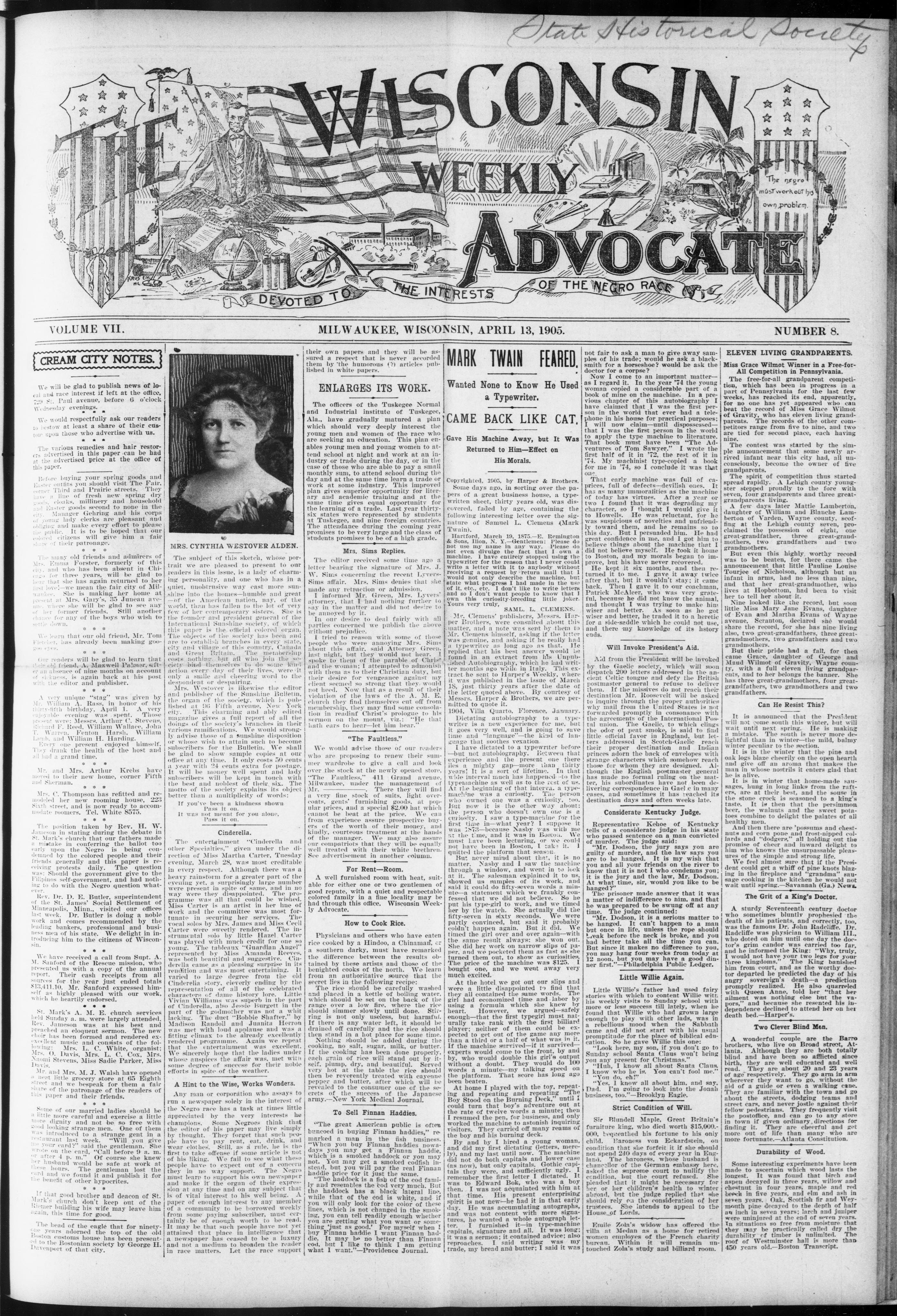
WISCONSIN
WEEKLY
ADVOCATE
DEVOTED TO THE INTERESTS OF THE NEGRO RACE
We will be glad to publish news of local and race interest if left at the office, 729 St. Paul avenue, before 6 o'clock Wednesday evenings.
We would respectfully ask our readers to bestow at least a share of their custom upon those who advertise with us.
The various remedies and hair restorers advertised in this paper can be had at the advertised price at the office of this paper.
Before buying your spring goods and Easter outfits you should visit The Fair, corner Third and Prairie streets. They have a line of fresh new spring dry goods, cloaks, millinery and household and Easter goods second to none in the city. Manager Gehring and his corps of young lady clerks are pleasant and obliging and make every effort to please the public. It is to be hoped that our colored citizens will give him a fair share of their patronage.
The many old friends and admirers of Mrs. Emma Forster, formerly of this city, and who has been absent in Chicago for three years, will be glad to hear that she has again returned to her first love!—we mean the fair city of Milwaukee. She is making her home at present at Mrs. Gary's, 35 Juneau avenue, where she will be glad to see any of her former friends. Still another chance for any of the boys who wish to settle down.
* * *
We learn that our old friend, Mr. Tom Fletcher, has already been making goo-goo eyes.
* * *
Our readers will be glad to learn that their old friend, A. Maxwell Palmer, after an absence of nine months on account of sickness, is again back at his post with the editor and publisher.
\* \* \*
A very unique "stag" was given by Mr. William A. Rass, in honor of his thirty-fifth birthday, April 1. A very enjoyable evening was spent. Those present were: Messrs. Arthur C. Stevens, Richard F. Reed, William Wallace, John T. Warren, Fenton Harsh, William Laub, and William H. Harding. Every one present enjoyed himself. They drank the health of the host and all had a grand time.
* * *
Mr. and Mrs. Arthur Krebs have moved to their new home, corner Fifth and Sherman.
* * *
Mrs. C. Thompson has refitted and remodeled her new rooming house, 223 Sixth street, and is now ready to accommodate roomers. Tel. White 8575.
\* \* \*
The position taken by Rev. H. W. Jameson in stating during the debate in St. Mark's church that our fathers made a mistake in conferring the ballot too early upon the Negro is being condemned by the colored people and their friends generally and this paper is receiving protests daily. The question was: Should the government give to the Filipinos self-government, and had nothing to do with the Negro question whatever. Rev. Dr. D. E. Butler, superintendent of the St. James' Social Settlement of Minneapolis, Minn., visited our offices last week. Dr. Butler is doing a noble work and comes recommended by the leading bankers, professional and business men of his state. We delight in introducing him to the citizens of Wisconsin.
* * *
We have received a call from Supt. A. M. Sanford of the Rescue mission, who presented us with a copy of the annual report. Their cash receipts from all sources for the year just ended totals $13,411.10. Mr. Sanford expressed himself as highly pleased with our work, which he heartily endorsed.
---
St. Mark's A. M. E. church services held Sunday a. m. were largely attended, Rev. Jameson was at his best and preached an eloquent sermon. The new choir has been formed and rendered excellent music and consists of the following: Mrs. L. C. White, organist; Mrs. O. Davis, Mrs. L. C. Cox, Mrs. Naomi Stevens, Miss Sadie Parker, Miss Davis. Mr. and Mrs. M. J. Walsh have opened a neat little grocery store at 65 Eighth street and we bespeak for them a fair share of the patronage of the readers of this paper and their friends.
***
Some of our married ladies should be a little more careful and exercise a little more dignity and not be so free with good looking strange men. One of them was introduced to a strange gent in a restaurant last week. "Will you give me your card?" said the gentleman. She wrote on the card, "Call before 9 a. m. or after 4 p. m." Of course she knew her husband would be safe at work at these hours. The gentleman lost the card and we found it and publish it for the benefit of other hypocrites.
\* \* \*
If that good brother and deacon of St. Mark's church don't keep out of the Riemer building his wife may leave him again, this time for good.
The head of the eagle that for ninety-one years adorned the top of the old Boston customs house has been presented to the Bostonian society by George H. Davenport of that city.
M.
MRS. CYNTHIA WESTOVER ALDEN. The subject of this sketch, whose portrait we are pleased to present to our readers in this issue, is a lady of charming personality, and one who has in a quiet, unobtrusive way cast more sunshine into the homes—humble and great
of the American nation, nay, of the world, than has fallen to the lot of very few of her contemporary sisters. She is the founder and president general of the International Sunshine society, of which this paper is the official colored organ. The objects of the society has been and are to establish branches in every state, city and village of this country, Canada and Great Britain. The membership costs nothing, but all who join the society bind themselves to do some kind action every day of their lives, were it only a smile and cheering word to the despondent or despairing.
Mrs. Westover is likewise the editor and publisher of the Sunshine Bulletin, the organ of the society, which is published at 96 Fifth avenue, New York city. This charming and ably edited magazine gives a full report of all the doings of the society's branches in their various ramifications. We would strongly advise those of a sunshine disposition or whose wish to attain such to become subscribers for the Bulletin. We shall be glad to show sample copies at our office at any time. It only costs 50 cents a year with 24 cents extra for postage. It will be money well spent and lady subscribers will be kept in touch with the best and noblest of their six. The motto of the society explains its object better than a multiplicity of words:
Cinderella.
The entertainment "Cinderella and other Specialties," given under the direction of Miss Martha Carter, Tuesday evening, March 28, was most creditable in every respect. Although there was a heavy rainstorm for a greater part of the evening yet, a surprisingly large number were present in spite of same, and in no way were they disappointed. The programme was all that could be wished. Miss Carter is an artist in her line of work and the committee was most fortunate in securing her services. The vocal solos by Mrs. James and Miss Cecil Carter were sweetly rendered. The instrumental solo by little Hazel Carter was played with much credit for one so young. The tableaux "Guardian Angel" represented by Miss Amanda Reeves, was both beautiful and suggestive. Cinderella came as a pleasing surprise in its rendition and was most entertaining. It varied to large degree from the old Cinderella story, cleverly ending by the representation of all of the celebrated characters of dame history lore. Little Vivian Williams was superb in the part of Cinderella, also Jessie Burgett in the part of the godmother was not a whit lacking. The duet "Bobbie Shafter," by Madison Randoll and Juanita Herron was met with loud applause and was a fitting climax to the already excellently rendered programme. Again we repeat that the entertainment was excellent. We sincerely hope that the ladies under whose auspices the affair was, met with some degree of success for their noble efforts in spite of the weather.
A Hint to the Wise. Works Wonders.
Any man or corporation who assays to run a newspaper solely in the interest of the Negro race has a task at times little appreciated by the very interests he champions. Some Negroes think that the editor of his paper may live simply by thought. They forget that such people have to pay rent, eat, drink, and wear clothes. Still, as a rule, he is the first to take offense if some article is not of his liking. We fail to see what these people have to expect out of a concern they in no way support. The Negro must learn to support his own newspaper and make it the organ of their expression at any time and on any subject that is of vital interest to his well being. A paper of enough interest to any member of a community to be borrowed weekly from some paying subscriber, must certainly be of enough worth to be read. It may be that such people have not yet attained that place in intelligence that a newspaper has ceased to be a luxury and not a medium to broaden the reader in race matters. Let the race support
their own papers and they will be assured a respect that is never accorded them by the humorous (?) articles published in white papers.
ENLARGES ITS WORK.
The officers of the Tuskegee Normal and Industrial institute of Tuskegee, Ala., have gradually matured a plan which should very deeply interest the young men and women of the race who are seeking an education. This plan enables young men and young women to attend school at night and work at an industry or trade during the day, or in the case of those who are able to pay a small monthly sum, to attend school during the day and at the same time learn a trade or work at some industry. This improved plan gives superior opportunity for literary and academic training and at the same time gives equal opportunity for the learning of a trade. Last year thirty-six states were represented by students at Tuskegee, and nine foreign countries. The attendance during the coming year promises to be very large and the class of students promises to be of a high grade.
Mrs. Sims Replies.
The editor received some time ago a letter bearing the signature of Mrs. J. W. Sims concerning the recent Lyvers- Sims affair. Mrs. Sims denies that she made any retraction or admission. I informed Mr. Green, Mrs. Lyvers' attorney, that I had nothing further to say in the matter and did not desire to be annoyed by it. In our desire to deal fairly with all parties concerned we publish the above without prejudice.
I tried to reason with some of those people who were annoying Mrs. Sims about this affair, said Attorney Green, last night, but they would not hear. I spoke to them of the parable of Christ and the woman; I attempted to admonish with them as to their Christian duty, but their desire for vengeance against my client seemed so strong that they would not heed. Now that as a result of their violation of the laws of the A. M. E. church they find themselves cut off from membership, they may find some consolation in readinf Christ's prologue to his sermon on the mount, viz.: "He that hath ears to hear—let him hear."
"The Faultless."
We would advise those of our readers who are proposing to renew their summer wardrobe to give a call and look over the stock at the newly opened store, "The Faultless." 411 Grand avenue, Milwaukee, under the management of Mr. _____. There they will find a very fine stock of suits, light overcoats, gents' furnishing goods, at popular prices, and a special $2.00 hat which cannot be beat at the price. We can from experience assure prospective buyers of the worth of their money, and kindly, courteous treatment at the hands of the manager. We may also assure our compatriots that they will be equally well treated with their white brethren. See advertisement in another column.
For Rent—Room.
A well furnished room with heat, suitable for either one or two gentlemen of good repute, with a quiet and respectable colored family in a fine locality may be had through this office. Wisconsin Weekly Advocate.
How to Cook Rice.
Physicians and others who have eaten rice cooked by a Hindoo, a Chinaman, or a southern darky, must have remarked the difference between the results obtained by these artists and those of the benighted cooks of the north. We learn from an authoritative source that the secret lies in the following recipe: The rice should be carefully washed and placed in a kettle of boiling water, which should be set on the back of the range over a low fire, where the rice should simmer slowly until done. Stirring is not only useless, but harmful. If there is any water left, it should be drained off carefully and the rice should then stand in a hot place for some time.
Nothing should be added during the cooking, no salt, sugar, milk, or butter. If the cooking has been done properly, each grain of rice will stand out by itself, plump, dry, and beautiful. Served very hot at the table the rice should then be reverently treated with cayenne pepper and butter, after which will be revealed to the consumer one of the secrets of the success of the Japanese army.—New York Medical Journal.
To Sell Finnan Haddies
"The great American public is often buncoed in buying Finnan haddies," remarked a man in the fish business. "When you buy Finnan haddies nowadays you may get a Finnan haddie, which is a smoked haddock or you may not. You may get a smoked codfish instead, but you will pay the real Finnan haddie price for it just the same.
"The haddock is a fish of the cod family and resembles the cod very much. But the haddock has a black lateral line, while that of the cod is white, and if you will only look for the color of these lines, which is not changed in the smoking, you can tell readily enough whether you are getting what you want or something 'just as good.' For myself when I buy Finnan haddie I want Finnan haddie. It may be no better than Finnan cod, but I like to think I am getting what I want."—Providence Journal.
Copyrighted, 1905, by Harper & Brothers. Some days ago, in sorting over the papers of a great business house, a typewritten sheet, thirty years old, was discovered, faded by age, containing the following interesting letter over the signature of Samuel L. Clemens (Mark Twain).
Hartford, March 19, 1875.—E. Remington & Sons, Ilion, N. Y.—Gentlemen: Please do not use my name in any way. Please do not even divulge the fact that I own a machine. I have entirely stopped using the typewriter for the reason that I never could write a letter with it to anybody without receiving a request by return mail that I would not only describe the machine, but state what progress I had made in the use of it, etc., etc. I don't like to write letters and so I don't want people to know that I own this curiosity-breeding little joker. Yours very truly.
Mr. Clemens' publishers, Messrs. Harper Brothers, were consulted about this matter, and a note was sent by them to Mr. Clemens himself, asking if the letter was genuine, and asking if he really had a typewriter as long ago as that. He replied that his best answer would be found in an extract from his Unpublished Autobiography, which he had written months ago while in Italy. This extract he sent to Harper's Weekly, where it was published in the issue of March 18, just thirty years after the date of the letter quoted above. By courtesy of Messrs. Harper & Brothers, we are permitted to quote it.
1904, Villa Quarto, Florence, January. Dictating autobiography to a typewriter is a new experience for me, but it goes very well, and is going to save time and "language"—the kind of language that soothes vexation.
I have dictated to a typewriter before—but not autobiography. Between that experience and the present one there lies a mighty gap—more than thirty years! It is a sort of lifetime. In that wide interval much has happened—to the typemachine as well as to the rest of us. At the beginning of that interva, a typemachine was a curiosity. The person who owned one was a curiosity, too. But now it is the other way about: the person who doesn't own one is a curiosity. I saw a type-machine for the first time in—what year? I suppose it was 1873—because Nasby was with me at the time, and it was in Boston. We must have been lecturing, or we could not have been in Boston, I take it. I quitted the platform that season.
But never mind about that, it is no matter. Nasby and I saw the machine through a window, and went in to look at it. The salesman explained it to us, showed us samples of its work, and said it could do fifty-seven words a minute—a statement which we frankly confessed that we did not believe. So he put his type-girl to work, and we timed her by the watch. She actually did the fifty-seven in sixty seconds. We were partly convinced, but said it probably coldn't happen again. But it did. We timed the girl over and over again—with the same result always: she won out. She did her work on narrow slips of paper, and we pocketed them as fast as she turned them out, to show as curiosities. The price of the machine was $125. I bought one, and we went away very much excited.
At the hotel we got out our slips and were a little disappointed to find that they all contained the same words. The girl had economized time and labor by using a formula which she knew by heart. However, we argued—safely enough—that the first typegirl must naturally take rank with the first billiard player; neither of them could be expected to get out of the game any more than a third or a half of what was in it. If the machine survived—if it survived—experts would come to the front, by and by, who would double this girl's output without a doubt. They would do 100 words a minute—my talking speed on the platform. That score has long ago been beaten.
At home I played with the toy, repeating and repeating and repeating "The Boy Stood on the Burning Deck," until I could turn that boy's adventure out at the rate of twelve words a minute; then I resumed the pen, for business, and only worked the machine to astonish inquiring visitors. They carried off many reams of the boy and his burning deck.
By and by I hired a young woman, and did my first dictating (letters, merely), and my last until now. The machine did not do both capitals and lower case (as now), but only capitals. Gothic capitals they were, and sufficiently ugly. I remember the first letter I dictated. It was to Edward Bok, who was a boy then. I was not acquainted with him at that time. His present enterprising spirit is not new—he had it in that early day. He was accumulating autographs, and was not content with mere signatures, he wanted a whole autograph letter. I furnished it—in type-machine capitals, signature and all. It was long; it was a sermon; it contained advice; also reproaches. I said writing was my trade, my bread and butter; I said it was
not fair to ask a man to give away samples of his trade; would he ask a blacksmith for a horseshoe? would he ask the doctor for a corpse?
Now I come to an important matter—as I regard it. In the year '74 the young woman copied a considerable part of a book of mine on the machine. In a previous chapter of this autobiography I have claimed that I was the first person in the world that ever had a telephone in his house for practical purposes; I will now claim—until dispossessed—that I was the first person in the world to apply the type machine to literature. That book must have been "The Adventures of Tom Sawyer." I wrote the first half of it in '72, the rest of it in '74. My machinist type-copied a book for me in '74, so I conclude it was that one.
That early machine was full of caprices, full of defects—devilish ones. It has as many immoralities as the machine of today has virtues. After a year or two I found that it was degrading my character, so I thought I would give it to Howells. He was reluctant, for he was suspicious of novelties and unfriendly toward them, and he remains so to this day. But I persuaded him. He had great confidence in me, and I got him to believe things about the machine that I did not believe myself. He took it home to Boston, and my morals began to improve, but his have never recovered.
He kept it six months, and then returned it to me. I gave it away twice after that, but it wouldn't stay; it came back. Then I gave it to our coachman, Patrick McAleer, who was very grateful, because he did not know the animal, and thought I was trying to make him wiser and better. As soon as he got wiser and better, he traded it to a heretic for a side-saddle which he could not use, and there my knowledge of its history ends.
Will Invoke President's Aid.
Aid from the President will be invoked by the Gaelic society, which will soon dispatch 200 letters addressed in the ancient Celtic tongue and defy the British postmaster general to refuse to deliver them. If the missives do not reach their destination Mr. Roosevelt will be asked to inquire through the proper authorities why mail from the United States is not forwarded promptly in consonance with the agreements of the International Postal union. The Gaelic, to which clings the odor of peat smoke, is said to find little official favor in England, but letters addressed in Scotch-Gaelic reach their proper destination and Indian princes adorn the back of envelopes with strange characters which somehow reach those for whom they are designed. Although the English postmaster general has made no formal ruling on the matter, his subordinates have not been delivering correspondence in Gaelic in many cases, and sometimes it has reached its destination days and often weeks late.
Considerate Kentucky Judge.
Representative Kehoe of Kentucky tells of a considerate judge in his state who passed sentence on a man convicted of murder. The judge said:
"Mr. Dodson, the jury says you are guilty of murder, and the law says you are to be hanged. It is my wish that you and all your friends on the river to know that it is not I who condemns you; it is the jury and the law, Mr. Dodson. At what time, sir, would you like to be hanged?"
The prisoner made answer that it was a matter of indifference to nim, and that he was prepared to be swung off at any time. The judge continued:
"Mr. Dodson, it is a serious matter to be hanged. It can't happen to a man but once in life, unless the rope should break before the neck is broke, and you had better take all the time you can. But since it makes no difference to you, you may hang four weeks from today at 12 noon, but you may have a good dinner first."—Philadelphia Public Ledger.
Little Willie Again.
Little Willie's father had used fairy stories with which to content Willie with his weekly visits to Sunday school with more or less success till lately, when he found that Willie who had grown large enough to play with other lads, was in a rebellious mood when the Sabbath came and did not start with his usual promptitude for the place of biblical education. So he gave Willie this one:
"Look here, my son, if you don't go to Sunday school Santa Claus won't bring you any present for Christmas."
"Huh, I know all about Santa Claus. I know who he is. You can't fool me."
"You do, eh!"
"Yes. I know all about him, and say, Dad. I'm going to look into the Jonah business, too."—Brooklyn Eagle.
Strict Condition of Will.
Sir Blundell Maple, Great Britain's furniture king, who died worth $15,000,-000, bequeathed his fortune to his only child. Baroness von Eckardstein, on condition that she forfeit it if she should not spend 240 days of every year in England. The baroness, whose husband is chancellor of the German embassy here, asked the supreme court to nullify the condition, but the court refused. She pleaded that it might be necessary for her or her children's health to winter abroad, but the judge replied that she should rely on the consideration of her trustees. She intends to appeal to the House of Lords.
Emile Zola's widow has offered the villa at Medan as a home for retired women employees of the French charity bureau. Within it will remain untouched Zola's study and billiard room.
Miss Grace Wilmot Winner in a Free-for- All Competition in Pennsylvania. The free-for-all grandparent competition, which has been in progress in a part of Pennsylvania for the last few weeks, has reached its end, apparently, for no one has yet appeared who can beat the record of Miss Grace Wilmot of Gravity, who has eleven living grandparents. The records of the other competitors range from five to nine, and two are tied for second place, each having nine. The contest was started by the simple announcement that some newly arrived infant near this city had, all unconsciously, become the owner of five grandparents.
The spirit of competition thus started spread rapidly. A Lehigh county youngster stepped proudly to the fore with seven, four grandparents and three great-grandparents living. A few days later Mattie Lamberton, daughter of William and Blanche Lamberton of Varden, Wayne county, scoffing at the Lehigh county seven, proclaimed the possession of eight, one great-grandfather, three great-grandmothers, two grandfathers and two grandmothers. But even this highly worthy record was to be beaten, for there came the announcement that little Pauline Louise Tourjee of Nicholson, although but an infant in arms, had no less than nine, and that her great-grandmother, who lives at Hopbottom, had been to visit her to tell her about it.
Nine looked like the record, but soon little Miss Mary Jane Evans, daughter of Evan and Martha Evans of Wayne avenue, Scranton, declared she would share the record, for she has nine living also, two great-grandfathers, three great-grandmothers, two grandfathers and two grandmothers. But their pride had a fall, for then came Grace, daughter of George and Maud Wilmot of Gravity, Wayne county, with a full eleven living grandparents, and to her belongs the banner. She has three great-grandmothers, four great-grandfathers, two grandmothers and two grandfathers.
Can He Resist This?
It is announced that the President will not come south this winter, but will wait until next spring. He is making a mistake. The south is never more delightful than in winter—the mild, balmy winter peculiar to the section.
It is in the winter that the pine and oak logs blaze cheerily on the open hearth and give off an aroma that makes the man in whose nostrils it enters glad that he is alive.
It is in winter that home-made sausages, hung in long links from the rafters, are at their best, and the souse in the stone crock is seasoned to a king's taste. It is then that the persimmon beer, the walnuts and the sweet potatoes combine to delight the palates of all healthy men.
And then there are 'possums and chestnuts and corn pone and frost-nipped collards and "dodgers," all holding out the promise of cheer and inward delight to him who knows the unsurpassable pleasures of the simple and strong life.
We feel almost sure that if the President could get a whiff of pine knots blazing in the fireplace and "grandma" sausage cooking in the kitchen he would not wait until spring.—Savannah (Ga.) News.
The Grit of a King's Doctor.
A sturdy Seventeenth century doctor who sometimes bluntly prophesied the death of his patients, and correctly, too, was the famous Dr. John Radcliffe. Dr. Radcliffe was physician to William III., who dotted on him until one day the doctor's grim candor was carried too far, and he informed the King: "Why, truly, I would not have your two legs for your three kingdoms." The King banished him from court, and as the worthy doctor departed he predicted the day of his angry sovereign's death—a prediction promptly realized. He also quarreled with Queen Anne, told her "that her ailment was nothing else but the vapors," and because she resented his independence declined to attend her on her death bed.—Harper's.
Two Clever Blind Men.
A wonderful couple are the Barro brothers, who live on Broad street, Atlanta. Although they are both totally blind and have been so afflicted since birth, they are well educated and well read. They are about 20 and 23 years of age respectively. They go arm in arm wherever they want to go, without the aid of a guide or even a walking cane. They are familiar with the town and go about the streets, dodging teams and street cars, and never jostle against their fellow pedestrians. They frequently visit the postoffice, and can go to any store in town if given ordinary directions for finding it. They are cheerful and get more out of life than many who are more fortunate.—Atlanta Constitution.
Durability of Wood.
Some interesting experiments have been made to ascertain which wood lasts the longest. It was found that birch and aspen decayed in three years, willow and chestnut in four years, maple and red beech in five years, and elm and ash in seven years. Oak, Scottish fir and Weymouth pine decayed to the depth of half an inch in seven years; larch and juniper were uninjured at the end of seven years. In situations so free from moisture that they may be practically called dry the durability of timber is unlimited. The roof of Westminster hall is more than 450 years old.—Boston Transcript.
Singing Brings $3 Per Note
For her brief singing at the charity concert in Carnegie hall Mme. Emma Eames was paid $2250. The prima donna will not enjoy this small fortune alone, because her manager, Heinrich Conried, made terms for her, and he must have his percentage. She was on the stage
: ANALYSES OF MME. EAMES' PAY :
: FOR TWENTY MINUTES OF SONG :
: One concert $2,250 :
: One song 500 :
: One minute 120 :
: One note (approximately) 3 :
twenty minutes, and each note she sang brought her just $3. In receiving $2250 for one night Mme. Eames gets into the Melba class. Patti in her palmy days received $5000 for a recital, and Calve, after her Carmen triumpns, commanded $2000. In passing the $2000 mark Mme. Eames is easily the highest priced songstress now singing, with the exception of Melba.
Discuss Extinction of Colleges.
The threatened extinction of the colleges of the middle west by the growing efficiency of the high school and the generous courses offered by the universities was discussed at the third annual meeting of the colleges of the middle west at Galesburg, Ill., attended by fifty representatives. The topic was presented in the report of the committee on cooperation of colleges and universities, made by Dean Main of Iowa college and President Salmon of Carleton college. Co-operation with the universities that would give the colleges the benefit of university lectures and apparatus and circulating libraries was favored. In the discussion of the social life of the college some opposition to the college dance was manifested.
Spitz Dogs Are Fad.
Spitz dogs, more and more, are the fashion in Paris, as automobile dogs. The fad is to have the dog always perched up near the driver. The style in spitzes evidently was started by Marquis de Dion, whose white spitz is now familiar to Parisians. This animal has completely dethroned the poodle, is said to be more intelligent, is cleaner and looks better in goggles. A new use has been found for specially trained life saving dogs attached to the Parisian river police. Jules Hoche has written a play entitled "Le Chien," in which a dog is the principal character. Lepine, prefect of police, has allowed the finest of the dogs under his orders to act the leading part.
Takes Wife's Maiden Name.
Permission to take his wife's maiden name as part of his own was granted to Rev. George Franklin Hopkins in the equity court at Washington, D. C. The reason given is that his wife, who was well known in various fields of work before her marriage, desires to continue the use of her maiden name. She was Dr. Salenji Armstrong, who achieved more or less celebrity in the missionary field, and wrote a number of books. After her marriage to Dr. Hopkins she found her work somewhat hampered by the necessity of appearing under a new name. Accordingly she and her husband applied to the court for permission to change their names to Armstrong-Hopkins.
Sees Only Husband's Face
The indelible impression of her husband's face as the foreman of the jury spoke the words which branded him as the murderer of Mabel Scofield is the last thing which Mrs. Thomas of Des Moines, Ia., has seen. She is blind. No sooner does she get a glimpse of an object than it fades, and in its place appear the grim features of the alleged murderer. Attending physicians declare that the strange situation is the result of the terrible nervous shock she received when the verdict against her husband was read. At the time she fainted, and when carried from the courtroom her eyes were distended, and a look of object horror covered her face.
Wealthy Woman in Trades Union. Miss Margaret Dreier of Brooklyn is probably the first young woman of wealth and social position to ally herself with a trades union. For nearly a year she has been a member of the board of the National Woman's Trades Union league, of which she is now treasurer. At the recent annual meeting of the New York branch of this association she was elected president. The headquarters of the New York league are at S3 Rivington street. Miss Dreier is the oldest daughter of the late Theodore and Dorothea A. Dreier of Brooklyn. Miss Dreier and her sisters and brother inherited great wealth.
```markdown
```
The Eternal Truth.
There cannot be one standard of duty or perfection for the two sexes, and it is in comparing the one with the other that the conflicting schools of education both go wrong. In a complex civilization such as ours there is room for professional women as well as domestic women. But the great function, the true vocation, of women is now, as in the beginning, to be a helpmeet for man; to be the mother and trainer of the children who will be the men and women of the future. Men will be forced to realize and respect her position, and will deem it an even greater honor to seek her alliance in matrimony.—London Queen.
Saved by Corduroy Trousers.
Falling forty feet from the roof of a new armory at Trenton, N. J., Edgar W. Copner was saved from death by his strong corduroy trousers, the slack of which caught on a projecting spike from the low one story building at the base of the armory. Copner, who is a painter, made a misstep as he was walking along the edge of the roof. As he struck the big spike it entered his trousers, and, although the garment was torn, Copner's downward flight was stayed and the fall broken.
Supposed Stick a Snake
John Gress, who lives at Pleasureville, Pa., laid in a good supply of wood for the winter. A few evenings ago, when he put some wood into the stove, a stick which he had picked up began to wriggle. He discovered that what he thought was a stick was a snake, which had been frozen stiff, but which revived in the warmth. He quickly threw the reptile into the stove, where it was consumed. The snake measured about 14 inches.
Family After President's Own Heart
The home of Mr. and Mrs. James Bradley of Charlton, Ia., has been gladdened by the appearance of the eighth pair of twins. One is a boy of 8 pounds and the other a girl weighing 7. The father, who served all through the Civil war, is 78 years of age, but is hale and vigorous. The mother is 65. Beside the eight pair of twins one other child was born to the family, making a total of seventeen children.
Masculine Beauty in Demand.
Beauty of face is very rare among men, and the handsome jeune premier is a very rare bird indeed. A great dramatist stated the other day that there was much more chance for a good-looking man on the stage than for a good-looking girl. It is easy enough to find pretty girls to take the different characters, but a good-looking man is rare. Free Lance.
THE CAMP.
Then have ye seen the mining-camp They're building over yon? Twas suddenly created there Between the night and dawn. They built it by the glinting light Of gold, beside the street, And they built it on the desert Where the desolations meet.
And mountain rocks and lesser rocks Berib the rugged scene, And some are hard and golden rich And some are hard and lean. There's not enough of water there To bicker down a rill, But stronger drink, of vicious red, Flows ever up the hill.
And have ye seen the fling of chance
The men that luck will choose
The tyros here who win the gold,
The pundits there who lose?
And have ye seen the ancient shame
Of women lost to hope
That may not even walk to hell,
But weakly toward it grope?
And have ye counted half the sum
Of pity and applause
The gods record who traffic not
With puny, human laws?
And wot ye aught of tragedy
And comedy—the twain,
So fair and dark, and dark and fair,
That march beside the train?
Yet when you see that mining-camp, (You cannot miss the trail; It's blazed with empty bottles and With signs of fierce travail). Regard the homes—the garden spots— That on the desert press Where men of strength, with woman's aid Subdue the wilderness! Philip Verrill Mighels in Harper's Weekly.
A LESSON IN LOVE.
The professor pushed aside his volume of Chaucer to make room for his slender young daughter on the arm of his chair. She fluttered over to him in her soft, white gown, its cut revealing the curve of her firm, fair throat and the artistic lines of her rounded arms. "Where tonight, Estelle?" "To the ball with Mr. Denton and Mrs. Mills" she answered, blithely.
"With Mr. Denton? Isn't Teddy Variel going?"
"I suppose so—yes."
Her tone was indifferent, but her nervousness under her father's gaze betrayed a stifled uneasiness, a silenced struggle.
"They tell me this Mr. Denton is a very wealthy man," he said.
"Oh! it's true. He has riches beyond one's dreams."
The note of personal triumph in her voice was harsh to her father's listening car. He regarded her thoughtfully.
"Sit here on the hassock, dear. I can see you better. You are sweet and pretty and pure. The soul of your mother shines in your eyes. He lifted his head, and his strong, pale face, with its soft framing of waving gray, was profiled against the vivid velvet of his chair. His voice became almost a whisper.
"This is the anniversary."
"Not of your marriage, father?"
"No. My marriage was a subsequent date. You do not know—I have never told you—that your mother was married before she became my wife—married and widowed."
"Why, no, father dear," said the girl, with quick, sympathetic interest. "I never care to speak of that, yet tonight I see I must tell you the story. I must give you a message from the dead."
"I shouldn't have made this engagement. You are sad, father; I'll stay with you." No. I want you to go. I shall have time to tell you before they come." He caressed the hand that sought his and mused a minute in silence. "On this night years ago, Estelle, your mother first went out of my life. She was placed very much like you, in a comfortable home, in a college town, where her father, too, was a professor. The miniature that hangs beside your bed feebly pictures her beauty. It tells the outward loveliness, but only hints at her inner grace. Ah! there were many who sighed for her wonderful smile.
"She and I had discovered the purple twilight. In every blossom I saw her face; the dewdrop gleamed with the luster of her eyes; her voice was in the warbling of the birds; her smile was in the sunshine. Somehow, I feel, Estelle, that is the way Teddy Variel thinks of you."
The girl put up a protesting hand. Her father smiled and resumed his story.
"Her mother forbade our engagement. I was only a struggling student, and, though her father believed that I should win fame, he did not check his wife's ambition for her child.
"There came to the town, very much like the coming of this young Denton, a man with gracious personal gifts and riches which at that time seemed immense. He had just come into his inheritance.
"They met—and he loved her. At first she would not listen, but her nature was gentle, her mother determined and her father, poring over ancient tragedies, overlooked the one creeping into his home. I was powerless. She could not receive me when I called, and, at the functions where we met, she was zealously guarded by her mother and the man.
"She accepted him. She told him frankly that her love was mine; that in promising him she was acceding to her mother's will. But he was buoyantly confident that love would come. They were married, and he took her away to a mansion filled with treasures of art. She had jewels and gowns and horses—all things that money could buy. But love did not come. The strongest, softest nests, Estelle, are built by the birds love mated.
"For a year I did not care what became of me. But I loved her, and could do nothing of which she would be ashamed. I went to Egypt and began the researches that have brought me fame.
"Five years passed. The longing to see her again, to hear her voice, became intolerable pain. I went back to London and haunted the streets, the shops, the theaters, where she might be. Then one nigth, when I had almost despaired, I saw her in her box at the opera.
"She surpassed even my dreams. Her gown was soft and white. Above her shoulder a red rose lifted with the same proud tilt of her own pretty head. I thrilled at the thought that on her I had never seen a faded flower. The house became blurred; I was gazing at her through a mist of tears—Patti was singing 'Home, Sweet Home.'
"I hurried out and stood in the obscur
ing crowd, near enough to see my lost girl and to hear her voice as she passed. She turned her head restlessly from side to side (it was perhaps the magnetism of my gaze—I suppose my heart and soul were in it), and then, before I realized it, the crowd had parted and she stood before me with outstretched hands.
"I could not speak—the old joy had gone from her eyes, and in them was a sadness that never lightened. Her husband stood waiting under the portico. He had grown coarse and worn, and on his face were the lines of a tyranny which would deal humiliation for her guileless taking of my hands."
The professor covered his eyes. Years had passed, yet that scene never came without raising the primitive rage of his impotence. The girl at his feet laid a comforting cheek against his knee. His voice regained its gentleness after a minute, and he continued:
"I did not try to see her again; I felt it was better for us both. But I stayed near lest some time she would need me, and somehow she knew I was always waiting.
"They found her husband dead one morning—shot by his own hand. He had speculated, lost his wealth and died heavily indebted. She gave up the riches her marriage had brought her, the jewels, the gowns, and, when his obligations were liquidated, she was penniless—poorer far than when she had left her father's home.
"I waited some months, and then I claimed her. I shall never forget her words that night, nor the sorrowful eyes smiling into mine. She gave me her hand and whispered:
"Once, long ago, I looked into the heart of a purple twilight, and dreamed a dream of my life—and you. Tomorrow I shall look again and see the realization of my dream. The flowers are asleep tonight, dear, but see! the stars are shining."
"Mother!" breathed the girl, her heart stirred to its depths. "My beautiful mother!"
The professor rose slowly and laid his arm along the mantel-shelf, above the glowing coals.
"We had two short years together, pitifully short, yet sometimes I think a day is worth a lifetime.
"When she lay dying in my arms, the morning you were born, she looked at your tiny pink face and said:
"Some time it may come to you, my little one, to choose—to weigh the wealth of love against that of gold. If that time ever comes,' she whispered to me, 'tell her the tragedy of my youth, tell her the glory of my sunset. I think she will understand.'"
His voice trailed to a whisper; the gray head bowed.
The din of a bell intruded on the soothing silence. He turned to his awed young daughter.
"Good-night. Estelle."
She kissed him fondly. Then, as she had done every night since she was a lisping child, she went to the window, drew aside the drapery and reverently raised her eyes to the stars.—Illustrated Bits.
PRESIDENT MUST STAY AT HOME.
Old Unwritten Law, Respected by Successors of George Washington.
The President must not leave the United States even for a day. This is an old unwritten law which has been respected by all successors of George Washington, with perhaps one or two exceptions. This restriction is not imposed by statute. President McKinley emphasized his respect for this rule on his tour to the south and west. It was unofficially announced that he would meet President Diaz of Mexico somewhere near the boundary line of that sister republic. A controversy as to whether Mr. McKinley might properly cross the Mexican line, even for a few hours, arose. Early in May, when he visited El Paso, Tex., where he was greeted by President Diaz's personal representative, he expressed a desire to take a look into Mexico.
From El Paso there extends into Mexico the international bridge, spanning the Rio Grande. Whether the President would dare to cross this structure or not was the question which members of his party asked one another. He did not. He went to the bridge and caught a view of the Sierra Madre. Halfway across the bridge was a line. Stepping over this was putting foot upon Mexican territory.
President Harrison had ventured as far as this line ten years before. But President McKinley did not so much as place his foot upon the bridge. President Arthur was accused of violating this unwritten law in October, 1883, upon a pleasure trip to Alexandria bay, Thousand islands. His political enemies accused him of venturing across the Canadian line on a fishing excursion. The boundary between Canada and New York extends to the middle of the St. Lawrence river. President Cleveland was similarly accused. On one of his hunting trips to North Carolina he sailed by the ocean route past Cape Hatteras. His enemies contended that he ventured outside the three-mile limit. According to international law, a country's possessions extend for three miles outside its coast line. Plying the seas further than this is leaving home territory.
The President must not accept gifts of great value from inferiors in the federal service, but he may accept gifts from foreigners. Grant, McKinley and Mr. Roosevelt have received gifts from foreign rulers. Several gifts have been sent to Mr. Roosevelt from the west. Kansas City Star.
Marries Him Second Time
Joseph Miller was taken from his home at Marion, Ind., to the railroad station in an ambulance so that he might be sent to California in hopes of regaining his failing health. Mrs. Birdie Miller, his divorced wife, learned of his intentions, telephoned to him, and brought about a reconciliation so that she might accompany and care for him on the trip and in the strange land he was to visit. Friends hurriedly procured a marriage license. A minister was called by telephone. The holy man was late and it was necessary to perform the ceremony on the train, which was held for a few minutes. Rev. J. M. Baker spoke the words that for the second time made them man and wife as the train started, and then jumped from the car while it was in motion.
Goose Lays Monstrous Egg.
Preston D. White's African goose has laid an egg at North Attleboro. Mass.. that is the biggest ever seen. It measures $11\frac{1}{2}$ inches around the greatest circumference and 10 inches around the shortest. The egg weighs 13 ounces. The bird is $2\frac{1}{2}$ feet high, measures 5 feet 8 inches from tip to tip and weighs nineteen pounds. This beats the ambitious New Hampshire hen that recently laid an egg $8\frac{1}{2}$ inches in circumference, but then, more must be expected from a goose. Next!
A NEW YORK BIRD'S LAMENT
A poor bird sat a-weeping
In a city park.
"Why this doleful cheeping?"
Asked a friendly lark.
"Oh, my!" walled the Birdie,
"I am much distressed,
'Cause my wife has three eggs
Upstairs in our nest."
"That should make you happy!"
"It would; but you see—
Boo-hoo-hoo—they don't allow
Children in our tree."
E. P. Pitzer in New York Times
The gross value of the estate of Andrew H. Green. "the father of Greater New York," who was soot and killed by a negro named Wilson, November 13, 1963, has been placed by the appraisers at $1,756,328.
By a decision of the United States court of appeals Mrs. L. Harrison Dulles, wife of a wealthy Philadelphia man, wins the suit over the seizure of her $26,000 pearl necklace by a treasury agent in June, 1902.
John Newport Telling, a coachman, and his wife, a servant at the Bible Training school, New York city, were arrested charged with stealing several thousand dollars in money and jewelry from the students and instructors in the school.
The Appellate division of the supreme court sustained the judgment of the lower court in favor of James G. Blaine, who brought suit against Edward R. Thomas & Co. to recover damages for an alleged unauthorized sale of 1000 shares of Pennsylvania railroad stock which were being carried for him on margin.
Automobilists must now pay a toll of 1 cent a mile for machines holding two persons and two cents a mile for three persons or more on all toll roads in the state of New Jersey. A bill to that effect, passed at the recent session of the Legislature has been signed by Gov. Stokes. Roads on which the new law will apply are, however, not numerous.
Sixteen thousand babies were born in New York in the last four months. Figures compiled by the bureau of vital statistics show that Fifth avenue has the lowest birth rate of any street in the city. Less than ten births were reported in the wealthiest section of that thoroughfare. The heaviest birthrate is on the east side, near Division street, where the conditions are the reverse of those on Fifth avenue.
Nicholi Zavolsky, 21 years old, the adopted son and trusted lieutenant of Maxim Gorky, the Russian novelist and Socialist, who recently came to this country, left New York with three companions. He will make a tour of the United States for the purpose of spreading the doctrines of socialism among the poorer classes. He will travel as a missionary from Gorky, with the object of imitating that great Russian writer.
At a dinner given to Robert S. Woodward, the new president of the Carnegie institution at Washington, by his former colleagues of Columbia university, Andrew Carnegie made a brief speech, in which he said: "The charter of the Carnegie institution pledges it to a broader scope of learning than any other seat of learning in the world. Its policy will be to co-operate with all other institutions in the cause of education."
The Appellate division of the supreme court recently decided that the alleged dementia if Brodie L. Duke be subject to trial by jury, as petitioned by Lawrence Duke, who asked to have B. L. Duke declared incompetent to manage his estate valued at $100,000. R. L. Duke recently was before the public in having married Alice Webb and having disappeared for several weeks from sight of his relatives. A plot had been charged by the family.
---
Although the nominating conventions are six months in the future, there are already two declared candidates for mayor. Mayor McClellan will run on the Tammany ticket, while John Ford, author of the franchise tax law, will lead the movement started by the municipal ownership clubs on an "independent Democratic-Union Labor" ticket. Mr. Ford's aspirations were made known by placards distributed throughout the city, asking laboring men to rally to his support.
A memento of the Slocum disaster may still be seen in a florist's store. The wife and children of the florist were members of the Sunday School excursion on that day. As a surprise for them, the florist, as soon as they had gone to the boat, made out of immortelles, a "Welcome Home," and hung it over the door that opens from his shop into the living apartments in the rear. Not one of his family returned alive from the excursion. He says he hasn't the heart to take down that "Welcome Home."
At the monthly dinner of the Patria club Brig. Gen. Frederick Dent Grant, who talked about the Philippines, said: "You hear a great deal about the force necessary to keep these degenerate people in subjection. There are 12,000 soldiers out there. My department in the east maintains 14,000 men to keep your citizens of New York, Boston, Philadelphia, Baltimore and other coast places in the straight and narrow path. As a matter of fact, there is one brigade mobilized in the Philippines ready to strike, I think, in favor of the open door in China rather than against the Filipinos."
The commission of experts appointed by President Ahern of the borough of Manhattan to make an examination into recent wholesale collapse of brick buildings reported that an examination was made of eight buildings and in every case the collapse or partial destruction was directly due to the failure of their foundation walls, which were found to be full of voids, built of irregular and undersized stone, improperly bonded and imperfectly bedded, and with mortar of inferior quality and improperly mixed. Both the materials and workmanship were declared to be in flagrant violation of the building code.
Damage by the elements to the tomb of Gen. U. S. Grant on Riverside drive is reported to be causing much anxiety among members of the Grant monument association, which is interested with the care of the granite pile. Although only seven years old, the white granite exterior shows signs of serious erosion, while leaks recently discovered in the dome have caused spots of discoloration on the decorated plaster interior. A water-proof preparation of parafine will be applied at once to the exterior of the dome and possibly the whole pile will be later treated in the same manner. The stone will take on a slight grayish tint, but this will decrease gradually.
Following the announcement of the engagement of J. G. Phelps Stokes to Miss Rose Pastor comes the announcement of the engagement of his uncle, James Stokes, to Miss Florence Brooke Chatfield, daughter of Henry W. Chattfield of Brooklyn. Mr. Stokes is known
in connection with philanthropic work, especially of the Young Men's Christian association in America and Europe. Miss Chatfield comes from an old New England family, and is descended from Commodore and Gen. Hull, and distantly related to Mr. Stokes. The marriage will be in a short time and the couple will sail for Europe to attend a world's conference in Paris of the Young Men's Christian association.
An estimated value of $33,000,000 was placed on the good will of a gas company in New York city as shown in the committee's investigation of the lighting conditions. George W. Doane, vice president and general manager of the New Amsterdam company, said that although the company was capitalized at $42,277. 423, the actual value of the property is $8,196,000. Mr. Doane explained that the remaining $33,000,000 was the estimated value of the good will of the company. It was shown also that the actual cost of manufacturing gas was $36 $2 cents per 1000 cubic feet. At 40 cents per 1000 cubic feet the New York Mutual Gas Lighting company has supplied the Consolidated company, which supplied the city. The Mutual was to be paid the entire cost of the production plus 10 per cent, profit above the price of 40 cents per 1000 cubic feet.
Mayor McClellan, Princeton, '86, officiated at the city hall at the wedding of Howard Crosby Warren, Princeton, '89, now professor of experimental psychology at Princeton, to Catherine Campbell of Indianapolis. The ceremony had been arranged for beforehand, and the wedding occurred at noon. There was a moment of embarrassment after the two had been joined by the mayor. Then William Frederick Dix, the best man, hesitatingly approached his honor and handed him an envelope. The mayor handed it back with a stony stare. "Don't do that, and don't give that to any one else, either." he said, with pretended sternness. "I don't want to go to state's prison, and I don't want any one else here to go." Dix put the envelope back in his pocket, and the wedding party departed. To have accepted the wedding fee would have been a violation of the law, which prohibits any public official from taking a gratuity not authorized by law for exercising any function of his office.
A. Watermelon Portiere
The mistress of a handsome uptown apartment relates the story of a unique and really beautiful portiere in this way: "I was eating watermelon one morning when for the first time I noticed how beautiful the seeds are. If they were rare and costly they would be much prized. It occurred to me as I examined them that they might be utilized. I began to collect and string them on slender leather thongs. When I had shellacked them I found they had the appearance of carved wood and I determined to make a portiere of them. Before I had finished I found it a big undertaking. There are a thousand seeds in each strand and there are 128 strands. I do not think there is another like it, and I am sure I shall never make another."
Can Taste with Larnyx
That the tongue is not the only organ that has the sense of taste has been discovered by Prof. J. T. Wilson of the department of physiology at the University of Chicago. According to Prof. Wilson scientists have always believed that the sense of taste was peculiar only to the tongue. He explained that these taste buds are located at the base of papilla scattered over the tongue and that different papilla detect sweets, bitters and sours. It has been known that papilla very much the same in structure as those on the tongue are scattered thinly over the lining of the larynx, but until Prof. Wilson undertook his experiments it was not known to scientists that these papilla had taste buds at their bases.
Glasgow's Isle of Drunkards.
The Glasgow corporation is considering a scheme under which Glasgow's chronic inebriates shall be banished to the Islet of Shuna, one of the Hebrides group. This islet is leased to a farmer and has been practically forgotten by the corporation of Glasgow, who have owned it for a century. It is sandwiched between the coast of Argyllshire and the Island of Luing, and is only three miles in length and about half that extent in breadtin. The climate is described in the corporation reports as similar to that of Jersey, and those who are urging that the islet should be used as an inebriates' settlement point out that the islanders would be practically self-supporting.—St. James' Gazette.
Molasses Tank Christened.
An enormous molasses tank, belonging to the Hoboken Tank and Storage company, was named in Hoboken the other day in the same manner as a new ship is named. The tank is said to be one of the largest in the country, and the only one built to hold molasses. A stage had been built alongside the tank, and on it stood Miss Marguerite Hobart, daughter of H. L. Hobart, the "Molasses King." A bottle of champagne, decorated with ribbons, had been suspended from the top of the tank, which was decorated with bunting. In the presence of 200 guests, Miss Hobart smashed the bottle against the side of the tank, naming it Tank No. 1.
Dies on Operating Table.
David Peters, a negro, aged 45, died on the operating table at the University hospital, Kansas City, Mo., one minute after a new anaesthetic named anaesthetol, the invention of Dr. R. M. Stone of Omaha, had been administered to him. The negro's ailment had been diagnosed as a cyst on the liver. A post-mortem examination showed that the diagnosis was wrong, and that the patient was suffering from a disease in which any anaesthetic would have been fatal. A second test of anaesthetol, in the case of a woman, was entirely successful.
Eighteen School Ma'ams to Wed.
Because of the recent extraordinary activity of Cupid among the pretty schoolma'ams of Manchester. Mass., the school board finds itself in need of the services of eighteen women teachers, men-haters preferred. Within the last two weeks eighteen teachers have announced their intention to wed and the school board is worrying over the probability of the marriage epidemic spreading. A rule of long standing forbids a married woman to be a teacher unless she is without other means of support.
Boat Christened With Flowers.
Roses and pinks, in place of the traditional bottle of wine, were used in the christening of the big four-masted schooner Gov. Powers, as she slid from the ways into the water at a Rockland (Me.) shipyard Thursday last. Miss Grace Crowell of Boston was the sponsor for the ship and deluged her with beautiful flowers as she named her. The new schooner, which is built for the coasting trade, is 237.3 feet long and will carry about 3000 tons of cargo. She will cost $90,000 when ready for sea.
Rector Resigns; Is Homesick.
Rev. Dr. Beverly Ellison Warner, rector of St. Stephen's Episcopal church, Philadelphia, Pa., has tendered his resignation after a month's service. His reason was homesickness to return to New Orleans, where for eleven years he was rector of Trinity church.
GOLDEN SILENCE IS TRUMPS
Will Save Many Quarrels and Difficulties of Life.
Golden silence would save many a quarrel and difficulty in the game of life. The woman who can gracefully say the right thing in the right place is often commended; but the prize ought to go to the one who leaves unsaid the nasty criticism or smart unkindness that comes to the thoughts of most of us now and then. That needs a real effort.
"If you have a claim to make against another player during the game, say plainly what it is for. Don't only shout out, 'Foul!' which may mean one of a dozen offenses." Wouldn't that rule put a stop to scandal if we applied it to the game of life? First, we must not speak to the detriment of another player unless we have a claim to make, a right to speak, so that the trouble can be rectified. Then we must be definite. There are plenty of people who won't repeat a scandal except by implication. This rule will have nothing to do with them. A meaning smile, a shrug of the shoulders, a vague accusation are of no use here. Don't speak against another unless there is grave occasion, and then, if you must, speak plainly.
In the game of life, too, readiness to take offense is the most disagreeable fault. It is a form of selfishness and vanity that everybody despises and few people are entirely without. We would not worry half as much about the mistakes and misdoings of other people if they did not affect our own important selves.
"Even if your opponent is willfully impeding you, you have no right to behave in a manner likely to do him injury."
So say the football rules, and we will not be less gentle than they.
So away with exaggeration, repetition, so-called "rights," which are far more often wrongs! Be really sorry for your neighbor's mistakes, and let him see you are: the silent answer will turn away wrath.—Chicago Journal.
THOUGHT SHE WOULD DIE.
Mrs. S. W. Marine, of Colorado Springs, Began to Fear the Worst-Doan's Kidney Pills Saved Her. Mrs. Sarah Marine, of 428 St. Urain street, Colorado Springs, Colo., President of the Glen Eyrie Club, writes:
"I suffered for three years with severe backache. The doctors told me my kidneys were affected and prescribed medicines for me, but I found that it was only a waste of time and money to take them, and began to fear that I would never get well.
A. B.
A friend advised me to try Doan's Kidney Pills. Within a week after I began using them I was so much better that I decided to keep up the treatment, and when I had used a little over two boxes I was entirely well. I have now enjoyed the best of health for more than four months, and words can but poorly express my gratitude." For sale by all dealers. Price 50 cents. Foster-Milburn Co., Buffalo, N. Y.
DRIVES GIRLS INSTEAD OF OXEN.
Nhealthy Russian Works Lands with Peasant Women Yoked to Plow.
The following report from Orel were well nigh incredible if the Orlovski Viestnik did not, in earnest and indignant terms, vouch for its complete accuracy.
A young and wealthy noble land owner in the district of Yeletz is in the constant habit of driving about his estate in a light victoria in summer and an ornate sleigh in winter, drawn by four peasant girls, yoked two on either side of the shaft.
The brutal driver guides his slave team, with which he exchanges no words, by reins attached to the girls' arms, and, when necessary, the exhaustively lagging human cattle are stimulated by something more than a cracking flourish of the horsewhip.
During the last season, the local journal adds, this noble's arable lands were mostly ployed and harrowed by peasant women yoked in place of oxen, only two being allowed to each plow or harrow, both implements being of light American structure. These white slaves are, with few exceptions, unmarried girls, the daughters or sisters of the land owner's peasant tenants.
Of Interest to Ladies
It is not generally known to those that wear them that more Hats for Ladies, Misses and Children are manufactured in Milwaukee than in any other city in the world and among the trade this is a recognized fact. Also in Modish Millinery Creations Milwaukee is taking front rank, principally through the aggressive methods of Blumenfeld, Locher & Brown Co., known as the Progressive Millinery House of Milwaukee. Every up-to-date Millinery Department now sells their Productions and when you look for your new Spring and Summer Hat ask the saleslady to show you the newest hats that they have in stock from this firm.
A Doubtful Compliment.
"My dear, I have a great compliment for you," said the Boston man to his New York niece, who was paying a month's visit and attending many serious entertainments.
"A compliment?" and the pretty eyebrows were raised ingrudiously
brows were raised incredulously.
"Yes," said he uncle, cordially. "Prof. Mildew said he noticed you particularly at the reception Monday afternoon, and he thought you had a most intelligent face."
"There, aunty," said the frivolous young person, turning reproachful eyes on her relative, "I told you I looked like a perfect frump in that brown dress, but you said I didn't! You see what he thought, don't you? He couldn't think of another thing to say!"—Providence Journal.
The Present Rate Law:
The duties of the present Interstate Commerce Commission are to correct all discriminations in railroad rates. If it finds that an unjust rate is in effect, the railroad is notified. If it declines to change it, the Commission can bring suit in court, and if the court decides in favor of the Commissioners' finding, the railroad must obey; or its officers may be brought up for contempt of court and summarily dealt with.
Catches Bomb: Saves Life.
Being a good ball catcher, Ellsworth Haas, at the Colbert colliery, Shamokin, Pa., saved himself and associates from being blown up by dynamite. It was ignorantly thrown at him by a boy as a harmless missile.
GOSSIP FOR THE LADIES.
A Song of Home.
With all the world or stirne shut out—
The world of love shut in.
On the rose-strewn way I tread
There comes no thought of care,
For in the dusk I hear your step,
Heart's dearest, on the stair.
For some may diamonds gleam and flash
And rubies glow and shine;
Thou hast no jewel but my heart
And I have none but thine;
But red and white, for love and faith,
Are in the crown I wear,
And in the dusk I hear your step,
Heart's dearest, on the s.air.
- Katharine La Farge Norton in Modern Wonderk
New One Mother Succeeded.
My baby girl, 4 months old, is gaining eight ounces a week, and seems in perfect health. She is living wholly upon qualified cow's milk.
MILK MIXTURE.
Milk .....1 ounce
Cream .....2 ounces
Sugar water .....4 ounces
Lime water or soda water .....1 ounce
Sugar water-Sugar of milk, five level
tablespoonfuls; boiled water, sixteen
ounces
Soda water—Bicarbonate of soda, one dram: distilled or boiled water, one quart.
One quart of milk in the morning and a pint in the afternoon will just furnish enough cream, while the baby has four ounces or less of this mixture. I keep the milk in a deep dish, not more than five or six inches in diameter. In this way I skim off enough cream and dip out enough milk to mix each bottle as I need it. I increase the quantity in each bottle as the baby needs it, but do not change the proportions. She is getting four ounces six times in twenty-four hours. Mrs. A. J. S. in American Motherhood.
Her Light Room
"I found it so impossible to get a thoroughly good daytime light on my sewing or book in our house when we moved to the city that I decided to ask my husband for what I called a light room for my anniversary present," tells a woman devoted to her needle and to reading. The light room is built over the butler's pantry extension. It opens from her bedroom.
"At last I have a corner on light," the woman continued with a deep sigh of satisfaction. "That's more than most city people can boast of."
The light room is practically all windows. The woman regulates the light with shades. Some draw up, some draw down—some run across the skylight ceiling.
"I never let myself sit reading or sewing in an all-round glare of light," she said. "That isn't good for the eyes. I arrange the light to fall on my work, and here I can have a window just where I want one, and these very thin curtains protect me from the view of neighbors. "My family laughed at my idea until after the room was built. Now, it is all I can do to keep it to myself. I call it the sun parlor. It's a fine place to dry one's hair in after a shampoo, and it is splendid for sunning one's self when one does not feel well enough to go out."—Exchange.
Tact Ought to Be Taught.
I want it recognized that tact should be taught, continuously, seriously, thoroughly; that it should be placed in the forefront of education, and take its natural first place side by side with the catechism, writes Frank Danby, in Black and White.
A friend of mine, recently suffering under a great bereavement, was in receipt of innumerable letters and telegrams from friends, acquaintances and the general public. Out of the 1040 of such communications, two only hit the right note. Among pages of sentimental and religious commonplace, two messages alone touched the heart.
"He was a man I loved. I was with you in your grief." was one.
The other ran: "You have lost your best pal; he was mine, too. God help us both."
Both of them aptomized the senders; men with great hearts. But the acquisition of tact by some of the other sympathizers would have supplied its place.
Again, paying an afternoon visit recently, my hostess, wanting a book to which our conversation had referred, rang the bell. Within two minutes the servant appeared with tea, and the following colloquy occurred:
"Who told you to bring tea?"
Who told you to bring tea?
"Please, ma'am, I thought that was what you rang for."
"Well, please don't think. I hired you to answer the bell. It wasn't the signal for a guessing competition; when I want you to do that, I'll supply the kitchen with a copy of a newspaper."
I was not surprised to hear this lady changed her servants frequently.
Suspicious Womankind
They were discussing the peculiarities of the gentler sex at a meeting of the Mutual Improvement society, and a married member said, as he rang the bell on the table: "Women are apt to be suspicious, and the funny thing about it is that very often they're suspicious at the wrong time and in the wrong way. If you've done something that isn't setting well on your conscience, something you're trying to conceal, likely as not, in spite of her intuition, a woman'll let you get away with your shortcoming, or crime, or whatever it may be that constitutes your last fall from grace, although you're on edge that she'll start a cross-examination without a moment's notice. Then again, when you're as straight as a violin string, and have been for months, a shot will fly your way that will bring you up standing.
"Have you been dissipating this afternoon?' my wife asked me as we sat down the other evening. 'You don't look at all natural to me, and you've been giving me to understand lately that you don't stop to talk business after business hours. There's something very peculiar about your eyes.' "I've been having a hilarious time of it,' I said sarcastically. 'I went over and left $65 I needed for the landlord, who doesn't need it. Here's the receipt for it. And I dropped into Baldwin's office to inquire if there was any hope for his oldest boy, who's down with pneumonia. They thought yesterday that he couldn't live. I suppose diversions of that kind do chipper a man up so that it shows in his face.'
"I've heard you go on this way before," retorted my wife through closed lips, and we finished the meal in silence. We met in the morning at breakfast.
"'Why,' she exclaimed, 'you've had your hair trimmed."
"Yes," I said, 'but I haven't had it trimmed since I last saw you, and if it makes me look wee-waw in the eyes, as if I'd come home by the lamp post and fence route. I'll never have it cut again as long as I live. I'll do it up high on
my head and let it go at that."—Philadelphia Telegraph.
A Bit of Advice About Gloves.
"Do you realize that a little thoughtfulness will keep your gloves fresh just twice as long?
If you find a stain on your new glove, clean it just as soon as you can, do not let it dry in and become a permanent disfigurement. Dip a toothbrush in gasoline and rub the glove until clean, drying afterward on a bath towel or piece of flannel.
A white glove should never be worn more than once without cleaning. If it cleaned promptly after each wearing, it can be used indefinitely, as the spots do not become set.
Gloves can be saved in many little ways, and their term of usefulness prolonged. The handle of a chatelaine bag will wear a glove white, so it should be carried on the wrist, and the tidy girl uses a handkerchief to save her gloves, particularly when boarding a car, carrying an umbrella, or drinking a glass of soda water or hot chocolate at a drug store. In large cities dyers will clean gloves in twenty-four hours for 10 cents a pair, so there is no excuse for soiled gloves.
The tidy girl always washes her own silk and lace gloves in summer, and takes particular pride in her washable white kids. These gloves are both practical and economical, and may be worn for a considerable length of time with careful handling in their laundering. If care is not exercised, however, they will shrink and thicken up so as to become quite useless. They should be washed on the hands, in tepid water, and afterward rinsed in several clear tepid waters while still in the hand. Do not pass the soap through the hands, but always use the sudded water. A drop or two of ammonia in the second and last rinsing waters will prevent the gloves from becoming yellow. These washable gloves should be allowed to dry on the hands; if removed while only partly dry, they will stretch out of shape. Many women remove the right glove when shopping, and thereby save just so much wear and risk of soiling. Some goods are dusty, others rough, and a glove worn on two shopping tours can seldom be made dainty again.—Boston Traveler.
The Comfortable Pose of a Martyr.
Do you remember Mary Wilkins' story of Ann Millet, the poor old woman without kith or kin, who had nothing but her cat—Willy—to keep her company in her old age?
Willy disappears, and can't be found, and the next Sunday Ann stays at home from church.
"I ain't never goin' to meetin' again," she says. "Folks go to meetin' to thank the Lord for blessin's; I've lost mine."
And then a day or two after she happens to go to the cellar. There is a rush of scurrying feet, and Willy runs up the stairs.
"Lor' sakes!" she exclaims, "there he war all the time, jest whar I put him. An' me a-blamin' of the Lord an' puttin' of it on Him. I've been an awful wicked woman. Lor' sakes! think o' me a-sayin' what I did, an' him down cellar!"
That's the kind of thing a great many of us do. When things go wrong with us, we blame God and our neighbors, and it very seldom occurs to us to look and see if perhaps we haven't shut the cat in the cellar ourselves.
When one feels hardly used, it's always worth while to stop a moment and look at things from this point of view, and ask ourselves if perhaps the present state of things may not be due to our having left undone something that we ought to have done, or done something that we ought not to have done.
It's so much more picturesque to pose as a martyr and lay the blame on somebody else than to look in your own cellar for the lost cat.
We lose all sorts of things in life in the same way. We neglect our friends, never or very seldom taking the trouble to go and see them, leaving their letters unanswered; but when, in consequence, the invitations and letters cease, we talk as if they had treated us badly, instead of which the thing that has happened is exactly what we might have expected.
We're rude and disagreeable to the home people, and repel their confidences, but when the confidences are given elsewhere, "Of course, nobody ever tells me anything," we cry. We quite forget that we shut the door ourselves, and we pose as martyrs, and lay all the blame on the others.
Next time you feel inclined to grumble and throw blame on somebody else, don't do it.
We all live in glass houses as far as faults are concerned.—Chicago Journal.
The Tactless Girl.
She is the girl who says the wrong thing to the wrong person at the wrong time and in the wrong place. She always drives a round peg into a square hole and wonders why there are old vacancies staring at her from every direction. Frequently her friends come to her aid and fill up the blank corners with a quality the girl herself cannot command. For she is the Tactless Girl. It is almost pathetic at times to watch her disentangle herself from one social knot only to become hopelessly fastened in another. She jumps from the proverbial frying pan into the fire and back again, arousing sympathy in the hearts of her friends and joy in those of her enemies.
It is the tactless girl who, when she is talking with a man below the average height, tells him how she admires a tall, Herculean physique. She tells the blonde girl that the only true beauty, to her mind, is the brunette type. If she is conversing with anyone whose daughter or son eloped with the laundress or ran away with a circus rider, she stumbles upon the subject of romantic marriages, and wonders why her vis-a-vis seems bored or uncomfortable. She never notices that she is persisting in an unwelcome topic but wanders on, tactlessly. She is permitted to look at a portrait of her hostess—a work of art, perhaps, and the pride of the woman whose features it flatters.
"Oh," exclaims the tactless girl, without thinking, "it must have been copied from a photograph taken several years ago."
In the same unthinking manner she tells the man whose wife is his particular joy, but who runs the gamut of conspicuous colorings in her gowns, that the truly well-dressed woman never wears brilliant shades but adheres to the most conservative tones in her toilettes. Then she wonders why he scrutinizes all the women in the room and compares them with his wife.
The tactless girls tells the artist that she never had much use for the dreamy, impractical person, and that aesthetic tastes do not appeal to her. She likes the thoroughly business-like man. But she does not mean to hurt; she simply forgets
When the tactless girl gives a dinner or a party of any sort, she selects her guests without regard for their congeniality, and, as a consequence, she is not a success as a hostess. She is likely to ask two persons who do not speak to sit next to each other at the table, and she may ask a man to escort his ex-fiancee home. When she entertains, the tactless girl
should seek the advice of a friend or have a mistress of ceremonies.
A girl who was known to be entirely uninteresting and lacking in feminine attractiveness was talking with a tactless girl.
"You know," began the uninteresting girl, "a person, to be a real social success, to be quite fascinating must have some sort of a mystery about him. Anything mysterious is so fascinating, so interesting."
"Then why don't you cultivate a mystery?" the tactless girl blurted out before she thought. And the blushes which suffused her cheeks aided and abetted the little imp of tactlessness.
The only advice to a tactless girl is to stop and think before she speaks. She must remember to whom she is speaking if she does not know what to talk about. let her draw a hint from their conversation. She must keep her own views to herself until she finds out whether or not they will drop on anyone's toes if she lets them out. And when she has fallen into a snare, the tactless girl must remember to drop the strings of conversation, which tangled her up, for she will only become more hopelessly involved.—Seattle Times.
Vegetable Made Beauty.
"There is a neck called the society neck," said a pretty chinned woman, "and I am going to possess it. You can wear any frock with it—French, Dutch or Russian—and it looks well with all your necklaces!"
The news that frocks with the curved neck will be worn has spread consternation among women. To wear a gown cut low in the neck, or even rounding, is an impossibility if one has not a good neck, throat and shoulders.
The new neck is round, except right in the middle of the front, where it is slightly pointed. It is called the French neck, and it is to be worn by women who love the new and beautiful and dare to wear it.
"It is all very well," said a woman who thinks she knows a pretty style when she sees it, "but what is one to do if one has not a good neck to show? My own neck is scrawny. That of my sister is too fat. The neck of my cousin has creases running around it. And her sister has a neck that is too yellow.
"It is all the fault of the stocks we have been wearing. This winter they were stiffened and tight. Though not as high as formerly they were quite as trying, and they have left the neck in just as bad condition as ever."
"Three things are necessary to the woman who wants a nice throat," says a woman who treats necks as a specialty. "These are plenty of air, a little sunshine and nothing at all around the neck.
"Women who go to the opera are able to wear low necked gowns without criticism. In the evening by artificial light the neck looks very well indeed. And with a dog collar of diamonds or a string of pearls or a fancy jeweled ornament one can hide any small blemishes. But in the daytime it is different."
A woman who received a present of an imported luncheon blouse without a stock is wearing a band of black velvet around her throat with it and is having her neck treated. But she finds that the velvet creases the throat and is even worse for it than the stiff high stock. It is as bad as the ribbon which was tied too tightly around the neck two seasons ago.
If you want a nice neck, keep the neck white. This sounds simple, but it is very difficult to carry out.
There is a woman who keeps a cut lemon always on her dressing table. Each day, or each evening, she goes over her neck and shoulder with the lemon, letting the juice remain on the skin a few minutes. She takes off the acid, finally, with soap and water, and then she cold creams her neck. There are skins that must have the lemon juice diluted.
A neck whitener is cream of cucumber, made at home and in a few minutes. Take a cucumber, cut it up in a pint of water, let it simmer fifteen minutes, strain and bottle. Into this shake ten drops of benzoin. Use it three times a week.
In Paris they are whitening the neck with a cut tomato. Cut the tomato in slices and rub on the neck well. Let it remain on for five minutes. Then wash it off with very hot water and plenty of soap.
In the water use a teaspoonful of powdered borax to a quart of water. This will whiten the neck, it is said.
The lettuce lotion is also good. Cut up a heart of lettuce. Stew it in a quart of water until it has simmered down to a pint. Then strain and add half a teaspoonful of powdered borax and five drops of benzoin.
All the fruit acids are good for removing stains from the neck. One of the best is the strawberry. But it must be used very carefully or it will discolor the skin.
For the neck it must be diluted with an equal quantity of water and made soft by the addition of a little borax. For the cheeks it can be used pure.—New York Sun.
Let's Pretend.
Life is made up mostly of illusions. Those who live the happiest lives never awaken to the actual, the real. All that is harsh and unlovely in life they cover with the mists of fantasy, as the ivy covers the jagged ruin of unsightly walls. To Youth was once given the fulfillment of two desires. "Let me see life as it is," cried the Youth; but when the veil was drawn aside "Make me blind again!" was his shuddering prayer. For this life, which we have civilized and beautified, whose raw edges we have carefully turned under and hidden from view, is merely a covering, after all, for savagery and primal instincts.
Scratch a man's civilization and you'll find the savage beneath. Strip him of education, the refinements and the conventions which civilization has brought, and how long would it take him to lapse into the primeval man?
The Prince of Darkness may have been a gentleman, because he was backed by years of training, but Adam was doubtless sadly in need of cultivation. The first man was a savage.
We have been at some pains to develop an ideal of life, which is life as it should be, not life as it really is.
In the despicable hampered Actual we have found this ideal, which is in ourselves. Our condition is but the stuff from which to shape it, and "what matters whether such stuff be of this sort or that, so the Form thou give to it be heroic, be poetic?"
What is patriotism but the selfish snarling of a dog for his bone, of a man for that strip of earth which he stamps his foot upon and calls his own. Yet we have beaten the term into a halo for our heroes to wear, says Cally Ryland.
"Have not I known myself," cries Tenufelsdrockh, "five hundred living soldiers sabred into crows-meat for a piece of glazed cotton which they called their flag; which, had you soid it in any market cross, would not have brought above 3 groschen?" Yet in our flag we symbolize the Divine idea of Duty, of heroic daring, of freedom and right.
Is there divinity in the gilded scepter of the king that it should sway nations? What is love but a disease, a form of madness, into which we translate "a discerning of the Infinite in the finite?" Yet in the dulest existence there is a sheen of Inspiration "that gleams in from the circumambient Eternity, and colors with its hues our own little islet of time."
It is the inspiration, this imagination or fantasy or whatever other name you choose to call it by that makes life livable and bearable. Without it we would
never see the red rose by the wayside,
but only the stones and dust in our path.
"Let's pretend," cry the children, playing their little games of imaginary life. "Let's pretend," echoes the lover, who sees the whole world in his sweetheart's eyes. "Let's pretend!" cries the soldier with steadfast eyes upon the fluttering symbol of his faith.
What a great game of pretense it is, from world's end to world's end.
Happiness—do we ever know it till the gaunt forefinger of despair points back at it?
Truth—would we have it at any cost?
Love—has it ever been ours for the thing we are?
Let's pretend.—Philadelphia Inquirer.
NUGGETS IN THE CITY'S STREETS
San Bernardino (Cal.) Women Dig in Crevices with Hatpins for Gold.
"Eureka!" shouted an old prospector on the street in the heart of the business section of San Bernardino, Cal., one day. A great flood of water had been flowing through the street all night long from the footbills and the old miner had discovered some flakes of gold in the crevices between the cobble stones. Taking out his claspknife the miner delved into the gravel which had been washed down by the water and he soon had several dozen flakes in his hand and a great crowd was around him.
The news that gold was floating down E street quickly spread over the city and the men were not alone in the quest for the gold metal. Women shoppers were attracted by the crowd, and as the line stretched farther and farther up the street some of the women began to dig into the crevices with hatpins.
There are different theories in regard to the gold. Some believe it was washed down into the street from Lytle creek canyon, nearly nine miles distant, but the most plausible explanation is that it was washed out of the heaps of sand which had been dug out of Lytle creek wash and piled along E street, and had been washed into the gutters by the recent rains.
The crevices in the gutter were searched clean for a distance of six blocks by the men and boys.
Many amateur prospectors are preparing to trace the streams to the mountains in the effort to find the mother lode.
A Natural Mistake
It was a hot, still July day, when we unfortunates left in town fairly gasped for breath, and sat in darkened rooms and airy garments, so I was rather surprised to hear that Louisa was in the kitchen with a bundle, asking for me. Louisa was a smart little maid we employed to do washing and scrubbing at odd times, a quaint little blond person, with an accent inherited from her German mother, who had acted as substitute for Louisa once or twice when she was busy elsewhere. Louisa was the daughter of her mother's first husband. Of late Louisa had had no one to take her place, and had informed us the week before in high glee that she had now a baby brother. We asked her to bring him to see us when he was old enough, and here she was already with the infant on this awful day.
"Isn't he very warmly wrapped up?" I asked, as Louisa came in with a bundle of shawls in her arms, and her round, rosy face shining with perspiration.
"Oh, no! He's so little he has to be wrapped up good," she answered, and removed shawl No. 1 from the bundle. Still the baby was not visible and my sister seized my arm in alarm.
"Harriet! the poor little thing will be smothered! How awful to swaddle it up like that in this weather!"
"Oh, he don't mind, ma'am. It's good for him," smiled Louisa, and took off the last covering. With cries of horror we started back. The child was a deep copper color, with his eyes closed and his little fists clenched.
"Goodheavens! He is smothered!" I cried, snatching the infant from his sister's arms and rushing to the window in the hope of reviving him. "That's all right, Miss Harriet," reassured Louisa, much amused at our excitement. "He's always like that. My new pa's black!"—S. M. Macdougall.
Poison of Fatigue.
For some time now the hard doctrine of physical culture has been persistently preached to us. We have been urged, as a means of preserving health and prolonging life, to give ourselves over for a considerable part of each day to strenuous physical exercise, in the gymnasium or in some rugged sport, indoor or outdoor, according to the season; and unless those who follow the advice are more than ordinarily given to lying we are forced to the conclusion that the practice is really so effective as to keep men in such good health and so to prolong their lives as to threaten serious economic dislocations and most uncomfortably to inconvenience the waiting younger generations. The prospect might be disquieting indeed were it not for the assurance found in the discovery of the poison of fatigue—described as an affection of the blood, engendered by bodily weariness, so active and virulent that if a few drops be taken from the veins of a person suffering from it and injected into the veins of a person perfectly fresh and unwearied the effect is like that of the vegetable poison with which savages tip their arrows. Indeed, chemical analysis is said to reveal that this fatigue poison is precisely the same in nature as that vegetable poison. This discovery—and in these days of wonders what discovery is incredible?—may not only brighten the prospects of the human race on earth, but may considerably ease the consciences of some of us who are now worrying through the imprisonment of the flesh.—Providence Journal.
Wealth in Dead Man's Clothes.
To all appearances a poor man, George Evans, aged 76 years, died at the home of his brother, Ralph Evans, at Franklin, Pa. In handling his wearing apparel after the old man's death, a member of the family discovered a small bag pinned to the inside of the undershirt. It was found to contain $10,000 in securities, which have since been pronounced genuine. The finding of the treasure was accidental, since the old man left nothing to indicate that such a thing existed. Neither did he ever talk about it when he was living. He had been in an almost helpless condition from consumption for many months, and how he managed to keep the securities from those who cared for him puzzles his relatives. Mr. Evans reached Franklin from Colfax, Iowa, a year and a half ago, suffering from consumption. His Franklin relatives are people of very moderate circumstances.
Crude Wedding Ceremony.
Elberta Morency and Elery G. Mizero of Nashua, N. H., completed all arrangements for being married with the exception of making an appointment with their pastor, Rev. Henry J. Foote of the Arlington Street M. E. church. When Elery called at the parsonage he was told the pastor was out of town. The pastor chanced to pass Elery's house one morning. Elery, in shirt sleeves, was raking up the yard. "Please step into the house a minute," said he, stopping the minister. "Elberta's making pies, but we won't detain you more than a moment. We want to be married." The nuptial knot was tied, the bridegrom not stopping to put on a coat nor the bride to remove her kitchen apron or brush a dab of flour off her cheek.
YOUNG FOLKS' COLUMN.
A Robin on the Thorn.
The frost is on the meadow,
There is snow, and cold's the morn,
But from the window I have seen
A robin on the thorn
Perhaps his winter quarters
In youder thicket are;
Perhaps he tarried here and thought
The sunny South too far;
When other birds went flying there
He lingered here I ween;
On this chill day of winter
A robin I have seen.
So brave the little fellow,
His breast so bright and red.
He strutted past the pane and cocked
His small, defiant head.
First robin of the season, he
Just pioneered the scene.
As fearless as a brigadier:
Full dauntless was his mien.
O, robin, swift the coming
Shall be of lovely Spring!
Ere long in forest and in wold
Will flit how many a wing!
But none of all the feathered host,
When all the trees are green,
Will be so beautiful as you,
First robin I have seen.
—Margaret E. Sangster in Every Where.
A Norwegian Fairy Tale.
Once upon a time there was a man in Finmark, who had caught a big white bear, which he was going to take to the king. It happened that he came to the Doverfell on Christmas eve, and there he turned into a cottage where a man lived, whose name was Halvor, and asked the man if he and the bear could stay there all night.
"No," said Halvor, "we can't give anyone house-room just now, for every Christmas eve a lot of Trolls come down from the mountain, and we have to get them a great feast; and there are such a lot of them that I and my family have to move out of the house until they see fit to go."
(In German folk lore "Trolls" are grotesque mischievous dwarfs.)
"Oh," said the man, "if that it all, I will stay; the bear can lie under the stove, and I will sleep in the side room." So he begged so hard that at last they said he could stay; so the people of the house fitted out, after having got the feast for the Trolls. The tables were set, and there was rice porridge, and fish, and sausages, and all else that was good, just like any Christmas dinner. Then down came the Trolls. Some were big and some were small; some had long tails and some had no tails at all; some had long, long noses, and they ate and drank everything. Just then one of the little Trolls caught sight of the white bear, who lay under the stove; so he took a bit of sausage and stuck it on a fork, and went and poked it up against the bear's nose, squealing out:
"Pussy, will you have some sausage?"
Then the white bear rose up and growled and hunted the whole lot of Trolls out of doors.
Next year Halvor was out cutting wood on Christmas eve, for he thought the Trolls would be down that night, and a great deal of firewood would be needed. As he was hard at work, he heard a voice in the wood calling out:
"Well, here I am," said Halvor.
"Have you still got your big white cat with you?"
"Yes, indeed," said Halvor. "She is lying at home under the stove now, and what's more she has seven kittens now, a great deal bigger and fiercer than she is herself."
"Oh, then we will never come to see you again," screamed the Troll, and he kept his word; and since that time Halvor and his family have eaten their Christmas dinner in peace.—Pittsburg Gazette.
The Three Aunts
Many, many years ago there was a pretty young girl who was housemaid in the king's palace, and the queen liked her so well that all the other maids were
DAINTIES FOR SINGING BIRDS.
New England Man Caterer for Mocking Birds and Nightingales.
One of the most unusual occupations followed by any person in New England is the calling of a resident of West Somerville, who farms and sends to all parts of the country each year about 1000 quarts of meal worms, or between 3,000,000 and 4,000,000 wrigglers, to be fed to songbirds for the purpose of strengthening their voices.
Personal experiment on the part of this caterer for birds, who is more of a naturalist than a merchant, has proved that a diet of meal worms, rather than insects, has power to sweeten the notes of all songbirds with the exception of canaries. Canaries find the worms distasteful and refuse to eat them.
Mocking birds, larks, nightingales, thrushes and other singers in captivity all over the United States are nourished by the worms raised on his farm. For monkeys, also, the worms prove a delicious food. In addition to the zoological gardens in all the principal cities, private individuals, mostly German people, are customers of the West Somerville farm. The worms when fully grown are about an inch in length, yellow in color and not, as one might imagine, dirty to handle. The earth plays no part in their cultivation.
The farm proper is the barn, and there the worms live in cases of hardwood or zinc, from which escape is impossible. The worms when shipped are packed in small tight wooden boxes, through which many holes are punched for ventilation. Instead of being partly filled with earth, the worms are surrounded with their rations of stale bread, flour, bran and Indian meal, on which they subsist during the journey. Bunches of worms numbering 1000 are often sent away by mail. Orders for quantities are called by express. Being cold-blooded creatures, the worms seldom freeze in transportation, but sometimes suffer from the effects of warm weather.New York Sun.
Fabrics That Wear Longest.
"The man who wants to be economical in the matter of wearing apparel—not the one who is out to buy the cheapest goods, but the one who wants his clothes to preserve their good appearance and wear for the longest possible period of time," says A. H. Kent, clothing salesman, "will eschew rough finished fabrics.
"Make up two pieces of cloth of identically the same quality and cost, one rough and the other smooth finished, subject them to precisely the same amount of wear and tear, and the smooth finished cloth will be found in an excellent condition when that of the rough surface is already worn out and fit only for the rag bag. What is the reason for this?"
jealous of her. The queen was a fine housekeeper and liked to see good work, so the maids made up a plan to get rid of the pretty tass, and they told the queen she said she could spin a pound of flax in a day. The queen was so glad to hear this, and ordered the lassie to begin at once to spin. Now, the poor girl had never spun in her life, but she didn't care to say so, so she asked for a room to herself to work in, and they gave it to her, and brought up the flax and a wheel. She sat there and cried, for she did not know what to do, for she had never even seen a spinning wheel before. All at once an old woman came in and said: "What ails you, my dear?"
"Well," said the lassie, "I will tell you, although I don't think you can help me."
So she told the old woman all about it, and how unhappy she was, and the old woman said: "Oh, never mind; if you will call me Aunt on the happiest day of your life, I'll spin the flax for you, and you may go to bed."
Of course, the lassie said that she would, and she went off to bed. Next morning when she woke, there lay the flax on the table so beautifully spun that no one had ever seen such lovely fine yarn. The Queen was delighted with it, and was more fond of the lassie than ever. That did not suit the other maids, so they made up a story to tell the Queen that the lassie said she could weave the yarn in a day's time. So the Queen said that she must do it, and against the lassie dared not say no, but only begged for a room to herself. There she sat crying and not knowing what to do, when another old woman came in and asked what was the matter. At first the lassie wouldn't say, but at last she told the old woman all her trouble.
"Well, well," said the old woman, "never mind. If you will call me Aunt on the happiest day of your life, I will weave the yarn for you, and you may go to sleep."
"Yes, indeed, of course she would, and she went to bed; when she woke there was the piece of linen on the table, so neatly and closely woven that no one could possibly do better. The queen was more pleased than ever with the lassie after this, and the other maids were still more jealous. So they went to the queen and told her that the lassie had said that she could make the linen up into shirts in a day's time. As before, the lassie did not dare say that she couldn't sew, but shut herself up in a room and was nearly crying her eyes out over the linen, when still another old woman came in and asked what the matter was, and offered to sew the shirts if the lassie would call her aunt on the happiest day of her life. Next morning she found the linen all made up into beautiful shirts, and the shirts all done up and ready to wear, too. Now, the queen was so delighted at this that she told the prince he must marry the lassie, and he was quite willing when he saw how pretty she was.
So as they were about to sit down to the wedding feast, in came an ugly old woman with a nose about 6 inches long. The bride jumped up and said, "Good day, aunt." The prince was surprised to see such an ugly aunt for his pretty bride, but he invited her to sit down to the feast. Soon in came the second old woman, and she had a very broad and humped back.
"Good day, aunties," said the bride, and again the prince graciously asked the old woman to sit down at the table. Almost at once the third old woman came in, and she had eyes as big as saucers, and so red and bleared that it was dreadful to see. But the bride called her Auntie, too, and the prince was just as polite to her as he had been to the others.
But after a while he asked how it was that his pretty bride came to have such very ugly aunts.
The first one said, "Well, I was just as pretty at her age, but I always had to spin, and my nose got stretched as you see it now."
"And I," said the second, "have had to weave all my life, and that is the reason my back got so broad and humped."
"And I." said the third, "have always had to sew, night and day, and that is why my eyes are so ugly and red, and now there is no help for it."
"Well." said the prince, "if that is what caused all this ugliness, I am determined on one thing, and that is, that my bride shall never spin, or sew, or weave, all her life long."—From the Norwegian, by J. B., in Pittsburg Gazette.
Altogether in the finish. The rough goods must be brushed oftener and more vigorously than the smooth, because they catch dust more readily, and this is harder to dislodge. The frequent, severe application of the whisk or brush soon wears out the goods, and their life in consequence is hardly more than half as long as the smooth surfaced article.
"The latter sheds dust and dirt, particularly lint from towels, table cloths and napkins, that the other would retain, and whatever may adhere to its surface can be removed by a light dusting that affects the durability of the goods only in the very smallest degree. The smooth cloth also presents a better aspect at all times, for it will never appear quite as dirty under exactly the same conditions as its rough surfaced fellow.
"Yet rough finished cloth has the 'cal' for popularity, and, singularly enough, lots of men buy it because they think it wears longer, and base their belief on its so called 'protecting nap,' the very thing which shortens its life."—St. Louis Globe-Democrat.
Wanted Declared Legally Dead.
A petition to have a man who is thought to have been murdered legally declared dead, has been filed in the La porte, Ind., circuit court. Fifteen years ago William Crawford, a native of La porte, was a wealthy cattle owner in Wyoming. He disappeared January 26, 1892, authorities at Evanston, Wyo., relatives and friends being convinced he had been lured away and murdered by enemies. Proof was lacking and the body was never found. Mrs. Hannah Crawford, mother of the missing man, died here recently, leaving a large estate. In order to settle the estate it is necessary to have her son declared legally dead.
Red Shade Flags Trains.
Jacob Helriegel, a farmer living east of Sandusky, O., along a curve of the Lake Shore railroad, recently purchased a parlor lamp with a red shade. It was placed in a window in such a way that it made a danger signal to Lake Shore trains, which slowed down every time the engineers saw it. Railroad agents went to the man and paid him a good price for the red snade and got an agreement from him not to use a red lamp shade in the house again.
Touching Glasses.
Fred Gitz, the Astoria cooper, says: "In the old country we were brought up to the habit of touching glasses with the understanding that to do so is necessary to complete the round of the five senses. For instance, in drinking a glass of beer, we can see it, taste it, feel it and smell it, but cannot hear it. Therefore, to reach the other sense, that of hearing, we make the clink."—New York Press.
THE WISCONSIN WEEKLY ADVOCATE.
R. B. Montgomery, Editor and Publisher.
The Wisconsin Weekly Advocate after three years' residence at 79 Fifth street, has moved its headquarters to 729 St. Paul Ave., where we will receive our guests and transact our business in future.
A Representative Journal Devoted to the Interest of All the People.
ADVERTISING RATES.
One inch, one year.....$15.00
Two inches, one year.....25.00
Three inches, one year.....35.00
Four inches, one year.....42.00
For larger space, special rates.
Locals, 10 cents per line.
TERMS OF SUBSCRIPTION
One year ..... $2.00
Six months ..... 1.00
Three months ..... 50
Direct all communications to
R. B. MONTGOMERY.
729 St. Paul Avenue.
HOW TO SEND MONEY.—Post Office
Order, Express Order, Draft or Registered
Letter. R. B. Montgomery will not be
responsible for loss when sent in any other
way.
TO CONTRIBUTORS:
All communications must be sent with the name and address of the sender as an evidence of good faith, but not necessarily for publication. No manuscript returned if not accepted, unless accompanied by stamps.
EDITORIAL PARAGRAPHS.
"I know of the bravery and character of the Negro soldier. He saved my life at Santiago, and I have had occasion to say so in many articles and speeches. The Rough Riders were in a bad position when the Ninth and Tenth cavalry came rushing up the hill carrying everything before them. The Negro soldier has the faculty of coming to the front when he is needed most. In the Civil war he came 400,000 strong, and I believe he saved the Union."—President Roosevelt.
Our continued editorial on the "question of the Negro" will be omitted this week, but will receive our attention in our next issue, when we will cover a much wider scope than heretofore contemplated upon the subject. Since our announcement a few weeks ago of an intention to deal with the conditions of the Negro race from the standpoint of a Negro, who with becoming pride loves the race, but loves truth, justice and fair play more, much interest has been taken by our many readers in our attempt to disclose some of the facts relative to the Negro race in the U. S. We feel that this is a very high compliment to us and in return will endeavor to point out the right road and what must be done for the permanent settlement of the race question in America. This we shall do succinctly and without waste of verbiage. To those interested we offer this apology and beg the indulgence of their patience.
Failed to Rid the Neighborhood of Negoes.
Twenty-one Negro families at 69th and 100th street, New York, received dispossess notices from Rita Galewski, who recently bought the houses from Matilda Wetterer, at 70 West 100th street, across the way. They were ordered to move by April 1. Rita Galewski wanted to rid the neighborhood of Negroes. But as soon as the dispossess notices were served Mrs. Wetterer, from whom Mrs. Galewski bought the flats, invited the Negroes to take apartments in her flats directly across the street, at 70 West 100th street, instead of 69 West 100th street, saying they were good people and good pay, and Mrs. Galewski did not succeed in ridding the neighborhood of Negroes.
The above is a "sign of the times." Our President's example is being followed in many instances, and the Negro is by more people than hitherto getting a square deal. In connection with the above we may notice the scheme recently set on foot in New York city to build cottages and tenements in respectable localities for the use of Negroes, where those who are desirous of ridding themselves from contact with the dregs of their own race may live and rear their families in a more refined and rarified atmosphere. Somewhere in the neighborhood of $3,000,000 have been set aside for this purpose and the speculation is looked upon as a safe and profitable one. In our own city of Milwaukee it has always been our advice to our compatriots to get out of the alleys and by-ways, to leave them to those that belong there, both black and white. There are plenty of landlords in this city who are getting to be aware of the fact that the Negro tenant of the better class is incomparably better than his white brother in a similar position in life, that he is cleaner in person and habits, and is good pay, if even only for prudential reasons.
The sharp difference between the political makeshift in Madison and the splendid man in the white house with whom he tries to class himself is strikingly shown in Mr. Roosevelt's speech at Austin, Tex. There has been no more straightforward advocacy of the doctrine of American fair play than that address, insisting not merely that the people must have justice from the railroads, but also (here this, Robespierre) that the railroads must be fairly treated, their immense interests must be respected, their vital relation to the development and prosperity of the country must be recognized, and therefore on a railroad commission he will appoint men who will do the right and just thing, "though 99 per cent. of the people think differently and want the other thing done." Chew that awhile, governor.
It is passing strange that a body of men allowed to be at large should adopt a bill which gives no right of appeal from the decisions of the proposed commission, which provides for repayment of excess charges only in individual cases where complaint is brought and which
offers both opportunity and inducement for legal delays. These are certain results of the administration bill. The suspicion grows that "like master like man" is the label of the administration forces. Nominated through machine control of caucuses, and actuated simply by desire to perpetuate their official life, they follow the master's finger in his "moving puppet show" while he schemes to keep unsettled issues before the people as a plea for continued lease of power. "Tis a weary world, my brothers."
In one of our exchanges, the St. Louis Advance, there is a very laudatory notice of the "Only Negro Theater in the World"—the Pekin, Chicago. We do not suppose that Brother Murray has informed himself thoroughly of the nature of the place of entertainment in question. The Wisconsin Weekly Advocate is always glad to take notice of any project or enterprise of the race which is creditable to its promoters and the race as a whole. The editor knew previous to reading the article in The Advance of the place of entertainment in question, but generously refrained from making any mention of it whatever, as its remarks would have been the reverse of complimentary of commendatory.
The possible anomalies of the human mind are strikingly shown in the persistent course of the controlling part of the Assembly in Madison. The administration rate bill is full of flaws of doubtful constitutionality and "dead easy" for the railroads to evade, and no substantial business man in the state has any use for it. Yet it is voted in.
The bill to appropriate proper funds for the Portland exhibition, a measure eminently desirable for the commercial interests of Wisconsin and urged by every business man of importance in the state, is voted out. Where do the people come in on the deal? These are the people's representatives, chosen as such. Who do they represent?
“The Fitwell”
Still another new clothing store is added to the many on the avenue, but there is always room for good business men with good goods. Such are to be found at 130 Grand avenue, Milwaukee. Suits and overcoats are sold at fair prices as per advertisement in another column. This store should be handy for our brethren at the Plankinton house who may wish to come forth arrayed in Easter glory.
EXPLOSIONS IN COAL MINES
Freedom from Dust the Only Safe Method of Prevention.
At a recent meeting of mining engineers held in Leeds, W. H. Pickering, British mining inspector, read a paper on "The Dust Danger." The importance of dust as a factor in colliery explosions was, he said, now generally recognized and understood. Provisions had been introduced in the coal mine regulation act regulating the use of explosives in dawn and dusty places, and the "Explosives in Coal Mines" order had been issued by the home secretary. In a few mines dust was systematically laid by watering, but no widespread effort had been made to strike at the root of the danger. Permitted explosives were only relatively safe, for each one of them was capable of initiating an explosion under certain conditions, and it could not be too often repeated and emphasized that a dust explosion could be started in other ways than by an explosive. Ignition of fire-damp might result from a naked light or from a damaged or defective safety lamp, or from a spark from a pick or an electric spark, and this might be magnified by dust into a great explosion. Dust also increased the danger of underground fires. Obviously the only radical way of remedying the danger was to keep the mines free from coal dust by cutting off the supply or by other means. As long as dusty roads were allowed in mines the coal industry was under the dark shadow of a coming great disaster. The looming danger was recognized by all, and he submitted that this period of peace and immunity was the time to take practical steps to avoid the danger. He believed a discussion would show that it was reasonably practicable to keep most mines comparatively free from dust that was dangerous, and that this freedom would conduce to safety and to health and comfort as well.—London Times.
Coon Beats Mountain Lion.
James A. McCallum has a mountain lion that he is now willing to part with to any one as a gracious gift. When he received the fine looking cougar a few days ago from a friend in the Rocky mountains he thought that he had an animal that could whip anything that wore hair, but when the king of the mountain beasts was fought to a stand-still yesterday by an ordinary old ring tailed coon McCallum lost heart. The lion was seen a few days ago in his cage by Jack Cook. The lion tipped the beam at 175 pounds, but Cook said his old coon could lick him.
The other morning Cook's coon was thrown into the cage with the lion. The fight began at once. The lion made vicious strokes with his paws at the coon, but the wily little animal proved to be an adept at dodging all the blows. No quicker would the blow of the lion prove futile than the coon would grab him by the throat and begin to claw with all his might. He would soon loosen his hold and jump away. This was repeated for about twenty-five minutes, when the lion, bleeding profusely, skulked to a corner and refused to battle further. The coon was taken out of the cage with hardly a scratch on him and apparently proud of his work with his heavy antagonist. The little ring-tailed animal weighed about twenty pounds. but Jack Cook says he is worth his weight in gold.—Louisville Courier-Journal.
Bird Pluming on Spring Millinery.
Ostrich plumes are retaining the hold for the rich effects of headwear decoration accorded them from the time they were first plucked from the bird in Africa to find place on the hat in Europe. Thus far, as garnishing the new French models, they are used demi-long, mostly in couples, and to sweep round the left side of the crowns of hats. Paradise bird plumes disposed in like manner as the ostrich plumes trim some of the more elegant of the new imported hats, and marabou plumes are retaining their latterly regained favor for dainty garnishing effects.
Quills, particularly those of the argus and other of the pheasant family of birds, and wings appear on hats designed for less or more utility; owls' heads have been again brought forward by the dictum of the mode for headwear adornment, and the plume of the aigrette continues to be the requirement of the arbiters of styles in millinery for the trimming of small bonnets.—Millinery Trade Review.
DRY GOODS,
MILLINERY,
HOUSEHOLD GOODS,
CLOAKS
The Fair,
HENRY GEHRIG, Mgr.
Cor. Third and Prairie Sts.
MILWAUKEE, = = = WIS.
THE EAST INDIAN WIFE
A Gentle and Submissive Type of Man's Helpmate.
Was there ever the world over a like conception of the married state? Chief priestess of her husband, whom to serve is her religion and her delight. One with him in the economy of the household, certainly; but moving in a plane far below him for all other purposes—religious, mental, social; gentle and adoring, but incapable of participation in the larger interests of his life, incapable of participation even in his games.
"We are richer," "we are poorer"—that the bounds of a joint intelligence. To please his mother, whose chief handmaiden she is in things domestic, and to bring him a son—these her two ambitions; but the latter chiefly, for to the mother of a son will a husband forgive even wrangles in the house-place.
Oh, the worshipings of gods, the consultings of oracles, the stealthy working of charms to this end! And if the gods prove gracious, proud indeed is the little lady—a creature of good omen, a being to be welcomed at feasts, to be invoked by the childless. No longer is she a failure; even widowhood would leave her with the chastened halo of that son who is worthy to offer sacrifices.
Such an attitude of mind may seem irrational to the alien, but it should be remembered that the whole idea of marriage in the east revolves simply on the conception of life; a community of interests, companionship—these never enter into the general calculation. Nor is this strange when one reflects on how large a place life must fill in the thoughts of a people believing in reincarnation. As a life-bringer alone has a woman her place in the scheme of Hindoo philosophy. For life and religion are inextricable in the loom of time; and woman never did have a Vedic value.
Look at her, then, our little Hindoo type of wifehood—gentle, submissive, a perfect house mistress, moving softly about the women's domain, "the inside." Up with the dawn, she bathes and worships; worships her own special godling and tends her sacred plant, then draws from some ancestral well the water for the household needs, scorning no domestic duty. A picture good to see is she on these occasions—her pretty red draperies girt out of harm's way while she heaves aloft the shortening rope with subtle grace. Mark the poise of head, the turn of slender wrist, as the first shafts of daylight strike brilliance from mystic amulet or jeweled armlet. Further domesticities occupy the day, with perchance a little gossip in the house-place ere the evening meal brings fresh need for a skillful house-mother. She waits upon her husband while he feeds; silent in his presence with downcast eyes—to look him in the face would be bold indeed. Perhaps he talks to her of village or family interests; she would not think it strange did he not.—Nineteenth Century.
BLAINE'S PICTURE IN OIL.
Will Replace Crayon Study in the Speaker's Lobby of House.
There is on exhibition at the capitol in Washington a painting in oil of the late James G. Blaine, which is intended to replace the crayon likeness of the deceased statesman which now hangs in the speaker's lobby of the house. The painting is by Thorpe, and was executed on the order of Andrew Carnegie and other admirers of the Maine statesman. Many years ago when James A. Garfield was chairman of the committee on appropriations he attempted to have Thorpe paint a portrait of Mr. Blaine, but the latter entertained a superstition against having his portrait painted in oils and vetoed the movement with considerable vigor. Thorpe had, however, made several sketches and had gathered some data preparatory to beginning the work, all of which he preserved. When Mr. Carnegie was in Washington last winter he saw the crayon likeness of Mr. Blaine among the many gorgeous paintings of former speakers of the house and inquired why "the man from Maine" was not similarly depicted. On being told the reason, he hunted up the artist, Thorpe, and gave him an order for the portrait, which is soon to be added to the large collection of oil portraits already hung in the speaker's lobby.
Luxuries in Alaska.
A side light upon the mode of living in Alaska is given by stating the fact that in Seattle recently 7500 cases of canned cream, fifteen freight car loads, was ordered by one Seattle firm from a single cannery for shipment to Alaska. This cream is really milk condensed to about half its volume, and it is very popular in Alaska. The Alaskans drink it as they eat bacon. In Juneau the cold or so-called "shutin" months are enlivened with club affairs, dances and social functions, at which the men are required to wear dress suits. There are carpets on the floors of the Alaskan log huts, and the more pretentious houses have almost all American luxuries.—Binghamton Press.
Pyramid Struck First Time
The pyramid of Khephren, otherwise the second pyramid, has been struck by lightning and several blocks of stone at the top were dislodged. It is said to be the first time any of the pyramids has been struck by lightning.
HORSE
WAUSAU LUMBER AND COAL CO.
MARCHIONESS OYAMA.
Recollections of Her Visit to New Haven When a Girl. The Marchioness Oyama came to the United States when a girl of 12 and received ten years of training in the family of Rev. Leonard Bacon, a Congregational clergyman in New Haven, Conn. Her childhood in Japan was of that Spartan variety which has made the spirit of the Japanese soldiers and has been the foundation of the wonderful self-sacrifice and devotion of the women at home that has been part of the secret of the seemingly impossible-feats on the battlefield. The marchioness' family were members of the clan of Aidzu, which long clung to the service of the Shogun in his conflict with the Emperor who is now the ruler of Japan.
In the war of the restoration in 1868, with the members of her clan and her family, she was in the besieged city of Wakamatsu when the forces of the Emperor gradually forced the besieged to the innermost citadel. The women made the cartridges and explosives, and the children carried them to the fighting men, who resisted as long as possible and then calmly committed suicide rather than be taken. The marchioness used often to recall how as a girl of 8 years she assisted in the work of carrying the cartridges, and thought it great fun. Her brother, now Gen. Yamakawa, performed a feat of daring as a spy during the Satsuma rebellion that won for him world wide renown.
From this warlike life the girl was sent to America, where she was educated. Being graduated from Vassar in 1882, she returned to her native land, where a year later she was married to the then Count Oyama, a widower with three children. Two boys and a girl have been born to her, and the boys are studying in the army and naval schools. What with preparing comforts to send to the soldiers and assisting in the relief work among the poor families left behind; the marchioness finds little time now even for sleep. Her house in the suburbs of Tokyo is turned into a headquarters for relief work. She has raised a fund amounting to $26,000, which has been utilized in sending comfort-bags to the front. Witiu other women of rank in Japan, she visits the hospitals at home.
When in this country as a girl the marchioness took a special course in nursing, which is now proving of value to her. To her friends she writes that she considers herself lucky she has only a husband at the front while others have a husband and sons as well. The marchioness is fond of her home and naturally is of a domestic nature. But she is frequently seen at court, and is a favorite among her many Japanese as well as her American friends.
Peculiar Affection of Heart.
Members of the St. Joseph (Mich.) medical fraternity are deeply puzzled over the case of Miss Mabel Riggy, a well known young woman of that city, who died recently from an affection of the heart. It is stated that while working as an operator in the telephone exchange the young lady was so severely frightened by a flash of lightning which coursed along the wires that her heart was displaced. Gradually she was taken with pains and for the past two weeks had been in intense agony, her heart beats growing more rapid until just before death 182 pulsations per minute were registered.
Before Starting on Your Travels
CALL ON
Geo. Burroughs & Sons
MANUFACTURERS OF
PREMIUM TRUNKS
VALISES, SAMPLE CASES, Etc.
424 T 426 East Water St., Milwaukee.
S. MILLINERY. LD GOODS.
when you go to buy lumber and building material, but come where you know the grades and prices are right. AND COAL CO. North Milwaukee, Wis.
"We Have
Ready Made on
CLOT
With the Broad Extension
Unbreakable Fronts i
POPULAR
THE FAULTLESS
411 GRAND AVENUE
N. B. A Full Line of Up-to-Date
Nobby Sp
for E
Up-to-Date, Ready
THE FITW
Opposite
Grand Avenue
Ladies' and O
Cleaned, Presse
510 GRAND AVENUE,
TELEPHONE
Have Them"
Made or Made to Order
CLOTHING
Extension Shoulder, Hand-Padded and
Fronts in All of Our Garments.
PULAR PRICES AT
LESS CLOTHING HOUSE
AND AVENUE, BETWEEN FOURTH
AND FIFTH STS.
Of Up-to-Date Furnishing Goods. 1/4 Size Collars.
New Spring Suit
for Easter
e, Ready-to-Wear Clothing
MITWELL 130
GRAND AVE.
posite Plankinton.
venue Tailoring Co.
and Gents' Clothes
Pressed and Repaired
VENUE, MILWAUKEE.
TELEPHONE BLACK 8221.
"We Have Them"
Ready Made or Made to Order
CLOTHING
With the Broad Extension Shoulder, Hand-Padded and
Unbreakable Fronts in All of Our Garments.
POPULAR PRICES AT
THE FAULTLESS CLOTHING HOUSE
411 GRAND AVENUE, BETWEEN FOURTH
AND FIFTH STS.
N. B. A Full Line of Up-to-Date Furnishing Goods. 1/4 Size Collars.
Nobby Spring Suit
for Easter
Up-to-Date, Ready-to-Wear Clothing
THE FITWELL 130
GRAND AVE.
Opposite Plankinton.
Grand Avenue Tailoring Co.
Ladies' and Gents' Clothes Cleaned, Pressed and Repaired 510 GRAND AVENUE, MILWAUKEE TELEPHONE BLACK 8221.
MR. C. C. THOMPSON, has rented the 8-room house, 223 Sixth St., beautifully furnished for roomers.
J. MUNKO
PRACTICAL SHOEMAKER
126 2nd Street, Milwaukee.
...REPAIRS NEATLY DONE...
Milwaukee
Rubber Heels 50c
a pair a Specialty. Orders Promptly Attended
OWARDS, 1622 Gay St., St. Louis,
to find his niece, MISS PHOEBE
belonged to Bob Thomas during slavery
a., Halifax county. The last account of
St. Louis, Mo., aad went west. Any
ocerning her, please write to us
IN WEEKLY ADVOCATE
9 ST. PAUL AVENUE.
---
MR. JAMES EDWARDS, Mo., would like to find l THOMAS, who belonged to in Lynchburg, Va., Halifax on her that she left St. Louis, information concerning her
WISCONSIN WEB
729 ST. PAU
Garibaldi's Remains.
MR. JAMES EDWARDS, 1622 Gay St., St. Louis, Mo., would like to find his niece, MISS PHOEBE THOMAS, who belonged to Bob Thomas during slavery in Lynchburg, Va., Halifax county. The last account of her that she left St. Louis, Mo., aad went west. Any information concerning her, please write to us
Most people had supposed that the disposal of Garibaldi's remains had been finally settled twenty years ago. This, however, as appears from a letter written by his eldest surviving son to the president of the Italian Chamber of Deputies, is not the case. The writer points out that, contrary to their own wishes,
N
---
ROOMS Give him a call.
M
TRADE MARK
MILWAUKEE, WIS.
6 7
Tel. White 9343
Garibaldi's direction for the cremation of his obdy was, owing to the opposition of powerful public men, not carried out. The son asks if this setting aside of Garibaldi's directions is to continue. Should the answer be in the affirmative the Legislature is requested to assume the responsibility and to have the body removed from Caprera to the continent.—London Globe.
Our wagons speed all over town,
All hours of every day,
Depositing and picking up
Big bundles on the way.
We've got the best machinery,
And expert help galore;
We make your linen glisten and gleam
Like sea-foam on the shore!
We do not slight an article,
However coarse or fine;
Oh, everything's immaculate
On The American Laundry Line.
And so we bid for patronage,
At least a wholesome share
Of collars, cuffs and shirts and gowns,
And rumpled underwear.
We set the pace and from our point Our banner shall not fall,
We fling it to the breeze and reach Going higher than them all.
Laundry left before 8 a. m. can be called for at 6:30 p. m. same day, Saturdays excepted.
Beware of Impostors
of different professions soliciting money in Wisconsin for purposes unknown to any person in that state and for use elsewhere. Driven out of other states they are overrunning this. We think it an imperative duty on us as being the only negro paper in the state, to protect its generous philanthropists. From now on, we shall warn the mayor and chief of police of every city in Wisconsin against such adventurers.
The Oliver
Typewriter..
Philadelphia, 1899. Earls Court, London, 1899. Omaha, 1899. Paris 1900 Venice, 1901. Lille (France), 1901 Buffalo, 1901. In displacing old style machines everywhere, and holds first place in the estimation of the majority of leading representative business and professional men. Write for Catalogue.
COAL! COAL! COAL!
Get Your Coal from
B. M. GLASPY,
2609-13 State St..
CHICAGO.
Best in the City.
We Spend Money With Those Who Spend Money With Us.
L. DEUSTER & CO.
—DEALERS IN—
Fancy Groceries and Meats
GAME A SPECIALTY.
Tel. Black 8692 46 Martin Street.
CHR. RITTER FRED. RITTER
Christian Ritter & Son
UNDERTAKERS
AND
EMBALMERS
276 Fifth St. Milwaukee, Wis.
Telephone 1631 Main.
50 YEARS
EXPERIENCE
PATENTS
TRADE MARKS
DESIGNS
COPYRIGHTS & C.
Anyone sending a sketch and description may
quickly ascertain our opinion free wheteth. an
invention is probably patentable. Communications
strictly confidential. Handbook on Patents
sent free. Oldest agency for securing patents.
Patents taken through Munn & Co. receive
special notice, without charge, in the
A handsomely illustrated weekly. Largest circulation of any scientific journal. Terms, $3 a year four months, $1. Sold by all newsdealers. MUNN & Co., 361 Broadway. New York Branch Office, 625 F St., Washington, D. C.
SUBURBS OF SIN.
By Rev. Harrington A. Harris.
"And Lot dwelled in the cities of the plain and pitched his tent toward Sodom."—Gen. xiii., 12.
Tendencies decide destiny. A man does not have to go the whole road at one leap in order to make sure of its end; he has but to pitch his tent that way. Lot began by looking at the attractions of that rich valley. Looking led to longing. Its sin was notorious even then; but to him the sinfulness was hidden by the seductions of possible success. Where Abraham saw ruin he saw only riches.
That old world scene, the uncle and the nephew standing on the hill selecting their future homes, seems to stand out as clear as though it had happened but yesterday. It happens every day. Men have spread before them their choices; here the luscious valleys, where money is made easily and morality is lost; and there the rough hillsides, where the pickings are thin, but where honesty and integrity can make a fair living and can depend on the blessing of the Most High. Inclination points this way, principle that. Hourly are the choices made. Happy the man who looks deep and far, who recognizes the riches that endure, who refuses to be sold for tinsel.
Lot made a dismal failure of his life because he was too anxious to make a swift success. He lost all possessions because he was willing to part with the priceless one of right principle. He obeyed his desires instead of his duty. He thought to divorce morality from business. Perhaps he planned to make money out of sin without sinning; these people of the plains would need his goods; he could use their gold. He would not actually mix with them; he would only go far enough to trade and not far enough to be tainted. Surely he had skill to steer that middle course. Without living in the evil city he could succeed in its suburbs. The suburbs of sin have many such residents.
But what a failure was that compromise! The next picture shows Lot living right downtown. He has already sold himself to sin who has entered into any bargain with it. There is a moral blunting that comes from close association with evil; a blindness that is the result of looking upon sin as a source of revenue. The keen sense of right is perverted. Things that once would awaken repulsion are now tolerated, then indorsed, and at last enjoyed. The steps are easy and not unpleasant. Few men need to drop over a precipice into great sin; they go down the gentle slopes of the hills, from the place that seems to breathe of God, of vigorous holiness, to the hot, sensuous valley, where the vapors obscure the rugged outlines of truth. How quickly now are lost the fires of youth, the fine honor, the indignation at iniquity! The conscience becomes calloused; one even laughs at the old scruples. The man thinks he is not sinning; no, he is only smarter than before, learning to wink at sin, to steal its surplus without its stain. Soon he will expect to beat the devil at his own game. Did ever man suceced at that?
This old world story—what matters it if it be fable or fact? Essentially it is ever fact, that he who goes toward sin dwells in its cities; that he who seeks its profit finds its pains; that all he may ever gain will be worse than any loss he might encounter on the higher levels where truth and right are clear and plain; that out of the compromises with sin men always issue poorer, sadder, with some things lost that can never be recovered.
One ought to look at the end of the story. Lot's mistake was not irretrievable. The day came when at last he turned back, fleeing from the city of sin and leaving all his ill-gotten gains behind him. It is never too late to mend if you mend now. But, alas! the wasted years, the lost days, the vain regrets. Abraham made his gains slowly, but he made them surely, because he made them without compromise with sin. Lot made great gains, only to lose his time and all his treasure and barely to save his life.
THE PERFECT WOMAN.
By Rev. Henry Broughton Barnes.
"A woman that feareth the Lord, she shall be praised. Give her of the fruit of her hands and let her own works praise her in the gates."—Proverbs xxxi., 30, 21.
Are men all equal, or are they unequal? The answer is they are both equal and unequal; all men are naturally unequal, for they are endowed by nature with different powers; all men are also so far equal that we all have similar duties, and the same goal, and our natural gifts and circumstances do but furnish the sphere in which those duties are to be performed, and that goal sought.
But when men are viewed as natural beings they in many ways differ from each other; the first and most fundamental inequality in human nature is that of sex. "Male and female created He them." Woman is not a weaker and less perfect man; she is and she is meant to be different; and all the attempts that are nowadays
being made to destroy the difference are doomed to failure. Woman, when she has done all she can to imitate man—though she copy him in his clothes, in his ideas, and, alas, his vices—will yet be distinct in character; she will only have spoiled her own without assimilating it to his; a woman—though it may be a married woman—to the end she will remain. For man and woman are in harmony, not in unison, not alike, but in contrast; they are complements each to the other, each supplies that in which the other is lacking.
Let us try to map out some of the chief qualities that go to make a perfect woman. We know that as a rule women have less power of reasoning than men have. While men are striving by reason to search after God, the woman's instinct carries her straight to the goal.
The piety which marks the highest type of woman is rather of the mind than of the tongue, and consists more in a religious and pious way of dealing with all the details of daily life than in going frequently to the house of God. Whether she can do this or not depends upon her circumstances. She will be glad to go into the house of the Lord whenever she can, but on the week-days the duties that God has given her may prevent any very great frequency of attendance at church, but her daily round of domestic duties will be performed as in the sight of the Lord of Hosts.
Did you ever notice how St. Peter couples a woman's influence with submission, saying, "Likewise ye wives be in subjection to your own husbands that if any obey not the Word, they may be won by their wives' conversation"—that is, by their manner of life, not their talk, for talk rarely wins anyone. The woman who would move her husband, her brother, or her son in the direction of good, must, above all, be gentle; firm in cleaving to right herself, but also constant in showing gentleness in all things.
Three things are the chief virtues which go to make up a perfect woman—piety, sweetness, purity. Her husband, if she have one and he be not a godly man, she will win him over to become so. Her sons, if she have them, or her nephews, wherever they may be in life, will have an ideal before their eyes which will keep them from the lowest degradation; for no man is beyond hope while he believes in the goodness of womanhood; and while a man has a veneration amounting almost to worship for his mother, such a belief will never die out in him. A good man may have a bad father; but there have been few, if any, good men who have had mothers untrue to womanly excellence. To the mothers may be applied in fullest meaning those words of the wise man of old. Favor is deceitful and beauty is vain; but a woman that feareth the Lord she shall be praised. Give her of the fruit of her hands and let her own works praise her in the gates.
BANISH FIERY PUNISHMENT.
A restatement of the doctrine of future punishment is necessary. Men have ceased to believe in Dante's frightful pictures and Jonathan Edwards' heated oven. No wonder! God has been misrepresented. Science has silenced some reflections on the Divine character and given us a view of a more real and more awful hell. It is the law of cause and effect. Whatsoever a man sows that shall he reap is as true in the moral as in the material realm.
Sin's boomerang is an awful fact. Every nerve in the body, every faculty in the mind, every emotion in the soul must feel the terrible rebound. This is more awful than the old literal "heil fire." More awful, I say, because continued physical pain diminishes and finally destroys capacity for suffering. So a body burning in a literal fire would ultimately cease to feel pain. The hell of a torturing memory, of a soul in agony, of a conscience that can't be quieted is unspeakably more awful than physical suffering.
We may come to see some day that "eternal," as applied to punishment, is a term of intensity more than extent, of quality more than quantity, of kind more than duration, of reality more than timelessness. Unrepentant and perpetual sinning must mean perpetual punishment.
But God is not vindictive. The punishment is sin's boomerang. If a man sin against laws of health he suffers. Even so if he sin against moral law. The mighty dumb laws of nature tell us "he that sinneth wrongs his own soul." His sin will find him out.
SHORT METER SERMONS. Faith gives fiber to life. Kindness makes kin.
Purity does not rest on a plebiscite.
It takes more than a syllogism to save men.
There's always room for two on the narrow way.
Hot air is always succeeded by a cold wave.
Deeper science is the cure for scientific doubt.
The sun that shines in the face rises in the heart.
A form of faith is apt to be a figure of speech.
HOUSEHOLD DEPARTMENT
An old way of making "English meat pie" is to take finely chopped cold beef, put in a deep baking dish a layer of the meat, stew lightly with bread crumbs, season highly with salt, pepper, butter and a few drops of onion juice; repeat the process till the dish is full or your meat is used up. Pour over it a cup of stock or gravy, or, lacking these, hot water, with a teaspoonful of butter melted in it; on top a good layer of bread crumbs should be put and seasoned and dotted with butter. Cover and bake half an hour; remove the cover and brown.
Onion Scallop.
Peel the onions and cook in salted water, changing the water two or three times; when tender, drain the water from them as completely as possible and place them in a baking dish; have prepared a sauce made with three tablespoonfuls of butter, the same amount of flour, stirred smooth, and a cupful and a half of boiling milk; pour this over the onions, season well and cover with a thick layer of cracker crumbs and pieces of butter; bake for half an hour.
Metal Glued to Wood
In order to fasten metal to wood without the use of nails or screws, the metal may be roughened by the use of dilute sulphuric acid. As soon as the metal has been wiped dry it is glued on with the best joiner's glue, to which a little glycerin has been added. This process is not only adapted for small plates or slabs, but also larger ones, but care must be taken that they touch the roughened wood surface evenly throughout.
Eggs a la Creme.
Hard boil 12 eggs; slice them thin in rings. In the bottom of a large baking dish place a layer of grated bread crumbs, then one of the eggs; cover with bits of butter and sprinkle with pepper and salt. Continue thus to blend these ingredients until the dish is full; be sure, though, that the crumbs cover the eggs upon top. Over the whole pour a large teacupful of sweet cream and brown nicely in a moderately heated oven.
Baked Turnips.
Wash and pare a good sized turnip, and then cut in crosswise slices about a quarter of an inch thick; boil until tender but not too soft, then remove carefully, and place in a pan with a spoonful of butter, three tablespoonfuls of water and a little salt, and make until a nice brown; when done, place in a vegetable dish and cover with melted butter.
Chicken Fritters.
Cut cold chicken or turkey off the bones in as large pieces as possible, sprinkle with salt and pepper; dip them in fritter batter and fry in hot fat until a golden brown. Serve with mayonnaise or tartar sauce. The batter is made of two eggs, one tablespoonful of oil, one cupful of flour, one-half cupful of cold water, one saltspoonful of salt.
Cranberry Shortcake.
Stew and sweeten a quart and a pint of cranberries. Make an ordinary biscuit dough, roll it into a large biscuit the size of a layer cake tin. Bake, split open, butter thickly, then spread with the warm cranberry sauce. Put one-half of the cake on top of the other, pour the cranberry sauce over all and serve hot or cold. Add sugar ad libitum.
Oatmeal Biscuit.
Mix a cupful of finely ground oatmeal flour with one of wheat, add a teaspoonful of salt, two tablespoonfuls of sugar and two teaspoonfuls of baking powder, rub in a tablespoonful of butter and enough sweet milk to make a soft dough; roll thin, cut in rounds and bake in a quick oven.
What to Serve.
Celery sauce, with quail.
Walnut catchup, with venison.
Mint sauce, with roast lamb.
Apple sauce, with roast pork.
Currant jelly, with roast goose.
French dressing, with sardines.
Orange salad, with roast chicken.
Cream sauce, with sweetbreads.
Sauce piquante, with baked shad.
Apple sauce, with pork croquettes.
Sauce tartare, with boiled lobster.
Tomato catchup, with pork sausage.
Cucumber catchup, with corned beef.
Melted butter sauce, with mackerel.
Tart grape jelly, with canvasback
uck.
Chicken croquettes, with sauce tartare.
Maitre d'hotel sauce, with steamed oysters.
White sauce, hard-boiled eggs and parsley, with boiled salmon.
PENINSULAR FLOOR PAINT
It's the kind that makes your floors the envy of your neighbors. Milwaukee Paint and Varnish Co. 191-193 THIRD STREET.
MR. JAMES EDWARDS, of 1622 Gay St., St. Louis, Mo., would like to find his niece, MISS PHOEBE THOMAS, who belonged to Bob. Thomas, of Lynchburg Va., Halifax County, during slavery. The last account of her is that she left St. Louis, Mo., and went west. Any information concerning her will be rewarded. Please write us WISCONSIN WEEKLY ADVOCATE 729 ST. PAUL AVENUE.
Positively cures Rheumatism, Locomotor-Ataxia, all Stomach, Liver and Kidney Troubles and all Nerve and Blood Diseases. Send us your name and address and we will mail you absolutely free a ten days' trial treatment of this wonderful medicine together with a scientific booklet, "How to Secure Perfect Physical Health." Address
Room 8, 59 Dearborn St., Chicago.
Banquet Rooms for Dinner Parties, Etc. Cuisine Par Excellent. Table D'Hote. NOTE- We have neither private rooms, nor "private" people, but cater to the general public.
194 Third Street, Milwaukee, Wis.
NOTICE!
We are making a specialty of hauling Trunks to and from all depots for 25c. Three trips daily, 9 A. M., 1 P. M. and 5 P. M. Special trips 35c.
We Also Handle HARD AND SOFT COAL Sold by the Ton or Basket.
WM. C. LOGAN 2807 STATE STREET. 226 E. 28th STREET.
A.
Anyone can spread it Dries hard as iron Looks well till gone Nine beautiful shades.
kind that makes your floors neighbors.
aukee Paint and Varnish
191-193 THIRD STREET.
and Varnish Co.
STREET.
SPECIAL NOTICE
MISS EDWARDS, of 1622 Gay St., St. Louis, to find his niece, MISS PHOEBE THOMAS, Bob. Thomas, of Lynchburg Va., Hallery. The last account of her is that and went west. Any information concerned. Please write us at WISCONSIN WEEKLY ADVOCATE 729 ST. PAUL AVENUE.
FREE
Any Suffer from Disease
Jenson's Alfalfa-Nutrients Rheumatism, Locomotor-Ataxia, Kidney Troubles and all Nerve ailus your name and address and only free a ten days' trial treatment to be together with a scientific book act Physical Health." Address
ALFFA-NUTRIENTS
from 8, 59 Dearborn St., Chicago
22 Gay St., St. Louis, Mo., PHOEBE THOMAS, who Alburg Va., Halifax County, of her is that she left St. information concerning her
LY ADVOCATE AVENUE.
REE
from Disease?
alfa-Nutrient
promotor-Ataxia, all Stomach, all Nerve and Blood Dis- address and we will mail actual treatment of this wonder- scientific booklet, "How to Address
NUTRIENT CO.
ern St., Chicago.
FREE
For Ladies and Gentlemen.
The Turf Caf Game, Fish, Steaks, Chops Delicacy the Seasons Afford
of Cafe
inks, Chops and Every
sons Afford.
Etc. Cuisine Par Excellent.
YESTERDAY.
Ship of To-day! I watch you sail Across the lessening hours to me. What storm can those brave wings assail What tempest toss that peaceful sea?
All happy things you seem to bring, A cargo of long-sought desires, Rebirth of joy, glad songs of spring, And subtle hints of hidden fires.
Yet stand I silent and apart, Unwelcoming your fair array, With eyes turned toward you, but with heart Still with the Ship of Yesterday!
—Century.
ED pulled his cap down over his ears and drew on his mittens. He hoped he would not have very far to go. He was out to borrow a baby, and although he was rather particular as to what kind he wanted he did not anticipate any difficulty in finding one. He did rather wish it was summer, for he remembered that he had seen a lot of babies in the park in the warm weather, and it would have been easy work to borrow one of these. Now, he thought, he would have to go to some house and ask for one.
He had heard the nurse say that if the baby had lived his pretty stepmother might have rallied, but as it was they had very little hope of saving her life.
Ted had not cared particularly for the baby, but he loved his new sweet mother very much; he had been without one a long time and to be a little boy without a mother is very sad.
So he reasoned that if it was on account of the loss of the baby his mother might die—he would go out and borrow one for her, so that she could get well.
Luck was surely with him, for he had not gone very far when he saw a woman come out of a house with a baby in her arms. She stood as if uncertain which way to go. She was not a very nice woman, Ted thought, but the baby looked nice, so he stepped up to her and said: "Please, ma'am, could I borrow your baby for a while?"
"Lord love it, what's this?" said the woman, and sat down on the steps. "Yer want to borrow the baby, do yer?"
"Yes, please, ma'am, I need a baby very much."
"Ho, ho, ha, ha! If that don't beat the Dutch! Yer need a baby—well, I don't. I was just wondering what place I'd better take this one to—the 'sylum or the station house. Its mother lodged in my house, and she went to the hospital and died." "Well, she said, half to herself, "if it wouldn't be an easy thing to get rid of this kid to give it to that other one. Here," she said suddenly to Ted, "take the baby and run along with it." And she hurried into the house and shut the door.
"Here, nurse, I've brought a baby for her so she won't die," said Ted when he marched home, very tired, but very happy at his success.
When the nurse heard his whole story she took Ted in her arms, together with the "borrowed baby," and, with a mingling of smiles and tears, said, "I'll try it."
She dressed the baby in the pretty clothes of the little one that was gone and took it upstairs to the sick woman. With a sigh of content the invalid clasped it to her and went to sleep—a quiet, deep sleep which spoke of recovery.
"I 'spose, father," said Ted one day, when his mother was pronounced out of danger, "I 'spose it's time to return the baby." He looked troubled as he said it, for the baby had won a large place in his heart. "No," said his father. "I think, Ted I think we'll keep your 'borrowed baby'—forever!"—Indianapolis Sun.
PA FINDS A GAS LEAK.
Ma's Sensitive Olfactory Nerve Sends Henry on a Nocturnal Hunt.
"Henry," cried Ma Jones, arousing the sleepful Pa some time between the dead of night and early the next morning, "I smell gas."
"Well, don't do it, Mary; it is a foolish habit," replied Pa, as he turned over and started to snore again.
"Henry Jones, do you hear me?" shouted the alarmed Ma, "there is gas escaping in this house, and I want you to get up and see what is the matter!"
"Madam," returned Pa, irritably, "your fancy is taking another flight! Your imagination is working on wheels! What you smell is the soft coal smoke from a locomotive running twenty miles out on the Main Line! Forget it and go to sleep."
"Henry, I tell you it is gas," said Ma, earnestly, "and if you don't get up this instant I will go downstairs myself, even if I am asphyxiated on the spot!"
"Mrs. Jones," returned poor Pa, as he climbed out of bed and started for his shoes, vest and suspenders, "you make me weary of this terrestrial life! You make me yearn for some hallowed place where the angels know enough to fold their wings and sleep instead of smelling around for the fumes of gas!" "What in the world are you doing?" demanded Ma, looking at the slow-moving Henry. "Are you going to put on a full dress suit, shine your shoes and comb your hair just to go down-stairs and look for a leaking gas pipe?"
"Madam," returned Pa Jones, "I may have to go all the way to the reservoir before I find that leak, and I certainly do not care to be mistaken for a somnambulist, not to speak of the dis-
J. K. K.
GENERAL LINEVITCH.
General Nicolai Petrovitch Linevitch, who succeeds supreme commander of the Russian forces in the an active man, despite his seventy years. He is Linevitch, because of his extreme age, which might sobriquet of "grandpa." Grizzled and gray, his lo given him a countenance that bespeaks the typical has often been stated, rise from the ranks. Such ability in the Russian army, most high commands be of the Guard. He won his spurs by hard service. To-day, despite his many years, he endures all the campaign with as few signs of fatigue as the most a leader he bids fair to become as well beloved by army as was his predecessor. He knows no fear and front.
General Nicolai Petrovitch Linevitch, who succeeded General Kuropatkin as supreme commander of the Russian forces in the Manchurian campaign, is an active man, despite his seventy years. He is called by his men Papa Linevitch, because of his extreme age, which might well entitle him to the sobriquet of "grandpa." Grizzled and gray, his long years of service have given him a countenance that bespeaks the typical fighter. He did not, as has often been stated, rise from the ranks. Such a thing is scarcely a possibility in the Russian army, most high commands being given only to officers of the Guard. He won his spurs by hard service and active campaigning. To-day, despite his many years, he endures all the hardships of a strenuous campaign with as few signs of fatigue as the most hardy of his men. As a leader he bids fair to become as well beloved by the rank and file of the army as was his predecessor. He knows no fear and has always been at the front.
comforts that I would experience from an unkindly temperature."
A few minutes later the procession started in quest of gas, Pa marshaling the assembled forces, which by that time included Norah and dear little Fido. Ma was sure that it was escaping from Mother-in-Law Smith's room, and thither they went.
"Mother, are you dead?" asked Pa, in a hopeful sort of voice, as he pounded on the old lady's door.
"Not dead, my son, or even sleeping," returned Mother Smith, "but I think I smell gas."
Next they went to Willie's room and Johnny's room. No gas. Then to Sis' boudolr and Edythe's boudolr. No gas! "Are you satisfied now, Mrs. Jones," said Pa, "or do you wish to keep up the Mummer's parade until we have gone over the entire route, and passed the grand stand in the cellar?" "No, I am not satisfied," was the emphatic reply. "I smell gas, and I am not going to give up the search until I find out where it comes from."
The procession then countermarched to the head of the stair, passed down single file, and reconnoitered in the parlor. No leak was found in the chandelier, but Pa admitted that the atmosphere was a little frowsy, and thought it might possibly be due to an exposed gas bill.
In the dining room it needed no searchlight nose to detect it, and seemed to be rolling under the kitchen door in large bunches.
"I told you so," cried the trumphant Ma.
"But you didn't produce any direct evidence to prove it, Mrs. Jones, replied Pa, "therefore the gas was entitled to all reasonable doubt. Norah, get me a candle!"
"What are you going to do with a candle?" asked Ma, showing some symptoms of agitation.
"I am going to locate that leak," was the assuring answer; "did you think I was going to use it to anoint my corn?"
"You don't strike a light in that kitchen until I get a half-mile start," said Ma.
"Shure, an' it's ther same at this ind," announced Norah.
"Bow-wow!" barked little Fido.
"Madame, Norah, dog," rejoined Pa, majestically, "I will have you one and all understand that I know what I am doing. The only logical, the only scientific way to locate a gas leak is to look for it, and since there are neither electric lights in the kitchen or owl optics in my head, I presume you will admit the necessity of recourse to a candle."
With this Pa opened the door and struck the fatal match. But it went out the next instant, and so did the gentle Henry, for there was a flash like a twenty-five horse power diamond, a rumble like Japs throwing Russians over Tie Pass, and sundry yelps from Ma, Norah and little Fido. "Well, I guess you are satisfied?" exclaimed Ma, glancing at the smoking kitchen. "Not entirely Mrs. Jones.' was Pa's calm reply. "I am a little curious to know how many feet of gas it took to kick an able-bodied man, two howling women and a dog across a dining-room table."
The next day the gas man came and some time later Pa Jones got all the information he desired.—Philadelphia Telegraph.
Some men die hard and others are dead easy.
such, who succeeded General Kuropatkin in the Manchurian campaign, is years. He is called by his men Papa, which might well entitle him to the gray, his long years of service have ks the typical fighter. He did not, asanks. Such a thing is scarcely a possi-commands being given only to officers hard service and active campaigning. dures all the hardships of a strenuous que as the most hardy of his men. As well beloved by the rank and file of the laws no fear and has always been at the
FOR CROSS KEY RAILROAD.
Millionaire Flagler's Plan to Connect
Ken West with the Main Land
Key West is to be hooked to the mainland by 140 miles of railroad, and the island city will soon become the most important port in the Southern States, says the St. Louis Post-Dispatch. Such is the program announced by Henry M. Flagler, whose engineers are at work pushing the double line of rails southward from Miami, across the keys that stretch to the southward from the homestead country. Along 100 miles of keys and forty miles of water the road will be run and in three years Key West will be the southern terminus of the Florida East Coast Railroad.
These keys are all rich, low lying hummock land. They are black with richness and fruits and vegetables thrive. Cocoanuts, pineapples and all kinds of tropical fruits grow lustily in the soil, and as the land is absolutely safe from the effects of hurricanes and cyclones, they are highly desirable farm lands. Already extensive farms and plantations are laid out and being worked on Key Largo, the first key off the Florida coast. The key is forty miles long and is separated from the continent only by a shallow channel of some miles in width. Then the keys extend on in a chain farther and farther south and all of the same description. They are rich and fertile. They are well covered with foliage and trees, and they form a perfect set of links for the railroad that Flagler will build.
Key West is 164 miles from Miami and 138 miles from Homestead, which is the largest town in the southern end of the peninsula. The road, which has already been built as far as Cape Sable, forms the first of the links of the chain.
Starting from the mainland the road will go by trestle to Key Largo, where a solid rock roadbed will be filled in for nearly forty miles. From Key Largo the track will go by trestle from key to key until it reaches the Bahia Honda, which is just north of Key West. Here a long trestle with drawbridges will be built and the last link of the line will be complete. Altogether 100 miles of solid rock roadbed on the keys and forty miles of trestle and bridge work will be needed for the completion of the line.
The tremendous advantage that this remarkable plan has is that it demands no special or laborious engineering work. There are no intricate problems or feats of great difficulty in the way. It is merely a question of good roadbed construction for most of the way and careful trestling for the rest. The keys are high enough above the water line to be amply protected in case of storms or winds. There is an outer line of coral reefs for the whole distance which acts as a sort of breakwater, so that when the storms heap the Atlantic up against the shore the keys are protected at all times. Trees along the whole way afford another protection on the keys. Most of the channels are only five or ten feet deep and the bottoms are of good clay or soft limestone, which make ideal holding ground for the piles where permanent trestles are needed.
Look Before You Shoot
The true sportsman may be defined as one who looks before he shoots. Amateur Sportsman.
Don't be a misfortune teller.
COLORADO'S NEW GOVERNOR.
Prominent in Mining Circles and Is Worth $500,000.
Jesse McDonald, the new Governor of Colorado, who took his seat after three months of turmoil in the AdamsPeabody contest, went into office understanding something of the complications of politics. For Gov. McDonald has himself been ousted from office, and has also enjoyed the unique distinction of holding four public offices at one time.
After Gov. Peabody's resignation was handed in, Mr. McDonald was, in effect, Governor, Lieutenant Governor, State Senator and Mayor of Leadville. The shift simplified his situation somewhat.
These political shifts, typical of Colorado, are peculiarly interesting in Gov. McDonald's case. Two years ago he was elected to the State Senate from his district. There was the inevitable contest, as the vote was close, and a Democratic Legislature decided against McDonald and unseated him for his opponent, Daniel Healey, Democrat. McDonald protested, returned to Leadville—where he was elected Mayor—and bided his time. He was placed on the Republican State ticket as Lieutenant Governor last fall, and received a substantial majority, although the candidate for Governor was, on the face of the returns, defeated.
When the General Assembly met the McDonald contest case, hanging over from two years ago, was again brought up. Healey was unseated, McDonald given his seat, and until he
[Illustration of a man in a suit, holding a book].
GOV. JESSE M'DONALD.
was sworn in as Lieutenant Governor served as State Senator.
The new Governor is a man of affairs. He was born in Ohio and went west at the time the carbonate excitement at Leadville was at its height. People were flocking to the camp from all over the globe, and there were stories of the fabulous fortunes in Senator Tabor's matchless mine and others that gave Leadville its celebrity. McDonald got an "outfit," went to the carbonate camp, and at once took up a number of locations. His mining locations and subsequent investments were fortunate. He gradually became a man of influence and is one of the most prominent figures in mining circles in Leadville. He is rated as being worth $500,000.
Tompstone Said So.
A bank president called one day on Governor John McCullough, of Vermont.
"Governor," he said, "I want to recommend to your notice Sebastian Sutro. This young man would fill a place of trust with discretion and integrity."
"He is a good man, eh?" the Governor asked.
"He is one of the best of men," said the bank president, solemnly. "Moral, high-minded, generous to a fault—"
With a laugh the Governor interrupted the bank president.
"This fervid praise," he said, "reminds me of a case wherein I appeared in San Francisco."
He laughed again. Then he went on: "It was a will case. We were trying to break the will of an elderly gentleman who, ignoring his relations, had left the bulk of his property to a total stranger. It was part of our case to prove that the dead man had been eccentric, irregular, cruel, dissipated, and, after we had proved this point, the defense summoned a witness in the rebuttal. "The first question put to the defense's witness was: 'What do you know about the character of the deceased?' and the man answered, sir, in words like these:
"He was a man without blame, beloved and respected of men, pure in all his thoughts, and—'
"But I interrupted the witness.
"Where,' I said, 'did you learn all that?'
"I got it,' the man answered, 'from the tombstone.'"—Boston Advertiser.
Beating of Dead Hearts.
Hearts of cold-blooded animals will beat for a comparatively long time after death or removal from the body (if kept cool and moist), because of powerful internal collections of nerves, known as ganglia, whose automatic impulses cause the regular contractions of the muscles. Similar ganglia exist in man and other warm-blooded animals, but their action is less prolonged. Scientists have ascertained that a turtle's heart will beat after removal, if put on a piece of glass, kept cool and moist, and covered with a bell-jar. I believe it has been known to beat 36 or even 48 hours; 12 or 14 hours is a common record.—St. Nicholas.
Rich relations usually make poor friends.
Awakening
Now earth that drank the snows all winter long. And gathered substance from the sad white hours.
So bends the soul, that knows the grief and mirth
Of life's full year, all patient to the blast So now it garners up the winter's worth And blooms at last. —Louise Morgan Sill in Harper's Weekly.
Roup in Poultry.
There is no better way of disinfecting poultry houses, coops and other buildings used for poultry than first removing all dirt by scraping, taking care to destroy the same by burning, then dressing all parts with crude creosote, and when this has thoroughly dried in applying a good coat of limewash, adding one-half pint of carbolic acid to each gallon of wash. In addition to the above it is a good practice to fumigate with sulphur in the usual way by putting flowers of sulphur on red hot coals placed in an iron vessel, previously closing all windows, doors, etc. The following is an effectual way of treating roup if the cases are taken sufficiently early: Paint the head, beak, etc., with a weak solution of iodine once each day and give the following mixed with soft food: Sulphate of copper $ \frac{1}{4} $ ounce, sulphur of iron $ \frac{1}{2} $ ounce, burnt alum (powdered) $ \frac{1}{4} $ ounce. This constitutes one dose for from 50 to 100 birds, depending upon age, size, etc. As preventives a lump of camphor, which slowly dissolves, placed in the drinking troughs, and some flowers of sulphur given with soft food about twice each week, are simple, safe and of practical utility. English Ex.
The Potato Patch.
While most crops are adapted to a fairly wide range of soil conditions, there is always a best soil for any one of them. The potato is more affected by the character of the soil than some other crops, and even if only a small patch is to be grown for home consumption it is well to select, so far as is practical, the soil that is best suited to them. With the potato the quality, as well as the quantity, is materially affected by the character of the soil.
A loose, friable soil that will not bake into hard clods is best suited to this crop. If there is no soil on the farm that is naturally of this character, much may be done, in time, to improve any soil in this respect. In the absence of sand, the quantity of vegetable matter may be increased to improve the mechanical condition of the soil in this respect. This will have the additional advantage of giving a great available supply of moisture in case of a dry season.
For potatoes it is better to supply this vegetable matter in some other form than by an application of barnyard manure, just before the potatoes are planted. However, if the manure is well rotted, there should be no injurious results. On the average farm there can perhaps be found no better place for the potato than on a clover sod. This give the loose condition of soil, together with the freedom from fungous and bacterial diseases, that will insure a clean, healthy lot of potatoes.—Prairie Farmer.
Soil Mulch Is Needed.
If the season should be dry, as it was in many places last year, the value of loose, dry mulch will be appreciated. This method of keeping moisture in the ground is slowly becoming understood. The department of agriculture gives the following lucid explanation of its advantages:
"As the moisture from the surface evaporates it is replaced by moisture drawn from greater depths by capillary attraction, just as oil is drawn through the wick of a lamp to replace that which is consumed by the flame. The rapidity with which moisture will evaporate from the ground depends upon the condition of the capillary tubes, or pores, that connect the surface with the deeper soil. Any dry blanket that can be placed between the atmosphere and the damp soil will check this evaporation. The most practical protection is a covering of finely pulverized dry soil, two or three inches deep. By thoroughly loosening the surface layer the soil particles are disarranged so that the capillary tubes are not continuous. In this condition the surface soil become quite dry, and remains so without absorbing moisture from below, thus acting as a mulch and retaining the moisture within reach of the plant roots. It is necessary that this soil mulch be fine, for if it is composed of clods, air circulates between them and causes evaporation to take place from the soil below the surface. A rain, however, will wet the surface, causing the soil to run together and crust, thus restoring capillarity. This makes another cultivation necessary in order to renew the blanket of fine, loose soil."
Matured Cows Are Best.
The production of milk and butter-fat by dairy cows under normal conditions increases with each year up to the fifth and sixth year, when the cow is at her best, says a writer in a bulletin from the Wisconsin experiment station at Madison. The length of time she will maintain her maximum production depends on her constitutional strength and the care with which she is fed and handled. A good dairy cow should not show any marked falling off until after 10 years of age: many excellent records have been made by cows older than this. The quality of the milk produced by heifers is somewhat better than that of older cows, for we find a decrease of one to two-tenths of 1 per cent. in the average fat content for each year till the cows have reached the full age. It is caused by the increase in the weight of the cows with advancing age; at any rate there appears to be a parallelism between the two sets of figures for the same cows.
Young animals use a portion of their food for the formation of body tissue and it is to be expected, therefore, that heifers will require a larger portion of nutrients for the production of a unit of milk or butter fat than do older cows. After a certain age has been reached, on the average 7 years of age, the food required for the production of a unit of milk or butter fat again increases both as regards dry matter and the digestible components of the food. A good milk cow of exceptional strength, kept under favorable conditions, whose digestive system has not been impaired by overfeeding or crowding for high records, should continue to be a profitable producer till her 12th year, although the economy of her production is apt to be somewhat reduced before this age is reached.
Faithful to Congregation
During the past five years Father Basitius of the Capuchin order of monks of the St. Joseph church has journeyed once a month from Appleton, Wis., to Norrie in Marathon county to preach to a small congregation of people. To reach his destination it has been necessary for the priest to travel from Eland Junction to Norrie by handcar, most of the time the trip being made entirely alone. Even during the cold days of last winter the priest made his trips regularly rather than disappoint his congregation of thirty families.
DYSPEPSIA YIELDS
A NINE YEARS' VICTIM FINDS A REMEDY THAT OURES.
For Two Years Too Weak to Work-A Dozen Doctors Had Tried to Check Disease. Treatment That Succeeded.
All sufferers from weakness or disorders of the digestive organs will read with lively interest the story of the complete recovery of Mrs. Nettlie Darvoux from chronic dyspepsia which was thought to be incurable.
"To be ailing for nine years is not a very pleasant experience," said Mrs. Darvoux, when asked for some account of her illness. "For two years I was critically ill and could not attend to my household duties, and at one time I was so weak and miserable that I could not even walk. My trouble was chronic dyspepsia. I became extremely thin and had a sallow complexion. I had no appetite and could not take any food without suffering great distress."
"Did you have a physician?"
"Yes, I took medicine from a dozen different doctors, but without getting any benefit whatever."
"How did you get on the track of a cure?" "A book about Dr. Williams'Pink Pills was thrown in our doorway one day. My husband picked it up and read it through carefully. He was so impressed by the statements of those who had been cured by that remedy that he immediately bought three boxes of the pills and insisted on my taking them."
"I began to feel better the second day after I started to use the pills and by the ttime I had taken the three boxes I was entirely well. Dr. Williams' Pink Pills can cure even when doctors fail, and they cure thoroughly, for a long time has passed since my restoration to health and I know it is complete and lasting."
The surest way to make sound digestion is to give strength to the organs concerned. Dr. Williams' Pink Pills give new vigor to the blood. No other remedy yields such radical results.
Mrs. Darvoux lives at No. 497 Sixth street, Detroit, Mich. Dr. Williams' Pink Pills are sold by all druggists in every part of the world. Dyspeptics should send to the Dr. Williams Medicine Company, Schenectady, N. Y., for a new booklet entitled "What to Eat and How to Eat."
Married on Operating Table
Married while lying on the operating table, with the surgeons as witnesses, was the termination of a romance of an Ohio couple. B. F. Keeny, a merchant of Gateway, O., and Miss Stella Wilson, a teacher, had been sweethearts for years and have been engaged for some time. While Mr. Keeny was in this city on his way to Ironton, O., to procure a marriage license, he was taken suddenly sick. He was removed to his home and a physician summoned. It was found that he was suffering from appendicitis and an operation was imperative. As only the bridegroom or the bride can obtain a license to wed in Ohio, Miss Wilson went to Ironton and procured the license, and when she returned her betrothed was on the operating table. Despite the objections of the surgeons a minister was summoned, and with death staring the bridegroom in the face the ceremony was performed which made Miss Wilson Mrs. Keeny and a few hours later a widow. Mr. Keeny was possessed of considerable property, all of which he left to his wife. The bride of a few hours is heartbroken and prostrated. She is now under the care of physicians, with but little chance of her recovery to normal health.
Deafness Cannot Be Cured
by local applications, as they cannot reach the diseased portion of the ear. There is only one way to cure deafness, and that is by constitutional remedies. Deafness is caused by an inflamed condition of the mucous lining of the Eustachian Tube. When this tube is inflamed you have a rumbling sound or imperfect hearing, and when it is entirely closed, Deafness is the result, and unless the inflammation can be taken out and this tube restored to its normal condition, hearing will be destroyed forever; nine cases out of ten are caused by Catarrh, which is nothing but an inflamed condition of the mucous surfaces.
We will give One Hundred Dollars for any case of Deafness (caused by catarrh) that cannot be cured by Hall's Catarrh Cure. Send for circulars, free.
F. J. CHENEY & CO., Toledo, O.
Sold by Druggists, 75c.
Hail's Family Pills are the best.
Looked the Part.
Amos Allen, the successor in the House of the late Thomas B. Reed, relates how the former speaker once called upon the head of one of the department on a matter of official business.
The secretary was out, but a new private secretary wearing his newly acquired honor somewhat haughtily was there. "Can you tell me when the secretary will return?" asked Reed.
"Really," answered the private secretary, unaware of the identity of the distinguished caller, "really, you know, I have no idea."
"Well," drawled Reed, "you look it"
—Harner's Weekly.
The Best Shampoo for the Hair
Many shampoos are recommended for the hair, as egg, bicarbonate of soda, ammonia, etc. While these may be good, their indiscriminate use is injurious. The only thing that can be prescribed for all is good, pure soap and plenty of water. Use Ivory soap and dissolve it in the water instead of rubbing on the hair.
ELEANOR R. PARKER
Poppy Blooms Year Round.
Luther Burbank of San Francisco, Cal., "the wizard of horticulture." it is announced, has produced a wonderful hybrid poppy through a cross between a perennial and an annual, which is of rare beauty, and, contrary to the usual custom of poppies, blooms the year round. Of a bed of more than 2000 plants last season there were no two alike.
Marriage Business Booming.
Judge Martin Van Den Berg of Me
nominee, Mich., says that since he first
went into the trading stamp business as
an inducement to marriage he has re-
ceived fully thirty letters from the Wis-
consin couples who have asked him to
save them some stamps, as they will be
there in the spring.
CASTORIA
For Infants and Children.
The Kind You Have Always Bought
Bears the
Signature of
Charles H. Hutchins.
,ND CONSIDER THE
(ar
ALL-IMPORTANT 4
“ ~
ae i
FACT.
v
ne ee
| i ey
AA a
aaa Ud i\
> 7
po Lae
hat in addressing Mrs. Pinkham you c= Siz pay)
ve confidifig your private ills to a woman Nero oss et ae
woman whose experience with wo- Se Lia OPT
car's diseases COVETS & great many years, M7 Sos eae
"You can talk freely toa woman whenit wn i apie }
jgrevolting to relate your private troubles Ne
toa man ‘besides @ man does not under- ‘as
stand—simP y because he is @ man. ee Be!
Meny women suffer in silence and drift aloug* ) .
fom bad to worse, knowing full well that they e \
onght to have immediate assistance, buta natural \
modesty impels them toshrink from expesing them- a
elves to the questions and probably examinations of i ;
even their family physician. It is umnecessary. ony
Without money or price you ean consult a woman ‘ a |
whose knowledge from actual experience is great. 5 ne uy
Mrs. Pinkham’s Standing Invitation: eh ri
Women suffering from any form of female weak- his
ness are invited to promptly communicate with Mrs, bee
neynam at Lynn, Mass. All letters are received, /§gyAema ain
joened, read and answered by women only. A WA %
ve man can freely tale of her private illness to a pis , fj
woman; thus has been established the eternal is Z Pye
vyntidence between Mrs. Pinkham and the women AV A@aea A ge ey
sf America which has never been broken. Out GO, UG EE ea
ofthe vast volume of experience which she WG 1 Yb 2 ie, NEN
has to draw from, it is more than possible Yj gi | ue = BFA
that she has gained the very knowledge 7 Wy 4) & A
that will help your case. She asks noth- gy! Mf a
jngin return exeept your good-will, and her, f Wy marth)
guvice has relieved thousands. Surely any f 4 YG:
woman, rich or r, is very foolish if she Uf! H\* K
does not take altace of this generous / : { |
ofer of assistane® — Lydia B, Pinkham
SRE ng a ae I
Following we publish two let-
ters from &@ woman who accep-
ted this invitation. Note the
result.
First letter.
“Dear Mrs. Pinkham:—
“Foreight years | have suffered something
terrible every month with my periods. The
pains are excruciating and I can hardly stand
them, My doctor says I have ovarian and
womb trouble, and I muse ee through an op-
eration if 1 want to get well. Ido not want
to submit toit if I can possibly help it.
Please tell me what to do, yhone can
relieve me."-Mrs. Geek ne, and E,
Capitol Sts., Benning P.O., Washington,D.C,
Second letter.
‘Dear Mrs. Pinkham :—
“ After following carefully your advice,
ani taking Lydia E. Pinkham’s Vegetable
Compound, 1 am very anxious to send you
my testimonial, that others mar know their
valueand what you have done for me.
Offers Churches Sums if Elected.
Harry Davis, a business man of Kan-
kekee, Ill, who is a candidate for the
tmination for town collector, offered
togive $50 to each of the sixteen church-
«of the city in the event of his elec-
tou. *
——_-—___—_
Have used Piso’s Oure for Consump-
tion nearly two years, and find nothing
tocompare with it——Mrs. Morgan, Berke-
les, Cal., Sept. 2. 1901.
ee
Anxious for Information.
Is it a good thing to have a large head?
Does a large head mean a large brain?
ors a large brain mean a large mind ?—
Pall Mall Gazette.
eee
“Dr. David Kennedy's FavoriteRemedy
is excellent for the liver. Cured me after eight
fears of suffering." S. Peprom, Albany, N. ¥.
World samous, $1.
eee
Climate in California is not deter-
mined by the distance north and south,
but by the distance east and west, alti-
tude and distance from the coast. So in
foture California’s climatic belts are to
be officially known as “Mountain,” “Val-
les” and “Coastal.”
fa AT ve
Co Be IME
he oo i gAKe
©) A
nes 3
(Se, 5A PLEASANT
yA (7 E
a, eRe
Loe ” Dre
a >
THE NEXT MORNING | FEEL BRIGHT AND NEW
ANO MY COMPLEXION IS BETTER.
corer y seriut,scts gently on the simasch, Hver
Sudefrom herbe, and te prepared for ase ao easily as
Ma. Inis called iTane’s Tea” or
LANE’S FAMILY MEDICINE
“a | droagican orbs mail Bye, and b0cts. Buy itto
owels ench tlays tarde cate pealtey this
Mcetsary, Addreca, O. F. Woodward, Le Roy, N.Y.
WRTH-SOUTH EAGT: WEST
hey = Wibt
h pe]
PN 215i eID
f= WATERPROOF
ae ete ee eta
iv TOWERS See Caton fas
tomas | cczootestined nce
Alt ORS | son cha
TO THE
Proinié the months of March and April. there will be
Onadian Ww the various line. o! railway to the
Wheat and Gon, Hundreds of thousands of the best
tee: “Oi Grazing lands on the Continent free to the
manna «lands may be parchased from railway
{2 forncormation eagonable Prices. auto route,ste,
te Oral (ration to Superintendent of Immigra:
GaAs. Caaada, or to fe 0. Gureier Boom 12 Be
Rect (vents Milwaukee, Wis., Authorized Govern:
masenen
‘<7 where yon saw this advertisement,
WUnuke Ne To
“ As you know, I wrote you that my doctor
said I must have an operation or I could not
live. I then wrote you, telling you my ail-
ments. I followed your advice and am en-
tirely well. I can walk miles without an
ache or a pein and I owe my life to you and
to Lydia EK. Pinkham’s Vegetable Compound.
I wisk every suffering woman would read
this testimoniat and realize the value of writ-
ing to you and your remedy.”—Mrs. Mary
Dimmick, 59th and E. Capitol Streets, Ben-
ning P. O., Washington, D, C.
When a medicine has been successful
in restoring to health so many women
whose testimony is so unquestionable,
you cannot well say, without trying it,
“*I do not believe it will help me.” If
you are ill, don’t hesitate to get a bot-
tle of Lydia E. Pinkham’s Vegetable
Compound at once, and write Mrs. Pink-
ham, Lynn. Mass., for special advice—
it is free and always helpful,
Dog Carries Shingles Up Ladder.
James Dell, a carpenter living in Net-
cong, N. J., has an ordinary yellow dog
of the bybrid variety. The one, pedi-
gree notwithstanding, Mr. Dell thinks
a deal of him and has spent a lot of
time teaching the Soe to perform tricks.
oe the winter’ it oceurred to Mr.
Dell that if he eould teach the dog to
earry shingles ee a ladder to the roof
of a house, the dog would be a valuable
assistant when spring work began. The
dog took to the idea as if it were sec-
ond nature, and now that the season has
actually begun he is working with Mr.
Dell nearly every day. People in that
vicinity are astonished at the sight of a
dog running up a ladder with a big
mouthful of shingles, and then returning
to the ground for another load. As yet
there has been no kick from the car-
penters’ union.
ee
FOR WOMEN,
Much that Every Woman Desires to
Know Is Foundin Cuticura—Cuticure
Works Wonders.”
Too much stress cannot be placed
on the great value of Cuticura Soap,
Ointment and Pills in the antiseptic
cleansing of the mucous surfaces and
of the blood and circulating fluids,
thus affording pure, sweet and eco-
nomical local and constitutional treat-
ment for weakening discharges, ulcer-
ations, inflammations, itchings, irri-
tations, relaxations, displacements,
pains and irregularities peculiar to fe-
males, as well as such sympathetic
affections as anaemia, chlorosis, hys-
teria, nervousness and debility.
a a ees
Chased by a Lunatic.
John White, an employe of the North
American Chemical company’s plant at
Bay City, Mich., discovered unconscious
and bleeding near his work the other
night, has told a tale of a half hour's
battle with an unknown masked lunatic,
who attacked him with a butcher knite.
White states that the masked man told
him be was going to kill him, White ran,
followed by his pursuer. Three times
White was struck by the knife, on one
leg, the left arm and on the head. White
reached the door and the man followed
him 300 yards and then disappeared.
———- ———_—
New Geyser ‘Skyrocket.”
Reports from officials of the Yellow-
stone Park association indicate that the
new geyeser in Norris basin is perma-
nent additional attraction. It has been
namedgthe “Skyrocket” because of its pe-
culiar appearance when it spouts, and its
coming has, it is believed, proven the
death of the “Constant”? geyser, located
in the same basin. The “Skyrocket”
plays at regular intervals, three times a
week, and spouts boiling water to an
immense height.
—
Actor’s Morning Snooze Interrupted.
Barney Gilmore, an actor, collided with
the anti-spitting ordinance at Omaha,
Neb., the officer having refused to heed
his plea that it was gum he was chew-
ing. When the case was called in police
court Gilmore was enjoying a morning
snooze at the hotel. An officer was sent
for him, and he was made to dress and
go to the station. He was released on
his own bond, to appear Saturday.
eg ees
Ask Your Dealer for Alien’s Foot Ease,
A Powter It rests the feet. Cures Chil-
biains, Corns, Bunions, Swollen, Sore, Cal-
lous, Aching, Sweating Feet and Ingrowing
Nails. Allen’s Foot-Kase makes new or
tight shoes easy. At all Druggists and Shoe
pee Accept bo substitute. Sam-
. e y :
ple mailed REE. Address Allen 8. Olm
Sa eee aig eee
Delaware Pillory Abolished.
The Delaware House of Representa-
tives eee the Senate bill abolishing
the pillory in that state. An effort was
made to repeal the law which provides
for the whipping post, but it failed. The
anti-pillory bill now goes to the governor.
ELIZA’S WAS DIFFERENT.
Eliza had a little lamb,
But not an ordinary
Or common sheeplet, but a sham
Of that possessed by Mary.
It followed her—a funny thing!
It kept quite close her heels on,
But then she drew it with a string—
This lamb, you see, had wheels on.
She did not take it to the school
To make the children merry,
For, being made of wood and wool,
it was not funny, very.
Quite unemotional, indeed,
Nothing distressed or pleased it,
Although, like lambs of other breed,
It bleated when you squeezed it.
She left the toy at home; I am
Convinced that this was wise; a
Strict teacher would have swiped the lamb
And, likely, lammed Eliza. sf
—Chicago News.
BRICKS OF MOUND BUILDERS.
Mounds in Wisconsin Have Only Exam
ple Found in America.
In many respects Aztalan, in Wiscon-
sin, is among the most remarkable pre-
historic monuments in the northwest.
It is the only brick walled town site
found in this country. It is on the bot-
tom land of the Crayfish river, about
two miies from Lake Mills. The inclos-
ing walls of the to-vn site are about 700
feet on its flanks and 1500 feet long.
The river served to complete the in-
closure of seventeen acres of land.
Within and without the inclosure there
are round, truncated aud oblong mounds.
Just beyond the inclosure wails the land
rises abruptly over twenty feet to the
rolling tablelands of the surrounding
country. From the bank above a stove
could be tossed into the town site, within
the inclosure, which would seem to be a
good reason why the inclosure, which
has been called a fort, could not have
been intended for a defense against any
human enemy.
Along the brow of the higher land is a
row of more than thirteen round pyrami-
dal mounds, ranging from three to twelve
feet in height. From the top of these
mounds, or standing on the tablelands,
an enemy could command the whole
town site. It has always been conceded
that Aztalan was not inclosed for pur-
poses of defense. It has been supposed
that it was walled for protection from
wild animals, though the inclosure has
never been high or abrupt enough since
its discovery to keep out the panther,
wildeat, wolf, bear, moose or buffalo,
which were the only dangerous animals
of the woods hereabout.
The purpose of its inhabitants in con-
structing the inclosure over half a mile
Jong still remains a mystery. The most
remarkable art of Aztalan is its brick
walls and walks. In that it is singular
and alone, the only example of bricklay-
ing among all the monuments of the
mound builders, These bricks, or brick-
lets, are not rectangular and regular in
form and size, as are the modern bricks.
They are simply balls of piastie clay
welded by the hand into small bricklets
of irregular form about the average size
of a snowball. The material used was
the glacial yellowish red clay of the
vicinity, and the color of the bricks is
red or light yellow. Under the glass the
scrapings appear like a handful of erys-
tal sand.—Baraboo Cor. Minneapolis
Journal.
Competent but Unprejiudiced.
In the course of the year Parson Whit-
aker received many ealls to marry, chris-
ten and bury in the villages round Can-
by, so it often happened that his services
were required in families of which he
knew little more than the name of the
person on whose behalf he was to offi-
ciate,
One day he was summoned to a lonely
farm to perform the burial service. On
arriving there after some vicissitudes he
was met by a forlorn looking man who
was evidently in charge of affairs.
“Are there relatives left whom I
should mention,” the minister asked,
“and is there any special point of which
I should speak?”
“No, there weren’t any real points
about Abner Saunders,” said the man
slowly. “I guess I'm an unprejudiced
judge, and I should say there weren't.
As for relatives, there’s no one left but
an aged brother. I guess you'd better
mention him; ’twould kind of please him,
You might say that he’s always done his
best, and that ’twas a great privilege
for the deceased to have him near by at
the last.”
“Certainly I will do so,” said Parson
Whitaker cordially. “I suppose from
what you say the aged brother has had
more or less trouble in the past.”
“He's had his trials,’ said the man,
briefly.
When the service was over the minister
stepped toward his informant.
“IT didn’t see the aged brother,” he
said in a low tone. “Is he in the house?
He might like to have me speak to him
before I go.”
“Um the aged brother,’ ‘said the for-
lorn man, holding out a limp hand.—
Youth's Companion.
The Senator’s Visitor.
Senator McEnery of Louisiana is very
deaf. Yesterday a correspondent for 3
New _Orleans paper sent his card in to
Mr. McEnery and the senator came out
into the lobby to see him.
“Good afternoon,” said the correspond-
ent. “Is there any news today?”
“What's that?” asked McEnery, put-
ting his hand to his ear.
“Have you any news?”
“Yes,” said the senator, “I think I
have just one.”
He reached in his pocket, took out a
cigar, handed it to the amazed corre-
spondent and stalked away.
When the senator reached his seat he
turned to Senator Pettus and said:
“What do you think of the nerve of that
New Orleans correspondent? Why, he
called me away from my work here to
get me to give him a cigar.”—St. Paul
Pioneer Press.
se —____—_
He Was Verv Much Alive.
When visiting one of the primary
schools some years ago, the day before
Memorial day, or Decoration day, as it
was then more generally called, I, as
usual, as a member of the school board.
one the pupils. When closing I
said:
“Well, children, you have a holiday
tomorrow. What day is it?’
“Decoration day!” from all in unison.
“What do you do on Decoration day?”
“Decorate the soldiers’ graves,” said
all together again.
“Why do you decorate their graves
any more than others?’
This was a sticker, but finally one lit-
tle fellow held up his hand.
“Well, sir, why is it?’
“Because they are deyd and, we ain't.”
—Boston Herald.
a
Song Birds of Eneland_
I doubt if any American city, great or
small, has the same number of birds,
dear to poetry, singing in early March
as Plymouth has,
That morning as we walked in the
town, and that afternoon as we rode
on our tramtop into the country, they
started from a thousand lovely lines of
yease, finches and real larks and real
robins and many a golden-billed blaci-
bird, and piped us on our way. Over-
head, in the veiled sun, circled and swam
the ever cawing rooks, as they jarred
in the anxieties of the nesting then ur-
gent upon them. They were no better
than our birds; I will never own such
a recreant thing. If I do not quite pre
fer a crow to a rook, I am free to say
that one oriole, or redbird, or hermit
thrush is worth all the English birds
that ever sang. Only, the English birds
sing With sreater authority, and find au
echo in the mysterious depths of our
ancestral past where they and we were
compatriots.x—W. D.. Howells in Har-
pers Magazine.
eee
RARE WHALE FOR SMITHSONIAN,
Institution to wet the Pikeheaded Ceta-
cean Washed Up at Provincetown.
Provincetown, Mass., will send to the
Smithsonian institution a perfect speci-
men of one of the rarest varieties of
whale known to exist, the pike-headed
whale, or the Kalenoptera acutirostrata,
as scientists call it. It is so rare out-
side the Arctic waters north of the Nor-
wesian coast that the Smithsonian in-
stitution has but one fairly good speci-
men, ‘That is a skuil which was taken
up in a dredge off Pilgrim Cove some
years 220. When the Smithsonian offi-
cials learned the description of the speci-
men Wished ashore on this coast a few
days azo they prompily grabbed at the
chance to secure it. Capt. Backus of the
House Point life saving station found
the whale stranded well up on the beach
and still alive, so he made a line fast
and anchored it. Rules and regulations
of the service forbade the lightkeeper
from cutting the mammal up for profit
or selling it «whole, Eventually the
whale was sold to Sylveste: Ellix, and
he received $90 fromthe institation for
the specimen,
ee
Yankee Inventiveness.
In a little Massachusetts town lives a
man Who for two causes enjoys deathless
local fame. For one thing, he is the only
native of the place who has been to Eu-
rope; and he, moreover, performed while
there the ensuing feat, which the neigh-
bors still recount with breathless admira-
tion.
While in Rome the New Englander
was shown a certain shrine before which
burned a solitary taper.
“That taper,” explained the guide in
machine-built English, “that taper he has
burned before this shrine TOO years. He
a miraculous taper. Never he has been
extinguish. For seven long century that
taper has miraculously burn before our
shrine and net once has he been—what
you _call—‘put out.’ ”
The Yankee viewed the miracle candle
in silence for a full minute. Then, lean-
ing slowly forward, he extinguished the
flame with one mighty “puff.”
Turning with a triumphant chuckle to
athe seandalized and speechless guide, he
announced calmly—
“Walal, it’s aout now!’—Lippincott’s,
See
Sad Tale of a Tub.
The two pretty American girls had met
two delightful Englishmen on the way
across, and had given a ‘cordial invita-
tion, warmly seconded by their mother,
to Sir Charles and his friend to visit
them at their country home.
One day a message came saying the
two men would arrive that afternoon.
The family were thrown into a fever of
excitement, and many plans of entertain-
ment for their guests were suggested
and abandoned. It was finally decided
that as Englishmen are notoriously fond
of a “tub,” and their guests were com-
ing directly from the train, they should
first be invited to take a bath. After
that the hostess would rely upon the in-
spiration of the moment.
The young men arrived promptly, and
after some demurring they were hurried
off to the bathroom. In about an hour
they emerged, and went immediately to
their hostess, saying: “We are sorry to
leave so soon, but we only came to make
a call, aud our train leaves in fifteen
minutes.”"—London News.
ein gehen ate
The Deadly Pellets.
The late L. Clarke Davis, the noted
journalist of Philadelphia, was an ad-
mirable angler, and almost as good a
shot.
Mr. Davis and a prominent Philadel-
phia physician went to New England
one autumn to shoot over the preserves
of a very rich Bostonian. The editor
had good luck with the birds, but the
doctor was unable to make a decent shot.
The keeper was a Scot, and the poor
marksmanship of the physician angered
him. At every miss he would snort and
grunt.
“Ye're doin’ puirly,” he would say
“Man, ye’'re doin’ puirly.”
“Indeed, I am doing poorly,” cried the
physician, after an inexcusable — miss.
“What's the matter with the birds? I
can't kill one of them.”
“Write ‘em a perscription, doctor,” said
the keeper—Kansas City Journal.
Sanna
Success Summed Up.
“What is the secret of success?" asked
the Sphinx.
“Push,” said the Button,
“Never be led,” said the Pencil.
“Take pains,” said the Window,
“Always keep cool,’ said the Ice.
“Be up to date,” said the Calendar,
ee lose your head,” said the Bar-
rel.
pie light of everything,” said the
Fire.
“Do a thriving business,” said the
Hammer.
“Aspire to greater things,” said the
Nutmeg.
“Be sharp in all your dealings,” said
the Knife.
“Find a good thing and stick to it,”
said the Glue.
“Do the work you are suited for,”
said the Chimney.—Baltimore Sun.
pecteeeecan eee
His Qualifications.
An elderly resident of a village in west-
ern New York tells with some glee, ac-
cording to Case and Comment, the story
of his aspirations to become justice of
the peace many years ago, when his
youthful temper was not always under
control. He says he went to the leader
of the dominant party in the town, still
well remembered for his prominence in
that locality, and with whom he was on
familiar terms, and told him that he
would like to get the nomination for jus-
tice of the peace, The answer he got,
pronounced with great deliberation and
dignity, was: “A——, you are just as
fit for justice of the peace as*h—I is for
a powder house.”
Pegi epee tea a
A Delicate Hint.
Rey. John Kerr of Glasgow, in his in-
teresting book of reminiscences, entitled
“Memories Grave and Gay,” tells the fol-
lowing story about the beadle of Kil-
winning church:
The beadle was in the habit of show-
ing visitors over the remains of the abbey
in the parish. On one occasion he had
done so for a lady, who, on leaving him
in the churehyard, offered him only bar-
ren thanks,
As she went through the gate the wily
Robbie remarked:
“Weel, my leddy, when ye gang hame,
if ye fin’ oot that ye have lost your
purse, € maun_ recollect that e havena
had it oot here.”
pais RE Sara ee er
Ancient Silver Coin Found.
Thirty pieces of silver, dating for cen-
turies back, the latest date decipherable
being 1775, were found by Nicholas
Goetzinger, ‘a resident of Templeton, Ia.,
while digging fence post holes. Some of
the coins were minted by the electors of
Prussia, others were from Hungary,
Flanders and Bavaria.
PE-RU-NA “Ueto te STANDARD
. —J—x—a— ;
i 5 Wi i ~ Ne a ; is
g Ti} Gee. “due
a 4 NCD S =
i x \) SNE ae" AS s oa 2
Z% x SS
TERS. ROC
aN Ee ‘ ‘ ree ~~) :
[le ali HAR e KH oi ss og as ;
hes ! NS, Ez 2 = Fee
UNCLE SAM—“‘A High Standard is Required of
Any Catarrh Remedy That Has Been Endorsed by
so Many Trustworthy and Prominent People.”’
" Conviction Follows Trial
When buying loose coffee or anything your grocer happens
to have in his bin, how do you know what you are
getting ? Some queer stories about cofiee that is sold in bulk,
- could be told, if the people who handle it (grocers), cared to
| speak out.
| Could any amount of mere talk have persuaded millions of
housekeepers to use
|
| Lion Coffee,
the leader of all package coffees for over a quarter
of a century, if they had not found it superior to all other brands in
Purity, Strength, Flavor and Uniformity ?
This popular success of LION COFFEE
can be due only to inherent merit. There
is no stronger proof of merit than con-
tinued and increasing popularity. wh i
If the verdict of MILLIONS OF Dy f (6 Poe
HOUSEKEEPERS does not convince SINS A Vay
you of the merits of LION COFFEE, paren |
it costs you but a trifle to buy a Z (ee Te
package. It is the easiest way to Lif er v/
convince yourself, and to make LOR eer ty AY
you a PERMANENT PURCHASER. Ay) koe 4
LION COWFEE is sold only in 1 1b. sealed packages, ey icy) Bika We
and reaches you as pure and clean as when it left oar LO, ie SY bo
IAT iiadicn qukepeaoage: — LUT Se ae
Save these Lion-heads for valuable premiums. Sey ey,
SOLD BY GROCERS Tao
EVERYWHERE SON ey
WOOLSON SPICE 0O., Toledo, Ohio, GOSH HS
= ay yo
Se. te eerie es eas
mr $3,50 & $3,00 SHOES is
MADE. $ 30 S =— MEN.
W. L. Douglas $3.50 shoes are the greatest gellers im the
world because of their “oes oe emsy fitting and supe-
Flor wearing qualitics. ‘They are Just as good as those (hat
cost from ‘as. to $7.00. ‘Lhe only difference is the price.
W. L. Doagias $3.60 shoes cost more to make, hold their
shape better, wear longer, and are of greater value than any
winds SS. 50 shoe om the market to-day. W.L. Douglas guar-
antees their value by caer his name and price en the
bottom ofench shoe. Zook t. ‘Take no substitute. W.L.
Douglas 5&0 shoes are sold re his own retail storesin |
the principal cities, and by shoe dea! lors everywhere. Nomat,
tor where you live, W.L. Douglas shoes are within your reach,
BETTER THAN OTHER MAKES AT ANY PRICE.
“For the last three years Ihave worn W.L, Douglas $3.90 shoe and found it mot
only a3 good, but better than any shoe that Tver hat. regariess of price.” |
Only a4 Orearrell, Asst, Cashier The Capital Nattonal Bant, Indianapolis, Ind.
ae wear W. L. pongias $2.50 and $2.00 shoos because they fit —
tter, hold their shape, and wear longer than other mages,
W.L.DOUGLAS $4.00 SHOES CANNOT BE EQUALLED AT ANY PRICE. |
W. L. Douglas uses Corona Coltskin in his $3.52 shoes. Corena
Celt is considered to be the finest pateni leather produced.
FAST COLOR EYELETS WILLNOT WEAR BRASSY
W. L. Dongias has the largest shoe mail order business in the world.
No trouble to get aft by mall. Me. extra prepays delivery,, If you desis
further information, write for Jlustrated Catalogue of Spring Styles.
W.L.DOUCLAS, BROCKTON, MASSACHUSETTS
ae
Sale Ten Million Boxes a Year.
THE FAMILY’S FAVORITE MEDICINE :
CANDY CATHARTIC
30, Rana aa del-n ana S085] SLEEP au
2c, SOc, 201-8 an vast ha Se Drocsists
BEST FOR THE BOWELS
Gles Grbolisalve HEALS BURNS
ARS.
1T INSTANTLY STOPS THE PAIN. THINK WHAT THIS MEANS TO THE LITTLE ONES
Rev. A. lL. Tull, pastor M. E. cbureh, Darlington, Wis., says, ‘Cole's Carbolisalve is in-
valuable for severe borns. It acts like magic, relieving the pain almost instantly, and it cues
without scars” Don't wait until someone gets burned, but seep @ bor handy. Ze and We st
druggiste or by mail. Write for free sample to J. W. Cole & Co., Black River Falls, Wis. aA
Cannot Be Called “Colored.”
The South Carolina supreme court de-
cided that it 4s libelous to publish a
white man ag a negro. Two newspa-
pers referred te a white man as “col-
ored,” and he entered suit against each
for $10,000.
+
MRS. WINSLOW'S SOOTHING SYRUP for
Children teething; softens the gums. reduces in.
fiemmation, allays paiu, cures wind colic. 25
cents @ boitle.
ecg ieeet
—Skeletons are now being sold in Rus-
sia for $1.15. Before the outbreak of
the war in the east they were worth at
least 37.
NSION rs
Washington, D.C.
Sesame poetics Sain
ign: war. ing claims, avty 2108
M.S. ; No. 15, 1995.
Bee ne’ WRITING TO ADVERTISERS
picase say you saw the Advertisemest
a this paper. ies Se ee
ose PISO’S CURE FOR me
fem Breet races
cy in time. Sold by druggist ba
Ee OKs, md
THE “TURF” CAFE
=== DINNER BILL ——
Regular Dinner 25c
Dinner 11:30 to 2 p. m. and 5 to 8 p. m.
Sliced Tomatoes, 10c. Radishes, 10c,
Cucumbers, 10c. Green Onions, 10c.
Lettuce, 10c.
BEAN SOUP.
Boiled Trout and Mint Sauce, 25c.
Boiled Leg of Mutton, Bg¢g Sauce, 25c.
Roast Pork and Apple Sauce, 25c.
Short Ribs of Beef with Brown Pota-
toes, 25c.
Fricasseed Obicken, 25c.
ENTREES.
String Beans. Green Peas.
Boiled and Mashed Potatoes.
Apple and Lemon and Custard Pie.
Rice Pudding.
Coffee and Tea and Milk.
pace ordered not mentioned on this
bill will be charged for extra.
MONROE BROS., Prop’s.
194 THIRD ST.
AAS)
MONON ROUTE
NORTH OR SOUTH
Always ask for tickets
via the
MONON ROUTE
THE SHORT LINE BETWEEN
Chicago,
Indianapolis,
Cincinnati,
Louisville
mix tains daily between Chicago and
tha Ohio river.
-or foiders, rates, etc., call at any
Monon ticket office or address
FRANK J. REED,
Gen’l Pass. Agent, Chicago.
S. B. JONES,
©. P. Agent, 232 Clark St., Chicago.
STEPHENS’
HOTEL On RESTAURAN?
Xo, 2832 State St, CHICAGO, ILL.
bE POG Ih
Funeral Directors
EMBALMERS
WANTED -- AGENTS
We want 100 agents in every
city, town and hamlet in the
U.S. for the Wisconsin Week-
ly Advocate. It will be do-
voted to the interest of the
Negro race and will contain the
news of their sayings and
doings throughout the world.
50 Per Cent. Commission
——-ADDREss———
WISCONSIN WEEKLY ADVOCATE
MILWAUKEE, wis, Se
ELK EXPRESS 60,
G. J. CHARLESTON, Mgr.
63 E, Sixth Street,
ST. PAUL, = - MINN
Ds eee ea ee ee kl
:
;
, 4
:
4
Curly Hair Made Straight By
: SEES en
¥ <r, “ <a
> es & —
pie ess a ‘
> &=- BAS 4 :
y Te = 2
to
AD if ‘
S SALE UAT
TAKEN PROM LIFE
4
.
$ FORD'S ORIGINAL
OZONIZED OX MARROW ;
(Copyrighted) .
This wonderful hair pomade is the only safe ¢
preparation in the world tha: makes kinky or “
Carly hair straight as shown above. It nour-
ishes the scalp, prevents the hair from falling 4
out or breaking off, cures dandruff and makes 4
the hair grow long and silky. Sold over 4
$ yoars.and used by ‘thousands Warranted ¢
harmless. ‘It was the arst preparation ever
4 sold for straigtening kinky hair, Beware of
yuitations; Remember that Ford’ sOriginal :
Ozonized Ox Marrow is put up only in 4
fifty cent size, made only in Chicago and by us.
Seo that “Ozonized Ox Marrow Co., Chicago, ¢
U. 8. A.” is printed on the package. Do not 4
be misied by substitutes that claim to be §
just as good—but always insist upon getting
the: genuine, as it never falls to. koep "
the hair straight, soft and beautiful, ¢
giving it that healthy. life-like To 4
ance so much desired. A toilet necessity for ¢
ladies, gentlemen and children. Elegantly {
perfumed. Owing to its superior and lasting
malities it is the best and most economical. 4
Iv'is not possible for anybody to produce a 4
proparation equal to it. Full directions with ¢
brety bottle, Only 60 cents. Sold by druggists ¢
and dealers.or send us 50 cents for one bottle, |
postpaid, or $1.40 for three bottles, express
paid, We pay all postage and express charges. ‘
> Kond postal or express movey onder. Please «
mention name of this paper when ordering.
Write your name and address plainly to 7
OZONIZED OX MARROW CO., <
‘
4
Fh OL bs Ged ak i
76 Wabash Ave., Chicago, Illinois. ‘
Agents wanted everywhere. q
Ltr bbbbdbobtocbdteboobobobobhe>
¥ - Gre
eT : 5 oS
Cert LED
+ salt A i Ree PS 1D fie ; \
OF |}. SS: . pea why vr 1 fe ee St.
Ay EY i Le GRO ass a
fl), ey! Rape Pie, same ee a
Git S ~. fs wee Neg eae z Ee Ge
“| & on * atl ie. - ce Retr a)
ia ea KA TT Ee OGL -) Biloeemerey
( GED oo RE \ ne eS el)
i Peters eee = 1. Witsoe atest
|| Spee etree:
we ry | TRO ag i I \
QO) a yy ——— 2 ia go>
yy aa Doerr
A) Hie: con fies Ras Ot pia ee
sie 3 ee ees
Fie Giese oe Seta ote
Re SMe eee tui ncaa See ee
) Skt Sie ee Se on ee eeetaeS ES
- Nes ae ee aay) Wak sae eer
— Sage pl fo fe oe, pe
ae yar i
dee? 2 SS. | Se.
eee. —_S—S So oe | Ae on..
e ee S BSE SSS Fig ein
Ge ppc Proce - ses Se,
“ CS fee sey NL esate
Fe ae ore Teoh
4 d =
COACH WHICH THE TUNNEL WILL DISPLACE, THE SWISS END.
fone ene ae eee eee Ree ee eee ee
BIG SIMPLUN TUNNEL.
BORE THROUGH ROCK, MUD
AND HOT WATER.
The Building of the Great Simplon
Tunnei Through the Aips Is of Muck
Importance — Some Discoveries Made
that Aid Science.
‘The world never witnessed a sreater
triumph of mind over matter than
was signalized by the successful meet-
ing of the galieries which now pierce
the Simplon mountain for a distance
of 12.26 miles and shorten the journey
from Calais to Milan to 585 miles,
compared with the 680 miles by the
Mont Cenis tunnel and 665 miles by
the St. Gothard. It means the res-
toration of Genoa as an important
port and is of great consequence to
the Mediterranean. Extraordinary
talent, unquenchable perseverance and
superb courage have contributed to
overcome obstacles which it is admit-
ted were unprecedented in any pre-
vious engineering work. It was not
the extreme length of the _ tunnel
which constituted the difficulty of the
enterprise, but the soft, treacherous
rock, combined with hot and cold
springs of great volume.
The inception of the scheme and
the initiation of the work are matters
of history, as also are the repeated
subsequent predictions that the end
could not be achieved. The tunnel,
which is really two parallel tunnels,
each with a single track, was begun
in the autumn of 1898 at Brigue,
Switzerland, and a month or two later
at Iselle, Italy. All the machinery in-
‘stallations had to be specially pre-
pared, hence the progress at the out-
set was slew, but from January, 1899,
‘until December, 1903, it progressed at
an average of 8,497 metres a year.
Some of the greatest troubles were
met in 1904, when only 1,663 metres
were pierced, but for months together
the splendid drills regularly turned out
eighteen feet of gallery every twenty-
four hours, which far exceeded the
rate ever before attained in the world
pn any work of this kind.
The gradient ascends at each en-
trance toward the middle for the pur-
ose of drainage, and this alone made
possible the completion of the work.
At a distance of 4,400 metres from
fisenle a spring, or rather a river, of
cold water was struck, which gushed
12,500 gallons a minute and delayed
operations on the Italian side for
months. Moreover, the ground was
treacherous and this necessitated elab-
orate propping. The largest timbers
were crushed and steel girders were
twisted. The latter were eventually
made serviceable with the aid of con-
erete cement.
; Hot Springs.
- Meanwhile from Brigue the workers
reached the summit of the gradient in
‘the middle of the tunnel, although the
‘temperature had risen to 182 degrees
Fahrenheit, which was 25 degrees
higher than expected. The Swiss
workers then began to drive down to
meet the Italians, and the hot springs
troubles, which had been fully fore-
seen, began again. Water of a tem-
perature of 117 degrees Fahrenheit
was soon tapped, but this was over-
come for a while by sending jets of
cold water into the fissures.
When, however, the Swiss had gone
809 metres from the summit the works
became filled with scalding water and
finally stopped the working from the
Brigue end. This was in May, 1904
It was the last named accumulation
which gushed through the final breach
subsequently. From the Swiss side che
works into Italy now remain complete
Arching of masonry covers in the
water channel beneath the floor of the
tunnel. It is expected that a train
will go through the tunnel not later
than May of this year.
Discoveries Affecting Science.
The difficulties of the tunnel are
more interesting and important from
some standpoints than the tunnel it
self. The mountain has no seeming
connection with any voleanie system
and it is a type of the ordinary Alpine
peak, supposably solid rock, from its
base to the summit. Yet, the moun
tain has a system of internal circula
tion of both air and water in powerfu'
currents at a very high temperature
The facts learned during the boring
will enter fully into future discussions
of the causes of earthquakes and vol
eanic eruptions, and may go far. to
ward bringing about the formation o:
a finally satisfactory theory. Wher
the tunnel from the north had passed
its central point by some 2,000 feet a
dynamite charge opened a vein of hot
air whose temperature Dr. Viret states
was between 122 and 144 Fahrenheit.
These curents of superheated air in
the heart of the mountain indicate
immense pressufe as the cause of
superheating, a fact now to be taken
still more fully into consideration in
accounting for the operation of the
superheated steam, which is one of.
the most powerful factors in such yol-'
canic explisions as that which “blew
off the cap” of Vesuvius and of Mont
Pelee. After the workmen driven out
by these hot-air blasts had been en-
abled to return to work by the use of
pewerful ventilators distributing cold
air drawn from the outside, and by
sprays of cold water playing inside
the tunnel to keep down the tempera-
ture, they continued to work until
May, 1904, when at a depth of three
miles they began to encounter streams
of superheated water, which poured
into the tunnel from both above and
below after the blasting.
The presences of this hot water in
the heart of the mountain at such a
depth bears directly on ‘a point in
much doubt at the time of the Mont
Pelee explosion, the question of the
possibility of water penetrating in
large quantities through such channels
as were opened in Monte Leone,
where, no doubt, the water was super-
heated as the air was, by filling under-
ground caverns faster than it could
escape, and perhaps by being subject-
ed to great additional pressure by the
imperceptible movement of the moun-
tain itself in response to solar forces.
OUR ‘AMERICAN DEAD SEA,
Great Salt Lake to Meet Same Fate as
Great Desert to West of It.
| Great Salt Lake, that lifeless body
of brine known as the American dead
‘Sea, is doomed. “The lake is going to
/meet the same fate as the great desert
to the west of it and which not so very
far in the past was part of the lake,”
said Horace G. Lester, of Utah. “Part-
ly as the result of natural causés and
partly through shortage of the water
supply which feeds it this remarkable
body of water is drying up. When it
first became apparent that the waters
were receding we thought that the
trouble was only temporary.
“There has been a scarcity of snow
in the mountains for several years and
then, too, the waiters of the Jordan and
the other streams which feed it are di-
verted for irrigation. If the lake could
get its usual supply of moisture its
life would be prolonged but not indefi-
nitely. It is a remarkable sheet of
water. A crowbar will hardly sink in
it. People who drown in the lake ney-
er sink. The body will float to the
obscure shore of some island, where it
often is not found until years after,
pickled by the brine.
“Owing to the density of the water
you can make no headway in it by
swimming. People wade out to any
depth they like above the ankles and
lay on their backs where they float.
There is an irresistible desire to turn
over on the face that has to be over-
come, To turn over may mean as-
phyxiation, for if the water gets into
the eyes, nose and mouth the unlucky
person is liable to strangle before help
ean reach him.”—Milwaukee Free
ae
BRetter Blood.
In the home of a New England farm-
er there* are two small heirs, bright
little fellows, six and seven years old,
named Will and Eugene. Like most
other lads, both of them dislike work,
especially “chores,” and when these
small services are required, each fre-
quently evinces a desire to have the
other take the laboring oar.
A short time ago it chanced that the
family physician was calling at the
house, in attendance on the mother,
whose health was not good. As he
was putting on his gloves to go away,
he ran a professional glance over the
two youngsters.
“Mrs. Fuller,” he remarked, “the
younger of your two boys, Eugene, is
more robust than Will. He has greater
vitality. His blood is better.”
This remark was not lost on the
lads.
About an hour later, as the dusk wa:
falling, the mother said, “Will, you
must fill the wood-box for morning
Fetch in four armfuls.”
“I don’t want to!” whined will
“Make Gene go. His blood’s better’:
mine.”
If you want to see your absurdities
illustrated, have a 3-year-old child in
the house a few days.
TEMPERANCE TALKS.
WE CONTINUE TO WARN THE BENEVOLENT PUBIIC ......~
THE NUMEROUS BEGGARS FOR ALLEGED CHARITABLG arta
TIONS IN BEHALF OF THE NEGRO RACE. LOOK WELL T0 The ee,
DENTIALS OF SUCH MENDICANTS AND INQUIRE OF SOME Reoge,
BLE NEGRO CITIZEN REGARDING THE TRUTHFULNESS oF Bie
STATEMENTS. 422IR
THE RUM TRAFFIC SHOULD BE
SUPPRESSED.
Dangers that Always Lurk in the
Flowing Bowl—How Bright and
Infilnential Men Have Been Dragged
Down by the Demon Drink.
WANTED 500 FAMILIES
4 ue 4a ba \
Lp J SHbUGA HE
To Illinois, Wisconsin, Minnesota, North and South
Dakota, Montana, Idaho, Washington and Wyoming.
By reading the Wisconsin Weekly Advocate you will
find all the information needed. :
We Find Homes and Employment to
All Gur Subscribers
Our paper has the largest circulation of any Negro
Journal in the West. Address
WISCONSIN WEEKLY ADVOCATE
729 St. Paul Ave. Mi waukee, Wis.
_ A fine reward for a boy was that
‘given 2i-year-old Charles W. Hardy,
of Port Huron by his father—two
checks each for $100 and a handsome
gold watch. It was worth considerable
effort, says the Detroit Tribune. Young
| Hardy got it for abstaining from liquor
and tobacco until his 21st birthday.
| But when you compare these trin-
‘kets with the real reward earned by
‘the boy they become trivial. What is
a paltry $200 and a watch to a. boy
whose body and mind are uncontami-
nated with appetites that prey? It is
an right, that about the checks and
the watch, but to see a boy up at <1
‘with good, firm muscles, a stout heart,
a clean stomach and a mouth unde-
‘fled is the reward upon which no man
may put a price,
| Even better than the promises of
monetary returns would be the instil-
lation into the boy’s mind of the sharp
truths, that not only do youthful in-
duigences in nerve-desroying vices
carry big penalties, but abstinence in
the early years enriches the whole life
with rewards of health and courag-
eous principles.
“Boy, if you do not damn your fut-
ure by forming habits that will under-
mine your mental and physical facul-
ties, you will get a gold watch,” says
the parent.
| Very good. But, better: “Boy, if
you acquire an appetite for drink and
‘for tobacco before yeu have reached
‘maturity, neither money nor prayers
will save you from the harrowing re-
| sults.”
| And still better: “Boy, if you form
‘no bad habits and care earnestly for
your health, a strong and happy man-
hood awaits you. For health is glori-
O88 it is liberty; it is luxury; it is
one glad fruit of life. Everything else
is infinitely cheap.”
_ For, the falsest of all incentives to
‘good conduct is the promise of money;
the m@anest, and, yet, the most neces-
sary, is the threat of nature's penal-
ties and the greatest is the promise of
nature’s rewards.
Ct ee ee eee eed
¢ The Place to Meet All Prominent ;
= Race Men When in Washington _ 3
: 3
: WILLIAM HILL :
: TONSORIAL PARLOR :
; = All the Latest That Can Be Obiained =;
¢ Hair Cutting, Shaving, Sham- ;
r pooing and Massaging. ;
: In Porters’ Exchange, 105 6th Street, N. W. «
> Phone Main 4122-R- :
g Politeness. Attentiveness. .
abbrAtua tne sully hhh Gets ARE dae DAs bees ths Ooms Dik Aa As ds dhs bath 2
An Honest Traveler.
A minister recently preached on a
Sabbath evening, in a distant city, on
the “Greed of Gold,” and in the course
of his sermon condemned the liquor
trattie.
Early the next morning there came
Into the minister's study a fine look-
ing, intelligent man about forty years
old. “Is it better for a man to sell
liquor or starve?” he asked.
This was his story:
He was the traveling representative
for a large city firm. He had gone
to the church with another commer-
cial traveler on Sabbath evening and
the minister's sermon had been an
arrow from the quiver of God straight
to his heart. He left the church, went
back to the hotel, sent that very night
a letter to the firm for which he was
traveling and whose remuneration for
his services was generous, resigning
his position, saying that he could no
longer conscientiously represent them.
“And,” said the manly man before
he left the minister, “last night I slept
with a sense of peace and security,
such as I have not enjoyed for years.
I have no prospect for a new position,
but upon this I am determined: I shall
starve before I shall sell another drop
of liquor. God help me!” >
At noon the next day the minister
was in conversation with one of the
leading business men of the church, to
whom he told his story. Immediately
upon hearing it the merchant said:
“I am in need of just such a man.”
In less than twenty-four hours he
was in an honorable position with a
good salary, illustrating the words of
Christ:
“Seek ye first the kingdom of God,
and his righteousness; and all these
things shall be added unto you.”
Clothing to fit without being measured for.
Prices less than you ever bought them for. Our
specialty is misfit and uncalled-for custom tailor-
made clothing. Tailors’ prices for full dress
or Tuxedo Suits from $30 to $50; our price from
$15 to $18. English Walking or good Business
Suits made to measure by best of tailors from
$18.00 to $35.00. Our price $8.00 to $18.00.
Every suit bears our guarantee label. All gar-
ments bought of us are kept repaired and pressed
free of charge for one year. To be convinced
see our window display. |
MILLER BROS.
213-15-17 West Water St., Milwaukee, Wis.
Open Evenings Till9 P.M. Sundays Till 12 M. |
One-Third Saving Sale
——————————————— a ———
di, Warranted Watches, Sewelry,
Silverware, Clocks, Opera Glasses,
Ree Cutlery, ete.
Cc. J. DEWEY, 234 WEST WATER ST.
The Liquor Man.
A bar to heaven, a door to hell,
Whoever named it named it well.
A bar’to manliness and wealth,
A door to want and broken health.
A bar to honor, pride and fame,
A door to sorrow, sin and shame.
A bar to hope, a bar to prayer,
A door to darkness and despair.
A bar to honored, useful life,
A door to brawling, senseless strife.
A bar to all that’s true and brave,
A door to every drunkard’s grave.
A bar to joys that home imparts.
A door to tears and broken hearts.
A bar to heaven, a door to hell,
Whoever named it named it well.
_—F DP. Coburn.
A. CLARK. J. CLARK. |
When You Need Anything in Our Line Call on
CLARK BROS.
-———DEALERS IN———
GROCERIES, SALT MEATS, |
FRESH EGGS AND BUTTER
Cigars, Tobacco and Candies.
Te!, Douglas 2474. 3233 STATE ST., CHICAGO. y
Carnegie’s Principles.
The New York Tribune says: An-
drew Carnegie will not have anything
to do with any enterprise, however
tempting financially, that has anything
to do with the sale of intoxicating
liquors. This is the report brought
to a party of Pittsburg business men,
who some days ago sent one of their
number down to New York to interest
Mr. Carnegie in a Pittsburg hotel pro-
ject, which would involve the outlay of
about $2,000,000, and would give Pitts-
burg a fine hotel. Mr. Carnegie de-
‘eblined to take the subject under ad-
‘yisement, though admitting that there
‘would be much money in it, giving as
‘his reason that he would have nothing
‘to do with any project which would
include the sale of liquor to insure
success.
PEOPLE’S TAILORING CO.
Suits to Order $15.00