Wisconsin Weekly Advocate
Thursday, April 27, 1905
Milwaukee, Wisconsin
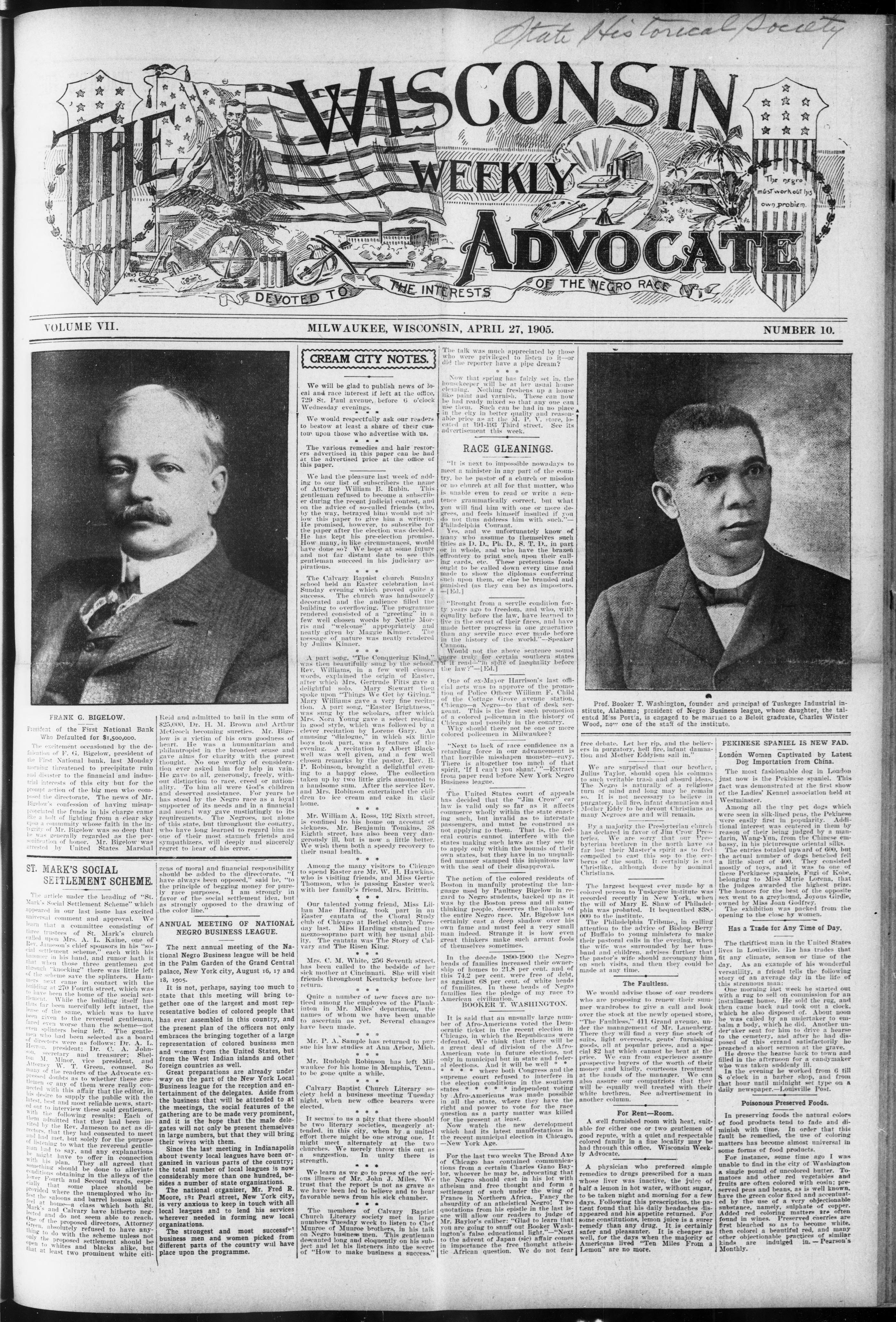

Page text (machine-generated)
State Historical Society
WISCONSIN
WEEKLY
Advocate
DEVOTED TO THE INTERESTS OF THE WECRO RACE
VOLUME VII.
VOLUNTE
FRANK G. BIGELOW.
President of the First National Bank Who Defaulted for $1,500,000. The excitement occasioned by the defaication of F. G. Bigelow, president of the First National bank, last Monday morning threatened to precipitate ruin and disaster to the financial and industrial interests of this city but for the prompt action of the big men who composed the directorate. The news of Mr. Bigelow's confession of having misappropriated the funds in his charge came like a bolt of lighting from a clear sky upon a community whose faith in the integrity of Mr. Bigelow was so deep that he was generally regarded as the personification of honor. Mr. Bigelow was arrested by United States Marshal
ST. MARK'S SOCIAL SETTLEMENT SCHEME.
The article under the heading of "St. Mark's Social Settlement Scheme" which appeared in our last issue has excited universal comment and approval. We learn that a committee consisting of three trustees of St. Mark's church called upon Mrs. A. L. Kaine, one of Rev. Jameson's chief sponsors in his "social settlement scheme," each with his hammer in his hand, and rumor hath it that when those three gentlemen got through "knocking" there was little left of the scheme save the splinters. Hammers next came in contact with the building at 270 Fourth street, which was to have been the home of the social settlement. While the building itself has thus far been mercifully left intact, the lease of the same, which was to have been given to the reverend gentleman, fared even worse than the scheme—not even splinters being left. The gentlemen who had been selected as a board of directors were as follows: Dr. A. L. Herron, president; Dr. C. A. Johnson, secretary and treasurer; Shelton M. Minor, vice president, and Attorney W. T. Green, counsel. So many of the readers of the Advocate expressed doubts as to whether these gentlemen or any of them were really connected with this affair that the editor, in his desire to supply the public with the latest, best and most reliable news, started out to interview these said gentlemen, with the following results: Each of them admitted that they had been invited by the Rev. Jameson to act as directors, that they had consented to meet and had met, but solely for the purpose of listening to what the reverend gentleman had to say, and any explanations he might have to offer in connection with his plan. They all agreed that something should be done to alleviate conditions obtaining in the alleys of the lower Fourth and Second wards, especially that some place should be provided where the unemployed who infest the saloons and barrel houses might feel at home—a class which both St. Mark's and Calvary have hitherto neglected and do not seem able to reach. One of the proposed directors, Attorney Green, absolutely refused to have anything to do with the scheme unless not only the proposed settlement should be open to whites and blacks alike, but that at least two prominent white citi-
---
Reid and admitted to bail in the sum of $25,000, Dr. H. M. Brown and Arthur McGeoch becoming sureties. Mr. Bigelow is a victim of his own goodness of heart. He was a humanitarian and philantropist in the broadest sense and gave alms for charity with the purest thought. No one worthy of consideration ever asked him for help in vain. He gave to all, generously, freely, without distinction to race, creed or nationality. To him all were God's children and deserved assistance. For years he has stood by the Negro race as a loyal supporter of its needs and in a financial and moral way gave unstintingly to its requirements. The Negroes, not alone of this state, but throughout the country, who have long learned to regard him as one of their most staunch friends and sympathizers, will deeply and sincerely regret to hear of his error.
zens of moral and financial responsibility should be added to the directorate. "I have always been opposed," said he, "to the principle of begging money for purely race purposes. I am strongly in favor of the social settlement idea, but as strongly opposed to the drawing of the color line."
ANNUAL MEETING OF NATIONAL NEGRO BUSINESS LEAGUE.
The next annual meeting of the National Negro Business league will be held in the Palm Garden of the Grand Central palace, New York city, August 16, 17 and 18, 1905. It is not, perhaps, saying too much to state that this meeting will bring together one of the largest and most representative bodies of colored people that has ever assembled in this country, and the present plan of the officers not only embraces the bringing together of a large representation of colored business men and women from the United States, but from the West Indian islands and other foreign countries as well.
Great preparations are already under way on the part of the New York Local Business league for the reception and entertainment of the delegates. Aside from the business that will be attended to at the meetings, the social features of the gathering are to be made very prominent, and it is the hope that the male delegates will not only be present themselves in large numbers, but that they will bring their wives with them. Since the last meeting in Indianapolis about twenty local leagues have been organized in various parts of the country; the total number of local leagues is now considerably more than one hundred, besides a number of state organizations.
The national organizer, Mr. Fred R. Moore, 181 Pearl street, New York city, is very anxious to keep in touch with all local leagues and to lend his services wherever needed in forming new local organizations. The strongest and most successful business men and women picked from different parts of the country will have place upon the programme.
MILWAUKEE, WISCONSIN, APRIL 27, 1905.
CREAM CITY NOTES.
We will be glad to publish news of local and race interest if left at the office, 729 St. Paul avenue, before 6 o'clock Wednesday evenings.
We would respectfully ask our readers to bestow at least a share of their custom upon those who advertise with us.
The various remedies and hair restorers advertised in this paper can be had at the advertised price at the office of this paper.
We had the pleasure last week of adding to our list of subscribers the name of Attorney William B. Rubin. This gentleman refused to become a subscriber during the recent judicial contest, and on the advice of so-called friends (who, by the way, betrayed him) would not allow this paper to give him a writeup. He promised, however, to subscribe for the paper after the election was decided. He has kept his pre-election promise. How many, in like circumstances, would have done so? We hope at some future and not far distant date to see this gentleman succeed in his judiciary aspirations.
* * *
The Calvary Baptist church Sunday school held an Easter celebration last Sunday evening which proved quite a success. The church was handsomely decorated and the audience filled the building to overflowing. The programme rendered consisted of a "greeting" in a few well chosen words by Nettie Morris and "welcome" appropriately and neatly given by Maggie Kinner. The message of nature was neatly rendered by Julius Kinner.
***
A part song, "The Conquering Kind," was then beautifully sung by the school. Rev. Williams, in a few well chosen words, explained the origin of Easter, after which Mrs. Gertrude Fitts gave a delightful solo. Mary Stewart then spoke upon "Things We Get by Giving." Mary Williams gave a very fine recitation. A part song, "Easter Brightness," was sung by the scholars, after which Mrs. Nora Young gave a select reading in good style, which was followed by a clever recitation by Lorene Gary. An amusing "dialogue," in which six little boys took part, was a feature of the evening. A recitation by Albert Blackwell was well given, and a few well chosen remarks by the pastor, Rev. B. P. Robinson, brought a delightful evening to a happy close. The collection taken up by two little girls amounted to a handsome sum. After the service Rev. and Mrs. Robinson entertained the children to ice cream and cake in their home.
Mr. William A. Ross, 192 Sixth street, is confined to his home on account of sickness. Mr. Benjamin Tomkins, 38 Eighth street, has also been very dangerously ill, but is now a little better. We wish them both a speedy recovery to their usual health.
* * *
Among the many visitors to Chicago to spend Easter are Mr. W. H. Hawkins, who is visiting friends, and Miss Gertie Thomson, who is passing Easter week with her family's friend, Mrs. Brittin.
☆ ☆ ☆
Our talented young friend, Miss Lilhan Mae Harding, took part in an Easter cantata of the Choral Study club of Chicago at Bethel church Tuesday last. Miss Harding sustained the mezzo-soprano part with her usual ability. The cantata was The Story of Calvary and The Risen King.
* * *
Mrs. C. M. White, 256 Seventh street, has been called to the bedside of her sick mother at Cincinnati. She will visit friends throughout Kentucky before her return.
* * *
Quite a number of new faces are noticed among the employees of the Plankinton in Mr. Miles' department, the names of whom we have been unable to ascertain as yet. Several changes have been made.
* * *
Mr. P. A. Sample has returned to pursue his law studies at Ann Arbor, Mich.
* * *
Mr. Rudolph Robinson has left Milwaukee for his home in Memphis, Tenn., to be gone quite a while.
\* \* \*
Calvary Baptist Church Literary society held a business meeting Tuesday night, when new office bearers were elected.
* * *
It seems to us a pity that there should be two literary societies, meagerly attended, in this city, when by a united effort there might be one strong one. It might meet alternately at the two churches. We merely throw this out as a suggestion. In unity there is strength.
☆ ☆ ☆
We learn as we go to press of the serious illness of Mr. John J. Miles. We trust that the report is not as grave as we have been led to believe and to hear favorable news from his sick chamber.
```markdown
```
The members of Calvary Baptist Church Literary society met in large numbers Tuesday week to listen to Chef Munroe of Munroe brothers, in his talk on Negro business men. This gentleman descanted long and eloquently on his subject and let his listeners into the secret of "How to make business a success."
The talk was much appreciated by those who were privileged to listen to it—or did the reporter have a pipe dream?
Now that spring has fairly set in, the housekeeper will be at her usual house cleaning. Nothing freshens up a house like paint and varnish. These can now be had ready mixed so that any one can use them. Such can be had in no place in the city in better quality and reasonable price as at the M. P. V. store, located at 191-193 Third street. See its advertisement this week.
RACE GLEANINGS
"It is next to impossible nowadays to meet a minister in any part of the country, be he pastor of a church or mission or no church at all for that matter, who is unable even to read or write a sentence grammatically correct, but what you will find him with one or more degrees, and feels himself insulted if you do not thus address him with such."—Philadelphia Courant.
Yes, and we unfortunately know of many who assume to themselves such titles as D. D., Ph. D., S. T. D., in part or in whole, and who have the brazen effrontery to print such upon their calling cards, etc. These pretentious fools ought to be called down every time and made to show the diplomas conferring such upon them, or else be branded and punished (as they can be) as impostors.—[Ed.]
"Brought from a servile condition forty years ago to freedom, and who, with equality before the law, have learned to live in the sweat of their faces, and have made better progress in one generation than any servile race ever made before in the history of the world."—Speaker Canon.
Would not the above sentence sound more truly for certain southern states if it read—"in spite of inequality before the law?"—[Ed.]
One of ex-Mayor Harrison's last official acts was to approve of the promotion of Police Officer William F. Child of the Cottage Grove avenue station, Chicago—a Negro—to that of desk sergeant. This is the first such promotion of a colored policeman in the history of Chicago and possibly in the country.
Why should there not be one or more colored policemen in Milwaukee?
"Next to lack of race confidence as a retarding force in our advancement is that horrible misshapen monster—envy. There is altogether too much of that spirit, 'If I can't you shant.'"—Extract from paper read before New York Negro Business league.
The United States court of appeals has decided that the "Jim Crow" car law is valid only so far as it affects commerce wholly within the state enacting such, but invalid as to interstate passengers, and must be construed as not applying to them. That is, the federal courts cannot interfere with the states making such laws as they see fit to apply only within the bounds of their own states, but they have in no unqualified manner stamped this iniquitous law with the seal of their disapproval.
The action of the colored residents of Boston in manfully protesting the language used by Paultney Bigelow in regard to Negro students, backed up as it was by the Boston press and all sane-thinking people, deserves the thanks of the entire Negro race. Mr. Bigelow has certainly cast a deep shadow over his own fame and must feel a very small man indeed. Strange it is how even great thinkers make such arant fools of themselves sometimes.
In the decade 1890-1900 the Negro heads of families increased their ownership of homes to 21.8 per cent. and of this 74.2 per cent. were free of debt, as against 68 per cent. of white heads of families. In these heads of Negro families lies the pledge of my race to American civilization.
BOOKER T. WASHINGTON.
It is said that an unusually large number of Afro-Americans voted the Democratic ticket in the recent election in Chicago, in which the Republicans were defeated. We think that there will be a great deal of division of the Afro-American vote in future elections, not only in municipal but in state and federal elections. And it will be well * * * * * where both Congress and the supreme court refused to interfere in the election conditions in the southern states * * * * * independent voting by Afro-Americans was made possible in all the state, where they have the right and power to vote for the race question as a party matter was killed for the present at least.
Now watch the new development which had its latest manifestations in the recent municipal election in Chicago. New York Age.
For the last two weeks The Broad Axe of Chicago has contained communications from a certain Charles Gano Baylor, whoever he may be, advocating that the Negro should cast in his lot with atheism and free thought and form a settlement of such under the wing of France in Northern Africa. Fancy the absurdity of an atheistical Negro! Two quotations from his epistle in the last issue will allow our readers to judge of Mr. Baylor's caliber: "Glad to learn that you are going to snuff out Booker Washington's false educational light."—"Next to the advent of Japan (sic) affair comes in importance the free thought atheistic African question. We do not fear
Prof. Booker T. Washington, founder and principal of Tuskegee Industrial institute, Alabama; president of Negro Business league, whose daughter, the talented Miss Portia, is engaged to be married to a Beloit graduate, Charles Winter Wood, now one of the staff of the institute.
Prof. Booker T. Washington, founder and principal of Tuskegee Industrial institute, Alabama; president of Negro Business league, whose daughter, the talented Miss Portia, is engaged to be married to a Beloit graduate, Charles Winter Wood, now one of the staff of the institute.
free debate. Let her rip, and the believers in purgatory, hell fire, infant damnation and Mother Eddyism sail in."
We are surprised that our brother, Julius Taylor, should open his columns to such veritable trash and absurd ideas. The Negro is naturally of a religious turn of mind and long may he remain so. It is not necessary to believe in purgatory, hell fire, infant damnation and Mother Eddy to be devout Christians as many Negroes are and will remain.
By a majority the Presbyterian church has declared in favor of Jim Crow Presteries. We are sorry that our Presbyterian brethren in the north have so far lost their Master's spirit as to feel compelled to cast this sop to the cerberus of the south. It certainly is not Christlike, although done by nominal Christians.
The largest bequest ever made by a colored person to Tuskegee institute was recorded recently in New York, when the will of Mary E. Shaw of Philadelphia was probated. It bequeathed $38,000 to the institute.
The Philadelphia Tribune, in calling attention to the advice of Bishop Berry of Buffalo to young ministers to make their pastoral calls in the evening, when the wife was surrounded by her husband and children, advises further that the pastor's wife should accompany him on such visits, and then they could be made at any time.
The Faultless.
We would advise those of our readers who are proposing to renew their summer wardrobes to give a call and look over the stock at the newly opened store, "The Faultless," 411 Grand avenue, under the management of Mr. Lanenberg. There they will find a very fine stock of suits, light overcoats, gents' furnishing goods, all at popular prices, and a special $2 hat which cannot be beat at the price. We can from experience assure prospective buyers of the worth of their money and kindly, courteous treatment at the hands of the manager. We can also assure our compatriots that they will be equally well treated with their white brethren. See advertisement in another column.
For Rent—Room.
A well furnished room with heat, suitable for either one or two gentlemen of good repute, with a quiet and respectable colored family in a fine locality may be had through this office. Wisconsin Weekly Advocate.
A physician who preferred simple remedies to drugs prescribed for a man whose liver was inactive, the juice of half a lemon in hot water, without sugar, to be taken night and morning for a few days. Following this prescription, the patient found that his daily headaches disappeared and his appetite returned. For some constitutions, lemon juice is a surer remedy than any drug. It is certainly safer and pleasanter. It is cheaper as well, for the days when the majority of Americans lived "Ten Miles From a Lemon" are no more.
The most fashionable dog in London just now is the Pekinese spaniel. This fact was demonstrated at the first show of the Ladies' Kennel association held at Westminster. Among all the tiny pet dogs which were seen in silk-lined pens, the Pekinese were easily first in popularity. Additional interest was centered in them by reason of their being judged by a mandarin, Wang-Yun, from the Chinese embassy, in his picturesque oriental silks.
The entries totaled upward of 600, but the actual number of dogs benched fell a little short of 400. They consisted mostly of toys, and it was to one of these Perkinese spaniels, Fugi of Kobe, belonging to Miss Marie Lorena, that the judges awarded the highest prize. The honors for the best of the opposite sex went to a greyhound, Joyous Girdle, owned by Miss Joan Godfrey. The exhibition was packed from the opening to the close by women.
Has a Trade for Any Time of Day.
The thriftiest man in the United States lives in Louisville. He has trades that fit any climate, season or time of the day. As an example of his wonderful versatility, a friend tells the following story of an average day in the life of this strenuous man:
One morning last week he started out with a rug to sell on commission for an installment house. He sold the rug, and then came back and took out a clock, which he also disposed of. About noon he was called by an undertaker to embalm a body, which he did. Another underaker sent for him to drive a hearse to the cemetery, and after he had disposed of this errand satisfactorily he preached a short sermon at the grave.
He drove the hearse back to town and filled in the afternoon for a candymaker who was taken suddenly ill. In the evening he worked from 6 till 8 o'clock in a barber shop, and from that hour until midnight set type on a daily newspaper.—Louisville Post.
Poisonous Preserved Foods.
In preserving foods the natural colors of food products tend to fade and diminish with time. In order that this fault be remedied, the use of coloring matters has become almost universal in some forms of food products.
For instance, some time ago I was unable to find in the city of Washington a single pound of uncolored butter. Tomatoes and other red vegetables and fruits are often colored with eosin; preserved peas and beans, as is well known, have the green color fixed and accentuated by the use of a very objectionable substance, namely, sulphate of copper. Added red coloring matters are often found in wines. Preserved enerries are first bleached so as to become white, then colorel a beautiful red, and many other objectionable practices of similar kinds are indulged in. - Pearson's Monthly.
Present of Gold and Silver Coffin.
The anniversary of Pir Bismillah Shah, near Victoria Terminus, Bombay, having taken place on Monday, Mr. Haridas Valji, who has keen regard and great esteem for the said Pir, has presented to the Durgha of this Pir a coffin made of gold and silver, with some epitaphs engraved on it, and valued at 3000 rupees. The coffin is indeed beautifully made and the engravings in gold have added much to its high workmanship.
The coffin was brought out of the residence of Maulvi Sayed Zaminul Abedin Rafai and Mutavalles of the Durgha at Jail road at about 7 a. m., to take it to the Durgha at Victoria Terminus. The procession left for the Durgha at 8 a. m. with the recitation of Maulud. While passing through the Mussulman thoroughfares flowers were thrown on the bier by the Mussulmans. The procession reached the Durgha at 9:30 a. m., where after due ceremony the coffin was placed. After distributing sweetmeats the procession dispersed. Distribution of flowers and sweetmeats and a vote of thanks to Mr. Haridas and those present concluded the meeting.—Bombay Cosmopolitan Review.
He Was Too Cordial.
A story is told of a shock received by a Duluth pastor after the services the other night. He makes it a point to welcome any strangers cordially, and that evening after the completion of the service he hurried down the aisle to station himself at the door.
A Swedish girl was one of the strangers in the congregation. She is employed as a domestic in one of the fashionable east end homes, and the minister, noting that she was a stranger, stretched out his hand.
He welcomed her to the church and expressed the hope that she would be a regular attendant. Finally he said that if she would be at home some evening during the week he would call.
"Tank you," she murmured bashfully, "but ay have a fella."
Three of the members of the congregation heard the conversation and in spite of the fact that their pastor swore them to secrecy one of them "leaked."—Minneapolis Journal.
How High Heels Are Made
Making a wooden heel is an interesting task. The heel itself is molded on an irregular molder, a strange but very effective machine; and a singular fact about it is that not a single improvement has been made on it in twenty-five years. The heel is molded from the best quality of rock maple and after it is shaped is covered with leather, usually fine kid or cabretta stock, which may be in many colors, according to prevailing fashions.
The leather is stretched on, fastened with the best quality of rubber cement and then ironed, so that when the job is finished the heel looks as if all of leather. The top lift is next attached. The lift is usually of a superior quality of sole leather, and a pair of them cost as much as a fair-sized top list for women's shoes, though less than half their size. The fact is, good material and workmanship are put into the high heel, for it is one of the vital parts of the shoe or slipper.
Has Letter of Jefferson Davis.
A nephew of President Franklin Pierce, residing at Hillsboro, N. H., has found an autograph letter written by Jefferson Davis to Pierce among documents inherited from his uncle. Davis wrote from the Senate chamber under date of January 30, 1860, saying: "The prospect for our country is not less gloomy than when you left. I will stand by the flag and uphold the Constitution whilst there is possibility of effecting anything to preserve and perpetuate the government we inherited. Beyond that my duty and faith bind me to Mississippi and her fortunes as she may shape them."
Interesting Puppies in Oshkosh
Carl Klug of Oshkosh, Wis., is the owner of four hybrid puppies which have created considerable interest. The mother of the puppies is a wolf and the father a mastiff. The wolf, which is very tame, was captured by Klug in the northwestern part of Shawano county in June, 1903, with three other pups. One of these made its escape, another bit and eluded his captor, while two of the pups were captured. One was kept at Tigerton, where it was killed a few months later by a train. The fourth one, kept by Klug, was brought to Oshkosh and domesticated.
New Orchid Worth $2500.
After being exhibited for twenty-five minutes at the Royal Horticultural society's show in London, a new variety of orchid, called the Milky Way, was sold for £500. It was placed on the stall of Messrs. Sander & Son soon after 9:30, and before 10 the plant found a purchaser. It is an Ondontoglossum Crispum and came from Colombia, in South America. When it flowered the white petals were covered with minute chocolate colored dots, suggesting the star cluster after which it has been named.
Large Increase in Population.
The stork's visit to Homestead. Homeville, and Munhass, Pa., has reduced the output in many departments of the Carnegie Steel company. Thirty-one babies were born on Friday and Saturday to wives of mill men, nearly all of whom remained at home to rejoice. Supt. A. R. Hunt investigated the partial closing down of several of the departments and on learning the cause sent his congratulations.
Objects to Curtain Ads
Mrs. Lewis Waller, wife of the leading actor, refused to fulfill an engagement at a suburban theater, London, because the drop scene was covered with advertisements. The manager said he could not remove them, as they were shown under contract. He is now suing Mrs. Waller for damages. She contends that the advertisements, which include coffins, corsets and false teeth, are inartistic, destroy the illusions of the play and are undignified.
Engagement with Baby Lasts
In the marriage of Robert Zorn, son of Philip Zorn, a millionaire brewer of Michigan City, Ind., there has come to light a romance. Nineteen years ago a daughter was born to Mr. and Mrs. Jacob Kneller and young Zorn said he would marry her when she became old enough if she would consent. The baby girl, christened Florence, became one of the social favorites of the city and Zorn, though twice her age, became an ardent suitor and won a bride.
Mother Pleads for Son.
The pleadings of a sweet faced mother of 66 years touched the heart of Gov. Folk of Missouri and won a pardon for her only son, Harry Patton, 22 years old, who left the penitentiary accompanied by his mother. Patton had been sentenced from St. Clair county in March to serve five years for the forgery of a $5 check. He is the son of the late Judge Patton of Warsaw. The pardon is on condition that he shall use neither cigarettes nor intoxicants.
Beautiful Tea Urn Discovered.
Another spurious "tiara" catalogued as Indian has been discovered in the Louvre, Paris. It has a Hispano-Moorish form and is not a tiara, but a tea pot, a working bearing the name of a French silverchaser. This tea pot or urn is very beautiful, but the mistake is inexplicable.
SPRING MAGIC
There is Supernal Beauty that subtends all beauty wherewith mortal eyes are blest.—
BETTY'S BET.
"I suppose that's a fresh victim, Miss Betty," drawled a stout man from the depths of a garden arm chair.
Miss Betty was a slender young person in green muslin who stood near the arm chair with a racket in her hand and turned as the speaker waved his cigar towards the tennis lawn below.
"I dare say," she answered composedly, stooping to tie her shoe.
"Bet you he isn't," returned the stout man quickly, and a couple of bystanders joined in his laugh.
A delicate flush rose in the girl's cheeks, but she answered coolly, "Why do you suppose he is exceptional?"
"Oh, he's a man of the world, he is!" answered the stout man jovially. "And he's a swell—not like us poor City Johnnies—had lots of experience," he added with a laugh. "Come now, you look so jolly confident, what'll you bet on it? You must bet or I'll believe you're climbing down." "I don't care if I do," she returned, with a look of scarcely veiled contempt at the laughing group of men. "What will you go?"
The fat man pulled himself up in his chair and his eyes twinkled. He knew Ralph Pyne pretty well, and he knew he would not easily be made a fool of. Also he did not at all wish Pyne to fall into the snares of Miss Betty Langley. There was a certain lovely Rebecca Cohen, his own niece, who would make a more satisfactory Mrs. Pyne to his thinking. But Betty was dangerous—decidedly dangerous, unless she could be induced to cut her own throat. "Well, I'll go as far as a pin." "Diamond?" "Hum—yes—hanged if I won't stand a diamond pin."
"Done, Mr. Juarez," answered Betty as she moved away, and Mr. Juarez chuckled as he sank back among his cushions. "If Miss Bet tries any of her games on with that Johnnie he'll bolt, and, possibly, I may have the catching of him."
Ralph Pyne had already spent two days in Betty's company, and had enjoyed himself as most men did under the circumstances, and he was not at all loath to escort her home by the short cut through the covert after she had superintended the shooters' tea at the gamekeeper's cottage. Betty was uncommon good company, as good as a younger brother, and much better to look at. Probably it was because she was so brusque and boyish that most men found themselves proposing to her—quite unexpectedly to themselves, for no one could think of sentiment and Betty Langley in the same hour. "No humbug about her! regular good sort," the blinded victims used to say, and played on—lawn tennis, billiards, hide and seek—regardless of their doom, and their doom never varied.
"How hot it is," eried Betty suddenly; "don't you think there is going to be an earthquake?"
"Is it hot before earthquakes?" returned Mr. Pyne. "That is an interesting bit of general information."
"Oh, people always say they feel queer before earthquakes—" but a sharp rustle among the leaves interrupted her lecture. "Good gracious, it's raining! And there is thunder! Now we are in a fix," and gathering up her skirts she started to run.
"All right, there's a pile of fagots just beyond," cried Pyne, "no end of a fine shelter. See?" as they dashed on side by side, and he pulled back the dripping branches and showed the pile which the woodcutter had arranged as a sort of wigwam.
Cronched down in shelter Betty soon regained her breath and began to chatter again. "Now this is romantic, and it will end in my getting bronchitis and you'll get pneumonia, and we can't go to the Lorimers' dance."
"But alas! I shan't go to the Lorimers' dance anyhow. I am off tomorrow."
"Oh I say! What for? What a shame!"
"My sister has wired she's coming back from India and will be at Southampton, and an earthquake would be a trifle compared to the tempest if I didn't meet her tomorrow night."
Betty is silent. He is going tomorrow and she has just remembered her bet. She feels rather sick at it—and yet, no, that odious Mr. Juarez would chuckle. He has always hated her, she knows, since she said no to him and his shekels, and he would hate to pay up his bet; and how she would like to own—just one—diamond! Betty's face is her fortune and has not brought her any diamonds as yet—only offers of them, for an equivalent. But she can't flirt with Ralph Pyne. She has, she knows, amused herself a little sometimes with some men, but they are such idiots. Mr. Pyne is different; she can't treat him so. And then she recklessly determines to make a clean breast of it.
"Mr. Pyne, I wish you'd do something for me."
"With pleasure."
"You can get me a diamond pin if you like."
"Delighted. I am sure; but how?"
"I want you to propose to me. Don't be frightened; I'll say no, and I won't tell till you're gone."
"Oh! a bet I presume?" he answered a trifle grimly.
"Yes, that odious Mr. Juarez. They are all odious, but he is the worst. He bet you wouldn't propose, because, you see, they all do; and then, of course, they sulk and uncle swears at me. But we've been kind of friends, and you're too good sort for that." she ended a little incoherently, "so I thought I might as well tell you about it."
"Yes; uncommonly good-natured of you. And he's bet a pin," and Mr. Pyne considers what a charming uncle Miss Rebecca Cohen owns.
"Yes; I haven't any jewelry, and I do want to score off that beast," and Betty suddenly grew scarlet from anger. Her
blushes were not in the habit of intruding themselves.
"Miss Elizabeth Langley, I lay my hand and heart at your feet."
"Declined with thanks," cried Betty with a peal of laughter. "Now shake hands," and they shook hands.
The shower had ceased and Betty rose to her feet and shook the dead leaves from her skirts.
For a little while Ralph Pyne walked on in deep meditation. Suddenly he spoke. "Miss Betty, what assurance have you that Juarez will admit you have won your bet?"
"What assurance! Isn't my word enough?" she returned.
"It would make it a good deal surer if you told him you are engaged to me," he answered calmly.
Betty sprang back, her face pale and her eyes blazing.
"How dare you! How dare you! And I thought we were friends," she ended with a smothered sob and vanished among the trees, and Ralph Pyne muttered something between his teeth about a fool and went back to the house.
An hour later a very pale and subdued Betty came gliding through the shrubberies. It was already evening, and the house was brightly lit up and the sound of voices and click of balls sounded from the billiard room. As she put her foot on the veranda Mr. Juarez strolled out of the open billiard room window.
"I am afraid I cannot stop to hear it; the dressing gong has sounded."
"Oh, but you've got to stop," he laughed, laying his fat hand on her shoulder. It was obvious that tea had not been the afternoon refreshment in the billiard room.
"You've got to stop and hear my news, Pyne is off. Says he's sent for by telegram and must be off by the 8:10. We know better, don't me? He's scared. But don't fret, my dear," he continued, changing his tone to one of maudlin tenderness, "you shan't be a loser by him. You shall have your pin all the same. Now doesn't that deserve a kiss for thanks?"
His odious arm was round her. Betty gave a cry of disgust and twisted herself away. At the same moment a gentle push sent Mr. Juarez staggering to the end of the veranda, and a cool voice said. "I'll thank you to treat this lady with a little more respect."
"What the dickens have you got to say to it?" shouted Juarez, who was brought up short by the trellis at the end of the veranda and stood leaning against its friendly support.
"Only that she has done me the honor to promise to be my wife," was the quiet reply in a different tone to the impassioned whisper that implored. "You won't go back on me now, Betty?"
Betty was sobbing too heartily on his shoulder to say no, and silence gave consent.—Dorothea Townshend in the Tattler.
THE VANISHING OSAGES
Luxurious Life Is Thinning Them Out, as It Does Penned-Up Game.
"The the blood Indian is gradually passing, just as the deer or the wild turkey will soon die if penned up," said Col. John N. Florer of Gray Horse, Oklahoma Territory, who has lived with the Osage Indians for thirty-three years, at the Coates house yesterday. "My prediction is that in twenty-five years more there will not be a full-blood Osage left. "When I first went among the Osages the tribe comprised between 6000 and 8000 people. Now there are but 1700 or 1800 of them, including, of course, all those of mixed blood. The Osages have been holding their own pretty well in point of numbers in the last four or five years, but they are doomed to go the way of their fellows.
"The dying out of the race is due in large measure to the change in their habits of life. They used to be out in the open air all the time, and when they traveled it was always on horseback. Even when they moved their camps each Indian would round up his string of ponies and make pack animals of six or eight of them, to carry his belongings. Now they ride about in buggies and carriages, the best to be had. They are rich enough to afford all the luxuries of that sort, and, with no incentive to exertion, their lives are about as far removed from their former habits of activity as could be.
"I was present at the council near Independence, Kan., when the treaty was signed by which the tribe surrendered to the government the Osage ceded lands in southern Kansas, and purchased in their stead the million and a half acres from the Cherokees, which they have since occupied. That trade was a good thing for the Osages. They got $1.25 per acre for the land, and the deferred payments were to draw 5 per cent. interest. That mounted up rapidly, and is the source of the annuities which the Osages enjoy today.
"Those were the good old days which the Indians always speak of as the 'buffalo days.' I went out on the plains with them in their hunts for years. On west from the Osage nation there used to be times when one could see buffalo for miles and miles. At a distance it looked like a dark, surging sea. In one year here I bought 28,000 buffalo hides—more than there are in the whole country today. Of course, there are lots of the younger members of the tribe to whom that is all a tradition, and they will sit around for hours and listen to the elders talk of the old times."—Kansas City Journal.
Signaling with Drums
The natives of the west coast of Africa have little need for wireless telegraph, according to a story told by a missionary at the rooms of the Presbyterian foreign board. Talking of the susceptibility of the native African to rythm he told this incident: The African always calls the people together by means of a drum. The drum varies in size, but is always made by hollowing out a section of a log. The drum not only tells the people of the meeting, but its purpose as well. The news which may be thus sent is astonishing. On one occasion a missionary was in the Palavar house at Efulen, at some distance from his home. A rainstorm came up and he had no umbrella. A drummer, learning his need, tapped a message to a friend and in a short time the latter appeared with an umbrella. The natives have no alphabet and an umbrella is not usually in the requirements of a palaver. How, then, did the drummer make himself understood? During native wars the government has to prohibit the use of drums as the natives are able with them to send news from one village to another.
Potatoes as Fertilizer.
Some farmers in New York are using potatoes as a fertilizer, regarding it as more profitable than to market them at 12 or 15 cents a bushel, the current price. Others are feeding them to their stock and still others are letting them go to waste. The glut is due to overproduction and the general holding of the tubers for a high spring price, such as was secured a year ago.
HIS LABOR AND HIS LOVE
Before the gateway of his life's demand Sate Love and Toil; and Toil was worn and gray.
Then answered Love: "Dear foolish heart and fond
Toll, the eternal, ministers to you;
And thou—thou hadst not known, dear
heart and fond."
heart and land.
But he who chooses Toll shall find too late
That he has left Love weeping at the gate.
—George H. Maitland in Booklovers' Magazine.
A movement has been inaugurated in New York city to erect a life-sized statue in marble of the late actress, Mrs. J. H. Gilbert. The society in charge of the scheme is known as the Mrs. Gilbert Memorial association. It is proposed to place the statue either in one of the public parks or upon the grounds of the Actors' home at Stapleton, S. I. It will show her in the character of "Granny," which she was playing in Chicago at the time of her death.
The run which began on Wednesday on the trading stamp store of Benedict & McFarlane, in Twenty-third street, was continued yesterday by hundreds of excited women. While they were clamoring for the redemption of the books of blue stamps they held, creditors of the concern filed a petition in bankruptcy against it. Later in the day United States Judge Holt appointed Frederick A. Burlingame as receiver, with a bond of $10,000. The Benedict & McFarlane company was incorporated in August, 1903, with a capital of $1,000,000. It established branches in Chicago and many large cities.
It took the immigration officials at Ellis Island two hours the other day to decide whether the facial resemblance was sufficient identification for a father to claim his boy on. Meanwhile Charles D'Angelo, 6 years old, looked wonderingly at his father, whom he had not seen since he was 2 months old. The boy had come alone from Palermo, on the Carpathia to join his father, Agostino D'Angelo, a tailor, of Lawrence, Mass. The father came to this country six years ago when the boy was two months old. The mother came four years ago. At that time the little boy was not well, so his parents left him with the grandmother.
The signing of the stock transfer tax bill by Gov. Higgins took by surprise the Wall street brokers, who had thought that the visit of "some gentlemen" had turned the governor from his purpose. It angered Wall street and it is going to fight hard to defeat the bill in the courts. Henry Clews said: "The stock tax is a severe blow to Wall street. The tax puts an additional burden on the city of New York for the benefit of the balance of the state. I venture to predict that the life of the stock tax will not exceed one year." J. Edward Simmons said: "I am opposed to the measure because I think it unjust to tax the business interests of the community."
The Hamburg-American liner Deutschland arrived from Hamburg, Dover and Cherbourg, after a rough passage of nearly six days. Among the passengers were the Earl and Countess of Suffolk, Lee Leiter. They are here on a visit to Mrs. Leiter, who is in Washington. They will go to Chicago for several days. The earl said that it was simply a family visit and that he and the countess would return to England in about three weeks. Otto Von Gottberg, a German war correspondent, was also aboard the Deutschland. He arrived in St. Petersburg from the Orient about the time of the riots. He said Father Gopon was in the rear of the people when the firing took place.
The newest mansion planned for Fifth avenue is setting a fast pace for the other dwellers of that aristocratic thoroughfare. It is to have a big automobile garage on the first floor and a squash court and garden on the roof. James A. Garland, the well-known Wall street banker, is the builder of this novel residence. The mansion is to be a six-story and basement structure, with a frontage of 40 feet and a depth of 100. It will be of colonial design, with a facade of Harvard brick and many small-paned windows. On the first floor of the mansion will be not only the automobile garage, but a great billiard room, one of the largest in any private house in the city. The estimated cost of the mansion is $125,000.
When the Hamburg-American line steamer Pennsylvania arrived here from Hamburg she had on board the largest number of passengers ever brought to the port of New York on a single steamer. The whole number, including cabin and steerage, was 3086. Of these 2880 were in the steerage. Only once in the past has this number of steerage passengers been exceeded. That was about two years ago, when the steamer Bulgaria of the same line brought in 2899 passengers in her third-class quarters. The voyage of the Pennsylvania was remarkable in view of her heavy passenger list. Not a single death occurred during the passage and when the steamer came in there was no case of serious illness on board.
Blue in all its infinite varieties of shades will appear in the scheme of dress for Easter—that is, for women. It will be a gay Easter and a blue Easter at once. Hats are to be heavily adorned with wings and feathers and dresses are to be fluffy. The gloves are to be in delicate shades, ranging from sheep-tongue pink to inside-of-shell starlight. The newest things are silk gloves with lace cuffs. Of course, there is something new in hosiery, and the Easter girl will wear with her house gown the most exquisite white silk stockings with lace instep. Tans and champagne colors are the prevailing walking costume colors in hosiery, and they are shown in elaborate embroidery and lace. About the only new things for men are the plaited shirts, and they are not likely to prove popular.
Mr. Manula Porter, princess of the Creek Indian nation, will adopt the stage as a profession next season, having been assigned a part in the play in which Miss Marie Cahill of the "It Happened in Nordland" company will again become a stellar ornament to Broadway, New York city. Miss Porter is a daughter of Gen. Pleasant Porter, chief of the Creeks, with headquarters at Muskogee, I. T., who won his title in the Civil war. She is probably the richest Indian heiress in the country. She has been under the tutelage of a music teacher for some time. She spent her girlhood in a finishing school in New York city. The comedy in which Miss Cahill will star has not been named, but it is announced as a "comedy with music," designed more to play Miss Cahill's ability as a comedienne than to entertain in a musical comedy way. A part is to be written in for Miss Porter. The music of the
Creek nation may be transposed into a modern song which Miss Porter will sing.
GRANDFATHER'S BAROMETER
How He Learned What Immediate Weather He Might Expect.
Not a dainty affair, with silver or satin trimmings, nor yet with the credentials of Uncle Sam attached; but a constant companion, shifting from woods and fields to skies—this was the weather bureau of our grandfathers; and mingled with the signs and omens of old there was just enough of fact that the old timer sometimes gets the best of it now in foretelling the weather:
Rainbow at night, sailors' delight:
Rainbow in the morning, sailors take warning:
Rainbow at noon, rain very soon.
Just adapt this couplet the next time a rainbow comes your way, says The Scientific American, and see for yourself.
A combination of rain and sunshine was also supposed to bring rain the next day.
Another verse which found favor was:
Evening red and morning gray Will set the traveler on his way: Evening gray and morning red Will pour down rain upon his head. This is but an adaptation of the adage that a red sunset is a sign of clear weather. And if the sun goes down in a cloud rain will surely come the next day.
If it clears off in the night look for rain the next day. If smoke from the chimney settles instead of rising there is a storm at hand. When sound travels a long distance there is also a storm near. Never expect much storm in the old of the moon. The absence of dew and an unusually heavy dew are alike forerunners of rain. Not much frost need be expected in the light of the moon. An owl hooting in the hollow is a sign of a cold storm; on the hill it foretells a thaw.
If the hornets build low the winter will be hard. When leaves fall early the winter will be long. When snow falls on a hard road it will not last long. The last spring snowstorm never comes until after the "sugar snow," which may be recognized by coming in unusually large flakes and only lasting a few minutes. If the hog's melt is found big at the front the first part of winter will be the most severe; if the reverse is true, we may look for hard weather in February or March.
Bright "northern lights" bring severe cold. If the sun shines on the second day of February so as to permit the woodchuck to see its shadow it will go back into its hole and remain six weeks. If March comes in like a lamb it will go out like a lion; if it comes in like a lion it will go out like a lamb. In other words, one extreme at the beginning promises the reverse at the end of the month. Sundogs indicate a bad storm. Distant sounds distinctly heard forebode no good weather. If the sun "draws up water" it will rain. The pitcher sweating and the teakettle boiling dry also indicate rain. Cobwebs thickly spread upon the grass are an indication of fair weather.
Animal life seems, according to the popular notion, to have peculiar warnings regarding the weather changes. Some of these are explainable by natural causes. It is a fact recognized by all intelligent stockmen that cattle have an intimation of an approaching storm some hours before it is visible to the human eye. There is a certain restlessness which the cowboy has learned to interpret at once. When you see a pig pasturing in the field build for itself a nest you may look for a storm.
Chickens take extra pains in oiling their feathers just before a rain. Pea fowl send forth their shrill cries as a warning, and when the quail cries "more wet" from the meadow, the farmer works briskly to get his hay under shelter. If the chickweed and scarlet pimpernel expand their tiny petals, rain need not be expected for a few hours. Bees work with redoubled energy just before a rain. If the flies are unusually persistent either in the house or around stock there is rain in the air. The cricket sings at the approach of cold weather. Squirrels store a large supply of nuts, the husks of corn are unusually thick, and the buds of deciduous trees have a firmer protecting coat if a severe winter is at hand. If the poplar or quaking asp leaves turn up the under side, rain will soon follow.
If the fog rises in the morning it is a sign of rain; if it settles, a clear day may be expected. Watch the smallest cloud you can see. If it increases in size it is going to rain; if it melts away and vanishes completely fair weather will follow. If the camphor bottle becomes roily it is going to storm. When it clears, settled weather may be expected. This idea has seemingly been utilized in the manufacture of some of our cheap barometers. The main trouble is they seldom foretell the change until about the time it arrives. Last, but not least, rheumatics can always tell it "in their bones" when a storm is approaching, and to this prognostication the octogenarian of today is as firm an advocate as were his forefathers.
Teeth and Temperament.
"I don't suppose many people stop to think that the formation of their teeth is an indication of their temperament," said a dentist the other day.
"Did you ever see a person with long, narrow teeth who had not a very nervous, high-strung temperament? Did you ever see a person with short, broad teeth who was not somewhat phlegmatic and cheerful? I often wonder when the pretty girl opens her mouth to show her ivory white teeth if she realizes that some of us are sizing up her disposition.
"I unconsciously fall into the habit of looking at the teeth of the people I meet socially and choosing my acquaintances accordingly. That is one of the reasons why false teeth ought to be made exactly like the original, set. They have to fit the temperament of the wearer."—Philadelphia Record.
Wanted His Pipe Buried with Him
An eccentric Welshman, who with his wife lived a hermit life for half a century on the mountain at Garth Llangollen, has died, and the quaint funeral arrangements that he drew up have been carried out.
He requested that he should be placed in the coffin dressed in his Sunday attire, including shoes, stockings and a clean linen collar. He also specified that his favorite sealskin cap should be placed on his head, and that by his side should be his pope, tobacco and trusty walking stick.—London Chronicle.
English Shopkeepers
The upper class in England is sinking; the middle is rising rapidly, and those who belong to the former keep shops in assumed names, while those who belong to the latter endeavor to conceal that they themselves are connected with trade. The conversation of both, however, betrays that they are shopkeepers. London Truth.
Cole Younger Growing Timid
Cole Younger, the one time terror of peaceable people, and the side partner of the James boys in the bushwhacker days of the war, is growing timid in his old days, and now claims that enemies are trying to kill him. He has been appointed a peace officer in Kansas City at his own request.
THE TEACHER'S FOE
A LIFE ALWAYS THREATENED BY NERVOUS PROSTRATION.
One Who Broke Down from Six Years of Overwork Tells How She Escaped Misery of Enforced Idleness. "I had been teaching in the city schools steadily for six years," said Miss James, whose recent return to the work from which she was driven by nervous collapse has attracted attention. "They were greatly overcrowded, especially in the primary department of which I had charge, and I had been doing the work of two teachers. The strain was too much for my nerves and two years ago the crisis came.
"I was prostrated mentally and physically, sent in my resignation and never expected to be able to resume work. It seemed to me then that I was the most miserable woman on earth. I was tortured by nervous headaches, worn out by inability to sleep, and had so little blood that I was as white as chalk.
"After my active life, it was hard to bear idleness, and terribly discouraging to keep paying out the savings of years for medicines which did me no good."
"A bare chance and a lot of faith led me to a cure. After I had suffered for many months, and when I was on the very verge of despair, I happened to read an account of some cures effected by Dr. Williams' Pink Pills. The statements were so convincing that I somehow felt assured that these pills would help me. Most people, I think, buy only one box for a trial, but I purchased six boxes at once, and when I had used them up, I was indeed well and had no need of more medicine.
"Dr. Williams' Pink Pills enriched my thin blood, gave me back my sleep, restored my appetite, gave me strength to walk long distances without fatigue, in fact freed me from all my numerous ailments. I have already taught for several months, and I cannot say enough in praise of Dr. Williams' Pink Pills." Miss Margaret M. James is now living at No. 123 Clay street, Dayton, Ohio. Many of her fellow teachers have also used Dr. Williams' Pink Pills and are enthusiastic about their merits. Sound digestion, strength, ambition, and cheerful spirits quickly follow their use. They are sold in every drug store in the world.
Doctors in Woburn.
"A number of years ago, when I lived in Woburn, Mass," said a well-known Bostonian the other day, "a Dr. Kelley resided there and was the leading physician of the town. Later there came a young physician who was far less successful than his neighbor; in fact, he lost so many cases that many remarks were made concerning him.
"One morning while out making calls the two doctors met, Dr. Kelley having one of his patients riding with him. Dr. Brown, the other physician, saluted him with: "Ah, good morning, doctor; I see you take your patients to ride."
" 'Yes,' said the other. 'I see Griggs takes yours.'
"Griggs was the undertaker."—Boston Herald.
WILD WITH ECZEMA
And Other Itching, Burning, Scaly Eruptions, with Loss of Hair—Speedily Cured by Cuticura.
Bathe the affected parts with hot water and Cuticura Soap, to cleanse the surface of crusts and scales and soften the thickened cuticle; dry, without hard rubbing, and apply Cuticura Ointment freely, to allay itching, irritation and inflammation, and soothe and heal; and, lastly, take Cuticura Resolvent Pills to cool and cleanse the blood. A single set, costing but $1.00, is often sufficient to cure the most torturing, disfiguring skin, scalp and blood humors, with loss of hair, when all else fails.
Gave Up Waiting.
A young man who was anxious to secure a job as a railroad brakeman wandered into one of the local yards the other day and came across a bunch of railroad men who were sitting in a shanty. He made known his ambition and one of the men, who is quite a joker, asked him a few foolish questions. The youth answered them and then asked:
"How long before I'll be likely to get a job?"
"Sit down and wait," said the joker. "There's ten or fifteen brakemen killed here every day and you can't tell how soon we will need you."
The young man's ambition seemed to fade, and he remembered that he had an engagement elsewhere.—Albany Journal.
Nest Weighs Two Tons.
A bird's nest weighing more than two tons was found in the steeple of the Grant Street Presbyterian church at Wilkesbarre, Pa. The building is being torn down and workmen could not get through the trap door. They broke in from the outside and found the door weighed down by a mass of straw, hay, strings and twigs, which have evidently been accumulating for the thirty-five years the church has stood. In all that time the steeple had never been entered.
To Reset Diamonds Safely
Announcement is made by the Netherlands legation at Washington, D. C. that the Netherlands government has offered a prize of 6000 florins for a complete solution of the problem involved in the setting and resetting of diamonds without incurring the danger of lead poison.
Catarib Cannot Be Cured
with LOCAL APPLICATIONS, as they cannot reach the seat of the disease. Catarrh is a blood or constitutional disease, and in order to cure it you must take internal remedies. Hall's Catarrh Cure is taken internally, and acts directly on the blood and mucous surfaces. Hall's Catarrh Cure is not a quack medicine. It was prescribed by one of the best physicians in this country for years, and is a regular prescription. It is composed of the best tonics known, combined with the best blood purifiers, acting directly on the mucous surfaces. The perfect combination of the two ingredients is what produces such wonderful results in curing Catarrh. Send for testimonials, free.
F. J. CHENEY & CO., Props., Toledo, O.
Sold by Drugstores, price 75c.
Ian to Enter Contest.
Kiys Sue Inui, a Japanese student at the University of Michigan, has won a place on the annual oratorical contest. Out of 100 students who spoke Inui was one of six winners. From this number two will be chosen to represent the university in the contest of seven big western universities.
GOSSIP FOR THE LADIES.
After Much Wandering
Some day when you're tired of the tolling,
And sick of the stress and the strain,
When you've mingled life's rue with its
hyssop
And eaten the fruit with the husk,
You will follow the footprints of Fancy
Down some old-fashioned garden again,
Where the hollyhocks flame and the roses
Gleam white on the breast of the dusk!
And you'll think on the years that were
wasted
For the place that you purchased with
peace,
And now empty a bauble is glory—
How fleeting the guerdons you gain—
And your eyes will grow blind with the
blurring
Of sorrow that knows not surcease,
Some day when you're tired of the tolling,
And sick of the stress and the strain!
For the world may be yours for the winning And the prospect stretch broad to the view. But the fruit that shone fair in the distance Seems shrunken, when grasped in the busk
And your spirit—God knows!—will be weary
And you'll long for the peace that you knew
Where the hollyhocks flame and the roses
Gleam white on the breast of the dusk!
-Hilton R. Greer in Broadway Magazine.
If You Want to Be Popular.
First—Remember that a good voice is as essential to self-possession as good ideas are essential to fluent language. The voice should be carefully trained and developed. A full, clear, flexible voice is one of the surest indications of good breeding.
Second—Remember that one may be witty without being popular, voluble without being agreeable, a great talker and yet a great bore.
Third—Be sincere. One who habitually sneers at everything not only renders herself disagreeable to others, but will soon cease to find pleasure in life.
Fourth—Be frank. A frank, open countenance and a clear, cheery laugh are worth far more even socially than "oedantry in a stiff cravat."
Fifth—Be amiable. You may hide a vindictive nature under a polite exterior for a time, as a cat masks its sharp claws in velvet fur, but the least provocation brings out one as quickly as the other, and ill-natured people are always disliked.
Sixth—Be sensible. Society never lacks for fools, and what you consider very entertaining nonsense may soon be looked upon as very tiresome folly.
Seventh—Be cheerful. If you have no great trouble on your mind you have no right to render other people miserable by your long face and dolorous tones. If you do you will generally be avoided.
Eighth—Above all, be cordial and sympathetic. True cordiality and sympathy unite all the other qualities enumerated and are certain to secure the popularity so dear to everyone.—Boston Traveler.
The Hope of Misfortune.
Pain is a soul tonic. Sorrow often brings out the best there is in us. Happiness does not develop character. It gives it surface brightness and decks it with prismatic bubbles. It takes the deep-reaching arm of misfortune to trouble the depths and bring out the pearls that lie there. The most magnetic faces are lined by thought and noble care. Strong, unselfish love, even if misplaced and unappreciated, ennobles the lover. It is the frivolous, vanity-born emotions that fritter away character and make faces insignificant. To fail in high aim after earnest and honest effort, is not failure. The gain it brings in strength and discipline will appear in other directions.
Misfortune has often, in the history of the world, been the means of making a poet, orator, philanthropist, scientist or statesman out of a person whose career, but for the misfortune or physical disability, would have been commonplace and influence limited.
Often in life we get cruelly crippled morally by a disappointment, a sin, or a mistake, and we feel that our life is spoiled and we cry out against fate. In our shortsightedness, we do not perceive that the checkmate at the outset has turned the tide of our being into deeper channels.
In his Searlet Letter, Hawthorne has shown us the terrible moral crippling suffered by Hester Prynne. The wrecking of her reputation and the pangs of remorse were the cause of her developing from an ordinary housewife into a strong spirit of ministration, charity and helpfulness. Any mistake or sin repented of and its consequences patiently borne, will be the means of strengthening and deepening the moral character. It is under the warm sunshine of happy success that the meeds of selfishness spring, misfortune searches them with her tears, and they wither, giving room for a nobler growth.—Medical Talk.
Be a Ray of Sunshine
Never mind if you do not feel very well, there is no use in casting a shadow over all the little corners of the world that you call your own. An old colored woman came from the poor house Sunday after Sunday to the white folks' church, where she was early in a seat close by the door. When she died she was sincerely missed, and why? Because she was always ready to speak a kind word and give a pleasant smile. "I cannot do anything for the Lord," she used to say. "But I can smile people out of church!" Was that nothing?
There is little use in forcing trouble upon the world; it has troubles enough of its own without ours, says Katharine Moody Spalding. And rare indeed is the life that has no sunshine in it. If there really is one who has none, then they should have all the sympathy we can bestow upon them and be brought under the rays of the sunniest soul in our circle of acquaintance.
Sunshine is not only good for the earth and the growing things, but good for our spirits and so for our health, for our health is largely influenced by our spirits. If we are happy and contented, disease does not have nearly as good a chance to fasten its hold upon us.
We know of men who have never spent a day in bed from illness, and we account for it by their busy, contented minds, which are too filled with thoughts outside themselves to dwell long upon their physical feelings unless the pain is sufficient.
The woman worries, the man turns his mind to the column of figures he is adding or the probabilities of an advantage of the stock market. Try singing about your work, little mother, or if you have learned the trick, whistle merrily over your homely tasks. It will banish the clouds from the home that are gathering on the children's faces and will assure the listening family that
the barometer indicates fair weather under the roof, though it may not outside. I am reminded of some lines that have fastened themselves in my mind, and I pass them on as a verse for the day:
Work a little, sing a little,
Whistle and be gay;
Read a little, play a little,
Busy every day;
Talk a little, laugh a little,
Don't forget to pray;
Be a bit of merry sunshine
All the blessed way.
-Selected.
Doing Justice to One's Child.
The nursery world, says the author of a recent book on the Twentieth century child, may be divided into three parts—the neglected child, and the pampered child and the child who is tended to the very best of its parents' ability.
Now, as far as these first two classes are concerned, I think that there has been a great deal of exaggeration. Although many remarks as to the mismanagement of children in fashionable houses are just, the abnormal child life is to be found in a very small portion of society. It is a bad business, but a very restricted one. I am afraid that where it exists it is beyond hope of redemption.
Many of these children would be better brought up if they could be left to the deputy-mother, the guardian with plenary powers. The guardian must be a refined lady of experience, tact and patience. If such a deputy can be supplied it is not necessary that women who have social and intellectual demands on their time should spend half their lives in the nursery.
But there are too many busy women—very often unnecessarily busy women—who cannot afford this deputy. Their duty is to make their children their first charge, instead of wasting their time at bridge and afternoon parties. The really busy woman of serious occupations need never neglect her children, even if she cannot afford the highly-trained nurse or governess. It is merely a matter of arranging her time.
I am fairly busy myself, but I know every detail of the daily routine, food, clothing and occupation of the nursery. Without this knowledge no mother can be sure that the best deputy is taking her place when she is absent from the nursery.
Nor must the hours that the busy woman gives her children be the "fag ends" of the day. One cannot hope to gain a place in their lives unless one gives them the best of oneself. The chief point is never to be "tired" when you are with your children. It is a difficult task, but you will live to regret it in their merciless criticism if you grudge the time you give. And so one should never let anything interfere with certain hours of companionship, rides or walks, or evening talks. However busy one has to be one can fit them in somehow if one makes up one's mind to do so.
Most homes, I am glad to think, are arranged for the children's welfare, and if only people would understand that the simpler and more human children's joys and pleasures are the happier they are, parents would more often make a success of their nurseries.
It is not in hot rooms, at dances and theaters, but in "God's out-of-doors," that a child becomes one's real companion—in garden or stables or in rambling walks, where nature's book snows thrilling pictures at every moment of the year. Children need no teaching to be thrilled with excitement at the first snowdrop.
All the wonder of opening leaf and flower, and the mystery of new birth are theirs as they search for primrose daffodil and watch the young lambs at play. No time can dull the memory of the keen joy of bird-nesting, of the first hunts for baby rabbits and dormice and dappled fawns. The pond at tadpole time is a world of wonders, full of living mystery. And then in winter, what lessons of simple kindness can be taught by caring for the birds and making friends with robin and thrush by feeding them.—Detroit Free Press.
How Women Can Command Respect.
Women do a great deal of talking, and with much provocation, probably, about the way in which men and boys monopolize the seats in street cars. But just notice, if you please, the manner in which some women accept seats when offered them.
Instead of accepting them with a smile and gracious "Thank you!" they sit down with an air that seems to say: "This seat is mine by right. Why didn't you offer it before?"
Can you blame a man who regrets having offered his seat to a woman of that stamp?
The aggressive woman who demands her rights may get them, but they are given so grudgingly that she cannot derive much joy from getting them. There is no denying the fact that it is very hard for a woman, especially if she be small, to cling to a swaying strap, bumping into every one near her. Her clothes are pulled out of place and shape.
Not only is a man taller, but his clothing is much more adapted to raising his arms. A loose coat is much more easily managed than a tight-fitting waist.
However, I did not mean to talk about our woes, but our manner of accepting our blessings, and when you're tired after a day's work a seat when the car is crowded is a blessing.
Remember that the men are tired also and want to read their evening paper, and it isn't always easy to give up their seats. If your manner is brusque and masculine and ungentle they will think: "She is quite as well able to take care of herself as we are; let her shift for herself." The way to get chivalrous attention from men is by making them look on you as a being who commands their care and respect. There is no need that you should be of the clinging parasite order. That kind of a woman has gone out of fashion.
Be self-helpful and self-reliant, but don't imagine that your knowledge of the world is greater than that of half the men you meet. Because, in all probability, the youngest boy you know far outstrips you in that respect.
Just be gentle and dignified and womanly and you will find that all men will treat you with a courtesy that all the aggressiveness on earth can't command.
A pleasant smile and courteous acknowledgment of favors received are never amiss.—Philadelphia Evening Bulletin.
House-Cleaning Time
This is the season for a thorough going over of one's belongings whether we move or not. At the end of the winter much has to be disposed of in discarding worn out things of all kinds or things that have served their purpose. There is probably no way in which a woman who is cumbered with much serving can lessen her burden of time spent on things to a greater degree than in cultivating the thought and habit of discarding everything that does not fill an evident need.
We have one use for clothing and often hold on to it long after that use has passed because we think we may need it, and so we handle it again and again
only to give it away in the end. So the first thing to be done in preparation for either house cleaning or moving is to go thoroughly through everything in the house and dispose of all superfluous articles.
Have nothing in your house you do not either know to be useful or believe to be beautiful. Are you prepared rigorously to apply this principle? In studying the decoration and furnishing of your houses, as we all do when we do over walls, etc., have the courage to discard all that overcrowds your rooms. They produce a feeling of unrest. They not only increase your labor in house cleaning, but multiply it many times during the year. If, when you have done this, you find a collection of bric-a-brac and furnishings that you are glad to miss you can find plenty of places that need them and where they can give pleasure.
Next, in regard to your fabrics—draperies and upholstering. Have as little as possible and have the surfaces as plain as possible. In draping windows let your draperies fall in straight lines and not in festoons. The effect is much more artistic and the fabric is much more easily cleansed.
After simplifying your fabrics as much as possible, send out all those which must be dry cleaned to have them all out of the way during the time you are upset with cleaning. Follow the same rule with your rugs and furniture. Send out everything to be cleaned or mended or done over, and, by the way, in having upholstery done over leave out the tufted style as much as possible, as much labor and vexation of spirit and many moths result from this. In work of this kind that is to be done at home do it before the actual house cleaning, so that the cleaning and settling of your rooms in order may be the last process. —Chicago Tribune.
Twilight Chat.
I would rather take my chances with illness in a hospital than at home, with the best care possible in a private residence, simply because of the unrelaxing vigilance that a hospital demands. But my views are not shared by the majority of women and some men, so home nursing will remain more or less popular, for a time at least, and it is the duty of every woman to master the rudiments of one of the most valuable fields of labor open to the sex. Skilled nursing requires more than knowledge—an aptitude for the work, a love for it, untiring patience and good health. But the rudiments can be learned by any woman who puts her mind to it, as she did to reading and spelling.
First comes the sick room. That is not made to order usually, but is just where the patient happens to be when stricken. It can be stripped of superfluous furniture, however, and kept well ventilated. The beauties of hospital life are the simple furnishings, the absolute cleanliness, and the perfect ventilation. No patient is ever too ill to be kept clean and supplied with fresh air, and with such aids skill has a better chance to win. A great deal of harm results from excluding pure air and keeping a sick room too warm. The restlessness of a patient often can be traced to one or both of these causes. Authorities declare for an even temperature of about sixty degrees and fresh air every hour or so.
Medicines and food should be given with careful punctuality, without the slightest regard for a patient's whim. As a rule, sick persons who are allowed to be willful, retard their own recovery and wear out their attendants. Everybody in the house is expected to make sacrifices to sickness, but the patient must not be allowed to dictate them. A sick room ought to be in a quiet part of the house, but, differently located, it must be protected against unnecessary noise like the slamming of doors, heavy footfalls, loud voices and laughter. Distress of mind will prevent the recovery of bodily health and everything of a distressful nature should be banished from the patient's sight and hearing.
Hospital rules regulate company to the point of nicety. Home nursing often has the serious fault of carelessness regarding visitors. Very few callers on invalids have the necessary cheeriness to make their visits beneficial or the tact to avoid harmful effects, and the only safe course is to banish them till convalescence is well advanced. A relapse is often more dangerous than the original illness, yet inexperienced nurses grow careless after improvement begins. Doctors' orders are disregarded, and the patients' fancies regarding food and diversions indulged recklessly.
The woman who assumes the role of nurse should look well to her own comfort. If she must sit up nights to watch symptoms and administer medicine, she should be relieved by day to get the sleep and rest she needs. If allowed to sleep at night, it is best that she be provided with a couch in the sickroom and comforts like a dressing gown and easy slippers. She must have nourishing food and exercise and interesting books to relieve the strain when the patient sleeps. None of these rules are beyond the mastery of ordinary intelligence.—Philadelphia Evening Bulletin.
Effort Is Reward
In the face of real trial how easily we falter, which goes to prove the weakness of frail humanity. When the bitter cup is passed and we have to take our turn, then do we begin to realize how incompetent we are to grapple with and master the affairs of life. Ah, yes, it is much easier to talk than to do, much easier to write a simple truth than live it; yet we criticise this minister and that professor for pointing the way they do not themselves always travel.
All this surely goes to prove that we know better than we do. Alas! then, what room for improvement. More earnest effort to do the very best we know would surely make each succeeding day brighter and better, and we would certainly be rewarded by the education of our own consciences. But we are so selfish as to feel a wrong so keenly sometimes as to almost forget to be and do better. What then? Do we not have to call on a Higher Power? Some will laugh at this idea and tell you that only the weak-minded mortals have to rely on some other power; but watch, carefully, those who talk so. Such people are surely being drawn away from what is highest and best.
We cry for a world without sin, and yet none of us are able to free ourselves from sin. O, who can suggest the remedy!
Is life, then, worth the living? Yes, we learn by experience that life is what we make it, in a measure. As Lord Lytton says: "We are our own fates; our own doomsmen." Everything we do counts for good or ill. Does it not then pay to keep in the straight and narrow way?—Twentieth Century Farmer.
Valuable Painting Used as Stretcher
Many valuable works of art were lost by the burning of the residence of Sir Charles Tennant, Bart., at Peebles, Scotland. One of the most active in the salvage work was Thomas Brunton, an under gardener, who, finally essaying to enter an upper window, fell from a ladder to the ground and was seriously hurt. It was found, after the work of rescue had been completed, that a picture valued at $75,000 was missing. It was known that it had been taken from the burning building. It was ultimately found in a near by tenant's cottage, and it transpired that it had been used as a stretcher to carry the injured man, Brunton, to the cottage.
YOUNG FOLKS' COLUMN.
The Chickadees
A fluffy little chickadee,
When the winds began to blow,
Crept up beside a forest tree
And watched the flakes of snow.
"My brother," said poor chickadee,
"This wind is very cold.
Why don't you go to sunny lands,
Like good Sir Robin bold?
"The snow is covering all the worms,
The flies are gone away,
I haven't caught a single bug—
Not one—to eat today."
"Fie on you!" chirped good Brother Dee.
"Don't creep in there to whine.
For chickadees weren't made for that.
I'll show you how to dine.
"When flies and worms and bugs are gone,
Sir Robin has to go.
Because, you see, good brother mine,
His lordship was made so.
"But chickadees and birds of pluck,
When cold and wintry weather
Cuts off their whole supply of meat,
Forage for seeds together.
"We'll hunt for weeds and berries red,
And surely find our dinner,
For flowers that bloom in summer days
Leave seeds for birds in winter.
"So, pluck up courage, brother dear,
For chickadees must never
Do aught but sing the whole year through
No matter what the weather."
No matter what the weather.
—Elizabeth Keese in Youth's Companion.
"Teddy" in a Storm in an Open Boat.
"A man does get scared in an open boat in such a sea."
These words, uttered by a boy of 12, might seem a bit toploftical, but any one who heard the speaker describe his experience in a storm off the coast of Alaska would think the "man" entirely appropriate. The lad lives in Seattle, and is known as "Teddy," because he wears a Rough Rider uniform. He spent last summer on Perry Island, in Prince William sound, Alaska. Blue foxes are raised on this island for their skins, and it is necessary to feed them a good part of the year. It was to catch some humpback salmon for the foxes that the Seattle boy started one pleasant morning in August. He went in what is called a Columbia river boat; these are stanch craft, but have no cabin. They are 25 feet long, have one sail and a centerboard. In a calm they can be rowed.
The boat was in charge of a native of the Aleutian race called Fred Allen. These people, when they travel, always take their families with them, so Fred had his wife and two sons, 4 and 2 years old. King's bay, about twenty miles away on the mainland, was to be the fishing ground, for the salmon run here earlier than they do on Perry Island. In their season they come to Alaska by the million to lay their spawn in the fresh water streams. They can be taken in nets without any trouble. The trip to King's bay and back usually takes two days, but Fred had provisions for three days for a possible emergency. There were bread, ship's biscuit, bacon, canned meats, sugar and tea.
It was such a fair day when they started that none of the little party thought of bringing their oilskins—a careless proceeding, for the rain in Alaska is heavier than in any other part of the United States. King's bay was reached after a pleasant sail, which the little Aleut children seemed to enjoy as much as any one: That night the party slept on the boat, and the next day the native and the white boy started to seine for fish. The water was fairly alive with them at the mouth of a little creek. One end of the seine was taken out to sea a little way and brought back in a semi-circle. Then the boy and man pulled it in, full of struggling salmon weighing from 3 to 7 pounds each. When they had pitched 560 of these into their boat, they decided they had enough.
Then our Seattle lad had time to examine a little more closely the big glacier which breaks off into the ocean near by. This huge mass of ice, blackened at the lower part by the earth and bits of stone which it has brought with it, cracks off great pieces into the water at intervals with a tremendous noise. The bay is filled with the floating chunks, some of them as big as a house.
Our youngster, in wandering about, found that animals as well as human beings knew about the run of salmon. A little way from the water's edge he saw the tracks of a bear, with some bloody fragments of the salmon on which he had been feeding. A land otter had also been there, said Fred, who knew the footprints of all the game thereabouts. The boy himself saw a wolverine fishing. This chap would jump into the water when he spied salmon, catch one by the back of the neck, and toss it some distance ashore, so that it could not flop back into the creek. Mr. Wolverine had evidently seen few human beings, or none, before, for he did not run away when the boy came onite near him.
It came time, however, to start for home, so everything was put on board the boat and the Alent shoved her off. To "Teddy" the weather looked queer. There was no wind in King's bay, yet the boat tossed in a peculiar fashion. Fred rowed the heavy boat until they got out into more open water. Here the sea was rising. The wind did not blow steadily, but came in what are called "woollies." These are just puffs, the air being calm between them.
As the sea grew heavier and a regular storm seemed brewing, the native tied two reefs in his sail, but in spite of this the danger increased. The waves rose twenty feet or more and would break over the boat and wet all the occupants to the skin. Our American boy wasn't easily frightened, and he knew that Fred was a good sailor, but he began to urge the Aleut to turn back. But Fred is one of those men who never want to give up when they start to do a thing. This quality is an excellent one generally, but there are times when it should yield to reason.
When the seas began to wet her children and herself the woman urged her husband to turn back, but he wouldn't listen to her. His family was huddled up in the stern of the boat, covered with all the clothing that could be gathered up. The children were not frightened at first, but when the waves dashed over them and their mother began to weep they also set to crying. The white boy had been sitting on the center board and he kept urging Fred to go back until the Alert finally consented to do so.
The wind was behind them when they turned, so it was easy to run to shore, but they landed some little distance from the stream where they had caught the salmon. Fred and "Teddy" climbed a hill and were surprised when they looked out to sea to find that the storm was apparently over. Two eagles flew over their heads, screaming, darting near them from time to time. This showed that their nest was near, and they feared that their young ones would be taken away.
But Fred and the boy had no time to bother with eaglets. They hurried to their boat in hopes of getting home before another storm should rise. A start was quickly made under full sail, but soon a squall struck them and heeled the boat way over. Then came a calm stretch, but one squall after another followed this. The boy sat in the bow of the boat, looking for rocks, and Fred sailed on with
all his canvas. As the water began to dash into the boat again, the attempt to get home that day was abandoned, and a landing was made on a little island just at the mouth of King's bay. Here they found a deserted "browbrie," as the native huts are called, and you may be sure a big fire was soon roaring, to dry their clothes and cook the supper. All night the storm continued, and in the morning it grew worse. Rain came in torrents and the wind shook the "browbrie" as if determined to tear it to pieces. There was no thought of getting to Perry island that day, and the question of provisions began to get important. Of course they had lots of salmon, but the other food would be gone before night.
By afternoon the weather had moderated a little, and, to his great joy, Fred saw a sailboat anchored near the shore. This contained three prospectors who were searching the country for gold. They were a generous lot, and when Fred and "Teddy" paddled out to them in a canoe which they had found on the beach, gave them a lot of flour mixed with baking powder. It was still raining, and they had brought no box of any kind, so "Teddy" wrapped up the flour in paper and then in cloth. He kept it in his lap and bent over it while Fred paddled to the shore.
That evening there were flapjacks for supper, cooked by Fred's wife. There was salmon, too, you may be sure, for of this food they knew they had an indefinite supply. In spite of the rain, all slept well that night, for they knew they had food for several days more.
The next day came, the fourth since their departure, and yet the storm raged so that there could be no thought of starting for home. "Teddy" explored the island a little. It was nothing but hills, and the soil was a regular bog, even in dry weather. A peculiar looking tree on a steep incline attracted his attention. It was dead, and had lost all its branches. Half way up its trunk the wood had grown into a large ball, so that it looked like an orange stuck on a lead pencil. After asking the native's advice, "Teddy" decided to name the place Round Head island. So far as he could learn, the island had never had a name before, and he hopes that if it ever becomes important enough to be called anything it will be known as Round Head island.
The fifth day passed like the fourth, with the storm still at its height. Eating salmon as much as possible, the party yet saw that the other provisions would soon give out. To make matters worse, the woman spilled all the salt into the flour, so that "Teddy" was unable to eat the last flapjacks. The Aleutian palate is not so sensitive, however, and the flapjacks were not wasted.
Breakfast on the sixth day was a scanty affair, except for salmon, and the prospectors were gone, so that no more food could be got from them. Fred started out in a canoe for some driftwood for the fire, but soon returned with the welcome news that out at sea the storm had abated. So the bedding and other articles were got on board the boat, and by early afternoon she was shoved off with her nose pointing for home.
The wind had gone down, they found. Indeed, there was a dead calm now, so they propelled the boat with the long sweep which served as oars. By this time the fish had begun to rot, and the smell was far from pleasant. But the prospect of getting to Perry island made "Teddy" forget that. As for the Aleutians, they do not mind bad smells. In fact, they rather seem to like them.
Rowing in the heavy swell was hard work, but after a time a squall struck them and helped them on their way. Then one of those fogs which are so common in Alaskan waters set in. In those latitudes the sun sets very late in summer, but on this night it became pitch dark early. Fred's wife became alarmed, and begged him to go once more to the little island. She cried, and the babies cried, too, but their father was not to be turned back this time. The "woollies" struck them again and again. Fred had no compass, and the boy asked him how he would know his course.
"You see islands dark ahead. Sky not so dark," explained the native. "Teddy" looked intently, and finally was able to distinguish where the land lay and what was open sea, for the mountains showed up just a trifle blacker than the skies. Fred knew that region well, and by 11 o'clock at night he had landed the boat on the beach where the fox ranch stood. The owner of it had become alarmed by their long absence, and had decided to start the next day to look for them. A regular feast was soon on the stove, and it tasted mighty good, too, after the fast since early morning. "Teddy" is now very glad he had the trip, for none of his school friends at Seattle can tell such stories of their summer outings as he can.—New 1ork Tribune.
FOOD HABITS OF LITTLE FOLK.
Never Force Them to Eat Against Their Will. Saves a College Professor.
That parents do wrong to try to force their children to eat against their will is the conclusion of M. V. O'Shea, professor in the University of Wisconsin, who writes about it entertainingly and sensibly in "The Independent."
It is possible that parents are too solicitous, anyway, about their children's eating, he thinks, and that the worst possible mode of treating it is to make it a task. "Think of punishing a child for not drinking a glass of milk which he says he does not want. Could there be any better way of setting him against it permanently?" Prof. O'Shea suggests that it would be wiser to make food difficult to obtain, rather than to force it upon a child, basing this opinion on the psychological principle that we tend to grow indifferent to things that are overeasy to obtain.
One great difficulty in modern life, among certain classes, is that food is too plenty. Under modern urban conditions people must naturally eat less than in the days when subsistence was won hardly by a hand to hand contact with nature. Adults who were reared in the country only to adopt city life in mature years are apt to eat more than they need, and the Wisconsin professor considers it not unreasonable to suppose that city children whose muscles will be used little should form the habit of eating less than their parents did when they were young.
When Too Tired to Sleep.
If you are overtired—"too tired to sleep," as we sometimes say—bathe the neck and temples with hot water. Bathe the back of the neck particularly. This seems to relax the muscles and the veins that supply the brain with blood. Lie down to sleep with peace, for it will come surely. The same treatment will, wonderfully refresh during the day. A headache may often be relieved, even cured, by hot applications to the back of the neck.—Washington Star.
Mark Twain's First $5.
Mark Twain has been telling the story of how he earned his first $5. "I have." he says, "a distinct recollection of it, and have often laughed at it since. When I was a youngster I attended
school at a place where the use of the birch rod was not an unusual event. It was against the rules to marks the desks in any manner, the penalty being a fine of $5 or public chastisement. Happening to violate the rule on one occasion, I was offered the alternative. I told my father, and as he seemed to think it would be too bad for me to be publicly punished he gave me the $5. At that period of my existence $5 was a large sum, while a whipping was of little consequence, and so" (here the humorist reflectively knocked the ashes from his cigar)—"well," he finally added, "that was how I earned my first $5."—New York Sunday Telegram.
TO HOLD THE HEAT.
Invention for Retaining the Temperature of Warm Beverages.
Many little household conveniences originate in the minds of busy housewives, though many of them never become public property, owing to woman's natural inclination to belittle the value of her mechanical achievements. One of these odd inventions is "the drinking utensil." as it is officially described for hot beverages, of Maud L. Williams of St. Louis. This consists of an air-insulated recepta-
TO KEEP THE CUP'S CONTENTS WARM
cle for the drinking cup proper. It comprises a casing a little larger than the cup it is designed to protect, and forms a tight covering with an upper ring rim attached to the sides and provided with a center opening a little smaller than the largest diameter of the cup. When the cup is set in the receptable it projects uniformly on all sides above the casing, and the handle is easily reached. As is well known, air is one of the best insulators of heat that the world knows, and a cup containing a heated beverage thus protected from radiation will retain its original temperature for a much longer time, owing to the very slow loss of heat by radiation and conduction.
A Pleasant Ship's Company.
We have received a communication from a Scottish physician, stating that it is proposed to attempt a new departure in the treatment of tuberculosis by sea voyages. A large sailing vessel will leave this country about the end of January for a long voyage in warm latitudes and will be prepared to convey a "number of consumptives, limited to fifty, of inebriates, and of other invalids." It is intended that the patients suffering from tuberculosis shall live on deck day and night, whenever the conditions of weather permit, so that they may have the advantage of constantly breathing absolutely pure air containing much ozone. During the voyage the vessel will call at among other places, Gibraltar, the Canary islands. Rio de Janeiro, River La Plata, Pernambuco and the West Indian islands, and opportunities will be given for the patients to land and to see a little of the countries thus visited. Such is the prospect put before a limited number of invalids whose circumstances, physical and social, permit them to avail themselves of it.—Lancet.
All Had Stopped.
An amusing little scrap of conversation was overheard in a certain market hall recently.
In response to a question as to the time of day one old dame rather rudely advised her companion to "look at the clock."
"I have done so," was the reply, "an' it's stopped."
"Stopped!" ejaculated the other, glancing up in her turn. "Ay, so it is. What's come to the clocks? I've one at home, an' its stopped, too. There must be a hepidemic among clocks, just now."
"Hepidemic, indeed!" came the response. "You ought to come to my home, Mrs. B., an' then you might talk about hepidemics."
"What?" Is your clocks stopped as well?"
"Rather!" was the grim reply. "I've a watch, three sons, two clocks an' t' owd man all doing nowt! Hepidemic, indeed!"—Spare Moments.
The Six-Shooter in Texas
Texas has outgrown the six-shooter. It has also suffered enough because of its unrestricted use. The Post does not assume to say just what measures are necessary to suppress it, but if the law can regulate the sale of poisons it ought to be equal to regulating the sale of six-shooters.
The sale of poisons was made the subject of legislation because some unfortunate people became addicted to the use of drugs, while others in moments of despondency purchased with suicidal intent. The six-shooter has found in Texas many more victims than all poisons combined, and unwilling victims at that.
Men are going to have quarrels, but this thing of whipping out a gun and pumping lead into somebody every time a difficulty arises is as unnecessary as it is uncivilized.—Houston Post.
God Ate the Apple
In the nursery the realistic drama rules. Mamma heard terrible shrieks from the nursery above, and rushed up to inquire. In the middle of the floor sat Jackie and Ethel, voices uplifted. On the table sat the senior, Thomas, aged 8, with his mouth full. "What's the matter, children?" cried mamma. "Boo—o—o! we were playing Garden of Eden," sobbed Ethel. "Yes," said mamma, picking Ethel up. "I told you the story yesterday. But why are you crying over it?" Ethel stopped her tears, and pointed furiously at the brother on the table. "God's eat the apple!" she shrieked.—London Chronicle.
A Mark Twain Story
It is related that when Gen. Horace Porter once went down to the dock to bid Mark Twain farewell on the occasion of one of the humorist's trips abroad, the general warmly shook his friend by the hand and exclaimed with some fervor.
"God be with you, Clemens; God be with you always."
Whegeupon Mark, in his inimitable drawl, replied:
"Thanks, thanks. I hope He will. Incidentally, I hope, too, that He may find some leisure—to—er—take care of you!"—Harper's Weekly.
Remorseful Drunk Kills Self.
Shame and remorse over being rebuked by his pastor for intemperance caused Capt. James A. Rider, sexton of St. James' Episcopal church at St. Louis. Mo., to commit suicide in the church while Rev. Edmund Duckworth was preaching the morning sermon. The cleryman offered a short and touching prayer for the forgiveness of the unfortunate man.
THE WISCONSIN WEEKLY ADVOCATE.
B. B. Montgomery, Editor and Publisher.
The Wisconsin Weekly Advocate after three years' residence at 79 Fifth street, has moved its headquarters to 720 St. Paul Ave., where we will receive our guests and transact our business in future.
A Representative Journal Devoted to the Interest of All the People.
One inch, one year.....$15.00
Two inches, one year.....25.00
Three inches, one year.....35.00
Four inches, one year.....42.00
For larger space, special rates.
Locals, 10 cents per line.
TERMS OF SUBSCRIPTION
One year ..... $2.00
Six months ..... 1.00
Three months ..... .50
Direct all communications to
R. B. MONTGOMERY.
729 St. Paul Avenue.
HOW TO SEND MONEY.—Post Office
Order. Express Order, Draft or Registered
Letter. R. B. Montgomery will not be
responsible for loss when sent in any other
way.
TO CONTRIBUTORS:
All communications must be sent with the name and address of the sender as an evidence of good faith, but not necessarily for publication. No manuscript returned if not accepted, unless accompanied by stamps.
EDITORIAL PARAGRAPHS.
---
"I know of the bravery and character of the Negro soldier. He saved my life at Santiago, and I have had occasion to say so in many articles and speeches. The Rough Riders were in a bad position when the Ninth and Tenth cavalry came rushing up the hill carrying everything before them. The Negro soldier has the faculty of coming to the front when he is needed most. In the Civil war he came 400,000 strong, and I believe he saved the Union."—President Roosevelt.
Frank Gordon Bige'cw
The shock of the defalcation of Mr. F. G. Bigelow of the First National bank has passed. The superb courage and sacrifice with which the board of directors rallied to the support of the crippled bank, their herculean efforts, the frankness with which they took the public into their confidence, the success with which they guided the bank to safety and restored the temporary failure in public confidence, all have passed into history. Charles F. Pfister, Fred Vogel, Jr., John I. Beggs and Mayor Rose, especially, have earned the admiration and gratitude of the community. How small and mean the political assaults on these men look, when with such manhood, such skill and energy, they withstood the peril which threatened our business public! For the failure of the First National bank, with its $16,000.000 and more of deposits and its wide relationships, would have shaken our business community to the foundation and jarred the business interests of the whole northwest.
Mr. Bigelow is now in the hands of the law, and it is not our part to try his case or moralize upon his action. The lesson is so plain no one can dodge it—speculation, that maelstrom which has devoured fortunes and honor and lives innumerable, yet to which new victims rush. But this we want to say. Mr. Bigelow is not the typical bank criminal. Here has been no long course of fraud, covered by hypocritical Christianity, so the basis of confidence is shown to have been long valueless. For such a man contempt is merited. This man was what he seemed. His probity and honor were genuine. And what a friend! He was a believer in the future of the Negro race and gave freely of both counsel and purse to any cause whose object was for its betterment. No one can count the young men whom he has started and guided into safe success, the business men he has shepherded through sore trials, the homes his counsel and business aid have blessed, while his benefactions have been countless, ceaseless, and, true test of all, unobtrusive. He loved his children—may not a man do that? And to save his son he strained every resource and then, in a desperate effort to prevent disaster, did what he ought not, and ruin came.
Wrong is wrong. We do not condone it, even in a friend. But "brethren, if a man (a brother) be overtaken in a fault, ye which are spiritual restore such an one in the spirit of meeknees, considering thyself, lest thou, also, be tempted." No, the warm heart and strong grip and bright courage were real. The honor we gave him he deserved. We sorrow for the downfall of him whom still we love and hold our friend.
Then gently scan your brother man,
Still gentler sister woman;
Though they may gang a kennin' wrang,
To step aside is human;
One point must still be greatly dark,
The moving, Why they do it;
And just as lamely can ye mark
How far, perhaps, they rue it.
Who made the heart, 'tis he alone
Decidedly can try us;
He knows each chord—its various tone,
Each spring—its various bias;
Then at the balance let's be mute,
We never can adjust it,
What's done we partly may compute,
But know not what's resisted.
—Burns.
S. M. M.
Lord Chelmsford, whose death in London has occurred at the age of 78, was never lord chancellor, as announced in the dispatches, but son of Frederick Thesiger, whose family came to England from Saxony in George III.'s day, and who was twice lord chancellor, in 1858-9 and in 1866, and was made Baron Chelmsford in 1858. The man who has died was a veteran of the British army, which he entered in 1844. He served in the Crimea, in India and Abyssinia, and was commander of the British forces in the Kaffir and Zulu wars of 1878 and 1879. He is chiefly remembered because of Isandlwana, where 4000 troops were slaughtered, and because of the death of the prince imperial of France by Zulu assegais, when the guards ran away and left him to his fate. He was Gen. Thesiger's honorary aid de camp and under his especial protection. In 1879 Thesiger succeeded his father as second baron; he was made a general in 1888, and retired on full pay in 1893.
Southern
California
Missions.
The antiquity of California is represented by her missions, says the Pictorial American of Los Angeles. Before their time there was naught of civilization—she had no history; the aborigines of this summerland were as wild and untaught as the apes of Africa or the Simians of Central and South America. The future may yet uncover an ancient civilization upon the Pacific coast—it is possible—but to-day it is conceded that the advent of the Spanish friars more than a century ago marks the beginning of a civilization that has at the present time culminated in a period that will for all time be recalled as the brightest in the scientific achievements of the Caucasian race.
Banished from Mexico in 1767, the Jesuits received royal commands from Spain to proceed to Upper California for the purpose of establishing missions and converting and educating the Indians of this otherwise uninhabited country.
The first of these missions, at San Diego, was established July 16, 1769, and to Padre Junipero Serra is given the honor of having been its founder, notwithstanding the historical fact that Padre Juan Crespi, accompanied by a little band of soldiers and servants, preceded Serra to the spot some six weeks and commenced the labor of creating the adobe structure which is the first and oldest of a chain of twenty-one similar buildings from that point on the south to Sonoma on the north. For more than half a century this work was in progress, or until April 25, 1820, when the last and extreme northern mission, San Francisco de Solano at Sonoma, was constructed.
These temples of worship, constructed mainly of sun-dried bricks of adobe earth and straw, were responsible for the creation of a thoroughfare connecting each with the others, constituting one continuous roadway from the mission on the south to the one at the extreme north; this was called El Camino Real, the King's Highway.
Through the secularization of these missions, subverting the objects for which they were created, and the cantankerous tooth of time, there remains to-day for the most part little evidence of their former supremacy—they are naught but ruins, except where in a few instances some of them have been partially restored—mainly as landmarks and historic relics of the earlier civilization of California, while some few still serve the purpose of religious ceremonials.
In their palmy days these institutions were prosperous and amassed much wealth and the padres enjoyed many luxuries, in a quiet way, available in those primitive times of meager facilities and products of art and husbandry. Settled as they were in the midst of populous tribes of peaceable and simple Indians, they availed themselves of their ability to utilize their labor to profit. Upon the authority of Major Ben. C. Truman, it may be stated that "these missions were in their best condition in 1814, although in 1826 they had 400,000 cattle, 200,000 sheep and 20,000 horses. They also kept at work 15,000 Indians and harvested nearly 100,000 bushels of grain of various kinds."
The mission system of Alta California, founded by the missionaries of the order of St. Francis, consisted of twenty-one establishments, extending from San Diego on the south to Sonoma on the north. The most extensive and important of these, Monterey excepted, were in Southern California, and the three best preserved in the cordon are Santa Barbara, San Buena Ventura and San Luis Rey.
San Carlos de Borremeo, at Monterey, was partially restored in 1884, on the one hundredth anniversary of Padre Junipero Serra's death, through the efforts of the resident priest, Father Cassanova, and the late Don Antonio, Caronel of Los Angeles. Mission Santa Clara has been built over with a large Catholic college Santa Cruz and San Rafael, which were small establish-
SAN LUIS KEY MISSION.
---
ments, have entirely disappeared, and San Luis Obispo has been rebuilt. The others are standing in various stages of decay.
After the act of secularization was passed by the Spanish government in 1813, the missions began to decline, and after its conformation by Mexico in 1834, they rapidly went to ruin, the churches being only maintained as places of worship in charge of parish priests. By permission of the Pope, given to Diego, the first bishop of California, in 1850, Santa Barbara was permitted to remain in the possession of the Franciscan order, consequently the church and cloisters are intact and the gardens are beautifully kept.
San Luis Rey was restored to the Franciscans in 1892, occupied as a college for the training of priests of the order, under the superintendency of Father O'Keefe, formerly of San Barbara. The mission is to be entirely rebuilt as it was originally, the work
PLAZA AND MISSION
THE CHURCH OF THE SUNSHINE
to be done mainly by the students. It will be a picture of the past. The road leading from mission to mission in the early days was called in the Spanish tongue, el camino real, the royal road, or broadly interpreted, the "king's highway." It was so designated, not that the road belonged to the king, but that it was a main highway through the country. Later, when missions expanded into pueblos and
COLONIAL CATHEDRAL
large land grants became extensive cattle ranches, there were two highways, el camino real de la cuesta and el camino real de la tejon, the road of the coast and the road of the mountain pass. Over the latter vast herds of cattle and sheep from the southern ranches were driven to the San Francisco markets.
Eight years ago certain individuals of Southern California came together for the purpose of preserving what remains of the missions. They have succeeded partially in restoring San Fernando, San Juan Capistrano, San Diego and the auxiliary mission at
---
PLAZA AND MISSION CHAPEL, LOS ANGELES.
Pala, all good, it is sald, for another hundred years. They are also endeavoring to arouse an interest among the people for the reconstruction of the King's highway. From a practical standpoint the movement has the endorsement of the National Good Roads Association. It is considered by those who have the history of California at heart that it will be an honor and credit to the State to restore old el camino real, not as a speedway for the millionaire tourists' automobiles, but to make it a highway for all the people, by the people, to enjoy as they may elect. It would give to California a fine road through scenery unsurpassed on the continent and as unique in origin as the missions were unparalleled in extent and character anywhere on the globe.
VENUS ON CRAB SHELL
Old Traveler Vows Witching Outlines Are Found on Crawfish.
Every crab shell contains the form of a woman. At least so maintains Samuel O. Trudell, 0. 217 9th avenue, linguist, traveler and author and now owner of a tobacco store, says the New York Press, and he is prepared to prove his assertion, not only from the shells he has in his possession, but from any that may be taken to him. Not only is the female form divine outlined in native grace and detail, but in many instances it is attired in the conventional habiliments of the present time, for the drawing room or the street or draped in clinging garments as if for the stage. Some, too, have headdresses of the towering style of the women of certain provinces of France.
The two species of shellfish which bear the outlines most clearly are the ordinary table crab and the rock crab, but the decorations are not confined to those of any one part of the world. They may be found even on shells
CHAPEL, LOS ANGELES.
picked up in New York bay, although the finest specimens which Trudell has are from the Gulf of Mexico and the English coast.
It was back in 1870, Trudell said, that he discovered the strange decorations, part drawing and part bas relief, which the crab bears on its back. He was taking luncheon in a restaurant in Pascagoula, near New Orleans, when he recognized the form. Since that time he has examined hundreds of shells, and never has he failed to find the tracings. Often, he says, it requires careful study to pick them out, and sometimes a magnifying glass is needed to discover the lines of dots which fill in the picture, but they are always there. As a general thing the face and the breast appear as if embossed in the shell, the inside being hollowed where the undulations are found on the outer side. In others the arms are shown in relief, and in some the legs.
One thing which the old man pointed out particularly was the perfect balance between the opposite sides of the figure, each feature or marking or trace of embroidery or lacework which is indicated on the left being indicated equally clear on the right.
One shell has the form of a woman who appears as if she were holding her skirts above her ankles, which Trudell says should cause no wonder since she was in the water at one time. The hands seem to be buried in the folds of the draperies and the shell shows the wrinkles where one might suppose the cloth had fallen in curves between the hands. Another shows a form wearing a coat extending halfway to the knees and a skirt with flounces at knees and hem.
At the Captain's Table.
As the liner cleared the heads and the heavy swell of the open Atlantic became noticeable dinner was served. The 26 places at the captain's table were filled and as the soup appeared the captain addressed his table companions.
"I trust that all 25 of you will have a pleasant trip," he said, "and that this little assemblage of 24 will reach port much benefited by the voyage. I look upon the 22 smiling faces as a father upon his family, for I am responsible for the lives of this group of 19. I hope all 14 of you will join me later in drinking to a merry trip. I believe we 7 fellow passengers are admirably suited to each other and I applaud the judgment which chose from the passenger list these 3 persons for my table. You and I, my dear sir, are——"
The captain chuckled. "Here, steward, bring on my fish and clear away these dishes."—Indianapolis Journal.
Millions Starving.
Prof. Reussner, of Berlin, a recognized authority on Russian affairs, in a recent interview said that 100,000,000 inhabitants of the Russian empire are literally starving.
TEMPERANCE TOPICS
HOMES ARE RUINED BY STRONG DRINK.
Thousands of Lives, Characters and Fortunes Are Annually Wrecked Along the Gilded Pathway, Having Its Beginning in the Wine Room.
A striking warning against intoxicating liquor is contained in an article published in L'Alcool, written by the famous chemist, Dr. Raoul Brunon, of Rouen. Among other strong statements are the following:
It is not extraordinary that with a climate like ours tuberculosis tends to increase in our country? It is the cause of 150,000 deaths a year. This annual disaster increases year by year. Out of 10,000 inhabitants we lose 30 every year by tuberculosis, whereas in Germany the number is 22, and in England 13. During the last 50 years in Paris, and throughout France, the streets and avenues have been transformed, and immense sanitary works have been accomplished, but they have had no effect on tuberculosis. During 1861 to 1870, the mortality in Paris from tuberculosis was 40 per 10,000 inhabitants; in 1897 it had risen to 47 for the same number of inhabitants.
The most recent treatise on pathology, and all the classic authors, are agreed on this; that alcoholism favors tuberculosis by making the organs apt to receive and to fructify the bacillus. * * * In France, tuberculosis tends to increase in spite of the progress made in hygiene and in what tends to well-being. The average mortality has been lessened, but the mortality from tuberculosis has increased. One of the causes of the phenomenon is the fact that during the last 40 years there has been a constant migration from the country to the towns, where the conditions of labor have been modified. The workman has set himself to drink; alcoholism has been born, and extends everywhere, developing into alcoholmania. During the last 30 years the consumption of absinthe and other spirits has risen from 29,000 hectolitres to 312,000.
At Rouen alcoholism goes on with vigor among all sorts of workers, from the child of 12 to 14 years, who is working; from the young girl, who is ironer or seamstress, unto the mason and skilled worker; all nourish themselves in great part with coffee, to which is added brandy. Many of them begin or end with an aperitif. The greater part arrive at a stage when they cannot eat, and there we have the cause of tuberculosis. After an inquiry, conducted with great care, M. le Dr. Lavarenne is able to declare that, "wherever alcoholism increases, there tuberculosis increases, and the people who have the energy to fight alcoholism will see tuberculosis decreasing."
Drunkenness Rare in Heathendom.
Drunkenness Rare in Heathendom. Drunkenness is largely a vice of society called "Christian nations." The Mohammedans and Hindus are kept from it by their religion; the Chinese are not addicted to intemperance, and many of the uncivilized people knew nothing of alcoholic stimulants until "Christian nations" brought them. Some of the heathen nations could teach the conceited sinners of Christendom very useful lessons in sobriety and abstinence.
In Burmah, according to the statement of a correspondent of a Liverpool paper, strong drink is condemned. The laws of the country provide somewhat stringently against the evil. A man convicted of drunkenness is, for the first offense, paraded through the streets with his hands tied behind his back, and this exposure to the public gaze has generally a good effect. When he is found guilty a second time he is beaten severely. Is he found guilty of drunkenness a third time? Then he is beaten still more severely—sometimes even to death.
Taking it all in all, it may be said with safety that drunkenness is a very rare thing in Burmah, and the country people there are among the soberest on earth. It is pleasing to know that the prime refreshment among the Burmese is pure water. It matters not where one goes in Burmah, along the roads and all over the country, there is everywhere to be found the little shed with a drinking fountain within it, and an adjoining seat for the weary traveler to rest.—The Safeguard.
Neglected Children.
I. I. Manaman, Chief Probation officer in connection with the Juvenile Court of Chicago, publishes a report of his work for the year 1904, in which he shows that in a total of 1,788 cases tried during 11 months, drunkenness of parents was one of the chief causes of children going astray. He asserts that nearly all of this crime is "preventable," and that even of the "nonpreventable" causes of crime, 75 percent may be traced back to neglect and drunkenness of parents. He says:
"Whisky causes poverty. Poverty causes crime. Children come to us first as dependents, but with age dependency become delinquency. Parental neglect lies at the foundation of the work of the Juvenile Court."
Business Prosperity.
One of the properous cities of Illinois is Macomb. It has 6,100 population, and has had no licensed saloons for 20 years. Banks have increased from two to four and deposits from $400,000 to $1,500,000. Eighty per cent of the homes are owned by the parties living in them. The tax rate is 1.1 per cent on cash value.
He is but the counterfeit of a man who has not the life of a man.— Shakespeare.
Sliced Tomatoes, 10c. Radishes, 10c.
Cucumbers, 10c. Green Onions, 10c.
Lettuce, 10c.
BEAN SOUP.
Boiled Trout and Mint Sauce, 25c.
Boiled Leg of Mutton, Egg Sauce, 25c.
Roast Pork and Apple Sauce, 25c.
Short Ribs of Beef with Brown Potatoes, 25c.
Fricasseed Chicken, 25c.
ENTREES.
String Beans. Green Peas.
Boiled and Mashed Potatoes.
Apple and Lemon and Custard Pie.
Rice Pudding.
Coffee and Tea and Milk.
Anything ordered not mentioned on this bill will be charged for extra.
MONROE BROS., Prop's.
194 THIRD ST.
MONON ROUTE
NORTH OR SOUTH
Always ask for tickets
via the
MONON ROUTE
THE SHORT LINE BETWEEN
Chicago,
Indianapolis,
Cincinnati,
Louisville
Six trains daily between Chicago and the Ohio river.
For folders, rates, etc., call at any Monon ticket office or address
FRANK J. REED,
Gen'l Pass. Agent, Chicago.
S. B. JONES,
C. P. Agent, 232 Clark St., Chicago.
While in city visit . . .
STEPHENS' HOTEL and RESTAURANT First-Class Accommodations Home Cooking a Specialty...
No. 2832 State St., CHICAGO, ILL.
S. F. PEACOCK & SON
Funeral Directors
AND
EMBALMERS
431 Broadway. MILWAUKEE
WANTED--AGENTS
We want 100 agents in every city, town and hamlet in the U. S. for the Wisconsin Weekly Advocate. It will be devoted to the interest of the Negro race and will contain the news of their sayings and doings throughout the world.
50 Per Cent. Commission
WISCONSIN WEEKLY ADVOCATE MILWAUKEE, WIS.
ELK EXPRESS CO.
G. J. CHARLESTON, Mgr.
63 E. Sixth Street,
ST. PAUL, MINN.
WONDERFUL
DISCOVERY
Curly Hair Made Straight By
TAKEN FROM LIFE
BEFORE AND AFTER TREATMENT.
FORD'S ORIGINAL
OZONIZED OX MARROW
(Copyrighted)
This wonderful hair pomade is the only safe preparation in the world that makes kinky or curly hair straight as shown above. It nourishes the scalp, prevents tangle from falling and makes the hair grow long and silky. Sold over 45 years, and used by thousands Warranted harmless. It was the first preparation ever sold for straightening kinky hair. Beware of imitations. Remember that Ford's Original Ozonized Ox Marrow is put up only in fifty cent size, made only in Chicago and by U.S. A.I. is printed on the package. Do not be misled by substitutes claim to be a good but valuable insist upon getting the genuine, as it never fails to keep the hair straight, soft and beautiful, ance so much desired. A toilet necessity for ladies, gentlemen and children. Elegantly perfumed. Owing to its superior and lasting qualities it is the best and most economical. It is not possible for anybody to provide a preparation equal to it. Full bottles with every bottle. Only 50 cents. Sold by druggists and dealers, or send us 50 cents for one bottle, paid. We pay all postage and express charges. Send postal or express money order. Please mention name of this paper when ordering. Write your name and address plainly to
OZONIZED OX MARROW CO.,
Charles Ford Prest
76 Wabash Ave., Chicago, Illinois.
Agents wanted everywhere.
Our wagons speed all over town,
All hours of every day,
Depositing and picking up
Big bundles on the way.
We've got the best machinery,
And expert help galore;
We make your linen glisten and gleam
Like sea-foam on the shore!
We do not slight an article,
However coarse or fine;
Oh, everything's immaculate
On The American Laundry Line.
And so we bid for patronage,
At least a wholesome share
Of collars, cuffs and shirts and gowns,
And rumpled underwear.
We set the pace and from our point Our banner shall not fall. We fling it to the breeze and reach Going higher than them all.
Laundry left before 8 a. m. can be called for at 6:30 p. m. same day, Saturdays excepted.
Beware of Impostors
of different professions soliciting money in Wisconsin for purposes unknown to any person in that state and for use elsewhere. Driven out of other states they are overrunning this. We think it an imperative duty on us as being the only negro paper in the state, to protect its generous philanthropists. From now on, we shall warn the mayor and chief of police of every city in Wisconsin against such adventurers.
The Oliver
Typewriter . .
Philadelphia, 1899. Earls Court, London, 1899. Omaha, 1899. Paris 1900. Venice, 1901. Lille (France), 1901. Buffalo, 1901.
It is displacing old style machines everywhere, and holds first place in the estimation of the majority of leading representative business and professional men. Write for Catalogue.
Wm. C. Kreul
434-430 Broadway, - Corner Mason Street
MILWAUKEE
COAL! COAL! COAL!
Get Your Coal from
B. M. GLASPY,
2609—13 State St.,
CHICAGO.
Best in the City.
We Spend Money With Those Who Spend Money With Us.
L. DEUSTER & CO.
—DEALERS IN—
Fancy Groceries and Meats
GAME A SPECIALTY.
Tel. Black 8692 46 Martin Street.
CHR. RITTER FRED. RITTER
Christian Ritter & Son
UNDERTAKERS
AND
EMBALMERS
276 Fifth St. Milwaukee, Wis.
Telephone 1631 Main.
50 YEARS
EXPERIENCE
PATENTS
TRADE MARKS
DESIGNS
COPYRIGHTS &c.
Anyone sending a sketch and description may
quickly ascertain our opinion free whether an
invention is probably patentable. Communications
strictly confidential. Handbook on Patents
sent free. Oldest agency for securing patents.
Patents taken through Munn & Co. receive
special notice, without charge, in the
Scientific American.
A handsomely illustrated weekly. Largest circulation of any scientific journal. Terms, $3 a year four months, $L. Sold by all newsdealers.
MUNN & Co., 361 Broadway. New York
Branch Office. 225 F St., Washington, D. C.
HISTORIC GROUND.
THE CROW INDIAN RESERVATION IN MONTANA.
Great Tract Which Is to Be Thrown Open to Settlement by the Whites, Contains the Battlefield Upon Which Custer Fell-A Rich Region.
Notwithstanding the fact that there are 473,000,000 acres of vacant unappropriated land, excluding Alaska, open for settlement, pressure is constantly being brought to bear upon Congress for the opening of lands hitherto set aside for the Indians. One reservation after another is being thrown up to settlement, the aboriginal occupants being given farms in severity if they desire to live the lives of white men, or being compelled to take circumscribed quarters if they wish to live the tribal or blanket life. Last year the greatest reservation opening was that of the Rosebud, in South Dakota. This summer two reservations will be thrown open to a certainty—the Crow, in Southern Montana, and the Uintah, in Eastern Utah. To these will probably be added the Wind River or Shoshone reservation, in Wyoming. All these reservations offer vast opportunities to the white man. The Uintah and Wind River reservations are rich in minerals, but to
```markdown
```
A
BATTLEFIELD OF THE LITTLE BIG HORN.
the genuine homeseeker—the man who wishes to carve his fortune with no other instrument than the plow—the Crow reservation will make the most effective appeal.
A Rich Region.
The Crow reservation is just over the northern boundary of Wyoming, in Montana. It is one of the greatest reservations in the country, and has long been coveted by the white man. The Brush-Alliance branch of the Burlington Railroad, connecting with the Northern Pacific, extends entirely through the reservation. There is a southward branch of the Burlington, at Toluca, extending to Cody, from which one can make a delightful journey through the reservation by the new "side door route" to Yellowstone Park. Travelers who journey through the reservation by trail are astounded at the fertility of the scene that meets their eyes. Under the magic touch of irrigation, rich farms dot the landscape of bare, brown hills. But for the tepees that raise their smoke-browned tops on either side of the track, and the Indians who are seen riding or
MASSACRE MONUMENT.
driving along the roads, one might imagine he was pursuing his way through a peaceful and prosperous Western agricultural community. Most of the farms are leased by white men, as the Indian owners are not yet sufficiently skilled in the white man's methods to be a success as agriculturists. But these farms in the valley of the Big Horn show that the Crow reservation can be made to blossom as the rose when once it is dominated by the white man's touch.
For over a year the government has had surveyors at work in the northern half of the Crow reservation, making surveys. Not all of the reservation will be thrown open. The Crows have ceded 1,150,000 acres to the government, and this is the portion to be taken up by the white men. The land lies along the valley of the Big Horn, and it is estimated that about 300,000 acres can be cultivated. The remainder will be used for grazing purposes. Thus the individual who draws a homestead will be doubly lucky, for not only will he have 160 acres of as fine agricultural land as there is in the West, but he will also have the privilege of using a vast acreage of grazing ground which cannot be irrigated, but which is rich in succulent grasses and which has been used as a pony range by the Crows for generations. The main canal to irrigate the homesteads will be taken from the Big Horn, and the supply of water is inexhaustible. The proceeds of the sale of the land
---
will be used by the Crows to benefit their own lands and herds.
On Historic Ground. The homesteader who settles in the Crow reservation will find himself in historic ground. The chief place of interest on the reservation is Custer battlefield, at Crow Agency. The Custer monument can be seen from the railroad trains, on top of a knoll, about six miles from the station. It was here that the redoubtable Rain-in-the-Face and other Sioux chieftains overwhelmed Custer's detachment of 270 brave men, leaving not one to tell the story. White headstones are scattered about the monument on both slopes of the hill, showing exactly where the men lay when their bodies were found. Near at hand are many other headstones, as Custer field has been turned into a national cemetery, and here are buried the victims of the Fetterman massacre and many others who lost their lives on the plains fighting for the flag. The field will always remain one of the most interesting spots in America. Only four miles away is Reno's battlefield, where one may yet see the bones of the horses used as breastworks by the troopers who, according to many military critics, should have come to Custer's aid.
For generations the Crows have clung to the lands on which they are now located. Occasionally they were driven off by the warlike Sioux or Cheyennes, but always they came back. In the days of the fur traders
```markdown
```
they were friendly to the white men, and have been so in the years that have followed. In fact, there has been no Indian tribe so consistently at friendship with the white people as the Crows. They might have progressed more had they not been so friendly, for it is a lamentable fact that the white men who have come most in contact with the Indian have not always been the ones fitted to do the red man the most good. To-day there are only about 1,500 members of this once mighty tribe. They are struggling to learn the white man's ways as best they can. Earnest, sincere white men are working among them, and good results will certainly follow.
Women Dance for Mouse.
At exactly 9:45 o'clock Thursday morning a little brown mouse stole out from the main corridor of the Missouri-Lincoln Trust building at Seventh and Olive streets and took a short constitutional of about twenty-five feet west in Olive, says the St. Louis Post-Dispatch. In the course of that innocent jaunt he frightened so many women that a feminine panic ensued and so much screaming and scampering about was done that the mouse started back for the more masculine calm of the Missouri-Lincoln Trust building.
As he gained the entrance, however, a large and formidable-looking woman espied him, and with a wild shriek and a frenzied grasping of the skirts, began executing such a remarkable dance on the sill of the big skyscraper that the mouse lost his head and scurried clear across Olive stret.
Arriving at the curb on the south side, he passed under a carriage from which two women were alighting and emerged on the sidewalk simultaneously with them. At once they set up an outcry and circled around on the pavement in a dismayed minuet such as has never before been seen in St. Louis. By this time a big crowd had gathered, and the laughter of men and boys mingled with the shrieking and screaming of women and girls. The uproar became so appalling to the mouse that finally, reckless of consequences, he precipitated himself through an open grating into a cellar and has not been seen since. His unusual and uncommon experience while in quest of a little fresh air lasted just five minutes.
They Got the "Glassy Eye."
They Got the "Glassy Eye." A certain confectioner in New York, who caters chiefly to the little folks of the neighborhood, lately arranged his shop window with great care in preparation for a local festivity. The crowning attraction of the whole was a large chocolate tiger with most realistic green eyes, made of glass marbles, which had cost the designer 20 cents apiece. In the tiger's mouth was a card bearing the inscription: "Nothing in this window over 5 cents a quarter-pound."
A crowd of youngsters quickly assembled on the sidewalk, and presently, after much spelling over of the placard, two of them invaded the shop and deposited a nicked upon the counter.
"Say, mister," began the smaller boy, earnestly, "gimme a quarter o' a pound o' tiger—the piece with the eyes in!"
If some people would work hard and earn $10,000, some one would walk up, and, taking it away from them, tell them they had no business with that much money.
---
HORSE
WAUSAU LUMBER AND COAL CO.
SPEAKING VOICE NEGLECTED. American Girl Pays Little Attention to an Important Attribute. While the cultivation of the singing voice is much sought after, the speaking voice is allowed by the average American girl, to develop just as it happens. A contributor to the Youth's Companion says of this fact:
With all the legitimate pride in the charm of the American girl, it is still necessary sadly to admit that there is one beauty she conspicuously lacks: the beauty of a resonant and musical voice. This is all the more deplorable because in almost every case she would have it if she would only work for it, and if she could be made to realize that in the production of what, in a general way, is called charm, the speaking voice ranks with beauty and grace, she surely would work. A group of girls talking ought to please the ear as much as they please the eye, instead of being, as they too often are, a feast for the eye and an insult to the ear.
There are both moral and physical-reasons for this unhappy state of affairs. To begin with, there is not nearly enough stress placed upon the desirability of a charming voice. It is the fashion for the voice to be badly used, and the ears of hearers are spoiled by it. The result is that many beautiful young women who would shudder at the thought of a pimple or a badly shaped finger-nail go through life shrieking like a lot of angry peacocks, and the girl who has passed a busy social day expects to be hoarse in the evening, because, as she puts it, "I have talked so much all day my throat is tired." She really does not know that her poor throat is only rebelling against hours of work for which it was never created.
If after talking or reading aloud the voice becomes husky and the throat seems continually to need clearing, it is sufficient proof that it has been misused. The organs of speech can be used almost indefinitely if used in the right way.
The first thing to be attended to are carriage and breathing. In an organ, if the bellows do not do their share of the work, the pipes are useless; and no voice was ever pleasingly produced on insufficient breath. Well filled lungs, an erect carriage and plastic lips—these are the secret of the good speaking voice. Do not be afraid to use your lips—that is what they are for—to form the letters with. No one has an idea what beautiful things round, well filled vowels and consonants are until he has learned to produce them. A few lessons from a singing teacher will often do much to break up bad habits and start good ones. Then the pupil can do the rest, because there is no mystery in the science of voice production, only common sense and patience. All may understand it who will.—Selected.
How Cattle Protect Themselves.
"Of course it don't get this cold in Texas," said George Laverno, a ranchman of Amarillo, Tex. "But the cattle suffer more from our severe storms there than they do in this country. They have absolutely no shelter, and must spend the night on the plains. When the cold winds and the sleet come, the great herds bunch close together. The heat of the steers' bodies is their only warmth. The steers on the outside push their heads in between the other cattle, and there they spend the night, shivering. Should a sleet come and cover their backs, it serves as a blanket to keep them warm. But when the bunch is broken they feel the cold, and succumb to it.
"It is interesting," continued Mr. Laverno, "to see the cattle hunt a sheltered part of a range when our 'nor'westers' come. They can't find trees or rocks to protect them from the wind, but they collect in the lowlands. I have seen cattle stand for days huddled together, with nothing to eat and no water to drink, rather than break from the ranks. We seldom get zero weather on our plains, but there is a peculiar sting and bite to the wind that sweeps across them. The cattle can't stand much of this cold."—Louisville Herald.
Profit and Loss.
William Allen White tells a story illustrative of the tribulations of an editor of a paper in the west in the old days. Away back in the early eighties a notice appeared in a journal published at Dodge City which ran as follows: "In view of the fact that we cannot pay the road tax of $10 assessed against us this year, we have been sentenced to a certain period of confinement by the judicial authorities of this state. Consequently, there will be no issue of this paper for the next three weeks; but as the state will of course have to board us, we figure that we shall come out some $20 ahead."—Harper's Weekly.
Bones Soften; Height Diminishes.
Prof. Lannelongue has just described to the Academy of Science in Paris the case of a man afflicted with an unusual illness, called osteomalachy, which in three years caused his stature to diminish from 4 feet 6 inches to less than 3 feet. According to the physician all the bones in the patient's body became softened and bent like rubber, and this condition lasted for more than three years, after which period the patient got well again without any apparent reason or cure, and is now in good health, minus eighteen inches of his stature.
Before Starting on Your Travels
CALL ON
Ceo. Burroughs & Sons
MANUFACTURERS OF
PREMIUM TRUNKS
VALISES, SAMPLE CASES, Etc.
124 7 426 East Water St.. Milwaukee.
MILLINERY, HOUSEHOLD GOODS, CLOAKS
The Fair, HENRY GEHRIG, Mgr.
Cor. Third and Prairie Sts. MILWAUKEE, = = = WIS.
"We Have Them"
Ready Made or Made to Order
CLOTHING
With the Broad Extension Shoulder, Hand-Padded and
Unbreakable Fronts in All of Our Garments.
POPULAR PRICES AT
THE FAULTLESS CLOTHING HOUSE
411 GRAND AVENUE, BETWEEN FOURTH
AND FIFTH STS.
N. B. A Full Line of Up-to-Date Furnishing Goods. 1/4 Size Collars.
Grand Avenue Tailoring Co.
Ladies' and Gents' Clothes Cleaned, Pressed and Repaired 510 GRAND AVENUE, MILWAUKEE. TELEPHONE BLACK 8221.
MR. JAMES EDWARDS, 1622 Gay St., St. Louis, Mo., would like to find his niece, MISS PHOEBE THOMAS, who belonged to Bob Thomas during slavery in Lynchburg, Va., Halifax county. The last account of her that she left St. Louis, Mo., aad went west. Any information concerning her, please write to us WISCONSIN WEEKLY ADVOCATE 729 ST. PAUL AVENUE.
ROOMS
Give him a call
Grand Ave
Ladies' a
Cleaned, P
510 GRAND AVE
TELL
M
TIME PARK
MILWAUKEE, WIS
6 7
MR. JAMES EDW
Mo., would like t
THOMAS, who belo
Don't Trust to Luck
Don't Trust to Luck
when you go to buy lumber and building material, but come where you know the grades and prices are right.
North Milwaukee, Wis.
MR. C. C. THOMPSON, has rented the 8-room house, 223 Sixth St., beautifully furnished for roomers.
Enue Tailoring Co.
and Gents' Clothes
Pressed and Repaired
ENUE, MILWAUKEE.
TEPHONE BLACK 8221.
J. MUNKO
PRACTICAL SHOEMAKER
126 2nd Street, Milwaukee.
...REPAIRS NEATLY DONE...
Milwaukee
Rubber Heels 50c
a pair a Specialty.
Orders Promptly
Attended
WARDS, 1622 Gay St., St. Louis,
When Giraffes Have Hard Work.
‘Those persons who on a hot summer
@ay have envied the giraffe his long neck
because a cooling draught “would last so
long” when he swallowed it have proba-
bly never stopped to think that it has a
more practical use and that in the giraffe
make-up the animal’s neck is sometimes
matched against its legs. One of the
most comical sights in any zoological gar-
den is afford by watching giraffes
browse on the grass beneath their feet.
Bracing, their long legs awkwardly apart,
not unlike a boy unused to stilts, the
animals eagerly strain to get hold of the
Es and when it _is very short they
ave a hard time. When two or more of
them pappee to stand together in this
awkward position, their ng. legs criss-
are each other, they look extremely
edd. One woman voiced the sentiment
ef most of those who sge the animals
when she said recently, after looking at
them: “My, but I wouldn’t try to pick
oie a oe note if I were a giraffe.”—
ew York Tribune.
eee es
For Growing Girls.
West Pembroke, Me., April 24.—
Mrs. A. L. ‘Smith, of this place, says
that Dodd’s Kidney Pills are the best
remedy for growing girls. Mrs. Smith
emphasizes her recommendation by the
following experience:
“My daughter was thirteen years old
Jast November and it is now two years
since she was first taken with Crazy
Spells that would last a week and
would then pass off. In a month she
would have the spells again. At these
times she would eat very little and
was very yellow; even the whites of
her eyes would be yellow.
“The doctors gave us no encourage-
ment; they all said they could not help
her. After taking one box of Dodd's
Kidney Pills, she has not had one bad
spell. Of course, we continued the
treatment until she had used in all
about a dozen boxes, and we still give
them to her occasionally, when she is
mot feeling well. Dodd’s Kidney Pills
aze certainly the best medicine for
growing girls.”
Mothers should heed the advice of
Mrs. Smith, for by so doing, they may
save their daughters much pain and
sickness and insure a healthy, happy
future for them.
As He Understood It.
“During the taking of a religious cen-
sus of the District of Columbia the past
winter,” relates a representative from
"Tennessee, “a conte of young ladies who
‘were engaged in the work stopped at my
home on Capitol hill, and when the bell
yang it was answered by the negro boy
I bought from Tennessee with me. The
ladies asked him:
“will you please tell me who lives
here?’
“‘Yessum; Mistah Johnsing,’ was the
auswer.
“Is he a Christian?’
“‘No, ma’am. He’s er congressman
from Tennersee.’”’—Philadelphia Ledger.
ee ee
Roman Kiln.
A discovery of great interest to anti-
uaries has been made at Worcester,
Toeiand: It consists of a Roman kiln in
a perfect state of preservation. It is
eonstructed entirely of %-inch tiles and
cement, and exhibits no sign of having
Deen used. It is oe within the city
wall, which dates back to the time of
the commonwealth; but the front of the
house in which the discovery was made
appears to be built upon a: wall of Ro-
man character, constructed of 2%-inch
tiles and pas bricks laid alternately.
Pieces of plastic fresco have also been
found in the cellars.
a er
j Long Hatpin in Thigh.
A hat pin, seven inches long, has just
been extracted from the thigh of Charles
Anderson of Long Meadow, Mass. He
diagnosed his case as_ chronic rheuma-
tism and came to the Mercy hospital in
Springfield for treatment. Anderson is
ata loss to account for its presence.
Se ge eee
Unlimited Terms of Office.
The Republican county convention, in
session at Erie, Pa., adopted resolutions
favoring unlimited terms for all elective
effices, including congressmen, and mak-
img the only reason for naming a new
eandidate one of breach of trust while
ix office.
ee
SIMPLE WALL DECORATIONS,
seCw S2arerial ame sew 20Cceas 10F tae
Decoration of Homes.
The styles of home decorations have
eompletely changed in the last few years,
and it is pleasant to say that they have
ehanged for the better. Time was when
we hung monstrous patterns printed on
paper against our walls, and considered
them more or less pleasantly. It would
hardly be fair to say that we considered
them beautiful or artistic. But they
were the vogue and were put on. The
time has come when, with our better
metheds for interior decoration, better
effects can be secured.
In wall coverings, whether they be
of paint, or of kalsomine, or of Ala-
bastine—whatever the material used to
eover te wall—the thing desired is that
which has the greatest covering power,
es well as permanency and beauty of
eolor. Alabastine, a wall covering
ground from Alabaster rock—which
means a hard white rock—is the ideal
covering for a wall.
The most beautiful wall decorations
fm the world are those which are laid
en with the brush. The mural designs
in our large public buildings, and the
frescoed designs in the large cathedrals
and churches have a permanency and an
art of which wall paper is but a cheap
imitation. These’ mural schemes and
frescoed designs can be brought within
the reach of the every day home. They
ean be done with Alabastine, which is
permanent in its coloring. It does not
rub off, and it has the soft effect of
pasielle. It does not peel, it does not
blister, and it is thoroughly sanitary, be-
cause it is not stuck on with sour paste
or smelly glue. All sorts of tapestry
effects and any kind of mural design can
be secured; any kind of frescoing can be
done. In fact, the range c’ the possibili-
ties of this material are only fixed by
the artistic instincts of the person who
applies it. Naturally a processional dec-
erator could do more with it than an
amateur, but the untrained person can
secure beautiful results where the ambi-
tion does not ‘ead one into a desire for
too trying effects.
A great many people defer the redec-
erating of their rooms not only because
of the expense but because of the discom-
fort of it. With Alabastine there need
be no discomfort and there can be no
muss, for all that is needed, is to lay a
yheet or canvas on the floor, have yout
iman come in with a pail, make the so-
Qution and simply brush it on the wall.
. That is all there is to it, and the room
is perfectly clean and thoroughly reno-
avated.
MEMORIES OF LAST NIGH1.
Across the gray of last night’s skies
The stars like white narcissus clung,
And, sweetheart, mirrored in your eyes
The halo of their glory hung,
While far and wide the moonlight
flung,
And somewhere, in our world apart,
A mocker’s sudden music swung—
Last night, sweetheart.
The song below, the stars above,
- Seemed but to meet and melt into
A silver symphony of love,
- That thrilled our listening senses
through;
And, close within my arms, you knew
The depth of each unspoken thought,
While life for me held only you—
Last night, sweetheart.
.
And, oh, can there be more than this
Beyond the mystery of the skies?
A heaven sweeter than your kiss?
And Eden dearer than your eyes?
I am not good, nor great, nor wise,
‘And yet by some strange chance Fate
wrought
I found the way to paradise—
fast night, sweetheart.
‘New Orleans Times-Democrat. ~
HIS FIRST LOVE
PPRARAPP APP
NE En De en ee ee ee
AN promenade deck of the Deutscb-
land as the great liner cut its
way through the stormy waves of the
Atlantic. He seemed lost in thought
as he stood leaning against the rail-
ing gazing at the waves which broke
themselves into seething foam against
the side of the vessel.
Suddenly a young girl’s sweet voice
aroused him from his dreams.
“So here you are, doctor! If Miss
‘Hess knew that you prefer listening
to the waves instead of to her sing-
ing it would be all over between you.”
She laughed a delightful silvery
laugh and her pretty little face looked
teasingly at the doctor, who evidently
tried not to meet her eyes. It was a
moment before he answered:
“You asked me to-day, Miss Lingen,
if it was only longing for my old home
which takes me back to Germany after
six years in America. At that time I
evaded your questions. Now I feel
like telling you what drives me back,
if you do not think it will be too tire-
some to listen to a story, which is
probably of no interest to you.”
“No, I am sure your story will inter-
est me, doctor,” she replied softly.
“It was seven years ago. I had just
been graduated from college, and was
doing hospital service at Berlin. As I
thought myself the son of a wealthy
father I enjoyed life in full measure,
never thinking of where the money
was to come from which I so reck-
lessly spent. One evening I accepted
the invitation of a friend to be his
guest at a supper in company with
some chorus girls from the Thalia
Theater.
“One of these, a sweet, quiet girl of
16, attracted my attention because of
her dignified behavior, which was in
marked contrast to that of the others,
who were anything but conventional in
their manners. She seemed to me the
embodiment of all womanly beauty
and virtues. I soon found out that
she had gone on the stage only to sup-
port her mother, who was an invalid,
and that she was anything but happy
at the life behind the footlights.
“To make a long story short, I fell
deeply in love with her with all the
fervor of my 24 years. Then my fa-
ther died suddenly, and instead of a
fortune left nothing but debts. This
upset all my plans. I saw that from
now on I must rely only upon r-yself,
and to marry a poor girl under these
circumstances appeared to be wholly
out of the question.
“I would not give up my Paula,
however, but told her that we would
have to postpone our wedding, and she
promised to wait for me. She had left
the stage when we became engaged,
and now took a position in an office
at a miserable salary, while I went to
America to seek my fortune.
“In the beginning, we corresponded
every three days, and every steamer
brought me long letters from her, but
in the foreign country my love seemed
to wane, and soon I wrote less regu-
larly and at last stopped entirely,
though her letters to me told me of
her despair at losing me.
“And at last her letters also ceased.
She had become convinced of my
faithlessness, the tie was broken and
I must admit that I felt it as a great
relief.
“Then, one evening, about 18 months
ago, I was called to the deathbed of a
poor young girl who had taken poison
because her lover had proved faith-
less. Never shall I forget the terrible
sufferings of that poor creature. When
she had died and I went home I felt
like a murderer in my own eyes—I,
who had behaved in the same out-
rageous manner to a sweet girl who
loved me with all her heart. The mem-
ory of Paula followed me everywhere.
It almost drove me insane, and now I
am on my way back to try to find
her.”
He had finished his story and the
young girl, who had not interrupted
him once, remained silent. After a
few moments’ silence he said softly:
“Have I lost your good opinion,
Miss Lingen? Will you now think of
me as a heartless scoundrel, who has
ruined the life of an innocent girl?”
She’ looked into his eyes for-a -mo-
ment, and said, evidently deeply touch-
ed at what she had just heard:
“No, doctor. As I see how much
you suffer now I cannot condemn you.
You have made a grave mistake, but I
hope that you will not find it too late
RIP VAN WINKLE’S LAST SLEEP.
Y e v
Hi iS
ii
» \A AI
SY
Mh ‘ | |
renee
1b rm — 8 9
There have been few actors who have had so large a measure of
popularity as that enjoyed by Joseph Jefferson, says the Chicago Daily
News. It may be doubted if among them all there has been one whose
relations with the public were quite so close and cordial. The sentiment of
American theater-goers toward the venerable impersonator of Rip Van
Winkle and Bob Acres was much like that of personal friendship, and the
news of his death will awaken a feeling akin to that of personal loss. It
is a question whether in later years it was the public’s admiration for Mr.
Jefferson’s art or its regard for the man that caused him to be so heartily
welcomed in all parts of the country.
It is one of the noteworthy features of the veteran actgr’s long life that
throughout his career he clung steadfastly to his own ideas, uninfluenced
by passing fads and employing methods as far as possible removed from
mere theatricalism. From the beginning, apparently, his acting was marked
‘by a quiet naturalism in which his peculiarly genial temperament and sunny
humor found its best chance for expression. Fashions in acting and fash-
ions in playwriting have come and gone, but they left him unchanged. It
is a vindication of the real worth of his art and of his own judgment there-
of that the last few years found him still charming large audiences in the
same great old plays wherein he won his fame.
The deep and widespread regret with which his death has been recelyed
is tempered by the consolation that always comes in the contemplation of
a long and happy life that has been filled with successful achievement and
has exceeded the allotted span of years.
to make it good again. I wish yo
luck with all my heart.”
The steamer had arrived at Ham-
burg and the passengers had left for
all parts of Europe. By accident, Mrs.
Lingen and her daughter spent an-
other day with Dr. Bernhard Walten-
rath. They found themselves at the
same hotel, as none of them could get
a train until the next day.
In the evening the ladies accepted
his invitation to visit the theater. On
| the program the star of the evening
appeared under the name of Paula
Wildt and it was easy to hear even
before the curtain rose that she was
a great favorite with the audience.
Her name was on everybody’s lips and
a storm of applause greeted her ap-
pearance on the stage.
As she came forward to the foot-
lights, and the light fell on her beauti-
ful girlish face and form an expres-
sion of surprise escaped the doctor's
lips and when Miss Lingen turned to
look at him she saw that he was dead-
ly pale.
“For God‘s sake, doctor,” she whis-
pered, “are you ill?”
But he only took her hand and said
in a voice half suppressed with emo-
tion:
“It is she—Paula!”
Ada Lingen turned pale now in her
turn and tried to conceal the tears
which rose to her eyes.
The curtain went down, but the au-
dience would not stop applauding and
called loudly for “Frau Wildt.”
Turning to a gentleman near him,
Dr. Waltenrath asked:
“Is she then married?’
“Why, of course she is,” was the re-
ply; “she married a wealthy merchant
five years ago and is the happy moth-
er of two beautiful children.
The Doctor commenced to applaud
wildly. Ada Lingen sat still, an ex-
pression of unspeakable happiness in
her pretty, girlish face.
Never had Dr. Waltenrath enjoyed a
play as this, and when he later placed
the cloak upon Ada’s shoulders, he
whispered into her ear:
“How lucky it is not everybody who
commits suicide from unhappy love.
She did not look as if she was still
mourning the loss of her first love.”
It is hardly necessary to add that
the little party did not separate the
next day, and that when the Doctor
crossed the Atlantic a couple of
months later he did not cross alone.
MAUDE ADAMS AND HER HOMES.
Actress Owns Three Places, but Sandy
Garth Is Favorite.
Maude Adams’ delight is to ride
about her farm at Ronkonkoma, Long
Island, and superintend the general
farming operations that are carried on
there, says a writer in the Twentieth
Century Home. She owns many acres
of fields, pasture and woodlands, with
a roomy, comfortable old farmhouse,
which she has modernized only just
enough to afford some of the luxuries
demanded by life as we know it to-
day. It is not a modern showhouse,
but just a nic2, sensible abode into
which to retire from the giare of the
theater.
Miss Adams spends nearly all her
spare time on this farm, although she
also owns a picturesque cottage at
Onteora, in the Catskills, to which she
is apt to retire in the autumn for a
complete change of air, just before be-
ginning her season.
Besides these country homes she
owns a house in New York, on East
41st street, near Madison avenue. Here
she resides during her long New York
engagements. But even during these,
she puts in as much time as possible
at Sandy Garth. Every Saturday
night, when she leaves the Empire
Theater, it is to hurry as fast as a
rspecial train can carry her to Ronkon-
koma.
On her farm she is outdoors from
daylight to dusk. She raises pigs and
chickens and sells them, and also has
wood cut and disposed of for profit.
She is, in fact, a “lady farmer,” and
so much enjoys being one that if she
ever retires from the stage she cer-
tainly will devote herself wholly to
farming.
She carefully guards her privacy. A
fine kennel of St. Bernard dogs is one
of the features of the place. These
handsome dogs have been taught to
know a camera when they see one and
make a furious charge upon any per-
son who trespasses upon the grounds
with malicious photographic intent.
The trespasser is apt to make what in
theatrical parlance is known as a
“quick exit.”
Miss Adams’ cottage at Onteora com-
mandsa picturesque view of the region
so famous in legend. It is partly of
rough stone, partly frame, with a wide,
roomy veranda. In one especially at-
tractive corner the floor is laid with
rugs, there is comfortable furniture,
even a table with a lamp for reading
in the evening hours, and a spinning
wheel which gives a quaint, old-fash-
ioned touch to this charming outdoor
nook in the actress’ mountain home.
The drives and bridle paths about
Onteora are beautiful and Mande
Adams is as familiar with them as she
is with the ins-and-outs behind the
scenes of a theater. While at Sandy
Garth she takes most of her outdoor
exercise on horseback. At Onteora she
drives a great deal.
Navy of the Lord.
The Moberly, Mo., Democrat tells of
a negro exhorter who shouted: “Come
up en jine de army of de Lohd.” “Ise
done jined,” replied one of the congre-
gation. “Whar’d yoh jine?* asked the
exhorter. “In de Baptis’ church.”
“Why, chile,” said the exhorter, “yon
ain't in de army; yoh’s in de navy.”
Are you old-fashioned enough to re-
member an “iliumination?” When the
writer of this was a boy, the receipt of
good news from the war would cause
all “union” families to place tallow
candles in their windows, and illumi-
nate, whereas the houses of copper-
heads would remain dark.
The motto of some men is, “Give me
liberty or give me debt.”
TELLS WHAT THE AUTO DID,
Device Indicates to Owner the Move-
ments of His Chauffeur.
ee at ee ee ee
An fmgenious German irstrument hay
been imported which will prove to the
owners of automobiles just what their
cars have been doing in the hands of
the hired operators, which may prevent
those worthy men from taking theater
parties out at night and riding through
the streets at railroad speed.
it is calleda velograph, and besides
registering the speed of the car in mo-
tion it keeps a record of the number
of stops and varying speeds. In other
words, the record will show just what
the car has been doing without a word
from the man who drove it, and should
prove an effectual check to the indis-
criminate use of the car by men hired
to drive them for their owners. The
device, though both a speed register
and a chronograph, is simple. An or-
dinary timepiece, with the dial revolv-
ing, instead of fingers, furnishes the
chronograph. The diai, or clock face,
is a separate cardboard disk, which
ean be removed at will. The spaces
between the dial numerals, inestead of
being divided into “fives,” as in ordin-
ary clock faces, are divided into four
sections of fifteen each, thus making
sixty in all, to denote the minutés in
each hour. i
Attached to the timepiece is an or-
dinary speed register, connected with
the hub of the vehicle. ‘This speed
register shows the usual rotary set of
figures denoting the number of miles
traveled. At the end of every mile,
however, a marker, which protrudes
above the rim of the clock dial, shoots
forward and registers the fact that it
has been recorded. This marker being
stationary and the dial chronograph
revolving, it follows that as every mile
is recorded on the dial cardboard the
lapsed time will also be shown.
Similarly when the vehicle is stopped
the marker still continues to register
while the disk revolves. There being
no miles to be recorded, the register
will show a line parallel to the circum-
ference of the disk, denoting that the
vehicle was motionless during the
hours on the dial corresponding with
such straight line.
COIN-SORTING MACHINE.
Wheel Which Picks the Quarters from
the Pennies.
That trite saying that “necessity is
the mother of invention” may be re-
peated once more in connection with
the coin-sorting machine shows here-
with, which is the subject of a recent
patent. It is fitting that such a device
should have originated, of all places on
the globe, at Atlantic City, which vies
with Coney Isiand in its numerous
catch-penny amusements. While rath-
er limited in its field of application, a
mechanical coin assorter is doubtless
justified by the necessities of the
Bx
amusement business, where a_ great
number of small coins are handled
daily. After a monotonous scooping in
of innumerable nickels, dimes and pen-
nies during the course of a long day, it
must be a great relief to dump them
into a hopper, turn a crank a few times
and remove the coins sorted into de-
nominations, and possibly counted.
The device is based on the simple prin-
ciple of graded openings formed by
bars arranged in tiers at right angles
to the axis of the cylinder. As only
coins which will go through the open-
ings of corresponding size are retained,
the smaller pieces travel successively
through tiers until they reach their
proper place.
MRS, STEPHEN B. ELKINS.
One of the Most Splendid Types of
American Womanhood.
In this land of splendid homes none
possesses a greater charm of hospital-
ity, or is more thoroughly appreciated
and enjoyed by its
P inmates, than where
Ce Senator and Mrs.
i Stephen B. Elkins,
{ a : of West Virginia,
eS af make their dwelling.
a PSS There are several
aS ss places which on
Se can properly call
ae > “home,” the two
SZ S538) principal ones being
<a emtae ot Washington and
es at Elkins, W. Va.
ae Elkins is a con-
ioe
ie
GS a ere
OS Sas
Se
SSS GE
‘ a a
=the
AS SINS SPICUOUS example of
the self-made American—money-mak-
er, thinker and worker. He is one of
the rich men of the country. His good
fortune is not due wholly to his own
energy. though that has been the chief
factor in his suecess. He has had the
aid of an exceptional wife. Mrs El-
kins has made her home far more at-
tractive to her husband than any club
could be. She is possessed of culture
and intelligence that make her a con-
genial companion for a brainy hus-
band. The daughter of a former Sen-
ator and a multi-millionaire, Henry G.
Davis, there are none of the graces of
womanhood she has not acquired. As
Hallie Davis she was a popular girl.
As Mrs. Elkins she has won many new
social laurels. Her country house. Hal-
jiehurst, at Elkins, is one of the finest
places in the South.
ANOTHER RECORD IN LAND.
HUNTING.
This Spring’s Exodus toCanada Greater
than Ever,
It was thought in 1903, when ove;
fifty thousand people went from the
United States to Canada, that the limit
of the yearly emigration to the Wheat
zone of the Continent had been reach-
ed. But when in 1894 about as larga
a number of American citizens signi.
fied their intention of becoming set.
tlers on Canadian lands, the general
public were prepared for the an-
houncement of large numbers in 1905,
No surprise therefore will be causea
when it is made known that the pre-
dictions of fully fifty thousand in 1905
are warranted in the fact that the
Spring movement Canadaward is
greater. than it has ever been. The
‘Special trains from Omaha, Chicago,
St. Paul, Detroit and other gateways
have been crowded. Many have gone
to join friends and relatives who have
Prepared homes for them, and others
. have gone relying upon their own ra
Sources, satisfied that what others
have done can also be done by them,
“This year much new territory has
been opened up by the railroads, which
are extending their main lines and
| throwing out branches in their march
across the best grain and grazing
-lards on the continent. This new ter.
ritory has attractions for those desiring
to homestead on the one hundred and
sixty acres granted each settler by the
Canadian Government. Many also
take advantage of the opportunity to
purchase lands at the low figures at
which they are now being offered.
It does not require much thought to
convince one that if Iowa, Illinois,
Minnesota and other lands, with a
value of from fifty to one hundred and
fifty dollars an acre, will give a good
living by producing ten to thirteen
bushels of wheat to the acre and
thirty to fifty bushels of corn to the
acre, the lands of Western Canada at
seven to ten dollars an acre, producing
from twenty to thirty bushels of a su-
perior wheat to the acre, should pro-
duce a competence to the ordinary
farmer in a very few years. These
are the facts as they confront the
reader. There are millions of acres of
such land in Western Canada in addi-
tion to the other millions that are con-
sidered to be portions of the biggest
and best ranges that ever invited the
cattle and horse producer of the North
American continent. What is particu-
larly evident in Western Canada is the
fact that the wheat lands, adjoining
the grazing lands, make farming par-
ticularly agreeable and profitable. The
agents of the Canadian Government,
who are always willing to give infor-
mation and advice to intending set-
tlers, say that the acreage put under
crop this season is greatly in excess of
last season.
Circus Peanut.
It is one of those beautiful dispensa
tions of nature that the peanut crop al
ways coincides with the circus season.—
Baltimore American.
. <p Ti
far 4 IME
Ce Be> a
€ J A
ESE AE PLEASANT
idee
Mg ard
Neel oa a,
THE NEXT MORNING t FEEL BRIGHT AND NCW
AN© MY COMPLEXION IS BETTER. x
stele an ia'pledant asnve, “fs in
a hneie“andeters
LANE’S FAMILY MEDICINE
All drnggists or by mail 25 cts, and 50 cts. Buy itto
Gay. Jane’ Family Medicine moves the
bowels each day. In order to be healthy this
necessary. Address, O. F. Woodward, Le Roy, N.Y.
Alabastine
Your
Walls
There is a “new thought” in wall
decorations as in everything else,
and the new thought being inter-
preted means Alabastine.
The most beautiful arts and crafts
effects, the most artistic designs, the
most beautiful colorings this year are 10
ALABASTINE.
ALABASTINE being made from Ala-
baster rock cements and becomes a part
of your wall. Some wall coverings are
made from whiting or chalk with a little
gine mixed in, and they rub off. ALA
ASTINE is rock finish. If you are not
satisfied with the appearance of you!
walls, you need ALABASTINE.
We supply color schemes free for
the asking. Just mention the
size of your room, the use you
put It to, and whether it is
north, south or west light. We
will supply you with a scheme
for your walis. Don't ae
your church or school rooms. Do
they not need Alabasting? Sold
everywhere by the best dealers.
If not by yours write the
ALABASTINE COMPANY
Grand Av., Grand Rapids, Mich.
ce ile eee
TO THE
During the months of March and April, there wil! P
Excursions on the various line+ of railway to the
Ganadian West. Hundreds of thousands of the ost
Wheat and Grazing lands on the Continent free t 109
eottler. Adjoining lands may be purchased from rniin97
Sind lund compantosat reasonable prices, aato ro3'®.*%
Apply for information to Superintendent of Innis
G2) Ottawa, Canada, orto TO. Currie, Koom 1%
Callahan Block, Milwaukee, Wis., Authorized Gover
ment Agents.
Please say where you saw this advertisement.
ta Milwaukee Newsp Union & Madison Lists.
GOABANTEED, INVESTMENT — High 53!
* 6% dividend participating gold bonds ff
sale. Bonds share large profits; are POSIT}\"
LY GUARANTEED by Banking and Trost Chis
Barz AGAINST LOSS, Address LITTLE, 1
adway, New York.
CUBAN MINISTER TO THE U.S.
[Illustration of a man with a full beard and mustache, wearing a suit and bow tie.]
Senor Quesada, Cuban Minister to the United States, is an orator born. In an article in The Outlook for July, 1899, by George Kennan, who heard Quesada speak at the Esteban Theater, Matanzas, Cuba, he said: "I have seen many audiences under the spell of eloquent speech and in the grip of strong emotional excitement; but I have rarely witnessed such a scene as at the close of Quesada's eulogy upon the dead patriot, Marti." In a letter to The Peruna Medicine Company, written from Washington, D. C., Senor Quesada says:
"Peruna I can recommend as a very good medicine. It is an excellent strengthening tonic, and it is also an efficacious cure for the almost universal complaint of catarrh."--Gonzalo De Quesada.
Facts Are Stubborn Things
Uniform excellent quality for over a quarter of a century has steadily increased the sales of LION COFFEE, The leader of all package coffees.
the possibility of adulteration or contact with germs, dirt, dust, insects or unclean hands. The absolute purity of LION COFFEE is therefore guaranteed to the consumer. Sold only in 1 lb. packages. Lion-head on every package Save these Lion-heads for valuable premiums.
Congressman J. H. Bankhead, of Alabama, one of the most influential members of the House of Representatives, in a letter written from Washington, D. C., gives his endorsement to the great catarrh remedy, Peruna, in the following words:
"Your Peruna is one of the best medicines I ever tried, and no family should be without your remarkable remedy. As a tonic and catarrh cure I know of nothing better."---J. H. Bankhead.
Facts Are Stubb Uniform excellent quality for century has steadily increased The leader of all pa
Lion Coffee
is now used in millions of homes. Such popular success speaks for itself. It is a positive proof that LION COFFEE has the Confidence of the people. The uniform quality of LION COFFEE survives all opposition. LION COFFEE keeps its old friends and makes new ones every day.
LION COFFEE
LION COFFEE has even more than its Strength, Flavor and Quality to commend it. On arrival from the plantation, it is carefully roasted at our factories and securely packed in 1 lb. sealed packages, and not opened again until needed for use in the home. This precludes
the possibility of adulteration or co dust, insects or unclean hands. THE LION COFFEE is therefore guaranteed Sold only in 1 lb. packages. Lion-b Save these Lion-heads for var SOLD BY GROCERS H WOOLSO
THE GRAND PRIZE
THE HIGHEST AWARD AT
THE ST.LOUIS WORLD'S FAIR
WAS GIVEN TO
TOWER'S WATERPROOF
OILED CLOTHING
SLICKERS, HATS
POMMEL SLICKERS
A. J. TOWER CO., ESTABLISHED 1836
BOSTON
NEW YORK
CHICAGO
TOWER CANADIAN CO., Limited, TORONTO, CAN
IMPORTANT FACTS FOR COW OWNERS
The mechanical Cream Separator has become a vital feature of every home dairy just as of every butter factory.
Its use means much more and much better cream and butter, as well as saving of water, ice, time and room.
The difference in results is not small but big. Few cows now pay without a separator. Dairying is the most profitable kind of farming with one.
98% of the creamery butter of the world is now made with De Laval machines, and there are over 500,000 farm users besides.
Send for catalogue and name of nearest local agent.
THE DE LAVAL SEPARATOR CO.
Randolph & Canal Sts.
CHICAGO
74 Cortlandt Street
NEW YORK
There is but a single medicine which is a radical specific for catarrh. It is Peruna, which has stood a half century test and cured thousands of cases.
If you do not derive prompt and satisfactory results from the use of Peruna, write at once to Dr. Hartman, giving a full statement of your case, and he will be pleased to give you his valuable advice gratis.
Address Dr. Hartman, President of The Hartman Sanitarium, Columbus, O. All correspondence held strictly confidential.
bborn Things for over a quarter of a the sales of LION COFFEE, package coffees.
LION
LION
COFFEE
WOULSON SPICE CO.
WOULSON SPICE CO. TESCO
ORIGIN
In or contact with germs, dirt, leads. The absolute purity of guaranteed to the consumer.
Lion-head on every package for valuable premiums.
RS EVERYWHERE
OOLSON SPICE CO., Toledo, Ohio.
Eat Rice and Sleep.
"If people would eat plenty of rice they would not need drugs to make them sleep," said the drug clerk, pausing for a moment in putting up a sleeping potion for a woman. "There is much said just now about rice as a strengthening food, but few Americans know that it has soporific powers. If properly cooked it has. Rice should be washed many times, until the water no longer appears milky. It should then be soaked a few hours, salted and boiled rapidly about thirty minutes. When cooked in this way it can be eaten each day with relish, and the person who eats it sleeps, and dreams not at all."—New York Sun.
Judge Gives Black Eyes.
Judge Handlin established a new precedent in judicial procedure at Assumption, Ill., when he stepped down from the bench and administred two black eyes to J. H. Pratt, an attorney who had refused to desist from a line of argument for which the judge had just fined him $5 for contempt of court.
Cannot Reduce a Rate.
It is stated in Washington that under the Townsend rate bill, if a rate is fixed by the Commission it cannot be lowered by a railroad. Should an emergency arise calling for a decreased rate, the railroads or shippers would have to appeal again to the Commission, there being no latitude allowed, whatever the circumstances. Hitherto a maximum rate has been the rule, but no such concession is made under the proposed legislation.
No Marriage Fee. Premium.
C. H. Hale, editor of the Sangamon Sayer, who was recently elected justice of the peace, has announced that he will perform the marriage ceremony free with two subscriptions. Old subscribers will receive half price. No marriage will be performed after midnight.
SABLE SONG OF SPRING.
Oh, cum away fum town today,
De alh am all a'quiveh;
Ah seem to smell de fus' ob May
Cummin' up de riveh.
De apple blossoms in de trees
Call to det tiny hummeh;
Deh's sweetness in de mawnin' breeze
Det seems to speak ob Summeh.
Oh, wheh yo' bin, sweet mockin' buhd,
Since fus' ob las' Octobeh?
Yo' songs since den we'be nebebh huhd—
Yo's glad de Winterh's obeh.
En Mistheh Cricket, plump en brown,
Am chirpin' in de clobeh;
He moves his long laigs up en down,
So glad de col' am obeh.
De cricket say,
When he cum mah way:
"Ah'm chirpin' foh de fus' ob May."
De plow am on de ol' clay hill,
De mule am in de meddeh.
En Jeff am fshin' by de mill
Dis sunny plowin' weddeh.
"Luk heah, man," Ah call to him,
"What maks yo' all so lazy?"
En den he answehs wid a vim:
Det man mus' dream
En fish down whee de eddies gleam.
-Victor A. Hermann in New York Times.
REGISTERS THE LIGHT.
A Little Device Which Will Be a Great Help to the Photographer.
With a mechanical means for determining the proper exposure of photographic plates almost the whole cycle of photography is reduced to a definite mechanical basis. It is true that the operator may still display individual aptitude in the artistic composition of his subjects, but, aside from this, all the other operations are more or less positive. The latest photographic exposure meter is based on a principle that already has been applied to a meter for determining the illumination furnished by an artificial source, such as electrical or gas light. It is based on the peculiar
PHOTOGRAPHIC EXPOSURE METER.
property of the eye of being able to distinguish characters, such as figures or letters within a wide range. However, on approaching the extreme lower limits of luminous visibility the change is quite abrupt; that is to say, the eye adapts itself to almost any degree of illumination, but the lower limit is very well established. As applied to a phographic exposure meter there is a casing provided with a graduated light inlet and eye opening. A sleeve is adjustable over this opening. The area of unobstructed opening is indicated on a graduated scale or table. Within this chamber there are visual figures. Upon looking into the device through the eye opening the slide over the window is adjusted until the illumination appears to be equal to that shown on the ground glass of the camera exposed under similar conditions. The scale reading then indicates the intensity of the illumination and the length is thereby definitely fixed.
The Color of the Sapphire
It is said that among the hideous debris found on the scene of the assassination of the Grand Duke Sergius was a stone, perfectly black in color, which is supposed to be the large sapphire worn in a ring by the grand duke. The black hue is asserted to be the effect of the chemicals used in the bomb.
Next to diamonds, sapphires are the hardest stones known, and to the unaided eye no purer, truer hue exists than that of the sapphire. Being of the color of the sky, it is regarded with awe by the superstitious, but the most valuable stones are the color of the corn flower. A visitor to the workshop of a Cairo jeweler, some time ago, describes a wooden bowl two-thirds full of the finest sapphires which an old Persian workman has been busy in detaching from their settings.
The glory of these gleaming gems in the rays of brilliant light which found their way into the interior of the vaulted place was indescribable. They were not for sale, but the property of the mother of the Khedive, the most powerful lady of the realm. She wished to have all obtainable sapphires set so that they might be fastened as a trimming upon her jacket. They were far more effective falling through the Persian's slender yellow fingers as he swept them together in the bowl.—Boston Herald.
Senator Bate's Punctuality.
"Punctuality in letter writing is an important matter, and this statement is just as true of politics and politicians as it is in business," said a man who believes in promptly doing what one should do. "I am impelled to make this observation by a remembrance of the life trait of the late William S. Bate, United States senator from Tennessee.
"Senator Bate was noted for the promptness with which he answered all letters, and he once told me that he attributed much of his political success to this fact. He regarded it as positively immoral for a man in public life to fail to answer a letter addressed to him by one of his constituents.
"It was a duty the man in public life owed those whom he served. 'What would you think of a man,' he once asked a friend, 'who would refuse to answer a question you put to him face to face—a man who would make no reply whatever? Would it not be an insult? Would you not resent it? I would. I believe any other self-respecting man would. Failure or refusal to answer a polite, courteous letter is just as bad.'"—New Orleans Times-Democrat.
As the Piutes Understood.
"Once upon a time," said R. M. Luce of San Francisco, "one of our statesmen, while visiting in Nevada, was prevailed on to make a speech at some local celebration. There was a motley gathering of Indians in his audience, and these redskins at intervals, when the orator paused, would set up a vociferous exclamation that sounded like wee-ow.
"When the affair was over and the Californian was receiving the congratulations of friends on his speech, he asked one what those Piutes meant by their continued howl of 'wee-ow.' 'That,' responded the friend, 'is an old-time Indian word which, as near as it can be translated into English, means hot air.'"
—Washington Post.
900 DROPS
CASTORIA
A Vegetable Preparation for Assimilating the Food and Regulating the Stomachs and Bowels of
INFANTS CHILDREN
Promotes Digestion, Cheerfulness and Rest. Contains neither Opium, Morphine nor Mineral.
NOT NARCOTIC.
Recipe of Old Dr. SAMUEL PITCHER
Pumpkin Seed -
Alox Senna +
Rochelle Sulfa -
Anise Seed +
Peppermint -
Bit Carbonate Soda +
Worm Seed -
Clarified Sugar
Wintergreen Flavor.
A perfect Remedy for Constipation, Sour Stomach, Diarrhoea Worms, Convulsions, Feverishness and Loss of Sleep.
Fac Simile Signature of
Charles H. Flitcher
NEW YORK.
At 6 months old
35 DOSES - 35 CENTS
EXACT COPY OF WRAPPER.
CASTORIA
For Infants and Children.
The Kind You Have Always Bought
Bears the Signature of
Charles H. Flitcher
In Use For Over Thirty Years
CASTORIA
THE CENTAUR COMPANY, NEW YORK CITY.
Farmer of Today.
You've formed your notions of country people from "The Old Homestead" and these bygosh-Mirandy novels. The real farmers nowadays drive into town in double-seated carriages with matched bays curried so that you could see to comb your hair in their glossy sides. The single rigs sparkle in the sun, conveying young men and young women of such clean-cut, high-bred features as to make us wonder. And yet I don't know why we should wonder, either. They all come from good old stock. The young fellows run a little too strongly to patent leather shoes and their horses are almost too skittish for my liking, but the girls are all right. If their clothes set better than you thought they would why you must remember that they subscribe for the very same fashion magazines that you do, and there is such a thing as a mail-order business in this country, even if you aren't aware of it.—McClure's Magazine.
CURE YOUR KIDNEYS.
When the Back Aches and Bladder Troubles Set In, Get at the Cause
Troubles Set In, Get at the Cause.
Don't make the mistake of believing backache and bladder ills to be local ailments. Get at the cause and cure the kidneys. Use Doan's Kidney Pills, which have cured thousands.
Captain S. D. Hunter, of Engine No. 14, Pittsburg, Pa., Fire Department, and residing at 2720 Wylie avenue, says:
the kidneys. Use Doan's Kidney Pills, which have cured thousands. Captain S. D. Hunter, of Engine No. 14, Pittsburg, Pa., Fire Department, and residing at 2729 Wylie avenue, says:
years ago that I used Doan's Kidney Pills for an attack of kidney trouble that was mostly backache, and they fixed me up fine. There is no mistake about that, and if I should ever be troubled again I would get them first thing, as I know what they are." For sale by all dealers. Price, 50 cents. Foster-Milburn Co., Buffalo, N. Y.
Norway and Sweden.
How much is the loyalty of the Norwegian nation able to bear? Short-sighted Swedish politicians have succeeded in sowing the seed of discord. At every opportunity they have done their best to reduce not to say dishonor, the authority of the Norwegian crown in the eyes of the nation. Will the conservative party be driven, step by step, to become the enemies of the union?—Christiania.
Mother Gray's Sweet Powders for Children.
Successfully used by Mother Gray, nurse in the Children's Home in New York, cure Constipation, Feverishness, Bad Stomach, Teething Disorders, move and regulate the Bowels and Destroy Worms. Over 80,000 testimonials. At all Druggists, 25c. Sample FREE. Address A. S. OLMSTED, LeRoy, N. Y.
Large Bass from Hudson.
A 42-pound striped bass was caught in the Hudson river off Grant's tomb in the nets of A. J. Fertenbach. This is said to be the largest striped bass ever caught in the Hudson. It measured forty-eight inches from tip to tail. The fish will be stuffed for the museum of natural history.
We are never without a bottle of Piso's Cure for Consumption in our house. Mrs. E. M. Swayze, Wakita, Okla., April 17, 1901.
In the Easter Parade.
Respectable Deacon—I wish that young Canon Mayberry weren't obliged to preach to such a small congregation.
Frivolous Widow—So do I. Every time he said "Dearly beloved" this morning I felt as if I had received a proposal. —Smart Set.
Catarrh of the Bladder and Kidney
Trouble absolutely cured by Dr. David Kennedy's Favorite Remedy. World famous for over 30 years. $1 a bottle.
"Outlook" Denounced by Quakers
The Quakers at a meeting in Philadelphia denounced Dr. Lyman Abbott's magazine, the Outlook, as heretical and pernicious, and excluded it from the literature the members of the society may read.
MRS. WINSLOW'S SOOTHING SYRUP for Children teething; softens the gums, reduces inflammation, allays pain, cures wind colic. 23 cents a bottle.
Treasures in Monastery.
Ancient jewels, silver work and pictures valued at several tens of thousands of pounds have been discovered in a monastery at Messina, in Sicily.
PAINFUL PERIODS
Miss Nellie Holmes Mrs Tillie Hart
Sale Ten Million Boxes a Year.
THE FAMILY'S FAVORITE MEDICINE
Cascarets
CANDY CATHARTIC
10c.
25c, 50c.
THEY WORK WHILE YOU SLEEP
599
All
Drugclists
BEST FOR THE BOWELS
Cole's Carbolisalve HEALS BURNS WITHOUT SCARS.
Rev. A. L. Tull, pastor M. E. church, Darlington, Wis., says, "Cole's Carbolsalve is invaluable for severe burns. It acts like magic, relieving the pain almost instantly, and it cures without scars" Don't wait until someone gets burned, but keep a box handy. 25c and 50c at druggists or by mail. Write for free sample to J. W. Cole & Co., Black River Falls, Wis.
While no woman is entirely free from periodical suffering, it does not seem to be the plan of nature that women should suffer so severely. Menstruation is a severe strain on a woman's vitality. If it is painful or irregular something is wrong which should be set right or it will lead to a serious derangement of the whole female organism. More than fifty thousand women have testified in grateful letters to Mrs. Pinkham that Lydia E. Pinkham's Vegetable Compound overcomes painful and irregular menstruation. It provides a safe and sure way of escape from distressing and dangerous weaknesses and diseases.
The two following letters tell so convincingly what Lydia E. Pinkham's Vegetable Compound will do for women, they cannot fail to bring hope to thousands of sufferers.
Miss Nellie Holmes of 540 N. Davision Street, Buffalo, N. Y., writes:
Dear Mrs. Pinkham:—
"Your medicine is indeed an ideal medicine for women. I suffered misery for years with painful periods, headaches, and bearing-down pains. I consulted two different physicians but failed to get any relief. A friend from the East advised me to try Lydia E. Pinkham's Vegetable Compound. I did so, and no longer suffer as I did before. My periods are natural; every ache and pain is gone, and my general health is much improved. I advise all women who suffer to take Lydia E. Pinkham's Vegetable Compound."
Mrs. Tillie Hart, of Larimore, N. D., writes:
Dear Mrs. Pinkham:
"I might have have been spared many months of suffering and pain had I only known of the efficacy of Lydia E. Pinkham's
Aak Mrs Dinkham's Advice - A Wom
Sale Ten Million
THE FAMILY'S FA
CANDY C
10c.
25c, 50c.
THEY WORK WH
BEST FOR T
Cole's Carbolisal
IT INSTANTLY STOPS THE PAIN. THINK
Rev. A. L. Tull, pastor M. E. church, Dar
valuable for severe burns. It acts like magic, re
without scars" Don't wait until someone gets
druggists or by mail. Write for free sample to
Blind from Smoking
Blindness caused by excessive smoking is the fate of Eugene Dellone, who lives near Hanover, Pa. His sight began to fail a few weeks ago, and gradually he has become blind. Oculists say the optic nerves are paralyzed.
CASTORIA
For Infants and Children.
Vegetable Compound sooner; for I have tried so many remedies without help.
"I dreaded the approach of my menstrual period every month, as it meant so much pain and suffering for me, but after I had used the Compound two months I became regular and natural and am now perfectly well and free from pain at my monthly periods. I am very grateful for what Lydia E. Pinkham's Vegetable Compound has done for me."
Such testimony should be accepted by all women as convincing evidence that Lydia E. Pinkham's Vegetable Compound stands without a peer as a remedy for all the distressing ills of women.
The success of Lydia E. Pinkham's Vegetable Compound rests upon the well-earned gratitude of American women.
When women are troubled with irregular, suppressed or painful menstruation, leucorrhea, displacement or ulceration of the womb, that bearing-down feeling, inflammation of the ovaries, backache, bloating, (or flatulency), general debility, indigestion and nervous prostration, or are beset with such symptoms as dizziness, faintness, lassitude, excitability, irritability, nervousness, sleeplessness, melancholy, they should remember there is one tried and true remedy, Lydia E. Pinkham's Vegetable Compound at once removes such troubles. Refuse to buy any other medicine, for you need the best.
Don't hesitate to write to Mrs. Pinkham if there is anything about your sickness you do not understand. She will treat you with kindness and her advice is free. No woman ever regretted writing her and she has helped thousands. Address Lynn, Mass.
WE CONTINUE TO WARN THE BENEVOLENT PUBLIC AGAINST THE NUMEROUS BEGGARS FOR ALLEGED CHARITABLE INSTITUTIONS IN BEHALF OF THE NEGRO RACE. LOOK WELL TO THE CREDENTIALS OF SUCH MENDICANTS AND INQUIRE OF SOME REPUTABLE NEGRO CITIZEN REGARDING THE TRUTHFULNESS OF THEIR STATEMENTS.
WANTED 500 FAMILIES TO COME WEST
To Illinois, Wisconsin, Minnesota, North and South Dakota, Montana, Idaho, Washington and Wyoming. By reading the Wisconsin Weekly Advocate you will find all the information needed.
Our paper has the largest circulation of any Negro Journal in the West. Address
WISCONSIN WEEKLY ADVOCATE
729 St. Paul Ave. Mi waukee, Wis.
The Place to Meet All Prominent Race Men When in Washington
Hair Cutting, Shaving, Sham= pooing and Massaging.
---
BARGAIN HUNTERS
Clothing to fit without being measured for. Prices less than you ever bought them for. Our specialty is misfit and uncalled-for custom tailormade clothing. Tailors' prices for full dress or Tuxedo Suits from $30 to $50; our price from $15 to $18. English Walking or good Business Suits made to measure by best of tailors from $18.00 to $35.00. Our price $8.00 to $18.00. Every suit bears our guarantee label. All garments bought of us are kept repaired and pressed free of charge for one year. To be convinced see our window display.
213-15-17 West Water St., Milwaukee, Wis. Open Evenings Till 9 P.M. Sundays Till 12 M.
One-Third Saving Sale
Warranted Watches, Jewelry, Silverware, Clocks, Opera Glasses, Cutlery, etc.
C. J. DEWEY. 234 WEST WATER ST.
GROCERIES, SALT MEATS, FRESH EGGS AND BUTTER Cigars, Tobacco and Candies. Tel. Douglas 2474. 3233 STATE ST., CHICAGO.
Suits to Order $15.00 Leaders for This Week UNCALLED FOR SUITS AT HALF PRICE.
THE POP
A BOY'S VISIT TO HIS OLD HOME. By Rev. Russell H. Conwell, D. D. "The Spirit of the Lord is upon me." —Luke iv., 18. When I read the chapter of Christ's home-coming it seems to express clearly how Christ, in His sensitive homesickness, His love for His home, a part of His character, and His appreciation of all that was domestic and holy in life He must have felt that day when He was going home to Nazareth for the first time after his mother had taken her family and moved away with them years before.
Oh, to think of Him walking up towards that old home alone, forgetful of the past few years and unconscious, in a measure, of the change that must have come to the old people, thinking of the old folks who had grown up and married, and hardly realizing that a new generation had grown up nearly to marriage since He left. Yet He goes in to it with an idea somehow that the years amount to nothing, and that He would find them all the same—that those who loved him, those who cared for him, those who sang for him in the old days, would do the same again. The years had gone by and the boy was returning home.
As he entered the synagogue he was noticed by every one. There was something about his manner and his face which they recognized, and he became at once the center of attraction. Whisperings went around the synagogue, "Who is that?" "That is Jesus, the man who has performed so many miracles; the young man who turned the water into wine at Cana; the young man who healed the sick at Capernaum and is now the idol of all people." As the whisperings went around they stared at Him still the more.
Seeing Jesus present, the minister of the synagogue who had charge of the ark in which the scrolls were placed went to Him and asked Him, as a stranger, to take the roll of Isaiah and read. When He read the text He gave the scroll to the custodian, who put it back in the ark; and when He sat down all the eyes were fastened on Him, expecting Him to say something strange. They heard such great things about Him from Capernaum that they were curious. He could perform great miracles and they wished to see one. They looked at Him to see what He would do. But He still kept His seat as His custom was in the synagogue. Then He went on with His sermon: "This day is the scripture fulfilled in your ears." He preached a sermon altogether too broad for those sensation seekers. He said to those bigoted Israelites in Nazareth that when the prophet Elijah was sent by the Lord he was sent out to Serepta, unto a woman that was a widow. And many lepers were in Israel in the time of Elisha the prophet, and none of them were cleansed save Naaman, the Syrian, who lived in far off Damascus. He said unto them that no prophet was without honor save in his own country, among his own kin, and then he said: "I can do no mighty works here because of your unbelief." And when they found out that He would not perform any great miracles, and that He had practically spoken against Nazareth and His own people by saying that the Lord had people outside of Nazareth whom He loved as much as He did the Israelites, then indignation took place of their admiration and hate succeeded love. They arose in a mob and replied with angry words, and finally drove Him out of the synagogue.
I wonder if one, in that great congregation, still retained respect for Him and a recognition of His heavenly spirit and still retained love for Him. I think the subsequent historic events are confirmatory of the local tradition that there were two in that synagogue in that day who still held their faith in Him, who sympathized not with the rage of the populace and who felt that in Him was the divine, and who followed Him to Capernaum to become afterwards the founders of the great church in Nazareth which influenced the age from the time of Christ down to the time of the Crusaders. To them, as He should be to all, He became that day a citizen of the whole world.
FRIENDSHIP AND BUSINESS.
By Rev. Frank C. Bruner. Friendship is born in adversity. Its motherhood knows the sorrows of the world. Much of the so-called friendship is merely whitewash. In theology it will show its white surface, with a heart as black as hell. Take a Cordovia with domestic love, dead in its coffin, ready for interment. See it in bunches of men in black cloth with a top of silk hat, first-class hypocrite, in conferences, conventions and ministerial gatherings, talking more denominationalism than Christ.
There are wells without water, trees without leaves, nights without stars, flowers without fragrance, fields without harvests, pulpits without sermons, gardens without flowers, soldiers without weapons, countries without a cause, furnaces without a fire, singers without a song, ships without a rudder, a religion without faith, homes without mothers, meals without food.
a God without any heaven, a friend without a country. Such is a picture of a friendship, which is as pretentious as the father of hell, that Christ put in a class by itself.
There is one who came to the world "the friend that sticketh closer than a brother." He touched with his influence the perishing in humanity and cured it of its malady. It took tired hearts and put their weariness into everlasting sleep; went into the garden of humanity and killed the ugly weeds and left it blooming with the blossoms that will cast their fragrance into the centuries, never to die. That is the friendship of God.
ENVIRONMENT AND MORALS.
Place an honest man among commercial rogues, or where business is generally conducted dishonestly, and in
dishonestly, and in the majority of cases your honest man turns rogue or is beaten in business. Heredity as the prime factor in moral life has received great emphasis. It is undoubtedly significant. But it has been overworked. If man or woman
M.
REV. R. A. WHITE. went wrong society attributed it to a bad strain in ancestry somewhere. That settled the matter. Society was guiltless. The boy or girl got badly born, that was all, and the matter was left to the Lord and the child's ancestors. Society washed its hands of the whole responsibility.
There are signs of a wholesome reaction against over-emphasis on heredity. It is becoming increasingly apparent that environment has more to do with life, moral or physical, than heredity. We are the victims of surroundings. Where we live, how we live, the manifold influences, circumstances are the vital and effective forces in life-making. Science has shown that the struggle for existence and the consequent survival of the fittest is one method of environment by which forms of life are shaped.
Human beings are equally subject to the law and equally susceptible to the influence of surroundings. Place a rogue where business is honestly conducted and he turns honest by force of circumstances or gets beaten in the game. All of which has its significance in our social problems. We shall have slum people so long as we have slums. We shall have vicious people so long as we permit vicious environments their baleful influence upon life. The good folks grow up out of bad conditions and bad people come from good surroundings does not vitiate the general sociological proposition that people are the result of environment more than of native instincts or hereditary tendencies.
Institutions for wayward children are well enough as a panacea, a make-shift, an easy way to get out of social responsibilities. But they do not go deep enough. Note where the majority of your bad boys and girls come from, the kind of homes they have, the streets they live in, the kind and amount of food they have, and then change the conditions so that at least the next generation of children from the same sources will not need the Bridewell. Scarcely a child that enters your penal institutions and graduates a criminal but might have been an honest citizen if his surroundings had been better.
Clean out your moral cesspools of one kind and another and the matter of personal morals will largely take care of itself. Are we not spending the most of our energy at the wrong end of the problem?
All power is born of sin.
No prayer is lifted on stilted phrases.
Love is the blossom of the tree of life.
The best way to pity a man is to pick him up.
The wealth of a church depends on its work.
Real faith works too hard ever to get frozen.
Men who affect virtues have no affection for them.
It takes an empty head to rise to the heights of fashion.
The richer the life within the simpler will be that without.
Soul possessions are the only assets that count in heaven.
Petrified people, like petrified trees, take the finest polish.
He who smields little sins will soon be the slave of large ones.
Nowhere are hearts so hungry as in the land of gingerbread.
You cannot walk the way of the world and not know its woe.
Some men never make a mistake because they never make a move.
The storm that wrecks the rotten tree only roots the sound one deeper.
No man ever lost any time in the heavenly race by stopping to help another.
A man should not base his call to the ministry on the fact that his mouth waters whenever he sees a chicken.
Anyone Can Apply
TINTO
and get good results. Just mix it with cold water to the consistency of whitewash, and apply with any kind of a brush.
The colors are beautiful and durable and stay on the wall—not on your clothes.
A Package to a Room
35c Per Package
Milwaukee Paint & Varnish Co.
191-193 THIRD STREET.
SPECIAL NOTICE
MR. JAMES EDWARDS would like to find his nie belonged to Bob. Thomas during slavery. The last Louis, Mo., and went will be rewarded. Please WISCONSIN 729 S
EDWARDS, of 1622 Gay St., St. Louis, find his niece, MISS PHOEBE THOMAS, Bob. Thomas, of Lynchburg Va., Hall, Ky. The last account of her is that she went west. Any information concerned. Please write us at WISCONSIN WEEKLY ADVOCACY, 729 ST. PAUL AVENUE.
FREE
Any Suffer from Disease
Jason's Alfalfa-Nutrition Rheumatism, Locomotor-Ataxia, Kidney Troubles and all Nerve ailments your name and address and free a ten days' trial treatment of together with a scientific book on Physical Health." Address
ALFALFA-NUTRIENT
from 8, 59 Dearborn St., Chicago
MR. JAMES EDWARDS, of 1622 Gay St., St. Louis, Mo., would like to find his niece, MISS PHOEBE THOMAS, who belonged to Bob. Thomas, of Lynchburg Va., Halifax County, during slavery. The last account of her is that she left St. Louis, Mo., and went west. Any information concerning her will be rewarded. Please write us WISCONSIN WEEKLY ADVOCATE 729 ST. PAUL AVENUE.
FREE
Why Suff
Robinson's
Positively cures Rheuma
Liver and Kidney Trou
eases. Send us your n
you absolutely free a ten
ful medicine together
Secure Perfect Physical
ALFALFA
Room 8, 59
Positively cures Rheumatism, Locomotor-Ataxia, all Stomach, Liver and Kidney Troubles and all Nerve and Blood Diseases. Send us your name and address and we will mail you absolutely free a ten days' trial treatment of this wonderful medicine together with a scientific booklet, "How to Secure Perfect Physical Health." Address
ALFALFA-NUTRIENT CO.
Room 8, 59 Dearborn St., Chicago.
Open Day and Night.
ame, Fish, Steaks, Chops
Oysters, Game, Fis
Banquet Rooms for Dinner Parties, Etc. Cuisine Par Excellent. Table D'Hote. NOTE-We have neither private rooms, nor "private" people, but cater to the general public.
194 Third Street, Milwaukee, Wis.
We are making a specialty of hauling Trunks to and from all depots for 25c. Three trips daily, 9 A. M., 1 P. M. and 5 P. M. Special trips 35c. We Also Handle All Kinds of HARD AND SOFT COAL Sold by the Ton or Basket.
A.
Gay St., St. Louis, Mo., PHOEBE THOMAS, who burg Va., Halifax County, of her is that she left St. information concerning her
LY ADVOCATE
AVENUE.
REE
from Disease?
alfa-Nutrient
omotor-Ataxia, all Stomach, all Nerve and Blood Dis- address and we will mail a treatment of this wonder- cientific booklet, "How to Address
NUTRIENT CO.
Burn St., Chicago.
Cafe ks, Chops and Every