Wisconsin Weekly Advocate
Thursday, June 8, 1905
Milwaukee, Wisconsin

Page text (machine-generated)
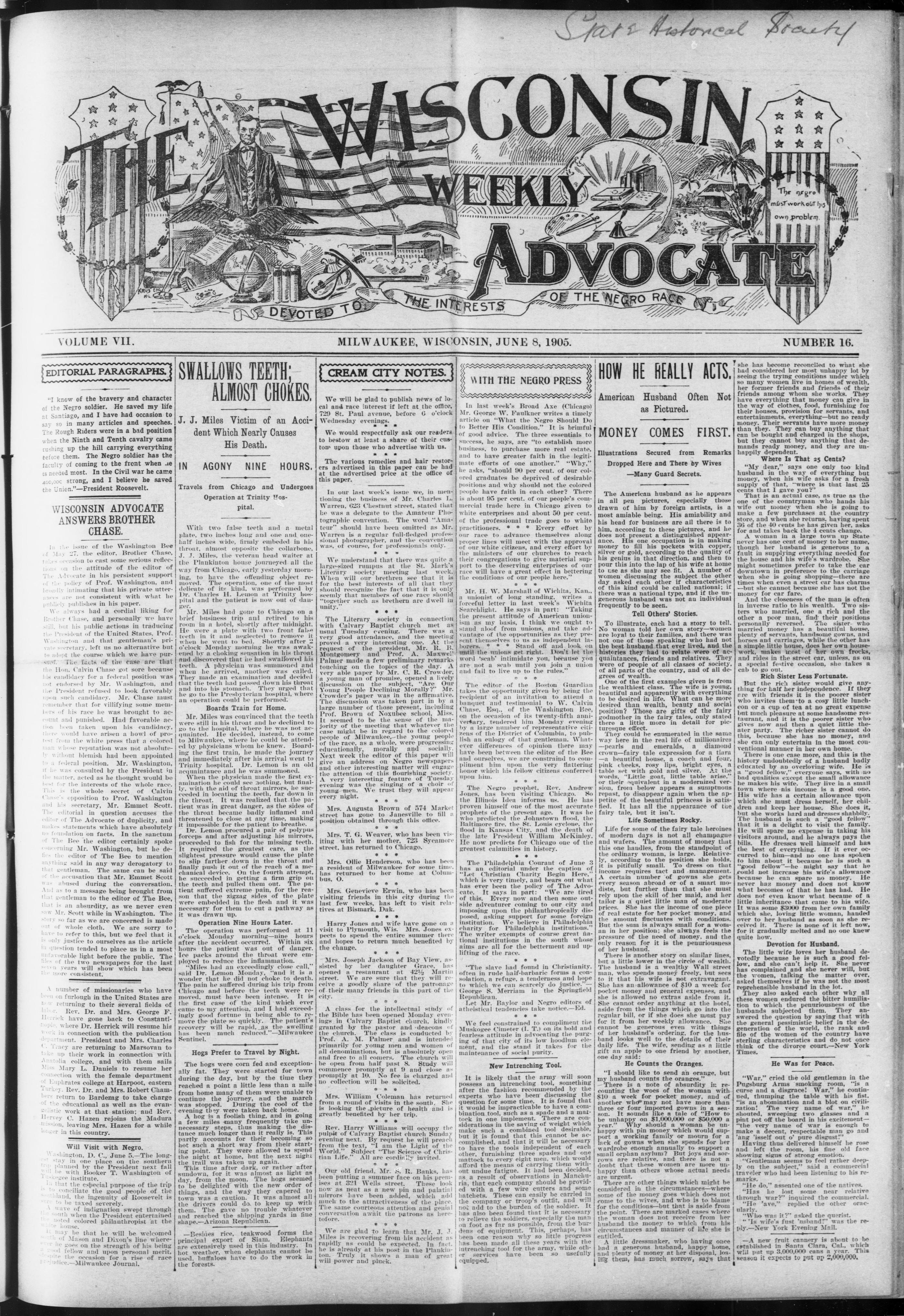
WISCONSIN
WEEKLY
ADVOCATE
DEVOTED TO
THE INTERESTS
OF THE NEGRO RACE
VOLUME VII.
EDITORIAL PARAGRAPHS.
"I know of the bravery and character of the Negro soldier. He saved my life at Santiago, and I have had occasion to say so in many articles and speeches. The Rough Riders were in a bad position when the Ninth and Tenth cavalry came rushing up the hill carrying everything before them. The Negro soldier has the faculty of coming to the front when he is needed most. In the Civil war he came 400,000 strong, and I believe he saved the Union."—President Roosevelt.
WISCONSIN ADVOCATE ANSWERS BROTHER
In the issue of the Washington Bee of May 27, the editor, Brother Chase, takes occasion to cast some serious reflections on the attitude of the editor of The Advocate in his persistent support of the policy of Prof. Washington, and broadly intimating that his private utterances are not consistent with what he publicly publishes in his paper.
We always had a cordial liking for Brother Chase, and personally we have still, but his public actions in traducing the President of the United States, Prof. Washington and that gentleman's private secretary, left us no alternative but to adopt the course which we have pursued. The facts of the case are that the Hon. Calvin Chase got sore because his candidacy for a federal position was not endorsed by Mr. Washington, and the President refused to look favorably upon such candidacy. Mr. Chase must remember that for villifying some members of his race he was brought to account and punished. Had favorable action been taken upon his candidacy, there would have arisen a howl of protest from the white press that a colored man whose reputation was not absolutely without blemish had been appointed to a federal position. Mr. Washington, it he consulted by the President in the matter, acted as he thought would be best for the interests of the whole race. This is the whole secret of Calvin Chase's opposition to Prof. Washington and his secretary, Mr. Emmet Scott. The editorial in question accuses the editor of The Advocate of duplicity, and makes statements which have absolutely no foundation on facts. In the sanctum of The Bee the editor certainly spoke concerning Mr. Washington, but he defies the editor of The Bee to mention anything said in any way derogatory to that gentleman. The same can be said of the accusation that Mr. Emmet Scott was abused during the conversation. And as to a message being brought from that gentleman to the editor of The Bee, that is an absurdity, as we never even saw Mr. Scott while in Washington. The story so far as we are concerned is made out of whole cloth. We are sorry to have to refer to this, but we feel that it is only justice to ourselves as the article in question tended to place us in a most unfavorable light before the public. The files of the two newspapers for the last seven years will show which has been the more consistent.
A number of missionaries who have been on furlough in the United States are now returning to their several fields of labor. Rev. Dr. and Mrs. George F. Herrick have gone back to Constantinople, where Dr. Herrick will resume his work in connection with the publication department. President and Mrs. Charles C. Tracy are returning to Marsovan to take up their work in connection with Anatolia college, and with them sails Miss Mary L. Daniels to resume her connection with the female department of Euphrates college at Harpoot, eastern Turkey. Rev. Dr. and Mrs. Robert Chambers return to Bardezag to take charge of the educational as well as the evangelistic work at that station; and Rev. Hervey C. Hazen rejoins the Madura mission, leaving Mrs. Hazen for a while longer in this country.
Will Visit with Negro.
Washington, D. C., June 5.—The longest stay in one place on the southern trip planned by the President next fall will be with Booker T. Washington of Tuskegee institute.
In that the especial purpose of the trip is to conciliate the good people of the southland, the ingenuity of Roosevelt is sure to be taxed severely.
A wave of indignation swept through the south when the President entertained the noted colored philanthropist at the white house.
It may be that he will be welcomed south of Mason and Dixon's line wherever he goes on the strength of his being a good fellow and upon personal merit, despite the occasion for a rise of race prejudice.—Milwaukee Journal
SWALLOWS TEETH; ALMOST CHOKES.
J. J. Miles Victim of an Accident Which Nearly Causes His Death.
With two false teeth and a metal plate, two inches long and one and one-half inches wide, firmly embedded in his throat, almost opposite the collarbone, J. J. Miles, the veteran head waiter at the Plankinton house journeyed all the way from Chicago, early yesterday morning, to have the offending object removed. The operation, one of the most delicate of its kind, was performed by Dr. Charles H. Lemon at Trinity hospital and the patient is now out of danger.
Mr. Miles had gone to Chicago on a brief business trip and retired to his room in a hotel, shortly after midnight. He wore a plate with two front false teeth in it and neglected to remove it when he went to bed. Shortly after 2 o'clock Monday morning he was awakened by a choking sensation in his throat and discovered that he had swallowed his teeth. A physician was summoned and when he arrived, another was called. They made an examination and decided that the teeth had passed down his throat and into his stomach. They urged that he go to the Presbyterian hospital, where an operation could be performed.
Boards Train for Home.
Mr. Miles was convinced that the teeth were still in his throat and he declined to go to the hospital, where he was not acquainted. He decided, instead, to come to Milwaukee, where he could be attended by physicians whom he knew. Boarding the first train, he made the journey and immediately after his arrival went to Trinity hospital. Dr. Lemon is an old acquaintance and he was summoned.
When the physician made the first examination he could see nothing, but finally, with the aid of throat mirrors, he succeeded in locating the teeth, far down in the throat. It was realized that the patient was in great danger, as the sides of the throat became badly inflamed and threatened to close at any time, making it impossible for the patient to breathe.
Dr. Lemon procured a pair of polypus forceps and after adjusting his mirrors, proceeded to fish for the missing teeth. It required the greatest care, as the slightest pressure would cause the plate to slip farther down in the throat and finally push it out of the reach of a mechanical device. On the fourth attempt, he succeeded in getting a firm grip on the teeth and pulled them out. The patient suffered extreme pain, for the reason that the zigzag sides of the plate were embedded in the flesh and it was necessary for them to cut a pathway as it was drawn up.
Operation Nine Hours Later.
The operation was performed at 11 o'clock Monday morning—nine hours after the accident occurred. Within six hours the patient was out of danger. Ice packs around the throat were employed to reduce the inflammation.
"Miles had an exceedingly close call," said Dr. Lemon Monday, "and it is a wonder that he did not choke to death. The pain he suffered during his trip from Chicago and before the teeth were removed, must have been intense. It is the first case of the kind which ever came to my attention, and I had exceedingly good fortune in being able to remove the plate so quickly. The patient's recovery will be rapid, as the swelling has been much reduced."—Milwaukee Sentinel.
Hogs Prefer to Travel by Night.
The hogs were corn fed and exceptionally fat. They were started for town during the day, but by the time they reached a point a little less than a mile from home many of them were unable to continue the journey, and the march was stopped. During the cool of the evening they were taken back home. A hog is a foolish thing, and in going a few miles many frequently take unnecessary steps, thus making the distance much longer than it really is. This partly accounts for their becoming so hot such a short way from their starting point. They were allowed to spend the night at home, but the next night the trail was taken up again.
This time after dark, or rather after sundown, for it was almost as light as day, from the moon. The hogs seemed to be delighted with the new order of things, and the way they capered to town was a caution. It was almost all the drivers could do to keep up with them. The gave no trouble whatever and reached the shipping yards in fine shape.—Arizona Republican.
Besides rice, teakwood forms the principal export of Siam. Elephants are extensively used in this industry. In hot weather, when elephants cannot be used, buffaloes have to do the work in the forests.
CREAM CITY NOTES.
We will be glad to publish news of local and race interest if left at the office, 729 St. Paul avenue, before G o'clock Wednesday evenings.
We would respectfully ask our readers to bestow at least a share of their custom upon those who advertise with us.
The various remedies and hair restorers advertised in this paper can be had at the advertised price at the office of this paper.
In our last week's issue we, in mentioning the business of Mr. Charles L. Warren, 623 Chestnut street, stated that he was a delegate to the Amateur Photographic convention. The word "Amateur" should have been omitted as Mr. Warren is a regular full-fledged professional photographer, and the convention was, of course, for professionals only.
* * *
We understand that there was quite a large-sized rumpus at the St. Mark's Literary society meeting last week. When will our brethren see that it is for the best interests of all that they should recognize the fact that it is only seemly that members of one race should "together such as brethern are dwell in unity."
***
The Literary society in connection with Calvary Baptist church met as usual Tuesday evening. There was a very good attendance, and the meeting proved a very interesting one. At the request of the president, Mr. R. B. Montgomery and Prof. A. Maxwell Palmer made a few preliminary remarks touching on the topics of the day. A very able paper by Mr. C. R. Crowder, a young man of promise, opened a lively discussion on the subject, "Are Our Young People Declining Morally?" Mr. Crowder's paper was in the affirmative. The discussion was taken part in by a large number of those present, including Prof. Brown of Noxubee school, Miss. It seemed to be the sense of the majority of the meeting that whatever the case might be in regard to the colored people of Milwaukee, the young people of the race, as a whole, were progressing educationally, morally and socially. Next week the editor of this paper will give an address on Negro newspapers and other interesting matter will engage the attention of this flourishing society. A very interesting feature of Tuesday evening was the singing of a choir of young men. We trust they will appear every night.
Mrs. Augusta Brown of 574 Market street has gone to Janesville to fill a position obtained through this office.
***
Mrs. T. G. Weaver, who has been visiting with her mother, 723 Sycamore street, has returned to Chicago.
* * *
Mrs. Ollie Henderson, who has been a resident of Milwaukee for some time, has returned to her home at Columbus, O.
* * *
Mrs. Genevieve Erwin, who has been visiting friends in this city during the last few weeks, has left to visit relatives at Bismark, Dak.
* * *
Harry Jones and wife have gone on a visit to Plymouth, Wis. Mrs. Jones expects to spend the entire summer there and hopes to return much benefited by the change.
* * *
Mrs. Joseph Jackson of Bay View, assisted by her daughter Grace, has opened a restaurant at $42 \frac{1}{2}$ Martin street. We are sure that they will receive a goodly share of the patronage of their many friends in this part of the city.
☆ ☆ ☆
A class for the intellectual study of the Bible has been opened Monday evenings in Calvary Baptist church, kindly granted by the pastor and deacons of the church. The class is conducted by Prof. A. M. Palmer and is intended primarily for young men and women of all denominations, but is absolutely open and free to all comers. The church will be open from half past 8. Study will commence promptly at 9 and close as promptly at 10. No fee is charged and no collection will be solicited.
```markdown
```
Mrs. William Coleman has returned from a round of visits in the south. She is looking the picture of health and is greatly benefited by her trip.
```markdown
```
Rev. Harry Williams will occupy the pulpit of Calvary Baptist church Sunday evening next. By request he will preach from the text, "I am the Light of the World." Subject "The Science of Christian Life." All are cordially invited.
* * *
Our old friend, Mr. S. R. Banks, has been putting a summer face on his premises at 321 Wells street. These look now as neat as a new pin and palatial mirrors have been added, which add much to the attractiveness of the place. The same courteous attention and genial conversation await the patrons as here-toore.
***
We are glad to learn that Mr. J. J. Miles is recovering from his accident as rapidly as could be expected. In fact he is already at his post in the Plankton. Truly it shows a man of great will power and pluck.
---
In last week's Broad Axe (Chicago) Mr. George W. Faulkner writes a timely article on "What the Negro Should Do to Better His Condition." It is brimful of good advice. The three essentials to success, he says, are "to establish more business, to purchase more real estate, and to have greater faith in the legitimate efforts of one another." "Why," he asks, "should 90 per cent. of our colored graduates be deprived of desirable positions and why should not the colored people have faith in each other? There is about 95 per cent. of our people's commercial trade here in Chicago given to white enterprises and about 50 per cent. of the professional trade goes to white practitioners. * * * Every effort by our race to advance themselves along proper lines will meet with the approval of our white citizens, and every effort by the ministers of our churches to reach their congregations to give material support to the deserving enterprises of our race will have a great effect in bettering the conditions of our people here."
Mr. H. W. Marshall of Wichita, Kan., a unionist of long standing, writes a forceful letter in last week's Wichita Searchlight. He says in part: "Taking the present attitude of American unionism as my basis, I think we ought to stand aloof from unions, and take advantage of the opportunities as they present themselves to us as independent laborers. * * * Stand off and look on until the unions get right. Don't let the word 'scab' intimidate you, because you are not a scab until you join a union and fail to live up to the rules."
The editor of the Boston Guardian takes the opportunity given by being the recipient of an invitation to attend a banquet and testimonial to W. Calvin Chase, Esq., of the Washington Bee, on the occasion of its twenty-fifth anniversary, tendered him Monday evening by a large number of representative citizens of the District of Columbia, to publish an eulogy of that gentleman. Whatever differences of opinion there may have been between the editor of the Bee and ourselves, we are constrained to compliment him upon the very flattering honor which his fellow citizens conferred upon him.
***
The Negro prophet, Rev. Andrew Jones, has been visiting Chicago. So the Illinois Idea informs us. He has proven himself one of the most accurate prophets of the present age. It was he who predicted the Johnstown flood, the Baltimore fire, the St. Louis cyclone, the flood in Kansas City, and the death of the late President William McKinley. He now predicts for Chicago one of the greatest calamities in history.
***
The Philadelphia Courant of June 3 has an editorial under the caption of "Let Christian Charity Begin Here," which is very timely, and bears out what has ever been the policy of The Advocate. It says in part: "We are tired of this. Every now and then some outside adventurer coming to our city and imposing upon the philanthropically disposed, asking support for some foreign institution. We believe in Philadelphia charity for Philadelphia institutions." The writer exempts of course great national institutions in the south whose aims are all for the betterment and uplifting of the race.
***
"The slave had found in Christianity, often in rude half-barbaric forms a consolation, a refuge, a tenderness and hope to which we can scarcely do justice." George S. Merriam in the Springfield Republican. Let Mr. Baylor and Negro editors of atheistical tendencies take notice.-Ed.
※ ※ ※
We feel constrained to compliment the Muskogee Cimeter (I. T.) on its bold and fearless attitude in advocating the purging of that city of its low hoodlum element, and the stand it takes for the maintenance of social purity.
New Intrenching Tool.
It is likely that the army will soon possess an intrenching tool, something after the fashion recommended by the experts who have been discussing the question for some time. It is found that it would be impracticable to have a combination tool, such as a spade and a matock in one implement. There are considerations in the saving of weight which make such a combined tool desirable, but it is found that this cannot be accomplished, and that it will be necessary to have the tools independent of each other, furnishing three spades and one matock to every eight men, which would afford the means of carrying them without undue fatigue. It had been decided, as a result of observations in Manchuria, that each company should be provided with a few wire cutters and some hatchets. These can easily be carried in the company or troop's outfit, and will not add to the burden of the soldier. It has also been found that it is necessary to relieve the soldiers, especially the man on foot as far as possible, from the burdens of equipment. This, perhaps, has been one reason why so little progress has been made all these years with the intrenching tool for the army, while other services have been so usefully equipped.
HOW HE REALLY ACTS.
Illustrations Secured from Remarks Dropped Here and There by Wives Many Guard Secrets.
The American husband as he appears in all pen pictures, especially those drawn of him by foreign artists, is a most amiable being. His amiability and his head for business are all there is to him, according to these pictures, and he does not present a distinguished appearance. His one occupation is in making money to fill his pockets with copper, silver or gold, according to the quality of his genius in that direction, and then to pour this into the lap of his wife at home to use as she may see fit. A number of women discussing the subject the other day asked each other if characteristics of this kind could be called national; if there was a national type, and if the ungenerous husband was not an individual frequently to be seen.
Tell Others' Stories.
To illustrate, each had a story to tell. No woman told her own story—women are loyal to their families, and there was not one of those speaking who had not the best husband that ever lived, and the histories they had to relate were of acquaintances, friends and relatives. They were of people of all classes of society, of all parts of the country, and of all degrees of wealth. One of the first examples given is from the wealthiest class. The wife is young, beautiful and apparently with everything to be desired in life. What can be more desired than wealth, beauty and social position? Those are gifts of the fairy godmother in the fairy tales, only stated there a little more in detail for picturesque effect.
They could be enumerated in the same way here in the real life of millionaires—pearls and emeralds, a diamond crown—fairy tale expression for a tiara—a beautiful house, a coach and fear, pink cheeks, rosy lips, bright eyes, a table set with gold and silver. At the words, "Little goat, little table arise," or their equivalent in a modernized version, from below appears a sumptuous repast, to disappear again when the appetite of the beautiful princess is satisfied. It has all the appearance of the fairy tale, but it isn't.
Life Sometimes Rocky.
Life for some of the fairy tale heroines of modern days is not all champagne and wafers. The amount of money that this one handles, from the standpoint of the ordinary woman, is large. Relatively, according to the position she holds, it is pitifully small. To dress on that income requires tact and management. A certain number of gowns she gets every season abroad or of a smart modiste, but further than that she must rely upon the skill of her maid, and her tailor is a quiet little man of moderate prices. She has the income of one piece of real estate for her pocket money, and the amount fluctuates with conditions. But the sum is always small for a woman in her position; she always feels the pressure of the need of money, and the only reason for it is the penuriousness of her husband.
There is another story on similar lines, but a little lower in the circle of wealth. The husband is a wealthy Wall street man, who spends money freely, but sees to it that his wife is not extravagant. She has an allowance of $10 a week for pocket money and general expenses, and she is allowed no extras aside from it. She cannot order anything at the hotel, aside from the things which go into the regular bill, or if she does she must pay for it from her weekly allowance. She cannot be generous even with things of her husband's ordering, for the husband looks well to the details of their daily life. The wife, sending as a little gift an apple to one friend by another, one day said:
He Counts the Oranges.
"I should like to send an orange, but my husband counts the oranges."
There is a note of absurdity in recounting the woes of the woman with $10 a week for pocket money, and of another who may not have more than three or four imported gowns in a season. It sounds like a tale of "How to be unhappy on $1,000,000 or $50,000 a year." Why should a woman be unhappy with pin money which would support a working family or mourn for a lack of gowns when she spends for her wardrobe enough annually to support a small orphan asylum? But joys and sorrows are relative, and there is not a doubt that these women are more unhappy than others whose actual needs are urgent.
There are other things which might be considered in the circumstances—where some of the money goes which does not come to the wives, and who is to blame for the conditions—but that is aside from the point. There are marked cases where the woman does not receive from her husband the money to which from his circumstances and manner of life she is entitled. A little dressmaker, who having once had a generous husband, happy home, and plenty of money at her disposal, losing them, has much sorrow, says that
she has become reconciled to what she had considered her most unhappy lot by seeing the trying conditions under which so many women live in homes of wealth, her former friends and friends of their friends among whom she works. They have everything that money can give in the way of clothes, food, furnishing for their houses, provision for servants, and entertainments, everything—but no ready money. Their servants have more money than they. They can buy anything that can be bought and charged in the shops, but they cannot buy anything that demands ready money, and they are unhappily dependent.
Where Is That 25 Cents?
"My dear," says one only too kind husband in the way of everything but money, when his wife asks for a fresh supply of that, "where is that last 25 cents that I gave you?" That is an actual case, as true as the one of the countryman who hands his wife out money when she is going to make a few purchases at the country store, and when she returns, having spent 36 of the 40 cents he has given her, asks for and takes back the 4 cents change.
A woman in a large town up State never has one cent of money to her name, though her husband is generous to a fault in supplying everything needed for the house and his wife's wardrobe. She might sometimes prefer to take the car downtown in preference to the carriage when she is going shopping—there are times when even a street car has charms—but she cannot because she has not the money for car fare.
And the closeness of the man is often in inverse ratio to his wealth. Two sisters who married, one a rich and the other a poor man, find their positions personally reversed. The sister who married money has a beautiful house, plenty of servants, handsome gowns, and horses and carriages, while the other has a simple little house, does her own housework, makes most of her own frocks, and rides in the street car, unless, as on a special festive occasion, she takes a cab to go out.
Rich Sister Less Fortunate.
But the rich sister would give anything for half her independence. If they are with friends it is the poorer sister who invites them to a cosy little luncheon or a cup of tea at no great expense but much pleasure at some handsome restaurant, and it is the poorer sister who gives now and then a quiet little theater party. The richer sister cannot do this, because she has no money, and she can only entertain in the most conventional manner in her own home.
There is one case more, and this is the history undoubtedly of a husband badly educated by an overloving wife. He is a "good fellow," everyone says, with no bad qualities except the small allowance he makes his wife. They live in a small town where nis income is a good one. His wife has a certain allowance upon which she must dress herself, her children and keep her house. She does it, but she works hard and dresses shabbily. The husband is such a "good fellow" that it is a delight to visit the family. He will spare no expense in taking his visitors around, and he always pays the bills. He dresses well himself and has the best of everything. If it ever occurred to him—and no one has spoken to him about it because he is such a "good fellow"—he might say that he could not increase his wife's allowance because he can spare no money. He never haz money and does not know what becomes of that he has had. He does not even know what became of a little inheritance that came to his wife. It was some $3000 from her own family which she, loving little woman, handed over to her husband as soon as she received it. There is none of it left now, for it gradually melted and no one knew quite how.
Devotion for Husband
The little wife loves her husband devotedly because he is such a good fellow, and she can't help it. She never has complained and she never will, but the women, talking the matter over, asked themselves if he was not the most reprehensible husband in the lot. They also asked each other why all these women endured the bitter humiliation to which the penuriousness of the husbands subjected them. They answered the question by saying that with the general pessimistic belief in the degeneration of the world, the rank and file of the women of the country have sterling characteristics and do not once think of the divorce court.—New York Times.
He Was for Peace.
"War," cried the old gentleman in the Pugsburg Arms smoking room, "is a curse and a disgrace! War," he continued, thumping the table with his fist, "is an abomination and a blot on civilization! The very name of war," he shouted, sweeping two glasses and a pint pot off the board in his excitement—"the very name of war is enough to make a decent, respectable man go and 'ang 'isself out o' pure disgust!"
Having thus delivered himself he rose and left the room, his fine old face showing signs of strong emotion.
"Gentleman seems to feel rather deeply on the subject," said a commercial traveler who had been listening to his remarks.
"He do," assented one of the natives.
"Has he lost some near relative through war?" inquired the commercial.
"He 'ave,' replied the other oracularly.
"Who was it?" asked the querist.
"Is wife's fust 'usband!'" was the reply.—New York Evening Mail.
—A new fruit cannery is about to be established in Santa Clara, Cal., which will pat up 3,000,000 cans a year. This season it expects to put up 2,000,000.
Curious Condensations.
In 1840 tea planting in India did not exist, yet last year it produced 60 per cent. of the total consumption in Britain.
The electric tramway of Lisbon, Portugal, is said to be the finest in Southern Europe. It was installed by an American concern.
The Shah of Persia has placed another order for six high-class automobiles in Paris. The value of this order is said to be $28,800.
There are forty-four members of the United States Senate 60 years of age and over; some of them have passed 70 and two are octogenarians.
Wildeats are said to be on the increase in Scotland. And it will be four years before Mr. Roosevelt is at liberty to go over there and attend to the trouble.
The imperial kitchen of the Austrian Emperor at Vienna costs about $250 a day, says a German contemporary. In this sum, however, are not included the extra expenses for court dinners, etc.
John D. Rockfeller's wealth in silver dollars would, some one has estimated, weigh as much as two first-class battle-ships; in one-dollar bills it would make a double girdle around the earth and leave a remnant 1550 miles long.
—In a recent lecture in London it was remarked as curious that though the Thibetans had not realized the principle of the wheel or arch, they thoroughly understand that of the cantilever and used it in their bridges.
—The Earl of Southesk, who died recently, was very proud of a picturesque herd of Highland cattle he owned. When he was dying he was carried, at his desire, in a couch, to a window, and the cattle were paraded past it, that he might see them once more.
—It is safe to assume that at the conclusion of the present hostilities, of which Korea is at least partially the objective, but from the ravages of which she has been thus far providentially spared, a great development awaits her, and further expansion of her foreign trade.
-If the camphor bottle becomes roilly it is going to storm. When it clears settled weather may be expected. This idea has seemingly been utilized in the manufacture of some of our cheap barometers. The main trouble is they seldom foretell the change until near its arrival.
-Remarkable fireproofing properties are credited to oxide of titanium by an English dyer. Flannelette treated with it could not be made to burst into flame, and other textiles are claimed to be made equally resistant, while it cannot be removed by dyeing, boiling or washing.
The government of the Dominion of Canada has decided to give a grant of $50,000 to a Dominion exhibition to be held during the coming summer at New Westminster, British Columbia. Part of the grant will have to be expended in paying freight on exhibits from other provinces.
The smallest full-grown elephant in Europe is on exhibition in London. He is 33 inches in height and weighs 230 pounds. When he was taken to a photographic gallery the other day for his picture he went in a cab. A luncheon of buns and brandy and water was provided for him.
-It may be that Hirdhito Michi-No-Miya will be the next Emperor of Japan. He is the son of the crown prince, who, it is understood, has symptoms of consumption. The little prince is now 4 years old, and the ministers of Japan are already looking about to find a wife for him. He will have nothing to say about the matter and must marry whoever is chosen for him.
A CINEMATOGRAPH MARTYR
Bound and Devoured by Real Lions in the Arena.
In a tall, glass-roofed building, just outside Paris, high up on the top floor, where the light is good, a strange and interesting spectacle was witnessed recently.
The building belongs to the firm of Pathe Brothers and the floor had been converted into a very good imitation of an area where, for the benefit of the cinematograph operator, a "Christian captive" was to be torn to pieces to make "a Roman holiday."
In the corner of the arena an overturned chariot lay, while the cardboard horses which had drawn it beat the air with their hoofs in an ineffectual effort to recover their equilibrium. A dead warrior lay near by, and helmets, swords and other articles which had figured in the deadly fray were scattered over the ground.
On the imperial tribune, Nero, with a silver wreath encircling his brow, sat among his favorites. When the operator was ready to begin, three bareheaded and barelegged slaves came on the scene, rolled away a chariot wheel, and carried out the dead Roman. Then Nero raised his hand, and immediately a procession of slaves and soldiers filed into the arena.
The slaves were scantily attired, and wore sandals. The soldiers were clad in chain armor, and were equipped with shields, leg-guards and helmets. In the center walked a noble-looking white "captive," and as the rear guard passed me I noticed a copy of The Matin sticking out of one of the soldier's pockets. When the procession had passed once around the arena it drew up in front of the imperial tribune, and the slaves and the noble captive knelt before Nero, shouting, "We who are about to die salute thee."
Then two guards sprang forward, seized the captive, dragged him, resisting, to the stake in the center of the arena, and securely bound him to it. The cinematograph stopped clicking.
The captive was released and replaced by a dummy figure to which were attached several pieces of meat freshly dipped in blood.
Nero nodded once more, and Juliano, a well-known lion tamer, clad like a gladiator, entered the arena. He was quickly followed by four live lions, which roamed about the place in search of a victim.
Suddenly one of them sighted the "Christian" bound to the stake. With a growl the beast rushed upon him and tore him limb from limb.
All this time the cinematograph had been working off its films, and in a very short space of time a realistic representation of the death of a Christian in the arena had been secured.—London Mail.
Manila's Population.
The board of health for the Phillipine islands, in its report for the last month in 1904, shows resident in Manila at that time 4389 Americans, 2528 Spaniards, 1117 Europeans of various nationalities, 189,782 Filipinos, 21,230 Chinese and 895 persons not classified, a total of 219,941 persons. The death rate for the year 1904 was highest in September, when it reached 58.89, and lowest in March, when it subsided to 40.23.
Untidily Dressed Nurses.
There is no doubt that a proportion of nurses, whose training is unimpeachable, do not dress as trimly as they might when they are out-of-doors. If unqualified persons dishonor the uniform by appropriating it without right, those who are entitled to the uniform should honor it by wearing it becomingly.—London Hospital.
JOHN HAY A POET.
The stanzas below, entitled "Humility," are from the pen of John Hay, better known as diplomat, editor and historian, than as a poet. The verses were written for the World's Christian Endeavor Convention at Washington a few years ago, but have just found enduring place, being chosen now as one of the hymns in the new "Hymns of Worship and Service:"
Lord! from far-severed climes we come To meet at last in Thee, our Home. Thou who hast been our guide and guard Pe still our hope, our rich reward.
Defend us, Lord, from every ill. Strengthen our hearts to do Thy will. In all we plan and all we do Still keep us to Thy service true.
O let us hear the inspiring word Which they of old at Horeb heard; Breathe to our hearts the high command, "Go onward and possess the land."
Thou who are Light, shine on each soul!
Thou who are Truth, each mind control!
Open our eyes and make us see
The path which leads to heaven and Thee!
MRS. SANDEMAN'S SON.
Mrs. Sandeman sat smilingly listening to Mrs. Prendergast and feeling that she should hate her as long as she lived. They had been friends in girlhood, and, having married men in the same regiment, had never been very long separated since. Now that their husbands Lad retired on half-pay, they had both settled in the same provincial town.
Mrs. Prendergast was paying a rather late visit, having been, in fact, making a round to tell her good news to as many friends as possible. Her son Clement during his first year at a London hospital had gained a hundred pounds' exhibition in science. Having informed Mrs. Sanderman of the fact, she began to enlarge upon the consequent saving, insisting that, from the day of his birth, Clement had never been anything but a source of comfort and happiness.
And Mrs. Sandeman listened and smiled with the bitterest sensations, offering profuse congratulations while her small and still attractive face flushed more and more deeply. Clement Prendergast and her own boy, Hartley, had been at the same local schools—rivals, in a manner, of several years' standing. The great anxiety of Mrs. Sandeman's life concerned Hartley's future. Unlike Prendergast, Maj. Sandeman possessed little beyond his half-pay, so that there had long been a severe struggle to maintain that equality of appearances beneath which Mrs. Sandeman would not willingly have sunk.
It had been at last determined that Hartley's profession should be the law, which to the person chiefly interested seemed as much an evil as any other. But, after a series of failures over the preliminary examination, his tutor had candidly advised Maj. Sandeman that further effort would inevitably prove a waste of time and money. When Mrs. Prendergast had offered condolences, Mrs. Sandeman had treated the affair as a subject almost for congratulation.
"Hartley has not a pettifogging mind," she said. Maj. Sandeman, however, insisted that the boy must not be allowed to spend any more time loafing about the town with a pipe in his mouth. The major was a tall, heavily built man, with a gray mustache and a rubicund, healthy corplexion—a man of few words. In his quandry concerning Hartley he turned to a former friend, the owner of a large business in St. Paul's churchyard, who agreed to receive the boy into his counting house. Hartley had now been living in London lodgings nearly a year, and only last month had written to ask his mother for £10 by return of post. Without a word to her husband, she had sent £2, which were all she could spare at the moment. This late afternoon in October she sat in her dim drawing room thinking of Hartley's letter, while she smiled and congratulated and hated Mrs. Prendergast.
"And now," said the visitor, when she had enlarged upon the advantage of Clement's exhibition from every possible point of view, "how is your boy getting along?"
"Splendidly," answered Mrs. Sandeman, "splendidly. We have the most favorable reports of him. Twice already his salary has been increased. He seems to have quite a genius for figures. Of course, you know that Mr. Vincent is one of our merchant princes."
"Then you hope Hartley may ultimately have a good position?"
"My dear!" cried Mrs. Sandeman, "he has a good position already. Mr. Vincent has no sons and four daughters. There is not the slightest question that before many years have passed Hartley will become a member of the firm."
She was in the ordinary course of things a truthful woman, but, as she admitted two days later, she really could not help it. The admission, indeed, was forced from her. There was a club in the town, and Maj. Sandeman was a member, although he seldom touched a cue or a card. Two days after Mrs. Prendergast's visit Maj. Prendergast had taken him aside, and with great cordiality congratulated him upon the excellence of Hartley's prospects.
"To tell the truth, Jim," said Maj. Prendergast, a short, slimly built man of an anxious, nervous temperament, "it was rather a relief after what I had heard."
"What had you heard?" demanded Sandeman.
"Oh, well, boys will be boys—even one's own, you know," was the answer, and Maj. Sandeman walked solemnly home to ask what his wife had been talking about.
"I couldn't help it, Jim!" she exclaimed. "To sit there and hear Helena talk about Clement's success was more than human nature could endure."
The major did not answer; he neither smiled nor frowned, but sat stolidly in his chair, wondering what Ted Prendergast had heard (from Clement, no doubt) about Hartley, who astonished his mother and father by arriving home at 6:30 the following afternoon. It was one of the rare occasions when the Sandemans expected guests to dine, and when the bell rang the major happened to be in his dressing room, taking out his evening clothes.
"Jim!" cried Mrs. Sandeman, from the floor beneath, "Jim! It's Hartley."
"Hartley?" said her husband, and walked heavily downstairs, joining his wife in the hall as the very young housemaid opened the door. Outside stood a fly, with two boxes on the roof.
Hartley was a tall, slender young man, of rather prepossessing appearance, but this afternoon he entered the house with a hangdog air.
"Well, mother; well, father," he muttered, with considerable embarrassment.
and, even in the midst of her consternation. Mrs. Sandeman remembered that the four guests would arrive in less than an hour.
"Whatever is the matter now?" she demanded, and, with a rueful glance at the inquisitive housemaid, Hartley went into the dining room, where the cloth had been laid, with a piece of Indian embroidery as a "table center," and the napkins folded into fans for the dinner party. There, to his parents' dismay, he leaned against the wall, burying his face in his coat sleeve and sobbing like a small child. The story was soon told. He had got into a scrape, had been pushed for money, helped himself to a ten-pound note, and, on the inevitable detection, had been turned reck and crop out of Vincent's office—only for his father's sake being spared prosecution.
The major's face remained almost as impassive as usual, and, although Mrs. Sandeman's cheeks were wet, she thought of her now unwelcome guests and tried to check her tears. It was arranged that Hartley should remain in his own room, partly because his presence at the table might lead to inconvenient inquiries, but principally for the reason that he had parted with his evening suit. Maj. Sandeman walked upstairs rather more heavily than he had come down, and began methodically to take off his coat and waist coat. He was the first to enter the drawing room, where the gas had been lighted and the blinds drawn down. He stooped to pick up a piece of paper which had been dropped in the fender. He still had a profound admiration for his wife, an extraordinarily youthful looking woman for her years, which were 42, and considerable fewer than the major's. On the rave occasions when she appeared in an evening dress his eyes would dwell upon her a little regretfully, inasmuch as fate had ordained that her light should remain hidden under a bushel.
But this evening he was quite startled when she entered the drawing room, her face being daubed with powder to such an extent that it locked positively grotesque. Before the major could expostulate Mr. and Mrs. Wentworth arrived, and at the same time he perceived the odor of tobacco, unpleasant just before dinner, and doubtless coming from Hartley's bedroom. As Mrs. Sandeman sat volubly talking, Mrs. Wentworth glanced at her face, then covertly at Mr. Wentworth, but the hostess continued to talk without much idea of what she said until the small party was complete.
When dinner was announced Maj. Sandeman made no attempt to move, and as Mrs. Sandeman touched his sleeve he seemed to rouse himself with a start, so that the visitors rallied him and Hartley heard them laughing as they went downstairs. The soup tureen had been removed, and the major sat abstractedly crumbling his bread, when Mrs. Wentworth addressed her hostess.
"Ethel saw Hartley on his way from the station a little while ago," she remarked, looking round the table as if, perhaps, she had hitherto overlooked his presence.
"Oh, yes!" cried Mrs. Sandeman, with ghastly cheerfulness; "he arrived more than an hour ago, but he had been so busy up to the very last moment in London that we persuaded him not to come in."
Raising his pale, placid eyes, Maj. Sandeman gazed at his wife in bewilderment.
"Has the boy got a holiday, Sandeman?" asked Mr. Wentworth.
"Of course," said the hostess, before the embarrassed major could answer for himself, "you have not heard. Hartley has left the city. The office was never really congenial to him."
"Anything else in view?"
"The fact is," answered Mrs. Sandeman, while the major continued to gaze at her whitened face instead of eating his dinner, "it's supposed to be a secret for the present."
Nothing further was said concerning Hartley, but when the guests had departed, after a dismal evening, Sandeman walked to the drawing room door.
"Jim!" cried his wife, "where are you going?"
"To call Hartley."
"Tonight?"
"There's no use in putting it off," he answered, without any reference to what had passed at the dinner table. "The boy has disgraced himself."
"I'm sure he repents sincerely enough, Jim!"
"He can't stay in England. He must go away; the sooner the better," said Maj. Sandeman, and with that he went to Hartley's room and opened the door. It was entirely dark, and for a few moments he stood on the threshold listening to his son's regular breathing. "Sound asleep," he said, on rejoining Mrs. Sandeman. "He doesn't care. How much sleep will you get tonight?"
They sat up very late, discussing Hartley's future. He must be sent away, and he must be provided with an outfit. On inquiring whether there was enough money at the bank for this and the passage money, Mrs. Sandeman was told that everything could be managed. Accustomed to leave such matters to his control, and also habituated to his uncommunicativeness, she questioned no further, and, after a painful breakfast with Hartley the next morning, Maj. Sandeman left the house, as if he were going to the club to read the newspaper, as usual. Instead, however, he turned his steps toward Maj. Prendergast's, the old friends shaking hands and sitting down.
"So you have Hartley at home?" said Prendergast, with a scrutinizing glance.
"Ted," answered Sandeman, with rnwonted feeling, "I want £50. For heaven's sake, let me have it if you can."
By way of an answer, Prendergast opened a drawer in his writing table, took out his checkbook and filled in a draft for the requisite sum.
"Don't tell me unless you like," he said, handing over the check; "only sometimes it's a bit of a relief to talk to some one, you know."
In slow but jerky sentences the story came out, and when Sandeman had gone Prendergast lost no time in repeating it to his wife.
"I knew!" she exclaimed. "I knew perfectly well that Elizabeth wasn't speaking the truth. Of course, after what we had heard from Clement, it was ridiculous."
Although she would have liked to see Mrs. Sandeman, she avoided the house that day, but on the next it chanced that she met Elizabeth at a common friend's. On her arrival Mrs. Sandeman was in the midst of a monologue.
"Such a magnificent appointment," she was saying. "Quite one in ten thousand! We consider Hartley extremely
fortunate. He and his father have gone to London today to see about his outfit and the passage."
"To what part of the world is he going?" inquired the hostess.
"To Canada."
"A government appointment?"
"Oh, yes, it is a government appointment," said Mrs. Sandeman. "We shall naturally miss him immensely—such a dear boy as he has always been! But there, one mustn't think about one's self, must one?" she asked, gazing around the small circle with moist eyes. "What an expense, to be sure!" remarked an elderly lady sitting next to Mrs. Prendergast. "Ah, you well may say that!" was the answer. "But, then, you must remember that money couldn't be better spent." "Besides," suggested the hostess, "I imagine there is an allowance for Hartley's outfit."
"Exactly—an allowance," said Mrs. Sandemann, rising from her chair. "Is Clement all right?" she added, addressing Mrs. Prendergast on her way to the door. On the road home she looked very straight before her, and at once returned to the task of arranging Hartley's clothes. At a late hour Maj. Sandeman came back with his son, whose ship was to sail that day week, when Mrs. Sandeman took him into her bedroom and begged him to kneel by her side, then clasped his arm as they went downstairs, where the major stood coughing in the hall. He accompanied Hartley to the docks, parting from him with a few words and a heavy heart after the bell had rung as a warning for visitors to leave the vessel. It was a rainy day, but Maj. Sandeman waited on the quay with his umbrella still furled until the ship began to move, and Hartley stood in his long mackintosh on the lower deck, waving a limp hand.
Two days later, stirred by sympathy, Maj. Prendergast overcame his dislike to afternoon visits, and offered to take his wife to see Mrs. Sandeman, and, after a few remarks about the dismal weather, Maj. Sandeman entered the drawing room. He shook hands and then took his favorite position before the fireplace, Mrs. Sandeman's back being turned toward him as she talked to her guests.
"Do you miss the youngster, Elizabeth?" exclaimed Maj. Prendergast, in his sharp, jerky manner.
"Ah, it was a dreadful wrench!" she answered. "But, then, one can't expect to keep one's son always at one's apron strings, you know."
"Now, that's a sensible way to look at it," he said, with great cordiality.
"And then," she continued, "we realize how much it is for his advantage. No young man in the world could have better prospects."
Prendergast looked up at Sandeman's inexpressive face as he stood behind his wife's chair. Maj. Sandeman passed a shaky hand over his gray moustache, and then Prendergast glanced a little apprehensively at Mrs. Prendergast.
"Your stay-at-home boys," cried Mrs. Sandeman, "may be well enough in their way." Mrs. Prendergast's cheeks became suddenly very red. "But," added her hostess, "to whom does the country owe its greatness?"
"Ah, yes, true," Maj. Prendergast admitted. "The scallawags have helped to make the empire—no doubt about that!"
"Scallawags!" gasped Mrs. Sandeman, sitting exceedingly erect, while Maj. Prendergast glanced at his wife with more apprehensiveness than ever.
He perceived now that Mrs. Sandeman was ignorant of the loan, and that she assumed his and his wife's equally complete ignorance of the actual circumstances of Hartley's exodus. He understood also that these two women were rival mothers, and that the unfortunate criticism of "stay-at-homes" might easily be resented. Maj. Prendergast began to fidget in his chair, dreading the exposure which seemed to be hanging over Mrs. Sandeman's head, while, unfortunately, Mrs. Prendergast would not look in his direction.
"Thank goodness," continued Mrs. Sandeman, with her eyes on Mrs. Prendergast's flushed, angry face, "no boy could be less of a scallawag than ours! Never a moment's anxiety. As I say, it is quite right to praise the plodding stay-at-home young men, but"—with a flourish of her hands—"there are others who require a wider field for their enterprise."
She positively glared at Mrs. Prendergast, who had begun to unbutton and rebutton her gloves in her scarcely repressible excitement. As one of the buttons came off, she gave vent to a quiet but rather scornful laugh, which Maj. Prendergast understood as an introduction to the retort to which Hartley's mother had fatuously laid herself open. Rising from his chair, he touched Mrs. Prendergast's arm. "My dear," he cried, "don't you think it's time"—
"Oh, you mustn't think of going yet!" said Mrs. Sandeman, and certainly Mrs. Prendergast had no intention to depart until she had launched her bolt. But she now observed that Ted was regarding her strangely, and suddenly she began to discern the meaning of his curiously anxious expression. Following his example, she also arose, advancing to Mrs. Sandeman's chair. Stooping over her, she placed an arm around her neck—an action which had not been ventured upon since they were girls together.
"Elizabeth," she said, "I can't tell you how glad I am to hear that Hartley has such splendid prospects. And I feel certain the dear boy deserves his good fortune!"
Mrs. Sandeman quite broke down, and Mrs. Prendergast declared that her hand ached for several days in consequence of Maj. Sandeman's grip when she bade him good-bye.—Thomas Cobb in the Sketch.
How Animals Escape Extermination
How is the balance of life on the globe maintained? Why have not species exterminated species? Why have not the birds exterminated the insects and the hawks and owls exterminated the birds? Because the insects are so much more prolific than the birds and the birds so much more prolific than the hawks and owls. The hawks and owls are also more restricted as to food. The more adaptive an animal is the greater are the chances of surviving. If wolves and foxes could browse like deer and sheep and rabbits they would be as numerous as these latter species.
The potato bug has unduly increased in the east because its food is abundant, and its enemies have not appeared. The forest worms threatened to destroy the maple woods of some sections, till its enemy, the ichnuman fly, appeared. Rabbits have increased unduly in Australia because their natural enemies have not kept pace.—John Burroughs, in Outing.
Nature's Strange Bombs.
A Philadelphia girl who spent part of the winter in the south brought back with her some shells of a small marine snail about half an inch in diameter which she picked up on the shore of Mobile bay. When she reached this city and unpacked her trunks she noticed an unpleasant odor, and investigation showed it to be due to these shells, which she had packed up with other treasure trove. While she was taking the shells from the trunk one of them dropped on the uncarpeted floor and exploded with a loud report. Trying the remaining shells, there were only two out of the nine she had that did not explode under similar treatment.
The scientific explanation is that each shell was closed by a membrane formed by the drying of the animal's slime, while the gases from the decomposition of the dead inhabitant of the shell filled the air chamber with considerable pressure.—Philadelphia Record.
Trees from Other Climes
The effort to introduce trees, plants, shrubs and exotics of other climates into the parks of New York has been successful, according to the experts employed in the work. Strange to say, rare types like the silver, mucronate, Norway and New Holland spruce; African and Lebanon cedar; Australian and pyramidal cypress; silver leaf, Bermuda, Chinese. Cracow, spiral, Phoenician, Swedish and Spanish incense juniper; Nepaul, Calabrian, Siberian, Italian and Scotch pine, seem to retain their vigor and stand the soil, dust and dirt of the city better than the commoner trees. The gift of Miss Helen Gould to the Bronx of some 230 exotics, including tropical trees, makes the botanical gardens first in the collecting of these types. The Madagascar areca, the wax, royal and Washington palms, and the Panama tree are most valuable additions.—New York Letter to Pittsburg Dispatch.
Why He Withdrew.
A misguided, but undoubtedly honest Modern Woodman, of Hopeville, Ia., surrendered his benefit certificate to the head office of the Woodman society, stating that he felt he could not consistently be a good member of the church and a fraternal benefit society member at the same time. Here is the letter verbatim:
"You will find policy (certificate) closed. The camp may consitter is self undre no obligatons to me from now on my reason for this is i becom converted and i feel as tho I have work anuff in the cherch and feel as though a christon cant afford to while away his time behind locked doors. And having things that i dare not tell our famelys i find to go in to the cherch of christ i dont hafto be branded or ride a gote or ware no hood wink mi eyes are opened to the buteys of heven mi concence keep smarten me until i with drew from the camp."
He Obeyed Butler's Order.
A southern planter went to New Orleans several months after Gen. Butler had taken the reins in his hands and acquired a reputation for "tyranny." So says Everywhere, which thus continues the story:
One of the first things he saw was the placards of a gentleman's furnishing store posted on the walls and fences: "Get your shirts at Moody's."
The planter saw it again and again, and mused deeply upon it.
"It's another of Butler's orders," he said to himself: "he's probably a partner in the concern, and what he says 'goes'; so I suppose it's best to submit. I don't need any shirts, and it's a shame to be compelled to buy 'em now; but I don't want any more trouble."
He accordingly went to Moody's and bought half a dozen shirts on compulsion.
—Philadelphia Record.
Wealthy Men's Sons as 'Longshoremen.
Sons of wealthy men working as longshoremen and deck hands, is said by Paul B. Lansing of San Francisco to be the latest fad among the moderately rich residing on the Pacific coast.
"Do you know," said Mr. Lansing, "that many of the wealthy shippers and ship owners on the Pacific coast now have a fad which is spreading rapidly and which is unusual—most unusual? They are giving their sons jobs as deck hands on their vessels and as freight handlers on their wharves, and are making their sons like it. The boys, many of whom have just been released from college, get no more money and just as much work as any of their fathers' employees. The old men seem to think that it will prepare the young men for their entrance into the business world and will make them appreciate wealth when they get it."—Denver Republican.
Baby's Finger Prints
The possibilities in finger-print identification recently led to a curious question being put to Dr. Francis Galton, the great finger-print expert, by the police authorities of a foreign state. They had received information, they said, that a baby who was heir to a great title and estate was in danger of being kidnapped and held to ransom. Supposing this should happen, and the baby eventually be restored, would finger-prints taken before the abduction be sufficient to identify the baby and prove that he was not a changeling? Dr. Galton's answer was that it is exceedingly difficult to print from the fingers of young infants. From about six years of age and upward, however, there is no difficulty, and the prints would be sufficient for identification.—London Express.
Outlawed National Bank Notes
The financial world will be greatly startled by a decision just rendered in Minnesota by a justice of the peace to the effect that a national bank bill is outlawed and cannot be of any value to any one, and therefore cannot constitute a good tender for a debt after six years from its date. The opinion of the learned justice states that the law is to the effect that a demand must be made within six years in order to preserve a cause of action on a demand note, that the banknote is a demand note, and in the absence of proof that payment thereof had ever been demanded of the bank the note is outlawed. Strange that no one thought of it before.—Case and Comment.
"There's Be No Pie."
An energetic pastor, who was making preparations to build a new church, received all kinds of advice from parishioners, and the greatest amount came from those who had contributed the least towards the erection of the church. So at the regular services on the following Sunday he said:
"I have been receiving lots of advice during the last few weeks. I have been told by certain members of the congregation that it will not do to have too many fingers in the pie. I can assure you that I will attend to that part of it; there will be no pie."—Harpers Weekly.
Largest Reservoir Filled
The largest artificial lake in America, the big Cheesman reservoir, from which the city of Denver gets its water supply, is today filled, for the first time in its history, and water is flowing over the spillway of the dam, 212 feet from the bottom. Heavy snow in the mountains has caused the unusual supply. Cheesman lake holds 30,000,000,000 gallons, enough to supply the city of Denver for three years.
BLUFFING
A heap er bluffin' s done dese days,
En I reckin', fus' en las', hit pays.
If hit 's man er beas', don't pay de leas'
"Tention to wut hit doos er says.
De adder 'll spread es haid en blow
En flick es tongue en kille up so
You'd hol' yo' bref, ha'f scared to def,
If you 'd come fun town en didn' know.
De white-nose' bumblebee can't sting,
'N yit he 'tends he 's a reglar king,
When to en fro he dodge en go
So fas' you 'most can't see es wings.
De white man make a right smart fuss;
But us niggers'-hit 's ol' news to us;
We plows right on till de sun done gone,
En lets de overseer cuss.
—Charlotte Observer.
The Pennsylvania Railroad company will shortly establish the fastest long distance train in the world. It will be a new limited between New York and Chicago, and will make the run in each direction in eighteen hours.
Ligity's, the great Second avenue Bohemian resort, is soon to be torn down. It gives way to a new and finer place (proposed), which will serve 60-cent dinners, give music, etc., but which will nevertheless not be the old place.
Many a $300 flat on Manhattan island is rented for $50 during the summer and many a $3000 automobile is rented for $20 a month. The flats go because it is safer and cheaper to have careful tenants than to keep them idle. The autos are rented to safe people with the stipulation that repairs be kept up, etc. The summer exodus has set in and those doomed to remain on the hot little island find compensation in cheapened luxuries.
One of the largest seizures of lace that had been made at this port in some time was made on the steamer Lombardia of the Italian line from Naples. It was concealed inside of five mattresses, which came over as "passengers' baggage." The value of the lace varied from $1 to $4 per pound, it was said, and there were 335 pounds of it, the total value being $2000 or $3000. The lace had been carefully concealed in the mattresses with a layer of wool on each side of it, and the mattresses were regularly made up with cords thrust clear through at regular intervals and tied on the outside.
Space writers along Park Row have been having a few enforced holidays lately. The war in the far east, the international yacht race and other telegraph news of the first importance have occupied all the columns. Still, there's a good time coming. One hundred million dollars' worth of ships are not sunk every week and ocean races for Kaiser cups are few and far between. There will be plenty of chances for stories about the man who was bit on the leg by a pet frog in the good old summer time.
Following the announcement that "Kid" McCoy, the prize fighter, is to wed a $5,000,000 heiress the report comes that next season he will star in Augustus Thomas' play "The Other Girl." The leading character of this play was deliberately modeled after McCoy and young Lionel Barrymore made the great hit by his clever impersonation of the fighter. Now McCoy wants to play the part himself, and those who know him seem to think he can do quite as well as Jim Corbett as an actor. Corbett, by the way, is to play in Broadway next season in George Bernard Shaw's prizefighting play, "Cashel Byron's Profession."
The Countess of Rosslyn, who figured recently among the owners of Northern Pacific stock, was the former Miss Anna Robinson of New York city. Her holdings amounted to about $120,000, and are said to be only a part of the fortune she has acquired since she went to England to go on the stage. She could readily afford to marry the Earl of Rosslyn, even if she did have to settle an annuity on him. Another holder of the stock was also connected with the English stage, and somewhat more conspicuously than the former Miss Robinson. This was Weeden Grossmith. There were no American actors to be found in the list.
Five sets of jewels which are said to have once belonged to Queen Isabella of Spain will be sold in New York city soon at auction. They are included in the collection of gems bequeathed to the Leland Stanford, Jr., university of California by Mrs. Stanford. The valuation puts them at $1,000,000 and the other jewels to be included in the sale at as much more. Mrs. George Perkins Lawton, a niece of Mrs. Stanford, who resides in New York city, in talking of the sale said that only Mrs. Stanford's most intimate friends knew that the Isabella jewels were owned by her. Neither Mrs. Lawton nor her husband could learn the exact manner in which Senator Stanford secured them.
The great east side is to have a park way rivaling in beauty if not in length the finest drives in the city. When the new bridge was opened it was found necessary to widen Delaney street 160 feet for a distance of over a quarter of a mile. This enterprise cost $4,000,000 alone, and it involved the demolition of hundreds of disease-laden tenement houses in the very thick of the Ghetto. The design is to convert the old street with its addition into a park, with large shade trees, wide sidewalks and two clean roadways leading to the bridge. This is the most ambitious scheme yet made to introduce green things, sunlight and fresh air into the square where they are so sadly needed.
An admirer of Burr McIntosh, who saw the revival of "Triby" the other night, was so much enthused over his performance of Taffy that he sent the actor a hat the next morning. This was by way of appreciation. Burr's dome of thought is quite expansive, but when he tried on the hat he discovered that it was several times too large for him. He was about to send the lid back for exchange when the thought occurred to him that it might fit a certain young actor who had been playing the writings of a brilliant Irish author all winter in New York. Accordingly, saith the historian of the incident, the hat was sent to this young man and in due time a receipt came back without a complaint as to the size.
Vine-Covered Buildings
If, as some say, 99 out of 100 American buildings are commonplace or ugly, it is a good thing to cover the walls completely, but when we have a piece of architecture that is a joy to everybody—something in which we can really take pride—vines should never be allowed to cover it entirely. In such a case the beauty of the vine is its aspiration—its incompleteness. This is particularly true of a beautiful church, and the right relation of architecture and foliage is well understood in England, but not in this country except in Boston and a few other communities.—Garden Magazine.
—General Lew Wallace's will contained only four lines. He left all his property to his wife with no conditions.
GOSSIP FOR THE LADIES.
The Woman Heart.
She never said "I love you not," but when She was all fearful that she loved too much;
She never took her hand from yours—but then When most she craved its touch.
She never laughed at you but when she fain Would be too tender. Never turned away Save when each impulse urged her once again To listen and to stay.
A woman's heart is like a witch's prayer—To be read backward and its craft defied. Ah! judge us not by those poor lies we dare, But by the truths we hide.
Theodosia Garrison.
A Morning Thought.
There are a few sentences which should be read by every young woman. They were written by John Ruskin, who appreciates all the graces. The thoughts are as follows:
"Let every dawn of morning be to you as the beginning of life, and every setting sun be to you as its close; then let every one of these short lives leave its sure record of some kindly thing done for others—some goodly strength or knowledge gained for yourselves."
How plain this seems to be. If you have been rough or rude or unkind to any one, amend your manners immediately and do better. The habit will grow and become part of the daily life. The gain in beauty of character is the growth in moral stature.
Opening Other People's Letters.
The question sometimes arises, whether husbands and wives have a right to open one another's letters. This they must, of course, decide for themselves, but if there is a right, which belongs to any one, it is the right to open and read one's personal letters before any other eye rests upon them, and this rule should be sacredly guarded. I have known families in which letters were not in the least treated as private property, so that any member of a family coming home after an absence might find that her letter had been read and commented on by a half dozen persons, before she saw it herself. This shows a beautiful degree of confidence, but all the same it is not quite fair. Every one from the grandmother to the little child should have the pleasure and privilege, as well as the right, to open a personal letter before anyone else sees it.
The Value of Ideals.
Consciously or unconsciously in our secret places we set up our ideals. There are our standards which we begin to grow toward while we are yet unaware of the process. It is like tiny seedlings to which the child who plants it gives the support of a string which leads it toward the pole it is not yet strong enough to climb around. And as we grow we change these standards, supplanting them by better ones as we approach them nearly and find them inadequate to our needs. We must do this. Our little vine has grown. This little string which was sufficient while it was weak is not enough for the sturdy vine. We must continue to do this, as we must give our vine a taller and yet taller pole to climb upon when we find it has arrived nearly at the top of the pole we set up last year.
And as it is the straightness of the pole, its height and direction which determine the size, the shape and the beauty of the vine whose guide and help and pattern it was, so it is the slow adaptation of years of growth toward this ideal which we are trying to copy which creates the whole character, inevitably forming it, well or ill, higher or lower, according to the character of the standards we have set up in our hearts. Aspiration toward the best is possible for us all.—Selected.
Mother and Daughter.
One of our large New York newspapers, not long ago, opened its correspondence columns, on the woman's page, to a discussion as to whether it was the duty of a daughter to take care of her mother, or marry, when the two courses were irreconcilable. Of course, everyone knows that the majority of mothers desire that their daughters shall marry, and that in numberless cases no separation of consequence between mother and daughter is evolved. But these letters brought out the pitiful exceptions.
Two situations, however, showed themselves prominently and frequently, and in themselves indicated a possible decision. There was the situation of the lover who refused to burden himself with the care of a mother-in-law, no matter how helpless and how tenderly loved. Obviously, one could not advise a daughter to leave her mother for a man who had so little capacity of sacrifice and so small a tenderness for the weak. On the other hand, there was the situation of the selfish mother who insisted on retaining the services of her daughter, and traded on her aches and pains or her loneliness. To sacrifice a loyal lover for such a parent would be unwisdom.
The general concensus of opinion, indeed, was along the lines of common sense as applied to filial duty. Where the mother was absolutely and rightly dependent upon the daughter, and the lover could not or would not assume the burden, the line of duty to the parent was clear. Otherwise, the lover had the paramount claim. The number of faithful lovers revealed in the wide correspondence was interesting, and more than made amends for selfish parents.—Harper's Bazar.
The Dutch Say—
"No one is ever ruined who keeps good accounts." And an English woman, visiting Holland, wrote that the wives there "keep books, balance the accounts, and do all the business with as much dexterity and exactness as their own or our men do."
The woman of history was famous for household accounts. The matron of Rome bore undisputed sway in her household, guided her affairs frugally and with taste, and enriched the family treasury by her businesslike activity and exactness. The woman of the Middle Ages, whether a lady of the manor or mother in the peasant's cottage, was remarkable for business ability. And Montaigne, avowing that he had no concern with business, was glad that women
"do find delight in managing affairs," and that he could delegate to his wife the planting and reaping of his crops, the oversight of his masons, the negotiating of bargains for him, the collection of debts due him, and the keeping of his accounts, while he, as somebody said, "dawdled through Italy at his leisure."
nawed through Italy at his reasure.
Some of the famous ladies of England were famous accountants. The celebrated countess, "Bess of Hardwicke," was a careful housekeeper. "Avoiding superfluities or waste of anything" was the rule of her establishment, a motto which is verified in her curious old household books, where she looks into every trifle of domestic expenditure. The Duchess of Doudreauville, of the family of La Rochefoucauld, not only administered her own estate but brought the large hereditary property of her exiled husband through the Reign of Terror, and left the great family of La Rochefoucauld in the
unusual position of landed proprietors when nearly all the French nobility were irretrievably ruined.—Selected.
Effect of Lack of Control.
It is lack of control that sends most of us into conditions of nervous whoops and hysterical fussbudgets. It is lack of control that causes us to speak harshly to the cook when calmer words would do twice as well. It is lack of control that makes us unjust, quick-tempered, uncharitable and vindictive. It is lack of control that produces about nineteenths of the headaches from which nervous women suffer.
You hear every day: "I worry so, it makes me ill," or "I am so ill most of the time, and I just can't help worrying."
There you are. The sick mind brings the sick body. The sick body creates the sick mind. Remember that the human body has a telephonic system. Whenever your mind gets into a turmoil the whole neighborhood of nerves knows all about it. The stomach sulks. Every part of the digestive apparatus takes a vacation. There's one grand standstill, during which the body gives out forces, but builds no new ones. The first thing in this matter of control is to learn to breathe properly and to carry yourself properly. The next is how to dress properly, how to eat and how to sleep. These are all in line with physical beautifying. The other course embraces mental beautifying.
We all should realize that everything is a matter of mind. Observe the woman who is madly in love with her husband. Several years later she isn't. The man, no doubt, is the same as he was when she loved him. And the change? It is simple. At first her mind saw only his splendidness, his virtues and goodness. After a time is discovered a few faults. She magnified them. In doing this she lost sight of his virtues. His goodness and his faults were as she thought them. Everything was the product of her own brain—so far as she was concerned. She might have continued to have thought him adorable. Then Cupid wouldn't have been told to get another lodging place—poor dear.—New Orleans Picayune.
Women of Africa.
The women in Africa lead a somewhat secluded life, seldom joining in conversation with men unless they are relatives, writes Prince Momolu Masaquoi of Ghendimah, Africa, in an article contributed to The Century. The girls grow up to fear and honor men, to be dignified and feminine, thereby helping men to feel their own importance as well as that of the women, whose seclusion is a result of the esteem in which they are held.
The respect paid to a woman soon to become a mother is on a purely Christian basis. She seldom wants for anything; whatever she asks for is given to her. Everyone considers it a duty to minister to her comfort.
Even in war women retain their honorable position. They are seldom killed in warfare, although often taken captive, in which case they become slaves, so-called, or wives; but even in captivity they marry only the man they love, and as slaves they are entitled to all the respect belonging to free women. The labors which they perform, and which civilized men consider a degradation, are simply a part of their life and enjoyment, and the cause of their healthy and robust appearance, and do not entail any disrespect whatever. In my own territory, however, they do very little, if any, hard work. Most of the sewing is done by men, formerly with fish-bone or thorn, but now with a needle. The women prepare cotton thread and also cotton for the loom. They also fish with a dippingnet, swimming and catching fish at the same time.
A Woman to Be
Loveable Should Be Sympathetic.
Of all the qualities that go toward the making of a lovable woman sympathy is the greatest.
We hear a great deal of talk nowadays about its being wrong to sympathize with people.
"You do more harm than good with your sympathy," say the strong-minded ones. "You should not listen to your friend's sorrows; bolster him up, encourage him to go ahead, stir his pride, make him ashamed of his downheartedness."
That theory is all very well, but it is a theory that can only be tried on the convalescent.
The first aid to the wounded heart is sympathy.
What does the man or woman whose heart is sick unto death care for pride or ambition or anything else? What they want is sympathy, pure and unadulterated. When its healing balm has sunk into their souls and time has laid its blessed hand on the wounds, then is the time for the stimulating tonic of common sense, pride and courage to be administered. That wonderful quality of sympathy is inborn, though it may be learned through suffering. We have seen a tiny girl of 5 steal up beside some one whom she knew was suffering, rest her soft little head against his arm and slip her hand into his with a wordless sympathy that was beautiful to see. There will be no question about that girl's lovableness as she grows up.
She may be pretty or she may be plain; it will make no difference; love she will always command.
And love is the very greatest thing in all the world.
It is greater than power or ambition or beauty; greater than all these put together.
For the person who has them all and is without love will go through life unsatisfied.
But the one who has perfect love will go happily on his way crowned with a great content.
When a friend turns to you for sympathy give it to him full measure and running over.
Then, when you have listened to and sympathized with him, it will be time to begin the bracing up treatment.
But if you try the bracing first he will only hate you.
If you want to be loved you must be womanly, and if you would be womanly you must be sympathetic.
If the quality is not born in you try hard to cultivate it. Through suffering it may come to you unsought, but by the good old rule of "Put yourself in his place," you will learn a great deal about sympathy. Philadelphia Evening Bulletin.
The Luxury of Giving.
"Giving is dissipation, unless you do it within bounds!" declared one of the two, as she sat before the desk at the end of the month, balancing her accounts. "Holidays always make me extravagant. Here I have spent 45 cents for Easter cards and postage on them, 85 cents for two bunches of flowers, 60 cents for one book and 40 cents for another, 69 cents for a picture frame, 50 cents in church copitation, 25 cents for the Salvation Army, and 40 cents in fruit for the nervous prostration woman on the second floor, over $4 in all—which I couldn't afford, in view of need-
ing new shirtwaists and saving for the summer vacation." The speaker paused and looked reflectively at her pen point.
"Did you feel obliged to give the books and cards and things, leaving church and Salvation Army and invalid woman out of the question?" asked the other. The two girls had recently joined their forces and were living for the sake of economy and companionship in a tiny suite of rooms.
"Yes and no," came the thoughtful reply. "You see, at home we always gave away things—flowers and fruit out of the garden, jellies and the like; it was a sort of family tradition not to go to people or let them go from you empty handed, so I have the habit by inheritance. In Holy Week I caught the stir of Easter
—the cards were enticing, so were the books, so were the flowers. I thought of as many again people to whom I should like to send something. How much did you spend?" she turned questioningly to her companion.
"It sounds little enough, but only about a dollar, much less than I wanted to—all I could afford, however," answered the other, sententiously. "Eighteen dollars a week salary, with the board we are paying and the imperative need to save money, doesn't allow much margin for giving."
"I remember I starved myself on luncheons after Christmas," confessed the first speaker. "I spent a lot more at Christmas than at Easter; you have to—or you think you do," she corrected herself. "In fact, I went without new overshoes, and took cold, and ignominiously had to borrow of you to pay the doctor's bill. It is unreasonable; does it mean that I must give up the luxury of giving? Present demands multiply all the time, with holidays and weddings and birthdays."
"I fought the question out with myself once for all," said the second and elder of the two. "I was always behind-hand and always having to go without things because I yielded to the instinct of giving. Perhaps I don't have so many presents nowadays, but I am emancipated from the giving-in-exchange habit. If I see something I want to give to somebody, and can afford to, I buy it, whatever the season, and start it on its way; and I just send notes for Christmas and Easter and birthdays if I cannot spare the money for gifts. It is a prosaic way, but I suppose it is a sensible way, to give as one is able."
"Giving in reasonableness is the only rational alternative for us working folk," said the younger, with a regretful sigh, as she closed her April accounts.
"It is true for other people as well." maintained her companion stoutly.—Detroit Free Press.
Reliable Tips for an Ocean Trip.
The woman who is preparing for her first long water trip is apt to be the victim of well-meaning but over-zealous friends. Whether she is bound for a tour of the Great Lakes or is going by a coastwise steamer to Alaska or South America, or by one of the great ocean liners across the Atlantic or Pacific, she is deluged with advice and suggestions until her head swims and her trunks bulge. Here are a few practical suggestions offered through the combined courtesy of an experienced ship surgeon and a head stewardess who has served one steamship company for ten years.
Said the ship surgeon; "The average American woman either allows herself to run down physically and nervously until her physician orders her to sea as a last resort, or she wears herself out setting her house to rights and preparing for the trip.
"In either case she is in fine condition for an attack of seasickness. Add to this a prevailing notion that the ocean traveler should take strong purgatives just before sailing, and you have your digestive apparatus in just the right condition to invite mal de mer
"If your physician recognizes that your liver is not acting properly, take it in hand at least a month before you sail. Clear out the system thoroughly, and then tone it up before the sailing date; and above all things do not starve yourself either just before sailing or on the boat. If there is nausea, the experience will be less trying if the stomach has something to throw off than if there is only violent retching with no results. People have been known to die of heart failure under these conditions.
"A woman who is looking for rest should never take an express steamer or one of the fast liners. The throbbing of the powerful engines sometimes gets on the nerves and prevents the very rest which the patient needs. On the slow-going steamers this throbbing is not noticed, and there is less probability of seasickness, because the slow boats carry freight in such quantities that they are weighted down and do not roll and toss like the fast steamers, where all space is sacrificed to engines, and little or no cargo is carried.
"The most desirable staterooms are amidship, and the experienced traveler always selects an outside room near the center of the boat. The traveler who selects a stateroom forward or near the bow will feel the plunge and the rise and fall of the boat. She who takes a room aft or in the stern will notice the throbbing of the engines.
"In many of the new passenger boats it is possible to secure, at a reasonable figure, a small stateroom with a single berth, which is preferable to a larger stateroom shared with another traveler."
Here are some hints from the stewardess:
"Take as little baggage as possible. A smart traveling suit to wear when you board and leave the boat, a shirtwaist suit of cloth, with a storm coat or golf cape for wear on the deck, and one good dinner dress if you intend to array yourself in honor of the captain on the night of his dinner, is quite sufficient in the way of gowns.
"It is from lack of little things that the inexperienced traveler suffers. She should have plenty of night dresses, flannel if she is going on the northern route, linen or cotton for the southern route, with a lounging robe of dark color which can be slipped on easily for the trips to the bathroom. Incidentally the baths supplied at sea are drawn directly from the ocean and no woman should remain in the water more than a minute or so.
"Have plenty of veils. Sea air takes the life out of veiling, and veils are absolutely essential to the traveler's comfort.
"If you do not carry the regulation pillows for your deck chair, have at least a long, narrow pillow, air cushion preferred, which you can tuck under the small of your back. Mark your rug and steamer chair clear with a white strip marked with your name in indelible ink.
"Experienced travelers are always recognized by ocean liner crews through their simple, elegant dressing. They wear gowns of subdued coloring, and for dinner these are relieved by the sheerest of linen and collars and cuffs of real lace.
"Supply yourself well with notions, dress shields, hairpins, safety pins, needles, all threaded, etc. These things cannot be bought on the boat, and they are also high priced as a rule on the Continent.
"Have your own hot water bag, a purgative to which you are accustomed, and a small bottle of stimulant such as brandy, whisky or gin. Salts, aromatic spirits of ammonia and a good toilet water are also essentials for the voyage. "Take plenty of handkerchiefs and quantities of fresh linen for the throat, such as collars, stocks, etc. In no way is a traveler judged more severely than by the appearance of her neck. "Do not hesitate to ask for service on board a boat. The experienced traveler does little or nothing for herself. It is the secret of rest, and the steward or
stewardess, properly approached, is indefatigable.
"Turn over your flowers, sent on the sailing day, to the mercies of your room steward, plainly marked. He will see that they are placed in front of your plate in the dining saloons, and are kept fresh as long as possible. Orchids will remain fresh longest of all flowers on an ocean voyage.
"Directly you board the boat engage your steamer chair and give the deck steward explicit directions as to the part of the deck on which you wish to be located.
"The ideal start for the day is coffee when you first awake, a short nap, a bath, a brisk walk on deck, and breakfast at 9.
"Do not tip promiscuously on the voyage. Just before you leave the boat pay according to your means and the services rendered by your stewardess, room steward, table steward, deck steward, and library steward, if you have availed yourself of the latter's services. If your shoes have been polished regularly your room steward will carry the tip to boots. Ten dollars should cover all these tips, and extravagant tipping is the hall mark of the vulgar rich."—Philadelphia Inquirer.
NOTEBOOK CONVENIENCE
A Rest for Use of the Canvasser and Solicitor.
The arm rest that the book-keeper finds so useful in writing up his accounts has been duplicated in modified form for the benefit of the individual who has to use a notebook to any great extent. Many collectors, solicitors and others having work of a similar character are required to make frequent entries in pocket-size notebooks while resting these either on their hands or knees. This is obviously very inconvenient, and a German inventor has devised an improvement in notebooks which he be-
CONVENIENT NOTEBOOK ATTACHMENT.
CONVENIENT NOTEBOOK ATTACHMENT.
lieves overcomes this difficulty, at least to a great extent. Inside of the book cover he provides wire guides extending lengthwise. Upon these guides a stiff hand rest slides, having its edges so arranged that it cannot be entirely disengaged. Two of these hand rests are provided, one on each cover. When not in use they are concealed by the book cover. In making entries on the upper portions of the note leaves the hand rest is not essential, but when these entries have to be made on the lower half of the leaf their use does much to facilitate neatness and legibility. The stenographer's familiar notebook accomplishes much the same result by simply binding the leaves on the short end and manipulating the leaf upon which the record is being made so that the hand is never without support.
Track Looked Like Clothes Line.
There will be weeping and wailing when ten women in Philadelphia and other cities further away present checks for trunks which were to have been shipped from Trenton, N. J. As train No. 11, a southern express, dashed up to the station platform a baggageman wheeled a truck containing the trunks along to get in position for the train following. A loose wheel on the truck fell off and truck and trunks dropped directly in front of the flyer. There was a crash, a whirri and as the train receded in a cloud of dust, innumerable dresses, peticoats and articles of lingerie fluttered along the track. The engineer brought his train to a stop about two miles past Trenton and backed up to find what he had struck. To the cowcatcher of the locomotive a blue silk skirt clung, and a white shirtwaist flopped from one of the engine's flags. The track for a mile looked like a clothesline in a squall.
The Rector's Parrot.
The rector of a Hampshire parish possesses a most wonderful parrot. Though the rector lives two miles from the church, the bird invariably accompanies him to the sacred building. While the service is proceeding the bird recognizes his master's voice, and when he reads a lesson or preaches one can hear the bird outside chattering away. The parrot also joins in the "Amens," and is evidently quite conversant with all church service routine. The service over, the parrot screams with delight, circles about its master's head, perches on his shoulder, and finally accompanies him home. The attachment of the master to the bird is only equalled by the parrot's evident pride in and affection for its master. London Tit-Bits.
Where Did He Bury Treasure?
A pot of gold, a diamond stud and a gold watch were buried twenty years ago by Christopher Bose of Bellefontaine, O., who had earned a competence in the butchering business. He was going to Kansas to rough it and did not desire to take all of his valuables with him so he divided his funds among the banks and, having a little left, he decided to bury it. Selecting a spot, he dug a hole 6 feet deep and placing his valuables in an iron kettle buried it. Recently he came back and going to the place of hiding found that the marker he had set up had been displaced. For several days he has been digging for his buried treasure, but now has abandoned the search.
---
Bird Carries Mysterious Flag
Bird Carries Mysterious Flags.
A large bird flying high in the air, with a good sized flag streaming out behind it, has attracted a great deal of attention and curiosity in the Burnt Hill neighborhood of Sullivan county, New York, for several days. The bird was continually on the wing and proudly carried the American emblem over hill and dale. It is exempt from all danger, as no one will fire on the Stars and Stripes. There were many conjectures as to where the bird came from, and it has just become known that D. T. Curry, a prominent resident of Burnt Hill, recently lost a large hawk which he had caught in a trap and kept caged. Some friends for a joke fastened the flag to the bird and released it and kept the matter quiet.
Damages for Forcible Haircut.
Judge Noyes, in the superior court in Riverside, Cal., has awarded the Yuma Indian Hot Water $25 damages for the forcible cropping of his hair under the haircut order of the Indian bureau. Hot Water had sued for $2500, alleging that the wearing of long hair was a part of his religion. The case decided was a civil suit against an Indian agent, J. Spear. Hair cutting had been general, and suits aggregating $1,000,000 have been awaiting a decision.
The Vandals.
Down beyond the garden wall
They have cut down the maple-tree;
But they who cut it cannot know
The loss to you and me.
They think to build themselves a house
Where long our tree has stood—
Our tree that was a house of leaves,
Fairer than house of wood.
Will they see the wondrous sights we saw
From their windows made of glass?—
The winged clouds, the marching sun,
The shadow-ships that pass?
We saw the Spring come up the land,
The Autumn's flag flung out;
We felt the South Wind kiss our hair.
And answered the West Wind's shout.
Their house of wood will higher be
Than our tree-house in the air;
Yet they will not live so near the sky.
Nor see what we saw there!
-Lucy L. Cable in St. Nicholas.
Two Little Talkers.
Johnny was a little boy, and they were trying to teach him to talk.
Polly was a little parrot, and they were trying to teach him to talk.
Polly belonged to Uncle Tom, and Uncle Tom was proud of him.
But Johnny belonged to mamma and papa, and you may be sure they were very, very, very proud of him.
"Oh," Uncle Tom used to say, "you wait and see. My parrot will talk before your baby will."
But "Oh," mamma and papa would then say, "you wait and see. Johnny will talk before your parrot will." And they waited.
But all Polly said was "Craw, craw, craw!" And all Johnny said was "Agoo, agoo, agoo!"
One day Uncle Tom went to Polly's cage.
"Polly," he said, "say 'Pretty Poll!'" And what do you think?
Polly did! He said "Pretty Poll!"
Uncle Tom ran to mamma and told her what Polly said.
her what Pony said.
"Oh, ho!" said mamma, "Johnny has been talking all the morning."
But Johnny did not say "Pretty Poll!" Johnny said "Mam-ma" over and over again. Now Johnny has grown to be a big boy; he can say a great many things. But Polly can say only "Pretty Poll!" St. Nicholas.
"Bismarck"
This dignified Great Dane was named "Bismarck," for he was a great-grandson of Tyras, who lost his life while dragging furniture from the burning palace of his master, the great German chancellor. Bismarck had not the fierce look usual with Great Danes, because his ears were as nature made them and had not been trimmed in the cruel fashion of the day. Sometimes puppies presumed on his gentleness and teased him without harm, but if a dog of size became troublesome a big paw was laid upon that dog and he was crushed to the earth.
Bismarck once adopted a little spaniel with a big name and was bullied by him without limit. "Kaiser Wilhelm" was a restless puppy who got into disputes with strange dogs, and then Bismarck stood between Kaiser and trouble; and Kaiser, being only a dog, repaid him with gratitude and danced around him in token of affection. Together they caught woodchucks and chased minks, squirrels, foxes and an occasional bear. Once they caught a porcupine, and Bismarck came home with a full growth of porcupine- oill whiskers.
Bismarck's chosen friend was the bicycle girl, whom he rarely allowed to pass the gate without him. As she rode through woods and over lonely roads he was always beside her wheel, and was ever ready for a romp with his friend. He would jump around her in a fashion so lively that a stranger usually sought safety by climbing the nearest fence. At night, from the hearth, Bismarck's eyes would turn with kindly gleam from one to another of those he was guarding. A melancholy interest is added to the story by the fact that about a year ago Bismarck perished in the flames which destroyed his master's house, as did his ancestor Tyras.—St. Nicholas.
Light Faster Than Sound.
About a thousand yards from the window where I sit is a factory which blows its whistle every noon. The steam always comes from the whistle some little time before the sound is heard. Yesterday I counted three seconds between the time when the first steam was seen and when the sound of the whistle was heard. The whistle is heard when the weather is foggy or clear; hot or cold; windy or calm. It is sometimes louder than at other times, but it always takes three seconds to travel the 3000 feet from the factory to my house.
We often hear also an echo of the whistle, which comes two seconds later than the first sound. This is the same sound coming by a roundabout journey 5000 feet long. It travels first 1000 feet to a hill beyond, and then is sent back 4000 feet to our house. A few days ago I heard a band of musicians playing upon the street, and, although they were far distant from me, the high tones of the piccolo and the low tones of the bass horn reached me exactly together, showing that high and low tones travel at the same speed.
During a recent thunderstorm I noticed a flash of lightning, and counted ten seconds before the sound of the thunder was heard. This showed me that the storm was about 10,000 feet (or about two miles) away. A little later, however, the time between the lightning and the thunder began to grow less, and the noise of the thunder became louder, which showed that the storm was getting nearer. Finally a dazzling flash of lightning was followed immediately by a deafening crash of thunder, and at the same time the shingles flew from a patch of roof on a barn near by. It had been struck by lightning, and was soon in flames.—St. Nicholas.
South Sea Offertories
Odds and ends and as queer a collection as one could hope to see, are found among the offertory contributions of the natives of Bugotu, in the British Solomon Islands. It is no rare thing there for the minister to draw from the collection box a string of red beads, which, providing it measures the length of the arms outstretched, is coin of the realm equaling a florin, but strings of white beads of the same length are but as the insignificant threeepenny bit. Other articles among the collection on the last Bible Sunday in connection with the Melanesian mission church were white armlets, each equal in value to a shilling; pieces of tortoise shell, a bamboo box such as is used to carry lime for betel chewing, a fine string bag and a piece of the native cloth in which the Bugotu women wrap their babies to protect them from the Melanesian insects. The whole collection on that particular Sunday was sold for £31 10s.—London Tit-Bits.
Municipal Doctors.
The Swiss town of Zurich has taken a step toward the municipalization of medicine, and puts a poll tax on all the population over 16 years old sufficient to make up an income of $100,000 to pay
the doctors. Forty doctors will get $2500 each, and for this sum they must give all needed attention to all citizens of the commune, young or old. The tax amounts to about 86 cents a head. This is getting medical service at a cheap rate, but the doctors will be fairly well paid and their number ought to be equal to all the business they will find to do. Other Swiss towns are giving attention to the experiment, and if it succeeds may try it themselves, with the possibility that it may find its way into other countries besides Switzerland.
CUTS THE THREAD.
New Attachment for the Sewing Machine.
One of these impressive little inventions that makes everyone with any mechanical talent laugh at his own obtuseness and lack of observation is a thread cutter for sewing machines that has just appeared to the credit of a man hailing from Waltham, Mass. Any one who is at all familiar with a sewing machine must have been impressed with the multiplicity of attachments and conven-
THREAD, CUTTER, ON SHEWING.
iences that go with the modern up-to-date machine, and yet despite the seeming abundance of contrivances this fundamental attachment has long been overlooked. On the work support table, and extending from the needlehole, there is a thread slot with converging edges, leading to a thread-cutting device. The arrangement of the needlehole and slot is such that the shuttle is securely gripped to facilitate the ready cutting of the thread. When it is remembered that the snipping shears are not always at hand, and that it is not always convenient to reach the under thread to sever it, the value of an attachment that is never misplaced may be appreciated.
Diamonds for Drawing Fine Wire.
Diamonds are used quite extensively as dies for drawing wires of the smallest sizes; for instance, the sizes less than say, .025-inch diameter. The hardest steel dies are not suitable for this work, for the reason that the wear upon them so enlarges the die that the diameter of the wire is not uniform within the required percentage of variation at the beginning and ending of a drawing. Sapphires are used sometimes for this work. Copper, silver and platinum are the metals usually drawn to the very small sizes. With diamond dies it is practical to draw platinum to a diameter of 5-10,000ths of an inch. An idea of the fineness of a copper wire drawn to only 3-1000ths of an inch in diameter may be gathered from the fact that in one pound of the metal there are over six miles of such wire.
The weight of the diamonds used for this work is from four to five carats, and they are uncut except as to the die. The value of these dies, which, of course, are not of the first water, varies from $15 to $20 a carat, and several hundred thousand dollars' worth of diamonds are utilized as dies in the various wire factories of this country alone. Skillful, however, as must be the artisans who sink these small dies, and attenuated as the wires drawn through them may be, yet neither will stand comparison with the output of the spinneret of the common spider, which ejects a single thread of silk so fine that 18,000 threads are required to equal in thickness an ordinary single strand of sewing silk.—Electrical Review.
On a Southern Railroad
Marshall P. Wilder, at a dinner in St. Louis, was telling railroad stories. "One bright afternoon I was riding on a southern train," he said. "It was a hot, bright afternoon. The car was full of sunshine and dust, and the air that swept through the open door was warm and gritty and unrefreshing. Everybody was uncomfortable, and a little boy who sat in front of me had his head poked out of the window all the time in search of coolness. Now and then, with some loud remark, he drew in his head, all coated with dust and soot, and made a few white streaks over its dark surface by daubing it with a handkerchief. "The boy's remarks were amusing, and we all fell into the habit of waiting for them. In the heat and dust and glaring sunshine they seemed to afford us a little relief
"The train after a time struck a serpentine stretch of track, and began to rock from side to side. Now we were hurled to the right, now, we were flung violently to the left. On we went with this crazy, rocking motion, and in the distance a tunnel appeared. As, always swaying violently, we drew near the tunnel, the boy in front drew in his dust grimed head quickly, and in wild excitement shouted:
"By George, I believe we'll miss the hole!"
New Dredges for German Harbors.
The tendency of the German harbors on the North sea to fill up rapidly with soft mud has given our cousins across the seas no end of trouble and anxiety. The increase in the draft of modern vessels adds very greatly to the difficulty, and it has been found impossible to keep the channel of Wilhelmshaven, the harbor of the German navy, of sufficient depth with the old style of dredge. A new dredge has been constructed which meets this difficulty. It is $ 2 6 2 \frac{1}{2} $ feet long and $ 4 7 \frac{1}{2} $ wide, and is the largest dredge now in use. The contract called for the removal of 3600 cubic meters per hour in soft ground, but the dredge has easily made 5000 meters, and has moved 3600 meters of heavy sandy soil. If the cost of the dredge and its wear and tear are taken into account the expense of removing one cubic meter of mud is scarcely $ \frac{3}{4} $ cent, while with former dredges the cost was about 12 cents. Search-Light.
Old Book Is Valuable.
For a copy of John Stubbs' "The Discovery of a Gaping Gulf." published in 1579, $505 was given at the Scott library sale in London. This book was written against the proposed French marriage of Queen Elizabeth. The author and the publisher had their right hands cut off. Stubbs shouting "God save Elizabeth" on the occasion. Up to date the sale of the great library of Sir John Scott, C. B., has realized $62,500.
THE WISCONSIN WEEKLY ADVOCATE
R. B. Montgomery, Editor and Publisher.
The Wisconsin Weekly Advocate after three years' residence at 79 Fifth street, has moved its headquarters to 729 St. Paul Ave., where we will receive our guests and transact our business in future.
A Representative Journal Devoted to the Interest of All the People.
ADVERTISING RATES.
One inch, one year.....$15.00
Two inches, one year.....25.00
Three inches, one year.....35.00
Four inches, one year.....42.00
For larger space, special rates.
Locals, 10 cents per line.
TERMS OF SUBSCRIPTION.
One year ..... $2.00
Six months ..... 1.00
Three months ..... .50
Direct all communications to
R. B. MONTGOMERY,
729 St. Paul Avenue.
HOW TO SEND MONEY.—Post Office
Order, Express Order, Draft or Registered
Letter. R. B. Montgomery will not be
responsible for loss when sent in any other
way.
TO CONTRIBUTORS:
All communications must be sent with the name and address of the sender as an evidence of good faith, but not necessarily for publication. No manuscript returned if not accepted, unless accompanied by stamps.
Mrs. Hanna, widow of Senator M. A. Hanna, is looking for a suitable house in Washington, which she will purchase, making the national capital her permanent winter home.
---
Prof. Eugene F. Hilgard of the department of agriculture of the University of California, has been granted leave of absence for next year. He is 72 years of age and has held his chair in California for thirty-one years.
years.
A four-masted schooner has just sailed from New York for Porto Rico with a Fourth-of-July cargo—gasoline and naphtha on deck and gunpowder and dynamite in the hold. For a time her masts will be sky-rockets in position for flights.
Carl E. Akely of the Zoological department will lead a well-equipped expedition this summer of the Field Columbian museum to equatorial Africa to hunt big game, to be mounted and installed in the Zoological department of that institution.
---
J. A. Pettigrew, superintendent of the Boston park system, who has perfected a powerful spraying machine for use in the Boston parks, will attempt to demonstrate the possibility of destroying the caterpillars of the gypsy and browntail moths.
```markdown
```
Augustus Saint Gaudens has been given the commission for the monument to the late Senator C. L. Magee of Pittsburg. The monument, which will cost $40,000, is to be a large drinking fountain, surmounted by a bust of the dead senator.
```markdown
```
George O. Curme, professor of languages at Northwestern university, has published a grammar of the German language. The book represents the labor of twenty-one years and will be printed simultaneously in England and the United States.
Prof. A. G. Wilkinson is dean of the patent office examining corps in Washington, having been in charge of a division since 1868. He graduated in the Yale class of '56 along with Justices Brown and Brewer of the United States supreme court, Senator Depew and Gen. Wager Swayne. Mr. Wilkinson first went to the patent office on July 1, 1864. During his term of service the patents granted have increased from about 43,000 to more than 700,000. The examining force has grown from less than 50 to 320.
John B. Osborne of Pennsylvania, recently appointed to succeed Frederick Emory as chief of the bureau of trade relations in the department of state, from which position Mr. Emory retired voluntarily on account of ill health, is the son of the late Gen. Edwin E. Osborne, several times a member of Congress. In 1889 John B. Osborne was appointed consul at Ghent, Belgium, which position he held until 1894. Since 1897 he has been assistant secretary of the reciprocity commission of the state department. He is a writer on economic subjects.
Charles Henry Webb, who died in New York, was the last, save Mark Twain, of the group of clever penmen who did good work and won fame in the "glorious climate" of California a generation and more ago. Born in New York state, he was early a newspaper man, and drifted to California in the late '60s. There he founded the Californian, to which Mark Twain and Bret Harte were regular contributors. Later he published Mark Twain's first book. He was particularly clever in parodies. Under the pen name of John Paul he was widely known, till he became prosperous and stopped writing, through his invention of "Webb's Adder," a calculating machine, and other ingenious and profitable contrivances.
---
Rev. Hugh Black of Edinburgh, Scotland, is to come to the United States this coming fall, to remain one year and perhaps permanently. He is to fill the graduate chair of homiletics in Union Theological seminary. Rev. Hugh Black is associate pastor of St. George's Free church, Edinburgh, the principal place of worship in all Scotland outside of the Establishment. The pastor of St. George's is, rather oddly, Rev. Dr. Whyte. The church has long had the unique practice of selecting one pastor long before the aged pastor dies. Thus the traditions of the church are maintained. Some surprise is felt that Rev. Dr. Black should give up such prospects to come over here, but it is said that he is free to return at the end of one year.
He is a foremost preacher of Great Britain although a young man, and has been often heard on this side.
BARON ROTHSCHILD DEAD.
Paris Financier Was Second Son of Great Banker
Baron Alphonse de Rothschild, who died in Paris recently, was the second son of James de Rothschild, who was the youngest of the five sons of the founder of the great financial house. The business acumen of the old Jewish banker extended into the third generation and made Alphonse one of the leading financial authorities throughout Europe as well as in France.
He came closest to the people perhaps of any of the noted family through his system of homes for workingmen, the proceeds from which were devoted to the social betterment of the populace of Paris. With all his charities and evident understanding of and sympathy with the conditions of the Paris poor, Baron de Rothschild still was an aristocrat, and the home of the baron in the great palace of the Rue St. Florentin, looking out on to the Place de la Concorde, formerly the home of the great Talleyrand, was frequented by all that is most blue blooded in the noble faubourg.
During the empire Baron Alphonse often entertained both Napoleon and Eugenie, as well as other royal and imperial personages visiting Paris, at his chateau of Ferrieres, near Paris, and had shown himself equally friendly to the republic, his services in giving financial aid to the government, and in strengthening the market in moments of panic, having won for him regard on the part of the administration and of the people as one of the chief pillars of the economic system of the nation.
The baron, while a most patriotic Frenchman, was still a Jew, and it is told of him that during the Franco-Prussian war he issued a notice that he would present a handsome sum of money to any Jewish soldier in the French army who might capture a German flag. Such a capture was made, and in due course the soldier came up for the promised reward. After he had received it Baron Alphonse invited the soldier into his private room and asked him to relate in detail the glorious episode.
"Well, Monsieur le Baron, it was this way," said the hero. "The German soldier who carried the flag was also one of our race, so we did it on the joint account."
The baron's later life was embittered by the death of his wife and of his eldest daughter and the loss of one of his eyes while hunting.
MISS GOULD'S INCOME REDUCED.
Investments Prove Failures and She Has to Curtail Her Charities.
"Miss Gould's income has been so much reduced by the investments made by her to help out her brother Frank in Virginia that she has been obliged to curtail her charities." Such is the statement made by a personal friend of long standing of Miss Helen Miller Gould and one who has every opportunity to know whereof he speaks, since he is the head of an organization through which a portion of her benevolence has reached the public.
Frank Gould is the youngest brother of Helen Gould. She was a second mother and father to him in the years that elapsed between the death of his parents and his own majority.
In the last few years Frank Gould has been investing heavily in Virginia properties—mines, trolley lines, railroads and real estate. He put millions into enterprises which he expected would develop into dividend-paying concerns and make him the trolley king of Virginia. It was his first adventure in the world of finance. Before he had progressed far he discovered that he had made a mistake. The properties were not as prosperous as he thought. There was little prospect of success unless he could put up a great deal more money for improvements and general development work. He did not have the money at his command and he turned to his sister for aid. For many years the bulk of Miss Gould's money was invested in those old, well-established, steadily paying properties connected in the public mind with the Gould name—Western Union, Missouri Pacific, Manhattan Elevated. Latterly her interests in these companies are said to have been reduced and the money diverted to the Virginia enterprises.
But Miss Gould's money did not change the situation. Persons in a position to know say nearly every dollar she and her brother put into the Virginia companies will be lost. The losses are so serious that Miss Gould has found it necessary to change all her plans regarding charity work, and she cannot entertain any new ideas that would entail further inroads on her purse.
Miss Gould's personal fortune was estimated variously from $8,000,000 to $15,000,000.
Bees Take Car Ride.
A swarm of honey bees took possession of the rear seat of a summer car on the Wheeling & Elmgrove railway, in the suburbs of Wheeling, W. Va., causing Conductor John West to leave his post of duty. After alighting from the car West yelled to the motorman, James Robinson, who, realizing that something was wrong, stopped the car. Then the bees sent out their pickets and attacked several of the passengers, until the screams and general uproar caused the swarm to pick up and take to the open. The wind was blowing strong from the west, and the swarm drifted against the front end of the car following, stinging the motorman of that car also, and creating general consternation among the passengers. The bees are the property of a well known apiarist near Woodsdale.
A Buttermilk Lemonade
"Queer drinks? Well, I should say so; plenty of them. Fellow walked in here the other day, looked sensible enough, was well dressed, wasn't full, nothing of that kind. Sort of a man you would expect to take a small drink of whisky, say nothing, pay his money and good-bye. What do you think he asked for? Only a buttermilk lemonade, that's all! "I thought I misunderstood him, so I said. 'A buttermilk lemonade?' "'Yes,' he answered. "'Never heard of such a drink,' I remarked; 'how is it made?'
"‘Simple enough,’ he replied. ‘Just use buttermilk instead of water.’ "I made it as directed; he drank it, and it never killed him, because I'm blest if he wasn't here the next day for another."—Beverages.
Reposes in Shell Casket.
The little village of Long Melford, near Sudbury, Eng., has been astonished by the arrival from San Antonio, Tex., of a magnificent casket containing the embalmed body of a former resident in the parish. Born in 1859, Frederick Woodgate left home some twenty-five years ago for the United States, where he amassed wealth. He directed on his death bed that he should be buried in his own country. Under a glass cover in a gorgeous shell, his body clothed in a black coat and waistcoat, with the convential collar and tie, reposes on a bed of white suik.
THE CASE OF JIM.
Maw's callin' from the milkhouse,
Callin' stern;
"Jim, yer lazy good fer nothin',
Come an' churn."
Iaw's callin' from the corn patch.
Callin' loud:
"James, yer hukin', stupid loafer,
Time yer plowed."
Nature's callin' from the trout brook,
Callin' whish:
"Son, yer poor, tired, lazy feller,
Come and fish."
Stranger, if we just swapped places,
Put it clear.
Which of all the three n-callin'
Would you hear?
—New York Sun.
MAKE TIME FOR EVERY DUTY.
Perform Your Most Disagreeable Task First.
There are people who never allow interference with their settled plans. Their self-absorption may produce wonderful results, and their talents multiply exceedingly. But in beautiful contrast to their rigidity are the sunny natures that seem always able to "make time" for every duty, every pleasure, and who smilingly undergo all interruptions.
They who respect time's value and treasure its tiniest fragments are like skilled needle women who carefully set the important stitches and yet can slight with judicious art, snipping off a scrap of time from one task to broaden that imperatively needed for another, and fitting in all the odds and ends so deftly that the patchwork becomes a thing of beauty. One recalls pleasantly Mrs. Somerville's honest pride in her delicious jelly, and the serenity with which she concealed the mathematical papers on which she was busily working, while she hospitably welcomed the commonplace people whose unexpected and prosy visit consumed an entire day.
Many good rules are given us to help in using time to good advantage. "Do the next thing;" "Do the duty which lies nearest to thee." A man who during a long life accomplished much said: "When you have a number of duties to perform, do the most disagreeable one first." This is perhaps the best of all such advice, and, when followed, admirable in its effects, as diligent practice of it will tone up the spiritual nature.
It is helpful to busy women to call in the aid of system and to lay out a plan for each day's work and recreation, and a virtuous glow is felt when all is comfortably arranged; but the scheme must be elastic enough to provide for the unexpected which is sure to happen.
There is a happy medium, a golden mean in which one works strenuously and cheerfully, in which one. it may be, does task work and plods steadily against odds, but finds day by day that she is gaining control of circumstances and feeling herself superior to adversity. She may say from her heart, "Blessed be drudgery." Loneliness, bitterness, ennui, grief, yie'd to this medicine of daily occupation.
The divers organizations in which women are prominent afford opportunity for all who wish to work in an altruistic spirit. There is plenty of work to be done by the women who set their minds to benevolent enterprises, and they undertake it in a generous and ungrudging manner. And while they are pouring themselves out for the aid of those that are in want they receive in their own experience a rich blessing. Genuinely altruistic work is a panacea worth more than gold, and it cures a thousand ills. Whether our occupation be agreeable or the reverse does not so much matter, but it is idleness that is the greatest foe to happiness, and work in the ultimate analysis is the most undoubted comforter and helper in times of depression and sorrow.
Of a woman whose wealth and luxury were handicaps at a time of despairing loneliness, a friend said, with truth, "If she had to go out as a laundress there would be hope for her, but she has nothing to do except to sit still and bewail herself and fament the day she was born." Hard work of hand or brain which taxes every power is a godsend to those who might else spend their time in profitless repining. — Washington Star.
Polar Bear Injures Boy.
Willard Kyle, aged 7, suffered a broken leg and otherwise was seriously injured by a polar bear at the zoological garden in Philadelphia, Pa. Kyle was one of a number of pupils chaperoned by their teachers while on a park outing, and in picking up a ball near the bear cage the animal seized him by thrusting its paws between the bars. The animal's claws cut deep into the flesh, one blow laying open his scalp. His clothing was torn to shreds. Keepers beat off the animal with iron bars. The teachers, overcome by the sight, fainted.
Porter Dupes Restaurant Keeper.
Playing the role of good Samaritan cost Maurice Assenheim, a Chicago restaurant keeper, diamonds valued at $1400 and between $400 and $500 in currency. The porter, who gave the name of "Charley," asked Assenheim for work, saying that he had come from St. Louis and was out of money. Shortly after he had been employed he lost the key to the stockroom, and for a week borrowed his employer's ring of keys, among which were keys to the inner boxes of the safe. When Assenheim went to the restaurant the other day he found the contents of the safe gone and the porter missing. He thinks duplicates of the keys were made with a wax mold.
WE CONTINUE TO WARN THE
THE NUMEROUS BEGGARS FOR
TIONS IN BEHALF OF THE NEGRO
DENTIALS OF SUCH MENDICANT
BLE NEGRO CITIZEN REGARDING
STATEMENTS.
WE CONTINUE TO WARN THE BENEVOLENT PUBLIC AGAINST THE NUMEROUS BEGGARS FOR ALLEGED CHARITABLE INSTITUTIONS IN BEHALF OF THE NEGRO RACE. LOOK WELL TO THE CREDENTIALS OF SUCH MENDICANTS AND INQUIRE OF SOME REPUTABLE NEGRO CITIZEN REGARDING THE TRUTHFULNESS OF THEIR STATEMENTS.
SPECIAL NOTICE
SPECIAL NOTICE
MR. JAMES EDWARDS, of which would like to find his niece, MR. belonged to Bob. Thomas, of Ly during slavery. The last account Louis, Mo., and went west. A will be rewarded. Please write WISCONSIN WEE 729 ST. PAU
MR. JAMES EDWARDS, of 1622 Gay St., St. Louis, Mo., would like to find his niece, MISS PHOEBE THOMAS, who belonged to Bob. Thomas, of Lynchburg Va., Halifax County, during slavery. The last account of her is that she left St. Louis, Mo., and went west. Any information concerning her will be rewarded. Please write us
WISCONSIN WEEKLY ADVOCATE 729 ST. PAUL AVENUE.
Man Found Old Check
Holden J. Langerude of Rice Lake, Wis., found a check one day recently that is drawn on Seymour's bank at Chippewa Falls, which is now defunct. It bears the date of March 25, 1880, and was issued to Gilbert Jacobson by Mark Douglas. The face of the check
HORSE
WAUSAU LUMBER AND COAL CO.
'Phone North 69.
A. E.
MADAM
LOTTIE HOLMES
THE
HINDOO WONDER
And 7th Daughter Trance
Medium and Palmist
940 College Ave., Appleton, Wis.
L. D. Phone 4384
If you are in trouble of any kind, this
lady can help you and place you on the
road to prosperity and success.
Read What She Can Do for You
In matters concerning LOVE, MARRIAGE or DIVORCE, she can and will assist you. Also in regard to LAWSUITS.
Will describe your Enemies, or anyone whom you think is dealing falsely with you.
Will tell about your Travels, in the states or across the waters.
If you have Sickness, or Bodily Complaints, she will describe them to you without you telling her a word; or, if you are doctoring or not, whether you can be cured or not.
If you want to invest in real estate or in mines, or make a change in business, or join with some partner in business, she will tell you all.
Any questions you wish to ask the MADAM, after she is through working for you, write them down before you call. Don't fail to give her a call, as you will miss a rare treat in your future happiness.
he has no equal as a Trance Medium,
PRICES REASONABLE.
Before Starting on Your Travels
CALL ON
Ceo. Burroughs & Sons
MANUFACTURERS OF
PREMIUM TRUNKS
VALISES, SAMPLE CASES, Etc.
(24) 426 East Water St., Milwaukee.
BENEVOLENT PUBLIC AGAINST ALLEGED CHARITABLE INSTITU RACE. LOOK WELL TO THE CRES AND INQUIRE OF SOME REPUTA- THE TRUTHFULNESS OF THEIR
1622 Gay St., St. Louis, Mo., ASS PHOEBE THOMAS, who Lynchburg Va., Halifax County, sent of her is that she left St. Any information concerning her us EKLY ADVOCATE L AVENUE.
is $30. It was found on the site of the little water mill by Main street bridge, and although it has been lost and subject to the elements for over twenty-five years, it is in a remarkably well preserved condition. When the check was issued the finder was a 6-year-old boy in Norway, he coming to Rice Lake in 1888, when a lad of 14 years.
when you go to buy lumber and building material, but come where you know the grades and prices are right.
North Milwaukee, Wis.
THE FAULTLESS CLOTHING STORE 411 GRAND AVENUE
A man seated at a table, drinking from a large cup, with a woman standing behind him, holding a book. Two men in suits stand in the background, one facing the man and the other facing the woman.
Sell the Greatest Line of Men's Clothing in Milwaukee SUITS $10 to $25
We are making a specialty of hauling Trunks to and from all depots for 25c. Three trips daily, 9 A. M., 1 P. M. and 5 P. M. Special trips 35c. We Also Handle All Kinds of HARD AND SOFT COAL Sold by the Ton or Basket. WM. C. LOGAN 2807 STATE STREET. 226 E. 28th STREET.
623 Chestnut St. (Telephone) Milwaukee, Wis. EXTERIORS AND INTERIORS OF RESIDENCES COMMERCIAL WORK IN ALL BRANCHES
WITH J. GOELDNER, 33-35 ONEIDA STREET.
The Wisconsin Weekly Advocate
is in a position to secure Desirable Situations for trustworthy and competent Colored Help of both sexes, in Wisconsin, Michigan, and neighboring states—more especially in the smaller cities. Many such are constantly on its list. Applications are solicited from the rural districts and smaller cities of the southern states. Address Management, 729 St. Paul Avenue, Milwaukee, Wis.
ne fea Sleam Lawn
our wagons Speed all over town,
‘All hours of, every day,
Pepositing and picking up
pig bundles on the way.
We're got the best machinery,
And expert kop. suigies
“sake your linen glisten and gleam
Weike sea-foam on fhe shore! -
We do not slight an article,
However coarse or fine;
Oh, ev orything’s immaculate
On The American Laundry Line.
‘and so we Did for patronage,
At least a Wholesome share
; collars, cuffs and shirts and gowns,
‘And rumpled underwear.
We set the pace and from our int
Our banner shall not fall, er
Woe fling it to the breeze and reach
Going bigher than them all,
—
Laundry left before 8 a. m. can be
called for at 6:39 p. m. same
day, Saturdays excepted,
Mot gt AMOQSIOIS
of different professions solic-
xing money in Wisconsin for
p eG es unknown to any per-
Ronin that state and fer use
esewhere. Driven out of
other states they are overrun-
ning this. We think it an im-
erat ye duty on us as being
the only negro paper in the
sa'e, to protect its generous
Silanthropists. From now
ao, we shall warn the mayor
an chief of police of every
ete in Wisconsin againstsuch
piventurers.
“ren Lyle
[iie UVilVeF
ret ae %
fypewriter..
“
a
Neo 3
at sigh see
OF eee es
Saya eee
SAR?
ee Scary
ST nae!
The Standard Visible Writer
GOLD MEDALS AND FIRST AWARDS.
Puilade!piia, 1899. Evrls Court, Lem
don, 1899. Omuha, 1899. Paris 1990
Venice, 1901, Lille (France), 1901
Buffalo, 1901.
I: is dispiecing old style machine:
everywhere, and holds first place iy
the est mation of the majority of lead
ing representative business and pro
fessioual men. Write fer Catalogue,
,
Wm. C. Kreal
424-44) Hroadway, + Corner Mason Street
MILWAUKEB
CCAL! COAL! COAL!
Get Your Ceal from
E. i. GLASPY,
260913 State St.,
CHICAGO.
Best in the City.
We Spend Money With ‘Those
Who Spend Money With Us.
L. DEUSTER & CO.
—DEALERS IN—
Fancy Groceries and Meats
GAME A SPECIALTY.
Tel, Black 8692 46 Martin Street.
CHR. RITTER FRED. RITTER
Christian Ritter & Son
UNDERTAKERS
————_ AND—————_-
EMBALMERS
276 Fifth St. Milwaukee, Wis. |
vkeseda 50 YEARS”
JS sets EXPERIENCE
3, ee
w 4 eh coh eB ‘
<= Fis , S :
ee
Sea SS BAe Trace MARKS
Pomc Desicns
Se Copyricuts &c.
1 ne sending a sketch and description may
y ascertain eur opinion free whethe, an
nis Probably patentable. Communica.
u ietly contidential. Handbook on Patents
: e, Cllest agency for securme patents.
toes taken through Munn & Co. rece:ve
“ uv notice, without charge, in the
ncaa
otiitifie Americait.
A }ondsomeis filustrated weekly, Largest cin
Jo ef ang scientiGe journal, Yerms, $3 3
hat net montis, $1 Boid by all ees
Wngll & Cg,c6tcrnes Hewy York
branch OMice, 65 F 8t., Washington, D.
gue AEy VENTIONs
LO. LOL Ah LOD OA OOS le
Colored Stencil Sheet.
A valuable typewriter wrinkle to
one required to do much stencil cut-
ting is the use of a colored backer for
the stencil sheet, which embodies a
ae a 4
ie S
} pm ty
(ie!
es
Phe i
_——— ed
g 2
peer are f F
IMPROVED STENCIL SHEET.
number of guide lines for spacing, ete.
These now come, according to recent
patent publications, with the backing
sheet printed in colors that contrast
sharply with the color of the superim-
posed stencil sheet. As a result the
characters stand out in bold relief,
being readily visible to the typist,
who, while cutting the stencil, may
not only distinguish the figure, scales,
or other indicating media more clearly,
but may also méré readily scan that
portion of the stencil already cut. It
fis claimed that the covering of print-
er’s ink on the backing sheet helps in
the removal of the small superfluous
particles of wax which are cut from
‘the stencil sheet by the type, so that
the stencil furnishes a clear cut, fine
line characteristic of ribbon work. ‘The
stencil sheet is commonly of a very
light color, and when this is placed
pefore the backer, which is printed
plack, the ease of reading the cut sten-
bil is apparent.
Folding Bread Pans.
The original claims made for the
patent baking pan here illustrated are
that it presents the least .amount of
oven-bearing surface possible, and at
the same time is entirely exposed on
Re A
Pe
LX ee
FOLDING BREAD PANS.
all sides to the heat. <A further object
is to provide a pan in which all the
sections are made of a single piece
of metal, stamped or folded, about a
substantial rod frame. This is accom-
lB wl ee = errata
WHY DOES THE STONE MOVE?
Mystery Connected with a Huge Ball
on a Cemetery Monument,
In the cemetery at Marlon, Ohio,
there is a monument which has at-
tracted widespread attention, especial-
ly among the scientists of the State.
Resting upon a large stone base 1s a
stone ball 36 incbes in diameter, weigh-
ing 4,200 pounds. For some time past
the stone has been slowly turning on
its base, revolving about a horizontal
axis in a direction from north to south.
Eee ie EE PEGE Ga 4
- Ee ee ee
ef Pik eae ee ee
PE oe a OES
Oe ae aes :
* ie Re
oe eS ee
oP ary Tc ere ew
aS a Vane
Leb . eee
Boa — 2 : ; a
Bo, ANB Fe
og ee
io: eae ag. Be
1a id ee a go ne
josey Yi TEER, TOPE ig AP
oe ab . | Soa 4 . ge
eB fa Se eel Bes pees
i fe | oe
! Be ~~
— lti( iw*é*t‘ié«éC
ee eas i
Ze yf / st oo iN :
All sorts of theories have been advanc-
ed to explain the phenomenon, but no
decision has been reached.
The ball originally rested in a socket
provided on the base, the spot on the
ball which fitted in the die not being
polished. A few years ago C. B. Mer-
chant, a local banker, erected the mon-
unent. In August, 1904, an employe of
the cemetery observed that the unpol-
ished spot of the ball had become vis-
ible and that the ball had revolved
nearly 20 inches in a northerly direc-
tion from its original resting place.
Since that time a regular systematic
inspection of the phenomenon has been
mace, the result being an unguesiiea-
JHE MOVING BALL.
plished without seaming, soldering or
riveting, insuring economical construc-
tion, yet forming a steam, air and
water tight pan. The illustration sug-
gests the multiple baking pans that
have been brought out for round
loaves. Most, if not all, of these have
continuous end flanges, which it is
claimed prevent the circulation of heat
back and forth between the different
sections, which circulation is very de
sirable in order to“insure uniform bak-
ing. Despite the square shape of the
loaves produced by the pan illustrated,
there is no difficulty in removing them
without breaking the crust, as the par:
cover constitutes just one-half the sec-
tion of each loaf.
Chain on the Rule.
The carpenter probably uses his
two-foot rule abeut as often as any
other tool, and accordingly mislays it
a proportionately larger number of
times. If he does not mislay it, it is
lost by falling from his pocket, even
though up-to-date overalls have a spe-
cial pocket designed as a rule re-
ceptacle. An ingenious New York
| oy
{He
tl E
CHAIN ON THE CARPESNTER’S RULE.
man, however, proposes to manufac-
ture rules in which the main joint, or
hinge, carries a stem and loop design-
ed to be attached by any of the com-
mon methods to the suspender buttons.
If the mechanic's wife doesn’t keep
his suspender buttons up to the regn-
lation number, he, of course, can util-
ize any other button that is con-
venient. The attaching device is much
like that used on the key chains that
had such a vogue several years ago,
and which still constitute a staple arti-
cle of trade of the smail peddler. The
stem and loop are so designed that
they do not interfere with the opening
of the rule members to their fullest
extent. In other respects the rule does
not differ from the standard article.
The New York inventor of* this im-
provement in design claims that It:
embodiment does not interfere with
the convenient and ready use of any
rule. -
able establishment of proof that the
ball is continuously and regularly mov.
Ing. Between August and Decembe:
examinations show that the ball has
moved five inches.
An investigation showed that the
ball in no way had been fastened te
its base, the builders expecting that
its weight would hold it in place.
When the matter was reported to them
they replied by saying that they had
never in their experience heard of
such a phenomenon. All sorts of in-
quiries were made, bringing a varied
lot of replies and explanations. But
a satisfactory solution has not yet
been given.
A Verse with a Finish.
A gentleman’ residing in the east-
ern counties bore, and not without rea-
son, a character for endeavoring to
improve every occasion with a short
hemily. In and out of season, he bor-
ed his listeners with quotations from
Scripture or an impromptu sermonette.
On one occasion, when he was walking
up the village street with the local
shoemaker, the man of more words
than wisdom stepped on a piece of
orange-peel, and after a somewhat un-
dignified attempt to recover himself
he measured his length on the muddy
path. As the shoemaker stretched out
his hand to help him up, the gentle-
man was horrified to notice him de-
liberately close one of his eyes and
smile at an observer of the accident.
“William!” he gasped, wiping the mud
from his coat. “I am surprised at
you! Don’t you know that the good
Book says, “He that winketh with the
eye causeth sorrow’?” “Yes, yes, I
know that well enough,” replied Wil-
liam, “and, if I remember ri, a that
there verse has got a finish b it, sir,
and a werry truthful finish it be.” The
gentleman, not caring to acknowledge
that he could not call the passage to
mind, let the matter drop. When he
arrived home, however, he turned up
the text, and found that the truthful
finish consisted of the six words, “But
a prating fool shall fall”!
Thin people's jokes are better than
those told by fat people. Fat people
laugh so easily that any old joke
sitizes them as funny,
THE LIQUOR TRAFFIC
| - i
| Why Suffer from Disease?
2 ®
Robinson's Alfalfa-Nutrient
| Positively cures Rheumatism, Locomotor-Ataxia, all Stomach,
Liver and Kidney Troubles and all Nerve and Blood Dis-
‘eases. Send us your name and address and we will mail
_you absolutely free a ten days’ trial treatment of this wonder-
ful medicine together with a scientific booklet, “How to
Secure Perfect Physical Health.” Address
|
ALFALFA-NUTRIENT CO.
| Room 8, 59 Dearborn St., Chicago.
SHORT, IMPRESSIVE TEMPER.
ANCE SERMONS,
Dangere that Lurk im the Flowing
Bowl—How Bright end Influential
Men Have Been Dragged Down by the
Demon Drink—Suppress the Trafic.
| The Chicago and Alton Railroad
, Company, in rules recently issued for
its employes, forbids men in its em-
| ploy to visit saloons, race tracks,
dance halls or any other resorts where
liquor is sold or gambling permitted.
The company makes no pretense of
carrying on a moral erusade. It sim-
ply strives to live up to business prin-
|eiples, which depend upon the com-
petency and reliability of its men.
| Good Service, it holds, depends upon
| steady habits, and both help to insure
public safety,
“All the things which are prehibit-
ed,” says General Passenger Agent
Charlton, “either tend or might tend
permanently or temporarily to impatiy
a man’s mental and physical powers.”
This puts the question of temper-
ance and steady habits upon a basis
where even the most benighted moral-
ly can cleraly understand it and seo
that there is but one practical side to
it. With the value of reliability re-
duced to plain dollars and cents, even
the dullest, who can’t comprehend the
, simplest ethical principle, can easily
grasp its meaning.
Lots of men can’t be reasoned with
through thelr heads at all, but must
be appealed to through their stomachs,
They must be taught, not by precept,
but by starvation. The world owes
more of its moral conduct and decency.
to hunger than most people suspect. |
Time was in this country when its
boundless natural resources offered
unlimited employment to unskilled and
irresponsible men. Then men might
disable themselves by drink and un-
steady habits, and still get on in a
way.’ But times and conditions have
changed marvelously.
To-day competition is strong, and
the fittest get to the front and the un-
fit fall to the rear. Big employers are
forced to exercise great care in the se-
lection of men for all grades of work
above that of common labor. Success
requires able and reliable employcs,
and drink is a disability. It is not a
matter of sentiment. It is not a ques-
tion of abstract morality. It is a mat-
ter of business.—Kansas City World.
‘Open Day and Night. For Ladies and Gentlemen.
The Turf Cafe
Oysters, Game, Fish, Steaks, Chops and Every
Delicacy the Seasons Afford,
Banquet Rooms for Dinner Parties, Etc. Cuisine Par Excellent.
Table D’Hote.
NOTE— We have neither private rooms, nor “private” people, but cater to the
general public.
DINNER FROM 5:30 TO 8:00; 35¢.
| MONROE BROS., Prop’s.
194 Third Street, Milwaukee, Wiss
MR. C. C. THOMPSON, has
ROOMS rented the 8-room house,
eens ooo. Sixth: Sti, “beautifully
== __ furnished for roomers.
Give him a call. Tel. White 9343
Gives the Boys a Chance.
Patrick A. Collins, mayor of Boston
for a number of years past, belleyes
that a boy’s word is worth listening to.
Recently complaint was made to him
that a saloon was located too near a
certain public school. The politicians
and others interested in keeping the
place open urged him not to interfere
with the resort. The school authori-
ties desired it closed or removed.
After the mayor had listened to ar-
guments from both sides, he said:
“Well, I’m going to let the boys of
the school tell me what they think of
the place. Send me,” he said to the
principal of the school, “half a dozen
of your brightest boys, I'll listen to
them.”
The next day half a dozen of the
boys, ranging from ten to fifteen years
f age, called on the mayor. Each boy
Cave some reason why he believed the
‘ssloon ought to be taken away, until
it came to the last one, a youngster
be twelve. He looked the mayor
square in the eye, and gave as his
caste
“My school gives me a chance to be
poayor of Boston some day; the saloon
can't. I think us boys ought to have
all the show we can get to be mayor.
That's all I know about it.”
The mayor threw himself back in
is chair and laughed heartily; then,
traightening up, he sald to the last
fpokesman: e
“My boy, you have said more than
did all the politicians and the teach-
ers. You shall have the show to be
mayor. That saloon will have to quit
‘business at once.”
The boys gave the mayor a hearty
checr, and marched out of his office.
They had conquered, and were conse-
quently happy and triumphant.—Con-
gregational Work.
MR. JAMES EDWARDS, 1622 Gay St., St. Louis,
Mo., would like to find his niece, MISS PHOEBE
THOMAS,who belonged to Bob Thomas during slavery
in Lynchburg, Va., Halifax county. The last account of
her that she left St. Louis, Mo., aad went west. Any
information concerning her, please write to us
WISCONSIN WEEKLY ADVOCATE
729 ST. PAUL AVENUE.
A. CLARK. Bs Be J. CLARK.
When You Need Anything ia Our Line Call on
CLARK BROS.
GROCERIES, SALT MEATS,
FRESH EGGS AND BUTTER
Cigars, Tobacco and Candies.
! Tel. Loewe cabs as _ 3233 STATE ST., CHICAGO.
& Feil J. MUNKO
FR PRACTICAL SHOEMAKER
eS AG 126 2nd Street, Milwaukee.
a erat ..REPAIRS NEATLY DONE...
epg ese: Ritenger
Drink and Insanity.
A prominent Scotch physician has
pointed out how close is the relation
between drink and insanity, and how,
in large towns and cities, mental dis-
ease, as the result of alcoholism, 1s
steadily on the increase. He aiso
points out, what ordinary people are
likely to overlook, that brain deterior-
ation, coming short of actual Insanity,
is getting very common as the result
of drinking habits, only this does not
sirike people so forcibly as does a case
of positive insanity. Yet for one who
becomes insane, one hundred suffer
fro: brain deterioration, which in its
train brings all manner of vice. The
physician adds: “These facts the pub-
lie should have rubbed into them by
the press every week. The clergy,
some people think, preach too much;
but we doctors do not preach on the
doctrine of physical righteousness
pearly enough,”
— Ss LAWYE R=
- NOTARY PUBLIC
Rooms 216-217-218 Empire Building
TELEPHONE BLACK 8633
14 Grand Ave., Milwaukee, Wis.
Drink Unfermented Grape Juice.
It is a fact that, in the course of the
year, several thousand bottles of un-
fermented grape juice have been sup-
plied by one firm to the royal palaces
in Berlin, Wildpark, Wilhelmshohe;
Cardinen, Hamburg, and in the prince-
ly house of Plon. It is also certain
that the empress has for a long time
past taken only these drinks, and that
a great many of the court ladies and
gentlemen have followed the example
of the empresa.
An Item of Strength.
George Ade was telling about some
buildings that had collapsed, half. fin-
ay in Chicago.
“They were Fa up,” said Mr. Ade,
“by builders of a type too familiar to
us in America.
“I once heard of two of these builders
who, over a glass of beer,met and talked
together like this:
‘Jones, you always have better luck
than me.’
“ ‘Better luck! How so?’
“Why, how else do a account for
my row of new houses blowing down in
Jast week’s wind while yours weren't
harmed? All were built the same—same
woodwork, same mortar, everything.’
“Yes,” said the other builder, ‘but
you forget that mine had been pa-
pered.’”—New Orleans States.
pu aadiiin dds > calves une
Thought She Conldn't Live.
Moravia, N. Y., June 5.—Mr. Benja-
min Wilson, a highly respected rest-
dent of this place, came very near
losing his wife, and now that she is
cured and restored to good health his
gratitude knows no bounds, He says:
“My wife has suffered everything
with Sugar Diabetes. She has been
sick four years. She doctored with two
good doctors, but kept growing worse.
The doctors sald she could not live.
She failed from 200 pounds down to
130 pounds. This was her weight
when she began to use Dodd’s Kidney
Pills, and now she weighs 190, is well
and feeling stronger every day.
“She used to have Rheumatism so
bad that it would raise great bumps
all over her body and this Is all gone,
too.
“Dodd’s Kidney Pills are a God-
send to those who suffer as my wife
did. They are all that saved her. We
can’t praise them enough.”
eee.
Medical Ignorance.
The late Jay Cooke was talking one
day in his Ogontz residence about Gen.
Grant.
“Gen. Grant,” he said, smiling, “once
described to me an illiterate surgeon in
the employ of a certain northern tegi-
ment.
“A promising young officer had been
wounded, and this surgeon had dressed
his wounds. Gen. Grant sent for the
surgeon later to ascertain the young offi-
cer’s chances.
“He is wounded,’ said the surgeon to
the commander-in-chief, ‘in three places.’
“ ‘Are these wounds fatal?’ Gen. Grant
asked.
The surgeon nodded a grave assent.
“‘Two of the wounds is fatal,’ he
said. The third is not. If we can leave
him to rest quiet for awhile I think he
will pull through.”—Buffalo Enquirer.
——$—<+_—__—_—_—
¢ BALD HEADS COVERED
‘With Luxuriant Hair and Scaly Scalps
Cleansed and Purified by Cuticura
Soap,
Assisted by dressings of Cuticura, the
great skin cure. This treatment at
once stops falling hair, removes crusts,
scales and dandruff, destroys hair par-
asites, soothes irritated, itching sur-
faces, stimulates the hair follicles,
loosens the scalp skin, supplies the
roots with energy and nourishment,
and makes the hair grow upon a sweet,
wholesome, healthy scalp, when all
else fails. Complete external and in-
ternal treatment for every humor,
from pimples to scrofula, from infancy
to age, consisting of Cuticura Soap,
Ointment and Pills, price $1.00. A
single set is often sufficient to cure.
ne
Orecon Method of Killing Off Covotes.
‘ The local sheepmen have made an
agreement with an experienced trapper
to pay him $2.75 for coyote scalps, and
they hope by so doing to rid their ranges
of these destructive animals.
Each sheep raiser pays in proportion to
the number of sheep he owns. If the
pore men in other sections would adopt
similar methods, coyotes would soon be
as scarce as deer and other native ani-
mals that were once so numerous.
pushecsihnen bated ass
Railroad Rate Legislation.
Testifying before the Senate com-
mittee at Washington, Interstate Com-
merce Commissioner Prouty said in
discussing the proposition to give to
that commission the power to regulate
railway rates:
“I think the railways should make
their own rates. I think they should
be allowed to develop their own busi-
ness. I have never advocated any law,
and I am not now in favor of any law,
which would put the rate making pow-
er into the hands of any commission or
any court. While it may be necessary
to do that some time, while that is
done in some States at the present
time, while it is done in some coun-
tries, lam opposed to it. * * * The
railway rate is property. It is all the
property that the railway has got. The
rest of its property is not goed for any-
thing unless it can charge a rate. Now
it has always seemed to me that when
a rate was fixed, if that nate was an
‘unreasonable rate, it deprives the raii-
:Toad company of its property pro
tanto. It is not necessary that you
should confiscate the property of a
railroad; it is not necessary that you
should say that it shall not earn three
per cent or four per cent. When you
put in a rate that is inherently unrea-
sonable, you have deprived that com-
pany of its rights, of its property, and
the Cireuit Court of the United States
has jurisdiction under the fourteenth
amendment to restrain that. * * *
I have looked at these cases a great
many times, and I can only come to
the conclusion that a railroad company
is entitled to charge a fair and reason-
able rate, and if any order of a com-
mission, if any statute of a State Legis-
lature takes away that rate, the four-
teenth amendment protects the railway
company.”
—A man’s first attack of love seldom
lasts long, but he- remembers it all his
days.
For Infants and Children.
The Kind You Have Always Bought
Bears the
Densionetae rs
Pas aie peering oes teaeion Sarees
te Pi ee ar ee a
eae eee ae ee Se a i Me 7 ee eS
sa iS ae
SS ———_a
THE FARM A GOOD SCHOOL. quaintance or an accentuated interest in the other, hov
By Professor L. #. Bailey. | ©V€T, embarrassments are sure to follow should they me
again,
Even if a farm boy has never, perhaps, had ef
Wi much schooling he rises high, for the farm is,| When you meet a person whom you feel you shou!
after all, a very good school. A boy has to do make sure to remember catch the expression of the eye
Pf \ things there for himself, If anything breaks look at the hair, consider the height and the carriage «
fff \down be doesn’t need to call an expert to his the person; but, above all, study the mouth, chin, and wha
assistance. He has learned to do actual things— | °Y€T Characteristic play of the features may mark the lev
to solve a problem for himself. He knows, there- er part of the face. Connect the name plainly with the:
\ fore, how to solve the next problem. And when ae then the topics IGG of, or the objects in the imm
Sg ate environments should be fixed plainly in the m
(is he goes out into the world and begins his life} ge oa a a -pia ae meee mind ¢
work he takes hold of first things and readily solves them.
All the time you are doing your work here you are solving
problems. The old idea was to solve problems in a book.
That isn’t true to-day. All over the country they are es-
tablisbing schools of agriculture.
Agriculture is itself an education which trains as well
as books train. The best education—what is it? It is
one which puts your hands and mind to work at the same
time. Agriculture makes a man think for himself; it makes
him fit to take up the problems of life. We have lived in
an era of the building of large cities. Boys have run away
from farms and have bullt the cities. But who now is
to furnish the cities with products, with the things which
go to make up the things in a city? So people are going
back to the country—to the farms. With the proper appli-
cation of sclence and business methods farms can be made
to pay as well as other businesses. In the country there
are opportunities for almost every one to make an honest
living. This, after all, is the life. And a school of this
sort is the real, place for you to live in. You are put in
touch with real problems of life. You are learning things
which are going to be of some use.
GOVERNMENT SHOULD CHECK OVERCAPITALIZATION.
By Governor Albert Cummins of Iowa.
. There are many things the govern-
ee ment can do to check the rising tide of
Seer combination for the suppression of com-
eS }.] petition. It can so amend our laws that
ie Bis a the stocks and bonds of corporations
4 eo _*] shall not exceed the capital invested in
: meh .] the enterprise, and there will be instant-
Sos a «| ly removed one of the most potential
me, 3 motives for modern consolidation. If
Lt ae ¥ ¢ fees) this had been the law, Carnegie would
Me ae | have endowed fewer libraries, but there
§ Ee would have been less softening of the
moral tissue for educational processes
GOV. CUMMINS. to strengthen.
I venture the assertion that had such a law been in
force during the last quarter of a century nine-tenths of
the consolidation which has revolutionized business woild
not have occurred, and, while we would have fewer mag-
nates, we would have more men. It is quite likely that
some manufacturers would have gone down in the rivalries
of trade, but it is better to die fight.ag than to be stifled in
the dust trudging along behind the conqueror’s chariot.
I venture the assertion that had such a law been in
force during the last quarter of a century nine-tenths of
the consolidation which has revolutionized business would
not have occurred, and, while we would have fewer mag:
nates, we would have more men. It is quite likely that
some manufacturers would have gone down in the rivalries
of trade, but it is better to die fight.ag than to be stifled in
the dust trudging along behind the conqueror’s chariot.
MUST’ REMEMBER FACES,
There is no doubt that the increased lists of
acquaintances that come to the business man in
the great citles are having an effect upon the old
ability to remember faces. As one’s acquaint-
ances grow in numbers, the custom of introduc-
tions plays a prominent part. A passing ac-
quaintance meets the man who would remem-
ber and he introduces a third person whom the
man probably never expects to see again. He
doesn’t catch the name in the first place and he forgets t
make a possible note of the man’s features, figure, an
carriage. If the man to whom he Is introduced feels a
he does, no harm is done; if this person has a limited ac
OTHER FRIENDS AROUND THEE, | would not be in
oa for a thousand :
When other friends are around thee, to continue this t
___ And other hearts are thine; I hope to be ab!
When other bays have crowned thee, Elise with all th
| More fresh, more green, than mine, a little
Then think, ch, think, how lonely, iit ae ea
This throbbing heart must be, out Elise so she
Which, while it beats, beats only, the set that her
Beloved one, for thee. cannot even atte
This closed the
Yet do not think 1 doubt thee, morning, and w_
I know thy truth remains; in her room fin!
T would not live without thee, graduating gown
For all the world contains. terly on her cran
Thou art the star that guides me
Across ‘ife’s troubled sea, ty economies.
And whatever fate betides me, She had really
This heart will turn to thee. thirty years ag
—George P. Morris. then, in her fathe
THE PITY OF IT.
iadiacdteitta jamie ae cane ad
UT it must be done, William,”
said his wife, her head slightly
raised and her gray eyes sharp
with suppressed excitement.
“I should be dreadfully mortified not
to do as much for Elise as Charles
does for his children. Well, not ex-
actly as much in every way, no, of
course we really couldn’t expect her to
have so much jewelry and as many
new frocks. But to have Elise look
old-fashioned and not have suitable
things for her little parties—why it
is positively embarrassing to her and
humiliates me.”
William Soliday avoided his wife's
gaze, and methodically arranged his
necktie. He was a plain men, with a
kindly smile when he was not dis-
turbed by his ambitious wife and
daughter.
“Well, William, can’t you tell me
whether you can let me have $206 or
not this week?”
“I don’t see how I can, Bliza. I've
had a hard winter at the store and a
good many accounts overdue. I wish I
could make as much money as Charles,
but I can’t seem to do it, anyway. He
is a good talker and smart. You know,
Eliza, that I've worked hard for the
last twenty-five years, early and late.”
“Oh, I don’t accuse you of being
lazy,” remarked Mrs. Soliday, tartly;
“what I would like to see is something
to show for all your work. Charles
doesn’t get to bis office till 9 and is al-
ways through at 5, and makes at least
$100 a week in salary and commis-
sions.”
“Ll tell you right now. Bliza, that
even though Charles is my cousin, I
/
Re.
9
{
By Professor L. #. Bailey.
By Merwin Worcester.
would not be in his line of business
for a thousand a week. It’s no use
to continue this talk any longer, Eliza.
I hope to be able to supply you and
Elise with all the necessaries of life,
and a little more, but as for fitting
out Elise so she can run around with
the set that her cousins belong to, I
cannot even attempt it.”
This closed the conversation for that
morning, and while Mrs. Soliday: sat
in her room finishing her daughter's
graduating gown, her mind dwelt bit-
terly on her cramped life with its pet-
ty economies.
She had really loved William Soliday
thirty years ago. He was a clerk
then, in her father’s store, and a genial,
honest young fellow. But when the
business was his, he did not seein to
know just how to make it pay, He
bought a good line of stock, and he
-had to sell at a close margin to com-
; pete with the cheap articles displayed
by his rivals. Then he paid his help
a fair price, and his roomy, weil-venti-
lated store cut still deeper into his
profits. She suspected that some of
his old eustomers had not paid their
bills for a long time, in fact, when a
man was out of work, or there was
sickness, William never would push
his claims, and sometimes he lost a
good deal that way.
As Eliza Soliday thought, her cheeks
burned and the ‘smouldering fire of
discontent burst into a brighter blaze.
She had not minded the scrimping so
much when Eilse was little, her clothes
cost such a small amount, and she had
not begun to have her social ambitions
awakened till the last year or two.
The other girls in the class were to
have either a handsome piece of jew-
elry or a gold watca, as a souvenir of
graduation day, and there were photo-
graphs, spreads, class pins, dances, and
the usual accompaniments of the fes-
tive time.
Charles Soliday’s twin daughters had
everything that any one had, and far
more. Their father was to present
them with watches, suitably engraved,
and their mother had promised them
elegant gold bracelets, with diamond
studded clasps. They were to enter-
tain the entire class at an informal
dance, followed by a supper, at which
each guest would be presented with a
specially designed favor.
‘The girls’ gowns were to be made by
their mother’s fashionable dressmaker,
and nothing would be lacking to com-
plete their stylish appearance. The
dotted Swiss muslin appearance, The
day was rapidly finishing looked coarse
and cheap in her eyes, and she threw
it on the bed with a completely dis-
quaintance or an accentuated interest in the other, how-
ever, embarrassments are sure to follow should they meet
again.
When you meet a person whom you feel you should
make sure to remember catch the expression of the eyes,
look at the hair, consider the height and the carriage of
the person; but, above all, study the mouth, chin, and what-
ever characteristic play of the features may mark the lew-
er part of the face. Connect the name plainly with these
and then the topics spoken of, or the objects in the imme-
diate environments should be fixed plainly in the mind as
associated with the face and the name. You will scarcely
forget the face that is looked at with such care and the
recognition of the features will suggest the rest.
WEALTH DISTINCTIONS IN THE CHURCH.
By Lestie M. Shaw, Secretary of the Treasury.
That there is in this country a very
large number of unchurched people is
apparent. Every convention, assembly,
synod and conference reiterates the
question, “How shall the masses be
reached?” and they all adjourn without
satisfactorily answering the question.
It will never be answered, and yet a
suggestion may be worthy of consid-
eration,
Possibly people of wealth enjoy be-
ing preached to as the wealthy class.
Possibly the highly educated, the admit-
Se ee GY seenec anc Cuitured, enjoy being
preached to as educated, refined and cultured. Be that as
it may, I am positive that the poor do not enjoy being
addressed as the poor. I believe there is more prejudice
on the part of those whom the world calls poor against
those whom the world calls rich than vice versa. But I
believe this prejudice is only heightened by continually
talking about it.
This country of ours has got aiong pretty well thus far
without class distinctions, and God grant that every great
church designed to preach the gospel to man without dis-
tinction as to social, financial or moral conditions may see
to it that within its borders there shall be neither rich nor
poor, high nor low, bond nor free,
WOMAN CAN WIN AS A MECHANIC,
Miss Helen J. Clark, employed in installing
typesetting machines and instructing operators
all over the country, frequently has been sent to
demonstrate a machine’s work where some man
has failed out of his “superior” mechanical abil-
ity. Compared with her fellow operators, she
has beaten the best records of men, having set
and Justified 2,500 ems of movable twelve point
type each hour for the eight hour day. She makes
a salary of $1230 a month, with expenses.
“My mind has a mechanical bent,” she says. “Machin-
ery is a magnet. I could not_resist it. Dirty as it 1s, I
like this work. It always has something new, for in this
particular line of mechanics there Is a mental development
because of the copy that passes through one’s fingers. The
field of the successful machine operator is unlimited. In
the larger cities there may not be a chance for women, but
in the smaller towns, where she unreservedly competes
with men, she easily holds her own.”
The applied sciences do not ask of any women any un-
usual endowments. The same good judgment that assists
the good cook to build a cake and the good seamstress to
eut a garment, or which gives the neat housewife the math-
ematical precision with which to place a centerpiece in the
middle of her dining room table, will enable her to work
successfully along mechanical lines,
gusted expression on her handsome
face.
That day Mrs. Soliday spent a few
hours with her sister, who lived out
in the suburbs. Returning home in
the late afternoon, she was obliged to
sit in a closely crowded car, and her
eyes were startled by headlines in a
special edition of an evening paper:
“Charles Soliday Arrested. About to
escape with his Plunder. Denied
wrong-doing, but finally broke down
and confessed.”
Mrs. Soliday felt her heart stop beat-
ing tor a moment, then plunge like a
runaway horse. Charles Soliday, whose
wife and daughters she had envied—
she could not believe her own eyes.
Mrs. Soliday was too excited to re-
main in the car when it approached
her locality, so, signaling to the con-
ductor, she left the car and walked
rapidly towards her home.
Hurrying into the house she was
met by Elise, who had heard the news.
The girl was as excited as her moth-
er, and they talked over the astonish-
ing situation.
“Isn't it dreadful for Bertha and Ber-
nice,” said Elise. “They didn’t come
to school to-day, and the girls said
that their mother had hysterics and
fainting spells all day. There's father
coming now.”
“Tell him I am upstairs and I want
to speak to him right away,” said Mrs,
Soliday as she hastened out of the
room.
William Soliday looked very soberly
at his pretty daughter, then turned and
walked slowly to his wife’s room. She
met him at the door and the tears
were running down her cheeks.
“Oh, William, can you ever forgive
me,” she began:
“There, Eliza, don’t take on so,” said
her husband, dropping heavily into a
big chair, and taking the trembling
woman in his arms.
“But to think what Charles has done
—and where he is, and where you
might have been if———” here she
was unable to go on.
“Don't cry so, Eliza. It will be all
right in time,” continued Mr. Soliday,
patting his wife’s shoulder and hardly
realizing what he was saying.
*vh, but William, I would rather
live plain, and not have new things
and know that my husband was an
honest man. And you were stronger
than I was, because I was afraid of
what people would say and I might
have driven you to do something des-
perate just as Charles has done,” and
she began to sob with renewed vio-
lence. .
“Now, Eliza, just listen a minute,”
— ED
> P V)
/
By Maude Winitred Rogers.
said William Soliday. “I had a chance
to make $50 to-day, that is, I received
it on an old account that I never ex-
pected to be paid. If you want it to
buy some pretty things for the little
air
“OQ, William, it’s more than enough,”
returned his wife. “She will only need
a part of it, and I want you to have
some for yourself. I can’t have my
good man looking shabby,” she ended
with a slight smile around her mouth
and her husband was too wise to ob-
Ject.
Among the lovely young girls who
were graduated there was none more
bewitching than Elise Soliday, in her
simple gown and without any jingling
trinkets. The Soliday twins were not
there, and with their withdrawal from
the class, the element of extravagance
which threatened to be the dominant
feature was eliminated. In girlish
fashionthe swing of the pendulum was
toward extreme simplicity of dress, to
the relief of those whose means were
limited to a small outlay.
“Our Elise was the prettiest girl in
the class,” said Mrs. Soliday to her
husband that night.
“How could she help it—with such
a mother,” he replied without a mo-
mnent’s hesitation—American Cultiva-
tor.
A HERMIT ON A LONELY ISLAND
Odd Life of Harry Roach, Once Secre-
tary for James G, Blaine.
A log cabin built upon one of the
islands of Bruce's Lake, twelve miles
east of Vincennes, Ind., is the hermit
= yj bome of Harry N.
ee : Roach, once a
Roe | prominent citizen
oe | Of Indiana, and for
a many years private
“ Eee s secretary to James
, Sy | «G. Blaine. On this
. SERS “| island of sand
Xs Me} burrs Roack lives
‘sat 4 | a mysterious life
oe | in areary solitude,
Khe 228 with no comnan-
| Fd ae
| tas
hogy
ae
HARRY N. RUACH, jons but his savage
bulldogs and cats. Sometimes he be-
comes communicative in his reminis-
cences about government officials, his
experience of the inner workings of
the Secret Service Department and his
business transactions with General L.
C. Baker, chief detective of the War
Department during the war between
the States. Roach came to Bruce’s
lake in 1896, and under the site of his
log cabin home he buried a copper-
lined wooden box, the contents of
which reveal the dark secret history
of Washington city’s darkest doings.
Roach was with Blaine when he re-
signed from Harrison's cabinet in 1892
and says he wrote Biaine’s famous re-
ciprocity bill. He says further:
“In the memorable Presidential
campaign of 1884 I was Blaine’s pri-
vate secretary.and I was standing near
Rey. S. D. Burchard, a Presbyterian
minister, who was addressing Blaine,
when the minister made that startling
expression, ‘Rum, Romanism and Re-
bellion.’ I called Blaine’s attention to
the fact that the Democratic news-
paper reporters were preparing to
make political capital out of Bur-
chard's insu!t to the Roman Catholic
Church, Blaine apparently seemed to
think that Burchard’s caustic remark
would not do any political harm and
to attempt to correct it would offend
the Protestant vote.”
Roach is a brother of W. N. Roach,
at one time United States Senator
from North Dakota, who was charged
with embezzling $64,000 some twenty-
five years ago. Harry Roach once
lived in a splendid home in Washing-
ton. To-day he is surrounded by swail
and marshes, and in summer time the
waters of the marshes are covered
over with a grenish-yellow slime and
decayed vegetation. The monotony is
broken by the growing cattails, blue
flags, water lilies and wild rice. It is
the feeding grounds of the wild water
fowl and the auditorium of the croak-
ing bullfrog. Here and there the mo-
notony is broken by a few species of
barren serub oak trees, wild fern and
wintergreens. At night there rises
from the marsh waters a dense vapor,
which casts its pallid gloom over the
hermit’s home, while the wind mourn-
fully blows across the lake.
A LUCKY STENOGRAPHER.
Chicago Young Woman Receives an In-
heritance cf $2,000,000,
Miss Edna Dickerson, a Chicago
court stenographer, has inherited
$2,000,000, and is in Minneapolis at
the present time
a RR fighting a contest
od Ae in which it is
hp yi sought to deprive
S ee her of the inherit-
2 Pr ance. The money
\ . ZZ was left by her
\ Sy second cousin, Al-
i | bert Johnson. He
br (ez was unacquainted
G Py with the relative
until her tender
eare of her in-
es We ee ee
(oa
’ ane hi
{ ‘e 2 |
\ ‘ et
\
aes & MIVALOMS. )«6VSHG 6 6MCIBer 6at-
tracted his attention to her and she
made a lasting impression on him. He
died a few weeks ago and made her a
beneficiary of his will in the amount
of $2,000,000. His brother, Dr. Asa
Johnson, is making a contest, but the
courts have decided the first round in
her favor by confirming her as exeu-
trix. Miss Dickerson is 34 years of
age and has lived in Chicago ten years,
making her way modestly as a court
stenographer.
The Abuse of Familiar Phrases.
Man at Bottom of Ladder—aAre you
coming down? Man at Top—Yes.
“Well, hurry up!”
It isn’t much consolation to the
homely woman to know that every mir-
ror has a silver lining.
HER WEAKHESS Gi
Te ee a ae a ee Ree
How She Got Rid of Serious Troudie,
by Simple Home Treatment.
“I had been bothered for Several
years,” said Mrs. Murphy, “by stomach
disorder, and finally I becamo very Weak
and nervous. Flashes of heat would
pass over me, and I would feel as if]
was sinking down. At such times I
could not do any household work, bat
would have to lie down, and afterward;
I would have very trying nervousspells,”
“*Didn’t you have a doctor?” sho was
asked.
“Yes, I consulted several doctors but
my health did not improve. One day a
friend asked me why I did not try Dy.
Williams’ Pink Pills. She assured ma
that they had proved of the greatest ben.
efit in the case of her daughter. In fact,
she praised them so enthusiastically that
my husband got mea box.”
“And what was the result?”
«Before I had taken half of the first
box my condition was greatly improved,
The quickness with which they reacheg
and relieved all my troubles was really
surprising. After I had used only threg
boxes I had no more heat-flashes or
weak spells. Thanks to them, I hayg
become a well woman.”
Mrs. Mary D. Murphy lives at No,
1903 Force street, Fort Wayne, Indiana,
Dr. Williams’ Pink Pills, the remedy
which she found s0 satisfactory, furnish
directly to the blood the elements thay
give vigor to every tissue of the body.
They can be depended on to revive fail.
ing strength, and to banish nervous.
ness.. Their tonic properties are abso-
lately unsurpassed.
Assoonas there is drag, or dizziness, or
pallor, or poor circulation, or disordered
digestion, or restlessness, or pains, or ir-
regularities of any kind these famous
pills should be used. They have cured
the most obstinate cases of anzmia, dys.
pepsia, rheumatism, neuralgia, nervous
prostration and even partial paralysis.
If you desire information specially
suited to your own case write directly to
the Dr. Williams Medicine Company,
Schenectady, N.Y. Every woman should
have a copy of Dr. Williams’ “ Plain
Talks to Women.’’which will be mailed
free to any address on request. Any
druggist can supply the pills.
Woman’s Strange Burial Requests.
Remarkable ceremonial attended the
interment yesterday at Yarmouth of a
wealthy widow named Maria Mills, who
for thirty years had mourned the loss of
her only son. She* had planned her
obsequies to the minutest detail, and all
her wishes were strictly observed.
Four horses drew the hearse. The
coffin was not adorned with any flowers,
but was covered with a violet velvet
pall, exquisitely embroidered to the de-
sign of Mrs, Mills. The will directed
that ten bearers should be engaged at «
fee of a guinea each, ail of whom, wit!
the gentlemen \in the moecrning party,
wore old fashioned eecspee secured ty
their silk hats with rosettes.
Ona mungeisoens marble column in the
cemetery Mrs. Mills had many years
ago caused her name to be inscribed, and
beneath it the ae polished, pauelied
oak coffin was deposited in the presence
of an immense crowd.—London Chron-
icle.
a
Rie Michigan Trout.
What is supposed to be the largest
rainbow trout ever caught in Michigan
was landed out of the Pere Marqnette
river on the first gat of the present fisi-
ee season by C. G. Kuennen of this
city.
The trout is the granddaddy of al! of
them in that stream, and has often been
seen by anglers. He measures thirty
inches and weighs fourteen pounds. It
took two hours to land the old fellow,
and the angler was forced to travel
three miles up and down stream near
Baldwin while landing it. The fish is ou
exhibition here—Grand Rapids Cor. De
troit Tribune.
————_
A Railway Man’s Predicament.
Recently Joseph Ollier, an engine-fitter
employed by the Northwestern Railway
company at Crewe, had a strange ani
trying experience. In repairing 2 loco-
motive he had occasion to get inside the
water tank, the inlet of which is exceed-
ingly small. He got in with little ditl-
culty, but could not get out. The efforts
of other workmen to extricte him wer
unavailing. Ollier became exhausted,
and a in the tank unconscious. A nuni-
ber of mechanics had to be summonet,
and the engine was taken to pieces be
fore the man‘could be released. _ He is
now in the railway hospita!.—Londoa
Mail.
elipeeigtti eg ——— io
FEED YOU MONEY.
Feed Your Brain, and It Will Feed You
Money and Fame.
“Eyer since boyhood I have beet
especially fond of meats, and I am cou
vinced I ate too rapidly, and failed t
masticate my food properly.
“The result was that I found mysel!,
a few years ago, afflicted with ailments
of the stomach, and kidneys, which 1
terfered seriously with my business.
“At last I took the advice of friends
and began to eat Grape-Nuts instead of
the heavy meats, etc., that had ¢ onsti-
tuted my former diet.
“I found that I was at once bene‘ite!
by the change, that I was soon re!ley ed
from the heart-burn and the inlices
tion that used to follow my meals
that the pains in my back from ™Y
kidney affection had ceased, 5! owids
that those organs had been healed. and
that my nerves, which used to be 4°
steady, and my brain, which was *! ow
and lethargic from a heavy dict of
meats and greasy foods, had, not '° a
moment, but gradually, and none the
less surely, been restored to normal
efficiency. Now every nerve !s steady
and my brain and thinking facu!'’
are quicker and more acute tha" for
years past.
“After my old style breakfs'* I
used to suffer during the forenoon ' on)
a feeling of weakness which bin jered
me seriously in my work, but since 1
have begun to use Grape-Nuts £00!
can work till dinner time wit! *”
ease and comfort.” Name sive? *
Postum Co., Battle Creek, Mich.
There’s a reason. ek
Read the little book, “The Rov! ©
Wellvillo,” in each pkg.
Lilty's
Natural
Flavor
Food Products
The appetizing flavor and satisfying quality of LIBBY'S POTTED AND DEVILED MEATS is
due to the skill of the Libby chefs and to the purity and strength of the ingredients used.
Libby's (Natural
Flavor) Food Products
For Breakfast, Dinner and Supper.
Corned Beef Hash Brisket Beef Boneless Chicken
Veal Loaf Soups Vienna Sausage
They are ready to serve—Your Grocer has them
Libby, McNeill & Libby, Chicago
MISS MARIA DUCHARME. Every Woman in America is Interested in This Young Girl's Experience.
M.
PELVIC CATARRH WAS DESTROYING HER LIFE. PE-RU-NA SAVED HER.
Miss Maria Ducharme, 182 St. Elizabeth street, Montreal, Can., writes: "I am satisfied that thousands of women suffer because they do not realize how bad they really need treatment and feel a natural delicacy in consulting a physician. "I felt badly for years, had terrible pains, and at times was unable to attend to my daily duties. I tried to cure myself, but finally my attention was called to an advertisement of Peruna in a similar case to mine, and I decided to give it a trial. "My improvement began as soon as I started to use Peruna and soon I was a well woman. I feel that I owe my life and my health to your wonderful medicine and gratefully acknowledge this fact."-Maria Ducharme.
Address Dr. Hartman, President of The Hartman Sanitarium, Columbus, Ohio. for free medical advice. All correspondence strictly confidential.
Had Quite Enough.
A very subdued-looking boy of about 12 years of age, with a long scratch on his nose and an air of general dejection, went to the master of one of the board schools and handed him a note from his mother before taking his seat and becoming deeply absorbed in a book:
The note read as follows:
"Mr. Brown—Please excuse James for not being present yesterday. He played trooant, but you don't need to thrash him for it, as the boy he played trooant with an' him fell out, an' the boy fought him, an' a man they throo at caught him an 'thrashed him, an' the driver of a cart they hung on to thrashed him all also. Then his father thrashed him, an' I had to give him another one for being impoodent to me for telling his father, so you need not thrash him until next time. He thinks he better keep in school in future."—Tit-Bits.
To Wash Lace Collars
Shave Ivory Soap in boiling water; add a pinch of soda and drop the collar in, stirring it until the dirt is removed. Rinse in a pint of hot water to which has been added a teaspoonful of gum arabic and a few drops of coffee or real Indian tea. To iron, pick out and press on white flannel, press with a moderately hot iron. ELEANOR B. PARKER
Saw Contains Many Gems.
The Atkins saw works has just completed a large saw containing 200 teeth, with a Brazilian diamond imbedded in each tooth. The saw was shipped to Bedford, Ind., to be used in one of the big stone quarries there. The diamonds are about a karat in size and are very dark. Each stone is valued at $20. The other saws, duplicates of the one just completed are in course of construction, and represent a cost of $10,000.
In a Pinch, Use Allen's Foot-Ease.
A powder to shake into your shoes. It rests the feet, Cures Corns, Bunlons, Swollen, Sore, Hot, Callons, Aching, Sweating feet and Ingrowing Nails. Allen's Foot-Ease makes new or tight shoes easy. Sold by all Druggists and Shoe Stores, 25c. Sample mailed FREE. Address Allen S. Olmsted, Le Roy, N. Y.
Experiments justify the conclusion that increasing the intensity of light 200,000 times does not alter its velocity by as much as 2 feet a second.
Two bottles of Piso's Cure for Consumption cured me of a terrible cough. Fred Hermann, 209 Box avenue, Buffalo, N. Y., Sept. 24, 1901.
The women of Galesburg, Ill., cleared $1200 for a hospital by running the street cars.
"Dr. David Kennedy's Favorite Remedy gave me prompt and complete relief from dyspepsia and liver derangement." B. T. Trowbridge, Harlem R. R., N. Y.
Never judge a man's knowledge of human nature by the opinion he has of himself.
DAYTON A VINECLAD CITY.
Ohio Town Called the Prettiest to Be Found Anywhere.
One of the leading landscape architects of America has declared that, considering the cost of its homes, K street, Dayton, is the most beautiful street in the world. The chief reason why it is so is that every house is covered with vines. Vines have been planted on a larger scale in Dayton than in any other city of its size in America. Dozens of different species have been tried and the list for best kinds for public use in civic improvement work has been narrowed to a small number, which will be found of the utmost practical value to beginners, especially those who have little to spend. Good permanent vines cost anywhere from 25 cents to $1.50. depending chiefly on the ease of propagation and the age and height of the plant.
Dayton's experience emphasizes the need of trellises wherever vines are to be trained over wooden walls. The simplest, cheapest and least obtrusive trellis is of woven wire fencing fastened to the wall on horizontal strips of poplar or pine two inches square. These strips keep the vines away from the weatherboarding, preventing dampness and consequent decay. When walls are to be painted the entire trellis, vines and all, may be taken down without injury. Over such trellis, which may be had in the width desired at every hardware store, any of the hardy climbers can be trained without difficulty. Boston ivy may be used on frame houses in this fashion without damage to the walls.—Garden Magazine.
ANTS KILLED BY WEATHER.
Guatemala Insects Could Not Stand the Climate of Texas.
The severe weather of last winter had a very disastrous effect on the colonies of Guatemala ants which were imported into this country with the view of destroying the boll weevil. Those at the laboratory at Victoria thrived, but in the other colonies in different parts of the state there was no sign of life when the milder weather set in.
The department is not discouraged, however, and O. F. Cook, with four assistants, was sent to Guatemala to secure additional colonies which will be sent to this country, and with the knowledge of the habits of the ant which has been acquired by the experiences of the past it is hoped that a greater measure of success will be encountered.
In the nests of the dead colonies were found a large number of the bodies of the boll weevil, showing beyond all doubt that the ants had been the means of wiping out the pests to a great extent. The weather of the past winter was of greater severity in Texas than has been experienced for several years, and it is thought that the ants will survive any usual weather of that section.
COMPLETELY RESTORED.
Mrs. P. Brunzel, wife of P. Brunzel, stock dealer, residence 3111 Grand Ave., Everett, Wash., says: "For fif-
residence 3111 Grand Wash., says: "For fifteen years I suffered with terrible pain in my back. I did not know what it was to enjoy a night's rest and arose in the morning feeling tired and unrefreshed. My suffering sometimes was simply indescribable. When I finished the first box of Doan's Kidney Pills I felt like a different woman. I continued until I had
E
act very effectively, very promptly, relieve the aching pains and all other annoying difficulties."
Foster-Milburn Co., Buffalo, N. Y.
For sale by all druggists. Price 50 cents per box.
Lightning Rods for the Pyramids.
The Nile valley in Egypt has experienced remarkable climatic changes since the completion by the British of the great Assouan irrigation system, and there have been electrical storms of a character hitherto unknown to the country, during one of which the Khephren pyramid, as was cabled weeks ago, was struck by lightning, an occurrence that has never before been recorded. Aside from its meteorological importance, the event is of particular interest to Philadelphians, as it may result in the complete equipping of the pyramids with lightning rods made in this city. Inquiries are now being made by J. C. Hendrique, who is semi-officially attached to the Egyptian service, about the price and construction of lightning rods turned out by local manufacturers.
A lightning rod system for the pyramids would be a pretty big undertaking, but eventually it may turn out that the ancient piles will bear superimposed devices bearing the trade mark, "Made in Philadelphia."—Philadelphia Record.
Choate on Texas Justice
One of Ambassador Choate's legal stories told at a gathering of lawyers on his last visit to this country related to a Texas judge before whom a prisoner was brought, charged with horse stealing. The judge promptly sentenced the prisoner to be hanged, but his lawyer interrupted.
"You can't hang this prisoner according to law, your honor," he said.
"Guess you're right," said the judge.
"Well, I'll discharge him and I guess it's up to the boys to hang him according to the regular custom."—New York Times.
TO A CHILD.
The leaves talked in the twilight, dear;
Hearken the tale they told:
How, in some far-off place and year,
Before the world grew old,
I was a dreaming forest-tree
You were a wild, sweet bird
That sheltered at the heart of me
Because the north wind stirred.
How, when the chiding gale was still,
When peace fell soft on fear,
You stayed one golden hour to fill
My dream with singing, dear.
Tonight, the self-same songs are sung
The first green forest heard;
My heart and the gray world grow young
To shelter you, my bird.
—Sophie Jewett in Scribner's.
WITHOUT RESERVE.
He was, perhaps, 50 years of age. His dress was rusty and seedy, but academical. The shrewd wind ballooned his gown, evidential of the degree of master of arts, impressive to the villagers. His face bore signs of occasional starvation, occasional inebriety and long-past refinement. He stood on the outskirts of the market place with a table before him and quite an attentive little crowd gathered about it. On the table were a spirit lamp and a couple of test-tubes, a few bottles containing drugs, bundles of herbs neatly tied, a human skull wanting the lower jaw, and a large tin box.
He was reaching the practical end of a pseudo-scientific lecture. The audience had been worked up to the proper point. Men and women looked at one another nervously; it appeared then that they were very ill, though they had never suspected it. The lecturer had given a long list of symptoms, so long and so varied that everybody there (and everybody anywhere else) had got one or more of them in some degree. He now opened the large tin and took out a handful of pill boxes, each one wrapped and sealed. "Possibly," he said, "some of you here may have noticed in yourself some of those symptoms that I have described. Very likely you thought nothing of them. You had never been told. Well, those symptoms are the beginning. Mind, it's no good to get frightened. Fear won't kill the germs; fear won't arrest the course of disease. I hold in my hand now the only thing in the whole world that can do that. It is the preparation that I have described to you, made in a highly concentrated form. Don't ask the chemists for it, for they have not got it and can't get it. Don't ask your so-called doctors for it, for they have never even heard of it. Medical science"——
The crowd gave way a little. A keen-eyed, white-haired gentleman drove a good horse down the full street. The audience resumed its respectful attention. The lecturer was by this time frankly commercial.
"I shall offer," he said, "twelve of these boxes at sixpence apiece. After that the ordinary price of one shilling will be charged. I always give the preference to those who have the sense to make up their minds quickly. Thank you, madam. Two boxes I think you said."
Two or three others followed in rapid succession. A small boy plucked at his gown. "Patience, my dear young sir," said the lecturer. "I will serve you in one moment."
"I'm not buying anything, sir. I was told to give you this."
"Thank you, my little man." And then as he took the letter he started perceptibly. It was written in pencil on two leaves of a notebook folded together, and the name outside was the lecturer's own name, disused for the last ten years. He glanced hurriedly through it and his face changed as he read.
"When you've finished with that, mister," said a countryman, proffering his sixpence. The lecturer was himself again in a moment. "Thank you, sir. One before meals, you will remember."
He was glib with his patter. He sold his twelve boxes at sixpence. He even offered an extra five at the same price. "Well, say two shillings for the five then—to any man who cares to keep a stock of this valuable drug by him." Nobody said two shillings. The crowd was not rich. It began to melt away quickly. Off came the academic gown and cap. They were packed into the big tin box, together with the herbs and the other properties. He put on his frowsy felt hat and again read through that letter.
So he had been recognized at last; the writer had heard his voice and seen his face as he drove past and felt that he could not be mistaken. It was a tactful letter. It said nothing of shameless and dishonest quackery; it only said that the writer wanted the lecturing outcast to come up to his house and talk things over with him, and recalled old days.
The outcast remembered the man well—an old friend of his college days—wealthy, generous, a witness of the triumphs of the outcast in the days before he was an outcast. Here would be help, comfort, money for a new start in life.
But what would that old friend think? There would be the disgrace to speak of, the term of imprisonment, the expulsion from his profession, for it was evident that the writer had never heard of it. There would be the change from ease to poverty, from comfort to rags, from reputation and decency to infamous sordidness—all visible in him and exciting pity. Pity—pity from an old friend who had once looked up to him. His eyes blazed at the thought. "Beg pardon, sir," said a hesitating voice.
"What the devil do you want?"
"I'm the boy that brought that letter. I was to take back an answer to it."
The lecturer seemed to recover his urbanity. "Thank you. Of course—I'd forgotten you. The fact is that there's some mistake. This letter can't be meant for me. It's not addressed to my name—my name's Smythe—and I know nothing of the writer. Why, I was never at Cambridge in my life. Tell him so—tell him it's all a mistake; and look here, my boy, there's a copper for you."
Then he began to take down the borrowed boards and trestles which had formed his table. A few minutes later he was tramping away from the village.—Barry Pain in Tattler.
New Washington Relic Found.
One more relic of George Washington has been placed in the mansion at Mount Vernon—the shaving stand used by the general every day for years. It is a handsome mahogany table in a remarkable state of preservation. The table was presented to Gen. Washington by the first French minister to the United States. The relic has been sold to the board of regents by Mrs. Thomas C. Cox, of Washington, D. C., who inherited it. The price she received, it is
understood, was $4000. She delivered the stand in person at the mansion yesterday, and it is now in the same room in which it was used by Gen. Washington. The table has the old-fashioned spindle legs. There is a lid, and inside is a mirror. There are three drawers. In one Gen. Washington kept his razors. Gen. Washington willed the table to Dr. Davis Stuart of Fairfax, Va., whose first wife was a Miss Washington. On the death of Dr. Stuart the table was handed down to William Robinson, father of Mrs. Cox.
TRUTH
My soul is like my fingers—stained with ink
Of toil and pleasure's yellow smoke.
I know there has been all too much of
drink
And quick desire that gripped—then broke
To shame. Yet work is guilt's good cloak!
So, let there be no blindness of your love.
I would not have you close your eyes
To one gross fault. If I can climb above
The ancient sin that in me lies,
No kind deceit will help me rise.
For truth is Truth—your love must learn
it all.
Such as I am, I come to you
And bring what was not lost through fear
or fall.
But kept close-hid from coarser view—
The one sweet faith my soul holds true.
-Paxton Hibben in The Reader Magazine.
HUMOROUS ITEMS.
Fishing
First Fisherman—How long did it take you to catch all those fish? Second Fisherman—Three flasks. Harper's Weekly.
Thev Never Settle
There must be some mistake about a man being made out of dust, for dust settles some time, but some men never settle.—Chicago News.
The Average Razor.
And cut everything off but bis beard.
—Baltimore American.
Short Lived.
Sue Brette—No; the company busted up before it reached the twelfth.—Yonkers Statesman.
No Use for It.
Auctioneer—What am I offered for this fine large bath sponge? Going at 50 cents—going—going—It's a shame I can't get more for it. I'd buy it myself only I've just come back from a visit at the seashore—Harper's Weekly.
Coming Around.
Mrs. Caffrey—And how is that pretty young widow? Is she reconciled to her loss yet?
Mrs. Malaprop—No, she ain't exactly reconciled yet, but they do say she's got the man picked out—Exchange.
Guarantee.
Old Grabbenheimer (tearfully)—Bromise, bromise me, mein dear boy, dot you will make me daughter happy!
Young Nickelbaum (briskly)—I guarantees perfect sadisfaction, Meester Grabbenheimer, or returns der girl.—Puck.
An Expert Witness
A small boy who was brought as a witness before an eminent judge was asked by his Honor if he knew the nature of an oath. "Well, I ought ter." replied the boy; "I've been your Honor's caddie fer two years."—Harper's Weekly.
Happy Schooldays.
The Parson—Well, my boy, you seem in a great hurry to get to your school today.
Boy—Yes, sir. Bill Jones is going ter git a bird of a licking this morning for playing hookey, and I don't want to miss it.—Puck.
The "Smooth" Answer.
Not long ago two undergrads were arguing at Oxford, and one questioned the other's argument.
"Oh," said the one who advanced it, losing his temper, "any fool can see that."
"There you have the advantage of me," politely retorted his friend.—London Tit-Bits.
Inspired Botany.
Rev. Appleton Grannin of St. Michael's church, New York, tells the following clerical anecdote on himself:
"I was preaching on the spiritual benefit that may sometimes accrue from temporal misfortunes," he says, "and in the course of my sermon I made use of this practical illustration:
"'Some flowers thrive best under the benign rays of the summer sun, while others—fuchsias, for instance—require the deepest of shade to bring them to their fullest perfection.'
"In one of the front pews sat a little old lady of distinctly rural aspect who followed the sermon with the most gratifying close and eager attention. At the close of the service she hurried forward with outstretched hands to speak to me.
"Oh, sir!" she cried, 'how can I ever thank you for the inestimable benefit your inspired words have imparted to me!"
"I started to say something appropriate when she continued:
"I've been trying for twenty years to make my fuchsias grow well, and I never knew till today that I failed because I didn't plant them in the shade.""—Lippincott's.
What He Took.
You probably remember the schoolboy who, in a composition on pins, said, "Pins have saved the lives of many people."
His teacher was astonished at this statement and asked him to explain it.
He replied: "By people not swallowing them."
That was not the case with the man in the following incident:
"My dear,' Mr. Finnicky said to his wife, "I don't think those pills I have been taking have done me much good."
been taking have done me much good.
"‘Why, you haven't been taking any for three weeks.’
"‘Yes, I have; I've swallowed one three times a day as directed.’
"‘You have? Then why is it that there are as may left in the box as there were three weeks ago? What box have you been taking them from?’
"‘This one—marked for me.’
"‘Dear me, John! That is my shoe-button box.’"—Birmingham Herald.
Success in the Law.
Sir John Bigham has been giving advice to young lawyers. "Work hard," he said, "have noble ambitions; be bold, have confidence in yourselves, get married." Sir Edward Clarke has said much the same thing; but Justice Maule, when giving advice on the same point, declared that there were only three things essential. "The first is high animal spirits, the second is high animal spirits, and the third is high animal spirits." But he added, "If, in addition, the young man will take the trouble to learn a little law, I do not think it will impede his progress in the profession."—London World.
---
Backache, "The Blues"
Mrs. J. G. Holmes
Emma Cotrely
Ask Mrs. Pinkham's Advice-A Woman Best Understands a Woman's Ills.
Facts Are Stubborn Things
Uniform excellent quality for over a quarter of a century has steadily increased the sales of LION COFFEE, The leader of all package coffees.
the possibility of adulteration or contact with germs, dirt, dust, insects or unclean hands. The absolute purity of LION COFFEE is therefore guaranteed to the consumer.
Sold only in 1 lb. packages. Lion-head on every package
Save these Lion-heads for valuable premiums.
WINCHESTER
"NEW RIVAL" BLACK POWDER SHELLS The most successful hunters shoot Winchester "New Rival" Factory Loaded Shotgun Shells, blue in color, because they can kill more game with them. Try them and you will find that they are sure fire, give good pattern and penetration and are satisfactory in every way. Order Factory Loaded "New Rival" Shells. Don't accept any substitute. ALL DEALERS SELL THEM
Sale Ten Million Boxes a Year.
THE FAMILY'S FAVORITE MEDICINE
Cascarets
CANDY CATHARTIC
10c.
25c, 50c.
THEY WORK WHILE YOU SLEEP
830
All
Druggists
BEST FOR THE BOWELS
How often do we hear women say: "It seems as though my back would break," or "Don't speak to me, I am all out of sorts?" These significant remarks prove that the system requires attention.
Backache and "the blues" are direct symptoms of an inward trouble which will sooner or later declare itself. It may be caused by diseased kidneys or some uterine derangement. Nature requires assistance and at once, and Lydia E. Pinkham's Vegetable Compound instantly asserts its curative powers in all those peculiar ailments of women. It has been the standby of intelligent American women for twenty years, and the ablest specialists agree that it is the most universally successful remedy for woman's ills known to medicine.
The following letters from Mrs. Holmes and Mrs. Cotrely are among the many thousands which Mrs. Pinkham has received this year from those whom she has relieved. Surely such testimony is convincing. Mrs.J.G. Holmes, of Larimore, North Dakota, writes:
Dear Mrs. Pinkham:—
"I have suffered everything with backache and womb trouble—I let the trouble run on until my system was in such a condition that I was unable to be about, and then it was I commenced to use Lydia E. Pinkham's Vegetable Compound. If I had only known how much suffering I would have saved, I should have taken it months sooner—for a few weeks' treatment made me well and strong. My backaches and headaches are all gone and I suffer no pain at my menstrual periods, whereas before I took Lydia E. Pinkham's Vegetable Compound I suffered intense pain." Mrs. Emma Cotrelly, 109 East 12th Street, New York City, writes:
Ask Mrs. Pinkham's Advice-A Woman Bes
Facts Are Stubb
Uniform excellent quality for c
century has steadily increased the
The leader of all pac
Lion Coffee
is now used in millions of homes. Such popular success speaks for itself. It is a positive proof that LION COFFEE has the Confidence of the people. The uniform quality of LION COFFEE survives all opposition. LION COFFEE keeps its old friends and makes new ones every day.
LION COFFEE
LION COFFEL has even more than its Strength, Flavor and Quality to commend it. On arrival from the plantation, it is carefully roasted at our factories and securely packed in 1 lb. sealed packages, and not opened again until needed for use in the home. This precludes
the possibility of adulteration or co-
dust, insects or unclean hands. The
LION COFFEE is therefore guaranteed.
Sold only in 1 lb. packages. Lion-b
Save these Lion-heads for va
SOLD BY GROCERS B
WOOLSO
WINCH
"NEW RIVAL" BLACK
The most successful hun-
"New Rival" Facto
Shells, blue in color,
more game with them.
will find that they are
pattern and penetration
in every way. Order
Rival" Shells. Don't
ALL DEALERS
Sale Ten Million B
THE FAMILY'S FAVORITE
CANDY CATHA
10c.
25c. 50c.
THEY WORK WHILE Y
BEST FOR THE
```markdown
```
It is a difficult task to convince a mother that there is a girl on earth good enough to become the wife of her only son.
MRS. WINSLOW'S SOOTHING SYRUP for Children teething; softens the gums, reduces inflammation, allays pain, cures wind colic. 23 cents a bottle.
The solemn-looking surgeon is apt to be a great cut-up.
"I feel it my duty to tell all suffering women of the relief I have found in Lydia E. Pinkham's Vegetable Compound. When I commenced taking the Compound I suffered everything with backaches, headaches, menstrual and ovarian troubles. I am completely cured and enjoy the best of health, and I owe it all to you."
When women are troubled with irregular, suppressed or painful menstruation, weakness, leucorrhoea, displacement or ulceration of the womb, that bearing down feeling, inflammation of the ovaries, backache, bloating (or flatulence), general debility, indigestion and nervous prostration, or are beset with such symptoms as dizziness, faintness, lassitude, excitability, irritability, nervousness. sleeplessness, melancholy, "all gone" and "want-to-be-left-alone" feelings, blues and hopelessness, they should remember there is one tried and true remedy, Lydia E. Pinkham's Vegetable Compound at once removes such troubles.
No other medicine in the world has received such widespread and unqualified endorsement. No other medicine has such a record of cures of female troubles. Refuse to buy any substitute.
FREE ADVICE TO WOMEN.
Remember, every woman is cordially invited to write to Mrs. Pinkham if there is anything about her symptoms she does not understand. Mrs. Pinkham's address is Lynn, Mass., her advice is free and cheerfully given to every ailing woman who asks for it. Her advice and medicine have restored to health more than one hundred thousand women.
bborn Things for over a quarter of a the sales of LION COFFEE, package coffees.
LION
LION
FINE WORLD
COFFEE
WOOLSON SPICE CO.
0121 611 7000
or contact with germs, dirt,
ids. The absolute purity of
guaranteed to the consumer.
Lion-head on every package
for valuable premiums.
ERS EVERYWHERE
OOLSON SPICE CO., Toledo, Ohio.
HESTER
BLACK POWDER SHELLS
Ful hunters shoot Winchester
Factory Loaded Shotgun
color, because they can kill
them. Try them and you
they are sure fire, give good
traction and are satisfactory
order Factory Loaded "New
Don't accept any substitute.
ERS SELL THEM
on Boxes a Year.
Favorite Medicine
ATHARTIC
WHILE YOU SLEEP
All
Druggists
THE BOWELS
M. N. U. No. 23, 1905
WHEN WRITING TO ADVERTISERS please say you saw the Advertisement in this paper.
PISO'S CURE FOR CURES WHERE ALL ELSE FAILS. Best Cough Syrup, Tastes Good. Use in time. Sold by druggists.
CONSUMPTION
SPECIAL NOTICE THE "TURF" CAFE
Regular Dinner 25c
Dinner 11:30 to 2 p. m. and 5 to 8 p. m.
Sliced Tomatoes, 10c. Radishes, 10c.
Cucumbers, 10c. Green Onions, 10c.
Lettuce, 10c.
BEAN SOUP.
Boiled Trout and Mint Sauce, 25c.
Boiled Leg of Mutton, Egg Sauce, 25c.
Roast Pork and Apple Sauce, 25c.
Short Ribs of Beef with Brown Potatoes, 25c.
Fricasseeed Chicken, 25c.
ENTREES.
String Beans. Green Peas.
Boiled and Mashed Potatoes.
Apple and Lemon and Custard Pie.
Rice Pudding.
Coffee and Tea and Milk.
Anything ordered not mentioned on this bill will be charged for extra.
MONROE BROS., Prop's.
194 THIRD ST.
MONON ROUTE
NORTH OR SOUTH
Always ask for tickets
vla the
MONON ROUTE
THE SHORT LINE BETWEEN
Chicago,
Indianapolis,
Cincinnati,
Louisville
Six trains daily between Chicago and the Ohio river.
For folders, rates, etc., call at any Monon ticket office or address
FRANK J. REED,
Gen'l Pass. Agent, Chicago.
S. B. JONES,
C. P. Agent, 232 Clark St., Chicago.
While in city visit
STEPHENS'
HOTEL and RESTAURANT
First-Class Accommodations
Home Cooking a Specialty...
No. 2832 State St., CHICAGO, ILL.
S. F. PEACOCK & SON
Funeral Directors
AND
EMBALMERS
431 Broadway. MILWAUKEE, WIS
WANTED--AGENTS
We want 100 agents in every city, town and hamlet in the U. S. for the Wisconsin Weekly Advocate. It will be devoted to the interest of the Negro race and will contain the news of their sayings and doings throughout the world.
50 Per Cent. Commission
WISCONSIN WEEKLY ADVOCATE
MILWAUKEE, WIS.
ELK EXPRESS CO.
G. J. CHARLESTON, Mgr.
63 E. Sixth Street,
ST. PAUL, MINN.
WONDERFUL
DISCOVERY
Curly Hair Made Straight By
TAKEN FROM LIFE
BEFORE AND AFTER TREATMENT.
FORD'S ORIGINAL
OZONIZED OX MARROW
(Copyrighted)
This wonderful hair pomade is the only safe preparation in the world that, makes kinky or curly hair straight as shown above. It nourishes the scalp, prevents the hair from falling or breaking off, cures dandruff and makes the hair grow long and silky. Sold over it long and thousands warranted harmless. It was the first preparation sold for straightening kinky hair. Beware of imitations. Remember that Ford's Original Ozonized Ox Marrow is put up only in fifty cent size, made only in Chicago and by us. See that "Ozonized Ox Marrow Co., Chicago, U. S. A." is printed on the package. Do not be misled by substitutes that claim to be just as good—but always insist upon getting the genuine, as it never fails to keep the hair straight, soft and beautiful, giving it that healthy, coile-like appearance. It is a collarless, less expensive ladies, gentlemen and children. Elegantly perfumed. Owing to its superior and lasting qualities it is the best and most economical. It is not possible for anybody to produce a preparation equal to it. Full directions with every bottle. Only 50 cents. Sold by druggists and dealers, or send us 50 cents for one bottle, postpaid, or $1.40 for three bottles, express paid. We pay all postage and express charges. Send postal or express money order. Please mention name of this paper when ordering. Write your name and address plainly to
OZONIZED OX MARROW CO.,
Charles Ford Prest
76 Wabash Ave., Chicago, Illinois.
Ageuts wanted everywhere.
SILENCE IN BEAVEN.
By Rev. Russell H. Conwell, D. D.,
Text—"And when he had opened the seventh seal there was silence in heaven about the space of half an hour."—Revelation vili:1.
I am one of those who believe that this book is not yet open; that in a great measure it is a sealed book, and that by and by, in the development of the years, men will understand the book of Revelation.
So I have found this verse. I do not understand its relationship; I would not undertake to give an exegesis of it, and I do not believe any man can. But there is a thought in it which we can comprehend. There is something here that is very useful; and as a marvelous illustration of a great gospel truth, there is nothing finer to be found in any of the literature of the world.
Think of the angels folding their wings and bowing in silence for half an hour in that eternal land above. Wonderful saying, this half an hour of silence in heaven!
It says here that when the seventh seal shall be opened, or was opened, as John related it in a vision he saw—there was silence in heaven about the space of half an hour. It calls attention to that which is to follow. It calls the whole mind's thought to that one great purpose of living in the earth—viz.: the heavenly things that are to come. It was the coming of the end. It is the judgment day; all mankind have reached the end of earthly existence, and it is a time when every man is to be judged according to the deeds done in the body. There is half an hour of silence—a perfectly awful thought. Yet, being here, it is here to be meditated upon and studled. Oh, what voices there are in the silence!
The coming of the King makes silence. Christ is come! I recall vividly a great demonstration in St. Petersburg, Russia, when the Czar Alexander was coming with the Czarina up the river into the city. He was to be announced by the firing of a gun on one of the bridges of the city, and the streets were thronged with people—the streets were black with the crowd, in their dark clothing of that northland. They surged back and forth like the restless ocean bay. They were in the windows and doorways. The roofs and cornices were covered with people. They crowded in by the tens of thousands to welcome the Emperor on that fete day. When the time arrived, as announced, at quarter-past two, all were waiting for the gun. They waited and waited; and oh, the silence of that multitude of people, immovable, scarcely breathing. There was something so solemn, so oppressive that it seemed as though the earth must open unless they were permitted to move or speak or in some way to make a demonstration. But when the gun boomed then the people moved. Then they shouted. Then they swung their flags and their handkerchiefs, and the military uttered their huzzas, and it broke forth into a salvo of welcome, so great that the heavens themselves seemed to reply. But the silence that preceded it seemed to emphasize it and those who witnessed it were more impressed with the silence than with all the acclaim and all the parade and music afterwards.
The lesson to teach is the importance of men in every sphere stopping, and meditating for half an hour. If you are going to change your business; if you are going to a new place; if you are going to be married; if you are going to join the church through your heart having been turned to Christ; if you are undertaking any new thing, stop for half an hour and in silence meditate. If you are undertaking the accomplishment of a day's work only, in the morning in silence meditate, meditate in your bed before you rise or afterwards sit by yourself and think a few minutes. It will save you time through the day, and will greatly increase your ability to do. It will give to you that day, no matter what your sphere, success, if you but stop and meditate.
MESSENGER'S QUALIFICATION.
Text: "I saw a great tumult, but I knew not what it was."—II. Samuel 18:29.
A serious rebellion in the kingdom of David is the occasion of this bit of history. Absalom, the king's favorite son, has repudiated all parental respect and is in open rebellion against his father's authority. David and his followers were driven from Jerusalem. Absalom occupies the king's household. The aspirant was intoxicated with delight.
Hushia, the friend of the king, and in his employ, suggests to Absalom the propriety of suspending active operations till he be formally anointed king. The suspension of active operation gave the supporters of David time and opportunity to recover somewhat from their confusion. A battle occurs, and David's kingdom is restored. The waiting king must be acquainted with the fact at the earliest possible moment. So the question arises, who will
bear him tidings? Ahimiaz, the swift-footed, offers his services. But Joab commissions Cushl as the official messenger. Cushl bows himself to Joab, and runs with tidings to the waiting king and anxious father.
But even after Cushi had gone with the tidings to the king, Ahimiaz would take no refusal, but insisted that he be permitted to run. The watchman over the gate is the first to catch a glimpse of a man running, and as he looks again he sees still another runner. The king is told that messengers are coming, and he eagerly asked who it is that brings the tidings. And the messenger replies that he thinks the running of the foremost is that of Ahimiaz. The king was pleased, for he declares Ahimiaz is a good man and cometh with good tidings. The runner proved to be as the watchman had said, and Ahimiaz called and said unto the king, "All is well, and he fell down to the earth upon his face before the king." And when Cushi came David learns from him that the worse fears of his heart were realized—Absalom was dead.
Ahimiaz had necessary qualifications for his work and yet the record shows him to have been a miserable failure. What was his trouble? Simply this, he lacked the courage to deliver the message. He knew what the tumult was about, but he did not wish to tell the king. He was content with delivering half a message. Does this not suggest a terrible truth to us? Too often the message is vague and indefinite. Too many are striving for notoriety, to draw the crowd, and forget that the world is full of sinning, suffering, sorrowing, dying ones, fighting life battles and that to most of them it is a hard conflict; and that it is their great business to bring to them from God's word all the hope, and counsel, and encouragement they can. Men do hunger for the gospel. They are tired of the tumult message, they want something definite and that touches their interest.
Around every church door there are many in sin and sorrow, and they are anxious to hear the good news of salvation. Then give them burning messages of love from the cross. Let others tell of tumults they know nothing about if they will, but let us tell them of Christ.
THE VISITOR FROM HEAVEN.
Text: "Behold, I stand at the door and knock; if any man hear my voice, I will open the door, I will come in to him, and will sup with him, and he with me."—Revelation iii. 20.
In reading the Bible, do you ever see pictures? Sometimes to me the pages glow with life. May I tell you my picture of this text? It came one evening long ago. I thought that I was journeying along a country road on a tempestuous winter's night. The sky wept upon a dreary world. It was dark and desolate and very lonely, as I journeyed up the hills and down the valleys, with nothing but a pale, young moon to cheer the way. Presently I saw in the distance a light. I watched it wonderingly, drawing nearer and nearer to it, until at length I stood beside a cottage. I went up to the door and knocked; a man within unbolted the door and opened.
The stranger drew near to the householder and took hold of his hand, gripped it kindly yet firmly. Oh! the touch of that hand said much. The light and gladness of the one face passed over into the other.
There are two kinds of welcome. There is the skinny little welcome—if you will pardon a word which is more expressive than classical; as when we say, "I am so glad to see you;" while you really mean—and somehow show—that we shall be gladder still when he has gone. That is not the welcome which we must give the Savior. There is another welcome. Let me try to translate it into words. "Come in!" Oh! we see it in the face; we feel it at the door; the very gate as it swings on its hinges learns the secret and rings with it. "Come in; I rejoice to see you. This is my house; let it be yours; go upstairs, downstairs; sit where you like; roam where you will. This is my home; let it be yours." That is welcome. We go to that house again. And there is a sense in which the human heart is very like a house. It has many rooms and corners, some of which have not been swept out, maybe, since the house was built. Christ must have entry to those corners. We must say: "Come in, Jesus; live with me. Thou shalt know all about me. Thou shalt read every secret in my heart. Thou shalt know my motives. Thou shalt hear the things I have not whispered to others. Thou shalt hear me praying and watch me working. Welcome, Master! Live with me. Correct me. Chastise me. Bring the rod upon me when I deserve it. Only stay with me evermore." If we could but give Him such a welcome, how happy would we be!
No man can keep his sins to himself. Revenge is sweetest when renounced. Great faith is the secret of great facts. There may be backbone without bigotry. He has no faith in God who has no hope for man.
HOUSEHOLD TALKS
Half a pound of chocolate, two pounds of white sugar, one tablespoonful of butter, one of cream, one tablespoonful of vanilla. Stir this all the while it is cooking. This will be brown. Then butter a flat dish and put a layer on it, let it harden a little, and add a layer of white candy, made as follows: Three cupfuls of white sugar and one of cream, flavored with orange or lemon, and boiled for twenty minutes. Do not stir this very much. After the white layer hardens a little, put another of the brown. Mark off into squares or long pieces, and cut so as to show to advantage the alternating stripes of color. Instead of the brown, one can color the first with pokeberry jelly or other coloring that will give a red tint, and if vanilla is not liked, pineapple will make a nice contrast to the flavor of the white candy.
Chicken Pie.
Plump young hens are preferable. Prepare as for fricassee with the addition of a few shreds of salt pork. Slice three hard boiled eggs and lay among the chicken in the ple, together with a little minced parsley, a hint of onions if acceptable, celery salt and white pepper. After thickening the liquor, add a cup of very thick sweet cream and pour over the chicken. Make a crust as for soda biscuit with considerable additional shortening, roll to about three-eighths of an inch in thickness, use a deep pan and line throughout and cover with crust. Bake from twenty-five to forty minutes according to the temperature of the oven.
Sunshine Cake.
Beat the yolks of five eggs very light, then add a cup of sifted granulated sugar and a dash of salt. Stir in now, gradually, three-quarters of a cup of flour that has been sifted twice, with one-half teaspoonful of cream of tartar. Beat hard for twenty minutes. Have ready the whites of seven eggs beaten stiff, with a teaspoonful of white sugar, a teaspoonful of lemon juice and a tablespoonful of orange juice. Just before the cake is ready for the oven fill in lightly this white-of-egg mixture. Turn at once into a pan that has been buttered and then sprinkled with flour. Bake in a steady oven for three-quarters of an hour.
Potato Soup.
Peel and slice one dozen good-sized potatoes and one large onion. Melt one ounce of dripping in a saucepan and fry the potatoes and onion for five minutes, taking care that they do not brown. Wash a stick of celery and chop it into smaller pieces, add it with a pint and a half of water and a bunch of sweet herbs to the potatoes. A ham bone may be put in the soup if liked. When the potatoes are quite soft, rub them through a sieve. Return them to the saucepan with a pint of milk and a lump of sugar; stir until the soup boils. Serve immediately.
Wax Beans.
An English recipe for serving wax beans is novel. Cut the beans breadthwise in half or quarter-inch pieces and boil in salted water. Drain well and prepare the following sauce: Make a sauce with equal quantities of flour and butter, add salt and pepper and a cupful of sour cream. Add the beans and allow them to boil up once, stirring all the time. If no sour cream is at hand sweet cream or rich sweet milk with a few drops of lemon-juice will serve.
Pineapple Custard.
Make smooth three tablespoonfuls of flour with one of butter and stir into a quart of boiling milk. Have ready the beaten yolks of eight eggs, add to them two-thirds of a cup of sugar and turn into the milk, stirring constantly for three minutes; add, when cold, a cupful of chopped pineapple and four tablespoonfuls of lemon juice. Cover with a meringue of the whites of the eggs and four dessertspoonfuls of powdered sugar. Brown lightly in the oven.
Cookies.
One and one-half cupfuls of sugar and one-half cupfuls of butter creamed together; add two-thirds of a cupful of sour milk or cream in which one small teaspoonful of soda is dissolved; use flour enough to make a soft dough. Flavor with nutmeg or vanilla, or use a few caraway seeds. Roll thin, with a cooky cutter, sprinkle with a pinch of sugar or cocoanut and bake quickly on buttered tins.
Fruit Jelly.
Soak one box of gelatine one hour in one pint of cold water; when soaked, pour on one pint of boiling water, then put in a quart of fruit. Pineapples, canned strawberries or raspberries or other fruits may be used. Add one-half cup of sugar and one teaspoonful of lemon, then pour in mould to harden. Serve with whipped cream.
Waldorf Salad.
Cut enough stalks of white celery into bits to make a pint. Blanch and chop fine one dozen English walnuts. Peel and cut into dice of uniform size two large apples, or enough to make a cupful. Mix these ingredients together, adding mayonnaise dressing. Put into a bowl lined with lettuce and pour mayonnaise dressing over all
WANTED 500 FAMILIES TO COME WEST
To Illinois, Wisconsin, Minnesota, North and South Dakota, Montana, Idaho, Washington and Wyoming. By reading the Wisconsin Weekly Advocate you will find all the information needed.
Our paper has the largest circulation of any Negro Journal in the West. Address
WISCONSIN WEEKLY ADVOCATE
729 St. Paul Ave. Mi waukee, Wis.
The Place to Meet All Prominent Race Men When in Washington
Hair Cutting, Shaving, Sham= pooing and Massaging.
BARGAIN HUNTERS
Clothing to fit without being measured for. Prices less than you ever bought them for. Our specialty is misfit and uncalled-for custom tailormade clothing. Tailors' prices for full dress or Tuxedo Suits from $30 to $50; our price from $15 to $18. English Walking or good Business Suits made to measure by best of tailors from $18.00 to $35.00. Our price $8.00 to $18.00. Every suit bears our guarantee label. All garments bought of us are kept repaired and pressed free of charge for one year. To be convinced see our window display.
213-15-17 West Water St., Milwaukee, Wis. Open Evenings Till 9 P.M. Sundays Till 12 M.
One-Third Saving Sale
Warranted Watches, Jewelry, Silverware, Clocks, Opera Glasses, Cutlery, etc.
```markdown
```
C. J. DEWEY, 234 WEST WATER ST.
"We Have Them"
Ready Made or Made to Order
CLOTHING
With the Broad Extension Shoulder, Hand-Padded and
Unbreakable Fronts in All of Our Garments.
POPULAR PRICES AT
THE FAULTLESS CLOTHING HOUSE
411 GRAND AVENUE, BETWEEN FOURTH
AND FIFTH STS.
N. B. A Full Line of Up-to-Date Furnishing Goods. 1/4 Size Collars.