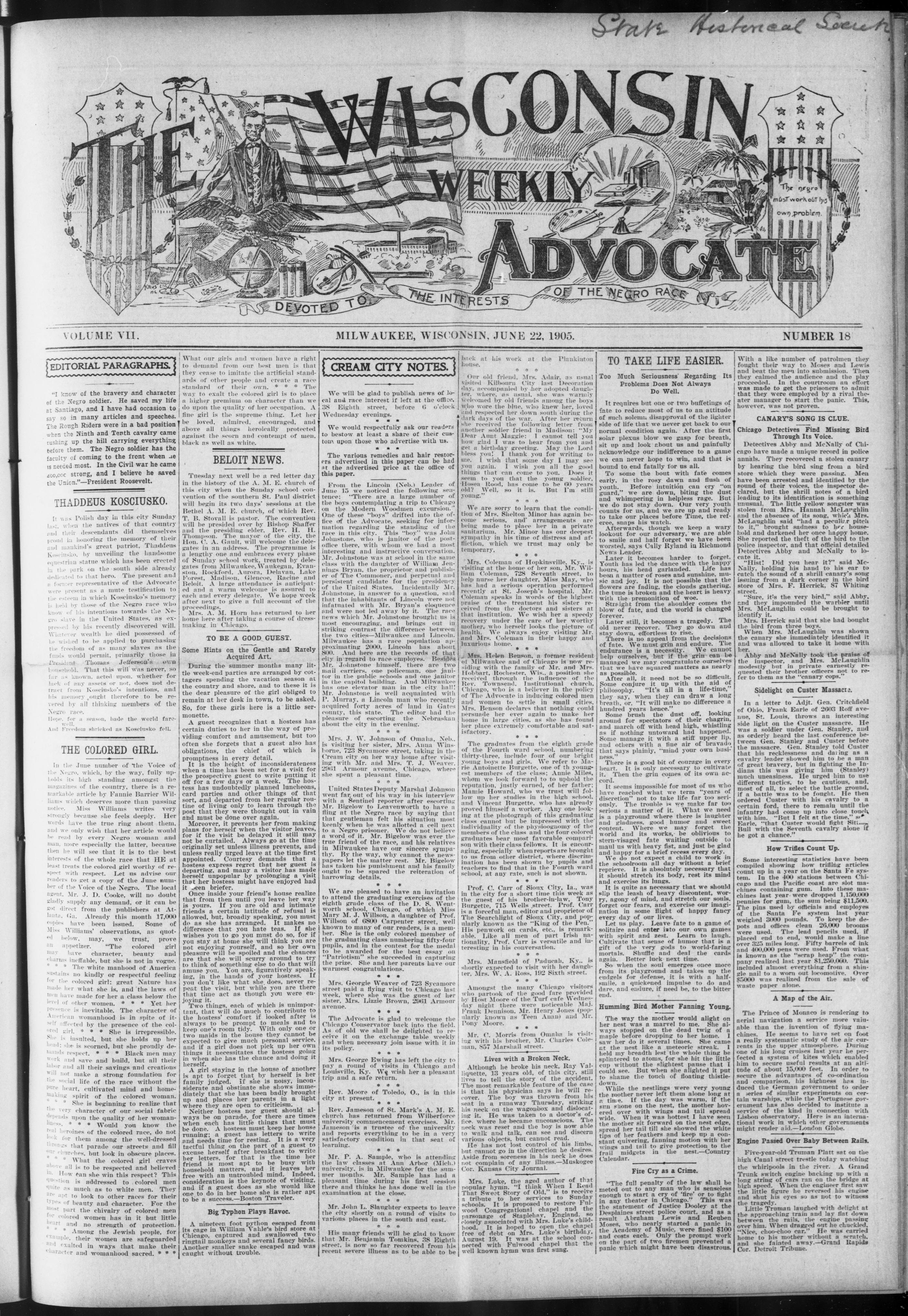
Wisconsin Weekly Advocate
Thursday, June 22, 1905
Milwaukee, Wisconsin

Page text (machine-generated)
WISCONSIN
WEEKLY
ADVOCATE
DEVOTED TO THE INTERESTS OF THE NEGRO RACE
EDITORIAL PARAGRAPHS.
"I know of the bravery and character of the Negro soldier. He saved my life at Santiago, and I have had occasion to say so in many articles and speeches. The Rough Riders were in a bad position when the Ninth and Tenth cavalry came rushing up the hill carrying everything before them. The Negro soldier has the faculty of coming to the front when he is needed most. In the Civil war he came 400,000 strong, and I believe he saved the Union."—President Roosevelt.
THADDEUS KOSCIUSKO.
It was Polish day in this city Sunday last, when the natives of that country and their descendants did themselves proud in honoring the memory of their and mankind's great patriot, Thaddeus Kosciusko, by unveiling the handsome equestrian statue which has been erected in the park on the south side already dedicated to that hero. The present and a former representative of the Advocate were present as a mute testification to the esteem in which Kosciusko's memory is held by those of the Negro race who know of his intentions towards the Negro slave in the United States, as expressed by his recently discovered will. Whatever wealth he died possessed of he wished to be applied to purchasing the freedom of as many slaves as the funds would permit, primarily those in President Thomas Jefferson's own household. That this will was never, so far as known, acted upon, whether for lack of any assets or not, does not detract from Kosciusko's intentions, and his memory ought therefore to be revered by all thinking members of the Negro race.
Hope, for a season, bade the world fare well.
And Freedom shrieked as Kosciusko fell.
THE COLORED GIRL.
In the June number of the Voice of the Negro, which, by the way, fully upholds its high standing amongst the magazines of the country, there is a remarkable article by Fannie Barrier Williams which deserves more than passing notice. Miss Williams writes very strongly because she feels deeply. Her words have the true ring about them, and we only wish that her article would be read by every Negro woman and man, more especially the latter, because then he will see that it is to the best interests of the whole race that HE at least treats the colored girl worthy of respect with respect. Let us advise our readers to get a copy of the June number of the Voice of the Negro. The local agent, Mr. J. D. Cooke, will no doubt gladly supply any demand, or it can be got direct from the publishers at Atlanta, Ga. Already this month 17,000 copies have been issued. Some of Miss Williams' observations, as quoted below, may, we trust, prove an appetizer. "The colored girl may have character, beauty and charms ineffable, but she is not in vogue. * * * The white manhood of America sustains no kindly or respectful feeling for the colored girl: great Nature has made her what she is, and the laws of men have made for her a class below the level of other women. * * * Yet her presence is inevitable. The character of American womanhood is in spite of itself affected by the presence of the colored girl. * * * She is irrepressible. She is insulted, but she holds up her head; she is scorned, but she proudly demands respect. * * * Black men may work and save and build, but all their labor and all their savings and creations will not make a strong foundation for the social life of the race without the pure heart, cultivated mind and homemaking spirit of the colored woman. * * * She is beginning to realize that the very character of our social fabric depends upon the quality of our womanliness. * * * Would you know the real heroines of the colored race, do not look for them among the well-dressed throngs that parade our streets and fill our churches, but look in obscure places. * * * What the colored girl craves above all is to be respected and believed in. How can she win this respect? This question is addressed to colored men quite as much as to white men. They are apt to look to other races for their types of beauty and character. For the most part the chivalry of colored men for colored women has in it but little heart and no strength of protection. * * * Among the Jewish people, for example, their women are safeguarded and exalted in ways that make their character and womanhood sacred. * * *
What our girls and women have a right to demand from our best men is that they cease to imitate the artificial standards of other people and create a race standard of their own. * * * The way to exalt the colored girl is to place a higher premium on character than we do upon the quality of her occupation. A fine girl is the supreme thing. Let her be loved, admired, encouraged, and above all things heroically protected against the scorn and contempt of men, black as well as white.
BELOIT NEWS.
Tuesday next well be a red letter day in the history of the A. M. E. church of this city when the Sunday school convention of the southern St. Paul district will begin its two days' sessions at the Bethel A. M. E. church, of which Rev. T. B. Stovall is pastor. The convention will be presided over by Bishop Shaffer and the presiding elder, Rev. H. H. Thompson. The mayor of the city, the Hon. C. A. Gault, will welcome the delegates in an address. The programme is a lengthy one and embraces every phase of Sunday school work, treated by delegates from Milwaukee, Waukegan, Evanston, Rockford, Aurora, Delavan, Lake Forest, Madison, Glencoe, Racine and Beloit. A large attendance is anticipated and a warm welcome is assured to each and every delegate. We hope week after next to give a full account of the proceedings.
Mrs. A. M. Horn has returned to her home here after taking a course of dressmaking in Chicago.
TO BE A GOOD GUEST
Some Hints on the Gentle and Rarely Acquired Art.
During the summer months many little week-end parties are arranged by cottagers spending the vacation season at the country and shore, and to these it is the dear pleasure of the girl obliged to remain at her desk in town, to be asked. So, for these girls here is a little sermonette.
A guest recognizes that a hostess has certain duties to her in the way of providing comfort and amusement, but too often she forgets that a guest also has obligations, the chief of which is promptness in every detail.
It is the height of inconsiderateness when a time has been set for a visit for the prospective guest to write putting it off for a few days or a week. The hostess has undoubtedly planned luncheons, card parties and other things of that sort, and departed from her regular routine of living only to learn through the post that they were thought out in vain and must be done over again.
Moreover, it prevents her from making plans for herself when the visitor leaves, for if the visit be delayed it still may not be curtailed. Always go at the time originally set unless illness prevents, and unless really urged leave at the time first appointed. Courtesy demands that a hostess express regret that her guest is departing, and many a visitor has made herself unpopular by prolonging a visit that her hostess might have enjoyed had it been briefer.
Once inside your friend's house realize that from then until you leave her way is yours. If you are old and intimate friends a certain latitude of refusal is allowed, but, broadly speaking, you must do as she has arranged. It makes no difference that you hate teas. If she wishes you to go you must do so, for if you stay at home she will think you are not enjoying yourself, and so her own pleasure will be spoiled and the chances are that she will scurry around to try to think of something else to do that will amuse you. You are, figuratively speaking, in the hands of your hostess. If you don't like what she does, never repeat the visit, but while you are there that time act as though you were enjoying it.
Two things, each of which is unimportant, that will do much to contribute to the hostess' comfort if looked after is always to be prompt to meals and to keep one's room tidy. With only one or two maids in the house they cannot be expected to give much personal service, and if a girl does not pick up her own things it necessitates the hostess going in when she has the chance and doing it herself.
A girl staying in the house of another is apt to forget that by herself is her family judged. If she is noisy, inconsiderate and obstinate she shows immediately that she has been badly brought up and places her parents in a light where they are open to criticism.
Neither hostess nor guest should always be on parade, for there are times when each has little things that must be done. A hostess must keep her house running; a guest has letters to write and needs time for resting. It is a very tactful thing on the part of a guest to excuse herself after breakfast to write her letters, for that is the time her friend is most apt to be busy with household matters, and it leaves her free with an untroubled mind. Indeed, consideration is the keynote of visiting, and if a guest does as she would like one to do in her home she is rather apt to be a success.—Boston Traveler.
Big Typhon Plays Havoc.
A nineteen foot python escaped from its cage in William Vahle's bird store at Chicago, captured and swallowed two ringtail monkeys and several fancy birds. Another smaller snake escaped and was caught without trouble.
CREAM CITY NOTES.
---
We will be glad to publish news of local and race interest if left at the office. 38 Eighth street, before 6 o'clock Wednesday evenings.
```markdown
```
We would respectfully ask our readers to bestow at least a share of their custom upon those who advertise with us.
The various remedies and hair restorers advertised in this paper can be had at the advertised price at the office of this paper.
From the Lincoln (Neb.) Leader of June 15 we noticed the following sentence: "There are a large number of the boys contemplating a trip to Chicago on the Modern Woodmen excursion." One of these "boys" drifted into the office of the Advocate, seeking for information regarding the standing of the race in this city. This "boy" was John Johnstone, who is janitor of the post-office there, with whom we had a most interesting and instructive conversation. Mr. Johnstone was at school in the same class with the daughter of William Jennings Bryan, the proprietor and publisher of The Commoner, and perpetual and persistent candidate for the presidency of the United States. Incidentally Mr. Johnstone, in answer to a question, said that the inhabitants of Lincoln were not infatuated with Mr. Bryan's eloquence and were not led away by it. The race news which Mr. Johnstone brought us is most encouraging, and brings out in striking contrast the difference between the two cities—Milwaukee and Lincoln. Milwaukee has a race population approximating 2000, Lincoln has about 800. And here are the records of that city in regard to race employees. Besides Mr. Johnstone himself, there are two mail carriers, one policeman, one janitor in the public schools and one janitor in the capitol building. And Milwaukee has one elevator man in the city hall! Mr. Johnstone is well acquainted with P. Murray, a Lincoln man who recently acquired forty acres of land in Gates county, this state. The editor had the pleasure of escorting the Nebraskan about the city in the evening.
***
Mrs. J. W. Johnson of Omaha, Neb.. is visiting her sister, Mrs. Anna Winsborne, 723 Sycamore street, taking in the Cream city on her way home after visiting with Mr. and Mrs. T. J. Weaver, 2961 Armour avenue, Chicago, where she spent a pleasant time.
* * *
United States Deputy Marshal Johnson went far out of his way in his interview with a Sentinel reporter after escorting Mr. Bigelow to Leavenworth to have a fling at the Negro race by saying that that gentleman felt his situation most keenly when he was allotted a cell next to a Negro prisoner. We do not believe a word of it. Mr. Bigelow was ever the true friend of the race, and his relatives in Milwaukee have our sincere sympathy. By the way, why cannot the newspapers let the matter rest. Mr. Bigelow has taken his punishment and his family ought to be spared the reiteration of harrowing details.
* * *
We are pleased to have an invitation to attend the graduating exercises of the eighth grade class of the D. S. Wentworth school, Chicago, of which Miss Mary M. J. Willson, a daughter of Prof. Willson of 6800 Carpenter street, well known to many of our readers, is a member. She is the only colored member of the graduating class numbering fifty-four pupils, and in the contest for the medal to be awarded for the best essay on "Patriotism" she succeeded in capturing the prize. She and her parents have our warmest congratulations.
---
Mrs. Georgie Weaver of 723 Sycamore street paid a flying visit to Chicago last week, where she was the guest of her sister. Mrs. Lizzie Brown, 2961 Armour avenue.
***
The Advocate is glad to welcome the Chicago Conservator back into the field. As of old we shall be delighted to receive it on the exchange table weekly and when necessary join issue with it in its policy.
* * *
Mrs. George Ewing has left the city to pay a round of visits in Chicago and Louisville, Ky. We wish her a pleasant trip and a safe return.
* * *
Rev. Moore of Toledo, O., is in this city at present.
Rev. Jameson of St. Mark's A. M. E. church has returned from Wilberforce university commencement exercises. Mr. Jameson is a trustee of the university and reports everything to be in a very satisfactory condition in that seat of learning.
Mr. P. A. Sample, who is attending the law classes at Ann Arbor (Mich.) university, is in Milwaukee for the summer months. Mr. Sample has had a pleasant time during his first session there and thinks he has done well in the examination at the close.
Mr. John L. Slaughter expects to leave the city shortly on a round of visits to various places in the south and east.
☆ ☆ ☆
His many friends will be glad to know that Mr. Benjamin Tomkins, 38 Eighth street, is now so far recovered from his recent severe illness as to be able to be
back at his work at the Plankinton house.
Our old friend, Mrs. Adair, as usual visited Kilbourn City last Decoration day, accompanied by her adopted daughter, where, as usual, she was warmly welcomed by old friends among the boys who wore the blue, who knew her, loved and respected her down south during the dark days of the war. After her return she received the following letter from another soldier friend in Madison: "My Dear Aunt Maggie: I cannot tell you how glad I was to hear from you and get a birthday greeting. May the Lord bless you! I thank you for writing to me. I wish that some day I may see you again. I wish you all the good things that can come to you. Does it seem to you that the young soldier, Hosea Rood, has come to be 60 years old? Well, so it is. But I'm still young."
* * *
We are sorry to learn that the condition of Mrs. Shelton Minor has again become serious, and arrangements are being made to place her in a private sanitarium. Mr. Minor has our deepest sympathy in his time of distress and affliction, which we trust may only be temporary.
* * *
Mrs. Coleman of Hopkinsville, Ky., is visiting at the home of her son, Mr. William Coleman, 728 Seventh street, to help nurse her daughter, Miss May, who has had a serious operation performed recently at St. Joseph's hospital. Mr. Coleman speaks in words of the highest praise of the treatment his sister received from the doctors and sisters at that institution. We wish her a speedy recovery under the care of her worthy mother, who herself looks the picture of health. We always enjoy visiting Mr. and Mrs. Coleman in their happy and luxurious home.
****
Mrs. Helen Benson, a former resident of Milwaukee and of Chicago is now residing with the family of Mr. and Mrs. Hobbart, Rochester, Wis., a position she received through the influence of the Rev. Townsend, Institutional church, Chicago, who is a believer in the policy of The Advocate in inducing colored men and women to settle in small cities. Mrs. Benson declares that nothing could persuade her ever again to make her home in large cities, as she has found her place extremely comfortable and satisfactory.
***
The graduates from the eighth grade of the Fourth ward school, numbering thirty-three, include four of our bright young boys and girls. We refer to Marie Antoinette Burgette, one of th youngest members of the class; Annie Miles, whom we look forward to to uphold the reputation, justly earned, of her father; Mamie Howard, who we trust will follow up her studies in the high school and Vincent Burgette, who has already proved himself a worker. Any one looking at the photograph of this graduating class cannot but be impressed with the individuality of the physioognomy of the members of the class and the four colored graduates bear most favorable comparison with their class fellows. It is encouraging, especially when reports are brought to us from other district, where discrimination has been shown by pupils and teachers to find that in the Fourth ward school, at any rate, such is not shown.
☆ ☆ ☆
Prof. C. Carr of Sioux City, Ia., was in the city for a short time this week as the guest of his brother-in-law, Tony Burgette, 715 Wells street. Prof. Carr is a forceful man, editor and proprietor of The Searchlight of Sioux City, and popularly known as the "King of the Pen." His penwork on cards, etc., is remarkable. Like all men of part Irish nationality, Prof. Carr is versatile and interesting in his conversation.
```markdown
```
Mrs. Mansfield of Paducah, Ky., is shortly expected to visit with her daughter, Mrs. W. A. Ross, 192 Sixth street.
***
Amongst the many Chicago visitors who partook of the good fare provided by Host Moore of the Turf cafe Wednesday night there were noticeable Maj. Frank Dennison, Mr. Henry Jones (popularly known as Teen Anan) and Mr. Pony Moore.
* * *
Mr. C. Morris from Omaha is visiting with his brother, Mr. Charles Coleman, 857 Marshall street.
Lives with a Broken Neck.
Although he broke his neck, Ray Valliquette, 13 years old, of this city, still lives to tell the story of the accident. The most remarkable feature of the case is that his physician says he will recover. The boy was thrown from his seat in a runaway Thursday, striking his neck on the wagonbox and dislocating it. He was taken to a doctor's office, where he became unconscious. The neck was reset and the boy is now able to walk and talk, can see and discern various objects, but cannot read.
He has not lost control of his limbs, but cannot go in the direction he desires. Aside from soreness in his neck he does not complain of any illness.—Muskogee Cor. Kansas City Journal.
Mrs. Luke, the aged author of that popular hymn. "I think When I Read That Sweet Story of Old," is to receive a tribute to her services to Sunday schools. It is proposed to restore Fulwood Congregational chapel and the parsonage of Staplehay, England, so closely associated with Mrs. Luke's childhood. It is hoped to open the chapel free of debt on Mrs. Luke's birthday, August 19. It was at the school connected with Fulwood chapel that the well known hymn was first sung.
TO TAKE LIFE EASIER.
Too Much Seriousness Regarding Its Problems Does Not Always Do Well.
It requires but one or two buffetings of fate to reduce most of us to an attitude of such solemn disapproval of the lighter side of life that we never get back to our normal condition again. After the first solar plexus blow we gasp for breath, sit up and look about us and painfully acknowledge our indifference to a game we can never hope to win, and that is bound to end fatally for us all.
To some the bout with fate comes early, in the rosy dawn and flush of youth. Before intuition can cry "on guard," we are down, biting the dust and whimpering in helpless rage. But we do not stay down. Our very youth counts for us, and we are up and ready to take our places before Time, the referee snaps his watch.
Afterwards, though we keep a wary lookout for our adversary, we are able to smile and half forget we have been worsted, says Cally Ryland in Richmond News Leader. Later it becomes harder to forget. Youth has led the dance with the happy hours, his head garlanded. Life has been a matter of roses and sunshine, music and joy. It is not possible that the flowers are fading, the clouds gathering, the tune is broken and the heart is heavy with the premonition of woe. Straight from the shoulder comes the blow of fate, and the world is changed forever. Later still, it becomes a tragedy. The old never recover. They go down and stay down effortless to rise.
There is no appeal from the decisions of fate. We must grin and endure. The endurance is a necessity. We cannot help ourselves, but if the grin can be managed we may congratulate ourselves that we have squared matters as nearly as possible.
After all, it need not be so difficult. Some conjure it up with the aid of philosophy. "It's all in a life-time," they say, when they can draw a long breath, or, "It will make no difference a hundred years hence."
Some brush the dust off, looking around for spectators of their chagrin, and march off with head high, whistling as if nothing untoward had happened. Some manage it with a stiff upper lip, and others with a fine air of bravado that says plainly, "mind your own business."
There is a good bit of courage in every heart. It is only necessary to cultivate it. Then the grin comes of its own accord.
It seems impossible for most of us who have reached what we term "years of discretion" not to take life far too seriously. The trouble is we make far too serious a matter of it. What we need is a playground where there is laughter and gladness, good humor and sweet content. Where we may forget the world and its works, be oblivious to stern-visaged fate waiting outside to maul us with heavy fist, and just be glad and happy for a brief recess every day. We do not expect a child to work in the schoolroom all day without a brief reprieve. It is absolutely necessary that it should stretch its body, rest its mind and exercise its lungs.
It is quite as necessary that we should slip the leash of heavy discontent, worry, agony of mind, and stretch our souls, forget our fears, and exercise our imagination in some flight of happy fancy every day of our lives.
Let us play. Leave fate to a game of solitaire and enter into our own games with spirit and zest. Learn to laugh. Cultivate that sense of humor that is a gift of the very gods to world-faring mortals. Shuffle and deal the cards again. Better luck next time.
So when the soul emerges once more from its playground and takes up the cudgels for defense, it is with a half-smile, a quickened impulse to do and dare, and endure, if need be, to the bitter end.
Humming Bird Mother Fanning Young
The way the mother would alight on her nest was a marvel to me. She always stopped on the dead twig of a maple before dropping to her home. I saw her do it several times. She came at the nest like a meteoric streak. I held my breadth lest the whole thing be splintered to atoms, for she hit the little cup without the slightest pause that I could see. But when she alighted it put to shame the touch of floating thistle-down.
While the nestlings were very young the mother never left them alone long at a time. If the day was warm, if the sun shone on the nest, the mother hovered over with wings and tail spread wide. When it was hottest I have seen the mother sit forward on the nest edge, spread her tail till she showed the white tips of her feathers and keep up a constant quivering, fanning motion with her wings and tail to give protection to the frail midgets in the nest.—Country Calendar.
Fire Cry as a Crime.
"The full penalty of the law shall be meted out to any man who is senseless enough to start a cry of 'fire' or to fight in any theater in Chicago." This was the statement of Justice Dooley at the Desplaines street police court, and as a result Abraham Lewis and Reuben Moses, who nearly started a panic in the Academy of Music, were fined $100 and costs each. Only the prompt work on the part of two firemen prevented a panic which might have been disastrous.
With a like number of patrolmen they fought their way to Moses and Lewis and beat the men into submission. Then they calmed the audience and the play proceeded. In the courtroom an effort was made to get the prisoners to admit that they were employed by a rival theater manager to start the panic. This, however, was not proven.
CANARY'S SONG IS CLUE.
Chicago Detectives Find Missing Bird Through Its Voice.
Detectives Abby and McNally of Chicago have made a unique record in police annals. They recovered a stolen canary by hearing the bird sing from a bird store which they were passing. Men have been arrested and identified by the sound of their voices, the inspector declared, but the shrill notes of a bird leading to its identification is something unusual. The little yellow songster was stolen from Mrs. Hannah McLaughlin and the absence of its song, which Mrs. McLaughlin said "had a peculiar pitch to it," brought sadness to her household and darkened her once happy home. She reported the theft of the bird to the police inspector, and that official detailed Detectives Abby and McNally to locate it.
"Hist! Did you hear it?" said McNally, holding his hand to his ear to catch the sound of a shrill canary's song issuing from a dark corner in the bird store of Mrs. F. Herrick, 87 Whiting street. "Sure, it's the very bird," said Abby, and they impounded the warbler until Mrs. McLaughlin could be brought to identify it.
Mrs. Herrick said that she had bought the bird from three boys.
When Mrs. McLaughlin was shown the canary she immediately identified it and was allowed to take it home with her. Abby and McNally took the praise of the inspector, and Mrs. McLaughlin modestly but in private earnestly requested their brother officers not to refer to them as the "canary cops."
Sidelight on Custer Massacre.
In a letter to Adjt. Gen. Critchfield of Ohio, Frank Earle of 2603 Roff avenue, St. Louis, throws an interesting side light on the Custer massacre. He was a soldier under Gen. Stanley, and as orderly heard the last conference between Gen. Stanley and Custer before the massacre. Gen. Stanley told Custer that his recklessness and daring as a cavalry leader showed him to be a man of great bravery, but in fighting the Indians this was giving him (Stanley) much uneasiness. He urged him to use different tactics, to be cautious, and, most of all, to select the battle ground, if a battle was to be fought. He then ordered Custer with his cavalry to a certain ford, there to remain until the infantry had come up into close touch with him. "But I felt at the time," so Earle, "that Custer would fight Sittang. Bull with the Seventh cavalry alone if he got a chance."
How Trifles Count Up.
Some interesting statistics have been compiled showing how trifling articles count up in a year on the Santa Fe system. In the 400 stations between Chicago and the Pacific coast are slot machines containing gum. Into these machines last year were dropped 1,150,000 pennies for gum, the sum being $11,500. The pins used by officials and employees of the Santa Fe system last year weighed 3000 pounds. To keep the depots and offices clean 26,000 brooms were used. The lead pencils used, if placed end to end, would make a line over 325 miles long. Fifty barrels of ink and 400,000 pens were used. From what is known as the "scrap heap" the company realized last year $1,250,000. This included almost everything from a shingle nail to a worn out locomotive. Over $5000 was realized from the sale of waste paper alone.
A Map of the Air.
The Prince of Monaco is rendering to aerial navigation a service more valuable than the invention of flying machines. He seems to have set on foot a really systematic study of the air currents in the upper atmosphere. During one of his long cruises last year he perfected a system of kites which enabled him to secure useful results at an altitude of about 15,000 feet. In order to secure the advantages of co-ordination and comparison, his highness has induced the German government to order a series of similar experiments on certain warships, while the Portuguese government has also decided to institute a service of the kind in connection with Lisbon observatory. Here is an international work in which other governments might render aid.—London Globe.
Engine Passed Over Baby Between Rails.
Five-year-old Truman Platt sat on the high Canal street trestle today watching the whirlpools in the river. A Grand Trunk switch engine backing up with a long string of cars ran on the bridge at high speed. When the engineer first saw the little figure he reversed his engine and shut his eyes so as not to witness the tragedy.
Little Truman laughed with delight at the approaching train and lay flat down between the rails, the engine passing over him. When dragged out he chuckled, "Nice, choo-choo car." He was carried home to his mother without a scratch, and she fainted away.—Grand Rapids Cor. Detroit Tribune.
There are nearly 5000 steam and street railway crossings at grade in the United States, of which nearly one-half are protected.
Berlin, the home of the automatic restaurant, gives that institution a profitable support, and their number is constantly increasing.
A league has been formed in Switzerland to preserve picturesque spots throughout the little republic from commercial vandalism.
A dog trained for war purposes and attached to a German regiment, has "deserted." It made its way into France, where it was arrested.
The sheep that has no wool comes from Barbados. How it got there nobody knows, but it is supposed to have come from Africa originally.
—An asphalt lake of considerable extent has been discovered in Asia Minor. An English company is being organized in London for its exploitation.
—On the hundredth anniversary of Schiller's death 115,000 copies of a special edition of his poems will be given to the school children of Berlin.
—A man who used glue to thicken the gravy in the meat pies he sold at Oldham, England, is now serving a three months' sentence in the jail there.
—Trials are now being made in the German army as to whether the blue and dark uniforms of the infantry had better be exchanged for gray clothes.
—Many of the hotels of the country towns of England are managed by women, and it is claimed that they do it far better than men in the same position.
—Rev. Dr. Charles A. Crane of Boston, after careful inquiry, has come to the conclusion that there are about 140 different kinds of religion in that city.
—The lifeboats of the government stationed along our coasts were launched 294 times last year to go to wrecks. They were the means of saving 519 lives. —An institute for the treatment of sufferers from chest complaints, neuralgia, catarrh and other maladies, by means of opium smoking, has been opened by London physicians. —Beneath the floor of a Roman dwelling which a peasant has discovered at Mende. Lozere, in the south of France, was found a casket containing coins dated in the Third century. —Chilliwick, a little town on the Fraser river, holds the curious record of having performed a play in which no fewer than 2000 individuals took part. All the characters were red men.
Dr. A. S. Hopkins, forest insect investigator, department of agriculture, says the annual loss from insects which prey on forest trees and their crude and finished products is $100,000,000.
Dean Leroy, speaking at Norwich, England, the other day, said he yielded to no man in his loyalty to the Book of Common Prayer, but it was not always adapted to the people. It was too stately.
It is noticed in England as a curious fact that most of the Jewish soldiers who died in the Boer war, and in whose memory a tablet was erected recently in a London synagogue belonged to Scottish regiments.
The keeper of the only saloon at Bellport, Me., was a candidate for justice of the peace. He pledged himself, if elected, to close his saloon and go out of business. He was defeated by an overwhelming majority.
Coid storage of fruit in the United States has grown to enormous proportions, nearly 3,000,000 barrels of apples having been stored last year. It is found that, if properly packed and handled, the fruit does not much deteriorate.
Skyscrapers are forbidden in Berlin, but the architect, Prof. Siegmund Muller, after his recent trip to America, delivered a lecture in Berlin, in which he spoke strongly in their favor, declaring that they offered great business advantages and were safer in case of fire than any other buildings.
—Maj. S. G. Reynolds, agent of the Crow Indian agency, says that his wards are making rapid advancement along material lines. During the last year they have erected over 100 new and comfortable homes, planted around them 1000 shade trees and built good barns for their stock. This year the Crows have already planted 2000 acres of wheat and 1000 acres of oats.
—Cocoanuts, being lighter than water, are transported along waterways in the same manner that timber is floated. Thousands of them are thrown together and the whole mass surrounded by long strands of bark fiber. One native can tow a number of such rafts and the fiber is tough enough to stand considerable rough treatment.
—Maj. McLaughlin now is on his way to Washington with a unique memorial to the government, bearing in lieu of signatures the imprint of the thumbs of 3514 Sioux Indians. The petition asks the division of 500,000 acres of land at the Standing Rock agency, and in order that the wily red man may not trick his trusting white father the unique signatures were insisted upon by Maj. McLaughlin.
—Robert Rogers, one of the two remaining Boer prisoners in Ceylon, left for Holland last month, having been four and a half years on the island. The British government has warned him that this permission does not imply that the prohibition of his return to Africa will be canceled, as he has not yet taken the oath of allegiance. Rogers' departure from Ceylon leaves only one Boer prisoner, a man named Engelbrecht, in the custody of Great Britain. Engelbrecht is still in Ceylon.
Frozen Through.
At the boarding house on Morrison street they were discussing climate. The Portland man declared that the ground last winter never froze to a depth of two inches.
"It froze two feet where I came from," said the man from New Jersey.
"Up in the Adirondack mountains," remarked the New Yorker, "the ground last winter froze to a depth of ten feet."
The Iowa man sat quietly munching his lettuce while the others expectantly awaited his effort to outmatch the New Yorker.
"Pshaw!" he said, "that's nothing. Why, back in Des Moines the ground froze so deep that the Chinese Emperor sent a request to Gov. Cummins to start a fire. He complained that his subjects had cold feet."—Portland Oregonian.
Imperial Ploughing.
An imperial decree announces that the Emperor will sacrifice to the god of agriculture on the second day of the third moon. He will personally plow a portion of the ground in front of the altar as a proof that the profession of agriculture is an honorable one.—Pekin Times.
Capt. Sir Ernest Cochrane of London, Eng., has offered a cup of the value of $500 for competition between picked football teams representing Great Britain, Ireland, Canada and the United States. Sir Ernest suggests that the matches be played under the English association rules or under a combination of the rules governing football in the United States and Great Britain.
A black east wind and a sky unkind and the sun away,
But the lark above is singing of love in the old wild way.
And were you but here, O my only dear, would I ever mind
The dusty road and the frozen sod and the black east wind?
There's scarce a blade for to hide love's bed and the brown bride cov.
Whose eyes will follow by hill and hollow
becoming for
The daffodil is out on the hill, and the lambs, a score.
Are listening. Hark to the bridegroom lark! But he comes once more.
And would you return, then I should not mourn in your fond embrace.
The sun away and the skies of gray and the snow in my face.
Poll Mall Gazette.
BIRDS' NESTING
I disclaim all responsibility for the events; they were the direct and immediate outcome of that tempestuous and careless tomboy, Aline, and, in a way, I think I may say, of Miss Deighton's imprudence. You see, she should have known her sex better. I assume that she also was once as Aline, and none so long ago. I never was, and could not be expected to know. Nevertheless, I did have misgivings. Perhaps I ought to have communicated them to—but, in any case, how was I to guess?
Miss Deighton received the suggestion quite affably; she extended to it her smiling pteronage. It would be rather "nice to go birds' nesting." It was a fine May day, and it seemed creditable to follow up the spring in that jocund and irresponsible way. That was how it appealed to me also. I had torn my clothes and jagged my flesh, ah, how many years ago, in woods like these! It did seem inviting, coming as it did from frank and frivolous Aline, aged 14, and promising such exquisite company. Miss Deighton wore what in my part of the country we call a "laylock" muslin. She was slim and pliant, I should have said; but she had the air of repose which engrosses beauty on a glad day. The sun shone on her fineness, and I rejoiced that the plan had been broached. The trouble really started when we entered the park, though the beginnings were small. You can go through a heavy gate or you can cross a stile into the park. Miss Deighton and I thought the gate was locked, and so we mounted the stile. At least, she did, and, pausing, looked back on the green of the valley.
"How beautiful!" said she, in a meditative voice.
"Charming," I assented, my eyes drifting with hers. It must have been just then that Aline discovered the gate was not locked; but we did not notice her or it, as we were exchanging some fanciful thoughts about the view, Miss Deighton gracefully but not too securely seated on the gatepost. My gaze was the first to leave the prospect and come about. Aline had pulled back the gate to its utmost limit, and now, in full sail, was gathering force as she swung, sweeping home like a circus. The cumbrous gate creaked into its place, I gave a cry, and Miss Deighton went backward.
I caught her just in time, as you may gather when I say that one of her feet took me on the chin. She was ruffled and red, and a little scared, when she came to the perpendicular again.
"Aline!" she cried, angrily. "What on earth——?"
"Sorry," said the tomboy, frankly, and her penitence disarmed further criticism.
her penitence disarmed further criticism.
"Thank you so much," said Miss Deighton to me, graciously. I helped her to the ground, and we resumed our way, but the thread of that admirable companionship I had been enjoying had been broken. Aline recovered in about two minutes; at least, she was babbling of linnets before we had gone a hundred yards.
"I know where there's an owl's, but it's hard to get at," she remarked, pensively.
"Perhaps I could reach it?" I suggested gallantly.
Aline regarded me dubiously. "You don't look as if—— But perhaps you could," she amended, hopefully. "It's over a pool, and you have to creep out on rather rotten branches."
To say the truth, this did not sound inviting. I wondered if I had enjoyed such things when I was a boy, and why. Miss Deighton's discomposure lasted until we emerged on the heath with its blaze of furze bloom.
"How heavenly!" she said, with her eyes toward the distant hills that barred the sea. It was heavenly, and by her side I acquiesced. We were recalled to earth by Aline's excited soeal.
"I've found one, only there's no eggs in it, and, oh, there must be just dozens, Mr Frobisher!" she ran on, almost in one word.
Her hands were scratched, but she paid no heed, and we picked our way toward her. As I went, a little in advance, I heard an exclamation of annoyance behind me, and guessed that Miss Deighton was in distress.
"I hone you haven't"____
"Oh, it's nothing!" said she, impatiently. "If one is so stupid as to undertake this sort of thing, one must put up with"——
I suppose the gorse bothered her. I reached Aline, who had just discovered a linnet's nest with eggs, and her joy was illimitable.
"Just put in your hand and feel them, Miss Deighton," she pleaded. "Do—just the tips of your fingers!"
Miss Deighton amiably obeyed, and drew her hand away with another interjection. I suppose it was the gorse again.
"I really think we'd better be getting out of this," she said to me, in a sort of appeal, looking helplessly round on the furze. I picked up two small branches which were following on her skirt.
"You can get out just down there," Aline assured us. "There's a path there, and there are sure to be lots more linnets' nests."
I don't think Miss Deighton cared about the linnets' nests, but she did care about the path, and we pushed our way toward it. The ground was very uneven, and we stumbled several times. Also the furze was very thick. I heard my name, and found Miss Deighton looking at me pathetically over a huge, spreading bush. "What am I to do?" she asked, weakly. I guided her round it, took two more "followers" off her dress, and pulled her out of a hole into which she floundered. "This is dreadful!" she complained,
gasping. "Aline, wherever is the path?" Aline, at a distance, ceased her exploration in the furze to consider. "Oh, I forgot! This isn't the place," she said, cheerfully. "This leads to the gravel pits." "Gravel pits!" said Miss Deighton, in dismay. "Yes. Look out! They're somewhere there, where you are. Take care you don't go over the edge. It's hidden by the gorse." Miss Deighton gave a cry of consternation and alarm. "Don't leave me, please," she said. "This is abominable of Aline, and I'll"—
"You can get through that patch of wood if you like," called out the tomboy, interrupting. "That's the shortest way through the gorse."
It seemed so, judged by the eye, and Miss Deighton and I picked our way painfully toward it, short-skirted Aline following at her leisure, and with indifference to us and to her legs. I believe the wretch was still looking for nests.
"How many thorns, on a rough estimate, would you you had gathered?" I asked Miss Deighton, when we had won through and were on the border of the wood.
"I don't think I've left many behind," she murmured.
"Honestly," I pursued, "is there any part of you that——?"
"Probably not," she said, hastily. "Aline, which is the way now?" Aline looked up from her furze bush. "Right through." she said. Miss Deighton frowned. The copse did look thick. "I'll show you,' continued the equable Aline, coming through the last bushes with a rip of skirts to which she paid no heed. "I've got three eggs. And I know where there's a bullfinch in this copse. I'll show you." I believe Miss Deighton breathed an anathema on eggs, but Aline was our omy guide, and we had to cling to her. She pushed ahead vigorously, and we followed through the undergrowth.
"For goodness' sake, let her find it and show it to us, and then let's go." murmured Miss Deighton to me. "And this is birds' nesting!"
Aline brought us up before an amply spreading yew, and, creeping into its darkness, pointed up with emotion. "It's there!" she said; "but it's hard to get up to it; it's so thick. If you could give me a leg up, Mr. Frobisher, I think I might reach it."
I gave the required assistance, and Miss Deighton impatiently seated herself on a fork of the yew, waiting until such time as this madness should be overpast. It was beautifully dry, and so I sat on the ground near her.
"Good heavens!" she said, in an undertone; "and this is what the young like!"
"They are barbarians, of course," said I; "but I suppose we were so, too."
She considered. "I don't think I was—I'm sure I was not."
"Didn't you collect eggs, and tear your clothes, and scratch your legs, and—?" "I think I was too sensible," she said. "I don't believe girls are like that, as a rule. They're not savages, like Aline."
True. They're not savages, like Anne.
Aline's voice, smotnered in the leafage, came to us just then.
"I've got it—there are four," it seemed to say, triumphantly.
to say, triumphantly.
"Now, at least, we shall get back," said Miss Deighton, with a sigh of relief.
The next moment there was a crash, something snapped above, and Aline descended in a lump. She fell on Miss Deighton, who toppled off her seat upon me. I suppose the force of two bodies thus heavily discharged on me had its due effect, for I was not aware of anything for a moment or two, save of the difficulty of getting breath. Then I became aware that Aline was sitting on Miss Deighton, and that Miss Deighton was sitting on me.
"Sorry," I heard Aline say, and then she got off us and sputtered. "had the eggs in my mouth" she told us.
We wouldn't have cared if she had had the eggs in her hair. Miss Deighton was panting hard. Her hat had been crushed in, and her locks were in disorder, but she still sat on—on me.
"Would you mind——?" I began, breathlessly, but, I hope, politely.
"Oh, I didn't see—I—didn't know——!"
She rose, and I, too, got up. "I hope—you're quite satisfied now," she remarked indignantly, to me.
"But it wasn't me," I pleaded; "it was——"
It was me! cried Anne, honestly.
Miss Deighton was occupied in straightening herself. "Will you be good enough to guide me out of here?" she cried, coldly and freezingly, to Aline. She ignored me. Awed by her lofty manner the tomboy obeyed, and I followed meekly in ...eir train.
Free of the abominable wood, we descended across fields to the village. The silence hung oppressively, and I opened conversation with the prime fount of all our woes.
"I hope you didn't get hurt, Aline," I said, hypocritically.
"Oh, no!" said she, throwing back her ambrosial locks, and now fast recovering from the shock of that wounded dignity. "I only got a bruise on my leg. Did your leg hurt. Miss Deighton?"
"Where did you get hurt?" pursued the now fully recovered Aline.
"I suppose we shall reach the village in about ten minutes?" said Miss Deighton, quickly, addressing me for the first time.
"Mr. Frobisher must have been hurt," went on Aline, reflectively "I saw you sitting on his"——
"Aline, how far is it?" interposed Miss Deighton, with a heightened color, but in a friendly way.
"Oh, five minutes!" said the tomboy, carelessly. "You fell right on his"——
"Aline, were those eggs fresh?" I asked. Aline made a face. "Well, one of them was, I think," she said, dubiously. "But I should rather like a drink of water."
"Better run on ahead. We can find our way,' said I, encouragingly. Aline brightened. "May I? Shall I?" And in two minutes her skirts were flying in the distance. I turned to my companion. "I'm sorry if you were hurt by falling on me," I said, apologetically. She made no answer, but seemed to be anxious to overtake Aline. "Especially," I went on, "As I liked it." "How absurd!" said Miss Deighton. "Why, you could hardly get your breath." "That is true," I observed. "But, thinking it over, I have come to the conclusion that there are times when one does not want to get one's breath." "Indeed!" said she, indifferently.
"And when one likes to be sat on," I added.
Miss Deighton said nothing, but seemed interested in getting to the village.
"I liked it born times," I said.
"Both times?" she echoed, in surprise.
"Yes; when you fell off the gate you kicked me."
"Oh. I'm so sorry!" said she, in confusion. "Where?"
"Here," said I, coming to a pause and putting a finger to my chin. Miss Deighton examined it, blushing.
"I'm so sorry!" said she again. "I didn't know— It was all that little wretch Aline."
"I don't know that she's quite a wretch," said I. "There's a thorn or something in your hair. May I——?" "Thanks very much," said she. "I rather like birds' nesting," said I. "It's—it's rather silly," said she. I turned. "There's no particular reason why we should get to the village, is there?" I asked. "We haven't swallowed birds' eggs." Miss Deighton laughed. "It is a beautiful day," she murmured, as she turned with me.—H. B. Marriott Watson in the Sketch.
THE LITTLE GUEST-ROOM IN MY HEART.
The little guest-room in my heart
I fitted for thy tenancy,
And though thy presence stays apart
It is not wholly bare of thee:
For all the dreams there take thy shape,
And from each humble thing it holds
Some fragrant thoughts of thee escape,
Like lavender from linen-folds.
No picture hangs upon the walls
That any other eye could trace,
But ever where the sunlight falls
I see the glory of thy face.
CHINESE THRIFT.
The Celestial Empire a Poor Field for Accident Insurance Companies.
"China would be a poor field for accident insurance companies," said a man in the tea trade. "The inhabitants would be only too glad to get hurt in order to collect their insurance.
"Up the river from Hong Kong there's a little settlement of Englishmen. Just across the river is a graveyard, inhabited by a few scrub birds of the snipe family. They are very poor shooting, but your Briton must have sport of some kind, and shooting these birds is the only sport in sight.
"One day an Englishman let drive at a snipe and hit a Chinaman who had just bobbed out from behind a tombstone. The charge of shot struck the coolie in his wrist, putting his hand out of business.
"Of course, the Chinaman made a roar. The Briton, wanting to do the square thing, offered to pay the damage. The coolie demanded $10. The Englishman generously made it $15.
"There was never any good hunting in the graveyard after that. Whenever an Englishman was seen approaching, a Chinaman hid behind every gravestone.
"With marvelous cleverness they'd manage to get in range just when the Briton fired. If one of them had the luck to get two or three birdshot in his system, he would come out, roar and collect.
"Of course, this drove away the snipe: but the coolies took to catching birds, tying them by the leg to gravestones and hiding themselves in holes from which they could rise and get shot at the proper moment. The Englishmen had to stop hunting. It was too expensive.
"One of the pleasant and refined Chinese tortures is crushing the ankle. There are coolies in Shanghai who keep a standing offer to submit to this torture for the benefit of tourists at a rate of $5.
"I know of several cases where this offer has been accepted. The coolie submitted without a howl and smiled when he collected the money."—New York Sun.
Why Waiters Look Worried.
The homespun-looking individual sat himself down at the hotel table, tucked his napkin under his chin, picked up the bill of fare, and began to study it intently. Everything was in restaurant French, and he didn't like it.
"Here, waiter," he said sternly, "there's nothing on this I want! Haven't you got any sine qua non?"
The waiter gasped.
"No, sir," he replied.
"Got any bon mots?"
"No, sir; not one."
"Got any 'Honi soit qui mal y pense'?"
The waiter's face showed some sign of intelligence.
"Seems like I've heard of that, sir." And he rushed out to the kitchen, only to return empty-handed. "We ain't got none, sir!" he said in a tone of disappointment.
"Got any tertium quid?"
The waiter could only shake his head. "No? Well, maybe you've got some roast beef and Yorkshire, with a nice baked potato?" "Indeed we has, sir!" exclaimed the waiter, in a tone of utmost relief. And he fairly flew out to the kitchen.—Answers.
The Catalpa Tree South.
Between the lumber manufacturer, the naval stores operator and the annual forest fires, the south is being rapidly denuded of her forests, while no effort is made to perpetuate the pine timber. The cypress is of too slow growth to offer much hope, requiring twelve years to grow one inch in thickness. Recently the northern hardy catalpa has been introduced into gulf states, and there is promise of an abundant supply of timber by the time the pine shall have disappeared. The owner of a catalpa plantation in Louisiana has planted 50,000 of these trees in Florida for the East Coast Railroad company. A cypress tree 4 feet in diameter requires 300 years to grow; southern yellow pine grows large enough for sawing in from 75 to 120 years, while catalpa specioso two feet in diameter has been grown in New Orleans in 14 years. Because of this rapid growth it is now one of the trees most in favor for railroad ties.—Philadelphia Ledger.
Butter by the Yard.
From time immemorial in Cambridge, a town noted for its university, the dairy men roll the butter so as to form a long stick weighing a pound, which they sell in slices as if it were sausage, says Le Petit Parisien. In the markets the butter merchants do not need to use either weights or scales. A simple glance is sufficient for these merchants, accustomed to the time honored practice. A very neat cut with the knife divides the yard into halves, quarters or eighths very exactly. And it appears that the customer is never given short measure.
A farmer at Alden, Okla., forty miles from Snyder, found a number of photographs in a good state of preservation that had been carried to his farm by the recent ternauo at Snyder.
IN THE SEASON.
It is the season now to go
About the country high and low,
Among the lilacs, hand in hand,
And two by two in fairyland.
The brooking boy, the singing maid,
Wholly fain and half afraid.
Now meet along the hazeed brook
To pass and linger, pause and look.
A year ago, and blithely paired,
Their rough and tumble play they shared;
They kissed, and quarreled, laughed and
cried.
A year ago at Eastertide.
With bursting heart, with fiery face,
She strove against him in the race;
He unabashed her garter saw,
That now would touch her skirts with awe.
Now by the stile ablaze she stops,
And his demurer eyes he drops;
Now they exchange averted sighs
Or stand and marry silent eyes.
And he to her a hero is,
And sweeter she than primroses;
Their common silence dearer far
Than nightingale and mavis are.
Now when they sever wedded hands,
Joy trembles in their bosom strands,
And lovely laughter leaps and falls
Upon their lips in madrigals.
HOW MATTIE PROVIDED A DINNER.
The Laird of Craig—something-I forget the addition, for I know it ended in an "agh!"—one blessed afternoon received a note from a Lowland cousin, to intimate that he would honor him with a call, in company with an English gentleman. Aware that the Highland mansion was "remote from towns," the self-invited guest prudently apprised his kinsman of the intended visit in order that ample time might be afforded the Highland chief to put his house in order. Alas! "publics" were numerous on his route—and the gilly who bore the letter stopped so frequently to refresh himself that, instead of arriving the day before, he scarcely managed to anticipate by an hour the coming of the guest whose advent he had been dispatched to notify.
Never had Craigdarragh been in a state of more lamentable exhaustion. The larder was utterly cleaned out, and there were no supplies to be immediately obtained, for the Highlands are not a land of Goshen. Had that accursed courier not been afflicted with an unquenchable thirst and consumed sixteen hours in drunken sleep upon the heather all would have been as it ought to be. The miller would have netted his dam and secured a dish of trouts—a defunct wedder would last night have been dangling from a beam in the barn—and heaven only knows what other culinary operations might not have been cunningly devised, av. and as happily executed.
"Mattie, Mattie, a' must be left to yoursel', and the Lord direct ye, for I canna," said the unhappy owner of Craig-darragh, with a groan, to his cook, who was sobbing bitterly beside him. "It's a sair visitation that has cam' o'er us. But do yer best, woman; do yer best. Preserve us! here they are," and out ran the laird in desperate tribulation to bid his kinsman and the stranger welcome.
What Mattie said and did is not particularly recorded; but, at the proper time, a dinner, far more respectable than the laird had ventured to expect, was duly served up—and, to cover its deficiencies, the bottle obtained a more rapid circulation. The evening wore merrily on—again and again the toddy bowl was emptied and replenished, until the Englishman, totally overpowered, dropped upon the carpet, and the laird of Craigdarragh, had he been in Falstaff's vein, might have exclaimed to his henchman, "Carry Master Slender to bed!" Undisturbed by the carouse that had demolished the stranger, the Highlanders continued their potations, and the Laird of Craigdarragh, after alluding to the alarm of the morning, passed a glowing eulogy on Mattie as the paragon of cooks and summoned her to the presence. "Mattie woman, ve did it fine!"
"Weel, Craigdarragh—I'm glad I pleased ye. Lairds, a health apiece to ye. And hoo was a' liked that I sent up?" "The beef raw sunco' salt," replied the host.
"An' the treep hard as the de'il's horns," added his companion. "How the plague the Englisher managed it I dinna ken, for on the wee bit I tried my teeth had nae mair effect than they would on the ben-leather that heels my brogues."
"Weel," returned Mattie. "I didna expect the treep would have been ower saft. But as maebody but the Englisher touched it, I'll jist tell ye a' about the thing. Laird, do ye mind the time when ye went to the south to coort the leddie with the great tocher?"
"I mind it weel. It's an auld story noo, Mattie."
"Ah! Laird, ye wer' too slow in whispering into the soft side o' her lug, an' the Irish captain gat her clane aff, money an' a'. He was ower gleg in the tongue for ye," said the housekeeper.
The allusion to the lost heiress was touching the laird upon a tender point.
"He wouldna have been to gleg at the han for me, Mattie, had I kenned that he intend to pity my nose oot o' joint. But what the de'il has this to do with a dish o' tough treep smithered in inians?"
"A' in gude time, Laird," returned the Leonora of Craigdarragh. "You took puir Watty, that's dead and gane, wi'ye, as waalet; an' to be in the southron fashion, clapped leather breeks upon a cratur's hurdies, that never had ony tighter thing upon them than a kilt. Och! what puir Watty suffered. He had never the use o' his limbs right afterwards. He used to say that when he passed a callant that was steekit in the stocks, he could na but envy him, and offer if he would pit his hurdies in the breeks, that Watty would stick his shanks into the woodie."
"But what's a' this auld warld tale aboot, Mattie?"
"Jist ha'e patience, Laird. The leathers ha'e hangit since on a peg behind the spence door, wi' a set o' worn out bagpipes—and sair shame it was to see breeks hangin' in an Heilanman's. Weel, in my distress, I thought I might turn the one or the ither till account. I tried Sandy Anderson's auld bag, but the leather was hard as a coo's foot, and sae in despair I took the left leg aff Watty's breeches. Och! Laird-if I had had mair time 'til soak the leather, the treep would have eaten fine!"—Celtic Monthly.
The Herrera-Neary battle here proved one thing, and it is expected that the Olympic club will profit by it. That is, that Grand Rapids will not pay fancy prices for a boxing show. Accordingly, the next battle that takes place here will have a cheaper admission than $5 a seat tied to it.—Grand Rapids Post.
CHANCE TO DRINK PERSIAN WINE.
It Tastes of Hemp and Is Quick in Action Some Here.
A country which manufactures wine in large amount but consumes very little is Persia. Recently some Persian wine has been coming into the American market, and it is distinguishable by the taste of hemp. The Persian wine of Shiraz is celebrated in the poetry of the east. This wine is powerful and somewhat astrigent and is not so agreeable to European taste as the lighter wines produced in Hamadan. Besides hemp, lime and other ingredients are added to Persian wine to increase its pungency and strength; for the wine that soonest intoxicates is counted the best, and the lighter and more delicate kinds are held in little esteem among Mohammedans.
The principal vineyards are in the environs of Shiraz and are situated at the foot of the mountains to the northwest of the town, where the soil is rocky and the exposure extremely favorable.—New York Sun.
SAVED CHILD'S LIFE.
Remarkable Cure of Dropsy by Dodd's Kidney Pills.
Sedgwick, Ark., June 19.—The case of W. S. Taylor's little son is looked upon by those interested in medical matters as one of the most wonderful on record. In this connection his father makes the following statement:
"Last September my little boy had dropsy; his feet and limbs were swollen to such an extent that he could not walk or put his shoes on. The treatment that the doctors were giving him seemed to do him no good, and two or three people said his days were short, even the doctors, two of the best in the country, told me he would not get better. I stopped their medicine and at once sent for Dodd's Kidney Pills. I gave, him three Pills a day, one morning, noon and night, for eight days; at the end of the eighth day the swelling was all gone, but to give the medicine justice, I gave him eleven more Pills. I used thirty-five Pills in all and he was entirely cured. I consider your medicine saved my child's life. When the thirty-five Pills were given him, he could run, dance and sing, whereas before he was an invalid in his mother's arms from morning until night."
The Fiction Cure.
At one time Dumas was publishing in a Paris daily paper a serial in which the heroine, a prosperous and happy girl, was attacked by tuberculosis. He had described the slow, wasting symptoms touchingly and vividly, and had excited thereby great interest in the heroine. One day the Marquis Dalomieu waited upon him and said: "Dumas, have you composed the final chapter of your serial now being published?" "To be sure."
"Does your heroine die?"
Does your heroine die?
"Why, of course she does—dies of consumption. How could she live after such symptoms as I have described?"
"But, man, you must make her live—the catastrophe must be changed!"
"That is impossible."
"It cannot be impossible. It must be changed, for upon your heroine's life depends my daughter's!"
"Your daughter's?"
"Alas, yes! She has all the various conditions and symptoms which you have so frequently described in your story and watches mournfully for every paper, reading her own fate in that of your heroine. If you make your heroine live, my daughter, whose imagination has been so deeply impressed, will also live; but if you insist upon killing your young lady I am confident that my daughter's life cannot be saved."
"Well! Strange, indeed! But—a life to save is a temptation not to be resisted."
Dumas altered the last chapter of his story to fit the occasion. His heroine experienced a miraculous recovery, and lived happily ever after.
Several years afterward Dumas and the marquis met one evening at a party.
"Dumas," exclaimed the delighted marquis, "let me present my daughter, who owes her life to you!"
"What! This fine looking woman who looks like Jeanne d'Arc?"
"Yes, indeed. She is married, and has four children." "Well, we are even—my story has passed through four editions!"—Modern Society.
FOOD IN SERMONS.
Feed the Dominie Right and the Sermons Are Brilliant.
A conscientious, hard-working and eminently successful clergyman writes: "I am glad to bear testimony to the pleasure and increased measure of efficiency and health that have come to me from adopting Grape-Nuts food as one of my articles of diet.
"For several years I was much distressed during the early part of each day by indigestion. My breakfast, usually consisting of oatmeal, milk and eggs, seemed to turn sour and failed to digest. After dinner the headache and other symptoms following the breakfast would wear away, only to return, however, next morning.
"Having heard of Grape-Nuts food, I finally concluded to give it a fair trial. I quit the use of oatmeal and eggs, and made my breakfasts of Grape-Nuts, cream, toast and Postum. The result was surprising in improved health and total absence of the distress that had, for so long a time, followed the morning meal. My digestion became once more satisfactory, the headaches ceased, and the old feeling of energy returned. Since that time, four years ago, I have always had Grape-Nuts food on my breakfast table.
"I was delighted to find also, that whereas before I began to use Grape-Nuts food I was quite nervous and became easily wearied in the work of preparing sermons and in study, a marked improvement in this respect resulted from the change in my diet. I am convinced that Grape-Nuts food produced this result and helped me to a sturdy condition of mental and physical strength.
"I have known of several persons who were formerly troubled as I was, and who have been helped as I have been, by the use of Grape-Nuts food, on my recommendation, among whom may be mentioned the Rev. ——, now a missionary to China." Name given by Postum Company, Battle Creek, Mich.
"There's a reason."
Read the little book, "The Road to V' llville," in each pkg.
GOSSIP FOR THE LADIES.
The Spirit of Summer.
When roses blow and blueness fills the sky,
Save where the little wandering clouds
coat by.
And soft winds linger in the bloom-sweet lane.
Rose with petals from a fragrant rain—Summer but waits her Queen to delify.
So in the stillness hangs the dragon-fly.
Drooning a welcome-song as She draws nigh.
And everything that sings echoes the
When roses blow.
Spirit of June—away with learning dry,
Your crown is but a rose of crimson dye.
And we'll but dream, although our dream
is vain.
Of a lone castle far in sunny Spain.
Where we shall dwell so happy, You and I.
When roses blow.
—Thomas S. Jones, Jr., in New York Times.
To Avoid Mistakes in Marriage.
It is, indeed, true that young women should not marry in blind confidence, and here are certain tests of temper, etc., which might be applied to the would-be bridegroom. A few helpful hints along this line will probably be appreciated by engaged maidens.
To detect hastiness and a tendency to domineer, invariably keep your betrothed waiting, and, after making theater engagements, etc., take your time dressing, so as to be always late. Miss a train or two if possible. If he is at all irritable he will certainly show it sooner or later.
Meanness is easily unmasked by asking for little things, autos and diamonds, for instance.
Refuse to comply with his requests in any particular. You can thus determine whether he is inclined to be sulky.
Reproach him with previous flirtations, whether you believe there were any or not. If you persist long enough, and with a sufficient injured tone, something will unquestionably happen.
Vanity and self-love are most readily detected by a steady course of depreciation. Criticise his taste in dress and ridicule his nose. If he flies up, break the engagement at once.
To ascertain if he is at all addicted to profanity, set your fairy foot down gently, but firmly, on his pet corn. It is ten chances to one that not even the restraining presence of the sweet girl he loves will enable him to hold in. Positively require him to stop smoking. If he says he can't, feebleness of character is indicated. If he says he won't, of course he's a brute. For a good all-around test of faithful affection, entertain him when you have a bad cold in your head or let him see you blackening the kitchen range, with your pompadour sliding over one ear and a smudge on your nose. Another good way is to keep on asking him whether he really loves you, when you know he is hungry.
Resourceful women can easily amplify these hints. By the application of a few simple tests like these, mistaken marriages may be avoided.—Philadelphia Telegraph.
Betty's Twilight Chat
"Deceit is a woman's only weapon," said a young and pretty girl recently, and her hearers thought the remark so good and clever that they took particular pains to spread it. You would hardly believe that she would be generally applauded for a sentiment that every woman knows is untrue as well as coarse, and by wives with good husbands at that.
Women can have pretty much their own way in this world, not by deceit, but by the charming ways they know how to use, the smile, the bit of thoughtfulness, the flattery of catering to one's tastes. There need never be pouting and tears, pettishness and demands, for sunshine is much more winsome. Tears are dangerous for all but very pretty women, as few men have patience with them. It has been generally conceded that masculine nature is not proof against weeping, but I know of at least one case where a four months' bride learned a lesson she never forgot.
The first difference between the pair arose from a thing so trivial she could not recall it when she told the story. She wanted her own way and cried for it, while her young husband looked on unmoved. Finally he got up from his chair, stretched himself with a bored yawn and remarked, "Jove! I never knew a woman could get so ugly in so short a time." The tears dried up on the spot and a young woman with flaming cheeks and swollen features swept from the room. Reaching her chamber she sought the mirror and acknowledged the truth of his remark.
She was ugly, there was no denying it, and she had allowed a man, for whom she had always endeavored to look her prettiest, to see her in an unfattering guise. "It shall be the last time," she whispered with energy, and it was. She tried other tactics to get what she wanted and they never failed. It would have been easy to drive that man from home, yet he has proved the most domestic of husbands. He just happened to be a person who detests weeping and if his wife had not been wise, she might have found a deal of trouble in the future. I sometimes think young wives have more sense than older ones. I have thought it ever since I learned the experience of one who went from my neighborhood to a city some few miles away.
She had been married but three weeks when her husband was brought home in a helpless condition—intoxicated, when she never knew that he was familiar with the taste of liquor. He was put to bed and she did what any woman would feel like doing, sat down and cried. That over, she did some hard thinking, seeing the long years stretch ahead with repetitions of that dreadful scene. There was but one question to settle—did she love him well enough to try and save him. She decided that she did, so set her brain to work on a plan of salvation.
A telegram brought to her side the doctor who brought her up, in a medical way, and to him she made a proposition. He was hard to convince, but she pleaded for her future and he gave in. The "sick" man was doctored, his head shaved and Spanish fly blisters applied where they would be troublesome. Three weeks the man lay in bed, with his devoted wife to nurse him and tell how he had been brought home in an unconscious condition and tended night and day. Not a word about the cause. Whether he believed in her ignorance or accepted his punishment for what it was worth, no one ever knew. Certainly he was a reformed man when he left his bed. She had her reward.—Boston Traveler.
Healthy Bathing.
"I always keep my tub three-fourths full of cold water, and whenever I come in from outdoors, half-taked, or finish some household task which leaves me dripping with perspiration, I take a plunge in this water, which is just the right temperature from having stood an hour or more. I find this more comforting than cold drinks or the use of a fan. On very hot days I am likely to hop into the tub five or six times between sunup and sunset. Just try my remedy and you won't mind staying in town all summer. You know your tub is one thing you
can't have at a cheap summer resort." So said a plump, rosy matron in the early part of July, 1904. Today she is in an Adirondack sanitarium fighting tuberculosis. It started with a summer cold which worked down to her lungs with the first cold days. When her physician heard of those half dozen daily submersions, with the sudden change from activity in a heated atmosphere to an actual siesta in water of 75 degrees or less, he knew where the "cold" had started.
A young woman who worked all last summer in a lithographing establishment, standing on her feet practically the entire day, developed a perfect passion for hot baths. Every night before she retired she would fill the bathtub with water at about 90 degrees and then leave the hot water faucet open to trickle slowly but constantly until the temperature of the water was so high that to the inexperienced it would seem to scald the skin. With her head resting on a folded towel she would lie in this water reading a book, sometimes for fifteen minutes or longer. If the water continued to trickle warmly and the book happened to be particularly interesting the bath might even last an hour. Her argument was that the reaction from this very hot water was so great that she could fall asleep immediately and not wake until morning, no matter how hot the night.
About the first of the year she fell ill. Kidney trouble, her physician pronounced it, but not necessarily fatal. But somehow his patient did not rally. She had terrible sinking spells and finally died of heart failure, pure and simple, but not before her physician had explained to her family that in taking those exaggerated hot baths every night she had burned or steamed out her very vitality, leaving no reserve strength for fighting acute disease.
To Asbury Park last summer came a young woman from the business world with just three days of pleasuring at her command. She wanted to make the most of this brief holiday and was especially fond of surf bathing. One day after a hearty luncheon the breakers were particularly inviting and she announced that she must have a second bath. She had already bathed with the morning beach throng. Her friends protested. It was too soon after eating. They begged her to wait at least an hour. She laughed them to scorn. She had never known a day's illness in her life. Her digestion was perfect. She was an inveterate tub bather. Half an hour later a life saver had her unconscious form on the sand and it seemed hours to her friends before she opened her eyes. The attack of colic and cramps which had come on in the surf was followed by peritonitis, during which the girl's life hung in the balance for days.
These are some of the perils of indiscreet bathing in hot weather. The woman who shrinks from a daily tubbing all winter long, and especially from cold water, seems to run to the other extreme in summer, and her outraged system rebels. The Saturday night tub is now regarded as a relic of hygienic barbarism by polite society; but to go to the other extreme, excessive bathing, without working up to it gradually, is equally barbarous. Nature demands that habits, like the entire physical being, shall be built up gradually, deliberately.
Taken properly and hygienically, the daily bath is not only a beautifier, but it prolongs life and youth, stimulates all the secretions and energies, and soothes the tired nerves. All these good results spring from its primary office as a cleanser of the millions of pores all over the body.—Washington Star.
Where a Little Politeness Is Needed.
It is a singular thing that we should find it so easy to hurt the people we love best.
The people who live in the house with us, those for whom we would actually do most if it came right down to deeds, are the ones with whom we take the least to be courteous and kind.
Not outsiders, for whom we care nothing; not our friends and neighbors, nor those among whom chance throws us, but the dear home people who love us better and have done more for us than anybody else, have to bear the brunt of our ill-temper and harsh words.
Home is regarded as the natural place to "let off steam," and there is, curiously, small thought given to the scalding hurt that overflow of wrought-up feelings is going to do the family.
Some of us who are the pink of politeness among outsiders leave our politeness entirely out of our dealings with our own. If even the common courtesy we practice toward strangers were made a part of all our dealings with our own family, there would be infinitely less friction in the average home.
"Estelle is mad at me," a young woman was heard to say of her 12-year-old sister. "She will not speak to me because this morning I went into her room without knocking. She has such an absurd sense of dignity."
Perhaps Estelle carried her dignity to extremes, but in the germ of it she was right. She only demanded the common politeness her elder sister would have shown to a stranger.
It is strange indeed that we find it so little worth while to be particular with our own. In reality we should be more so, for the more strongly people are bound together by affection and the more closely they come in contact in daily life, the more strain there is on feelings, temper and nerves.
Try a little more politeness among the folks at home. If you are not treating your own people with the same courtesy you give to others, try for a while to do so, and see if it does not improve many hitherto trying and unhappy situations.
Life is just our chance of learning love, as the wise poet said. And there is no better opportunity to learn that lesson than in our daily contact with those who are nearest and dearest to us.
Now Is the "Piazza" Season.
"If I were going to build a home," said a man, "I should have first a lawn. After that, if there was room enough, I should have a porch. And finally, if there was any room left, I should build the house."
Most people begin the other way and spread out. But as evidence of the very high esteem in which porches are held, even among the conventional house-wedded, one needs only to notice how many modern piazzas are fitted up as nearly adequate to living purposes as possible. Less and less do we live in houses.
One of the most effective and enjoyable of piazzas has built at one end a long, low and broad seat, piled high with large soft cushions bordered with yellow, brown and green denim. The furniture is wicker, painted green, comfortable chairs of all descriptions, and a piece or two of unpainted wicker and a chair of natural rough wood tone in with the denim covered pillows.
On the tables are great jars of wild flowers or shrubs, always with the vases in the color harmony of yellow and green. Large potted palms are placed in every available corner, and as you enter the door to the living room, two crystal howls are seen placed on either side, filled with goldfish, which aside from their decorative quality have a pretty romance given them by the Japanese as emblems of good fortune and success. At the far end of the piazza a long settee is made of rough wood with the
bark left on, and this is piled high with brown and red denim pillows. Red earthen jars hold the plants and flowers at this end of the piazza. It is a place to spend as much of a summer day as good fortune permits. Exchange.
Wavs of Womankind.
"If I knew how to write stories," says a pension office woman. "I'd write one about my cousin Mattie. We're about the same age, and for the last fifteen years we've been earning our own living. Mattie has been a school teacher, and I've been in office. Every time we met we used to talk about what we meant to do with the money a bachelor uncle of ours was to leave us some day. Mattie always said she intended to spend every cent of her share having a good time that she could remember all the rest of her life.
"If I invest it,' she used to say 'I may lose it. If I buy a splendid good time with it, nobody can ever rob me of the memory of it.'
"Two years ago our uncle died and left each of us about $4000. I was too sensible to fool mine away. I put it into suburban lots that I couldn't sell now for more than half what I gave for them. Mattie took a four months' leave of absence, bought herself a lovely wardrobe, and went to California for the winter. She said she meant to spend every cent she had in just four months, and she did. When her leave of absence was up she hadn't a penny left. Teaching now? No, sir-ee. She met a very rich man in California and married him. And what charmed the man was the frank way in which she told him about her money and how she was spending it. He said he'd been looking all his life for a woman with good common sense, and Mattie was the only one he'd ever found."—Washington Post.
The Foolish Flirt.
Flirting belongs to every age, writes Rafford Pyke in the Twentieth Century Home, and the passion for it only grows with time. It is in reality unworthy of a truly womanly woman or of a manly man; for it involves the cult of insincerity, and thereby impairs the power of loving truly or feeling deeply. A practiced firt becomes at last a very paltry creature, for the lack of truth and earnestness is in the end perceptible to every one who knows the world.
And so, the woman who has flirted away the possibility or a genuine affection, yet who craves the emotional stimulus of the jeu d'amour, spends the last years of her middle period in befooling inexperienced boys, while the male flirt, more wisely, or at least more harmlessly, is apt to take an easy refuge in misogynism, professing a low opinion of women as a sex, and passing his idle hours in concocting epigrams of cynicism.
The male flirt and the female flirt of long and constant practice never try their arts upon each other. They know each move of the game so well as to anticipate it, and thus all possible excitement is eliminated; and if they looked each other in the eye they could scarcely keep their faces straight.
It is a sorry business altogether, and those who enter on it for the first time with a thrill of pleasurable excitement should know that before long there is nothing which becomes so great a bore.
Invitations to House Parties.
The average invitation to an English country house is, according to an authority, for four nights, and only intimate friends are asked to remain beyond that day. The hour of arrival is not left entirely to the discretion of the guests, the hostess usually mentioning the hour at which the most convenient train will arrive. It is an understood thing that guests should arrive between 5 and 6 p. m., if possible, and not early in the afternoon. To be late at dinner when "under roof" is a more heinous crime than when merely asked for the meal, and country house guests are expected to assemble as soon as the gong sounds, to await with their entertainers the dinner announcement, which will follow ten minutes later. The dawdling breakfast, which has been held out as one of the charms of a house party, is not in vogue in the best houses, according to this expert. On the contrary, anything more than a ten minutes' tardiness demands an excuse, and luncheon hour must be even more promptly respected. As with the meals of the day, so with every engagement throughout it; guests are expected to be ready at the hour named for whatever expedition is on foot. The hostess is the accepted leader from morning till evening. She gives the signal, and takes the initiative whether in the dining room, after each meal, or in the drawing room at the different hours of the day, and at its close she makes the move for the general dispersal, which rests with her and not with her guests.
Freedom for the Young Girl.
Speaking of the young girl and training her for life's responsibilities, Ruskin wrote:
The first of our duties to her—no thoughtful persons now doubt this—is to secure for her such physical training and exercise as may confirm her health and perfect her beauty, the highest refinement of that beauty being unattainable without splendor of activity and of delicate strength. To perfect her beauty, I say, and increase its power; it cannot be too powerful nor shed its sacred light too far; only remember that all physical freedom is vain to produce beauty without a corresponding freedom of heart."
Freedom of heart is freedom to live with enjoyment, without foolish worries, fretful anxieties and a too great valuation and regard for trifling things.
It is impossible to be too happy, too beautiful, or too buoyant of spirit. We want all we can get of happiness. Neither fair looks nor joyousness is responsible for any sorrows, for true beauty and true happiness are just sympathetic and unselfish. The body, the soul and the mind must all receive cultivation. We can make them radiant and blooming, or we can neglect them utterly and so fall into a state of rust.New York Globe and Commercial Advertiser.
Over-Cordiality
A gracious hospitality is a desirable and charming quality in a hostess, but commendable as it may be, it must be tempered with discretion, lest the eagerness of the desire to express one's cordiality lead to the overlooking of the guest's point of view. A young undergraduate came in late one evening, and after pacing the floor in thoughtful silence for a while, he burst forth: "I've been to see the B.'s, and you've talked to me a lot about the good breeding of those girls. Now, I'll bet that some of their doings aren't good manners. For one thing, you ought not to screw a man down too hard when he wants to get away. I tried three separate times. I wanted to go somewhere else, and I'd stayed there long enough, anyway. Then you ought not to make him take an umbrella when he'd rather not have it. It didn't rain much, and if I could have got out when I wanted to I shouldn't have had to take the thing. I tried hard not to, but now I've got to make an extra trip to take it back and thank 'em for what I didn't want. I'd rather take a Greek examination!"—Harper's Bazar.
An Ideal Marriage.
"I dreamed a beautiful dream in my youth, and I awoke and found it true. My 'silver bride' they called her just now. The frost is upon my head indeed; hers the winter has not touched with its soft-
est breath. Her footfall is the lightest, her laugh the merriest in the house. The boys are all in love with their mother, the girls tyrannize and worship her together. Sometimes when she sings with the children I sit and listen, and with her voice there comes to me as an echo of the long past the words in her letter—that blessed first letter in which she wrote down the text of an air my after life: 'We will strive together for all that is noble and good.' So she saw her duty as a true American, and aye! she has kept the pledge."—From "The Making of an American," by Jacob A. Riis.
LONG-LOST MEDAL FOUND
After Twenty Years It Is Recovered in a Ploughed Field.
Remarkable indeed is the story of a Maltese cross medal, the property of Mrs. Etta P. Talbott of Chaneyville, Calvert county, Md., lost twenty years ago and recently found, and restored to her.
The medal disappeared from the sitting room of her home, and in some unaccountable way was carried to a distant field on her father's estate, where it turned up, undamaged and as bright as the day it came from the store, on the point of a field hand's plowshare.
Mrs. Talbott won the medal as a prize in one of her classes at college more than a score of years ago, and she wore it as a brooch in her gown. The medal had long been forgotten when Mrs. Talbott was called to the door a day or two ago to see the strange find made by one of her employees in the fields. One glance at the long-lost medal was sufficient to identify it as her property, and to recall the story of its loss.
As she told the tale afterward, she was leaning over the sitting room fire one day in February, 1885, when the pin to her cherished medal became unfastened and the bit of gold dropped downward. The ring of metal striking metal was all that Mrs. Talbott heard. A search, instituted immediately and continued until every crack and cranny had been examined, failed to show trace of the missing cross. Finally it was given up as lost on the theory that it had fallen into the fire and melted.—Washington Times.
WHISKY AT $489 A GALLON.
Evaporation of Thirty-five Years Produces This Nectar of the Gods.
A man in Cincinnati bought a barrel of whisky thirty-five years ago and kept it in a third-story dryroom, well ventilated, and in all the intervening period used only one pint for testing. There remains today only one and four-fifths gallons of the original thirty-four, the rest being lost through evaporation. A celebrated physician says: "One small drink of this whisky contains more electricity and rejuvenating properties than any medicine that can be prescribed."
As to quality, connoisseurs agree that this whisky, considering its pure distillation and great age, is the finest in the world and that no king or emperor, the Rothschilds, Morgans, Vanderbilts, Astors, Carnegies, Beits or Clarks, with all their enormous wealth placing at their will all the luxuries of the world, can command such. A careful estimate of the cost of storage and a computation of interest and insurance for thirty-five years prove the cost of this whisky at the present time to be $489.01 a gallon.—New York Press.
It Served Them Right.
"Courtesy always pays," said Mme. Rejane, the French actress, to an interviewer. "If we are courteous to people, they like us, and they try to help us. If we are courteous to them, they hate us and oppose us.
"Two women occupied a compartment in a railway carriage with one man, a stranger. They were extremely rude to this man. In whispers that he could overhear they criticised his costume, his figure, and his manner. He, to be revenged, did a singular thing.
"The blackness of a tunnel enveloped the car, and under cover of the darkness the man kissed the back of his hand loudly and repeatedly. Then, when the train entered the light again, he looked from one woman to the other with a significant smile.
They exchanged glances of suspicion. "Was it you he kissed? "No, of course not. Was it you?" And neither lady would believe the other's denial, and each, in her innocent heart, was offended to think that the man had chosen her companion instead of herself to kiss. The man looked cool and complacent. When, finally, he rose to go, he said, lifting his hat with a jocular air: "Have no fear, ladies, I shall never tell which of you it was."—Buffalo Enquirer.
Neighbors. After All.
The wealthy man had told the visitor who was soliciting money for foreign missions that he preferred to help the heathen next door. "I want what I give to benefit my neighbors," said he. The Philadelphia Public Ledger says the visitor's face took on a look of mild inspiration. "Whom do you regard as your neighbors?" he asked.
"Why those around me."
"Do you mean those whose land joins yours?"
"Well—yes."
"How much land do you hold?"
"About 500 acres."
"And how far through the earth do you think you own?"
you think you own:
"Why, I've never thought of it before, but I suppose I own half-way down."
"Precisely," said the man who was soliciting aid, with an air of calm triumph.
"I suppose you do, and I want this money for your neighbors on the other side of the world—the men whose land adjoins yours at the bottom."
"You're a ready reckoner," said the millionaire, dryly, but he drew his check-book toward him.
Hens' Rights.
There is a story of an old New Hampshire doctor who, on taking out a wagon that had not been used for some time, found that a hen was sitting in it. He merely "harnessed up" without disturbing, her, and he and biddy made a series of calls. The Boston Herald offers this true story of the town of Amesbury, which owns a small fire apparatus:
Outside the fire limits is a small community that, on petition, received an appropriation for the purchase of a "hand-tub."
Last summer a stroke of lightning started a small fire in a farmhouse near by. The volunteer department rallied at once, but when they arrived at the engine house the foreman stood at the door.
"Don't touch her, boys!" cried he. "I've got two hens settin' in the box. Let's use buckets."
They agreed, and the hens were not disturbed.
As a Boy.
"This, ladies and gentlemen, is the most remarkable collection of relics in the world," said the lecturer, "Here, for instance, is the skull of Alexander the Great," he announced, impressively, holding up a small skull selected at random from a pile on the table in front of him. "But I always understood that Alexander the Great was a large man," spoke up a gentleman in the audience. "Quite so," replied the showman. "What I am showing you is the skull of Alexander the Great when a boy."—Harner's Weekly.
Young Folks' Column.
The Brook.
The trees are white as Christmas,
And gay the carpet green,
With dewy webs of lace at morn
Where fairy folks have been;
But oh, the rill's sweet laughter
As it goes leaping by!
It is a little runaway,
As free and glad as I.
The soft white clouds go sailing Through seas of summer joy; The whole world keeps a holiday For every girl and boy. But best I love your laughter, Dear brook, as you go by; You're just a happy runaway, As free and glad as I.
A Brave Girl.
Sarah Caldwell was a little girl 13 years old, when, toward the close of the Civil war, she had a perilous drive, and yet one which I am sure any of you boys and girls would envy her. One night, after she had prepared her lessons for the next day and had little thought of any adventure it might hold in store for her, her father asked, "Well, little woman, how would you like to drive with me tomorrow to Louisville?"
Now, Louisville was thirty miles from the little Kentucky town in which they lived, ad there was at that time no railroad between the two places. The drive was one full of danger, Sarah knew, for the guerillas, a desperate band of plunderers and highwaymen who did so much harm during the war, were constantly waylaying travelers, robbing banks and raiding the little towns. So when her father proposed the drive her feelings were a mixture of surprise, doubt and delight. Our little heroine was always ready for adventure and having the greatest confidence in her father's ability to defend her, if necessary, she seized the chance to go to the city with him. She cared not to know his errand, but felt instinctively that it was an important one, for he was a busy lawyer, a judge and president of the bank of their town.
So, unquestioningly, Sarah prepared that night to start early the next morning. She noticed her mother was unusually busy sewing on the dress she was to wear, although she knew of no stitches necessary to be made on it. Yet she did not wonder, but with childish confidence went to bed, radiant and expectant of the coming day's pleasure. You children who travel so frequently these days, in which trains run everywhere at all times, cannot appreciate the keen delight of a boy or girl forty years ago, when trips from home were redletter days.
The next morning found Sarah up for an early start. It was late spring and the day a glorious one. The drive lay over the "State Pike," and led past grassy fields and goods full of great beech and oak trees, whose tender green leaves were peeping forth. The country is so exquisitely rolling that often at the top of a gently sloping but high hill a great panorama of beauty lay before them. Along the roadside ran gray stone fences, and now and then a tiny chipmunk would bob up from a crevice between the stones, and, scurrying along, disappear as if by magic. The noisy blue jays were discordantly crying in the trees, and the busy woodpeckers industriously hammering, while from time to time a gorgeous redbird would fly by, and all the birds seemed inspired by the splendor of the morning to sing their sweetest.
Watching eagerly all this and unheeding any danger that might lie in their way, our travelers reached Boston Tavern, midway between their town and Louisville. It still stands at the foot of Boston Hill, and is a long, low, rambling structure, closely resembling the inns of old England. There excitement reigned. The stage coach stood at the door, and its passengers were telling of an attack made on them a few miles back by a band of guerillas who had stolen their money, watches and the mail carried by the coach. Here Sarah's courage wavered, for she had heard so much of these terrible men. But on her father's reassuring her that they would be too busy escaping after this robbery to molest them, she was eager to start again. He must have felt great uneasiness, but his daughter felt that her father was all bravery and that nothing could harm her under his care.
And nothing did harm them, although along the path through a big woods lay mail strewn by the escaping guerrillas.
They reached Louisville in safety. In spite of the fact that they were to be there but for the day, Sarah's father took her to a hotel. On reaching their room, he gravely told her to take off her dress; and not being accustomed to questioning him, she wonderingly obeyed. Reaching out his hand for the dress and opening his knife, he began to rip the skirt from its lining and to our little lady's astonished eyes appeared bank note after bank note, amounting to thousands of dollars. Her mother had carefully sewed them in her skirt the night before, that the money which her father had to take from his bank for deposit in the city might be carried in safety from the guerrillas. This was the end of an adventure, but the very beginning of a romance; for that day Sarah met the young man whom in after years she married; and the long drive, which might easily have proved so disastrous to her, was in the end worth a good husband and many years of happiness.—St. Nicholas.
The Apple Tree House
The old apple tree stood on the slope of the meadow bank. It must have been a very crooked tree in its youth, for as it now stood it was so bent that we used to run up the trunk with our bare feet. This would land us in the fork of the tree, where three large branches spread out almost horizontally for a distance of five or six feet. Here we children—four of us—used to sit and read or chatter, while our feet swung and dangled below.
The apples that the tree bore were so small and bitter that father had long thought the tree a nuisance. Now he was building a rustic bridge across the brook, and decided to chop down the old, crooked tree. What a storm of protest went up from us four. There was not another tree like it in the whole orchard! Where could we sit to munch apples and read stories? Father saw the disappointment it would cause us to lose our old friend, and, like the dear trump he is, declared the tree would stay right where it was.
So it happened that we found out how fond we really were of the old tree. One day, as we all sat as usual on the fat, round limbs, Arthur proposed that we build a little house up there. Agreed! How jolly that would be! We could play there until late in the fall.
As Arthur was the oldest, he took the lead. He told us to ransack every nook and corner on the farm for pieces of board, shingles, oilcloth, canvas, carpet and bricks. Within two days the material was on the ground and the plans were laid. We had not spent a penny
and had asked no help from the older folks. First we got five slender poles from the woods and on them nailed securely the boards for the floor. The whole floor was then pushed up into the tree and fitted so that it rested firm and level upon the three spreading branches. Good long nails held it solidly in place. Four more poles, rather stout and about 15 feet long, were cut and set upright, one at each corner of the floor. The ends of the poles were set in the ground, a foot or more deep. The poles were nailed to the floor, and across their tops four lighter poles were nailed from corner to corner. This gave us the frame of the house, and we had only to nail on boards and shingles for the side.
In the front space was left for a door. On two sides there were window openings before which Louise draped canvas curtains, to be let down on cool or rainy days and at night. A ridge pole was put across the top of the house and a heavy piece of carpet drawn over this was firmly stitched to the top cross-pieces. Upon this, pieces of oil cloth and canvas were laid, shingle fashion, and stitched down, making a water-tight roof. The boys gathered armfuls of old newspaper for the floor, and over them stretched and tacked down an old rug mother let them have. Louise undertook the making of a half dozen pillows, and these were all the furniture we had or needed.
Maybe you think we didn't enjoy our apple tree house. We boys often slept there on warm nights; we all go there to read and tell stories, and often eat a lunch or a supper there, and sometimes on a Sunday afternoon, when we are not in our house, you may see some grown-up, sneaking off toward it for a quiet read. Late in the fall we take up the carpet and cushions and leave the house to the squirrels.—Washington Star.
Blind Man Tells the Time
Charles Bohannan of Taylorsville is totally blind. Light and darkness are the same to him, but he makes his certain way about the streets with the aid of a cane, and sometimes puts to shame men possessed of two good optics. Recently Charlie visited the county jail. After talking a while he pulled out his watch, an ordinary gold timepiece, with a double case, held it in his hands a moment in the usual way and then snapped it shut with a sigh of relief.
"Well, it's time for me to start home," he remarked.
"What time is it, Charlie?" he was asked quizzically.
"One minute to 3," was the prompt response.
Every watch in the crowd except Charlie's came into view. It required longer for the men with good eyes to verify Charlie's observation than it did for him to ascertain the time, but he was declared correct almost to the second.
"Good-bye," and he was off, without waiting to hear the discussion his feat had precipitated.—Louisville Courier-Journal.
Candy in Cold Storage.
The cold storage man was talking of the queer things he kept and announced that it was pretty nearly time for him to get out several hundred pounds more of candy and bonbons. Then he explained that one of the most famous candymakers in this country had for years been in the habit of storing with him several tons of candy manufactured in the slack season and held for the summer trade. According to the storage man, it would be impossible to keep pace with the demand in the summer months unless this plan were adopted, save by the employment of an enormously increased force and a resultant decrease in the profits.—New York Sun.
He Was No Ornithologist
Witmer Stone, one of the heads of the Philadelphia Academy of Natural Sciences, has gathered together what is probably the finest collection of stuffed birds in America. Mr. Stone was showing these birds the other day to a Pittsburg millionaire. There were thousands of lifelike, feathered creatures, ranged in line on lines of cases, and Mr. Stone could not help praising them with much ornithological warmth. "Yes," he ended, "this collection of stuffed birds is worth some thousands of dollars." "Is it possible?" said the millionaire. "Why, what are they stuffed with?"—New York Tribune.
In Court.
The defendant, who was held on the charge of keeping a dog without a license, repeatedly tried to interrupt the evidence, but was hushed each time by the court. Finally the clerk turned to him.
"Do you wish the court to understand," he asked, "that you refuse to renew your dog license?"
"Yes, but—"
"We want no 'buts.' You must renew your license or be fined. You know it expired on January 1."
"Yes, but so did the dog."—Harper's Weekly.
Regrettable.
A certain editor was visited in his office by a ferocious-looking military gentleman, who exclaimed, excitedly, as he entered: "That notice of my death in your paper today is a lie, sir. I'll horsewhip you in public, sir, if you don't apologize in your next issue." The next day the editor inserted the following apology: "We extremely regret to announce that the paragraph in our issue of yesterday which stated that Col. Brimstone was dead is without foundation.—Harper's Weekly.
Wild Ducks in Collision
Hunters returning from a trip to the Wabash river bottoms back of this place report they witnessed an unusual sight. The Nimrods saw two wild ducks flying in opposite directions. The fowls collided, and one of them was instantly killed, while the other was so badly crippled that it was easily captured. Old hunters agree that the speed of a wild duck is something terrific. A wild duck will fly from 60 to 120 miles an hour.—Owensville Cor. Evansville Courier
A. New Attribute.
John G. Carlisle has discovered down in the fastnesses of Setauket, Long Island, a man with a new attribute. Mr. Carlisle spends his summers there and takes more or less interest in the farming operations. "No," said the head farmhand to Mr. Carlisie, in discussing the hiring of a new man, "I wouldn't bother to take on Frank. He wouldn't suit." "Why not?" "Well, because you couldn't place no dependence on his stickin' to the job. He's such a freckle-minded cuss he never stays at any one string."
A Physiological Discovery.
Little Mildred had had a nightmare, and was telling the family about it the next morning.
"When I woke up," she said, "I was still scared, and my heart was beating a tattoo"—
Here her elder sister interrupted. "How could your heart beat a tattoo?" she asked, sarcastically.
"I guess it could do it on the drums of my ears, couldn't it?" demanded Mildred, indignantly.—Youths' Companion.
THE WISCONSIN WEEKLY ADVOCATE.
R. B. Montgomery, Editor and Publisher.
The Wisconsin Weekly Advocate after three years' residence at 79 Fifth street, has moved its headquarters to 729 St. Paul Ave., where we will receive our guests and trans- act our business in future.
A Representative Journal Devoted to the Interest of All the People.
ADVERTISING RATES.
One inch, one year.....$15.00
Two inches, one year.....25.00
Three inches, one year.....35.00
Four inches, one year.....42.00
For larger space, special rates.
Locals, 10 cents per line.
TERMS OF SUBSCRIPTION
One year .....$2.00
Six months .....1.00
Three months ......50
Direct all communications to
R. B. MONTGOMERY.
38 Eighth Street.
HOW TO SEND MONEY.—Post Office
Order, Express Order, Draft or Registered
Letter. R. B. Montgomery will not be
responsible for loss when sent in any other
way.
TO CONTRIBUTORS:
All communications must be sent with the name and address of the sender as an evidence of good faith, but not necessarily for publication. No manuscript returned if not accepted, unless accompanied by stamps.
William De Witt Hyde, president of Bowdoin college, in his annual report, recommends the passage of a rule retiring professors at the age of 70 years.
A party of Franciscan monks will work in the hop fields of Kent, England, during the picking this summer, and the Roman Catholic bishop of Southwark will pay an itinerary visit.
George H. Wood, a clerk in the office of the controller of the currency, and probably one of the best known government employees in Washington, has rounded out forty years of public service.
N. B. Forrest camp, United Confederate veterans, has contributed $100 toward the erection of a monument at Chattanooga to the late Gen. H. V. Boynton, soldier, Washington correspondent, and man of letters.
Ex-Senator George F. Edmunds, who has been a resident of Philadelphia since his resignation from the Senate in 1891, has sold his house there and will in the future spend his summers in Bay Head, N. J., and his winters in Aiken, S. C. He is 76 years old.
---
Daniel Tarbox Jewett, probably the oldest lawyer in the United States, soon will enter upon his 100th year. He was born in Maine and lives at present in St. Louis. He retired at the age of 90, after nearly sixty years of active practice in his chosen profession.
Assistant State Auditor James Nation of Kansas has no fear of the number 13. He was born on April 13, enlisted in the war on August 13, was nominated for county treasurer of Neosho county on September 13, was inaugurated October 13, and has thirteen children.
Before Helen Gould makes a present to charity she always visits the object of her donation. To the various day nurseries of New York city she makes regular calls, chatting with the matron, inquiring into the needs of the house and taking a peep into the children's room.
Rear Admiral Urin, who distinguished himself in the great naval battle, graduated from the United States Naval academy at Annapolis in 1881. His government picked him out as one of the cleverest, most daring students of the Japanese Naval academy and sent him to this country to study. His wife is a graduate of Vassar.
Dr. Ralph Hamilton Curtiss, lately Carnegie assistant at Lick observatory, has been chosen assistant professor of astronomy by the University of Western Pennsylvania. Dr. Curtiss, though only 24 years old, recently took his doctor's degree at the University of California, where he received his astronomical training, supplemented by graduate work there and at Lick observatory.
Gov. Warfield of Maryland has had made a large scrapbook of newspaper clippings on the death of Lloyd Lowndes of his state, to be filed in the state archives at Annapolis. He says: "I believe it is the first time that any history of the death of a governor of Maryland has ever been compiled, and I propose to take care of predecessors and trust that my example may be followed by my successors."
Sir Casper Purdon Clarke, the new director of the Metropolitan Museum of Art, New York city, has obtained for the museum duplicate cases of two terra cotta roundels, five feet in diameter, representing busts of the Roman Emperor Vitellius and of Julius Caesar. These medallions were presented by Pope Leo X. to Cardinal Wolsey for the ornamentation of the walls of Hampton court, and were later presented by the cardinal to Henry VIII.
Some of the European monarchs give very large tips whenever they travel, and others on the contrary, are quite niggardly. Emperor Nicholas of Russia is the most liberal in this respect. During his brief visit to France three years ago he spent $16,000 on tips to servants and almost as much on presents to officials and others. King Edward of England is not quite as generous, but as he travels a good deal, both within his own realm and abroad, he is obliged to lay aside each year $32,000 as an allowance for tips. Emperor William of Germany is much more generous in a foreign country than at home, and during his recent visit to Cowes, England, he spent not less than $10,000 on tips. Of the remaining rulers some spend reasonable sums and others very little, but probably quite as much as they can afford.
THE FAULTLESS CLOTHING STORE 411 GRAND AVENUE
A
Sell the Greatest Line of Men's Clothing in Milwaukee SUITS $10to $25
CLIMATIC ECCENTRICITIES.
Sing a song of sleigh bells
Jingling in their fun;
Sing a song of roses
Smiling in the sun;
Sing a song of sunstroke,
Sing a song of frost.
For the climate changes hourly
And the weather bureau's lost.
Sing a song of snow birds;
Sing of robins gay; a
There isn't any telling
Which we'll see within the day,
We both perspire and shiver
As we look, with souls dismayed.
For anything from zero
Up to 90 in the shade.
—Washington Star.
IN THE SUMMER HOUSE.
Simplicity in Furnishings Prevails According to Prominent Furniture Dealers. The feature of this year's trade in furnishing summer cottages, say the furniture dealers, is the passion for simplicity. In the selection of summer furnishings of all sorts, the homemaker seems to aim at primeval simplicity and sensibleness of living. This may be due to the fact that city folk live a strenuous winter life and really hunger for quiet in summer; or it may be due to one of those unwritten mandates of Dame Fashion, who invades even the furniture world.
Be that as it may, the fact remains that the family which takes possession of a summer home, whether for three months or one, no longer drags out furnishings from its town house, but buys inexpensive furniture and household essentials, which are delivered at the expense of the firm which sells them, thus saving considerable in freight, express and cartage. If the country house is taken on a lease for several seasons—and many are now rented in this way—the household goods are not moved back to town, but left in charge of some neighborhood caretaker, who goes through the house at intervals to see that neither thieves nor rats break in to destroy.
To meet this demand the trade has supplied all sorts of light furniture, inexpensive hangings and space-saving devices. For the bedrooms the furnishings are almost Spartan in their simplicity. The favorite arrangement shows a rug of finely woven matting, to place before the bed, another for the washstand, a low, iron cot, a chest of drawers, an easy chair, a good-sized hanging mirror and a washstand. When the house is supplied with running water the washstand is unnecessary, but as few country houses, built for summer rental only, are blessed with this convenience, there is a brisk trade in light iron washstands, painted in white enamel, with an enamel pitcher to set in the stationery basin.
The up-to-date summer housewife devotes her energies to making the porch and the living room attractive, as very little time is spent in bedrooms. In the real country home there is no drawing room, but a big, roomy, delightful living room, and for this apartment rush furniture is the correct thing. It comes in various colors, but green enjoys the greatest popularity—a green that is a cross between hunter's green and olive. Every piece of furniture imaginable comes in this make. There are bookcases, low and roomy, with a shelf on top for ornaments, and a finish that suggests a mantel if one be lacking in the house. There is a lamp pedestal built from five graduated shelves, each of which will hold a couple of books, and the whole brings the lamp just where it throws an excellent light on the reader.
An ideal center table for the summer room in this ware is four feet long by two wide, with a roomy shelf below. Instead of a woven rush top, a price of tapestry in woodland color tones is inset. Couches, settees, lounging chairs, writing desks, tea carts, tabourettes and small, straight-backed chairs all are shown. The prices charged are no higher than for the mission furniture, and lower than for ordinary wicker ware. The general effect is cool and restful, and the rush-
ware harmonizes with any decorative scheme.
Mattings in woodland tints, green predominating, come for use with the rush furniture, and window draperies are of madras.
For summer bedrooms there are pretty urtains of white lawn with borders and huted ruffles in Dresden patterns, as low as $2.50 per pair. Cotton madras, at 19 cents a yard and up, shows delicate color stripes with a dash of gold thread. It makes a dainty summer portiere. All summer draperies should be transparent and simple of design, suggesting a free passage for every cooling draught.
In the matter of dishes, plain white and old English blue designs lead in popularity, with plain white perhaps a neck in the front. Firms making a specialty of crockery for summer homes offer a good blue and white set for $9.50, and plain white in a ware that is not too suggestive of boarding house life comes a trifle higher. Fern dishes are of lightest silver effects, and in many country homes a low cut glass dish, filled with field flowers or pond lilies, takes precedence over the fern dish familiar to winter diners.
runs to colonial patterns in plain glass, with pure white or pale green candles. For the summer table the anxiety of the housewife who watches her linen with jealous eyes and the strength of the maids are materially saved by using doylies of paper in clever imitation of Irish lace or Mexican drawnwork. These can be used on a polished table, but they must not be combined with a tablecloth. —Washington Star.
Minister Mixed in Contract
T. K. Peck, inventor and scientist, will meet Rev. Royal M. Raymond, pastor of Vandeveer Park Methodist church, Brooklyn, N. Y., when the latter fulfill conditions of a contract agreed upon several months ago. At that time Mr. Raymond was pastor of the Methodist church in Stratford, and his parishoners were anxious to get possession of a piece of land adjoining the church. This was owned by Peck, who agreed to give the parish the land if the minister would consent to listen to an eleven hour argument on religious subjects by the donor. Peck's religious ideas do not fit in with those of Mr. Raymond, and the pastor, although fully realizing it to be a good deal of a test to his patience, agreed to the proposal for the sake of the church treasury. He listened several hours to Peck and then flew. Since that time Raymond has removed to Brooklyn. Peck threatened to sue him for breaking the contract, and recently received a letter from the minister in which he said he was ready to hear the rest of the talk at his residence in Brooklyn.
Tramps Banquet with $20,000 Silver.
According to the statement of a railroad man who lives in Chester, Pa., and was an eyewitness of the affair, tramps and yeggmen who frequent the line of the Philadelphia, Baltimore and Washington railroad between Philadelphia and Baltimore held a royal banquet with silver sets valued of $20,000. Solid silver was handled by the roadsters and outcasts as if it were nothing more than ordinary tinplate, and the story of the night dinner rivals that of the Millionaire club. The scene of the midnight feast was in a grove near Perryville. A freight car had been broken open and some rare art gems in solid silver, consigned by a New York house to parties in Washington, were stolen and carried to the grove. Foraging parties were sent out by the nomads and soon silver chafing dishes were used for frying chickens and gold-lined gobllets were utilized for quaffing the foaming beer. In the height of the freak police and detectives swooped down on the merry-makers and made one or two arrests, but the majority of the "Weary Willies" made their escape.
New Potatoes All the Year.
New potatoes every day in the year, raised without any vines or outward visible sign of their growth, is the accomplishment of a Great Falls, Mont., inventor. He has been in correspondence with a Chicago man, who states that if the experimenter makes good his claim he will give $100,000 for the controlling interest in the invention.
HORSE
'Phone North 69.
Wetmore's Import
A Tonic Made to The Safest and O Earth. Buy It!
WETMORE'S LEMO
This combination has been shampoo known for cleansing the hair, making it soft and it is the only and original on the market today. 60 N. B.—Mr. "Barber," that will interest you and p mailed upon request.
FREDK. S.
Barbers' Supplies and
JANESVILLE, W
BUYERS PLEASE MENTION
NOT
We are making a spec and from all depots for 9 A. M., 1 P. M. and 5
We Also Handle All Kinds of HARD A
WM. C. LOG
'PHON
A Good Place to H
CHAS. L.
PHOTO
623 Chestnut St.
EXTERIORS AND IN
COMMERCIAL WOR
Wetmore's Improved Hair
A Tonic Made to Cure and It Does
The Safest and Cleanest Hair Tonic
Earth. Buy It! Try It! 4 oz.
WETMORE'S LEMON AND EGG SHA
This combination has been proven to be the
shampoo known for cleansing the scalp and b
the hair, making it soft and pliable.
It is the only and original Lemon and Egg
on the market today. 6 oz. 50c.
N. B.—Mr. "Barber," we have a Supply
that will interest you and prices that will suit you
mailed upon request.
FREDK. S. WETMORE
Barbers' Supplies and High-Grade Furni
JANESVILLE, WISCONSIN, U. S.
BUYERS PLEASE MENTION WISCONSIN WEEKLY
NOTICE
We are making a specialty of hauling T
and from all depots for 25c. Three tr
A. M., 1 P. M. and 5 P. M. Special
We Also Handle
All Kinds of
HARD AND SOFT CO
WM. C. LOGAN
'PHONE GREEN 91
2807 ST.
226 E. 2
A Good Place to Have Your Work
CHAS. L. WARRE
PHOTOGRAPHE
23 Chestnut St. (Telephone)
5 372 Main) Milwau
EXTERIORS AND INTERIORS OF RESIDEN
COMMERCIAL WORK IN ALL BRANCHES
Wetmore's Improved Hair Tonic
A Tonic Made to Cure and It Does It. The Safest and Cleanest Hair Tonic on Earth. Buy It! Try It! 4 oz. 50c
This combination has been proven to be the greatest shampoo known for cleansing the scalp and beautifying the hair, making it soft and pliable.
It is the only and original Lemon and Egg Shampoo on the market today. 6 oz. 50c. N. B.—Mr. "Barber," we have a Supply Catalogue that will interest you and prices that will suit you. A copy mailed upon request.
FREDK. S. WETMORE CO.
Barbers' Supplies and High-Grade Furniture JANESVILLE, WISCONSIN, U. S. A. BUYERS PLEASE MENTION WISCONSIN WEEKLY ADVOCATE
NOTICE!
We are making a specialty of hauling Trunks to and from all depots for 25c. Three trips daily, 9 A.M., 1 P.M. and 5 P.M. Special trips 35c.
623 Chestnut St. (Telephone) Milwaukee, Wis. 5372 Main EXTERIORS AND INTERIORS OF RESIDENCES COMMERCIAL WORK IN ALL BRANCHES
WITH J. GOELDNER, 33-35 ONEIDA STREET.
The Wisconsin
is in a position to secure
for trustworthy and
of both sexes, in
neighboring states—m
cities. Many such a
Applications are solicite
and smaller cities of the
Management, 729 St. Pa
The Wisconsin Weekly Adv
is in a position to secure Desirable Site for trustworthy and competent Colony of both sexes, in Wisconsin, Michigan neighboring states—more especially in the cities. Many such are constantly on Applications are solicited from the rural and smaller cities of the southern states.
Management, 729 St. Paul Avenue, Milwaukee
The Wisconsin Weekly Advocate
is in a position to secure Desirable Situations for trustworthy and competent Colored Help of both sexes, in Wisconsin, Michigan, and neighboring states—more especially in the smaller cities. Many such are constantly on its list. Applications are solicited from the rural districts and smaller cities of the southern states. Address Management, 729 St. Paul Avenue, Milwaukee, Wis.
SPECIAL NOTICE
MR. JAMES EDWARDS, o
would like to find his niece, M
belonged to Bob. Thomas, of
during slavery. The last acc
Louis, Mo., and went west.
will be rewarded. Please writ
WISCONSIN WI
729 ST. PA
MR. JAMES EDWARDS, of 1622 Gay St., St. Louis should like to find his niece, MISS PHOEBE THOMAS, longed to Bob. Thomas, of Lynchburg Va., Hall Spring slavery. The last account of her is that Louis, Mo., and went west. Any information could be rewarded. Please write us WISCONSIN WEEKLY ADVOCATE 729 ST. PAUL AVENUE. WE CONTINUE TO WARN THE BENEVOLENT PUBLIC
MR. JAMES EDWARDS, of 1622 Gay St., St. Louis, Mo., would like to find his niece, MISS PHOEBE THOMAS, who belonged to Bob. Thomas, of Lynchburg Va., Halifax County, during slavery. The last account of her is that she left St. Louis, Mo., and went west. Any information concerning her will be rewarded. Please write us WISCONSIN WEEKLY ADVOCATE 729 ST. PAUL AVENUE.
WE CONTINUE TO WARN THE BENEVOLENT PUBLIC AGAINST THE NUMEROUS BEGGARS FOR ALLEGED CHARITABLE INSTITUTIONS IN BEHALF OF THE NEGRO RACE. LOOK WELL TO THE CREDENTIALS OF SUCH MENDICANTS AND INQUIRE OF SOME REPUTABLE NEGRO CITIZEN REGARDING THE TRUTHFULNESS OF THEIR STATEMENTS.
Don't Trust to Luck
when you go to buy lumber and building material, but come where you know the grades and prices are right. AND COAL CO.
when you go to buy lumber and building material, but come where you know the grades and prices are right.
North Milwaukee, Wis.
[Picture of a woman wearing a large feathered hat and a dark dress with a white collar. She is looking directly at the camera.]
MADAM
LOTTIE HOLMES
THE
HINDOO WONDER
And 7th Daughter Trance Medium and Palmist
940 College Ave., Appleton, Wis.
L. D. Phone 4384
If you are in trouble of any kind, this lady can help you and place you on the road to prosperity and success.
Read What She Can Do for You
In matters concerning LOVE, MARRIAGE or DIVORCE, she can and will assist you. Also in regard to LAWSUITS.
Will describe your Enemies, or anyone whom you think is dealing falsely with you.
Will tell about your Travels, in the states or across the waters.
If you have Sickness, or Bodily Complaints, she will describe them to you without you telling her a word; or, if you are doctoring or not, whether you can be cured or not.
If you want to invest in real estate or in mines, or make a change in business, or join with some partner in business, she will tell you all.
Any questions you wish to ask the MADAM, after she is through working for you, write them down before you call.
Don't fail to give her a call, as you will miss a rare treat in your future happiness.
She has no equal as a Trance Medium,
telling the truth—and nothing
but the TRUTH.
PRICES REASONABLE.
Before Starting on Your Travels
CALL ON
Geo. Burroughs & Sons
MANUFACTURERS OF
PREMIUM TRUNKS
CALL ON
VALISES, SAMPLE CASES, Etc.
424 1 426 East Water St.. Milwaukee.
His Last Duck Hunt.
"If there is one thing of which I have absolutely no knowledge, it is hunting and fishing," remarked John S. Inglis of the Union Pacific freight department. "I never caught a fish or killed a bird in my life, and I suppose I never will. I couldn't tell you the difference between a striped bass and a mallard duck, unless it came on a platter. But I have a friend who is a sportsman. You never saw such a keen sportsman in your life. He has a big room full of guns and fishing tackle and all kinds of sporting paraphernalia. He used to worry the life out of me with his persistent invitations to go hunting and fishing. Finally I agreed to go duck hunting with him. He provided all the regalia. Among other things, he ordered a lot of shells from a downtown gun store, and I was to go and get the shells and pack them in my grip. I got the package from the gun store, and we went to Alviso. We were proceeding up a slough in a small boat in the cool of the early morning when we ran into a million ducks.
"Open up that package of shells! velled my friend.
"I opened the package. It contained twenty-five pounds of assorted fishhooks. I haven't been duck hunting since."—San Francisco Chronicle.
Wedded in a Buggy.
AGAINST
CONSTITU-
THE CRE-
REPUTA-
F THEIR
Ira Cherry of Memphis and Miss Carry Tanner of Trenton drove up to the parsonage of the Methodist church yesterday afternoon and were united in marriage by Rev. J. W. Waters. The couple were married sitting in the buggy, saying they preferred to solemnize the affair underneath the wide spreading maples that adorned the church and parsonage lot.—Humbolt Cor. Nashville Banner.
Dinner 11:30 to 2 p. m. and 5 to 8 p. m.
Sliced Tomatoes, 10c. Radishes, 10c.
Cucumbers, 10c. Green Onions, 10c.
Lettuce, 10c.
BEAN SOUP.
Boiled Trout and Mint Sauce, 25c.
Boiled Leg of Mutton, Egg Sauce, 25c.
Roast Pork and Apple Sauce, 25c.
Short Ribs of Beef with Brown Potatoes, 25c.
Fricasseed Chicken, 25c.
ENTREES.
String Beans. Green Peas.
Boiled and Mashed Potatoes.
Apple and Lemon and Custard Pie.
Rice Pudding.
Coffee and Tea and Milk.
Anything ordered not mentioned on this bill will be charged for extra. MONROE BROS., Prop's. 194 THIRD ST.
MONON ROUTE
NORTH OR SOUTH
Always ask for tickets
via the
MONON ROUTE
THE SHORT LINE BETWEEN
Chicago,
Indianapolis,
Cincinnati,
Louisville
Six trains daily between Chicago and
the Ohio river.
For folders, rates, etc., call at any
Monon ticket office or address
FRANK J. REED,
Gen'l Pass. Agent, Chicago.
S. B. JONES,
C. P. Agent, 232 Clark St., Chicago.
While in city visit . . .
STEPHENS'
HOTEL and RESTAURANT
First-Class Accommodations Home Cooking a Specialty...
No. 2832 State St., CH'CAGO, ILL.
S. F. PEACOCK & SON
Funeral Directors
AND
EMBALMERS
131 Broadway. MILWAUKEE CITY
WANTED--AGENTS
We want 100 agents in every city, town and hamlet in the U. S. for the Wisconsin Weekly Advocate. It will be devoted to the interest of the Negro race and will contain the news of their sayings and doings throughout the world.
60 Per Cent. Commission
ADDRESS
WISCONSIN WEEKLY ADVOCATE
MILWAUKEE, WIS.
ELK EXPRESS CO.
G. J. CHARLESTON, Mgr.
63 E. Sixth Street.
ST. PAUL. MINN.
WONDERFUL DISCOVERY
Curly Hair Made Straight By
TAKEN FROM LIFE
BEFORE AND AFTER TREATMENT.
FORD'S ORIGINAL
OZONIZED OX MARROW
(Copyrighted)
This wonderful hair pomade is the only safe preparation in the world that makes kinky or curly hair light as shown above. It shines the scalp, helps the hair fall out or breaking off, cures dandruff and makes the hair grow long and silky. Sold over 45 years, and used by thousands Warranted harmless. It was the first preparation ever sold for straightening kinky hair. Beware of imitations. Remember that Ford's Original Ozonized Ox Marrow is put up only in fifty cent size, made only in Chicago and by us. See that "Ozonized Ox Marrow Co., Chicago, U.S.A." is printed on the package. Do not be misled by substitutes that claim to be just as good—but always insist upon getting the膏ine, as it never fails to keep the hair straight, soft and durable. Giving it that helpless, life-like appearance so much desired. A toilet necessity for ladies, gentlemen and children. Elegantly perfumed. Owing to its superior and lasting qualities it is the best and most economical. It is not possible for anybody to produce a preparation equal to it. Full directions with every bottle. Only 50 cents. Sold by druggists and dealers, or send us 50 cents for one bottle, postpaid, or $1.40 for three bottles, express. We pay all postage and express charges. Send postal or express money order. Please mention name of this paper when ordering. Write your name and address plainly to OZONIZED OX MARROW CO..
70 Wabash Ave., Chicago, Illinois.
Agents wanted everywhere.
VICTIMS BURNED ALIVE.
The Twentieth Century Flyer Runs Into a Ditch.
MANY PERSONS KILLED
Railroad Officials Claim That Train Was Wrecked Through Malice—Milwaukeean Injured.
Cleveland, O., June 22.—Twenty-one persons are dead as a result of the wreck of the Twentieth Century limited on the Lake Shore road at Mentor last night.
Ran Through an Open Switch.
Cleveland, O., June 22. While traveling at the rate of seventy miles an hour, the famous Twentieth Century limited, the fastest long-distance train in the world, ran through an open switch at the little town of Mentor, east of Cleveland. at 9:20 o'clock last night, causing one of the most horrible wrecks in the history of the Lake Shore road.
Fire Adds to Horror.
The engine was hurled into the ditch. A part of the train was crushed on top of it and the wreck was partly burned. The horrors of the wreck were doubled in the horrors of the fire. More than a score of people were killed and injured and the famous train was demolished. The train was crowded, practically all its accommodations being taken when it left the city. It was behind time and the greatest of speed was being made to make up the lost time.
The Dead.
MORGAN, THOMAS R., of the Wellman-Seaver-Morgan company, Cleveland; burned to death.
BENNETT, JOHN R., patent attorney, New York city; burned to death.
RODGERS, A. L., Platt Iron company, New York city; died on operating table at Cleveland general hospital.
WALTERS, N. B., baggageman, Hamburg, N. Y.; scalded to death.
TYLER, ALLEN, Collinwood, O., engineer; crushed under engine.
WRIGHT, H. H., traveling man, Chicago; died at Cleveland General hospital.
GRAHAM, FIREMAN, Collinwood; crushed under engine.
WILLIAMS, —, first name and address unknown.
WELLMAN, C. H., general manager of the Wellman-Seaver-Morgan Engineering company, of this city
HEAD, ARCHIBALD P., London, England, prominent English steel man. MICKEY, WILLIAM B., address unknown. BRANDT, F. J., Toledo; trainman; died at hospital.
GIBSON, J. H., Chicago, traveling man. BRADLEY, J. A., Akron, lawyer, died at hospital.
TRINZ, HENRY, New York, barber on buffet car.
TWO UNIDENTIFIED DEAD, one of whom is supposed to be Arthur L. Johnson of Comry & Johnson, Cleveland.
NAUGLE, E. E., owner of railway supply company in Chicago.
MECKLING, H. C., manager of the Wheeling Corrugating company, New York.
ARBAUGH, D. J., Milwaukee, Wis.
EIRICK, L. M., manager of Keith's theater at Cleveland.
The Injured.
Aaron Gorham, Norwalk, O., fireman; severely bruised, not serious.
Unknown; fatally burned.
Unknown; seriously burned.
C. Cordua, Brooklyn, N. Y.; seriously burned.
Unknown man; crushed and burned.
Allen Flier of Ashtabula; cut and bruised.
Rudolf Ricardau, Brooklyn, N. Y., will probably die.
J. H. Langdon, Chicago, reported in critical condition
cal condition.
F. D. Countiss, president of S. B. Chapin
& Co., Chicago, slightly bruised, injuries
not serious.
The Missing.
M. L. Johnson of Comey & Johnson, Cleveland. Late reports gave the number of injured as twenty-one and of these fifteen are seriously if not fatally hurt. Practically all the injured were burned and had to be extricated from the blazing wreckage by rescue parties.
Injured Persons Crazed.
A peculiarly distressing feature of the rescue work was that the injured were so crazed when they were taken out from under the mass of wreckage that they could not even reveal their own identity, despite urgent appeals and entreaties made by officials and others. The order was finally given to search the living wreck victims in the hope that identification might in that way be established, but even when this was resorted to but three sufferers could be identified.
Train Deliberately Wrecked.
Assistant General Superintendent D. C. Moon of the Lake Shore, on the scene of the wreck, gave out the following statement today:
"So far as can be learned the switch was opened and locked open by some party unknown; probably a crank, and evidently for malicious purposes. Train No. 10, a fast eastbound train, passed through the same switch forty-five minutes ahead of No. 26, and it was all right at that time. I am positive that no other train or engine, either freight or passenger, passed through the switch between No. 10 and No. 26."
More Than Mile a Minute.
Traveling at a rate of more than a mile a minute, the heavy train was hurled to its doom with a momentum that was appalling. The scene of the accident was at the Mentor depot. The switch that caused the trouble is located about 130 yards west of the depot. As the heavy engine struck the switch, the engine left the main track and swung violently to the left.
For a distance of twenty yards the engine ran on the rails, and then, leaping from the track, turned on its side just to the east of the depot. The momentum was such that the heavy tender was hurled entirely over the engine and was hurried in the depot.
Wreck Set on Fire.
The combination car was hurled with terrific violence on top of the engine and tender and in a moment was enveloped in flames from the engine. The Chicago sleeper, which was immediately behind the combination car, swung from the track and, crashing into the depot, was completely buried in the wreck of the building. The violence of the crash was such that the depot collapsed on top of the wrecked coach. The hapless passengers in this coach were crushed and maimed in the wreck and then completely buried in the collapse of the structure.
The next sleeper following was off the track behind and the other remained upright, on the rails.
Engine Boiler Bursts.
An instant after the crash of the wreck the boiler of the great engine burst with terrific force, scattering fire and steam through the wreck in a manner that made escape for the helpless imprisoned passengers impossible. The wrecked combination car, which had landed, crushed and splintered, on top of the engine, was at once enveloped in blinding flames and scalding steam. The cries of the imprisoned passengers
were heard above the roar, but they were beyond all human aid and the car became a pyre for a number of human beings.
Physicians Rush to Scene.
A score or more of physicians from Cleveland, Collinwood, Ashtabula and Painesville went to the scene of the wreck, at the request of the Lake Shore officials. After the physicians had treated the injured the latter were placed aboard a special train and brought to this city, where they were hurried in waiting ambulances to the several hospitals. The wrecked train was making nearly seventy-five miles an hour when the accident occurred, according to the fireman, Aaron Gorham of 9 Rose avenue, Norwalk, who, although badly bruised, miraculously escaped death and was brought to the Cleveland General hospital.
Speeding Like the Wind.
"We were speeding like the wind," said Gorham, "when the engine left the track. It occurred so quickly that I little knew what happened until we crashed into the Mentor freight house. I neither heard nor saw the engineer after that.
"The engine overturned and somehow the tank managed to fall upon me, but not heavily, and I was sheltered by it. I lost consciousness from the terrible blow which I had received on the head and I knew nothing until I was dragged from underneath the wrecked engine."
Gorham is 35 years of age and single. His mother is seriously ill at their home in Norwalk and Gorham begged that if possible the news be kept from her.
Appalling Features of Wreck.
One of the most appalling features of the wreck was the burning of the dead and injured.
A. P. Head of London, England, had inhaled flames and smoke. His tongue was swollen and his lungs were seared so that the doctors declared he could live only a few hours.
H. H. Wright of Chicago was pinioned in the train and was partly extricated by his own efforts when the flames overtook him and burned him so severely that he died later. He was brought to Cleveland on the relief train and taken to the Cleveland general hospital. His arm and head were burned so that he was hardly recognizable.
Darkness Hides Horror
The night was dark, save for the light from the blazing wreck of the coach that was crushed and splintered on top of the engine. Men swarmed about it, combatting the flames with the means at hand, groping their way through the blinding, scalding steam that rose in clouds, hunting for the injured whose piteous cries were such as chilled the hearts of those who heard them.
Fire Drives Back Rescuers.
There was a small water supply and the facilities for fighting the flames were inadequate, but the zeal of the rescuers wrought great things for the first few minutes. It was known that a number of injured were helpless in the wreck, but though the work was done with frantic haste and without regard to danger, the flames gradually drove the rescuers back and after ten minutes of awful battle the rescuers were driven away from the blazing combination coach and the imprisoned passengers were incinerated. Despite all their efforts the fire burned until after midday and the last burned and blackened corpse was not recovered until 1 o'clock.
Relief of Sufferers
Conductor J. J. O'Neill on the Pullmans, with his force of porters, did valiant work in helping care for the injured as they were taken from the wreck. Bedding, blankets and sheets were stripped from the berths of the four Pullman conches and used for the relief of the sufferers. Conductor Alexander Hammond, who escaped, started the work of rescue and led his fellow trainmen and the less seriously hurt of the passengers in deeds of rescue that were truly heroic. It was the belief of men who were at the scene that those whose bodies were burned in the wreck were unconscious after the
See Bodies Incinerated.
In the glowing furnace that roared and sputtered with terrific ferocity it was possible to see a number of the bodies, but it was impossible to get to them until the arrival of the fire department, which was able successfully to combat the flames.
The scene of the wreck as the rescuers redoubled their efforts to recover the bodies after the help of the fire department made their fight with the flames successful, was weird and horrible. A great pall of smoke hung over the wreck on which the firemen were pouring great streams of water. Rescuers with lanterns groped through the smoke and steam and spared no efforts to get to the bodies.
Identification Impossible.
Despite all this the condition of the bodies was such as to make identification almost impossible. One body was recovered with the head missing. The clothing was gone from the body and there was only the smallest chance of a successful identification. The bodies were placed on a special train and hurried to Cleveland.
A Tragic Coincidence.
It was a tragic coincidence of the wreck that it should happen close by the summer home of Horace Andrews, president of the Cleveland Electric company, and one of the fatally injured should be his lifelong friend and bosom companion, C. H. Wellman. Wellman knew that he was near the house of his friend. When he had been carried to a place of safety his first words were a feeble call for Mr. Andrews. Bystanders learned of the wish of the dying man and a shout went up for the man he wanted to see. Mr. Andrews had hurried to the scene of the wreck as soon as he learned of it and he was led to the spot where Wellman lay in his agony. Kneeling by the side of the sufferer, Andrews spoke a few words of comfort.
"Come nearer," whispered Wellman. His friend leaned close to the injured man. "I'm terribly hurt, Horace. Yes. I'm dying. I'm terribly scalded and I won't live. I know that. So I want you to take this message to my wife."
Dying Message to Wife
Mr. Andrews leaned still closer so that the message was whispered in his ear. Doctors, nurses and bystanders unconsciously turned away for a moment, while the last tender words were uttered.
After that Mr. Wellman rallied and asked after his friend and partner, Thomas R. Morgan, who was with him on the train. He was told that Morgan still lived.
"Thank God for that," he murmured. "Oh, I hope Tom will live."
Mr. Morgan died shortly afterwards.
TRAIN WRECK IN UTAH.
No One Is Killed in Accident on the Rio Grande.
Salt Lake City, Utah, June 22.—A westbound Denver & Rio Grande passenger train is wrecked near Cisco, Utah, near the Colorado-Utah line. The wrecked train is the second section of No. 5, westbound, and five coaches are off the track. The train ran into an open switch. At the Rio Grande offices here it is said that no one was killed. Twenty-nine passengers were slightly injured.
VLADIVOSTOK IS CUTOFF.
The Siege of the Siberian Stronghold Has Begun.
LINEVITCH IS HELPLESS
Unable to Check Oyama's Advance and Cannot Succor Beleaguered
St. Petersburg, June 22.—Not a word of fresh news was received from the front today. Prices on the bourse sagged a little, imperial fours losing a quarter of a point.
London, June 22.—It is reported that the Japanese have succeeded in cutting off Vladivostok and that the siege of the Siberian stronghold has begun. Odessa furnishes the above information.
Japs Advancing Rapidly.
Tokio reports that the Japanese advance on Harbin, Kirin, and Vladivostok is progressing rapidly, the Russian forces falling back, apparently with a desire to avoid battle.
A portion of the Japanese army in northern Korea occupied Kyongsong yesterday morning. Several thousand Russians with artillery retired northward before the Japanese, whose advance to the Tumen river is expected to be rapid.
Russian Case Hopeless.
Moji, June 22.—Gen. Linevitch's position at the present moment is more dangerous than that of Gen. Kuropatkin before the battle of Mukden. He is bewildered by his failure to unmask the Japanese plans, and, according to a person who has escaped from Harbin, he is intensely nervous over the safety of the railway. Official reports show that the Japanese front line captured on June 16 the most important positions necessary for the success of a general engagement. The Russians after one day's fighting were placed in a deplorable predicament.
HOPE FOR AN ARMISTICE.
No Explanation of the Negotiations Now Under Wav.
St. Petersburg, June 22.—The prospects that President Roosevelt's success in inducing the belligerents to meet will result in the conclusion of peace would be greatly enhanced if the warring nations agree to an armistice. No additional information is obtainable concerning the character of the communications on the subject passing between Washington and Tokio and St. Petersburg, nor is there the slightest clue as to the manner in which the President is seeking to effect the conclusion of hostilities.
Nelidoff Is Selected.
M. Nelidoff, Russian ambassador to Paris, has been definitely appointed one of the Russian peace plenipotentiaries.
The Associated Press is authorized to say that Count Cassini, the retiring Russian ambassador at Washington will not participate in the peace negotiations, but will leave the United States immediately on the arrival of Baron Rosen, his successor. Foreign Minister Lamsdorff is indlsposed. It is understood his condition is not serious.
MR. BOWEN HITS BACK.
Former Minister Replies to the President's Letter Dismissing Him from Diplomatic Service.
New York, June 22.—Herbert W. Bowen, former minister to Venezuela, declined to take his dismissal from the diplomatic service quietly, and has made public a long statement in reply to the President's letter relieving him of his position, in which he declares that the "Venezuelan scandal constitutes a national disgrace." In this statement Mr. Bowen says that shortly after he had called the attention of the state department to the charges against Assistant Secretary Loomis he received a cable offer from Washington of diplomatic promotion that would remove him from Caracas, and adds: "I admit that I regarded the offer as an attempt to bribe me, veiled under the offer of a higher position and inspired by Mr. Loomis."
Mr. Bowen says that when he went to Venezuela in 1899 as successor to Mr. Loomis, he found current rumors seriously affecting the honor and integrity of his predecessor both as a man and as representative of the United States government. Mr. Bowen recites his notification to the state department regarding the rumor in Caracas that a friend of Castro held an "incriminating check to Loomis and a letter from him to the custodian of the asphalt property promising that the United States would not intervene in Venezuela." Shortly after, he says, he was offered a position intended to be a stepping stone to an ambassadorship, which he declined.
After referring to the appearance of the Loomis charges in several papers, Mr. Bowen says: "To say that I instigated these charges is the product of a heated imagination."
After admitting that he believed Mr. Loomis to be dishonest, Mr. Bowen refers to the Mercado claim, and gives the text of the following letter, addressed to W. W. Russell by Mr. Loomis, which he found in the legation archives:
In reference to the portion of Mr. Mercado's claim which I bought, I want to state that the only terms of settlement which I will accept other than a full cash payment of about 30,400 bollivars in gold are the following: I will accept 20,000 bollivars in gold and 10,400 bollivars in salt bonds at the rate of 82 per cent., or 5 per cent. below the quoted market rate, provided it does not go below 80 per cent.
Mr. Bowen also gives the text of a letter from Charles R. Mayers addressed to Francis B. Loomis and referring to services rendered by Mr. Loomis in securing a contract for furnishing a loan to Venezuela, and adds: The conduct of the man who as American minister was willing to participate in such transactions as the foregoing is considered by his official superior as merely "indiscreet," and he is retained in the public service.
ALLEGE $200,000 STEAL.
Chickasaw Indian Scandal Involves Men High Up and May Outrival Creek Swindle.
Muskogee, I. T., June 22.—It is alleged that a steal in connection with the payment of Chickasaw warrants has been discovered which will outrival the famous Creek warrant steal and may involve Kirby Purdom, the fugitive banker of Tishomingo and "men high up." The amount cannot be determined at present, but it is between $100,000 and $200,000. One firm in St. Louis, it is understood, has about $60,000 worth of these warrants. The grand jury is making an investigation.
Why Suffer
Robinson's
Positively cures Rheumat
Liver and Kidney Trou
eases. Send us your na
you absolutely free a ten
ful medicine together w
Secure Perfect Physical H
ALFALFA-
Room 8, 59
Why Suffer from Disease? Robinson's Alfalfa-Nutrient
Positively cures Rheumatism, Locomotor-Ataxia, all Stomach, Liver and Kidney Troubles and all Nerve and Blood Diseases. Send us your name and address and we will mail you absolutely free a ten days' trial treatment of this wonderful medicine together with a scientific booklet, "How to Secure Perfect Physical Health." Address
ALFALFA-NUTRIENT CO.
Room 8, 59 Dearborn St., Chicago.
Open Day and Night.
ne Turf C
me, Fish, Steaks, Ch
licacy the Seasons Af
for Dinner Parties, Etc. C
Table D'Hote.
ither private rooms, nor "private"
general public.
The T
Oysters, Game, Fish
Delicacy t
Banquet Rooms for Dinner
NOTE—We have neither private
Oysters, Game, Fish, Steaks, Chops and Every Delicacy the Seasons Afford.
Banquet Rooms for Dinner Parties, Etc. Cuisine Par Excellent.
Table D'Hote.
NOTE—We have neither private rooms, nor "private" people, but cater to the general public.
DINNER FROM 5:30 TO 8:00; 35c.
194 Third Street, Mil
NROE BROS., Street, Milwaukee, Wis.
194 Third Street, Milwaukee, Wis.
Give him a call.
MR. JAMES EDWARD
Mo., would like to
THOMAS, who belong
in Lynchburg, Va., H
her that she left St.
information concern
WISCONSIN
729 ST
A. CLARK.
When You Need Anythi
CLARK
GROCERIES,
FRESH E
Cigars, T
Tel. Douglas 2474.
MES EDWARDS, 1622 Gay St.
and like to find his niece, M.
who belonged to Bob Thomas of
burg, Va., Halifax county. The l
he left St. Louis, Mo., aad wen
on concerning her, please write
WISCONSIN WEEKLY ADV
729 ST. PAUL AVENUE.
ed Anything in Our Line Ca
ARK BR
DEALERS IN
RIES, SALT M
SH EGGS AND
gars, Tobacco and Can
74.
3233 STATE
MR. JAMES EDWARDS, 1622 Gay St., St. Louis, Mo., would like to find his niece, MISS PHOEBE THOMAS, who belonged to Bob Thomas during slavery in Lynchburg, Va., Halifax county. The last account of her that she left St. Louis, Mo., aad went west. Any information concerning her, please write to us WISCONSIN WEEKLY ADVOCATE 729 ST. PAUL AVENUE.
A. CLARK. J. CLARK.
When You Need Anything in Our Line Call on
CLARK BROS.
DEALERS IN
GROCERIES, SALT MEATS,
FRESH EGGS AND BUTTER
Cigars, Tobacco and Candies.
Tel. Douglas 2474. 3233 STATE ST., CHICAGO.
M
TRADE MARK
MINAUKEE, WI.S
6
7
T. GRE
LAWYER
W. T.
NOTA
Rooms 216-2
TELE
W. T. GREEN
LAWYER
NOTARY PUBLIC
Rooms 216-217-218 Empire Building
TELEPHONE BLACK 8633
14 Grand Ave., Milwaukee, Wis.
A.
ROOMS
For Ladies and Gentlemen
Turf Cafe
fish, Steaks, Chops and Every
day the Seasons Afford.
Other Parties, Etc. Cuisine Par Excellent.
Table D'Hote.
Private rooms, nor "private" people, but cater to the
general public.
DE BROS., Prop's. Milwaukee, Wis.
MR. C. C. THOMPSON, has rented the 8-room house, 223 Sixth St., beautifully furnished for roomers.
WARDS, 1622 Gay St., St. Louis, to find his niece, MISS PHOEBE belonged to Bob Thomas during slavery in Halifax county. The last account of St. Louis, Mo., aad went west. Any morning her, please write to us
IN WEEKLY ADVOCATE
ST. PAUL AVENUE.
J. CLARK.
thing in Our Line Call on
RK BROS.
DEALERS IN
S, SALT MEATS,
EGGS AND BUTTER
Tobacco and Candies.
3233 STATE ST., CHICAGO.
J. MUNKO
PRACTICAL SHOEMAKER
126 2nd Street, Milwaukee.
...REPAIRS NEATLY DONE...
Milwaukee
Rubber Heels 50c
a pair a Specialty.
Orders Promptly
Attended
T. GREEN LAWYER
MONSTER NEW YORK CENTRAL LOCOMOTIVE.
N.Y.C. & H.R.C.
One of the largest locomotives in the world has been built in the locomotive works at Schenectady, N. Y., for the New York Central and Hudson River Railroad Company. It will haul heavy freights. This monster weighs 100 tons, bare of coal and water. It has but one pony truck, but carries four trucks of five-foot drivers. From rail to dome the locomotive stands nearly fifteen feet. It can be turned only on the largest tables. Most of the large locomotives used weigh but about seventy tons, and from this one can get some idea of the size of the Central's monster. A new valve system is being used on this locomotive, the invention of a German. Despite its great size and hauling power, good speed can be obtained from this engine, and in an emergency it can be pressed into passenger service.
THE VANDALS.
Down beyond the garden wall
They have cut down the maple tree;
But they who cut it cannot know
The loss to you and me.
They think to build themselves a house
Where long our tree has stood—
Our tree that was a house of leaves,
Fairer than house of wood.
Will they see the wondrous sights we saw,
From their windows made of glass?—
The winged clouds, the marching sun,
The shadow-ships that pass?
Their house of wood will higher be Than our tree-house in the air; Yet they will not live so near the sky, Nor see what we saw there! St. Nicholas.
BEECHENBROOK
I will say to you right at the outset that I was "the boy at Beechenbrook."
Beechenbrook was and is yet a great house a few miles outside of Manchester. At the time of my story it was occupied by the man who built it, a large manufacturer of the famous manufacturing town. It stood in the middle of thirty acres of ground, and house, barns, lawns and gardens required the services of about fifteen servants.
In the bookstore in which I was employed in London I was said to have excellent taste and judgment in the arrangement of country libraries, even though I was only a boy of 16, and a few weeks after the owner of Beechenbrook had given us an order I was sent up there to put away the volumes.
On the day I arrived the owner's wife and daughter started for Scotland on a visit, while Mr. Markham himself departed for Paris to attend a certain business. All the servants about the place except the head gardener, two grooms and two women in the kitchen were given leave from their employer to go to the station, two miles away. They were not long gone when passing through the hall I saw three masked men trying to open the plate room door. I crept back to the hall, across into the drawing room, and at the far end of the big room I raised the window and stepped to the ground
Once out I made my way to the stables, but there a surprise awaited me. I found a horse hitched to a cart and the gardener and head groom standing beside the vehicle. Had the two men not had their backs to me and been so earnestly engaged in conversation they must have seen and heard my approach.
I had my lips parted to speak, when I suspected something wrong. The plunder was to be carried off in the cart, and the three men servants were in league with the robbers. It came to me like a flash and in time to save myself. I drew back and wondered what I should do.
Queerly enough, I was more upset at the thought of the two mile run in the rain and darkness to town than in returning to the house and facing the robbers. I was out of the house and could hide in safety till morning, but that idea never came to me.
I was all for preventing the robbery, and pretty soon I skulked back to the open window. In so doing I saw the outside door of the dining room ajar. The groom had let the robbers in at that door, and the distance from the door to the open ditch was only fifteen feet. When I had re-entered the house and crept back to the door leading into the dining room the fellows had given up trying to open the plate room door with a key and were working at it with iron bars. Five minutes later they had it open, and then the groom passed out piece after piece, while the robbers deposited them in their sacks.
Everything was of solid silver, and to save space nearly every piece was bent or broken by hand or foot. The trio worked in a hurry and at the end of half an hour the room was empty, and five sacks were full.
I had been watching everything in a helpless way, having no plan and no hope, and it was only when the men shouldered the sacks to carry them out that I made a move.
I determined to try the effect of a scare, and as the last of them stepped outdoors I fired the pistol into the sack
on his back and shouted at the top of my voice. It was the groom who had slipped upstairs and locked me in, and, though he may not have recognized my voice as I shouted, the sudden alarm caused a greater panic than I could have hoped for.
All three men started to run. The groom threw down his sack, but the robbers clung to theirs. They all knew about the ditch, but in the darkness and confusion they made right for it and tumbled in one after another. As they went in I fired two shots in the direction of the stables.
Both cut the two men there so close that they took to their heels, and thus with three shots and four or five yells I had scared off a whole gang. I had even done better. In falling into the ditch the three fellows were badly knocked about, and when it came to climbing out they couldn't do it, especially as I was there with my pistol in hand and threatened to shoot the first man who showed his head.
The row had awakened the woman, and when they came to know what had happened they took the horse and cart and went for the police, while I continued to stand guard. In an hour we had the men out and handcuffed, and next day the other two were arrested twenty miles away. The two strangers were professionals and desperate men, and but for the fact that one had an arm broken and the other a leg by the fall into the ditch they could not have been held there so easily.
They got fifteen years apiece in prison, while the other were let off with seven, and, though I am not going to give exact figures, I will say that Mr. Markham rewarded me so liberally that it was made a red letter night in my life. The police growled at my way of doing things, as a matter of course; but, on the other hand, a hundred different newspapers said "the boy at Beechenbrook" deserved unstinted praise for his conduct, and so, on, while the others were let off with er proud of the affair.—Philadelphia Press.
A PACIFIC PIONEER.
Col. Isaac L. Regua One of the Men Who Transformed California. One of the pioneers of the Pacific coast passed away recently in the person of Colonel Isaac L. Regua, of
Oakland. Cal. He was one of those men of keen perception, large faith, unlimited energy, wholesome ambition and bold agressiveness who threw every atom of their beings into the work of transforming the TransRocky region and but for whose untiring effort the
COL. REQUA.
empire of gold and guilt would never have been changed into a great State whose industries, commerce, wealth and peaceful pursuits have become a source of pride to the nation. In the development of the mines he had a part. In the building of the railroads he was associated with other giants of finance whose names have become a part of our commercial history. In the realm of finance he was a leader. He was a patron of the arts and those things which tend to beautify and adorn and his home was an example of refinement, good taste and delightful domesticity. Large wealth was the fruit of perseverance along intelligent lines; length of years was his because of inherited strength of physique and prudent living.
The Requas were Huguenots who settled near New York in the seventeenth century and successive generations lived and died in Westchester County. The grandfather of the subject of this sketch was captain of the revolutionary company to which were attached the men who captured Major Andre. Isaac L. Requa was born in Tarrytown, Nov. 28, 1828, and received an academic education, after which he went to New York. In 1850 he took a sailing vessel and went to California, by way of Cape Horn. He went out from Sacramento and in 1861 drove his stake on the famous Comstock lode at Virginia City, Nev. He had studied mining engineering and became superintendent of the company which furnished the machinery for the Comstock. He shared handsomely in the enormous yield of the famous mine and later returned to California, locating at Oakland. He became associated with Huntington, Stanford and Crocker in their railroad enterprises and was made president of the Central Pacific. He was also a director in the later
lines projected by Collis P. Huntington. He took an active part in Whig and Republican politics, was long chairman of the Republican State Committee and several times refused the nomination for Governor when the election was certain, preferring to keep out of office. He was president for years of the Oakland Savings Bank and was helpful in every way to those less fortunately situated than himself. He was a millionaire. He used his money to open up new avenues of industry all over the State. Besides the famous men mentioned, D. O. Mills, Claus Spreckels and Mark Hopkins were his intimates. The conditions which these men faced were hard and the fruits which came to them were only produced by years of self-sacrifice and perseverance. They lived decently, but simply until final triumph over adverse circumstances enabled them to enjoy life's sweets.
When Colonel Requa settled in Oakland he selected Piedmont Heights, with a splendid view of San Francisco and the Golden Gate, as an ideal spot. He built a mansion and called it and the estate of twenty acres which surrounded it Highlands. For twenty-seven years it was a seat of hospitality and rare domestic enjoyment. Parents, children and servants lived in tranquil happiness and visitors came from afar to experience its delights. He was an ideal host-tall, of fine presence, well-proportioned, with a face denoting firmness, generosity and frankness. All philanthropic work of his section found in him a supporter and he contributed to the endeavors of the Red Cross Society.
In religion Colonel Requa was an Episcopallian. He was a firm supporter of Masonry and had been a Knight Templar many years. He was a member of the prominent clubs of the Pacific coast. He married Miss Sarah J. Mowry in San Francisco in 1863 and she survives, with two children—Mark L. Requa and Mrs. Oscar Long, wife of General Long, of the United States army.
A SCOT'S ADVENTURE
Romantic Career of Kaid Harry Maclean in Morocco.
Sir Harry Aubrey de Vere Maclean, to give him full English title, who, after serving as a British soldier, resigned from the British army in 1876 to be a Moor, is now leaving his beautiful palace in Morocco and returning to England. A keen, clever Scotsman, says a writer in the Daily Express, in Moorish dress; a man rather short of stature, gifted with commanding ability and great courage—such is Kaid Maclean, late commander-in-chief of the grand army of the Sultan of Morocco. Something over a quarter of a century ago the young Scotsman, being on duty in Gibraltar, took a jaunt across to Morocco. At the instance of the late Sir John Drummond Hay, then British minister at the court of the Sultan, he was offered the post of musketry instructor to the Moorish army. Being a Scotsman, and therefore, farseeing, he "grasped the skirts of happy chance" and took the post.
He taught the Moors how to shoot and as a master of military things in a country where the problem of defense is of immense importance, a very few years found him standing close to the throne itself. Then as a high honor and as a fitting recognition of the great services he had rendered to the nation the Sultan made him a kaid. A soldier, a royal adviser, an army administrator, he soon became a diplomat. And now and then he would put on, with a growing feeling of strangeness mayhap, an English suit of clothes and would come over and would make a stay at Brighton and visit the officials at Downing street. Then back across the sea, once more Morocco bound.
Of course, like most successful men, he was a constant victim of jealousy. But all the moves on the continental chess-board failed to break the confidence his imperial master had in him. As illustrations of his endurance and resources it may be mentioned that he has often been in the saddle nineteen hours out of the twenty-four and that when he lost the use of his right eye he made himself a dead shot from the left shoulder. He has long had the title of "the best interpreter in Morocco" and he has favorably impressed the Sultan with English ideas and diplomacy.
The Retort Proper.
"Ah, you poor chaps of bachelors! Now, when a married man gets a little rent in his clothes—"
"He's got to pay it to the landlord! I see!"—New Orleans Times-Democrat.
YANKEE BOAT WHICH BEAT THE WORLD IN YACHT RACE.
The Yacht Atlantic, which beat the world in the recent race across the Atlantic ocean, was completed in the last days of 1903 and in the early winter made her maiden cruise to the West Indies and the Caribbean Sea. The Atlantic, according to her designer's plans, is 137 feet on the water line, 188 feet over all and 29 feet beam. The mizzenmast is 80 feet from deck to hounds, the mainmast 77 feet and the foremast 74 feet. When she was cruising last summer the distance from the after ends of the mizzenboom to the forward end of the bowsprit was 227 feet. From deck to truck the mizzenmast is 137 feet; same measurement of mainmast is 132 feet and the foremast 125 feet. The mizzenboom in ordinary cruising is 79 feet and the mizzengaff $50\frac{1}{2}$ feet. The mizzensail is 70 feet in the luff and 106 feet on the leach. The main and fore booms are each 35 feet, the spinnaker boom is 76 feet and the bowsprit outboard 31 feet.
The Atlantic has the complete propelling machinery of a steam yacht and, her designer says, has made eleven knots an hour under steam. The
A
THE ATLANTIC.
propelling machinery consists of a triple expansion engine of about 300 horse power, two Almy boilers and a Bevis feathering screw, which fills completely her aperture when feathered for sailing. The sails are ordinarily raised with steam. The yacht is lighted with electricity and has one large dynamo and engine and capacious storage batteries. She has also an acetylene gas plant, a two-ton refrigerating machine and tiled ice boxes with a capacity of 800 cubic feet. There are three skylights over the engine and boiler room. Steering is done from a raised quarter deck aft. The stack is telescopic. The accommodations consist of a large saloon, five staterooms, chart and gun room and three bathrooms, which are porcelain tiled. The deckhouse is used as an observationroom and is connected with stairs to a spacious lobby below.
Just now this Yankee boat is the most talked of boat in the world, as she went from Sandy Hook lightship to the Lizard as if two lines of buoys like picket fences to sail between marked the way across. Her story will always be gratifying to American yachtsmen if those at the helm learn to know her and treat her well.
A MILLIONAIRE FARMER
Began with Little Money and Is Now Worth $1,500,000.
After making $1,500,000 in the last fourteen years out of the soil, L. D. Smith, of Madison, S. D., the richest
exclusive farmer in the United States, has retired from active life. He began farming in Illinois with a few hundred dollars. With this he made a payment on his first farm and then earned enough money on the farm to pay off the entire debt. Then he
L. R. SMITH
bought a second farm, earning enough money with the two to pay off the second debt. When in 1891 he moved to South Dakota he had $100,000, which he invested in farming lands. As fast as he made money he bought more lands. In time the value of the lands greatly increased and Mr. Smith sold at big profits. To-day he owns ninety-four magnificent farms in central South Dakota, 3,000 acres in Iowa and much stock in banks and other real estate. He is worth more than $1,500,000.
To three of his tenants whose methods of farming pleased him he made a deed outright of the farms occupied by them. His riches have not changed his tastes. To-day his life is as simple as it was years ago when he was laying the foundation of his fortune.
Might Be in the Cellar
Bishop Peck, of the Methodist Episcopal Church, was a large man, weighing between 350 and 400 pounds. While on a tour and stopping at the residence of a presiding elder, the good bishop turned over in his bed, and the entire furniture collapsed, dropping him to the floor with a tremendous thud.
The presiding elder rushed upstairs, calling, "What is the matter, bishop? Is there anything I can do for you?"
"Nothing is the matter," answered the bishop, "but if I don't answer the call for breakfast tell your wife to look for me in the cellar."
If the book agent at the door happens to be a man, the woman of the house smooths her hair and pulls down her sleeves before opening the door, in order to make a better impression while she snubs him.
Lilly's Soups
Let Libby Serve Your Soup
Tomato, Julienne, Consomme, Chicken, Mulligatawney, or Oxtail will please the most fastidious. They are quickly prepared—delicious to eat—always satisfactory.
Libby's (Natural Flavor) Food Products
Corned Beef Hash
Ox Tongues
Boneless Chicken
Soups
Vienna Sausage
Ham Loaf
Your Grocer has them
Libby, McNeill & Libby, Chicago
Sale Ten Million Boxes a Year.
THE FAMILY'S FAVORITE MEDICINE
CANDY CATHARTIC
THEY WORK WHILE YOU SLEEP
590
All Druggists
BEST FOR THE BOWELS
The military forces of the crown are, by the latest computation, 4000 officers short of the requirements as laid down in the army and auxiliary establishments for 1905-06. This serious shortage, combined with the fact that resignations are still as numerous as ever, is causing considerable misgivings in the minds of the authorities, and conferences are now taking place at the war office under the director of staff duties and other officials, the object of which is to find a remedy for the situation.
The bankruptcy of an officer, whose examination was held at Colchester recently, has shown the futility of subalterns attempting to meet their expenses out of their pay. The decision of the army council that this officer should resign has spread alarm throughout the subaltern ranks of the army, for numbers of young officers are heavily in debt to tradesmen or in the hands of moneylenders.
In spite of the smallness of his pay, the officer is burdened on every hand with expenses for mess, band, regimental clubs, servants and social items.
The changes in uniform absorb an abnormal amount of his pay. First it is a new undress, then a new full dress alteration, a change in headgear or overcoat, a new pattern sword, or field service dress.
At Sandhurst recently the cadets had changes of headdress involving the possession by each cadet of no fewer than five caps, none of which is of any use after passing to a regiment. The cost of altering cadet kit to regimental pattern involves an outlay of from £20 to £30.—London Express.
BOUNTIES PUT ON SHARKS.
Efforts to Keep Them Down in the Adriatic-$23 Each for Maneaters. Extraordinary efforts to keep down the number of sharks in the Adriatic are being made by the marine board of Trieste, Austria, according to a report sent to the state department by Consul General Guenther at Frankfort, Germany. The board recently issued a circular instructing all Austrian marine officers to stimulate the killing of sharks and offering high premiums, ranging up to $23, for each fish captured. The bounties to be paid are: For each shark of whatever species (the edible variety excepted) up to five feet in length, $2.30; for larger ones, $4.60, and for very large specimens of the species oxyrrhinna spalanzani and odentaspis feret, $11.50
For the capture of man-eating sharks the premiums range from $9.20 to $23, according to size. Fishermen making application for payment of bounties are required only to exhibit the specimens to the nearest harbor officer.
Got the Better of Gen. Butler.
During his boyhood Benjamin F. Butler was a frequent visitor in the town of Nottingham, N. H., where an uncle resided, and among the many stories related of him is one concerning his examination of Pat Murphy, a local character.
Tim Dolan had been accused of selling liquor, and the prosecution summoned Pat to testify in the case. Now Pat was a job teamster, and Butler endeavored to make him admit that he had delivered liquor to the defendant.
Butler asked: "Did you ever take any freight from the railroad office and deliver to Tim Dolan?"
"Yis, sor."
"Part of this freight was a barrel, wasn't it?"
"Yis, sor."
"Pat, what was in that barrel?"
"Don't know! Wasn't the barrel marked?"
"Yis, sor."
"Then how dare you tell the court that you don't know what was in it?"
that you don't know what was in it?" "Because, sor, the barrel was marked Tim Dolan on one end and bourbon whisky on the other. How the devil did I know which was in it?"—Boston Herald. Virginians Frightened by "Air Colts."
Some folks here have again been frightened out of their wits by the "awful" sound of "air colts," which disturb the happiness of these people nearly every spring. The passing of these "air colts" is always regarded by some as a sure sign of judgment day, and the "neighing in the air" has the good effect of sending the alarmed persons to their knees in prayer. The "air colts" complained of are nothing more or less than swans or cranes in their annual journey from the south to the north.—Comorn Cor. Richmond Times-Dispatch.
—The story and a half house in Milan, O., where Thomas A. Edison was born, is still standing, though not fit to occupy.
SADIE ROBINSON. Pretty Girl Suffered From Nervousness and Pelvic Catarrh—Found Quick Relief in a Few Days.
Mary
NERVOUSNESS AND WEAKNESS CURED BY PE-RU-NA.
Miss Sadie Robinson, 4 Rand street, Malden, Mass., writes:
"Peruna was recommended to me about a year ago as an excellent remedy for the troubles peculiar to our sex, and as I found that all that was said of this medicine was true, I am pleased to endorse it.
"I began to use it about seven months ago for weakness and nervousness, caused from overwork and sleeplessness, and found that in a few days I began to grow strong, my appetite increased and I began to sleep better, consequently my nervousness passed away and the weakness in the pelvic organs soon disappeared and I have been well and strong ever since."
Address Dr. S. B. Hartman, President of the Hartman Sanitarium, Columbus, O., for free medical advice. All correspondence strictly confidential.
SPIDER THAT TRAILS PREY
Giant Variety of Madagascar Will Kill Full-Grown Lizards and Rats. The giant of the whole spider family is the "hound" or "dog" spider of Madagascar. Its body weighs almost a pound and each of its eight legs is longer and larger in diameter than the common cedar pensil. Each of its mandibles is three-fourths of an inch in length and very strong.
The dog spider does not spread a net and lie in wait for its prey, as do the gigantic bird spiders of Ceylon, but "follows the trail" in exact imitation of a hound. It will follow a faint scent to and fro through the weeds and underbrush until the course is ascertained and then suddenly dart off in a bee line and quickly overtake the lizard, rat, mole or other animal of which it is in pursuit. It has been known to capture and kill lizards a foot or more in length, and Prof. Barnaby tells of one which pounced upon and killed a full-grown rat.
The Long Winded Orator.
Chaplin E. A. Horton of the Senate made quite a hit the other night with a hit at one of the long winded members of the Legislature. The member was delivering a political address in a town not far from Boston, and the village folk gathered in the town hall to hear it. "He had been speaking quite a while," said Dr. Horton, "when finally an old Scotchman arose and walked out of the hall.
"At the door one of his countrymen was waiting with his hack to drive the orator to the station.
"Is he done yet, Sandy?' asked the Scot on the box.
"The old man turned about.
"Aye,' said he, 'he's done lang ago, but he will na stop.'"—Boston Post.
Noon and High Noon.
Some explanation for the confusion in people's minds as to the right definition of afternoon may be found in the old confusion between noon and midday. Noon, of course, was originally at 3 o'clock in the afternoon—if the "bull" be permitted—the hour when the monks said their "Nones" or noon song. The reason that it was put back to 12 o'clock may lie in the fact that the monks were not allowed to eat their dinner until after they had said Nones; for in time they anticipated the service, and their dinner, by saying Nones immediately after the midday service, and that is probably how midday came to be called noon. In the old almanacs noon is generally marked at midday and high noon as at 2—London Chronicle.
ALL DONE OUT.
Veteran Joshua Heller, of 706 South Walnut street, Urbana, Ill., says: "In the fall of 1899 after taking Doan's
Kidney Pills I told the readers of this paper that they had relieved me of kidney trouble, disposed of a lame back with pain across my loins and beneath the shoulder blades. During the interval which has elapsed I have had occasion to resort to Doan's Kidney Pills when I noticed warnings of an attack. On each and every occasion
1
the results obtained were just as satisfactory as when the pills were first brought to my notice. I just as emphatically endorse the preparation today as I did over two years ago."
Foster-Milburn Co., Buffalo, N. Y., proprietors. For sale by all druggists, price 50 cents per box.
The Worst State
Ex-President Grover Cleveland tells a story of a Sunday school teacher who was explaining the lesson to the children in his class. He read impressively from the Bible: "And the last state of that man was worse than the first." Then he asked: "Can any little boy tell me what this means?" Up popped a tiny lad in the rear seat, who piped forth: "Please, sir, the man moved to Jersey."—New York Times.
TWO OPEN LETTERS
IMPORTANT TO MARRIED WOMEN
Mrs. Mary Dimmick of Washington tells How Lydia E. Pinkham's Vegetable Compound Made Her Well.
It is with great pleasure we publish the following letters, as they convincingly prove the claim we have so many times made in our columns that Mrs.
Mrs. Mary Dimmick
Pinkham, of Lynn, Mass., is fully qualified to give helpful advice to sick women. Read Mrs. Dimmick's letters. Her first letter:
Dear Mrs. Pinkham:—
"I have been a sufferer for the past eight years with a trouble which first originated from painful menstruation—the pains were excruciating, with inflammation and ulceration of the womb. The doctor says I must have an operation or I cannot live. I do not want to submit to an operation if I can possibly avoid it. Please help me."—Mrs. Mary Dimmick, Washington, D. C.
Her second letter;
Dear Mrs. Pinkham:—
"You will remember my condition when I last wrote you, and that the doctor said I must have an operation or I could not live. I received your kind letter and followed your advice very carefully and am now entirely well. As my case was so serious it seems a miracle that I am cured. I know that I owe not only my health but my life to Lydia E. Pinkham's Vegetable Compound and to your advice. I can walk miles without an ache or a pain, and I wish every suffering woman would read this letter and realize what you can do for them."—Mrs. Mary Dimmick, 59th and East Capitol Streets, Washington, D. C.
How easy it was for Mrs. Dimmick to write to Mrs. Pinkham at Lynn, Mass., and how little it cost her—a two-cent stamp. Yet how valuable was the reply! As Mrs. Dimmick says—it saved her life.
Mrs. Pinkham has on file thousands of just such letters as the above, and offers ailing women helpful advice.
FOR $25.00 we sell the celebrated DUNDEE CREAM
SEPARATOR. capacity, 200
pounds per hour; 350 pounds
capacity per hour for $29.00;
500 pounds capacity per hour for
$34.00. Guaranteed the
of Separators that RETAIL EVERYWHERE at from
$75.00 to $125.00.
UR OFFER We will ship
your a Separator on our 30 days' free trial,
with the binding under-
ding and agreement if you
do not find by comparison,
test and use that it will skim
closer, skim cooler milk,
skim easier, run Lighter and
skim one-hit or two-hit.
and/or the Separator Separator made, you can return the Separator to us at our
expense and we will immedi-
ately return any money
you may have paid for freight
charges or otherwise. Cut
this ad, out at once and mail
to us, and you will receive
CALL return mail, free, postpaid, our LATEST SPECIAL
SEPARATOR CATALOGUE. You will get our big
book and our free trial; proposition and you will receive
the PONISHINGLY LIBERAL
SEPARATOR OFFER EVER HEARD OF. Address,
SEARS, ROEBUCK & CO., CHICAGO.
WHEN WRITING TO ADVERTISERS please say you saw the Advertisement in this paper.
PISO'S CURE FOR CURES WHERE ALL ELSE FAILS.
Best Cough Syrup, Tastes Good. Use in time. Sold by druggists.
CONSUMPTION
TWO DOGS.
I do not like my neighbor's dog. Were I to size him up. One brief phrase would express it all; "A most ill mannered pup." He's vicious, and he has no sense, He even barks at me; And yet my neighbor seems to think There's no such dog as he.
Now, my dog, on the other hand— I'm very fond of him. He's really gentle as a lamb, Although he looks so grim. And yet my neighbor fails to see His keen intelligence. "Your dog," he says, "is vicious, and He hasn't any sense."
—Somerville Journal.
HUMOROUS ITEMS.
Does a hot air plant produce flowery language?—Columbia Jester.
Hot Weather Hint.
Keep your temper, but don't let it sour your nature. Repression with some folks curdles.—Boston Globe.
Too True
Hubby—Which half is it that doesn't know how the other half lives? Witev—The better half.—Answers.
The Very Idea!
Because she swooned and softly fell Into his arms, though slight acquainted. The envious maidens 'round declared She did not faint, but merely feinted! Browning's Magazine
Seems to Be the "Limit."
It is strange that nobody ever found a hailstone larger than a hen's egg. Even a liar has his limit.—Perry (Mo.) Herald.
Craftiness.
As June the wedding season's here
I thus elucidate:
They never give the bride away
Until it is too late.
—New York Evening Sun.
Tom—May I sit beside you?
Peggy—You'll crush my sleeve.
Tom—Indeed, I wont.
Peggy—What's the use, then?—Prince
ton Tiger.
His View of It.
Prudence—I think short skirts are just horrid!
Fred—So do I. No woman who respects herself would be seen in a skirt too short to need holding up.—Life.
Mavhap.
Now we have a smokeless powder,
And it's possible that yet
We may find a brand new rapture
In a smokeless cigarette.
-Town Topics.
Their System.
She—I won on every race today.
He—How did you manage it?
"Why, three or four other women went in with me and we bet on every horse in each race."—Kansas City Times.
"It's 7 o'clock, Tommy! We must run home."
"No; if I go home now I shall be whipped for being late. I'm going to stay till 9, and then I'll get toffee and kisses because I'm not drowned."—Detroit Tribune.
A Panama.
"Ma, what is a Panama man called?"
"A Panaman, Johnny."
"Then what is a Panama woman?"
"If she's married and obeys President Roosevelt she's just a plain Panama."—Portland Oregonian.
Plain Language.
Love, the poet's stock in trade,
Is all unto a little maid;
Older grown, 'tis but a fraction;
Older still, a mere abstraction!
—New Orleans Times-Democrat.
"The new slogan of the Woman's Rights league is "No ballots, no babies." "But if we give them the ballot, what evidence have we that they can do their part?"—Town Topics.
An Impossible Ideal.
An Impossible Idea
Whene I buy a suit of clothes
The mirror makes me very sad.
I cannot, howsoe'er I pose
Look like the picture in the ad.
Washington, Star
Reformed
Curate's Wife (given to nerves)—Hoppitt, would you mind seeing me as far as my house? The lane is so dark. Cherry Clodhopper—Well, I'd rather not, mum. I promised my young woman I'd chuck that all up.—Judy.
Serves Him Right.
"Gracious!" exclaimed Mr. Swellman. "the baby has just eaten a lot of that dog biscuit." "Never mind," replied Mrs. Swellman. "it just serves Fido right, for he has often eaten the baby's food."—Answers.
Taking a Mean Advantage.
First Dude—Your valet went out on stwike, did he? Bless my soul, I hope you did not accede to his demands.
Second Dude—'Pon my life I had to, old chap. The cunning cweatuh thwattened to leave me one morning when I was half dwessed.—Lady's Realm.
Etcetera.
Etcetera.
The bee is in the clover
And the clover's in the lea.
The cherry's in the cocktail
And the cocktail—
(Praises be!)
—New York Evening Sun.
Pc.fectly Sa
"Bridget, I have to go out this evening, and I want you to see that your mistress gets this note without fail as soon as she comes in."
"Yiss, sor, I'll just leave it in the pocket of the trousers ye've taken off. She be sure to go through them."—The Tatler.
Knowing Boy.
"Pop!"
"Yes, my son."
"What is a screen for?"
"To hide things, my boy."
"Pop!"
"Yes, my son."
"Is that the reason they screen a ton of coal, to hide the weight?"—Yonkers Statesman.
More Than a Hint.
"If I should attempt to kiss you," asked the young man, "would you scream for your mother?"
"I guess I would," the fair thing admitted. "but it wouldn't do me much good. Mother is visiting fifteen miles out in the country."
A moment later something happened.— Louisville Courier-Journal.
"A "hat shop" was opened in London by the Countess Fabricotti recently. Liveried footmen handed around tea and cakes.
---
LIVES HOURS UNDER WATER
Sucked Into Pipe with Refuse, but Gets Out Alive.
After being imprisoned for twenty-four hours, loaded down by a divers armor and under fifteen feet of water, Daniel Hayes of Canton, Mo., has been brought to the surface in an unconscious and almost dying condition.
He is a professional diver and had been employed to remove the brush and debris from the immense pipe which serves at times of low water to drain Lima lake and transfer its surplusage to the Mississippi river.
While at work Hayes was sucked under the pipe of refuse and over against a bowlder in a way which prevented him from loosening himself from the tangled hose which held him down.
In signaling to the men in charge of the air pump he could not let them know his location, as the air hose, being wrapped around the rock, caused deceptive bubbles to come to the surface. Maj. Meigs, engineer in charge of the river improvements scoured the country for a diver to go to the rescue of Hayes, but was unable to find one until nearly twenty-four hours had elapsed. When, after an hour's hard labor, the imprisoned diver was released his suit was found to be leaking and he would have been drowned had the ordeal lasted another half hour. The agony that he passed through made him appear ten years older than when he disappeared from view.
Representative Cochran of Missouri wished to illustrate some remarks that he was making about suspicious circumstances.
"There was a man," he said, "a well dressed man, who came to St. Joseph with a lot of luggage and registered at one of our hotels.
"As he stood in the office, in conversation with the proprietor, a porter took up one of his boxes so roughly that the handle broke and a heap of shirts and shoes and collars and so on rolled out over the floor.
"The guest and the porter started to pack these things in the box again. The proprietor, standing by, noticed among them an odd contrivance—ropes, a block and tackle, and a big steel hook—and he pointed to the contrivance, saying:
"That,' said the guest, 'is a patent fire escape. I never travel without it. In case of fire I can, with this invention, let myself down from any hotel window, no matter what its height may be.'
"The landlord frowned
"Our terms for guests with fire escapes, sir,' he said, 'are invariably cash in advance.'"—San Antonio Express.
It is said that the Thibetans possess the most perfect teeth in the world, although there is not a single toothbrush in the whole country and no form of cleansing the teeth is ever practiced. The British army council has decided to discontinue the experiment of providing recruits with artificial teeth. The soldiers would not pay for their teeth as agreed out of their pay of 25 cents a day, and when the military authorities tried to compel them to do so they deserted, teeth and all.—St. Louis Post-Dispatch.
Do Your Feet Ache and Buru?
Shake into your shoes Allen's Foot-Ease, a powder for the feet. It makes tight or new shoes feel easy. Cures Corns, Bunlons, Swollen, Hot and Sweating Feet. At all Druggists and Shoe Stores, 25c. Sample sent FREE. Address Allen S. Olmsted, Le Roy, N. Y.
One of King Edward's rules is that when a horse has been in his service it shall not be sold. The horses are kept until they can no longer be used and are then chloroformed.
Piso's Cure for Consumption cured me of a tenacious and persistent cough.—Wm. H. Harrison, 227 W. 121st street, New York, March 25, 1901.
The name of the Empress of Japan is O Haru—"spring." The name of the crown prince is Yoshi Hito.
"Dr. David Kennedy's Favorite Remedy saved my life! I had dyspepsia and kidney disease." Ex-Senator Albert Merritt, Park Place, N. Y. $1 a bottle.
—Sir Thomas Lipton has invaded Paris. He has opened a store in the Place de l'Opera.
MRS. WINSLOW'S SOOTHING SYRUP for Children teething; softens the gums, reduces inflammation, allays pain, cures wind colic. 25 cents a bottle.
—The latest London quotation of radium was $890,000.
Constipa
Wilbert Thompson never knew a well
even help him—his health failed rapidly
husband—We thought the case too serious a
cipated
ever knew a well day—he had been consti-
tailed rapidly and on January 21, 1900
se too serious and recommended that a
NOW HE IS WEL
Mull's
Mrs. Thompson first w
sometimes thinks it is his h
been treated by several doc
We promptly advised
because we know it will cur
husband's case is as serious
promptly." At the same tin
could be consulted. Januar
as chronic constipation and
ment in Mr. Thompson's h
the following letter from Mr
"You will rem
band's health. It
constipation, which
is perfectly cured.
can not thank you
gold." Just $12 cur
Constipated All His Life
Wilbert Thompson never knew a well day—he had been constipated all his life—many doctors treated him, but all failed to even help him—his health failed rapidly and on January 21, 1903, Mrs. Thompson asked us to suggest a treatment for her husband—We thought the case too serious and recommended that a specialist be consulted—but he also failed to help the patient— NOW HE IS WELL.
THE FAMILY OF THE WESTERN WESTERN WESTERN
MR. and MRS. WILBERT THOMPSON,
801 Main St., Peoria, Ill.
MULL'S GRAPE TONIC CURED HIM.
LET US
FOR HOT WEATHER ILLS
Constipation, Stomach Trouble, Indigestion, Dyspepsia, Blood Poison, Skin Diseases, Sores, Sudden Bowel Trouble, Diarrhea, Cholera, Etc.
US GIVE YOU
LET US GIVE YOU A BOTTLE
MULL'S GRAPE TONIC UNLESS IT HAS A
The $1 bottle contains nearly three times a CAUTION: DO NOT ACCEPT MULL'S GRAPE
MADE NEW STRENGTH
QUICKER THAN DOCTOR'S TONICS SAYS TYPHOID PATIENT.
Young Lady Left by Fever in Very Weak State Uses Dr. Williams' Pink Pills with Gratifying Results.
After a fever, such as typhoid or scarlet, has run its full course there remains the recovery of strength. The tonic that will most rapidly increase the red corpuscles in the blood is the one that will most quickly restore color to the pale cheeks, strength to the weak muscles, and elasticity to the sluggish nerves. So far nothing has ever been produced superior to Dr. Williams' Pink Pills for this purpose.
Miss Midendorf had been ill with typhoid fever for fourteen weeks. She had a good physician who carreid her safely through the critical stages. When he left, nothing remained to be done except to build up her strength, which was very feeble, and he gave her some prescriptions for that purpose. Here, however, she met with disappointment.
"I took the doctor's tonics," she says, "for two months after I had recovered from the fever, but they did not do me the good I looked for. My strength came back so slowly that I scarcely seemed to be making any progress at all. Just then I read in a book thrown in our yard some striking testimonials showing what wonderful blood-builders and strength-givers Dr. Williams' Pink Pills are. I got a box of them soon after this and after I had taken only about half of them I could see a very great improvement in my condition. When I had used up two boxes, I felt that I did not need any more medicine. I have remained strong ever since."
Miss E. B. Midendorf lives at No. 1501 Park street, Quincy, Ill. Dr. Williams' Pink Pills are the best remedy to use in all cases of weakness, from whatever cause the system may be run down. In cases of debility due to overwork they minister fresh strength and overcome nervous symptoms. They are a specific for anaemia or bloodlessness. They are particularly helpful to girls on the verge of womanhood. They meet all the requirements of the period known as the change of life. They correct spring languor. They strengthen weak digestion and rouse up sluggish organs. No other tonic combines so many virtues. All druggists sell them.
Stuck Pins in Him.
In a crowded courtroom at Crawfordsville, Ind., directed by the presiding judge, two physicians stuck pins into the body of William Hostetter of Ladoga and held burning matches to his flesh without producing any apparent effect. The test was decided upon by the court in order to establish the truth of an allegation that Hostetter was shamming paralysis in order to prejudice the jury which is trying his damage suit against a railroad company.
Plumber Has Lofty Ideals:
Max Cohen of New York city is a plumber, but his mind keeps running on great things, because he cannot forget that only a year and a half ago he was a Russian grenadier, guarding the royal family. In the last four months the ex-grenadier has made a complete tin model of Tsarskoe Selo, the summer palace of Grand Duke Vladimir, uncle of the Czar. Towers and cupolas ornament the roofs, and the Russian colors flutter over all.
Chicken a Quadruped.
A hen owned by John C. Shearing of Rochester, N. Y., hatched a chicken with four separate legs and feet a week ago, and the freak is still living.
The British museum, London, has decided to collect and keep gramophone records of the voices of the most eminent singers and publicists. They will be for the use of posterity. The "master records" will be of nickel and practically indestructible. From these playing records can be stamped at will.
In France for the privilege of wearing men's trousers the government charges women a tax of about $10.
No one whose bowels are healthy and active contracts these complaints. Invariably they are the result of Constipation which means decayed, poisoned and dying bowels or intestines. Check diarrhea and you are liable to fatal blood poison—a physic makes you worse. There is only one right
Mull's Grape Tonic Cured Him
Mrs. Thompson first wrote us as follows: "My husband, aged 23, suffers from sharp pains in his stomach and sometimes thinks it is his heart. Let me know by return mail what causes the pain, if you can. Mr. Thompson has been treated by several doctors, but they have given him up."
We promptly advised that a first-class specialist be consulted. We quote: "We want to sell Mull's Grape Tonic because we know it will cure constipation, but 50c a bottle is no object to us when a human life is at stake, and if your husband's case is as serious as you state, we suggest you consult a reliable specialist, not the advertising kind, promptly." At the same time, knowing that Mull's Grape Tonic could do no harm, we advised its use until a physician could be consulted. January 25 Mrs. Thompson wrote that a physician had been consulted. He diagnosed the case as chronic constipation and dyspepsia. His treatment was followed faithfully, but there was no perceptible improvement in Mr. Thompson's health. Then he began taking Mull's Grape Tonic and on September 3, 1903, we received the following letter from Mrs. Thompson:
"You will remember that I wrote to you last January in regard to my husband's health. It is four months since he quit taking Mull's Grape Tonic for constipation, which he suffered from since birth. He took just 24 bottles of it and is perfectly cured. He is much stronger and has gained considerable in flesh. I can not thank you enough for Mull's Grape Tonic. 'It is worth its weight in gold.' Just $12 cured him and he has spent hundreds of dollars with doctors who did him no good. It did all you claimed it would."
Very respectfully yours, MRS. W. H. THOMPSON, 801 Main St., Peoria, Ill.
Mr. Thompson stopped taking Mull's Grape Tonic in June, 1903. He has been completely cured and has taken other medicine since that date. Almost two years and no return of the disease, should prove a permanent cure.
Feared the Risk
Dental Oddities.
course and that is to treat the cause. Revive and strengthen the bowels and intestines. We will prove to you that Mull's Grape Tonic cures Constipation and all these terrible Stomach and Bowel troubles because it cleanses the Blood and makes the intestines practically new. It feeds the starved condition and brings them back to life--nothing else will.
Write for This Free Bottle Today
Good for ailing children and nursing mothers.
The Secret of Good Coffee
The Secret of Good Coffee
Even the best housekeepers cannot make a good cup of coffee without good material. Dirty, adulterated and queerly blended coffee such as unscrupulous dealers shovel over their counters won't do. But take the pure, clean, natural flavored LION COFFEE, the leader of all package coffees—the coffee that for over a quarter of a century has been daily welcomed in millions of homes—and you will make a drink fit for a king in this way:
HOW TO MAKE GOOD COFFEE.
Use LION COFFEE, because to get best results you must use the best coffee. Grind your LION COFFEE rather fine. Use "a tablespoonful to each cup, and one extra for the pot." First mix it with a little cold water, enough to make a thick paste, and add white of an egg (if egg is to be used as a settler), then follow one of the following rules:
1st. WITH BOILING WATER. Add boiling water, and let it boil THREE MINUTES ONLY. Add a little cold water and set aside five minutes to settle. Serve promptly.
3 Don't boll it too long. Don't let it stand more than ten minutes before serving. DONT'S Don't use water that has been boiled before.
TWO WAYS TO SETTLE COFFEE.
1st. With Eggs. Use part of the white of an egg, mixing it with the ground LION COFFEE before boiling.
2d. With Cold Water instead of eggs. After boiling add a dash of cold water, and set aside for eight or ten minutes, then serve through a strainer.
Insist on getting a package of genuine LION COFFEE, prepare it according to this recipe and you will only use LION COFFEE in future. (Sold only in 1 lb. sealed packages.)
Send this coupon to Mull's Grape Tonic Co., 21 3rd Ave., Rock Island, Ill., and receive an order on your druggist for a free bottle of Mull's Grape Tonic. A Blood Tonic and Constipation Cure.
Write yours and your druggist's name and address plainly on a separate piece of paper and mail at once with this coupon.
AVegetable Preparation for Assimilating the Food and Regulating the Stomachs and Bowels of
INFANTS CHILDREN
Promotes Digestion, Cheerfulness and Rest. Contains neither Opium, Morphine nor Mineral. NOT NARCOTIC.
Recipe of Old Dr. SAMUEL PATCHER
Pumpkin Seed -
Alx. Sonna +
Rochelle Salts -
Amine Seed +
Peppermint -
Lycorin Grapes Soda +
Worm Seed -
Clarified Sugar
Wintergreen Flavor.
Aperfect Remedy for Constipation, Sour Stomach, Diarrhoea Worms, Convulsions, Feverishness and LOSS OF SLEEP.
Fac Simile Signature of
Charles H. Fletcher.
NEW YORK.
At 16 months old
35 Doses - 35 CENTS
EXACT COPY OF WRAPPER.
The Secret of
Even the best housekeeper coffee without good material. Blended coffee such as unscrub counters won't do. But take the coffee that for over a quarter welcomed in millions of homes for a king in this way:
HOW TO MAKE
Use LION COFFEE, because to get best Grind your LION COFFEE rather fine. Extra for the pot. First mix it with a little add white of an egg (if egg is to be used as a 1st. WITH BOILING WATER. THREE MINUTES ONLY. Add a little minutes to settle. Serve promptly. 2d. WITH COLD WATER. Add bring it to a boll. Then set aside, minutes it's ready to serve.
3. {Don't boil it too long. Don't let it stand more. Don't use water that hides}
TWO WAYS TO
1st. With Eggs. Use part of the white COFFEE before boiling.
2d. With Cold Water instead of eggs. inside for eight or ten minutes, then serve through
Insist on getting a pack of prepare it according to this LION COFFEE in future.
(Lion-head on)
(Save these Lion-heads)
SOLD BY GROCER
—Excitement has been created at Mambasa, East Africa, by the discovery of the West African rubber tree (funtumia elastica) in the forests of the protectorate. London syndicates are competing for large tracts of forest land.
All His
For Infants and Children. The Kind You Have Always Bought
Bears the Signature of
Char. H. Flutchin
In Use For Over Thirty Years
CASTORIA
THE CENTAUR COMPANY. NEW YORK CITY.
of Good Coffee
ers cannot make a good cup of Dirty, adulterated and queerly pululous dealers shovel over their pure, clean, natural flavored reader of all package coffees—arter of a century has been daily—and you will make a drink fit
E GOOD COFFEE.
It results you must use the best coffee.
Use "a tablespoonful to each cup, and one cold water, enough to make a thick paste, and settler), then follow one of the following rules:
Add boiling water, and let it boil little cold water and set aside five.
Add your cold water to the paste and add a little cold water, and in five
than ten minutes before serving. has been boiled before.
SETTLE COFFEE.
Use of an egg, mixing it with the ground LION
After boiling add a dash of cold water, and set through a strainer.
age of genuine LION COFFEE, recipe and you will only use
(Sold only in 1 lb. sealed packages.)
every package.)
for valuable premiums.
RS EVERYWHERE
WOOLSON SPICE CO., Toledo, Ohio.
DON'T TELL TO A DOCTOR or dose yourself with norexile drugs. Try Nature's way and use Danish Vegetable Compound. For the liver, kidneys and stomach. Furishes the blood and cures all blood diseases. Best spring tonic and health balm for malnourished and pain by G. T. NELSON, 4812 N. Clark Street, Chicago, IL. 12 days' treatment 25 cents; one month's treatment 50 cents. Send for FREE Sample
s Life is treated him, but all failed to suggest a treatment for her also failed to help the patient—
Our wagons speed all over town,
All hours of every day,
Depositing and picking up
Big bundles on the way.
We've got the best machinery,
And expert help galore;
We make your linen glisten and gleam
Like sea-foam on the shore!
We do not slight an article,
However coarse or fine;
Oh, everything's immaculate
On The American Laundry Line.
And so we bid for patronage,
At least a wholesome share
Of collars, cuffs and shirts and gowns,
And rumpled underwear.
We set the pace and from our point Our banner shall not fall. We fling it to the breeze and reach Going higher than them all.
Laundry left before 8 a.m. can be called for at 6:30 p.m. same day. Saturdays excepted.
Beware of Impostors
of different professions soliciting money in Wisconsin for purposes unknown to any person in that state and for use elsewhere. Driven out of other states they are overrunning this. We think it an imperative duty on us as being the only negro paper in the state, to protect its generous philanthropists. From now on, we shall warn the mayor and chief of police of every city in Wisconsin against such adventurers.
The Oliver Typewriter ..
The Standard Visible Writer
GOLD MEDALS AND FIRST AWARDS.
Philadelphia, 1899. Earls Court, London, 1899. Omaha, 1899. Paris 1900
Venice, 1901. Lille (France), 1901
Buffalo, 1901.
It is displacing old style machiner
everywhere, and holds first place in
the estimation of the majority of lead-
ing representative business and pro-
fessional men. Write for Catalogue.
Wm. C. Kreul
484-436 Broadway, Corner Mason Street
MILWAUKEE
COAL! COAL! COAL!
Get Your Coal from B. M. GLASPY, 2609-13 State St., CHICAGO.
Best in the City.
We Spend Money With Those Who Spend Money With Us. L. DEUSTER & CO. DEALERS IN Fancy Groceries and Meats GAME A SPECIALTY.
CHR. RITTER FRED. RITTER
Christian Ritter & Son
UNDERTAKERS
AND
EMBALMERS
276 Fifth St. Milwaukee, Wis.
Telephone 1631 Main.
50 YEARS EXPERIENCE
PATENTS
TRADE MARKS
DESIGNS
COPYRIGHTS &C.
Anyone sending a sketch and description may quickly ascertain our opinion free whether an invention is probably patentable. Communications strictly confidential. Handbook on Patents sont free. Oldest agency for securing patents.
Patents taken through Munn & Co. receive special notice, without charge, in the
A handsomely illustrated weekly. Largest circulation of any scientific journal. Terms, $3 a year, four months, $1. Sold by all newsdealers. MUNN & Co. 301Broadway. New York Branch Once, at F. S., Washington, D. C.
THE PO
THE FLOOD. By Rev. A. Meldrum. Text: "And the Lord said unto Noah, Come thou and all thy house into the ark; for thee have I seen righteous before me in this generation." Genesis 7:1.
In the 6th, 7th and 8th chapters of Genesis, we have the best account of the greatest flood this world has ever seen. I say the best account, for we are not entirely dependent upon the divine record concerning this awful inundation. For, be it remembered, that the peoples of the earth, whether populating the plateaux of Persia, the mountains of India, the prairies of America, or the islands of the sea, have had handed down to them, by the past generations, the tradition of the Great Flood. Tablets, excavated from the debris of dead cities, corroborate the Mosaic account. The fossilized mollusks and brachipods, found upon the mountains, tell us that once their tall tops were submerged in water, and that they undoubtedly owe their colossal grandeur to an aqueous origin. Hence the famous Scottish, geological genius was forced to exclaim, "The evidence is in the rocks."
The building of the Ark must have furnished a vast amount of jokes for the jester, talk for the tattler, and questions for the curious. Imagine for a moment, if you please, an immense timber yard on a great plain. Beams piled here, and boards there, kettles of boiling, smoking pitch stand ready for use, while the constant clang of busy hammers announces the work begun. And Noah, Shem, Hem and Japheth are laying the keel, and building the bulwarks of the biggest boat of the ancient world. It is not surprising that those faithless antediluvians should look on in amazement first, then indifference, then ridicule and disgust. Year after year they came, and steadily the ark grew in bulk and beauty. More and more enthusiastic did the preacher plead with the people, emphasizing repentance, with every blow that fell upon the timbers. But, like many a sermon of the present day, the message was unheeded, and Noah closed his one hundred and twenty years' mission without a single convert.
Noah loaded the ark according to the commandment of God, and then he, and his wife, and his three sons, and their wives went in and God closed the door of the ark.
God has declared that He will again destroy this world, and the wicked that dwell therein. "But, according to his promise, we look for new heavens and a new earth, wherein dwelleth righteousness." Water will not be the element of destruction the next time, but fire. "The heavens that now are and the earth, by the same word have been stored up with fire, being reserved against the day of judgment and destruction of ungodly men." God has given the world a foretaste of its impending doom, by the destruction of Sodom and Gomorrah.
As Noah warned the antealuvians to cease to do evil and learn to do well, so I call upon you, in the name of the Master, to quit your meanness and prepare to meet your God. O fellow sinners, be warned! Think not to say within yourselves, "We have no need of Jesus." For I declare unto you that no arm but Christ's can deliver you, no power but his can save you and no blood but his can redeem you. Turn your back upon sin and all its delusions. Flee from the wrath to come and take refuge in the arms of Jesus, and he will save you with an everlasting salvation.
A BUSY MAN'S BLUNDER.
By Rev. G. B. F. Hallock, D. D.
Text: "As thy servant was busy here and there, he was gone." I. Kings 20:40.
For the environment of this verse we must go back three thousand years. The words occur in the midst of the account of a parable acted by a disguished prophet, probably Micaiah, who in a wounded, disconsolate plight greeted Ahab, king of Israel, as he was riding victoriously homeward from a day of bloody battle with the Syrians.
Ahab had strangely, and most disobediently, at the close of the battle entered into a covenant of peace with Ben-Hadad, the enemies' leader, and let him go absolutely free.
It was therefore desirable to have Ahab, pronounce judgment against his own conduct. So the prophet took a plan to secure this. He ordered a man to smite and wound him. Then, in the guise of a soldier, he approached the king of Israel, telling him that in the midst of the battle one had brought him a prisoner charging him on the penalty of his life to keep him safely, but that, most unfortunately, he had failed to do so: "As they servant was busy here and there, he was gone."
The unpitying king utterly refused to rescue this supposed soldier from the consequences of such criminal carelessness, and immediately passed judgment upon him from the testimony of the man's own lips. But the prophet, quickly dropping his disguise, turned upon Ahab and spoke, as Nathan once spoke to King
David, saying, "Thou art the man!" "Thus saith the Lord, Because thou hast let go out of thy hand a man whom I appointed to utter destruction, therefore thy life shall be for his life, and thy people for his people. And the king of Israel went to his house heavy and displeased," and all that was said came true. Now, there are a good many important lessons we might gather from the character and conduct of Ahab. The man was ordered to keep a prisoner. It became his very first duty to do so. But he preferred to follow out his own wishes, and so the prisoner got away.
We have, therefore, in this text three points: The first is or a great trust: the second of a sad confession of failure; and the third of the painful consequences.
The soul is an infinite trust.
The man in the prophet's story had a trust, and he neglected it. The warning was, "If he be missing, thy life shall be for his life." I too have a trust. I have a work for my own soul to do, and work for other souls to do that is more important than any other work could be.
Many of us go along all our days on the banks of the great sea of Divine Love, and we are so busy thinking about other things, or doing other things, that at the end of the day's journey we do not know that we have been traveling by the side of the flashing waters. Many of us are so swallowed up in our occupations and desires, that all the trumpets of Sinai might be blown into our ears and we should hear them as though we heard them not, and, what is worse, that the pleading voice of that dear and Divine One who is ever saying to each of us, "Come unto me, all ye that labor and are heavy laden, and I will give you rest," passes us by, and produces no effect, any more than the idle wind whistling through an archway does. Dear fellow soul-trustee, you have the ear, you have the need, the sin, the weakness, the transciency, to which the gospel appeals. You have the faculties to which it addresses itself. Our divine Lord is speaking to every one of us. Let us each stop and ask ourselves this question: "Do I hear Him?" If not, is it because the clatter of the world's business, or the more refined sounds of some profession or study, have so taken up our attention that we have none to spare for that which requires and would repay it most. "As thy servant was busy here and there He was gone!"
GOD'S POWER AMONG NATIONS. By Rev. Orrin P. Jonks
The war between Russia and Japan has been a surprise to everybody. The marvelous naval victory won by the Japanese is far in advance of the most optimistic expectations. Some mighty unseen power is working and the unexpected is happening. In amazement the thoughtful are asking, "What meaneth this?" Surely there are some serious lessons. Shall we not learn a few?
Events are teaching us that God is opposed to oppression. In the past, whenever a nation has been cruelly oppressed it has at last been plucked up and given its death blow. For centuries Russia has been placing the yoke of iron upon her subjects, and under the heel of a cruel and pitiless tyranny has been grinding down a vast multitude of poor and helpless people. Now the hand of destiny seems clearly to indicate that the nation that has been deaf to the cry of those whose lives were made bitter with hard bondage is to be shaken, wasted and brought to a solemn account. The appeal of truth on the scaffold has been heard at last, the wrong of the throne is to be punished and those who have upheld the brutal autocracy are to be judged and exposed to the reproach of the world.
It is easy to call our impulses His inspiration.
Religion by compulsion results in repulsion.
Faith builds no fences between us and our fellows.
Men need new hearts more than stronger harness.
A petrified creed often goes with a putty conscience.
Envying another's cake only spoils our own cookies.
Men who intend to be good to-morrow always die to-day.
Life is all song when one lives in harmony with the infinite.
God waits for us somewhere on every pathway of pain.
The fragrance of a life depends on the fullness of its love.
The heart gains no rest through the gold cross carried on the breast.
The man who can be patient with his corns has a good chance of glory.
The Sunday face that looks like lye will not wash out the sins of the week.
What most Christians need is not more assurance of faith, but more assets.
It's no use agonizing in prayer for the light when you keep the shutters locked.
The more haste men make for happiness the less intimate acquaintance they get with it.
THE
HOUSEHOLD
Jellied Chicken.
A cold chicken in the form of jellied chicken makes a good supper dish. Put an ounce of gelatine in a pint of warm water on the back of the stove, and occasionally stir until it is dissolved. Then add a pint of chicken broth or bouillion to it, and a high seasoning of salt and pepper. While the gelatine is being dissolved cut all the chicken off the bones. Place the meat in an earthen mold. Pour over the chicken the broth and gelatine, straining first. Press the meat down and let the broth cover it completely. Place a weight over it, and when the chicken is thoroughly jellied turn out of the mold and serve in thin slices.
Apple Marmalade.
This makes a most delicious preserve. Peel and core the apples and slice into eighths, and put them in a basin of water. To every pound of apples allow one pound of sugar, quarter pound of whole ginger and half a lemon. Lift the apples dripping into the preserving pan, and boil with the sugar, lemons and ginger until quite clear. The rind of the lemons is best put in with the ginger, but the juice should not be added until about twenty minutes before the preserve is done.
Pineapple Custard.
Make smooth three tablespoonfuls of flour with one of butter and stir into a quart of boiling milk. Have ready the beaten yolks of eight eggs, add to them two-thirds of a cupful of sugar and turn into the milk, stirring constantly for three minutes; add, when cold, a cupful of chopped pineapple and four tablespoonfuls of lemon juice. Cover with a meringue of the whites of the eggs and four dessertspoonfuls of powdered sugar. Brown lightly in the oven.
Stuffed Eggs.
Take six hard-boiled eggs and cut them in halves; remove the yolks very carefully, and cut the top off the whites, so that they will stand. Mix the yolks in a basin with a piece of bread soaked in milk, five or six capers finely chopped, and two large sardines finely minced. Add to the mixture a little vinegar, oil, pepper, milk and salt. Mix well together, and fill the whites of the eggs with the forcemeat. Garnish the dish with jelly.
Deviled Eggs.
Boil eight eggs hard, then throw into cold water to loosen the shells. Remove the shells, cut each egg carefully in half and take out the yolks. Make a paste of the yolks, a little melted butter, a half teaspoonful of chili sauce and salt, pepper and mustard to taste. With the hands form this mixture into small balls. Replace this between the halved whites and run a thin toothpick from end to end of the eggs to hold them in place.
Lettuce Sandwiches.
Delicious for afternoon tea. Take the yolke of four hard-boiled eggs, pass them through a sieve, then mix with a little butter, a teaspoonful of vinegar, also a little tarragon and chili vinegar and a little salt. Mix this to a paste, then spread on both sides of thin slices of bread; place the nice green part of fresh lettuce leaves on both sides. Cut into neat square or long-shaped sandwiches.
Tapioca Cream.
Soak two tablespoonfuls of tapioca in enough cold milk to cover it. Stand to one side overnight. Bring a quart of milk to the boiling point and add to this the beaten yolks of three eggs, a half-cup of sugar and a teaspoonful of vanilla. Stir this into the soaked tapioca, boil up once, turn into a dish and spread immediately with the beaten white of an egg. Serve when cold.
Jellied Fruit Cream.
Rub three ripe bananas and a quart of ripe strawberries through a fine sieve and sweeten to taste. Add three tablespoonfuls of dissolved gelatine and set away to harden. When it begins to set, throw in a few whole strawberries and several slices of banana and mold ready to serve. Serve with chilled whip cream.
Corn Bread.
Sift together a cup of flour, one of white cornmeal, a teaspoonful of salt. two teaspoonfuls of baking powder and a tablespoonful of sugar. Pour upon this a mixture made of two beaten eggs, a tablespoonful of melted butter and one and a half cups of milk. Bake half an hour in a moderate oven.
Short Suggestions.
Knives may be brilliantly polished if they are rubbed with powdered charcoal.
Ashes will remove stains on crockery. They purify and dry the contents of a dustbin and so keep a house healthful.
After cleaning for the summer get rid of heavy hangings and see that white curtains are spick and span.
To remove grease from a papered wall dip a piece of flannel in spirits of wine, gently rub the soiled part over once or twice and the grease will disappear.
The difficulty of removing old putty from a window sash is easily overcome. Heat an iron rod—a soldering iron for preference—and pass it slowly over the putty, which will thus be rendered soft, when it may easily be removed.
WANTED 500 FAMILIES TO COME WEST
To Illinois, Wisconsin, Minnesota, North and South Dakota, Montana, Idaho, Washington and Wyoming. By reading the Wisconsin Weekly Advocate you will find all the information needed.
Our paper has the largest circulation of any Negro Journal in the West. Address
WISCONSIN WEEKLY ADVOCATE
729 St. Paul Ave. Mi waukee, Wis.
```markdown
```
The Place to Meet All Prominent Race Men When in Washington
Hair Cutting, Shaving, Sham=pooing and Massaging.
---
BARGAIN HUNTERS
BARGAIN HUNTERS
Clothing to fit without being measured for. Prices less than you ever bought them for. Our specialty is misfit and uncalled-for custom tailormade clothing. Tailors' prices for full dress or Tuxedo Suits from $30 to $50; our price from $15 to $18. English Walking or good Business Suits made to measure by best of tailors from $18.00 to $35.00. Our price $8.00 to $18.00. Every suit bears our guarantee label. All garments bought of us are kept repaired and pressed free of charge for one year. To be convinced see our window display.
MILLER BROS.
213-15-17 West Water St., Milwaukee, Wis. Open Evenings Till 9 P.M. Sundays Till 12 M.
One-Third Saving Sale
Warranted Watches, Jewelry, Silverware, Clocks, Opera Glasses, Cutlery, etc.
```markdown
```
C. J. DEWEY, 234 WEST WATER ST.
"We Have Them"
Ready Made or Made to Order
CLOTHING
With the Broad Extension Shoulder, Hand-Padded and
Unbreakable Fronts in All of Our Garments.
POPULAR PRICES AT
THE FAULTLESS CLOTHING HOUSE
411 GRAND AVENUE, BETWEEN FOURTH
AND FIFTH STS.
N. B. A Full Line of Up-to-Date Furnishing Goods. 1/4 Size Collars.
PEOPLE'S TAILORING CO.
JOS. POLACHECK, Prop.
Suits to Order $15.00
Leaders for This Week
UNCALLED FOR SUITS AT HALF PRICE.