Wisconsin Weekly Advocate
Thursday, December 14, 1905
Milwaukee, Wisconsin
Page text (machine-generated)
State Historical Society
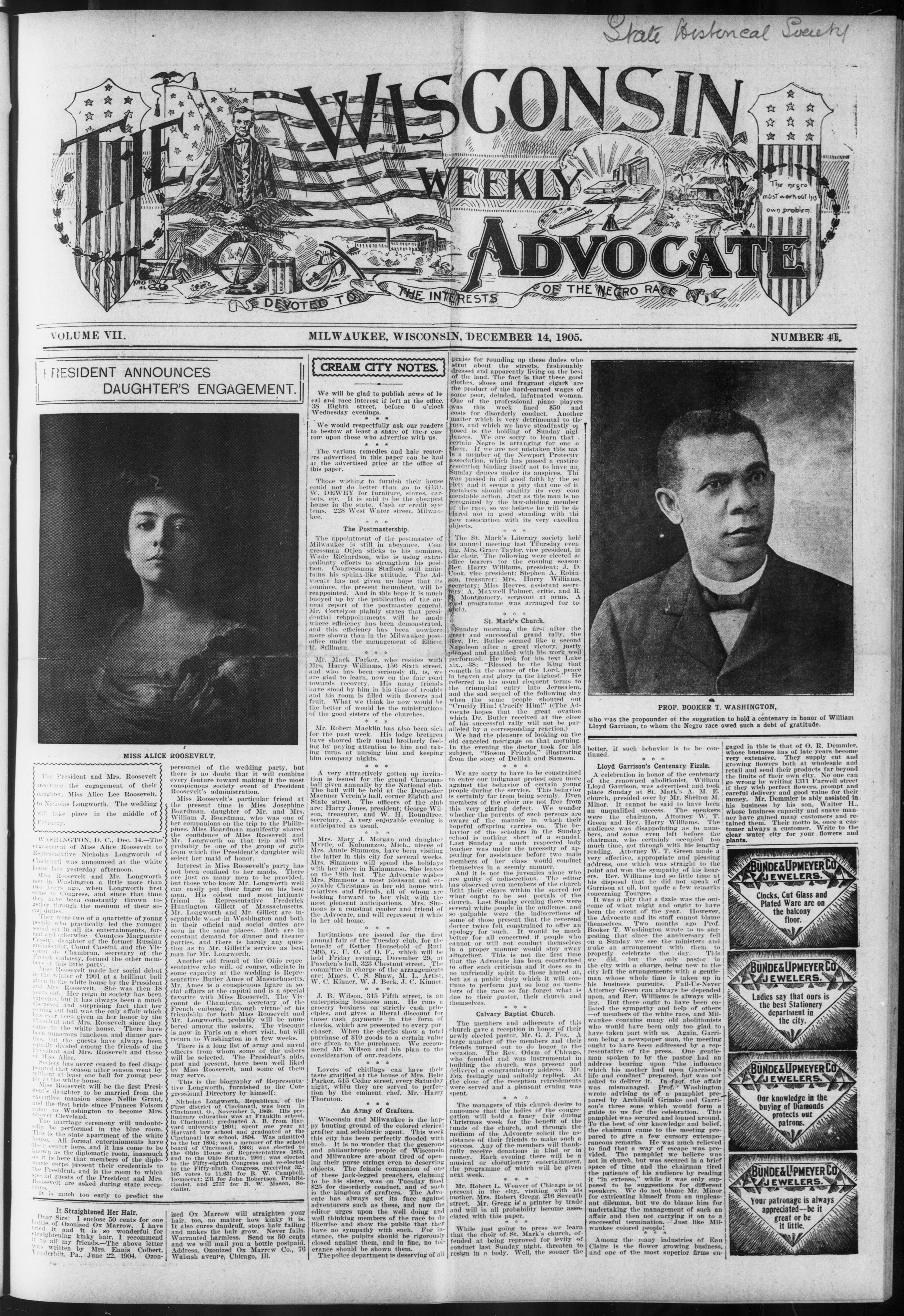
WISCONSIN
WEEKLY
ADVOCATE
DEVOTED TO THE INTERESTS OF THE NEGRO RACE
PRESIDENT ANNOU
DAUGHTE
MISS ALICE ROOSEVELT
The President and Mrs. Roosevelt announce the engagement of their daughter, Miss Alice Lee Roosevelt, to Nicholas Longworth. The wedding will take place in the middle of February.
WASHINGTON, D. C., Dec. 14.—The engagement of Miss Alice Roosevelt to Representative Nicholas Longworth of Cincinnati was announced at the white house late yesterday afternoon.
Miss Roosevelt and Mr. Longworth met in Washington a little more than two years ago, when Longworth first came to Congress, and since that time they have been constantly thrown together through the medium of their social duties. They were two of a quartette of young people who practically led the younger social set in all its entertainments, formal and otherwise. Countess Marguerite Cassipi, daughter of the former Russian ambassador, Count Cassini, and the Viscount de Chambrun, secretary of the French embassy, formed the other members of this little party.
Miss Roosevelt made her social debut in the winter of 1901 at a brilliant ball given in the white house by the President and Mrs. Roosevelt. She was then 18 years old. Her reign in society has been supreme, but it has always been a much discussed and surprising fact that her coming out ball was the only affair which has ever been given in her honor by the President and Mrs. Roosevelt since they came to the white house. There have been numerous luncheon and dinner parties, but the guests have always been equally divided among the friends of the President and Mrs. Roosevelt and those of Miss Alice. Society has never ceased to feel disappointed that season after season went by without at least one ball for young people at the white house.
Miss Roosevelt will be the first President's daughter to be married from the executive mansion since Nellie Grant, and the first bride since Frances Folsom came to Washington to become Mrs. Grover Cleveland.
The marriage ceremony will undoubtedly be performed in the blue room. This is the state apartment of the white house. All formal entertainments have their center here, and it has come to be known as the diplomatic room, inasmuch as it is here that members of the diplomatic corps present their credentials to the President, and is the room to which special guests of the President and Mrs. Roosevelt are asked during state receptions.
It is much too early to predict the
Dear Sirs: I enclose 50 cents for one bottle of Ozonized Ox Marrow. I have tried it and it is so wonderful for straightening kinky hair, I recommend it to all my friends.—The above letter was written by Mrs. Ennis Colbert, Vanderbilt, Pa., June 22, 1904. Ozon-
VOLUME VII.
It Straightened Her Hair
personnel of the wedding party, but there is no doubt that it will combine every feature toward making it the most conspicuous society event of President Roosevelt's administration.
Miss Roosevelt's particular friend at the present time is Miss Josephine Boardman, daughter of Mr. and Mrs. William J. Boardman, who was one of her companions on the trip to the Philippines. Miss Boardman manifestly shared the confidence of Miss Roosevelt and Mr. Longworth on that trip and will probably be one of the group of girls from which the President's daughter will select her maid of honor.
Interest in Miss Roosevelt's party has not been confined to her maids. There are just as many men to be provided, but those who know Mr. Longworth well can easily put their finger on his best man. His oldest and most intimate friend is Representative Frederick Huntington Gillett of Massachusetts. Mr. Longworth and Mr. Gillett are inseparable wane in Washington and both in their official and social duties are seen in the same places. Both are in constant demand for dinner and theater parties, and there is hardly any question as to Mr. Gillett's service as best man for Mr. Longworth.
Another old friend of the Ohio representative who will, of course, officiate in some capacity at the wedding is Representative Butler Ames of Massachusetts. Mr. Ames is a conspicuous figure in social affairs at the capital and is a special favorite with Miss Roosevelt. The Viscount de Chambrun, secretary of the French embassy, through virtue of his friendship for both Miss Roosevelt and Mr. Longworth, probably will be numbered among the ushers. The viscount is now in Paris on a short visit, but will return to Washington in a few weeks. There is a long list of army and naval officers from whom some of the ushers will be selected. The President's aids, past and present, have been well liked by Miss Roosevelt, and some of them may serve.
This is the biography of Representative Longworth, furnished to the Congressional Directory by himself:
Nicholas Longworth, Republican, of the First district of Cincinnati, was born in Cincinnati, O., November 5, 1869. His preliminary education was at Franklin school in Cincinnati; graduated A. B. from Harvard law school and graduated at the Cincinnati law school, 1894. Was admitted to the bar 1894; was a member of the school board of Cincinnati, 1893; was elected to the Ohio House of Representatives 1893, and to the Ohio Senate, 1901; was elected to the Fifty-eighth Congress and re-elected to the Fifty-ninth Congress, receiving 32.105 votes to 11,631 for B. W. Campbell, Democrat; 231 for John Robertson, Prohibitionist, and 2737 for B. W. Mason, Socialist.
ized Ox Marrow will straighten your hair, too, no matter how kinky it is. It also cures dandruff, stops hair falling and makes the hair grow. Never fails. Warranted harmless. Send us 50 cents and we will mail you a bottle postpaid. Address, Ozonized Ox Marrow Co., 76 Wabash avenue, Chicago, Ill.
CREAM CITY NOTES.
---
We will be glad to publish news of local and race interest if left at the office. 38 Eighth street, before 6 o'clock Wednesday evenings.
We would respectfully ask our readers to bestow at least a share of their custom upon those who advertise with us.
The various remedies and hair restorers advertised in this paper can be had at the advertised price at the office of this paper.
Those wishing to furnish their house could not do better than go to GEO. W. DEWEY for furniture, stoves, carpets, etc. It is said to be the cheapest house in the state. Cash or credit systems. 228 West Water street, Milwaukee.
The Postmastership
The appointment of the postmaster of Milwaukee is still in abeyance. Congressman Otjen sticks to his nominee, Wade Richardson, who is using extraordinary efforts to strengthen his position. Congressman Stafford still maintains his sphinx-like attitude. The Advocate has not given up hope that its nominee, the present incumbent, will be reappointed. And in this hope it is much buoyed up by the publication of the annual report of the postmaster general. Mr. Cortelyou plainly states that presidential reappointments will be made where efficiency has been demonstrated, and this efficiency has been nowhere more shown than in the Milwaukee post-office under the management of Ellicot R. Stillman.
☆ ☆ ☆
Mr. Mack Parker, who resides with Mrs. Harry Williams, 156 Sixth street, and who has been seriously ill, is, we are glad to learn, now on the fair road towards recovery. His many friends have stood by him in his time of trouble and his room is filled with flowers and fruit. What we think he now would be the better of would be the ministrations of the good sisters of the churches.
Mr. Robert Macklin has also been sick for the past week. His lodge brethren have showed their usual brotherly feeling by paying attention to him and taking turns at nursing him and keeping him company nights.
* * *
A very attractively gotten up invitation is issued for the grand Christmas ball given annually by the National club. The ball will be held at the Deutscher Maenner Verein's hall, corner Eighth and State street. The officers of the club are: Harry Jones, president; George Wilson, treasurer, and W. H. Roundtree, secretary. A very enjoyable evening is anticipated as usual.
* * *
Mrs. Mary J. Morgan and daughter Myrtle, of Kalamazoo, Mich., nieces of Mrs. Annie Simmons, have been visiting the latter in this city for several weeks. Mrs. Simmons will spend the holidays with her niece in Kalamazoo. She leaves on the 18th inst. The Advocate wishes Mrs. Simmons a most pleasant and enjoyable Christmas in her old home with relatives and friends, all of whom are looking forward to her visit with the most pleasant anticipations. Mrs. Simmons is a constant reader and friend of the Advocate, and will represent it while in her old home.
☆ ☆ ☆
Invitations are issued for the first annual fair of the Tuesday club, for the benefit of Esther Household of Ruth 2495, G. U. O. of O. F., which will be held Friday evening, December 29, at Paschen's hall, 323 Chestnut street. The committee in charge of the arrangements are: Mmes. C. S. Shaw, M. L. Artist, W. C. Kinner, W. J. Beck, J. C. Kinner.
* * *
J. B. Wilson, 315 Fifth street, is an enterprising business man. He runs a grocery business on strictly cash principles, and gives a liberal discount for those cash payments in the form of checks, which are presented to every purchaser. When the checks show a total purchase of $10 goods to a certain value are given to the purchaser. We recommend Mr. Wilson and his plan to the consideration of our readers.
***
Lovers of chitlings can have their taste gratified at the house of Mrs. Belie Parker, 515 Cedar street, every Saturday night, when they are served to perfection by the eminent chef, Mr. Harry Thornton.
An Army of Grafters.
Wisconsin and Milwaukee is the happy hunting ground of the colored clerical grafter and scholastic agent. This week this city has been perfectly flooded with such. It is no wonder that the generous and philanthropic people of Wisconsin and Milwaukee are about tired of opening their purse strings even to deserving objects. The female companion of one of these jack-legged preachers, claiming to be his sister, was on Tuesday fined $25 for disorderly conduct, and of such is the kingdom of grafters. The Advocate has always set its face against adventurers such as these, and now the editor urges upon the well doing and well thinking members of the race to do likewise and show the public that they have no sympathy with such. For instance, the pulpits should be rigorously closed against them, and in fine, no tolerance should be shown them.
The police department is deserving of all
praise for rounding up these dudes who strut about the streets, fashionably dressed and apparently living on the best of the land. The fact is that these good clothes, shoes and fragrant cigars are the product of the hard-earned wages of some poor, deluded, infatuated woman. One of the professional piano players was this week fined $50 and costs for disorderly conduct. Another matter which is very detrimental to the race, and which we have steadfastly opposed is the holding of Sunday night dances. We are sorry to learn that certain Negro is arranging for one o these. If we are not mistaken this ma is a member of the Newport Protective association, which has passed a castiro resolution binding itself not to have an Sunday dances under its auspices. This was passed in all good faith by the society and it seems a pity that one of it members should stultify its very commendable action. Just as this man is no recognized by the law-abiding member of the race, so we believe he will be declared not in good standing with this new association with its very excellen objects.
The St. Mark's Literary society held its annual meeting last Thursday evening, Mrs. Grace Taylor, vice president, in the chair. The following were elected as office bearers for the ensuing season: Rev. Harry Williams, president; J. D. Cook, vice president; Stephen A. Robinson, treasurer; Mrs. Harry Williams, secretary; Miss Reeves, assistant secretary; A. Maxwell Palmer, critic, and R. B. Montgomery, sergeant at arms. A good programme was arranged for tonight.
St. Mark's Church.
Sunday morning, the first after the great and successful grand rally, the Rev. Dr. Butler seemed like a second Napoleon after a great victory, justly pleased and gratified with his work well performed. He took for his text Luke xix., 38: "Blessed be the King that cometh in the name of the Lord, peace in heaven and glory in the highest." He referred in his usual eloquent terms to the triumphal entry into Jerusalem, and the sad sequel of the following day when the same people shouted out "Crucify Him! Crucify Him!" ((The Advocate hopes that the great ovation which Dr. Butler received at the close of his successful rally will not be paralleled by a corresponding reaction.)
We had the pleasure of looking on the old canceled mortgage on that morning. In the evening the doctor took for his subject, "Bosom Friends," illustrating from the story of Delilah and Samson.
* * *
We are sorry to have to be constrained to enter our indignant protest once more against the behavior of certain young people during the service. This behavior is certainly far from being seemly. Even members of the choir are not free from this very glaring defect. We wonder whether the parents of such persons are aware of the manner in which their hopeful offspring carries on. The behavior of the scholars in the Sunday school is nothing short of a scandal. Last Sunday a much respected lady teacher was under the necessity of appealing for assistance before two male members of her class would conduct themselves in a seemly manner.
And it is not the juveniles alone who are guilty of indiscretions. The editor has observed even members of the church light their cigars within the sacred (or what ought to be so) portals of the church. Last Sunday evening there were several white people in the audience, and so palpable were the indiscretions of some of those present that the reverend doctor twice felt constrained to offer an apology for such. It would be much better for all concerned if people who cannot or will not conduct themselves in a proper manner would stay away altogether. This is not the first time that the Advocate has been constrained to offer such criticism and it does so in un友riendly spirit to those hinted at, but as a public duty which it will continue to perform just so long as members of the race so far forget what is due to their pastor, their church and themselves.
Calvary Baptist Church.
The members and adherents of this church gave a reception in honor of their newly elected pastor, Mr. G. J. Fox. A large number of the members and their friends turned out to do honor to the occasion. The Rev. Odam of Chicago, who founded and was instrumental in building the church, was present and delivered a congratulatory address. Mr. Fox feelingly and suitably replied. At the close of the reception refreshments were served and a pleasant evening was spent
```markdown
```
The managers of this church desire to announce that the ladies of the congregation will hold a fancy fair during Christmas week for the benefit of the funds of the church, and through the medium of the Advocate solicit the assistance of their friends to make such a success. Any of the members will thankfully receive donations in kind or in money. Each evening there will be a musical or elocutionary entertainment, the programme of which will be given next week.
* * *
Mr. Robert L. Weaver of Chicago is at present in the city, visiting with his mother, Mrs. Robert Gregg. 216 Seventh street. Mr. Gregg is a printer by trade and will in all probability become associated with this paper.
While just going to press we learn that the choir of St. Mark's church, offended at being reproved for levity of conduct last Sunday night, threaten to resign in a body. Well, the sooner the
who was the propounder of the suggestion to hold a centenary in honor of William Lloyd Garrison, to whom the Negro race owed such a debt of gratitude.
better, if such behavior is to be continued.
Lloyd Garrison's Centenary Fizzle.
A celebration in honor of the centenary of the renowned abolitionist, William Lloyd Garrison, was advertised and took place Sunday at St. Mark's A. M. E. church, presided over by Mr. Shelton M. Minor. It cannot be said to have been an unqualified success. The speakers were the chairman, Attorney W. T. Green and Rev. Harry Williams. The audience was disappointing as to numbers, and some even left before the chairman, who certainly occupied too much time, got through with his lengthy reading. Attorney W. T. Green made a very effective, appropriate and pleasing address, one which was straight to the point and won the sympathy of his hearers. Rev. Williams had so little time in his disposal that he did not speak of Garrison at all, but made a few remarks concerning Tourgee.
It was a pity that a fizzle was the outcome of what might and ought to have been the event of the year. However, the Advocate and its staff cannot blame themselves. Two months ago Prof. Booker T. Washington wrote to us suggesting that since the anniversary fell on a Sunday we see the ministers and make an arrangement with them to properly celebrate the day. This we did, but the only pastor in the city with a charge, being new to the city left the arrangements with a gentleman whose whole time is taken up in his business pursuits. Fail-Us-Never Attorney Green can always be depended upon, and Rev. Williams is always willing. But there ought to have been enlisted the sympathy and help of others
of members of the white race, and Milwaukee contains many old abolitionists who would have been only too glad to have taken part with us. Again, Garrison being a newspaper man, the meeting ought to have been addressed by a representative of the press. One gentleman spoken to by the pastor had an address bearing upon "the influence which his mother had upon Garrison's life and conduct" prepared, but was not asked to deliver it. In fact, the affair was mismanaged. Prof. Washington wrote advising us of a pamphlet prepared by Archibald Grimke and Garrison's three sons which would form a guide to us for the celebration. This pamphlet was secured and loaned around. To the best of our knowledge and belief, the chairman came to the meeting prepared to give a few cursory extemporaneous remarks. He was much relieved to find that a way of escape was provided. The pamphlet we believe was not in church, but was secured in a brief space of time and the chairman tired the patience of his audience by reading it "in extenso," while it was only supposed to be suggestions for different speakers. We do not blame Mr. Minor for extricating himself from an unpleasant dilemma, but we do blame him for undertaking the management of such an affair and then not carrying it on to a successful termination. Just like Milwaukee colored people!
Among the many industries of Eau Claire is the flower growing business, and one of the most superior firms en-
NUMBER 41.
WASHINGTON,
to hold a centenary in honor of William
owed such a debt of gratitude.
gaged in this is that of O. R. Demmler, whose business has of late years become very extensive. They supply cut and growing flowers both at wholesale and retail and send their products far beyond the limits of their own city. No one can go wrong by writing 1311 Farwell street if they wish perfect flowers, prompt and careful delivery and good value for their money. Mr. Demmler is able assisted in his business by his son, Walter H., whose business capacity and suave manner have gained many customers and retained them. Their motto is, once a customer always a customer. Write to the clear water city for your flowers and plants.
BUNDE&UPMEYER CO
JEWELERS.
Clocks, Cut Glass and
Plated Ware are on
the balcony
floor.
BUNDE&UPMEYER CO
JEWELERS.
Ladies say that ours is
the best Stationery
department in
the city.
BUNDE&UPMEYER CO
JEWELERS.
Our knowledge in the
buying of Diamonds
protects our
patrons.
BUNDE&UPMEYER CO
JEWELERS.
Your patronage is always
appreciated—be it
great or be
it little.
```markdown
```
Some Prominent People.
Dr. Lawrence I. Flack, an expert on tuberculosis is planning an international tuberculosis convention to be held in Washington in 1908.
Submarine signaling has been tried successfully in the Mersey. The Lucania heard the bell at the distance of nine and a half knots while she was under full speed.
The retirement of Dr. William A. Packard as Kennedy professor of Latin language and literature and the science of language at Princeton marks the close of thirty-five years of active teaching.
Louis A. Frothingham, the Republican candidate for mayor of Boston, was captain of one of the best football teams Harvard has ever had. He is only 34 years of age.
Mrs. Hetty Green, who was 70 years old a few days ago, is believed to be worth a million for every year of her life. She refused to celebrate her birthday, saying such foolishness was not for a woman of her age.
Benjamin K. Thorn, a native of New York, nephew of United States Senator T. C. Platt, age 75, and classed as the most fearless sheriff in California, died recently. No chance was too desperate for him in his fifty years of service.
Gen. Trepoff is a man of most aristocratic appearance—tall, dark and handsome, not unlike the late Prince Alexander of Bulgaria—while his manners are highly polished. The character of the man is revealed in his measured metallic voice.
George T. Kelly, a member of the law firm of Wells & Kelly, Chicago, has been appointed master in chancery of the superior court of Cook county. Mr. Kelly was born in Eau Claire, Wis., thirty-two years ago, and is a graduate of the University of Wisconsin.
Mr. Takahira, the Japanese minister, who expects to leave shortly for Japan and to be absent from Washington for the season, has issued invitations for a small stag party to say good-bye to his friends. It is possible that he may return to Washington next spring, but it is not at all certain that he will do so. The Pope at Rome has instructed Secretary Merry Del Val to secure a collection of the messages and speeches of President Roosevelt and have them translated into Italian. The Pope wishes to study President Roosevelt's views in connection with an important papal document to be issued later, on social problems.
William Thompson, who died the other day at Shelbyville, Ind., aged 77, was known as "the man who sold his gold at $2.75." During the Civil war Thompson accumulated $2100 in gold, which he carried to Indianapolis and sold at a premium of $2.75, netting him $7525, within 10 cents of the highest price ever paid for gold.
Mrs. Theodore Roosevelt has accepted the office of honorary vice president of the state mothers' assembly of New York. In a letter to Mrs. E. H. Merrill of Syracuse, president of the assembly, Mrs. Roosevelt stated that although it was contrary to her custom she would be pleased to accept the office. Mrs. Roosevelt belongs to no woman's club, with the exception of the Mothers' club.
For many years Senators Chandler and Blair of New Hampshire were on bad terms, refusing to recognize each other on the street. At length they became reconciled after a fashion. One day they were chatting with some colleagues when Mr. Chandler complained of suffering from lumbago. "The pain began," he said, with a twinkle in his eye, "just when I knelt down to say my prayers last night." Mr. Blair said gravely: "That's too bad. And the first time you ever did such a thing, too."
Richard A. McCurdy, who has resigned the presidency of the Mutual Life company, is a lawyer by profession, having graduated from Harvard in 1855 with the degree of LL. B. Later he practiced law in New York with Lucius Robinson, afterward governor of the state. He first became identified with the Mutual in 1860 as its counsel and has been drawing salary from the corporation ever since. A few years ago he built a house in Morristown, N. J., which cost about $1,000,000.
When he returned to Washington recently Ambassador Von Sternberg brought a complete suite of drawing room furniture that had adorned the rooms occupied by Napoleon in Leipsic. These treasures were bequeathed to the ambassador by a relative whose grandfather had owned the place where the Corsican elected to abide. The furniture is ancient Flemish and in the tapestry are woven mythological designs. The frames bear a gold design. A desk at which Napoleon wrote vigorous messages is part of the legacy.
WINS PHOTOGRAPH SUIT
Refuses to Pay More Than $300 for Lot of Pictures.
Miss Edmee Anheuser, one of the belles of St. Louis' south side, worth $1,000,000 in her own right, was the victor in a suit for $104.35 brought by her photographers, Kandeler Brothers, proprietors of the Rembrandt studio, who charged that they made fifty-five pictures for her in October, making a total bill of $404.35, for which Miss Anheuser sent them a check for $300. Miss Anheuser, who rode to the stuffy little courtroom in the family carriage accompanied by her sister and escort, said that $300 was all the photographs were worth, and when she explained that to Mr. Kandeler he said he was satisfied. Afterwards a collector called at the house and tried to get the balance. "Be a nice little girl," he said, "and pay up." Miss Anheuser admitted she became hysterical, because she is not a little girl, but a lady. She said the pictures were "fierce." One of them, she said, made her look as if she was 35 years old and twelve of them, which she returned, were "crosseyed." The jury was out only a few minutes when it brought in a verdict for Miss Anheuser.
The Ready Lady
Dr. Sophronia Fletcher of Cambridge is hale and active at the age of 91. In a criticism of a somewhat emotional and bombastic character, Dr. Fletcher said the other day: "This gentleman reminds me of a friend of mine, a woman now dead these many years. "The woman, with a tragic air, rushed upstairs one day, and cried to her maid: "'Celeste, put my curling iron in the fire at once. James has been bitten by a mad dog.'
"‘Ah, brave madame!” said Celeste. 'Madame is going to cauterize the wound?'
"‘No.’ said the lady. ‘But I am going to curl my hair so I can run for the doctor.’"
Rough on Him.
"Of course," said the girl who had been abroad. "I was delighted to meet you again after all these years, but I felt hurt that you didn't introduce the gentleman who was with you—"
"Oh! really, May," exclaimed the other. "I don't consider him a fit man for you to know."
"The idea! If he's fit for you to associate with I can't see—"
"Oh! I have to associate with him. He's my husband."—Philadelphia Press.
TO JESUS THE NAZARENE.
Closest to men, thou pitying Son of Man,
And thrilled from crown to foot with fellowship,
Yet most apart and strange, lonely as God—
Dwell in my heart, remote and intimate
One!
Brother of all the world, I come to thee!
Gentle as she who nursed thee at her breast
(Yet what a lash of lightnings once thy tongue
O man of sorrows, with the wounded hands—
For chaplet, thorns; for throne, a pagan cross;
Bowed with the wee and agony of time.
Yet loved by children and the feasting
guests—
I bring my suffering, joyful heart to thee.
Chaste as the virginal lily on her stem.
Yet in each hot, full pulse, each tropic vein.
More filled with feeling than the flow'r with
sum;
No anchorite—hale, sinewy, warm with love—
I come in youth's high tide of bliss to thee O Christ of contrasts, infinite paradox,
years—
I lean my wondering, wayward heart on thine.
—Frederic Lawrence Knowles in the Century, died September 19, 1905.
AN AVE MARIA
Marmaduke Redfern took the cigar from his mouth and rose from the elaborately upholstered chair in his billiard room of the mansion in Portland place, and swore. It was just on the stroke of 11 on Christmas eve, and he had been sitting alone for over an hour. "Hang her!" he said as he reseated himself and leaned back in his chair, "hang her! she deserved all she got! Hang all romance, say I."
George Meredith tells us that Diana of the Crossways said (very beautifully) of romance that "the young who avoid that region escape the title of fool at the cost of a celestial crown." But there are some who not only avoid the region, but are ignorant of its whereabouts—nay, who call the divine garden "Romance," and thus deservedly both win the title and lose the diadem.
And with these Marmaduke Redfern had been numbered from his youth upward. He was the eldest son of one of those types of Nineteenth century life who laid a magic hand upon a little shop and transfigured it into a vast manufactory. A man who suddenly raised his family from generations of the sordid indigence of unsuccessful buying and selling to the possession of hoards of wealth, which the very blood in his veins prevented him from knowing how to enjoy. Marmaduke had been born before the great evolution, and, after as much education as is to be obtained at a private school at Brighton of the class called "genteel" by the proprietor, had pased to his father's cash office with the firm of Redfern & Whitehill, in the parish of St. Anne's. He was then 15 years old. But even then he loved to see the business swell, and think how wealthy he would be one day.
The old man died when Marmaduke was barely 20. But his share of the business was large enough to make it easy for the sucking merchant to insist upon being taken into partnership by the surviving member of the firm. His younger brothers went to public schools, and thence into the army or to the bar, and having severed their connection with the vile thing which had made them, they proceeded to cut their eldest brother except upon such occasions as when they wanted to borrow money of him.
Marmaduke had never in his life felt a generous impulse, or been guilty of an action of uncalculating kindness. The pettiness and meanness of his original nature had thriven in the counting house. He was no stranger to the desire and enjoyment of the more animal indulgences of life. He was even sufficiently advanced in the scale to envy his brothers their better social chances. But in the midst of it all he counted the cost. He was a cautious youth.
He was little more than 21 when he developed a wish (for social reasons) to marry the school friend of one of his sisters, who was of better birth than he, and during his courtship he flashed his money about considerably, and his gifts to his intended bride and her family (which were really but ostentation and advertisement) were taken by them to be evidences of his generosity. Building upon this, the poor girl's parents (with the lack of insight so common in parents) persuaded her to accept him for her husband. But he had no intention of carrying his free handedness too far. It was characteristic of the man that even at the time of his marriage he should have been shrewd enough in his petty way to avoid making a proper settlement upon his wife on the ground that her father was not in a position to give her a dowry.
The marriage turned out badly, as a matter of course. Marmaduke had expected to be able to force himself into society on the skirts of his wife. He cultivated a light tenor voice with the utmost care, in order to possess some accomplishment which might be of use in the drawing room. His wife, poor Nellie, sang deliciously, and Marmaduke loved to join his reedy pipe to her rich mezzosoprano in "Flow on, Thou Shining River," "All's Well," and the simple duets that were popular forty years ago. But he found that his manners and extraordinary lack of tact were an effectual bar to his hopes. In those days something was wanted to gain an entry into decent society besides accumulated boards or bullion. Vain and selfish, he visited his failure upon his wife. She bore him one daughter, and then, finding the pleasure of maternity insufficient to make her wretched life worth living, she died when little Maude was just 6 years old.
As has been said, there was no settlement made upon the marriage. Little Maude's future was left entirely in the hands of her father—a man with no sense of responsibility, and with only the inclination toward his daughter as being his, part of his noble self, in place of true fatherly love.
But as the child grew up the sweetness of her temper and the beauty of her form and face had their effect even upon the formerly unresponsive nature of her father. Since his wife's death he had got into a certain sporting set who did not object to associate with any one who was willing to pay for the privilege of their acquaintance—a set, indeed, that was the forerunner of so many society cliques now. He became extremely satisfied with himself, and when he had lunched with a coursing lord of doubtful reputation (who was desirous of borrowing a few hundreds) he fancied that he had pierced his way into the very holy of holies of London life. But his new friends lived fast, and in Marmaduke's veins ran the blood of generations of middle class respectability. A steady course of champagne and liquors worked on his unaccustomed nerves. He had always been a fidgety, nervous man, with marionette-like movements, quick perking gestures of the head, and a rapid current of petulant phrase for those to whom he did not cringe. The drink made him emotional.
Then it was that he developed an ex-
traordinary feeling for his daughter. It was rather a maudlin pride than appreciative affection. But it made him as tender to and considerate of her as he knew how to be. He became more domestic. His sporting friends (having worked their fated influence upon his nerves) fleeced him of a few thousands, and he was shrewd enough to notice that, though they were "hail fellow well met" with him at Nicholls', Jimmy's, or Verrey's, they never invited him to meet their womenkind. His pride in his daughter ousted the hankering for tuff hunting, and he devoted himself more and more to her.
Early in life the child had shown unusual talent for the violin. As she grew in years her technique grew with her. And when she was 14 years of age Marmaduke bought her a genuine Amati. He took singing lessons again, and furbished up his light tenor, now a little the worse for champagne and wear.
He advertised for a housekeeper of good family and a decent pianist, and engaged a woman of 40 possessing these attributes, to sit at the end of his table and chaperon his little daughter, so that he could invite the few men who would bring their wives to his table for the sake of a good dinner. Maude always dined with them. Then, after a twenty-course dinner, with '74 champagne, '64 claret and '47 port, and cigars for the men which he was careful to tell them cost him 2s6d each, he would give an exhibition in the drawing room of Maude's prowess on the Amati, and his own vocalization in some air with violin obligato. Of all his repertoire nothing appealed so much to him as Blumenthal's "Requital." and Gounod's "Ave Maria." He had got an incorrect translation of the Latin of the latter, and managed to put some meaning into words which were meaningless to him. His pride in the pure rich tones of the violin and the effect of the music (for music will affect all kinds of natures, from highest to lowest) made a better man of him, as he reached from the high B flat in "nure in hora mortis nostrae," than he had ever been before.
It was a strange scene. The parasites who cared for nothing but the dinner trying not to look bored; the pretentious housekeeper flashing her rings in the Bach prelude; the accompaniment to Gounod's melody; the lovely child, with eyes turned heavenward and nerves and sinews taut with the pious passion of the beautiful obligato appear, which went wailing from her old violin, pure and true in tone, and instinct with the emotion vibrating at her finger tips, and the little sandy haired, light-moustached man, bending over the piano, complacent and gesticulatory, but growing better, better and nobler for the stirring in his heart, for the tears in his eyes.
Maude never knew the real nature of her father—or perhaps she did know the real man, and I and the rest of us only the artificial. At any rate she loved him with more than the ordinary love of a daughter for a father. To her he was ever kind. In her presence he would talk tenderly of his dead wife, and with self-deceptive pathos would sing "Waft her, angels, through the skies," till the tears ran down the cheeks of both widower and child as they thought of her whom the man had killed with neglect, till the housekeeper gave up all housekeeper's thoughts of ever supplanting the dead woman's memory.
But Maude grew up, and at a concert at which she was playing, she met a young pianist—one of those ephemeral geniuses who take the town by storm for one season and then never play up to the same form again.
Marmaduke engaged him for two or three evenings to play with Maude (even fiction should have taught him better), and in the slow movement of "The Kreutzer" they told each other their love. The tale is too old to give in detail. Maude's love for her father was great; but her love for her lover was greater. And yet Marmaduke might have got her to sacrifice her lover to her father if he had gone the right way to work. They told him their secret on Christmas eve of 1887 (when the guests had left after a dinner), thinking that the season would make his heart kindly to their love—the season of peace and good will. But the knowledge that his daughter loved another better than himself was sufficient to kill any tenderness that had been nursed into existence in Marmaduke. It cut at his pride, his vanity, his absurd self-importance.
He stormed and blustered, and insulted both his daughter and the pianist, and finally turned them both out of the house into the night, daring either of them ever to cross his threshold again. As they went down the steps into the street they jostled against some carol singers. Latimer, the butler, let them out, and gazed sadly after them. All the servants loved Maude.
Lawrence Conifer, the pianist, was an honorable youth. He took the girl to his mother's house, whence he married her as soon as the necessary formalities could be got through.
And that was fourteen years ago!
And that was fourteen years ago!
Since then no word had come to the father of either his daughter or the man she married. He went back to the old selfish life, and, with the assistance of the housekeeper, who was now gray and whose hopes were dead, he tried to satisfy the sensation of something wanting by giving great entertainments.
For the last hour he had been sitting alone in the billiard room, that opened into the hall. He had been ill. The years and life were telling on him. His tow-colored man was streaked with white. His features were more pinched and peevish than of old.
Was it ill health that had brought thoughts of the old days back to him as he sat by the fire, puffing with quick, nervous puffs from a cigar that deserved better treatment?
"Hang her!" he said again, in spite of the curious softness he felt coming over him; "hang her! she deserved all she got! Hang all romance, anyway!"
He woke with a start. "Who's that?" he cried.
The fire was burning fiercely—the swan lights glowed through the room. He looked round nervously. There was no one there. His dead cigar lay in the hearth close beside him. The effervescence of his brandy and soda had bubbled out. He looked at his watch; he had not slept ten minutes. He got up, poured out a stiff dose of the old brandy into a clean glass, squirted into it from a siphon, drank, and lit another cigar.
Then he sat down again and took up a late edition of an evening paper.
Ah! there it was! That was what had brought the old days back again.
"Music lovers who remember the brilliant pianoforte playing of Lawrence Conifer in the season of 1887 will regret to hear of his death, which took place last Wednesday in the Charing Cross hospital. Mr. Conifer, like so many other musical performers, never achieved the same success again as that which attended him during his first season. We understand that he leaves a wife and two children, living in very poor circumstances."
"Serve her right!" said Marmaduke again, with an oath. But his hand shook as he took his glass and drained it at a gulp.
Outside a gust of hail stormed down at the huge plate glass windows, and rattled against the framework. Then silence came again.
A noise of nervous, uncertain footsteps. Was it in the hall, or outside? Ah! Listen! Thin, scarce audible, a chord of vibrant strings quivered in the air. Again; then a faint sweet child voice sang: Loud raged the tempest.
Fast fell the sleet.
When a little child angel
Passed down the street
With trailing pinions
And weary feet.
For a moment Marmaduke was incapable of movement. He fell back helpless in his chair. His face blanched, and his pale blue eyes became pathetically senile. "The Requittal!" Ah! how often had his voice sung it while Maude's deft fingers improvised an obligato to the torrent and crash of the piano.
It was the same obligato: he would swear to that. But how could— Oh, of course, she and her husband had published it between them. Made money out of that! She can never have had any love for him.
He poured out another brandy and sola and drank it eagerly. But still he heard the thin, faint obligato, the pure childlike voice:
The violin seemed to wail up on the high note. Surely it was fancy--his memory was playing tricks with him. No street children could play like that. No; he was sure of it.
"How fanciful I am tonight!" said Marmaduke; "I keep thinking I hear all sorts of things. O God: he shrieked, "not that!"
His voice leapt up to a scream as he staggered to his feet and pressed the button of the electric bell.
Outside, a little clearer and firmer, the violin and voice were playing and singing "Ave Maria."
Marmaduke heard no more for a space. All he could hear or see was a scene, a sound, in the drawing room of a dead day. But he pulled himself together, and again the voice and violin came to his ears; the voice and violin of the present, not the past.
"Benedicta tu in mulieribus, et benedictus fructus ventri tui Jesus. Sancta Maria, ora pro nobis, nobis peccatoribus, nunc et in hora, in hora mortis nostrae. Amen."
Marmaduke had sunk back in his chair. No one had answered the bell; the servants, butler and all were outside in the area snow looking up at two wee shivering figures making angel music on the holy night.
The man shook in his chair—shook with rage and remorse, and, above all, with self-pity.
The servants' voices were loud below in the area. A child's voice quivered in the night air.
He reached out his hand and again primed himself. Then he went quickly and firmly to the bell and pressed his finger furiously upon the button, keeping it there some seconds.
Marmaduke stuttered with rage and some feeling which overpowered him and left him helpless, which was new to him, and which he fought against.
A door slammed below stairs; then at the top of the passage from the kitchen to the hall. A hurried step came on the tiles. The old butler stood in the billiard room.
"G—go at once, Latimer," he said, "and send those noisy little beasts away. Why d—didn't you answer the bell before? G—go. Look sharp! Send 'em off! Do you hear me?" for Latimer stood looking at him queerly.
"Yessir," said Latimer. "Suttinly, sir!" As the butler turned to go the first bars of the "Ave Maria" again stole into the bright, warm billiard room. The front door opened and the sound of voice and violin came in clear, firm and beautiful. Whoever the performers were, they were true musicians.
The millionaire waited to hear the harsh words spoken—the harsh order given. And as the prayer thrilled and pulsed through the air, grown more chill in the draught of a bitter light rushing through the hall, a feeling of dull morse came upon him. He called out: "Wait a minute, Latimer, take this to them."
But Latimer neither answered nor returned. The voice and violin poured out their harmony.
Marmaduke Redfern rose from his chair and went into the hall. He found the old butler standing silent, gazing with staring eyes at the scene on the doorstep.
The great volume of electric light in the hall shone bright and clear on two small figures. One was that of a poorly cud boy of 12, from whose mouth the Latin came with perfect intonation and enunciation. By his side stood a girl of 13. Her poor cotton frock barely reached below her knees, and her shabby cotton stockings hid their holes in bursting boots, thin soled and penetrated with the snow. A coarse shawl was tied over her head, once round, so as not to be in the way of the cheap yellow violin which she held beneath her chin. Her eyes were raised upward. Her cheeks were pale with want. Her lips were tremulous and blue with cold and anguish. But the bowing of the hand and arms were Maude's; the eyes were Maude's; the face was Maude's.
Then the man whom the old Maude knew and no other knew awoke. With a cry he tottered out on to the doorstep, fell on his knees and clasped his arms about the little violinist, who started back for a moment, afraid of his eagerness.
"Maude," the millionaire called. "Maude—my darling—come home; come back to me!"
The old butler gulped, kicked over a hall chair, and gave a feeble cheer. Marmaduke raised the girl in his arms; Latimer snatched up the boy, and sobbing and gasping the men bore the children, to the warmth of the great fire in the billiard room.
As they put them down in the deep seated chairs the clock on the marble mantelshelf struck 12, and the bells of the churches in Langham place and all about the great city clanged out in peals of joy. "Christ is born," they ran; "peace on earth, good will toward men."—James Blyth in Black and White.
About Christmas.
Here are some of the general fundamental rules for Christmas keeping: Have all the fun you can; find as much as possible of it in making things cheerful for other folks; be delighted with everything that is given to you; give what you can afford and not very much more; don't eat too much; don't drink any too much; finally, if you can, get into the country and take all the family with you, and have a real old-fashioned time, with plenty of outdoors, and as much sport as possible, in it.
I don't know that the old-fashioned Christmas has ever been beaten, or ever will be. The ideal calls for a hospitable country house, a large family, sundry established institutions, some carols, some wassall, some mistletoe, a boar's head, a big open fire, and a yule-log, and other approved and venerable properties, and plenty of cheerful people. We Americans out of our abundance have contributed to this ideal the turkey, the cranberry and the oyster. We have borrowed the Christmas tree from the Germans. We hang green wreaths in our windows—where did we learn that?—and drape our churches and our dwellings with more green things. Santa Claus is a naturalized citizen of our country.—Illustrated Sporting News.
Dr. Charles A. Goldsmith, 59 years old, of New Haven, Conn., and Walter H. Wilkie, 68 years old, of Rockville, have arranged to start on a trip around the world next spring and neither will have a cent of capital. They will work their way.
A FEW TIMELY SUGGESTIONS.
Christmas giving is defined by the pessimist as spending more money than one can afford for things that people do not want, but the optimist is happy in giving and trifle that will suggest to the recipient the pleasure of "remembering."
An interesting item regarding the mistletoe is that it is the only plant whose roots refuse to shoot in the ground—a peculiarity possessed by no other parasite. It is found on the fir, the lime, and the apple tree as well as on the oak.
If one really can not afford the expense, or living in limited quarters, has not the room for a doll house, the small girl will get a vast deal of comfort from a set of "furnishings" that can be packed in a basket or cretonne-covered box to be carried to whatever room is selected for the playing.
The pretty custom of decorating house and church with evergreen is undeniably a relic of paganism. It came directly to the English races from the Druids of ancient Britain, who believed that if a house was garlanded with holly, laurel, or bay, the good sylvan spirits that loved such growths and kept them green by their protecting care during winter frosts, would surely protect the dwelling from harm.
Especially at Christmas time let us make our charity not merely a question of money; charity is not the synonym of coin, but of love—a fact we too often forget. Let us use our brains as well as our purses, being careful that what we give, just because it may be limited will be appropriate to the recipient and be accompanied with love and sympathy. Remember it is not so much what we give, but the spirit in which the gift is made, that counts.
For fairs or sales there is nothing quite so "saleable" as cakes and aprons. Cakes of all kinds and flavorings are sure to have purchasers when fancy articles and the ordinary knickknacks are left unnoticed. The majority of aprons should be of the serviceable kind—for household use—with bibs and without, in a variety of colorings and material, and be sure there are plenty of white ones with embroidery or hemmistitching as well as some fancy, dainty ones so popular now for afternoon wear, and a few for children.—Pilgrim.
Christmas in Other Lands
The original entertainment was given by a Sunday school teacher to her class of boys and girls, and was intended to instruct as well as amuse. The children were old enough to have some idea of geography.
Soon after they reached the teacher's home, she conducted them into a room decorated to represent Norway. Here they were greeted in a most cordial manner by a maiden dressed in the costume of Norway, who told them the story of Christmas in that country, which is called Yule-peace instead of Christmas, and is celebrated by feasting—all quarreis are made up. She spoke of the preparations made by the mothers, the way the gifts are distributed from the tree, how the birds are remembered with bunches of wheat placed outside the window on poles, and that all animals are given extra portions of supper, how strangers are treated on Yule-peace day. After the story, little girls in the native costumes of Norway appeared from among the pine trees with trays of dainty sandwiches.
Then they went into another room where many dainty articles from Holland were displayed in a very artistic manner. After a hearty welcome from a maiden in the typical Dutch costume, some time was spent looking at the pretty things before she began the story of how the Dutch people keey Christmas—as a holy day; do not work. Among other things she told them that Dutch children think Santa Claus comes driving a white horse instead of reindeer, and they clean their wooden shoes and fill them with hay and oats for the white horse. Here ice cream was served in little wooden shoes with flags of the country stuck in them like sails.
They next visited Denmark. Here was a pretty Christmas tree with dainty gifts for each one. A young lady in the native dress told how Christmas is celebrated there. Especially interesting to the boys and girls was that part of the story that the children in Denmark do not know about Santa Claus, but "Nisson," a little old man who is a Brownie and supposed to live under the ground, takes his place.
The idea is a beautiful one, and might be elaborated on for an entertainment for a Sunday school. It was really talks on the way Christmas is observed in other countries, which were told in such an interesting, fascinating manner that they were heartily enjoyed by the children, who begged to be told about Christmas in other countries than the ones mentioned.—The Pilgrim.
Told by Mrs. Russell.
Mrs. Henrietta Russell, who writes sensibly on education, says some of the current notions in regard to it are strikingly like those of Aunt Charlotte, an old negro woman of Alabama.
Whenever a subject was under discussion in the family Charlotte would be sure to state her own superior method of proceeding in such matters, and no doubt ever assailed her that possibly she might not be right. On one occasion her mistress was talking about sending some of the children to school, and Charlotte, as usual, put in her oar.
"Laws, missis," said she, "what mck you pay money for to sen' de chile to school? I got one smart boy, name Jonas, but I l'arns him myse'f."
"But Aunt Charlotte," said the lady, "how can you teach your child when you don't know one letter from another?"
"How I teach him? I jis mek him tek de book an' set down on de flo', an' den I say: 'Jonas, you tek yo' eye fum dat book, much less leggo him, an' I skin you alive!"
Older Than "Joe Miller."
One of the best story tellers of his time was my uncle, Han Thompson of Auburn, Me. The following is what Han told of what he and his brother John tried to do in the way of catching a woodchuck.
They had tried quite a number of times to capture the animal, but unsuccessfully. At last they decided to drown him out. So, procuring four pails, each took two, and they carried water for two solid hours and poured it into the hole in the ground in which the said "chuck" had taken up his abode.
Getting tired, they sat down. After about half an hour the woodchuck cautiously left the hole and deliberately walked down to the brook and took a long drink of water, and then scooted, much to the disgust of the two boys.—Boston Herald.
Points on Etiquette
An invitation should be sent to mother for any function to which her daughters are invited.
It is decidedly improper for a man to hint at an invitation to call from a woman. It is her privilege to make the first move in a matter of that kind; were it not so, she would be placed in a very embarrassing position.
When a woman is walking alone, and meets a man of her acquaintance, she may stop and chat with him for a moment, or, if agreeable, invite him to walk a short distance with her. She should not block the street, and if the man makes no move to step aside, she should suggest that they do so.
GIRL AND DOG CAUSE PANIC.
Ugly Canine Responsible for Big Scare in Louisville. An ugly bulldog and a pretty girl at opposite ends of a silken cord caused a panic among shoppers in the busiest part of Market street, Louisville, in which three women fainted, a team ran away and a motorman strained his neck in an effort to stop his car in time to avoid a fatality.
The dog refused to give his name, but he admitted, at least by implication, that he belonged to Miss Marjory Weissinger, who, in addition to being considered one of the most beautiful women in Louisville, has the distinction of being the daughter of one of that city's wealthiest men. Miss Weissinger and her pet were out for their daily constitutional. All went well until the bulldog spied an inoffensive terrier in the middle of the street.
He was enraged that any other dog should have the presumption to walk the same street, and gave a frantic lunge to get at his foe. Miss Weissinger hung gamely to the cord, but as the two struggled about the pavement, three women fainted and other shoppers scattered in alarm. Finally the buldog got away and started down the street after the terrier, yelping defiance as he went. A team of horses ran away and collided with a street car, but the buldog had no time to pay attention to such trivialities. He caught the terrier in the middle of the car tracks and proceeded to give him a lesson in etiquette. A street car was stopped just in time to avoid running over the dogs. In a moment, however, Miss Weissinger arrived, pried her pet loose from what was left of the terrier and led him struggling away.
"How terrible," murmured a woman. Then she fainted at sight of the terrier's blood.
Tennessee Praise.
Dayton, Tenn., Dec. 11.—(Special.) Among many prominent residents to praise Dodd's Kidney Pills is Mr. N. R. Roberts of this place. He tells of what they have done for him, and his words will go deep into the hearts of all who are suffering in the same way. He says:
"I was a martyr to Kidney Trouble, but Dodd's Kidney Pills completely cured me. I shall always keep them on hand in case there should be any return of the old trouble, but I am thankful to say they did their work so well there has not been the slightest sign of my old complaint coming back. The pain in my back used to be terrible. If I got down I had a hard job to get straight again. But my back is like a new one now and I can stoop as much as I please. I don't believe there ever was any medicine half so good as Dodd's Kidney Pills."
Rows of Corn on a Cob.
George Hanson of this city is exhibiting an ear of corn grown on his farm that is attracting a great deal of attention, due to the fact that the ear has an odd number of rows of grain—twenty-three in all. Several of the oldest farmers in the neighborhood were skeptical of the story until they were shown the ear.
Rows of corn grow on the cob in even numbers, and one with an odd number is considered an almost unheard of freak. The ear in question is, however, well developed, and the rows are straight and even. Mr. Hanson discovered it while sorting corn for seed.
There is an old story to the effect that once, in antebellum days, an old southern slave owner promised freedom to the first negro who would find an ear of corn bearing an odd number of rows. Among the slaves was a young darky who had a thought which he kept all to himself, but when the corn was in the roasting ear he went to the field and, stripping back the husk from an ear, he cut away one of the rows of grain with a sharp knife. By the time the corn had reached its maturity the wound made by the knife had been entirely obliterated, and the ear showed an odd number of rows of grains. The young slave was accordingly given his freedom, and his cunning was not discovered until he had gotten safely away.—Arcola correspondence St. Louis Republic.
With a Reformer.
James Merry, a well known Scottish iron master and owner of race horses, once decided to run for Parliament. He stood as candidate for Glasgow. He posed as an extreme radical, and was prepared to abolish everything in sight, as a short way to reform. At one of his meetings where the heckling of candidates was the feature, as in all Scottish elections, he was asked, after he had disposed summarily of the crown, the House of Lords and most of the British constitution, whether he would abolish the decalogue. "Certainly," cried the valiant Merry. Then, turning to his nearest neighbor on the platform, he asked in an audible whisper. "Jack, what in thunder's the decalogue?"—Cleveland Leader.
-On the occasion of Anne Boleyn's wedding procession, the "great conduit" of London, built in 1285, ran with white and claret wine the whole afternoon.
A BRAIN WORKER
Must Have the Kind of Food that
Nourishes Brain.
"I am a literary man whose nervous energy is a great part of my stock in trade, and ordinarily I have little patience with breakfast foods and the extravagant claims made of them. But I cannot withhold my acknowledgment of the debt that I owe to Grape-Nuts food.
"I discovered long ago that the very bulkiness of the ordinary diet was not calculated to give one a clear head, the power of sustained, accurate thinking. I always felt heavy and sluggish in mind as well as body after eating the ordinary meal, which diverted the blood from the brain to the digestive apparatus.
"I tried foods easy of digestion, but found them usually deficient in nutriment. I experimented with many breakfast foods and they, too, proved unsatisfactory, till I reached Grape-Nuts. And then the problem was solved.
"Grape-Nuts agreed with me perfectly from the beginning, satisfying my hunger and supplying the nutriment that so many other prepared foods lack.
"I had not been using it very long before I found that I was turning out an unusual quantity and quality of work. Continued use has demonstrated to my entire satisfaction that Grape-Nuts food contains all the elements needed by the brain and nervous system of the hard working public writer." Name given by Postum Co., Battle Creek, Mich. There's a reason. Read the little book. "The Road to Wellville," in pkgs,
GOSSIP FOR THE LADIES.
Down to the wharves, as the sun goes
down,
And the daylight's tumult and dust and
din
Are dying away in the busy town,
I go to see if my ship comes in.
I gaze far over the quiet sea,
Rosy with sunset, like mellow wine,
Where ships, like lilies, lie tranquilly,
Many and fair, but I see not mine.
I question the sailors every night
Who over the bulwarks idly lean,
Noting the sails as they come in sight:
"Have you seen my beautiful ship come
in?"
"Whence does she come?" they ask of me;
"Who is her master, and what her name?"
And they smile upon me pityingly,
When my answer is ever and ever the same.
Oh, mine was a vessel of strength and truth;
Her sails were white as a young lamb's fleece.
She sailed long since from the port of North-
Her master was Love, and her name was Peace.
And, like all beloved and beauteous things,
She faded in distance and doubt away,
With only a tremble of snowy wings,
She floated, swan-like, adown the bay;
Carrying with her a precious freight—
All I had gathered by years of pain;
A tempting prize to the pirate Fate—
And still I watch for her back again—
Watch from the earliest morning light,
Till the pale stars grieve o'er the dying day,
To catch a gleam on her canvas white
Among the islands which gem the bay.
But she comes not yet—she will never come
To gladden my eyes and my spirit more;
And my heart grows hopeless and faint and dumb.
As I wait and wait on the lonesome shore.
Knowing that tempest and time and storm
Have wrecked and shattered my beauteous bark;
Rank seaweeds cover her wast.ng form.
And her sails are tattered and stained and dark.
But the tide comes up, and the tide goes down.
And the daylight follows the night's eclipse—
And still, with the sailor tanned and brown,
I wait on the wharves and watch the ships.
And still with a patience that is not hope.
For vain and empty it long hath been,
I sit on the rough shore's rocky slope.
And watch to see if my ship comes in.
—Elizabeth Akers Allen.
The Christmas Problem.
Once more the glad season of Christmas is at hand and the one important problem of life becomes, "Shall we give our loved ones the presents they would like, or those we think are good for them?"
Deciding in favor of the latter, we shall buy Bobby, who is yearning for a new bicycle, a nice, black suit of evening clothes. This will be especially good for Bobby, who has arrived at the age where he despises being dressed up, detests girls, and is awkward in his movements owing to a needlessly large supply of feet and hands. For Sallie, who is a "new" little girl, aged 7, and addicted to boys plays, we shall buy a large wax doll and a pretty sewing basket. For mother, who is a trifle too advanced for her years, who enjoys the boys' games and carries flags for them in all their football contests—for mother we snail buy a beautifully bound copy of Thomas a Kempis and a lovely white knit shawl. Then for John—dear John! How kind, though gay and up-to-date, he is!—we shall buy a smoking jacket. To be sure, John never smokes, but a man in a smoking jacket looks so cozy sitting in the family circle evenings and Sundays. As a matter of fact one is always out playing bridge evenings, and on Sundays John is always off playing golf. Still, the smoking jacket is a sweet present: it is full of domestic traditions and is economical besides.
With a book for Cousin Mary, whose eyes will not permit her to read, some stunning automobile goggles, for Uncle Bob, who is neuresthenic and nearly dies at the sight of an automobile, a stylish umbrella for Aunt Helen, who suffers dreadfully from rheumatism and never dares to go out in the rain, the whole matter shall be disposed of, and what a blessing! Of course nobody will like what we have given him or her, but we shall have done our duty, thank Heaven, and—how excellent is the virtue of economy allied with common sense!—we shall have spent so little that we can afford to buy a small Christmas present for ourselves—the exquisite amethyst necklace which we saw last week marked down from $25 to $23.98.
The Christmas present which is good for us is commonly, on the obverse, a present that is cheap, and it comes to us adding insult to the injury it inflicts, inscribed with the hypocritical sentiment, "Behind the gift lies the heart of the giver." Two principals govern rigorously in giving presents—the thing shall be suitable: it shall express an element of self-sacrifice. It is this last thing which, on a fine analysis, Ruskin finds to be the compelling charm of costly things; it is the absence of it which offends and wounds us in the cheap gift we receive from a friend.
The English manner of solving the Christmas problem commends itself to reason and to true affection. The giving of gifts is limited to friends who are near and truly loved; for the number of persons with whom one has more or less agreeable but superficial relations, recourse is had to cards. These cards, as ornate and expensive as taste and means allow, are engraved with the name of the sender—in the instance of a married woman or a man, the husband and wife send one card between them. With the name appear the address and date and some simple expression like, "Best wishes for a Merry Christmas and a Happy New Year." Thus are the social "duties" of Christmas time disposed of in such fashion as to leave one free to indulge in sentiment and even in good cheer.—Harper's Bazar.
The Sin of Vanity.
Vanity and self-indulgence lead to the downfall of more youth in these modern times of extravagance than all the temptations of ugly sins combined. The woman clerk, dependent upon her paltry five to ten dollars a week, feels the temptation to emulate the dressing of the young lady customer, and, little by little, supplies her wants by pilfering from her employer, if not by even more corrupting means.
The idea of economy, of living according to one's resources, of plain modesty and simple honesty—all these are relegated to the garret of conscience and taste, as the girlhood dresses of grandmother are hidden in the dark and dusty corners close to the homestead rooftop.
Why is this generation of girls given over thus to vanity? Why, indeed, but that the very atmosphere and environment of so many homes are filled with the toxic of extravagance and indulgence?
Modest cottages, the homes of mechanics and of clerks, have been mortgaged
to procure means to purchase automobiles.
Children demand bicycles (if not automobiles), of parents, who, in their own youth, had nought but home-made wagons and sheds. The soda fountain, with its drinks costing from five to twenty cents a glass, are surrounded hour by hour, in summer, by boys and girls, squandering dimes and becoming accustomed, not only to "temperance tippling" but to free and easy spending of money. It is through the too swiftly passing years of impressionable youth, while habits and character are forming, that this persistent money spending goes on, until the boy or girl becomes imbued with the conviction that it is an inalienable right to squander money for self-indulgence.
"Why couldn't you get along with fewer and poorer clothes, and not take a chance of going to the penitentiary?" was asked of a girl not yet a score of years old, who had been sentenced to jail for stealing from her employer.
"You see," she answered pertly, "I was going in pretty good society. I was keeping company with certain swell young men and it wouldn't do for me to be shabbily dressed when with them. I never took anything to sell it, and I never took any cheap togs. The best was none too good for me."
The poor girl little appreciated the shame of her jail sentence. She had no realization of the degradation of her condition as a thief. She wanted to dress well to go into "swell society." The society which would accept an extravagantly dressed girl, known to be earning a mere pittance, is, in itself, a disgrace to any girl. Yet years of such influences, all tending to exalt dress and show, had produced their natural result in warping her character and so stultifying her conscience that nothing else counted but vanity. The everlasting struggle to appear to be something that one is not, the sham and tinsel, instead of the genuine and true, these are the traps for girlhood in many a household, and the parents who cultivate or tolerate such silly vanity from infancy to maturity of their children, are themselves the most culable, though the sins of such parents are visited upon their children. Homely simplicity, old-fashioned economy and thrift, genuineness of character and abhorrence of sham, are virtues of which the present generation of youth has little conception.
Why is this true? Is it not partly due to the prevailing custom of girls' earning wages in public places amidst the constant example of spending? Is it not the result of the years when "bicyclitis" ran like an epidemic plague throughout the land, to be so quickly followed by a relapse into "automobilitis?" The age of extravagance, of vanity! A professor in a theological seminary addressing a class of undergraduates appealed to them to pray for the nation in "the days of its dangerous prosperity." And we hope that the first beneficiaries of their prayers will be the parents of the spend-thrift youth.
It is not the value of the money foolishly squandered, that is the vital consideration; it is the value of the power of self-restraint, the value of character, thus sapped.—Home Magazine.
Had to Stand It.
The man is one of those men who consider housecleaning a mortal sin. That is to say, he is just a man, because every known species of the sex is constituted the same way. A duster is to him as a red rag to a bull, and the appearance of a broom excites his most caustic comments on the feminine follow of supercleanliness. It has always been the man's fixed idea that his wife swept and dusted for the express purpose of making herself and him uncomfortable.
Well, the man has now been some weeks in a private hospital. For the last two weeks he has been convalescing rapidly. On the first morning he was able to sit up and take notice, he observed the nurse stealing softly about his room, dabbing the furniture with a little white rag. He watched her curiously for some time, and at last it dawned on his awakened consciousness that she was dusting.
"Now, where in the dickens does she find any dust in this spick and span little room." groaned the man.
Then he lay back and watched her. There was nothing in that room she missed.
She wiped the glass bureau top, and all the knobs, the edges of the drawers, and the shelves, the chairs and the tables. She did the chair rungs. She did the toilet set on the wash stand. She did the screen.
She kept on pattering silently about the room on her rubber heels, manipulating her little square of moistened cheesecloth with the nicest particularity, until the man gritted his teeth and covered his head with the bedclothes.
He heard her go out of the room, and when she came back she had a long-handled brush, with which she proceeded to mop up the floor. Then the man could stand it no longer. He was forbidden to speak, but he sat up in bed and accosted her in trembling wrathful tones:
"For heaven's sake," he demanded, "tell me where you find another atom of dirt in this room!"
The nurse explained prettily that it was her custom so to do every morning. She hoped it didn't annoy him, because if it did, she would do it when he was asleep.
"Oh, no," muttered the man, "it doesn't annoy me. I dote on it. Turn the hose in. Beat the carpets. Dig and scrape as you please. You're a woman, and I expect you can't help it." And he turned his face wearily to the wall and went to sleep.
Every morning for two weeks he has lain there helpless while this performance went through, until now he can behold it without so much as turning an evelash.
And his wife, who visits him daily, and at first witnessed these proceedings fearsomely, says that while it was hard to have William away from home, she doesn't regret it if his experience in the hospital has inculcated in him the virtue of self-control in the presence of a dust-cloth.—Exchange.
When a Woman Plays Cards.
It seems that all the world plays cards. If not all the world, then a good half of all the world of women.
Not that the pastime is a reprehensible one. The cards are innocent, the games are interesting; it is only the players who sometimes err and fall from grace.
The games of bridge, of poker, of progressive euchre, generally played not only to demonstrate efficiency, but in the hope of gain, are certainly gambling games in the true sense of the word, be the prize or limit as inexpensive or low as the most conscientious woman could desire.
Not the worth of the thing, but the principle involved, as we all know, makes it a gambling game; but if we choose to play, if it is our pleasure to thus spend our time, that surely is a matter for personal decision.
Not the tools then, nor their handling, not the cards nor the game, but the players, are those who need to watch themselves that the sport or pastime may not
degenerate into a display of selfishness, greed, and bad temper.
Sometimes it seems that the true sportsmanlike spirit is a thing quite unknown to the majority of women.
That jovial good nature which takes luck as it comes, without disappointment or undue joy; which plays the game as a game, honorably and cheerfully, whichever way victory goes.
A man may feel disgust when he cannot get a single good hand in an evening; but he will not stoop to anger, spite, and meanness on that account, as do so many of the weaker sex.
When a woman plays cards she sits down to it as if it were a matter of great personal importance. Equanimity is a thing unknown to her; she is ready to shout for joy when hands are good or to cry with disappointment when they are bad. In the same event she looks upon the woman who dealt her the hand as a mean eat and those who have good cards horrid creatures whom she almost hates. The masculine card player looks upon the game as a pleasant way of passing the time, but many feminine players seem to think it is a matter of moment, a matter of worry and extreme nervous excitement. So impressed, she sets to, tooth and nail, to win; and, being so much in earnest and her self-control of a minimum voltage, she is ready to stoop to anything to gain her point.
She openly hints of her cards; she frowns when her partner makes unsuitable trumps; she sits like an anxious child when she has one or two important cards which she is wild to play; for the time she is absolutely vindictive and merciless toward those who are her opponents; and if one of them happens to be her husband the fact seems to stir her to still greater venom.
Most any feminine is restrained by man's presence—hates to give herself away before his coolly critical eyes. Where all are women, however, this is lacking, and here unscrupulousness runs rampant. Bad temper is exhibited, selfishness has its way. Unfortunates are sharply and loudly questioned, "Why on earth they played such and such a card?" and to get the paltry prize of cushion, bric-a-brac or silver article politeness is forgotten, friendships broken and many go home to there repeat the battle o'er and o'er.
It seems too bad that so many women's card clubs are a battleground of words, wills and unworthy weapons rather than opportunities for pleasant diversion.
Until a woman can play a game even as a man plays it, honorably, good-naturedly and without fretting or grieving over the outcome, she should leave it alone.
There are many women, it is true, who can so play, but when they are confronted by a nervous, anxious player who speaks her mind and lacks equanimity to conceal either her good or bad luck the sportswoman's patience is strained to the breaking point.
When clubs show a predominance of such unworthy members they should be discontinued; when there are only a few of them they should be remonstrated with, fined and finally expelled if they do not reform, before their leaven completely upraises the tempers of all the rest of them.
Cards and card games come in for unmerited reproach because of the faults of many of those who play them. Philadelphia Evening Telegraph.
A Southern Breakfast.
Our cook, Little Rose, tiny, black and 50, used to belong to my grandfather, and has "cooked in de family" for thirty years. We are plain people, with pocketbooks wherein nickels are more plentiful than dollars, but we live on a plantation where poultry and vegetables thrive with scarcely any attention, and the pinywoods cows manage to keep us in milk and butter. We start the day aright with one of Little Rose's good, healthy, peace-promoting and soul-satisfying breakfasts, and I give the recipes for one of them.
This breakfast consisted of coffee, sugar cane syrup, waffles, rice bread, hominy, scrambled eggs, smothered chicken, eggplant fritters and sliced tomatoes.
Now every cook can make coffee, scramble eggs and boil hominy—we eat ours with butter or gravy, never with cream or sugar—but every cook cannot make Little Rose's waffles and rice bread, smother chickens or fry eggplant fritters, so I will enlighten them. Waffles— Mix one pint of flour, three-fourths pint clabber (if you use buttermilk, a pint), one teaspoon salt, one tablespoon melted lard, and beat till perfectly smooth—beat hard and beat long, for your success will depend on it. Just before you put in the irons add one level teaspoon of soda dissolved in a teaspoon of hot water. Grease the irons before you bake the first waffle, they will not need it again. Serve each waffle fresh from the irons, crisp, feathery, melting. Rice Bread—
Rub one cup of cold rice till smooth, mix with one cup of flour, one cup of sweet milk, two tablespoons of melted lard and salt to taste, and, like the waffle batter, beat hard and long; then add two eggs beaten very light. Bake in thin layers, spread each hot cake with butter, pile on a hot plate and cut through the layers, like shortcake. Smothered Chicken—
Split half-grown chickens down the back, spread out in a baking pan, with a cup of water and a little salt; cover, and cook till tender; then take the cover off, dredge them with flour, baste frequently with a mixture of one-half cup melted butter, one tablespoon vinegar and pepper to taste and let them brown. Use every bit of the basting mixture, then carve, put on a hot platter and pour over them the gravy in the pan. Eggplant Fritters— Mash a boiled eggplant, removing all the seeds possible, rub in two or three tablespoons of flour, a plentiful sprinkling of salt and pepper, one finely chopped onion and one egg: beat to the consistency of fritter batter, drop by spoonfuls into hot lard, fry brown and eat with tomato ketchup.—Anne McQueen in Good Housekeeping.
Treating a Rich Friend
If a woman is earning her living she has one peculiar annoyance to face; and that is the way her wealthy friends will insist on economizing for her. They are so aggressively considerate, so openly anxious not to cost her anything, that the business woman is tempted to scatter her earnings right and left without regard to the consequences. And the worst of it is, they mean it so very kindly that she cannot justify herself for her irritation.
Sometimes, even when a girl is supporting herself, her instinct of hospitality yearns for expression. She makes careful preparation for the little extravagance, and then, knowing just what she can afford, invites a more prosperous friend to take luncheon with her in the well bred seclusion of a very nice restaurant.
It is to be her little party, her well planned recklessness, her one indulgence in the race of life, her comfortable chance to play hostess on a suitable basis.
But the friend, out of the kindness of her heart, spoils it all. She is plainly nervous for the hostess' financial welfare. She loses her appetite, likes only the cheap things on the menu, is "forbidden salads," and "never touches desserts."
The poor little celebration is repressed.
and the hostess humbled and reproved, puts back into her slender purse the extra bill she had planned gloriously to squander.
She admits that her guest had a kind and unselfish spirit, she is grateful for the considerateness, but nevertheless, she is hurt and annoyed.
She knew what she could afford, and it was no one's else business, she rages to herself. She might have been allowed the pleasure of having one little party.
And on the other hand, the guest will tell you how she hates to have people do things for her when she knows they can't afford it. And you like her attitude and believe in it, except perhaps, when you are entertaining her yourself.— Pittsburg Dispatch.
Listeners Never Hear Any Good of Them selves.
Three little crickets, sleek and black.
Whose eyes with mischief glistened,
Climbed up on one another's back
And at a keyhole listened.
The topmost one cried out, "Oho!
I hear two people speaking!
I can't quite see them yet, and so—
I'll just continue peeking."
Soon Dot and grandma he could see—
Tea-party they were playing;
And as he listened closely, he
Distinctly heard Dot saying:
"This pretty little table here
Will do to spread the treat on;
And I will get a cricket, dear,
For you to put your feet on."
The cricket tumbled down with fright;
"Run for your life, my brothers!
Fly, fly!" He scudded out of sight:
And so did both the others.
Carolyn Wells in St. Nicholas.
Betty and Bunny Visit Town.
I'm so lonely! I'm so lonely! I'm so lonely!" And pretty Betty Cottontail nodded her head, shaking her long, delicate gray ears very emphatically as she declared her unhappy state of mind.
"And what would you have?" inquired Madam Cottontail, sitting up on her hind legs and looking inquiringly at her daughter.
"Why, mamma, I should like to go to town. Ever since I've been big enough to hear of the excitement of that place where so many strange people live I've been longing to go there and see it for myself."
"Well, I've half a mind to give you my permission to go and run your head into danger," said Mme. Cottontail. "I know you would be good and ready to return as soon as you got there. You've heard me tell often of the dogs that abound where people live. Now, away out here five miles from any habitation, we are comparatively safe. But you, like all young blood, would run the risk of losing your life just to get a nibble of dangerous excitement."
"If you will only give your consent for me to go with Counsin Bunny tomorrow I'll promise you that I shall not run my head into any danger," said Betty, coaxingly. "You heard Cousin Bunny say that he means to spend a week in and about town. He isn't afraid of anything in the shape of people and dogs."
"All right, I tell you," said Madam Cottontail. "Go and have your own way."
The next day, bright and early, Betty Cottontail, in company with her cousin Bunny, who came from a neighboring grove, set out toward the town, some six or seven miles distant, "Look for us back in one week, mamma, dear," called back Betty, as she trotted along beside her gay young cousin.
As Betty and Bunny had several acquaintances living along the road leading toward the wild, western town, that sat in a grass-grown valley at the foot of a high hill, the two found themselves accosted every little while, and were obliged to stop to chat a bit with each rabbit friend or relative. Not a few shook their heads dubiously when they learned that the pair of reckless youths were off to town, for that particular place held many dangers for the rabbit tribe a fact well known to them.
Thus dallying along the way Betty and Bunny did not reach the hill overlooking the town till late in the afternoon, just as the sun was dropping out of sight in the far west. As they neared the town they were obliged to seek a hiding place behind a corn shock or in a tuft of weeds from some chance pedestrian or horseman that came from the settlement in the valley. It was then that Betty's heart began to beat a bit faster than was usual with it, and she kept her eyes wide open that nothing strange might catch her unaware.
At last, after a horseman had disappeared down the road, Betty and Bunny went on up the hill, from the summit of which they could look down on the town. They decided it would be safer to risk the fields than the open road, so they turned into an old cornfield that was dotted thickly with corn shocks. They had not gone very far into this field when the strange voices of children fell suddenly on their quick ears. Then came the barking of a dog. Although this was the first time either of the cotton-tails had ever heard human or dog sound, instinct told them what these strange noises meant. "Danger!" whispered Betty, her long ears quivering with fright as they caught the ominous sounds. "What shall we do?"
"Oh, since you seem afraid we'll slip into this convenient shelter," answered Bunny, leading the way to a near-by corn shock. The truth may as well be told of the brave fellow that he had no wish to meet the creatures that were approaching and making such hideous noise. But Bunny would not yet have confessed his fear to Betty. Hardly had the two cottontails hidden themselves inside the corn shock when nearer and nearer came the sounds of children's shouting and dogs barking, and just as Betty was praying with all her heart that the danger would pass them by there thrust itself right into their hiding place the cold, sniffing nose of a dog. Betty thought she would faint, but Bunny laid an encouraging paw on her arm and hoarsely whispered: "Come, follow me, and run for your life—as you never ran before!" Then as the dog set up an awful barking, his bloodthirsty eyes peering into poor Betty's own wild ones. Bunny dashed out through the side of the corn shock opposite the place where the enemy held them at bay and took off across the cornfield with the swiftness of a deer. And Betty needed no further bidding; with her very heart in her mouth, so to speak, she kept close to Bunny's beels.
On, on, wildly on through the old field the two cottontails flew, with the barking dog close behind. But Betty could tell by the sounds of the children's voices and the barking of their nearer pursuer that they were outrunning them. Oh, how their hearts beat for joy at this! And in both little rabbin minds the resolution was quickly formed to return to their wild, safe life as soon as they could possible do so. "If I live to get away from this danger," whispered Betty to herself, "I'll never go near civilization again—never!"
At last the barking ceased to sound in their ears, and daring to turn round to look backward Bunny and Betty saw that the dog had given up the chase and was strotting back to meet the boys.
CORNAYLIUS HA-HA-HA-HANNIGAN
Twas the god-father stuttered, or may-hap the priest;
But, be that as it may, it is certain, at least,
That the wan or the other was surely to blame
Fur presintin' the lad the quare twisht to his name.
For there at the christ'nin',
Wid iv'ry was listn'nin'.
Now didn't his Riverence. Father O'Flanigan,
Wid nervousness stam'rin'.
Bechune the child's clam'rin'.
Baptize it "Cornaylius Ha-Ha-Ha-Hannigan!"
Wid these words from the priest, shure, the cute little rogue
Up an' stopped his own mouth wid his chabby kithoge.
crabby kithogue,
An' the dimples broke out an' prosaded to chase
All the tears an' the frowns from his innocent face.
For, falx, he was afther
Absorbin' the laughter
Stuck into his name by good Father O'Flanigan!
Now that's the truth in it.
An' so from that minute
Shure, iv'ry wan called the lad "Ha-Ha-Ha-Hannigan."
Now, the "ha! ha! ha!" stuck to him, close as his name,
For the sorra a tear could be drownin' the same,
Not a care iver touched him from that
Not a care liver touched him from that blissid day
But his gift o' the laughter would drive it away.
Wid jokin' an' chaffin'
He niver stopped laughin'.
Or if he did stop he immejiate began again;
An' lv'ry wan hearin'
His laughter so cheerin'
Jisht j'ined in the mirth o' young "Ha-Ha-Ha-Hannigan."
Shure, the throubles o' life are so palthry an' small
Tis a pity we let thim disturb us at ah.
There is niver a care but would Iave us in
pace
If we'd only stand up an' jsitn laugh in its face.
Faix, life were a pleasure
If all had the treasure
Conferred so unthinkin' by Father O'Flanigan;
If all could but borrow
That cure-all for sorrow
Possissed by "Cornaylius Ha-Ha-Ha-Hannigan!"
WARS AND POLITICAL PARTIES.
[The following sketch was written early in 1900, nearly six years ago, but was not "sent away." As a glance at the recent past it may be found interesting.] "How will the Spanish-American war and the Philippine insurrection affect political parties in this country?"
This is a very natural question when we consider how previous wars have affected political parties. There is no risk run in saying that party policies, after these recent wars, will be less complex, less vexatious, less difficult to comprehend, than were those succeeding the war of the '60s. That war was a great, family disturbance, and the legislation which followed it required the exercise of patience, fortitude and courage, and demanded the loftiest statesmanship, the best minds, the greatest industry and the keenest skill of the times, and even then it required more than a quarter of a century to bring the country back to a state of peace equal to that which prevailed previous to the election of Abraham Lincoln. Indeed, we may say that it required the Spanish-American war to make the union really, and in fact, one, again, to bring it squarely, permanently and patriotically under one flag, with all Americans loving and ready to defend it.
For twenty years or more after Appomattox the war and its results furnished, chiefly, the material out of which the political parties fixed their policies for state and national campaigns. That will not be the case after these late wars. Both parties, for a few years, will have definite policies based upon the Spanish-American war and the Philippine insurrection, but in all probability it will require only a brief time to bring all parties and all classes in the United States to one mind touching our relations with Cuba, Porto Rico and the Philippine Islands. If this prediction proves true, and I am quite confident that it will, the conditions and actions of political parties from 1865 to 1892 will bear little resemblance to political parties and their actions from 1900 to, say, 1908.
"Will these later wars supply material for candidates for President, senators, representatives, governors, foreign ministers, judges and so on?" "Almost certainly they will not." "Why?" In the first place, the volunteer army had almost no opportunity to make heroes of its members. When the volunteer regiments of the Spanish-American war returned to their homes, they did so with ranks almost as full as they went away with; there were no one-armed or one-legged heroes with them; there were almost none with bullet shattered bodies; who had evidently given up all hope of capturing or killing the cottontails.
"Let us rest," said Bunny, sitting down and opening his mouth to fill his exhausted lungs with fresh air. "I'm about done for. Don't cars to rase with any more dogs." The sun had slipped entirely from sight and a moonless night was settling down when Bunny and Betty turned their little noses homeward. Home! Oh, dear, dear word! Once or twice en route the tired out pair sat down to rest on the roadside and to discuss the thrilling experience they had had that evening. And the more they talked of it the more serious became the situation in their minds. "I tell you it was a narrow escape," said Bunny. And he trembled inwardly at the remembrance of their run for life.
An hour or so before dawn Madam Cottontail was roused from her slumber by a slight noise near her abode, which was the interior of a hollow, fallen tree trunk. Quickly opening one eye she looked out and saw a sight that did not surprise her at all. "Oh, so you came back the very same day, eh?" she yawned, opening the other eye and looking at her daughter Betty. "Where did you drop your cousin? Did he fall a prey to some boy or dog?"
"Oh, no, auntie, I came home with Betty. It would never have been safe for her to have made the trip alone." And Bunny, slightly embarrassed, came to the door of Madam Cottontail's house.
"After all, home and mother are not the worst things in the world, are they?" said Madam Cottontail, nodding her head to give emphasis to her words.
"No, mamma dear," said Betty, snuggling against her parent's side. "And if you will forgive me for this past day's conduct I will never go off from home again in quest of adventure." And five minutes later Bunny, Betty and Madam Cottontail were sleeping peacefully. Bunny and Betty dreaming of a pack of dogs led on by heavily armed boys, while Madam Cottontail dreamed of the return of two runaway children.—Brooklyn Eagle.
there were none who had rescued the old flag and carried it to victory; their flags were not battle-stained or shot-riddled. The volunteers returned to their accustomed walks of ilife, conscious of duty performed, it is true, but not to hold such a place in the community as did the men of those thinned regiments of 1865, with flags bearing battle records and marked by shot and shell, followed by a long line of one-armed, one-legged and otherwise shattered men in gray and blue. The new volunteers will ask for no such rank; they would refuse it if tendered; but they would have won it had opportunities offered themselves.
It is true that most of the volunteers who went to the Philippines had a taste of actual war; more than a nibble, many of them, but all of their losses in killed and wounded would not equal the killed and wounded of any one of fifty northern or southern regiments which might be named. When they came back, after their long journey and rather exciting tour in the Philippines, they came with ranks well filled, without any empty sleeves, or almost none, without any men hobbling along on one leg, or almost none, and with very few permanently shattered by bullets, shells and shot.
we shall look through the ranks of all the vountee regiments in vain for the kind of war heroes that political parties search out for convention honors. Now and then we may hear of a governor chosen from the ranks of the survivors of the Spanish-American war and the Philippine insurrection, but the choosing will not be based upon the fact that he was a soldier. City and county officers may be selected from their ranks, but the halls of Congress and the white house are not likely to open their doors to soldiers of these wars because they were soldiers.
The war of the '60s developed material from which, to a very large extent, both political parties, north and south, have selected candidates. Probably no one will deny that Grant, Hayes, Garfield, Harrison and McKinley were candidates for President, and elected, largely because they had been soldiers. No other part of their history had so much to do with securing their nomination and election except, possibly, in the case of Maj. McKinley. Gen. Hancock was the Democratic candidate in 1880 because he was one of the genuine war heroes.
At the very first election for congressmen, after the close of the war, many soldiers of the northern army were sent to Washington as national legislators, and soldiers of the southern army, and very naturally, too, were elected to Congress. To a marked degree both parties have continued that poency up to the present time.
Every President since 1865 has had one or more soldiers of the north or south in his cabinet. Among cabinet officers we may name Rawlins, Gresham, Vilas, Alger, Lincoln, Proctor, Elkins, Sherman, Schofield, Hay, Noble, Rusk, Alger, Lamar, Herbert, Goff, Wilson, Key, Garland.
Federal judges have been taken from their ranks. Nearly every state in the union has had a soldier for governor, and some states several of them. Wisconsin has had only four since the war who were not soldiers.
It is interesting to recall some of the soldier senators, including Gens. Wade Hampton and M. C. Butler of South Carolina, both of whom were distinguished in the Confederate army and prominent senators, and both of whom have served their states and the government outside of the Senate, Hampton as commissioner of railroads and Butler as a major general of volunteers; Morgan and Pettus of Alabama, the latter having also served in the Mexican war; most of the Arkansas senators since the war have been soldiers (and the same is also true of Mississippi The late Gen. Miller was the most prominent soldier senator California ever had, and the late Col. E. D. Baker was by all odds the most prominent senator Oregon ever had. Indiana has had its Gen. Benjamin Harrison; Wisconsin its Col. John C. Spooner, Col. W. F. Vilas, Col. John L. Mitchell and Capt. J. V. Quarles; Minnesota has had its Capt. Cushman K. Davis and its Sergt. Knute Nelson; Missouri its Gen. F. M. Cockrell; Nebraska its Thayer, Manderson and Allen; Kentucky has had its Joe Blackburn; New Jersey its Gen. Sewell; New York its Capt. Warner Miller; Ohio its Col. Calvin Brice, Capt. Joseph B. Foraker and Lieut. Mark Hanna; Pennsylvania its Lieut.-Col. Matt Quay and Capt. Mitchell; Tennessee its Gens. Harris and Bate; Virginia its Gens. Mahone and Daniel; West Virginia its Elkins and Faulkner; Kansas its Plumb and Harris, the former in the Union army and the latter in the Confederate: Illinois its Logan and Oglesby; Vermont its Proctor.
Among the more prominent foreign ministers taken from the soldier ranks may be named Gen. Robert C. Schenck, Capt. Robert T. Lincoln and Col. John Hay, to England; Gen. John A. Dix, Col. Edward F. Noyes, both of whom had been governor, Dix of New York and Noyes of Ohio; and Horace Porter, to France. Gen. Albert R. Lawton, to Austria; Gen. W. E. Stoughton and Capt. Clifton R. Breckinridge, to Russia; Gen. Theodore Runyon, to Germany; Gen. Carl Schurz, Gen. Daniel E. Sickles, Gen. Lucius Fairchild and Gen. Stewart L. Woodford, to Spain.
Among the justices of the supreme court of the United States may be named Col. John M. Harlan, Col. Stanley Matthews, Col. L. Q. C. Lamar, Capt. Henry B. Brown and Gen. Howell E. Jackson.
Among the vice presidents are Gen. Andrew Johnson and Col. Henry Wilson. —Evening Wisconsin.
A Kind Wife
They had not been married very long, and that complete blissful trust which young husbands and wives have in each other had not yet been broken. But one morning wifie meekly remarked:
"I mended the hole in your trousers pocket last night after you had gone to bed, John, dear. Now, am I not a thoughtful little wife?"
Husband (dubiously)—Well—er—ye-es, you are thoughtful enough, my dear. But how the mischief did you discover there was a hole in my pocket?"—Tit-Bits.
Cause for Congratulation.
Theatrical Manager (to leading man)—Splendid house tonight, old man—great crowd—lots of money—and such a jam at the door that they've crushed all the rotten eggs they had in their pockets. Translated for Tales from "Meggendorfer Blaetter."
Sixty thousand elephants are annually slaughtered to give the world its ivory.
THE WISCONSIN WEEKLY ADVOCATE
R. B. MONTGOMERY, Editor and Proprietor.
The Wisconsin Weekly Advocate after three years' residence at 79 Fifth street, has moved its headquarters to 729 St. Paul Ave., where we will receive our guests and trans-act our business in future.
Representative Journal Devoted to the Interest of All the People.
One inch, one year.....815.00
Two inches, one year.....25.00
Three inches, one year.....35.00
Four inches, one year.....42.00
For larger space, special rates.
Locals, 10 cents per line.
One year ..... $2.00
Six months ..... 1.00
Three months ..... .50
Direct all communications to
R. B. MONTGOMERY
430 Cedar Street.
HOW TO SEND MONEY.—Post Office
Order, Express Order, Draft or Registered
Letter. R. B. Montgomery will not be re-
sponsible for loss when sent in any other
way.
TO CONTRIBUTORS:
All communications must be sent with the
name and address of the sender as an evi-
dence of good faith, but not necessarily for
publication. No manuscript returned if not
accepted, unless accompanied by stamps.
EDITORIAL PARAGRAPHS.
"I know of the bravery and character of the Negro soldier. He saved my life at Santiago, and I have had occasion to say so in many articles and speeches. The Rough Riders were in a bad position when the Ninth and Tenth cavalry came rushing up the hill carrying everything before them. The Negro soldier has the faculty of coming to the front when he is needed most. In the Civil war he came 400,000 strong, and I believe he saved the Union."—President Roosevelt.
The Collapse of Bossism.
Nothing goes to pieces more completely than a punctured gas bag. Gov. La Follette—erstwhile political dictator and "boss"—presents a sorry spectacle before the extra session of the Legislature at the close of the current year. Time was when La Follette ruled his following with the nod of his head or the wink of an eye, so complete was his mastery over the powerful machine that he had spent so much of the people's money and time in building up. But like another Cromwell he went mad with the power that had been delegated to him and was unable to properly exercise it. He at first rewarded his henchmen by appointment to office and after becoming more firmly intrenched as a leader he exhibited signs of jealousy whenever his authority was questioned.
Just as soon as he had succeeded in placing beyond the pale of his organization those who had courage enough to doubt his sincerity as an apostle of reform, he began to tighten the fetter that bound his vassals and wield the political lash to keep them in line. But his end in the very nature of things was bound to come and the only wonder is that he succeeded in staving off the inevitable as long as he did. In began when he attempted to hog the United States senatorship by retention of two of the highest offices at the gift of the sovereign people of this common yealth at the same time. His lieutenants, those who had rendered him faithful service in time of need, thought themselves entitled to further honor than had been bestowed upon them and some had the timerity to seek to succeed the "boss" as the executive of the state. Then began trouble. "Boss" La Follette became displeased and so expressed himself in no uncertain terms. He convened his heads at the Sherman home Chicago, and outlined a plan of action. The official decapitation of Senator McGillivray, "Jim" Davidson, Zeno Host Senator Hatton and Chairman Connor was decided upon in secret council. Disintegration set in at once and caused alarm to the dictator and his official family until in his despair he called an extra session of the Legislature under the pretense of enacting amendments to the reform laws that were passed last winter by the general assembly at his request and approval, but in reality that opportunity might be afforded to exercise the magnetism that up to this time had cast an unbroken spell over so large a number of men. But in this matter, like in many others, the "boss" reckoned without a host. In vain did he plead to that aggust body to hear him but it heeded him not. At last he resorted to his old tactics of "trading" with the "broad-minded" Democratic members and when that had proved a failure he grew red with fury and began to use his whip with an unrelenting hand upon the backs that were still bared to him. The upshot of all of this waste of energy resulted in the killing of his pet measures by the Legislature this week to the chagrin and humiliation of Mr. La Follette. It requires no student of current history to read the hand writing on the wall which means the end of bossism in Wisconsin with the downfall of the "Half-breed" dynasty La Follette is a fallen idol.
James D. Lightbody, Olympian champion long distance runner and holder of the conference record for the mile, will make an effort to land the national indoor mile championship at the annual indoor meet of Columbia university in New York next month."
ELK EXPRESS CO
G. J. CHARLESTON, Mgr.
63 E. Sixth Street,
ST. PAUL. MINN.
---
GLOOMY POLITICAL BASTILE AT WARSAW.
Citadel Once a Fortress, in Which Thousands of Polish Patriots Were Incarcerated and Where Many Grim Tragedies Were Enacted.
The political prison of Warsaw is the most hated and certainly the most dreaded spot in all Warsaw. Once a fortress, it is now a political prison, behind the walls of which many grim and terrible tragedies are enacted. How many men and women have been executed in the citadel since the present movement against the Czar's government reached Poland, nobody but the commandant and the governor of the prison will ever know.
The few who return from this prison say little about what goes on inside, for they dare not tell the truth. But their drawn faces, shattered nerves and bruised bodies speak for themselves. Little wonder that the citadel has been called the bastile of Poland; little wonder that the Pole shudders at its red walls and green ramparts. Not only is it the slaughter house of his race, but its guns, ever turned toward the city,
THE FORT
are ready to vomit fire at the first sign of a general rising against the Russian stranger within its gates. Built by Russian hands but with Polish gold after the revolution of 1863, the citadel forms the apex of the triangular-shaped fortifications that stretch from the Prussian to the Austrian frontiers. It is to Poland what the fortress of SS. Peter and
N
A man is being chained to a wall. He is shouting and pulling the chain tightly. A large ball is attached to the chain.
Paul in Petersburg is to Russia. Should this country ever escape from the Russian yoke it will meet the same fate as the bastile during the French revolution of 1789. through winding pass room—the sort of room known long ago, before the tenth pavilion. His eyes, unused t
A visitor to the citadel is struck by its pleasant appearance. There are no gray walls or lowering towers. Warm, red brick pavilions, a gold-domed church, well-swept walks, and grass plots flanked by cannon balls arrayed in pyramids are the first things that meet the eye. Soldiers are being drilled, a band, unseen, but near, is playing airs from the Geisha, a gendarme, looking smart in his blue tunic and red facings, casts a glance at you as he hurries with dispatches to the commandant's quarters behind the church. The place looks like an unusually well-kept garrison in central Russia, and that is all.
How Political Suspects Disappear. That is the way the citadel appears to the casual visitor, but it is altogether different to the Polish political suspects. When for some reason or other suspicion falls upon a person, he or she is seized by the gendarmes and the house searched. Then the prisoner is taken to the citadel and into the office of what is known as the "tenth pavilion." There he is photographed and his valuables taken from him. Men and women all receive the same treatment, as there are no female warders in the citadel. After being closely inspected by the warders, the prisoner's name, age, occupation, etc., are entered in the books, and he is conducted into a long, dimly lighted corridor, into which a number of small iron doors open. They are those of the cells. One of these doors is opened, the prisoner feels a rough push from behind, hears the clang of a door, finds himself in a narrow den, furnished
---
THE DYING GLADIATOR
with a bed, table and chair, and lighted by a small barred window high up in the wall.
The silence, but for the occasional tramp of sentries' feet, is as the silence of the grave; the air, damp and close, bed, hard and narrow. Worse than all are the two eyes, which, glaring through the grating in the door, watch him day and night till it seems as if they look into his very soul, reading the secrets he must use all his strength to keep.
But there are other hardships to be borne. No books, nor letters, not a cigarette, not even the friendly tick of a watch breaks the monotony of those long, unmarked hours and restless nights. His warders treat him like a dog; he spends five minutes daily outside his cell-three in a small court and two in going there and back. This life goes on sometimes for two weeks, sometimes for as many months.
Then one night, when he is sleeping uneasily in the narrow bed, the iron door is flung open and his warders tell him to get up and dress. Dazed and disheveled, he follows them
```markdown
```
through winding passages and into a room—the sort of room he might have known long ago, before he went to the tenth pavilion. His eyes, unused to the glare, can only take in the details gradually, but before long he sees the pretty furniture, bright curtains, the birds, flowers and books which surround him. His warders have gone and he is left alone. But not for long.
A portiere is drawn aside, two spruce officers of the gendarmerie enter and ask him in friendly tones to sit down. This common act of civility often makes a poor creature shut up in a cell for weeks and used to his warder's brutal speeches, burst into tears. He sits down bewildered, tea is brought in, cigarettes are handed round, and the conversation begins.
```markdown
```
A
BRUDNO CEMETERY. SHOWING GRAVES OF PRISONERS.
This conversation is nothing more or less than a cross examination previous to the form of a trial which is generally gone through before a political offender is sentenced. The object is to unnerve him to such a point that he makes a clean breast of it and gives information against his party. These midnight visits are repeated at long intervals, and men and women who are proof against any amount of physical suffering dread them more than anything in the tenth pavilion.
After several such examinations, alternated by dreary days in the cell, he is taken to a small room hung with mirrors and gloomy draperies. He has scarcely time to get over the shock of his altered appearance when a man, dressed in black, emerges from behind a curtain and plies him with questions. If the suspect refuses to answer, the man claps his hands, and a couple of ruffians enter with whips and beat him.
When the prisoner has undergone several examinations, he is either released for want of evidence or put through the mockery of a trial. A mockery because, though the procurator who judges him allows him legal counsel, his fate is sealed beforehand. There is no evidence for the defense, but the prisoner's counsel has the right to confer with his client—in his cell, of course, and in the presence of warders.
RELICS OF CORONATIONS.
Valuable Collection from England Loaned to Public Library.
A small collection of coronation relics, representing costumes and robes worn at different English coronations by the royalty and the principal attendants, was loaned to the public museum recently, says the Kansas City Journal. The cloth samples are the property of Hutton H. Haley and were sent to him by his grandmother, Mrs. Haley, of London, Eng., who was in touch with many of the tailors of London, and who was placed in a position to make the collection, which is probably the only one of its kind extant.
The most treasured piece of cloth is a strip taken from the coronation robe worn by James II. in 1682, relined and worn by Queen Victoria at her coronation in 1838, and later remodeled for the royal inauguration of Edward VII. in 1902. The cloth is of a rich lustrous red and was actually part of the robe until it was remodeled for Edward VII.
The collection also includes a piece of the beautiful ermine and gold-trimmed robe worn by the Princess Victoria at her father's coronation in 1902. There were sixty yards of gold braid, costing $2,100, and forty yards of ermine of an almost equivalent value. The cloak was upon a purple background and lined with white satin.
Carmine and white samples of the official robes worn by the bishops at the coronation, white and wine-colored satin, corresponding to that in the robes worn by the Knights of the Path, and a blue and carmine combination clipped from the unfinished official garb of the Prime Minister, Lord Rosebery, who was one of the central figures at King Edward's cororation, are also among the relics.
Evidence of Reckless Bravery.
She—Do you believe men are as brave now as they used to be?
He—Sure! Just see the poetry some men write now.—Yonkers Statesman.
THE LITTLE
Imported
Telephone South 855
GUS. C. SCHMIDT When M North Side
SCHMIDT JOY
When Marketing Call at North Side Meat Mark
SCHMIDT & WAAL, Prop's.
Successors to C. A. Waal.
Telephone 196
139-141 Washington
Washington St. Manist
Open Day and Night.
Oysters, Game, Fish
Delicacy th
Banquet Rooms for Dinner
NOTE—We have neither private
DINNER F
MONROE
194 Third Street, Milw
P. CANAR.
CANA
LAUN
522 State St.
W. J.
New and
Second-Hand HOUS
Storage F
JANESVILLE,
The Turf Cafe
Game, Fish, Steaks, Chops
Delicacy the Seasons Afford.
Rms for Dinner Parties, Etc. Cuisine
Table D'Hote.
We neither private rooms, nor "private" people,
general public.
DINNER FROM 5:30 TO 8:00; 35c.
MONROE BROS., Prop
Street, Milwaukee, Wis.
CANAR BROS
LAUNDRY
State St. Telephone Main 357 Milw
=W. J. CANNON=
DEALER IN
and HOUSEHOLD GO
Storage For Household Goods
VILLE, WIS
Banquet Rooms for Dinner Parties, Etc. Cuisine Par Excellent. Table D'Hote.
NOTE-We have neither private rooms, nor "private" people, but cater to the general public.
DINNER FROM 5:30 TO 8:00; 35c.
MONROE BROS., Prop's.
194 Third Street, Milwaukee, Wis.
P. CANAR. G. CANAR.
CANAR BROS.
LAUNDRY
522 State St. Telephone Main 357 Milwaukee.
W. J. CANNON
DEALER IN
New and
Second-Hand HOUSEHOLD GOODS
Storage For Household Goods
JANESVILLE, WISCONSIN
NOTICE
TO ALL actual settlers who during the next six months Lake, Chippewa county, Wis. Two head of blooded stock either in Chippewa or Gates or States. Terms of payment for long time at 6 per cent. inter
J. L. GATES LAND
Dated March 1, 1905.
The largest land owners in blooded Polled Angus. Herefor
One-Thir
actual settlers who buy a quarter section of land during the next six months: Come to our cattle ranches in Iowa county, Wisconsin, and get a young cow and a load of blooded stock given away with 160 acres of Mississippi or Gates counties, the best clover belt on terms of payment for the land, one-quarter down at 6 per cent. interest. Address,
BATES LAND CO., Milwaukee
March 1, 1905.
Best land owners in the state. We have about 100 Angus, Herefords and Durhams.
- Third Saving
ON
Warranted Watches,
Silverware, Clocks, Opera
Cutlery, etc.
DEWEY, 234 WEST W
TO ALL actual settlers who buy a quarter section of land from us during the next six months: Come to our cattle ranch at Long Lake, Chippewa county, Wisconsin, and get a young cow and calf free. Two head of blooded stock given away with 160 acres of choice land either in Chippewa or Gates counties, the best clover belt of the United States. Terms of payment for the land, one-quarter down, balance on long time at 6 per cent. interest. Address,
J. L. GATES LAND CO., Milwaukee, Wis
Dated March 1, 1905.
The largest land owners in the state. We have about 600 head of blooded Polled Angus, Herefords and Durhams.
One-Third Saving Sale
Warranted Watches, Jewelry, Silverware, Clocks, Opera Glasses, Cutlery, etc.
C. J. DEWE
M
TRADE PARK
MILWAUKEE, WIS
6
7
J. B.
315 Fifth St.
Return $10 in cash pu
worth of goods FREE.
Trading Stamps. If we
not, tell us. We handle
. B. WILSON Fifth St. Cash Gro 10 in cash purchase checks and I will goods FREE. Our rebate system is by Stamps. If we please you, tell your f us. We handle ONLY McLaughlin Coffee
Return $10 in cash purchase checks and I will give 25c worth of goods FREE. Our rebate system is better than Trading Stamps. If we please you, tell your friends. If not, tell us. We handle ONLY McLaughlin Coffees.
R. E. AIKENS.
```markdown
```
LE SAVOY BUFFET
Wines and Liquors
2634 STATE STREET
5 CHICAGO
JOSEPH WAAL
Marketing Call at
de Meat Market
St. Manistee, Mich. For Ladies and Gentlemen
Turf Cafe
fish, Steaks, Chops and Every
the Seasons Afford.
Parties, Etc. Cuisine Par Excellent.
Table D'Hote.
Private rooms, nor "private" people, but cater to the general public.
FROM 5:30 TO 8:00; 35c.
E BROS., Prop's.
Milwaukee, Wis.
G. CANAR.
AR BROS.
NDRY
Telephone Main 357 Milwaukee.
CANNON
DEALER IN
HOUSEHOLD GOODS
For Household Goods
WISCONSIN
who buy a quarter section of land from us months: Come to our cattle ranch at Long Wisconsin, and get a young cow and calf free. Check given away with 160 acres of choice land in counties, the best clover belt of the United for the land, one-quarter down, balance on interest. Address,
BEND CO., Milwaukee, Wis
in the state. We have about 600 head of fords and Durhams.
rd Saving Sale
ON
anted Watches, Jewelry,
ware, Clocks, Opera Glasses,
y, etc.
EY, 234 WEST WATER ST.
J. MUNKO
PRACTICAL SHOEMAKER
126 2nd Street, Milwaukee.
...REPAIRS NEATLY DONE...
Milwaukee
Rubber Heels 50c
a pair a Specialty.
Orders Promptly
Attended
WILSON Cash Grocer purchase checks and I will give 25c Our rebate system is better than we please you, tell your friends. If kind ONLY McLaughlin Coffees.
W. B. FLOWERS.
Regents Forced to "Anticipate" to Keep Varsity Open.
REPORT OF SUBCOMITTEE.
MADISON, Wis., Dec. 14.—[Special.]
The cursory investigation into university affairs by the subcommittee of the joint committee on education states that the regents of that institution have followed the custom of twenty years standing in "anticipating" its revenue, but this year has done so to a greater degree than ever before.
Big Deficit Shown.
It shows that there is a deficit at present of $302,000, and that by February 1 when the revenue for 1906 is available, there will be a deficit of about $350,000. The largest sum advanced by the state in any year heretofore was $42,000. The reason for the unusual "anticipation" this year was the purchase of land for $75,000 and the expenditure of $80,000 for buildings and the increase in the number of professors and instructors and increased pay for the old members of the faculty. Unless some changes in the present laws are made the same old custom of borrowing from the state funds must be followed to keep the university going.
Text of the Report.
The report in full is as follows:
To the Committee on Education:
Your subcommittee to whom was referred that part of the governor's message relating to chapter 320 of the laws of 1905 have investigated the matter and report as follows:
Funds provided by the state for the support of the university become available in February. At the last session the Legislature, by chapter 320, provided for an increase of its income. The university fiscal year begins on July 1 and ends on June 30, and as the income from the general government, from student fees and from its invested funds are not sufficient to defray its expenses, until the income from the state becomes available, it has been necessary to provide some means for supplying the deficiency.
To meet this condition chapter 320 of the laws of 1905, which is substantially the same as the provisions in former appropriation bills for the last twenty years, among other things contains the following provision:
"The commissioners of public lands may direct the state treasurer, from time to time, to set apart such sums by way of loan to the fund known as the university fund income for the university uses, from uninvested moneys in the trust funds for the period when so uninvested, as in their judgment shall be prudent, such loans to be repaid to the trust fund from the tax hereinbefore appropriated, with interest at the rate then required upon loans to school districts."
It has been customary for several years, under provisions similar in effect to the above, to make loans from the trust funds for this purpose, but as the demands upon the trust funds for the use of school districts, towns, etc., have been large, the amount of money available in the trust funds has not been sufficient to supply the need, and the Legislature, for this reason, by chapter 468 of the laws of 1905, provided for this contingency and authorized advances to be made to the university out of the general fund.
Chapter 468 of the laws of 1905 relating to this matter is as follows:
"The secretary of state, with the approval of the governor, is authorized to transfer, after the beginning of the fiscal year beginning July 1, 1905, and before the collection of the tax provided for the support of the university for such fiscal year, from the general fund to the university fund income, such sum or sums as may be found necessary for the current expenses of the university; but immediately upon the collection of such tax for the support of the university, shall repay the same to the general fund therefrom, by the proper transfer."
Expenses Have Increased.
Under the law there has been advanced to the university up to the present time $302,000, which sum, it is estimated, will be increased to about $350,000 by February, 1906, at which time the university income becomes available, and at which time the advances will be repaid to the trust and general funds out of the university fund income. The reason that a larger sum of money has been advanced to the university this year than in former years is due largely to the fact that the university, anticipating its larger income, has expended $75,000 for additional land, and $80,000 for additions and preparations for additional buildings and equipment, and has also increased the number of its professors and instructors and increased the pay of some of its professors and instructors.
The largest sum advanced by the state heretofore, in any one year, was $42,000. Thus the university has anticipated its income to a greater extent than in any former year, but it should be borne in mind that its income will be greater than in any former year. It is estimated that by February, 1907, when the income becomes available, this $350,000 will have been reduced to about $250,000. In other words will have been reduced $100,000 as compared with February, 1906. The two-sevenths of a mill tax, together with the special appropriation of $200,000, both provided for by chapter 320, of the laws of 1905, it is estimated will provide enough money to pay for the permanent improvements above mentioned over and above the amount required for other purposes.
The university prepares a budget each year which provides for its various expenditures based upon its income for each fiscal year. According to the budget for the present year it is estimated that the present appropriations for the university are ample and will meet all expenses in maintaining the institution, and will leave a balance on hand for the fiscal year ending June 30, 1906.
It should be stated that after the end of the fiscal year 1907, and before the income for another year, as now provided by law, becomes available, the university will have to anticipate its income and will again be obliged to borrow from either the trust or general fund or both to meet current expenses. Respectfully submitted.
THOMAS MORRIS.
M. M'GREGOR.
JOHN S. DONALD.
A. C. POWERS AGAIN MASTER
State Grange Ends Meeting at Depere- Next in Milton Junction.
DE PERE, Wis., Dec. 14.—The Wisconsin state grange has selected Milton Junction as its next place of meeting. The officers elected are: Master, A. C. Powers, Beloit; overseer, S. H. Joiner, Janesville; lecturer, S. C. Carr, Milton Junction; steward, Herman Ihde, South Greenville; assistant steward, Edward Werner, West Greenville; chapain, Alice Carr, Milton; treasurer, George Harwood, Chippewa Falls; secretary, George R. Shaffer, Appleton; gatekeeper, George R. Cavil, West Depere; pomona, Lottie Whipple Eau Cialre; flora, Mettle Morrison, Lawrence; ceres, Mary K. Powers, Beloit; assistant steward, Ida Shaffer, Appleton; trustee for three years, Edward Werner, West Greenville.
HUSBAND FREE: WIFE HELD.
WAUSAU, Wis., Dec. 14.—In preliminary hearing Fred Ohls was discharged and Caroline Ohls, his wife, was bound over for trial in $5000 bonds. Mrs. Ohls stands charged with the death of Ida Gutzmeir, a domestic, whose body was found in a field.
FOOTBALL STRENGTH SAVES MAN'S LIFE.
FOOTBALL STRENGTH SAVES MAN'S LIFE.
WALTER CAVANAGH, FORMER CENTER ON CHICAGO TEAM, HAS NARROW ESCAPE.
Caught in Main Shaft of Kenosha Plant— Braces Himself; All Clothing Torn Off.
KENOSHA, Wis., Dec. 14.—[Special.]—Walter Cavanagh, former center on the University of Chicago football team, had a great test for his strength this morning when he became caught on the main shaft in the great plant of the Simmons Manufacturing company and by his unaided strength braced himself against the ceiling and saved himself from being crushed.
Every stitch of clothing on the man was torn from his body and the big belt cut into his flesh, but he managed to hold himself from the shaft until the clothing was torn off, when he fell back to the floor. He was removed to his home in a carriage and an investigation showed that no bones had been broken, but the muscles were terribly strained by the awful ordeal. Cavanagh is one of the best known men in the city and is the head foreman of the foundry at the big plant.
FAITHFUL DOG SAVES MAN FROM ANGRY BULL
David Pennisler, Aged Argyle Farmer, May Die, However, from Injuries of Encounter.
BLANCHARDVILLE, Wis., Dec. 14. [Special.]—Saved only from certain death and mutilation by a faithful dog, David Pennisler, aged 65, a farmer residing near Argyle, was badly wounded by an angry bull which attacked him while he was caring for his stock, and he may die. The enraged animal tossed the farmer about and his dog drove the animal away, being itself badly lacerated. The injuries are internal, and three ribs and an arm are fractured.
RAILWAY NOW IS A FACT.
Proposed Madison & Northern Buys More Property for Road Through Outagamie and Shawano.
APPLETON, Wis., Dec. 14.—[Special.]—That the proposed Madison & Northern railway is not backed by visionary promoters now seems to be a substantial fact, a deal having been made today whereby the company came into possession of all the property owned by the Double Power Wind Mill company. The company now has its right of way complete throughout Outagamie county with the exception of about a half mile in Appleton. The road will be practically an air line through Outagamie and Shawano counties and will traverse a virgin country. It is said that Oshkosh and Sheboygan men are interested in the project.
ANOTHER TUG IS TAKEN.
Capt. Ernest Sonnemann of the Fearless Accused of Illegal Fishing in Sheboygan.
SHEBOYGAN, Wis., Dec. 14.—[Special.]—Capt. Ernest Sonnemann of the fishing tug Fearless was arrested today for illegal fishing by Deputy Game Warden Gruebner. About 1000 pounds of fish were seized. Game Warden Gruebner boarded the tug on its arrival and found a quantity of trout in the catch. Capt. Sonnemann may plead guilty it is said by attorneys.
WOULD PURIFY RACINE.
Civic Federation There Promises Expose of Questionable Places and Poker Games.
RACINE, Wis., Dec. 14.—[Special.]
—The Civic federation promises to spring a sensation soon. It is alleged that keepers of questionable resorts are secretly hauled up in court every three months and fined $75 each. Poker playing for stakes running into the hundreds is alleged to be going on in fashionable places.
FIGHT ON FOR JUDGESHIP.
Judge Grimm of Jefferson and Rival Candidate from Green Visit "Enemy's Country."
JANESVILLE, Wis., Dec. 14.—Carrying the campaign into the enemy's country, Judge Grimm of Jefferson county and Judge Becker of Green county, both candidates for the circuit judgeship of the Twelfth district, spent Wednesday in Janesville. Judge Sale, indorsed by the Rock county bar, has not begun an active campaign.
MADISON HOTELMAN DEAD
Jacob Van Etta, Aged 73, Was Prominent in American Turf and Aquatic Sports.
MADISON, Wis., Dec. 14.—[Special.]
—Jacob Van Etta, a well known hotel proprietor, died here of cancer today. aged 73. In a hotel career of half a century he was proprietor of the Park, Capital and Van Etta hotels. He was also prominent in turf and aquatic events and for years was commodore of the Madison Yacht club.
DENTAL HEAD NEAR END.
Dr. C. C. Chittenden, President of State Board of Examiners, Can Live Only Few Hours.
MADISON, Wis., Dec. 14.—[Special.]
—Dr. C. C. Chittenden, a prominent dentist of this city and president of the Wisconsin state board of dental examiners, is critically ill and can live but a few hours, it is thought.
BLAMES MINERAL SPRING WATER.
Oscar Bergstrom, Waukesha, in Racine Jail—Robbed of Valuables.
RACINE, Wis., Dec. 14.—Oscar Bergstrom of Waukesha was captured here, hatless, coatless, and with only one shoe. When arraigned on a charge of intoxication Bergstrom said that two days ago he took a drink of mineral spring water at Waukesha. When he awoke he found himself in the Racine jail. His watch and chain was missing.
Phone North 69. SPECIAL NOTICE
THE "TURF" CAFE
DINNER BILL
Regular Dinner 25c
Dinner 11:30 to 2 p. m. and 5 to 8 p. m.
Sliced Tomatoes, 10c. Radishes, 10c.
Cucumbers, 10c. Green Onions, 10c.
Lettuce, 10c.
BEAN SOUP.
Boiled Trout and Mint Sauce, 25c.
Boiled Leg of Mutton, Egg Sauce, 25c.
Roast Pork and Apple Sauce, 25c.
Short Ribs of Beef with Brown Potatoes, 25c.
Fricasseed Chicken, 25c.
ENTREES.
String Beans. Green Peas.
Boiled and Mashed Potatoes.
Apple and Lemon and Custard Pie.
Rice Pudding.
Coffee and Tea and Milk.
Anything ordered not mentioned on this bill will be charged for extra.
MONROE BROS., Prop's.
194 THIRD ST.
MONON ROUTE
MONON ROUTE
THE SHORT LINE BETWEEN Chicago, Indianapolis, Cincinnati, Louisville
Six trains daily between Chicago and the Ohio river.
For folders, rates, etc., call at any Monon ticket office or address
FRANK J. REED,
Gen'l Pass. Agent, Chicago.
S. B. JONES,
C. P. Agent, 232 Clark St., Chicago.
An Exceptional Offer
To enable you to see the Southwest and see for yourself the opportunities for making money-for home building in Oklahoma, Indian Territory and Texas advantages and opportunities, the M., K. & T. R'y will, on November 7th and 21st. December 5th, and 19th, sell round trip tickets to all points Southwest at Less than one fare rates. Tickets permit of stop-over going and returning and are good twenty-one days from date of sale.
THE MKT
MINT MARK & MINT MARK
In the annual Rugby football match at Richmond, England, Cambridge university defeated Oxford by 15 to 13.
HOUSEHOLD TALKS
A nice way to serve salmon is as follows: Put a can of salmon in hot water and let it boil for an hour, or until thoroughly heated through. Bring one cup of milk to a boil then thicken with one teaspoon of cornstarch. Add the liquor from the can of salmon to the milk, also butter half the size of an egg, pinch of red pepper, teaspoonful of Worcestershire sauce or catsup, pinch of salt and lastly a well beaten egg. Turn the salmon from the can, leaving it whole and pour the sauce over same. Serve at once.
Stale Bread Griddle Cakes.
Soak two cups stale bread crumbs for one hour in one quart of milk which has been made boiling hot to pour over them; beat two eggs until light, yolks and whites separately, into the soaked bread-batter put first the beaten yolks, then three ounces of flour, one tablespoon melted butter, one scant teaspoon salt; heat thoroughly and then stir in two teaspoons baking powder and the beaten whites. Grease the griddle and bake quickly in small cakes.
Spice Cake.
One cupful of light brown sugar and half a cupful of butter beaten to a cream, the yolks of two eggs beaten, half a cupful of sour milk; next stir in half a cupful of sifted flour, a cupful of stoned raisins, chopped fine, one teaspoonful of ground cloves, one of cinnamon, and a little nutmeg. Next add the whites of two eggs well beaten, enough flour to thicken, and half a teaspoonful of soda dissolved in hot water. Stir well.
Sweet Pickle.
Two gallons of chopped cabbage, five tablespoonfuls of mustard, three gills of mustard seed, two saltspoonfuls of ground pepper, two of ground cloves, one gill of salt, one quart of onions chopped fine, half a gallon of chopped celery, a little celery seed, three pounds of sugar and three quarts of vinegar. Put all together in a porcelain-lined kettle, boil well and stir frequently. Tie the ground spices together in a little muslin bag.
Salted Almonds.
Shell, blanch and dry the almonds; allow two teaspoons of butter for each cup of almonds; put these in a fryingpan and cook, with moderate heat, until the almonds are a delicate brown, stirring frequently, say, for one-quarter of an hour. Then sprinkle with salt. Peanuts can be salted the same way, first removing the shell and brown skin. Walnuts can be salted the same way, also.
Sponge Cake.
Beat the yolks of six eggs until very light, add two cups of sugar and beat for fifteen minutes; whip in three beaten egg-whites, a cup of boiling water, then one and a half cups of flour, sifted with one teaspoonful of baking powder. Flavor to suit the taste, mix gently and bake in a sheet or a loaf. Use the three remaining egg-whites for the icing.
Chrysanthemum Cake.
Cream a half-pint of butter with a pound of sugar, and the beaten whites of eight eggs, one and a half pints of flour that has been sifted with one and a half teaspoonfuls of baking powder, add a half-pint of milk and the grated rind of one orange. Color the batter to a light pink with cochineal and bake in layer tins. Cover with a red or deep pink icing.
Creamed Salt Fish.
Put a cup of the shredded codfish in a strainer and pour boiling water through it, then stir it into one cup of white sauce. Let it stand over hot water, and just before serving add one well-beaten egg. When prepared in this way, and eaten with a well-baked, hot, mealy potato, it will often prove more palatable than the more expensive breakfast of steak or chops.
Poor Man's Sauces.
Very useful "Poor Man's Sauces," equally useful for fish, flesh, or fowl, are made by varying the flavoring added to ordinary brown sauce (made with brown thickening and brown stock). It may be finished off with ketchup, either mushroom or walnut, or with essence of anchovy, or with capers, oysters, lobster, onion, what you will.
Vegetable Cutlets.
Another nice luncheon dish is made as follows: Cut into bits cooked cauliflower, carrots, celery or asparagus tips to measure one pint. Add one cup of thick, seasoned white sauce. When cool form into cutlets, dip in egg and cracker or bread crumbs and fry in deep fat. Garnish with olives. Serve with green buttered peas.
Boiled Pudding.
One cupful of sour milk, one-half of a cupful of molasses, one-half of a cupful of butter, two teaspoonfuls of soda dissolved in hot water, one-half of a teaspoonful of salt, about two and one-half cupfuls of flour. Boil one and one-half hours. Eat with sauce.
French Dressing.
Rub the inside of a small bowl with garlic, and beat together in it two salts, spoonfuls of salt, one of pepper, one tablespoonful of vinegar, and three tablespoonfuls of salad oil. When thoroughly blended, pour over the salad.
IN THE BUSINESS TO STAY! JOHN L. SLAUGHTER
Desires to inform his friends and the public generally that he sold out his interest in the coal and wood business on the east side to his brother and has opened a yard for the sale of COAL AND WOOD in the rear of his premises, 217 WELLS STREET, where he has large and small teams to deliver orders in any quantity promptly.
HORSE
WAUSAU LUMBER AND COAL CO.
NORTH OR SOUTH Always ask for tickets via the
Write today for particulars and ask for our paper, "The Coming Country."
S. G. LANGSTON,
General Immigration Agent,
ST. LOUIS, MO.
Don't Trust to Luck
when you lumber materials where your grades are
UMBER AND C
North M
ROOMS FOR
While in Chicago
MRS. THOMAS
92 THIRTY-THIRD
Prices Reasonable.
J.G. MATZE
GROCHE
501 Chestnut St. Branch
'Phone White 8605
Goods Delivered to Any
YOUR CREDIT
$1.00
A Week
Men's Suit
FINE
No Security Required.
No Questions Asked of Your Emp
The Truefit Credit Clothi
Metropolitan Block.
294 THIR
PEOPLE'S TAIL
JOS. POLACHE
when you go to buy lumber and building material, but come where you know the grades and prices are right.
AND COAL CO.
North Milwaukee, Wis.
IS FOR RENT
Free in Chicago Stop at
THOMAS TURPIN'S
THIRTY-THIRD STREET
Table. Tel. 8281 Douglas
ATZEN & SON
GROCERS
St. Branch Store: 425 State St.
5 'Phone White 8852
vered to Any Part of the City
CREDIT IS GOOD
Men's Suits & Overcoats
FINE TAILORING
Security Required.
Checked of Your Employer.
Credit Clothing Co.
294 THIRD STREET
$1.00
A WEEK
S TAILORING
POLACHECK, Prop.
when you go to buy lumber and building material, but come where you know the grades and prices are right.
North Milwaukee, Wis.
ROOMS FOR RENT
While in Chicago Stop at MRS. THOMAS TURPIN'S 92 THIRTY-THIRD STREET Prices Reasonable. Tel. 8281 Douglas
501 Chestnut St. Branch Store: 425 State St.
'Phone White 8605 'Phone White 8852
Goods Delivered to Any Part of the City
YOUR CREDIT IS GOOD
Men's Suits & Overcoats FINE TAILORING
PEOPLE'S TAILORING
Suits to Order Leaders for This Week UNCALLED FOR SUITS
WE CONTINUE TO WARN THE BE THE NUMEROUS BEGGARS FOR ALL TIONS IN BEHALF OF THE NEGRO RADENTIALS OF SUCH MENDICANTS / BLE NEGRO CITIZEN REGARDING STATEMENTS.
The Wisc is in a position its beneficial for trustwedge. It is the of both s
ial effects.
d headaches
best on the
y is needed
ts beneficial
. It is the
The American Steam Laundry
HELLO, MAIN 1524.
Our wagons speed all over town,
All hours of every day,
Depositing and picking up
Big bundles on the way.
We've got the best machinery,
And expert help galore;
We make your linen glisten and gleam
Like sea-foam on the shore!
We do not alight an article,
However coarse or fine;
Oh, everything's immaculate
On The American Laundry Line.
And so we bid for patronage,
At least a wholesome share
Of collars, cuffs and shirts and gowns,
And rumpled underwear.
We set the pace and from our point
Our banner shall not fall,
We fling it to the breeze and reach
Going higher than them all.
Laundry left before 8 a. m. can be
called for at 6:30 p. m. same
day, Saturdays excepted.
WANTED--AGENTS
We want 100 agents in every city, town and hamlet in the U. S. for the Wisconsin Weekly Advocate. It will be devoted to the interest of the Negro race and will contain the news of their sayings and doings throughout the world.
60 Per Cent. Commission
ADDRESS
WISCONSIN WEEKLY ADVOCATE
MILWAUKEE, WIS.
Before Starting on Your Travels
CALL ON
Geo. Burroughs & Sons
MANUFACTURERS OF
PREMIUM TRUNKS
VALISES, SAMPLE CASES, Etc.
424 Y 426 East Water St., Milwaukee.
S. F. PEACOCK & SON
Funeral Directors
AND
EMBALMERS
431 Broadway, MILWAUKEE, WIS
COAL! COAL! COAL!
Get Your Coal from
B. M. GLASPY,
2609-13 State St. CHICAGO. Bck in the City.
CHR. RITTER FRED. RITTER
Christian Ritter & Son
UNDERTAKERS
AND
EMBALMERS
276 Fifth St. Milwaukee, Wis.
Telephone 1631 Main.
WONDERFUL
DISCOVERY
Curly Hair Made Straight By
TAKEN FROM LIFE BEFORE AND AFTER TREATMENT. FORD'S ORIGINAL OZONIZED OX MARROW (Copyrighted)
This wonderful hair pomade is the only safe preparation in the world that makes kinky or curly hair straight as shown above. It nourishes the scalp, prevents the hair from falling out or breaking off, cures dandruff and makes the hair grow long and silky. Sold over 45 years, and used by thousands. Warranted harmless. It was the first preparation ever sold for straightening kinky hair. Beware of imitations. Remember that Ford's Original Oxonized Ox Marrow is out up and out, and it is not in stock and by us. The genuine has the signature CHARLES FORD. Press's, on each package. Do not be misled by substitutes that claim to be just as good—but always insist upon getting Ford's as it never fails to keep the hair straight, soft and beautiful, giving it that healthy, life-like appearance so much desired. A toilet necessity for ladies, gentlemen and children. Elegantly perfumed. Owing to its superior and lasting qualities it is the best and most economical. It is not possible or desirable in it. Full directions with every bottle. Only 50 cents. Sold by druggists and dealers, or send us 50 cents for one bottle, postpaid, or $1.40 for three bottles, express paid. We pay all postage and express charges. Send postal or express money order. Please mention name of this paper when ordering. Write your name and address plainly to
OZONIZED OX MARROW CO.,
(None genuine without my signature)
Charles Ford Press
76 Wabash Ave., Chicago, Illinois.
Agents wanted everywhere.
SECRET OF PROGRESS.
By Rev. Dr. Madison C. Peters. Add to your faith, virtue.—II. Peter 1., 15. This is the translation of our common version, and virtue, in the time of King James' translators, was synonymous with that indefinable quality called grit, bravery or manliness. Most people fail for want of force. Their backbone is all pulp and their nature all straw.
Look at the men who have made a success of their lives, and whose influence tells for righteousness; few had friends or backing, nothing but pure grit and invincible purpose to commend them.
When Lincoln was asked how Grant impressed him as a general, he replied, "The greatest thing about him is a cool persistence of purpose. He has the grip of a bulldog; when he once gets his teeth in nothing can shake him off." It was "On to Richmond" and "I shall fight it out on this line if it takes all summer," that broke the backbone of the rebellion.
When Phil Sheridan found his army retiring before the victorious Early, the general in command said: "Oh, sir, we are beaten." "No, sir," said Sheridan, "you are beaten, but not this army." Then seizing his army as Jupiter his thunderbolt he hurled it upon the enemy and snatched victory from the laws of defeat.
Do you know how General Thomas Jonathan Jackson received the sobriquet "Stonewall," which never left him? The troops of South Carolina, commanded by General Bell, had been overwhelmed at the battle of Manassas, and he rode up to Jackson in despair, exclaiming: "They are beating us back." "Then," said Jackson, "we will give them the bayonet." Bell rode back to his command and cried out to them to look at Jackson, saying, "There he stands like a stone wall. Rally behind the Virginians."
"It is in me and it shall come out," said Sheridan, when told that he would never make an orator, as he had failed in his first speech in parliament. He became one of the foremost orators of his day.
Behold William Lloyd Garrison. A broadcloth mob is leading him through the streets of Boston by a rope. He is hurried to jail. He returns unflinchingly to his work, beginning at the point at which he was interrupted. Note this heading in the Liberator: "I am earnest, I will not equivocate, I will not excuse, I will not retreat a single inch and I will be heard." That one man of grit became God's red-hot thunderbolt that shivered that colossal iniquity—slavery. Even the gallows erected in front of his door did not daunt him. His grit made an unwilling world hear the word "freedom," which was destined never to cease its vibrations utnil it had breathed its sweet secret to the last slave.
Grace will avail little unless it is re-enforced by grit. Daniel in the Babylonian court had the same temptations that our young people encounter in social life. He was a saint in the corrupt household of Darius. He dared to stand alone for principle, and, instead of losing his head, crowned it.
The printer did not make a mistake who set up that verse about Daniel's spirit: "As for Daniel, an excellent spine was in him." One of the most tremendous words in the language is that mighty monosyllable "No." Herein lies woman's strength—in her moral excellence. She cannot find her true dignity apart from goodness. The regard paid to women in society depends very much upon the standard of morality she sets up, and in every circle she fixes a standard above which few men care to rise. It may be mortifying to men's pride, but it is true that they seldom rise quite up to the standard of morality which women hold before them.
If woman speaks lightly of religion, man will blaspheme it. If she is devoted to pleasure, he will enter into dissipation. If she treats temperance as a joke, he will regard drunkenness as a pardonable fault. Woman is the law-giver; man is the subject. The only hope for the moral advancement of society is to keep woman in the advance guard. Let her grace point the way and her grit lead to it and the right progress is secured.
Do you remember that very striking scene in George Elliot's "Adam Bede," where Mrs. Poyser, while scolding the clumsy Molly for her broken jug of beer, herself drops a much more precious jug from her clumsy fingers and exclaims: "Did you ever see the like? The jugs are bewitched, I think." And then, to keep herself in countenance, she proceeds to argue that "there's times when the crockery seems alive, and files out of your hand like a bird," and concludes with the stern philosophy that "What is to be broke will be broke."
How many of us when arraigned by the sting of our conscience have been ready to excuse ourselves with Mrs. Porser's theory that we were "be-
witched" by some evil influence which was beyond our power. When principle bids you stand upright, it is better to break than to bend.
The devil's proverb, "When you are in Rome, do as the Romans do," would excuse any sin, if one could only find a place where sin is fashionable. Doing as the Romans did ruined Rome. Paul, doing as the Romans ought to do, saved enough Romans to make a church. The grace of grit will increase your influence. Stand by your colors and even those who sneer you to your face will honor you in their hearts.
SATISFACTION OF SERVICE
By Rev. Henry F. Cope. I must work the works of him that sent me while it is day. * * * As long as I am in the world I am the light of the world.—John ix., 4-5.
A man always thinks more of his work than of his wages. He would never be content to toll day in and day out but for the thought that somehow to some one his work was worth while. Neither wages, nor salary, nor any other cash consideration would of itself be sufficient to satisfy him. The workman is proud of the product of his hands; his reward is in that he has made; the good shepherd thinks more of the flock than of their fleece or his pay.
Satisfaction in work can only come from service rendered. Whether a man be plowing or preaching, sweeping the streets or building empires, his work is only worthy if his motive be the good he is doing, the value of the work itself. We call the man who preaches a minister, a servant. There is no more honorable title, but it belongs to every one who seeks to do any worthy work in the world.
The purpose of living is service, therefore the business of religion must be the cultivation of proficiency in service. The work of Christianity is to teach men how to be most valuable and useful as children and parents, as neighbors and citizens, how to make the most of their lives and to do the most with them. It aims to bring the race to its highest efficiency.
Religion reveals to man the worth while object of all his endeavors, to work as a servant for others. Never was Jesus more glorious than when he stooped to lift the palsied, to heal the sick, to feed the hungry. He found his right to rule men by his exercise of the privilege of serving them. The sheep belong to the good shepherd because he gives his life to them.
This marks the true follower of the great Teacher to-day; his business is to serve, he makes living an investment for humanity. He is commanded to lose his life, to be willing to give up, to sacrifice all in self-denial, to take his cross and suffer persecution and loss in this way of walking after his Master.
But he is not told to throw his life away as a worthless thing. He is to lose it as the seed is lost in the sowing, as the money in the investing; to sacrifice it as the tool is sacrificed to that which it is carving. He who would be of real service to the world must cultivate the best in himself. If living is seed sowing, then the seed must be good or the harvest will be thin.
True altruism finds right expression first in self-care. It is a man's business to be strong, healthy, sane, trained, developed; to be the best kind of a man, complete in all his faculties, that he may have the more to offer to the service of his fellows. There is no merit in offering the wrecked body and soured mind. If you are going to give your life to the world you must make it worth the giving.
Heaven's work demands the finest tools. Nothing is too good for the service of humanity. There is a good deal more religion in the honest attempt to make the most of yourself, to keep health, to secure education and culture, in order that you may have the larger, better, wealthier self to use in service than in unending ascetic exercises, prayers, devotions, meditations, mumbling, or visions of things spiritual.
The only way you can prove the genuineness of your religion is by your gifts to the children of God, your own brothers about you. There is no gift that begins to compare in value with a well trained, well equipped, strong and clean life. We cannot all give gold or lands, or even learning to men, but we can all give lives, and that which heaven and earth both have a right to expect is that we shall give the best lives we can.
SHORT METER SERMONS.
Little kindnesses come back to us full grown.
Count your mercies and you discount your miseries.
It's never hard to believe in the gratitude that gives.
The healthy heart can always find some happiness.
He has little gratitude who seeks only to gratify himself.
He who finds no cause for gratitude probably causes none.
Our best welfare has seldom been welcome at its first coming.
Some think they are entitled to the wings of an angel because they have the appetite of an ostrich.
TEMPERANCE TOPICS
10¢
a day
Buys a
Buck's
Stove
10¢
a day
BUCKS
STOVES&RANGERS
THE PRACTICE PLAYERS
HOMES ARE RUINED BY STRONG DRINK.
Thousands of Lives, Characters and Fortunes Are Annually Wrecked Along the Gilded Pathway, Having Its Beginning in the Wine Room.
Jails for the fathers and fines for the mothers who send their children into saloons to buy liquor.—Stand of Judge Lindsey.
"I will sentence every man to jail and impose a fine on every woman brought before me and convicted on the charge of sending children to saloons or permitting them to enter such places.
"I wish to announce to the community from this bench that I will fine every mother and send every father to jail who send their children to saloons; and I will sentence every saloonkeeper to jail who permits any child to enter his saloon.
"Fines will not go in any case where men are convicted—the jail is the only alternative."
Thus spoke Judge Lindsey from the bench of the juvenile court this morning.
Immediately he proceeded to make good his statement by sentencing two saloon men to jail for five days each, and sentencing one father to ten days' imprisonment and fined one mother $25 and costs.
It may not seem like much of a point, but it is a fact that all Great Buck's Ranges and Cook Stoves (when ordered) have a great, big, honest, white enamele reservoir.
"I will always give fair and impartial trials," continued the judge, "but will not vary the rules on fines and sentences except to increase them where the evidence justifies it. Chief Delaney has furnished me Special Officer Phillips, and will act with the court in the matter. We propose to put a stop to children being debauched by the environments of the saloons."
Remember, We Have a Large Line of Furniture, Carpets, Stoves, Etc.
F.W.SCHNECK
P.G.HINNERS
F.W.SCHNECK & CO.
HOUSE FURNISHERS
255-259-THIRD-ST.
Policeman Phillips will be kept in the field at all times, and will arrest every person against whom charges are made.—Denver Republican.
"Lawlessness" in Prohibition States. The current report of the United States Commissioner of Internal Revenue throws much light upon the better observance of law and order in Prohibition as compared with lincense States. During the fiscal year ending June 30, 1904, thirty-seven "revenue agents" were employed by the department to look after the enforcement of the law. These agents cost the government in salaries and expenses, $118, 378.02. Besides this they expended from the "fraud fund," a special fund for prosecuting revenue crooks, the sum of $71,872.75. Of this large amount all save $2,617.53 was spent in license States.
210 FIFTH STREET (Near Wells)
Is prepared to supply the public with coal by basket or ton,
and wood by basket or cord. Prompt delivery guaranteed.
Large Moving Vans Rapid Express
Telephone White 9341.
During the year 991 arrests were made. All save five were in license States. There were "reported for seizure" 94,403 gallons of illicit liquor. All save 140 gallons were reported from license States.
HEADQUARTERS FOR SPRING CHICKENS OTTO HARBRICHT Choice Meats Poultry and Game in Season Tel. 8791 White 504 STATE STREET.
Property of the value of $146,999.55 was "reported for seizure." All of this save $611.20 was reported from license States. Taxes and penalties reported for assessment amounted to $1,691,998.04. All of this save $33,141.36 was reported from license States, and the latter amount includes that reported from South Dakota, also a license State.
Striking Facts from Germany. Some striking facts have recently been brought to light in Berlin bearing on the pernicious results of indulgence in alcohol. The medical director of a large workman's hospital, Dr. Stadelmann, says that nearly 30 per cent of the unhappy wretches who fill the large wards of this hospital are there because of the misuse of drink, and to these another 10 per cent may be added for those whose parents have been drinkers. "Were drinking customs abolished," says Dr. Stadelmann, "not one hospital would be wanted for every three now in use, and not one lunatic asylum in ten."
WANTED 500 FAMILIES TO COME WEST
To Illinois, Wisconsin, Minnesota, North and South Dakota, Montana, Idaho, Washington and Wyoming. By reading the Wisconsin Weekly Advocate you will find all the information needed.
With respect to the effect of alcohol on suicides, instructive statistics show that in 300 suicides which occurred last year in Germany, in 150 cases the suicide was under the direct influence of drink, and 78 when the victims were recovering from the effects of intoxication. Of the remainder 25 were the children of drinking parents.
We Find Homes and Employment to All Our Subscribers Our paper has the largest circulation of any Negro Journal in the West. Address
A law is being enforced in Cape Colony, South Africa, which forbids the selling of cigars to children under 16 years of age.
WISCONSIN WEEKLY ADVOCATE 729 St. Paul Ave. Mi waukee, Wis.
The city of Johannesburg, South Africa, prohibits advertisements regarding liquor and gambling on a penalty of $12 or two months' imprisonment. The law is enforced.
W. T. GREEN
LAWYER
NOTARY PUBLIC
Rooms 216-217-218 Empire Building
TELEPHONE BLACK 8633
14 Grand Ave., Milwaukee, Wis.
The temperance evangelist of Australia, Rev. Father Hays, achieves remarkable success in his temperance campaigns. In a seven-weeks series of meetings in Australia he prevailed upon 21,358 men and women to sign the pledge. Three counties in the west part of the Fourteenth Congressional District of the State of Missouri voted on the local option question recently. Local option carried by a vote of about three to one. The counties are, Wright, Douglass and Stone.
A once talented lawyer, artist, author, "hail fellow well met" with the circle who "can take a glass without harm," was recently pleading with the judge to send him to prison because he could not let liquor alone and was without friends or money.