Wisconsin Weekly Advocate
Thursday, April 12, 1906
Milwaukee, Wisconsin
Page text (machine-generated)
State His true cul Society,
WISCONSIN
WEEKLY
Advocate
DEVOTED TO THE INTERESTS OF THE NEGRO RACE
J.
VOLUME VIII.
( )
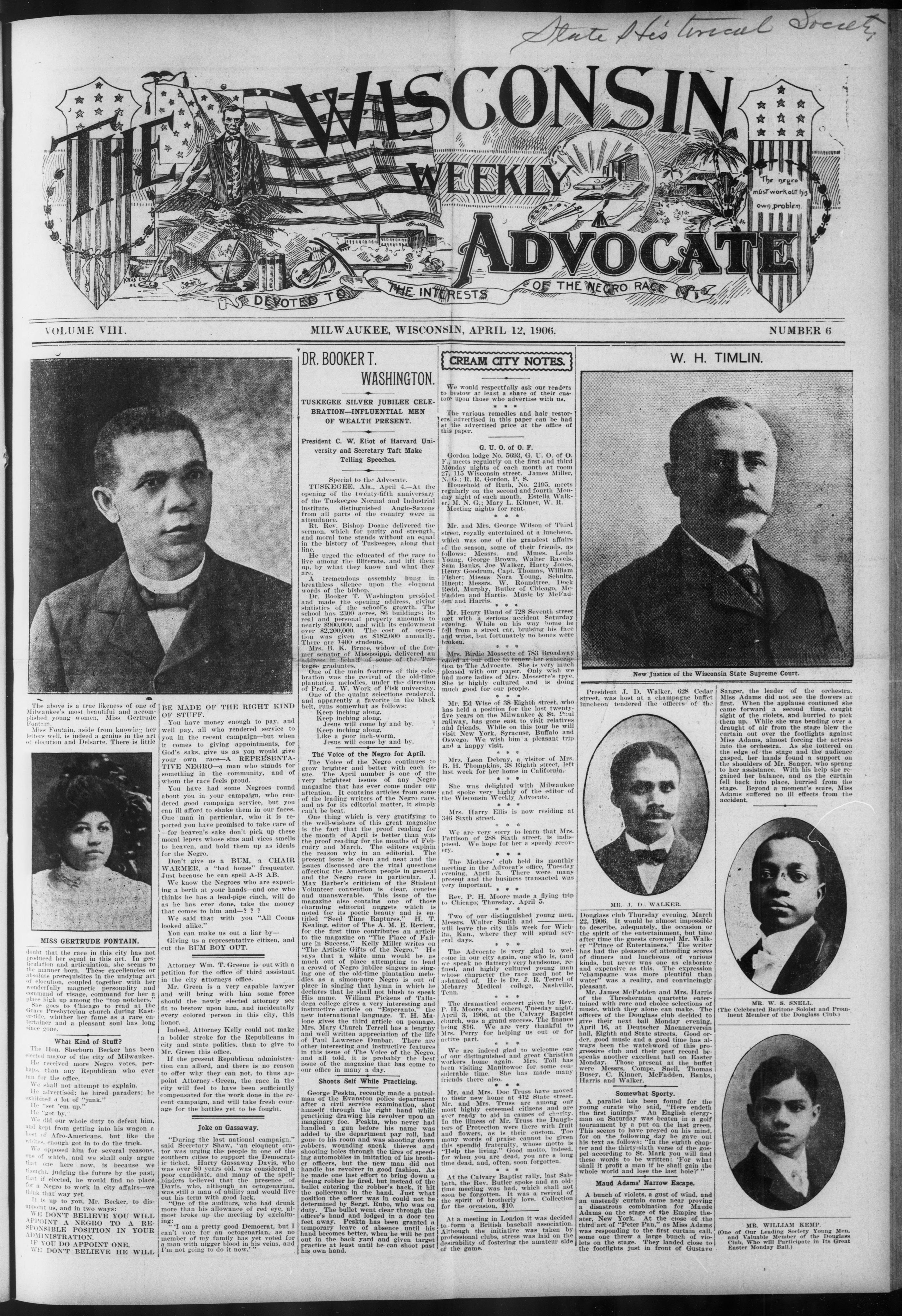
The above is a true likeness of one of Milwaukee's most beautiful and accomplished young women, Miss Gertrude Fontain. Miss Fontain, aside from knowing her letters well, is indeed a genius in the art of elocution and Delsarte. There is little
Mary Louise
MISS GERTRUDE FONTAIN.
doubt that the race in this city has not produced her equal in this art. In gesticulation and articulation, she seems to the manner born. These excellencies or absolute prerequisites in the undying art of elocution, coupled together with her wonderfully magnetic personality and command of visage, command for her a place high up among the "top notchers." She goes to Chicago to read at the Grace Presbyterian church during Easter-tide, whither her fame as a rare entertainer and a pleasant soul has long since gone.
What Kind of Stuff?
The Hon. Sherburn Becker has been elected mayor of the city of Milwaukee. He received more Negro votes, perhaps, than any Republican who ever ran for the office. We shall not attempt to explain. He advertised; he hired paraders; he exhibited a lot of "junk."
He "got by.
We did our whole duty to defeat him, and kept from getting into his wagon a host of Afro-Americans, but like the whites, enough got in to do the trick. We opposed him for several reasons, one of which, and we shall only argue that one here now, is because we thought, judging the future by the past, that if elected, he would find no place for a Negro to work in city affairs—we think that way yet. It is up to you, Mr. Becker, to disappoint us, and in two ways: WE DON'T BELIEVE YOU WILL APPOINT A NEGRO TO A RESPONSIBLE POSITION IN YOUR ADMINISTRATION.
IF YOU DO APPOINT ONE,
WE DON'T BELIEVE HE WILL
BE MADE OF THE RIGHT KIND OF STUFF. You have money enough to pay, and well pay, all who rendered service to you in the recent campaign—but when it comes to giving appointments, for God's saks, give us as you would give your own race—A REPRESENTATIVE NEGRO—a man who stands for something in the community, and of whom the race feels proud.
You have had some Negroes round about you in your campaign, who rendered good campaign service, but you can ill afford to shake them in our faces. One man in particular, who it is reported you have promised to take care of—for heaven's sake don't pick up these moral lepers whose sins and vices smells to heaven, and hold them up as ideals for the Negro.
Don't give us a BUM, a CHAIR WARMER, a "bad house" frequenter. Just because he can spell A-B AB.
We know the Negroes who are expecting a berth at your hands—and one who thinks he has a lead-pipe cinch, will do as he has ever done, take the money that comes to him and—? ? ?
We said that with you "All Coons looked alike." You can make us out a liar by— Giving us a representative citizen, and cut the BUM BOY OUT.
Attorney Wm. T. Greene is out with a petition for the office of third assistant in the city attorneys office. Mr. Green is a very capable lawyer and will bring with him some force should the newly elected attorney see fit to bestow upon him, and incidentally every colored person in this city, this honor. Indeed, Attorney Kelly could not make a bolder stroke for the Republicans in city and state politics, than to give to Mr. Green this office.
If the present Republican administration can afford, and there is no reason to offer why they can not, to thus appoint Attorney Green, the race in the city will feel to have been sufficiently compensated for the work done in the recent campaign, and will take fresh courage for the battles yet to be fought.
Joke on Gassaway.
"During the last national campaign," said Secretary Shaw, "an eloquent orator was urging the people in one of the southern cities to support the Democratic ticket. Harry Gassaway Davis, who was over 80 years old, was considered a poor candidate, and many of the spellbinders believed that the presence of Davis, who, although an octogenarian, was still a man of ability and would live out his term with good luck.
"One of the auditors, who had drunk more than his allowance of red eye, almost broke up the meeting by exclaiming:
"'I am a pretty good Democrat, but I can't vote for an octogenarian, as no member of my family has yet voted for a man with nigger blood in his veins, and I'm not going to do it now.'"
DR. BOOKERT. WASHINGTON.
TUSKEGEE SILVER JUBILEE CELEBRATION—INFLUENTIAL MEN OF WEALTH PRESENT.
TUSKEGEE, Ala., April 4.—At the opening of the twenty-fifth anniversary of the Tuskeegee Normal and Industrial institute, distinguished Anglo-Saxons from all parts of the country were in attendance.
Rt. Rev. Bishop Doane delivered the sermon, which for purity and strength, and moral tone stands without an equal in the history of Tuskeegee, along that line.
He urged the educated of the race to live among the illiterate, and lift them up, by what they know and what they are.
A tremendous assembly hung in breathless silence upon the eloquent words of the bishop
Dr. Booker T. Washington presided and made the opening address, giving statistics of the school's growth. The school has 2300 acres, 86 buildings: its real and personal property amounts to nearly $900,000, and with its endowment over $2,200,000. The cost of operation was given as $182,000 annually. There are 1400 students.
Mrs. B. K. Bruce, widow of the former senator of Mississippi, delivered an address in behalf of some of the Tuskegee graduates.
One of the main features of this celebration was the revival of the old-time plantation melodies, under the direction of Prof. J. W. Work of Fisk university.
One of the quaint selections rendered, and apparently a favorite in the black belt, runs somewhat as follows:
Keep inching along,
Keep inching along,
Jesus will come by and by.
Keep inching along,
Like a poor inch-worm,
Jesus will come by and by.
The Voice of the Negro for April.
The Voice of the Negro continues to grow brighter and better with each issue. The April number is one of the very brightest issues of any Negro magazine that has ever come under our attention. It contains articles from some of the leading writers of the Negro race, and as for its editorial matter, it simply can't be beat.
One thing which is very gratifying to the well-wishers of this great magazine is the fact that the proof reading for the month of April is better than was the proof reading for the months of February and March. The editors explain the reason why in an editorial. The present issue is clean and neat and the issues discussed are the vital questions affecting the American people in general and the Negro race in particular. J. Max Barber's criticism of the Student Volunteer convention is clear, concise and unanswerable. This issue of the magazine also contains one of those charming editorial nuggets which is noted for its poetic beauty and is entitled "Seed Time Raptures." H. T. Kealing, editor of The A. M. E. Review, for the first time contributes an article to the magazine on "The Place of Failure in Success." Kelly Miller writes on "The Artistic Gifts of the Negro." He says that a white man would be as much out of place attempting to lead a crowd of Negro jubilee singers in singing one of the old-time plantation melodies as a simon-pure Negro is out of place in singing that hymn in which he declares that he shall not blush to speak His name. William Pickens of Talladega college gives a very interesting and instructive article on "Esperanto," the new international language. T. H. Malone gives the third article on peonage. Mrs. Mary Church Terrell has a lengthy and well written appreciation of the life of Paul Lawrence Dunbar. There are other interesting and instructive features in this issue of The Voice of the Negro, and all told, it is probably the best issue of the magazine that has come to our office in many a day.
Shoots Self While Practicing.
George Peskta, recently made a patrolman of the Evanston police department after a civil service examination, shot himself through the right hand while practicing drawing his revolver upon an imaginary foe. Peskta, who never had handled a gun before his name was added to the department pay roll, had gone to his room and was shooting down robbers, wounding sneak thieves and shooting holes through the tires of speeding automobiles in imitation of his brother officers, but the new man did not handle his revolver in good fashion. As he made one last effort to bring down a fleeing robber he fired, but instead of the bullet entering the robber's back, it hit the policeman in the hand. Just what position the officer was in could not be determined by Sergt. Rubo, who was on duty. The bullet went clear through the officer's hand and lodged in a door ten feet away. Peskta has been granted a temporary leave of absence until his hand becomes better, when he will be put out in the back yard and given target practice at least until he can shoot past his own hand.
CREAM CITY NOTES.
We would respectfully ask our readers to bestow at least a share of their custom upon those who advertise with us.
The various remedies and hair restorers advertised in this paper can be had at the advertised price at the office of this paper.
G. U. O. of O. F
Gordon lodge No. 5693, G. U. O. of O. F., meets regularly on the first and third Monday nights of each month at room 27, 115 Wisconsin street. James Miller, N. G.; R. R. Gordon, P. S. Household of Ruth, No. 2195, meets regularly on the second and fourth Monday night of each month. Estella Walker, M. N. G.; Mary L. Kinner, W. R. Meeting nights for rent.
Mr. and Mrs. George Wilson of Third street, royally entertained at a luncheon, which was one of the grandest affairs of the season, some of their friends, as follows: Messrs. and Mmes. Louis Young, George Brown, Walter Ravels, Sam Banks, Joe Walker, Harry Jones, Henry Goodrum, Capt. Thomas, William Fisher; Misses Nora Young, Schultz, Huept; Messrs. W. Roundtree, Dock Redd, Murphy, Butler of Chicago, McFadden and Harris. Music by McFadden and Harris.
Mr. Henry Bland of 728 Seventh street met with a serious accident Saturday evening. While on his way home he fell from a street car, bruising his face and wrist, but fortunately no bones were broken.
Mrs. Birdie Mossette of 783 Broadway called at our office to renew her subscription to The Advocate. She is very much pleased with our paper. Only wish we had more ladies of Mrs. Mossette's tpye. She is highly cultured and is doing much good for our people.
☆ ☆ ☆
Mr. Ed Wise of 38 Eighth street, who has held a position for the last twenty-five years on the Milwaukee & St. Paul railway, has gone east to visit relatives and friends. While on this tour he will visit New York, Syracuse, Buffalo and Oswego. We wish him a pleasant trip and a happy visit.
* * *
Mrs. Leon Debray, a visitor of Mrs. B. H. Thompkins, 38 Eighth street, left last week for her home in California.
赤亦寒
She was delighted with Milwaukee and spoke very highly of the editor of the Wisconsin Weekly Advocate.
* * *
Mrs. Harry Ellis is now residing at 346 Sixth street.
* * *
We are very sorry to learn that Mrs. Pattison of 288 Sixth street, is indisposed. We hope for her a speedy recovery.
***
The Mothers' club held its monthly meeting in the Advocat's office, Tuesday evening, April 3. There were many present and the business transacted was very important.
* * *
Rev. P. H. Moore made a flying trip to Chicago; Thursday, April 5.
* * *
Two of our distinguished young men, Messrs. Walter Smith and ____ will leave the city this week for Wichita, Kan., where they will spend several days.
The Advocate is very glad to welcome in our city again, one who is, (and we speak no flattery) very handsome, refined, and highly cultured young man whose character the race need not be ashamed of. He is Dr. J. R. Terrel of Meharry Medical college, Nashville, Tenn.
☆ ★ ★
The dramatical concert given by Rev. P. H. Moore, and others, Tuesday night, April 3, 1906, at the Calvary Baptist church, was a grand success. The finance being $16. We are very thankful to Mrs. Perry for helping us out or for active part.
* * *
We are indeed glad to welcome one of our distinguished and great Christian workers home again. Mrs. Toll has been visiting Manitowoc for some considerable time. She has made many friends there also.
***
Mr. and Mrs. Doc Truss have moved to their new home at 412 State street. Mr. and Mrs. Truss are among our most highly esteemed citizens and are ever ready to aid in causes of charity. In the illness of Mr. Truss the Daughters of Protection were there with fruit and flowers, as is their custom. Too many words of praise cannot be given this spendid fraternity, whose motto is "Help the living." Good motto, indeed, for when you are dead, you are a long time dead, and, often, soon forgotten.
鱼 鱼 鱼
At the Calvary Baptist rally, last Sabbath, the Rev. Butler spoke and an old-time meeting was had, which shall not soon be forgotten. It was a revival of the spirit of brotherly love. Collection for the occasion, $10.
At a meeting in London it was decided to form a British baseball association. Although the initiative was taken by professional clubs, stress was laid on the desirability of fostering the amateur side of the game.
W. H. TIMLIN.
[Image of a man in a suit with a headshot silhouette].
M. H.
New Justice of the Wisconsin State Supreme Court.
President J. D. Walker, 628 Cedar street, was host at a champagne buffet luncheon tendered the officers of the
[Picture of a man in a suit with a bow tie].
Douglass club Thursday evening. March 22, 1906. It would be almost impossible to describe, adequately, the occasion or the spirit of the entertainment, but time after time the guests crowned Mr. Walker "Prince of Entertainers." The writer has had the pleasure of attending scores of dinners and luncheons of various kinds, but never was one as elaborate and expensive as this. The expression "champagne was more plentiful than water" was a reality, and convincingly pleasant.
Mr. James McFadden and Mrs. Harris of the Thresherman quartette entertained with rare and choice selections of music, which they alone can make. The officers of the Douglass club decided to give their next ball Monday evening, April 16, at Deutscher Maennerverein hall, Eighth and State streets. Good order, good music and a good time has always been the watchword of this progressive club and their past record bespeaks another excellent ball on Easter Monday. Those present at the buffet were Messrs. Compe, Snell, Thomas Busey, C. Kinner, McFadden, Banks, Harris and Walker.
Somewhat Sporty
A parallel has been found for the young curate who said, "Here endeth the first innings." An English clergyman on Saturday was beaten in a golf tournament by a put on the last green. This seems to have preyed on his mind, for on the following day he gave out his text as follows: "In the eighth chapter and the thirty-sixth verse of the gospel according to St. Mark you will find these words to be written: 'For what shall it profit a man if he shall gain the whole world and lose the last hole?' "
Maud Adams' Narrow Escape
A bunch of violets, a gust of wind, and an unsteady curtain came near proving a disastrous combination for Maude Adams on the stage of the Empire theater, New York. At the close of the third act of "Peter Pan," as Miss Adams was responding to the first curtain call, some one threw a large bunch of violets on the stage. They landed close to the footlights just in front of Gustave
W. H.
Sanger, the leader of the orchestra. Miss Adams did not see the flowers at first. When the applause continued she came forward a second time, caught sight of the violets, and hurried to pick them up. While she was bending over a draught of air from the stage blew the curtain out over the footlights against Miss Adams, almost forcing the actress into the orchestra. As she toottered on the edge of the stage and the audience gasped, her hands found a support on the shoulders of Mr. Sanger, who sprang to her assistance. With his help she regained her balance, and as the curtain fell back into place, hurried from the stage. Beyond a moment's scare, Miss Adams suffered no ill effects from the accident.
[Name]
MR. W. S. SNELL. (The Celebrated Baritone Soloist and Prominent Member of the Douglass Club.)
[Image of a young man with dark hair and a serious expression, wearing a suit and tie. The background is plain and white.]]
MR. WILLIAM KEMP.
(One of Our Leading Society Young Men, and Valuable Member of the Douglass Club, Who will Participate in Its Great Easter Monday Ball.)
Dead Eggs.
Yeast—Did you ever try to dye eggs?
Crimsonbeak—No. I never did; but I've tried 'em after they were dead.—Yonkers Statesman.
Sterling Advice.
The inner side of every cloud is bright and shining;
I, therefore, turn my clouds about,
And always wear them inside out—
To show the lining! —Harper's Weekly.
Sympathy.
"Mamma, why do so many ladies cry at a wedding?"
"Because most of them are married themselves."—Translated for Tales from Familie-Journal.
A Pity Indeed.
Snipkins (just returned from Italy)—And so, you see, I did not "see Naples and die." Miss Aw'fly Bored (absently)—What a pity!—Ally Sloper.
Precept Easier Than Practice.
Bibbs—Who was the man you gave half a crown to at the hotel this morning?
Gibbs—An old literary friend of mine author of "How to Get Rich."—Royal Magazine.
Heredity.
"That young wine merchant has a red nose, just such as his father used to have. He must have inherited it."
"The nose? No—he inherited the wine."—Translated for Tales from Fliegende Blaetter.
A Grand Thing.
"This new luminous paint is a splendid invention!" declared the fond young papa. "How so?" asked Mr. Newlywed. "Why, you just paint the baby's face with it and you can see it to give him his bottle without lighting the gas!" —Life.
A Minority Shareholder.
Tom—How did Dick happen to marry the only one that was left of eight sisters?
Harry—Simple enough; he gets only one-eighth of a mother-in-law that way.
—Translated for Tales from Familie-Journal.
Not a Recognized Authority.
Mrs. Swellun (severely)—What, begging again? Weren't you told never to come to this house again?
Raggle—Oh, madame, it was only the cook told me that. I was never officially informed.—Translated for Tales from Meggendorfer Blaetter.
Cheap Transportation.
"Hah!" exclaimed the poet, as he grasped his fountain pen, "the spirit moves me!"
"That," rejoined the landlady, with a gleam of hope in her eye. "is better than paying an expressman 50 cents to do the job."—Town Topics.
But Plain Enough.
"Now, Mr. Hunter," said Miss Hoamley-Rich, frigidly, "I must ask you never to bother me again. Haven't I told you, plump and plain, that I would never marry you?"
"Why, no," replied Hunter, "I don't see how you can call yourself 'plump.'" —Philadelphia Press.
Mrs. Green (who thinks of engaging)—But is the girl honest? Can she be trusted?
Mrs. Brown (the girl's former mistress)—You need not be in the least alarmed. She is perfectly honest. All the time she was with me I never knew her to take a thing—not even my advice as to how things should be done.—Tit-Bits.
Logical
Secretary (lunatic asylum)—Mrs. Sharptongue was here today, and wanted her husband sent home and placed under her care.
Superintendent—Did you let him go?
"No. He said he would rather stay here."
"Hum! The man must be sane!"—Modern Society.
Shook the Whole Earth.
We have yet to await accurate details of the great earthquake that occurred in the northwest of South America on January 31. The seismographs in this and other countries had told their story of what happened within a few minutes of the catastrophe. All the world felt more or less the earthquake. In two hours the effects of the initial impulses had reached their antipodes, and in the interval between these times every inhabitant of the world had been moved for at least three or four hours on a true ground swell.
All the instruments in the world designed to record teleseismic motion had written records, the bubble in every spirit level had been fitfully oscillating to and fro, many magnetic needles had been caused to swing, balances had oscillated, pendulums had been accelerated or retarded—the world globe, not only on its surface but in its depths, had been shaken—London Nature.
Upset by a Cow.
John Boll of Neosho, Wis., was imbued with a kindly spirit when he consented to paint his neighbor's new barn. John is now in bed and may stay there for some time. It was all a cow's fault. John laboriously carried a heavy pail of paint up a 30-foot ladder and set to work on the gable of the barn. Just as he was admiring the barn's beautiful red coat he caught himself falling. The ladder was lying on the ground, thirty feet below, when John came down. The ladder did not slip. Neither did John. But Frank Multhauf, who owned the barn which John was painting, let, the cows out, and as the animals rushed out to the green, grassy slopes for their first spring pastures, one of them did not see the ladder in its hasie. That's why John came down in such a hurry. He landed in a stone pile.
Three Coats in One
A remarkable coat is the invention of Sydney Banks, a Cape Town tailor. With this coat in his portmanteau the traveler may face any social contingency. A frock coat at first sight, it is changed into a morning coat or dress coat by whipping off the skirt and lacing on another, which will join the body of the garment at a line not to be distinguished from an ordinary seam. The inventor recommends it to all travelers for its cheapness and portability.—Trinidad Mirror.
The Pity of It.
"How I pity the poor on such a night as this?" said Blande, as he sat in his comfortable apartment.
"Then why," asked Bluff, "don't you put on your coat and go out and see if you cannot render assistance to some of them?"
"Ah," replied Blanche, "then I should not be so comfortable as I am now, and I might forget the poor and begin to nity myself. That would be selfish, you know."—Ally Sloper.
OUR BEST AMERICAN GIRL.
All hail!
All hail to Her,
A sweet, responsive human,
Half girl, half angel,
Wholly woman.
No thing of fashion, she,
But sweet simplicity
And womanly girlishness
Which only is to bless.
The tender light of kindly skies
Glows in her eyes,
And sends its rays
Along the ways
That lead us up to her,
And bids us welcome.
Her hair is tangled grace
About her face,
That is all beauty—
Flesh and spirit.
She
Is humanized divinity.
Gadzooks,
If dukes
And such come after her
We'll stir
The nation up to keep her here.
The dear,
Delightful dream of hours
Of music, moonlight, love and flowers
Come true,
As it can only do
In Her.
Gee whiz,
What a really and truly
Good thing
Our best American girl is!
Oh, love!
Oh, rapture! —New York Sun.
TURKISH RUG
AND MEERSCHAUM
By the time the Turkish Rug had recovered from its soreness, and could look up again with tolerable complaisance upon the well known mantel and its ocoutrements, it was well nigh midnight. The logs in the open hearth had about exhausted their cheerfulness, and that may account for the glum gaze with which the Turkish Rug affixed the Meerschaum Pipe, its friend and fellow conspirator in many a daring adventure. That these adventures must be imagined and not lived by them, made the excitement and pleasure none the less, of that they could assure you—a-freeing for almost the only time in their history.
It must have been fully two hours previous that the Turkish Rug went into a sulk because a hot coal from the bowl of the Meerschaum Pipe had buried itself where it could hurt most, right on the deep red center, and everyone knows that means the heart, whether it be of a Turkish Rug or a human being.
"What makes this beastly place so dark?" grumbled the Turkish Rug.
"Billy turned off the lights and the fire is about burned out. I suppose," commented the Meerschaum Pipe calmly.
commented the Messrs Schaum and "Yes, you always do suppose the most sensible things! But why don't you tell me what happened before Billy turned off the lights? You must know I'm devoured with curiosity, and taking that with the outrageous treatment I've already received, you'll be the death of me." The Turkish Rug groaned away into silence.
"I'll be only too glad to tell you how I know you are so curious," grinned the Meerschaum Pipe. "You do waste a lot of valuable time when you go on these sprees—"
"Sprees!" burst out the Turkish Rug. "Sprees!"
"Well, sulks mean the same thing anyway, and I believe you said you wanted to know what happened here last night, after you—fainted."
The tall old clock in the corner by the doorway had chimed the midnight hour as the Meerschaum Pipe spoke. Some last bright coals fell to the hearth and flared for a second, making the Turkish Rug look so attractive that the Meerschaum Pipe decided not to tease any more. The shadows settled deeper, and they could only guess at the outlines of the empty chair of carved mahogany, with its worn green leather cushions, and could only surmise from many previous events, that near at hand was a pile of sofa cushions thrown helter skelter, as the lazy vagabond who reposed upon them had risen hurriedly.
The Meerschaum Pipe roused from his reverie. "You remember she came in about 8 o'clock, looking very charming in a new gown. Crushed strawberry, I believe it was, but you know more about color than I do, and all I know is that it matched her cheeks. I feel sure Billy thought it matched her lips."
"How do you feel sure?" interrupted the Turkish Rug.
"Oh, I know Billy pretty well, and he didn't clench me with his teeth like that for nothing. He wanted to hug her, that's what he wanted to do."
"Reasons enough. In the first place he's afraid of her, though she's not big enough to reach his chin, and as slender as our gilded reception chair. Then again, he was in his own house, and Billy is strong on the conventionalities. Besides, he loves her, and is scared to death he'll make some false move—at least he was." "Do you mean that he isn't afraid now?" the Turkish Rug asked in a voice that quavered with emotion. "Oh, do go on!"
"No, he isn't afraid now, dear old Billy. Well, you know he fixed the pillows the way he always does, and she settled down to toast marshmallows at the end of that ivory thing some Chinaman used to scratch his back with. I judge they were good, though, for Billy neglected me quite awhile, and he watched her profile so steadily I wondered if he didn't want to eat her, too."
"Oh, she's got a profile, has she? You see, I never get more than an upward glimpse of her, sort of curved-up chin and tipped-up nose."
"Depends upon the point of view, and you can depend on the pipe of an artist to know something about profiles. Hers is better than most. Billy had just asked her if she could toast bread as well as she could toast marshmallows, and she was telling him that she could toast it well enough to serve with a rarebit, and anyway didn't he remember her rarebits—"
"Yes, yes. I heard that—it was just then things got mixed up. Billy gave me an awful dig with his heel. What was the trouble? I couldn't see or hear for he had planked the heaviest velvet cushion he could find right on top of me. What happened when she asked him if he didn't remember—"
"She burst into tears, nothing make-believe about it, either," declared the Meerschaum Pipe with considerable pride; big deep sobs that made Billy shake, too. That's when you got hurt, dear friend. Of course it was more than a man could stand. He just grabbed her. Then she told him of her miserable existence in that hall bedroom, with an ache all the time for the old home that she was trying to help pay the mortgage on—".
"That's where she used to make the rarebits for Billy." The Turkish Rug's voice was very soft.
"It was wonderful how Billy's face lighted up," continued the Meerschaum Pipe, with a little wonder where the Turkish Rug kept that tenderness on week days. "He had waited for some such confession a long time. The time happened to be ripe, that was all. Billy had just sold his 'Rose Girl' and the 'Seat at Sunset,' his two biggest things this year, you know, so he looked pretty chipper while her sobs were slaking up."
"What queer expressions you do use!" objected the Turkish Rug. "And after they had 'slacked up,' as you call it, what did Billy do?"
"Hum! Well. I suppose I can tell now. You see Billy always keeps me in
an inside pocket. One day he took a trip to city hall, and when he came out he placed a folded paper so close to me that I could not help reading the word here the Pipe's voice dropped to a most mysterious whisper, and the Rug shivered through and through with expectation—"license!" gurgled the Pipe at last. "Ssh!" whispered the Rug. "There's some one at the door." As the lights flashed upon two dazzlingly happy faces Billy's old comforts congratulated him with a heartiness no less sincere for being inaudible.—Boston Post
HEATING ATTACHMENT.
Placed on Lamps for Quickly Heating Water. Milk. Etc.
Several devices for heating liquids on gas lamps have been placed on the market and their practical value has been proven, but where gas is unattainable they cannot be used, as they are unsuitable for oil lamps. A Kentucky inventor has patented an attachment which can be used in conjunction with either gas on oil lamps, and one by which various liquids, such as water or milk, can be quickly and conveniently heated without danger of breaking the lamp chimney or causing smoke. The receptacle for hold
C
HEATS THE RECEPTACLE.
ing the liquid is pointed, and in the shape of an inverted cone, and has a handle and lid. This receptacle, which is made of suitable dimensions to enable its pointed end to be fitted within a lamp chimney of ordinary size, has a number of flanges attached to the outside. These are used for the purpose of spacing the receptacle from the chimney sufficiently to permit the gases of combustion to pass between the walls of the receptacle and the top edge of the chimney. Three or more legs are secured to the receptacle, the upper ends being arched and extended below the apex of the receptacle. When the attachment is used in connection was a gas jet, a bracket is provided which can be slipped over the jet and sustain the heating attachment in position. This bracket is made of wire bent to a shape to fit the vessel used for holding the liquid. In this device the contents of the receptacle will become rapidly heated, owing to the fact that it will be surrounded on all sides by the hot gases of combustion issuing from the chimney or gas jet. As soon as the contents have been heated the receptacle can be removed by the handle and supported by the legs in such a manner that it cannot possibly become tilted or upset. The legs being suspended from the lamp chimney do not become overheated, and can, therefore, be safely placed upon the table.
For Catching Insects When Dislodged from Plants Upon Which Are Found.
Everybody has a hobby of some kind—in fact, several of the most successful men in the United States have hobbies which in the ordinary person would be considered nonsensical. These hobbies run anywhere from collecting postcards—the present craze—to catching and preserving insects—one of the oldest fads. A Texas man has patented an insect catcher which is designed not only for catching insects as a hobby, but more especially for destroying cotton boll wee-
THE CROSSING
READILY ADJUSTED.
vils and other destructive insects. The insects are first dislodged from the plants upon which they are found and then subjected to a bath of coal oil or other liquid. The shape of the casing is shown in the illustration. Above the bottom is a space for the coal oil. The sloping edges of the end walls serve as a proper opening for the admission of the insects, and the general shape of the device is such as to permit the insects to be readily caught when they drop from the bushes or other plants upon which they are found. It is intended to use a paddle in dislodging them from the plants. Above the liquid in the receptacle is a piece of lattice-work which is pivotally connected to the bottom to allow of the removal of all dead insects. An adjustable handle is secured to the back of the receptacle and connected with a strap around the waist, so arranged as to be readily grasped by the operator.
Jugs from Eastern Maryland Shore
The advance guard of the Eastern Shore and Southern Maryland Jug Brigades came to the city in solid columns yesterday and today. Though jugs and demijohns of all kinds and descriptions were conspicuous among the heavy Christmas freights piled on the Light street steamer piers this morning, the rush, according to a steamboat official, is not expected until tomorrow and Friday. From then until Saturday night jugs old and new, big and little, but all filled to overflowing with Christmas "Oh, be joyful," will go by the hundreds to the local option sections of the Eastern Shore and to the inaccessible counties of southern Maryland.
Two steamers of one route have carried more than 300 packages of whisky to one of the Eastern Shore local option districts in a single day, to say nothing of scores of packages carried by individ-
HIGH CLASS DRUGGISTS AND - OTHERS.
The better class of druggists, everywhere, are men of scientific attainments and high integrity, who devote their lives to the welfare of their fellow men in supplying the best of remedies and purest medicinal agents of known value, in accordance with physicians' prescriptions and scientific formula. Druggists of the better class manufacture many excellent remedies, but always under original or officinal names and they never sell false brands, or imitation medicines. They are the men to deal with when in need of anything in their line, which usually includes all standard remedies and corresponding adjuncts of a first-class pharmacy and the finest and best of toilet articles and preparations and many useful accessories and remedial appliances. The earning of a fair living, with the satisfaction which arises from a knowledge of the benefits conferred upon their patrons and assistance to the medical profession, is usually their greatest reward for long years of study and many hours of daily toil. They all know that Syrup of Figs is an excellent laxative remedy and that it gives universal satisfaction, and therefore they are selling many millions of bottles annually to the well informed purchasers of the choicest remedies, and they always take pleasure in handing out the genuine article bearing the full name of the Company—California Fig Syrup Co.—printed on the front of every package. They know that in cases of colds and headaches attended by biliousness and constipation and of weakness or torpidity of the liver and bowels, arising from irregular habits, indigestion, or over-eating, that there is no other remedy so pleasant, prompt and beneficial in its effects as Syrup of Figs, and they are glad to sell it because it gives universal satisfaction.
Owing to the excellence of Syrup of Figs, the universal satisfaction which it gives and the immense demand for it, imitations have been made, tried and condemned, but there are individual druggists to be found, here and there, who do not maintain the dignity and principles of the profession and whose greed gets the better of their judgment, and who do not hesitate to recommend and try to sell the imitations in order to make a larger profit. Such preparations sometimes have the name—"Syrup of Figs"—or "Fig Syrup" and of some piratical concern, or fictitious fig syrup company, printed on the package, but they never have the full name of the Company—California Fig Syrup Co.—printed on the front of the package. The imitations should be rejected because they are injurious to the system. In order to sell the imitations they find it necessary to resort to misrepresentation or deception, and whenever a dealer passes off on a customer a preparation under the name of "Syrup of Figs" or "Fig Syrup," which does not bear the full name of the California Fig Syrup Co. printed on the front of the package, he is attempting to deceive and mislead the patron who has been so unfortunate as to enter his establishment, whether it be large or small, for if the dealer resorts to misrepresentation and and deception in one case he will do so with other medicinal agents, and in the filling of physicians' prescriptions, and should be avoided by every one who values health and happiness. Knowing that the great majority of druggists are reliable, we supply the immense demand for our excellent remedy entirely through the druggists, of whom it may be purchased everywhere, in original packages only, at the regular price of fifty cents per bottle, but as exceptions exist it is necessary to inform the public of the facts, in order that all may decline or return any imitation which may be sold to them. If it does not bear the full name of the Company—California Fig Syrup Co.—printed on the front of every package, do not hesitate to return the article and to demand the return of your money, and in future go to one of the better class of druggists who will sell you what you wish and the best of everything in his line at reasonable prices.
uals. An official of one of the big down the bay lines said today that the jug traffic by the steamers of that particular route is limited to the barrel and large package trade, making jugs and demijohns unnecessary. Many of the men passengers arriving by bay steamers today brought their jugs or demijohns along, forming a unique procession as they filed up Light street to have the receptacles filled.—Baltimore Herald.
REMARKABLE GAMBLING DEN.
Located in Heart of China Town-Is Mysterious House.
In the heart of Chinatown recently the police explored what they believe to be the most remarkable gambling den in the world. It is called the "House of Mystery," and its entrance is at No. 25 Pell street. The den is patronized exclusively by Chinamen, and its proprietors are members of the Hip Sing Tong. According to the police, as much as $10,000 changes hands there in one day's gambling.
The police in Chinatown have known the "House of Mystery" to be a gambling resort for many years, but in their monthly raids they failed to capture a single person. Spies have watched the entrance for weeks. They saw hundreds of Chinamen enter each day, but saw none emerge. The mystery was explained yesterday when they passed through thirteen sheet iron and wooden doors before they got to the hiding places of the gamblers.
Capt. Schlottman of the Elizabeth street station recently ordered two young detectives—Cumniff and Sullivan, to solve the mystery and not to report back until they had completed their task. The detectives were not long in discovering that three look-outs were on duty all the time. When a raid was made a week ago not a Chinaman was to be found. The policemen remained awake overnight to make an early morning raid and found the front door locked. They smashed it down with axes and began a close search.
No. 25 Pell street is a five story brick tenement building from all outside appearances. A Chinese grocery store occupies the first floor and the detectives found a big door covered with sheet iron. Passing through this and two more solidly constructed doors they were in the main gambling room, where fan-tan, pie gow, Chinese policy and cards for big stakes are played. There is a small room just beyond the main gambling room.
"Granting that fifty men entered this room and disappeared inside of two minutes, where could you look for them?" asked Cuniff.
"Let's bore a hole in the wall," said Sullivan.
The detectives then made an opening hardly large enough to afford an entrance. After passing through the hole the reporter found himself in darkness, and guided by a detective with a lighted candle, passed to another space of about the same size. This brought the exploring party into a narrow passage, three feet in height, which ran to another small hole, and working their way through this space they found themselves in a narrow passage, and discovered an iron-barred and shuttered window.
The hallway near the window is protected at the front and rear by sheet iron walls. On the floor is a trap door big enough for a medium-sized man to pass through. A ladder is attached to a rope and by it one can go below to a cellar, and there he passes through a barrel and finds a basement with an exit on Pell street. From the same hallway approach to the cellar one can reach the fourth floor of the building. A trap door in the ceiling leads after a twenty-foot climb to the inside of a roller top desk. A sliding door is opened from the inside and through it one enters a Chinese sleeping apartment, which is part of the gambling house. The desk has been the "get-away" of 500 gamblers for the last three years, the police say.
At the rear of the room there are two iron-barred windows which slide open, and by a rope one can slide down into the back yard. Another exit leads to a side hall after passing through two "ice-box" doors. By means of the exits the gambling rooms can be cleared of 200 men within five minutes.—New York World.
ROBIN
Into the shining mist,
Over the icy trees,
Into the showers, sun-kissed,
Blown by a southern breeze.
Someone came home today
Who had been long away.
Into the crisp March air,
Into the sunshine-showers,
Back from the orange groves,
From ten thousand flowers—
Someone forsook the way
Bordered by fragrant bloom.
Someone came home today,
Leaving the rich perfume
Far, far away.
Who was it, say you, that came,
Homing so true.
Who turned his face with such grace
To the chill Marchland?—Oh, who?
No one but you, robin, dear,
No one but you.
Here is a health to you—nay,
Not in red wine, better is mine,
Sparkling and clear—
Wine of the cool mountain rills,
Fresh from the ice-vaults of late,
Wine of the glad Northern hills—
Health to yourself and your mate.
Hark to the answering cry
Ringing so clear—
"Cheer up, the summer is nigh,
And I—I am here!"
—Nelly Hart Woodworth in Boston Trans-
script.
Hegedus, the famous Hungarian violinist, has been engaged by Rudolph Aronson to give fifty concerts in America beginning in November.
Mrs. Nance R. Wilcox has been elected city secretary of Whitewright, Tex. She is the first woman elected to a municipal or state office in Texas.
Twenty open cars are in operation on Broadway lines in New York. They bear large signs saying "Smoking Car." Every seat in these cars are available to smokers.
---
On the ground that a minister cannot stay in politics without debasing his morality, Rev. William J. Smith of Carmi, Ill., who has been running for state senator, announces his withdrawal. He will devote himself to the ministry.
Miss Madeline Z. Doty, a New York lawyer, is the first woman receiver named in a bankruptcy proceeding in the history of the United States district court. Miss Doty was made receiver of the business of Sophy R. Houston, a Fifth avenue milliner and dressmaker.
John Wilmer Martine, alias John Rauschenhach, porter, gardener, society entertainer, human snake, and haberdasher's clerk, promised to be good for future time when he was arraigned in special sessions in New York for sentence, having pleaded guilty to the larceny of a silk shirt from his employer, a haberdasher. Sentence thereupon was suspended, and Martine was paroled in the custody of Probationary Officer Graveur.
Kingdon Gould, aged 19, heir of George Gould, was operated upon for appendicitis in the home of his parents. The young man was convalescing from measles. The attack of appendicitis became so serious that word was sent to the Presbyterian hospital to make preparations there to receive him. After it was over Dr. Bull said to the parents of the young man: "The operation has been in every way successful, and I feel that I can assure you there will be no complications."
Coney is getting ready. The "hot dog" man has made his appearance and all that is now needed to set things going in regular old-time fashion are the crowds. The regular season at Coney will not open for a month yet. Still, there are hundreds of people who have been taking flying trips there during the past few days and, taking this as a hint to get busy, the proprietors of the different amusement places at the resort have begun to get things in readiness. The attractions will in the main be the same as last year. So far as could be learned there will be no additions to the list, although several of those operated last
year will be enlarged. Brighton Beach is also sitting up. This beautiful place promises to be even more attractive this season. The Boer war spectacle is the chief attraction at Brighton.
One of the signs of spring on Cathedral Heights, New York, is the appearance of the Columbia students bareheaded. The fad of going hatless the year around does not prevail at Columbia, but as soon as settled warm weather comes along numbers of students discard all headgear, regardless of their age, dignity or class standing. This morning three spectacled and dignified special school students of rather mature years amused the residents of the vicinity by traveling between the dormitories and their boarding house, several blocks away, hatless.
Oscar Hammerstein fired another big gun in the war he has declared on the Metropolitan Opera house when in a cablegram from Paris he announced that Mme. Nellie Melba had agreed to return to America next season and to be at his Manhattan Opera house only. When he determined to rival the Metropolitan Mr. Hammerstein set his heart on having for his first season at the Manhattan Jean de Reszke and Mme. Melba. M. de Reszke agreed to come two months ago, but Mme. Melba declined to enter into negotiation by letter or cable, and Mr. Hammerstein got no satisfaction until he himself saw her in Paris.
New Yorkers still cling to the ancient custom of tipping their hats when greeting a male friend or acquaintance. It is a common sight to see a staid, prosperous-looking business man as he passes an acquaintance tipping his hat, although the other is alone and unaccompanied by a woman. It is the same after a party has been together somewhere, at dinner probably, or at the theater. You will notice that as one separates himself from the others he will say good night, or au revoir, and then tip his hat. Also, when one man is introduced to another, it is dollars to a subway ticket that he will lift his chapeau. Wonder why it is?
It is now quite the correct thing among the gilded young people of New York city to have gray or almost white hair. So much admired have these "premature gray" folk become of late that hairblanching is now nearly as commonly resorted to as manicuring. Canites, poliosis or hoariness may be either physiologic or pathologic; gradual or rapid, general or confined to localized patches. A distinguished captain in the British army, recently in New York, had a patch of white about the size of a silver half dollar just above his right ear and all the women he met fell in love with it. They jumped to the conclusion that he had been shot there, but he said it was due to an absence of pigment.
Thomas G. Rhoades, Jr., who claims to be the son of Justice Thomas G. Rhoades of the supreme court of Arkansas, is under arrest in New York awaiting trial on a charge of petit larceny. When he was arraigned he pleaded guilty, but his case was postponed in order that Justice Rhoades might be communicated with. A telegram was sent to the justice by a probation officer, but no answer has yet been received. The young man, who is about 30, said he went to New York a few weeks ago with about $5000, which he said he spent or gave away. He was charged with the theft of a dress suit case. He said that he had been forced to sleep in doorways and on trucks at night after his money was gone.
Furnished Young Soldiers.
When Emperor William visited Crefeld, Rhenish Prussia, in 1902, he joked with the girls assembled as maids of honor to greet him because in reply to his questions they revealed their regret that there were no young military officers in Crefeld to dance with them.
The Emperor promised the girls he would send a garrison to the town, and said they would have plenty of young lieutenants for dancing partners.
His majesty fulfilled his promise recently when he himself led the Eleventh Hussars into the city, and was given an enthusiastic welcome.
The city, which is the center of the silk and velvet industry, was gayly decorated for the occasion, a mile of the principal streets being hung with decorations of velvet and silk.
GOSSIP FOR THE LADIES.
4. Mother's Praver.
Last night I prayed, and God, I know, will hear
The prayer I said, the while a silv'ry tear
Coursed down my cheek and trembled ere it fell.
(Oh, what a story could that one tear tell!)
Yes, God will hear, when e'en the list'ning air,
On zephyr's wings bore to his throne my prayer;
A prayer that spoke the feelings of my heart,
For one—aye—of my very life a part.
Last night I prayed, "Kind Father, let me know
The spot on earth where fairest flowers grow,
That I may pluck the thorns from roses sweet,
And cull them all—to scatter at her feet.
Then show me, Lord, the path that, day by day,
Her feet must tread, and on that flow'ry way
I'll bid the sun to shed his glorious beams,
I'll bid the moonlight guard her in her dreams.
I'll bid the breeze to softly kiss her brow.
That it may be, for aye, as fair as now.
I'll weep the tears fate meant for her to weep.
I'll watch and pray while she may softly sleep.
Leave Thou for her, dear Lord, the kisses sweet.
And all life's joys, Oh, lay them at her feet.
Dear Lord of all, great King of heav'n above.
Deny me not, but let me prove my love.
—Kathleen Agnes Mahoney in Men and Women.
Other People's Servants.
"I have had playmates, I have had companions, but I have never had visitors like these before," complained a long-suffering hostess. "They don't care how much trouble they give my servants. They are late to every meal, and you know how that sets work back in a modest suburban household. We cannot wait for them at breakfast, for John has to catch the 8:20 train, but at dinner we tarry our young ladies' leisure until my husband's temper breaks out like a Russian revolution. So does my cook's. I expect both of them to give warning any day. Those girls ask for something to eat at 3 o'clock on wash days, instead of being on hand at 1 o'clock luncheon. They never put anything away. They throw my best towels on the floor. My chambermaid spends half her time hanging up their gowns. Would you believe that they step out of them and leave them like giant bird's nests on the carpet? My waitress is eternally gathering up hats from the sideboard and gloves from the drawing room chairs. They call her from answering the door bell to help them dress. They ask the cook to leave her dinner and press out a lace scarf."
However large a tip those girls leave behind them it will hardly compensate their hostess' servants for the trouble they have given. And, by the way, have you never heard people question the obligation of tipping other people's servants? In England the matter is as settled as is proper dress for dinner.
So many and so large are the fees in fashionable English society that a butler's income from this source is said far to exceed his wages. London Truth recently published a letter from a butler who complained that an employer not only would not pay wages, but demanded a commission of a pound a week from the butler's fees. Perhaps this is a burly British joke, yet the burly British fee is no joking matter.
In America we have so many different scales of living, all in professedly the same status of society, that the question is still open-or at least ajar. You hear people argue that servants' wages should cover all their duties; that the visitor who pays for their services might as well pay for his food.
Those who talk this way have never kept house themselves. A certain hostess at a summer cottage in New Hampshire impresses upon her company that they must on no account fee her maids. Her maids are all farmers' daughters from the neighborhood; some of them teach school in winter. They do not understand feeing, and would be rendered uncomfortable by it. She pays them liberally herself. Generally, however, the "vail," as our grandmothers called the parting gift of money, is proper. It helps to smooth the path of the mistress, inasmuch as it renders her servants readier to wait upon the next comer. Yet a little money is not the whole nor the main part of what we owe them.
When we are company, we should have on our company manners to the employes as well as to the employers. For, in a sense, we are also visiting them and they generally feel that, in a sense, they are our hosts. We are transients where they are at home. They are anxious to make us welcome, to show us their pleasantest side, to have the house, and, as it were, the whole neighborhood, put its best foot foremost. Really, in view of the extra trouble they have, it is amazing how hospitable servants are. They are as naturally and spontaneously hospitable as children. They like a break in the monotony, a new face at the table. Yet, below stairs as above, some guests are more welcome than others. "Every one in our house is glad to see Clarissa," says our hostess, "from the baby in the nursery to the cook in the kitchen." Could there be a greater compliment?
When Clarissa was a very little girl—and a very pretty little girl—her aunt brought her a new frock from Paris, in which she tripped forth a triumphant child to Sunday school. On the way she met the colored man who came daily to clean her father's shoes. "And what do you think, papa," she complained, "that horrid old darky said right loud to me. 'Good evening, Miss Clarissa.' Right out loud, right in the street, and me in my new Paris dress!" "And what did you say to Joe?" "I didn't say anything." "Joe said 'Good evening' to you, and you did not answer him, Clarissa? I am sorry to learn that my bootblack has better manners than my little daughter." Clarissa never forgot that lesson. Nowadays she is exceedingly popular among all the lesser lights of our town. She bows to the butcher, she bows to the baker, she has a nod and a smile for the boy who brings the groceries. That she speaks pleasantly to the cook when they meet in the street might be ascribed to fear, but she does the same by her friends' waitresses and housemaids. Strange that many people omit these small civilities.—House Beautiful.
Husbands and Household Accounts.
The height of her intellect is demonstrated in the fact that she writes sonnets. The excellence of her character is nobly expressed in the fact that she keeps household accounts. In other words, she is a fine, womanly woman, this too, notwithstanding the obstacles genius and higher education sometimes place in the way of the perfection of the domestic creature. One would expect this woman to be happy in the exercise of these virtues. But she is not, except in the exalted mood wherein virtue appears sufficient as its own reward. The cause of her unhappiness is that her husband shows even more brutal indiffer
9
ence to the excellence of her bookkeeping than he does to the rare finish of her sonnets. With an expression of humility resting on a solid basis of merit mathematically demonstrated, each month she carries her books to her husband for his inspection. He refuses to look at them. He simply thrusts his hand into his pocket and with a horrible sigh, asks, "How much do you need to get square?" This question is put invariably in a tone and manner indicating that she has come short of funds on purpose, whereas if he would only take the trouble to look at the books he would perceive that it is in the fatal relation of things they have had to the cost of these things, that the cause of the deficit resides.
So she goes on valiantly, virtuously, sadly, keeping her household accounts, knowing all the time that her husband believes that it is her fault that the balance is seldom or never on the right side. One day, when he was more than usually offensive in his manner of receiving her and her monthly report, when he said some really cruel things about the hardship of working always like a slave, and never having a cent, no matter how much money he earns, she became angry and repronounced him for not even inspecting her accounts.
"My dear," replied the man with the crushing candor of the husband who is being just as mean as he feels, "I assure you that after the money is all gone, it is of no earthly interest to me to know where it is gone. If you could ever keep money while you're keeping books, then I would be happy to look at your books to know where the money is." Of course after this they did not speak to each other for two days, and then—equally of course—they made up and began their trouble all over again.
This situation, which with slight variations embraces the experience of countless married pairs, is the source of untold misery. The mistaken notion too often operating in domestic bookkeeping is the idea that accounts are designed to show where the money spent has gone. The truth of the matter is that household accounts are designed to preserve the balance between what one spends and what one's income is. This compels limiting in advance the amount spent, so that it shall always come within the sum which is a fair average of one's assured income. This in turn compels an accurate, exhaustive, personal analysis of their necessities of the family, and here the man's part in domestic bookkeeping is absolutely defined, imposing on him a duty absolutely unavoidable if success is to be secured.
The man, together with his wife, must determine in detail what the expenditures for the family shall be. The two together must arrange the scope of their life with strict arithmetical relation to their resources. Thus the man realizes that spending money in household and family concerns is a matter as serious, as fixed by business relations, as is the matter of spending money in the shop or factory. Thus his mind is disabused of the idea that domestic economy is an affair depending simply upon the common sense and good-will of his wife. Thus he is redeemed from the influence of a popular notion generally upheld by men that to produce porterhouse steak on a codfish income rests entirely with the loving heart of a sensible wife.—Harper's Bazar.
The Woman of Forty.
This title is more feared by women than it deserves. The middles of things are really the best if we could only realize it: beginnings and endings are full of fear and dread. Still, when the ominous number forty is in sight, what tremors it sends through the feminine heart—forty, and the best half of life gone! Small wonder that so many make a stand at 35 and refuse to advance, calling in science and art to aid in "restoring the edifice." The sweet wrinkled old face, carrying its life's story, is already as extinct as the Dodo.
Granting that a woman can stand still for a time, what other period of her life should be so happy? The fever and fret of youth gone, the aching joys all over, the worst known. There is still the calm September, the golden glory of the year, to come, and, with the clearer eyesight that experience gives, how much more widely and sanely will she enjoy the pleasures that come to her now! The forty years' wandering in the wilderness were not without purpose. The compensations for a lost youth are many. Youth has been far too much belauded, looked on, indeed, by many as a huge joke; but it is not much of a joke when one can not see it at the time. Middle age is really the period when life is at its highest and best, and for women still more so if some measure of youthful looks can be retained, and to that end modern hygiene can do much.
Unfortunately the experience of the race has taught women that appearance counts nine points out of a possible ten, and in many cases it does; but it should not be forgotten that if a man's brain is interested his affection will be more lasting. The eyes tire sooner than the brain. The pretty face that has no charm of mind to back it up is soon forgotten. Where mind is there must be charm, and that is Nature's own gift. It is there or it is not: brains and charm combined can go far and rise high. Nature is a kindly mother, and keeps many compensations of her ugly ducklings. Mind has a beauty all its own. Seton Merriman—peace to his ashes!—says over and over again. "We always are exactly what we look." That may be but the seeing eye is rare.
That may be, but the seeing eye that the brainy woman must, however, be clever enough to keep her brains out of sight if she wishes to be a social success, and to remember at the same time that post-meridian charms will not be enhanced by untidy habits of dress. She will do well to study the rise and fall of the sleeve as well as that of the Dutch republic. Never forgetting a dainty frill or furbelow or any of the little courtesies of life, these are the qualities that bring her smiling through every social ordeal. I do not wish to belittle the average woman minus charm and that saving grace, a sense of humor; she is the backbone of society, a cahal as compared to a rushing, sparkling river. It is the depths and unsuspected shallows that are so enthralling. The unknown is always interesting. It is that very quality of certainty about the average woman that is so appalling. Ten years from now one could easily predict what she would be doing, thinking, or saying on any given subject. Nevertheless, there is many a crisis in life when that very dullness of hers is soothing; when that certainty and cocksureness of everything under the sun is the one quality you need in her. When all the world, your special world, is tumbling about your ears and disaster seems inevitable, what a comfort it is to find some one in your horizon sure of anything!
The one quality most desirable in a woman in this restless Twentieth century, and about the hardest to find, is repose. It has been so drilled into us in youth that idle hands find the inevitable micht that few of us know how to be idle without serious qualms of conscience. Dr. Isaac Watts has a good deal to answer for in the fidgety fussiness of the present generation. But a Thoreau sitting with folded hands beside a take, "relieved from the vulgariz-
ing dominion of the hour." and an occasional Elizabeth in her German garden doing nothing with such delightful results, are steadily undermining the castiron rule of our youth's early training. Margaret Dale in The Pilgrim.
Widows to the Rescue.
There is an old ballad the refrain of which says: "A maid is sometimes charming, but a widow all the while." Latter-day rhymes on the subject of widows' charms are scarce, it is said. The fascinations of widows are not, it seems, a popular theme just now with writers in this part of the country. Neither in fact nor in fiction does the widow now play the leading part in most matrimonial romances. It was a New York widow of mature age and large fortune who pointed out this circumstance when at her luncheon tables someone referred to the scarcity of widows among the winter's brides and suggested that nowadays widows didn't seem to be in such a hurry to marry as formerly, says a writer in the Kansas City Journal.
"I could name a dozen widows," she said, "women of middle age and younger, good-looking and with nice little incomes, whom I have been expecting to step off for the last five years, and they don't step. Not one of them, so far as I know, is engaged.
"At one time there were every season several weddings of widows who were conspicuous in society. It was almost the exception for a comparatively young and good-looking widow to stay single more than two years."
"I do not know anything about the widows to whom you refer," said the hostess, "but I do know that, taking widows as a class, they are much less popular than they used to be. Widows don't get the chances to marry they once did. How do I account for it? In this way:
"Widows are just as attractive as they ever were, but spinsters, as they used to be called, bachelor women as they are now described, are a good deal more attractive than in the old days.
"I was introduced to society at 17, and soon after I remember I met a young widow of 22 who used to go to the parties and entertainments given by her girl friends with whom she had grown up. She was not nearly so pretty as some of the girls, but she always got a lot more attention from the young men.
"In those days a young girl might stand a slight chance of holding her own with a widow of her own age; but a spinster of 35 or more had not the ghost of a chance when competing with a widow of 35.
"Young girls were kept back from mingling with general company and older folks till out of school and almost segregated from the other sex, with the result that when first introduced to the world they were shy, lacking in conversational topics and no match at all for a widow of any age. It is not like that now. The bachelor woman, instead of assuming an apologetic air, born of a feeling that she is almost in disgrace because she has reached 30 without being married, goes about with a superior, lofty, I-prefer-my-freedom expression, exactly the reverse of apologetic, and instead of retiring modestly behind younger women and widows she is more apt to be found in the front row when it comes to a question of being entertaining and jolly.
"The widow is no less charming than she ever was, but the unmarried woman—the one time old maid—is much more attractive than formerly and generally better read and better educated than most widows.
"Simply because she is a widow no longer entitles a woman to first place as a charmer of the other sex. She must compete now with the young girls, who are neither awkward nor shy, nor tongue tied in the presence of men, and, also, with single women of her own age, quite her equals in diplomacy and powers of fascination."
"Perhaps you are right." returned the woman who had first spoken. "I am inclined to think, however, the reason why fewer widows than formerly marry is because they are more chary of matrimony than were widows in the old days, and prefer to enjoy their freedom. They believe that the most enviable state for a woman is widowhood in conjunction with a good-sized bank account." When the manager of a big business concern which employs hundreds of women, among whom are many widows, was asked what proportion of the widows married again, he gave the answer: "Almost none, so far as I know. In ten years I can only recall one case of a widow giving up her place here because she meant to get married."
Sensible Dress
From a Modiste's Viewpoint.
"I know a woman who is sensible in her dress," said a modiste whose word is law to a very high priced clientele. "And she is the best dressed woman I know.
"Sensible dress no longer means ugly dress. It means something fashionable, seasonable and well adapted to your means and standing in society. And these points cover a great deal. Dress sensibly is the first rule of the wardrobe these days. And each woman interprets it for herself.
"It is sensible to wear a train in the house for several reasons. For one thing it is prettier and more graceful and for another it looks dressier. A very inexpensive material looks elegant when made up with a tight fitting hip yoke and a long train. The style makes it appear more elegant than it really is. That is my experience in making up gowns and I make up hundreds every year. Make them as elegant as you can. I have one customer who is marvelously sensible. I never knew a woman who could dress as well on as little as she. Her dress allowance would sicken a woman accustomed to a great deal and would seem only a small amount to the average woman, yet she dresses exquisitely upon it. And the secret is the way she buys and the way she manages. "She takes advantage of the bargain counter. That might almost be taken for granted. She buys when things are cheap
"But her main piece of economy is to be observed in the manner in which she preserves her clothes. I have just remodeled a violet colored cloth which has visited me regularly every season for three years. I have now turned it out as good as new and for a cost of $5.
"Her first rule is to buy carefully. She pays good prices for her gowns. She buys at least two a year, and these, with her remodeled dresses, keep her looking very smart.
"The clever dressers are those who save their suits from year to year making the slight changes necessary. As they accumulate a considerable number in the course of three or four years they can always appear well gowned. There is no sameness in their appearance. Three or four suits of navy blue is not too many, providing they are all in good condition and well re-shaped for the season; and the same with brown and tan and with other standard colors.
"Don't try to remodel your gown yourself. You may be able to make up new material so that it looks very well. But you cannot handle old stuff and have it come out creditably unless you are very clever indeed. It takes the practiced hand of a professional to make an old gown look like new. The amateur will certainly come to deep grief."
LOVELY WEATHER LINA.
It was a hot day in early August and Lina and Fluff were enjoying the lazy after-luncheon hour in ways peculiarly their own. Lina, a sturdy, brown-eyed girl of 13, was lying tall length in the grass under the big maple tree reading "Little Women," and Fluff, a downy white kitten of tender age and playful habit, was frisking about under the tall sunflowers. All at once Fluff stopped short, arched her back, bunched her tail, struck out stiffly with one paw and then suddenly jumper backward on all four feet, after the manner of kittens when they happen on something startling. Then she fiercely pounced upon something that fluttered like a butterfly. Lina, who never allowed Fluff to be cruel, ran to see what it was and picked up a handsome black dragon fly, which lay upon her hand as if dead or stunned. As Lina bent her head to admire it more closely, she found clinging to it desperately a little pink-robed creature about an inch and a half high, a delicately beautiful little lady—in short, a fairy! Quick as a flash Lina put her other hand loosely over dragon-fly and rider, for fairies are few and far between; and though she was a thoroughly practical little girl of the Nineteenth century, she had read her fairy books to some advantage and knew that when there are fairies about something generally happens.
This tiny fairy called to her imperiously: "Unhand me, immediately; I am in a hurry!" Lina quickly asked: "What will you give me if I do?" "Give you?" snapped the fairy; "I have nothing to give; nothing at all. Your hands are warm and moist and not overclean. Open them instantly and let us go!" "Well, but," demurred Lina, "mayn't I at least have three wishes? All the fairies that we read about grant three wishes! If you won't grant me three wishes I won't let you go. So, there!" Lina nodded her head with great determination.
"Three wishes! Three wishes!" laughed the fairy, scornfully. "Well, you are not overbashful. But," and she grew very impressive and spoke very slowly, "you may have one wish—only one, remember, between now and 6 o'clock this evening, and," continued the fairy, as Lina unclasped her hands, and dragonfly, with gauzy wings as strong and fleet as ever, and rider slowly disappeared from view, "much good may it do you!" Lina dropped down in the grass again, but not to read; nor to play with Fluff. Oh, no! She had something far more important on hand for the afternoon. She must think out a wish that would at the same time make her rich and happy and beautiful and good and everything else desirable. Only one wish and so much to wish for!
All the long summer afternoon she sat thinking, thinking. She was quite undisturbed, for Tom and Ted—her brothers—were away and mother was in the sewing room putting the last touches to the pretty pink and white dimity dress Lina was to wear that evening, for tonight was the fireworks party at the beach. Poor Lina pondered and puzzled and at 4 o'clock she had come to no conclusion; at 5 o'clock mother called her in to dress for the evening's festivities and while assisting the little girl to dress wondered much at her daughter's preoccupation. At quarter before six Tom and Ted came home with much clatter and laughter, shouting. "So glad to get home before the shower!" "Shower!" cried Lina, who hated rain at all times and particularly dreaded it this evening. "Oh, is there going to be a shower?" "Is there!" snickered Ted heartlessly, "well I should say! Why the sky is black as ink and it was thundering great guns just when we turned our last corner."
"Oh, mother," wailed Lina, "do you think it's going to rain?" "I am afraid it is, darling," said mother, sympathetically, "and, indeed, I think the fireworks outing will have to be postponed." "Oh, dear," grieved Lina, "why does it always rain when I want to go somewhere and have a good time! I do wish the weather would always be perfectly lovely whenever I go out."
And the little clock upon the mantel piece struck six. When Lina opened the door for father he said as he kissed her: "Well, chick, I did think just now you would have to stay home with us tonight; but I think after all it is going to be fine."
And Lina said goodbye and departed in a flutter of delight and pink ribbons. The fireworks were all and more than fancy had painted them, and there was ice cream on the piazza of the big hotel, and the trip home by train through the soft, warm starlit August night was more entrancing even than the journey beachward had been. It was not until Lina had kissed mother good night, said her prayers and was lying in her comfortable white bed trying to compose herself to sleep that she remembered the fairy and the wish! She sat up with a start! Was the silly, fretful speech she had made about the weather counted as a wish? And would it come true? And would she always—? Lina sank back and fell fast asleep.
Her carelessly uttered remark had really been the "One wish," and it came true. For after that fireworks evening Lina always had the most beautiful weather—not only for excursions and pleasure jaunts, but even for the shortest errand down street or round the corner. If it was raining "cats and dogs," and Lina had to go out, the rain would gradually stop as she was putting on her hat and cease altogether by the time her foot was on the doorstep and by the time she had reached the front gate the sun would be brightly shining or the stars would be out.
At first only Lina's immediate family noticed that she always had good weather, but soon Lina's friends and the boys' playmates and even mother's intimates observed it. The fame of her remarkable gift spread all over the block, the neighborhood and then the town and in fact the whole countryside. She was in great demand for picnics, garden parties and afterwards, according to season, for boating and fishing parties, straw rides, skating, sleigh rides and even indoor entertainments.
Now at first Lina was delighted at being so often invited; but after a while it grew less entertaining and at last became tiresome. And then Lina was by this time quite grown up and anxious to make her own way in the world. After that she refused to go "in place of an umbrella," as she said, unless well paid for it. People were glad to pay her, especially those conducting the Sunday school affairs and weddings—for a rainy wedding day is so dispiriting—and even funerals. She charger $5 and all expenses for an afternoon outing: $8 for an evening ($1 extra for every hour after 12), and $10 for an entire day. She gradually grew to be quite well off and then she became rich and then very rich, indeed. And she grew to be "not so young as she used to be" and then she grew very elderly, but her powers and reputation as "Lovely Weather Lina" grew with age and riches. She would perhaps still be enjoying her good fortune if she had not contracted nervous prostration by attending two large Sunday school excursions, a Rockerby beach party, a June wedding and an all day's automobile tour in one week. She was ill for three days, during which it was cloudy and the sun never appeared at all, and she died on a Tuesday, and all
that day and right along until the day of the funeral it never once stopped raining in torrents. Almost the whole town attended the funeral and while paddling through puddles and struggling with dripping, shaky umbrellas, sincerely regretted Lina's death. But during the ride to the cemetery the sun came out and the sky grew fair, and when they reached the grave there was not a cloud left in the sky. They are missing Lina greatly in her native town, for there isn't a picnic or a beach party or a lawn fete ten miles round that hasn't rain—if only a mild but exasperating drizzle—from the start to the finish.—Brooklyn Eagle.
A policeman captured a wild deer in the business district of Duluth, Minn., the other day.
Mayor Brown of Lincoln, Neb., has notified dealers that giant crackers and toy pistols cannot be sold for July 4.
Danas Jones, arrested at Terre Haute, Ind., for stealing a tub of sauerkraut from a farmer's wagon, was found dead in his bunk in jail from heart failure.
Miss Anna Kundoon, a teacher at Rossville, Kas., found eleven young coyotes in the woods and captured them with her bare hands. She will raise the animals and sell them for pets.
Paris automobile owners must make two declarations at the prefecture of police, one as to the type of vehicle and power of the motor, and the ether for obtaining permission to drive after examination.
San Francisco is said to contain the largest families in the world. It boasts of having thirty-nine families each having more than fourteen children and sixty-five families with more than eight children each.
Rev. Samuel Murray, a German Baptist minister, died at his home in Mexico, Ind., on the 100th anniversary of his birth, which he expected to celebrate by preaching the last sermon of his life. He had been in the ministry seventy years.
Stricken with heart failure while chanting the requiem high mass at a funeral, Rev. John Dempsey, pastor of St. Bernard's Roman Catholic church at Crawfordsville, Ind., fell across the casket, writhed a moment in pain, slipped to the floor and died with his head resting on the steps of the altar.
Elmer Johnson and Richard Brueschweiler pleaded guilty at Vermilion, S. D., to the charge of arson and were sentenced to five years in state prison. The young men, who were university students, fired three old buildings here last summer and said they did it to improve the appearance of the town.
The bristle of a tooth brush which lodged in her throat a year ago last January was extricated from the arm of Miss Agnes Zeltar, who lives near Eveleth, Minn. The bristle got lodged in her throat while she was cleaning her teeth and physicians were unable to extricate it at the time.
Disguised as a woman, John D. Rockefeller is said to have taken several automobile outings around Lakewood, while Hadley's subpoena servers were searching for him there and at his New York and Pontico residences. It may be that it was in this masquerade that Mr. Rockefeller first escaped to Lakewood.
PLANTING EARLY FLOWER BEDS.
Start Should Be Made Now by Sowing Many Seeds.
Spring is here. It is time for flower lovers to begin planning their gardens. It is the time when the average amateur gardener makes his worst mistakes. Too often he buys seed which he does not handle properly, with the result that bare spots in the garden show where he expected beautiful blossoms. The young plants that he expected to flower are killed by the hot sun or choked under heavy or dry soil.
The amateur who would rival the professional florist in the radiance of his garden should make a start now by sowing the seed of many kinds of showy annuals in boxes or pots, to be kept indoors for awhile. The boxes should have holes for drainage in the bottom, but should not be so open as to keep the soil dry. Ordinary garden soil may be used in the bottom, but at the top there should be a lighter soil, well mixed. The small seed should be sown on the surface; then fine soil spread over them and pressed down, but not so hard as to cause the soil to bake. Coarse seed can best be planted in little drills, or each seed pressed down into the soil, and the whole covered with a thin layer of earth, as with the small seed. The soil should be gently sprinkled with water immediately after the planting. Only the quantity of water which the soil can absorb without becoming soggy should be given. The box should be watered subsequently whenever the soil becomes dry a little below the surface.
It is a good practice to sow the seed in rows, as this enables the soil to be stirred, to prevent it from baking. The box should be set by the window and given plenty of light, but at the same time shielded from the hot sun. When the plants have grown to a fair size, it will be warm enough outdoors to set them out in the garden. Only the stronger plants should be chosen for replanting. Ageratums, sweet alyssum, snapdragons, heliotropes, lobelias, nasturtiums and verbenas can be treated successfully this way.
Disagree About Bridge Whist.
Pupils should spend a part of their hours in school in whist matches, which would be quite as valuable in their way as wisdom taken from books, said Mrs. Harry G. Noel of St. Louis, Mo., president of the Woman's Whist league, a national organization. Mrs. Noel, in replying to an attack in a sermon by Rev. W. C. Bitting, pastor of the Second Baptist church, upon gambling among women, defended the game, although decrying gambling, and said:
"Whist is a game that I think should be taught in schools. It brings the faculties into action and develops the mind more than some studies. If whist were generally taught it would take the place of poker and bridge, and thus do away with the desire to gamble."
Mrs. Noel differs with Mr. Bitting in regard to the extent of gambling.
regard to the extreme of gambling.
"In the game of whist," she said, "it is unnecessary and unusual to gamble for a penny. I also play bridge, and have played it with the best bridge whisters in town. Never in my experience, which extends over a dozen years, have I seen money change hands at bridge.
"I agree with Dr. Bitting that gambling in the parlors of the wealthy is even worse than open betting in a downtown gambling house. The home is made to serve as a cloak for gambling, and that does not seem its purpose."
SURE CURE FOR THE MUMPS.
Once when the mumps wuz goin' roun'
I got 'em from my chum;
I couldn't swaller nothin' down.
An' thought my time had come.
The hired man he sed to me,
"Awh, don't you git the dumps,
Fer I know sumthin' that'll be
A sure cure for the mumps!"
I hed a tow'l aroun' my head,
That ma hed fixed an' tied.
It hurt me so I wished I's dead,
I couldn't helped but cried.
Them flaxseed poultices they drawn,
As if they's pullin' stumps,
An' if I touched 'em ma she jawed,
Till I jist darned the mumps!
So when the hired man sed that,
(The folks wuz all away)
I up an' told him quick as scat,
I'd do jist what he'd say.
He got the vinegar jug out,
An' poured out half a cup.
Then he sez, "Open up your mout'
An' drink this all right up!"
It choked me almost plum to death,
I tried to holler "Air!"
But every time I drawned my breath,
'Twuz jist like pullin' hair.
I took both hands to it an' squeezed,
To make it stop its jumps.
'Twuz 'bout an hour before it eased.
'Twuz more like death than mumps!
I swore I'd fix that hired man,
An' I done as I sed,
I put a big five-gallon can
Right up above his bed.
An' put ice water in it, too,
An' when he's turnin' in.
I pulled the string an' down it flew,
An' hit him on the chin!
Then I yelled. "Sure cure for the mumps!
An' run'd fer pa's room then;
The hired man still has the lumps,
An' won't be frien's again.
Since all the fellers found it out,
He's up a row of stumps.
Fer when they pass him they all shout,
"Say, Bill, what's good fer mumps?"
—D. A. Ellsworth in Kansas City Star.
THE DOLL.
A man said to a woman,
"Lovely indeed thou art!
Give me thy charm, thy witchery,
But—not thy woman-heart.
"Give my thy sunny hours.
But not thy secret tears;
Give me thy hope, thy happiness,
But not thy woman's fears."
The woman's pride was mighty
Like to the pride of men,
But now her soul went weeping,
Nor ever smiled again.
—Louise Morgan Sill in Harper's Weekly
Cheapest Place in the World.
"The cheapest place in the world is Antioch," said a globe trotter. "I once passed a winter there, and all it cost me, though I leased a fine house and kept three servants, was $4 a week.
"Antioch is in Asia. It is on the Mediterranean. The climate is all right for winter—as good a winter climate as Monte Carlo, Palm Beach or Los Angeles.
"For my house I paid $5 a month rent. My servants I paid 50 cents a week. Mutton cost 3 cents a pound. Eggs were 2 cents a dozen. Chickens were 5 cents apiece. Fish cost a fifth of a cent a pound. The finest of fresh fruits and vegetables—fresh fruits and vegetables in February—were so cheap that they were not sold in quantity. You got all you wanted for so much a week. All I wanted for my household cost me 25 cents weekly.
"An American resident of Antioch told me that he and his family lived comfortably on $175 a year."—Minneapolis Journal.
Strawberries and Cream Grow.
Some person, unknown to Alonzo Murphy of Mount Freedom, N. J., left Murphy's kitchen door open, and when the aged agriculturist came downstairs, he found that his milkweed-strawberry plant, a unique specimen of the vegetable kingdom, had been destroyed by cold air. Murphy had grafted several strawberry plants on a plant of milkweed, and expected to revolutionize the dairying and strawberry culture. The plant had grown sturdily by the kitchen range, and was in full fruitage when it succumbed to the cold. It long has been an idea of Murphy's that, by a judicious crossing of the milkweed and strawberry plants it will be possible to produce stawberries and cream from the same plant. His experiment has been successful, as each strawberry when examined was found to contain a quantity of milky substance, varying from a few drops to a teaspoonful, depending on the size of the berry.
"Robbing Peter to Pay Paul."
This saying had its origin in the rivalry between St. Peter's cathedral, now Westminster Abbey, and St. Paul's, when, in 1550, an appropriation was made from St. Peter to make good a deficiency in the accounts of St. Paul's. Much opposition was shown to this, and it was for the time a popular outcry, "Why rob Peter to pay Paul?" The saying was revived as a proverb upon the death of William Pitt, earl of Chatham, in 1778. The city of London argued that so illustrious a statesman should be buried at St. Paul's; while Parliament held that the remains of so great a leader should be placed with the dust of kings, and that to bury him away from the Abbey of Westminster would be again a robbing of Peter to pay Paul.—New York World.
Football in Darkest Africa.
A woman explorer, Miss Hall, has recently returned from the heart of Africa. She struck northwest to Lake Nyassa and waited six weeks for a boat to carry her across Lake Tanganyika. Then she traveled to Lake Victoria Nyanza, and only twice did she meet white men. Two German soldiers and a number of servants accompanied her. When at last Miss Hall reached Uganda she saw a sight which must have brought cheer to her heart, an indication that civilization had indeed penetrated the dark country, for the King of Uganda and his men were playing football. Miss Hall gave a wonderfully interesting account of her travels and of her interview with this enlightened monarch. She cannot speak too highly of the courtesy and kindness which she everywhere met.—Kansas City Star.
The Invincible
"With the goose bone, the corn husks, squirrel fur and the like, it looks as if we were going to have a pretty hard winter," we suggested, with our natural inclination to take the optimistic view.
The Oldest Inhabitant sniffed superiorly.
"Young man," he said, with conscious rectitude, "I can remember right now a harder winter than this one even dares to think of being." Then we were discreetly silent, realizing, of course, the truth of the dictum that true greatness only exists in the past.—Puck.
Indians as Farmers.
Peter Bird Chief, a Comanche Indian, living near Clinton, has been very successful in farming this year. He has already gathered and marketed more than 500 bushels of corn and has more to place on the market. There are a number of the Comanches trying to follow the white farmer's footsteps, and many of the cotton fields were dotted with the redskins this fall.—Kansas City Journal.
THE WISCONSIN WEEKLY ADVOCATE
R. B. MONTGOMERY, Editor and Proprietor.
The Wisconsin Weekly Advocate after three years' residence at 79 Fifth street, has moved its headquarters to 729 St. Paul Ave., where we will receive our guests and trans- act our business in future.
A Representative Journal Devoted to the Interest of All the People.
ADVERTISING RATES.
One inch, one year..... $15.00
Two inches, one year..... 25.00
Three inches, one year..... 35.00
Four inches, one year..... 42.00
For larger space, special rates.
Locals, 30 cents per line.
TERMS OF SUBSCRIPTION.
One year ..... $2.00
Six months ..... 1.00
Three months ..... .50
Direct all communications to
R. B. MONTGOMERY.
430 Cedar Street.
HOW TO SEND MONEY.—Post Office
Order, Express Order, Draft or Registered
Letter. R. B. Montgomery will not be
responsible for loss when sent in any other
way.
All communications must be sent with the name and address of the sender as an evidence of good faith, but not necessarily for publication. No manuscript returned if not accepted, unless accompanied by stamps.
EDITORIAL PARAGRAPHS.
"I know of the bravery and character of the Negro soldier. He saved my life at Santiago, and I have had occasion to say so in many articles and speeches. The Rough Riders were in a bad position when the Ninth and Tenth cavalry came rushing up the hill carrying everything before them. The Negro soldier has the faculty of coming to the front when he is needed most. In the Civil war he came 400,000 strong, and I believe he saved the Union."—President Roosevelt.
Miss Nora Stanton Blatch, a granddaughter of Elizabeth Cady Stanton, is the first woman to become a member of the American Society of Engineers.
A Schenectady man who found a dog license tag while eating a frankfurter sausage is of course now barking loudly for a pure food law.
The request of James J. Jeffries for a challenge from "somebody of his size," is evidence that the big pugilist is anxious to again rake in a mass of coin.
A New York liar who swore to one of his mental fabrications has been sent to Sing Sing prison for seven years. This ought to create general consternation after a political campaign.
Probably the opposition of Venetians to the employment of an American steel builder to put up the skeleton of the new Campanile is due to fear that he might perpetrate a New York skyscraper.
When Mrs. Andrew J. Dotger of South Orange, N. J., dies Tuskegee institute will, in accordance with the terms of the will of her husband, who died two months ago, be enriched to the extent of about $650,000.
A memorial of the late Prof. Nothnagel is to be erected in the great quadrangle of the University of Vienna. A fund will also be established the interest of which will be devoted to the delivery of an annual commemorative lecture.
The escape of the French miners from their dark tomb in the bowels of the earth, after twenty days of starvation and thirst, will encourage all rescuers after mining accidents to continue their efforts even when there is hardly a ray of hope.
---
Frederick Saugrain, the oldest native-born person in the Louisiana Purchase, celebrated the 100th anniversary of his birth recently at his home in Sedalia, O. Mr. Saugrain is the son of Dr. Anton Francois Saugrain, the friend of Benjamian Franklin and the "pioneer scientist of the Mississippi valley."
Edward W. Hearne has been appointed general secretary of the Washington Young Men's Christian association as successor to Lyman L. Pierce. Mr. Hearne organized the Y. M. C. A. tent and equipment service that accompanied the soldiers of Uncle Sam in China when the international forces marched against Pekin.
Lord Leconfield, who has just celebrated his thirty-fourth birthday, is a nephew of Lord Rosebery. He is unmarried, and his mother often acts as hostess for him. Lord Leconfield, who served with distinction in the Boer war, owns about 100,000 acres of land and has a rent roll of $460,000 a year. His London house in Chesterfield Gardens is one of the finest mansions in the metropolis, while his country seat, Petworth, is one of the show places of Sussex, and has been named "The House Beautiful."
---
Lyman J. Gage's retirement from the financial world will be something of an anomaly. Instead of taking himself to the tranquillity of a modern country retreat, Mr. Gage elects the city and restful travel. "I'm going to do just as I please," he says. "I'll spend some time in New York, some time in Chicago, and some time abroad. I've got a place in the country, but I shall not let it tie me up." The ex-secretary, of the treasury is known to most New Yorkers as a Chicagoan. It was there that most of the years of his business life were spent; but, as a matter of fact, he is a New Yorker, and was born in Madison county in 1836.
```markdown
```
THE HONORABLE JAMES J. M'GILLIVRAY
to Recognize.
[Portrait of a man in formal attire with a mustache and a serious expression. The background is plain and light-colored. No text or additional details are present.]]
In the state of Wisconsin it is hard to pick out any one man who has been in public life and show up his record as a worker for the state without having it said: "There are hundreds of just as good men in the state." This may be true, and we could name several who are worthy of the highest of praise, and we are willing to give praise where praise belongs.
It was often said of the late Jeremiah Rusk that he was just the man for the position of governor when he held the office, and certainly the state made no mistake in giving the reins of government to him when it did, but could he have guided the ship of state through the last few years of political life? We fear not. Yet he served the state well and received his merited praise.
It will be a long time ere another such man as Gov. La Follette will be found to fill the executive chair, and even his enemies must admit that he has made a hard fight and has won out against great odds for the cause of the people against the corporations. His mission could not have been filled by another.
In the offices of the state there have been men who filled their plac of trust with great credit to themselves and an honor to the state, and whether in the highest or lowest position of trust, if a man fills it well and honestly, he should have the praise due him for his work. We presume we shall be charged by some with attempting to hoist a man for political preferment who is unworthy of the trust, and many reasons will be given why he is not the right man when we attempt to give just credit to one who has served the state faithfully and well from the Thirty-first senatorial district for the past twelve years and representative from his assembly district for four years previous to that of senator. our Hon. J. J. McGillivray of Black River Falls.
We are not, however, advancing him for any position, for should he never be called upon to take a seat in the legislative bodies of the state or nation he has done enough to place him near the hearts of the citizens of his district and of the whole state. He has been a worker for his party and for the people of the state from the time when as a young man he was picked out as one who could serve his people honestly and well. He has Scotch, English and Irish blood in his veins, but he is a full-blooded American citizen in every sense of the word.
In 1890 he was elected to the Legislature as assemblyman from Jackson county, which has been his home from young manhood. He signalized his advent into the legislative halls by introducing an anti-trust law, which, while it was defeated a* that session, was passed by the next Legislature. He was elected for a second term and at this session he succeeded in getting a law passed to exempt wide tire wagons from taxation, a law that in itself would not seem to be of special import, but when the object of the law is known, that of improving the country roads, and thus benefiting the farmers of the state, it will be seen that it was of great benefit. He not only worked for the above measures, but his voice and vote were always recorded for measures that would benefit the people, regardless of political influence. And let me say right here that if his record for the past sixteen years is looked up and his vote investigated not one blot will be found on the pages and not one vote that would cause him to blush because of the stand he took, for while he might not always be with the majority and sometimes his vote might be against what the majority thought was right, yet his vote was an honest one, and if he erred it was of the head and not of the heart.
After serving two terms as assemblyman he was elected to the Senate, and as proof of the esteem in which he is held in his district we have only to turn to the fact that thrice in succession have they elected him to the same position.
We cannot stop to enumerate all the good measures he has advanced or worked for, but a few will suffice, and one of the most important was the bill providing that no building should be erected by the state at a cost greater than the appropriation by the Legislature.
He was among the first who worked for a bill that would provide for the regulation of railroad rates, and was not willing to pass a law to control the taxation without regulation of railroad rates. He was first for a rate commission and did more in a quiet way last winter to bring harmony in the Senate on the rate bill than perhaps any other senator. He also stood, firmly for a 2-cent fare bill. He was an ardent supporter of
the anti-pass law, one of the strongest measures adopted by the Republican party in many years, and one that has done a great deal to clean up the politics in Wisconsin. He has been an ardent advocate for the good roads movement in the state, and at the last session a law was passed providing for county aid in building roads. The greatest fight of his life, perhaps, was in 1903, when he made a valiant effort to defeat a bill exempting mortgages and credits from taxation, for he believed that every man should pay his just share of the taxes.
Again his voice was heard in the session just closed, when the overzealous enthusiasts for a grand capitol building were attempting to place the state in debt from $15,000,000 to $20,000,000 by accepting a contractor and his plan that would have not only burdened the state with a heavy tax for years to come, but would have probably defeated the Republican party at the next election. His fearless fight against the committee's report brought anathemas from those who were in favor of a palace for a capitol, but it also brought to him the merited approval of hundreds of prominent people of all parties, all of which the writer had the pleasure of seeing with his own eyes. It was worth several million dollars to the state of Wisconsin to have James J. McGillivray in the Senate last winter.
Just at the close of the session a bill came up to buy a state printing plant for the state to do its own work. He investigated the matter and found that it was an actual fact that the state would pay much more for its printing than it now coes and would have an army of job seekers to pay for work that they would not do, and so he voted against the bill and it was killed. It was always a question with him of whether it would be for the best interests of the state and was right. For three terms he was elected president pro tempore, and in that capacity he showed his executive ability.
His manhood no one would for a moment question. His life is an open book and the pages of his life history will reveal no dark page among them. He has a record as a man and a legislator that any man might be proud of and if he has a weakness it is trying to do too much or in saying too much for the people he represents.
He has been mentioned for higher honors. He is a good level-headed thinker and a pleasing and instructive speaker, filled with a desire to place the truth before his hearers and that will command the respect of all who hear him speak.
If true manhood, integrity of purpose, experience in handling the matters of state, and a zeal to do what is right at all times is now called for, certainly he is entitled to consideration.
A close personal relation with him for the past four years has only increased our admiration for him, and should he announce himself for the high position of governor of the state we should feel honored in supporting him as a candidate from our district and we know we voice the sentiment of many good men in the state in doing so.—Cashton Record.
A New York man was stopping for a month at an inland town in Florida. This man is exceedingly fond of swimming, but has a horror of snakes, and this fear kept him from indulging in his favorite sport in the near-by river. He was fishing one day, and mentioned his desire and the barrier to its enjoyment to his guide, a lanky and sorrowful "cracker."
"Oh, I kin fix yo'-all up all right," the guide drawled, and led the way to a beautiful little lake some distance back from the river. "Ain't nary snake in hyah," he said.
The northerner enjoyed a half hour's sport in the clear water, and then coming back to the white sand beach began to dress. He then observed that what he had taken to be several logs floating upon the water were in motion.
"Wonder what causes those logs to move?" he said.
"Them ain't logs," his guide calmly replied, chewing on a straw; "them's' gators. That's howcome there ain't no snakes in hyah—'gators keeps 'em et up."
—Harper's Weekly.
A bright 10-year-old girl, whose father is addicted to amateur photography, attended a trial at court, the other day, for the first time. This was her account of the judge's charge: "The judge made a long speech to the jury of twelve men, and then sent them off into a little dark room to develop."—Harper's Weekly
Safe.
In Camera.
THE LIQUOR TRAFFIC
SHORT, IMPRESSIVE TEMPERANCE SERMONS.
Many Dangers Lurk in the Flowing Bowl—Bright and Influential Men Have Been Dragged Down by the Demon Drink.
I have not prescribed alcohol to my patients, says Dr. Max Kassowitz, professor in the University of Vienna, Austria, for more than ten years, and can affirm positively that they have fared well under this change of treatment. Since I formerly followed the universal practice, I am competent to make comparisons and these speak unconditionally in favor of treatment without alcohol. As a preventive of waste I use among fever patients nothing but real foods; in addition to milk, particularly sugar, which can be administered to any fever patient in ample quantity in the form of fruit juices, stewed fruit, sweet lemonade, fruit ices, sugared tea, etc., concerning which hundreds of investigations have demonstrated positively that it prevents the waste of both albumen and fat. As a stimulant I employ, besides hydriatic methods, which at the same time abstract heat, almost nothing but camphor, and I can affirm that it is unconditionally preferable to alcohol for its prompt results and the absence of disagreeable after effects (intoxication, benumbing). Pneumonia, especially, subsides without alcohol to perfect satisfaction, and I rejoice to agree in this respect with Aufrecht, one of the best authorities on this disease, who in his monograph in Nothnagel's manual, acknowledges himself hostile to the use of alcohol in treatment of pneumonia, and hopes that its use may be speedily abolished. For the reasons previously specified, I should like to se that extended to all use of alcohol in therapeutics. However, that can come to pass only when all thinking physicians clearly appreciate the fact that no substance is able to undertake the double role of a food and a poison, and, also that for alcohol no nutritive, but only toxic properties can be claimed.
Twenty Reasons for Opposing the Saloon.
1. It never builds up manhood, but tears it down.
2. It never beautifies the home, but often wrecks it.
3. It never increases one's usefulness, but lessens it.
4. It never allays the passions, but inflames them.
5. It never stills the tongue of slander, but loosens it.
6. It never promotes purity of thought, but poisons it.
7. It never empties almshouses or prisons, but fills them.
8. It never protects the ballot box, but defiles it.
9. It never makes happy families, but miserable ones.
10. It never prompts to right doing in anything, but to wrong.
11. It never prepares one for heaven, but for hell.
12. It never diminishes taxes (with all its revenue), but increases them.
13. It never renders the Sabbath quiet, but desecrates it.
14. It never protects our property nor personal safety, but endangers them.
15. It never creates ambition and thrift, but invites laziness, profligacy, poverty, idleness and crime.
16. It never helps one to get a good insurance policy on his life, but militates against it.
17. It never builds up the church, but peoples the station houses, prisons and chain gangs.
18. It never refines character or promotes Christian grace, but it is a destroyer of the soul.
19. It never teaches honesty and uprightness, but incites the incendiary to apply the midnight torch.
20. It never protects a man, but robs him of his money, his family happiness, his good name, his hopes and all endearments of life.
Britain's Heaviest Handicap
John Burns, the British labor M. P., has pointed out that drink is the most important, as it is the heaviest handicap with which Britain loads its goods against itself in the markets of the world. Germany, with fifty-six millions of people, spends on drink £150,-000,000. At Britain's proportion they would spend £270,000,000. The United States, with seventy-six millions of people, spends on drink £234,000,000. At Britain's proportion they would spend £362,000,000. The joint advantage of Germany and America over Britain in home and foreign markets is, therefore, £250,000,000. Till Britain can reform the drinking habits of its population it will continue to lag in the march of the world. Another very striking fact brought out by Mr. Burns is the state of Ireland. In 1841 Ireland had 14,-162 public houses, with a population of 8,175,124. Yet in 1903, with only 3,-413,655 people, Ireland was cursed with 16,740 public houses and 1,702 grocers' licenses, that is with 4,000,000 fewer people it has added 4,000 more dram-shops.
It is said that not an employe in the great distilleries in Peoria, Ill., is allowed to drink any whisky. A proof that liquor sellers and makers appreciate the degrading effects of the article. What other business is there that prohibits the men engaged in it from using their own product? Dr. H. W. Wiley, of the Bureau of Chemistry, declines to retract his assertion that 85 per cent of all whisky sold over the bars of the United State is adulterated.
CHURCH-WORKER'S
FREE BOOK OF MONEY RAISING PLANS
HOW TO RAISE MONEY' is the title of a valuable, instructive book just published, explaining many new and successful plans for raising sums of money from $8.00 to $200.00, quickly and easily without investment, for churches, schools, aid societies, charity or any other purpose.
This book is sent absolutely free, postage prepaid, to interested persons. At ress Wisconsin Mfg. Co., Dap't 280. Manitowoc, Wis.
SEND FOR IT TODAY.
When writing to advertisers please mention the Wisconsin Weekly Advocate.
THE HOUSEHOLD
This makes a nice dish for lunch, and may be made from pieces of cold boiled fish left over. Cut four good-sized, cold, boiled potatoes into dice. Pick into shreds sufficient cold cooked fish to make one pint. Make one pint of cream sauce. Chop one onion fine; also one tablespoonful of parsley. Put a layer of sauce in the bottom of a baking dish, then a layer of fish, one of potatoes, a sprinkling of salt, pepper, onion and parsley. So continue until dish is full, having last layer sauce. Sprinkle with crumbs and bake in a moderate oven twenty minutes.
Soak one quart of beans over night in water to cover. In the morning cover with water, to which one-half teaspoonful of soda has been added. Boil slowly until the skins begin to burst and strain off the water. Place in a bean crock and cover the beans with liquid composed of two cups of hot water, one-quarter cup of molasses, one-half teaspoonful of mustard and one-half teaspoonful of salt, adding more hot water if necessary. Half bury one-half pound of salt pork in the top of the beans and bake for eight or nine hours.
Boil some tripe until tender, then cut it in pieces one inch square. Melt three level teaspoonfuls of butter in a saucepan and add the same amount of flour. Stir smooth and add slowly two cups of milk; cook until smooth. Add one cup of the tripe squares and cook five minutes. Now add one pint of oysters drained and cook four minutes, or until the edges curl slightly. Season with salt and pepper and turn into a serving dish. Sprinkly the top with a teaspoonful of finely minced parsley.
A Substitute for Rain Water.
As a substitute for rain water, the following method for making hard water soft is useful. Set a laundry tub full of water, into which has been put two pounds of common soda, to stand all night. In the morning pour off the water (leaving the white sediment at the bottom of the tub) and it will be perfectly soft. The simple plan of boiling water has the effect of softening it somewhat, but is not nearly so efficacious in counteracting "hardness" as the method advised.
Cut sweet corn from the ear until you have one pint of pulp; cook in as little water as you can and not burn it. Cook one pint of nice shelled beans, drain and mix with the corn; add three or four spoonfuls of butter and a cupful of cream; season with salt, and serve in individual vegetable dishes.
Soak a half package of gelatin in enough water to cover it for two hours, add a half cup of sugar and a pint of scalding milk and stir until the gelatin is dissolved. Take from the fire, strain and flavor with vanilla. Pour into a mold wet with cold water and set in the ice chest to form.
Boil together a cup each of brown sugar and molasses and a tablespoonful each of butter and vinegar. When a drop hardens in cold water beat in a small teaspoonful of baking soda, stir hard, then pour into buttered pans. As it becomes brittle break into pieces.
To prevent stains on china well rinse out the cups, etc., in cold water first, then wash them in hot water. The cold water rinsing prevents the stains from the tannin in the tea or coffee becoming fixed, which they otherwise would if plunged into hot water.
Salt thrown on smoking fat removes all odor and smoke.
Rub ducks or geese with cornmeal after plucking to remove the down.
Paraffin oil will prevent leather from cracking, making the shoes wear longer and polish easier.
When cleaning a spot with gasoline, if a blotting paper is placed under the material, the gasoline will not leave a ring.
To open a fruit jar pour boiling water on top of it, let it remain for a few minutes and the top will unscrew very readily.
Baked Beans.
Oysters and Trine.
Succotash.
Blanc Mange.
Molasses Candy.
Stains on China.
Suggestions
FEEDING ORANGE TREES.
Growers Able by a Proper Diet to Make the Fruit Improve on Nature.
The biggest and best oranges are not grown on good soil. Fruit growers are finding out that they can improve on nature when it comes to feeding up a tree.
If they want to get the finest fruit they no longer pick out the rich, allevial soils. Very fertile land produces citrus trees of rank growth which often bear enormous crops; but the finest and highest priced fruit grows on nearly sterile soil.
This strange state of affairs is thus explained: In fertile soils plant food is seldom properly balanced. Neither is it present in just the right condition for producing the best fruit.
For some reason, too, it isn't possible to influence fruit through the medium of a rich, fertile soil. It doesn't seem to be a good medium for chemical fertilizers, whereas a soil which is almost sterile makes the right base upon which to build up ideal conditions. Trees may be started in it and then fed with just such chemicals as will produce the finest quality of fruit. Old fashioned fertilizing with muck and barn manure is being abandoned in favor of modern chemical fertilizers. The old method produced coarse, thick-skinned oranges and often caused disease in the trees. The department of agriculture, in strongly advising the use of chemicals, gives the following definite rules:
To obtain a fruit with thin rind, use nitrogen from inorganic sources in moderate quantities, with considerable potash and lime. To sweeten the fruit, use sulphate of ammonia in considerable abundance, decreasing the amount of potash. To render the fruit more acid, increase the amount of potash and use nitrogen from organic sources. If it is desired to increase the size of the fruit apply a comparatively heavy dressing of nitrogen in some organic form and slightly decrease the other elements.
Die back, a serious malady, is in all probability the result of overfeeding with nitrogenous manures from organic sources. These manures if used at all should be applied with great caution. Foot rot, although not primarily due to improper methods of fertilization, is no doubt considerably influenced by this cause. Insect diseases are also apparently influenced by the use of fertilizers, organic manures rendering the trees more liable to injury from this source than chemical fertilizers.
FAMILY OF WOMEN FARMERS
How They Manage a 200-Acre Place in England.
One of the most remarkable farms in existence is Brockwell farm, near Aylesbury. It is situated in charming country overshadowed by the Chiltern hills, and consists of 320 acres. A portion of this is let off for shooting, leaving a farm of 200 acres. It was originally owned by a Capt. Scott, and is now carried on entirely by his six daughters and two sons. The family of lady farmers do every part of the agricultural and dairy work, plowing the land, making their own hayracks and dispatching their dairy produce to market. On butter making day, Friday in each week, the sisters are astir as early as 3 o'clock in the morning, and all the butter is made before breakfast.
Each member of the family has been well educated, and every one plays some musical instrument, so that the evening hours at Brockwell farm are anything but dull. Probably nowhere in England could there be found the equal of this farming family. It is interesting to have evidence that women can actually manage and work satisfactorily in farming enterprises, especially as, owing to the efforts of Lady Warwick and others, a number of young girls are now being trained for this occupation.—London Daily Graphic.
Canned Flour and Butter.
Much trouble has been reported from time to time on account of the failure to preserve such articles as flour and butter issued to naval ships on distant stations, especially those in tropical waters. Experiments with the view to preservings flour have been in progress for several months, with the result that such material will hereafter be inclosed in tins, which contain fifty pounds each. The shape of the tins, being square, will permit greater economy in packing on shipboard, as considerable space in the aggregate is lost on account of the half-barrels used for this purpose. It has been found that tins hermetically sealed will keep the flour from deterioration; and, while the method of packing is more expensive than where barrels are used, it is believed that this excess of cost will be easily offset by the purchase of flour in greater quantities, at a lower contract price, and the decrease in the amount of such material which must be thrown overboard as a result of official survey. The new system will go into effect at once, and arrangements will be made, probably through the general storekeeper at the navy yard at Brooklyn, to send out a large instalment of flour put up in this new fashion. The purchasing branch of the navy is also about to award a contract for nearly 2,000,000 pounds of butter, being the largest quantity of such goods purchased under an annual contract. In this case it will be required also that the material shall be inclosed in hermetically sealed tins, a process that has so developed that butter can be kept for three or four years, even in the tropics, and retain its original good qualities.
To Distinguish Imitation Diamonds.
Sir William Brookes, in a lecture recently delivered before the British association at Kimberly, called attention to the peculiarity of diamonds, that they are especially transparent for X-rays while imitation diamonds hardly let these rays pass through, and he declared that this furnished an excellent means of distinguishing genuine from imitation diamonds.
It Pays to Advertise.
SOLDIERS' STORIES.
10¢
a day
Buys a
Buck's
Stove
10¢
a day
BUCK'S
Stove SAVINGS
ENTERTAINING REMINISCENCES OF THE WAR.
Graphic Account of Stirring Scenes Witnessed on the Battlefield and in Camp-Veterans of the Rebellion Recite Experiences of Thrilling Nature.
"Did Captain Fowler," said the Doctor, "ever tell you the story of a letter that came to him six months late? In the course of one of the most active campaigns of the war Mrs. Fowler, at her home in Wisconsin, was prostrated with a dangerous illness. Her physician felt in duty bound to tell Mrs. Fowler's mother that the chances were against the recovery of her daughter, and advised that a letter be written at once to Captain Fowler, asking him to come home.
"It so happened that this very trying interview was held in a room adjoining that occupied by the sick woman and at a table in a corner of the room entirely beyond her line of vision. The door between the rooms was open, however, and the mirror on a bureau in the room in which the doctor and the mother sat was in just the right position to reflect their figures into a mirror in Mrs. Fowler's room, in which the invalid could look without changing her position.
"While the doctor and the mother talked in excited manner about the patient in the next room, the patient saw their faces and every movement reflected in the mirror. She knew by the expression on her mother's face that the two were talking of her case, and she divined that the doctor was insisting that Captain Fowler be sent for. Then she saw her mother take pen and paper and write a letter, seal it, and address it. Before the letter was mailed Mrs. F. told her mother that she knew what the doctor had advised and knew that a letter had been written to her husband advising him to come home.
It may not seem like much of a point, but it is a fact, that all Great Buck's Ranges and Cook Stoves (when so ordered) have a great, big, honest, white enameled reservoir.
Remember, We Have a Large Line of Furniture, Carpets, Stoves, Etc.
F.W.SCHNECK P.G.HINNERS.
F.W.SCHNECK & CO.
HOUSE FURNISHERS.
255-259-THIRD-ST.
"She insisted that the letter must not be sent, because Mr. Fowler could not come home at such a time, and the only effect of the letter would be to make him miserable. She was so earnest about the matter that the mother destroyed the letter she had written and promised not to write another. She told the doctor, however, of her experience, and he wrote to Captain Fowler himself. That letter was in mail that was captured by John Morgan, and in due time was recaptured by the Union cavalry. It did not reach Fowler until six months after it was written, and then his wife had entirely recovered from her illness and there was no cause for uneasiness."
210 FIFTH STREET (Near Wells)
Is prepared to supply the public with coal by basket or ton,
and wood by basket or cord. Prompt delivery guaranteed.
Large Moving Vans Rapid Express
Telephone White 9341.
"That reminds me," said the Sergeant, "of an experience in hospital at Nashville after Shiloh. I was in the convalescent ward, recovering from a wound, and had become well acquainted with a jolly fellow from my own county. One day, while he was reading the Nashville morning paper, he cried out in alarm. When I went to him he pointed, with wide eyes, to the list of deaths, and in it was his own name. He said that would scare his poor mother to death, and was in great distress.
"I advised him to write his mother at once, which he proceeded to do in this wise: 'Dear Mother—I take my pen in haste to tell you that the statement published in the Nashville papers this morning that I am dead is the most scandalous lie you ever heard of. Don't you believe a word of it. I am alive and kicking (with one foot), and am well cared for. A man who knows me well will swear that I am not dead, and I can get the affidavit of the doctor if you want it. But what's the use? If any man says I am dead, bet him a hundred dollars I am not, and send your winnings to me.' Thirty years after the war I saw that letter in the hands of the daughter of the man who wrote it. It had come down to her as a precious gift from her grandmother."
Return $10 in cash purchase checks and I will give 25c worth of goods FREE. Our rebate system is better than Trading Stamps. If we please you, tell your friends. If not, tell us. We handle ONLY McLaughlin Coffees.
WANTED 500 FAMILIES TO COME WEST
"Speaking of things happening after the war," said E. A. Gardner, of New Hampton, Iowa, "reminds me of a case in point on the Red River expedition. Our officers' mess had some chickens cooked, ready to eat. When the cook went for some water the teams came along and one of the teamsters put the chickens in his wagon and went on without remark. When the loss of the chickens was discovered the officers raged, but that wasn't the end of the story.
To Illinois, Wisconsin, Minnesota, North and South Dakota, Montana, Idaho, Washington and Wyoming. By reading the Wisconsin Weekly Advocate you will find all the information needed.
Our paper has the largest circulation of any Negro Journal in the West. Address
"Twenty-five years after the war the teamster who stole the cooked chickens was at a G. A. R. camp fire and heard a comrade tell of his bad luck in losing chickens ready to eat through some light fingered teamster. He added that if he ever learned who the rascal was that stole his chickens he would choke them out of him. While the teamster was thinking of what ought to be said next, another comrade stood on his feet and said: 'I didn't steal the chickens, but I helped eat them, and I am keen to swear they were very good. But as to choking them out of anybody, that can't be done, because, don't you see, they were eaten twenty-five years ago.'
WISCONSIN WEEKLY ADVOCATE 729 St. Paul Ave. Mi waukee, Wis.
W. T. GREEN
LAWYER
NOTARY PUBLIC
Rooms 216-217-218 Empire Building
TELEPHONE BLACK 8633
14 Grand Ave., Milwaukee, Wis.
"While we were in the rear of Vicksburg after our trip to Jackson, the boys learned a good deal about baking. They made what they called outdoor ovens by digging holes in the side of a bank or hill. They would build fires in the holes, and when the earth was hot rake out the fire and put in the dough or whatever was to be baked. The success was surprising, and one of the boys came to the conclusion it would be no trick at all to make and bake a lemon pie.
"As he was short on flour the boys
suggested that he pound hard tack into powder and use that with the flour. Powdering hard tack proved slow work, and the plemaker broke the crackers in pieces and put them in on the theory that they would dissolve and be the same as if pounded into powder. But they didn't. When the pie was baked a piece was sent over to the Colonel, and he finding the broken crackers treated the lemon pie as a joke. This didn't suit the plemaker, and he tried again, leaving out the hard tack. Greatly to the surprise of the Colonel the result was good lemon pie, and no joke." —Chicago Inter Ocean.
Joe Wheeler in 1862.
"I am sorry about Joe Wheeler," said the Sergeant. "As one time I regarded him as the most pestiferous officer in the Confederate army. This was because he captured our supply trains when we were hungry and railroad trains that carried our money north. According to the stories told about our camp-fires, he was generally in about five different places at one and the same time. He was a sort of bugaboo to the foragers and stragglers of the Army of the Cumberland. If we went out in advance of the army he was there. If we foraged in the rear he was there.
"He used his cavalry to prevent us from living off the country in our front and to scare us out of the country in our rear. He was nearly always just where we didn't want him to be, and had no mercy on wagons loaded with provisions or with the mules drawing the wagons. His men burned the wagons and sabered the mules, and a good many teamsters lived in the hope that in after years they might tell Wheeler just what they thought of him. I was on the point of meeting him about the time of the Stone River battle, but I had no remarks to make. I had been slightly wounded at Lavergne as we were moving on Murfreesboro, and was in the wagon train for transportation to Nashville when Wheeler's cavalry interfered.
"I always believed that I received my wound, from one of Wheeler's men that night at Lavergne. We had driven the enemy from the town and were establishing a line of outposts along a stream, in pitch darkness. The stream was the only landmark to tie to, and the pickets formed along the northern bank, with reserves a little to the rear. Pretty soon cavalrymen came to the south bank to water their horses, and, supposing they were our own men, we asked after the health of Joe Wheeler. This gave us away, just as information came from headquarters that no Union cavalry were south of the stream.
"Meantime our sociable cavalrymen in front were concentrating, and we opened fire. They returned the fire, and our reserves blazed away in regular volleys. It was a beautiful little fight, but I went down in the beginning, and two days later was in a wagon turned rearward, while the army was miles to the front, in contact with Bragg's army. My wound was not serious, and I had just decided to get out and sneak frontward, when something happened. Wheeler's cavairy came down on the train like a scurrying horde of Arabs, and in a few minutes we were told we were prisoners. This didn't suit me, and I climbed out of the wagon to take observations.
"It was a wild scene I looked upon. I soon saw there was no chance of escape. General Wheeler sat on his horse not far from me, urging his men to quick action, giving his main attention to a larger train near us, in which scores of wagons were burning. He rode off in that direction and in not many minutes there was a diversion. Climbing into the wagon, I saw a line of blue charging. It was magnificent, and before the wounded had been paroled the train had been recaptured.
"On other parts of the line our men did not fare so well. Wheeler swept along the rear of our whole army and was in line with his command in time for the battle of Dec. 31. He was a scorcher. Later I learned to like Joe Wheeler very much, and I was glad when he was honored by President McKinley and Congress, but in December, 1862, and in September and October, 1863, I had no use for him. He was given too much to rushing in where he wasn't wanted."—Chicago Inter-Ocean.
Soon after the Civil War, Gen. Ingalls, U. S. A., visited a friend in the South. Taking a walk one morning he met a boy coming up from the river with a fine string of fish.
"What will you take for your fish?" asked the general.
"Thirty cents," was the reply.
"Thirty cents!" repeated the general in astonishment. "Why, if you were in New York you could get $3 for them."
The boy looked critically at the officer for a moment and then said, scornfully:
"Yes, sur! en I reckon if I had a bucket of water in h—— I could get a million for it."—Saturday Evening Post.
During McClellan's march up the Peninsula a tall Vermonter got separated from his regiment and was tramping along through the mud trying to overtake it. He came to a crossing and was puzzled which road to take, but a native came along and the soldier inquired: "Where does this road lead to?" "To h—," answered the surly southron. "Waal," drawled the Green Mountain boy, "judging by the lay o' the land and the looks o' the people, I calc'late I'm most there."—New York World.
The natives in China eat very little butchers' meat, except pork. Poultry is abundant; also game.
Get Ready for the Best Music, Best Dances, Best Order, at the
THE LITTLE SAVOY BUFFET
2634 STATE STREET
GUS. C. SCHMIDT When Marketing Cal North Side Meat
IMIDT JOS
When Marketing Call at
North Side Meat Mark
When Marketing Call at
North Side Meat Market
SCHMIDT & WAAL, Prop's.
Successors to C. A. Waal.
Telephone 196
139-141 Washington St. Manistee, Mich.
Washington St. Manistee
Manistee, Mich. For Ladies and Gentlemen.
Surf Cafe
Steaks, Chops and Every
Seasons Afford.
Parties, Etc. Cuisine Par Excellent.
Table D'Hote.
Rooms, nor "private" people, but cater to the
general public.
M 5:30 TO 8:00; 35c.
BROS., Prop's.
The Turf C
Oysters, Game, Fish, Steaks,
Delicacy the Seasons
Banquet Rooms for Dinner Parties, Etc.
Table D'Hote.
NOTE—We have neither private rooms, nor "private
general public.
DINNER FROM 5:30 TO 8:00;
MONROE BROS.,
The Turf Cafe
Game, Fish, Steaks, Chops
Delicacy the Seasons Afford.
ms for Dinner Parties, Etc. Cuisine H
Table D'Hote.
ve neither private rooms, nor "private" people,
general public.
DINNER FROM 5:30 TO 8:00; 35c.
ONROE BROS., Prop
Banquet Rooms for Dinner Parties, Etc. Cuisine Par Excellent. Table D'Hote. NOTE- We have neither private rooms, nor "private" people, but cater to the general public.
194 Third Street, Milwaukee, Wis.
W. J. CANN
DEALER IN
New and
Second-Hand HOUSEHOLD
Storage For Household
JANESVILLE,
=W. J. CANNON
DEALER IN
and HOUSEHOLD GO
Storage For Household Goods
VILLE, WISG
CANNON
ALER IN
EHOLD GOODS
Household Goods
WISCONSIN
NOTICE
TO ALL actual settlers who buy a quarter s
during the next six months: Come to our
Lake, Chippewa county, Wisconsin, and get a you
Two head of blooded stock given away with 1
either in Chippewa or Gates counties, the best cl
States. Terms of payment for the land, one-qu
long time at 6 per cent. interest. Address,
J. L. GATES LAND CO., MII
Dated March 1, 1905.
The largest land owners in the state. We h
blooded Polled Angus, Herefords and Durhams.
One-Third Sav
actual settlers who buy a quarter section of land the next six months: Come to our cattle ran. Siwee county, Wisconsin, and get a young cow and aid of blooded stock given away with 160 acres of Siwee or Gates counties, the best clover belt of terms of payment for the land, one-quarter down, at 6 per cent. interest. Address,
ATES LAND CO., Milwaukee
March 1, 1905.
best land owners in the state. We have about
buy a quarter section of land from us as: Come to our cattle ranch at Long sin, and get a young cow and calf free. Even away with 160 acres of choice land. Enties, the best clover belt of the United the land, one-quarter down, balance on. Address,
CO., Milwaukee, Wis
TO ALL actual settlers who buy a quarter section of land from us during the next six months: Come to our cattle ranch at Long Lake, Chippewa county, Wisconsin, and get a young cow and calf free. Two head of blooded stock given away with 160 acres of choice land, either in Chippewa or Gates counties, the best clover belt of the United States. Terms of payment for the land, one-quarter down, balance on long time at 6 per cent. interest. Address,
J. L. GATES LAND CO., Milwaukee, Wis
Dated March 1, 1905.
The largest land owners in the state. We have about 600 head of blooded Polled Angus, Herefords and Durhams.
One-Third Saving Sale
Warranted Watches, Jewelry, Silverware, Clocks, Opera Glasses, Cutlery, etc.
C. J. DEWEY, 234 W The Wisconsin Weekly is in a position to secure Desirab
C. J. DEWEY, 234 WEST WATER ST.
The Wisconsin Weekly Advocate
is in a position to secure Desirable Situations for trustworthy and competent Colored Help of both sexes, in Wisconsin, Michigan, and neighboring states—more especially in the smaller cities. Many such are constantly on its list. Applications are solicited from the rural districts and smaller cities of the southern states Address Management, 729 St. Paul Avenue, Milwaukee, Wis.
Open Day and Night.
喜
CHICAGO
JOSEPH WAAL
Red Hair Detrimental.
Red hair, regarded in some quarters as an affliction, has become a downright handicap. Chief Collins of the Chicago police force has placed his stamp of disapproval upon it and has suggested to two of his latest additions to the force that they get their crops dyed to some less boisterous hue. Two of the 129 men who faced him, after being sworn in, were found to be red headed. James W. Regan was one of them, and the advice given him was intended to apply to both. It was brief and to the point. "A burglar or a hold-up man could see you a block," the chief declared, "and with that bunch of hair your chances of making a capture are pretty slim. Better get it dyed black."
The advice was listened to, but so far it has not been followed by either of the offending recruits.
DODD'S
KIDNEY
PILLS
FOR ALL KIDNEY DISEASES
CURES RHEUMATISM
BRIGHT'S DISEASE
DIABETES BACKACHE
We have discontinued the use of our product
without passage. The public may rely on our
care of imitations. Sold only in boxes.
HAS ADOPTED MANY ORPHANS.
Have Sixteen Small Children, but Consider Them No Burden.
Two wagons drove into Main street at Glasgow, Ky., loaded with sixteen children from 3 to 10 years of age. At first it was thought the wagon contained a Sunday school picnic, but on inquiry W. H. Eonis, who was in charge, informed a morbid crowd that it was his family, which only made the crowd stare the harder. He later said that five of the children were his own and eleven of them had been adopted by him and his good wife, who was a member of the party. The lady was asked if she did not find her time pretty well taken up with the sixteen children, and she replied in the affirmative, but added that she managed to get along very well, and in so doing could serve the Lord better by caring for the eleven orphans than in any other way. Mr. Eonis said he was, then on his way to Minneola, Fla., where he expected to make his home. On reaching Glasgow Junction the party met with great difficulty in finding a place to spend the night, owing to the size of the family, but finally managed it. The little ones growing sleepy, the mother spread some quilts on the floor and the children then retired. They all lay down in a circle with their feet together, and there were enough to make a considerable circle. Mrs. Eonis said that they slept that way all the time, as she found they required much less attention that way.
Old Company Dissolves.
After being in existence ninety-six years, the stockholders of the Perkiomen & Reading Turnpike company, met recently at Potttstown, Pa., to dissolve the company. This step is taken because the corporation no longer owns any pike, its last mile having been condemned and paid for last month. At the last meeting the proceeds of this mile, $2350, was divided among the stockholders, making a total of about $70,000 that has been distributed as a result of the condemnation of the entire pike during the past fifteen years. The company was incorporated by a special act of the Pennsylvania Legislature on March 20, 1810, to build a pike from Reading to the Perkiomen at Collegeville. For years it was one of the highways to Philadelphia and paid large dividends on its $81,500 capital stock. Twenty years ago the agitation started for the abolition of toll gates, and ever since one section after another was condemned till no more of the pike remained.
Compelled Congregation to Move.
John Cline of Pittsburg applied for a license to sell liquor, but the permit was refused because a church was located in the same square and its members objected. Now Cline has made another application and there are no church people to protest. Judge McClung thought this strange and questioned Cline. He found that Cline had solved that problem by buying the church property and compelling the congregation to move. The court has his application under advisement.
DECAYED STARCH.
A. Food Problem.
An Asheville man tells how right food did that which medicines had failed to accomplish:
"For more than 15 years," he says, "I was afflicted with stomach trouble and intestinal indigestion, gas forming in stomach and bowels and giving me great distress. These conditions were undoubtedly due to the starchy food I ate, white bread, potatoes, etc., and didn't digest. I grew worse with time, till 2 years ago; I had an attack which the doctor diagnosed as appendicitis. When the surgeon operated on me, however, it was found that my trouble was ulcer of the pancreas, instead of appendicitis.
"Since that time I have had several such attacks, suffering death, almost. The last attack was about 3 months ago, and I endured untold agonies.
"The doctor then said that I would have to eat less starchy stuff, so I began the use of Grape-Nuts food, for I knew it to be pre-digested, and have continued same with most gratifying results. It has built me up wonderfully. I gained 10 pounds in the first 8 weeks that I used Grape-Nuts, my general health is better than ever before, my brain is clearer and my nerves stronger.
"For breakfast and dinner, each, I take 4 teaspoonfuls of Grape-Nuts with cream, a small slice of dry toast, an egg soft boiled and a cup of Postum; and I make the evening meal on Grape-Nuts and cream alone—this gives me a good night's rest and I am well again." Name given by Postum Co., Battle Creek, Mich.
There's a reason. Read the little book, "The Road to Wellville," in pkgs.
THE TUNNEL
Passenger service through the Simplon tunnel was started on Jan. 25; the first train entering the tunnel was at 8:56 a.m., from the north and leaving it at 9:33 a.m. When the train emerged from the tunnel cheers were raised by the spectators and salutes were fired. The train consisted of an engine and four passenger coaches, containing a number of eminent personages and newspaper men. The boring of the Simplon tunnel, the fourth of the great Alpine tunnels and the second between Switzerland and Italy, was completed Friday, Feb. 24, 1905. It was begun in August, 1898, and was built by the two governments named. The total cost was about $13,500,000. The total length of this great tunnel from the point
A SIGH FOR GREEN PASTURES
Yonder goes the river—
All its waters swishin' ;
Work to do is bread for you,
But—ruther go a-fishin' !
Think about its banks o' green—
Branches leanin' over;
Work to do is bread for you,
But—ruther roll in clover !
What's this old world anyhow,
But a world o' wishin' ?
Work to do means life to you,
But—ruther go a-fishin' !
—Frank L. Stanton.
HIS GREAT SORROW.
NDRE held the envelope up to to the light and regarded it critically.
ANDRE held the envelope up to to the light and regarded it critically.
"It is ze ordaire from zat Chicago house," he said, "for which I haf—Oh! w'at you say?—hostled."
Our American slang had always been a source of wonderment to him and he used it with the same enjoyment personally that it produced on his auditors.
"But the other letter, Andre?" said I, noticing that he tucked a second missive slyly aside.
He blushed like a schoolgirl as he replied: "Zat ise from my Yvonne, but I open it not till ze fine ampulla feenished and success is mine."
Andre de Beaumont's pottery and plaster work had been the fashion ever since our women's club made him a fad by taking up both himself and his work.
An Alsatian, having come to our city a few years before after a most romantic life of adventure all over the world.
In far-off Alsace he had left a peasant sweetheart, one Yvonne St. Romier, whom he was to claim when fortune favored him! But the silver threads were showing now in Andre's dark hair and the time was not yet come.
My brother Paul conceived a great liking for Andre, from the very first and had him often at our house, where we spent many pleasant hours, entertained by Andre's playing and singing of the songs of his people.
At present he was engaged in experimenting on a marvelous green-tinted ampulla, which if a success means his fortune, and, being one of his oldest friends, I was to be the first to view the wonder, now cooling in the pottery kiln.
Together we went into the workshop where the kiln stood, and Andre began breaking down the plaster that held the brick door. At last it fell a crumbled mass, under his steady blows, but he seemed afraid to look within; success might still be as far away as ever.
I laid my hand on his arm. "Courage, mon ami," I said.
Reaching down he drew out the vase, almost reverently, gazing speechlessly at its beauty and perfect green coloring with streaming eyes. Success was Andre's portion at last.
With a bound he was back in the front shop with Yvonne's letter in his trembling fingers.
He had read but a line when his face grew deathly white and he crushed the letter into my hand.
"Mon Dieu! ma'mselle!" he cried. "Read! Yvonne, she is dead!!" and he fell into the chair before the fire, burying his face in his hands.
Poor Yvonne, her neighbor wrote, worn, cut with long waiting, hoping
where it enters the solid rock on the one side to the point of issue on the other is exactly 12 miles and 458 yards, of which a little over 7 miles is in Italian territory. The St. Gothard tunnel is 9 miles and 564 yards long, the Mont Cenis a few yards short of 8 miles, and the Arlberg tunnel 6 miles and 404 yards. All these tunnels have double railway tracks and their measurements are: Height, 7 yards; width, 9 yards.
Although the Simplon tunnel is so much longer than either the St. Gothard or the Mont Cenis, it was completed in six and a half years, while it took eight years to construct the St. Gothard and twelve years for the Mont Cenis. The difference in favor of the Simplon was due almost entirely to the improved rotating drills now used in tunnel construction.
against hope, had died with Andre's name on her lips, blessing and commending him to the Blessed Virgin with her last breath.
Andre rose unsteadily, seemingly grown a feeble old man in the past few moments, as he tottered toward the worship.
Pausing before the beautiful ampulla he raised his hand and would have struck it to the floor had I not grasped his arm.
"Andre!" I screamed.
"Ah, mam'selle," he said gently, "w'at is zere now zat should live when Yvonne she haf gone?"
"Andre, dear friend!" I cried, kneeling beside him on the dusty floor and grasping his arm, "this great sorrow must not crush you, when at last after years of work and self-sacrifice success is in your grasp. Let it be an influence in your life for good, that its bitterness may leaven your whole future life work. If Yvonne could speak to you now I am sure she would advise you as I am doing."
I could not see his face, but his great frame shook with sobs.
"Dear Andre," I continued, "you and I are entering life's afternoon, but I loved and lost once like you. He sailed away while I awaited his return, till one Christmas eve, nearly twenty years ago, I learned, just as you have done, that he was killed far away on the other side of the world. I have never loved since or married, for my heart lies buried in far-off Japan; but my great loss taught me life's secret—to live for others' happiness, making their lives so complete that no one can fill your place, when the time comes to leave all earthly things behind."
He pressed my hand but made no reply.
"We sail for Jamalca next week, Paul and I. Come with us, cher ami, and among new scenes and people begin your life anew."
The room was dark now except for the light of the blazing logs, and I lighted the lamp and drew the curtains across the windows. Outside the crisp winter air was full of holiday cheer, the voices of merry shoppers and clank and din of the street coming softly to our ears.
"Come tomorrow, mam'selle," he said, "and you shall haf my answer."
Seeing he wished to be alone, I bade him good night and went away, leaving him alone with his great sorrow.
On the next day it was nearly noon before Paul and I reached Andre's shop.
A light snow had fallen, making everything look cold and cheerless about the place. The curtains of the front room were tightly drawn, the lamp burned dimly on the table, while only the charred logs remained in the little fireplace.
We called Andre's name, but the echo of our voices was the only reply, so we hurried into the work shop in the rear.
Andre was there kneeling before the empty kiln, against which his arms rested supporting his head. Clasped in his hands were the letter of death and the little wooden crucifix, the gift of Yvonne long ago, while the beautiful ampulla, the crown of his worldly ambition, lay about him crushed into a thousand fragments.
Paul drew me back gently.
"We sail alone, Minna," he said.
"Poor Andre has gone."
It was all too true. Just as success and happiness were in his grasp, though far from home in a foreign land, Andre's spirit was wandering with Yvonne in the sunlit valleys of the beautiful Rhine.—Milwaukee Wisconsin.
If you can't speak the truth keep a stiff under jaw.
ELEVATOR IN THE ALPS.
Loftiest Lift in the World Is Installed. Opposite Lucerne.
The loftiest elevator in the world is reputed to belong to Switzerland and is installed opposite Lucerne at the fa-
mous natural mountain observatory of Burgenstock. The elevator is picturesquely hidden in a grotto, which is reached by a picturesque road from Kehrsiten cut out of the mountains overhanging th e lake. The elevator is operated by electricity and has a carriage twelve feet square, carrying seven passengers.
```markdown
```
The carriage rises to a total height of 600 feet in less than three minutes, so that mountain climbing by electricity is far easier than by an alpenstock. The first 213 feet pass through a wall of masonry, and the following 387 feet in a steel lattice work, daylight and an increasing wider view lending delight to
SWISS ELEVATOR. the swift journey.
A gallery leads from the landing to the top of Hammelschwand mountain, 3,600 feet above sea level. There is provision for two steel cables for the elevator to be lowered by hand should the magical electricity fail.
All the fairy tales of history could not furnish the marvelous magic that is wrought outside the pretty picture books in the wood, stone, iron and other materials of the beautiful world of fact by that wizard of the centuries the modern engineer. Tunnels, towers, bridges, mountain railways, dams, canals, irrigation water works, electrical power, skyscrapers, and subways are conjured forth as easily as Aladdin juggled with his lamp and summoned his wonderful genii and their treasures.
Immune to Colds.
"A Quakeress," said a physician, "never catches cold. Her immunity is due to her bonnet. If I had my way all of us, women and men alike, would wear Quaker bonnets.
"This bonnet protects the back of the head and the nape of the neck, two very tender spots. The nape especially is tender. Let a good draught strike you there for just a second and I'll guarantee you a week's cold. The Quakeress' bonnet may not be beautiful, but, protecting her nape as it does, it keeps her free from colds year in and year out."
He—Now, dearest, you don't believe all those nasty things you are saying. You know I would die for you. She—Oh, you aggravate me so; I like men who do things, not merely say them.—Boston Transcript.
Joseph Nix, the Wesleyan reformer, secured 3,845 signatures to the pledge in a nine days' gospel temperance meeting at Bradford, England.
"Hello, old man. What are you leaving off for Lent?"
"My winter underwear."—Houston Post.
Science AND Invention
Japan has a wonderful avenue of trees extending from the town of Namonda to Nikko. This avenue is fully fifty miles in length and the trees are the tryptomera. Each tree is perfectly straight and from 130 to 150 feet in height and twelve to fifteen feet in circumference.
Twice as much heat is generated by X-rays in lead as in zinc. The only explanation evident to the discoverer is that certain elements are broken up by these rays and that the energy liberated from these atoms forms a part of that appearing when the rays are absorbed by matter.
The automatic gas kindler and extinguisher of Herr Raupp of Mayence is based upon the singular effect of light in increasing the electric conductivity of selenium. With the coming of daylight the selenium permits the ready passage of an electric current, and this causes the shutting off of the gas, which the apparatus turns on again and ignites as darkness comes again. The selenium, of course, is shielded from the light of the burning gas.
The countries having a surplus of wheat of their own growing and the countries that must import large supplies from abroad to supplement their own production make an interesting table. Under the first heading come the United States, Canada, Russia, Austria-Hungary, Roumania and Bulgaria, Turkey in Asia, North Africa, Australasia, India and Argentina. Under the second heading come Great Britain and Ireland, Germany, Belgium, Holland, Italy, France, Switzerland, Spain, Portugal, Greece and Scandinavia. For a long time Russia has occupied the second place as a wheat producing country, the United States holding first place. But now Argentina is rapidly overtaking Russia in the race for second place.
The new railway bridge over the Yellow river in China is one of the largest and most remarkable in the world. It it a mile and seven-eighths in length and is composed entirely of steel, with no masonry whatever, according to the report of Special Consular Agent Crist. It rests on steel tubes embedded in the river bottom, and supporting a series of arches varying from about 66 to 98 feet in length. Some of the supporting pillars consist of a group of 8 steel tubes sunk 59 feet in the river bed. The problems encountered by the engineers were particularly difficult because the river current changes not only with the season, but even day by day. Sometimes where there is a bed of sand one day 3 feet of water may be found the next day. The strongest currents are in August and September.
During the past two or three years the French government has endeavored to stimulate the ancient industry of lace-making by hand by providing special instruction in girls' public and normal schools, in those provinces where the manufacture of lace has been carried on for generations. The results are encouraging. It is estimated that at present about 135,000 persons are engaged in lace-making in France, only half the number employed when the industry was at its height, before the introduction of machine-made lace. It is recognized that hand-made lace possesses a beauty and originality of design which will always give it a place in the market, for, after all, the most cunning of machines is the human hand. Until this special effort at revival was begun, however, the industry was rapidly becoming extinct.
VALUE OF SUNLIT HOMES.
Southern Exposure Gives Three Sides the Benefit of Direct Rays. Sunlight is nature's most health-giving scavenger. A house without sunlight is unhealthy and unsafe for human occupancy and it is necessary not only to have some sunlight but to have as much of it as possible. It is, of course, not feasible to admit the direct rays of the sun to every room of a house; the typical plan of all houses is square or rectangular and at least one side of the house is entirely beyond the reach of the sun.
The other three sides, however, can receive more or less direct sunlight and the problem of the plan is thus reduced to arranging the various rooms so that the amount of sunlight is adjusted to their uses, and it must be sunlight, for mere light itself is not sufficient; the rays of the sun have curative and cleansing properties that nothing else has.
It is generally admitted that a southern exposure is the best for all houses and should be obtained whenever possible. It is immaterial whether the entrance be placed on this or not so long as the rooms most in use open onto the house. In dwellings of average size the entrance front will also be the front on which any important room opens, but in large country houses the old distinction of a front and a back to a house has disappeared and instead we have the entrance front and the garden front; the service and servants' quarters, so long regarded as characteristic of the "back" of a house, may be relegated to the side end or placed in a wing that abuts directly on the entrance front. In such cases it must be well screened and its purpose thoroughly subordinated.
The most sympathetic person in the world cannot restrain a smile at a worried expression on the face of a fat man.
RHEUMATISM CURED
RHEUMATISM CURED
The Disease Yielded Readily to Dr. Williams' Pink Pills After Other Treatment Failed.
Dr. Williams' Pink Pills cure rheumatism because they supply the necessary elements to the vitiated blood and enable nature to cast out the impurities and effect a cure. Mrs. A. Baker, of No. 119 Fitch street, Syracuse, N. Y., will furnish living evidence of the truth of this statement. "There has been rheumatism in my family ever since I can remember," says. "My grandmother was a great sufferer from muscular rheumatism and my mother also had the disease in a mild form. About a year ago I had a hard cold and rheumatism caught me in my left knee. There were sharp pains, confined to the neighborhood of the knee and they seemed to go right into the bone. The pain I suffered was intense and I also had dizzy spells
"The doctors called my trouble uriatric and sciatic rheumatism. When I didn't get better under their treatment my brother-in-law suggested that I try Dr. Williams' Pink Pills. I bought three boxes, and, by the time I had taken them, the pain and dizziness had entirely left me. I wanted to make sure of a cure so I bought three more boxes, but I didn't take quite all of them as I found that I was entirely cured.
"Before I took the pills the pain was so severe that I had to cry at times and when I was cured I was so thankful and grateful and I am glad to recommend them to every one who suffers with rheumatism."
Dr. Williams' Pink Pills have cured severe cases of anæmia, sciatica, nervousness, partial paralysis, locomotor ataxia and St. Vitus' dance that have not responded to other modes of treatment.
All druggists sell Dr. Williams' Pink Pills or they will be sent by mail, postpaid, on receipt of price, 50 cents per box, six boxes for $2.50, by the Dr. Williams Medicine Co., Schenectady, N. Y.
Incompetent if in Love.
A jury in the common pleas court at Mansfield, O., has decided that a school teacher who is in love is incompetent. Miss Ethel Downend sued the board of education of Madison township for $350, because the members discharged her before the expiration of her contract as music teacher. They charged at the time that she was incompetent. The defense proved she was in love while serving as a teacher, and for that reason was not competent.
—The Tyrolese government still pays for the extermination of poisonous snakes. It is the one European government which now does so.
Whose Say-so is Best?
With nearly all medicines put up for sale through druggists, one has to take the maker's say-so alone as to their curative value. Of course, such testimony is not that of a disinterested party and accordingly is not to be given the same credit as if written from disinterested motives. Dr. Pierce's medicines, however, form a single and therefore striking exception to this rule. Their claims to the confidence of invalids does not rest solely upon their makers' say-so or praise. Their ingredients are matters of public knowledge, being printed on each separate bottle wrapper. Thus invalid sufferers are taken into Dr. Pierce's full confidence. Scores of leading medical men have written enough to fill volumes in praise of the curative value of the several ingredients entering into these well-known medicines.
Amongst these writers we find such medical lights as Prof. Finley Ellingwood, M.D. of Bennett Medical College, Chicago; Prof. Hale, of the same city; Prof. John M. Scudder, M.D., late of Cincinnati, Ohio; Prof. John King, M.D., late of Cincinnati, Ohio; Dr. Grover Coe, of New York; Dr. Bartholow, of Jefferson Medical College, of Pa., and scores of others equally eminent.
Dr. Pierce's Favorite Prescription cures the worst cases of female weakness, prolapse, anteversion and retroversion and corrects irregularities, cures painful periods, dries up disagreeable and weakening drains, sometimes known as pelvic catarrh and a multitude of other diseases peculiar to women. Bear in mind, it is not a patient nor even a secret medicine, but the "Favorite Prescription" of a regularly educated physician, of large experience in the cure of woman's peculiar alliments, who frankly and confidently takes his patients into his full confidence by telling them just what his "Prescription" is composed of. Of no other medicine put up for woman's special maladies and sold through drudgists, can it be said that the maker is not afraid to deal thus frankly, openly and honorably, by letting every patient using the same know exactly what she is taking.
Sick women are invited to consult Dr. Pierce, by letter, free. All correspondence is guarded as sacredly secret and womanly confidences are protected by professional privacy. Address Dr. R. V. Pierce, Buffalo, N. Y. How to preserve health and beauty is told in Dr. Pierce's Common Sense Medical Adviser. It is free. For a papercovered copy send Dr. R. V. Pierce, Buffalo, N. Y., 21 one-cent stamps to cover mailing only; in cloth binding 31 stamps. Dr. Pierce's Pellets cure constipation.
Will stop any cough that can be stopped by any medicine and cure coughs that cannot be cured by any other medicine. It is always the best cough cure. You cannot afford to take chances on any other kind. KEMP'S BALSAM cures coughs, colds, bronchitis, grip, asthma and consumption in first stages.
TOWER'S SLICKERS
will keep you dry as
nothing else will, because
they are the product of
the best materials and
seventy years' experience in manufacturing.
TOWER'S
FISH BRAND
A. J. TOWER
Boston, U.S.A.
TOWER CANADIAN
Toronto, Can.
A. J. TOWER CO.
Boston, U.S.A.
TOWER CANADIAN CO., Ltd.
Toronto, Can.
EX-MAYOR CRUMBO RECOMMENDS PE-RU-NA
```markdown
```
My Endorsement of Pe-ru-na is Based On Its Merits." —Ed. Crumbo.
ED. CRUMBO, Ex-Mayor of New Albany, Ind., writes from 511 E. Oak street:
"My endorsement of Peruna is based on its merits.
"If a man is sick he looks anxiously for something which will cure him, and Peruna will do the work.
"I know that it will cure catarrh of the head or stomach, indigestion, headache and any weary or sick feeling.
"It is bound to help anyone, if used according to directions.
"I also know dozens of men who speak in the highest terms of Peruna and have yet to hear of anyone being disappointed in it."
Mr. Crumbo, in a later letter, dated Aug. 25, 1904, says: "My health is good, at present, but if I should have to take any more medicine I will fall back on Peruna."
She Was One Out of 250.
Out of 250 women who sought his hand but one met the fancy of lonely John Halloran of Jersey City, who owns $30,000 worth of real estate and has been advertising for a wife for the last year. Lonely John is 52 years of age. He has spent most of his life before the mast. He received hundreds of letters and dozens of applicants called. The women were too old, too young, too gay or two quiet. At a ball given by a lodge of the Shepherds of Bethlehem, however, John Halloran met the girl who suited him—Miss Adele Peters of West Hoboken—and became engaged to her.
$100 Reward. $100.
The readers of this paper will be pleased to learn that there is at least one dreaded disease that science has ben able to cure in all its stages, and that is Catarrrh. Hall's Catarrrh Cure is the only positive cure now known to the medical fraternity. Catarrrh being a constitutional disease, requires a constitutional treatment. Hall's Catarrrh Cure is taken internally, acting directly upon the blood and mucous surfaces of the system, thereby destroying the foundation of the disease, and giving the patient strength by building up the constitution and assisting nature in doing its work. The proprietors have so much faith in its curative powers that they offer One Hundred Dollars for any case that it fails to cure. Send for list of testimonials.
Address F. J. CHENEY & CO., Toledo, O. Sold by Druggists, 75c. Take Hall's Family Pills for constipation.
Many Children Stutter.
According to Supt. Samuel Andrews of the Pittsburg public schools, there are 200 pupils in those schools who stutter. The board of education has just employed a Chicago specialist in stuttering, who agrees to cure them all of the affliction. In addition to the 200 stutterers in the schools Supt. Andrews says that there are fully 100 others who are kept out by their parents because of their affliction.
In a Pinch, Use Allen's Foot-Ease
A powder to shake into your shoes. It rests the feet, Cures Corns, Bunions, Swollen, Sore, Hot, Callous, Aching, Sweating feet and Ingrowing Nails. Allen's Foot-Ease makes new or tight shoes easy. Sold by all Druggists and Shoe Stores, 25c. Sample mailed FREE. Address Allen S. Olmsted, Le Roy, N. Y.
Will Resort to Praver.
The preachers of the Evangelical association at Atlanta, Ga., have resolved to try prayer to influence Andrew Carnegie in his coming visit there to make a big gift to the International Medical Missionary school.
TO CURE A COLD IN ONE DAY
Take LAXATIVE BROMO Quinine Tablets.
Druggists refund money if it fails to cure.
E. W. Grove's signature is on each box. 25c.
—The deposits in Prussian savings banks have almost doubled within the last ten years.
—The Japanese are rapidly becoming wearers of knitted goods.
CASTORIA For Infants and Children. The Kind You Have Always Bought
Bears the
Signature of
Charles H. Flitchier.
ELY'S
CREAM BALM
CURES COST
CATARRH
ROSE-COLD
HEAD
HAY-FEVER
DEATHNESS
HEADACHE
50 CTS.
TRADE MARK
ELY BROS.
NEW YORK
It cleanses, soothes, heals and protects the diseased membrane. It cures Catarrh and drives away a Cold in the Head quickly. Restores the Senses of Taste and Smell. Full size 50 cts. at Druggists or by mail; Trial size 10 cts. by mail.
Ely Brothers, 56 Warren Street. New York.
GOOD-BYE, PORK SASSIDGE, TIME.
Good-bye, pork sassidge time, good-bye.
Springtime is dimpling in the silken sky.
Spring work may open up now any hour,
With hitching up of traces and the plow to
scour.
First hens is settin' fer the "early fry."
So, good-bye, pork sassidge time, good-bye.
Moss on the sunny slopes, green all around,
Dry on the hillsides, frost left the ground:
Honkln' thro' the sea o' sky, wild geese
pass,
Cattle tired of roughness, pining fer grass.
Won't be long till seedtime, the days jest
fly.
So, good-bye, pork sassidge time, good-bye.
Good-bye, pork sassidge time, good-bye.
You and flapjacks draw the parting sigh,
But other friends is comin'—dock greens
on the way.
Roastin' ears, old roastin' ears, be here
some day.
Oh, watermelons, peach time, come and dry
my eye.
So, good-bye, pork sassidge time, good-bye.
—Kansas City Times.
THE JUDGMENT OF CASPAR.
Mrs. Manuela de la Torres de Matamoros was an honest, God-fearing woman, a good housekeeper, and not given to gossip, altogether a rather superior person, of some education and much character. Since the age of 25, she had been a widow, with four daughters, who still shared her home, one of them, however, as the wife of a physician traveling in the United States. All the girls were remarkably pretty and amiable, and very well brought up. Moreover, they had a marriage portion, which, without being extravagant, placed them in the front rank of the rich and eligible of the community.
It came to pass that a young man from Granada, who appeared in the small town in the capacity of a real estate agent, had an introduction into the Torres home circle. His mother was a friend of Mrs. Manuela, and through her the widow had learned that one youth had never, as yet, had a sweetheart, and that he was quite bashful in the society of young ladies.
Apart from this bashfulness, which not infrequently pleased the fair Gaspar, for this was his baptismal name, he was a most desirable young man. He had just finished reading for the bar, and was more than presentable personally. He had flashing dark eyes, which set fire the hearts of marriageable maidens, and he was past master in the art of conversation.
As soon as he had made the acquaintance of Mrs. Manuela's daughters, he became silent and thoughtful. Evidently an impression had been made. He hardly left the house; he began to write poetry, and even went so far as to lose his enthusiasm for the chase, which prior to this time had formed his chief amusement. He flirted with all the Torres girls equally without declaring himself to either, until the situation became more tense each day, rivalries arising among the three young ladies, every single one of whom was dreaming of him as an ideal husband.
One day Mrs. Manuela received a letter from Gaspar's mother. In this letter she said among a few other statements and a great many spelling mistakes:
"I have learned with great satisfaction, my dear Manuela, that my son is in love with one of your daughters. He wrote me about it himself; but he is so stupidly bashful that he does not dare to say a word. I wish you would encourage him a little, dear—for, as far as I am concerned, the sooner the young people get married the better."
Mrs. De la Torres de Matamoros, animated by this letter, and appreciating the necessity of solving the enigma, invited the young real estate agent to a private conference.
"Well—well!" she began. "I have had a letter from your mother, in which she tells me something that I ought to have first learned from yourself."
"I beg your pardon!" stammered Gaspar blushing, as red as a poppy.
"I know that you are in love with one of my daughters. Candidly speaking I am glad to hear it. You deserve her, and I promise you that she will be yours."
"Oh, how good and kind you are!" answered Gaspar, pressing the widow's hand.
"But I will have to know which one of them you prefer."
"The one—I want—is—the—married—one!"—Translated for the Argonaut from the Spanish of Narisco Diaz de Escobar by F. Robbins.
Co-operation Among Farmers.
Danish farmers have a system of cooperation which is almost ideal. Every department is inspected regularly, one of the most rigid inspections being that of the egg department. Eggs are sent in weekly from the different depots, each egg being stamped by the farmer with a rubber stamp with figures representing the name of the farmer, district and date, so that any bad egg can be easily traced back to the farmer who sent it. Every egg is tested, the method being to place the eggs on perforated traps holding 120 each. The tray when full is put over a strong electric light in a dark room, the light being confined in a kind of wood washing siink, so as to concentrate all the light on the eggs. It is only the work of a moment to separate the good from the bad, the former being bright and clear, the latter dull and muddy. On the farmer who has sent the bad ones a fine is imposed for each bad egg. The eggs are paid for by weight, so much a pound, not by number, and are all graded in packing into three different sizes.
Loses Money Over Steers.
Gregory D. McLean, a farmer, testified in the circuit court at Kansas City that in the last four years he had spent every cent of his modest fortune, $20,000, in trying to recover compensation for the loss of six steers worth $150. Now he is seeking permission to continue the suit as a pauper, the state to pay the costs. Judge McCune denied his petition.
Four years ago a neighbor of his shipped a carload of cattle to Kansas City and six of McLean's steers got mixed up in the bunch. McLean followed the cattle to the stockyards here and recovered three head. Then he sued the neighbor and recovered the value of the other three, $75.
Later he brought suit against the St. Paul railroad for damages and expenses incurred in making the recovery. He asks $1500.
Long Chase for Elephants.
An elephant hunt engaged an army of men and a company of circus attaches all Sunday in the territory north of Cincinnati. While being transferred from the winter quarters of the circus to a railroad a herd of twenty elephants escaped from their keepers. Part of the herd escaped into the front door of a church nearby while services were in progress. The congregation dispersed through the windows, and the parson slipped out at a rear stairway to find
refuge in the belfry. The animals scattered in all directions, trumpeting and mowing down fences in their mad rush. Some of them pulled up small trees and shrubbery. Most of the animals were retaken by the middle of the afternoon, but there were many wild scrambles by pedestrians to get out of the way. Two of the pachyderms swam the high waters of Mill creek and were not recaptured until dark by a party of men who followed their trail twelve miles across country.
ALUMINUM HONE.
Possesses Qualities Which Make It a Substitute for the Usual Hone.
The ordinary hone, composed of natural stone, has always been objectionable for the reason that it is breakable and is not always of uniform texture throughout, the best of the natural hones being quite expensive. A Philadelphia has discovered the fact that aluminum possesses qualities which render it available as a cheap and effective substitute
Aluminum.
Aluminum.
for the usual natural hone, the metal being of close grain and of uniform texture. He claims, also, that it is better than the natural stone in the respect that it imparts a sharper and more lasting cutting edge and is practically unbreakable. In preparing the metal for use as a hone or whetstone, it is cast in the form of a block, such as is shown in the illustration, which can be used without mounting. If desirable, a lighter strip of aluminum can be mounted in a suitable holder, so as to present an unobstructed face for action upon the razor or other blade to be sharpened. In the use of this hone water can be used as a lubricant, which is a distinct advantage.
THE GENTLE CYNIC.
Fame is a post-mortem of the gods.
Charity is often kept in the family.
Most of us know when to stop, but we don't.
The longest way round has its short-comings.
In Russia the way of the transgressor is Czared.
Dead men tell no tales; neither do they draw pensions.
The chesty individual is not necessarily broad-minded.
In a poker game, giving the glad hand is never intentional.
The gas meter can always be depended upon to fill the bill.
Riches have wings to enable them to fly from poor relations.
A prude is generally a young girl who knows entirely too much.
Life is never a burden to the woman who carries her age well.
Anticipation is the pleasure we get from things that don't exist.
Before you kick, it is well to know just where the shoe pinches.
For every peacemaker there are a thousand people making trouble.
All flesh may be as grass, but some of us are not as green as we look.
Borrow trouble and you will be paying interest on it for the rest of your life.
The people who give advice are not so quick to take it back if it's damaged.
You can't always preserve a reputation by marking it: "Handle with care."
Don't judge by appearances. Many a warm heart beats beneath a sealskin coat.
Never ask a truthful man for his honest opinion unless you are prepared for a shock.
The world is largely made up of people who think they could do some other fellow's job better.New York Times.
Manila Wall Doomed.
The historic city wall at Manila, which has been used for storage purposes by the army, is marked for abandonment. At one time it was proposed to demolish the wall, but antiquarians in this country raised such a rumpus that it was allowed to remain. It is found, however, that the wall is insecure, besides being damp in the casemates, and peril to life and destruction of property, result from the attempt to store powder and other artillery material in the place. Officers on duty at Manila say that the next earthquake must cause extraordinary destruction to material kept in such a place. It will be necessary, therefore, to build a powder magazine and storage sheds. It is doubtful if the war department will consent to spending any of its construction fund in restoring the city wall merely for the sake of preserving a useless relic.
Sale of Asses' Milk in London.
This has been a good year for the sale of asses' milk, the consumption of which varies according to the amount of illness prevailing.
Two or three asses' dairies still hold their own in London, one being within a couple of hundred yards of the Marble Arch, where "milch asses" are kept on the premises. From this establishment the milk is sent all over the country in sealed bottles, the price being 6s per quart.—London Daily Mail.
Heathen England
A West African on a visit to England with a missionary society was shown a collection of photographs. "What is this?" he asked, gazing wonderingly at one of them. "That is a snapshot taken during a scrimmage at a Rugby football game." "But has your church no missionaries to send among these people?"—London Graphic.
THE WHOLE LOT
If we don't heed prevention, we will need a cure. The Old-Monk-Cure
St. Jacobs Oil
is ready always for all forms of muscular aches or pains, from
LUMBAGO RHEUMATISM
to STIFF NECK to SPRAIN
IT CURES ALIKE THE WHOLE LOT.
BELIEVE BILL WILL SUCCEED.
Grounds for Revocation of Charter Considered Well Founded
While the officers of the Niagara, Lockport & Ontario Power company profess to have no fear of the bill which Albany dispatches say Assemblyman Foelker will introduce, revoking the charter of the above company and the Love Power canal charter, it is believed generally that the bill will succeed in its purpose. The grounds for revocation of the charter of the former company—namely, failure to take advantage of their permission to tap the Niagara river for limitless amounts of water—are considered as well founded. The Niagara, Lockport & Ontario Power company's charter would have expired May 1, 1904, if the Westinghouse interests controlling it had not begun actual work on the power canal from the falls to Lockport, N. Y. A large force was employed for eighteen months in digging the power canal near Hodgeville. Meantime the charter, thus kept alive, was used to acquire a right of way and build a transmission line down the state for carrying 180,000 horse power of Canadian made electricity of the Ontario Power company. The line is now nearing completion. For the last six months only one man has been at work on the power canal construction, to keep the charter alive. He is John Leonard, an old negro, who receives $40 a month.
SAVED BABY LYON'S LIFE
Awful Sight from that Dreadful Complaint, Infantile Eczema—Mother Praises Cuticura Remedies.
"Our baby had that dreadful complaint, Infantile Eczema, which afflicted him for several months, commencing at the top of his head, and at last covering his whole body. His sufferings were untold and constant misery, in fact, there was nothing we would not have done to have given him relief. We finally procured a full set of the Cuticura Remedies, and in about three or four days he began to show a brighter spirit and really laughed, for the first time in a year. In about ninety days he was fully recovered. Praise for the Cuticura Remedies has always been our greatest pleasure, and there is nothing too good that we could say in their favor, for they certainly saved our baby's life, for he was the most awful sight I ever beheld prior to the treatment of the Cuticura Remedies. Mrs. Maebelle Lyon, 1826 Appleton Ave., Parsons, Kan., July 18, 1905."
DESCRIBES DEATH SENSATION
Sees Vision with Many Strange and Wonderful Things Revealed.
The sisters at St. Joseph's hospital in Marinette, Wis., tell of a peculiar circumstance in connection with the death of Mrs. Elizabeth Rochon of that city. Mrs. Rochon was brought to the hospital in the last stages of dropsy. On the night before her death she fell into a state of extreme physical depression, sinking away to the very point of death so that her pulse was practically unnoticeable. All night she lay in this condition, watched by relatives who were awaiting the end. Suddenly, however, in the early morning she roused up with a sudden revival of strength and spoke to those about her. She said that as she lay in the comatose state, she seemed to be on the summit of a great mountain. When she reached the top she saw many strange and wonderful beings who told her that they did not want her there—at least not then. The vision finally faded and the aged sufferer awoke. Rev. Father Neumeier was called and administered the last sacraments and extreme function. Mrs. Rochon uttered a prayer and in perfect peace fell asleep. In a very short time she passed away.
A LIVING DEATH
Vividly Described by a Citizen of Sioux Falls, South Dakota. Andrew Johnson, 411 West Twelfth St., Sioux Falls, S. D., says: "Doan's Kidney Pills saved my life. My doctor,
from a careful analysis of the urine and a diagnosis of my case, had told me I could not live six weeks. I was struck down in the street with kidney trouble, and for a whole year could not leave the house. I lost flesh, my eyes failed me, I bloated at times, my back
J. B.
hurt and I suffered a living death. There seemed no hope until I began using Doan's Kidney Pills. Then I began to improve. The pain left gradually, the swellings subsided, I gained appetite and weight, and to make a long story short, I got well!" Sold by all dealers. 50 cents a box. Foster-Milburn Co., Buffalo, N. Y.
Joined Wild West Show.
Geronimo, the aged Apache warrior, with the consent of the war department has joined a wild west show for the season.
Worth Knowing
that Allcock's are the original and only genuine porous plasters; all other so-called porous plasters are imitations.
Thread made from the spider's web is lighter and stronger than that which comes from the silkworm. In France there is a factory used only for the manufacture of spider thread.
A GUARANTEED CURE FOR PILES. Itching, Blind, Bleeding Protruding Plies. Druggists are authorized to refund money if PAZO OINTMENT falls to cure in d to 14 days. 50c.
The nickname with the British public for Balfour, lately premier, is "Miss Fanny," and that of Joe Chamberlain is "Monocle Joe."
Women in Our Hospitals
Appalling Increases in the Number of Operations Performed Each Year-How Women May Avoid Them.
Miss Ruby Mushrush Mrs. Alice Berryhill
Lydia E. Pinkham's Vegetable Compound Succeeds Where Others Fall.
Sale Ten Million Boxes a Year.
THE FAMILY'S FAVORITE MEDICINE
Cascarets
CANDY CATHARTIC
10c.
25c, 50c.
HEY WORK WHILE YOU SLEEP
590
All
Druggists
BEST FOR THE BOWELS
Going through the hospitals in our large cities one is surprised to find such a large proportion of the patients lying on those snow-white beds women and girls, who are either awaiting or recovering from serious operations.
Why should this be the case? Simply because they have neglected themselves. Female troubles are certainly on the increase among the women of this country—they creep upon them unawares, but every one of those patients in the hospital beds had plenty of warning in that bearing-down feeling, pain at left or right of the abdomen, nervous exhaustion, pain in the small of the back. dizziness, flatulency, displacements of the organs or irregularities. All of these symptoms are indications of an unhealthy condition of the female organs, and if not heeded the penalty has to be paid by a dangerous operation. When these symptoms manifest themselves, do not drag along until you are obliged to go to the hospital and submit to an operation—but remember that Lydia E. Pinkham's Vegetable Compound has saved thousands of women from surgical operations.
When women are troubled with irregular, suppressed or painful periods, weakness, displacement or ulceration of the organs, that bearing-down feeling, inflammation, backache, bloating (or flatulency), general debility, indigestion, and nervous prostration, or are beset with such symptoms as dizziness, lassitude, excitability, irritability, nervousness, sleeplessness, melancholy, "all-gone" and "want-to-be-leftalone" feelings, they should remember there is one tried and true remedy.
Lydia E. Pinkham's Vegetable Com
Sale Ten Million
THE FAMILY'S F
CANDY CA
10c.
25c, 50c.
HEY WORK WH
BEST FOR T
THE GOVERNMENT OF CANADA
160 ACRE IN
FARMS IN
WESTERN
CANADA
FREE
GIVES
Absolutely Free
to Every Settler
One Hundred and Sixty
— Acres of Land in —
WESTERN CANADA
Land adjoining this can be purchased from rail-
way and land companies at from $6 to $10 per acre.
On This Land This Year Has Been Produced
Upwards of Twenty-Five
Bushels of Wheat to the Acre
It is also the best of grazing land, and for mixed farming it has no superior on the continent.
Splendid climate, low taxes, railways convenient, schools and churches close at hand. For "Twentieth Century Canada" and low railway rates Apply for information to Superintendent of Immigrate-, Ottawa, Canada, or to T. O. Currie, Room 12, B. Callahan Block, Milwaukee, Wis., Authorized Government Agents. Please say where you saw this advertisement.
MOTHER GRAY'S SWEET POWDERS FOR CHILDREN
Mother Gray.
Nurse in Children's Home.
New York City.
Mother Gray, Nurse in Child-ren's Home, New York City.
A Certain Cure for Feverishness, Constipation, Headache, Stomach Troubles, Teething Disorders, and Destroy Worms. They Brenk up Colds in 24 hours. At all Druggists, 25 cts. Sample mailed FREE Address, A. S. OLMSTED. La Roy. N Y.
DO YOU WANT CASH FOR YOUR FARM OR LANDS?
I have the cash and am looking for a bargain in this county. Send me complete description of your property and lowest cash price. No agents or scalpers need reply.
MORTON T. CULVER, 78 La Salle Street, CHICAGO.
$100 Weekly Easily Made
Experience unnecessary. Write for terms to
Bankers' Accident Co., Des Moines, Ia.
OLE LOT
I need a cure. The Old-Monk-Cure
obs Oil
The following letters cannot fail to bring hope to despairing women.
Miss Ruby Mushrush of East Chicago, Ind., writes:
Dear Mrs. Pinkham:—
"I have been a great sufferer with irregular periods and female trouble, and about three months ago the doctor, after using the X-Ray on me, said I had an abcess and would have to have an operation. My mother wanted me to try Lydia E. Pinkham's Vegetable Compound as a last resort, and it not only saved me from an operation but made me entirely well."
Mrs. Alice Berryhill, of 313 Boyce Street, Chattanooga, Tenn., writes:
"Three years ago life looked dark to me. I had ulceration and inflammation of the female organs and was in a serious condition. My health was completely broken down and the doctor told me that if I was not operated upon I would die within six months. I told him I would have no operation but would try Lydia E. Pinkham's Vegetable Compound. He tried to influence me against it but I sent for the medicine that same day and began to use it faithfully. Within five days I felt relief but was not entirely cured until I used it for some time. Your medicine is certainly fine. I have induced several friends and neighbors to take it and I know more than a dozen who had female troubles and who to-day are as well and strong as I am from using your Vegetable Compound."
Lydia E. Pinkham's Vegetable Compound at once removes such troubles. Refuse to buy any other medicine. for you need the best. Mrs. Pinkham, daughter-in-law of Lydia E. Pinkham. invites all sick women to write her for advice. Her advice and medicine have restored thousands to health. Address, Lynn, Mass.
on Boxes a Year.
FAVORITE MEDICINE
THARTIC
WHILE YOU SLEEP
590
ALL
Druggists
THE BOWELS
W. L. DOUGLAS
$3.50 & $3.00 SHOES FOR MEN
W. L. Douglas $4.00 Cilt Edge Line
cannot be equalled at any price.
W.L. DOUGLAS
SHOES
ALL PRICES
BEST
IN
THE
WORLD
THE WORLD'S CREATEST SHOEMAKER
SOLE AGENTS FOR
W.L. DOUGLAS SHOES
ESTABLISHED
JULY 6, 1876.
CAPITAL $2,500,000
W. L. DOUGLAS MAKES & SELLS MORE
MEN'S $3.50 SHOES THAN ANY OTHER
MANUFACTURER IN THE WORLD.
$10,000 REWARD to anyone who can
disprove this statement.
If I could take you into my three large factories
at Brockton, Mass., and show you the infinite
care with which every pair of shoes is made, you
would realize why W. L. Douglas $3.50 shoes
cost more to make, why they hold their shape,
fit better, wear longer, and are of greater
intrinsic value than any other $3.50 shoe.
W. L. Douglas Strong Made Shoes for
Men, $2.50, $2.00, Boys' School &
Dress Shoes, $2.50, $2, $1.75, $1.50
CAUTION.—Insist upon having W.L.Douglas
shoes. Take no substitute. None genuine
without his name and price stamped on bottom.
Fast Color Eyelens used; they will not wear brassy.
Write for Hays & Catalog.
That Delightful Aid to Health
Paxtine Toilet Antiseptic
Whitens the teeth—purifies mouth and breath—cures nasal catarrh, sore throat, sore eyes, and by direct application cures all inflamed, ulcerated and catarrhal conditions caused by feminine ills. Paxtine possesses extraordinary cleansing, healing and germicidal qualities unlike anything else. At all druggists. 50 cents
M. N. U. No. 15, 1906.
WHEN WRITING TO ADVERTISERS please say you saw the Advertisement in this paper.
The American Steam Laundry
173 SECOND STREET
HELLO, MAIN 1524.
Our wagons speed all over town,
All hours of every day,
Depositing and picking up
Big bundles on the way.
We've got the best machinery,
And expert help galore;
We make your linen glisten and gleam
Like sea-foam on the shore!
We do not alight an article,
However coarse or fine;
Oh, everything's immaculate
On The American Laundry Line.
And so we bid for patronage,
At least a wholesome share
Of collars, cuffs and shirts and gowns,
And rumpled underwear.
We set the pace and from our point
Our banner shall not fall,
We fling it to the breeze and reach
Going higher than them all.
Laundry left before 8 a. m. can be
called for at 6:30 p. m. same
day, Saturdays excepted.
WANTED--AGENTS
We want 100 agents in every city, town and hamlet in the U. S. for the Wisconsin Weekly Advocate. It will be devoted to the interest of the Negro race and will contain the news of their sayings and doings throughout the world.
50 Per Cent. Commission
ADDRESS
WISCONSIN WEEKLY ADVOCATE
MILWAUKEE, WIS.
Before Starting on Your Travels
CALL ON
Geo. Burroughs & Sons
MANUFACTURERS OF
PREMIUM TRUNKS
VALISES, SAMPLE CASES, Etc.
424 1 426 East Water St., Milwaukee
If You Want a
FURNISHED ROOM
GO TO
MRS. C. C. THOMPSON
223 Sixth Street
She has a 12-room flat, finely
furnished for roomers.
Telephone White 8575
COAL! COAL! COAL!
Get Your Coal from
B. M. GLASPY,
?609—13 State St.,
CHICAGO.
Best in the City.
ELK EXPRESS CO.
G. J. CHARLESTON, Mgr.
63 E. Sixth Street,
FORD'S
HAIR POMADE
Formerly known as
"OZONIZED OX MARROW"
so
up in any style desired consistent with its length.
Ford's Hair Pomade was formerly known as "OZONIZED OX MARROW" and is the only safe preparation known to us that makes kinky or curly hair straight, as shown above. Its use makes the most stubborn, harsh, kinky or curly hair possible, and comp. The results may be obtained from one treatment; 2 to 4 bottles are usually sufficient for a year. The use of Ford's Hair Pomade ("OZONIZED OX MARROW") removes and prevents dandruff, relieves itching, invigorates the scalp, stops the hair from falling out or breaking off, makes it grow and, by nourishing the roots, gives it new life and vigor. Being elegantly perfumed and harmless, it is a toilet necessity for ladies, gentlemen and children. Ford's Hair Pomade ("OZONIZED OX MARROW") has been made and sold continuously since 1858. It is registered in the United States Patent Office, in 1874. In all that long period of time there has never been a bottle returned from the hundreds of thousands we have sold. FORD'S HAIR POMADE remains sweet and delicate, no matter how long you keep it. Be sure to get Ford's, as its use makes the hair STRAIGHT, SOFT, and PLIABLE. Beware of imitations. Remember that Ford's, Hair Pomade ("OZONIZED OX MARROW") is put up only in 50 ct. size, and is made only in Chicago and by us. The genuine has the signature, Charles Ford Press. on each package. Refuse all others. Direct directions with every bottle. Please follow 50 ct. Size directions with dealers. If your drugist or dealer can not supply you, he can procure it from his jobber or wholesale dealer or send us 50 cts. for one bottle postpaid, or $1.40 for three bottles or $2.50 for six bottles, express paid. We pay postage and express charges to all points in U. S. A. When ordering send postal or express money order, mention this paper. Write your name and address plainly to
The Ozonized Ox Marrow Co.
(None genuine without my signature)
Charles Ford Press
76 Wabash Ave., Chicago, Ill.
Agents wanted everywhere.
THE POP
By Rev. John J. Donlan. I would thou wert cold or hot.— Rev. iii. 15. These words of the beloved disciple lead us to suspect that something more is demanded of Christians than mere acceptance of doctrine and the doing of good works. Unless the motive power behind the good works be vitalized by inspiring goodness their performance cannot be viewed as a distinctly Christian act.
The text has no reference to sinners except in the sense that "the just man falls seven times a day." Its lesson is for those whose lives are relatively perfect, yet cannot show any positive act to further the honor and glory of God or to secure their own progress in the spiritual life.
Such Christians are apt to deceive themselves as to their true condition. The facts that they do not transgress and that they contribute to or engage in philanthropic works are glaring lights that injure their spiritual sight, and they are unable to perceive their own destitution. To these the apostle says: "Anoint thine eyes with eyesalve that thou mayst see."
Our blessed Lord said: "He that doeth truth cometh to the light that his works may be made manifest, because they are done in God." Here, then, is the crucial test: Are your good works done in God or through a desire to shine before your fellow men? To most genuine character moved by the sincerest human motives can produce only pagan economy if the spirit of God be not his guide, for "that which is born of the flesh is flesh, and that which is born of the spirit is spirit."
Of such St. John says: "Knowest not that thou art wretched and miserable and poor and blind and naked. I counsel thee to buy of me gold, fire tried, that thou mayst be made rich and mayst be clothed in white garments, and that the shame of thy nakedness may not appear."
The fire-tried gold is charity or love of God. Hence, whatsoever is done, if it be not done through love of God, it avails as nothing.
St. Paul expresses this, saying: "Though I bestow all my goods to feed the poor, and though I give my body to be burned, and have not charity, it profiteth me nothing." Again, speaking of the basic principle of all good deeds, he says: "Other foundations can no man lay than that is laid, which is Christ Jesus."
Christians without spiritual motive exercise only their natural gifts in doing good and forget that it is only through the merits of Christ that we are lifted above pagan Christian acts not according to grace, but according to nature.
Prayer, attendance at church service, large contributions to religion are as dross if the motive be not primarily God, and secondarily himself, his fellow man and the world. Such Christ had in mind when He uttered the rebuke: "I know thy works, that thou are neither cold nor hot."
It is only when the humiliation of calamity comes, and we despair not of God, but of ourselves, that we realize the mere humanitarianism of all done. Then the truth dawns that the building of good deeds was erected on a "foundation of gold, silver, precious stones, wood, hay, stubble."
In the hour of trial the structure collapsed because Jesus Christ was not the chief corner stone. Let us always, therefore, "follow after charity and desire spiritual gifts," that all we do shall be for God through the saving grace of our Lord Jesus Christ.
DEFEAT AND VICTORY.
By Rev. John B. Whitford. Text—"Except a corn of wheat fall into the ground and die, it abideth alone; but if it die, it bringeth forth much fruit." John xii:24. Success and failure, victory and defeat are relative terms. There is the defeat of victory and the victory of defeat.
Were the lives of Socrates and Bruno failures? They went down as roots go down. They were overpowered by the populace and by the leaders of their times. They were defeated. But in their defeat they triumphed. Their obedience to a vision, their consecration to truth, their loyalty to principle, and their faithfulness to their higher selves have won the respect and admiration of the ages. The names of such men shine with inextinguishable glory.
Here is a young man with splendid endowments. He feels within him the divine spark of genius. He looks forward to a place in literature, or science or philosophy. But he is stricken down by some malignant disease and is unable to do the things of which he had dreamed. He is fettered by ill-health. But he develops patience, sweetness, and serenity. Hope sings in his soul like a skylark in the morning. In time he is like a wondrously tinted flower full of fragrance and perfect beauty. Has he failed? Has he gone down in defeat?
Here is a woman capable of love in its purest and most passionate form.
longing to become a wife, longing to reach the crown of her development, which is motherhood, but because of certain uncontrollable conditions, she is unable to realize her ideals. But in the home where she is, she is not only daughter but mother. She holds the family together and is the magnet in that home. Has she failed? In one sense she has. But in another she has not. Here is a father. He feels he has not accomplished any great thing. He has moved in a limited circle all his days. He remained at home and went daily to his work. But he sent his children off to school and now they are filling positions of power. Has he failed? Not by any means. Success in its last analysis is not money, not position, not fame, not power, but character threaded through and through with the gold of truth, honor, integrity, righteousness and holiness. It is not what man has but what he is that constitutes permanet and eternal capital. And he who has a well stocked intellect, a pure heart, a right spirit, an honest life-purpose is no failure. A man can be happy without money, but not without virtue. He who builds his wondrous life-house story one story high, every stone chiseled and set in radiant colors, has true riches and knows no defeat.
SHOULD FURNISH PLEASURE.
By Rev. R. A. White. The church has until lately set its face against pleasure. Even now it scarcely seems to appreciate the deep
social importance of pleasure in life. The fact is love of pleasure is a primal want, a deep-seated necessity of a normal life. Not only so, but legitimate pleasure has its individual and social value. Proper pleasure gives health to body, recreation to the mind and makes Home, church or
P.
for good morals. Home, church or state which does not provide proper pleasure for both old and young are failures at a vital point.
Now, the church failing to appreciate the social and individual value of pleasure has left the providing of pleasure to those who often make it a danger. In a great city in particular has the love of pleasure been capitalized and the furnishing of pleasure made a commercial commodity. Much of the evil falling upon the lives of certain classes of our young men and women comes through love of pleasure and the fact that they have no way of providing themselves with pleasure under legitimate and safe conditions. Great cities are crowded with young men and women without homes or with those whose homes and surroundings make pleasure-getting under proper conditions almost an impossibility. Yet pleasure of some kind they will have, and they have a right to pleasure under safe conditions.
Pleasure furnishing must sooner or later be seen to be a social question of vast moral and civic importance. Instead of leaving this matter to dance hall keepers city and church must make it their serious business to provide proper pleasure. It is not enough to denounce the saloon and the dance hall. Put something better in their place. Furthermore, the churches must sooner or later see that it is a part of their business to furnish pleasure for at least such of their young men and women as do not have other safe opportunities. The church should not do this sort of thing just to be sensational or "up to date," but because it recognizes the deep psychology of the situation and importance for good or evil of the basic impulse in human nature for pleasure. Parish socials with their stereotyped social functions or the young people's social with nothing more exciting than a game of bean bag, blind man's buff or something equally uninteresting will not meet the need.
WORLD IS GETTING BETTER.
By Bishop Samuel Fallows.
The Apostle Paul urges upon the Galatian Christians not to be weary in welldoing and adds the comforting assurance that in due season we shall reap if we faint not. The temptation to grow weary in welldoing is a common one. Quite often it arises from the belief that little progress results from the most arduous efforts for righteousness. Many Christians take the
BISHOP FALLOWS.
PETER B. BURGESS
pessimistic view that the world is growing worse and will grow worse until the second personal coming of Christ. I can not for a moment entertain such a view. All the facts and findings of history prove the contrary. The world of to-day infinitely transcends in all good things the world of the apostles.
Short Meter Sermons.
By looking for the best love lifts to the best.
A tree is known by its fruits, not by its shoots.
The man who goes out to buy religion never gets anything but the gold brick variety.
IN THE BUSINESS TO STAY! JOHN L. SLAUGHTER
Desires to inform his friends and the public generally that he sold out his interest in the coal and wood business on the cast side to his brother and has opened a yard for the sale of
in the rear of his premises, 217 WELLS STREET, where he has large and small teams to deliver orders in any quantity promptly. John L. Slaughter wishes to impress upon his friends that he can do all of their trade and their friends' trade also. So call up PHONE 1811 MAIN and order your coal and wood from J. L. SLAUGHTER, 217 WELLS STREET.
STATE STREET MARKET
Telephone 8961 White OTTO HARBICHT, Prop. 504 STATE ST.
CHOICE MEATS
POULTRY AND GAME IN SEASON
Choicest Spring Chicken
in Stock at All Times.
While in Chicago Stop at MRS. THOMAS TURPIN'S 92 THIRTY-THIRD STREET Prices Reasonable. Tel. 8281 Douglas
PEOPLE'S TAILORING CO.
Suits to Order $15.00 Leaders for This Week UNCALLED FOR SUITS AT HALF PRICE.
All modern improvements, including steam heat, baths, electric lights in every room.
WE CONTINUE TO WARN THE BENEVOLENT PUBLIC AGAINST THE NUMEROUS BEGGARS FOR ALLEGED CHARITABLE INSTITUTIONS IN BEHALF OF THE NEGRO RACE. LOOK WELL TO THE CREDENTIALS OF SUCH MENDICANTS AND INQUIRE OF SOME REPUTABLE NEGRO CITIZEN REGARDING THE TRUTHFULNESS OF THEIR STATEMENTS.
REGULATE WEIGHT OF EGGS.
Bill Passed May Cause Biggest Strike on Record.
The Iowa Legislature has passed a bill which appeared harmless enough, but which may cause the most extensive strike on record. It was a bill containing a provision seeking to regulate the weight of hens' eggs. According to a section of the bill one dozen eggs must weight a pound and a half, whether they are the product of Brahma, Cochin China, or just plain hen. Representative Freeman of Oakland is the author of this measure, destined to create confusion in the barnyards of Iowa and put the hens on strike against unjust discrimination in favor of a certain variety, whose produce is taken as a standard. Incidentally, the bill does a good turn for the thrifty housewife. When she goes to market for a dozen eggs and is not satisfied with the size of the "hen fruit" counted out to her, she may demand that it be put on the scales and if it fails to weigh up to the standard more eggs must be added. in direct violation of the mathematical declaration that twelve things make one dozen.
The power to regulate the weight of hens' eggs is conferred by a provision of the bill enacting a substitute for the present law fixing weights and measures. The bill fixes the weight of a bushel of sixty-nine other articles, ranging from bluegrass seed, at 14 pounds, to a bushel of sand, which tips the beam at 130 pounds. Several changes are made in the present standards. The weight of salt is increased from 50 to 80 pounds and sorghum seed from 30 to 50 pounds to the bushel. Strawberries and raspberries are fixed at 32 pounds, blackberries at 30, and cherries at 40 pounds. Corn in the ear "unshucked" should weigh 75 pounds to the bushel.
THE PERFECT PEARL
Said to Have Been Made by a French Chemist.
A French chemist, M. Tecla by name, has recently succeeded, after eleven years of research, in discovering a process to scientifically produce a pearl that would equal the product of nature. The fact that rubies and pearls have been scientifically produced has stimulated manufacturers of these precious stones to seek a duplicate of the pearl, the popularity of which has been growing steadily in public demand.
To this end perfect specimens of the pearl have been continuously sought after, and in many cases fabulous amounts are frequently paid for a faultless stone. It is said that through a secret known only to himself M. Tecla has succeeded in attaining his ambition to produce what is apparently a genuine pearl at one-sixth the cost of the Orient specimen, a calcareous concretion, indestructible and of the adamant quality and exact weight of the real stone, with skin of fine and delicate texture and of a clear, almost translucent color, with the subdued iridescent sheen so dear to judges of these fascinating gems. M. Tecla has only recently finished the experimental stage and it will be quite some time before his results will be brought before the public.—London Spectator.
P. CANAR.
Pink Hawley is managing the La Crosse (Wis.) team again this season. Pink won the pennant in the Wisconsin league last year.
SPECIAL NOTICE
THE "TURF" CAFE
DINNER BILL
Regular Dinner 25c
Dinner 11:30 to 2 p. m. and 5 to 8 p. m.
Sliced Tomatoes, 10c. Radishes, 10c.
Cucumbers, 10c. Green Onions, 10c.
Lettuce, 10c.
BEAN SOUP.
Boiled Trout and Mint Sauce, 25c.
Boiled Leg of Mutton, Egg Sauce, 25c.
Roast Pork and Apple Sauce, 25c.
Short Ribs of Beef with Brown Potatoes, 25c.
String Beans. Green Peas.
Boiled and Mashed Potatoes.
Apple and Lemon and Custard Pie.
Rice Pudding.
Coffee and Tea and Milk.
Anything ordered not mentioned on this bill will be charged for extra.
MONROE BROS., Prop's.
194 THIRD ST.
S. F. PEACOCK & SON
Funeral Directors
AND
EMBALMERS
131 Broadway. MILWAUKEE WIS
CHR. RITTER FRED. RITTER
Christian Ritter & Son
UNDERTAKERS
AND
EMBALMERS
276 Fifth St. Milwaukee, Wis.
Telephone 1631 Main.
---
JOS. POLACHECK, Prop.
to Order $15
s for This Week
LED FOR SUITS AT HALF
ANAR BRO
AUNDRY
te St. Telephone Main 357 M
IN EAU CLAIRE ST
E FOX HOU
$15.00
TS AT HALF PRICE.
BROS.
RY
ne Main 357 Milwaukee.
CLAIRE STOP AT
K HOUSE
MRS. POLLARD, Prop.
BURN improvements, including lights, electric lights in every
TUE TO WARN THE BENEVOLENT PUUS BEGGARS FOR ALLEGED CHARITALF OF THE NEGRO RACE. LOOK WEST SUCH MENDICANTS AND INQUIRE OF CITIZEN REGARDING THE TRUTHFUL
BENEVOLENT PUBLIC AGAINST ALLEGED CHARITABLE INSTITU RACE. LOOK WELL TO THE CRE S AND INQUIRE OF SOME REPUTA- THE TRUTHFULNESS OF THEIR
Beware of Impostors
Beware of Impostors
of different professions soliciting money in Wisconsin for purposes unknown to any person in that state and for use elsewhere. Driven out of other states they are overrunning this. We think it an imperative duty on us as being the only negro paper in the state, to protect its generous philanthropists. From now on, we shall warn the mayor and chief of police of every city in Wisconsin against such adventurers.
---
---
G. CANAR.