Wisconsin Weekly Advocate
Thursday, July 12, 1906
Milwaukee, Wisconsin
Page text (machine-generated)
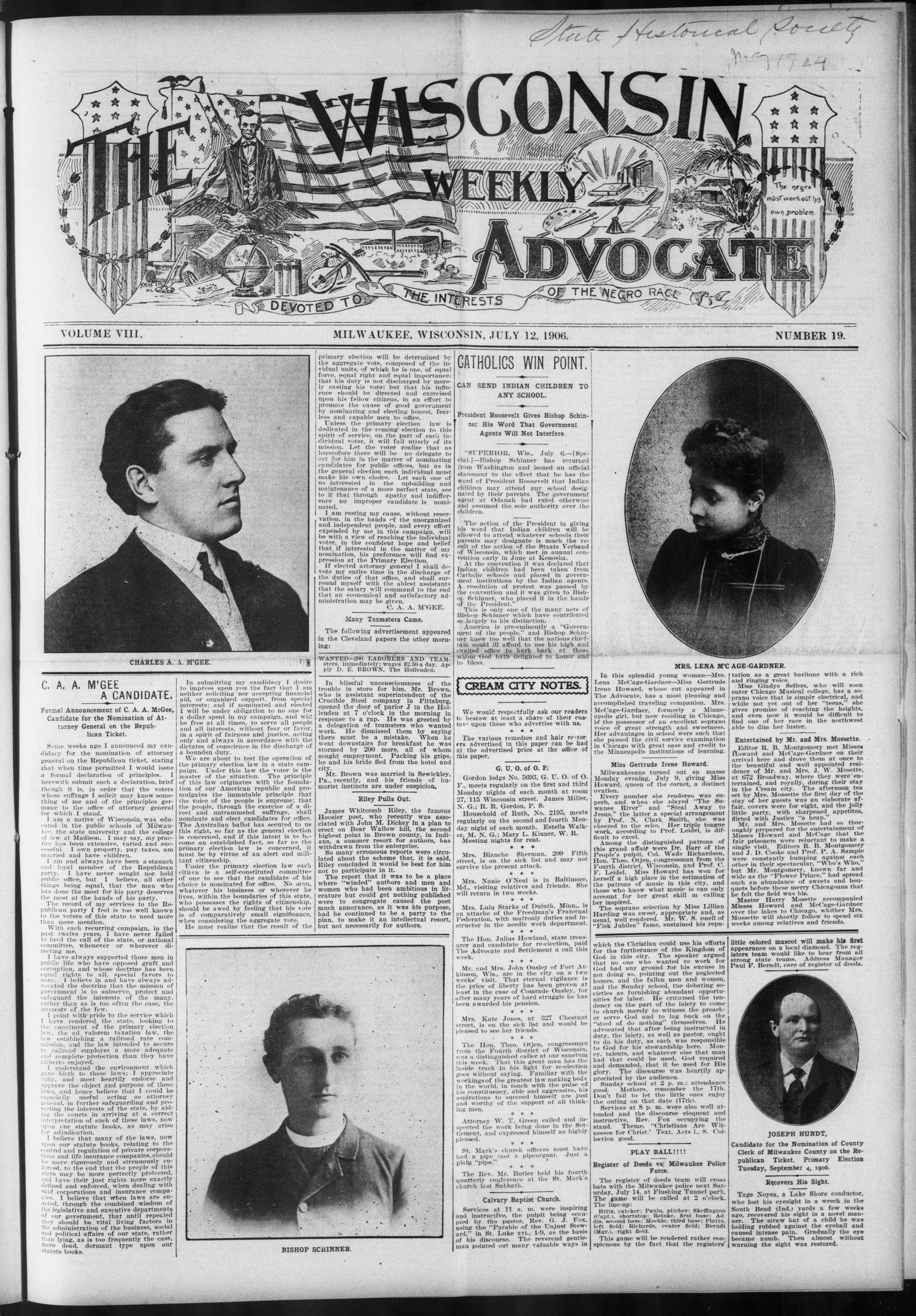
WISCONSIN
WEEKLY
The negro
must work out his
own problem.
ADVOCATE
DEVOTED TO THE INTERESTS OF THE NEGRO RACE
CHARLES A. A. M'GEE.
VOLUME VIII.
CHARLES A.
C. A. A. M'GEE A CANDIDATE.
Formal Announcement of C. A. A. McGee, Candidate for the Nomination of Attorney General on the Republican Ticket.
Some weeks ago I announced my candidacy for the nomination of attorney general on the Republican ticket, stating that when time permitted I would issue a formal declaration of principles. I herewith submit such a declaration, brief though it is, in order that the voters whose suffrage I solicit may know something of me and of the principles germane to the office of attorney general for which I stand.
I am a native of Wisconsin, was educated in the public schools of Milwaukee, the state university and the college of law at Madison. I may say, my practice has been extensive, varied and successful. I own property, pay taxes, am married and have children.
I am and always have been a staunch and loyal member of the Republican party. I have never sought nor held public office, but I believe, all other things being equal, that the man who has done the most for his party deserves the most at the hands of his party.
The record of my services to the Republican party I feel is too well known to the voters of this state to need more than mere mention.
With each recurring campaign, in the past twelve years, I have never failed to heed the call of the state, or national committee, whenever or wherever directing me.
I have always supported those men in public life who have opposed graft and corruption, and whose doctrine has been equal rights to all, special favors to none. I believe in and have always advocated the doctrine that the mission of government is to subserve, protect and safeguard the interests of the many, rather than as is too often the case, the interests of the few.
I point with pride to the service which I have rendered the state, looking to the enactment of the primary election law, the ad valorem taxation law, the law establishing a railroad rate commission, and the law intended to secure to railroad employs a more adequate and complete protection than they have hitherto enjoyed.
I understand the environment which gave birth to these laws; I appreciate fully, and most heartily endorse and approve the object and purpose of these laws, and hence believe that I could be especially useful acting as attorney general, in further safeguarding and protecting the interests of the state, by aiding the courts in arriving at a correct interpretation of such of these laws, now upon our statute books, as may arise for adjudication.
I believe that many of the laws, now upon our statute books, relating to the control and regulation of private corporations and life insurance companies, should be more rigorously and strenuously enforced, to the end that the people of this state may be more perfectly protected, and have their just rights more exactly defined and enforced, when dealing with said corporations and insurance companies. I believe that when laws are enacted, through the combined wisdom of the legislative and executive departments of our government, that until repealed they should be vital living factors in the administration of the business, social and political affairs of our state, rather than lying, as is too frequently the case, mere dead, dormant type upon our statute books.
---
In submitting my candidacy I desire to impress upon you the fact that I am neither soliciting nor accepting financial aid, or organized support, from special interests; and if nominated and elected I will be under obligation to no one for a dollar spent in my campaign, and will be free at all times, to serve all people and all interests, without fear or favor, in a spirit of fairness and justice, acting only and always in accordance with the dictates of conscience in the discharge of a bounden duty.
We are about to test the operation of the primary election law in a state campaign. Under this law the voter is the master of the situation. The principle of this law originates with the foundation of our American republic and promulgates the immutable principle that the voice of the people is supreme; that the people, through the exercise of a direct and untrammeled suffrage, shall nominate and elect candidates for office. The Australian ballot has secured to us this right, so far as the general election is concerned, and if this intent is to become an established fact, so far as the primary election law is concerned, it must be by virtue of an alert and militant citizenship.
Under the primary election law each citizen is a self-constituted committee of one to see that the candidate of his choice is nominated for office. No man, whatever his business or wherever he lives, within the boundaries of this state, who possesses the rights of citizenship, should be awed by feeling that his vote is of comparatively small significance, when considering the aggregate vote.
He must realize that the result of the
[Name not provided]
BISHOP SCHINNER.
primary election will be determined by the aggregate vote, composed of the individual units, of which he is one, of equal force, equal right and equal importance; that his duty is not discharged by merely casting his vote; but that his influence should be directed and exercised upon his fellow citizens, in an effort to promote the cause of good government by nominating and electing honest, fearless and capable men to office.
Unless the primary election law is dedicated in the coming election to this spirit of service, on the part of each individual voter, it will fail utterly of its mission. Let the voter realize that as heretofore there will be no delegate to act for him in the matter of nominating candidates for public offices, but as in the general election each individual must make his own choice. Let each one of us interested in the upbuilding and maintenance of a more perfect state, see to it that through apathy and indifference no improper candidate is nominated.
I am resting my cause, without reservation, in the hands of the unorganized and independent people, and every effort expended by me in this campaign, will be with a view of reaching the individual voter, in the confident hope and belief that if interested in the matter of my nomination, his preference will find expression at the Primary Election.
If elected attorney general I shall devote my entire time in the discharge of the duties of that office, and shall surround myself with the ablest assistants that the salary will command to the end that an economical and satisfactory administration may be given.
The following advertisement appeared in the Cleveland papers the other morning:
WANTED-200 LABORERS AND TEAMsters, immediately; wages $2.50 a day. Apply D. E. BROWN, The Hollenden.
In blissful unconsciousness of the trouble in store for him, Mr. Brown, who is assistant superintendent of the Crucible Steel company in Pittsburg, opened the door of parlor J in the Hollenden at 7 o'clock in the morning in response to a rap. He was greeted by a delegation of teamsters who wanted work. He dismissed them by saying there must be a mistake. When he went downstairs for breakfast he was stormed by 200 more, all of whom sought employment. Packing his grips, he and his bride fled from the hotel and city. Mr. Brown was married in Sewickley, Pa., recently, and his friends of humorist instincts are under suspicion.
James Whitcomb Riley, the famous Hoosier poet, who recently was associated with John M. Dickey in a plan to erect on Bear Wallow hill, the second highest point in Brown county, in Indiana, a summer resort for authors, has withdrawn from the enterprise.
So many erroneous reports were circulated about the scheme that, it is said, Riley concluded it would be best for him not to participate in it.
The report that it was to be a place where "winded" authors and men and women who had been ambitious in literature but could get nothing published were to congregate caused the poet much annoyance, as it was his purpose, had he continued to be a party to the plan, to make it an intellectual resort, but not necessarily for authors.
C. A. A. M'GEE
Many Teamsters Came.
Riley Pulls Out.
CATHOLICS WIN POINT.
CAN SEND INDIAN CHILDREN TO ANY SCHOOL.
President Roosevelt Gives Bishop Schinner His Word That Government Agents Will Not Interfere.
"SUPERIOR, Wis., July 6.—[Special.]—Bishop Schinner has returned from Washington and issued an official statement to the effect that he has the word of President Roosevelt that Indian children may attend any school designated by their parents. The government agent at Odanah had ruled otherwise and assumed the sole authority over the children.
The action of the President in giving his word that Indian children will be allowed to attend whatever schools their parents may designate is much the result of the action of the Staats Verband of Wisconsin, which met in annual convention early in June at Kenosha.
At the convention it was declared that Indian children had been taken from Catholic schools and placed in government institutions by the Indian agents. A resolution of protest was passed by the convention and it was given to Bishop Schinner, who placed it in the hands of the President." This is only one of the many acts of Bishop Schinner which have contributed so largely to his distinction. America is pre-eminently a "Government of the people," and Bishop Schinner knew too well that the nations chieftain could ill afford to use his high and exalted office to hark back at those whom God hath delighted to honor and to bless.
CREAM CITY NOTES.
We would respectfully ask our readers to bestow at least a share of their custom upon those who advertise with us.
The various remedies and hair restorers advertised in this paper can be had at the advertised price at the office of this paper.
G. U. Q. of Q. F.
Gordon lodge No. 5693, G. U. O. of O. F., meets regularly on the first and third Monday nights of each month at room 27, 115 Wisconsin street. James Miller, N. G.; R. R. Gordon, P. S.
Household of Ruth, No. 2195, meets regularly on the second and fourth Monday night of each month. Estella Walker, M. N. G.; Mary L. Kinner, W. R. Meeting nights for rent.
* * *
Mrs. Blanche Sherman, 209 Fifth street, is on the sick list and may not survive the present attack.
* * *
Mrs. Nanie O'Neal is in Baltimore, Md., visiting relatives and friends. She will return in two weeks.
* * *
Mrs. Lulu Starks of Duluth, Minn., is an attache of the Freedman's Fraternal Federation, with matronly duties and instructor in the needle work department.
* * *
The Hon. Julius Howland, state treasurer and candidate for re-election, paid The Advocate and Settlement a call this week.
\* \* \*
Mr. and Mrs. John Onsley of Fort Atkinson, Wis., are in the city on a two weeks' visit. That eternal vigilance is the price of liberty has been proven at least in the case of Comrade Onsley, for after many years of hard struggle he has been awarded his pension.
***
Mrs. Kate Jones, at 327 Chestnut street, is on the sick list and would be pleased to see her friends.
***
The Hon. Theo. Otjen, congressman from the Fourth district of Wisconsin, was a distinguished caller at our sanctum this week. That this great man has the inside track in his fight for re-election goes without saying. Familiar with the workings of the greatest law making body in the world, in touch with the pulse of his constituency, able and aggressive, his aspirations to succeed himself are just and worthy of the support of all thinking men.
* * *
Attorney W. T. Green called and inspected the work being done in the Settlement, and expressed himself as highly pleased.
宋 宋 宋
St. Mark's church officers must have had a pipe (not a pipeorgan). Just a plain "pipe."
The Rev. Mr. Butler held his fourth quarterly conference at the St. Mark's church last Sabbath.
Calvary Baptist Church.
Services at 11 a. m. were inspiring and instructive, the pulpit being occupied by the pastor, Rev. G. J. Fox, using the "Parable of the Unjust Steward." in St. Luke xvi., 1-9, as the basis of his discourse. The reverend gentleman pointed out many valuable ways in
[Portrait of a young woman with dark hair, wearing a dark dress with a high collar and a necklace. She is looking slightly to the side.]
MRS LENA M'C AGE-GARDNER
In this splendid young woman—Mrs. Lena McCage-Gardner—Miss Gertrude Irene Howard, whose cut appeared in The Advocate, has a most pleasing and accomplished traveling companion. Mrs. McCage-Gardner, formerly a Minneapolis girl, but now residing in Chicago, is the possessor of an excellent soprano voice of great strength and sweetness. Her advantages in school were such that she passed the civil service examination in Chicago with great ease and credit to the Minneapolis institutions of learning.
Miss Gertrude Irene Howard.
Milwaukeeans turned out en masse Monday evening, July 9, giving Miss Howard, queen of the cornet, a distinct ovation. Every number she rendered was superb, and when she played "The Suwanee River" and "Steal Away to Jesus," the latter a special arrangement by Prof. N. Clark Smith, she was cheered to the echo. Her triple tongue work, according to Prof. Leidel, is difficult to excel.
Among the distinguished patrons of this grand affair were Dr. Barr of the People's pulpit, Col. Wade Richardson, Hon. Theo. Otjen, congressman from the Fourth district, Wisconsin, and Prof. C. F. Leidel. Miss Howard has won for herself a high place in the estimation of the patrons of music in this city, and those who know what music is can only account for her great skill in calling her inspired. The soprano selection by Miss Lillian Harding was sweet, appropriate and, as usual, well rendered. Mr. W. S. Snell of "Fisk Jubilee" fame, sustained his repu-
which the Christian could use his efforts for the furtherance of the Kingdom of God in this city. The speaker argued that no one who wanted to work for God had any ground for his excuse in not doing so, pointing out the neglected homes, and the fallen men and women, and the Sunday school, the debating societies as furnishing abundant opportunities for labor. He criticised the tendency on the part of the laiety to come to church merely to witness the preacher serve God and to lag back on the "stool of do nothing" themselves. He advocated that after being instructed in duty, the laiety, as well as pastor, ought to do his duty, as each was responsible to God for his stewardship here. Money, talents, and whatever else that man had that could be used, God required and demanded, that it be used for His glory. The discourse was heartily appreciated by the audience.
Sunday school at 2 p. m.; attendance good. Mothers, remember the 17th. Don't fail to let the little ones enjoy the outing on that date (17th). Services at 8 p. m. were also well attended and the discourse eloquent and instructive. Rev. Fox occupying the stand. Theme, "Christians Are Witnesses for Christ.' Text, Acts i., 8. Collection good.
Register of Deeds vs Milwaukee Police Force.
The register of deeds team will cross bats with the Milwaukee police next Saturday, July 14, at Flushing Tunnel park. The game will be called at 2 o'clock. The line-up:
Britz, catcher; Paulu, pitcher; Skeffington (Capt.), shortstop; Reinke, first base; Addis, second base; Moehle, third base; Platta, left field; Richards, center field; Berndt (Mgr.), right field.
This game will be rendered rather conspicuous by the fact that the registers'
PLAY BALL!!!!
tation as a great baritone with a rich and ringing voice. Miss Gladys Sellers, who will soon enter Chicago Musical college, has a soprano voice that is simply electrical, and while not yet out of her "teens," she gives promise of reaching the heights, and even now it would be difficult to find one of her race in the northwest able to dim her luster.
Entertained by Mr. and Mrs. Mossette.
Editor R. B. Montgomery met Misses Howard and McCage-Gardner on their arrival here and drove them at once to the beautiful and well appointed residence of Mr. and Mrs. J. W. Mosette, at 672 Broadway, where they were entertained, and royally, during their stay in the Cream city. The afternoon tea set by Mrs. Mosette the first day of the stay of her guests was an elaborate affair, covers were for eight, and the jolly little party, with sharpened appetites, flirted with Justice "a heap."
Mr. and Mrs. Mosette had so thoroughly prepared for the entertainment of Misses Howard and McCage that the fair prisoners were reluctant to make a single visit, Editors R. B. Montgomery and J. D. Cooke and Prof. P. A. Sample were constantly bumping against each other in their spectacular, "Who's Who," but Mr. Montgomery, known far and wide as the "Flower Prince," had spread such an abundance of sweets and bouquets before these merry Chicagoans that he felt the field was his. Master Harry Mosette accompanied Misses Howard and McCage-Gardner over the lakes to Chicago, whither Mrs. Mosette will shortly follow to spend six weeks among relatives and friends.
little colored mascot will make his first appearance on a local diamond. The registers team would like to hear from all strong state teams. Address Manager Paul F. Berndt, care of register of deeds.
[Picture of a man in a suit and tie].
Candidate for the Nomination of County Clerk of Milwaukee County on the Republican Ticket. Primary Election Tuesday, September 4, 1906.
Tage Noyea, a Lake Shore conductor, who lost his eyesight in a wreck in the South Bend (Ind.) yards a few weeks ago, recovered his sight in a novel manner. The straw hat of a child he was holding rubbed against the eyeball and caused intense pain. Gradually the eye became numb. Then almost without warning the sight was restored.
NUMBER 19.
Recovers His Sight.
ASYLUM SERENADE
Lady, I beg thee to hark to my ditty,
Sung 'neath thy sill in the full of the moon;
Wake! for the nightingale's chanting so witty
Near where the boarder is eating his prune.
Wake in a hurry, dress in a flurry,
Hustle yourself into boot and galoche;
Pluck a syringa, fly with the singer,
Down where the prettiest mermaidens wash.
Lady, I love thee a mickle and muckle;
Come, entertain me an hour or so;
I will lose money to you at peaknuckle—
Where will you find any lavisher beau?
Lady, art dressing? Don't keep me guessing—
Stop not for hooks, and, oh, stay not for eyes!
Don't keep me waiting—I'd have gone skating,
But that my tootsies are all the wrong size.
Lady, I'm only a wandering loony,
Singing his love on a talking machine—
Still, if you deem that my chanson is tuny,
Pass me, in mercy, a cold Lima bean.
Come, if you won't; stay, if you don't—
Hunger has seized me, and there lies the rub.
Spry about, Nelly, hand me some jelly.
Toss me some provender, vittles and grub.
—Richmond Times-Dispatch.
Miscellaneous Items.
—M. Guesde, a French Socialist, says that when society is properly constituted nobody will have to work more than eleven minutes a day.
—Commissioner James R. Garfield of the bureau of corporations is passionately fond of tennis and frequently joins in baseball games with his children.
—An American chemist in the City of Mexico says that sugar of the very finest grade can be made from the juice of the maguey plant. A company has been formed to try the experiment.
—Sir Gilbert Parker, the novelist, likes to go from one room to another, writing a little in this and a little in that. He also has a weakness for changing chairs while composing.
Warren Belcher, for fifty-three years postmaster at Winthrop, Mass., has resigned to be succeeded by his son, David Belcher. In time of service he was the oldest postmaster in the United States.
A cure for seasickness, which a German doctor says he has discovered, consists in the sufferer lying on his back and having handkerchiefs soaked in hot water twisted very tightly around his forehead.
Certain substances which are deadly in their effects on men can be taken by animals with impunity. Horses can take large doses of antimony, dogs of mercury, goats of tobacco, mice of hemlock, and rabbits of belladonna.
—Prizes aggregating $7500 for suggesting improvements in connection with railway construction and service are offered by the Verein Deutscher Eisenbahnverwaltungen. The latest date for communications is July 15, 1907.
—A Japanese scientist suggests that the radio-activity of air may be due to the escape of emanations from subterranean regions. He proposes that the smoke from volcanoes be examined to see whether this theory is correct.
—A new plant, called "malva" has been discovered in the state of Sinaloa, Mexico, that produces first-class fiber. Its cultivation requires little or no labor. It is much drier than the famous magnet plant.
In the course of recent conversation at Potsdam, the Princess von Buelow, wife of the German chancellor, remarked to the Kaiser that her mansion needed cleaning. The Kaiser was amused. "May I help you to clean it?" as asked, and, taking the remark as a joke, she assented. The next day several large crates were delivered at the princess' house, and an autograph letter from the Kaiser saying that he was doing his share in the cleaning by sending her a ton of soap.
HOUSEHOLD HINTS.
Damp salt will remove tea stains from crockery.
Equal parts of turpentine, linseed oil and vinegar make a splend.. polish for furniture, etc.
To turn out a cake from a tin without breaking, wrap it round with a damp cloth for a few minutes.
To boil eggs without the risk of cracking, hold them in a spoonful of boiling water before immersing them.
Turpentine is the best preventive for moths. Saturate pieces of brown paper with same, and place in boxes.
A gas stove can be kept nice and clean by wiping each time after using, and once a week washing with turpentine.
To render stained water bottles beautifully clean and bright, put in salt and pour on vinegar; stand a few hours, then shake.
To turn out a pudding boiled in a basin, hold it for a few moments in cold water; this will prevent it sticking to the cloth.
Birds That Doctor Themselves.
Certain birds seem to possess a remarkable instinct for surgery. The woodcock, the partridge, and some others are said to be able to dress their wounds with considerable skill. A naturalist observes that he has shot several woodcock that were recovering from wounds previously received. In every instance he found the injury neatly dressed with down plucked from the stems of feathers and skillfully arranged over the wound, evidently by the long beak of the bird. In other cases ligatures had been applied to wounded or broken limbs.
BY THE WAYSIDE
When a woman hasn't any other excuse, she attributes it to impulse.
Every man who has a ship coming in doesn't belong to the capitalistic class.
It's always safe to gamble that a woman won't deny a thing if it's not so.
A husband can convince his wife that anything is fashionable if he makes her believe it's expensive.
No One Above Him.
During the recent royal procession in Yokohama, in marked contrast to the seas of heads that we are accustomed to see in the upper stories of the houses in England on similar occasions nothing but blank windows were to be seen—due to the fact that in Japan nobody is allowed to look down upon the Emperor. North China Herald.
Gudgeon Fishing in Minnesota
Gov. Johnson promised the traveling men at Albert Lea a two cent flat rate on the Minnesota railroads within the next twelve months. Every one knows that an executive has absolutely no power to effect such a result. But then anything goes when a hungry officeholder gets desperate.—Austin Transcript.
WYOMING PRAIRIES.
In majesty of wide, uncumbered space Unroll the mighty meadows of the West That Nature, by a touch of subtle grace, With marquetry of matchless bloom has blest.
Wind-brought from forest-belt and mountain-belight
Afar, they gather in their ample lap
And weave them in a rainbow of delight.
Warm golden chromes and mellow crimsons
glow
Through shadowings of olive and maroon,
And high, the thistle-poppy's cup of snow
Out-glimmers like a lambent harvest
moon.
Above, the changeless turquoise-blue is
spread
Until the painter, Sunset, shifts the scene
And rims the plain with bales of flaring red
Their inter-spaces washed with beryl-
green.
But Darkness with inexorable march,
Treads down the carmine into dun and
seal,
And from the heavens' murky-velvet arch
Great stars strike sharply forth like
points of steel.
Ah, then, let him whose boast is human might. To sound all magnitude man may possess, Stand in that sweep of unknown space and night— An atom in the wide, black loneliness! Harriet Whitney Durbin in National Magazine.
THE GOLDEN LIZARD MINE
Two men sitting outside the doorway of a wooden shanty on the outskirts of a small mining camp were watching the sun sink in the west. Chance had thrown them together many years before and their partnership had ripened into such friendship that men wondered.
"Well, Jack, old man, guess I'll saunter down to the saloon." The speaker rose and stretched six feet of well-developed humanity. "Say, Jack I've been thinkin'—" He hesitated, then added quickly, after a gulp, "I've been thinkin' of settlin' down. Gettin' married."
"An' might I ask the name of the lady you intend to honor?"
"Why, sure. It's old Scotty Wilson's daughter; Ida."
"Oh! So that's the reason you have been droppin' in to the saloon to see the boys so frequent. Have you asked her yet?"
"I reckon."
"An' what did she say?"
"Well, old chap, I haven't kep' any secrets from you——"
"Did she say 'Yes'?" persisted Jack.
"Well, she didn't exactly say 'Yes,' but it's practically settled. She wants a day or two to think it over. You know what gals is."
Jack was on his feet. His eyes blazed.
"What's wrong with you, Jack? Ain't you well?"
"Nothing's the matter with me," said Jack fiercely; "but I'll ask you not to be so free with the lady's name." "I don't see what it's to do with you." "You don't? Well, I'm tellin' you. I've asked Ida Wilson to be my wife!"
I've asked Ida Wilson to be my wife.
"An' she gave you the mitten, I suppose. Well, I'm sorry, old man, but we can't both—"
"Not by a long sight. An' if you want to know, I've sent east for a ring, an' it's all goin' to be fixed up on Sunday."
Dick strode up to his partner, and for a few moments stood glaring at him speechlessly. Then, in measured tones, he said: "So it seems we are both on the same tack and are both to have our answer in a couple of days. Well, there's only one that's goin' to ask for an answer, an', man to man, between ourselves we'll settle who that one is to be."
"Anywhere an' any time you like."
"It's all the same to me," replied Jack, and turning on his heel he walked off toward the camp. Dick took the opposite direction. Presently he fell asleep under the stars and early next morning while the dawn was still gray, returned to the shanty. He found Jack seated at the small packing case which did duty as a table, laboriously writing.
"Hullo!" said Dick. "Ready?" "Jus' finished. This paper says we've decided to part, an' you have bought my share in the mine. Receipt for dust in payment, duly acknowledged." "Bright idea. I'll write you one. May come in handy if any questions asked."
While Dick was writing, the other man went to the corner of the room where they kept their mining tools and carefully selected a spade.
"Guess one of us 'll want buryin' pretty soon," he explained, in answer to his partner's inquiring glance.
Dick's writing finished, the two men exchanged documents, locked up the shanty and started out. For an hour and a half they walked on in sullen silence, each busy with his own thoughts. At length, as if by mutual consent, they paused in a sandy valley among the foothills of the mountain range which rose abruptly from the plains.
"How about settlin' it here?" inquired Dick.
"It's all the same to me. Measure out the distance."
Dick paced out twenty yards, and marked the spots by setting pieces of flat rock upright in the sand. "Give you your choice of ends."
"No, thanks! We'll toss for choice."
A coin was spun, and Dick won. "I suppose," he said. "I suppose we can't settle this business without a shootin' match?"
"Guess not!" replied his partner. "Unless you care to clear right out of the country."
Dick muttered an oath and walked to his post, drew his revolver, and examined the cartridges. "Let's get it over," he said.
"There ain't anybody to start the shoot," objected his partner.
"Never mind. Put yer gun on the ground two feet in front of you; then count three, an' we'll begin shootin'."
"Suit me all right, 'cept I ain't goin' to do the countin'. You count."
"Not me!"
"Who's goin' to start us. then?"
"D'yer see that lizard, half-way between us, sunnin' 'imself on the rock. The moment he moves a step, the fight begins. How'll that suit you?"
Both men crouched down, like sprinters starting for a race. They stretched out their hands, the more readily to grasp their weapons at the instant the reptile should unconsciously give the signal. Half a minute, then a minute, elapsed, but the lizard did not move. With straining eyes the men watched the little animal, but it remained motionless,
and, save for the quick fluttering of its throat, might have been mistaken for a lizard cunningly wrought in bronze. The minute became two, and still no signal was given. The breath of the two men came thickly, and the sweat stood in heads on their brows.
The glare of the bright sunlight from the sand and the strain of watching for the slightest movement of the reptile ten yards distant from him began to have a mesmeric effect upon Jack. His sense seemed to be numbed, but his nerves tingled. He saw only the lizard and his rival; the rest of the world was blotted out. The next moment he could no longer see the lizard. Why did not Dick fire? He blinked his eyes to clear his sight. Ah! He could see again now; the lizard was still sunning itself on the slab of rock.
Jack meant to kill the man crouching in front of him, but he meant to kill him fairly. "Suppose," he asked himself, "that he lost sight of the lizard again, and fired too soon?" The thought unnerved him. He wondered vaguely whether it was fear that caused his outstretched arm to shake. Of course, he was not afraid, he told himself. The silence oppressed him; he wanted to shout at the motionless creature, instead he began to curse it silently. What right had it to keep him in this agony of uncertainty?
"Say, Dick, that beast's a pretty durned lazy sort o' cuss! What's the matter with gittin' the grave ready first?"
"All the same to me."
Jack heard as a man hears when recovering from the effects of an anaesthetic. He pulled himself together with an effort.
Dick picked up the spade. "Anywhere hereabouts will do," he said. "It won't take long to scoop out a hole in this sand, and we can chuck some rocks on top to keep the coyotes from clawin' it up."
He marked out a narrow rectangle, and began to shovel the wind-blown sand. For some minutes he worked steadily. The sand soon gave place to a fine gravel. "Jack," he said presently, pausing in his work, "this gravel looks mighty likely stuff." He placed a small handful of the material on the spade and passed it to his partner.
Jack examined the sample and nodded. "Ought to carry gold, right enough," he said. "There's a stream a little way back; we might as well just try it." "I reckin," assented Dick. Kneeling down by a still pool, Jack began to wash the sample with a dexterous rocking movement of his shovel. The first washing removed the lighter portions of the material and freed from grit the larger pebbles. These pebbles Jack picked carefully out and threw them aside. He continued his washing, eliminating by degrees the smaller pebbles and coarse sand, then, giving his shovel a final swirl and pouring off the water, he handed the sample to his partner.
"By James! That looks all right. Wonder how many 'weights it goes," exclaimed Dick. "Let's try again."
A second sample was washed, and the result made the eyes of both men gleam. "Dick, my boy; we've struck it rich at last. This is the biggest thing between here and beyond!" Jack made a hasty survey of the surroundings. "And it would be no trick at all," he said, "to flume all the water we want right on to the spot, and everything else is dead in our favor."
"In favor of one of us!" corrected Dick grimly.
"I forgot that," muttered his partner. "But it'll take two men to work this show."
"Don't know who we could ask. There ain't one man in the whole bunch that I'd trust with six bits."
"Nor me neither," rejoined Jack, thinking deeply. 'Say!" he suggested, "suppose we couldn't adjourn the shootin' competition for a couple of months?"
"Well, it does seem kind o' like temptin' Providence to chuck away a chance like this. Added to which," said Dick, speaking very slowly—"added to which, now I come to think of it, I don't know as I am so durned set on the gal, anyway."
"There is others," admitted Jack; "an' maybe we've been a bit hasty."
So the duel was postponed sine die, and the partners fell to discussing their new project. Several trial holes were made, samples taken, and the holes filled in again. The limits of their claim were decided upon, and staked out and the necessary notice was written and affixed to one of the stakes. These details took time, and it was long past noon before the prospectors started home, with samples of the auriferous gravel carefully wrapped up in their pockets.
As they approached their shanty a horseman hailed them: "Hullo, you sportsmen, where have you been off to? Heard the news? What? Why the Doc, is goin' to get spliced to old Scotty Wilson's gal."
"You don't say!" said Jack. "Guess we'll be comin' along just d'rectly to honor the event in a befittin' manner."
"You bet!" added Dick.
"Right—Oh!" shouted back the rider, setting spurs to his horse. "We'll paint the old town a particular bright shade o' red ter night!"
Inside the shanty the partners gazed at each other for some moments, then a loud shout of laughter from Jack broke the silence. "By gosh!" he said, "we came pretty near makin' a mess of it. What a good job that lizard didn't leg it!"
"You're right there, pard," responded Dick. "The mail goes out tomorror, an I'll toss you who goes down to Smithsonville to record our claim to the Golden Lizard mine."—Grand Magazine.
High Finance.
A Buffalo man stopped a newsboy in New York, saying: "See here, son, I want to find the Blank National bank. I'll give you half a dollar if you direct me to it."
With a grin the boy replied, "All right, come along." And he led the Buffalo man to a building half a block away.
The man duly paid the promised fee, remarking, "That was half a dollar easily earned, son."
"Sure," responded the lad, "but you mustn't fergit that bank directors is paid high in Noo-Yawk."—American Spectator.
Her Geese Are Swans
A contented spirit was Mrs. Snow's, so contented that at times her neighbors found it trying and took an unrighteous satisfaction in presenting any small thorns which might prick through her comfort. "No, my Angie hasn't the measles," said Mrs. Snow one day. "Well per-
haps it seems strange she should escape the epidemic, but my children are unusually fortunate always in those respects. Of course I take the best care of them, and then they inherit a tendency to throw off any germs. I anticipate no illness with Angie."
In spite of this the redoubtable Angie came down with measles a week later, and the inquiring friend again proached Mrs. Snow.
"Yes, dear Angie has the measles at last," said the contented mother. "Now most of the other children are well, and as the doctor has plenty of time to attend to her, it really seemed an opportunity for Angie.
"I don't suppose there ever was a child on whom they came out more beautifully than on Angie! I tell the doctor I think he may well be proud of his little patient."—Youth's Companion.
WORK OF THE WINDS.
Moving Sand Dunes That Bury Villages and Shoal Sounds.
The prevailing winds from a little west of south have rippled the heterogeneous sands on Hatteras just south of the cape, on Shackelford at its southwest extremity, and on the southwest side of Smith's island. These wind ripples, started in sands exposed by the removal of a strip of forest next the shore, have grown in size to great sand waves, which are advancing on forests, fields and homes. As the sand wave has advanced it has taken up several feet of the loose soil over which it has passed, undermining houses, laying bare the roots of trees and exposing the bones of the dead in the cemeteries.
Diurnal winds from the sea have piled the sands into small wandering dunes and hillocks, and even sometimes into sand waves, which are marching steadily inward and shoaling the waters of the sounds. At Nag's Head a large hotel, constituting a solid obstruction, soon had a sand wave built up a short distance in its rear until the level of its roof was reached, when the wave moved forward and engulfed the hotel. In the immediate neighborhood two cottages suffered a similar fate. Here the land gained on the sound 350 feet in ten years.
On the northern end of Hatteras island and a fishing village had been similarly buried, while the sand had entirely crossed the island at several places north of the cape. This movement of the sand was started just after the Civil war by the cutting of trees next the shore for ship timbers, and the section is still known as the Great Woods, though not a stick of timber stands upon it today. Pamlico sound for two miles from the Hatteras shore is growing steadily shallower from the deposit of blown sand.
On Smith's island a pilots' village has been buried beneath the sand wave for a number of years, but this has been quite recently resurrected and its houses are again occupied. On Currituck, below Caffey's Inlet lifesaving station, the sand has advanced entirely across the land, and one man, moving before the advancing sand, has at last built his house on piles in the sound.—National Geographic Magazine.
Has the Bear No Friends?
The newspaper stories of the killing of three black bears by some city boys in the Adirondacks calls attention anew to the bear law now in force in this state. Under the provisions of the statute bears may not be killed in July, August and September, except in Essex county. When the bear protectors went to the legislature for a protective law Essex county objected. The sheep raisers were unwilling to sacrifice their sheep to the bears, and protested so strenuously that they carried their point. It is the feeling of residents in the Adirondacks that bear protection is foolish. They profess not to be unwilling to live in a menagerie if the rest of the people of the state are bound to give that character to the North woods, but they do object to feeding the bears on mutton. A man who has lost fourteen sheep, killed by bears, is in no humor to indulge in sentiment, at all events not in sentiment which gives bruin immunity. The bear protective law in the Adirondacks has no substantial support there in any conviction of its usefulness or reasonableness. On the contrary it is regarded as a "fool law," and one unfortunate effect of it is to bring discredit on game laws in general. There is in the North Woods as elsewhere a growing acceptance of the game protective principle, and it is a great pity that this silly bear law should be in operation to retard the growth of right sentiment. —Forest and Stream.
Their Hotel Neighbors
At a certain Denver hotel lives a very charming little widow who has many masculine admirers. The other day she was asked by one of them to go out in the afternoon and play tennis. At the courts she met a man who struck her fancy. So, between sets, she and the new man would sit on the grass and talk. It was during one of these intermissions that he said. "By the way, Mrs. Blank, may I ask where you live?"
"To be sure," she replied. "I live at the such and such hotel."
"That's queer," he said. "I have a room there, too. However, I've had it only a week. I'm thinking of changing. There is a woman in the next room to mine who comes in every night about 12 o'clock and wakes me up with her noise. If they don't oust her I'm going."
"I don't blame you," said the little widow, "I know just how you feel. There's a man in the next room to mine who comes home full almost every night and knocks the furniture around. I'm going to make a complaint about him if he doesn't reform."
After the games had been played the new young man walked down to the hotel with her and her escort. They went for their keys together. The clerk handed them 202 and 204. Their rooms were adjoining—Denver Post.
THE GENTLE CYNIC
It's the cheap skate that cuts no ice.
When a man is tired of the world, the world soon reciprocates.
Many a woman wishes she were a man, and many a man wishes she were.
When we make googoo eyes at temptation the devil begins to sit up and notice.
Genius goes to medioerity when it wants to borrow money.—New York Times.
PERVERTED PROVERBS
No weather prophet is with honor in his own county.
Half a loaf is better than no bread, but most men prefer pie.
A fool may give a wise man counsel, but he can't make him take it.
Zoological Metaphor.
The latest mixed l.etaphor comes from Warrington. In a caustic attack on the town council, a member of the local trades council thundered: "Let us go to the council not like a lamb, but like the wolf, and take the bull by the horns."—London Evening Standard.
The reduction of telephone rates announced some time ago by the New York Telephone company has gone into effect. At pay stations, drug stores and the like only 5 cents a call was charged, but in large hotels and apartment houses, where they have private switchboards, the old rate of 10 cents still obtained.
Mayor McClellan has a butler in his Washington square house who wears knee breeches and the rest of a real butler's outfit—on ceremonial occasions. The mayor invited some Tammany leaders over to his house one evening to dinner. One of them came early and was admitted by the stately butler. The leader drew McClellan aside as soon as he had reached him and whispered hoarsely: "Say, George, why didn't you tell me this was a masquerade party?"
Harry K. Thaw, under indictment for the murder of Architect Stanford White, gave his fellow male prisoners at the Tombs a pleasant surprise July 4 by treating them all to ice cream and cake. Thaw requested Rev. John A. Wade, the Episcopalian clergyman who attends to the spiritual needs of the prisoners, to get enough to go around and send the bill to him. Mr. Wade did as requested, buying forty-six quarts of ice cream and thirty dozen cakes. Thaw's wife was not permitted to visit him.
The first steamship service ever operated exclusively for the exportation of American apples is now being arranged for by Harry M. Isaac of a firm of fruit importers of London. The ships will ply between Boston and London and Hull. Formerly it has been the custom to ship apples on the large freight ships, but the business has grown so as to support a line of steamers. The steamers will sail every fortnight, and will have a capacity of 20,000 barrels. The total exports of apples last season from all ports was 2,411,473 barrels.
Firemen sported upon the lawns of "Deepdale," the Long Island home of William K. Vanderbilt, Jr., recently and Mrs. Vanderbilt hobnobbed with the "vamps" and their wives, sweethearts, and other relatives, and capped the climax of merrymaking by riding across the estate on one of the fire engines, with the steamer blowing smoke and the whistle shrieking as if bound to a fire. Her pink gown and picture hat made her a striking sight. Mrs. Oliver H. P. Belmont and her husband assisted the Vanderbilts to entertain the firemen. The "vamps" wore their firemen's uniforms and the conduct of the entire company was extremely democratic.
Frank Lisanti, a poor Italian baker in New York, was in great peril of death from pneumonia. He prayed to the Virgin and pledged that, should his life be spared, he would erect a chapel. The life of Lisanti was spared. By frugal living he has saved the money and Sunday was dedicated the little chapel. It is a small edifice, but it represents an outlay of $3000 on the part of Lisanti, not to mention the labor and planning he did himself. The baker was architect and builder and almost everything else in the little house was done by his son and cousin. It seats thirty persons. The front of the structure is granite and the floor is of Italian marble. A small organ loft in the front of the interior has been erected.
Though his neck was broken and his skull fractured forty-six years ago, George Knox lived until last Thursday. He died at the age of 91. His death was due to the injury to his neck. A heavy cornice fell on Knox one day in the summer of 1860, while he was passing a building in course of construction at Ninth avenue and Twenty-sixth street. His neck was broken and his skull was fractured. Physicians declared he could not live longer than twenty-four hours. They were astounded when they found, a week later, that Knox was not only living, but gaining strength. After being treated at St. Luke's hospital for two years Mr. Knox was able to return to his business.
Perquisites will soon have become a thing of the past with members of the finest because the official probe has penetrated so deep that it has even punctured the measly peanut graft. Italian and Greek fruit and nut venders now watch the approach of the big white-gloved coppers with the utmost serenity because their pushcarts are covered with wire netting, which precludes the insertion of a big hand. Some time ago the venders complained to the commissioners that the patrolmen who themselves sampled their goods every time they made a round made no effort to keep the news-boys and others from stealing their wares. The itinerant merchants were then ordered to place a screen over their trundles and pushcarts, with the result that the bluecoats are now tabooed.
At a little impromptu studio party in New York city, it was decided to rush the growler. A young man grasped a large, long, bulging vase, and sallied forth to the nearest barkeep, who subsequently turned in the beer.
"Gee!" exclaimed the barkeep, pausing in the operation, "what have we struck here? A mine?"
Amid the debris of old letters, left over hair combings, and one thing and another floating suddenly to the surface, was a roll of one dollar bills, fourteen by exact count in all.
These the young man a moment later handed over to the owner of the vase, the woman artist, who met him at the door of her studio in tears, thinking he had tapped her safe and absconded.—New York Sun.
In exclusive New York circles they are telling how an old colored "mammy" the other day unintentionally administered a rebuke to her mistress, who belongs to an amazing number of clubs. The family has a mansion in one of the suburbs. The privileged old servant does not altogether approve of some methods of the modern woman. One day her mistress had a dozen club friends out to luncheon in her home and the feast was spread on the porch. By and by the hostess heard a lively colloquy between her eldest hopeful, 7 years old, and the nurse. "You just git down outen dat tree," said the nurse. "You want to fall out and kill yourself, do you? Well, you just try it and see what good it'll do you. You' mother, she dat busy right now she won't even hab time to go to you' funeral."
Simply because two uniformed New York officers used a patrol wagon for hauling the proceeds of a National league baseball game at the Polo grounds recently to a bank they are now on the carpet and under fire. According to the report which reached the ears of the commissioners the management of the New York team was chary about carrying the proceeds of the game to the bank and they so informed the officers. A signal was then sent in for the patrol wagon by one of the guardians, two statchels containing the money were placed in the "hurry-up," which under the care of the two uniformed men was whirled to the bank. Had the officers even used the patrol wagon to move
their household effects they would have possibly been called to task. Not even a metropolitan uoliceman has the ghost of a show these days.
Lord Northcliffe, better known as Sir Alfred Harmsworth, the publisher, has arrived in New York to visit forest land in Newfoundland, which the Harmsworth corporation has obtained from the colonial government for the manufacture of paper pulp for its publications. Lord Northcliffe had not heard of the railroad accident at Salisbury.
Of insurance matters Lord Northcliffe said:
"I don't believe American companies remaining in England, unless they put up a surplus sufficient to meet their claims, will be able to do business."
"Do you have a paper trust in England?" he was asked.
"We don't have any trust at all," said he. "No trusts. John Bull is so stupid that he won't have any trusts. Say that. Say those very words."
Frederick Boshardt made affidavit before Coroner Acritelli of New York that he was alive. Having been formally pronounced dead by Coroner Scholer two years ago, Boshardt had to make the affidavit to establish himself as a live one, and also to keep the Prudential Life Insurance company from paying to his wife $1000, which she had tried to collect on the ground that he was defunct.
Boshardt married in 1903 and disappeared in April, 1904. On May 14, 1904, a body was picked up in the North river off Fifty-seventh street, kept in the morgue the regulation time and buried in potter's field as unidentified. The clothes and a knife were preserved. Mrs. Boshardt in June, 1904, identified the clothes and the knife as having belonged to her husband. Coroner Scholer held an inquest and on an affidavit by Mrs. Boshardt that Boshardt was dead he was formally wiped off the map. Then Mrs. Boshardt, who had moved to Springfield, Mass., demanded the $1000 life insurance. The company refused to settle and she brought suit. The company hired detectives, who located Boshardt in Philadelphia, working as a furniture polisher.
Charles C. Schaefer, 66, of New York, who has eight motherless children, sought out Magistrate Whitman in the Yorkville court and interested the judge in his romantic attempt to marry in spite of the opposition of some of his children. The court arranged the matter to his satisfaction and sent a probationary officer to the church with Schaefer and his intended to see them wedded.
Schaefer is worth $90,000, it is said, and fell in love with a poor girl, Jessie Eagle, aged 28. Schaefer said he had made several attes. pts to marry the young woman with him, but that his daughter Dora, aged 21, and Tillie, 19, had prevented the nuptials. Schaefer said he thought it inadvisable for them all to live together and offered to give Tillie and the boy each $500 if they would leave him alone with his wife to be.
"Dora I don't have to support," he added, "as she is of age."
added, as she is of age.
Dora fainted, falling into the arms of her father's counsel with a scream. Tillie sprang at the prospective stepmother, and, twining her hands in her hair, tried to drag her around the room. The court attendants separated them. As the bride to be wished to be married in a church, the magistrate sent a probationary officer with the bridal pair to the church. The daughters went home crying.
Gently and Kindly
"Alaska is a land of adventure and romance" said Raymond Brumbaugh, who recently returned from the North. "Many queer things have happened in Alaska. Many wretched things. Sometimes it has been necessary to break sad news to mothers at home and sometimes this news has been broken with wonderful skill.
"An Alaskan called on a woman in New Hampshire to tell her of her son's death in the Klondike.
"Yes, lady,' he said to the weeping mother, 'I was with him to the end. I seen him die. And I tell ye, ma'am, as he wuz dyin' he looked jest like an angel.'
"Did he?" the mother sobbed.
Did he: the mother sobbed.
"He certainly did, ma'am," said the Klondiker. 'Swingin' back'ards and for'ards in the air thar, ye'd 'a' thought he had wings.'
Cold Storage in Labrador.
A bucket of potatoes, "to be eaten out of three times a day," is a not uncommon prescription to supply from our dispensary. We have great trouble to keep enough.
Often a bit of fresh beef is easier to give, for we kill our oxen in the fall and cut them into joints. Then we fill our old barrels with clear water and drop in the beef. It promptly all freezes solid and is preserved at least from December to July.
I was much amused to notice that some rats had singled out in the store one of these barrels for attack. After patiently gnawing through the wood they came down on the block ice, but in many nights' working they had got very little "forrader."—Dr. W. T. Grenfell in Boston Transcript.
Bed-Rock Price
The proprietor of a Boston hotel says that a week or two ago a dusty, tired-looking person from Nashua, N. H., presented himself at the desk of the hotel, stating that he desired a room. "I've et my supper an' shall be off before breakfast," said he, gravely, to the clerk; "now what would be your lowest price for a room to sleep in?"
"One dollar, if you leave at 6 o'clock tomorrow morning," was the reply.
tomorrow morning, was the reply.
"Well—er—wouldn't half a dollar make it jest about right?" demanded the way farer, producing a battered 50-cent piece.
"You see, I'm all excited up, travellin' an' I don't expect to sleep more'n half the time I'm in there." — Harper's Weekly.
Lament of the Gourmand
Nothing new to eat has been discovered for several centuries past. The monotony is not confined to breakfast; it is equally, if not more so, felt at lunch and at dinner. There are disgracefully few animals fit to eat, and the okapi, which seemed to solve the difficulty, is a bitter disappointment, because there are only three specimens of him known to exist, and two of those are stuffed. Sketch
Caramel Custard.
Heat four cups of milk. Put one-half cup of sugar into an omelet pan, and when melted and turned brown, but not burned, turn the hot milk in slowly. Beat five eggs light, add a saltspoon of salt and pour the hot mixture over them, stirring all the time. Add a teaspoon of vanilla and pour into buttered custard cups. Set the cups in a pan of hot water and bake slowly.
Maiden Lady's Last Wish
A Northampton maiden lady has left the whole of her estate to her niece, on condition that she places no artificial flowers on her grave.
Her will concludes with these words: "Let there be no artificiality in God's acre."—London Standard.
Advertise in Your Home Paper.
YOUNG FOLKS' COLUMN.
The Gingercake Man.
The Gingercake man was a lump of brown dough
Till a great rolling pin was run over him,
so!
To flatten him out, and he lay there so thin,
His bones almost popped through the holes in his skin;
Then they sifted him over with flour and spice,
And made him some eyes with two kernels of rice,
And took some dried currants, the biggest and best,
To make him some buttons for closing his vest.
The Gingercake man wobbled this way and that
When they seeded a raisin and made him a hat
That was stuck on his head in the jauntiest way.
For a Gingercake man is not made every day.
They stuck in some cloves for his ears; yes, indeed!
And made him some teeth out of caraway seed,
And when he was finished they buttered a pan—
The biggest they had—for the Gingercake man.
Then into the oven they put him to bake
Until he was hard and could stand and not break
His legs when he stood; and they set him to cool
Until all the children should come home from school.
And Oh! the delight and the wonder and glee.
When Mother invited the children to see.
All sifted with sugar and out of the pan.
The good-natured face of the Gingercake man.
But alas and alas! 'Tis a short life and sweet
Is the Gingercake man's—for they ate off his feet.
They broke off his arms with the hungriest zest,
And picked all the buttons from out of his vest;
They nibbled his legs off and ate up his hat,
And everything edible went just like that,
Till the cloves and the kernels of rice you may scan
As all that is left of the Gingercake man
—J. W. Foley in New York Times.
The Halloo
A faint halloo was wafted through the still forest, but not one heard it, for the searching party was far away on the other side of the woods.
"I wish they would hear me," said Marion to the great pine tree under which she was standing.
Marion was lost. She had wandered farther and farther from the jolly group of girls with whom she had gone flower hunting, and was all alone. The night was falling, and, although the moonlight came through the tree tops, here and there it was quite dark.
Marion had wandered round and round, just the way every one does when they are lost in the woods, and now was resting under a large pine.
"The bushes love me, and so do the birds," she murmured, as she piled the soft, sweet-smelling needles in a heap. Suddenly Marion jumped to her feet. A bird startled by her quick movement, uttered a sweet call. "He knows I have an inspiration," she cried. She spoke to the great, quiet wood, which echoed its answer. "What was it that Old Indian Kopax told me, birdid?" asked Marion. "He told me that moss grew on the north side of each tree because the sun does not get there very often. The forest is on the north side of the town, so the town is on the south side of the forest. So, I'll feel of all the trees and will surely find someone if I follow where the dry part tells me."
Marion was 9 years old, and her papa's baby. She felt that every green plant and every dumb creature understood just what she wished to tell them.
So, as soon as she had thought of what her old friend, the Indian, had said, Marion stumbled along, feeling of the trees. Oh, how tired she was and how many times she fell!
"I'll have to rest a minute," said she, sinking down beside a big oak.
After a few moments she got up and went on, hugging each tree," as she said afterward.
Trickle, trickle, trickle, came the sound of dripping water to tired, thirsty, little Marion.
"A spring, a spring!" she cried. "Dear trees, you have helped me find a spring." She knelt beside it and drank all she wanted. Then eagerly she felt the rocks round the tiny pool.
"Uncle Henry's spring!" she exclaimed. Here's our treasure hole, too. Marion burrowed deeply into a hole between some rocks and drew out a handful of acorn cups and saucers. Never had the sight of these playthings been so welcome to her.
She put them back, and, lighted by the moon, picked her way carefully over the rocks around the spring.
When again among the trees Marion heard some brushwood snap ahead of her. She rushed forward. A queer sound, something like a halloo, came through the trees. Again and again it was repeated. Then something soft, warm and wet pressed itself against her hand. What was it?
"Lady Moon," peeped inquiringly through the branches, so Marion could see.
Don, oh, Don! Dear doggie! Your funny, whiney halloo helped find me!" she cried, kneeling beside him and putting her arms around his neck.
Don, her uncle's big St. Bernard, had wandered ahead of the searching party and found Marion.
She took hold of his collar, walked beside him, and said: "Go home, Don!"
The old dog picked his way carefully, for they were not on a path and the walking was difficult even for a dog. When they reached a path, Marion saw a light swinging swiftly back and forth far ahead. Then her brother's voice rang out loud and clear. Don gave a great bark and bounded forward. Marion ran beside him, crying with joy because she was found at last. In a moment tired little Marion was lifted in Laurie's strong arms and Don was jumping and barking happily, as if trying to say: "I've found Marion and am so glad I must do something to express my delight."
"I'd better let them know I've found you," said Laurie.
He loosened a great horn from his belt and blew a powerful blast. Answering shouts and bugle calls came from all over the forest, echoing first clearly, then fainter and fainter until entirely gone.
"Doesn't it sound beautiful, brother?" whispered Marion.
"Yes, but I'd rather we would not have to hear it again," replied Laurie, giving her a sly pinch. When they reached their home, a beautiful old farmhouse, they found all the searching party there eating cake and driking delicious creamy milk, just drawn up from a pail hanging in the dark, cool well.
"Hail to the finder and our colonel!" cried the young men, saluting as Laurie entered. Lawrence was the colonel of the town regiment, and loved by everyone, whether his superior or inferior. So, when "the boys" found out Laurie's sister was lost, they all wanted to help find her. Marion, tired out, slept all the next
day and, incidentally what was left of that night.
The next evening, sitting on the rose-covered porch of the old homestead, she told her adventures in the woods to her own people and some friends.
"Good for my Baby," cried her father, proudly. "Most everyone would have lost their self-possession in a big, dark forest, especially little folk like my Baby Marion."
Many years afterward our Marion, a silvery haired grandma, surrounded by her grandchildren, was walking in those same woods, then a park. She told them the tale of time when the park was a wild forest, and how she had been lost in it. When she had finished, the youngest child said, thoughtfully: "I mos' fink I sud hab liked to have libed when 'ou wus a 'ittle dirl, damma, an' been lost in dose trees."—Elizabeth Meserole Schenck in Brooklyn Eagle.
An Indian Story of Maple Sugar.
Once Hiawatha came to the wigwam empty-handed, although he had been absent many days on a hunting trip.
His grandmother Nokomis was surprised, for Hiawatha had never before been so unsuccessful. "Why have you brought no game?" she asked. "Alas!" said Hiawatha, "there is no game here. Let us gather up our blankets and cooking pots and move to a place where no man has ever fived before." It was hard for the old Nokomis to leave her friends, but she never crossed the will of Hiawatha. Women are to obey, she had learned when she was a wee bit of an Indian baby. She gathered up their few possessions and she and Hiawatha trudged many weary days through the woods without finding a place which Hiawatha thought suitable for the new home.
At length, when foot-sore and weary, Nokomis found a place upon a hill of beautiful maple trees, she called Hiawatha's attention to the place, saying:
"Here is an excellent place for our lodge. Below is the river, where you may fish, Hiawatha. Beyond is the forest, where you may hunt; here, high and dry, is the place for our wigwam."
Hiawatha saw the wisdom of the old Nokomis' choice. The wigwam was set up among the maples, and Hiawatha realized that, though Nokomis was very old, she was very wise and in many things knew more than he did.
When they were resting from their labors, at peace and content with their new habitation, Nokomis said to her grandson:
"Go you to the river bank, Hiawatha, where those white birch trees grow. Strip off some large pieces of their bark and bring it to old Nokomis."
Hiawatha did so, and wondered at the skill with which Nokomis stripped off the threads from the roots of the maples. With them she sewed the birch bark into dishes of different sixes.
"What will you do with them?" asked Hiawatha, who was as curious as if he were not an Indian youth.
When Nokomis had finished the last dish she said:
"These are to hold sugar." Straightway she went from one maple tree to the other. She cut a hole in the bark of each, and from the hole a rich, thick syrup ran into the birch-bark dishes placed below.
Hiawatha dipped his finger into the dishes and tasted the syrup. Truly it was delicious, more so than anything he had ever tasted in his life.
"I will hasten back and tell my people," he said at first thought. At the second he said: "If I do they will grow idle and shiftless. They must work to make the juice of the maple ready for food."
Hiawatha climbed to the top of the trees. His lifted hand scattered water over the tops of the maples like rain. The thick syrup dissolved and ran from the trees in a sap-like water.
"That is far better," said Hiawatha to Nokomis, who smilingly watched what had been done. "Our people must work to produce the sugar. They will have to cut wood to boil the syrup several nights before it will be fit for use."
So runs the story the Indians tell of the way they came to have maple sugar. Even if it is not true, you can learn something from it.—By Minerva Spencer Handy.
Life in One of the Azores.
"The pleasantest place in the world to live is in the island of St. Michaels, in the Azores," said George H. Pickerell. For more than eight years Mr. Pickerell has been stationed on the island as United States consul.
"The island is forty miles long, ten miles wide, and has 100,000 inhabitants," he went on. "It has a salubrious semi-tropical climate and the only disturbances of nature are hailstorms. It is a beautiful land, and over it are spread little villas, thatched with vines and moss, where the doors need not be locked, because of the peacefulness of the population, and where the windows may always remain open to let in air, which never becomes too cold.
"Six days sail from New York, we have all the metropolitan papers and keep in close touch with the world's doings. Twice a year a Portuguese opera troupe and now and then a circus comes to the island. At other times we have bands in the public squares.
"Fruits, vegetables and fish are eaten mainly and the cost of living is low. One can live plainly but very comfortably with wife and child for $75 a month. There are many beautiful women there, and the young man makes love to them in the street in Spanish fashion. He stands in the street and talks to her as she leans from the window above. When the engagement is made they meet, but after that they are never again so near until they are married."—Washington Post.
IDLE JOTTINGS.
The School of Experience grants no diplomas.
The world is full of men whose intentions are good.
Ten minutes would get rid of lots of trouble that it takes hours to tell.
Don't wait for Opportunity to come to your house to call—meet her at the train.
By the time a man has reached 40 he has either got rid of his conceit or doubled it.
If you expect your prayers to be answered, you must back them up with a reasonable amount of hustle.
Soda for Convicts.
These words spoken in a whisper may be heard in the halls of the penitentiary in the evening nowadays. Warden Gould has given permission to sell soda water behind the walls to the convicts, who eagerly look forward to the evening when, during hall permit, they are able to get this delicious refreshment. Old prisoners, who served behind the walls for many years and know what it is to be held so strictly to rules that
they almost forgot how to talk, look with wonder on the development of the elements of humanity. The soda, however, is "the goods" with the convicts, and many a man who laughed at the person who drank sodas on the outside likes his little ice cream now as well as he liked his whisky before.—Columbus Dispatch.
WHAT DEWEY IS DOING.
Works Because He Wants to—Might Be Idle on $15,000 a Year.
"What has become of Admiral George Dewey and what is he doing now?"
This inquiry, sent to the St. Louis Globe-Democrat, elicited the following information:
Taken all in all there is perhaps no man in the United States in the service of the government or out of it who is in a more enviable position than is Admiral Dewey. Congress has given him the rank, pay and allowances of an admiral of the navy, reviving the rank for his benefit. He is absolutely independent of the secretary of the navy and of the President of the United States.
He cannot be retired and he cannot be disciplined by reduction in rank or any of the other usual means employed. The place gives him an annual income of $15,500
If he chose to do so he could close down his desk, go home and never turn his hand over in the way of work, either for the navy or any one else, and his pay and allowances would go on as long as he lives; but the admiral prefers to work and to work hard.
He is at the head of the navy general board, charged with the duty of devising general plans for improvement of the navy, the management of the ships, the handling of officers and men, and the control of the great government shipyards. Every day when he is not at sea for the maneuvers he is at his desk in his office or attending to the meetings of the board.
Admiral Dewey is much loved and much respected. He is a dapper little fellow, not much more than five feet in height. His clothes fit him like the naval uniform, without crease or bag anywhere. They do say that the admiral's Chinese valet has no less than twenty new suits of clothes and ten pairs of shoes to take care of at a time. The admiral is not a dude, merely a well groomed man without seeming to have any thought of his personal appearance.
He has but one fad, if fad it may be called, and that is his love for animals. He has one of the finest teams of driving horses in the city and also an ugly looking English bulldog. The dog went through the battle of Manila bay with Dewey, so they are real bunkies.
When the admiral was making a tour of inspection of the fleet the dog went along and was allowed the run of a vessel while his master was aboard. On one ship the admiral returned from the men's quarters just in time to encounter the dog sailing in most hurried fashion from the officers' quarters with the toe of an officer's boot in hot pursuit.
Admiral Dewey was white with anger and surprise. In a second, when the captain appeared, following the direction of the toe of his boot, the admiral, controlling his anger as best he could, demanded:
"Sir, what do you mean by kicking my dog in that manner?"
The captain came to a swift salute and his face, it was noted, was as pale and drawn with suppressed anger as was that of the admiral.
"Sir," he said, "I would have kicked that dog if he had been the personal property of the Supreme Being; but, sir, I would not have kicked him, and did not kick him, until he had chewed the legs out of two $15 pairs of uniform trousers and ruined a de luxe edition of the Naval Regulations, as well as killed the ship's feline mascot."
Favored a Fair Trial.
Supt. E. C. Brennan of the volunteer lifesaving corps of Boston was talking of a freakish invention for lifesaving.
"The man who tried to save life with that thing would have a pleasant prospect before him. Every minute or two a cord would be bound to snap, or a pulley would be bound to break. The poor lifesaver would have as unpleasant an experience ahead of him as a friend of mine had last spring on a trout fishing trip.
"My friend went trout fishing in Pike county. He got board at $3 a day at a small wooden farmhouse near a good stream.
"Arriving late at night his first meal at this farmhouse was breakfast, and when my friend came downstairs the next morning breakfast was spread on the kitchen table.
"It was a splendid April morning. The sun had just risen behind the mountain tops. The dew sparkled on the grass. Birds sang. The air was sharp and sweet.
"My friend was tremendously hungry, but he could not help smiling when he saw six boiled eggs ranged in a row beside his plate.
"Come, come, madam,' he said to the farmer's wife, 'I admit I've a good appetite, but you really shouldn't have boiled all those eggs. Two would have been enough.'
"Wall,' said the woman, 'ye mout as well try them six fust, an' if there hain't no good ones among 'em, I'll boil ye half a dozen more.'"
The Boniface of Jerusalem.
The proprietor of the Jerusalem hotel in Jaffa is a German named E. Hardegg, a religious enthusiast. Not only are all his rooms named for characters in the Bible, but inside every room there is a quotations from the Bible. In my room, the Genjamin room, the quotation reads: "Benjamin, the beloved of the Lord, shall dwell in safety by Him, and the Lord shall cover him all the day long." Mr. Hardegg has written a book entitled "Bible Pills," and a copy is placed in every room. It is composed of extracts from the Bible, and comments thereon. It is dedicated to Thomas Cook, the noted tourist agent, who was formerly a preacher. Mr. Hardegg has extracts from the Bible all over his hotel, and one on the bill of fare reads: "Eat, O friends; drink, yea, drink abundantly, O beloved." You would imagine from the above that Mr. Hardegg has a bar in connection with his hotel and this is the case.—E. W. Howe's Jerusalem Letter in Atchison (Kan.) Globe.
The "Shortleggers."
Senator Benson, who succeeds Joseph R. Burton of Kansas, belongs to the class of senators known as the "Short Leggers." This means exactly what it says. There are several senators whose bodies are long and whose legs are short. These include Messrs. Allee of Delaware, La Follette of Wisconsin, Spooner of Wisconsin, Allison of Iowa, Clark of Montana, Martin of Virginia, Simmons of North Carolina, Hale of Maine, Knox of Pennsylvania, Nixon of Nevada and Beveridge of Indiana.
Cheese Canapes.
Cut some slices of bread a quarter of an inch thick; trim off the crusts and cut the slices into strips one inch wide and three inches long. Fry them to a delicate brown in deep hot fat, and while hot sprinkle them with dry grated cheese, a dash of cayenne and a little salt. Put them into a hot oven and serve as soon as the cheese melts. Garnish with finely chopped parsley.
BROTHER.
One day the doctor went out to the tree,
The brother-tree, you know,
Where the little brothers grow.
En brang a little brother home for me.
En first he was all wrinkled and red,
En ever' time I tried
To make him laugh, he cried.
En had the funniest bald-headed head!
But now there's fuzz that's just begun to
sprout
(Like papa's on the top,
Up where the hairs all stop)
En somethin' inside's tryin' to peck out.
His eyes is twins; you can't tell which is
which!
'Cause if they glued 'em like a dolly's eyes,
He'd be just like a doll
En couldn't cry at all.
I think the stitches hurts him when he
cries.
But mama says he cries because he's
cranky.
hanky.
When brother's hungry, he don't have to stir
Off mama's lap, 'cause he
Don't go down stairs, like we;
He don't eat food, you know; he just eats her
En papa says when he was little brother,
He et his mama, too.
En gram., when she was new,
Et hers—en ever'body et each other!
But when the firstest baby come, why I don't see
Who feeded him, ner who
It was he et, do you?
Ner who it was that picked him off the tree?
—Edmund Vance Cooke in National Magazine.
MAKING SURE.
"How do I know?" repeated the man, visibly embarrassed for the moment. "Perhaps a little bird whispered it to me, as children say." "But they don't have little birds on ships at sea," responded the young woman with a pensive air.
"Oh, don't they! Why, every woman aboard—yourself excepted, of course—is a little bird of gossip. If you could only evoke the confidence of Lady Louisa or Mrs. Martin—though I don't mean to imply that either dear lady constituted the little bird in this case; that might be a breach of faith on my part—she would tell you things about yourself which would literally amaze you. Habitual globe trotters of the gentler sex and distinctly uncertain age are the most vicious gossips between heaven and the axis of the earth."
"You are cynical," she remarked, leaning her pretty chin in the palm of her hand and gazing at the vast waste of waters stretching away from the side of the vessel.
"Women always think a man is cynical if he happens to have diagnosed correctly any outstanding characteristic of her sex," he answered, deprecatingly. "Say I was indiscreet and I'll admit it, for I have given you the opportunity to evade my question."
"Which was—?" she inquired, with an exaggerated air of weariness.
"Which was that you are going out to marry a fellow you engaged yourself to so many years ago that you've forgotten what he's like."
"That's not a question; that's an assertion. And I'd ask you to reflect before you apply a reference to 'many years' in relation to myself. How many feet in the grave would you estimate I have?" "Still prevaricating," he muttered sadly. "But seriously," he added, "I should like to know if that is really the reason you are going out alone?"
"And you have not seen him for many—for some little time? I had hoped that—that—that is to say, I—well—"
She waited for him to clear away ambiguities. There was a singularly attractive droop to her eyelids, and a slight suggestion of determination in the pressure of her lips.
"You had hoped?" she said tentatively.
"I checked my words," he replied quickly. "Please recollect that I checked my words! And it must be obvious to you that I did so because they would have been inexcusable in the circumstances."
"How tantalizing you are, to be sure!" she exclaimed. "After half an hour's talking and pausing—chiefly pausing—you arrive at the point of saying something complimentary, and then, by way of a change from pausing, I suppose, you check yourself. Could you reach my book, do you think?" He shot a quick side glance at her, and his eyes gleamed angrily as he leaned forward and picked up the volume.
"May I, then, tell you that I hoped the rumor was not true?"
"Did you?" she inquired, a gentle smile rippling her pretty cheeks. "But it is," she added softly, with a modest sigh.
"Perhaps the prospect is not altogether inviting to you?" he hazarded, with insinuation
"Oh," she murmured, brushing something imaginary from her skirt with a nervous gesture, "well, you see, it is necessarily something like a risky speculation after so long a separation, isn't it? I mean that time works great changes in men, and the friends of our youth are apt to degenerate into bores and cranks in maturer years; and since it is possible that my fiancee could have changed altogether from what he was when he taught me how to care for him—and it is quite possible, of course it is!—well, the marriage lottery becomes a lottery indeed. I may draw a first prize, and I may draw something distinctly more discouraging than a blank."
"Then why put yourself into such a lottery?" he asked, after a stifled gasp for breath.
"Oh," she responded, in a far-away tone, "a promise is a promise, isn't it? And he is awfully fond of me, or of his recollection of me as he knew me."
"And," he said, after biting his moustache viciously. "you are prepared to fulfill your promise even at the risk of spoiling your whole life, and rendering his unutterably wretched with the knowledge that you have done so?"
"Yes," she responded, with a little sigh of resignation. "I suppose I shall run the risk, hoping for the best, as everybody does hope. You see, when a woman has waited so long as I have she—well, she becomes shop soiled, so to speak; the gloss goes off her, and she gets faded in parts. I am not as young as I was five or even three years ago, and there is not much demand for unseasonable goods."
The man opened his mouth to draw a great breath. There was a long pause.
---
Eventually she broke the silence, brazen-facedly enough. "What are you thinking about?" she inquired. "That—that a girl who may charm one man, and would not appeal to him when she's a woman, might seem intolerable to another man as a girl and adorable as a woman." "I know what you mean," she returned, "though you are not quite so lucid as complimentary. The worst of it is, Mr. Murchinson, it's the girl who becomes a woman, not the woman who becomes a girl; so that the man who might adore her arrives too late."
"Yes," he responded, in a sepulchral undertone—"yes." He was not fully conscious of his wasted opportunities, for his mind was somewhat preoccupied. And then they turned to commonplace topics.
II.
Later in the day, in the secrecy of his own cabin, he indicted a letter to his sister in England:
"Dearest Sister: You will be surprised to see that I am aboard this mail ship. The fact is, since Madeline consented to come out to marry me I have had grave doubts of the wisdom of the idea, even though it was originally my own. It is so long since we last saw each other that I felt sure changes must have occurred in me which might possibly not accord; might, indeed, quite possibly prove absolutely antagonistic to changes which time and distance must have wrought in her.
"I decided, therefore, as my appearance has been completely changed since I sat for the last photo I sent home—I have grown a beard and moustache—to join this boat at Port Said, and get to know Madeline's disposition and tastes, and, if possible, the view she took of her approaching marriage with me, without her knowledge of my identity. It was not quite scrupulous, I know; but surely the end justifies the means, for any steps which might be taken to obviate a possibly unhappy marriage were as fair to her as to myself, and so justifiable.
"And the result?
"I thank heaven that I have done what I have done. If I have suffered a sense of meanness I have suffered a thousand times more intensely by the revelation made to me.
"I had not been aboard more than an hour when I saw her, and the sight of her dear— But I am barring sentiment in this letter. I recognized her, of course, and it seemed to me she was of more attractive appearance than ever. But the change within her! Well, she is just the same bright, witty girl, with all the dear old ways, the same delightful smile.
"She is as young as ever, but she is immeasurably changed, for all that. She has flirted with me most fiercely for days past, and I honestly believe, vanity apart, that she cares for me a little. I offer her that excuse for the way she has thrown herself at me. Yet at the same time it ruins her in my eyes. Constancy—surely that is woman's greatest virtue! And this Madeline is as inconstant as the wind.
"I tested her on the question of our marriage today, and the result was extremely painful. It is quite clear to me that she is coming out to marry John Mervin—I am registered as James Murchinson—only in fulfillment of her promise to do so, and because she feels that a bird in the hand is worth two in the bush. Indeed, she practically told me so. And I feel convinced that she would as lief marry James Murchinson as me." That very evening he arrived at the crisis, with Miss Madeline's cordial cooperation.
They were alone together in a corner of the upper deck, which was shaded from the bright moonlight. She had inveigled him there, of which fact he was perfectly conscious. She was unusually grave and taciturn. At length she betrayed the secret of her mood.
"I have been thinking over what you said this morning," she volunteered, with a long, soft sigh. "I'm afraid you consider it rather reprehensible of me to make this voyage to marry a man I no longer love?"
"It is scarely fair to him or to yourself," he answered in a hard voice, after a pause. "Nor is it fair to any other man who may love you, and might make you happy; who would endeavor to his utmost to do so."
"But what can I do?" she murmured, rising slowly and advancing to the rails. "You have shown me it is wrong," she added, when he joined her. "Can you tell me what would be right?"
She stretched out an arm languidly, and laid her hand on the rail under his very nose.
After a moment's hesitation he decided he had no alternative to covering it with one of his own, and he leaned toward her.
"Mad—Miss Havers," he whispered, in a hollow voice, "will—will you marry me if I can convince you that my rank and position are satisfactory?"
"You love me?" she asked timidly, tilting her face up to his. To evade the question, which needed consideration, he kissed her. She sighed deeply, and half turned away as his arms relaxed.
"I must say," she murmured gently, apparently addressing the moon, "a nice soft beard and moustache give a delightful piquancy to a kiss." She turned back to him again, with blushing face and downeast eyes, as he drew a hard, deep breath. "Don't you think you've been silly long enough, Jack? Do you fancy a beard and moustache can disguise a man from the woman who loves—is very fond of him? I should know you in a monk's cowl! I knew you instantly, and almost betrayed my recognition before I understood your plan. At first I felt indignant, but then I knew you only did it because you loved me, and for that I could forgive anything."
It is doubtful whether he heard what else she had to say just then, for her words were mumbled into his fateful beard and moustache.—London Answers.
Bunkered, but Not Blasphemous.
Smith made a bet that, contrary to habit, he would play a whole round without using bad language. Before long he got his ball inextricably bunkered. He was very sorely tried, but he contented himself with simply glaring wrathfully at the ball. At the end of the round he said triumphantly: "I have won my bet, you see; I said nothing when I got into that bunker." "You certainly said nothing," replied his friend, "but it was about the most blasphemous silence I have ever heard."—Tatler.
The Toothsome Cherry.
Cherry Fritters.—Drain the juice from a can of cherries, and to one cup of the fruit add a tablespoon of sugar, a grating of lemon peel and the juice of half a lemon; let this stand while you make the fritter batter, which is made as follows: Beat one large egg light, stir into it one cup of flour sifted with a saltspoon each of salt and baking powder, then thin with sweet milk to the usual consistency; add the prepared cherries and cook as any fritters.
Cherry Pudding.—Place in a pudding dish a thick layer of canned cherries drained of most of their juice; add sugar to taste, bits of butter and a grating of lemon peel. Cover with a crust made of a heaping cup of flour sifted with two level teaspoons of baking powder and saltspoon of salt; rub through this a tablespoon of butter, and mix to a batter with sweet milk. Spread upon the cherries and bake, and serve with a sauce made of cherry juice moistened and thickened with arrowroot or cornstarch.
Cherries for Tarts.—To preserve cherries for tarts, to three pounds of fruit, after stoning, add one pound of brown sugar; put the sugar and juice together and boil, then put in the fruit; stew fifteen minutes; take them out and skim and drain the syrup from the fruit; lay in dishes to dry in the sun; pour over the syrup a little at a time; turn the fruit over frequently; when all the syrup has been used and the fruit is well dried put in stone jars with alternate layers of sugar.
Cherry Water Ice.—Stone and wash two quarts of sour cherries, take out about two dozen kernels and mash to a paste; add them to the cherries and put aside for two hours. Then strain through a coarse bag, squeezing out all of the juice. Boil one and a half pounds white sugar with a pint of water for a few minutes; when cold mix with the fruit and freeze.—New York Mail.
WORDS OF WISDOM.
Beware of false profits! A penny overcharged may cause you to lose a dollar customer.
When you hear a man say, "Do others before they do you," look out for him. He is one of the evildoers!
When you are down take knocks without howling. But when you get up again just sock it to your enemy with compound interest.
Mark Twain says, "Be good, and you will be lonesome!" Your Uncle Solomon says: "Better be alone in good company than sociable in bad!"
Never go into business with relatives. They'll skin you, even if you get St. Peter for doorkeeper and the recording angel for the bookkeeper!
The ready lender generally finds out that when he gets broke there is a great deal of truth in the old saying that "He who goes a-borrowing goes a-sorrowing!"
Never answer advertisements that promise to pay $30 a week for sitting home, doing nothing! Save your stamps and you common sense. The postoffice hasn't cornered all the frauds yet!
Paste this over your desk! If you haven't a desk, on your looking glass! If you haven't a looking glass, over your bed! If you haven't a bed, wear it next to your heart! Be sure to keep it by you so that you may remember, a dollar is your best friend!
Never run from a policeman or a dog. They'll think you are guilty whether you are or not! Then you are sure to get a clubbing or a biting, no matter how little you may deserve it. There are times when it pays to stand still!—American Magazine.
How We Waste City Water in America.
The low water consumption of many British municipalities is a never ending cause of wonderment to water works authorities in the United States. A striking illustration is afforded by recent events at Leicester, a remarkably well managed borough supplying water to about 268,000 people, including some districts outside its corporate limits. Here the daily consumption has been reduced quite recently from 23 to 16 United States gallons per capita. It appears that this has been partly due to a shortage of water, but in general it is in line with the set policy of the local authorities.
Daily per capita consumptions of 100 gallons are generally looked upon as models in America, and not a few large communities tolerate, while some boast of, consumption (and waste, mostly waste) running from 150 to 300 gallons per head per day. The fact that a goodly number of American cities get on comfortably with from 60 to 35 gallons a day, with little to account for it save prudent measures against waste, clearly shows that it is wholly practicable to approach somewhat near British figures for water consumption.
We do not, however, set the lowest of the British, or even of the American, figures as a universal ideal. But we do plead for the suppression of absolute waste, which in many cities is very large, and for a more equitable division of the cost of the public water supply than prevails where waste goes unchecked.—Engineering News.
Secrecy to Protect a Process.
Some years ago the Goldschmidt company of Essen, Germany, perfected a process of detinning tin scrap, but instead of patenting the process they depended on secrecy to make it profitable. The usual result of such practice followed. Two of the employees knowing the secret proved unfaithful, and sold their knowledge to a concern which commenced the work in Holland, and from there it was brought to America.
The American concern in turn was served in the same manner. The result was that undesirable competition was established by two plants. The company first on the ground in this country commenced suit against the competitor, seeking to enjoin them from using the knowledge obtained through the defection of one of their employees. The case was thrown out of court, as the court would not stain its hands with such disreputable proceedings, none of the parties having good standing.
The operation of a plant on the principle of secrecy puts a premium on dishonesty. The patent laws of most countries offer adequate protection for most inventions and discoveries; if that protection is not sought, but rather that of secrecy, the possibility of recovery of damages in case the secret is stolen by competitors is very slight indeed.—Machinery.
Elephants in India Temples
The temple elephant in southern India is the object of great respect, for physical contact with him is supposed to do more good to the human body than the best medicine.
Adult men and women warily feel his legs with their fingertips and press them reverently to their eyes; and ailing children are, for a small consideration, carried on his back the distance of a few strides, that they may be cured.—Madras Mail.
THE WISCONSIN WEEKLY ADVOCATE.
R. B. MONTGOMERY, Editor and Proprietor. The Wisconsin Weekly Advocate after three years' residence at 70 Fifth street, has moved its headquarters to 430 Cedar St. where we will re-
1 Representative Journal Devoted to the Interest of All the People.
ADVERTISING RATES.
One inch, one year.....$15.00
Two inches, one year.....25.00
Three inches, one year.....35.00
Four inches, one year.....42.00
For larger space, special rates.
Locals, 10 cents per line.
TERMS OF SUBSCRIPTION.
One year ..... $2.00
Six months ..... 1.00
Three months ..... .50
Direct all communications to
R. B. MONTGOMERY.
430 Cedar Street.
HOW TO SEND MONEY.—Post Office
Order, Express Order, Draft or Registered
Letter. R. B. Montgomery will not be
responsible for loss when sent in any other
way.
All communications must be sent with the name and address of the sender as an evidence of good faith, but not necessarily for publication. No manuscript returned if not accepted, unless accompanied by stamps.
EDITORIAL PARAGRAPHS.
"I know of the bravery and character of the Negro soldier. He saved my life at Santiago, and I have had occasion to say so in many articles and speeches. The Rough Riders were in a bad position when the Ninth and Tenth cavalry came rushing up the hill carrying everything before them. The Negro soldier has the faculty of coming to the front when he is needed most. In the Civil war he came 400,000 strong, and I believe he saved the Union."—President Roosevelt.
FREEDMEN'S FRATERNAL FEDERATION.
FREEDMEN'S FRATERNAL FEDERATION.
Headquarters, 430 Cedar Street.
Phone, Grand 3785.
Summer Activities.
Home and Field Missionary.
Reading Room.
Circulating Library.
Boys' Club.
Business League.
Plain Sewing.
Truant Committee.
Employment Bureau.
Persons wishing to speak with
Rev. G. A. Oglesby
Rev. D. E. Butler will call up Grand 3785.
IMPORTANT HISTORICAL INTERVIEW.
BY MR. WM. O'KEEFE.
ALEXANDRIA, Va., March 7, 1906.
Dear Sir: I now take this pleasure in writing you the history of my city. The first point to be seen is Old Christ church, where Washington, Gen. Robert E. Lee and also Gen. Fitz Lee worshipped. This church is built of brick imported from England in 1767. Washington's pew is still preserved. It is erected on Washington street, paved with cobble stone laid by Hessian prisoners captured by Washington during the Revolutionary war. The next point is where Lord Fairfax lived, who gave Washington his first start in life as a civil engineer in 1748. He was the first governor of Virginia. The next point is the Marchall house, where Col. Ellsworth was shot by Jackson, proprietor of the hotel, for pulling down a Confederate flag, and Jackson was bayonetted to the floor by Sergt. Brownwell, one of the colored zougtes. The former was the first man killed in the Civil war. This tragedy happened on the 24th day of May, 1861. The next point is the Old City hotel and doorway, where Washington stood and delivered his farewell address to the Virginia troops after the Revolutionary war; also where Washington danced at his first ball with Lord Fairfax's daughter. The next point is the Masonic temple, organized in 1783. Washington was first master in 1788. The lodge contains Washington's wedding gloves, his apron, a penknife, his mother gave him which he carried fifty-six years, his compass, his glove he wore to his mother's funeral, his clock that was stopped on the moment he died, also the only true picture of Washington in the United States painted from life, and the chair he sat on when master of the lodge. These are the main relics with the trowel he laid the corner stone of the capitol. The next point is the Carlyle house, built in 1752 on an old fort built in 1670, against the Indians. It was here that Washington received his first commission, as major in the British army, from Gen. Braddock and went directly to Fort Duquesne, and also the five Col. Govenors met to devise a plan for the taxation of the colonies, which resulted in the Revolutionary was twenty years hence so you can say that the war started at this house.
This is all I have to say concerning the points of interest, they are open every day from 9 until 5 and the little guide can show you around. I suppose when you asked me for the history you thought you would never get it, but I am good at my word.
I suppose you got home safe and I wish you back. From your friend.
CLARENCE LANE.
417 N. Henry street, Alexandria, Va.
According to an interview with an official of the South Bend Central league club. Terre Haute and Evansville will probably withdraw from the circuit at the close of the season and will be succeeded by Youngstown, O., and either Fort Wayne, Ind., or Akron, O. Evansville will probably re-enter the Three-I league, and Terre Haute will probably give up baseball for a few years.
Has Made a Record to be Proud of and One That the People of Wisconsin Ought to Recognize.
M.
In the state of Wisconsin it is hard to pick out any one man who has been in public life and show up his record as a worker for the state without having it said: "There are hundreds of just as good men in the state." This may be true, and we could name several who are worthy of the highest of praise, and we are willing to give praise where praise belongs.
It was often said of the late Jeremiah Rusk that he was just the man for the position of governor when he held the office, and certainly the state made no mistake in giving the reins of government to him when it did, but could he have guided the ship of state through the last few years of political life? We fear not. Yet he served the state well and received his merited praise.
It will be a long time ere another such man as Gov. La Follette will be found to fill the executive chair, and even his enemies must admit that he has made a hard fight and has won out against great odds for the cause of the people against the corporations. His mission could not have been filled by another.
In the offices of the state there have been men who filled their plac of trust with great credit to themselves and an honor to the state, and whether in the highest or lowest position of trust, if a man fills it well and honestly, he should have the praise due him for his work.
We presume we shall be charged by some with atttempting to hoist a man for political preferment who is unworthy of the trust, and many reasons will be given why he is not the right man when we attempt to give just credit to one who has served the state faithfully and well from the Thirty-first senatorial district for the past twelve years and representative from his assembly district for four years previous to that of senator. our Hon. J. J. McGillivray of Black River Falls.
We are not, however, advancing him for any position, for should he never be called upon to take a seat in the legislative bodies of the state or nation he has done enough to place him near the hearts of the citizens of his district and of the whole state.
He has been a worker for his party and for the people of the state from the time when as a young man he was picked out as one who could serve his people honestly and well.
He has Scotch, English and Irish blood in his veins, but he is a full-blooded American citizen in every sense of the word.
In 1890 he was elected to the Legislature as assemblyman from Jackson county, which has been his home from young manhood. He signalized his advent into the legislative halls by introducing an anti-trust law, which, while it was defeated a* that session, was passed by the next Legislature. He was elected for a second term and at this session he succeeded in getting a law passed to exempt wide tire wagons from taxation, a law that in itself would not seem to be of special import, but when the object of the law is known, that of improving the country roads, and thus benefiting the farmers of the state, it will be seen that it was of great benefit. He not only worked for the above measures, but his voice and vote were always recorded for measures that would benefit the people, regardless of political influence. And let me say right here that if his record for the past sixteen years is looked up and his vote investigated not one blot will be found on the pages and not one vote that would cause him to blush because of the stand he took, for while he might not always be with the majority and sometimes his vote might be against what the majority thought was right, yet his vote was an honest one, and if he erred it was of the head and not of the heart.
Ffter serving two terms as assemblyman he was elected to the Senate, and as proof of the esteem in which he is held in his district we have only to turn to the fact that thrice in succession have they elected him to the same position.
We cannot stop to enumerate all the good measures he has advanced or worked for, but a few will suffice, and one of the most important was the bill providing that no building should be erected by the state at a cost greater than the appropriation by the Legislature.
He was among the first who worked for a bill that would provide for the regulation of railroad rates, and was not willing to pass a law to control the taxation without regulation of railroad rates. He was first for a rate commission and did more in a quiet way last winter to bring harmony in the Senate on the rate bill than perhaps any other senator. He also stood firmly for a 2-cent fare bill. He was an ardent supporter of
A SPECIAL INDUCEMENT
Take your scissors or your pen knife, cut out this "ad" and bring it into our store and you will receive:
the anti-pass law, one of the strongest measures adopted by the Republican party in many years, and one that has done a great deal to clean up the politics in Wisconsin.
He has been an ardent advocate for the good roads movement in the state, and at the last session a law was passed providing for county aid in building roads.
The greatest fight of his life, perhaps, was in 1903, when he made a valiant effort to defeat a bill exempting mortgages and credits from taxation. for he believed that every man should pay his just share of the taxes.
Again his voice was heard in the session just closed, when the overzealous enthusiasts for a grand capitol building were attempting to place the state in debt from $15,000,000 to $20,000,000 by accepting a contractor and his plan that would have not only burdened the state with a heavy tax for years to come, but would have probably defeated the Republican party at the next election. His fearless fight against the committee's report brought anathemas from those who were in favor of a palace for a capitol, but it also brought to him the merited approval of hundreds of prominent people of all parties, all of which the writer had the pleasure of seeing with his own eyes. It was worth several million dollars to the state of Wisconsin to have James J. McGillivrav in the Senate last winter.
Just at the close of the session a bill came up to buy a state printing plant for the state to do its own work. He investigated the matter and found that it was an actual fact that the state would pay much more for its printing than it now does and would have an army of job seekers to pay for work that they would not do, and so he voted against the bill and it was killed.
It was always a question with him of whether it would be for the best interests of the state and was right.
For three terms he was elected president pro tempore, and in that capacity he showed his executive ability.
His manhood no one would for a moment question. His life is an open book and the pages of his life history will reveal no dark page among them. He has a record as a man and a legislator that any man might be proud of and if he has a weakness it is trying to do too much or in saying too much for the people he represents.
He has been mentioned for higher honors. He is a good level-headed think-
er and a pleasing and instructive speaker, filled with a desire to place the truth before his hearers and that will command the respect of all who hear him speak.
If true manhood, integrity of purpose, experience in handling the matters of state, and a zeal to do what is right at al times is now called for, certainly he is entitled to consideration.
A close personal relation with him for the past four years has only increased our admiration for him, and should he announce himself for the high position of governor of the state we should feel honored in supporting him as a candidate from our district and we know we voice the sentiment of many good men in the state in doing so.—Cashton Record.
May Cost Him $100,000
If the United States treasury department wins a case which is in preparation, a certain little silk string, just about fourteen inches long, will cost William B. Leeds, a wealthy railroad man of New York city and Chicago, $100,000 or more in customs duty. The string contains a number of pearls bought by Mr. Leeds in Paris. They were brought to New York by the Paris dealer and declared as unassorted pearls. On unassorted pearls the duty is 10 per cent., but let those same pearls be strung in the length of a necklace or set and the duty is 60 per cent. The customs officials learned of the sale of the necklace to Mr. Leeds and decided that these were the gems that had composed it. The appraisers therefore put the duty at 60 per cent, of their valuation, which was placed at $200,000, that is to say, the tariff would be $120,000. Under the law, however, the Paris dealer was entitled to take the gems out of the government's custody by the payment of the 10 per cent. duty, which he asserted was the just one and now the government must sue in the federal courts, to recover the other $100,000.
Wept at Wrong Grave.
After spending several hours silently weeping over the supposed grave of her late husband, Mrs. Ella Young, widow of Richard D. Young, was surprised when told by the superintendent of the cemetery at Lexington, Ky., that she was at the wrong grave. Young was buried one year ago, and this was the first visit of the widow to the grave since the funeral. The deceased was a half brother of Commander Lucien Young of the United States ship Bennington, which was blown up in the San Francisco harbor. Mrs. Young resides at Paris, Ky.
There appears in this issue the formal announcement by Mr. Julius Howland of his candidacy for the nomination to the candidacy for State Treasurer on the Republican ticket. What The Republican may say of Mr. Howland at this time will have little weight only as it reflects the estimate placed upon him by the people of his home city, where he has spent the best years of his life. It is sufficient to say that the people of this city will be practically united in the opinion that Mr. Howland is in every way worthy of the high honor which he seeks. He has steadily grown in the respect of the people since his elevation to the county treasurership three years ago, and only the law which forbids a second re-election would prevent the Republicans from naming him again as their unanimous choice. He has maintained his popularity in the face of the fact that he has consistently and unswervingly supported the reform measures advocated by the state administration. Than this no higher testimonial can be given him.
Whatever may be said disparagingly, as things are always said of every candidate for office, it will not be said that Julius Howland was ever false to a trust. He has held his friendships inviolably sacred and has never broken a promise. If such conduct is unbecoming of a politician, then Mr. Howland is not a politician. But such methods, employed in any enterprise, are usually successful. Mr. Howland has been successful. In becoming a candidate for state treasurer, he has laid out a large undertaking for himself and his friends, but the equipoise with which he has conducted some of his previous political efforts impel us to believe that he knows about what he is doing and those who know him best will not hesitate to take his candidacy seriously.
There is no question as to Mr. Howland's fitness for the office. There is no question as to the loyalty and the unanimity of his home indorsement. As to the other requisite qualifications which involve the presentation of his candidacy in all parts of the state, we fail to see why he is not strictly in the race with all other possible candidates.—The Stanley Republican, March 3.
It Pays to Advertise.
STATE STREET MARKET
Telephone 8961 White OTTO HARBICHT, Prop. 504 STATE ST.
CHOICE MEATS
POULTRY AND GAME IN SEASON
Choices! Spring Chicken
in Stock at All Times.
Imported
THE LITTLE SAVOY BUFFET
Telephone South 855
GUS, C. SCHMIDT
When M
North Side
SCHMIDT
Succ
139-141 Washington
Open Day and Night.
The T
Oysters, Game, Fish
Delicacy t
Banquet Rooms for Dinner
NOTE—We have neither private
DINNER F
MONROE
194 Third Street, Mil
W. J.
New and
Second-Hand HOU
Storage F
JANESVILLE,
SCHMIDT JOSH
When Marketing Call at North Side Meat Market
SCHMIDT & WAAL, Prop's.
Successors to C. A. Waal.
Telephone 196
Washington St. Maniste
The Turf Cafe
Game, Fish, Steaks, Chops
Delicacy the Seasons Afford.
Rms for Dinner Parties, Etc. Cuisine P
Table D'Hote.
neither private rooms, nor "private" people,
general public.
DINNER FROM 5:30 TO 8:00; 35c.
MONROE BROS., Prop
Street, Milwaukee, Wis.
=W. J. CANNON=
DEALER IN
and HOUSEHOLD GO
Storage For Household Goods
VILLE, - - - WISO
Banquet Rooms for Dinner Parties, Etc. Cuisine Par Excellent. Table D'Hote. NOTE- We have neither private rooms, nor "private" people, but cater to the general public.
194 Third Street, Milwaukee, Wis.
W. J. CANNON
DEALER IN
New and
Second-Hand HOUSEHOLD GOODS
Storage For Household Goods
JANESVILLE, WISCONSIN
NOTICE
TO ALL actual settlers w
during the next six m
Lake, Chippewa county, Wis.
Two head of blooded stock
either in Chippewa or Gates
States. Terms of payment
long time at 6 per cent. int
J. L. GATES LA
Dated March 1, 1905.
The largest land owners
blooded Polled Angus. Heref
One-Thir
actual settlers who buy a quarter section of land for the next six months: Come to our cattle ran. Sipewa county, Wisconsin, and get a young cow and a load of blooded stock given away with 160 acres off Sipewa or Gates counties, the best clover belt of arms of payment for the land, one-quarter down at 6 per cent. interest. Address, GATES LAND CO., Milwaukee March 1, 1905. largest land owners in the state. We have about
TO ALL actual settlers who buy a quarter section of land from us during the next six months: Come to our cattle ranch at Long Lake, Chippewa county, Wisconsin, and get a young cow and calf free. Two head of blooded stock given away with 100 acres of choice land, either in Chippewa or Gates counties, the best clover belt of the United States. Terms of payment for the land, one-quarter down, balance on long time at 6 per cent. interest. Address,
One-Third Saving Sale
Warranted Watches, Jewelry, Silverware, Clocks, Opera Glasses, Cutlery, etc.
C. J. DEWE
The Wiscons
is in a position to s
for trustworthy a
C. J. DEWEY. 234 WEST WATER ST.
is in a position to secure Desirable Situations for trustworthy and competent Colored Help of both sexes, in Wisconsin, Michigan, and neighboring states—more especially in the smaller cities. Many such are constantly on its list. Applications are solicited from the rural districts and smaller cities of the southern states. Address Management, 729 St. Paul Avenue, Milwaukee, Wis.
R. E. AIKENS.
```markdown
```
VOY BUFFET and Liquors STATE STREET
JOSEPH WAAL
g Call at
at Market
AL, Prop's.
A. Waal.
196
Manistee, Mich.
For Ladies and Gentlemen.
of Cafe
kks, Chops and Every
cons Afford.
Etc. Cuisine Par Excellent.
ote.
"private" people, but cater to the
lic.
0 8:00; 35c.
DS., Prop's.
Wis.
NNON
R IN
OLD GOODS
ehold Goods
- WISCONSIN
quarter section of land from us
me to our cattle ranch at Long
get a young cow and calf free.
y with 160 acres of choice land.
the best clover belt of the United
l. one-quarter down, balance on
ess,
Milwaukee, Wis
We have about 600 head of
irrams.
W. B. FLOWERS.
CHICAGO
The American Seam Loundry
Jur wagons speed al] over tow~,
All hours of every day,
Depositing and picking up
Big bundles on the way.
We've got the best machinery,
And expert help galore;
We make your ner ee and gleam
Like sea-foam on the shore!
wae not alight an article,
owever coarse or fine;
Oh, ev ‘8 late
a ae
And so we bid for patron:
Apa eas
an wr
And rumpled underwear. or
wi the pace and from our point
e fing breeze rea
Going riz them all.
Laundry left before 8 a. m. oan be
called for at 6:30 p. m. eame
day, Saturdays excepted,
*« ps5 eee atk? be a a eens een
WANTED-- AGENTS
We want 100 agents in every
city, town and hamlet in the
U. 8. for the Wisconsin Week-
ly Advocate. It will be do-
yoted to the interest of the
Negro race and will contain the
news of their sayings and
doings throughout the world.
50 Per Cent. Commission
ements
WISCONSIN WEEKLY ADVOCATE
MILWAUKEE, WIS.
“ore staring 03 Your Trevis
CALL ON
Cov. Burroughs & Sons
MANUFACTURERS OF
PREMIUM TRUNKS
YALISES, SAMPLE CASES, Etc.
(28 ¥ 426 Bast Water St. stlwankea
COAL! COAL! COAL!
Get Your Coal from
B. M. GLASPY,
2509—13 State St.,
CHICAGO.
Bast in the City.
if You Want a
FURNISHED ROOM
Go TO
MRS, C. €. THOMPSON
223 Sixth Street
She has a 12-room flat, finely
furnished for roomers.
Telephone White 8575
ELK EXPRESS CO,
G. J. CHARLESTON, Mgr.
63 E. Sixth Street,
ST- PAUL, - . MINN,
}00O0 0000s OSes ee eeeeeeees
; FORD'S - 3
> @
: @
: @
: @
ye Formerly known as
> “OZONIZED OX MARROW”
: ORE of so g¢
> ad eS é <
. y ES yu
> i SS =
. = ~ =
. = : =
b: —— R =
> ——a SS
SS =
> STRAIGHTENS
> KINKY or CURLY HAIR that it can beput
y np in any style desired consistent with its
length.
**fora’s, Hair Pomade, was formerly $
known as “OZONIZED OX MARROW” and is
P the only safe preparation known to us that $
) inakes Kinky or curly hair straight, as
> shown above. Its use makes the most stub-
» born, harsh, kinky or curly hair soft,
} pliable and éasy to comb. These results
may be obtained from one treatment; 2 to 4
> battles are ugnally sufficient fox a year. The 3
- use of Ford’s Hair Pomade (“OZONIZED
. OX MARROW”) removes and prevents din- ¢
, drnff, relieves itehing. invigorates the scalp,
’ stops the hair from falling out or breaking < 3
makes it grow and, by nourishing the rocts, $
> vives it new life and vigor. Being eleganciy ¢
perfumed and harmless, it is « toilet ¢
» hecesaity for ladies, gentlemen and children. ¢
} Ford's Hair Pomade (“OZONIZED OX ¢
; MARROW") has been made and sold contin
, agsiy since about iss, and label, OZONIZED
OX MARROW”, was registered in the United
States Patent Office, in 184. In all that long
period of time there has never been a bottle
, returned from the hundreds of thousands we
have sold.@FORD'S HAIR POMADE remains
’ sweet and effective, no matter how long you $
keep it. Be sare to get Ford’s,.as its use
)iakes ‘the hair STRAIGHT, SOFT, and 4
. PLIABLE, Beware of imitations, Remember ¢
, that Ford’s, Hair Pomade (“OZONIZED ¢
Ox MARROW") is put up only in 50 et. size, ¢
; and is made only in Chicago and by us The
Zonuine has the signature, Charles Ford,Prest.
On each package. Refuse all others. Full di- ¢
, rections with every bottle. Price only 50 cts. 4
, Sold by druggists and dealers. If your drug-
»cist or dealer can not supply you. he can
’ procure it from his jobber or wholesale dealer
or send us 50 cts. for one bottle postpaid. or
$1.40 for three hotties or $2.50 for six vottles, 5
express paid, stage and expres;
; charges £0 ali points 1s U.S. A. When order. 4
} ing send postal or express money order, and ¢
} mention this paper. Write your name and
, address plainly to 3
, The Ozonized Ox Marrow Co.
; (None genuine without my signature)
ae. Ae ee
,
; "76 Wabash Ave., Chicago, fil.
Agents wanted everywhere.
$OOO 0996909000609:
ii A F;
>
basen, Nee & Tha aN
i Oe) A
Ties a =
1 me * ee | Bribery was considered a necess
1 a 4 A a i ecat\ | feature of authority. The weak w
e Nh fae Xa) crushed by the mighty. The diff
a. ees | ties of his position were great.
i — one source of safety was his daily «
a sideration of the commands of ¢
en nn ete ee PRE ee eee eS
Sz aeeeee
THE WINDOWS OF THE SOUL.
“Now when Daniel knew that the
writing was signed, he went into his
house; 2nd his windows being open in
his chamber toward Jerusalem, he
kneeled upon his knees three times a
day, and prayed, and gave thanks be-
fore God, as he did aforetime.”—Daniel
6:10.
If we began the day by throwing
open the windows and looking out upon
the wide reaches of God's love and
goodness, we would go singing to our
work. So it has been written. So
Luther thought. When he was virtual-
ly a prisoner at Wartburg castle in the
perilous times of the Reformation, he
went every morning to his window,
threw it open, looked up to the skies
and sang, “God is our Refuge and
Strength, a Very Present Help in ‘Trou-
ble.” Then he carried a bouyant heart
to the labor of the day.
The value of an outlook which takes
in God’s handiwork rather than man’s
is not to be overestimated. There Is
small inspiration in brick walls, in
stone walks and iron fences; small
musie in the rattle of carts over paved
streets and the ceaseless patter of a
thousand feet on the sidewalks. But
windows that look out on the ocean or
towards the mountains, or over field
and forest become windows of a man's
soul.
My study window looks toward a
mountain. I see all the changes of its
life; the tender green of spring, its
luxuriance of leaf and blossom in sum-
mer, the flaming colors of its fall at-
tire and its white garb of winter. Now
It is flecked with sun and shadow, and
now it glows red in the sunset. And
between the trees I catch the glint of
a river. It flows on Gay after day,
ceaselessly, These seem to us symbols
of eternity. A thousand generations of
men come and go, and the mountain
still stands there and the river flows
by it; but “Before the mountains were
brought forth—even from everlasting
to everlasting Thou Art God.”
Ruskin was an artist, a poet, and
more than both, 2 good man, He was
necustomed to waken his guests at
Brantwood by knocking at their doors
early in the morning and calling, “Are
you looking out?” When in response to
this summons they pushed back their
window blinds a scene of beauty greet-
ed their eyes. The glory of sunlight
and the grandeur of forest dispelled
care, quieted fret and put a morning
anthem into the hearts of all.
There is scarcely anything in life
which determines the soul's welfare
more than the nature of its outlook.
If our spiritual outlook is toward the
shadow our whole life will be gloomy ;
but if we look through the windows of
faith toward a God of love and beauty,
our life will be full of joy and sunshine.
“From a small window one may see
the infinite,” Carlyle wrote. That was
Daniel’s belief. The windows of his
soul were always open to the Infinite.
In Eastern lands to-day, the Mohamme-
dan, wherever he may be, turns his
face to Mecea in prayer. So in olden
times the Israelite thought of Jerusa-
lem as the place of the temple and the
place where the worship of God was
worthiest. Daniel, as the premier of
the great Medo-Persian empire, had his
own palatial residence, and one room
there was whose windows looked to-
ward Jerusalem. Into this room Dan-
jel was accustomed to go three times
a day, throw open the lattice, look to-
ward Je m pnd ni in
Tae Mod oe, Bik Bade ie
sued a decree that the man who prayed
to any other than himself should be
east Into the den of lions. This was
not an extraordinary decree for divine
honors were accustomed to be paid to
the Persian kings, and it was a way
of testing the loyalty of his subjects.
Daniel knew the decree. He also knew
that envions men would be watching
him. But he went to his “upper room”
and opened the windows toward Jeru-
alem and prayed “as he did afore-
time.” It was no new thing with him.
If matters of life were comfortable
and pleasant he did this; and if mat-
ters of life were difficult and he was
threatened by danger, he did the same.
It was a part of his life to keep the
windows of his soul open to the best,
and no threat had power to divert him
from his course.
Danie! kept the windows of his soul
open to the best religion. To him Je
rusalem stood for the best religion on
earth. Since a lad of 14 he had left
home. He had lived among people of
different faiths. He had known the
religion of the Chalaeans and Persians.
But he opened his windows toward
Jerusalem and prayed to the God of
his fathers. So the early training of
many a youth In later years becomes
his salvation. Intolerance in religious
matters should be a thing of the past,
but loyalty to the old home church
has been the saving of many a boy
thrown among strangers.
Se Ey Ee nS eens ra
Life seems to open in every direction
except toward the Holy City. Few of
us probably open our windows as regu-
larly as did Daniel to the influence of
God. If we did we should find that
like sunshine, peace and strength and
aspiration and courage would flow in
upon our souls,
Let us keep our hearts and minds
always open to the best Influences from
God, from nature and from good men.
THE LARGER LIFE OF RELIGION.
By Henry F. Cope.
“I am come that they might have life
and that they might have it more abun
dantly.”—John 10:10,
Religion is more than restriction
more than a weary round of negations,
a heavy load of commandments con-
cerning things to be avoided. No won-
der the youth turns with dread from
the church which prescribes his doings
by a chalk line drawn by those in whom
the fires have all died or who may
never have known the glow of youth.
Such a church says to men, Come thou
with us and we will show you how to
empty your life of all the things
you would like to have in it.
Such a church is praying, “Oh,
to be nothing, nothing,” and is
getting. its prayers pretty thoroughly
answered. The religion that has for its
precepts only so many Thou shalt nots,
for duties only so many Must nots, for
privileges only so much giving up and
going without, can end only in death.
A living religion cries out for more
life, not less; less life leads at last to
the grave.
It is no use fighting for a faith out-
worn; it is no use fighting for any kind
of a faith that can be worn at all. For
faith is not a garment. So long as we
think of it as such it will be but a
strait-jacket, a something to crush the
life. Such & religion makes the Sun-
day a prison, the church a charnel.
The worth while, the heaven born re-
ligion we may know not by the multi-
tude of its restrictions, not by the bur-
dens it lays on life, not by its prohi-
bitions or even its definitions; but by
its invitations, the blessings it confers,
the multitude of its means of enlarging
life. In itself it is ever a life; it leads
to larger life. Religion means not to
live less; it is not a cramping of the
life within certain rules, but a crowding
out of the life; it is like the growing
tree that pushes up the earth and
breaks up the wall into which it grows.
There will always be upheavals, revolu-
tions in religion, because it is always
growing.
Religion calls for room, more room,
room to realize the best and holiest
possibilities of life, room to climb up
and look out on life, room to serve our
fellows and lift them to larger living.
room to be made by the sweeping away
of old limitations, ancient prejudices,
hoary wrongs. And because it is vital,
not formal, it demands an ever larger
place in our lives.
Do not think, my friend, that you ar«
pious because you succeed in stripping
your life of all beauty, in cutting off al)
pleasure. Nothing may be more crim:
inal than thus to shrink your soul, tc
crush yourself beneath burdens of nega:
tions and prohibitions. Instead of bind
ing your feet, as some do, you are
binding your heart; you will go lame
in tb yey. ea le, The
Hs 2. es! e we th the
best life, not with less but with more
Sin is not so much in doing the thing:
you ought not to do as it is In missirg
the glorious thing you ought to be; it
is missing the mark of God’s gloriout
purpose and plan for your life. Holi:
ness is not so much in abstinence from
evil as In perfect realization of the
good. The way to keep from sin is not
so much by the study of the dictionary
of don'ts as by entering into the good,
the worthy, letting out your life tc
larger, higher things, by entering intc
the things that are true, honest, just,
pure, lovely and of good report. Right
eousness is positive, not negative
There is more righteousness in a bad
man than there is in a flawless statue.
The Pharisee’s plan was to save the
world by showing it the unending lisi
of things it must not do; Jesus’ plar
is to show it all the things it may be
Their way was by a law, his by a life
It is a good deal easier to be a Pharisee
than to be a Christ, especially wher
the Pharisee makes It his business tc
regulate others and not himself. Bui
it is a good deal happier, healthier
holier if you will let the little petrifiec
souls go on wagging their heads ove!
the catalogue of don'ts and denial:
Blessed is the minister who lives hi:
sermon all the week, and preaches by
all his manhood on Sunday.
IN THE BUSINESS TO STAY!
JOHN L. SLAUGHTER
Desires to inform his friends and the pubiic generally that he sold out his interest in the
coal and wood business on the east side to his brother and has opened a yard for the sale of
===COAL AND WOOD S=>
——— —}
[=e ————
in the rear of his premises, 217 WELLS STREET, where he has large and small teams to
deliver orders in any quantity promptly.
| John L. Slaughter wishes to impress upon his friends that he can do all of their trade and
their friends’ trade also. So call up PHONE 1811 MAIN and order your coal and wood from
J. L. SLAUGHTER, 217 WELLS STREET.
CHURCH-WORKER|S’
FREE Boge. | Ay
OF Ce iat ,
7." Ne é) ks
MONEY RAISIN
PL lige Ss ~*AOW TO RAISE MONEY"
ae ax ‘9 the title of a valn-
hg Ge aNEee ab’, instructive book
ee just’ published, ex-
bi LF Plaining many’ new
[pe SE Soncs eke B00 %
iwSYs money from $8.
ELEN SA aE $200.00. ett and
RO WN a easily without investment,
ANSR Cte ties for churches, schools, aid
phat NS oe charity or any
SEND RE Tole book Is seat abse'otety
Y fee, pastnge srepald, to la-
FOR IT ferested Pee ca. Dest
TODAY. 230, tanitowoe, Wis,
When writing to advertisers please men-tion the Wisconsin Weekly Advs ate
SPECIAL NOTICE
THE “TURF” CAFE
=— DINNER BILL —
Regular Dinner 25c
Dinner 11:80 to 2 p. m. and 5 te 8 p. m.
Bliced Tomatoes, 10c. Radishes, 10c.
Cucumbers, 10c. Green Onions; i0e.
Lettuce, 10c.
BBHAN SOUP.
pans area ma Beno ap
‘utton, jauce,
Roast Bock and pple ieaon 35c.
Short Ribs of Beef = Brown Pota-
Pricasseed Omcken, 25e.
ENTREES.
String Beans, Green Peas.
‘oiled and Mashed Potatoes.
Apple and Lemon and Custard Pie.
Rice Pudding.
Coffee and Tea and Milk.
Anything ordered not mentioned on this
“bill will be charged for extra.
MONROE BROS., Prop’s.
194 THIRD ST.
ROOMS FOR RENT
While in Chicago Stop at |
MRS. THOMAS TURPIN’S _
92 THIRTY-THIRD STREET |
Prices Reascnable. Tel. 8281 Douglas |
Howie Of IMNOSIONS
ot different professions solic-
iting money in Wisconsin for
purposes unknown to any per-
son in that state and for use
elsewhere. Driven out of
other states they are overrun-
ning this. We think it an im-
perative duty on us as being
the only negro paper in the
state, to protect its generous
philanthropists. From now
on, we shall warn the mayor
and chief of police of every
zity in Wisconsin against such
idventurers,
PEOPLE’S TAILORING £0.
sais to Oe $15,00
MONON ROUTE
NORTH OR SOUTH
Always ask for tickets
via the
MONON ROUTE
THE SHORT LINE BETWEEN
Chicago,
Indianapolis,
Cincinnati,
Louisville
Six trains daily between Chicago and
the Ohio river. :
For folders, rates, etc., call at any
Monon ticket office or address
FRANK J. REED,
Gen’l Pass. Agent, Chicago
S. B. JONES,
©. P. Agent, 282 Clark St., Chiene~
Sete sad
CANAR BROS.
LAUNDRY ‘x %«
. State St. Lae : ee
W.T.GREEN
NOTARY PUBLIC
Rooms 216-217-218 Empire Building
TEL. GRAND 2235.
14 Grand Avenue, Milwaukee, Wis.
aE DEAGOGK & SON
Funeral Directors
EMBALMERS
Full Line of Staple and Fancy
GROCERIES
Confections and Fruits
GOOD GOODS LOW PRICES
JOS. ZAITOON & SONS
Phone Grand 1327 231 5th Street.
MILWAUKEE, WIS.
ee RN
COAL! COAL! COAL!
CRS DEE VERSE A) Pepa eter se
WM. L. KINNER
210 FIFTH STREET (Near Wells)
Is prepared to supply the public with coal by basket or ton,
and wood by basket or cord. Prompt delivery guaranteed.
Large Moving Vans Rapid Express
; Telephone White 9341.
STAEDTLER & DiCK
(Successors to Wm. O'Conner Milk pict?
MILK DEPOT
Dealers in FANCY AND CREAMERY BUTTER
STRICTLY FRES1 EGGS
Marine Orders Served on Short Notice
Tel. Main 1004
516 Grand Avenue, Milwaukee, Wis.
WE CONTINUE TO WARN THE BENEVOLENT PUBLIC AGAINST
THE NUMEROUS BEGGARS FOR ALLEGED CHARITABLE INSTITU-
TIONS IN BEHALF OF THE NEGRO RACE. LOOK WELL TO THE CRE-
DENTIALS OF SUCH MENDICANTS AND INQUIRE OF SOME REPUT..-
BLE NEGRO CITIZEN REGARDING THE TRUTHFULNESS OF THEI2
STATEMENTS.
GO-OPERATIVE EXPRESS CO.
Piano and Furniture Moving
gin y.sronmors 2: MILWAUKEE
WILDCAT ON THE LINE.
What Happened When It Climbed to Top of Electric Power Pole. The Butte office of the Butte Electric and Power company received a telephone message yesterday morning from some ranchman up on the Big Hole river stating that a pole supporting a line was burning and endangered the line.
George K. Aitken, foreman of construction, and an assistant were sent out to investigate and put out the fire. About fifteen miles from Butte, on the Big Hole up from Divide, they saw the pole, which had been nearly consumed. The fire was smothered and then upon looking for the cause of the fire the linemen discovered at the bottom of the pole the badly torn fragments of a wildcat or mountain lion, and at the top of the pole, where it had become mixed with the wire, were the tail, the feet and a few other shreds of the cat.
Either through curiosity or by being chased and frightened the wildcat had climbed up the electric power pole during the night and attempted to take refuge on the crossbar. The moment it touched the wires it created a short circuit and got through its body the full 2000 volts of electricity. That made a mess of the wildcat and set fire to the pole. The linemen brought a few claws to Butte as a souvenir of the cat's adventure.—Anaconda Standard.
DODD'S
KIDNEY
PILLS
FOR ALL KIDNEY DISEASES
CURES RHEUMATISM
BRIGHT'S DISEASE
DIABETES BACKACHE
discontinued the use of our juvenile
package. The public may rely on
care of imitations. Sold only in denest
STORY OF A SULPHUR MINE.
Only One in This Country, It Is Said— How. It Is Worked.
"There is only one sulphur mine in the United States," said Hubert Oser of New Orleans. "The existence of the mine is known to but a few and was known to hardly any one until recent years.
"The mine is said to contain about $37,000,000 worth of pure sulphur. It is located near Lake Charles in an almost inaccessible region. It was discovered by a famous mineralogist, according to one story, while another has it that it was found by a party of hunters who had shot bears in the vicinity and found the coats of the bears to be filled with a black, greasy oil. They were curious to know where this came from and tracked Bruin one night, going through an almost impenetrable marsh and coming out on a high wooded knoll where the oil pit was discovered.
"Little was thought of the matter until a few years before the Civil war, when an attempt was made to sink a shaft to get the oil. The war broke up the business, but in 1868 another shaft was sunk, this time with 122 huge steel rings, each twelve feet in diameter and five feet wide. They were imported from France and rolled across the country to the oil pit. Thirty-eight of them were sunk in the one shaft, 190 feet deep, but it filed up with oil and it was found that nothing could be done with the enterprise. A fortune was sunk in the attempt.
"Later the Standard Oil heard of the oil and came down to examine the ground. Borings were made and it was found that below the oil was a stratum of pure sulphur rock from 125 to 250 feet deep. Various expedients were tried to mine the stuff, but all failed, until one of the engineers thought up a scheme to extract the sulphur by melting it and pumping it to the surface. Borings made a mile either way showed the stratum to be about 200 feet thick in every direction and the worth of the mine was estimated at nearly $40,000,000.
"A unique and intricate process is used to extract the sulphur. Huge iron pipes are forced into the bed and hot water pumped into them at 350 degrees from a battery of 100 boilers. After about ten days the melted sulphur is pumped to the surface and flowed into huge vats, where it is allowed to cool."
One of Them.
Howell—He is always saying, "What fools these mortals be." Powell—He not only says it, but he acts it.—The Bohemian.
DOCTOR'S SHIFT.
Now Gets Along Without It.
A physician says: "Until last fall I used to eat meat for my breakfast and suffered with indigestion until the meat had passed from the stomach.
"Last fall I began the use of Grape-Nuts for breakfast and very soon found I could do without meat, for my body got all the nourishment necessary from the Grape-Nuts, and since then I have not had any indigestion and am feeling better and have increased in weight.
"Since finding the benefit I derived from Grape-Nuts I have prescribed the food for all of my patients suffering from indigestion or over-feeding and also for those recovering from disease where I want a food easy to take and certain to digest, and which will not overtax the stomach.
"I always find the results I look for when I prescribe Grape-Nuts. For ethical reasons please omit my name." Name given by mail by Postum Co., Battle Creek, Mich.
The reason for the wonderful amount of nutriment and the easy digestion of Grape-Nuts is not hard to find.
In the first place, the starchy part of the wheat and barley goes through various processes of cooking, to perfectly change the starch into Dextrose or Post Sugar, in which state it is ready to be easily absorbed by the blood. The parts in the wheat and barley which Nature can make use of for rebuilding brain and nerve centers are retained in this remarkable food, and thus the human body is supplied with the powerful strength producers so easily noticed after one has eaten Grape-Nuts each day for a week or ten days. "There's a reason."
Get the little book, "The Road to Wellville," in pkgs.
PAPERS BY THE PEOPLE
DANGER OF CONCENTRATION OF POWER.
By Henry Wade Rogers.
I have no doubt that Congress has the constitutional right in the exercise of its power over interstate commerce to pass a national corporation law applicable to all corporations which propose to engage in interstate commerce. I once thought that I should like to see such a law enacted. Weighty arguments can be presented in favor of such a law, but my views have changed, and I am not ready for it. I
dread any further concentration of power in the national government. I think in that way lies danger. I am of the conviction that the President has now all the power it is wise to confer upon him, and I should deem it unwise to give him the right to supervise the corporations and to give the corporations of this country added reasons for desiring to dictate who shall be nominated and elected to the office of President or any added reasons for desiring to control the Congress. I think the political pendulum has swung too far already in the direction of a centralized government.
But the time is certainly at hand when the people should put an end in every State where it exists—and it exists in a number—to the corporate control over State Legislatures, and laws should be enacted not as the corporations demand, but as the real interests of the Commonwealth require.
By Dr. Washington Gladden.
It begins to be credible, the old saying, that the way of the transgressor is hard. The rich, especially, have come to feel that for them there was practical immunity; money and the influence it brings could be depended on to avert the penalties of the law and to temper the heat of public indignation. They are not so sure of that to-day as they were a year ago. It is not too much to say that there are some scores of people who a twelve-month since were rejoicing in reputations which seemed both solid and brilliant, but whose record now ranges all the way from contempt to infamy.
What has happened to these people is that the fires of public indignation have been kindled against them and their fair fame is scorched and withered. It is not that any new light has been thrown upon the moral quality of their conduct. They knew as well a year ago that the things which they were doing were wrong as they know it now. What they thought was that nobody cared very much about such misdoing; that the public mind was so saturated with greed and covetousness that no one guilty of such conduct as theirs would be severely judged. This was where they miscalculated. There was more conscience in the land than they supposed. The popular
from wives was beginning to tell on her. I ran my eyes down the calling list and skipped the most unpromising. "There is Mrs. W. K. V. Yates; she has more money than she knows what to do with. Maybe she'll sing a different tune." Mrs. Yates rustled into the room where we had been stationed. "Dear little girl," she said, as she took Margaret's hand; then suddenly she stooped and kissed Margaret's cheek. "Once I had roses like that," she sighed. When she lifted her face there were tears in her eyes.
As we rose to go our hostess patted Margaret's hand softly with her jeweled fingers. "Soon someone will be begging the gift of this little hand," she said. "Put it off as long as you can, my dear; marriage at the best is a lottery."
"Oh!" moaned Margaret as we went down the marble steps. "These married women are so unhappy, it makes me afraid."
I, husbandless and inexperienced, had done all I could. Now, Jane was my only hope.
Jane, dear old Jane, came to the door like a ray of sunshine. A fuzzy-headed baby clung to her skirts and a yellow-haired little girl shone in the background.
"All dressed up in your best," she laughed, shaking my hand in her firm and capable one. "Something must be going to happen."
"Something has happened!" I grumbled. But the memory of those other
Mother and Child
"YOU ARE HAPPY, AREN'T YOU?"
women began to fade in the presence of Jane.
"What a darling baby!" cried Margaret, the color rushing back into her cheeks.
"He is mother's buster," cried Jane, catching him up in her arms. "Daddy thinks he is the only boy in the world." Margaret sank into a chair and took a long breath.
"You are happy, aren't you?" she cried tremulously.
"Happy? Why shouldn't I be? I have the best husband in the world and two healthy children. What more could wmoan ask?"
"You are as pink and white as you were at 18." I broke out jubilantly.
"You are, I remember."
"I eat well, sleep well, and I'm happy."
O
THE DEFEAT OF GREED.
DR. GLADDEN.
BEYOND THE BOUNDS OF TIME.
I dreamed I passed the bounds of Time, And stood, alive, elate,
The one plague-spotted and the one
Whose whiteness without flaw
Compelled the wond'ring saints them
selves
To gaze on him with awe—
Both I beheld revealed, and knew
It was their souls I saw!
—Boston Globe.
MARGARET'S wedding day was set. One afternoon we went calling. Mrs. Hobart came to the door limped and dejected.
"I'm nearly dead," she sighed. "I was up half the night with Freddie. It's always the woman who sits up half the night with babies. You can work yourself sick for a man and wear yourself out bringing up his children, and that's all the thanks you'll get. It's all honey till they get you. Oh, men are all alike!"
Margaret flushed. I said something foolish, and we cut our call short.
Mrs. Lee opened the door with a bang that told of things on edge. The frown clouded her whole face.
"Take that chair, Margaret. It does my eyes good to look at you. How fresh and young you are. Look at me, a faded old woman at 25! If I had it to do over again I wouldn't marry the best man living. Men will turn things topsy-turvy to be nice to you before you're tied to 'em, but afterward—they're all alike!"
"Do you suppose they are really all alike?" sighed Margaret, as we left the house.
Mrs. Jones was ripping up an old black dress. She brought it into the parlor that she might continue her ripping.
"I haven't a thing to wear," she complained. "This is a dress that I had before I was married, when I was earning my own money and could have what I wanted. Margaret, if you ever have to marry, marry money. Don't take a man's word for it, either. Get your hands on the cash."
I hurried the girl away. This advice
wrath has been heated far hotter than they ever dreamed that it could be. The fact is that the reaction of public opinion against greed and injustice is sure to come. No matter how rich, nor how strong, nor how adroit the plunderers may be, the moral sense of the nation will finally rise against them and put them to shame.
Men may prosper by injustice and greed; they may win the adulation of the crowd; they may placate the church and the college by liberal gifts, but the day comes when out of the moral thought and feeling of the multitude a judgment seat suddenly emerges and they are dragged before it and damned.
It is not a wholesome condition of things which permits such exposures as those which we have been witnessing within the last year to pass without the imposition of any exemplary punishment on those who have been exposed. Government is not thus strengthened in the confidence and affection of those on whom it must mainly rely, the poor man and the common man.
THE SUCCESSFUL LIFE
The strenuous life, the simple life, seems to be the universal topic of the day and the talk in the family circle. I wish to touch upon another topic—namely, the successful life. In order to attain it a young man must start out with the strenuous life, which means a busy, untiring activity, determined to conquer all obstacles which may confront him. He must have a resolute, progressive spirit, which knows
but forges right ahead, determined to succeed. a constant demand in almost every walk of life They must be young men with a sturdy char- to take a firm stand for whatever is good and measure of success depends both upon the ability individual and the opportunities that may come It is absurd to suppose that we are all equally at birth with the qualities that produce success, nevertheless true that almost all obstacles can come by diligence and perseverance. Almost every man has some ideal whose example he follows, public spirited citizen or older man who is hisaint. It is advisable for the young man to be in his choice of the ideal man.
no failure, but forges right ahead, determined to succeed. There is a constant demand in almost every walk of life for such. They must be young men with a sturdy character who take a firm stand for whatever is good and noble.
The measure of success depends both upon the ability of the individual and the opportunities that may come to him. It is absurd to suppose that we are all equally endowed at birth with the qualities that produce success, but it is nevertheless true that almost all obstacles can be overcome by diligence and perseverance. Almost every young man has some ideal whose example he follows, some public spirited citizen or older man who is his patron saint. It is advisable for the young man to be careful in his choice of the ideal man.
PROPER KIND OF CHARITY.
There are a great many very charitable people in the country, but some of them tend to forget at times that the only charity that does permanent good is that kind of charity that is not charity at all, that teaches some one how to help himself or herself. The only way in which any section of our citizens, of no matter what color, can be permanently benefited is by teaching them to pull their own weight, to do their their duty to themselves, their duty to their
"And you don't wish you were single?" Margaret ventured to inquire.
"Why, my dear child, I have forgotten how it feels to be single. It must feel terribly lonely. But why do you ask?"
And because she was Jane of 35, with a heart and a color of 18, Margaret told her sweet love secret.
Then Jane, because she was Jane and a wife and the right kind of a wife, put two strong hands on Margaret's shoulders and looked down deep into her eyes and said softly and earnestly:
"I am so glad for you, my dear, so glad! Don't keep him waling, and— God bless you both!"—Louisville Herald.
An Elgin cocker spaniel ran off with a check for $1,500, and engaged a half dozen men in a chase that exhausted their wind.
As may be guessed, Buster Brown was the name of the dog. Buster had followed his master, Dr. Taylor, into the bank. Another depositor came along, holding a scrap of paper by the corner. He flipped it at the dog, and Buster quickly called his bluff. Before the man could realize what had taken place, the dog had it in his teeth and was chasing up the street as if he was following a cat.
The owner of the check, the owner of the dog, and one of the owners of the bank were all in Buster's wake at the same time, but it was only when Dr. Taylor succeeded in catching the eye of his pet, and giving an admonishing signal, that the dog came back and surrendered his plunder.
During the reconstruction period a colored man was elected a justice of the peace in the backwoods of South Carolina. His first case happened to be one in which the defendant asked for trial by a jury. When the testimony was in and the argument had been concluded, the lawyers waited for the judge to proceed with his instruction to the jury. The justice seemed somewhat embarrassed. Finally one of the lawyers whispered to him and told him that it was time for him to charge the jury. Looking warily at the jury with a grim, judicial air, the judge said: "Gentlemen up de jury, sence dis is a very small case, I'll Jes' charge y' all a dollar an' a ha'f apiece."—Virginia Law Register.
"I suppose it's always hog-killing time in your town, Miss Packer?" sneered the New Yorker.
"Oh, yes," replied the fair visitor from Cincinnati; "but don't let that keep you from visiting us. We always protect our guests." — Philadelphia Ledger.
Quite Ready to Believe.
"There's a scandalous story about her in this morning's Daily Howler."
"But you can't believe anything you read in that paper."
"I can if I want to."—Philadelphia Press.
---
```markdown
```
Q
By Charles A. Schieren.
By President Roosevelt.
Dog in Bank Holdup.
But It Was a Cash Deal
Immune.
Popular Science.
The pearls found on the gulf coast of Lower California are said to exhibit a greater variety of colors than those of any other part of the world, and the business of pearl-fishing there is growing. The chief colors are black, gray, red, bluish-green and yellowish. The red pearls rank among the most valuable. They posses a fine luster, and many of them are large and of the most perfect shape. They are, however, found only occasionally.
Spiders are not always solitary creatures. A scientist has lately found in southern India a species of spider that builds spongy nests with outlying webs, each nest being occupied by forty to 100 spiders, with a large excess of females; sometimes five or six nests are clustered together. The spiders not only live and work together, but they share with one another any prey that may be captured, and some even show maternal affection approaching self-sacrifice.
A problem for the horticulturists is the production of a profitable rubberbearing fruit, which would make possible an unlimited supply of valuable material without injury to the plants. The fruits of the ordinary plants contain little rubber, but Prof. Warburg, a German, points out that certain parasitic plants—the caoutchouc mistletoes discovered three years ago in Venezuela—hold out the hope that the ideal fruit may be realized. The caoutchouc in some of these species amounts to one-fifth of the weight of the dried fruit. The fruit is not large, but varies in size in the three groups of species of these mistletoes. The caoutchouc, instead of being a milky juice, is in the form of a solid envelope surrounding the seeds.
The common cold is now classed by some authorities among the diseases due to bacteria. It has not been settled that any particular organism is the cause, but it seems that more than one species may play an active part, and a recent British investigator reports that in one severe local epidemic he found Micrococcus catarrhalis present in all cases, while in two other epidemics, both of a severely infectious character, the bacillus of Friedlander was recognized in every case examined at its onset. The organism, however, often disappears within twenty-four or forty-eight hours. In the second and third epidemics re-infection sometimes occurred, producing either a second acute cold or else a chronic cold lasting for months, and the bacillus was so virulent that it killed inoculated mice, guinea pigs and even rabbits.
Prof. Joel Stebbins and F. W. Carpenter of the University of Illinois have recently succeeded in applying astronomical methods to the solution of a hitherto unsolved problem of biology. This relates to the height of the flight of birds during their migrations at night. Two telescopes were placed at measured distances apart (from 10 to 21 feet), on an east and west line, and with them two observers simultaneously watched the moon. The tracks of birds flying across the face of the moon were noted by each observer independently on a lunar chart, ready at his side. The tracks, being projected from separate points of observation, of course were not identical in position, and their distance apart furnished the basis for a calculation of the "parallax" of the flying birds. Two sets of observations were made, in May and in October. The deduced heights above the ground varied from 1,400 to 5,400 feet. The last, however, was an extreme case, most of the measures running from 1,500 to 2,500 or 3,000 feet.
An Ants' Sewing Circle.
F. Doflein, a German naturalist, has recently seen in Ceylon a species of ant, the Oecophylla smaragdina, in the act of "sewing" two leaves together for the purpose of forming a nest. This observation confirms the report of the English naturalist, Ridley, made in 1890. Doflein saw a row of the insects pulling the edges of the leaves together; then others trimmed and fitted the edges, and finally a seam was made by fastening the edges with a silky thread, yielded by larvae of the same species which the workers carried in their mandibles. He made a drawing illustrating the method of working. According to Ridley, the sewing ants pass the thread-giving larvae like shuttles through holes in the edges of the leaves.
Motionless for Months.
A most curious and sluggish creature is the tautawa, a small lizard, whose home is in New Zealand. The little animal has the reputation of being the laziest creature ever created. It is usually found clinging to rocks or logs along the shores of rivers and lakes, and has been known to remain in one position perfectly motionless for many months. How the creature manages to exist is a mystery which naturalists have been unable to solve.
Wordy but Vague
"Have you seen Prof. Gabbleston, the scientist, lately?"
"Yes; I listened to him for more than an hour at the club last night."
"Indeed! What was he talking about?"
"He didn't say."—Puck.
Distressed Mother (traveling with a crying baby)—Dear me! I don't know what to do with this child!
Bachelor (in the next seat)—Shall I open the window for you, madam?—New York Mail.
AWFUL ITCHING ON SCALP
Hair Finally Had to Be Cut to Save Any—Scalp Now in Good Condition—Cured by Cuticura.
"I used the Cuticura Soap and Ointment for a diseased scalp, dandruff, and constant falling of hair. Finally I had to cut my hair to save any at all. Just at that time I read about the Cuticura Remedies. Once every week I shampooed my hair with the Cuticura Soap, and I used the Ointment twice a week. In two months' time my hair was long enough to do up in French twist. That is now five years ago, and I have a lovely head of hair. The length is six inches below my waist line, my scalp is in very good condition, and no more dandruff or itching of the scalp. I used other remedies that were recommended to me as good, but with no results. Mrs. W. F. Griess, Clay Center, Neb., Oct. 23, 1905."
Great Mystery Solved
"Why," said a landsman, "are sailor trousers so baggy at the bottoms?"
"They are baggy at the bottoms," the mariner replied, "so that they will roll up above the knee conveniently and easily. Sailors are great deck-washers and in deck-washing it is necessary to have the legs bare to the knees. Trousers of ordinary cut, rolled above the knees, would cramp the flesh of the upper leg and impede the circulation, but sailor trousers may be taken by their wide bottoms and pulled in a jiffy up to the hip. They fit the upper leg like a hip-boot.
"Sailor trousers, in a word, have so odd a shape because they are cut from the knees down to fit the leg from the knee up."—Philadelphia Bulletin.
The Woman of It.
Mrs. Clearin—There's the woman who lost her suit for "alienation of affections."
Mrs. Almosthere—Where did she get the money to settle?
Mrs. Clearin—Oh! by telling the Sunday newspapers how hubby's affections were alienated.—The Bohemian.
—The Greenland whale often lives 400 years.
OPERATION AVOIDED
EXPERIENCE OF MISS MERKLEY She Was Told That an Operation Was Inevitable. How She Escaped It. When a physician tells a woman suffering with serious feminine trouble that an operation is necessary, the very thought of the knife and the operating table strikes terror to her heart, and our hospitals are full of women coming for just such operations.
Miss Margret Merkley
There are cases where an operation is the only resource, but when one considers the great number of cases of menacing female troubles cured by Lydia E. Pinkham's Vegetable Compound after physicians have advised operations, no woman should submit to one without first trying the Vegetable Compound and writing Mrs. Pinkham, Lynn, Mass., for advice, which is free. Miss Margret Merkley, of 275 Third Street, Milwaukee, Wis., writes:
Dear Mrs. Pinkham;
"Loss of strength, extreme nervousness, shooting pains through the pelvic organs, bearing down pains and cramps compelled me to seek medical advice. The doctor, after making an examination, said I had a female trouble and ulceration and advised an operation. To this I strongly objected and decided to try Lydia E. Pinkham's Vegetable Compound. The ulceration quickly healed, all the bad symptoms disappeared and I am once more strong, vigorous and well."
Female troubles are steadily on the increase among women. If the monthly periods are very painful, or too frequent and excessive—if you have pain or swelling low down in the left side, bearing-down pains, don't neglect yourself: try Lydia E. Pinkham's Vegetable Compound.
Positively cured by these Little Pills. They also relieve Distress from Dyspepsia, Indigestion and Too Hearty Eating. A perfect remedy for Dizziness, Nausea, Drowsiness, Bad Taste in the Mouth, Coated Tongue, Pain in the Side, TORPID LIVER. They Hurtly Horsesable
CARTER'S LITTLE LIVER PILLS.
CARTER'S
LITTLE LIVER PILLS.
Genuine Must Bear
Fac-Simile Signature
Greentood
REFUSE SUBSTITUTES.
study and our students behave themselves
18 Buildings 75 Professors 800 Students
Courses in Ancient and Modern Languages, English, History, and Economics, Chemistry, Biology, Pharmacy, Civil Electrical, and Mechanical Engineering. Architecture, Law, Shorhand, Book-keeping, type-writing.
Special Department for Boys Under Thirteen
TERMS: Board, Tuition, and Laundry, $400.
Send ten cents to the Secretary for Catalogue.
CHAS. L. SAUER, GRAND SCRIBE
1910
PE-RU-NA STRENGTHENS THE ENTIRE SYSTEM
Mr. Chas. L. Sauer, Grand Scribe, Grand Encampment I. O. O. F. of Texas, and Assistant City Auditor, writes from the City Hall, San Antonio, Texas:
"Nearly two years ago I accepted a position as secretary and treasurer with one of the leading dry goods establishments of Galveston, Texas.
"The sudden change from a high and dry altitude to sea level proved too much for me and I became afflicted with catarrh and cold in the head, and general debility to such an extent as to almost incapacitate me for attending to my duties.
"I was induced to try Peruna, and after taking several bottles in small doses I am pleased to say that I was entirely restored : my normal condition and have ever since recommended the use of Peruna to my friends."
The King's Page of Honor.
The post of page of honor to the sovereign does not carry with it, as it used to do, the right to a commission in the guards without examination of any kind, but it is still a coveted office, with privileges attached to it which are much appreciated by the sprigs of noble houses, who are lucky enough to receive the appointment. It is not, for example, an unpleasant experience for a fourth form boy at Eton or Harrow to be summoned up to London on a "whole school day" for a court at Buckingham palace or other state pageant, while his school fellows are toiling at their books. Such summonses are, of course, of the nature of royal commands, which must be obeyed, as a certain head master discovered to his cost during the weeks preparatory to the coronation, when he ventured to object to the frequent calls upon certain of his pupils who happened to be royal pages and were wanted to rehearse in London for that august ceremony.—London Modern Society.
BLOATED WITH DROPSY.
The Heart Was Badly Affected When the Patient Began Using Doan's Kidney Pills.
Mrs. Elizabeth Maxwell, of 415 West Fourth St., Olympia, Wash., says: "For over three years I suffered with a dropsical condition without being aware that it was due to kidney trouble. The early stages were principally backache and bearing down pain, but I went along without worrying much until dropsey set in. My feet
A. B.
and ankles swelled up, my hands puffed, and became so tense I could hardly close them. I had great difficulty in breathing, and my heart would flutter with the least exertion. I could not walk far without stopping again and again to rest. Since using four boxes of Doan's Kidney Pills the bloating has gone down and the feelings of distress have disappeared." Sold by all dealers. 50 cents a box. Foster-Milburn Co., Buffalo, N. Y.
"Church Side" of a Hat.
A milliner who works in a large city says that one day a woman came into the store very much excited and wanted the trimming on her hat changed. She said that it had been trimmed on the wrong side.
"But," said the saleswoman, "the trimming is on the left side. That is where it ought to be."
"It doesn't make any difference whether it ought to be in front or back, or right or left, it's got to be on the church side."
"Church side!" gasped the astonished girl.
"Yes, church side. I sit right next the wall in church, and I'm not going to have all that trimming next the wall. I want it on the other side, so the whole congregation can see it."
The trimming was promptly placed on the "church side" of the hat.—Baltimore American.
Instinct for Certain Trees.
A British paper has recently commented upon the fact that in that country certain species of trees are likely to harbor peculiar kinds of birds. The oak is said to be the favorite with rooks and jays, and the beech with woodpeckers. In America many similar associations may be noted, as the oriole and elm, the catbird and hawthorn, the yellow warbler and willow, the crow and the pine, etc. Such associations do not hold for all regions, unless the range of bird and tree are co-extensive, but it is conspicuous enough to be noticeable. In most cases this association is concerned with nest building, but it is difficult in some cases to understand why one tree is not as good as another for such purposes.—The American Botanist.
Cregon Evolution
We must have a mill of some kind, and since the gin mills are compelled to close their doors next month, we trust some one will be good enough to build a sawmill.—St. Helens Mist.
UP-TO-DATE
She runs her neighbors down? Can it be true
That gossip's blight has laid on her its tough
And that she stoops in scandal to imbrue
Her gentle soul? Ah! No, it is too much.
Yet stay; what's that? "Her own chaut-
On the plea that his name was unpronounceable John Tysczkiewicz had it changed to John Tidd in the Cleveland, O., probate court.
Since May 24 Miss Rose Badman of Cleveland, O., has been crying continuously, except when she slept from exhaustion. She was sent to the state hospital. She thinks she has been poisoned.
Owen R. Williams of Custer, Mont., who drew number 1 in the Crow land drawing, may not get the pick of the land without a contest. It appears that he is married to a full-blooded Indian woman and as she has received her allotment from the Crow tribe, this probably will operate against her husband taking land.
Charles Weber, when arraigned at Philadelphia before Magistrate Kochensperger on a charge of desertion, set up as a defense that his wife was a victim of the trading stamp craze and made his life miserable. He said he provided an account at a non-stamp store, but his wife went elsewhere and the family quarrel grew. He was discharged.
C. A. McCarteney of South Pasadena, whose heart and lung were torn by a buck-rake, was able to walk on the Fourth of July at Los Angeles, Cal. McCarteney was riding a motorcycle in the dark and collided with a huge rake sticking out from a passing wagon. The prong penetrated his body seven inches. After seventeen days McCarteney was able to get out of bed.
Sig. Guattierro, champion Italian waltzer, offered a prize of $200 for anybody who could outwaltz him. Three Frenchman, an Italian and a Russian accepted the challenge. The contest took place in the Tivoli Vauxhall dancing hall at Rome. Guattierro won easily. He waltzed unceasingly for fourteen hours, during which a compatriot, Poliluigi, played the piano steadily, performing fifty-four waltzes.
Rev. M. E. Lynott, pastor of St. Ignatius Catholic church at Kingston, Pa., has notified the women of the congregation that he will not permit them to take communion in short sleeves or low necked or openwork waists which are in the least degree immodest. He does not blame them, he says, for trying to keep cool in hot weather, but thinks it is unnecessary to wear the waists which some have been wearing.
C. A. Franks, an aeronaut, fell 2000 feet in his parachute, which failed to open till within about twenty feet of a house at Toledo, without sustaining any injury. The thousands who watched him at North Baltimore were startled to see him suddenly shoot downwards, as his balloon took fire from fireworks it carried. The parachute, tightly closed, continued to fall till it almost touched the house, when it suddenly righted and opened. The house was set on fire by the parachute, which was in flames.
Rev. Roland Stuart Nichols, rector of St. John's Episcopal church, Newark, N. J., has requested the women members of his congregation to wear hats while attending services in the future. The rector informed the members at Sunday night's service that, although some churches might allow the custom, the Episcopal church would not permit women to appear with their heads uncovered. He requested those present to convey the warning to their neighbors, so that the mistake would not be made in the future. The presence of a number of hatless women prompted the rector to give the warning.
For two days at Cincinnati August Zither, accused of the murder of William Holmes, hunted for some one to arrest him, and his efforts were rewarded. Holmes, it is said, made an insulting remark to Zither's wife, and Zither struck him. Holmes fell to the street, and when picked up it was found that he was dead with a broken neck. Detectives Dwyer and Kelly were assigned to the case, and Zither announced his willingness to surrender to Dwyer, who is an old friend of the accused. Aided by several friends, Zither searched long for Dwyer, but without result until two days later, when the missing sleuth was found.
一
A divorce suit was averted, an estranged couple reconciled, and ten passengers were seriously injured by a double wreck of north side cable trains at the "death curve" at Center and North Clark streets, Chicago. Mrs. Evelyn Caspar Alston, the only one of the injured passengers whose life is despaired of, was on her way to her attorney's office to commence a suit for separate maintenance against her husband, a wealthy manufacturer. Mrs. Alston was taken to a room at the Luzerne hotel, and when her husband heard of her injury he hurried to her side, and the woman's relatives stated the couple were reconciled and that Mr. Alston's only concern at present is for the recovery of his wife.
Six robust babies were added to the passenger complement of the North German Lloyd liner Grosser Kurfurst on the voyage from Bremen to New York. The Kurfurst was hardly two days out of Bremen when Dr. Starks, the ship's physician, was summoned to the steerage at midnight, and before daylight announced that Mrs. Leah Polinsky had become the mother of triplets, two girls and a boy. Three days later the doctor was called to the second cabin to attend Mrs. A. Cobham, who brought into the world two baby girls. Sunday night a stewardess announced that another birth was imminent. This time it was in the first cabin, and Mrs. Friedenberg added the sixth baby to the record list of births on the Kurfurst.
Tragedy of a Lost Shell.
The Natal Mercury (South Africa) tells the story of a Boer farmer named Moolman, who found a 4.7 naval shell lying on the veldt unexploded and took it home to his sister. She wanted the shell for decoration purposes and began to dig out the lyddite, and to soften it poured cold water upon it. The lyddite and water began to effervesce, and the girl went indoors and, from the end of the passage, watched the shell, which lay upon the doorstep. Suddenly there was a terrific explo-
sion. Miss Moolman fell dead, struck in the breast by a piece of shell. The whole house was wrecked, every pane of glass, every window frame, and every door being cast to the ground, and most of the furniture being upset and smashed.
Tea-Table Salad.
It isn't the most money, but more money, that men seem to be striving for. The Bohemian.
A Criticism.
"Did the audience applaud when Mrs. Hytone sang?"
"No, when she stopped singing."—The Bohemian.
Coin School.
He bet on evry running race,
Did reckless Willie Wood.
And found no horse that could go half
As fast as his coin could.
—Denver Post.
Mrs. Hoyle—Your husband's ears don't stick out as much as they used to."
Mrs. Doyle—No; we live in a flat now.
—The Bohemian.
Love a Definition.
Love is a passion, to sigh for, to die for;
Love is a euphuism, gilded to taste;
Love is a scepter, a throne, and a kingdom
A thyrsus of straw, a tiara of paste.
—James F. B. Belford in The Bohemian.
Knew the Old Man.
Geraldine — My father was once a judge.
Gerald-I'll bet he handed down his decisions with both feet.-The Bohemian.
Much by a little phrase is meant;
In just some wise old thinkers spoke—
Full oft a man on pleasure bent
Is later on through pleasure broke.
—Judge.
Ambition.
John Doe—Possibly you might get on the stage, John, but judging from the hand you write we should advise you to get on a farm wagon.—The Bohemian.
The Way of a Man and a Ball.
The fellow with a grand stand seat,
I'll wager, like as not,
Would swap it quick to pitch again
Within the vacant lot.
—Brooklyn Life.
Giving Parties.
Giving parties is like washing dishes. By the time a woman thinks she has every one paid up she is invited again and has it all to do over again.—Atchison Globe.
The Locust.
He's very like, the trth to say,
Some friends. I can't deny it.
The worse he sings from day to day
The more he likes to try it.
—Washington Star.
Little Old New York.
Church—I see a man has just broken a record in walking from Philadelphia to New York.
Gotham—Well, there was every incentive to make good time in walking away from Philadelphia.—Yonkers Statesman.
What's in a Name?
A maiden whose first name was Wild,
Was the only and beautiful child
Of Mr. Jack Rose—
And the sad story goes
That later she wed
Mr. Colt of Nag's Head,
And thus had her pretty name sp'iled.
—The Bohemian.
SIMPLE HOSE SUPPORTER
In No Manner Interferes with the Circulation of the Blood. Elastic bands have been used so long for making hose supporters or garters, that a variation is at once noted. Naturally the elastic expands or contracts to suit the individual wearer, and that is absolutely all that is required to make the article suitable. In the illustration is shown a new idea in hose supporters which does away with the elastic bands entirely. It is made entirely out of metal, and in two pieces only, the construction being such that it is
1
EASILY SHIPPED ON
light and at the same time durable, and will fit any leg without alteration or adjustment. It will be found cool when worn, and will in no manner interfere with the circulation of the blood. The body of this hose supporter is constructed of spring metal, and is in the form of an open loop, so that it can be sprung upon the leg and will adapt itself to the contour of the limb and rest there firmly, yet comfortably. Spring wire is preferably used in the construction of body, the wire being of suitable gauge and either flat or round. The wire is in two strands, with a space between the strands and connected at both ends, one end having an eye. The lower portion or support consists also of two strands of wire, with a space between them, the upper end slightly twisted to form an eye, the latter forming a pivotal connection with the eye on the end of the body portion. Suspended from the support is a grip of any suitable type. This hose supporter is exceedingly light, and the spaces between the strands of which it is composed, render it very cool when worn, and the peculiar manner in which the lower portion is connected with the body allows both to be turned as may be required, but normally the support hangs down from the body, and when worn the support lies flat and smooth against the limb.
Motor barges which use petroleum at a cost of 22 cents an hour, are in common use on European continental waters. The first has just been imported by an English firm of carriers, for use on the Thames. Its speed is seven and a half knots.
Save the Babies.
INFANT MORTALITY is something frightful. We can hardly realize that of all the children born in civilized countries, twentytwo per cent., or nearly one-quarter, die before they reach one year; thirtyseven per cent., or more than one-third, before they are five, and one-half before they are fifteen!
We do not hesitate to say that a timely use of Castoria would save a majority of these precious lives. Neither do we hesitate to say that many of these infantile deaths are occasioned by the use of narcotic preparations. Drops, tinctures and soothing syrups sold for children's complaints contain more or less opium, or morphine. They are, in considerable quantities, deadly poisons. In any quantity they stupefy, retard circulation and lead to congestions, sickness, death. Castoria operates exactly the reverse, but you must see that it bears the signature of Chas. H. Fletcher. Castoria causes the blood to circulate properly, opens the pores of the skin and allays fever.
900 DROPS
CASTORIA
A Vegetable Preparation for Assimilating the Food and Regulating the Stomachs and Bowels of
INFANTS CHILDREN
Promotes Digestion, Cheerfulness and Rest. Contains neither Opium, Morphine nor Mineral. NOT NARCOTIC.
Recipe of Old Dr. SAMUEL PITCHER
Pumpkin Seed -
Alx. Senna +
Roselle Salts +
Anise Seed +
Peppermint -
Bi Carbonate Soda +
Worm Seed -
Clarified Sugar
Watergreen Flavor
A perfect Remedy for Constipation, Sour Stomach, Diarrhoea Worms, Convulsions, Feverishness and LOSS OF SLEEP.
Fac Simile Signature of
Charles H. Pitcher.
NEW YORK.
At 6 months old
35 DOSES - 35 CENTS
EXACT COPY OF WRAPPER.
DOUGLAS' NEW BUILDING.
Big Shoe Company Increases Its Jobbing Facilities.
The dedication of the new administration and jobbing house building erected by the W. L. Douglas Shoe Co. as a part of its mammoth manufacturing plant at Monteilo, Mass., was marked by the thoroughness and attention to detail characteristic of the firm in all its undertakings. As the new building is said to be the most complete and convenient of any ever built for a commercial house in the United States, so were the expressions of appreciation by the many persons who visited it for inspection sincere and of a highly congratulatory nature.
The completion of this structure marks the establishment of a modern up-to-date wholesale jobbing house and office building. Mr. Douglas has long considered the advisability of a jobbing house, not only for the purpose of supplying his own retail stores more readily, but that the 11,000 dealers throughout the United States handling the W. L. Douglas shoes might be able to obtain shoes for immediate use with greater facility. Under the present system all shoes are manufactured to order, and customers sometimes lose sales waiting for shoes to arrive. With the new jobbing house they will be enabled to have their hurry orders shipped the same day they are received, which will be far more satisfactory to the customer and will result in a largely increased business to the W. L. Douglas Shoe Co.
The new building is 260 feet long and 60 feet wide and two stories in height. The jobbing department will occupy the entire lower floor, while the offices will occupy the second floor. The jobbing department will carry a complete stock of men's, boys', youths', women's, misses' and children's shoes, slippers, rubbers and finding equal to any jobbing house in the country.
Viking Jewelry Workers.
In the remains of a Viking ship recently unearthed on an island off the coast of Sweden one of the objects found was a well polished crystal hemispherical in shape and nearly two inches in diameter. Near the glass was a tiny pair of pincers, similar to those used by modern goldsmiths. Several pieces of goldsmiths' work were also discovered. It would seem that, rough as the Vikings were, they made use of microscopes for delicate gold work.—British Weekly.
For Town Travel.
A North London chemist has this window announcement: "To travelers by motor-bus, medicated, odorless wool, suitable for ear stopping."—London Tribune.
MRS. WINSLOW'S SOOTHING SYRUP for Children teething; softens the gums, reduces inflammation, allays pain, cures wind colic. 25 cents a bottle.
The first deaf mute in this country to become a nun is Miss Etta Mae Holman, who was recently received into the Dominican order at Hunts Point, N. Y.
Letters from Prominent Physicians addressed to Chas. H. Fletcher.
Dr. A. F. Peeler, of St. Louis, Mo., says: "I have prescribed your Castoria in many cases and have always found it an efficient and speedy remedy." Dr. E. Down, of Philadelphia, Pa., says: "I have prescribed your Castoria in my practice for many years with great satisfaction to myself and benefit to my patients." Dr. Edward Parrish, of Brooklyn, N. Y., says: "I have used your Castoria in my own household with good results, and have advised several patients to use it for its mild laxative effect and freedom from harm." Dr. J. B. Elliott, of New York City, says: "Having during the past six years prescribed your Castoria for infantile stomach disorders, I most heartily commend its use. The formula contains nothing deleterious to the most delicate of children." Dr. C. G. Sprague, of Omaha, Neb., says: "Your Castoria is an ideal medicine for children, and I frequently prescribe it. While I do not advocate the indiscriminate use of proprietary medicines, yet Castoria is an exception for conditions which arise in the care of children."
Dr. J. A. Parker, of Kansas City, Mo., says: "Your Castoria holds the esteem of the medical profession in a manner held by no other proprietary preparation. It is a sure and reliable medicine for infants and children. In fact, it is the universal household remedy for infantile ailments." Dr. H. F. Merrill, of Augusta, Me., says: "Castoria is one of the very finest and most remarkable remedies for infants and children. In my opinion your Castoria has saved thousands from an early grave. I can furnish hundreds of testimonials from this locality as to its efficiency and merits." Dr. Norman M. Geer, of Cleveland, Ohio, says: "During the last twelve years I have frequently recommended your Castoria as one of the best preparations of the kind, being safe in the hands of parents and very effective in relieving children's disorders, while the ease with which such a pleasant preparation can be administered is a great advantage."
GENUINE CASTORIA ALWAYS
Bears the Signature of
Char. H. Hitchter.
The Kind You Have Always Bought
In Use For Over 30 Years.
THE CENTAUR COMPANY, 77 MURRAY STREET, NEW YORK CITY.
Sale Ten Million Boxes a Year.
THE FAMILY'S FAVORITE MEDICINE
Cascarets
CANDY CATHARTIC
THEY WORK WHILE YOU SLEEP
10c.
25c, 50c.
All
Druggists
BEST FOR THE BOWELS
all inflamed, ulcerated and catarrhal conditions of the mucous membrane such as nasal catarrh, uterine catarrh caused by feminine ills, sore throat, sore mouth or inflamed eyes by simply dosing the stomach. But you surely can cure these stubborn
But you surely can cure these stubborn affections by local treatment with Paxtine Toilet Antiseptic which destroys the disease germs, checks discharges, stops pain, and heals the inflammation and soreness. Paxtine represents the most successful local treatment for feminine ills ever produced. Thousands of women testify to this fact. 50 cents at druggists. Send for Free Trial Box THE R. PAXTON CO., Boston, Mass.
MOTHER GRAY'S SWEET POWDERS FOR CHILDREN,
A Certain Cure for Feverishness,
Constipation Hearth,
Stomach Trembles, Teething
Disorders, and Destroy
Worms. They Break up Golds
in 24 hours. At all druggists, 20 cta
sample mailed FREE. Address,
A. S. OLMSTED. Le Roy, N. Y.
DROPSY
NEW DISCOVERY gives quick
relief and cures worst cases. Book of
testimonials and 10 Days' treatment
Free. Dr. H. H. GREEN'S SONS, Box U, Atlanta Ga
500 VIRGINIA FARMS, buildings, timber, best climate, water, markets, future. Grains, trucking, dairying, poultry. Great opportunities for farmers. Write for Real Estate Herald, Pyle & Co., Petersburg, Va.
M. N. U..... No. 28, 1906.
WHEN WRITING TO ADVERTISERS please say you see the Advertisement in this paper.
If afflicted with sore Eyes, use Thompson's Eye Water
---
ALLEN'S FOOT=EASE A Certain Cure for Tired, Hot, Aching Feet. DO NOT ACCEPT A SUBSTITUTE.
Libby's
Boneless Chicken
Libby's
Food
Products
are economical as well as good. You don't pay for bone or gristle when you buy them.
Nothing goes into a Libby can but clean, lean, well-cooked meat that is ready to eat.
Libby's Products are time and trouble and money-savers—and appetite stimulators.
Libby's Boneless Chicken with Mayonnaise Dressing makes a quick salad, yet as delicious a one as you ever ate. It is all chicken, and all good chicken—mostly white meat.
Try it when you're hurried or hungry.
Booklet free, "How to Make Good Things to Eat." Write
Libby, McNeill & Libby, Chicago
PURIFIES as well as beautifies the skin. No other cosmetic will do it.
Removes Tan, Pimple, Freckles, Moth Patches, Rash, and Skin Diseases, and every blemish on beauty, and defies detection. It has stood the test of time you would is so harmless we taste it to be sure it is properly made. Accept no counterfeit of similar name. Dr. L. A. Sayre said to a lady of the haughton (a patient): "As you ladies will use them, I recommend 'Gouraud's Cream' as the least harmful of all the skin preparations." For sale by all druggists and fancy-Goods Dealers in the United States, Canada and Europe.
FEBO. T. HOPKINS. Prom. 37 Great Jones Street New York.
MOTHER CRAY'S SWEET POWDERS FOR CHILDREN,
A Certain Care for Feverishness,
Constipation, Headaches,
Stomach Troubles, Toothing
Disorders, and Destroy
Worms. They Break up Gels
in 24 hours. At all druggists, 26 otca
sample mailed FREE Address.
A. S. OLMSTED, Le Roy, N. Y.
Feel are 3 ee A See ae
Se ee sen — Ss
ee a ail 3 oe
ae "ge i Ss
Ea ae : ; a = ae
Eee ae Bae Ze ee
Bie ees Nea iy eer ee ae he
Pee gl , i
Peas nee lea er gs oe
eee gi e ee 7 pees
pete aes : : ae A.
Bees oo as oa
baie : : et
tsa he Fi so
oo ee wl
ee a
Wn oe EIS Seen ere sek
THE HON. JOHN HOWLAND,
Republican Candidate for State Treasurer.
sear the Man, ane tae sieee.
Mr. Howland in public manifesto ex-
presses thanks to the thousands of vot-
crs throughout the state for the flatter-
ing reception given his candidacy. His
course for the past eight years has been
one of unswerving devotion to duty and
public good, supporting reform taxation,
transportation and suffrage measures. In
his own language, “I am deeply inter-
ested in the subject of fraternal insur-
ance, believing it to be the greatest boon
to the people; so called common people,
of l'mited means of this day and genera-
tion. If 1 am permitted to have a voice
in the framing of the next state platform
of the party I shall endeavor to pledge it
to legislation looking to a protection of
the fraternal insurance organization
against the encroachments of those of
the oid line plan.
“Serutinize my private life. Ask your
friend as to my fitness, or the justice of
my claims. Following are some press
clippings for which I am grateful indeed:
Fond du Lac Commonwealth—Now
that the municipal elections are out
of the way, a new crop of candidates
for state offices is coming along. One of
the first men to get his literature in the
nails, after this spring election recess,
is Mr. Julins Howland of Chippewa
Valls, who has announced his candidacy
for state treasurer. Mr. Howland en-
joys one distinction, at least, in this con-
test. He is not at the present time hold-
ing any state office. Whether this is to
prove a handicap or an advantage will
probably be learned later in the cam-
paign.
Green Bay Gazette—Julius Howland,
a Norwegian resident of Chippewa Fails,
announces himself for the position of
state treasurer. Although practically
WOMEN AS DOCTORS.
Porto Ricans to Practice in Native
Land.
Two young ladies, members of the
Porto Rican colony, this city, who are
studying at the Woman's Medical col-
lege, are of special interest, as, upon
their graduation and return to practice
medicine in their native land, they will
be, it is said, the first native female phy-
sicians upon the island of Porto Rico.
Another point of interest about these
young ladies is that they have finished
the first year of their course at the med-
ical college with very high averages in
their studies.
The two students are Miss Elisa Rive-
ra, aged 18 years, who is from Arecibo,
and Miss Anita Janer, aged 17 years,
also of Porto Rico, and daughter of Dr.
Rafael Janer, who is head of the local
colony. They entered the medical col-
lege on October 1, 1905, and have just
finished their first year. The subjects
during this term were chemistry, mate-
ria medica, anatomy, emoryology, histol-
ogy, osteology and physiology. Miss Ri-
vera attained in chemistry 100 per cent..
and Miss Janer, in the same study, 99
per-cent. The unusual mark of 100 per
cent. or perfect, has been repeated, it_is
said, in two other branches by Miss Ri-
vera, who made a total average of 98
per cent.
Miss Janer got 97 per cent. Both of
the young ladies are stout and healthy
and show no trace of the mental effort
that must have been required to muke
such averages.
There are a number of other female
students in the colony, and their study-
ing here, and especially the entry of two
of them in the medical college, shows
what a sweeping change has been made
in the customs of Porto Rico. It was
formerly the custom there to keep the
girls and women in the background aud
to_restrict their education.
Since the United States has had the
island this has changed, and some of the
hest families on the island now send
their female children to this country to
receive modern educations.—Baltimore
Ameriean_
Girl Kidnaped Again.
Miss Grace Monroe, whose father, the
pastor of the Chicago Lawn Congrega-
tional church, forcibly took her to Cen-
tralia, Ll, last week in an attempt to
break up a romantic infatuation, is back
in Chicago, feeling like a much kidnaped
young woman. Her return was ihe re-
sult of a second and even more thrilling
kidnaping, carried out by her aftianced
husband, William _H. Leiferman, the 23
year old Chicago Lawn printer to whom
the girl’s parents object.
The recapture of the girl was effected
ty her fiance and a friend on a farm
seven miles from Centralia, where her
father bad sequestered her. After two
days of reconnoitering, signaling, and se-
eret communication Leiferman invaded
the farmhouse at nightfall and sought
out his sweetheart.
——>—____—_
East Post for Senator.
Alfred W. Benson, the new senator
from Kansas, is finding his Washington
job something of a sinecure. Serving un-
der a governor's appointment he will
have to work only about two weeks be-
fore ee and through the
month of December, for a_senator will
be regularly elected by the Kansas legis-
lature on January 1. For these six
weeks of service Benson will ve well re-
paid. Of course, he will receive the usual!
pay of $5000 a year. In addition he will
tiknown throughout the state he has one
qualfieation which recommends him
strongly for the place. He is after the
position of his own free will and not
because his friends have forced him
into it.
Hudson Star-Times—This is Julius
Howland of Stanley, Wis., treasurer of
Chippewa county, Who is a candidate
fer the Republican nomination for state
treasurer. Men in this city who know
him speak very highly of his ability and
character, and say that he is a worthy
candidate for the office he seeks. His
nomination papers have been circulat-
ed in this city by his friend, Nels J.
Jenson, and others, and have been signed
by many, indicating that his vote here
will be large.
The Antigo Republican—Mr. How-
land, whose face appears on the front
page as a candidate for state treasurer,
was born in Norway thirty-seven years
ago. His home is in Stanley, Chippewa
county, where he has been active in
local affairs and where his standing is
of the best. He ts serving his second
term as county treasurer of Chippewa
county. :
The Stanley Republican—Myr. Tiew-
land wears well. The more the people
know of him the better they like him.
He has nothing to apetogize for. His
career, like his personality, is charac-
terized by rugged common honesty.
Such a candidate has everything to gain
and nothing to fear from publicity.
There has been and will be nothing
said against Mr. Howland. He is iden-
tified with no clique or combination. He
is playing a lone hand. He is not a
candidate of any nationality. He is a
just commoner seeking this political pref-
erence as any American citizen of the
state has a right to do. We believe he
will win. He deserves to.
get the mileage allowance four times.
(As though this was not enough to re-
ward him, a bill was passed authorizing
the organization of tne select committee
on the disposition of useless papers, and
Benson was made the chairman of the
committee, The chairmanship carries
with it the right to appoint a secretary
at $1800 a year and a messenger at
$1400. Benson sat with a happy smile
jon his face as the Senate put through
this bill, and then got up, walked into
the cloakroom, and drank several glasses
of apolinaris lemonade.
————
| Exports of Meat.
Exports of meats and meat products
from the United States im the eleven
months of the fiscal year 1906, ended
with May, aggregated over $180,000,000
in value, according to a report issued
by the department of commerce and la-
ber. These figures for eleven months,
says the report, show a larger exporta-
tion of meats and meat preducts than in
the corresponding period of any other
year in the history of the export trade
and an inerease of practically GO per
cent. over 1896.
The increase oecurs in all the prin-
cipal products, but is especially notice-
able in lard, oleo oil, salted pork, fresh
beef, and fresh pork.
Great Britain, says the report. is by
far the largest purchaser of American
meat products. Of the $75,000,000
worth of bacon, ham, fresh beef, and
canned beef exported in 1905, the United
Kingdom took $66,000,000 worth or
practically 90 per cent. of the total; of
the total exports of meats, valued at
$100,000,000, it took $80,000,000 worth,
while of the $40,500,000 worth of cat-
tle exported in the same year it took
$36,750,000 worth,
Oleo exports go chiefly to the butter
making countries, the lergest part to the
Netherlands, which took — $6,500,000
worth out of_the $11,500,000 worth ex-
ported in 1905.
Baby and a Fortune.
The courts having ruled that a woman
who wants a baby of her own may have
one, and that the stork can be depended
upon to pay a visit if invited, Mrs. Ed-
ward Schmidt, a nurse of Burlington, Ia.,
has received her share of the estate left
by her foster father, W. Newbanks of
Knox county, Illinois. The woman
fought nearly twelve years in'the courts
to obtain the property, for the will pro-
vided that she should not come into her
inheritance until she had been married
and had children. And Mrs. Schmidt
hasn't any babies.
Newbanks died twelve years ago.
His adopted child, who was Harriet
Newbanks, brought suit for her share of
the estate. The case had dragged
througk the courts since then. - Miss
Newbanks was married in Burlington,
Ia., to Schmidt, fulfilling part of the pro-
visions of the will. But the babies didn’t
come.
The ease at last came before Judge
Rufus Robinson, at Monmouth, Lil, who
deeided that Mrs. Schmidt had fulfilled
the chief requirement of the will by get-
ting married. He held that the re-
mainder of the contract might be left
safely to the stork, and ordered the
money due Mrs. Schmidt paid over to
her.
A Rare Old Clock.
Col. P. T. Turnley of Highland Park,
Ill, claims to have the old clock that
stood in Independence hall, Philadel-
phia, when the Declaration was signed.
The clock. which is of the old style tall
variety. is in a fine case and stands in
the hall of his home. He prizes it high-
ly and is prepared to vouch for its his-
tory.
ee
ee 6) | PALS
ao se
One pint warm water, one cake com-
pressed yeast, one-half tablespoonful
salt. Always test the yeast; break
yeast in tumbler, add one-half table
spoonful of sugar and fill tumbler with
a part of the warm water. If thé yeast
rises to the top of the water in a short
time it Is good; if not, It is not fit to
use. Have warm sifted flour in pan
and make a hole In center of it, pour
in warm water, yeast and salt, mix in
a soft dough and let it stand until it
doubles itself, then roll out and cut into
strips with a sharp knife and form into
long, slender rolls. Let them stand until
they double themselves, then bake.
Makes about twenty-four rolls, and if
temperature is right it only takes about
three hours to bake them.
Home-Made Corned Beef.
Rub into the beef a mixture of one
part saltpeter to ten parts salt, and
when so much has been rubbed ia that
the salt Mes dry on the surface set
aside for twenty-four hours in a cold
place, before repeating the process. Set
aside again for twenty-four hours. At
the end of that time put over the fire
five gallons of water, one gallon of
salt, four ounces of saltpeter and one
and a half pounds of brown sugar. Boil
for ten minutes, then set aside until
stone cold. Wipe the beef carefully,
put the beef in the pickle and set it in
a cold place. If this pickle shows signs
of spoiling remove the beef, wash and
wipe and prepare more and stronger
brine for it.
Rhubarb Pie.
Skin and chop two cups of rhubarb
before measuring. Mix 14 cups sugar
and two tablespoonfuls of flour to-
gether, and add to the rhubarb; then
add the yolks of two eggs, slightly
beaten, and one teaspoonful of butter.
Line a pie plate with plain paste. Fill
with the mixture and bake In a moder-
ate oven until the rhubarb is soft.
Cover with a meringue made of the
whites beaten stiff, add two tablespoon-
fuls of powdered sugar and continue
beating. Pile lightly on the pie and
bake in a slow oven about fifteen min-
utes. If the rhubarb is scalded before
using some of its acidity Is lost, so less
sugar is required.
Sweet Apple Pickles.
Select smooth apples below medium
size and have them uniform; peel care-
fully and leave the stems on; allow two
quarts of vinegar, four pounds of light
brown sugar, one ounce each of ground
cinnamon and cloves; tie the spice in
little cheesecloth bags and some sticks
of whole cinnamon; when scalding hot,
put in enough apples to cook well;
when they can be easily pierced with a
broom straw, skim out in a store jar
and cook the other apples; pour the hot
vinegar over the pickles, turn an in-
verted plate or saucer over the jar and
tie up securely with white muslin.
asinine Stee
Sift two and one-half cupfuls of flour
and mix with it three teaspoonfuls of
baking powder, a saltspoonful of salt
and four dessert spoonfuls of sugar;
beat two eggs In a bowl and into it pour
two-thirds of a coffee cupful of milk;
add this to the other mixture and beat
in three tablespoonfuls of melted but-
ter; lastly, stir in one cupful of grated
pineapple; fill the muffin rings two-
thirds full and bake about twenty-five
minutes.
Plum Duff.
Sift a quart of flour with two tea-
spoonfuls of baking powder and a tea-
spoonful of salt, add a teacupful of fine-
ly chopped suet, and when well mixed
stir in a cup of currants and just
enough water to make a stiff dough
Tie up In a floured cloth, leaving room
for swelling and drop into a kettle of
boiling water. Boil for one hour. Eat
with brown sugar.
Strawberry Jam.
Cap the berries and to each pound
of fruit allow three-quarters of a pound
of granulated sugar. Put the berries
into the preserving kettle, bring very
slowly to a boil, so that they will not
scorch, and boil for a half-hour, stirring
hard and often. Dip out the superfiu-
ous julce and set aside for jelly. Add
sugar to the berries, and cook for twen-
ty minutes more. Put in glasses.
Salad Dressing.
Beat the yolk of one egg thoroughly,
adding salad oll until very thick. Now
add the stiffened white of the egg, a
gill of vinegar and a small tablespoon-
ful of flour. Beat hard until there are
no lumps, then boil over a slow fire,
stirring steadily until thick. Keep in
the icebox. When needed dilute with
cream or vinegar and season to taste.
Prane Whip.
Soak, stew and stone two dozen small
or eighteen large prunes. Chop very
fine. Make a meringue of five eggs, add-
ing powdered sugar to taste, and beating
very stiff. Whip in the prune pulp a
little at a time until you have a brown
frothy mixture. Serve in chilled glasses
with spoons.
Cold Slaw.
Wash a firm, white cabbage and lay
in cold water for half an hour. With
a sharp knife cut into shreds, dropping
these into iced water. When ready to
serve drain in a colander, shaking hard,
and pour over all a cold boiled salad
dressing.
cE HE characteristics that have made Blatz Beers world-
y famed are an invariable feature of each brand.
<~, | Whether your dealer offers you Blatz “Wiener,
Private Stock,” “‘Export’’ or ““Muenchener,” you will be
sure of a beer that’s brewed for quality along either ee
Bohemian or Bavarian lines by the Blatz Process. i
dows. “aS - . = ‘
LATZ=MILWAUKEE bee)
And it’s this very process that’s the answertothemuch 41 2)
talked of Blatz Character—that ‘“‘peculiarly good taste.”’ (eae es
A'l of the fundamental and essential elements of honest brew- aaa pee
ing areonly the “‘setting’’ on which is built BlatzIndividuality. firm KR
If vou’re a lover of draught beer—keg beer—you should [| @ ee
cullivate the “Blatz Sign habit.” By Xe
Bottied Blatz is available, or shou!d be, in most firste p AL ENE BS
class places. Ask for Blatz Private Stock. Bilevey 1
Telephone Bottling Department, Main 2400, or send postal card ; se
Sor a case delivered home.
The celebrated brands—Private Stock, Wiener, Muenchener boas Bab gd 202
and Export—are ‘ NSE biiiees sop
Brewed Exclusively by
VAL BLATZ BREWING CO., MILWAUKEE
ee
FRED W. CORDES.
Republican Candidate for Clerk of Cir-
cuit Court.
a
rE “9 ‘ PR se
pi
Mr. Fred W. Cordes, who will sueceed
A. A. Wieber as clerk of the cirenit
court, is sueceeding remarkably well in
his campaign. Every day adds to his
strength and hundreds of lawyers and
other professional and business men are
pledging him their support.
ea eee
Kansas Girl’s Essay.
A Kansas girl graduate to whom had
been assigned the theme, “Beyond the
Alps Lies Italy,” wrote this essay: “I
do not eare a cent whether ltaly lies be-
yond the Alps or in Missouri. I do not
expect to set the river on fire with my
future career. I am giad that I have a
yery good education, but 1 am not go-
ing to misuse it by writing poetry on
the future woman. It will enable me to
correct the grammar of any lover I
may have, should he speak of ‘dorgs’ in
my presence or ‘seen a man.’ It_ will
also come handy when I want to figure
how many pounds of soap a woman can
get fer three dozen of eggs at the gro-
cery. So I do not begrudge the time I
spent in acquiring it. But my ambitions
do not fly so high. I just want to mar-
ry a man who can lick anybody of his
weight in the township, who can run an
eighty-acre farm, and has no female
relatives to come round and try to boss
the ranch. I will agree to cook dinners
for him that won’t send him to an early
grave, and lavish upon him a wholesome
affection, and see that his razor has not
been used to cut broom wire when he
wants to shave. In view of all this, I
don’t care if I get a little rusty on the
rule of three and kindred things as the
years go by.”
The Four Generations.
I am fond of saying that very few of
us if we would study our genealogy, are
more than four generations from a log
cabin. Four generations carry us back
132 years. One hundred and thirty-two
years land us in the "70s of the Reyolu-
tionary century. They land us in the
days of the tea party, of Valley Forge,
of Yorktown, and it is even later than
those days when the ancestors of some
of us were crossing the Alleghanies, or
floating down the Alleghany or Monon-
gahela in the arks which they had built
for an emigrant’s voyage. It is as late
as 1830 that Mrs. Sedgwick deseribed
such an emigration in a charming book,
now quite forgotten, which is called,
“The Young Emigrants.” In that book
it is to be observed that one of the inter-
esting things which the young emigrants
saw, after they had fairly started on
their way, was the girls’ schools at
Bethlehem, in Pennsylvania. In 1800
there was hardly another girls’ school of
that grade in the United States. The
school at Bethlehem was, therefore, as
great a curiosity as a Roman Catholic
nunnery would have been.—Dr. Edward
Everett Hale in Woman’s Home Com-
panion.
From a Six-Acre Farm.
G. W. Baker, who owns four acres of
land in the northern suburb of Gaffney,
last year rented two acres from a neigh-
bor and went to work, and from these
six acres, after supplying his rather large
family bountifully from his farm, he sold
from one and two-third acres 340 bushels
of sweet potatoes for $272. From two
acres of land in cotton he sold $98 worth
and from his snap bean patch he sold
35 worth of beans, making a total of
S35 in cash received for the surplus
products made on this small farm.
Besides the above Mr. Baker made
fifty bushels of corn and killed 500
pounds of pork, which he grew at home
and fattened with the products of his
farm. During last year Mr. Baker
worked much away from home. Among
other things, he earned enough by work
to pay for 2 one forse wagon and mule.
with which he made his crop. We had
often heard about Mr. Baker's crop, and
a few days ago we asked him about it.
The above facts were obtained from him,
and no one who knows him will doubt
any statement he makes abont his work
o ranything else.—Cherokee News.
To Illinois, Wisconsin, Minnesota, North and South
Dakota, Montana, Idaho, Washington and Wyom‘* ag.
By reading the Wisconsin Weekly Advocate you will
find-all the information needed.
We Find Homes and Employment to
All Our Subscribers
Our paper has the largest circulation of any Negro
Journal in the West. Address
WISCONSIN WEEKLY ADVOCATE
729 St. Paul Ave. Mi waukee, Wis.
/
q) THIEME BARBER SHOP §
Dsante
/ Hot and ELI A LOGAN
hs cmeen eile
= | SS wo:
al aE AS
ihre
$5 SS ¥
SiN
Cac f
A iE Ratt oe
(FZ | RU PRA \
ot Ne ee
Sh vi ; ‘Bait
KS
‘NICE in a business letter stands out like a word
printed in red. You get such emphasis in your let-
ters if written on
=
The New Tri- Chrome
Simply moving a small lever in front of the machine
instantly changes the writing from black or purple to red.
This machine permits not only the use of a three-color ribbon, but also of a two-
color or single-color ribbon No extra cost for this new model.
THE SMITH PREMIER TYPEWRITER CO.,
aL
PROF. GEO. W. MURPHY
Corns, Bunions and Ingrowing Nails
EXTRACTED WITHOUT PAIN
Telephone or Address Plankinton House,
Time Office.
The Historical Novel.
The historical romance has continued
for a century one of the most popular
forms of our literature. It has been
adopted by Cooper, Thackeray, Lytton,
Charles Reade, Kingsley and Stevenson,
to name only a few in our own language;
and in the hands of its masters it has
experienced many improvements. Oth-
ers have surpassed Scott in the power
to excite suspense and surprise by a skill-
ful plot; and others have reproduced his»
tory with more truth and perhaps with
equal vividness. His style, which in
order to suggest past ages without ac-
tually imitating their languages, he
made slightly archaic in vocabulary and
syntax, was always careless and will
hardly bear comparison with Thacker-
ay’s or Stevenson’s. But the methods
and material of historical romance are
still in the main those of Scott, and its
continued achievements testify to the
enduring greatness of its inventor, “the
king of romanticists.”"—The Reader.
panic teirast re Reset
_ Advertise in Your Home Paper.