Wisconsin Weekly Advocate
Thursday, August 2, 1906
Milwaukee, Wisconsin
Page text (machine-generated)
State His Historical Society
WISCONSIN
WEEKLY
The negro must work out his own problem.
ADVOCATE
DEVOTED TO THE INTERESTS OF THE NEGRO RACE
[Name not provided]
VOLUME VIII.
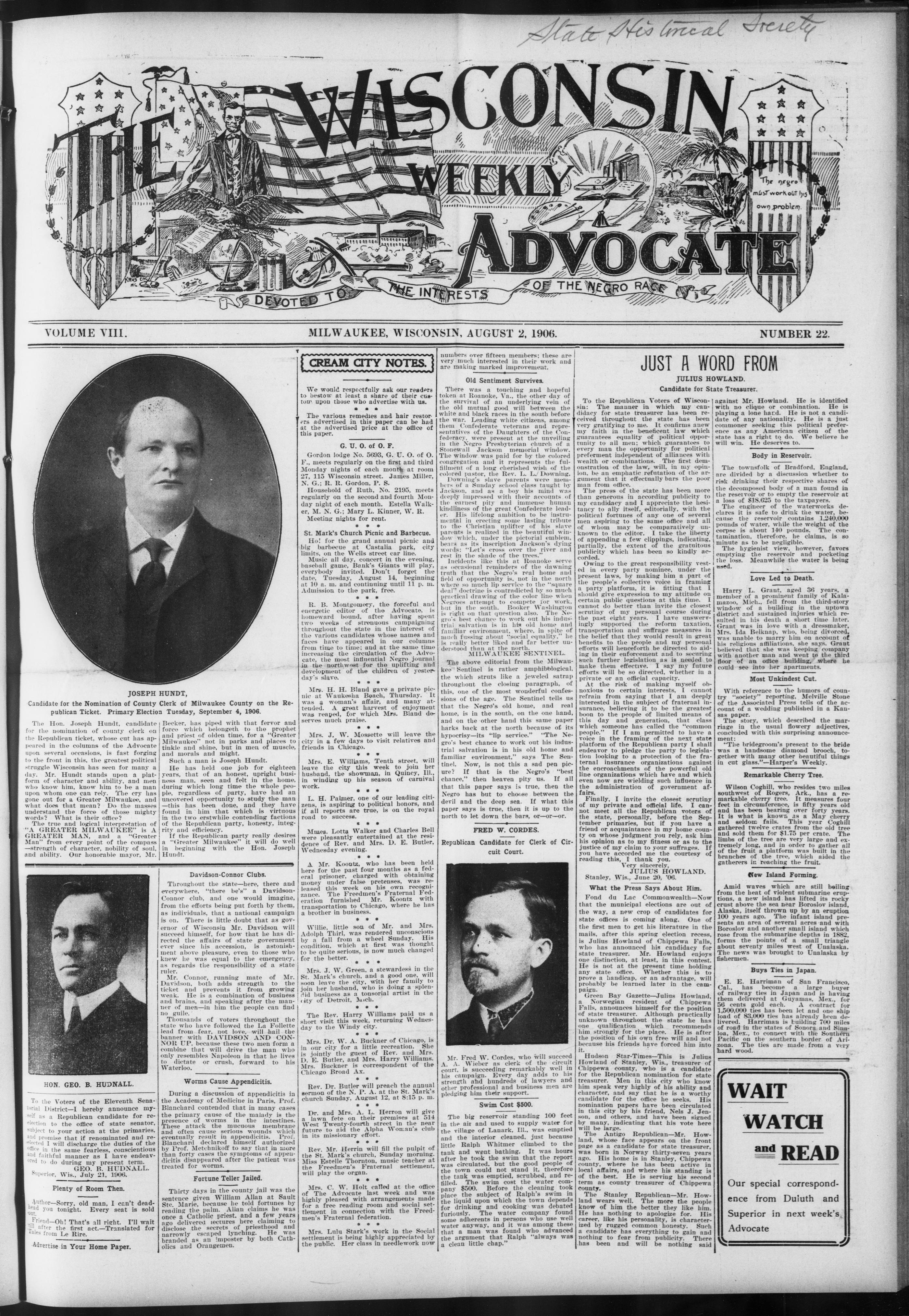
JOSEPH
Candidate for the Nomination of County
publican Ticket. Primary Election
The Hon. Joseph Hundt, candidate for the nomination of county clerk on the Republican ticket, whose cut has appeared in the columns of the Advocate upon several occasions, is fast forging to the front in this, the greatest political struggle Wisconsin has seen for many a day. Mr. Hundt stands upon a platform of character and ability, and men who know him, know him to be a man upon whom one can rely. The cry has gone out for a Greater Milwaukee, and what does that mean? Do the masses understand the force of those mighty words? What is their office?
The true and logical interpretation of "A GREATER MILWAUKEE" is A GREATER MAN, and a "Greater Man" from every point of the compass—strength of character, nobility of soul, and ability. Our honorable mayor, Mr.
M. B.
HON. GEO. B. HUDNALL.
To the Voters of the Eleventh Senatorial District-I hereby announce myself as a Republican candidate for re-election to the office of state senator, subject to your action at the primaries, and promise that if renominated and re-elected I will discharge the duties of the office in the same fearless, conscientious and faithful manner as I have endeavored to do during my present term.
GEO. B. HUDNALL.
Superior, Wis., July 21, 1906.
Plenty of Room Then.
Author—Sorry, old man, I can't deadhead you tonight. Every seat is sold out.
Friend—Oh! That's all right. I'll wait till after the first act.—Translated for Tales from Le Rire.
Advertise in Your Home Paper.
Becker, has piped with that fervor and force which belongeth to the prophet and priest of olden time, for a "Greater Milwaukee" not in parks and places to tinkle and shine, but in men of muscle, and morals and might.
Such a man is Joseph Hundt.
He has held one job for eighteen years, that of an honest, upright business man, seen and felt in the home, during which long time the whole people, regardless of party, have had an uncovered opportunity to study the man—this has been done, and they have found in him that which is virtuous in the two erstwhile contending factions of the Republican party, honesty, integrity and efficiency.
If the Republican party really desires a "Greater Milwaukee" it will do well in beginning with the Hon. Joseph Hundt.
Davidson-Connor Clubs.
Throughout the state—here, there and everywhere, "there be's" a Davidson-Connor club, and one would imagine, from the efforts being put forth by them, as individuals, that a national campaign is on. There is little doubt that as governor of Wisconsin Mr. Davidson will succeed himself, for how that he has directed the affairs of state government ever since his accession, is astonishment above pleasure, even to those who knew he was equal to the emergency, as regards the responsibility of a state ruler.
Mr. Connor, running mate of Mr. Davidson, both adds strength to the ticket and prevents it from growing weak. He is a combination of business and brains, and speaking after the manner of men—in him the people can find no guile. Thousands of voters throughout the state who have followed the La Follette lead from fear, not love, will hail the banner with DAVIDSON AND CONNOR UP, because these two men form a combine that will drive the man who only resembles Napoleon in that he lives to dictate or crush, forward to his Waterloo.
Worms Cause Appendicitis.
During a discussion of appendicitis in the Academy of Medicine in Paris, Prof. Blanchard contended that in many cases the primary cause of the malady is the presence of worms in the intestines. These attack the mucous membrane and often cause serious wounds which eventually result in appendicitis. Prof. Blanchard declared himself authorized by Prof. Metchnikoff to say that in more than forty cases the symptoms of appendicitis disappeared after the patient was treated for worms.
Fortune Teller Jailed
Thirty days in the county jail was the sentence given William Allan at Sault Ste. Marie, because he told fortunes by reading the palm. Allan claims he was once a Catholic priest, and a few years ago delivered lectures here claiming to disclose the secrets of priesthood and narrowly escaped lynching. He was branded as an imposter by both Catholics and Orangemen.
CREAM CITY NOTES.
We would respectfully ask our readers to bestow at least a share of their custom upon those who advertise with us.
The various remedies and hair restorers advertised in this paper can be had at the advertised price at the office of this paper.
G. U. O. of O. F.
Gordon lodge No. 5693, G. U. O. of O. F., meets regularly on the first and third Monday nights of each month at room 27, 115 Wisconsin street. James Miller, N. G.; R. R. Gordon, P. S.
Household of Ruth, No. 2195, meets regularly on the second and fourth Monday night of each month. Estella Walker, M. N. G.; Mary L. Kinner, W. R.
Meeting nights for rent.
* * *
St. Mark's Church Picnic and Barbecue.
Ho! for the grand annual picnic and big barbecue at Castalia park, city limits, on the Wells street car line.
Music all day, concert in the evening, baseball game, Bank's Giants will play, everybody invited. Don't forget the date, Tuesday, August 14, beginning at 10 a. m. and continuing until 11 p. m. Admission to the park, free.
\* \* \*
R. B. Montgomery, the forceful and energetic editor of the Advocate, is homeward bound, after having spent two weeks of strenuous campaigning throughout the state in the interest of the various candidates whose names and faces have appeared in our columns from time to time; and at the same time increasing the circulation of the Advocate, the most influential Negro journal in the northwest for the uplifting and development of the children of yesterday's slave.
Mrs. H. H. Bland gave a private picnic at Waukesha Beach, Thursday. It was a woman's affair, and many attended. A great harvest of enjoyment was reaped, for which Mrs. Bland deserves much praise.
* * *
Mrs. J. W. Mossette will leave the city in a few days to visit relatives and friends in Chicago.
* * *
Mrs. E. Williams, Tenth street, will leave the city this week to join her husband, the showman, in Quincy, Ill., in winding up his season of carnival work.
** **
L. H. Palmer, one of our leading citizens, is aspiring to political honors, and if all reports are true, is on the royal road to success.
宋 宋 宋
Mmes. Lotta Walker and Charles Bell were pleasantly entertained at the residence of Rev. and Mrs. D. E. Butler, Wednesday evening.
***
A Mr. Koontz, who has been held here for the past four months as a federal prisoner, charged with obtaining money under false pretenses, was released this week on his own recognition. The Freedmen's Fraternal Federation furnished Mr. Koontz with transportation to Chicago, where he has a brother in business.
\* \* \*
Willie, little son of Mr. and Mrs. Adolph Thirl, was rendered unconscious by a fall from a wheel Sunday. His condition, which at first was thought to be quite serious, is now much changed for the better.
* * *
Mrs. J. W. Green, a stewardess in the St. Mark's church, and a good one, will soon leave the city, with her family to join her husband, who is doing a splendid business as a tonsorial artist in the city of Detroit, Mich.
***
The Rev. Harry Williams paid us a short visit this week, returning Wednesday to the Windy city.
* * *
Mrs. Dr. W. A. Buckner of Chicago, is in our city for a little recreation. She is jointly the guest of Rev. and Mrs. D. E. Butler, and Mrs. Harry Williams. Mrs. Buckner is correspondent of the Chicago Broad Ax.
***
Rev. Dr. Butler will preach the annual sermon of the N. P. A. at the St. Mark's church Sunday, August 12, at 8:15 p. m.
* * *
Dr. and Mrs. A. L. Herron will give a lawn fete on their premises at 514 West Twenty-fourth street in the near future to aid the Alpha Woman's club in its missionary effort.
***
Rev. Mr. Herrin will fill the pulpit of the St. Mark's church, Sunday morning, Miss Estelle Thornton, music teacher at the Freedmen's Fraternal settlement, will play the organ.
***
Mrs. C. W. Holt called at the office of The Advocate last week and was highly pleased with arrangements made for a free reading room and social settlement in connection with the Freedmen's Fraternal federation.
***
Mrs. Lulu Stark's work in the Social settlement is being highly appreciated by the public. Her class in needlework now
numbers over fifteen members; these are very much interested in their work and are making marked improvement.
Old Sentiment Survives.
There was a touching and hopeful token at Roanoke, Va., the other day of the survival of an underlying vein of the old mutual good will between the white and black races in the south before the war. Leading white citizens, among them Confederate veterans and representatives of the Daughters of the Confederacy, were present at the unveiling in the Negro Presbyterian church of a Stonewall Jackson memorial window. The window was paid for by the colored congregation and it represents the fulfillment of a long cherished wish of the colored pastor, the Rev. L. L. Downing. Downing's slave parents were members of a Sunday school class taught by Jackson, and as a boy his mind was deeply impressed with their accounts of the earnest pity and immense human kindliness of the great Confederate leader. His lifelong ambition to be instrumental in erecting some lasting tribute to the Christian uplifter of his slave parents is realized in the beautiful window which, under the pictorial emblem, bears as its inscription Jackson's dying words: "Let's cross over the river and rest in the shade of the trees."
Incidents like this at Roanoke serve as occasional reminders of the dawning truth that the Negro's real home and field of opportunity is, not in the north where so much lip service to the "square deal" doctrine is contradicted by so much practical drawing of the color line when Negroes attempt to compete for work, but in the south. Booker Washington is right on that question also. The Negro's best chance to work out his industrial salvation is in his old home and familiar environment, where, in spite of much fussing about "social equality," he is really better liked and far better understood than at the north.
MILWAUKEE SENTINEL.
The above editorial from the Milwaukee Sentinel is rather amphibological, the which struts like a jeweled satrap throughout the closing paragraph, of this, one of the most wonderful confessions of the age. The Sentinel tells us that the Negro's old home, and real home, is in the south, on the one hand, and on the other hand this same paper harks back at the north because of its hypocrisy—its "lip service." "The Negro's best chance to work out his industrial salvation is in his old home and familiar environment," says The Sentinel. Now, is not this a sad pen picture? If that is the Negro's "best chance," then heaven pity us. If all that this paper says is true, then the Negro has but to choose between the devil and the deep sea. If what this paper says is true, then it is up to the north to let down the bars, or—or—or.
FRED W. CORDES
Republican Candidate for Clerk of Circuit Court.
[Name]
Mr. Fred W. Cordes, who will succeed A. A. Wieber as clerk of the circuit court, is succeeding remarkably well in his campaign. Every day adds to his strength and hundreds of lawyers and other professional and business men are pledging him their support.
Swim Cost $500.
The big reservoir standing 100 feet in the air and used to supply water for the village of Lanark, Ill., was emptied and the interior cleaned, just because little Ralph Whitmer climbed to the tank and went bathing. It was hours after he took the swim that the report was circulated, but the good people of the town could not stand it, therefore the tank was emptied, scrubbed, and refilled. The swim cost the water company $500. Before the cleaning took place the subject of Ralph's swim in the liquid upon which the town depends for drinking and cooking was debated furiously. The water company found some adherents in persons who use well water anyway, and it was among these that a man was found who advanced the argument that Ralph "always was a clean little chap."
JUST A WORD FROM
JULIUS HOWLAND.
To the Republican Voters of Wisconsin: The manner in which my candidacy for state treasurer has been received throughout the state has been very gratifying to me. It confirms anew my faith in the beneficent law which guarantees equality of political opportunity to all men; which guarantees to every man the opportunity for political preferment independent of alliances with wealth or combinations. The first demonstration of the law, will, in my opinion, be an emphatic refutation of the argument that it effectually bars the poor man from office.
The press of the state has been more than generous in according publicity to my candidacy and I appreciate the hesitancy to ally itself, editorially, with the political fortunes of any one of several men aspiring to the same office and all of whom may be comparatively unknown to the editor. I take the liberty of appending a few clippings, indicating, partially, the extent of the gratuitous publicity which has been so kindly accorded.
Owing to the great responsibility vested in every party nominee, under the present laws, by making him a part of the people's collective voice in framing a party platform, it is fitting that I should give expression to my attitude on certain public questions at this time. I cannot do better than invite the closest scrutiny of my personal course during the past eight years. I have unswervingly supported the reform taxation, transportation and suffrage measures in the belief that they would result in great benefits to the people and my personal efforts will henceforth be directed to aiding in their enforcement and to securing such further legislation as is needed to make them effective. I say my future efforts will be so directed, whether in a private or an official capacity.
At the risk of making myself obnoxious to certain interests, I cannot refrain from saying that I am deeply interested in the subject of fraternal insurance, believing it to be the greatest boon to the people of limited means of this day and generation, that class which someone has called the "common people." If I am permitted to have a voice in the framing of the next state platform of the Republican party I shall endeavor to pledge the party to legislation looking to a protection of the fraternal insurance organizations against the encroachments of the powerful old line organizations which have and which even now are wielding such influence in the administration of government affairs.
Finally, I invite the closest scrutiny of my private and official life. I cannot meet all the Republican voters of the state, personally, before the September primaries, but if you have a friend or acquaintance in my home county on whose judgment you rely, ask him his opinion as to my fitness or as to the justice of my claim to your suffrages. If you have accorded me the courtesy of reading this, I thank you.
Very sincerely,
JULIUS HOWLAND.
Stanley, Wis. June 29, 06
What the Press Says About Him
Fond du Lac Commonwealth—Now that the municipal elections are out of the way, a new crop of candidates for state offices is coming along. One of the first men to get his literature in the mails, after this spring election recess, is Julius Howland of Chippewa Falls, who has announced his candidacy for state treasurer. Mr. Howland enjoys one distinction, at least, in this contest. He is not at the present time holding any state office. Whether this is to prove a handicap, or an advantage, will probably be learned later in the campaign.
Green Bay Gazette-Julius Howland, a Norwegian resident of Chippewa Falls, announces himself for the position of state treasurer. Although practically unknown throughout the state he has one qualification which recommends him strongly for the place. He is after the position of his own free will and not because his friends have forced him into it.
Hudson Star-Times—This is Julius Howland of Stanley, Wis., treasurer of Chippewa county, who is a candidate for the Republican nomination for state treasurer. Men in this city who know him speak very highly of his ability and character, and say that he is a worthy candidate for the office he seeks. His nomination papers have been circulated in this city by his friend, Nels J. Jenson, and others, and have been signed by many, indicating that his vote here will be large.
The Antigo Republican—Mr. Howland, whose face appears on the front page as a candidate for state treasurer, was born in Norway thirty-seven years ago. His home is in Stanley, Chippewa county, where he has been active in local affairs, and where his standing is of the best. He is serving his second term as county treasurer of Chippewa county.
The Stanley Republican—Mr. Howland wears well. The more the people know of him the better they like him. He has nothing to apologize for. His career, like his personality, is characterized by rugged common honesty. Such a candidate has everything to gain and nothing to fear from publicity. There has been and will be nothing said
against Mr. Howland. He is identified with no clique or combination. He is playing a lone hard. He is not a candidate of any nationality. He is a just commoner seeking this political preference as any American citizen of the state has a right to do. We believe he will win. He deserves to.
The townsfolk of Bradford, England, are divided by a discussion whether to risk drinking their respective shares of the decomposed body of a man found in the reservoir or to empty the reservoir at a loss of $18,625 to the taxpayers. The engineer of the waterworks declares it is safe to drink the water, because the reservoir contains 1,240,000 pounds of water, while the weight of the corpse is about 140 pounds. The contamination, therefore, he claims, is so minute as to be negligible. The hygienist view, however, favors emptying the reservoir and pocketing the loss. Meanwhile the water is being used.
Love Led to Death.
Harry L. Grant, aged 36 years, a member of a prominent family of Kalamazoo, Mich., fell from the third-story window of a building in the uptown district and sustained injuries which resulted in his death a short time later. Grant was in love with a dressmaker, Mrs. Ida Belknap, who, being divorced, was unable to marry him on account of his religious affiliations, she says. Grant believed that she was keeping company with another man and went to the third floor of an office building, where he could see into her apartments.
Most Unkindest Cut.
With reference to the humors of country "society" reporting, Melville Stone of the Associated Press tells of the account of a wedding published in a Kansas paper. The story, which described the marriage in the usual flowery adjectives, concluded with this surprising announcement: "The bridegroom's present to the bride was a handsome diamond brooch, together with many other beautiful things in cut glass."—Harper's Weekly.
Remarkable Cherry Tree.
Wilson Coghill, who resides two miles southwest of Rogers, Ark., has a remarkable cherry tree. It measures four feet in circumference, is fifty years old and has been bearing over forty years. It is what is known as a May cherry and seldom fails. This year Coghill gathered twelve crates from the old tree and sold them for $1.75 per crate. The limbs of the tree are very large and extremely long, and in order to gather all of the fruit a platform was built in the branches of the tree, which aided the gatherers in reaching the fruit.
New Island Forming
Amid waves which are still boiling from the heat of violent submarine eruptions, a new island has lifted its rocky crust above the sea near Boroslov island, Alaska, itself thrown up by an eruption 100 years ago. The infant island presents an area of several acres and with Boroslov and another small island which rose from the submarine depths in 1882, forms the points of a small triangle about seventy miles west of Unalaska. The news was brought to Unalaska by fishermen.
Buys Ties in Japan.
E. E. Harriman of San Francisco, Cal., has become a large buyer of railway ties in Japan and is having them delivered at Guyamas, Mex., for 56 cents gold each. A contract for 1,500,000 ties has been let and one ship load of 83,000 ties has already been delivered. Harriman is building 700 miles of road in the states of Sonora and Sinaloa, Mex., to connect with the Southern Pacific on the southern border of Arizona. The ties are made from a very hard wood.
WAIT
WATCH
and READ
Our special correspondence from Duluth and Superior in next week's Advocate
NUMBER 22.
Body in Reservoir
THE WISCONSIN WEEKLY ADVOCATE
MILWAUKEE, WIS.
R. B. MONTGOMERY, Editor and Proprietor.
Notes of Interest.
The first melodrama was produced at the Covent Garden theater on November 14, 1802, and was called "The Tale of Mystery."
George Herring, a well-known millionaire philanthropist of London, has given the Salvation Army $300,000 to furnish rural homes for the poor of London, writes William E. Curtis, Mr. Herring's object being both to help the destitute and to increase England's home production of food supplies.
—Trinity college, Cambridge, possesses a famous portrait of Bacon. The other day when a party of visiting German editors viewed it, they were told how Dr. Mommsen, when it was pointed out to him, stood with folded arms in front of it and observed: "So it is you who gave us Lady Macbeth and Falstaff."
—More nearly than in the growing of any other crop the United States has a monopoly in supplying the world's cotton demand. In 1904, when the greatest cotton yield was produced, of the total of 15,508,000 bales the United States supplied 13,557,000 bales, all the other cotton areas of the world producing less than 2,000,000 bales.
—In Singar, in the Malay archipelago, two bottles are placed neck to neck, and sand is put into one of them, which pours itself into the other every half hour, when the bottles are reversed. On a line nearby are hung twelve rods, marked with notches from one to twelve. The whole arrangement is in charge of an attendant, who sounds the hours on a gong.
—The brightness of the corona, or ring of light encircling the sun, was measured by Charles Fabry during the last total eclipse. He found the light of a point a twentieth degree from the sun's edge to be equivalent to about 720 candle power, or a little more than a fourth of the brightness of the full moon. The sky near the uneclipsed sun is 2000 times as bright.
—It is a traditionary etiquette custom in the Marlborough family for each duke to present a Blenheim spaniel to the duchess when she enters Blenheim palace for the first time as its mistress. The story from which this custom has its origin is that during the battle of Blenheim a spaniel followed the heels of the great duke throughout the day, never leaving him until victory was assured.
The business of life insurance has developed greatly in Japan since 1881. There was only one company transacting business in that year. It had a paid-up capital of $20,000 with 1,439 policy holders representing $352,300 of insurance. At the end of 1904 there were thirty-five companies with a capital of $2,450,000 and reserve funds aggregating $11,262,-000. The number of policy holders had grown to 743,971, and the amount of insurance carried was $102,000,000. The business is still growing rapidly, says an official Japanese paper.
Many Blind People
About one person in every 1200 was blind and one in every 850 persons was deaf in the United States in 1900, according to a special census report on the blind and deaf in the United States in that year just issued by the federal census office.
The total number of deaf in the United States is given as 89,287, of whom 37.426 were totally deaf and 51,861 partially deaf.
Biggest Block of Ice.
The largest mass of ice in the world is probably the one which fills up nearly the whole of the interior of Greenland, where it has accumulated since before the dawn of history. It is believed now to form a block about 600,000 square miles in area and averaging a mile and a half in thickness. According to these statistics, the lump of ice is larger in volume than the whole body of water in the Mediterranean and there is enough of it to cover the whole of the United Kingdom of Great Britain and Ireland with a layer about seven miles thick.—Tit-Bits.
How Leper Travels.
J. M. Bringas, a Mexican millionaire from Guaymas, Sonora, passed through the United States in a special train, entering at Nogales and going back into Mexico at El Paso, Tex., under the guard of marine hospital surgeons, as he is a leper and is going to Europe for treatment. He could not get accommodation on a regular train and took a special from Guaymas to Mexico City through Arizona, New Mexico, and El Paso, by special permission of the United States. Arrangements have been made for steamship accommodations, it is said.
Electric Light Thief.
"Electricity thieves crop up now and then," said an electrician. "Our last case was a man who had lighted his whole house with stolen electricity for six months.
"Next door to this man was a big factory that used a thousand lights a night. The man bored a hole through a partition, inserted a wire, tapped the factory's current and helped himself bountifully to illumination.
"We lost nothing. The factory paid, of course, for the electricity stolen from it. The theft wasn't discovered until some time after the thief had moved away."—Washington Post.
A. Crowing Hen.
Le Roy Zeubler of Glen Ridge, N. J., is the possessor of a crowing hen. The fowl, which is of the bantam species, crows exactly like a rooster and seems proud of the fact. For a time Zeubler thought that a strange rooster had got among the flock. He looked several times and counted his chickens, but the number always remained the same. The crowing continued, and then Zeubler kept watch and found that a bantam hen was doing it. Since then she has become the prud mother of nine chicks, and she celebrated the event by crowing lustily.
German Boat Won.
The second eastward trans-atlantic race between the Hamburg-American line steamer Deutschland and the French line steamer La Provence ended Wednesday morning at New York with a decisive victory in favor of the German boat. Its time of passage from New York to Plymouth is five days, fourteen hours, and nine minutes, at an average speed of 23.01 miles per hour. The distance covered was 3093 miles.
Wanted Help
Good, intelligent young men for inside steady work; good wages; steady employment. Simmons Manufacturing Co., Kenosha, Wis.
WHO BIDES HIS TIME
Who bides his time, and day by day
Faces defeat full patiently,
And lifts a mirthful roundelay,
However poor his fortunes be—
He will not fail in any qualm
Of poverty—the paltry dime
It will grow golden in his palm,
Who bides his time.
Who bides his time—he tastes the sweet
Of honey in the saltest tear;
And though he fares with slowest feet,
Joy runs to meet him, drawing near;
The birds are heralds of his cause;
And like a never-ending rhyme,
The roadsides bloom in his applause,
Who bides his time.
Who bides his time, and fevers not
In the hot race that none achieves.
Shall wear cool-wrathen laurel, wrought,
With crimson berries in the leaves;
And he shall reign a goodly king,
And sway his hand o'er every clime,
With peace writ on his signet ring,
Who bides his time.
—James Whitcomb Riley.
THE JUDGE'S CRIME. CHAPTER I.
Mr. Justice Lorimer sat alone in his library. The marble clock on the chimney piece boomed forth 11, but the reverberations fell unheeded.
That day he had been engaged in the trial of Lawrence Gent, charged with the murder of his quondam friend, Charles Barnard. The body had been found on a lonely heath on the outskirts of London under circumstances which told strongly against the prisoner Gent. In his evidence, Policeman Collier, who had discovered the body of the murdered man, deposed that at 2 o'clock the previous day he had heard the two young men quarreling violently, and had, indeed, separated them in a fierce struggle.
Gent had turned angrily away, threatening to have it out with Barnard on the first opportunity, and the finding of his purse close by the side of the murdered man some hours later seemed a piece of evidence sufficiently strong to warrant his arrest.
Gent professed himself utterly innocent of the crime, and alleged that the purse had been stolen from him after he had left Barnard. He admitted the quarrel, but refused to disclose the cause of the disagreement.
His defense rested purely on an alibi. At 3:30 a. m., the time mentioned by Policeman Collier as the exact moment he had heard Barnard's last groan, Lawrence Gent swore that he was beneath the roof of Holmesfield cottage, a small vina some miles away from the scene of the murder. Policeman Collier further deposed that in the distance he had seen the figure of the man who had attacked Barnard in the act of running away, and he was fully prepared to swear to the identity of Lawrence Gent.
Unfortunately for Gent, the landlady of the house, the only person who could substantiate his tale, had died suddenly the day after the murder. Reasonably enough, the prosecution argued that a young man in chambers was not likely to spend his night at a lonely cottage without some special reason, which Gent failed to allege, and the whole defense lacked plausibility. "Unless Lawrence Gent can prove an alibi," pondered the judge, leaning his head thoughtfully on his elbow, "I see little hope of escape for him."
As he thought regretfully of the sentence it might be his duty to pronounce the next day, the judge's stern mouth relaxed a little. He remembered that a year ago this same Gent had asked permission to marry his daughter Muriel, and that he had given him a short and peremptory rejection.
Though of good birth as far as wealth was concerned, Gent was no match for an heiress such as Muriel would be, and though Mr. Justice Lorimer in his inmost heart feared that his daughter had been attracted toward this man, he was content to know that Muriel had obeyed him and had broken with her former suitor.
With a glance of unusual tenderness Mr. Justice Lorimer raised his head and looked up at the portrait of his dead wife which hung above the desk. How Muriel resembled her mother! The same deep gray eyes, the same sunny brown hair, the same red, curved mouth. Absorbed in his musings, the judge failed to hear the opening of the library door and the soft footfall of a girl upon the thick Turkey carpet. Blanched to the same hue as the white wrapper she wore, Muriel Lorimer stole farther into the room. In her face might be read the agony of a sensitive woman who, brooding long over some desperate resolution, has at all hazards to her own soul resolved at length to carry out her purpose.
Afraid almost to breathe, for a moment she leaned heavily against a table. From her childhood a slight fear of the judge had lurked in his daughter's mind. How should she tell him her story? She, his only daughter, of whose beauty and grace he had been in secret so proud.
Quick, quick! The time is flying, and the fate of a man's life hangs tremblingly in the balance. Her words alone can save him. God give her strength to speak, and at once.
"Father!" The cry welled up from the depths of her agonized heart. "Muriel! What is it? You are ill," he cried, alarmed by the girl's face and wide-open eyes.
But the words fell unheeded on Muriel's ears. No matter at what cost, her tale must be told now, without a moment's pause.
"Father, tomorrow you try Lawrence Gent again for murder. You must not go. You shall not go—" grasping his arm in uncontrollable agitation. "Some one must take your place. He is innocent. I know it—I can prove it. You said only an alibi could save him. I have been a coward. But tomorrow I must give evidence. That night—that night"—she repeated her words in a gasping voice—"Lawrence Gent and I were alone at Holmesfield cottage."
She stopped. Over her father's face had swept a look so terrible that a physical fear assailed the girl. As the judge raised his arm Muriel recoiled against the wall.
"Tell me the story," he said hoarsely. "Quick! let me hear all."
"There is nothing more to tell," half whispered Muriel. "You forbade our engagement, and I met Lawrence unknown to you. That night you were away in Ireland. No one knew our secret. Lawrence will never save himself at my cost. Until today I have been afraid. But tomorrow I must go——"
Her words died away; her head drooped on her breast. Motionless the judge stood by the desk. His wild furv
had left him. At last he spoke in a harsh, discordant tone.
"Tomorrow the world will learn the tale of your dishonor in open court. And I am to remain idly by while you stand forth and glory publicly in your shame."
"Father—father, have mercy!" cried Muriel. "His life is at stake. I love him; I alone can save him. Would you have me silent and see him murdered?"
"Yes," said the judge, in a terrible voice. "Better Lawrence Gent be murdered than my name dishonored in public."
Muriel rose. With a sudden gesture she flung her arms around her father's neck, kissed him again and again, and tled to her own room.
CHAPTER II.
With eyes fixed on the black embers of the dead fire, the judge sat alone in his study. What suffering he had undergone in those last dreadful hours none save himself would ever know. His unsuited name and reputation disgraced before the world to save the life of Lawrence Gent! No! better death than dishonor. Death!
A fearful thought flashed through his brain. His deep-set eyes glowed with a new fire. He rose from his chair, his whole form vibrating with this terrible suggestion. Then, in that half-darkened room, ensued a ghastly struggle between his good and evil angels.
Stealthily as a thief in the night, the father stole to the bedside of his daughter. Upon a small table gleamed a nightlight, whose tiny flame threw a faint radiance on Muriel's face. Beneath the white-diaped canopy, with one hand pressed to her tear-stained cheek, the girl slept on, unconscious of the watcher by the bed. Lower and lower he stooped, until his hot breath swept her cheek. But at that moment of softening Muriel stirred restlessly in her sleep. A faint whisper escaped her lips. "Lawrence," she murmured, gently; and for one fleeting moment a smile came over her mouth.
At the sound of that hated name the judge rose and crept quietly from the room.
Ten minutes later the judge stole once more to the bedside. In his hand he held a vial and a cloth. With steady fingers the judge uncorked the vial and sprinkled the cloth with the liquid. A faint, sickly odor stole through the room. He knelt down and held the cloth tightly before his daughter's mouth.
Presently her breath came in hurried irregular gasps, a profuse perspiration broke out on her face, a blueness stole over her lips, the muscles of her body contracted violently.
One last sigh and Muriel had ceased to breathe!
CHAPTER III
At 3 o'clock in the afternoon of that same day Mr. Justice Lorimer sat alone in his darkened library. In the quiet house the servants went about with red eyes, discussing the terrible catastrophe that had befallen their master. Such a shocking thing to find Miss Muriel dead in bed that morning! Now the doctor had certified it to be a case of sudden failure of the heart.
In that bent, stooping figure, half-crouched in the armchair, who could have recognized the erect, inflexible judge of the previous day? Upon his heavily burdened shoulders had fallen another blow.
That very morning he had received news that Lawrence Gent would be discharged from prison without a stain on his character.
Two night's before, the police had cleverly surprised a gang of burglars at work in a jeweler's shop. A fierce fight had ensued which resulted in fatal injuries to one of the thieves. Before his death the burglar had gasped out a confession relative to the death of Charles Barnard. It appeared that in the hope of robbing the unfortunate man the thief had attacked Barnard from behind. Barnard had fallen insensible to the ground, but the appearance of Policeman Collier had prevented the thief from completing his work. The wretched man had also admitted the theft of the purse from Gent.
Muriel was dead and Gent was free! Could fate have permitted the dying thief's confession to have reached the stricken father's ears some six hours sooner. Muriel would still be living and no crushing remorse would be weighing down his soul.
The opening sound of the library door disturbed the wretched father from his thoughts. In the pale, agitated man the judge recognized Lawrence Gent.
All the pent-up wrath at the sight of the man surged through the father's mind.
"This visit is an insult," he said, in a voice vibrant with passion. "How dare you intrude upon me at this time? Is nothing ascerted to a mind like yours?"
Gent's pale face flushed deeply at the words.
"Your grief is mine," he said, coming forward in agitation. "I have a right to share your sorrow—"
"Not content with your work, you came her to gloat over my grief," went on the judge, in deep, passionate tones. "You thought your villainy would be unknown to me. You were wrong. Muriel told me all last night."
He broke off abruptly. Even the mention of that dear name choked his utterance. Gent started forward.
"Muriel told you all," he said, hurriedly, "and yet you accuse me of villainy? What do you mean? Have 1 no grief? Do you think it is nothing to me to lose my darling?"
Muriel would have given her last breath to save me. Muriel was precluded from giving evidence either for or against me in court."
"What do you mean?" cried the judge, gripping him by the arm. "Muriel told me of her resolve to appear today in court and prove an alibi for you."
A startled look came in Gent's eyes.
"Muriel told you that herself?" he said, agitatedly. "Impossible! She knew her evidence would not be taken. Look! I have a letter from her, written to me only three days since.
My Darling Lawrence—You tell me that by the English law I cannot give evidence in your favor. Do not be case down, dearest. I shall be able to prove your innocence. That night you told me that you had struck Charles Barnard for a sneering allusion to our love. Now it is my turn to defend you. I have thought and thought until my brain seems on fire.
No matter at what cost, I am resolved to save you. A plan has come to me. I shall appear in the witness box, and I implore you by all our love not to contradict my tale. No one knows our secret, or my plan would be impossible. * * * It is the thought of my father's grief at my tale that robs me of all my courage. For you, dearest, I am content to sacrifice everything, my good name—all that a woman is taught to hold dear. But when I think of my father—oh! my love, my love, only the thought that your life depends on my not
keeping silence sustains me in this dreadful ordeal. Perhaps my dearest father may forgive the outrage I may inflict upon him when he learns the real truth in after days. It is the cruel law that forces me to this subterfuge. Good-by, my dearest love.—From your own unhappy wife,
MURIEL.
The paper rustled in the father's hands.
"It is true!" cried Gent, vehemently.
"She had been my wife for two months."
The father's sunken eyes looked up at him with a dull agony in their depths. The truth had pierced his heart. Muriel, with the devotion of a passionate and inexperienced girl, had resolved to sacrifice her reputation to save the life of the man she loved.
That night the stricken father again reached from its hiding place the vial of chloroform.—Harold Macfarlane in Illustrated Bits.
The Spice of Life.
Hard to Beat.
Watermelon mighty pleasin'
When Ah's in en shady place.
Chicken too, am ruther teasin'—
Jest can't wait ter say de grace.
Dem two makes er combination,
Dat outclasses aii de res'.
Red meat fum de watermelon.
White meat fum de chicken breas'.
—Birmingham Age-Herald.
On the Trail.
"Tommy, what ancient king was it who played on the fiddle while Rome was burning?"
"Hector, ma'am."
"No, no—not Hector.'
"Then it wuz Dook."
"Duke? What do you mean, Tommy?"
"Well, then it must a' been Nero. I knowed it wuz somebody with a dog's name."—Cleveland Leader.
The Trail of the Serpent.
He always took his whisky straight,
When at the club he lingered laight;
Yet, we regret to say,
That wasn't quite the way
He took his homeward gaight.
—Philadelphia Public Ledger.
Fancies.
Fancies.
A graft is the other man's pull. Some people are too busy being good to be kind. Riches have wings, but most of us never get a chance to fly with them. There is no sense in giving the devil his due—he'll get it anyway. There's a lot in moods and tenses—love's but a mood and heaven is merely a future perfect.—Burton Braley in Lippincott's.
A. Choice Assortment
"What did you son take this year, Mrs Sharp?"
"The gold medal for mathematics, the silver medal for rhetoric, the first premiums in botany and philosophy, and the mumps."—Baltimore American.
Of Some Use, After All.
F.
Grace—That fellow's head isn't of much use to him. Gladys—Well, I suppose he feels that he's got to have something to hang his hat on.
It Reaches Bugville.
It Reaches Bugville.
A bug hawking a motely crew
Of other bugs and ants
And candidly advised them to
Beware of potted plants.
Joke on Gayboy.
Mabel—Such a joke of Mr. Gayboy. We were out on the balcony between the dances and he got the sleeve of his dress coat over red paint from one of the posts that was just painted.
Maud—And did you go near the post?
Mabel—No. Why?
Maud—Oh, nothing; only you have red paint all over the back of your waist.—Stray Stories.
How Did She Know?
Mrs. Dash—I don't understand, dear, why you can't get along with your husband. He's such a charming man! Perhaps you haven't been sufficiently—Mrs. Rash—Yes. I have!—Translated
The Only Kind
WILLIAM
Man (to boy who is fishing)—Getting any bites?
Boy—Yes.
Man—Perch?
Boy—No, mosquitoes.
Situation Wanted.
"A cook who desires to go to the country for the summer, can find an employer who would be glad to accompany her. Address D. F., Box 164, Record."—Translated for Tales from Fliegende Blaetter.
Not Enough
A case was to be tried on the charge of selling impure whisky. The night be-
fore the case came off the defendant went round to the judge's house.
To the man at the door he said:
"Here's a bottle of whisky I want your master to try."
"My master never tries anything but a case." pompously replied the butler.
—Lippincott's.
Country Life in Long Island.
"So you have learned a great deal by living in the country?" "I should say I had. I've found the finest bed of mint you ever saw. Come down and see me."—Brooklyn Life.
Mitigation.
The muck raker had just made an official call, and would not be denied. "Well," said the cornered citizen, "I will own to being a self-made man and a millionaire, but, by jinks, I'm not from Pittsburg." Thereupon the raker informed him that there would be nothing doing in the muck line.—Philadelphia Ledger.
Beginning of Wisdom.
"Father," called James, after he had reached home from college; "what shall I do with my diploma? " "Forget it," yelled father, "and go out and look for a job!"—Detroit Free Press.
A New Accomplishment.
M'ss B——has been told that she possesses a willowy figure, and she often assumes poses that will display it to the best advantage. Yesterday she was startled by the following question from her 7-year-old niece, "Aunt Sally, why do you make so many gestures with your hips?"—Lippincott's.
No Reason for Delav.
Author—I have a clause in my will ordering my executor to burn all my manuscripts. Cynical Friend—Why put it off so long?—Translated for Tales from Meggendorfer Blaetter.
What It Looked Like.
Bootblack (to cabman driving a starved looking horse)—Say, Bill, what's that you've got in front of your cab:
Cabman—That's my new horse, you fool.
"Oh, I thought it was an X-ray photograph."—Translated for Tales from Meggendorfer Blaetter.
Ready for a Rainy Day.
"You ought to think of helping me save something for a rainy day."
"I thought of it today, and I have ordered you a nice umbrella and me a dozen pairs of the swellest stockings you ever saw."—Houston Post.
Familiar with His Habits.
First Disconsolate Widow—Are you going to the medium's tonight to see if you can get a message from your husband? Second Disconsolate Widow—No, it isn't any use tonight. Saturday night was always the night when he went off to spend his salary.—Somerville Journal.
No Escape.
"Yes, I go to the penitentiary and sing to the convicts every Sunday. "Don't you think that that is taking a rather unfair advantage of them?"—Houston Post.
An Unfair Advantage.
"Mrs. Nagg is the most inconsistent woman I know."
"How's that?"
"She had the words, 'Rest in Peace,' carved on her husband's tombstone, yet she visits the grave every day."—Translated for Tales from Meggendorfer Blaetter.
No Mere Coincidence.
"The goddess of wisdom—she was unmarried."—Translated for Tales from Familie-Journal.
A Feat Indeed.
Susie had tried the teacher's patience sorely, and when the latter looked up and saw the little girl chewing gum, with her feet sprawling into the aisle, she said.
"Susie Jones, take that gum out of your mouth and put your feet in!"—Lippincott's.
She Had Seen Her
Jennie—Did you hear of the awful fright Jack got on his wedding day?
Olive—Yes, indeed—I was there and saw her.—American Spectator.
He Cussed.
"I see this magazine," said she.
"I see this magazine," said she,
"My dear, has bought your sonnet."
"Yes?" "Well, it just occurred to me
How that rhymes with 'new bonnet.'"
And, reaching for his purse, groaned he,
"And also with 'doggee it'."
Lulu (very grandly, while she dabs her face with the powder-puff)—Very well, dear; I'll be down.
Tiny Sister (nervously)—Oh! please, don't wait to shave!—Woman's Home Companion.
"Were there spirits at the seance you attended?"
"Yes, sir."
"Were they good or bad spirits?"
"Bad, sir; very bad."
"Could you see the spirits that were there?"
"No, sir, but I could smell 'em."—Baltimore American.
Harm from Innocent Trio
Harm from Innocent Trio.
Divorce has three causes—Man, Woman and Marriage—Smart Set.
Our Pillar Box
Simple Headache Cure—Take a pound of black pepper, and to this add a little flour, a raw egg and a pinch of salt. Make into a paste, put into a bath towel, and tie it tightly round the neck. Leave it there till the headache goes of its own accord. Etiquette of Cards—When leaving cards, do not thrust them under the door or throw them casually down the area, but ring the bell and hand them to the servant. The cards, of course, should contain no advertising matter. Hygienic Boots—You have been misinformed; brown boots with separate divisions for each toe are not being worn in London this season.—Punch.
Plays Whist at 100.
Mrs. Lucy Ripley of West Wrentham, Mass., is visiting her nephew, Edwin Cook, of Social street, Woonsocket. Mrs. Ripley is a remarkable woman. She is 100 years old, having attained that age on June 8, and still retains all her faculties.
Mrs. Ripley went to Woonsocket last Saturday, making the trip alone on the electric cars from West Wrentham. Last Saturday night in a party of four she played whist without the aid of glasses, and in other ways impressed those present. She refused to talk about herself, saying that a woman as young as she feels has no right to be distinguished above others.—Providence Tribune.
---
AN AWFUL WARNING
When de fahis is ersmokin',
En de embahs staht ter die,
When de shadders is er-creepin',
En de spahks goes poppin' by.
It ah den of il'le chillun
Ain't ben awful good dat day,
Dat de Pocus man ull gift 'um
En he'll snatch 'em fur away.
He's a funny lookin' feller,
En he's got a great big sack,
Inter which he puts bad chillun,
Den he frows it on his back,
En dey's nothin' dat kin stop 'im,
Fer so awful fast he fly
Dat he gits erway lak lightnin'
'Fore dere mamma heah 'em cry.
It ah jes bad li'le chilluns
Dat ole Pocus steals erway,
What he dc wif 'em's er secret;
No one evah heered 'im say,
But Ah know he do er-plenty,
Dey gits licked—dat's undahstood,
Still, he nevah takes de chillun
Ef dey's only sweet and good.
So look out fo' Mistah Pocus;
Min' yoh mamma ev'ry day,
Dat's de only way ter 'scape 'im—
Den he'll sho'ly stay erway.
He ain't got no use fo' young-uns
Who is good, yoh undahstand.
But ef yoh is bad he'll snatch yoh
Ter de Hocus Pocus land.
—Denver Post
New York Every Day.
Robert S. McCormick, American ambassador to France, and Mrs. McCormick arrived in New York on the steamer Kronprinz Wilhelm.
Mrs. Elizabeth McBettie and Albert M. King, arrested on suspicion of knowing about the theft of $50,000 worth of jewelry from Mrs. Halsey Corwin, were discharged from custody.
William Rockefeller returned from Europe a few days ago, by way of Quebec, which route he took for the advantage of the shorter sea trip. His health is rather better than when he went away. He is at present at his place at Tarrytown.
Frederick Bennett, formerly valet for Alexander R. Peacock of Pittsburg, who was held for examination concerning an alleged larceny of valuables from Mr. Peacock, was discharged from custody. The attorney for Bennett said: "The police arrest a man on one telegram and release him on another. The machinery of justice has been used to please a millionaire."
Thespians with faded straw hats and haberdashery to match are numerous in New York at present, and many of the short-skirted members of the "perfesh" have their meal tickets almost perforated. When the good old summertime is over it is likely that the usual ironical parodies will be sung by the actors and actorines—not, of course, the good ones, but those who are preparing their throats for the occasion with blind robins, granite cheese and washes that are stagy.
The United States board of general appraisers announced that paraffin produced from Russian petroleum and manufactured in Great Britain or Belgium may be imported without payment of duty. Paraffin imported from Russia, Germany, India and other countries which impose a tariff on the products of petroleum must pay a duty equal to that imposed on similar importations in the respective countries. Heretofore the board had held that the products of Russian petroluem must pay a duty regardless of where it was manufactured.
For the purpose of snowing the condition of the anthracite coal fields two months after the close of the recent suspension, the anthracite coal operators announced that in all the active collieries mining is progressing satisfactorily. Fully 90 per cent. of the workers who absented themselves as a result of the suspension ordered by President Mitchell on April 1, and discontinued on May 18, by agreement with the operators, have returned or been replaced. The output of anthracite for June was 5,676,018 tons, only slightly below the output for June, 1905.
A colored parson living in Harlem bought a bicycle recently. Being a man of considerable avoirdupois, he experienced some difficulty in learning how to ride. Pedaling through a side street one evening just at dusk, he met with an accident. The front wheel of the bicycle struck a loose stone and the parson took a header over the handlebars. He landed on his face on the sidewalk and came falling into an areaway in which the janitor's little boy was at play. The boy gave a startled look at the oncoming intruder and yelled out: "Say, maw, the coal has came!"
Charged with removing the body of his daughter from a coffin and attempting to throw it out of a window, Charles Anderson was called an "inhuman monster" by Magistrate Moss in the New York police court. "My only regret," said the magistrate, "is that there is no adequate punishment for the crime." Witnesses said Anderson went to the home of his wife on Sunday, when the funeral was being arranged, drove his wife and other mourners out of the place, then deliberately tried to throw the body of his daughter out of a window. He was sent to the workhouse in default of $500 bail.
The International Mercantile Marine company has hit upon a name for one of its ships which has great popular and picturesque possibilities. When the steamer Mississippi of the Red Star Line reaches this port she is to be rechristened Samland, in honor of Uncle Sam. And "Samland" is good. Uncle Sam, the genial and shrewd abstraction of the Republic, is dear to every heart. "Samland," it is believed, will go from mouth to mouth until the application of it is transferred to the nation. After that, Americans of the United States may be calling themselves Samlanders, and the business will be done.
New Yorkers welcome the news that work on cooling and ventilating appliances for the subway is "progressing rapidly." Outlets in the parks through which hot air is to escape from underground ventilating gratings at intermediate points, fans of 150,000 cubic feet capacity per hour, pipes of artesian well water at Brooklyn bridge and Fourteenth streets, ammonia refrigerating plant at Forty-second street, give, even on paper, a sensation of coolness. Possibly the subway itself may be a trifle cooler than it was at the corresponding season last year. New Yorkers are a patient people, but it is not to be wondered at if the patrons of the subway are asking why it took so long to get something done toward ameliorating the conditions therein.
Kenosha's Reform Park.
A new amusement place was opened in Kenosha. Wis., recently, which has been given the name of "Reform park." It is owned by John Petersen, a Danish resident. No intoxicating liquors are sold in the park. Petersen has arranged concerts every Sunday. The only revenue that Petersen seeks is in the lease of his dancing pavilion. In his announcement Petersen states that he hopes by the park to promote matrimony in Kenosha.
GOSSIP FOR THE LADIES.
Waiting.
sun 1 fold my hands and wait,
“Nor care for wind, or tide, or sea;
jn. uo more "gainst time or fate,
Pv ior' my own shall come to me.
] siay my haste, I make delays,
por what avails this eager pace?
] stand amid the eternal ways,
“And what is mine shall know my face.
asivep. awake, by night or day,
the friends I seek are seeking me;
No wind can drive my bark astray,
Nor change the tide of destiny.
What matter if I stand alone? ~
i walk with joy the coming years;
My heart shall reap where ft has sown,
Aud garner up its fruits of tears.
rue waters know their own and draw
‘lhe brook that springs in yonder height;
So tlows the good with equal law
Lato the soul of pure delight
fhe stars come nightly to the sky;
‘The tidal wave unto the sea;
Nor me, nor space, nor deep, nor high,
Cau keep my own away from me.
—Johu Burroughs,
More About the Unnecessary Excuse.
At Mrs. Dinadan’s the other night
three guests were scandalously late.
‘There were ten in all, and seven were
kept waiting for these delinquents. The
first to arrive apologized profusely and
humbly for delaying the assembled par-
ty. The second told a comical story
about mishaps and hindrances that had
befallen him on the way. During the
recital the third arrived, just in time to
join in_a chorus of laughter and say ap-
preciatively to the hostess, “Wasn't that
too delicious! I can see we are going
to have the good time we always have
at_your house.”
Mrs. Dinadan may be different from
most women, but it is certain that she
felt more kindly toward this impenitent
flatterer than toward the two just men
who had either confessed or atoned for
their fault.
Later the impenitent one confided to a
neighbor at table: “I never apologize.
It does no good. If peopie are offended
they get over it; if they are not offended
apologizing just sets them to thinking
that they might be.”
Sergius in “Arms and the Man” ad-
vances a doctrine like that. At appro-
priate intervals he utters a parrot ery
of “I never apologize’; “I never re-
tract”; “I never withdraw”; folding his
arms with measured emphasis, according
to Shaw’s stage directions. Sergius was
a preposterous poseur, a romantic high-
flown idiot, yet in this respect his mad-
ness has some method in it. For apolo-
gies are generally useless, or worse.
No doubt a gentleman will say “ex-
cuse me,” when he inadvertently jostles,
or interrupts or passes in front of an-
other. Things that look like gentlemen
often say “excuse me” first, and then
do the rude pushing or over-reaching;
like those picturesque mediaeval ruftians
who procured an indulgence in advance
of bludgeoning an enemy. There is even
a so-called apology which is an absolute
insult, “Excuse me, Susanna,” says
her too candid brother, “but that is the
queerest gown I ever saw.” And Su-
sanna’s joy in her new frock is turned
into mourning. “I beg your pardon, la-
dies, but the chickens sing better than
that,” a, bumptious lad remarks to two
sirls trying ever a duet. He ought to be
killed for it.
We all know the apology that is mere-
iy a piece of mock modesty, a vain lit-
tle rite, a covert fishing for compliments,
wherein the speaker humbles himself
tha: he may be exalted. Of such were
the hypocrisies of the old-fashioned
country hostess when the minister came
to tea. Alas! her pies were not like
those his mother used to make; the pre-
serves didn’t turn out as she would wish
to have them; .he cream—well they had
poor luck with their cows this year. And
all the while the worthy woman was
swelling with justifiable pride. She no
more meant what she said than the
Japanese means it when he speaks to
his honorable guest about his disgraceful
wife or his wretched nouse.
May one, then, never express a sincere
regret?
Well, in the antiquated “Pinafore”
phrase, ‘Hardly ever.’ When an apol-
ogy is not a superfluous ceremony it is
apt to be the reopening of an old wound.
If you have hurt another person, you
naturally desire to make him comfort-
able again. The question is whether an
apology does so. Often a set speech
tightens the tension of a strained situa-
tion. A laugh is the best loosener, but
it takes great tact to laugh in exactly
the right way. Not all of us dare at-
tempt it. Without trained lightness of
touch it is better to leave ill alone.
Sometimes airing a hurt increases the
smart.—House Beautiful.
The Worst Year of Married Life.
The first year is the worst. And if,
Jadies, you have ever taken a powder
in jam you will know exactly what is
the matter with the tirst year of mar-
ried bliss.
The jam is fine, but the powder will
come through it.
It is all very well for Jack and Jill,
when engaged, to declare that they will
never quarrel, but Jack and Jill single
and Jack and Jill married are four very
different persons.
Indeed, a very few days after mar-
riage—almost before he has shaken the
wedding confetti out of his boots and
the lining of his hat. Jack makes the
grand diseovery which every married
mian has made since the days of Adam.
His Jill is not the Jill with whom he
went a-courting but a few weeks since.
A new Jill has arisen—a Jill he never
kuow before, even though they were en-
xaged for four years—a Jill with a new
suul strange temper, who, instead of
linging to him with mute and _ flatter-
ing adoration, tells him with the new
voice of sole proprietress, lessee and
nianager exactly what she likes in him,
und what she does not. 3 5
Hitherto, Jack’s idea of married life
has been that of a sort of glorified bach-
clor’s easy life, softened by the presence
of a perpetual honeymoon. He would
have the eake of bachelordom, and eat
it, too, spread with the jam of matri-
monial bliss,
Instead of this, he discovers that he
has bitten on a very prosaic mouthful of
bread-and-butter—and not too much but-
ter to it either. And he has yet to learn
that bread-and-butter is good, everyday
food, whilst cake and jam for breakfast,
dinner and supper is apt to become sick-
ly diet at best.
Hitherto, also, Jack has hugged the
ilea that What is enough for one is
enough for two. It is not till the honey-
moon has waned, and the estate agent
has called with his No. 2 notice, that
Le realizes that there are two sides to
natrimony—the one all honey, and the
other all moonshine, which resolves it-
self into the stern terrestrial fact that
three lunar months make one quarter's
Tent.
Of course, Jack makes a gallant re-
ply, but he sends round to the bank
‘ree times a week for his passbook,
tnd his face grows longer as his bal-
ance grows shorter. ‘.
He discovers that Jill is just a little
lit extravagant. Indeed, he ventures to
expostulate with her mildly when she
spends $2 in fiowers for the dinner-
table.
Of course, this comes somewhat as a
surprise to Jill, for ’twas but a short
while ago that Jack never approached
her without a hatful of hothouse flow-
ers which would have been cheap at $3.
Jill very naturally concludes that Jack
does not love her as much as he did;
that his love, in fact, won't stretch to a
two-penny bunch of violets.
Then there are tears, and Jill weeps
her eyes red in the new saddle-bag arm-
chair—big enough for two—which fills
most of the cat-swinging space in the lit-
tle front room. Jack stalks up and down
the grass plot at the back of the house,
kicking the daisies, and beginning to feel
ashamed of himself for a brute and a
bully.
They make it up, and for a sweet,
brief moment the honeymoon is resumed.
Their first quarrel bears fruits of re-
pentance, Jack spends the dollar which
really belongs to the butcher on a bunch
of orchids.
Happy, now, is Jack, if relations do
not at this time begin to take a friendly
hand in the matrimonial game. A good
deal of rubbish has been written about
the mother-in-law, and this good lady
has seryed as the peg whereon many a
sorry joke has been hung; but, neverthe-
less, she is no ghost, and, though little in
evidence in times of Fee looms large
on the horizon at the first hint of war.
And all that Jack suffers Jill must suf-
fer, too. The furniture doesn’t fit the
new house; the stair carpets are too
short, and the curtains are too long; the
electric bells won't ring, whilst the new
alarm clock has fits every hour; the
chimney of the white drawing room
smokes like a colliery. The new servant
suffers from gumboils and melancholia,
and the lamb supplied by the butcher
has a_ traveled, man-of-the-world, tired
sort of a look.
So Jill cries into the varnish as she
stains new floors which won't dry out
flat. Sometimes she begins to wonder
why she ever marricd Jack, and hates
herself for the treason of the thought.
All little things, these, but life is made
up of little things, and it is not till the
big things come along that the little
things take their proper place in the per-
‘spective of life. And the large thing,
when it comes, is often a little thing—a
little thing which whimpers, red and
querulous, in its blankets, seizing in its
tiny grip the hands and hearts of Jack
and Jill, so that, forgetting all small
things but one, they realize that here is a
new king, who will soon begin to kick the
polish off the new furniture as he has
knocked the corners off his father and
mother, and that the first and worst year
of married life is over.—Pittsburg Lead-
er.
Is a Wife a Handicap!
“Another good worker ruined,” is the
comment of the heads of some firms
when told that a valued worker is about
to enter the holy bonds.
“The trouble begins,* says the manager
of a big firm employing many workers,
“when the man becomes engaged. For-
merly he didn’t mind an extra half-
hour or so at his desk; but the modern
frivolous, thoughtless girl expects so
many evenings out at popular amuse-
ments that her fiance throws down his
work the moment the clock strikes out
the limit of business hours.
“His mind is full of some party at
which he has promised to be punctual.
An engaged or married man tries to serve
two masters, one masculine and the other
feminine, and usually he fails because
he puts the feminine tyrant first.”
This is all somewhat new. In_ story
books the very moment the hero is ac-
cepted by the beautiful heroine he sets
to work to prove himself worthy of her.
He is fired by ambition to carve out a
golden fortune and lay it at the beloved
one’s feet. And this is as it should be.
If a man becomes less _ self-reliant,
weaker willed or more effeminate as the
result of an engagement or marriage,
the woman in the case must be very
much to blame.
She has no right to lower his ideas
of industry and duty. Neither should
she lead him_ into temptation to neg-
lect his work for the sake of little social
fripperies, dances and evening parties.
These things are the trimmings of life,
not the substances. And no man whose
mind is filled with such trifles can settle
down to the hard, steady grind of mod-
ern business life.
A wife who “mollycoddles” and cos-
sets and man, and teaches him to put
his ease and little personal comforts be-
fore his ambition and work, is weakening
his character.
A husband who sets out, to business
every morning with his mind oceupied
by little home worries and eares cannot
concentrate his attention on the work of
the day. Wives who teiepnhone continu-
ally to their husbands in the city, telling
them “not to forget to bring home that
fish,” or that they “must go to the library
and change that book,” are spoiling their
husbands’ chances of success. A man
who wants to get on in the world must
forget, from the moment he enters his
office till the time he leaves it, that he
has a wife and a home.
— For the demands of twentieth century
business life are stern and real. If, his
wife’s trivial headaches and petty little
domestic grievances obtrude themselves
into his brain during business hours, a
gaan 8 unfitted to cope with the work on
and.
A wife is a serious business handicap
to a man if she insists on going to the
office, makes her husband take her out to
lunch, see her off at the station or forces
him to share in the hundred and one lit-
tle domestic distractions so many women
eee on burdening their better halves
with.
A man’s office hours should be sacred
property. Nobody has a right to invade,
disturb or distract him when he is at
work, save for a really grave and serious
reason.
And no fiancee or wife has any excuse
for uttering a word of complaint if a
man’s business necessitates his remaining
late at the office. It is pleasant to have
an early dinner, a cozy evening by the
fireside or a hand at bridge with a few
ee and a cheery little supper to fol-
low.
But a man cannot make his living by
these charming evening recreations; and
overtime and late nights at business are
“all in the day's work,” to be accepted
cheerfully and in the right spirit by the
sweetheart or wife of the bread winner,
It is not right of her to “mollycoddle”
a man by teaching him that he is a
martyr or a “slave” to cruel employers,
when he is merely doing his duty by
working extra hard when pressure of
business demands.
A wife who makes her husband soft
and self-indulgent is weakening his
will and reducing his worth and value
in the business or profession he fol-
lows. =
She ought to be proud of his ambi-
tion, zeal and industry instead of trying
‘to persuade him to shirk work and re-
sponsibility. Many men have too much
backbone and strength to be beguiled by
domestic Delilahs anxious through mis-
taken devotion to turn manliness into
“mollycoddling.” i
‘The love and tender consideration of
a woman should make a man stronger
and more steadfasct in his devotion to
duty. sfis a ‘
Tt is “mollycoddling” and tempting a
man to comfortable self-indulgence—not
love—which make a man regard work
as a thing to be hated, and puts his
‘personal ease before the serious business
of life—Exchange.
The Trunk Kev Elusive.
She is a very unusual woman who
knows where her trunk key is when she’s
about to start on a journey. Men have
many advantages over their sisters, but
none greater than that of owning a key
ring.
If a woman had a key ring, and a
ekain to carry it on and a pocket to
keep it in, she would not be so unpopular
with her masculine relatives in the sum-
mer time. But she has none of these
things.
When she comes home from a trip she
puts the key to her trunk carefully in a
small box. The small box she places in
a large box in the left hand corner of
her top bureau drawer.
There comes a time when she needs
the small box, and so she takes the
key out of it and keeps it in the big box
for a while.
Later she needs the large box—to send
some caramels away—and she takes her
trunk key and places it carefully in
some hiding place selected by herself for
its obscurity.
Then she prepares to go traveling, and
at the last minute—the very last minute,
when the expressman is at the door—
her trunk key cannot be found.
It is at this moment that her mascu-
line kinfolk revile her whole sex. They
ask why woman was made if not to tor-
ment the souls of men. They ask why
women go traveling, why they don’t have
‘pockets, and why they don’t remember
where they put things, all in one breath.
In the end, these remarks not serving
to bring forth the key, the trunk is car-
ried forth, an unlovely thing, tied up
with a bit of clothes line to keep its con-
tents from falling out and enraging the
expressman.
The owner of the trunk swears to her-
self that never, never again shall such a
contretemps ocur; that she will hang on
to her key thenceforth and forever as if
she had been wedded to it—but, alas for
the ways of femininity, she doesn’t. The
next time she allows herself a trip the
key is gone again.
The number of embarrassing situations
which have resulted from the mislaying
of trunk-keys is legion. Thus there was
an American girl, who was traveling
abroad. She arrived in London when the
noonday sun was shining, and had her
lightly strapped trunks placed on top of
a_cab and taken to the hotel. In front
of the hotel » large crowd of new ar-
rivals had gathered, and the girl, after
alighting, turned to watch the cabman
take her baggage from the top. He pulled
the largest of the boxes toward him and
tilted it to take it down, when presto!
open it came and deposited a shower of
very long and very biack stockings on
his head.
It was a terr‘ble moment for that
Amcrican girl, and after she and the cab-
man together had picked up her posses-
sions and stuffed them back, the girl
decided that she just couldn’t stay at
that hotel—and she didn’t.
Tho uses of the trunk key should be
sung in song and told in story, but even
then, no doubt, woman would not jearn
= value—until she lost hers.—Baltimore
ews,
BJU SV Saencun.
The hostess who feels that she wants
or ought to do a_ little entertaining
through the summer is naturally anxious
to have meals which will entail a_mini-
mum of both work and heat. For a
small luncheon party this menu will
help her, for it is possible to prepare it
over either gas or oil and so avoid the
excessive heat thrown out when the coal
stove is in commission.
Clam Bouillon in Cups.
Mushroom Omelet. — Brown Bread Fingers.
Broiled Squab, Baked Souffle Potatoes.
Jellied Salad in Tomato Cases.
Cheese Wafers.
Raspberries and Cream,
Sponge Cake.
Coffee or Iced Tea.
Much of this meal cam be prepared in
the early morning while the bouillon and
cake can be made ready the day before.
For a meal for six persons the quanti-
ties given in this article will be ample.
Take thirty hard clams in the shell.
Sernb repeatedly and thoroughly with
cold water to remove all sand and dirt.
then place in a kettle with a half pint
of boiling water. Cover closely and
place over a hot fire. As soon as all the
shells have opened take off and strain
the liquor through several folds of wet-
ted cheese cloth. The clam meats can
be put aside and used in fritters or
some other dish later on. Dilute the clear
liquid with boiling water to make almost
a quart. Taste and add a very tiny
dash of cayenne and salt if needed;
usually, however, it will be sufficiently
saity for the average taste. This is to
be reheated and served in tiny cups.
Should a broth be preferred, replace the
water with hot milk; but the latter
must not be added until a moment before
serving.
About a quart of mushrooms will be
required. After breaking and washing they
are to be stewed slowly in a little butter
for twenty minutes; in seasoning be care-
ful not to over salt them as they rarely
require as much as other foods. They
ean often be purchased in the markets
of smaller towns; where not to be had
it would be well to substitute fresh green
peas, cooking them in a little butter—a
pint when shelled will suffice.
For the omelet itself, unless the cook
is very experienced, it will be advisable
to divide the eggs and make three ome-
lets of four eggs each, as one containing a
large number of eggs is very difficult to
roll and turn out unbroken. To four
eggs add two tablespoonfuls of warm
water, a third of a teaspoonful of salt
and a dash of white pepper. Melt a half
teaspoonful of butter in the hot pan.
pour in the slightly beaten eggs and
shake and turn through with a spatula
until the mixture begins to set well. In
the center place a spoonful of the cooked
mushrooms and (beginning nearest tle
handle of the pan) roll the omelet care-
fully and turn out on a hot platter, When
all are made pour round them the re-
mainder of the mushrooms and scatter
a teaspoonful of finely cut parsley over
the top. Make very thin sandwiches of
brown bread and butter, cut in finger
lengths and serve with this course.
In the early morning bake six or eight
potatoes. Carefully cut each in half
lengthwise when done and scoop out into
a hot bowl. Mash or put through a ricer
adding for each gree three tablespoon-
fuls of cream. ason highly and whip
until light then add the whites of three
eggs Pre to a stiff froth. Heap this
in the shells and stand on a flat pau.
They are to be run im a quick oven (or
under the gas flame) until heated through
and pale brown on top.
Aliow one bird for each guest. Brush
with soft butter and season them before
broiling; twenty minutes (or less) will
suffice for their cooking. Garnish them
with watercress.
Take one firm tomato and one small
cucumber for each person; fashion the
tomatoes as cases, putting the pulp
aside for some other meal. Pare atl
grate the cucumbers; drain and_ discard
about half of the watery part. Measure
the remainder and for each half pint
take a half tablespoonful of granulated
gelatine and soak it in two tablespoon-
fuls of cold water; dissolve over hot
water, add to the cucumber with salt,
cayenne, a few drops of onion juice and
sufficient lemon juice or tarragan vin-
egar to make slightly acid. Fill the
drained tomato cases with this and
place on ice. In serving arrange each
tomato in a nest of lettuce leaves and
heap mayonnaise over the top. With
the salad pass a dish of mayonnaise and
the wafers. :
| To make an old-fashioned sponge
cake separate the whites and yolks of
SIX eggs. Beat the yolks until thick and
light; gradually add one eupful of sifted
bowdered sugar and beat to spongy
froth. Whip the whites to a stiff froth,
mix together and sift one cupful and a
quarter of pastry flour and one-quarter
of a teaspoonful of salt, grate the rind
of one lemon and add to it a tablespoon-
ful of the juice. To the beaten yolks
and sugar add the whipped whites;
When partly mixed add lemon rind and
juice, then sprinkle over the flour and
cut and fold all lightly together. Turn
‘into a loaf pan lined with buttered pa-
‘Per and bake from fifty minutes to an
hour (according to thickness) in a mod-
erate oven.—Exchange.
A Simple Device to Save Hosiery.
oe a nN ee eg ee See ee
The problem of how to keep women’s
‘Stockings suspendered in place without
tearing them, has been solved, and now
those who spend small fortunes every
year on hosiery just because the garters
tore them, can spend the extra money in
some other way. And incidentally silk—
the real sheer kind in whien a thread is
always breaking and spoiling the whole
stocking—ean be worn now without any
thought about the weave breaking.
In order to hold the stockings in shape
and in place, it has always been neces-
sary to have them caught up well at the
top, and the clasps used on the support-
ers in time break through the fine
threads because of the strain, and the
hose was then practically ruined, for
it was a matter of but a short time
after one break occurred before there
were several other “runs.” This could
not be avoided even with the neavier lisle
thread and cotton weaves, and in despera-
tion women who have a fau for wearing
costly hosiery sought ways to remedy
the evil.
Now a scheme has been devised against
tearing and “runs” by a theatrical ward-
robe woman that has proved a success,
and since she has been using it she de-
elares that her hosiery has lasted three
times as long, and in all the six months’
experiment, she has not had a single
thread break at the top of even her fin-
est stockings.
“I have found that by sewing carefully
two pieces of stout ribbon about two
inches square to the hem of each of my
stockings, one on either side, the strain
is no longer on the hose, but on the
ribbon into which I fasten the clasps
on the supporters. And the beauty of
this device is that I can draw them up
as tight as I wish and feel perfectly safe
that the stockings wiu be free from
‘runs’ or a tear when I take them off.”
| Reliable Recipies. |
Eggs Poached in Milk.—Put one-half
eup of milk into a frying pan and let
come to boiling. Drop the eggs into the
milk, dust with salt and pepper and let
cook two or three minutes or until the
white is set. Take up with a skimmer.
Gooseberry Pie.—Stew the gooseberries
and sweeten as needed. Line a plate
with good paste, fill with the gooseberries
and cross with uarrow strips of pastry.
Brush edges of the pie and the strips
with beaten egg and bake in a quick
oven.
Drawn Butter.—Rub a level tablespoon
of flour into three-quarters cup of butter,
then pour on one-half cup of boiling
water, stirring constantly. Set in the
range and let boil up once. To make egg
‘sauce pour drawn butter over two
coarsely chopped hard boiled eggs.
Boiled Salmon.—Wrap the piece of sal-
mon in a piece of floured cheesecloth and
put it into well-salted cold water. Cook
at the simmering pointe and skim con-
stantly. Allow twenty minutes cooking
to the pound. Serve with butter sauce.
Sprinkle finely minced parsley over the
fish on the platter as a garnish.
) _Cream Mayonnaise.—Beat the yolks of
six eggs light and put into a saucepan
with one-half cup of olive oil added slow-
ly and beaten well mto the sume of
vinegar, half a level teaspoon of salt, a
saltspoon of dry mustard and a few
dashes of cayenne. Set over hot water
and stir until thick; cool and use.
- Plain Sponge Cake.—Beat the yolks of
three eggs light, add one cup of sugar
and beat, then add one-half cup of boil-
ing water, beating all the time, a salt-
spoon of salt, one and one-quarter cups
of flour sifted with a level teaspoon of
| baking powder and last the stiffly beaten
whites of three eggs. Add one-half tea-
spoon of vanilla,
-_ Berry Dessert.—Fill a baking or pud-
ding dish nearly full of berries. Stir one-
half level teaspoon of soda, a saltspoon
each of baking powder and salt into one
cup of sour milk and add quickly enough
flour ¢o make a stiff batter. Spread over
the berries and bake. Serve inverted on
a platter. Sprinkle the berries liberally
with sugar and dot with butter.
Snow Cake.—Cream one-half cup of
butter, add one and one-half cups of
sugar, one-half cup of milk, two and one-
half cups of flour sifted with three level
teaspoons of baking powder and last the
whites of six eggs beaten to a stiff froth.
Flavor with one teaspoon of vanilia or
with a few drops of rose. This will
make one large loaf or two of moderate
size.
Onion Sauce—Cook four Bermuda
onions until tender, drain and chop fine.
Stir two level teaspoons of cornstarch
in a little cold milk to dissolve, then add
to one cup of hot milk and cook four
minutes. Add a level tablespoon of but-
ter, half a level teaspoon of salt, a salt-
spoon of pepper and the chopped onion.
Cook three minutes. It is the safest way
to cook in a double boiler, as this sauce
burns easily.
Boiled Salad Dressing.—Melt four
tablespoons of butter, add one tablespoon
of flour and stir until smooth; add one
cup of hot milk and cook five minutes.
Beat three eggs well with one heaping
teaspoon of dry mustard, 2 saltspoon of
cayenne and one tablespoon each of
sugar and salt. Add one-half cup ot
vinegar and stir into the other mixture;
stir and cook until tbick like custard.
Keep in a cool place and it will be good
for several days.
Potato Biscuit—Boil four medium-
sized potatoes in four cups of water,
press through a ricer or mash very fine
and add to the water in which they are
boiled. Add a level teaspoon of salt. a
tablespoon of butter, oue yeast cake dis-
solved in three-quarters cup of lukewarm
water and flour to make a stiff batter.
Let rise until light, add flour to make a
dough that can be kneaded. Knead well,
form into biscuit and let rise in the pan
until double in size then bake.
MARJORIE WHEELER.
Old Bicycle Rider.
Fred Probst, a bicycle dealer, finished
a century run at Terre Haute, Ind., to
celebrate his sixtieth birthday and dis-
prove the Osler theory. His actual rid-
ing time was seven hours and forty-five
minutes. He started on the second fifty
miles in the cool of the evening and had
bad roads.
YOUNG FOLKS’ COLUMN.
If I Were Queen.
If I were Queen of Anywhere
I'd have a golden crown
And sit upon a velvet chair
And wear a satin gown.
A knight of noble pedigree
Should wait beside my seat
To serve me upon bended knee
With thinks I like to eat.
V'd_have a birthday cake each day
With candles all alight—
Td send the doctors all away,
And sit up late at night.
—Lucy Fiteh Perkins in St. Nicholas.
One Eye, Two Eyes and Three Eyes.
Once upon a time there was a poor
woodcutter, who lived in a far off part
of a dense forest. He had three daugh-
ters, the first having only one eye, the
second two eyes and the third three
eyes.
Now it seems that the woodcutter's
wife took a dislike to Little Two Eyes,
and made her do all the drudgery. The
three children had a pet goat, and their
mother made Little Two Eyes go into
the fields every day with it and watch
and care for it.
One day, out in the fields, she began
to cry, because she was hungry. Her
mother had not given her any breakfast.
While she was crying she heard a voice
saying, “Why are you crying, Little
Two Eyes?’ She stopped, and looked
to see where the voice came from. She
say a good fairy standing near her.
“My mother sent me out here with the
goat, and I am hungry,” answered Lit-
tle Two Eyes.
“We shall soon mend that,” said the
fairy, kindly, and then in a low tone,
“Little goat, bleat; little table, appear.”
As soon as she had said this a table
appeared laden with every good thing to
eat,
The fairy told Little Two Eyes to
eat all she wanted, and when she had
finished to say, “Little goat, bleat; little
table, away.” Then the fairy vanished.
When Two Eyes had eaten she said
the words and the table vanished also.
At evening she returned home, and
her mother placed befure her a supper
of dry crusts, but she could not eat a
crumb.
Her mother, very angry, sent her to
bed, after beating her.
Next day, when Little Two Eyes went
to the fields, her mother sent Little One
Eye to see if anybody in the field gave
her anything to eat.
When they reached the place where the
goat was kept, Little One Eye com-
plained that she was tired, so Two Eyes
made her lie down in the shade of a
large tree, and began to sing, “Are you
awake, Little One Eye; are you asleep,
Little One Eye? Awake, asleep,
awake,” till she was sound asleep.
Then Little Two Eyes said, very soft-
ly, so as not to waken her, “Little goat
bleat, little table appear,” and the table
came as before. She ate all she wanted,
and then said, “Littre goat bleat, little
table away.”
Then she went and awoke Little One
Eye, and they returned home. When
they reached there her mother asked Lit-
tle One Eye if she had seen anything
and she said no. And that night Little
Two Eyes did not eat any supper, either.
The next day her muther sent Little
Three Eyes with her. When ay reached
the place Little Three Eyes said she was
tired, so Two Eyes made her lie down
and sang to her “Are you awake, Little
Three Eyes, are you asleep, Little Three
Eyes?’ But the next time she sang it,
instead of singing the same words she
sang before, she sang, “Are you asleep,
Little Two Eyes, awake, asleep, awake.”
When she thought Little Three Eyes
was asleep she said, “Little goat bleat,
little table appear.” And, after she had
eaten, “Little goat bleat, little table
away.” Then she went to awaken Lit-
tle Three Eyes.
When they reached home Little Three
Eyes told her mother all about the table
and the good things.
The mother was very angry, and she
said she would have the goat killed the
next day. This made Little Two Eyes
very sad.
The next day she went out into the
fields, as usual, and sat down under the
big tree and began to cry. Very soon she
heard the familiar voice of the fairy,
who asked her why she was crying,
“My mother is going to have the goat
killed, and then I will not get anything
more to eat,” she answered, tearfully.
“Go home, good child,” said the fairy,
“and ask your sisters for the heart and
liver of the goat, then plant them in the
ground, and a beautiful tree will grow,
with silver leaves and golden fruit.”
Little Two Eyes went home, and pro-
cured the heart and liver of the goat and
planted them in front of the house.
Almost instantly a lovely tree grew up,
with silver leaves and golden fruit.
When her sisters saw it they wondered
how it had come.
One day, some time afterward, a prince
came riding along, while the sisters were
playing around the tree. When One
Eye and Three Eyes saw him coming,
they took a basket and covered Two
Eyes with it.
The prince stopped at the gate and
asked One Eye and Three Eyes whom
the tree belonged to, and they said it
was theirs.
“Will you get me a branch with some
fruit on it?” he said.
So they tried, but every time they
reached up the branch sprang away
from their hands.
Just then the prince saw that some-
thing was moving under the great
basket. and said, “What is under that
basket 7”
“Oh, that is only Two Eyes, our sis-
ter.” they replied.
“Well, perhaps she can get me the
branch,” he said.
Two Eyes came out of her hiding
place, and easily plucked the branch.
When she gave it to the prince he
asked her if she would be his wife, and
she consented. So they rode off and
were happily married. Soon after, the
beautiful tree disappeared and the
mother grew poorer and poorer, so that
the sisters had to go out and beg.
One day, two forlorn beggar girls
came to a beautiful castle and asked for
something to eat. The princess, seeing
them, recognized her two sisters. She
pardoned them for all their hateful
words aud actions, and made a happy
home for them and for her mother.—
Ethel Ingram in New York Tribune.
A Camphor Tree.
i i fi re a Rial cae ee SY ae
Probably most of the boys and girls
who begin to read “A Camphor Tree” will
think of a queer smelling, gummy little
white tree, just as funny looking as the
snow man out in the back yard; or as
funny, even as the gingerbread lady that
cook makes. But this is not the kind of
camphor tree that I mean.
When children are sick in bed with
colds and have to take medicine, their
mothers often give them little white
sugar coated camphor pills. How many
children know where the camphor in
these pills comes from? It comes from a
tree. And this tree is what I am going
to tell you xbout now.
The camphor travels thousands and
thousands of miles across either the At-
lantic or the Pacafie ocean, for most of
the camphor used in medicine comes from
ce
'
‘
‘
‘
1
Asia, from the islands of Borneo, Su-
matra and Java, and from southera
Japan. And in Formosa, Japan's new
province, more camphor trees grow than
in any other country in the world.
The camphor is a very beautiful tree.
‘It is tall and straight, and in Formosa,
grows to be very big around. Its rer
Teaves are a dark, glossy green, and look
very much like the leaves of our moun-
| tain laurel. The young trees distill from
their bark a sticky fluid the color of
straw. This fluid is the oil of camphor,
and your mothers rub your chests with it
the nights you have to go to bed early
with croupy colds.
Camphor is not taken from the tree the
way sap is taken from the maple to be
made into sugar. Every part of a cam-
phor tree has camphor in it, leaves,
branches, roots and trunk. So the whole
tree has to be cut down and chopped into
bits. Then these camphor chine are put
into a big iron kettle and partly covered
with water. A slow first is kindled under
the kettle, which is tightly covered with
a big lid, shaped like the dome of a ca-
thedrat.
On the inside of this lid stalks of rice
plant or long grasses are fastened.
‘When the water in the kettie begins to
boil the vapor from the steeping cam-
phor chips rises and leaves tiny grains of
camphor on the rice stalks. These dirty
little gray grains of comphor final-
ly grow into big lumps, which are
stripped off from the kettle lid and
packed into large square chests. These
chests are lined with lead, so that the
strength and the odor of the camphor
gum cannot escape. They are loaded
into ships and sent all over the world.
And the people who know best how to
refine the gray lumps into the white
camphor gum which we see in all drug
stores are the Dutch and the Venetians.
There are two very queer things about
camphor. One is that it catches fire
very easily. When the Japanese have
fires under their big camphor kettles,
they watch very carefully to keep the
camphor grains on the kettle lids from
catching fire.
Another queer thing is that if you
should leave a little piece of camphor
gum anywhere so that the air could
strike it, and then if you should go
away for a short time, when you came
back the gum would be all gone. It flew
away in the air. This is why your
mothers always keep glass stoppers in
their camphor bottles.
- The Japanese like to make things out
of camphor wood, bereuse it is easily
split and whittled. I once saw a_ pic-
ture of an old Japanese man sitting un-
der a purple wistaria vine, and whit-
tling out toys of camphor wood for the
‘group of little boys and girls who stood
all around him. Some of the funny lit-
tle houses which you may see in any
picture of Japan are made of camphor
wood, The Jananese also use it in mak-
ing furniture and ships. Another very
happy use of camphor wood is for
clothes chests. When the Japanese put
away their winter clothes in the sum-
mer time, they do not use horrid moth
balls as we do. All little Japanese girls
and boys have their winter coats put
away in nice camphor chests.—M. T.
Barton in Washington Star.
SILK FROM GUNCOTTON.
Frenchmen Threaten to Put the Silkworm
Out of Business.
- Science threatens to put the silkworm
out of business. French chemists have
discovered at least three distinct meth-
ods of competing with the old reliable
but extremely deliberate silkworm.
Perhaps the most interesting of these
is the manufacture of silk from guncot-
ton, which also serves as a base for the
most powerful of modern explosives.
The viscous fluid from whieh the silk-
worm spins his thread is chemically du-
plicated by a process described in the
Technical World. The fabric thus pro-
duced is inflammable, and in order to
remedy this defect it is treated with an
alkali sulphide solution.
The founders of the new industry have
kept in view not so much the exact re-
production of natural silk as the produe-
tion of a substance which embraces its
valuable properties.
Natural silk possesses to a large de-
gree qualities of brilliancy, elasticity,
strength, affinity for coloring and bleach-
ing materials, and, when handled, a pe-
culiar rustling sound, known as scroop.
Perhaps the brilliancy and scroop of silk
are the best known of its qualities, and
it is in these two respects that artificial
silk most closely resembles natural, its
brilliancy being greater and its scroop
slightly less.
A Russian’s Coffee.
“The other night,” said the man, “I
dined with a Russian. When we had
finished dinner he said he would make
some coffee. He ordered a pound of
coffee, took a large silver ice bowl,
emptied the ice, poured in the coffee,
emptied in a bowl of sugar, another
bowl of fruit of all sorts, then ordered
a bottle of cognac.
“Before we could offer an objection
he had poured the entire contents of the
bottle into the dish, lighted a match
and set fire to it.
“Whiz! The flames flew to the ceil-
ing. When we had succeeded in com-
posing ourselyes sufficiently to refrain
from calling in the fire department the
flames had died down and he was help-
ing us to about the finest cups of coffee
we ever tasted.”—New York Letter.
arreneeinacnaerretie
Mrs. Chadwick’s Painted Flowers.
Count Otto Henry, one of the best
known criminals in the world, who is
now serving a five year sentence in the
penitenetiary for pocxet picking, is em-
ployed selling souvenirs at the counter
in front of the bankers’ row in the west
hall. He particularly takes care of
eee manufactured by Cassie Chad-
wick.
“This is a spoon made by convicts in
here, and the flowers you see painted in
the middle were done by Mrs. Cnadwick.
The wire handle is made from the wire
of the electric chair,” explains the old
count as he shows you the article.”—Co-
lumbus Dispatch.
A Weedless Propeller.
Harry Perkins of Grand Repke was
bere recently with ae es ine boat
equipped with a new weedless propellor
wheel. The propellor is Mr. Perkins’
own invention and he gave a very satis-
factory demonstration to a number of
Grand Haven launch operators. The
boat ran through the thick marshes with-
out picking up a weed with the wheel.
With one of the new wheels attached,
Mr. Perkins proved that a launch could
be as readily used as a row boat for
gathering water lilies or fishing in
marshes.—Grand Haven News.
Royal Wristbands.
The King manages to keep his cuffs
just a line below his coat sleeves. They
are always “just so,” and you never see
his majesty fidgeting with them, as most
men do, in the effort to have each line
of linen exactly the same width as the
other.—London Truth.
———
It Pays to Advertise.
THE WISCONSIN WEEKLY ADVOCATE.
R. B. MONTGOMERY, Editor and Proprietor.
The Wisconsin Weekly Advocate after three years' residence at 79 Fifth street, has moved its headquarters to 430 Cedar St., where we will receive our guests and trans- act our business in future.
A Representative Journal Devoted to the Interest of All the People.
ADVERTISING RATES.
One inch, one year.....$15.00
Two inches, one year.....25.00
Three inches, one year.....35.00
Four inches, one year.....42.00
For larger space, special rates.
TERMS OF SUBSCRIPTION.
One year ..... $2.00
Six months ..... 1.00
Three months ..... .50
Direct all communications to
R. B. MONTGOMERY.
430 Cedar Street.
HOW TO SEND MONEY.—Post Office
Order, Express Order, Draft or Registered
Letter. R. B. Montgomery will not be
responsible for loss when sent in any other
way.
TO CONTRIBUTORS:
All communications must be sent with the name and address of the sender as an evidence of good faith, but not necessarily for publication. No manuscript returned if not accepted, unless accompanied by stamps.
FREEDMEN'S FRATERNAL FEDERATION.
Headquarters, 430 Cedar Street.
Phone, Grand 3785.
Summer Activities.
Home and Field Missionary.
Reading Room.
Circulating Library.
Boys' Club.
Business League.
Plain Sewing.
Truant Committee.
Employment Bureau.
Persons wishing to speak with
Rev. G. A. Oglesby
Rev. L. E. Butler
will call up Grand 3785.
ALLIED PRINTING
TRADES UNION LABEL COUNCIL
MILWAUKEE, WIS.
This Label is a guarantee that the print-
ing bearing it is the product of Union
Labor.
EDITORIAL PARAGRAPHS.
"I know of the bravery and character of the Negro soldier. He saved my life at Santiago, and I have had occasion to say so in many articles and speeches. The Rough Riders were in a bad position when the Ninth and Tenth cavalry came rushing up the hill carrying everything before them. The Negro soldier has the faculty of coming to the front when he is needed most. In the Civil war he came 400,000 strong, and I believe he saved the Union."—President Roosevelt.
Kate Douglas Wiggin is back to her Hollis, Me., summer home after a pleasant visit in Ireland.
Comptroller Herman A. Metz of New York city has presented the boys of Brooklyn with an entire block in that city to be used as an athletic field.
The Prince of Wales as a boy had a great liking for machinery and small engines and working models were always conspicuous among his birthday presents.
The Harvard and Cambridge crews will race on the 8th of September, instead of the 15th, as at first arranged. This will shorten the suspense for boating enthusiasts, and if Harvard should win, give them a week more of the season in which to row and crow.
It is gratifying to hear that the food conditions in the famine district of Japan have been greatly improved. The people of Japan deserve years of plenty as a reward for their loyalty to their flag in the recent contest against tremendous odds.
---
Queen Alexandra enjoys the distinction of being the only sovereign in modern times to wear the leek as a floral emblem at a state function. The wild leek has long been regarded as the national emblem of Wales and it was as such that Queen Alexandra wore it at a drawing room which she held on St. David's Day.
A German scientist who has discovered a method by which wood can be hardened and preserved against decay by filling its pores with sulphur may have a secret of great value to railroad men, who are trying to prolong the usefulness of wooden ties. A tie charged with sulphur is said to be impervious to water, and also heavier than an untreated tie.
---
It has generally been supposed that the late United States Senator Arthur P. Gorman was very wealthy, but his will, filed in Maryland, does not indicate it. He bequeaths $5000 cash to his widow, son and each of his five daughters. The widow is given the senator's country residence and contents, while the son gets two Howard county farms, aggregating 250 acres. The remainder of the personal and real estate is left in trust to a trust company in Baltimore or Washington, to be named by the executor, who is his son. One-half of the rents, profits and issue derived from this is to be given to Mrs. Gorman during her natural life.
---
MAKES HOME PLEASANT.
Short Family Council Every Day Will Tend to Draw Members Nearer Together and Improve Matters. To know the cause of an undesirable condition is requisite to its removal. We believe that a failure on the part of husband and wife to interchange thought—to "talk things over"—relative to the betterment of home life, is frequently the cause of a careless drifting into ways of living that need improvement. Thought about this matter, and mutual expression of this thought, will lead to increased interest, and then the particular line of procedure for advancement is sure to be found.
My observation has conclusively proved to me that much attention has been given to ways of making home attractive and enjoyable, in consequence of the treatment of this subject in the excellent home journals that have found their way into many families during the last ten or fifteen years. Numberless little improvements that tend to make home attractive and cheerful, hitherto neglected, have been introduced in the family because they have been pointed out in these magazines. For the same reason housekeepers talk them over to one another, and additional points are learned. All this shows that a recognition of a state that can be improved is first needed, then thought on the subject will lead to an interest that will effect the necessary changes.
To make a list of items for consideration, or to point out certain methods that are worthy trying for the purpose of increasing the pleasure and interest in the home, would not be at all difficult; but it is doubtful if such a catalogue would be as useful as to indicate a line of conduct which is likely to lead to what is needed in each particular case. The change called for in one home is not desirable in another, what can be used in one family is superfluous in a differently constituted household, and so on; yet, perhaps, a few particulars can be mentioned that observation has shown might be adopted with profit in the average home.
A little more courteous formality toward one another in speech and action is desirable in most homes I do not mean a drawing away from one another, and certainly not less confidential intercourse (of which I shall speak in a moment): but that consideration among the members of the family that is given to other friends whom we love and respect. To practice this is to increase our ability to add to the atmosphere of refinement that draws people toward a closer and better relation. There is a neglect of this virtue, even in what we call our better homes. Akin to this is the lack of care taken in the general ordering of the household, such as punctuality at meals, the manner in which these are served, sometimes with the remark, "Oh, well, we're alone, so what difference does it make?" These and their like, not so important in themselves as that care in regard to them leads to a more elevated and enjoyable home life.
The ideal home has children, and so to bring them up as to make them worthy and honorable members of society, leading them safely through the temptations that they must meet, makes indeed a happy household. Many parents complain that the children grow away from them, a condition that is apt to make the father imperative and the mother sorrowful. The best preventative of such a state is the early introduction of the children to a family council. This should be held every day, at the most convenient time—say, a thirty-minute gathering immediately after dinner, before the children take up their studies or recreation for the evening, the parents go out, or any other interruption takes place. This can be made a time for pleasant inquiry into the happenings of each member of the family during the day, an interchange of confidences, answering questions, a talk about plans for the future, and so on. A little time together like this will enlist the interest of the children in the home so they will not desire to go elsewhere; will more than offset any feeling of alienation that might start from the insistence of the parents on formal courtesy; will draw the children and their parents nearer together, and will tend to improve all puases of home life to a greater extent than anything else.—Selected.
MUSINGS OF A GENTLE CYNIC.
Nothing trains a man's memory like lending money.
Too many nightcaps are apt to go to a fellow's head.
Turn about is fair play, except with a doctored roulette wheel.
Some people's only idea of an ancestor is an old gentleman with gout.
In spite of the bookbinders, most books are bound by precedent.
The people who tell their troubles are never gifted with a sense of humor.
Dyspepsia is a handy thing on which to blame a naturally bad disposition.
The average man hates to play poker with a bad loser almost as much as with a good winner.
Many a man would rather be right than be president, but it is quite possible to be neither.
A Chicago society leader tells me that it is getting to be quite fashionable in Packingtown to have dinner at supper time.
After an old maid reaches a certain age she regards marriage merely as an opportunity for a girl to throw herself away on some man.
There are men who labor under the delusion that if they should hide their light under a bushel the whole world would be dark.New York Times.
A Remarkable Dog.
A remarkable dog is owned by James L. Gray of Stanley, Wis. The dog's name is Sandy and his remarkable feature is in the fact that he has two rows of teeth in each jaw. Sandy is a terror to all the other canines. The dog was brought to the United States from the Philippines by Mr. Gray's brother who was a captain in the United States army. He is said to be a cross between an alligator dog and a mountain lion. The alligator dog is indigenous to the Philippines. Sandy is small sized and his head resembles that of a monkey. He is intelligent and has been taught many tricks by Mr. Gray.
Separated from Mother
Taken from her mother, when 4 years old, shipped from Portland, Ore., by express with a tag about her neck, and finally living for fourteen years with her father's people in Janesville, in ignorance of the existence of her mother and younger sister in Portland. Amy Huggins, aged 19, has been united to her long lost parent. Twenty years ago her parents were married in Portland, Ore. Her father, Alee Huggins, was a black-
smith. When Amy was 4 years old her parents separated, and she and a younger sister were placed with her maternal grandmother. Her father took his little daughter, shipped her to his people in Janesville, and then tried to force the anxious mother to return to him before he would give her news of the whereabouts of her child. Failing in this, he came east and now lives in Beloit. Two weeks ago Amy Huggins started on her trip to Portland to find her mother. Letters have been received announcing her safe arrival.
USE OF ELBOW SLEEVES.
When They Are Acceptable and When Not Correct.
Elbow sleeves are pretty enough in the house.
They are acceptable in shirtwaist suits and separate white blouses in the country, but they really should be tabooed on city streets, except in short, dark jackets. And with these jackets, dark gloves should be worn, either gray, black or brown.
Too much cannot be said against this wholesale wearing of almost short sleeves in thin blouses in places and at times when good taste demands a long sleeve, and, above all, a quiet glove.
Why put a very pretty fashion into disrepute by using it at the wrong time? Morning shopping and marketing are certainly not the hours and tasks one should choose for wearing an elaborate openwork blouse with short sleeves and a long pair of bright purple or vivid green silk gloves, covered with gold and silver bracelets. Yet just such a combination can be seen any day in a large city.
Don't discard elbow sleeves altogether. Don't be an extremist in anything, but use good judgment as to when and where you wear the clothes you have. Certainly the loose elbow sleeves, with its flaring roll-over cuff, is one of the coolest, most delightful styles that has ever been invented, but its very reason for existence is to keep the arm cool during the hot weather. If one adds to it a long, wrinkled glove, the best point of the waist has been made useless. Now that this waist has been invented and is so popular, it should never go out for house and country wear. All the summer blouses of the future, intended for this kind of wear, should alopt it as a conventional pattern.
That rare and fortunate woman who has no reason to hide her elbow proper should be vain enough to cut her sleeve to show it. She really has no right to hide it. Let her frankly display this excellent charm, ending the sleeve just above the bend of the arm with a simple frill or a flaring turnover cuff.
She can, with perfect taste, wear so short a sleeve in her simplest 15 cents a yard frock in the house.
Everywhere one goes in the country, where the houses allow of porches, you see these very short sleeves on women who are sewing or knitting, and how comfortable they do look!
The same sleeve in the same gown on the same woman worn on the public streets looks grotesque and out of place to those who really know how to dress.—Boston Traveler.
DESTINY OF A WOMAN
Perfect Satisfaction First Requirement of Idealism.
The first requirement in the ideal of a woman is that she shall be a satisfied woman, and that she does not at all wish to be anything but a woman. The creed of pessimism and despair is, "It were better not to be!" yet I would give no more for, "I would greatly have preferred to be something else!" Woman should not be satisfied to accept herself at this valuation, though that, doubtless, is better than to revolt against her fate; but she should appraise herself, feel the high dignity of her position, recognize the advantages of life under the special form in which she receives it, and which, in nobility, is equal to that bestowed upon man. In a word, woman should have the courage and pride of her sex.
We often meet young ladies who would like to be boys. In speaking among themselves of certain others of their set they say: "There is a girl who ought to have been a boy; she is a boy lost!" There is no harm in this, inasmuch as it is no more than a joke and a fashion of speaking. It amounts to saying that certain young girls have aptitudes which ordinarily are characteristic of young boys. But these have never prevented a woman from being truly and gracefully womanly.
What we wish to indicate and stigmatize here is silly scorn of that which we already possess; a refusal to put it into operation, to employ it, and the dangerous illusion which lies in thinking that we should have done greater work in this world if God had wished to make us something other than that which he has desired.—Pastor Wagner, in Harper's Bazaar.
Hair Tonic in Madagascar.
A horrid thing has happened in Madagascar. Several millions of people are becoming bald, according to Capt. Peter Wilberforce, who has just arrived in New York and sailed away again with fifty gross of bottles of hair tonic of a popular brand. The natives of Madagascar think it is all right, because a Malagasy, by the name of Antambahoaka, who was completely bald, got a bottle of this hair wash from a Cape Town doctor and grew a resplendent hirsute adornment which was straight and silky. Before that it had been short and kinky. According to Capt. Wilberforce the trouble in Madagascar is the result of fever. Dr. C. B. Jenkins of Cape Town, happened to touch at Madagascar in a steamer, and having a bottle of the American hair wash, offered it in a jocular spirit to Antambahoaka of the Betsimiserakas tribe. At that time the fever had taken away all his wool. Now he wears a starched collar and is the cynosure of all eyes of all Malagasy maids.
Is Fastest Printer
Charles A. Nichols, an employee of the Salt Lake Herald, broke the world's record for linotype composition recently. Nichols set 106,300 ems of nonpareil type, corrected, in seven hours and fifty-two minutes actual working time. The previous record for eight hours was made by George A. Green in Chicago in 1896 at a meeting of the International Typographical union. Nichols' average per hour for the entire time was 13.287 ems, which exceeds the world's record for an hour. The type set takes up 340 inches of a standard width newspaper column and 127 pounds of metal was cast.
We Yankees Like Fruit
For strictly orchard products which found markets and presumably were consumed during the year ending June 30, 1905, the American farmer received $83,751,840, and we raised in American vineyards one and a half billion pounds of grapes, which crop brought our American vineyardists over $15,000,000 more. American sub-tropical fruits brought the producers nearly $10,000,000, and we imported from the West Indies and southern Europe $25,000,000 worth of tropical fruits.—Ernest C. Rowe in Leslie's Weekly.
DANCED TO A SWORD.
Military Man's Wife Secures Divorce in Chicago.
After living at the wrong end of a sword for several years, Mrs. Barbara Bartz of Chicago finally tired of dodging, ducking and sidestepping, and was given a divorce. From the testimony it appeared to the court that years ago James Bartz was a military man of no small distinction. With the sword he was the wonder of two continents—and then some, while as a marksman he had the fame of William Tell beaten quite a distance. Among the articles of furniture in the Bartz residence was a trusty blade, a constant reminder to Bartz of his former military grandeur, and every time he was feeling good this instrument was brought into requisition. By skillful military tactics and a long distance bombardment in which slippers, bottles and dresser drawers were used as missiles, Bartz would corner his wife, and then charge with the sword. He would see how close he could come to her head, and follow this with a thrust at her feet. Mrs. Bartz would no sooner evade these slashes than she would be compelled to retire under the bed to avoid a thrust at her stomach. Bombardment tactics would eventually drive her from cover, and with the cold steel he would resume his hand-to-hand engagement. Mrs. Bartz related how it appeared to be his ambition to see how close he could thrust the point of the sword to her eye without extracting that member from its socket. According to the testimony, Bartz could come quite close, not only to the eye, but to the ear as well. There was never a dull moment when Bartz was in the house. Things—the sword, slippers and dresser drawers—were coming her way all the time. Mrs. Bartz stated to the court that early in her married life she had had a strong love for things military, especially the uniforms, but that this feeling had ceased to permeate her soul and that she would be contented if the court would allow her to go through the rest of her life without even hearing so much as the shrill note of a fife. "Military exercises are all right," said Mrs. Bartz. "My husband used to enjoy going through the motions very much. It was great sport for him." The court agreed with Mrs. Bartz, and she left the court a free woman.
The Kaiser's Suite of Rooms.
The suite of rooms, consisting of drawing room, study, bedroom and bathroom, set apart for the Kaiser's use on board the ironclad Deutschland, are decorated with great elegance in pure English style, the work being designed by eminent artists. By the Kaiser's orders four guns are placed against the walls of the rooms, and folding seats are piled on the carriages.
Don't Miss This
A grand opportunity is now open to one who wishes to go into the hotel business. First class hotel and bar fixtures, a model and up-to-date rooming house, steam heat, electric lights and bath in connection. Any one desiring any information will please communicate with
MRS. PAULUS
Fox House EAU CLAIRE, WI.S.
When in
CHIPPEWA FALLS
Call and See the
Bargains at the
STAR
CLOTHING STORE
13 SPRING ST.
They have the best line of Clothing and Gents' Furnishings in the state, and are strictly up to date as they handle nothing but the best.
COAL! COAL! COAL!
Get Your Coal from
B. M. GLASPY,
?609-13 State St.,
CHICAGO.
Best in the City.
If You Want a
FURNISHED ROOM
GO TO
MRS. C. C. THOMPSON
223 Sixth Street
She has a 12-room flat, finely
furnished for roomers.
Telephone White 8575
ELK EXPRESS CO.
G. J. CHARLESTON, Mgr.
63 E. Sixth Street,
ST. PAUL, MINN.
STATE STREET MARKET
Telephone 8961 White CTTO HARBICHT, Prop. 504 STATE ST.
CHOICE MEATS
POULTRY AND GAME IN SEASON
Choices! Spring Chicken
in Stock at All Times.
THE LITTLE
Imported
THE LITTLE SAVOY BUFFET
GUS. C. SCHMIDT
When M
North Side
SCHMIDT JOS
When Marketing Call at
North Side Meat Market
SCHMIDT & WAAL, Prop's.
Successors to C. A. Waal.
Telephone 196
Open Day and Night.
The T
Oysters, Game, Fish
Delicacy t
Banquet Rooms for Dinner
NOTE—We have neither private
DINNER F
MONROE
194 Third Street, Mil
W. J.
New and
Second-Hand HOU
Storage F
JANESVILLE,
Washington St. Maniste
The Turf Cafe
Game, Fish, Steaks, Chops and Delicacy the Seasons Afford.
Ins for Dinner Parties, Etc. Cuisine P
Table D'Hote.
neither private rooms, nor "private" people, general public.
DINNER FROM 5:30 TO 8:00; 35c.
MONROE BROS., Prop
Street, Milwaukee, Wis.
=W. J. CANNON=
DEALER IN
and HOUSEHOLD GO
Storage For Household Goods
ILLE, - - - WISO
Banquet Rooms for Dinner Parties, Etc. Cuisine Par Excellent. Table D'Hote. NOTE- We have neither private rooms, nor "private" people, but cater to the general public.
W. J. CANNON
DEALER IN
New and
Second-Hand HOUSEHOLD GOODS
Storage For Household Goods
JANESVILLE, WISCONSIN
NOTICE
TO ALL actual settlers w during the next six m Lake, Chippewa county, W. Two head of blooded stock either in Chippewa or Gates States. Terms of payment long time at 6 per cent. int J. L. GATES LA Dated March 1, 1905. The largest land owners blooded Polled Angus, Heref One-Thir
an actual settlers who buy a quarter section of land
taking the next six months: Come to our cattle ran
Sewa county, Wisconsin, and get a young cow and
of blooded stock given away with 160 acres of
Sippewa or Gates counties, the best clover belt or
arms of payment for the land, one-quarter down,
at 6 per cent. interest. Address,
ATES LAND CO., Milwaukee
March 1, 1905.
best land owners in the state. We have about
ed Angus, Herefords and Durhams
TO ALL actual settlers who buy a quarter section of land from us during the next six months: Come to our cattle ranch at Long Lake, Chippewa county, Wisconsin, and get a young cow and calf free. Two head of blooded stock given away with 160 acres of choice land, either in Chippewa or Gates counties, the best clover belt of the United States. Terms of payment for the land, one-quarter down, balance on long time at 6 per cent. interest. Address,
The largest land owners in the state. We have about 600 head of blooded Polled Angus, Herefords and Durhams.
One-Third Saving Sale
Warranted Watches, Jewelry, Silverware, Clocks, Opera Glasses, Cutlery, etc.
C. J. DEWE
The Wiscons
is in a position to s
for trustworthy
The Wisconsin Weekly Advocate
is in a position to secure Desirable Situations for trustworthy and competent Colored Help of both sexes, in Wisconsin, Michigan, and neighboring states—more especially in the smaller cities. Many such are constantly on its list. Applications are solicited from the rural districts and smaller cities of the southern states. Address Management, 729 St. Paul Avenue, Milwaukee, Wis.
R. E. AIKENS.
SAVOY BUFFET
ines and Liquors
2634 STATE STREET
JOSEPH WAAL
marketing Call at
Meat Market
Manistee, Mich. For Ladies and Gentlemen
surf Cafe
Steaks, Chops and Every
Seasons Afford.
Parties, Etc. Cuisine Par Excellent.
le D'Hote.
oms, nor "private" people, but cater to the
general public.
1 5:30 TO 8:00; 35c.
BROS., Prop's.
Maukee, Wis.
CANNON
ALER IN
EHOLD GOODS
Household Goods
WISCONSIN
buy a quarter section of land from us
ths: Come to our cattle ranch at Long
asin, and get a young cow and calf free.
even away with 160 acres of choice land.
entities, the best clover belt of the United
the land, one-quarter down, balance on
t. Address,
CO., Milwaukee, Wis
the state. We have about 600 head of
and Durhams.
W. B. FLOWERS.
CHICAGO
RECITALS OF CAMP AND BATTLE INCIDENTS.
Survivors of the Rebellion Relate Many Amusing and Startling Incidents of Marches, Camp Life, Foraging Experiences and Battle Scenes.
"Major L. H. Drury," said the Colonel, "before the war published a paper at Berlin, Wis., the Green Lake Democrat, and thereby hangs a story. Knowing Drury well, a good many printers enlisted in the Third Wisconsin or Badger battery. After Corinth Drury's battery was ordered to Iuka, Miss. After the command had gone into camp some of the printer boys strolled into town and were attracted by the sign 'Printing Office.' They went in, to find only the devil, who said he was in charge, and that the office force had gone into the Confederate army to get their rights. Thereupon the devil disappeared.
"Major Drury was a good disciplinarian, and from force of habit the boys proceeded formally to elect an editorial staff and to detach themselves for duty at the cases. They threw off their blouses, set to work to get out an issue of the Badger Bulletin, and kept at work until the new paper was replete with grapevine news from the front, special telegrams from home, spicy paragraphs, and comments on the doings of the battery and the regiments brigaded with it. Then the soldier printers detached themselves for special service as newsboys.
"The brigade was electrified by the cry, 'Here's your Badger Bulletin! All the latest news for 10 cents!' The papers sold like extras on election night, but the story goes that the circulating department never accounted for the money received and that the treasurer never declared a dividend. Some of the printers of that day pretend to believe that the treasurer is still looking for them to distribute the fund produced by the sale of the only issue of the Inka Badger Bulletin."
"There were many cases," said the Captain, "wherein men were charged with stealing printing offices, but no case in which they were charged with carrying off type and presses. They generally left things as they found them, which caused Uncle Billy Sherman to wonder. One day after Missionary Ridge Captain Dunbar, quartermaster, heard Sherman say that he would like to have a sawmill in camp.
"The Captain knew just where he could find a sawmill, and the next day he reported to Sherman that the boys wanted to present the General with a sawmill in camp, and in running order. Sherman was greatly surprised and said: 'I have suspected that some of the boys would steal anything portable, but I never supposed they would have the nerve to tackle a sawmill. This convinces me that the Confederacy isn't safe.'
"Speaking of stealing, there was Colonel Archer of the Ninth Michigan Cavalry, who had a very unusual experience. One day I was at his headquarters when a lady called. She said her best cow, a great pet in the family, had been stolen, and she was sorry to say had been traced to the camp of the Colonel's regiment. Archer explained that that was impossible—his men were all church members, and, at all events, there were no cows in camp
—it was against the regulations—she might read them and see for herself.
"However, for her satisfaction he would send the officer of the day through camp with her, and if she found her cow she could take her home. Archer called the officer of the day and explained the situation, and the woman went away satisfied that the Colonel was an honest man and a gentleman. In a few minutes the Colonel's cook came in and said: 'We done lost our cow, Culnel.' The Colonel was outraged at such carelessness, and wanted to know how it happened.
"The darky explained that a woman came around to the stable right from the Colonel's tent, said the cow was hers, and said that she had the Colonel's orders to take the cow home. 'I knowed she was tellin' the trufe, because I knowed who stole the cow, but the officer of the day tole me what you said, and I let her go. But dat ain't business, Culnel.' The Colonel surveyed the crestfallen darky, and then said exhaustively: 'Well, I'll be blanked. That comes from trying to be polite in this darned country. Get another cow, and get her quick.'
"Things will happen that way, however. Shortly after the battle of Stone River my battery was ordered down the Cumberland toward Fort Donelson. As we were going into camp after the first day's march I noticed a hundred or more men cornering a big flock of sheep. The men were closing in on the sheep, driving them toward a corner of a plowed field. I knew what would happen, and intimated to my men that, as the sheep were sure to break through the first line, it might be well to form a reserve line.
"The expected happened. The sheep, pressed too closely, turned and stampeded through the line, the men grabbing at them in the wild panic. Sheep and men went down in the mud in a scramble and rolled over and over in the soft black earth. It was tremendously exciting, and my men didn't catch a sheep. Later we traded a cow for a sheep carried off the field by a man plastered with mud. But we had no mutton for supper, for the man of mud returned in twenty minutes and stole the sheep. His messmates told him anybody could steal a cow. What
they wanted was mutton, and he sneaked back, and as he explained it, replevined the sheep."—Chicago Inter Ocean.
Old Comrades Meet.
About forty years ago on a spring morning, Abner Crull, of the Fourteenth Regiment, Indiana Artillery, saw his army chum, Caleb Trees, thrown into an ambulance and started for the pesthouse, a victim of smallpox in an advanced stage. Physicians stated there was no hope of recovery, and the Hoosier soldier mourned for the man who had fought shoulder to shoulder with him through three long years, as for a lost brother.
Recently the Alvin Hovey Post, G. A. R., of Indianapolis, held its installation of officers. Among the gray haired veterans who took part in the ceremonies was Abner Crull, 1302 Nordyke street. He was standing in the rear of the hallway when suddenly friends noticed that his bronzed face paled. His eyes were fixed with an intent look upon the face of a man whose hair was as gray as his own—a portly stranger, however, who was gazing at him as intently as he was being scrutinized.
Closely the two men came together. Their hands were outstretched. Not a word did either utter until each, with a gulp, has swallowed a lump which evidently would not down. "Ab," said one.
"Cal," hoarsely ejaculated the other. Those who saw the meeting say that big tears rolled down the cheeks of the two old soldiers as they stood, regardless of surroundings, gazing without a word at one another. Many times since the close of the great civil war have comrades of bloody battle fields clasped hands after long separations, because of the ties which bind members of the Grand Army of the Republic. Members of the Hovey Post, however, who witnessed the meeting of the two old artillerymen, state that they never saw another which was so affecting.
It was hours before the two bade one another good-night. They had fought over old battles; recalled old army tales both had all but forgotten.
"Ab" was a stalwart 180-pound soldier on that morning in '65 when he saw his comrade carted away. "Cal" was a slender 19-year-old boy. Now "Ab" is a slender little man, a conductor on the Belt Railway. "Cal" carries 250 pounds of avoirrupois easily and has retired after years of prosperous farming.
The smallpox did not kill him, though for weeks he lay at death's door, and when he rose from his bed the war was over and he had heard that his comrade had been killed in a final scrimmage. After living in Wayne County for years, a few weeks ago Mr. Trees decided to move to Indianapolis to be with his children. The family reside at 631 Birch avenue, West Indianapolis. As soon as he became settled in his new home the veteran sought out the G. A. R. gatherings, and the meetings of the two old comrades resulted.
Only a few months intervened between the two birthday anniversaries of the old soldiers, both being in their 61st year. Their declining years will be cheered by the companionship began forty years ago on the battlefields of the Civil War.
Promoted on Battlefield.
I was ordered to carry some ammunition to the boys at the very front. The regiment lay against the hillside under a galling fire. One hardly dared lift his head above the ground, fearing to be killed. I got my bundles of cartridges to the men and sat down in a depression in the hillside. I was safe as long as I did not move. Once more I had a chance to think, there, with the bullets whizzing within three feet of me. We could go neither forward nor back. We were just sitting around and being killed. Still, the attack had not been given up. Sitting in that protected spot, a dozen soldiers, with heads bowed low, crept past me. Each carried a musket and a little ladder. They were to make the desperate attempt to try and place these ladders across the ditch, when the regiment would climb over them and cross into the works. These laddermen passed so close I could look into their eyes. For once, at least, I felt death to be hovering very near. These men had surely volunteered to die. Few, or none of them, ever were seen again. Our assault failed. Our whole brigade crept down the gullies and ravines as best we could, and got away.
Again we tried it another point, and there our leader, Col. Boomer, calling to the Iowa men to follow him, was shot dead. It was sundown and the storming of the city was abandoned. The siege began. Like beavers, we dug and dug till all the hills in front of the forts were honeycombed with rifle-pits. Every soldier at the front fired his hundred rounds a day, whether an enemy was seen or not. The men inside the forts did the same with us, and at intervals a hundred cannon poured exploding shells into the city.
"One morning when I was out at the front rifle-pits I saw Gen. Matthies creeping along the galleries to the pit where I was firing. He had a package in his hand wrapped in brown paper. To my astonishment he unfolded the paper and gave me an officer's sash. No wonder it hangs above my table as I write. "You are to be the adjutant of the regiment," he said. I do not know if the roar of the musketry then going on drowned my voice as I tried to thank him, or if in the circumstance of war he witnessed my delight.
THE LIQUOR TRAFFIC
SHORT, IMPRESSIVE TEMPERANCE SERMONS.
Many Dangers Lurk in the Flowing Bowl—Bright and Influential Men Have Been Dragged Down by the Demon Drink.
In reply to the oft repeated cry, "You can't cure drunkenness by statutes," the Nashville American says: "If the law can have no effect on the liquor traffic, why have laws regulating the sale of it where it is sold? Why close saloons on election days or Sundays? Murder is committed in spite of law. Why have laws against murder? 'You can't cure drunkenness by statute; you can't legislate the taste of liquor out of men's mouths.' These are only half truths. You can't make men honest by legislation. Then why have laws against dishonesty? Law may not reform a drunkard, but it can largely prevent the manufacture of drunkards. It does do it. The matter has been tested in nearly every State in the South. It has been demonstrated in Tennessee. Where there were many saloons there is now none. As a result the number of liquor drinkers has largely decreased; so have the drunkards; so have fights and brawls and murders; so has the business of the criminal courts; so has misery and unhappiness in many homes. There is more peace, more prosperity than there was before. Where is the community that, having done without saloons for as long as two years, would have them back again?
"The abolishment of saloons is not an abolishment of any man's 'right' to drink liquor. The individual can legally purchase liquor if he is determined to have it, and some who are opposed to saloons do so. But the number is far smaller than it was. In some communities liquor can be legally purchased and the liquor illegally vended is far less in quantity than the amount formerly sold in saloons in those communities. In some communities there are cases of drunkenness, but they are much fewer than when there were saloons. So also murders occur in some communities, but there would be many more murders if there were no law against murder. Demonstrated facts are worth more as an argument than theories and unsupported statements.
"What becomes of the appetite for liquor of men who are employed by railroads, banks, insurance companies and great business concerns that forbid the use of liquor by their employees? Such requirement is more stringent than any statute, for no statute forbids men to drink.
"The law against selling liquor can be enforced as well as the law against theft. Neither law is an absolute preventive. But what a wholesome, restraining effect they have! The American is neither a crank nor an extremist on the temperance question; he does not expect to see the impossible accomplished, and does not favor an attempt of the impractical; but the quotation at the head of this article does not harmonize with demonstrated facts."
Temperance Among Engineers. Warren S. Stone is the Grand Chief Engineer of the Brotherhood of Locomotive Engineers. In an address recently made before a local division of engineers, Chief Stone declared that sobriety was now a necessity among the engineers and he urged upon his hearers the truth that a man can't be a good engineer and a good citizen if he indulges in drink. He also declared that as their chief it would be the crowning pleasure of his life if every member of the order were to become a member of some Christian church. In the course of his remarks he said:
"The time has come when the employer and laborer must sit down and rationally talk it all over together. The future under those circumstances will be assured. I don't believe, as some laborers do, that the country is going to ruin. We are prosperous, and the higher the standard of the man who sells his labor the more prosperous the country becomes.
"There is a standard that we may well follow which was set by our good old chief, Arthur, who never could find Brotherhood men so good but that he wanted them to be better. It was said of him that he was a temperance crank, and it is now said that Stone is a fanatic.
"The engineer should live the best life possible. He can't be a good engineer and a good citizen if he indulges in drink. Some men have said that it is nobody's business what they do off duty. I say it is just as important that a man leave drink alone when he is away from his engine as when he is at the throttle. Were I an employer of engineers no man could enter the employ who takes liquor of any kind."
The Primate on Temperance. The Archbishop of Canterbury, addressing a temperance meeting in Croyden, recently, contrasted the temperance sentiment of to-day with what it was twenty years ago. The temperance principles that used to be regarded as contemptible were now said to be everybody's principles, and the only differences referred to the actual way of carrying them out.
"About a quarter of the men who are stripped and stranded and show up here are college men," says the secretary of the Bowery branch of the New York Y. M. C. A. The great majority of those educated men who become moral wrecks, he says, owe their downfall to drink.
IN THE BUSINESS TO STAY! JOHN L. SLAUGHTER
Desires to inform his friends and the public generally that he sold out his interest in the coal and wood business on the east side to his brother and has opened a yard for the sale of
in the rear of his premises, 217 WELLS STREET, where he has large and small teams to deliver orders in any quantity promptly. John L. Slaughter wishes to impress upon his friends that he can do all of their trade and their friends' trade also. So call up PHONE 1811 MAIN and order your coal and wood from J. L. SLAUGHTER, 217 WELLS STREET.
CHURCH-WORKER'S
FREE BOOK OF MONEY RAISED PLANS
"HOW TO RAISE MONEY" is the title of a valuable, instructive book just published, explaining many new and successful plans for raising sums of money from $8.00 to $200.00, quickly and easily without investment, for churches, schools, aid societies, charity or any other purpose.
This book is sent absolutely free, postage prepaid, to interested persons. Address Wisconsin Mfg. Ca., Dep't 290, Manitowoc, Ws.
ROOMS FOR RENT
While in Chicago Stop at MRS. THOMAS TURPIN'S 92 THIRTY-THIRD STREET Prices Reasonable. Tel. 8281 Douglas
PEOPLE'S TAILORING CO.
JOS. POLACHECK, Prop. Suits to Order $15.00 Leaders for This Week UNCALLED FOR SUITS AT HALF PRICE.
P. CANAR. G. CANAR.
CANAR BROS.
LAUNDRY
522 State St. Telephone Main 357 Milwaukee.
W.T.GREEN LAWYER NOTARY PUBLIC Rooms 216-217-218 Empire Building TEL. GRAND 2235. 14 Grand Avenue, Milwaukee, Wis.
WE CONTINUE TO WARN THE BENEVOLENT PUBLIC AGAINST THE NUMEROUS BEGGARS FOR ALLEGED CHARITABLE INSTITUTIONS IN BEHALF OF THE NEGRO RACE. LOOK WELL TO THE CREDENTIALS OF SUCH MENDICANTS AND INQUIRE OF SOME REPUTABLE NEGRO CITIZEN REGARDING THE TRUTHFULNESS OF THEIR STATEMENTS.
DINNER BILL
Regular Dinner 25c
Dinner 11:80 to 2 p. m. and 5 to 8 p. m.
Sliced Tomatoes, 10c. Radishes, 10c.
Cucumbers, 10c. Green Onions, 10c.
Lettuce, 10c.
BEAN SOUP.
Boiled Trout and Mint Sauce, 25c.
Boiled Leg of Mutton, Egg Sauce, 25c.
Roast Pork and Apple Sauce, 25c.
Short Ribs of Beef with Brown Potatoes, 25c.
Fricasseed Chicken, 25c.
ENTREES.
String Beans. Green Peas.
Boiled and Mashed Potatoes.
Apple and Lemon and Custard Pie.
Rice Pudding.
Coffee and Tea and Milk.
Anything ordered not mentioned on this bill will be charged for extra.
MONROE BROS., Prop's.
194 THIRD ST.
Beware of Impostors
ot different professions soliciting money in Wisconsin for purposes unknown to any person in that state and for use elsewhere. Driven out of other states they are overrunning this. We think it an imperative duty on us as being the only negro paper in the state, to protect its generous philanthropists. From now on, we shall warn the mayor and chief of police of every city in Wisconsin against such adventurers.
MONON ROUTE
NORTH OR SOUTH Always ask for tickets via the
MONON ROUTE
THE SHORT LINE BETWEEN
Chicago,
Indianapolis,
Cincinnati,
Louisville
Six trains daily between Chicago and
the Ohio river.
For folders, rates, etc., call at any
Monon ticket office or address
FRANK J. REED,
Gen'l Pass. Agent, Chicago.
S. B. JONES,
11 P. Agent, 232 Clark St., Chicago.
S. F. PEACOCK & SON
Funeral Directors
AND
EMBALMERS
431 Broadway. MILWANKS, ILL.
Full Line of Staple and Fancy
GROCERIES
Confections and Fruits
GOOD GOODS LOW PRICES
JOS. ZAITOON & SONS
Phone Grand 1327 231 5th Street.
MILWAUKEE, WIS.
STAEDTLER & DICK
(Successors to Wm. O'Conner Milk Depot)
MILK DEPOT
Dealers in FANCY AND CREAMERY BUTTER
STRICTLY FRESH EGGS
Marine Orders Served on Short Notice
Tel. Main 1094
516 Grand Avenue, Milwaukee, Wis.
CO-OPERATIVE EXPRESS CO.
Piano and Furniture Moving
STORAGE
Office 115 Sycamore St.
Office Phone Main 526
MILWAUKEE
After 6 P. M. Ring Up Residence Phone.
High up on a shelf in the pantry it stood—
In fancy I see it again—
A remedy certain to do much good,
Though fraught with incredible pain.
There is nothing in all of the various
ills,
That mortals are called to endure,
From a sty or a one bruise to fever and
chills,
That it wasn't expected to cure.
Its flavor was that of some lake down below,
That the imps kept eternally hot,
If outwardly used in two minutes 'twould
show
A blister, more likely than not;
And when, like a martyr who yields to despair,
You weakened and uttered a yell,
The folks would approvingly nod and declare
"That's a sign it is making him well."
Though I long for the moments of innocent glee,
That only a child can enjoy,
I always think twice before yearning to
less and frolicsome boy.
Though life's serious cares cause full many an ache,
And hope only leads to dismay,
I'd rather face all such distress than take
One dose from that bottle today.
—Washington Star.
NOT ON THE MENU.
RAVERS sat alone at a little table in a corner of the cafe. The
continual hum and murmur of low-pitched voices, all the interminable sounds of the restaurant surrounded him, but he sat quite still, with his chin resting in his hands, staring at the empty chair opposite to him. The sight of pretty women, well-groomed men, all the bright, lively scene around him did not entice him from his reverie even for a moment. At last Travers nervously drained the cup to the last drop, and then, wearily passing his hand across his forehead, he assumed his former attitude. Dreamily he fixed his eyes on the vacant chair, and then began talking in a sort of breathless whisper, as if to some one seated therein:
"Nannie, Nannie, it's so good to see you again. Let's see, it's been three years, almost, since that last time when—but we won't think of that now, we'll just be happy. Tell me, is your life happy, is he good to you? If he isn't—Oh, if I had only cared less what peo-
"BOBBIE, DON'T YOU KNOW ME?"
ple might say, if I could have forgotten my miserable pride, we'd have run off some place and been married in spite of your uncle and his money, wouldn't we? Yes, I know. I saw it in your eyes, all that last evening—that you'd have gone anywhere with me, and then, when I asked you if it was really true, do you remember what your answered? Yes, of course you do. But you were brave, and I—I was a poor coward—but it wasn't all my fault. No; there was your mother, always talking about what fine opportunities you had, now that you had been made heir to such a fortune. And then Saunders came along, with his yacht and his automobiles—and anybody could see he was awfully in love with you, and—well, I either had to stop loving you myself or go, and so I came away. But I haven't made quite a failure out of my life. No, Nannie, little girl, not quite. You see, at first, I didn't care much what happened, but then—I got to thinking how you would expect things of me, and so I took a grip of myself and pitched in, struck my gait somehow, and had luck, too—maybe you've heard of me—I wonder if you ever think of—but you must be very happy, with everything done to make you so, and every one loving you—" Travers ceased, and with a shiver buried his face in his hands. "What am I doing, what am I doing?" he moaned softly. "I must stop this, I must or I shall go mad."
After a time, Travers knew not how long, he pulled himself together and looked up. He glanced at what had been the empty chair, rubbed his eyes and looked again. A girl, in a light opera cloak smiled across at him.
"Yes, Bobble, I'm real." Then anxiously, as he continued rigidly staring at her, "Bobble, don't you know me?" Travers had become very pale. He sat, tensely grasping the arms of his chair, mutely drinking in the picture before him.
"Nan, Nan," he breathed. "It's you, yes, you, my own little Nannie. I—I can hardly believe my eyes. I——"
He half rose out of his chair and, crushing both her hands in his, raised them almost to his lips, then realizing that many curious glances were being cast in their direction he released her and sank back.
"Do you know, I——" he began hesitatingly.
"Yes?" she murmured, leaning forward, her eyes never leaving his face, "you were saying?"
"Do you know, I was just thinking
---
ZULU WITCH DOCTORS.
As the American Indians have their medicine in Africa, who are in revolt against British authority, At present these witch doctors are in great demand that they can be rendered proof against the white foolish incantations on the part of the wizard.
When about to practice their art the wizards white pigment. Round their heads they wear fish bodies with bullocks' hair. In one hand they bear a cow's tail, and in the other a short wand ending in of a pine comb. The wizard thus equipped works h dances wildly round the circle of warriors, dashing and occasionally thrusting a lump of some horrible into their mouths. Our picture of the scene of such from the Illustrated London News.
As the American Indians have their medicine men so the Zulus of South Africa, who are in revolt against British authority, have their witch doctors. At present these witch doctors are in great demand, for the natives believe that they can be rendered proof against the white man's bullets by certain foolish incantations on the part of the wizard.
When about to practice their art the wizards smear their faces with white pigment. Round their heads they wear fish bladders and swathe their bodies with bullocks' hair. In one hand they bear a long black switch, usually a cow's tail, and in the other a short wand ending in a carved representation of a pine comb. The wizard thus equipped works himself into a frenzy and dances wildly round the circle of warriors, dashing his switch in their faces and occasionally thrusting a lump of some horrible mixture of clay and dirt into their mouths. Our picture of the scene of such incantation is reproduced from the Illustrated London News.
of you—wondering where you were, what you were doing, whether—you were happy or not; tell me, you are happy with him, are you not?"
"My husband! I have no—why, Bobbie, I'm not married!"
"You're—not—married! But Saunders, what about Saunders? You know, after I left, I thought you would—"
"Yes, yes, I know you thought, you thought—oh, Bobble, you thought too much—you had no right to think that I would marry him. You thought you would go away and let me enjoy my uncle's bounty, but you had no right to think that I wanted—"
"But Nan, I did it for the best, don't you see?"
"No, I don't see at all. You men always do everything for the best. You never think what a woman wants, how much a woman may care——"
She stopped and drew back, crimsoning, the tears creeping into her voice and her eyes.
It was now Travers' turn to lean forward. Trembingly he reached into his breast and pulled forth a tiny lace handkerchief, crumpled and dark with pocket grime. Unfolding it, he spread it out before her.
"Do you recognize that?" he asked. "Why, it's mine," she quavered. "It's the one you stole from me at the Martin dance and then wouldn't give back."
At this she seemed suddenly to remember her position. Stifling a sob she caught at her cloak, and, hastily rising, looked across the room. Travers reached over and gently pushed her down.
"You're not going just yet," he said, quietly, "not for all the mothers in the world."
She looked at him searchingly, the trouble in her eyes slowly giving way to a look of happiness, of contentment, the sight of which brought a smile of exultation to his face.
"I don't know why I came over here, Bobble," she murmured, nervously twisting the handkerchief around her finger. "Mr. Saunders took me to a table over there and then went out to look for mother, who was coming behind with Mr. Burdick; and when I looked around and saw you I was so glad I didn't even stop to think, but just——"
"Saunders!" he interrupted roughly, "I thought——"
"Yes," she said hurriedly, "he never seems to give up. It's impossible to make him understand that we can only be friends, and mother won't understand." Closing her eyes wearily. "Between them both I almost go crazy sometimes."
A look of ineffable longing came into Travers' eyes as he gazed at the drooping form of the girl before him, and this was quickly followed by an expression which no small number of men had learned to fear.
"Hang Saunders and his whole crowd," he choked out, grasping her hands and kissing them again and again, this time utterly oblivious to his surroundings. "I lost you once, three years ago, Nan Weatherby, but, by heaven. I'm not going to lose you now! Listen to me——"
"Oh, Bobbie," she gasped, "everybody's looking at us!"
"Why, your husband."
our medicine men so the Zulus of South British authority, have their witch doctors. In great demand, for the natives believe that the white man's bullets by certain wizard. At the wizards smear their faces with clay wear fish bladders and swathe their feet they bear a long black switch, usuallywand ending in a carved representation hipped works himself into a frenzy and riors, dashing his switch in their faces some horrible mixture of clay and dirt scene of such incantation is reproduced
"Never mind that," he smiled, still holding her. "The Rev. Charles McCracken lives just around the corner from here, and he is a good friend of mine. Shall we call on him?" "You said once my eyes told you I would go anywhere with you," she said, looking up at him; "what do they tell you now?" And from the size of the tip which Travers shoved into the hands of the astonished waiter, we may safely conclude that the light in Miss Nan Weatherby's eyes illumined a pretty straight road to the abode of the Rev. Charles McCracken.—Columbia Monthly.
GUIDED BY THE TREES
Indians Know Trend of the Forest and Are Never Deceived. The Indians are guided by the trees more than anything else. If you look across the lake you will see that the tops of about half of the tall pine trees bend slightly toward the east, says Recreation. There is a distinct trend to the forest, always toward the east. On this the Indian relies implicitly, and it does not deceive him. Again, if an Indian, traveling in the forest, makes a loop and intersects his own trail, he knows it immediately, without seeing any footprints, because of the character of the timber.
One of our party, accompanied by an Indian, Big Paul, as guide, shot a moose. Big Paul had never been in that country before, and, as it was a stormy day, without the sun to guide him, he became confused in his sense of direction and had to wander around somewhat in order to find the camp again. But on the following day he led us three miles through the forest to the carcass. He did not follow the back trail, but went apparently by instinct. I followed him with my compass. He would vary and waver in his course nearly 90 degrees, first to right and then to the left, but he went to the moose. Now and again he would point to something he remembered particularly. "Here," he would say, "is the rock where you set the compass down;" or, "This is where we were when he heard the shot." Then he would point to the ground, where to our asphalt-pavement-trained senses there wasn't anything at all to see, and make no comment, but would smile at us a little and go on. By and by he came out exactly at the moose. All I could get out of him was that he went by the trees.
In addition to noticing everything else, your guide sees trails that you cannot see, and notices the bitten twigs that you do not discover have been browsed off until he points it out to you. When a twig seems to have been very freshly bitten off, he will apply his own mouth to it, and bite it off again. If he sees froth on the twigs, he makes a sign to you not to crack so many branches.
Reggy Deswelle (to his tailor)—Weally, I think I have been very patient with you. I promised again and again to pay you, but if you keep on bothering me I simply won't promise any more."—Fliegende Blaetter.
A loafing woman does not attract much attention, but how a loafing man catches it!
Somehow, we always want to buy something frivolous on circus day.
---
Making a Dire Threat
RAIN IN THE WOODS
When on the leaves the rain insists,
And every gust brings showers down;
When all the woodland smokes with mists,
I take the old road out of town
Into the hills through which it twists.
I find the vale where catnip grows,
Where ooneset blooms, with wetness
bowed;
The vale through which the red creek flows
Turbid with hill-washed clay, and loud
As some strange horn a wildman blows.
Like knots upon the gray-barked trees
The lichen-colored moths are pressed;
And, wedged in hollow blooms, the bees
Seem clotted pollen; in its nest
The hornet creeps and lies at ease.
The butterfly and forest bird
Are huddled on the same gnarled bough.
From which, like some rain-woveled word
That dampness hoarsely utters now.
The tree toad's voice is vaguely heard.
I crouch and listen; and again
The woods are filled for me with forms—
Weird, elfin shapes in train on train
Arise; and now I feel the arms
Around me of the wraiths of rain.
O, wraiths of rain! O, trailing mist!
Still fold me, hold me, and pursue!
Still let my lips by yours be kissed,
Still draw me with your hands of dew
Unto the tryst, the dripping tryst!
Madison Cowen in The Atlantic.
Weeds in Corn.
The corn plant is a gross feeder and accepts any kind of manure that may be applied, but it will not thrive in partnership with any other plants, for which reason it must be kept free from grass and weeds, in order to have it mature before frost comes in the fall, which necessitates the frequent use of the cultivator. The clean preparation of the land before planting and the stirring of the surface soil after every rain destroys weeds and grass, which permits the farmer to accomplish such task at the least cost, as he benefits the corn crop while preparing the land for another the following season. For this reason, where large fields are cultivated, there can be no substitute for corn, and whether prices rise or fall the corn crop is a necessary adjunct to farming in this country. On the farm its value is not confined to its grain alone, but the entire plant can be utilized for some purpose. It is, therefore, the most inexpensive preparatory crop known. Every farmer aims to secure a crop of corn, and late planting is resorted to rather than incur total failure. Success with a late planted crop depends upon the condition of the soil, the variety and the mode of cultivation, but the main drawback is the appearance of frost early in the season, which, however, does not frequently occur.—St. Louis Globe-Democrat.
Objections to Sheep.
One of the objections sometimes urged against sheep is that they graze close, eating down into the roots of plants, but this very objection is one of the highest merits possessed by sheep. It is this characteristic of being able to crop off the scantiest herbage which grows on profitless places that makes them desirable as farm stock. Their ability to thrive with but little water enables farmers to keep them in fields not adapted to other stock, but to thrive well they should have a plentiful supply of water at all times.
It is true they eat down to the very roots, but the weed as well as the useful plant, receive the same treatment and the waste matter that is rejected even by the hog is an item in favor of the keeping of sheep. The evenness with which they spread their droppings, the treading of it into the ground with their feet and the constant motion kept up by the flock, which facilitates the disposal of the droppings, prevents not only the slighting of any portion of the land but enriches it to a degree even beyond the supposition of those who are aware of such advantages. The close grazing is thus not an actual loss of grass, for by a frequent change of pasture and reseeding, the sheep leave the field in a condition to produce a much larger quantity of herbage than before they occupied it.—Agricultural Epitomist.
Foods for Hogs
There is nothing like the clover patch for starting pigs growing just after they have been weaned and the first three months thereafter, if provided with plenty of good pure water in the clover field, they will take care of themselves. For fattening hogs, the manner in which the materials intended for that purpose are prepared and fed has a decided influence on the rapidity of the process and has a direct bearing on the aggregate profits. If given to them raw much of the value of the article is lost. Grain is much improved by grinding, but the full effect of all kinds of feed is only brought out by cooking.
Corn is without doubt, the best article ever produced for making good pork and though other substances may occasionally be used with advantage and may produce pork of fair and even of good quality, yet experience has proved that the real cornfed meat is, on the whole, superior to all others. Protein foods should assist corn for hogs. Cow peas have generally been ranked next to corn as the article for making good pork and they are probably the best substitute that has been found; hogs feed well on them, and fatten rapidly, the pork being of good quality; but they should be ground or soaked previous to feeding.
Turnips, carrots and other root vegetables may be fed raw as a change of diet, or rather as a relish to whet the appetite, but they should be given in small quantities accompanied by cooked food. Potatoes are more extensively usel for fattening hogs than any other of the root foods and are probably the best of the whole for this purpose. Unless they are boiled, however, they are of little value, comparatively, but when cooked they will give the hogs a fine start in feeding and they may then be easily finished off with corn or cow peas.
Having Made Easy
Having a hay crop of large amount to take care of, the first thing to look to is a first-class mower. Get to work at cutting in the morning as soon as the dew is off. Nothing is gained by laying down a heavy swath of hay wet with dew. Cut no more than you are likely to handle easily the next afternoon. As soon as the outside rows are dry enough to rake, start the side delivery hayrake going round the piece in the same direction that you went with the mower. If not dry enough to draw in right off, leave in the windrow overnight. After you have mowed another strip for the next raking go over the windrows with your side delivery rake and just turn them over, and the chances are that you and Willie or Mary can go right to hauling in.
Now hitch your steadiest team on the wagon carrying a box hayrack 16 feet long, 10 feet wide and having slatted sides $ 4 \frac{1}{2} $ feet high. Hook on your hay loader and get straddle of one of those windrows just as quick as possible. Let the child drive, and you will have all the business you want for the next ten minutes; it will depend on how good your wind is and how fact the team walks. Better drive very slow. The load is now
on. Unhook the loader, let it stand just where it stopped and go to the barn.
where it stopped and go to the barn.
We put the old family horse on the end of the rope, with a hook, so Willie or Mary can easily unfasten the whiffletree from it. Never mind any one in the mow. Set the double harpoon hay fork in the hay and start. The horse easily snatches up 300 or 400 pounds of hay on to the carrier in the top of the barn, and you let it run along the track till you have it over the back end of the bay; then pull the trip cord, and away it goes clear to the bottom of the mow.
Continue in the same manner for about seven or eight minutes and the load is off. Get up in the mow and in five minutes it is nearly level. Of course, it is easier to have a man in the mow to help unload, but you can do without him. This is the little story of "Haying Made Easy," as told by a farmer in Rural New Yorker.
A Mower in Operation.
To prepare for the work I first fill an oil can with good castor oil and another with kerosene and place them in the holders provided previously; then supply the toolbox with necessary tools, such as alligator wrenches, file, cold chisel, punch, stone slip, pinchers, bolts, nuts of various sizes, etc. Now I am ready for the work, with the bright cutter bar I proceed to cut a thread around, leaving three widths of the machine outside, after making first round I cut in the opposite direction, and so on until all the outside is cut. In this manner I can trace the first cut from the standing grass on the left, and am enabled to cut closer the ditch corners.
I use the oil cans frequently; raising the bar to a vertical position and pouring the kerosene to the upper end of the knife will keep it bright and free from gum, and it will operate easier and last longer. Should the bar pass through the mole hills I use the stone slip often, and if the bar happens to strike against a stone I take the file and smooth down the point of the guard, not too sharp. In finishing the piece it often gets in wedge shape, which is very troublesome to many. In this case, when the bar comes in contact with loose grass I take hold of the tilting lever and give a rocking motion to the cutter bar, keeping the points against the ground, and have no trouble with clogging the knife. Soon after using I remove the knife, then wipe the bar well with a cloth saturated with oil. By following the above method, operating the mower is a pleasure.
During the past two years I have examined a number of mowers and found but a very small per cent. of those which had been used one season or more that were in good running order. This is the most neglected machine on the farm. Now is a good time to overhaul a mower, examine every part carefully and see what repairing it needs to renew it. I have an old mower on which I have paid five dollars for repairs and have used four years. The same is equipped with two cutter-bars, one with smooth guard plates, and the other with rough or serrated plates. It is a serious mistake by the manufacturers to place the latter on the hay mowers, as they cut the rough edge on the knife sections causing the heavy cut. Each bar has two knives, one knife is renewed each season by replacing the old sections with new ones. The other three I grind on a stone grinder with treadle, which does the work very fast. Another mistake is to use the emery grinder alone, which never makes a keen edge, besides wears the knife more than the work. With four sharp knives I can do much work with little grinding during haying. I remove the guards with smooth plates every season and grind the edges and after they are worn too narrow I replace with new ones, and after replacing the guards I use a hammer to obtain the perfect alignment, and see that the knife has perfect shear cut by adjusting the shaving plates, leaving just enough play to operate freely. The wear on the knife guide above the inside shoe should be taken up every season, or poor cutting qualities is the result. Then with the aid of a carpenter's square I find out whether the cutter-bar is in perfect alignment with the tongue and heels, and if not I will have it mended. Poor alignment, which is found in almost every old machine, increases the draft many fold. After having tightened the boxes and bolts and if needed given a coat of paint to the wooden parts, the machine is ready for use—I. A. Barberg of Cokato, Minn., in New York Agriculturist
BAT'S SIXTH SENSE
One of the Peculiar Effects of Living So Much in Darkness.
"If you blind a bat," said a biologist, "the creature, somehow, will still see. If you doubt this, consult Levy.
"Levy, the great authority, once removed the eyes of several bats and covered the vacant sockets with leather patches. In this condition the bats flew about the room, avoiding the walls and corners, and when a door was opened they flew out of it without touching the jamb or the frame.
Afterward, in flying through a sewer, that made a right angle, the bats turned at the proper point without brushing the walls, and they flew through threads suspended from the ceiling without touching them, though between the threads there was only an interval sufficient for their passage with spread pinions.
"Bats, living in the dark, have found their eyes almost useless, and have developed a sixth sense that takes the place of eyesight."—St. Louis Globe-Democrat.
Cats Hear Call of the Wild.
An interesting study of animal nature is found by possum and coon hunters of this city in the 1000 or more acres of dense timber of the Marmaton river bottoms, west of town. It is found that many once tame house cats are now inhabiting the timber as wild and more ferocious fighters when treed than any other species of animals which hunters are apt to encounter in these woods. Nearly every hunting party spending a night in those woods comes up with a cat that has "gone back to the wild." The supposition is that these cats have been tempted to the woods by the field and wood mice and other prey upon which cats like to ed and that they gradually become accustomed to wild life and make their home there. Frequently a party of hunters has chased a cat half a night to have an exciting fight when the dogs finally cornered it.
The cats thus returned to the native life of their species are said by the hunters to grow considerably larger than their civilized brothers and sisters and to be able to engage a whole pack of dogs single-handed.—Fort Scott Tribune
America's Nineteen Million N
America's Nineteen Million Newspapers.
A bulletin recently made public at the census bureau in Washington shows that 19,624,757 copies of daily newspapers, or one for every four persons, are turned out each week day in the United States. On Sundays the number printed is 11,539,521. The total amount charged for advertising in 1905 was $145,531,811. The capital invested in printing and publishing is $384,021,359. — Harper's Weekly.
David Fogwell of Hamilton. Ont., has been elected to be physical director of the Kenosha branch of the Y. M. C. A. in place of L. R. Burnett, who is now teaching at Harvard.
Science AND Invention
Lead wool, a new British product for packing water pipes, consists of very small ribbons of lead, cut by patented machinery in lengths of three feet. Hemp or yarn is first pressed into the socket, and then the strand of lead wool is twisted in and well caulked at each turn until the whole space is tightly packed with a mass of lead. It is claimed that the joint is stronger and more satisfactory than when closed by the usual troublesome method of running in molten lead.
In the tests recently made over country roads between New York and New Haven to determine how far two gallons of gasoline are capable of driving an automobile, sixty-five machines of many sizes and types were used. The best performance was by a four-cylinder machine of twelve horse power, which ran eighty-seven miles. Another machine of the same make and pattern ran only fifty-eight miles. The Iron Age points out that a weight of 1,500 pounds was moved eighty-seven miles on two pounds of gasoline, which means a ton mile for half a cent.
One of the queerest of odd creatures is the mud skipper or jumping fish of the large rivers of India and the neighboring sea coasts. At ebb tide these little fishes leave the water to hunt for tiny crabs, files, etc., and their strong pectoral and ventral fins, aided by their tail, enable them to move about easily and to climb upon trees, grass and leaves. With their huge eyes, seeming to project far out of the sockets, they can see as well on the land as in the water. They progress in short, quick leaps, effected by sharply bending the rear third of the body to the left and suddenly straightening it. In color they are usually light brown with dark bands, though they sometimes appear light green. They are easily caught and are much used in Burma for live bait.
Asbestos porcelain, the new material of Garros, a European chemist, is claimed to have the desirable properties of true porcelain and certain advantages in addition. As asbestos fibers are very thin, with diameters between one one hundred thousandth and one two hundred thousandth of an inch, they can be crushed to an exceedingly fine powder; this is made into a paste with water, and after repeated kneadings the mass is poured into molds. When the objects thus shaped are heated in a crucible to 1700 C., a transparent product like ordinary porcelain is obtained. If the powder has been washed with sulphuric acid, a porous asbestos porcelain of pale yellowish or white color results when the molded articles are kept for eighteen hours at 1200 C.
It occurred to Prof. R. W. Wood recently to try to represent by underwater photography the appearance of the out-of-water world as viewed by the eyes of fish. The results are very curious, depending on the refraction of light by water. For instance, with a box filled with water, having a photographic plate at the back and a pinhole covered with glass at the front, the situation of a fish looking out of the side of an aquarium is imitated. With such an arrangement Prof. Wood found that all three sides and the complete ceiling and floor of a room could be photographed at one view. Placed at a point where three streets meet at a right angle, it gave a view looking down all three streets, including the ground up to the base of the tripod, and the sky from the horizon to the zenith. From a balloon such a camera would photograph the whole visible surface of the earth out to the horizon on all sides.
Always in Season.
When Hiram Bassett went down on the Cape to pay a visit, his friends provided him with every sort of fish they could muster, and for five days he was treated to mackerel, halibut, oysters, clams, scallops, and many other varieties, in the best possible condition.
"Well, Hiram," said his host, on the day of Mr. Bassett's return to his home, "I'd like to see what you'll get Hannah to cook for you first thing when you reach home. I reckon you've had fish enough to last you for one while."
"Pooh!" said Mr. Bassett. "I guess you don't know anything about it. You haven't lived in Massachusetts long enough. Hannah'll get me same thing she always does when I've been away from home for a spell—a real good mess o' codfish an' potato hash. That's what Hannah'll get me!"
A Happy Afterthought.
The story of a proposal by telephone is recorded by a writer in the Philadelphia Public Ledger. Pete, a colored youth, was very bashful, and having decided, first, that he wanted Miss Johnson for his wife, and, second, that he dared not ask her in person, he had recourse to the telephone. He rang her up at the house of her employer, and inquired:
"Is dat you, Miss Johnson?"
"Yaas," came the reply.
"Well, Miss Johnson, I's got a mos' important question to ask you."
"Yaas."
"Will you marry me, Miss Johnson?"
"Yaas. Who is it, please?"
"Why do they call these two fellows 'Cause and Effect?' "
"Ono is a doctor and the other an undertaker."—New York Press
CONFESSION.
This is the man you love. * * * No stain-
less knight
Unblemished by the world, no paragon
Moved by pure impulse only, no eremite
Lost in lone penances from dawn to dawn;
But such a seeker after truth as scorns
The cant of custom, such an erring heart
As drums to beauty's challenge—ay, and
mourns
For beauty vanished; one who bears his
part
In the indifferent tumult of the hour
Indifferently well; best, one who knows
Whither, when adverse currents sap his
power.
He may creep homeward to assured re-
pose.
Even to your feet, that you may bend above
His humbled head. * * * This is the
man you love.
-Lee Wilson Dodd in The Atlantic.
THE SHOP LIFTER.
"681 Oxford street, W.
"My Dear Jack: Of course you have heard of the flasco at home. The guv'nor paid my debts over the Derby, and threatened to stop my allowance if anything more turned up. Hang me if I didn't get a county court summons served on me as I was leaving the Senior United with the general, and then all the fat was in the fire with avengeance. He would have kicked me out of the house if it hadn't been for my mother, who saved me from despair.
But the worst has yet to come. You know that pretty little Nelly Lovell, the daughter of old Lovell of the above address, and how sweet I got on her when we met at the boat race? Well, my lady mother found out that I was carrying on with her and put her foot down considerably. In vain I told her that I was really fond of Nell, and that she would have lots of oof some day, but all to no purpose. If I persisted in dragging the daughter of a retail tradesman into the family of Gen. Lord George Forsyth she would cast me off and regard me as a son no longer.
"Now, considering that I am engaged to Nell, and that I would marry her despite all the old Forsyth fossils in the world, I wasn't going to stand that, and consequently I got the ancient order of the push.
"But I'm not easily knocked over, as you know. I was not in a big drapery store, when I was exiled to America four years, for nothing, so I went straight to old Lovell and told him everything; coupled with a request that he would give me a situation behind his counter. The old boy was crusty at first, but, seeing that I was in earnest, he promised me what I asked for, and said if I did my duty fairly for a year he would publicly consent to my marrying Nell; and here I am quite the 'pushing-young-particle'what's the-next-article' counter jumper, and a fine spree it is. No end of pretty girls here, but mum as to that. I shall bring the old people down upon their knees yet, you see. Yours eternally,
"Victoria Mansions, W.
"My Dearest Kate—When you get this come home at once, for something awful has happened. Your brother really meant business as far as that common Lovell girl is concerned, and actually preferred being turned out of doors to giving her up. Of course I was powerless under the circumstances, as I could never consent to such a match.
"But this is by no means the worst. Gerald went away saying he should never return unless with Miss Lovell as his wife, and I was fain to hope for the best, thinking shortness of money would work a cure; but I am mistaken. Gerald actually went to the tradesman creature in question and told him everything, and now Gerald is actually serving behind a counter in Oxford street.
"I wouldn't believe it when I was told, but I had the curiosity to send to Lovell's for something for inspection, with the hope of being able to get something out of the person who came, and you can imagine my horror when I found that the person in question was Gerald himself. He carried a bundle of stuff under one arm and a yard measure under the other, for all the world like a peddler, and he affected never to have seen me before in his life.
"But, thank goodness, I was equal to the occasion. I did not show my temper, but treated him exactly in the same way, although I was ready to cry out in my rage and vexation. Of course I had to tell the general, and the scene he made was something too terrible for words. Do come home at once, and try and think of some scheme to save your distracted mother, Diana Forsyth."
"Victoria Mansions W.
"Dear Sir—will you prepare and submit for my signature at once a new will, whereby I leave everything to my wife, with remainder to my daughter afterwards? Make it as short as you like, so that I may have it at once, as I am anxious to get the thing off my mind. And please destroy the original will directly you read these lines. Yours faithfully, George Forsyth (General)."
[Telegram]
Lady Forsyth, 681 Oxford street, to Gen. Lord George Forsyth, Victoria Mansions: "Come to me here at once; something frightful has happened."
"Kleptomania is a very pleasant word, and one obviously invented by carneying courtiers disguised as physicians as a modus mondi by which the aristocrat may escape those little moral peccadilloes which are so heavily visited upon the poor. But there are times when even the ingenious plea of kleptomania can be advanced too far, and an instance has just come under my notice. Who can speak seriously of such arrant nonsense when I am in a position to absolutely state that a lady of title, the wife of a distinguished officer upon the active service list, was caught red-handed in an Oxford street shop on Thursday with half a dozen handkerchiefs in her pocket? Proceedings are being taken, and the disclosures are likely to prove racy reading."—Corrupt Society, June 16, 19—.
"681 Oxford street, W.
"My Dear Jack—Have you heard anything particularly startling lately? But as you are very likely to do so, and I want to have a correct version, I will give it you myself. As you know, my relations are furious at my being here, and when they meet me in the street cannot pass me without showing their disapproval in no marked terms. But, outcast as I am, my mother takes a melancholy pleasure in coming here at all times, presumably to see me and mourn over me in a morbid kind of way—indeed, the poor lady comes so often and
buys so little that she has become an object of suspicion.
"The day before yesterday the crash came with a vengeance. An assistant at the next counter to me missed a packet of handkerchiefs, and he actually accused my mother of stealing them. As a matter of fact, I spotted who the thief was, and as she saw me and knew there would be ructions, she dexterously slipped the parcel into my mother's pocket as the only way to get rid of it, and disappeared before I could collect myself.
"Of course, you can imagine the scene and my mother's feelings when, on demanding to be searched, the missing squares of cambric were produced. When I was called upon to give evidence my mother absolutely refused to let me speak, saying that I was in the conspiracy, and that anything I might say would be likely to damage her cause. Of course that sealed my lips, but old Lovell is determined to prosecute. But you will hear all about it presently. Yours as ever. Gerald Forsyth."
"Sir: I am in receipt of your ridiculous communications, which I should not have answered but for the respect in which I hold your son. If I am at present a mere Oxford street tradesman, I have not forgotten the time when you were my fag and how I used to land you with cricket stumps at Eton. If you care to approach me properly, the thing may be settled, as your son is in a position to prove how the mistake arose. Otherwise matters will be allowed to take their course. Yours, etc., Richard Lovell."
"Victoria Mansions, W.
"My Darling Nell—Just a word to say mother has requested me to write you formally to dine here on Friday and be introduced to our circle as Gerald's promise wife. How fortunate that little affair of the handkerchiefs was, and what a brick your father is! He quite crumpled up the general, so Gerald says. But, on the whole, you had better not let out that you and I have met before, as things are simmering down so nicely. What a dear, sweet little sister-in-law you will be! Your loving friend,
"Dear Sir:—If you have the draft of my first will by you will you be good enough to have it engrossed again for my signature, and destroy the one I signed last week? I will call on you on Friday. Yours faithfully,
"George Forsyth (General)."
"Victoria Mansions, W.
"Dear Jack—It's all right. Will call and tell you everything tomorrow. Yours,
"Gerald."
"At St. Peter's, Eaton Square, on Tuesday last, Gerald, only son of Gen. Lord George Forsyth, to Ellen, only daughter of Richard Lovell, Esq., of Leighdoun, Surrey."—The Times, 19th July 19—(Curtain—Illustrated Bits.
WISDOM OF AN EMPIRICIST.
A fellow feeling makes us wondrous blind.
Hell hath no fury like a woman—unadorned.
Look out for the hammer in the hand of a friend.
Many worthy things remain undone from too much preparation.
Because a man has a million dollars is no proof that he is worth it.
When a burglar gets into a flat, it is a sign that he mistook it for a house.
Suicides are illogical folk. They usually kill themselves for fear they'll die.
Lots of husbands look like they are made by recipes from the women's journals.
You can't drown trouble unless you own the brewery.—St. Louis Globe-Democrat.
A fool sheep hasn't got sense enough to wear wolf's clothing without trying to growl.
I would cheerfully give my all to the poor, but they have enough troubles of their own.
The big things in life are accomplished by people who take pains with the little ones.
Let those plutocrats who long for kind words be consoled. There is the epitaph to be written yet.
It may "all be the same a hundred years from now, but that doesn't prevent the shoe from pinching today.
I find that wearing the hair long causes one to be taken for an artist much less often than for a corn-cure or grease-eradicator specialist.—St. Louis Globe-Democrat.
Lamentable Ignorance.
It was visiting day at the kindergarten, and the young teacher was proud of her little pupils as they went through their drills and exercises, and beamed with pleasure at the appreciation shown by the visitors, who applauded generously. Then came the lesson, and the teacher announced the subject. "Children," she said, "today we are going to learn about the cat, and I want you to tell me what you know about it. Tommy, how many legs has a cat?"
"Four," replied Tommy, proudly conscious of rectitude.
"Yes, and, Daisy, what else has the cat?"
"Claws an' tail," murmured Daisy, shvly.
Various other portions of feline anatomy were ascertained, and finally the instructor turned to one of the latest acquisitions of the kindergarten and said, sweetly:
"Now, Mary, can you tell me whether the cat has fur or feathers?" With a certain amount of winged with
With scorn and contempt, mingled with a vast surprise, Mary said:
a vast surprise, Mary said:
"Gee, teacher, ain't you never seen a cat?"
And the lesson came to an abrupt end.
Buffalo Evening News.
Trades and Their Diseases
"Every trade has its peculiar disease," said Lecoq the detective. "Thus a criminal's malady will often afford a valuable clue to his identity.
"Blacksmiths are liable to paralysis of the right side, due to the shock of hammering with the sledge, and they are also liable to weak eyes, due to the glare of the forge.
"Carpenters are liable to varicose veins, because they stand so much, and continuous sawing tends to injure the artery that carries the blood from the heart to the carpenter's right arm.
"Bakers and miners, the one through the white dust of flour and the other through the black dust of coal, get weak lungs. Miners get weak eyes, too, from working always in the dark.
"Coopers get swollen knees from press-
ing them against barrels. This, though, is nothing like so bad a swelling as housemaids develop from the kneeling that scrubbing entails. "India rubber workers are to be pitied, for they suffer from headaches and mental depression, due to the rubber fumes.
MAN DRESSMAKER OF PARIS
His Method of Work—How He Gets an Inspiration.
The dressmaker is a slim young man with a long nose and big, winsome eyes. Wearing a gray frock coat and patent leather shoes—corseted and powdered and perfumed—he is more than a man; he is a dressmaker. He is saturated with dandyism. It is not of an offensive kind.
His manners are a strange mixture of humility and insolence, for he is at once a salesman and an artist. And he talks, talks, talks—bending his slim body into polite curves, gesticulating with his thin white hands—rolling his eyes in their painted orbits, the while he fumbles silks and velvets and satins and lace and wool.
The mere man who comes into a dressmaker's shop of an afternoon—in Paris no one goes to the dressmaker's save only in the afternoon—begins by sneering at this fantastic creature. That mood does not last long. Contempt gives way to admiration. There is something marvelous in the way this lord of lace and ribbon dominates the women—the royal highness as well as the spoilt actress.
He is charming; he is frivolous. Then of a sudden his face darkens; he becomes serious; he stares at her royal highness, studying her form from head to foot; he smites his brow, and cries despairingly: "No! no! I can't see you in that gown—today. I can't see you in any gown—I will study—an inspiration will come—you must wait." And royalty goes away flattered, she knows not why.—Woman's Home Companion.
BIG FISH IN HOLLOW LOGS
Great Catches of Catfish Made Right in a Sawmill.
At this time of year the men who are working in the sawmills along the Mississippi river are somewhat puzzled to decide precisely what their occupation is. Sometimes they think they are mill men and sometimes they think they are fishermen. Catfish seem to be the 'coons and 'possums of the river world. They take to the hollow logs, which they find among the rafts tied up near the sawmills. In June the men who work the logs up to the carriages which take them to the saws begin to watch for hollow specimens. When they find one of that sort they are pretty sure of a big catfish hiding inside.
At Burlington a large number of fish weighing from 3 to 10 pounds each have been taken in this way during the last few weeks. One black catfish weighing 38 pounds was caught about two weeks ago. The prize was an immense blue catfish, 4 feet in length and weighing 58 pounds. The sawmill fishermen were not prepared for such a big fellow and he jumped clear through their net. He would have escaped to the water but for a man with a canthook, who despatched the prize. The fish netted his captors $4 when he had been dressed and cut into steaks.—New York Sun.
"Thirty" Car's Thirteen Fares.
Car No. 30 on the Elitch line was coming downtown from the Gardens about 4 o'clock Saturday afternoon, when Conductor Sam Millhouse looked at the register.
"Look, there," he said to a passenger, "just thirteen fares, and no more in sight. I'm not very superstitious, but I don't like to carry that number around with me."
"Oh, I guess we'll get downtown all right," replied the passenger.
The conductor smiled. "Oh, I guess so," he said.
At that instant a loud report was heard coming from the front end of the car. Before the conductor could get to the forward end Motorman Charles Howland stuck his head inside. "The main fuse has blown out," he said. We'll have to get another car at the barn."
"There you are!" said the conductor, sorrowfully to the passenger. "That thirteen did it."
"Well," replied the passenger, "this car is No. 30. In telegraph language '30' means the end."
"It's the end of this car for a while all right," concluded the conductor.—Denver Post.
All Doubtful.
"Dat was a great wedding, Sam."
"Deed it was."
"Well, who was the lucky man?"
"Dat's hahd to say. De groom thought he was de lucky man till he squinted et de bride and foun' out she had wrinkles lak a wedder map."
"Huh"
"Den de best man thought he was de lucky man till he foun' out de rabbit's foot de groom had gibben him was er cat's foot."
"Lan's! Den de preacher mus' hab been de lucky man?"
"Well, he kinder puffed up det way till arter de ceremony, en den he discohehed dat de dollar de groom had passed him es a fee was lead."—Chicago News.
'Am an' Aitches
Once in Banbury I dined with an English farmer. We had ham for dinner—a most delicious ham, baked. The farmer's son soon finished his portion and passed his plate again.
"More 'am, father," he said.
The farmer frowned. "Don't say 'am, son; say 'am."
"I did say 'am,' the lad protested, in an injured tone. "You said 'am,' cried the father, fiercely. "'Am's what it should be. 'Am, not 'am."
In the midst of the controversy the farmer's wife turned to me with a deprecatory smile. "They both think they're saying 'am'" she said.—Baltimore Sun.
Exporting American Automobiles
The export trade in American automobiles grows constantly. For the last three years the figures of such exports are as follows:
1903 $1,643,029
1904 1,897,510
1905 2,695,655
Our exports in 1905 went chiefly to
the following countries: Great Britain,
$707,045; Canada, $537,588; France,
$269,703; Italy, $163,978; Germany,
$105,457; rest of Europe, $239,379; Mexico,
$192,452; West Indies, $151,859.
Other shipments were made to British
India, Australasia, South Africa, South
America and Oceanica.
Thief Left Excuse.
"Excuse me, I need the money. Will try to pay it back inside two years." This was the note left by Anton Paul Fite, cashier and bookkeeper of the banking house of M. Kaseman & Co. at Homestead, Pa., as he disappeared with about $12.000 of the firm's money. Two hundred foreigners who had money on deposit with the firm demanded their cash at once and got it.
NO ONE WANTED BOX 13.
Austrians' Superstitious Fear of an Unlucky Number and Day.
In no other western European country is superstition so prevalent as in Austria-Hungary. Quite recently the Chamberlain's office changed the number of box 13 in the Imperial Opera house and the Imperial Court theater to 12a, because the public objected to sitting in a box bearing this unlucky number. None of the rich subscribers who takes a box for the year wanted No. 13, and for single performances it was just as hard to dispose of.
This superstition reaches its height in medicine. Speaking at the health exhibition, Dr. Heinrich Grun declared that in many instances superstition, and especially local superstition, was an absolute menace to public health.
In the Austrian hospitals one finds no block or pavilion 13, no ward 13, no staircase 13. Very few patients will consent to be operated upon on the 13th day of the month, and in this respect Friday, too, is considered just as unlucky. At Carlsbad, Marienbad, Gastein and other famous Austrian cure resorts, nobody wants to begin his cure on a Friday.—Pall Mall Gazette.
HIS ONE WEAK SPOT.
Prominent Minnesota Merchant
Cured to Stay Cured by Doan's
Kidney Pills.
O. C. Hayden, of O. C. Hayden & Co.,
dry goods merchants, of Albert Lea,
Minn., says: "I was so lame that I
could hardly walk.
There was an unac-
countable weakness of
the back, and constant
pain and aching. I
could find no rest and
was very uncomfortable
at night. As my
health was good in
every other way I
could not understand
this trouble. It was
could hardly walk. There was an unaccountable weakness of the back, and constant pain and aching. I could find no rest and was very uncomfortable at night. As my health was good in every other way I could not understand this trouble. It was just as if all the strength had gone from my back. After suffering for some time I began using Doan's Kidney Pills. The remedy acted at once upon the kidneys, and when normal action was restored, the trouble with my back disappeared. I have not had any return of it."
For sale by all dealers. 50 cents a box. Foster-Milburn Co., Buffalo, N. Y.
MAKING OVER A MOUNTAIN
Helena Objects to Great Big Bald Hill-
Will Make, Park on It.
The strangest and most interesting park project ever undertaken in this country is to be found at Helena, Mont., writes John H. Raftery in the Technical World Magazine for July, where the citizens are engaged in transforming the bald slopes of a conical mountain which towers nearly 1400 feet above the city into a forest park. There is no spring, well, brook or pond upon the bare sides or rocky summits of this singular park; nor will it be possible to raise water from the valley for the irrigation of trees, shrubs and flowers; yet the expert foresters of the federal bureau who spent last summer planning for the planting of the park are agreed that several varieties of evergreen trees will flourish there without water or attendance.
A spiral footpath has been graded from the city to the summit of Mount Helena, and there an ornate pavilion has been erected upon the highest point of rock, 1400 feet above the main street. In the cliffs of the peak there are two spacious natural caves, which will be tenanted by specimens of the native bears, lions and other carnivora of these mountains.
Parks enclosing herds of deer, antelope, moose, elk and buffalo will be added as the present limits of the tract are extended upon the desert lands which lie back or the mountain.
The Beautiful Scale.
It is about a hundred years ago that Admiral Beaufort proposed the scale for estimating wind force which remains in use, although most people probably have not much more than a hazy knowledge of its meaning. There were no anemometers in those days. We have plenty of anemometers now; but the relation between the velocity they record and the actual wind velocity is still much disputed, and that may be one of the chief reasons why the Beaufort scale has survived. Admiral Beaufort numbered a calm zero, and a hurricane in which no ship could risk any canvas 12; and he fixed the intermediate numbers for wind force by the amount of sail which a good ship of a special type of rigging could carry. The rigging of ships has undergone many changes. The Beaufort scale meant something to the sailor, howevr, and was, with modifications, adopted even on land. The various attempts made from time to time to assign definite wind velocity and force values to the Beaufort numbers have not met with universal acceptance.—Engineering.
DOCTOR CURED OF ECZEMA.
Maryland Physician Cures Himself Dr. Fisher Says: "Cuticura Rem-
"My face was afflicted with eczema in the year 1897. I used the Cuticura Remedies, and was entirely cured. I am a practicing physistian, and very often prescribe Cuticura Resolvent and Cuticura Soap in cases of eczema, and they have cured where other formulas have failed. I am not in the habit of endorsing patent medicines, but when I find remedies possessing true merit, such as the Cuticura Remedies do, I am broad-minded enough to proclaim their virtues to the world. I have been practicing medicine for sixteen years, and must say I find your Remedies A No. 1. You are at liberty to publish this letter. G. M. Fisher, M. D., Big Pool, Md., May 24, 1905."
Champion Endurance Waltzer.
There are many records of sorts, and an Italian with a passion for dancing has added another—that of the endurance waltz. This novel champion's name is Signor Guattierro, and he made his display in Paris during Sunday with five competitors, lured by the challenge offer of Signor Guattierro to give £40 to the man who could dance him down.
Incidentally the event established something like a record for the single pianist who played the contest through, for it was part of the plan that the successive dances should be played without the slightest break or interruption, as if they formed successive movements in a single composition. This was necessary because it was stipulated that a single fault in step or time on the part of the dancers disqualified. The "ball" opened at 10 a.m., and it closed at 12:30 yesterday morning. For an hour before that time all other dancers but Signor Güattierro were merely shuffling their feet. The number of dances played was 252. Signor Poli Luigi was the player.—Louison Globe.
Sale Ten Million Boxes a Year.
THE FAMILY'S FAVORITE MEDICINE
ascarets
CANDY CATHARTIC
10c.
25c, 50c.
THEY WORK WHILE YOU SLEEP
AD
Druggists
BEST FOR THE BOWELS
EVER TASTE CHIRSCHMUS?
It Sounds Powerful Good—Anybody Can Make It.
Last summer I ate genuine Swiss chirschmus twenty years old, says a writer in the Ladies' World. It tasted like a concentration of all the richness and sweetness of the most perfect cherries. In appearance it was a purplish black mass. Age had not impaired it in the least.
Upon inquiry I learned how this cherry concoction with its wonderful preserving quality is made. The cherries used must be perfect—very large, ripe, juicy black ones, and, above all, very sweet.
The juice of them, pressed out and strained through a bag, is put in a large preserving kettle, at the bottom of which is placed a piece of smoked pork fastened to a block of wood. The wood serves as a weight to keep the fat down and prevent the juice from burning as it thickens.
The cherry juice is boiled for about twenty-four hours, without sugar, but stirring it from time to time, until it becomes a mass of sweetness so firm and thick that it would not fall if the kettle were inverted.
That is all, a simple process, but the result is delicious. This chirschmus is in general use in Switzerland with the "suesse Anke" (sweet butter) and bread.
Sheep for Mountain Meadows.
Thirty cars of sheep went up to the top of Rollins pass on Tuesday, numbering 6000 head. These sheep have been sent into this country by S. E. Burgess of Oregon, who is trying an experiment in ranging. The slopes of the pass are in government reserves, and the owner pays 6 cents a head for the privilege of the range.
Mr. Burgess has examined the hills carefully and decided that there is plenty of good grass at the high altitudes, especially for sheep, which browse close. The cool nights will also be excellent for them, and they should take on wool as well as fat. One big saving that he figures on might not occur to the layman, and that is in the wool. Sheep ranging among brush will lose hundreds of pounds of wool that is torn from them. On the mountain slope they will be free from that and the wool should also be clean and free from dirt when shearing time comes.
An interesting feature was the way that the sheep were unloaded on the pass Tuesday night. There are no pens and rundowns there, so the animals were made to jump out of the cars into the big snow banks and were then herded and driven down to the proposed ranges.—Denver Republican.
Ask Your Dealer for Allen's Foot-Ease. A powder to shake into your shoes. It rests the feet, Cures Corns, Bunions, Swollen, Sore, Hot, Callous, Aching, Sweating feet and Ingrowing Nails. Allen's Foot-East makes new or tight shoes easy. Sold by all Druggists and Shoe Stores, 25c. Sample mailed FREE. Address Allen S. Olmsted, Le Roy, N. Y.
It is reported that more than 100 Jewish families move into Jerusalem every week. Though most of them are poor, yet they find means to make scanty living. Jerusalem is rapidly becoming once more a Jewish city.
H. H. GREEN'S SONS, of Atlanta, Ga... are the only successful Dropsy Specialists in the world. See their liberal offer in advertisement in another column of this paper.
Finding that matches and petrol do not go together very well, and that smoking at high speed is not comfortable, English chauffeurs now use American chewing gum as a solace, in place of tobacco
MRS. WINSLOW'S SOOTHING SYRUP for Children teething; softens the gums, reduces inflammation, allays pain, cures wind colic. 25 cents a bottle.
A miner who lost his life 2000 years ago has been taken from a copper mine in Chili recently. Copper oxide had mummified the whole body. The mummy is in a fine state of preservation.
CASTORIA
For Infants and Children.
The Kind You Have Always Bought
Bears the
Signature of
Charles H. Fletcher
The Greatest Boarding College
IN THE WORLD
University of Notre Dame
Notre Dame, Indiana
We guarantee two points: Our students
study and our students behave themselves
18 Buildings 75 Professors 800 Students
Courses in Ancient and Modern Languages, English, History, and Economics Chemistry, Biology, Pharmacy, Civil, Electrical, and Mechanical Engineering. Architecture, Law, Shorthand, Book-keeping, Type-writing.
Special Department for Boys Under Thirteen
TERMS: Board, Tuition, and Laundry, $400.
Send ten cents to the Secretary for Catalogue.
Members Milwaukee Chamber of Commerce.
E, G. HADDEN CO.
COMMISSION MERCHANTS
Grain, Provisions, Stocks and Bonds
PHONE MAIN 379
COMMISSION ON GRAIN ONE-EIGHTH
Market letter sent upon application.
14 Chamber of Commerce, MILWAUKEE, WIS.
ill the files and affords
every home; 1 20c
box lays the entire
persons; clean, neat
and will not soil or
injure anything.
them one and you
never be out-
hunting. If kept by
dealers, sent pre-
paid for 20c. Harold
Semers, 149 DeKalb
Ave., Brooklyn, N. Y
DAISY
Fax KILLER
box lasts the entire season. Harmful to persons; clean, neat and will not soil or infiltrate anything. Fax them once and you will never be without them. If not kept by dealers, sent prepaid for 20c. Harold Somers, 149 DeKalb Ave., Brooklyn, N. Y.
DROPSY NEW DISCOVERY; gives quick relief and cures worst cases. Book of testimonials and 10 Days' treatment Free. Dr. H.H. GREEN'S SONS, Box U, Atlanta, Ga
Sale Ten Million
THE FAMILY'S FA
CANDY CAT
10c.
25c, 50c.
THEY WORK WH
BEST FOR T
SMOKING CARS FOR WOMEN
Introduced in England, They Seem to Be in Demand. Fashionable women in England seem to be leading those in America in the smoking habit. According to Everyday Housekeeping, one of the first class carriages of a train that left London for Liverpool recently displayed the sign, "Ladies' smoking." It was the first ever. A man called for the carriage, as they call a car in England, for his women friends, who occupied it for smoking purposes. Regular smoking carriages for women may now come into vogue over there.
Those Happy Days.
How sweet to my heart are the days of my piehood!-Baltimore Sun.
DODD'S
KIDNEY
PILLS
FOR ALL KIDNEY DISEASES
CURES RHEUMATISM
BRIGHT'S DISEASE
DIABETES BACKGAME
This package discontinued the use of our
product. The public may rely on our
care of imitations, sold only in boxed
PIMPLES BLACKHEADS
Prevented
by
Cuticura SOAP
To treat Pimples and Blackheads, Red, Rough, Oily Complexions, gently smear the face with Cuticura Ointment, the Great Skin Cure, but do not rub. Wash off the Ointment in five minutes with Cuticura Soap and hot water, and bathe freely for some minutes. Repeat morning and evening. At other times use Cuticura Soap for bathing the face as often as agreeable. No other Skin Soap so pure, so sweet, so speedily effective. Cuticura Soap combines delicate medicinal and emollient properties derived from Cuticura, the great Skin Cure, with the purer of cleaning ingredients and the more washing of power odors. Two Soaps in one at once prize, viz., Medicinal and Collet Soap. London, 27 Charterhouse Sq. Paris, 5 Rue de la Paix; Boston, 137 Columns Ave. Potter Drug & Chem. Corp., Soie Props. Mailed Free. "How to Beautify the Skin."
YOU CANNOT CURE all inflamed, ulcerated and catarrhal conditions of the mucous membrane such as nasal catarrh, uterine catarrh caused by feminine ills, sore throat, sore mouth or inflamed eyes by simply dosing the stomach. But you surely can cure these stubborn affections by local treatment with
Paxtine Toilet Antiseptic
which destroys the disease germs, checks discharges, stops pain, and heals the inflammation and soreness. Paxtine represents the most successful local treatment for feminine ills ever produced. Thousands of women testify to this fact. 50 cents at druggists.
Send for Free Trial Box
THE R. PAXTON CO., Boston, Mass.
60 Bus. Winter Wheat Per Acre
That's the yield of SALZER'S RED CROSS WINTER WHEAT. Send 2 cents in stamps for Free sample of same, as also catalogue of Winter Wheats, Bye, Barley, Clover, Timothy, Grasses, Bulba, Trees, etc. for fall planting SALZER SEED CO., Box C, Lacrosse, Wisconsin.
500 VIRGINIA FARMS, buildings, timber, best
kets, future, Grains, trucking, dalrying, poultry.
Great opportunities for farmers. Write for Real
Estate Herald, Pyle & Co., Petersburg, Va.
WHEN WRITING TO ADVERTISERS please say you say the Advertisement in this paper.
in Boxes a Year.
Favorite Medicine
ARTHIC
ILE YOU SLEEP
AD
Druggists
HE BOWELS
THE PO
THE HEAD AND THE HEART.
By Rev. Theodore L. Cuyler.
Text.—"As a man thinkk in his heart, so is he."—Proverbs 23:7.
This is an age of wonderful inventions. You have with you a more wonderful apparatus than human skill ever produced. It may be likened unto a mill that is running without cause, except through the hours of sleep. This marvelous mill is the mind, fearfully and wonderfully made. Fill it with the golden wheat of pure thoughts, and noble thoughts, and holy thoughts, and the outcome of it will be a life worth carrying up to the judgment seat of Christ. But if selfishness, sin and Satan supply the grist, the outcome of it will be mischief, misery and endless perdition. Keep thy heart mill with all diligence, for out of it are the issues of thy life for this world and for another
All great undertakings were once only thoughts. The combined thought of Isaac and James Walt and Robert Fulton brought me a few days ago across the ocean carpeted for our comfort and our speed. To-morrow many of you will go out over your beautiful land propelled by the thought of Stephenson. The dead hand of John Wesley rang ten thousand Methodist church bells to-day. Shaftesbury's voice echoes in the sweet tones of hundreds of children of your ragged schools. Oh, the world is governed by thought. This very book is God's blessed thought, the wisdom and power of God to our salvation. There is no such benefactor to the human race as He who sends the great golden thought rolling on, and on, and on down through the centuries.
Go home, dear friends, open the door, and let the Master in. Happy, happy is he who hath that Guest continually with him, and then out of the treasury of his heart the good man, the good woman, will bring forth good things, to the glory of the Master and the enrichment of others. As holy thoughts make life its most exquisite pleasures, there are no greater curses and tormentors than wicked, ungodly thoughts. Where they are continually in possession, such people are actually vexed with the devil when their minds are filled with impure thoughts—blasphemous, covetous, malicious, un-Christian thoughts. Why, a walk through some men's hearts would be like a walk through Newgate prison—every room has a rascal in it. The punishment of a wicked man is to be shut up with himself.
Christ is the one only purifier of the heart. He can change the fountainhead. He can make it to send forth not bitter water, but sweet, pure, refreshing water. Even as I have watched in my own native land a little brook in the Adlrondack, it leaps, and enlarges, and swells, till it becomes the majestic Hudson bearing fleets upon its bosom; so a little well-spring of grace in a converted heart goes on leaping, deepening, enlarging, swelling out, until, passing through banks of living emerald, it empties into the great Atlantic Ocean of the infinite love.
THOUGHT.
By Rev. Henry F. Cope.
By Rev. Henry F. Cope. "Come, now, let us reason together," saiñ Jehovah.—Isaiah 1:18. There are temperamental types which never reach any conclusion by pure reasoning; intuitions, emotions and inspirations take the place of intellectual processes. It would be the height of folly to attempt to make such natures reduce their religion to syllogisms, or to ask them to bring to the bar of the head all the findings of the heart.
The emotional nature does not comprehend the manner in which the average mind must wait for its own light. These souls that move by great tides often reach sublime heights. The world would be poor, indeed, without their all compelling enthusiasms, their glorious visions, and their dominant convictions. But such ones must not forget that there is no royal road to truth; that human nature is not cast in one single, unvarying mold; diversity is not necessarily heresy.
There are other natures, not less necessary to the world, not less glorious in their records of leaders, martyrs, and masters of men. These are the natures that find truth by the slow steps of reasoning; that seek the way of right, with hearts of reverence and feet of faith, in the light of the faculties heaven has given them. They do not feel, they do not understand the winds that, sighing round them, convey such mighty meaning to other souls; they cannot buy progress at the price of blindness. They are the intellectual type.
The conclusion that the emotional type must, after all, be the right one is a common one. This is because it makes the most noise and the most easily apprehended demonstration. And, therefore, some tell us that the man who seeks to find the way of truth by the light of the intellect must, without fail, wander into the pit of error; that the only way to come to religious truth is to shut the eyes of the mind and yleld to emotion.
The thinker constantly is being warn-
ed that he cannot apprehend God with his intellect; that he cannot see the way to heaven with the eyes of reason. He is urged to give up the use of his head that he may develop his heart. He even is told that faith is incompatible with reason, and love with logic. So strong is the emphasis on this that he is led to suspect that indolence is seeking to deify ignorance, and that men whose intellectual faculties have atrophied by their subjection to the emotional now are envious of those who retain the power to think clearly, and would have them also deprived of these powers.
Nothing could be more clearly opposed to the way of truth than the notion that religion can be bought only at the price of reason, or that the consequence of using the intelligence is the losing of the power of affection for the divine, the good, and the true—of the warmth of heart and feeling that often determine character and conduct.
If the faculties are God given they are given for working purposes. If man has a mind and yet may not think concerning the deepest and highest things of his own nature and destiny, then the giving of that mind or the permitting it to develop is the most cruel mockery known to human history.
But the simple law of nature that every faculty has some purpose, that no power is without its duty, is the answer to all this. The mind is as sacred as the heart; it is as much a sacred duty to think as it is to aspire. There is nothing too holy for men to think about, to reason about. The mind must serve the truth—must with reverence lead to larger truth.
No man is religious who represses any of his reasoning faculties. Every one of the higher powers must be brought to their greatest perfection. Not by dwarfing, denying, but by developing do men glorify their Creator. Just as the finest tree in the forest speaks most eloquently of the bounty and beauty of nature, so does the gigantic intellect glorify the intelligence that ordered its being.
Fear not to think of sacred things; nothing is sacred because it is mysterious; reverence does not dwell apart from reason. Faith does not reach its perfection in the fool; it shines most glorious where wisdom dwells. There still are the superstitious souls who confound darkness with divinity; who cry aloud against the light of knowledge. But they can no more stay the discovery of truth than the bats can hold back the dawn.
SHORT CUTS TO RICHES
By Rev. Polemus H. Swift. One of the most subtle and dangerous temptations is that which inclines us to seek perfectly legitimate and worthy ends by unjustifiable and soul-destroying short cuts. One has a desire to make money. That is not an ignoble desire in itself. Quite the contrary. But when he yields to the temptation to do dishonorable things to get rich quickly he has wronged himself beyond power of words to describe.
These short cuts are many. They are questionable or unrighteous business methods; the adulteration of food products; the making of gain of other people's necessities; the boosting of prices because people must buy your products, gambling, political chicanery, the abuse of public or private confidence, the employment of unholy means on the theory that the end justifies the means. A hundred others will readily suggest themselves.
But remember that the man who takes the short cut sells himself to the devil. The gains that are reached by short cuts will not profit. The kingdoms will still belong to his satanic majesty.
Short Meter Sermons.
The Lord's lambs do not need to look sheepish.
The forethought that sows is the faith that reaps.
To be genuine is a long step towards being godly.
Nobody talks much about the back doors on Easy street.
He is false to his God who fears to be true to himself.
The dogmatic man's bark comes out of a toothless mouth.
The rewards of faith are not given for the service of fear.
The sunshiny man drives all the moonshine out of his religion.
There is no virtue in the innocence that only fears the wrong.
It's not always the saving man who has most chance of salvation.
It takes more than the ability to say "dear sister" to make a real saint.
The practice of righteousness will cure your propensity to regulate others.
The man who calls himself a vile worm usually is crawling after the dust.
It's never hard to read the spiritual significance of other people's sorrows.
The appeal to heroism within wins more men than the promise of heaven beyond.
If the church will take care of her manliness, her master will take care of her divinity.
Some people are so busy writing "tomorrow never comes," that they do not know to-day is going.
Many a man thinks that he is sure of a front seat in heaven because he is going there on a half fare ticket.
HOUSEHOLD TALKS
---
Get the large, dark ox-hearts if you can, but if not, the white ones will do, or the small dark red ones. The lighter colored they are the more sugar they take. Stone them, and let them stand all night. In the morning pour off the juice, add sugar to taste, and water, if there is not juice enough, and boil and skim it till it is a rich syrup; if the cherries are sweet a pint of juice and three-quarters of a pint of sugar will be about right. Heat your cans and put in the uncooked cherries till they are nearly full, and then pour over them the syrup and put on the covers; set the cans in the wash boiler and fill it with very hot water and let it stand all night. The heat of the syrup and that of the water will cook the fruit, but the flavor and color will be those of the fresh and uncooked cherries. This is the way used for all small fruits except strawberries, and one who tries it will never, never go back to the old method.
A Morning Stimulant.
An egg beaten in a cup and the cup filled with coffee should be given to one with a jaded appetite for breakfast. Stir the egg rapidly while pouring the coffee over it to prevent its curdling. Cream or milk and sugar should then be added as usual. Do not wait until the person becomes really ill before using strengtheners. They are for the anemic person, those who are recovering from an illness and those who are in condition which, if long continued, will result in serious illness.
Veal Loaf.
Chop two pounds of cold cooked veal very fine and work into it salt, pepper and onion juice to taste, a dozen chopped olives and a dozen chopped canned mushrooms. Add enough veal stock to make it very moist, then pack into a grease mold. Set this in the oven in an outer pan of boiling water and cook for two hours. When cold, set in the ice to get thoroughly chilled before turning out.
Baked Rhubarb.
Take one pound of rhubarb, the red kind, cut in small pieces; add one scant cup of sugar; put in an earthern or granite baking dish; cover and put in the oven. Bake in a slow oven until tender, the time varying with the variety of the rhubarb. When cooked in this way the taste is much more delicate and rich than the old-fashioned way of stewing.
Broiled Tomatoes.
Cut the tomatoes in halves without peeling. Dust the cut sides with very fine bread crumbs, salt and pepper. Set the halves in a wire broiler and cook with the skin side next to the heat. When done set on a hot plate and brown in the oven. The tomatoes may be baked in a very hot oven after preparing for broiling and be nearly as good and it is a much easier way to cook them.
Potato Fingers.
Grate six medium-sized cold boiled potatoes; add salt to taste; beat two eggs light with a little milk, add to the potatoes, then stir in enough flour to make a dough that can be rolled out on a well-floured board, with the palm of the hand, into rolls the thickness of the finger. Cut into finger-lengths, lay these side by side on a floured pan until all are ready, then fry in deep fat.
Fried Bananas
Peel eight good-sized bananas and cut each into three pieces. Beat two eggs light, with one-half cup of milk and one-half cup of flour sifted with one level teaspoon of baking powder and a pinch of salt. Dip the bananas in the batter and fry in deep, hot fat until a light brown; drain and dust with powdered sugar.
Sweet Pickled Peaches.
Boll two pounds brown sugar, one pint vinegar and one ounce stick cinnamon twenty minutes. Dip half a peck of peaches quickly in hot water, and then rub off the fur with a towel. Stick each peach with four cloves, put into the syrup and cook until soft, using one-half the peaches at a time.
Short Suggestions.
Paraffin can be used the second time to cover jelly and jam if it is washed clean and boiled before being turned over the fruit again.
Unpainted wire netting not only makes a good rest for flat irons when several thicknesses are used, but is most effective to clean them on.
One of the best ways to stop a mouse hole is to fill it with common laundry soap. This will prevent mice from gnawing through again in the same place.
Beating the cocoa with an egg beater before removing from the fire is an improvement, and a few drops of vanilla in the cocoa pot will make it still better.
It is said files will not congregate on the outside of a screen door if the woodwork is rubbed occasionally with kerosene, the odor of which seems to be offensive to them.
If in whipping cream the amount of cream is limited add the white of an egg, which will increase the quantity without hurting the flavor and will make it whip much quicker.
THE characteristics that have made Blatz Beers worldfamed are an invariable feature of each brand. Whether your dealer offers you Blatz "Wiener," "Private Stock," "Export" or "Muenchener," you will be sure of a beer that's brewed for quality along either Bohemian or Bavarian lines by the Blatz Process.
Wiener BLATZ-MILWAUKEE And it's this very process that's the answer to the much talked of Blatz Character—that "peculiarly good taste." All of the fundamental and essential elements of honest brewing are only the "setting" on which is built Blatz Individuality. If you're a lover of draught beer—keg beer—you should cultivate the "Blatz Sign habit."
Bottled Blatz is available, or should be, in most first class places. Ask for Blatz Private Stock. Telephone Bottling Department, Main 2400, or send postal card for a case delivered home. The celebrated brands—Private Stock, Wiener, Muenchener and Export—are
The American Steam Laundry
173 SECOND STREET
HELLO, MAIN 1524.
Our wagons speed all over town,
All hours of every day,
Depositing and picking up
Big bundles on the way.
We've got the best machinery,
And expert help galore;
We make your linen glisten and gleam
Like sea-foam on the shore!
We do not alight an article,
However coarse or fine;
Oh, everything's immaculate
On The American Laundry Line.
And so we bid for patronage,
At least a wholesome share
Of collars, cuffs and shirts and gowns,
And rumpled underwear.
We set the pace and from our point Our banner shall not fall. We fling it to the breeze and reach Going higher than them all.
Laundry left before 8 a. m. can be called for at 6:30 p. m. same day, Saturdays excepted.
WANTED--AGENTS
We want 100 agents in every city, town and hamlet in the U. S. for the Wisconsin Weekly Advocate. It will be devoted to the interest of the Negro race and will contain the news of their sayings and doings throughout the world.
50 Per Cent. Commission
ADDRESS
WISCONSIN WEEKLY ADVOCATE
MILWAUKEE, WIS.
Before Starting on Your Travels
CALL ON
Geo. Burroughs & Sons
MANUFACTURERS OF
PREMIUM TRUNKS
YALISES, SAMPLE CASES, Etc.
424 T 426 East Water St.. Milwaukee
FORD'S
HAIR POMADE
Formerly known as
"OZONIZED OX MARROW"
SO
STRAIGHTENS
KINKY or CURLY HAIR that it can deputy up in any style desired consistent with its length.
Ford's Hair Pomade was formerly known as "OZONIZED OX MARROW" and is the only safe preparation known to us that must be in a kinky or curly hair straight, as shown above, its use makes the most stubborn, harsh, kinky or curly hair soft, pliable and easy to comb. These results may be obtained from one treatment: 2 to 4 batches are usually sufficient for a year. The use of Ford's Hair Pomade ("OZONIZED OX MARROW" removes and prevents the scalp, rollovers itching, invigorates the scalp, stops the hair from falling out or breaking off, makes it grow and, by nourishing the roots, gives it new life and vigor. Being elegantly perfumed and harmless, it is a toilet necessity for ladies, gentlemen and children.
Ford's Hair Pomade ("OZONIZED OX MARROW") has been made and sold continuously since about 1858, and label, "OZONIZED OX MARROW", was registered in the United States Patent Office, in 1874. In all that long period of time there has never been a bottle returned from the hundreds of thousands we have sold. FORD'S HAIR POMADE remains sweet and effective, no matter how long you keep it. Be sure to get a word of "s. and see makes the hair straight. SOFT, and PLIABLE, BEWARE OF IMITATIONS. Remember that Ford's Hair Pomade ("OZONIZED OX MARROW") is put up only in 50 et. size, and is made only in Chicago and by us. The genuine has the signature, Charles Ford. Prest. on each package. Refuse all others. Full directions with every bottle. Price only 50 cts. Sold by druggists and dealers. If your druggist or dealer can not supply you, he can procure it from his jobber or wholesale dealer or send us 50 cts. for one bottle.
For $1.40 for three bottles $2.50 for six bottles, express pairs. We say postage and express charges all points in U.S. A. When ordering second postal or express money order, and mention this paper. Write your name and press plainly to
The Ozonized Ox Marrow Co.
(None genuine without my signature)
Charlie Ford Press
76 Wabash Ave., Chicago, Ill.
Agents wanted everywhere.
WANTED 500 FAMILIES TO COME WEST
To Illinois, Wisconsin, Minnesota, North and South Dakota, Montana, Idaho, Washington and Wyoming. By reading the Wisconsin Weekly Advocate you will find all the information needed.
Our paper has the largest circulation of any Negro Journal in the West. Address
WISCONSIN WEEKLY ADVOCATE
729 St. Paul Ave. Mi waukee, Wis.
THE TURF HOTEL BARBER SHOP
NOTHING in a business letter stands out like a word printed in red. You get such emphasis in your letters if written on
The New Tri-Chrome Smith Premier Typewriter
Simply moving a small lever in front of the machine instantly changes the writing from black or purple to red.
This machine permits not only the use of a three-color ribbon, but also of a two-color or single-color ribbon. No extra cost for this new model.
THE SMITH PREMIER TYPEWRITER CO.,
PROF. GEO. W. MURPHY Corns, Bunions and Ingrowing Nails EXTRACTED WITHOUT PAIN Telephone or Address Plankinton House, Time Office.
Haking Tomato Aspic
Make a pint of tomato aspic by simmering a can of tomatoes or six fresh ones with half an onion, a sprig of parsley, two cloves, half a teaspoonful of salt, a saltspoonful of paprika and a teaspoonful of tarragon vinegar. When smooth put through a sieve, add a tablespoonful of gelatine dissolved in cold water and strain again. Keep this where it will be warm. Peel two fresh cucumbers and cut into the thinnest possible cross slices. Take a flat bottomed mold and lay the cucumber on the bot-
RIOT
WIENEI
Blatz
MILWAUKEE
DOO FAMILIES
THE WEST
Minnesota, North and South
Washington and Wyoming.
Weekly Advocate you will
need.
and Employment to
subscribers
circulation of any Negro
press
EKLY ADVOCATE
Mi waukee, Wis.
CARBER SHOP
S STREET
Under the Management of
LOGAN
Best of Work Guaranteed
Smith Premier No. 2.
Letter stands out like a word
set such emphasis in your let-
Tri-Chrome
Typewriter
Power in front of the machine
from black or purple to red.
of a three-color ribbon, but also of a two-
to extra cost for this new model.
EWRITER CO.,
W. MURPHY
And Ingrowing Nails
WITHOUT PAIN
Plankinton House,
Office.
tom in even circles and add enough aspic to set it. It will soon be nicely set if put in a pan of chopped ice, and as soon as it is firm put a row of slices of cucumber all around the side of the mold and fill with the aspic, and so on till the mold is full. Turn out on watercress and surround with spoonfuls of stiff mayonnaise made with tarragon instead of cider vinegar. Serve ice cold. New York Evening Mail.
Gus Bezenah announces that this month he wil: box Jack Langford, from Philadelphia, at a private club near Cincinnati.
---