Wisconsin Weekly Advocate
Tuesday, September 25, 1906
Milwaukee, Wisconsin
Page text (machine-generated)
State Historical Society
WISCONSIN
WEEKLY
ADVOCATE
DEVOTED TO THE INTERESTS OF THE NEGRO RACE
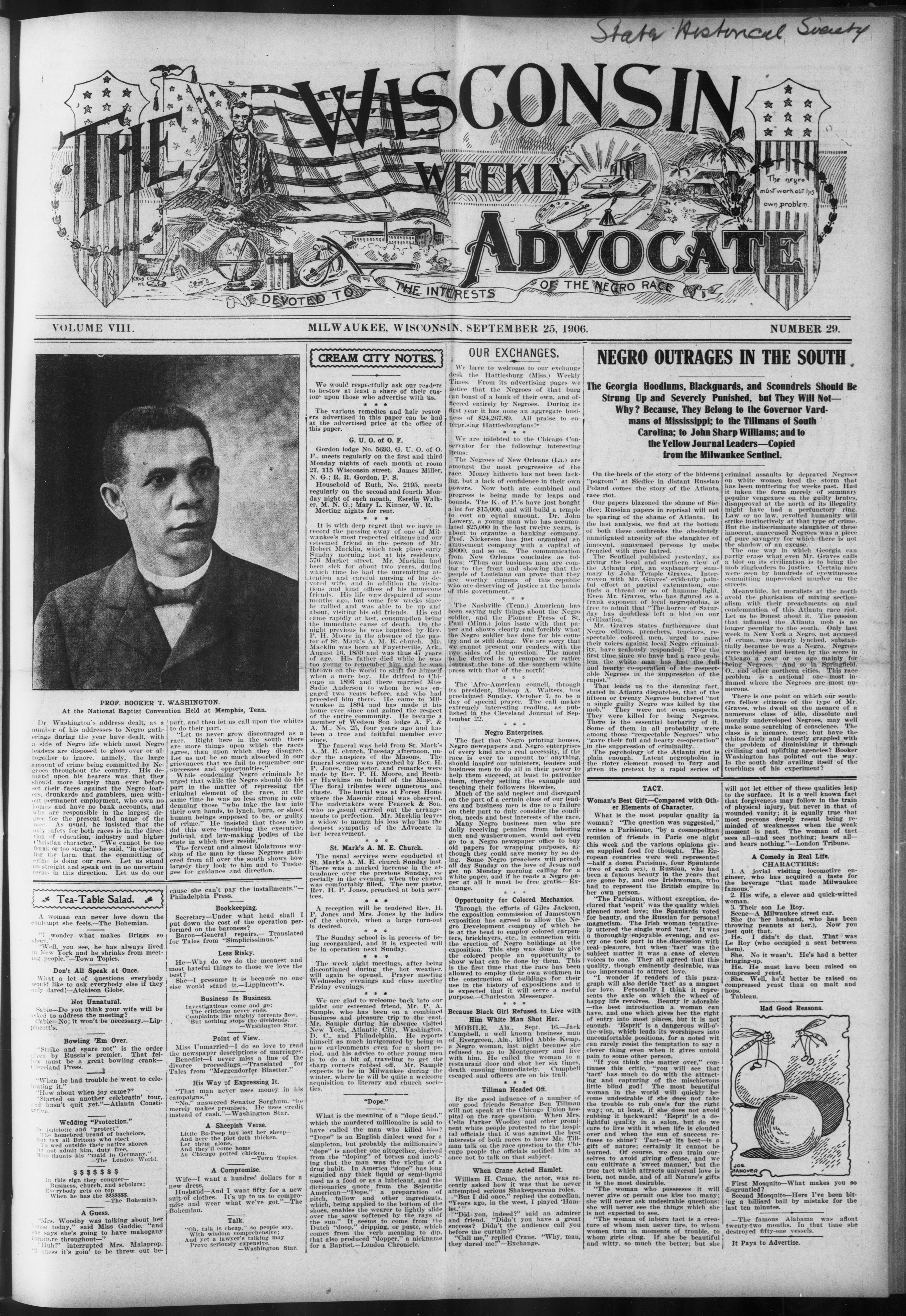
PROF. BOOKER T. WASHINGTON. At the National Baptist Convention Held at Memphis, Tenn.
VOLUME VIII.
PROF. BOOKER T.
At the National Baptist Conve
Dr. Washington's address dealt, as a number of his addresses to Negro gatherings during the year have dealt, with a side of Negro life which most Negro leaders are disposed to gloss over or altogether to ignore, namely, the large amount of crime being committed by Negroes throughout the country. His demand upon his hearers was that they should more largely than ever before set their faces against the Negro loafers, drunkards and gamblers, men without permanent employment, who own no homes and have no bank accounts, and who are responsible in the largest degree for the present bad name of the race. As usual, he insisted that the only safety for both races is in the direction of education, industry and higher Christian character. "We cannot be too frank or too strong," he said, "in discussing the harm that the committing of crime is doing our race. Let us stand on straight and speak out in no uncertain terms in this direction. Let us do our
Tea-Table Salad.
A woman can never love down the contempt she feels.—The Bohemian.
"I wonder what makes Briggs so short."
"Well, you see, he has always lived in New York and he shrinks from meeting people."—Town Topics.
Don't All Speak at Once.
What a lot of questions everybody would like to ask everybody else if they only dared!—Atchison Globe.
Not Unnatural
Sable—Do you think your wife will be asked to address the meeting?
Cable—No; it won't be necessary.—Lippincott's.
Bowling 'Em Over.
"Strike and spare not" is the order given by Russia's premier. That fellow must be a great bowling crank—Cleveland Press.
"When he had trouble he went to celebrating it."
"How about when joy came?"
"Started on another celebratin' tour, and hasn't quit yet."—Atlanta Constitution.
Wedding "Protection."
Be patriotic and "protect"
The homebred brand of bachelors.
But tax all Britons who elect
To wed outside their native shores.
Do not admit him, duty free,
Who daunts his "maid in Germany."
—The London World.
$$$$$$$$
In this sign they conquer—
Business, church, and scholars;
Everybody gets on top
When he has the $$$$$$$.
—The Bohemian.
A Guess.
"Mrs. Woodby was talking about her house today," said Miss Gaddie. "and she says she's going to have mahogany furniture throughout—"
"Huh!" interrupted Mrs. Malaprop. "I guess it's goin' to be threw out be-
part, and then let us call upon the whites to do their part.
"Let us never grow discouraged as a race. Right here in the south there are more things upon which the races agree, than upon which they disagree. Let us not be so much absorbed in our grievances that we fail to remember our successes and opportunities."
While condemning Negro criminals he urged that while the Negro should do his part in the matter of repressing the criminal element of the race, at the same time he was no less strong in condemning those "who take the law into their own hands, to lynch, burn, or shoot human beings supposed to be, or guilty of crime." He insisted that those who did this were "insulting the executive, judicial, and law-making bodies of the state in which they reside."
The fervent and almost idolatrous worship of the man by these Negroes gathered from all over the south shows how largely they look to him and to Tuskegee for guidance and direction.
cause she can't pay the installments."- Philadelphia Press.
Bookkeeping
Secretary—Under what head shall I put down the cost of the operation performed on the baroness?
Baron—General repairs.—Translated for Tales from "Simplicissimus."
Less Risky.
He—Why do we do the meanest and most hateful things to those we love the best?
She—I presume it is because no one else would stand it.—Lippincott's.
Business Is Business.
Investigatl The criticism never ends. Complaints like mighty torrents flow. But nothing stops the dividends. Washington Star.
Point of View.
Miss Unmarried—I do so love to read the newspaper descriptions of marriages. Benedict—I never miss a line of the divorce proceedings.—Translated for Tales from "Meggendorfer Blaetter."
His Way of Expressing It.
"That man never uses money in his campaigns."
"No," answered Senator Sorghum. "he merely makes promises. He uses credit instead of cash."—Washington Star.
A Sheepish Verse.
Little Bo-Peep has lost her sheep—
And here the plot doth thicken.
Let them alone,
And they'll come home
As Chicago potted chicken.
A Compromise
Wife—I want a hundred dollars for a new dress.
Husband—And I want fifty for a new suit of clothes. It's up to us to compromise and wear what we've got."—The Bohemian.
Talk.
"Oh, talk is cheap," so people say, With wisdom comprehensive; And yet a lawyer's talking may Prove seriously expensive. Washington Star.
CREAM CITY NOTES.
We would respectfully ask our readers to bestow at least a share of their custom upon those who advertise with us.
The various remedies and hair restorers advertised in this paper can be had at the advertised price at the office of this paper.
G. U. O. of O. F.
Gordon lodge No. 5693, G. U. O. of O. F., meets regularly on the first and third Monday nights of each month at room 27, 115 Wisconsin street. James Miller, N. G.; R. R. Gordon, P. S.
Household of Ruth, No. 2195. meets regularly on the second and fourth Monday night of each month. Estella Walker, M. N. G.; Mary L. Kinner, W. R.
* * *
It is with deep regret that we have to record the passing away of one of Milwaukee's most respected citizens and our esteemed friend in the person of Mr. Robert Macklin, which took place early Sunday morning last at his residence, 576 Market street. Mr. Macklin had been sick for about two years, during which time he had the unremitting attention and careful nursing of his devoted wife, and in addition the visitations and kind offices of his numerous friends. His life was despaired of some months ago, but some few weeks since he rallied and was able to be up and about, visiting his old friends. His end came rapidly at last, consumption being the immediate cause of death. On the night previous he was baptized by Rev. P. H. Moore in the absence of the pastor of St. Mark's A. M. E. church. Mr. Macklin was born at Fayetteville, Ark. August 16, 1859 and was thus 47 years of age. His father died while he was too young to remember him and he was thrown on the world to shift for himself when a mere boy. He drifted to Chicago in 1893 and there married Miss Sadie Anderson to whom he was engaged two years before, and who had preceded him there. He came to Milwaukee in 1894 and has made it his home ever since and gained the respect of the entire community. He became a member of Wedson Son lodge A. F. & A. M., No. 25, four years ago and has been a true and faithful member ever since.
The funeral was held from St. Mark's A. M. E. church, Tuesday afternoon, under the auspices of the Masons. The funeral sermon was preached by Rev. H. P. Jones, the pastor, and remarks were made by Rev. P. H. Moore, and Brother Hawkins on behalf of the Masons. The floral tributes were numerous and chaste. The burial was at Forest Home where the Masonic ritual was observed. The undertakers were Peacock & Son, who as usual carried out the arrangements to perfection. Mr. Macklin leaves a widow to mourn his loss who has the deepest sympathy of the Advocate in her bereavement.
* * *
St. Mark's A. M. E. Church.
The usual services were conducted at St. Mark's A. M. E. church Sunday last. There was a marked increase in the attendance over the previous Sunday, especially in the evening, when the church was comfortably filled. The new pastor, Rev. H. P. Jones, preached at both services.
* * *
A reception will be tendered Rev. H.
P. Jones and Mrs. Jones by the ladies
of the church, when a large turn-out
is desired.
* * *
The Sunday school is in process of being reorganized, and it is expected will
be in operation next Sunday.
* * *
The week night meetings, after being discontinued during the hot weather, will again be opened. Prayer meeting Wednesday evenings and class meeting Friday evenings.
```markdown
```
We are glad to welcome back into our midst our esteemed friend, Mr. P. A. Sample, who has been on a combined business and pleasure trip to the east. Mr. Sample during his absence visited New York, Atlantic City, Washington, D. C., and Philadelphia. He reports himself as much invigorated by being in new environments even for a short period, and his advice to other young men is to do a bit of traveling to get the sharp corners rubbed off. Mr. Sample expects to be in Milwaukee during the winter, where he will be quite a welcome acquisition to literary and church societies.
"Dope."
What is the meaning of a "dope fiend," which the murdered millionaire is said to have called the man who killed him? "Dope" is an English dialect word for a simpleton, but probably the millionaire's "dope" is another one altogether, derived from the "doping" of horses and implying that the man was the victim of a drug habit. In America "dope" has long signified any thick liquid or semi-liquid used as a food or as a lubricant, and the dictionaries quote from the Scientific American—"Dope," a preparation of pitch, tallow and other ingredients, which, being applied to the bottom of the shoes, enables the wearer to lightly slide over the snow softened by the rays of the sun." It seems to come from the Dutch "doop," dripping, or paste, which comes from the verb meaning to dip, that also produced "dopper," a nickname for a Baptist.—London Chronicle.
OUR EXCHANGES.
We have to welcome to our exchange desk the Hattiesburg (Miss.) Weekly Times. From its advertising pages we notice that the Negroes of that burg can boast of a bank of their own, and officered entirely by Negroes. During its first year it has done an aggregate business of $24,267.89. All praise to enterprising Hattiesburgians!*
We are indebted to the Chicago Conservator for the following interesting items:
The Negroes of New Orleans (La.) are amongst the most progressive of the race. Money hitherto has not been lacking, but a lack of confidence in their own powers. Now both are combined and progress is being made by leaps and bounds. The K. of P.'s have just bought a lot for $15,000, and will build a temple to cost an equal amount. Dr. John Lowery, a young man who has accumulated $25,000 in the last twelve years, is about to organize a banking company. Prof. Nickerson has just organized an amusement company with a capital of $9000, and so on. The communication from New Orleans concludes as follows: "Thus our business men are coming to the front and showing that the people of Louisiana can prove that they are worthy citizens of this republic who are deserving of justice at the hands of this government."
```markdown
```
The Nashville (Tenn.) American has been saying ugly things about the Negro soldier, and the Pioneer Press of St. Paul (Minn.) joins issue with that paper and shows clearly and forcibly what the Negro soldier has done for his country and is still doing. We are sorry that we cannot present our readers with the two sides of the question. The moral to he derived is to compare or rather contrast the tone of the southern white press with that of the north!
***
The Afro-American council, through its president, Bishop A. Walters, has proclaimed Sunday, October 7, to be a day of special prayer. The call makes extremely interesting reading, as published in the Cleveland Journal of September 22.
☆ ☆ ☆
Negro Enterprises.
The fact that Negro printing houses, Negro newspapers and Negro enterprises of every kind are a real necessity, if the race is ever to amount to anything, should inspire our ministers, leaders and business men to do all in their power to help them succeed, at least to patronize them, thereby setting the example and teaching their followers likewise.
Much of the said neglect and disregard on the part of a certain class of our leaders and business men is due to a failure on their part to duly consider the condition needs and best interests of the race
Many Negro business men who are daily receiving pennies from laboring men and washerwomen, would not even go to a Negro newspaper office to buy old papers for wrapping purposes, although they could save money by so doing. Some Negro preachers will preach all day Sunday on the love of Jesus and get up Monday morning calling for a white paper, and if he reads a Negro paper at all it must be free gratis.—Exchange.
Opportunity for Colored Mechanics
Through the efforts of Giles Jackson, the exposition commission of Jamestown exposition has agreed to allow the Negro Development company of which he is at the head to employ colored carpenters, bricklayers, etc., in connection with the erection of Negro buildings at the exposition. This step was done to give the colored people an opportunity to show what can be done by them. This is the first time that the race has been allowed to employ their own workmen in the construction of buildings for their use in the history of expositions and it is expected that it will serve a useful purpose.—Charleston Messenger.
***
Because Black Girl Refused to Live with Him White Man Shot Her.
MOBILE, Ala., Sept. 16.—Jack Campbell, a well known business man of Evergreen, Ala., killed Abbie Kempa, a Negro woman, last night because she refused to go to Montgomery and live with him. He called the woman to a restaurant door and shot her six times, death ensuing immediately. Campbell escaped and officers are on his trail.
Tillman Headed Off.
By the good influence of a number of our good friends Senator Ben Tillman will not speak at the Chicago Union hospital on the race question. When Mrs. Celia Parker Woolley and other prominent white people protested to the hospital officials that it was against the best interests of both races to have Mr. Tillman talk on the race question to the Chicago people the officials notified him at once not to talk on that subject.
When Crane Acted Hamlet.
William H. Crane, the actor, was recently asked how it was that he never attempted serious Shakespearean roles. "But I did once," replied the comedian. "Years ago, in the west, I played 'Hamlet.'" "Did you, indeed?" said an admirer and friend. "Didn't you have a great success? Didn't the audience call you before the curtain?" "Call me," replied Crane. "Why, man, they dared me!"—Exchange.
NEGRO OUTRAGES IN THE SOUTH
The Georgia Hoodlums, Blackguards, and Scoundrels Should Be Strung Up and Severely Punished, but They Will Not—Why? Because, They Belong to the Governor Vardmans of Mississippi; to the Tillmans of South Carolina; to John Sharp Williams; and to the Yellow Journal Leaders—Copied from the Milwaukee Sentinel.
On the heels of the story of the hideous "pogrom" at Siedice in distant Russian Poland comes the story of the Atlanta race riot. criminal assaults by depraved Negroes on white women bred the storm that has been muttering for weeks past. Had it taken the form merely of summary
Our papers blazoned the shame of Siedice; Russian papers in reprisal will not be sparing of the shame of Atlanta. In the last analysis, we find at the bottom of both these outbreaks the absolutely unmitigated atrocity of the slaughter of innocent, unaccused persons by mobs frenzied with race hatred.
The Sentinel published yesterday, as giving the local and southern view of the Atlanta riot, an explanatory summary by John Temple Graves. Interwoven with Mr. Graves' evidently painful effort at partial extenuation, one finds a thread or so of humane light. Even Mr. Graves, who has figured as a frank exponent of local negrophobia, is free to admit that "The horror of Saturday has doubtless left a blot on our civilization."
Mr. Graves states furthermore that Negro editors, preachers, teachers, respectable colored men, urged to raise their voices against local Negro criminality, have zealously responded: "For the first time since we have had a race problem the white man has had the full and hearty co-operation of the respectable Negroes in the suppression of the rapist."
That leads us to the damning fact, stated in Atlanta dispatches, that of the fifteen or twenty Negroes butchered "not a single guilty Negro was killed by the mob." They were not even suspects. They were killed for being Negroes. There is the essential barbarity of it. Some of them in all probability were among those "respectable Negroes" who "gave their full and hearty co-operation" in the suppression of criminality.
The psychology of the Atlanta riot is plain enough. Latent negrophobia in the rioter element roused to fury and given its pretext by a rapid series of
TACT.
Woman's Best Gift-Compared with Other Elements of Character.
What is the most popular quality in woman? "The question was suggested," writes a Parisienne, "by a cosmopolitan reunion of friends in Paris one night this week and the various opinions given supplied food for thought. The European countries were well represented—half a dozen Parisians, four Spaniards (two of each sex), a Russian, who had been a famous beauty in the years that are gone by, and one Irishwoman, who had to represent the British empire in her own person.
"The Parisians, without exception, declared that 'esprit' was the quality which gleaned most love; the Spaniards voted for beauty, and the Russian for personal magnetism. The Irish woman tentatively uttered the single word 'tact'. It was a thoroughly enjoyable evening, and every one took part in the discussion with real pleasure, but when 'tact' was the subject matter it was a case of eleven voices to one. They all agreed that this quality, though eminently desirable, was too impersonal to attract love.
"I wonder if readers of this paragraph will also deride 'tact' as a magnet for love. Personally I think it represents the axle on which the wheel of happy life revolves. Beauty ir adorable—the best introduction a woman can have, and one which gives her the right of entry into most places, but it is not enough. 'Esprit' is a dangerous will-o'-the-wisp, which leads its worshipers into uncomfortable positions, for a noted wit can rarely resist the temptation to say a clever thing even when it gives untold pain to some other person.
"If you think the matter over," continues this critic, "you will see that 'tact' has much to do with the attracting and capturing of the mischievous little blind god! The most beautiful woman in the world will quickly become undesirable if she does not take the trouble to rub one's fur the right way; or, at least, if she does not avoid rubbing it backward! 'Esprit' is a delightful quality in a salon, but do we care to live with it when life is clouded over and when the sun of success refuses to shine? Tact—at its best—is a gift of nature; certainly it cannot be learned. Of course, we can train ourselves to avoid giving offense, and we can cultivate a 'sweet manner,' but the true tact which attracts universal love is born, not made, and of all Nature's gifts it is the most desirable.
"The woman who possesses it will never give or permit one kiss too many; she will never ask undesirable questions; she will never see the things which she is not expected to see.
"The woman of inborn tact is a creature of whom men never tire, to whom women turn in moments of trouble, to whom girls cling. If she be beautiful and witty, so much the better; but she
NUMBER 29.
ES IN THE SOUTH
ards, and Scoundrels Should Be
nished, but They Will Not—
going to the Governor Vard-
to the Tillmans of South
Sharp Williams; and to
All Leaders—Copied
Maukee Sentinel.
criminal assaults by depraved Negroes on white women bred the storm that has been muttering for weeks past. Had it taken the form merely of summary popular vengeance on the guilty brutes, disapproval at the north of its illegality might have had a perfunctory ring. Law or no law, revolted humanity will strike instinctively at that type of crime. But the indiscriminate slaughter of these innocent, unaccused Negroes was a piece of pure savagery for which there is not the shadow of an excuse. The one way in which Georgia can partly erase what even Mr. Graves calls a blot on its civilization is to bring the mob ringleaders to justice. Certain men were seen by hundreds of eyewitnesses committing unprovoked murder on the streets.
Meanwhile, let moralists at the north avoid the pharisaism of mixing sectionalism with their preachments on and condemnation of this Atlanta race riot. Let us be lionest about it. The passion that inflamed the Atlanta mob is no longer peculiar to the south. Only last week in New York a Negro, not accused of crime, was nearly lynched, substantially because he was a Negro. Negroes were mobbed and beaten by the score in Chicago a year or so ago mainly for being Negroes. And so in Springfield, O., and other northern cities. This race problem is a national one—most inflamed where the Negroes are most numerous.
There is one point on which our southern fellow citizens of the type of Mr. Graves, who dwell on the menace of a numerous class of idle, dissolute and morally undeveloped Negroes, may well make some searching of conscience. The class is a menace, true; but have the whites fairly and honestly grappled with the problem of diminishing it through civilizing and uplifting agencies? Booker Washington has pointed out the way. Is the south duly availing itself of the teachings of his experiment?
will not let either of these qualities leap to the surface. It is a well known fact that forgiveness may follow in the train of physical injury, but never in that of wounded vanity; it is equally true that most persons deeply resent being reminded of weaknesses when the weak moment is past. The woman of tact sees all—and sees nothing; hears all—and hears nothing."—London Tribune.
1. A jovial visiting locomotive engineer, who has acquired a taste for the beverage "that made Milwaukee famous."
2. His wife, a clever and quick-witted woman.
3. Their son Le Roy.
Scene—A Milwaukee street car. She (to her husband, who has been throwing peanuts at her.), Now you just quit that.
He. I didn't do that. That was Le Roy (who occupied a seat between them). She. No it wasn't. He's had a better bringing-up. He. He must have been raised on compressed yeast
compressed yeast. She. Well, he'd better be raised on compressed yeast than on malt and hops.
JOE
HANOVER
First Mosquito—What makes you so disgruntled?
Second Mosquito—Here I've been biting a billiard ball by mistake for the last ten minutes.
—The famous Alabama was afloat twenty-two months. In that time she destroyed fifty-one vessels.
It Pays to Advertise.
THE WISCONSIN WEEKLY ADVOCATE.
MILWAUKEE, WIS.
R. B. MONTGOMERY, Editor and Proprietor.
AFTERWARDS.
Oh, to think that the world will go on
After we are dead!
Lovers will go on loving,
The old, old words will be said.
New buds will bloom in April,
And white be the apple-bough;
June will return, the birds troop back,
The earth be as glad as now.
The long, green pageant of Summer
Will march its accustomed way,
And year after year the Autumn pomp
Will crimson the pallid day.
Lovers will go on loving,
The words that we said will be said,
When you and I are forgotten,
When you and I are dead!
Facts and Fancies. She-You don't love me as you used to. Before we were married you considered me absolutely perfect He-Yes, and now, you're perfectly
If every heart were quickened
To feel another's wrong.
Then living would be loving
And life would be a song.
—Baltimore American.
Teacher—Can you tell me what an
aristocrat is Johnny?
aristocrat is, Johnny.
Johnny—Yes, ma'am. An aristocrat is a poor person who boasts of his rich relations.
But the Busiest Place.
The seaside places count their crowds, The summer idlers throng the bay But the Bargain Counter works right on It never takes a holiday.
A Self-Made Man.
Knicker—Did he rise from nothing? Bocker—Yes; you might say that nature dealt him from the bottom of the pack.
Settling It.
One of the Doctors—Gentlemen, since we cannot agree upon a diagnosis, and as it is getting somewhat late, I propose we draw lots.—Woman's Home Companion.
Finally.
Hope is deceivin'.
But Joy's in sight;
Keep on believin'
It'll soon be light!
—Atlanta Constitution.
Summer's Humming Machine
Bacon—A mosquito's buzzing apparatus is a delicate piece of machinery. Egbert—But it is the kind of machinery I don't like to hear hum.—Yonkers Statesman.
A Sensitive Canine.
Baxter-That dog of yours is not a full-blooded Boston terrier, is he? Bixey-Hush, old chap, don't let him hear you. He thinks he is!-Woman's Home Companion.
Foundation Almost Completed.
Henry James is at work on a new novel. The greater portion of the opening sentence is already completed. London Tribune.
Bobby's Explanation
Teacher (sternly) — What were you laughing at, Robert?
laughing at, Robert?
Bobby—I wasn't laughin', ma'am; my complexion puckered, that's all."—Woman's Home Companion.
A Fast "Pony."
Latin Instructor (to student translating)—Don't you think it is pretty near time that you turned the page? You've rendered the first five lines on the next page already.—Punch Bowl.
All in.
Photographer — Will you have a full length portrait, or a vignette, sir?
"Vignette? I should think not. What do you suppose I have put my new boots on for, stupid?"—Meggendorfer Blaetter.
Wise.
"And you let your drunken husband lie asleep all night on the stairs?" "Yes, but set the alarm clock alongside of him so that he could wake up promptly in time for business."—Fliegende Blaetter. Mean.
Mean
Servant (complaining to a friend)—My mistress is certainly the original mean woman. To keep tab on me she numbered the coffee beans, and today she came and accused me of stealing No. 37.—Fliegende Blaetter.
-
The forty dollars that I spent
Down at the shore amounts to this:
A loss of weight
Testing the Dog.
Suburbanite (to visitor)—Oh, how are you? Come right in. Don't mind the dog.
Visitor—But won't he bite?
"That's just what I want to see. I only bought that watchdog this morning."—Rire.
Thought She was Cheated
"This isn't the pie I ordered," observed the pretty girl.
"You said green apple pie, didn't you?" asked the waiter.
"Yes, I did," said the girl, "but these
perfectly white!"—Detroit
apples are Free Press.
Quite So.
when he is looking for me. I always consid-
d that he "loves" me.
ered him lazy. "That's what I mean. 'When he's looking for work, of course, he hasn't any.'"—Philadelphia Press.
No Fractures.
"It seems his uncle fell out of a hotel window, in l'urone—"
"No, he was merely drowned. It happened in Venice."—Philadelphia Ledger.
Proper Enough.
"Doesn't it sound ridiculous to say 'the hand that rocks the cradle is the hand that rules the world?' What does that mean, anyway?" "Well, the hand usually belongs to a nurse or servant girl, and you know how servant girls boss things."—Philadelphia Press.
Not Scientific
"George, dear, what is the scientific name for the mosquito?" "I don't know." "Why, what did I hear you calling it the other evening?" "Eh! That was something that won't bear repeating."—Cleveland Plain Dealer
Two Qualities.
Gelsomini was searching for a wife and said to his friend Barbetta that he wanted one rich and stupid.
"And why?"
"Because if she is not rich, I will not marry her, and if she is not stupid she will not marry me."—Il Motto per Ridere.
Painting Her Rainbow.
"He is my rain beau," she remarks;
"He blushes redly when he sparks.
At times it may be plainly seen
That as to woman's wiles he's green.
When I smile on another fellow
With jealousy he then is yellow
Until he thinks I am not true,
And then he is the darkest blue."
It Always Is.
"Isn't it ridiculous to say 'everybody's business is nobody's-business '"
"Why, that's all right; you see, it means that when—"
"I don't care what it means. It's bound to be the busy-body's business, at least."—The Catholic Standard and Times
Q. B. BAKER
"A splendid stroke! Did you follow the ball, caddie "
"No, sir, but I think that gentleman with the red coat can tell where it struck. I see him feelin' of his head."
Maidenly Modesty.
"Ah, my love!" sighed the ardent lover. "If you only knew how beautiful you are!" "You mustn't say that," protested the dear girl. "I don't want to know." "Why not?" "Because it would make me too conceited."—The Catholic Standard and Times.
A Suggestion.
Mrs. Whoopler—You tell me. Herr Vogleschnitzel, that my daughter can never become a singer! Is there no hope for her?
Herr Vogleschnitzel—Vell, matam, you might put her on a diet of canary seed alretty, undt see vat dot vill do mit her.
—London Tit-Bits.
Correct
"Dear doctor, I heard Sig. Luarschini say that you are a veterinary surgeon." "He is quite right." "What?" "Certainly. Don't you know that I am attending him."—I'll Motton per Riders.
The Most Beautiful of Fruits.
"Bring me plain peaches," the cynic said. But the waiter paused and bobbed his head.
"Beg pardon," he cried, and bobbed again. "Peaches, you know, sir, can never be plain."—Cleveland Plain Dealer.
"Did you call your husband 'Honey?'"
ey "No. I call him 'Pickle.'"
No. I can him Picket.
"Good gracious, doesn't that make him mad?"
"No. He knows I detest honey, and every woman loves pickles."—Houston Post.
Why the Pastor Ran
One of the traditional stories of the town of Fairfield, Conn., recounts a wild dash from the pulpit made by a worthy and beloved pastor of the Episcopal flock, Dr. Labaree.
It was on a Sunday more than a hundred years ago. The service had been read, the prayers said, the hymns sung, and the parson began his sermon. As he proceeded his gestures became very energetic. He brought his right hand down with great force. Then he turned pale, cleared the pulpit stairs at a bound, dashed out the church door and ran toward the pond a short distance away.
The congregation followed in bewildered pursuit, and saw their venerable pastor with flying robe rush into the water until it came to his neck. Then turning round he faced his astonished audience and said:
"Dearly beloved brethren, I am not crazy, as no doubt many of you think, but yesterday at the drug store I bought a bottle of nitric acid and carelessly left it in my pocket today.
"My last gesture broke the bottle. I knew the suffering the acid would cause when it penetrated my clothing, and rushed for water to save myself pain."
He drew several pieces of glass from his pocket in witness of the tale. Then he dismissed the company and hurried home.—Youth's Companion.
THE BATHER.
Still is the lake; in lucent air
Serene o'er its own shadow bowed,
The wet hill hangs, as faintly fair
And unsubstantial as a cloud.
Still is the lake; clear skies today
Succeed the rains of yester-night;
The dark flood-waters idly play
With shadowed hill, with misty light.
No single sound breaks in; I hear
The breath, it seems, of living earth;
Near things seem far, and far things near,
Like visions of celestial birth.
Secure in such still solitude
The wild fowl dot the distant bay,
And seagulls, that of late pursued
Through restless seas their hard-won prey,
In this deep inland calm take tithe
Of easy spoil.
A mower cuts with old-world scythe
Slow-falling swath of sedgy grass,
Whose yellowing fringe winds close about
The wrinkled bank, where level lake
And meadow-flat wind in and out
And mimic bays and headlands make—
Sole figure in this lonely space,
He swings and pauses, turns and swings,
Nor heeds the glory of the place,
Nor of these far, uplifting things,
Man's heritage, claims any share.
One long field, by sweet runnels fed
That in the south mere ditches were;
But here spired plantain rears its head,
And gray-eyed yarrow's silvery lip
Smiles norland welcome—Last, a row
Of screening alders; there I strip
And barefoot through soft grasses go
Where Derwent, curving to the mere,
Swift in his seeming stillness slides,
A moving mirror, darkly clear,
Deep-pooled beneath his hanging sides.
Poised for the plunge, erect I take
The benison of the sun: I see
The toil-bound mower by the lake
Still swing his scythe, but I am free.
I poise, I plunge—the mirrored hills
Rise up to meet me as I leap.
How the cool stream my body thrills,
Silken and soft and fresh as sleep.
CHEMISTRY AND THE TELEPHONE
Every story must have a beginning, unfortunately—it would be much easier to start it in the middle, but that might complicate matters in the end; but in this case it will be a great saving of space if I start a little way down the tale, so to speak, and hark back a trifle, at the same time taking several things for granted. She of whom I would write was at this time 26 springs old; we will take it for granted that she passed these years in the usual way in which they are passed by young ladies who are not badly treated by fortune. Sne had red hair—I refuse to deviate one iota from the strict truth and call it auburn, not though she were seventy times my heroine would I do so; we will take it for granted she was distinctly fair to look upon—all red-haired girls are, more or less; and that she had a charming temperament—as some red-haired girls have. Her name was Yeulth Barrow, and she is the daughter of Tom Barrow of Barrow, Weller & Co., the famous engineering firm of that name. I think now that I have cleared the ground a bit we can forge ahead with our story. Although Miss Barrow at the time this story opens was wrapped in costly furs and seated in a first-class carriage on the Great Diddlesom line, yet the other occupant of the carriage was not a young and handsome stranger with a black moustache, and the "white fleecy snow" was not falling, and, incredible as it may appear to you, the train did not slowly come to a standstill in the center of a desolate plain.
Miss Barrow had come down to breakfast about ten days previously and had announced to her family that Lady Watendlath had invited her to stay at Rostwaste towers for Christmas and that she did not mean to go. The family, who were not always loath to part with Yeulth at times, begged her to reconsider her decision, and pointed out what an advantage it would be to them if Yeulth got into Lady W.'s set—money cannot do everything, and Mrs. Barrow was anxious to shine in society.
A timely kick under the table from Master Allyn Barrow stopped Yeulth's ultimatum in favor of not going on her lips, and the perusal of a note beginning—
My Dear Allyn: I am going on the 20th to Lady Watendlath's, but before leaving I am writing to wish you a merry Christmas, and am inclosing a card, the design of which I trust you will admire—— decided her in favor of accepting. The "card" was a five-pound bank note and the letter was signed by Rhys Troutbeck. Now, Rhys was a penniless captain in the 173d—there's luck in odd numbers—Hussars, but he had not proved acceptable when he offered himself as son-in-law to Barrow pere, although Yeulth had smiled on him. The reason of his correspondence with Allyn is not far to seek. Then the train stopped at Dunollie station and Yeulth alighted.
"No, m'm; no carriage has come from the towers, m'm. In fact, m'm, this is the castle station; the towers folk change at the junction and go on to South Dunollie—it saves them four or five miles' drive. No, m'm, there's no inn hereabouts, and no conveyance of any sort; the last train to the junction went half an hour ago. Well, m'm, there's a nice fire in the waiting room, but I think your best plan would be to walk the five miles, m'm, rather than wait for the morning train. * * * Much the best plan, m'm; certainly you can leave the luggage. It'll be all right. It was dusk; the wind was getting up, the snow was coming down, the dressing bag was heavy; it was Christmas eve, she was alone on a sickening country road. No wonder she wished she had never been born; no wonder she consigned Rosthwaite towers to a climate where hot water pipes are unnecessary and ice is at a premium. In Christmas story parlance, she staggered blindly through the gathering mist, but ever before her was the never-ending stretch of drive wrapped in its snowy mantle—she had crossed the stile and was now in Rosthwaite park.
However, she luckily climbed to the top of a small undulation before giving up all hope, and, arriving there, dropped the bag and wept—tears of joy; in front of her was the outline of a long, low house, with the red, cozy curtains of a cheap Christmas card. The house was not the home of a gang of forgers; no traces of a band of desperate conspirators were to be found; not a drop of human gore was to be seen trickling from under the door, nor did a certain shiver that turns people's hearts to stone run through her veins; but all the same Miss Barrow was surprised.
The floors were parquet and numerous rugs covered them; the chairs and tables were luxurious, the walls were paneled, the fireplace was an open one into which some craftsman had worked a most charming and original design. The pink-shaded lamps on their wrought-iron and
copper stands cast a roseate light over the room. Yeulth was no fool. "This is no ordinary cottage," she thought. She was right.
Yeulth, being a woman, took in all the room, and her host, too, at a glance. He was not exactly beautiful, he wasn't exactly plain; you would therefore surmise he had a "strong" face—most heroes have—but it was not particularly strong, and not particularly weak.
"Then surely I am addressing Miss Barrow?" queried Cyril Lodore, after Yeulth had entered into a more or less explicit explanation. "My name's Lodore, you know; how awfully jolly to make your acquaintance in this way—jolly for me, I mean. Of course, it was a little unpleasant for you. * * *
"No, this is not part of the towers; These are my diggings. Let me give you a cup of tea. I can make it myself in no time. You see, I go in a good deal for scientific research—of course, in a small way—and, to tell the truth, I almost blew up the towers when experimenting with inclimate, and almost killed the paternal on another occasion; at last he said the whole place smelled so badly of chemicals—they had all the drains up once while I was examining into the properties of hydrogen sulphide, thinking there was something wrong—that either he or I would have to go.
"Of course, I had to go—Watendlath is too selfish for words, so I came here, fitted the place up with a laboratory, and called the whole the Hermitage. * * * Well, I had an old family servant here once, but she went dusting in my laboratory, and there isn't much of her left now, so I decided to have no more domestics round the place. You see, I don't often come here, but when I come I see nobody until I choose to seek them out, so I get through much more work than most men do during the same time. Lord! how the wind roars. By the way, I'll just telephone up to the house and let them know you are here * * * Oh! about three miles off—they'll send a carriage."
He crossed the room and went through the ordinary process of ringing someone up on the telephone. He turned to Yeulth. "I am awfully sorry to have to tell you, Miss Barrow, that we are prisoners here until tomorrow. They say it is impossible to send a carriage because of the snowdrifts, and it is equally impossible for us to walk. The only thing remaining is for us to stay where we are; at all events, we have a roof over our heads, and my room is quite at your disposal.
The evening passed, and Yeulth sat reading before the fire with her dainty feet in a pair of red-heeled shoes that it was said Marie Antoinette once wore, and which were now one of Cyril's treasures. Cyril spent the time writing at his escritoire, throwing out a remark every now and then. He explained he was writing an important paper on the molecular theory. She went to bed.
He to his laboratory.
* * * * * * * * *
When Yeulth awoke next morning she thought it was night, but on looking at her watch she saw it was half past 8. She thought her watch was wrong, because the room was quite dark, but on pulling aside the curtains in front of her bedorom window she saw the reason of the darkness. The snow had drifted right up to the top of the window and had cut off the light of day.
There was a knock at her door. "I heard you moving about," said Cyril, his voice muffled by the thickness of the mahogany door, "so I have brought you some hot water; and, oh! when you take in the water will you please leave my razor case on the mat? It's on the dressing table. Thanks." When she came into the hall sitting room she found the breakfast table already laid. At each corner of it was a silver candlesuck with a pink shade, a standard lamp was also lit, and the silver shone as the light fell on it.
"Been a tremendous fall during the night," explained Cyril, "a regular epochmaking fall. No, I hardly think we shall be smothered, but all the same the snow is up to the tops of all the windows. The telephone won't work—wire broken, I suppose."
They played twenty-five games at Halma during the day, and Cyril managed to lose seventeen of them.
It was "Cyril" and "Yeulth" by night time.
It was a merry Christmas.
It was "my dear Yeulth" then.
Then Yeulth noticed that whenever Cyril had finished writing at his MS. he always locked it up before retiring to his laboratory; and she became curious—red-haired girls sometimes do. It was so strange he should lock it up when she was the only person in the house besides himself—so very strange.
"My dear Yeulth, I must go and increase the pressure in my gases"—he did it regularly at stated intervals—"you are quite sure you have everything you want? * * * Very well—keep yourself warm; I shall be back directly."
She took the MS. from the desk, perused scraps of it, and found it deadly dull; it consisted of nothing but "expansion," "Dalton's theory," "molecules and atoms," "specific gravity" and formulae, liters, centimeters—which reminded her of centipedes—and other gruesome things. Was that all? No, at the bottom of the MS. were a few loose sheets, which she read carefully.
She walked to the door and opened it, and in a few minutes, with the aid of a cinder shovel, cleared a way through a pile of snow resting against the door. The sun was shining brightly, and within a few yards of the house not a sign of any snow was visible, except as she walked round the house she noticed that piles of snow were thrown up against every window. As she returned to the house she met Cyril.
"So you've found me out after all?" he said. "I guessed you would, you are so clever. I'm not sorry, because I should have been obliged to have told you myself in the end. Oh! it stopped snowing on the night you came; I went out and piled it up at all the windows during the night. That was quite easy; you see, my mother never writes an unnecessary letter—she telegraphs everything by means of the private wire. I cut the wire during the night and connected the ends to my own instruments.
1 quite agree with you that it was
madness, that it was dishonest, and I've deceived every one; but I would do it all over again for you—I would really. No, I am quite sure Rhys wouldn't have done it—he hasn't the brains. It was because of Rhys I did it. I had heard that you and he were great friends. Yes, it certainly adds meanness to my other vices. I have nothing to say but that I love you—nothing more. What are you to do? Well, there are two courses—one is to go straight back to your home and proclaim what a villain I am; the other is to accept my mother's invitation and drive with me to Dunollie station, take your luggage to the junction, change there and then take the train on to South Dunollie.
"I said you would come Friday unless you telegraphed again to the contrary; the carriage will meet you, and, with any luck, nobody will suspect you have not been at home or at the towers all the time, just as the case may be.
"Oh! The conversation through the telephone? I had disconnected the wire and I made it all up out of my head. It was revoltingly sneakish, I admit. I can say nothing in extenuation of my conduct; nobody could be more severe in their strictures on it than I am—it is utterly and entirely beneath my contempt. No, Yculth, it is kind of you making an excuse for my deplorable deception, but I cannot accept it. My conduct is nothing short of despicable—I certainly adore the ground you walk upon, but because I was jealous of a man ten thousand times better than I—miserable, depraved, villainous wretch that I am—that is no reason why you should not spurn me."
She kissed him on the lips!—Harold Macfarlane in Illustrated Bits.
A CITY MOOD
If I once more might only wander free From all this citied laughter touched with pain, And learn with quiet hill and patient tree To watch the wheeling seasons and the rain,
And with the lyric grass, the widening sea. Retaste the wine of Earth's Aprilian strain
And her cool wisdom earn, and at the knee
Of brooding calm some wider knowledge
drain—
Then I that deeper Self entombed in me
This many a Spring might hear no more
complain—
Then I that better life that used to be. When hope and dreams were young, might know again! -Smart Set.
BRIEF NOTES OF NOTABLES.
GEN. WEYLER, or, to give him his full name, Senor Don Valeriono y Weyler Nicolau, Marquis of Teneriffe, was born in the Balearic islands, September 17, 1838. Though he was soundly denounced in America for his "butcheries" in Cuba, which indirectly led to the Spanish-American war, there never has been any disposition to belittle Gen. Weyler's military abilities. He is everywhere recognized as one of the ablest soldiers attached to the fallen fortunes of the Spanish monarchy. After graduating from the infantry school in 1853, the young officer entered the army as an under-lieutenant. Ten years later found him a lieutenant-colonel of cavalry, and thereafter his promotion was rapid. He saw active service in the campaigns of Santo Domingo and Cuba and in the civil war in the north of Spain. His last work in the field was to suppress the insurrection in the Philippines, and according to all accounts he made bloody work of it. After the Spanish war with America, Gen. Weyler was made captain-general of Madrid, the most cherished post in the Spanish military service. He also has served in two cabinets as secretary of war.
DR. WALTER COURTNEY, chief surgeon of the Northern Pacific railway since 1888, was born in Lambton county, Ontario, September 18, 1855. He was educated at the local public schools, Strathroy Collegiate institute and the University of Michigan. Dr. Courtney is one of the most eminent members of his profession in the northwest. He is a former president of the Minnesota State Medical society, a member of the American Medical association, the International Association of Railway Surgeons and a number of other medical organizations. He has served as president of the Upper Mississippi Medical society and has been given an honorary membership in the North Dakota Medical society.
ETHAN ALLEN HITCHCOCK, who has been secretary of the interior since early in 1899, was born in Mobile, Ala., September 19, 1835. He is a great-grandson of Ethan Allen, the leader of "The Green Mountain Boys." As a young man Mr. Hitchcock settled in St. Louis and engaged in mercantile business until 1860, when he went to China as representative of a business firm in which he soon after became a partner. He always took an active interest in politics, and in 1897 he was appointed United States minister to Russia, which post he resigned to enter the cabinet of President McKinley. Mr. Hitchcock is very democratic, though a man of great wealth, and all in all may be regarded as an excellent representative of the enlightenment, progress and industry of the great west beyond the Mississippi.
JAMES NORRIS GILLETT, who recently defeated Gov. Pardee in a contest for the Republican gubernatorial nomination in California, was born in Viroqua. Wis., September 20, 1860, and received his school in the neighboring town of Sparta. He left Wisconsin when a young man and settled in Humboldt county, California, where, with grit as his only capital, he had a hard row to hoe for several years. He opened a law office and served six years as city attorney of Eureka. With this record behind him he was elected to the state Legislature in 1897. He made a good record in the Legislature and the result was his election to Congress from the First district of California in 1903. Although candidate for a mining constituency, and not a mining man, he defeated Senator Ford, a mining attorney of Nevada City, and two years later was re-elected with an increased majority.
Aztec Women
The feminine direct descendants of the famous Aztecs are tiny creatures, exquisitely formed and refined in feature. They carry the head with the upbearing grace of the full-blooded Indian; their skins are not red, but a clear, smooth copper color that shines like gold in the sun; their hair is coarse and black as ebony, and they are decorated with bright feathers and gay ornaments. These women make the most wonderful pottery that comes to us from Mexico, for they have kept the old Aztec forms and decorations in their art, and they also weave wonderful baskets and do exquisite embroidery.—Scott Valley (Cal.) Advance.
-New South Wales is just two and a half times the size of the British isles. Queensland is equal to three times the German empire and Belgium put together.
Notes of Interest.
Atlantic City, with a winter population of only 30,000, has a summer population of 300,000.
The greatest Alpine avalanche was that which in 1827 swept away the town of Biel and killed nearly ninety persons.
King Alfonso of Spain makes jokes all day and behaves altogether like the boy he is. To his mother-in-law he is the very soul of politeness, and it is said to be delightful to see them together.
French horticulturists have apparently been very successful of late in raising dwarf trees, and one of the features of dinner parties among the rich now is to serve the fruit upon the tree.
The court of apalcs of Ghent has just declared invalid an election that took place twenty-five years ago. The illegal incumbent, who is a lawyer, by the way, will now, it is expected, vacate. The Canadian revenue department has been examining commercial lemon extracts, and finds out of 110 samples 78 contained less than 1 per cent. of lemon oil, the essential flavoring extract. Radium emanations seem to have marked and widely varying effects upon precious stones. Some colorless diamonds exposed to the influence of radium turn yellow and stay of that color while others remain white. One pale blue sapphire was colored dark yellow after two weeks' exposure to radium rays.
—M. G. Loisel has arrived at the somewhat startling conclusion that the yolk of the eggs of fowls and ducks, as well as those of the tortoise, contains poisonous substances. When isolated and injected into the veins of rabbits or other animals these promptly cause death. The phenomena produced are those of acute intoxication of the central nervous system.
—The temple elephant in southern India is the object of great respect, for physical contact with him is supposed to do more good to the human body than the best medicine. Adult men and women warily feel his legs with their finger tips and press them fervently to their eyes, and ailing children are, for a small consideration, carried on his back the distance of a few strides that they may be cured.—Mail, Madras.
There are about 5000 species of the wild bees, all with interesting ways of their own. Among them is a species whose females are veritable Amazons and carry more and better weapons than the male. These are the "cuckoo" bees, which deposit their eggs in the nest of others, the progeny of both living peaceably together until maturity, when they separate. Then there is the tailoring bee, which cuts leaves with his scissor-like jaws and fits a snug lining of the leaf material into has cave-shaped nest.
Cleaning Oil Paintings.
Considerable talk has been occasioned of late by the cleaning of the old masterpieces in the Metropolitan Museum of Art, New York City. Some criticism has been heard, too, the critics being of the opinion that to "clean" the old paintings was to injure them. However, the work has progressed favorably thus far and no damage has resulted. It is interesting to note the care that is taken in cleaning these paintings. Take the "Holy Family," by Rubens, for instance. The method employed by the cleaners was to rub the surface of the picture with flecks of cotton dipped in alcohol to "cut" the varnish, the two men doing the work each having a bottle of oil at hand to "stop" the action of the cutting agent the moment the varnish had been cut through and the paint reached. These two men worked alternately, going slowly and carefully when the surface was cracked, their hands moving faster where the surface showed no signs of blemish. Roger E. Fry of the museum stood over the cleaners all the time, and under his direction the great painting was thoroughly cleaned without any damage being done. Other oldtimers are undergoing a similar process.—New York letter to Pittsburg Dispatch.
Animal and Plant Diseases
My mother said to me when a lad working in the garden: "You cannot cheat a cow, hen, hill of corn or a fruit tree." She said that there was a law common to animals and plants. The roots of a tree are its stomach, where it takes in food and digests it. The leaves are its lungs, where it takes in that which gives life to its sap or blood. The tree must have healthy leaves just as a man must have healthy lungs. The trees in our streets are gradually dying because insects destroy their leaves by midsummer. They have less and less vitality each year, and finally die as a person, with consumption, or are winter-killed because too feeble to resist the cold.
The doctors will organize a new profession and can render most beneficent service to the lover of trees, fruits and vegetables. We must learn to treat young trees and plants like children study their habits, likes and dislikes temperament, needs, appetites and ailments and find remedies for their illness. They are more human than many of us realize.-Canadian Horticulturist.
Slang Must Go.
Slang must "skidoo" from the public schools of Philadelphia. That is the decree handed down by the board of education's committee on elementary schools. For some time past the prevalence of slang expressions in the vocabularies of the public school teachers has worried the members of the board. Simon Gratz, a veteran member, suggested as a few of the pet, everyday siang expressions that must be abolished the following:
Skidoo.
Beat it while your shoes are good.
Twenty-three and beat it.
Eighteen and a bottle of milk.
Fade away.
Get busy.
Cut it out.
Back up.
Quit your kidding.
The suggestion was approved.
He Tripped the Students.
Theodore Billroth, the eminent Viennese surgeon, lecturing to his class in a medical school, said that a doctor needed two gifts—he must be free from any tendency toward nausea, and he must be a good observer.
He then poured a nauseous fluid into a glass, dipped one of his fingers into it and licked it off: whereupon he invited the students to follow his example. Without flinching they did so.
With a broad grin the surgeon looked at them and said: "You have stood the first test brilliantly. Not so the second, for none of you observed that I dipped my first finger into the glass but licked the second!"
Overcoming Difficulties
A clerk in a rural district store, not being very well up in singular and plural nouns, found himself in somewhat of a dilemma while making out an order. He wished to order two of the articles called tailor's goose." He first wrote. "Please send me two tailor's geese." After looking at it for some time he decided that it was wrong. His next effort had it. "Please send me two tailor's gooses." Not being satisfied with that, he wrote. "Please send me two tailor's geeses." He felt sure that was wrong, so finally wrote. "Please send me one tailor's goose, and, by thunder! send me another one also."—Judge's Magazine of Fun.
GOSSIP FOR THE LADIES.
```markdown
```
I love the damask rose that sways
And sprinkles perfume everywhere,
When earth is May and sky is May,
And fragrant May is in the air.
I love the thrush that pipes his song,
And, trailing music, takes his flight,
When Summer's pageant passes by
With rosy day and purple night.
I love the wanton meadow wind,
That makes the tail grass sing and quiver,
And blows the gypsy thistle down,
At eve across the silver river.
I love the hollow hills that ring,
The azure lake, the rhythmic brook,
The lustrous fields, the woodlands wild,
And every hedge and every nook.
And yet when Autumn murmurs low
Among the vagrant leaves of brown,
I love to bid the hills good-bye,
And seek again the dear old town
For the morning song of birds is sweet,
The scent of flowers newly-blown.
But Oh, the tangled swarm of lights
And the hurly-burly of the town!
—William F. McCormack
To Offer the Guest.
The housekeeper who may have unlocked-for calls upon her hospitality should keep certain helpful and suggestive articles always in the larder. Meats, for instance, may be lacking for the sudden demand, but such supplies as canned shrimps, sardines, salmon and pimentos, pate de fois gras, olives, nuts, canned pineapples are materials to conjure with. If in addition there are fresh peppers, mint and parsley and eggs—always eggs—almost any result may be achieved. The Spanish pepper, the pimento, excellent for flavoring and garnish, and capable of use in many ways, becomes when stuffed with well-boiled rice not only good but beautiful.
The omelette, too, may cease to be mere omelette and gain infinite variety. It may be placed in a bed of broiled mushrooms and tomatoes, or with generous use of chopped mint from the garden turned from yellow into green. A can of pate de foie gras may further alter it or grated parmesan cheese. Sardines—The commonplace can of sardines may be made delightful by broiling. Drop the sardines into hot butter until they are well browned, then lift out onto prepared strips of toast and, in the butter from which they have been taken, make a sauce, as follows: Lemon, a sifting of paprika, and a bit of mustard should be rubbed into a tablespoonful of Worcestershire sauce, and last a few chopped olives stirred into the whole. Pour over each sardine its portion of sauce.
Simple Dessert.—Bananas in a perfect state of ripeness are skinned and scraped free from the lose stringy layer. Make a syrup from a cupful of hot water and a half cup of sugar, season with a little orange and lemon juice mixed. Put the bananas in a porcelain-lined dish and pour over them the syrup. Bake in a fairly hot oven about twenty-five minutes, turning the fruit over and basing frequently with the syrup. The banana is done when it has a clean, transparent look. Remove the fruit from the syrup and let the latter cook down to a jelly. Pour over the bananas, serving the whole chilled but not frozen.
What to do with the canned pineapples: To a can of shredded pineapples add the juice of two oranges and two lemons and a small jar of maraschino cherries and sugar as may be needed. This may be varied by the addition of other fruits, grapes or bananas. Chill and serve this in punch cups.
Some Luncheon Suggestions: Soups.—A simple fall or spring soup may be made from sorrel or spinach. Thoroughly wash and drain one peck of spinach or the sorrel and put into a kettle. Add a teaspoonful of salt and cover with a pint of boiling water. Boil hard ten minutes without covering the kettle. Take from the kettle and chop very fine, then press through a sieve. Scald one quart of rich milk, rub together one tablespoonful of butter and two of flour until smooth. Add to the scalded milk flour and butter and stir constantly until it thickens. Add this to the sorrel, stirring all the while. Press it again through the sieve that the soup may be perfectly smooth, returning it to the boiler to reheat. Season with one drop of onion extract and salt and pepper to taste. If the soup is not the desired shade of green deepen with green color-maste
Two ways of treating eggs: Eggs a Italienne.—Boil a few bits of garlic for ten minutes; take them from the water, wash them with two tablespoonfuls of caper, two anchovies, salt and pepper, adding a little vinegar and oil to make the sauce. Put this sauce into a flat dish and lay in it the hard-boiled eggs cut in quarters lengthwise.
Creamed Eggs.—Hard boil four eggs, chop the white and cook in a cream sauce made with one large cup of milk in which a white onion has been boiled. Take out the onion when soft and thicken with a roux made of a tablespoonful of butter and one of flour. Add a seasoning of salt and peper and heat the whites of the eggs in this. When hot pour over very thin pieces of toast, grate the yolks on top of all and add a large spoonful of finely chopped parsley.
Sandwiches.—A thin, tasty little sandwich is always easy to make out of something to be found in the icebox, and for the emergency meal it is a good filler-in. There is everything, however, in the way it is made and served. A ragged sandwich or a thick, humpy one is never palatable. Tomato sandwiches are made by dipping slices of tomato into French dressing oil, vinegar, salt, pepper and mustard. Let the slices drain and put them between thin slices of brown bread, thinly buttered; cut in half and lay on a platter of crisp lettuce leaves. Cucumbers may be used in the same way as filling for sandwiches.
To Utilize Potatoes.—Potato nests are a favorite dish with almost any one, and they are not difficult to prepare, as there are always potatoes in the house. Wash thoroughly and then bake in an oven some carefully selected potatoes of equal size, and when tender cut a slice off the top of each one and remove the insides. Put the potato through a fine sieve and mix it with an ounce of butter, salt and pepper to taste and a tablespoonful of cream. Put the whole in a pan and stir it over the fire. When it has become hot stir in the beaten whites of one or two eggs and fill the potato skins with this mixture. Put a little butter on the top of each and serve on a dish on a folded napkin.
Stewed potatoes are easy to prepare with butter, a little onion, some milk and cream, salt and pepper, and when served with cold meat and something green, perhaps, they make the main course of a luncheon for the unexpected guest.
The Disappearing Housewife.
Fifty years ago women prided themselves on their good housekeeping, and the care of house and children was their chief object in life. They took a personal interest in their servants and regarded them as friends of the family. Often they had taken them as young girls and trained them themselves, so that when the servants became wives and mothers they also were good house-
keepers. Thus the knowledge was handed on from mother to daughter, and homes were well managed and cared for.
But with the increased opportunities for women in the business world, girls who would otherwise have stayed at home and learned to keep house secured business positions and had no time for household duties. If the progress of woman in business has been great, the effect upon her as a wife and mother has been deplorable.
If she has gained in one way she has lost in another. It is not that she lacks the ability, but she does not know how to keep house, never having been taught. Girls are taught almost everything under the sun, but who hears of a girl being taught to be an expert housekeeper?
"You can pick it up by instinct," most girls will tell you. This is a great mistake. Housekeeping is by no means easy work. It is one of the most exacting of occupations, for directly you slacken your energies things begin to go wrong.
As a rule, a woman who has been used to the bustle of business does not take kindly to household affairs. She finds the life dull, and dislikes being what she calls "cooped up." Getting dinner for John when he comes home keeps her in all the afternoon. Cooking makes her hot and uncomfortable; even the simplest things want so much attention, so she falls back on meat from the nearest delicatessen shop or other cooked food, which saves so much trouble. Instead of trying to make little appetizing dishes for her husband, she wants to get all the enjoyment she can out of life, and the cheap shop swells its profits at her expense. Of the nutritive value of food she knows nothing, nor how to get the most out of one dollar in the way of meat and vegetables.
The women of two or three generations ago took pride in their cupboards and storerooms. They were filled with jams, jellies, cakes, wines, cordials and simple remedies for common ailments, all made at home. Whoever thinks of making any of these things now? The cost would probably be a little more than that of the products of canneries and preserving establishments, but our little stomachs would benefit by the home-made articles.
It is not an unmixed blessing to be able to buy every article of food so cheaply. The health of children, as well as their future prospects, depends upon the way they are fed, and home-made bread, cakes and preserves are infinitely superior to any that can be bought nowadays, many of the latter being ruinous to health.
Not long ago some good advice for women appeared in the editorial columns of a daily newspaper in answer to a letter from a housekeeper complaining that servants are scarce, wages high and service poor, and asking if there ought not to be schools for the training of domestic servants.
"There should be one such school in every home," was the editorial advice. "If the average man knew as little about his work as the average woman does about housework, the country would soon be in a state of chaos. Women have plenty of opportunities to learn better methods, but they seldom accept them. No woman is competent to run a household unless she knows every detail of her work and can perform it herself. Would the Carnegie steel people employ a president or superintendent who did not know his business?"
"When on Thursday your servant goes out-if you have but one-do you get up a nice dinner for your family and see that the service is excellent?" continues this editorial writer, who seems to know whereof he speaks. "Do you not rather use all the scraps and leftovers and do as little as possible? Is the table ever properly set so that you do not have to get up and run to the china closet? Are you proud of the meals and the service which you give the husband who works for them? Aren't you ashamed that you cannot do the work well or that you will not? In the vacation period your husband has to do extra work for those who are away. Does he do it in a slovenly manner? Does he not do it as well as he does his own? Why, therefore, should you not do the work right when your cook is away? Why should you not make a study of your work and benefit by the scientific advantages which have been provided in recent years.
"We advise you to cease complaining and learn a little more about your business. Your husband will appreciate it. if you have daughters to marry off, make them prime housekeepers and they will draw prizes."—Exchange.
ow Women Make It Easy for
A correspondent asks:
"Is it right for a woman to tell her love under certain circumstances, as, for instance, a case in which she feels sure of a man's affection, but pride or diffidence keeps him from speaking?
Certainly, under such conditions, a woman would be justified in popping the question, though I am a little dubious about any man who is really in love waiting for the woman to take the initiative. Men are not prone to hesitate to ask for anything they want, and women make it mighty easy sledding for the man to propose to whom they mean to say "yes." They not only let down the bars that fence in their hearts, but actually get behind the balky suitor and shove him into Paradise.
It is a mean and minching thing for a man to force a woman to do the love making, and an offense that she duly takes out of him if he accepts the offer of her heart and hand, but undoubtedly, if she sees Cupid going by her window without looking in, she has the right to attract his attention if she can.
And all that most men need to make them fall in love with any particular woman is to be brought to believe that she has had the wondrous good sense, and taste, and judgment, and discrimination to fall in love with them. You recall that in Bernard Shaw's great satire on love, "Man and Superman," the hero goes through the play loudly and vehemently saying to the heroine, "I won't marry you! I won't marry you! You needn't think that I will!" But in the end he is led meekly to the altar. Nobody who ever really seriously thinks about love and marriage can fail to see that one of the most potent sources of misery in the world is the idiotic convention that forbids women to frankly seek their mates and marry the men they prefer instead of the men they can get.
As the matter is arranged now a woman has only a negative say so in the thing of most importance to her during her whole life. She virtually chooses a husband by the process of elimination, and as she has got to eliminate from the two or three chances that come her way, her choice is Hobson's choice. She has got to take one or the other of these men, none of whom may come up to her ideal, or fire her fancy, or correspond in any way to the husband of her dreams, the soul partner with whom she could realy develop into a glorious happiness and womanhood, or else be an old maid.
Worse still, she has got to make her choice on the nail, because she knows that youth is the boundary line beyond which no man proposes except to the
woman with money bag Of course, the popular view is that if a woman doesn't like the kind of a man
who asks her to marry him, she is free to leave him instead of taking him. That is true, but the vast majority of women want to marry. They want to have homes of their own, the companionship and affection of a husband, and the love of little children. To a woman no fate is so dread and drear as looking forward to a lonely life without home or ties of her own, in which she will be batted about from other people's houses, a derelict on the sea of existence.
It is woman's instinctive yearning for the fireside, coupled with her equally instinctive fear of loneliness that has caused the sex to evolve the bitter philosophy, it is better to be married badly than not to be married at all. And it is what makes a girl shut her eyes and marry the freckled-faced, red-headed grocery clerk, who bores her to death discoursing on salt codfish, when she could spend her life in blissful adoration slaving for the pallid-faced musician around the corner.
I have no doubt that nine-tenths of the miserable marriages and the scandalous divorces have their origin in the fact that women cannot pick out the man they want to marry, but have to marry the man who offers himself. Anybody who has ever had to live in the house with a woman who even had a dress, or a hat, or a carpet that she didn't pick out herself and that didn't happen to strike her fancy, knows how much freeting and irritation and aggravation she gets out of it.
Certainly this discontent is immeasurably multiplied in the case of a husband, and it leads to nagging, and follies, and imprudence and all the other short cuts to sin and misery.
And it's all a custom, a foolish, purblind custom that hasn't an excuse for being, this idea that it is unwomanly for a woman to tell a man that she loves him, and that she would like to marry him, if he entertains kindred sentiments toward her.
Luck, say I, to the woman who has the courage to pop the question to the man she wants, instead of marrying some man she doesn't want, and living a cat and dog life ever after.—Dorothy Dix in Philadelphia Bulletin.
The Trials of a President's Daughter.
I am only a woman who had a part in one administration and who had to go through four years shining in reflected glory, but that school filled with the lessons that go to make up human existence—joys, sorrows, trials and amusing experiences—was, as a whole, most helpful.
In the pursuit of knowledge or a spirit of curiosity such questions as these come to one daily through the mail: Whether you approve of dancing, whether you drink wine, what you think of the latest novel, how much time you give to your toilet, what is your favorite color, whether you believe in women voting, whether you dress your children in white, etc. How would you like to see the individual who could send the following communication on a postal card:
"My Dear Madam—I want a present from Washington city, and I have located on you for the present. Please send a dress pattern (several other gifts were mentioned as being acceptable), and if you send it please prepay the express charges, for I have made a vow I will never pay any express charges, as I can't see what I am getting in the package."
Another woman desired "a piano and some sheet music," as her daughter had great "tailents."
A pastor wished $1000 for his church for the reason "that you are a rich lady and will never miss it."
The request for moneys is, of course, a common one addressed to people of prominence or those blessed with great riches.
Many people are convinced that each member of a president's family is drawing a large salary from the government, or that all of them have a pneumatic tube running to the treasury department, and upon punching a button large quantities of Uncle Sam's gold finds its way to the punchee.
The requests for autographs are almost unlimited, and should a President undertake to make the supply equal to the demand but a small portion of each day could be devoted to public business.
Then the crazy-quilt artist—and her name is legion—wants at least one silk piece as a souvenir, and if the signature of the President or some member of his family is placed upon it, so much the better.
One frequently overhears remarks on the appearance or characteristics of some member of the family, and it is well with you when you can smile.
Many a friend has enjoyed with me the following incident, the remarks having been addressed to the children's nurse:
"Which is Baby McKee?"
"This is Benjamin."
"Which is Mrs. Harrison's little girl?"
"This is Marthena."
"Humph, I can't see that they look any different from any other children. On another occasion, when the same line of questioning was being pursued, and the nurse had made an elaborate apology to excuse the children's appearance, as they had been playing in the dirt and were not dressed for inspection. "Humph, it wouldn't make any difference what you put on them. They are very plain, homely-looking children anyway." When this speech was reported to me, I gave my dear homely babies a hug and laughed heartily, because I knew they were beauties, and that it was a poor, misguided individual who could not see that they were pretty.—Mary Harrison McKee in New Orleans Picayune.
The New Fashions in
Curtains Revive the Old.
The winter house must have its curtains, and it is at this time of year that the return of the army of summer tourists suggests the autumn renovation days. The purchase of new curtains is an all-important one, and a question which drives to desperation many a shopper who is at other times unruffled. Helpless she sits there in the curtain department, while the obliging clerk gracefully displays his assortment, with all its glories, and at the end of a half hour the purchaser is in more of a maze than ever on the subject.
The principal point for her to remember in this season's choice is that the old styles are coming back, and that the cornice is being revived. Last winter it made its appearance first, and a certain new hotel, which is supposed to be an authority on good taste, had all its rooms supplied with cornices made of the same cloth as the window curtains. This style became popular then, but now the colonial days are most in demand. The originals are so rare that they are almost unattainable, but such good imitations are made that the difference can scarcely be noted.
When cornices were the fashion in former years it was the custom to draw back the curtains, but today they are, as a rule, allowed to hang. The lambrequin is edged with gimp, of the same shade as the cloth, and sometimes, when the curtains are made of some cheap little material, such as cotton or cotton and silk, this gimp is not used at all. Bedroom curtains, made of some soft material and edged with a ruffle of lace, are exceedingly effective hanging from a brass cornice, no sash curtain being used. Fortunately, fashion does not sanction the Nottingham lace curtains, ungraceful, hard to launder and altogether hideous. Swiss, madras or Calcutta net
are welcome substitutes. Soft cream madras, ranging from 35 to 70 cents a yard, may be made into as pretty a curtain as any one could desire. Colored nets in a great variety of designs are used for easement curtains or for inner curtains when the glass is covered with a cream or white net. In regard to making curtains at home, those who have the best success follow these rules: Make the hems about 2 inches wide; miter the corners; turn the top hem in two or three thicknesses. as the curtain is very apt to shrink when laundered.
to Increase Weight.
The woman that desires to be stouter must endeavor to cultivate a calm and cheerful mind. She mustn't allow little things to worry her.
All the particular foods which the stout woman is advised to avoid should be freely partaken of by the thin—milk puddings, thickened soups, oatmeal and bread.
Make a point of taking your meals regularly, and don't run away with the idea that the more flesh-nourishing food you can consume the quicker you will gain flesh. If you eat more than you should you put an unnecessary tax upon the digestive powers.
The thin woman must have plenty of sleep, and if possible before rising she should take a cup of warmed boiled milk, well sugared. Afterward a lukewarm bath may be indulged in, the dressing to be performed as leisurely as possible.
For breakfast cocoa or warm milk must be taken in preference to tea or coffee, while the solid food should consist of either fat bacon or a basin of good porridge.
At dinner eat a little meat, reserving your appetite for the sweets and fruit. Eggs, which are very nutritious, should be freely indulged in. Exercise, if not indulged in to excess, is beneficial.
Worrying
The worrying temperament often makes its habitat with one whose occupation lies within home walls, whose life is monotonous, and outlook circumscribed. The frame inures itself to privation, to work, when it does not interfere too much with eating and sleeping, but the system never accustoms itself, healthily, to worry. It is a perpetual tease upon the nerves and never remits its rasping, wearing power. It is generally true that an anxious tendency to take care rather seriously outruns its right proportions, becomes a giant, and gains the mastery over its victim.
To "tie it well and let it go," to do one's duty, then trust in the goodness that rules the universe, and of which each individual is a part, is a nobler, healthier role than to fret and fret.
If Anxious was a divinity, to be propitiated by anxious thoughts, and offerings to his skeleton partner, Black Care, then worry might be worth while, but not when it hinders usefulness and encourages croaking.
Where care stimulates activity it is beneficial, but the moment it goes beyond that it checks good work.
Think how much humanity suffers on account of the things that never happen. Think how worrying takes away peace of mind, nerve, unfits for the battle of life, the sweeping and lunging toward things outward and great in our lives.
Winnow your own individual life. See how the things about which you were worrying and twisting never came near you, and happiness came around the corner undreamed of, unexpected.
Experience does not seem to help the votary of care. Though troubles can be shown to be, year in and out, mainly of the imagination, he still goes submerged and water-logged by fear or anxiety.
The condition of worrying its nursed, and the victim of the cheer destroying habit feels as uneasy without some fret as an old friar would without his hair-cloth.
When fidgeting as to how ends are going to meet, just recall the fact that they generally do meet, some way.
No one has a right to convert the future into an outlying storm ground and draw in upon himself and others its chills and blasts.
Fear secretes acids, affects that superb engine, the heart; but confidence and trust are sweet juices to the constitution and nature.—A. D. Robinson in Medical Talk.
BURNING MINES OF UTAH.
Veins of Coal That Have Been Afire Since They Were D.scovered by White Men. Through the long line of cliffs from Colorado to central Utah, and then southwest toward Arizona, extensive beds of coal are found, and recent geological navigation into this coal formation of the far west has developed what may be termed burning mountains, or coal beds, a fire with surface indications of constant combustion for ages past. The coal fields of Utah are somewhat widely separated, and even the known fields have been comparatively little explored; therefore very little is known of their productive area.
The edges of these beds come to the surface in these cliffs nearly 1000 feet above the bordering desert, and in ages past this coal has burned into the mountain cliffs until smothered by the accumulations of ashes and covering of superincumbent rocks. In places the heat of this burning coal has been so intense as to melt the rocks. From surface appearances the fires have gone out in these cliffs, but at one point in the canon of Prince river, where the coal is being mined, the rocks are found to be uncomfortably hot and the miners were compelled to retire for fear the fires would again break out.
Other coal fields lie in the desert west of Green river. At two places near tributaries of Fremont river the coals are burning, and have been without cessation since they were discovered by the earliest explorer. The origin of these fires has been the subject of much speculation.
Three explanations are commonly heard among the Mormons, who inhabit this peculiar country, where the mountains burn.
One explanation is that lightning has by chance struck the edges of these coal beds at various times since these mountains were lifted up.
Another is that forest fires raging in the mountains came in contact with exposed coal. The more thoughtful point out that the forests in this desert region are too sparse for forest fires to occur. Still another and more common explanation is that the Indians built their campfires under the protecting ledges of the mountains against the coal, and it was thus ignited. They point to the fact that there are ruins of the habitations of cliff dwellers here, and that in their day the coals began to burn.—Washington Star.
What Did Duma Do?
Of mystical mummery.
The Czar comes in and they chassey;
He goes, and they do it some more.
Oh, get me a little Duma.
Till I see what a Duma's for!
—Baltimore Sun.
For the Children.
What a smart little fellow a cricket must be!
For if what they tell us is true.
When he seems to be singing he's fiddling instead
instead,
Which must be much harder to do.
But then if a cricket should happen to feel
Like dancing, how fine it would be!
For with two of his legs he could fiddle the
tune
And dance with the others, you see!
—Henrietta R. Eliot in St. Nicholas.
LINCOLN'S SELF-CONTROL.
Persevering Industry Marked His Young Life. Forgiveness His Mature Years.
The keynote of the President's young life had been persevering industry. That of mature years was self-control and generous forgiveness. And surely his remark on the night of his second election for President, that he did not think resentment "paid," and that no man had time to spend half his life in quarrels, was well borne out by the fruit of his actions. It was this spirit alone which made possible much that he was able to accomplish. His rule of conduct toward all men is summed up in a letter of reprimand that it became his duty, while he was President, to send to one young officer accused of quarreling with another. It deserves to be written in letters of gold on the walls of every school and college throughout the land:
The advice of a father to his son, "beware of entrance to a quarrel, but, being in, bear it; that the opposed may beware of thee," is good, but not the best. Quarrel not at all. No man resolved to make the most of himself can spare time for personal contention. Still less can he afford to take all the consequences, including the vitiating of his temper, and the loss of self-control. Yield larger things to which you can show no more than equal right; and yield lesser ones though clearly your own. Better give your path to a dog than be bitten by him in contesting for the right. Even killing the dog would not cure the bite.
It was this willingness of his to give up the "lesser things," and even the things to which he could claim an equal right, which kept peace in his cabinet, made up of men of strong wills and conflicting natures. Their devotion to the Union, great as it was, would not have sufficed in such a strangely assorted official family; but his unfailing kindness and good sense led him to overlook many things that another man might have regarded as deliberate insults; while his great tact and knowledge of human nature enabled him to bring out the best in people about him, and at times to turn their very weaknesses into sources of strength. It made it possible for him to keep the regard of every one of them.
Before he had been in office a month it had transformed Secretary Seward from his rival into his everlasting friend. It made a warm friend out of the blunt, positive, hot-tempered Edwin M. Stanton, who became secretary of war in place of Mr. Cameron. He was a man of strong will and great endurance, and gave his department a record for hard and effective work that it would be difficult to equal. Many stories are told of the disrespect he showed the President, and the cross-purposes at which they labored. The truth is, that they understood each other perfectly on all important matters, and worked together through three busy trying years with ever-increasing affection and regard. The President's kindly humor forgave his secretary many blunt speeches. "Stanton says I am a fool?" he is reported to have asked a busybody who came fleet-footed to tell him of the secretary's hasty comment on an order of little moment. "Stanton says I am a fool? Well"—with a whimsical glance at his informant—"then I suppose I must be. Stanton is nearly always right." Knowing that Stanton was "nearly always right," it made little difference to his chief what he might say in the heat of momentary annoyance.
WISDOM OF AN EMPIRICIST.
The first "ladies' aid society"—men.
Never met a lunatic who envied anybody.
The way of the righteous is often hard, too.
The prejudiced are never in doubt about anything.
Many men profess to be philosophers who are merely lazy.
You don't really prove that a man is a liar by licking him.
Our schools teach us lots of ways not to get on in the world.
Slander and murder are done by the same kind of cowards.
I find that the principal "eccentricity of genius" is to avoid paying debts.
You can really be unhappy without being wise, provided you know enough.
The race is not always to the swift, but sprinting ability counts in the betting.
Much good literature is unappreciated on account of its being cheap and common.
When we say that any person does not enjoy life, we mean that he doesn't live as we do.
A man can not understand how it is that every time he receives a 10 per cent. advance in his salary, he must adopt a 20 per cent. more expensive scale of living.—St. Louis Globe-Democrat.
Origin of Ice Cream.
Though the ancient Greeks and Romans used ice for table purposes to get through even hotter weather than we have been having lately they knew nothing of "ices." These were introduced into France from Italy about 1660, and known at first as "fromages glaces," iced cheeses although they were made of strawberries, apricots and so forth, and contained not a drop of cream. From 1762 the use of "glaces" in the plural was sanctioned by the academy, but not before 1825 did "une glace" force its way into recognized acceptance. "Ices" are referred to from time to time in the Eighteenth century in English people's letters from abroad. "Iced creams," however, were known as early as the year when William of Orange came over, and by the middle of the Eighteenth century "ice cream" figured in cookery books.—London Chronicle.
It Was All Off.
"I have a wonderful thing to tell you!" As the two lovers sat together in the glow of the purple evening, the young man looked down passionately into the upturned face that lay pillowed on his shoulder.
"Yes, darling," he continued. "Hitherto I have not thought it best to descent upon a subject through modesty, but now I feel that you must know the worth of the man you are about to marry, if I do say it that shouldn't. But now I want you to know that, amid
the low, civic, financial and mercantile morality of this frightful age, amid grafting and bribery and trickery of all sorts. I have managed by supreme efforts to maintain my own integrity. Virtue has been my motto. How does this please you?"
The girl he addressed rose to her feet, her dark eyes flashing.
"Not at all!" she exclaimed. "Now that I know the truth about you, all is over. I cannot marry you."
Her amazed lover looked at her incredulously.
"Why not?" he asked, stunned.
"Because," haughtily, "I know that you will never be able to support me in the style to which I have been accustomed."—Life.
MRS. CRAIGIE'S EPIGRAMS.
It hurts terribly to be an egoist.
A martyrdom nowadays would be called an advertisement.
Many people have excellent morals but the most odious ways.
Perehaps he was romantic—the first condition of all unhappy persons—The Dream and the Business.
The choice of a career and the choice of a wife—the most important steps of a man's life—are accidents always.
No man ever did a work in spite of persecution that he might not have done ten thousand times better if he had been encouraged.
A man will spend a lifetime quarrelling with his own heart, whereas a weman can never believe that her heart may be in the wrong.
When the heart has a certain measure of distress it is agitated and in revolt, but when it is full of woe and can contain no more it is still, and its stillness passes for resignation to destiny.
Time answers questions by deadening all our faculties and sensations. I have been watching elderly men and women; they try to believe that they have gained wisdom. They have only lost the power of wondering.
People who wish to regard Divine Providence as an English gentleman of large fortune, perfect morals, an anxiety to frustrate the foreigner and a wish to feed rather than to meet the poor, were disturbed by Firmalden's fear of God, which to some seemed superstition and to others ill-advised.
Important Serving Hints.
Parsley is the almost universal garnish to all kinds of cold meat, poultry, fish, butter, cheese, etc.
Horseradish is the garnish for roast beef and for fish in general. For the latter slices of lemon are sometimes laid alternately with heaps of horseradish.
Slices of lemon for boiled fowl, turkey and fish and for roast veal and calf's head.
Carrot in slices for boiled beef, hot or cold. They may be cut into ornamental forms if desired.
Barberries, fresh or preserved, for game.
Fried sausage or force meat balls for roast turkey, ranon or fowl.
roast turkey, capon or fowl.
Fennel for mackerel and salmon, either fresh or pickled.
Lobster coral and parsley for boiled fish.
Currant jelly for game, also for custard or bread pudding.
tard or bread pudding.
Seville oranges, in slices, for wild
drink, and such game.
A red pepper or small red apple for the mouth of a roast pig. Spots of red and black pepper, alternated, on the fat side of a boiled ham, which side should lie uppermost on the serving dish. Sliced eggs, showing the white and yellow parts, for chicken salad.
The Way to Preserve Pears.
Select large, juicy pears which are perfectly ripe and pare them smoothly and thin, leaving on the stems, but cutting out the black top and blossom end of the fruit. As they are pared lay them in a pan of cold water.
Make a thin syrup, allowing a quart of water to a pound of granulated sugar, and allow the pears to simmer in it for about half an hour. Then put them in a tureen and let them lie in the syrup for two days. The syrup should be of a sufficient quantity to quite cover the fruit.
At the end of two days drain off the syrup and add to it more sugar in the proportion of a pound to each pint of thin syrup. Then stir in a little white of egg—about one white to each three or four pounds of sugar—add fresh lemon peel, pared thin, and set the syrup over a brisk fire.
Boil for ten minutes, and, after skimming it thoroughly, add sufficient lemon juice to flavor it and put in the pears, letting them simmer in the stronger syrup until they become transparent, when they should be taken out, spread out to cool and a clove stuck in the blossom end of each.
Place in glass jars, and, having kept the syrup warm over the fire until the pears cool, pour it over them in the jars.
A little powdered cochineal dropped into the strong syrup when the pears are put in it will make them red if it is so desired.
EVERY DAY PHILOSOPHY.
The reputations of banks and women are easily affected.
Love and business mix worse than business and whisky.
If a run should start on you, could you meet it all right?
The more some people "kick" for their rights the fewer they get.
A woman may not want much in this world, but she wants that on cut glass with an engraved card tied to it.
One of the surprising things to a man is the number of foolish things his friends do, considering the good advice he gives them.—Atchison (Kan.) Globe.
Her Measure.
The happy lover chanced to be in a fashionable shop when his eye caught a glimpse of a jeweled belt that seemed to nim an acceptable gift for his fiancee. He asked the salesman to place an assortment of the belts on the counter.
"Ladies' belts?" queried the polite man. "Certainly, sir. What size?" The prospective bridegroom blushed. "Really," he stammered. "I don't know." And he gazed about him helplessly for a moment or so. Finally, a happy idea appeared to strike him. "Can you let me have a yard measure for a moment?" he asked.
for a moment? he asked.
The measure being forthcoming, he placed it along the inside of his arm from shoulder to wrist. Then, looking up at the salesman, he exclaimed, triumphantly—
"Twenty inches."—Illustrated Bits.
THE WISCONSIN WEEKLY ADVOCATE.
R. B. MONTGOMERY, Editor and Proprietor.
The Wisconsin Weekly Advocate after three years' residence at 79 Fifth street, has moved its headquarters to 430 Cedar St., where we will receive our guests and trans- act our business in future.
Representative Journal Devoted to the Interest of All the People.
ADVERTISING RATES.
One inch, one year..... $15.00
Two inches, one year..... 25.00
Three inches, one year..... 35.00
Four inches, one year..... 42.00
TERMS OF SUBSCRIPTION.
One year ..... $2.00
Six months ..... 1.00
Three months ..... .50
Direct all communications to
R. B. MONTGOMERY.
430 Cedar Street.
HOW TO SEND MONEY.—Post Office
Order. Express Order, Draft or Registered
Letter. R. B. Montgomery will not be
responsible for loss when sent in any other
way.
TO CONTRIBUTORS:
All communications must be sent with the name and address of the sender as an evidence of good faith, but not necessarily for publication. No manuscript returned if not accepted, unless accompanied by stamps.
FREEDMEN'S FRATERNAL FEDERATION.
Headquarters, 430 Cedar Street.
Phone, Grand 3785.
Summer Activities.
Home and Field Missionary.
Reading Room.
Circulating Library.
Boys' Club.
Business League.
Plain Sewing.
Truant Committee.
Employment Bureau.
Persons wishing to speak with
Rev. G. A. Oglesby
and
Rev. L. E. Butler
will call up Grand 3785.
ALLIED PRINTING
TRADES UNION LABEL COUNCIL
MILWAUKEE, WIS.
This Label is a guarantee that the printing bearing it is the product of Union Labor.
EDITORIAL PARAGRAPHS.
"I know of the bravery and character of the Negro soldier. He saved my life at Santiago, and I have had occasion to say so in many articles and speeches. The Rough Riders were in a bad position when the Ninth and Tenth cavalry came rushing up the hill carrying everything before them. The Negro soldier has the faculty of coming to the front when he is needed most. In the Civil war he came 400,000 strong, and I believe he saved the Union."—President Roosevelt.
The Czar is taking a vacation trip on a steam yacht. This also means a few days of rest for his ministers.
Portland, Ore., now has a policewoman. Having the nerve to go into the calling, she may have the nerve and the ability to perform the duties properly.
---
A fruit steamer has reachel Boston seven days overdue. She carries a crew of thirty-five men and great anxiety was felt as to their safety. Worriment is a great deal more prompt about manifesting itself now than it was before ocean vessels ran on a time table basis.
France is now considering a treaty with Japan, the effect of which would be to quiet French fears as to Indo-China. Probably the French empire in the far east is in no danger, but a treaty always diminishes the possibility of trouble.
A Wisconsin woman has remarried the man she divorced in her youth. As she has divorced three other husbands in the meantime, she must be held to have paid him a high compliment. The lady must be slightly chagrined, however, to discover now that her first guess was correct.
Eight rebels were killed and twenty-three were wounded in a fight near Havana, in which one government soldier was killed and thirteen were wounded. The rebels were dispersed, and the government troops did not pursue. If the fighting is to continue in this way, the rebellion could continue eternally.
---
A dispatch from Winnipeg tells of the unsuccessful efforts of automobile enthusiasts to obtain the dismissal of an efficient officer who persists in bringing them to time for flagrant violation of the speed ordinances. This will give joy to a good many people who have jumped at the honk of an auto horn.
Every dispatch that comes from San Francisco tells of recovery from the shock of last April and of progress toward a bigger and more admirable city. Nothing discouraging is permitted to leak out, even if anything of that nature exists. This is one of the finest examples on record of what is meant by keeping a stiff upper lip.
---
THE LIQUOR TRAFFIC
SHORT, IMPRESSIVE TEMPERANCE SERMONS.
Many Dangers Lurk in the Flowing Bowl—Bright and Influential Men Have Been Dragged Down by the Demon Drink.
The oft-cited "wholesome" glass of beer of the German working man seems to be falling into disrepute at home. The Imperial Statistical Office is conducting a thorough propagandist campaign against alcohol through the "Reichs-Arbeitsblatt," the official organ of the labor branch of that office. Charts and statistical data, discussions of nutrition, health, and expenditure, even anatomical illustrations, are appearing from month to month in the effort to present fully and forebly the various phases of the temperance question.
The present series of studies had as prelude an article which appeared a few months ago in the Arbeitsblatt, summarizing the attitude of the provident and insurance funds connected with the various trades toward the use of intoxicants. These funds are maintained by the employers and are a sort of mutual accident insurance, the funds being used to meet the claims of injured employees. The government assists in their administration and they are controlled by the Royal Insurance Office, so that they come to have a quasi-official status. The article above mentioned is the basis of what follows. In what degree the abuse of alcohol unfavorably affects the frequency of accidents is no longer incapable of statistical demonstration. That there is such injurious effect is cleared of all doubt, not only from the experience of those interested in accident insurance, but from the numerous medical opinions brought to light by the Royal Insurance Office in the course of its investigations. Not only is the danger of the occurrence of accidents increased, but the results of accidents are shown to be more serious in cases of persons whose powers of resistance are weakened and whose physical and mental functions are injured through the abuse of alcohol. The injuries themselves develop more unfavorably and recovery is more difficult than is the case where there has not been such indulgence. The abuse of alcohol therefore certainly increases the cost of accident insurance to every one maintaining it, especially as it is the settled ruling of the Insurance Office that not only the direct effects of an accident must be compensated for by the employers' funds, but also the consequences of the unfortunate concurrence of an accident, insignificant in itself, with an already existing weakness.
In order to restrict the possibilities of the occurrence of such events, the employers have begun to give battle most vigorously to the abuse of drink in their workshops, and have incorporated stringent regulations as to its use in the published rules of their insurance funds. Thus, of sixty-six associations representing various trades, only four are without prohibitions against the employment of intoxicated workmen. A number of them, representing the particularly dangerous trades, have for ten or fifteen years and even longer, forbidden the excessive use of alcohol. Thirty-five associations have introduced such rules since 1900. In general, these rules provide that intoxicated workmen shall not enter into or remain in working-places, and to this rule no exception is to be allowed. In only a very few industries was it necessary to prohibit heavy drinking during work. Bringing brandy into work-rooms or drinking it during work is forbidden, which rule also holds in breweries. Two associations even obligate workmen to report violations of this regulation. In several industries the use of intoxicants during work is absolutely forbidden; as, for instance, in powder factories. Elsewhere the sending out for such drinks during work is forbidden, as by miners' and brickmakers' funds.
While these regulations are of course far from drastic, it must be remembered that they touch directly on the industrial life of the nation, and that they mark a decided step in advance in the face of the long standing customs and strong sentiments of a country whence we have become accustomed to receive our most strenuous advocates of personal liberty, and to which we are bidden to look for an illustration of true temperance. Perhaps the most suggestive feature of the present situation, however, is the activity of the National Labor Office in furthering and favoring the movement, conceiving that it is thus best able to carry out the purpose of its creation—the promotion of the welfare of the working man. New Voice.
Prosperity in Maine.
Figures just issued comparing present industrial conditions in Maine with those of a few years ago show that there has been a healthy increase in the investment of capital and the value of all products, agricultural and manufactured, during the last four years. The latest figures reported are for the year 1904. The capital invested in the State amounts to $143,707,750, an increase of 27 per cent over the figures for the year 1900, and the total valuation of products equals $144,020,197, which is an increase of 28 per cent during the four years mentioned. While the number of wage earners, 74,958, was an increase of 8 per cent, the wages paid amounted to $32,691,759, which were a straight increase of 67 per cent over the figures of 1900.
Seams of Fuel Found in the Bed of the Des Moines River.
Mining coal in bathing suits from the bed of the Des Moines river is an occupation which has been followed the last week by several laborers and teamsters.
Large quantities of the best grade of soft coal have been taken from the river and stored away to cheeq the chill of the coming winter, and many a poor man will be ready for Old Boreas when he makes his first appearance in the form of a blizzard. The mining has all been done just below the city and the distance has been much shorter to haul it than from the regular mines in this vicinity.
It has been known for years that several of the veins of coal mined in this country passed through the river at a point just below the city. Until recent years the river has been too high to permit of much of the coal being taken out. No one has ever gone on record as laying claim to the coal, and while it was quite generally known to exist there has been no move toward removing or using it.
Recently several men who were idle located the veins and began work. They soon attracted attention and others joined their ranks until many were helping themselves. The stage of water permitted of their getting it out without resorting to diving suits and air hose. The temperature of the water was agreeable to both miners and teams used in hauling it. The coal when excavated showed a good quality and the men made hay while the sun shone.—Ft. Dodge Cor. Minneapolis Tribune.
Turkey That Beat the Abbot
Representative Joseph Sibley of Pennsylvania is very rich and very fond of horses. He has a stock farm that he is constantly trying to improve, and attends many of the horse sales.
He went to New York when the great stallion, The Abbot, was sold. The horse brought $25,000. Sibley waited at the ringside for a time after that sale talking about it, and then went to a lunch counter in the building where the sale was conducted and ordered a turkey sandwich. He got a sliver of meat on two very thin slices of bread.
"How much?" he asked.
"Fifty cents," the waiter replied.
Sibley took out a half dollar and handed it to the waiter. Then he reached in his pocket and took out a $10 bill. He held that out to the waiter.
"What's that for?" asked the waiter. "You have paid already."
"Bet you $10 that if you sell all of that turkey it will bring more than The Abbott did."—Saturday Evening Post.
Don't Miss This
A grand opportunity is now open to one who wishes to go into the hotel business. First class hotel and bar fixtures, a model and up-to-date rooming house, steam heat, electric lights and bath in connection. Any one desiring any information will please communicate with
MRS. PAULUS
Fox House EAU CLAIRE, WIS.
When in
CHIPPEWA FALLS
Call and See the
Bargains at the
STAR
CLOTHING STORE
13 SPRING ST.
They have the best line of Clothing and Gents' Furnishings in the state, and are strictly up to date as they handle nothing but the best.
COAL! COAL! COAL!
Get Your Coal from
B. M. GLASPY,
?609—13 State St.,
CHICAGO.
Best in the City.
If You Want a
FURNISHED ROOM
GO TO
MRS. C. C. THOMPSON
223 Sixth Street
She has a 12-room flat, finely
furnished for roomers.
Telephone White 8575
ELK EXPRESS CO.
G. J. CHARLESTON, Mgr.
63 E. Sixth Street,
ST. PAUL, MINN.
IN THE BUSINESS TO STAY JOHN L. SLAUGHTER
Desires to inform his friends and the public generally that he sold out his interest in the coal and wood business on the east side to his brother and has opened a yard for the sale of
in the rear of his premises, 217 WELLS STREET, where he has large and small teams to deliver orders in any quantity promptly. John L. Slaughter wishes to impress upon his friends that he can do all of their trade and their friends' trade also. So call up PHONE 1811 MAIN and order your coal and wood from J. L. SLAUGHTER, 217 WELLS STREET.
Anything ordered not mentioned on this bill will be charged for extra. MONROE BROS., Prop's. 194 THIRD ST.
Beware of Impostors
of different professions soliciting money in Wisconsin for purposes unknown to any person in that state and for use elsewhere. Driven out of other states they are overrunning this. We think it an imperative duty on us as being the only negro paper in the state, to protect its generous philanthropists. From now on, we shall warn the mayor and chief of police of every city in Wisconsin against such adventurers.
MONON ROUTE NORTH OR SOUTH Always ask for tickets via the
MONON ROUTE
THE SHORT LINE BETWEEN
Chicago,
Indianapolis,
Cincinnati,
Louisville
Six trains daily between Chicago and
the Ohio river.
For folders, rates, etc., call at any
Monon ticket office or address
FRANK J. REED,
Gen'l Pass. Agent. Chicago
S. B. JONES,
11 P. Agent. 382 Clark St., Chicago
S. F. PEACOCK & SON
Funeral Directors
AND
EMBALMERS
431 Broadway. MILWAUKEE, WIS
Full Line of Staple and Fancy
GROCERIES
Confections and Fruits
GOOD GOODS LOW PRICES
JOS. ZAITOON & SONS
Phone Grand 1327 231 5th Street.
MILWAUKEE, WIS.
STAEDTLER & DICK
(Successors to Wm. O'Conner Milk Depot)
MILK DEPOT
Dealers in FANCY AND CREAMERY BUTTER
STRICTLY FRESH EGGS
Marine Orders Served on Short Notice
Tel. Main 1094
516 Grand Avenue, Milwaukee, Wis.
CO-OPERATIVE EXPRESS CO.
Office 115 Sycamore St. MILWAUKEE
Office Phone Main 526
After 6 P. M. Ring Up Residence Phone.
CHURCH-WORKER'S
FREE BOOK
OF
MONEY RAISEING
PLANS
NEW TO RAISE MONEY
METHOD AND
SEND
FOR IT
TODAY.
"HOW TO RAISE MONEY" is the title of a valuable, instructive book just published, explaining many new and successful plans for raising sums of money from $8.00 to $200.00, quickly and easily without investment, for churches, schools, aid societies, charity or any other purpose.
This book is sent absolutely free, postage prepaid, to interested persons. Address Wisconsin Mtg. Co., Dep't 230, Manitowoc, Wis.
When writing to advertisers please mention the Wisconsin Weekly Advocate
While in Chicago Stop at MRS. THOMAS TURPIN'S 92 THIRTY-THIRD STREET Prices Reasonable. Tel. 8281 Douglas
PEOPLE'S TAILORING CO.
Suits to Order $15.00 Leaders for This Week UNCALLED FOR SUITS AT HALF PRICE.
P. CANAR. G. CANAR.
CANAR BROS.
LAUNDRY
522 State St. Telephone Main 357 Milwaukee.
NOTARY PUBLIC Rooms 216-217-218 Empire Building TEL. GRAND 2235. 14 Grand Avenue, Milwaukee, Wis.
COAL! COAL! COAL!
210 FIFTH STREET (Near Wells) Is prepared to supply the public with coal by basket or ton and wood by basket or cord. Prompt delivery guaranteed. Large Moving Vans Rapid Express Telephone White 9341
WE CONTINUE TO WARN THE BENEVOLENT PUBLIC AGAINST THE NUMEROUS BEGGARS FOR ALLEGED CHARITABLE INSTITUTIONS IN BEHALF OF THE NEGRO RACE. LOOK WELL TO THE CREDENTIALS OF SUCH MENDICANTS AND INQUIRE OF SOME REPUTABLE NEGRO CITIZEN REGARDING THE TRUTHFULNESS OF THEIR STATEMENTS.
THE LITTL
Imported
Telephone South 855
GUS. C. SCHMIDT
When
North Si
SCHMID
Su
139-141 Washington
THE LITTLE SAVOY BUFFET
Imported Wines and Liquors
South 855
SCHMIDT JOY
When Marketing Call at North Side Meat Market
SCHMIDT & WAAL, Prop's.
Successors to C. A. Waal.
Telephone 196
Washington St. Manist
GUS. C. SCHMIDT JOSEPH WAAL
When Marketing Call at
North Side Meat Market
SCHMIDT & WAAL, Prop's.
Successors to C. A. Waal.
Telephone 196
139-141 Washington St. Manistee, Mich.
Open Day and Night.
Oysters, Game, Fish
Delicacy
Banquet Rooms for Dinner
NOTE—We have neither priva
DINNER
MONROE
194 Third Street, Mi
W. J
New and
Second-Hand HOU
Storage
JANESVILLE,
The Turf Cafe
Game, Fish, Steaks, Chops
Delicacy the Seasons Afford.
rooms for Dinner Parties, Etc. Cuisine
Table D'Hote.
ve neither private rooms, nor "private" people,
general public.
DINNER FROM 5:30 TO 8:00; 35c.
MONROE BROS., Prop
Street, Milwaukee, Wis.
=W. J. CANNON=
DEALER IN
and HOUSEHOLD GO
Storage For Household Goods
VILLE, - - - WIS
Banquet Rooms for Dinner Parties, Etc. Cuisine Par Excellent. Table D'Hote. NOTE- We have neither private rooms, nor "private" people, but cater to the general public.
194 Third Street, Milwaukee, Wis.
W. J. CANNON
DEALER IN
New and
Second-Hand HOUSEHOLD GOODS
Storage For Household Goods
JANESVILLE, WISCONSIN
NOTICE
TO ALL actual settlers w during the next six m Lake, Chippewa county, W. Two head of blooded stock either in Chippewa or Gates States. Terms of payment long time at 6 per cent. int
J. L. GATES LA
Dated March 1, 1905.
The largest land owners blooded Polled Angus, Heref
One-Thir
in actual settlers who buy a quarter section of land for the next six months: Come to our cattle ranches in Sipewa county, Wisconsin, and get a young cow and a load of blooded stock given away with 160 acres of Sipewa or Gates counties, the best clover belt or forms of payment for the land, one-quarter down from 6 per cent. interest. Address,
ATES LAND CO., Milwaukee
March 1, 1905.
best land owners in the state. We have about 100 Angus, Herefords and Durhams.
TO ALL actual settlers who buy a quarter section of land from us during the next six months: Come to our cattle ranch at Long Lake, Chippewa county, Wisconsin, and get a young cow and calf free. Two head of blooded stock given away with 160 acres of choice land, either in Chippewa or Gates counties, the best clover belt of the United States. Terms of payment for the land, one-quarter down, balance on long time at 6 per cent. interest. Address,
The largest land owners in the state. We have about 600 head of blooded Polled Angus, Herefords and Durhams.
One-Third Saving Sale
Warranted Watches, Jewelry, Silverware, Clocks, Opera Glasses, Cutlery, etc.
C. J. DEW
PROF. G
Corns, Bunic
EXTRACT
C. J. DEWEY, 234 WEST WATER ST.
PROF. GEO. W. MURPHY Corns, Bunions and Ingrowing Nails EXTRACTED WITHOUT PAIN Telephone or Address Plankinton House, Time Office.
The Wisconsin Weekly Advocate
is in a position to secure Desirable Situations for trustworthy and competent Colored Help of both sexes, in Wisconsin, Michigan, and neighboring states—more especially in the smaller cities. Many such are constantly on its list. Applications are solicited from the rural districts and smaller cities of the southern states. Address Management, 729 St. Paul Avenue, Milwaukee, Wis.
R. E. AIKENS.
SAVOY BUFFETines and Liquors2634 STATE STREET
JOSEPH WAAL
marketing Call at
the Meat Market
& WAAL, Prop's.
rers to C. A. Waal.
ephone 196
t. Manistee, Mich.
For Ladies and Gentlemen.
surf Cafe
Steaks, Chops and Every
Seasons Afford.
Parties, Etc. Cuisine Par Excellent.
Table D'Hote.
Home, nor "private" people, but cater to the
general public.
1 5:30 TO 8:00; 35c.
BROS., Prop's.
Maukee, Wis.
CANNON
SALEER IN
EHOLD GOODS
Household Goods
WISCONSIN
buy a quarter section of land from us as: Come to our cattle ranch at Long
rain, and get a young cow and calf free.
Even away with 160 acres of choice land.
ties, the best clover belt of the United
the land, one-quarter down, balance on
Address,
CO., Milwaukee, Wis
the state. We have about 600 head of
and Durbams.
W. B. FLOWERS.
CHICAGO
THE HOUSEHOLD
Put the blackberries into a stone vessel and mash them to a pulp. Add cider vinegar enough to cover it well, stand in the sun twelve hours and all night in the cellar, stir well occasionally during this time, strain and put as many fresh berries in the jar as you took out; pour the strained vinegar over them; wash and set in the sun all day. To each quart of this juice, allow one pint of water and five and one-half pounds of sugar to three pints of the mingled juice and water. Place over a gentle fire and stir until the sugar is dissolved. Heat slowly to boiling, skimming off the scum, and as it fairly boils take off the strain. Bottle while warm and seal the corks with sealing wax, or beeswax and rosin.
Gooseberry Marmalade.
Gooseberry Marmalade. Four pounds of gooseberries, four oranges, juice of all and rind of two four pounds of sugar, two pounds of seeded raisins. Stem gooseberries, squeeze juice of oranges and cook skin of two (or the skin of four if flavor of orange is liked) in water until tender. Drain and scrape out the white part. Put the gooseberries into a granite kettle, heat slowly to boiling and cook twenty minutes (add a little water if necessary to keep from sticking). Then add the sugar, orange juice and rind cut fine, and raisins; cook slowly until thick. Seal while hot.
Banana Fritters.
Cut peeled bananas into halves lengthwise, then across, and dip in fritter batter. Fry in deep hot fat and serve with lemon sauce. The sauce for fritters should always be clear, and generally no thickening is used, or else a little arrowroot is taken, which makes transparent thickening. Make a sirup by cooking one cup of sugar with five tablespoons of water for eight minutes, and be sure not to cook it longer, for ten or twelve minutes will make it thread. Add one and one-half tablespoons of lemon juice and a rounding teaspoon of butter.
Scotch Bread.
This sort of bread, or, more correctly speaking, cake, is rich, and must be kept several days or a week to be at its best. Work one cup of butter and one-half cup of soft light brown sugar together, then knead or mix in one-half pound of bread flour, which will be about two cups. Set in the ice box to chill, and roll one-third of an inch thick. Cut in squares, scatter some caraway seeds over the top and press in lightly, then bake in a slow oven. If preferred, the caraway seeds can be scattered through the dough, or they may be omitted.
Rice and Peas.
To take the place of meat there is nothing more satisfactory than rice and peas. Both are boiled separately and then the two are put together and cooked with a bit of pork, butter and pepper. An entire dinner may be made of curried chicken if it is served after the West and East Indian mode. A little grated fresh cocoanut, a bit of thinly sliced smoked salmon, gherkins, chutney and picked beet root give a distinct flavor and relish to it and take the place of vegetables and salad.
Sponge Layer Cake.
Beat the yolks and whites of five eggs separately, stirring into the yolk a cupful of powdered sugar and a small teacupful of prepared flour. Beat for twenty minutes, then add two teaspoonfuls of lemon juice and the stiffened whites. stirring these last in very lightly. Turn into greased layer-cake tins and bake in a steady oven.
Sponge Cake.
One scant cup of sugar, two eggs, whites and yolks beaten separately, one cup of flour sifted with two teaspoonfuls of baking powder; a half cup of boiling water. Beat the yolks for fifteen minutes with the sugar; then add the whites, the flour, and, last of all, the water. Bake in a loaf tin.
Spiced Peaches.
Peel and slice peaches and weigh them. To five pounds of fruit allow two pounds of granulated sugar and a small cup of vinegar, with two ounces each of whole cloves and broken stick cinnamon. Put over the fire and boil until very thick. Put into heated jelly glasses and seal.
Short Suggestions.
Oxalic acid (powder) mixed with water will clean brass.
The white of an egg dropped into a pot of soup will gather to it all impurities. When it curdles, remove it.
When the time for cooking vegetables is limited pour boiling water over them, then drain and cook in the usual way.
A lump of sugar put in to boil with green vegetables will preserve their color and improve their flavor, especially that of peas.
Radishes which had become too large and coarse to be used in the usual way may be put through the food chopper and fried like cabbage. Seasoned with salt, pepper and vinegar they make a savory vegetable. Cracker or bread crumbs used in covering the tops of scallops should be well greased in melted butter, this making a better covering than the dry crumbs dotted with butter, and uses less of the latter ingredient.
THE characteristics that have made Blatz Beers worldfamed are an invariable feature of each brand. Whether your dealer offers you Blatz "Wiener," "Private Stock," "Export" or "Muenchener," you will be sure of a beer that's brewed for quality along either Bohemian or Bavarian lines by the Blatz Process.
Wiener BLATZ-MILWAUKEE And it's this very process that's the answer to the much talked of Blatz Character—that "peculiarly good taste." All of the fundamental and essential elements of honest brewing are only the "setting" on which is built Blatz Individuality. If you're a lover of draught beer—keg beer—you should cultivate the "Blatz Sign habit."
Bottled Blatz is available, or should be, in most first class places. Ask for Blatz Private Stock. Telephone Bottling Department, Main 2400, or send postal card for a case delivered home. The celebrated brands—Private Stock, Wiener, Muenchener and Export—are
The American Steam Laundry
173 SECOND STREET
Our wagons speed all over town,
All hours of every day,
Depositing and picking up
Big bundles on the way.
We've got the best machinery.
And expert help galore;
We make your linen glisten and gleam
Like sea-foam on the shore!
We do not slight an article,
However coarse or fine;
Oh, everything's immaculate
On The American Laundry Line.
And so we bid for patronage,
At least a wholesome share
Of collars, cuffs and shirts and gowns,
And rumpled underwear.
We set the pace and from our point Our banner shall not fall. We fling it to the breeze and reach Going higher than them all.
Laundry left before 8 a. m. can be called for at 6:30 p. m. eame day, Saturdays excepted.
WANTED--AGENTS
We want 100 agents in every city, town and hamlet in the U. S. for the Wisconsin Weekly Advocate. It will be devoted to the interest of the Negro race and will contain the news of their sayings and doings throughout the world.
60 Per Cent. Commission
ADDRESS
WISCONSIN WEEKLY ADVOCATE
MILWAUKEE, WIS.
Before Starting on Your Travels
CALL ON
Geo. Burroughs & Sons
MANUFACTURERS OF
PREMIUM TRUNKS
VALISES, SAMPLE CASES, Etc.
424 Y 426 East Water St., Milwaukee
FORD'S
HAIR POMADE
Formerly known as
"OZONIZED OX MARROW"
SO
STRAIGHTENS
KINKY or CURLY HAIR that it can be put up in any style desired consistent with its length.
Ford's Hair Pomade was formerly known as "OZONIZED OX MARROW" and is the only safe preparation known to us that makes kinky or curly hair, shown above, makes the most stubborn, kinky or curly hair soft, pliable and easy to comb. These results may be obtained from one treatment; 2 to 4 bottles are usually sufficient for a year. The use of Ford's Hair Pomade ("OZONIZED OX MARROW") removes and prevents dandruff, relieves itching, invigorates the scalp, stops the hair from falling out or breaking out, makes it grow and, by nourishing it, gives it new life and keeps it beautifully harmless, it is a toilet necessity for ladies, gentlemen and children.
Ford's Hair Pomade ("OZONIZED OX MARROW") has been made and sold continuously since about 1888, and label, "OZONIZED OX MARROW", was registered in the United States Patent Office, in 1874. In all that long period of time there has never been a bottle returned from the hundreds of thousands we have sold. FORD's HAIR POMADE remains sweet and effective, no matter how long you keep it. Be sure Ford's, as its use requires the best STRAIGHT SOFT, and PLIABLE, Beware of imitations. Remember that Ford's, Hair Pomade ("OZONIZED OX MARROW") is put up only in 50 ct. size, and is made only in Chicago and by us. The genuine has the signature, Charles Ford. Prest on each package. Refuse all others. Full directions with every bottle. Price only. Sold by druggists and dealers. Drug or dealer can do much you, he can procure it from a jobber or wholesale dealer 90.90. for one bottle postpaid, or $1.49 for three bottles or $2.50 for six bottles, express paid. We pay postage and express charges to all points in U. S. A. When ordering send postal or express money order, and mention this paper. Write your name and address plainly to
The Ozonized Ox Marrow Co.
(None genuine without my signature)
Charles Ford Prest
76 Wabash Ave. Chicago, Ill.
Agents wanted everywhere.
WANTED 500 FAMILIES TO COME WEST
WANTED 500 FAMILIES TO COME WEST
To Illinois, Wisconsin, Minnesota, North and South Dakota, Montana, Idaho. Washington and Wyomg. By reading the Wisconsin Weekly Advocate you will find all the information needed.
Our paper has the largest circulation of any Negro Journal in the West. Address
WISCONSIN WEEKLY ADVOCATE
729 St. Paul Ave. Mi waukee, Wis.
THE TURF HOTEL BARBER SHOP
NOTHING in a business letter stands out like a word printed in red. You get such emphasis in your letters if written on
The New Tri-Chrome Smith Premier Typewriter
Simply moving a small lever in front of the machine instantly changes the writing from black or purple to red.
This machine permits not only the use of a three-color ribbon, but also of a two-color or single-color ribbon. No extra cost for this new model.
THE SMITH PREMIER TYPEWRITER CO.,
THE KEYSTONE HOTEL
208 Fourth St., Milwaukee.
The Strangers' Home
Come and See Me
DOUGLASS MOORE, Prop.
TEL. GRAND 1434.
Choice
Wines,
Liquors
and
Cigars
The court of appeals of Ghent has just declared invalid an election that took place twenty-five years ago. The illegal incumbent, who is a lawyer, by the way, will now, it is expected, vacate.
The Canadian revenue department has been examining commercial lemon extracts, and finds out of 110 samples 78 contained less than 1 per cent, or lemon oil, the essential flavoring extract.
MEANING IN ORIENTAL RUGS.
Significance Among Eastern Nations of the Colors Used.
Not only the designs but the colors of rugs woven in the Orient are full of significance.
They represent national or individual traditions, they stand for virtues and vices, social importance or social ostracism.
They are the result, says The Electric Church Magazine, of the political and religious histories of the countries in which they were made.
Tyrian purple is almost universally regarded as royal.
Red was regarded by the Egyptians as symbolic of fidelity.
Green has been chosen by the Turk as his gala color, but he would not approve its use in rugs.where it would be trodden by the feet. Rose tints signify the highest wisdom, black and indigo sorrow, with the Persians. Preference for duller tone of color among the Persians give to all their embroideries and other products of the loom a certain richness and dignity.
DODD'S
KIDNEY
PILLS
FOR ALL KIDNEY DISEASES
CURES RHEUMATISM
BRIGHT'S DISEASE
DIABETES BACHACHE
This package discontinued the use of our product
more of imitations. The public may rely on boxessent
EXPERIENCE OF MILWAUKEEAN.
Ho wan Earthquake Started an Automatic Music Box.
The recent seismic disturbances in California recall to the mind of a Milwaukeean an amusing incident which occurred in Graslitz, Bohemia, some time ago. In a certain public inn there stands a musical automaton, one of the now quite popular nickel-in-the-slot machines. One evening one of the patrons put a German coin, the equivalent of a pfennig, in the slot. Instead of sliding down into its proper place, however, and setting the mechanism in motion, the coin became stuck about midway between the slot and the receptacle. No one paid any attention to the recalcitrant automaton, and soon all the guests repaired to their homes. Shortly before midnight, when every one in the house was fast asleep, the building was shaken from cellar to attic by an earthquake. Awakened from their slumber, and terrified beyond expression, the occupants of the house jumped out of their beds. Imagine their surprise, however, when, after the first effect of the shock had worn off, they heard the sounds of music coming from the barroom. Upon investigation it was found that the quake had had the effect to loosen the coin and send it to its destination, and the mechanism of the automaton promptly responded by beginning to play: "Komm 'herab, Madonna Theresa," ("Descend, Madonna Theresa,")
Set River on Fire
The adage concerning not being able to "set the river on fire" is a dead one. Johnnie Greene of San Angelo, Tex., is the boy who disproved it. A large quantity of Beaumont oil had been turned into the Concho river at the railway roundhouse by workmen who had been cleaning engines, in which the oil was used for fuel, and Johnnie was on the spot with a match. The fire he kindled in the floating oil traveled down stream faster than the oil did and the flames lapped high in the air. People could hardly believe the evidence before their own eyes, the waters of the Concho burning up right under their noses and threatening destruction to the city. The fire department was hustled out, but it was useless. The fire continued to burn until the floating oil had been licked up.
Gathers Bad Money.
Lee T. Philpot, in charge of the United States secret service office in St. Louis, has secured the collection of counterfeit and valueless bills gathered by Edward G. Moses, who died a few days ago, after having served many years as a teller of the Merchants' Laclede National bank. The collection includes more than 300 bills, some of them having the appearance of being more than fifty years old. The collection is supposed to be the most extensive private collection of its kind in the country. Mr. Philpot wil make an inventory of the collection, as required by law and forward the bills to the treasury department at Washington.
THE WAY OUT.
Change of Food Brought Success and Happiness.
An ambitious but delicate girl, after failing to go through school on account of nervousness and hysteria, found in Grape-Nuts the only thing that seemed to build her up and furnish her the peace of health.
"From infancy," she says, "I have not been strong. Being ambitious to learn at any cost I finally got to the High School, but soon had to abandon my studies on account of nervous prostration and hysteria.
"My food did not agree with me, I grew thin and despondent. I could not enjoy the simplest social affair, for I suffered constantly from nervousness in spite of all sorts of medicines.
"This wretched condition continued until I was twenty-five, when I became interested in the letters of those who had cases like mine and who were being cured by eating Grape-Nuts.
"I had little faith but procured a box and after the first dish I experienced a peculiar satisfied feeling that I had never gained from any ordinary food. I slept and rested better that night and in a few days began to grow stronger.
"I had a new feeling of peace and restfulness. In a few weeks, to my great joy, the headaches and nervousness left me and life became bright and hopeful. I resumed my studies and later taught ten months with ease—of course using Grape-Nuts every day. It is now four years since I began to use Grape-Nuts, I am the mistress of a happy home and the old weakness has never returned." Name given by Postum Co., Battle Creek, Mich.
"There's a reason." Read the little book, "The Road to Wellville," in pkgs.
CUBA - AN ISLE
OR
UNREST
thirty years of
Revolution ended by the
Spanish American War
renewed after three years
of Independence
UBANS of the present day were born to revolution. Men now in the prime of life, as infants heard the clash of arms. Their first recollec armies were made of tried fighters. The Spanish were raw levies, constantly renewed: Production of sugar began to lessen, and agriculture generally was on the wane. Spanish reforms took the shape of more obnoxious taxes, until the Cuban paid $84 yearly, while the Spanish in their own land paid $7.
In 1871 the Cubans had issued an appeal to civilization, showing the conditions that had grown from the declaration of independence at Manzanillo in 1868. It was an appeal to touch the heart of humanity, and perhaps it did, but to no practical effect. The Manzanillo declaration but embodied the sentiment sought to be put into practice by Lopez in 1848. In that year Lopez had landed with a small expedition and met defeat. In 1850 he made a second essay, and was again defeated. His third attempt resulted in his capture, and he was executed. Vain also were the efforts of Gen. Quitman in 1855, but the seed such men sowed was ripening for the harvest.
A Real Leader Arises.
It was in October, 1868, that Carlos Manuel de Cespedes, a lawyer, raised the standard of revolt. He had but a few hundred followers, and they but partly armed. A month later his army consisted of 12,000 men. They won victory after victory. Man for man the Spanish were no match for them, and so the regiments were poured in to perish of battle and disease. When Cespedes captured a town, and found that he could not hold it, with the full consent of the inhabitants, it was his wont to destroy it before abandonment, so that into the hands of the enemy there fell naught but ruins. Don Domingo Dulce, the Spanish commander, made overtures of reconciliation. Messengers sent to confer with him were assassinated, and negotiations fell through. The war degenerated into a guerrilla strife, as was unavoidable, and for long years the Spanish were harassed by a foe they could not subdue and never did subdue. For decades, with intermittent periods of a peace that but presaged fresh outbreak, the contest went on. Then opposition to Spanish rule became implacable. The time for the final struggle had arrived.
The War of Yesterday.
That which followed is remembered as but of yesterday. The women and children of the patriots were herded in camps, there to die of famine. Want stalked through the fertile island because there was none to do the work. The plow rusted and the hoe was idle. The mill turned no more. But the patriots would not yield, though the whole fair island be desolated and the last Cuban give his life for liberty.
What would have been the outcome had not the United States ordered Spain back to her own continent and driven her hence no man can say. That there would have been practical extermination is hardly to be doubted. In the conduct of the Spanish there was no hint of mercy or compromise. Weyler, placed in supreme control, was a man with soul untouched of pity, a hardened, brutal nature dominating his every move. He claimed the right to make war in his own fashion, and the United States arbitrarily took the right from him. For this Cuba had been imploring for weary, almost hopeless, years.
When liberty was first an accomplished fact the Cubans chafed under the benign rule of the liberators. They could not understand that there should be restraint upon them. Had they not devoted their lives to securing freedom, and where was the freedom? The Cuban, whatever his precise lineage, recoils now from anything that seems in the least to curtail his prerogative as a freeman.
The pictures illustrating history (mainly fancifully, of course) in the galleries of the London Royal Academy this year cover a wide field, and one would have to be very well up in different periods of history to be able to answer all the questions, say, of an inquiring school boy.
It was in 1347 that Philippa of Hainault, the wife of King Edward III., immortalized herself by begging for the life of the Calais burgesses. On the surrender of the town Edward consented to spare the garrison on condition that six of the principal citizens should bring the keys bareheaded and barefoot with ropes round their necks. The lives of the patriots who volunteered were spared only at the intercession of the Queen.
UBANS of the present day were born to revolution. Men now in the prime of life, as infants heard the clash of arms. Their first recollections are of swords that flashed, homes that blazed and women who fled from the sav-
C
UE pre
bon
Me
pri
fam
cla
Th
lec
swe
hor
and
fied
age soldiery of Spain.
When at the close of the last century the reconcentrado lifted to heaven the arms withered by famine and implored the great nation that had won peace to save him and his from destruction and despair, there was an answer at last in the boom of cannon. Brave ships crossed the water. The strong had taken under the shelter of his might the weak and downtrodden. The Cuban flag was given the right to fly over a free Cuban people. Out of conditions little better than anarchy came the stable form of order, and they who had struggled for many a decade found their efforts crowned with the freedom of their desire. Then the benefactor withdrew, leaving to an emancipated people the problem of their own destiny. That the new republic should not have remained quiet is not surprising.
Many Americans know little of the Cuba of fifty years ago. To them the Gem of the Antilles has been but a spot in the map, made vlvid for the first time when the United States, horrified at continued cruelty, drove forth the tyrant. The cruelty was nothing new in Cuban history; it had made Cuban history. Before the climax that lowered the Spanish pride and the Spanish banner in the West, for decades the prayer for recognition as belligerents went unheeded.
In Just Revolt.
Cuba in revolt displayed a conception of justice that would have been an honor to any people. An early move was the freeing of the slaves held under Spanish rule directly in violation of treaty. Spain's pretense of emancipation had been nothing more. By royal decree the slave was freed when he had reached his 60th year, or just when he would have been helpless to care for himself. At one time out of 600,000 negroes in Cuba 368,000 were slaves, many of these being natives of Africa. When the revolutionists freed them a large number became soldiers, and some won their way to important command.
In 1826, but for the veto of the United States, Bolivar, valiant and futile, might have won the cause of Cuba. But the cause was not killed. The South American possessions of the Spanish were permitted to break their allegiance, but Cuba, suffering, oppressed, crying out with a great voice and with its blood sealing the sincerity of its aspirations, was permitted to languish in thrall.
In 1848 the struggle for independence took definite form again. At that time Cuba was recognized as a republic by Peru, and there was promise of co-operation from neighboring governments, but that of the United States could not be won, and the promise was not fulfilled. Yet with failure, and in the face of opposition from those who might have been neutral, and of indifference from those whose impulses should have been friendly, the faith of the Cubans never faltered.
While Thousands Perished. When 50,000 Cuban lives had been sacrificed to the fury of a falling despotism nearly 200,000 Spanish had perished on the same altar. At one time the Cubans overran the island from the eastern extremity to Colon on the west. The enemy was shut in its strongholds, but the enemy held the sea. The Cuban
DOCTOR DESPAIRED
Anemic Woman Cured by Dr. Williams' Pink Pills Recommends the Pills to All Others Who Suffer
Anæmia is just the doctor's name for bloodlessness. Dr. Williams' Pink Pills cure anæmia as food cures hunger. They cured Mrs. Thomas J. McGann, of 17 Lincoln Place, Plainfield, N. J., who says:
"In the spring of 1903 I did my usual house cleaning and soon afterward I began to have the most terrible headaches. My heart would beat so irregularly that it was painful and there came a morning when I could not get up. My doctor said I had anaemia and he was surprised that I had continued to live in the condition I was in. I was confined to my bed for nearly two months, the doctor coming every day for the first few weeks, but I did not improve to amount to anything. Altogether I was sick for nearly two years. I was as weak as a rag, had headaches, irregular heart beats, loss of appetite, cramps in the limbs and was unable to get a good night's sleep. My legs and feet were so swollen that I feared they would burst.
"Before very long after I tried Dr. Williams' Pink Pills I felt a change for the better. I have taken about twelve boxes and although I was as near the grave as could be, I now feel as if I had a new lease of life. I have no more headaches, the heart beats regularly, my cheeks are pink and I feel ten years younger. I feel that I have been cured very cheaply and I have recommended the pills to lots of my friends."
Dr. Williams' Pink Pills are sold by all druggists, or will be sent by mail on receipt of price, 50 cents per box, six boxes $2.50, by the Dr. Williams Medicine Co., Schenectady, N. Y.
Plague of Fleas
Philadelphia is tormented with a plague of fleas. The insects have come, true to the warning of the department of agriculture, which has found that different sections of the state are being set upon almost simultaneously by the pests. While the overpopulated slum districts suffer particularly, they do not suffer alone. The flea loves blue blood, and he has descended upon the fashionable residential sections in full force. Beside this new plague, that of mosquitoes still unchecked is as nothing.
Because of the flea's sturdy physique the problem of his extermination is a serious one. He scoffs at the incense of Chinese punk, and plies his trade upon the plump arm which waves it.
Naturalists, however, admire the flea, and cannot be induced to say much against him.
"A plague of fleas," said one; "suppose there is. They won't hurt you."
He then asked if it were generally known that a man equipped with the kickers of a flea might leap, without effort, to the brom of William Penn's hat, on the city hall tower, 535 feet up.
Inventor of Dynamite Gun.
Secretary of the Navy Bonaparte wrote a letter to an embryo Nebraska inventor which was designed to interrupt some interesting experiments in throwing explosives. John Sweeney, a 17-year-old boy of Ericson, Neb., wrote that he is able to throw .064 of an ounce of dynamite 150 yards with a rifle of 44 caliber. With a large siege gun he said he believes he could throw 400 pounds of dynamite six miles, and asked if his achievements will not assist him in gaining admission to Annapolis. Secretary Bonaparte replied to the young man that his experiments were better adapted to taking him to a cemetery than to the naval academy, and suggested that he abandon them and adopt some other means of preparing himself for a naval career.
Woman Bicycle Patrol.
The newest feature on Berlin's streets is a woman bicycle patrol. She rides on the business thoroughfares, giving immediate relief to horses and other animals needing assistance. She applies salve to sores, binds injured limbs, and renders first aid when horses are overcome by the heat and fall. One day this week she treated nineteen horses and two dogs. The recipients at first are suspicious of her as an antagonist. The woman bears a mark on her forehead from a stone thrown by a drunken cabman. She gradually is overcoming all opposition.
An Onion Banquet
An onion reception and banquet, in honor of the sixteenth wedding anniversary of Prof. and Mrs. Frank Gilman of Newark, N. J., was the entertainment offered a large number of guests at the summer home of Mrs. Cornelius Mercereau, in Union, N. Y. The house was decorated with onion blossoms. There were onion blossoms as the centerpiece on the dining table, and a course dinner was served of onions in every conceivable shape, and nothing but onions. There were top onions, sliced onions, onion salad and friend onions. The affair was pronounced a decided success.
"A Harmony Bell."
A committee of which W. C. Sherer of Atlanta, Ga., is chairman, has been appointed by the Veterans of the Blue and Grey of Atlanta, for the purpose of raising funds to have cast a "Harmony Bell," which it is proposed to hang at the capital of the nation and have it ring each year on July 4. The first ringing is to be at a gathering of veterans and citizens at Washington.
Few Timepieces in Abyssinia
As regards timepieces, the Abyssinian market has been pratically neglected. It has not yet become a fashion among the natives to carry watches, and what few clocks are seen in the local shops are chiefly of the cheap alarm type, in nickel, and of German, French, Belgian or American origin. Gold and silver watches are scarcely to be found anywhere.—Horological Review.
Russian Golf Club
The first golf club in Russia opened its links at the Kolomiagi race course near St. Petersburg, the other day. The well known sportsman, Count Nirod, who negotiated the purchase of Galtee Moro for the Russian government, is president of the club, among the members of which are the British and Italian ambassadors and the Swedish minister. The national debt of Italy has been reduced at the rate of $50,000,000 a year.
CASTORIA
For Infants and Children.
The Kind You Have Always Bought
Bears the
Signature of Chas H. Fletcher.
Over $1,500,000,000 Is Exempt from Taxation.
The enormous material wealth of the State of New York is in no way, perhaps, more clearly marked than in the fact that the total amount of real estate land and buildings—exempted from taxation is larger than the total assessed wealth of twenty-five of the forty-five states of the country.
New York has $1,500,000,000 of real estate exempted from taxation. It has $185,000,000 represented in churches and church buildings. It has $150,000,000 in hospitals and charitable institutions. It has $100,000,000 in schools, exclusive of $60,000,000 in colleges, universities and other buildings wholly devoted to the purposes of instruction.
The city of New York includes, of course, by far the largest proportion of these holdings, though in the matter of church property the land and buildings outside of the city of New York represent a total value of $75,000,000.
The Federal government has $80,000,.000 worth of land and buildings in the State of New York, of which $60,000,.000 worth is in New York city and $6,.500,000 worth in Buffalo. The state itself has $85,000,000 worth of property, land and buildings throughout the state, of which by far the largest single item is at Albany.
There is $60,000,000 of property within the State of New York in cemeteries and $40,000,000 worth of property in libraries and scientific and patriotic organizations.
Agricultural societies own $1,000,000 worth, and township and village buildings represent $22,500,000 more.
Like a young bird and gulp down whatever food or medicine may be offered you? Or, do you want to know something of the composition and character of that which you take into your stomach whether as food or medicine?
Most intelligent and sensible people now-a-days insist on knowing what they employ whether as food or as medicine. Dr. Pierce believes they have a perfect right to insist upon such knowledge. So he publishes, broadcast and on each bottle-wrapper, what his medicines are made of and verifies it under oath. This he feels he can well afford to do because the more the ingredients of which his medicines are made are studied and understood the more will their superior curative virtues be appreciated.
For the cure of woman's peculiar weaknesses, irregularities and derangements, giving rise to frequent headaches, backache, dragging-down pain or distress in lower abdominal or pelvic region, accompanied, ofttimes, with a debilitating, pelvic, catarrhal drain and kindred symptoms of weakness, Dr. Pierce's Favorite Prescription is a most efficient remedy. It is equally effective in curing painful periods, in giving strength to nursing mothers and in preparing the system of the expectant mother for baby's coming, thus rendering childbirth safe and comparatively painless. The "Favorite Prescription" is a most potent, strengthening tonic to the general system and to the organs distinctly feminine in particular. It is also a soothing and invigorating nervine and cures nervous exhaustion, nervous prostration, neuralgia, hysteria, spasms, chorea or St. Vitus's dance, and other distressing nervous symptoms attendant upon functional and organic diseases of the distinctly feminine organs.
A host of medical authorities of all the several schools of practice, recommend each of the several ingredients of which "Favorite Prescription" is made for the cure of the diseases for which it is claimed to be a cure. You may read what they say for yourself by sending a postal card request for a free booklet of extracts from the leading authorities, to Dr. R. V. Pierce, Invalids' Hotel and Surgical Institute, Buffalo, N. Y., and it will come to you by return post.
Kemp's Balsam
W. L. DOUGLAS
*3.50 & *3.00 Shoes
BEST IN THE WORLD
W.L.Douglas $4 Gilt Edge line
cannot be equalled at any price
To Shoe Dealers:
W. L. Douglas' Job-
bing House is the most
complete in this country
Send for Catalog
SHOES
ESTABLISHED
1876
CAPITAL
$2,500,000
SHOES FOR EVERYBODY AT ALL PRICE
Men's Shoes, $5 to $1.50. Boys' Shoes, $3
to $1.95. Women's Shoes, $4.00 to $1.50.
to $1.25, Women's Shoes, $4.00 to $1.50.
Misses' & Children's Shoes, $2.25 to $1.00.
Try W. L. Douglas Women's, Misses and
Children's shoes; for style, fit and wear
If I could take you into my large factories at Brockton, Mass., and show you how carefully W.L. Douglas shoes are made, you would then understand why they hold their shape, fit better, wear longer, and are of greater value than any other make.
Wherever you live, you can obtain W. L. Douglas shoes. His name and price is stamped on the bottom, which protects you against high prices and inferior shoes. Take no substitute. Ask your dealer for W. L. Douglas shoes and insist upon having them.
Fast Color Eyelets used; they will not wear brassy.
Write for Illustrated Catalog of Fall Styles.
W. L. DOUGLAS, Dept. 14, Brockton, Mass.
MOTHER GRAY'S SWEET POWDERS FOR CHILDREN,
Mother Gray,
Murree in Child-
le's Home,
New York City.
---
Popular Science.
The electric target of a Canadian officer, Lieutenant Colonel G. A. Peters, is being tested by English riflemen. The target itself is a bullet-proof plate of chrome steel, and the impact of the bullet on this drives back one or more of a set of steel hammers, thus closing an electric circuit, by which the exact spot hit is recorded on an indicator plate at the firing point. The system insures accuracy, saves much time and needs no attendant.
Sulphur is being tried in Germany as a wood preservative. It is applied in molten form and as it hardens it completely fills the pores. At moderate temperatures it is unaffected by water, weak or strong acids, or alkaline solutions. A disadvantage is that the sulphur melts at 115 degrees F., and this makes the treated wood unfit for places exposed to considerable heat. The best wood for use with this process is poplar, the trials of oak and pine having been much less satisfactory.
A large steamship has recently been constructed on the Tyne having no masts at all. Instead of masts the vessel is furnished with four large pillars placed on each side of the ship, two forward and two aft, which serve as derrick posts. The two forward pillars are connected by a bridge, 50 feet above the water, which may be used for lookouts. The vessel is 482 feet long and 54 feet broad, and is to be used in the far East to carry bulky cargoes. Accommodations are, however, provided for 350 emigrants. Another vessel of the same type is building.
J. E. Thornycroft, an English authority on engineering, in reviewing recent attempts to adapt the internal combustion engine to marine use, says that this adaptation may now be regarded as an accomplished fact. Trials made between Hamburg and Kiel with a motor of 70 horse-power showed that the gas-propelled boat consumed 530 pounds of anthracite, as against 1,820 pounds of steam coal consumed by a steamboat of practically the same dimensions and making the same speed. Gas-engines of from 500 to 1,000 horse-power for marine use are now being constructed in England, and Mr. Thornycroft expects to see such engines installed in large sea-going vessels.
Many precious stones are influenced by the action of the rays emanating from radium. A scientist exposed a colorless diamond from Borneo to these rays. The stone was colored a light yellow after eight days and a decided lemon yellow after another eight days. On heating the diamond to 250 degrees centigrade (482 degrees Fahrenheit) the yellow color was diminished, but it could not be entirely got rid of even at a red heat. A colorless Brazil diamond showed no coloration. A peculiar behavior was shown by a pale blue sapphire from Ceylon. After two hours' exposure to radium bromide it showed a coloration, green at first, then light yellow and after a few more hours reddish yellow. After a fortnight it was a dark yellow, approaching chestnut. The color could be got rid of by heating, but the light yellow color always returned on cooling.
AARON T. BLISS.
Death of Man Who Was Twice Governor of Michigan. Aaron T. Bliss, twice Governor of Michigan, died recently at Saginaw, of which city he was the most distinguish-
ed resident. Aaron T. Bliss was born in Smithfield, Madison County, New York, May 22, 1837, and spent his boyhood on a farm there. At 17 he left home and was employed in a store in a neighboring village. At the breaking out of the
AABON T. BLISS.
Civil War he was one of the first to enlist in the Tenth New York Heavy Artillery and after he had rendered material assistance in recruiting the regiment to its full strength he was made first lieutenant. Within a year bravery in action had gained for him a commission as captain. At Ream's Station, in Virginia, he was captured and was confined in prison at Salisbury, Andersonville, Macon, Charleston and Columbia, escaping from the latter after being confined eight months. While in prison the presidential election of 1864 was held. A black bean meant a vote for Lincoln, but the prisoners were assured that if they cast such a vote it would mean longer imprisonment for them and perhaps a grave on the hillside. Nevertheless Bliss voted the black bean. After making his escape he wandered for eight days before reaching the Union lines at Savannah and he was nearly starved.
In 1865 Captain Bliss located in Saginaw, Mich., and started a lumber business in a small way. It grew until he became the owner of extensive timber lands, of salt mines, of a bank, mercantile establishment and several farms. He was enormously wealthy. He was elected to local offices in Saginaw, then became a State Senator, next sat in Congress and in 1900 was elected Governor of Michigan by the largest majority ever given a candidate there and was re-elected in 1902.
If a woman wants to alienate a man, the surest way is to find fault with him.
WEALTH OF EMPIRE STATE
Do You Open Your Mouth
THE BEST COUGH CURE
No cough is too trifling or too serious to be treated by the right method, and the right method is the use of the best cough cure, which is
This famous preparation cures coughs, colds, bronchitis, grip and consumption in its first stages. Irritation of the throat and bronchial tubes is immediately removed by the use of Kemp's Balsam.
Sold by all dealers at 25c. and 50c
A Certain Care for Feverishness,
Constipation, Headache,
Stomach Troubles, Teething
Disorders, and Destroy
Worms. They Break up Cells
in 24 hours. At all arrghits, 26 cm.
Sample mailed FREE Address.
A. S. OLMSTED, Le Roy, N Y.
PERUNA PRAISED.
MRS. ESTHER M. MILNER.
Box 321, DeGraff, Ohio.
Dr. S. B. Hartman, Columbus, Ohio:
Dear Sir:—
I was a terrible sufferer from pelvic weakness and had headache continuously. I was not able to do my housework for myself and husband.
I wrote you and described my condition as nearly as possible. You recommended Peruna. I took four bottles of it and was completely cured. I think Pesuna a wonderful medicine and have recommended it to my friends with the very best of results.
Esther M. Milner.
Very few of the great multitude of women who have been relieved of some pelvic disease or weakness by Peruna ever consent to give a testimonial to be read by the public.
There are, however, a few courageous, self-sacrificing women who will for the sake of their suffering sisters allow their cures to be published.
Mrs. Milner is one of these. In her gratitude for her restoration to health she is willing that the women of the whole world should know it. A chronic invalid brought back to health is no small matter. Words are inadequate to express complete gratitude.
There is no satisfaction keener than being dry and comfortable when out in the hardest storm
YOU ARE SURE OF THIS IF YOU WEAR
TOWER'S
FISH BRAND
WATERPROOF
OILED
CLOTHING
BLACK OR YELLOW
On sale everywhere
A.J. TOWER CO. BOATON U.S.A.
TOWER CANADIAN CO. TORONTO CAN.
90,000,000 BUSHELS
FARMS IN
WESTERN
CANADA
Western Canada
This Year
This with nearly 80,000,000 Bushels of
Oats and 17,000,000 Bushels of Barley
means a continuation of good times
for the farmers of Western Canada.
Free Farms Big Crops
Low Taxes, Healthy Climate, good Churches and Schools, Splendid Railway Service
The Canadian Government offers 160 acres of land FREE to every settler willing and able to comply with the Homestead Regulations. Advice and information may be obtained free from W. D. Scott, Superintendent of Immigration, Ottawa, Ontario, or T. O. Currie, Room Iz, B. Oallahan Block, Milwaukee, Wia., Authorized Government Agents.
Please say where you saw this advertisement.
CATARRH
ELY'S
CREAM BALM
CATARRH
CURES COLD
ROSE COLD
HEAD
HAYFEVER
DEATHS
HEADCHE
ELY BROS.
NEW YORK
HAY FEVER
Ely's Cream Balm is quickly absorbed. Gives Relief at Once.
It cleanses, soothes heals and protects the diseased membrane. It cures Catarrh and drives away a Cold in the Head quickly. Restores the Senses of Taste and Smell F
Taste and Smell. Full size 50 cts., at Druggists or by mail; Trial Size 10 cts. by mail. Ely Brothers. 56 Warren Street. New York. YOU CANNOT
CURE all inflamed, ulcerated and catarrhal conditions of the mucous membrane such as nasal catarrh, uterine catarrh caused by feminine ills, sore throat, sore mouth or inflamed eyes by simply dosing the stomach.
But you surely can cure these stubborn affections by local treatment with
Paxitine represents the most successful local treatment for feminine ills ever produced. Thousands of women testify to this fact. 50 cents at druggists.
Send for Free Trial Box
THE R. PAXTON CO., Boston, Mass.
50 CARDS AND CASE
With Name and Address. Gold Letters on Case. Postage Prepaid. Samples.
LOUIS STEIN 140 E., 14 St., New York, N. Y.
WHEN WRITING TO ADVERTISERS please say you saw the Advertisement in this paper.
CHERE IS A LADY SWEET AND KIND
There is a lady sweet and kind,
Was never face so pleased my mind;
I did but see her passing by,
And yet I love her till I die.
Her gesture, motion and her smiles,
Her wit, her voice my heart beguiles;
Beguiles my heart, I know not why,
And yet I love her till I die.
Cupid is winged, and doth range
Her country, so my love dot. change.
But change she earth, or change she sky,
Yet will I love her till I die.
STEER TO THE NORTHWEST.
The following narrative, drawn from nautical life, exhibits coincidences unmistakably produced by some agency other than chance. Robert Bruce, originally descended from some branch of the Scottish family of that name, was born in humble circumstances and bred to a seafaring life. When about 30 years of age, to-wit, in the year 1828, he was first mate on a bark trading between Liverpool and St. Johns, New Brunswick.
On one of her voyages bound westward, being then six weeks out and having aeared the Banks of Newfoundland, the captain and mate had been on deck at noon, taking an observation of the sun; after which they both descended to calculate their day's work.
The mate, absorbed in his calculation, which did not result as he expected, had not noticed the captain's motions. When he had completed his calculations, he called out, without looking round, "I make our latitude and longitude so and so. Can that be right? How is yours?"
Receiving no reply, he repeated his question, glancing over his shoulder and perceiving, as he thought, the captain busy writing on his slate. Still no answer. Thereupon he rose; and, as he fronted the cabin door, the figure he had mistaken for the captain raised his head and disclosed to the astonished mate the features of an entire stranger.
Bruce was no coward; but, as he met that fixed gaze looking directly at him in grave silence, and became assured that it was no one whom he had ever seen before, it was too much for him; and he rushed upon deck in such evident alarm that it instantly attracted the captain's attention. "Why, Mr. Bruce," said the later, "what in the world is the matter with you?"
"The matter, sir? Who is that at your desk?"
"No one that I know of."
"But there is, sir; there's a stranger there."
"A stranger! Why, man, you must be dreaming. You must have seen the steward there, or the second mate. Who else would venture down without orders?"
"But, sir, he was sitting in your armchair, fronting the door, writing on your slate. Then he looked up full in my face; and if ever I saw a man plainly and distinctly in this world I saw him."
"Him! Whom?"
"God knows, sir; I don't. I saw a man, and a man I had never seen in my life before."
"You must be going crazy, Mr. Bruce. A stranger, and we nearly six weeks out!"
"I know, sir; but then I saw him."
"Go down and see who it is."
Bruce hesitated. "I never was a believer in ghosts," he said; "but, if the truth must be told, sir, I'd rather not face it alone."
"Come, come, man. Go down at once, and don't make a fool of yourself before the crew."
"I hope you've always found me willing to do what's reasonable," Bruce replied, changing color; "but if it's all the same to you, sir, I'd rather we should both go down together."
The captain descended the stairs and the mate followed him. Nobody in the cabir! They examined the staterooms. Not a soul to be found!
"Well, Mr. Bruce," said the captain, "did I not tell you you had been dreaming?"
"It's all very well to say so, sir; but if I didn't see that man writing on your slate, may I never see my home and family again!"
"Ah! writing on the slate! Then it should be there still." And the captain took it up.
"By gad," he exclaimed, "here's something, sure enough! Is that your writing, Mr. Bruce?"
The mate took the slate; and there, in plain, legible characters, stood the words, "Steer to the nor'west."
"Have you been trifling with me, sir?" added the captain, in a stern manner.
"On my word as a man and as a sailor, sir," replied Bruce, "I know no more of this matter than you do. I have told you the exact truth."
The captain sat down at his desk, the slate before him, in deep thought. At last, turning the slate over and pushing it toward Bruce, he said, "Write down, 'Steer to the nor'west.'"
The mate complied; and the captain, after narrowly comparing the two hand-writings, said, "Mr. Bruce, go and tell the second mate to come down here."
He came; and, at the captain's request, he also wrote the same words. So did the steward. So, in succession, did every man of the crew who could write at all. But not one of the various hands resembled, in any degree, the mysterious writing. Every nook and corner of the vessel from stem to stern, was thoroughly searched, for the report had gone out that a stranger had shown himself on board; but not a living soul beyond the crew and the officers was found. Returning to the cabin after their fruitless search, "Mr. Bruce," said the captain, "what do you make of all this?" "Can't tell, sir. I saw the man write; you see the writing. There must be something in it."
"Well, it would seem so. We have the wind free, and I have a great mind to keep her away and see what will come of it."
"I surely would, sir, if I were in your place. It's only a few hours lost at the worst."
"Well, we'll see. Go on deck and give the course nor'west. And, Mr. Bruce," he added, as the mate rose to go, "have a lookout aloft, and let it be a hand you can depend on."
His orders were obeyed. About 3 o'clock the lookout reported an iceberg nearly ahead, and shortly after what he thought was a vessel of some kind close to it.
As they approached the captain's glass disclosed the fact that it was a dismantled ship, apparently frozen to the ice, and with a good many human beings on it. Shortly after they hove to and sent
out the boats to the relief of the sufferers. It proved to be a vessel from Quebec, bound to Liverpool, with passengers on board. She had got entangled in the ice and finally frozen fast, and had passed several weeks in a most critical situation. She was stove, her decks swept—in fact, a mere wreck; all her provisions and almost all her water gone. Her crew and passengers had lost all hopes of being saved.
As one of the men brought away in the third boat that had reached the wreck was ascending the ship's side, the mate, catching a glimpse of his face, started back in consternation. It was the very face he had seen, three or four hours before, looking up at him from the captain's desk. Not only the face, but the person and the dress exactly corresponded.
As soon as the exhausted crew and famished passengers were cared for, and the bark on her course again, the mate called the captain aside. "It seems that was not a ghost I saw today, sir; the man's alive."
"What do you mean? Who's alive?"
"Why, sir, one of the passengers we have just saved is the same man I saw writing on your slate at noon. I would swear to it in a court of justice."
They foun dhim in conversation with the captain of the rescued ship. The captain asked them both to step down into the cabin. Then, turning to the passenger, he said, "I hope, sir, you will not think I am trifling with you; but I would be much obliged to you if you would write a few words on this slate." And he handed him the slate, with that side up on which the mysterious writing was not. "I will do anything you ask," replied the passenger; "but what shall I write?"
"A few words are all I want. Suppose you write, 'Steer to the nor'west.'"
The passenger, evidently puzzled to make out the motive for such a request, complied, however, with a smile. The captain took up the slate and examined it closely; then, stepping aside so as to conceal the slate from the passenger, he turned it over and gave it to him again with the other side up.
"You say that is your handwriting?" said he.
"I need not say so," rejoined the other, looking at it, "for you saw me write it."
"And this?" said the captain, turning the slate over.
The man looked first at one writing, then at the other, quite confounded. At last, "What is the meaning of this?" said he. "I only wrote one of these. Who wrote the other?" "That's more than I can tell you, sir. My mate here says you wrote it, sitting at this desk, at noon today." The captain of the wreck and the passenger looked at each other, exchanging glances of intelligence and surprise; and the former asked the latter, "Did you dream that you wrote on this slate?" "No, sir; not that I remember." "You speak of dreaming," said the captain of the bark. "What was this gentleman about at noon today?"
"Captain," rejoined the other, "the whole thing is most mysterious and extraordinary; and I had intended to speak to you about it as soon as we got a little quiet. This gentleman," pointing to the passenger, "being much exhausted, fell into a heavy sleep, or what seemed such, sometime before noon. After an hour or more he awoke and said to me, 'Captain, we shall be relieved this very day.'
"When I asked him what reason he had for saying so he replied that he had dreamed that he was on board a bark, and that she was coming to our rescue. He described her appearance and rig, and, to our utter astonishment, when your vessel hove in sight she corresponded exactly to his description of her. As it has turned out I cannot doubt that it was all by an overruling Providence, so that we might be saved."
The above narrative was communicated to me by Capt. J. S. Clarke of the schooner Julia Hallock, who had it directly from Mr. Bruce himself. They sailed together for seventeen months, in the years 1836 and '37.—Robert Dale Owen.
THE CYNIC PHILOSOPHER.
The Welsh Rabbit, too, is a yellow peril.
An affinity is generally a person with money.
Too many cozy corners will drive a man to his club.
Even the office that seeks the man must first see the boss.
The greatness that is thrust upon a man generally goes to his head.
Sweet are the uses of adversity, but like olives it's a cultivated taste.
Many a girl with eyes like a startled fawn has an appetite like an ostrich.
A true friend is one who won't hold you responsible tomorrow for what you say today.
The romantic boy who wants to grow up and marry his school teacher doesn't exist in real life.
The Innocent Immigrant.
Robert Watchorn, the well known commissioner of immigration, has made a sympathetic and thorough study of the immigrant types that reach New York. Discussing these types the other day, he said:
"The most naive are the Germans from the smaller and remoter states. They have the charmingly simple and quaint minds of children.
"A beautiful German girl disembarked here the other day. She was tall and strong, blue eyed, and yellow haired. She wanted to know at once if there were any letters for her.
"The postmaster at the pier, after getting her name, said, by way of a joke:
"Is it a business or a love letter that you expect?"
"The girl tattered.
"‘A business letter.’
"‘Well, there's nothing here,’ said the man, after looking over the assortment.
"The girl hesitated. Then, blushing as red as a rose, she said:
"‘Would you mind just looking among the love letters now, sir?’"
Results Count.
He could not tell
By the smell
What the man
Put in the can,
If kerosene
Or gasoline.
So made a scratch
With a match
And applied
Inside!
The doctor knew
Which of the two!
—American S
1712
WHAT JOY THEY BRING TO EVERY HOME
as with joyous hearts and smiling faces they romp and play—when in health—and how conducive to health the games in which they indulge, the outdoor life they enjoy, the cleanly, regular habits they should be taught to form and the wholesome diet of which they should partake. How tenderly their health should be preserved, not by constant medication, but by careful avoidance of every medicine of an injurious or objectionable nature, and if at any time a remedial agent is required, to assist nature, only those of known excellence should be used; remedies which are pure and wholesome and truly beneficial in effect, like the pleasant laxative remedy, Syrup of Figs, manufactured by the California Fig Syrup Co. Syrup of Figs has come into general favor in many millions of well informed families, whose estimate of its quality and excellence is based upon personal knowledge and use.
Syrup of Figs has also met with the approval of physicians generally, because they know it is wholesome, simple and gentle in its action. We inform all reputable physicians as to the medicinal principles of Syrup of Figs, obtained, by an original method, from certain plants known to them to act most beneficially and presented in an agreeable syrup in which the wholesome Californian blue figs are used to promote the pleasant taste; therefore it is not a secret remedy and hence we are free to refer to all well informed physicians, who do not approve of patent medicines and never favor indiscriminate self-medication.
Please to remember and teach your children also that the genuine Syrup of Figs always has the full name of the Company—California Fig Syrup Co.—plainly printed on the front of every package and that it is for sale in bottles of one size only. If any dealer offers any other than the regular Fifty cent size, or having printed thereon the name of any other company, do not accept it. If you fail to get the genuine you will not get its beneficial effects. Every family should always have a bottle on hand, as it is equally beneficial for the parents and the children, whenever a laxative remedy is required.
RATS GOT DRUNK.
Intoxicated Rodents Severely Bite Maine Woman.
Rats which got drunk on elderberry wine attacked Mrs. Jeremiah Sibley of Patten, Me., two weeks ago and so badly lacerated her that for several days her life was despaired of. Blood poison was feared. The wine was in a vat in the Sibley cellar and one day when the housewife went to draw a bottle for a sick friend she saw half a dozen rats scurrying away. Closer inspection showed that they had gnawed through the cover and helped themselves. Setting the light on a barrel, she retired for a broom. When she returned she says that one rat was holding another by the tail head down in the vat and he was sucking himself full. This so angered Mrs. Sibley that she started in with the broom and whacked at every rat she saw. One began to squeal and instantly the cellar seemed full of drunken rodents. They ran for the woman, fastened their teeth in her legs, tore her dress to shreds and ripped her shoes from her feet. When attacked she started to run, but fell over a shovel and a score of the animals bit her ip the neck and shoulders before she could make her way up the stairs to the kitchen. There she fainted and was later found by the husband of the sick neighbor when he came for the elderberry wine. Investigation showed that the rats had got into the vat only the night before and that the whole colony was drunk when Mrs. Sibley went into the cellar.
Dog Stole Sponges.
Dixie, the pretty little cocker spaniel owned by Jail Warden Charles Rogers, at New Brunswick, walked into the jail the other day with a small sponge tagged "15 cents." He turned it over to the warden. Next day Dixie came in with a larger sponge marked "45 cents." Still later Dixie brought a big sponge marked "85 cents." Last night the warden went to Van Deursen's drug store with Dixie at his heels. Dixie at once went snooping around the sponge rack.
"Is that your dog?" asked Manager Hoagland. Rogers said it was. "Well, he's been coming in here lately and stealing sponges. We would pet him a little and the first thing we knew he would be tearing up Paterson street with a sponge in his mouth. He's a nice dog, but I guess his associations up at the jail must have corrupted him."
DISFIGURED WITH ECZEMA.
Brushed Scales from Face Like Powder—Worse Under Physicians—
"I suffered with eczema six months. I had tried three doctors, but did not get any better. It was on my body and on my feet so thick that I could hardly put a pin on me without touching eczema. My face was covered, my eyebrows came out, and then it got in my eye. I then went to another doctor. He asked me what I was taking for it, and I told him Cuticura. He said that was a very good thing, but that he thought my face would be marked for life. But Cuticura did its work, and my face is now just as clear as it ever was. I told all my friends about my remarkable cure. I feel so thankful I want everybody far and wide to know what Cuticura can do. It is a sure cure for eczema. Mrs. Emma White, 641 Cherrier Place, Camden, N. J., April 25, 1905."
Labor unions are no new invention. Accurate records of their existence in Roman times have been dug up in Pompeii.
MRS. WINSLOW'S SOOTHING SYRUP for Children teething; softens the gums, reduces inflammation, allays pain, cures wind colic. 23 cents a bottle.
"Balkan" is a Turkish generic term, referring to a range or mass of wooded hills with pasturage and meadow land on their slopes.
Tired, Nervous Mothers
Make Unhappy Homes-Their Condition Irritates Both Husband and Children-How Thousands of Mothers Have Been Saved From Nervous Prostration and Made Strong and Well.
Mrs. Chester Curry
Mrs. Chas. F. Brown
Mrs. Chester Curry Mrs. Chas. F. Brown
Ask Mrs. Pinkham's Advice—A Woman Best Understands a Woman's Ills.
Sale Ten Million Boxes a Year.
THE FAMILY'S FAVORITE MEDICINE
Cascarets
CANDY CATHARTIC
THEY WORK WHILE YOU SLEEP
10c.
25c, 50c.
AD
Druggists
BEST FOR THE BOWELS
A nervous, irritable mother, often on the verge of hysteries, is unfit to care for children; it ruins a child's disposition and reacts upon herself. The trouble between children and their mothers too often is due to the fact that the mother has some female weakness, and she is entirely unfit to bear the strain upon her nerves that governing children involves; it is impossible for her to do anything calmly. The ills of women act like a firebrand upon the nerves, consequently nineteenth of the nervous prostration, nervous despondency, "the blues," sleeplessness, and nervous irritability of women arise from some derangement of the female organism.
Do you experience fits of depression with restlessness, alternating with extreme irritability? Are your spirits easily affected, so that one minute you laugh, and the next minute you feel like crying?
Do you feel something like a ball rising in your throat and threatening to choke you; all the senses perverted, morbidly sensitive to light and sound; pain in the abdominal region, and between the shoulders; bearing-down pains; nervous dyspepsia and almost continually cross and snappy?
If so, your nerves are in a shattered condition, and you are threatened with nervous prostration.
Proof is monumental that nothing in the world is better for nervous prostration than Lydia E. Pinkham's Vegetable Compound; thousands and thousands of women can testify to this fact.
Ask Mrs. Pinkham's Advice—A Woman
Sale Ten Million
THE FAMILY'S FA
CANDY CANDY
10c.
25c, 50c.
THEY WORK WH
BEST FOR T
Babylon was probably the first city to attain a population of 1,000,000. The area of the city was 225 square miles.
Mrs. Chester Curry, Leader of the Ladies' Symphony Orchestra, 42 Saratoga Street, East Boston, Mass., writes:
Dear Mrs. Pinkham:—
"For eight years I was troubled with extreme nervousness and hysteria, brought on by irregularities. I could neither enjoy life nor sleep nights: I was very irritable, nervous and despondent.
"Lydia E. Pinkham's Vegetable Compound was recommended and proved to be the only remedy that helped me. I have daily improved in health until I am now strong and well, and all nervousness has disappeared."
Mrs. Charles F. Brown, Vice-President of the Mothers' Club. 21 Cedar Terrace, Hot Springs, Ark., writes: Dear Mrs. Pinkham:—
"I dragged through nine years of miserable existence, worn out with pain and nervousness, until it seemed as though I should fly. I then noticed a statement of a woman troubled as I was, and the wonderful results she derived from Lydia E. Pinkham's Vegetable Compound. I decided to try it. I did so, and at the end of three months I was a different woman. My nervousness was all gone, I was no longer irritable, and my husband fell in love with me all over again."
Women should remember that Lydia E. Pinkham's Vegetable Compound is the medicine that holds the record for the greatest number of actual cures of female ills, and take no substitute.
Free Advice to Women. Mrs. Pinkham, daughter-in-law of Lydia E. Pinkham, Lynn, Mass., invites all sick women to write to her for advice. Mrs. Pinkham's vast experience with female troubles enables her to advise you wisely, and she will charge you nothing for her advice.
on Boxes a Year.
Favorite Medicine
THARTIC
WHILE YOU SLEEP
AD
Druggists
THE BOWELS
DROPSY NEW DISCOVERY; gives quick relief and cures worst cases. Book of testimonials and 10 Days' treatment Free. Dr. H. H. GREEN'S SONS, Box U. Atlanta, Ga
First Sensational Millinery Sale==Hats $3.75
Friday Offerings Throughout the Basement
THE NEW YORK basement has been in existence but a week, but it has in that short time gained unquestioned popularity. The various departments have been thronged since Saturday by eager women who have been quick to realize the money saving possibilities in shopping here. No matter what else you come here for, always plan a visit to the basement. There are scores of wearables here that are priced so reasonably that the basement showing is without an equal in the city. Kimonas, dressing sacques, house wraps, silk and cotton petticoats, muslin underwear and aprons have astonishing low price tickets on them. It will be worth your while to inspect some of these Friday offerings.
Free Alterations
First Floor
The newest plaid Belts, in
Elastic Belts, newest n
fects, 69c.
First S
Friday
ever present
will be a br
an equal op
will place 5
We have ne
so if you an
The display here
among the model
lected a brilliant
The greater num
becoming—and
exacting woman
sentative of the p
by the price.
makes it away fro
lar place Friday
Exclusive S
In the $15 group are represen
At this price we can show you
Every stylish material in all t
handsomely tailored and trim
Regular $22.50 value.....
We have just received a large
for ladies ever shown in Milw
York and have brought with
which have been added to
and see these handsome crea
post yourself on the newest t
$30 and $35 value. Friday.
Fri
THE NEW
popularity. T
ize the money
basement. T
equal in the c
have astonishing
Ladies' All-Wool Knitted
colors and fancy borders
Full Length Aprons, m
straps across sleeves, Fr
First Floor Special
west plaid Belts, in all new shades,
Belts, newest novelties, Persi
9c.
Friday, we o
or presented to
be a big den
equal opportunity
place 500 on
have no doul
if you are inte
isplay here Friday w
g the models that ha
a brilliant assortmen
greater number of the
thing—and in such
ing woman may fin
ive of the prevailing
the price. Each hat
it away from the on
ace Friday with the
Exclusive Suits $22.50 value.
Just received a large shipment of the ever shown in Milwaukee. Our b
have brought with them an inten
be added to our present e
ese handsome creations and at
self on the newest things. Regula
35 value. Friday.
Friday
THE NEW YORK
popularity. The various
the money saving p
ement. There are s
ual in the city. Kin
ave astonishing low pr
'All-Wool Knitted Skirts, in all
s and fancy borders, Friday.
Length Aprons, made of Nurse
across sleeves, Friday.
Expert fitters and tailors are in attendance in our Cloak and Suit Department. If your purchase requires any alterations, they are at your service free of charge.
First Floor Specials The newest plaid Belts, in all new shades, 50c. Elastic Belts, newest novelties, Persian effects, 69c.
Friday, we offer what we think is the choicest lot of high ever presented to Milwaukee women at a special sale. There will be a big demand for these hats and that all may have an equal opportunity we have divided them into two lots and will place 500 on sale at 8 a. m. and another 500 at 1 p. m. We have no doubt that each lot will be gone in an hour and so if you are interested you will have to be prompt.
The display here Friday will sound the keynote of elegance in hats at moderate prices. From among the models that have been carrying tags marked at $5, $7.50 and $10, we have selected a brilliant assortment upon which a uniform price of $3.75 has been placed.
The greater number of these hats are just the kind needed for right now-pretty, chic and becoming-and in such a variety of shapes, styles and colors that the most critical and exacting woman may find a becoming selection. The showing is thoroughly representative of the prevailing modes and should not be judged (or rather misjudged) by the price. Each hat possesses that little touch of individuality that makes it away from the ordinary, and our third floor should be a popular place Friday with the unusually attractive price of..... $3.75
Exclusive Suits $15 and $25
In the $15 group are represented every style that is popular this season. At this price we can show you a host of Milwaukee's prettiest models. Every stylish material in all the seasonable shades; handsomely tailored and trimmed. Regular $22.50 value..... $15
We have just received a large shipment of the most stunning Fall Suits for ladies ever shown in Milwaukee. Our buyers have returned from New York and have brought with them an interesting budget of new ideas which have been added to our present extensive showing. Come in and see these handsome creations and at the same time post yourself on the newest things. Regular $30 and $35 value. Friday
Ladies' All-Wool Knitted Skirts, in all popular shades, colors and fancy borders, Friday.....45c
Full Length Aprons, made of Nurse Gingham with straps across sleeves, Friday.....25c
AGA KHAN POPE OF MOHAMMEDANS.
Interesting Oriental Is Descendant of Fatime Caliphs of Ancient Days.
One of the most interesting personages in the eastern world, and more especially in India, is the aga kahn, who is the head by inheritance of the important division of the Mohammedans called the Ismaili shihahs, or more simply the khojas. The authority of the aga is based on his descent from the Fatimite caliphs, and no Mahomedan leader has a better claim to the caliphate than he has. One of his ancestors founded Cairo in the Tenth century, and to come to more recent times his grandfather might with a little better fortune have established his own family on the throne of Persia. The aga is closely connected with the Shah in blood, being his cousin on both his father and his mother's side.
Has Fine Library.
Among the many questions in the world of politics that interest the aga, the Persian problem is not the least important, and he feels a deep concern in the effective upholding of the Kajar dy-
---
Specials
all new shades, 50c.
novelties, Persian ef-
Sensation
we offer what
intended to Milwaukee
big demand for
opportunity we have
600 on sale at 8
no doubt that ea
re interested y
Friday will sound the
s that have been carry
assortment upon which
number of these hats are ju
in such a variety of
may find a becoming
revailing modes and s
Each hat possesses tha
om the ordinary, and o
with the unusually attr
uits $15 and $
tated every style that is popular this
u a host of Milwaukee's prettiest
the seasonable shades;
med.
shipment of the most stunning Fail
aukee. Our buyers have returned fro
them an interesting budget of new
our present extensive showing. C
tions and at the same time
nings. Regular
Day Offer
YORK basement has
the various department
saving possibilities in
here are scores of wear
ty. Kimonas, dressin
ing low price tickets on
Skirts, in all popular shades,
Friday. 45
ade of Nurse Gingham with
day. 25
nasty and the integrity of Persia. Still, in 1845, the aga khan of that day felt obliged to leave Persia, and he then settled in Bombay, which has been ever since the headquarters of the family. Aga hall, Mazagon, is a curious enclosed building with a fine garden of over 100 acres. Here the archives of the family and a fine Oriental library are kept in several detached buildings or villas, and in the main building there will be found a large audience room in which khojas from all parts of Asia and Africa pay periodically their obeisance to the aga.
The aga khan was born in 1875, but despite his being so young he has dealt with many important matters and has taken a very prominent part in the affairs of India, and his speeches on several questions of the day attracted a good deal of attention and led all who heard them to prognosticate for him a very brilliant political career.
The greater part of the aga's time and thought is devoted to the interests of his co-religionists. About 2,000,000 Mahomedans look to him as their prince and pope, and latterly the khojas have shown a remarkable tendency to increase and to extend their influence by proselytism in new lands. This has been notably the case in Africa, where the aga counts his followers in Zanzibar and German East
```markdown
```
The New York GRAND AVENUE BETWEEN FOURTH AND FIFTH STREETS GRAND AVENUE BETWEEN FOURTH AND FIFTH STREETS
A Good Politician.
LARGEST IN THE STATE "THE STORE BEAUTIFUL"
at we think is the
kee women at a
these hats and
have divided the
8 a. m. and an
each lot will be g
you will have to
keynote of elegance in
ing tags marked at $5,
a uniform price of $3
just the kind needed for
of shapes, styles and c
ing selection. The s
should not be judged
at little touch of individ
ur third floor should b
active price of...
Millinery
think is the choice
women at a special
hats and that all
divided them into two
and another 500
will be gone in an
will have to be prorn
of elegance in hats at modern
marked at $5, $7.50 and $1
m price of $3.75 has been
and needed for right now—
styles and colors that the
ion. The showing is th
not be judged (or rather
such of individuality that
floor should be a popu-
ce of...
Fashionable Furs
Our Fur Section or
plete with everything th
fur styles.
Natural Siberian squirre
pieces, a $4.25 value, H
Blended River Neck pi
value $3.50, Friday.....
Blended mink scarfs, fr
to.....
Genuine Ottor Coats, 2
inches long.....
Near Seal
Coats ..... $18
ings Thro
been in existence but
s have been thronged
shopping here. No m
ables here that are pri
g sacques, house wrap
them. It will be wo
Flannelette Wrappers, braid
ruffle, grays, blues and reds, F
Tennis Flannel Shirt, pattern
patterns, Friday....
Our Fur Section on the second floor is replete with everything that is correct in furs and fur styles.
Natural Siberian squirrel neck pieces, a $4.25 value, Friday... $3.25
Blended River Neck pieces, regular value $3.50, Friday... $2.50
Blended mink scarfs, from $50 down to... $4.50
Genuine Ottor Coats, 24 inches long... $125.00
Near Seal Coats... $18.00 to $50.00
Existence but a week, but it been thronged since Saturday here. No matter what else that are priced so reasonably, house wraps, silk and cotton. It will be worth your while.
White Wrappers, braid trimmed, flounce eyes, blues and reds, Friday.
Channel Shirt, patterns dark and light Friday.
Our Fur Section on the second floor is replete with everything that is correct in furs and fur styles.
Natural Siberian squirrel neck pieces, a $4.25 value, Friday.....$3.25
Blended River Neck pieces, regular value $3.50, Friday.....$2.50
Blended mink scarfs, from $50 down to.....$4.50
Genuine Ottor Coats, 24 inches long.....$125.00
Near Seal Coats.....$18.00 to $50.00
Flannelette Wrappers, braid trimmed, flounce ruffle, grays, blues and reds, Friday.....98c
Tennis Flannel Shirt, patterns dark and light patterns, Friday.....23c
Africa alone by tens of thousands. Only last year he visited this region, proceeding inland to the native kingdom of Uyoro and being hailed on all sides as a caliph. He keeps up fine residences at Zanzibar and Dar-es-Salem, and at his several houses in India as well as at these outlying stations he maintains a permanent staff of 1000 servants.
Followers Are Devoted.
In India, besides Aga hall, he has a fine villa on Malabar hill and another named Yeroda at Poona. He sometimes takes a house in Calcutta, and only last January he entertained there the Prince and Princess of Wales at tea. In Arabia his followers number 300,000, and in consequence he has a residence at Muscat. In Kashgar and Mongolia he also counts a large number of devotees, but great as is his enterprise it has not led him to cross the "Roof of the World" or the Himalayas to establish a home on the steppes. Still he goes to Ladakh at regular intervals, pitches his camp there, and receives the visits of his faithful followers from Chinese Turkestan. The buriats send him tribute or toll in priceless furs. The devotion of his followers is unbounded and is not limited to one race. It is the special distinction of his position that without a kingdom he is king over
---
---
nery Sa
the choicest lot
a special sale. "
that all may
em into two lot
other 500 at 1
gone in an hou
to be prompt.
hats at moderate price
$7.50 and $10, we
.75 has been placed.
right now—pretty, o
colors that the most cri
showing is thoroughly
ged (or rather mis
uality that
e a popu-
$3.
the second floor is re-
that is correct in furs and
el neck
friday.....$3.25
pieces, regular.....$2.50
from $50 down.....$4.50
4.....$125.00
3.00 to $50.00
oughout t
a week, but it has in t
since Saturday by eagel
matter what else you co
ced so reasonably that
s, silk and cotton petti
rth your while to insp
rimmed, flounce
friday.....98c
dark and light.....23c
the hearts of his numerous subjects whose devotion to him is unbounded. Man of the World. While the aga khan is thus the pope of a very select sect or division of Islam, he is also a man of the world. He has traveled extensively in Christian as well as Mahomedan lands, and knows his Paris as well as he does London. In India he keeps up a large racing establishment, and plays a good game of golf and lawn tennis. He is a first rate shot and an enthusiastic motorist.
Nor does he neglect serious subjects. He wrote last year an article in The Nineteenth Century, one of the leading English magazines, on the external relations and defense of India, which was widely quoted, and he has now written a sequel on the imperial cadet corps which is not less important or interesting. Quite recently he took up the question of a science school for Mahomedans, and he headed the subscription list with a donation of 17,500. He is now devoting much time and thought to the practical working of the excellent scheme.
The Usual Trouble.
The Usual Trouble.
Rowing down the stream of life
With a charming little wife,
Would be lovely if the dear
Didn't always want to steer.
—Philadelphia Press.
Our waist stock is at floodtide—all the new pretty and dainty styles are here in endless assortment. The scope of our showing is in every way superior to any seen in the city. For Friday we have two modestly priced Fashion Waists—Fashion Waists whose every detail can be unqualifiedly vouched for. They are just right in workmanship, excellent in quality and unequaled in fit.
$17.50 and $15 Fashion waists in chiffon, lucien, cryston, net, lace trimmed with fancy designs and laces, Friday ..... $10
Shop by 'Phone
If you desire any of the New York call up parment is connected we'll attend to your of your coming down
First Fl
Listerine, 50c size, 30 Ladies' fancy Hose, and white, 25c value
le==Hats
t of high grade
There have s and p. m. r and
s. From have se-
hic and tical and y repre- (udged)
75
two Waist Spec
our waist stock is at floodtide—all the m in endless assortment. The scope superior to any seen in the city. For Fashion Waists—Fashion Waists who dully vouched for. They are just right city and unequaled in fit.
and $15 Fashion waists in chiffon, luce, lace trimmed with fancy designs and Friday
Fashion Waists of finest quality silk in dads and also plain colors,
First Floor Specials
Listerine, 50c size, 34c.
Ladies' fancy Hose, silk embroidered
and white, 25c value, pair, 12½c.
Hats $3.75
high grade millin
ist Specials Fri
at floodtide—all the new pretty and dain-
tment. The scope of our showing is
in the city. For Friday we have two
Fashion Waists whose every detail can
They are just right in workmanship,
and in fit.
waists in chiffon, lucien, crys-
with fancy designs and
finest quality silk in the prevail-
colors,
If you desire any of the articles advertised by the New York call up Grand 3000. Each department is connected by private 'phone and we'll attend to your wants without the necessity of your coming down town.
Listerine, 50c size, 34c. Ladies' fancy Hose, silk embroidered, black and white, 25c value, pair, $ 1 2 \frac{1}{2} c $
Jane Porter
Two Waist Specials Friday
$8.50 Fashion Waists of finest quality silk in the prevailing plaids and also plain colors,
Friday.....
Waists from $1.00 to $50.
the Basement
that short time gained
for women who have been
time here for, always pla
the basement showing
coats, muslin underwe
pect some of these Fr
Persian Flannellette Dressing Sacque
style, tight cuff. Friday.....
etticoats. Taffeta silk, dust ruffle, ac
n blue, black and brown.
Basement
at time gained unquestioned
who have been quick to re-
or, always plan a visit to
present showing is without
slin underwear and apr
of these Friday offering
te Dressing Sacques, kimona
friday.....5
a silk, dust ruffle, accordion pleated flo
brown.
Persian Flannelette Dressing Sacques, kimona style, tight cuff. Friday..... 50c
Petticoats. Taffeta silk, dust ruffle, accordion pleated flounce. In blue, black and brown.
GOLD AT GRASS ROOTS
Recent Rich Strikes Along Small Alaskan Streams
Gold is found at the grass roots in many places of the Yentna district, particularly on some of the new creeks of the upper Kahiltana and Lake Creek, which have been prospected since the beginning of the year. At least 300 men are now in the district and all are busy prospecting and making ready for summer work. Many of them have sluice boxes in place to begin washing gravel as soon as the creeks clear of ice.
This is the report brought down by John A. McDonald, who with D. H. Conklin arrived in Seward last night. They left the headwaters of the Yentna April 22 and came straight through with the exception of a stay of two days at the lower end of Lake Creek as they came past. Water was running over the ice on the Yentna and they were obliged to wade part of the way. It was slushy traveling all the way from Lake, Creek to Knik and the Little Suitna was showing signs of a breakup
Mr. McDonald has been in the Yentna district since last fall with the exception of a few weeks in the winter when he came outside. He left here in February the last time and since then has been on most of the explored creeks of the district. While no mining has been done
---
door Specials
4¢.
silk embroidered, black
pair, 12½¢.
$3.75
e millinery
Materials Friday
new pretty and dainty styles
of our showing is in every
day we have two modestly
every detail can be un-
t in workmanship, excellent
ien, crys-
$10
the prevail-
$5
$50.
unquestioned
in quick to real-
a visit to the
is without an
ar and aprons
iday offerings.
kimona
50¢
ordion pleated flounce.
since last summer experimental panning has shown good indications everywhere and Mr. McDonald says the miners are all extremely sanguine of results. A majority of them are experienced in placer mining and many of them are Alaska sourdoughs, who know what they are trying to do. On a majority of the creeks there is timber enough for all purposes. It is usually small. On some of the higher creeks, particularly the upper Kahiltna, there is no timber and the men located there have had a hard job sledding timber up for the summer's work from the lower end of the main creek.—Seward Cor. Seattle Times.
Anything for a Change.
A little girl, after a month spent alone with her mother in a remote country cottage, was walking through some fields with her one evening, and suddenly made the startling remark: "I do wish God was walking with me now, mummy." Mummy was fortunately wise enough to inquire further into this unexpected desire. "Why, darling?" she asked. The child heaved a sigh. "I'm gettin' a little bit tired of you, mummy," she answered with a deprecating smile.—London Daily Chronicle.
Advertise in Your Home Paper.
---
$10
$5