Wisconsin Weekly Advocate
Thursday, July 25, 1907
Milwaukee, Wisconsin
Page text (machine-generated)
WISCONSIN
WEEKLY
ADVOCATE
DEVOTED TO THE INTERESTS OF THE NEGRO RACE
Chi. M. F.
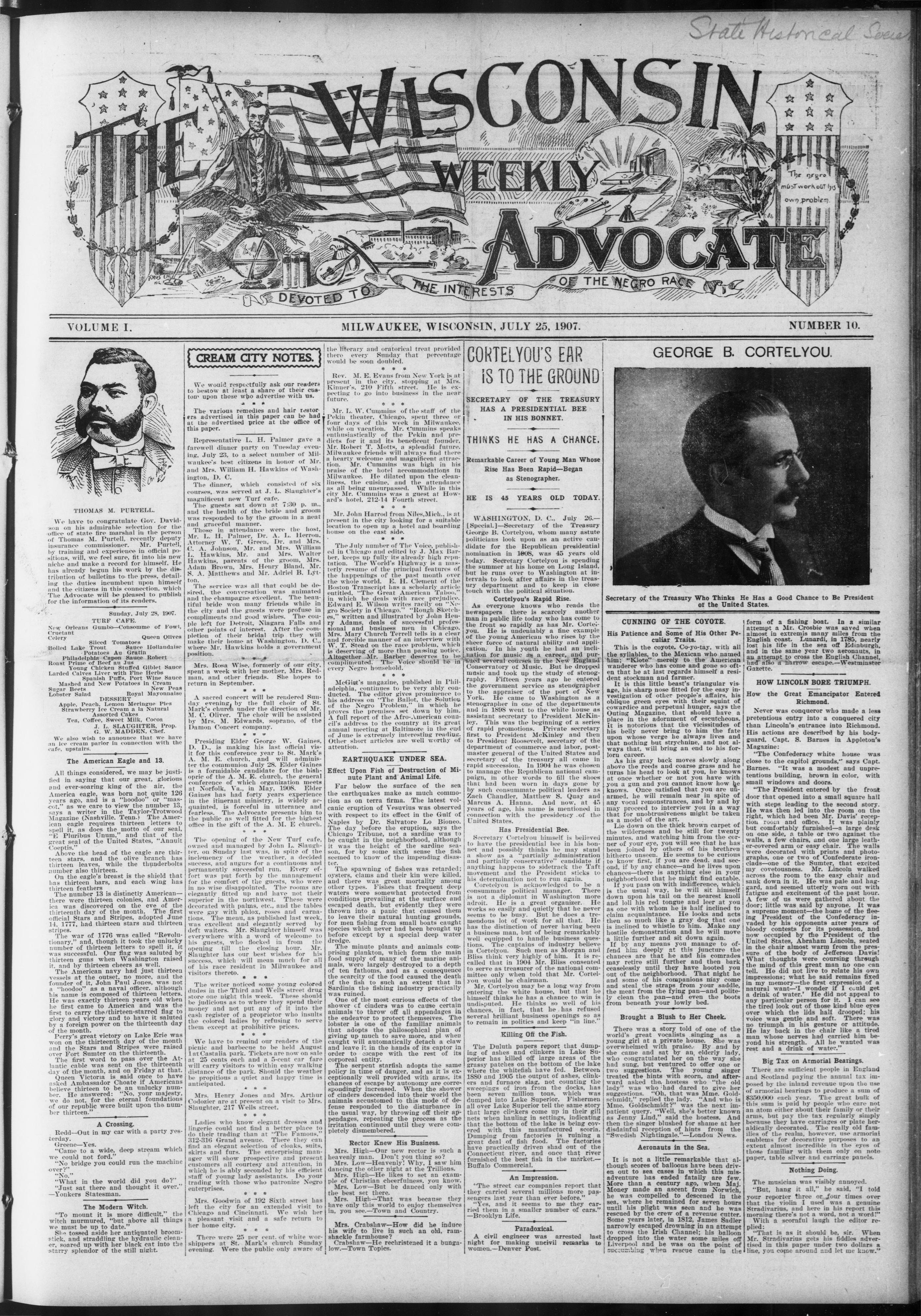
THOMAS M. PURTELL.
We have to congratulate Gov. Davidson on his admirable selection for the office of state fire marshal in the person of Thomas M. Purtell, recently deputy insurance commissioner. Mr. Purtell, by training and experience in official positions, will, we feel sure, fit into his new niche and make a record for himself. He has already begun his work by the distribution of bulletins to the press, detailing the duties incumbent upon himself and the citizens in this connection, which The Advocate will be pleased to publish for the information of its readers.
SUNDAY, July 28, 1907.
TURF CAFE.
New Orleans Gumbo—Consomme of Fowl,
Cruetant
Celery
Queen Olives
Sliced Tomatoes
Bolled Lake Trout
Sauce Hollandaise
Potatoes Au Gratin
Philadelphia Capon Sauce Robert
Roast Prime of Beef au Jus
Young Chicken Stuffed Giblet Sauce
Larded Calves Liver with Fine Herbs
Spanish Puffs, Port Wine Sauce
Mashed and New Potatoes in Cream
Sugar Beets
New Peas
Lobster Salad
Royal Mayonnaise
DESSERT
Apple, Peach, Lemon Meringue Pies
Strawberry Ice Cream a la Natural
Assorted Cakes
Tea, Coffee, Sweet Milk, Cocoa
J. L. SLAUGHTER, Prop.
G. W. MADDEN, Chef.
We also wish to announce that we have
an ice cream parlor in connection with the
cafe, upstairs.
The American Eagle and 13.
All things considered, we may be justified in saying that our great, glorious and ever-soaring king of the air, the America eagle, was born not quite 126 years ago, and is a "hoodoo" or "mascot." as we care to view the number 13, says a writer in the Taylor-Trotwood Magazine (Nashville, Tenn.) The American eagle requires thirteen letters to spell it, as does the motto of our seal, "E Pluribus Unum," and that of the great seal of the United States, "Annuit Coeptis."
Above the head of the eagle are thirteen stars, and the olive branch has thirteen leaves, while the thunderbolts number also thirteen.
On the eagle's breast is the shield that has thirteen bars, and each wing has thirteen feathers.
The number 13 is distinctly American—there were thirteen colonies, and America was discovered on the eve of the thirteenth day of the month. The first official Stars and Stripes, adopted June 14, 1777, had thirteen stars and thirteen stripes. The war of 1776 was called "Revolutionary," and, though it took the unlucky number of thirteen letters to spell it, it was successful. Our flag was saluted by thirteen guns when Washington raised it, and by thirteen cheers as well.
The American navy had just thirteen vessels at the outset, no more, and the founder of it, John Paul Jones, was not a "hoodoo" as a naval officer, although his name is composed of thirteen letters. He was exactly thirteen years old when he first came to America and was the first to carry the/thirteen-starred flag to glory and victory and to have it saluted by a foreign power on the thirteenth day of the month. Perry's great victory on Lake Erie was won on the thirteenth day of the month and the Stars and Stripes were raised over Fort Sumter on the thirteenth.
The first word to pass over the Atlantic cable was sent on the thirteenth day of the month, and on Friday at that. Queen Victoria is said once to have asked Ambassador Choate if Americans believe thirteen to be an unlucky number. He answered: "No, your majesty, we do not, for the eternal foundations of our republic were built upon the number thirteen."
A Crossing.
Redd—Out in my car with a party yesterday.
Greene—Yes.
"Came to a wide, deep stream which we could not ford."
"No bridge you could run the machine over?"
"No."
"What in the world did you do?"
"Just sat there and thought it over."
—Yonkers Statesman.
The Modern Witch.
"To mount it is more difficult," the witch murmured, "but above all things we must be up to date." She tossed aside her antiquated broomstick, and straddling the hydraulic cleaner, soared up with her black cat into the starry splendor of the still night.
CREAM CITY NOTES.
We would respectfully ask our readers to bestow at least a share of their custom upon those who advertise with us.
The various remedies and hair restorers advertised in this paper can be had at the advertised price at the office of this paper.
Representative L. H. Palmer gave a farewell dinner party on Tuesday evening, July 23, to a select number of Milwaukee's best citizens in honor of Mr. and Mrs. William H. Hawkins of Washington, D. C.
The dinner, which consisted of six courses, was served at J. L. Slaughter's magnificent new Turf cafe.
The guests sat down at 7:30 p. m., and the health of the bride and groom was responded to by the groom in a neat and graceful manner. Those in attendance were the host, Mr. L. H. Palmer, Dr. A. L. Herron, Attorney W. T. Green, Dr. and Mrs. C. A. Johnson, Mr. and Mrs. William L. Hawkins, Mr. and Mrs. Walter Hawkins, parents of the groom, Mrs. Adam Brown, Mrs. Henry Bland, Mr. S. A. Matthews and Mr. Adriel B. Lytton.
The service was all that could be desired, the conversation was animated and the champagne excellent. The beautiful bride won many friends while in the city and the guests were profuse in compliments and good wishes. The couple left for Detroit, Niagara Falls and other points of interest. After the completion of their bridal trip they will make their home at Washington, D. C., where Mr. Hawkins holds a government position.
Mrs. Rosa Wise, formerly of our city, spent a week with her mother, Mrs. Redman, and other friends. She hopes to return in September.
* * *
A sacred concert will be rendered Sunday evening by the full choir of St. Mark's church under the direction of Mr. M. C. Oliver. The choir will be assisted by Mrs. M. Edwards, soprano, of the Damon Concert company.
Presiding Elder George W. Gaines, D. D., is making his last official visit for this conference year to St. Mark's A. M. E. church, and will administer the communion July 28. Elder Gaines is a formidable candidate for the bishopric of the A. M. E. church, the general conference of which organization meets at Norfolk, Va., in May, 1908. Elder Gaines has had forty years experience in the itinerant ministry, is widely acquainted, is forceful in utterance and fearless. The Advocate presents him to the public as well fitted for the highest office in the gift of the A. M. E church.
***
The opening of the New Turf cafe, owned and managed by John L. Slaughter, on Sunday last was, in spite of the inclemency of the weather, a decided success, and augurs for a continuous and permanently successful run. Every effort was put forth by the management for the comfort of the guests, who were in no wise disappointed. The rooms are elegantly fitted up and have not their superior in the northwest. These were decorated with palms, etc., and the tables were gay with phlox, roses and carnations. The menu, as published last week, was excellent and elegantly served by deft waiters. Mr. Slaughter himself was everywhere with a word of welcome to his guests, who flocked in from the opening till the closing hour. Mr. Slaughter has our best wishes for his success, which will mean much for all of his race resident in Milwaukee and visitors thereto.
The writer noticed some young colored dudes in the Third and Wells street drug store one night this week. These should be judicious as to where they spend their money and not put any of it into the cash register of a proprietor who insults the colored ladies by refusing to serve them except at prohibitive prices.
* * *
We have to remind our readers of the picnic and barbecue to be held August 1 at Castalia park. Tickets are now on sale at 25 cents each and a 5-cent car fare will carry visitors to within easy walking distance of the park. Should the weather be propitious a quiet and happy time is anticipated.
Mrs. Henry Jones and Mrs. Arthur Codozier are at present on a visit to Mrs. Slaughter, 217 Wells street.
\* \* \*
Ladies who know elegant dresses and lingerie could not find a better place to do their trading than at "The Famous," 312-316 Grand avenue. There they can find an elegant selection of cloaks, suits, skirts and furs. The enterprising manager will show prospective and present customers all courtesy and attention, in which he is ably seconded by his efficient staff of young lady assistants. Do your trading with those who patronize Negro enterprises.
Mrs. Goodwin of 192 Sixth street has left the city for an extended visit to Chicago and Cincinnati. We wish her a pleasant visit and a safe return to her home city.
There were 25 per cent. of white worshippers at St. Mark's church Sunday evening. Were the public only aware of
the literary and oratorical treat provided there every Sunday that percentage would be soon doubled.
* * *
Rev. M. E. Evans from New York is at present in the city, stopping at Mrs. Kinner's, 210 Fifth street. He is expecting to go into business in the near future.
Mr. L. W. Cummins of the staff of the Pekin theater, Chicago, spent three or four days of this week in Milwaukee, while on vacation. Mr. Cummins speaks enthusiastically of the Pekin and predicts for it and its beneficent founder, Mr. Robert T. Motts, a splendid future. Milwaukee friends will always find there a hearty welcome and magnificent attraction. Mr. Cummins was high in his praise of the hotel accommodations in Milwaukee. He dilated upon the cleanliness, the cuisine, and the attendance as all being unsurpassed. While in this city Mr. Cummins was a guest at Howard's hotel, 212-14 Fourth street.
心
Mr. John Harrod from Niles,Mich., is at present in the city looking for a suitable location to open up a hotel and boarding house on the east side.
* * *
The July number of The Voice, published in Chicago and edited by J. Max Barber, keeps up fully its already high reputation. The World's Highway is a masterly resume of the principal features of the happenings of the past month over the whole world. E. H. Clement of the Boston Transcript has a scholarly article entitled, "The Great American Taboo," in which he deals with race prejudice. Edward E. Wilson writes racily on "Negro Society in Chicago." "Rough Sketches," written and illustrated by John Henry Adams, deals of successful professional and business men in Chicago, Mrs. Mary Church Terrell tells in a clear and forcible manner of an interview with W. T. Stead on the race problem, which is deserving of more than passing notice. Altogether Mr. Barber deserves to be complimented. The Voice should be in every Negro household.
* * *
McGirt's magazine, published in Philadelphia, continues to be very ably conducted. The editor gives prominence to his address on "The Ballot, the Solution of the Negro Problem," in which he proves the premises set down by him. A full report of the Afro-American council's address to the country at its great annual meeting at Baltimore in the end of June is extremely interesting reading. Other short articles are well worthy of attention.
EARTHQUAKE UNDER SEA
Effect Upon Fish of Destruction of Minute Plant and Animal Life.
Far below the surface of the sea the earthquakes make as much commotion as on terra firma. The latest volcanic eruption of Vesuvius was observed with respect to its effect in the Gulf of Naples by Dr. Salvatore Lo Bioneo. The day before the eruption, says the Chicago Tribune, not a sardine was to be caught in the neighborhood, although it was the height of the sardine season, for by some sixth sense the fish seemed to know of the impending disaster.
The spawning of fishes was retarded; oysters, clams and their kin were killed, and there was great mortality among other types. Fishes that frequent deep waters were somewhat protected from conditions prevailing at the surface and escaped death, but evidently they were thrown into a panic that caused them to leave their natural hunting grounds, for men fishing from small boats caught species which never had been brought up before except by a special deep water dredge.
The minute plants and animals comprising plankton, which form the main food supply of many of the marine animals, were largely destroyed to a depth of ten fathoms, and as a consequence the scarcity of the food caused the death of the fish to such an extent that in Sardinia the fishing industry practically was ruined.
One of the most curious effects of the shower of cinders was to cause certain animals to throw off all appendages in the endeavor to protect themselves. The lobster is one of the familiar animals that adopts the philosophical plan of giving up much to save more, and when caught will automatically detach a claw and leave it in the hands of its captor in order to escape with the rest of its corporeal entity.
The serpent starfish adopts the same policy in time of danger, and as it is exceptionally well provided with arms, its chances of escape by autonomy are correspondingly increased. When the shower of cinders descended into their world the animals accustomed to this mode of defense responded to the disturbance in the usual way, by throwing off their appendages, repeating the process as the irritation continued until they were completely dismembered.
Rector Knew His Business
Mrs. High—Our new rector is such a heavenly man. Don't you thing so?
Mrs. Low—Heavenly! Why, I saw him dancing the other night at the Trillions.
Mrs. High—He likes to set an example of Christian cheerfulness, you know.
Mrs. Low—But he danced only with the best set there.
Mrs. High—That was because they have only this world to enjoy themselves in, you see.—Town and Country.
Mrs. Crabshaw—How did he induce his wife to live in such an old, ramshackle farmhouse?
Crabshaw—He rechristened it a bungalow.—Town Topics.
WASHINGTON, D. C., July 26. [Special.]—Secretary of the Treasury George B. Cortelyou, whom many astute politicians look upon as an active candidate for the Republican presidential nomination in 1908, was 45 years old today. Secretary Cortelyou is spending the summer at his home on Long Island, but he runs over to Washington at intervals to look after affairs in the treasury department and to keep in close touch with the political situation.
Cortelyou's Rapid Rise.
As everyone knows who reads the newspapers there is scarcely another man in public life today who has come to the front so rapidly as has Mr. Cortei you. He is undeniably a fine example of the young American who rises by the sheer force of natural ability and application. In his youth he had an inclination for music as a career, and pursued several courses in the New England Conservatory of Music. But he dropped music and took up the study of stenography. Fifteen years ago he entered the government service as stenographer to the appraiser of the port of New York. He came to Washington as a stenographer in one of the departments and in 1898 went to the white house as assistant secretary to President McKinley. This was the beginning of a series of rapid promotions. Private secretary first to President McKinley and then to President Roosevelt, secretary of the department of commerce and labor, postmaster general of the United States and secretary of the treasury all came in rapid succession. In 1904 he was chosen to manage the Republican national campaign, in other words to fill the shoes that had been worn in days gone by by such consummate political leaders as Zach Chandler, Matthew S. Quay and Marcus A. Hanna. And now, at 45 years of age, his name is mentioned in connection with the presidency of the United States.
Has Presidential Bee.
Secretary Cortelyou himself is believed to have the presidential bee in his bonnet and possibly thinks he may stand a show as a "partially administration and partially conservative" candidate if anything happens to sidetrack the Taft movement and the President sticks to his determination not to run again.
Coretelyou is acknowledged to be a consummate political manager. There is not a diplomat in Washington more adroit. He is a great organizer. He works so easily and quietly that he never seems to be busy. But he does a tremendous lot of work for all that. He has the distinction of never having been a business man, but of being remarkably well equipped to handle business questions. The captains of industry believe in Cortelyou. Such men as Morgan and Bliss think very highly of him. It is recalled that in 1904 Mr. Bliss consented to serve as treasurer of the national committee only when told that Mr. Cortelyou would be chairman.
Mr. Cortelyou may be a long way from entering the white house, but that he himself thinks he has a chance to win is undisputed. He thinks so well of his chances, in fact, that he has refused several brilliant business openings so as to remain in politics and keep "in line."
Killing Off the Fish.
The Duluth papers report that dumping of ashes and clinkers in Lake Superior has killed off large areas of the grassy patches on the bottom of the lake where the whitefish have fed. Between 1880 and 1905 the output of ashes, clinkers and furnace slag, not counting the sweepings of iron from the docks, has been seven million tons, which was dumped into Lake Superior. Fishermen all over Lake Superior tell the same story that large clinkers come up in their gill nets when hauling in settings, indicating that the bottom of the lake is being covered with this manufactured scoria. Dumping from factories is ruining a great deal of fish food. The factories have practically driven shad out of the Connecticut river, and once that river furnished the best fish in the market.—Buffalo Commercial.
An Impression
"The street car companies report that they carried several millions more passengers last year than ever before."
"Yes, and it seems to me they carried them in a smaller number of cars." Brooklyn Life.
Paradoxical
A civil engineer was arrested last night for making uncivil remarks to women.—Denver Post.
M. H.
Secretary of the Treasury Who Thinks He Has a Good Chance to Be President of the United States.
CUNNING OF THE COYOTE.
His Patience and Some of His Other Peculiar Traits.
This is the coyote. Co-yo-tay, with all the syllables, to the Mexican who named him; "Kiote" merely to the American wanderer who has come and gone so often that he at last regards himself a resident stockman and farmer.
It is this little beast's triangular visage, his sharp nose fitted for the easy investigation of other people's affairs, his oblique green eyes with their squint of cowardice and perpetual hunger, says the Outing Magazine, that should have a place in the adornment of escutcheons.
It is notorious that the vicissitudes of his belly never bring to him the fate upon whose verge he always lives and that nothing but strychnine, and not always that, will bring an end to his forlorn career.
As his gray back moves slowly along above the reeds and coarse grass and he turns his head to look at you, he knows at once whether or not you have with you a gun and you cannot know how he knows. Once satisfied that you are unarmed, he will remain near in spite of any vocal remonstrances, and by and by may proceed to interview you in a way that for unobtrusiveness might be taken as a model of the art.
Lie down on the thick brown carpet of the wilderness and be still for twenty minutes, and watching him from the corner of your eye, you will see that he has been joined by others of his brethren hitherto unseen. He seems to be curious to know first, if you are dead, and second, if by any chance—and he lives upon chances—there is anything else in your neighborhood that he might find eatable.
If you pass on with indifference, which is the usual way, he will sit himself down upon his tail on the nearest knoll and loll his red tongue and leer at you as one with whom he is half inclined to claim acquaintance. He looks and acts then so much like a gray dog that one is inclined to whistle to him. Make any hostile demonstration and he will move a little further and sit down again.
If by any means you manage to offend him deeply at this juncture the chances are that he and his comrades may retire still further and then bark ceaselessly until they have hooted you out of the neighborhood. That night he and some of his companions may come and steal the straps from your saddle, the meat from the fying pan—and politely clean the pan—and even the boots from beneath your lowly bed.
Brought a Blush to Her Cheek.
There was a story told of one of the world's great vocalists singing as a young girl at a private house. She was overwhelmed with praise. By and by she came and sat by an elderly lady, who congratulated her on the way she had sung, but ventured to offer one or two suggestions. The young singer treated the hints with scorn, and afterward asked the hostess who "the old lady" was who had dared to give her suggestions. "Oh, that was Mme. Goldschmidt?" replied the lady. "And who is Mme. Goldschmidt?" was the next impatient query. "Well, she's better known as Jenny Lind," said the hostess. And then the singer blushed for shame at her disdainful reception of hints from the "Swedish Nightingale."—London News.
Aeronauts in the Sea
It is not a little remarkable that although scores of balloons have been driven out to sea cases in which this misadventure has ended fatally are few. More than a century ago, when Maj. Money made an ascent from Norwich, he was compelled to descended in the sea, where he remained for seven hours until his plight was seen and he was rescued by the crew of a revenue cutter. Some years later, in 1812, James Sadler narrowly escaped drowning in an attempt to cross the Irish Channel; his balloon dropped into the water some miles off Liverpool and he was on the point of succumbing when rescue came in the
form of a fishing boat. In a similar attempt a Mr. Crosbie was saved when almost in extremis many miles from the English coast. Lunardi, in 1785, nearly lost his life in the sea off Edinburgh, and in the same year two aeronauts, in an attempt to cross the English Channel, had also a narrow escape.—Westminster Gazette.
HOW LINCOLN BORE TRIUMPH
How the Great Emancipator Entered Richmond.
Never was conqueror who made a less pretentious entry into a conquered city than Lincoln's entrance into Richmond. His actions are described by his bodyguard, Capt. S. Barnes in Appleton's Magazine:
"The Confederacy white house was close to the capitol grounds," says Capt. Barnes. "It was a modest and unpretentious building, brown in color, with small windows and doors.
"The President entered by the front door that opened into a small square hall with steps leading to the second story. He was then led into the room on the right, which had been Mr. Davis' reception room and office. It was plainly but comfortably furnished—a large desk on one side, a table or two against the walls, a few chairs, and one large leather-covered arm or easy chair. The walls were decorated with prints and photographs, one or two of Confederate ironclads—one of the Sumter, that excited my covetousness. Mr. Lincoln walked across the room to the easy chair and sank down in it. He was pale and haggard, and seemed utterly worn out with fatigue and excitement of the past hour. A few of us were gathered about the door; little was said by anyone. It was a supreme moment—the home of the fleeing President of the Confederacy invaded by his opponents after years of bloody contests for its possession, and now occupied by the President of the United States, Abraham Lincoln, seated in the chair almost warm from the pressure of the body of Jefferson Davis! What thoughts were coursing through the mind of this great man no one can tell. He did not live to relate his own impressions; what he said remains fixed in my memory—the first expression of a natural want—'I wonder if I could get a drink of water.' He did not appeal to any particular person for it. I can see the tired look out of those kind blue eyes over which the lids half drooped; his voice was gentle and soft. There was no triumph in his gesture or attitude. He lay back in the chair like a tired man whose nerves had carried him beyond his strength. All he wanted was rest and a drink of water."
Big Tax on Armorial Bearings.
There are sufficient people in England and Scotland paying the annual tax imposed by the inland revenue upon the use of armorial bearings to produce a sum of $350,000 each year. The great bulk of this sum is paid by people who care not an atom either about their family or their arms, but pay the tax regularly simply because they have carriages or plate heraldically decorated. The really old families of the realm, however, use armorial emblems for decorative purposes to an extent almost incredible in the eyes of those familiar with them only on note paper, table silver and carriage panels.
Nothing Doing
The musician was visibly annoyed.
"But, hang it all," he said, "I told your reporter three or four times over that the violin I used was a genuine Stradivarius, and here in his report this morning there's not a word, not a word!"
With a scornful laugh the editor replied:
"That is as it should be, sir. When Mr. Stradivarius gets his fiddles advertised in this paper under two dollars a line, you come around and let me know."
THE WISCONSIN WEEKLY ADVOGATE
MILWAUKEE, WIS.
B. B. MONTGOMERY, Editor and Proprietor.
Facts and Fancies.
No one ever sees that he is unjust; at most he admits that he has been.—Fliegende Blaetter.
When a man complains of the egotism of others, he usually does so because it prevents him from displaying his own.—Fliegende Blaetter.
Mrs. Howard—A place where a boat lands is a pier. Now what will they call the place where an air ship lands?
Mr. Howard—A sky-light, my love.—Town Topics.
Passenger—I would, but I should have to wait then, as I am not expected until the arrival of this train.—Sketching Bits.
Couldn't Understand It.
Principal (to senior clerk who wants to get married)—What! isn't one master enough for you?—Meggendorfer Blaetter.
Shocking.
Hickory, dickory, dock,
The mouse ran up the clock;
The clock was on a girl's silk stocking;
Fie, little mouse, it's shocking, shocking
Not His Own.
"Comparini has given up smoking, eh? That takes a good deal of will power." "Yes, his wife has it."—Il Diavola Rosa.
Locating the Bills.
Bill—When they speak of the Utilities Bill, do they refer to Bryan?
A Slow Train
Irate Passenger (to guard of train stopping at all stations)—How many more stations are we going to stop hanging round at before we crawl into—?
His Country House.
Tramp (looking at his friend's body in the Paris morgue)—He always said that he would spend his last days in a little house on the edge of the water!— Le Rire.
An Imminent Danger
let introducing liquors home.
"Yes, I can imagine they see the danger of taking a drop too much."—Cleveland Plain Dealer.
After the Explosion
De Style—Does your motor cover much ground?
Gumbusta—One of them did. Why, parts of it were found in three different counties—London Tatler.
The Difference
Mrs. Crimsonbeak—When a dog wags his tail, he's not mad, is he?
Mr. Crimsonbeak—No, but it's often different when a woman wags, her tongue!—Yonkers Statesman.
The Summer Vacation
40 weeks' anticipations,
10 of bustling preparation,
1 to pack and reach the station,
1 of final realization.
52 —Outing Magazine
Skeptical in Part.
Mrs. Oldum—I suppose you wouldn't believe I am a grandmother at thirty-seven?"
Belle—Oh, I can believe the grandmother part of it all right.—Illustrated Bits
In the Jungle
Mrs. Python—I think Mrs. Cobra is very extravagant.
Mrs. Boa—In what way?
Mrs. Python—I see she has got her baby another new rattle.—Baltimore American.
Unheeded.
She—Last night was the fourteenth time that I've dreamed of a seaside resort.
Husband—Good! You certainly must have had enough of it already!—Meggendorfer Blaetter.
An Alternating Wife.
"Henry, what is this dark hair doing on your coat?"
"I haven't wore that coat since last month, dear. You were a brunette then."
"Oh, yes."—Washington Herald.
Great Thing for Managers
"A French invention, consisting of bulb thermometers, predicts at sundown whether there will be a frost," said the citizen.
"I've certainly got to have one of them," replied the theatrical manager. Yonkers Statesman.
Justified.
"You are charged with having knocked your wife down, blacking both of her eyes and loosening two of her teeth; have you anything to say for yourself?" "She had it comin' to her, your honor." "What did she do or say that could in any way justify such treatment on your part?" "She said I didn't love her no more."—Houston Post.
Subsidize Large Families.
In the French Senate there is a man who has forced the general government to begin subsidizing large families. This is Senator Edme Piot. Son of a Burgundian family so poor that he was kept from school to work in the fields he broke stone on the highways and worked over all France as a navy, but as early as 1854 he was taking small contracts on his own account, and he finally became the greatest of all French railway contractors. Becoming very rich Senator Piot has made himself famous through all Burgundy by a special kind of liberality—the financial helping of poor parents. He is the great authority on depopulation.
A Stinging Retort.
A gentleman purchased at the postoffice a large quantity of stamped envelopes, newspaper wrappers and other postal requisites.
Finding them somewhat difficult to carry, he asked one of the counter clerks if he could supply him with a small quantity of string.
"We are not permitted by the department to supply string," was the reply.
"Then give me a bit of red tape," was the sarcastic retort. The string was supplied.—Sketch.
THE TREASURE TRAIL.
The bright torch of the sinking sun
Lights a gold-path across the sea.
Could I but track it to its end—
What treasures would not flash for me?
To low keys where old picaroons,
Their pluider-chests sunk in the sand,
The flaring lamp might guide my sails
And light me as I delved the strand.
The wide adventures of my dreams
Might come to pass, could I but be
The skipper of a bark—and know
No masters save the sun and sea!
Yet from the sunset trail I turn—
Its lure would lead me blind and old;
And, by the light in my love's eyes,
I seek what treasure a heart may hold!
CAMILLE
Camille's eyes were apt to linger on the red-tiled attractive house until a gray-haired man with a slight stoop came slowly out on the stone pillared porch, and sinking in a cushioned chair would lean back wearily, letting the sun creep up and pour over him as it flooded the garden with warmth and light, among a storm of joyous twittering from sparrows, thrush and redbird.
Camille, young and energetic, while busy with her sweeping and dusting and the care of her flowers in boxes in the bay window, felt a profound compassion for the invalid across the way, whose great wealth could not give him health or the sympathetic companionship he must crave, Camille felt sure. His valet and butler and respectable looking housekeeper, whom Camille met one evening when taking a short cut to the shopping street of the little town, as she passed in front of the gate, were all very attentive to their employer. Money could command that, of course. But Alexander Reed, who was not yet middle aged, seemed very lonely, had a highbred, handsome face, in spite of its thinness and pallor, and his smile was very attractive, Camille thought, the day his horses plunged and reared at sight of her sitting by the roadside reading. He had raised his hat and bowed, smilingly, when the coachman, quieting them, drove off rapidly.
Camille's life was a very busy one. What time she could spare from her ministrations on her sweet, timid mother, for whose health Camille had taken the cottage in the pretty town among the mountains of the Blue Ridge, was devoted to giving French and music lessons, even up to 9 o'clock at night, when Carl Haumpton, a rich coal dealer, insisted on learning verbs and genders three times a week.
How was Camille to guess it was the beauty of her gray eyes and oval face and admiration for her courageous acceptance of life's burdens, and her loving devotion to the gentle invalid, which had induced the stout and prosperous German whom she had met casually to plunge into the study of French, which he abhorred?
"Money! Money is the most important thing in life, little mother," Camille declared while kneeling in front of the fire toasting muffins and making chocolate for the invalid.
"I thought you said love and home happiness were the most important," her mother answered, smiling.
"That was long ago. Today I put money first, because money gives health and happiness," Camille declared, brightly. "Just think of all I could do for you, mumsey, if we were rich. The doctor says you ought to go out for hours every day. Wouldn't it be glorious if I could order up a comfortable carriage and take you driving every afternoon?"
"If money could give back health our neighbor across the way, who owns such a beautiful home, would get well and strong. The doctor says he is gradually sinking. He does not seem to take the least interest in anything. Dr. Perrin told me yesterday he scattered his wealth lavishly to help others, and that while he professes no religion, he is a great philanthropist. He is always doing kind deeds in an unostentatious way."
Ann, the small country girl whom Camille employed to help in household matters, ran in excitedly to say that Mr. Reed's carriage was at the front door. His note to Camille's mother, handed in by the footman, begged her to make use of it for a drive, the weather being so fine
"Did I not say, little mother, that money is the greatest blessing in the whole world?" Camille said joyously, having accepted in a formal note of thanks their neighbor's victoria, while getting her mother into some warm wraps, and gayly pinning on her own hat.
"Money gives the means to do a kindness, child, but not the heart or the goodness to execute it," her mother rejoined, whereat Camille laughed and hurried off for the drive.
It was the beginning of a very pleasant acquaintance with the invalid master of Stone Lodge.
It was the beginning of a very pleasant acquaintance with the invalid master of Stone Lodge.
As the spring days lengthened and drew into summer, whenever Camille could command the time the little maid Ann was dispatched down the path behind the cottage to Stone Lodge with a message, and a long drive through the odorous woods and mountains that evening gave Camille's mother a good night's rest
Alexander Reed was too important a personage to be overlooked. The notables of the bright little town and the wealthy tourists, owning summer residences on the heights around, all called on him, but a formal return visit usually ended their acquaintance—except with Dr. Perrin, a keen-eyed old physician, who had a cynical knowledge of life, and an abhorrence of the shame and flatteries of society, and whose carefully hidden good deeds kept him poor in spite of a lucrative practice; for this pretty town was a favorite resort of the millionaire health seeker.
"It is as rare as it is refreshing to come in contact with real merit," remarked Dr. Perrin, rubbing his knees reflectingly as he sat in front of a bright wood fire in the library at Stone Lodge, for the early June days were cool, and fires were pleasant in the evening.
"Yes," Alexander Reed answered, with polite listlessness, while seeing Camille's face in the dancing flames.
"Yes, real merit," repeated the doctor.
"Now, this child Camille, Louis Herndon's daughter—why, there is more downright merit in her life than in that of the pretentious benefactors rolling in gold with their ostentatious gifts and donations who parade themselves in the public eye.
"Do you know," Dr. Perrin continued, turning his strong, rugged face toward
the pale, melancholy man reclining nervelessly in his chair, speaking with softened emotion, "not only does that child support her mother and herself by her clever, courageous efforts, but she looks after a poor, bedridden old hag, Ann's mother, a pitiful wretch, who doesn't know the meaning of the word gratitude, and now I hear she has got work for the boy, Ann's brother. She sews for the orphans, and her life is spent helping others. Not one moment of her time is misused. A brave, noble child. If ever the sun shone on a being of superior worth it does on Camille. Her father, John, and I were college mates," the doctor concluded, getting up to go.
A look of keen interest came over the invalid's face. He made a motion to stop the doctor. Would she consent to give some of her time to an invalid, he asked. "If she will read to me daily it will soften the long, tedious hours. Persuade her, doctor. The remuneration will be large, for the service would be great." "I will bring her tomorrow at 12," said the doctor, as he turned and left the room.
Camille was delighted, for the price offered seemed fabulous to her. By getting up one hour sooner and giving a music lesson before breakfast, she had ample time for reading daily to Alexander Reed. Her voice was sweet and low, and she had the gift of throwing herself into the story she read, and she was a good French scholar. Her mother was of an old Creole family, originally titled folks, who came over from France in the earliest centuries.
The daily readings often occupied only a few moments. Alexander Reed was a man of culture and many attainments, and his leisurely wanderings had taken him to far-distant lands and among strange people. Camille found an infinite charm in his vivid impersonal descriptions and word paintings, and to the world-worn man the young girl's fresh enthusiasm and wholesome, keen sighted appreciation were a perpetual delight. The hour was apt to lengthen out, and it was always a surprise to Camille when Mrs. Harris, the sedate housekeeper, appeared with a tea tray.
Mrs. Harris' satisfaction was obvious at the increased animation plainly visible in the invalid's manner, while the faint flush on his cheek and the glow in his dark eyes were symptoms of a long forgotten contentment of spirit, possibly signs of returning health. Therefore, the old housekeeper approved of the reading lessons and their effect.
One day a joyous color swept over Camille's face when Ann rushed in to announce breathlessly that Mr. Reed and the doctor had called.
'What a delightful surprise,' Camille said, ushering them in the little sitting room, filled with her plants and flowers.
How kindly was the light in the deep, gray eyes, and how handsome was the invalid's face in spite of its care-worn look. How beautiful was the smile with which he took Camille's hands in his and held them fast.
"I have come," he whispered, "to crave a boon. Be generous, little one, and grant it. Shed the light of your lovely presence on the few remaining years left me, and accept a devotion as boundless as eternity. Give me the right to protect the being I love beyond life, or the hope of eternal bliss."
Camille raised wondering eyes to his, the color receding slowly from her face. She shivered slightly.
"It is no boon," she said gently. "It is my heart's desire. How could I ever part from you?"—S. Rhett Roman in the New Orleans Times-Democrat.
His Way of Escape
A Colorado man who is visiting in Wellington told H. L. Woods this story: The game warden of Colorado was walking out in the mountains the other day, when he met a hunter with his gun. The official suggested that that ought to be a good country for hunting.
"It certainly is," said the hunter proudly. "I killed one of the finest bucks yesterday I ever saw and he weighed over 200." It was the season when deer may not be shot without subjecting the hunter to a heavy fine.
"Well, that is a fine one," said the warden. "and do you know who you are talking to?"
Being assured that he did not the official said:
"Why, I am the chief game warden of Colorado."
The hunter was only taken back a moment when he said: "And do you know who you are talking to?"
The warden did not know.
"Well, sir," said the hunter, apparently much relieved, "you are talking to the biggest liar in the whole state of Colorado."—Kansas City Star.
Cannon Balls of Stone.
On either side of the entrance to the naval asylum, on Gray's Ferry road, is an immense stone sphere, measuring about twenty-five inches in diameter. There is a legend that these were used or intended for use in a Turkish mortar, "the largest piece of ordnance in the world."
These balls were given to the institution soon after the founding by Commodore J. D. Elliott, who obtained them during a cruise on the frigate Constitution in European waters. An inscription on one of the balls relates that they were obtained on the Asiatic side of the Dardanelles, and it is within the realms of possibility that the Turks may have intended them to serve as shot in a mortar. It is also more than probable that with sufficient powder to project them the stones would have been badly shattered. Commodore Elliott presented them in 1838, and ever since then they have ornamented the entrance and mystified curious visitors.—Philadelphia Public Ledger.
Derivations.
Posters were originally stuck on posts. Hence their name.
Rodomontade comes from Rodomont, King of Sarza, a braggart and swash-buckler.
Cutpurses are so called because in the past the purse was worn about the neck by a long cord that the thief had to cut.
The tinkers of old, to prevent their solder from running, borrowed a lump of dough from the housewife, with which they made a dam about the hole that was to be caulked up. When they were done with the soiled dough, which was called a tinker's dam, they threw it away because it was utterly worthless. Hence, not to care "a tinker's dam" means not to care the least bit, and there it no profanity whatever in this phrase.
Soft Fabric Made from Stone
The Russians manufacture a fabric from the fiber of a filamentous stone from the Siberian mines which is said to be of so durable a nature that it is practically everlasting. The material is soft to the touch and pliable in the extreme and has only to be thrown into a fire when dirty to be made absolutely clean.
Julia Laughed Last.
"A wife without a smile" we've seen, Unmoved by jest or chaff. 'Tis capped by Julia, maid serene, The girl without a laugh:
Whom Alfred Gleed, her plighted beau,
Threw over in a pique,
Because she hadn't chuckled—no,
Not for a whole long week.
The jury held the reason not
Sufficient for the deed;
And so for damages they shot
The laughter-loving Gleed.
They say the two have now changed round,
Reversed is now their case;
The laugh on Julia's lips is found—
The gloom on Alfred's face.
—London Truth.
BRIEF NOTES OF
GENERAL INTEREST
Because fifteen babies have been born to six couples at Town Creek, Ala., in the last two weeks a petition has been made to the postal authorities to have the name of this village changed to Teddytown.
Because James Allen, colored, 18 years old, had driven his horse when told not to do so Russell Young, a young farmer living near Taylor, Mo., shot the boy, killing him almost instantly. The coronor's jury returned a verdict that the killing was done in selfdefense.
Carson Emery was arraigned in court at Logansport, Ind., charged with snoring so loudly that he kept neighbors from sleeping.
"He lives two blocks from me," said Louis E. Garber, the prosecuting witness, "but last night he kept me awake by his snoring."
Police Judge Smith put Emery under a $50 bond to keep the peace.
Mysterious robberies in the home of Mills Manning of Detroit, that have been bothering Manning and the police since last June, were cleared up in a confessio made by Mrs. Manning. She admits committing all the robberies and explains that she did it because at times she was seized with an uncontrollable desire to destroy things, and at other times she took money and household articles because she was angry at her husband.
The school census of Terre Haute, Ind., contains the names of for children of a woman 31 years old. Fourteen of them are represented as being 17 years old. This is shown by the reports of agents of the state superintendent of education, who investigated charges that the persons who compiled the school enumeration and were paid 3 cents a name, padded the lists. Hundreds of names of persons far over the school age are included in the lists.
"You may laugh now, but I'll laugh later," Joseph Parker said as he climbed into a chair in the office of E. D. House, a dentist of Kansas City, Mo. A few minutes later he was dead.
Parker wanted several teeth extracted and was given chloroform. After taking several inhalations his body stiffened and respiration ceased. Dr. D. E. Cooper was called, and for an hour the physician and the dentist worked to resuscitate him, but failed.
Because his sweetheart left her home in Delaware to go to Los Angeles, George Crichton, a private enlisted in the fourth company of coast artillery at Fort Dupont, Del., deserted the army and followed the girl to the coast. Disappointed at not being able to find her and foot sore, weary and half sick, he surrendered himself to the recruiting officers at Bakersfield, Cal., and is lodged in the county jail and must face a court martial with the prospect of a long term in the military prison on Alcatraz island ahead of him.
Beatrice, Neb., is the first city in the world to get gas from straw and corncobs.
The new plant, the idea of Rev. Charles Eaton of Cleveland, said to be backed by John D. Rockefeller, was opened the other day.
The method promises to be a great windfall to the western country, as the raw materials are procured for almost nothing.
Gas is now being furnished to this city at a rate of $1.19 per 1000 feet, the lowest price given to any city in Nebraska.
Lawyers who make a specialty of divorce cases already have discovered a method by which they can evade Iowa's new marriage-after-divorce law, they say. There is a joker in the new law. It is a clause which says that by permission of the judge granting the decree the parties may remarry as soon as they desire. It is only necessary to insert in the divorce decree these words: "And the parties to this case are hereby expressly permitted to remarry at any time they so desire." When the signature of the judge is affixed to a decree of this kind the purpose of the law is knocked out.
A game of "Joan of Arc," in which the participants were all girls under 10 years old, resulted in fatal injuries at Minneapolis to little Mia Vjorling, who played the part of Joan. A huge bonfire supplied the setting for the historical drama, of which the children had been told by their teachers. They circled gaily about the fire. As Mia approached the pyre, singing happily, a gust of wind blew the flames in her face and she fell foremost into the fire. Her cries brought the assistance of a neighbor, who wrapped his coat about her. She was taken to the city hospital and will die.
When the "gentlemanly appearing agent" passed among the audience at a circus in Kenton, O., and William Carra, a prosperous young business man of Bellecater, purchased two tickets for the concert he little thought it would be the cause of his marriage an hour later. A prepossessing young woman sang a sentimental ballad. It proved too much for William, and he breathed a proposal to Miss Nellie Jones, whom he had escorted to the circus. He was accepted, and the couple were married by Rev. W. T. Pinkerton at the Disciple parsonage in Kenton after slipping away from their friends.
William McCarty, who was arrested by Mrs. Sophia Demuth, of Alton, Ill., was fined $200 by Magistrate Grosse. McCarty met Mrs. Demuth, who is a probationary officer, in front of the Citizens' National bank. "Good evening," he said, pleasantly, raising his hat.
Mrs. Demuth is about 5 feet 8 inches tall, weighs 175 pounds, is 45 years old and gray-headed. The man arrested is about the same age.
Rev. Mr. Wasser, pastor of the Methodist Episcopal church of Mason City, Ia., and Rev. Mr. Moore of the Congregational church at Clear lake were hung in effigy the other night.
This action is the result of a fight now being waged upon band concerts in
a local park on Sunday. Members of the churches marched to the park and held song service in opposition to the band concert
The players silenced their horns, raised their hats, and quietly left, but Dr. Wasser had hardly warmed up in his theme when a heavy rain dispersed the crowd.
Ole C. Haugen, a well known contractor of Stanley, Wis., has just received a letter mailed to him at Lavirk, Norway, on November 18, 1875, addressed to him at Minatitlin, Mexico, whither as a boy of 18 years he had gone. The letter was written by a boyhood sweetheart. He was not at Minatitlin when the letter came. Mr. Haugen found his way to South America and later returned to Norway. A quarter of a century ago he came to this county and has since then reared a family. During all these years the letter had lain in the archives of the Mexican postoffice. Last month it was returned to Norway and was subsequently sent to Stanley.
Rev. Thomas W. Grafton, pastor of the Central Christian Church of Anderson, Ind., held a bottle of beer up before his congregation Sunday night during a discourse on law enforcement and pointed to its purchase that day as an evidence that the Sunday laws were not being enforced. He said that the beer had been bought at a saloon without any questions being asked and that it was proof positive that the authorities were not sincere in their efforts to close the saloons. The next morning Rev. Mr. Grafton was served with a subpoena to appear in the police court, and when he refused to say where the beer was bought the judge fined him $25 for contempt.
Firmly believing that a woman has no chance to earn a living, Mrs. Norris, who says her home is in Des Moines, persists in wearing men's clothing. Last week, after working for several days as a waiter at Lake Manawa, a summer resort, near Omaha, Mrs. Norris was arrested in Council Bluffs. She was released with a caution and immediately came to Omaha, where, again wearing masculine attire, she applied at one of the leading restaurants for a job, giving her name as Tim Smith. Tuesday morning in police court she was fined $1 and costs. In defense of her actions she pleaded she was capable of doing the same work as a man and thought she was entitled to the same pay.
---
Seizing 2200 bottles of beer that Sheriff George Ross of Dallas county, Ia., had confiscated July 4, seven co-eds and school teachers attending a summer school at Adel took the stuff to the Racoon river and smashed the entire number to bits on piers in the river. Miss Ethel Kent and Miss Julia Fagen, graduates of the Cedar Falls normal school, were visiting Miss Ruth Ross, daughter of the sheriff. Hearing of the seizure, they invaded a justice court, where the liquor was stored, and loaded it on wagons. They enlisted in the cause Misses Myrtle Egan, Estell Meadows, Crystal Fowler, and Muriel Beam. With Mayor Rea Thornton as master of ceremonies they proceeded to the river shore.
"This box contains fifty quarts of wine for sacramental purposes. It is introduced into Indian Territory by special permission of the war department. Any one who interferes with it will be prosecuted."
This is the proposition that the officers ran up against at McAlester, Ind. T. The wine was consigned to Rev. Peter Layman at Alderson. The wine was confiscated by Marshal W. E. Johnson, who wired the department of the interior to ask what should be done with the wine. He has not yet been advised.
The same afternoon the officers found a large and dilapidated trunk at one of the depots that was heavy enough to be full of liquor. Johnson opened the trunk and found it full of Bibles.
Hundreds of lives were imperiled when Floyd E. Webber, engineer of a fast west-bound Lake Shore passenger train was stricken unconscious at his throttle and the train sped almost into Cleveland without a guiding hand. The engineer was overcome by the intense heat. As the engine rocked into the Cleveland yards over the switch points the motion threw the engine driver from his seat to the floor of the cab. Then the fireman learned what had happened. He jumped to the engineer's seat, leaving his companion helpless on the footboards, while he brought the speed of the train down within the yard limits. Webber's condition was found to be critical. How long he had been unconscious at the throttle is not known.
K. K. Scheneck, county attorney at Topeka, started a crusade that is calculated to cause considerable consternation to persons afflicted with insomnia, stomach trouble and various other complaints which they declare only beer, wines or whisky can relieve. The county attorney has decreed that every man who buys liquor of the drug stores in Topeka must sign his own and real name to the affidavit which the purchaser makes that the liquors are to be used for medicinal purposes and that they are absolutely necessary to the health, comfort and happiness of the signer. The county attorney has sworn out a warrant for the arrest of Oscar C. Oliver on the charge of forgery, as a starter. If Oliver is convicted he cannot escape with less than two years in the county jail.
As a north bound Ashland avenue car in Chicago reached West Taylor street an excited passenger jumped from his seat and rang up a fare. The conductor, who has to make good to the company, grabbed the man, shouting:
"Hey, you chump, what are you doing?"
"Ringing up the fare for the new passenger there."
When the conductor looked about he beheld an 8-pound squalling girl that had just come to life in the car. Mrs. Susan Setek, 38 years old, the mother of the new passenger, was attended by a nurse who happened to be on the car. She was afterward taken with the baby to the county hospital, where it is said that the new citizen and her mother are doing nicely.
A party of twenty-two gypsies, men, women, and children, is stranded at the top of the great St. Bernard pass, says a cable from Geneva. The circumstances leading to their dilemma are curious. They ascended from Italy, whence they had been expelled, intending to go to Switzerland. Arriving at the summit of the pass, they found Swiss gendarmes, who refused to allow them to enter Swiss territory. They were unable to return to Italy, as Italian gendarmes had followed them to see them across the frontier. The wanderers now are camped on an elevation 8100 feet and unable to advance or retreat. They may die of cold unless either Italy or Switzerland gives way. The monks of St. Bernard are feeding them and lending them warm clothing, but the refugees cannot find shelter in the hospice because it is in Swiss territory.
Developing a case of raving insanity while at the throttle of his locomotive pulling a heavy freight train over a single track of the Rock Island main line in Iowa, Benjamin Merksen, the engineer, drove his iron horse from Valley Junction to Atlantic, a distance of eighty miles, before his fireman was able
to overcome him. When the train reached here it required the efforts of several men to remove the engineer to a hospital. Merksen had been sick and had not worked for two weeks. He told the fireman a man was pursuing him, trying to force him to take cocaine. After leaving Adair Merksen pulled the throttle wide open and got the train under a terrific speed. The train tore through the next town at a rate of sixty miles an hour. The head brakeman suspected that something was wrong and came forward to the engine. Seeing him start over the tender, Merksen stepped down from his seat in the cab, and, grasping a coal pick, threatened to brain the brakeman if he came into the cab. The fireman took advantage of the diversion to shut off the steam. Then he clinched with Merksen, who was a large and powerful man. Coming over the tender, the brakeman took a hand in the contest. Merksen fought like a demon, and it was some time before the two men were able to overcome him and force him into a corner. At this moment the conductor came scrambling into the cab and the two trainmen took charge of the maniac, while the fireman took the throttle. The run from Adair to Atlantic was an exciting one. The fireman divided his time between directing the movement of the engine and shoveling coal into the firebox, while the two trainmen struggled to prevent the crazed engineer from breaking away and jumping from the locomotive. Atlantic was reached in safety, however, and the engineer sent to the hospital.
Vermont Bear Hunter.
Allen Briggs, Jr., of Searsburg is making a record this season as a bear hunter, having brought into town two specimens within the last ten days. Both were bears that in the fall would weigh nearly 200 pounds. At this season the animals are thin in flesh, having been out of their winter quarters but a short time, but they are hunted and trapped at this time for the reason that the fur is in its best condition. While the bears are in their dens for the winter the fur has an opportunity to grow to its full length, and if the animal is caught soon after it makes its first appearance in the spring, before it has had opportunities to travel through the brush and wear off its coat, the skin will be more valuable than at any other time in the year.
Since the Legislature removed the $20 bounty on bears, four years ago, the animals have increased in the mountainous sections of Vermont.—Bennington Cor. Boston Herald.
The Dialect Typewriter.
"I have an idea for an invention," cried a member of the Franklin Inn, a literary club. "It is the dialect typewriter."
"Explain yourself," said a minor poet, tossing back his long hair languidly.
"Well," said the other, "you know how it is with dialect writers. If they write Irish stories, 'I' must be 'Oi,' 'you' must be 'yez,' 'it' must be 'ut,' and so on. A writer of farm stories uses 'hez' for 'has' and 'hain't' for 'ain't,' and our Nelson Pages, dealing with the south, use 'mah' for 'my,' 'de' for 'the,' and so forth.
"Now it is my idea to produce a dialect typewriter, one with extra keys for 'de' and 'Oi' and 'ye' and 'mah' and the other dialect words in constant use. See the time and labor this would save. Instead of fumbling about among the keys, typing your dialect word painfully, a letter at a time, with my machine you would thump it out with a single thump."
The Light That Failed.
The most eccentric student who ever attended the Missouri State university was Thomas Freeman McKinly McLean, who came from Randolph county in the earliest days of the institution. He scarcely ever left his room, except when going to his recitations, and his application to study was incessant. He rarely went to bed and his light was burning at all hours of the night. He studied sitting in his chair, only taking short snatches of sleep when nature compelled him to do so from sheer exhaustion. Another peculiarity was that neither razor nor shears ever touched his beard or hair, and, always clad in homespun, he presented a strange and uncouth appearance. His dictionary was always at his side and he was fond of long words and the use of high-sounding expressions. In one of his speeches he characterized an address as containing "a heterogeneous mass of multifarious incongruities."—Kansas City Star.
Saved.
M. Jacques Bonhomme et sa femme were entertaining a company of select friends. They had just got seated at table when Baptiste, the waiter, rushed into the room in a state of wild alarm exclaiming:
"Quick! a glass of wine."
Everybody stared, but his wish was complied with, and Baptiste swallowed at one gulp a glass of wine poured out by the lady of the house, who inquired what was the matter with him.
"Oh, madame, I am dreadfully upset. That glass of wine has done me good; it has brought me round. Only think! I have just had the misfortune to break two large dessert dishes of Sevres porcelain."—Cleveland Leader.
Tree That Really Weeps
Among the historical curiosities to be seen at Chatsworth House, the residence of the Duke of Devonshire, is a willow tree that weeps, very often to the personal discomfort of those beneath it.
To the casual observer it appears just an ordinary willow, but on closer inspection it is seen to be artfully artificial. It is made from a metal to closely resemble a living tree, and each of its branches is covered with innumerable holes. In fact, the whole tree is a monster syringe, being connected to a water main near by.
The key for turning on and off is close at hand, and many a visiting party has been enticed beneath its branches by practical jokers.—Tit-Bits.
The Biggest Hedgehog
William Fanning shot recently the largest hedgehog ever heard of in this vicinity. Mr. Fanning was seated on the veranda of his farmhouse shortly before dark when he saw an animal that he took to be a small bear come out of the woods and amble toward the house. Securing his shotgun Mr. Fanning waited for the animal to approach. When it was near enough, he fired and broke the animal's foreleg, but it did not stop. Two more charges were necessary to dispatch the animal.
It was weighed and tipped the beam at $44\frac{1}{2}$ pounds. Many have been visiting the farm of Mr. Fanning, where the dead hedgehog has been on exhibition.—Brattleboro Cor. Springfield Union.
His Profession.
A passing stranger was attracted by frightful screams coming from a little house not far from the road. Hurriedly tying his horse, he ran to the house and found out that a little boy had swallowed a quarter, and his mother, not knowing what to do, had become frantic.
The stranger caught the little fellow by his heels and holding him up, gave him a few shakes, whereupon the quarter soon dropped to the floor.
"Well, mister," said the grateful mother. "you cert'n'y known how to get it out. Air you a doctor?"
"No. madam," replied the stranger. "I'm a collector of internal revenue."—Philadelphia, Ledger
GOSSIP FOR THE LADIES.
A Letter from the Farm.
Dear Mother.
I got here on Monday,
I'm having a whole lot of fun.
I rode on the hay all of one day,
I freckled all up in the sun.
There's cows and there's bees making honey.
And a calf that is awfully queer.
I help feed the pligs—they're so funny!
I wish you were here.
My appetite's "truly alarming."
So grandmama says. I eat some!
I help them a lot with the farming,
I guess it is lucky I come.
I get in the eggs, and I'm learning
To milk—I can milk pretty near.
And mornings I help with the churning—
I wish you were here
spread desolation throughout the southern section of the United States. His appearance was with a steamer loaded to its fullest capacity with food for the starving, medicine for the sick, and clothing for the needy. Clara Barton tender hand was in a thousand place at once, and her gentle voice sang awfully the sorrows of thousands of people while she clothed and fed and sheltered the naked, the hungry and the homee. In the fastnesses of the Balkan mountains the Bulgarian soldiers welcome her as an angel of mercy, speaking language that all understood though not a word she uttered was intelligible.
Please send me my two baseball mittens.
Please send me my drum, don't forget!
The cat has five beautiful kittens,
They haven't their eyes open yet.
The weather is perfectly splendid.
The skies are so blue and so clear.
I tore my best pants, but they're mended.
I wish you were here.
I work with the man that is hired,
I go with him round everywhere,
At night I'm so dreadfully tired
I most fall asleep in my chair.
Except that I get awful dirty
I try to be good, mother, dear.
Love to all
From your little son, Bertie—
P. S.—I wish you were here.
From your little son, Bertle—
P. S.—I wish you were here.
Being Useful.
That which some of us who are poor do not find easy is this: To feel we may be of use, or that it's worth while to pray to be made so, when, in reality, we have so little to offer to friend or acquaintance. Some of us have to keep saying to ourselves: "Everyone has something to give. There's a way for each to be useful." For instance, I may be able to make a better buttonhole than you, but you may be able to write a better letter. I may know more about canary birds, you about gardening. You may know best what a child needs with croup, I may know the best way of managing bookworms. These things, then, being so, why should I not be useful to you about buttonholes, canary birds and bookworms? You certainly are of great use to me about letters, gardening and the care of croup.—Harper's Bazar.
The New Ideal of Motherhood
Those who are wont to criticise the indifference of the rich mother who turns her offspring over to the ministrations of hirelings while she herself pursues her butterfly course, doubtless have in mind the slaving mother of the majority whose life is one of self-effacement. This servant-mother type has been the prevalent one for so many generations that it has come to be considered as only right that however husband and children may develop and enjoy, she shall be always found at hearthstone—a tireless tender. First beguiled by fairy stories of the joys of romantic love, and then disappointed in the sentimental side of matrimony, she turned with pathetic eagerness to her children for that demonstrative affection she had been trained by convention, novels, poetry and plays to expect. With the children, however, in most cases came disillusionment, not so much the result of deliberate ingratitude or indifference, but because, as they grow in years, studies, careers, marriage and other special interests by the score took them along their individual ways and left her alone with her memories, and a heartache for the days when she could tuck them in at night.
The modern mother realizing that she has her own life to live as a human being, apart from her relation to her family, is coming in larger numbers to appreciate the limitations of the demands she can justly make on her children. She now perceives that it is her duty to continue self-culture and self development, and that this cannot best be attained by continuing the servant-mother attitude that for centuries was the ideal of motherhood. She aims to be the companion of her husband and children and to use whatever ability she possesses, or can develop, for the higher purposes of family life, leaving the lower offices, wherever practicable, to humbler folk to carry on. In the new scheme of things trained nurse-maids, nursery governesses, paid adult plav companions and well equipped day nurseries for the well-to-do are among the essential means for the development of a race of self-reliant progressive mothers,—social factors of recognized worth,—and of youth, well trained and physically sound. The happy-go-lucky days of old-fashioned mothering have turned out a race of middle-aged invalids and an infant mortality of from 33 to 50 per cent. The progressive mother, backed by progressive federal government with a national bureau of child research, will change these appalling facts into joyous statistics of health, longevity, light mortality and a high degree of culture.
The World's Noble Woman.
In the reports that were sent out of the proceedings of the international conference of the Red Cross society in London the name of Clara Barton was scarcely mentioned. Doubtless there are some among the readers of The Woman's National Daily who will ask, Who is or was Clara Barton? There are millions of people all over the world, though, who will take their hats off, and will murmur a bit of a prayer, at the mere mention of the name of the world's noble woman. Every man who has in the last half century fought for his country, no matter where that country is or its importance on the map of the world, reverences the name and fame of Clara Barton, for her life work was done on the battlefields and in field hospitals of all lands. The Red Cross society of today is a very complete and a very business-like organization, with well-nigh a perfect working system; and it probably comes much nearer completely filling its field of usefulness than in the early days of its existence, when Clara Barton was its leader and chiefest worker. There was a time when Clara Barton was the Red Cross society, and there is scarcely a battlefield in the world upon which man's blood has been shed by man but what is marked by the footprints of Clara Barton.
Unattended and unguarded, Clara Barton walked into the shell-shattered city of Strasburg on the day after it surrendered to the Grand Duke of Baden. The slight, delicate woman wore no insignia of command save the scarlet cross on her sleeve above the elbow. She poured healing balms on the wounds of the victims, French and Germans, of that awful carnage who still survived, and she whispered words of comfort into the ears of those marked for death. She was in Paris, a ministering angel, when the devouring flames marked the fall of the commune. When she knocked at the soldier-guarded gates of that stricken city the German sentinels presented arms and never asked for a countersign. It was as though there had come an angel from the very Throne of Grace. Clara Barton needed no cartel or passport. The gleam of the scarlet cross was all sufficient. Her work finished there she vanished, only to reappear in the flooded district where there was suffering and distress that surpassed the horrors of battle when the great Mississippi river overflowed its banks and
spread desolation throughout the southern section of the United States. Her appearance was with a steamer loaded to its fullest capacity with food for the starving, medicine for the sick, and clothing for the needy. Clara Barton's tender hand was in a thousand places at once, and her gentle voice sang away the sorrows of thousands of people, while she clothed and fed and sheltered the naked, the hungry and the homeless. In the fastnesses of the Balkan mountains the Bulgarian soldiers welcomed her as an angel of mercy, speaking a language that all understood though not a word she uttered was intelligible to them. During the Civil war in the United States, as well as in the war with Spain, Clara Barton was where woman's ministering hand was needed. So this woman worked all over the world, in every center and in every corner where there was suffering. It was wonderful work she did, not only where there was carnage, but in the marts of trade and in the centers of the world's peaceful activities. The money kings of all lands, no less than the humblest soldier on the battlefield, knew Clara Barton. Her work not only set the example upon which the Society of the Red Cross is founded, but her efforts in raising funds made possible the wonderful Red Cross society of today with all its splendid methods.
Yet in the eighth annual international meeting of the Red Cross society her name seems to have been scarcely mentioned. At least if mentioned it was not considered as of sufficient importance to be included in the published report of the proceedings. But Clara Barton has a monument that is the grandest the world has ever given to human being. That monument is world-reaching and world-covering. It exists in the hearts of all humanity, and it will endure, at least in tradition, as long as life lasts on the earth.—Woman's National Daily.
The Empress Eugenie
One beautiful spring day several years ago, while walking along the rue de Rivoli in Paris, an American tourist noticed an old white-haired lady who carried herself with an air of distinction and whose face wore a curiously familiar expression. Suddenly some one near at hand whispered, "Voila l'Imperatrice Eugenie!"
The Empress Eugenie! The tourist held his breath and looked again. The gentle figure was moving slowly, apparently unconscious of recognition. Yes, it was unmistakably the Empress. She was easily recognizable from her photograph.
For a moment the tourist was tempted to follow her. Then the discourtesy seemed too cruel. He could not even run the risk of seeming to be watching her. Her only companion was a lady somewhat younger than herself, to whom she occasionally addressed a few words. Suddenly he realized that she was passing the very spot where the Tulleries had stood, and where she had spent the most memorable years of her life. The thought of it all gave him a thrill. The white-haired figure seemed like a ghost out of history.
Every year now the Empress Eugenie is seen in Paris during the spring, on the way to the Riviera where she likes to pass a few weeks. When she arrives the newspapers make a brief mention of her presence; but little notice is taken of her. She goes to a quiet hotel, makes few visits, receives a few friends, and walks and drives about Paris. Then she goes on. What she feels and thinks during these times may be imagined.
During one of her latest visits in Paris, an incident occurred which called the attention of American newspaper readers to the former mistress of France, and the leader of the fashionable world. It happened that Eugenie was staying at the hotel where the American peace commissioners and their wives were quartered. The wife of one of the commissioners, as a mark of respect, sent the Empress her card. Somewhat to her surprise, she received word that the Empress would like to see her. Then followed a touching interview in which Eugenie expressed her gratitude for the courtesy offered her, and her grief over the condition of her poor country, Spain. Her words, quoted at the time, in the press, must have surprised those readers who had always associated the widow of Napoleon with the history of France only. And yet, among her many enemies in France during the days of her glory, Eugenie was often known by the contemptuous title of "the Spanish woman." Though born in Granada, about eighty years ago, she was taken while very young to France by her impoverished and fortune hunting mother, who knew that in her beautiful daughter she had a rare matrimonial prize. When Napoleon married her, it was thought that he had thrown away his chance of making a strong political alliance. Moreover, there are those who still declare that his fall was due to his wife's political machinations. Whatever may be the truth in this regard, Eugenie has certainly expiated to the full any mistakes she may have made. At present she stands before the world as the woman of sorrows. The death of her son in South Africa was a crushing blow which won for her the profound sympathy of all nations. She is now living very quietly in Chiselhurst, in the county of Kent, surrounded by a few faithful followers. If you will compare them you will see that, in spite of the changes of time, the features and the expression are the same. Even in her days of beauty the face of Eugenie had in repose an expression of sadness, which the years have deepened. That she was a divine creature in appearance, even her enemies attest. The Empress Eugenie is now more than eighty years old.
What Tact Will Do.
I had enjoyed it immensely. That is my way, be it a dog fight or a foot race, I enter into the spirit of the thing, take sides and enjoy it. But when it came to the point of having a box at the theater and seeing Farnum in "Ingomar," I proceeded to put aside every weight and even the sin that doth so easily beset me, and enjoy it to my heart's core.
When the troop of barbarians bounded on the stage the loose little mortal in the chair at my right nudged me; it was one of those elbow digs that attack you just above your belt, and seeks to enter your body by punching a hole between two of your ribs. I nodded, but continued to gaze at the bewildering display on the stage and listen to the clamor of the clan as they swarmed around the beautiful Greek maiden. Another nudge, more pronounced. I turned toward her, for the loose little mortal was my hostess. "Isn't my collar a little crooked?" she asked as calmly as though she were in her dressing room. I yanked it an infinitesimal bit towards the left and smiled at her, the most hypocritical smile I ever smiled. I wanted to throttle her. When Ingomar leaned over the precipice and watching the fleeing Greek, delivered the thrilling speech that begins. "By the gods, it must be strange to fear," the little mortal was confiding in the car
next to her that the usher had almost stepped on her skirt. When we were home in that glorious half hour when one's opera cloak hangs loosely on the back of the chair, and the time for "talking it over" was on, I stretched my feet to the blue flame in the gas grate and told them, my host and hostess, how I had enjoyed it. The loose little mortal viewed herself complacently in the mirror and said: "Yes, I told Jack we would take you to see things like this because we knew you could not afford them at home." Then all the beauty was turned into ashes; the glow of the electric lights on the mahogany furniture and Bagdad rugs became a sickly yellow; a great hurting throb swelled up in my heart and I wished I had never seen Farnum.
In the first string that follows an offense like that, one is apt to exaggerate the matter. I believe that as I unclapsed mother's old locket from my neck that I said to the pearls. "That was mean, mean." When I kicked off the last slipper I had concluded it was very unkind, but I went to sleep with a knowledge that a lack of tact had undone all that kindly intention and generosity had done, and I awoke with a determination to cultive assiduously the graceful little flower called "tact," that makes the highways of life so beautiful.
It will grow, I find, much like the golden rod that turns our prosy country lanes into avenues of beauty, only let it get a start, but if by any chance it does not grow in one's nature, not being indigenous, it is worth all the effort to cultivate it.
Do you remember that in the Fool's Prayer he says:
There hard, well-meaning hands we thrust Among the heart-strings of a friend?
The ill-timed truth we might have kept. Who knows how sharp it pierced and stung.
The word we had not sense to say.
Who knows how grandly it had rung?
That is the way to do it, exactly. The tactless person is nearly always a well-meaning one and goes so unconsciously and serenely about hurting his friends that one cannot find an excuse for a defensive stroke and must go on bearing the sting quietly. I think that the man who said, "Deliver me from my friends, I can whip my enemies," must have had a lot of the "well-meaning" ones.
There are changes in the style of people as well as in apparel, and I believe that in a few years the tactless woman will be as obsolete as a hoop skirt. She is not the rage now. People are not looking for her to make one of a house party or lead a german, and neither you nor I want one to adorn our front veranda this summer.
There was a sweet American woman, a dozen years ago, who occupied a position in the full lime light, not only America, but of all the world, and the graciousness with which she accomplished the duties and wore the honor was wonderful. You know when anybody has done something wonderful the world begins to take notice and wants to know how it was done. To such an inquiry this woman modestly replied, "I made up my mind in the beginning to forget myself." That was tact. It is the perpetual thought of self that stands between us and so many things. The woman who wants to be loved and to live in the soft atmosphere of popularity must continually eliminate the ungracious things from her creed and begin a system of addition. She must add to her womanliness, love and to love, good cheer and to good cheer, tact, and the greatest of these is tact.
A little tact will save many a hurt and heal many a wound.
A little tact will sometimes start a song in a heavy heart. I have heard the song. Common sense and a stoical pride covered over the hurt that the loose little mortal inflicted, but there was the heaviness that must be borne alone, and it went into me on a long, hard trip. But the merry-hearted man and his gentle wife went also. They went because it pleased me to go, and I could not go alone. I tried to thank them and the merry-hearted man looked nearer severe than I ever saw him when he said: "But don't you think we have a right to do a few little things for you, and you have no idea how we enjoy it."
Then something thrilled among the chords of my heart and I'll vow they played a happy little tune.
It is my impression that just as around a house we find it helpful to have some unimportant looking tool that comes in handy on many occasions, so we will find that a little tact will come to answer a like purpose in the building and keeping of character.
It is my impression that while some of us gaze in the shop windows and long for the ornaments we can not afford to buy, we will be wise if we remember that there are always in reach of us the little adornments of disposition which may even be had for the wanting. And it is my impression that none set more becomingly upon a lovely woman than tact.—Ada May Cromwett in Woman's National Daily.
The Pathetic Plain Girl.
"How charming you are!" he exclaimed in a fervor of admiring love.
"I have to be charming," was her reply, "because I am so plain."
This same young woman used to say frankly that a bad temper and selfishness were two luxuries that no girl who wasn't a beauty could afford to treat herself to. Everything—even downright unamiability and impudence—were forgiven to the girl with an angel's face, but such things were intolerable in the ordinary girl.
"And untidiness—that's another unforgivable crime in the girl whose features are not cut just right, and whose complexion isn't up to the mark, or her figure what it should be," was another of her personal convictions. "The beauty can go round with wisps of hair hanging in her neck and blowzy tendrils blowing into her eyes, with her shoe-strings trailing on the pavement and her dress frayed around the edges, and never be criticised for it. People will call her 'so unconventional' and 'so delightfully free and easy' and 'just the most artistic person you ever saw.' There is no charm or glamor about untidiness when it is practiced by an unprepossessing girl, let me tell you!"
There used to be two old proverbs that were made to do duty whether a girl was pretty or plain. Sometimes her elders reminded her that "Beauty is deceitful and favor is vain," and if she was good looking this was supposed to tone down her satisfaction, and if she was plain the proverb was supposed to encourage her. Sometimes the mothers and aunts and elderly friends changed their remarks to run, "Beauty is only skin deep." This always made the homely girl "mad." Skin deep though it might be, she would have liked a little beauty, and not naturally she looked upon herself as badly treated.
"None save the sufferers themselves ever, perhaps, know what pathos there can be in plainness; they make the best of the inevitable, they assume a cheerfulness and make a pretense of indifference to beauty which as least shield them from continual pity, but who knows but themselves how they long to have bad but a small share of the beauty so generously showered on another.
"No woman, however cheery and sweet and unselfish she may be, would not rather have good looks, had she had her choice. Beauty seems to be a right which every woman feels nature has no business to withhold from her, because, perhaps, with Bruyere, she finds how much art, good nature, indulgences, how many good offices and civilities are required among friends to accomplish in
some years what a lovely face does in a moment. Yet, withal, who shall say that while plainness has its pathetic and its tragic side, it has not also its compensations. After all, when a plain woman is loved, she knows that it is for herself alone, and that a woman who has never been pretty has never been young is certainly not the truth, for the merriest and brightest aunties in the world, those beloved fairy godmothers who are the friends of all the boys and the confidantes of the girls, the readiest to organize jaunts and festivities, are seldom the beauties of a family.
"It would be easy, of course, to preach a hundred sermons on the reasons why the plain woman usually has the best disposition and finest qualities, but the easiest explanation is found in nature's eternal law of compensation. Was it not Thackeray who declared that any woman without an absolute hump could marry whom she liked if she but exercised her power? And it is the plain woman's power of fascinating, despite her physical shortcomings, that is one of her greatest compensations. But every woman, whether nature has been kind or unkind to her in the matter of features and complexion, has a perfect right to desire beauty, just as every woman owes it to herself and to others to cultivate it. It is taught to every Japanese girl from her cradle to make the best of herself. In Japan it is not recognized that a woman can be ugly, unless she so makes herself, and it is perfectly true that no woman need be wholly plain. 'In all things that live,' said Ruskin, 'there are certain irregularities and deficiencies which are not only signs of life, but sources of beauty. These must be discovered and cultivated, and the woman who cannot and will not do so has neither done justice to herself, to her sex, nor to the world at large.'"—Exchange.
HARMLESS WASHING FLUID
Washing fluids are tabooed in most households because even if harmless when used in moderation they are usually taken in too lavish measurement. There are also several kinds of powders sold which have taken the place of homemade washing fluids. But one who is a fine laundress as well as housekeeper in general has given me the secret of her white linen. She makes a fluid from the following ingredients: Two ounces of carbonate of ammonia, one ounce of salts of tartar, one-half pound of borax and a one-pound can of potash. Dissolve these in four quarts of cold water and take it outdoors, because the fumes from the chemicals will be unpleasant if not dangerous. Allow one cup of the fluid to ten gallons of cold water and add one-half cake of laundry soap shaved fine. Put the table linen into this cold solution, bring to the boiling point and let boil two minutes. Take the linen out and the next clothes that are put in should be wet in cold water before dropping them into the suds, which is now hot. Bring to the boiling point and let boil five minutes. Rinse the clothes thoroughly in two or three waters and they will be very white.
China Cement.—Make a very thick solution of gum arabic in water and stir in plaster of paris until thick enough to use. Apply with a brush to the fractured edges of the china and press them together. In three days the cement will be hard.
To Bleach Lace.—Expose it to the sun in a platter of soap suds. Rinse free from soap and in the last rinsing water dissolve a tiny bit of alum. Spread on a cloth, rub over the wrong side with a sponge dipped in rice water, lay a cloth over and iron. Pick the points out with a toothpick.
Fruit Stains.—Hold a fresh fruit stain tightly over a bowl and pour boiling water over it. Have the water boiling and let it fall with considerable force on to the stain. Tea and coffee stains can be removed by the same treatment if they are fresh. Old fruit, coffee and tea stains that have been set by repeated washings and by soap should be treated with diluted oxalic acid or chloride of lime. Make the solution very weak and if not effective increase the strength a little.
For Ivy Poison.—Rub sweet spirits of niter on the affected part and the disagreeable symptoms will disappear.
Ivory Backed Brushes.—Handsome ivory hair brushes will, after a time, become spotted, but this disfigurement can usually be removed by rubbing on fine salt with a slightly dampened cloth. If this is not effectual use sawdust moistened with a few drops of lemon juice and a little water.
Keeping Grapes.—Put a few thicknesses of white or tissue paper in the bottom of a wooden box, then put in freshly cut bunches of grapes. Cover with an inch layer of crushed tissue paper. Fill the box with layers of grapes and paper, then put on a layer of cotton batting and put on the cover to exclude the air. They will keep two or three months.
Window Cleaning.—Mix one cup of whiting, one tablespoon of ammonia and one and one-half cups of water. Moisten a little piece of soft cloth with this and rub on the glass. Allow it to dry fifteen minutes, then rub off with soft flannel, when the glass will be clear.
Washing Crocheted Shawls.—Make a suds of slightly warm water and the best grade of white laundry soap. Put in the shawl and squeeze it until it looks clean but do not rub it. Rinse in several waters until there is no trace of soap; do not wring. Finally squeeze and press the water out and put the shawl into a cheesecloth bag. Hang this bag where the wind blows and shake it now and then; do not pin the shawl to a line. The same directions apply to other knit and crocheted articles.
Brown Discoloration on Neck.For the discoloration that comes often from faulty neck dressing rub on an ointment of equal parts of salicylic acid and white vaseline and let it remain over night. Wash off with soap and water and it will gradually whiten.
LILIAN MASON.
Municipal Ownership in Turin.
Turin took its first important step in municipal ownership on January 1, 1907, when the power plants, transmission lines and rolling stock of the Upper Italy Tramway company of Turin became the property of the city at a cost of $4,200,000. Collective ownership and operation is being applied to a steadily increasing number of industries with success. Baltimore American.
Wistarias ripple in purple waves,
The plum is gay, the cherries blow,
Gold butterflies doff to the first white rose—
So blue the skies and your eyes smile so!
Next springtide, dear, when you pluck the
buds,
My arms will be holden—do not weep!
In the Everlastingness I'll know,
And dream of our tryst in the stillest
sleep.
—Gertrude Huntington McGiffert in Lippincott's.
MEN OF PROMINFNCE.
DR. BENJAMIN IDE WHEELER, president of the University of California, was born in Randolph, Mass., July 15, 1854, the son of Benjamin Wheeler, a Baptist clergyman. He received his preliminary education in the public schools and at Colby academy, where he was graduated in 1871. He entered Brown university the same year and was graduated with honors in 1875, delivering the classical oration of that year. For four years he served as a teacher in the Providence high school, and the two years following he was an instructor in Brown university. From 1881 to 1885 he studied abroad at Leipzig, Jena, Heidelberg and Berlin. Upon his return to America he served for a brief time as an instructor at Harvard. In 1886 he accepted the position of professor of comparative philology in Cornell university, and remained with that institution until called to the presidency of the University of California in 1899.
LORD KNOLLYS, whose position as secretary to King Edward VII. has made his name a familiar one throughout the English-speaking world, was born July 16, 1837. He is the second son of the late general, the right Hon. Sir W. T. Knollys, and Elizabeth, daughter of the late Sir J. St. Aubyn. Although Lord Knollys' peerage is a modern one, having been conferred upon him five years ago as a reward for his faithful and devoted services as private secretary to the King for more than a quarter of a century, he belongs to a very ancient and distinguished family, which formerly held the earldom of Banbury. Two years ago King Edward gave another illustration of his regard for Lord Knollys by appointing the latter's young son to be one of his pages of honor. The boy holds the appointment for five years, during which time he receives a salary of $1500 a year and has little or no duties to perform.
LIEUT-GEN. JOSCELINE HENE-AGE WODEHOUSE, recently appointed governor and commander-in-chief of Bermuda, is the son of Admiral George Wodehouse of the British navy, and was born July 17, 1852. He was educated at the royal military academy at Woolwich and received his commission as an officer in the royal artillery in 1872. He served with the artillery in the Zulu, Afghan, Soudan and other campaigns, and has received many decorations for his services. He received a special wound pension in consideration of serious injuries which he suffered in the night attack of the 20th of September, 1897, when he was in command of a brigade of the Malakand Field Force. He has seen service with the British arms in India, Egypt, South Africa and many other parts of the world.
JUDGE JAMES GRAHAM JENKINS of Milwaukee celebrated his birthday at Mackinac island July 18. He is 74 years old. The judge retired from the federal bench three years ago, after serving over twenty years in the district and circuit courts. He came to Milwaukee in 1857 and practiced law here until 1888, when President Cleveland appointed him judge. At the time of his retirement he was presiding judge of the United States court of appeals for the Seventh circuit. The judge and Mrs. Jenkins will remain at Mackinac for several weeks.
BISHOP JOSEPH STAUNTON KEY of the Methodist Episcopal church, south, was born in LaGrange, Ga., July 18, 1829. His father was the Rev. Caleb Witt Key, and his childhood was spent in the parsonage of the church of which his father was pastor. He entered Emory college and graduated with high honors from that institution in 1848, receiving the degrees of A. B. and A. M. His license to preach was granted him in the same year, and he immediately cast his lot with the Georgia conference. When the state was later divided into north and south conferences he went with the South Georgia conference. He was elected a bishop in 1886, up to which time he had served continuously as pastor and presiding elder in Georgia conferences. His present home is Sherman, Texas. Bishop Key has been twice married. His first wife died in 1891 and two years later he married Mrs. Lucy Kidd, who for nineteen years was president of the North Georgia Texas Female college at Sherman, Texas.
REAR ADMIRAL WILLIAM TURNBULL BURWELL, U. S. N., was born at Vicksburg, Miss., July 19, 1846. In 1864 he entered the naval academy at Annapolis. He graduated in 1868, going at once into active service, being attached to the squadron in Chinese waters. While in the orient he became a proficient Chinese scholar. Prior to becoming lieutenant commander in 1885 he had seen service on both sides of the Atlantic and Pacific stations and in the Arctic regions. iiie was for some years an instructor at the naval academy and he was selected to mount the battery guns on the famous dynamite cruiser Vesuvius. For two years he was lighthouse inspector in the Mississippi district, and during the Spanish war he was in command of the Wheeling. From 1900 to 1902 he was commandant of the Puget Sound navy yard and during the two years following he was commanding officer of the Oregon. In 1903 and again in 1904 he won a trophy for excellence in gunnery given by the President. 1905 he was again made commandant of the Puget Sound navy yard. In addition to the service already mentioned Admiral Burwell was in Pekin at the time of the boxer uprising and was the last American officer to leave the city before it was invested by the Chinese fanatics.
SIR JOSEPH G. WARD, leader of the Liberal party in New Zealand and Premier of the country, was born July 20, 1857. Though he wears an English title today, he began his career in as plebeian a way as did his predecessor in the premiership, the late Richard J. Seddon, who was a miner. Ward began as a telegraph messenger and was later an operator. He became Seddon's right arm in politics. When Seddon died two years ago Ward was looked upon as his logical successor. He is a man of great capacity and had thought out many of the policies that were enacted under the Seddon administration. Besides being practically the President of New Zealand, Ward also is Colonial Treasurer and Minister of Posts, Telegraph, Telephones, and Minister of Industries and Commerce. He received his title on the occasion of the visit of the Duke and Duchess of Cornwall to New Zealand several years ago.
DR. EDWIN GRANT DEXTER who has been appointed by President
Roosevelt as commissioner of education for Porto Rico, was born at Calais, Me., July 21, 1868. For the past seven years he has been professor of education and a director of the school of education at the University of Illinois. Prior to going to the University of Illinois, he was science master at the Colorado Springs high school and was also connected with the State Normal School at Greely, Colo. He is an ex-president of the National Society for the Scientific Study of Education, has been president of one of the sections of the American Association, and secretary of the educational section of the American Association for the Advancement of Science. As commissioner of education for Porto Rico he will have general control of all the public schools of the island and will be a member of the insular cabinet, the governor's private council, and will be chancellor of the University of Porto Rico.
FOR THE FAMILY TABLE.
Cafe Mousse.—Beat the yolks of three eggs, add one cup of hot strong coffee and cook one minute; cool, add one pint of whipped cream and one cup of sugar. Pack in a freezer and let stand without stirring seven or eight hours.
Caper Sauce.—Melt a rounding tablespoon of butter, add the same of flour, and when it begins to cook stir in one cup of broth from the steamer. Cook five minutes, add a rounding tablespoon more of butter and one-quarter cup of capers.
Delicate Muffins.—Sift one and three-quarters cups of flour with one-third cup of sugar and three level teaspoons of baking powder. Beat one egg, add to one cup of milk and mix with the dry ingredients. Fill small muffin tins two-thirds full.
Steamed Leg of Mutton.—Wash a leg of mutton and trim off all the rough fat. Put into tightly covered steamer and cook until tender. More time must be allowed for steaming than for boiling. When the meat is tender lay it in a pan, dredge with flour and salt and set in the oven to brown. Serve with caper sauce and currant jelly.
Dried Green Pea Soup.—Soak one cup of dried green peas over night in plenty of cold water. Drain and put into a saucepan with two quarts of cold water and cook slowly one hour. Add one teaspoon of salt and a bone from cold roast beef or from boiled ham. Cook slowly until the peas are soft and mushy. Strain, add one cup of thin cream and cook five minutes; add salt and pepper as needed.
Apple Cake.—Beat one egg and the yolk of another, add one cup of sugar and two tablespoons of melted butter, one-half cup of milk and two cups of flour sifted with three level teaspoons of baking powder. Bake in two large layers and spread apple filling between.
For the filling grate one large sour apple, beat with one cup of powdered sugar and the white of one egg until light.
Stuffed Leg of Pork.—Make deep incisions in a small fresh ham and fill with stuffing made as for chicken and highly seasoned with onion. Fasten the gashes with small skewers; rub the outside with salt, pepper and a little powdered sage. Bake in a moderate oven and baste often. When done, strain the contents of the pan, add a spoonful or two of cold water, which will cause the fat to rise. Skim well and thicken, using a rounding tablespoon of flour to one cup of liquid; cook five minutes.
Baked Chocolate Pudding. — Grate enough stale bread to fill one cup but do not use any of the crust. Soak the bread twenty minutes in two cups of milk, which has been heated in a double boiler. Melt one square of chocolate in a small saucepan set in a dish of hot water, add one-third cup of sugar, one-half cup of milk and a salt spoon of salt. Add to the bread and milk and stir in last two beaten eggs and a teaspoon of vanilla. Bake in a buttered pudding dish in a moderate oven for three-quarters of an hour. Serve with hard sauce.
Cream Pie and Filling.—For the cake part beat the yolks of three eggs, add one cup of sugar, one cup of flour in which one level teaspoon of baking powder is sifted, and last the stiffly beaten whites of three eggs. Bake in one large round pan and when cool split and spread with cream filling.
For the filling heat two cups of milk to the scalding point and stir in one-half cup of flour mixed smooth with one-half cup of milk. When this has cooked smooth add one-quarter cup of sugar and one beaten egg. Cook two minutes, stir in lemon flavoring and spread between the cakes.
French Omelet.—Break three eggs, one at a time, in a cup, to be sure they are fresh. Turn into a bowl and beat light, but not as long as for a cake, add three tablespoons of milk. Heat a level tablespoon of butter in a small omelet pan and when hot turn in the eggs. As the omelet cooks pick it up in several places so that the uncooked mixture may run under the edges. When the egg looks creamy, but before it is cooked hard, slip a broad knife round the edge, then under one side and fold over. Serve on a hot platter by laying the platter on the omelet pan and then inverting both, when the omelet will be on the platter unbroken.
Tea Rolls.—Scald two cups of milk; add two level tablespoons of sugar, quarter cup of butter and one-half cake of compressed yeast dissolved in one-quarter cup of lukewarm water. Mix with sifted bread flour until stiff enough to handle. Knead and let rise. When twice the original size cut down with a knife and if it is too early to bake the rolls cover and let rise again. Othewise knead, roll half an inch thick, cut in rounds and spread one-half of each with melted butter. Fold over, press together and set in rows close together in a pan. Let rise very light and bake in a quick oven. Beets in Butter Sauce.—Mix two tablespoons of vinegar, a rounding tablespoon of butter, one level tablespoon of finely minced parsley, a saltspoon of salt and a few grains of pepper. Heat, add two cups of cooked beets cut in small dice, and serve hot.
MARJORIE WEBSTER.
—It costs $100,000,000 a year to maintain the army in British India, an increase of $40,000,000 a year in thirty-five years.
THE WISCONSIN WEEKLY ADVOCATE.
Published once a week by
R. B. MONTGOMERY,
Editor and Proprietor.
Entered as second-class mail matter at
the Postoffice at Milwaukee, Wis.
The Wisconsin Weekly Advocate after three
years' residence at 79 Fifth street, has
moved its headquarters to 430
Cedar St., where we will re-
Representative Journal Devoted to the Interest of All the People.
ADVERTISING RATES.
One inch, one year.....$15.00
Two inches, one year.....25.00
Three inches, one year.....35.00
Four inches, one year.....42.00
For larger space, special rates.
Locals, 10 cents per line.
TERMS OF SUBSCRIPTION.
One year ..... $2.00
Six months ..... 1.00
Three months ..... .50
Direct all communications to
R. B. MONTGOMERY.
430 Cedar Street.
HOW TO SEND MONEY.—Post Office
Order. Express Order, Draft or Registered
Letter. R. B. Montgomery will not be
responsible for loss when sent in any other
way.
TO CONTRIBUTORS:
All communications must be sent with the name and address of the sender as an evidence of good faith, but not necessarily for publication. No manuscript returned if not accepted, unless accompanied by stamps.
EDITORIAL PARAGRAPHS.
"I know of the bravery and character of the Negro soldier. He saved my life at Santiago, and I have had occasion to say so in many articles and speeches. The Rough Riders were in a bad position when the Ninth and Tenth cavalry came rushing up the hill carrying everything before them. The Negro soldier has the faculty of coming to the front when he is needed most. In the Civil war he came 400,000 strong, and I believe he saved the Union."—President Roosevelt.
Count Boni, formerly an American matrimonial attache, is still a count, not withstanding his divorce; but he counts only one.
Joseph Gans, Esq., the colored lightweight champion, is said to be "after Nelson and Britt." More likely, he is after another wad of the sporting public's money.
Count Tolstoi's health is said to be good enough to assure a further lease of life long enough to enable him to note the obsequies of those who are periodically reporting his death.
The Rev. Dr. William W. Lord, deceased in New York at the age of 88, though born in the north, was a typical southerner before and during the civil war and was a strong friend of Jeffe.son Davis, who attended his church. He was rector of Christ Church in Vicksburg during the siege and before that had been a confederate chaplain.
At Fort Collins, Colorado, recently Mrs. Addie Davis, while taking a bath, reached up and turned on an electric light. The electric current was short-circuited, and gave her a fatal shock. Preventable accidents arising from the introduction of electricity are more numerous than they ought to be, considering the number of years in which the electric light has been used.
Several rare theatrical helies from the private library of Charles N. Mann, of Philadelphia, were sold at auction in New York. A particularly interesting four-page quarto letter of John Quincy Adams, dated Washington, February 19, 1839, addressed to James H. Hackett, the famous comedian, and giving Mr. Adams' views of the character of Hamlet, brought the high price of $63.
The collapse of a building at Toronto, Canada, and the consequent loss of many lives, ought to impress contractors with the importance of taking the utmost care when changes are in progress in the underpinning of occupied structures. Operators on foundations are common in connection with the erection of adjacent buildings, and sometimes they go beyond the limits of safety.
Some of the prime ministers of the British colonies receive pretty good salaries. Gen. Botha of the Transvaal gets $20,000 a year and the members of his cabinet $15,000 a piece. The premier of Natal receives $6820, the Canadian premier 012,000. Australias $10,500. Queensland's $6500. Victoria's $7000. New South Wales' $7850. New Zealand's $8000, and the premier of Tasmania $4750.
The strength of the tide of settlement toward the new wheat fields of northwestern Canada is revealed by the bulletin of the Dominion's department of statistics showing that on the 1st of April last the population of the Dominion was 6,504,900, an increase of 1.133,-586 during a period of six years. Thousands of these new Canadians were formerly residents of the United States, mainly agriculturists.
Sir Thomas Lipton is reported from London as saying that at present he is undecided as to challenging for the America cup in 1908. This is simply a reiteration of his statement that no challenge will be sent unless the New York Yacht Club decides to adopt the new rule of measurement for international racing. The moment the New Yorkers adopt the rules, a challenge will doubtless be formulated by Sir Thomas.
Miss Anna T. Jeanes of Philadelphia, who has just given $1,000,000 for elementary schools for colored children in the south, is more than eighty years of age, and the last member of an old Quaker family. She is a daughter of Isaac Jeanes, a merchant. Her home is in Germantown. In 1903 she built a home at a cost of $200,000 and endowed it with $300,000 for aged Hicksite Friends at Germantown.
Pasteurization of milk for domestic use is recommended by the Department of Agriculture, during the summer months at least. There are differences of opinion among experts as to advisability of subjecting milk to heat, but it is believed by the government experts that the advantages predominate over the disadvantages during the summer, when it is difficult to secure perfect refrigeration. Those who find the household refrigerator inefficient even when it is well supplied with ice should accept the advice of the government experts and pasteurize their milk supplies during the hot weeks of midsummer.
An incident at Atlantic City, where a motor boat ran away with its owner and his wife, warns all owners of automobiles and motor boats to familiarize themselves with the machinery, and the levers for starting and stopping the same. The captain of the motor boat was knocked overboard by a projecting boom, and the owner was left in charge of a wild boat running amuck among pleasure craft of all kinds. Happily he knew enough about boats to steer, and he kept his snorting craft dodging about until those who observed his predicament were able to head off the runaway and give an experienced hand an opportunity to jump aboard. What would happen to the owner of an automobile should his chauffeur go overboard while the vehicle is running at top speed, and he be unable to stop the machine or modify its speed?
Gen. Dratschewski, the new military governor of St. Petersburg, is, according to a Moscow paper, 49 years old. He was born of humble parents and is recognized as a fine specimen of the Russian self-made man. He attracted the attention of his superiors for the first time in the Russo-Turkish War by his exhibitions of bravery. In recognition of his services he was appointed imperial director of all the railroads in Finland, and was vested with "extraordinary powers." His record in the peaceful vocation was as good as in time of war and he was rewarded by the appointment as military governor of Rostow, from which post he was called to the imperial capital when Launitz was assassinated.
Elephant versus Crocodile.
An African hunter once found a large crocodile hanging in the fork of a tree about 10 feet from the ground. As the place was fully half a mile from any water, it was difficult to account for the crocodile's strange position. When questioned upon the subject, the natives explained that it was put there by an elephant. It seems that when the elephants wade into the ake Ngami to bathe, the crocodiles are in the habit of worrying them and biting their legs. Sometimes when an elephant is annoyed beyond endurance, it picks up its tormentor by its trunk, puts it among the branches of a tree, and leaves it there.—Tit-Bits.
Drink Pabst Beer With Your Meals
CHOICE GROCERIES
Candies, Fruits, Cigars and Tobacco
Phone Grand 3898
428 WELLS STREET. MILWAUKEE, WIS.
Single and Double. Also Light Housekeeping. 427 Cedar Street, Milwaukee.
Call up Grand 783. You Can Be Accommodated At Any Time.
The Oriental Club 196 Fourth Street
Hot and Cold Water Baths Day and Night
H
TRADE MARK
E.L.HUSTING
SAY! Are You Looking for Choi
T. RIGAS & N
—DEALERS
CHOICE GR
Candies, Fruits, Cig
Phone Grand
428 WELLS STREET.
MRS. C. TH
Rooming
Nicely Furnis
Single and Double. A
427 Cedar Street
Call up Grand 783. You Ca
Any Ti
The Orien
196 Fourth
Hot and Cold Water Ba
No Intoxicating Drinks Sold to Minors.
MONON ROUTE
NORTH OR SOUTH
Always ask for tickets
via the
MONON ROUTE
THE SHORT LINE BETWEEN
Chicago,
Indianapolis,
Cincinnati,
Louisville
Six trains daily between Chicago and
the Ohio river.
For folders, rates, etc., call at any
Monon ticket office or address
FRANK J. REED,
Gen'l Pass. Agent, Chicago.
S. B. JONES,
C. P. Agent, 232 Clark St., Chicago.
Beware of Impostors
of different professions soliciting money in Wisconsin for purposes unknown to any person in that state and for use elsewhere. Driven out of other states they are overrunning this. We think it an imperative duty on us as being the only negro paper in the state, to protect its generous philanthropists. From now on, we shall warn the mayor and chief of police of every city in Wisconsin against such adversaries
Full Line of Staple and Fancy
GROCERIES
Confections and Fruits
GOOD GOODS LOW PRICES
JOS. ZAITOON & SONS
Phone Grand 1327 231 5th Street.
MILWAUKEE, WIS.
Cloth from Spun Glass.
One of the latest novelties in dress material is reported to be a cloth made from spun glass and it can be bad in white, green, lilac, pink and yellow. The inventor of the fabric is an Austrian and he declares that it is as bright and as supple as silk and is none the worse for being either stained or soiled.
The Popular Drink of the Negro Race.
Choice Groceries? If So, Go to
M. N. THANOS
ERS IN—
GROCERIES
Cigars and Tobacco
Grand 3898
MILWAUKEE, WIS.
THOMPSON'S
ing House
Finished Rooms
Also Light Housekeeping.
Street, Milwaukee.
Can Be Accommodated At
Time.
ental Club
North Street
Baths Day and Night
D. MOORE,
Prop.
Special Discount of 10 per cent. to those mentioning this ad. seen in Wisconsin Weekly Advocate.
Before Starting on Your Travels Call on
GEO. BURROUGHS
& SONS
MANUFACTURERS OF
PREMIUM TRUNKS
Vallises, Sample Cases, Etc.
424 & 426 East Water Street, Milwaukee.
Not because your hair is curly.
Not because your eyes are blue.
But I have slowly learned to
Love You.
"JUST U."
H.L.HOKE
and You Do Use Apho Hair Tonic 209 N. Third St. LaCrosse, Wis.
We Ask Our Patrons in La Crosse to Place Their Orders With Arctic Ice & Fuel Company
LOUIS C. JENKS, Proprietor
OFFICE 401 HAGAR ST.
Ice Houses & Yards Foot St.Cloud St.
Old Phone 231 LA CROSSE, WIS. New Phone 231
GO TO
SANDY W. TRICE
& CO.'S DEPARTMENT STORE
When in Chicago
LOCATED AT 2918 STATE ST.
There you will find everything you are looking for at lowest prices. When visiting Chicago don't fail to call at Sandy W. Trice & Co.'s Department Store, 2918 State Street. The only store of its kind in Chicago controlled by negroes.
---
E. J. THOMAS
Gem
LAUNDRY
254-256 FIFTH STREET
Telephone Grand 903
NOTARY PUBLIC Rooms 216-217-218 Empire Building TEL. GRAND 2235. 14 Grand Avenue, Milwaukee, Wis.
COAL! COAL! COAL!
WM. L. KINNER
210 FIFTH STREET (Near Wells)
Is prepared to supply the public with coal by basket or ton,
and wood by basket or cord. Prompt delivery guaranteed.
Large Moving Vans Rapid Express
Telephone White 9341.
NOTICE
TO ALL actual settlers who buy a quarter section of land during the next six months: Come to our cattle ran Lake, Chippewa county, Wisconsin, and get a young cow and Two head of blooded stock given away with 160 acres of either in Chippewa or Gates counties, the best clover belt of States. Terms of payment for the land, one-quarter down, long time at 6 per cent. interest. Address,
J. L. GATES LAND CO., Milwaukee
Dated March 1, 1905.
The largest land owners in the state. We have about blooded Polled Angus, Herefords and Durhams.
W. J. CANNON
DEALER IN
New and Second-Hand HOUSEHOLD GO
Storage For Household Goods
JANESVILLE, WISCO
P. CANAR.
CANAR BROS LAUNDRY
522 State St. Telephone Main 357 Milw
FORD'S HAIR POMA
FORMERLY KNOWN AS
"OZONIZED OX MARROW"
Makes the Hair Pliable, Soft and Easy
READ WHAT THE PEOPLE SAY
a quarter section of land from us. Come to our cattle ranch at Long and get a young cow and calf free. Away with 160 acres of choice land, the best clover belt of the United land, one-quarter down, balance on Address,
CO., Milwaukee, Wis.
state. We have about 600 head of Durhams.
ANNON
LER IN
HOLD GOODS
household Goods
WISCONSIN
G. CANAR.
R BROS.
DRY
ne Main 357 Milwaukee.
IR POMADE
KNOWN AS
OX MARROW"
Soft and Easy to Comb
THE PEOPLE SAY
TO ALL actual settlers who buy a quarter section of land from us during the next six months: Come to our cattle ranch at Long Lake, Chippewa county, Wisconsin, and get a young cow and calf free. Two head of blooded stock given away with 160 acres of choice land, either in Chippewa or Gates counties, the best clover belt of the United States. Terms of payment for the land, one-quarter down, balance on long time at 6 per cent, interest. Address,
P. CANAR. G. CANAR.
CANAR BROS.
LAUNDRY
522 State St. Telephone Main 357 Milwaukee.
FORD'S HAIR POMADE
West Chester, Pa., Mch. 30, 1905.
I had typhoid fever and my hair all came out.
I used three bottles of your pomade and now my hair is nine inches long and very thick and nice and straight. Most every one seeing how good your pomade did my hair, they too are anxious for it. My hair is an example to every one.
Yours respectfully. ELLY BYE.
Colvert. Tex., Mch. 31, 1905.
I have used one bottle of your pomade and my hair is now perfectly straight, soft and black as silk of I will be without it.
RHODA EDWARDS.
Paris, Mo., July 15, 1899.
Gentlemen: When I began using your pomade my head was so bald I was ashamed of myself, but now my hair has grown three inches all over my head and I have been using it only two months.
IDA PRETER.
Gentlemen: I have used your pomade and have found it to do more than it is do. It stops the hair from falling out and breaking off, and cleans the scaup and soft, pliable and glossy.
I have seen the original letters and testify to the genuineness of the state.
R. B. MONTGOMERY, Edtr., Wisconsin Weekly Ad
FORD'S HAIR POMADE, formerly known as "OZONIZED OX straightens Kinky or Curly Hair that it can be put up in any style dress with its length, and is the only safe preparation known to us that makes KI Hair Straight, as shown above. Its use makes the most stubborn, hair curly hair soft, pliable and easy to comb. These results may be objectionable; 2 to 4 bottles are usually sufficient for a year. The use of FO POMADE removes and prevents dandruff, relieves itching, invigorates the hair from falling out or breaking off, makes it grow, and by nourishing the re-life and vigor. Being elegantly perfumed and harmless, it is a toilet net gentlemen and children. FORD'S HAIR POMADE, formerly known Ox Marrow" has been made and sold continuously since about 1858, and the last OX MARROW," was registered in the United States Patent Office in 1874. Ford's, as its use makes the hair STRAIGHT, SOFT and PLIABLE. Beware. Remember that FORD'S HAIR POMADE is put up only in 50c. sold only in Chicago and by us. The genuine has the signature, Charles Ford package. Refuse all others. Full directions with every bottle. Price of drummists and dealers. If your druggist or dealer cannot supply you, he can from his jobber or wholesale dealer, or send us 50c. for one bottle, postage three bottles, or $2.50 for six bottles, express paid. We pay postage and to all points in J. S. A. When ordering send postal or express money or name of this paper. Write your name and address plainly to
Atlanta, Ga., June 6, 1900.
We found it to do more than it is recommended to sing off, and cleans the scap and makes the hair MAGGIE REND.
into the genuineness of the statements.
Wisconsin Weekly Advocate.
It is known as "OZONIZED OX MARROW," so can be put up in any style desired consistent in known to us that makes Kinky or Curly makes the most stubborn, harsh, kinky or ob. These results may be obtained from one out for a year. The use of FORD'S HAIR believes itching, invigorates the scalp, stops therow, and by nourishing the roots, gives it new and harmless, it is a toilet necessity for ladies. POMADE, formerly known as "Ozonized states Patent Office in 1874. Be sure to get SOFT and PLIABLE. Beware of imitations. OE is put up only in 50c. size, and is made the signature, Charles Ford, Prest, on each with every bottle. Price only 50c. Sold byaler cannot supply you, he can get it for you as 50c. for one bottle, postpaid, or $1.40 for paid. We pay postage and express charges in postal or express money order, and mention press plainly to
Gentlemen: I have used your pomade and have found it to do more than it is recommended to do. It stops the hair from falling out and breaking off, and cleans the scaip and makes the hair soft, pliable and glossy. MAGGIE REND.
I have seen the original letters and testify to the genuineness of the statements.
R. B. MONTGOMERY, Edtr., Wisconsin Weekly Advocate
FORD'S HAIR POMADE, formerly known as "OZONIZED OX MARROW," so straightens Kinky or Curly Hair that it can be put up in any style desired consistent with its length, and is the only safe preparation known to us that makes Kinky or Curly Hair Straight, as shown above. Its use makes the most stubborn, harsh, kinky or curly hair soft, pliable and easy to comb. These results may be obtained from one treatment: 2 to 4 bottles are usually sufficient for a year. The use of FORD'S HAIR POMADE removes and prevents dandruff, relieves itching, invigorates the scalp, stops the hair from falling out or breaking off, makes it grow, and by nourishing the roots, gives it new life and vigor. Being elegantly perfumed and harmless, it is a toilet necessity for ladies, gentlemen and children. FORD'S HAIR POMADE, formerly known as "Ozonized Ox Marrow" has been made and sold continuously since about 1858, and the label, "OZONIZED OX MARROW," was registered in the United States Patent Office in 1874. Be sure to get Ford's, as its use makes the hair STRAIGHT, SOFT and PLIABLE. Beware of imitations. Remember that FORD'S HAIR POMADE is put up only in 50c. size, and is made only in Chicago and by us. The genuine has the signature, Charles Ford, Prest, on each package. Refuse all others. Full directions with every bottle. Price only 50c. Sold by druggists and dealers. If your druggist or dealer cannot supply you, he can get it for you from his jobber or wholesale dealer, or send us 50c. for one bottle, postpaid, or $1.40 for three bottles, or $2.50 for six bottles. express paid. We pay postage and express charges to all points in J. S. A. When ordering send postal or express money order, and mention name of this paper. Write your name and address plainly to
THE OZONIZED OX MARROW CO.
158 E. Kinzie St., Chicago, Ill.
(None genuine without my signature. Agents Wanted everywhere.)
---
Key West, Fla., Aug. 28, 1904.
I used only one bottle of your pomade and my hair has stopped breaking off and has greatly improved. When I started using this wonderful preparation my hair was seven inches long and now it is ten inches or more. Yours truly.
314 Southard St.
MINNIE FOASTER.
Brookhaven, Miss., Aug. 13, 1898.
Gentlemen: I must confess I never tried any preparation so excellent for the hair. My hair was turning gray and was rather deadly but since I have been using your hair pomade my hair has turned black like it was when I was a girl and it has a lively, glossy color.
C. L. ROBERTS.
```markdown
```
Charles Ford Print
PROMPT DELIVERY TEL. GRAND 3841
Buy Your Fuel by
TON OR BASKET
From the
HANSET & SON COAL CO.
521 Wells St. 590 E. Water St.
THEY'LL SERVE YOU RIGHT
When You Buy Your Flour Ask for
WABASHAROLLER MILL CO. Wabasha, Minn.
{96 $ _{1/2} $ Fourth Street
HOME S
in the desirable localities or
should
O. D. MARCO Bell Telec
MARCO &
Real Estate, Investment
Farm Land
Office 303 McMillan Bu
Our excursions leave LaCrosse even
Join us and see for yourself. A trip wi
call, write or telephone.
PEOPLE'S TA
JOS. POLAC
Suits to Order
Leaders for This Week
UNCALLED FOR SU
NELSON'S HAIR DRESSING
A Delightfully Perfumed Hair P
PREPARED ESPECIALLY FOR COLORED P
This old, reliable preparation has
constant use for over ten years, and is
thousands of homes. It is guaranteed
by supplying the needed oils direct
HAIR DRESSING tones up, invigor
hair from falling out, increases it
splitting and breaking off at the ends
NELSON'S HAIR DRESSING r
and Scaling of the Scalp, etc.
There is nothing experimental abo
thoroughly tested and is endorsed by th
be convinced that it does all and more
WHAT THOSE WHO
THE SEEK
The localities of the country be
should consult
Bell Telephone No. 261
CO & SATTER
Investments, Western
Farm Lands a Specialty
McMillan Building, LA CR
e LaCrosse every Tuesday. Cheap
ourself. A trip will do you good.
E'S TAILORING
S. POLACHECK, Prop.
No Order $1
for This Week
FOR SUITS AT HAIL
SON'S
HAIR
PRESSING
Curumed Hair Pomade
BY FOR COLORED PEOPLE.
Preparation has been in
ten years, and is considered a neces
t it is guaranteed free from all injurious
DER DRESSING makes harsh, stubb
and glossy, enables you to comb it w
ent with its length. It is perfectly
needed oils directly to the roots of the
tones up, invigorates and nourishes
it, increases its growth, and pro-
off at the ends, and gives the hair
DER DRESSING removes Dandruff, cur
ulp, etc.
Experimental about Nelson's Hair D
is endorsed by thousands of satisfied u
es all and more than what we claim f
OSE WHO KNOW HAVE
HOME SEEKERS
Suits to Order $15.00 Leaders for This Week UNCALLED FOR SUITS AT HALF PRICE.
By supplying the needed oils directly to the roots of the hair, NELSON'S HAIR DRESSING tones up, invigorates and nourishes the scalp, stops the hair from falling out, increases its growth, and prevents the hair from splitting and breaking off at the ends, and gives the hair new life and vigor. NELSON'S HAIR DRESSING removes Dandruff, cures Tetter, Itching and Scaling of the Scalp, etc.
There is nothing experimental about Nelson's Hair Dressing; it has been thoroughly tested and is endorsed by thousands of satisfied users. Try a box and be convinced that it does all and more than what we claim for it.
Miss Isabelle Byrd, Battle Creek, Michigan, writes: "I recommend it wherever I go. It has done wonders for me."
Miss Willie L. Griffey, McMinnville, Tenn., writes: "I have used your Nelson's Hair Dressing for nearly four years and would not be without it. It is the most wonderful beautifier on the market for colored people. There are others, but none like Nelson's."
NELSON'S HAIR DRESSING cannot get it at your drug store, send us We want good agents (male or f
Address NELSON MANUFACT
PRESSING is put up in 4-ounce squares at all drug stores for drug store, send us 30c. in stamps and wteents (male or female). Write for p MANUFACTURING CO., Rick
SEEKERS
and the country before deciding
consult
Phone No. 261 P. A. SATTLER
SATTLER
Loss, Western and Southern
is a Specialty
Building, LA CROSSE, WIS.
Tuesday. Cheap rates to home-seeker
do you good. For further information
DILORING CO.
CHECK, Prop.
per $15.00
kTS AT HALF PRICE.
made
PLE.
seen in
considered a necessary toilet article in
free from all injurious drugs or chemicals.
kakes harsh, stubborn, kinky, curly
les you to comb it with ease and to do it
with. It is perfectly safe and harmless.
try to the roots of the hair, NELSON'S
kates and nourishes the scalp, stops the
growth, and prevents the hair from
and gives the hair new life and vigor.
inoves Dandruff, cures Tetter, Itching
At Nelson's Hair Dressing; it has been
thousands of satisfied users. Try a box and
can what we claim for it.
NOW HAVE TO SAY:
Mrs. C. Covenia, Fernandina, Florida, writes: "I have been an agent for your Nelson's Hair Dressing for nearly four months. It is the best selling article I ever sold."
Cora Resnoves, Indianapolis, Ind., writes: "It is the only Hair Dressing that the colored people ought to use. It is the only one that does my hair any good."
it up in 4-ounce square tin boxes and sold drug stores for 25c. a box. If you 10c. in stamps and we will mail you a box. male). Write for prices, terms, etc. RING CO., Richmond, Virginia.
TEMPERANCE TALKS.
THE RUM TRAFFIC SHOULD BE SUPPRESSED.
Dangers that Always Lurk in the Flowing Bowl—Many Bright and Influential Men Have Been Dragged Down by the Demon Drink.
A Cincinnati daily recently propounded the question to representative men of the city—an educator, a saloon-keeper, a Y. M. C. A. man, a doctor, a minister and a business man. At least two of the answers to the question are of special interest, one of them coming from a member of the Board of Education, and the other from a saloon-keeper. The first says:
Why does a man drink? Why, he drinks and does everything else that is wrong because he is still unregenerate. Man has a certain amount of original sin in his make-up, and the tendency to drink is one of the expressions of it. I understand that Dr. Parkhurst, in New York, has said that the chief cause of drinking among working men is the monotony and deadly dullness of their lives. All I can say in reply is that in this twentieth century that is not a good excuse. If the lives of workingmen are dull, it must be their own fault, because in this day and generation, there are hundreds of diversions, open to all, and if the workingman wishes to take advantage of them he is free to do so. The cure for drunkenness and all other forms of sin is an educated conception of the objects of life, along broad religious lines.
The saloonkeeper, who neither drinks himself nor allows his employes to drink, says:
I do not know why men drink. It looks sometimes as if they did it just to be doing something. I doubt if the monotony of life is the main cause, or whether sorrow and domestic friction have much to do with drinking, because I find that men drink when they are sad and glad, and also when they are neither. The practice of drinking has a number of interesting phases, but I doubt if any general rule can be laid down for it.
It seems to the present writer that both these men speak the truth. First of all, it is to be said that comparatively few men acquire the habit of drinking after having reached maturity. The majority of drinkers form the habit before they know what "deadly dullness" is, if they ever know it. In our country and in our cities the young men have sufficient example and warning, and yet they go with open eyes, as though blind and deaf, into the very jaws of death and hell. The young man drinks, "as he does everything else that is wrong, because he is still unregenerate." He is a lover of pleasure, rather than a lover of God. He is right who says: "The cure for drunkenness and all other forms of sin is an educated conception of the objects of life, along broad religious lines." And yet the saloonkeeper is right when he says: "The practice of drinking has a number of interesting phases, but I doubt if any general rule can be laid down for it."—The Journal and Messenger.
Progressive Temperance in France. A recent issue of the London Temperance Chronicle contains an interesting account of the progressive temperance movement lately begun in France. "It would seem," says the Chronicle, "that the two classes above all interested in the anti-alcoholic propaganda in France are primary school teachers and officers in the army. The next few years must certainly show a great result of their continuous and most wisely directed work. Perhaps to an English mind this zeal on the part of military men is the more remarkable. Temperance refreshment rooms in barracks, scientific temperance lectures given by officers, and pledges taken by them among the soldiers, are among the many efforts put forth. In the month of November last five successful temperance lectures were given by different non-commissioned officers and men belonging to one of the regiments quartered in Paris."
The Beer Industry.
It has frequently been shown that the liquor trade gives employment to proportionally fewer laborers than most other industries, and is on the other hand, one of the largest profit-producing concerns, though it will be conceded that the profits go neither to laborer nor consumer. This is shown in the annual statement of Bass & Co. the great English brewers. The company receives a yearly income of $12, 000,000 from the sale of their goods Their wage sheet for the year is $660, 000, divided amongst 2,850 employees The average yearly wage is a little less than $232, or about $4.50 per week The average value of each man's yearly output would be $4,210, i. e., each man on the average would make over $4,000 worth of beer and receives $325 for his share of the profits.
Progressive Temperance in Ohio.
A sufficient number of saloons have been closed in Ohio through the effort of the Anti-Saloon League to make a street nearly three miles long, built up solidly on both sides, allowing thirty feet frontage to each saloon. Territorially, 75 per cent of the State of Ohio is "dry." Nearly a thousand townships are without saloons out of a total of thirteen hundred and seventy-one.
He is sufficiently learned that knows how to do well and has power enough to refrain from evil.—Cicero.
TOYS OF 2000 YEARS AGO LIKE MODERN PLAYTHINGS.
There is to be seen at the British museum an intensely human and rather pathetic little exhibition. It is a portion of the department labeled officially "Greek and Roman antiquities," but these particular antiquities are of more than ordinary interest. Here, in a modest show case in the "terra cotta room" almost unnoticed by the serious-minded people—is a wonderful revelation of the child mind of 2000 years ago.
What were the thoughts and desires of the children of ancient Athens or Rome? Very similar to those of the children of modern cities, to judge from the contents of this showcase. The most striking object in the exhibition is a rag doll—a fragile, dilapidated little figure, which looks as though a strong gust of wind would reduce it to ashes. It was fondled and worshipped 1600 years ago by some little Roman maiden.
Dolls there are in many kinds—wood, and bone, and earthenware—in the showcase, but none quite so fascinating as this one. Many are without arms and legs; some have lost an ear, or a nose, or a portion of the head; a few are battered and bruised almost beyond recognition. Most heartrending of all, there is quite a considerable collection of disjointed limbs for which no bodies have been found. It is interesting to notice that many of the little images are jointed, and that the legs and arms may be moved up and down. But apparently the dollmaker of those far-off days had not conceived the idea of a toy-baby that could ejaculate "mamma."
Near the rag doll is a baby's shell-like rattle which boasts an antiquity of 2700 years. It helped to banish the tears of some infant eight centuries before the Christian era. Another rattle is carved in the form of a grotesque pig; close by it is an earthenware whistle with which some Greek or Roman boy produced the shrill sounds in which his soul delighted. There are toys in great variety—carved horses, dogs, birds and monkeys, miniature tables and chairs, comic figures on horseback, and a very rusty chariot and pair of horses.
The school hours of the children of 2000 years ago also resembled those of the boys and girls of today. There is a Greek wax writing tablet, which bears a remarkable likeness to a modern slate, only its surface bears the multiplication table up to "three times ten" in Greek numerals. On another tablet, a wooden one, are engraved six lines of Homer. The curved handle suggests that this once hung on the wall of some ancient seminary. Pens of reed and bronze, ink wells and fragments of written exercises, tell of scholastic efforts that were probably the results of much travail.
For the first time in the history of the city a steamer flying the flag of a foreign country tied to the bank in the port of Cincinnati last Saturday. She was bound for the Gulf of Mexico and thence across its waters to the inland waterways of the Republic of Mexico. Built at Pittsburg, unique in appearance, a three decker, graceful in outline and flying light, the Clara Ramos dipped her flag in salute to the flag of the United States flying from the array of steamers at the wharf and was saluted in turn.
It was an interesting incident in the history of the port of Cincinnati and is a suggestor of great possibilities. While the Clarqa Ramos gave the Cincinnatians the first sight of a foreign flag in port, Cincinnati in the olden time built ships which have sailed down the Ohio and the Mississippi and crossed the ocean to Liverpool and to other ports. They engaged and continued in the ocean carrying trade long before the days of steam and ocean navigation and when Jack Tar was not only a picturesque but a necessary attachment to trade and commerce between the United States and foreign countries. In Cist's "History of Cincinnati" the following interesting statement is given from the Liverpool Times of January 30, 1845:
"We have received a file of Cincinnati papers brought by the first vessel that ever cleared at that port for Europe. The building of a vessel of 350 tons—the Muskingum—on a river 1700 miles from the sea is, in itself, a very remarkable circumstance, both as a proof of the magnificence of the American rivers and the spirit of the American people. The navigating of such a vessel down the Ohio and the Mississippi and then across the Atlantic would a few years ago have been thought impossible. She brings a cargo of provisions, and we trust that the success of this first venture will be such as to encourage its frequent repitition."—Cincinnati Commercial Tribune.
Overdoing a Good Thing.
The American public, especially that portion of it which is most intensely interested and active in reform movements of various kinds, has recently received some wise advice, which is something like this: "Do not, by insisting on the impossible, put off the time when the possible may be accomplished." The value of this timely caution is at once apparent to anyone who will give the matter a moment's thought, and it is probably safe to say that there are people in the state of Pennsylvania who are giving it more than that. Those people, without doubt, include the active opponents of the practice of vivisection.
Why people of humane inclinations should object to indiscriminate vivisection is easily conceivable. Their earnest efforts to secure prohibitory legislation along this line are not difficult to understand. When, however, as in Pennsylvania, a bill is introduced which is intended to prevent not only all vivisection, but animal experimentation of all kinds, either for demonstration in physiology, for scientific research, or for any purpose whatever, the situation becomes complex. Such a bill was quietly introduced in the Pennsylvania legislature, and had already passed the second reading when it was summarily withdrawn from the calendar on the personal application of a group of distinguished medical men headed by Dr. S. Weir Mitchell of Philadelphia. Dr. Mitchell pointed out, among other things, that under the provisions of the proposed act it would be impossible, legally, to prepare in the state virus for vaccination, and diptheria anti-toxin, as well as to perform various operations on animals common in the farming industry. The advocates of that bill would have done better to stick to their original text.—Manchester Uni-
The Useless Music.
"What can we do to improve the present method of dancing?" thundered the parson; "dancing is mere hugging set to music." "We might cut out the music." softly suggested the bad young man in the rear of the hall."—Answers.
DOUGLAS MOORE,
Proprietor.
FRED KINNER
Manager.
THE ORIENTAL CLUB
OPEN DAY AND NIGHT
196 FOURTH STREET
MILWAUKEE, WIS.
TELEPHONE 1434 GRAND.
GUS, C. SCHMIDT JOSEPH WAAL
When Marketing Call at
North Side Meat Market
SCHMIDT & WAAL, Prop's.
Successors to C. A. Waal.
Telephone 196
139-141 Washington St. Manistee, Mich.
One-Third Saving Sale
Mr. FRED F. BERG, 518 Wells St. He Has the Finest Meat, Game and Chickens in the Market. He Will Use You Courteously.
THE LITTLE SAVOY BUFFET
YOU COULD NOT DO BETTER
THAN TRADE WITH
WM. RUEHL
STAPLE AND FANCY
GROCERIES
TEL. GRAND 3093 196 FIFTH STREET
MILWAUKEE, WI.3.
FRESH EGGS
AND
DAIRY BUTTER
A SPECIALTY
We receive a
fresh lot of
Dairy Butter
and Fresh Eggs
Twice a Week
When in Lake Geneva A Good Place To Eat is at MR. FISHER'S Restaurant and Bakery He is up-to-date in his business. When in city give him a call and you will be treated well.
We spend
Mr. F
He H
and
He W
R. E. AIKENS. THE L
Warranted Watches, Jewelry, Silverware, Clocks, Opera Glasses, Cutlery, etc.
SAVOY BUFF
ines and Liquors
2634 STATE STREET
SOULD NOT DO BETTER
THAN TRADE WITH
M. RUEHL
APPLE AND FANCY
PROCERIES
D 3093 196 FIFTH STREET
MILWAUKEE, WI3.
en in Lake G
A Good Place To Eat is
MR. FISHER
restaurant and
up-to-date in his business. Wh
him a call and you will be tre
TO BETTER
WITH
WEHL
FANCY
BRIES
6 FIFTH STREET
AVIS.
FRESH EGGS
AND
DAIRY BUTT
A SPECIAL
We receive
fresh lot of
Dairy Butt
and Fresh E
Twice a We
Lake Geneva
pace To Eat is at
ISHER'S
and Bake
this business. When in city
you will be treated well.
CHURCH-WORKER'S'
FREE BOOK
OF
MONEY RAISING
PLANS
"HOW TO RAISE MONEY"
is the title of a valuable, instructive book just published, explaining many new and successful plans for raising sums of money from $8.00 to $200.00, quickly and easily without investment, for churches, schools, aid societies, charity or any other purpose.
This book is sent absolutely free, postage prepaid, to interested persons. Address Wisconsin Mtg. Ca., Dep't 290, Manitowoc, Wis.
SEND
FOR IT
TODAY.
advertisers please mention the Wisconsin
IVE EXPRESS CO.
Furniture Moving
ORAGE
ore St.
MILWAUKEE
ELK EXP
G. J. CHA
63 E.
CO. ELK EXPRESS
G. J. CHARLESTON,
63 E. Sixth Street,
KEE
one. ST. PAUL,
W. B. FLOWERS. BUFFET quors
FARMS AND
Summer Pest.
The illustration shows one of the most destructive of the summer insect pests, which attacks both fruit and ornamental trees. It is known as the yellow-neck caterpillar, and is usually found in numbers along the branches of trees, feeding on the foliage until the limb is entirely denuded, when they migrate to another limb. The female deposits the eggs on the leaf of the tree, where they are usually hatched during July, and the young insects begin feeding on the leaves.
The full-grown moth is shown in the upper part of the illustration. The caterpillar is about two inches long, with a dull yellow band just back of the black head. This pest is familiar to most farmers, for it may be found in nearly every section of the country.
Moth
THE YELLOW CATERPILLAR.
A good way to rid the trees of them is by spraying with paris green, but if this is not desirable because of fruit on the trees, a torch made of cloth or small rags and saturated with kerosene may be applied to the infested limbs and the insects destroyed in this manner.
How Book Learning Pays.
"Book learning" for farmers has been a thing to laugh at in the past. It used to be thought that an almanac and one or two patent office reports were all a man needed to make him competent to "run a farm." We are getting past that day, and doing it at a pretty fast pace, in our times. Think of the report just published by the commissioners appointed a couple of years ago in the State of Louisiana to investigate crop pests, with particular reference to the boll weevil and the terrible injury it has wrought to the cotton crop. For two years these commissioners have been studying and experimenting on the State farms in the Red river region, and now they send word out to the world that they have succeeded in growing cotton that cannot be hurt by the boll weevil. Just how they have done this we must wait to learn. The great fact is that they have done it. Think what this will mean in money to the farmers of the cotton growing States! Nor will the benefit of their work stop there. Other people than the cotton growers are interested in cotton. We all have use for the plant and its products. From the poor man down in the most obscure quarter of the city to the millionaire in his beautiful home, we all need cotton in some form or other. And "book farming" cuts the cloud which has hung over the men who grow the plant and lets the sunshine out all over the world.
Fruit Gatherer.
Professional growers of small fruits have been on the lookout for some such satisfactory device in which the picked fruit can be temporarily held by the picker. These devices have taken many forms, the majority consisting of baskets and similar receptacles, which are secured to the body of the picker. A
picked fruit can be temporarily held by the picker. These devices have taken many forms, the majority consisting of baskets and similar receptacles, which are secured to the body of the picker. A rest improvement
FRUIT GATHERER. VAST improvement in this line is the fruit gatherer shown here, the invention of a New Jersey man. It consists of a leather receptacle which is attached to the arm, one end overlapping the palm of the hand, the opposite end being sealed. The open end is shaped like a scoop. As the operator picks the fruit, such as berries, cherries, etc., he drops it into the receptacle. The device does not in any way interfere with the free movement of the arm or hands, nor is there any likelihood of the fruit falling out of the receptacle.
Cactl as Stock Food.
The New Mexico Experiment Station has issued a very creditable bulletin dealing with the composition and feeding value of the prickly pear and other cacti. The spines of the cacti are removed by singeling with a torch. The protein content in the air-dry material ranges from 2 to 10 per cent, the fruit being the richest part. The cacti compare favorably with many forage plants. Heretofore the great difficulty in the way of utilizing cacti as forage has been the spines, but since they can be removed by the torch
a large amount of cheap forage is made available to the stockmen of the arid plains.
Dog Sausage No Joke.
The old joke about eating "hot dog" is no joke in Germany any more, for no less than 7,000 canines of various breeds were slaughtered and eaten by the subjects of Kaiser William last year, according to a report from Consul George N. Ifft at Annaberg. The eating of horse meat seems to be quite general in Germany, for no less than 182,000 horses were slaughtered for human food in 1906.
"Horseflesh is very generally advertised in the German papers," says Consul Ifft, "especially in those in large industrial centers, and most German cities have at least one market which makes it a specialty, claiming for it a higher percentage of nourishment than that of beef, veal, mutton or pork. Neither is it unusual to find advertisements of dog meat or for the purchase of dogs for slaughter. In the city of Cassel recently the police, in searching for a lost dog, discovered a private slaughter house and arrested the proprietors, who were apparently making a regular business of stealing and killing dogs."
In the city of Chemnitz alone, Consul Ifft reports, 698 dogs were slaughtered for human food in 1906, this being an increase of eighty-eight over the previous year.
Cabbage Rot.
The disease known to the cabbage growers as black rot, or stem rot, has come into prominence within the last few years, and is said to be a serious hindrance to cabbage growing in several States. From a recent farmers' bulletin prepared by the chief of the division of vegetable pathology, it appears that no way is known of curing the disease or of entirely ridding a locality of it when once it is well established. The whole subject of treatment may be summed up in one word—preventing. The disease is not confined to the cabbage, but attacks a number of species belonging to the mustard family. The planting of other crops for a long series of years is said to be the only satisfactory way to get rid of this disease of the cabbage when it has once become serious.
Hedge Trimmer.
The trimming of a hedge is properly the work of an expert, many years of practical experience being required before first class work can be accomplished. As a rule expert hedge trimmers employ a cutter having but a single pair of blades. A Virginia man thought that a trimmer could be devised which would simplify the trimming and as
HEDGE TRIMMER.
HEDGE TRIMMER.
sure greater accuracy. Accordingly he designed the implement shown in the illustration. It comprises a pair of knives, containing numerous cutting teeth. The knives are attached to pivoted handles, one knife moving over the other. When the latter are grasped, one in each hand, considerable power can be applied to the cutter, whereby over a foot of the hedge can be trimmed in a single cut. It would be impossible, with this tool, to trim too much in spots, forming an uneven surface to the hedge. The extreme length of the blades insures an even cut throughout.
Unseen Workers.
Earthworms have a special duty and they perform it—the numberless millions of them scattered far and wide, unseen and so obscure. They have created all the loam and all the arable land of the whole globe. They pass through their bodies the fallen leaves and decaying vegetable matter and by their labor rendering cultivation and harvesting possible. When one kills an earthworm, an agricultural laborer of the most respectable class is destroyed.
Keep Rust from Tools.
To keep iron and steel goods from rust, states the Mechanical World, dissolve half an ounce of camphor in one pound of hog's lard; take off the scum, mix as much black lead as will give the mixture an iron color. Iron and steel goods rubbed over this mixture and left with it on twenty-four hours, and then dried with a linen cloth, will keep clean for months.
Bloat.
An old German who doctors cattle prescribes a drench of two tablespoonfuls of epsom salts, two tablespoonfuls of linseed oil, one tablespoonful of black pepper and one tablespoonful of turpentine. He puts the medicine in a quart bottle and fills it with warm water. In about fifteen minutes the bloating is gone.
Strawberries
While the matted row system for strawberries is preferred by the majority of growers, yet it will be an advantage to train the first runners to grow in the rows (and not have the rows very wide) by cutting off the late runners that appear.
THE
Popular
Pulpit
```markdown
```
CITIZENSHIP IN HEAVEN.
By Rev. Dr. J. L. Mauze. Christians are citizens of the heavenly city, on whose register their names are enrolled, whose privileges they are free to enjoy and the nobility of which they are obliged to represent by their lives, whether they be in the city or absent from it. Each of the five words of the text is emphatic.
The pronoun throws the emphasis upon the contrast introduced between genuine Christians and those nominal Christians. By their manner of life they show that they are citizens of the present world, while we, by an opposite course, declare that our citizenship is above. They mind earthly things, we mind heavenly things.
The seat of the Christian's commonwealth is in heaven. The Christian belongs to a celestial order of things; he is a member of God's spiritual empire. He is not at home on earth, but is ever conscious of a certain strangeness in his earthly environments while his heart looks away to his fatherland.
This celestial citizenship is a present possession, the full realization of which, however, will not be his until he is privileged to abide there in person. Thus the Christian on earth lives in two worlds at the same time, or, to put it more accurately, the Christian is a resident of earth and a citizen of heaven. While living in the world he is not of the world. He may be, and ought to be faithful in the discharge of every duty imposed upon him by the earthly country in which he lives, and yet never forget that his celestial citizenship has the prior claim upon his allegiance. Like his lowly King, the Christian demonstrates that one can be a better resident of earth by being a patriotic citizen of heaven.
This celestial citizenship is obtained not by merit or purchase, but only by a spiritual birth. Unless we are born again from above we can never become the citizens of the heavenly commonwealth. The only door of admission to celestial naturalization is regeneration. This fact our Lord made very plain to Nicodemus in his first recorded discourse.
Celestial citizenship is rich in the privileges it bestows. Like the governments of this world, the heavenly commonwealth invests its citizens with certain rights. Some of the more prominent of these privileges are liberty from the slavery of sin, dignity among the sons of men, protection from the enmity of Satan, and provision for all the needs of body, mind and heart. These blessings are for citizens of all classes and conditions, races and ages alike. And, in virtue of our citizenship, they are ours without money and without price.
Celestial citizenship also imposes certain obligations. We might sum up all these duties in one word—loyalty. The Christian should be loyal to the heavenly kingdom in his conversation, his conduct and his company.
Loyalty in conduct is another duty. The Christian's mode of living should be in harmony with the country to which he belongs. Our acts should be consistent with the dignity of our citizenship. Our manner of life should be such that others may take knowledge of us that we have been with Jesus and learned of his love. So bright should be the shining of our light that others, seeing our good works, may glorify their Father which is in heaven.
It is also our duty to be loyal to our King in the character of the company we keep. Our association with Christ should determine our earthly friendships.
SECOND COMING OF CHRIST
By Rev. A. C. Dixon, D. D. Text.—"This same Jesus, which is taken up from you into heaven, shall so come in like manner as ye have seen Him go into heaven."—Acts i:11.
No man, however, knows "the day nor the hour" when Christ will come. The angels of heaven are ignorant of it; the humanity of Christ will not know it. To set the day, the year, the century, or the millennium, is to be wise beyond what is written. We are simply to watch for His coming at any time and be ready. In the two hundred and sixty chapters of the New Testament there are about three hundred references to the second coming of our Lord. Surely it is important.
The Son of Man came the first time to seek and to save the lost. He died on Calvary, the Just for the unjust, and on the third day He rose again. From the top of Olivet He ascended into heaven. On the day of Pentecost the Holy Spirit came upon the church, and this is the dispensation of the Spirit. To-day he holds the scepter, wears the crown, and sits upon the throne of power on earth. He is the vice-gerent of the absent King. His work is to take out from the Gentiles a people for His name. (Acts xv:14.) He is gathering the bride and making her ready for the coming of the Bridegroom. The Greek word translated "church" means "called out." The members of the church are therefore the "called out" ones. It is clear as a sunbeam that the mission of the Holy Spirit is not to convert the world before Christ shall return. If such is His mission, it is a stupendous failure, but
we believe that the Holy Spirit is not failing any more than Christ failed in His mission upon the earth. The Spirit is doing just the work for which He came. "This Gospel of the kingdom," says Jesus, "shall be preached in all the world for a witness unto all nations, and then shall the end come." (Matt. xxiv:14). He does not say that the world shall be converted to Christ, and then shall the end come. The Gospel is to be preached for a witness. It is not surface work. Then shall the consummation come, not when the world is converted, but when the Gospel shall have been preached in the whole world for a witness.
We are often asked, "Is the world growing better or worse?" Our answer is, "Yes and no." The good is growing better and the bad is growing worse. The real church of Christ was never better than it is to-day, and the world that rejects Jesus was never worse. There is more light now than ever before, and those who reject the light are hardened by the process. Light is "a savor of life unto life," or of death unto death. The bad in the world that spurns the light will wax worse and worse, while the good that receives the light will grow better and better.
In 1 Thes. iv:16, 17, we read: "The Lord Himself shall descend from heaven with a shout, with the voice of the archangel and with the trump of God; and the dead in Christ shall rise first; then we which are alive and remain shall be caught up together with them in the clouds to meet the Lord in the air." From this Scripture it seems that when Christ shall come for His people He will not touch the earth. Like a great magnet He will draw those who love Him up to Himself while those who do not love Him will remain upon the earth. The dead in Christ shall rise and shall be the first to meet Him in the air.
This seems to be the first resurrection. "The rest of the dead," we are told in Revelation xx:5, "live not again until the thousand years are finished." "Blessed and holy is he that hath part in the first resurrection." Evidently Paul had in mind this resurrection when he said, "I count all things but loss," etc., "if by any means I may attain unto the resurrection of the dead." An original translation would be, "Unto the out-resurrection from among the dead." There is not at this time to be a resurrection of all the dead, but of the righteous from among the dead. In Luke xx:35 we have the clear declaration.
Let us remember that our salvation does not depend upon what we think about the second coming of our Lord. The first coming is the test. Do we believe in the Lamb of God, the Savior who died and rose again that we may be saved from sin and live in righteousness? Nevertheless, the blessed hope that Christ may come at any time has a good effect upon our lives. "Every one that hath this hope in him purifieth himself even as he is pure."
THE CONTINUAL COVENANT. By Rev. Thomas X
Text.—"The Lord made not this covenant with our fathers, but with us, even us, who are all of us here alive this day. The Lord talked with you face to face."—Deut. v:3, 4.
According to the Hebrew speech that word should read, "The Lord made not this covenant with our fathers only, but with us." They had their interview with God, but the point of emphasis is that with us also the Lord speaks face to face, and that with us He has His covenant. The past has not used up all God's power, neither has it ended God's desire to utter himself to the children of men. So let me beg you to ring out the emphasis on the personal pronouns of this text, for that is where its message lies. "The Lord made not this covenant only with our fathers, but with us, even us, who are all of us here alive this day. The Lord talketh with you face to face." New may be the old over again. It may be conditioned by the old. It may be made possible by the old; and you cannot have a right religion that is only a reminiscence. "The Lord spake with you."
We may hear—even us who are alive at this day—may hear the voice of God as surely as Moses, and Abraham, and Isaiah, and Paul, and John. Thank God for light; watch and pray evermore. For God is speaking to us in our own vernacular. There are many kinds of voices, and not one of them is without signification. They are all conscience. They are our guide through the movements of our life, we cannot live on the faith of yesterday.
Let us thank God that the sweep of the age current has rolled in and covered the relligious realm, and that today men are running and asking. Let us look and wait and pray for the faith that is to be delivered unto us, even us, who are all of us alive this day; to feel our own life quick with the presence of God; to know that through the channels of our life God's life is pulsating; to be sensitive and alert and eager in mind and heart, that the living Christ may impart unto us His other things.
Short Meter Sermons.
Faith is not fostered by blinking facts.
No tool gains a keen edge without loss.
Precept is powerless without personality.
Faith in God is seen in fellowship with men.
There's a lot of people hoping for wings on the strength of the chicken feed they drop in the collection.
HOUSEHOLD TALKS
A new idea for a pie board is a slab of marble. Sometimes a piece of marble will be found in the cellar of an old house when antiquated washstands or mantels have been torn down. A section of new marble, the remnant end of a slab, could be bought at a marble yard for the price of a medium-size pie board. A housewife who has used marble for rolling out dough says that in addition to its cleanliness the results for puff paste and pie crust are superior to a wooden board.
Apricot, Sherbet.
Select a good brand of canned apricots and remove the fruit from the sirup. With a sharp knife remove all the skin from the fruit and cut the apricots in small pieces. Return the fruit to the sirup, add two cups of sugar and a little less than a quart of water. Stir well together and freeze. Serve in sherbet glasses and pass sponge cake with it, unless it is used between the meat and salad or game course.
Walnut Wafers.
Cream well together one-quarter of a cupful of butter and one cupful of sugar, add a pinch of salt and one egg and beat again; add one cupful of flour, one cup of walnut meats which have been put through the food chopper or pounded until fine, one-quarter of a teaspoonful of baking powder and a little milk, if necessary, to make a drop batter. Drop by spoonfuls on greased pans and bake in a moderate oven.
Remedy for Ants.
It is said that an effectual cure for the ants that are the bane of many a good housekeeper is to melt together in an earthenware vessel a quarter of a pound of sulphur and two ounces of potash. When cold pulverize and sprinkle in the haunts of the sluggard's example. If the ants will not flee from this mixture, be very sure the housekeeper will during the somewhat choky melting process.
Caper Sauce.
Served with boiled mutton. Ten or fifteen minutes before the mutton is tender, stir into two tablespoonfuls of melted butter, a tablespoonful of flour; add a teacupful of the mutton broth, a teacupful of milk, season with pepper and salt, cook a few minutes, and just before sending to the table, add two heaping tablespoonfuls of capers. Do not let the sauce boil after adding the capers.
Compote of Rhubarb in Molds.
Cut the rhubarb in pieces, and set it on the fire with enough sugar to sweeten it, and a very little water; moisten two tablespoonfuls of corn flour with a little water in a basin; when the rhubarb is almost done, add the corn flour, boil for a minute or so, then pour into mold; when cold turn into a glass dish, and serve with whipped cream.
For the Kitchen.
Among the business office fittings are oak boxes with index cards and a hundred file cards, which cost 90 cents. They are the best household filing arrangements to be had. Many women use them for receipts, because the card wanted can be removed and taken to the kitchen without carrying the entire book along. When new receipts are to be inserted new cards are put into their right places.
Short Suggestions.
To prevent salt from becoming damp or hardening in the shaker place a few grains of rice in shaker when filling.
In flavoring puddings, if the milk is rich, lemon flavoring is good; but if the milk is poor, vanilla makes it richer.
Starched things should be rather dry for ironing. If ironed when too dry the starch is really thrown away, as it does not stiffen at all.
To keep the flies in the screen door from coming inside rub the door with kerosene; the flies do not like the odor. A cloth saturated with kerosene in a room drives flies to the floor.
When getting ready for a week's general sweeping, if you take down your lace curtains and the portieres, shake them and lay them aside until you are through, then put them in place again, they will keep clean much longer.
A broom supporter made of spools is a simple and convenient device. Screw two large empty spools high up on the middle frame of a door, just far enough apart to allow the handle of the broom to slip in. The broom part rests on the spools.
The best way to freshen home-made bread so that it is as good as new is to dip the loaf in cold water, put it in a pan and bake it until it is heated through. Then wrap in a damp cloth, and when cold it is as good as when first baked.
Tough steak may be rendered more tender by lying for two hours on a dish containing three tablespoonfuls of vinegar, and salad oil or butter, a little pepper, but no salt; turn every twenty minutes. Oil and vinegar soften the fibers without extracting the juices.
CROP CONDITIONS IN WESTERN CANADA.
Lateness of Spring Overcome by Excellent Growing Summer Season
Once more the farmers of Western Canada rest at ease and grow rich while they slumber. Their season of anxiety is over. For a time it looked as though the backward season was for once going to prevent the western country from maintaining its pre-eminent position as leader of the grain growing countries of the world. The unusual lateness of the spring, coupled with the rapid advance in the price of foodstuffs, gave the pessimists some reason for their gloomy forebodings and among even the optimistic Westerners imbued, as they usually are, with a spirit of buoyancy and hope, there commenced to glimmer a fear that perhaps this year their sanguine expectations were not to be realized. On May day, when a large proportion of wheat has usually been sown, there was this year very little seeding done. Finally, however, winter, which had tarried so late in the lap of spring in all parts of the Continent vanished before the vertical rays of the sun, and the hurry and bustle of spring work commenced on the western prairies.
By the 20th of May 85 per cent of the spring wheat was sown and the fall wheat in the districts devoted to its cultivation was covering the fields with a mantle of green. Wheat sowing finished on May 30th, and by June 10th, the coarser grains were also in the ground. The heavy snowfall during the winter left the ground in excellent shape when once seeding operations commenced, and from the time weather conditions permitted the commencement of work until planting was completed, the farmers were a busy class. The area in wheat is not much larger than last year but oats, barley and flax are much in excess of past records, the farmers deeming it wiser on account of the lateness of the season to put in a heavier proportion of the coarser grains. From the most reliable reports to hand it appears that the acreage as compared with 1906 will show an increase of 12 per cent in oats, 19 per cent in barley and 13 per cent in flax.
Around Okotoks, High River, Nanton, Claresholm and other winter wheat centers, if the present weather conditions continue, the winter wheat will be in head by the middle of July. The backward weather in the early part of May allowed the newly-sown grain to get a firm root in the ground and now, with an abundance of moisture and warm weather, the growth is remarkable. All danger of injury from droughts is practically over, as the green crop covers the ground, retaining the moisture required for its growth, and preventing the too rapid evaporation which might otherwise take place.
Crops in Western Canada mature in one hundred days of good weather, and as the weather conditions have been ideal since seeding, and with spring wheat now from 14 to 18 inches above the ground, a full average crop is confidently expected. In addition to the cheering prospects of this year's yield the farmers are to be congratulated on the fact that they still have in their possession five million bushels of wheat from last year's crop which they are now disposing of at high prices.
The splendid yield of 90,000,000 bushels of wheat raised in 1906 in the three provinces of Manitoba, Saskatchewan and Alberta, together with the almost certain assurance that this year will see a considerable increase, is, as in the past, calling the attention of the world to the "Last Best West," and thousands from United States and the agricultural districts of Europe are each month securing free grant lands or purchasing farms in the land which has proved itself peerless among grain growing countries of the world.
Proud of His Raisin'. B'Gosh!
A patent medicine biped is real angry with the Courier because would not advertise his stuff as cheap as we do the wares of Centralia merchants, and remarks: "You must have been raised on a farm." We were, thank God. And if we had to be raised a million times, and could have our choice about the matter, we would be raised on a farm every dash out of the box. Fact is, we are sorry for the boy or girl who is denied a farm raising—in God's big out doors, where the daisies and blue bells grow wild and the birds sing, and the butter is sweet and fresh, and you can have all the room you want. Yep, we were raised on a farm and have never gotten over being proud of it.—Centralia (Mo.) Courier.
Orphans
Two of the young friends of Bishop Wilberforce, of Oxford, gave the authorities of the university so much trouble that they won the nicknames of Hophni and Phinehas.
One day, says T. H. S. Escott, in Society in the Country House, "they were lounging about the hall at Cuddesdon palace, singing the Lutheran refrain, "The devil is dead," when the bishop suddenly appeared.
He walked very gently up to them, and in his most caressing manner, placing one hand on each head, said, in consolatory tone:
"Alas, poor orphans!"—Youth's Companion.
DODD'S
KIDNEY
PILLS
FOR ALL KIDNEY DISEASES
FOR RHEUMATISM
BRIGHT'S DISEASE
DIABETES. BACKACHE
R 375 "Guaranteed
BUILT 107 VESSELS IN MAY.
Of These 55 Were Built On Atlantic, and 29 on Pacific Coast.
Last month 107 vessels of 27,161 gross tons were completed in the shipyards of the United States and officially registered with the commissioner of navigation. Of these ships 55 were built on the Atlantic and gulf coasts and 29 on the Pacific coast. The fleet on the Great Lakes was increased during the month of May by the addition of eight vessels of an aggregate tonnage of 16,444. The total sail, steam and unrigged vessels registered with the commissioner of navigation during the last eleven months had a tonnage of 439,828, as compared with a tonnage of 380,000 in the same period last year.
A FRANK STATEMENT
From a Prominent Fraternal Man of Rolla, Missouri.
Justice of the Peace A. M. Light, of Rolla, Mo., Major, Uniformed Rank, Knights of Pythias, Third Battallon, Second Regiment, Missouri Brigade, says: "I am pleased to indorse the use of Doan's Kidney Pills, a medicine of great merit. Having had personal experience with many kidney medicines, I am in a position to
MC
to know whereof I speak, and am pleased to add my endorsement and to recommend their use." Sold by all dealers. 50 cents a box. Foster-Milburn Co.. Buffalo, N. Y.
Whales Bound for Alaska
Capt. G. Hansen of the steamer Rosalie states this morning that he sighted a shoal of big whales in the gulf of Georgia between Bellingham and White Horn on the last trip to Blaine. He says that whales and blackfish or porpoise are more numerous than ever this year.
"There were three or four dozen of the biggest whales I ever saw," said Capt. Hansen, "and I should judge that they would range from forty to sixty feet in length. I saw an exceptionally big whale in the water near Carlisle cannery a few days ago. He was close to the shore and was traveling slowly and every few minutes would sound the water, and when he went down head first his tail would stick up in the air about ten or twelve feet.
"This is the season of the year when the whales and porpoise families seem to know that the salmon are traveling, and are following them up. They are headed toward Alaska, recognized as the best feeding ground for whales in the world." Seattle Times.
Has Forty-five Teeth
While the average man is satisfied with a maximum of thirty-two teeth, a Turk, near Baiburt, in Asia Minor, boasts of forty-five, all perfect. He belongs to a well toothed family, his mother and a sister each having the same number.—Tit-Bits.
"Home, Sweet Home" Cottage Unsold.
The effort to purchase the John Howard Paine "Home Sweet Home" cottage at Easthampton, L. I., has failed, and it is likely to be removed to a new site and completely remodeled for a dwelling house.
FITS St. Vitus' Dance and all Nervous Diseases Permanently Cured by Dr. Kline's Great Nerve Restor. Send for Free $2 trial bottle and treatise.
DR. R. H. KLINE, Ld., 921 Arch Street, Philadelphia, Pa.
Big Source of Revenue.
The automobile industry in the state of Michigan alone is paying the railroads $1,000,000 a year in freight rates.
MRS. WINSLOW'S SOOTHING SYRUP for Children teething; softens the gums, reduces inflammation, allays pain, cures wind colic. 23 cents a bottle.
The first iron wire was drawn at Nuremberg in 1351.
The first American paper money was made in 1740.
The Badge of Honesty
Is on every wrapper of Doctor Pierce's Golden Medical Discovery because a full list of the ingredients composing it is printed there in plain English. Forty years of experience has proven its superior worth as a blood purifier and invigorating tonic for the cure of stomach disorders and all liver ills. It builds up the rundown system as no other tonic can in which alcohol is used. The active medicinal principles of native roots such as Golden Seal and Queen's root, Stone and Mandrake root, Bloodroot and Black Cherrybark are extracted and preserved by the use of chemically pure, triple-refined glycerine. Send to Dr. R. V. Pierce at Buffalo, N. Y., for free booklet which quotes extracts from well-recognized medical authorities such as Drs. Bartholow, King, Scudder, Coe, Ellingwood and a host of others, showing that these roots can be depended upon for their curative action in all weak states of the stomach, accompanied by indigestion or dyspepsia as well as in all billious or liver complaints and in all "wasting diseases" where there is loss of flesh and gradual running down of the strength and system.
The "Golden Medical Discovery" makes rich, pure blood and so invigorates and regulates the stomach, liver and bowels, and through them, the whole system. Thus all skin affections, blotches, pimples and eruptions as well as scrofulous swellings and old open running sores or ulcers are cured and healed. In treating old running sores, or ulcers, it is well to insure their healing to apply to them Dr. Pierce's All-Healing Salve. If your druggist don't happen to have this Salve in stock, send fifty-four cents in postage stamps to Dr. R. V. Pierce, Invalids' Hotel and Surgical Institute, Buffalo, N. Y., and a large box of the "All-Healing Salve" will reach you by return post.
You can't afford to accept a secret nostrum as a substitute for this non-alcoholic medicine of KNOWN COMPOSITION, not even though the urgent dealer may thereby make a little bigger profit. Dr. Pierce's Pleasant Pellets regulate and invigorate stomach, liver and bowels. Sugar-coated, tiny granules, easy to take as candy.
ALLEN'S A Powder for the Feet.
FOOT=EASE.
Shake into your Shoes
Allen's Foot=Ease, a powder for the feet. It causes painful, swollen, smarting, nervous foot and instantly takes the sting on of corn and bunions. It's the greatest comfort discovery of the age. Allen's Foot=Ease makes tight-fitting or new shoes feel easy. It is a certain cure for ingrowing nails, sweating, callous and hot, tired, aching feet. We have over 30,000 testimonials. TRY IT TO-DAY. Sold by all Druggists and Shoe Stereos. 25c. Do not accept any substitute.
"In a pinch, use Allen's Foot=Ease." FREE TRIAL PACKAGE sent by mail. Address: ALLEN S. OLMSTED, Le Roy, N.Y.
LONGING
It's lonely since you left me, dear;
"HIS WIFE."
Life is often very tedious at a summer hotel where, day after day, one sits listlessly on the veranda waiting for something exciting to happen; and such was my case. I had been at the hotel a week, and that week I had reason to consider as a dead loss in my life; for not a solitary thing did I do, but eat my meals, feel tired and sleep.
I, however, was not the only idler there; for there were several girls besides me, who were doing nothing but eat, drink and sleep, and, like me, in full expectation for something exciting to happen.
Perhaps you will think it strange that a crowd of girls should have no fun; but what we all longed for was an animating power in the shape of a being that we are wont to call man; and I really believe that, if a man had appeared on the scene, every girl present would have shown a deeper interest in life.
On Monday, the beginning of my second week of vacation. I was sitting on the veranda reading, in truth, making an attempt to read, or to become interested in a book, while all the time I was longing for a stroll on the white and glistening sands. But as there is surely no pleasure in meandering alone, I disconsolately, almost gapingly, turned to my book.
I had just managed to become interested in the beautiful heroine of the book, when a carriage stopped, and, imagine my surprise, a young and extremely handsome fellow jumped out. My heart began to beat fast at the exhilarating sight, but slowed down very suddenly, when he gallantly assisted a most beautiful young woman to alight. "Married, of course," some of the girls whispered, and I, greatly disappointed, retired to my room.
However, I decided to look my best at the supper table, so I donned what I imagined to be my most becoming gown, which happened to be a soft shade of pink, and although I am not vain, which may appear contradictory because I say it myself. I am positive that a murmur of admiration went around the room as I entered. At supper, the young man and his pretty wife chanced to sit opposite me at the table. By his conversation and table manners he appeared to be a most charming young fellow. I caught him once or twice intently studying my face, and began to pity his pretty, young wife. I can't account for it that he, at that moment, made the impression upon me of being a mere flirt.
The following morning, the girls were in a flutter of excitement; the hotel manager had promised to introduce the handsome young man. "But girls," I suggested, "he is a married man."
"What difference," laughed the girls, and all retired to their rooms, where they prinked for fully an hour.
I may as well acknowledge that it took me also about an hour to adorn my personality with the best I could select from my by no means rich, but rather meager, wardrobe. Richard St. Clair was duly introduced to us, one and all.
"And where is your wife, pray tell?" asked one of the girls.
"Fair, but fickle," whispered one of the girls. That night, at the hotel dance, I had at least one partner, and let me say it at once, that he was a divine waltzer; but, strange to say, his wife was not present.
We girls began to think it rather queer that Mr. St. Clair had failed to introduce to us his wife, and decided that the next one who happened to be with him should mention it to him. Who can imagine my astonishment, when the evening after the dance, Mr. St. Clair invited me to go with him for a moonlight row. It was then that I began to think that, perhaps, I had encouraged him too much; and at once I resolved to treat him in the future with a cold and studied indifference.
"Why, Mr. St. Clair," I said; "you cannot expect me to accept your invitation in the absence of your sweet partner, your wife. Where is she? It is somewhat surprising that you neglect her that way. People are beginning to make remarks about it."
"Well, Miss Courtleigh," he replied, with an amused smile on his handsome face, "my wife shall surely accompany us. I should like very much that you became intimately acquainted with her." and, somewhat smilingly, he added, with an expression on his face which I, at the time, could not define, "you will undoubtedly like her then even better than now."
In the evening he brought his wife with him, and, after an introduction, she impressed me as being the dearest girl I had ever met.
As we parted for the night, Mrs. St. Clair, with a mischievous twinkle in her eyes, remarked, "Be good to my husband dear."
I fell asleep that night pondering over the peculiar remark of Mrs. St. Clair. The following morning she sent down word that she was suffering from a severe headache, and that we girls were to do the best we could to amuse her dear Richard. Strange to say, Mr. St. Clair did not seem at all worried about his sick wife, and laughed and talked as if her being ill were of little or no consequence to him. That evening we all sat on the veranda with Mr. St. Clair in our midst. On a sudden, however, silence fell upon every one of us, as by the light of the moon we beheld two figures, one a woman, the other a man, and the man's words were wafted to us on the soft evening breeze.
"Florence," he said, "I love you, and I will always love you, even if you never return my love."
One of the girls became so nervous at the incident that she shrieked out, "It is your wife, Mr. St. Clair, truly, it is your wife!"
Imagine our surprise that. while we
girls were all in a flutter of excitement, he took it all very coolly.
"Why, Mr. St. Clair," I cried, exasperated at his cold and almost disinterested behavior, "why don't you act a man's part, to take her away from that man's embrace, to compel her to quit her lover, and cling to you, her loyal husband!"
"But, Blanche," he stammered, in his excitement calling me by my first name, "let me explain * * * " "No!" I cried, "there is no time for any explanation, let your wife rather explain."
"My wife? She is not my wife," he cried.
"Not your wife?" shrieked the girls in chorus.
"No, you had all made up your minds to have her be my wife, so I thought it would be sport to have her play the part of a wife for a time."
"But who is she?" I cried.
"My sister, my only sister, and now, as you noticed, she is to become my schoolmate's wife."
"Oh," I murmured faintly, for my heart was beating so loudly that I felt sure all present could hear it.
The girls somewhat suddenly retired, leaving Mr. St. Clair and me alone, out in the moonlight."
"Oh, Blanche," said he, "my little sister is soon to be Tom's wife, and I shall have no one left to love me, although I love some one very dearly."
"Do you?" I murmured, trying to appear calm. "Who is it, Mr. St. Clair, if I may ask, that you love so dearly?"
"You cannot but know that it is yourself, dearest Blanche."
And I don't know how it came that soon my answer was smothered in his strong arms. The following morning Dick's sister whispered in my ear, "I am engaged, too."—Miss Augusta E. Elkin in Hartford Times.
BUILD DERELICT DESTROYER
Government's New Vessel Will Greatly Aid Navigation.
Shipping men on both sides of the Atlantic have been much gratified by the announcement that the United States treasury department is asking for bids for the derelict destroyer which was authorized by the last Congress. This vessel, which is to be stationed on the North Atlantic, will embody the latest improvement in craft of her kind and will be capable of cruising for 5000 miles without replenishing her bunkers. She will be furnished with powerful telegraph equipment, the latter to enable her to receive and give information as to the location of derelicts. She will be provided with an ammunition room stored with high explosives for sinking and blowing to pieces floating hulls and wreckage.
CARTER CO. VICTORIOUS.
U. S. Court Says It Is Exclusively Entitled to Red Package for Pills. The Carter Medicine Co., of New York, states that its exclusive right as owner of Little Liver Pills to the red package has just been again confirmed by two important decrees of the United States Circuit Court sitting at Trenton, N. J. It says: "The suit of the Carter Medicine Co., in that court, for an injunction restraining a Camden (N. J.) pill manufacturer from using a red-colored package for his preparation is decided in favor of the Carter Co. A similar result occurs in a suit to enjoin a retail druggist from selling pills in red packages. Both actions were contested.
"The court decides that the Carter Medicine Co. has for many years had the sole and exclusive right to the use of red-colored wrappers and labels upon small round packages of liver pills, and says that the right was acquired by the adoption of that color more than thirty years ago, and by its continuous use ever since. The defendant in each case is permanently enjoined from manufacturing or putting up any liver pills in such red colored packages, and also from selling any pills in red packages, except the genuine Carter's.
"The decrees direct the defendants, among other things, to deliver up to the Carter Co., for destruction, all infringing wrappers, packages, bottles, etc. The defendants are required to account to the complainant, and to pay the damages found due, as well as to the costs of the action."
While the Carter Medicine Company's sole right to the red package has been upheld by many previous adjudications, these decisions are considered of especial importance, in view of the high character and standing of the court which pronounced them.
THINGS YOU OUGHT TO KNOW.
Bricks outlast granite.
In the Philippines they eat bees.
Pock-marks are now easily removable.
Champagne corks cost 10 cents apiece.
There are stingless bees in Montserrat.
Paris has a school for theatrical critics.
A good archer can shoot an arrow 450 yards.
Kangaroo farms are springing up in Australia.
Among the Finns and Norwegians there are many women sailors.
Bernard Quaritch, the great English dealer in rare books, said that a good library was the surest "open sesame" to American society.
New York city's foreign population is led by the Germans, with about 325,000; Ireland comes next, with about 278,000, and Russia third, with about 165,000.
As Others See Us.
A day or two ago it fell out that an actor with a purpose was cinematographed on the stage, and was vastly pleased with the result.
Said he gleefully to a prominent dramatic critic:
"It was the most extraordinary experience I ever went through—actually to see myself acting."
"Now." replied the prominent dramatic critic. "you understand what we have to put up with."—Pall Mall Gazette.
The Veracious Verger.
In the far corner lies William the Conker; be'ind the orgin, where you can't see 'em, are the tombs of Guy Fox, Robin 'Ood, and Cardinal Wolsey. Now, does that guide-book, as I sees you 'ave in your 'and, tell you who is lyin' here, sir?
The Skeptical Tourist—No; but I can guess—Lindon Tit-Bits.
PLAGUE SWEPT INDIA.
In Ten Years There Have Been 4,411,212 Deaths—Mortality Increasing.
During the first three and a half months of 1907 the deaths from the plague in India totalled 494,000, the heaviest monthly mortality yet reported during the epidemic. According to the Indian World this would appear to show that the present year will exhibit a record number of deaths.
The plague records for the ten years October, 1896, to December, 1906, shows that there was a large annual increase from 1901 to 1904, the deaths numbering 274,000 in 1901, 577,000 in 1902, 557,000 in 1903 and 1,022,000 in 1904, the worst year in ten years.
There was a small decrease in 1905, the deaths falling to 951,000, and a large decrease in 1906, when there were only 332,000. The total deaths for the whole ten years numbered 4,411,212. The improvement which was shown in the two years 1905 and 1906 has not, unfortunately, been maintained. From the first appearance of the disease up to the year 1901 the mortality was greatest in the Bombay presidency, but from 1902 onward, with one exception, the worst area has been the Punjab, and in 1905 the deaths in the latter province alone numbered 364,625.
AWFUL EFFECT OF ECZEMA.
Covered with Yellow Sores—Grew Worse—Parents Discouraged—Cutieura Drove Sores Away.
"Our little girl, one year and a half old, was taken with eczema or that was what the doctor called it. We took her to three doctors, but this time she was nothing but a yellow, greenish sore. One morning we discovered a little yellow pimple on one of her eyes. Doctor No. 3 said that we had better take her to some eye specialist, since it was an ulcer. So we went to Oswego to Doctor No. 4, and he said the eyesight was gone. We were nearly discouraged, but I thought we would try the Cuticura Treatment, so I purchased a set of Cuticura Remedies, which cost me $1, and in three days of daughter, who had been sick about eight months, showed great improvement, and in one week all sores had disappeared. Of course it could not restore the eyesight, but if we had used Cuticura in time I am confident that it would have saved the eye. Mrs. Frank Abbott, R. F. D. No. 9, Fulton, Oswego Co., N. Y., Aug. 17, 1906."
BAD WEATHER LOST $3,000,000.
Automobile and Motor Boat Trade Lost Many Sales.
The absence of any spring-like weather in April and May is estimated to have cost the automobile trade over $2,000,000 in lost sales, etc., while the motor boat people are figured to have dropped no less than $1,000,000 from the same climatic causes.
It Happened in the National Guard.
The captain tells a story which runs something like this: In camp one morning the first sergeant reported that Private B——had a chill. "Is it a serious one?" asked the captain. "Well, sir, I don't know just how serious it is, but it's a big one, for it seems to be all over him, and he weighs two hundred pounds." On seeing him the captain found him looking rather blue, and instructed the first sergeant to send him to the surgeon in charge of a corporal.
Soon after breakfast the captain saw the corporal and asked him how the man was getting on. "Oh, he's all right now," was the reply. "I took him up to the hospital tent, and when I saw what kind of medicine the doctor gave him I had a chill too."—Army and Navy Life.
Indian Paint Language.
When an Indian paints his cheeks in scarlet lines and daubs a yellow square on his forehead the world knows that he is in love.
When he covers his face with zig-zag black lines upon an ochre base it is his purpose to get just as drunk as he possibly can.
When red circles are on each cheekbone and a rectangle of blue is on the forehead the young brave is going out to steal a paleface horse.
When he paint white rings around his eyes he is running for office, he is a candidate for medicine man or councilor, and the white rings signify that he ought to be elected because he has the wisdom of the owl.—Cleveland Plain Dealer.
Overwhelming Evidence
During the holidays at one of the seaport towns a blind man was crossing the road, when a motorcar suddenly turned the corner and knocked him down, breaking his arm. He put in for damages at the county court. He was led into the witness box to give his evidence. The judge: "How did you know it was a motorcar, if you couldn't see it?" The blind man: "Why? Cos I smelt it."—Dundee Advertiser.
MEAT OR CEREALS.
A Question of Interest to All Careful Persons.
Arguments on food are interesting. Many persons adopt a vegetarian diet on the ground that they do not like to feel that life has been taken to feed them, nor do they fancy the thought of eating dead meat. On the other hand, too great consumption of partly cooked, starchy oats and wheat or white bread, pastry, etc., produces serious bowel troubles, because the bowel digestive organs (where starch is digested), are overtaxed and the food ferments, producing gas, and microbes generate in the decayed food, frequently bringing on peritonitis and appendicitis.
Starchy food is absolutely essential to the human body. Its best form is shown in the food "Grape-Nuts," where the starch is changed into a form of sugar during the process of its manufacture. In this way, the required food is presented to the system in a pre-digested form and is immediately made into blood and tissue, without taxing the digestive organs.
A remarkable result in nourishment is obtained; the person using Grape-Nuts gains quickly in physical and mental strength. Why in mental? Because the food contains delicate particles of Phosphate of Potash obtained from the grains, and this unites with the albumen of all food and the combination is what nature uses to rebuild worn out cells in the brain. This is a scientific fact that can be easily proven by ten days' use of Grape-Nuts. "There's a Reason." Read "The Road to Wellville," in pkgs.
WOMEN WHO CHARM
A
GET WHAT YOU ASK FOR—THE GENUINE
CASCARETS Candy Cathartic are always put up in blue metal box, our trade-marked, long-tailed C on the cover—tablet octagonal, stamped C C C. Never sold in bulk. All druggists, 10c, 25c, 50c. Sample and booklet free. Address STERLING REMEDY CO., Chicago or New York. 600
CASCARETS
CANDY CATHARTIC
THEY WORK WHILE YOU SLEEP
MISS HULDA KUGHLER
There is a beauty and attractiveness in health which is far greater than mere regularity of feature.
A sickly, irritable, and complaining woman always carries a cloud of depression with her; she is not only unhappy herself but is a damper to all joy and happiness when with her family and friends.
It is the bright, healthy, vivacious woman who always charms and carries sunshine wherever she goes.
If a woman finds that her energies are flagging and that everything tires her; if her feminine system fails to perform its allotted duties, there is nervousness, sleeplessness, faintness, backache, headache, bearing-down pains, and irregularities, causing constant misery and melancholia, she should remember that Lydia B. Pinkham's Vegetable Compound made from native roots and herbs will dispel all these troubles. By correcting the cause of the trouble it cures where other treatment may have failed.
Miss Elizabeth Wynn, of No. 205 8th Avenue, New York City, writes:
"For months I suffered with dreadful headaches, pain in the back and severe hemorrhages. I was weak and out of sorts all the time. Lydia E. Pinkham's Vegetable Compound helped me when all other medicine had failed. It seemed to be just what I needed and quickly restored my health."
Cascarets
Candy Carnation
Care Consipation
Stirling Remedy
CASCARETS Candy Cathartic
box, our trade-marked, long-
octagonal, stamped O O C. New
10c, 25c, 50c. Sample and book
STERLING REMEDY
CANDY CA
THEY WORK WH
John D. Rockefeller's Wealth.
In ten years John D. Rockefeller has derived $104,530,600 in dividends from Standard Oil—equal, roughly, to the total gold produced by the Transvaal last year.
Help the Horse
No article is more useful about the stable than Mica Axle Grease. Put a little on the spindles before you "hook up"—it will help the horse, and bring the load home quicker.
MICA AXLE GREASE
wears well—better than any other grease. Coats the axle with a hard, smooth surface of powdered mica which reduces friction. Ask the dealer for Mica Axle-Grease.
STANDARD OIL COMPANY
Incorporated
SICK HEADACHE
CARTER'S LITTLE LIVER PILLS.
Positively cured by these Little Pills.
They also relieve Dizziness, Indigestion and Too Hearty Eating. A perfect remedy for Dizziness, Nausea, Drowsiness, Bad Taste in the Mouth, Coated Tongue, Pain in the Side, TORPID LIVER. They regulate the Bowels. Purely Vegetable.
SMALL PILL. SMALL DOSE. SMALL PRICE.
CARTERS LITTLE LIVER PILLS.
Genuine Must Bear
Fac-Simile Signature
REFUSE SUBSTITUTES.
---
Miss Hulda Kughler, of No, 25, West 15th Street, New York City, writes:
Dear Mrs. Pinkham:—
"For months I was ill with an internal trouble. I suffered terrible agony, was nervous, irritable, and sick all the time. I took different medicines without benefit. Lydia E. Pinkham's Vegetable Compound was recommended and within six months I was completely restored to health and I want to recommend it to every suffering woman."
Women who are troubled with painful or irregular functions, backache, bloating (or flatulence), displacements, inflammation or ulceration, that bearing-down feeling, dizziness, indigestion, or nervous prostration may be restored to perfect health and strength by taking Lydia E. Pinkham's Vegetable Compound,
Mrs. Pinkham's Invitation to Women.
Women suffering from any form of female weakness are invited to promptly communicate with Mrs. Pinkham, at Lynn, Mass. From the symptoms given, the trouble may be located and the quickest and surest way of recovery advised. Out of her vast volume of experience in treating female ills Mrs. Pinkham probably has the very knowledge that will help your case. Her advice is free and always helpful.
GET WHAT YOU ASK FOR—THE GENUINE
are always put up in blue metal talled C on the cover—tablet over sold in bulk. All druggists, klet free. Address CO., Chicago or New York. 660
THARTIC
ILE YOU SLEEP
FREE
To convince any woman that Paxtine Antiseptic will improve her health and do all we claim for it. We will send her absolutely free a large trial box of Paxtine with book of instructions and genuine testimonials. Send your name and address on a postal card.
PAXTINE
cleanses and heals mucous membrane affections, such as nasal catarrh, pelvic catarrh and inflammation caused by feminine ills; sore eyes, sore throat and mouth, by direct local treatment. Its curative power over these troubles is extraordinary and gives immediate relief. Thousands of women are using and recommending it every day. 50 cents at druggists or by mail. Remember, however, IT COSTS YOU NOTHING TO TRY IT. THE R. PAXTON CO., Boston, Mass.
ALEXANDER
TO MEN OF QUALITY
Do you want to sell your people something that will make them your friends? Then keep away from uncertainties and sell only dividend paying securities. We handle only such and properties nearing the dividend stage. We want a responsible, live man in each county and will pay him well.
All About the New State - Oklahoma.
How to make money there. Send name; Magazine FREE six months. Address P. C. LAVEY. Box 907, Muskogee, Indian Territory.
M. N. U.....No. 30, 1907.
WHEN WRITING TO ADVERTISERS please say you saw the Advertisement in this paper.
If afflicted with Thompson's Eye Water
sore Eyes, use
—The coal yield of Great Britain is now about two hundred and thirty-six million tons a year.
---
THEY TELL SOML INTERESTING ANECDOTES OF THE WAR. How the Boys of Both Armies Whiled Away Life in Camp-Foraging Experiences, Tiresome Marches-Thrilling Scenes on the Battlefield.
"Resolutions and tributes," said the Sergeant, "do not seem to meet the case of a man like General Rosecrans; they fail to give a satisfactory impression of Rosecrans' personality or his relations to the rank and file of his army. To do this fairly one must resort to anecdote and incident.
"Anecdotes that showed the real man should go on record, or should be made a part of the record. One incident I know was made a matter of official record, but is not mentioned in any life of Rosecrans or any history of the war. This is the case of Philip Foreman, private in Company C, First Kentucky Infantry. This regiment served with Rosecrans in West Virginia before it joined the Army of the Ohio. On the second day at Shiloh young Foreman left the regiment by permission and went to fill his own and other canteens with water. In the exigencies of battle the regiment moved and Foreman was not able to find it. Wandering about he came to the brigade hospital in charge of Dr. Menzies, who ordered him on duty as nurse.
"Foreman was naturally a sympathetic and a handy man. He did such good service in the hospital that the surgeon retained him for several days and then sent him to the company with a letter of explanation, in which he took the responsibility for the young man's absence. In the meantime Foreman had been reported missing, or absent without leave. Although the officers of the company made proper explanation Foreman's case was taken before a court martial and he was sentenced to lose six months' pay. He was a cheerful, contented, uncomplaining sort of a man, and said so little about the matter that the men of the company thought he was indifferent. Between that time and the battle of Stone River, whenever a report was asked for as to what each man had lost at Shiloh, Foreman always answered in a droll way, $78. This always raised a laugh and the boys remarked one to another, 'Phil takes it as a joke.'
"On the morning of the 31st of December, 1862, at Stone River, Foreman, who was a short man, fell in next to the orderly. When some of the tall men claimed the place Foreman looked up to the orderly in a pleading way and said, "No, I want to be right here. This thing is going to be wiped out to-day." For the first time in all these months he showed feeling on the question of his conduct at Shiloh, and he was permitted to remain next to the orderly at the head of the company. In the fierce engagement that followed Foreman was struck in the right arm. He was advised to go to the rear, but he declined with the remark that he would show everybody he was not a coward. He kept his place in the ranks, loading with his left hand. He was struck by another bullet, this time in the fleshy part of the leg. After he fell he tore open his trousers, looked a minute at the wound, and was again on his feet with teeth set. Again he refused to go to the rear, and kept up his loading with the left hand. He was now almost the central figure in that company of sorely beset men. As he raised his left hand to ram home a load, a bullet struck that arm, and it fell to his side.
"Then he dropped down in a resigned sort of way, looked up at the orderly sergeant, and said, easily, without any excitement, 'I guess I'll have to quit. I—I would like to wipe the whole thing out.' His comrades dragged him behind a stump and prepared to leave the line. The last sight caught of the little fellow was as he crept around in front of the stump to face the rebel line that was coming up. These comrades saw him next after the battle, in a hospital at Murfreesboro. He was so bandaged and bound up that he could not shake hands, and he could scarcely speak, but there was a bright, contented look in his black eyes, and he listened with interest to the stories of the boys of the battle, after they left him on the field. As the orderly bent low over him, asking if anything could be done, Foreman said, 'Is it all wiped out now? Is it all gone?' This led to action on the part of the company officials.
"A statement of the case, giving the record at Shiloh and the record at Stone River, was made out and sent to General Rosecrans. It touched the heart of the General, and he wrote out a letter of congratulation and praise to the wounded man, and had issued an order which was read on dress parade before every regiment of that division, stating the facts, ordering a suspension of sentence of courtmartial, a restoration of the six months' pay, and a definite and distinct honorable mention of Private Philip Foreman entered on the records of his company, regiment, brigade, and division. This official order was taken to Foreman in the hospital, and was in his hand when he died. Almost his last words were: 'It is all wiped out; Old Rosy says so.' There was probably in the whole history of the war no other case like this, and at this time it should be made a part of the record of General Rosecrans, because it illustrates his attitude toward his men.
"There is one short little chapter in Rosecrans' career that was never told by himself, and, so far as I know, never clearly told by any other person. This was his narrow escape at Chickamauga. His headquarters were swept out of the way by the charge of Longstreet's men as if by a hurricane. The regiments that were about him were in five minutes swept away from him. He was left almost alone in the very presence of a victorious enemy, with panicstricken men about him. One who was near him at that time tells how he rode here and there pleading with the men to stop. At last he held out his arms and said, 'Stop men; stop for your General,' and a few dozen brave fellows backed up against his horse and stood, knowing that they were sacrificing themselves in doing so. Then an officer caught the bridle of Rosecrans' horse, and saying, 'We must get out of this,' led the way over some fallen logs into the woods.
"There all the historians leave Rosecrans. Some one saw him all the time. A few men kept him in sight, running along between him and the threatening column of rebels. Rosecrans did not know these men, but he knew that the steady trot to his left and right was of men who were loyal to the last. These men know how narrow was the escape of the General commanding at Chickamauga, but they are scattered everywhere and not one of them has told the story as it ought to be told. Isn't it a time to tell it now?"
"Speaking of narrow escapes," said one of Forrest's men, "I have been in some pretty close places, as have most of those who fought with Colonel Forrest. But I think the nearest I ever came to meeting a flying bullet was on Monday at Shiloh. Beauregard's army was gaining on us. A few stray shots came from a point across a ravine opposite where we were stationed, and the lieutenant colonel called for two men to cross the ravine, make a sneak through the woods, and see how many Yankes were over there. I was one of the two who volunteered to go. I dismounted, crossed the ravine, but had not advanced up the hill more than fifty yards when I heard a shot not far from me, and also heard the whiz of the bullet.
"I got behind the next tree, which was not quite as large as my body, and put one eye around the tree to survey my surroundings. Almost instantly a bullet went past my ear, so close that I could feel the air of it. I drew in my eye and then put it out again, when another bullet passed so close to my head that I felt it touch my ear, though it did not break the skin. A third shot came, which grazed my hat, and then I skedaddled. All this time I did not know where the fellow was who was shooting at me. I felt brave enough when I went up that hill, but the advantage that sharpshooter had took all the rebel yell out of me; and when I got back to the company I made up my mind that if I ever I got into a closer place than that I would be a dead reb."—Chicago Inter Ocean.
"If the cap fits, wear it," runs the old adage. Sometimes the knowledge that it might easily fit cannot be concealed by the conscious ill-doer, and he publicly puts on the cap, and thereby confesses his guilt. Frank Wilkeson, the author of "Recoilections of a Private Soldier," had an experience of this nature. He was scarcely more than a lad, a young private in the civil war, when the incident occurred.
On the fourth day of the Battle of Cold Harbor the captain delivered to me an order to repair at once to headquarters and report to Adjutant General Williams. My heart sank. I had been stealing haversacks; I had been impudent to officers; I had been doing lots of things I ought not. Now for it! "This ends my career." I thought.
The captain said, "Wash up, get a horse, and accompany the orderly." I ignored the first portion of the order, but obtained a horse, and rode off, slouch-hatted, blouseless and supremely dirty. I had full belief I was to be severely punished. Certain sheep weighed heavily on my conscience. I ransacked my memory and dragged forth all my military misdeeds. I knew I must at least be court-martialed. I concluded finally that I should not escape with less than shooting.
I asked the orderly if General Williams was very savage-tempered. He replied that the General was the kindest man in the army, and I felt a little reassured. At last I burst out with:
"See here, what do you suppose he wants of me? I've been disobeying orders, stealing haversacks, and been impudent to some of the incompetent officers."
The orderly laughed loudly.
When we reached General Williams' tent I was really frightened half out of my senses, and I strode in, hat on my head. The handsome General smiled kindly at me, and asked me to be seated. How I wished I had washed and brushed the dirt off! He asked me many questions. I grew confidential, and finally confessed my fright and my sins. The General tried to look severe, but he had to laugh. When I had finished he said, pleasantly:
"You are not going to be shot; your crimes hardly deserve that. I have sent for you to tell you you are appointed second lieutenant to the Fourth Regiment of the United States Artillery. Get your discharge, and come to me if you need money to travel with, or for clothes."
He was so gracious to me, a dirty private, that my eyes filled with tears. I could not speak to thank him, and I came very near to crying outright.
Dollars for You Mr. Dealer.
Why
Not
Mueller's Molasses Grains
Thousands of dollars expended annually in perfecting this most economical food.
A Balanced Ration
For your horses and cattle composed of Natural Cereals, cooked and dried, put up in 100 lb. sacks. Guaranteed free from chemicals. Are you ready to take advantage of the opportunity of pushing a good cause? Dollars saved by the feeder. Have you seen our Specimen Contracts? Exclusive Agency. Sold in carload lots. They are yours for the asking. Samples and prices upon application. Molasses Grains, Brewer's Grains and Malt Sprouts.
E. P. MUELLER
Milwaukee, Wis.
ROBT. M. SMITH & CO., General Agents U. S., Richmond, Va.
The Famous WHERE FASHION REIGNS 312-316 Grand Avenue
75℃ Waist Sale 75℃
Nearly 1000 Wash Waists, the surplus stock of one of New York's foremost makers of fine lawn waists, go on sale tomorrow morning. Waists worth from $1.25 to $2.00. Put down 75c and take your choice.
Also sharp reductions all along the line in Ladies' Washable Ready-to-Wear Apparel
New Showing of Summer Wash Goods Embracing handsomest designs in Swisses, Batistes, Lawns and Mulls.
Corner Third and Prairie Streets.
The Illinois-Wisconsin Baseball league has elected Charles Conrad. Janesville, president; H. G. Mills, Beloit, vice president, and F. B. Johnston, Belvidere, secretary and treasurer.
Dick Cooley says the Louisville team has no captain; that he is manager and there is no necessity of a captain, as the players work together like machinery—at times.
THE WORLD'S FIRST WOMEN'S HISTORY MUSEUM
Mrs. Alice H. Thomas, M.D. HAIR AND SCALP SPECIALIST
Poor, thin, short hair cultivated into a luxuriant healthy growth or money refunded. Thomas' Magic Hair Grower, the finest preparation on the market for dandruff and falling hair. Price $1.00.
The Professor removes corns and bunions and ingrowing toe nails without injury to the skin or any inconvenience to the patient. All ailments of the feet carefully treated. Special attention paid to club and deformed toe nails.
```markdown
```
KERN'S
SUCCESS
Finest FLOUR Produced
AT ALL FIRST-CLASS GROCERS
WE CONTINUE TO WARN THE BENEVOLENT PUBLIC AGAINST THE NUMEROUS BEGGARS FOR ALLEGED CHARITABLE INSTITUTIONS IN BEHALF OF THE NEGRO RACE. LOOK WELL TO THE CREDENTIALS OF SUCH MENDICANTS AND INQUIRE OF SOME REPUTABLE NEGRO CITIZEN REGARDING THE TRUTHFULNESS OF THEIR STATEMENTS.