Wisconsin Weekly Advocate
Thursday, September 12, 1907
Milwaukee, Wisconsin
Page text (machine-generated)
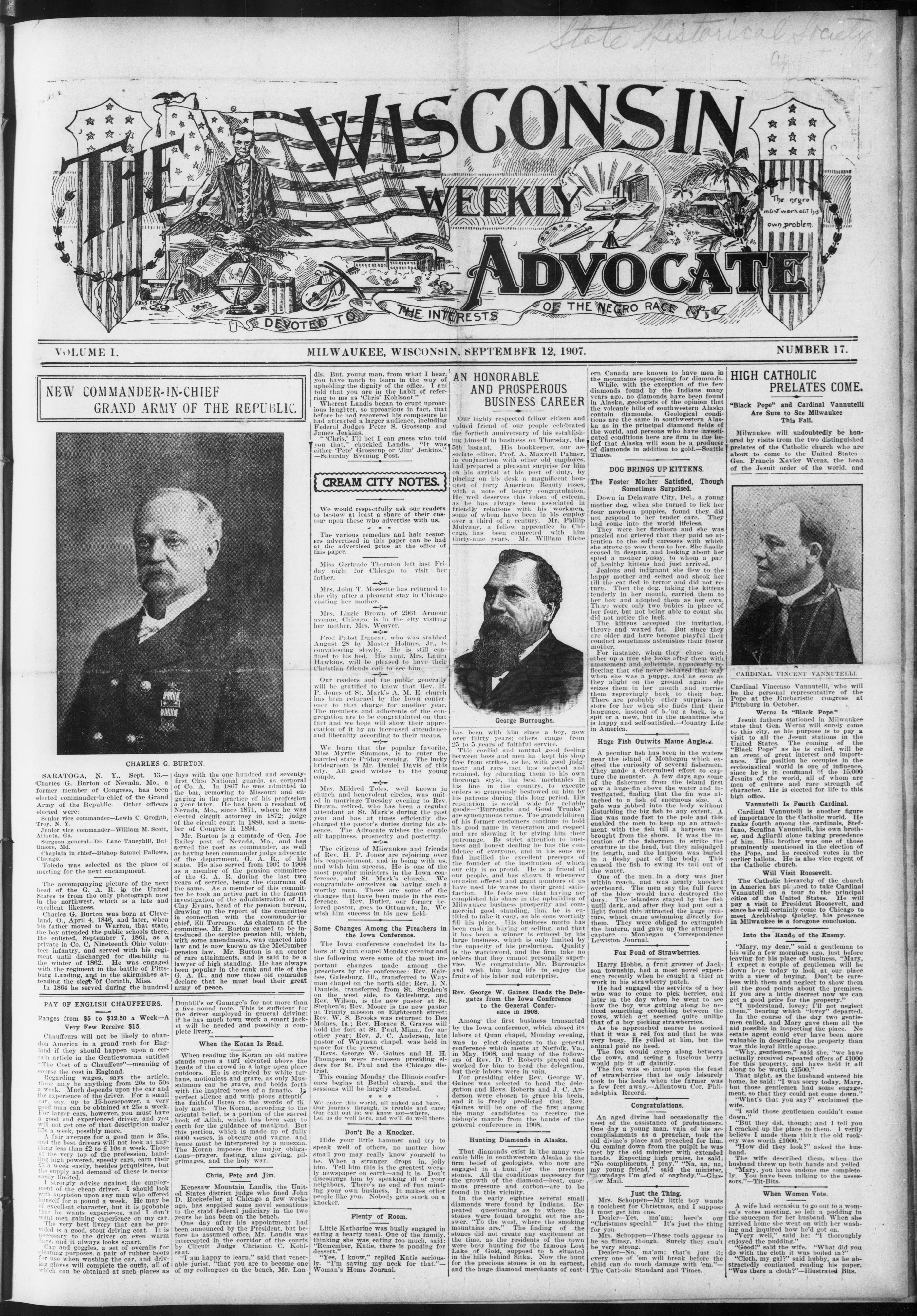
WISCONSIN
WEEKLY
ADVOCATE
DEVOTED TO THE INTERESTS OF THE NEGRO RACE
NEW COMMANDER-IN-CHARGE
GRAND ARM
NEW COMMANDER-IN-CHIEF GRAND ARMY OF THE REPUBLIC.
[Name]
SARATOGA, N. Y., Sept. 13. Charles G. Burton of Nevada, Mo., a former member of Congress, has been elected commander-in-chief of the Grand Army of the Republic. Other officers elected were: Senlor vice commander—Lewis C. Groffith, Troy, N. Y. Junlor vice commander—William M. Scott, Atlanta, Ga. days with first Ohio of Co. A. the bar, gaging in a year later Nevada, elected cir of the cirber of C Mr. Bu
Surgeon general—Dr. Lane Taneyhill, Baltimore, Md.
Chaplain in chief—Bishop Samuel Fallows, Chicago.
Toledo was selected as the place of meeting for the next encampment.
The accompanying picture of the next head of the G. A. R. in the United States is from the only photograph now in the northwest, which is a late and excellent likeness.
Charles G. Burton was born at Cleveland, O., April 4, 1846, and later, when his father moved to Warren, that state, the boy attended the public schools there. He enlisted, September 7, 1861, as a private in Co. C, Nineteenth Ohio volunteer infantry, and served with his regiment until discharged for disability in the winter of 1862. He was engaged with the regiment in the battle of Pittsburg Landing, and in the skirmishes attending the siege of Corinth, Miss.
In 1864 he served during the hundred
PAY OF ENGLISH CHAUFFEURS.
Ranges from $5 to $12.50 a Week—A Very Few Receive $15.
Chauffeurs will not be likely to abandon America in a grand rush for England if they should happen upon a certain article in the Gentlewoman entitled "The Cost of a Chauffeur"—meaning of course the cost in England. Regarding wages, says the article, these may be anything from 20s to 50s a week. Much depends upon the car and the experience of the driver. For a small car, say, up to 15-horsepower, a very good man can be obtained at 25s a week. For larger cars, however, you must have a good and experienced driver, and you will not get one of that description under 25s a week, possibly more.
A fair average for a good man is 35s, and the best drivers will not look at anything less than £2 to £10s a week. Those at the very top of the profession, handling high powered, speedy cars, earn their £3 a week easily, besides perquisites, but the supply and demand of these is necessarily limited.
I strongly advise against the employment of the cheap driver. I should look with suspicion upon any man who offered himself for a pound a week. He may be of excellent character, but it is probable that he wants experience, and I don't want men gaining experience on my car.
The very best livery that can be provided is a good, stout driving coat. It is necessary to the driver on even warm days, and it always looks smart.
Cap and goggles, a set of overalls for cleaning purposes, a pair of rubber boots for use when washing the car, and driving gloves will complete the outfit, all of which can be obtained at such places as
VOLUME I.
days with the one hundred and seventy-first Ohio National guards, as corporal of Co. A. In 1867 he was admitted to the bar, removing to Missouri and engaging in the practice of his profession a year later. He has been a resident of Nevada, Mo., since 1871, where he was elected circuit attorney in 1872; judge of the circuit court in 1880, and a member of Congres in 1894.
Mr. Burton is a comrade of Gen. Joe Bailey post of Nevada, Mo., and has served the post as commander, as well as having been commander judge advocate of the department, G. A. R., of his state. He also served from 1901 to 1904 as a member of the pension committee of the G. A. R. during the last two years of service, being the chairman of the same. As a member of this committee he took an active part in the famous investigation of the administration of H. Clay Evans, head of the pension bureau, drawing up the report of the committee in connection with the commander-in-chief, Eli Torrence. As chairman of the committee. Mr. Burton caused to be introduced the service pension bill, which, with some amendments, was enacted into law and is now known as the McCumber pension law. Mr. Burton is an orator of rare attainments, and is said to be a lawyer of high standing. He has always been popular in the rank and file of the G. A. R., and now those old comrades declare that he must lead their great army of peace.
Dunhill's or Gamage's for not more than a five pound note. This is sufficient for the driver employed in general driving if he has much town work a smart jacket will be needed and possibly a complete livery.
When reading the Koran an old native stands upon a turf elevated above the heads of the crowd in a large open place outdoors. He is encircled by white turbans, motionless and grave, as only Mussulmans can be grave, and holds forth with the inspired tones of a fanatic. Is perfect silence and with pious attentive the faithful listen to the words of the holy man. The Koran, according to the oriental belief, is a portion of the sacred book of Allah, which has been sent to earth for the guidance of mankind. But this portion, which is made up of fully 6000 verses, is obscure and vague, and hence must be interpreted by a muezzin. The Koran imposes five major obligations—prayer, fasting, alms giving, pilgrimages, and the holy war.
Kenesaw Mountain Landis, the United States district judge who fined John D. Rockefeller at Chicago a few weeks ago, has supplied some novel sensations to the staid federal judiciary in the two years he has been on the bench. One day after his appointment had been announced by the President, but before he assumed office, Mr. Landis was intercepted in the corridor of the courts by Circuit Judge Christian C. Kohlsaat. "I am happy to learn," said that venerable jurist, "that you are to become one of my colleagues on the bench. Mr. Lan-
When the Koran Is Read.
Chris, Pete and Jim.
dis. But, young man, from what I hear, you have much to learn in the way of upholding the dignity of the office. I am told that you are in the habit of referring to me as 'Chris' Kohlsaat." Whereat Landis began to erupt uproarious laughter, so uproarious in fact, that before he had recovered his composure he had attracted a larger audience, including Federal Judges Peter S. Grosscup and James Jenkins. "Chris,' I'll bet I can guess who told you that," chuckled Landis. "It was either 'Pete' Grosscup or 'Jim' Jenkins." Saturday Evening Post.
CREAM CITY NOTES.
We would respectfully ask our readers to bestow at least a share of their custom upon those who advertise with us.
The various remedies and hair restorers advertised in this paper can be had at the advertised price at the office of this paper.
Miss Gertrude Thornton left last Friday night for Chicago to visit her father.
Mrs. John T. Mossette has returned to the city after a pleasant stay in Chicago visiting her mother.
Mrs. Lizzie Brown of 2961 Armour avenue, Chicago, is in the city visiting her mother, Mrs. Weaver.
Fred Pabst Duncan, who was stabbed August 28 by Master Holmes, Jr., is convalescing slowly. He is still confined to his bed. His aunt, Mrs. Laura Hawkins, will be pleased to have their Christian friends call to see him.
Our readers and the public generally will be gratified to know that Rev. H. P. Jones of St. Mark's A. M. E. church has been returned by the Iowa conference to that charge for another year. The members and adherents of the congregation are to be congratulated on that fact and we hope will show their appreciation of it by an increased attendance and liberality according to their means.
We learn that the popular favorite, Miss Myrtle Simmons, is to enter the married state Friday evening. The lucky bridegroom is Mr. Daniel Davis of this city. All good wishes to the young couple.
---
Mrs. Mildred Toles, well known in church and benevolent circles, was united in marriage Tuesday evening to Rev. Brown, retired, who has been a regular attendant at St. Mark's during the past year and has at times efficiently discharged the pastor's duties during his absence. The Advocate wishes the couple all happiness, prosperity and posterity.
The citizens of Miiwaukee and friends of Rev. H. P. Jones are rejoicing over his reappointment, and in being with us, and wish him success. He is one of the most popular ministers in the Iowa conference, and St. Mark's church. We congratulate ourselves on having such a worthy man. These are some of the changes that have been made in the conference. Rev. Butler, our former beloved pastor, goes to Ottumwa, Ia. We wish him success in his new field.
Some Changes Among the Preachers in the Iowa Conference.
The Iowa conference concluded its labors at Quinn chapel Monday evening and the following were some of the most important changes made among the preachers by the conference: Rev. Fairbee, Galesburg, Ill., transferred to Wayman chapel on the north side; Rev. I. N. Daniels, transferred from St. Stephen's on the west side, to Galesburg, and Rev. Wilson, is the new pastor at St. Stephen's; Rev. Moore is the new pastor at Trinity mission on Eighteenth street; Rev. W. S. Brooks was returned to Des Moines, Ia.; Rev. Horace S. Graves will hold the fort at St. Paul, Min., for another year; Rev. J. C. Anderson, late pastor of Wayman chapel, was held in space for the present.
Revs. George W. Gaines and H. H. Thompson were re-chosen presiding elders for St. Paul and the Chicago district.
This coming Monday the Illinois conference begins at Bethel church, and the sessions will be largely attended.
* * *
We enter this world, all naked and bare,
Our journey through, is trouble and care;
Our exit out is; we know not—where,
Let us do well here, and we'll do well there.
Don't Be a Knocker.
Hide your little hammer and try to speak well of others, no matter how small you may really know yourself to be. When a stranger drops in, jolly him. Tell him this is the greatest weekly newspaper on earth—and it is. Don't discourage him by speaking ill of your neighbors. There's no end of fun minding your own business. It makes other people like you. Nobody gets stuck on a knocker.
Plenty of Room.
Little Katharine was busily engaged in eating a hearty meal. One of the family, thinking she was eating too much, said: "Remember, Katie, there is pudding for dessert." "Yes, I know," replied Katie seriously. "I'm saving my neck for that."—Woman's Home Journal.
AN HONORABLE AND PROSPEROUS BUSINESS CAREER
Our highly respected fellow citizen and valued friend of our people celebrated the fortieth anniversary of his establishing himself in business on Thursday, the 5th instant. His bookkeeper, our associate editor, Prof. A. Maxwell Palmer, in conjunction with other old employees, had prepared a pleasant surprise for him on his arrival at his post of duty, by placing on his desk a magnificent bouquet of forty American Beauty roses, with a note of hearty congratulation. He well deserves this token of esteem, as he has always been associated in friendly relations with his workmen, some of whom have been in his employ over a third of a century. Mr. Phillip Mulvany, a fellow apprentice in Chicago, has been connected with him thirty-nine years. Mr. William Riebe
RALE RIC DUNO
George Burroughs. has been with him since a boy, now over thirty years; others range from 25 to 5 years of faithful service.
This cordial and mutual good feeling between boss and men has kept his shop free from strikes, as he, with good judgment and rare tact has selected and retained, by educating them to his own thorough style, the best mechanics in his line in the country, to execute orders so generously bestowed on him by his patrons during this long period. His reputation is world wide for reliable goods—"Burroughs and Good Trunks" are synonymous terms. The grandchildren of his former customers continue to hold his good name in veneration and respect and are showing it by giving him their patronage. By strict attention to business and honest dealing he has the confidence of everyone, and in his sons we find instilled the excellent precepts of the founder of the institution of which our city is so proud. He is a friend of our people, and has shown it whenever occasion offered and great numbers of us have used his wares to their great satisfaction. He feels now that having accomplished his share in the upbuilding of Milwaukee business prosperity and commercial good standing, that he is entitled to take it easy, as his sons worthily fill his place. His business motto has been cash in buying or selling, and that it has been a winner is evinced by his large business, which is only limited by the capacity of his production. Quality is the watchword, and the firm take no orders that they cannot personally supervise. We congratulate Mr. Burroughs and wish him long life to enjoy the fruits of his labor and enterprise.
Rev. George W. Gaines Heads the Delegates from the Iowa Conference to the General Conference in 1908
Among the first business transacted by the Iowa conference, which closed its labors at Qunn chapel, Monday evening, was to elect delegates to the general conference which meets at Norfolk, Va., in May, 1908, and many of the followers of Rev. D. P. Roberts prayed and worked for him to head the delegation, but their labors were in vain.
For presiding elder Rev. George W. Gaines was selected to head the delegation and Revs. Roberts and J. C. Anderson were chosen to grace his heels, and it is freely predicted that Rev. Gaines will be one of the first among the many candidates to receive the bishop's mantle from the hands of the general conference in 1908.
Hunting Diamonds in Alaska.
That diamonds exist in the many volcanic hills in southwestern Alaska is the firm belief of geologists, who now are engaged in a hunt for the precious stones. All the conditions necessary for the growth of the diamond—heat, enormous pressure and carbon—are to be found in this vicinity. In the early eighties several small diamonds were found by Indians. Repeated questioning as to where the stones were found brought out the answer. "To the west, where the smoking mountains are." The finding of the stones did not create any excitement at the time, as the residents of the town were busy hunting for the famous Lost Lake of Gold, supposed to b situated in the hills behind Sitka. Now the hunt for the precious stones is on in earnest, and the huge diamond merchants of east-
ern Canada are known to have men in the mountains prospecting for diamonds. While, with the exception of the few diamonds found by the Indians many years ago, no diamonds have been found in Alaska, geologists of the opinion that the volcanic hills of southwestern Alaska contain diamonds. Geological conditions are the same in southwestern Alaska as in the principal diamond fields of the world, and persons who have investigated conditions here are firm in the belief that Alaska will soon be a producer of diamonds in addition to gold.—Seattle Times.
DOG BRINGS UP KITTENS.
The Foster Mother Satisfied, Though Sometimes Surprised.
Down in Delaware City, Del., a young mother dog, when she turned to lick her four newborn puppies, found they did not respond to her tender care. They had come into the world lifeless. They were her firstborn and she was puzzled and grieved that they paid no attention to the soft caresses with which she strove to woo them to her. She finally ceased in despair, and looking about her spied a mother pussy, to whom a pair of healthy kittens had just arrived. Jealous and indignant she flew to the happy mother and seized and shook her till the cat fled in terror and did not return. Then the dog, taking the kittens tenderly in her mouth, carried them to her box and adopted them as her own. There were only two babies in place of her four, but not being able to count she did not notice the lack.
The kittens accepted the invitation, throve and waxed fat. But since they are older and have become playful their conduct sometimes astonishes their foster mother. For instance, when they chase each other up a tree she looks after them with amazement and solicitude, apparently reflecting that she never behaved that way when she was a puppy, and as soon as they alight on the ground again she seizes them in her mouth and carries them reprovingly back to their box. There are probably other surprises in store for her when she finds that their language, instead of being a bark, is a spit or a mew, but in the meantime she is happy and self-satisfied.—Country Life in America.
Huge Fish Outwits Maine Angle.
A peculiar fish has been in the waters near the island of Monhegan which excited the curiosity of several fishermen. They made a determined effort to capture the monster. A few days ago some of the fishermen from the island first saw a huge fin above the water and investigated, finding that the fin was attached to a fish of enormous size. A pole was jabbed into the body without disturbing the big fish to any extent. A line was made fast to the pole and this enabled the men to keep up an attachment with the fish till a harpoon was brought from the shore. It was the intention of the fishermen to strike the creature in the head, but they misjudged its length, and the harpoon was buried in a fleshy part of the body. This caused the fish to swing its tail out of the water.
One of the men in a dory was just within reach, and was nearly knocked overboard. The men say the full force of the blow would have destroyed the dory. The islanders stayed by the fish until dark, and after they had put out a light found this attracted the huge creature, which came swimming directly for them. They were obliged to extinguish the lantern, and gave up the attempted capture. — Monhegan Correspondence Lewiston Journal.
Fox Fond of Strawberries
Harry Hobbs, a fruit grower of Jackson township, had a most novel experience recently when he caught a thief at work in his strawberry patch.
He had engaged the services of a boy who was to come to pick berries, and later in the day when he went to see how the boy was getting along he noticed something crouching between the rows, which act seemed quite unlike that of a boy picking strawberries.
As he approached nearer he noticed that it was a red fox and that he was very busy. He yelled at him, but the animal paid no heed.
The fox would creep along between the rows, and seeing a luscious berry would nip it off daintily.
The fox was so intent upon the feast of strawberries that he only leisurely took to his heels when the farmer was a few feet away.—Allentown Cor. Philadelphia Record.
Congratulations
An aged divine had occasionally the need of the assistance of probationers. One day a young man, vain of his accomplishments as a preacher, took the old divine's place and preached for him. On coming down from the pulpit he was met by the old minister with extended hands. Expecting high praise, he said: "No compliments, I pray." "Na, na, na, my young friend," said the minister; nowadays I'm gled o' onybody."—Glasow Mail.
Just the Thing.
Mrs. Schoppen—My little boy wants a toolchest for Christmas, and I suppose I must get him one.
Dealer—Yes. ma'am; here's our "Christmas special." It's just the thing for you.
Mrs. Schoppen—These tools appear to be so flimsy, though. Surely they can't be very strong.
Dealer—No, ma'am; that's just it; every one of 'em will break before the child can do much damage with 'em."—The Catholic Standard and Times.
HIGH CATHOLIC PRELATES COME.
"Black Pope" and Cardinal Vannutelli Are Sure to See Milwaukee This Fall. Milwaukee will undoubtedly be honored by visits from the two distinguished prelates of the Catholic church who are about to come to the United States—Gen. Francis Xavier Wernz, the head of the Jesuit order of the world, and
P.
CARDINAL VINCENT VANNUTELLI.
Cardinal Vincenso Vannutelli, who will be the personal representative of the Pope at the Eucharistic congress at Pittsburg in October.
Wernz Is "Black Pope."
Jesuit fathers stationed in Milwaukee state that Gen. Wernz will surely come to this city, as his purpose is to pay a visit to all the Jesuit stations in the United States. The coming of the "Black Pope" as he is called, will be an event of great interest and importance. The position he occupies in the ecclesiastical world is one of influence, since he is in command of the 15,000 Jesuits of the world, all of whom are men of culture and rare strength of character. He is elected for life to this high office.
Vannutelli Is Fourth Cardinal.
Cardinal Vannutelli is another figure of importance in the Catholic world. He ranks fourth among the cardinals, Steffano, Serafina Vannutelli, his own brother, and Agliardi alone taking precedence of him. His brother was one of those prominently mentioned in the election of the Pope, and he received votes in the earlier ballots. He is also vice regent of the Catholic church.
Will Visit Roosevelt.
The Catholic hierarchy of the church in America has planned to take Cardinal Vannutelli on a tour to the principal cities of the United States. He will pay a visit to President Roosevelt, and since he will certainly come to Chicago to meet Archbishop Quigley, his presence in Milwaukee is a foregone conclusion.
Into the Hands of the Enemy.
"Mary, my dear," said a gentleman to his wife a few mornings ago, just before leaving for his place of business, "Mary, I expect a couple of gentlemen will be down here today to look at our place with a view of buying. Don't be careless with them and neglect to show them all the good points about the premises. If you are a little discreet now we can get a good price for the property."
"I understand, lovey; I'll not neglect them," hearing which "lovey" departed. In the course of the day two gentlemen called, and Mary gave them all the aid possible in inspecting the place. No estate agent could ever have been more valuable in describing the property than was this loyal little spouse.
"Why, gentlemen," said she, "we have actually received repeated offers of £1000 for this property, and have held it all along to be worth £1500."
That night, as the husband entered his home, he said: "I was sorry today, Mary, but those gentlemen had some engagement, so that they could not come down." "What's that you say?" exclaimed the wife. "I said those gentlemen couldn't come down." "But they did, though; and I tell you I cracked up the place to them. I verily believe I made them think the old rookery was worth £1000." "How did they look?" asked the husband. The wife described them, when the husband threw up both hands and yelled "Mary, you have undone me completely. You have been talking to the assessors."—Tit-Bits.
When Women Vote
A wife had occasion to go out to a women's votes meeting, so left a pudding in the saucepan for her husband. When she arrived home she went on with her washing and inquired how he'd got on.
"Very well," said he; "1 thoroughly enjoyed the pudding."
"Good!" said the wife. "What did you do with the cloth it was boiled in?"
do with the cloth it was boiled in?" "Cloth, my gal?" said hubby, as he abstractedly continued reading his paper. "Was there a cloth?"—Illustrated Bits.
THE WISCONSIN WEEKLY ADVOCATE
MILWAUKEE, WIS.
R. B. MONTGOMERY, Editor and Proprietor.
Facts and Fancies.
A World in Itself
Savants are discussing the history of kisses, as though each did not have a history of its own.-Philadelphia Public Ledger.
The Automobile
Now, will we swiftly glide along
As smoothly as a summer song,
Or will we skid and bump and spill
Or will we simply stand dead still?
—Washington Star
Overheard at Henley
Madge—And so your engagement is broken?
George—Yes; she returned everything but my affection.—Pick-Me-Up.
In the Same Class.
An epidemic of colds seems to have struck town. Henry Bailey, Andy Daggert and two of Hepburn's mules have them.—Wardsville (Neb.) News.
Convenient.
"The automobile has shortened every road marvelously."
"Yes, especially the road to the Hereafter!"—Meggendorfer Blaetter.
Convenient
The Coquette
"You look like Aphrodite today, Miss Blank."
"Then was she really as beautiful as they say?"—Meggendorfer Blaetter.
What It Says.
If money talks,
As some folks tell,
To most of us
It says: "Farewell!"
—Lippincott's.
A. Deplorable Misuse
"Why are you so angry with your wife?"
"Why, I caught her drinking milk out of my stein, today!"—Meggendorfer Blaetter.
At the Boarding House Table.
Guest (to his neighbor, who has taken almost all the asparagus in the dish)—Here, I like asparagus, too! Neighbor—Not as much as I do!—Flie-gende Blaetter.
A Change.
"Seemed so. But he got utterly mashed on a young widow six months later."—Cleveland Leader.
Her Tin Wedding
"I'm going to Maudie's tin wedding tonight."
"Been married ten years, has she?"
"No; she's to be married to her tenth husband."—Judge.
At the Club.
Mrs. Bloodgood—I thought her quotation was apropos, didn't you?
Mrs. Newritch—Dear me! I always supposed his name was Edgar Allan.—Harper's Bazar.
Utility
There was a man in Atchison
Whose trousers had rough patchison.
He found them great,
He'd often state,
To scratch his parlor matchison.
—Lippincott's
Landlord Knew Differently
"They say that, Shifter is ten years ahead of his time."
"Well, it's not true. I'm his landlord, and I know he's just six months behind."—Philadelphia Inquirer.
What He Got.
"Have you heard from your sister since she went abroad?"
"She has sent me seventeen picture post cards, but I haven't heard from her."—Cleveland Plain Dealer.
A. Question of Self-Interest
Problem—A certain man thinks that the automobile is an invention of the devil.
Does he own an automobile himself, or doesn't he?—Somerville Journa'.
Dear Auntie
Visitor—What pretty gloves you have, my dear. I suppose Santa Claus gave them to you. Little Hans—Oh, no, auntie found them in the tram!—Fliegende Blaetter.
The Martyr at the Steak.
O beefsteak, there upon my plate,
For thee I sigh, on thee I saw!
Why is't thy fibers will not part
That I may fill my empty maw?
This world a paradise would be
If friends would hold as firm as thee.
—Lippincott's.
Retribution
Towne-He's sorry now that he quar reled with his wife.
Browne—She's gone home to her moth
er. I suppose?
Towne—No: she's had her mother come home to her.
His Language
Mr. Cussem—He's just beginning to learn to talk, and I thought it was best to keep him out while I was putting on my new shirt.
Easv.
Teacher—"Harry, a mother has five children and but four patotoes. How can she divide me potatoes so that each will receive an equal portion?"
Harry-(quickly.)—"Mash 'em."—Harper's Weekly.
Wouldn't Work
She—I have thrown your fountain pen away.
He—What did you do that for?
She—So you wouldn't have an excuse for not writing to me while I'm away.—Youkers Statesman.
Where She Drew the Line.
Mrs. Randall—I won $50 last night playing bridge in my own house. Mrs. Rogers—Was Mrs. Denano there? Mrs. Randall—No, I've dropped her because I discovered that she plays cards on Sunday.—Brooklyn Life.
Considerate
"Is your husband kind and sympathetic?" asked the inquisitive woman.
"Yes, indeed," answered the recently married girl, "he insists on living at a hotel rather than have me eat my own cooking."—Washington Star.
MOTHER'S SONG
Mother sang it years ago
On the little farm,
While a tired and sleepy boy
Rested on her arm,
While a squeaky rocking chair
Creaked and groaned below,
With the rhythm of the song
Song so soft and low.
"Suwance River"—still it rings
In these ears of mine.
"Suwance River"—unto me
Nothing was so fine.
Still I hear the creaking chair,
Still the shadows creep,
Even now the little song
Makes me think of sleep.
Boyhood sorrows were forgot
There on mother's breast.
"Suwanee River"—far away,
Brought me peaceful rest.
Many songs I've heard since then,
None has half the charm.
Mother sang it years ago,
Mother—on the farm.
--Denver Post
THE END OF A FEUD.
Six miles from the Palace del Intendencia in Valparaiso, on the line of railway that leads up to Santiago, is the beautiful suburban resort of Vina del Mar. It lies close to the harbor on its lower curve, and has a clear outlook to the open sea.
In old provincial days the great castle of Vina del Mar stood, looking proudly out over the sea, defiant of the buccaneers with which that coast was infested in early times. It was from this once famous castle that the present resort derived its name.
At the time when the incidents occurred that I am about to chronicle, its owner was the proud and gallant young Senor don Felipo del Val, who was a direct descendant of the old Castilian grandee who had founded it three generations before. Twenty miles distant stood the castle Limache, from which the present town was named. It was a stately, grim old pile, with turrets and frowning battlements, designed to furnish protection from the hostile tribes, many of which had not then been subdued. Its owner was the old, grizzled, Don Pedro de Sanches, who was as rugged and as grim-loooking as the moss-grown old castle itself.
From the first there had been a bitter feud between these two old families. When each had sought concessions of vast tracts of land from the Spanish crown, both had been eager to locate by the sea, and near the young city of Valparaiso. As no rain falls in that region except during four months in the year, no crops other than grains could be produced, except by irrigation, and so most of the land on either estate was allowed to remain in its primitive condition, and was devoted to raising great herds of cattle and horses.
There was one broad, winding trail running through this mazy wilderness up to the boundary line of Del Val's estate, and out of this ran a labyrinth of tortuous cattle paths throughout the tall scrub, in which none but a trained vaquero familiar with the ground could find his way.
At intervals along the broader trail referred to there were small adobe houses wher herders lived, who were stationed too far from the hacienda to return at night. It was the custom of Senor del Val to make occasional visits to these outposts to receive the reports of his herders and sometimes to inspect the herds himself.
On one of these visits he was riding alone very near to the boundary of his own estate and that of De Sanches. He had halted for a moment to get his bearings. Of a sudden he heard a sound like that of someone sobbing. Getting the direction from which the sound came, he rode down a narrow trail a short distance and rounding a curve in the path, in the midst of dense chaparal, he came upon a sight that brought him quickly to a halt.
Before him stood a young girl of perhaps 18. Her beauty was striking. It was of the best Spanish type, and instantly proclaimed the class to which she belonged. She was attired in a rich riding costume that was somewhat disarranged. Her jet black and luxuriant hair fell in profuse and waving masses down to and below her knees. Her dark and luminous eyes were filled with tears and her face was wet.
He alighted from his horse, and removing his hat, advanced slowly and respectfully toward her. She placed her hands before her face, and tremblingly said: "Pray, senor, leave me to go my way unmolested."
"But, senorita, you are evidently in great trouble, and I would feel forever degraded in my own estimation should I prove such a poltroon as to permit the native modesty of a lady to deter me from performing what in your case is a plain duty. Senorita, you may trust me absolutely. My sword and my life if necessary are both pledged for your protection."
"I am Manuela de Sanches," she replied, "and my home is the castle Limache. I am lost. I was riding out on my pony, and wandered a little farther from home than is my custom, trusting to the pony to return me safely. He stepped into the hole of some burrowing animal and broke his leg. I made an effort to find my way back to the castle, and have been wandering for hours in the tall chapparal and now have no idea where I am. Poor pony; he is also suffering somewhere in this wilderness."
"Have no further fear, senorita," said Felipo; "I know where the castle Limache is, and will conduct you there in safety. It is about six miles distant. But hold! you are wounded. There is blood upon your wrist." The fair girl without hesitation pulled up her sleeve and revealed a shapely arm which a cruel thorn had lacerated.
"Senor, if you know where the castle Limache is, you are not a stranger here. Will you kindly tell me who you are?" asked Manuela.
"My name is Felipo del Val," he answered, "and I live in the castle at Vina del Mar."
The face of the young girl blanched on hearing this, and she said with spirit: "If you are a gentleman, senor, leave me instantly. I would perish in the wilderness rather than accept any service at your hands. You are the enemy of my father, and your forebears have been so before you. Leave me." "I am sorry to inflict my further presence upon you against your wishes, senorita, but I feel justified in doing so in the face of your protests; for a man who could leave a lady who is lost unprotected in this place is a coward, and not worthy of the name he bears. I am
going to deliver you to your father at the castle Limache before the darkness falls—by your consent I trust—if not, then by so much force as may be requisite.
"I have never been an enemy of your father, and could not be such now if I would, for I love Don Pedro's daughter."
Ah, how close of kin are love and hate! Manuela responded with the first supreme passion of her pure young life to the ardent kisses that he pressed upon her sweet lips.
Don Pedro des Sanches was standing in the castle gates as Felipo del Val and assisted his daughter to the ground. The look in his face was grim and implacable.
"Don Pedro, I found your daughter lost in the chapparal, after her horse had broken its leg, and I have the honor of returning her to you unharmed," said Felipo.
"How dared a Del Val to trespass upon lands belonging to a De Sanches?" said the older man menacingly.
"As for the dare, let it pass. As for myself, I fear no man living," said Felipo, lightly touching the hilt of his sword.
"As Manuela's father, I must thank you for the kindness you have shown my daughter," said Don Pedro. "Common courtesy demands it. But here all intercourse ends."
More than a year had passed, and though Felipo had often ridden as far up as the boundary line and beyond it, he had not seen Manuela or heard one word concerning her. The old Spanish clock in the tower of the castle at Vina del Mar chimed the hour of 10. Darkness had fallen over the land and sea, and the lights of the grand old turreted and bastioned pile flashed over the dark waters like beacons, as they had done for many a bygone year. The signal bell at the castle gate clanged sharply and was quickly repeated.
The major-domo challenged the late and exigent visitor, and received from him a bit of sealed parchment, with the request that he deliver it to his master without a moment's delay.
It was at once placed in the hands of Felipo. He broke the seal eagerly, and found there, traced in a dainty hand, the following:
"Dear Felipo: Receive my messenger without delay. Manuela."
"Admit the stranger to my presence at once," commanded Felipo.
The major-domo retired to the gate, withdrew the massive bars, and admitted the mounted stranger. His clothing was torn and covered with dust. His horse, covered with foam, trembled in all its limbs from exhaustion.
Blood was mingled with the water that dripped from its smoking flanks, resulting from the cruel spurs. The stranger had evidently ridden hard and far.
"Here is wine, hombre; drink it, and speak quickly, and to the point," said Felipo when the stranger had entered.
"I am sent to you secretly, by my lady, to crave your assistance. The wild Aurocanians have descended from the Cordilleras and attacked the Castle Limache, and even as I left they were battering at the gate in great numbers. They are massed close under the castle walls, and the fire of our fusiliers seems to have very little effect upon them.
"Unless you can furnish relief promptly the castle wil lbe captured and looted; Don Pedro will be killed and Senorita Manuela will be carried away to the mountains. This, my master, is the message I bring you from my lady."
In another moment the alarm bell sounded from the center of the quinta, calling every retainer to arms.
"Mount me 100 of the best trained men at the hacienda. Fifty swordsmen and fifty lancers, all fully armed," commanded the master of Vina del Mar.
At 2 o'clock in the morning, the Castle Limache was reached, and the wild cries of the Aurocanians told the story of a victory.
Felipo quickly dismounted his troopers, and forming them for action, charged through the gate and took the enemy in the rear.
Manuela, through a loophole in one of the turrets, saw her lover enter at the head of his intrepid forces, and witnessed the fearful carnage that immediately ensued.
She also saw him fight his way around the flank of the enemy and place himself beside her wounded father, and there fight off his foes with his own good sword, until the last Aurocanian had fallen.
Then he gave the order to his soldiers. "About face—prepare to mount."
Don Pedro placed a restraining hand upon the young man's arme and said: "Not so, I pray you, Don Felipo. There is food and wine aplenty in the castle for your brave men, and forage for their horses. Let them rest, and feast here, and when they return, let it be in the bright sunshine and at their leisure, and not through darkness and at such reckless haste as attended their coming to the rescue of Limache and its inmates this night.
"Henceforth there shall be no boundary line between our two estates. They shall be one. Parde Felicia is in the castle, and when you depart you shall take Manuela with you."—E. F. Filedar in New Orleans Democrat.
His Charge.
"It is always refreshing," says a Cleveland lawyer, "to hear of an attorney who will not undertake a shady case. I know of at least one such, a lawyer in Toledo.
"At one time a chap in business in that town known to be practicing questionable methods sought to retain the Toledo lawyer, and was smoothing over his crooked conduct as well as he knew how, when the attorney astonished him by exclaiming:
"I think you have acted like an infernal scoundrel, sir!
"Is there any charge for that opinion? asked the man as he rose to go.
"Yes, sir, $5!"—Harper's Weekly.
A Useful Secret.
The matches had been forgotten, and it looked as if it would be impossible, for lack of fire, to roast the clams on the beach.
"Boys," said the young Malay prince, a Harvard student. "I'll show you now how to make a fire by rubbing two sticks together. It is a hard and wearisome thing to do, but we must cook these clams. Mark Twain says you can't rub fire out of sticks. Now, I'll show you that he is wrong. He doesn't know how to go about it, that's the trouble."
An oaken log lay on the sand. With the hatchet the prince made a narrow groove in the log, a canal 2 feet long.
Then he cut off from one end an oaken peg a foot long and of the thickness of his wrist. This he sharpened into the likeness of a huge lead pencil.
"Now," he said.
And kneeling, he began to rub the sharp end of the peg up and down in the groove. He rubbed as hard and as fast as he could. His broad breast heaved with the labor, his handsome brown face dripped with heat.
But at the end of five minutes the groove began to send up little blue wisps of smoke into the clear air, and a moment later a tiny flame flickered and vanished.
"Have that straw ready," gasped the prince.
And when the tiny flame next appeared, a youth lighted a bit of straw with it, and it was not much later before the clams were roasting over a fire kindled, in the incredible South sea way, by the rubbing of two sticks.
"It all lies in the method." said the prince. "You must have your groove and your pointed peg. Otherwise a week's rubbing would be quite vain."
POSTAGE TO BE LOWER.
Heavy Foreign Correspondence by Americans Will Soon Cost Less—Universal Postal Union.
Americans who have friends in foreign lands will, after October 1, be enabled to write them nice, gossipy letters without being forced into bankruptcy through paying the postage. The day when letters to globe trotting friends had to be written on tissue paper and shorn of necessary verbiage is almost past, and the traveling American will welcome the change almost as rapturously as will the stay at home who buys the stamps.
The official bulletin from Washington, containing an order from the postmaster general, arranging for the new rates, which were decided on by the Universal Postal union in Rome in May, 1906, has been received at the Milwaukee office. The new agreement provides that foreign postage which heretofore has been 5 cents for each half ounce, will now be 5 cents for the first ounce and 3 cents for each additional ounce or fractional part thereof. Letters weighing two ounces under the old law cost 20 cents for postage. Under the new agreement, such letters can be sent for 8 cents, or a saving of 60 per cent.
Another and important change of consequence will be in the system of return postage coupons which will go into effect on October 1. Persons desiring to inclose return postage to their correspondents abroad will be able to purchase at the postoffices in this country a coupon for 6 cents which will be redeemed in certain foreign countries and converted into 5 cents' worth of foreign stamps. This is, in a way, an international money system. The turning of 5 cents American postage into 5 cents foreign on the other side costs only 1 cent, about enough to cover the expense of exchange and printing. In the order received in Milwaukee the other day the other countries which have agreed to accept this coupon system of exchange of postage are given as follows:
Germany, the German Protectorate and German postoffices in Asia, Africa and Australasia; Austria and the Austrian postoffices in the Levant; Belgium, Bosnia Herzegovina, Brazil, Bulgaria, Chile, Korea, Costa Rica, Crete, Denmark and the Danish Antilles; Egypt, Spain, France, the French postoffices in Morocco, and the French colonies except Madagascar, Magotte, Mohele and establishments in India; Great Britain and the British colonies except Orange River, Antigua, Barbados, Bermuda, Cyprus, Falkland Islands, British Guiana, Jamaica, Southern Nigeria, Sarawak, Trinidad and Zanzibar; Greece, Guatemala, Haiti, Republic of Honduras, Hungary, Japan and Japanese postoffices in China and Manchuria; Luxemburg, Mexico, New Zealand, Norway, the Netherlands and the Netherlands Indies; Roumania, Siam, Sweden, Switzerland and Tunis.
All of these coupons will finally land in the international bureau at Berne, Switzerland, where they will be redeemed by the various nations providing them to their subjects or citizens. This coupon postage arrangement, it is believed, will in time mean that the international bureau at Berne will become an international clearing house, and that a system of international currency will be found in vogue. In England, for instance, the correspondent of a New Yorker may find his letter calling on him to purchase for him a book or some trifle, and inclosed in the latter the coupons for the equivalent of the cost in stamps, which can be turned into English currency. It is a widening of the facilities of intercourse between the peoples of the earth.—Evening Wisconsin.
Mediaeval Meals
The antiquary took down a manuscript of vellum beautifully illuminated in gold and blue.
"Old recipes," he said. "A book of mediaeval recipes and menus that shows us what the monks, the priors and the abbots ate. Listen. Here is a Good Friday menu, a fast day thing."
And he read:
"Eggs with tansy sauce; good trout of large size stuffed with the buds of primroses; turbot in jelly of the quince; onions roasted with cloves; a soft pudding of milk and pigeons, eggs; a larded cheese of Italie, with tarts of quince and citron; Rhenish wine with many spices, and whey wherein pears have been stewed."
"Not bad for a fast day?" said the antiquary.
"Here is a dinner for six, a dinner that was served in the Abbey of Barking before Columbus discovered America;
"Baked mallard. Teals roasted on a spit. Almonds boiled in milk. Roasted capon, with a syrup of honey and pears. Roasted leg of a calf, boiled herons, a small baked pig, set about with gilt, and with a citron in his mouth. Flesh tart with sauce of quince.
"Second course—Roast hedgehog with jelly of pears. Venison well baked with many apples. Almond and white wine pottage. Boar's flesh in soft pudding. Two cranes, with the gravy of a young kid. Partridge and curlew, with sauce of good syrup.
"Third course—A peacock roasted with the grease of the pig's chaps; set it out covered with its skin, with the feathers on, many onions underneath him in the dish. Custard of cream and the eggs of hens. Also some small birds of all kinds, laid in good wine."
A Summons for the Czar.
The threat of proceedings against the Empress Eugenie for an old debt, said to have been incurred by Napoleon III, is not without parallels even today. Only a day or two ago the czar himself was summoned before a police magistrate at Nice. The Emperor of All the Russias owns a villa at Nice, in the garden of which is the tomb of the czarevitch, who was buried there forty years ago. The house is neglected, and the trees have grown so wild that they stretch their branches over the neighbor's garden. The neighbor, therefore, summoned the Czar in order that the trees might be properly trimmed, and as the Czar did not present himself, the lawyer of the Russian consulate at Nice asked that the hearing might be adjourned. But the affair is rather complicated, for the Russian consulate has no standing whatever in the matter, and nothing to do with the private affairs of the Czar.
Advertise in Your Home Paper
William Soething of Sheboygan lost the hearing in one ear when some one rang him up on the telephone while he had the receiver up, preparing to call a number. The car drum was broken by the vibration.
Mrs. Anna Brush appeared in the police court at Evansville, Ind., as a witness. When she took the stand she was chewing gum. "Take that gum out of your mouth or go to jail," commanded the police judge, I. G. Winfrey. The woman obeyed.
Mrs. Addie Thomas of Paris, Ill., has brought suit for divorce from Calvin Thomas on the ground that she made a mistake in the brother she was to marry. She thought he was Alvin, Calvin's twin brother, she alleges. They were married a year ago.
B. F. Ferrill, a farmer living near Danville, Ky., came near being killed by bees, which flew into his mouth while he was taking honey from a hive, and stung him in the throat so severely that physicians had to work over him for several hours. The swelling almost choked the man, and it will be several days before he is able to take solid food.
A record in the way of the number of beneficiaries named in a life insurance policy was made when Emory Willis, a farmer living four miles west of Petersburg, Ind., took out a policy in favor of his ten children, all of whose names begin with "R," and were recorded as follows: Rezeen, Rufus, Ruth, Russia, Roso, Robert, Roosevelt, Ralph, Righteous and Roxey.
George Russell, aged 80, of Blue Knobs, Pa., visited Hollydaysburg to withdraw $50 from Gardner, Morrow & Co., which closed its doors in September, 1896, and was dumfounded when he heard the bank had failed. It was the first he had heard of the collapse. He had in his possession a certificate of deposit for $3000, the earnings of a lifetime. He broke down and wept like a child.
---
It has been learned that King Edward of England is responsible for the divorce suit filed by Lewis T. Brown against Margaret Brown at Lexington, Ky. The Browns were living in London and attended a theatrical performance at which the King was present. Attracted by Mrs. Brown's beauty, the King asked that she be presented at court. Brown objected, and his wife being anxious to be presented, an estrangement followed.
If the young people of Eau Claire desire to "spoon" in the future they must do it in their own homes or face the displeasure of the city council.
This threat is the result of a recent agitation against the nightly scenes of fliptations and spooning in the parks and on the schoolhouse and courthouse steps.
Now some members of the council propose to introduce, at the next meeting of that body, an ordinance making public love affairs a misdemeanor.
The shortest will on record is that of Dr. Albert B. Lyman, which was filed for probate in the Orphans' court in Baltimore. With one sentence, "I give everything to my wife," the testator disposed of his entire estate, and then, fearing complications might arise to give his wife trouble in administering the estate, some years later he executed a codicil containing just four words and making more complete the one sentence in the will. The codicil reads: "And name her executrix."
Despondent because she could not master the English language, Goldie Goldenberg, aged 23 years, jumped into the St. Joseph river in an attempt to drown herself at South Bend, Ind. A policeman saw the girl go down and jumped in after her in time to make a rescue. The girl was taken to the county jail and was turned over to the Associated Charities. She is a Russian and had been working in a local factory trying to earn enough money to provide for her return to Russia.
The homeward rush of Americans who have spent the summer in Europe is now at its height and all records for the number of passengers carried by the trans-Atlantic steamship lines have been broken. Nine steamships arriving in one day landed a total of 3143 first and second cabin passengers, the greatest number ever recorded in a single day at New York. Steamship officials of all lines say that the summer travel abroad has been unprecedented. The rush will likely keep up until far into October.
Bacil, the mother of Jumbo, an elephant over 200 years of age, saved the life of a man at Wheeling, W. Va. A freight train was wrecked near Morgantown, the engineer being caught underneath the locomotive. The wreck caught fire, and it appeared as if the man was doomed. The sections following the wrecked train, having aboard a circus, came up, and Bacil lifted the wrecked locomotive with her trunk from the body of the engineer. Eight other elephants filled their trunks with river water and extinguished the burning cars.
A cat saved its life by calling for help with a telegraph key late the other night at Detroit. The cat was the pet of the crew of a branch office of one of the telegraph companies. When the strike was called the office was closed and locked up, tabby being forgotten. Last night, during a temporary lull, the chief operator at the main office noticed an erratic call from that branch over the wire which he supposed was "dead." He supposed a thief had broken in and was meddling with the keys. So he notified the police. When a policeman got inside he found the office cat upon the table, starved to a skeleton, working one of the keys with its paws.
To hatch a chicken by holding an egg for the allotted time in the left armpit is believed in Servia to be a certain charm against violent death, more especially if the bird be swallowed whole forty days after it comes to life. A robber who had devastated the district of Kolubara for many years was, writes a Belgrade correspondent, known to have accomplished both these feats, which accounted for the apathy of the peasants in pursuing him, persuaded as they were of his invulnerability. He has just, however, been killed by the mounted police, thus discrediting a time honored Servian superstition.
Orlando F. Thomas, a New York banker, who owns a stock farm in the vicinity of Lyons, N. Y., has settled the moored question as to what carp are good for. The late Gov. Roswell P. Flower cajoled Wayne county farmers into raising this kind of fish, which gradually took possession of the streams to the exclusion of game fish. Last spring the high water in Clyde river left tons of carp on the flats. Banker Thomas had his men gather up and plough under all the carp he could get and sowed sugar beets on the field. That sugar beet field is the
finest in all Wayne county this year, and will raise between 40 and 50 tons of beets to the acre. This summer the continued drought dried up all the little streams and swamps and particularly a deep carp breeding pond in a swamp on the Thomas stock farm. Banker Thomas had his employees gather up all the bullheads, perch, sunfish, bass and other food fish and carted them in milk cans on stone boats to Clyde river, where they were dumped in. Tons of carp of all sizes, ranging from fingerlings to big fish weighing forty pounds and over, were left in the pools in the swamp. These were pitchworked up into carts and drawn out on the oats stubble, spread into furrows and ploughed under. This field will be sowed to sugar beets next spring. The pond hole that dried up covered over ten acres of ground and had never dried up before. Sufficient carp were obtained to fertilize a ten acre sugar beet lot.
Louis L. Kramer came all the way from Yuma, Ariz., to marry a girl he never had seen. The bride was Miss Flora Weise of Tazewell county, Ill. Kramer wrote to his aunt, Mrs. Patterson, to find a girl who would make a good wife, as he was leading a lonely life on a ranch in Arizona. Mrs. Patterson recommended her neighbor's daughter, Miss Weise, and correspondence was commenced. The girl was struck with the romance of the affair, and when photographs were exchanged and proved satisfactory, a proposal quickly followed. An acceptance was written, and then Kramer came east to claim his bride. The marriage was celebrated the day after his arrival and the couple departed immediately afterward for Yuma.
"Naturally I was very much put out. What girl would not have been under the same conditions? However, I am very thankful I was deserted before marriage, and not after."
Miss Matilda Zalit was telling how she had been deserted almost at the altar by Anthon Solinsky.
Miss Zalit and Solinsky had arranged to be married the other evening in the Catholic church near the home of the girl at Bayonne, N. J. Many relatives and friends had assembled at her home. Sie, in her wedding finery, had her bridesmaids with her. The best man and the ushers also were ready.
As the time passed, and Solinsky did not appear, Miss Zalit wondered what had happened. Finally a committee was appointed to hunt for the expected bridegroom. It returned with the information that he was nowhere to be found.
After an hour's further suspense, word was sent to the clergyman not to wait any longer. The bride-to-be removed her veil, and placed her bouquet in a glass of water. The guests were about to depart when Miss Zalit said:
"I wish you all to remain. Although there has been no wedding, there shall be a feast just the same."
The feast was served and the health of Miss Zalit drunk. Dancing followed, and Miss Zalit seemed the lightest hearted present.
"I did not want to disappoint my guests, so we had a celebration anyhow," Miss Zalit said, after it was all over.
The famous Shealer's barn, once a wartime hospital, near the Gettysburg battle ground, is to be torn down. It is still, as it was in the days when it was a wartime hospital, a thatched barn, never having been roofed except with straw. One of the last of its kind, this thatched barn was already old when the famous battle of Gettysburg was fought. It has withstood the storms of nearly 150 years, and at the time it was built was one of many barns of the same pattern. It is located on the Shealer farm, a short distance from the borough line. It is owned by George W. Shealer, who has decided to tear it down, owing to its weakened condition. Much of the interior timber has been sold to persons historically inclined, who wished the splinters for mementos of the battle ground. During the battle and for four weeks after the conflict the building was occupied by the Confederates as a hospital, the mows, stables, and upper floor being filled with the wounded. In the logs of the old structure are imbedded many bullets, which lodged there during the first day of the bloody conflict.
Forty-four Confederate soldiers, members of Johnston's brigade, died in this building, and their bodies were buried within 100 feet of the structure. A few years later they were taken to Hollywood cemetery, Richmond, Va. While this building was used as a hospital by the Confederates, Martin Shealer, who then owned the place, returned home, after being honorably discharged from nine months' enlistment in Co. F, one hundred and sixty-fifth Pennsylvania regiment. Though he found his home occupied with men who fought against the Union, he immediately joined his wife in nursing the sick, binding up wounds, and making the dying comfortable. Later he re-enlisted for three years.
Having for reasons of his own become sorry he had said what he had said about his wife, Otto Plutschow, D. D. S., 902 West Twelfth street, Chicago, publicly posted this announcement.
PERSONAL—Words which I have said against my wife, Lizzie, I hereby recall.
OTTO PLUTSCHOW, 902 West 12th st.
It was posted for reasons of his own and for reasons in which Mrs. Lizzie Plutschow had more or less to do. The insertion of it has turned the doctor's household into a The Hague conference, and Mrs. Plutschow, who had moved all the things away from the doctor's flat, has moved all the things back again.
What the doctor said, by way of gossip, to friends in the neighborhood and to patients in the chair were things which a husband is least apt to say about his wife, especially if they are not true. Generally a man does not freely discuss such things.
But the doctor did. And he not only said them about her, but also said them to her, which was a great mistake. As soon as he had done that, which was more than a week ago, she packed up the furniture and went back to her mother.
Also, she told the young men with whom the doctor's tales had mingled her name that there was nothing to the charges, and they told their parents, and their parents said unpleasant things to the doctor.
And then, when he was beginning to worry a little about his practice, his wife threatened to bring suit for separate maintenance, according to the neighbors. He did not mind the separation so much, but the thought of the maintenance hurt him. He thought if he was going to have to support her she might as well work for him, and he hastened over to his wife's mother's house to see what could be done about it.
And that is how it happened that he inserted the contrite advertisement in the papers, and that in turn is why his wife considers herself vindicated, and is going back to keep house for the doctor on the old terms.
Recognized.
From a German newspaper an observer has culled the following advertisement: "The gentleman who found a purse with money in the Blumenstrasse is requested to forward it to the address of the loser, as he is recognized." The response appeared two days later: "The recognized gentleman who picked up a purse in the Blumerstrasse requests the loser to call at his home at a convenient day."—Detroit News.
GOSSIP FOR THE LADIES.
The Wanderer's Song.
There will be, when I come home, through the hill-gap in the west,
The friendly smile of the sun on the fields that I love best;
The red-topped clover here and the white-whorled daisy there.
And the bloom of the wilding brier that attars the upland air;
There will be bird-mirth sweet—mellower none may know—
The hute of the wild wood-thrush, the call of the virec;
Pleasant gossip of leaves, and from the dawn to the gloam
The lyric laughter of brooks there will be when I come home.
There will be, when I come home, the kindliness of the earth—
Ah, how I love it all, bounteous breadth and girth!
The very sod will say—tendril, fiber, and root,
"Here is our foster-child, he of the wandering foot.
Welcome! Welcome!" And, lo! I shall pause at the gate ajar
That the leaning iliaes shade, where the honeysuckles are;
I shall see the open door—O farer over the foam,
The ease of this hunger of heart there will be when I come home!
—Clinton Scollard in The Outlook.
Agree with Her.
This little tidbit was contributed by—believe me or not—a married man. "Always agree with your wife. Nine times out of ten she is right, and acquiescence in the one time she is wrong is bound to make her think you are the best man that ever came along."
Women More Honest Than Men
Statistics compiled by American guarantee companies show that, as regards honesty, women are superior to men. Women in America are employed in business as extensively as men, and yet the record shows that almost every embezzler and defaulter was a man, says Home Chat.
There are more women cashiers than men. The universal stores and shops of almost every kind employ women to handle their receipts, and to give change; yet, there were a hundred cases of men cashiers stealing to one case where a woman cashier took her employer's money.
Who Is the Boss at Home?
Eugene Wood is out with an article on Babies in the September American Magazine. At the very kickoff he shows that he is master of the subject. He is not deluded: he is not deceived. He has found out who is boss, and he reveals the truth. He says:
"Boss of the house you were, or at least the wise lady whom you call your wife has made you think so. (A wife must have many a quiet smile all to herself.) What you say goes. 'I don't care much for pumpkin pie,' you casually remark, and forget that you have said so. From that time on there'll never be another pumpkin pie in your house unless you specifically order it. Maybe not then. You don't like yellow turnips as well as white ones; in vain thereafter does the grocer at your back door suggest, 'We've got some nice yellow turnips.' He might as well hint that he has some green and tender Rough on Rats. You are the boss. Everything is done to suit you. You may get scolded for forgetting that there is an ash-receiver, or for leaving the Sunday papers all over the floor so that the house looks like distraction, and what if anybody should come? But, don't you see? that's all in your interest. The appearance of the house sheds glory upon your as its master. All this, remember, is before the new baby comes. Afterward it's: 'Sh! You'll wake the baby,' or 'Can't you read in the dining room? I don't think he likes the light,' or 'Shake the furnace easy. Baby jumps so when you make such a racket,' or 'Would you mind taking him out for a little while in his carriage?' or—Oh; well, you know or, if you don't know it's time you were finding out."
The Professional Woman
"If my profession has indirectly kept me from marriage, it has given me the next best thing in the world—it has given me friendship in abundant measure," says Anne O'Hagan, still writing of spinsters in Harper's Bazar. "My job—I like the homely term—has brought me into business relations with men even more than with women; for, after all, in spite of our multiplication upon the face of the earth, professional women are still fewer than professional men. I have learned what no domestically placed woman, unless she has an uncommonly large and congenial social circle, ever knows—the keen pleasure to be derived from unsentimental intercourse with the masculine mind. Of course the legend of masculine chivalry as it had been handed down to me by believing foremothers did not survive actual contact with the business world. I have seen men—excellent citizens in their way, too—who recognized no necessity for the adjustment of their feet, the replacing of their coats, or the removal of their hats upon my appearance. I have discovered that if a man is given to sharp practices in his business, he does not change his methods, except to accentuate them, because he is dealing with a woman. I have learned that the gentleman who goes about like a lion seeking whom he may devour does not confine his predatory saunters to unguarded drawing-rooms and to stage entrances. (And I have also come to the conclusion, it may be said in passing, that it requires only a slight expenditure of determination to make short shrift of him.) But all these facts only emphasize the throughgoing, companionable, kind, comradely attitude of the majority of the men with whom one's profession throws one in contact."
An Important Social Scheme.
The League for Home Economics (Mrs. Julian Heath, president) is an experiment of far-reaching possibilities, which will enlist the sympathetic interest of women and men who are concerned about the dietary and health conditions of the poor and ignorant. It has become somewhat the rule of late to blame the inebriety of the husband and the wickedness of the boy on the wretched cooking of the ignorant housewife. Mrs. Heath is not so extreme in condemnation of the woman, however, for she realizes that the raw food material has considerable to do with the housewife's failure as a cook. Accordingly, part of the scheme to be put into practice is the reform of grocery stores, and in place of the delicatessen shops which derive so large a portion of their income from the poor, there will be depots where nutritious stews and puddings, instead of the bologna sausage and cakes and other such indigestible food, may be bought. Grocers are to be visited with a view to improving their conditions as to cleanliness and the proper handling of foods. An effort will be made to induce the women to get proper cooking utensils and to make their kitchens attractive as well as to have well cooked food. This movement is the outgrowth of cooking classes that have been conducted in tenement house kitchens, and in order that all the operations of the home, as it should be conducted.
may be brought to the attention of the tenement dwellers, a four or five room flat in the neighborhood is to be hired and general housekeeping carried on for the benefit of the young girls, the brides and the mothers of families, who will be taught cooking, nursing, baby feeding, invalid cookery, marketing and the laws of hygiene. The Tribune, which publishes a very detailed account of this prospective experiment in the practical teaching of how to make the home, states that the first home center will be opened in "Greenwich Village (N. Y. City) during September next.-Vogue
Cooking Odors May Be Prevented.
Keeping an apartment free of the unpleasant odors of cooking vegetables is difficult, but it can be done and the home made more comfortable in warm weather. Much is due sometimes to the cook's carelessness whereby she leaves on the stove pots and pans that are soiled, and fifteen minutes of this will scent the whole place, especially now when all doors are left open to catch every passing draught. A jar of strong soda water by the sink will do much to prevent this and is fixed by dissolving two pounds of washing soda in a gallon of boiling water, with two tablespoonfuls of ammonia added. When the pots are emptied after cooking, pour into them some of this water. Slosh it around and let them stand until time to wash. Cleansing them then will be the matter of a moment only.
Gentle instead of fierce boiling, lessens but does not do away with the odor of onions, cabbage and all such foods. The fumes can be practically obviated, however, by preparing them several hours before time of cooking and let them stand in cold salt water. Rinse before cooking. As soon as they come to the boil there will be a scum on the water, and it is this, made of the essential oils of the vegetables, that causes the smell. Skim carefully and salt the water for the first time. To an ordinary size kettle put in a cupful of cold water.
More scum will rise almost immediately, and this, too, should be taken off. After this there should be no more trouble, and there should be no cover on during the cooking, or the smell will be intensified.
Very careful cooks drop a piece of bread into a kettle of boiling cabbage, and thus remove much of the cause or odor. The harder the bread the more it will absorb, if put in at the moment the water begins to boil. It should stay not more than ten or fifteen minutes. The whole secret of boiling in this way is to cook slowly and keep free of scum, using no covers. Charcoal in the refrigerator is invaluable in warm weather, as it absorbs odors that might otherwise be unpleasant or cause different foods to taste. That which has been powdered should be used, and a teaspoonful of it placed at each corner of the back of all shelves. Fresh charcoal must be put in once a week.
Addressed to All
Down in Dixie lives a charming man, a bachelor of leisure and refined tastes, who loves his books as he should love his wife and children, who are not.
Being a man of generous instincts and kind heart, as well as a person who loves to share the good things of earth with others, and thereby enjoy them a second time, he lends his books to all the friends who possess literary tastes.
But this generous spirit has often been repaid by that base ingratitude which springs from a lack of personal responsibility.
His friends read his books, enjoy them and forget to return them. We all know these people.
Perhaps we belong in that class!
Perhaps we belong in that class:
Before we declare positively that we do not it would be well to go over our book shelves and see if any books are slipped in by chance bearing other names than ours on the fly leaf.
My bachelor friend, after years of annoyance, loss and sorrow, printed a slip, which he glued in all his books. Here it is:
"It cost the owner of this book much inconvenience and some hundreds of volumes to learn that persons of most excellent reputations in other affairs of life too frequently fail in the prompt return of borrowed books.
"This deplorable freak of human nature in holding on to borrowed books is a blaster of confidence, a despoiler of sweet tempers, a promoter of profanity, a builder of selfishness, a destroyer of a proper regard for the rights of others, a producer of gray hairs, a maker of bald heads and a general wrecker of human happiness. (By the way, do you know of any borrowed books which ought to be returned to their owner? How is it with yourself?)
"It has so hardened the hearts of many that they refuse to lend books, and while such a course may be the correct, cold business way, it cannot be highly recommended as a promoter of desirable wisdom or a builder of close friendships.
"The owner of this volume will be glad to continue to lend his friends books, save such copies as none would think of either borrowing or lending, but he asks in every case that the following conditions be observed.
"First: No book is to be lent for more than one week.
"Second: The borrower promises and agrees, upon honor, to pay into the treasury of some regularly organized public charity of his own selection 5 cents per day for each and every book kept out for more than seven days.
"Third: It is to be furthermore expressly understood and agreed, at the time of borrowing any book, that under no circumstances whatever will the borrower ask to be relieved from the above conditions.
"N. B.: None are expected to enter into the spirit of the foregoing except those who have had trouble of their own concerning books they have loaned."
So excellent seems the idea of this carefully worded preface to books intended to lend friends that it seems worthy of giving to the public. Perhaps its mere publication may set readers to thinking of their own sins of omission and commission.
Perhaps a half-dozen borrowed books may find their way back to their proper homes and purchasers.
I know of some books I would like to see back in nearby shelves.—Philadelphia Evening Bulletin.
Child Training
Obedience, truthfulness and self-reliance are as indispensable to the materials of character building as are bricks and mortar to material buildings. Of these obedience is the first law to be enforced. The first, because upon its ready observance, more than upon that of any other, does success in the moral training of children depend, and first, because it is the law that earliest presents opportunity for transgression. The little babe in arms will know, what "No, no," means when the tiny hands are stretched toward a coveted but forbidden thing, and the obedient child will draw back instantly. Often he will obey with loudly
expressed regret, but he will obey, and the rest is merely a question of diverting his troubled mind. On a trolley car recently chance afforded an opportunity for comparison between two children in this respect. One mother with her little one boarded the car at the same corner that I did, and as soon as she was seated the bright polished catches that regulated the window shades attracted the attention of the little one. Instantly the little fingers stretched up to catch them. "No, no, Margaret!" said the young mother, and Margaret's little fingers resolved themselves into tiny fists that doubled back under her wrists quickly.
There was unmistakable reproach and disappointment in the downcast eyes, and pouting, trembling underlip, but evidently no thought of enforcing her will against that gentle "No, no!" Instantly a dozen diversions were forthcoming. The woman besides her drew out a tiny ticking watch and held it where the downcast eyes could see it, and as the little face broke into radiant smiles an old man across the aisle offered a brand new red, white and blue pencil, with a lovely shining top, and a little girl came over and laid a flower on her lap. For the rest of that trip Margaret, with her soft, delighted coos and pretty smiles, reigned a queen, and was followed by many smiles and hand wavings when she left. Across the aisle and further up sat a weak, spiritless looking mother with a restless child. As she shifted him for greater comfort to her shoulder the bright catches on the curtain of the window caught his eyes. His fingers grasped them eagerly.
"Stop that, Johnnie, leave them alone," said the mother, sharply, giving Johnnie a little jerk, but Johnnie, profiting by past experiences, ignored the jerk and continued to amuse himself with the pretty bits of metal. Twice and thrice was the admonition repeated, all to the same effect, when suddenly, as he chanced to manipulate the catches with both hands simultaneously, the shades flew up with a rattle and snap that caused the mother to start violently and Johnnie to fall, frightened and screaming, back into her lap. Shakes, slaps and cajoling failed alike to assuage his grief, and his cries assailed our ears continuously until I arrived at my destination.
When a mother teaches a child obedience she teaches him not only to comply with her wishes, but to be dutiful and respectful to her and to others, to be regardful of her rights and of the rights of others. All of this is worth much careful consideration. When a child has learned the meaning of obedience a mother should not tax his strength too heavily. To demand obedience is her prerogative, but she need not abuse it. As every restriction she places upon him seems to his childish mind a deprivation, she should be slow in her judgments.
Where a child is intentionally disobedient no pains should be spared to correct the fault. If the child be old enough to reason a mother should not fail to place the moral side of the question before him and then let the thing acquired by his disobedience provide, if possible, the means of punishment. A pleasure gained may often be deprived of its sweetness by the loss of some other that might have been enjoyed legitimately.—V. M. Wheat.
Would You Be Popular?
Do not make a point of always seeing the disagreeable side of things. It may give you a comforting sense of being a critic; but, oh! how it wearies those who must listen to your carping.
Make a specialty of hunting the good, if it is to be found, in persons or things. If it isn't, talk of something else.
Don't be bumptious or argumentative. If you get the better of the other fellow you will not be any more liked, and if he wins out you will not be happy and neither of you will think anything but what you thought in the first place; so what's the use?
Do not make the mistake of thinking that only honey will make you a social favorite. Though the old adage tells us "more flies are caught by molasses than vinegar," it does not mention the frantic efforts of the said flies to escape from the cloving sweetness.
One the other hand, while you must not apply flattery with a shovel, everyone enjoys hearing some nice little thing that has been said about her, especially if you could go that opinion one better.
Be natural. This does not mean if your natural manner is rude and crabbed that it must be indulged. Affectation has ruined the good time for many a really charming girl, besides it is the surest way to make oneself ridiculous.
Be refined. Despite the sporty hailfellow-well-met manners (or lack of them) of the modern young woman good breeding still has its innings.
Be intelligent. Brainlessness is no longer considered the only true social coinage. So, even if you are college bred, it is not necessary to pose as an idiot for fear of being considered pedantic, therefore to be shunned.
Lastly and chiefly, be unselfish. This is the secret of all popularity that is worth while. It will make you sympathetic even with the bores. And as they open their innmost souls to your kindly inspection you will be surprised full often to find they are not bores at all but men and women in whom some unfortunate mannerism or deep-lying self-consciousness has concealed real worth and intelligence.
The woman who is a schemer, who has not thought of the comfort of even her nearest and dearest, if it interferes with her own pleasure, may enjoy an ephemeral popularity as long as she is not well known. But though she has the beauty of a Venus and a whole diamond mine for financial backing, she will never know the real love and admiration which is the share of the girl who puts others before herself.
Do you doubt this? Ask yourself who is the most popular woman you know. Is it the cleverest, the prettiest or the richest girl of your acquaintance who is most in demand for house parties and yachting excursions, for motor trips and jounts on private cars, for big dinners and little ones?
Isn't it almost invariably the girl who apparently has nothing in particular to recommend her except that she always seems to fit in?
Do you realize that the "fitting in" quality is a very real social asset, and one that is rarer than might be imagined? Adaptability is a Heavensent gift that is only another name for unselfishness.
The adaptable girl will not trample on your pet theories or flick your sore spots on the raw. She will spare you petty undercuts and obtrusive curiosity about your personal affairs. She will smile with you, work with you, play with you, as suits your mood of the moment. In fact she will be absolutely "comfy" always. And yet she has an opinion and a will of her own.
Rest assured it is she who "makes us comfortable in our minds" as goes the homely old phrase, whom we most often want around us; which in this age of easy boredom is after all the truest test of popularity.
The Motorist's Joke
"I think I'll try filling the tires of my automobile with illuminating gas," said the amateur chauffeur.
"Good joke," gurgled his fool friend.
"Expect to make it light. Ha! ha!"
"Nothing of the kind," replied the amateur chauffeur; "I thought it might increase the speed of the machine. Just think how the stuff makes the wheels of a gas meter spin around."—London Tatler
YOUNG FOLKS' COLUMN.
"
Times Children.
Time has three children, fleeting and fair,
Yesterday, Today, and Tomorrow;
Who circle about as we travel on,
And yield us our joy and our sorrow.
Yesterday stands in her widow's weeds,
Bereft and broken and sad;
Today smiles over an unfilled grave,
And Tomorrow is distant and glad.
And we poor wayfarers worship and woo
Three daughters of Father Time;
And Yesterday grieves and Today deceives
And Tomorrow's the maiden sublime.
—Willis Granger in Ainslee's.
The Hunter Who Was Cured.
Without any nature-faking or any mawkishness, Dr. Henry Smith Williams describes the drama of a wounded bird in Appleton's Magazine. We quote part of his account:
"The bird at which the boy had fired thrust down its legs and wobbled as if about to fall; then recovered itself and flew on, its legs dangling. A chance shot had apparently broken its back, paralyzing the legs, but leaving it still strength enough to fly a certain distance. Trained hunter as he was, the boy watched the wounded bird, and marked the exact spot where it finally dropped just at the edge of a cornfield half a mile away.
"I think I'll go after it," said the youth.
"'Nonsense,' said Luther; 'it's a half mile away and you have all you want without it.'
"But the bird is wounded. I hate to have it lie out there and suffer."
"Oh, it's probably dead; or if it isn't some skunk or weasel will kill it tonight. Come along."
"It was nearly sunset and the youth was tired after the long tramp of the day. It would be a long trip over to the cornfield for weary legs—and then perhaps to find the bird dead. Already it was supper time at home, and he had a hunter's appetite. So he allowed himself to be over-persuaded, and the two tramped homeward.
"But the grouse that had fallen over in the cornfield was not dead. Nor, as it chanced, was its wound of a kind to produce speedy death. The injury did, however, render the bird utterly helpless. Once it had dropped to the earth, it could not rise again. Nor could it move about on the ground, for its legs were paralyzed completely. It lay on the bare earth, sheltered by the cornstalks from the eyes of hawks, and where there was not much danger that a marauding beast would find it. But there was no food at hand. It was doubtful even whether the bird would be able to sip a few drops of dew from a cornstalk to quench the thirst that its wound must develop.
"Quite obviously fate had marked the grouse for a lingering death of torture. Its wound, already painful, must become more so with the lapse of time. Insects would come in phalanxes to pester it. Hunger and thirst would add their modicum of agony. The greatest mercy it could hope for would be the coming of some skunk or weasel, as the hunter had suggested, to put it out of misery. But no such messenger of speedy death ebanced to come that way."
Dr. Williams describes the church service the following Sunday morning, and the awakening of the boy's mind to a fear that the wounded grouse might not have died all these days, and he goes on.
"The youth's soul was undergoing development in that half hour. He was making one of those short cuts from point of view to point of view. He was passing—little as he realized it—from the barbarian hunter stage to a plane of broader sympathies.
"All through the lesson he sat brooding the same thoughts, and as he left the church the idea of the wounded chicken had taken full possession of his mind. Instead of going home, he set out for the field where he had shot the grouse. He believed he might find the bird even yet. At least he would try.
"A good memory and a keen eye enabled him to go about the point of the field from which the grouse had flushed; and over by the cornfield he noted the exact point—marked by a peculiar fence post—where the wounded bird had gone down. He went directly to it, and had scarcely entered the cornfield when his dog came to a point. There ahead on the ground lay the bird, stretched at full length. It made no effort to escape as he came up. It was too near death to fear him or anything, its eyes half closed, its bill agape, as it freely gasped for breath.
"In an instant the youth was on his knees beside the bird, a great lump in his throat, his eyes staring as if they would start from their sockets. The meaning of it all came to him with the force of a blow. Mechanically he brushed away the insects that gathered about the wound in the bird's back. He stroked the soiled plumage tenderly. He found himself calculating the hours that the grouse had lain there suffering. It had happened Wednesday, and this was Sunday—twenty-four, forty-eight, seventy-two, about ninety hours; yes, fully ninety. What a cruel stretch of torture! The youth recalled an occasion when he had had a toothache for two hours that had seemed interminable; and the meaning of that ninety hours of pain came home to him yet more vividly. In an agony of remorse he knelt there, thinking, thinking. He closed his eyes, and when he opened them a few moments later the grouse had ceased to breathe.
"The youth rose suddenly and walked to the edge of the cornfield. He selected a spot in a fence corner, and began to dig a hole. The ground was hard, and he had nothing but his knife and a piece of stick to aid him; but he preserved the more stubbornly as his fingers became sore from digging. When the grave was deep enough, the youth went after the body of the grouse and took it up very tenderly, as if so much of suffering had given it sacredness. He laid the poor thing carefully in the ground, smoothing its every feather. As he was about to begin pushing the dirt over it, he hesitated. After thinking a moment, he thrust his hand into his pocket and brought out a knife. It was a beautiful implement, one of the lad's choiceest treasures. He regarded it half ruefully for a few moments, opening one blade after another. At last he put the knife in the grave beside the body of the grouse; with a vague feeling that this sacrifice might take a little of the load from his heart. Then he resolutely scooped in the dirt till the grave was filled and carefully smoothed over.
"That will help me to remember," he said aloud.
"It was a thoughtful youth who walked slowly homeward across the fields that autumn day. He was asking himself what right he had to inflict such suffering as that. What manner of friend to the birds was he that could wish only to kill them? What pleasure could he get in future in shooting, always with the possibility of re-enacting the tragedy of the cornfield?
"Long before he reached home, the youth had made up his mind. He knew that he would never shoot his gun again. He had entered a new phase of life. The desire to kill was no longer strong in
him. The instinct of the hunter had left him forever."
Chasing 300 Elephants.
John W. Norton, a Harvard graduate who takes his recreation in hunting big game, has described some of his exciting experiences in Appleton's. No one can go into this part of Africa, he says, without buying his permit at Mombasa. You pay fifty pounds for the privilege of taking two elephants and you can take one more of fifteen pounds extra. If you should kill an elephant with ivory weighing less than sixty pounds, in self-defense, the ivory is confiscated by the government, but you can generally buy it back at the market price.
One morning the three of us started off again on the trail of the big nerd. Suddenly the second gun bearer began to point and I made out what seemed to be an enormous ridge of rocks, but it eventually proved to be a herd of 300 elephants.
We moved toward a little bush, perhaps three feet high, that was literally the only thing like cover anywhere near. When we reached the bush we could see about half the herd coming in our direction, walking slowly toward the swamp, the females and their young leading. As they passed along about seventy-five yards from us, my boy began picking them out. This was a "man!" That a "wife!" At last a big fellow came in our direction and I could see that he was a bull with short and heavy tusks. He came within less than fifty yards of us and then turned to go in the same direction as the herd. It was a fine chance. I got up on my elbows, aimed at the usual place just back of the eye, and fired. Before he could start away or drop, I shot him again in the shoulder. Then the gun jammed!
The shots turned the herd, the forward elephants running back into those in the rear, the whole herd trumpeting. Finally they all decided to go back, the mother herding the young with their trunks. By this time I had gotten my gun open and reloaded and ran along beside the elephants looking for another bull. Running at top speed I could just keep up with them. Soon a good animal edged his way out on my side and I shot at his shoulder, but it seemed to make no impression. I could hear the bullet strike him, and still he shambled along as if lead was just the thing he liked best during an afternoon. In a moment he had turned into the herd and was lost in the indescribable jumble of swaying, trumpeting animals.
Fifteen minutes of such a pace was enough for me. They steadily gained and forged ahead. Finally just as I began to realize that they were all getting away, one big elephant who was in the rear guard got into a fairly good position; but just as I put up the rifle he tumbled over absolutely dead. He was the big fellow I had hit.
I sent back to camp and soon the porters came rushing up, the headman of each tent with his force of five, all of them dancing and shouting like wild men. While they were chopping out the ivories the big herd stood off about 600 yards from us, every elephant with his trunk straight up in the air, with the lip quivering, "feeling the wind," and now and again some big fellow trumpeted as if announcing the discovery of some new taint in the air, and making a sight—the 300 of them—that one would not soon forget.
PROMINENT PEOPLE.
ENRIQUE C. CREEL, the Mexican ambassador at Washington, was born in the city of Chihuahua, on August 31, 1854. His father was Reuben Creel, an American merchant, and his mother a Mexican woman. From poverty and obscurity the son worked himself up until he became one of the most prominent men in the republic. While yet a comparatively young man he established a high reputation as a business man and financier. He married the daughter of Gen. Luis Terragas, known as the wealthiest man in the state of Chihuahua. Prior to his appointment to the Washington embassy Ambassador Creel was for several years governor of Chihuahua, one of the largest, richest and most important states in Mexico. While he held this office he brought about great reforms, particularly in the matters of education and irrigation. His business interests are as diverse and almost as far reaching as any of the great captains of industry of the United States. In addition to his public duties he is interested in banks, trust companies, street car and power systems, cattle and mining, owning hundreds of thousands of acres of land.
HOKE SMITH, governor of Georgia and one of the best known public men in the south, was born in Catawba county, North Carolina, September 2, 1855. His father was prominent as an educator and at one time president of Catawba college. At 16 years of age Hoke Smith left his native state and went to Atlanta, where he remained for a time engaged in the study of law. Later he removed to Waynesboro, Georgia. When 22 years of age he stumped the state in the interest of the city of Atlanta, which was endeavoring to secure the state capitol. From that time on he continued to attract attention as a speaker and public worker. In 1892 he managed Grover Cleveland's campaign in Georgia, and when the latter was elected President he appointed Mr. Smith secretary of the interior. He resigned at the end of three years of service to return to Atlanta and again take up his law business and look after his newspaper interests. A year ago he was nominated for governor of Georgia and elected after a sharp contest in which Clark Howell also of Atlanta, was his principal opponent.
ADMIRAL CHARLES S. SPERRY, U. S. N., who is one of the American delegates in attendance on the international peace congress at The Hague, was born September 3, 1847, in Brooklyn, N. Y. His first studies were in the public schools of Waterbury, Conn., and he graduated from the naval academy at Annapolis in the class of 1866. He reached the grade of lieutenant in 1870, and it was fifteen years later before he reached the next grade of lieutenant commander. He was not made a commander until 1894. He received the rank of captain in 1900. Since 1903 Admiral Sperry has been on special duty near Washington. His home is in Connecticut.
MAJOR DAVID DU BOSE GAIL-LARD, the army officer appointed some time ago to take charge of the engineering work in the construction of the Panama canal, was born in Sumter county, South Carolina, September 4, 1859, and entered the army July 1, 1880. He was a member of the Mexican Boundary commission from 1891 to 1896, detailed in charge of the office of the Washington aqueduct (under the war department) from 1895 to 1898. He was engineer officer on the staff of Maj.-Gen. James F. Wade, and was commander of the Third army
corps in May, 1898, and colonel of the Third United States volunteer engineers during the Spanish war. During the summer of 1899 he served as chief of the engineering department in Santa Clara, Cuba. Among his later assignments were as officer in charge of river and harbor improvements at Lake Superior, from 1901 to 1903; chief of staff Department of the Columbia 1903-04, and engineering officer of the Northern division from April to November, 1904.
JOHN GRIFFIN CARLISLE, some years a Democratic leader in Congress, was born in Campbell county, Kentucky, September 5, 1835. He was the youngest son in a large family, received a common school education, studied law, taught for a time in Covington, and was admitted to the bar in 1858. He served several terms in the Kentucky House of Representatives, and in the meantime acquired an extensive and lucrative law practice. During the Civil war he was opposed to secession. He was lieutenant governor of Kentucky from 1871 to 1875, and the following year was a presidential elector. The following year he was sent to Congress and was six times re-elected. He soon became prominent as a Democratic leader, was appointed a member of the committee of ways and means, and attracted attention by an able speech on revenue reform. In 1883 he was elected speaker of the House of Representatives, to which office he was re-elected in 1858. In 1890 he was elected United States senator from Kentucky, and three years later resigned his seat to become secretary of the treasury in the cabinet of President Cleveland. Since 1896 he has taken little part in public life and has devoted his time and attention to building up a large law practice in New York city.
MELVILLE EZRA INGALLS, one of America's foremost railroad magnates was born in Maine, September 6, 1842. After studying at Bowdoin college he took a course at the Harvard Law School, and for a time practiced his profession. In 1870 he entered the business of railroading, and was sent west to act as receiver of the Indianapolis, Cincinnati & Lafayette road, of which he was soon made president. The road failed again, and he was made receiver in 1876. In 1880 the road was turned over to its owners, and he served it as president until 1889. On its re-organization into the "Big Four" system Mr. Ingalls was continued as president, and in 1888 he was made president of the Chesapeake & Ohio. Since the re-organization of the entire system a few years ago he has been chairman of the board. Mr. Ingalls has taken a somewhat prominent part in Democratic politics and during the first Bryan campaign delivered a number of speeches in favor of the sound money candidates.
THE RIGHT HON. SIR HENRY CAMPBELL-BANNERMAN, the British premier, was born in Scotland, September 7, 1836, and received his education at Glasgow university in Trinity college, Cambridge. His political career has been a long and distinguished one. Since 1868 he has represented the Stirling district in the Liberal interest and his ability was early recognized by the then Liberal leaders. From 1871 to 1874 and from 1880 to 1882 he filled the office of financial secretary to the war office. For the years 1882 to 1884 he was secretary to the admiralty, and in 1884 and 1885 was chief secretary for Ireland. In 1886 Sir Henry was secretary of state for war, filling the same office from 1892 to 1895. He has been Liberal leader in the House of Commons since February, 1899, and has borne the brunt of the fight where the real fighting of an opposition is done. His premiership dates from December, 1905, when he was summoned by King Edward to form a ministry to succeed the Balfour government.
FOREIGN NOTES OF INTEREST.
Japan is organizing direct importation and exportation to and from Italy, independent of British and German lines.
The China Telegraph states that the foreign trade of Siam, with Bangkok as its center, is rapidly advancing in both exports and imports.
The minor products of the state forests of Bengal are bamboo, sabai grass for paper making, honey, golputta thatching, wax, mica, shells, india rubber, coal, nux, vomica, limestone and silk cocoons.
The Dalny dock was transferred April 1 from the Japanese Minister of the Navy to the South Manchurian Railway, and is now open to vessels of all nationalities. Docking charges have been or are to be reduced.
Capt. Spelterni, the Swiss aeronaut, has just finished a wonderful achievement, namely, the crossing of the Alps in a balloon. This was his five hundred and thirty-ninth ascent, and his note book does not record a single accident in any of them.
---
California pear, apple, plum and cherry trees are a success at the German agricultural experiment station at Tsing-tau in the Kinchow (German colony) territory of China. Shantung province may yet be one of the great fruit gardens of the world.
Consul-General Michael of Calcutta says that Englishmen in India prefer American dentists to all others. The army council has approved a money allowance for the treatment of soldiers' teeth by civil dentists to help secure enlistments.
Dr. W. B. Scranton has retired from the Methodist mission in Seoul to devote himself entirely to the instruction of young Koreans is the science and practice of medicine. He was the pioneer American medical man sent out to that part of the world by the church mission board.
India's demand for beer exceeds 11,000,000 gallons a year. Breweries in India supply 6,000,000 gallons and 5,000,000 gallons are imported, of which 93 per cent. is obtained from England. Japan is cutting into England's beer trade in India. In 1905 Japan sent in 4,000,000 gallons, most of which was sold on trial in and about Calcutta.
Japanese newspapers state that the incorporation of the Japanese watch manufacturers is sure, aided by English capital. The capital will be between $2,500,000 and 5,000,000, equally subscribed by Japanese manufacturers and English investors, including the small factories. Efforts will be made to open markets for Japanese matches in Europe and Australia.
Missouri's Farm Name Law.
Missouri has a new law under which the owner of a farm in that state may, on payment of $1 in the county court, register an exclusive name for his land. The idea is not simply poetical or ornamental, for the name, in the course of business, may become a valuable trade mark. Exclusive names are regarded as assets of value in mercantile and manufacturing industries, and there is no reason why the farmer should not have whatever advantage there may be in a name that will identify his products in the market—Utica Press.
SE ee
ELE ee
When You Buy Your Flour Ask for
WABASHA ROLLER MILL CO.
Wabasha, Minn.
EEE ROE I PETEE ETN.
eee
Phone 3521 Grand
GIVE Ss. R. BANKS
THE RELIABLE BARBER
| =—_—_—_—_—_—————_A CALL
| 196%4 Fourth Street
| Courteous Treatment Al Work
in the desirable locaiities of the country before deciding
should consult
Oo. D. MARCO Bell Telephone No. 261 P. A. SATTLER
MARCO & SATTLER |
Real Estate, Investments, Western and Southern
Farm Lands a Specialty
Oitice 303 McMillan Building, LA CROSSE, WIS.
Our excursions leave LaCrosse every Tuesday. Cheap rates to home-seekers.
Join us and see for yourself. A trip will do you good For further information
| Gaul. write or telephone
American Lunch Room
FOR ALL NATIONS
325 Weils Sirest, Milwaukee
Coon Day and Night. Meals 18c and 15¢
PEOPLE’S TAILORING CO.
suits to Order $15,00
P The Best People to Deal With Are
LEIDIGER BREWING CO.
KEG and BOTTLED BEER
Telephone No. 3 MERRILL, WIS.
ewe ATDOSIOIS
of different professions solic-
iting money in Wisconsin for
purposes unknown to any per-
son in that state and for use
elsewhere. Driven out of
other states they are overrun-
aing this. We think it an im-
perative duty on us as being
the only negro paper in the
state, to protect its generous
ghilanthropists. From now
pn, we shall warn the mayor
and chief of police of every
éity in Wisconsin against such
adventurers.
© FE DEAGOK & SON
Funeral Directors
EMBALMERS
431 Broadway, MILWAUKEE, WIS.
Largest Kansas Tree,
The largest known tree in Kansas was
felied a couple of weeks ago on the
Ben Wilson ranch, near Williamstown.
It was a cottonwood and was purchased
from Mr. Wilson by the Topeka barrel
and box factory, and four and one-half
days were consumed by two men in cut-
ting it down. Sixteen stroug horses
were required to draw each of the three
sections, which were twelve feet jong, to
the railroad. It measured 22 feet 6
inches in dia:neter. The body was sound
and when sawed up made 4500 feet of
first class lumber and about the same
amount of second class. The machinery
of the factory was inadequate to handle
such a monster and dynamite was final-
iy used as a last resort and it was torn
in three pieces, when no trouble was
experienced in working it up.—Kunsas
City Journal.
ee
It Pays to Advertise.
Specie watt sate Sr taesaais
Weekly Advocate.
Before Starting on Your
Travels Cal! on
GEO, BURROUGHS
& SONS
——— MANUFACTURERS OF ———
PREMIUM TRUNKS
Valises, Sample Cases, Etc.
424 & 426 East Water Street, Milwaukee,
ATHE WISCONSIN
WEEKLY ADYOUATE
u '
Published once a week by
R. B. MONTGOMERY,
Editor and Proprictor.
Entered as socond-class mail matter at
the Postoffice at Milwaukee, Wis.
rhe Wisconsin Weekly Advocate after three
years’ residence at 79 Fifth street, has
moved its headquarters to 430
Cedar St, where we will re
ceive our guests and trans-
act our busisess in
future.
& Representative Journal Devoted to the
Interest of All the Pecple.
ADVERTISING RATES.
One inch, one year.............++++- $15.0
Two inches, one year...........---++ 25.00
Three inches, one year...........--.. 35.0
four inches, one year..........-+.++. 42.09
For larger space, special rates,
Locals, 10 cents per line,
TERMS OF SUBSCRIPTION.
WME FEAL 20.5.2. ccs cece ese cen gsec ease G2UO
Bix months ...........ceceeeeeereerress LOU
iene sii ie ewanaiidiemeres ae
Direct all communications to
Rk. B. MONTGOMERY-
430 Cedar Street.
HOW TO SEND MONEY.—Post Office
vrder, Express Order, Draft or Registered
Letter. R, B. Montgowery will net be re-
sponsible for loss when sent in any other
way.
TO CONTRIBUTORS:
all communications must be sent with the
oame and address of the sender as an ev.
dence of good faith, hut not necessarily for
onblication. No mannscript returned if not
accepted, unless accompanied by stamps.
EDITORIAL PARAGRAPHS.
“I know of the bravery and charactei
of the Negro soldier. He saved my life |
at Santiago, and I have had occasion to |
say so in many articles and speeches.
The Rough Riders were in a bad position
when the Ninth and Terth cavalry came
rushing up the hill carrying everything
before them. The Negro soldier has the
faculty of coming to the front when .e
‘gs needed most. In che Civil war he came
400,00c strong, and I believe he saved
the Unicn.”—Fresident Roosevelt.
—_—_—_———
The proposed chauffeur’s union ought
to be the “swiftest” organization in the
federation.
A horse recently — threw "ss
William, but Prince Eitel, his second
son, is further up-to-date in being thrown
by an automobile.
Dr. Koch, the great bacteriologist, has
spent eighteen months in Africa to good
purpose if tie report be true that he has
discovered a cure for the terrible malady
known as the “sleeping sickness.”
_——
The old prospector of Chena, Wash.,
who is said to have out-Burbanked the
California plant wizard by producing a
vineless potato, is showing a disposition
to cut off the potato bug’s source of sup-
plies.
One death from cholera in Yokohama
is not alarming, but it entails upon the
health officers of that port a serious duty.
Eternal vigilance is necessary for the
prevention of the old-time girdling of the
world by this virulent disease.
Great Britain having made due apolo-
gy for Capt. Calder’s recent raid into
Venezuela from British Guiana, the re-
sultant international friction has subsid-
ed. “Rhe imeident is a lesson in interna-
tional comity which reflects credit upon
the apologist.
The killing of two automobilists during
the racing at Denver, Colorado, was
shocking rather than startling to the
spectators. People go to automobile races
with the interest that gives zest to tra-
peze performances, where men and wom-
en risk their necks in aerial gymnastics.
There is nothing startling in the report
that the American warships which are
to go to the Pacific ocean will eventually
be ordered home by way of the Suez
canal, Other American warships have
girdled the world, and the ships of the
present are seaworthy, despite their
heavy armament.
—_—_——
The story comes trom Copenhagen that
Capt. Ravid Amundsen, the explorer who
achieved the Northwest Passage, is plan-
ning an Arctic expedition in which he
intends to use polar bears as other ex-
plorers use dogs. Very likely; the Are-
tie explorer eats dog whenever he is
short of provisions.
Sir Thomas Lipton’s schooner yacht
is reported to have narrowly escaped cap-
sizing during a sharp squall in British
waters. American yachtsmen are pleased
over his escape, as they are eagerly
awaiting a challenge that will give them
another series of exciting international
races for the America cup.
The American sonderklasse boats
boats which were defeated in Germany
have won in Spain, This is indirect evi-
dence that the Germans lead in Con-
tinental yachting, unless the French can
make a better showing than the Span-
iards. The Germans are undoubtedly in
the lead with their larger yachts.
An “electrical engineer” has arrived in
New York with a story that he has in-
vented a little battery no bigger than
the batteries used for door bells that
will run the largest of dynamos and
operate machinery. He talks like a
man who has posted himself as to the
manner in which the Keeley motor was
brought into notoriety that was profita-
ble to its promoter.
ee
Prince Wilhelm of Sweden has been
“doing” New York in a rushing style
WHAIL LMC DIU NHL WAUNEE, FAR QW ta
OOOO .eeMNnr er
=
Mr. John Slaughter
HAS OPENED AN IDEAL
ee C A KF KE Co
At 194 Third Street
The interior decorations are artistic and unique, and the finest service and most
courteous treatment is assured all patrons. The Cafe is second to none and a credit
to the city. Mr. Slaughter will endeavor to merit the many encomiums bestowed
upon him since the opening.—(Milwaukee Daily News.)
In opening up the New Turf Cafe Mr. Slaughter has supplied a want that both
white and colored citizens of Milwaukee have felt for a long time. He has gone to
an enormous expense in fitting and furnishing it with every modern equipment and
we sincerely hope the people will show their appreciation by giving him their
patronage.
a TIGHLAFE Beer
is made from the very best materia/—filtered
through fine pulp wool--and properly aged in
modern underground vauits, which gives it a
charecter and taste all its own.
You, can’t help bu: like it.
Order a case today. —Phone West 19.
@& _9P MILWAUKEE
that must have given him an impression
that Americans are geared for high
speed. Royal visitors are generally com-
pelled to do twenty-four hours of sight-
seeing every day, and when Wilheha gets
back to his ship and into his sailor
clothes he will doubtless find more than
the usual amount of comfort in his kam-
mock,
The Navy Department's determination
.o name one of the new 20,000-ton battle-
ships New York, and re-uame the cruiser
New York Saratoga will have to be re-
peated in the case of other new battie-
ships which under the law must be
named for states. The patriot who is
worrying about what will be dore when
the states are all thus honored is borrow-
ing trouble. When the United States has
forty-five battleships it will have a fer-
midable fleet:
| One of the worst cases of homesick-
ness on record is that of Matuchenki, the
Russian revolutionist who led the mutiny
on the battleship Knaiz Potemkin. After
escaping to New York and finding em-
ployment he returned to Russia in dis-
guise and was captured and hanged. As
a naval officer he should have known
that his crime could not be condoned
vithout injury to naval discipline; and
Russia is in no mood at present for modi-
fications of either military or naval rules
or traditions.
C* VETTE rere ror
f WHEN IN TOMAHAWK SEE .
GEORGE MARSHALL =
F LUMBER oe
ec Telephone No. 9 TOMAHAWK, WIS. o
o
Steamers on the Gulf of Mexico which
since the development of the Texas oil
fields have been burning petroleum in-
stead of coal are now taking out their
oil furnaces and returning to the solid
carbonaceous fuel. When they adopted
oil fuel, petroleum was selling at 55
cents a barrel, and enabled a saving of
about one-third in fuel bills, But
oil has doubled in price since
that time, and liquid fuel is there
fore more expensive than coal. The
captains and engineers will doubtless re-
gret this change, as there is more con-
venience in using the liquid fuel. The
firing is simple and there are no ashes
to dump overboard; moreover, the liquid
fuel is more easily taken aboard.
A GOOD PLACE TO STOP
MUSKEGON HOUSE
Board by Day er Week
TOMAHAWK, - = - wis.
Germany has a surplus ef revenues fer
the first time in recent years. It amounts
to $6,808,250, and is due partly to addi-
tional income from cigarettes, tobacce,
sugar, salt, champagne, beer and playing
cards, and partly to economies im civi!
administration. ‘The surplus, which will
be distributed among the federal states
is not of impressive size, viewed in the
light of American experience. Which-
| ever way the treasury balance swings in
ee country—toward surplus or deficit—
the amount involved is usually consider-
able. “This is a great country, and we
| are a great people.”
ee al
4 = ~S
) ie
Ger Seg an
> yr
HAIR =
a Se
. . ° KY
A Delightfully Perfumed Hair Pomade SELLY
PREPARED ESPECIALLY FOR COLORED PEOPLE. 3
This old, reliable preparation has been in : 4c
constant use for over ten years, and is considered a necessary toilet article in |
thousands of homes. It is guaranteed free from all injurious drugs or chemicals. —
NELSON’S HAIR DRESSING makes harsh, stubborn, kinky, curly —
hair soft, pliant and glossy, enables you to comb it with ease and to do it
up in any style consistent with its length. It is perfectly safe and harmless.
By supplying. the needed oils directly to the roots of the hair, NELSON’S
HAIR DRESSING tones up, invigorates and nourishes the scalp, stops the
hair from falling out, increases its growth, and prevents the hair from }
splitting and breaking off at the ends, and gives the hair new life and vigor.
NELSON’S HAIR DRESSING removes Dandruff, cures Tetter, Itching |
and Scaling of the Scalp, etc.
There is nothing experimental about Nelson’s Hair Dressing; it has been |
thoroughly tested and is endorsed by thousands of satisfied users. Try a box and |
be convinced that it does all and more than what we claim for it. i
.
WHAT THOSE WHO KNOW HAVE TO SAY:
Miss Jeabelle Byrd, Battle Creek, Michigan, | |, Mrs. C. Covenia, Fernandina, Floriéa, write
writes: ““F recommend it wherever I go. It bas | “I have been an agent for your Nelson's 1
done wonders fot me.” Dressing for nearly four months. It is the be
Miss Willie L. Griffey, McMinnville, Tenn., | S¢lling article I ever sold.” |
ites: “I hav d your Ni : ii 1 is 4 tites: “Tt
for ear for year and would not be without it | jg oS RDO atanapliss tad wre: |
for colored ceoplen There sautifier om the market | ought to use. It is the‘osly one that does i
Nelson's." | any good. f
, is put up in 4-ounce square tin boxes and so!d |
NELSON'S HAIR DRESSING at all drug stores for 25c. a box. If
cannot get it at your drug store, send us 30c. in stamps and we will mail you a box.
/ We want good agents (male or female). Write for prices, terms, etc. ¢ |
Address NELSON MANUFACTURING CO., Richmond, Virginia.
A party of Americans—manufacturers
and college professors, headed by Lieut.
Godfrey Carden of the Revenue Cutter
Service—which is on a tour of observa-
tion in the industrial centers of Belgium,
Switzerland, Germany, has been struck
with astonishment at the uses of waste
steam in Germany, and also at the ex-
tensive use of gas engines. All over
Europe the gas engine has passed be-
yond the experimental stage. At Mul-
hausen the Americans found under con-
struction a gas engine of 3000 horse-
power. Lieut. Carden says workshop ef-
ficency in Germany has advanced al-
most to 100 per cent., that being, of
course, the Lignest possible point of
economy in preauction.
Hundreds of residents of New York
city have received appeals for donations
“to establish a memorial to the late Er-
nest Howard Crosby,” which is to take
the form of a play-workshop for chil-
dren, and is to be situated near Alpine,
N. J. A 4-acre site already has been
obtained. It borders on a picturesque
glen, through which flows a stream with
a fall of thirty feet, from which it is
expected sufficient power will be derived
to keep a large number of workers em-
ployed. The foundation will be con-
ducted under the auspices of the Straight
Edge society. Wilbur F. Copeland,
founder of the society and one of the
trustees, said that the movement was co-
operative, but not communistic. Mr.
Crosby was for eight years the largest
contributor to the Straight Edge fellow-
ship fund, and was particularly inter-
ested in the traning of children.
Mrs. Alice H. Thomas, M.D. HAIR AND SCALP SPECIALIST
Poor, thin, short hair cultivated into a luxuriant healthy growth or money refunded. Thomas' Magic Hair Grower, the finest preparation on the market for dandruff and falling hair. Price $1.00. or sample. Agents wanted. taught for $25. More money in hair than any women. Address to RS. ALICE A. THOMAS Street, Flat 2 Chicago, Ill.
Poor, thin, short hair cultivated into a luxuriant healthy growth or money refunded. Thomas' Magic Hair Grower, the finest preparation on the market for dandruff and falling hair. Price $1.00. Send 4 cents for sample. Agents wanted. Hair Culture taught for $25. More money in hair than any other business for women. Address to
01 L.
Office Hours: 9 a. m. till 12 M.
1 p. m. till 4 p. m.
7 p. m. till 9 p. m.
DF. G. W. MURPHY
CHIROPODIST
Pre Building 14 Grand Avenue
(2nd Floor Take Elevator)
Consultation free
removes corns and bunions and ingrowing toe nails with-
in or any inconvenience to the patient. All ailments
treated. Special attention paid to club and deformed
Will Call at Any Part of City
Highest medical and Society references.
The Professor removes corns and bunions and ingrowing toe nails without injury to the skin or any inconvenience to the patient. All ailments of the feet carefully treated. Special attention paid to club and deformed toe nails.
```markdown
```
E. L. HUSTING CO
SOLE BOTTLER OF
CocaCola
Mfg. of Soda, Ginger Ale, etc COR. FIFTH AND VLIET STREET Looking for Choice Groceries? If So, Go to GAS & N. THANOS
Mfg.of Soda,Ginger Ale,etc. COR. FIFTH AND VLIET STREETS
Single and Double. Also Light Housekeeping. 427 Cedar Street, Milwaukee.
Call up Grand 783. You Can Be Accommodated At Any Time.
The Oriental Club
196 Fourth Street
Hot and Cold Water Baths Day and Night
No Intoxicating Drinks
Sold to Minors.
D. MOORE,
Prop.
WE CONTINUE TO WARN THE BENEVOLENT PUBLIC AGAINST THE NUMEROUS BEGGARS FOR ALLEGED CHARITABLE INSTITUTIONS IN BEHALF OF THE NEGRO RACE. LOOK WELL TO THE CREDENTIALS OF SUCH MENDICANTS AND INQUIRE OF SOME REPUTABLE NEGRO CITIZEN REGARDING THE TRUTHFULNESS OF THEIR STATEMENTS.
```markdown
```
Send 4 cents for sample
Hair Culture taught for
other business for women
MRS. A.
3617 Dearborn Street, Flat
Telephone Grand 4591 L.
PROF. G.
C
Room 219 Empire Building
(2nd
Be relieved of pain
The Professor removes co-
out injury to the skin or any
of the feet carefully treated.
toe nails.
Will c
Terms reasonable.
JSA KERN & SONS
49
CHOICE FLOUR
SUCCESS
WARRANTED - PLEASE
MILWAUKEE WISE
H
TRADE MARK
E.L.HUSTING
PHONE G. 177. COR.
SAY! Are You Looking
T. RIGAS
Chicago, Ill.
Mention This Paper.
KERN'S SUCCESS Finest FLOUR Produced
AT ALL FIRST-CLASS GROCERS
The Popular Drink of the Negro Race.
With peeps in tomes, and dusty books,
And dictionary large,
Her father sought, somewhat distraught,
His mind with words to charge.
For erudition such as hers
Was rare, and on his way
To meet her, he conned carefully
The proper thing to say
For in her course at college she
In languages excelled.
Knew Latin, Greek, and French could speak
And many prizes held.
On themes and theses classical,
Her pen with ardor wrote.
So as he neared the train, he feared
Some foreign phrase she'd quote.
* * * * * *
"Dear Dadski, you're a honey bunch
To meet me at the car!
Can you smell punch? I've just had lunch
An angel lamb you are!
Ah! In that sweetly simple chaise
How darling to be hauled!
Why, dadski, dear, you look so queer!
Now don't get sauer-balled."
—From the Bohemian.
TUCKER'S WOMENFOLK.
"You never know what a mother-in-law can be to a man until you're married," said Tucker.
"And then of course, it is too late to do anything," I ventured.
"Please don't!" he exclaimed, "One reads that kind of joke in all the comic papers."
"But which are the comic papers?" I inquired. "And how do you know you read them all?"
"I wouldn't be seen dead with one of the vulgar things!" he cried scornfully.
"And if you were, you wouldn't have died of laughing."
"They're too awful for words," he said.
"Which is probably why they are mostly pictures." I observed.
"No, but really," he went on, "Mrs. Capers is a treasure. I don't know what we should do without her. She's always found at our place now."
"H'm! How does her husband do without her?"
"He grumbles—naturally."
"Yes. I suppose it has become natural to him to grumble. He has had a mother-in-law, too."
Tucker smiled. "You always will have your little joke," he said. "Worst of it is other people have to have it as well. But you'll keep your promise to dine with us tonight, won't you?"
"Will Mrs. Capers be there?"
"I hope so."
"Why? Don't you want me to come?"
"Shouldn't have asked you if I didn't."
"Put it another way, Tucker. You wouldn't have asked your mother-in-law if you did."
"You'll come?" he said. "Half-past seven. Ordinary dress."
And I went, in ordinary dress. But Mrs. Capers didn't. For you can't call a dress like a flowerbed and a hat like a fruit salad ordinary.
"Very pleased to meet you," she said, shaking hands with me in a way suggestive of the dread preliminaries to a prize fight. "But I don't feel that we are strangers at all. No. Bertie has told me so much about you."
I was startled. "What has he told you?" I demanded, shooting a reproachful glance at Tucker.
"But I don't believe it," she said, soothingly. "You don't look that kind of a young man at all." From which I augured the worst.
I congratulated Mrs. Tucker on her soup.
"Oh, mamma is responsible for that," she explained. "Mother is famous for her soups."
The fish-cakes were hardly a success. "What do you think of them?" Tucker whispered in my ear.
"I—well, I prefer just to think of them." I replied discreetly.
them. I replied, discreetly, "You mustn't give me all the credit for the fish-cakes, though," said Mrs. Capers, speaking across the table. "Dolly herself helped me to make them a success."
And I wondered which of them had hindered the other.
There was chicken salad. "You will like this," said Tucker. "Mrs. Capers is famous for her chicken salads."
But Tucker is too much of an optimist, sometimes. I did not like that dish at all.
"I must congratulate you again," I said to young Mrs. Tucker. "Ha, ha!" laughed Tucker. "Why, didn't I tell you that this was Mrs. Capers' chicken salad." And I did not explain that that was precisely why I had congratulated his wife. After the woman had retired, Tucker proposed the health of his mother-in-law. I drank it, rather to the detriment of my own health, for the whisky was vile. "That's a new kind of whisky," said Tucker. "I thought it did not taste very old," I remarked.
"Don't you like it?"
"It seems very strong for its age," I said. "Where did you get it?"
"It's a brand that Mrs. Capers recommended," he said. "Mr. Capers—her husband—knows all about whisky. Used to be agent for a big firm of Scotch distillers."
And when I accepted Tucker's offer of a cigar I discovered that Mr. Capers used also to represent a firm of what Tucker referred to—no doubt humorously—as "tobaccoists." But it might have been worse. I am referring to the general entertainment, not, of course, to the cigar.
That was six months ago. I met Tucker again yesterday, and he chid me gently for not having been to see him lately. I asked him how he liked married life.
"We are as happy as the day is long." he said, with a sigh.
"The days seem long, then?" I queried, raising my eyebrows.
"Every night when I go home—"
"Does that mean you don't always go home?"
"There is my wife waiting for me," he went on.
"But isn't it very wrong to keep her waiting?" I murmured. "And Mrs. Capers? Does she still help your happiness along all she can?"
"Ah!" he said. "Talk about a guardian angel!"
"On the contrary, I am talking about your mother-in-law."
"Same thing," he said. And then he sighed again. "It's a pity, though, the wife doesn't get on with her better. I don't mean that they quarrel, exactly. Not with one another, that is. No."
Who do they quarrel with, then, "They don't quarrel at all," he said. "But they—they, reason—reason—with me. You see, they are both so anxious that I should be perfectly happy." I stared "But—" I exclaimed. "And they have different ideas of what constitutes a man's happiness. For instance, Mrs. Capers thinks a man can't have too much of a thing he likes, whether it is good for him or not. And my wife thinks that too many cigars are bad for my health."
"And what do you think?"
"I think that—in the matter of cigars, anyway—they are both right. The trouble is that I don't happen to like the cigars Mrs. Capers recommends, but as I should hurt her feelings by smoking any other sort. I get through a good
many, and they do damage me considerably, as my wife says. So that, in a way, though I please them both I suffer a good deal." He paused and flushed. "Again, my wife believes in fresh air," he resumed. "But Mrs. Capers is a little old-fashioned in that respect. Consequently my house is like an oven when my mother-in-law is in it, and like a cave of the winds at all other times. This gives me colds." He sniffed. "And there are arguments about the windows and the doors. They both have my interests at heart, of course; but at the same time it's a bit trying for me." "Yet you contrive to be happy," I said, "though you don't look it."
"The reason I don't look happy though I am—is this," he explained. "If I look cheerful when Mrs. Capers advises something that my wife doesn't altogether approve of, she is offended. And on the other hand. * * * And as I know that if either has a fault it is that she is a little too solicitous for my comfort, perhaps I * * * Well, I have a lot of trouble to arrange my face in a way that will please both of them. And that's what makes me haggard."
"Tucker," I told him, bluntly. "you are a humbug and a prevaricator. I believe you are downright miserable, really."
"I assure you I'm not," he cried, earnestly. "As either Mrs. Capers or my wife would tell you, I couldn't possibly be discontented with two women doing all they know to make me happy. Bythe-by, when are you coming to spend that week-end with us? We'd make you very comfortable—"
"Thank you," I said. "But I would rather be uncomfortable in three different people's three different ways." But I doubt if he grasped the full significance of that reply.—Edwin Pugh in the Manchester Chronicle.
Old-Time Ordnance Found at Fort McHenry—How They Were Used.
While examining the contents of the ordnance store house at Fort McHenry Lieut. J.L.Holcombe of the One Hundred and Twenty-eighth Coast artillery discovered several boxes of old hand grenades which are supposed to be more than a hundred years old.
The missiles are of the earliest make used by the United States government, and were probably placed at the historic old fort when it was first erected in 1812. Owing to the way in which they were packed the grenades had only the slightest trace of rust upon them.
The discovery of the weapons recalls a bit of ancient history of the country. In explaining their use Lieut. Holcombe said that the grenades were handled only by the grenadiers of the ship, who, walking out upon the yardarms of the old fashioned fighting vessels threw them into the ranks of the enemy. An explosion followed which created havoc. They weigh about 4 pounds and are shaped after the fashion of the bombs used by Anarchists, and are iron and loaded with gunpowder.
Several days after the discovery one of the new recruits at the fort was found trying to dry the powder in one of the missiles by roasting it on the fire. A report was made to Lieut. Watson, in command of the post, who said that he intended to write to the authorities and ask permission to dump them in the middle of Chesapeake bay, as they were so old fashioned that they would be of practically no use whatever in modern warfare.—Baltimore American.
Relieving the Tension.
He was a dry goods drummer on his way back to New York from Washington, and finding himself alone, and having read the daily paper, he went over and dropped into a seat beside a stranger and began:
"I see that the United States senator who was convicted of stealing government land out west somewhere and sent to prison for a year, is out again."
"Yes," was the cold reply.
"Do you remember his name?"
"No."
"Remember how much he stole?"
"No."
"Well, it was a good thing, but I wonder how they ever convicted him. What's your opinion of a United States senator who goes into such a job He should have got five years instead of one, shouldn't he?"
There are probably others engaged in the same sort of steals?
"Probably."
"Well, I hope they will all be brought to prison bars. The people are in earnest in this demand for reforms. Do you hang out in Washington?"
"More or less."
"Then you have met this fellow who went to prison?"
"Yes; he is my brother."
The drummer whistled and raised his eyebrows. The position was embarrassing, but only slightly—to him. He mused over it for a minute and then said: "Oh, well, no feller can ever tell what his brother is going to do. Do you care about a game of poker?"—Kansas City Journal.
Not Quite Complete.
A man and his wife were at a hotel, when in the night they were aroused from their slumbers by the cry that the hotel was on fire.
"Now, my dear," said the husband. "I will put into practice what I have often preached. Put on all your indispensable apparel, and keep cool."
Then he slipped his watch into his vest pocket and walked with his wife out of the hotel.
When all danger was past he said: "Now you see how necessary it is to keep cool."
The wife for the first time glanced at her husband.
"Yes, William," she said, "it is a grand thing; but if I were you I would have put on my trousers."
"Only Once."
"The Scotch," said Secretary Wilson, of the department of agriculture, "are certainly a witty people. Now, there was a visitor in the little town of Bowdoin, who, on looking about, saw no children, but only grown men and women. He wondered at this and, finally, meeting a weazened old man on the street, inquired: "How often are children born in this town?" "Only once,' the man replied, as he proceeded on his way."—Saturday Evening Post.
The Best of References
The new servant had presented her references, and the mistress read them over, declares a writer in Answers, with a doubtful eye. "I am not quite satisfied with your references, Jane," she said.
"Nayther am I, mum." responded the stalwart maid, "but they're the best I could yet."
Changing Habits.
The developments of modern social life are detrimental to the prosperity of some fossilized clubs. When a young man finds that he can get all that a club offers, and more, outside the club he doubts whether it is worth while to pay high fees to obtain such a small result.—London Observer.
E. J. THOMAS
Gem
LAUNDRY
254-236 FIFTH STREET
Telephone Grand 903
210 FIFTH STREET (Near Wells)
Is prepared to supply the public with coal by basket or ton,
and wood by basket or cord. Prompt delivery guaranteed.
Large Moving Vans Rapid Express
NOTICE
NOTICE
TO ALL actual settlers who buy a quarter section of land during the next six months: Come to our cattle ran Lake, Chippewa county, Wisconsin, and get a young cow and Two head of blooded stock given away with 160 acres of either in Chippewa or Gates counties, the best clover belt on States. Terms of payment for the land, one-quarter down, long time at 6 per cent. interest. Address.
J. L. GATES LAND CO., Milwaukee
Dated March 1, 1905.
The largest land owners in the state. We have about blooded Polled Angus, Herefords and Durhams.
W. J. CANNON
DEALER IN
New and Second-Hand HOUSEHOLD GO
Storage For Household Goods
JANESVILLE, WIS
P. CANAR.
G.
CANAR BROS
LAUNDRY
522 State St. Telephone Main 357 Milwa
FORD'S HAIR POMA
FORMERLY KNOWN AS
"OZONIZED OX MARROW"
Makes the Hair Pliable, Soft and Easy
READ WHAT THE PEOPLE SAY
a quarter section of land from us
Come to our cattle ranch at Long
and get a young cow and calf free.
away with 160 acres of choice land.
the best clover belt of the United
land, one-quarter down, balance on
address.
O., Milwaukee, Wis.
state. We have about 600 head of
Durhams.
ANNON
ER IN
HOLD GOODS
household Goods
WISCONSIN
G. CANAR.
BROS.
RY
Main 357 Milwaukee.
IR' POMADE
KNOWN AS
OX MARROW"
Soft and Easy to Comb
THE PEOPLE SAY
TO ALL actual settlers who buy a quarter section of land from us during the next six months: Come to our cattle ranch at Long Lake, Chippewa county, Wisconsin, and get a young cow and calf free. Two head of blooded stock given away with 160 acres of choice land. either in Chippewa or Gates counties, the best clover belt of the United States. Terms of payment for the land, one-quarter down, balance on long time at 6 per cent. interest. Address,
The largest land owners in the state. We have about 600 head of blooded Polled Angus, Herefords and Durhams.
W. J. CANNON
DEALER IN
New and
Second-Hand HOUSEHOLD GOODS
Storage For Household Goods
JANESVILLE, WISCONSIN
P. CANAR. G. CANAR.
CANAR BROS.
LAUNDRY
522 State St. Telephone Main 357 Milwaukee.
Wost Chester, Pa., Meh. 30, 1905.
I had typhoid fever and my hair all came out.
I used three bottles of your pomade and now my hair is nine inches long and very thick and mice and straight. Most every one seeing how good your pomade did my hair, they too are anxious for it. My hair is an example to every one.
Yours respectfully, ELLY BYE.
Colvert, Tex., Meh. 31, 1905.
I have used one bottle of your pomade and my hair is now perfectly straight, soft and black as I will not be without it.
RHODA EDWARDS
Paris, Mo. July 15, 1890.
Gentlemen: When I began using your pomade my head was so bald I was ashamed of myself, but now my hair has grown three inches all over my head and I have been using it only two months.
IDA PETTER.
Gentlemen: I have used your pomade and have found it to do more than it do. It stops the hair from falling out and breaking off, and cleans the scalp a soft, pliable and glossy.
I have seen the original letters and testify to the genuineness of the stair.
R. B. MONTGOMERY, Edtr., Wisconsin Weekly Aide.
FORD'S HAIR POMADE, formerly known as "OZONIZED OX straightens Kinky or Curly Hair that it can be put up in any style with its length, and is the only safe preparation known to us that makes K Hair Straight, as shown above. Its use makes the most stubborn, curly hair soft, pliable and easy to comb. These results may be our treatment; 2 to 4 bottles are usually sufficient for a year. The use of H POMADE removes and prevents dandruff, relieves itching, invigorates the hair from falling out or breaking off, makes it grow, and by nourishing the life and vigor. Being elegantly perfumed and harmless, it is a toilet neat gentlemen and children.
FORD'S HAIR POMADE, formerly known as Ox Marrow" has been made and sold continuously since about 1888, and the L OX MARROW." was registered in the United States Patent Office in 1874. Ford's, as its use makes the hair STRAIGHT, SOFT and PLIABLE. Bev Rememter that FORD'S HAIR POMADE is put up only in 50 c. only in Chicago and by us. The genuine has the signature, Charles Ford package. Refuse all others. Full directions with every bottle. Price of drummists and dealers. If your druggist or dealer cannot supply you, he can from his jobber or wholesale dealer, or send us 50 c. for one bottle, post three bottles, or $2.50 for six bottles, express paid. We pay postage and to all points in U. S. A. When ordering send postal or express money on name of this paper. Write your name and address plainly to
Atlanta, Ga., June 6, 1900. We found it to do more than it is recommended to
wing off, and cleans the scalp and makes the hair
MAGGIE REND.
to the genuineness of the statements.
Wisconsin Weekly Advocate.
It known as "OZONIZED OX MARROW," so
can be put up in any style desired consistent
known to us that makes Kinky or Curly
likes the most stubborn, harsh, kinky or
b. These results may be obtained from one
out for a year. The use of FORD'S HAIR
believes itching, invigorates the scalp, stops the
brow, and by nourishing the roots, gives it new
Gentlemen: I have used your pomade and have found it to do more than it is recommended to do. It stops the hair from falling out and breaking off, and cleans the scalp and makes the hair soft, pliable and glossy.
I have seen the original letters and testify to the genuineness of the statements.
R. B. MONTGOMERY, Edtr., Wisconsin Weekly Advocate.
FORD'S HAIR POMADE, formerly known as "OZONIZED OX MARROW," so straightens Kinky or Curly Hair that it can be put up in any style desired consistent with its length, and is the only safe preparation known to us that makes Kinky or Curly Hair Straight, as shown above. Its use makes the most stubborn, harsh, kinky or curly hair soft, plinable and easy to comb. These results may be obtained from one treatment; 2 to 4 bottles are usually sufficient for a year. The use of FORD'S HAIR POMADE removes and prevents dandruff, relieves itching, invigorates the scalp, stops the hair from falling out or breaking off, makes it grow, and by nourishing the roots, gives it new life and vigor. Being elegantly perfumed and harmless, it is a toilet necessity for ladies, gentlemen and children. FORD'S HAIR POMADE, formerly known as "Ozonized Ox Marrow" has been made and sold continuously since about 1858, and the label, "OZONIZED OX MARROW," was registered in the United States Patent Office in 1874. Be sure to get Ford's, as its use makes the hair STRAIGHT, SOFT and PLIABLE. Beware of imitations. Remember that FORD'S HAIR POMADE is put up only in 50c. size, and is made only in Chicago and by us. The genuine has the signature, Charles Ford, Prest on each package. Refuse all others. Full directions with every bottle. Price only 50c. Sold by druggists and dealers. If your druggist or dealer cannot supply you, he can get it for you from his jobber or wholesale dealer, or send us 50c. for one bottle, postpaid, or $1.40 for three bottles, or $2.50 for six bottles, express paid. We pay postage and express charges to all points in U. S. A. When ordering send postal or express money order, and mention name of this paper. Write your name and address plainly to
THE OZONIZED OX MARROW CO.
153 E. Kinzie St., Chicago, Ill.
(None genuine without my signature. Agents Wanted everywhere.)
---
Key West, Fla., Aug. 28, 1904.
I used only one bottle of your pomade and my hair has stopped breaking off and has greatly improved. When I started using this wonderful preparation my hair was seven inches long and now it is ten inches or more. Yours truly,
314 Southard St.
MINNIE FOASTER.
Brookhaven, Miss., Aug. 13, 1898.
Gentlemen: I must confess I never tried any preparation so excellent for the hair. My hair was turning gray and was rather deadly but since I have been using your hair pomade my hair has turned black like it was when I was a girl and it has a lively, glossy color.
C. L. BORERTS
```markdown
```
FARM AND GARDEN
A Barn Cabinet.
There is little excuse for any farmer not having a sufficiency of homemade devices which are handy to store various things and save labor. Especially is this so when they can be constructed out of dry goods or grocery boxes, and that is what may be said of the cabinet shown in the cut. It can be made any size desired, and if put together right will be practically mouse and rat-proof. The drawers are convenient in which to put robes, blankets and the like, and the shelves or
```markdown
```
GOOD BARN CABINET. compartments in the upper arrangement for holding brushes, nails, hammers, wrenches and other small tools. It is a handy place to store small seeds, condition powders, liniments and medicines for farm animals. Indeed, there are many services that such an affair can be made use of, all of which will readily suggest themselves when it has been built and set in place.—Fred O. Sibley, in Farm and Home.
Recreation in Farm Life.
Some of our farmers wonder why their sons have a desire to quit the farm, preferring town or city life. The cause is with the farmer himself. With the boy on the arm it is perpetual toll in good weather, all through the busy season, and perpetual loneliness in bad weather and most of the winter season. The time when the farmer has leisure is at the very time when they can not get away from home on account of their isolation and bad roads. The boy hungers for company and his heart revolts against this unendurable loneliness, and, to free himself from it, walks miles through the mud to spend an hour at the country store. We are glad to note that in some sections of our country the young people of both sexes have broken through these barriers and established farmers' clubs and little societies of one sort or another.—Jackson Herald.
Plowing by Steam.
David McClary recently took his new steam plow down to the Brevoort farm, a short distance south of the city, and began plowing a patch of 500 acres of ground for Mr. Brevoort. Mr. McClary at first wanted to plow 200 acres of his own land in Illinois, but the manager of the machine refused to take the heavy thing across the bridge, the engine weighing thirteen tons. Mr. McClary, it is said, will get $2 an acre for plowing the Brevoort land, and it is said that the machine will plow twenty-five acres in twelve hours, or fifty acres every day and night. At the present time Mr. McClary has his hands full, as it is said he now has $1,800 worth of plowing ahead of him. Vincennes (Ind.) Sun.
Pitchfork Attachments
In gathering up freshly cut grass or hay, etc., with a pitchfork a small quantity adheres to the prongs of the fork each time a pile is lifted. In a short while the fork becomes clogged and useless, it being necessary to remove each particle by hand. In order that this cleaning may be done almost automatically a Wisconsin man has designed the attach-
CLEANS OFF HAY.
CLEANS OFF HAY.
ment for pitchforks shown here. A transverse clearer bar is arranged below the tines of the fork, guides on each end of the bar partly encircling the end prongs, permitting the bar to slide freely on the prongs. Pivoted on the handle of the fork is a bar which connects with other bars extending to the cleaning bar, and to a sleeve which slides on the handle. By moving the sleeve on the handle the cleaning bar slides over the prongs of the fork, removing anything adhering to them.
Feeding Steers.
Prof. Vernon of the New Mexico experiment station reports the relative value of feeding range steers on winter rations of alfalfa hay alone, and supplemented by a light grain ration of bran and cracked wheat 1.3 was tested with two uniform lots of five 2-year-old range steers each. On alfalfa and grain the net profit was calculated to be $7.42 per ton; on the hay, and on the hay alone, $8.40.
The Pepper Weevil.
The pepper weevil, or anthonomus aeonotinctus, caused great injury to nearly all varieties of peppers in the
region of San Antonio, Texas, but later the pest practically disappeared in some of the worst-infected districts. This insect was apparently introduced from Mexico within recent years. The infested pepper pods show a slight proliferation of tissue, which assists in checking the work of the larva, but in cases of bad infestation it is necessary to collect and destroy fallen pepper pods or bury them by cultivation.
When to Pick Fruit
Many growers do not know the proper time to pick fruit—that is, the stage of maturity that puts it on the market in good condition. Very often one sees fine large pears and peaches that are rotting when the packages are opened because the fruit has been allowed to get too ripe on the tree before picking. Sometimes when the early market is slack there is a demand for immature fruit for cooking purposes. The first early summer apples may be profitably picked when they get big enough for cooking. This will be when the seeds are still white and before the fruit shows signs of coloring. The market is always looking forward to the earlliest apples. Dessert and winter apples should not be picked until well colored. Those that stay on the tree late are better flavored than those picked early. Winter apples will usually keep better if allowed to ripen in the cool weather of the fall. The ease with which some fruit separates from the twig by a nip sidewise gives a good idea of maturity. Apples should not be separated from the twig by a straight pull, but by a twist upward or sidewise. Peaches are picked for market when they show the clear, bright colors. They should not be pinched to test maturity. The experienced picker has a way of rolling the flat of his hand over the ridge of a peach, and the feel means the same to him as grain in the sack does to the miller's hand.—W. N. Hutt.
Good Prices for Truck.
Good Prices for Truck.
With close observation of your neighbors who are now engaged in the fruit and vegetable industry, you may easily see their checks received for fruit shipments are simply fabulous—like this: Net price peaches, $3.36 per bushel; early apples, $2.50 per bushel; blackberries, $1.50 net per 24-quart case; red raspberries, $3 per 24-pint case; green beans, $2 per bushel. Those prices have a Klondike sound for wealth. But they are true. Now why not you commence to provide yourself with a few acres of each if you have not already, and if you already have the varieties planted try and give them extra cultivation to produce extra quantity and quality.—Correspondence Harrisburg Chronicle.
Cheap and Convenient.
This harrow is good for use among fruit trees or other obstructions. An "A" harrow divided in center by two
A
CONVENIENT HARROW. parallel pieces and joined together with two large strap hinges, with a short chain for hitching horse to, making a light, flexible harrow that can be raised from either side to pass obstruction and still leave half the teeth on the ground.
Feeding Skim Milk.
Our best dalrymen have long ago realized the true feeding value of skim milk. At the Kansas station the results of an experiment with thirteen groups of ten calves each showed that when calves are worth $30 per 100, skim milk is worth nearly 20 cents per 100; with calves at $4 per 100 it is worth 30 cents, and at $5 per 100 worth 40 cents. The above experiment was conducted in a practical way, and the results show that the average value of skim milk for calf feeding, provided this product is sweet, fresh skim milk, fed right. Skim milk fed to calves from a centrifugal separator, such as is now within the reach of every farmer, fed sweet and fresh within an hour after it is separated, is worth at least twice as much as ordinary skim milk derived from deep setting, open setting or the skim milk from a creamery.
For a permanent pasture, timothy, red top and orchard grass are generally used, as these grasses seem to hold out as well as any. Other kinds may be added, if preferred, but the three mentloned should never be omitted. The fall or early spring is an excellent time for reseeding the pastures, but in so doing the farmer should use clean seed, use it plentifully, and scratch it in if possible. One of the best plans to assist the pasture is to sow white clover seed on the bare places, as it will make growth where some seeds will fall.
Paying the Freight.
Many farmers ship produce to market at certain seasons and buy articles that could be dispensed with by using those grown on the farm. In such cases they pay transportation in two ways, which lessens the profits.
Bohylar
Pulpit
WHAT IS THE GOSPEL?
By Rev. Henry F. Cope.
"Go ye into all the world and preach the gospel to every creature."—Mark 16:15.
What is this good news to be declared to all men? What message has Christianity that men might be expected to receive with rejoicing? Certainly the world seems to be taking the glad tidings in a calm manner. So far from receiving it with the eagerness such a message might be expected to arouse, it seems to be necessary to urge them to hear it with patience.
There must be a good reason for this. You cannot blame the willfulness of humanity. If the gospel really is good news they will receive it with joy. Perhaps the reason is that the declaration has omitted some part of the message which is essential to its attractiveness. It is worth while to ask why to-day the multitude does not manifest the hunger for the Christian message which they showed when it was declared by its first Great Teacher.
In some instances the reason is seen in the fact that the gospel of joy has been declared in an accent of mourning. You cannot persuade people that you have glad tidings when you proclaim them with groaning. In other cases the peole have been deceived by those who have promised them the pure, unadulterated and only efficacious gospel and have delivered to them either childish superstitions or barren philosophies.
When a man is perishing for bread he is not likely to receive with any special joy the gift of a cook book. The pulpit has been attempting to feed a hungry world with speculations about the Bread of Life. Processes and theories of salvation have been preached instead of declaring the simple fact itself.
When a man is lost he will not thank you for halting his search for the right road while you explain to him how, on condition of the exercise of his credulity, he may be legally, though not yet actually, found again. He cares little for his legal standing just then; he wants the road back, the sight of home, the touch of the hand of kin; nothing short of this will satisfy him.
When a man is broken-hearted, hopeless, ashamed and filled with fear and remorse, he needs something more than an invitation to be good. It does not help him much to tell him what he might have been. The gospel on the lips of Jesus of Nazareth was more than an invitation; it was a declaration, a revelation of man to himself and of God to man.
It was the good news that man is the loved child of the Most High, not that he might be on certain conditions, but that he is, and that no amount of wandering or willfulness, no severance of time or distance ever could make him any other than a child of his Heavenly Father. Foolish, faithless, despising his birthright, and losing the joys of home, he may be; but still he is a son, and the love of the Father broods over him.
The glad tidings told of the heart of equal and infinite love and wisdom at the center of all being. It overthrew the philosophy which based religion on fear, on the apprehension of the dominance of evil and malicious spirits, and put love and light, tenderness, justice and mercy in their place.
It was a call to man to realize all his life as part of the life of a divine family, to extend to all conditions and relations the good, the peace and blessing that he knew in the home, to show to men the love shown by his Father. It not only was the good news of God coming in love to man but of men coming in love together.
The gospel calls men to see things as they are; to thrust aside the fogs and fables by which the foolish sought to frighten the child-man into goodness and to come to the realization of himself as free and heaven-born, in a world governed not by chance or foes, but by forces friendly to him, to enter the heaven that awaits him now and rejoice in the peace and joy and goodness that are the portion of all.
GIVING LOVE TO GOD
By Rev. George M. Searle.
Martha, Martha, thou art careful and art troubled about many things. But one thing is necessary—Luke x. 41:42.
In these days we hear a great deal about the strenuous life and we see a great deal of it. It is supposed to be the right kind of life; the only kind worth living. And this is very true in a way. Certainly the strenuous life is much better than the lazy life; that is, if it is strenuous for what is good and useful. Still, it may be very strenuous and yet not accomplish much after all. For it may endeavor to do much, be careful and troubled about many things and yet neglect the one thing necessary. Martha's life was strenuous and yet Christ preferred that of Mary.
What is this one thing necessary? It is, of course, to do the will of God. He has made us and not we ourselves. We belong to Him entirely. Therefore, what He wants of us we must give Him.
And what does He want? He wants our hearts, our love, our affections. Nothing will satisfy Him but that. All these things that we are so anxious to
do He do Himself and do them much better than we can. But He wants our love and He cannot get that if we withhold it from Him. And why does He want it? Because He loves us.
A husband who really loves his wife is not satisfied if she merely gets his meals, makes the beds, sweeps the house and mends his clothes, or even if she does all the useful things possible, if her heart is all taken up by the children or by her friends. He wants his right place in her heart; nothing else will do instead.
It is the same with God. No amount of good or useful work that we can do for the welfare of others or the good of the State or of society or the uplifting of humanity or anything else satisfies God unless we begin it by giving Him our hearts. If we never come near Him, never have a word or a prayer to say to Him, have our pleasure and joy altogether outside of Him, we may be busy from morning to night and it will count for nothing with Him.
To accomplish anything of solid or permanent value in His sight we must do it to please Him. And everything which displeases Him we must avoid for His sake. Our souls must be pure and clean in His sight. If we want to uplift humanity we must begin by uplifting ourselves. Loving God will uplift us; without that nothing else will.
This does not mean that we are to sit down and do nothing. Indeed, we cannot fall back on that even if we would. Most of us have to be more or less strenuous if we are to live and God wills that we should live. But there is no danger of our being lazy if we really do love God, for there is a great deal that He has for us to do. But we must do it for His sake, and the first and most important work is on ourselves.
The one thing necessary, the will of God for us, is that we should be in union by love with Him. If we are really in this union everything else will follow. If we are not, nothing else that we do is of any use to Him or to ourselves.
Short Meter Sermons.
Character never is complete.
Hypocrisy is the gold of virtue used to gild vice.
The man who does nothing does much harm.
One thing believed is worth a million things denied.
A good home is the best sermon about heaven.
No man is refined until he is purged of selfishness.
You cannot attain purity by any process of polishing.
If you cannot learn humility you cannot bear elevation.
The man who is ashamed of his religion has none to boast of.
Laughing at little trials is more than half of winning great triumphs.
There is no virtue in doing right in such a way as to lead others wrong.
Light-hearted people are those who always are looking for the sunshine.
Many think they are doubting who only are dodging the duty of thinking.
It's always a surprise to those who nurse their woes how soon they grow up.
Renouncing our own sins is better preaching than denouncing the ways of others.
If you make your mind a cesspool your life certainly will have an evident ill odor.
There already are too many trying to clean the world by sweeping it with a searchlight.
The world has suffered a good deal less from thinking without saying than from saying without thinking.
It's no use inviting a man to rest on the gospel of peace if you hand it to him on the end of a pitchfork.
When once you have tasted of the happiness of making others happy you will cease to worry about heaven.
Should Appeal to Suburbanites.
S. F. Hood of the Department of Agriculture is trying to beat the Japanese camphor trust by raising camphor groves in Florida, says the Buffalo Enquirer. At a dinner in Huntington that celebrated an unusually fine distillation of camphor leaves, Mr. Hood, the guest of honor, told a seasonable agricultural story—a story that should appeal to all suburbanites.
"One beautiful spring morning," he began, "a suburbanite looked suspiciously over his hedge and said to his neighbor:
"‘Hey, what the deuce are you burying in that hole there?’
"The neighbor!aughed—a harsh, bitter laugh.
"‘Oh,’ he said. 'I'm just replanting some of my nasturtium seeds; that's all.'
"‘Nasturtium seeds?' shouted the first man angrily. 'It looks more like one of my buff Leghorn hens.'
"‘Oh, that's all right,’ the other replied. 'The seeds are inside.'"
Speed
The big brakeman stuck his head through the doorway of the smoker and shouted:
"A-ll-o-ff-f-f-f - Gr-rand - J-j-junc-cM-moos-e-H-hill-B-bbillt-t-t-town!"
The old farmer at the ice cooler gasped for breath.
"By heck!" he ejaculated. "They call these seventy miles an hour trains. I reckon they mean them brakemen can call out the stations that fast."
In 1830 the world contained but 210 miles of railway; now there are over 350,000 miles of line.
THE
HOUSEHOLD
Pineapple Fritters.
Pare the pineapple; cut into thin slices and soak them in lemon juice and sugar for two hours. Make a batter by beating four eggs, the yolks and whites separately. Stir with the yolks a cupful of flour and a little salt; beat the batter well and add two tablespoonfuls of cream. Lastly, stir in the well-beaten whites of the eggs. The batter, to be of the proper consistency, should be thick enough to drop from a spoon. When the batter is ready, dip in the pieces of pineapple and fry in boiling lard; turn them when sufficiently brown, and when done drain on blotting paper. Serve piled on a white dolly with pulverized sugar and slices of lemon. Pineapple fritters make a delicious finish to a breakfast.
Taploca Custard.
Five dessertspoonfuls of tapioca, one quart of milk, one pint of cold water, three eggs, one teaspoonful of vanilla, one heaping cupful of sugar; a pinch of salt. Soak the tapioca in the water five hours. Heat the milk to scalding; add the tapioca, the water in which it was soaked and the salt. Stir to boiling and pour gradually upon the yolks and sugar, which should have been beaten together. Boil again, stirring constantly, about five minutes, or until it thickens. Turn into a bowl and stir gently into the custard the frotted whites and the flavoring. Eat cold.
Red Raspberry Soup.
Look over carefully two quarts of red raspberries. Mash and add to the pulp two cupfuls granulated sugar. Let stand for an hour, then run through a sieve fine enough to retain the seeds. Put into a porcelain or granite kettle and heat gradually. Stir frequently. When at the boiling point, add a tablespoonful cornstarch, stirred smooth in a little cold water; then cook for an hour in the double boiler or the saucepan set in a larger pan of hot water. When clear, smooth and thickened take from the fire, cool and serve very cold.
Leftover Bits of Soap.
A New York woman has a pretty, wide-mouthed jar standing in the bathroom, and every leftover bit of soap is dropped in that instead of being thrown away. When the jar is three-quarters full she fills it up with boiling water, adds the juice of a lemon and a teaspoonful of glycerin, and she has a delightful soap jelly to soften and whiten the hands.—New York Tribune.
Chili Sauce.
Peel and chop together two dozen ripe tomatoes, six peeled onions and two seeded red peppers. Stir in a small cupful of brown sugar, three tablespoonfuls of salt, two teaspoonfuls each of ground cinnamon, cloves and allspice, and a teaspoonful of ground ginger. Put into the preserving kettle with two quarts of vinegar and boil for two and one-half hours. Set aside until cool, then bottle and seal.
Minerva's Fudge.
A college girl who made fudge at a house party not long ago surprised the onlookers by using lemon juice instead of vanilla. The acid made the fudge more creamy as well as added to its flavor. Sometimes she employs it with the vanilla. Another of her own innovations is mixing maple sugar with the white sugar when she wants a change.
Cheese Fondu.
One teaspoonful butter, one cupful of fresh milk, saltspoonful mustard, one cupful bread crumbs (fine), two cupfuls grated cheese, two eggs. Put butter in a chafing dish; when melted add milk, bread crumbs, cheese and mustard; season with little cayenne; stir continually, and just before serving add eggs well beaten; serve on toast.
Short Suggestions.
Save time when knife cleaning by previously warming the knife board before the fire.
To cut cheese smoothly and without breaking, fold issue or paraffin paper over the knife blade.
When the white of a fresh egg is beaten to a froth and added to the cream, it will whip much more quickly and easily.
For a good substitute for paraffin in sealing jelly jars use plain writing paper dipped in strong brandy and placed on top of the jelly in the same way as paraffin.
A little fresh grated cocoanut sprinkled over a Waldorf salad (of celery and tart apple with a mayonnaise) is a pleasant addition.
A few drops of turpentine added to cold-water starch or boiled starch will give an excellent gloss to the linen, and will prevent it from sticking to the iron.
The flavoring of shrimps is much improved if boiling water is poured over them a short time before they are served. It must be drained away immediately.
Use fine wire for hauging up such articles as rolling pins, chopping knives, potato mashers and pastry boards. The wire loop is perfectly clean.
Rubber rings used for fruit jars that have become hard may be made pliable again by soaking for half an hour in a solution of two parts water and one part ammonia.
Popular Science. British battleships are being provided with searchlights by the light of which a newspaper can be read at a distance of eighteen miles. They have 48-inch projectors.
The village of Sohrusan, in Bohemia, which was found to be built on a valuable coal bed, has been bought for $500,000 by a speculator and razed to the ground. The inhabitants, who number more than 1,000, are rebuilding their houses a mile away.
With the final closure of the Colorado river, the great Salton sink, which is inundated as the result of a poorly constructed headgate of an irrigation canal and rapldly converted into an inland sea, will gradually dry up. Inasmuch as there are practically no outlets for this vast body of water, the sink must naturally evaporate to dryness. According to one opinion the Salton Sea will dry up in about eight years.
The growing importance of the metal tantalum, owing to its employment in the preparation of filaments for incandescent lamps, gives interest to the recent discoveries of minerals containing tantalum in Wetsern Australia. As long ago as 1894 tantalum was found at Bimberg, combined with niobium and antimony. Later it was discovered near the same place in combination with iron. Quite recently a combination of 70 per cent tantalum and 30 per cent manganese has been found at Wodgina. It occurs in blocks weighing as much as 30 pounds.
The German War Department has taken much pains to select a color for uniforms to be used in active service which will prove as inconspicuous as possible in the field. As a means of concealing operations in battle, in these days of long-range guns, an "Invisible" uniform for infantry ranks with smokeless powder. The German experiments have demonstrated that the color which comes nearest to making soldiers invisible in an ordinary landscape is gray-green. Simple gray, on the contrary, makes a very conspicuous uniform amid the same surroundings. Additional tests are to be made to determine the best color for winter wear, and especially amid snow-covered landscapes.
The delicate measurements demanded by modern scientific processes and machines have led to the invention of many instruments of precision that surprise the uninitiated by their capabilities, which are often based on extremely simple principles. Among these is a little apparatus recently put upon the market in France for determining the thickness, or, one might say, lack of thickness, of extremely thin plates, wires and threads. The inventor likens its action to that of a lever in which a ray of light takes the place of the beam. Essentially the apparatus consists of two carefully ground plates in contact with one another, the upper one being attached to a movable arm. When an object is placed between the edges of the plates the upper plate is displaced a little in level, and the effect of this displacement is magnified by a reflected ray of light which falls upon a graduated scale. Thus the most delicate measurements of thickness are easily and quickly made.
Where Rubics Are Found
In Mogok they see everything in a ruby light, men, women and children. Every visitor must want to buy, they think. However hungry or thirsty the traveler may be on arrival, the first thing he hears spoken of is rubles. All Mogok seems to be fishing with bamboo hoisters, says W. G. Fitzgerald in the Technical World. And they are fishing—for rubies, in the precious "byon," that rivals in richness the famous "blue ground" of Kimberley.
But no industry is more uncertain than winning fine rubles in Burmah. One tunnel was supposed by the local engineers to contain $15,000,000 worth, yet it seemed to fizzle out suddenly. The monopoly abandoned it, after spending much time and money, and then came along a few gentle, almondeyed Shans and made an immense fortune out of the derelict mine.
A very few fine rubles enormously outvalue a great quantity of rough pale stones. But when all is said ruby mining is slow and disappointing work and rarely averages more than $15,000 for each acre treated. It is shrewdly suspected by the white men in Mogok that the richest mines of all are at this moment growing scratch crops of poor grain belonging to fanatical natives, who literally place "above rubles," as the Bible has it, the land and manners of their forefathers.
A Way Out.
The girl said, albeit regretfully, that she could not marry him, that she was wedded to her art.
"No other reason?" he asked.
"None."
"Well," he responded, "I've said I'd dare anything for you, and I'm willing to run the risk of bigamy."
After reflection she was, too.—Philadelphia Ledger.
Her Favorite.
Margaret and her little playmate Elizabeth chanced to be overheard as they were walking home from school. "What's your very favoritest color?" Elizabeth was asking. Margaret looked thoughtfully for a moment, and then said, enthusiastically: "Plald."
A man is apt to be suspicious if his wife isn't jealous of him.
Verdict for Dr. Pierce AGAINST THE Ladies' Home Journal.
Sending truth after a lie. It is an old maxim that "a lie will travel seven leagues while truth is getting its boots on," and no doubt hundreds of thousands of good people read the unwarranted and malicious attack upon Dr. R. V. Pierce and his "Favorite Prescription" published in the May (1904) number of the Ladies' Home Journal, with its great black display headings, who never saw the humble, groveling retraction, with its inconspicuous heading, published two months later. It was boldly charged in the slanderous and libelous article that Dr. Pierce's Favorite Prescription, for the cure of woman's weaknesses and alliments, contained alcohol and other harmful ingredients. Dr. Pierce promptly brought suit against the publishers of the Ladies' Home Journal, for $200,000,00 damages.
Dr. Pierce alleged that Mr. Bok, the editor, maliciously published the article containing such false and defamatory matter with the intent of injuring his business, furthermore, that no alcohol, or other injurious, or habit-forming, drugs are, or ever were, contained in his "Favorite Prescription"; that said medicine is made from native medicinal roots and contains no harmful ingredients whatever and that Mr. Bok's malicious statements were wholly and absolutely false.
In the retraction printed by said Journal they were forced to acknowledge that they had obtained analyses of "Favorite Prescription," from eminent chemists, all of whom certified that it did not contain alcohol or any of the alleged harmful drugs. These facts were also proven in the trial of the action in the Supreme Court. But the business of Dr. Pierce was greatly injured by the publication of the libelous article with its great display headings, while hundreds of thousands who read the wickedly defamatory article never saw the humble groveling retraction, set in small type and made as inconspicuous as possible. The matter was, however brought before a jury in the Supreme Court of New York State which promptly rendered a verdict in the Doctor's favor. Thus his traducers came to grief and their base slanders were refuted.
TRAVELING BY ELEPHANT.
The Uncomfortable Howdah—Fording Rivers and Passing Through Forests.
There were two elephants at our disposal and myself and the interpreter rode the first, each occupying half of the howdah. The hawdah has a peculiar and objectionable habit of nearly succeeding in cutting your legs in two. If you hang your legs outside you may pad the edge as much as you like, but if you are new to the game you will wake in about half an hour from an uneasy doze with the painful conviction that the lower halves of your legs have dropped off. On squirming up into a position from which you can view the outside world you will see they are still dangling there, but with an irresponsibility which suggests that they have been frayed through to the last shred. Abnormal efforts allow you to drag them safely inside and you think it will be better in future to keep them there.
The elephant is almost as fine a vehicle to see the surrudoning country from as a London bus and there is a considerable element of excitement in his progression. The elephant I rod had a fatal habit when it came to a river bank or bit of rough ground of looking around and picking out what seemed the worst bit he could see.
Down one side of a river it seemed as if he was engaged in trying to stand on his head and I could look out of the howdah, although I was lying therein, and observe the fishes darting over the stones in the water just under my lord's noble forehead. More than once on these journeys the beast would patiently slouch through the trees and bushes off the track in search of something edible quite regardless of the fact that the branches threatened to sweep howdah and everything else over the stern.
But quite one of the most peculiar sensations was when they took it into their heads to have a scratch against the telegraph poles. It would be a wonderful line which could withstand the solid work the elephant expects its posts to carry out and when the number two beast leaned too hard and the post snapped I could almost see the mild and somewhat indignant surprise reflected from one intelligent face to the other.—Singapore Free Press.
Fool's Gold.
Pyrite, or sulphide of iron, occurs quite freely in the iron measures and granite gash veins in upper Michigan. It has a brassy color and is known as "fool's gold" by reason of its similarity to the yellow metal in the opinion of the inexperienced. The miners call it "mundic." Few people appreciate the great value of this mineral. Its principal use is in making sulphuric acid, and in that form it is consumed in very large quantities, much of it entering into the refining of kerosene oil, as well as being used extensively in the manufacture of artificial fertilizers—Mining World.
FAMILY FOOD.
Crisp, Toothsome and Requires No Cooking.
A little boy down in N. C. asked his mother to write an account of how Grape-Nut food had helped their family.
She says Grape-Nuts was first brought to her attention on a visit to Charlotte, where she visited the Mayor of that city who was using the food by the advice of his physician. She says:
"They derive so much good from it that they never pass a day without using it. While I was there I used the Food regularly. I gained about 15 pounds and felt so well that when I returned home I began using Grape-Nuts in our family regularly.
"My little 18 months old baby shortly after being weaned was very ill with dyspepsia and teething. She was sick nine weeks and we tried everything. She became so emaciated that it was painful to handle her and we thought we were going to lose her. One day a happy thought urged me to try Grape-Nuts soaked in a little warm milk.
"Well, it worked like a charm and she began taking it regularly and improvement set in at once. She is now getting well and round and fat as fast as possible on Grape-Nuts.
"Some time ago several of the family were stricken with La Grippe at the same time, and during the worst stages we could not relish anything in the shape of food but Grape-Nuts and oranges, everything else nauseated us.
"We all appreciate what your famous food has done for our family."
"There's a Reason." Read "The Road to Wellville." in pkgs.
LIFE AND SONG.
If life were caught by a clarionet,
And a wild heart, throbbing in the reed,
Should thrill its joy and thrill its fret,
And utter its heart at every deed.
Then would this breathing clarionet
Type what the poet fain would be;
For none o' the singers ever yet
Has wholly lived his minstrelsy.
Or clearly sung his true, true thought,
Or utterly bodied forth his life,
Or out of life and song has wrought
The perfect one of man and wife.
Or lived and sung, that Life and Song
Might each express the other's all.
Careless if life or art were long,
Since both were one, to stand or fall.
So that the wonder struck the crowd,
Who shouted it about the land;
His song was only living aloud;
His work, a singing with his hand?
IN A STRANGE PORT.
He spent the morning exploring the city of Boston, and marveled much at what he saw. In the afternoon, when he cooled his head in the pond on the Common, he marveled again at the policemen, who told him to move on. Olaf did not understand English, but he knew that the water was cool and that his head was hot, and, lastly, that submersion was good; he did not move on, but he hurled into the pond the officer who had clutched his wrist. Three other policemen came to the rescue, and Olaf spent the night in the station house on Hancock street.
An interpreter explained the situation to him in the morning and Olaf paid his fine. Of many of the conventionalities he was still ignorant, but he had learned not to cool his head in that way again, and the officer whom he had cooled had learned to ignore men of Olaf's build. After leaving the court, Olaf walked down to the wharves and looked longingly seaward. "Ban sailor man," he said to the men around him; but no one understood this or his other signals for work, and at night he climbed the narrow stairs at Kate Smith's, weary and alone. A brisk little man was saying to the proprietress, "I'm looking for men to work on Water street. Who's this chap?" as Olaf towered before him. "Newcomer. Swede, I guess. Better try him."
The little man addressed Olaf in a Swedish patois, presenting a paper which Olaf covered with his mark, and Olaf Olafson had contracted to work at $1.50 a day.
Olaf had made but one observation. "Ban sailor man." and the little man had done the rest.
At 7 o'clock the next morning Olaf followed his guide down the already sweltering street, turning unconsciously toward the water front, his eyes already seeking the ship; but his companion laughed, "Not there, towhead; it's a wheelbarrow, not a rope, that you'll work with now," and he laughed again at Olaf's surprised disappointment when he was presented with a wheelbarrow and pushed into a line of men who were wheeling cracked stone up a narrow plank.
He watched the men whose example he was to follow. It seemed not very difficult. The man ahead of him advanced until he came to a trough, into which he dumped his load; simultaneously, a man on the other side of the trough threw in wet cement; then the first man wheeled his barrow away, past the wheezing engine, which, with its iron hands, mixed the stones with the cement. That was the process, and to Olaf it seemed child's play; he had seen the first man give a heave of his back as he shot his load into the trough, and Olaf carefully imitated him. His intentions were most praiseworthy, but he had not taken into consideration the strength of his back. The contents of his barrow enveloped the barrow opposite him, and the barrow leaped like a mountain goat into the trough itself—a series of snaps, the rending of wood and iron, a wild shout of unintelligible commands, and the machinery stopped with an angry snort. Olaf sprang over the trough, picked up the fallen man, and smoothed him tenderly with an enormous hand. The Irish boss then kicked Olaf, swearing violently the while, and Olaf touched the boss once only with his other hand, and they picked up the boss and carried him into an apothecary shop, the boss offering neither assistance nor resistance of any sort whatever.
Had the city of Boston been less in need of men to lay the asphalt on Water street, Olaf, the son of Olaf, would have spent another night in the station on Hancock street. As it was, he slept serenely at Kate Smith's and appeared punctually at his place in the morning.
And now nothing came to break the monotony of the life which Olaf led. By day he worked with his barrow; each evening he smoked his short pipe upon the wharves.
There, in his solitude, his ears welcoming the ripple and lift of the tide, he pondered the situation. It was ten days since the Helga had settled into the deep water beyond the light, and of the crew and the captain he had heard nothing; he, the mate, alone had survived the tragedy.
Gregarious, domestic, fond of quiet companionship and of rumbling softly to those around him in his big, simple, friendly way, this forced and continued isolation wore upon him. His present occupation, too, he hated bitterly. His 30 years he had spent upon the sea, where the big ships passed smoothly along their buoyant course; his mind and heart were sick with the memory of sunny, cool-breezed days upon the Baltic, where the wind tore the surf at the foot of roaring cliffs, or idle weeks to the northward, where the porpoise played in the cool, deep fjords, of drowsy watches as the ship swam lazily on the gulf stream, or leaned comfortably before the steady push of the trades.
And, in the reality of his dream, he would start to his feet, striving to feel the planking of the deck, and, far above, to see the towering spars of the Helga. No! She was gone, and with her the life that he loved so well.
A month had passed, and he had reduced to a few cents the little money left him from the wreck; it was imperative that he should have more: he signaled to the boss when the whistles blew at noon the next day, but the man, though well comprehending the pathetic gestures of the mute giant, disregarded them. There was, however, among the men, a German who volunteered some knowledge of Olaf's tongue, and through his interpretation, Olaf could ask directly for the money that was due to him.
Thus confronted, the boss listened calmly, and then said that Olaf had been paid at the end of each week, and he supported his statement by showing receipts which bore Olaf's mark. Olaf then recalled that, from time to time, a slip of paper had been given him to sign, but he said again that he had not received his pay. At this the boss smiled slightly, and then the other knew; he had struck this man, and, in revenge, he was being cheated of his pay. For a moment he looked quietly at the scoundrel before him—quietly, but with so ominous a glint in his blue eyes that the man stepped well beyond his reach.
Yes, he knew, but his brain suggested no remedy, and he resumed his work. His head was reeling, his great form cried for food, which, for a long day, had not passed him lips; but he toiled blindly on, tottering as he moved, but
moving still, the great muscles faithfully, but sadly obeying his will.
That night, supperless, weak, and desperate, Olaf passed again down the hot street to the deserted dock. Half unconsciously he saw the stern lights break out, and his ready eye caught their swing as the rising breeze brought the bows into the wind: a five-master, obedient to her tug, slipped smoothly down to her moorings just inside the breakwater, and he knew that, by noon of the next day, she would be hull down to the eastward. And then he dreamed again of the old life, the memory of which brought new longing to his heart.
Suddenly he sprang to his feet. A small boat had come in, was already making fast to the dock, and the words of her men fell clearly and (oh, the music of it!) intelligibly upon his ear. "Yes, in one hour we go out with the tide"—a tall form sprang from the boat, and Olaf looked joyously into eyes as blue as his own. "I am Olaf Olafson," he said simply. "and I need food."
For a second the stranger gazed at him, and then strong hands met, the two yellow heads held close.
Two minutes later the two men sat at a well filled table; they ate much, and as Olaf told his story his friend's hand clinched, and his fist set the plates rattling; and then they rose and passed quietly from the room. Together they strode along, a grim smile on each bronzed face, and then left the sidewalk to step to the street, where an engine, picks and wheelbarrows were standing under their canvas covering. A glance around them showed that they were unobserved, and then two picks were raised, and fell, and fell again with a succession of thuds.
Five minutes later a policeman in the distance heard the sound of crashing blows, and hurried to what he looked to find a scene of strife; but, when he reached the spot, the street was void of passersby. It is true that he saw two blond giants, dressed as seamen are, but they seemed orderly, and, smiling in their quiet northern way, passed onward toward the water front.
When the whistles blew at 7 the next morning the engine which mixed broken stone with wet cement on Water street, in the city of Boston, did not resume its work, and this was, after all, not wondered at by those who saw the thing. It had been attacked with fearful power, for not a wheel or chain or bar was left intact, and into each side a pick was driven deep. Such ruin seemed the fury of no human hands, and that was all they knew.
The newspapers called it The Work of Vandals; but, well out to sea, after the bold outline of the Monument had faded in the blue, the stanch schooner Lief, bound for Christiansand, carried two towering sailors, who bellowed softly in their loved jargon that it was the work of Justice. — Walter Archer Frost in Black and White.
A STUDY IN SIGNS
Glaring at the passer, from the small and commonplace grass plot of the United States postoffice at Raleigh, N. C., is this sign—offensive—insulting—un-American:
FINE AND IMPRISONMENT
FOR TRESPASSING ON LAWNS.
On the postoffice grounds at Detroit, Mich., a sign—brief—courteous—sensible—appeals to the manhood and womanhood of the public:
PLEASE.
That is all!—a single word, without adornment or embellishment.
At Saginaw, Mich., the post office admonition is blunt—plain—brutal. It says brusquely—unequivocally:
KEEP OFF THE GRASS.
At Madison, Wis., the resident or stranger who approaches the capitol park is confronted by this offensive warning:
WALKING OF BEING UPON ANY
PART OF THIS PARK OTHER
THAN THE WALKS OR DRIVEWAYS THEREOF IS PROHIBITED
BY THE STATE LAW UNDER
PENALTY OF FINE AND IMPRISONMENT.
At Halifax, Nova Scotia, the public gardens are the pride—the delight—of the people.
In all the North American continent there is not a prettier, daintier place for strolling and quiet recreation.
And the lawns?—they are free to the public.
Free so long as they are not abused.
If there were any "Keep off the grass" signs I was unable to find them.
There is one sign however—and that is placed outside the main entrance where all entering may see and heed.
PROPERTY
Never was there a finer appeal to public decency and civic pride.
Quite in keeping with the appreciatively courteous "Please" of the Detroit postoffice custodian. Each is effective—and neither hurts. Willard D. Coxey in Coxey's Periodical.
Rules for Working Concrete.
F. R. Crane of the University of Illinois gives the following directions for making concrete: When using gravel be sure that you have a fairly clean material. A small trace of clay, say 2 per cent., will not injure your concrete. When using gravel one should know the proportion of sand and stone it contains so as to estimate the amount of cement to use to a given proportion of gravel. We would suggest screening some occasionally or until you are satisfied as to the bed run. Of cement, sand and crushed rock used for making concrete there are four recognized mixtures.
1. Rich mixture—Use 1 part of Portland cement, 2 parts of clean coarse sand, 4 parts of crushed rock.
One and one-half barrels of the cement will make 1 cubic yard of rich concrete and is used for floors, fence posts, etc.
2. Medium mixture—One part of Portland cement, $ 2 \frac{1}{2} $ parts of clean coarse sand, and 5 parts of crushed rock.
One and one-fourth barrels of cement will make one cubic yard of ordinary concrete. This mixture is used in the construction of walks, thin walls, etc.
3. Ordinary mixture—Use 1 part of cement, 3 parts of sand and 6 parts of crushed rock.
One and one-eighth barrels of cement will make 1 cubic yards of ordinary concrete. This mixture is used for constructing heavy walls, piers, abutments, etc.
4. Lean mixture-One part of cement. 4 parts of sand and 8 parts of crushed rock. Seven-eighths of a barrel of cement will make 1 cubic yard of lean mixture. This mixture is used for footings and in places where volume and not great strength is needed. When gravel is used the proportions are 1 part of cement and from 6 to 7 parts of gravel according to the amount of sand in the gravel.
A Case of
STOMACH CATARRH.
MARY OBRIEN
Miss Mary O'Brien, 306 Myrtle Ave., Brooklyn, N. Y., writes:
"Peruna cured me in five weeks of catarrh of the stomach, after suffering for four years and doctoring without effect. In common with other grateful ones who have been benefited by your discovery, I say All hail to Peruna."
Mr. H. J. Henneman, Oakland, Neb., writes: "I waited before writing to you about my sickness, catarrh of the stomach, which I had over a year ago.
"There were people who told me it would not stay cured, but I am sure that I am cured, for I do not feel any more ill effects, have a good appetite and am getting fat. So I am, and will say to all, I am cured for good.
I thank you for your kindness.
"Peruna will be our house medicine hereafter."
Catarrh of the stomach is also known in common parlance as dyspepsia, gastritis and indigestion. No medicine will be of any permanent benefit except it removes the catarrhal condition.
Gained Strength and Flesh.
Miss Julia Butler, R. R. 4, Appleton, Wis., writes she had catarrh of the stomach, causing loss of sleep and appetite, with frequent severe pains after eating. She took Peruna, her appetite returned, she gained strength, flesh and perfect health.
BEST OIL FOR ROADS.
Results of a Test in Kansas—Oils Must Contain Asphalt.
A recent test of oils for road making in Kansas showed that the residuum from the refinery was superior to any of the crude oils, one gallon of the residuum being equal to two to four of crude oil. In order to determine the value of this material for road making, says Country Life in America, a road bed was prepared in sandy soil. After grading it was ploughed four and a half inches deep and harrowed. A harrow preceded and followed each application of the residuum, which was repeated until one gallon had been applied to each square yard. The surface was then smoothed and rolled. After considerable use the surface of the road became dusty and another application was made. Prof. Dickens reports that the road is perfectly satisfactory, being firm but not hard.
Another stretch of road treated in the same way sustained loads weighing three tons and more during wet weather without being damaged. Not even a break in the surface crust occurred. Oils containing less than 30 per cent. of asphaltum are not fit for road purposes.
WORN TO A SKELETON.
A Wonderful Restoration Caused a Sensation in a Pennsylvania Town. Mrs. Charles N. Preston, of Elkland, Pa..says: "Three years ago I
"Three years ago I found that my housework was becoming a burden. I tired easily, had no ambition and was failing fast. My complexion got yellow, and I lost over 50 pounds. My thirst was terrible, and there was sugar in the kidney secretions.
found that my house- work was becoming a burden. I tired easily, had no ambition and was failing fast. My complexion got yellow, and I lost over 50 pounds. My thirst was terrible, and there was sugar in the kidney secretions. My doctor kept me on a strict diet, but as his medicine was not helping me, I began using Doan's Kidney Pills. They helped me at once, and soon all traces of sugar disappeared. I have regained my former weight and am perfectly well."
Sold by all dealers. 50 cents a box. Foster-Milburn Co., Buffalo, N. Y.
Japanese Oiled Paper.
As a cover for his load of tea when a rainstorm overtakes him, the Japanese farmer spreads over it a tough, pliable cover of oiled paper, which is almost as impervious as tarpaulin, and as light as a gossamer. He has doubtless carried this cover for years neatly packed away somewhere about his coat. The 'rikisha coolies in the large cities wear rain mantles of this oiled paper, which costs less than 18 cents, and last for a year or more with constant use.
A. Cure for Hay Fever.
George B. Harrison of Garden City, who has just begun to harvest his crop of hay fever, says that he has discovered a sure cure for it. His remedy is simple, but he says it is none the less effectual. It consists in not eating breakfast until about 11 o'clock in the morning. Mr. Harrison has not taken out a patent or copyright on the remedy, and any one who wishes to use it is at liberty to do so.—Topeka Capital.
How's This?
We offer One Hundred Dollars Reward for any case of Catarrh that cannot be cured by Hall's Catarrh Cure.
F. J. CHENEY & CO., Toledo, O.
We, the undersigned, have known F. J. Cheney for the last 15 years, and believe him perfectly honorable in all business transactions, and financially able to carry out any obligations made by his firm.
WALDING, KINNAN & MARYIN,
Wholesale Druggists, Toledo, O.
Hall's Catarrh Cure is taken internally, acting directly upon the blood and mucous surfaces of the system. Testimonials sent free. Price, 75c per bottle. Sold by all Druggists.
Take Hall's Family Pills for constipation.
A Matter for Wonder
"Tomorroy," announced 5-year-old Sidney proudly to his kindergarten teacher, "is my birthday."
"Why," returned she, "it is mine, too."
The boy's face clouded with perplexity, and, after a brief silence, he exclaimed, "How did you get so much bigger'n me?"
—Lippincott's.
Are Used for Bails, Measures, Missiles, and Many Other Purposes.
It would be difficult to realize what the Frieslander would do without his klompen or wooden shoes, for they have a hundred uses. With them he bails out his boat, corrects his children, and scoops up a drink of water wherever he may be. He places in them his worms for fishing, uses them as missiles in a free fight, digs with them, measures dry goods with them, and a hundred other things. The klompen are cheap; they cost about 15 pence a pair, man's size, and Dutchmen's feet are not Cinderella-like by any means.—World Wide Magazine.
DODD'S
KIDNEY
PILLS
FOR ALL KIDNEY DISEASES
FOR RHEUMATISM
BRIGHT'S DISEASE
DIABETES. BACKACHE
NO. 375 "Guaranteed"
WINCHESTER
DYSPEPSIA
"Having taken your wonderful "Cascarets" for three months and being entirely cured of stomach catarrh and dyspepsia. I think a word of praise is due to "Cascarets" for their wonderful composition. I have taken numerous other so-called remedies but without avail and I find that Cascarets relieve more in a day than all the others I have taken would in a year." James McGune, 109 Mercer St., Jersey City, N. J.
Best For The Bowels Cascarets CANDY CATHARTIC THEY WORK WHILE YOU SLEEP
Pleasant, Palatable, Potent, Taste Good, Do Good, Never Sicken, Weaken or Gripe, 10c, 25c, 50c, Never sold in bulk. The genuine tablet stamped OOC. Guaranteed to cure or your money back.
Sterling Remedy Co., Chicago or N.Y. 59a ANNUAL SALE. TEN MILLION BOXES
FREE To convince any woman that Paxtine Antiseptic will improve her health and do all we claim for it. We will send her absolutely free a large trial box of Paxtine with book of instructions and genuine testimonials. Send your name and address on a postal card. PAXTINE cleanses and heals mucous me mbrane at
Born's Park Sanitarium.
Sheboygan Mineral Water Baths Cure Chronic
Cases Rheumatism, Nervousness, Skin Diseases
FATHER KNEIPP COLD WATER CURE.
TERMS MODERATE, WRITE FOR THEM.
BORN'S PARK CO., Sheboygan, Wis
INDIAN RELICS WANTED, of copper
and stone. Write and tell me what you have.
H. P. HAMILTON, Two Rivers, Wis.
$25,000 To any one who can prove W. L. Douglas does not make & sell more Men's $3 & $3.50 shoes than any other manufacturer.
THE REASON W. L. Douglas shoes are worn by more people in all walks of life than any other make, is because of their excellent style, easy-fitting, and superior wearing qualities. The selection of the leathers and other materials for each part of the shoe, and every detail of the making is looked after by the most complete organization of superintendents, foremen and skilled shoemakers, who receive the highest wages paid in the shoe industry, and whose workmanship cannot be excelled
If I could take you into my large factories at Brockton, Mass., and show you how carefully W. L. Douglas shoes are made, you would then understand why they hold their shape, fit better, wear longer and are of greater value than any other make.
My $4 Gilt Edge and $5 Gold Bond Shoes cannot be equalled at any price. CAUTION! The genuine have W. L. Douglas name and price stamped on bottom. Take No Substitute. Ask your dealer for W. L. Douglas shoes. If he cannot supply you, send direct 2 factory. Shoes sent everywhere by mail: Catalog free. W.J. Douglas Brockton Mass.
SPOILS OF AUSTRIAN COURT.
How They Are Divided Among the Attendants Upon Royalty.
Court etiquette in Austria is more stringent than in other European courts. The attendants come in for large perquisites, as comestible articles are never allowed to appear twice on the royal tabies. It must be a good thing to be one of these attendants, as to one man falls all the uncorked bottles, to another the wine left in the glasses, and the game, fish, and sweets are equally divided in the same way. Each morning a market is held in the basement of the palace, where the Viennese come to purchase the remains of the banquet. This custom is a revival of one that obtained great favor in the middle ages. Then the great lords of the land were not above accepting the remains of a feast and the lord chancellor was entitled to the ends of one large candle and forty small ones each day.
He in his turn made capital of this perquisite and undoubtedly his exchequer was greatly increased by it at the end of the year.—Tit-Bits.
REVIVAL OF OLD INNS.
Automobiles Have Given Old Taverns a New Lease of Life.
When the railway superseded the diligence, the coach, the chaise and Sterne's "Disobligeant" as means of European travel it was natural that the small roadside inn should suffer loss of patronage.
Your tourist, unless a sentimental journeyer like Sterne or Stevenson, began to leap by rail from spot to spot, like a grasshopper upon a map. He breakfasted in London, took train, lunched in Brighton, New Haven or Dover, had tea at Calais or Dieppe and supped in Paris.
Now with dining cars he's even worse, unless he be a motorist—a sentimental motorist. And despite speed and rumors of speed, there are such things as sentimental motorists. Indeed, it is owing very largely to this class that such of the old inns of France and England as managed to survive the introduction of the railroads have blossomed into renewed prosperity and usefulness.—Travel Magazine
Strange Russian Band
Probably the most extraordinary band on earth is that which is stationed in the imperial palace at Moscow. A famous composer was recently taken into a darkened room to hear one of his new compositions played by this band. The composer was mystified until the lights were raised, when 200 soldiers were revealed, each with a horn or trumpet in his hand, varying in size from one and one-half inches to twenty feet. Each instrument and each performer produced only a single note, but the playing was so perfect that the sound was just as if from one grand instrument played upon by a master hand.—Tit-Bits.
CASE OF ECZEMA IN SOUTH.
Suffered Three Years—Hands and Eye Most Affected—Now Well and Is Grateful to Cuticura.
"My wife was taken badly with eczema for three years, and she employed a doctor with no effect at all until she employed Cuticura Soap and Ointment. One of her hands and her left eye were badly affected, and when she would stop using Cuticura Soap and Ointment the eczema came back, but very slightly, but it did her a sight of good. Then we used the entire set of Cuticura Remedies and my wife is entirely recovered. She thanks Cuticura very much and will recommend it highly in our locality and in every nook and corner of our parish. I. M. Robert, Hydropolis, La., Jan. 5 and Sept. 1, 1906."
Big Man's Long Row in Small Boat.
John Carmody of this city recently made a trip from this city to Colonial beach, a distance of more than 70 miles. in a small rowboat 8 feet long, $4\frac{1}{2}$ feet wide and 7 inches deep, and as Mr. Carmody tips the beam at 247 pounds the trip is a rather remarkable one. Mr. Carmody left this city Wednesday, June 26, and with no other motive power than a pair of oars and a big umbrella, like those used on wagons, which he used as a sail, he made the trip in forty-eight hours and arrived in safety at the beach Friday, June 28. On the trip Mr. Carmody made several stops along the shore to make himself some coffee and to cook something to eat, but in order to make the time he did he had to keep going steadily, with but little time for sleep.—Washington Star.
Eagles Fiv High.
The eagle sometimes soars to the height of 50,000 feet. One of these birds has been known to rise from the ground and disappear from view overhead within three minutes.
The Black sea contains less animal life than any other body of water. The lower depths are saturated with a poisonous gas which kills the fish.
MRS. WINSLOW'S SOOTHING SYRUP for Children teething; softens the gums, reduces inflammation, allays pain, cures wind colic. 25 cents a bottle.
There are two women undertakers in Oakland, Cal., while another is an articulator of skeletons.
CASTORIA For Infants and Children. The Kind You Have Always Bought
WHEN WRITING TO ADVERTISERS please say you saw the Advertisement this paper.
SHOES OF FRIESLANDERS.
Hunting Rifles
From the ten different Winchester repeaters you can surely select a rifle adapted for hunting your favorite game, be it squirrels or grizzly bears. No matter which model you select you can count on its being well made, accurate and reliable.
SHOOT WINCHESTER CARTRIDGES IN WINCHESTER GUNS
fections, such as nasal estarrh, pelvic catarrh and inflammation caused by feminine ills; sore eyes, sore throat and mouth, by direct local treatment. Its curative power over these troubles is extraordinary and gives immediate relief. Thousands of women are using and recommending it every day. 50 cents at druggists or by mail. Remember, however, IT COSTS YOU NOTHING TO TRY IN THE R. PAXTON CO., Boston, Mass.
WAST COLOR EYELETS USED EXCLUSIVELY
Best for Men
Always ahead in quality, fit and style!
Hundreds of different kinds to pick from. All at the uniform price of
$2.50
Any of the Meyer Stores Will Supply You 3
C. W. H
Has opened a
TAURANT for
at 426 WELL
is up-to-date.
motto. Give th
C. W. HERRO CO.
Has opened a FIRST=CLASS RES= TAURANT for Ladies and Gentlemen, at 426 WELLS ST. Their service is up=to=date. Cleanliness is their motto. Give them a call.
423 GRAND AVENUE Between Fourth and Fifth Streets
Women's C
All the Seas
At Po
All the Season's Stylish Models At Popular Prices
Send It To Pietsch If It's To Be Cleaned or Dyed. Dry Cleaning, Dyeing, Tailoring. Dress Plaiting and Making of Cloth Covered Buttons.
GENERAL OFFICE AND WORKS: 254-256 West Water Street. EAST SIDE OFFICE: 116 Wisconsin St., Wells Bldg. SOUTH SIDE OFFICE: 378 GROVE STREET. MILWAUKEE, WIS.
A GOOD PLACE TO EAT
OPEN DAY AND NIGHT THE BEST SANDWICHES IN THE CITY
If You Wish Good Value in
Dress Goods, Silks & Linings
Big Varieties, Complete Stock, Lowest Priced in the City New Showing of Summer Wash Goods Embracing handsomest designs in Swisses, Batistes, Lawns and Mulls.
307 W. Water St.
WHY NOT TRY?
"The Shoe of to-day"
MEYER
$2.50
Shoes
For Men
"UNION
MADE"
All Leathers
All Choice Styles
"A Shoe of
True Merit"
Equal to many $5 Shoes. Better
than some $3.50 Shoes.
Our price always $2.50
You are sure to find full Assortments at our
MAIN STORE
207 W. Water St. 207
MILWAUKEE, WIS.
208 Grand Ave. 163 Third St
HERRO CO.
FIRST=CLASS RES=
Ladies and Gentlemen,
S ST. Their service
Cleanliness is their
term a call.
ATTMAN CO
Outer Garments
on's Stylish Models
Popular Prices
A DRAMATIC EXPERIENCE.
How Nordenskjold Was Reunited with His Antarctic Crew.
Most dramatic in its experience of all the 1901 expeditions, hardly surpassed by any crossing either circle, was that of the Swedes under Nordenskjold. Landed at Snow hill on Seymour island, Nordenskjold, and his party bade good-bye to Capt. Larsen and the Antarctic, built them a house and settled down to scientific work for the summer, and as it turned out, for the winter. Larsen's instructions were to reft at the Falkland islands, to give the zoologists of the party a chance at Tierra del Fuego, and to come back to Snow hill in the summer of 1902.
That summer and the next winter passed and Nordenskjold and his party saw nothing of Larsen or of the Antarctic. One day they saw coming over the ice and rocks two objects which everyone at first asserted were emperor penguins, but on coming nearer proved to be Duse and Andersen, who, landed the year before by Larsen and cut off by open water from their proposed journey overland to Snow hill, had spent nine months in a hut built of the stones which they could collect, and subsisting on the scanty supplies left with them, but chiefly on the penguins and seals they had been able to kill. Men were never more warmly welcomed than these two, wintering unknown within twenty miles of comrades and headquarters.
Finally, as nope was almost departing, and the summer drawing fast to a close, one fine day Capt. frizar, commander of the cruiser dispatched by Argentine, called at Snow hill and bade Nordenskjold and his reunited party make ready to leave for home. The welcome summons was, of course, willingly obeyed, but "if Larsen were only here," said the relieved Swedes; and the very next day whom do they see tramping across the floe but Larsen and five sturdy sailors from Paulet's island, where they had wintered after the Antarctic had been crushed and sunk by the ice, following a gallant fight of weeks to keep her afloat and bring off the party from the rocks of Snow hill.
The world rejoiced at Nordenskjold's rescue, and the more when the scientific results of his long isolation were found to be of the highest importance.-H. L. Bridgman in The Outing Magazine.
PRISONERS' STRANGE PETS.
Animals and Birds Tamed and Trained by Convicts.
A curious and bathetic, albeit not so uncommon, feature of prison life was touched upon the other day when a man named Kelley complained to a magistrate that he had been prevented by the wardens from bringing out of prison with him a rat that he had tamed. Prisoners at all times have been in the habit of making pets of the four footed creatures that haunt their prisons. Big Bill Johnson, in his day a notorious south London character, trained mice in Pentonville, and trained them so cleverly that on his release he was able to earn over £60 by exhibiting them, sufficient to set him up in business.
Sparrows, blackbirds, spiders and even flies have all been made pets of by convicts; and not long ago a sad little story found its way into the press of how a Portland "lifer" named Persons was driven insane through the confiscation of a field mouse he had caught and tamed. Wainwright, the Whitechapel murderer, made friends with the prison cat and interrupted the chaplain's exhortations at the foot of the gallows to inquire concerning its welfare. Prichard, the double dyed poisoner, kept a guinea pig with him in Glasgow jail and shed bitter tears at parting with it.
Few criminals, however, have possessed such power over animals as did the Spaniard Guevarra, who was executed some years back in Newgate for the brutal murder of a woman on Hampstead Heath. He caught and tamed two rats so that they would come at his call and follow him about anywhere. The prison mice, too, would come running out of their holes at the sound of his voice. And even the sparrows, attracted apparently by the strange personality of the man, flew in flocks to his cell window.—Pearson's Weekly.
Making Telephone Poles Picturesque.
For some weeks past the aesthetic soul of Epping has been aroused to fury by a threatened invasion of the National Telephone company. It was felt that for a stranger to emerge from the dry and haunted glades of the forest upon a vista of telephone poles would prove as disenchanting as if the Venus of Milo suddenly exclaimed "By Jove!" A compromise has now been effected by which only five poles are to be erected, and these will be relegated to an obscurity where they cannot spoil the old world charm of the little town. "On Pragmatistic principles," as Prof. James would say, there seems no reason why telephone and telegraph poles should remain unpicturesque when they might so easily be wreathed with climbing roses or creepers. Hop poles, the most prosaic objects in the universe, are being transformed into the most romantic beauty at the present moment throughout the hop gardens of Kent.—Westminster Gazette.
Dug Up Chest of Gold
A workman named Leznaert, employed by M. Defraneq, a builder at Menin, has made for his employer a stroke of luck which will probably contribute also to his own advantage. He was making a trench in the courtyard of an empty house recently bought by M. Defraneq, when at a depth of about three feet his pick struck something hard. Working around the obstruction, he at last laid bare a metal chest of considerable size, and this, on being forced open, was found to contain gold coins still negotiable to the value of £600.—London Globe.
One Way to Stop Her.
Small Boy (in awed tones)—Pa, do you know, I looked into the parlor just now, and what do you think I saw?
Father—Can't guess, my boy.
Small Boy—Why, Sister Polly was sitting on the piano stool, and her young man was kneeling in front of her, holding her hands like glue.
Father—Ah! sensible young fellow, that. He was holding her hands to prevent her playing the piano.—London Tit-Bits.
Drink Pabst Beer With Your Meals
It is rich in the food elements of Pabst exclusive eight-day malt and the tonic properties of choicest hops. It nourishes the whole body. Pabst eight-day malt gets all the good out of the barley into the beer.
Pabst
BlueRibbon
has highest food value because made from Pabst eight-day malt. This, together with many exclusive features of the Pabst brewing process, gives it that rich, mellow flavor found in no other beer. Pabst Blue Ribbon Beer is always pure and clean, the most healthful beer and the best to drink. It is the beer for your family to drink the beer to keep on hand in your home.
PABST
PABST
GO TO
PABST
15
GRAHAM
SANDY W. TRICE & CO.'S DEPARTMENT STORE
When in Chicago LOCATED AT 2918 STATE ST. There you will find every thing you are looking for at lowest prices.
When visiting Chicago don't fail to call at Sandy W. Trice & Co.'s Department Store, 2918 State Street. The only store of its kind in Chicago controlled by negroes.
MONON ROUTE
NORTH OR SOUTH
Always ask for tickets
via the
MONON ROUTE
THE SHORT LINE BETWEEN
Chicago,
Indianapolis,
Cincinnati,
Louisville
Six trains daily between Chicago and
the Ohio river.
For folders, rates, etc., call at any
Monon ticket office or address
FRANK J. REED,
Gen'l Pass. Agent, Chicago.
S. B. JONES,
O. P. Agent, 232 Clark St., Chicago.
COAL! COAL! COAL!
Get Your Coal from
B. M. GLASPY,
?609-13 State St.,
CHICAGO.
Best in the City.
Not because your hair is curly. Not because your eyes are blue. But I have slowly learned to Love You. "JUST U."
Because You Get Your Hair Cut and Shave at H.L. HOKE and You Do Use Apho Hair Tonic 209 N. Third St. LaCrosse, Wis.
We Ask Our Patrons in La Crosse to Place Their Orders With Arctic Ice & Fuel Company
LOUIS C. JENKS, Proprietor
OFFICE 401 HAGAR ST.
Ice Houses & Yards Foot St.Cloud St.
Old Phone 231 LA CROSSE, WIS. New Phone 231
Full Line of Staple and Fancy
GROCERIES
Confections and Fruits
GOOD GOODS LOW PRICES
JOS. ZAITOON & SONS
DOUGLAS MOORE,
Proprietor.
FRED KINNER
Manager.
THE ORIENTAL CLUB
OPEN DAY AND NIGHT
196 FOURTH STREET
MILWAUKEE, WIS.
TELEPHONE 1434 GRAND.
GUS. C. SCHMIDT JOSEPH WAAL
When Marketing Call at
North Side Meat Market
SCHMIDT & WAAL, Prop's.
Successors to C. A. Waal.
Telephone 196
139-141 Washington St. Manistee, Mich.
One-Third Saving Sale
Warranted Watches, Jewelry, Silverware, Clocks, Opera Glasses, Cutlery, etc.
C. J. DEWE
We spend money will
Mr. FRED
He Has the
and Chick
He Will Use
C. J. DEWEY, 234 WEST WATER ST.
Mr. FRED F. BERG, 518 Wells St. He Has the Finest Meat, Game and Chickens in the Market. He Will Use You Courteously.
Imported
THE LITTLE SAVOY BUFFET
South 855 CHICAGO
D NOT DO BETTER
IN TRADE WITH
L. RUEHL
FINE AND FANCY
FOODIES
193 196 FIFTH STREET
MILWAUKEE, WIS.
FRESH EGGS
AND
DAIRY BUTTER
A SPECIALIST
We receive
fresh lot of
Dairy Butter
and Fresh E
Twice a We
in Lake Geneva
Good Place To Eat is at
R. FISHER'S
Restaurant and Bake
to-date in his business. When in city
a call and you will be treated well.
Telephone South 855
YOU COULD NOT THAN TRAD
WM.RU
STAPLE AND
GROCE
TEL. GRAND 3093
MILWAUKEE
When in
A Good I
MR. F
Restaurant
He is up-to-date in
give him a call a
YOU COULD NOT DO BETTER
THAN TRADE WITH
WM. RUEHL
STAPLE AND FANCY
GROCERIES
TEL. GRAND 3093 196 FIFTH STREET
MILWAUKEE, WIS.
FRESH EGGS
AND
DAIRY BUTTER
A SPECIALTY
We receive a
fresh lot of
Dairy Butter
and Fresh Eggs
Twice a Week
He is up-to-date in his business. When in city give him a call and you will be treated well.
CHURCH-WORKER'S
FREE BOOK
OF
MONEY RAISING
PLANS
HOW TO RAISE MONEY"
is the title of a valuable, instructive book just published, explaining many new and successful plans for raising sums of money from $8.00 to $200.00, quickly and easily without investment, for churches, schools, aid societies, charity or any other purpose.
This book is sent absolutely free, postage paid, to interested persons. Address Wisconsin Mfg. Co., Dep't 200, Manitowoc, WI.
SEND
FOR IT
TODAY.
When writing to advertisers please
CO-OPERATIVE EXPRESS
Piano and Furniture Moving
STORAGE
Office 115 Sycamore St.
Office Phone Main 526 MILWAUKEE
After 6 P. M. Ring Up Residence F
EXPRESS CO. Feture Moving AGE MILWAUKEE ELK EXPRESS G. J. CHARLESTON, 63 E. Sixth Street,
R. E. AIKENS.
W. B. FLOWERS
SAVOY BUFFET
ines and Liquors
2634 STATE STREET
CHICAGO