Wisconsin Weekly Blade
Thursday, September 14, 1916
Milwaukee, Wisconsin
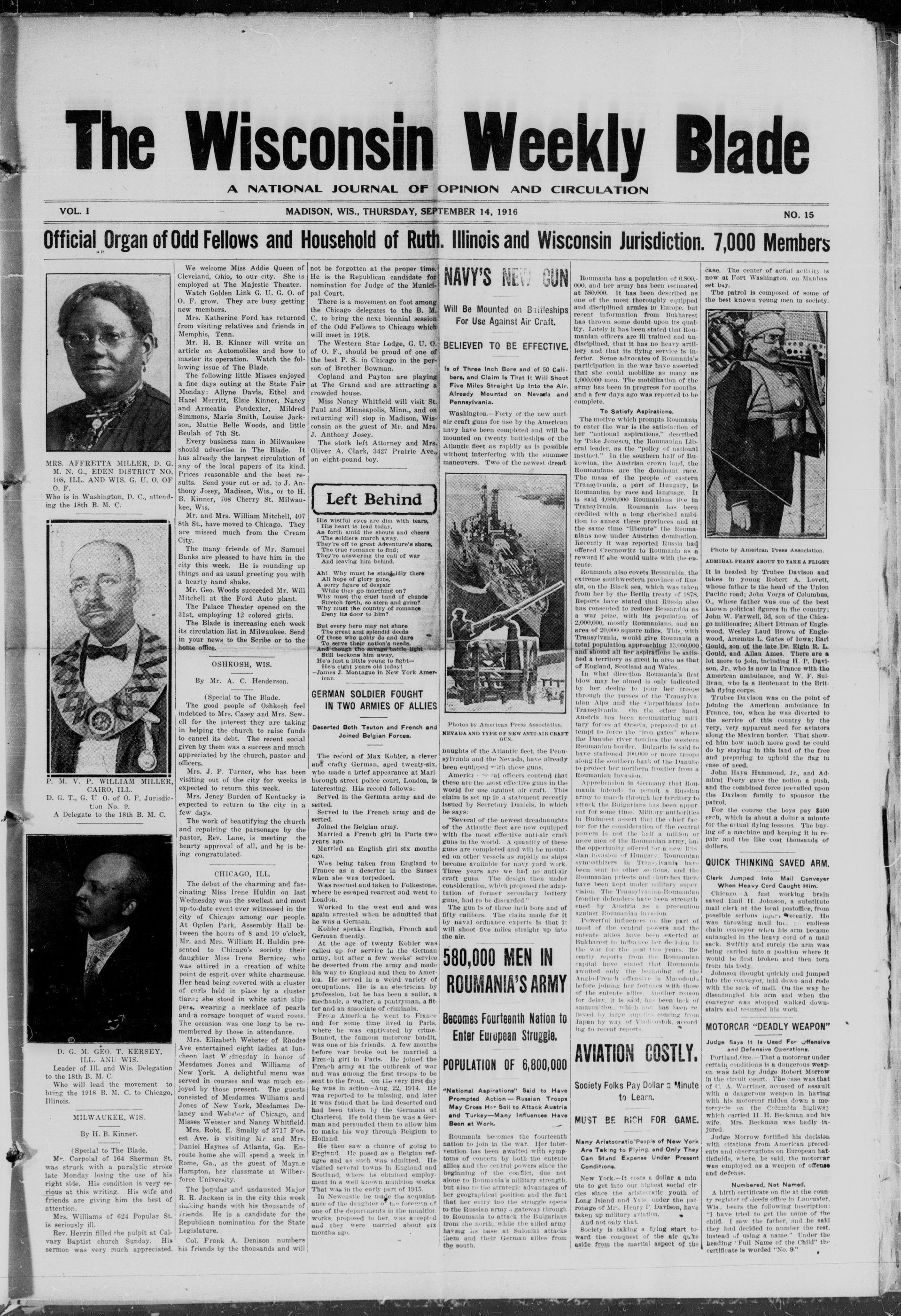
Page text (machine-generated)
The Wisconsin Weekly Blade
Official Organ of Odd Fellows and Household of Ruth. Illinois and Wisconsin Jurisdiction. 7,000 Members
VOL. I
MRS. AFFRETA MILLER, D. G.
M. N. G., EDEN DISTRICT NO.
108, ILL. AND WIS. G. U. O. OF
O. F.
Who is in Washington, D. C., attending the 18th B. M. C.
M. J. B.
D. G. M. GEO. T. KERSEY,
ILL. AND WIS.
Leader of Ill. and Wis. Delegation
to the 18th B. M. C.
Who will lead the movement to
bring the 1918 B. M. C. to Chicago,
Illinois.
MILWAUKEE, WIS.
By H. B. Kinner.
Mr. Corpolal of 164 Sherman St. was struck with a paralytic stroke late Monday losing the use of his right side. His condition is very serious at this writing. His wife and friends are giving him the best of attention.
Mrs. Williams of 624 Popular St. is seriously ill.
Rev. Herrin filled the pulpit at Calvary Baptist church Sunday. His sermon was very much appreciated.
We welcome Miss Addie Queen of Cleveland, Ohio, to our city. She is employed at The Majestic Theater. Watch Golden Link G. U. G. O. of O. F. grow. They are busy getting new members. Mrs. Katherine Ford has returned from visiting relatives and friends in Memphis, Tenn. Mr. H. B. Kinner will write an article on Automobiles and how to master its operation. Watch the following issue of The Blade. The following little Misses enjoyed a fine days outing at the State Fair Monday: Allyne Davis, Ethel and Hazel Merritt, Elsie Kinner, Nancy and Armeatia Pondexter, Mildred Simmons, Marie Smith, Louise Jackson, Mattie Belle Woods, and little Beulah of 7th St. Every business man in Milwaukee should advertise in The Blade. It has already the largest circulation of any of the local papers of its kind. Prices reasonable and the best results. Send your cut or ad. to J. Anthony Josey, Madison, Wis., or to H. B. Kinner, 708 Cherry St. Milwaukee, Wis. Mr. and Mrs. William Mitchell, 407 8th St., have moved to Chicago. They are missed much from the Cream City.
The many friends of Mr. Samuel Banks are pleased to have him in the city this week. He is rounding up things and as usual greeting you with a hearty hand shake.
Mr. Geo. Woods succeeded Mr. Will Mitchell at the Ford Auto plant.
The Palace Theater opened on the 31st, employing 12 colored girls.
The Blade is increasing each week its circulation list in Milwaukee. Send in your news to the Scribe or to the home office.
OSHKOSH, WIS.
By Mr. A. C. Henderson.
The good people of Oshkosh feel indebted to Mrs. Casey and Mrs. Sewell for the interest they are taking in helping the church to raise funds to cancel its debt. The recent social given by them was a success and much appreciated by the church, pastor and officers.
Mrs. J. P. Turner, who has been visiting out of the city for weeks is expected to return this week.
Mrs. Jency Burden of Kentucky is expected to return to the city in a few days.
The work of beautifying the church and repairing the parsonage by the pastor, Rev. Lane, is meeting the hearty approval of all, and he is being congratulated.
CHICAGO. ILL.
The debut of the charming and fascinating Miss Irene Huldin on last Wednesday was the swellest and most up-to-date event ever witnessed in the city of Chicago among our people. At Ogden Park, Assembly Hall between the hours of 8 and 10 o'clock Mr. and Mrs. William H. Huldin presented to Chicago's society their daughter Miss Irene Bernice, who was attired in a creation of white point de sprit over white charmeuse. Her head being covered with a cluster of curls held in place by a cluster tiara; she stood in white satin slippers, wearing a necklace of pearls and a corsage bouquet of wand roses. The occasion was one long to be remembered by those in attendance.
Mrs. Elizabeth Webster of Rhodes Ave entertained eight ladies at luncheon last Wednesday in honor of Mesdames Jones and Williams of New York. A delightful menu was served in courses and was much enjoyed by those present. The guests consisted of Mesdames Williams and Jones of New York, Mesdames Delaney and Webster of Chicago, and Miss Webster and Nancy Whitfield.
Mrs. Robt. E. Smally of 3717 Forest Ave. is visiting Mr. and Mrs. Daniel Haynes of Atlanta, Ga. Enroute home she will spend a week in Rome, Ga., as the guest of Mayne Hampton, her classmate at Wilberforce University.
The popular and undaunted Major R. R. Jackson is in the city this week shaking hands with his thousands of friends. He is a candidate for the Republican nomination for the State Legislature.
Col. Frank A. Denison numbers his friends by the thousands and will
MADISON, WIS., THURSDAY, SEPTEMBER 14, 1916
not be forgotten at the proper time. He is the Republican candidate for nomination for Judge of the Municipal Court. There is a movement on foot among the Chicago delegates to the B. M. C. to bring the next biennial session of the Odd Fellows to Chicago which will meet in 1918. The Western Star Lodge, G. U. O. of O. F., should be proud of one of the best P. S. in Chicago in the person of Brother Bowman. Copland and Payton are playing at The Grand and are attracting a crowded house. Miss Nancy Whitfield will visit St. Paul and Minneapolis, Minn., and on returning will stop in Madison, Wisconsin as the guest of Mr. and Mrs. J. Anthony Josey. The stork left Attorney and Mrs. Oliver A. Clark, 3427 Prairie Ave., an eight-pound boy.
Left Behind
His wistful eyes are dim with tears,
His heart is lead today.
As forth amid the shouts and cheers
The soldier march away.
They're off to great Adventure's shore,
The true romance to find;
They're answering the call of war
And leaving him behind.
Ah! Why must he stand idly there
All hope of glory gone,
A sorry figure of despair
While they go marching on?
Why must the cruel hand of chance
Stretch forth, so stern and grim?
Why must the country of romance
Deny its door to him?
But every hero may not share
The great and splendid deeds
Of those who nobly do and dare
To serve their nation's needs.
And though the savage battle light
Still beckons him away.
He's just a little young to fight—
He's eight years old today!
-James J. Montague in New York American.
GERMAN SOLDIER FOUGHT IN TWO ARMIES OF ALLIES
Deserted Both Teuton and French and Joined Belgian Forces.
The record of Max Kohler, a clever and crafty German, aged twenty-six, who made a brief appearance at Marlborough street police court, London, is interesting. His record follows:
Served in the German army and deserted.
Served in the French army and deserted.
Joined the Belgian army.
Married a French girl in Paris two years ago.
Married an English girl six months ago.
Was being taken from England to France as a deserter in the Sussex when she was torpedoed.
Was rescued and taken to Folkestone, where he escaped rearrest and went to London.
Worked in the west end and was again arrested when he admitted that he was a German.
Kohler speaks English, French and German fluently.
At the age of twenty Kohler was called up for service in the German army, but after a few weeks' service he deserted from the army and made his way to England and then to America. He served in a weird variety of occupations. He is an electrician by profession, but he has been a sailor, a mechanic, a waiter, a pantryman, a flitter and an associate of criminals.
From America he went to France and for some time lived in Paris, where he was captivated by crime. Bonnot, the famous motorcar bandit, was one of his friends. A few months before war broke out he married a French girl in Paris. He joined the French army at the outbreak of war and was among the first troops to be sent to the front. On the very first day he was in action-Aug. 22, 1914. He was reported to be missing, and later it was found that he had deserted and had been taken by the Germans at Charleroi. He told them he was a German and persuaded them to allow him to make his way through Belgium to Holland.
He then saw a chance of going to England. He posed as a Belgian refugee and as such was admitted. He visited several towns in England and Scotland, where he obtained employment in a well known munition works. That was in the early part of 1915.
In Newcastle he made the acquaintance of the daughter of the foreman of one of the departments in the munitor works, proposed to her, was accepted and they were married about six months ago.
NAVY'S NEW
GUN
Will Be Mounted on Battleships For Use Against Air Craft.
BELIEVED TO BE EFFECTIVE
Is of Three Inch Bore and of 50 Calibers, and Claim Is That It Will Shoot Five Miles Straight Up Into the Air. Already Mounted on Nevada and Pennsylvania.
Washington.—Forty of the new antiair craft guns for use by the American navy have been completed and will be mounted on twenty battleships of the Atlantic fleet as rapidly as is possible without interfering with the summer maneuvers. Two of the newest dread
Photos by American Press Association.
NEVADA AND TYPE OF NEW ANTI-AIR CRAFT GUN
Photos by American Press Association.
NEVADA AND TYPE OF NEW ANTI-AIR CRAFT GUN.
naughts of the Atlantic fleet, the Pennsylvania and the Nevada, have already been equipped with these guns.
American naval officers contend that these are the most effective guns in the world for use against air craft. This claim is set up in a statement recently issued by Secretary Daniels, in which he says:
"Several of the newest dreadnaughts of the Atlantic fleet are now equipped with the most effective anti-air craft guns in the world. A quantity of these guns are completed and will be mounted on other vessels as rapidly as ships become available for navy yard work. Three years ago we had no anti-air craft guns. The design then under consideration, which proposed the adaptation of former secondary battery guns, had to be discarded."
The gun is of three inch bore and of fifty calibers. The claim made for it by naval ordnance experts is that it will shoot five miles straight up into the air.
580,000 MEN IN ROUMANIA'S ARMY
Becomes Fourteenth Nation to Enter European Struggle.
POPULATION OF 6,800,000
"National Aspirations" Said to Have Prompted Action—Russian Troops May Cross Her Soil to Attack Austria and Turkey—Many Influences Have Been at Work.
Roumania becomes the fourteenth nation to join in the war. Her intervention has been awaived with symptoms of concern by both the entente allies and the central powers since the beginning of the conflict, due not alone to Roumania's military strength, but also to the strategic advantages of her geographical position and the fact that her entry into the struggle opens to the Russian army a gateway through to Roumania to attack the Bulgarians from the north, while the allied army having its base at Saloniki attacks them and their German allies from the south.
---
Roumanla has a population of 6,800,000, and her army has been estimated at 580,000. It has been described as one of the most thoroughly equipped and disciplined armies in Europe, but recent information from Bukharest has thrown some doubt upon its quality. Lately it has been stated that Roumanla officers are ill trained and undisciplined, that it has no heavy artillery and that its flying service is inferior. Some advocates of Roumanla's participation in the war have asserted that she could mobilize as many as 1,000,000 men. The mobilization of the army has been in progress for months, and a few days ago was reported to be complete.
To Satisfy Aspirations.
The motive which prompts Roumania to enter the war is the satisfaction of her "national aspirations," described by Take Jonescu, the Roumanian Liberal leader, as the "policy of national instinct." In the southern half of Bukowina, the Austrian crown land, the Roumanians are the dominant race. The mass of the people of eastern Transylvania, a part of Hungary, is Roumanian by race and language. It is said 4,000,000 Roumanians live in Transylvania. Roumania has been credited with a long cherished ambition to annex these provinces and at the same time "liberate" the Roumanians now under Austrian domination. Recently it was reported Russia had offered Czernowitz to Roumania as a reward if she would wuite with the utente. Roumania also covets Bessarabia, the extreme southwestern province of Russia, on the Black sea, which was taken from her by the Berlin treaty of 1878. Reports have stated that Russia also has consented to restore Bessarabia as a war prize, with its population of 2,000,000, mostly Roumanians, and an area of 20,000 square miles. This, with Transylvania, would give Roumania a total population approaching 13,000,000 and should all her aspirations be satisfied a territory as great in area as that of England, Scotland and Wales.
In what direction Roumania's first blow may be aimed is only indicated by her desire to pour her troops through the passes of the Transylvanian Alps and the Carpathians into Transylvania. On the other hand, Austria has been accumulating military forces at Orsynau, prepared to attempt to force the "iron gates" where the Danube river touches the western Roumanian border. Bulgaria is said to have stationed 100,000 or more troops along the southern bank of the Danube to protect her northern frontier from a Roumanian invasion.
Apprehension in Germany that Roumania intends to permit a Russian army to march through her territory to attack the Bulgarians has been apparent for some time. Military authorities in Budapest assert that the chief factor for the consideration of the central powers is not the half a million or more men of the Roumanian army, but the opportunity offered for a new Russian invasion of Hungary. Roumanian sympathizers in Transylvania have been sent to other sections, and the Roumanian priests and churches there have been kept under military supervision. The Transylvanian Roumanian frontier defenders have been strengthened by Austria as a precaution against Roumanian invasion.
Powerful influences on the part of most of the central powers and the entente allies have been exerted at Bukharest to influence her decision in the war for the past two years. Recently reports from the Romaniaian capital have stated that Romania awaited only the beginning of the Anglo-French offensive in Macedonia before joining her fortunes with those of the entente allies. Another reason for delay, it is said, has been lack of ammunition, which now has been relieved by large supplies coming from Japan by way of Vindivostok, according to recent reports.
AVIATION COSTLY.
AVIATION COSTLY.
Society Folks Pay Dollar a Minute to Learn.
MUST BE BICH FOR GAME
Many Aristocratic People of New York Are Taking to Flying, and Only They Can Stand Expense Under Present Conditions.
New York.—It costs a dollar a minute to get into our highest social circles since the aristocratic youth of Long Island and Yale, under the patronage of Mrs. Henry P. Davison, have taken up military aviation.
And not only that.
Society is taking a flying start toward the conquest of the air queue aside from the marital aspect of the
NO.15
case. The center of aerial activity is now at Fort Washington, on Manhas set bay.
The patrol is composed of some of the best known young men in society.
It is headed by Trubee Davison and takes in young Robert A. Lovett, whose father is the head of the Union Pacific road; John Vorys of Columbus, O., whose father was one of the best known political figures in the country; John W. Farwell, 3d, son of the Chicago millionaire; Albert Ditman of Englewood, Wesley Laud Brown of Englewood, Artemus L. Gates of Iowa; Earl Gould, son of the late Dr. Elign R. L. Gould, and Allan Ames. There are a lot more to join, including H. P. Davison, Jr., who is now in France with the American ambulance, and W. F. Sullivan, who is a lieutenant in the British flying corps.
Trubee Davison was on the point of joining the American ambulance in France, too, when he was diverted to the service of this country by the very, very apparent need for aviators along the Mexican border. That showed him how much more good he could by staying in this land of the free and preparing to uphold the flag in case of need.
John Hays Hammond, Jr., and Admiral Peary gave the notion a push, and the combined force prevailed upon the Davison family to sponsor the patrol.
For the course the boys pay $400 each, which is about a dollar a minute for the actual flying lessons. The buying of a machine and keeping it in repair and the like cost thousands of dollars.
QUICK THINKING SAVED ARM
Clerk Jumped into Mail Conveyor When Heavy Cord Caught Him.
Chicago-A fast working brain saved Emil H. Johnson, a substitute mail clerk at the local postoffice, from possible serious injury recently. He was throwing mail into an endless chain conveyor when his arm became entangled in the heavy cord of a mail sack. Swiftly and surely the arm was being carried into a position where it would be first broken and then torn from his body.
Johnson thought quickly and jumped into the conveyor, laid down and rode with the sack of mail. On the way he disentangled his arm and when the conveyor was stopped walked downstairs and resumed his work.
MOTORCAR "DEADLY WEAPON"
Judge Says It Is Used For Offensive and Defensive Operations. Portland, Ore.—That a motorcar under certain conditions is a dangerous weapon was held by Judge Robert Morrow in the circuit court. The case was that of C. A. Warriner, accused of assault with a dangerous weapon in having with his motorcar ridden down a motorcycle on the Columbia highway which carried H. H. Beckman and his wife. Mrs. Beckman was badly injured. Judge Morrow fortified his decision with citations from American precedents and observations on European battlefields, where, he said, the motorcar was employed as a weapon of offense and defense.
Numbered. Not Named
A birth certificate on file at the county register of deeds office in Lancaster, Wis., bears the following inscription: "I have tried to get the name of the child. I saw the father, and he said they had decided to number the rest, instead of using a name." Under the heading "Full Name of the Child" the certificate is worded "No. 9."
A National Journal of Opinion and Circulation.
Entered as second-class matter June 8, 1916, at the post office at Madison. Wis., under rthe Act of March 3, 1879.
4
Address all communications to THE WISCONSIN WEEKLY BLADE, 312 N. Henry St. Money sent by express money order, or registered letter at our own risk, otherwise at risk of the sender.
J. Anthony Josey, Editor.
L. J. Ousley, Contributing Editor.
J. Anthony Josey, Manager.
Phones 6756-3369.
SUBSCRIPTION:
One year ..... $1.50
Six months ..... 1.00
Three months ..... 50
NOTICE.
The D. G. L. is not responsible for any financial obligation of The Blade.
THE CHANGES.
The change which we may hope for in the future of American government must come in the state of mind of the people as well as in constitutional and statutory enactment. Something may be done without legislation of any sort. Capable officers may be re-elected, even though the statutes provide that elections shall occur annually or biennially. Reasonably free sway may be allowed them in administration, even though aldermen or councils have the power to restrict or veto. But, as I have already had occasion to say, legislation and tradition react on each other. A change of legislation in the right direction fosters habits in the right direction. The activity which we see now in improving the framework of municipal government is itself a sign that traditions are mending. As the remodeled charters come into effect, they will in turn still further react on the voter's state of mind. Whether both combined will eventually bring about conditions under which men of the reader's stamp find a congenial field in the management of public affairs is, to repeat, a question of popular intelligence.
HERE IS THE POINT
Are the discriminations against us Colored Americans, the denial of rights, the proscription, the persecution, the killings, sufficiently extensive, degrading and injurious to cause you in defense of the welfare and also the very reputation of our race, to induce you to stand the expense of attending a National Congress on rights at D. of C., Oct. 4, 1916; or to solicit the expense to go for yourself or some one else; or to get up a mass meeting or entertainment to raise money to send delegates? That's the rub.
The Negro has in him the same possibilities of development and training as other people, and he is awaking to the consciousness of this fact. For a long time he had many misgivings and doubts, but having discovered the fact that he could do great things just as other people he is girding up his loins about him to bring out all of which he is capable and that means a great future, a great destiny. The Negro must believe in himself. For every race of people that believe in themselves and believed that they had a great future have never failed to approximate the estimate which they placed upon themselves.
The same is true of our people. It is not so much a question of what other people think of us, as it is of what we think we can accomplish as a race. Let the Negro feel that with great powers and possibilities which God has given or vouchsafed to him that he is capable of achieving a great destiny, and we should not allow any other people to make him believe otherwise, for that fact that we have these great powers of mind and body argues that he can become a great factor as a part of the American citizenry. We should let no one make us believe otherwise. This lesson should be impressed upon the rising generations that their destiny is largely in their own hands. We have shown to the world by the great men and women we have produced that we are capable of playing a great part, and as the years go by we shall
demonstrate more and more our right to a square deal in this great republic. Opportunities come to those who use them and The Blade feels that the Negro has made such a use of the few opportunities which have been opened to him that he is worthy of more and that they will come. No power on earth can prevent it. When it is our duty to press forward and present a solid front and follow the leadership of those who are doing so much to make us a great and wealthy people.
Autumn Road
The year has taken the old September trail,
And it's led her by the way I used to pass,
Where asters, starry eyed, come crowding either side,
And sunlight's yellow on the dusty grass,
There ranks of russet goldenrod are set,
And milkweed's shimmering silver sails the air,
And a ruddy ivy vine threads the fence,
a scarlet line,
And deep content is brooding everywhere
In a peace that is a prayer.
I am thinking, when my summer days are done
And the year that was youth is turning slow,
Will there still be glints and gleams in the old desires and dreams,
Will they take a brave new beauty as they go?
With a rift of red and gold across the brown
And a grace of blue and silver, suddenly—Oh, I pray my heart remembers the look of past Septembers.
That morning dun road of life at last may be
A way like this for me!
A way like this for me!
—People's Home Journal.
"SAY SQUIRREL" IS
BRITISH SPY TEST
American So Challenged Soon Proves He's No German.
J. J. A. Murphy, an American decorative artist, who spent the past four years in England, said on his return on board the American liner Finland that he was saved from imprisonment and possible execution as a spy by the word "squirtrel."
Mr. Murphy decided last Christmas to go on a walking tour through Ireland, where he had no expectation that his name would arouse suspicion. Under the impression that no passports were necessary to go from England to the Emerald Isle, he set out innocently, but was arrested at Holyhead because he lacked the all important papers of identification.
Several bayonets were held tickly close to his ribs, while English officers made inquiries as to his past life and future career. Though one of them, a territorial, treated him as if all artists were open to suspicion, a captain in the regular service acted more like "an officer and a gentleman," and suddenly shot this order at him: "Say squirrel."
Mr. Murphy, whose touch of Irish brogue and American enunciation has in the last few years been overlaid with English diction, mumbled the required word. The officer promptly commanded that he be set free. Much astonished, the artist inquired how he happened to deliver this open sesame. "A German," explained the captain, "can't say the word he loses it down his throat. An Englishman slurs the final 'el'. rolling the word under his tongue. You said it like an Englishman."
EXPLOSIONS IN HIS BLOOD
Baltimore Man Discloses New Malady of Munition Workers.
A new disease has appeared among the munition workers in Baltimore plants. It is called explosive blood. It is almost impossible to conceive of a man's blood exploding in his veins and arteries, but nevertheless this is just what happens when a munition worker is affected. John Reynolds of Baltimore, employed at the Du Pont works at Carney Point, Del., has been treated for the strange malady at Mervy hospital and at City hospital at Bayview. The explosions occur only in the very smallest veins. The effects are no more disastrous than to cause a rather malignant eruption on the skin of the arms and legs. Simultaneously with this strange condition the patient's skin becomes yellow. The treatment is extremely simple and rapid effective. It consists solely of fresh air and a light diet.
Reynolds had been handling large quantities of sulphuric ether. He was visiting relatives here when the gases began to affect him. A hospital surgeon, while closely observing the patient, was attracted by a strange crackling sound and on investigation found the patient's arm breaking out. These tiny explosions were recurrent for probably a week.
SPIDER ELECTS WILSON
Spins His Name In Web, as Was Done For McKinley In 1896.
The quadrennial spider prophecy has been made, and this year it elects Woodrow Wilson. At the home of Mrs. Thomas Field in Charleston, Va., a yellow spider about an inch in length has been weaving its stinken skein over a bedroom window. The spider started at the circumference of the web, leaving in its wake the frosted letters "W Wilson." Some of the letters were cut as clean as though made by an engraver.
Mrs. Field recalls the election of President McKinley in 1896, when "presidential" spiders were plentiful and they all spelled out "William McKinley."
BOYS ON BORDER HOME FIRST
Spirit Seems to Have Struck All Guardsmen—Rush For Postoffice After Seeing Paymaster.
THOUGH miles from their loved ones, many of the boys at Camp Stewart, after being paid off in gold and silver, were granted leave of absence and went to El Paso, not to spend their money on a lot of foolish things, but to send it home. The thought of home first seems to have struck the boys all along the border.
All organizations of the Pennsylvania division utilize nearly every moment of the day. At the First cavalry camp, under John P. Wood, there is nearly always something doing. The men of Troop H of Pittsburgh, Captain Charles C. McGovern commanding, are slowly conquering the "bad" horses in the outfit. Private Frank R. Smith rode one of the unruly animals until it killed itself in an attempt to unseat him. Five Pittsburgh troopers are limping about the camp because of brushes received trying to conquer this horse. In attempting a back somersault it broke its neck.
The machine gun company, under Captain Charles W. Lloyd, participated in long target practice with the machine gun company of the Eighth United States cavalry, and the Pennsylvania men showed excellent improvement in the "sweeping fire" practice.
The signal troop of Pittsburgh, under Major Frederick G. Miller, also put in many hard hours. This organization conducted a division problem which includes much labor. It was a case of erect and pull, down wireless stations and lay telegraph lines for a whole day. While the distance of the movement was only eighteen miles, perfect wireless communication was kept with division headquarters. Two wireless equipments were used.
Field Hospital No. 1 of Pittsburgh, under Major Arthur P. Schaefer, had a forty-eight hour hike in the Franklin mountains. The hike included much hard labor. To get over some of the steep grades wagons had to be taken apart and pulled up the mountains with block and tackle and the equipment packed on mules. The company met with no accidents.
Indiana Will Lose Battery.
The war department has notified Brigadier General E. M. Lewis, camp commander at Llano Grande, to make an investigation of the number of men that will be affected by the order relieving individual students and student bodies from military service on the border that they may return to their studies; also to ascertain what effect the sending away of the students will have on the different units.
It was found that Indiana would lose one entire battery, twenty-eight out of fifty in one company of infantry, an entire band and a large number from different units—so large that some of the Indiana outfits would be almost skeletonized. Colonel Leslie R. Naftzer of the First, Colonel T. R. Coulet of the Second and Colonel Aubrey L. Kuhlman of the Third, Major R. H. Tyndall of the field artillery and the commanding officers of the ambulance and signal companies, all urged that the order be revoiled and that only men with disability and men who have dependent relatives be discharged.
This request of the war department is taken to mean that the students because they are students may not be sent home, because it will weaken the outfits and in a way will interfere with recruiting. The discontent against the student order still continues, and if the students are discharged for no other reason than because they are students the effect on the Indiana troops will be demoralizing. This is all set forth in the recommendations of the different commanders.
The discharge of men on account of disability also will deplete the Indiana units. It is understood that in the First Indiana there are forty who will be discharged for disability. Should all the students, all who have dependent relatives and those who are disabled, be discharged there will be about enough left for one full Indiana regiment of infantry.
Buffalo Boys Adjust Damage
Troop I is back again at McAllen Tex., the piece of soil ablotted it by the government to help preserve peace on the Mexican border, and the Buffalo troopers are adjusting the damage done their camp by the gulf storm. The storm has subsided, and in its wake thousands of dollars' worth of property in this camp was left destroyed.
Troop I, however, did not suffer as severely as other organizations. They were fortunate enough to have their cook shack standing after the rain and wind had subsided. During the time the storm was raging the members of Troop I fed 300 other troopers whose cook shacks were blown down.
Discover Real Monte Cristo
Members of C troop, Squadron A, who are temporarily on detached service is guard of a supply train near Monte Cristo, Tex., have struck an oak in the culinary desert through which they have been wandering. Whether the roins will block the roads for the food trucks is a question which
THINK OF
WHEN PAID OFF
Stories of Interest Picked Up at the Different Camps Along the Rio Grande.
causes little worry in these days, and breakfasts of cheese and string beans are things of the past. The fact is that Monte Cristo has proved itself a center where the culinary art has reached a high state of perfection.
Monte Cristo formerly consisted of a twelve foot square railroad station, a combination postoffice and general store, a schoolhouse, a few houses inhabited by Americans and several shacks where Mexicans and their animals dwell in happy community. A short time ago some enterprising person decided to move a few of the houses together and so make a hotel, and so "there is a tavern in the town." At this hotel, called the Wander inn, the troopers have established informal headquarters, and they have turned it into a sort of club. The place has a wide, shady veranda, a large living room containing several real chairs, a table, a phonograph and a couch. In the yard is a rickety shower bath. Such comforts are irresistible, and all leisure hours are spent at "the club."
The matron de hotel is Mrs. Montgomery. She is assisted by her daughter-in-law. They are elderly, kindly women, with a decided religious bent, which led them to summon the Rev. Dr. Potts to preach a sermon to the soldiers, and a strictly pacifist sermon it was.
While the right hand is extended in cordial hospitality, the left is busy making lemonade at 5 cents a glass, and in putting the little pot into the big one to produce a "chicken dinner for six at a time." It may be in the cooking, it may be that hunger is the best of appetizers, but whatever be the reason there is no one who has partaken of this delightful mess who would allow that its equal exists in the north.
Those who are not so fortunate as to be accommodated at the hotel turn to the Mexicans for their dinner parties Nor are these Mexican repasts to be sniffed at. There are always hot buttered tortillas in abundance, a big bowl of gellina con arroz, a highly spiced chicken and rice stew, and generally friedlets, Mexican beans, in some delicious form. The Mexican kitchen differs in essential respects from a typical New England kitchen, but one cannot be too critical, and these Mexican spreads are distinctly good.
After the Fly on Border
Old Man Fly will have little place in the United States army on the Mexican border if Major General Funston and the medical corps officers of the southern department have their way about it. The army officers in charge of the 98,000 state troops now along the international boundary have one object in view. That is to make the sanitary condition of the guardsmen as nearly perfect as possible and promptly to nail and refute all the yarns of poor food and bad surroundings the guardsmen write back to the folk at home and which the home folk immediately turn over to the town newspaper. Steps already have been taken to court martial two Wisconsin privates who sent telegrams to Senator La Follette complaining of their food. Following are some of the regulations distributed by Lieutenant Colonel Munson, medical corps, in charge of sanitation matters along the border:
All fresh meat, bread and vegetables will be inspected by a medical officer as to quality when issued. Food will be prepared and served in a cleanly manner. It will habitually be protected against sun, dust and flies. Company cooks and mess equipment and kitchen areas will be neat and clean at all times. Individual mess kits will be cleaned at the cook tent immediately after use. Cooks will maintain a supply of hot water for this purpose. The keeping in the tents of uneaten portions of rations is strictly prohibited.
Fine Ham and Eggs. Though
An officer of the Second Minnesota dropped into a restaurant the other day to buy a cigar, asking for his favorite brand.
"Sorry, captain, but we haven't any of them cigars," the negro waiter said, "but we've got some nice ham and eggs."
The boys of L company, First infantry, one of the St. Paul companies, are somewhat chesty these days, being the first company to respond to the first call "to arms" sounded in this camp.
Scorpion Becomes Friendly.
Cook McCormick of D company.
First regiment, swears he will never change his clothes again. While dressing to put on a sumptuous spread for the company Sunday he found a scorpion had made a nest in his trousers.
In the excitement of the moment the trousers fared almost as badly as the scorpion.
F battery of the First Minnesota field artillery, the University of Minnesota organization, has received from President George E. Vincent of the university a traveling library of 115 volumes of history, poetry and romance.
As the university battery goes home in a couple of weeks, the university boys will find little time for reading.
Phylis Wheatley Household, No.
4863, G. U. O. of O. F. Meets fourth
Saturday night each month, G. A. R.
Hall.
Marion Buckner, M. N. G.
Phoebia Hines, R. N. G.
A. E. Hill, N. G.
C. M. Josey, W. R.
Friendship Chapter, No. 66, O. E.
S. Meets second and third Saturday
nights each month, G. A. R. Hall.
Mary Jones, Worthy Matron.
J. W. Brown, Worthy Patron.
Marion Buckner, Worthy Sec.
Fresh and up-to-date drugs at
Lewis, State and Gilman St.
It is the request of the City Editor
that you furnish him with local news.
LODGES-NOTICES
Capital City Lodge No. 72, F. and
A. M. Meets first and third Wednesday
night each month, G. A. R. Hall.
O. M. Davis, W. M.
T. E. Hines, W. Sec.
Enterprise Lodge, No. 9109, G. U.
O. of O. F. Meets second and fourth
Wednesdays night each month, G. A.
R. Hall.
The Blade is operating an employment agency; all kinds of work furnished.
A great reduction Shoe Sale at Weaver's Shoe Store, 432 State St.
ADVERTISE
IF YOU
Want a cook,
Want a clerk,
Want a partner,
Want a situation,
Want a servant girl,
Want to sell a carriage,
Want to sell town property,
Want to sell your groceries,
Want to sell your dry goods,
Want to sell your hardware,
Want to sell your millinery goods
If you want customers for anything
Advertising is the highway to success
Advertising brings new customers,
Advertising keeps the old ones,
Advertising will insure success,
Advertising shows energy,
Advertising shows pluck.
Advertising is "biz."
Advertise or bust.
Advertise well.
Advertise long.
ADVERTISE
At once.
MRS. N. OWENS
ALL KINDS OF
HAIR GOODS
SWITCHES, WAVES, FRIZ ZES and HAIR CHAINS
420 Sixth Avenue Phone 182-J Baraboo, Wis. Send your subscription to the Blade and keep abreast with the doings of the Oddfellows and your community.
NOTICE!
All matter for publication in The Blade must reach our office no later than Tuesday morning for that week's issue. Write on one side of the paper only. Every P. S. and W. R. of Illinois and Wisconsin jurisdiction are requested to send the names of their officers and the nights of their meeting to The Blade for publication. Also to furnish us with the news of your locality.
Don't Forget Heilmann
PAN DANDY
BREAD
With Every Meal For Sale at Your Grocer
The Blade is on sale at the following places: Mosley & Smith, 202 E. Washington Ave., Trotter & Hopkins, 222 E. Main St., Hill's Grocery Store, 649 E. Dayton St., Weaver's Grocery
The Oldest Trust Company in the State of Wisconsin
The SavingsLoan&Trust Company
Steensland Building, Madison, Wis.
Capital and Surplus, $300,000
Pays 4 per cent. for Your Money.
Debentures, Certificates,
Savings, Trusts
Make your Deposits by Mail.
Money to Loan on Real
Estate Security
OFFICERS AND DIRECTORS
E. B. Steensland, Pres. and Treas.
W. A. P. Morris, Vice-Pres.
J. G. O. Zehnter, Vice-Pres.
E. F. Riley, Sec'y and Trust Officer.
I. M. Kittleson, Assistant Sec'y.
W. D. Curtis Stanjord P. Starks
A. E. Proudfit A. F. Menges
S. T. Swansen Herman Pfund
BE HAPPY
And Buy the Famous Malt and Snow Flake Bread also Rye, Graham and Bran Baked Rye.
TheGlobe Baking Company
219-223 East Main Street
Special orders for Birthday or Wedding Cakes
LYNCH BROS
The Home of Good Groceries
The only state street
store that gives CASH
REBATE TO ITS
CUSTOMERS.
Delivery to all parts of the city.
306 STATE STREET
Telephone 2195
Velvet Ice Cream
It's All Cream
Kennedy Dairy Co.
618 University Ave.
Phone 778
Capital City Cigar Co.
108 S. Pinckney St.
Madison, Wis.
Wholesale Cigar Jobbers
Phone 523
Some of our leading brands:
Upmann's Repeater
Upmann's Ideal
Upmann's Fleur de Upmann
Garcia & Vega Clear Havana
Chas. Denby
Lucius Clear Havana
Clear Title
When other Corn Cures Fail Try Red Cross Corn Harvester. The Menges Pharmacie
"The Best Ice Cream" Order for Parties, Sunday Dinners OLSON'S
Phone 1440 Washington Building The Blade request that each P. S. send the name of the delegate elected to the B. M. C. for publication. Also the name of any friend that contemplates going to Washington on the Oddfellow special.
Miss Alice Philips, daughter of Rev. Dr. L. J. Philips of the A. M. E. church left last Saturday to resume her studies in University of Illinois. Before leaving she was given a surprise by the members of the parish.
Rev. Z. P. Smith will preach a special sermon on Sunday night next. The edifice is being taxed to accommodate those who attend.
Attorney and Mrs. Oliver Clark of Chicago are happy over the arrival of an eight-pound boy.
The Pew rally by the stewardess of St. Paul A. M. E. church was a successful effort and netted quite a handsome sum.
The public is invited to attend the supper at the A. M. E. church on Friday evening next.
Telephone your news to The Blade, Phone 3869.
The Blade will publish an elaborate Christmas edition of special articles, cut and write-ups of and from the leaders of the race. Among those who will contribute will be: Rt. Rev. Bishop J. S. Flipper, Georgia, Major R. R. Wright, Hon. H. L. Johnson, Washington, D. C., Prof. H. S. Murphy, Oklahoma, Dr. C. T. Walker, E. R. Carter, Emmett J. Scott, A. B. Singfield, Nannie H. Burroughs, Major General Morris Lewis, Illinois, Hon. Jas. F. Adair, New York, O. P. Mack, Kentucky, Miss Ruby Thornton, Major G. T. Jackson, Pres. N. W. Collier, Florida.
Mr. John A. Billingslea, the accomplished cornet player, has returned to the city after a tour of Rockford, Ill., Beloit and Janesville, Wis., where he filled several engagements.
WANTED.
Two or three students to board. No room. Phone 1887 or call at 522 St. Park St.
Miss Mamie Darling of Lovejoy, Ill., will attend the University of Wisconsin this fall, stopping with Mrs. Wm. Hickman, Park St.
Miss Gertrude Marshall, St. Louis, Mo., niece of Mr. and Mrs. Daniel Neely, is in the city for an indefinite stay.
Mrs. Henry Walters left last Sunday for a stay of two weeks in Chicago. Before returning she will visit her mother in Muskegon, Mich., and St. Ann, Ill.
Mr. Claude B. Smith spent a few days in the Windy City this week.
Mrs. Lulu Abrams, 111 S. Brooks St., is an ardent worker of the St. Paul A. M. E. church of which she is one of the stewardesses.
Miss Augustus Finn of Popular Bluff, Mo., who has been visiting her sister and brother-in-law, Mr. and Mrs. J. N. Wilson, returned home last Sunday. Her stay was a pleasant one.
Don't fail to telephone your news to the Blade. Phone 3369.
Mr. Samuel R. Banks of the Executive Department, State Capitol, is in Milwaukee this week, in charge of the office of Secretary O. A. Remeys at the State Fair.
Hill's Grocery Store carries a full line of groceries. Phone 7975.
RAPID TRANSIT DELIVERY, 647 E. Dayton St.
Mrs. Mary Wiley, Malvin, Ark., came to join her husband who has been in the city for some time. They are at the home of Mr. and Mrs. Jas. Jordan, Hamilton St.
BROWN, THE TRUNK MAN, is offering bargains in trunks and traveling bugs. 206 E. Main St.
Mrs. Jennie Jones left last Saturday for Chicago to join her husband. They are at 3354 Wabash Ave.
The following are enrolled as High School students: Misses Ethel Simms, Gertrude Jackson, Sylvia Alexander, Messrs. Arthur Buckner, Clarence Prown, Leo Butts, Howard Sheppard. We trust that each of these will make good and at the proper time enter the University.
Mr. Erman Abrams has entered the 4C College for a business course. Mr. A. J. Hutchinson, recently from the Cosmopolitan State is attending High School.
MR. AND MRS. J. SCOTT MOSLEY
821 Milton St.
At Dinner in Honor of the Misses Myrtle D. Smith and Robertha Echols of Chicago.
At the palatial home of Mr. and Mrs. J. Scott Mosley on last Sunday afternoon an eight course dinner was served in honor of Misses Smith and Echols of Chicago who were the guests of Mr. and Mrs. J. Anthony Josey for the last two weeks. Many functions had been tendered these young ladies but this occasion was indeed second to none. The wine course to the after-dinner mints was
palatable an dthe host and hostess vied each with the other to make the occasion an enjoyable one. The guests consisted of Mr. and Mrs. J. Anthony Josey, Miss Pauline Battice, Messrs. H. De Voe Caisey and W. Randall Carmichael.
MRS. WILLIE M. SLOAN
Chicago's Favorite Soprano Soloist.
After an extensive visit East the many friends of Miss Willie M. Sloan welcome her on her return to Chicago. While away and in Boston she was the guest of her old friend and school mate Miss Alice Higginbotham. Mrs. Sloan will visit the South about the latter part of October, singing in the largest music halls. The Blade will try and arrange to have this talented, remarkably sweet and sympathetic singer come to Madison before going South.
A PLEASANT DEPARTURE.
Chicago Guest.
The departure of the accomplished and entertaining Misses Smith and Echols of Chicago caused much regret among the social set of the Lake City. On the afternoon prior to their leaving friends gathered for a few hours of enjoyment. Before and after a special theater party was tendered them by Messrs. H. DeVoe Caisey and W. Randall Carmichael. In the evening Mrs. Phoebia Hines Lawrence presided at the piano and the air resounded with the latest songs and instrumental music, which added tone and feeling to the occasion. The ladies left after being escorted to an early train by the genial party and were loud in their praise of Madison and the genuine hospitality shown them during their sojourn. A cordial welcome awaits their return.
CORTRELL-FORBES
Nuptial
The marriage of Miss Louise Forbes of Memphis, Tenn., and Mr James Cortrell was solemnized Thursday night in the presence of friends at the parsonage of the Mt. Zion Baptist church by the pastor, Rev. Z. P. Smith. The bride is of one of Memphis' first families and the groom is a native of the same city but has sojourned in Madison for some time. They are at home to their many friends, 5 S. Murray St.
Telephone your News to The Blade, 3369.
It is the request of the manager of The Blade that you send us all your Odd Fellow news for publication. Let the Odd Fellows and Ruths throughout the jurisdiction of Illinois and Wisconsin know what you are doing.
Our young folks' edition will be a great number of The Blade. Send us the photo of your children. It will be one of the Blade's new features.
Let the merchants know that you read the Blade by patronizing them and tell them that you saw their ad in our paper.
Cook with gas, and buy a stove from the Madison Gas & Electric Light Co. Terms to suit you.
Let the Madison Steam Dye Works do your cleaning. Work called for and delivered. Phone 2485.
Mr. J. H. Kemp, the Tailor, is located at No. 5 N. Webster St. with a full line of patterns. He is a graduate of the tailoring department of Tuskegee Institute. All goods fitted and made in his establishment.
Our columns are for the Ruths as well as for the Odd Fellows and it is our aim and object to serve the Sisters as well as the Brothers.
Ask your grocer for Globe Bread, it is wholesome.
Ask your grocer for The Globe Bread. For Birthday and Wedding cakes yhone 533, The Globe Bakery Co.
Send in or telephone your news to The Blade, Phone 3369. If you have company or if you intend to take a trip let your friends know it through the columns of our paper. It is immaterial to us whether you are a subscriber or not, we will print your Call 778 and you will get Velvet Ice Cream. It's all Cream.
Send your Odd Fellow news to The Blade. We desire to publish the name of the N. G. P. S. and meeting night of every lodge and household in the jurisdiction.
Telephone your news to The Blade.
Mr. Joseph Esser has moved to the 2700 block on Atwood Ave.
WANTED—Feet to treat. All ailments of the feet, corn, bunions, ingrown toe nails, swelling and sweaty feet. Weak ankles, fallen arches, chill blains. See Prof. Strong, 28 years as a foot specialist, 9 E. Main St., second floor. Room 1. Lady attendant.
FAMILY OF SIXTEEN
LIVE ON $100 MONTH
In Seventeen Years Fourteen Children Came to This Couple.
Riverside, 1a-To provide for a family of fourteen children on the modest salary of $1,200 paid by Uncle Sam to a rural mail carrier is the problem that confronts John C. D'Autremont, a rural carrier here. D'Autremont does it however, and a finer family of children one would not care to see.
More interesting than ever in this already interesting family is the fact that the father is only forty-seven years old, the mother, Mrs. Lucy Swift D'Autremont, is but thirty-eight and the couple has been married only seventeen years.
The father of this family is of French Huguenot descent, his ancestors having been Huguenot refugees when they came to America to establish a home. Mixed in the blood lines of this particular family are the strains of Irish and German, the mother having been of Celtic and Teutonic descent.
Although they range all the way from sixteen years old down to the twin daughters now nine months old, there is not a weakling in the family. They are healthy both physically and mentally.
SHERIFF DID HER SHOPPING BEFORE TAKING PRISONER
Attached Negro to Herself With Handcuff and Was "Loaded" For Trouble.
Chicago.—Mrs. Robert W. Sheets of Lincoln, Ill., spent a joyous afternoon recently along State street consuming ice cream sodas. Later she stepped into detective headquarters and said to the desk sergeant:
"I want my prisoner, please, W. A. Russell."
"Russell?" said the sergeant. "Why, Russell's the negro who's to go back to Lincoln. The sheffler was to come after him."
"Well, I'm the sheffler's wife," returned Mrs. Sheets. "I'm also a deputy. Won't you hurry a little? The train leaves at 6:30."
So Russell started with Mrs. Sheets to the union station, where she opened her handbag a couple of inches, observing, "See, I've got an automatic here, and it's loaded, too, and here are my handcuffs."
Mrs. Sheets then took out the hand-cuffs, fastened one on one of his wrists and the other on her wrist and put the key in her stocking.
"Now, William," she said, "don't try to do anything, for I'm loaded."
BY STAGE ALONG OLD TRAIL
Harvest Hands Use Ancient Coach to Reach Wheatfields.
Hutchinson, Kan.-Most of the harvest hands make their way to the wheatfields by rail, some on the plush and some riding the rods and box cars. But one party that passed through here occupied an old time stagecoach. It probably is the first time a stagecoach has followed the Santa Fe trail westward in many years. This stage came from Ottawa. It is a bus used for a quarter of a century as the town bus at Ottawa. George Hempstead was driving it, and he had it loaded with men who will work in the harvest fields. They were bound for Garfield, where they have jobs. Hempstead said it had taken them two weeks to make the drive from Ottawa.
THE WALTZ IS COMING BACK.
Dancing Masters Decree Doom of the Acrobatic Tango.
Chicago.—The old fashioned, dreamy waltz will supplant the acrobatic tango in the ballrooms of the country if the National Association of Dancing Masters has any influence. In convention here, with 400 members attending, the dance professors decreed that the tango must go. The waltz, the one step and the fox trot will be the favorites this season.
"Dancers are tiring of the tango and similar dances," said Thomas McDougall of Pittsburgh, president of the association. "The waltz always led until the tango came in, and we propose to re-establish it."
THE STAR HAIS GROWER A Wonderful Hair Dresser and Grower
A Wonderful Hair Dresser and Grower
One thousand agents wanted. Good money made. We want agents in every city and village to sell THE STAR HAIR GROWER. This is a wonderful preparation. Can be used with or without straightening irons.
Sells for 25c a box—one 25c box proves its value. Any person that will use a 25c box will be convinced. No matter what has failed to grow your hair, just give THE STAR HAIR GROWER a trial and be convinced. Send 25c for full size box. If you wish to be an agent send $1.00 and we will send you a full supply that you can begin work with at once; also agents' terms. Send all money by Money Order to
A Wonderful Hair Dresser and Grower
One thousand agents wanted. Good money made. We want agents in every city and village to sell THE STAR HAIR GROWER. This is a wonderful preparation. Can be used with or without straightening irons.
Sells for 25c a box—one 25c box proves its value. Any person that will use a 25c box will be convinced. No matter what has failed to grow your hair, just give THE STAR HAIR GROWER a trial and be convinced. Send 25c for full size box. If you wish to be an agent send $1.00 and we will send you a full supply that you can begin work with at once; also agents' terms. Send all money by Money Order to
Northern Branch, 113 Clark St., Evanston Ill. Southern Branch, P. O. Box 812, Greensboro, N. C.
Persons in the South can get their goods three days earlier by writing THE STAR HAIR GROWER, Mfr., P. O. Box 812, Greensboro, N. C.
Northern Branch, 113 Clark St., Evanston Ill. Southern Branch, P. O. Box 812, Greensboro, N.C.
Persons
days earl
GROWER
N. C.
Persons in the South can get their goods three days earlier by writing THE STAR HAIR GROWER, Mfr., P. O. Box 812, Greensboro, N. C.
---
A
Age Woman Drives Auto.
Danville, Ill.-Sarah Hewitt, aged eighty three, drove to Danville from her home, eight miles away, in her eighty horsepower roadster. "I can keep pace with the world, do my share of the work and enjoy my share of the pleasures with the rest of them, though I am nearly a quarter of a century past the age when, Dr. Osler said, folks should be chloroformed and killed," she declared. She handled her powerful car with ease and skill. "And I covered the distance in twenty minutes, which half a century ago would have taken an hour or more of jotting riding," she said.
Woman Ropes Alligator
Wharton, Tex.-Mrs. Will Hendricks is receiving the congratulations of her friends over having captured alive a large alligator. One evening recently she noticed the alligator trying to climb the hog wire fence of the L. O. Ireson pasture, and she ran home and brought a rope with which she lassoed the reptile and tied it to a post. Those who were attracted to the spot to view the catch stated that the alligator was over six feet long and that it fought desperately to make its escape.
Dancea Jig at Ninety-eight
Youngstown, O. — Mrs. Melinda Knight, ninety-eight years old, Youngstown's oldest woman, celebrated her birthday recently by playing popular music on the piano and doing a fig. In spite of her age, she is active on her feet and is able to dance some of the modern steps.
Old Ox Shoe Found.
Centralia. Kan.-An ox shoe has been unearthed in the J. P. Dorman garden. It had probably laid there for fifty years. Miss Dorman, who is a primary teacher, used the shoe to illustrate stories to the children of the early days in Kansas, when people rode behind oxen instead of in automobiles.
RETURNS AFTER THIRTY YEARS
Sailor Had Been In Almost Every Port, and Parents Didn't Know Him.
Townsend, Del.—Mourned as dead for thirty years, David Guesssferd returned to the home of his parents, Mr. and Mrs. Joseph Guesssferd, who live on a farm near here.
When sixteen years old young Guesssferd went away on a boat plying between Smyrna and Philadelphia as a sailor. He was anxious to see more of the country, so obtained a berth as a sailor on a vessel plying between New York and the East Indies, and that was the last heard of him.
He has been in practically every port in the world and on one occasion was wrecked in midocean and he and the captain of his vessel were the only survivors. He is said to have accumulated considerable money and will remain with his parents. They did not know him.
DRAINED ALL THE LAND.
Water Over Low Tract Disappeared When Ditch Is Dug.
Rockport, Mo.-The outlet ditch that drains Lake Nishnabotna at Langdon is the talk of the whole Missouri bottom. The effects have been almost miraculous.
It seems that when the ditch drained the Nishna, water standing all over the bottom, whether it had a connection with the ditch or not, disappeared, often in the night, leaving the ground fit for cultivation within a few days.
The Nishnabotna river has been standing full of water for about a year, and as the water level was almost as high as the great body of surrounding land, the water soaked through and saturated it all.
SUIT CASES
TRUNKS
TRAVELING
BAGS
and all kinds of
Leather Goods
Largest Stock in State
Chas. Wehrmann & Son
116 King St. Phone 666
THE STAR HAIR GROWER. Mfr.
The First National Bank
MADISON, WISCONSIN
United States
Capital Surplus and U
OFFICER
United States Deposits plus and Undivided Profits OFFICERS AND DIRECTORR
United States Depository
Capital Surplus and Undivided Profits $440,000.00
A. E. Proudfit President
M. E. Fuller, Vice-President
E. B. Neesland
Jas. B. Ramsay
FORD'S
HAIR ROMADE
MARKES MARSH,
KINNY HAIR SOPER,
MORE FLIPABLE, EASIER
TO COMB AND PUT UP
IN ANY STYLE THE
LENGTH WILL PERMIT
PRICE 25¢ AND 50¢ A BOTTLE
FORD'S HAIR STRAIGHTENER
NO. 022 STRAIGHTEN THE HAIR
BY ROLLING IT BETWEEN YOUR BRASS
ROLLS SETTING AND QUICKEST THING
WE KNOW OF TO STRAIGHTEN HAIR
PRICE $ 1.50
PATENTED LOCKING
DEVICE FOR NOLLING TEES
FORD'S SPIRAL HANDLE
HAIR STRAIGHTENING AND SHAMPOO
COMB NO. 024 SOLID BRASS, MINEL
PLATER LARGE AND VERV STRONG
CARRIER FROM THE MODEL OFFSPECIAL
LOCKING DEVICE HOLDS THE HANDLE
WITHOUT SOLDERING PRICE $ 100
FORD'S MEDIUM SIZED
BRASS SHAMPOO AND
HAIR STRAIGHTENING COMB NO. 026
A GOOD AND SERVICABLE COMB FOR
THE MONEY PRICE $ 90
ALL OUR GOODS WARPANED AS DESCRIBED
FOR SALE BY YOUR DEALER OR DIRECT FROM U
PRICE, IN WRITING DIRECT, SEND MONEY BY P
OZONIZED OX MARK
Just receive
plete line of
Samples.
Nothing but
$15.00 and
coats.
Your Clothes
Cleaning and Pr
J. H
Depend
"THE PUBLI
5 N.
FORD'S HAIR POMADE
MAKES HARSH
KINNY HAIR SOFTER,
MORE FILABLE, EASIER
TO COMB AND PUT UP
IN AN INERT
LENGTH WILL PERMIT
PRICE $25 AND $0 A BOTTLE
FORD'S HAIR STRAIGHTENER
NO.022 STRAIGHTEN THE HAIR
BY ROLLING IT WITH FOUR BRASS
ROLLS. BEST AND QUICKEST THING
WE KNOW OF TO STRAIGHTEN HAIR
PRICE $1.50
PATENT SECTIONAL TOOTH COMB
PATENTED LOCKING
DEVICE FOR HOLDING TEETH TIGHT
FORD'S SPIRAL HANDLE
HAIR STRAIGHTENING AND SHAMPOO
COMB NO.024 SOLID BRASS
PLATED. LARGE AND VERY STRONG
CANNOT BURN THE HANDLE OFF. SPECIAL
LOCKING DEVICE HOLDS THE HANDLE
WITHOUT SOLIDERING PRICE $1.00
FORD'S MEDIUM SIZED
BRASS SHAMPOO AND
HAIR STRAIGHTENING COMB NO.026
A GOOD AND SERVICABLE COMB FOR
THE MONEY. PRICE $5.04
ALL GOODS WARRANTED AS DESCRIBED OR MONEY REFUNDED.
FOR SALE BY YOUR OWNER OR DIRECT FROM US UPON REceipt OF
PRICE. IN WRITING DIRECT, SEND MONEY BY POST OFFICE OR EXPRESS MONEY ORDER.
OZONIZED OX MARROW CO. 46 W.KINZIE ST. CHICAGO, IL.
Just received, new and complete line of Fall and Winter Samples.
Nothing but ALL WOOL fabrics $15.00 and up, suits or overcoats.
Your Clothes Cut and Made Here Cleaning and Pressing Properly Done J. H. KEMP.
St. Benedi
823 WINN
MILW
St. Benedict Settlement
823 WINNEBAGO STREET
MILWAUKEE, WIS.
Home for Colored Working Girls
and Women Strangers
in the City.
Either Catholics or Protestants
All are Welcome.
Either with or without means.
MRS. L. DUNCAN
Phone 2852
Depository
and Profits $440,000.00
ECTORR
F. G. Brown, Vice-President
F. W. Hoyt
H. L. Moseley
M. C. Clark, Cashies
FORD'S
ROYAL WHITE
SKIN LOTION
MAKES THE SKIN
LOOK WHITER
AS SOON AS IT IS
PUT ON EXCELLENT
FOR PIMPLES, ROUGH SKIN AND
LOCAL SKIN DISEASES
PRICE $25 A BOTTLE
FORD'S PATENT
TWO PIECE SHAMPOO
AND HAIR STRAIGHTENING
COMB NO.023. YOU HEAT
THE ROD, NOT THE COMB
THIS, JAVING BURNING
AND SOILING THE COMB
RETAINS HEAT LONGER. PRICE $1.50
23% TEETH IN THIS COMB ARE MADE OF
GRATE PIECES OF BRASS, MOUNTED ON A SOLID
BOOT AND HELD BY A BATENT FEMUR. THE BRASS
TEETH BEcome LOOK UP THE FEMUR.
WISTING THE HANDLE AND THIS WILL PRESS
SLEEP UP TIGHTLY AGAINST THE TEETH
MOLD THEM FIRMLY. PRICE $1.25
FORD'S LARGE BRASS
SHAMPOO AND HAIR STRAIGHTENING
COMB NO.025 WORKING HANDLE
LARGE AND HELD BY A BATENT FEMUR. THE BRASS
TEETH BEcome LOOK UP THE FEMUR.
WISTING THE HANDLE AND THIS WILL PRESS
SLEEP UP TIGHTLY AGAINST THE TEETH
MOLD THEM FIRMLY. PRICE $1.00
AND HAIR STRAIGHTENING COMB NO.022.
STRONG COMB BEHAT ON REAL SHORT
LEFTER. PRICE $25 ¢
FORD'S HAIR PRESSER
NO.028 NICKEL FLATED,
STEEL FRAME, SOLID BRASS
KNOBS, VERY SERVICEABLE
PRICE 50 ¢
MONLY ORDER:
46 W.KINZIE ST.CHICAGO,ILL.
New and com-
mical and Winter
WOOL fabrics
ruits or over-
Hand Made Here
ing Properly Done
EMP,
Tailoring
PLEASED"
ER ST.
Settlement O STREET E, WIS.
No.144
Madison, Wis.
Secret Orders Tell Members and Sympathizers How to Conduct Themselves In Event of National Crisis.
THE effects of a general temp of the railroads of the country are obvious. But how is such a situation possible? It seems that the unions and the employers have been expecting the crisis for a good many years and have prepared for it. Especially are the unions ready for the emergency. They have perfected their various organizations to a fine point and claim to be in a position to call out every member on short notice. Their system is so perfectly organized that secret orders have been issued to the various chiefs, and instructions as to how to conduct themselves and their sympathizers have been spread from one end of the country to the other.
Just how well the railway presidents find themselves is a matter largely of conjecture. It has often been stated that there are strike breakers to take the places of the men who quit their positions and that traffic will continue. Of course it cannot be expected that in the event of a general strike all trains will continue to run as they usually do, but the railway heads claim that they can operate enough trains to carry the mails and other necessaries.
Five Tentative Measures
The president's program includes the following measures:
A bill establishing a legal eight hour day for labor on trains engaged in interstate commerce.
A bill providing for the adoption of the Canadian plan of conciliation, but having no compulsory arbitration feature. This measure is to provide that a strike shall not be enforced for a certain period, during which the interstate commerce commission investigate and recommend a plan of settlement.
A bill increasing the interstate commerce commission from seven to nine members.
A bill empowering the government to take over the running of the railroads in the event of a strike.
A resolution instructing the interstate commerce commission to consider wages as a basis for fixing freight rates.
The president gave both sides to understand that if this program could be carried out the strike order issued for Sept. 4 by the brotherhoods could be postponed for thirty days.
Secret Strike Order.
Here is a copy of the secret strike order handed in sealed envelope, to the 640 brotherhood chatrmen. In addition to this order secret instructions were issued to the members for their guidance in the event of a strike. The strike order reads:
Brotherhood of Locomotive Engineers.
Brotherhood of Locomotive Firemen and Enginemen.
Order of Railway Conductors.
Brotherhood of Railway Trainmen.
Aug. 14, 1918.
To All Local Chatrmen, Members and Others Employed in Chasms of Service Represented by the B. of L. F. B. of L. F. and E. O. R. C. and B. R. T.
Sirs and Brothers. This is to advise that a vote of the employees in train and engine service on the eight hour day and time and one-half for overtime proposition was overwhelmingly in favor of a strike.
Notwithstanding this, your representatives have been able to effect under the satisfactory settlement, and a strike under the laws of the respective organizations becomes effective Sept. 4, 1967, at 7 a.m.
Impart this information so that those interested will understand that they are to participate.
The instructions, which counsel obedience to the law in the event of a strike and define the duties of members and their local clairmen, follow:
Brotherhood of Locomotive Engineers.
Brotherhood of Locomotive Firemen and Enginemen.
Order of Railway Conductors.
Brotherhood of Railway Tractionmen.
Sir and Brothers—In connection with the strike you will observe the following instructions:
Duties of Members
First—No man in road service involved in the strike will perform any service after the hour set to strike unless he has already begun his trip and has actually left the terminal. If the train has left the terminal he will complete the trip and decide to the spine and train at the end of the run or the stop if tied up under the law, after which he will perform no further service until the close of the strike. Men in other than road service will leave the service at the appointed time.
So far as your legal right to strike is concerned, there is no difference between a train and a freight train. You have little reason to refuse to perform service on a mail train as you have to refuse to perform service on a freight train.
Second. All men on strike will keep away from the companies' property except such men as are designated certain duties to be performed by authority of the organization. Every man should understand that the laws of the land must be obeyed. Acts of violence of any nature will not be tolerated by the organizations.
Fourth. The local representatives will arrange for a hall for meeting purposes at all terminals, using one of their own lodge rooms if available. Immediately after the strike becomes effective all men will assemble at the hall secured for meeting. When thus assembled an organization will be formed, an organization of a chairman, vice chairman and secretary. No person will be permitted to be present in the meeting hall other than those who are on strike except by permission of the assembly.
Fifth.—The secretary will arrange a roll call (alphabetically) with each organization on a separate sheet. Roll will be called twice daily, morning and afternoon. The names of the nonmembers will be kept separate. The names of those who are members of the roll will be all strikers will be required to answer the roll call, and also to be in the halls where
ARE PREPARED ON SHORT NOTICE
Full Text Defines Duties of Local Chairman—Five Tentative Measures In President's Plan For Peace.
halls are provided, during the day at all times, unless excused by committee action or by chairman of the meeting. The secretary will also keep a record of the proceedings from day to day. Sixth. In the conduct of every strike there are numerous irresponsible persons, not members of the organizations, who take occasion to engage in acts of violence and disorderly conduct, and such actions are usually attributed to members of the organizations, and great care should be taken to avoid any further the quidam to avoid associating with such persons, and such conduct should be discouraged so as not to cast reproach upon the cause. Seventh. Some railroad officials may endeavor to coerce or mislead the men by asserting that men at other points have not quit or that they have returned to work. Such information should be discounted, and all strikers should apply to their officers and committeemen for information and be governed accordingly, and no member or nonunion man will receive any discharge, or be declared off, when all will return to work at the same time without prejudice and with all former rights.
Duties of Local Chairmen
First.—The local chairmen of each organization on each division of railroad will jointly supervise the prosecution of the strike on the territory over which they have control. Second.—Local chairmen are expected to keep in close touch with the situation and
PRESIDENT
Photo by American Press Association.
use every honorable effort to further the cause and will report daily, preferably by night letter, to their respective general chairmen as to the condition of affairs. Wherever it is possible or local chairmen to report to the four general chairmen jointly in one communication it should be done. Third - Expenses incurred for telegrams will be borne jointly. Fourth. - When deemed advisable the four local chairmen will agree upon assistant chairmen for their respective organizations to be located at outlying points, and said assistant chairmen will report to their respective local chairmen. Fifth. - Clearly defined cases of disloyalty or inefficiency on the part of any representative of the organization should be re-elected. Sixth. - The necessary action, either as to discipline or to safety measures, taken at once.
Duties of General Chairmen
First—The general chairmen of each railroad involved in the strike will supervise and be responsible for the conduct of the strike upon the line of railroad over which he has jurisdiction and will make reports by night letter to the grand officer having general supervision over that line of road. Expense incurred by so doing will be paid in accordance with the laws of the respective organizations.
Second—On roads where, because of the strike involved, it becomes necessary for the general chairman to have assistants he may designate other officers and members of the general committee or a joint board as in his judgment may be necessary to successfully carry on the strike.
Third—In the absence of instruction from the grand officer in charge of the district the general chairmen will agree among themselves as to the points at which they will be located during the strike, and they will immediately advise the officer in charge of the district and each of their local chairmen where they are located. The general chairmen should keep each other advised as far as possible as to their 'caction and movements.
Duties of Grand Officers
The grand officers of the four organizations will be assigned to certain districts, and each grand officer so assigned will have general supervision of the strike in his respective district and over all members on strike and others associated with them in that district. Grand officers will keep the executives of the four organizations advised of the exact situation in their district.
Assignments of Officers.
Grand officers will be assigned to the following cities: Boston, Chicago, New York, St. Louis, Washington, Baltimore, Richmond, Kansas City, New Orleans, Atlanta, Houston, Houston, Cincinnati, Pittsburgh, Denver, Buffalo, Detroit, Los Angeles, St. Paul, San Francisco, Seattle and Portland. Fraternally yours.
A B GARRETTSON, President Order
Order Conductors
W S STOCK, Chief Engineer
Brotherhood of Locomotive Engineers
W G LEE, President Brotherhood of
Railway Traimmers
W S CARTER, President Brotherhood of
Engineers
Lowest Prices on All Kinds of TRAVELING GOODS, TRUNKS, SATCHELS AND VALISES
NEW STYLES FOR MEN.
A Novelty Resembles the Fatigue Hat of National Guardsm.
Fashions for men have begun to take a surprising turn. From Spain recently came something quite new in the form of the sandal coat, which, according to prediction, will be popular when the hot weather sets in. And now a new style hat for men has been found to rival the old standby sailor. It made its appearance in New York, where it attracted considerable attention.
The new model is very like the broad, flat fatigue hat of the national guardsm. The hats were seen on five or six fashionably dressed men. These hats are being sold in some Fifth avenue shops, where it was stated that they were originated to supplant the Mexican sombrero.
PARK FOR WOMEN ONLY.
No Chance For Spooning In New Kansas City Playground.
Kansas City, Mo.--A pars exclusively for women was established by the Kansas City park board following the plea of a business women's organization for a recreation and rest ground where women can enjoy themselves unmolested.
A site was chosen on a high point overlooking the Missouri river, where tennis courts, croquet grounds and a "Dutch oven" will be constructed and a shelter house built.
WHAT 2,496,504 TESTS SHOW
99.9 Per Cent Record Perfect Performance of Railroad Rules. Results of 2,496,504 tests to see how well signals and operating rules were being observed on the Pennsylvania lines cast of Pittsburgh showed perfect performance in 99.9 per cent of the cases. In the period during which these tests were made the statement says, 76,700,000 passengers were carried on the lines cast of Pittsburgh, and not a single one was killed in a train accident.
Rooster Attacks Baby Boy.
Jollet. Hl.—Leo Palace, two years old, he was attacked by a rooster which he was trying to chase, and as a result he is in a serious condition. The rooster turned on him, and the baby, 'in endeavoring to escape fell. The rooster pecked him in the head, striking a suture in the child's skull with his beak, rendering him unconscious.
TRADE MARK
What is to become of the Negro as an American citizen in the future is the question still discussed by friend and foe alike. There are those who are optimistic and believe that the many draw-backs and discriminations against him will ultimately disappear and become a relic of forgotten issues. There are others who are pessimistic, who hold hope for him in the future. They argue that in proportion as to the Negro increase in intelligence, wealth and character, in that same proportion is the opposition increased and a stronger disposition on the part of his enemies to crush him, and consequently he must ultimately become a serf or be driven to the wall.
The Blade does not wholly agree with either of these opinions, but takes a middle ground as our contention. We admit that his path is not strewn with flowers and that he must work out his own salvation with fear and trembling, but there is no doubt in the mind of The Blade that the Negro will deliver the goods. From The Blade's point of view the Negro has made a good showing. He has demonstrated his capacity to absorb and assimilate the American civilization in a marvelous way. He has made a progress unparalleled in history for so short a time, for fifty years ago he was a chattel, a mere thing in the eyes of the law. Today he is a man and a citizen, having by sheer intelligence and shift reduced his illiteracy to 33 per cent, which means that out of a total of one hundred only thirty-three are unable to read and write. This is no mean showing. If the Negro has done this in fifty years, think what he will do in fifty more and in fifty more. In reviewing the progress the Negro has made in the past in so short a time only his bitterest enemies would not concede to him the probability as well as the possibility of a great frue.
OZONIZED OX MARROW CO.
The Blade carries the Ad. of The Ozonized Ox Marrow Co. The oldest and largest manufacturers of colored toilet articles in the world, established since 1858. We feel safe in recommending this firm and their articles to the use of the general public.
THE GAS RANGE will be in your kitchen this summer because it is clean, comfort-bringing and convenient.
IT IS CLEAN--for there are no ashes, no coal, wood or or kindling, no soot, no smoke. The range itself is neat and clean and easily kept so.
IT IS COMFORT-BRINGING for it makes the kitchen cool, by doing away with all unnecessary heat. It does away with cause for worry both in keeping fires hot and in results of cooking.
IT IS CONVENIENT for all heat wanted is ready at the turn of the valve.
The prices of the ranges are from $16 up. We have just the right size for your kitchen.
126 E. Main Street
---
PAUL KINGSTON
Omnibus, Carriage, Baggage and Taxicab Line
PHONE 146
OFFICE: NEW PARK HOTEL MADISON, WIS.
SIGNS!
WindowLettering
Painted Bulletin Displays
Gibbs Sign and Advertising Co.
Phone 459 307 E. Wilson St.
GO TO
A. HATZL
Practical Tailor
All Styles of
SUITS
$15 to $30
Made and Fitted in Our Shop
Uncalled-for Suits for sale
ALL WORK
GUARANTEED
DRY CLEANING
PRESSING AND
REPAIRING
129 STATE STREET