The Advocate
Thursday, February 28, 1907
Charleston, West Virginia
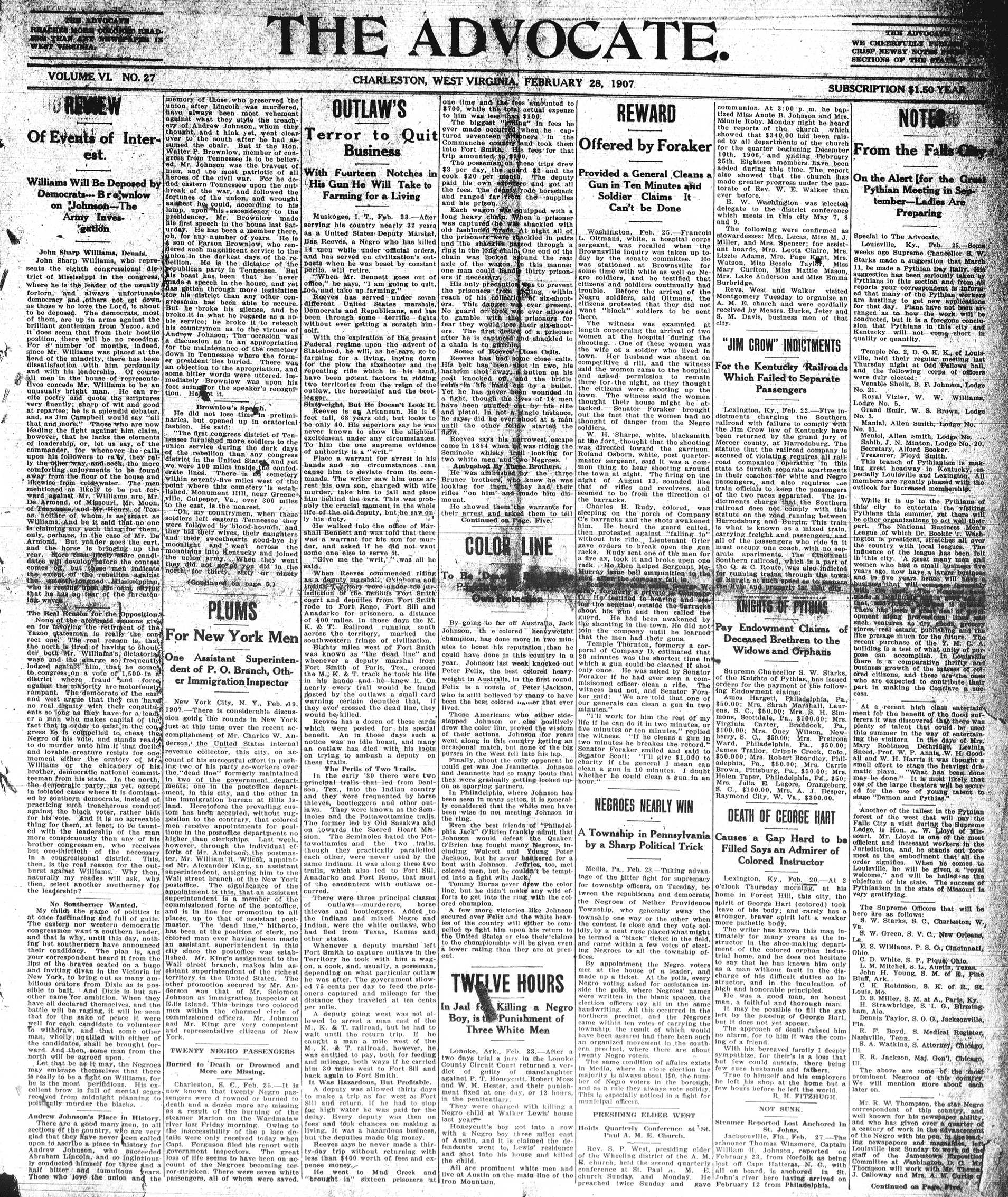
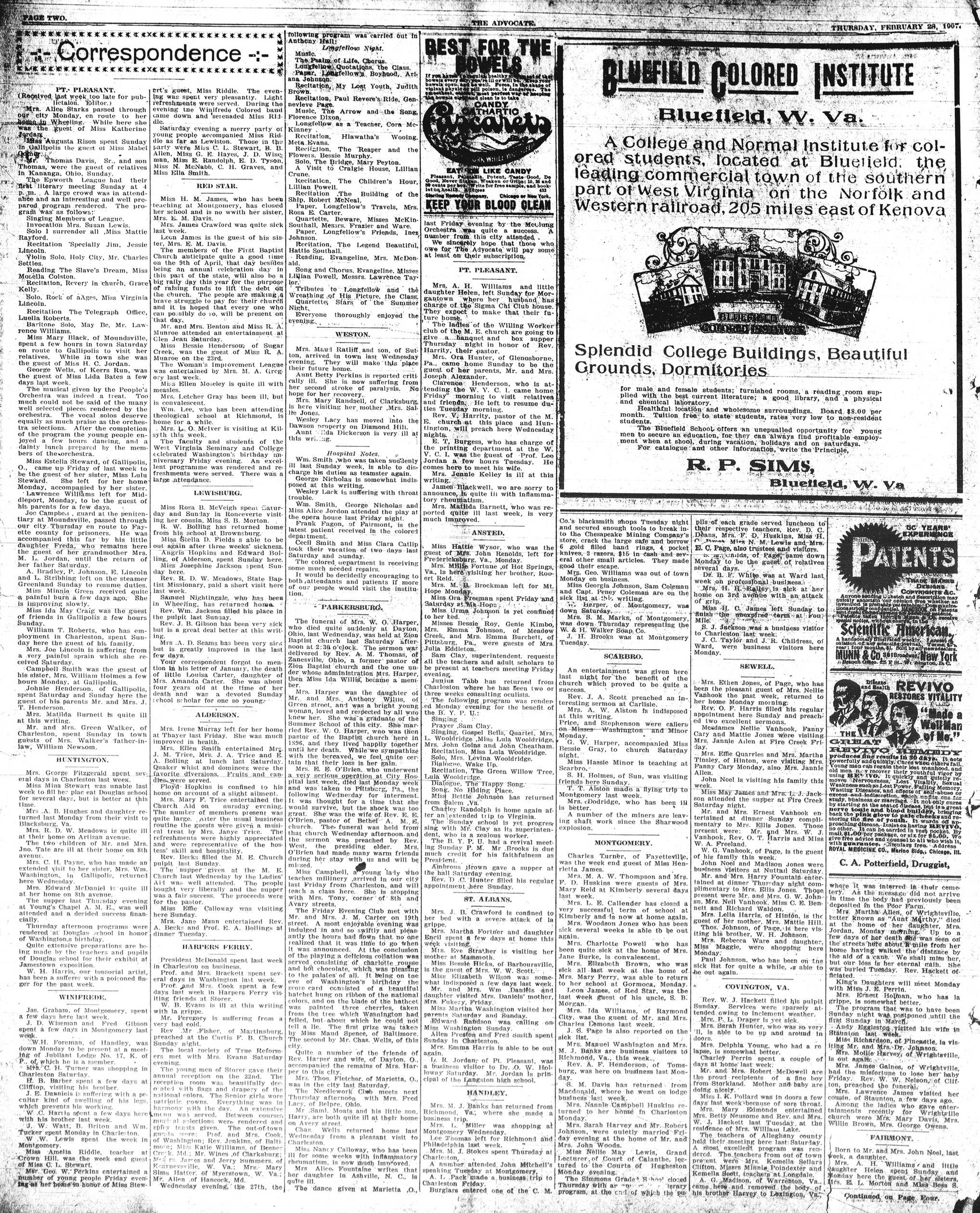
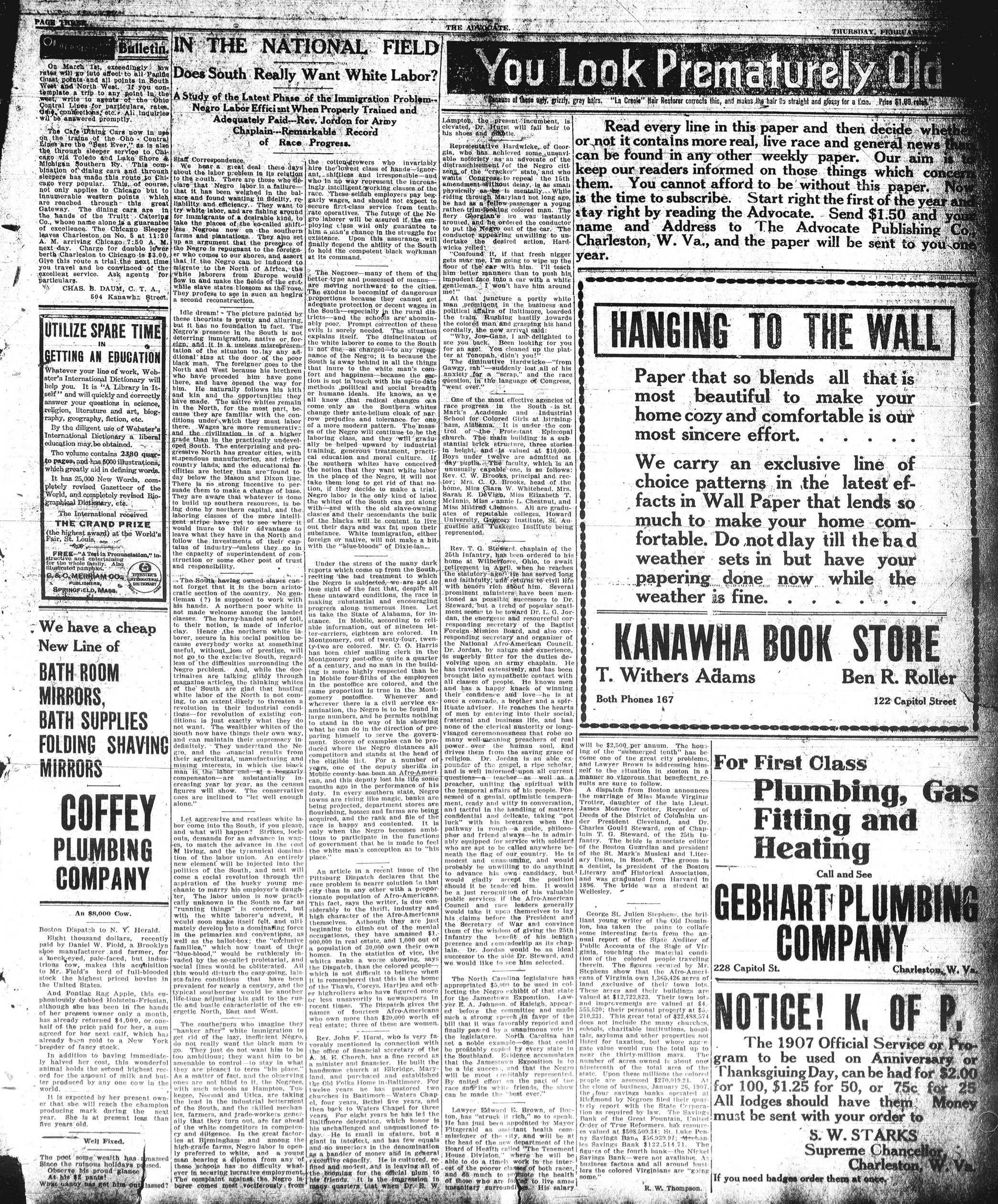
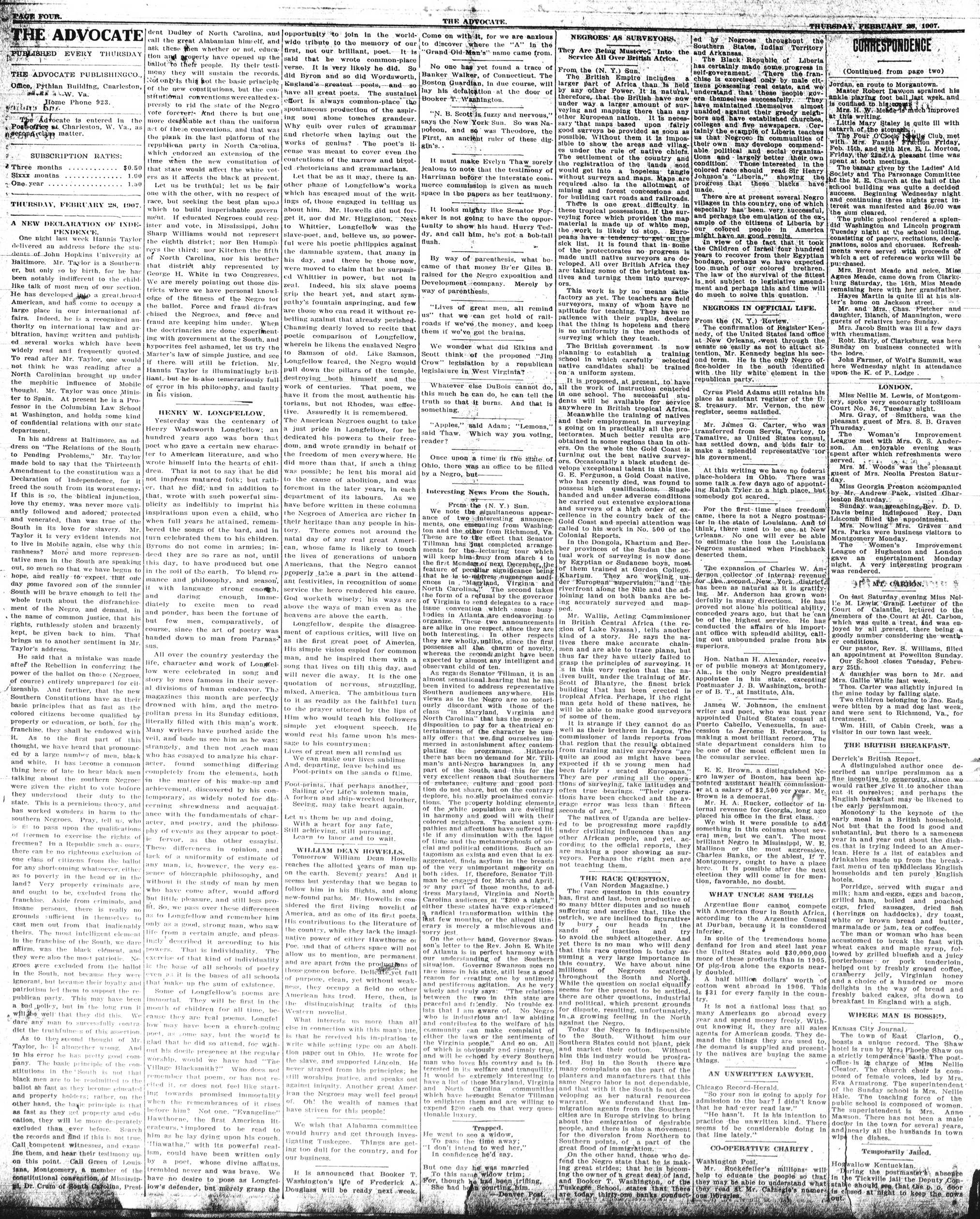
Page text (machine-generated)
The Real Reason Some Companies
No. Southerner Wanted.
My child, the game of politics is at once fascinating and full of guile. The eastern nor western democratic congressmen want a southern leader, and that is why, until this day, nothing but southerners have announced their candidacy. The plan is, and your correspondent heard it from the lips of the braves seated on a huge and inviting divan in the Victoria in York, to bring out as many ambitionists from Dixie as is possible to bait. It is another name for ambition. When they have all declared themselves, and the battle will be raging, it will be seen that for the sake of peace it were well for each candidate to volunteer to withdraw, and that some other man, wholly unqualified with either of the candidates, shall be brought forward. And then, some man from the north, he agreed upon. That is the may, the Negroes may embrace them, that here is really to be a fight on Williams, for he is the most perfidious. His excellent brow is full of mental scars received from midnight planning to politically murder the blacks.
Andrew Johnson's Place in History.
There are a good many men, in all
seasons, who have glad that they have never been called
upon to ascribe a place in history for
Andrew Johnson, who succeeded
Abraham Lincoln, and so inglorious
men, who have been called a face and a
half bitter and tumultuous.
Those who love the undone and the
THE ADVOCATE.
memory of those who preserved the union after Lincoln was murdered, have always been most vehement against what they style the treachery of Andrew Johnson, whom they thought, and tink yet, went clear over to the south after he had asked for the chair. But if the Hon. Walter P. Brown, member of congress from Tennessee, Mr. Johnson was the bravest of men, and the most patriotic of all heroes of the civil war. For he defied eastern Tennessee upon the outbreak of the war, and followed the fortunes of the union, and wrought asbest he could, according to his presidency. His ascendancy to the presidency. Brownlow made his first speech in the lateurday. He has been a member there, oh, for any number of years. He is a son of Parson Brownlow, who rendered such magnificent service to the union in the darkest days of the rebellion. He is the dictator of the republican party in Tennessee. But he has been that he never made a speech in the house, and yet has gotten through much of his district than any other congressman has been able to secure. But he broke his silence, and he broke it in what he regards as a noble service; he broke it to reteach his countrymen as to the virtues of Johnson. The occasion was a discussion of an appropriation for the maintenance of the cemetery down in Tennessee where the former president lies buried. There an objection to the appropriation, and some bitter words were uttered. Immediately Brownlow was upon his feet sings or the speaker's recognition. He got it.
He did not lose time in preliminaries, but opened up in oratorical fashion. He said: "The first congress district of Tennessee furnished more soldiers to the union than during the dark days of the rebellion in the United States, congress district in the United States, we were 100 miles inside and confederate lines. There is no cemetery within seventy-five miles west of the point where this cemetery is established. Monument Hill, near Greenville, Virginia, is over 300 miles to the east, in the southeast. 'Oh, my countrymen, when these soldiers left eastern Tennessee they were followed by blood-hounds, and they hid their wives, their caughters and their sweethearts好by-bye and went across the mountains into the west and joined the union army. When they did not go you did in the north, for thirty six or more
New York City, N. Y., Feb. 19, 1907.—There is considerable discussion gothing the rounds in New York just at this time over the recent accomplishment of Mr. Charles W. Anderson, the United States internal revenue collector, this city, on account of his successful effort in pushing two of his party co-workers over the "dead line" formerly maintained in one of the government departments in the postoffice department, in this city the office other than the immigration bureau at Ellis Island. Heretofore the prevailing custom has been accepted, without suggestion to the contrary, that colored men receive appointments for positions in the postoffice departments no longer than the clerkships. Last week, however, the commissioners of the postoffice of Mr. Anderson, the postmaster, Mr. William R. Wilcock, appointed Mr. Alexander King, an assistant superintendent, assigning him to the Wall street branch of the New York postoffice. The significance of the appointment is this, that an assistant superintendent is a member of the commissioned force of the postoffice and is in line for promotion to all places, up to that of assistant postmaster. The 'dead line,' hitherto, has been at the position of clerk, no colored man ever been made an assistant superintendent in this since the postoffice was established. The Wall street branch, makes him an assistant superintendent of the richest territory in the United States. The other promotion secured by Mr. Anderson was that of Mr. Solomon Johnson as immigration inspector at Ellis Island. This brings two colored men into the charmed circle of commissioned officers and Mr. King are very competent and representative citizens of New York.
TWENTY NEGRO PASSENGERS
Burned to Death or Drowned and More are Missing.
Charleston, S. C., Feb. 25. — It is now known that twenty Negro passengers were d rowned or buried to death and a dozen more are missing as a result of the burning of the steamer Marion on the Wardmalaw river last Friday morning. Owing to the inaccessibility of the p lace details were only received today when Gervison filed his report with government officials. The great loss of life seems to have been the count of the Negroes becoming terror-striken. There were seven white passengers, all of whom were saved.
CHARLESTON, WEST VIRGINIA. FEBRUARY 28. 1907
Muskogee, I. T., Feb. 23. After serving his country nearly 32 years as a United States Deputy Marshal, Bas Reeves, a Negro who has killed 14 men white under official orders, and has served on civilization's outposts when he was beset by constant police retort. "When Mr. Barnett goes out of office," he says, "I am going to quit, loot, and take up farming." Reeves has served under seven different United States marshals, Democrats and Republicans, and has been through some terrific fights without ever getting a scratch himself.
With the expiration of the present Federal regime upon the advent of Statehood, he will, as he says, go to fighting for a living, laying down for the slaves the shoestead, repeating rifle which in his hand, have been potent factors in ridding two territories from the reign of the outlaw, the horsethief and the boot-legger.
Sixty-eight, But He Doesn't Look It. Reeves is an Arkansas. He is 6 feet tall, 68 years old, but looks to be only 40. His superiors say he was the only one to show a slight excitement under any circumstances. To him the one supreme evidence of authority is a "writ." Place a warrant for arrest in his hands and no circumstances can cause him to deviate from its commands. The writer saw him once arrest his own son, charged with wife abuse, and then him behind the bars. This was probably the crucial moment in the whole life of the old deputy, but he saw only his duty. He walked into the office of Marshall Bennett and was told that there was a warrant for his son for murder, and asked if he did not want son one else to serve it. "Give me the writ," was all he said.
When Reeves commenced riding as a deputy marshal, Oxyhoma and Indiant Territory were under the jurisdiction of the famous Fort Smith court and deputies from Fort Smith rode to Fort Reno, Fort Sill and Anchorage for prisoners, a distance of 400 miles in those days the M. K. & T. Railroad running south across the territory, marked the southwestern fringe of civilization. Eighty miles west of Fort Smith was known as "the dead line" and whenever a deputy marshal from Fort Smith of Paris, Tex., crossed the M.K. and he knew his life, his hands and he knew nearly every trail would be found posted by the outlaws a small card warning certain deputies that, if they ever crossed the dead line, they would be killed.
Reeves has a dozen of these cards which were posted for his special benefit. An in those days such a notice warranted, and an many hurt has died with his roots on trying to ambush a deputy on these trails.
the Perils of two Traits.
In the early '80s there were two principal traits first led by Bonson, Tex. into the Indian country and they were frequented by horse thieves, bootleggers and other lawless. They were known as the Seminoles and the Potawattamine trails. The former led by Old Sasakwa and on towards the Sacred Heart Mission. The Seminoles hated the Potawattamies and the two trails, though they practically paralleled each other, were never used by the same Indians. It was along these two trails, which also led to Fort Sill, Anadarko and Fort Reno, that most of the encounters with outlaws occurred.
There were three principal classes of outlaws—murders, horse thieves and bootleggers. Added to the Indians and mixed Negro and Indian, were the white outlaws, who had fled from Texas, Kansas and other states.
Whenever a deputy marshal left Fort Smith to capture outlaws in the Territory he took with him a wagon, a cook, and, usually, a possman, depending on what particular outlaw he was after. The government allowed him to capture outlaws and officers captured and milled for the distance they traveled at ten cents per mile.
A deputy going west was not allowed to arrest a man east of the M., K. & T. railroad, but he had to wait until the return trip. If he caught a man a mile west of the M., K. & T. railroad, he was entitled to pay both for feeding and milage, both ways if he carried him 20 miles west to Fort Sill and back again to Fort Smith.
It Was Hazardous, But Profitable.
A deputy was allowed thirty days to make a trip as far west as Fort Sill and return. If he had to stop for high water he was paid for the delay. Every deputy was then on and off duty, living. It was a hazardous business, but the deputies made big money.
Reeves says he never made a thirty-day trip without returning with less than $400 worth of fees and expense money. He went to Mud Creek and "brought in" sixteen prisoners at
one time and the fees amounted to $700, while the total actual expense to him was less than $100.
The biggest "writing" in fees he ever made occurred when he captured seventeen prisoners. In the Commissary country and took them for the fees for that trip amounted to $900.
The possman on these trips drew $3 per day, the guard $2 and the cook $20 per month. The deputy paid his own expenses and got all the fees. The deputy rode horseback and ranged far from the supplies and his prison. He was equipped with a long heavy chain. When a prisoner was captured he was shackled with old fashioned braids. At night all of the prisoners were shackled in pairs and the shackles passed through a ring in the long chain. One end of the chain was looked around the rear of this manner one man could thirty prisoners if necessary.
His only precaution was to prevent the prisoners from hiding, within reach of his collection of six-shooters. This danger was ever present. No guard or cook was ever allowed greater access to the prisoners for fear they would lose them to prisoners. The first desire of a prisoner after he is captured and shackled to a chain is to gamble.
Some of Reeves Close Calls.
Reeves has had some close calls. His belt has been shot in two, his hatchet shot away, in button on his hip, in his hand out by a bullet. Yet he has never been wounded in a fight, though the lives of 14 men have been snuffed out by his rifle and pistol. In not a single instance, he says; did he ever shoot at a man until the other shoot started the fire?
Reeves says his narrowest escape came in 1884 when he was riding the Seminole whisky trail looking for two white men and two Negroes.
Ambushed By Three Brothers.
He was ambushed by the three Bruner brothers, who knew he was looking, for them, they had their rifles on him and made him dismount.
He showed them the warrants for their arrest and asked them to tell Continued on Page. Five.
COLOR LINE
To Be Dear Brothers
Prayerful
Own Protection
By going to far off Australia, Jack Johnson, the colored heavyweight champion, has done more in two minutes to boost his reputation than he could have done in this country in a year. Johnson last week knocked out Peter Felix, the best colored heavyweight in Australia, in the first round. Felix is a cousin of Peter Jackson, who is still believed by many to have been the best colored opponent that ever lived.
Those Americans who either side-stopped Johnson or else positively drew the color line, proved the wisdom of their actions. Johnson for years and occasionally matched, but none of the big purses in the West fell into his lap.
Finally, about the only opponent he could get was Joe Jeannette. Johnson and Jeannette had so many bouts that they were gradually getting looked upon as sparing partners.
In Philadelphia, where Johnson has been seen in many setups, it is generally understood that the white men have been whiten in not meeting Johnson in the ring.
Even the best friends of "Philadelphia Jack" O'Brien frankly admit that Johnson would defeat the Quaker. O'Brien has fought many Negroes, including Jackson, but he never hankered for a bout with Johnson. Jeffries, too, met colored men, but he couldn't be tempted into a fight with Jack/ Tommy Burns never drew the color line, but he didn't make any wild effort to ring with the colored champion. A few more victories like Johnson secured over Felix and the white heavies of the country will either be compelled to fight him upon his return to the United States or else their claims to the championship will be given even lower rating than they are at present.
TWELVE HOURS In Jail for Killing a Negro Boy, is the Punishment of Three White Men
Lonoke, Ark., Feb. 23. After a two days trial a jury in the Lonoke County Circuit Court returned a verdict of guilty of manslaughter against P. T. Honeycutt, Robert Moss and W. M. Hester, and their punishment one day, or 12 hours, in the penthouse. They were charged with killing a Negro child at Walker Lewis' house last year. Honeycutt's boy got into a row with a Negro boy three miles east of Austin, and it is claimed the defendants went to, Lewis' residence and shot into his house and killed them. All are prominent white men and live at Austin on the main line of the Iron Mountain.
Washington, Feb. 25.—Francois L. Ottmans, white, a hospital corps sergeant, was recalled when the Brownville inquiry was taken up today by the senate committee. He was stationed at Brownville for some time with white as well as Negro soldiers, and he testified that citizens and soldiers continued trouble. Before the arrival of the Negro soldiers, said Ottmans, the citizens protested that they did not want "black" soldiers to be sent there. The witness was examined at length concerning the arrival of two women at the hospital during the one. One of these women was the wife of a soldier killed in town. Her husband was charged with competitive d rill, and the witness said the women came to the hospital and asked permission to remain there for the night, as they thought the citizens were shooting up the town. The witness said the women thought their house might be attacked. Senator Foraker brought out the fact that the women had no thought of danger from the Negro soldiers.
W. H. Sharpe, white, blacksmith at the fort, thought that the shooting was directed toward the garrison. Roland Osborn, white, post quarterman, sergeant, said it was a common theme that he posed around the town at night. The first night of August 13, sounded like that of rifles and revolvers, and seemed to be from the direction of the barracks. Charles E. Rudy, colored, was sleek on the back of Company C's barracks and the shooter awakened him. He heard the guard and then protested against "falling in" without his rifle. Lieutenant Grier gave orders to break open the gun racks. Rudy sent one of the men for a took it and broke up one rack. He helped Sergeant McMurray issue ballistics that met the company fell in. Norman C. Formary is a private business. He testified to hearing and seizing the sentinel outside the barracks shoots his gun and then called the guard in and was beaked by the shooting in that did not join the company until he learned that the men had their guns.
Temple Thornton, formerly a corporal of Company D, estimated that 20 minutes was the shortest time in which a gun could be cleaned if shot only once. He was asked by Senator He if he had ever seen a commissioned officer clean a rifle. The witness had not, and Senator Foraker said: 'We are told that one of our generals can clean a gun in two minutes.' 'I'll work for him the rest of my life if he can do it in two minutes, or five minutes or ten minutes,' replied the witness. 'If he cleans a gun in two minutes he breaks the record.' Foraker smiled and said to Senator Scott, 'I'll give $1,000 to charity if the government I can clean a gun in 10 minutes. I doubt whether he could clean a gun in an hour.'
NEGROES NEARLY WIN
NEGROES NEARLY WIN
A Township in Pennsylvania by a Sharp Political Trick
Media, Pa., Feb. 23.—Taking advantage of the platter fight for supremacy for township officers, on Tuesday, between the republicans and democrats the Negroes of Nethra Providence Township, who generally sway the township one way or the other when the contest is close and they vote solidly, by a neat ruse placed what might be termed a "black" ticket in the field, and came within a few votes of electing Negroes to all the township offices.
By appointment the Negro voters met at the house of a leader and made up a ticket. At the polls, some Negro voting asked for assistance inside the polls, where Negroes' names were written in the blank spaces, the election officers say all in the same handwriting. All this occurred in the northern precinct, and the Negroes came within ten votes of carrying the cup, the result of which would have been assured and had there been such an organized movement in the southern precinct, where there are about twenty Negro voters.
The same condition of affairs exists in Media, where in close election the majority is always about 150, the number of Negro voters in the borough is about 100, and always vote solidly. This is especially noticed in a fight for municipal officers.
PRESIDING ELDER WEST
Holds Quarterly Conference at St. Paul A. M. E. Church.
Rev. S. P. West, presiding elder or the Wheeling district of the A. M. E. church, held the second quarterly conference on Sunday and Monday. He preached twice Sunday and gave
communlion. At 3:00 p. m. he baptized Miss Annie B. Johnson and Mrs. Minnie Roby. Monday night he heard the reports of the church, which showed that $340.00 had been raisable at a departments of the church for four quarterdays December 10th, 1906, and ending February 25th. Eighteen members have been added during this time. The report also showed that the church has made greater progress under the pastorate of Rev. W. E. Walker than ever before. E. Washington was elected delegate to the district conference which meets in this city May 7, 8 and 9. The following were confirmed as stewardesses: Mrs. Lucas, Miss M. J. Miller, and Mrs. Spencer; for assistant boards, Mrs. Leota Claire, Mrs. Lizte Adams, Mrs. Page Kent, Mrs. Miss Curtion, Miss Mattle Mason, Mrs. Lake Anderson and Miss Emma Burbidge.
Revs. West and Walker visited Montgomery Tuesday to organize an A. M. E. church and were cordially received by Messrs. Burke, Jeter and S. M. Davis, business men of that city.
"JIM CROW" INDICTMENTS For the Kentucky Railroads Which Failed to Separate Passengers
Lexington, Ky., Feb. 22.—Five indictments charging the Southern railroad with failure to comply with the Jim Crow law of Kentucky have been returned by the grand jury of Mercer county, at Harrodsburg. The statute that the railroad company is accused of violating requires all railroad companies operating in this state to acquire apartments in their coaches for the passengers, and also requires no train officials to keep the passengers of the two races separated. The indictments charge that the Southern railroad does not comply with this statute on the road running between Harrodsburg and Burgim: This train is known as a mixed train, carrying freight and passengers, and all of the passengers it must occupy one coach, with no separate apartments. The Chishinati Southern railroad, which is a part of the Q. & C. Route, was also indicted for running trains through the town of Burgim at such speed as to masse the lives, and promptly jail them.
Pay Endowment Claims of Deceased Brethren to the Widows and Orphans
Supreme Chancellor S. W. Starks, of the Knights of Pythas, has issued orders for the payment of the following Endowment claims:
Amos Hargest, Philadelphia, Pa.
Mrs. Marsh Sarah Marshall, Laurens, S. C. $ 100.00; Mrs. H. Simmons, Scottdale, Pa. $ 100.00;
Virginia Carter, Braddock, Pa. $ 100.00; Mrs. Oney Wilson, Newberry, S. C. $ 60.00; Mrs. Pretona Ward, Philadelphia, Pa. $ 50.00; James Traillor, Cripple Creek, Colo.
Mrs. Robert Boardley, Philadelphia, Mrs. Carte Brown, Pittsburgh, Pa. $ 50.00; Helen Taper, Philadelphia, Pa. $ 55.00; Mrs. Julia E. Lagore, Orangsburg, S. C. $ 100.00; Mrs. A. J. Desger, Raymond City, W. Va. $ 300.00.
DEATH OF GEORGE HART
Causes a Gap Hard to be Filled Says an Admirer of Colored Instructor
Lexington, Ky., Feb. 20—At 2 o'clock Thursday morning, at his home in Forest Hill, this city, the spirit of George Hart (colored) took leave of his body; and rarely has a stronger, braver gift left a weaker more pathetic body. The writer has known this man intimately for many years as the instructor in the shoe-making department of the colored orphan industrial home, and he does not hesitate to say that he has known him only as a man without fault in the discharge of his difficult duties as instructor, and in the inculcation of his valuable principles. He was a man of man, an honest man, a faithful order.
It may be possible to fill the gap left by the passing of George Hart, but it does not yet appear. The approach of death caused him no alarm, for to him it was the coming of a friend. Who his bereaved father is I deeply sympathize with theirs is a loss that but few could imagine being few such husbands and fathers. True to himself and his employers he left his shop at the home but a few hours before he left the world.
NOT SUNK.
Steamer Reported Lost Anchored In St. Johns.
Jacksonville, Fla., Feb. 27.—The schooner Thomas Winsmere, Captain William H. Johnson, reported on February 23, from Norfolk as being lost off Cape Hatteras, N. C., with all on board, is anchored in St. John's river here having arrived on February 12 from Philadelphia.
Special to The Advocate.
Louisville, Ky., Feb. 25—Some weeks ago Supreme (chancellor S. W. Starks made a suggestion that March 11, be made a Pythian Day Kelly. His suggestion has been seriously taken by Pythians in this section and from all reports your correspondent is informed that many of the Pythian workers are hustling to get new applications for that day. Plans have not been arranged so how the work will be conducted, that of the Old Tallows, conston that Pythians in this city and Kentucky will not come short in quality or quantity.
Temple No. 2, D. O. K. K., of Louisville, held their regular meeting last Thursday at the Old Tallows, and the following corps of officers were duly elected:
Venable Shek, B.F. Johnson, Lodge No. 21.
Royal Vizler, W. W. Williams, Lodge No. 5.
Grand Emir, W. S. Brown, Lodge No. 1.
Manial, Allen Smith, Lodge No. 51.
Menlo, Allen Smith, Lodge No. .. Sahib, J. N. Minton, Lodge No. 20, Secretary, Alford Booker, Treasurer, Floy Smith. Treasurer, Floy Smith is making great headway in Kentucky, especially Louisville and Lexington. All members are rgently pleased with the outlook for increased membership.
While it is up to the Pythians of this city to entertain the visiting Pythians this summer, yet there will be other organizations to act well their part. The National Business Men's League of which Dr. Booker t.: "Wash. residents should stretches all over the country with their leagues." Influence of the league has been felt in this city. A great many men and women who had a small business five years ago, now have, a larger business, and in five years hence will have a business that will compare favorably to make them feel that the league has been felt. There has been a great deal of development along professional lines and such ventures as dry goods, grocery stores, real estate, publishing and the like presage much for the future. The recent purchase of the Y. M. C. A. building is a test of what unity of purpose can accomplish. In Louisville and comparative frivolity and business group the masses of colored citizens, and the masses of who are expected to contribute their part in making the Conclave a success.
At a recent high class entertainment for the benefit of the flood surfers it was discovered that there was plenty of talent that could be used this summer in the way of entertainment for the benefit of the Mary Robinson Dethridge, Levinie Sneed, Prof. W. P. Annis, W. H. Goodall and W. H. Harris it was thought a small effort to stage the heaviest dramatic plays. "What has been done done." It is most likely that one of the best students be secured for the use of young talent to stage "Damon and Pythias."
Another of the tallest in the Pythian forest of the west that will pay the Friar Clyde a visit during the Supreme Lodge is a visit to Missouri. Mr. Lloyd is one of the most efficient and incessant workers in the Jurisdiction, and he stands out foremost as the embodiment that all the order signifies. When he comes to the court he will be given a "royal welcome" and will be chieftain of his state. The success of Pythianism in the state of Missouri is very graffitty.
The Supreme Officers that will be here are as follows: S. W. Starks, S. C., Charleston, W. Va.
S. W. Green, S. V. C., New Orleans,
La.
E. S. Williams, P. S. C., Cincinnati,
Ohio.
C. D. White, S. P., Piqua, Ohio.
L. M. Mitchel, S. L. Austin, Texas.
John H. Young, S. M. of E., Pine
Bluff, Ark.
C. K. Robinson, S. K. of R., St.
Louis, M.
D. S. Miller, S. M. at A., Paris, Ky.
H. Strawbridge, S. I. G., Birmingham,
Ala.
Dennis Taylor, S. O. G., Jacksonville,
Fla.
R. F. Boyd, S. Medical Register,
Nashville, Tenn.
S. A. Watkins, S. Attorney, Chicago,
Ill.
R. R. Jackson, Maj. Gen'l, Chicago, Ill.
The above are some of the most prominent Negroes of this country. We will mention more about each later on.
Mr. R. W. Thompson, the star Negro correspondent of this county, well known for his newspaper ability, and who has given over a quarter of a century of work in the advancement of the Negro with his pen, in the heading newspapers and magazines, left Louisville last Sunday to work on the staff of the Jamestown Exposition Committee at Washington, D. C. Mr. Thompson will work with Mr. Thomas J. Calloway and Mrs. A. M. Curtis of Continued on Page Five.
Correspondence :-
(Received last week too late for publication.
Mrs. Alice Starks passed through our city Monday, en route to her home in Wheeling. While here she was the guest of Miss Katherine Jordan.
Miss Augusta Rison spent Sunday in Gallipolis the guest of Miss Mabel Gering.
Mr. Thomas Davis, Sr., and son Thomas, were the guest of relatives in Kananga, Ohio, Sunday.
The Epworth League had their first literary meeting Sunday at 4 p.m. A large crowd was in attendance and an interesting and well prepared program rendered. The program was as follows:
Singing Members of League.
Invitation Mrs. Susan Lewis.
Solo I surrender all, Miss Mattie Rayford.
Recitation 'Specially Jim, Jessie Lincoln.
Violin Solo, Holy City, Mr. Charles Settles.
Reading The Slave's Dream, Miss Mosella Colston.
Recitation, Revery in church, Grace Kelly.
Solo, Rock of aAges, Miss Virginia Lincoln.
Recitation The Telegraph Office, Luella Roberts.
Baritone Solo, May Be, Mr. Lawrence Williams.
Miss Mary Black, of Moundsville, spent a few hours in town Saturday en route to Gallipolis to visit her relatives. While in town she was the guest of Miss H. C. Jordan.
George Wells, of Kerrs Run, was the guest of Miss Lida Bates a few days last week.
The musical given by the People's Orchestra was indeed a treat. Too much could not be said of the many well groomed pieces rendered by the orchestra. The vocal solos deserve equally as much praise as the orchestra selections. After the completion of the program the young people enjoyed a few hours dancing, and a dainty lunch prepared by the members of the orchestra.
Miss Estella Steward, of Gallipolis, O., came up Friday of last week to be the guest of her sister, Miss Lulu Steward. She left for her home Monday, accompanied by her sister. Lawrence Williams left for Middleport, Monday, to be the guest of his parents for a few days.
Joe Campbell, guard at the penitentiary at Moundsville, passed through our city Thursday en route to Fayette county for prisoners. He was accompanied this far by his little daughter Freda, who remains here the guest of her grandmother Mrs. M. L. Jordan, until the return of her father Saturday.
Bradley, P. Johnson, E. Lincoln and Stribling left on the steamer Greenland Sunday to resume duties. Miss Minnie received quite a painful burn a few days ago. She is improving slowly.
Miss Ida May Craig was the guest of friends in Gallipolis a few hours Sunday.
William T. Roberts, who has employment in Charleston, spent Sunday here the guest of his family.
Mrs. Joe Lincoln is suffering from a very painful sprain which she received Saturday.
Campbell Smith was the guest of his sister, Mrs. William Holmes a few hours Monday, at Gallipolis.
Johnie Henderson, of Gallipolis, spent Saturday and Sunday here the guest of his parents Mr. and Mrs. J. T. Henderson.
Mrs. Matilda Burnett is quite ill at this writing.
Mr. and Mrs. Green Walker, of Charleston, spent Sunday in town guests of Mrs. Walker's father-in-law, William Newsom.
HUNTINGTON.
Mrs. George Fitzgerald spent several days in Charleston last week.
Miss Mina Stewart was unable last week to fill her plac eat Douglas school for several days, but is better at this time.
Mrs. A. B. Hughes and daughter returned last Monday from their visit to Blacksburg, Va.
Mrs. R. D. W. Meadows is quite ill at their home on Artisan avenue.
The two children of Mr. and Mrs. Jno. Tate are ill at their home on 8th avenue.
Mrs. Edward McDaniel is quite ill at her home on 8th avenue. The supper last Thursday evening at Young's Chapel A. M. E., was well attended and a decided success financially. Thursday afternoon programs were rendered at Douglas school in honor of Washington's birthday. Quite extensive preparations are being made by the teachers and pupils of Douglas school for their exhibit at Jamestown exposition. W. H. Harris, our tonalist artist, has been a sufferer with a poisoned finger for the past week.
WINIFREDE
Jas. Graham, of Montgomery, spent a few days here last week.
J. D. Wiseman and Fred Gibson spent a few days in Montgomery last week.
W.H. Foreman, of Handley, was down Monday to be present at a meeting of Jubilant Lodge No. 17, K. of P., of which he is a member.
Mrs. C. H. Turner was shopping in Charleston Saturday.
H. B. Barber spent a few days at Clifftop, visiting his brother.
J. E. Dauiels is suffering with a peculiar kind of swelling of his legs, which prevents his working.
Miss Amelia Riddle, teacher at
Crown Hill, was the week end guest
of Miss C. L. Stewart.
Mrs. Goo. W. Perkins entertained a
number of young people Friday even-
ing at her home in honor of Miss Stew-
art's guest, Miss Riddle. The evening was spent very pleasantly. Light refreshments were served. During the evening the Winifrede Colored band came down and 'serenaded Miss Riddle. Saturday evening a merry party of young people accompanied Miss Riddle as far as Lewiston. Those in the party were Miss C. L. Stewart, B. B Allen, Miss G. E. Hayes, J. D. Wiscman, Miss E. Randolph, E. D. Tyson, Miss N. McNabb, C. H. Graves, and Miss Ella Smith.
RED STAR
Miss H. M. James, who has been teaching at Montgomery, has closed her school and is no wwth her sister, Mrs. E. M. Davis.
Mrs. James Crawford was quite sick last week.
Leon James is the guest of his sister, Mrs. E. M. Davis.
The members of the First Baptist Church anticipate quite a good time on the 9th of April, that day besides being an annual celebration day in this part of the state, will also be a big rally day this year for the purpose of raising funds to lift the debt on the church. The people are making a brave struggle to pay for their church and it is hoped that every one who can possibly do so, will be present on that day.
Mr. and Mrs. Benton and Miss R. A. Mumroe attended an entertainment at Glen Jean Saturday.
Miss Bessie Henderson, of Sugar Creek, was the guest of Miss R. A. Munroe on the 23rd.
The Woman's Improvement League was entertained by Mrs. M. A. Gregory last week.
Miss Ellen Moseley is quite ill with measles.
Mrs. Letcher Gray has been ill, but is convalescent.
Wm. Lee, who has been attending theological school at Richmond, is home for a while.
Mrs. L. O. Melver is visiting at Kilsyth this week.
The faculty and students of the West Virginia Seminary and College celebrated Washington's birthday anniversary Friday evening. An excellent programme was rendered and refreshments were served. There was a large attendance.
LEWISBURG
Miss Rosa B. McVeigh spent Saturday
during her visit, but she
would be cupping. Miss S. M.
ling, of Alderson, spent Sunday here,
Miss Josephine Jackson spent Sunday here.
Rev. R. D. W. Mendows, State Baptist Missionary, paid a short visit here last week.
Samuel Nightingale, who has been in Wheeling, has returned home.
Rev. Wm. Jackson filled his place in the pulpit last Sunday.
Rev. J. B. Gibson has been very sick but is a great deal better at this writing.
Mrs. A. D. Seams has been very sick but is a great improvement in the last few days.
Your correspondent forgot to mention in his letter of January, the death of little Louisa Carter, daughter of Mrs. Amanda Carter. She was about four years old at the time of her death and was a devoted Sunday school scholar for one so young.
ALDERSON.
Mrs. Irene Murray left for her home at Thayer last Friday. She was much improved in health. Mrs. Ellen Smith entertained Mrs. J. M. Trice, Mrs. J. A. Trice and E. A. Bolling at lunch last Saturday. Quaker whist and domineers were the favorite diversions. Fruits and candles were served. Floyd Hopkins is confined to his home but on lunch of a slight aliment. Mrs. Mary F. Trice entertained the Church Aid on oursday evening. The number of members present was quite large. After the usual business routine the guests were given a musical treat by Mrs. Janye Trice. The refreshments were highly appreciated and were representative of the hostess' skill and hospitality. Rev. Becks filled the M. E. Church pulpit last Sunday. The supper 'given at the M. E. Church last Wednesday by the Ladies' Air was well attended. The people were joyfully liberated and the supper was a fair success. The proceeds were for the pastor. Miss Effie Calloway was visiting here Sunday.
Mrs. Jane Mann entertained Rev. A.
Atta, Prof. E. A. Bollings at
dinner Tuesday
HARPERS FERRY
President McDonald spent last week in Charleston on business.
W. B. Evans is ill at this writing with la gripe.
Mr. Peregory is suffering from a very bad cold.
Rev. Mr. Fisher, of Martinsburg, preached at the Curtis F. B. Church Sunday night.
The local society of True Reformers met with Mrs. Evans Saturday evening.
The young men of Storer gave their annual reception on the 22nd. The reception room was beautifully decorated with flags and drapery of the colors. The Senior girls were patriotic robes. Everything was in harmony with the day. An extensive menu was served. Between course musical selections were rendered and spiffy treats given. The out-of-town guests were: Prof. and Mrs. Cook, of Washington; Rev. Jenkins, of Baltimore; Miss Katie Williams, of Beenice; Creek, Md.; Mr. Wines, of Clarkaburg; Mrs. James and Jerry Summers, of Kourineville, W. Va.; Mrs. Mary Slatter, of Myerstown, W. Va.; Mr. Allen of Hancock, Md.
Wednesday evening, the 27th, the
following program was carried out In
Anthony Hall.
Longfellow Night.
Music.
The Psalm of Life, Chorus.
Longfellow, Quotations, the Class.
Paper, Longfellow's Boyhood, Arl.
ana Johnson.
Recitation, My Lost Youth, Judith Brown.
Recitation, Paul Revere's Ride, Genevieve Page.
Music, The Arrow and the Song, Florence Dixon, Longfellow as a Teacher, Cora McKinney
Recitation, Hlawatha's Wooling, Meta Evans. Recitation, The Reaper and the Flowers, Bessie Murphy.
Recitation, The Children's Hour, Lillian Powell. Recitation, The Building of the Ship, Robert McNeal.
Paper, Longfellow's Travels, Mrs. Rosa E. Carter.
Quartette, Beware, Misses McKin-
Southall, Message, Fragment, Words
Southall, Messrs. Frazier and Ware.
Paper, Longfellow's Friends, Inez
Johnson.
Recognition, The Legend Beautiful,
Hattie Southall.
Reading, Evangeline, Mrs. McDonald.
Song and Chorus, Evangeline, Misses Lilian Powell, Messrs. Lawrence Taylor,
Attributes to Longfellow and the Wreathing of His Picture, the Class, Quartette, Stars of the Summer Night.
Everyone thoroughly enjoyed the evening.
Mrs. Maud Rattliff, and son, of Sutton, arrived in town last Wednesday evening. They will make this place their future home.
Aunt Betty Perkins is reported critically ill. She is now suffering from her second stroke of paralysis. No hope for her recovery.
Mrs. Mary Randseil, of Clarksburg, is visiting her mother, Mrs. Salle Jones.
Wesley Lacy has moved into the Dawson property on Diamond Hill.
Aunt Vida Dickerson is very ill at this writing.
Hospital Notes
Wm. Smith, who was taken suddenly ill last Sunday week, is able to discharge his duties as teamster again.
George Nicholas is somewhat indisposed at this writing.
Wesley Lack is suffering with throat trouble.
Wm. Smith, George Nicholas and Miss Alice Jordon attended the play at the opera house last Friday night.
Frank Fagon, of Fairmont, is the latest patient received in the colored department.
Cecil Smith and Miss Clara Catlip took their vacation of two days last Saturday and Sunday.
The colored department is receiving so much needed repairs.
It is much classier encouraging to both attendants and patients. If more of our people would visit the institution.
PARKERSBURG
The funeral of Mrs. W. O. Harper, who died quite suddenly at Dayton, Ohio, last Wednesday, was held at Zion Baptist church last Saturday afternoon at 2:30 o'clock. The sermon was delivered by Rev. A. M. Thomas, of Zonville, Ohio, a former pastor of Zion Baptist church and the one under whose administration Mrs. Harper, then Miss Ida Willis, became a member.
Mrs. Harper was the daughter of Mr. and Mrs. Anthony Willis, of Green street, and was a bright young woman, loved and respected by all who knew her. She was a graduate of the Summer School of this city. She married Rev. W. O. Harper, who was then pastor of the Baptist church in 1896, and they lived happily together until her死. While we sympathize with the bereaved, we feel quite certain that their loss is her gain.
Mrs. E. E. O'Brien, who underwent a very serious operation at City Hospital last week, died last Monday week and was taken to Pittsburg, Pa., the following Wednesday for interment. It was thought for a time that she could live, the shock was too great. She was the wife of O'Brien, pastor of Bethel, M. E. Church. The funeral was held from that church Wednesday afternoon and the sermon was preached by Rev. West, the presiding elder. Mrs. O'Brien had made many warm friends during her stay with us and will be missed.
Miss Campbell, a young lady who tested military arrived in our city last Friday for Charleston, and will teach a class here. She is stopping with Mrs. Tony, corner of 8th and Avary streets.
The Friday Evening Club met with Mr. and Mrs. J. M. Carter on 19th street. A most enjoyable evening was indulged in and so swiftly and pleasantly the hours had flown that no one realized that it was time to go when it was announced. At the conclusion of the playing a delicious collation was saved consisting of charlotte rousse and a ball of which it was pleasing to the palates of all. Its eve of Washington's birthday the score card consisted of a beautiful hatchet hung on ribbon of the national colors, and on the blade of the hatchet was painted three cherries, taken from the tree which Washington had felled, but about which he could not tell a lie. The first prize was taken by Miss Mad Spence, of Baltimore. The second by Mr. Chas. Wells, of this city. Quite a number of the friends of Rev. Harper and wife, of Dayton, O. accompanied the remains of Mrs. Harper to this city. Mrs. Thos. Fletcher, of Marietta, O., was in the city last Saturday.
The Needlework Club meets next
Thursday afternoon with Mrs. Fred
Lacy, of Belpre, Ohio.
Mr. Saml. Moats and his little son,
Harry, are both quite ill at their home
on Avery street.
Chas. Wells returned home last
Wednesday from a pleasant visit to
Chapel.
Miss Nancy Calloway, who has been
ill for some weeks with inflammatory
rheumatism, is now much improved.
Mrs Alice. Fountaine writes that
her daughter in Ashville, N. C., is
quite ill.
BEST FOR THE BOWELS
If you have a regular healthy manoeuvre of the bowels every day you are ill or will be taken your bowels every day. You will be taken your change of violent physical pill poison, is dangerous, smoothest, easiest, most perfect way of sleeping the bowels clean and clean is to take
CANDY
CATHARTIC
Capecats
THE NEW ORLEANS WHILE YOU WAIT
last Friday evening by the McLung
Orchestra was quite a success. A
number from this city attended.
We sincerely hope that those who
owe for The Adyocate will pay some
at least on their subscription.
PT. PLEASANT.
Mrs. A. H. Williams and little daughter Helen, left Sunday for Morgantown where her husband has charge of the Sigma Chi Club house. They expect to make that their future home.
The ladies of the Willing Worker club of the M. E. church are going to give a banquet and box supper Thursday night in honor of Rev. Harrity, their pastor.
Mrs. Ora Hunter, of Glenosborne, Pa., came home Sunday to be the guest of her parents, Mr. and Mrs. Joseph Alexander.
Clarence Henderson, who is attending the W. V. C. I. came home Friday morning to visit relatives and friends, he left to resume duties Tuesday morning.
Rev. V. Harrity, pastor of the M. E. church at this place and Huntington, will preach here Wednesday nights.
E. T. Burgess, who has charge of the printing department at the W. V. C. I. was the guest of Prof. Lee Jordan a few hours Tuesday. He comes here to meet his wife.
Mrs. Jennie Kelley is ill at this writing.
James Blackwell, we are sorry to announce, is quite ill with inflammatory rheumatism.
Mrs. Mafida Barnett, who was reported quite ill last week, is very much improved.
ANSTED.
Miss Hattie Wysor, who was the guest of Mrs. John Renolds, left for Frederickburg, Va., Monday.
Mrs. Millie Fortune of Hot Springs, Va., is here visiting her brother, Roert Reid.
Mrs. M. H. Brockman left for Mt. Hope Monday.
Miss Ora Freeman spent Friday and Saturday at Mt. Hope
Miss Urma Johnson is yet confined to her bed.
Misses Bessie Roy, Genie Kimbo, Mrs. Emma Johnson, of Meadow Creek, and Mrs. Emma Burchett, of Pittsburgh, Pa., were guests of Mrs. Julia Eddleton.
Sam Clay, superintendent, requests all the teachers and adult scholars to be present at teachers meeting Friday evening.
Junius Tabb has returned from Charleston where he has been two or three weeks consulting oculists.
The following program was rendered Monday evening for the benefit of the B. Y. P. U.:
Singing
Prayer, Sam Clay.
Singing, Gospel Bells, Quartet, Mrs. L. Woodridge, Miss Lula Woodridge, Mrs. John Goln and John Cheatham, Resolution.
Recitation, The Green Willow Tree,
Lulu Woodridge.
Dialogue, The Happy Song.
Song, No Hiding, Place.
Charley Randolph is home again after an extended trip to Virginia. The Sunday school is yet progressing with Mr. Clay as its superintendent, who is a zealous worker. The B. Y. P. U. had a revival meeting Sunday P. M. Mr. Brooks is due to send it for his faithfulness as President. Ambrosel Brown gave a supper at the hall Saturday evening. Rev. D. C. Hunter filled his regular appointment, here Sunday.
8T. ALBANS.
Mrs. J. B. Crawford is confined to her bed with a severe attack of la gripe.
Mrs. Martha Fortner and daughter Enclie spent a few days at home this week visiting.
Mrs. Eve Strather is visiting her mother at Mammoth.
Miss Bessie Hicks, of Barberville is the guest of Mrs. W. W. Scott.
Miss Elizabeth Wilson was somewhat indisposed a few days last week.
Mr. and Mrs. Wm. Daniels and daughter visited Mrs. Daniels' mother, Mrs. Fukery, Friday.
Miss Marta Washington visited her parents Saturday and Sunday.
Ermie Randhson was calling on Miss Mingling Sunday.
Allen Price and Fred Smith spent Sunday in Charleston.
Mrs. Emma Harris is able to be out again.
L. R. Jordan, of Pt. Pleasant, was a business visitor to Dr. O. W. Holloway Saturday. Mr. Jordan is principal of the Langston high school.
HANDLEY.
Mrs. M. J. Banks has returned from Richmond, Va.; where she made a business trip.
Mrs. L. Miller was shopping at Montgomery Wednesday.
Lee Thomas left for Richmond and Philadelphia last week
a last week.
Mrs. M. I. Stokes spent Thursday at
Charleston.
A number attended John Mitchell's
speaking Tuesday at Montgomery.
A. I. Pack made a business trip to
Charleston. Friday.
BLUEFIELD COLORED INSTITUTE
A College and Normal Institute for colored students, located at Bluetield, the leading commercial town of the southern part of West Virginia on the Norfolk and Western railroad, 205 miles east of Kenova
BLUFFIELD
COLORED INSTITUTE
Splendid College Buildings, Beautiful Grounds, Dormitories
for male and female students; furnished rooms, a reading room supplied with the best current literature; a good library, and a physical and chemical laboratory.
Healthful location and wholesome surroundings. Board $8.00 per month. Tuition free to state students, rates very low to non-resident students. The Bluefield School offers an unepalled opportunity for young men to secure an education, for they can always find profitable employment to help them, during vacation, holidays and on saturdays. For catalog.
Co.'s blacksmith shops Tuesday night and secured enough tools to break into the Chesapeake Mining Company's store, crack the large safe and borrow 6 gold filled band rings, 4 pocket knives, 2 razors, $15 in cash and several other small articles. They made good their escape.
Miss Geo. Williams was out of town Monday. Miss Georgia Jackson, Sam Coleman and Capt. Peney Coleman are on the sick list at the writing.
Herrer, of Montgomery, was down Saturday.
Mrs. S. M. Marks, of Montgomery,
was down Thursday representing the
W. J. Walker Soap, Co.
J. H. Brooks was at Montgomery
Tuesday.
SCARBRO.
An entertainment was given here last night for the benefit of the church which proved to be quite a success.
Rev. J. A. Scott preached an interesting sermon at Carlisle.
Mrs. A. W. Alston is indisposed at this writing.
Price, and Stephenson were callers on Misses Washington and Minor Monday.
G. W. Harper, accompanied Miss Bessie Gray, to church Saturday night.
Miss Hassie Minor is teaching at Scarbro.
S. H. Holmes, of Sun, was visiting friends here Sunday.
T. T. Alston made a flying trip to Montgomery last week. Mrs. Dodridge, who has been ill is better.
MONTGOMERY
Charles Turner, of Fayetteville, was the week end guest of Miss Henrietta James.
Mrs. M. A. W. Thompson and Mrs. F. D. Huskins were guests of Mrs. Mary Reid at Kimberly several days last week.
Mrs. L. E. Callender has closed a very successful term of school at Kimberly and is now at home again.
Mrs. Woodson Jones who has been sick several weeks is able to be out again.
Mrs. Charlotte Powell who has been quite sick at the home of Mrs. Jane Burke, is convalescent.
Mrs. Elizabeth Brown, who was sick last week at the home of Mrs. Mary Perry, was able to return to her school at Gormoca, Monday. Leon James, of Red Star, was the last week guest of his uncle, S. B. Morgan.
Mrs. Ida Williams, of Raymond City, was the guest of Mr. and Mrs. Charles Demons last week.
J. S. Page is also reported on the sick list.
Mrs. Manuel Washington and Mrs. M. J. Banks are business visitors to Richmond, Va., this week. Rev. A. F. Henderson, of Tomsburg, was here on business last Monday.
Mrs. Nannie Campbell Huskins returned to her home in Charleston Monday.
Mrs. Sarah Harvey and Mr. Robert Johnson, were quietly married Friday evening at the home of Mr. and Mrs. John Woods.
Miss Nellie May Lewis, Grand Lecturer, of Court of Calanthe, lectured to the Courts of Hugheson Monday evening.
The Simmons Grade School closed Thursday with an up to 10-terry program, at the end of which the pu-
plis of each grade served luncheon to
their respective teachers, Rev. D. C.
Deans, Mrs. F. D. Huskins, Miss H.
C. James, Miss N. M. Lewis and Mrs.
E. C. Page, also trustees and visitors.
S. C. Gnids, of Pager, same down
Monday to be the guest of relatives
several days.
Dr. B. F. White was at Ward last
week on professional business.
Mrs. H. H. Ralley is sick at her
home on 3rd avenue with an attack
of grip.
Miss H. C. James left Sunday to
finish the unexpired term at four
Mile.
S. J. Jackson was a business visitor to Charleston last week.
J. C. Taylor and J. R. Childress, of Ward, were business visitors here Monday.
SEWELL
Mrs. Ethen Jones, of Page, who has been the pleasant guest of Mrs. Nellie Vanhook the past week, returned to her home Monday morning.
Rev. O. F. Harris filled his regular appointment here Sunday and preached two excellent sermons.
Mesdames Nellie Vanhook, Fanny Cary and Mattie Jones were visiting Mrs. Jannie Alen at Fire Creek Friday.
Mrs. Effie Quarries and Mrs. Martha Tinsley, of Hinton, were visiting Mrs. Fanny Cary Monday, also Mrs. Jannie Allen.
John Noel is visiting his family this week.
Miss May James and Mrs. L. J. Jackson attended the supper at Fire Creek Saturday night.
Mr. and Mrs. Ernest Vanhook entertained at dinner Sunday complimentary to Mrs. Ellis Jones. Those present were: Mr. and Mrs. W. J. Vanhook, Rev. O. T. Harris and Miss W. A. Freeland.
W. G. Vanhook, of Page, is the guest of his family this week.
John Noel and Madison Jones were business visitors at Nuttall Saturday.
Mr. and Mrs. Harry Fountain entertained at dinner Thursday night plimentary to Mrs. Ellis Jones. Those present were Mr. and Mrs. G. W. Johnson. Mrs. Neil Vanhook. Miss C. E. Bennett and Richard Waldon. Mrs. Lella Harris, of Hinton, is the guest of her mother, Mrs. Mattie Hill. Phos. Johnson, of Page, is here visiting brother, W. H. Johnson. Mrs. Rebecca Ware and daughter, Miss Maggie, were shopping here Monday.
COVINGTON, VA.
Rev. W. J. Hackett filled his pulpit Sunday. Services were sparsely attended owing to inclement weather. Mrs. P. L. Draper is yet sick. Mrs. Sarah Hunter, who was so very ill, is able to be up and around in door. Mrs. Delphia Young, who had a relapse, is somewhat better. Charley Perrin spent a couple of days at home last week. Mr. and Mrs. Robert McDowell are the proud recipients of a fine boy from Storkland. Mother and baby are doing nicely. Miss I. K. Pollard was in doors a few days last week because of sore throat. Mrs. Mary Edmonds entertained Mrs. Betty Neusome and Rev. and Mrs. W. J. Hackett last Tuesday, at the residence of Mrs. William Lake. The teachers of Alleghany county held the evening last Saturday. A most excellent program was rendered. The teachers from out town present were Mrs. Kemella Sellars Clifton, Miss Minnie Poindexter and Kemella Scott, teachers at Lonaldale.
A. G. Madison, of Werrington, Va.
can be seen in the image.
his brother Harvey, to Lexington, Va.
SC YEARS
EXPERIENCE
TRADE MARKS
DESIGNS
Compete in
Anyone sending, sketch and description may
be accepted on our objection free whether an
inventor prepares, an artist compiles, an artist
internally conditional, an artist on patent,
a patent taker, the artist on patent,
a patent notice, without charge in the
Scientific American.
A handbook of illustrations, from the
collection of any accounting journal.
Year: four months. $1. Sold by all newdealers.
MUNN & Co. 3018 Broadway, New York
Branch Osgoe, 65 E. Bl. W. St., B.C.
Disease and Health RESTORES VITALITY
"Made a Well-Man of Me."
THE GREAT
REVIVO HEMEDY
produces rare relief from pain. It acts
powerfully and quickly. Cures with no
Young men can regain their lost manhood, and
they can regain their youthful vigor by
using REVIVO IVO. It restores Nervousness, Nervousness, Lost Victory, Serum
Doughs and Lost Power. Failing Memory,
Wasting Doughs and Indication, which unplease
study, business or married. It not only cures
back the pink glow to pale cheeks and re-
fresh youth. It wards off apprehension disease. It can be a great
no other. It can be carried in vests pocket. It
brings $4.00 per package, or six for $6.00. We
give the gift of life who wish it,
with guarantee. "Shoulaang Boss."
ROYAL MEDICINE CO., Marine Ridge, Chicago.
C. A. Potterfield, Druggist.
where it was interred in their cemetery. As the message did not arrive in time the body had previously been deposited in the Poor Farm.
Mrs. Martha Allen, of Wrightsville, better known as "Aunt Marthy," died at the home of her daughter, Mrs. Donna Monday morning. Up to a few days of her death was seen on the streets huts about Wonder from her home having walked the distance by the aid of a cane. We shall miss her but our loss is her eternal gain. She was buried Tuesday. Rev. Hackett officiated.
King's Daughters will meet Monday with Miss J. E. Perrin.
Mrs. Ernest Holman, who has la gripe, is somewhat better.
The program that was to have been Shirley night was postponed until the first Stuart March.
Andy Eggleston visited his wife in Staunton last week.
Miss Richardson, of Flinacastle, is visiting Mr. and Mrs. Dr. Johnson.
Mrs. Molle Harvey, of Wrightsville, is out again.
Mrs. James Galnes, of Wrightville, had the misfortune to lose her baby Friday. Rev. W. W. Nelson, of Clifton, preached the funeral. Mrs. Lawrence James visited her cousin, of Staunton, a few days ago. Among the ladies who gave entertainments recently for Wrightville church were Mrs. Mary Davis, Mrs. Willie Brown, Mrs. George Owens.
FAIRMONT.
Born to Mr. and Mrs. John Noel, last week, a daughter.
Mrs. A. H. Williams and little daughter Helen spent Sunday and Monday here the guest of her sisters.
Mrs. E. L. Morton and Miss Bess S.
On March 1st, exceedingly low rates will go into effect to all Pagliese coast, points and all points in South West and North West. If you contemplate a trip to any point in the west, write to agents of the Ohio Contral Lines for particulars, rates, Ohio, connections etc. All inquiries will be answered promptly.
The Cafe Dining Cars now in use on the trains of the Ohio. Central Lines are the "Best Ever," as is also the through sleeper service to Chicago via Toledo and Lake Shore & Michigan Southern Ry. This combination of dining cars and through sleepers has made this route to Chicago very popular. This, of course, not only applies to Chicago but to innumerable western points which are reached through this great Gateway. The dining cars are in the hands of the Trutt Catering Co., whose name alone is a guarantee of excellence. The Chicago Sleeper leaves Charleston on No. 5 at 11:20 A. M. arriving Chicago 7:50 A. M. next day. Charge for double lower Charleston to Chicago is $3.00. Give this route a trial the next time you travel and be convinced of the excellent service. Ask agents for particulars.
CHAS. B. DAUM, C. T. A. 504 Kanawha Street.
UTILIZE SPARE TIME
IN
GETTING AN EDUCATION
Whatever your line of work, Webster's International Dictionary will help you. It is "A Library in Itself" and will quickly and correctly answer your questions in science, religion, literature and art, biography, geography, fiction, etc.
By the diligent use of Webster's International Dictionary a liberal education may be obtained.
The volume contains 2380 quatuor pages, and has 6000 illustrations, which greatly aid in defining words.
It has 25,000 New Words, completely revised Gazetteer of the World, and completely revised Biographical Dictionary, etc.
The International received THE CRAND PRIZE (the highest award) at the World's Fair, St. Louis.
FREE "A Text in Pronunciation," instructive and entertaining for the whole family. Also illustrated pamphlet.
O. & O. MERRIAM DOE.
PUBLISHERS.
SPRINGFIELD, MASS.
INVESTIGER'S
INTERNATIONAL
DICTIONARY.
We have a cheap New Line of BATH ROOM MIRRORS, BATH SUPPLIES FOLDING SHAVING MIRRORS COFFEY PLUMBING COMPANY
Boston Dispatch to N. Y. Herald.
Eight thousand dollars, recently paid by Daniel W. Field, a Brooklyn shoe manufacturer and farmer, for a meek-eyed, pale-faced, but industrious cow, makes this acquisition to Mr. Field's herd of full-blooded stock the highest priced bovine in the United States.
And Pontiac Rug Apple, this euphoniously dubbed Holstein-Friesian, although she has been in the hands of her present owner only a month, has already returned $4,000, or one-half of the price paid for her, a sum agreed for her next calf, which has already been sold to a New York breeder of fancy stock.
In addition to having immediately halved her cost, this wonderful animal holds the second highest record for the amount of milk and butter produced by any one cow in the world.
It is expected by her present owner that she will reach the champion producing mark during the next year. She is at present less than five years old.
Well Fixed.
The poet some wealth has amassed
Since the rumious holidays passed.
Observe his proud glance
At his $2 pants!
What fancy has get him outclassed?
Saint Correspondence.
We hear a great deal these days about the labor problem in its relation to the south. There are those who declare that Negro labor is a failure—that it is been welled in the balance and found wanting in fidelity, reliability and labor, and they want to try white labor, and they want to take the places of the so-called shiftless Negroes now on the southern farms and plantations. They also set up an argument that the presence of the Negro is repugnant to the foreigner who comes to our shores, and assert that if the Negro can be induced to migrate to the North of Africa, the white laborers from Europe would flow in and make the fields of the erstwhile slave states blossom as the rose. They profess to see in such an hegla a second reconstruction.
Idle dream! - The picture painted by these theorists is pretty and alluring, but it has no foundation in fact. The Negro's presence in the South is not deterring immigration, native or foreign, and it is a useless misrepresentation of the situation to lay any additional sins at the door of the poor black man. The foreigner goes to the North and West because his brethren who have preceded him have gone there, and have opened the way for him. He naturally follows his kith and kin and the opportunities they have made. The native whites remain in the North, for the most part, because they are familiar with the conditions under which they must labor there. Wages are more remunerative and the civilization is of a higher grade than in the practically undeveloped North. The enterprising and progressive North has greater cities, with stapendous man-made churches, and richer country lands, and the nation's civilities are better than are found today below the Mason and Dixon line. There is no strong incentive to persuade them to make a change of base. They are aware that whatever is done to build up southern resources, is being done by northern capital, and the laboring classes of the more intelligent stripe have yet to see where it would inure to their advantage to leave what they have in the North and follow the investments of their captains of industry -unless they go in the capacity of superintendent of construction or some other post of trust and responsibility.
The South having owned slopes cannot forget that it is the born aristocratic section of the country. No gentleman (?) is supposed to work with his hands. A northern poor white is not made welcome among the landed classes. The horny-handed son of toil, to their notion, is made of inferior clay. Hence, the northern white laborer, secure in his social position because everybody works at something will be less of prestige will not go to the exclusive South, regardless of the difficulties surrounding the Negro problem. And, while the doctrinales are talking glibly through magazine articles, the thinking whites of the South are glad that hustling white labor of the North is not coming, to an extent likely to threaten a revolution in their industrial conditions—for revolution of existing conditions is just exactly what they do not want. The wealthier whites of the South now have things their own way, and can maintain their supremacy definitely. They understand the Negro, and the financial results from their agricultural, manufacturing and mining interests, in which the black man is the labor end at a beggarly compensation—are substantially increasing year by year, as the census figures will show. The conservative ones are inclined to "let well enough alone."
Let aggressive and restless white labor come into the South, if you please, and what will happen? Strikes, lockouts, demands for an advance in wages, to match the advance in the cost of living, and the tyrannical domination of the labor union. An entirely new element will be injected into the politics of the South, and next will come a social revolution through the aspiration of the husky young mechanic to marry his employer's daughter. The labor union is now practically unknown in the South so far as "running things" is concerned, but with the white laborer's advent, It would soon make itself felt, and ultimately develop into a dominating force in the primaries and as a masa as the "exclusive families," which now boast of their "blue-blood" would be ruthlessly invaded by the so-called proletariat, and social lines would be obliterated. All this would disturb the easy-going, laissez-faire conditions that have been prevalent for nearly a century, and the typical southerner would be another lifetime adjusting his gait to the rustle and bustle characteristic of the energetic North, East and West.
The southerners who imagine they "hanker after" white immigration to get rid of the lazy, inefficient Negro, do not really want the black man to go. They just do not want him to be too ambitious; they want him to be amenable to control—to stay in what they are pleased to term "his place." As a matter of fact, and the observing ones are not blind to it, the Negroes, with such schools as Hampton, Tuskegee, Normal and Utica, are taking the lead in the industrial betterment of the South, and the skilled mechanics, farmers, and trade-workers generally that they turn out, are far ahead of the white competitors in competency and diligence. In the great factories at Birmingham and among the high-grade farms, Negro labor is openly preferred to white, and a young man bearing a diploma from any of these schools has no difficulty what ever in securing lucrative employment. The complaint against the Negro labor comes most vociferously from
the cottongrowers who invariably hire the lowest class of hands—ignorant, shiftless and irresponsable—and who in no way represent the increasingly intelligent working classes of the race. These selfish employers pay begarly wages, and should not expect to secure first-class service from tenth-rate operatives. The futile of the Negro laborer will be assured if, the employing class will only guarantee to him a man's chance in the struggle for existence. Upon this assurance will finally depend the ability of the South to hold the competent black workman at its command.
The Negroes—many of them of the better-type and possessed of means—are moving northward to the cities. The exodus is becomef of dangerous proportions because they cannot get adequate protection or decent wages in the South—especially in the rural districts—and the schools are abominably poor. Prompt correction of these evils is sorely needed. The situation explains itself. The disinclination of the white laborer to come to the South is not due—as charged—to any repugnance of the Negro; it is because the South is away behind in all the things thine to the white man's comfort. The white man's comfort is not in touch with his up-to-date methods, political and social breadth or human ideals. He knows, as we all know, that radical changes can come only as the Southern whites change their ante-bellum cloak of narrow prejudice and tolerance, for one of a more modern pattern. The masses of the Negro will continue to be the laborers class, and they will gradually be helped upward by industrial training, generous treatment, practical education and moral culture. If the southern whites have conceived the notion that they want white labor in the place of the Negro, it will not take them and get rid of that notion. If they want Negro labor, the Negro labor is the only kind of labor the whites of the South can get along with—and with the old slave-owning classes and their descendants the bulk of the blacks will be content to live out their days and wax fat upon their substance. White immigration, either foreign or native, will not make a hit with the "blue-bloods" of Dixie-lan.
Under the stress of the many dark reports which come up from the South, rectifying the bad treatment to which the Negro is subjected, we are apt to lose sight of the fact that, despite all these untoward conditions, the race is making substantial and encouraging progress along numerous lines. Let us take the State of Alabama, for instance. In Mobile, according to reliable information, out of nineteen letter-carriers, eighteen are colored. In Montgomery, out of twenty-four, twenty-two are colored. Mr. C. O. Harris has been chief mailing clerk in the Montgomery postoffice quite a quarter of a century, and no man in the building is more highly respected than he. In Mobile four-fifths of the employees in the postoffice are colored, and the same proportion is true in the Montgomery postoffice. Whenever and wherever there is a civil service examination, the Negro is to be found in large numbers, and he permits nothing to stand in the way of his shaping what he can do in the direction of preparing himself to serve the government. Scores of examples can be produced when the Negro distances all competitions and stands at the head of the eligible list. For a number of years, one of the deputy sheriffs in Mobile county has been an Afro-American, and this deputy lost his life some months ago in the performance of his duty. In every southern state, Negro towns are rising like magic, banks are being projected, department stores are flourishing, homes and farms are being acquired, and the rank and file of the race is happy and contented. It is only when the Negro becomes ambitious to participate in the functions of government that he is made to feel the white man's conception as to "his place."
An article in a recent issue of the Pittsburg Dispatch declares that the race problem is nearer solution in that city than in any other with a proportionate population of Afro-Americans. This fact, says the writer, is due considerably to the thrift, industry and high character of the Afro-Americans themselves. Although they are just beginning to climb out of the mental occupations, they have amassed $1,000,000 in real estate, and 1,000,000 in a population of 20,000 of their own homes. In the statistics of vice, the whites make a movie showing, says the Dispatch, than the colored people—which is not difficult to believe when it is remembered that this is the home of the Thaws, Coreys, Hartjes and other highrollers who have figured more or less unavailority in newspapers in recent times. The Dispatch gives the names of fourteen Afro-Americans who own more than $20,000 worth of real estate; three of these are women.
Rev, John F. Hurst, who is very favorably mentioned in connection with the office of financial secretary of the A.M. E. Church, has a fine record as a minister and financier. He built the handsome church at Elkridge, Maryland, and purchased and established the Old Folks Home in Baltimore. For twelve years he has pastored two churches in Baltimore—Waters Chapel, four years, Bethel five years, and then back to Waters Chapel for three years. For eight years he has led the Baltimore delegation, which honor is his unchallenged and unquestioned today. He is small in stature, but a giant in intellect, and has few equals and no superiors in the denomination as a handler of money and in general executive capacity. He is cultured, refined and modest, and is leaving all of the booming for the official plum to his friends. It is the impression in many quarters that when Dr. E. W
Lampton, the present incumbent, is elevated, Dr. Hurst will fall heir to his shoes and mobile.
Representative Hardwicke, of Georgia, who has achieved some unenviable notoriety as an advocate of the distranchsement of the Negro citzeng of the "cracker" state, and who wants Congress to repeal the 15th amendment with its delay, is as small physically as it is mentally. While riding through Maryland not long ago, he had as a fellow-passenger a young rather-trim-looking colored man. The fiery Georgian's iris was instantly aroused, and he ordered the conductor to put the Negro out of the car. The conductor appearing unwilling to undertake the desired action, Hardwicke velled.
Read every line in this paper and then decide whether or not it contains more real, live race and general news that can be found in any other weekly paper. Our aim is to keep our readers informed on those things which concern them. You cannot afford to be without this paper. Now is the time to subscribe. Start right the first of the year and stay right by reading the Advocate. Send $1.50 and your name and Address to The Advocate Publishing Co. Charleston, W. Va., and the paper will be sent to you on
"Confound it, if that fresh nigger gets near me, I'm going to wipe up the floor of the car with him. I'll teach him better manners than to push his impudent face into a car with a white gentleman. I won't have him around me." At that juncture a portly white man, prominent in the business and political affairs of Baltimore, boarded the train. Rushing hastily towards the colored man and grasping his hand cordially, the new arrival said:
"Why, Joe-Gans, I am delighted to see you back. Been looking for you for an age! You cleaned up the platter at Tonopah, didn't you!"
"He broke—"from Gawry, sah"—suddenly lost all of his anxiety for a "scrap," and the race question, in the language of Congress, "went over."
One of the most effective agencies of race progress in the South - is St. Mark's Academic and Industrial School for Colored Girls at Birmingham, Alabama. It is under the control of the Protestant Episcopal church. The main building is a substantial brick structure, three stories in height, and is valued at $10,000. Boys under twelve are admitted as day pupils. The faculty, which is an unusually capable one, is as follows: Rev. C. W. Brooks, principal andctor; Mrs. C. Q. Brooks, head of the home, Miss Clara W. Whitehead, Mrs. Sarah E. DeVign, Miss Elizabeth T. McInnis, Miss rannie L. Chestnut, and Miss Midreaf Clemons. All are graduates of reputable colleges, Howard University, Gregory Institute, St. Augustine and Tuskegue Institute being represented.
Rev, T. G. Steward chaplain of the 25th infantry, has been ordered to his home at Wilberforce, Ohio, to await retirement in April, when he reaches the statutory age. He has served long and faithfully, and returns to civil life with honors rich about him. Several prominent ministers have been mentioned as possible successors to Dr. Steward, but a trend of popular sentiment seems to be toward Dr. L. G. Jordan, the energetic and resourceful corresponding secretary of the Baptist Foreign-Mission Board, and also corresponding secretary and organizer of the National Afro-American Council. Dr. Jordan, by nature and experience, is superbly fitter for the duties devolving upon an army chaplain. He has traveled extensively, and has been brought into sympathetic contact with all classes of people. He knows men his confidence and love for, winning their confidence and love for, once a comrade, a brother and a spirituate adviser. He reaches the hearts of men by entering into their social fraternal and business life, and has none of the clerical austerity or long-visaged ceremonious that robe so many well-meaning preachers of power over the human soul, and drives them from the saving grace of religion. Dr. Jordan is an able expounder of the gospel, a ripe expounder of the gospel, a well as a preacher, uniting the spiritual with the temporal affairs of his people. Possessed of a genial, optimistic temper, ready and witty in conversation, and tactful in the handling of matters confidential and delicate, taking "pot luck" with his brettern when the pathway is rough—a guide, philosopher and friend always—he is admirably equipped for service with soldiers who are apt to be called anywhere beneath the flag of one of our nations, and would probably be unwilling to do anything to advance his own candidacy, but would gladly accept the position should it be tended him. It would be a just recognition of his valuable public services if the Afro-American Council and race leaders generally would take it upon themselves to lay his claims before the President and the Secretary of War and convince them of the wisdom of giving the 25th Infantry the benefit of his benign presence and comradeship as its chaplain. Dr. Jordan would be an ideal successor to the able Dr. Steward, and we would like to see him selected.
The North Carolina legislature has appropriated $5,000 to be used in collecting the Negro exhibit of that state for the Jamestown Exposition. Lawyer E. A. Johnson, of Raleigh, appeared before the committee and made such a strong speech in favor of the bill that it was favorably reported and finally passed by a unanimous vote in the legislature. North Carolina has set a noble example one that will be profitably reported by every state in the country. Evidence accumulates that the Jamestown Exposition is to be a big success, and that the Negro will be most creditably represented. By united effort on the part of the race and its white friends, the show can be made the "best ever."
Lawyer Edward E. Brown, of Boston, has "struck it rich," so to speak. He has just been appointed by Mayor Fitzgerald as assistant health commissioner of the city, and will be at the head of the new department of the Board of Health called "The Tenement House Division," where he will be able to do a timely work in the interest of the poorer classes of both races, and do much to promote the health of those who are forced to live amo unassaltery surroundings. His salary
Read every line in this paper and then decide whether or not it contains more real, live race and general news that can be found in any other weekly paper. Our aim is to keep our readers informed on those things which concern them. You cannot afford to be without this paper. No is the time to subscribe. Start right the first of the year and stay right by reading the Advocate. Send $1.50 and your name and Address to The Advocate Publishing C Charleston, W. Va., and the paper will be sent to you one year.
Paper that so blends all that is most beautiful to make your home cozy and comfortable is our most sincere effort.
We carry an exclusive line of choice patterns in the latest effects in Wall Paper that lends so much to make your home comfortable. Do not dlay till the bad weather sets in but have your papering done now while the weather is fine.
will be $2,500, per annum. The housing of the "submerged tent" has become one of the great city problems, and Lawyer Brown is addressing himself to the situation in Boston in a manner so vigorous that beneficent results are sure to follow.
A dispatch from Boston announces the marriage of Miss Maude Virginia Trotter, daughter of the late Lieut. James Monroe Trotter, Recorder of Deeds of the District of Columbia under President Cleveland, and Dr. Charles Gould Steward, son of Chapain T. G. Steward, of the 25th Infantry. The bride is associate editor of the Boston Guardian and president of the St. Mark's Musical and Literary Union, in Boston. The groom is a dentist, is president of the Boston Literary and Historical Association, and was graduated from Harvard in 1896. The bride was a student at Wellesley.
Presentation Not Applicable
George St. Julien Stephens, the brilliant young writer of the Old Dominion, has taken the pains to collate some interesting facts from the annual report of the State Auditor of Public Accounts of the State of Virginia, touching the material condition of the colored people traveling therein. The figures secured by Mr. Stephens show that the Afro-Americans of Virginia own 1,365,426 acres of land, exclusive of their town lots, and the three villages valued at $12,722,823. Their town and improvements are valued at $4,555,520; their personal property at $5,210,231. This great total of $22,488,574 does not include the many churches, schools, charitable institutions, hospitals, asylums and other properties not listed for taxation, but whose aggregate value would run the total up to near the thirty-million mark. The number of acres owned is about one nineteenth of the total area of the state. Upon these millions the colored people are assessed $270,019.24. At the close of business, January 26, 1907, the four savings banks operated at Richmond by Negroes of the question with the State Department as required by law. The Saving Bank of the Great Fountain, United Order of True Reformers, has resources valued at $508,509.34. St. Luke Penny Savings Bank $63,939.97. Mechanics Savings Bank $122,514.71. The figures of the fourth bank—the Nickel Savings Bank—were not available. As business factors and all around hustlers the colored Virginians are "going some."
For First Class
The 1907 Official Service or Program to be used on Anniversary or Thanksguiuing Day, can be had for $2.00 for 100, $1.25 for 50, or 75c for 25 All lodges should have them Money must be sent with your order to
FOUR.
“THE ADVOCATE
CS AS a -
,PU 1D EVERY THURSDAY
ere
THE ADVOCATE PUBLISHINGCO.,
Office, Pythian Building, Cnarleston,
RW. Va.
ua firme Phone 923.
Souls bre
MBE RaFocate ts entered in the
4) Poal ‘at Charleston, W. Va., as
AsepaPAcelgyy matter.
a. SUBSCRIPTION RATES:
2 Three months ............ $0.50
Sixxx months .............. 1.00
pOMe.year ccc clesceeeseeeee 1:80
THURSDAY, FEBRUARY 28, 1907
A NEW DECLARATION OF LNDE-
wesarrcaseian
valtimore. Mr. Taylor is a Southern:
ex, but only so by birth, for tiv hay
been notably indifferent to the chill:
Jike talk of most men of our section
He has developed 0 2 great broad
American, and ton to oceupy a
large place in our international af
fairs, Indeed, he is a recoxnized an.
thority on international law and ar.
bitration, having written and publish
ed several works which have been
widely read and frequently quoted
To read after Mr. Taylor, ane would
not think he was reading after a
North Carolinian brought up under
the mephitic influence of Mobile
thought, Mr. Taylor was once Minis-
ter to Spain. At present he is a Pro-
fessor in the Columbian Law School
at Washington, and holds some kind
of confidential relations with our state
department.
In his address at Baltimore, an ad-
dress on “The Relations of the South
to Pending Problems," Mr. ‘Taylor
made bold to say that the ‘Thirteenth
Amendment to the constitution was a
Declaration of Independence, for it
freed the south from its worst enemy.
If this is s0, the ‘biblical injunction,
love thy enemy, was never more vali.
antly followed and adored, protected
and venerated, than was true of the
South in its love for slavery. Mr.
Taylor it ts very evident intends not
to live in Mobile again, else why this
rashness?. Moré and more represen.
tative men in the South are speaking
out, 80 much so that we have bezun to
hope, and really -to--expeet. -thitt one
day gome favored son of the sunnier
South will be brave enough to tell the
whole truth about the disfranchive.
ment of the Negro, and demand, in
the name of common justice, that his
rights, ruthlessly stolen and’ brazenly
kept, be given back to him. That
brings us to another sentiment in Mr.
Taylor's address.
He said that a mistake was made
afte the Rebellion in conferring the
power of the ballot on those (Negroes,
pf course) entirely unprepared for cit
“ienship. And further, that the new
Southern Constitutions have as their
basic principles that as fast as the
colored citizens become qualified by
Property or education, or both. for the
franchise, they shall be endowed with
it. As to the first part of this
thought, we have heard that pronounce:
ed by a large number of men, black
and while, 1 has become a common
thing here of late to hear black men
talking about the southern Nexroe
were xiven the right to vole hofore
they understood their duty to the
state. ‘This is a pernicions thensy, and
has worked wonders in harm tthe
southern Negroes, Pray, tell ns, who
Sf 10 pass upon the qualifications
OF treemen to exereise the rishts of
freemen? Ina Republic such as ours
there can be no righteous exelnsion of
fone class of citizens from the ballot
for any shortvoming whatsoever, eit he
as to poverty in the head or in the
land? Very properly criminals are,
and owsht to be, exchided fromthe
franchise. Aside from criminals, and
Insane persons, there is really ne
Krounds sufficient in themselves to
€ast_ men out from that Inalicnably
theirs. ‘The most intelfisent clement
In the franchise of the South, we dire
affirm, was the black cldment, and
they were also the most patriotic. Ne
Kroes were excluded from fe hallol
In the South, not beeanse they wore
Ignorant, but hocatse their tovalty and
patriotism led them to Kuyport the re
publican party. This may have been
@ bad volley, bnt in the long run it
a WIN Gho well that they did this, We
dare any man to successfully contra
let the truthfulness: of this assertion
As to thez second thousht of Mr
Taylor, he I altoxether wrong, And
in hig error he has pretty goad com.
Pany. The basic principle of te con
stitutions in the South is nat that
Diack men are to by readinitterd 40 the
Dallot ak fast ax they become educate
and property holders; rather, onthe
other hand, the bagic principle ix that
as fast as they set property and edu
cation, they will Le more desperately
excluded than ever before, Search
tho records and find if this I not true
Call tompetent witnesses, and exam
Ane them, and hear their testimony up.
on this point. Call Green of Louis
fana, Montgomery, & member of the
dent Dudley of North Carolina, and
call the great Alabamian himself, and
ask these len whether or not, educa,
ton ang groperty have opened up the
vaiiot 0 tele peopte. iy thelr test!
meny they will sustain the records
Rot ontyts thig fol the basic principle
of the new constitutions, but the con:
stititimal conventions were called ex:
pressly (0 rid the state of the Negro
vote forever!s Xnd there is but one
more despadle act than the uniform
avt Of {hese conventions, and that was
the plank in the last platform of the
republican party in North Carolina,
which endorsed an extension of the
time When the new constitution ot
that state wonld affect the white vor
ers as iC affects the bluck at present
Let us be truthtul: let us be fair
fone with the other, with no respect of
race, but seeking the best plan upoa
Which to build imperishable govern
nicht, If educated Negroes could rex:
ister and vote, in Mississippi, John
Sharp Williams would not represert
the eighth district; nor Ben Hampi.
reys Che Uhied: nor Kitehen the fifth
of North Carelina, nor his brothe:
that distridt ably represented by
George H. White in two Congresses,
We are merely pointing out those dis:
tricts where we have personal know!
edge of the fitness of the Negro tor
the ballot. Force and fraud distran
chised the Negroes, and force and
fraud are keeping him under. When
the doctrinaries are done experiinent-
ing with government at the South, and
hypocrites feel ashamed, let us try the
Master's law of simple Justice, and see
Wf there. will still be friction. — Mr.
HMannis Taylor is iluminatingly brit
Hiant. but-he is-also temerariously full
of error in his philosophy, and fanity
in his vision.
TAMNEE OW. LONGKELLOW,
Yesterday was the centenary of
Herry Wadsworth Longfellow; an
hundred years ago was born thst
poct who gave a certain new charac:
ter fo American Uterature, and who
wrote himself into the hearts of ehil-
aren That is not to say that he did
not impfess matured folk; but rath:
er, that he di@y and in addition to
that, wrote with such powerful sim-
plicity as indelibly to. imprint his
inspirations upon even a child, who
when full years he attained, remem-
vered the songs of the bard, and in
turn celebrated them to his children.
Byrons do not come in armies; in-
deed they are so rare as not, until
this day, to have produced but one
in the soil of the earth, ‘To blend, ro-
mance and philosophy, and season
it with language strong enomgh,
and daring enough, —tmme-
diately to excite men to read
and ponder, has been the fortune of
but few men, comparatively, of
course, since the art of poetry was
Nanded down to man from Parnas:
ss.
All over the country yesterday (he
life, character and work of Longftel-
low were celebrated in song and
story by men famons in their sever-
al divisions of human endeavor. ‘The
magazines this month are perfectly
drowned with him, and the metro:
politan press in its Sunday editions,
literally filled with Uhis man's work.
Many writers have pushed aside the
veil, and bade us see him as he was:
strangely, and then not ,cach man
who has essayed to analyze his char-
actor, found something — differing
completely from the elements, both
in the matter of his make-up and
achievement, discovered by his con-
temporary, as widely noted for dis-
corning shrewdness and acquaint
ance with the fundamentals of char-
aeter, and poetry, and the philoso:
bhy OF events as they appear to poet
ie fervor, as the other essayist
These differences in opinion, ‘and
lack of a uniformity. of estimate of
hiny ian, ix, however, the very es
sence of bioxraphie philosophy, and
without it the stndy of man by men
who have come after, would afford
Dut Hite pleasure, and still tess pro-
fil, So, we pass over these differences
as to Longfellow and remember him
only as a good, strong man, who saw
lite from a certain angle, and pleas:
powers. ‘That is individuality. ‘The
fexeretarof that Mind ‘of sustdaalt
is the dase of all schools of poctry
even a Ht fs Une bases of all schools
that ‘make up the sum of existence.
Some of Longfellow's poems are
immoortal, ‘They will be first in the
J month of children for all time, be-
canse Uiey are teal poums, Longtel
Tow’ may have been a chureh-soine
port, We come Say, but the world fs
flad that he did so attend, for wath
ont his docite presence at the regular
worship, wonld we have had “Tae
Village Hacksmith?” Wite does no!
remember that poem, or has not re
jeited if. or does not feel Mike start
in towards promised immortality
jehon the remembrances of it rises
before him? Not one. “Evangeline”
Hawthorne, the first American it
erateurs, implored to be read
him as he lay dying upon his couch
“Hiawatha,” with its powerfnl reat
ism, could have been written ons
by A port, whose divine aMatus
{trembled never and was brave. We
have no desire to pose as Longtel
low's defender, bat merely grasp the
| Kusland’s greatest —poots,—and--so
[have all xveat poets, The sustainel
(effort is always comnion-place’ the
|spontancous production of the aspir-
ing soul alone touches grandeur.
Why auib over rules of grammar
and rhetoric when laying out the
works of xenlus? . ‘The poet’s ti
cense was meaut to cover even the
contentions of the narrow and bigot-
ed vhetoricians and grammartans,
Lot that be as It may, there ts an-
other phase of Longtellow's works
which has escaped most of the writ:
ings of those engaged in telling us
about him. Mr. Howells did not for-
get it, nor did Mr. Higginson, ~ Next
to Whittier, LongtelloW was the
skive-poet, and, belleve us, so power-
ful were his poetic philippics against
the damnable system, that many in
his day, and there be those now,
were moved to claim that he surpass-
ed Whittier in power, but not In
zeal. Indeed, his six slave poems
srip the heart yet, and start sym-
pathy's fountain aspringing, and few
are those who can read it without re-
belling against that already perishea-
Channing dearly loved to recite that
poetic comparison of Longfellow,
wherein he likens the enslaved Negro
to Samson of old. Like Samson,
Longfellow feared, the Negro would
pull down the pillars of the temple,
destroying both himself and the
work of centuries. ‘That poem, we
have it from the most authentic his:
torlans, but not Rhodes, was effec-
live. Assuredly It is remembered.
The American Nexroes ought to take
& just pride in Lougtellow, for he
dedicated his powers to their free-
dom, and wrote grandly in behalf of
the freedom of men everywhere. He
did more than that, If sueh a thing
Was possible; he lent his moral aid
to the cause of abolition, and was
foremost in the later years, in each
department of its labours. As we
have before written in these columns
the Negroes of America are richer In
thetr heritage than any people in his-
tory. There comes not around the
natal day of any real great Amer!
can, whose fame is likely to touch
the lives of generations of unborn
Americans, that the Negro cannot
properly ,ta%e apart in the attend
ant festivities, in recognition of some
service the hero rendered his cause,
God worketh wisely; ‘his ways are
above the ways of man even as the
heavens are above the earth.
Longfellow, despite the disagree:
ment of captions crities, will live on
as the first great poet of America.
His simple vision espicd for common
man, and he inspired them with a
song that lives on till thig day, aud
will never die away. It is the one
quotation of nervous, struggling,
mixed, America, ‘The ambitious turn
to it as readily as the faithtwl turn
to the prayer uttered by the lps of
Him who would teach his followers
simple yet eloquent speech. He
would rest his fame upon his mes-
sage to his countrymen;
Lives of great men all remind us
We can make our lives sublime
And, departing, leave behind us
Footprints on the sands 0 flime.
Footprints, that perhaps another,
Sailing o'er Life's solemn main,
A forlorn and ship-wrecked brother,
Seving, may take heart again,
Let us them be up and doing,
With a heart for any fate,
SUI actieving, still pursuing,
Learn fo kubor and to wait
WILLIAM DEAN HOWELLS.
‘Tomorrow William Dean Howells
reaches the allotted years of man up.
on the earth, Seventy years? And it
seems but yesterday that we began to
follow him in his flights, and along
new-found paths, Mr. Howells is com
sidered the first living novelist of
America, and as one of its first poets,
His contributions to the literature of
the countey, while they lack the imagt:
native power of either Hawthorne ot
Hoe. and that of others space will not
allow us to mention, are permanent
and are apart from the pro ns of
those someon berore. Dengan
of purpose, clean, yet without weak-
nese, they occupy a field no other
American has trod. Here, then, 1s
the distinguishing. traits of this
Western novelist
What interests us more than all
else in connection with this man’s lite,
is that he received his inspiration’ te
Write while setting type on am Aboll
tion paper out in Ohio. He wrote for
the slave, and supported Lincoln, He
never strayed from his principles; he
HIM worshing justice, and speaks ont
against iniquity. Another great Amer
ican the Negroes may well feel prond
of Oh! the wealth of names. that
Nave striven for thix people!
We wish that Alabama committee
would hurry and get through inves:
Ugating Tuskexee. ‘Things are got-
Ing too dull for the country, and for
our business
Ht 4s announced that Booker ‘T.
Washington's Ife of Frederick A.
Douglass will be reddy ‘next .weok,
Come on witht, for we are anxious
to discover where the “A In the
“Grand-Old-Men’s” name came from.
pal lalla
| No one hag yet found a trace of
Banker Walker, of Connecticut. The
Boston Guardian, in due course, wilt
lay his detalegtion at the door of
Booker 9 Waghtngtou.
pa es
“N. B. Scottis, fuzzy and nervous,”
says the New York Sun. So was Na-
pee and 9 was Theodore, the
First, an anelght ruler of these dig:
gin's. a,
| — -—__.
It must make Evelyn Thay sorely
Jealous to note that the testiniony of
Harriman before’ the interstate coni-
merce commission is glven as much
space in the papers as her testimony,
ites GARREy Wha Beatior Fay
faker Is not going to have tho oppor-
tunity to show his hand. Hurry Ted-
dy, and call him, he's got:a Dob-tall
flush. 4 -
By way of parenthesis, what be-
came of that money Br'er Giles B.
raised for the Negro exposition and
Development.<company. Merely by
way of parenthesis,
“Lives of great men, all remind
us that we-ean get hold of rail-
roads if we'vé the money, and keep
them if we've got the brains.
We wonder what did Elkins and
Seott think: ef the proposed “Jim
Crow” legislation by a republican
legislature in West Virginia? .
Whatever else DuBois cannot do,
this much he can do, he can tell the
truth so that if burns. And that is
something. 5;
“Apples,” ‘gaid Adam; “Lemons,”
said Thaw. Which way you voting,
reader? -
Once upon a time’ th the Site of
Ohio, there was an office to be filled
by a Negro, but———
- Interesting News From the South.
a ee eS tc IY. ei ete
We note the simultaneous appear-
ance of two sdntoresting announce:
ments, one emevating from Washing.
(on and the other from Richmond, Va.
‘These are to the effect. that Senator
‘Tillman has Yugt completed arrange
ments for the—lecturing tour which
Wil Keep bimosmsy from March: 4 to
e first Mendagiol next Decembgp, the
feature of peewliae signigeance balhg
that he ta to-mgéresy wnugnerons aude
ences in, “Mapyland, Virginia and
North Carolina” The second takes
the form of a refusal by the governor
of Virginia to send delegates to a race
issue convention which some busy
bodies in Atlanta..are endeavoring. to
organize. ‘These. two announcements
are alike in one respect, since they are
both Interesting. . In other respects
they are wholly, uplike, since the first
possesses all the harm’ of novelty,
Whereas the secondi might have been
expected by almost any intelligent and
observant child of ten.
As regards Senator ‘Pillman, it is an
almost sensational hearing that he nas
been invited to address representative
Southern audiences anywhere. — His
views as to the Negro are so notort
ouely discordant with those of the
class “in Maryland, Virginia and
North Carolina” that has the money o:
disposition to pay for a theatrical en:
tertainment of the character he usu:
ally offers that we.find ourselves im
mersed in astonishment after, contem:
plating the programme. — “Hithertc
there has been no ‘demand for Mr. Till
man’s anti-Negto harangues in, any
part of the South, ‘and this for the
very excellent reason that Southerners
of substance; culture and goad post
tion do not share, but on the contrary
deplore, his no:slly proclaimed convie
tions, ‘The property holding elements
of the white population are dwelling
in harmony and. good will with their
colored neighbors. ‘The ancient sym
pathies and affections have suffered lit
Me if any diminution with the lapse
of time aud the metamorphosis of 30-
cial and political conditions. Such an
laxonism as exists and even that is ex:
aggerated, finds asylum in the breasts
of the very unimportant mépority on
both sides. If, therefore, Senator ‘Till
man be engayed for, Match and April
ov any part of those months, to ad
dress "Maryland, Virginia and North
Carolina audiences, at "$200 a night,”
either these states have experienced
@ radical transformation within. the
ist few months, of the alleged Itin
erary is mercly’ a mischievous and
sorry jest
On the other hand, Governor Swan-
son's letter to the Rev. John ®, White
of Atlanta fs in perfect harmony with
our understanding of the Southern
situation, Governor Swanson sees no
Nace issite in his state, still less a good
reason for creating one by untimely
and pestiferous agitation, As he very
wisely and truly says: “The yelations
between the two in this state are
peacetil and friendly. No (rouble ex
ists that Tam aware of. No Negro
who is industrlows and law. abiding
and contributes to the welfare of his
community can make complaint of
either the laws or the sentiments of
the Virginia people,” And #0 on, All
of which is obviously and simply true,
and will he echoed by every Southern
man who loves fils country and ta th
terested in its welfare and tranquility.
11 would be extremely interesting to
have a Ilst of those Maryland, Virginia
and North Carolina corimunities
which have heeought Senator Tiimac
to enlighten them and are willing. te
expend $200 each on that very ques:
(onable Iixury
nrapped.
He went to see a widow,
‘To pass the time away;
"IT don't intend to wed her,”
In confidence he'd say.
But one day h€ married
To this sanipeiow trim;
For, though een rifting,
Site had bghwgour fm.
go ak fi y » Pont.
NEGROES: 48 SURVEYORS, :
‘They Are Behix Mustcres “Into: the
Servico All Over British Africa.
From the (N. ¥.) Sun’ " - +
The British Empire inclanes a
larger Dart of Africa than. Is hetd
by any other Power. ‘It ts natural,
therefore, thatthe British have now
under way a larger amount of sur-
veying and mapping there than any
other European nation. It ts neces-
sary ‘that maps based upon _ fairly
sood surveys be provided ag soon as
possible, Without them it ts tmpos-
stble to show, the areas and villag-
es under the rule of native chiefs.
The settlement of the country gnd
tho registration of the ands . ‘sold
would get Into a ‘hopeless- tangle
without surveys and maps. Maps.are
required .also in the allotment of
niting and forest concessions. and
for bullding cart roads and railroads.
There Is ono great. difficulty. in
these tropical possessions. If the sur-
veylng force which provides the map
material is made up of white men,
the »work Is lkely to stop... Buro-
beans have a tendency-to-zet-or. the
sick list, It Is found that in: some
of the ‘protectorates no: progress ‘Is
made until native surveyors are de-
veloped. All over British Africa they
are taking some of the brightest. na-
ves and turning them into survey-
ors.
This work is by no means satis
factory as yet. The teachets are fleld
surveyors, many of whom have no
aptitude for teaching. They have no
pattonce with their puplis, declare
that the thing ts hopeless and there
is no uniformity in the methods of
surveying which they teach.
‘The British government -{s now
planning to establish a training
school in which carefully selected
native candidates shall be trained
on’a uniform system.
, It is proposed, at present, to have
all the work of instruction centered
in one school. The successful stu
dents will be available for service
anywhere in British tropical Africa.
Meanwhile the training of natives
and thelr employment in surveying
3 going on in practically all the pro-
tectorates. Much better results are
obtained In some regions than in oth-
ers. On the whole the Gold Coast is
turning out the best native survey-
ors. Occasionally a black student de-
velops exceptional talent in this line.
G. E. Ferguson, a Gold Coast native,
who has recently died, was found tc
possess high qualifications. . Single
handed and under adverse condition:
he carried out extensive exnlorations
and surveys of a high order of. ex-
cellence in the country back of the
Gold Goast and special attention was
called to his work in No. 500 of the
Colonial Reports.
In the Dongola, Khartum and Ber-
ber provinces of the Sudan the ac:
tual work of surveying is now done
by Egyptian or Sudanese boys, most
of them trained at Gordon College
Khartum. ‘They are working ww
der ’Ruropvan™ supervision; and tht
riverfront along the Nile and the ad.
joining land on both banks are be
ing accurately surveyed and map
ped.
/ Mr. Wallis, Acting Commissioner
in British Central Africa (the re.
gion of Lake Nyassa), tells anothei
Kind of a story. He’ says the na
Uves there make accurate chain:
men and are able to trace plans, but
thus far they have utterly failed t
srasp the principles of surveying. |
s in this very region that the na
dives built, under the tralning of Mr
{Scott of Blantyre, the finest brick
building that has been erected it
tropical Africa. Perhaps, if the righ!
Jman gets hold of these natives, hi
will be able to make good surveyor:
of some of them.
It Is strange if they cannot do a:
well as their brethren in Lagos. ‘Th
commissioner of lands reports fron
that region that the rosalig obtaines
{from training native survéyors “ars
quite as good as might have beet
expected if th se young men ha¢
been fairly « ucated Europeans,’
‘They are per srming all the. opera
tons of surveying, take latitudes anc
often true bearings. ‘Their opera
Uons have been checked and the av
erage error was less than — fiftect
seconds of are.”
The natives of Uganda are bellev
ed to be progressing more rapfdlj
under civilizing influences than an)
other African people, and yet, ac
cording to the official reports, thes
are making a poor showing as sur
veyors. Perhaps the right men ar
not teaching them,
THE RACK QUESTION.
The race question in this country
has, first and last, been productive of
so many bitter disputes and so much
suffering and sacrifice that, Ike the
ostrich, we are inclined to figurative:
ly bury, our heads in. the
sands of inaction and try
to avoid the subject altogether. And
yet there is no man who will deny
that this race question fs today As-
suming a very large importance in
this country, We have about nine
millions of Negroes scattered
throughout the South and Hore
While the question on social equality
seems for the present to be settled,
there are other questions, industrial
und political, which present grounds
for dispute, resulting, unfortunately,
in,a growing feeling In the North
against the Negro,
‘Today the Negro ts indispensible
to the South, Without him our
Southern States could not plant, plek
and market their cotton, Without
him this Industry would be prostra-
ted. But in the South there are
many complaints on the part of the
planters and manufacturers that this
same Negro labor {s not dependable,
and that with {t the South fs not de-
veloping as her natural. resources
warrant We understand that Im-
migration agents from the Southern
cities are in Kurope striving to bring
about the emigration of desirable
people, and there Is also a movement
for the diversion from Northern to
Southern points, of a part of. the
Breat flood of immigration,
On the other hand, those who de-
fend the Negro state that he is mak-
ing great strides; that he is becom-
ing the owner of & great dea}of fret
and, Booker .T. Washington, of fh
Tuskegee School, states that, bt
are today. thirty-one, conduc
‘ed ‘hy Nogroos” throughout. thi
Southern States, Indian Territory
and Arkansas, 5
The Black: Repyblic of Liberia
has certainly made some. progress in
self-government. There thé. fran-
chiso 1s. exorcised only by male clt-
Tous possorsing real estate, and wo
‘understand. that’ these people: gov-
ern themselves successtuily. - ‘They
have maintained themselves almost
unalded against thelr Breody nelgt
dors and ‘have established churches,
colleges and. ve Rewapapers. Cor.
tainly the ecampld of Liberia teaches
us that Negroes, th communities of
thelr own may develope commend-
able. political and: soctal: organiza-
tons gnd - largely better . ‘thelr, own
condition: “Those interested In the
colored rate-should read: Sit Henry
Johnson's. “Liberia,” showing the
progtess that these “blatks “have
made.
There are at present several Negra
villages in this country, one of which
especially has” been. very. succesatul,
and perhaps, the emulation of the ox:
ample of the oltizens of Liberia by
our, colored people in Amertes
might have.as.good results.
In view of the fact that it took
the Children of Israel ‘four hundred
years to recover from thelr Egyptian
bondage, perhaps we have expected
too.much of our colored brethren
‘The law of the survival of the fittes
isnot subject to legislative amend
ment and perhaps this and time wil
do much to solve this question.
NEGROES IN OFFICIAL LIFE.
From the (N. Y.) ‘Review. -
_. ‘The confirmation of Register Ken
nedy, of the United States land office
at New Orleans, -wont through the
‘senate so ‘easily as not to altuact at-
tention, Mr. Kennedy begins his sec-
ond term, He is the only Negro of-
fice-holder in the south identifled
with the Illy white’ element In the
republican party,
Cyrus Field Adams still retains his
place a8 assistant register of the U:
S. treasury. Mr. Vernon, the new
register, seems satisfied.
Mr. Jdmes G. Carter, who was
transferred from Servis, ‘Turkey, to
Tamative, as United States consul,
has settled down, and bids fair to
make a splendid’ représontative “tor
his government.
At this writing we have no federal
place-holders im Ohio, There was
some talk.a few days ago of appoint-
Ing Ralph ‘Tyler to a high place, but
somebody got scared,
For the first-time since freedom
came, (here is not a Negro postmas-
ter In the state of Louisiana. And to
think, there used to be one,at New
Urleabs. No one will ever be able
to estimate the loss the Louisiana
Negroes sustained when Pinchback
deserted them.
‘The expansion of Charles W. An-
derfon collector .of Interna revenue
far sfiis socond., New ork, «lishriet
has been ag natural as it is. gratity-
ing, Mr. Anderson has grown won
derfully in many directions. He has
proved not alone his political abjlity,
conceded years ago, but that he ‘can
be of the, highest service. He has
conducted the affairs of his import:
ant office with splendid ability, eall-
ing ont unbounded praise from his
superiors.
Hon, Nathan H. Alexander, recetys
er of public moneys at’ Montgomery,
‘Ala., Is the only Negro presidential
Appointee in his state, excepting
Postmaster J. B. Washington,. broth-
er of B.'., at Institute, Ala,
James W. Johnson, the eminent
writer and poet, who was last year
appointed United States consul at
Puerto Cabello, Veneruella, fn suc-
cession to Jerome B. Peterson, 1s
making a moat brilliant record. Thu
state department considers him to
be one of the most efficient men in
the consular service.
E. . Brown, a distingulshod Ne:
gro lawyer of Boston, has been ap:
‘pointed assistant healt commission-
er ata salary of $2,500 yor yoar. Mr.
Brown ina democrats" Age ME
Mr. H. A; Rucker, collector of in
ternal revenue for Georgla, long ago
placed his office in the first class.
We wish it were possible to add
something In this column about. sey-
era] men, but we can't. ‘The most
briltiant Negro In Mississipp!, W.. B.
Mallison or the most aggressive.
Charles Banks, or the ablest, If
Montgomery, ought to have a piace
here." It is’ possible after the next
election they will come’ in for mon-
tion, favorable, no doubt.
WHAT UNCLE SAM THLLS.
Argentine flour cannot compete
with American flour in South Africa,
according to the Argentine Consul
at Durban, because it is considered
inferior,
In spite of the tremendous home
dontand for fron and steel last year
the United States sold $30,000,000
more of these products than In 1905.
Of pig-fron alone the exports near-
ly doubled. .
A half billion dollars’ worth of
cotton went abroad in 1906. This
ts $31 for every family In the coun.
try, 2
Jt Is not a national loss that so
many Amerieans go abroad every
year and spend money freely. With-
out knowing it, they are all sales
agents for American goods. They de-
mand the things they are used to,
the demand is supplied and present:
ly the natives are buying the same
things. 5
AN UNWRITTEN LAWYER,
Chicago Record-Herald,
“So your son is going to apply for
admission to the bar? i didn’t know
‘that he had-ever read law,”
“Ho hasn't. It Js his intention to
practice -the unwritten kind. There
seems té be considerable doing In
that line lately."*
CO-OPERATIVE CHARITY .
Washington Post. :
Mr. Rockefelfer's illitons+ wit
help to educate the. peopl 90 gra
they may he able to understand what
thay, Fead Bt Mr, Cal ’s ndmer:
‘ous WOraries. 8 Be em
ZTRURSDAY, Teen Any, 28, 1007.
won|” CORRESPONDENCE
berta | Oh ocigubemtins: F
a8 in| (Oontinued. from page two)
Jordan, en route to Morgantown.
Master Robert Dawson sprained his
fanidle plagtng foot eit week. and
con! ‘tb hig 4
Mra HW: Moke’ hdch tinprovea
kt thle writing,
Little Mary Staley ig quite {11 with
eatarrh of the stomaphy .,
eiTne Out ,0'Cog Club, met
with. Mrs, Font n Friday,
Feb. 15th, and with Mrs, BL, Morton,
Friday, ‘the 2nd pleasant time was
spent at both meetings.
‘The bazaar giver by the Ladies’ Ald
Seclety and ‘The Parsonage Committee
ot the M. E, Church at the hall of the
Achool bullding was quite a decided
success. Beginning Wednesday night
and continuing three nights great In:
[terest was manifested and $60.00 was
‘the sum cleared, rf
‘The public ychool rendered a splen-
id Washington and Lincoln program
Tuesday night at the school building,
conalating of papers, recitations, decla
ations, solos and choruses. Refresh-
ments wore served with proceeds of
which a set of reference works will be
purchased.
Mrs, Brent Meade and neice, Miss
Agnes Meade, came down from Clarks:
burg Saturday, the 16th, Miss Meado
remaining here with her grandfather.
Hayes Martin ts quite ill at his sis.
ter's home on Jackson street
Mr. and’ Mrs.. Chas. Fletcher and
daughter, Blanch, of Mannington, were
guests of relatives here Sunday.
Mrs, Jacob Smith was Ill a few days
with rheumatism.
Robt. Barly, of Clarksburg, was here
Sunday on business connected with
the lodre.
John Farmer, of Wolf's Summit, was
here Wednesday night in attendance
upon: the K. of P.. Lodge .
LONDON.
Miss: Nellie M. Lewis, of Montgom-
ery, spoke very encouragly toSiloam
Court No. 36, Tuesday night.
Mrs. Gray, of Smithers, was the
pleasant guest of Mrs. S. B. Graves
‘Thursday.
The ' Woman's _ Improvement
League met with Mrs. O. S. Ander-
son, An. enjoyable ‘evening was
spent after which refreshments were
served, ae riks an ig”
"Mrs! M. Woods’ was the" pleasant
guest of Mrs, Neolla Preston Satur-
‘day.
| Miss Georgia Preston actompanted
by Mr. Andrew “Pack, visited Ghar-
Neston Saturday... f
Sunday. was; awoncing, Bev. D; D.
Davis being Indisposed” Rey. Dan
Lulscomb filled ‘the appointment.
Mrs, Nowllng” Mrs, Graves and
Mrs. Parks were business visitors to
Montgomery Monday.
The Women's | Improvement
League of Hugheston and London
gave an entertainment Monday
ment, A very Interesting program
was rendered.
yf aie: SaRBONSS tt
On dast Saturday evening Miss Nel-
Me M. Lewis, "Grand Lecturer of the
Court of Calanthe, lestired to the
/members of the Court at Mt. Carbon,
which was quité.a treat, and was en:
foyed by all prevent, thore being -a
goodly number constdering the-weatb-
er conditions,
Our pastor, Rey. S. Williams, filled
an appointment at Powellton Sunday.
Our School closes Tuesday, Febru:
ary 25th.
‘A daughler was born to Mr. and
Mrs. Gallie White Jast_ week.
‘Thos. Carter was slightly injured in
the imine today by falling slate.
Two children belonging to Jno. Bads
were bitten by a mad dog last week,
and were sent to Richmond, Va., for
treatment.
Wm. Hill, of Cabin Creek, was a
visitor In our town last week,
‘THE BRITISH BREAKFAST,
Derrick’s British Report.
A distinguished author once de-
scribed an unripe persimmon as a
fine incentive to generosity, since wo
would rather give ft.to another than
eat It ourselves; and perhaps the
English breakfast maybe likened to
the early persimmon.
Monotony Js the keynote of the
early meal in a British household.
Not but that the food Is good and
substantlal, but thero ts a sameness
year in and year out about the dish-
os that is trying Indeed to an Amer-
jean. Here fs a list of catables and
drinkables made up from the break-
fast menu of ten midleclass Wnglish
households and ten purely Wnglish
hotels.
Porridge, served with sugar and
milk; ham andveggs, eggs and bacon,
grilled ham, bolled and poached
css, frled sansages, dried figh
(herrings on haddocks), dry toast,
white or brown bread and. butter,
marmalade or jam, tea or coffee.
‘The man or woman who has been
accustomed to break the fast with
wheat cakes and maple syrup, fol-
Jowed by grilled bluefish and a juicy
porterhouse- or pork tenderloin,
helogd out by freshly ground coffee,
cranberry jelly, Virginian honey
and a choice of hundred or more
delights In the way of bread and
freshly baked cakes, sits down to
breakfast In England with a sigh.
WHERE MAN IS BOSSED.
Kansas City Journal,
The town of Wast Clarion, 0.,
boasts a unique record. ‘The ‘Shaw
hotel Is tun by rss Phoobe, Shaw on
8 utrictly tomperance basis, The post-
office: is ig charge of Miss Nellie
Cleator. The church choir 1 com:
hosed of female voices, led by Mrs,
Eva Armatrong. Tho superintendent
of the Sunday school is Mra. Nellte
Hale, “Pho teaching force of the
public school ts composed of women.
‘The superintendent 1 Mrs. Anno
Mawson. ‘There has not heon a mate
doctor in tho town for several years,
and}noarly all the husbands In town
wip} the dishes,
“{ -Pempotarity “Jailed,
Hogvallow Kentueklan, . a
tring the postmaster’s. absente
in the Tickville jasi- spe pepaty, on
state a een "Dy 0, Or
1, elpsed.- at’ i
Xsed at Aight t5 keep ‘the. cows
He Makes Your Old Clothes
Look Like New! Suit pressed like New only
50c
We also have a nice line of the latest styles of cloth for Suits and Pants made to your order at the LOWEST PRICES.
SUITS TO ORDER $10.00 and up.
PANTS TO ORDER
$3.50
and up.
GOOD FIT
GUARANTEED
We also do dyeing in all colors.
Bell Phone 547.
Home " 1012X
Crescent Steam
Dye Works.
708 Virginia St.
GUS SCHNURMAN, Prep.
The Restaurant
now managed by Harvey Lowery & Co., No. 417 Kawaha St., opposite Court House square, will after January 1st, 1907, be operated and conducted by
BOARDING AND LODGING
by the day, week or month.
A good meal served at all
hours, day and night. Dont
forget the place
417 Kanawha street
CHARLESTON
Mrs. Geo. Fitzgerald, of Huntington, was in the city a few days last week.
Mrs. C. H. Turner, of Handley, was here shopping Saturday.
J. H. Watts, W. Britton and William Tucker, of Winifrede, were business visitors here the latter part of the week.
John Rose, who was shot in an altercation with a Capitol street bartender, the day before last Thanksgiving, died Wednesday of last week and was buried from the First Baptist church Friday.
Mrs. Briah Morris was reported seriously ill at her home on-Sentz street the first of the week.
Dr. C. C. Bunett, assistant city physician of Huntington, was here yesterday on business. He was the guest of Mr. and Mrs. Hazlewood.
Mrs. Fred H. Huskins, who has been teaching at Montgomery, is in the city for permanent residence, her school having closed Friday.
The three sets of scenery placed in the K. of P. hall Saturday greatly enhance its appearance and speak well for the ability of Messrs. briggs and Collins, instructors at the West Virginia Colored Institute in carpentry and painting respectively, by whom it was made. The sets consist of a woodland scene and two interiors—parlor and kitchen. A suitable setting for amateur theatricals—a long felt want—has now been supplied and plants are already on foot for the production of something out of the usual by several of our embryo actors and actresses.
The Loyal Union met Monday evening with Mrs. Margaret Cobb and a large number of members was in attendance. The next meeting will be held with Mrs. Eva Deane, Donnally street, Monday night of next week.
Mrs. H. B. Rice has been ill for the past week.
Miss Minnie Cooper, who has been in Detroit, Mich., for the past six months pursuing a course in sewing and music, returned yesterday.
The Improvement League meets this week with Mrs. I. M. Carper.
H. F. Day and Reuben Dean, of Whitfrede, was here Tuesday on business.
Mrs. Janie Anderson, of Gallipolis, passed through the city Wednesday en route to Cincinnati for an indefinite stay. Mrs. Anderson is a sister-in-law of Mrs. Cora Anderson.
Miss Anna Simpson is the guest of friends in Lewisburg.
Send us your orders for natural crimped switches. Mrs. Brown, 500 Capitol street. adv.
Mrs. Ellen Franklin continues ill at her home on Fry street.
Mr. and Mrs. Solomon Jackson have returned to their home at Alexandra, Ind., owing to Mr. Jackson's failing health.
Mr. Chatman is ill with typhoid fever at the home of W. H. Davis on Court street.
Miss Nannie Shoefey, of Huntington, was the host of Mr. and Mrs. John Hare of Fiedmont street, Sunday.
The funeral of Mrs. Rachel Ramsey, who died at her home Thursday after a protracted illness, was preached Saturday afternoon at 2 p.m., at the First Baptist church.
Mrs. Ramsey was a Christian lady and the mother of five children. She will be sadly missed in her home and in the community.
A number of the members of the faculty of the West Virginia Institute and students attended the D. Webster Davis meeting Friday evening at Simpson M. E. church.
The Loyal Union held a reception Friday afternoon at the home of Mrs. Marla Alexander on Santz street friday morning.
Mrs. Mary Lewik entertained the Ladies' Aid Thursday afternoon.
Prof. D. Webster Davis, the brilliant platform orator of Richmond, Va., spoke Friday evening at Simpson M. E. church to a large, appreciative audience. This was Mr. Davis first appearance in Charleston but his fame had preceded him and his audience was prepared to hear something rare but he surpassed all expectation. Mr. Davis' subject was the "Bogie Man." He was interesting from first to last. It was full of incident and was delightful in humor. Its chief excellence being its loftiness of sentiment. It was full of hope and inspiration to a discouraged and oppressed people. The easy transparent flow of style of Mr. Davis, his simplicity, the rapid and ever brightening interest of the narrative, the many purity of thought was everywhere mingled with a gentle humor and homely sagacity but above all the rich variety and skillful contrast of character and manners stamped with the seal of truth and nature, spoke to every heart and mind. At the close of the address there was everywhere a voice of general delight. Mr. Davis has given Charleston people a hope, an inspiration, a moral uplift that will not soon be forgotten.
and Plumbing Co., was at Institute Saturday and Sunday repairing the heater in the boys dormitory. Mrs. Sarah Washington, of Winfield, who underwent a serious operation at the Charleston hospital, has so far recovered as to be able to return to her home. Mrs. James Page entertained at dinner Tuesday evening Mieses Lelia Wheeler, Mary, Sallie and Minnie Burks, Ella Page, and Cornella Davis, Mesars, Joseph and Charlie Burks, Rudolph Green, Dr. J. C. Green, Simpson and Mr. and Mrs. Waldon.
The friend. f Rev. J. Eulan Bullock will tender him a farewell reception at the Fllst Baptist church Tuesday evening.
The display of their handwork by Miss Campbell's class in millinery was on exhibition at the K. of P. Hall Wednesday evening of last week and elicited much favorable comment. There were creations in braid, chiffon, and velvet besides samples of the work of the class in pink, red and white satin roses. Each member of the class of seventeen was required to make three hats for the display and the result was shapes in clover leaf, turbans, French crown sailors trumpet with hats, cows and roses. In the five weeks' course Miss Campbell instructed in lengthening, curling and cleaning feathers, tying bows, making rosettes and wire and buckram shapes.
Several of her late pupils already have orders for more hats than they are able to fill and there is talk of opening a millinery establishment.
REVIEW
Continued from page one.
days, but they went with the full understanding that they could never return to their families and their homes unless the cause they espoused was successful. And yet here from this northern section of the country comes the opposition to doing honor to these people of the mountains who were loyal to the cause of the union and the old flag. Andrew Johnson was surrounded and supported by the votes of the states rights secession democracy of the south, yet he went with the cause of the union, stood by the government, stood by Abraham Lincoln, and I have asserted heretofore and I reassert, that, taking his surroundings and his acts comparing them, I believe was the greatest patriot of the civil clause. Brownlow, Nelson and Myrdall shoulder to shoulder with Johnson, but they had made their fight for the union, the constitution and the enforcement of the laws under the leadership of John Bell, of Tennessee and Edward Everett, of Massachusetts. (Applause.)"
He sat down amid great applause, and Mr. Landis was immediately upon his feet begging the statesman from the Cumberland to go on, and cries of "Go on, go on," came from both sides, the right, and the left alike, but Brownlow was wise, and would not risk his new won fame against the captiousness of the uncertain house. He did well by old Andy, but he did not convince all who heard him that Johnson was altogether lovely. There are still those who will go on in the old way believing that Johnson did not do his best, and that he acted no virtuous part toward the victorious section in the rebellion. Notwithstanding this Brownlow rose high in the oratorical scale.
The Investigation.
The investigation of the Brownsville affray goes on. The corridors of the senate seems as if they have been turned into military camm. The investigation has been intensely interesting from every view point, but until it is completed there is no possibility of making any permanent comment upon it; or rather any that would both do justice to the stupendous issues involved and to the judgment of the public. I saw a few days ago one very closely identified with the daily sessions of the committee and he assured me that there has been as yet not one scintilla of evidence pointing to the guilt of the soldiers; nor has there been sufficient doubt aroused or maintained that would justify any jury in the United States in even hauling the accused before it, looking to a true bill. It might be well here to say that a Texas grand jury did refuse to hold the soldiers, or any of them, when first the excitement! The soldiers have undergone a hot cross-examination by Senator Warner (republican), Overman, (democrat), and Warren (republican), but not a piece of their original testimony has been shattered or even shaken. All in all, a leading eastern republican, a member of the congress, expressed the concurrence of the opinion of the nation regarding the whole affair. I met him last Sunday, and he was extremely earnest. "It is most unfortunate," he said, slowly and measuredly, "it is most unfortunate for the country and immeasurably so for Mr. Roosevelt that he even issued that order; at least that he acted so hastily." So say all; so feel all. Mildly to put it, the president has stepped in a slimy pond; when his foot comes out, it will have mud on it.
OUTLAWS
(Continued from Page One.)
him the day of the month so he could make a record to turn into the government.
"You are just ready to turn in now," remarked one of the outlaws, who, however, 'relaxed their vigilance for a second.
That was enough, for Reeves, who drew his revolver, killed one of the Brunts, grabbed the pistol of a second one, and about to shoot, and killed the third one while Reeves was still holding the gun of the second one, who fired three times in effectively with the deputy gripping the barrel.
Reeves finally struck him over the head with his revolver and killed him.
THE ADVOCATE.
said Reeves, "was Jim Webb, a Mexican, I killed in 1884 near Sacred Heart Mission. He was a murderer. "I got in between him and his horse.
"He stepped out into the open 500 yards away and commenced shooting with his Winchester. Before I could drop off my horse his first bullet cut a button on my coat and the saddled cut my bridle rein in two. I shifted my six-shooter, grabbed my Winchester and fired twice. He dropped and when I picked him up found that my two bullets had struck him with their inch of each other. He shot for them, and every time he shot he kept unling up closer to me. He was over 400 yards away from me when I killed him."
Has Been Tried For Murder.
Reeves has been tried for murder, but was never convicted, always proving that he was discharging his official duty. One time he was out with a posseman, so the story goes, when the latter became enraged and threw some hot grease on a favorite dog belonging to Reeves. In the quarret that followed Reeves killed the posseman. Reeves stood trial for murder on account of it, and it cost him practically all he had ever made as a deputy marshal to keep out of jail for the offense.
The old deputy says the worst criminals and the hardest to catch are the Seminole Indians and Negroes. They stick together better, fight quicker and fight to kill.
A Seminole on the "sout" is always on horseback, never sleeps until after midnight and gets up with the sun. Every minute he is not asleep he is on his horse. He does not get off to eat. Riding up to a house he says, "Hombux," which means he wants something to eat. He is given a piece of meat and bread, and sits in his saddle and eats it, watching all the time for an expected foe.
NOTES
Continued from Page One.
Washington, D. C., who are appointed by the government. It is safe to say that the outlook is brighter now than ever for the Negro department of the Jamestown Exposition. Competent agents are now distributed in many sections collecting arts and industries which will show progress made by the Negro in the last years. Mr. Thompson will be a valuable aid in this work; he is one of the most competent men in the country to "to things" well and at the right time. The commission made no mistake in the selection. Mr. Thompson is staff correspondent of the Advocate.
It is strikingly interesting how the members of the Court of Calanthe are entering upon their duties to assist in entertaining the distinguished ladies of other cities during the Conclave. They realize that there will be many literary and business women here at the great gathering. Our ladies are giving serious attention how best to please their guests in a manner that will be a credit to the society of which they are members. A devout appeal that there is an aim to coalesce all the leaders of activities that occupy women of high social standing, and help to give one of the grandest social functions the last night of the Conclave that has ever been witnessed in the South.
From the general topographical situation of Louisville, and the very unique reputation that Kentucky has all over the country for its hospitality, and from what can be learned from those who have attended the conclaves in Kentucky for a number of years, it is believed that this will be the largest attended in the history of Pythianism of this country. There is likely to come up more business than there is in the city, and more questions to be settled that are of a far reaching nature. The Supreme Lodge contains enough members of brain and business capacity to settle all questions that may arise, and give general satisfaction to all in the Pythian Jurisdiction.
Col. Watson reports the work of his committee as doing splendidly. He has been instructed to prepare for 5,000 tents, as reports show that there will be guests from China, Africa, Cuba and Australia. The securing of the desired hall, buildings, and theaters are upmost in the minds of the committee, but it is thought that perfect arrangements can be made that will be suitable.
There were one hundred and one reasons why Louisville captured the Conclave, pit Pittsburgh last year, and the onethird her pretty women, Bouquets of tobacco and souvenirs of Ood Kentucky Bourbon played a part in the selection. It is authentically reported that the same will be on hand at this Conclave.
Social, embroidery, Industrial and whist clubs are numerous in this city, and from what can be learned these clubs will vie with each other to honor the visitors who may come to witness the beautiful decorations, and enjoy a Table d'Hote dinner or a ten course banquet.
"Flowers are the sweetest in Kentucky.
"Women are the prettiest in Kentucky.
"Horses run the fastest.
"Whiskey is the oldest.
"And Pythianism is the strongest in Kentucky."
WRECK IN CANADA
Three are Killed and Many Injured
In Ontario.
Guelph, Ont., Feb. 27.—A West
bound Chicago Express on the Grand
Trunk was wrecked near here yesteryear. Three persons were killed,
and every passenger on the train suffered more or less serious injury.
The entire train with the exception
of the engine jumped the track and
plunged over a 20 foot embankment.
The dead are: John O'Donohue, former mayor of Sharford, Ont.
Charles Rankin of Sharford. Two
year old son of H. C. Walker, Petterboro, Ont.
NEW SCHOOL READY.
The Made Over Summer Building
Will Soon Be Occuried.
Parkersburg, W. Va., Feb. 25
The Summer school on Avery street
erected for the exclusive use of the
colored children of Parkersburg has
been completed and will be accepted
by the board of education at its
regular meeting to be held tonight. After
formally accepting the structure,
the board will very likely order that
it be opened for school purposes on
March 1, and the first school week of
next month the colored punils will
leave the old McKinley building and
take up their work in the new structure.
The Summer school house, while not as large as some of the other school buildings in the city, will meet the demands of the colored children of school age and nicely accommodate all of them. From an architectural stand-point, the building is beautiful and a credit to Parkersburg. Its architecture from the outside is very pleasing and on the interior no improvements could be made.
The body of the building has been painted brown and the color blends nicely with the stone foundation and other surroundings. The retaining wall which is made of concrete is an imitation of stone and quite artistic. Another retaining wall will be erected to the rear of the building and the roof uplists will have a nice play ground. The roof about the building is littered with slightly things at present, but will be cleaned and put into the proper condition before the opening of school.
All modern conveniences were adopted for the construction of the interior and the remodeling of the old building. So careful was the contractor in the remodeling that it is hard to distinguish the old from the new. New floors were laid in the old rooms and new blackboards were set. The painting is the same in each of the six rooms and the casual observer would think the entire structure to be new. The board of education was careful to see that the sanitary conditions were not neglected and a perfect system has been installed. In fact there is not a single exception to be taken to the building from any standpoint, and the colored folks can well be proud of their building.
The board, accompanied by Superintendent Tabler, visited the building yesterday, and it is understood found everything satisfactory.
PORTRAIT OF THE SPEAKER
Found Upon Delegates Desks When They Returned Yesterday.
The delegates when they returned after noon recess yesterday found on their desks a portrait of speaker Seamon with his best wishes. The pictures were carefully tucked away and will be prized by the delegates in future years when they look back with pleasant remembrance on the session of 1907.
The second reading of the house appropriation bill began and at the request of Mr. Stallings and Mr. Dillard was read section by section.
Mr. Maxwell asked to include for the West Liberty normal school the sum of $1,500 for the construction and equipment of a dormitory to be approved by the board of public works. Mr. Staunton, Mr. Hart and Mr. Smith, of Cabell, opposed the adoption of the amendment, because of the condition of the state's finances and thought it would be folly to begin to amend the bill and place it in such a shape that it would have to be vetoed by the governor.
Mr. Maxwell and others talked for the amendment and Mr. Jacobs opposed it. Mr. Staunton said that if the amendment was adopted it meant an outlay of $500,000 for these new buildings and this sum the state could not afford. Mr. Stallings said the expenditure of $500,000 should not be taken into consideration but if the amendment was right it should be adopted and if wrong should not prevail. Mr. Drus appealed to the house to consider well the amendment to be added to the bill and rated it would be wise to reduce the appropriation rather than add to it. The amendment was agreed to on an aye and no vote. 42 to 33.
Mr. Duty moved to amend by striking out the $200 appropriation for gymnasium at the Shopherd college normal school. An extended debate ensued. Mr. Duty advocating the abolition of the appropriations for gymnasiums and place the same money in shops, something of a permanent nature. Mr. McCrum spoke highly of the beneficial results accruing from the use of gymnastic exercise.
Mr. Parsons with his usual wif brought applause from the delegates when he told what might have been in regard to his own robust self had he been favored with gymnastic exercise.
The amendment was rejected by a vote of 56 to 19.
Mr. Hayes moved to amend the appropriation, for the Glennville normal school by adding the sum of $75,000 for a dormitory. Mr. Hayes asked that the appropriation be made and thought it was bad grace for the delegates from Cabell and Marlon county to buck at the proposition as their schools received appropriations two years ago.
Mr. Strickling spoke against the amendment, and on the vote the amendment was adopted by a vote of to 29.
Mr. Duty moved to amend by making the appropriation for the gymnasium at the university $1,000 instead of $3,000. Mr. Midelbsen objected to the amendment as he thought the sum of $1,000 inadequate to expend for the physical training of 1,200 pupils. The debate following lasted for more than an hour. Mr. Duty demonstrating his ability as one of the best speakers of the house. The amendment was rejected.
Mr. Evans moved to amend by reducing the salaries of teachers at the university from $80,000 to $55,000. While the question was being debated, Mr. Taylor moved to adjourn and the motion prevailed.
STERRETT BROS MARCH CLEARANCE SALE
Beginning Saturday Morning, March 2d, and ending Saturday, March 9th. In making this special sale we wish to call attention to the following: That prices on all classes of merchandise have advanced fully 20 to 30 per cent., and are still advancing. The prices we name in this advertisement will be a saving to our customers of $1.00 on every $5.00 to $6.00 purchase. The goods we advertise are all standard makes, and are articles that you buy every day. The price will be made for the time advertised only; and the goods will positively not be Charged to any one.
STERRETT BROS.
112 & 114 Capitol Street. Goods in Sale will not be sent on approval or
Johnson's Big Roller Skating Rink
Formerly known as Johnson's Rink located at the corner of Dickinson and Lee Sts., will be thrown open to the COLORED PEOPLE
Morning Sessions, 15c, including admission... Afternoon, Ladies Sesss and Gents 30c including admission. Nights, Ladies 25c, Gents Sess including admission. General admission to associates, 15c.
36-Inch Black Taffeta Silk, 98c yd., future price $1.25.
36-inch Black "Peane de Soie" Silk,
98 yd., future price, $1.25.
Silk Bargain.
500 yards plain and fancy silk, 19
to 27 inches wide; goods that were
made to retail at $1.00, $1.25, $1.50
yd., we offer in this sale at 59 cd.
for choice. This is one of the best
silk bargains we have offered this
season, and is worth your attention.
Domestic Department.
Indigo Blue Prints, 4½c yd., future price 6¼.
Light Prints, 4½c yd., future price 6½c.
Light and Dark Percales, 10c yd., future price, 12½c.
Light and Dark Percales, 12½c yd., future price 15c.
Soft Finish Bleached Muslin, 7½c yd., future price 9c.
Standard Quality Apron Gingham, 6c yd., future price 8-1-3c.
White Goods Department.
40-inch White India Lawn, 12½c yd., future price 16c.
46-inch Persian Lawn, 18c yd., future price 25c.
46-inch Persian Lawn, 25c yd., future price 35c.
36-inch French Nainsook, $1.65 for 10 yards, future price $2.00.
Fine Dotted Swiss, 23c yd., future price 35c.
32-inch Corded Madras, 15c yd., future price 25c.
**Laces:**
100 dozen yds. "Plat Val" Lace, 1½ to 4 inches width, at $1.00 dozen yd., not half price.
Table Linens.
In this department will be seen some of the best bargains of the sale. You will buy no more fine linen at the price we make for this sale. 72 Inch Silver Pleasant Table Draped
72-inch Silver Bleach Table Damask,
48c yd., future price 65c.
72-inch Bleached Table Damask,
beautiful patterns, 82c yd., future
price $1.00.
72-inch Bleached Table Damask,
(napkins to match), 98c yd., future
price $1.25.
Each lot contains from 3 to 5
patterns to select from.
Special Linen Napkins at 98c, $1.22,
$1.48, $1.98, $2.50, $2.98, $3.48,
and $3.98 doz. You will not
duplicate them for a year to come
Towels.
Huck and Damask Towels, 10c, 12½,
15c, 18c, 22c, 25c each. Look
them over; you will buy quick.
Crashes.
For Towels at 5c, 6½c, 8 1-3c, 10c and 12½c yard, future price 2c to 3c yd. higher.
**White Shirt Waists.**
Ladies' White Lawn and Mull Shirt Waists, Lace and Embroidery trimmed, long and three-quarters length sleeves, all sizes, 98c each, future price $1.25.
Also balance of our Lawn and Madras Waists in long and short sleeves at 50c each.
**Muslin Underwear.**
Ladies' Muslin Gowns, Drawers and Skirts at prices that will not be duplicated.
Ladies' Gowns in Muslin and Cambries, lace and embroidery trimmed, at 48c, 68c, 87c and 98c.
Ladies' Skirts at 98c each; wide embroidery flounce, future price $1.50.
Muslin Drawers at 25c, 39c, 48c, 68c, 87c and 98c.
Corset Covers, Lace trimmed, at 48c, 68c, 87c and 98c, that will not be duplicated for 40 per cent advance.
Children's Muslin Drawers at 10c pair.
Bed Spreads.
White Quilts in large sizes, at 78c and 98c.
Large White Quilt, fringed all around, $1.10, future price $1.50.
Sheets and Pillow Cases.
81x90 Bleached Sheets, re-enforced seam, at 58c, future price 68c.
81x90 Bleached Sheets, seamless, Standard Cotton, 75c, future price, 90c.
42x36 Bleached Pillow Cases,
12 $ \frac{1}{2} $ , future price 15c.
45x36 Bleached Pillow Cases, 15c,
future price, 20c.
Ladies' Hosery Bargain.
Ladies' Black Lisle Thread Hose,
a regular 25c stocking, sale price.
3 pairs for 50c.
"Men's $ \frac{1}{2} $ , hose, Black Maco Cotton,
4 pairs for 50c.
Handkerchiefs.
Ladies' Cambric, Corded Edge,
White Handkerchiefs at 5c apiece.
Ladies' all Linen, Hemstitched
Handkerchiefs, special, 10c each.
Lace Curtains.
From this department you will
buy some of the best bargains of the
sale.
* Lace Curtains, Brussel Effects,
$1.00 pair, future price $1.25.
* Lace Curtains, Brussel Effects,
$1.35 pair, future price $1.75.
Lace Curtains, Brussel Effects,
$2.00 pair, future price $2.50.
Lace Curtains, "Bobinette." $2.75
pair, future price $3.50.
Swiss Ruffle Curtains, hemstitched
ruffle, 98c pair, future price $1.35.
Madras Curtains.
Fancy Madras Curtains, colored
cross stripes, 95c pair, future price
$1.25.
We also offer from this department
all our odd lots. Lace Curtains at
a little above half price. They are
one, two or three pairs of a kind.
Matting Rugs.
3x3 yards, special at $5.75 each.
Carpets and Rugs.
From this department you will
buy standard makes of Rugs at less
than mill prices today. Not a Rug
will be duplicated in price after sale
is over.
9x12 ft. Jute Rug, Oriental Patterns,
$12.00, future price $16.50.
9x10½ ft. Brussels Rugs, $12.00,
future price $15.00.
9x12 ft. Smith Axminster
$22.50, future price $26.50.
9x12 ft. American Oriental Rugs,
$28.50, future price $36.00.
All Wool Smynia Rugs, 30x60
inches, at $1.50, worth $2.50.
Good quality Linoleum, special
price, 48c square yard, not laid.
T BROS.
capitol Street.
rent on approval or charged.
Big Roller
Appreciates the fact that you are particular about your drug needs and medicines: that you desire your prescriptions to contain the purest and freshest ingredients put up with the utmost care and skill. Everyone should know of the Gem's facilities for keeping up this standard of the profession of Pharmacy.
The Gem White Pine, Menthol and Tar is an excellent cure for Coughs, Colds and Croup.
If you want to be happy go to the Gem Soda Fountain.
If not convenient to call, Phone 1207 New or 879 Old and our Messenger will call for your prescription or deliver what ever you order.
Gem Pharmacy
Corner Washington and Dickinson Streets. CHARLESTON, WEST V.A H. E. KINGSLOW, Phar. D. Mgr.
STORER COLLEGE.
Academic, State Normal, Biblical, Vocal and Instrumental Music, Carpentry, Blacksmithing, Practical Gardening and Husbandry, Cookery, Serving and Dressmaking.
Equipment
Ample Buildings, Beautiful Campus, Laboratory, Telescope, Libraries of over 6000 volumes, Comm Housn Barn, Piggery, Hennery, Dairy, several acres of gardens, Cold Frames and Hot Beds.
Expenses
Books, Room Rent and Tuition Free to West Virginia, Needed
Expense not over $6.50 per month to State students
Special Features
Eight valuable scholarships and Athletics, Band, Literary Society tertainments, Musical Clubs, Y.
Storer is a Non-Sectarian, C.
For Illustrated Catalogue ser
Henry T.
Table scholarships and six prizes awardee Band, Literary Societies, frequent Lectures, Musical Clubs, Y. M. C. A.
A Non-Sectarian, Christian Institution.
Strated Catalogue send to
Henry T. McDonald
Eight valuable scholarships and six prizes awarded annually. Athletics, Band, Literary Societies, frequent Lectures and Entertainments, Musical Clubs, Y. M. C. A.
Storer is a Non-Sectarian, Christian Institution.
For Illustrated Catalogue send to
The membership of the
American Reach has been trans Amerlcan Ec a corporation chartere under ginia with an authorized capi member? If not, join us TOD year's membership,
can Readers' As has been transferred to the American Economic chartere under the state laws authorized capital of $5,000,000 not, join us TODAY by sending membership,
a corporation chartere under the state laws of West Virginia with an authorized capital of $5,000.00. Are you a member? If not, join us TODAY by sending 25c for one year's membership,
L. C. FARRAR.
MODERN
Our method of
to every one.
It is not for the
ness man alone.
It is for the ma-
dollar to start with.
Fill in this coup
Kanawha Banking and Trust Co.
Mail particulars of your
blanks for opening an account.
Name ...
Town ...
County ...
State ...
Kanawha
Banking & Trust
Charleston
Sec'y and Gen'l Manager
501 Brooks St. Charl
MODERN BANK
Your method of banking is by
every one.
It is not for the benefit of the
man alone.
It is for the man with but a
r to start with.
All in this coupon and mail
Banking and Trust Co., Charleston, West
particulars of your system of Savings
opening an account.
Name
Town
County
State
Kanawh
Banking & Trust Company
Sec'y and Gen'l Manager
501 Brooks St. Charleston, W. Va
MODERN BANKING
Our method of banking is helpful to every one. It is not for the benefit of the business man alone. It is for the man with but a single dollar to start with. Fill in this coupon and mail to us:
Kanawha Banking and Trust Co., Charleston, West Va.:
Mail particulars of your system of Savings by mail, and
blanks for opening an account.
Chicago Chronicle.
"A couple of lax sandwiches, if you please."
"We don't keep 'em, sir."
"Ah, don't you? A cromascy, then."
"Sorry, but we don't carry cromascles."
"Then give me bubble and squeak."
The waitress, with a sour smile, shook her head.
"Toad in the hole?"
"No, sir."
Red with rags, the man clapped
Ampus, Laboratory, Telescope, Li-Comm Iious Barn, Piggery, of gardens, Cold Frames and nses free to West Virginians. Nec- per month to State students
five prizes awarded annually.
mes, frequent Lectures and En-
M. C. A.
Christian Institution.
and to
McDonald, Prest
Lers' Associat'n
referred to the
economic Ass'n.
the state laws of West Vir-
tal of $5,000,00. Are you a
MAY by sending 25c for one
RAR,
Gen'l Manager
Brooks St. Charleston, W. Va.
BANKING
banking is helpful
benefit of the busi-
n with but a single
oon and mail to us:
Charleston, West Va.:
System of Savings by mail, and
awha
Just Company
West Virginia
on his hat and left the eating house. "He is an English emigrant," the waitress said. "Lots of English emigrants come here, and they are always asking for the queerest dishes—bubble and squeak, lax sandwiches, toad in the hole, cromascles. It would pay us to serve them three dishes, and we'd do so, only we don't know what they are." The Germans consume 108.5 pounds of meat a head in a year; the English, 118.4 pounds per head.
Frederick J. Haskins in Washington Star.
Three men whose names were at one time in the mouths of almost every American, and who are spending their remaining days in seclusion, are David Turple, of Indiana; J. Proctor Knott, of Kentucky, and Roger Q. Mills, of Texas. Their names are rarely seen in print nowadays, yet they are enjoying life among their books in their several homes. Turple and Knott were democrats in the senate and house in the days when the civil war had reduced that party until it had so few members that it could not demand a roll call. Mills came in soon after, and then served as chairman of the ways and means committee when the democrats returned to power.
Proctor Knott is one of the most picturesque men in the country. He won fame in congress as a humorist, and that fact embittered his Life. He liked to be funny, but he was also serious. A screamingly funny speech he made in 1870 on the question of paving Pennsylvania avenue ranked him as a professional humorist. Protest as he would, every time he got up to speak the house would begin to laugh, and it was no use to be anything but frivolous. A year later he discovered Duluth, Minn. Duluth was then an imaginary spot on an imaginary railroad. In speaking against the proposed subsidy for this riaload, Knott employed an unparalleled flow of sarcastic oratory and described Duluth as the center of the universe. Thirty-six years have passed and Duluth, largely, thanks to Proctor Knott's advertising, is one of the greatest lake ports in the world.
Proctor Knott was born in Kentucky in 1829, and after being admitted to the bar, went to Missouri to make his fortune. He had the sum of $1 when he arrived at his destination. He sat on a stump a while and was lonesome. Then he went into the country store and bought 5 cents worth of chewing tobacco. He stepped on the scales to weigh himself and tipped the beam at ninety-five pounds. He likes to tell how he began life with 95 cents and ninety-five pounds. In his long political career Proctor Knott held many positions of honor. He was in the Missouri legislature, and later served as attorney general of that state. Kentucky sent him to congress again and again, and also elected him governor. After teaching law in Centre college, he retired to Lebanon.
When his old friends drop in there to see him they can always hear a good story and have a hearty laugh, but he prefers his seclusion—mourning that a world with a funny bone would not permit a good joker to be serious when he wanted to. Duluth is proud of him, and has entertained him as the guest of the city. There was a great race horse named Proctor Knott; there are hundreds of boys named after him, and in the after-dinner speeches of the time there are innumerable mavericks born of the wit of the old man who is now laughing over his books in Lebanon.
David Turpie probably would have been in the senate today had the democratics held Indiana. Beverlidge succeeded him. Mr. Turpie is in his seventy-eighth year, and since his retirement from public life has devoted himself to his books. He has written a charming story of Indiana life called "Sketches of My Own Times." He first went to the senate in 1863 as the successor of Jesse D. Bright, who was expelled for disloyalty to the union. Of all those who were in the senate then, but one other survives, and he is John B. Henderson, of Missouri. In 1887 Turpie went to the senate for the second time and remained twelve years. He was a colleague of the mighty Dan Voorhees and is known as the most scholarly of Hoosiers. He was the last democrat to represent his commonwealth in the upper house of congress.
Roger Q. Mills lives alone at Corsicaan. He is nearly four score, and has permitted the world to wag on far ahead of him. He does not answer letters that seek to drag from him expressions on timely political events. It is said he does not even read the newspapers, and takes no interest in current affairs. He went to congress in 1873, when Blaine was speaker. He served under two other republican speakers, Keifer and Reed, and under four democratic speakers, Kerr, Randall, Carlisle, and Crisp. Then he went to the senate at the time when the democrats were in control there. He was a big and powerful man, and his influence on the course of the government was always to be reckoned with. At one time the Mills tariff reduction bill was a burning issue, but now Mills is not considered by either standpatters or revisionists. His own political downfall came just before the retirement of his party from power, and he went back to private life a poor man. Then the Texas oil boom came and on the Mills farm was found the highest quality of oil west of Pennsylvania. It made him rich, but he didn't care. There are books in Corsicaan, and old Roger Q. Mills had found his friends among them.
Charles Egbert Craddock and Will Allen Dromgoole are two women writers who are fast friends. Miss Mary N. Murfree is the real name of Craddock, author of "The Great Smoky," but Miss Dromgoool's masculine name is her very own. Both of them have had some amusing experiences with those who did not know they were women. Miss Murfree was asked to a dinner in Boston when her publisher knew her only as Charles Egbert Craddock. The dinner was planned as a stag affair and when Miss Murfree arrived the door
a keeper told her that there were to be no ladies present and denied her admission. Miss Dromgoole once received a complimentary letter from James Whitcomb Riley, after the publication of a book of her verses. The letter began, "Dear Will," and ended with a cordial invitation to come over and "hit it up with the boys." She explained, and of course, the author of "That Old Sweetheart of Mine" promptly apologized.
The first public recognition of George Washington's military genius is an appreciation written by an English army officer under the ill-starred General Bradock. This was published in the Scoot's Magazine, of Edinburgh, in 1178, a year after the famous defeat. The officer who wrote the letter said that the entire command would have been annihilated if it had not been for the bravery and sagacity of Major George Washington and Captain Stephen Rozzell Donohoe, of the Alexandria rifles. A faded copy of this magazine is exhibited with pardonable pride by the seventh Stephen Rozzell Donohoe, who is now the editor of the county paper at Fairfax Court House, Va.
In the last act of "The Great Divide" played by Margaret Anglin and Henry Miller, a little old woman appears who is cheered to the echo. She is Mrs. Thomas Whiffen, who steps into the place made vacant by the death of "Grandmother Gilbert" as the oldest woman on the American stage. Mrs. Whiffen was the original "Little Buttercup" in the first American production of Pinafore, which was played at the Standard theatre in New York in 1879. Mrs. Whiffen is affectionally referred to by her admirers as "the old timer." She has a remarkable memory and talks most entertainingly of her early experiences. She tells how the theatres used to have their own stock companies, the stars traveling about, finding new supporting companies at each stop. In those days they were given their lines only a day in advance, and had to learn them by the process called "winging the parts," which meant sticking them in the nearest scenery as they rushed on the stage in response to their cues, trusting to luck to regain them before the scene shifters hoisted them out of their reach. Mrs. Whiffen is as sincerely loved by the people behind the scenes as she is by the public.
Joseph Choate, who is a power in law as well as in diplomacy, has had an amusing experience with a young Hebrew lawyer, with whom he was once associated in a big law case. The young lawyer, being uncertain of the amount to demand as a fee, took his difficulty to Mr. Choate. "That's all right, my boy," replied the great attorney, "I am going to send in my bill in a few days, and I will just double it and send you my personal check for your half." In a few days the check came, and the amount was ten-fold what the young Jew had dreamed of demanding. He replied instantly to Mr. Choate, expressing his delight, and in a postscript said: "Almost thou persaudest me to be a Christian."
Miss Jean Stone, daughter of ex-Governor Stone, of Pennsylvania, had the distinction of being the first lady to, board the Olympia, Admiral Dewey's flagship, after the battle of Manilla harbor. Miss Stone was traveling with a party, in Europe and happened to be at one of the ports where the fleet called on its triumphant journey homeward. She found that the victorious admiral, after electrifying the World with his gallant dash into Manilla Bay, had given himself over to the rather unwarror-like pastime of making paper flowers to adorn the barren conservatory on the ship. She wore one of his make-believe posies ashore as proudly as if it were a button of the Légion of Honor. The only living thing aboard the Olympia that was injured during the memorable engagement was the pet canary, which had been so violently thrown from its perch by the vibration of the big guns as to break one of its legs. Miss Stone found the sailors tenderly nursing the little songster that was hobbling bravely about with its broken legs in splints.
HAVE BEGOME LAWS
List Also Shows the Bills That Have Become Laws Without the Signature of the Governor—What the Bill Marks Mean.
The following bills both from the house and the senate have been submitted to Governor Dawson and he has placed his mark of approval on disapproval upon a number of them. Only three vetoes have so far been made by the executive but there may be others.
Gov. Dawson has not vetoed as many bills as his predecessors but those which he has signed with a veto mark are claimed by many to be worthy the cause.
The letter "a" is significant of approval, the letter "u" means unsigned and "v" shows that the bills have been vetoed in the list given below.
House, Bills Passed.
No.
a Jamestown exposition.
a 5. Relating to asylums, etc.
a 6. Huntington charter.
a 11. Pure food law.
21. Reports on all state institu-
tions.
a 25. Monuments—Sites, frontier
forts.
a 31. Practice of medicine.
34. Protection of sheep, etc.—
Dog law.
a 42. Property exempt from taxa-
tion.
a 49. Payment of taxes upon
property, assessed by the
board of public works.
a 58. Sureties.
67. Chester charter.
71. Public uses for which private property may be
taken.
Senate Bills Passed.
DISTILLERY DESTROYED.
Vincentnes, Ind., - Feb. 27.—The plant of the, Old Vincentnes Distilling company was destroyed by fire. The loss is estimated at two hundred and twenty-five thousand dollars, which is covered by insurance. The main building was entirely burned.
· ONE MAN WILL DIE
$85,000 Fire in St. Joseph, Mo., Paint and Oil Explosion.
St. Joseph, Mo.; Feb. 27.—A fire which started in the wholesale fire proof goods store owned by Furbetk & Hurt and due to the explosion of a keg of paint and oil caused a loss of $85,000. Nawest, an employee of the firm was probably fatally injured.
In our newdedrtment we now have the following line of fresh fish
Trout, Pickerel, Mackerel, Herring. Salmon, Bue and Catfish
Shrimp, Clams, Lobsters Deviled Crabs, Hard and Soft Shell Crabs, Turiles.
Also all kinds of Fancy Cheese, Summer Sausages, Bullions, Sauces, Olives Pickles, etc.
Don't Forget we clean all Fish ready for pan.
HOTEL JACKSON.
Montgomery, W. Va.
New Hotel the finest equipped hotel for Colored People in the State. Finely Furnished with all modern conveniences. Lighted by electricity
Sidney Jackson,
Proprietor.
We Are Moving
But filling every order F. F. V. Time. We desire to impress upon you the importance of trading with us
BECAUSE
We save you money. We guarantee to please you. We keep the most up-to-date and n sat eat store in the city. FRESH OYSTERS AND CELERY,
Home Phone 183 Old Phone 597 Prompt delivery to every part of the city.
PEOPLES GROCERY CO.
The image provided is too blurry and pixelated to accurately recognize any text or graphics. It appears to be a grayscale background with no discernible features.
ARE YOU WORKING FOR MONEY OR IS YOUR MONEY WORKING FOR YOU?
If you are working and saving your money and putting it in a bank where you get no interest, keeping it in a trunk or hiding it somewhere about your house--You Are Working for Money
If you are working and saving your money and investing it in a safe way, where it will be working day and night whether you are working or not, and making you at least six per cent interest--Your Money is Working for You.
The Pythian Mutual Investment Association was organized in order to give us an opportunity to put the money we could save together and then put it to work. The above is a picture of our building on the Capitol Square in Charleston. We have just purchased a splendid three story brick building on one of the main business streets in the city of Huntington. The first floor is occupied by the Huntington Herald, the largest daily newspaper published in that section of the state, the second floor is used for office rooms, while the third floor is a large assembly and lodge hall. This building is sure to pay us well. After the Charleston building had been occupied only eight months our stockholders were paid a dividend of six per cent.
Stock is still on sale at $10.00 per share, either paid up or on the installment plan. Ask our agent in your locality about it or write to this office
LET YOUR MONEY WORK FOR YOU
S. W. ST RKS, President
APPROPRIATION BILL
The appropriation bill to pay charges upon the treasury will not be disposed of as soon as was expected in the lower house of the legislature. Because of the precarious condition of the state's finances, the committee on taxation and finance in the house of delegates made the general appropriation bill for the years of 1907 and 1908 as small as possible and those who suffered because of the drastic reduction in the sums allowed to the various institutions are inclined to battle on the floor of the house for a larger sum, and so far have succeeded in overcoming the strong opposition and receiving what they asked for.
The general appropriations bill came up for its second reading yesterday and it was decided early to allow the members to amend the bill as it was read section by section. Mr. Maxwell, of Ohio county, was the first to offer an amendment in the shape of an appropriation of $7,500 for a dormitory at the West Liberty Normal school. Mr. Staunton, the chairman of the committee on taxation, stated at once that the committee had considered the condition of the state finances during theft consideration of the bill and had decided that the state was unable to make any appropriations for buildings this year. The debate on the proposition waxed warm and eloquent, the defenders of the original bill stating that it would be unwise for them to add an increase to the bill and then have Governor Dawson vote the same. The amendment as offered by Mr. Max-
well carried and Ohio-county must be credited with first blood in the battle over the appropriations.
On motion of Mr. Hayes a like sum was added to the bill for a dormitory for the Grenville normal school and the end is not yet as Mr. Hayes stated that he would also ask for a like appropriation for the same school next year.
Mr. Duty, who has proven himself one of the ablest delegates in the house at this session, advised the house to go slow in the matter of adding to the appropriation bill and thought it would be better to reduce the total of the bill than to add to the same with more appropriations. The Ritchie delegate made a strenuous effort to cut down the bill by striking out appropriations for the gymnasiums of the different institutions, stating that it was more desirable that the money expended for this training be placed in shops of different character, which would be of permanent improvement. In speaking one of these amendments he stated that, the democratic side of the small as it was, had been able to control the house at this session, or in other words, "the tall wagged the dog," privately because some of the delegates on the republican side had desired to act independently. He said there had been a combination formed among some of the delegates to help each other and that the state would suffer as the result. He asked how the state would be able to pay these appropriations If made by the house. A large majority of the delegates were inclined not to disturb the gymnasiums at the different normal schools and as a result all the amendments offered to strike these from the bill were lost after a vigorous battle. Only six pages of the large bill were completed when a motion to adjourn prevailed and it will
rate of speed to dispose of the bill.
The house is inclined to be a little backward about taking the senate appropriation bill and passing it.
Governor Dawson has stated that he would veto the same as it did not conform to his ideas in regard to the itemization of the different accounts. The same threat has been held over the heads of those who desire to amend the house bill and there seems to be no likelihood of passing a bill that will be desirable to the governor in every particular.
POTTERY INDUSTRY'S GROWTH
Americans Now Rival The World's Best Output.
An important American development is the growth of the pottery industry. Today the factories of the United States are producing Rockingham ware quite as good as England's volunteered production; Betleek shima that compares with Ireland's egg-shell treasures; Delft quite as good as the famous product of Holland, and an excellent imitation malacite in such quantities that it has caused the real product to rather pall on the taste.
The two leading pottery centers in the United States are East Liverpool, Ohio, and Trenton, N. J. The factories of the country now employ more than 20,000 potters, 3,500 of whom are women. The annual value of this class of goods has now passed the $20,000,000 mark.
A dozen American potteries are now, doing distinctive work in pottery and porcelain. The Dedham ware formerly known as Chelsea, is made of its grayish white color, its soft shade and its floral colored backgrounds. This company produces the "dragonoon blood" of China, and the "crackle" ware of Japan.
in contrast to the vivid coloring of the Losani ware, cleverly reproducing Chihuahua, and Oriental designs, made from stains of the Ohio valley. The discoverer of this process has also produced excellent examples of the celebrated Persian and China grain of rice; ware by piercing the paste and filling in the spaces with glaze.
The famous Grueber ware of America is a semi-perianal body decorated in conventional designs suggestive of the life and art of the ancient Egyptians the texture of the enamel being soft and smooth as dressed kid. Most of the ornamentation is in relief, and it is all made by hand by young women graduates of art and normal schools in Boston. They also reproduce the "crackle" ware allowing them famous in old Corea. In New Orleans the students and graduates use the Sophie Newcomb Memorial College at Tulane University have put into the market an artistic line of modern work, the decorations being favorite Southern designs such as cotton blossoms and sugar cane. The famous Rockwood works at Chicago, to whose success Mrs. Bellamy Storer greatly buted, has produced notable effects in soft colors with decorations blending cleverly with the background. George I. Ohr of Bloxor, Miss, has for twenty years been designing, making and decorating a peculiar pottery all his own, twisting the clay into wonderful designs with his fingers, producing convolutions that make the work distinctive. He uses a tough red clay and glazes it at a low temperature in order to secure a peculiar metallic lustre.
At Nashville, Tenn., several years ago a teacher of art added pottery to her studio work, and it was owing to her enterprise that the art world got two new designs the "Pomegranite" and the "Gladstone." The first was so designated on account of its rich red glaze, which was discovered from a furnace accident. Enterprising workers at New Bedford, Cohn, have produced an unusual pottery called "Scavabronza," because of its distinctive characteristics. The sacard scaraband other Egyptian figures are used in its ornamentation, and the colors range from dark bronze through reddish copper to sage green.
Pottery making was one of the first industries of the American colonies. Before 1649 early Virginia settlers and taken red clay from the hillsides and fashioned serviceable ware for the good wives and slaves to use. The Dutch settlers up in New Amsterdam were not far behind human trials and much disgraceful filth put before the delighted colonists, a war that was almost equal to their beloved Delaware. The work spread, and today interested archaeologists may find the remains of old kilns at South Amboy, N. J., where a famous pottery once stood.
Some of Joelah Wedgwood's dissatisfied workmen left England during the colonial times, shortly after that worthy had made for good Queen Caroline a cream colored ware known as "queens-ware." These were determined to set up pottery on this side of the Atlantic. Athens, the potteries failed, they taught Wedgwood the value of American raw material; and for a long time he imported clay from this country of the Cherokees, 300 miles, from Charleston, and an even superior kind from Florida.
About the time of the civil war, a pottery was run at Bath, S. C.; by negroes. The slaves did most of the work at idle times and were allowed to divert themselves by making designs of their own. As a result the museums and private collections have been enriched by some novel "monkey jugs." These water bottles resemble some of the prehistoric pottery, and bear every trace of inherited savage ideas of art.
The American museums are filled with many queer and interesting pieces of quaint ware and China that the early fathers made with what crude materials and tools they first found. Some of these are excellent bits of work. There are samples of "Parlan" ware that resembles the famous marble of that name in its purity and smoothness. The famous "Bennington Parl" has white figures on a blue pitted ground. "Tortoise Shell" was one of the odd wares of the early times that is now found chiefly in museums.
"Sgrafatto," or incised red ware and quaint "slip" dishes, inscribed with verses or mottoes, around the rim, are treasures that are greatly sought after by the collectors of American art. Judge Hemphill owned a pottery celebrated in Jackson's time, and the "Hemphill" ware with its 140 different designs and standard patterns is of great value. Portraits of Presidents and great statesmen on old pieces of pottery prove that the art was not sleeping in the early nineteenth century.
SHERDS AND BRICKBATS.
No doubt a wrong may be prematurely righted, especially where by being left unrighted it will serve to get some more fellows elected to office for the purpose of righting it.
The public man is in a bad way who has few friends and many enemies, but in a worse way is the public man who has few friends, few enemies and a great many votaries.
Convention is a device of mediocrity for giving genius the short end of the lever.
A colossal ass may go far, but for the ass on a small scale there is no place in our civilization.
Ten years ago a boy ten years old could be hired to be good for ten cents, but now a boy eight years old must have fifteen cents. Where will this increase in the cost of living end?
Some days we imagine the world is getting better, and then there come days when we are weighed down with the recollection that, the average man of the dark ages, as often as he borrowed a book, returned it.
"What are you looking so sour about?"
"Our minister is always talking about white-robed angels."
"Well?"
"Well, I know I'll be just miserable in heaven; I look horrid in white." Quincy Dally Herald.
West Virginia Colored Institute
The only Industrial Institute for Colored Students in the State
Regular Normal, Academic and Commercial Courses, also Regular Courses in Agriculture, Carpentery and House Building, Steam Fitting, Smithing, Cabinet Making, Painting and Glazing, Dressmaking, Laundrying, Printing. A complete course in Military Training to Cadets. Rooms. Books, Fuel and Lights Free to Normal Students; and in addition Uniforms for State Students. We have a faculty of Twenty-two Teachers. Board only Eight Dollars per Month.
For catalogue and other information address J. McHENRY JONES, A. M. President Institute, West Virginia.
At a meeting of the republican city committee of the city of Charleston, held on the 16th day of February, 1907, a call was made for a mass convention in each ward in the city of Charleston, to be held on Tuesday night, March 5th, 1907, at eight o'clock p. m., for the following purposes:
First—To nominate a candidate or candidates for the common council for each ward, as provided by the new city charter.
Second—To select delegates to a republican city convention to be held at the court house on Wednesday, March 6th, 1907, for the purpose of nominating candidates for city offices, each ward being entitled to the number of delegates according to the basis of representation hereinafter named.
Third—To elect a member or members of the city republican committee from each ward.
Fourth—To select delegates to district conventions to be held at the court house on Wednesday, March 6th, 1907, said conventions to be held as hereinafter required.
The said mass meetings for the above purposes to be held at the following places, to-wit:
First ward—Patrick school house.
Second ward—Lincoln school house.
Third ward—Elk school house.
Fourth ward—Court house.
Fifth ward—City hall.
Sixth ward—Justice Cottrell's office, corner Kanawha and Capitol streets.
Seventh ward—Corridor, Mercer school house.
Eighth ward—Garnet, school house.
Ninth ward—School house.
Tenth ward—Fern Bank school house.
The hold-over members of the republican city committee for each ward shall call the ward mass meetings to order in their respective wards, and shall preside until a chairman and secretary of the meeting are elected; and in any of the wards where by the lines prescribed by the city chapter there is no committeeman, the meeting shall select a member of the republican party in the ward to preside until a chairman and secretary are elected. The chairman and secretary will attend at each ward meeting shall forthwith certify to the chairman of the republican city committee the nominations made and a list of the delegates selected to the republican convention, and to the several district conventions herein ordered.
The number of delegates each ward is entitled to select to the city convention is as follows:
First Ward ..... 4
Second Ward ..... 6
Third Ward ..... 4
Fourth Ward ..... 7
Fifth Ward ..... 12
Sixth Ward ..... 10
Seventh Ward ..... 8
Eighth Ward ..... 7
Ninth Ward ..... 4
Tenth Ward ..... 4
In the district conventions each ward therein shall be entitled to the same representation as by this call it has in the city convention.
A republican city convention is called to meet at the court house in the city of Charleston, Wednesday, March 6th, 1907, at 8 o'clock p. m., to nominate candidates for mayor, recordor, and city treasurer; said convention to be composed of delegates from each ward as provided for above.
A republican district convention comprising the first, second and third wards (1st, 2nd, 3rd) wards is called to meet at the court house in the city of Charleston, Wednesday, March 6th, 1907, at 7:30 o'clock for the purpose of nominating a candi-
latest
Styles
We can please everyone WHO WEARS SHOES!
Style, fit, comfort, quality or any other point about which you are particular and have had trouble in being pleased elsewhere, will be easily meted out to your satisfaction when you come here. Take a peep in the next time you are passing and see in what a masterful way we have prepared for our spring trade. Men's, women's and children's all sorts of Shoe wants, including repairing are well provided for at this store
date for the board of affairs, in said district.
A republican district convention comprising the fourth, fifth, sixth and tenth (4th, 6th, 8th, 10th) wards is called to meet at the court house in the city of Charleston, Wednesday, March 6th, 1907, at 7:30 o'clock p. m., for the purpose of nominating a candidate for the board of affairs in said district.
A republican district convention comprising the seventh, eighth and ninth (7th, 8th; 9th) wards is called to meet at the court house in the city of Charleston, Wednesday; March 6th, 1907, at 7:30 o'clock for the purpose of nominating a candidate for the board of affairs in the district.
By order of the republican city
committee of the city of Charleston.
L. L. PRICE, Chairman.
JOHN R. FOSTER, Secretary.
2-26-18.
"Tommy, why are you not at your sister's wedding?"
"Couse she's marryin' the wrong man, an' I told 'em I'd sing right out an' tell the preacher so."
"What is the matter with the young man?"
"He yanked me out from under the sofa once an' spanked me."
DEPENDS.
"Do you think these elbow sleeves are becoming?"
"Not when a lady has to wear—ahem—garters with her gloves."
Choice of our Stock of Raincoats which formerly sold for $15, $18, $20 $10 Choice Saturday $10 Schwabe & May Capitol Street
Has BOOKER T. WASHINGTON.
Has the Negro race since slavery made any real progress, or has it on the other hand gone backward? I believe there are facts enough at hand to settle this question.
If it could be settled once for all that the Negro race was not going backward, but was instead going forward, there would be some positive gain, not only to the Negro, but to the South and to the country. There is no manner of doubt that one of the great obstacles to the Negro and to the South is the widespread uncertainty that prevails among white people and among black people in regard to the Negro's future. It is the white people are to most outspoken in respect to this newspaper. Everywhere, in the newspaper, in public discussions and in private conversation, one hears such expressions as "the Negro has been tried and found wanting," or that "the Negro won't work," and therefore the Southern people "have lost patience."
Now, I do not deny that there is cause for complaint against the Negro on the ground that he does not work as steadily as he ought to. I have not hesitated to insist on this point when I have had occasion, as I do frequently, to talk to my own people. But I do not think that the actual facts justify one who wishes well of the South one of this country to deparish of the Negro. I have shown that, not merely as individuals, but as a race, the Negroes of the United States since the war have made great and rapid progress.
If this be in any sense true it is a mistake, it seems to me, to let ourselves or the world believe that the situation is worse than it actually is. A race, like an individual, is largely influenced in its success by what the rest of the world expects of it. In the life of a race, just as in the life of a people, there are frequently critical periods when the confidence and goodwill of friends and neighbors turn the side of fortune in one direction or in another, so that they go up or go down. The encouragement that my race received directly after the war from the heroic band of Northern teachers who followed the army when such a startled the education of the Negro was realized at that time, of inestimable value. Perhaps the people of the North after the war expected too much of the Negro. But they did the Negro people less harm in this respect than if they had expected too little of them. I do not believe the Negro will be injured by a plain statement of the facts whether they are to his credit or to his discredit. But indiscriminate censure does positive harm. It is just as injurious to the progress of the South as it is to the progress of the Negro. On the other hand it gives the world a false and unfavorable impression of Southern conditions and on the other
THECOLLEGEWIDOW
With a Brilliant Cast. Staged by George Marion. One year in New York. 15 weeks in Boston. 16 Weeks in Chicago. Prices----Boxes $2.00, Orchestra $1.50, Bulcony $1.00. On sale Friday, March 1 at Potterfield's
it not infrequently leads the Negro people to believe that the majority of the Southern people do not want them to succeed. Let us consider for a moment the facts in regard to the progress of the Negro:
The Negro people have made as little progress in the farming districts as elsewhere in the South. There is more ignorance there than in the cities, and the transition from the system of forced to free labor has gone on more slowly there than elsewhere. Notwithstanding this fact, in 1899, when the last census was taken, Negro farmers in the United States owned something like 23,383 square miles of territory, an area nearly as large as that of Holland and Belgium combined. In other words the Negro farmer in the forty years since the abolition of slavery, starting with no capital and no education, has come into possession of a territory as large as that upon which Belgium and Holland support 12,000,000 of people. That certainly indicates that the Negro has made progress.
No one denies that before the war Negro labor was highly valued in the South, since the larger part of its invested capital was in Negro slaves, the assumption that the Negro laborer was a less efficient laborer in freedom than he was in slavery would lead us to expect that the Southern States were going backward instead of forward since the war. But the fact is that in the year 1904 and 1905 this country produced 11,768,000 bales of cotton, whereas in 1850 the cotton production of the country amounted to only 2,223,781 bales. And yet the rough work of cultivating and picking cotton is still largely in the hands of the Negroes. The difference is that twenty-five per cent. of the farms worked by Negroes now belong to and are cultivated by Negro farmers. It would have been hard to find a Southern white man in 1865 who would not have said such a thing was impossible.
While I am considering the question
of能否农场 laborer
quote the thesis of Prof N.
S. Shaler, formerly dean of the Scientific School of Harvard College, a disinterested student of civilization and a man of unusual power of observation: "The industry (cotton); he said, 'even more than that of raising tobacco, called for abundant labor which could be absolutely commanded and severely tasked in the season of extreme heat. For this work the Negro proved to be the only fit man, while the whites can do this work, while they other employment. Thus it came about that the power of slavery in this country came rooted in its soil. The facts show that based on an ample foundation of experience the judgment of the Southern people was to the effect that this creature of the tropics was a better laborer in their fields than the men of their race
"Much has been said about the dislike of the white man for work in association with Negroes. The failure of the whites to have a larger share in the agriculture of the South has been attributed to this cause. This seems to be clearly in error. The dislike of the association of races in labor the slave-holding states, less than in the North. There can be no question that if the Southern folk could have made white laborers profitable they would have preferred to employ them, for the reason that the plantations would have required less fixed capital for their operation. The fact was, and is, that the Negro is there a better laborer than the white. Under the conditions he is doing during, more contented and more trustworthy than the men of our own race."
Another complaint which is frequently made concerns the number or Negro criminals. It is said that the educated Negro is the class from which the criminal element is mostly recruited. I have made a searching investigation, but I have not been able to find that a single graduate of Tuskegee, Hampton or any of the Negro colleges can now be found in the prisons of the South. Last summer a special and very thorough investigation was made among the graduates and students of Tuskegee who are living in Montgomery county, in which the city of Montgomery is located. Of 501 students of whom we were able to get denite information 90 were at work either as farmers or in the case of a housekeeper or a housekeeper or all the trades in which they were trained. Of the others, five were employed in the postoffice department, three were employed in stores in the City of Montgomery, one was in the real estate business, one in a barber shop and one a waiter in a restaurant. Of this number 36 have already acquired homes of their own.
It has been said—and the statistics show that this is to a certain extent true—that the Negro in the South has been losing the control which he formerly had of the trades. But this does not already mean that the Negro has been proven inefficient, or that his labor is no longer desired. The experience of the school at Tuskegee has been that the Negro has learned his trade and has finally worked. On the contrary, in the trade, or elsewhere, there are two jobs for every workman. Our great difficulty has been to keep our students in school until they could complete their trades and become thoroughly competent workmen, since the temptation to go to work at high wages is so great.
I want to emphasize the fact that in estimating the progress which the Negro has made in the past or is likely to make in the future we too often overlook the conditions under which this progress has been made. For instance, it is well known to any one who has looked into the matter that the Negro people have advance more than they have in others. The only explanation of this is the difference in the conditions under which they have lived. In Gloucester county, Virginia, where the population is about equally divided among the races, the conditions are perhaps unusually favorable. For a number of years the colored people of this county have been in their schools directly under the influence of Hampton institute, from which most of the teachers in their schools have been drawn. In this county the Negroes pay taxes on land valued at $87,953.55 and on buildings that have been assessed at $79,953.55. They own in a county where we constitute half the population, a little more than one seventh of the real estate of the county. Almost all, if not all, of this has been accumulated on the soil where they were formerly slaves in the short period of forty years.
Nor is this an isolated instance. One of the most interesting stories of Negro progress is that of the building of the Negro town of Mound Bayou, Miss. It is situated about twenty miles from the Mississippi, about midway between Memphis and Vicksburg. The founder of this town is Isaiah T. Montgomery, who was a slave of Jeferson Davis, president of the Concord town was located belonged to the railroad, and it was at their invitation that he undertook the work of establishing upon this rich but low-lying land a Negro town. New settlers began cutting and disposing of the timber during the year 1890, when the original survey of the town was made. It embraced at the time about twenty acres; a few years later it was regularly incorporated. At the present time the town embraces about seventy-five acres. It has a population of between four hundred and five hundred, surrounding population of seventy-five hundred. The community as a whole owns about thirty thousand acres, one fourth of which is under cultivation. A variety of crops are raised, but the bulk of the product is cotton, of which about three thousand five hundred
By Edwin Milton Royle
Portrayed by an Unrivaled Company of Capable Players
including Henry Jewett
Seven Months at Wallack's Theater, New York.
PRICES; Boxes $2.00, Orchestra $1.50, Balcony $1.00
Seats on sale at Potterfields Monday March 3.
bales are exported annually. The sixth annual report of the Mound Hayon Business League shows that there are forty business places in the town, employing an aggregate of ninety thousand dollars capital and doing a business of one hundred and seventy are there and dollars, to which must be added the postoffice, money order business. There are eleven pubs, schools, including two, graded schools, the public school and town hall building altogether, valued at twenty thousand dollars. The merchants of the town have cruelted from the thrifty farmer class, who, having clipped their farms, move into the town for business, social and educational advantages.
In 1904, the bank of Mound Bayou was established with a capital of ten thousand dollars. It has its own building, a two-story, pressed-brick building, with a modern vault, time-lock safe and other fixtures. The total clearing of the bank from September, 195.5, to January, 1906, were more than three hundred thousand dollars. There are now, as near as I have been able to learn, about thirty-one banks in the United States owned and controlled by Negroes. Twelve of these, one in Mississippi, eight are in Virginia four in Arkansas, two each in Tennessee, Arkansas and Indian Territory, and one each, I believe, in Alabama, North Carolina and South Carolina.
At the recent meeting of the National Negro Business League representatives of fourteen of these banks met and formed a National Negro Bankers' Association. The purpose of this association is to encourage the establishment of new banks, to unite the Negro banks of the country for mutual support, and if possible, effect an organization that will exercise some sort of indirect control over the banks already in existence.
The Negro Bankers Association was formed not merely to encourage the establishment of new banks, but to strengthen and protect those already in existence. The men who formed this organization, realize that a catastrophe at this time to one of the smallest and weakest of these banking institutions would shake the confidence of the people in them all. They are, therefore, desirous of establishing an organization which will put them in a position to be able to co-operate either when the question of co-operation arises. One of the means suggested to effect this was the appointment of an expert accountant, who should visit every bank in the association at least once a quarter, and report upon the standing to all other members of the association.
In conclusion let me say that I know of no better indication of gradual progress of the Negro people in the direction of thrift, industry and organized self-control than the existence of these banks. The first need of the Negro people after emancipation was a knowledge of the elements of civilization. The greater part of the effort of the Negro people for forty years has been spent in acquiring these elementary things. To a very large extent the Negro people have been educated by the teachers and have been induced to the literary of the masses of the people to less than fifty per cent. Negroes of intellectual capacity have been confined top exclusively to the professions of school teacher or preacher. The fact of the existence of these banks shows that they are making progress in other directions. In my opinion there is no higher test of the intellectual and moral fiber of a person than its capacity to conduct successfully a business like a bank, which demands the highest order of intelligence and involves great moral responsibility.
SEED CORN SPECIAL
Remarkable Train Run Over Pennsy.
Railroad.
Pittsburgh, Pa., Feb. 25. — To aid in reviving the growth of corn in Indiana, where in the last few years his staple crop has been slowly failing off both in quantity and quality, the Purdue University and the Pennsylvania Railroad system have combined in a unique plan of instruction and assistance to the farmers. This morning a Seed Corn Special train of four cars left Sheldon, Indiana. It will run over the entire Pennsylvania system in that state, a distance of more than 1,500 miles, making one hundred and seventy-five stops, at each of which, half-hour illustrated lectures will be given to growers by exports in seed selection and planting. The tour is scheduled to end March 13.
Preparations have been under way for months for running this Seed Corn Special. Under the directions of Professor G. I. Christie, associate agriculturist of Purdue University, thousands of circulars and pamphlets have been printed, and large charts have been drawn, dealing with corn growing and seeding in all its phases. The data in the circulars is the result of years of experiment by the Purdue Agricultural Station of Lafayette, Indiana, it was found that the ordinary method of gussetmation trained small animals as satisfactory as could be desired, and being anxious to get in personal touch with the farmers, Professor Christie arranged with the Pennsylvania, whose rails traverse nearly every section of the state, to run the special train free of any cost to the University.
This train will be made up of four coaches, a special car, on which the members of Professor Christie's party, numbering ten or more, will be accommodated, two day passenger cars, which will be fitted up as school rooms on wheels, and a bag
wear car to carry the posters, charts and literature which will be distributed to the growers. A regular schedule for the train has been prepared by the railroad and circulated throughout the territory which it will visit. Besides this, in each station along the line, notices, have posted of the date and time of arrival of the train, so that farmers from the neighborhood can be on hand to meet it.
On arriving at the station, the audience coaches will be thrown open and the farmers take seats, will give an instructor in each car will give a talk on seed selection, and corn growing. Arrangements have also been made to hang charts along the sides of the cars, and overflow meetings will be held when the seating capacity is not sufficient.
Professor Christie is enthusiastic over the possibilities of the trip. He asserts that at no time in the history of the state has the seed corn been in a more serious condition. He believes that if a little care is exercised at this time, the average yield will not only be maintained but materially increased. There are something more than four million acres of land in Indiana devoted to the growing of corn. During the last ten years the average crop has not exceeded thirty-five bushels an acre. Professor Christie declares that this is very low, and that land properly planted, with the right variety, under good care is capable of producing from sixty to eighty bushels per acre. He hopes by his campaign to increase the yield not less than five bushels an acre, raising the crop more than twenty million bushels, and at the same time putting millions of dollars in the pockets of the farmers. Besides all this he is confident that the effect of the tour will be to improve the entire crop to the benefit of both grower and buyer.
With the members of the agricultural faculty of the university on the train will be: Mr. D. F. Malsh, president of the Indiana Corn Growers' Association; Mr. T. A. Coleman, vice president of the Indiana Corn Growers' Association; Mr. C. B. Benjamin, member of the state board of agriculture; Mr. J. P. Davis, corn expert and practical farmer, and Mr. J. P. Prigg, one of the largest corn growers in the state. Grain men and newspaper men will join the train along the route, to study the work that is being done and to give the matter of the selection, preservation and preparation of seed corn the widest publicity. The schedule of the Seed Corn Special is as follows:
February 26th, Sheldon to Crownpoint via Logansport—14 stops.
February 26th, Valparaiso to Pierceton—13 stops.
February 27th, Warsaw to Columbia City—11 stops.
March 2nd, Richmond 'to Logansport via Ridgeville—12 stops.
March 6th, Rushville to Cumberland via Cambridge City—13 stops.
March 7th, Richmond to Fort Wayne—11 stops.
March 8th, Fort Wayne to Lima
—South Bend to Plymouth—11 stops.
March 9th, Plymouth to Frank-
fort—11 stops.
March 11th, Frankfort to Terra
Haute—10 stops.
March 12th, Terre Haute to Indianapolis—11 stops.
March 13th, Indianapolis to Bick-
nell—11 stops.
GOT THE MAN.
Who is Charged With Defrauding Huntington People.
Huntington, W. Va., Feb. 27. Dan A. Mossman, one of the Huntington men, who were defrauded out of some two thousand dollars by W. J. Thompson of Logan, was sworn in as a special constable and went to Elkins, where it had been learned that the man was located. Mr. Mossman has returned from Elkins with his man, having located him. When he arrived here, Thompson tried to compromise the matter. He turned over to his creditors all his property, which consisted of several head of fine horses and three tame brown bears. Thompson, in default of bond, was locked up. His hearing will be had before Justice Gregory tomorrow afternoon. About noon today the squire had a telephone message from Sheriff Moore of Logan county stating that Thompson was badly wanted in Logan, and that he would arrive to take charge of him when his case here was disposed of.
"We are particular about the books our girls read," remarked an urban philosopher, "but when it comes to newspapers, everything goes."
"All right, pop."
"Not too far. Some time you may want to give the law a kick in the face."
WED. MAI CH. 6th
American Play
"HAW MAN"
Milton Royle
Company of Capable Players
Henry Jewett
Jack's Theater, New York.
Schestra $1.50, Balcony $1.00
Fields Monday March 3.
A staple garment, is the Peter Thompson. Nothing more comfortable and sensible in a Misses' Suit for a year-around wear. We have recently secured a number of them at a figure that enables us to offer each and every one at the flat wholesale price or about a third under real value.
They are made from serge, mohair and panama in navy and brown; tastefully trimmed in the customary bar-and-emblem effects, and come in sizes from 14 to 18 yrs. Four different qualities will be sold as follows:
These, at regular price, world sell at ten to sixteen-fifty per suit. Our window shows some of the styles.
N.B. This offer holds good for three days only. CO Y L E G R I C H A R D S O N
Thousands of people have wished to own these wellknown books. Here they are, handsomely bound, often delightfully illustrated, and only
The Blazed Trail
By STEWART EDWARD WHITE
Prisoners of Hope
By MARY JOHNSTON
Brewster's Millions
By GEORGE BARR McCUTCHEON
The Luck of Roaring Camp
By BREY HARTE
The Call of the Wild
By JACK LONTON
L. A. Topson, CUTTING SCHOOL Only Colored School
where cutting is taught exclusively, in the middle west.
A full course of instructions covers the scientific and artistic production of patterns for all garments made by merchant tailors, includes all forms and sizes, taking measures, making layouts of all kinds of garments, marking out these lays with proper outlets, and other important work, which gives you the practical experience one should have if he wants to become a cutter, and insures proficiency and success at the cutter's board.
Each student is taught individually.
Hours for instructions are from 9 a.m. to 4 p.m.
Time usually required for beginners is from 5 to 6 weeks practical cutters from 2 to 3 weeks, to complete the course.
Terms reasonable. For further information address
BUSTER BROWN