The Advocate
Thursday, March 7, 1907
Charleston, West Virginia
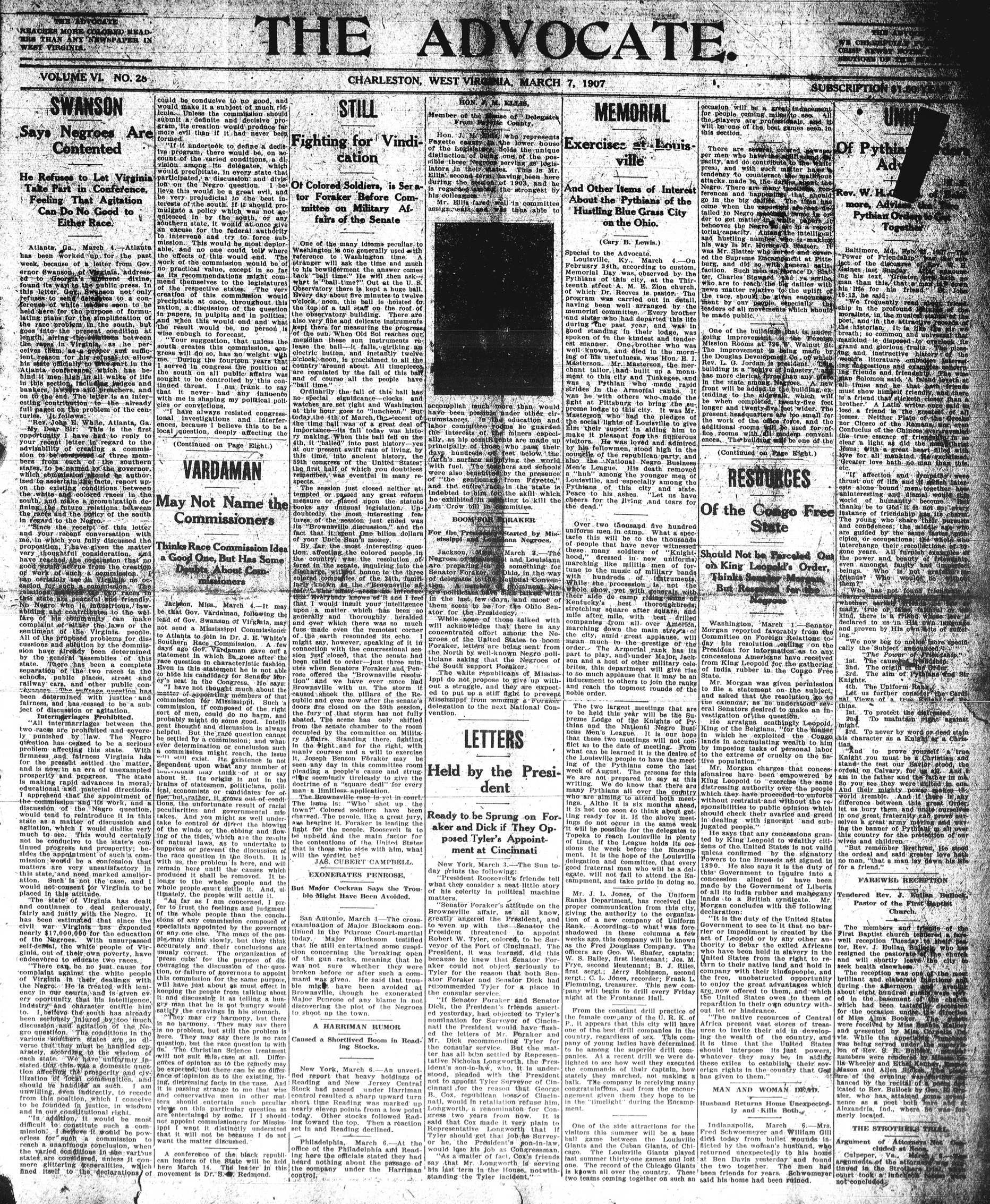
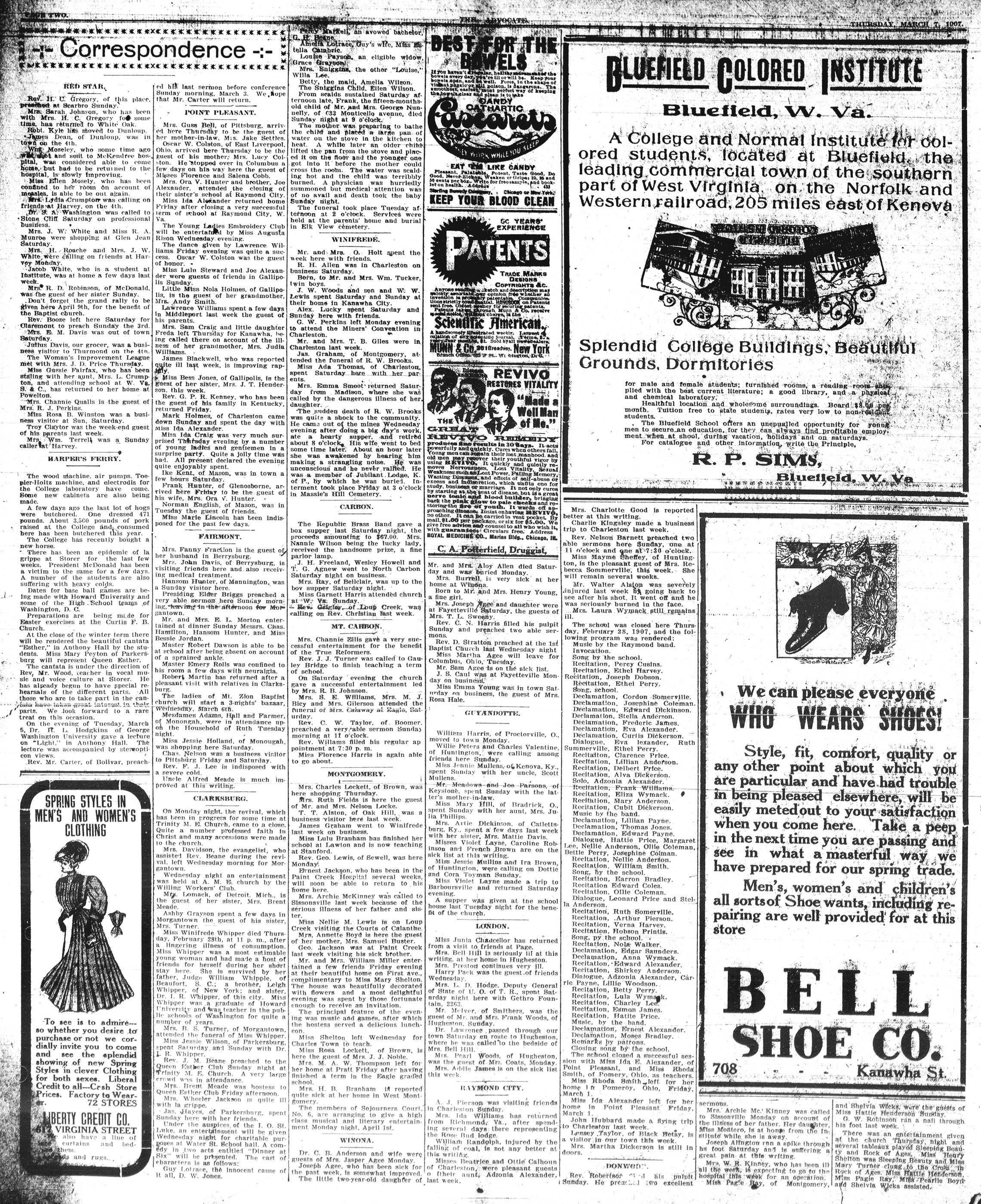
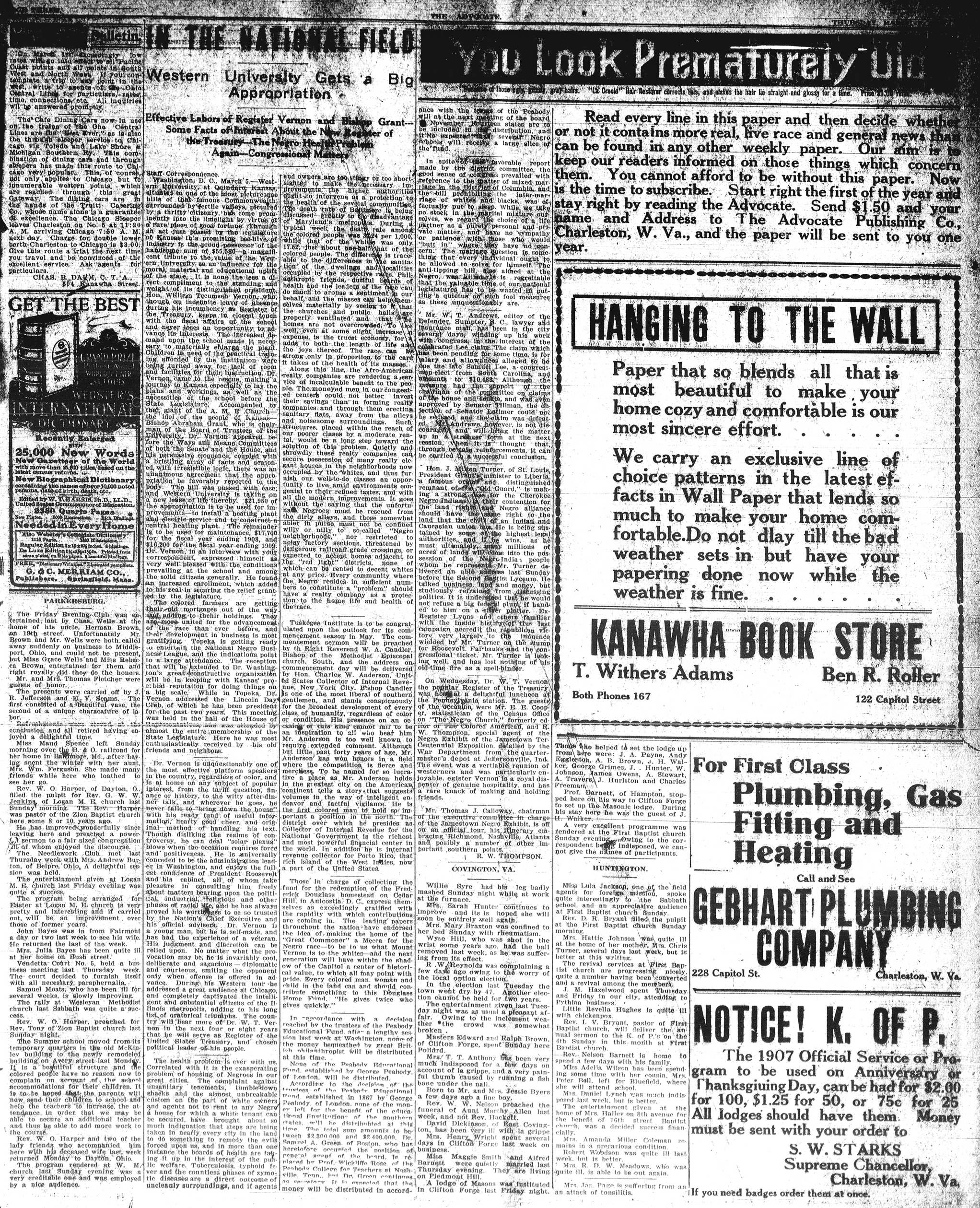
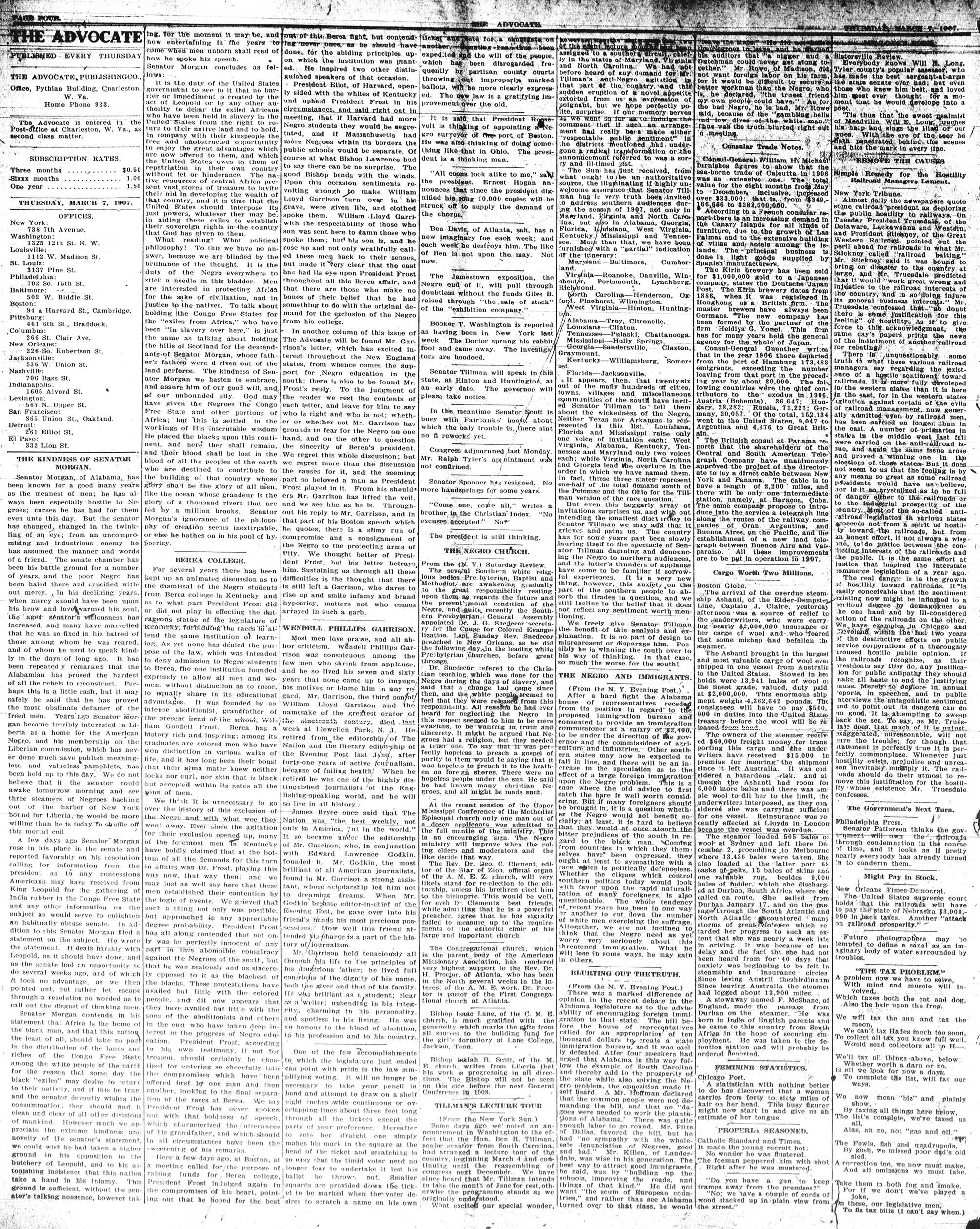
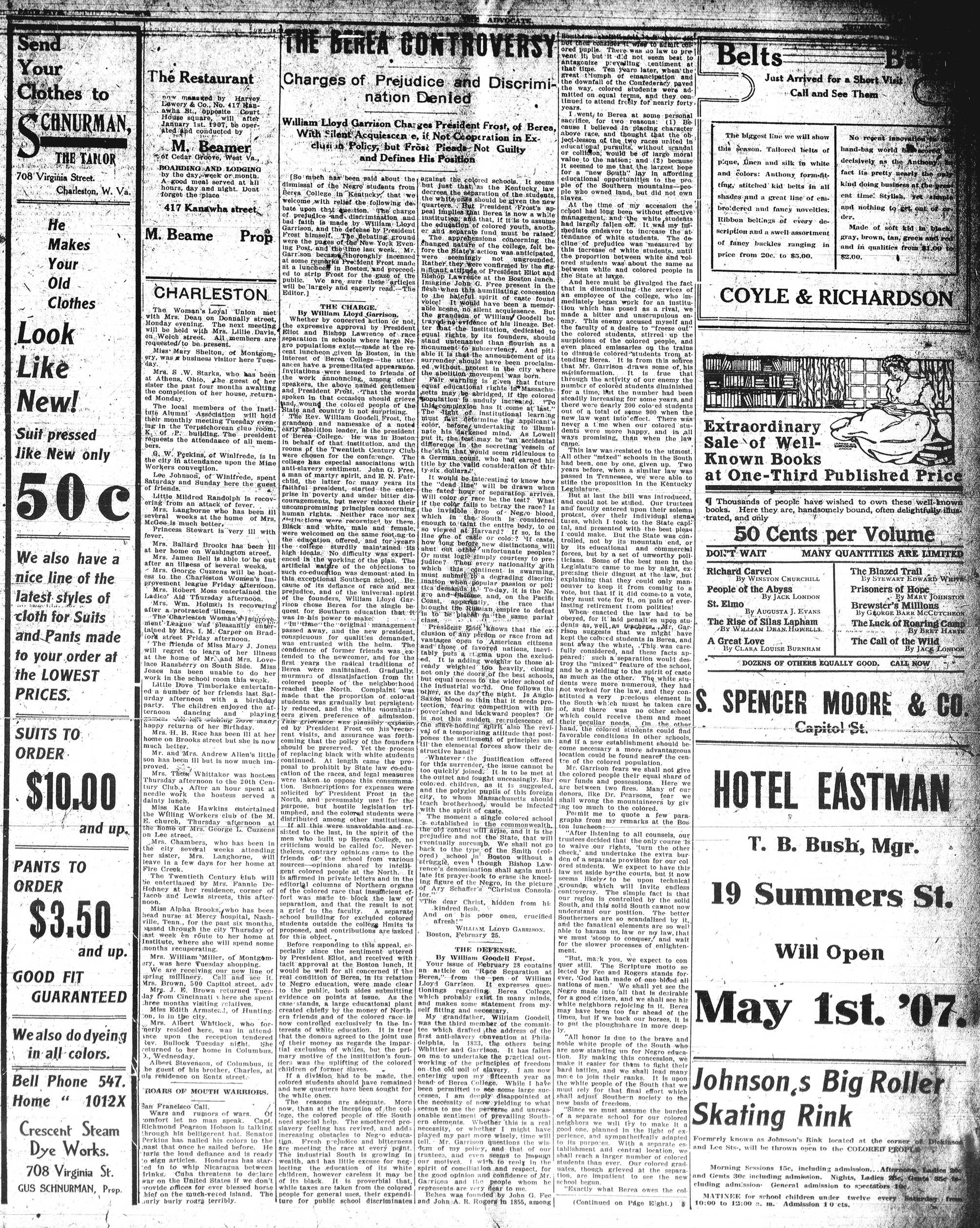
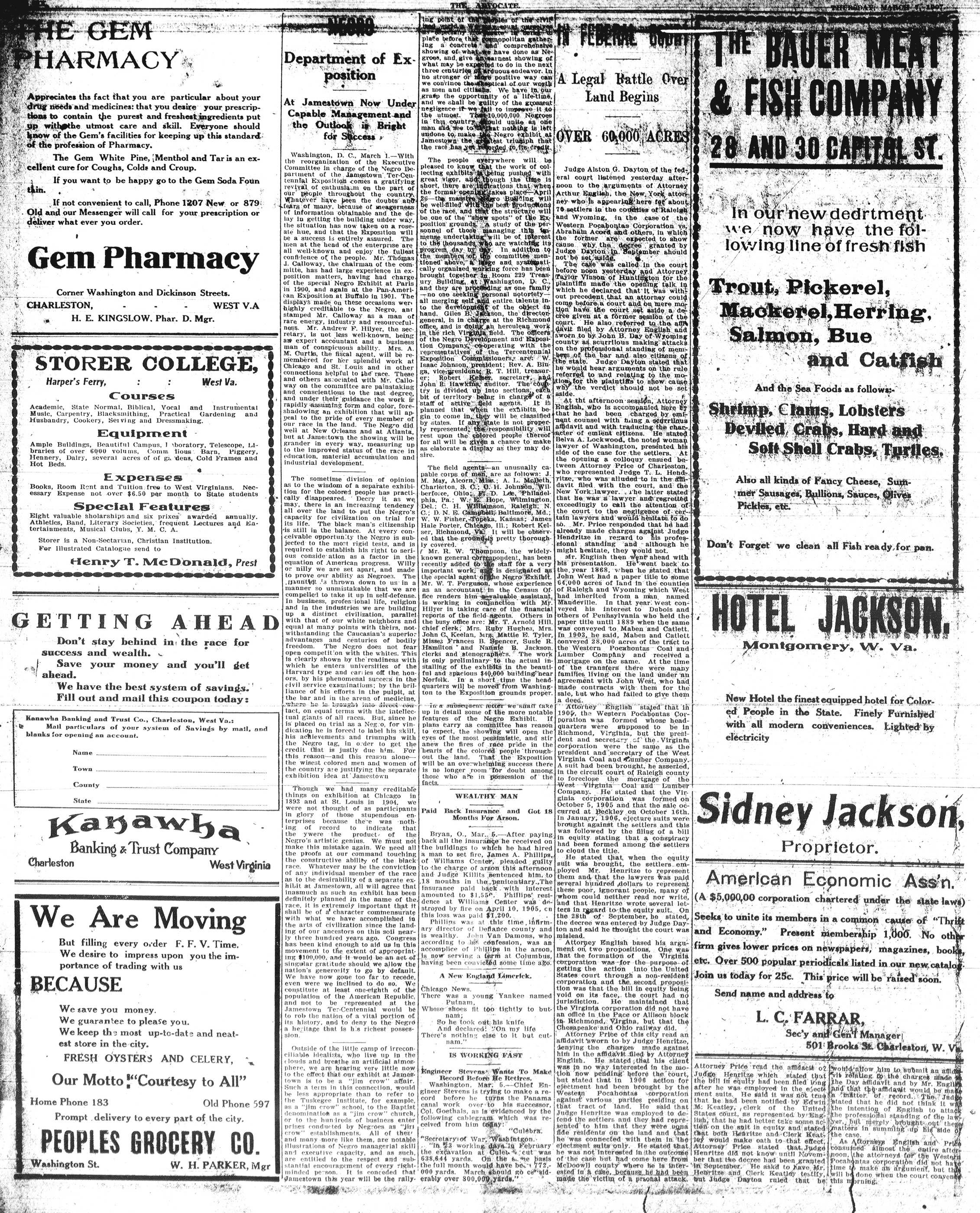
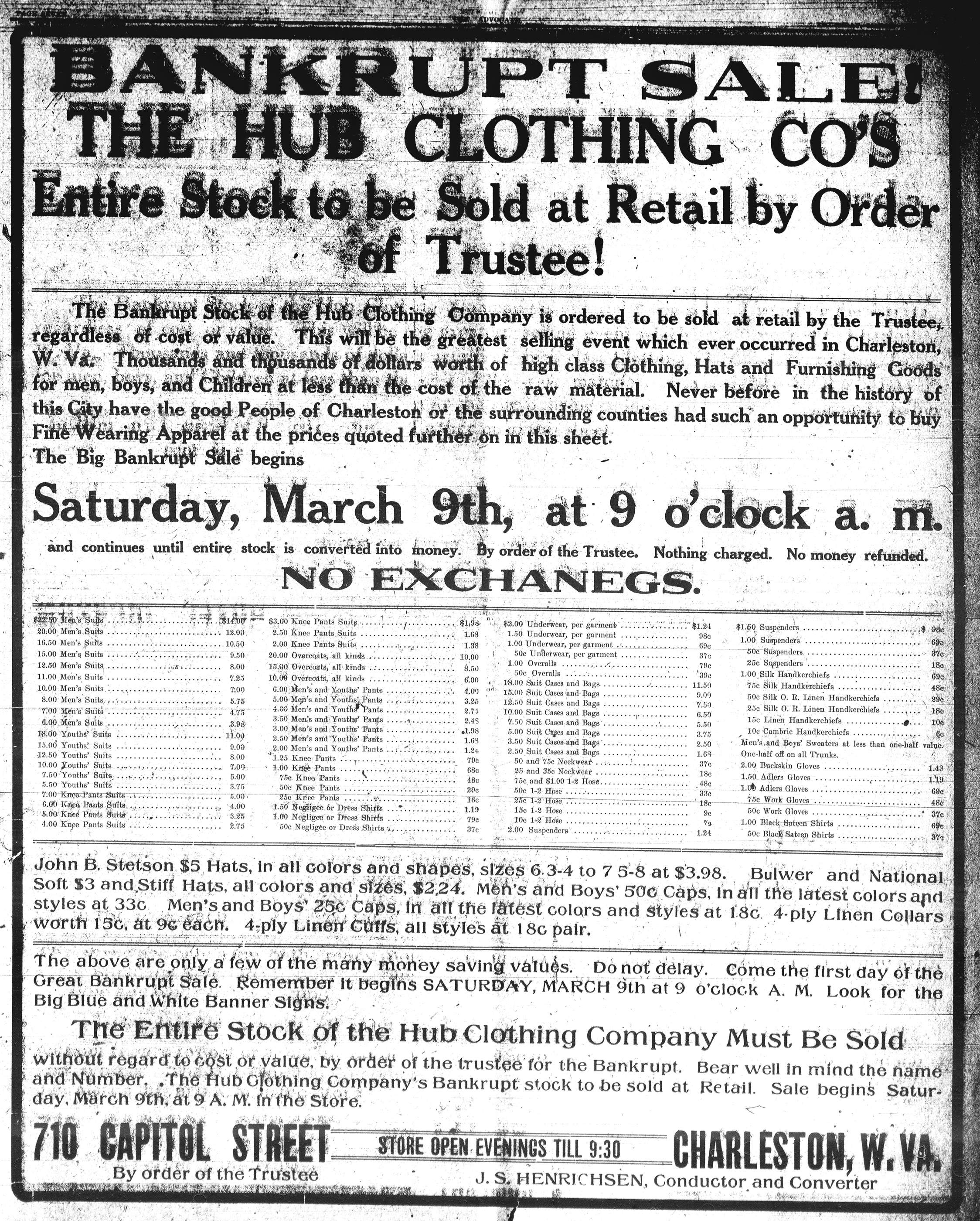
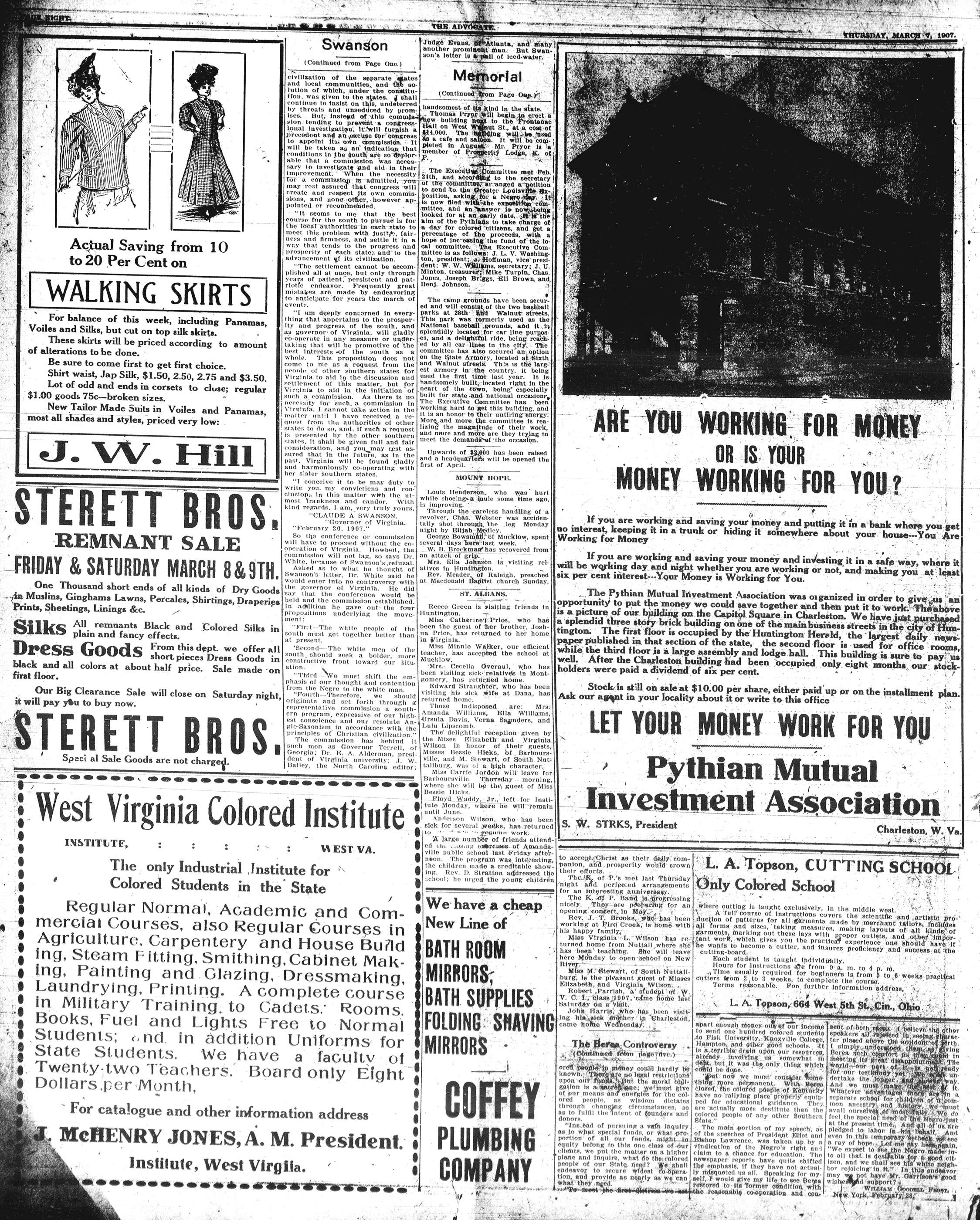
Page text (machine-generated)
Atlanta, Ga., March 4 — Atlanta has been worked up for the past week, because of a letter from Governor Swanson, of Virginia, address found its way to the public press. In this letter, Gov. Swanson not only refuses to send detritus to a conference of white leaders soon to be held here for the purpose of formulating plans for the simplification of the race problem in the south, but goes into the present condition at the races in Virginia, as he perives them as a copper and sufficient reason for his refusal to allow his state officially to take part in the Atlanta conference, which has behind it men high in all walks of life in this section, including judges and lawyers, law professors, and on the bench. The governor eating contribution—to the already full pages on the problem of the centuries. It follows:
"Rez: John E. White, Atlanta, Ga.
-My Dear Eir: This is the first opportunity I have had to reply to your recent letter in regard to the advisability of creating a commissioners from each of the southern states, to be named by the governor, which commission should be authorized to assemble the facts, report upon the existing conditions, between white and colored races in the south, to examine the future relations between the races and the policy of the south in regard to the Negro.
Since the receipt of this letter, and your recent conversation with me, in which you fully discussed the proposition, I have given the matter very thoughtful consideration, and agreed to give your congregation that no good compromise can be made in the work of such a commission. I can certainly see in Virginia no occasion for such a commission. The resolution of the commission two races in this state are peaceful and friendly. No Negro who is unattractive / lawful, nor who is unwilling to the welfare of his constituents, is complaint of either the laws or the sentiment of the Virginia people. All of the proposed problems for discussions and solution by the commission have already been determined by the general assemblies of this state. There has been a complete separation of the two races in the towns, public schools, street and railway cars, and the general business. The surface question has been determined with justice and fairness, and has ceased to be a subject of discussion or agitation.
Intermarriages Prohibited.
The "two intermarriages between the two states are prohibited and severely punished, but the question has ceased to be a serious problem affecting this state. With firmness and fairness Virginia has for the present settled the matter, and is now in an era of unexamined prosperity and progress. The state moral, educational and material directs I apprehend that the appointment of the commission and its work, and a discussion of the Negro question, would tend to reintroduce it in this state as a matter of discussion and learning, like very much to see. This would not be conducive to the state's continued progress and prosperity; besides the appointment of such a commission would be a confession that matters are very unatisfactory in state and need marked amelioration. Such need, case, and I would not consent for Virginia to be placed in this attitude.
"The state of Virginia has dealt and continues to deal generously, fairly and justly, with the Negro. It has been a great part of the civil war. Virginia has expended nearly $17,000,000 for the education of the Negroes. With unsurpassed despotism, the white people of Virginia have endowed, to educate two races,
"There can be no just cause for complaint against the white people of Virginia in their dealings with the Negro. He is treated with lenency in our courts, and is given even industry, industry and character outfile it to. I believe the south has already been seriously injured by too much discussion and agitation of the Negro question. The conditions in the various southern states are, so diligently, that must be handled separately, accordingly, each state. We have uniformly insisted that this was a domestic question affecting the prosperity and civilization of local communities, and should be handled as such. I am unwilling, even indirectly, to recode to be founded in justice, in wisdom and in our constitutional right.
"In addition, it would be most difficult to constitute such a commission." I believe it would be powerless for such a commission to make a commission conclusion, when the varied condition of the states are considered, unless it more glittering (generalities, which fined itself to the declarations) of
THE
CHAPTER
STILL
Fighting for cation
be a decide, on actions, a dies, which state that and dying. I be a evil, and the best in-hould proga not go, of any once give authority force sub
Of Colored Soldiers tor Foraker Baf mittee on Military fairs of the S
could be conducive to no good, and would make it a subject of much ridicule. Unless the commission should submit, a definite and decisive promise of creation would produce far more evil than if it had never been formed.
"If it undertook to define a decisive program, there would be, on account of the varied conditions, a division among its delegates, which participated, in every state that participated, a division on the Negro question. I believe this would be a great owl, and be very prejudicial to the best interests of the south. If it should promulgate a policy which was not adopted by the south, or any southern state it would be an excuse for the federal authority to intervene and to force submission. This would be most deplorable, and no one could tell where the effects of this would end. The effect of this commission would be of no practical importance at as its recommendations might commend themselves to the legislatures of the respective states. The very creation of this commission would precipitate at once, throughout this discussion, a discussion of the question in practice in politics; and when this would end, the result would be, no person is wise enough to forecast.
"Your suggestion, that unless the south creates this commission, congress will do so, has no weight with me. During the fourteen years that I served in congress the position of all public affairs was sought to be conferred on this continued threat. I am frank, say that it never had any influence with me in shaping my political policies or convictions.
"I have always resisted congressional investigations and interferences, because I believe this to be a local question, deeply affecting the (Continued on Page Eight.)
VARDAMAN
May Not Name the Commissioners
Thinks Race Commission Idea a Good One, But Has Some Doubts About Commissioners
Jacobson, Miss., March 4.—It may be that Gov. Vardaman, following the lead of Gov. Swanson of Virginia, may not send a Mississippi Commissioner to Atlanta to join in Dr. J. E White's Southern Race Commission, days ago Gov. Vardaman gave out a statement in which he goes after the race question in characteristic fashion. Even in this statement he is not able to candidacy for Senator Morry's seat in Congress. He says: "I have not thought of a matter of appointing members of the commission for Mississippi. Such a commission, if composed of the right sort of men, could do no harm, and might do some good. Intelligent men might discuss is always helpful. But the commission cannot be settled by a commission; ever determination or conclusion such a commission might reach, the issue must exist. Its existence is not dependent upon what any number of about it. May unkind of it or say about it. The commission in the brains of economists or politicians for office, but rather, it grows out of conditions, the unfortunate result of racial peculiarities and governmental misfortune. And you might as well undertake of the winds or the ebbing of the tides, which are the results of natural laws, as to undertake to suppress or prevent the discussion of the race question in the South. It is us, the problem is here, and will be addressed by the causes which produced it shall be covered by the whole people and the whole people must settle it. And, ultimately, the people will settle it.
"As far as I am concerned, I prefer to trust the feelings and judgment of the whole people than the conclusions of any commission composed of specialists appointed by the governors of any county. The mass of the people may think slowly and accurately and their conclusions are usually correct. The organization of 'press cubs' for the purpose of discouraging the discussion of the question, or failure of governors to appoint this commission for the same purpose, have just about as must effect in keeping with my talk about talking in keeping with my talk and discussing it. A grigy man that he is not hungry would satisfy the cravings in his stomach.
"They may cry harmony, but there is no harmony. They may say there is no problem, but still the problem is here. They may say there is no race question, but the race question is with them. Science treatment will not suit this situation. The experiences of opinion as to the remedy may be expected, but there can be no difference of opinion as to the existing, living, distressing facts in the case. And it is passing strange to me that wives conservative men in other matters view such peculiar views on this particular matter are entertained by some. If I should not appoint commissioners for Mississippi I want it distinctly understood that it will not be because I do not want the matter discussed."
A conference of the black republican leaders of the State will be held here March 14. The leader in this movement is Dr. S. Redmond.
CHARLESTON,
STILL
Fighting for Vindication
Of Colored Soldiers, is Senator Foraker Before Committee on Military Affairs of the Senate
CHARLESTON, WEST VIRGINIA, MARCH 7, 1907
One of the many idioms peculiar to Washington is one generally used with reference to Washington time. A stranger will ask the time and much to his bewilderment the answer comes back as "what is 'ball-time'?" Out at the U.S. Observatory there is kept a huge ball. Every day about five minutes to twelve o'clock, noon, this ball is hoisted to the top of a tall staff on the roof of the observatory building. There are the delicate instruments kept there for putting the ball of the sun. When Old Sol reaches our mepidan these sun instruments release the ball—it falls, striking an electric button, and instantly twelve o'clock, noon, is proclaimed to all the country around about. All timepieces and the fall of this ball and of course all the people have "ball-time."
Ordinarily the fall of this ball has no special significance—clocks and watches are set right and Washington at this hour goes to lunchunion. But the ball is not the only time the time ball was of a great deal of importance—its fall today was history making. When this ball fell on the 4th, it "ballied" into past history—years the present swift rate of living, by 1850 (the 50th congress of the United States; the first half of which you doubtless remember, was eventful in many respects). session just closed neither attempted or passed any great reform measure or placed upon the statute books any unusual legislation. Undoubtedly the most interesting features of the session just ended was the fact that it spent one billion dollars of your Uncle Sam's money.
By far the most interesting question, affecting the colored people in the country, was the resolution offered in the senate, ingrining into the discharge, without honoring to the three million early knightes, and similarly knighting the "Brownwell ladies." Everybody knows of it and I feel that I would insult your intelligence upon a matter which has been so generally and thoroughly heralded and over which there was so much confusion over the brownwell resolution of the earth resounded its echo. I might say, however, speaking of it in connection with the congressional session just closed, that the senate had been called to order—just three minutes when Senators Foraker and Penney were on the brownwell resolution" and we have Brownville with us. The storm if caused shook the pillars of the Republic and even now after the senate's doors are closed on the 59th session, the fury of that storm has not fully abated. The scene has only shifted to the scene of the deputies occupied by the committee on Military Affairs. Standing there, fighting in the right and for the right, with manly courage and a will to exercise it, Joseph Benson Foraker may be seen any day in this committee room pleasing people's cause and strugging for the right to be deputed to the doctrine of a "square dell" for every man a limitless application.
The Brownville case is yet in court.
The issue is: "Who shot up the town?" Colored soldiers have been charged. The people, like a great jury, are hearing it. Foraker is leading the fight for the Roosevelt is to be charged. The people are hearing the contentions of the United States that is those who side with him, what will the vpridt be?
JAS. CUBERT CAMPBELL.
But Major Cockran Says the Trouble Might Have Been Avoided.
San Antonio, March 1—The cross-examination of Major Blocksom continued in the Pelrose Court-martial today. Major Blocksom testified that he still entertained some suspicion concerning the breaking open of the gun racks, meaning that he was not sure whether they were made before or after such a command was given to him, he said, a might have been avoided. Brownsville, though the exonerated Major Purose of any blame in not discovering the plot of the Negroes to shoot up the town.
A HARRIMAN RUMOR
Caused a Shortlived Boom in Reading Stocks.
New York, March 6—An unverified report that heavy holdings of Reading and New Jersey Central Stock had passed under Harriman control resulted a sharp upward turn short time Reading was marked up nearly eleven points from a low point today. Other stocks followed Reading toward the top. Then a reaction set in and Reading declined.
Philadelphia, March 6—At the office of the Philadelphia and Reading here the officials stated they had heard nothing about the passage of the company under the Harriman control.
Hon. J. W. Mullis, who represents Fayette county on the lowe, house of the Legislature, holds the unique distinction of being one of the possible these Negroes serving as legislators in their states. This is Mr. Ellis' second term having been here during the session of 1903, and he is regarded among the strongest by his colleagues.
Mr. Ellis fared well in committee assignments, and was thus able to
accomplish much more than would have been possible under other circumstances for the education and labor committee. They were guarded the interests of the high school, especially, as his constituents are more principally of those who pass their days hundreds of feet below, the earth's surface admitting the world with fuel. The teachers and schools were also benefited by the presence of "the gentleman, from Fayette," and the entire race. In the state is indebted to him for the skill-which he exhibited in meeting to kill the Jim Crow bill in committee.
For the Trespasser Started by Mississippi and the Natives Negroes.
Jackson, Missouri, March 3. — The Negroes of Mississippi and Louisiana are preparing to take something for Senator Foraker, of Ohio, in the way of delegates to the National Convention. Negro politicians have taken advantage in the last few days, and most of them seem to be for the Ohio Senator for the Presidency. While none of those talked with will acknowledge that there is any concentrated effort among the Negroes of the United States to boom Foraker for President, and that the North by well-known Negro politicians making that the Negroes of the South support Foraker. The white republicans of Mississippi do not propose to give up without a struggle, and they are expectant to put a stiff fight to prevent Mississippi from sending a Foraker delegation to the next National Convention.
LETTERS
Held by the Presi dent
Ready to be Sprung on Foraker and Dick if They Opposed Tyler's Appointment at Cincinnati
New York, March 3.—The Sun today prints the following: "President Roosevelt's friends tell what they consider a neat little story of his colority in political machine matters. President Foraker's attitude on the Brownlee affair, as all know, greatly angered the President, and to even up with the Senator the President threatened to appoint Robert W. Tyler, colored, to be Surveyor of the Port of Cincinnati. The President, it was learned, did this because he knew that Senator Foraker could not object seriously to both Senator Foraker and Senator Dick had recommended Tyler for a place in the consular service.
"If Senator Foraker and Senator Dick, the President's friends asserted yesterday, had objected to Tyler's nomination for Surviver of Cincinnati the President would have flashened the letters of Mr. Foraker and Mr. Dick. The president, the consular service. But the matter has all been settled by Representative Nicholas Longworth, the President's son-in-law, who, it is understood, pleaded with the President not to appoint Tyler Surveyor of Cincinnati for the reason that George W. Bush, the President of Cincinnati, would in retaliation reason Longworth, a renomination for Congress two years from now. It is said that Cox made it very plain to Representative Longworth that if Tyler should get that job as Surveyor he, the President's son-in-law, would age as job as Congressman. We know that job as Congressman is friends say that Mr. Longworth is serving his last term in the House, notwithstanding the Tyler incident."
And Other Items of Interest About the Pythians of the Hustling Blue Grass City on the Ohio.
Special to the Advocate
Louisville, Ky., March 4 — On February 24th, according to memorial Day was, observed by the Pythians of this city, at the Thirteenth street A. M. E. Zion church, the program Dr. Reeves is pastor. The deputy having been well arranged in the memorial committee. Every brother and sister who had departed this life during the past year, and, was in good standing in their lodge, was spoken of in the kindest and tenderest manner, had built a monument to this city and Tuskegee, and sent 3 Pythian who made rapid mounts in memorial ranks. It was he with other men, the fight at Pittburg to bring the great preme lodge to this city. It was Mr. Masterson who had the pledges of the social lights of Louisville to give their support in alding him to peasant for the numerous visitors. He was also defiined by his fellowmen, stood high councils of the republican party, and also the National Negro Business Men's League. His death removed a hub" among the younger men of Louisville, and especially among the Pythians of this city and state. Peace to his ashes. "Let us have cheers for the living, and tears for the dead."
Over two thousand five hundred uniform men in camp. What a spectacle this will be to the thousands of people that have never witnessed these many soldiers of "Knightly dress" in new uniforms, marching in the middle of fortune to the music of milonga with hundreds of instruments. While the procession is not the whole show, yet with generals with their alde de camp riding, some of Kentucky's best thoroughbreds, come after squares, and mile after mile, best drilled companies from all over America, marching down the main street, the city, amid great applause, will mean much to the prestige of the order. The Armorial rank has its part to play, and under Major, Jack celebrates, most of other military celebrities, the most of other military celebrations, will give rise to so much applause, we be an inducement to others to join the mink and reach the topmost rounds of the noble order.
The two largest meetings that are to be held this year will be the Supreme Lodge of the Knights of Pythias and the National Negro Business Men's League. It is our hope that two meetings will not conflict as the two meetings. From what can be learned it is that the Louisville people to have the meeting of the Pythians come the last week of August. The session for this meeting is not prepared to say at this writing, but there are many Pythians all over the country who are aiming to attend both meetings. Altho it is six months ahead, it is not too soon to think about getting ready for it. If the above meetings will be the same week it will be possible for the Topeka to reach Louisville in plenty of time, if the League holds its sessions the week before the Encampment. It is the hope of the Louisville committee, that every good fraternal member will engage, will not fall to attend the Encampment, and take pride in doing so.
Mr. J. L. Jones, of the Uniform Ranks Department, has received the proper communication from this city, giving the authority to the organization of a new company of Uniform Rank. According-to what was forshadowed in these columns a few weeks ago, this company will be known as the Fred Douglas Company. The officers are Geo. W. Shafer, captain; Joe M. Frye, second Houtenman; Joe M. Frye, second Houtenman; Jerry Robinson first srcter; Jerry Robinson second srcter; C. L. Jones, recorder; Frank L. Fleming, treasurer. This new company will begin to drill every Friday night at the Frontance Hall.
From the constant drill practice of the female company of the U. R. K. of P., it appears that this city will have one of the best drill companies in the country, regardless of sex. This company of young ladies have determined to be among the superior drill companies highlighted to see how well they executed the commands of their captain, how stately they marched, not making a balk. The company is receiving many congratulations, and from the encouragement given them they hope to be in the "midnight" during the Encampment.
One of the side attractions for the visitors this summer will be a base ball game between the Louisville Giants and the Cuban Giants, of Chicago. The Louisville Giants played last summer thirty-one games and lost one. The record of the Chicago Giants is known all over the country. These two teams coming together on such an
occasion, will be a great announcement for people coming to meet. All the players are professionals, and if they are among the best games seen, in this section.
There are several colored newspapers per capita in the well-known city of capacity, and do count on the public press, and with such much hate tendency to counteract, the malicious attacks made in the daring attack, the Negro. There are many theories, conferences and happenings that should come when the Negro is alive. The times has tailed to Negro possession in order to get matter in white, paper, behooves the Negro so it in a reportorial capacity. Among the intelligent numbers who is making his way in Mr. Slatter was Mr. Slatter who served and covered the Supreme Encampment at Pittsburg, and did so, with general satisfaction. Such men an embrace D. Slatter, Charles Steward, and ye serbia, with news matter relative to the race, should be given encouragement by our people, especially the leaders of all movements which should be made public.
One of the buildings that is undergoing improvement in the Topeek Mission Rooms at 728 W. Walnut St. The improvement is being made by the Douglas Development Co. of which Dr. Jordan is president. This building has more clerical proxies than any has in the state among Negroes. A new front will be added in the building, extending to the sidewalk, which will be when completed, twenty-five feet longer and twenty-five feet wider. The building will be small for the work of the office for additional rooms will be used for offices, the building will be one of the
(Continued on Page Eight.)
RESOURCES
Of the Congo Free State
Should Not be Percolated Out
on King Leopold's Order,
Thinks Seemer Morgan,
But Resigned for the
Nagroes
Washington, 'March 1.'—Senator Morgan reported favorably from the Committee on Foreign Relations today his resolution calling on the President for information as to any success. Americans have received from King Leopold for the gathering of india rubber in the Congo Free State.
Mr. Morgan was given permission to file a statement on the subject; and asked that the resolution go to the calendar, as we understand servants to make an investigation of the question.
He arraigns scathingly Leopold, King of the Belgians, "for the manner in which he exploited the Congo lands in accumulating wealth to him by imposing tasks of personal labor the extreme of cruelty on the native."
Mr. Morgan charges that concessionales have been empowered by King Leopold to "exercise the same distressing authority over the people which they have proceeded to enforce without restraint and without the rejection of opinion which should check their availance and greed in dealing with ignorant 'and subjugated people."
He says that any concessions granted by King Leopold to wealthy citizens of the United States is not valid for them, by the signatory Powers to the French, in 1830. He also says it is the duty of this Government to Inquire into a concession alleged to have been made by the Government of Liberia of all its india rubber and mahogany to a British syndicate. Mr. Morgan includes with this following declaration: "It is the duty of the United States Government to see to it that no barrier or impediment is created by the act of Leopold or by any other auctioneer to debar the exiled Africans who have been sent to the United States from the right to throw to their native land and hold in company with their kindpeople, and the free, unobstructed opportunity to enjoy the great advantages which are now offered to them, and which permit them to sweep to them of repardition in their country without let or hindrance.
"The native resources of Central Africa present vast stores of treasures to invite their aid in developing the country, it is time that the United States should interpose its just powers, whatever they may be, in aid of the country to establish their sovereign rights in the country that Gaza has given to them."
Husband Returns Home Unexpectedly and Kills Both.
Indianapolis, March 6.—Mrs. Fred Schwomeyer and William Gill died today from bullet wounds inflicted by the wolfman's husband, who returned unexpectedly to his home at Ben Davis yesterday and found the two together. The men had been friends for years. Schwomeyer said his home had been ruined.
Baltimore, Md., Feb. 26, 1807—The
"Power of Friendship" was the subject of the discourse of the late John Gaines, last Sunday, when he gave his text, "Greater good than man than this; that a man is given his life for his friend." He John 18:13, he said;
We frequently read about friendship in the profound history of the moralists, in the musesteads by the eminent writers, the attractive records of the historian, the poets, the witty breath; so common and unimaginable, mankind is disposed to owe its grand and glorious fruits. The pleasing and instructive history of the world's literature embodies interesting suggestions and examples enthroning friends and friendships. The wise man Solomon said, A island loath at all sins must be laid bare; but both friends must show himself brave, and there is a friend that glides on brother.' A Latin writer once said to lose a friend in the greatest of all losses. Neither Plato of the Greeks nor Cicero of the Romans, nor even Confucius of the Chinese averaged the true essence of friendship in so light a light as did the many Christian saints, with love for all mankind. Greater love hath no man than the etc.
"If affection and sympathy were thrust out of life and of spiritual interests alone bound men together have uninteresting and dismal would they wish of the world to become. Thanks be to God it should be, our instance of friendship has had its charm. The young who share their pursuits and condignes; the middle age who are guided by the same issues and interchange their recollections of gone years. All furious examples of the power and beauty of friendship even amongst faulty and disarmed beings, who is not grateful for friendship. Who would like to meet them?" "Who has not found friendship in a charm stimulating whether certain friends have been made kind there is a friend whose love is declared to us in His own language and proven by His own acts of nurturing."
1st. The cause of the Rebellion.
2nd. The origin of the Order.
3rd. The aim of Polishians and Sir
Knights.
4th. The Uniform Ranks.
Let us further consider the Cardinal
lew of a true Christian.
this.
1st. To protect the defended.
2nd. To maintain right against
might.
8rd. To never by word or dead statu
character as a Knight or a Christian
"And to prove yourself a true Knight you must be a Christian and stand the test our Savior stood, the ordeal on Calvary, for us all. And am in the father and the father in me. So you see they were united in one. And their mighty power makes us world tremble. And if there is any difference between this great Order, let us bury them and unite ourselves in one great fraternity and prove ourselves a great army moving and waving the banner of Pythian m all over this country for the protection of our wives and children."
"But remember Brethren, He stood the ordeal and said greater love hath no man, "that a man lay down his life for a friend."
The members and friends of the First Baptist church tendered a farewell reception Tuesday to their pastor, Rev J. Eulan Ballance who has been a longtime friend and will shortly leave the city to seek health elsewhere.
The reception was one of the most brilliant and elaborate functions and during the afternoon and evening about eight hundred guests were served in the basement of the chapel which was the location for the occasion under the direction of Miss Alma Booker. The guests were received by Miss Basha Hallway and presented by Miss Coralie Davis. While the applause was uninterrupted, the being served seemed to be uneven. The hallway numbers were rendered by Miss Lilian like Wheeler and Ethan Reney, whose Mason and Allen Silicon. The purpose of the evening was further hanced by the recital of a poem by Miss Elaine Baker, who has attained prominence as a poet both here and at Alexandria, Ind., where he was formerly located.
-- Correspondence --
RED STAR.
Rev. H. C. Gregory, of this place, presided at Scarbro Sunday.
Mrs. Sarah Johnson, who has been with Mrs. H. C. Gregory, for some time, has returned to White Oak.
Robt. Kyle has moved to Dunloup.
James Dean, of Dunloup, was in town on the 4th.
Wm. Moseley, who some time ago was shot and seult to McKendree hospital, was considered able to come home, but had to be returned to the hospital, is slowly improving.
Miss Ellen Moseley, who has been confined to her room on account of measles, is able to be out again.
Mrs. Lydia Crumpton was calling on friends at Harvey, on the 4th.
Dr. S. A. Washington was called to Stone Cliff Saturday on professional business.
Mrs. J. W. White and Miss R. A. Munroe were shopping at Glen Jean Saturday.
Mrs. H. Roache and Mrs. J. W. White were calling on friends at Harvey Monday.
Jacob White, who is a student at Institute, was at home a few days last week.
Mrs. R. D. Robinson, of McDonald, was the guest of her sister Sunday.
Don't forget the grand rally to be given here April 9th, for the benefit of the Baptist church.
Rev. Booze left here Saturday for Glaremont to preach Sunday the 3rd.
Mrs. E. M. Davis was out of town Saturday.
Julius Davis, our grocer, was a business visitor to Thurmond on the 4th.
The Woman's Improvement League met with Mrs. J. D. Price Thursday.
Miss Gussie Fairfax, who has been staling with her aunt, Mrs. L. Crumpton, and attending school at W. Va. S. & C., has returned to her home at Powelton.
Miss Channie Qualls is the guest of Mrs. R. J. Perkins.
Miss Rosa B. Winston was a business visitor at Sun, Saturday.
Troy Claytor was the week-end guest of his parents last week.
Mrs. Wm. Terrell was a Sunday caller at Harvey.
HARPER'S FERRY.
The wood machine, air pumps, Toepler-Holter machine, and electrodis for the College laboratory have come. Some new cabinets are also being made.
A few days ago the last lot of hogs were butchered. One dressed 471 pounds. About 3,500 pounds of pork raised at the College and, consumed here has been butchered this year.
The College has recently bought a new horse.
There has been an epidemic of la gripe at Storer for the last few weeks. President McDonald has been a victim to the same for a few days. A number of the students are also suffering with heavy colds. Dates for base ball games are being made with Howard University and some of the High School teams of Washington, D. C. Preparations are being made for Easter exercises at the Curtis F. B. Church. At the close of the winter term there will be rendered the beautiful cantata "Esther," in Anthony Hall by the students. Miss Mary Peyton of Parkersburg will represent Queen Esther. The cantata is under the direction of Rev. Mr. Wood, teacher in vocal music and voice culture at Storer. He has already begun to have special rehearsals of the different parts. All those who are to take part in the cantata have taken great interest in their parts. We look forward to a rare treat on this occasion.
On the evening of Tuesday, March 5, Dr. ff. L. Hodgkins of George Washington University gave a lecture on "Light," in Anthony Hall. The lecture was accompanied by stereopticon views. Rev. Mr. Carter, of Bolivar, preach
SPRING STYLES IN
MEN'S AND WOMEN'S
CLOTHING
To see is to admire---so whether you desire to purchase or not we cordially invite you to come and see the splendid showing of new Spring Styles in clever Clothing for both sexes. Liberal Credit to all--Cash Store Prices. Factory to Wearer. 72 STORES
ed his last sermon before conference Sunday morning, March 3. We hope that Mr. Carter will return.
- POINT PLEASANT.
Mrs. Guss Bell, of Pittsburgh, arrived here Thursday to be the guest of her mother-in-law, Mrs. Jake Settles, Oscar W. Colston, of East Liverpool, Ohio, arrived here Thursday to be the guest of his mother; Mrs. Lucy Colston. He stopped over in Columbus a few days on his way here the guest of Misses Florence and Salena Cobb. Mrs. Ora V. Hunter and brother, Joe Alexander, attended the closing of their sister's school at Raymond City.
The Young Ladies Embroidery Club will be entertained by Miss Augusta Rison Wednesday evening.
The dance given by Lawrence Williams Friday evening was quite a success. Oscar W. Colston was the guest of honor.
Miss Lulu Steward and Joe Alexander were guests of friends in Gallipolis Sunday.
Little Miss Nola Holmes, of Gallipolis, is the guest of her grandmother, Mrs. Andy Smith.
Lawrence Williams spent a few days in Middleport last week the guest of his parents.
Mrs. Sam Craig and little daughter Freda left Thursday for Kanawha, being called there on account of the illness of her grandmother, Mrs. Judia Williams.
James Blackwell, who was reported quite ill last week, is improving rapidly.
Miss Bess Jones, of Gallipolis, is the guest of her sister, Mrs. J. T. Henderson, this week.
Rev. G. P. R. Kenney, who has been the guest of his family in Kentucky, returned Friday.
Mark Holmes, of Charleston came down Sunday and spent the day with Miss Ida Alexander.
Miss Ida Craig was very much surprised Thursday evening by a number of young ladies and gentlemen in a surprise party. Quite a jolly time was had. All present declared the evening quite enjoyably spent.
Ike Kent, of Mason, was in town a few hours Saturday.
Frank Hunter, of Glenosborne, arrived here Friday to be the guest of his wife, Mrs. Ora V. Hunter.
Norman English, of Mason, was in Tuesday the guest of friends.
Miss Marie Lincoln has been indisposed for the past few days.
FAIRMONT
Mrs. Fanny Fraction is the guest of her husband in Berrysburg.
Mrs. John Davis, of Berrysburg, is visiting friends here and also receiving medical treatment.
Hansom Hunter, of Mannington, was a Sunday visitor here.
Presiding Elder Briggs preached a very able sermon here Sunday morning, leaving in the afternoon for Morgantown.
Mr. and Mrs. E. L. Morton entertained at dinner Sunday Messrs. Chas. Hamilton, Hansom Hunter, and Miss Bessie Jordan.
Master Robert Dawson is able to be at school after being absent on account of a sprained ankle.
Master Emery Rolls was confined to his room a few days with neuralgia.
Robert Martin has returned after a pleasant visit with relatives in Clarksburg.
The ladies of Mt. Zion Baptist church will start a 3-rights' bazaar, Wednesday, March 6th.
Mesdames Adams, Hall and Farmer, of Monongah, were in attendance upon the Household of Ruth Tuesday night.
Miss Jessie Holland, of Monougah, was shopping here Saturday.
Chas Nelson was a business visitor to Pittsburg Friday and Saturday.
Rev. F. J. Lee is indisposed with a severe cold.
Uncle Alfred Meade is much improved at this writing.
CLARKSBURG
On Monday night, the revival, which has been in progress for some time at Trinity M. E. Church, came to a close. Quite a number professed faith in Christ and many accessions were made to the church.
Mrs. Davidson, the evangelist, who assisted Rev. Beane during the revival, left Wednesday morning for Morgantown.
Wednesday night an entertainment was held at A. M. E. church by the Willing Workers' Club.
Mrs. Lomack, of Detroit. Mich., is the guest of her sister, Mrs. Brent Meade.
Ashby Grayson spent a few days in Morgantown the guest of his sister, Mrs. Turner.
Miss Winifrede Whipper died Thursday, February 28th, at 11 p. m., after a lingering illness of consumption, Miss Whipper was a most estimable young woman and had made a host of friends for herself during her short stay here. She is survived by her father, Judge William Whipper, of Beaufort, S. C.; a brother, Leigh Whipper, of New York; and sister, Dr. L. R. Whipper, of this city. Miss Whipper was a graduate of Howard University and was teacher in the public schools of Washington for quite a number of years.
Mrs. B. S. Turner, of Morgantown, attended the funeral of Miss Whipper. Miss Jessie Wilson, of Parkersburg, spent Saturday, and Sunday with Dr. L. R. Whipper.
Rev. J. M. Béane preached to the Queen Esther Club Sunday night at Trinity M. E. Church. A very large crowd was in attendance.
Mrs. Brent Meade was hostess to Queen Esther Club Friday afternoon. Mrs. Wheeler Jackson is quite ill with la gripe. Jas. Jayes, of Parkersburg, spent Sunday here with her friends. Under the auspices of the I. O. St. Luke, an entertainment will be given Wednesday night for charitable purposes at Water St. School hall. A comedy in two acts entitled "Dinner at Six" will be presented. The cast of characters is as follows: Guy Lotrace, the innocent cause of it all, D. W. Jones.
very markedly an avowed bachelor,
G. H. Pope.
Amelia Lotrace Guy's wife, Miss
tella Cambric.
Louise Payson, an eligible widow, Grace Grayson, Mrs. Sniggins, the other "Louise," Willa Lee, Betty, the maid, Amella Wilson. The Sniggins Child, Ellen Wilson. From scalds sustained Saturday afternoon late, Frank, the fifteen-month-old child of Mr. and Mrs. George Nunely, of C33 Monticello avenue, died Sunday night at 9 o'clock. The mother was preparing to bathe the child and placed a large pan of water on the stove in the kitchen to heat. A white later an older child lifted the pan from the stove and placed it on the floor and the younger one got into it before the mother could cross the room. The water was scalding hot and the child was terribly burned. A physician was hurriedly summoned but medical attention was of no avail and death took the baby Sunday night.
The funeral took place Tuesday afternoon at 2 o'clock. Services were held at the parents' home and burial in Elk View cemetery.
WINIFREDE.
Mr. and Mrs. O. Holt spent the week here with friends.
R. H. Allen was in Charleston on business Saturday.
Born, to Mr. and Mrs. Wm. Tucker, twin boys.
J. W. Woods and son and W. W. Lewis spent Saturday and Sunday at their home in Kanawha City.
Alex. Lucky spent Saturday and Sunday here with friends.
G. W. Perkins left Monday evening to attend the Miners' Convention in Charleston.
Mr. and Mrs. T. B. Giles were in Charleston last week.
Jas. Graham, of Montgomery, attended the funeral of R. W. Brooks.
Miss Ada Thomas, of Charleston, spent Saturday here with her parents.
Mrs. Emma Smoot returned Saturday from Madison, where she was called by the dangerous illness of her daughter.
The sudden death of R. W. Brooks was quite a shock to the community. He came out of the mines Wednesday evening after doing a big day's work, ate a hearty supper, and retired about 8 o'clock. His wife went to bed some time later. About an hour later she was awakened by hearing him making a strangling noise. He was unconscious and he never rallied. He was a member of Jubilant Lodge, K. of P., by which he was buried. Interment took place Friday at 3 o'clock in Massie's Hill Cemetery.
CARBON.
The Republic Brass Band gave a box supper last Saturday night, the proceeds amounting to $67.00. Mrs. Nannie Wilson being the lucky lady, received the handsome prize, a fine parlor lamp. J. H. Freeland, Wesley Howell and T. G. Agnew went to North Carbon Saturday night on business. Mrs. Ray, of Bellicla, was up to the boy supper Saturday night. Miss Garnett Harris attended church at W. Vg. Sunday.
Rev Cairley of Loup Creek, was calling on Rev. Christian last week.
MT. CARBON.
Mrs. Channie Ellis gave a very successful entertainment for the benefit of the True Reformers.
Rev. J. J. Turner was called to Gauley Bridge to finish teaching a term of school.
On Saturday evening the church gave a successful entertainment led by Mrs. R. B. Johnson.
Mrs. S. E. Williams, Mrs. M. J. Bicy and Mrs. Gilerson attended the funeral of Mrs. Galaway at Eagle, Saturday.
Rev. C. W. Taylor, of Boomer, preached a very/able sermon Sunday morning at 11 o'clock.
Rev. Williams filled his regular ap pointment at 7:30 p. m.
Miss Florence Harris is again able to go about.
MONTGOMERY.
Mrs. Charles Lockett, of Brown, was here shopping Thursday. Mrs. Ruth Fields is here the guest of Mr. and Mrs. Nelson Locke. T. T. Alston, of Oak Hill, was a business visitor here last week. James Graham went to Winifrede last week on business.
Rev. Geo. Lewis, of Sewell, was here Monday.
Ernest Jackson, who has been in the Paint Creek Hospital several weeks, will soon be able to return to his home here.
Mrs. Archie McKinney was called to Sissonsville last week because of the serious illness of her father and sister.
of her mother, Mrs. Samuel Buster.
Geo. Jackson was at Paint Creek last week visiting his sick brother.
Mr. and Mrs. William Miller entertained a few friends Friday evening at their beautiful home on First ave., complimentary to Miss Mary Shelton.
The house was beautifully decorated with flowers and a most delightful evening was spent by those fortunate enough to receive an invitation.
The principal feature of the evening was music and games, after which the hostess served a delicious luncheon.
Miss Shelton left Wednesday for Charles Town to teach.
Miss Rosa Lockett, of Brown, is here the guest of Mrs. J. J. Noble. Mrs. M. A. W. Thompson left for her home at Pratt Friday after having finished a term in the Eagle graded school. Mrs. H. B. Branham reported quite sick at her home in West Montgomery. The members of Sojourners Court. No. 6, are arranging to give a high class musical and literary entertainment Monday night. April 1st.
WINONA
Dr. C. B. Anderson and wife were guests of Mrs. Jasper Agee Monday. Joseph Agee, who has been sick for the past week, is somewhat improved. The little two-year-old daughter of
If you haven't a dreadful, healthy environment the
you'll be able to pick up your
bowels open, and be well. Fur, in the
victim physical pain, poison, is dangerous. The
powers of keeping the bowels open and clean is
of keeping the bowels open and clean is
DANDY
CATHARTIC
Cascarets
MONEY WORK WHILE YOU SLEEP
Pleasant, Palatinate, Patient, Food, Do Good, Never Slicken, Weaken or Gripe, 10, 35 and 30 cents per box. Write for free sample, and booklet on health. Address
Storing Remedy Company, Chicago or New York.
KEEP YOUR BLOOD CLEAN
GC YEARS' EXPERIENCE
PATENTS
TRADE MARKS DESIGNS
COPYRIGHTS & C.
Anyone seeking a sketch and description may quickly associate a complaint. This invention is probably patentable. Communications strictly good dental. HARDBOOK on Patents Saves Free. Objective and purpose. Patents faster, through Munn & Co., receive social action, without charge in the
Scientific American.
A handsomely illustrated weekly. Largest
collection of any accounting journal. Terms: $4
a year for monthly. St. Sold by all newad-
ellers.
MUHN & Co. 301 Broadway, New York
Branch Office, 60 W. St. W. Stington, Dr. G.
Diane Kendall
REVIVO
RESTORES VITALITY
"Made a
Well Man
of Me."
THE
GREAT
REVIVO REMEDY
produces also results in 30 Days. It acts
powerfully and quickly. Cures when others fail.
Young man can regain their lost manhood, and
of men who cannot recover their youthful vigor by usi-
sing REVIVO. It quickly and quietly removes
Nervousness, quickness, and weakness
Weakness such as Lost Power, Failing Memory,
Wasting Disease, and effects of self-abuse or
excess and indigestion, which unifies one for
business or marriage. It not only cures
by starting the blood flow, but is a great
nerve tonic and blood booster, helping
back the pink glow to pale cheeks and
storing the fire of youth. It words off
approaching disease. Insist on having REVIVO,
it can be carried in vest pocket. By mail,
it can be delivered, or six for $5.00. We
give free advice and support, with guar-
mentaries. Circular free. Address
Royal MEDICINE CO. Marina Bldg. Chicago
C. A. Potterfield, Druggist
Mr. and Mrs. Aloy Allen died Saturday and was buried Monday.
Mrs. Burrell, is very sick at her home at Winona.
Born to Mr. and Mrs. Henry Young, a fine girl.
Mrs. Joseph Agee and daughter were at Fayetteville Saturday, the guests of Mrs. T. L. Sweeny.
Rev. C. N. Harris filled his pulpit Sunday and preached two able sermons.
Rev. D. Stratton preached at the 1st Baptist Church last Wednesday night.
Miss Martha Agee will leave for Columbus, Ohio, Tuesday.
Mr. Sam Agee is on the sick list.
J. S. Caul was at Fayetteville Monday on business.
Miss Emma Young was in town Saturday on business, the guest of Mrs. Rosa Hale.
GUYANDOTTE.
William Harris, of Proctorville, O., moved to town Monday.
Willie Peters and Charles Valentine, of Huntington,' were calling among friends here Sunday.
Miss Jennie Mullens, of Kenova, Ky., spent Sunday with her uncle, Scott Mullens.
Mr. Meadows and Joe Parsons, of Keystone, spent Sunday with the latter's mother-in-law.
Miss Mary Hill, of Bradrick, O., spent Sunday with her aunt, Mrs. Julia Phillips.
Miss Artie Dickinson, of Catlettsburg, Ky., spent a few days last week with her sister, Mrs. Mattie Davis.
Misses Violet Layne, Caroline Robinson and French Brown are on the sick list at this writing.
Miss Jessie Mullins and Ira Brown, of Huntington, were calling on Dottie and Cora Toyman Sunday.
Miss Violet Layne made a trip to Barboursville and returned Saturday evening.
A supper was given at the school house last Tuesday night for the benefit of the church.
LONDON.
Miss Junia Chadcellor has returned from a visit to friends at Page.
Mrs. Bell Hill is seriously ill at this writing, at her home in Hugheston.
Mrs. Preston continues very ill.
Harry Pack was the guest of friends Wednesday.
Mrs. L. D. Hodge, Deputy General of State of U. O. of T. R., spent Saturday night here with Gethro Fountain, 2263.
Mr. Melver, of Smithers, was the guest of Mr. and Frank Woods, of Hugheston, Sunday.
Dr. Lawrence passed through our town Saturday en route to Hugheston, where he was called to the bedside of Mrs. Bell Hill.
Mrs. Pearl Woods, of Hugheston, was the guest of Mrs. Coats, Monday.
Mrs. Addie James is on the sick list this week.
RAYMOND CITY.
A. J. Pierson was visiting friends in Charleston Sunday.
Mrs. Ida Williams has returned from Richmond, Va., after spending several days there representing the Rose Bud lodge.
William Randolph, injured by the falling of coal, is not any better at this writing.
Misses Beatrice and Ottie Calhoun of Charleston, were pleasant guests of their aunt, Adzonia Alexander, last week.
BLUEFIELD COLORED INSTITUTE
Bluefield, W. Va.
A College and Normal Institute for colored students, located at Bluefield, the leading commercial town of the southern part of West Virginia, on the Norfolk and Western railroad, 205 miles east of Kenova
COLORADO HISTORICAL
BLUEGRID
Splendid College Buildings; Beautiful Grounds, Dormitories
for male and female students; furnished rooms, a reading room, and piled with the best current literature; a good library, and a physical and chemical laboratory.
Healthful location and wholesome surroundings. Board $8.00 per month. Tuition free to state students, rates very low to non-resident students.
The Bluefield School offers an unparalleled opportunity for young men to secure an education, for they can always find profitable employment when at shool, during vacation, holidays and on saturdays.
For catalogue and other information write the Bluefield School.
R. P. SIMS.
Bluefield
We can please
WHO WEAR
Style, fit, c
any other point
are particular and
in being pleased
easily meted out t
when you come h
in the next time y
see in what a
have prepared fo
Men's, wome
all sortsof Shoe w
pairing are well p
store
BE
SHO
708
Dialogue, Eva lexander, Ruth
Summerville, Ethel Perry.
Recitatton, Clarence Price.
Recitaton, Lillian Anderson.
Recitaton, Delbert Price.
Recitaton, Alva Dickerson.
Solo, Adzonia Alexander.
Recitaton, Frank Williams.
Recitaton, Eliza Wymack.
Recitaton, Mary Anderson.
Recitaton, Cubit Dickerson.
Music by the band.
Mrs. Charlotte Good is reported better at this writing.
Charlie Kingsley made a business trip to Charleston last week.
Rev. Nelson Barnett preached two able sermons here Sunday, one at 11 o'clock and one at 7:30 o'clock.
Miss Mayme Shefey, of Huntington, is the pleasant guest of Mrs. Rebecca Sommerville, this week. She will remain several weeks.
Mr. Walter Alston was severely injured last week by going back to see after his shot. It went off and he was seriously burned in the face.
Mrs. Laura Wymack still remains ill.
The school was closed here Thursday, February 28, 1907, and the following program was rendered:
Music by the Raymond band.
Invocation.
Song by the school.
Recitation, Percy Cusins.
Recitation, Ethel Harvey.
Recitation, Joseph Dobson.
Recitation, Ethel Perry.
Song, school.
Declaration, Cordon Somerville.
Declaration, Josephine Coleman.
Declaration, Edward Dickinson.
Declaration, Stella Anderson.
Declaration, Frederic James.
Declaration, Eva Alexander.
Declaration, Curtis Dickerson.
Declaration, Lillian Payne.
Declaration, Thomas Jones.
Declaration, Edward Payne.
Dialogue, Hattie Price, Margaret Lee, Nellie Anderson, Ollie Coleman, Bettie Perry, Josephine Colman.
Recitation, Nellie Anderson.
Recitation, William Smith.
Song, by the school.
Recitation, Earron Bradley.
Recitation Edward Coles.
Recitation, Ollie Coleman.
Dialogue, Leonard Price and Stella Anderson.
Recitation, Ruth Somerville.
Recitation, Arthur Pierson.
Recitation, Verna Harvey.
Recitation, Hobson Printis.
Song, py the school.
Recitation, Nola Walker.
Declaration, Edgar Saunders.
Declaration, Anna Wymack.
Recitation, Edward Alexander.
Recitation, Shirkey Anderson.
Dialogue,
Dialogue, Adzonia Alexander, Carrie Payne, Lillie Woodson
rie Payne, Lillie Woodson.
Recitation, Betty Perry.
Recitation, Lula Wymark.
Recitation, Charley Lee.
Recitation, Esmon James.
Recitation, Hatite Price.
Music, by the band.
Declaration, Ernest Alexander.
Declaration, Moses Bradley.
Remarks by patrons.
Miss Rhoda Smith left for her home in Pomeroy, Ohio, Friday, March 1.
Miss Ida Alexander left for her home in Point Pleasant Friday, March 1.
John Hubbard made a flying trip to Charleston last week.
Lensey, Taylor, of Black Betay, is a visitor in our town this week.
week. Mrs. Martha Dickerson is still in
doors.
DONWOO
Rev. Robertson and his pupil
Sunday. He preached two excellent
Bluefield, W. V.
COPYRIGHT
can please every
WEARS SH
le, fit, comfort, qu
er point about wh
icular and have had
pleased elsewhere,
seted out to your sat
you come here. Take
xt time you are pas
what a masterful
paired for our sprin
's, women's and c
of Shoe wants, inclu
are well provided fo
ELI
HOE C
Kanaw
We can please everyone WHO WEARS SHOES!
Style, fit, comfort, quality or any other point about which you are particular and have had trouble in being pleased elsewhere, will be easily meted out to your satisfaction when you come here. Take a peep in the next time you are passing and see in what a masterful way we have prepared for our spring trade.
Men's, women's and children's all sortsof Shoe wants, including repairing are well provided for at this store
BELL
SHOE CO.
708 Kanawha St.
Mrs. Archie Mc. Kinney was called to Sissonnelle Monday on account of the illness of her father. Her daughter, Miss Montero, is at home from the Institute while she is away.
Joseph Allington run a spike through his foot Saturday and is suffering a great pain at this writing.
Mrs. W. R. Kinney, who has been ill all the week, is expecting to go to the hospital this week for an operation.
Miss Carla, Bog of the
sermong.
use everyone
WARS SHOES!
comfort, quality or
about which you
I have had trouble
elsewhere, will be
to your satisfaction
ere. Take a peep
you are passing and
masterful way we
our spring trade.
n's and children's
vants, including re-
rovided for at this
LL
E CO.
Kanawha St.
and Shelivia Wicks, wore the guests of Miss Hattie Henderson Sunday.
G. W. Robinson ran a nail through his foot last week.
There was an entertainment given at the church Thursday, night and several tableaux played Sleeping Beauty and Rock of Ages, Miss Henry Shelton was Sleeping Beauty and Miss Mary Turner clung to the Cross, in Rock of Ages, Miss Hattie Henderson, Miss Pagie Ray, Miss Pearlle Boyd and Shelivia Wicks assisted.
On March 18th exceedingly low rates will go into effect to all Palms points and all points in South West and North West. If you contemplate a wish to any point in the West, be agents of the Ohio Central Lines for particular rates, time, connection and all inquiries will be answered promptly.
The Cafe Dining Car now in use on the traing of the Che Central Dines are the Best Ever as is also the through sleeper service to Chicago via Toledo and Lake Shore & Michigan Southern Ry. This combination of dining cars and through sleppers has made this route to Chicago very popular. This, of course, not only applies to Chicago but to innumerable western points, which are reached through this great Gateway. The dining cars are in the hands of the Truitt, Cafering Co., whose name alone is a guarantee of excellence. The Chicago Sleeper leaves Charleston on No. 5 at 11:20 A. M. arriving Chicago 7:50 A. M. next day. Charge for double lower berth Charleston to Chicago is $3.00. Give this route a trial the next time you travel and be convinced of the excellent service. Ask agents for particulars.
CHAS. B. DAWN, C. T. A.,
504 Kanawha Street.
GET THE BEST
GRAND PRIX
BUSINESS AND
WORKED FAIR
AND LOOKS
WEBSTER'S
INTERNATIONAL
DICTIONARY
Reconnly Enlarged
25,000 New Words
New Gazetteer of the World
presents titles based on the
latest current returns.
New Biographical Dictionary
containing the names of people 30,000 noted
pomons, dates of birth, death, etc.
Edited by W. W. HARRIS, Pa. D., LL.D.
United States Commissioner of Education
2350 Quarto Pages
New Plates. 400 Illustrations. Rich Dahlings.
Needed in Every Home
Also Webster's Cotttage Dictionary
1114 Pages. 300 Illustrations.
Regular Edition 2x12x24 inches. 8 Marginings.
Same plain on cover. From
plains plates on the cover.
FREE: "Dictionaries Written" Illustrated pamphlets.
G. G. C. REMIAM CO.,
Publication. Springdale, Mass.
The Friday Evening Club was entertained last by Chase, Wolle at the home of his uncle, Herman Brown on 19th street. Unfortunately Mr. Brown and Mr. Wells were both called away suddenly on business to Middleport, Ohio, and could not be present, but Miss Grace Wells and Miss Rebecca Brown, entertained for them and right royally did they do the honors. Mr. and Mrs. Thomas Fletcher were guests of honor.
The presents were carried off by J. R. Jefferson and E. V. Seems. The first consisted of a beautiful vase, the second of a unique characture of fabric.
Refreshments were served at the conclusion and all retired having enjoyed a delightful time. The speaker left Sunday morning over the B. & O. railroad for her home in Baldwyn, Md., after having spent the winter with her aunt, Mrs. Wm. Ferguson. She made many friends while here who loathed to see her go.
Rev. W. O. Harper, of Dayton, O. filled the pulpit for Rev. G. W. W. Jenkining of Logan M. E, church last Sunday morning. The Rev. Harper was pastor of the Zion Baptist church here some 8 or 10 years ago.
He has improved wonderfully since leaving here and preached a power-ful sermon to a fair sized congregation AL of whom enjoyed the discourse.
Needlework Club met last Thursday Mrs. Anne Burton, of Beipel, Ohio, A delightful session was held.
The entertainment given at Logan M. E, church last Friday evening was quite a success.
The program being arranged for Easter at Logan M. E, church is very pretty and interesting and if carried out, will be an improvement, over those of former years.
John Bayes was in from Fairmont a day or two last week to see his wife.
He returned the last of the week.
Mrs. Julia Bayes has been quite ill at her home on Bush street. Vendetta Court No. 5, held a business meeting last. Thursday week. The court decided to furnish itself with all necessary, paraphernalia. Samuel Moats; who has been ill for several weeks, is slowly improving.
The rally at Wesleyan Methodist church last Sabbath was quite a success.
Rev. W. O. Harper, preached for Rev. Tony of Zion Baptist church last Sunday night.
The Summer school moved from its temporary quarters in the old McKinley building to the newly remodeled building on Avery street last Monday. It is a beautiful structure and the colored people have no reason now to complain on account of the school accommodations for their children. It is to be hoped that the parents will now send their children to school and help the teachers to increase the attendance in order that we may be able to secure an additional teacher able to add more work to the course.
Rev. W. O. Harper and two of the lady friends who accompanied him here with his deceased wife last week returned Monday to Dayton, Ohio.
The program rendered at W. M. Church last Sunday evening was a very creditable one and was employed by a nice audience.
The colored farmers are getting their old mortgages out of the way and adding to their holdings. They are more united for the advancement of the race than ever before, and their development in business is most gratifying. Topeka is getting ready to entertain the National Negro Business League, and the indications point to a large attendance. The reception that will be extended to Dr. Washington's great-constructive organization will be in keeping with Kansas pro-belial reputation for doing things on a big scale. While in Topeka, Dr. Vernon addressed the Lincoln Day Club, of which he has been president for the past two years. This meeting was held in the hall of the House of Representatives, and was accepted by almost the entire membership of the State Legislature. Here he was most enthusiastically received by his old friends and neighbors.
Dr. Vernon is unquestionably one of the most effective platform speakers in the country, regardless of color, and is at home on any subject of popular interest, from the tariff question, finance or history, to the witty after-dinner talk, and wherever he goes, he never falls to "bring down the house" with his ready tund of useful information, hearty good cheer, and original method of handling his text. Though disliking the realms of controversy, he can deal "solar plexus" blows when the occasion requires force and positiveness. He is universally conceded to be the administration leader in Washington, and enjoys the fullest confidence of President Roosevelt and his cabinet, all of whom take pleasure in consulting him freely about matters bearing upon the political, industrial, religious and other phases of racial life, and he has always proved his worthiness to me so trusted by the Nation's Chief Executive and his official adviser. Dr. Vernon is a young man but he is self-made, and has had the opportunity to veteran. His judgment and discretion can be relied upon. No matter what his occupation may be, he is invariably cool, deliberate and sagacious — diplomatic and courteous, smiling the opponent only when offense is offered in advance. During his Western tour he addressed a great audience at Chicago, and completely captivated the intelligent and substantial citizens of the Illinois metropolis, adding to his long list of oratorical triumphs. The country will hear more of Dr. W. T. Vernon in the next four or eight years that he will serve as Register of the United States Treasury, and chosen political leader of his people.
The health problem is ever with us. Correlated with it is the exasperating problem of housing of Negroes in our great cities. The complaint against unsanitary tenements, tumbledown shacks and the almost unbreakable custom on the part of white owners and agents not to rent to any Negro a house for which a white tenant can be secured, have brought about so much indignation that steps are being taken in nearly every city in the land to do something to remedy the evils forced upon us, and in more than one instance the boards of health are taking it up in the interest of the public welfare. Tuberculosis, typhoid fever and the countless phases of zymotic diseases are a direct outcome of unclearly surroundings, and if agents
and owners are too stingy or too short-sighted to make the necessary improvements, the higher authorities ought to intervene as a protection to the health of the several communities. The death rate of Baltimore is being discussed—greatly to the disadvantage of Maryland's metropolis. During a typical week the death rate among the colored people was 325 per 1,000, while that of the whites was only 17.62, just about one half that of the colored people. The difference is traceable to the differences in the sanitation of the dwellings and localities occupied by the respective races. Phil anthropic friends, durable beards of health and the leaders of the race can do much to arouse a sentiment in our heart, and the masses can help them materially by seeing to it that the churches public halls are properly well-lit, and that the homes are not overworked. To the well, even at some slight increase in expense, is the trust economy, add to the length of life and the joys thereof. The race can be strong, only in proportion, to the care it takes of the health of its masses. Along this line, the Afro-American realty companies are rendering a service of incalculable benefit to the people. The moneyed men in our congested centers could not better invest their savings than in forming realty companies and in forming them erecting sanitary flats, away from the alleys and noiseless surroundings. Such structures, placed within the reach of our poorer classes by a moderate rental, would be a long step toward the solution of this problem. Quietly and shrewdly these realty companies can secure possession of many really elegant houses in the neighborhoods now occupied by the whites, and thus our well-to-do classes an opportunity to lend, amid environments congenial to their refined tastes, and with all the modern improvements. It goes without the saying the importance. Negroes must be rewarded the dirty alleys, and those somewhat abler in purse must not be confined willy or nilly to so-called "Negro neighborhoods," nor restricted to noisy factory sections, threatened by dangerous railroad grade crossings, or expected to accept homes adjacent to the "red light" districts, none of which can be rented to decent whites at any price. Every community where the Negro resides in sufficient numbers to constitute a "problem," should have a real company as a protection to the home life and health of the trace.
Tuskegee Institute is to be congratulated upon the outlook for its commencement season in May. The commencement sermon will be preached by the Right Reverend W. A. Caudler, Bishop of the Methodist Episcopal church, South, and the address on commencement day will be delivered by Hon. Charles W. Anderson, United States Collector of Internal Revenue, New York City. Bishop Caudler is one of the most liberal of southern gentlemen, and stands conspicuously for the broadest development of every class of humanity, regardless of color or condition. His presence on an occasion of this kind cannot fail to be an inspiration to all who hear him Mr. Anderson is too well known to require extended comment. Although but little, past forty years of age, Mr. Anderson has won honors in a field where he is not known to be mere and mercellus. To be named is for a positive a place as Mr. Anderson holds in the greatest city on the American continent tells a story that suggests volumes in the way of intelligent endeavor and factual vigilance. He is the first colored man to hold so important a position in the north. The district over which he presides as Collector of Internal Revenue for the National Government is the richest and most powerful financial center in the world. In addition he is internal revenue collector for Porto Rico, that rich island of the West Indies, now a part of the United States.
Those in charge of collecting the fund for the redemption of the Frederick Douglass homestead on Cedar Hill, in Ancistria, D. C., express themselves as exceedingly gratified with the rapidity with which contributions are coming in. The leading papers throughout the nation have endorsed the idea of making the home of the "Great Commoner" a Mecca for the Negro race—to be to us what Mount Vernon is to the whites—and the next generation will have within the shadow of the Capitol a center of historical value, to which all may point with pride. Every colored man, woman and child in the land can and should contribute something to this Douglass Home Fund. "He gives twice who gives quickly."
In accordance with a decision reached by the trustees of the Peabody Educational Fund, after a lengthy session last week at Washington, none of the money bequeathed by great British philanthropist will be distributed at this time.
None of the Peabody Educational Fund, established by George Peabody, of London, will be distributed. According to the decision of the trustees of the Peabody Educational Fund, established in 1887 by George Peabody, of London, none of the money left for the benefit of the educational institutions of the southern states, will be distributed at this time. The total sum amounts to between $2,300,000 and $2,400,000, Dr. Samuel A. Green of Boston, who has heretofore occupied the position of general acceptor of the board, is replaced by Prof. Wickliffe Rose of the Peabody College for Teachers at Nashville, Tennessee, but Dr. Green continues as secretary. It is expected that the money will be distributed in accord-
You Look Prematurely Uid
In spite of the favorable report made by the district committee, the good sense of congress prevailed with reference to the matter of mixed marriage in the District of Columbia and the bill prohibiting the inter-marriage of whites and blacks, was effectually put to sleep. While, we take no stock in the marital mixture ourselves, we regard the choice of a life partner as a purely personal and prudent matter, and have no sympathy or patience with those who would "butt in" where life would no concern. The marriage question is something that every individual ought be allowed to solve for himself. The anti-tipping bill, also almed at the anti-tipping bill, is relegatable that the valuable time of our national legislatures has to be wasted in putting a quaint or such fool measures as these unquestionably are.
Mr. W. T. Andrews, editor of the Defender, Sumpter, B. C., lawyer and insurance man, has been in the city several days' winding up his work with congress, in the interest of the celebrated Lee claim. The claim has been pending for some time, is for salary and allowance alleged to be due the late Samuel Lee, a congressman-elect from South Carolina, and amounts to $10.488. Although measure had the support of the chairman of the committee on claims of the house and senate, and was even approved by Senator Tillman, the object of Senator Tillmer could not be sequestered, and the claim was defeated. Mr. Andrews, however, is not discouraged and will bring the matter up in a stronger form at the next session. When it is thought that, through certain reinforcements, it can be carried to a successful conclusion.
Hon. J. Milton Turner, of St. Louis, President Glenn Minter, minister to Liberia, a famous orator, and, distinguished remnant of the Old Guard, is making a strong case for the Cherokee Negro Indians, for their contention for the land rights and Negro alliance should have the same right to the land that the child of an Indian and Caucasian union law. He is being sustained by some of the highest legal authorities, and if he wins, as he must ultimately, many millions of acres of lands will come into the possession of the Negro Indians people whom he represents. Mr. Turner delivered an able address last Sunday before the Second Baptist Lyceum. He talked business, land and money, but studiously refrained from discussing politics. It is understood that he would not refuse a big federal plan, if handed to him on a silver platter. Ex-Register Lyons and others familiar with the inside history of the last campaign accredited the republican victory very largely to the influence wielded by Mr. Turner on the stump for Roosevelt. Fal-banks and the congressional ticket. Mr. Turner is looking well, and has lost nothing of his old-time fire as a spell-binder.
On Wednesday, Dr. W. T. Vernon, the popular Register of the Treasury, was born at a delightful luncheon at the Pennsylvania station. The guests of the occasion were Mr. E. E. Cooper, stalictician of the Census Office on "The Negro Church," formerly editor of The Colored American, and E. W. Thompson, special agent of the Negro Exhibit of the Jamestown Tercentennial Exposition, detailed by the War Department from the quartermaster's depot at Jeffersonville, Ind. The event was a veritable reunion of westerners and was particularly enjoyable, egister Vernon is a royal dispenser of genuine hospitality, and has a rare knack of making and holding friends.
Mr. Thomas J. Calloway, chairman of the executive committee in charge of the Jamestown Negro Exhibit, is off on an official tour, his library embracing Richmond, Nashville, Atlanta and possibly a number of other important southern points.
COVINGTON, VA.
Willie Syre had his leg badly mashed Sunday night while at work at the furnace. Mrs. Sarah Hunter continues to improve and its is hoped she will soon be entirely well again. Mrs. Mary Braxton was confined to her bed Sunday with rheumatism.
Wyse Hill, who was shot in the wrist some years ago, had the ball removed last week, as he was suffering from its effect.
R. W. Reynolds was complaining a few days ago owing to the worry of the local option election.
In the election last Tuesday the town weft dry by 47. Another election cannot be held for two years.
The entertainment given last Tuesday night was as usual a pleasant affair.
Owing to the inclement weather the crowd was somewhat broken.
Masters Edward and Ralph Brown, of Clifton Forge, spent Sunday here Pollard.
Mrs./T. T. Anthony has been very much indisposed for a few days on account of la gripe, and a very painful thumb caused by running a fish bone under the nail.
Born to Mr. and Mrs. Jessie Byers a few days agb a fine boy.
Rev. W. W. Nelson preached the funeral of Aunt Marthy. Allen last week, and not Rev. Hackett.
David Dickinson, of East Covington, has been very ill with a grippe. Mrs. Henry Wright spent several days in Clifton Forge last week on business.
Miss Maggie Smith and Alfred Brunet were quietly married last Thursday. They are living on Pledmont Hill.
A lodge of Masons was instituted in Clifton Forge just Friday week.
Read every line in this paper and then decide whether or not it contains more real, live race and general news than can be found in any other weekly paper. Our aim is to keep our readers informed on those things which concern them. You cannot afford to be without this paper. Now is the time to subscribe. Start right the first of the year and stay right by reading the Advocate. Send $1.50 and your name and Address to The Advocate Publishing Co., Charleston, W. Va., and the paper will be sent to you one year.
HANGING TO THE WALL
Paper that so blends all that is most beautiful to make your home cozy and comfortable is our most sincere effort.
We carry an exclusive line of choice patterns in the latest effects in Wall Paper that lends so much to make your home comfortable.Do not dlay till the bad weather sets in but have your papering done now while the weather is fine.
Both Phones 167
Those who helped to set the lodge up from here were: J. A. Payne, Andy Eggleston, A. B. Brown, J. H. Walker, George Grimes, J. Hunter, W. Johnson, James Owens, A. Stewart, A. Travers, J. Hurlston and Charles Freeman.
Prof. Barnett, of Hampton, stopped here on his way to Clifton Forge to up the Masonic lodge. During his stay he was the guest of J. H. Walker.
A very excellent programme was rendered at the First Baptist church Sunday evening. Owing to the correspondent being indisposed, we cannot give the names of participants.
HUNTINGTON.
Miss Lula Jackson, one of the field agents for foreign mission, spoke quite interestingly to the Sabbath school, and an appreciative audience at First Baptist church Sunday. Rev. D. R. Bryant filled the pulpit at the First Baptist church Sunday morning. Mrs. Hattie Johnson was quite ill at the home of her mother, Mrs. Chris Turner, several days last week, but is better at this writing. The revival services at First Baptist church are progressing nicely, quite a number having been converted and a revival among the members. J. M. Hazelwood spent Thursday and Friday in our city, attending to Python business. Little Revella Hughes is quite ill with chickenpox. Rev. I. V. Bryant, pastor of First Baptist church, will deliver the annual sermon to the K. of P.'s on the 4th Sunday in this month at First Baptist church. Rev. Nelson Barnett is home to spend a few days with his family.
Mrs Adelia Wilson has been spending some time with her cousin, Mrs. Peter Ball, left for Bluefield, where she will attend school.
Mrs. Daniel Lynch was much indisposed last week, but is better.
The entertainment given at the home of Mrs. Halley on 8th avenue for the benefit of 16th street Baptist church, was a decided success financially.
Mrs. Amanda Miller Coleman remains in a pregarious condition.
Robert Wobison was quite ill last week, but is better.
Mrs. R. D. W. Meadows, who was quite ill, is able to be out again.
Mrs. Jas. Page is suffering from an attack of tonsillitis.
For First Class Plumbing, Gas Fitting and Heating
228 Capitol St.
The 1907 Official Service or Program to be used on Anniversary or Thanksguiuing Day, can be had for $2.00 for 100, $1.25 for 50, or 75c for 25 All lodges should have them. Money must be sent with your order to
THURSDAY, MARCH 7, 1907.
OFFICES.
New York:
738 7th Avenue.
Washington:
1325 12th St. N. W.
Louisville:
1112 W. Madison St.
St. Louis:
3137 Pine St.
Philadelphia:
702 So. 15th St.
Baltimore:
502 W. Blddle St.
Boston:
94 a Harvard St., Cambridge.
Pittsburg:
461 6th St., Braddock.
Columbus:
266 St. Clair Ave.
New Orleans:
226 So. Robertson St.
Jacksonville:
536 W. Union St.
Nashville:
706 Bass St.
Indianapolis:
1605 Alvord St.
Lexington:
567 N.. Upper St.
San Francisco:
865 Union St., Oakland.
Detroit:
261 Elliot St.
El Paso:
332 Lion St.
THE KINDNESS OF SENATOR MORGAN.
Senator Morgan, of Alabama, has been known for a good many years as the meanest of men; he has always been especially hostile to Negroes; curses he has had for them even unto this day. But the senator has changed, changed in the twinkling of an eye; from an uncompromising and industrious enemy he has assumed the manner and words of a friend. The senate chamber has been his battle ground for a number of years, and the poor Negro has been hailed there and crucified without mercy. In his declining years, when mercy should have been upon his brow and love warmed his soul, the aged senator's valuelessness has increased, and many have marvelled that he was so fixed in his hatred of those among whom he was reared, and of whom he used to speak kindly in the days of long ago. It has been repeatedly remarked that the Alabamian has proved the hardest of all the rebels to reconstruct. Perhaps this is a little rash, but it may safely be said that he has proved the most obstinate defamer of the freed men. Years ago Senator Morgan became terribly interested in Liberia as a home for the American Negro, and his membership on the Liberian commission, which has never done much save publish meaningless and valueless pamphlets, has been held up to this day. We do not believe that it the senator could awake tomorrow morning and see three steamers of Negroes backing out of the harbor of New York bound for Liberia, he would be more willing than he is today to shuffle off this mortal coll
A few days ago Senator Morgan rose in his place in the senate and reported favorably on his resolution calling for information from the president as to any concessions Americans may have received from King Leopold for the gathering of India rubber in the Congo Free State and any other information on the subject as would serve to enlighten an habitually obtuse senate. In addition to this Senator Morgan filed a statement on the subject. He wrote the statement. It deals harshly with Leopold, as it should have done, and as the senate had an opportunity to do several weeks ago, and of which it took no advantage, as we then pointed out, but rather let escape through a resolution so worded as to call out the disgust of thinking men
Senator Morgan contends in his statement that Africa is the home of the black man, and that this nation, the least of all, should take no part in the distribution of the lands and riches of the Congo Free State among the white people of the earth for the reason that some day the black "exiles" may desire to return to their nativity, and if this be true, and the senator devoutly wishes the consummation, they should find it clean and clear of all other divisions of mankind. However much we appreciate the extreme kindness and novelty of the senator's statement, we could wish he had taken a higher ground in his opposition to the butchery of Leopold, and to his astonishing insistence that this nation take a hand in his infamy. This ground is sufficient, without the senator's talking nonsense, however tak
ing, for this moment it may be, and how entertaining in the years to come when men unborn shall read of how he spoke his speech. Senator Morgan concludes as follows:
It is the duty of the United States government to see to it that no barrier or impediment is created by the act of Leopold or by any other authority to debar the exiled Africans who have been held in slavery in the United States from the right to return to their native land and to hold, in company with their kinpeople the free and unobstructed opportunity to enjoy the great advantages which are now offered to them, and which the United States owes to them of repatriation in their own country without let or hindrance. The native resources of central Africa present vast stores of treasure to invite their aid in developing the wealth of that country, and it is time that the United States should interpose Its just powers, whatever they may be, in aiding these exiles to establish their sovereign rights in the country that God has given to them.
What reading! What political philosophy! To this we have no answer, because we are blinded by the brilliance of the thought. It is the duty of the Negro everywhere to stick a needle in this bladder. Men are interested in protecting Africa for the sake of civilization, and in justice to the natives. To talk about holding the Congo Free States for the "exiles from Africa," who have been "in slavery over here," is just the same as talking about holding the hills of Scotland for the descendants of Senator Morgan, whose father's fathers were d riven out of the land perforce. The kindness of Senator Morgan we hasten to embrace, and assure him of our good will, and of our unbounded pity. God may have given the Negroes the Congo Free State and other portions of Africa; but this is settled, in the workings of His inscrutable wisdom He placed the blacks upon this continent, and here they shall remain, and their blood shall be lost in the blood of all the peoples of the earth who are destined to contribute to the building of that country whose glory shall be the glory of all men, like the ocean whose grandeur is the glory of a thousand rivers that are fed by a million brooks. Senator Morgan's ignorance of the philosophy of creation seems inextricable, or else he bathes on in his pool of hypocrisy.
BEREA COLLEGE
For several years there has been kept up an animated discussion as to the dismissal of the Negro students from Berea college in Kentucky, and as to what part President Frost did or did not play in effecting the outrageous statue of the legislature of Kentucky, forbidding the races to attend the same institution of learning. As yet none has denied the purpose of the law, which was intended to deny admission to Negro students to Berea, the one institution founded expressly to allow all men and women, without distinction as to color, to equally share in its educational advantages. It was founded by an intense abolitionist, grandfather of the present head of the school, William Goodell Frost. Berea has a history rich and inspiring; among its graduates are colored men who have won distinction in various walks of life, and it has long been their boast that their alma mater knew neither toks nor curl, nor skin that is black but accepted within its gates all the sons of men.
We think it is unnecessary to go over the history of this exclusion of the Negro and with what woe they went away. Ever since the agitation for their exclusion opened up, many of the foremost men in Kentucky have boldly claimed that at the bottom of all the demands for this turn in affairs was Dr. Frost, playing this way now, that way then; and we may just as well say here that these men established their contention by the logic of events. We grieved that such a thing not only was possible, but approached in any appreciable degree probability. President Frost has all along contended that not only was he perfectly innocent of any part in this abominable conspiracy against the Negroes of the south, but that he was zealously and as sincerely opposed to it as the blackest of the blacks. These protestations have availed but little with the colored people, and dit now appears that they have availed but little with the sons of the abolitionists and others in the east who have taken deep interest in the progress of Negro education. President Frost, according to his own testimony, if not for treason, should certainly be chastised for entering so cheerfully into the compromises which have been offered first by one man and then another, looking to the final separation of the races at Berea. We say President Frost has never spoken out with that boldness of speech which characterized the/utterances of his grandfather, and which should in all circumstances have been the sweetening of his remarks.
Here a few days ago, at Boston, at a meeting called for the purpose of raising funds for Berea college, President Frost indulged again in the compromises of his heart, pointing out that he hoped for the best
out of this Berea fight, but contending never once, as he should have done, for the abiding principles upon which the institution was planted. He inspired two other distinguished speakers of that occasion.
President Ellot, of Harvard, openly sided with the whites of Kentucky and upheld President Frost in his circumstances, and said right out in meeting, that if Harvard had more Negro students they would be segreted, and if Massachusetts had more Negroes within its borders the public schools would be separate. Of course at what Bishop Lawrence had to say there can be no surprise. The good Bishop bends with the winds. Upon this occasion sentiments revolting enough to make William Lloyd Garrison turn over in his grave, were given life, and clothed spoke them. William Lloyd Garrir with the respectability of those who son was sent here to damn those who spoke them; but his son is, and he rose up and not only wrathfully called these men back to their senses, but made it very clear that the east has had its eye upon President Frost throughout all this Berea affair, and that there are those who make no bones of their belief that he had something to do with the original demand for the exclusion of the Negro from his college.
In another column of this issue of The Advocate will be found Mr. Garrison's letter, which has excited interest throughout the New England states, from whence comes the support for Negro education in the south; there is also to be found Mr. Frost's reply. To the judgment of the reader we rest the contents of each letter, and leave for him to say who is right and who is not; whether or whether not Mr. Garrison has grounds to fear for the Negro on one hand, and on the other to question the sincerity of Berea's president. We regret this whole discussion; but we regret more than the discussion the causes for it, and the seeming part so beloved a man as President Frost played in it. From his shoulders Mr. Garrison has lifted the veil, and we see him as he is. Throughout his reply to Mr. Garrison, and in that part of his Boston speech which he quotes, there is a slimy run of compromise and a consignment of the Negro to the protecting arms of Pity. We thought better of President Frost, but his letter betrays him. Sustaining us through all these difficulties is the thought that there is still left a Garrison, who dares to rise up and smite infamy and brand hypocrisy, matters not who comes arrayed in such a garb.
WENDELL PHILLIPS GARRISON
MENDELL PHILIPS GARRISON
Most men love praise, and all author criticism. Wendell Phillips Garrison was conspicuous among the few men who shrink from applause, and he so lived his seven and sixty years that none came up to impugn his motives or blame him in any regard. Mr. Garrison, the third son of William Lloyd Garrison and the namesake of the greatest orator of the nineteenth century, died last week at Llewellen Park, N. J. He retired from the editorship of The Nation and the literary editorship of the Evening Post last June, after forty-one years of active journalism, because of failing health. When he retired he was one of the highly distinguished journalists of the English-speaking world, and he will so live in all history.
James Bryce once said that The Nation was "the best weekly, not only in America, but in the world." It so became under the editorship of Mr. Garrison, who, in conjunction with Edward Lawrence Godkin, founded It. Mr. Godkin, the most brilliant of all American journalists, found in Mr. Garrison a strong assistant, whose scholarship led him not to dreaming dreams. When Mr. Godkin became editor-in-chief of the Evening Post, he gave over into his friend's hands his most precious possessions. How well this friend attended his charge is a part of the history of journalism.
Mr. Garrison held tenaciously all through his life to the principles of his illustrious father; he lived full concious of the dignity of his name, both the giver and that of his family. He was brilliant as a student; clear as a writer; unbending in his integrity, charming in his personality, and spotless in his living. He was an honour to the blood of abolition, to his profession and to his country.
One of the few accomplishments to which the legislature just ended can point with pride is the law simplifying voting. It will no longer be necessary to take your penell in hand and attempt to draw on a shelf eight inches wide continuous or overlapping lines about three feet long through all the tickets except the party of your preference. Hereafter to vote her straight one simply makes his mark in the square at the head of the ticket and scratching is so easy that the timid voter need no longer fear to undertake it lest his ballot be thrown out. Smaller squares are provided down the ticket to be marked when the voter desires to scratch a name on his own
ticker and vote for a candidate on another—starting here—thus been expedited and the will of the people, which has been disregarded frequently by partisan county courts throwing out improperly marked ballots, will be more clearly expressed. The new law is a gratifying improvement over the old.
It is said that President Roosevelt is thinking of appointing a Negro surveyor of the port of Boston. He was also thinking of doing something like that in Ohio. The president is a thinking man.
"All coons look alike to me," said the president. Ernest Hogan announces that since the president dignified his song 10,000 copies will be struck off to supply the demand of the chorus.
Ben Davis, of Atlanta, sah, has a new imaginary foe each week; and each week he destroys him. The like of Ben is not upon the may. Not now.
The Jamestown exposition, the Negro end of it, will pull through doubtless without the funds Giles B. raised through "the sale of stock" of the "exhibition company."
Booker T. Washington is reported as having been in New York last week. The Doctor sprung his rabbit foot and came away. The investigators are hooded.
Senator Tillman will speak in this state, at Hinton and Huntington, at an early date. The governor will please take notice.
In the meantime Senator Scott is busy with Fairbanks' booys, about which the only trouble is, there alnt no fi reworks yet.
Congress adjourned last Monday. Mr. Ralph Tyler's appointment was not confirmed.
Senator Spooner has resigned. No more handsprings for some years.
"Come one, come all," writes a brother in the Christian Index. "No excuses accepted." No?
The president is still thinking
THE NEGRO CHURCH.
From the (M. Y.) Saturday Review.
The several Southern white religious bodies. Prebyterian, Baptist and Methodist, are awakening gradually to the great responsibility resting upon them as regards the future and the present moral condition of the Negro, and quite recently the Southern Presbyterian. General Assembly appointed Dr. J. G. Sneedeor secretary for the Cause for Colored Evangelization. Last Sunday Rev. Sneedeor preached in New Orleans, as he did the following day, in the leading white Presbyterian churches, before great throngs.
Dr. Snedecor referred to the Christian teaching, which was done for the Negro during the days of slavery, and said that a change had come since then, and the white people seemed to feel that they were released from this responsibility. All reasons he had ever heard for neglecting the Negro in this respect seemed to him to be more evasions, to be wanting in truth and sincerely. It might be argued that Negroes had a religion, but they needed a truer one. To say that it was perfectly hopeless to preach a gospel of purity to them would be saying that it was hopeless to preach it to the heathen on foreign shores. There were no hopeless people under the sun. He said he had known many Christian Negroes, and all might be made such.
At the recent session of the Upper Mississippi Conference of the Methodist Episcopal church only one man out of a dozen applicants was admitted to the full mantle of the ministry. This is an encouraging sign. The Negro ministry will improve when the ruling elders and moderators and the like decide that way. The Rev. Dr. Geo. C. Clement, editor of the Star of Zion, official organ of the A. M. E. Z. church, will very likely be elected to the edi-torship unless his support him to the bishopric. This would be well for even Dr. Clements' best friends, while admitting that he is a powerful preacher, agree that he has signally failed to measure up to the requirements of the editorial chair of his large and important church.
The Congregational church, which is the parent body of the American Missionary Association, has rendered very highest support to the Rev. Dr. H. Proctor, of Atlanta, who has been in the North several weeks in the interest of the A. M. E. work. Dr. Proctor is pastor of the First Congregational church at Atlanta.
Bishop Isaac Lane, of the C. M. E. church, is much gratified with the generosity which marks the gifts from all sources to the building fund for the girl's dormitory at Lane College, Jackson, Tenn.
Bishop Isaiah B. Scott, of the M. E. church, writes from Liberia that his work is progressing in all directions. The Bishop will not be seen on this side before the next General Conference in 1908.
TILLMAN'S LECTURE TOUR
(From the New York Sun.)
Some days ago we noted an announcement in Washington to the effect that the Hon. Ben R. Tillman, senior senator from South Carolina, a former mayor of the country beginning March 4 and continuing until the reassembling of congress next December. We have since heard that Mr. Tillman intends to take the month of June for rest, otherwise the programme stands as we originally understood.
What excited our special wonder.
however the nature of the eight nature monuments has been assigned to a southern circuit, chiefly in the states of Maryland, Virginia and North Carolina. We had not before heard of any demand for Mr. Tillman's anti-Negro agitation in that part of the country, and this sudden eruption of a novel appetite extorted from us an expression of polite, surprise. If our memory serves us we went so far as to indulge the comment that if such an arrangement had really been made either "respectable public sentiment" in the districts mentioned had undergone a radical transformation or the announcement referred to was a sorry and ill-timed list.
The Sun has just received, from what ought to be an authoritative source, the illuminating if highly unwelcome assurance that Senator Tillman has in very truth been invited to address southern audiences during the season of 1907, not only in Maryland, Virginia and North Carolina, but also in Alabama, Georgia, Florida, Louisiana, West Virginia, Tennessee, Mississippi and Tennessee. More than that, we have been furnished with a "partial" indication of the itinerary: Maryland—Baltimore, Cumberland, Virginia—Roanoke, Danville, Winchester, Portsmouth, Lynchburg, Richmond.
North Carolina—Henderson, Oxford, Pinehurst, Wilmington.
West Virginia—Hinton, Huntington.
Kentucky—Williamsburg, Somerset.
Florida—Jacksonville.
It appears, then, that twenty-six out of the many hundreds of cities, towns, villages and miscellaneous communities of the south have invited Senator Tillman to tell them about the wickedness of the Negro. Neither Texas nor Arkansas is represented in this list. Louisiana, Florida and Mississippi raise only one voice of invitation each; West Virginia, Alabama, Kentucky, Tennessee and Maryland only two voices each; while Virginia, North Carolina and Georgia lead the overture in the order in which we have named them. In fact, threese three states represent one-half of the total demand south of the Potomac and the Ohio for the Tillman version of the race question.
But even this beggarly array of invitations surprises us, and with out intending the smallest disarray to Senator Tillman we may add that it grieves and pains us. The country has for some years past been slowly inuring itself to the spectacle of Senator Tillman damning and denouncing the Negro to northern audiences, and the latter's thunders of applause have come to be familiar if sorrowless audiences. It is a very new thing, however, this anxiety on the part of the southern people to absorb the trades in quinquefalcon and we still incline to the belief that it does not reflect any sentiment worth mentioning.
We freely give Senator Tillman the benefit of this analysis and explanation. It is no part of design to misrepresent or disparage him. Possibly he is winning the sword over to his way of thinking. In that case, so much the worse for the south!
THE NEGRO AND IMMIGRANTS
(From the N. Y. Evening Post.) After a hard fight the Alabama house of representatives receded from its position in regard to the proposed immigration bureau and consented to provide an immigration commissioner at a salary of $2,400, to be under the direction of the governor and the commissioner of agriculture and industries. Other southern states may now be expected to fall in line, and there will be an increase in the speculation as to the impact of a large foreign immigration upon the Negro problem. This is a case where the old advice to first catch the big fish worth considering. But if many foreigners should be brought in, it is a question whether the Negro would not benefit; at least, it is hard to believe that they would at once absorb the bitter prejudices of the south in regard to the black man. Coming from countries in which they themselves have been oppressed, they ought at least to sympathize with a race which is politically defenseless. Whether the cliques which control southern politics today would look with favor upon the rapid naturalization of many foreigners, is also questionable. The whole tendency of recent years has been in one way or another to cut down the number of white men exercising the graft. Altogether, we are not included think that the Negro need as yet worry very seriously about this threatened immigration. What he will lose in some ways, he may gain in others.
BLURTING OUT THETRUTH.
(From the N. Y. Evening Post.) There was a marked difference of opinion in the recent debate in the Alabama legislature as to the advisability of encouraging foreign immigration to that state. The bill before the house of representatives called for an appropriation of ten thousand dollars to create a state immigration bureau, and it was casually defeated. Ala. four speakers had urged that Alabama this way follow the example of South Carolina and thereby add to the prosperity of the state while also solving the Negro problem, the opposition made itself heard. A Mr. Hoffman declared that the common people were not demanding the bill, and that no "daoges were needed to work the plantations of Alabama." There was quite enough labor to go round. Mr. Pitts of Dallas, favored the bill, but he had no sympathy with the wholesale denunciation of Negroes, good old man, with Mr. Killen, of Lauderdale, who was in his generation. The best way to attract good immigrants, he said, was by "binding up the schools, improving the schools and things of that kind." He did not want "the scum of European countries," and rather than see Alabama turned over to that class, he would
"please the stare," he did not mention the progress in lease, and he informed his auditors that "a nigger and a Dutchman could never get along together." Mr. Rowe, of Madison, did not want foreign labor on his farm, for it would be difficult to secure a better workman than the Negro, who he declared, "the cruel friend my mother, he is for the bad Negro, he is bad, Mr. Rowe, mild, because of the "gambling hells and low dives of the white man." Thus was the truth blurted right out of the meeting.
According to a French consular report there is an increasing demand in the Canary Islands for all kinds of furniture, due to the growth of Las Palmas and to the extensive building of villas and hotels among the islands. The principal business is the light goods supplied by Spanish manufacturers. The Krin breweries has been sold for $1,000,000 gold to a Japanese company, states the Deutsche Japan Post. The Krin brewery dates to 1886, when it was registered in Hongkong as a British firm. The master brewers have always been Germans. "The new company has been formed by the partner of the firm Heldiya Y. Gonet. This firm has for many years held the general agency for the whole of Japan.
Consul-General Guenther writes that in the year 1906 there departed from the port of Hamburg 173,483 emigrants, exceeding the number leaving from that port in the preceding year by about 30,000. The following countries were the chief contributors to the exodus in 1906. Austria (Bohenla), 36,647; Hungary, 28,283; Russia, 71,221; Germany, 20,057. Of the total, 152,134 went to the United States, 9,047 to Argentina and 4,876 to Great Britain.
The British consul at Panama reports that the shareholders of the Central and South American Telegraph Company have unanimously approved the project of the directorate to lay a direct cable between New York and Panama. The cable is to have a length of 2,200 miles, and will be only one intermediate station, by a Baracoa, Cuba. The same company will also do into the service a telegraph line along the routes of the railway companies of Oran, Argentina, and Buenos Aires, on the Pacific, and the establishment of a new land telegraph between Buenos Aires and Valparaiso. All these improvements are to be put in operation in 1907.
Cargo Worth Two Millions.
The arrival of the overdue steamship Ashanti, of the Elder-Dempstep Line, Captain J. Claire, yesterday afternoon was a source of relief to the underwriters, who were carrying nearly $2,000,000 insurance or her cargo of wool and who feared that some mishap had befallen the steamer.
The Ashanti brought in the largest and most valuable cargo of wool ever shipped in one vessel from Australia to the United States. Stowed in her holds were 13,941 bales of wool or the finest grade, valued, duty paid at $2,000,000. This enormous shipment weighs 4,362,642 pounds. The consignees will have to pay $500,000 in duties into the United States treasury before the wool will be released from bond.
The owners of the steamer received $60,000 freight money for transporting this cargo and the underwriters have received $15,000 in premiss for insuring* the shipment since it left Australia. It was con sidered a hazardous -risk, and all though the Ashtani had room for 400 more boats and there was a simple wool to cover them, little underwriters interposed, as they con sidered she was carrying sufficient for one vessel. Reinsurance was recently effected at Lloyds in London because the vessel was overdue.
The steamer loaded 505 bales of wool at Sydney and left there December 2, proceeding to Melbourne where 13,436 bales were taken. She also loaded at the latter port 65 casts of pelts, 15 bales of skins and one valuable rug, besides 9,000 bales of tadder, which she discharged at Durban, South Africa where she called en route. She sailed from Durban January 17, and on the passage through the South Atlantic and North Atlantic encountered many storms of great violence which retarded her progress to such an extent that she was nearly a week late in arriving. It was because of her delay and the fact that she had not been heard from for 40 days that anxiety was beginning to be felt in steamship and insurance circles Since leaving Austrl the thirdinnnm Since leaving Australia the steamer had logged about 13,900 miles.
A stowaway named F. McShane, of England, made the passage from Durban on the steamer. He was born in India of English parents and he came to this country from South Africa to secure employment. He was taken to the detention station and will probably be ordered deported.
FEMININE STATISTICS
A statistician with nothing better to do has discovered that a woman carries from forty to sixty miles of hair on her head. This busy figureer might now start in and give us an estimate of her tongue.
PROPERLY SEASONED
"Do you have a gun to keep tramps away from the premises?" we have a couple of cords of wood laid up in plain view from the street."
Sistersville Review.
Everybody knows Will E. Long, Tyler county's popular assessor, who has made the best sergeant-at-arms the state senate ever had; but even those who knew him best, and loved him most ever thought for a moment that he would develop into a poet.
"Tis thus that the sweet腻mist of Meadville, Will E. Long, touches his harp and sings the illusion of our woes. With the eye of the seer he hath penetrated behind the scenes and hits the mark in every line.
REMOVE THE CAUSES
Simple Remedy for the Hostility Railroad Managers Lament.
New York Tribune.
Almost daily the newspapers quote some railroad president as deploring the public hostility to railways. On Tuesday President Truesdale, of the Dolaware, Lackawanna and Western, and President Stickney, of the Great Western Railroad, pointed out the porl ahead for railroads in what Mr. Stickney called "railroad balting." Mr. Stickney said it was bound to bring on disaster to the country at and Mr. Truesdale predicted that it would work great wrong and injustice to the railroad interests of the country, and in doing injure its general business interests. Mr. Truesdale confessed that "the doubt there is some justification for his feeling" of hostility. As if to give force to this acknowledgment, the same day's papers prints the news of the indictment of another railroad for rebating.
There is, unquestionably, some truth in what these various railroad managers say regarding the existence of a hostile sentiment toward railroads. It is more fully devolved in the western states than it is here in the east, for in the western states legislation against certain of the evils of railroad management, now generally admitted even by railroad men, has been carried on longer than in the east. A number of primaries in states in the middle west Last fall were carried on the anti-railroad issue, and again the same issue arose and proved a winning one. In the elections of those states. But it does not seem to us that the feeling is by any means so great as some railroadidents doents would have us believe, nor let us crystallized as to be full of danger offered to the railroads or to the industrial prosperity of the country. Most of the so-called anti-railroad legislation in states succeeds not from a spirit of hostility toward the railroads, but from an honest effort, if not always a wise one, to do justice between the conflicting interests of the railroads and the public. It is the same effort at justice that inspired the interstate commerce legislation of a year ago.
The real danger is in the growth of hostility toward railroads. It is easily conceivable that the sentiment existing now might be infiltrated to a perilous degree by demagogues on the one hand and by ill-considered action of the railroads on the other. We have examples in Chicago and Cleveland within the last two years of the destructive effects on public service corporations of a thoroughly uprooted hostile public opinion. If the railroads recognize, as their presidents say they do, any justification for public antipathy they should make all haste to end the justifying cause. Merely to defile in annual interviews in speeches, and in public interviews the antagonistic sentiment and to point its dangers can do no good. It is attempting to sweep back the sea. To say it, Truesdale does, that much of it is unreasonable, unreasonable, will not cure the trouble; for though that statement is perfectly true it is perfectly commonplace. Whenever just hostility exists, prejudice and unreason inevitably multiply the railroads should do their utmost to remove this justification for the hostility whose existence Mr. Truesdale confesses.
Philadelphia Press.
Senator Patterson thinks the government will own the railroads through the course of time, and it looks as if pretty nearly everybody has already turned in to condemn them.
Might Pay in Stock.
New Orleans Times-Democrat.
The United States supreme court holds that the railroads will have to pay the state of Nebraska $3,000,-000 in back taxes. Another "attack on railroad prosperity."
Future photographers may be tempted to define a canal as an imaginary body of water surrounded by troubles.
"THE TAX PROBLEM."
A problem now we have to solve,
With mind and muscle will involved,
Which taxes both the cat and dog,
Also the hair upon the frog.
We will tax the sun and tax the moon,
We can't tax Hades much too soon,
To collect all tax you know full well,
Would send collectors all to H—
We'll tax all things above, below,
Whether worth a darn or no,
Is all we look for now a days,
To complete the list, will tax our ways.
We now mean "bliz" and plainly show,
By taxing all things here below.
The list's complete, we've taxed us all,
Alas, ah no, not "gas and oil."
The Fowls, fish and quadrupeds,
By gosh, we missed poor dad's old sled.
A correction too, we now must make,
And all omissions we must take.
Take them in both fog and smoke,
For if we don't we've played a joke,
On these, our legislative men,
To fix tax bills (I can't say when.)
We also have a nice line of the latest styles of cloth for Suits and Pants made to your order at the LOWEST PRICES.
SUITS TO ORDER
$10.00
and up.
PANTS TO ORDER
$3.50 and up.
GOOD FIT
GUARANTEED
We also do dyeing in all colors.
Bell Phone 547.
Home " 1012X
Crescent Steam
Dye Works.
708 Virginia St.
GUS SCHNURMAN, Prop.
The Restaurant
now managed by Harvey
Lowery & Co., No. 417 Han-
awha St., opposite Court
House square, will after
January 1st. 1907, be oper-
ated and conducted by
M. Beamer
of Cedar Groove, West Va.
BOARDING AND LODGING
by the day, week or month.
A good meal served at all
hours, day and night. Don't
forget the place
417 Kanawha street
M. Beame Prop
CHARLESTON
The Woman's Loyal Union met with Mrs. Dean on Donnally street, Monday evening. The next meeting will be held with Mrs. Lillie Davis, on Welch street. All members are requested to be present.
Miss Mary Shelton, of Montgomery, was a business visitor here Tuesday.
Mrs. S. W. Starks, who has been at Athens, Ohio, the guest of her sister the past four months awaiting the completion of her house, returned Monday.
The local members of the Institute Alumni Association will hold their monthly meeting Tuesday evening in the Terpsichorean cluo room, K. of P. building. The president requests the attendance of all members.
G. W. Peckins, of Winifrede, is in the city in attendance upon the Mine Workers convention.
Lee Johnson, of Winifrede, spent Saturday and Sunday here the guest of friends.
Little Mildred Randolph is recovering from an attack of fever.
Mrs. Langhorne who has been ill several weeks at the home of Mrs, McGee is much better,
Princess Stewart is very ill with fever.
Mrs. Ballard Brooks has been ill at her home on Washington street.
Mrs. James Bell is able to be out after an illness of several weeks.
Mrs. George Cuzzena will be hostess to the Charleston Women's Improvement league Friday afternoon.
Mrs. Robert Moss entertained the Ladies' Thursday afternoon.
Mrs. Wm. Holmte is recovering after a protracted illness.
The Charleston Woman's Improvement League was "pleasantly entertained by Mrs. I. M. Carper on Bradford street Friday afternoon.
The Friend of Miss Mary J. Jones will regret to learn of her illness at the home of Mr. and Mrs. Lovelace Ransberry on South Side. Miss Jones has been unable to do her work in the school room this week.
Little Dove Timborlake entertained a number of her friends last Saturday afternoon with a birthday party. The children enjoyed the afternoon dancing and playing games, while wishing love many happy returns of her Birthday. Mrs. H. B. Rice has been ill at her home on Brooks street but she is now much better. Mr. and Mrs. Andrew Allen's little son has been ill but is now much improved. Mrs. Thore Whittaker was hostess Thursday afternoon to the 20th Century Club. After an hour spent at needle work the hostess served a dalty lunch. Miss Kate Hawkins entertained the Willing Workers club of the M. E. church. Thursday afternoon at the home of Mrs. George L. Cuzzens on Lee street. Mrs. Chambers, who has been in the city several weeks attending her sister, Mrs. Langhorne, will leave in a few days for her home at Fire Creek.
The Twentieth Century club will be entertained by Mrs. Fannie DeHoney at her residence, corner of Jacob and Lewis streets, this afternoon.
Miss Alex Brooks, who has been head nurse at Mercy hospital, Nashville, Tenn., for the past six months, passed through the city Thursday of last week en route to her home at Institute, where she will spend some months recuperating.
Mrs. William 'Miller, of Montgomery, was here Tuesday shopping.
We are receiving our new line of spring millinery. Call and see it. Mrs. Brown, 500 Capitol street, adv Mrs. J. E. Brown returned Tuesday from Cincinnati where she spent three months visiting relatives. Miss Edith Armstead, of Huntington, is in the city.
Mrs. Albert Whittlock, who formerly resided here, was in attendance upon the reception tendered tev. Bullock Tuesday night. She returned to her home in Columbus, X. Wednesdays. Albert Stevenson, of Columbus, is the guest of his brother, Charles, at his residence on Sentz street.
ROARS OF MOUTH WARRIORS.
Wars and rumors of wars. Of comfort let no man speak. Capt. Richmond Pearson Hobson is talking through his belligerent hat. Senator Perkins has nailed his colors to the mast that once he sailed before. He hurts the lord defiance and is ready to sign articles. Honduras has started in to whip Nicaragua between drinks. Cuba threatens to declare war on the United States if we don't provide offices for ever blessed horse chief on the much-vered island. The curly burly roars terribly.
William Lloyd Garrison Charges President Frost, of Berea, With Silent Acquiescence, if Not Cooperation in Exclusion Policy, but Frost Pieces- Not Guilty and Defines His Position
[So much has been said about the dismissal of the Negro students from Berea College in Kentucky, that we welcome with relief the following debate upon that question. The charge of prejudice and discrimination and bad faith is made by William Lloyd Garrison, and the defense by President Frost himself. The debating ground were the pages of the New York Evening Post, and the time last week. Mr. Garrison became thoroughly incensed at some remarks President Frost made at a lunchroom in Boston, and proceeded to strip Frost for the gaze of the public. We are sure these articles will be largely and eagerly read.—The Editor.]
against the colored schools. It seems but just that, as the Kentucky law decrees the separation of the students, the white ones should be given the new quarters. But President Frost's appeal implies that Berea is now a white institution, and that, it it is to assume the education of colored youth, another and separate fund must be raised.
The apprehensions concerning the changed nature of the college, folt before the State's action was anticipated, were seemingly not ungrounded. Rather they were confirmed by the signatory attitude of President Ellot and Bishop James since at the Boston lunch. Imagine John G. Free present in the flesh when this multilisting concession to the helpless public.
By William Lloyd Garrison.
Whether by concert action or not, the expressive approval by President Elliot and Bishop Lawrence of race separation in schools where large Negro populations exist—made at the recent luncheon given in Boston, in the interest of Berea College—the utterances have a premeditated appearance. Invitations were issued to friends of the work announcing, among other speakers, the above named gentlemen and President Frost. That the words spoken in that occasion should grieve and, wound the colored people of the State and country is not surprising.
The Rev. William Goodell, Frost, the grandson and namesake of a noted early abolition leader, is the president of Berea College. He was in Boston in behalf of that institution, and the rooms of the Twentieth Century Club were chosen for the conference. The college has especial associations with an slavery sentiment. John G. Free, a slave spirit, and E. N. Fairchild, the latter spirit, and E. N. Fairchild, the latter spirit, earned its faithful president, started the office prise in poverty and under bitter discouragements, but never relaxed their uncompromising principles concerning human rights. Neither race nor sex distinctions were recounted by them. Black and white, male and female, were welcomed on the same footing to the education offered, and for years the college sturdily maintained its high ideals. No difficulty was expertly the working of the plan. The artificial work of the objections to such co-education was developed in this exceptional Southern school. Because of its defiance of race and sex prejudice, and of the universal spirit of the founders, William Lloyd Garron chose Berea for the single bequest for Southern education that it was in his power to make.
In time the original management passed away, and the new president, conspicuous for qualities demanded, was entrusted with the helm. The confidence of former friends was extended to the newcomer, and for the first years the radical traditions of Berea were maintained. Gradually, murmurs of dissatisfaction from the colored people of the neighborhood reached the North. Complaint was made that the proportion of colored students was gradually but persistently reduced, and the white mountainters given preference of admission. The grievance was prismatic: explained President Frost on his recurrent visits, assurance was forthcoming that the policy of the founders should be preserved. Yet the process of replacing black with white students continued. At length came the proposal to prohibit by State law the education of the races, and legal measures were taken to oppose this consummation. Subscriptions for expenses were solicited by President Frost in the North, and presumably used for the purpose, but hostile legislation triumphed, and the colored students were distributed among other institutions.
If all this were unavoidable and resisted to the last, in the spirit of the men who built Berea College, no criticism would be called for. Nevertheless, contrary opinions came to the friends of the school from various sources—opinions shared by intelligent colored people at the North. It is affirmed in private letters and in the editorial columns of Northern organs of the colored race that insufficient effort was made to block the law of separation, and that the result is not a grief to the faculty. A separate school building for excluded colored students outside the college limits is proposed, and contributions are asked for this object.
Before responding to this appeal, especially since the sentiment uttered by President Ellot, and received with tacit approval at the Boston lunch, it would be well for all concerned if the real condition of Berea, in its relation to Negro education, were made clear to the public, both sides submitting evidence on points at issue. As the case stands, a large educational plant created chiefly by the money of Northern friends and of the colored race is now controlled exclusively in the interests of white education. It is true that the donors agreed to the joint use of their money as regards the impartial exclusion of whites, but the primary motive of the institution's founders was the uplifting of the colored children of former slaves.
If a division had to be made, the colored students should have remained and new quarters have been sought for the white ones.
The reasons are adequate. More now, than at the inception of the college, the colored people of the South need special help. The smothered proslavery feeling has revived, and adds increasing obstacles to Negro education. Fresh prejudice and bitterness are meeting the race at every point. The industrial South is growing in wealth, and has little excuse for neglecting the education of its white children, however careless it may be of its black. It is proverbial that, while taxes are taken from the colored people for general uses, their expenditure for public school discriminates
against the colored schools. It seems but just that as the Kentucky law decrees the separation of the students, the white ones should be given the new quarters. But President Frost's appeal implies that Berea is now a white town, and that, if it is to assume the education of colored youth, another and separate.
The apprehensions concerning the changed nature of the college, felt before the State's action was anticipated, were seemingly not ungrounded. Rather they were confirmed by the significant attitude of President Ellot and Bishop Lawrence at the Boston lunch. Imagine John G. Free present in the flesh when this humiliating concession to theateful spirit of castle found voice! It would have been a memorable scene, no silent acquiescence. But the grandson of William Goodell retrieved the evidence of his lineage. Better that the institution, dedicated to equal rights, by its founders, should stand untenanted than flourish as a monument to subservience. And pitiable it is that the announcement of its surrender should have been proclaimed without protest in the city where the abolition movement was born.
Fair warning is given that future equal educational rights in Massachusetts may be abridged, if the colored population is unduly increased. "To this complexion has it come at last." Right of institutional learning must determine the applicant's color, before undertaking to illuminate his design or be mind. As Lowell put it, the test may be an accidental difference in the secretive vessels of the skin that would seem ridiculous to a German count, who had earned his title by the valid consideration of thirty-six dollars."
It would be interesting to know how the "dead line" will be drawn when the fated hour of separation arrives. Will color or race be the test? What if the color fails to betray the race? is the invisible drop of Nego blood, which in the South is considered enough to taint the entire body, to be viewed at Harvard? If so, is the line of castle or colo? If caste, how many new distinctions will shut out other fortunate peoples? Or must logic simply courtesy to prejudice? Then ever nationality with which this continent is swarming, must submit to a degrating discrimination when popular passion or politics demands it. To-day, it is the geo and Chinese, and on the Pacific Coast, apparently, the race that brought the Russian empire to defeat is to be placed in the same parial class.
President Joffre knows that the exclusion of any person or race from advantages open to American citizens, and those of favored nations, inevitably puts a stigma upon the excluded. It is adding weights to those already weighted too heavily, closing not only the doors of the best schools, but equal access to the wider school of the industrial world. One follows the other, as the day the night. Is Anglo-Saxon blood so thin that it needs protection, fearing competition with impoverished and backward peoples? Or is not this sudden recrudescence of the slave-holding spirit also the revival of a temporizing attitude that postpones the settlement of principles until the elemental forces show their destructive hand?
Whatever the justification offered for this surrender, the issue cannot be too quickly joined: It is to be met at the outset and fought unceasingly. Barring the outset, as it is suggested, and the polygamous public's foreign city, to whom Massachusetts should teach brotherhood, would be infected with the spirit of caste.
The moment a single colored school is established in the commonwealth, the old contest will arise, and it is the prejudice and not the State, that will successfully succumb. We shall not go back to the 'i' type of the Smith (colored) school in Boston without a struggle, even though Bishop Lawrence's denomination shall again mutate its prayer-book to erase the kneeling figure of the Negro, in the picture of Ary Schaffer's "Christus Consolator."
The dear Christ, hidden from his kindred flesh.
And on his poor ones, crucified afresh!" WILLIAM LLOYD GARRISON. Boston, February 25.
THE DEFENSE
Your issue of February 28 contains an article on "Race Separation at Berea," from the pen of William Lloyd Garrison. It expresses questionings regarding Berea College, which probably exist in many minds, and makes some statement from myself fitting and necessary.
My grandfather, William Goodell was the third member of the committee which drafted the address of the first anti-slavery convention at Philadelphia, in 1833, the others being Whittier and Garrison. It has fallen on me to undertake the practical outworking of the principles of freedom on the old soil of slavery. I am now entering upon my fifteenth year as head of Berea College. While I have been permitted to see some large successes, I am deeply disappointed at the necessity of now yielding to what seems to me the perverse and unreasonable sentiment of prevailing Southern elements. Whether this is a real necessity, or whether I might have place, or whether more widely, time will tell. Mr. Garrison describes the wisdom of my policy and the wisdom of trustees, and even seems to be dispusing our motives. I wish to reply in the spirit of conciliation and respect, for the good opinion and confidence of Mr. Garrison and the people whom he represents are very dear to me. Behea was founded by John G. Fee and John A. R. Rozgers in 1855 among
not than continues it, was to admit cultured pupils. There was no law to prevent it, but it did not seem best to antagonize prevailing sentiment at that time. Ten years later, when the great triumph of emancipation and the downfall of the Confederacy paved the way, colored students were admitted on equal terms, and they continued to attend freely for nearly forty years.
I went, to Berea at some personal sacrifice, for two reasons: (1) Because I believed in placing character race, and thought that the object-less of the two races united in education, purposes, without scandal or collision, would be of large moral value to the nation; and (2) because it seemed to me that the largest benefit for a "new South" lay in affording educational opportunities to the people of the Southern mountains—people who owned land, but did not own slaves.
At the time of my accession the school had long been without effective management; and the white students had largely fallen off. It was my immediate endeavor to increase the attendance of white students. The decline of prejudice was measured by this increase of white students, until the proportion between white and colored students was about the same as between white and colored people in the State at large.
And here must be divulged the fact that in discontinuing the services of an employee of the college, who immediately began work for an institution which has posed a rival, we made a bitter and unscrupulous enemy. This enemy accused myself and the faculty of a desire to "freeze out" colored students stored up the suspicions of the colored students even placed emissaries on the trains to dissuade colored students from attending Berea. It is from this sohere that Mr. Garrison draws some of his misinformation. It is true that through the activity of our enemy the number of colored students diminished for a time, but the number had been steadily increasing for some years, and there were nearly 200 colored students a total of 800 when the new law went into effect. It was never a time when our colored students were more happy, and in all ways promising, than when the law enme.
This law was resisted to the utmost. All other "mixed" schools in the South had been, by one by one, given up. Two years before, when a similar law was passed in Tennessee, we were able to stifle the proposition in the Kentucky Legislature.
But at last the bill was introduced, and could not be stifled. Our trustees and faculty entered upon their solemn protest, over their individual signatures, which I took to the State capital, and presented with the best plea I could make. But the State was controlled, not by its mountain end, or by its educational and commercial forces, but by a set of urworthy politicians. Some of the best men in the Legislature came to me by night, expressing their disgust at the law, but explaining that they could only maneuver to keep it from coming to a vote, but that if it did come to a vote, they must vote for it, on pain of everlasting retirement from politics!
When enacted the law had to be obeyed, for it laid penalties upon students as well, as teachers, Mr. Garrison suggests that we might have kept the colored students in Berea, and sent away the white. This was carefully considered, and these facts appeared: such a separation would destroy the "mixed" feature of the school, and be a yielding to the spirit of caste as much as the other. The white students were more numerous, they had not worked for the law, and they constituted a very precious element in the South which must be taken care of, and there was no other school which could receive them and meet their peculiar needs. On the other hand, the colored students could find favorable conditions in other schools, and if a new establishment should become necessary a more advantageous location could be found nearer the centre of the colored population.
Mr. Garrison fears we shall not give the colored people their equal share of our funds and possessions. Here we are between two fires. Many of our donors, like Dr. Pearson, fear we shall wrong the mountaineers by giving too much to the colored. Permit me to quote a few paragraphs from my remarks at the Boston luncheon:
"After listening to all counsels, our trustees decided that the only course is to waive our rights, 'turn the other check,' and undertake the extra burden of a separate provision for our colored students. We expect to have this law set aside by the courts, but it now seems likely to be upon technical grounds, which will invite endless difficulty. The simple fact is that our region is controlled by the solid South, and this solid South cannot now understand our position. The better Southerners are so scandalized and the fanatical elements are so well able to harass us, law or no law, that we must 'stoop to conquer,' and wait for the slower processes of enlightenment.
"But, mark you, we expect to conquer still. The Scripture motto selected by Fee and Rogers stands forever, 'God hath made of one blood all nations of men.' We shall yet see the Negro made into all that is desirable for a good citizen, and we shall see his white neighbors rejoicing in it. Berea may have been too far ahead of the times, but if we back our horses, it is to put the ploughshare in more deeply.
"All honor is due to the brave and noble white people of the South who are now standing up for Negro education. By making this concession, we make it easier for them to fight their hard battles, and we shall lead many more to join their ranks. It is upon the white people of the South that we must rely for that final effort which shall adjust Southern society to the new basis of freedom.
"Since we must assume the burden of a separate school for our colored neighbors we will try to make it a good one, planned in the light of experience, and sympathetically adapted to its purposes. With a separate establishment and central location, we shall reach a larger number of colored students than ever. Our colored graduates, though grieved at the separation, are impatient to see the new school begun.
"Exactly what Berea owes the col.
(Continued on Page Eight.)
The biggest line we will show this season. Tailored belts of pique, linen and silk in white and colors: Anthony, form-fitting, stitched kid belts in all shades and a great line of embroidered and fancy novelties. Ribbon beltings of every description and a swell assortment of fancy buckles ranging in price from 20c. to $5.00.
COYLE & R
Extraordinary
Sale of Well-
Known Books
at One-Third P
Thousands of people have w
books. Here they are, handsom
trated, and only
50 Cents p
DON'T WAIT MANY
DYLE & RICHARDS
ordinary
of Well-
wn Books
one-Third Published
bands of people have wished to own these w
fere they are, handsomely bound, often deligh
d only
50 Cents per Volum
WAIT MANY QUANTITIES ARE
Thousands of people have wished to own these well-known books. Here they are, handsomely bound, often delightfully illustrated, and only
Richard Carvel
By WINSTON CHURCHILL
People of the Abyss
By JACK LONDON
St. Elmo
By AUGUSTA J. EVANS
The Rise of Silas Lapham
By WILLIAM DEAN HOWELLS.
A Great Love
By CLARA LOUISE BURNHAM
DOZENS OF OTHERS EQU
S. SPENCER N
Capita
HOTEL E
DOZENS OF OTHERS EQUALLY GOOD. CALL NO.
ENCER MOORE &
Capitol St.
HOTEL EASTMA
T. B. Bush, Mgr. 19 Summers Will Open
Summers Will Open
Formerly known as Johnson's Rink located at the corner of Distinction and Lee Sts., will be thrown open to the COLORED PEOPLE
Morning Sessions 15c, including admission... Aftercare, Ladies 20c and Gents 30c including admission. Nights, Ladies 20c, Gents 85c including admission. General admission to spectators 10c.
MATINEE for school children under twelve every Saturday, from 10:00 to 12:00 a. m. Admission 10 cts.
No recent innovation in the hand-bag world has scored an decisively as the Anthony fact its pretty nearly the only kind doing business at the present time. Stylish, yet simple and nothing to get out of order.
Made of soft kid in black, gray, brown, tan, green and red and in qualities from $1.00 to $2.00.
ICHARDSON
published Price
shed to own these well-known
ly bound, often delightfully illus.
er Volume
QUANTITIES ARE LIMITED
The Blazed Trail
By STEWART EDWARD WHITE
Prisoners of Hope
By MARY JOHNSTON
Brewster's Millions
By GEORGE BARR McCUTCHEON
The Luck of Roaring Camp
By BRET HARTE
The Call of the Wild
By JACK LONDON
ALLY GOOD. CALL NOW
MOORE & CO.
St.
ASTMAN
ners St. Open
serersssapscimesbavines sesianeopisiiteie ssreinaneanaaell sateen nares AEN he RNC NTE i eae ah strate > er AS MAE ADOT
ee ee - a ctciaasat opiate mar PEERED Ati MARI ECAR
. f Seon to ye ine pome: rene Peer rer aanierncn eA MO as eee NNR IR ee Se
ESE een
oe ‘ : sty
PHARMACY*:
a ‘
‘\ Appreciates ths fact that you are particular about your
i Mtg Kieeds and medicines: that you desire’ your prescrip-
“;thoms to contain the purest and freshestjingredients put
3p withpthe utmost care and skill. Everyone should
<{.ymow of the Gem’s facilities for keeping up this standard:
#0 the profession of Pharmacy.
ny The Gem White Pine, Menthol and Tar is an ex-
e cellent cure for Coughs, Colds and Croup.
is If you want to be happy go to the Gem Soda Foun
i If not convenient to call, Phone 1207 New. or 879:
Qld and our Messenger will call for your prescription or
# deliver what ever you order.
' :
: Corner Washington and Dickinson Streets.
» CHARLESTON, : - - WEST V.A
-. ww -H. E. KINGSLOW. Phar. D. Mer.
Department of Ex-
Position
At Jamestéwa Now’ Under
Capable Management.and
the Outlook’ ip, Bright
fdr Stccess »
Washington, D. C., March 1.—With
the reorganization of the Executive
Committee in charge of the Negro De-
partment of the Jamestown’, Ter-Cen-
tennfal Exposition comes a gratifying
revival of enthusiazm on the part of
our’ people throughout the country
Whatever Nave been. the doubts’ ant
feara of many, because of meagerness
of information obtainable and the de-
lay In getting the building wider way,
the situation has now taken on a rose:
ate hue, and that the Exposition will
be a success 13 entfrely assured. The
men at the head of the enterprise are
all well-known and enjoy the fullest
confilence of the people. Mr. Thomas
d. Calloway, the chairman of the com-
mitte, has had large experience in ex-
position matters, having had charge
of the special Negro Exhibit at Paris
in 1900, and again at the Pan-Ameri-
van Exposition at Buffalo in 1901. The
displays made on these occasions wer:
highly creditable to the Negro, ant
stamped Mr, Calloway as a man of
rare energy, industry and resourceful-
ness. Mr. Andrew F. Hilyer, the sec-
retary, is not less well-known, being
aw expert accountant and a business
man of conspicuous ability. Mrs. A.
M, Curtis, the fiscal agent, will be re-
membered for hier splendid work at
Chicago and St. Louis and in other
connections helpful to she race. These
and others ascociated with Mr. Callo-
way on the committee are painstaking
and conscientious to the tast degree,
and under their guidance the work is
rapidly assuming form and colar, fore-
shadowing an exhibition that will ap-
peal to the pride of every member of
our race in the land. The Negro did
well at New Orleans and at Atlanta,
but at Jamestown the showing will be
grander in eyery way, measuring up
to the improved status of the race in
education, materiel accumulation and
industrial development,
EC ge ee ee eee ee gees ee re
- STORER COLLEGE,
; .
. Harper’s Ferry, 3 : West Va.
; 5 Courses
Academic, State Normal, Biblical, Vocal and Instrumental
Music, Carpentry, Blacksmithing, Practical Gardening and
Husbandry, Cookery, Serving and Dressmaking.
, Equipment -
: Ample Buildings, Beautiful Campus, | \boratory, Telescope, Li-
braries of over 6000 volums, Comm tious: Barn, Piggery,
Hennery, Dairy, several acres of of ga dens, Cold Frames and
- Hot Beds.
e
Expenses
Books, Room Rent and Tuition free to West Virginians. Nec-
essary Expense not over $6.50 per month to State students
Special Features
Eight valuable sholarships and six prixes’ awardéd annually.
Athletics, Band, Literary Societies, frequent Lectures and Ha-
tertainments, Musical Clubs, Y. M. C. A. m
Storer is a Non-Sectarian, Christian Institution. (
For Illustrated Catalogue send to {
mS denry T. McDonald, Prest |
ecw)
The sometime division of opinion
as to the wisdom of a separate exhibi-
tion for the colored people has practi-
cally disappeared. Decry it as we,
may, there is an increasing tendency
all over the land to. put the Negro’s
capacity for civilization on trial for
its life. The black man’s citizenship
is still in the balance. At every con-
ceivable opportun'ty the Negro is sub-
jected to the mot rigid tests, and is
required to establish his right to seri-
ous conside*ation as a factor in the
equation of American progress. Willy
or nilly we are set apart, and made
to prove our ability as Negroes. ‘The
.gaunttdt '3 thrown down to us*in a
manner so unmistakable that we are
compelled to take it up in self-defense.
In business, profesional life, religion
and in the industries we are’ building
up a distinct civilization, parallel
with that of our white neighbors and
equal at many points with theirs, not-
withstanding the Caucasian’s superior
advantages ‘and centuries of bodily
freedom. The Negro does not fear
open competit‘on with the whites. This
is clearly shown by the readiness with
which he enters universities of the
Harvard type and car: jes off the. hon:
ors, by his phenomenal success in the
civil service examinations; by the bril
liance of his efforts in the pulpit, at
the bar and in the arena of medicine,
Jwhera be te. brought inte. dheot eon:
tact, on equal terms with the intellec-
tual giants of all races. But, since he
is placed on trial as a Neg-o, for vin-
dication he is forced to label his skill,
his achievements and trimmphs with
the Negro tag, In ovder to get the
credit tat is justly due him. For
this reason—and this reason alone—
the wisest colored men and women of
the country are justifying the separate
exhibition idea at’ Jamestown
: Don’t stay behind in; the race for
success and wealth. ~
. af Save your money and you'll get
| 4 ahead.
We have the best system of savings. '
. Fill out and mail this coupon today:
} Kanawha Banking and Trust Co., Charleston, Weat Va.:
oe Mail particulars of your system of Savings by mail, ond
| blanks for opening an account.
Bi Name oo en
Town ... sissies
: County ___.... sxc
State ion 5 .
Banking x Trust Company
Charleston West Virginia
Though we had many creditable
things on exhibition at Chicago in
1893 and at St. Louis in 1904, we
were not thought of as participants
in glory of those stupendous en-
terprises because thee was -noth-
ing of record to indicate that
the ywere the product of — the
Negro’s artistic genius. We must not
make this mistake again. We need all
the proofs at our command touching
the constructive ability of the black
race. Whatever may be the conviction
of any individual member of the race
as to the desirability of a separate ex-
hibit at Jamestown, all will agree that
inasmuch as such an exhibit has been
definitely planned in the name of the
race, it is extremely important that it
shali be of a! character commensurate
with what we have accomplished fo
the arts of civilization since the land-
ing of onr ancestors on this soll near-
ly three hundred years ago. Congress
has been kind enough to aid us In this
movement to the extent of appropriat-
ing, $100,000, and {t would be an act of
singular gratitude should we allow the
nation’s generosity to go by default.
We have now gone too far to recede,
even were we inclined to do so, We
constitute at least one-elghth of the
population of the American Republic,
and not to be represented at the
Jamestown Tez-Centennial would be
to rob the nation of a vital portion of
its history, and to deny to the Negro
a hevitage that {s his richest posses-
sion
Outside of the little camp of irrecon-
ciliable idealists, who live up in the
clouds and breathe an artificial atmog-
phere, we are hearing very little now
to the effect that our exhibit at Jamos-
town is lo be a “Jim crow” affair.
Such a term in this connection, would
be less appropriate than to refer to
the Tuskegee Institute, for example,
as a “jim crow” school, to the Baptist
denomination as a "jim crow” church,
or to the hunireds of buainess enter
prises conducted by Negroes as “Sirs
crow" establishments. All of thes!
and many more like them, are notable
iMustrations of Negro managerial skill
and executive capacity, and as such,
are entitled to the respect and sub-
stantfal encouragement of every right.
minded person. Itt conceded that
gamestown this year will be the rally-
We Are Moving
But filling every order F. F. V. Time.
We desire to impress upon you the im- .
portance of trading with us
| We save you money.
We guarantee to please you.
We keep the most up-to-date and neat-
est store in the city.
* FRESH OYSTERS AND CELERY, ~
Our Motto “Courtesy to All”
- Home Phone 183 Old Phone 597
i Prompt .delivery to every part of the city.
‘Washington St. W. H. PARKER, Mgr
_. THY. ABYOCATE..
ia cn eee. cet
cng” Dott Gr NARA Ga or Une SEMAN
iy eee
plate before that Gagmopolitan gather:
Tog a” controng a omproNenan
showing of-w! have done as Ne
groes, and, give rhest showing of
what may be e: to do in the next
three centulrigg aE MFduous endeavor. Ln
no stronger positive way can
we convince ical_of our wogth
as men and cities. We bave th our
.Srasp the opportunity of a lite-timé,
‘and we shall be ‘guilty of the grosseat
nestigence tf we-gail to imprexc-it to
the utmeat. TI 10,000,000. Negroes
{a cig equate diguid ugite a" ote
man dhd'see to Wezkat no dg le Lote
undone to, make {#¢- Negro exhibit at
Jamestown: the, gpgptest trlugiph that
tho ract aa yet Jer aed, £0, fs cred.
The people eyerywhere will be
pleased to know the work of col-
tecting exhibit ing pushed’ with
great vigor, ough the the is
short, there are: vatlons thagiwnen
ie toga Kes. buacee Roel
G1 mi : ro ‘ing Ww!
ae wetkatieg’ edt Brod ong
of the face, and the stricture wil
be.one of the’ “shaw spots” of the Ex;
position grounds. “a study of the per-
sonnel of those naging thig ‘-
menge undertaking™ will be of itterest
tothe (hoysan Who are watchttig its
Progress, day y. In additfon to
‘the “memnberg commtitee -men-
‘tioned above,” a and systjpatl-
cally organized ing force has been
brought together dp, Room 229 ‘Treas:
ury. Building. at UWWashington, D.C.
and they are Di ing as one family
—no one seeking’ personal notortety—
all merging selt entire. talents, in-
to the develop: of the oplert dn
hand. Giles Biaigekson, the. director
general, Is in cl at the Richmond
office, and is van herouleag work
In, the rich Vit Held. The officers
of the Negro ment and’ Exposi-
tion Company, op bperating with the
representatives ,af- the Tercentennial
Exposition Cofamigsionet’s. are“ W.
Isaac Johnson, president; Rev. A. Bin-
ga, vicesgresidents-R. T. Hill, treasur-
er; Robert . ehet seeretary,.. al
John’ Ri Hawke’ auditor. ‘The’ cdup-
try is divided into sections, ef
Dit of territory being in chargé of. a
‘staff of active fleld agents.” It is
planned that When the exhibits, be-
gin to come in, will be. classified
by states. If alty*atate is not proper
Iy. representedy: tiigtresponsibility “will
rest upon the’ eplored people thereof
for all will be a a chance to make
as elaborate a display as they may de-
sire.
‘The field agents—an unusually ca.
pable corps of méH, are as follows: J.
M. May, Alcorn,’ Mie; A. L. th,
Charleeton, 3. C.; _@..H. Johnson, "Wil-
berfoice, Ohtoy, B.D. Lee, “Philadel-
phia, Pa.; W./ 3" Hope, Wilmington,
Del.; C. H. Wats jon, “Raleigh, N.
CG. DNB. caingtsn: Baltimore, Ma.;
W. W. Fisher, Popeka, Kansas; James
Hale Porter, Chi¢ago, 1ll.; Robert Kel-
ser, Richmond, Vaz It will be obsery-
ed that the grotniy iy pretty thorough:
ly covered. ‘ig i
rf Mr. R. W. Thompson, the widely-
known general ebrtespopdent, has been
recently added t” staff for a very
important work;"¢ is desighated i
the special agent ofthe Negro Extitbit.
Mr. W. T. Ferguson, whose experience
as an accountant:in the Census Of
fice renders him-gévaluable assistant,
is working in conjunction with Mr
Hilyer in taking care of the financial
reports of the field-agénts. Others in
the busy office are: Mr. T. Arnold Hifl
chief clerk; Mrs. Ruby Hughes, Mrs
Joho G Ketan, ding, Mattie B. ‘Tyler
Misses Frances B. y Sonpedy Suste R
Hamilton * and Natale B. Jackson
clerks and stenograpliers. © ‘The work
is only preliminary to. the actual in
stalling of the exhibits in the beauti
{ul and spacious $40,000 buitding”neat
Norfolk. Ina short-time the head
quarters wil] be moved from Washing.
ton to the Exposition grounds proper
ie @ subseqaenc etter we sirat take
up in detail some of the more notable
featyres of the Negto Exhibit. If
plans tarry as committee has reasor
to expect, the showing will open the
eyes of the most pessimistic, and sti
anew the fires of raée pride in the
hearts of the coloréd people ‘through:
out the land. That the Exposition
will be an ove-whelmlng success there
is no longer room "for doubt among
ise who ate in possession of the
acts, ee . i
WEALTHY MAN
Paid Back Insurance and Got 18
Months For Arson.
Bryan, O., Mar., .—After paying
dack all the insurdige ne received on
the bulldings to which he had hired
a man to set fire, James A. Phillips,
of Williams Center, pleaded guilty
to the charge of arson this afternoon
and Judge Killits sentenced him, to
18 months in the,penitentlary.,The
Insurance paid back. with interest
amounted to 31,55". Phillips’ rest-
dence at Williams Cetiter was de-
stroyed by fire on April 10, 1905, cn
this loss was paid $1,200. 5
Phillips was at this time ,sifirm-
ary director of Deflatce county and
is wealthy. John Van Damons, who
according to Is¢ cénfession, was an
accomplice of Phijlips In the arson,
is now serving a @rm at Columbus,
having been con vied some lime ako.
A New England Vimerick.
eS
Chicago News
‘There was a young Yankee named
Putnam,
Whose’ shoes fit too tightly to but-
nam;
So he took otit; his knife
And declared! #On my life
There's nothing else to it but cut-
nam."
"18 WORKING FAST
finginecr Stevens Ports To Maxe
Record Bofors He Retires.
Washington, Mar: 5.—Chiet fn-
gineer Stevens is trying to make a re-
cord before he tdrHs the Panama
canal work over'to his successor,
Col. Goethals, as Is evidenced by the
following cablegram which was re-
eeived from him éeffay:
eo “Culebrn.
“Secretaryiof War, Wishintgon.:
‘ te workin ‘ai Febriiary
ihe exdavation at Gulét cut was
638,644 yards, On the b.me Basis
the fall month would have bo. 772,-
000 yards. March should gd c¥*yid-
erably over $00,000, yards.” - *
DB { QUO RF
A Legal Battle Over
Tand Begins,
OVER 60,000, ACRES
SUESO AISIOR Ee SBT LOR, OF SAG 2ORS
eral court listened yesterday atter-
noon to the arguments of Attorney
Arthur English, the Now, Xork attory,
ney: who's suposrinll ery tet" abouts
70-sqttlers inthe coudties of Ralolal.
fand Wyoming, in the case of the
Western Po areas Corporation ys,
Abrahiin Acor’, and otters, In whiot
the foriner ‘are’. exhected to show
cduse. why, tha. Agstee ghanted by
Judge Dayton sip."September should |
not" bé set ash eee
|. The cage was called.'in the court,
before nopn yesterday aud Attorney.
fayldr Vinson’ of Huntudgton for the
plaintiffs made the ope ng tallc 19
which he declared that‘it Was with!
out precedent, that, an attorney could
col efore,a court and on mere
Yon have. the ‘collet eye waldg a det
cree given at a former session of tho
court. “He also,referred tothe aft
|davit fled by Attorney Baglish and
sworn to by. Jobn B. Day of-Wyoming
county ad scurrilous making’ attacks
on the pppfessional standing of mem.
P08, the bar and. algo citizens of
he state. Judge Dayton stated that.
hy wana hear arguments ob the rule
refer ‘and relating to the mo-
ition, for the viainelas, to, ahow! cates
why the verdict should not be seb
aside. ts a
At tht afternoon sesgida, Attorngy,
‘English, who is accompanied kore BY
that he bad been | charged by emi
nant counsel with tuing a odgrrilqus
affidavit and with traducing the char-.
cter of emient citizens. “He stated
Belva A: Lockwood, the noted woman
lawyer of Washington, presénted his
side of the case for the settlers. At
the opening a colloquy ensued be-
tween Attorney Price of Charlestan,
who represented Judge T. L. Hend:,
titze, who was: alluded-to in the difi-
davit filed with the court, and’ the
New York:lawyer. . che latter stated
that He was’ a lawyer andvregrettog
exceedingly to call the attention of:
the court to, the negligence of; cbr
tain lawyers and‘ would hésitaté to do
80. _Mr. Price responded that hd had
already made charges against: Judgo
Hendritze in regard to his profes-
sfonal standing ‘and ~ although he
might hesitate, they yould not,
Mr. English then went ahead with
his presentation. HWe'went back to
the, year 1868, when he stated that
John West had a paper title to some
64,000 acres of Iand in’ the counties
|of Raleigh and Wyoming which West
Jhad inherited from a man, named
'|Mandeville. In that year: West con-
Jveyed his interest to Dubois and
others of Penhsylvania who held the
|paper title until 1889 when the same
|was conveyed ‘to, Maben and Catlett.
JIn 1903, he said, Maben and Catlett
conveyed 28,000 ‘acres of the tract to
the Western Poexhontas- Coal and
[lumber Company and received a
‘|mortgage on the same. At the time
Jof the transfers thére were many
‘| families living on the land under ‘an
Jagreement with John West, who had
|made contracts with them for the
|sale, but who had failed to give them
a deed. 2 si
| Attorney” “Kngiish~ stated” that ih
{190%, the Western Pocahontas Cor-
‘|poration was formed whose head-
Jquarters were supposed to be In
|Richmond, Virginia, but the prest-
|dent and ‘secretary ‘cf' the. Virginta
‘|corporation were the same as the
'|president and ‘secretary of the West
| Virginia Coal and #iuntber Company.
}A suit had been brought, he asserted,
Jin the cireuft court of Raleigh county
{to foreclose the mortgage of the
West Vitginta’ Coal and Lumber
Company, He’ stated that the Vir.
ginia corporation was formed on
October 5, 1905 and that the sale oc-
Jourred at Beckley on October 16th.
In January, 1906, ejecture suits were
brought against the settlers and this
|was followed by the filing of a bill
Jin equity stating that a conspiracy
{had been formed among the’ settlers
|to cload the title.
| He stated that, when the equity
stilt wis brought, the settlers. em-
{ployed Mr. Henritze to represent
|them and, that the lawyers Was paid
'|several hundred dollars to represe)
|these poor, fgnorant people, many of
|:whom could neither read nor write,
|and that Henritze wrote. several let-
ters in rggard to-the equity suit. On
the 28th” of: September, he stated,
the decree was entered by Judge Day”
ton and said he thought the court was
| mislead. }
Attorney English based his, argu
ment on, two propositions, One was
that the formation of the Virginia
corporation was-for the-purpose- of
getting the action into the United
States court through a non-res{dent
corporation and the, second proposi-
tion was that the bill in equity being
yoid on its face,. the court had no
jurisdiction. He maintalned that
the Virginta corporation did not have
an office in the Pace or Allison block
im Richmond. Virgina, but that the
esapeake‘and Ohio raliway did.
| Attorney Prive of this city read an
affidavit sworn to by Judge Henritzo,
denying the charges made against
hinh In the aM@davit Sled by Attorney
Engileh. Ho stated ;tHat his cent
was Jo no way interosted in the mo-
Melon ‘now noriding’ hefora tha’ banrt.
oh on via fe Let ie
Fa oa RS eS ea
& SH COMPANY
BN Me SOC Se See ena
ae vik a AoE “eS Sa eS eae
"28-AND 30 CAPRA ST.
lowing Ti ne of fresh: fish
Trout, Pickerel,
Mackerel,Herring,
- And the Sea Foods as followa =”
“Sheinp, Clams, Lobsters —
~ Deviled, Grate, Hard ang
" Soft. Shell Crabs, Turtles,
so Alto al kinda of Faucy, Cheese, Suya- |
eee See ca
Don’t Forget we clean all Fish ane pen.
P é % 4 ae
; : L A
TAGE Oe Re Meg Ne ee hoe fe, WE
Montgomery, ww. Va.
New Hotel the finest equipped hotel for Color-
ed. People in the State. Finely Furnished’
with all modern coniveniences. Lighted by :
eléctricity
Sidney Jackson,
/ American Economic Ass‘n.’
(A $5,090,00 corporation chartered’ under the: slate Jawd)
Steks, to unite its members in a cominion couse’ of ff ie
and Economy.” Present Biembership 1,806, No oth}
firm gives lower Prices on newspapers) magazines, boo!
etc, Over 500 Popular periodicals’ listed in our new, catalag:
Join us today for 25c. This’ price will be raised’ séon. ‘
‘Send name and address ‘to oe ri
- LG-FARRAR, /
: ‘ Sec’y andi bat Manager| Ks
_. 501 Brooks’. Charleston, W. Vis
Attorney Pride ‘read the. afftdarit o2
Judge Henritze which stated that
the ‘Sin frit aunty had been filed Be
after he wes, omployed in the, ejects
ment suits. He gald it way not teng
that he had been notified: by Bdwi
M: Keatley, ,clerk of the United
States court, as represented by Wng-
lish, that he had better take some ach
HON on the salt in equity and stated
that both Henritze and-Clork Keat>
lay would make oath to-that effect,
Attorney’ Price stated that. Judge
Henritze dla rot know! until Novem+
ber that the decree had been granted
in, Septeniber, “He askd to Kave, Mr,
Hebritze: and Clerk Baa testity,
tut Jadge Dayton ruled that he
olldvaltow him to. submit an am
“lb Titiee tp: the chargeb sind
ihe Day affidavit and by Mr, Engl
nid’ that {pRaMdawkt would be tha
tmAtter. “bf. record... The,” Ind
‘atated that he did not think it w
{the Intention of English to atta
as protest sxanding of the ta
yer, but merely BH .oyt’ they
praiiate in’ ladle ae iiig’stae
wren es Pe eitvh and’ Pri
1 As Afton inéligh and’ Pri
tons eee almost thé. entire atte
oon, \the attorneya ier ite ‘Westety
ocahgontas serrorg tbh did not ha’
ime i maké aw drdumierif, but t
Will bd dono when the court conyen
this nbrning, é
Hale SERS cigs SI IES pt Piha d ge Fay Pe Sarin Cee ee ee eR ee
ee Ai a Vitara PRE groper nettles coy emetic er iene lle Fos ty Lg Sc RNS ass, SF AES wh nt ROLLS fe POR OS a ea
rts > OY fv Wass ag ROE NR oc Re YS ey eae rie eS ee Ny i cE Peeks Da a
Gea MPE Rs cae aee Sag Na io alo Raa gy Bo Me a revel be cians
RRR nee SG Serena etc OO at penile ic <oncsind RE Ra SI
y ae? Sy LS ame a, “ey” 2) pia Pe coe, Tei ke ae one Gey or ~) . Pe * 1 dN URE et a YY:
s nae Bl aa aM es en detente . eal Be ) Sa i
‘i Re ca it * te x eee: be r x + mip ie
wn ay wi Bo i ose ae: A a MON a, SA MBAS vg pee? es ; : " 3 2 i FA mo
RE se I R80 eee gM 2S mri 8 A eee SMG Cat OAR be) te gee “S 4 " ha eek ROE
you o ee ‘ 2 Bi Paap es! : 4 a : ’ nae . a tS f es Ea. | ye See ets
Peete oy eae eg I . Pgh mm K Es. : a ed vay i) Pat
i AB ee Fo ci i at RS Nestea Hag Bd IS ig La ‘ RRS Re a ae ; t Ne a wil iE ONS
Ar ORM scale nee saday ER GRR Coane eNom : fe eee ne : ’ _ ena
: Ee fae? eae REG RE Se os MRSS NE ca eee ae me Br ON
Bs es : Pea ee RS ea Rat | mt a ii ee gs OR si a MIR at 2.
" ’ ~( Bae i ne: ae eS ny 3 v ‘ F ee: m ee $ ee ie
ity A Ser Ee Beem. 2. itn OF Ree , li. y 4yf “
ees Si | Sn ee ae hs A oN t . ait a yl
SE ORF gat Sys outage aR PRR ae prac ea rou ig ® : Pea
Ae ‘ Bete ZN SR SR ESSER GE A ce MMB mt 3 . ; k
yah IC MERE Rg gaits ae) OA a Se > ORR RM ao, 3
wR nie yo as Vena ogee iy) : ‘ si Mi sa in: ; ‘
SG ANA deel ce a tean AYeaie ative’ we Mpngsisey BL MM REED, NT ikeae Ae Sa" i dey A ay, Ae Bet ae .
. The Banbrapt a ae te : Odmpaiiy is ordered to be sold at retail by the Truste
tégdtdléds at C05 of value: _ This wil ‘bs the greatest | selling event which ever occurred in Charlesto:
We Mite Thousands aud digasandy of ddilars wWairth of high class Clothing, Hats and Furnishing Goog
FoF mien, Boys, abd Children at 18é¢ thai the 2ost of the raw midtérial. Never before in the history |
. this C it thave. the goad Pasile of Charleston or. the surroundini¢ counties had such an opportuhity to Bu
. Fille Woicile hobire ‘at the prides quoted furthée on in this sheét. ere
PES De. Raul key Gare pone. yO coe, ‘
Saturday, March 9th, at 9 o'clock a. if
aol satan tintil entire, stock i convertéd fate meee . by order of the ee Nothing charged. No money refunded,
NO EXCHANESGS.
“a 3 ae es Sees "ae so ef
i eel EE RR Rade
20.00, Men’s Suits 0... 6. sep eebeesecesesseees 12.00,
16.80 Men's Buits ....cc.ccededeseeseceeet eee. 10,50
15.00 Men’s Suits v.26. loci esleveegseeee vee 9.50
12.50 Men’s Suits... 0.0.0. eee leh eceeeeeees 8.00
11,00\ Mets Suita-sciviccivesersestelsoeveres 88
10.00: Men’s Suits... 0.0. cceeceteeeedeseneees 1200
8.00 Men’s Suits;y.2ceeseeesereeeeesseeeece 5B
“POO MEE SMB Toe eiprecttee sees EUS
€.00,Bén’s Suite... leeeceeapevesee dere BOS
18.00 Youth® Stits 60... eeeeeebeeeeeeee HOD
15.00 Youths? Suits 0... cc seceeeeeeesee sees 9,00"
12.50 Youths’ Suits 0.00... ce eeeeeeeeeee ees 8.00
10.00 Youths? Suits see ctseeeeseseeseeeseeen 109
7.50 Youths? Salts, ..oy.gicfeesajecedeveceee 5.00
5.50 Youths’ Suits... 6. cies eeceseeet eves B95
100 Kaeo-Pants Suits tise see ee B00
6.00 Kaipg Pants Suite... cee ce sew eye tees gy (4.00
5.00 Kneé Pants Suite. icy. s 8.85
4.00 Knpo Pants Suits 65.0.0... cceeeeeeene BB
‘$2.00 Underwear, per garment’... 2000000. 0" bred $1.60 Suspenders snaegecueeusabbely vane RT
1.50 Underwear, per garment .....264.-...04. 98 4.99 Sumpendées.... 0s snegeoecrohSeeeetes
1.00 Underwear, per garment o....4e.ceeeecsre 69C Gos givatders
| 50e Unilerwear, per garment .....-.......20. Be etre Hee ee a tate
53) 200 Overalla. speeseighecpiveicleccerssecan, 106 2be Suspenders... 0. ee eeeeeeeeeeeeees
SOG OVEN otc. ceseneaaecie vei ose, NBO] 1.00 Silk Handkerchiefs ...- 6.0... eee ee eeee
18.00 Suit Cases and Bags ..........¢..00..04. 11,50 V5e Silk Handkerchiefs ...........02 0000005
"15,00 Suit Cases ‘and BOBS cescseaviwveswaweces G00 50ce Silk O. R. Linen Handkerchiefs ........
FON rE Ce IRE fecxrsestenqcetnseras ‘ee 25c Silk O. R. Linen Handkerchiefs .....,...
1.00 Suit Cases a ABS eee e ep eeeeeecnees BBE ee yeetea :
: 7.50 Suit Casee and Basen 5.50 bo Linelt, Handkerebiets.....2-2+. rar tes
5.00 Suit Cages and Bags ....-.ss secs) BB ,, We Cambrie Handkerchiefs vis teetey teenage
3.50 Suit Casesaind Bags’.........2...,....., 2.50. * Men’s,and Boys’ Sweaters at less than one-half
~ 2.50 Suit Cases and Bags 0.0.0.2. ee eee. 1.63 One-half off on all ‘Trunks. ;
50 and 75e Neckweat..v..s.0becceceeeeeene B%O 2.00 Buckskin Gloves .......0...ceeecneeseee
Pri ace tte gat tite ERIE tines nad 1.50 Adlets Gloves... ....ecseeuyeeeseecueee
75e and $1.00 1-2 Host... cece cece cece es 4Be :
BOG LO Ebay Uh wasesipevsteles veel, BSG LO Alene Gloves ...2seseseeseeeeteerersss
Oe REET Mon aires ie Bee Work Moves sess eseteseeieeseseieees
Le 1-8 Hite sess \neewmdenecnepanedangaes © 198 50c Work Gloves .......-.ssseasteerervenes
N06 PEW hevey ever ivevedheleeeendencen, MG 1.00 Black-Satoenm Shirts ....... 0... ccceae
2.00 Suspenders’ ....... 6 ccve ie eieecedences > 124 50c Black Sateen Shirts .. 0.00... ccceseeeee
John B. Stetson $5 Hats, in all colors and shapes, $1468 6.3-4 to 7 5:8 at $3.98. Bulwer and Nai
Soft $3 and Stiff Hats, all colors and sizés, $2.24. Méh's and Boys’ 50¢ Caps, In all the latest color
styles at 33c._Men’s and Boys’ 25¢ Caps, tri all thie fatést colars and Styles at 18c. 4-ply Lihen Cc
Worth 15¢, at 96 ach. 4-ply Linétr Cliffs, all Styles at. 1 8c pair. nay po
The above are only a few of the may money saving valiés. “Do not délay. Come the first day «
Great Bankrupt Salé. Remember it begins SATURDAY, MARCH 9th at 9 o'clock A. M. Look fo
Big Blue and White Banner Signs. > . =<
THe Entire Stock of the Hub Clothing Company Must Be Sol¢
WHO BU Fou ar sp Pst or valué, by ordér of the trustéé for the Bankrupt. Bear well in miad thé t
anid Number, «The | ub Gfothing Company’s Bankrupt stock to be sold at Retail. Sale begins’ §
day, Marén 9th, at 9 A. M. in thé Store. gi git RRR < .
(10 GAPHFOL STREET —stine ovaries 23° — CHARLESTON, W.
|” _By order of the Trustee . J. S, HENRICHSEN, Conductor and Converter
eco pa 93 a neti sis Wiis a ei sonnei iin mi sill li iii adit en ao 4 Bi IN IP Hs nah, an a
West Virginia Colored Institute
INSTITUTE, WEST VA. The only Industrial Institute for Colored Students in the State
Regular Normal, Academic and Commercial Courses, also Regular Courses in Agriculture, Carpentery and House Building, Steam Fitting, Smithing, Cabinet Making, Painting and Glazing, Dressmaking, Laundrying, Printing. A complete course in Military Training, to Cadets; Rooms. Books, Fuel and Lights Free to Normal Students; and in addition Uniforms for State Students. We have a faculty of Twenty-two Teachers. Board only Eight Dollars per Month.
For catalogue and other information address
L. C.
Actual Saving from 10 to 20 Per Cent on
WALKING SKIRTS
For balance of this week, including Plaids and Silks, but cut on top silk skirts. These skirts will be priced according to variations to be done.
Sure to come first to get first choice. Shirt waist, Jap Silk, $1.50, 2.50, 2.75 and set of odd and ends in corsets to close; goods 75c--broken sizes.
New Tailor Made Suits in Voiles and Pleated shades and styles, priced very low:
J. W. Hill
ERETT BRIDGE PREMNANT SALE
W & SATURDAY MARCH 8
Thousand short ends of all kinds of, Ginghams Lawns, Percales, Shirting, Meetings, Linings &c.
All remnants Black and Colored plain and fancy effects.
Goods From this dept. w short pieces Dress all colors at about half price. Sale
Big Clearance Sale will close on Saturday you to buy now.
ERETT BRIDGE
WALKING SKIRTS
For balance of this week, including Panamas, Voiles and Silks, but cut on top silk skirts.
These skirts will be priced according to amount of alterations to be done.
Be sure to come first to get first choice.
Shirt waist, Jap Silk, $1.50, 2.50, 2.75 and $3.50.
Lot of odd and ends in corsets to close; regular $1.00 goods 75c--broken sizes.
New Tailor Made Suits in Voiles and Panamas, most all shades and styles, priced very low:
J. W. Hill
STERETT BROS. REMNANT SALE
One Thousand short ends of all kinds of Dry Goods in Muslins, Ginghams Lawns, Percales, Shirtings, Draperies Prints, Sheetings, Linings &c.
Silks All remnants Black and Colored Silks in plain and fancy effects.
Dress Goods From this dept. we offer all short pieces Dress Goods in black and all colors at about half price. Sale made on first floor.
Our Big Clearance Sale will close on Saturday night, it will pay you to buy now.
Spaci al Sale Goods are not charged. West Virginia Co INSTITUTE.
(Continued from Page One.)
civilization of the separate states and local communities, and the solution of which, under the constitution, was given to the states. I shall continue to insist on this, undeterred by threats and unsuced by promises. But, instead of this commission tending to prevent a congressional investigation, it will furnish a precedent and an excuse for congress to appoint its own commission. It will be taken as an indication that conditions in the south are so disposable that a commission was necessary to investigate and aid in their improvement. When the necessity for a commission is admitted, you may rest assured that congress will create and respect its own commissions, and none other, however appointed or recommended.
"It seems to me that the best course for the south to pursue is for the local authorities in each state to meet this problem with justly, fairness and firmness, and settle it in a way that tends to the progress and prosperity of each state, and to the advancement of its civilization.
"The settlement cannot be accomplished at once, but only through years of patient, persistent and patriotic endeavor. Frequently great mistakes are made by endeavoring to anticipate for years the march of events.
"I am deeply concerned in everything that appertains to the prosperity and progress of the south, and as governor of Virginia, will gladly co-operate in any measure or undertaking that will be promotive of the best interests of the south as a whole. This proposition does not come to me as a request from the people of other southern states for Virginia to aid in the discussion and settlement of this matter, but for Virginia to aid in the initiation of such a commission. As there is no necessity for such, a commission in Virginia. I cannot take action in the matter until I have received a request from the authorities of other states to do so, and, if such a request is presented by the other southern states, it shall be given full and fair consideration, and you may rest assured that in the future, as in the past, Virginia will be found gladly and harmoniously co-operating with her sister southern states.
"I conceive it to be may duty to write you, my convictions and conclusions in this matter with the utmost frankness and candor. With kind regards, I am, very truly yours,
So the conference or commission will have to proceed without the cooperation of Virginia. Howbeit, the commission will not lag, so says Dr. White, because of Swanson's refusal. Asked as to what he thought of Swanson's letter, Dr. White said he would enter into no controversy with the governor of Virginia. He did say that the conference would be held and the commission established. In addition he gave out the four propositions underlying the movement:
"First—The white people of the south must get together better than at present.
"Second—The white men of the south should seek a bolder, more constructive front toward cur situation.
"Third—We must shift the emphasis of our thought and contention from the Negro to the white man.
"Fourth—Therefore, we should originate and set forth through a representative commission a southern program, expressive of our highest conscience and our resolute Angle-Saxonism in accordance with the principles of Christian civilization."
The commission has behind it such men as Governor Terrell, of Georgia; Dr. E. A. Alderman, president of Virginia university; J. W. Bailey, the North Carolina editor;
Judge Evans, of Atlanta, and many another prominent man. But Swanson's letter is a pill of iced-water.
handsomest of its kind in the state. Thomas Pryor will begin to erect a new building next to the Frontanac Hall on West Wnut St. at a cost of $14,000. The building will be used as a cafe and saloon. It will be completed in August. Mr. Pryor is a member of Property Lodge, K. of P.
The Executive Committee met Feb. 24th, and according to the secretary of the committee arranged a petition to send to the Greater Louisville Exposition, asking for a Negro day. It is now filed with the expedition committee, and an answer is now being looked for at an early date. It is the aim of the Pythians to take charge of a day for colored citizens, and get a percentage of the proceeds, with a hope of increasing the fund of the local committee. The Executive Committee is as follows: J. L. V. Washington, president; J. Hoffman, vice president; W. W. Williams, secretary; J. U. Minton, treasurer; Mike Turpin, Chas. Jones, Joseph Brggs, Ell Brown, and Benj. Johnson.
The camp grounds have been secured and will consist of the two baseball parks at 28th and Walnut streets. This park was formerly used as the National baseball grounds, and it is splendidly located for car line purposes, and a delightful ride, being reached by all car lines in the city. The committee has also secured an option on the State Armory, located at Sixth and Walnut streets. This is the largest armory in the country, it being used the first time last year. It is handsomely built, located right in the heart of the town, being especially built for state and national occasions. The Executive Committee has been working hard to get this building, and it is an honor to their unfiring energy. More and more the committee is realizing the magnitude of their work, and more and more are they trying to meet the demands of the occasion.
Upwards of $2,000 has been raised and a headquarters will be opened the first of April.
MOUNT HOPE.
Louis Henderson, who was hurt while shooting a mule some time ago, is improving. Through the careless handling of a revolver, Chas. Webster was accidentally shot through the leg Monday night by Elijah Medley. George Bowsmall of Mucklow, spent several days here last week. W. B. Brockman has recovered from
W, B. Brockman has recovered from an attack of grib.
Mrs. Ella Johnson is visiting relatives in Huntington. Rev. Meader, of Raleigh, preached at Macdonald Baptist church Sunday.
ST. ALBANS.
Reece Green is visiting friends in Huntington.
Miss Catherine Price, who has been the guest of her brother, Joshua Price, has returned to her home in Virginia.
Miss Minnie Walker, our efficient teacher, has accepted the school at Mucklow.
Mrs. Cecelia Overaul, who has been visiting sick relatives in Montgomery, has returned home.
Edward Straughter, who has been visiting his sick wife at Dana, has returned home.
Those indisposed are: Mrs. Amanda Williams, Ella Williams, Ursula Davis, Verna Saunders, and Lulu Lipscomb.
The delightful reception given by the Misses Elizabeth and Virginia, Wilson in honor of their guests, Misses Bessie Hieks, of Barboursville, and M. Stewart, of South Nuttallburg, was of a high character. Miss Carrie Jordon will leave for Barboursville Thursday morning, where she will be the guest of Miss Bessie Hieks. Floyd Waddy, Jr., left for Institute Monday, where he will remain until June. Anderson Wilson, who has been sick for several weeks, has returned to the resume work. A large number of friends attended the closing exercises of Amandaville public school last Friday afternoon. The program was interesting, the children made a creditable showing. Rev. D. Stratton addressed the school; he urged the young children
We have a cheap New Line of BATH ROOM MIRRORS, BATH SUPPLIES FOLDING SHAVING MIRRORS
COFFEY
PLUMBING
COMPANY
THE MUSEUM OF THE WESTERN WESTERN WESTERN
ARE YOU WORKING FOR MONEY OR IS YOUR MONEY WORKING FOR YOU?
If you are working and saving your money and putting it in a bank where you get no interest, keeping it in a trunk or hiding it somewhere about your house---You Are Working for Money
If you are working and saving your money and investing it in a safe way, where it will be working day and night whether you are working or not, and making you at least six per cent interest---Your Money is Working for You.
The Pythian Mutual Investment Association was organized in order to give us an opportunity to put the money we could save together and then put it to work. The above is a picture of our building on the Capitol Square in Charleston. We have just purchased a splendid three story brick building on one of the main business streets in the city of Huntington. The first floor is occupied by the Huntington Herald, the largest daily newspaper published in that section of the state, the second floor is used for office rooms, while the third floor is a large assembly and lodge hall. This building is sure to pay us well. After the Charleston building had been occupied only eight months our stockholders were paid a dividend of six per cent.
Stock is still on sale at $10.00 per share, either paid up or on the installment plan. Ask our agent in your locality about it or write to this office.
Pythian Mutual Investment Association
S. W. STRKS, President
to accept Christ as their daily companion, and prosperity would crown their efforts.
The K. of P.'s met last Thursday night and perfected arrangements for an interesting anniversary.
The K. of P. Band is progressing nicely. They are preparing for an opening concert, in May.
Rev. J. T. Brooks, who has been working at Fire Creek, is home with his happy family.
Miss Virginia L. Wilson has returned home from Nuttall, where she has been teaching. She will leave here Monday to open school on New River.
Miss M. Stewart, of South Nuttallburg, is the pleasant guest of Misses Elizabeth, and Virginia Wilson.
Robert Parrish, a student of W. V. C. I., class 1907, came home last Saturday on a visit.
John Harris, who has been visiting his slick mother in Charleston, came home Wednesday.
The Beren Controversy
(Continued from page five.)
ored people in money could hardly be known. There are no legal restrictions upon our funds. But the moral obliqligation is a sacred one; we must give of our means and energies for the colored people, as wisdom dictates through changing circumstances, so as to fulfil the intent of founders and donors.
"Ins. end of pursuing a vain inquiry as to what special funds, or what proportion of all our funds, might in equity belong to this one class of our clients, we put the matter on a higher plane and inquire, what do the colored people of our State need? We shall endeavor to secure widest co-operation, and provide as nearly as we can what they need.
where cutting is taught exclusively, in the middle west.
A full course of instructions covers the scientific and artistic production of patterns for all garments made by merchant tailors, includes all forms and sizes, taking measures, making layouts of all kinds of garments, marking out these lays with proper outlets, and other important work, which gives you the practical experience one should have if he wants to become a cutter, and insures proficiency and success at the cutting-board.
Each student is taught individually.
Hours for instructions are from 9 a. m. to 4 p. m.
Time usually required for beginners is from 5 to 6 weeks practical cutters from 2 to 3 weeks, to complete the course.
Terms reasonable. For further information address,
L. A. Topson, 664 West 5th St. Cin., Ohio
Each student is taught individually. Hours for instructions are from 9 a. Time usually required for beginners cutters from 2 to 3 weeks, to complete the Terms reasonable. For further info L. A. Topson, 664 West 5 apart enough money, out of our income to send one hundred colored students to Fisk University, Knoxville College, Hampton, and other good schools. It is a terrible drain upon our resources, already involving us somewhat in debt, but it was the only thing which could be done.
"But now we must consider something more permanent. With Bergen closed, the colored people of Kentucky have no rallying place properly equipped for educational guidance. They are actually more destitute than the colored people of any other Southern State."
The main portion of my speech, as of the speeches of President Elilot and Bishop Lawrence, was taken up by a vindication of the Negro's right and claim to a chance for education. The newspaper reports have quite shifted the emphasis, if they have not actually misquoted us all. Speaking for myself, I would give my life to see Bergen restored to its former condition with the reasonable cooperation and care.
THURSDAY, MARCH 7, 1907.
FOR MONEY
FOR YOU?
ing it in a bank where you get about your house---You Are
ting it in a safe way, where it not, and making you at least
organized in order to give us an then put it to work. The aboveston. We have just purchased ness streets in the city of Hun-ld, the largest daily newsor is used for office rooms, his building is sure to pay us only eight months our stock-
up or on the installment plan.
K FOR YOU
ual
ociation
Charleston, W. Va.
IN THE MIDDLE WEST.
overs the scientific and artistic pro-
made by merchant tailors, includes
mes, making layouts of all kinds of
hich proper outlets, and other impor-
tational experience one should have if
sures proficiency and success at the
partially.
9 a. m. to 4 p. m.
nners is, from 5 to 6 weeks practical
delete the course.
or information address,
West 5th St., Cin., Ohio
sent of both races. I believe the other speakers all resisted in, seeing character placed above the accident of birth. I simply understood them as living Berea such comfort as they could in meeting its great disappointment. The world—our past of it—is not ready for our testimony yet. "We must undertake the longer, and shorter way. And we must make the point of it. Whatever adventures there are in a separate school for children of a common ancestry and history, we must avail ourselves of most really. We do feel the special need of the Negro just at the present time. And all of us are pledged to labor in his behalf. And even in this temporary setback we see a ray of hope. Let me say here again, "We expect to see the Negro made into all that is desirable for a good citizen, and we shall see his white neighbor rejoicing in it." In this endeavor may we not have Mr. Garrison's good wishes and support?
WILLIAM GOODRELL FROST
New York, February 28.