The Advocate
Thursday, May 30, 1907
Charleston, West Virginia
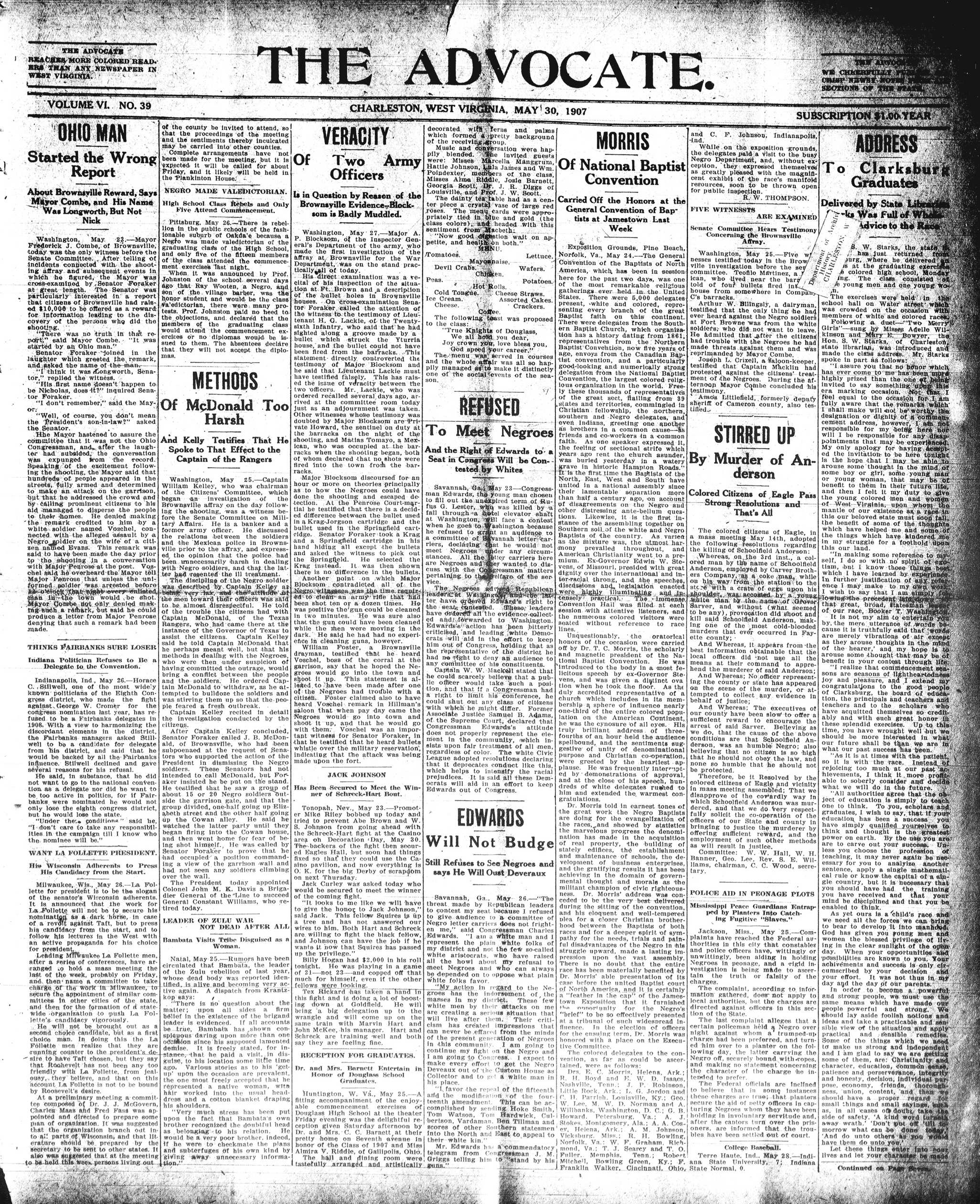
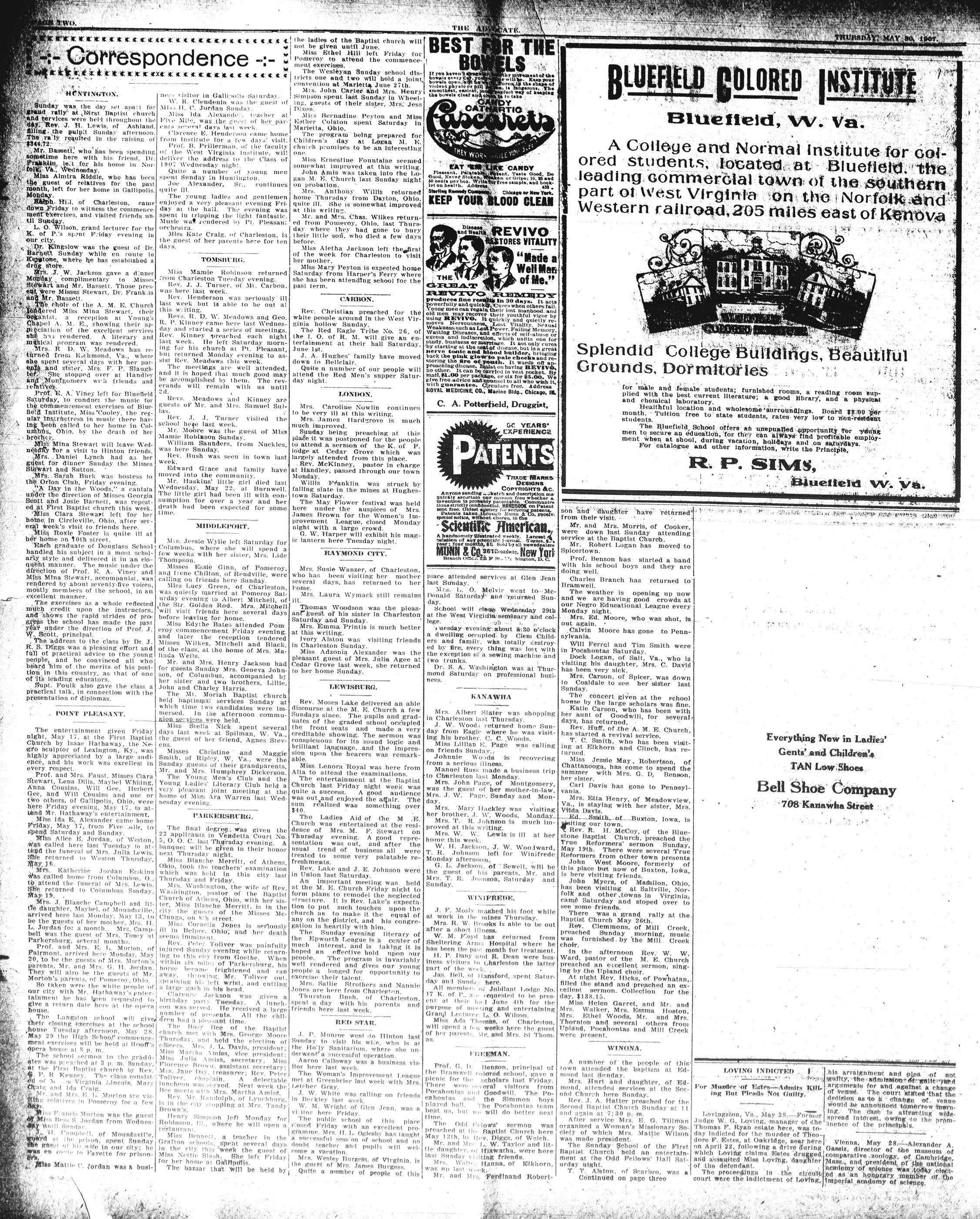
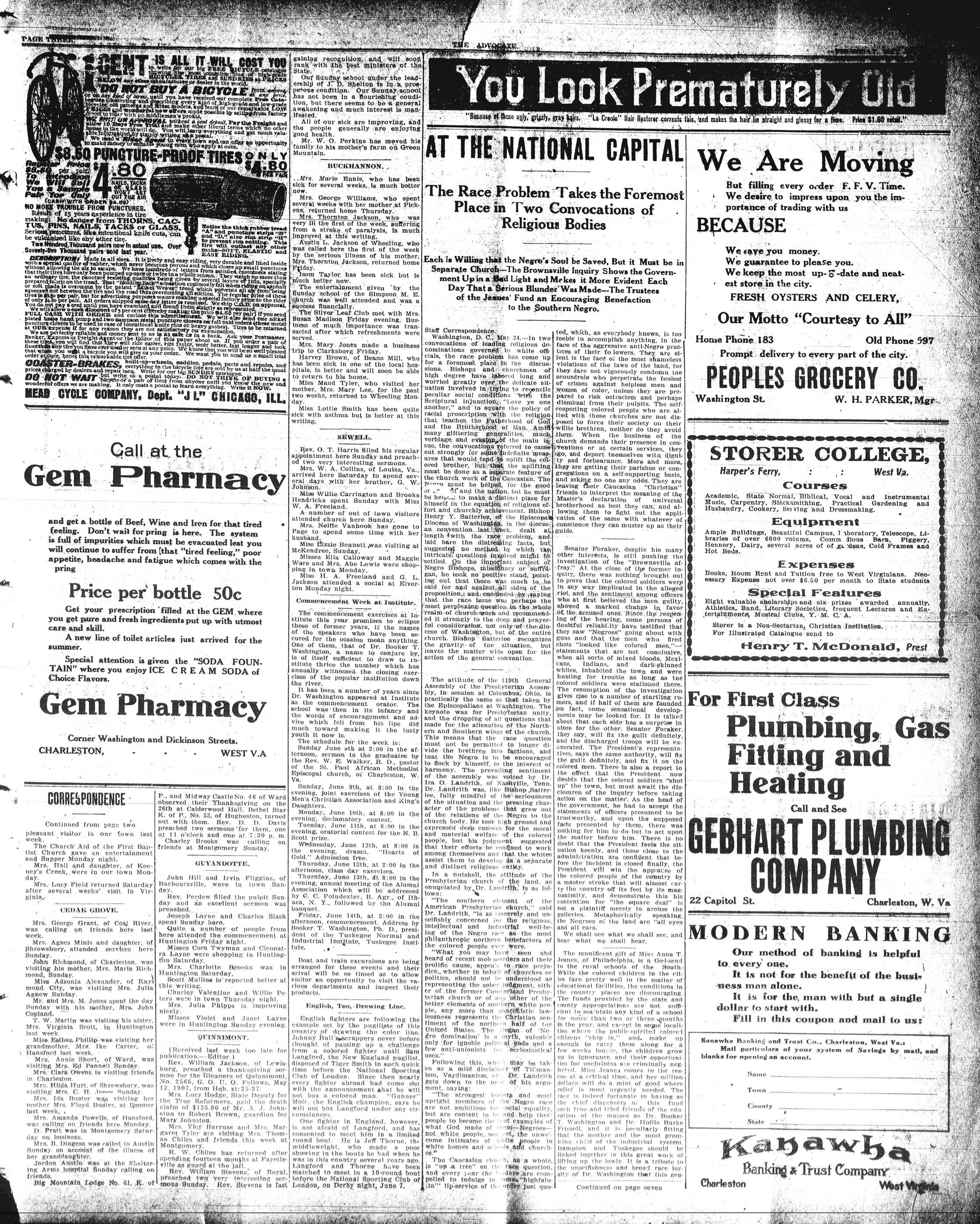
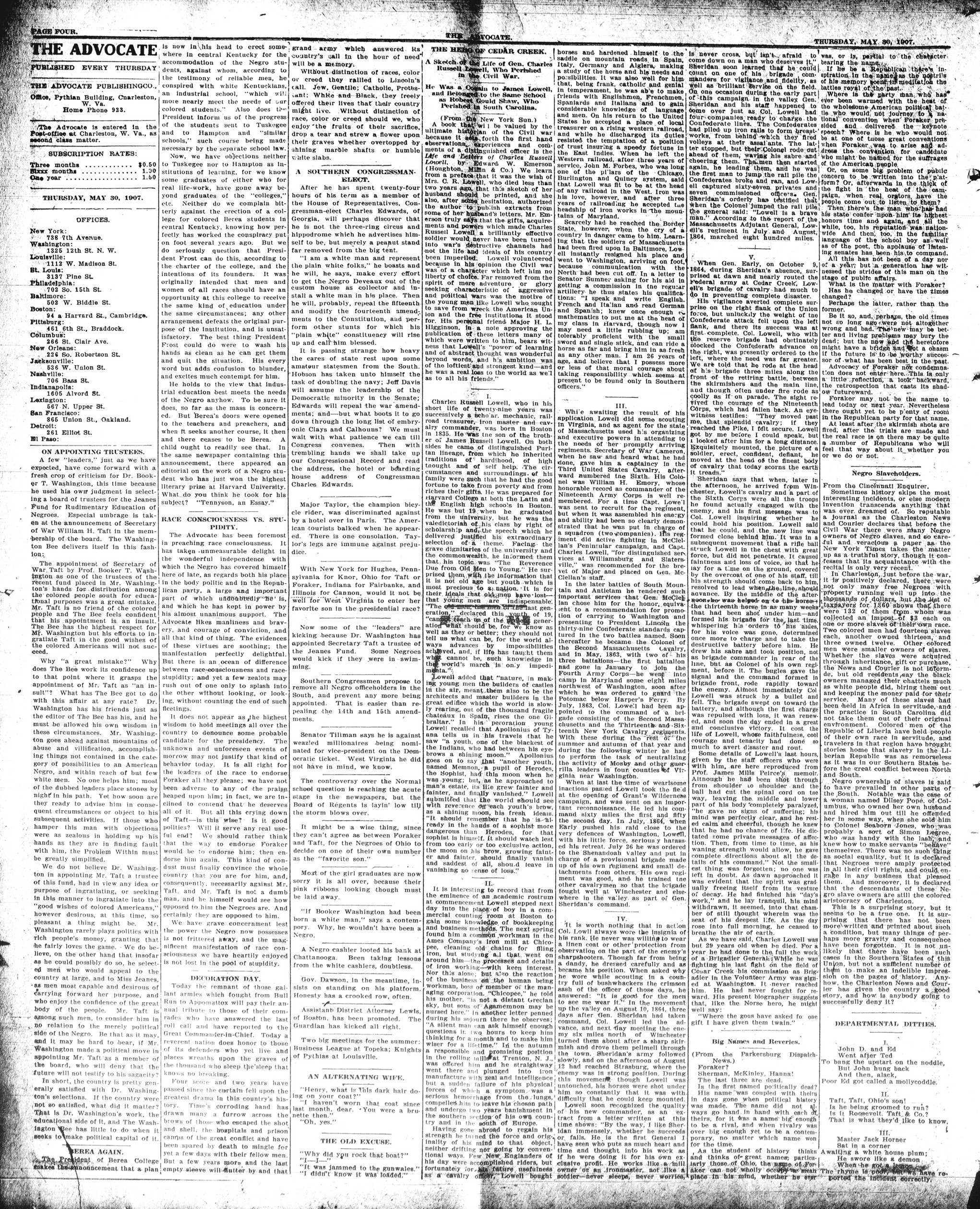
Page text (machine-generated)
THE ADVOCATE REACHES MORE COLORED READERS THAN ANY NEWSPAPER IN WEST VIRGINIA.
VOLUME VI. NO. 39
About Brownsville Reward, Says Mayor Combe, and His Name Was Longworth, But Not
Washington, May 23.—Mayor Frederick J. Combe, of Brownsville, today was the only witness before the Senate Committee. After telling of incidents connected with the shooting affray and subsequent events in which he figured, the Mayor was cross-examined by Senator Foraker at great length. The Senator was called to answer the report that that Brownsville had ed $10,000 to be offered as a reward for information leading to the discovery of the persons who did the shooting.
"There was no truth in that report," said Mayor Combe. "It was started by an Ohio man." Senator Foraker joined in the laughter which greeted the remark, and asked the name of the man.
"I think it was Longworth, Senator." replied the witness.
"His first name doesn't happen to be Nicholas, does it?" inquired Senator Foraker. "I don't remember," said the Mayor. "Well, of course, you don't mean the President's son-in-law?" asked the Senator.
The Mayor hastened to assure the committee that it was not the Ohio Congressman, and, after the laughter had subsided, the conversation was expunged from the record. Speaking of the excitement following the shooting, the Mayor said that hundreds of people appeared in the streets, fully armed and determined to make an attack on the garrison, his gold-collared uniform a calling prominent citizens to his aid managed to disperse the people to their homes. He denied making the remark credited to him by a white soldier named Voschel, connected with the alleged assault by a Negro goldier on the wife of a citizen named Evans. This remark was said to have been made the day prior to the shooting in a conversation with Major Penrose at the post. Voschel said he overheard the Mayor tell Major Penrose that unless the unified force of the police which overcame man in the town would be shot, Mayor Combe not only denied making such a remark, but said he could produce a letter from Major Penrose denying that such a remark had been made.
THINKS FAIRBANKS SURE LOSER
Indiana Politician Refuses to Be a
Delegate to the Convention.
Indianapolis, Ind., May 26—Horace C. Stillwell, one of the most wide-wely known politicians of the Eighth Congress district, who made the fight against George W. Cromer for the congress nomination last year, has refused to be a Fairbanks delegates in 1908. With a view to harmonizing the discordant elements in the district, the Fairbanks managers asked Stillwell to be a candidate for delegate from his district, and said that he would be backed by all the Fairbanks influence. Stillwell declined and gave several reasons for his refusal.
He said, in substance, that he did not want to go to the national convention as a delegate nor did he want to be too active in politics, for if Fairbanks were nominated he would not only lose the eighth congress district, but he would lose the state.
"Under these conditions" said he, "I don't care to take any responsibilities in the campaign till I know who the nominee will be."
WANT LA FOLLETTE PRESIDENT.
His Wisconsin Adherents to Press His Candidacy from the Start.
Milwaukee, Wis., May 26.—La Follette for president is to be the slogan of the senator's Wisconsin adherents. It is announced that the work for La Follette will not be to secure his nomination as a dark horse, in case of a revolt against Taft, but to press his candidacy from the start, and to follow his lectures in the West with an active propaganda for his choice for president.
Leading Milwaukee La Follette men, after a series of conferences, have arranged for a mass meeting the last of the year on Friday and then name a committee to take charge of the work in Milwaukee, to secure the appointment of similar committees in other cities of the state, and then for the formation of a statewide organization to push La Follette's candidacy vigorously.
He will not be brought out as a second choice candidate, but as a first choice man. In doing this the La Follette men realize that they are running counter to the president's desire to have Taft chosen, but they say that Roosevelt has not been any too friendly with La Follette, from jealousy, they believe, and that on this account La Follette is not to be bound by Roosevelt's desire.
At a preliminary meeting a committee composed of Dr. J. J. McGovern, Charles Maas and Fred Fass was appointed and directed to prepare some plan of organization. It was suggested that the organization branch out to all parts of Wisconsin, and that literature should be prepared by the secretary to be sent to other states. It also was suggested that at the meeting to be held these persons living out
THE ADVOCATE.
of the county be invited to attend, so that the proceedings of the meeting and the sentiments thereby inculcated may be carried into other counties. Complete arrangements have not been made for the meeting, but it is expected it will be held for about Friday, and it likely will be held in the Plankton House.
High School Class Repels and Only Five Attend Commencement.
Pittsburg, May 26. There is rebellion in the public schools of the fashionable suburb of Oakdale because a Negro was made valedictorian of the graduating class of the High School, and only five of the fifteen members of the class attended the commencement exercises Last night.
When it was announced by Prof. Johnston of the school several days ago that Ray Wooten, a Negro, and six other village barber, was the honor student and would be the class valedictorian, there were many pretests. Prof. Johnston paid no heed to the objections, and declared that the members of the graduating class would attend the commencement exercises or no diplomas would be issued to them. The absentees declare that they will not accept the diplomas.
METHODS Of McDonald Too Harsh
And Kelly Testifies That He Spoke to That Effect to the Captain of the Rangers
Washington, May 25.—Captain William Kelley, who was chairman of the Citizens' Committee, which began an investigation of the Brownville affray on the day following the shooting, was a witness before the State Committee on Military Affairs. He is a banker and a former army officer. He discussed the relations between the soldiers and the Mexican police in Brownville prior to the affray, and expressed the opinion that the police had been unnecessarily harsh in dealing with Negro soldiers, and that the latter had presented the ill treatment.
The disciplining of the Negro soldier was described by Captain Kelley as being very hard, and the attitude in the men toward their officers was said to be almost disrespectful. He told of the trouble the citizens had with Captain McDonald, of the Texas Rangers, who had came there at the instance of the Governor of Texas to ask him to explain what he said he told Captain McDonald that he perhaps meant well, but that his methods in dealing with the Negroes, who were then under suspicion of having committed the outrage, would bring a conflict between the people and the soldiers. He ordered Captain McDonald to withdraw, as he attempted to buildoze the soldiers and was stirring them up so that the people feared a fresh outbreak. Captain Kelley recited in detail the investigation conducted by the citizens.
After Captain Kelley concluded, Senator Foraker called J. B. McDonald, of Brownsville, who had been subpoenaed at the request of Senators who supported the action of the President in dismissing the Negro soldiers. These Senators had not intended to call McDonald, to call the state. He testified that he saw a group of about 15 or 20 Negro soldiers outside the garrison gate, and that the group divided, one-half up up Elizabeth street and the other half going up the Cowan alley. He said he watched the latter party until they began firing into the Cowan house, and then went home for fear of being shot himself. He was called by the police after he had occupied a position commanding a view of the garrison wall and had not seen any soldiers climbing over the wall.
The President today appointed Colonel John M. K. Davis a Brigadier General of the Line to succeed the Assistant Williams, who retired today.
LEADER OF ZULU WAR
NOT DEAD AFTER ALL
Bambata Visits Tribe Disguised as a Woman.
Natal, May 25 — Rumors have been circulated that Bambata, the leader of the Zulu rebellion of last year, whose dead body was reported identified, is alive and becoming very active again. A dispatch from Krantzkop says:
"There is no question about the matter; upon all sides a firm belief in the existence of the brigand leader is evidenced. If all accounts be true, Bambata has shown conspicuous daring upon more than one occasion since his supposed lamented demise; it is freely stated, for in this third visit, is disguise to his location some little time ago. Various stories as to his 'get up' upon the occasion are prevalent, the one most freely accepted that he represented a native woman, with hair worked into the usual headaddress and a cotton blanket draping his shoulders.
"Very much stress has been put upon the fact that Bambata's own brother recognized the doubtful head as belonging to his relation. He would be a very poor brother, indeed, if he were to checkmate the plans and subterfuges of his own kind by giving away unnecessary information."
CHARLESTON, WEST VIRGINIA, MAY 30, 1907
Is in Question by Reason of the Brownnyille Evidence-Block- som is Badly Muddled.
Washington, May 27.—Major A. P. Blocksom, of the Inspector General's Department of the army, who made the first investigation of the army convoy in Nashville for the War Department, warns the stand practically all of today.
His direct examination was a vexual of his inspection of the situation at Ft. Brown and a description of the bullet holes in Brownville houses. On cross-examination Senator Foraker called the attention of the witness to the testimony of Lieutenant H. G. Lackie, of the Twenty-sixth Infantry, who said that he had sighted along a groove made by a wall, a trunk the turret house, and the bullet could not have been fired from the barracks. This statement directly controverted the testimony of Major Blocksom and he said that Lieutenant Lackie must have testified falsely. This has raised the issue of veracity between the two officers. Mr. Lackie, who was ordered recalled several days ago, arrived at the committee room today just as an adjournment was taken. Other witnesses whose testimony was doubted by Major Blocksom are Private Howard, the sentinel on duty at the barracks on the night of the shootout and for the shooter, who was occupied at the barracks when the shooting began, both of whom declared that no shots were fired into the town from the barracks.
Major Blocksom discoursed for an hour or more on theories principally as to how the Negroes could have done the shooting and escaped detection. At the Penrose Court-martial he testified that there is a decided difference between the bullet used in a Krag-Jorgons cartridge and the bullet used in the Springfield cartridge. Senator Foraker took a Krag and a Springfield cartridge in his hand hiding all except the bullets and asked the witness to pick out the Springfield. He selected the Krag instead. It was then shown there is no difference in the bullets. Another point on which Major Blocksom contradicted all of the Negroes' theories was the need to detain the army rifle that had been shot ten or a dozen times. He was positive the gun could be cleaned in two minutes. He was sure also that the gun could have been cleaned while the men were moving in the dark. He said he had had no experience in cleaning guns, however.
William Foster, a Brownville drayman, testified that he heard Voschel, boss of the corral at the garrison, say that he hoped the Negroes would go into the town and shoot it up. This statement is alleged to have been made after one of the Negroes had trouble with a citizen. Foster claimed also to have heard Voschel remark in Hillman's saloon that when pay day came the Negroes would go into town and shoot it up, and that he would go with them: Voschel was an important witness for Senator Foraker, in that he testified that he heard bullets whistle over the military reservation, indicating that the attack was being made upon the fort.
Has Been Secured to Meet the Winner of Schreck-Hart Bont.
Tonopah, Nev., May 23—Promoter Mike Riley bobbed up today and tried to prevent Abe Brown and W. S. Johnson from going ahead with the Schreck-Hart fight at the Casino area on Decoration Day, May 30. The backers of the fight then secured Eagles Hall, but soon had things fixed so that they could use the Casino pavilion, and now everything is O. K. for the big Derby of scrapdom on next Thursday.
Jack Curley was asked today who would be secured to meet the winner of the coming fight.
"It looks to me like we will have to give the honor to Jack Johnson," said Jack. This fellow Squires is up a tree and has not answered our wires to him. Both Hart and Schreck are going to fight the black fellow, and Johnson is going to have the job if he wants it now that Squires has passed up the privilege."
Billy Hogan had $2,000 in his roll tonight. He was playing in a game of 21—not 23—and coped off that much for himself, even if the other fellows were looking.
Tex Rickard has taken a hand in this fight and is doing a lot of boosting down at Goldfield. He will bring a big delegation up to the wrangle and will come up on the field. He will be the coach. John McKee, his manager, Hart and Schreck are training well and both say they are feeling fine.
RECEPTION FOR GRADUATES.
Dr. and Mrs. Barnett Entertain in
Honor of Douglass School
Club
Huntington, W. Va., May 25.—A fitting accompaniment of the enjoyable commencement exercises of Douglass High School at the theater Friday evening was the delightful reception given Saturday afternoon by Dr. and Mrs. C. C. Barnett, at their pretty home on Seventh avenue in honor of the Class of 1907 and Miss Almira V. Riddle, of Gallipolis, Ohio. The hall and dining room were tastefully arranged and artistically
decorated with Jerns and palms which formed a pretty background of the receiving group.
Music and conversation were happily blended. The invited guests were: Misses Marcella Manggrum, Hattie Johnson, Lila James and Wm. dexter member members of the class, Misses Josie Barnett, Georgia Scott, Dr. J. W. Scott, the dainty tea table had as a center piece a crystal vase of large red roses. The menu cards were appropriately tied in blue and gold (the class colors), and headed with this sentiment from Macbeth:
"Now good question wait on appetite, and he rests both."
Tomatoes. Lettuce.
Mayonnaise. Wafers.
Devil Crabs. Chicken.
Peas. Potatoes.
Hot Rolls.
Cold Tongue. Cheese Straws.
Ice Cream. Assorted Cakes.
Cheese. Crackers.
Coffee.
The following toast was proposed
to the class:
"True Knights of Douglass,
We all hold you dear,
Joy crown you, love bless you,
God speed your career."
The menu was served in courses
and the whole affair was all so happily
managed as to make it distinctly
one of the social events of the season.
REFUSED
To Meet Negroes
And the Right of Edwards to a
Seat in Congress Will be Con-
tested by Whites
Savannah, Ga., May 23—Congressman Edward, the young man chosen to fill out the unexpired term of Rufus G. Lester, who was killed by a fall through a hotel elevator shaft at Washington, will face a contest when he goes to Washington because he refused to grant an audition to a committee of Savannah letter carriers, declaring that he would not meet Negroes under any circumstances. All the letter carriers here are Negroes and they wanted to discuss with the Congressman matters pertaining to the welfare of the service.
The Negroes advanced Republican leaders at Washington and the later have ordered Edward's right to the seat contented. These leaders have ordered all the evidence collected and, forwarded to Washington. Edward's action has been bitterly criticised, and leading white Democrats will aid in the effort to keep the representation of the press holding that as the representative of the district he had no right to deny to any committee of his constituents.
Carrtain W. W. Mackell stated that he could scarcely believe that a public officer would take such a position, and that if a Congressman had a right to limit his conference, he could shut out any class of citizens with which he might differ. Former Associate Justice Samuel B. Adams, of the Supreme Court, declared that Congressman Edwards's attitude does not properly represent the element in the community, which insists upon fair treatment of all men, regardless of color. The white Civic League adopted resolutions declaring that it depreciates conduct like this, which helps to intensify the racial prejudices. It is said all these Democrats will aid in an effort to keep Edwards out of Congress.
EDWARDS Will Not Budge Still Refuses to See Negroes and says He Will Oust Deveraux
Savannah, Ga., May 26.—"The threat made by republican leaders to contest my seat because I refused to give audience to a committee of Negro letter carriers does not frighten me," said Congressman Charles Edwards. "I am a white man and I represent the plain white folks of my district and not the few so-called white aristocrats, who have raised all the howl about my refusal to meet Negroes and who can always be depended on to oppose what plain white folks favor.
"My action in regard to the Negroes has the indulgence of the masses in my district. These few white men by their attacks on me are creating a serious situation that will live after them. Their criticism has created impressions that can never be effaced from the minds of the present generation of Negroes in this community. I am going to continue my fight on the Negro and I am going to Congress. I expect to make every effort to get the Negro Deveaux out of the Custom House as Collector and to get a white man in his place.
"I favor the repeal of the fifteenth and the modification of the fourteenth amendment. This can be accomplished by sending Hoke Smith, Tom Watson, Tom Hardwick, Culbertson, Vardaman, Ben Tilliman and scores of other Southern statesmen for the North and East to appeal to their white kin.
Mr. Edwards has a commendatory telegram from Congress J. M. Griggs telling him to stand by his誓."
Carried Off the Honors at the General Convention of Baptists at Jamestown Last
Exposition Grounds, Pine Beach, Norfolk, Va., May 24.—The General Convention of the Baptists of North America, which has been in session here for the past two days, was one of the most remarkable religious gatherings ever held in the United States. There were 5,000 delegates present, white and colored, representing every branch of the great Baptist faith on this continent. The two delegates from the Southern Baptist church, which organization has a history dating from 1861, representatives from the Northern Baptist Convention, now five years of age, envoys from the Canadian Baptist convention, and a particularly good-looking and numerically strong delegation from the National Baptist Convention, the largest colored religious organization in the world. Freely these thousands of representatives of the great sect, falling from 39 states and territories, commingled in Christian fellowship, Negro delegates, and even Indians, Negro delegates, one another as brothers in a common faith friends and co-workers in a common faith. As one speaker expressed it, the feeling of sectional strife which years ago rent the church asunder, was buried yesterday in a watery grave in historic Hampton Roads." It is the first time the Baptists of the North, East, West and South have united in a national assembly since their lamentable separation more half a century ago, on account of disagreement on the Negro and other distressing dating questions. Likewise, it is the first instance of the assembling together on Southern soil of the white and Negro Baptists of the country. As varied as the mixture was, the utmost harmony prevailed throughout, and American Christianity went to a premium. Ex-Governor Edw. W. Stevens, of Missouri, presided with great dignity over the international and inter-racial throng, and the speeches, dissentions and legislation enacted were intensely stimulating and the tensely practical. Confluence Convention Hail was filled at session with attentive listeners, and the numerous colored visitors were seated without reference to race lines.
Unquestionably, the oratorical honors of the occasion were carried off by Dr. T. C. Morris, the scholarly and magnetic president of the National Baptist Convention. He was introduced to the body in a most felicitous speech by ex-Governor Stevens, and was given a distinct ovation when he took the floor. As the duly accredited representative of a church which includes in its membership a sphere of influence nearly one-third of the entire colored population on the American Continent, he was the cynosure of all eyes. His brilliant address of three-fourths of an hour held the audience spallbound in an utter sentiments suggestive of unity of denominational purpose and Christian cooperation, were greeted by the heartiest applause. He was frequently interrupted by demonstrations of approval, and at the close of his speech, hundreds of white delegates rushed to him and extended the warmest congratulations.
Dr. Morris told in earnest tones of the great work the Negro Baptists are doing for the evangelization of the races, and showed by statistics the marvelous progress the denomination has made in the acquisition of real property, the building of safely edifices, the establishment and management of schools, the development of business, and the gratifying results it has been achieving in the domain of governmental thought and morals as the militant champion of civil righteousness. Dr. Morris' address was conceded to be the very best delivered during the sitting of the convention, and his eloquent and well-tempered plea for a closer Christian brotherhood between the Baptists of both soul for a deeper spirit of sympathy for the poor, and a painful disadvantages of the Negro in struggle upward, made a lasting impression upon the vast assembly. There is no doubt that the entire race has been materially benefited by Dr. Morris' able presentation of its case before the united Baptist court of North America, and it is certainly a "feather in the cap" of the Jamesmen's Exposition that it furnished momentum for the Negro's "briefly to be so executive" presented at a tribunal wide and fluence. In the election of officers for the ensuing term, Dr. Morris was honored with a place on the Executive Committee.
The colored delegates to the convention, as far as could be ascertained, were as follows:
Drs. E. C. Morris, Helena, Ark.; R. H. Boyd and E. W. D. Isaacs, Nashville, Tenn.; J. P. Robinson, Little Rock, Litt. L. G. Jordon and C. H. Parrish, Louisville, KY.; Geo. W. Lee, M. W. D. Norman and A. Willbanks, Washington, D. C.; G. B. Willbanks, Petersburg, a. A. Stoke, Montclair, Ala.; A. A. Cosev, Helena, Ark.; A. M. Johnsoe, Vicksburg, Miss.; R. H. Bowling, Norfolk, Va.; W. F. Graham, Richmond, Va.; T. J. Searcy and T. O. Fuller, Memphis, Tenn.; Robert Mitchell, Bowling Green, Ky.; F. Franklin Walker, Cincinnati, Ohio
and C. F. Johnson, Indianapolis, Ind.
While on the exposition grounds, the delegates paid a visit to the busy Negro Department, and, without exception, they expressed themselves as greatly pleased with the magnificent exhibit of the race's manifold resources, soon to be thrown open for public inspection.
Senate Committee Hears Testimony Concerning the Brownsville Affray.
Washington, May 25.—Five witnesses testified today in the Brownsville investigation before the secr committee. Teofilo Martinez, a lawyer, who lived near the barry told of four bullets fired into house from somewhere in Company, C's barracks.
Arthur W. Billingly, a dairyman, testified that the only thing he had ever heard against Negro soldiers at Fort Browne was from the white soldiers; who did not want to leave. He admitted that after the situe had trouble with the Negroes he had made threats against them and was reprimanded by Mayor Combe.
Joseph L. Crixell, a falcon-keeper, testified that Captain Mckellin had protested against the citizens' treatment of the Negroes. During the afternoon Mayor Combe concluded his testimony.
Amos Littlefield, formerly deputy sheriff of Cameron county, also testified.
STIRRED UP
By Murder of Anderson
Colored Citizens of Eagle Pass Strong Resolutions and That's All
The colored citizens of Eagle, in a mass meeting May 14th, adopted the following resolutions regarding the killing of Schoolfield Anderson.
Whereas, on the 3rd inst., a colored man by the name of Schoolfield Anderson, employed by Carver Brothers Company, as a coke man, while on his way from the station to the store with a crate of eggs upon his shoulder, was accounted by a young man by the name, of Grover Sarver, who seemed to be any), provocation which killed said Schoolfield Anderson, making one of the most cold-blooded murders that ever occurred in Fayette county; And Whereas, it appears from the best information obtainable that the local officers did not use all the means at their command to apprehend the murderer of said Anderson; Whereas; No officer representing the counter or state has appeared on the scene of the murder, or attempted to collect any evidence in behalf of justice;
And Whereas; The executives of our county have been slow to offer a sufficient reward to encourage the arrest of said Sarver. Believing as we do, that the cause of the above conditions are that Schoolfield Anderson, was an humble Negro; also believing that no citizen is so high that he should not obey the law, and none so humble that he should not be protected.
Therefore, be it Resolved by the colored citizens of Eagle and vicinity in mass meeting assembled; that We disprove of the cowardly way in which Schoolfield Anderson was murdered, and that we do very respectfully solicit the co-operation of the officers of our State and county in bringing to justice the murderer by offering sufficient reward, and the employment of such other methods as will result in justice.
Committee: W. W. Hall, W. H. Banner, Geo. Lee, Rev. S. E. Williams, chairman, C. C. Wood, secretary.
POLICE AID IN PEONAGE PLOTS
Mississippi Peace Guardians Entraped by Planters Into Catching Fugitive "Slaves."
Jackson, Miss., May 25. —Complaints have reached the Federal authorities in this city that constables and police officers have, wittingly or unwittingly, been alding in holding Negroes in peonage, and a rigid investigation is being made to ascertain the truth or falsity of the charges.
The complaint, according to information gathered, does not apply to local authorities, but the charges are directed against officers in this section of the State.
The last complaint alleges that a certain policeman held a Negro over night against whom a trump-up-up charge had been preferred, and turned him over to a planter on the foliage to later carrying the Negro off, securely bound with ropes, and making no statement concerning the character of the charge he intended to prefer.
The Federal officials are inclined to believe that in some instances these charges are true; that planters secure the aid of petty officers in capturing Negroes whom they have been holding in involuntary servitude and, after the captors turn over the prisoners, are informed that the troubles have been settled out of court.
College Baseball.
Terre Haute, Ind. May 28.—Indiana State University. 7; Indiana State Normal. 0.
S. W. Starks, the state
has just returned from
burg, where he delivered an
at the graduating exercises
colored high school, Monday
ing. The class consisted
at the young men and one young
won.
The exercises were held in
the school hall on Water street which
was crowded on the occasion with
members white and colored races.
Following by Mrs. Toby Merry
Girls"—sung by Miles Adela Wiklinson and Mary E. Bowery.
Hon. S. W. Starks, of Charleston,
state librarian, was introduced and
made the class address. Mr. Starks spoke in part as follows:
"I assure you that no honour which has ever come to me has been more highly prized than the one of being invited to say something upon this era marking occasion. Not that I feel equal to the occasion for I am fully aware that the remarks which I shall make will not be worthy the commendation or dignity of a commendation, however, he will not responsible for them but not will I be responsible for any other pointments that may be experienced. My only apology for having accepted the invitation to be here tonight is the hope that I may be able to arouse some thought in the mind of some boy or girl, some young man or young woman, that may be of benefit to them in their future life, and then I felt it my duty to give the young colored men and women of Virginia, upon whom the mantle of a sentence as race in this our beloved country rests, the benefit of some of the thoughts which have helped me and some of the things which have hindered me in my struggle for a foothold upon this our land.
"In making some reference to myself, I do so with no split of erotism, but I know those things best which I have learned by experience. In further justification of any point, I may make to my own work. I wish to allow the precedent for the many lowing the precedent for the great, broad, statesman leader of our race, Booker T. Washington. It is not my aim to entertain you by the mere utterance of words because it is truthfully said that words are merely vibrations of air except as they arouse thoughts in the mind of the hearer, and my hope is to arouse such thoughts in my benefit in your context through life.
"I realize that commencement seasons are seasons of lightheartedness joy and pleasure, and I extend my congratulations to the good people of Clarksburg, the board of education, the principals and teachers and teachers and to the scholars who have acquitted themselves so credibly and with such great honor in these splendid exercises. Up to this time, you have wrought well but we should be more interested in what our future shall be than we are in what our past success has been.
"As it is at times with the patient, so it is with the race. Instead of rejoicing too much at our past achievements, I think it more profitable to soberly consider and decide what we will do in the future."
"All authorities agree that the object of education is simply to teach one to think. To you, scholars and graduates, I wish to say, that if your education has been a success you have simply qualified yourselves to think and thought is the greatest power on earth. By the use you are are to carve out your success. Unless you choose the profession of teaching, it may never again be necessary to you to analyze another sentence as an angle mathematical rule or know the angle of a single country, but it is necessary that you should have had the training you have received and that your mind be disciplined and that you be enabled to think.
As yet ours is a 'child's race and we need all the forces we can bring to bear to develop it into manhood. God has given you young men and women the blessed privilege of living in the clear sunlight of the open day. When your opportunities and possibilities are known to you. Your achievements and success is only circumscribed by your decision and your effort. It was not thus in my day and the day of our parents.
In order to become a powerful and strong people, we must use the same means which have made our people powerful and strong. We should lay aside foolish notions and ideas and take a practicable and sensible view of the situation and apply practical and sensible remedies. Some of the things which we need to make us strong and independent and I am glad to say we are getting them, are: Christianity and character, common sense, patience and persistence, honesty, decision, individual purpose, economy, friends, thorntoniness, union, content, and then we should have a proper regard for small things and small sayings, such as, in all cases of doubt, take the side of safety. 'A kind word turns away wrath.' 'Don't put on 'till tomorrow what can be done today.' 'And do unto others as you would have them do unto you.'
Let these things enter into your lives and let your character be made
Continued on page Seven.
Correspondence --
X
Sunday was the day set apart for grand rally at First Baptist church and services were held throughout the day. Rev. J. H. Lewis, of Ashland filling the pulpit Sunday afternoon. The rally resulted in the raising of $344.72.
Mr. Bassett, who has been spending sometime here with his friend, Dr. Franklin, let for his home in Norfolk, Va., Wednesday.
Miss Almrata Riddle, who has been the guest of relatives for the past month, left for her home in Gallipolis, Monday.
Ralph Hill, of Charleston, came down Friday to witness the commencement exercises, and visited friends until Sunday.
L. O. Wilson, grand lecturer for the K. of P.'s spent Friday evening in our city.
Dr. Kingslow was the guest of Dr. Barnett Sunday while en route to Keystone, where he has established a drug store.
Mrs. J. W. Jackson gave a dinner Monday, complimentary to Misses Stewart and Mr. Bassett. Those present were Misses Stewart, Dr. Frank, in and Mr. Bassett.
The choir of the A. M. E. Church leadered Miss Mina Stewart, their organist, a reception at Young's Chapel A. M. E., showing their appreciation of the excellent services she has rendered. A literary and musical program was rendered.
Mrs. R. D. W. Meadows has returned from Richmond, Va., where she spent several days with her parents and sister, Mrs. F. P. Slaughter. She stopped over at Handley and Montgomery with friends and relatives.
Prof. E. A. Viney left for Bluefield Saturday, to conduct the music for the commencement exercises of Bluefield Institute, Miss Cooley, the regular instructress in music there having been called to her home in Columbus, Ohio, by the death of her brother.
Miss Mina Stewart will leave Wednesday for a visit to Hinton friends. Mrs. Daniel Lynch had as her guest for dinner Sunday the Misses Stewart and Sutton. Mrs. Sarah Burk was hostess to the Orton Club, Friday evening. "A Day in the Woods," a cantata under the direction of Misses Georgia Scott and Josie Barnett, was repeated at First Baptist church this week. Miss Clara Stewart left for her home in Circilleville, Ohio, after several week's visit to friends here. Miss Roxie Foster is quite ill at her home on 10th street. Each graduate of Douglass School handled his subject in a most scholarly style and delivered it in an eloquent manner. The music under the direction of Prof. E. A. Viney and Miss Mina Stewart, accompanist, was rendered by about seventy-five voices, mostly members of the school, in an excellent manner.
The exercises as a whole reflected much credit upon the instructors, and shows the rapid strides of progress the school has made the past year under the direction of Prof. J. W. Scott, principal.
The address to the class by Dr. J. R. S. Diggs was a pleasing effort and full of practical advice to the young people, and he convinced all who heard him of the merits of his position in this country, as that of one of its leading educators.
Supt. Foulk also gave the class a practical talk, in connection with the presentation of diplomas.
POINT PLEASANT
The entertainment given Friday night, May 17, at the First Baptist Church by Isaac Hathaway, the Negro sculptor of Lexington, Ky., was highly appreciated by a large audience, and his work was excellent in every respect.
Prof. and Mrs. Faust, Misses Clara Stewart, Lena Dills, Maybel Whiting, Anna Cousins, Will Gee, Herbert Gee, and Will Cousins and one or two others, of Gallipolis, Ohio, were here Friday evening, May 17, to attend Mr. Hathaway's entertainment.
Miss 1da E. Alexander came home Friday, May 17, from Five mile, to spend Saturday and Sunday.
Miss Alice E. Jordan, of Weston, was called here last Tuesday to attend the funeral of Mrs. Julia Lewis. She returned to Weston Thursday, May 16.
Mrs. Katherine Jordan Eskins was called home from Columbus, O. to attend the funeral of Mrs. Lewis. She returned to Columbus Sunday, May 19.
Mrs. J. Blanche Campbell and little daughter, Maybel, of Moundsville, arrived here last Monday, May 13, to be the guests of her mother, Mrs. H. L. Jordan for a month.. Mrs. Campbell was the guest of Mrs. Toney at Parkersburg, several months. Prof. and Mrs. E. L. Morton, of Fairmont, arrived here Monday, May 20, to be the guests of Mrs. Morton's parents, Mr. and Mrs. G. H. Jordan. They will also be the guests of Mr. Morton's parents, of Pomeroy, Ohio. So taken were the white people of our city with Mr. Hathaway's entertainment he has been requested to give a return date here at the opera house. The Langston school will give their closing exercises at the school house Tuesday afternoon, May 28. May 29 the High School commencement exercises will be held at Hooff's opera house at 8 p. m.
The school sermon to the graduates was preached at 3 p. m. Sunday, at the First Baptist church by Rev. G. P. R Kenney. The class consisted of M. s. Virginia Lincoln, Mary Craig and Ida Craig.
Mr. and Mrs. E. L. Morton are visiting relatives in Pomeroy for a few days.
Miss Francis Morton was the guest of Miss Bess S. Jordan from Wednesday until Sunday.
J. H. Campbell, of Moundsville, guard at the prison, spent Sunday the guest of his wife in our city; he was en route to Fayette for prisoners.
Miss Mattie C. Jordan was a busi-
mess visitor in Gallipolis Saturday.
W. R. Clendenin was the guest of Miss H. C. Jordan Sunday.
Miss Ida Alexander, teacher at Five Mile, was the guest of her parents several days last week.
Clarence E. Henderson came home from institute for a few days' visit.
from institute for a few days' visit.
Prof. B. Prillerman, of the faculty of the West Virginia institute, will deliver the address to the Class of 1907 Wednesday night.
Quite a number of young men spent Sunday in Huntington.
Joe Alexander, Sr., continues quite ill.
The young ladies and gentlemen enjoyed a very pleasant evening Friday at the hall. The evening was spent in tripping the light fantastic. Music was rendered by Pt. Pleasant; orchestra.
Miss Kate Craig, of Charleston, is the guest of her parents here for ten days.
TOMSBURG
Miss Mamie Robinson returned from Charleston Tuesday evening.
Rev. J. J. Turner, of Mt. Carbon, was here last week.
Rev. Henderson was seriously ill last week but is able to be out at this writing.
Revs. R. D. W. Meadows and Geo. R. P. Kinney came here last Wednesday and started a series of meetings. Rev. Kinney preached each night last week. He left Saturday morning for his church at Pt. Pleasant, but returned Monday evening to assist Rev. Meadows this week.
The meetings are well attended, and it is hoped that much good may be accomplished by them. The reverends will remain with us until 2d.
Revs. Meadows and Kinney are guests of Mr. and Mrs. Samuel Sullas.
Rev. J. J. Turner visited the school hee last week.
Mr. Moore was the guest of Miss Mamie Robinson Sunday.
William Saunders, from Nuckles, was here Sunday. Rev. Bush was seen in town last week. Edward Grace and family have moved into the community.
Mr. Haskins' little girl died last Wednesday, May 22, at Burnwell. The little girl had been ill with consumption for over a year and her death had been expected for some time.
MIDDLEPORT.
Miss. Jessie Wylie left Saturday for Columbus, where she will spend a few weeks with her sister, Mrs. Lide Thompson.
Misses Essie Ginn, of Pomeroy, and Irene Chilton, of Rendville, were calling on friends here Sunday.
Miss Lucy Green, of Charleston, was quietly married at Pomeroy Saturday evening to Albert Mitchell, of the Str. Golden Rod. Mrs. Mitchell will visit friends here several days before leaving for home.
Miss Edythe Bates attended Pomeroy commencement Friday evening, and later the reception tendered Misses Wilkes, Mitchell and Black, of the class, at the home of Mrs. Malinda Wells.
Mr. and Mrs. Henry Jackson had for guests Sunday Mrs. Geneva Johnson, of Columbus, accompanied by her sister and two brothers, Lillie, John and Charley Harris.
The Mt. Moriah Baptist church held baptismal services Sunday at which time two candidates were immersed. In the afternoon communion services were held.
Miss Stella Nick spent several days last week at Spillman, W. Va., the guest of her friend, Agnes Stevens.
Misses Christine and Maggie Smith, of Ripley, W. Va., were the Sunday guests of their grandparents, Mr. and Mrs. Humphrey Dickerson.
The Young Men's Club and the Young Ladies' Literary Club held a very pleasant joint meeting at the home of Miss Ara Warren last Wednesday evening.
PARKERSBURG
The final degree, given the 23 applicants in Vendetta Court No. 5, O. O. C. last Thursday evening. A banquet will be given in their honor next Thursday night.
Miss Blanche Merritt, of Athens, Ohio, took the teachers' examination which was held in this city last Thursday and Friday.
Mrs. Washington, the wife of Rev. Washington, pastor of the Baptist Church of Athens, Ohio, with her sister, Miss Blanche Merritt, is in the city the guests of the Misses McClungs, on 8th street.
Miss Cornelia Jones is seriously ill in Belgrade, Ohio, and her death seems imminent.
Rev. Peter Toliver was painfully injured Sunday evening while returning to this city from Goethe. When within six miles of Parkersburg, his horse became frightened and ran away, throwing. Mr. Toliver out, spraining his left wrist, and cutting a large gash in his head.
Clarence Jackson was given a birthday party Tuesday. A lunchon was served. He received a large number of presents. All the children had a pleasant time. The Busy Bee of the Baptist church met with Mrs. George Moore Thursday, and held the election of officers. Mrs. J. L. Dayis, president; Miss Martha Amiss, vice president; Miss Julia Amiss, secretary; Miss Florence Brown, assistant secretary; Mrs. Jane Day, treasurer; Rev. Peter Toliver, chaplain. A delectable luncheon was served. Next week the Bee meets with Mrs. Martha Amiss. Rev. Mr. Randolph, of Lynchburg, is in the city stopping at Mrs. Tandy Brown's. Henry Simpson left Monday for Robinson, Ill., where he will open a restaurant. Miss Bennett, a teacher in the Grafton schools, spent several days in the city this week the guest of Miss Nettie Slash. She left Friday for her home at Galtodis
The bazaar that will be held by
the ladies of the Baptist church will not be given until June.
Miss Ethel Hill left Friday for Pomeroy to attend the commencement exercises.
The Wesleyan Sunday school districts one and two will hold a joint convention at Marietta June 27th.
Mrs. John Carter and Mrs. Henry Simpson spent last Sunday in Wheeling, guests of their sister, Mrs. Jess Dixon.
Miss Bernadine Peyton and Miss Eather Colston spent Saturday in Marietta, Ohio.
The program being prepared for Children's day at Logan M. E, church promises to be an interesting one.
Miss Ernestine Fountaline seemed somewhat improved at this writing.
John Amis was taken into the Logan M. E. Church last Sunday night on probation.
Mrs. Anthony Willis returned home Thursday from Dayton, Ohio, quite ill. She is somewhat improved at this writing.
Mr. and Mrs. Chas. Wilkes returned from Pomeroy, Ohio, last Thursday where they had gone to bury their little son, who died a few days before.
Miss Aletha Jackson left the first of the week for Charleston to visit her mother.
Miss Mary Peyton is expected home Saturday from Harper's Ferry where she has been attending school for the past term.
CARBON.
Rev. Christian preached for the white people around in the West Virginia hollow Sunday.
The Red Eagle Tribe No. 26, of the I. O. of R. M. will give an entertainment at their hall Saturday, June 1st.
J. A. Hughes' family have moved down to Bellclair.
Quite a number of our people will attend the Red Men's supper Saturday night.
LONDON
Mrs. Caroline Nowlin continues to be very ill at this writing.
Mrs. James Hardgrove is much much improved.
Sunday being preaching at this place it was postponed for the people to attend a sermon of the K. of P. lodge at Cedar Grove which was largely attended from this place.
Rev. McKinley, pastor in charge at Handley, passed through our town Monday.
Willis Franklin was struck by falling slate in the mines at Hughes-town Saturday.
The May Flower festival was held here under the auspices of Mrs. James Brown for the Women's Improvement League, closed Monday night with a large crowd.
G. W. Harper will exhibit his magic lantern here Tuesday night.
RAYMOND CITY.
Mrs. Susie Wanzer, of Charleston, who has been visiting her mother several days, has returned to her home.
Mrs. Laura Wymack still remains ill.
Thomas Woodson was the pleasant guest of his sister in Charleston Saturday and Sunday.
Mrs. Emma Printis is much better at this writing.
Ivory Alston was visiting friends in Charleston Sunday. Miss Adzonia Alexander was the pleasant guest of Mrs. Julia Agee at Cedar Grove last week, she returned to her home Sunday.
LEWISBURG.
Rev. Moses Lake delivered an able discourse at the M. E. Church a few Sundays since. The pupils and graduates of the graded school occupied the front seats and made a very creditable showing. The sermon was conspicuous for its sound logic and brilliant language, and the impression upon the hearers was remarkable.
Miss Lenora Royal was here from Alta to attend the examinations.
The entertainment at the Baptist Church last Friday night week was quite a success. A good audience was out and enjoyed the affair. The sum realized was something over $40.
The Ladies Aid of the M. E. Church was entertained at the residence of Mrs. M. F. Stewart on Thursday evening. A good representation was out, and after the usual trend of business all were treated to some very palatable refreshments.
Rev. Lake and J. E. Johnson were in Union last Saturday.
An important meeting was held at the M. E. Church Friday night to form plans to remodel the neglected structure. It is Rev. Lake's expectation to put such touches upon the church as to make it the equal of any on the district, and his congregation is heartily with him.
The Sunday evening literary of the Epworth League is a center of much interest, and is taking it is hoped an effective hold upon our people. The program is invariably well rendered and gives our young people a longed for opportunity to exercise their talent.
Mrs. Sallie Strothers and Nannie Jones are here from Charleston.
Thurstur Bush, of Charleston, spent a day with his parents and friends here last week.
RED STAR
J. P. Munroe went to Hinton last Sunday to visit his wife, who is at the Holly Sanitarium, where she underwent a successful operation.
Aaron Calloway was a business visitor here last week.
The Woman's Improvement League met at Greenbrier last week with Mrs. Letcher Gray.
J. W. White was calling on friends in Beckley last week.
W. M. Wright of Glen Jean, was a visitor here Friday.
The public school of this place closed Friday with an excellent programme. Mrs. H. L. Oglesby has taught a successful session of school and no doubt teacher and pupils will welcome a vacation.
Mrs. Wesley Burgess, of Virginia, is the guest of Mrs. James Burgess.
Quite a number of people of this
If you haven't ever bought a candy, they movement of the bowel open, and be willing to will be. Keep your bowels open, and be willing to will be. The way of violent physio or pill therapy is dangerous. The smoothest, easiest, most perfect way of keeping the bowel clear and clean is to take CANDY CATHARTIC Cascarets THEY WORK WAILLE YOU SEE EAT LIKE CANDY
Pleasant, Palatabie, Great, Taste, Good, Do Good, Never Sloken, Waken or Gripe, 10, 35 and 50 cents per box. Write for Free sample, and book on health. Address 433 Starling Remedy Co., Chicago or New York. KEEP YOUR BLOOD CLEAN
Disease and Health REVIVO RESTORES VITALITY "Made a Well Man of Me." THE GREAT
REVIVO REMEDY produces fine results in 30 days. It acts young men can regain their cures when others fail. Old men may recover their youthful vigor by using REVIVO. It quickly and quietly restores weakness and fatigue. Sexual weakness such as Lost Power, Fainting, Wasting Diseases, and effects of self-abuse or indisposition, which unifies one for study and restores the body not only cures by starting at the seat of disease, but brings nerve tonic and blood builder, bringing the glowy pale cheeks and restoring the skin to a healthy condition. Insist on having REVIVO no other. It can be carried in violet pocket. By using the package, or six for $5.00. We give free advice with guarantee. Circulates free. Address: ROYAL MEDICINE CO., Marine Bldg. Chicago, IL.
C. A. Potterfield. Druggist.
60 YEARS' EXPERIENCE
PATENTS
TRADE MARKS
DESIGN
COPYRIGHTS & C.
Anyone sending a sketch and description may
quickly ascertain our opinion free whether a
inventor is probably patented. Considerations
strictly confidential. HANDBOOK on Patent
sent free. Oldest agency for securing patents.
Awards taken by Bureau of Patent Co. recove.
special notice, without objection, in the
Scientific American.
A handsomely illustrated weekly. Largest
collection of any scientific journal. Terns, $3
year; four months. $2. Sold by all newaders
MDMN & Co. 361Droadway, New York
Branch Office, 6th F St., Washington, D.C.
place attended services at Glen Jean
last Sunday.
Mrs. L. O. Melvir went to McDonald Saturday and returned Sunday.
School will close Wednesday 29th at the West Virginia seminary and college.
tuesday evening about 8:30 o'clock a dwelling occupied by Clem Childers and family, was totally destroyed by fire, every thing was lost with the exception of a sewing machine and two trunks.
Dr. S. A. Washington was at Thurmond Saturday on professional business.
KANAWHA
Mrs. Albert Slater was shopping in Charleston last Thursday.
J. W. Woods returned home Sunday from Eagle where he was visiting his brother, C. C. Woods.
Miss Lillian E. Page was calling on friends Sunday.
Johnnie Woods is recovering from a serious illness.
Manuel Russ made a business trip to Charleston last Monday.
Mrs. John Page, of Montgomery, was the guest of her mother-in-law, Mrs. J. W. Page, Sunday and Monday.
Mrs. Mary Hackley was visiting her brother, J. W. Woods, Monday.
Mrs. T. R. Johnson is much improved at this writing.
Mrs. W. W. Lewis is ill at her home this week.
W. H. Jackson, J. W. Woodward, T. R. Johnson left for Winifrede Monday afternoon.
G. L. Jackson, of Sewell, will be the guest of his parents, Mr. and Mrs. T. R. Johnson, Saturday and Sunday.
WINIFREDE.
J. F. Mosly mashed his foot while at work in the mines Thursday. Mrs. R. W. Brooks is able to be out after a short illness. W. M. Floyd has returned from Sheltering Arms Hospital where he has been the past month for treatment. H. P. Dany and R. Dean were business visitors to Charleston the latter part of the week. Jas. Bell, of Hansford, spent Saturday and Sunday here. All members of Jubilant Lodge No. 17 K. of P., are requested to be present at their hall June 4th for the purpose of meeting and entertaining Grand Lecturer L. O. Wilson. Miss Ada Thomas, of Charleston, will spend a few weeks here the guest of her parents, Mr. and Mrs. Si Thomas.
FREEMAN.
Prof. G. D. Benson, principal of the Bramwell colored school, gave a picnic for the scholars last Friday. There were several visitors from Pocahontas and Goodwill. The Pocahontas and the Simmon boys played ball. The Pocahontas team beat us, but we will do better next time. The Odd Fellows' sermon was preached at the Baptist Church here May 12th but
Mrs. Walter Hanna, of Elkhorn,
was up last week.
Mrs. Ferdinand Robert-
BLUEFIELD COLORED INSTITUTE
Bluefield, W. Va.
A College and Normal Institute for colored students, located at Bluefield. the leading commercial town of the southern part of West Virginia on the Norfolk and Western railroad, 205 miles east of Kenova
BLUE STREET
COLORED MUSEUM
Splendid College Buildings, Beautiful Grounds, Dormitories
for male and female students; furnished rooms, a reading room supplied with the best current literature; a good library, and a physical and chemical laboratory.
Healthful location and wholesome surroundings. Board $8.00 per month. Tuition free to state students, rates very low to non-resident students.
The Ruefield School offers an unequalled opportunity for young men to secure an education, for they can always find profitable employment when at school, during vacation, holidays and on saturdays. For catalogue and other information write the Brittany
son and daughter have returned from their visit.
Mr. and Mrs. Morris, of Cooker, were down last Sunday attending service at the Baptist Church.
Mr. Robert Logan has moved to Spicertown.
Prof. Benson has started a band with his school boys and they are doing well.
Charles Branch has returned to Bramwell.
The weather is opening up now and we are having good crowds at our Negro Educational League every Monday night.
Mrs. Ed. Moore, who was shot, is out again.
Calvin Moore has gone to Pennsylvania.
Will Ferrel and Tim Smith were in Pocahontas Saturday.
Dock Logan, of Salt, Va., who is visiting his daughter, Mrs. C. Davis has been very sick.
Mrs. Carson, of Spicer, was down to Coaldale to see her sister last Sunday.
The concert given at the school house by the large scholars was fine.
Katie Carson, who has been with her aunt of Goodwill, for several days, has returned.
Rev. Huff, of the A. M. E. Church, has started a revival service.
T. C. Smith, who has been visiting at Elkhorn and Clinch, has returned.
Miss Jessie May, Robertson, of Chattanooga, has come to spend the summer with Mrs. G. D. Benson, her sister.
Carl Davis has gone to Pennsylvania.
Ed. Smith, of Buxton, Iowa, is visiting our town.
Rev. R. H. McCoy, of the Blue-stone Baptist Church, preached the True Reformers' sermon Sunday, May 19th. There were several True Reformers from other town presents
John West Moore, formerly of this place but now of Buxton, Iowa, is here visiting friends.
John Myers, of Massilon, Ohio, has been visiting at Saltville, Norfolk and other towns in Virginia, came Saturday and stopped over to see some friends.
There was a grand rally at the Baptist Church May 26th.
Rev. Clemmons, of Mill Creek, preached Sunday morning, music was furnished by the Mill Creek choir.
In the afternoon Rev. W. W. Ward, pastor of the M. E. Church preached an excellent sermon, singing by the Upland choir.
At night Rev. Hicks, of Powhatan, filled the stand and preached an excellent sermon. Collection for the day, $138.15.
Miss Helen Garret, and Mr. and Mrs. Walker, Mrs. Emma Hoston, Mrs. Ethel Woods, Mr. and Mrs. Thornton and several others from Upland, Pocahontas and Mill Creek were present.
WINONA
A number of the people of this town attended the baptism at Edmond last Sunday.
Mrs. Hurt and daughter, of Edmond, attended services at the Second Church here Sunday.
Rev. J. A. Hatter preached for the Second Baptist Church Sunday at 11 and again at 7:30 p.m.
After service Mrs. E. G. Tillman organized a Woman's Missionary Society of which Mrs. Mattie Wilson was made president.
The Sunday School of the First Baptist Church held an entertainment at the Odd Fellows Hall Saturday night.
T. T. Alston, of Scarbron, was a Continued on page three
Everything New in Ladies' Gents' and Children's TAN Low Shoes
Bell Shoe
708 Kansas
LOVING INDICTED
Bell Shoe Company
708 Kanawha Street
```markdown
```
For Murder of Eates—Admits KHL
ing But Pleads Not Gullity.
Lovingston, Va., May 28.—Former Judge W. G. Loving, manager of the Thomas F. Ryan estate here, was today indicted for the murder of Theodore F. Estes, at Oakridge, near here on April 22, following a drive during which Loving claims Estes drugged and assaulted Miss Loving, daughter of the defendant.
The proceedings in the circuit court were the indictment of Loving,
The proceedings in the circulated as an honorary member of the court were the indictment of Loving, imperial academy of science.
Company
awha Street
```markdown
```
his arraignment and plea of not guilty, the admission of guilt, and arguments for and against a change of venue. The court stated that the decision as to it change of venue would be announced tomorrow morning. The case is attracting widespread interest, owing to the prominence of the principals.
Vienna, May 28. Alexander A. Gassiz, director of the museum of comparative zoology, of Cambridge, Mass., and president of the national academy of science was today elected as an honorary member of the
DO NOT BUY A BICYCLE from anyone, or on any kind of term, until you have received our complete Free Catalogue illustrating and describing every high-grade and low-grade bicycles old patterns and Bike models, and learn of our OWN 1988 and wonderful new editions made possible by selling from factory stores with no middlemen's profits.
without a cent deposit. Pay the Freight and
allow 10 Days to arrive and make other liberal terms which no other
house in the world will do, but will learn everything and get much valuable
information by simply writing a postal.
We need a Mailer.
making. No danger from THORNS, CACTUS, FINS, NAILS, TACKS or GLASS. Serious punctures, like intentional knife cuts, can be unilacidized like any other tire. Two hundred. Thousand pairs now in actual use. Over Soverty two thousand pairs sold last year.
**MATERIALS** Made in all sizes. It is lively and easy riding, very durable and lined inside that their tires have only been pumped up once or twice in a whole season. The tires we customers stating without allowing the air to escape. We have hummingbirds, a dog being given by several layers of skin, specially prepared fabric on the tread. That "Holding place" fabric is given by others riding on asphalt or soft road is overmanned by the patent "Basket Weave" tread which provides a comfortable and surrounding allusion. The regular price of these tires is $4.50 per pair, but for advertising purposes we charge $4.50 per pair. All orders shipped same day letter is received. We also approve, for approval, that our customers found their strictly as represented. We will allow a cash discount of 5 percent on all orders.
Banker, Express or Freight accept the Editor's order. You will order a pair of these tires, you will find that Mile will ride easier, run faster, wear better. We will accept that when you have ever used or seen at any price. We know that you will be so well pleased that when you wish to order your order. We want you to send us a small trial order atounce, hence this remarkable tire offer.
OOASTER-BRAKES, built-up-wheels, muddles, pedals, parts and repairs, and prices charged by dealers and repair catalogue.
DO NOT WAIT, but write us a postal today, DO NOT BUYING.
Call at the Gem Pharmacy
and get a bottle of Beef, Wine and Iron for that tired feeling. Don't wait for pring is here. The system is full of impurities which must be evacuated least you will continue to suffer from [that "tired feeling," poor appetite, headache and fatigue which comes with the pring
Price per bottle 50c
Get your prescription filled at the GEM where you get pure and fresh ingredients put up with utmost care and skill.
A new line of toilet articles just arrived for the summer.
Special attention is given the "SODA FOUNTAIN" where you enjoy ICE CREAM SODA of Choice Flavors.
Gem Pharmacy
CASH WITH ORDER 4.65
NO MORE TABLE FROM PUNCTURES.
REQUIRES:
CORRESPONDENCE
Continued from page two pleasant visitor in our town last week. The Church Aid of the First Baptist Church gave an entertainment and Supper Monday night. Mrs. Hall and daughter, of Keeney's Creek, were in our town Monday. Mrs. Lucy Field returned Saturday after several weeks' visit in Virginia.
CEDAR GROVE
Mrs. George Grant, of Coal River, was calling on friends here last week.
Mrs. Agnes Minis and daughter, of Shrewsbury, attended services here Sunday.
John Richmond, of Charleston, was visiting his mother, Mrs. Maria Richmond, Sunday.
Miss Adzonia Alexander, of Raymond City, was visiting Mrs. Julia Agnew Sunday.
Mr. and Mrs. M. Jones spent the day Sunday with his mother, Mrs. John Copland.
T. W. Martin was visiting his sister, Mrs. Virginia Scott, in Huntington last week.
Miss Esther, Phillip was visiting her grandmother, Mrs. Ike Carter, of Hansford last week.
Mrs. Annie Short, of Ward, was visiting Mrs. Ed Pannell Sunday.
Mrs. Clara Owens is visiting friends in Charleston.
Mrs. Hilda Hurt, of Shrewsbury, was visiting Mrs. C. H. Jones Sunday.
Mrs. Ida Buster was visiting her mother Mrs. Floyd Buster, at Roomer last week,
Mrs. Amanda Powells, of Hansford, was calling on friends here Monday.
D. Pratt was in Montgomery Saturday on business.
Mrs. B. Dingess was called to Austin Sunday on account of the illness of her granddaughter.
Jordon Austin was at the Sheitering Arms hospital Sunday calling on friends.
Big Mountain Lodge No. 61, K. of
Notice the thick rubber treat "A" and puncture strips "B" and "D." also rim strip "C" to prevent rim cutting. This makes it easier to make any other make—SOFT, BLACK and EASY RIDING.
and easy riding, very durable and lined inside quinces porous and which closes up small punctures of letters from satisfied customers stating twice in a whole reason. They weigh no more than being given by several well trained layers of skin, especially in a thick dress, which prevents all air from being overcoming it in a bank factory place the rider wears making a special letter to the rider letter is received. We ship COD, on approval, found them strictly as represented, making a price of $4.55 per pair) if you send advertisement. We will also send one nickel puncture closers on full paid orders (these must fit cites or heavy gashes). Trees to be returned as safe as examination.
We as safe as examination.
of this paper about us. If you order a rink faster, wear better, last longer and look better. DO NOT THINK OF BUYING a riffle from anyone until you know the new and postal to learn everything. Write it NOW.
at the pharmacy
Wine and Iron for that tired riding is here. The system must be evacuated lest you [that "tired feeling," poor tongue which comes with the bottle 50c]
filled at the GEM where ingredients put up with utmost articles just arrived for the even the "SODA FOUNCE CREAM SODA of pharmacy
and Dickinson Streets.
WEST V.A.
P., and Midway Castle No. 46 of Ward observed their Thanksgiving on the 26th at Calderwood Hall, Bethel Star K. of P., No. 53, of Hugheston, turned out with them. Rev. D. D. Davis preached two sermons 'for them, one at 11 o'clock and one at 7:30 p. m. Charley Brooks was calling on friends at Westerville.
GUYANDOTTE.
John Hill and Irvin Fliggins, of Barroursville, were in town Sunday.
Rev. Perdew filled the pulpit Sunday and an excellent sermon was preached.
Joseph Layne and Charles Slash spent Sunday here.
Quite a number of people from here attended the commencement at Huntington Friday night.
Misses Cora Twyman and Cleopatra Layne were shopping in Huntington Saturday.
Mrs. Charlotte Brooks was in Huntington Saturday.
Scott Mullins is reported better at this writing.
Charley Valentine and Willie Peters were in town Thursday night.
Mrs. Julia Phipps is improving nicely.
Misses Violet and Janet Layne were in Huntington Sunday evening.
QUINNIMONT.
(Received last week too late for publication.—Editor.)
Rev. William Jackson, of Lewisburg, preached a thanksgiving sermon for the Gleaners of Quinnimont, No. 2565, G. O. U. O. Fellows, May 12, 1907, from Heb. x1: 25-27.
Mrs. Lucy Hodge, State Deputy for the True Reformers, paid the death claim of $125.00 of Mr. A. J. Johnston to Robert Brown, guardian for Mary Johnston.
Mrs. Vicky Burruss and Mrs. Margaret Tyler are visiting Mrs. Thomas Chiles and friends this week at Montgomery.
R. W. Chiles has returned after spending fourteen months at Fayetteville as guard at the jail.
Rev. William Stevens, of Royal, preached two very interesting sermons Sunday. Rev. Stevens is fast
gaining recognition, and will soon rank with the best ministers of the State.
Our Sunday school under the leadership of J. D. Shelton is in a prosperous condition. Our Sunday school has not been in a flourishing condition, but there seems to be a general awakening and much interest is manifested. All of our sick are improving, and the people generally are enjoying good health. Mr. W. O. Perkins has moved his family to his mother's farm on Green Mountain.
BUCKHANNON.
Mrs. Marie Ennis, who has been sick for several weeks, is much better now.
Mrs. George Williams, who spent several weeks with her mother at Pickens, returned home Thursday.
Mrs. Thornton Jackson, who was very ill the first of the week, suffering from a stroke of paralysis, is much improved at this writing.
Austin L. Jackson of Wheeling, who was called here the first of the week by the serious illness of his mother, Mrs. Thornton Jackson, returned home Friday.
Isom Taylor has been sick but is much better now.
The entertainment given by the Sunday school of the Simpson M. E. church was well attended and was a success financially.
The Silver Leaf Club met with Mrs. Susan Madison Friday evening. Business of much importance was transacted after which refreshments were served.
Mrs. Mary Jones made a business trip to Clarksburg Friday.
Harvey Brown, of Beans Mill, who has been sick in one of the local hospitals, is better and will soon be able to return to his home.
Miss Maud Tyler, who visited her mother, Mrs. Mary Lee, for the past two weeks, returned to Wheeling Monday.
Miss Lottie Smith has been quite sick with asthma but is better at this writing.
SEWELL
Rev. O. T. Harris filled his regular appointment here Sunday and preached two very interesting sermons.
Mrs. W. A. Collins, of Louisa, Va., arrived here Saturday to spend several days with her brother, G. W. Johnson.
Miss Willie Carrington and Brooks Hendricks spent Sunday with Miss W. A. Freeland.
A number of out of town visitors attended church here Sunday.
Miss Nellie Vanhook has gone to Page to spend some time with her husband.
Miss Izzie Bennett was visiting at McKendree, Sunday.
Misses Ella Calloway and Maggie Ware and Mrs. Abe Lewis were shopping in town Monday. Miss H. A. Freeland and G. L. Jackson attended a social at Elverton Monday night.
Commencement Week at Institute
The commencement exercises at Institute this year promises to eclipse those of former years, if the names of the speakers who have been secured for the occasion mean anything. One of them, that of Dr. Booker T. Washington, a name to conjure by, is of itself sufficient to draw to institute thrice the number which has annually witnessed the closing exercises of the popular institution down the river.
It has been a number of years since Dr. Washington appeared at Institute as the commencement orator. The school was then in its infancy and the words of encouragement and advice which fell from his lips did much toward making it the lusty youth it now is.
The schedule for the week is:
Sunday June 9th at 2:00 in the afternoon, sermon to the graduates by the Rev. W. E. Walker, B. D., pastor of the St. Paul African Methodist Episcopal church, of Charleston, W. Va.
Boat and train excursions are being arranged for these events and their arrival will be so timed as to allow visitor an opportunity to visit the various departments and inspect their products.
English, Too, Drawing Line
English fighters are following the example set by the pugilists of this country of drawing the color line. Johnny Bull's scrappers never before thought of passing up a challenge from a colored fighter until Sam Langford, the New England pugilist, disposed of Tiger Smith in such quick time before the National Sporting Club of London. Since then nearly every fighter abroad had come out with the announcement that he will not box a colored man. "Gunner" Moir, the English champion, says he will not box Langford under any circumstances.
One fighter in England, however, is not afraid of Langford, and has consented to meet him in a limited round bout. He is Jeff Thorne, the middleweight, who made a poor showing in the bouts he had when he was in this country several years ago. Langford and Thorne have been matched to meet in a 10-round bout before the National Sporting Club of London, on Derby night. June 7.
AT THE NATIONAL CAPITAL
The Race Problem Takes the Foremost Place in Two Convocations of Religious Bodies
Each is Willing that the Negro's Soul be Saved, But it Must be in Separate Church--The Brownsville Inquiry Shows the Government Up in a Bad Light and Makes it More Evident Each Day That a Serious Blunder Was Made--The Trustees of the Jeanes' Fund an Encouraging Benefaction to the Southern Negro.
Staff Correspondence.
Washington, D. C. May 24.—In two convocations of leading religious denominations governed by white officials, the race problem has come up for a foremost place in the discussions. Bishops and churchmen of high degree have labored long and worried greatly over the delicate situation involved in trying to reconcile peculiar social conditions with the Scriptural injunction, "Love ye one another," and to square the policy of racial proscription with the religion that teaches the Fatherhood of God and the Brotherhood of Man. Amid many glittering generalities, much verblage and evasion of the main issue, the convocations referred to came out strongly for some undecline measures that would tend to uplift the colored brother, but that, the uplifting must be done as a separate feature of the church work of the Caucasian. The Negro must be helped, for the good or ill and the nation, but he must be helped to make a distinct place for himself in the equation of religious effort and churchly achievement. Bishop Henry Y. Satterlee, of the Episcopal Diocese of Washington, in the diocese an convention last week, dealt at length with the race problem, and laid bare the distressing facts, but suggested no method, by which tapping intricate questions involved might be settled. On the important subject of Negro Bishops, missionary or suffragan, he no took positive stand, pointing out that there was much to be said for and against, all sides of the proposition, and concluded by saying that the race issue was perhaps the most perplexing question, in the whole realm of church work and recommended it strongly to the deep and prayerful consideration, not only of the diocese of Washington, but of the entire church. Bishop Satterlee recognizes the gravity of the situation, but leaves the matter wide open for the action of the general convention.
---
The attitude of the 119th General Assembly of the Presbyterian Assembly, in session at Columbus, Ohio, is practically the same as that taken by the Episcopalians at Washington. The keynote was for Presbyterian unity, and the dropping of all questions that made for the alienation of the Northern and Southern wings of the church. This means that the race question must not be permitted to longer divide the brethren into factions, and that the Negro is to be encouraged to flock by himself, in the interest of harmony. The prevailing sentiment of the assembly was voiced by Dr. Ira O. Landrith, of Nashville, Teen. Dr. Landrith was, like Bishop Satterlee, fully mindful of the seriousness of the situation and the pressing character of the problems that grew out of the relations of the Negro to the church body. He took high ground and expressed deep concern for the moral and material welfare of the colored people, but his judgment suggested that their efforts be confined to work among themselves and that the whites assist them to develop as a separate and distinct religious entity.
In a nutshell, the attitude of the Presbyterian church of the land, as enunciated by Dr. Landrith, is as follows: "The southern element of the American Presbyterian church," said Dr. Landrith, "is as sincerely and unselfishly concerned for the religious intellectual and industrial well-being of the Negro race as the most philanthropic northern benefactors of the colored people ever were.
"What you may have seen and heard of recent mob murders and their prolific cause, appeals to race prejudice, whether in behalf of churches on politics, should not be understood as representing the sober judgment, either of the former Cumberland Presbyterian church or of any other of the better elements of southern white people, any more than maritalistic lawlessness represents the Christian sentiment of the northern half of the United States. The slogan of 'Negro domination' is a myth, valuable only for ignoble political ends and a few anti-unionists for ecclesiastical uses."
Following this, which may be taken as a mild disclaimer of Tillimanism, Vardimanism, etc. Dr. Landrith gets down to the most of his argument, saving:
"The strongest leaders and most upright members of the Negro race are not ambitious for social equality, but are content to be and help their people to become the best examples of what God made of them—Negroes—not white people, nor yet, the unwelcome intimates of white people in white homes and schools and churches."
The Caucasian church, as a whole, is "up a tree" on the race question, and every year the leaders are compelled to indulge in the words "highfaintn" lip-service of the order just quo-
h as a whole
race question
orders are com-
mome highfal-
lord order just quo
ted, which, as everybody knows, is too treable to accomplish anything, in the face of the aggressive anti-Negro practices of their followers. They are silent in the face of the most shameless violations of the laws of the land, for they dare not vigorously condemn the scoundrels who perpetrate the foulest of crimes against helpless men and women of color, unless they are prepared to risk ostracism and perhaps dismissal from their pulpits. The self-respecting colored people who are allied with these churches are not disposed to force their society on their white brethren, neither do they avoid them. When the business of the church demands their presence in conventions or at certain services, they go, and deport themselves with dignity and forbearance. More and more, they are getting their parishes or congregations on a self-supporting basis, and asking no one any odds. They are leaving their Caucasian "Christian" friends to interpret the meaning of the Master's declaration of universal brotherhood as best they can; and allowing them to fight out the application of the same with whatever of conscience they can muster up as their guide.
Senator Foraker, despite his many other interests, is still pushing the investigation of the "Brownsville affray." At the close of the former inquiry, there was nothing brought out to prove that the colored soldiers were in any way implicated in the alleged riot, and the sentiment among officers who at first believed the men guilty, showed a marked change in favor of, the accused ones. Since the reopening of the hearing, some persons of doubtful reliability have testified that they saw "Negroes" going about with guns and that the men who fired shots "looked like colored men,"—statements that are not conclusive, when all sorts of mixed bloods, Mexicans, Indians, and dark-skinned whites, inhabited the town and were hunting for trouble as long as the colored soldiers were stationed there. The resumption of the investigation gives rise to a number of startling rumors, and if half of them are founded on fact, some sensational developments may be looked for. It is talked about that each side has a surprise in store for the other. Senator Foraker, they say, will fix the guilt definitely, and the discharged troops will be exonerated. The President's representatives, says the same authority, will fix the guilt definitely, and fix it on the colored men. There is also a report to the effect that the President now doubts that the colored soldiers "shot up" the town, but must await the disclosures of the inquiry before taking action on the matter. As the head of the government, he had to accept the statements of officers presumed to be trustworthy, and upon the supposed facts presented by them, there was nothing for him to do but to act upon the matter before him. There is no doubt that the President feels the situation keenly, and those close to the administration are confident that before the incident is closed finally, the President will win the appease of the colored people of the country by a master stroke that will almost carry the country off its feet by its magnanimity, and demonstrate this his contention for "the square deal" is not a plaintiff merely to arouse the galleries. Metaphorically speaking, the Negroes of the land are "all eyes and all ears."
We shall see what we shall see, and hear what we shall hear.
The munificent gift of Miss Anna T. Jeanes, of Philadelphia, is a God-send to the rural schools of the South. While the colored children in the cities fare pretty well in the matter of educational facilities, the conditions in the country places are discouraging. The funds provided by the state and county appropriations are not sufficient to maintain any kind of a school for more than two or three months in the year, and except in some localities where the public-spirited colored citizens "chip in," and make up enough to carry them along for a few weeks longer, the children grow up in ignorance, and their opportunities for usefulness are criminally neglected. Miss Jeanea comes to the rescue at a critical time, and her million dollars will do a mint of good where relief is most urgently needed. The race is indeed fortunate in having as the chief dispensers of this fund such true and tried friends of the education of the masses as Dr. Booker T. Washington and Dr. Hollis Burke Frissell, and it is peculiarly fitting that the mother and the most promising child of the industrial system, Hampton and Tuskegee should be linked together in this great work of lifting up the lowly. It is a tribute to the unselfishness and broad race loyalty of Dr. Washington that this gen-
Continued on page seven
We Are Moving
But filling every order F.F.V. Time. We desire to impress upon you the importance of trading with us
BECAUSE
We save you money.
We guarantee to please you
We keep the most up-ø- est store in the city.
FRESH OYSTERS AN
Our Motto "Court
Home Phone 183
Prompt delivery to every p
PEOPLES GROC
We save you money. We guarantee to please you. We keep the most up- date and neatest store in the city. FRESH OYSTERS AND CELERY, Our Motto "Courtesy to All"
PEOPLES GROCERY CO.
STORER CO
Harper's Ferry,
ORER COLLE
's Ferry, : : W
Harper's Ferry, : : West Va.
Courses
Academic, State Normal, Biblical, Vocal and Instrumental Music, Carpentry, Blacksmithing, Practical Gardening and Husbandry, Cookery, Serving and Dressmaking.
Equipment
Ample Buildings, Beautiful Campus, Laboratory, Telescope, Libraries of over 6000 volumes, Comm dious Barn, Piggery, Hennery, Dairy, several acres of gardens, Cold Frames and Hot Beds.
Expenses
Books, Room Rent and Tuition free to West Virginians. Necessary Expense not over $6.50 per month to State students
Special Features
Eight valuable scholarships and six pri-
Athletics, Band, Literary Societies, fr
tertainments, Musical Clubs, Y. M. C.
Storer is a Non-Sectarian, Christian
For Illustrated Catalogue send to
Henry T. Mc
able scholarships and six prizes awarded and, Literary Societies, frequent Lectures, Musical Clubs, Y. M. C. A.
a Non-Sectarian, Christian Institution, Grated Catalogue send to
Henry T. McDonald
Eight valuable scholarships and six prizes awarded annually. Athletics, Band, Literary Societies, frequent Lectures and Entertainments, Musical Clubs, Y. M. C. A.
Storer is a Non-Sectarian, Christian Institution.
For Illustrated Catalogue send to
Henry T. McDonald, Prest
For First Class
For First Class
Plumbing, Gas
Fitting and
Heating
Call and See
GEBHART PLUMBING
COMPANY
Plumbing Fitting Heating Call and Se GEBHART PL COMPA
lumbing,
MODERN B
Our method of ban to every one.
It is not for the ben ness man alone.
It is for the man w dollar to start with
MODERN BANKING
Our method of banking is helpful to every one.
It is not for the benefit of the business man alone.
It is for the man with but a single dollar to start with.
Fill in this coupon and mail to us:
Kanawha Banking and Trust Co., Charleston, West Va.2 Mail particulars of your system of Savings by mail, and blanks for opening an account.
Washington St.
22 Capitol St.
W. H. PARKER, Mgr
OLLEGE,
West Va.
Vocal and Instrumental
Practical Gardening and
pressmaking.
ment
Laboratory, Telescope, Li-
mm dious Barn, Piggery,
gardens, Cold Frames and
ses
to West Virginians. Nec-
month to State students
prizes awarded annually. frequent Lectures and En-
C. A..
an Institution.
McDonald, Prest
ing, Gas
and
g
See
LUMBING
ANY
BANKING banking is helpful benefit of the busi-
Charleston, W. Va
THE ADVOCATE
PUBLISHED EVERY THURSDAY
THE ADVOCATE PUBLISHINGCO.
Office, Pythian Building, Cnarleston,
W. Va.
Home Phone 923.
The Advocate is entered in the
Post-office at Cnarleston, W. Va., as
second class matter.
SUBSCRIPTION RATES:
Three months $0.50
Sixty months 1.00
One year 1.50
THURSDAY, MAY 30, 1907.
OFFICES.
New York:
738 7th Avenue.
Washington:
1325 12th St. N. W.
Louisville:
1112 W. Madison St.
St. Louis:
3137 Pine St.
Philadelphia:
702 So. 15th St.
Baltimore:
502 W. Biddle St.
Boston:
94 a Harvard St., Cambridge
Pittsburg:
461 6th St., Braddock.
Columbus:
266 St. Clair Ave.
New Orleans:
226 So. Robertson St.
Jacksonville:
536 W. Union St.
Nashville:
706 Bass St.
Indianapolis:
1605 Alvord St.
Lexington:
667 N. Upper St.
San Francisco:
865 Union St., Oakland.
Detroit:
261 Elliot St.
El Paso:
A few "leaders," just as we have expected, have come forward with a fresh crop of criticism for Dr. Booker T. Washington, this time because he used his own judgment in selecting a board of trustees for the Jeanes Fund for Rudimentary Education of Negroes. Especial umbrage is taken at the announcement of Secretary of War William H. Taft in the membership of the board. The Washington Bee delivers itself in this fashion:
The appointment of Secretary of War. Taft by Prof. Booker T. Washington as one of the trustees of the recent fund placed in Mr. Washington's hands for distribution among the colored people south for educational purposes was a great mistake. Mr. Taft is no friend of the colored men and the Bee feels confident that his appointment is an insult. The Bee has the highest rank. Mr. Washington but his efforts to ingratiate Taft in the good wishes of the colored Americans will not succeed.
Why "a great mistake?" Why does The Bee work its confidence up to that point where it grasps the appointment of Mr. Taft as "an insult"? What has The Bee got to do with this affair at any rate? Dr. Washington has his friends just as the editor of The Bee has his, and he must be allowed his own wisdom in these circumstances. Mr. Washington goes ahead against mountains of abuse and villification, accomplishing things not contained in the category of possibilities to an American Negro, and within reach of but few white men. No one helps him; most of the dubbed leaders place stones by night in his path. Yet how soon are they ready to advise him in consequent circumstances or object to his subsequent activities. If those who hamper this man with objections were as zealous in holding up his hands as they are in finding fault with him, the Problem Within must be greatly simplified.
We do not believe Dr. Washington in appointing Mr. Taft a trustee of this fund, had in view any idea or purpose of ingratiating, or seeking in this manner to ingratiate into the "good wishes of colored Americans," however desirous, at this time, so pleasant a thing might be. Mr. Washington rarely plays politics with rich people's money, granting that he fairly loves the game. We do believe, on the other hand that insofar as he could possibly do so, he selected men who would appeal to the country at large, and to Miss Jeanes, as men most capable and desirous of carrying forward her purpose, and who enjoy the confidence of the great body of the people. Mr. Taft is among such men, to consider him in no relation to the merely political side of the Negro. Be that it may, and it may be hard to bear, if Mr. Washington made a political move in appointing Mr. Taft as a member of the board, who will deny that the future will not testify to his sagacity?
In short, the country is pretty generally satisfied with Dr. Washington's selections. If the country were not so satisfied, what did it matter? That is Dr. Washington's work, the educational side of it, and The Washington Bee has little to do when it seeks to make political capital of it.
BEREA AGAIN.
The President of Berea College makes the announcement that a plan
is now in \his head to erect somewhere in central Kentucky for the accommodation of the Negro students, against whom, according to the testimony of reliable men, he conspired with white Kentuckians, an industrial school, "which will more nearly meet the needs of our colored students." Also does the President inform us of the progress of the students sent to Tuskegee and to Hampton and "slimilar schools," such course being made necessary by the separate school law.
Now, we have objections neither to Tuskegee nor to Hampton as institutions of learning, for we know some graduates of either who for real life-work, have gone away beyond graduates of the "colleges," etc. Neither do we complain bitterly against the erection of a college for colored Berea students in central Kentucky, knowing how perfectly has worked the conspiracy put on foot several years ago. But we do seriously question that President Frost can do this, according to the charter of the college, and the intentions of its founders. It was originally intended that men and women of all races should have an opportunity at this college to receive the same kind of education under the same circumstances; any other arrangement defeats the original purpose of the institution, and is unsatisfactory. The best thing President Frost could do were to wash his hands as clean as he can get them and quit the situation. His every word but adds confusion to blunder, and execles much contempt for him.
He holds to the view that industrial education best meets the needs of the Negro anyhow. To be sure it does, so far as the mass is concerned. But Berea's doors were opened to the teachers and preachers, and when it seeks another course, it then and there ceases to be Berea. A child ought to readily see that. In the same newspaper containing this announcement, there appeared an editorial on the work of a Negro student who has just won the highest literary prize at Harvard University. What do you think he took for his subject? "Tennyson, an Essay."
RACE CONSCIOUSNESS VS. STU-
PIDTY.
The Advocate has been foremost in preaching race consciousness. It has taken unmeasurable delight in the wonderful independence with which the Negro has covered himself here of late, as regards both his place in the body politic and in the Republican party, a large and important part of which unfolded "the" is, and which he has kept in power by his almost unanimous support. The Advocate likes manliness and bravery, and courage of conviction, and all that kind of thing. The evidences of these virtues are soothing; the manifestation perfectly delightful. But there is an ocean of difference between race-consciousness and race-stupidity; and yet a few zealots may rush out of one only to splash into the other without looking, or looking, without counting the end of such fleetings.
It does not appear as the highest wisdom to hold meetings all over the country to denounce some probable candidate for the presidency. The unknown and unforeseen events of morrow may not justify that kind of behavior today. It is all right for the leaders of the race to endorse Foraker all they please; we have not been adverse to any of the praigs heaped upon him; in fact, we are inclined to contend that he deserves all of it. But all this crying down of Taft—is this wise? Is it good politics? Will it serve any real useful end? We should rather think that the way to endorse Foraker would be to endorse him; then endorse him again. This kind of conduct must finally convince the whole country that you are for him, and, consequently, necessarily against Mr. Taft, and Mr. Taft is not a dumb man, and he himself would see how opposed to him the Negroes are. And certainly they are opposed to him.
We have grave concernment lest the power the Negro now possesses is not frittered away, and the magnificent manifestation of race consciousness we have heartily enjoyed is not lost in the pool of stupidity.
DECORATION DAY
Today the remnant of those gallant armies which fought from Bull Run to Appomattox will pay their annual tribute to those of their comrades who have answered the last roll call and have reported to the Great Commander-in-Chief. Today a reverent nation does honor to those of its defenders who yet live and places wreaths upon the graves of the thousand who sleep the sleep that knows no breaking.
Four score and two years have passed since the curtain fell upon the greatest drama in this country's history. Time's corroding hand has drawn many a furrow across the brows of those who escaped the shot and shell, the hospitals and prison camps of the great conflict and have been spared by death to mingle for yet a few days with their fellow men. But a few years more, and the last empty sleeve will flutter by and that
grand army which answered. Its country's call in the hour of need will be a memory.
Without distinction of races, color or creed they rallied to Lincoln's call. Jew, Gentile; Catholic, Protestant; White and Black, they freely offered their lives that their country might live. Without distinction of race, color or creed should we, who enjoy the fruits of their sacrifice, drop a tear and strew a flower upon their graves whether overtopped by shining marble shafts or humble white slabs.
A SOUTHERN CONGRESSMAN- ELECT
After he has spent twenty-four hours of his term as a member of the House of Representatives, Congressman-elect Charles Edwards, of Georgia, will perhaps discover that he is not the three-ring circus and hippodrome which he advertises himself to be, but merely a peanut stand far removed from the big tent. "I am a white man and represent the plain white folks," he boasts and he will, he says, make every effort to get the Negro Deveaux out of the custom house as collector and install a white man in his place. Then he will, probably, repeal the fifteenth and modify the fourteenth amendments to the Constitution, and perform other stunts for which his "plain white" constituency will rise up and call him blessed.
It is passing strange how heavy the cares of state rest upon some amateur statesmen from the South. Hobson has taken unto himself the task of doubling the navy; Jeff Davis will assume the leadership of the Democratic minority in the Senate; Edwards will repeal the war amendments; and—but what boots it to go down through the long list of embryonic Clays and Calhouns? We must wait with what patience we can till Congress convenes. Then with trembling hands we shall take up our Congressional Record and read the address, the hotel or boarding house address of Congressman Charles Edwards.
Major Taylor, the champion bicycle rider, was discriminated against by a hotel over in Paris. The American tourists balked when he appeared. There is one consolation. Taylor's legs are immune against prejudice.
With New York for Hughes, Pennsylvania for Knor, Ohio for Taft or Foraker, Indiana for Fairbanks, and Illinois for Cannon, would it not be well for "West Virginia" to enter her favorite son in the presidential race?
Now some of the "leaders" are kicking because Dr. Washington has appointed Secretary Taft a trustee of the Jeanes Fund. Some Negroes would kick if they were in swimming.
Southern Congressmen propose to remove all Negro officeholders in the South, and prevent any more being appointed. That is easier than repealing the 14th and 15th amendments.
Senator Tillman says he is against weazled millionaires being nominated for vice-president on the Democratic ticket. West Virginia he did not have in mind, we know.
The controversy over the Normal school question is reaching the acute stage in the newspapers, but the Board of Regents is layin' low tilt the storm blows over.
It might be a wise thing, since they can't agree as between Foraker and Taft, for the Negroes of Ohio to decide on one of their own number as the "favorite son."
Most of the girl graduates are now sorry it is all over, because their pink ribbons looking though must be laid away.
"If Booker Washington had been born a white man," says a contempt. Why, he wouldn't have been a Negro.
A Negro cashier looted his bank at Chattanooga. Been taking lessons from the white cashiers, doubtless.
Gov. Dawson, in the meantime, insists on standing on his platform. Honesty has a crooked row, often.
Assistant District Attorney Lewis, of Boston, has been promoted. The Guardian has kicked all right.
Two big meetings for the summer: Business League at Topeka; Knights of Pythias at Louisville.
AN ALTERNATING WIFE
"Henry, what is this dark hair doing on your coat?"
"I haven't worn that coat since last month, dear. 'You were a brunette then.'
"Oh, no."
THE OLD EXCUSE
"Why did you rock that boat?"
"I—I—"
"It was jammed to the gunwales."
"I didn't know it was loaded."
THE ASSOCIATE.
THE HEAD OF CEDAR CREEK.
A Sketch of the Life of Gen. Charles Russell Lawell, Who Perished in the Civil War.
He Was a Cognat to James Lowell and Belonged to the Same School as Robert Gould Shaw, Who Perished in South Carolina.
(From the New York Sun.)
A book that will be valued by the ultimate historian of the Civil war because it sets forth the first hand observations, experiences and comments of a distinguished officer is the Life and Letters of Charles Russell Lowell, by Edward W. Emerson (Houghton, Milnn & Co.) We learn from preface that it was the wish of G. R. Lowell, who died less than two years ago, that this sketch of her husband should be printed, and she also, after some publication, authorized the author to publish, from some of her husband's letters, Mr. Emerson truly says that the gifts, acquirements and powers which made Charles Russell Lowell a brilliantly effective soldier would never have been turned into war's destructive channels had not the life and ideals of his country been imperiled. Lowell volunteered because in his opinion the Civil war was of a character which left him no liberty of choice. Far removed from the spirit of mere adventure, or glory seeking characteristic of aggressive and political wars was the motive of the young men like Lowell who sought union and then wreck the American Union and then the institutions it stood for. His personal friendajo H. Higginson, in a note mentioning the publication of these letters many of which were written to him, bears witness that Lowell's "power of learning and of abstract thought was wonderful beyond words, and his ambition was of the loftiest and strongest kind—and he was a real loss to the world as well as to all his friends."
Charles Russell Lowell, who in his short life of twenty-nine years was successively a schoar, mechanic, railroad treasurer, iron master and cavalry commander, was born in Boston in 1835. He was the son of the brother of James Russell Lowell. On both sides he came of distinguished Puritan lineage, from which he inherited traditions of "hardihood, of high thought and of self help. The circumstances and surroundings of his family were such that he had the good fortune to take from poverty and from riches their gifts. He was prepared for Harvard College at both the Latin and the English high schools in Boston. He was but 19 when he graduated from the university, but he was the valedictorian of his class by right of scholarship and the speech which he delivered justified his extraordinary selection of a theme. Facing the grave dignitaries of the university and the commonwealth, he informed them that his topic was "The Reverence Due from Old Men to Young." He surpassed them with the information that it is old age but youth which is most precious to a nation. It is for their ideas that old men have lost—that young men have dispensable." The old men, the men of the last generation," declared this year of 19, "can teach us of the future generation what should be, for we know well as they or better; they should not tell us what can be, for the world always advances by impossibilities achieved, and, if life has taught them what cannot be, such knowledge in the world's march is on y impediment."
Lowell added that "nature, in making young men the builders of castles in the air, meant, them also to be the architects and master builders in the great edifice which the world is slowly rearing, out of the thousand fragile chateaux in Spain, rises the one Glbulartar." In his peroration young Lowell recalled that Apollonius of Tyana tells us in his travels that he saw "a youth, one of the blackest of the Indians, who had between his eyebrows a shining moon." Apollonius goes on to say that "another youth named Memnon, a pupil of Herodes the Sophist, had this moon when he was young; but, as he approached to man's estate, its life grew fainter and fainter, finally vanished." Lowell submitted that the world should see with reverence of seeing his youth's brow, as a shining moon, his flesh ideas. "It should remember that I am ready in the hands of a sophist more dangerous than Herodes, for that sophist is himself. It should watch less from too early or too exclusive action, the moon on his brow, growing fainter and fainter, should finally vanish and saddest of all, should teave in vanishing no sense of loss."
11
It is interesting to record that from the eminence of an academic rostrum at commencement Lowell stepped next day into the place of boy in a commercial counting room at Boston to gain some knowledge of bookkeeping and business methods. The next spring found him a common workman in the Ames Company's iron mill at Chicopee, cleaning old chains for filing iron, but studying all that, went on around him—the processes and details of iron working—with keen interest. Nor this alone; but also the reaction of the business on the human being workman, boss of member of the managing corporation. "Chicopee," he told his mother, "is not a distant Greclan sky, but sons of Agamemnon may be cursed here." In another letter penned him his sojourn there he observes; "A silly man can ask himself enough questions. It two hours to keep him thinking for a month and to make him wiser for a time." In the autumn a responsible manager informed in the rolling office at Trenton, N.J., was offered him and he straightway went there and plunged into iron manufacture with zeal and intelligence but a sudden failure of his physical forces of which a symptom was a serious hemorrhage from the lungs, compelled him to leave his chosen path and undergo two years banishment in the southern section of his own country and in the south of Europe.
Having gone abroad to regain his strength he turned the force and originality of his mind to that object, neither drifting nor going by conventional ways. Few New Englanders of his day were accomplished riders, but fortunately for his future usefulness as a cavalry officer, Lowell bought
horses and hardened himself to the saddle on mountain roads in Spain, Italy, Germany and Algiers, making a study of the horse and his needs and possibilities. It was also well for him that, being frank, catholic and genial in temperament, he was able to make friends with Englishmen, Frenchmen, Spanishands Italians and to gain considerable knowledge of language and men. On his return to the United States he accepted a place of local treasurer on a rising western railroad, and while he discharged its duties resisted the temptation of a position of trust insuring a speedy fortune in the East Indies. When he left the Western railroad, after three years of service, John Forbes, who was long one of the pilots of the Chicago, Burlington and Quinnery system, said that Lowell was fit to be the head of any railroad in the West. I am his love, however, and after three years of railroading he accepted the headship of iron works in the mountains of Maryland.
Scarcely had he reached the Border State, however, when the cry of a country in danger came to him, Learning that the soldiers of Massachusetts had been fired upon in Baltimore, Lowell instantly resigned his place and went to Washington, arriving on foot, because communication with the North had been cut off. In a letter to Senator Sumner asking for his aid in getting a commission in the regular artillery he thus states his qualifications: "I speak and write English. French and Italian and read German and Spanish; knew once enough mathematics to put me at the head of class in Harvard, though now I may be well rubbing up; am tolerably proficient with the small sword and single stick, and can ride a horse as far and bring him in as fresh as any other man. I am 26 years of age, and believe that I possess more or less of that moral courage about taking responsibility which seems at present to be found only in Southern officers."
III.
Whi' awaiting the result of his application Lowell did some scouting in Virginia, and as agent for the state of Massachusetts used h's organizing and executive powers in attending to the needs of her promptly arriving regiments. Secretary of War Cameron, when he saw and heard what he had done, gave him a captaincy in the Third United States Cavalry, afterward numbered the Sixth. His Colonel was William H. Emory, whose honorable record as commander of the Nineteenth Army Corps is well remembered. For a time Capt. Lowell was sent to recruit for the regiment, but when it was assembled his energy and had been so clearly demonstrated that he was put in charge of a squadron (two companies). His regiment did active fighting in McClellan's Peninsular campaign, and Capt Charles Lowell, "for distinguished services at Williamsburg and Slaterville," was recommended for the brevet of Major and placed on Gen. McClellan's staff.
In the later battles of South Mountain and Antietam he rendered such important services that Gem. McClellan chose him for the honor, equivalent to a recommendation for promotion of carrying to Washington and presenting to President Lincoln the thirty-nine Confederate standards captured in the two battles named. Soon thereafter he became the Colonel of the Second Massachusetts Lavalry, and in May, 1863, with two of his three battalions—the first battalion had gone in January to join the Fourth Army Corps—he went into camp in Maryland some eight miles northwest of Washington, soon after which he was ordered to guard the Potomia below Harper's Ferry. By May, 1863, Col. Lowe] had been appointed to the command of a brigade consisting of Second Massachusetts and the Thirteenth and Sixteenth New York Cavalry regiments. With these during the first 67 days the summer and autumn of that year and during the following winter he had to perform the task of neutralizing the activity of Mosby and other guerilla leaders in four counties of Virginia near Washington.
When at last the time of wearlse inactions passed Lowell took the field at the opening of Grant's Wilderness campaign, and was sent on an important reconnaissance. He led his command sixty miles the first and fifty the second day. In July, 1864, when Early pushed his raid close to the very defences of Washington, Lowell, with his little force, seriously harassed his retreat. July 26 he was ordered to the Shenandoah valley and put in charge of a provisional brigade made up of his own regiment and small detachments from others. His own regiment was good, and he trained the other cavalrymen so that the brigade fought well at Winchester and elsewhere in the valley as part of Gen. Sheridan's command.
IV
It is worth nothing that in action Col. Lowell always wore the insignia of his rank. He never was willing to wear a linen coat or other protection from observation on the part of the enemy's sharpshooters. Though far from being a dandy, he dressed carefully and as became his position. When asked why he wore while scouting in a country full of bushwhackers the crimson sash of the officer of those days, he answered: "It is good for the men to see me wear it." In the movement up the valley on August 10, 1864, three days later on September 10, he taken command, Col. Lowell led the vance, and next day meeting the enemy six miles north of Winchester turned them about after a sharp skirmish and drove them pellmil through the town. Sheridan's army followed slowly, and on the afternoon of August 12 had reached Strasburg, where the enemy was in strong position. During this movement, though Lowell was untouched, his horses were shot under him so constantly that it was with difficulty that he could keep mounted. Lowell soon recognized the quality of his new commander, as an extract from a letter written at this time, of Col. Lowell like Sheridan immensely, whether he succeed or falls. He is the first General I have seen who puts as much heart and time and thought into his work as if he were doing it for his own exclusive profit. He works like a mill owner or an ironmaster, not like a soldier—never sleeps, never worries.
is never cross, but isn't afraid to come down on a man who deserves it." Sheridan soon learned that he could count on one of his brigade commanders for vigilance and fidelity, as well as brilliant service on the field. On one occasion during the early part of this campaign in the valley Gen. Sheridan and his staff happened to come and ask as Col. Lowell had four companies to charge the Confederate lines. The Confederate had piled up iron railroads to form breastworks, from behind which they fired volleys at their assailants. The latter stopped, but their Colonel rode out ahead of them, waving his sabre and cheering them. The men then started again, he leading them, and he was the first man to jump the rail pile the Confederates broke and ran, and Lowell captured sixty-seven privatees and seven officers' orderly office has a Gen. Sheridan's orderly office when the Colonel jumped the rail pile the general said: "Lowell is a brave man." According to the report of the Massachusetts Adjutant General, Lowell's regiment in July and August, 1864, marched eight hundred miles.
When Gen. Early, on October 9, 1864, during Sheridan's absence, surprised at dawn and nearly routed the Federal army at Cedar Creek, Lowell's brigade of cavalry had much to do in preventing complete disaster
His vigilance averted complete surprise on the right flank of the Union force, but unlucky the weight of the Confederate attack fell upon the left flank, and there its success was at first-complete. Col. Lowell, who with the reserve brigade had obstinately blocked the Confederate advance on the right, was presently ordered to the left flank, and there need was far greater. We are told that the rode at the head of his brigade three miles front of the retiring battle, between the skirmishers and the main line and though often under fire rode as coolly as if on parade. The sight revived the courage of the Nineteenth Corps, which had fallen back. An eye witness testifies: "They moved pass me, the splendid cavalry; if they reached the Pike, I felt secure. Lowell got by me before I could speak, but Exquisitely moved him for a long distance. Exquisitely moved the picture of a soldier, erect, confident, moved at the head of the finest body of cavalry that today scours the earth it treads."
Sheridan says that when, later in the afternoon, he arrived from Winchester, Lowell's cavalry and a part of the Sixth Corps were all the troops he found actually engaged with the enemy, and his first message was to Col. Lowell inquiring whether he could hold his position. Lowell said he could, and the new line was formed around him. It was in a subsequent move that Lowell struck Lowell in the chest with great force, but did not penetrate. It caused faintness and loss of voice, so that he lay for a time on the ground, covered by the overcoat of one of his staff, till his strength should come back to him, resolved to lead when the line, should advance. By the middle of the afternoon he was helped on to his horse—the thirteenth horse in as many weeks that had been shot under him—and the brigade for the last time, whispering his message for his voice was gone, determine once more to charge and to take the destructive battery before him. He drew his sabre and took position, not as brigade commander in rear of the line, but as Colonel of his own regiment, before it. The bugles gave the signal and the command formed in brigade front, rode rapidly toward the enemy. Almost immediately Col Lowell was struck by a bullet and then the brigade swept on toward the battery, whose bugle first charge was repulsed with loss, and soon the day ended in a great and conclusive victory. It cost the life of Lowell, whose faithfulness, cool courage and tenacity had done so much to avert disaster and rout.
Some details of Lowell's last hours, given by the staff officers who were with him, are here reproduced from Prof. James Mills Peirce's memoir. Altough he had been shot through from shoulder to shoulder and the ball had cut the spinal cord on the way, leaving the middle and lower part of his body completely paralyzed, "he gave no signs of suffering; his mind was perfectly clear, and he rested calm and cheerful, though he knew that he had no chance of life. He dictated some private messages of affection. Then, from time to time, as his waning strength would allow, he gave complete directions about all the details of his command." Not the details of his command. "No one was left in doubt. As death approached he was evident that the spirit was gradually freeing itself from its vesture of decay. He had finished his 'day's work," and he lay tranquil, his mind withdrawn, it seemed, into that chamber of still thought wherein was the seat of his deepest life. As the day rose into full morning, he ceased to breathe the air of earth.
As we have said, Charles Lowell was but 29 years old when he died. For a year he had done to the full work of a Brigadier General; Whife he was fighting his last fight on the field of Cearar Creek his commission as Brigadier in the Volunteer Army was signed at Washington. It never reached him. He had never fought for reward. His present biographer suggests that, like the Norse hero, he might well say:
"Where the goose has asked to one gift I have given them twain."
Big Names and Reveries.
(From the Parkersburg Dispatch-News.)
Foraker?
Sherman, McKinley, Hanna!
The last three are dead.
Is the first named politically dead?
His name was coupled with theirs in days gone when political history was made. The name did not always go hand in hand with each of theirs, for it was a name big enough to be a rival, and when rivalry was over big enough yet to be a contemporary, no matter which name won for the time.
As the student of history thinks and thinks of great names, particularly those of Ohio, the name of Foraker can not wholly occupy the mean places in his mind, whether his ever
THURSDAY, MAY 30, 1907.
to was, or is, partial to the character bearing the name.
id. If he be a Republican threw inspiration in the names as the notorias of his memory spent in meditation the battles royal of the past.
rt. Where is the party man who has ever been warmed with the heat of the wholesome American political battle who would not journey to a national convention when Foraker presided and delivered the keynote speech? Where is he who would not be at one of those great conventions when Foraker was to arise and address the convention for candidate who might be named for the suffrages of the American people.
Or, on some big problem of public concern to be written into the platform? Or, afterwards in the thick of the fight in the heat of the campaign, when real orators, have the people come out to listen to them? Then there's the man who has had his state confer upon him its highest honors time and again, and all the while, too, his reputation was nationwide. And then, too, in the familiar language of the school boy as well as of the poet, the applause of Listenin times has been his to command. All this has not been of a day nor of a year; but a generation has witnessed the strides of this man on the stage of public affairs.
What is the matter with Foraker? Has he changed or have the times changed? Perhaps the latter, rather than the former.
Be it so, and, perhaps, the old times not so long ago were not altogether wrong and bad. The new may be better and living problems may bury the dead; but the new and the heretofore might have a bridge and not a osham if the future is to be worthy successor of what has been best in the past. Advocacy of Foraker not condemnation does not enter here. This is only a little reflection, a look backward, the retrospection that casts its shadow onward. Foraker may not be the name to lead today next year. Nevertheless there ought yet to be plenty of room in the Republican party for that name. At least after the skirmish shots are fired, after the trials are made and the real race is on there may be quite a number of Republicans who will feel that way about it whether you or we do or not.
Negro Slaveholders.
Sometimes history skips the most interesting incidents, or else modern invention transcends anything that was ever dreamed of. So reputable a journal as the Charleston News and Courler declares that before the Civil War there were many Negro owners of Negro slaves, and so cared for conspicuous a paper as the New York Times. Then up as a dramatic story, though it confesses that its acquaintance with the recital is only very recent.
In Charleston, just before the war, it is positively declared, there were not only many free Negroes with property running well up into the thousands of dollars, but the list of taxpayers for 1860 shows that there were 132 of them from whom was collected an impost of $3 each on one or more slaves of their own race. Two colored men had fourteen slaves each, another owned thirteen, and three owned twelve. Other colored men were smaller owners of slaves. Whether the slaves were acquired through inheritance, gift or purchase, the News and Courier is not Information, but old residents say the black owners managed their chattels much as white people did, hiring them out and keeping the money paid for their service. Many of these slaves had been held in Africa in servitude, and the practice in South Carolina did not take them out of their original environment. Colored men of the Republic of Liberia have held people of their own race in servitude, and travelers in that region have brought stories home that slavery in the Liberian Republic was as remorseless as it was in our Southern States before the great conflict between North and South.
Negro ownership of slaves is said to have prevailed in other parts of the South. Notable was the case of a woman named Dilise Pope, of Columbus, who owned her own husband and hired him out till he offended her in some way, when she sold him to a slave owner. She was probably a sort of Shion Leguja who was handy with the lace, and knew how to make servants "behave" themselves. There was no such thing as social equality, but it is declared that Negroes were amply protected in all their civil rights, and could enrage in any business that pleased them or moreover, it is declared that the desecration of these Negro slave owners are still the colored aristocracy of Charleston
This is a surprising story, but it seems to be a true one. It is surprising that there has not been more written and printed about such a condition, but many things of perhaps more gravity and consequence have been forgotten. It is not unlikely that there have been such cases in the Southern States of this Union, but not a sufficient number of them to make an indelible impression on the pages of history. Anyhow, the Charleston News and Courler has given the country a good story, and how is anybody going to successfully deny it?
DEPARTMENTAL DITTIES
I.
John D. and Ed
Went after Ted
To bang the upstart on the noddle,
But John hung back
And then, alack,
Poor Ed got called a mollycoddle.
II.
Taft, Taft, Ohio's son!
Is he being groomed to run?
Is it Roosevelt. Taft & Co.?
That is what they'd like to know.
III.
Master Jack Horner
Sat in a corner
Awaiting a white house plum;
He swore like a demon
When he got a lemon.
The rhyme is poor, but we have reported the incident correctly.
ANOTHER LARGE SALE
OF
SHIRT WAIST BOXES
98 Cents
98 Cents
98 Cents
We have Fifty of these Boxes on Sale Friday Morning, 31st.
Grand Rapids Furniture Co.
Charleston
Coleman Hammond, of 509 Eatlll St. is slowly recovering from an attack of typhoid fever.
Born to Mr. and Mrs. Harvey Phil
Jips Sunday, a daughter.
Little Gladys Jackson is ill with an attack of bronchitis. Among the visitors in the city Friday were Hon. J. M. Ellis, of the house of delegates, and Drs. Calloway and Anderson, of Fayette county.
Guard J. H. Campbell; of the state prison, took 0 prisoners from the county jail to Moundsville, Tuesday. Mason P. Burke, of Montgomery, spent Sunday here with friends.
H. E. Kingslow, who has had the management of the Gem pharmacy since its opening, left Saturday for Bluefield, where he, associated with J. C. Green, his assistant in the Gem, will conduct a similar business.
S. W. Starks returned Tuesday evening from Clarksburg, where he addressed the graduates of the Water street high school.
The Willing Workers of Simpson M. E. church will meet with Mrs. Ida Scott, Bradford street, this afternoon. Mr. and Mrs. Harvey Mickens returned Tuesday morning from the Jamestown exposition. The Church Aid society of Simpson M. E. church will be entertained Friday afternoon at 3:00 by Mrs. Minerva Woodley at her residence on Washington street. Phyllis Wheatley Court, of Calgant, will have its regular meeting Friday night, the meeting having been postponed from Tuesday on account of the joint meeting of the Hythlan lodges. The closing exercises of Garnett High school will be inaugurated at the Simpson M. E. church Sunday when Rev. J. W. Waters will preach the sermon to the graduates at 11 o'clock. The class day exercises will be held in the K. of P. hall at 8 o'clock Wednesday, Thursday evening the diplomas being presented by T. G. Nutter, LL. B., of this city.
Carlon Co. No. 1, Uniform Rank, Knights of Pythias, and the first regiment band accompanied by a large number of members of the local secret organizations, left this morning for Montgomery to participate in the union memorial services held by the lodges of that city.
John A. Brown has reopened his meat market at Montgomery.
Anthony Pate is adding a dining room to his home on Court street.
All the latest styles in hair goods at Mrs. Brown's, 500 Capitol street.
Prof. and Mrs. Geo. Collins, of Institute, were in the city, this week on business.
The second grade of Garnett school entertained the teachers at dinner Tuesday afternoon.
Warfield Henderson and William Farrell have returned from Harper's Ferry where they spent the past eight months at Storer college.
Mrs. J. A. Smith went to Zanesville, Ohio, last week to visit her parents.
More than six hundred persons attended the presentation of the "Temple
of Fame" Monday evening at Mercer hall. This is an indication that interest in the work of Charleston public schools is growing. The next entertainment will be an operetta "Clinderella in Flowerland" presented by 75 children of the lower grades, of Garnett. The brilliant costuming and stage setting will make this the most spectacular play ever given. Rev. W. E. Walker, pastor of St. Paul A. M. L. church, baptized several candidate in the Kanawha river last Sunday afternoon, and received thirteen into the church Sunday night. Mrs. Anna Alexander was elected delegate to represent the Sunday school in the Sunday School Convention of the Wheeling district which meets in Weston on July 2nd.
Mrs. Daisy Boyd entertained the LADIES All of St. Paul A. M. E. church Thursday night at the church, Rev. S. P. West, P. E., of the Wheeling district of the A. M. E. church was called to his home in Brownsville, Pa., on account of the illness of her son.
Mrs. Emma Watsop has returned from Galipolis, Ohio, where she has been visiting her mother for the last week.
The little daughter of Rev. W. E. Walker is sick with the mumps in Winston Salem, N. C.
Capitol City, Lodge No. 1 and West Virginia Lodge No. 60 Knights of Pythias, held a joint session Tuesday night of the K. of P. hall, the occasion being the annual visit of Grand Lecturer L. O. Wilson. The meeting was well attended by the Knights of the city and the lecture of Sir Wilson, which was instructive and entertaining, was enjoyed by all present. In connection with the session, a stock rally in the interest of the Pythian Mutual Investment Association was held and nearly every one present bought some stock. The amount of stock sold was nearly two thousand dollars. After the business session was over a social session and smoker was held. The committee in charge prepared a splendid lunch. The night was a pleasant and profitable one for the lodges of this city.
Isaac Hathaway, the noted sculptor of the race, is in the city, arranging for the two exhibitions of his work which will be given in the near future.
Mr. Hathaway's reputation as a sculptor is national and an opportunity to see his work should not be rejected.
Following is the program complete, as rendered last night:
Chorus—"Father, O Hear Us"—Palmer.
Invocation—Rev. S. A. Thurston.
Chorus—"New Life"—Glebel.
Oration—"Silent Forces"—E. Marcella Mangrum.
Essay — "Frederick Douglass" —
Hattie E. Johnson.
Chorus — Welgenlied (Cradle Song) — Frank
Essay: "Ouf Forests" William
Bb Potindexter
"Oration" — "A Glance Backward and
Forward" — Lula James
Chorus—"Away to the Woods"
GlobeJoy—"To the Woods"
Addressee Dr. J. R.'s L. Diggs
President Blute "University" Loula
New York, May 28.—Detectives are trying to obtain a clue to the sender of the dangerous infernal machine, received today by Dr. D. D. Dadirrian, a local physician.
When the machine was opened at police headquarters it was found to contain three shells, loaded with shot, arranged to explode when the lid of the box was lifted. On the inside of the box was drawn a crude skull and cross bones, with the following scrawl: "We hope this will kill you. If it does not we will get you yet." Signed, "Black Hand."
Dr. Dadirrian believes that the machine was the work of some of his countrymen, with whom he had factional differences.
Dr. Marker G. Dadirrian is an Armenian and physician of standing. For some time past he has received black hand letters, in which demands for $10,000 were made. The police have been notified of the threats and the physician has remained on his guard.
The suggestion that the attempted assassination was the development of a political squabble of the local Armenians, was not entertained by the intended victim, who said that he could account for the plot only, that because of his names, he has been mistaken for an Italian from whom money might be extracted by the black hand murderers.
OFFICERS ELECTED
By Kanawha Commandery No. 4.
Knights Templar.
Monday night Kanawha Commandery, No. 4, elected and installed the following officers:
Eminent Sir Knight Addison M. Scott, Eminent Commander; Sir J. Feree Bedell, Generalissimo; Sir M. M. Williamson, Captain General; Sir Joseph R. Robbins, Senior Warden; Sir Charles F. Armitage, Junior Warden; Eminent Sir John M. McConihay, Prelate; Eminent Sir Jas. N. Carnes, Treasurer; Eminent Sir J. Talman Waters, Recorder; Sir Peter A. Sillman, Standard Bearer; Sir H. L. Minsker, Sword Bearer; Sir Arthur R. Foote, Warder; Sir Thomas J. Mason, Septinel; Sir Alfred Francis, Third Guard; Sir W. T. Williamson, Second Guard and Sir Noble Beattie, First Guard.
"How would you have your eggs,
sir?"
"How would you advise, waiter?"
"Scrambled, sir, by all means."
THE CITY'S REFUSE
It may yet be necessary that the Board of Affairs must rebuild or repair the city ornamental in order that the city may dispose of its garbage. The longed-for fertilizer plant, which was expected to take care of the refuse of the city and utilize the same in the manufacture of fertilizer, may be unable to secure a location near enough to the city to allow the hauling of the garbage to the plant without a great deal of expense attached on the city's part.
This was the statement made yesterday at the meeting of the Board of Affairs and the building inspector, John W. Uhh, was authorized to have the American Furnace Company of Pittsburg, whose representative appeared before the Board, and A. B. Wiggins of this city to prepare the crematory, has not been discussed for a couple of weeks, the Board believing that the fertilizer plant would be constructed, but later information has it that a suitable location cannot be found.
In the matter of the drainage of Florida street in the first ward, the question was left to the city engineer and Mr. Humphries, the member of the board from the first district.
A number of residents along Charleston street were before the Board and they were given from thirty to forty days notice to connect with the sewer along that street.
E. E. Caldwell, the former city sergeant, served notice upon Captain Hal, the late appointee that he would be compelled to pay him $2.50 for the combination which he had placed on the safe at his own expense. The board ordered Mr. Caldwell to turn over the combination to Captain Hall and present his bill to the board. The Board decided to purchase a road machine for the repairing and reconstructing of the dirt roads in the city. Building Inspector Uhl was requested to notify the owner of the Charleston National Bank building that a fire escape must be placed on the building.
Washington, May 28.—During the term of the supreme court began last October and closed yesterday, 438 cases were disposed of. Three hundred and forty three cases are left on the decket compared with 305 cases last year.
THE MUSEUM
ARE YOU WORKING FOR MONEY OR IS YOUR MONEY WORKING FOR YOU?
If you are working and saving your money and putting it in a bank where you get no interest, keeping it in a trunk or hiding it somewhere about your house---You Are Working for Money
If you are working and saving your money and investing it in a safe way, where it will be working day and night whether you are working or not, and making you at least six per cent interest---Your Money is Working for You.
he Pythian Mutual Investment Association was organized in order to give us an opportunity to put the money we could save together and then put it to work. The above is a picture of our building on the Capitol Square in Charleston. We have just purchased a splendid three story brick building on one of the main business streets in the city of Huntington. The first floor is occupied by the Huntington Herald, the largest daily newspaper published in that section of the state, the second floor is used for office rooms, while the third floor is a large assembly and lodge hall. This building is sure to pay us well. After the Charleston building had been occupied only eight months our stockholders were paid a dividend of six per cent.
Stock is still on sale at $10.00 per share, either paid up or on the installment plan Ask our agent in your locality about it or write to this office
LET YOUR MONEY WORK FOR YOU Pythian Mutual Investment Association
S. W. SARKS, President
FIRED FIVE TIMES
But Each Bullet Missed
Its Mark
SHOOTING AFFRAY
Maddened because he had been put out of the Capitol street chop house located in the basement of the building occupied by the Philadelphia One Price Clothing House at the corner of Capitol and Kanawha streets. Felix Jones, known as "Tack" Jones, fired five shots at H. A. Camp, one of the waiters in the chop house at a distance of ten feet, but each bullet missed its human mark and embedded itself in the wall of the basement.
After emptying his revolver at Camp, Jones turned and ran down Kanawha street out Summers and then down Virginia street and then all trace of him was lost as though the earth had swallowed him up. The shooting occurred about 7 o'clock, but up to an early hour this morning, he had not been located by the police who are watching his haunts and doing every effort to capture the would-be murderer. Jones is a little fellow about nineteen years of age and has been employed in the Capitol street chapel for several months up to May 11th. On the day previous, May 11th, which was the date of the Hagenbeck Walk
lace shows in Charleston, it is alleged that Jones was drunk and when Camp and others were asked about it by their employer they openly told the employer that Jones was drunk and the young cook lost his position.
Since he lost his position Jones has held an emmity toward Camp, a young man about 23 years of age who is employed as a waiter at the same place, claiming that it was because of Camp that he lost his position, and the latter says that he was threatened several times by Jones who said he "would get even."
Yesterday evening Jones went down in the chop house and was put out by Camp because he was boisterous. He went away and in about ten minutes came back. He stood in the door which opens on Capitol street and with his revolver in hand fired five times at Camp, but each bullet seemed to go high a few inches and Camp escaped without a scratch. From the spot where Camp was standing and in the door way where Jones was when he fired the shots, the distance does not look to be over ten feet and how Camp escaped without a bullet in his head is a mystery.
Jones, firing every bullet in his pistol, turned around and coolly walked out to the corner of Capitol and Kauwaha streets and then ran down street toward Summers placing the gun in his pocket while he ran. He continued his flight out. Summers and then down Virginia and then all trace of him was lost. The officers were at once detailed to locate the fugitive but this morning he was still at large.
It is known that on the first visit of Jones to the chap house yesterday evening he had no gun, but he went out and borrowed a gun and came back to do the shooting. Suspicion was directed against "Penny" Mulling as having furnished Jones with the gun and he was arrested but later released as it was later discovered that he had secured the gun at Hauck's saloon, where he has been working since
Charleston, W. Va.
he lost his other position. Mullins was sitting in front of the News-Mail office for thirty minutes before the shooting occurred and easily established that fact. The officers are bending every effort to capture the missing boy and believe that he is hid somewhere in the city. Officers in other towns have been notified and it will be almost impossible for him to get away. Jones is a little fellow, but may give the officers some trouble in arresting him should he be located.
A Trade in Learning
Atlanta Constitution.
"I want you," said the old farmer,
"to give the boy 'bout six or eight
dollars' worth o' learnin'. Fer in-
instance, I'll start him on three bushels o' corn; then, when that's out,
"I'll keep him a-movin' on a couple o' smoke-house hams; an I may decide
to give you a young heifer to larn
him writin' an' a home-raised cow
ter a leeche rithmetic.
"Do you want him to learn any of
the higher branches?"
"Well, after he climbs a leetle you
might throw in 'bout a bushel
on two of fem or say 'bout a quarter o' beef's worth!"
Making the Styles.
"Chorus girls seem so slender nowadays. That wasn't the way in our youth, was it?" "No; there has been quite a change in that respect."
"New fashion, I suppose."
"Yes; you see, one fool of a man murdered another fool of a man over a chorus girl who was slender, and that determines the public taste."
And now a paradox appears,
It doth befall
We find the graduates in tiers,
Yet gay withal.
Will Bring Big Crowd of Strangers to Charleston
Is Promised for the Summer Months
—Array of Witnesses Will be
Brought From Nearly Every State
in the Union—Judge Keller to Sit.
Nest Tuesday there will be an influx of attorneys, farmers, merchants, and other citizens from all over West Virginia and other states, to attend the June term of federal court which convenes at the custom house on that day. Judge Keller make his first appearance on the Charleston bench since having returned from the West where he has been for almost one year. Witnesses from New York, Michigan, Illinois, and almost every state in the union will be present, and the term promises to be one of the longest held during the summer months.
The district attorney and n's assistant will have their hands, full handling the criminal cases which will brought before the grand jury, and before the court adjourned the southern district of West Virginia will probably have made a name for itself in court history.
Among the cases which will bring witnesses from several states to this city is the case against J. M. Hart, who has been indicted on seven different charges. Hart was the assistant postmaster at Uler, Roane county, and is charged with having stolen and destroyed several registered letters which had been sent to different firms containing money. Among the letters which were placed in the Uler post office containing money, and which never reached their destination, were addressed, Lung German, Company, Jackson, Mich., Rosebud Perfume Company, Woodsbury, Md.
The National Remedy Company, of New York City, The Woman's World, of Chicago, The Search Light Publishing Company, of Litchfield, ill., and Farm and Home, of Springfield, Mass. Representatives from the different companies will be called when the cases are tried. William Y. Smith the postmaster at Uler, is also in trouble, and will have his hearing at the June term of court. Mr. Smith was indicted on three counts on the charge of neglecting to render to the postmaster general of the United States a quarterly account of all money received and charged by him.
There will be a large number of post offices cases heard at the coming term, but some of the recent robberies will not be tried at this term owing to the thieves being still at large. There have been numerous post offices robberies of late, and all were in the same county, and within two weeks duration, but it has been impossible for the officers to make any arrests although they have several good clues which they will work out before the term begins. The criminal docket also contains several important whiskey cases.
"ON TO RICHMOND"
Veterans Moving on Old Capital of Confederacy.
Many old veterans and their friends left Charleston last night and early this morning for Richmond to attend the big reunion of the confederate veterans which opens in that city next Thursday. The Chesapeake and Ohio railroad in order to properly accomodate the large crowds that are marching to the capital city of the old confederacy run No. 2 in four sections last night and No. 4 in eight sections this morning and every section was crowded to its capacity
Among those who left last night and this morning were former Governor MacCorkle and wife, D. C. Gallaher and wife, Mrs. E. W. Wilson and three daughters, Misses Ashton Fitzhugh, Willis and Nan, Captain John Baker White, Captain Geo. E. Shelton, S. F. Counts, J. P. Lanham, J. Z. McChesney, Jullan Timms Dr. W. T. Turner, Dr. Lawrence Carr and wife, Mrs. Nannle Chilton Mrs. Chas. Cabell, Miss Mary Couch Henry Allen, of St. Albans, O. A. Petty, J. B. Dodd, of Poca, and Bert Ellis, of Hurricane.
A Clear Claim:
An official of the Pension Office at Washington offers the following excerpt from an especially amusing letter received from a claimant for pension:
The way I got my war ingery was a-ketchin of a hog. The hog were a sow hog and our captain wanted her for forage. We was chasin the sow and she crawled threw a hoal in a rale fense—it were a big hoal and I thot I were about the size of the hog and tried to crawl threw, but I stuck and trying to wigge out I rode the rales off and one hit me on my hed and nocked my senseless. I do not think the sow had nothing to do with my line for duty for I did not ketch the hog. Witch she never were caught.
The Day of Ita Vigor.
Huntington Dispatch
Charley Swisher's gubernatorial boom seems to be stronger on Sundays than on week days. At least Charles Wesley's name takes up more space in the public prints then than or other days.
West Virginia Colored Institute
INSTITUTE; WEST VA. The only Industril Institute f Colored Students in the S.
Regular Normal, Academic and Commercial Courses, also Regular Courses in Agriculture, Carpentry and House Building, Steam Fitting, Smithing, Cabinet Making, Painting and Glazing, Dressmaking, Laundrying, Printing: A complete course in Military Training to Cadets. Rooms. Books, Fuel and Lights Free to Normal Students; and in addition Uniforms for State Students. We have a faculty of Twenty-two Teachers Board only Eight Dollars per Month.
For catalogue and other information address
Norfolk, Va., May 28.—From June 10th to 17th inclusive will be a week of jubilee for newspaper men at the Jamestown Exposition, and the exposition management wishes it distinctly understood that every newspaper man who visits the exposition during those days will be strictly in it. They will be a part and parcel of the convention and every door of the exposition will be thrown wide open to them. There will be such a flow of wit and wisdom and such an air of good fellowship as will inspire every visitor and it is safe to say that when the scribes return to their several balliwicks the praises of the Jamestown Exposition will be heard in every part of the land.
The following is the program:
Monday, June 10, 1907.
10:00 a. m.—Convention called to order.
Invocation.
Address of Welcome—Hon. Harry St. George Tucker, president Jamestown Exposition; Governor Swanson of Virginia, and the president of the Virginia Editorial Association. Response by Walter Williams, Herald, Columbia, Mo., past president of the National Editorial Association. Appointments of committees. Appointments.
Announcements.
3:00 p. m.—Address by Hon. Theodore Roosevelt, President of the United States.
Following the reception and address by President Roosevelt will be the review of the warships assembled at Hampton Roads.
Tuesday, June 11th.
10:00 a. m.—The President's Address, by John E. Junkin, Bulletin, Sterling, Kansas.
Address—Mr. Jacob Rils, newspaper worker, author and sociologist, New York.
Address—Mr. Will H. Mayers, Bulletin, Texas.
Address—Mr. Joseph Medill McCormick, publisher of the Tribune, Chicago.
Report of Committee on Transportation, by Mr. P. M. White, Ledger, Mexico, Mo.
2:30 p. m.—Annual Poem—"Jamestown—A Tercentennial Exposition Rhyme," W. E. Pabor, Pabor Lake, Avon Park, Florida.
3:00 p. m.—Memorial Service, in charge of Mr. Addison B. Burk.
The afternoon remaining and the evening will be devoted to the "Warpath" and seeing the exhibits.
Wednesday, June 12th.
10:00 a. m.—Address—Mr. H. J.
Knapp, Advertiser, Auburn, N. Y.
Address—Gov. R. B. Glenn, Raleigh, N. C.
Address—Mr. J. M. Page, Democrat, Jerseyville, Ill.
Address—Mr. Lincoln Steffens, American Magazine, New York.
Address—Hon. John J. Corwell,
Review, Romney, W. Va.
Observation trip over N. & S. rail-
road to Virginia Beach, the famous
Atlantic seaboard summer resort;
bath in the surf; after which party
will be taken to Cape Henry, where
first English settlers landed in America;
after viewing famous sights and
old lighthouses, life saving stations,
etc. the National Editorial Associa-
Institute, West Virginia
FRUITS, CANDIES, ICEGRAM
Families Furnished with Ice Cream. Orders for shipment solicited. We make prompt delivery of Cream and Ices for unday orders.
tion will be entertained at a clam bake, and return to exposition grounds.
Thursday, June 13th.
10:00 a. m.—Address—Mr. Willl F. Parrott, Reporter, Waterloo, Iowa.
Address—Colonel John Temple Graves, Georgian and News, Atlanta.
Address—Mr. Carl A. Jettinger, secretary Buckeye Press Association, Delphos, Ohio.
Address—Mr. Crosby S. Noyes, Washington Star.
Address—Hon. Leslie G. Niblack,
Leader, Guthrie, Okla.
Address—Mr. Ewing Herbert,
World, Hlawatha, Kansas.
Trip to Jamestown Island, where
the first English settlement in America was consumed; viewing old Jamestown ruins and historic homes on James river to Hampton Roads; return by moonlight.
Friday, June 14th.
10:00 a.m.—Report of Postal Committee and discussion in charge of Mr. B. H. Herbert, Chicago.
Selection of next place of meeting.
Election of officers.
Trip to view the United States Navy Yard at Portsmouth; famous ship-building plant at Newport News, passing the scene of the battle between the Merrimac and Monitor; Hampton Institute; Old Point Comfort and Fortress Monroe, the most formidable fortification in the United States; return to the exposition grounds.
All sessions will begin promptly at 10:00 a.m., that an adjournment may be had at 1:00 p.m., in time for luncheon. On Monday there will be a session at 3 p.m., at which President Roosevelt will be the only speaker, and again on Tuesday a three o'clock session for the memorial exercises. These will be the only special sessions, and will leave the association free to enjoy the hospitality of the exposition and to-become familiar with the many historical points of interest clustered around Tidewater, Virginia.
Saturday, June 18th.
This day has been set apart to visit Richmond. Our entertainment there is in the hands of Col. W. S. Campbell of the Times-Dispatch. A day at Richmond will surely be intensely interesting.
TO SUCCEED ALLISON
Governor Cummins Announces His
Candidacy.
Des Molhes, Ia., May 28. It was announced definitely today that Governor Cummings will be a candidate for United States senator, subject to the endorsement of the republicans at next year's primary election, under the recently enacted primary law. Senator W. P. Allison is the senator directly affected. Whether he will be a candidate is not definitely known, although the general understanding is that he will be.
Governor Cummings' announcement may mean the precipitation of another fight such as was waged among the republicans in Iowa last year.
The winner at the game of love loses his heart; the loser only has nerve.
THURSDAY, MAY 30, 1907
d Institute
: WEST VA.
ute f
e Sa:
amic and Com-
lar Courses in
d House Build
ing, Cabinet Mak-
ing, Dressmaking,
complete course
adets. Rooms.
free to Normal
Uniforms for
a faculty of
ard only. Eight
ation address
M. President.
ginia
IES, ICE CRAM
Furnished with
orders for ship-
ery of Cream and Ices for un-
ichols
BELLS O' JUNETIME
Hear the bells of Junetime tinkling over there—
Don't you hear their music lilling on the air? Buttercup and daisy, clover field's perfume—
under morning glories to drive
away the gloom...
Tingling bells o' Junetime—listen to 'em ring.
Bringing back the boytime and woodland wandering.
How they ring to mem'ry the nooks
of long ago!
III.
Hear the bells o' Junetime ringing
everywhere—
How they breathe of summers olden,
golden, fair!
Winds sighs in the tree tops, blossoms wet with dew—
Dawn in freshened glory—"here's a
rose for you!"
The above is a frost. We haven't heard of anything to indicate that June will be any different from the rest of our winter months.
"But what ideals of honor do you inculcate?" "As to that," replied the president of the university. "I cannot speak with authority. Our ideals of honor are regulated by the head coach, and the year's schedule is not given out as yet. In the course of a fortnight, or a month at furthest, we shall be able to supply you with full information."
Parkersburg Man Declared Not Guilty of Murder.
Parkersburg, May 28.—John Carey, indicted for murder in the first degree for shooting Martin Devaugh, in the Jennings house in this city last fall was this evening acquitted by a jury in the criminal court after twenty minutes' deliliation, and was given his freedom by the court.
What They Need.
Wheeling Telegraph.
The baseball clubs could draw bigger crowds by advertising the mobbing of an umpire as a climax to a game. The patrons of the game enjoy something vigorous. Only the inferior grade of umpires need be used for this purpose. Nearly every day spectators are cruelly disappointed by the escape of the fleet umpires.
Though he may not blow his horn, who may say the rhinoceros is not secretly proud of his beauty.
Perfection is not of this world, but you can't make a lad with his first sweetheart believe it.
Continued from page three
continued from page three
erous gift should be so allotted, for it
is a matter of record that man
so disgusted a large block of the
Jeanes mill could have been donat
directly and specifically to Tuskegee
institute, for which Miss Jeanes
has always had the warmest admiration.
Dr. Washington for years, has
repeatedly called attention to the
needs of the rural schools for colored
children in the South, and has in
season and out of season on
legislatures of the several state and
county officials to make more liberal
provision for them, and when these
agencies have failed, he has begged
the colored people themselves to go
down into their pockets and supply the
funds to keep the country schools open
as long as their means would permit.
The gift of the big hearted Quakeress
is the most encouraging benefaction
that the Southern Negro has known
since emancipation.
The trustees of the Jeanes $1,000,000 fund—known as "The Fund for Rudimentary 'Schools for Southern Negroes,'" have been amused ga follows: Hollis Burke Frissell, Hampton, Va.; Booker T. Washington, Tuskegee, Ala.; William T. aft, Washington, D. C.; George Foster Peabody, Andrew Carnegie, Robert C. Ogden, Walter H. Page, and George McAneny, New York; Robert R. Moten, Hampton Va; James C. Napiar, Nashville, Tenn.; James H. Dillard, New Orleans, Bishop Abraham Kruasan City, Mo.; Talcott Williams, Philadelphia, Pa.; Robert L. Smith, Paris, Texas; David C. Barrows, Athens, Ga.; Beton Gilroth, Birmingham, Ala.; and Samuel C. Mitchell, Richmond, Va. Of these as will be noted, Washington, Moten, Napier, Grant and Smith are colored. All are gentlemen of undoubted reality to the highest interests of the race, and possessing the wildest experience and tested executive capacity. They will get results, it is likely that a number of reliable color names will be needed by this board as field agents, inspectors and accountants, and thus the advantages of the fund over may be extended an unlimited area. The headquarters of the board will be located either in Aanta' or Montgomery, within close touch with the heart of the South's "Black Belt."
Hon. W. T. Vernon, Register of the Treasury, went to Boston last week where he spoke at the Charles Street A. M. E. church to a crowded house, choosing for his subject, "The Negro in America." its reports of his address in the Boston mallies indicate that he made a very fine impression upon the good people of "The Hub." All the papers ran his cut and gave quite an elaborate "write up" of his speech.
The first day the Register, with Dr. R. C. Kanson, went sightseeing, visiting Faneuil Hall, the Attucks monument and Bunker Hill, together with many other points of great historic interest. Visiting Gov. Curtis Guffel, he had a very interesting interview with him, and found the governor to be a very pleasant gentleman. He lunched with Drs. S. E. Courtney and E. P. Robbins the latter being a member of the common council of the legislature, and was the guest, of the Speaker of the House and the President of the Senate while the Houses were in session. Dr. Vernon had an enjoyable chat with Sergeant W. H. Carney, the famous old hero of the Civil War, who became reminiscent and related many thrilling events of the great war in which he played such a heroic part. A banquet was tendered the distinguished visitor by the citizens of Boston at Young's Hotel, one of the leading hostels of the master. Mayor Forbes acted as toastmaster. Mayor James was present and spoke, inviting the Regulators to turn to the city at some time in the future as its guest. Altogether, the Register added many laurels to his brow during his stay in the proud colony capital, and expresses himself as being much pleased with Boston and very courteous and hospitable people.
Rev. O. 3. W. Scott, recently appointed chaplain in the United States army, reported for duty this week at the war department and was formally assigned to the 25th Infantry, with the rank of Captain. After a visit to friends and relatives in Ohio, Dr. Scott will proceed to San Antonio, Texas, where he will join his regiment and sail shortly for service in the Philippines. Dr. Scott is a thoroughly equipped student of human nature, a good "mixer," and with his native tact and fine Christian instinct, his success in his new field is a foregone conclusion.
The True Reformers' Bank at Richmond, under the able direction of Cashier R. T. Hill, is always up-to-date, and in equipment and methods tanks with the soundest financial institutions in the country. Mr. Hill announces the introduction of a new feature in the conduct of his bank, and it has been found to be a great convenience to its patrons. Money orders can be purchased daily at its counters, just as at the postoffice, and in this way small amounts in payment of bills and other obligations can be most satisfactorily handled. They are absolutely safe and are payable everywhere, besides being cheaper than the postoffice or express order will be remembered that it was the True Reformers' Bank that during the panic of 1893, loaned money to the City of Richmond, to pay off its officials, thereby materially aiding it to tide over that awful financial crisis. The True Reformers' model bank in the Negro Building will be a leading feature of the Jamestown Exposition.
A new concern which bears every evidence of reliability and which carries the endorsement of some of the most prominent persons and institutions among the colored people in this country, is the "Armint Teachers' and Industrial Agency", with headquarters at Tuskegee Institute, Alabama. Mr. J Frank Armstrong is manager and Mr. Ernest Ten Eyok Attwell is secretary of the organization. Both are well known and capable young men, and
have been connected with the famous Tuskegee school for years, and know how to 'make good' in their special lines of endeavor. The title of the Agency is a clever combination of the sutunames of the officers mentioned—ArmAtt! The announcement of Messrs. Armstrong and Attwell says the Armatt Teachers and Industrial Agency makes a special effort toURSHAH industrial schools, manual training schools and colleges with teachers, trained in mechanical and agricultural industries, as well in the professional and literary courses. Corporations, banks, factories and business firms are supplied with clerks, bookkeepers, private secretaries and efficient help of a specially fitted character. Such a distribution, bringing the supply and demand of clerks and skilled workers together upon short notice, is a distinct advantage of schools and individuals who may need such service.
The storm center of the inevitable race question in the District of Columbia again hovers about the courthouse, in which is located the office of the Recorder of Deeds and the historic lunch room, where "Members of the Bar"—and others—are wont to congregate about the noon hour. Notwithstanding the peremptory order of Marshal Palmer that no discrimination in this government building, the government has been serving the races in separate rooms. Yet, the concessionaire, by the terms of his agreement dares not refuse any colored person who presents himself within the sacred precincts of the "Bar" room and asks for a "untenchet." The other day, according to the Washington Post, "a dapper, chocolate colored man stalked into the dining room reserved for white persons and seated himself at one of the tables. The entrance of the colorful building was a flight of several lawyers and court attaches, who returned to their work without their accustomed meal. The colored man was served, paid the usual price and departed."
Just what the outcome of the episode was the report does not follow, but it is safe to say that consternation reigns in the basement of the City hall, and that there is ample work to keep the fool-killer occupied for an indefinite period, if he should happen along that way. The entire outfit ought to be carried to a physician and be vaccinated for common sense.
And, let it be understood, that the District of Columbia is federal soil, and the Summer Civil Rights Law, decided by the United States Supreme court to be null and void as to the states at large, is in full force here. "Uuncle Sam" has a hard row to hoe living in Virginia upon his subjects, even in the territory where he has absolute, positive and unquestioned jurisdiction. And the Negroes who howl "jim crow" the loudest when any useful enterprise is inaugurated by Negroes for the benefit of the race, are as meek and submissive as lambs while their sacred rights are being tramped upon before their very eyes. Some sturdy missionary eyes are sadly needed among the "dely" citizens of both races in the District of Columbia. R.W. THOMPSON.
"If Guesse and "Calculate" are Engl
lish, Not American.
The accepted manner of defining Americans, either male or female, in the London comic papers or in second-rate English novels is to lard their speech plentifully with "calculate" and "guess," and with "well" at the opening of each sentence. This mode of marking, or any other, is in itself totally unimportant, but linguistically it is not without interest, for while it is purely conventional as now used and has no relation to any American habits of the present day, whether good or bad, it is pleasant to note that the hard-worked insular humorist need not have gone so far afield to find the words necessary for the identification of Americans. They can tell us "They Lent to Thomas Carley (vol: i, p. 178) and there read the following sentence: "He has brought you a Fox's book of Martyrs, which I calculate will go in the parcel today; you will get right good reading out of it, I guess."—From "The Origin of Certain Americanisms," by Sen. H. C. Lodge; in the Scribner.
SNOWFALL IN MOUNTAINS
B. & O. Trainmen Report the Beautiful in the Alleghenies.
Parkersburg, W. V., May 29.—Baltimore & Ohio trainmen arrived from the east on Monday, reported that snow was falling at various places in the mountains. They say that they met with heavy falls of the beautiful. In the rivers and streams along the road leaves were floating, and there was a general appearance that Sunday the weather. The man that Sunday and Monday were bitter cold days for railroading across the mountains. A cold rain fell the greater part of the time and the majority of the crews suffered. Many of the men on the run over the Allegheny mountains are suffering from severe colds, and there is a general tendency among them to lay off until better weather sets in. The men feel the unpleasant weather much more than during the winter to the cold and rain. Many have prepared for warm weather in their dress and the cold, damp spell is working a severe hardship upon their physical conditions.
INDIANS SEEK HUSBANDS.
Chicasaw Girls Want Only White
Men—Students Write to Them.
Charlotte, N. C., May 29.—Twelve Indian girls of Chickasaw nation in Indian territory, have written to President Winstone, of the state agricultural college, requesting his aid in procuring white husbands. They have entered into an agreement to marry none but white men. As they have much land, they think students would make the right way to college. President Winstone read the letter to the students, and it was received with cheers. Some fifty students have written to the girls.
The regular meeting of the Local Alumni held on the 14th was the most successful of the meetings yet held. Much business was transacted, including the completion of the programme. Many warm discussions were had, but all were friendly and instructive, all bearing on theirement of the school in general. The reason the Alumni is nothing less nor more is an interest in the organization and good quality of the Mater. No unjust criticism has been expressed concerning the school or any member of the faculty by the Local Alumni. The wrong impression has gone out that the Local Alumni by some misused words, has seriously criticised the faculty and the general management of the Institution, and especially members of the Alumni, and especially members, have said that the faculty is not toward them when they return to school; so much so that it gives them no heart to return, but that is not general. There are members of the faculty as well as the president or the school, that are kind and pleasant, and are not working only for the poor salary they are getting, for the poor whole heart and mind are for the poor faculty of the institution. Every member of the School and intends to make this, their tenth annual meeting, the greatest in its history. /
Institute has followed the example of Charleston by arranging a Local Alumni with a membership of fifteen, and other cities over the state where there are two or more students. He asked the president to organize as he asked of Institute. Every one is looking forward to a grand meeting in June.
Besides the business at their annual meeting in June, which will be the 13th, at 10:30 a. m., a program and banquet will be held the same evening. Every one is invited to Hazelwood Hall at 8:00 p. m., at which time the following program will be rendered: Chorus, "O, Hall Us Ye Free" Emant Invocation . . . Rev. J. J. Turner Solo . . . Miss Alma Booker Welcome address . . .
Pres. J. McHenry Jones
Response.....Mr. R. W. Chiles
Duet "Gently Besides the Breezes"
Miss. Nellie Lewis, Miss. Mollie
Robinson
Address "Wendenceles in Modern
Bodification", Mr. C. C. Poundexter
Chorus, Institute Song, "Breezes"
The president of the Alumni
is sending out his second letter to all
graduates of W. V. C. I., containing
the program and urging them to
send in their dollar assessment.
Justice Versus the Negro in the Chicago Courts.
Chicago, May 28.—All honor to Judge Merritt W. Pickney, siting in the Criminal Court, Saturday, May 25th, when he declared that the Negro did not receive a "square deal" for the Chicago courts, and threatened to set a court record, which Malcolm Brudis, colored, was guilty of the murder of Arthur Kehoe. "Brudis killed Kehoe by an accident. Brudis and John Fleming, a barber at West Lake and Roky streets, had some trouble because of Mrs. Brudis. Brudis testified the murder, and he shot, when he demonstrated, and he shot, in self defense. The bullet went wild, and struck Kehoe, a spectator."
A verdict that found Bradis guilty and sent him to the penitentiary for 14 years, was the occasion for the remarks of the judge. He also said: "It is a man's nature to defend his wife, to fight for her good name. We applaud the man who does it. The fact that he is a Negro should make no difference." If ever there was a man who deserves the thanks of the entire Negro population of the city of Chicago, it is Judge Pinckney. A fearless, courageous man and one whose honesty commands respect from all lovers of justice and fair play. Even those opposed to him were often in hiding in the city they dare not oppose. Judge Pinckney braved the storm of his hearers in the Criminal court to espouse the cause of justice for the Negro race. He felt it his duty. He was grand enough, noble enough, to rise to the occasion and express in language as strong as the rocks of Glbraltar his utmost contempt for the prejudice against the Negro in the city of Chicago. When he made his dramatic remarks in open court all was silent. Not one was prepared for this very remarkable statement of the center of interest had shifted from the prisoner on trial whose sense of life to this great man whose sense of justice and wrong had come to the surface and was to be lava in the court. He cared in contact. Judge Pinckney has looked the facts squarely in the face and his sense of honor would not allow him to keep silent any longer. Honor will assert itself at any and all times. One cannot help but be impressed by the noble stand taken by this gifted and honorable man. Undaunted by a crowded court room he boldly proclaimed to the citizens of Chicago his belief that the Negro does not receive justice in the courts of the city. Judge Pinckney is really a great man. He is fairly enlisted to the highest rank among the benefactors of the Negro race. When a man has the cause of justice for the Negro race he causes the battle of an unpopular cause to must enter into the fight with courage and tenacity, powerful arguments and a great deal of vituperation and personality. By his remarks before the court the judge has given abundant evidence that he possesses talents of the highest order. When occasion calls for them he seems not to disguise his sentiments or modify his utterances. Upon justice to the Negro, no one seems to have spoken more eloquently than Judge Pinckney when he said: "We applaud the
man who defends his wife's good name, and the fact that he is a Negro should make no difference." These are noble words coming from the heart of a true gentleman. No man could have spoken more eloquently or more wisely than he. The Negro of Chicago will long cherish the memory of Judge P. Pickney. He has endured himself to them as a clear headed lawyer with the courage to stand for justice for all. He is the man of the hour and the path of the Negro would be much smoother if this city possessed more men of his calibre.
Continued from page one.
of them and failure cannot come.
These are the ingredients which have brought success to all races that have been permanently successful, and God has ordained that they shall bring success to any individual or race that possesses them regardless of the color of their skin.
"As you go out into the world, if you are qualified, go with confidence, knowing as you do, that the doors of prejudice are being battered down by the hammers of merit. Any man or woman can find employment in any job where he is master. We have everything to do, judged as Douglas said: 'By the depth from which we have come, no race has made the progress we have.'
"The statistics show that we are coming up to our proper place in this country. We have 21,000 carpenters, 20,000 barbers, nearly as many doctors, 16,000 ministers, 15,000 masons, 12,000 dressmakers, 16,000 engineers, 5,000 shoemakers, 4,000 musicians, 1,000 lawyers, 30 banks, merchants, contractors of the successful merchants, contractors of the churches, schools and teachers institutions. Seventy-seven percent of our people work on farms. Of the 746,000 farms on which they work, twenty-one per cent. are owned wholly by them. Nearly 4,000,000 are engaged in gainful occupations. This is about 40 per cent. of their total population, while only thirty-seven per cent of the white population of the United States are bread winners. The above facts show that in spite of heredity and environment, we are succeeding. With whom reliance upon God cannot be fair, let press forward until every right, privilege and station possessed by any other civilized people shall be ours."
SCHEDULE
The Grand Lodges of the various Grand Jurisdictions are scheduled to meet this year on the dates and at the places following:
Alabama, Demopolis, Aug. 12th to 17th.
Arkansas, Fla. Smith, Amy 22nd
to 26th
Colorado, Nuevo, July 23rd, 24th
and 25th
Georgia, Arizona, July 9th, 10th
and 11th
Jimbois, Alton, July 16th, 17th and 18th.
Indiana Kokomo, July 23rd, 24th and 25th.
Iowa, Des Moines, July 23rd, 24th and 25th.
Kansas, Lawrence, July 23rd, 24th and 35th.
Kehtucky, Cynthiana, July 23rd, 24th and 25th.
Massachusetts, Fall River, July 2d, 3rd and 4th.
Mississippi, Greenville, July 9th, 10th, 13th and 12th.
Missouri, Fayette, July 16th, 17th and 18th.
New Jersey, Asbury, Park, October 15th, 16th and 17th.
New York, Yonkers, May 14th, 15th and 16th.
Oklahoma, Guthrie, July 9th, 10th and 11th.
Ohio, Chillicothe, June 25th, 26th and 27th.
North Carolina, Washington, July 23rd, 24th and 25th.
South Carolina, Rock Hill, July
23rd, 24th and 25th.
Tennessee, Knoxville, July 9th
10th and 11th.
Texas, Houston, July 11th to 16th
Virginia, Norfolk, July 16th, 17th
and 18th.
West Virginia, Charleston, July
30th, 31st and Aug. 1st.
The Grand Lodge of Louisiana met
at Houma, April 16th, 16th and 17th.
The Grand Lodge of Pennsylvania
met at Harrisburg, March 26th and
27th.
The Grand Lodge of Indian Territory
met at Muskogee, May 7th, 8th and
9th.
The Grand Lodge of Florida met
at Tallahassee, May 21st, 22nd and
23rd.
Mr. Starks' Address
From the Clarksburg Telegram
The address of the Hon. Samuel W. Starks, state librarian, to the colored graduates here, produced in other columns in this issue, is replete with wholesome suggestions to the race, and contains the sort of thought that does all men good. It is practical in every way and will doubtless prove helpful to his many admirers. Mr. Starks has succeeded admirably, and clearly pointed out the way for the success of the graduating class to "success," who heard Mr. Starks appreciated his address very much and added to his reputation as a sound reasoner and a practical speaker.
NO NEGRO BISHOPS
FEAR EACE QUESTION
Kentucky Episcopalians Decide to
Evade Complications
---
Louisville, KY
entry-pinth annual
copal diocese of KE
against consen-
tious to work amo-
groos. The co-
pilatory of N
to a separation
of the faith
day, 25.—The sev-
enth of the Episcopal
stuartney has decid-
ing Negro bish-
f the Episcopalian
cellled that
progres would lead
the two races in
Huntington's School Winds Up a Successful Year's Work With Appropriate Exercises
Huntington, W. Va., May 25. The commencement exercises of the Douglas High School were conducted last evening at the Huntington theatre and there was quite a large audience in attendance at the event. The exercises were begun at 8:30 o'clock by a musical selection, rendered by seventy-five voices, the participants being members of the school.
The graduating class consisted of four members, three young ladies and one young man, namely, Lula James, Hattie E. Johnson, Eva M. Mungrum and William B. Poindexter.
The address to the graduating class was delivered by J. R. L. Diggs, of Louisville, Ky., president of the state University of that city, and one of the leading educators of his race in country. The address of Dr. Diggs, was very pleasing effort, and convinced all who heard him of the morits of his position in this country, as that of one of its leading educators.
The presentation of the diplomas to the graduates was made by Prof. Wilson M. Foulk, principal of the public schools of the city. Prof. Foulk also delivered a short but quite interesting address in connection with the presentation ceremony.
Under the able direction of Prof. J. W. Scott, the Douglas school has made rapid strides during the past year, and he was the recipient of many compliments last evening upon the excellent showing made last night by the students of his school.
Have you boys to clothe? If not tell your neighbor who he has, that there is a big saving for them next SATURDAY and MONDAY on boys' suits for ages 3 to 17 years at Henry Smith, One Price Clothler, corner Capitol and Kanawah streets, who is having a big sale on Knee P ants Suits.
Thriffy People
Use Seal Seal Liquid Paint. Considering results, it's the cheapest on the market.
For Selvage G. CATES
Cinchnati, May 29.—George J. Brill, owner of one wholesale and fourteen retail groceries in Hamilton county went into voluntary bankruptcy. His assets are 1,936, liabilities $82,254.
At Rules held in the Clerk's Office of the Circuit Court of Kanawha County, on the First Monday in the month of May, 1967.
B. S. Saunders, Guardian of Emma Saunders, Plaintiff,
vs. In Chancery No. 1431.
Emma Saunders, an infant under 21
years of age, Defendant.
The object of this suit is to obtain
a decree from said Court to sell a
house and lot, situate in the City of
Charleston, Kanawah county, West
Virginia, fronting forty feet on Morris
Street, near Hansford Street, and
belonging to the defendant Emma Saunders,
an infant under 21 years of age,
below the same house and lot willed
to Emma Saunders by the late Elizabeth Frazier; and to invest the proceeds from the sale of said real estate in the purchase of real estate in the Borough of Canonsburg, Washington
County, Pennsylvania.
This day came the plaintiff by his
attorney; and on his motion, and it
appearing by affidavit filed, that the
defendant is a non-resident of this
State, it is ordered that she do appear
within one month after the date of the
first publication hereof, and do what
is necessary to protect her interest in
this suit.
Teste: D. M. SHIRKEY, C'erk.
T. G. NUTTER, Sol.
To Whom it May Concern
Notice is hereby given that I. B. S. Saunders, guardian of Emma Saunders, residents of the county of Washington, and State of Pennsylvania, and the said B. S. Saunders, who was duly appointed guardian of the said Emma Saunders by the County Court of Kanawha County and State of West Virginia, will make application to the Circuit Court of Kanawha County, West Virginia, on the 31st day of May, 1907, or as soon thereafter as I may be heard by said Court, for the entry of an order authorizing me as guardian aforesaid, to transfer from the State of West Virginia to the State of Pennsylvania, he proceeds from the sale of certain estate belonging to the said Emma Saunders, and situate in the City of Charleston, County of Kanawha, and State of Virginia, fronting forty feet on Morris Street, near Hansford Street, being the same real estate willed to the said Emma Saunders by the late Elizabeth Frazer, now unsold and for the sale of which suit is now pending in said Circuit Court of Kanawha County, West Virginia.
Guardian of Emma Saunders for the County of Kanawha and State of West Virginia. By Counsel. T. G. NUTTER, Sol. 5-9-4.
NOTICE
We have sold the Nutter farm, to Mr. Shaw, of Preston county, but here is another good one. The Shade Valley Stock farm, in Athens county, Ohio. In high state of cultivation. Don't miss this one, for it is a big bargain. Write for special circular No. 1497.
NOTICE
A lot 52 feet by 65 feet front. For terms apply to Mrs. Mary W. Montgomery, Montgomery, W. Va. 5-16-3t.
In our new department we now have the following line of fresh fish
Shrimp, Clams, Lobsters Devilled Crabs, Hard and Soft Shell Crabs, Turtles Also all kinds of Fancy Cheese, Summer Sausages, Bullions, Sauces, Olives Pickles, etc.
For All the Best
Carpets
25c to $2.50 per yd.
Rugs
49c to $44.00
Room Druggets
$9.98 to 50c
Mattings
12 1 2c to 35c
Lace Curtains
98c to $15 Pair
Linoleums
4 yards---the kind that wears
Go to
Everybody gets Free Credit Here.
Don't you want a swell time on Decoration Day?
Then how are you going to get it without swell Clothes?
Of course you do. Then come down tomorrow. You are cordially invited. You don't need any cards.
THE DOORS ARE OPEN,
WALK RIGHT IN!
Don't be bashful. Your credit here is good as anybody's. Don't imagine it's hard or embarrassing to start an account here.
FAR BE IT FROM SO.
You simply tell us how little money you can pay down, and how much you can afford to pay each week or month. If you haven't much money, come around just the same.
WESTERN
YOUR TERMS ARE OUR TERMS.
And it's all as simple as A-B-C. We're always glad to see you and show you our gigantic stock of swell clothes. Our cash store prices. Our square dealing methods.
ALL RIGHT.
It's easy to buy here; it's easy to pay here; it's easy to dress in styles of today here.
LIBERTY
CREDIT
CO.
617 Va. St. Open Evenings
---
RACIAL SELFHELPFULNESS.
Interest of Many Exhibitors at James town so Deep That They Decline to be Reimbursed for Fright Charges—Frank Methods.
Norfolk, Va., May 25. Within the past few weeks there seems to have been a complete revulsion of public feeling throughout the country with reference to the Negro Department of the Jamestown Exposition. Where the enterprise two months ago had but one friend in ten, it has now nine supporters to one opponent, and thousands of those who were lukewarm and indifferent, have now become enthusiastic champions of the cause and are voluntarily tendering their services toward insuring its success. This favorable change in sentiment has been brought about very largely through the open and candid methods pursued by the Executive Committee since it took charge in January last, and the frank and honest manner in which it has taken the people into its confidence. Each week the colored papers in every section of the land have carried comprehensive statements touching the plans and purposes of the management, and every step has been placed squarely before the public, to the end that all may know exactly the progress that is being made. It has been the invariable policy of the Executive Committee to treat the enterprises as a movement designed to serve the entire race—not as a private concern for their own pecuniary profit or personal aggrandizement. The people have come to know this, and consequently are rallying heartily to their support. The Negro exhibit is rapidly being put in shape for inspection, and when the doors are finally opened, the display will be one of which every member of the race may justly feel proud.
Referring to the cheerful state of mind existing among the 3,000 or more talented persons who are to have in the collection the best products of their brain and brawn, and calling attention to the unique fashion in which some are extending practical assistance, Chairman T. J. Calloway remarked to a press representative the other day:
"The quickening public spirit of the race is being made manifest in a most gratifying way by a surprisingly large number of exhibitors who are sending in their goods to the Negro Department, and declining to be reimbursed for the freight charges incidental to the shipment of the same. A case in point is that of Mr. H. Webster Ashe, an artist of Philadelphia, Pa., who sends on a splendid specimen of his work and in his letter of transmittal, adds: 'Please consider yourself under no obligation whatever to me for freightage, as I would accept no return for such a slight expense. I am glad to be able to help you with your exhibit.'
"Another letter of similar tenor and effect comes from Mrs. D. E. Williams, of Brooklyn, N. Y., who also refuses to take advantage of the guarantee of the Exposition Company to pay all freight charges on exhibits. Mrs. Williams' generosity is all the more noteworthy when it is considered that she is 71 years old and at that advanced age has made by her own hands a child's dress, which is a remarkably fine piece of expert needle-work.
"Incidents of this kind, multiplied many times over, are encouraging evidences of a deep interest in this Negro exhibit, and denotes an increasing tendency toward the development of a race pride and self-heldfulness that cannot fail to leaven the whole lump of Negro citizenship."
Jamestown Exposition Notes.
Few persons outside of "the charmed circle" can realize how many talented and capable Negro artists there are in this country. In nearly every city, town and hamlet, the race can boast of colored men and women who can do very creditable work in oil, pastel or on china, and the number of sculptors who are constantly designing original creations in plaster and bronze, is surprisingly large. In the Negro building will be found many choice specimens of the taste and skill of these budding artistic geniuses, and their productions will admirably supplement the paintings and sculptures of the more widely known masters of the craft, such as Miss Meta Vaux Warrick, of Philadelphia; Henry O. Tanner, of Paris, France; Miss Bertina B. Lee, of Trenton, N. J.; Isaac Hathaway, of Lexington, Ky.; Mrs. Lottie V. Wilson-Moss, of Niles, Mich.; Mrs. J. E. Givens, of Louisville, Ky., and others of much promise. Visitors to the exposition of either race should not fail to give the art display in the Negro building a large share of their attention.
A number of carefully selected students of Fish University will do guard duty on the Negro reservation during the exposition term.
Mrs. J. P. H. Coleman, who conducts one of the best-appointed drug stores in Newport News, Va., is planning to equip a similar establishment to serve the people on the Negro reservation, who will need drugs, medicines, toilet articles, etc. Mrs. Coleman is an honor graduate of Howard University. Washington, D. C., and is conceded to be one of the most competent pharmacists in the land. Her model drug store on the grounds will be a great convenience.
The Metropolitan Mercantile and Realty Company of New York, capitalized at $1,000,000, just erected a fine building at 46th street and 8th avenue in the nation's metropolis, and is preparing to open a mammoth department store therein, is arranging to have an exhibit that will be worth while. The president of the company is P. Sheridan Ball, one of the race's truly representative men of business.
As far as practicable, the exhibits will be classified by states. It thus behooves every ambitious colored citizen to look to his home ballwick and see that it is properly represented in the massive display.
The display of work prepared by the Sheldon Kindergarten of Topeka, Kas, will be worth seeing.
United Brotherhood of Friendship of the State of Illinois, is engaging in preparing to have his fraternal organization appropriately represented at the Jamestown Exposition.
W. T. Scott, now editor of "The Leader," published at Springfield, Ill., will have on exhibition copies of the first Negro daily issued by colored men in this country.
The photographic exhibits of Messrs. Hattey & Warren, of New York: A. L. Maebeth, of Charleston, S. C.; Daniel Freeman and A. N. Scarlock, of Washington, D. C., and Harry Shepherd, of Chicago, Ill., will be notable features. They are all experts in their line, and do an excellent business in their respective communities.
The A. M. E. Denomination and the Coming General Conference from the Baptist Point of View.
(From the Press Bureau.)
Origin Of
In 1787, in the month of November, 42 persons met Richard Allen and organized a class. And seven years later, after the first church fathered by colored men was erected by Richard Allen, there was sent out to the world a pronunciation declaring the independence of the church of Richard Allen from the White Methodists. The A. M. E. denomination was born in this act. In the vicissitudes that followed this humble beginning there came many trying days. The scope of the work and the possibilities of the future could not be seen. But it was essential, looking, as Richard Allen did, into the future, to see the necessity of a comprehensive organization which would meet the needs of future expansion and growth. How well and how clearly the great Father saw will be hereinafter shown.
The task of organization to meet the future conditions, which were constantly undergoing changes, was fraught with dangers and uncertainties. It was begun at a time when there were many doubts and fears about the organization of our government. Our judicial system had just been created land organized; but no one knew how safe it would prove; it had not been tried. But the great spirit of the A. M. E. Church perceived in our judicial system the outline of organization which would make for them and their work a perfect government. Hence they began in their limited field, creating bishoprics and dividing the work of the church field into districts over which should be placed bishops, and each bishop in his own district should be supreme. There was an automatic arrangement whereby the board of bishops could be enlarged to meet the needs. And then there followed the provision for the General Officers, the Elders, the Ministers and the Laity. Today the Church has 14 Episcopal Districts, each of which is presided over by a Bishop, 12 General Officers and Elders and Ministers sufficient to meet the needs of the Church and the demands of the day.
Government
Government in this Denomination is the highest illustration of the ability of the Negro of America to govern himself. Trusted as it is to a semi-monarchial power, it is so carefully constructed and so perfectly poised by its system of checks and balances as to insure the attainment of the results, both secular and religious, which its founders contemplated in its creation. Its Board of Bishops, its Bishops and General Officers, all men of character and ability, so manage the affairs as to render remote, if not impossible, even serious error. So comprehensive and so complete is its government that it has often been referred to as a model government in itself. Thus far it has endured and gives every promise of continued success. It will endure, if, in the future, it will exercise that breadth of view which has characterized its past, and which we believe will characterize its future, always looking toward the larger liberty of the race for which it has done so much and for which it is to be the greatest agency in leading it to complete freedom.
Of the Democracy.
Of the democracy.
The work of the A. M. E. Church in the past, through the church in its secular and religious field, gives hope, with its constantly increasing power in the world of education, for a greater future than it has enjoyed in the past. And out of the attitude of this Church in the future must some the race's boon of liberty; from its attitude on democracy within its own portals, depends, in a very large measure, our success or failure in the future. Will it look to that end?
In 1908 the General Conference will meet to fill the vacancies on the bench of bishops and elect the general officers of the church. In this conference the Senior Bishop of the A. M. E. Denomination will be the leading spirit; to Bishop Henry M. Turner, one of America's greatest men, will be given the task to fight for those things which will be a safeguard for the future. He above all men in his denomination known the experience of the past, he has passed through it, and he realizes the responsibility resting upon him and his associates respecting the future.
One of the responsibilities, and a great one, the greatest save one, is the election of men to fill the vacancies on the bench of bishops who will be able to meet the demands of the present and the needs of the future. Some man must be found who has ability, capacity, character, religious zeal, who knows men, and how to manage them; some man who can deal with the great moral, religious and secular interests coming under one in such a high office. It is necessary that such an one be a preacher, a preacher of rare ability, that he has been tried and found true. No man will be quicker to appreciate this condition, the necessity of these attributes, than the Senior Bishop, his associates and the delegates who are sent from all over the nation to cast their votes for the glorious perpetuation of the high ideals and broad usefulness of the A. M. E. Denomination.
But the one greatest thought in the constantly changing scenes of our
U.S. PAINT
PORTLAND
S
STORES
MANUFACTURED BY
UNITED STATES PAINT CO.
COLUMBUS, OHIO
Mixed Ready for Use, Put Up in All Size Packages. Standard Measure. Outside and inside White, and all Colors. Quality Guaranteed.
modern and complex life; the one great tendency in all the walks of man is toward a greater and more equitable representation of the Laity. No religious or secular agency in the world more fully appreciates this tendency and the necessity for than the A. M. E. Denomination. It is but a manifestation in another way of the broadening and increasing democracy in every avenue of life. That there was a necessity for the sole representation from the ministry in church affairs in the past, fairness compels us to concede. Conditions warranted the guiding hand of intelligence and leadership to keep the passes in subjection, to control them and direct their energies for good. This was because they were not ready for representation, not able to do what was needed to be done. But with the passing of the necessity to control the laity by complete professional directorate, came the opportunity for representation from the laity itself. The experiences of the great modern nations, the every avenue of human activity, tend toward the end of a recognition of a broader democracy by giving to all elements of our social and religious organism the just proportion of representation; granting always that the body seeking recognition has men who are prepared.
The Conference of the African Methodist Episcopal Church will be called upon to meet and settle this question in 1908. At present the whole official body of the Church is composed of men from the ministry; the laity is not represented from its own. The question now is: Will the A. M. E. Church take up the spirit of broader democracy and recognize the laity by elevating one from it who is equipped for the position which he seeks, or will it fail to recognize merit, embellished, as it is, by Christian ideals, generations of Christian training, character and capacity and a full knowledge of the work which is sought to be done, of the most distinguished layman in the A. M. E. Church; Mr. Ira T. Bryant, is he of whom we speak. That Bishop Turner, his associates, and the delegates will elevate Mr. Bryant to the office of Secretary of the Sunday School Union, we feel sure, and thus give the laity its due.
BROTHER OF CZOLGOSZ
Rumored to be in Canton—Safeguarding the President.
Canton, May 29. During the night and this morning people from various parts of the country continued to arrive to attend the funeral of Mrs. McKinley. The rumor that Michael Czolgosz, brother of the assassin of President McKinley is in Canton, is discredited by the local police. While placing no credence in the story the police are on the alert and will take no chances in safe-guarding the president.
Canton, May 29.—The rumor that Czolgosz was in Canton resulted in additional precautions being taken to protect President Roosevelt. A drag net was thrown out during the forenoon and three arrests were made. The men were strangers and each strongly protested the absence of malign intentions. The police announced that the men would be held until after the president's departure for Indianapolis.
Youngstown, May 29.—President Roosevelt and party arrived here at 9:37 o'clock this morning en route to Canton. Stops were made at Elwood City and Newcastle Junction where crowds shook the president's hand. Extraordinary precautions were taken by the railroad company to safeguard the president's train.
The president remained up until quite late last night and was up early today. Last night an informal cabinet meeting was held aboard the car with Messrs. Root, Garfield and Wilson. Several important matters were discussed, but nothing was given out for publication.
Cleveland, May 22—Relatives of Michael Czolgosz stated that he was in Newcastle, Pa., today where he had
gone to place newers on his wife's grave as it was Memorial Day.
Blacksmiths, Boilermakers and Others Go Out.
Louisville, May 29.—The general strike of machinists on the Louisville & Nashville railroad which was ordered for eight o'clock this morning, become effective an hour later. Vice President Buckalew, who ordered the strike, said that the blacksmiths, boiler-makers and other skilled mechanics on the road would go out if it become necessary. The machinists ask recognition of the union and a uniform scale of wages for each shop. No increase is demanded.
A BIG REAL ESTATE DEAL
Kanawha & West Virginia Railroad Purchases City Property and Pays a Good Price Therefor.
DeWitt Gallaher, who has lately gone into the real estate and insurance business, has just negotiated a sale of the Big Tree Lumber Corporation lot whereon the saw mill stands, but not including anything but the lot, to the Kanawha & West Virginia railroad company. There was included in this deal also another lot below the mill lot, in all aggregating about 490 feet on Pennsylvan'a avenue. The price, we learn, was $37,000.
This means, that the Kanawha & West Virginia Railroad Co. intends to come right into the city and is willing to pay to do so. Charleston is all right and this railroad proposes to be one of the big factors in its prosperity.
ONLY FALSE ALARM
The fire test made by the department this afternoon at the corner of State and Capitol streets drew out a large crowd, and many thought the Odd Fellows' building was ablaze.
The new fire laddies took the big hose to the roof of the building and threw water around, cleaning off the dust and dirt, and showing the spectators that they knew something about the work even though they were beginners. The big fire engine was brought into service and the smoke pouring from it added to the excitement.
MANY INDICTMENTS
Rturned Against Former Controller of the Equitable.
New York, May 28.—The May grand jury after investigating the affairs of the Equitable Life Assurance Society, today returned 18 indictments against Thomas D. Jordan, formerly controller of the Equitable. Perjury and forgery in the third degree are charged. No indictments were found against the present officials of the society.
DEAD CASHIER
Blamed by Bank Teller Who Testified In His Own Behalf.
Pittsburg, Pa., May 28. After days of taking testimony in the trial of Thomas Harvey, the former teller of the defunct Enterprise National Bank of Allegheny, the case was brought to a close today when the defense announced that it rested its case. Arguments will be heard tomorrow.
Harvey is under indictment, charging the falsifying of accounts and the misappropriation of funds. He testified on his own behalf today, and said that the entries alleged to be falsifications were made at the direction of the deceased cashier, Clark. Harvey held Clark responsible for the entire trouble of the bank. Toward the close of the day a number of 'character witnesses testified to Harvey's standing in the community and among his business associates
1-2 PRICE SUIT SALE
100
1-2 PRICE SUIT SALE
THURSDAY, MAY 30, 1907.
Remember
The New York Steam Cleaning Works
is the best place in town to have your
Clothes
Cleaned and
Pressed
Equal to New
at Lowest Prices
Suits
Pressed
Like New
50c
We have both phones and will be pleased to call for and deliver your work on short notice.
SCHNURMAN
The Tailor
708 Virginia St.
Phones: Bell 547. Home 1451