The Advocate
Thursday, June 13, 1907
Charleston, West Virginia
Page text (machine-generated)
THE ADVOCATE REACHES MORE COLORED READERS THAN ANY NEWSPAPER IN WEST VIRGINIA.
VOLUME VI. NO. 41
YEAR'S
Work at Garnett School
Closed With Brilliant Exercises Reflecting Much Credit Upon Scholars and Teachers
The closing exercises of the schools of this city, last week, surpassed in interest, excellence and enthusiasm those of any former year and mark a milestone of steady progress in its history.
School entertainments took precedence of everything else. Beginning with the commencement sermon, which was preached at Simpson M. E. Church, 11:30 Sunday morning, June 2, by Rev. J. W. Waters.
Rev. Waters' text was Luke 3-12. Subject, "The desire of man to know Him," from which he drew many instructive lessons which must prove of value not only to the graduates but to all those who listened to it.
He paid a tribute to the true teacher showing that he laid the foundation for all future greatness. He contended that all men in the different walks of life should have a good character. He charged the class to remember their Christian and moral training if they would be women and men of real worth.
At Mercer Hall Monday evening the pupils of Garnett High School rendered a play entitled the "Temple of Fame," to an audience of more than six hundred, which was a splendid success. The speakers being both easy in their appearance and clear in their enunciation. The solo parts were excellent and were roundly applauded.
At Mercer Hall Friday evening, Washington School, Miss Blanche Jeffries principal, presented an interesting entertainment consisting of drills and the National airs. "The Star Spangled Banner" pantomimed by twelve girls and the Indian Club Drill by a number of boys, were especially pleasing features of this evening's entertainment.
Monday evening, June 3, Cinderella in Flowerland, a bright operetta in which 75 children took part, was rendered at Mercer Hall. This was without exception the most satisfactory and successful entertainment ever given here and was witnessed by nearly seven hundred people. The new treatment of the well known story was pretty and not at all commonplace, interesting alike to the children who took part and the vast audience that witnessed it. The dialogue was crisp and humorous. The colos and choruses were melodious and well adapted to children's voices. The success of this entertainment is unparalleled.
The Class Day exercises, held Wednesday at the K. of P. Hall, were well attended and reflected credit on the pupils, the teachers and the school. The following program was rendered:
Invocation, Rev. W. E. Walker.
Chorus, High School.
Salutatory, Esther E. Fulks.
Historian, Della L. Brown.
Music, James' Orchestra.
Journal, Artistis R. Johnson.
Oration, Miles D. Webb.
Music, James' Orchestra.
Prophet, Estella A. James.
As in Days of Yore, Class Song.
The commencement held Thursday,
June 6, at Mercer Hall, was the climax of a week of splendid entertainments at which the following program was rendered:
Music, Hoffman's Orchestra.
Invocation, Rev. S. R. Bullock.
Chorus, High School.
Oration, Work, Aristis R. Johnson.
Oration—After Graduation, What Then? Della L. Brown.
Cornet Solo, Mr. Don Jones.
Oration—Modern Thoughts and Modern Thinkers, Estella A. James.
Oration—Modern Legislation, Miles D. Webb.
Chorus, High School.
Oration and Valedictory—The Spirit of Unrest, Esther E. Fulks.
Chorus, High School.
Presentation of Diplomas, T. G. Nutter, LL. B.
Class Motto: Discimus, non scholace, et vitae.
Class Colors, Old Gold and Black.
Class Flower, La France Roses.
T. G. Nutter presented the diplomas to the five graduates and delivered a masterly and scholarly address to them, which was full of helpful suggestions.
He urged the class to have self-confidence and used many examples to show that the great names in history were the ones who had confidence in themselves. He told them their training made it necessary that they should be the leaders of the best things in their community.
After the difficulties of preparation and training for the excellent, programs to which the public was treated came the reception of the graduates by the members of the High School. This reception was by far the largest and most enjoyable part of the week's festivities. More than two hundred guests had been hidden and all seemed to have taken advantage of the opportunity and were present. This large crowd could not have been handled but for the courtesy of F. C. Brown, who arranged to seat fully two hundred at the tables at once. Mr. Brown is head waiter in the largest hotel in the city. He is a public spirited man and owns one of the largest hostelries for colored people in the state.
Mr. Brown's kindness in render ing his service and that of his wait-
THE ADVOCATE.
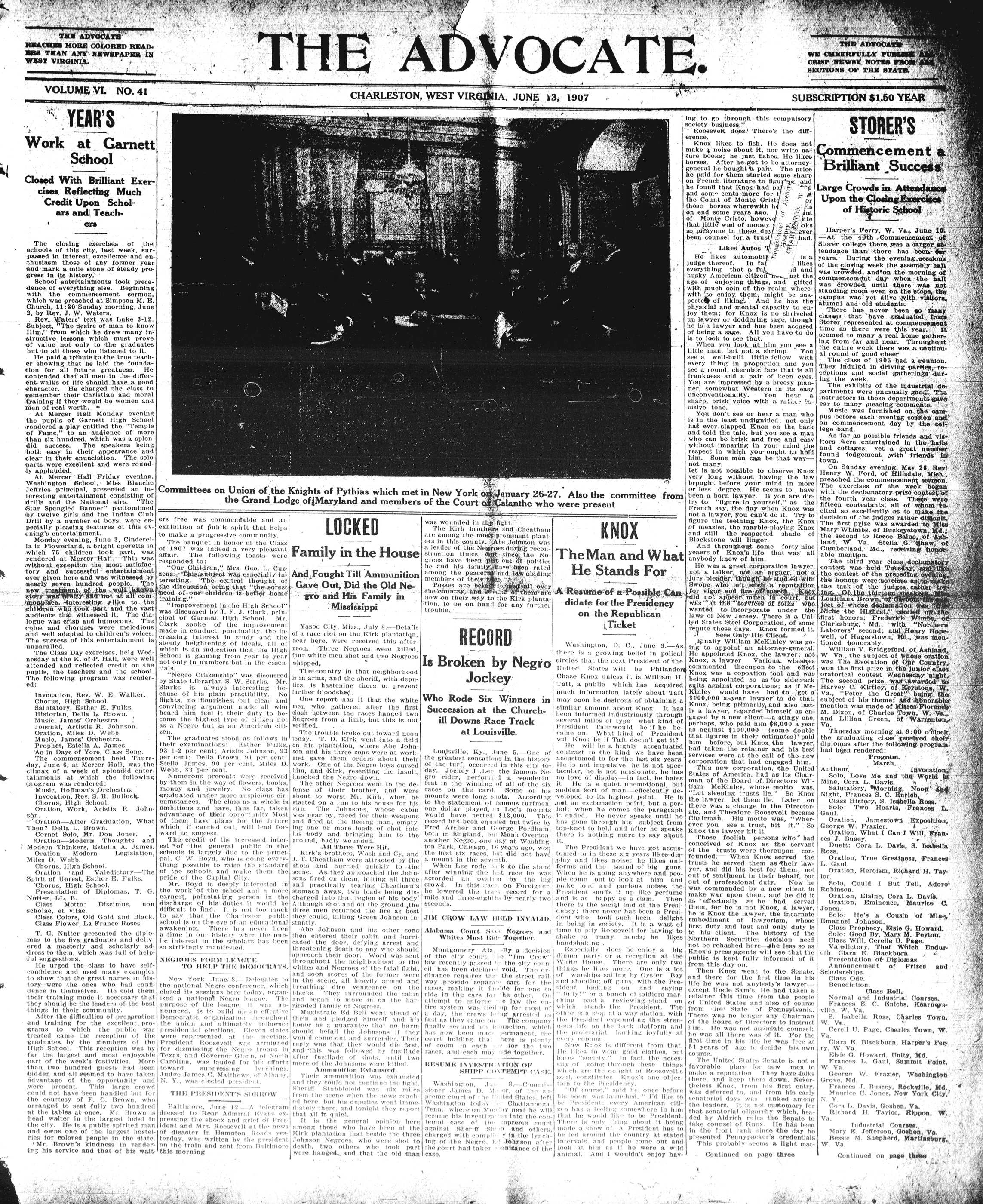
The image shows a group of people seated in a room with a large screen in the background. The room appears to be a conference hall or a meeting room, with a high ceiling and large windows. The people are facing the screen, and some are holding papers or tablets. The room is dimly lit, with a light fixture hanging from the ceiling. The overall atmosphere seems formal and serious.
Committees on Union of the Knights of Pythias which met in New York on January 26-27. Also the committee from the Grand Lodge of Maryland and members of the Court of Calanthe who were present
ers free was commendable and an exhibition of public spirit that helps to make a progressive community.
The banquet in honor of the Class of 1907 was indeed a very pleasant affair. The following toasts were responded to:
"Our Children," Mrs. Geo. L. Cuzzens. This subject was especially interesting. The co-trial thought of the discussion being that "the sorest need of our children is better home training."
LOCKED
Family in the House
And Fought Till Ammunition Gave Out, Did the Old Negro and His Family in
was wounded in the fight.
The Kirk brothers and Chealtham are among the most prominent planters in this county. Abe Johnson was a leader of the Negroes during reconstruction times, but since the Negroes have been put out of politics he and his family have been rated among the peaceful and law-abiding members of their race.
Posses are being formed all over the country, and several of them are now on their way to the Kirk planta-
KNOX
The Man and What He Stands For
A Resume of a Possible Can
"Impoverment in the High School" was discussed by J. F. J. Clark, principal of Garnett High School. Mr. Clark spoke of the improvement made in conduct, punctuality, the increasing interest in study and the steady heightening of ideals, all of which is an indication that the High School is gaining from year to year not only in numbers but in the essentials.
"Negro Citizenship" was discussed by State Librarian S. W. Starks. Mr. Starks is always interesting because of his plain practicability. No flights, no flourishes, but clear and convincing argument made all who heard him feel it their duty to become the highest type of citizen not as a Negro but as an American citizen.
The graduates stood as follows in their examinations: Esther Fulks, 93 1-2 per cent; Aristis Johnson, 93 per cent; Della Brown, 91 per cent; Stella James, 90 per cent, Miles D. Webb, 83 per cent.
Numerous presents were received by them in the way of flowers, books, money and jewelry. No class has graduated under more auspicious circumstances. The class as a whole is ambitious and have, thus far, taken advantage of their opportunity Most of them have plans for the future which, if carried out, will lead forward to success. The credit of the increased interest of the general public in the schools is largely due to the principal, C. W. Boyd, who is doing everything possible to raise the standard of the schools and make them the pride of the Capital City.
Mr. Boyd is deeply interested in the work of the school and a more earnest, painstaking person in the discharge of his duties it would be difficult to find. It is not too much to say that the Charleston public school is on the eve of an educational awakening. There has never been a time in our history when the public interest in the scholars has been so strikingly manifested.
NEGROES FORM LEAGUE
TO HELP THE DEMOCRATS
New York, June 8.—Delegates to the national Negro conference, which closed its sessions here today, organized a national Negro league. The purpose of the league, it was announced, is to build up an effective Democratic organization throughout the union and ultimately influence presidential elections. Eleven states were represented at the meeting President Roosevelt was arraigned for dismissing the Negro troops in Texas, and Governor Glenn, of North Carolina, was lauded for this efforts toward suppressing lynchings Judge James C. Matthews, of Albany N. Y., was elected president.
THE PRESIDENT'S SORROW
Baltimore, June 12 — A telegram dressed to Rear Admiral Evans express pressing the shock and grief of President and Mrs. Roosevelt at the news of disaster in Hampton Roads yesterday, was written by the president on the train and sent from Baltimore this morning.
Yazoo City, Miss., July 8.—Details of a race riot on the Kirk plantation, near here, were received this afternoon. Three Negroes were killed, four white men shot and two Negroes whipped.
The country in that neighborhood is in arms, and the sheriff, with deputies, is hastening there to prevent further bloodshed.
One report nas it that the white men who gathered after the first clash between the races hanged two Negroes from a limb, but this is not verified.
The trouble broke out toward noon today. T. D. Kirk went into a field on his plantation, where Abe Johnson and his three sons were at work, and gave their orders about their work. One of the Negro boys cursed him, and Kirk, resenting the insult, knocked the Negro down.
The other Negroes went to the defense of their brother, and were about to wost Mr. Kirk, when he started on a run to his house for his gun. The Johnsons, whose cabin was near by, raced for their weapons and fired at the fleeing man, emptying one or more loads of shot into his body and bringing him to the ground, badly wounded.
All Three Were Hit.
Kirk's brothers, Wash and Cy, and J. T. Cheatham were attracted by the shots and hurried quickly to the scene. As they approached the Johnsons fired on them, hitting all three and practically tearing Cheatham's stomach away, two loads being discharged into that region of his body. Although shot and on the ground, the three men returned the fire as best they could, killing Green Johnson instantly.
Abe Johnson and his other sons then entered their cabin and barricaded the door, defying arrest and threatening death to any who should approach their door. Word was sent throughout the neighborhood to the whites and Negroes of the fatal fight, and soon scores of the former were in the scene, all heavily armed and breathing dire vengeance on the blacks. They surrounded the cabin and began to move in on the barricaded family of Negroes.
Magistrate Ed Bell went ahead of them and pledged himself and his honor as a guarantee that no harm should befall the Johnsons if they would come out and surrender. Their reply was that they would die first, and this was followed by fusillade after fusillade of shots, until two more of the Johnsons were killed.
Ammunition Exhausted.
Their ammunition was exhausted and they could not continue the fight. Sheriff Stubbleldel was six miles from the scene when the news reached here, but his deputies went immediately there, and tonight they report that all is quiet. It is the general opinion here among those who have been at the Kirk plantation that beside the three Johnson Negroes, who were shot to death, two others who took part were hanged, and that the old man
was wounded in the fight
The Kirk brothers and Cheatham are among the most prominent planters in this county. Abe Johnson was a leader of the Negroes during reconstruction times, but since the Negroes have been put out of politics he and his family have been rated among the peaceful and law-abiding members of their race.
Posses are being formed all over the country, and several of them are now on their way to the Kirk plantation, to be on hand for any further trouble.
RECORD Is Broken by Negro Jockey
Who Rode Six Winners in Succession at the Churchill Downs Race Track at Louisville.
Louisville, Ky., June 5.—One of the greatest sensations in the history of the turf, occurred in this city today. Jockey J Lee, the famous Negro rider, performed a wonderful feat in the winning of all of the six races on the card. Some of his mounts were long shots. According to the statement of famous turfmen, one dollar played, on Lee's mounts would have netted $13,000. This record has been equaled but twice by Fred Archer and George Fordham, both in England, but Monk Overton, another Negro, one day at Washington Park, Chicago, 16 years ago, won the first six races, but did not have a mount in the seventh. When Lee rode back to the stand after winning the last race he was accorded an ovation by the big crowd. In this race, on Foreigner, he lowered the track record for a mile and three-eighths by nearly two seconds.
JIM CROW LAW HELD INVALID.
Alabama Court Says Nogroes and
Whites Must Ride Together.
Montgomery, Ala. - By a decision of the city court, the "Jim Crow" law recently passed by the city council, has been declared void. The ordinance requires that the street railway provide separate cars for the races, making it fainible for one to ride in the cars for the other. On attempt to enforce the law the entire system was tied up for most of a day, the crews being arrested as fast as they came on. The company finally secured an injunction, which has now been made permanent, the court holding that there is plenty of room in each car for the two races, and each may ride together.
RESUME INVESTIGATION OF
SHIPP CONTEMPT CASE
Washington, June 8.—Commissioner James D. Moyer, of the supreme court of the United States, left Washington today for Chattanooga, Tenn., where on Monday next he will resume his investigation into the contempt case of the supreme court against Sheriff Shipp and others, charged with complicity in the lynching of the Negro, Ed Johnson after the court had taken cognizance of the case.
Washington, D. C., June 9.—As there is a growing belief in political circles that the next President of the United States will be Philander Chase Knox unless it is William H. Taft, a public which has acquired much information lately about Taft may soon be desirous of obtaining a similar amount about Knox. It has been informed industriously through several miles of type what kind of President Taft would be if he became on. What kind of President will Knox be if Taft doesn't get it?
He will be a highly accentuated contrast to the kind we have been accustomed to for the last six years. He is not impulsive, he is not spectacular, he is not passionate, he has no love of display—in fact, he hates it. He is a quiet unemotional, but sudden sort of man—efficiently developed to its highest point. He is not an exclamation point, but a period; when he comes the paragraph is ended. He never speaks until he has gone through his subject from top-knot to hell and after he speaks there is nothing more to say about it.
The President we have got accustomed to in these six years likes display and likes noise; he likes uniforms and the sound of big guns. When he is going anywhere and people come out to look at him and make loud and parlous noises the President snuffs it up like perfume and is as happy as a clam. Then there is the social end of the Presidency; there never has been a President who took such keen delight in being in society. It is a wast of time to pity Roosevelt for having to shake so many hands; he likes handshaking.
Especially does he enjoy a big dinner party or a reception at the White House. There are only two things he likes more. One is a lot of warships sailing by Oyster Bay and shooting off guns, with the President looking on and saying "Bully!" or a bunch of soldiers marching past a reviewing stand on which stands the President. The other is a stop at a way station, with the President expounding the strenuous life on the back platform and the proletariat, barking joyfully at every comma.
Now Knox is different from that. He likes to wear good clothes, but hates "society." In fact, the necessity of going through these things which are the delight of Roosevelt's soul, constitutes Knox's one objection to the Presidency.
"Of course," said he, once before his boom was launched, "I'd like to be President; every American citizen has a feeling somewhere in him that he would like to be President. There is only thing about it being made a show of. A President has to be led around the country at stated intervals, and people come out and look at him as if he were a wild animal. And I wouldn't enjoy hay-
ing to go through this compulsory society business."
Roosevelt does. There's the difference.
Knox likes to fish. He does not make a noise about it, nor write nature books; he just fishes. He likes horses. After he got to be attorney-general he bought a pair. The price he paid for them started some sharp on French literature to figurate, and he found that Knox had paid and some cents more for it in the Count of Monte Cristo or those horses wherewith he works on end some years ago.
of Monte Cristo, however, wrote that little wad of money took so playyune in these days, ever been counsel for a trust had.
He likes automobile lovers is a judge thereof. In fact, he likes everything that a full body and husky American citizen has just the age of enjoying things, and gifted with much coin of the realm wherewith to enjoy them, might be suspected of liking. And he has the physicial and mental capacity to enjoy them; for Knox is no shriveled up lawyer or doddering sage, though he is a lawyer and has been accused of being a sage. All you have to do is to look to see that.
When you look at him you see a little man, but not a shrimp. You see a well-built little fellow with every thing in proportion and you see a round, cherubic face that is all frankness and a pair of keen eyes. You are impressed by a breezy manner, somewhat Western in its easy unconventionality. You hear a sharp, brisk voice with a rather incisive tone.
You don't see or hear a man who is in the least undignified; not only has ever slapped Knox on the back and told the tale, but you see a man who can be brisk and free and easy without imparing in your mind the respect in which you ought to hold him. Some men can be that way—not many.
Let is not possible to observe Knox very long without having the law brought before your mind in more or less degree. He seems to have been a born lawyer. If you are disty to "figure to yourself," as the French say, the day when Knox was not a lawyer, you can't do it. Try to figure the teething Knox, the Knox of measles, the marble-playing Knox and still the respected shade of Blackstone will linger.
And throughout some forty-nine years of Knox's life that was all anybody know of him.
He was a great corporation lawyer, not a talker, not an arguer, not a jury pleader, though he studied with Swope who left such a reputation for vigor and fire of speech. Knox did not appear much in court, but was "it the services of folks who wanted to incorporate under the laws of New Jersey. There is a United States Steel Corporation, of some repute these days. Knox formed it. Seees Only His Client."
Ninally William McKinley was going to appoint an attorney-general. He appointed Knox, the lawyer; not Knox, a lawyer. Varlous, wiselesse commented the eupon to the effect Knox was a copation tool and was being appointed so as to sidetrack suits against corporations; as if McKinley would have had to get a $100,000 a-year lawyer to do that. Knox, being primarily, and also lastly a lawyer, regarded himself as engaged by a new client—a stingy one, perhaps, who paid him $8,000 a year as against $100,000 (some double that figures in their estimates) paid him before, but Knox the lawyer, had taken the retainer and his best services were at the call of the new corporation that had engaged him.
This new corporation, the United States of America, had as its Chairman of the Board of Directors William McKinley, whose motto was, "Let sleeping trusts lie." So Knox the lawyer let them lie. Later on there was a change in the Directorate, and Theodore Roosevelt became Chairmah. His motto was, "Wherever you see a trust, hit it." So Knox the lawyer hit it.
Those foolish persons who had conceived of Knox as the servant of the trusts were thereupon confounded. When Knox served the trusts he served them as their lawyer, and did his best for them; not out of sentiment in their behalf, but out of professional duty. Now he was commanded by a new client to make war upon them, and he did it as effectually as he had served them, for he is not Knox, a lawyer, he is Knox the lawyer, the incarnate embodiment of lawyerism, whose first duty and last and only duty is to his client. The history of the Northern Securities decision need not be rehashed here—the less so as Knox's press agents will see that the public is kept fully informed of it from this day on.
Then Knox went to the Senate, and there for the first time in his life he was not anybody's lawyer—except Uncle Sam's. He had taken a retainer this time from the people of United States and also of course from the State of Pennsylvania. There was no longer any Chairman of the Board of Directors to instruct him. He was not associate counsel; he was all there was of it. For the first time in his life he was free at 51 years of age to decide his own course.
The United States Senate is not a favorable place for new men to make a reputation. They haze folks there, and keep them down. Nevertheless Knox, from his first entry, was deferred to, and from his early senatorial days was ranked among the leaders. It is not customary for that senatorial oligarchy which, headed by Aldrich rules the Senate to take counsel of Knox. He has been in the front rank since the day he presented Pennypacker's credentials. This probably seems a light mat- Continued on page three
Harper's Ferry, W. Va., June 10.
At the 40th Commencement of Storer college there was a larger attendance than there has been for years. During the evening sessions of the closing week the assembly hall was crowded, and on the morning of commencement day when the hall was crowded until there was not standing room even on the steps, the campus was yet alive with visitors, alumni and old students.
There has never been so many classes that have graduated from Storer represented at commencement time as there were this year. It seemed to many a real home gathering from far and near. Throughout the entire week there was a continual round of good cheer.
The class of 1905 had a reunion. They indulged in driving parties, receptions and social gatherings during the week.
The exhibits of the industrial departments were unusually good. The instructors in those departments gave ear to many pleasing comments. Music was furnished on the campus before each evening session and on commencement day by the college band. As far as possible friends and visitors were entertained in the halls and cottages, yet a great number found lodgement with friends in town.
On Sunday evening, May 26, Rev. Henry W. Ford, of Hillsdale, Mich., preached the commencement sermon. The exercises of the week began with the declamatory prize contest of the fourth year class. There were fifteen contestants, all of whom recited so excellently as to make the decision of the judges rather difficult. The first prize was awarded to Miss Mary Whimbs, of Buckeyetown, Md., the second to Reece Baine, of Ashland, W. Va. Stella G. Shaw, of Cumberland, Md., receiving honorable mention.
The third year class, declaratory contest was held Tuesday, and like the contest of the preceding event, the honors were so solitude as to make the task of the judges rather tiring. Of the thirteenth speaker, Louisiana Brown, of Cincinnati, object of whose declaration was "The Miche the Highest," carried on the first honors; Frederick Wimbs, of Clarksburg, Md., with "Northern Laborers" second; and Henry Hopewell, of Hagerstown, Md., was mentioned honorably.
William V. Bridgetord, of Ashland, W. Va., the subject of whose oration was The Evolution of Our Country, won the first prize in the junior class oratorical contest Wednesday night. The second prize was awarded to Harvey C. Kirtley, of Keystone, W. Va., "Peter the Great," being the subject of his theme; and honorable mention was made of Miss Florence M. Dixon, of Charles Town, W. Va., and Lillian Green, of Warrenton, Va.
Thursday morning at 9:00 o'clock the graduating class received their diplomas after the following program had been rendered:
Program.
March.
Anthem,
Solo, Love Me and the World in Mine, Cora L. Davis.
Salutatory, Morning, Noon and Night, Frances S. C. Enrich.
Class History, S. Isabella Ross.
Solo: Two Hearts, Frances L. Gaul.
Oration, Jamestown Exposition, George W. Frazier.
Oration, What I Can I Will, Frances J. Busey.
Duett: Cora L. Davis, S. Isabella Ross.
Oration, True Greatness, Frances L. Gaul.
Oration, Heroism, Richard H. Taylor.
Solo, Could I But Tell, Adoro Robinson.
Oration, Elaine, Cora L. Davis.
Oration, Eminence, Maurice C. Jones.
Solo: He's a Cousin of Mine, Emannel Johnson.
Class Prophecy, Elisi G. Howard.
Solo: Good By, Mary M. Peyton.
Class Will, Cerelle U. Page.
Valedictory, That Which Endureth, Clara E. Blackburn.
Presentation of Diplomas.
Announcement of Prizes and Scholarships.
Normal and Industrial Courses.
Frances S. C. Enichs, Kearneysville, W. Va.
S. Isabella. Ross, Charles Town, W. Va.
Cerell U. Page, Charles Town, W. Va.
Clara E. Blackburn, Harper's Ferry, W. Va.
Elsie G. Howard, Unity, Md.
Frances L. Gaul, Summit Point, W. Va.
George W. Frazier, Washington Grove, Md.
Frances J. Buscey, Rockville, Md.
Maurice C. Jones, New York City, N. Y.
Cora L. Davis, Goshen, Va.
Richard H. Taylor, Rippon, W. Va.
Industrial Courses.
Mary E. Jefferson, Goshen, Va.
Bessie M. Shepherd, Martinsburg, W. Va.
Continued on page three
---
Correspondence :-
---
PAGE TWO.
Corresp
FREEMAN.
Mrs. W. W. Ward has been called home again on account of her mother being very ill.
Rev. and Mrs. Huff returned from Goodwill today where he preached Sunday.
Rev. Greenn was in our town today.
Mr. and Mrs. Ed Bradshaw, of Graham, who have been visiting her parents for the past week, returned home today.
Miss Leone Collins left for North Carolina where she will spend the summer with her aunt.
Mr. and Mrs. John Martin, of Mucklow, arrived here Friday morning to visit her brother, Richard Delaney. She left today for Glade Springs where she intends to spend some time with her mother. They intend to make their future home at Glato.
Rov. Brinkley preached a sermon for the children at the Baptist church Sunday morning.
W. Taylor passed through last week en route to Hiawatha from Keystone where he has been attending the grand sitting of the Odd Fellows.
Mrs. John Cavil was called to Elkhorn on account of the illness of her sister.
Mrs. Ella Dickerson was in Bramwell last Tuesday.
Goodwill and Simmons played ball Saturday. Goodwill beat but we will overcome some day.
W. S. Haden, of Montcalm, was in Keystone last week attending the Odd Fellows' grand sitting.
Mrs. Rebecca McGuire and James McGuire, Mrs. Garden, Mrs. Nancy King and Henry Graves were in Keystone last week.
Mrs. Bertha King returned home last week from Bell Springs, where she had been to see her sister, who died while she was there.
Mrs. Ed Bradshaw, of Graham, and Miss Laura Kirkpatrick, of Spierer, were visiting Mrs. Janie Morris, of Coopers' Saturday.
Mrs. Muse, who has been visiting her husband in fronton, Ohio, returned last week.
The grand sitting of the Golden Rule convened at Bramwell last Tuesday and Wednesday, Rev. McCoy president. Rev. Hicks, of Bluefield and Rev. Clemons, of Mill Creek, were here and several visitors from Graham and Elkhorn.
Mrs. Anna Logan is better at this writing.
Mrs. Robert Logan was in Poca Sunday visiting her sister.
Mrs. Sam Jones was visiting her mother, Mrs. Lydia Jones, and Mrs. Dudley, Sunday.
Charlie Saunders came home last week from Elkhorn very sick. He is better.
Floyd Anderson, who has been sick for some time, came back Saturday from Welch hospital. He had his hand cut off.
Alex. Graves, of Rock, passed through last week en route to James-town.
Mrs. A. D. McClanahan, who has been indisposed for a few days, is out again.
Mr. Jackson, John Sanders and Ed Mitchel were down to Glato last Thursday.
Mrs. Lucy Haley, Jack Phillips,
Mrs. Nancy King, Misses Ella Strother and Lizzie and Lena King were visiting in Spencer Sunday.
Mrs. James McGuire, of Bramwell, is indisposed.
RAYMOND CITY.
Mrs. Cornelia Coles and Mrs. Bertin Nellon were visitors in Charleston last week.
Miss Hattie Price made a trip to Institute last week.
Prof. C. W. Boyd, of Charleston, and family, were the pleasant guests of Mrs. Harvey Coles Sunday.
Miss Sallie Saunders is reported better at this writing.
Mrs. Izetta James, who has been visiting in Charleston for several days, has returned home.
Mrs. M. A. Pierson has returned after a business trip to Keystone.
Wm. Randolph made a flying trip to Charleston last week.
Miss Mattie Woodson spent several days in Charleston last week the guest of her sister, Mrs. Chas. Saunders.
Mrs. Gus Hunter, Mrs. Arthur Massey and Mrs. Andy Wilson made a business trip to Charleston last week.
Mrs. Laura Wymack is improving slowly.
Mrs. Lucy Johnson, of Huntington, is visiting her mother, Mrs. George Sutherland.
Mr. and Mrs. Browder, of Montgomery, were business visitors to town Monday.
Will Taylor, of Nuttallburg, spent a few days in town visiting friends.
Miss Jessie and Josephine Williams were in Charleston Monday.
M. N. Hicks spent Sunday with his sister, Mrs. W. W. Scott.
Willie Brown left Thursday for Richmond on business.
Miss Theana Preston, of Charleston, spent Sunday with her mother.
Mrs. Matilda Jackson received the sad news of the death of her son Claude Norris, at Portland, Ore.
Miss Lucy Friend, of Institute, was in town on business Monday.
Misses Martha Washington and E. Dayles were in Charleston Monday.
Mrs. Lula Brown spent Sunday here the guest of her mother, Mrs. Mary Cosby.
Mrs. Will Vickers spent Sunday in town.
London.
Mrs. Caroline Nowlin is much improved at this writing.
Rey, D. D. Davis filled his appointment here Sunday and preached two able sermons.
Mrs. Kittle Reynolds visited Cedar Grove Sunday
The Women's Improvement
League presented the church with a Baptist Hymnal for which the church extended a vote of thanks. Haywood Williams spent Sunday in Huxestown, the guest of Mr. and Mrs. Frank Woods. Wm. Brown, J. M. Blaney in company with Rev. D. D. Davis visited Handley Sunday evening. Rev. E. D. Allen was called to Powellton to preach Sunday.
R. B. Arthur and James Tates, of Thayer, were callers Sunday.
Wm. Prince visited friends here Sunday.
Miss Minnie Walker, of St. Albans spent Saturday night and Sunday here guest of Miss B. R. Booker.
Charles Patterson made a flying trip to Ironton, Ohio, and returned with his brother, Robert, who has been confined there with typhoid fever.
Mr. Patterson is much improved at this writing
Miss Anna Oatneal is visiting Miss Eula May Whitow
Charles Rollins, of Handley, was seen in our town Sunday.
SEWELL.
Mrs. L. Jackson returned home Sunday from Hinton hospital very much improved.
Rev. Clayton, of Fayetteville, stopped over here Friday night and preached a very interesting sermon.
Mrs. Cora Agnew, of Carbon, was the pleasant guest of Mrs. Ernest Vanhook and Mrs. P. J. Gibson last week.
Mrs. Fanny Cary and Miss Lizzie Bennett spent several days at Dunloop last week guests of Mrs. Sallie Thompson.
Mrs. James Allen, of Fire Creek, was visiting her mother Saturday and Sunday.
Mrs. G. W. Johnson and Mrs. G. W. Lewis were calling on friends in Cliff Top Saturday.
Misses Maude and Willie Carrington Brooks Hendricks, of Elverton and H. E. Hargrove, of Howard's University, were pleasant guests of Miss W A. Freeland Sunday.
Prof. L. O. Wilson is expected here Saturday to lecture to Eastern Star Lodge, No. 10, K. of P.
Mr. and Mrs. P. B. Jasper, of Penn Brooke, were calling on friends in Sewell Sunday.
Mr. and Mrs. Lewis Bibb were guests of Mrs. Nannie Kinney Sunday.
CEDAR GROVE
C. W. Watkins, of Crown Hill, spent the day Sunday with friends. Miss Bessie Phillips is at home from school. Miss Pearl Martin, of Huntington, is visiting Mrs. T. W. Martin. Mrs.... Joe. Williams.... of Ward, stopped over to see Mrs. Lee Richmond on her way to Virginia. Mrs. Tom Jones is visiting her daughter, Mrs. Lewis Cobbs, of Institute. Mrs. G. Lee left last week to visit her parents in Virginia. Mrs. C. H. Jones spent a day with her mother, Mrs. Amanda Slater, at Monarch. Joe Hastin, of Mammoth, was calling on friends last week.
Mrs. James Copeland was visiting Mrs. M. Beamer last week.
Walter Jones was calling on Miss Bessie Phillips Monday.
Miss Ashland Walker was visiting her aunt, Mrs. Robert Slater, Sunday.
John Dingess spent ten days at Jamestown at the fair.
Mrs. Joe Varmes was visiting Mr and Mrs. Walker Monday.
Mr. William Beamer, of Mammoth, was visiting his father, M. Beamer, Sunday. Mrs. Nathala Phillips was visiting her father, M. Beamer, Sunday.
COVINGTON, VA.
T. B. Fairfax and Z. Thompson
left Tuesday for Powellton, W. Va.
Mrs. Mary Pigrom is quite ill at
this writing.
R. N. Smith is a little better at this wr iting, after several days of illness. Mrs. S. H. Denson, Mrs. O. Jackson and Miss Annie Polard have returned from the East. All parties having items for publication would please give same to newsman when he calls. Miss Fannie Gerly left Tuesday 5th instant for Ohio, where she will spend the summer. A. Wright is home visiting his family.
Rev. T. Johnson preached at Dolly Ann, Sunday.
Albert Garlin and Rev. T. Washington, of Springwood, were visiting in Wrightsville Sunday.
Al. Harvey's baby died Thursday, 6th instant was buried Friday.
Mrs. C. R. Beale spent a few days last week in Goshon visiting her mother
John Hutchinson is sick. He is suffering with paralysis.
Messrs. Linsy, Kempt and Wright were in town last week in the interest of the loan and charity organization.
Deputy R. H. Broady, H. Broady, and Ade Goldin were in town Thursday, 6th instant, to initiate several candidates in the order of True Reformers
Several candidates from Goshren were initiated in the K. of P's.
Rally at the Pine Street Baptist church, Sunday, 16th instant. Rev.
Fountaine, of Clifton Forge, will preach.
It is reported that Mr. Junius
White and Miss Jennie Rounds will
marry some time this week.
MONTGOMERY
Mr. and S. J. Jackson spent Thursday in Charleston guests of Mr. and Mrs. Fred Huskins.
Mrs. Robert Watson, Mrs. William Callender, Mrs. Mary Perry and Thomas Johnson George Jackson, S. H. Morgan, Joe and Mathew Buster have returned from from Keystone, where they were in attendance upon the district Grand Lodge of G. U. Q. of O. F.
Miss Lola May Lavender, who has been in Denver, Colo., several months, returned home Saturday.
Mason P. Burke attended commencement at Charleston Thursday.
Mrs. B. F. White and baby Dorothy left Wednesday for Institute to spend the summer with her parents, Mr. and Mrs. Z. T. Brown.
Mr. D. M. Qualls and Miss Lizzle Bibbs were quietly married Sunday evening at the home of Mrs. P. W. Wright sister of the bride.
The little child of Mr. and Mrs. George Jackson is quite slick.
Mrs. Etta Hunter, died Wednesday after several months illness tuberculosis. Funeral services were held at the First Baptist church, she was a member of Eagle church Remains escorted to cemetery by Fishermen lodge.
Mrs. Mary A. Brown, of Washington, D. C., was called here by the death of her sister, Mrs. Etta Hunter.
Mr. and Mrs. Frances Shepherd entertained Sunday complimentary to Mr. and Mrs. Lee Jones, of Charlottesville, Va. Those present were: Mr. and Mrs. Thomas Holmes, of Pratt, Mrs. Foreman, of Handley, Mrs. Kate Clater, of Charleston, Mr. and Mrs. Philip Shepherd Mr. and Mrs. William Miller, Mrs. Clara Powell, Mr. and Mrs. Vattelle Willis, Mrs. W. C. Lawrence, Mrs. Elizabeth Brown, Mr. and Mrs. H. H. Railey, Mr. and Mrs. Thomas Johnson and Mr. George Jackson.
SYLVIA
Wednesday about 6 o'clock Mr. and Mrs. Lawrence Harmon's beautiful home was destroyed by fire. The fire started from the attic. An effort was made to save the house, but it could not be done. The furniture from the first floor, articles from the cellar and smoke house, were the only things saved. Many valuable articles were lost, including furniture, trunks, clothes, a gold watch and money. White and colored friends are helping to replace the loss. Lumber and money have been given and in a short time he hopes to see the house rebuilt. The family has the sympathy of all Miss Mabel Anderson is visiting
Miss Mabel Anderson is visiting friends at Raymond City.
Rev. C. C. Booze is conducting a meeting at Fairmont. Mrs. Ben Green is reported very ill this week. Miss Pinky Jones, who is teaching at Mabscott, spent Sunday in the town the guest of Mrs. Robert Anderson. Willie Lipscomb and some other young man spent Sunday in Stanaford. The literary program was successfully carried out Saturday night and the participants did credit to the town.
MIDDLEPORT. O.
Dana Gatewood, who is employed at Langsville, Ohio, spent Sunday with his parents.
Misses Bertha Houston and Wyona Davis, of Rendville, were Sunday guests of Miss Cassia Bess.
Misses Blanche Allen and Jessie Hale were calling on Pomeroy friends Sunday afternoon.
Arthur Morton, a clerk in the postal service at Cleveland, passed through here Sunday en route to Pomeroy, to spend his vacation with his parents.
Among the Sunday excursionists from Columbus were Mr. and Mrs. N. Lewis, Messrs. George Guthrie, Willie Carter, W. B. Thompson, Sam Jones, Reeves White; Mesdames Carter, Thompson, Bates and Anderson.
Prof. Artis Topsey will leave Monday for Wilberforce to attend commencement exercises, also to meet the alumni, of which he is a member.
The Young Men have organized a base ball club which is under the management of James Johnson. They anticipate giving the people of this vicinity some very good games in the near future. Any team desiring to cross bats with them can communicate with the manager.
The sad news of the death of Miss Ethel Rickman, youngest daughter of Prof. J. H. Rickman, at Jackson, Ohio, was received here Monday. The news came as a shock to her many friends here, who were not aware that she was so seriously ill.
Miss Amanda Sutton, who taught the past winter at Ceredo, W. Va., returned home Monday last, having finished a very successful year's work.
James Rickman, of Morgantown, W. Va., Passed through here on his way to Jackson to attend the funeral of his sister. He was accompanied from here by Misses Georgia and Amanda Sutton.
UNION.
Mrs. Mary Campbell and Miss Carolina. Clair left for Charleston on the morning of the 8th to attend the Commencement exercises of the W. Va. Institute.
Anthony Clair, of Charleston, is visiting his many friends and relatives.
Miss Lucy Burk, of White Sulphur Springs, is visiting at the home of her aunt, Mrs. Mary Campbell.
Mrs. Sarah Shelton, of Sweet Springs, is calling on Mrs. Luvenia Roy.
Phil Roy, who has been confined to his bed for some time, is much improved at this writing.
Edward Seams, of Diamond Hill, has dug a fine cistern which adds much to the value of his beautiful home.
James Clair returned to the Old Sweet Springs for the summer.
Mr. and Mrs. Albert Miller are rejoicing at the appearance of a bea-
If you haven't taken care, healthy movement of the bowels you have on your back, keep your bowels open, and well, well. Force, in the case of violent abdominal pain, poison, in dangerous. The bowels should be clean and clean to take.
CANDY
OATHARTIO
Sacarrets
THIS WORK WHILE YOU SLEEP
EAT NEW LIKE CANDY
Pleasant, Palatable, Potent, Taste Good! Do
Good, Never Slacken, Weaken or Gripe; 10, 25 and
30 ounces per bottle. Write for free sample, and book
let on health. 413
Stirling Bendge Garden
Chicago or New York
REVIVO RESTORES VITALITY "Made a Well Man of Me." THE GREAT
REVIVO REMEDY
produces results in 30 days. It is not only timely and quickly. Cures when others fail. Young and old men may recover their youthful blood, and old men may recover their youthful blood using REVIVO. It quickly and quietly restores weakness, realty, sexual weakness such as Lost Power, Fainting, Wasting Diseases, and effects of self-shock or cross and indisposition, which unites one for life, but only cures by starting at the heart of disease, bringing nerve tonal and blood builder, bringing nerve tonal and blood builder, restoring the heart, proaching disease. Distinct on having REVIVO, no other. It can be carried in vest pocket. By carrying the blood package, or six for $5.00. We give free advice with guarantee. Circular free. Address: ROYAL MEDICINE CO. Marine Bldg., Chicago, IL.
SC YEARS'
EXPERIENCE
PATENTS
TRADE MARKS
DESIGNS
COPYRIGHTS & C
Anyone sending a sketch and description ma
quickly assortment our opinion free whether a
inventor is patent pending. Contact us
tions strictly confidential. HANDBOOK on Patent
sent free. Oldest agency for securing patents.
Patents taken from the U.S. recy
special notice, without charge, in the
tifical visitor in their home. It is a bouncing boy.
Prof. N. S. Bell and his choir of well trained voices rendered charming music at the 1st Baptist church Sunday.
Rev. Wm. Jackson, pastor of First Baptist church, of Union, was at his post of duty and preached three times Sunday and baptized six persons. At night he administered the Lord's supper.
A large crowd from the Salt Sulphur Springs worshiped at the First Baptist church Sunday.
Sunday was also Ralley day at the First Baptist church and the amount of $40 was raised, which was divided between the invalid members of the church.
We anxiously await the coming of Mrs. J. W. Hackett, of Covington, Va., who our pastor announced would give one of her lectures for us on Monday night after the second Sunday in July.
Miss Rosie Bailey has gone to spend the summer at the Old Sweet Springs.
Mr. and Mrs. Chris Whitlock have returned home again.
Albert Brown, of Thurmond, is stopping with his mother for a few days en route to Old Sweet Springs, where his wife will join him to spend the Summer.
Mrs. Jessie Wright closed her school on the night of the 7th and rendered a good program. Prof. N. S. Bell presided at the organ. The program was:
Chorus, America.
Quotations, School.
Invocation, Rev. Jackson.
Recitation, Charlie's Pocket, Frank Simpson.
Recitation, Outcast's Return, Albe Mills.
Recitation, What We Learn At School, Five Pupils.
Chorus, Let the Sunshine In.
Recitation, One Little Act, Willie White.
Recitation, My Troubles, Ned Smalls.
Recitation, The Soldier's Reprieve, Julia Simpson.
Chorus, Red, White and Blue.
Recitation, Qadroon Girl, Harriett Triplett.
Recitation, Little Boys a Chance, Three Boys.
Recitation, Lead Kindly Light, Five Girls.
Recitation, Only One Apple, Chris Campbell.
Song, How to Make a Shoe, Seven Pupils.
Recitation Saved by a Song, Skip with Campbell.
Duel, Jeong, Loving Shepherd,
Horace and Neva Smalls,
Recitation, Unknown Grave, Eva
Patterson.
PT. PLEASANT.
Mrs. Steve Barnett and Mrs. Frank Thompson, of Columbus, O., were the guests of their sister, Mrs. Tobe Craig, and Mrs. Thomas' daughter, Mrs. Ed. Bates, last week.
Miss Kate Craig has returned to Charleston after a weeks' visit here with her parents.
Mrs. Mary White arrived here Friday, May 1st, to be the guest of here parents, Mr. and Mrs. Alexander.
Charles Settles, Jr., left last Monday for Thurmond, where he has a position.
Miss Lucy Lincoln, of Marietta.
BLUEFIELD COLORED INSTITUTE
Bluefield, W. Va.
A College and Normal Institute for colored students, located at Bluefield, the leading commercial town of the southern part of West Virginia, on the Norfolk and Western railroad,205 miles east of Kenova
BURGESS
COLORED INSTITUTE
Splendid College Buildings, Beautiful Grounds, Dormitories
for male and female students; fur nished rooms, a reading room supplied with the best current literatur e; a good library, and a physical and chemical laboratory.
Healthful location and wholesome surroundings. Board $8.00 per month. Tuition free to state students, rates very low to non-resident students.
The Bluefield School offers an unequalled opportunity for young men to secure an education, for they can always find profitable employment when at shool, during vacation, holidays and on saturdays.
For catalogue and other information, write the Principle.
Isadore Lincoln and Lawrence
Scettles left last night for East
Liverpool, Ohio.
Mrs. J. H. Campbell and daugh-
ters Freda and Maybel left last Monday
for their home in Moundsville,
after several week's visit the guest
of her mother, Mrs. M. L. Jordan,
and other relatives. She was ac-
companied home by her brother,
James M. Jordan.
Joe Alexander, John Adams and
Jacob Settles were Sunday visitors
in Huntington.
Miss Lena Jackson, of Fairmoit,
arrived Monday, June 3d, to be the
guest of Miss Bess Jordan.
Mrs. F. H. Jackson returning
from the D. G. L. at Keystone Sat-
day stopped at Pt. Pleasant to be
the pleasant guest of Mr. and Mrs.
G. H. Jordan and family.
Mrs. E. L. Morton, came down from Pomeroy, Wednesday, May 29th, to attend the commencement. She was accompanied by Miss Francis Morton, who returned to Pomeroy, Thursday.
Prof. E. L. Morton was the guest of his wife Sunday, June 2d.
Quite a crowd will attend the commencement at Institute.
W. L. Clendenin, of Gallipolls, was the guest of Miss Hattie C. Jordan, Sunday.
Mrs. Lucy Colston entertained at dinner Sunday, Rev. E. Venture and Mrs. Kelley
Mrs. G. H. Jordan entertained Mrs. J. H. Campbell and two children at dinner Sunday, June 2d
Prof. L. R. Jordan wife and baby left for Institute to be the guests of relatives.
J. F. Henderson and wife were visitors in Gallipolls Sunday.
Little Misses Leola and Grace Kelley entertained a number of friends last Thursday. Miss Lena Jackson being the guest of honor. Miss Ida Alexander spent Sunday here with her parents. Mrs. R. W. White is the guest of her husband in Huntington.
CARBON.
Rev. T. H. Christian has sold his farm on Loup Creek and will move to his old home in Virginia next week.
Winston Ralley received a very painful wound in the mines Wednesday, by stepping on a nail.
T. G. Agnew has been out for 3 days on account of slate falling on him last Monday in the mines.
Quite a number of our people attended the Red Men's supper at West Virginia Saturday night.
Mr. and Mrs. Peakes came last Tuesday night. They will make this their home for a while.
T. T. Page was on the river on business last week.
Herbert Taylor and wife arrived from Virginia, last Friday.
PARKERSBURG.
Herman Brown spent Sunday at home, having come over from Athens, Ohio, where he is employed. The Children's Day exercises at Logan M. E. Church last Sabbath were a grand success. The music was excellent. The children performed their parts well. A large crowd was in attendance and all were well pleased. The mass "meeting," ostensibly held for the good (2) of the colored schools, but really for the purpose of "doin' up" the principal, was held last night at the Rink on 8th street, amid much noise and confusion, and the energy wasted might have been enlisted in a better cause. The result of the meeting took the form of a written protest against the reap-
Continued on Page Three.
FORED INSTITUTE
d, W. Va.
ormal Institute for c
ted at Bluefield,
town of the south
on the Norfolk a
5 miles east of Kene
buildings, Beautiful
es
shaded rooms, a reading room sup-
a good library, and a physical
surroundings. Board $8.00 per
s, rates very low to non-resident
nequalled opportunity for young
on always find profitable employ-
holidays and on saturdays.
tion, write the Principle,
R. P. SIMS.
Blue
Bluelfeld W. Va
The image provided is too blurry and low-resolution to accurately recognize any text. It appears to be a blank or heavily distorted document. Therefore, no text can be extracted from this image.
The Greatest Assortments of
LADIES, MENS, CHILDRENS,
LOW SHOES
in the city
Bell Shoe Company
708 Kanawha Street
is
e
xt
y
s-
```markdown
```
THURSDAY, JUNE 13, 1907.
STITUTE
a.
tute for col-
uefield, the
e southern
Norfolk and
st of Kenova
eautiful
room sup-
physical
8.00 per
president
young
employ-
ys.
```markdown
```
1.
Call at the Gem Pharmacy
and get a bottle of Beef, Wine and Iron for that tired feeling. Don't wait for pring is here. The system is full of impurities which must be evacuated lost you will continue to suffer from [that "tired feeling," poor appetite, headache and fatigue which comes with the pring
Price per bottle 50c
Get your prescription filled at the GEM where you get pure and fresh ingredients put up with utmost care and skill.
A new line of toilet articles just arrived for the summer.
Special attention is given the "SODA FOUNTAIN" where you enjoy ICE CREAM SODA of Choice Flavors.
Gem Pharmacy
Corner Washington and Dickinson Streets.
CHARLESTON, WEST V.A.
or on any kind of terms, until you have received our complete Free Catalogues illustrating and describing a kind of high-grade and low-grade bicycles, old patterns and latest models and a learn of our remarkable LOW PRICES and wonderful new offers made possible by selling from factory direct to rider with no middlemen's profits.
WE SHIP ON APPROVAL without a cent detail. Pay the Freight and
WE SUPPOR APPROVAL without a cent deposit, Pay the Freight and
hail and make other liberal terms which no other
house in the world will offer. We will learn everything and get much
valuable information by simply writing us a postal.
We need a *Hirpo* in your
we meet a Muppet Agent in every town and can offer an opportunity to make money to suitable young men who apply at once.
BROADWAYS BENCH
APE CARS
MOTOR CARS
1234567890
making. No danger from THORNS, CACTUS, PINS, NAILS, TACKS or GLASS. Serious punctures, like intentional knife cuts, can be vulcanized like any other tire.
Two Hundred Thousand pairs now in actual use. Over Seventy-four Thousand pairs sold last year.
DESCRIPTION! Made in all sizes. It is lively and easy with a special quality of rubber, which never becomes porous without allowing the air to escape. We have hundreds of lamps that their tires have not been pumped upon or twice in an ordinary hour and must reissuing quality prepared fabric on the tread. That "Holding Back" sensation or soft roads is overcome by the patent "Basket Weave" that squeezed out between the tire and the road thus overcoming it and allowing for advertising purposes we are made of only 480 per pair. All orders shipped same day receive. You do not pay a cent until you have examined and found it. We will allow a cash discount of 5 per cent (thereby making FULL CASH WITH ORDER and enclose this advertised plated brass and tin and wound cotton puncture closers to be used in case of intentional knife cuts at OUR expense if for any reason they are not satisfactory. We are perfectly reliable and money sent to us is as safe as any other. Weigh or adjust of this pair these tires, you will have the will to finish than any tire you have ever used or seen at any price. We that when you want a bicycle you will give us your order. order at once, hence this remarkable tire offer.
GOASTER-BRAKES everything in the bicycle prices charged by dealers and repair men. Write for our busy DO NOT WAIT but write us a postal today. bicycle or a pair of tires from wonderful offers we are making. It only costs a postal to I MEAD GYCLE COMPANY, Dept.
lively and easy riding, very durable and lined inside
ceonous porous and which closes up small punctures
of letters from satisfied customers stating
reviews of letters from satisfied customers no more than
being given by several layers of paper, of these
stick" sensation commonly fell when riding on asphalt
and road which prevent all air from being
overcrowding allautomobile prices of these
items are making a special factory price to the rabble
day letter is received. We ship C.O.D. on approval,
hereby making our stricly as represented.
hereby making our pair (if you send
this advertisement. We will also send our
sat puncture closers on full paid orders (these metal
puncture closers on heavy gashes). Tires to be returned
not satisfactory us is as safe in a bank. Ask your Postmaster,
or of this paper about us. If you order a pair of
oiler, run faster, wear better, last longer and look
this advertisement that you will be so well pleased
your order. We want you to send us a small trial
wheels, caddis, padals, parts and repairs, and
ing in the bicycle that you use at half the usual
price for our big SUNDRY bike.
DO NOT THINK OF BUYING a
tire from anyone until you know the new and
a postal to learn everything. Write it NOW.
Dept. "M J L" CHICAGO, ILL.
DESCRIPTION: Made in all sizes. It is likely and easy riding, very durable and fitted inside with a special quality of rubber, which never becomes porous and which closes up small punctures without allowing the air to escape. We have hundreds of letters from satisfied customers stating that we have made a good choice of� and we have made a good choice of�. They weigh no more than an ordinary tire, the puncture resisting qualities being given by several of the most-used and prepared fabric on the tread. That "Holding Back" sensation commonly felt when riding, especially or soft roads is overcome by the patent "Basket Weave" tread which prevents all air from being squeezed out between the tire and the road thusovercoming all suction. The regular price of these is $1.50 per pair. All orders shipped same day letters is received, special factory price to the rider. You do not pay a cent until you have examined and found them strictly as represented.
We will allow a cash discount of 5 per cent (thereby making the price $4.56 per pair) if you send FULL CASH WITH ORDER and enclose this advertisement. We will also send one nickel pound full coupon for the price of the product. We have no further information on full paid orders (these metal puncture closers to be used in case of intentional knife cuts or other fires to be returned at OUR expense if for any reason they are not satisfactory on examination).
We are perfectly reliable and money sent to us is as safe as in a bank. Ask your Postmaster, Banker, Express or Freight Agent or the Editor of this paper about us. If you order a pair of 3-inch or 4-inch in size, you have a right to send a letter, a letter, or a letter, and a letter, and a letter, and a letter, that you will be so well pleased that when you want a bicycle you will give us your order. We want you to send us a small trial order at once, hence this remarkable tire offer.
OOASTER-BRAKES, everything in the bicycle, parts and repairs, and prices charged by dealers and repair inc. Writc for our big BUNKDY catalogue.
Regular Price $8.80 per pair.
To Introduce
We Will Sell
You a Sample
Pair for Only
(CASH WITH ORDER $4.65)
NO MORE TROUBLE FROM PUNCTURES.
pointment of the principal. This protest was signed by the leading (?) colored citizens, and hence was destined to have great weight (?) with the board. It was carried further last Friday night, but, alas, the board of education seemed to take another and different view of the matter and after receiving and filing the communication, unanimously agreed that the present principal was the right man in the right place, and they were very well satisfied with the work at Summer school. Too bad, isn't it, that the request of such interested (?) and leading (?) citizens should thus be ignored?
We understand that the children's day exercises were nicely performed at all of the churches where they were held in the city.
Mrs. Edward Edmondson and her niece, of Gallipolis, Ohio, are guests of Mrs. James Watkins and Mrs. George Edmondson.
The son of Rev. and Mrs. Edward Moore, who has been attending school in Baltimore, Md., is expected home soon.
At a meeting of the board of education last Friday night the contract was let for sodding the yard at Summer building and building a retaining wall behind it. When this shall have been completed the site will be beautiful.
Miss Bernadine Peyton and Miss Esther Coleton, both teachers at Summer, will attend the Miami Summer School which opens at Oxford, Ohio, about June 24th.
Harry Moals is now able to be out again after several months' illness with fever.
Miss Julia Dorsey passed through the city last Sabbath on route to institute. Miss Dorsey has been attending school in Baltimore, Md. She stayed an hour or so between trains and spent the time the guest of Miss Lurania Lee on Clay street.
Miss Esther Colston, the popular and successful grammar teacher of Summer school, left last Wednesday morning for the home of her parents in Zanesville, Ohio. Miss Colston has made many warm friends here and her return in the fall will
Notice the thick rubber trend
"K" and puncture strips "H"
and "D," also rim strip "H"
to prevent rim cutting. This
may make any other
make-SOPT, ELASTIC and
EASY RIDING.
be looked forward to with pleasure by them.
Mrs. Chas, Wilkes left Friday for an extended visit to her parents in Ohio.
Mrs. Lou Edmonson and niece of Springfield, Ohio, have been the pleasant guests of Mr. and Mrs. Watkins.
Mrs. Ed Jones and son Blair will leave Thursday for Washington, D.C., where they will spend the summer visiting relatives.
The many friends of Philip Brown, of Pt. Pleasant, will be sorry to learn of his illness. He is suffering with a complication of diseases.
Mrs. Phyllis Johnson and son Arthur are anticipating a visit to Canada and some of the Eastern cities.
Robert Lindsey spent a few days at Clarksburg the guest of relatives and friends.
Mrs. Anthony Willis has been very sick, but is slowly improving.
George Willis, who has been confined at his bed with inflammatory rheumatism, is better and will soon be out.
HUNTINGTON
Miss Gertrude Mills, who has been teaching millinery at Prairie View, Texas, came home last Tuesday to spend the vacation with her parents, Mr. and Mrs. A. D. Mills.
The order of U. B. F.'s held their annual services at the First Baptist church Sunday afternoon. A number were in attendance from Ironton, Ashland and Catlettsburg, and quite an imposing procession, headed by the K. of P. Band, marched from the hall to the church.
Lloyd Lewis, who has been attending school at Richmond, arrived home last week to spend the summer with his parents.
Mrs. Cynthia Dickerson and daughter Nora, are both quite ill at their home on 7th Age.
Mrs. R. W. White, who is attending Howard University, arrived Saturday, to spend the summer with her husband.
G. W. Hughes has returned from attending the Grand Lodge meeting of Odd Fellows at Keystone, and reports a delightful trip. The social given at the home of Mrs. Holt on 8th Ave, last Thursday evening for the benefit of the 16th
St. Chupyn was well attended, and all had a delightful time.
Mrs. I. H. Holmes, after a brief visit with relatives, returned to her home in Gallipolis, Ohio, Wednesday.
W. R. Johnson is the owner of a handsome new runabout.
The infant child of Mr. and Mrs. Chas. Daniels died at their home on 14th street last Tuesday morning. Interment at Spring-Hill Cemetery, Wednesday.
Mrs. Amanda Bell entertained Rev. Bryant and family at dinner Sunday.
Miss Mina Stewart passed through our city last Friday on route to her home in Circleville, from a visit to Hinton.
Mrs. Anna Woodson is quite ill again at her home on 6th Ave.
WINONA
Mrs. M. A. W. Thompson, the field missionary for the Woman's Baptist State Convention, arrived in our town Friday, and on Sunday morning spoke for the First Baptist church of Edmond and to the Second Baptist church, of Winona, Sunday night. While in the town she was the guest of Rev. and Mrs. E. G. Tillman On Monday night Mrs. Thompson addressed the host of women at the First church.
T. G. Wood was a visitor of Mr. Huse on Cablin Creek, Wednesday of last week.
Miss Minnie Green is home after spending, a successful term in the Lynchburg College.
Miss Buelah L. Agee passed through our town Friday returning to her home at Edmond from the W. Va., S. and C.
Dr. C. B. Anderson, of Mt. Hope, was a business visitor here Monday.
STORER
STORER
Continued from page one
Cora McKinney, Harper's Ferry,
W. Va.
Mary Peyton, Parkersburg, W. Va.
At 3:30 the alumni association met and listened to the program below:
Anthem.
Prayer—Rev. J. W. Ware.
Quartet.
Declaration—Mr. C; B. Davis.
Solo—Miss Sadie Burrell.
Oration—Mr. Samuel Beane.
Solo—Mr. James Hamilton.
Paper—Mrs. Nannie C. Huskins.
Solo—Miss Eva Herrod.
Poem—Mr. W. B. Evans.
Quartet.
Benediction.
The cantata "Esther" was sung Thursday evening and repeated Friday evening, the hall not being large enough to accommodate all those who wished to be present the first evening.
On Friday afternoon, May 31st, the students and friends witnessed a very interesting ball game between the Storer team and the Alumni. It was very close and exciting game. The Alumni was victorious and Storer lost the first of the games it has played during the year.
NOTES
Miss Lois Evans returned with her week, to Talcott, W. Va., to spend the summer.
The teacher's institute was held Anthony Memorial Hall last week. It was conducted by Miss Laura Strider. Quite a number of teachers attended.
President McDonald and family left last week for New York, from there his family will go to Boston, and will sail for Panama where he will spend the summer.
Miss Mabel Brady returned home Tuesday morning, from her work at Bluefield Institute.
On account of the illness of her nephew, Nathaniel Sims, Miss Smith was called to Bluefield sooner than she expected to go.
The faculty of Storer College takes great pleasure in announcing the winners of the scholarships for excellence in scholarships and department. The seven Brewster scholarships were awarded as follows: In the fourth year class, Misses Mary Whimbs, of Buckeyestown, Md., Hester Parker, Columbia, Pa., and Letitia Allen, Lydia, Md. In the third year class, Misses Emma Laws, Berryville, Va., Lizzie Carter Shenandoah, Va. Junior class, Miss Frances Brunswick, of Middleway, W. Va. Senior class, Miss Clara Blackburn, of Harper's Ferry.
One year ago the members of the Alumni of Storer College pledged a certain fee in order to establish an Alumni scholarship fund. This first Alumni scholarship was won by Miss Mary Whimbs, of Buckeyestown, Md.
Continued from page one
ter to people abroad in the land.
Here, where the impossibility of
breaking into the Senate inner circle is known, it seems a thing so nearly incredible that even now, after two years have gone by, there are those here who cannot believe it.
Happy Trust Busters.
It was Knox who planted Milton Purdy, the trust buster, in the Department of Justice. Purdy swearby Knox. To this day Purdy owes allegiance to him instead of to the Frank Hitchcock in the Post Office Department regards Cortelyou as his Postmaster General despite the changes that time and George von Linger Meyer have made.
A while ago the President decided to go after the Standard Oil Trust. The person for whom he sent was not Bonaparte, but Knox. He asked Knox to go over the facts with him and see if the trust could be prosecuted. Knox arrived from Pittsburg and summoned Purdy to his house. Imagine D'Artagnan after long and ungrateful services under Mazarin, seeing Richelieu restored to life and consulting him. "Well, that was Purdy Those
You Look Prematurely Old
Standard Oil days were the happiest of Purdy's life. He sat up in Knox's study and went over the papers with Knox, and felt that the good old days had come again, and that Boneparte was, an intervening dream. After it, was all over the President went after the Standard Oil Trust.
Whenever Roosevelt is in a hole, he sends for Knox. This refers to trust prosecutions. It may afford some suggestions as to why the President, deep as he is in the Taft boom.
office of Virginia's contention, which competent West Virginia commissions had declared to be absolutely without just foundation.
The course of West Virginia throughout the controversy has been dignified and sincere. She has made no effort to escape any just obligation. She recognizes that the very act of Congress that made her a state imposed on her the obligation of an equitable proportion of Virginia's debt existing January 1, 1861. She made two honest efforts to adjust that debt.
We Are Moving
But filling every order. F. F. V. Time.
We desire to impress upon you the importance of trading with us
BECAUSE
When Knox and Purdy have got through a search through musty papers they play pinochle. Knox can play pinochle. Also he never weakens at poker. Uncle Joe Chapon the boss poker player of the capital, the Robert C. Schenck of this degenerate country, would welcome Knox as a foeman worthy of his flush.
If anything has been said herein to give the impression that Knox is calm oxlike, and placid, an apology is due. There is nothing of the Alton. Parker about Knox. He is as swift and sudden a proposition as ever came down the turnpike. Also he is full of red blood. The only difference is that he does not talk about it. He was not a Rough Rider; if he commanded a cavalry regiment it would be entitled, "The First United States Volunteer Cavalry" instead of "The Rough Riders" but it would get to Las Guslimas just as quick. That is the difference, and all the difference.
AN INJUSTICE TO WEST VIRGINIA
From the Wheeling Intelligencer
Even the Baltimore Sign, which is usually well informed, discusses the Virginia debt question on the assumption that West Virginia has for forty years evaded a settlement. This assumption is, nothing more or less than a polite charge of bad faith against West Virginia, and it is absolutely unfounded in fact. At the earliest possible moment West Virginia did make an effort to settle the debt question, and was rebuffed by the mother state. West Virginia then proceeded to fix for herself as nearly as possible an adjustment of this debt. A competent commission of inquiry reported, that in equity we owe Virginia nothing, and on that report West Virginia has for thirty years taken her stand and rested her case.
Although West Virginia became a state in 1862, it was manifestly impossible to apportion the state debt until after the war closed. When the government of Virginia was restored a dispute arose between the two states as to the possession of Berkeley and Jefferson counties. This dispute was finally settled in favor of West Virginia in 1870. Pending this suit negotiations of any kind concerning the debt were impossible. In 1871, or at the earliest possible moment, West Virginia appointed a commission of three distinguished citizens to negotiate with the state of Virginia for an adjudication of the debt. This commission went to Richmond, but the Virginia authorities refused to meet with them, or even to give them access to sources of information, necessary for the proper consideration of the question. Here is where the dispute began. Here was the first high-handed and arbitrary proceeding. West Virginia's reasonable overtures were not even ment with courtesy. This commission did conduct an investigation, however, and reported from the information it was able to gather that West Virginia did not owe Virginia more than about $900,000.
In 1873 the senate of West Virginia made a further effort to obtain information as to the debt question, Jonathan M. Burdett had been auditor of the old state of Virginia; he had served on the commission appointed in 1871. He was a member of the finance committee of the state senate, and this committee was at his suggestion instructed to make a complete investigation and report what proportion if any, of the Virginia debt existing January 1, 1861, should be charged against the state of West Virginia. This committee went into the question thoroughly. It estimated the revenues and expenses of administration by the state of Virginia from 1832 to 1861. It made a complete estimate of the amount of taxes paid by the counties now in West Virginia during that time, and the cost of the public improvements in those counties. Its conclusion was that West Virginia had in the forty years between 1823 and 1861 paid into the treasury of Virginia over $500,000 more money than her share of the cost of the administration of the government, plus the cost of all the public improvements in the territory now West Virginia. Not one dollar of the $31,000,000 which the old state of Virginia owed January 1, 1861, was spent within the borders of West Virginia. West Virginia paid her share of the state expenses, paid for all the public improvements she goes, and paid $500,000 more into the Virginia treasury.
The report whi 1873 has been the ginia's attitude, an peated legislature familiar resolution ginia did not owe ginia a dollar. I investigation and made the attitude until the present possible any seth question. After a with our neighbor ginia arbitrarily of ginia one-third of January 1, 1861, a Virginia debt of her obligations her own action center of West Virginia was debarred these certificates, no part in their inition in any way a virtual acknowled
tice of Virginia's contention, which competent West Virginia commissions had declared to be absolutely without just foundation.
The course of West Virginia throughout the controversy has been dignified and sincere. She has made no effort to escape any just obligation. She recognizes that the very act of Congress that made her a state imposed on her the obligation of an equitable proportion of Virginia's debt existing January 1, 1861. She made two honest efforts to adjust that debt, and was met with Virginia's refusal to adjust in any way except he was. The proceedings before the United States Supreme Court will afford an opportunity to settle the question forever, and West Virginians have no reason to fear the result. If the opintons of such men as A. W. Campbell and Jonathan M. Bennett, who were familiar with every phase of the subject, are to be relied upon, West Virginia owes Virginia little or nothing.
NO NEGRO DEMOCRATS
DECLARES VARDAMAN
Mississippi Governor Opposes Blacks Voting for Him for Senatorial Nomination.
Jackson, Miss., June 8.—No surprise was occasioned here when the Democratic State Central Committee received a letter from Gov. Vardaman protesting that Negroes are never Democrats and should not be allowed to register and vote in the senatorial primaries. While other candidates may feel the same way about the matter, the Governor's letter is the only communication on the subject so far received by the committee. The Vardaman letter follows:
"To the Democratic State Executive Committee, Jackson, Miss.: Gentlemen—While not wishing to interfere, or attempt to dictate regarding your duty, yet I wish to go on record that you call a white Democratic primary.
"It has come to my attention, and I am informed that Negroes are being registered in a number of counties of the State; for what reason, or for what purpose, I do not know. They are not Democrats, never have been and never will be, and they should not participate in the senatorial nomination, or the nomination for any Democratic offices.
"Very truly yours,
"JAS. K. VARDAMAN."
RACE NOTES
The Pennsylvania State Legislature has made a further appropriation of $32,000 for the building fund of the Douglass hospital at Philadelphia.
Edward T. Dobbins, who died recently in Philadelphia, left to the Home for Aged and Inform Colored People and the Colored Orphans' Shelter, both of that city, $5,000 each.
Mr. C. C. Lytle, Secretary of the Topeka Business League, has been recently appointed Deputy Marshal of the Court of Topeka, Kansas. Mr. Lytle is an unusually popular and promising young man.
NEGRO ON WATERS
PIERCY
PIERCE JURY CASE
Austin, Texas, June 10.—A colored man was on a jury selected to try the case of the State of Texas vs. the Waters-Pierce Oil Company to oust it from the state, and penalties aggregating $5,000,000 for violating the anti-trust laws.
Alain LeRoy Locke of Philadelphia has won another triumph at Harvard University. This time it was the highest in the gift of that University, the Bowdin Prize. This carries with it a medal, a public bearing of a thesis, and two hundred and fifty dollars. This only comes at rare intervals, because of its exactions, and among his predecessors to secure this much coveted honor are Henry Wordsworth Longfellow and James Russell Lowell. Philadelphia is glad that claim may be laid to this gifted son, and the whole race is proud that there is such a rare living exponent to refute the charges made by enemies, as to incapacity. If past success forecast future, there will be still greater achievements at Oxford. The best thing is the modesty of the winner, but his kind do not share it and exaltingly hurra, with ever, good-wish for the years ahead.
NEGRO FAIR PRESIDENT
ADVERTISING IN EAST
Dr. Newton Has Great Hopes for Alabama Project of the Blacks.
Mobile, Ala., June 8.—Dr. H. N. Newsome, president and general manager of the national Negro fair, has started on a three weeks' tour of the East in the interest of the project. He will stop at the Jamestown Exposition, at Norfolk, Richmond, New York, Boston, Baltimore, Philadelphia and Washington and thence start West again by way of Cincinnati, Nashville and important cities in North Alabama. Dr. Newsome is making his tour on account of the new interest being manifested in the fair in that section. He says 100,000 persons can be cared for daily at the fair. The Mobile & Ohio Railway is building a spur and station to the fair for the use of fair visitors and the Mobile Light and Railway Co. has almost completed connections with the grounds.
HEART DISEASE
Chicago, June 11. — Julius Morden, one of the best known of the older German newspaper writers in Chicago died in the office of the Staats Zeitung today of heart disease Mordon is said to be the son of wealthy parents, living in Berlin where he was a graduated from one of the universities before coming to the United States twenty-eight years ago.
We Are Moving
But filling every order F.F.V.Time We desire to impress upon you the importance of trading with us
We save you money.
We guarantee to please you.
We keep the most up-5- est store in the city.
FRESH OYSTERS AND
Our Motto "Court
Home Phone 183
Prompt delivery to every
PEOPLES GROC
Washington St.
STORER CO
Harper's Ferry,
We save you money.
We guarantee to please you.
We keep the most up- date and neatest store in the city.
FRESH OYSTERS AND CELERY.
Our Motto "Courtesy to All"
Courses
Academic, State Normal, Biblical, Vocal and Instrumental Music, Carpentry, Blacksmithing, Practical Gardening and Husbandry, Cookery, Serving and Dressmaking.
Equipment
Ample Buildings, Beautiful Campus, Laboratory, Telescope, Libraries of over 6000 volumes, Communicious Barn, Piggery, Hennery, Dairy, several acres of gardens, Cold Frames and Hot Beds.
Expenses
Books, Room Rent and Tuition free-
essary Expense not over $6.50 per
Special Feat
Eight valuable scholarships and six p
Athletics, Band, Literary Societies, t
tertainments, Musical Clubs, Y. M.
Steerer is a Non-Sectarian, Christian
For Illustrated Catalogue send to
Henry T. Mc
t and Tuition free to West
not over $6.50 per month
Special Feature
charships and six prizes to
literary Societies, frequent
Clubs, Y. M. C. A;
Sectartan, Christian Institute
Catalogue send to
Harry T. McDowell
Books, Room Rent and Tuition free to West Virginians. Necessary Expense not over $6.50 per month to State students
Special Features
Eight valuable scholarships and six prizes awarded annually. Athletics, Band, Literary Societies, frequent Lectures and Entertainments, Musical Clubs, Y. M. C. A.
Sterer is a Non-Sectartan, Christian Institution.
For Illustrated Catalogue send to
Henry T. McDonald, Prest
For First Class
Plumbing Fitting
Don't Hide Your Money Because No Safe Bank Is
It's unsafe and unnecessary now. We have a method of caring for your savings which is safe, convenient and extremely profitable to you. Learn about it by filling out this coupon and mailing:
Kanawha Banking and Trust Co., Charleston, West Va.:
Mail particulars of your system of Savings by mail, and
blanks for opening an account.
BECAUSE
Charleston, W. Va
THE ADVOCATE PUBLISHING CO.
Office, Pythian Building, Charleston,
W. Va.
Home Phone 923.
The Advocate is entered in the
Post-office at Charleston, W. Va., as
second class matter.
SUBSCRIPTION RATES:
**Three months** ..... $0.50
**Sixxx months** ..... 1.30
**One year** ..... 1.60
THE ADVOCATE
New York:
738 7th Avenue.
Washington:
1325 12th St. N. W.
Louisville:
1112 W. Madison St.
St. Louis:
3137 Pine St.
Philadelphia:
702 So. 15th St.
Baltimore:
502 W. Biddle St.
Boston:
94 a Harvard St., Cambridge.
Pittsburg:
461 6th St., Braddock.
Columbus:
266 St. Clair Ave.
New Orleans:
226 So. Robertson St.
Jeeksonville:
536 W. Union St.
Nashville:
706 Bass St.
Indianapolis:
1605 Alvord St.
Lexington:
567 N. Upper St.
San Francisco:
865 Union St., Oakland.
Detroit:
261 Elliot St.
El Paso:
Chicago:
3519 Calumet Ave.
CANDIDATE CANNON.
We profess for "Uncle Joe" Cannon, in common with the whole country, an affection bordering on hero-worship. His sturdy character has always appealed to us; his rugged, and his simple eloquence of speech we thought marked the full man, saturated with the spirit of liberty, and in perfect accord with the ends of free institutions. But "Uncle Joe" has fooled us. He has waited until almost to the end of his worldly journey before giving any sign of hostility to the widest freedom of all men, and sympathy with those who have notoriously sought to defeat the purposes for which the Civil War was fought. That the venerable statesman has never rung out on the broader questions of liberty we took as meaning that he was too grieved with the attitude of his countrymen to speak. Not so. The dear old fellow has not spoken because he would not speak against the descendants of the slave-oligarchy, and dare not speak against the freedmen. But the truth will out, and out it will on occasions where least expected.
"Uncle Joe" has been down in North Carolina. North Carolina seems to be dangerous ground.
Greensboro is the place—perhaps destined to be recorded in history as the Waterloo of the ambitions of two aspiring statesmen. Taft blundered there; Cannon more than blundered; there he fell. And both were tampering with the question of disfranchisement, "Uncle Joe" went down that way to revisit his birthplace, and to attend a banquet in his honor. What he said there we noted had no place in the public press, and we wondered often why this was thusly. It came out that in the course of his speech at the banquet the gentleman from Illinois poured out his heart as regards the Negro and disfranchisement taking a position with reference to this circumstance far in advance of the bravest leader for the complete political degradation of the blacks, exercising a zeal which marked not even Zebulon Vance in his palmiest days, when in North Carolina his word was the New estament of Tar Heel Democracy and his breath, but the message of a divinity.
A few days ago the Baltimore Sun told us all about "Uncle Joe," what he said there and how he deported himself, and how his secretary implored the correspondents present to "kill" that portion of his address bearing on the Negro, for was not his Chief a candidate for the Republican nomination for the Presidency? And behold, when that which he said bearing on the disfranchisement of the Negro was expurgated, there was left no speech. A Raleigh, N. C., despatch to the Sun gives the whole story, and we give it to our readers, to the end that they might know the feeling of at least one candidate for suffrage. The despatch follows:
State Labor Commissioner Varner brought here today a most interesting, not to say sensational, piece of news that at the banquet given in honor of Speaker Cannon and a score of other guest, after the commencement exercises at Gullford college "Uuncle Joe" made a speech in
which he declared the South's treatment to the Negro in politics was the only proper one. The Speaker had been invited to the banquet, but was apparently reluctant to attend it, it is said. He went to the building and sat on the porch, where the committee was and took him in. The affair was in the house, to being given and replied to. Two speakers preceded, one being Elwood Cox, a prominent Republican. These paid tribute to him. Then he was called, but sat silent so long that it was thought he was to remain silent, but he was loudly applauded and he was told as our next President," got on his feet and quietly began talking on the Negro question.
He said the South, according to Mr. Varner, was handling this precisely as it ought to be handled; that the Southern people alone grasped the Negro problem fully and that he felt they ought to be given a free hand. He highly complimented the regulation of the Negro franchise, it is asserted, which in North Carolina is by a constitutional amendment ratified by the people in 1899, and which cut down the Negro vote from 120,000 to something like 5,000. He also, it is declared, read positive and strong declaration in favor of state rights. So vigorous and overpoweringly pro-Southern as Mr. Campon's talk, says Mr. Varner, that all we astonished, and he is informed Campon's private secretary implored the newspaper men present not to print it and keep aloof. It is given out by a prominent man, who was at the banquet
This despatch calls for no comment from us. It stands for itself. If it is untrue it is for Mr. Cannon and his friends to deny, and deny quickly. If it is true, the State of Illinois were happier to withdraw her candidate from the field, for with a speech like this staring "Unee Joe," dear old soul, in the face, what the American Negro would do to him could be written by a child on vellum without a blot.
Mr. Cannon may or may not believe these things: that is his business. The other side to it, that is the business of the American Negro, and we have a notion that he will attend it. These lines we have written with a genuine feeling of sincerest grief, for we have loved "Unee Joe" for many years, even since he shook our hand years ago, and said the world was kind and good!
ARTICLE SIX.
In another column of today's Advocate will be found a long and interesting letter from the pen of a Haytian addressed to the Editor of the New York Herald, in many respects the most powerful of American newspapers, and the current encyclopedia for all foreigners, except the English, all of whom hunt the Evening, Post, who desire and hunt for the public opinion of this country on any subject of import. The letter takes the form of a book review, nevertheless it is charged with the spirit of thoughtful consideration of such practical subjects as affect and engage the Haytian people with reference to their relationship to the powers of the earth, considering particularly the position it occupies to the Government of the United States, and the future position to which circumstances are assidiously propelling it. We are struck with the frank, and we, believe, patriotic attitude of the writer. His wisdom in no contention are we hastening to embrace. America, we feel, we know more thoroughly than "Hypo Haytian." He loves Haytian more than we love it, doubtless, but he can have no more pride in its history than we claim. Haytian is the black man's proof; he turns to it as a refuge. Let it remain!
"Hypo-Haytian" calls, and calls loudly, for the immediate repeal of the famous "Article 6" of the Constitution of Haytian. Briefly, this article's purpose is to exclude all white men from owning any of the soil of the country. Its inspiration came from Toussaint and Dessalines, and it has been the sacred period of all the writing of Haytian. "Hypo-Haytian" would repeal it for the sake of the future of Haytian, reasoning, in his way, which seems purely a commercial one, that capital will not go into Haytian unless this article is repealed, and, further, that Haytian must stagnate and waste further without capital. This capital, he contends, in the very nature of things, must come from the United States. With outspoken cruelty he warns the Haytian people that, sooner or later, the article will be repealed by the United States, unless Haytian takes the initiative. Upon this premise very naturally he arrives at the conclusion that it were better for the Republic of Haytian to invite the United States to a seat in her parlor than to have this country forcefully possess the whole house; for in the first event Haytian might retain her perfect independence inviolate, but in the other event she might retain nothing, save the remembrance of her departed glory. It is needless to say the New York Herald endorses the philosophy of Its correspondent. It will do Haytian no good, in the long run, to even seriously consider any such step as would destroy its place in the life of nations. There is no sinner man, white or black, who does not know, or will not say, that the repeal of Article 6 of Haytian's constitution would not finally lead to the partial destruction of the
Republic as it stands, and as its founders and defenders meant it to stand. What the American white man has done in Cuba in eight years, he would do in Hayti in six, if he could gain a hold on the soil, and share in the government. Under the winning guise of development, he would uproot the purpose and genius of the Republic, and possess it to the utter discomfiture of the natives. Behind him he would have a government whose ambition seems to be lead on in the shameless subjugation of black people, whether at home or yonder. If the United States is destined to own and operate Hayti, as it owns Cuba and operates the Republic of the Mulattoes, Haytians were nobler to force it to war for that glory than to willingly allow, if not invite so grievous a circumstance.
If Article 6 is repealed may Toussaint arise to curse the slave.
The endorsement of Senator Knox for the Republican nomination for the Presidency by the Pennsylvania Republican Convention gives the Pittsburg the inside of the track, for the state of no other avowed candidate for the nomination has done such a thing. Added to this advantage is the acceptability of the Senator to all factions within the party, which must unite on some such man or go down in defeat before Bryan and Hearst. And we are pot convinced that the union within the party will save it, if Mr. Hearst and Mr. Bryan can be brought together. Aside from the consideration of Mr. Knox as an endorsed and acceptable candidate, he is a fit one; indeed there are but few abler men in all the Republic.
---
The Washington Bee took up over a column last week trying to answer The Advocate's chastisement for some of its foolish words about Dr. Washington's educational work. If the readers of the Bee are willing to pay for that kind of writing and philosophy that its no business of Th$ Advocate's. We shall go on day after day about our own business, a part of which is too slow the fool the error of his way. If he does not depart therefrom, why so much the worse for him in the long run. The Advocate is not controlled by the administration, nor by Dr. Washington, as The Bee insinuates in its reply and defense.
The Negroes of the South we are sure, are watching the political situation with all eyes and ears. They are displaying a rare amount of common sense in these days, the kind that will save them in the long run if they keep it up. They have no business pledging themselves to the nomination of any man so early in the game. This kind of things has been their poison in the years now dead. And some people who, prepare the dose are still living.
The National Negro Business League will meet in Baltimore in 1908. That's sub rosa. It has about met every where else. But wherever it meets it will attract national attention.
Negroes in New York are going to open a bank. Good. Now keep it open. That's the hardest part about a bank.
We are still of the opinion that the Ohio Negroes ought to nominate one of their own as a "favorite sen." If Senator Knox keeps up the pace he has set the Republican Party of the Buckeye State may ask the Negroes to do this.
The D. D's are upon us. Saw one the other day that didn't know it was Paul who talked on Mars Hill. Stood us down it was Peter.
Mr. Taft sat up and looked around last week when Mr. Knox called to see how he was getting along. In the meantime Senator Foraker has not sent any flowers for the sick room.
Dr. Booker T. Washington called on the President last Saturday night. Every time you hear from the Doctor he is doing something out of the ordinary. Next time he'll be going to Europe.
Illinois Negroes will hardly get hoarse shouting for their "favorite," rather the favorite of the machine. He's done kicked over the pall.
The candidacy of Mr. Knot will give Mr. Chris Perry something to do just at this point. Press agent, Chris, press agent.
WATTERSON CALLS A HALT.
Come, boys, time's up! Enough is enough, whilst too much is a surfeit! Break away for a little from the "dark horse" and forget the big "mustache." You have had lots of fun. So have we Ancient history is barred from daily journalism.
"How do you feel this evening, Julius?"
Now we'll have the overture from "The Merry War," and after that the pleasing ballad, "Teddy's Pants Will Soon Fit Billy!"
SPEAKING THE TRUTH.
Distinguished Visitors Testify to Liberal Treatment of Colored People at Jamestown Exposition.
Norfolk, M., June 10—Mrs. Melbel B. Fallings, a bright young newspaper correspondent, representing The Colorado Statesman, of Denver, Col., and other race journals of the Far West. Was a visitor in Norfolk this week, coming down from Washington. She came as the special agent of the colored people of the vast and prosperous section beyond the Mississippi river, to learn the accommodations and treatment accorded to those of our race which she to take advantage of the splendid cultural opportunities offered by the town Exposition. With a friend, she visited all of the exhibition buildings on the grounds, enjoyed luncheon at a convenient cafe, and was most courteously directed to the various places of interest by members of the Pocahontas Guards. She was pleased to state that she saw nothing during her itinerary to justify the stories of outdoor color discrimination which had been disdustiously circulated throughout the enterprise. From Chatham, T. Calloway and Special Agent R. W. Thompson and through her own personal investigations, Mrs. Fallings secured ample data for a very comprehensive "write-up" of the many features of the Jamestown Exposition and the liberal attitude of its management toward the progressive colored people of the country.
The testimony which Mrs. Fallings will carry back to her western home is entirely in keeping with that cheerfully given by other noted visitors of the race, who have journeyed to Norfolk for the same purpose—to test the situation with reference to the color line. A few days ago, the exposition was honored by a visit from Dr. R. H. Boyd, manager of the National Baptist Publishing House at Nashville, Tenn., the largest printing establishment in the world owned and operated by Negroes. In company of the denomination, he was attained the General Convention of the Baptists of North America, in session on the exposition grounds. After examining the situation "critically from every point, Dr. Boyd gave it as his opinion that the greater preparations are being made for the general entertainment of the Negro delegations than he has ever seen before—and he has visited every centennial and exposition of national scope since the Philadelphia celebration in 1876. In other words, he is exceptionally well pleased with what he saw in and about Jamesstow the reach home more enthused than I ever over the pright prospects of the Negroes' glorious opportunity of its life to show the world the rapid progress it has made since the landing of our bondmen ancestors on this very spot three hundred years ago.
While here Dr. Boyd saw to the arrangements for the installation of the exhibit of the Baptists of the nation. That of the publishing house will be in the form of a full-fledged printing office in actual operation.
Among other distinguished callers on the Negro Department, the Bishop-like figure of Dr. N. J. McCracken, of Chicago, looks up continuously. Dr. McCracken is the presiding elder of the Cairo district of the Illinois A. M. E. Conference, and is one of the ablest dives in the entire church, being most favorably considered in connection with the office of Missionary Secretary, to succeed Dr. H. B. Parks, who will doubtless be elevated to the Bishopic next May. Dr. McCracken was accompanied by Dr. C. W. Mossell, pastor of St John's A. M. E. Church of Norfolk. Both gentlemen spoke in the complimentary vein just employed by Dr. Boyd, and predicted abundant success for the praiseworthy undertaking. Dr. McCracken expects a goodly attendance from Illinois, Indiana, Ohio, Kentucky and the Middle West between now and fall.
And thus the stream of distinguished visitors goes on—and in increasing volume. They have watched with intense interest the rush and bustle of the officials and their busy corps of assistants, installers, decorators and workmen generally, noting with pleasure the unpacking of massive boxes and the arranging of exhibits, of wing step by step the development of great displays, of the center of it all—here there, everywhere—is Chairman Calloway, giving direction, listening to sug gestions, straightening out "kinks," and keeping the wheels greased for action. He is the first man up in the morning and the last to "knock off" work at night. Apparently unmindful of the noise of hammers, rumbling of trucks and the fitting of countless forms on leathery shoes, (as shoes from place to place, smilingly regarding these things as a preliminary series of "moving pictures," serving as a "curtain raiser" to the main performance that is now on in earnest.
JAMESTOWN EXPOSITION NOTES.
Prof. Kelly Miller, whose scholarly addresses and magazine articles have won him a foremost place among the commissioned spokesmen of the race, has arrived on the scene, and is contributing largely to the success of the enterprise. His sociological, statistical and geographical charts will show the Negro some things about himself that will set him to thinking.
The coming of President Roosevelt on the 10th and the completion of the $40,000 Negro building mark the real beginning of the colored people's part in the great exposition. The formal opening of the Negro exhibit, in which the Chief Magistrate of the Nation graciously participated, was indeed an auspicious occasion, and will stand as an event in the history of the race on American soil. Now that the finishing touches have been put on the main building, its many points can be fully appreciated as a magnificent specimen of the pure colonial type of architecture, and its imposing appearance has evoked favorable comments from all who have seen it. Irrespective of race, all agree that it is easily the handsome building on
the grounds and will serve as a lasting monument to the artistic skill and broad creative power of the architect, Mr. M. Sldney Pittman, Tuakoegee's most brilliant production in this line of endeavor. Unquestionably, the Negro building in itself will be the premier exhibit of the department allowed to our race. A full description of its structure, bringing out in detail its praiseworthy features, will be given to the public at an early date.
The contract to equip the Negro building with a thorough system of electric lights, inside and out, has been awarded to Mr. Arthur N. Johnson, an expert electrician of Wytheville, Va., who has had ample experience in the craft. Mr. Johnson is the first graduate of the General Electric School at Schenectady, N. Y. The electric plant involves an expenditure of nearly $2,000.
The guard detachment, for service during the season, has been organized with Capt. J. H. Burruss, of Washington, D. C., as first in command, seconded by Lieut. Edward D. Mickle, of Camden, S. C. Both are seated Hugh young man. They superb military bearing and never failing politeness are sure to make them immensely popular with all visitors—and particularly with those of the fair sex.
The features that are already coming for much favorable notice are the novel original agricultural display, prepared by C. H. both, of Charleston, S. C., and the systematically arranged educational exhibit, worked out by Prof. C. H. Johnson, of Wilberforce University.
Miss Meta Vaux Warrick, the famous Philadelphia sculptor, is here this week, installing her picturesque series of historical grouputs, figures, etc., showing the progress of the race from the landing as a bondman at Jamestown to the banker, educator, and business factor of the present century. The exhibit is a marvel of realism. It is 1,500 square feet in the center, the first floor of the Negro building, beneath a long gallery, and heightened by the electric lights by which it is to be illuminated day and night.
HAYTIS SECRETARY OF STATE
Says Hayti Must Lay Aside Its Prejudice Against America and Make Friends.
Interest in Hayti and the Haytian people never lags. There is, however, at present, a manifestation of more than the usual amount, due to a letter published recently in the New York Herald from the pen of one "Hayti." This letter called out a strong editorial by the Herald, in which it was said that the United States took no more stock in the prelude reputed to mark its consideration of the mass of American people take in the justice of a certain element against people of color. This editorial inspired a rather remarkable review letter from "Phila-Hayti," which appeared in last Sunday's Herald. The letter takes the form of a book review, the recent volume of Mr. Frederic Marcelin on "Une Evolution Necessaire," being chosen for that purpose. The Haytian Secretary of State makes a bold plea for a clearer between Hayti and the United States, between Hayti and the antiquing that the future of Hayti can public depends upon the attitude of the United States. The letter follows:
I have read the letter from a Herald correspondent in Hayti which was published in the Herald of May 30 and editorially commented upon the following day and have a copy of the book by Mr. Frederle Marcelin, to which the attention of American readers was therein drawn:—"Une Evolution Necessaire," published in Paris by the Anonymous Society of the Kugelmann Press, some extracts from which may be specially interesting at the present moment.
That war, he reminded his compatriots, has drawn singular attention to this island and familiarized the world at large with names that hitherto had been mere names, through their reiteration in sensational cablegrams. Today few educated men are ignorant of such localities as Port au Prince, Cape Haytien, the Saint Nicholas Mole, etc. They demand fuller information concerning a neighbor which they have hitherto little known or known only through slanderous reports.
"They have recalled the fact that this marvelous country, which comes immediately after Cuba in extent, is fully her equal, and possibly her superior, in wealth. This rich black soil, wherein grain blown hitherward by the wind supplies our indulence with multiple crops—where can one seek its parallel? It is not merely the fertility of the soil of which one may boast. While the oak, the acacia, the pine, theaya, the pine, the pine, the cedar, furnish with inextricable forests through which we can only make our way by the heedless use of the axe and fire, our subsoll is choked with gold, platinum, silver, copper, tin, salt and so on. Some of our coal mines within a few hours' distance from seaports and in the neighborhood of the cape mercury can be dished up with a spoon after rainstorms out of wa- tter, and descended from the mountains. How does the pen that all these resources which awaken anticipations of a future California, of a still unrecognized Transvaal, are not at present in actual course of exploitation?"
Simply because Haytt is dominated, figuratively, by a Giant Adamastor, more potent and more terrible than the monster who in Camoesa "wrote" the book of almaforms. She has clothed him with all her fears. "Against people who never asked for leave do enter we have raised that article in our constitution which denies to the white man the right of acquiring property."
Haytt had no need, Mr. Marcelin
declares, for this barrier. Until the official recognition of her independence she might, indeed, fear a warlike return from France. She has had nothing to dread from a peaceful invasion of the stranger. In any case, she should long ago have erased from her laws a prohibition which has no further reason for being. It is only lamental to her own interests and to the development of her resources, but it is the strongest contradiction to the aspirations of her people toward progress and civilization.
"No longer should our efforts be directed toward the rolling; besides, we tertify no one. Rather should we seek to reassure all, to inspire confidence in all who can aid us in realizing the second part of our programme, that of at last constituting a society really worthy of the name. The first part, that which concerns our independence, has been brilliantly fulfilled. It is not in the power of any evil wiser to rob us of a glory which will remain unique in history, that of having conquered our army and consolidated our nationality inside assistance. We are the only New Zealand people who can say this; neither Larry nor Cullis can boast of such an origin. There in lies our originality, that is our distinctive mark.
"In order that they may have their full significance, in order that they may truly shine in the future with their full radiance, we must at last undertake the development of the magnificent territory we wrested from France and which we have neglected up to the present time."
Hayt, we are reminded, enjoys the inculcable happiness of possessing a rich and fertile soil, and a geographic position exceptionally favorable for commercial exchange.
"What, in addition, is the indispensible vehicle for turning these advantages to account?" Mr. Marcelin epigrammatically answers his own question in four words:
At present Hayti possesses neither. "Besides the general cause of obstruction which all Haytians recognize without having 'the courage to remedy it,' this retrograde exclusion of foreigners from the possession of the soil, there was a plague spot in our national life of which we have been the victims, our ever recurring domestic dissemblers. We have triumphed over this; we would have triumphed sooner had we opened our country to the foreigner, in lieu of closing it for the especial profit of political speculators. It is, ten years since Haytians have succeeded in acclimatizing among themselves this peculious element of public peace. "We have at last come to understand, after past experience, that capital and human arms do not come where revolution reigns."
One obstruction still remains. "We must destroy our Chinese wall; we must destroy article 6 of our constitution. We must cast away this stumbling block which, now that peace seems to be firmly established in Haytai, always rises in evidence against us when we seek to attract capital and human arms."
What is there so terrible, asks Mr. Marcelin, the thought of this deliverance? Not that he alien, but mutual hostility between black and mulattos retains the obstruction. By very reason of his lighter color the mulatto wishes to ward off the suspicion of favoring the white man. He must be more conservative than even the conservative black man. The words "he is selling the country to the whites" ever rises like a spectre before him, parrying will and energy. That is the reasons why the foreigner at bottom prefers the black man to the mulatto in the governmental chair.
It was at mulatto dictation that the later constitutions made an alteration in the bold, frank, brutal formula of the original article of exclusion.
"No white man of any nation shall set foot upon his territory as an owner." Thus the original. Article 6, in its present form runs as follows: "No one except a Haytan may under any government funds in Haytan, under any law whatsoever, nor acquire any reality." The emendation was, in short, a mere hypocritical evasion.
---
At the present time, Mr. Marcelini insists, the exclusion of aliens is an anachronism. It is not merely foolish but perilous. "Consider, in fact, what has occurred. Notwithstanding our Chinese wall—because, indeed, of this wall—the alien is master, is king. From him, through the special legislation made for him, all our inconveniences arise. From him we derive no compensatory advantages. Confined to the cities, he expandsin to commerce, traffic, trade. He feels little attachment for a country in which he own an art of ground save that which he will sleep his last sleep. As this possession in extremis bears no inviting aspect for him, he exercises all his energies to make his fortune as quickly as possible and to escape elsewhere. Hence the drainage of capital which has afflicted Haytvl for a century. Hence the impoverishment which covers the country like a pail. "The State is not enriched. Look at our cities, bereft of the smallest public edifice; our streets, transformed into sewers; our roads, abandoned; squater and barrenness everywhere? Is the individual any bet? Is the father of a family who is able to leach behind him the heritage of his forebears, or even preserve to the end of his own days what little he has gathered together through hard work and economy and privation?"
Mr. Marcelin suggests that to the problem of article 6 another must be added correlative to the first. Its solution will be facilitated when the first has been solved. An indispensable aid to the alien, when he has entered into the common rights after the barrier of Haytyl's suspicious defiance has been removed, is that he should have a more direct, a more direct point of contact with the native. "This involves a rearrangement of our diplomatic relations. At present such relations revolve around
THURSDAY, JUNE 19, 1907.
the presence of the stranger in our country. He is outside of and above all to which we Haytians are submissive." In especial, he can claim damages for governmental delinquencies which the native must suffer in silence. "Our legations would be absolutely useless—in actual fact they are so, because all such matters are settled within the radius of our country, and any moment they may be called upon to consider claims for damages put in by aliens for injuries or annoyance caused by negligence." In order to safeguard Haytian independence, Mr. Marcelin urges upon his countrymen the necessity of wisdom and discretion in their dealings with the United States. "Our foreign politics must be oriented in that direction. We must bear this in mind in times of peace as a means in face of the difficulty of our handsled affair, when, in a word, we are under the shadow of an imminent naval demonstration."
Two motives, he points out, have made Haytil assume a very defiant attitude toward the United States. The first is the color prejudice which bows all men of Negro blood under its foolish pretensions. Now, however, strong may be the home prejudice still surviving in the nation that did not hesitate between a terrible civil war and the continuation of slavery, those prejudices are not articles of exportation. "The American in Haytil is no whit inferior to the Frenchman, for example, in the liberality and elevation of his sentiments."
The other motive which retains the Haytan in his attitude of defiance is the fear of annexation, more or less imminent. "But, after all, is it fear any less chilmerous today than the contrary, today? Everything, on the contrary, guarantees that since the American victories we have no longer any choice. We have less chance of preserving our independence in persisting in our isolation than in seeking to save it by frankly opening our doors to the alien under the safeguard of the closest diplomatic relations with the United States. They are the only people who, in our present situation, give us effective aid. Toward the United States all our efforts should converge."
"In democratic institutions, in "the practical spirit of this people, who seek rather a market for their products than the valgory of floating their flag over our new territory." Mar. Marcellein finds the best guarantor of Haytian interests. "Let us seek to develop under their shadow our agricultural and economic wealth." I we walk of our accord they will find the dream of making us walk. The dauber, now that our neighbors are all powerful on the Caribbean seas, is that in seas so backward they may endeavor to accelerate our pace. Only one thing will make them pause, that we of ourselves recognize the necessities of the times and direct our steps forward." Logic, therefore, establishes the fact that the United States wields no direct influence upon Haytian autonomy. It is not apparent that its autonomy, but it is evident that if the fear be justified, it is not in our power to do anything to avoid the loss."
In conclusian Mr. Marceline sums up his argument as follows:
"I immediate contact with the United States in the Caribbean seas must result, whether we wish it or not, in certain consequences to Hayt. These consequences will be good or bad, according as we are blind or wise. We can profit from them by accomplishing for ourselves, in all freedom and independence, our evolution toward independence. In case of resistance or of simple intrigue it is possible that we may be subjected to violence. These words may display professional chauvinism, but clear eyed partitionism must take this fact into account; it must not trust even in any antagonistic declarations that may issue from Washington. The hackneyed comparison to the ostrich which burles its head under its wing so as to hide the hunter from its vision, would suit us wonderfully well. How if we steadily examine the situation we shall be led to think that if we cannot modify it in essence we can modify it in our own interests."
He recommends, therefore, that Hayt should adopt the following lines of policy:
First—Suppress Article 6 in the constitution, which denies the right of property to aliens.
Second—Orrient her foreign policy toward the United States, so that her future security may be guaranteed. The United States will respond in the same spirit. That is certain. Haytil has need of them they also have need, by a simple law of nature, to secure the pacific rounding out of their circle of influence in the archipelago of the Antilles.
Third—Establish through American capitalists, a system of public credit, which will restore health and order into the finances.
POWER TO ENFORCE TREATIES
Milwaukee Sentipel.
The country is once more reminded of the necessity of legislation imperatively needed to make *the United States a competent treaty-making power*, by the recurrent mob attacks on foreigners in San Francisco. Were the Uncle Sam made long enough to reach these hoodlum violators of our treaty obligations their power for international mischief would be snuffed out at once.
GET RICH QUICK
There are 7,500 magazines in America, and the gap between pro-article articles are all filled with "near-poetry, Friend, you should go into near-poetry. This is a better proposition than Belgian hares or squabs.
A MILWAUKEE DEFINITION
Said the Boston man, "I apprehend that your people regard beer as a beverage?" The Milwaukee man suddenly frowned. "Not much we don't," he growled. "Beer is a drink."
Week Sale of Undermuslins
It has been our custom to make a display of Muslin Underwear early in June—the time when these garments are wanted.
This offering cannot fail to appeal to women who are particular to fine underwear perfect fitting and of superior quality. The present showing includes the daintiest of tanciful lingerie and the most practical of the plainer sorts, the many kinds that come between costly and elegance and inexpensive utility.
Special attention is directed to the tailor-made combination corset covers and skirts and combination corset-covers, skirts, and drawers. Beautifully made, and in the various sizes. In French and hand-made undergarments we offer the very finest variety, an assortment that can not be surpassed. Our specialty of supplying bridal trusseaux is well known. WEEK SALE OF UNDERWEAR PRICES AS FOLLOWS:
A meeting of the Charleston Civic League is called for Sunday at 4:00 p. m. by the president, Dr. H. F. Gamble.
The news of the death of Dan Ecton at Denver, Colo., where he had gone a month ago with the hope of being restored to health, was a sad blow to his many friends in this city. Called meetings of the Masons and Odd Fellows, of which the deceased was a member, were held Tuesday night and A. A. DeHonner and Jas. A. Campbell were selected to represent the two societies at the interment which will take place at Flemingsburg, Ky., the birthplace of Mr. Ecton.
G. W. Boyd and family spent Sunday at Raymond City visiting friends.
Miss Blanche Jeffries, principal of Washington school, left Sunday morning for Baltimore, Md., where she will spend the summer with her mother and sister.
Mrs. C. W. Mitchell, who has been at Boston, Mass., the past winter, attending the New England Conservatory of Music, passed through the city Tuesday on her way to her home at Institute to spend the summer with her husband.
The condition of the Rev. J. Eilan Bullock is causing his friends much concern. At an early hour Sunday morning Dr. Crichlow was called in and found him suffering intensely from hecoughs, superinduced, it is thought, by heart trouble and other complications.
Rev. H. E. Walker's wife and children arrived in the city Friday from Winston-Salem, N. C., and are making their home at 804 Donnally St.
Two-thirds of the physicians to whom the call for a meeting to organize a state society was sent have responded favorably and the prospects are bright for a session here the latter part of July.
The members of the A. M. E. church gave a social in honor of Miss Nina H. Clinton, Mrs. Mamie Alexander and Mrs. H. E. Walker Wednesday evening at the church. Mr. and Mrs. S. J. Jackson, of Montgomery, were Friday guests of Mr. and Mrs. Fred Huskins.
The entertainment given Friday evening by Mr. Isaac Hathaway, of Lexington, Ky., at the First Baptist church is by far the best that has been in Charleston in years. His chalk talks are highly instructive as well as entertaining. Mr. Hathaway gave an entertainment Monday evening at the St. Paul A. M. E. church, and gave another Tuesday evening at the First Baptist church. Mr. Hathaway has the only death mask of the famous Negro poet, Paul Laurence Dunbar, and will exhibit it at each entertainment. Mr. Hathaway's work in sketching and clay, modeling is done by music with marvelous skill and rapidity.
Thos. Crutchfield has been ill for several weeks.
Mrs. Addie Wells, of Columbus, is visiting friends here.
Miss Alpha Brooks, head nurse at the Holley Sanitarium of Hinton, passed through the city yesterday en route to her home at Institute for commencement.
Among the out-of-town visitors to the Garnett high school closing exercises were Mrs. H. H. Railey, of Montgomery, Misses Ethel and Louellen Spriggs and C. E. Mitchell, of Institute.
Mrs. Lottie Taylor, of Piedmont, and Miss Clark, of Davis, spent Friday night here on their way to Institute to attend the commencement exercises.
Mrs. Stuart, president of the Aid Society of the A. M. E. church, has been very ill.
Mrs. Minnie Samuels' little son underwent an operation at the city hospital for an affection of the eye last week. His condition is reported serious.'
The Aid society of the Simpson M. E. chncht meets this week with Mrs. William Hackley.
Mrs. James Page very pleasantly
enttained the Willing Workers' Club of Simpson M. E. church Thursday afternoon. Miss Nina Clinton left Saturday to spend a week at Institute with Miss Bess Morris.
Mrs. J. M. Hazelwood entertained the 20th Century Club Thursday afternoon at her home on Washington street.
Mrs. Page, of Kanawha City, was in the city shopping Friday.
Wm. Wilcher was confined to his home on Bradford street last week by illness.
Miss Ruby Carr, who has been attending school at Storer College has returned to the city to spend the summer with her uncle, Peyton Carr,
Henry Taylor has been ill several days at his home.
Edward Turner, who has been a student the past winter at Howard University, is in the city to spend his vacation with his parents, Mr. and Mrs. Edward Turner on Hansford street.
Among the out of town guests who attended the reception given the five graduates of Garnett school at the K. of P. hall Thursday evening were Mrs. H. H. Railley, of Montgomery, Miss Hattle Peters, of Sissonsville, Miss Ethel and Luellyn Springs, of Institute; S. M. Davis and Mason Burk, of Montgomery.
I. M. Carper has returned from Granville, Ohio, where he went to bring home his son James, who has been attending school in Granville. Miss Virginia. D. Gilmer had as her guest last week Miss Georgia Banks of St. Albans. Emery R. Carter was in Fayetteville last week on legal business. All millinery goods below cost at Mrs. Brown's, 500 Capitol street. N. P. Bynum has returned to his home in Toledo, Ohio. Mr. Julius Thomas, head waiter at the Elk, was joined by his family last week, they having resided at Greensboro, N. C.
Mrs. Ellen Taylor is quite ill at her home on Summers street.
Miss Lena Rice was in Montgomerier last week.
Prof. Wm. Davis has been on the sick list for several days.
Mrs. May Lewis and son Huelin have returned from a pleasant trip to Richmond and other points in Virginia.
Henry Smith, Jr., is home from a trip to Jamestown.
Miss Della Brown will spend the summer with her niece in Kalamazoo, Mich.
Mrs. G. P. Porter has received a new and complete line of hair goods which are on sale at room 5. K. of P. Building.
Adv.
GOES DOWN.
Major R. R. Jackson Defeated for Re-Election.
Thursday a. m., June 6th, society and political circles among the Negro citizens of Chicago were thrown into a fever of excitement when the news was announced that R. R. Jackson had been defeated for reelection to the office of Major of the 8th Inf., I. N. G. The unexpected had happened. A brilliant man has been relegated to the rear so far as military affairs are concerned. The major has held the office for ten years and during that time no doubt has made some enemies who at the last moment developed strength enough to defeat him. That he would evidently be defeated sooner or later during his career was a foregone conclusion because he was a man of strong individualism. Such a person cannot be understood by the great majority of the Negro race. If a man possesses strong originality he must be crushed. From their narrow way of thinking he is a menace to the community.
Major Jackson was an adapt at turning the calcium light upon the shortcomings of this class of people. God made every man separate and as such he must set his own pace and be an imitator after no one. Suelt a man was Major Jackson, and his individualism was never understood. Cowardice plays no part in the major's make-up and if he became convinced that he was doing
DR. B. A. CRICHLOW
Physical and Surgeon K. of P. Bldg.
Washington and Dickinson Sts.
Electrotherapy, X-Ray examinations
and Vibro Massage by appointment.
Office hours after June 1st, 9 to 1
a. m., 2 to 4 p. in., 7 to 9 p. m.
his duty he would show his strong originality by standing upon his two feet no matter what the consequences might be. It may be true that he made mistakes. What man does not make them. All of our great men have made them. Men who were considered shining lights of this country, Conkling, Blaine and others. They were, never, thoroughly understood and consequently they never succeeded in obtaining their life's ambition. Is it then any wonder that Major Jackson was not understood? By mingling and intermingling with the members of his race in military and lodge circles, no doubt he discovered and learned a great many things that did not coincide with his views and he would at once with strong individualism stand squarely upon both feet and with a courage possessed but by a few men, fight until the last ditch or until the evil was eradicated.
In doing his duty as he's saw it, he undoubtedly unearthed a hornet's nest and now they are coming forth in large droves with the avowed intention of stinging him to death. They will show him no mercy, but will sting him cruel and hard. Their fangs will sink deep into his flesh, but he will not wince for he is a soldier still.
It is said of him that he was not with his organization and also that being at the head of a number of committees in connection with the K. of P. lodges, he had used his influence to thwart the will of others and as a result had made enemies, who had aided in his defeat. Be this true or not, it does not detract one lota from his record as a civilian and a soldier. The acme of his career came when he volunteered to go to Cuba to defend the Stars and Stripes and to prevent the invasion of foreign powers into his country. His career has ever been a continual round of military and personal triumphs. It cannot be said of Major Jackson that he is mercenary or exacting. He is generous to a fault—much too generous for his own good to his friends and to the military organization of which he was a member. In defeat Major Jackson is not disgraced because he is the triumph of individual audacity and massive conceptions.
L. A. J.
Chicago, June 10th, 1907.
$500.00 PER TALK
Is What Washington Gets for His Addresses to the Western Chautauquas.
Principal Booker T. Washington has just received an offer from one of the most reliable Chautauqua managers of the West for a series of engagements during the coming summer, guaranteeing three hundred dollars for each engagement and stipulating that all money received at each place for single admissions up to the hour he speaks, to the amount of five hundred dollars, shall be allowed him. All money received for admission over the five hundred dollars to be left for the Chautauqua managers, As a matter of fact, at all of the Western Chautauquas where he spoke last year, the managers realized from one thousand to fifteen hundred dollars in nearly every case above the commissions guaranteed for Principal Washington's appearance before them. — The Tuskegee Student. /
Probably the oldest dog in the State of Maine is Jack, owned by C. E. Freeman of Norway. Mr Freeman claims that the dog is 32 years old.
THE ADVOCATE
SERMON
To the Graduating Class
At Institute Was Delivered
by Rev. Walker Sunday
Other Events of the
Week
Institute, W. Va., June 12. At two o'clock Sunday afternoon the exercises which mark the closing of one of the most successful years in the history of the West Virginia Colored Institute, was inaugurated. Hazlewood assembly hall was comfortably filled—the number of visitors present was considerably less, on account of the inclement weather, than is usually in attendance upon the sermon to the graduating class—when the graduates, escorted by the band and student body, began the procession from the girls' dormitory.
After the usual opening services consisting of "Gloria Patri," the Apostles' Creed, by the school, and prayer by President Jones, Miss Nina H. Clinton, of Zanesville, O., sang "Hear Us, O Father," a solo which afforded her audience an opportunity to judge of the range, purity and exceptional sweetness of her voice, Miss Clinton's solo was followed immediately by the sermon which was preached by Rev. W. E. Walker, pastor of the African Methodist Episcopal church, of Charleston.
Rev. Walker's text was Psalm 20:5, the subject being "Lifting up our Banner." In part he said: "You young men and women are launched today upon the great sea of life. I am sure you have been inspired by great hope and have made many sacrifices to reach this eventful day. But be not deceived. This is not the end. It is but the beginning. You will meet on this sea of life great forces—Light and Darkness, Good and Bad, Love and Hate, God and the Devil, between which there is perpetual strife for the mastersy. Uneasing conflict rages, nor it the intensity of the struggle at all diminished by the lapse of time. Age after age opposing hosts are set in battle array, the toosin is sounded, the banners are unfurled, losses are sustained and victories are achieved on the great battlefield of human life. Every year adds to the triumphs of the Captain of our salvation and demonstrates the truth that right is might.
"Sporadic attempts to galvanize the people into religious concern and spiritual activity are not what we want. The reaction following such efforts is often worse than the original anpathy, and carelessness which it was sought to remedy. What the world today is panting for, what the men of this generation need most of all, and first of all, is the living stream fresh from the crystal throne of God. Deep, off-repeated draughts of this elixir of eternal life alone can allow the burning fever of sin and coot the parched tongue. My friends, the glorious gospel of the ever-blessed Saviour has lost none of its ancient power, none of its cleansing virtue, not a whit of its saving efficacy for the sin-cursed sons of men. It is still the mighty power of God's unconquerable power unto salvation to every one that believeth.
"It is yours to guide the wandering feet of our race, back to the old paths. It is yours to heal their spiritual hurts, to bind up their broken, disappointed hearts. We live in a day when the principles of Christian education should have a more effective and widespread application. The true aim of Christianity is to educate the whole man—soul and body. It seeks the natural perfection of every faculty and power and these are rendered radiant only when developed in the service of God and humanity. A lower use of your strength and intelligence dims the lustre of life."
Sunday evening the annual joint meeting of the Young Men's Christian Association and King's Daughters was held. Interesting reports of the year's work of the two societies were made by the leaders of each, after which Mr. T. G. Nutter, president of the Charleston Y. M. C. A. delivered an address of a half hour which was replete with information and encouragement to the two student bodies which are accomplishing a great good in a non sectarian way in instilling and fostering among their members and others the teachings of the Master.
The meeting of the Wheatley-Dunbar Literary Society was held Monday evening., the program consisting of the best musical and literary productions of the society during the year.
On Tuesday evening the N. B. Scott oratorical prize of fifty dollars, which is divided into a first and second of thirty and twenty dollars respectively, was contested for by six members of the junior class. The program follows:
Chorus ..... "Praise Him"
1st Year Normal Class.
Prayer.
Chorus ..... "Sabbath Day"
1st Year Normal Class.
Oration, The Advantages of West Virginia for the Negro.
Georgia Wares, Unlontown, Pa.
Oration ..... The Negro Soldier
DeWitt Meadows, Institute, W. Va.
Oration...Lincoln and Emancipation
Carrie Fairfax, Powellon, W. Va.
Chorus ..... "Gentle Mary"
1st Year Normal Class.
Oration....The Negro in Business
Mattie Hackley, Charleston, W. Va.
Oration, Abraham Lincoln, the Emancipator.
Henry Patterson, London, W. Va.
Oration ..... Charles Sumner
Mary Beane, Annapolis, Md.
Chorus ..... "Slumber Song"
1st Year Normal Class.
Institute Mandolins and Guitar Club.
The decision of the judges will be announced on Commencement day.
"He's a man of liberal views."
"As to how?"
"Distributes 'em freely."
Golng Saturday evening, June 15,
arriving Detroit Sunday Arning,
June 16th.
Special train will leave Gaulley Bridge at 6:30 p. m. stopping at all ticket stations on K. & M. Ry. in West Virginia to take on passengers. Arrangements have been made for plenty of coaches to take care of a large crowd. Tickets will be good returning, leaving Detroit, Monday, June 17, at 6 p. m. For further particulars, tickets, etc., call upon agents of the K. & M.
MAKING GOOD Among the English Brethren
Is Fraternal Delegate E. P Jones, Who Represents the American Branch of the Order
Burton, England, May 27.—The Rev. E. P. Jones, of Vicksburg, Mississippi, American delegate to the recent Annual Movable Conference of the Grand United Order of Oddfellows, yesterday gave the public of Burton a further opportunity of listening to his remarkable eloquence, and of hearing an address and sermon such as they have seldom the opportunity. Both the Town Hall, where he addressed the P. S. A. in the afternoon, and the New Street Baptist Chapel, where he conducted a special Oddfellows' service at night, were thronged to the doors with congregations, whose rapt attention he held from start to finish.
The afternoon service at the Town Hall was presided over by the veteran P. S. A. leader, Mr. Bassett, who was supported by Ald. J. R. Morris, Councillor Austin, P. G. M., Bro. J. M. Curnow (Swansea, D. M., Bro. H. T. Raison, D. S. Bro. J. R. Taylor, and others. In an address brimful of incident and anecdote, and delivered in his usual forceful and dramatic style, the Rev. E. P. Jones made a most striking appeal to workingmen, and from the exclamations heard from the body of the hall the hearts of many were undoubtedly reached. The workingman, he said, was the backbone of this or any other country. Upon his shoulders rested the fabric of constitutional Government, and in his hands lay the destiny of the world. The speaker entirely disassociated himself with any ideas of Socialism and anarchy. He could not subscribe to the doctrine that such men as Andrew Carnegie, a native of Scotland, or their own most excellent Rockefeller—a great Christian gentleman, with a heart of love, and who was doing such a noble work to alleviate the sufferings of the poor—were men to be condemned and their downfall compassed. He rather thought that the spirit which Jesus Christ gave to us should teach us to pray for the good of those who used their wealth for the benefit of mankind.
He illustrated his call to sinners to come to Christ "right away," by a most touching story of a signalman's folly of indecision, and said that the saddest words in the English language were "If I only had," or "It might have been." He condemned as wholly untrue the prevailing opinion that there was no hell, and that God would never have made us had He intended that we should be eternally punished. Unless the sinner repented and was saved he must inevitably be damned for ever. Let each and every man of them remember, however humble their position in life, the great God who created all and held in His hand the destinies of the universe, was ever ready to stoop, to hear, and to succor all.
Special hymns and a quartette "Will You Let the Master In" were rendered, and at the close "God Be With Us Till We Meet Again" was rendered with great fervour.
The evening services at New Street Baptist Chapel was of a most interesting character, among the Oddfellows attending being the following representatives of the Grand United Order of Oddfellows: D. M. Bro. H, T. Ralson, D. M. Bro. S, T. Durse, D. T. Bro. W. Brittain, D. S. Bro. J. R. Taylor, P. G. M. Bro. J. Matkin, P. G. M. Bro. J. M. Curnow, P. D. M.'s Bros. A. J. Nixon, W. J. Oliver, C. Parker, T. Godkin, A. J. Thornley, E. E. Sinkins, and C. Asbury, L. S.'s Jones, Henson, Hart, and Baxter. The M. I. was represented by D. Prev, G. M. Bro. A. W. Rowley, P. C. M.'s G. Tricklebank and Hickman. The A. O. F. representatives were P. D. C. R. Bro. Polden, P. C. R.'s G Toon, Gough, and Speed, while D. T. Bro. Beeby represented the B. U. O. F.
The Rev. E. P. Jones, who delivered a most eloquent sermon, based his remarks on the words, "Thy people shall be my people, and thy God my God." Special hymns and anthems were rendered, the service being of a most enthusiastic character.
Have you "put off" getting your summer suit? Then we want to remind you that the warm weather is here to stay and it is high time that you put on a garment more comfortable.
We have these very garments waiting for you to put on and wear away.
For style, nobby patterns, workmanship and wearing qualities, unexcelled—for quality and price unequalled.
SCHWABE &
CHARLES FISHER
MERCHANT TAILOR
25 PER
DISCOUN
This Sale is forced by th
and the prices are redu
$30.00 SUITS
35.00 " 40.00 "
CHARLES
106 Capitol Street
OBJECT TO NEGRO JUROR.
Judge Makes Whites Serve With Negro.
Vicksburg, Miss.—That the average white man in the South is prejudiced toward the Negro is clearly demonstrated in the following:
A jury empanelled in the circuit court for the civil trial which is in session here came near-going on a strike today because Special Judge T. G. Burchett insisted that a Negro, who had been chosen, remain on the jury in spite of protests by the jurymen on account of the color line. When the usual questions were asked if the jurymen had any reasons to interpose why they should not serve on the jury, one of the white men, William Ross, stated that he was opposed to serving because J. T. Spencer, a Negro, was on the jury. Judge Burchett declared the excuse was not legal, and that the white men would have to serve with the Negro. Then for some minutes there was a strenuous protest, and various threats by different jurymen that they would not serve with Spencer. Finally the white jurymen were placed and consented to serve, allowing the Negro to remain.
Until recently Negroes had been barred from jury lists by the board of supervisors. A murder case was taken to the supreme court because Negroes were not allowed on juries in Warren county, and the case was reversed on this score. Recently the supervisors have placed the names of a small number of Negroes on the lists. Spencer was the first colored man chosen on a jury since a change. It is stated that the members of the bar had tacitly agreed to object to Negroes as far as practicable.
From the Office of the State Superintendent of Schools.
The grading of the manuscript from the Uniform Examination held May 23 and 24 is now going on under the careful marking of fifteen competent examiners, and the work will likely be completed by the 20th of the month. It will be the aim to have the certificates reach the applicants by July first, the time they become effective. Over two thousand persons took this examination.
There has been entirely too much indifference throughout the state as to Institute attendance as required by law. Occasionally there is no doubt a reasonable excuse for such non-attendance, but too many absent themselves from the Institute and then ask to be allowed to teach without a certificate of attendance. If Boards of Education would flatly refuse to accept the contract of such persons there would be fewer cases of absence from the Institute. Hereafter this department will ask for a full compliance with this Institute requirement.
When teachers go to make their contracts this fall they will find a very different form from the one used for some years. This new con-
Your Summer Suit
NOTES.
Walter
BE & MAY
ER CENT
UNT SALE
by the unseasonable weather
reduced accordingly
- - - $22.50
- - 26.25
- - 30.00
LES FISHER
New Phone 1459
TRIPOLIA
Removes all stains,
grease and dirt from
bath tubs, toilets, marble
tile, glass ware, wood
floors and linoleum
I5c lb. can
COFFEY
PLUMBING CO.
Quarrier St. near Capito
tract which was prepared by the Attorney General is very explicit in the provisions and will hereafter prevent much of the irregularity that has characterized some parts of the State heretofore, especially in the matter of overlapping contracts and substitute teachers.
In order that due publicity may be given to the matter, the dates of the two remaining examinations under the Uniform system this year are given again. They are as follows: Second examination, Thursday and Friday, July 18 19; third and last examination, Friday and Saturday, September 6-7. The division of the subject of General History for the subject examination will be Grecian History for the September examination. Modern History from the beginning of the eighteenth century to the present time, not including English History.
GOOD ADVICE.
Now, hubby dear, remember, pray.
You must not leave until tomorrow.
The things that you can do today.
Or else you'll surely meet with sorrow."
"I'll not forget," she heard him say.
"I'll take no chances, dear, on sorrow.
I'm going to see the game today.
Because there may be rain tomorrow."
---
THE NEW YORK MUSEUM OF ART
ARE YOU WORKING FOR MONEY OR IS YOUR MONEY WORKING FOR YOU?
If you are working and saving your money and putting it in a bank where you get no interest, keeping it in a trunk or hiding it somewhere about your house---You Are Working for Money
If you are working and saving your money and investing it in a safe way, where it will be working day and night whether you are working or not, and making you, at least six per cent interest---Your Money is Working for You.
The Pythian Mutual Investment Association was organized in order to give us an opportunity to put the money we could save together and then put it to work. The above is a picture of our building on the Capitol Square in Charleston. We have just purchased a splendid three story brick building on one of the main business streets in the city of Huntington. The first floor is occupied by the Huntington Herald, the largest daily newspaper published in that section of the state, the second floor is used for office rooms, while the third floor is a large assembly and lodge hall. This building is sure to pay us well. After the Charleston building had been occupied only eight months our stockholders were paid a dividend of six per cent.
Stock is still on sale at $10.00 per share, either paid up or on the installment plan Ask our agent in your locality about it or write to this office
Pythian Mutual Investment Association
S.W. STARKS. President
TAFT'S BOOM LAUNCHED.
Will Now Invade Other States—Outcome of Conference.
Washington, June 9.—Secretary Taft's boom for the presidency may be said to have made its formal entry into the national arena yesterday. Up to this time the talk has all been about Taft carrying his own state; his friends now claim that he is a crossed bridge and that Ohio is behind them. They are now entering other fields.
Such is the outcome of the conference held yesterday afternoon between Secretary aft, his manager, Mr. Arthur L. Vorys, and Representative Burton. Mr. Vorys leaves at 4 o'clock this afternoon for New York to attend a meeting of state insurance agents.
While in New York, however, he will confer with the Secretary brother, Henry W. Taft, about prospects in New York. Mr. Henry W. Taft has been doing some missionary work in the past few weeks. It is said by the Secretors's friends in this city that New York is considered an open field, and at any rate it is to be thoroughly prospected by the Taft forces. Secretary Taft himself left last evening at 7:40 for an extensive western trip. It is undertaken not primarily for political reasons, but unquestionably he will talk politics with politicians in many states. In the meantime his affair will be well looked after in the east.
General Outlook Discussed.
Secretary Taft spent the four hours previous to his departure last night in reviewing his political prospects as a presidential candidate, his advice being Representative Burton and Mr. Vorys, both of Ohio.
That conference was held at the home of Secretary Taft on K street and was significant chiefly because of the fact that the situation in Ohio
was subordinated to a broader discussion of the general situation. Secretary Taft has been highly pleased with the manner in which his affairs have been handled by Mr. Vorys; so much so that all suggestions that a national manager of the Taft movement outside of Ohio is to be selected from somewhere beyond its confines of the Buckeye state at this time be discounted. It can be said that this movement will be directed from Columbus, whether developments occur in Ohio or outside the state, and that M. Vorys will give his attention to such matters as may arise.
Secretary Taft discussed the situation as it is believed to exist in a number of states with Representative Burton and Mr. Vorys. No definite plans of any character were formed. The situation in Ohio was touched upon merely incidentally, and although there was a passing reference to the possibility of calling a mid-annumeration convention in the state no decision was reached, in fact, it was not even presented for a decision. Ohio Regarded as Certain. No formal announcement followed the conference, but no concealment was attempted as to the rosette reports which were made. Ohio is regarded as safely under the control of the rebels of the Secretary of War. Of the forty-six delegates to be elected to the next republican convention all but the two to come from Senator Foraker's home district are regarded as certain to be Taft men.
The political friends of Mr. Taft outside of Ohio are said to be numerous, and the outlook was stated to be most encouraging, although the situation is not as yet capable of detailed analysis. In this connection it was announced that Mr. Vorys will be Mr. Taft's national political manager.
The friends of the Secretary are divided as to the advisability of an
Charleston, W. Va.
Ohio convention this year. Besides making the nominations, if held, it would adopt strong resolutions of indorment of the Secretary. It is believed that the weight of sentiment is against holding the convention this year. The plan to hold the state and district conventions at an early date next year is recorded with considerable favor. Both Messrs. Vorys and Burton will be in Ohio before the end of next week, and everything necessary to maintain the present control, which they feel the Taft forces now have, will be done.
Mr. Vorys' presence in Washington yesterday was the result of an invitation extended to him by Secretary Taft on the occasion of the latter's visit to Columbus. The Secretary at that time was unable to confer at length with the manager of his campaign, and it was deemed desirable by him that they might have a more extended confab, Mr. Vorys would not discuss the situation last night for publication, but expressed himself as highly, gratified with (Me outcome of) his talk with the Secretary and Mr. Burton. Secretary Taft launched with President Roosevelt yesterday prior to his political conference.
ALARAMIANS REFUSED TO
Burlington, Vt., June 6.—Two base ball games that had been arranged for today and tomorrow between the University of Vermont and the University of Alabama teams have been cancelled by the manager of the latter team. The reason asigned is the presence of two cooled youths on the Vermont team. The cancellation of the games involved forfeit of $300 it is said, as the Vermont management declined to release the Alabamians from their contract voluntarily.
The small army of Italians and workmen of other nationalities that have crowded the corridors of the federal building since the middle of last week have disappeared, some going to New York city and others back to the lumber camps in Raleigh and Wyoming counties after their discharge by the district attorney. They were here in the investigation of the peonage charges against the Raleigh and Ritter Lumber Companies and the Thacker Coal and Coke Company, and when discharged until July 10th by District Attorney Northcott, returned to their homes.
There will be no more developments in the peonage cases until July 10th, when the motion for a continuance will be made by the companies before Judge Alton G. Dayton, of the northern district of West Virginia. Judge Dayton held court here during the enforced absence of Judge Kellar in Colorado by illness, and he returns here to hear several motions the fore part of next month.
Attorney John H. Hatcher, of Beckley, the only representative of the Raleigh Company, who has been here since the indictments were returned, left yesterday for his home at Beckley, after making arrangements with the Lohmeyer-Goshorn Company to give bond for the several indicted employees of the company when they arrive in the city, Harry M. Allen, formerly general manager for the Raleigh Lumber Company, before that plant was sold to the Ritter Company, now lives in Ohio, and has not made his appearance in the court to the present time. Mr. Allen is a very capable lumberman and was well liked by his employees while he was in charge at Raleigh.
General Chas. W. Russell, the as assistant attorney general, of Washington, gave notice before he left the city, Monday night, that he would return here by July 10th to assist the district attorney and his assistant, Mr. Rumintell, in the prosecution of the cases and o fight against a continuation. General Russell has great confidence in the government's attorneys to prosecute the offending companies. But, District Attorney Northcott desires his return, as he has had several years experience in cases of this character, and the indictments returned by the grand jury show the effect of his work.
There is no doubt that the first conflict between the opposing legal forces will come when the motion for a continuance is made before Judge Dayton. The strong line of counsel for the defendants will ask that the cases go over and the government's attorneys will oppose the motion with all their might. Although it is believed that a continuance would have been granted, at least for a time, had Judge Kellar desired to sit in these cases, in order that the defendants might have some time for preparing their defense, some now think that the cases will be called rot trial in July, as this will give the defendants a month to prepare for trial.
One feature of the cases for which the companies charged with the serious crime against the United States are receiving a great deal of praise is their apparent willingness to protect those employees, no matter whether he was a common day laborer or an aa official, who were jointly indicted along with the companies.
There has been a great deal of indignation against the foreign labor agencies in New York amongst the American laborers at the lumber camps, and they are looked upon as being responsible, for the big shipments of the undesirable class of immigrants into the undeveloped regions in the southeastern section of the state. Even some of their own countrymen have little use for these labor agencies, and expressed themselves in such manner when in the city.
MEETING
Of the New River Baptist Association.
Mt. Carbon, W. Va., June 10.—The New River Valley Baptist Association will hold its twentieth annual session with the First Baptist Church of Winona, July 3, 4 and 5. All churches in this associational district are urged to send up liberal contributions for all the departments of our Baptist state work, so as to enable us to meet the worthy appeals coming to us as workers in our Maste's cause. Delegates attending this association will buy tickets to Keeney's creek, at which place the backs will take them to Winona.
ATE 7 LOBSTERS AT SITTING
Boston, June 11. "I'm going home to get dinner now, as I have just had a sort of appetizer," said Edward A. Cahill Brookline's champion eater, as he walked out of a down-town restaurant the other evening after having eaten seven broiled lobsters on a wager with four young business men of Brookline.
The wager called for six lobsters. Cahill putting away the seventh for good measure. At home he said a large pot of baked beans was in waltz lrg for him and he boarded a street ear.
Friday night Cahill devoured a rural consisting of chicken salad tomatos and cannermbs, a cup of coffee, two slices of bread, ice cream, and apple pie, twelve doughnuts, a bottle of ketchup and a pint of pickles.
West Virginia Colored Institute
The only Industrial Institute for Colored Students in the State.
Regular Normal, Academic and Commercial Courses, also Regular Courses in Agriculture, Carpentery and House Building, Steam Fitting, Smithing, Cabinet Making, Painting and Glazing, Dressmaking, Laundrying, Printing. A complete course in Military Training to Cadets. Rooms. Books, Fuel and Lights Free to Normal Students; and in addition Uniforms for State Students. We have a faculty of Twenty-two Teachers Board only Eight Dollars per Month,
For catalogue and other information address J. McHENRY JONES, A. M. President. Institute, West Virginia
INSTITUTE.
Regular M
mercial Coun
Agriculture,
ing, Steam F
ing, Painting
Laundrying,
in Military
Books, Fuel
Students; an
State Student
Twenty-two
Dollars per M
For catalog
J. McHENR
COMMENCEMENT
Pt. Pleasant, W. Va., June 10. Notwithstanding the lateness of date we feel that it would be an injustice to our graduates not to say a few words through the leading Negro paper of the state concerning their commencement exercises which were held at Hoof's opera house, May 29. The stage was beautifully decorated with cut and potted flowers with the class motto, "Education, the chief defense of the Nation," suspended overhead. The opera house was filled to the limit of its capacity, the seats in front being reserved for patrons and friends of the teachers and graduates. Music was furnished by Mrs. Arthelia Jordan. The singing was participated in by students of the high school and a few from the grades below, and Thomas Davis, Carter Lincoln and Mosella Colston, who are not students.
Opening chorus, "The Pleasant Spring," was the first selection, followed by invocation, which was also followed by a chorus, "In the Harbor We've Been Sheltered." "The Effect of Thinking" was the subject of an oration by the first graduate, Mary Marlin Craig. She handled the subject in such a way that the audience was thoroughly convinced that she had done some thinking, "Success" was discussed by Ida Mae Craig, who acquitted herself with much credit. "The Ideal Home," discussed by Virgine Catharine Lincoln, convinced the audience that she has the right idea of living. Prof. Byrd Prillerman, of the W. Va. College Institute, delivered the address to the class. His subject for the occasion was "The Responsibility of Citizenship." Mr. Prillerman acquitted himself with great credit.
W. H. Howard, president of B. of E., also gave a talk, after which Sapt. Steenberger delivered diplomas and also gave an interesting talk to the class. The exercises closed with the chorus "Bright Be Our Parting."
ELEPHANT KILLS A BOY.
Fatality in a Circus Parade in Buffalo's Main Street.
Buffalo, N. Y., June 12.—Provoked to anger by the torments of a half dozen small boys who kept pace with her and aimed pebbles at her flapping ears, Ruth, the seventy-five-year-old five-ton elephant in Cole Brothers' circus parade, wound her trunk around the body of Rocco Laquino, 12 years old, as he stood in a densely packed crowd on the pavement, and dashed his life out on the pavement.
Then, with a trumpet of fury, the great beast shuffled on, leaving the prostrate body of her victim bleeding on the street. Another elephant following struck the boy viciously with her foot, and rolled him in toward the curb. He died in an ambulance on the way to the emergency hospital. It was found that his skull had been crushed in.
For seven hours the boy reminisced unidentified, although more than 2,000 weeping men and women fled past the siab, all of them fearing that the elephant's victim might be their son. At 6 o'clock Laquino's mother arrived. Poi a moment she looked upon the face of the dead child, then swooned, falling across the corpse.
R. C. Dunlop, the elephant trainer, was riding a horse on the left side of the beasts. The police held that he should have taken a position on the right side, so that he would have been between the elephant and the crowd. He was placed under arrest and locked up, but District Attorney Abbott recommended that he be released. This was done.
"Saturn has eight suns."
"Well?"
"Do they all sulk at once, I wonder?"
---
FRUITS, CANDIES, ICECRAM
Families Furnished with Ice Cream. Orders for shipment solicited.
We make prompt delivery of Cream and Ices for un- day orders.
I.E. Nichols
1-2 PRICES
on Ladies' Suits, Skirts and Millinery at
THE PEOPLE'S STORE
602 Kanawha Street
SOLDIERS
Before Senate Military Committee
James W. Newton Who was
Knocked Down By Custom
House Inspector Declares Matter Had
Been Dropped
Washington, June 10.—James W. Newton, who was knocked down by a custom house inspector at Brownsville, by a blow on the head with a six shooter, a short time before the town was "shot up," and F. J. Lipscomb, who accompanied him on that occasion, were both before the senate committee on military affairs this afternoon. Newton and Lipscomb were members of company C. 25th Infantry, and Newton was one of the twelve men placed under arrest and held at San Antonio under suspicion of having been implicated in the shooting up of the town. Both witnesses denied that they had given any affront to Mr. Pate, the wife of the inspector who knocked Newton down, and said that they were quietly passing along the sidewalk when attacked. Both denied
---
New Phone 190
that they heard any expression of resentment over the affair afterward and said that it had been allowed to drop so far as they were concerned. It had been reported to Major Pernose who said he would investigate it and endeavor to punish the offending man.
Newton and Lipscomb were subjected to severe cross examination by several members of the committee. Asked by Snator Taliaferro, whether if he had done shooting he would swear falsely to conceal it, Newton replied: "Yes sir, if I did it myself. He admitted that any soldier could get out of the barrack's enclosure into the town without being seen if he wanted to do so. He had heard the shooting on the night of August 13 but could not tell in the excitement whether it was by high power guns or pistols. He had not heard any discussion among the soldiers of the "shooting up" of the town or of attack upon himself after August 14. Asked by Foraker if he had ever sworn falsely in his testimony in this case, he replied that he had not. He was questioned about his record in the army, he having been fined $3 on one occasion and $1 three other times for minor breaches of discipline.
WILL NOT HURT BOK.
Editor Bok's new title of L. D. is being interpreted in a large and elegant variety of ways, from learned, ladylike and decorous to laughable, lilylike, and dilettante; but he will probably survive them all. Few men have triumphed over more banter than Bok.
THE BAUER MEAT & FISH COMPANY 28. AND 30 CAPITOL ST.
Inour new department we now have the following line of fresh fish
And the Sea Foods as follows: Shrimp, Clams, Lobsters Deviled Crabs, Hard and Soft Shell Crabs, Turtles
Also all kinds of Fancy Cheese, Summer Sausages, Bullions, Sauces, Olives Pickles, etc.
we clean Fish ready for pan.
THE GLOBE FUR
Furniture, Carp
Cash or
THE GLOBE FURNITURE COMPANY
Cash or Credit
THAT ODD SUMMER OF 1907
How the Oldest Inhabitante Described It to Their Grandchildren in Year 1957.
"Yes," said the oldest inhabitant—he was talking in the year.1957—"that summer of 1907 was a cooker. I remember one morning when I went out to hoe corn I had on my felt boots end carmuffs and a pair of old yarn mittens my mother had knitted for I wasn't wearing all these things for my complexion, either, mind you. "A light snow had fallen in the night and as I went past the kitchen garden I saw where a rabbit had kept across the after gorging himself on the carriage, one place, where a little drain emptied, he had slipped three or four feet on the ice.
"I remember that at the breakfast table my father had quoted from some poet or other: 'What is so raw as a day in June.' Mother had corrected him and said it was 'rare' instead of 'raw.' Father gave: 'Well, all the June days will be rare if they don't turn no more heat.' Whereupon he laughed so heartily at his own joke that none of the rest or us needed to laugh at it a bit. That was about the only kind of labor father ever saved us children and mother from.
"After reaching the cornfield, I started hoeing, but noticed that a large number of the plants had been cut off even with the ground during the night. In ordinary seasons I might have had a guess what had done the damage, but that June it was not necessary. I took my hoe and followed up the trail through the snow and traced a large cutworm that was hurrying up his tail. He might have got away but for the fact that he had frosted his feet and was jumping badly.
"Later the corn began to show such symptoms of goose-pimples and discouragement that went all over each of three large fields and set out a not pepper plant by the side of each
Pyone 195X
Chicago News.
NITURE COMPANY
ets and Stoves
r Credit
Lill of corn. The rest of the summer the crop just bloomed. One day in July, when the snow was nearly gone, we had to go out and fan the corn and wipe the perspiration off its forehead, the hepper plant had made it so hot. "The snow falling on those peppers he up a loud hissing sound all summer. "About the middle of July we boys conceived a fine scheme. We began feeding one of the cows vanilla extract and milking ice cream from her. When we grew tired of vanilla we fed her chocolate and so on. Finally we so overworked the cow and changed her diet so often that she became insane and then gave out sundries.
"A short time before this one of father's harvest hands became over heated. He showed all the carmarks of sunstrokes. We were in such a hurry to get through the harvesting, how ever, that no one went for a physic. We laid the poor, overheated chap on his wrist in a fence corner noon he was all right, with the exception of childrins on his shoulder blades.
"About the middle of August we went to a Sunday School picnic down at Nolan's Fort. Those of us who lived upstream from the place took our ice skates and were there two hours ahead of the rest, who had to flicker uphill through the snowdrifts. It was the only picnic I ever was here the ants didn't bother. It was huge fun to swing the girls and hear them run when a big lot of snow from an overhanging branch went down their backs. Millie Enright got mad and went home early because she thought somebody had stolen her neck fur. Afterwards it was found in Jim Harper's overcoat pocket. We joked him a good deal about Millie after that.
"A thaw that came about the 20th on June did a lot of damage. It let the ground sink away from all sides of the sweet potato plants in their ridge so that when the next freeze came the days later, the roots were exposed and froze up so tight, they couldn't put out any more shoots for three weeks.
"It was nothing unusual for the
rap to froze, suddenly as it was ripping in the trees and grab right through the bark. Some of the trees were fairly bristling with felicies. An uncle of mine made his fortune that year selling rock candy from the sugar maple grove near his house.
"In many respects, as you will see from what I've told you, it was a peculiar year."
GOOD MANNERS' SECRET.
Most mothers hold, consciously or unconsciously, one of two theories about the acquirement of manners by their children. One mother says: "Manners are only the outward sign of the inner nature. If my daughter has a kind heart and is deafened mind she will behave in a gentle, charming fashion. I will teach her gentle, respect for age, unselfish zeal for helping with the world's work. Her manners will take care of themselves."
Another mother says: "My girls will never get on without conventional manners. They shall be taught from babyhood to emulate the speech and bearing of ladies. They shall be instructed in the proper behavior for occasion. They shall walk and dance and entertain and speak with graceful perfection." Neither method, says the Youth's Companion, produces altogether satisfactory results. Unselfishness is truly the foundation of good manners, but not the superstructure. Many conventional restrictions have grown about social relations. Some can be explained by the command of kindness and some can not. Others infer from his desire to help others that he should not eat with his knife. They offenses against good taste interfere in some way with the rights of others, but many others do not.
Still no set of rules to produce a polished lady will achieve a /result fit for the strain of life. The members of the French boarding school may adorn the balcony, but are too likely to fall at the breakfast table or in the crowded car. The woman of perfect manners must reenforce her unselfishness by social rules, and conventionality must be vitalized by the warm desire others' pleasure. The best of life never "comes naturally," whether in manners or morals.
The secret of charming manners is the desire for them. When the mother wishes them for her daughters as much as she wishes the other goods of the world her daughters will have them.
OPENED SALOONS WIDE
Point Pleasant Council Sets All Saloons Going
It was reported on the streets Tuesday that the Point Pleasant council held a meeting Monday and under authority vouchsafed in the decision of the state supreme court issued licenses to all of the salonists who were put out of business three months ago. The saloons were ready to open in the morning. This was prompt work on the part of council and will be appreciated by those who have been compelled to visit Gallipolis and Middleport to get their regular today.
AT AN OPERA
With King and Queen, King's Attendant Dead.
London, June 11.—While King Edward and Queen Alexandria were in attendance tonight at a gala performance of an opera, with the King and Queen of Denmark as their guests, Major-General Sir Arthur E A. Fills, extra equerry to the King died suddenly during the performance.
Death of General Ellis was due to heart disease from which he had long been a sufferer.
TO IMPEACH MAYOR
Friends of Deposed Chief of Police Are After His Scalp,
Chester, W. Va., June 11.—Friends of Chief of Police Bonjour, the deposed official, are planning it is asserted, to bring impeachment proceedings against Mayor Frank Chapman. It is declared that this is impossible because the mayor acted according to the municipal and state laws and that there is no ground thereby for action.
COMING IN FAST:
Entries For Races and Tournament Expected to be Completed
Great interest is being manifested in the coming tournament and races meet which is to be held at the Kawawaha Stock Farm on July 4, by the United Daughters of the Confederacy.
Dr. Churchman reports that entries are coming in fast for the events of that day and he thinks that they will be all filled by Friday morning.
The doctor will call a meeting for the riders in the tournament for next Monday evening at his office at which arrangements will be made for a place near the city for practice.
JAIL FOR AUTO SPEEDERS
Connecticut Judge Hereafter Will
Not Impose Fines.
Greenwich, Conn., June 12.—Deputy Judge Jeremiah Tiernery of the Borough Court of Greenwich today declared that fines imposed for speeding automobilists were simply a farce, and that hereafter he intended to give out fall sentences. The Judge's idea is that with a half dozen or so jail sentences hanging over the heads of some of the most reckless chauffeurs there will less danger to other owners of cars and of horses during the summer, when so much automobiling is done here.
As a starter Judge Tiernery today sentenced Charles Pollock, chauffeur for Charles Haas of Riverside and New York, to ten days in jail and to pay a fine of $100 for driving his car at a speed of nearly thirty miles an hour on the post.
A Spanish visitor to London in 1852 describes a banquet of that day. "I will tell you no lye," he begins cautiously. "I saw such kindes of meate eaten as are wont to be sene and not eaten—as a horse rosted, a cat in gely, little lizards with whot broth, frogges fried and divers other sortes of meates, which I saw theme cate, but I never knew what they were till they were eaten." The "quaking custard" of that period was a huge dish in the middle of the table, into which, "at a private signal, the city fool suddenly leaped over the heads of the astonished feasters, who were instantly bespattered with this rich and savory mud." Undeterred, however, by this unstyly behavior, the citizens not only ate plentifully of the custard, but even took some home to their wives. Nor were the women of those days backward in denudding expensive dainities for themselves, it seems, for an essayist of 1601 sarcastically asks: "Who will not admire our nice dames of London, who must have cherries at 20 shillings a pound and peacocks at 5 shillings a peck? Yong rabbettes of a spaine and chickens of an inch?"
Slaves in Scotland.
Were there once slaves in Scotland? A volume on Scottish industrial and social history in the eighteenth and nineteenth centuries has some passages on the subject:
"It shocks us very much to learn that the men, and even the women, who worked in the coal mines at that time—i.e., the eighteenth century—in Scotland still continued to be, as of old, little better than slaves. By a law passed by the Scottish parliament in 1006 every man who once went to work in a coal mine was bound to labor in it all his life as a "necessary servant." If he tried to run away he was tried and punished as a thief. If the land was sold on which the coal pit stood in which he worked he was sold with it like any of the machinery of the pit. In 1775 an act of parliament was passed which set free most of the pit workers, but it was not till the end of the century that this form of slavery was quite abolished."
Odd Occurrence In the Hunting Field
On the afternoon of Feb. 8, 1704, the hounds of his grace the Duke of Beaufort were in full cry. The run had been a long one, and they knew that the fox was almost spout. Suddenly the scent turned abruptly from the open, leading straight into the garden of a cottage in the little village of Castle Coombe. Those who were following wondered what had happened and were more distressed still to see the entire pack, without checking for an instant, dash through the open door into the little room. A shrill scream was heard, and when the whipper in threw himself from his horse and gained the threshold he saw a sight, which probably no fox hunter has ever met before or since. A white blood woman stood clasping a child in her arms, and right there in the crudle, from which the infant had just been an matched, eighteen couple of fierce hounds were struggling to devour their fox.
The Auto Habit
Some deliver has found in the Bible what he believes to be a hint of automobiles. It is contained in the story of the vision of Nahum, the Ellishoe, concerning the burden of Nineveh. In the account given by this see of the military array of the Medes and Babylonians against Nineveh occurs this verse: "The charisles shall rage in the streets, they shall jostle one against the other in the broad way, they shall seem like torches, they shall run like the lightning." If that doesn't describe a street full of motor cars what does? Then, again, a variant of the word "jostle," which the original Hebrew will, it is said, bear even better, is "pass swift, without particular purpose, to and fro." isn't that the automobile habit?
Smoking h' Plug.
The Canadian Cigar and Tobacco Journal gives some hints to those who smoke pipes. Everybody thinks he knows how to smoke a pipe, but to do it perfectly is not easy. "Time is a keynote of successful pipe smoking," says the Journal, "and another is gentleness. Take it easy. Don't crowd the pipe to the top of the bowl. Never get a pipe hot. Keep cool, and keep your pipe cool. You can relight a pipe, and if you are an old smoker you will be all the better for it. When you have finished do not refill a heated pipe."
Washington Monument.
The towering Washington monument, solid as it is, cannot resist the heat of the sun poured on its southern side on a midsummer's day without a slight bending of the gigantic shaft, which is rendered perceptible by means of a copper wire, 174 feet long hanging in the center of the structure and carrying a plummet suspended in a vessel of water.
Animal Voices.
A cow will moo about an octave; a dog will bark a fourth or fifth of an octave; a horse's neigh is a descent on the chromatic scale; while the donkey will bray in octaves. No donkey has ever yet given evidence of proficiency in the study of voice production.
Success
The Youth--Yes, I'm in business for myself, but I don't seem to be able to meet with any success. The Sage--No body ever meets with success, young man. He must overtake it.
A good way to teach a child to be nave is to behave yourself--Quincy Whig.
G. L. Lanier, of Huntington, was a business visitor here today.
A woman in tears.
"Do you know," a pretty lady of three months said to a friend the other day, "I think all these jokes about young wives having as much trouble with butchers and grocers and being cheated and all that is just too cold."
"Then I presume you are getting on all right with yours, dear?" her friend inquired.
"Why, of course I am! Anybody would if they would just deal at a reliable place," the young wife declared. "Now, there is my grocer," she continued; "he is just as obliging and thoughtful as can be. The other day I ordered a dozen oranges, and when they came I found there were but eleven in the bag, so when I went to the store again I told him so.
"Why, yes, met 'am', he said, 'I knew there were. I had put in a dozen, but I noticed that one of them was spoiled, and of course I wouldn't send you any but the best goods, so I took it out."
"Now, don't you think that was nice in him to be, so thoughtful and honest?" she concluded.—Harper's Weekly.
Marriages In Bible Times
From the Bible accounts of the marriages of Jacob with Leah and Rebecca and from other narratives of marriages in Jewish history it seems that marriage was not held to be a sacrament or religious rite in the times of the patriarchs. In those days the head of the family, the father, was priest and ruler of the family and the only priest or ruler whose authority it recognized. As far as we learn from the Bible narrative in the case of Jacob's marriages, the simple giving of his daughters by Isaac constituted the marriage, there being no religious or other ceremony whatever. Of course, however, marriages, made in this way were just as sacred and just as binding as those performed in the most ceremonious maner. In these days in Protestant countries the marriage laws do not look upon marriage as a sacrament, but only as a civil contract, though most people prefer to give it a certain religious sanction by having it performed by a church minister.-St. Louis Republic.
David Hume and His Wine.
A jocular bequest of David Hume to his friend John Home was curious. Home liked claret and disliked port, calling it potish, and the two friends had many discussions on the subject. They also used to have disputes as to which of them took the piper way of spelling their common family name. The philosopher, about a fortnight before his death, wrote with his own hand the following codicil to his will: "I leave to my friend, Mr. John Home of Kilduff, ten dozen of my old claret at his choice and one single bottle of that liquor called port. I also leave him six dozen of port provided that no attests under his hand, signed John Hume, that he himself alone finished that bottle at two sittings. By this concession he will at once terminate the only two differences that "ever arose between us concerning temporal matters."—New York Tribune.
Ringling In the Ears
"Ringing" in the ears is a most peculiar condition. It is interesting to learn that, though the brain so distinctly receives an impression of sound, there is really no sound at all. The sensation is produced by derangement of the nerves of the ear, caused by poor circulation or such pressure and interference as come from hardened, excessive wax, boils, etc. Some one oddly remarked that when the ears were ringing they were "insane". Truly, they carry wrong impressions to the brain. They record things that do not happen.
A Weather Stone
A writer tells of a curious stone that is to be found in Finland. It is a natural barometer and actually foretells probable changes in the weather. It is called a semakur, and its peculiarity is that it turns black before approaching rain, while in fine weather it is mottled with spots of white. Investigation has shown the stone to be a sort of fossil, mixed with clay, rock salt and nitter. When the air is moist, the salt turns black; when the air is dry, the salt shows in white spots on the surface of the stone.
A Strong Face.
"Facial expression," and the thoughtful looking man, "is not confined to human beings by any means. For instance, some time ago I went to call an a friend of mine, who was not at home. However, a dog of his was there. I looked at the dog a moment, and he returned my look. Then something in that dog's face seemed to take hold of me and simply root me to the spot. It was his teeth!"—Chicago News.
The Clever Nurse
Grandmother-Why, nurse, whatever are you thinking of to bring so young an infant into the open air on so cold and windy a day as this? Nurse-But you surely do not think that so small a child understands differences in temperature?-ll Mondo Umoriatica.
So Forgetful
"Why do girls wear engagement rings?"
"On the same principle that a person flicks a string around his finger—so they won't forget they're engaged."
Cruel.
Miss Forty-summers I had a proposal last night and refused it. Miss Crusher. You are always thinking of the welfare of others, aren't you, dear?
The tomorrow of which we drain never comes, but the real tomorrow upon arrival is merely a commomplace today.—New York Tribune.
A. S. Gordon, of Louisville, Ky., is a guest at the Kanawha.
Washington, June 11.—Developments since the conference at the White House, last Friday evening, in which the President and Attorney General Bonparte, Secretaries Taft, Corttolou and Garfield, Interstate Commerce Commissioners Knapp and Lane, and United States Attorney Kellogg, of St. Paul, participated, make it probable that the government will, begin proceedings under the anti-fraud act against E. H. Harriman and his associates for violations of the law in connection with the so-called Chicago and Attot deal, the Union and Southern Pacific transactions; and perhaps in connection with the northern Pacific and San Pedro rafts, greeders of the contemptified prosecution of the illuminous coal carrying roads; however, will likely await the result of the action by the courts in the case to be brought against the Harriman roads. It is explained that there are some important questions that are common to both cases and therefore, it is asserted, the suits against the bluminous coal roads will not be brought until the courts have rendered judgment in the Harriman cases. In the event of an adverse decision as to these common points, and the government decides that the law, the data, is inadequate to fully cover the data, is more than probable that congress will be coming December, will be asked to amend, the law so as to the present situation. As the report of the interstate commerce commission on the Harriman investigation has not been made as yet, the action of the department of justice in filing its bill, or bills, will necessarily be somewhat delayed.
"EXTREME PENALTY."
Was Given Ratliff Because of Jury's Recommendation Says Judge.
Marlinton, W. Va., June 11. Since court adjourned until October, and Judge Bennett left town, citizens who are thoroughly dissatisfied with the verdict of the jury which recommended mercy for Warwick Ratiff, have become more noisy, and trouble may yet result.
Jurors, when questioned by citizens, said they encountered great difficulty with a member of the jury from the upper end of Pocahontas county. The latter, whose name is known, is said to have made the astounding declaration: "There aren't a decent woman in Pocahontas county, and I intend to acquit this man." Investigation by citizens is alleged to have disclosed the fact that several years ago the juror faced with this statement was charged with committing a felonious assault on his own sister.
Judge Bennett went to his home in Fayette county yesterday. Before leaving he made, some pointed remarks about the jury. "I could not sentence Rattif to pay the most extreme penalty, when the jury recommended mercy," said the judge. "After a recommendation had been made by the judge, was stopped from inflicting the maximum penalty. Twenty years in the penitentiary is next to the extreme sentence, so I gave him that."
Rattifl is still in jail here and fears a mob will take him out and lynch him, in spite of Judge Bennett's warning. The prisoner insists on his innocence, and says he was not given a fair and impartial trial.
REFLECTED GLORY
Our land is full of the near-great!
I know a chap
Who from the pier
Wigwagged his cap
And gave a cheer
When Teddy did from Tampa sail.
I've often heard him tell the tale.
Our land is full of the near-great!
A man I know,
Who has a butt
That "Uncle Joe"
Aside once put.
He tied this butt with ribbons blue;
And he can prove his story true.
Our land is full of the near-great!
A friend I have
Of the same town where Taft was born
You ought to hear him blow his horn.
TWO WOMEN KILLED
In Automobile Accident at Indiana polis,
Indianapolis, June 11—Two women were killed and three other persons seriously hurt in an automobile accident in the northern part of the city late today, when a Broad Ripple traction car struck and wrecked the automobile of J. F. Himes, at 38th street and College avenue.
Mrs. Thomas W. Love, aged 58 years, of Indianapolis; Mrs. Emma Gordon an aged woman, of Indianapolis.
The seriously injured:
J. F. Himes, of Broad Ripple, a suburb of Indianapolis; Miss Fay Himes, his daughter; Mrs. B. Kester, of Indianapolis.
The accident happened on the Indiana Union Traction Line at Thirty Eighth street and College avenues. The automobile approached the crossing from the east. According to the statement of Mr. Himes he clackened speed for a north bound car to pass, and then drove on to the double track, when with a crash the collision came with a south bound car, which he failed to see. The vie wwas momentarily cut off by the other car. Both Mrs. Love and Mrs. Gordon died at the hospital tonight.
VESSEL IS IN DANGER.
San Francisco. June 12. The strammer Alcazar parted her lines at Needle Rock last night and drifted on a reef. The vessel is in a dangerous position.
The seventh annual meeting of the Charleston High School Alumni Association took place last night on the High School building, on Charleston street, and the association moved an elegant banquet in honor of its new members, the Class of 1987.
There were about a hundred present, the assembly being made up by the members of the association, the guests of honor, the High School faculty and a few invited guests.
The earlier part of the evening was given up to an informal reception, the banquet beginning at 10 o'clock, with Professor George Lakdhey as toastmaster.
The toasts and responses were as follows:
The Class of 1907, Mrs Virginia Cork and Messrs. Lee Wilson and George Guthrie.
Musings and Pastels, Mr. Mary McGulgan.
The Passing Show was given by Mr. Laidley, and responded to by the members of the graduating class.
The Height of Fulfillment, Prince
sponsored by the High School. Impromotion tours, impromptu tours by Miss Mary Pankey, Miss Bird Fontale, Miss Betty Stark, Rev. J. E, Kelfer, Dr. Jusiah Keeley, the montgomery Presidential school, Mr. Leo Loob, Mr. Will Buck and Mr. Robert Whittaker. At the conclusion of the banquet, the association held its business session, elected the following officers for the new resident, W. J. Buck; Vice President, Miss Ruth Eskew; Secretary Mila Elsie Hall; Treasurer, Mr. Jesse Gates.
President Expects to Spend a Quiet Summer There.
Washington, June 12—President Roosevelt, Mrs. Roosevelt, Mrs. Crawford, Secretary and Mrs. Loch, and Assistant Secretary Latta left Washington over the Pennsylvania road for Oyster Bay at 8:50 o'clock this morning. The president hopes to pass a quiet summer at Oyster Bay. According to present plans, with probably not more than one exception, he will remain there eventually until he leaves for Camp for the unveiling of the McKinley memorial monument, September 26. The force of curiosity, stenographer and servants attached, Hugege accompanied the president. The will arrive at Oyster Bay at 8:50 o'clock this afternoon.
ON STORY OF A BOY.
Cincinnati, June 12. On the strength of a story said to have been told by Ed. Nagel, aged 14, recording the Ryan Soap Furnace mystery, the police arrested "Red" Burkhardt and Dan O'Brien, but the story was later repudiated by Nagel who declares that he was frightened into saying what was not true. According to the story Nagel heard the two men make remarks which seemed to indicate they murdered the man and placed him in the furnace.
SECRETARY: METCALF MISSING
Lighthouse Tender Maple Falls to Show Up on Time.
Norfolk, Va., June 12.—No news was received up to ten o'clock this foremonth from Secretary Metcalf and party, who were in the lightship tender Maple, which went to Jamestown island yesterday morning and was due to return yesterday afternoon.
Washington, June, 12.—While no word has reached the navy department concerning Secretary Metcalf no apprehension is felt for his safety. If any misfortune has happened to the lighthouse tender, the officials hero believe it is slight and that Mr. Metcalf will reach Hampton Roads with very little delay.
Washington, June 12.—A dispatch was received at the navy department this afternoon from Secretary Metcalf, dated Fortress Monroe.
SHOT TWO OFFICERS
Bluefield, W. Va., June 12.—Lee Tabor, a railroader, shot and killed Officer James Francisco, and shot Tom Hunt, another officer, both of whom were attempting to arrest him. Tabor pulled his gun as the officers approached and opened fire. He had three rifles in his gun, and each took effect, two hitting him. He shot Tabor with rifling Hunt, going through his knee, glancing on his ribs. Francisco shot his gun at Tabor, but one shot shattered effect, that striking him in the back. He will recover. Feeling is running high as a result of the shooting.
CENTRAL LEAGUE.
Springfield, 4; South Seed, 1
Dayton, 5; Grand Rapids, 1
Wheeling, 9; Venusville, 1
Terre Haute, 9; Canton, 1
VISIT OUR BIG CUT PRICE MUSLIN UNDER- WEAR SALE THIS WEEK J. W. HI
OLD COUNTY ORDERS
Will Amount to Almost
$175,000
WORK COMPLETED
The exact amount of the outstanding indebtedness of the county of Kanawha in outstanding orders issued and not redeemed, is something between $171,000 and $172,000. The exact amount will be determined very likely by this evening, as the county clerk has been hard at work determining the indebtedness since an order was issued about a month ago by the county court.
The order issued by the county court was for the purpose of ascertaining the exact amount of these old outstanding orders as the supreme court of appeals rendered an adverse decision against the county in the case of the Kanawha Banking and Trust Company. This company held a number of these orders and offered them in payment of taxes. The sheriff of the county refused to accept them, and the case was taken into the courts. Judge Burdett, of the circuit court ruled that the sheriff must accept the county orders. An appeal was taken to the supreme court of appeals, and the higher court affirmed the decision of the lower court
The decision of the lower court caused grave apprehension among the business men of the city and county, as they understood that if the outstanding orders were presented to the sheriff he must receive them in payment of taxes, in which case the treasury would be depleted to such an extent that there would be no available funds for building roads and other purposes. The Charleston chamber of commerce appointed a committee of ten who met with the county court and discussed the effect of the decision and came to the conclusion after conferring with the judges, that if a bond issue was made for road purposes, there would be enough money coming to the sheriff from the tax payers, who did not hold the old orders, to meet the expenditures, for juries, the poor, the officers, etc.
At the first step toward the bond issue, the order was issued by the court for the clerk to ascertain the exact amount of the outstanding orders, so they might proceed intelligently toward making the bond issue. It has been proposed that a bond issue of $300,000 be voted for to build good roads in the county, and the sentiment thus far expressed has been overwhelmingly for it.
The exact amount of these outstanding orders has never been known, and while the case was in court it was estimated the amount would be between $150,000 and $200,000 and the figures of the clerk will show that the whole sum is just about an even break between the two.
MEAT RIOT IN CLEVELAND
By Orthodox Jews and Police Are Called Upon.
Associated Press
Cleveland, June 12. The Jews angered over the recent raise in the price of meat, refused to buy and today picked the Kosher meat shops. Delivery wagons were stopped by women and children, the meat soaked in coal oil and many shops were compelled to cease. Several persons who bought were handled roughly. The police were called upon to disperse the rioters.
ANOTHER CLOUDBURST
Strikes the Big Sandy Valley and Does Damage.
Associated Press
Ironton, O., June 12.—The Big Sandy valley was visited by another cloudburst last night, bringing the stage of the river to thirty-eight feet at Pikesville, and forty feet at Louisa. Many houses are inundated. It is raining and the river is still rising.
RUN DOWN BY TUG.
Tug Said to Be Cause of Disaster to Minnesota's Launch.
Associated Press
Norfolk, June 12.—It is reported today that it was a tug and a coal barge which the tug was towing which run down the Minnesota's launch Monday night and resulted in the drowning of eleven men, including six midshipmen. It is stated the name of the tug or barge was not given.
SEARCHING HAMPTON ROAD
For Bodies of Missing Men of the Minnesota's Launch.
Associated Press,
Norfolk, Va., June 12.—Torpedo boats have been continually searching Hampton Roads for some traces of the bodies of the missing eleven, or of objects from the launch of the Minnesota, but the only things reported found are a cap, supposed to have belonged to one of the lost men and a fireman's ditty-box, supposed to be from the Minnesota's launch. The weather continues stormy, no attempt yet has been made to drag for the missing launch.
FORCED AICD DOWN THROAT.
Indianapolis. June 12.—Robert Jolly, aged forty-five, killed his daughter, Gladis, aged nine, at her home here by forcing carabellia acid down her throat. The police are searching for him. He had been drinking.
FIRE AT GIRARD, OHIO
Girard, O., June 12—Fire destroyed ten business houses, two dwellings and an apartment house here. The loss is two hundred thousand dollars, which is partially covered by insurance.
Edited by JOHN KENDRICK BANGS.
The citizens of New London, Mo. recently declared against municipal ownership by a vote of 100 to 2. Thus again do we find the people deprived of their rights by a corporation ridden majority.
```markdown
```
We do not credit the report that New York intends to place its most accomplished bunko steerers in the pilot houses of the municipal ferry. It is more likely to get its helmmen from the League of American Wheelmen.
```markdown
```
An inquirer wants to know why a professor of Latin and Greek should not become a capable superintendent of a municipal cemetery. We see no good reason why he shouldn't, except that his familiarity with dead languages would be apt to put him on such chaty terms with his tenants that he would neglect his business.
```markdown
```
A friend of ours has discovered that this talk about depreciation in street car lines is all tommyrot in so far as the crosstown lines are concerned anyhow. It is a well known fact, he says, that these lines never run down. They run across. We respectfully submit this argument to their honors the city fathers.
---
Without wishing to be at all invidious, we would call attention to the interesting acrostic furnished by the Municipal Ownership Bubble, which, straugely enough, signifies the ultimate ownership of public utilities under the municipal ownership idea. Try it and see:
A Detroit alderman wants Detroit to go into the making of bricks. In a recent speech he declared that "we are in the grasp of the brick trust, when we could reduce prices 100 per cent if we could manufacture our own brick." It is a pity the learned gentleman could not have figured out a reduction of 110 per cent, for then Detroit could have made bricks not only for nothing, but coined a premium of 10 per cent as well. The free coinage of bricks would be an interesting economic diversion.
欧欧
A request for the last annual report of the municipal electric light plant in a Michigan town of less than 2,000 inhabitants elicited from the manager the laconic reply, "About three thousand in the hole last year." The situation can be relieved, however, by the prompt action of the common council in passing an appropriation of $3,500 for the purpose of the hole on behalf of the park department, thus showing a profit of $500 on the books of the lighting commission.
认识
The municipal pawnshop of Liege, Belgium, is not as popular as it was expected to be. The hope that being conducted for the people by the people to lend money as the collateral of the people a man could borrow $500 on $4.50 worth of jewelry has not been realized.
A French Telephone Experience. The San Francisco Chronicle is responsible for the following item in regard to Nantes, France: Some years ago there was a private telephone system which the paternal government took over. After some years' trial the government has just received a petition signed by 10,000 persons, each of whom pays at least $80 a year for telephone service, requesting that the telephone system be sold to some private company, because under a private company they got far better service, were treated with politeness instead of insolence and had complaints attended to instead of being ignored.
British Lighting Plants Sold.
By a vote of 41 to 2 the Bath city corporation has decided to sell the municipal lighting plant, which it purchased in 1896. As this had been run at a loss, even without allowing for depreciation, the sale will result in an immediate reduction of local taxes. The Irish Independent states: "The Bray urban council have decided to offer for sale their electric light works, which have been run at a very heavy loss, while the cost of public lighting was in excess of that of Dublin, although the lamps were only lighted for a third of the time they were in the metropolis." The Dublin municipal plant, however, was run at a loss last year of over $20,000, irrespective of depreciation, which would have brought the loss up to $50,000.
A Losing Game.
The city council of England, Ark., has passed an ordinance leasing the municipal electric light and water plants for six years. An inquiry as to the cause of this action brought the following reply: "The reason that the town wanted to lease these was because for it to operate them was a losing game, and it could not afford it."
The Telephone In Greece
According to the United States consul at Athens, the telephone service in Greece is restricted, bad and a source of loss to the government. He believes that private enterprise, if well backed financially, could obtain a favorable concession from the Greek parliament on condition it undertook to install and work an efficient system. — Electrical Times.
Urbana, Ills., June 12.—One of the attractions of the commencement ex-
erocies of the University of Illinois is the address of the Ambassador Bryce.
Napoleon and the Letter M.
Marbeuf was the first to recognise the gonius of Napoleon at the Ecole Militaire. Marengo was the greatest battle gained by Bonaparte, and Melas opened to him the way to Italy. Mortier was one of his first generals, Morreau betrayed him, and Murat was the first martyr to his cause. Marla Louise partook of his highest destinies, Moscow was the abras in which he was engulfed, Metternich conquered him on the field of diplomacy. Six marshals—Massena, Mortier, Marmount, MacDonald, Murat and Moncey—and twenty-six of his generals of divisions had names beginning with the letter M. M. Murat, duke of Bassino, was the counselor in whom he placed the greatest confidence. His first great battle was that of Montenotte; his last was that of Mount St. Jean. He gained the battles of Moscow, Montmirall and Monteau. Then came the assault of Montmartre. Milan was the first enemies' capital and Moscow the last in which he entered. He lost Egypt through the blunders of Menoa and employed Miolli to make Plus VIII prisoner. Malet conspired against him; afterward Marmont. His ministers were Maret, Montalivet and Mollen. His first chamberlain was Montesquieu, his last journeu Malmalson. He gave himself up to Captain Maitland. He had for his companion at St. Helena Montholon and for valet Marchand.
A Crimean Incident.
Many are the deeds of heroism recorded in Sir Evelyn Wood's story of his rise "From Midshipman to Field Marshal," but none more thrilling than an incident of the fighting in the Crimea.
"Look out! 'Whistling Dick'" was the warning that was shouted one day, and at the call, which referred to a certain huge mortar which had been shelling them, every one in hearing rushed for shelter. All succeeded in gaining the trenches except young Blowett of H. M. 8. Queen. Him the spent shell caught under the knees and pinned to the ground.
"Stephen, Stephen," he called to Stephen Welch, "do not leave me to die!"
The fuse of the thirteen inch shell was hissing, but Welch did not hesitate a second.
"Come on, lads! Let's try!" he shouted and, leaping from the trench, began tugging with all his strength at the big mass of iron. At that instant it burst and of neither man was a fragment seen again.
Street Cera In Brazil
There are first, and second class street cars," writes a tourist, describing his South American travels, "and I, with a package in my arms, had taken a first class bond, as a street car is cailed in Rio de Janeiro. Scarcely had I done so when the conductor requested me to transfer to a second class car whenever it might come along, because no one is allowed to carry anything greater than a lap satched first class. So I humbly descended and had either to mix with market women and sweaty laborers or to take a tilbury. A person without a necklace is no more allowed first class on the street cars than was I with my parcel. They are decidedly particular in Brazil and inherit many fastidious ways from the time of the empire, when dress and manners were the mark separating the aristocracy from the working classes."
Forgiveness.
Nothing is more moving to man than the spectacle of reconciliation. Our weaknesses are thus indemnified and are not too costly, being the price we pay for the hour of forgiveness, and the archangel, who has never felt anger, has reason to envy the man who subdues it. When thou forgives, the man who has pierced thy heart stands to thee in the relation of the sea worm that perforates the shell of the mussel, which straightway closes the wound with a pearl—Jean Paul Richter.
Ears of Animals
The ears of tigers, foxes, wolves, eats and other beasts of prey bend forward, while the ears of animals of flight, such as hares, rabbits, deer, etc. bend backward. This is because the ears of beasts of prey are designed for the purpose of collecting sounds in the direction taken by the animal in pursuit of its prey. The ears of an animal of flight, by turning backward, enable it to hear the sounds made by a pursuer.
Fire Apparatus
Jamie Soutar loved to poke the fire and invariably ended by putting it out, greatly to his wife's disgust. While at supper one evening the fire alarm rang, and Jamie, seizing his cap, was hastening out when his wife ran to the door and called after him, "Hadn you better tak' the poker wie you, Jamie?"—Short Stories.
The Two Classes.
It was Oliver Wendell Holmes who said most truthfully, "The human race is divided into two classes—those who go ahead and do something and those who sit and inquire why it wasn't done the other way."
Quite a Difference.
Small Edna—Oh, look at those cows! Small Nellie—They're not cows. They are calves. Small edna—But what's the difference? Small Nellie—Cows give beef and calves give veal cutlets—Chicago News.
Hia Inference.
Marks—Say, old man, did I ever tell you about the awful fright I got on my wedding day? Parks—S-sh! No man should speak that way about his wife.—Boston Transcript.
It behooves a prudent person to make trial of everything before arms,—Terrence.
During civil war times Gilman Fay, a local character known by all as Gill, being in need of groceries and household necessities, went to the general store in Fayville, kept at that time by Colonel Dexter Fay, to make his purchases. The amount was 68 cents, and Mr. Fay tendered the clerk a one dollar bill. Change being scarce in the store, as was often the case during these strenuous times, the clerk passed him some slips of paper with figures on them to equal the amount or change due. Gil looked at the slip, then at the clerk, and slowly said, "What's all this?" "Why, that is what we are giving for change now. When you get one dollar's worth, we will redeem them," replied the clerk, and Gil went out. A day or two after this occurrence Gil went to the store again for some tobacco. The clerk passed out the plug, and Gil put his hand in his pocket, pulled out a handful of pumpkin seeds and handed them to the clerk, saying: "These are what I am using for change now. When you get a dollar's worth, I will redeem them."—Boston Herald.
A Bluff With a Cork Leg
A Bluff With a Cork Leg.
"Cork legs are not bad in their way," said the man who had one. "Some people are rather sensitive about theirs, but I'm not. I even have a little fun with it sometimes. I was in the smoker of a railroad train the other day talking with three other men while we puffed away at our cigars when the conversation turned on stolcism. Every man had an incident to relate about some acquaintance's remarkable ability to bear extreme pain without a murmur. When the third man had finished his yarn I mentioned casually that I rather prided myself on my ability to put up with a good deal of pain without making a squeal. "To illustrate, I said, and then opened my penknife and slowly forced the point of its long, keen blade into my leg just above the knee, at the same time smiling pleasantly. One man fainted, another became deathly pale, and the third got up and hastily left the car."—New York Press.
Stories of Brahma
Many stories are told of how the composer Brahms treated pianists and singers who were eager to get his criticism. If one of these aspirants for his favor was fortunate enough to find him at home and be received, Brahms' first concern was to seat himself on the lid of his piano, a position from which he rightly deemed few would have the temerity to oust him. If this failed, he had recourse to the statement that the instrument was out of tune. "Oh, that does not matter," remarked one courageous individual. "Perhaps not to you, but it does to me," repiled the master. On one occasion he was just leaving his house when a long haired youth, with a bundle of music under his arm, hailed him with, "Can you tell me where Dr. Brahms lives?" "Certainly," answered the master in the most amiable manner, "in this house, up three flights." And, so saying, he hurried away.
The Treacherous Lioness
"Llonesess are far more dangerous than lions," said an animal trainer. "Their tempers are more uncertain. They are more treacherous. They are more wily. If a lion is in a bad humor, he shows it. He growls and snarls and lashes his sides. You know what is in the wind and prepare accordingly. But a llonesess in a bad humor is as affectionate as a girl. She brushes, purring, against your leg, and she minds you with the joyous alacrity of a good fox terrier. Then, as soon as your back is turned, whiz-a-yellow streak shoots through the air, and you are on your back, and she is at your throat. With all the cat tribe it is the same. Whenever you hear of a trainer mauled or mangle, be sure it was a female, not a male, cat that ald the deed."
Greenland's Glaciers
Nearly all the Greenland glaciers and tongues from the internal ice cap terminate in vertical faces from 100 to 1,000 feet high, presenting facilities for investigation. The vertical faces reveal pronounced stratification on the basal ice, even earth materials in the bases carried by the ice being arranged in layers. Fine laminations were seen twelve or twenty to an inch. The layers are sometimes twisted and contorted and even "shoved" over each other. The glacier movement at the ice border is a foot per day to a foot per week.
Force of Example
"Talk about the instinct of the lower
seders! I built a little two story house
for our parrot not long ago, and the
very next morning after I put her in it
she looked out of the window and
greeted me in a very profane fashion."
"Why should she do that?"
"Complaining about the house, I
fancy."
"But why should she swear at you?"
"Took me for the janitor, no doubt."
~Cleveland Plain Dealer.
His First Love Affair
Mrs. Rose—Did your husband ever have more than one love affair? Mrs. Pose—Oh, only one, I believe! Mrs. Rose—And that was when he fell in love with you? Mrs. Pose—Oh, dear, not He had fallen in love with himself long before he had met me.
Women In Medicine
First Lady Doctor—He is sleeping now and is certainly recovering. He proposed to me this morning. Second Lady Doctor—Indeed! He was probably delirious.—Boston Transcript.
A coward never forgave; or is not his nature.—French Proverb.
Leave orders for any magazine or periodical, Hawkins, No. 4, Arcade.
It's something that most men appreciate. Some of them pay pretty high to secure it; others wear our ready-to-wear suits and get them for half the money. We don't ask you to take our word for the excellence of our clothing but it would
Please Us Immensely
if you would come in and do summer styles. If you are we will guarantee to surprise and waiting too long is the Paying just enough an tion is our way. We fit Hats and To please everybody as to Regal Known as the Best For men at $ FRANKENBE ONE PRICE OUTFIT FER
if you would come in and look at our new Spring and summer styles. If you are a merchant tailor's man we will guarantee to surprise you. Paying too much and waiting too long is the "made to order" way. Paying just enough and getting perfect satisfaction is our way. We fit all shapes.
Known as the Best and the Best Known. For men at $3.50 and $4.00 FRANKENBERGER & CO. ONE PRICE OUTFITFERS FROM HEAD TO FOOT
ONCE LIVED IN CHARLESTON
Now a Sailor of the Sea on the United States Flagsbip West
Virginia—Interesting Story.
The following letter from a sailor at sea, is by a former Charleston boy, and will be read with interest both by his friends and those of his parents. It was published in "The Aurora," Knoxville, Tenn., a paper issued monthly by the faculty and students of Knoxville College.
U. S. Flag Ship West Virginia.
Dear Miss Rutherford: —I had tried several times to get your address, but in vain, so I send this to dear old K.C., hoping it may be forwarded to you. You have no doubt heard about the voyage Roderick Tarver and I made down the Tennessee and Ohio rivers to Cairo, Ill. We put Huckleberry Ann and Tom Sawyer to shame as far as adventure goes, and we really had some happy days before we reached our destination.
After we left Cairo Roderick went home and went to work for a doctor. Eut becoming dissatisfied I went home early in Jan., '99. That summer I stood examination for a school and would have gotten it had not mother d'ed (Oct. '99). I then went with the rest of the family to Pittsburgh, Pa. where I engaged myself to a man who had a summer home in Rhode Island, and a winter home in Florida. I lived with him until the fall of 1902 and then I began planning another cruise of adventure.
In April, 1904, I enlisted in the U S. Navy, so now I am on my way to Shanghai, China.
We left Newport, R. I., September 8, stopping first at Gibraltar, Spain, Sept. 18, '06, then at Naples, Italy. While at Naples I went with a party to visit the ruins of Pompeii and they were grand. On our way back we climbed to the crater of Vesuvius and from the smell of the sulphur, one's thoughts would revert to the "lake of fire and bristle." From Naples we went to Piraeus, Greece, and as Athens was only seven miles away, I went to Athens. Athens was one of the most interesting places we visited. I went to the station where the Olympic games were played to King George's palace, and in the reception room of the palace there were Greek banners of such a great age that they were crumbling away and the dust of them seemed so sacred that it was not allowed to be swept away. The massive pillars of the old temples still stand as sentinels keeping watch over the ages.
From the acropolis one can see the temple of Thesis, the best preserved of any of the old Greek temples, and about one hundred yards from the acropolis and toward the temple of Thesis is Mars Hill where Paul preached about the unknown God. The most beautiful edifice on the acropolis was the Parthenon, and though in ruins, one can't help wondering at the high degree of perfection attained by those Greek sculptors.
From Piraeus we went to Port Said, Egypt, but no one got ashore there as our time was limited. We then went
look at our new Spring and
a merchant tailor's man
wise you. Paying too much
"made to order" way.
and getting perfect satisfac-
all shapes.
Furnishings
price, quality and style.
Shoes
and the Best Known.
$3.50 and $4.00
BURGER & CO.
S FROM HEAD TO FOOT
through the Suez Canal into the Red Sea. When we came to the place where the Children of Israel crossed on their way out of Egypt, it seemed as if I were standing on holy ground and before I knew it I had off my hat.
We next stopped at Bombay and since the plague was raging somewhat we were cautioned about visiting the Native City. One of the most interesting things at Bombay is the Tower of Silence. When a Parsee dies his bones are broken and the body is laid out on a shed when the vultures, being so numerous eat all the flesh off the bones in twenty or thirty minutes. Then the bones are thrown into the pit at the Tower of Silence, thereby fulfilling the Hindoo prophecy that the rich and the poor shall be together.
We next stopped at Columbo, Ceylon, for mall and then at Singapore for coal, and on Nov. 18, we anchored at Manila after being out two months and ten days, and traveling about 15,000 miles. We spent our Thanksgiving in Manila and our Christmas and New Year in Hong Kong, returning in January to Manila for target practice. We have had a very fine cruise and are soon to go to Japan where I will get some postal cards to send you as soon as I hear from you.
Remember me to Miss Cora and all who ask of me, and if you have the addresses of any of my schoolmates I would be pleased to receive them.
The Lord has blessed me wonderfully since I left school and the things my eyes have seen and my heart has felt, prove to me more and more the blessings God bestows on all them who put their trust in Him.
Hoping all the family are well and an early reply, I remain
BEN H. MORRIS,
U. S. Steamer West Virginia, San Francisco, Cal.
LONG OVERDUE
Is Lighthouse Tender Beading Secretary of Navy's Party.
Norfolk, Va., June 11.—Secretary of the Navy and Mrs. Metcalf, Miss Metcalf and the secretary's aide and others of the secretary's party are aboard the lighthouse tender Maple, which went to Jamestown Island today, and whose failure to reach here up to a late hour tonight has caused the belief that the vessel is aground. The secretary and party left here at 8 a. m. and were due to return at 6 p. m. At a late hour tonight they not been heard from and if there are no advices by daylight the naval tug Potomac will proceed up James river to ascertain the cause of the delay.
BOXMAKER SUICIDES
Detroit, June 11. As the result of b. coding over the murder ten days ago of Mrs. David Walters by her husband, Clifford Kirkpatrick, a boxmaker from Eaton, Ind., committed suicide in his boording house here.
Mrs. Walters and husband came from Mt. Vernon, Ohio, and the husband-murderer, who is under arrest, says that it was his wife's intimacy with Kirkpatrick which drove him to following her fiere, stabbing her to death.