The Advocate
Thursday, June 20, 1907
Charleston, West Virginia
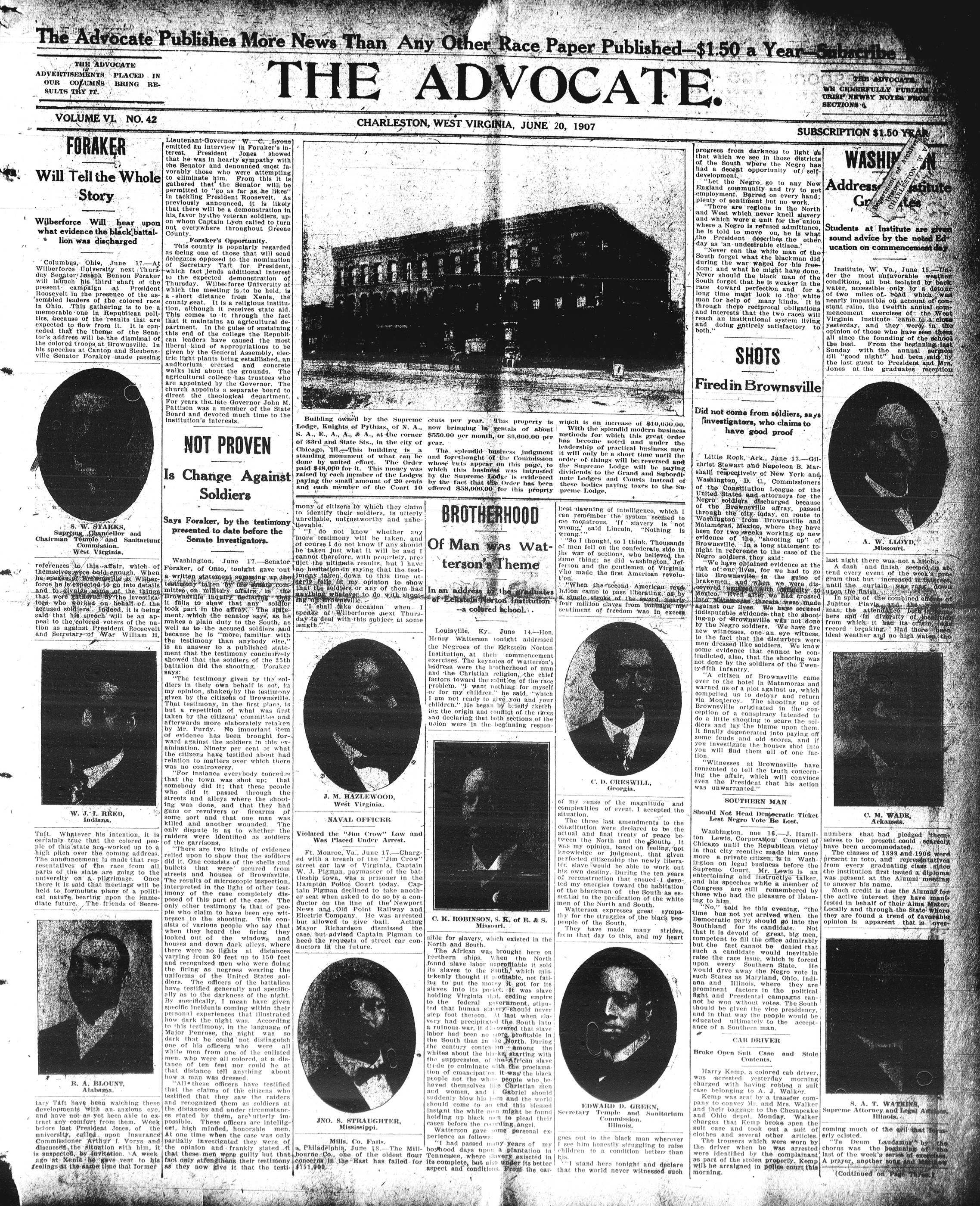
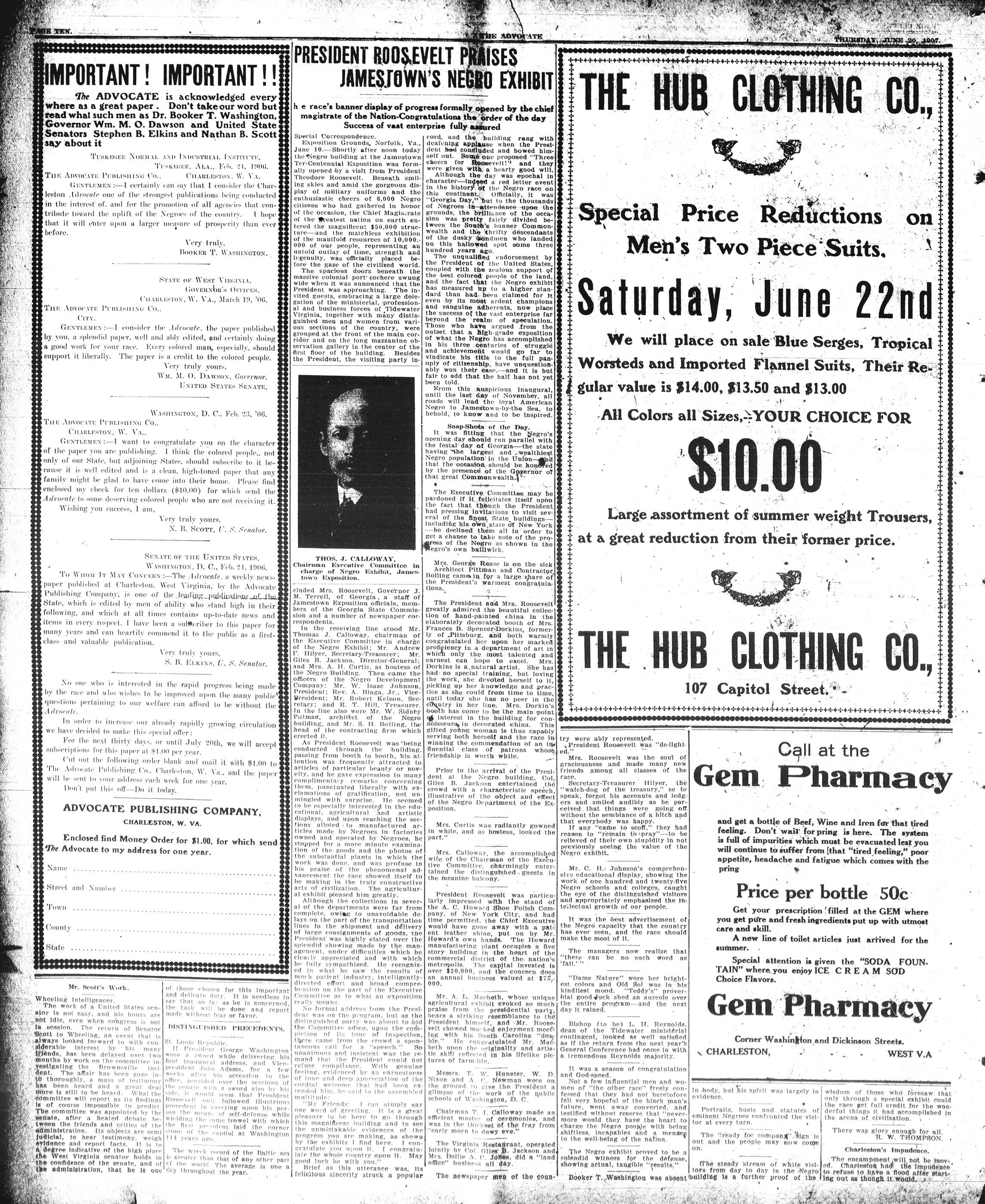
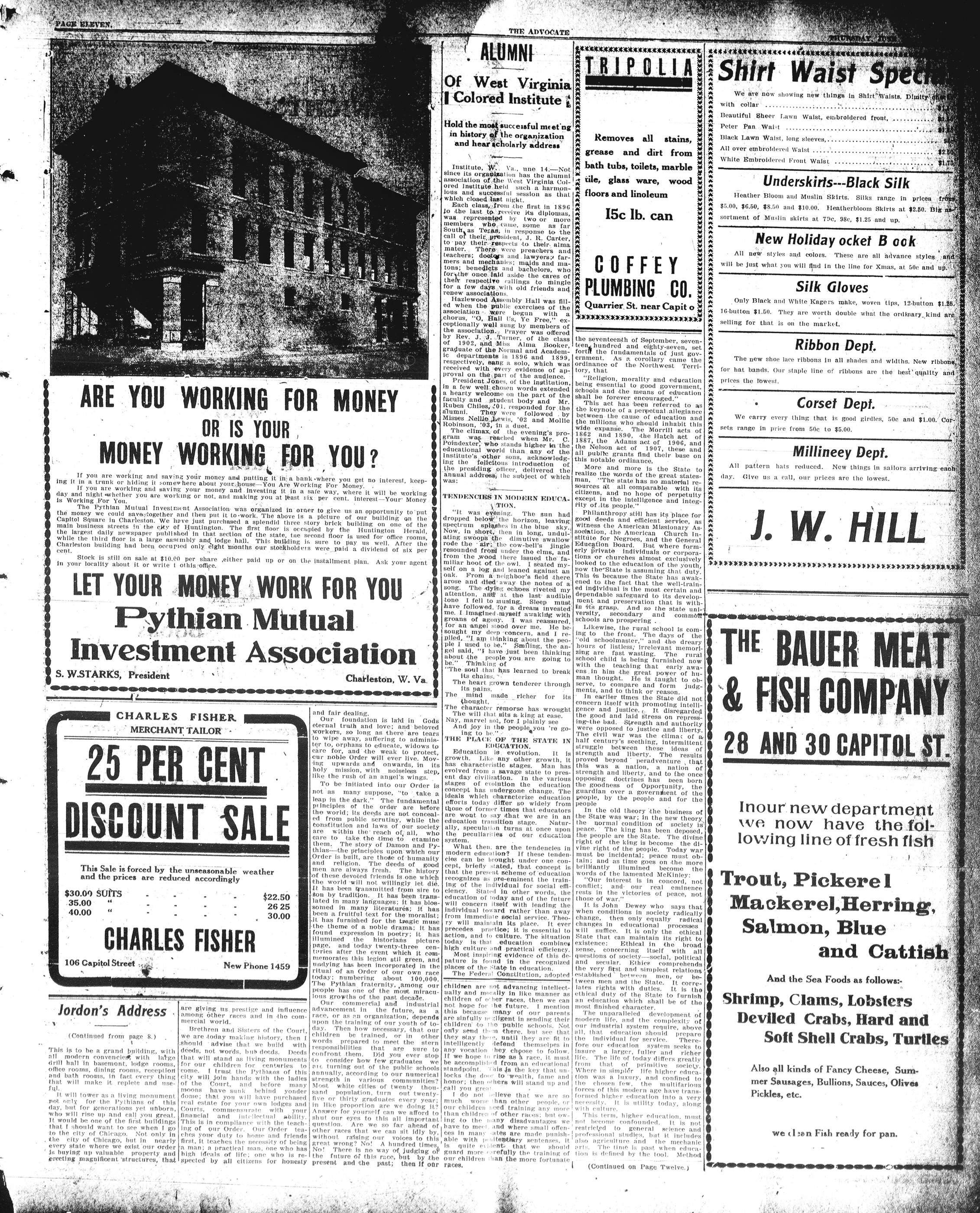
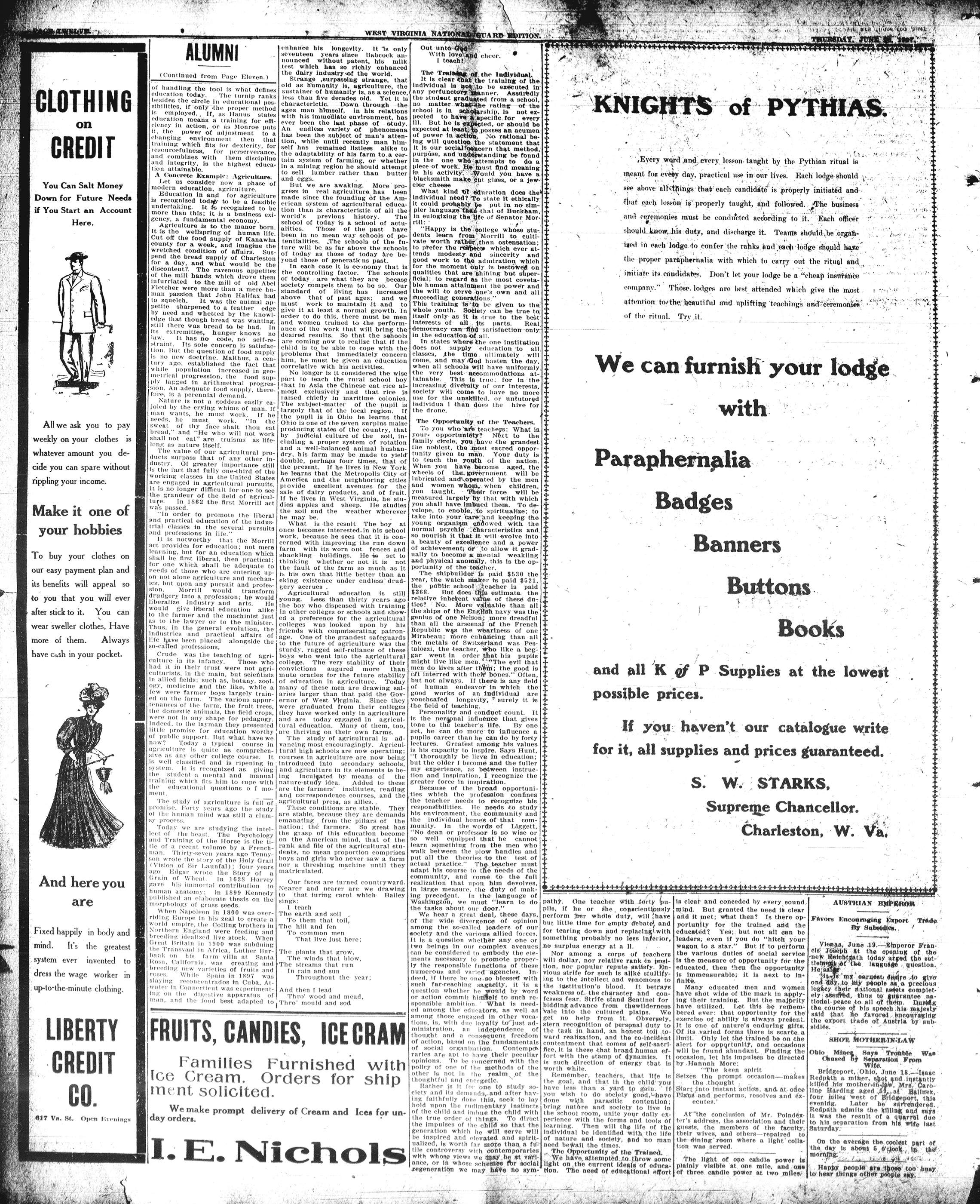
Page text (machine-generated)
THE ADVOCATE
ADVERTISEMENTS PLACED IN
OUR COLUMNS BRING RESULTS TRY IT.
VOLUME VI. NO. 42
FORAKER
Will Tell the Whole Story
Wilberforce Will hear upon what evidence the black battalion was discharged
Columbus, Ohio, June 17. At Wilberforce University next Thursday Senator: Joseph Benson Foraker will launch his third shaft of the present campaign at President Roosevelt in the presence of the assembled leaders of the colored race in Ohio. This gathering is to be a memorable one in Republican politics, because of the results that are expected to flow from it. It is conceded that the theme of the Senator's address will be the dismissal of the colored troops at Brownsville. In his speeches at Canton and Steubenville Senator Foraker made passing
```markdown
```
S. W. STARKS,
Supreme Chancellor and
Chairman Temple and Sanitarium
Commission.
West Virginia.
references to this affair, which of
themselves were bold enough. When
he speaks of Brunswick at Witfer-
force he is expected to go into details
and to divulge some of the things
that were gathered by the investigators
who worked on behalf of the
accused soldiers. Indeed, it is being
sald that his speech will be an appeal
to the colored voters of the nation
as against President Roosevelt
and Secretary of War William H.
[Image of a man in a suit with a tie].
W. J. L. REED, Indiana.
Taft. Whatever his intention, it is certainly true that the colored people of this state are worked up to a high pitch over the coming address. The announcement is made that representatives of the race from all parts of the state are going to the university on a pilgrimage. Once there it is said that meetings will be held to formulate plans of a political nature, bearing upon the immediate future. The friends of Secre-
PETER H.
tary Taft have been watching these developments with an anxious eye, and have not as yet been able to extract any comfort from them. Week before last President Jones, of the university, called upon Insurance Commissioner Arthur F. Vorys and discussed the situation with him, it is suspected, by Invitation. A week ago at Xenla he gave vent to his feelings at the same time that former
THE ADVOCATE.
Lleutenant-Governor W. C. Lyons emitted an interview in Foraker's interest. President Jones showed that he was in hearty sympathy with the Senator and denounced most favorably those who were attempting to eliminate him. From this it is gathered that the Senator will be permitted to "go as far as he likes" in tackling President Roosevelt. As previously announced, it is likely that there will be a demonstration in his favor by the veteran soldiers, upon whom Captain Lyon called to turn out everywhere throughout Greene County.
Forkerke's Opportunity.
This county is popularly regarded as being one of those that will send delegates opposed to the nomination of Secretary Taft for President, which fact lends additional interest to the expected demonstration of Thursday. Wilberforce University at which the meeting is to be held, is a short distance from Xenia, the county seat. It is a religious institution, although it receives state aid. This comes to it through the fact that it maintains an agricultural department. In the guise of sustaining this end of the college the Republican leaders have caused the most liberal kind of appropriations to be given by the General Assembly, electric light plants being established, an auditorium erected and concrete walks laid about the grounds. The agricultural college has trustees who are appointed by the Governor. The church appoints a separate board to direct the theological department. For years the late Governor John M. Pattison was a member of the State Board and devoted much time to the institution's interests.
Is Change Against Soldiers
Says Foraker, by the testimony presented to date before the Senate Investigators.
Washington, June 17.—Senator Foraker, of Onio, tonight gave out a written statement summing up the testimony taken by the senate committee on military affairs, in the Brownsville inquiry declaring that it fails to show that any soldier took part in the array. The statement, which the senator says, as he makes a plain duty to the South, as well as to the accused soldiers and because he is "more, familiar with the testimony than anybody else," is an answer to a published statement that the testimony conclusively showed that the soldiers of the 25th battalion did the shooting. Foraker says:
"The testimony given by the soldiers in their own behalf is not, in my opinion, shaken by the testimony given by the citizens of Brownsville. That testimony, in the first place, is but a repetition of what was first taken by the citizens' committees and afterwards more elaborately retaken by Mr. Purdy. No important item of evidence has been brought forward against the soldiers in this examination. Ninety per cent of what the citizens have testified about had relation to matters over which there was no controversy.
"For instance everybody concedes that the town was shot up; that somebody did it; that these people who did it passed through the streets and alleys where the shooting was done, and that they had guns or revolvers or firearms of some sort and that one man was killed and another wounded. The only dispute is as to whether the raiders were identified as soldiers of the garrisons.
"There are two kinds of evidence relied upon to show that the soldiers did it. One consists of the shells and bullets that were' secured from streets and houses of Brownsville. The results of microscopic inspection, interpreted in the light of other testimony of the case completely disposed of this part of the case. The only other testimony is that of people who claim to have been eye witnesses to the shooting. This consists of various people who say that when they heard the firing they looked out of the windows and houses and down dark alleys, where there were no lights at distances varying from 30 feet up to 150 feet and recognized men who were doing the firing as negroes wearing the uniforms of the United States soldiers. The officers of the battalion have testified generally and specifically as to the darkness of the night. By specifically, I mean have given specific incidents coming within their personal experiences that illustrated how dark the night was. According to this testimony, in the language of Major Penrose, the night was so dark that he could' not distinguish one of his officers who were all white men from one of the enlisted men, who were all colored, at a distance of ten feet nor could he at that distance tell anything about how a man was dressed.
"All these officers have testified that the claims of the citizens who testified that they saw the raiders and recognized them as soldiers at the distances and under circumstances stated by them, are utterly impossible. These officers are intelligent, high minded, honorable men. At one time when the case was only partially investigated they were of the opinion and frankly stated. At that these men were guilty but that fact only strengthens their testimony as they now give it that the testi-
THE MUSEUM OF THE WESTERN WESTERN WESTERN
Building owned by the Supreme
Lodge, Knights of Pythias, of N. A.,
S. A., E., A., A., & A., at the corner
of 33rd and State Sts., in the city of
Chicago, Ill.—This building is a
standing monument of what can be
done by united effort. The Order
paid $48,000 for it. This money was
raised by each member of the Lodges
paying the small amount of 20 cents
and each member of the Court 10
mony of citizens by which they claim
to identify their soldiers, is utterly
unreliable, untrustworthy and unbelievable.
"I do not know whether any more testimony will be taken, and of course I do not know if any should be taken just what it will be and I cannot therefore, with propriety, predict the ultimate results, but I have no hesitation in saying that the testimony taken, down to this time utterly falls in my opinion to show that the soldiers or any of them had anything whatever to do with shoot, in up unknownville.
"I shall take occasion when I speak at Wilberforce next Thursday to deal with this subject at some length."
J. M. HAZLEWOOD.
Violated the "Jim Crow" Law and Was Placed Under Arrest.
Ft. Monroe, Va., June 17.—Charged with a breach of the "Jim Crow" street car law of Virginia, Captain W. J. Pigman, paymaster of the battleship Iowa, was a prisoner in the Hampton Police Court today. Captain Pigman declined to take another seat when asked to do so by a conductor on the line of the "Newport News and Old Point Railway and Electric Company. He was arrested but allowed to give bail. Acting Mayor Richardson dismissed the case, but advised Captain Pigman to heed the requests of street car conductors in the future.
[Portrait of a man with a hat and a bow tie.]
Philadelphia, June 18. - The Mill-
bourne Co., one of the oldest flour
concerns in the East has failed for
4751,000.
cents per year. This property is now bringing in rentals of about $550.00 per month, or $3,600.00 per year. The splendid business judgment and forthought of the Commission whose cuts appear on this page, to which this business was intrusted by the Supreme Lodge is evidenced by the fact that the Order has been offered $58,000.00 for this property
BROTHERHOOD
Of Man was Waterson's Theme
In an address to the graduates of Eckstaff Norton Institution -- a colored school.
Louisville. Ky., June 14.-Hon. Henry Watterson tonight addressed the Negroes of the Eckstein Norton Institution, at their commencement exercises. The keynotes of Watterson's address were the brotherhood of man and the Christian religion, the chief factors toward the solution of the race problem. "I want nothing for myself or for my children," he said, "which I am not ready to give you and your children." He began by briefly sketching the origin and conflict of the races and declaring that both sections of the union were in the beginning respon-
A.
C. K. ROBINSON, S. K. of R. & S. Missouri.
sible for slavery, which existed in the North and South.
The African was brought here on northern ships. When the North found slave labor unprofitable it sold its slaves to the South, which mistakenly thought it profitable, not failing to put the money it got for its slaves into its pocket. It was slave holding Virginia that, ceding empire to the federal government, stipulated that human slavery should never step foot the thrones. At last when slavery had precipitated the South into a ruinous war, it discovered that slave labor had been no more profitable in the South than in the North. During the century contention among the whites about the blacks, starting with the suppression, of the African slave trade to culminate with the proclamation of emancipation it was the black people not the white people who behaved themselves like Christian men and women, and Gabriel should suddenly blow his horn and the world should come to an end this blessed instant the white men might be found holding up black men to plead their cases before the recording angel.
Watterson gave some personal experience as follows: "I had passed many years of my boyhood days upon a plantation in Tennessee, where slavery existed in its complete, but also under its better aspect and conditions. From the car-
which is an increase of $10,000.00.
With the splendid modern business methods for which this great order has become noted and under the leadership of practical business men it will only be a short time until the order of things will be reversed and the Supreme Lodge will be paying dividends to the Grand and Subordinate Lodges and Courts instead of these bodies paying taxes to the Supreme Lodge.
best dawning of intelligence, which I can remember the system seemed to me monstrous. 'If slavery is not wrong,' said Lincoln, "Nothing is wrong."
"So I thought, so I think. Thousands of men fell on the confederate side in the war of sections, who believed the same thing; as did Washington, Jefferson and the gentlemen of Virginia who made the first American revolution.
"When the second American revolution came to pass liberating, as by a single stroke of the sword, nearly four million slaves from indenture my sentiment of freedom was in excess
C. D. CRESWILL,
of my sense of the magnitude and complexities of event. I accepted the situation.
The three last amendments to the constitution were declared to be the actual and final treaty of peace between the North and the South. It was my opinion, based on feeling, not knowledge or judgment, that given perfected citizenship the newly liberated slave would be able to work out his own destiny. During the ten years of reconstruction that ensued I devoted my energies toward the habitation of the black man of the South as essential to the pacification of the white men of the North and South.
Watterson expresses great sympathy for the struggles of the black people of the South.
They have made many strides, from that day to this, and my heart
[Name]
EDWARD D. GREEN,
Secretary Temple and Sanitarium
Commission.
Illinois.
goes out to the black man wherever
I see him honestly struggling to raise
children to a condition better than
his.
"I stand here tonight and declare
that the world never witnessed such
progress from darkness to light as that which we see in those districts of the South where the Negro has had a decent opportunity of self-development.
"Let the Negro go to any New England community and try to get employment. Barred on every hand; plenty of sentiment but no work.
"There are regions in the North and West which never knelt slavery and which were a unit for the union where a Negro is refused admittance, he is told to move on, he is what the President describes the other day as 'an undesirable citizen.'
"Never can the white man of the South forget what the blackman did during the war waged for his freedom; and what he might have done. Never should the black man of the South forget that he is weaker in the race toward perfection and for a long time must look to the white man for help of many kinds. It is through these reciprocal obligations and interests that the two races will reach an institutional system living and doing entirely satisfactory to both."
SHOTS
Fired in Brownsville
Did not come from soldiers, says investigators, who claims to have good proof
Little Rock, Ark., June 17.—Gilchrist Stewart and Napoleon B. Marshall, respectively of New York and Washington, D. C., Commissioners of the Constitution League of the United States and attorneys for the Negro soldiers discharged because of the Brownsville affray, passed through the city today, en route to Washington from Brownsville and Matamoras, Mexico, where they have been for two weeks working up new evidence of the "shooting up" of Brownsville. In a long statement tonight in reference to the case of the Negro soldiers they said:
"We have obtained evidence at the risk of our lives, for we had to go into Brownsville in the guise of brakemen, and when we were discovered escaped with immunity to Mexico. Even after we had crossed into Manitoba, threats were made against our lives. We have secured indisputable evidence that the shooting-up of Brownsville was not done by the Negro soldiers. We have five new witnesses, one an, eye witness, to the fact that the disturbers were men dressed like soldiers. We know some evidence that cannot be contradicted, also, that the shooting was not done by the soldiers of the Twenty-fifth Infantry.
"A citizen of Brownsville came over to the hotel in Matamoras and warned us of a plot against us, which compelled us to detour and return via Monterey. The shooting up of Brownsville originated in the conception of a conspiracy intended to do a little shooting to scare the soldiers and lay the blame upon them. It finally degenerated into paying off some feuds and old scores, and if you investigate the houses shot into you will find them all of one faction.
"Witnesses at Brownsville have consented to tell the truth concerning the affair, which will convince even the President that his action was unwarranted."
SOUTHERN MAN
Should Not Head Democratic Ticket
Lest Negro Vote Be Lost
Washington, nue 16.—J. Hamilton Lewis, Corporation Counsel of Chicago until the Republican veto in that city reentitle made him one more a private citizen, is in Washington on legal business before the Supreme Court. Mr. Lewis is an entertaining and instructive talker, and his speeches whitle a member of Congress are still remembered by those who had the pleasure of listening to him.
"No," said he this evening, "the time has not yet arrived when the Democratic party should go into the Southland for its candidate. Not that it is devoid of great, big men, competent to fill the office admirably but the fact cannot be denied that such a candidate would inevitable raise the race issue, which is forced upon every Southern State. He would drive away the Negro vote in such States as Maryland, Ohio, Indiana and Illinois, where they are prominent factors in the political fight and Presidential campaigns cannot be be won without votes. The South should be given the vice presidency, and in that way the people would be educated ultimately to the acceptance of a Southern man.
CAB DRIVER
Broke Open Suit Case and Stole
Contents.
Harry Kemp, a colored cab driver, was arrested yesterday morning charged with having robbed a suit case belonging to A. J. Walker. Kemp was sent by a transfer company to convey Mr. and Mrs. Walker and their baggage to the Chesapeake and Ohio depot. Monday. Walker charges that Kemp broke open the suit case and took out a suit of clothes and several other articles. The trousers which were worn by the driver when he was arrested were identified by the complainant as part of the stolen property. Kemp will be arraigned in police court this morning.
WASHINGTON
DOWNTOWN OF ARCHITECT
ELEMENT CHARLESTON, W. V.
Address Institute
Grades
Students at Institute are given
sound advice by the noted Edu-
cation on commencement day
Institute, W. Va., June 15. Under the most unfavorable weather conditions, all but isolated by backwater, accessible only by a detour of two miles of road which was nearly impassible on account of constant rains, the twelfth annual commencement exercises of the West Virginia Institute came to a close yesterday, and they were, in the opinion of those who have seen them all since the founding of the school the best. From the beginning last Sunday with the annual sermon till "good night" had been said by the last guest to President and Mrs. Jones at the graduates reception
```markdown
```
last night there was not a hitch.
A dash and finish seemed to attend every event of the week's program that but increased in interest, until the curtain was rung, down upon the finish.
In spite of the combined efforts of Jupiter Plavis and the man, the attendance both in numbers and in diversity of societies from which it had its origin, was record breaking. Had there been ideal weather and no high water, the
1930
numbers that had pledged themselves to be present could separately have been accommodated.
The classes of 1899 and 1906 were present in toto, and representatives from every graduating class since the institution first issued a diploma was present at the Alumni meeting to answer his name.
Much credit is due the Alumni for the active interest they have manifested in behalf of their Alma Mater. Locally and through the State where they are found a trend of favorable opinion is apparent that is over-
```markdown
```
The ADVOCATE is acknowledged every where as a great paper. Don't take our word but read what such men as Dr. Booker T. Washington, Governor Wm. M. O. Dawson and United State Senators Stephen B. Elkins and Nathan B. Scott say about it
THE ADVOCATE PUBLISHING CO., CHARLESTON, W. VA.
GENTLEMEN: I certainly can say that I consider the Charleston Adroate one of the strongest publications being conducted in the interest of, and for the promotion of all agencies that contribute toward the uplift of the Negroes of the country. I hope that it will enter upon a larger measure of prosperity than ever before.
STATE OF WEST VIRGINIA.
GOVERNOR'S OFFICES.
CHARLESTON, W. VA., March 19, '06.
S. Co.
Under the Adroicate, the paper published
well and ably edited, and certainly doing
Every colored man, especially, should
paper is a credit to the colored people.
Very truly yours.
GENTLEMEN:—I consider the Advocate, the paper published by you, a splendid paper, well and ably edited, and certainly doing a good work for your race. Every colored man, especially, should support it liberally. The paper is a credit to the colored people.
WASHINGTON, D. C., Feb. 23, '06.
Co..
to congratulate you on the character
ing. I think the colored people, not
ning States, should subscribe to it be-
is a clean, high-toned paper that any
we come into their home. Please find
dollars ($10.00) for which send the
colored people who are not receiving it.
am.
Very truly yours.
N. B. SCOTT, U. S. Senator.
GENTLEMEN:—I want to congratulate of the paper you are publishing. I the only of our State, but adjoining State, cause it is well edited and is a clean, family might be glad to have come in enclosed my check for ten dollars ($ Advocate to some deserving colored pee Wishing you success, I am,
Very N.
SENATE OF WASHINGTON
To WHOM IT MAY CONCERN:—The paper published at Charleston, West Publishing Company, is one of the State, which is edited by men of ability following, and which at all times co- items in every respect. I have been a many years and can heartily commend class and valuable publication.
Very S. P.
No one who is interested in the by the race and who wishes to be imp questions pertaining to our welfare ca Advocate.
In order to increase our already we have decided to make this special o For the next thirty days, or until subscriptions for this paper at $1.00 per Cut out the following order blank The Advocate Publishing Co., Charleston will be sent to your address each week
GENTLEMEN:—I want to congratulate you on the character of the paper you are publishing. I think the colored people., not only of our State, but adjoining States, should subscribe to it because it is well edited and is a clean, high-toned paper that any family might be glad to have come into their home. Please find enclosed my check for ten dollars ($10.00) for which send the Advocate to some deserving colored people who are not receiving it. Wishing you success. I am
SENATE OF THE UNITED STATES
WASHINGTON, D. C., Feb. 24, 1906.
CERN:—The Adrocate, a weekly news-
tion, West Virginia, by the Advocate
of the leading publications of the
men of ability who stand high in their
times contains up-to-date news and
we have a subscriber to this paper for
we commend it to the public as a first-
ion.
To WHOM IT MAY CONCERN:—The Advocate, a weekly newspaper published at Charleston, West Virginia, by the Advocate Publishing Company, is one of the leading publications of the State, which is edited by men of ability who stand high in their following, and which at all times contains up-to-date news and items in every respect. I have been a subscriber to this paper for many years and can heartily commend it to the public as a first-class and valuable publication.
in the rapid progress being made
to be improved upon the many public
welfare can afford to be without the
our already rapidly growing circulation
special offer:
days, or until July 20th, we will accept
at $1.00 per year.
order blank and mail it with $1.00 to
To., Charleston, W. Va., and the paper
each week for one year.
do it today.
PUBLISHING COMPANY,
CLESTON, W. VA.
My Order for $1.00, for which send
address for one year.
No one who is interested in the rapid progress being made by the race and who wishes to be improved upon the many public' questions pertaining to our welfare can afford to be without the Advocate.
In order to increase our already rapidly growing circulation we have decided to make this special offer:
For the next thirty days, or until July 20th, we will accept subscriptions for this paper at $1.00 per year.
Cut out the following order blank and mail it with $1.00 to The Advocate Publishing Co., Charleston, W. Va., and the paper will be sent to your address each week for one year.
Don't put this off—Do it today.
ADVOCATE PUBLISH
CHARLESTON,
Enclosed find Money Order for
The Advocate to my address for o
Name ...
Street and Number ...
Town ...
County ...
State ..
Enclosed find Money Order for $1.00, for which send The Advocate to my address for one year.
Name ...
Street and Number ...
Town ...
County ...
State ..
W
a
n
l
u
S
e
a
t
t
m
v
d
o
t
h
m
o
c
i
T
s
e
v
s
f
e
a
d
t
h
CHARLESTON, W. VA.,
Mr. Scott's Work.
Wheeling Intelligencer
The work of a United States senator is not easy, and his hours are not idle, even when congress is not in session. The return of Senator Scott to Wheeling, an event that is always looked forward to with considerable interest by his many friends, has been delayed over two months by work on the committee investigating the Brownsville incident. The affair has been gone into thoroughly, a mass of testimony has been heard and a great deal more is still to be heard. What the committee will report as its findings is of course impossible to predict. The committee was appointed by the senate, after a heated debate between the friends and critics of the administration. Its objects are semi judicial, to hear testimony, weigh evidence and report facts. It is a degree indicative of the high place the West Virginia senator holds in the confidence of the senate, and of the administration, that he is one
Very truly. BOOKER T. WASHINGTON.
W.M. M. O. DAWSON, Governor. UNITED STATES SENATE.
Very truly yours,
S. B. ELKINS, U. S. Senator.
of those chosen for this important and delicate duty. It is needless to say that so far as he is concerned the task will be done and report made without fear or favor.
DISTINGUISHED PRECEDENTS
St. Louis Republic.
If President George Washington wore a sword while delivering his first inaugural address, and Vice-president John Adams, for a few weeks after his accession to the office, presided over the sessions of the senate with a sword also by his side, it would seem that President Roosevelt only followed illustrious precedent in carrying upon his person the means of self-defense while welding the same trowel with which the first president laid the corner stone of the capitol at Washington 114 years ago.
The wreck record of the Baltic sea is greater than that of any other part of the world. The average is one a day throughout the year.
PRESIDENT ROOSEVELT PRAISES JAMES TOWN'S NEGBO EXHIBIT
he race's banner display of progress formally opened by the chief magistrate of the Nation-Congratulations the order of the day Success of vast enterprise fully assured
Special Correspondence.
Exposition Grounds, Norfolk, Va., June 10.—Shortly after noon today the Negro building at the Jamestown Ter-Centennial Exposition was formally opened by a visit from President Theodore Roosevelt. Beneath smiling skies and amid the gorgeous display of military uniforms and the enthusiastic cheers of 6,000 Negro citizens who had gathered in honor of the occasion, the Chief Magistrate of the Greatest nation on earth entered the magnificent $50,000 structure—and the matchless exhibition of the manifold resources of 10,000,000 of our people, representing an untold outlay of time, strength and ingenuity, was officially placed before the gaze of the civilized world.
cord, and the building rang with deafening applause when the President had concluded and bowed himself out. Some one proposed "Three cheers for Roosevelt!" and they were given with a hearty good will. Although the day was epochal in character—indeed a red letter event in the history of the Negro race on this continent. Officially, it was "Georgia Day," but to the thousands of Negroes in attendance upon the grounds, the brilliance of the occasion was pretty fairly divided between the South's banner Commonwealth and the thrifty descendants of the dusky bondmen who landed on this hallowed spot some three hundred years ago.
The unqualified endorsement by the President of the United States,
The spacious doors beneath the massive colonial port cochere swung wide when it was announced that the President was approaching. The invited guests, embracing a large delegation of the ministerial, professional and business forces of Tidewater Virginia, together with many distinguished men and women from various sections of the country, were grouped at the front of the main corridor and on the long mazzanine observation gallery in the center of the first floor of the building. Besides the President, the visiting party in
The quick brown fox jumps over the lazy dog.
THOS. J. CALLOWAY, Chairman Executive Committee in charge of Negro Exhibit, Jamestown Exposition.
included Mrs. Roosevelt, Governor J. M. Terrell, of Georgia, a staff of Jamestown Exposition officials, members of the Georgia State Commission and a number of newspaper correspondents.
In the receiving line stood Mr. Thomas J. Calloway, chairman of the Executive Committee in charge of the Negro Exhibit; Mr. Andrew P. Hilyer, Secretary-Treasurer; Mr. Giles B. Jackson, Director-General; and Mrs. A. H. Curtis, as hostess of the Negro Building. Then came the officers of the Negro Development Company; Mr. W. Isaac Johnson, President; Rev. A. Binga, Jr., VicePresident; Mr. Robert Kelson, Secretary; and R. T. Hill, Treasurer. In the line also were Mr. W. Sidney Pitman, architect of the Negro building, and Mr. S. H. Bolling, the head of the contracting firm which erected it.
As President Roosevelt was 'being conducted through the building, passing from booth to booth, his attention was frequently attracted to articles of particular beauty or novelty, and he gave expression to many complimentary remarks concerning them, punctuated liberally with exclamations of gratification, not unmingled with surprise. He seemed to be especially interested in the educational, agricultural and artistic displays, and upon reaching the sections allotted to manufactured articles made by Negroes in factories owned and operated by Negroes, he stopped for a more minute examination of the goods and the photos of the substantial plants in which the work was done, and was profuse in his praise of the phenomenal advancement the race showed itself to be making in the truly constructive arts of civilization. The agricultural exhibit pleased him greatly.
Although the collections in several of the departments were far from complete, owing to unavoidable delays on the part of the transportation lines in the shipment and delivery of large consignments of goods, the President was highly elated over the splendid showing made by the management, under difficulties which he clearly appreciated and with which he fully sympathized. He recognized in what he saw the results of much patient industry, intelligently-directed effort and broad comprehension on the part of the Executive Committee as to what an exposition really means.
No formal address from the President was on the program, but as the distinguished party was about to bid the Committee adieu, upon the completion of its tour of inspection, there came from the crowd a spontaneous call for a "speech." So unanimous and insistent was the remand that the President could not refuse compliance. With genuine feeling, evidenced by an earnestness of tone and deep appreciation of the cordial welcome that had been extended him, he said to the assembled multitude:
"My Friends: I can simply say one word of greeting. It is a great pleasure to be here to go through this magnificent building and to see the unmistakable evidences of the progress you are making, as shown by the exhibits I find here. I congratulate you upon it. I congratulate the whole country upon it. May good luck be with you."
Brief as this utterance was, its felicious sincerity struck a popular
cord, and the building rang with deafening applause when the President had concluded and bowed himself out. Some one proposed "Three cheers for Roosevelt!" and they were given with a hearty good will. Although the day was epocalish in character—indeed a red letter event in the history of the Negro race on this continent. Officially, it was "Georgia Day," but to the thousands of Negroes in attendance upon the grounds, the brilliance of the occasion was pretty fairly divided between the South's banner Commonwealth and the thrifty descendants of the dusky bondmen who landed on this hallowed spot some three hundred years ago.
The unqualified endorsement by the President of the United States, coupled with the zealous support of the best colored people of the land, and the fact that the Negro exhibit has measured up to a higher standard than had been claimed for it even by its most ardent champions and sanguine adherents, now place the success of the vast enterprise far beyond the realm of speculation. Those who have argued from the outset that a high-grade exposition of what the Negro has accomplished in his three centuries of struggle and achievement would go far to vindicate his title to the full panoply of citizenship, have unquestionably won their case,—and it is but fair to add that the half has not yet been told.
From this auspicious inaugural, until the last day of November, all roads will lead the loyal American Negro to Jamestown-by-the Sea, to behold, to know and to be inspired.
Snap-Shots of the Day.
It was fitting that the Negro's opening day should run parallel with the festal day of Georgia—the state having the largest and wealthiest Negro population in the Union—and that the occasion should be honored by the presence of the Governor of that great Commonwealth.
The Executive Committee may be pardoned if it felicitates itself upon the fact that though the President had pressing invitations to visit several of the finest State buildings—including his own state of New York—he declined them all in order to get a chance to take note of the progress of the Negro as shown in the Negro's own bailiwick.
Mrs. George Rease is on the sick Architect Pittman and Contractor Bolling came in for a large share of the President's warmest congratulations.
The President and Mrs. Roosevelt greatly admired the beautiful collection of hand-painted china in the elaborately decorated booth of Mrs. Frances B. Spencer-Dorkins, formerly of Pittsburg, and both warmly congratulated her upon her marked proficiency in a department of art in which only the most talented and earnest can hope to excel. Mrs. Dorkins is a natural artist. She has had no special training, but loving the work, she devoted herself to it, picking up her knowledge and practice as she could from time to time, until today she has no peer in the country in her line. Mrs. Dorkin's booth has come to be the main point of interest in the building for connoisseurs in decorated china. This gifted young woman is thus capably serving both herself and the race in winning the commendation of an influential class of patrons whose friendship is worth while.
Prior to the arrival of the President at the Negro building, Col. Giles B. Jackson entertained the crowd with a characteristic speech, illustrative of the object and effect of the Negro Department of the Exposition.
Mrs. Curtis was radiantly gowned in white, and as hostess, looked the part."
Mrs. Calloway, the accomplished wife of the Chairman of the Executive Committee, charmingly entertained the distinguished guests in the meanine balcony.
President Roosevelt was particularly impressed with the stand of the A. C. Howard Shoe Polish Company, of New York City, and had time permitted, the Chief Executive would have gone away with a patient leather shine, put on by Mr. Howard's own hands. The Howard manufacturing plant occupies a five story building in the heart of the commercial district of the nation's metropolis. The capital invested is over $20,000, and the concern does an annual business valued at $75,000.
Mr. A. L. Macbeth, whose unique agricultural exhibit evoked so much praise from the presidential party, bears a striking resemblance to the President himself, and Mr. Roosevelt showed marked enjoyment meeting with his South Carolina "double." He congratulated Mr. Macbeth upon the originality and artistic skill reflected in his lifelike pictures of farm-life.
Messrs. T. W. Hunster, W. D. Nixon and A. C. Newman were on the ground to give the President a glimpse of the work of the public schools of Washington, D. C.
Chairman T. J. Calloway made an efficient master of ceremonies, and was in the thickest of the fray from "early morn to dowy eve."
The Virginia Restaurant, operated jointly by Col. Giles B. Jackson and Mrs. Dollie A. C. Jones, did a "land office" business all day.
The newspaper men of the coun-
THE HUB CLOTHING CO.,
Special Price Reductions on Men's Two Piece Suits.
Saturday, June 22nd
We will place on sale Blue Serges, Tropical Worsteds and Imported Flannel Suits, Their Regular value is $14.00, $13.50 and $13.00 All Colors all Sizes,--YOUR CHOICE FOR
Large assortment of summer weight Trousers, at a great reduction from their former price.
THE HUB CLOTHING CO.,
try were ably represented.
President Roosevelt was "de-lighted."
Mrs. Roosevelt was the soul of graciousness and made many new friends among all classes of the race.
Secretary-Treasurer Hilyer, the "watch-dog of the treasury," so to speak, forgot his accounts and ledgers and smiled audibly as he perceived that things were going off without the semblance of a hitch and that everybody was happy.
If any "came to scoff," they had reason to "remain to pray"—to be relieved of their own stupidity in not previously seeing the value of the Negro exhibit.
Mr. C. H. Johnson's comprehensive educational display, showing the work of one hundred and twenty-five Negro schools and colleges, caught the eye of the distinguished visitors and appropriately emphasized the intellectual growth of our people.
It was the best advertisement of the Negro capacity that the country has ever seen, and the race should make the most of it.
The managers now realize that "there can be no such word as 'fall.'"
"Dame Nature" wore her brightest colors and Old Sol was in his kindiest mood. "Teddy's" proverbial good luck shed an aureole over the entire program—and the next day it rained.
Bishop (to be) L. H. Reynolds, dean of the Tidewater ministerial contingent, looked as well satisfied as if the return from the next year's General Conference had come in with a tremendous Reynolds majority.
It was a season of congratulation and God-speed.
Not a few influential men and women of "the other race" freely confessed that they had not heretofore felt very hopeful of the black man's future, went away converted, and testified without reserve that "never more would they have the heart to charge the Negro people with being shiftless, incapables and a menace to the well-being of the nation.
The Negro exhibit proved to be a splendid witness for the defense, showing actual, tangible "results."
107 Capitol Street.
and get a bottle of Beef, Wine and Iron for that tired feeling. Don't wait for pring is here. The system is full of impurities which must be evacuated lest you will continue to suffer from [that "tired feeling," poor appetite, headache and fatigue which comes with the pring
Price per bottle 50c
Get your prescription filled at the GEM where you get pure and fresh ingredients put up with utmost care and skill.
A new line of toilet articles just arrived for the summer.
Special attention is given the "SODA FOUNTAIN" where you enjoy ICE CREAM SOD Choice Flavors.
Gem Pharmacy
```markdown
```
Price Reduced
Two Piece
Day, June
pace on sale Blue S
imported Flannel S
14.00, $13.50 and $1
All Sizes,--YOUR C
$10.00
tment of summer w
tion from their for
B CLOTH
107 Capitol Street
Call
Gem Ph
and get a bottle of Beef, W
feeling. Don't wait for p
is full of impurities which
will continue to suffer from
appetite, headache and fa
pring
Price per
Get your prescription
you get pure and fresh ing
care and skill.
A new line of toilet an
summer.
Special attention is g
TAIN" where you enjoy 10
Choice Flavors.
Gem Ph
Corner Washington a
CHARLESTON,
In body, but his spirit was largely in evidence.
Portraits, busts and statutes of eminent Negroes confronted the visitor at every turn.
The "ready for company" sign is out and the people may now come on.
The steady stream of white visitors from day to day in the Negro building is a further proof of the
wisdom of those who foresaw that only through a special exhibit could the race get full credit for the wonderful things it had accomplished in the arena of civilization.
There was glory enough for all.
R. W. THOMPSON.
The encampment will not be moved. Charleston had the impudence to refuse to have a flood after starting out as though it would.
THE HISTORY OF THE
MUSEUM OF ART
IN CHEVY
ARE YOU WORKING FOR MONEY OR IS YOUR MONEY WORKING FOR YOU?
If you are working and saving your money and putting it in a bank-where you get no interest, keeping it in a trunk or hiding it somewhere about your house—You Are Working For Money. . . . If you
If you are working and saving your money and investing it in a safe way, where it will be working day and night whether you are working or not, and making you at least six per cent. interest—Your Money is Working For You.
The Pythian Mutual Investment Association was organized in order to give us an opportunity to put the money we could save together and then put it to work. The above is a picture of our building on the Capitol Square in Charleston. We have just purchased a splendid three story brick building on one of the main business streets in the city of Huntington. The first floor is occupied by the Huntington Herald, the largest daily newspaper published in that section of the state, the second floor is used for office rooms, while the third floor is a large assembly and lodge hall. This building is sure to pay us well. After the Charleston building had been occupied only eight months our stockholders were paid a dividend of six per cent.
Stock is still on sale at $10.00 per share either paid up or on the installment plan. Ask your agent in your locality about it or write t othis office.
LET YOUR MONEY WORK FOR YOU Pythian Mutual Investment Association
CHARLES FISHER
MERCHANT TAILOR
25 PER CENT
DISCOUNT SALE
This Sale is forced by the unseasonable weather
and the prices are reduced accordingly
$30.00 SUITS - - - - $22.50
35.00 " - - - 26.25
40.00 " - - - 30.00
CHARLES FISHER
106 Capitol Street New Phone 1459
S. W. STARKS, President
CHARLES
MERCHAN
25 PER
DISCOUNT
This Sale is forced by th
and the prices are redu
$30.00 SUITS
35.00 "
40.00 "
CHARLES
106 Capitol Street
Jordon's Address
(Continued from page 8.)
This is to be a grand building, with all modern conveniences, with large drill hall in basement, lodge rooms, office rooms, dining rooms, reception and bath rooms, in fact every thing that will make it replete and useful.
It will tower as a living monument not only for the Pythians of this day, but for generations yet unborn, who will rise up and call you great. It would be one of the first buildings that I should want to see when I go to the city of Chicago. Not only in the city of Chicago, but in nearly every state where we exist our order is buying up valuable property and erecting magnificent structures, that
are giving us prestige and influence among other races and in the commercial world.
Brethren and Sisters of the Court, we are today making history, then I should advise that we build with deeds, not words, bub deeds. Deeds that will stand as living monuments for our children for centuries to come. I trust the Pythagus of this city will join hands with the ladies of the Court, and before many moons have sunk behind yonder dome; that you will have purchased real estate for your own lodges and Courts, commensurate with your financial and intellectual ability. This is in compliance with the teaching of our Order. Our Order teaches your duty to home and friends first, it teaches the necessity of being a man; a practical man, one who has high ideals of life; one who is respected by all citizens for honesty
Charleston, W. Va.
and fair dealing.
Our foundation is laid in Gods eternal truth and love; and beloved workers, so long as there are tears to wipe away, suffering to administer to, orphans to educate, widows to care for, and the weak to protect, our noble Order will ever live. Moving upwards and onwards, in its holy mission, with noiseless step, like the rush of an angel's wings.
To be initiated into our Order is not as many suppose, "to take a leap in the dark." The fundamental principles of the order are before the world; its deeds are not concealed from public scrutiny, while the constitution and laws of our society are within the reach of all, who care to take the time to etamine them. The story of Damon and Pythias—the principles upon which our Order is built, are those of humanity and religion. The deeds of good men are always fresh. The history of these devoted friends is one which the world will not willingly let die. It has been transmitted from sire to son by tradition. It has been translated in many languages; it has blossomed in many literatures; it has been a fruitful text for the moralist; it has furnished for the tragic muse the theme of a noble drama; it has found expression in poetry; it has illumined the historians picture page, and today twenty-three centuries after the event which it commemorates this legion still green, and undying has been incorporated in the ritual of an Order of our own race today; numbering about 100,000. The Pythian fraternity, among our people has one of the most miraculous growths of the past decade.
Our commercial and industrial advancement in the future, as a race, or as an organization, depends upon the training of our youth of today. Then how necessary, that our children be trained, or in other words prepared to meet the stern responsibilities that are sure to confront them. Did you ever stop to consider how few graduates we are turning out of the public schools annually, according to our numerical strength in various communities? Most white cities of twenty thousand population, turn out twenty-five or thirty graduates every year; in like proportion are we doing it? Answer for yourself can we afford to shut our eyes to this all important question. Are we so far ahead of other races that we can sit idly by, without raising our voices to this great wrong? No! A hundred times, No! There is no way of judging of the future of this race, but by the present and the past; then if our
THE ADVOCATE
Hold the most successful meeting in history of the organization and hear scholarly address
Institute, W. Va., no. 14.—Not since its organization has the alumni association of the West Virginia Colored Institute held such a harmonious and successful session as that which closed last night.
Each class, from the first in 1896 to the last to receive its diplomas, was represented by two or more members who came, some as far South as Texas, in response to the call of their president, J. R. Carter, to pay their respects to their alma mater. There were preachers and teachers; doctors and lawyers; farmers and mechanics; maids and matons; beneficents and bachelors, who for the once laid aside the cares of their respective callings to mingle for a few days with old friends and renew associations.
Hazlewood Assembly Hall was filled when the public exercises of the association were begun with a chorus, "O, Hail Us, Ye Free," exceptionally well sung by members of the association. Prayer was offered by Rev. J. J. Turner, of the class of 1902, and Miss Alma Booker, graduate of the Normal and Academic departments in 1896 and 1899, respectively, sang a solo, which was received with every evidence of approval on the part of the audience.
President Jones, of the institution, in a few well chosen words extended a hearty welcome on the part of the faculty and student body and Mr. Ruben Chiles, '01, responded for the alumni. They were followed by Miss Nellie Lewis, '02 and Mollie Robinson, '03, in a duet.
The climax of the evening's program was reached when Mr. C. Pofindexter, who stands higher in the educational world than any of the Institute's other sons, acknowledging the felicitous introduction of the presiding officer, delivered the annual address, the subject of which was:
TENDENCIES IN MODERN EDUCA-TION
"It was evening. The sun had dropped below the horizon, leaving spectrum splashes in the blue sky. Now, in short, then in long, undulating swoops the dimutive swallow rode the air; the cow-bell's jingle resounded from under the elms, and from the wood there issued the familiar hoot of the owl. I seated myself on a log and leaned against an oak. From a neighbor's field there arose and died away the notes of a song. The dying echoes riveted my attention, and at the last audible tone I fell to musing. Sleep must have followed, for a dream invested me. I imagined myself awakening with groans of agony. I was reassured, for an angel stood over me. He be-sought my deep concern, and I replied, "I am thinking about the people I used to be." Smiling, the angel said, "I have just been thinking about the people you are going to be." Thinking of
"The soul that has learned to break its chains."
The heart grown tenderer through
its pains.
The mind made richer for its
thought.
The character remorse has wrought
The will that sits a king at ease.
Nay, marvel not, for I plainly see
Education is evolution. It is growth. Like any other growth, it has characteristic stages. Man has evolved from a savage state to present day civilization. In the various stages of evolution the education concept has undergone change. The ideals which characterize education efforts today differ so widely from those of former times that educators are wont to say that we are in an education transition stage. Naturally, speculation turns at once upon the peculiarities of our education system.
What then, are the tendencies in modern education? If these tendencies can be brought under one concept, briefly stated, that concept is that the present scheme of education recognizes as pre-eminent the training of the individual for social efficiency. Stated in other words, the education of today and of the future will concern itself with leading the individual toward rather than away from immediate social service. Theory will maintain its place. It ever precedes practice; it is essential to action, and to culture. The situation today is that education combines high culture and practical efficiency.
Most inspiring evidence of this departure is found in the recognized places of the State in education. The Federal Constitution, adopted children are not advancing intellectually and morally in like manner as children of other races, then we can not hope for the future. I mention this because many of our parents are sinfully negligent in sending their children to the public schools. Not only send them there, but see that they stay there, until they are fit to intelligently defend themselves in any vocation they choose to follow. If we hope to rise as a race, it must be accomplished from an educational standpoint. This is the key that unlocks the door to wealth, fame and honor; then others will stand up and call you great.
I do not believe that we are so much worse than other people, or our children need training any more than children of other races; but owing to the many disadvantages we have to meet and where small offences in many cases are made punishable with penitentiary sentences, it is quite evident that we should guard more carefully the training of our children than the more fortunate races.
Removes all stains, grease and dirt from bath tubs, toilets, marble tile, glass ware, wood floors and linoleum
the seventeenth of September, seventeen hundred and eighty-seven, set forth the fundamentals of just government. As a corollary came the ordinance of the Northwest Territory, that "Religion, morality and education being essential to good government, schools and the means of education shall be forever encouraged."
This act has been referred to as the keynote of a perpetual allegiance between the cause of education and the millions who should inhabit this wide expanse. The Morrill acts of 1862 and 1890, the Hatch act of 1887, the Adams act of 1906, and the Nelson act of 1907, these and all public grants find their base on this notable ordinance.
More and more is the State to realize the words of the great statesman, "The state has no material resources at all comparable with its citizens, and no hope of perpetuity except in the intelligence and integrity of its people."
Philanthropy still has its place for good deeds and efficient service, as witness the American Missionary Association, the American Church Institute for Negroes, and the General Education Board. But where formerly private individuals or corporations or churches almost exclusively looked to the education of the youth, now the State is assuming that duty. This is because the State has awakened to the fact that the well-trained individual is the most certain and dependable safeguard to its development and preservation that is within its grasp. And so the state university, secondary and common schools are prospering.
Likewise, the rural school is coming to the front. The days of the "old schoolmaster," and the dreary hours of listless, irrelevant memorizing are fast wasting. The rural school child is being furnished now with the teaching that early awaens, in him the great power of human thought. He is taught to observe, to compare and form judgments, and to think or reason.
In earlier times the State did not concern itself with promoting intelligence and justice. It disregarded the good and laid stress on repressing the bad. Strength and authority were opposed to justice and liberty. The civil war was the climax of a half century's seething, intermittent struggle between these ideas of strength and liberty. The results proved beyond peradventure, that this was a nation, a nation of strength and liberty, and to the once opposing doctrines has been born the goodness of Opportunity, the guardian over a government of the people, by the people and for the people
In the old theory the business of the State was war; in the new theory the normal condition of society is peace. The king has been deposed, the people are the State. The divine right of the king is become the divine right of the people. Today war must be incidental; peace must obtain; and as time goes on the more brilliantly illuminated become the words of the lamented McKinley:
"Our interest is in concord, not conflict; and our real eminence rests in the victories of peace, not those of war."
It is John Dewey who says that when conditions in society radically change, then only equally radical changes in educational processes will suffice. It is only the ethical State that can maintain its right to existence: Ethical in the broad sense, concerning itself with all questions of society—social, political and secular. Ethics comprehends the very first and simplest relations established between men, or between men and the State. It correlates rights with duties. It is the ethical duty of the State to furnish an education which shall be of the most finished character.
The unparalleled development of modern life, and the complexity of our industrial system require, above all, that education should prepare the individual for service. Therefore our education system seeks to insure a larger, fuller and richer life. The life of today differs greatly from that of primitive society. Where in simpler life higher education was a luxury, and confined to the chosen few, the multifarious forces of this modern age have transformed higher education into a very necessity. It is utility today, along with culture. This term, higher education, must not become confounded. It is not restricted to general science and professional studies, but it includes also agriculture and the mechanic arts. The time is past when education is defined by the tool. Method
(Continued on Page Twelve.)
We are now showing new things in Shirt Waists, Dimity of
with collar ..... $1.10
Beautiful Sheer Lawn Waist, embroidered front, ..... $1.10
Peter Pan Waist ..... $1.10
Black Lawn Waist, long sleeves, ..... $6.0
All over embroidered Waist ..... $2.60
White Embroidered Front Waist ..... $1.75
Underskirts---Black Silk
her Bloom and Muslin Skirts. Silks range in pr
$50, $8.50 and $10.00. Heatherbloom Skirts at $2.
of Muslin skirts at 79c, 98c, $1.25 and up.
Heather Bloom and Muslin Skirts. Silks range in prices from $5.00, $6.50, $8.50 and $10.00. Heatherbloom Skirts at $2.50. Big assortment of Muslin skirts at 79c, 98c, $1.25 and up.
New Holidayocket Book
All new styles and colors. These are all advance styles, and will be just what you will find in the line for Xmas, at 50c and up.
Silk Gloves
Black and White Kagers make, woven tips, 12-buckles, $1.50. They are worth double what the ordinary merchant that is on the market.
Ribbon Dept.
new shoe lace ribbons in all shades and widths. New bands. Our staple line of ribbons are the best of the lowest.
Corset Dept.
carry everything that is good girdles, 50c and 100c in price from 50c to $5.00.
Millineey Dept.
pattern hats reduced. New things in sailors arrive us a call, our prices are the lowest.
J. W. HILL
THE BAUER MEN'S FISH COMPANY
AND 30 CAPITOL
our new department we now have the fishing line of fresh fish
out, Pickerel
ackerel, Herring,
Salmon, Blue
and Catt
Only Black and White Kagers make, woven tips, 12-button $1.25. 16-button $1.50. They are worth double what the ordinary kind are selling for that is on the market.
THE BAUER MEAT & FISH COMPANY 28 AND 30 CAPITOL ST.
Inour new department we now have the following line of fresh fish
Trout, Pickerel Mackerel,Herring, Salmon, Blue and Cattish And the Sea Foods as follows:-
Imp, Clams, Lobsters or Reviled Crabs, Hard and Soft Shell Crabs, Tur Also all kinds of Fancy Cheese, Summer Sausages, Bullions, Sauces, Olives Pickles, etc.
Shrimp, Clams, Lobsters Deviled Crabs, Hard and Soft Shell Crabs, Turtles
Also all kinds of Fancy Cheese, Summer Sausages, Bullions, Sauces, Olives Pickles, etc.
we clean Fish ready for pan.
CLOTHING on CREDIT
You Can Salt Money Down for Future Needs if You Start an Account Here.
M
All we ask you to pay weekly on your clothes is whatever amount you decide you can spare without rippling your income.
Make it one of your hobbies
To buy your clothes on our easy payment plan and its benefits will appeal so to you that you will ever after stick to it. You can wear sweller clothes, Have more of them. Always have cash in your pocket.
A
And here you are
Fixed happily in body and mind. It's the greatest system ever invented to dress the wage worker in up-to-the-minute clothing.
LIBERTY
CREDIT
CO.
617 Va. St. Open Evenings
---
FRUITS, CANDIES, ICECRAM
Families Furnished with Ice Cream. Orders for shipment solicited. We make prompt delivery of Cream and Ices for unday orders.
(Continued from Page Eleven.)
of handling the tool is what defines education today. The turnip ranks besides the circle in educational possibilities, if only the proper method is employed. If, as Hanus states education means a training for efficiency in action, or as Monroe puts it, the power of adjustment to a changing environment then that training which fits for dexterity, for resourcefulness, for perseverance, and combines with them discipline and integrity, is the highest education attainable.
A Concrete Example: Agriculture.
Let us consider now a phase of modern education, agriculture.
Education in and for agriculture is recognized today to be a feasible undertaking. It is recognized to be more than this; it is a business exigency, a fundamental economy.
Agriculture is to the manor born. It is the wellspring of human life. Cut off the food supply of Kanawha county for a week, and imagine the wretched condition of affairs. Suspend the bread supply of Charleston for a day, and what would be the discontent? The ravenous appetites of the mill hands which drove them infuriated to the mill of old Abel Fletcher were more than a mere human passion that John Halifax had to squelch. It was the animal appetite sharpened to a feather edge by need and whetted by the knowledge that though bread was wanting, still there was bread to be had. In its extremities, hunger knows no law. It has no code, no self-restraint. Its sole concern is satisfaction. But the question of food supply is no new doctrine. Malthus, a century ago, established the fact that while population increased in geometrical progression, the food supply lagged in arithmetical progression. An adequate food supply, therefore, is a perennial demand.
Nature is not a goddess easily coled by the crying whins of man. If man wants, he must work. If he needs, he must work. "In the sweat, of thy face shalt thou eat bread," and "He who will not work shall not eat" are truisms as lifelong as nature itself.
The value of our agricultural products surpass that of any other industry. Of greater importance still is the fact that fully one-third of the working classes in the United States are engaged in agricultural pursuits. It is no longer difficult for one to see the grandeur of the field of agriculture. In 1862 the first Morrill act was passed.
"In order to promote the liberal and practical education of the industrial classes in the several pursuits and professions in life."
It is notworthy that the Morrill act provides for education; not mere learning, but for an education which shall be first liberal, then practical; for one which shall be adequate to needs of those who are entering upon not alone agriculture and mechanics, but upon any pursuit and profession. Morrill would transform drudgery into a profession; he would liberalize industry and arts. He would give liberal education alike to the farmer and the machinist just as to the lawyer or to the minister. Thus, in the general evolution, the industries and practical affairs of life have been placed alongside the so-called professions.
Crude was the teaching of agriculture in its infancy. Those who had it in their trust were not agriculturists, in the main, but scientists in allied fields; such as, botany, zoology, medicine and the like, while a few were farmer boys largely trained on the farm. The various appurtenances of the farm, the fruit trees, the domestic animals, the field crops, were not in any shape for pedagogy. Indeed, to the layman they presented little promise for education worthy of public support. But what have we now? Today a typical course in agriculture is quite as comprehensive as any other college course. It is well classified and is ripening in system. It is recognized as giving the student a mental and manual training which fits him to cope with the educational questions of f moment.
The study of agriculture is full of promise. Forty years ago the study of the human mind was still a clumsy process. Today we are studying the intellect of the beast. The Psychology and Training of the Horse is the title of a recent volume by a Frenchman. Thirty-seven years ago Tennyson wrote the story of the Holy Grail (Vision of Sir Launfal); four years ago Edgar wrote the Story of a Grain of Wheat. In 1628 Harvey gave his immortal contribution to human anatomy; in 1899 Kennedy published an elaborate thesis on the morphology of grass seeds.
When Napoleon in 1800 was overriding Europe in his zeal to create a world empire, the Colling brothers in Northern England were feeding and breeding idealized live stock. When Great Britain in 1900 was subduing the Transvaal in Africa, Luther Burbank on his farm villa at Santa Rosa, California, was creating and breeding new varieties of fruits and roses. While Spain in 1897 was slaying reconcentrados in Cuba, Atwater in Connecticut was experimenting on the digestive apparatus of man, and the food best adapted to
enhance his longevity. It is only seventeen years since Babcock announced without patent, his milk test which has so richly enhanced the dairy industry of the world.
Strange, surpassing strange, that old as humanity is, agriculture, the sustainer of humanity is, as a science, less than five decades old. Yet it is characteristic. Down through the ages man himself, in his relations with his immediate environment, has ever been the last phase of study. An endless variety of phenomena has been the subject of man's attention, while until recently man himself has remained listless alike to the adaptability of his farm to a certain system of farming, or whether in a mining region he should attempt to sell lumber rather than butter and eggs.
But we are awakening. More progress in real agriculture has been made since the founding of the American system of agricultural education than is characteristic of all the world's previous history. The school of today is a school of actualities. Those of the past have been in no mean way schools of potentialities. The schools of the future will be as far above the schools of today as those of today are beyond those of generations past.
In each case it is economy that is the controlling factor. The schools of today are what they are because society compels them to be so. Our standard of living has increased above that of past ages; and we must work to maintain it and to give it at least a normal growth. In order to do this, there must be men and women trained to the performance of the work that will bring the desired results. So that the schools are coming now to realize that if the child is to be able to cope with the problems that immediately concern him, he must be given an education correlative with his activities.
No longer is it considered the wise part to teach the rural school boy that in Asia the Chinese eat rice almost exclusively and that rice is raised chiefly in maritime colonies. The subject-matter of the pupil is largely that of the local region. If the pupil is in Ohio he learns that Ohio is one of the seven surplus maize producing states of the country, that by judicial culture of the soil, including a proper system of rotation and a well-balanced animal husbandry, his farm may be made to yield double, perhaps four times, that of the present. If he lives in New York he learns that the Metropolis City of America and the neighboring cities provide excellent avenues for the sale of dairy products, and of fruit. If he lives in West Virginia, he studies apples and sheep. He studies the soil and the weather wherever he may be.
What is the result. The boy at once becomes interested. in his school work, because he sees that it is concerned with improving the run down farm with its worn out fences and shackling buildings. He is set to thinking whether or not it is not the fault of the farm so much as it is his own that little better than an eking existence under endless drudgery accrues.
Agricultural education is still young. Less than thirty years ago the boy who dispensed with training in other colleges or schools and showed a preference for the agricultural colleges was looked upon by his friends with commiserating patronage. One of the greatest safeguards to the future of agriculture was the sturdy, rugged self-reliance of these boys who went into the agricultural college. The very stability of their convictions augured more than mute oracles for the future stability of education in agriculture. Today many of these men are drawing salaries larger than that paid the Governor of West Virginia. Since they were graduated from their colleges they have worked only in agriculture and are today engaged in agricultural education. Many of them, too, are thriving on their own farms.
The study of agricultural is advancing most encouragingly. Agricultural high schools are now operating; courses in agriculture are now being introduced into secondary schools, and agriculture in its elements is being incubated by means of the nature-study idea. Added to these are the farmers' institutes, reading and correspondence courses, and the agricultural press, as allies. These conditions are stable. They are stable, because they are demands emanating from the pillars of the nation; the farmers. So great has the grasp of this education become on the American mind, that of the rank and file of the agricultural students, no mean proportion comprises boys and girls who never saw a farm nor a threshing machine until they matriculated.
Our faces are turned countryward. Nearer and nearer are we drawing to that huring carol which Bailey sings:
I teach
The earth and soil
To them that toil,
The hill and fen
To common men
That live just here;
The plants that grow,
The winds that blow,
The streams that run
In rain and sun
Throughout the year;
And then I lead
Thro' wood and mead,
Thro' mould and sod
The Training of the Individual. It is clear that the training of the individual is not to be executed in any perfunctory manner. Assuredly the student graduated from a school, no matter what the rating of the school is in scholarship, is not expected to have a specific for every ill. But he is expected, or should be expected at least, to possess an acumen of power in action. No rational being will question the statement that it is our social concern that method, purpose, and understanding be found in the one who attempts to do a piece of work. He must find meaning in his activity. Would you have a blacksmith make cut glass, or a jeweler cheese
What kind of education does the individual need? To state it ethically it could probably be put in no simpler language than that of Buckham, in eulogizing the life of Senator Morrill:
"Happy is the college whose students learn from Morrill to cultivate worth rather than ostensation; to prefer the respects which ever attends modesty and sincerity and good work to the admiration which for the moment only is bestowed on qualities that are shifting but superficial; to regard as the most covetable human attainment the power and the will to serve one's own and all succeeding generations."
This training is to be given to the whole youth. Society can be true to itself only as it is true to the best interests of all its parts. Real democracy can find satisfaction only in the education of all.
In states where the one institution does not supply education to all classes, the time ultimately will come, and may God hasten the day, when all schools will have uniformly the very best accommodations attainable. This is true; for in the increasing diversity of our interests, society will come to have no more use for the unskilled, or unutored individual 1 than does the hive for the drone.
The Opportunity of the Teachers.
To you who are teachers: What is your opportunity? Nect to the family circle, you have the greatest the noblest, the most sacred opportunity given to man. Your duty is to teach the youth of the nation. When you have become aged, the wheels of the government will be lubricated and operated by the men and women whom, when children, you taught. Their force will be measured largely by that with which you shall have imbued them. To develop, to enoble, to spiritualize; to take into your care; and keeping the young organism endowed with the normal psychic characteristics and so nourish it that it will evolve into a beauty of excellence and a power of achievement; or to allow it gradually to become a mental weakling and physical anomaly, this is the opportunity of the teacher.
The shipbuilder is paid $530 the year, the watch maker is paid $521 the public school teacher is paid $368. But does this estimate the relative inherent value of these duties? No. More valuable than all the ships of the English navy was the genius of one Nelson; more dreadful than all the arsealen of the French Republic was the weariness of one Miraeau; more enhancing than all the metals of Switzerland was Pestalozzi, the teacher, who like a beggar went in order that his pupils might live like men. The evil that men do lives after them; the good is oft interred with their bones. Often, but not always. If there is any field of human endeavor in which the good works of an individual are vouchsafed longevity, surely it is the field of teaching.
Personality and conduct count. It is the personal influence that gives tone to the teacher's life. By one act, he can do more to influence a pupils career than he can do by forty lectures. Greatest among his values is his capacity to inspire. Says Hunt, "I thoroughly be live in education; but the older I become and the fuller my experience, as between instruction and inspiration, I recognize the greater force in inspiration.
Because of the broad opportunities which the profession confines the teacher needs to recognize his responsibilities. He needs to study his environment, the community and the individual homes of that community. In the words of Liggett, "No dean or professor is so wise or so well equipped that he cannot learn something from the men who walk between the plow handles and put all the theories to the test of actual practice." The teacher must adapt his course to the needs of the community, and come to the full realization that upon him devolves, in large measure, the duty of making precedent. In the language of Washington, we must "learn to do the tasks about our door."
We hear a great deal, these days, of the wide divergence of opinion among the so-called leaders of our society and the various allied forces. It is a question whether any one or two beings in our complex avenues can be considered to embody the elements necessary to promote properly the responsible functions of these numerous and varied agencies. Indeed, if there be one so blessed with such far-reaching sagacity, it is a question whether he would by word or action commit himself to such responsible ambition. What is needed among the educators, as well as among those engaged in other vocations, is, with due loyalty to just administration, an independence of thought and a consequent freedom of action, based on the fundamentals of social organization. Contemporaries are apt to have their peculiar opinions. To be concerned with the policy of one of the methods of the other is not in the realm of the thoughtful and energetic.
Rather is it for one to study society and its demands, and after having faithfully done this, seek to lay hold upon the rudimentary instincts of the child and imbue the child with the true order of things. To direct the impulses of the child so that the generation which he will serve will be inspired and elevated and spiritualized, is worth far more than a futile controversy with contemporaries with whose views we may be at variance, or in whose schemes for social regeneration we may have no sym-
KNIGHTS of PYTHIAS.
Every word and every lesson taught by the Pythian ritual is meant for every day, practical use in our lives. Each lodge should see above all things that each candidate is properly initiated and that each lesson is properly taught, and followed. The business and ceremonies must be conducted according to it. Each officer should know his duty, and discharge it. Teams should be organized in each lodge to confer the ranks and each lodge should have the proper paraphernalia with which to carry out the ritual and initiate its candidates. Don't let your lodge be a "cheap insurance company." Those lodges are best attended which give the most attention to the beautiful and uplifting teachings and ceremonies of the ritual. Try it.
and all K of P Supplies at the lowest possible prices.
If you haven't our catalogue write for it, all supplies and prices guaranteed.
pathy. One teacher with forty pupils, if he or she conscientiously perform her whole duty, will have but little time for empty debate, and for tearing down and replacing with something probably no less inferior, no surplus energy at a ll.
Nor among a corps of teachers will dollar, nor relative rank in position, nor popular repute satisfy. Envious strife for such is alike stultifying to the intellect and venomous to the institution's blood. It betrays weakness of the character and confesses fear. Strife stand Sentinel for bidding advance from the wilderness vale into the cultured plains. We get no help from it. Obversely, stern recognition of personal duty to the task in hand, an honest toll toward realization, and the co-incident contentment that comes of self-sacrifice, it is these that brand human effort with the stamp of dynamics. It is such direction of energy that is worth while.
Remember, teachers, that life is the goal, and that in the child you have less than a yard to gain. If you wish to do society good, have done with parasitic contention; bring nature and society to live in the school room, unite your daily experience with the forms and tools of learning. Then will the life of the individual be identified with the life of nature and society, and no man need bewalt the times.
The Opportunity of the Trained.
We have attempted to throw some light on the current ideas of education. The need of educational effort
Buttons
Books of P Supplies at the prices. haven't our catalogue supplies and prices guaran
S. W. STARKS,
Supreme Chance
Charleston,
Supreme Chancellor. Charleston, W. Va.
is clear and conceded by every sound mind. But granted the need is clear and it met; what then? Is there opportunity for the trained and the educated? Yes; but not all can be leaders, even if you do "hitch your wagon to a star." But if to perform the various duties of social service is the measure of opportunity for the educated, then then the opportunity is immeasurable; it is next to infinite.
Many educated men and women have shot wide of the mark in applying their training. But the majority have utilized. Let this be remembered ever: that opportunity for the exercise of ability is always present. It is one of nature's enduring gifts. Of its varied forms there is scarce a limit. Only let the trained be on the alert for opportunity, and occasions will be found abundant. Finding the occasion, let his impulses be directed by Hannah More:
"The keen spirit
Seizes the prompt occasion—makes the thought
the thought.
Start into instant action, and at once
Plans and performs, resolves and
executes.
At the conclusion of Mr. Polindexter's address, the association and their
guests, the members of the faculty,
their wives, and others—repaired to
the dining room where a light collation was served.
The light of one candle power is plainly visible at one mile, and one of three candle power at two miles.
Banners
Favors Encouraging Export Trade By Subsidies.
Vienna, June 19.—Emperor Francis Joseph at the opening of the new Reichsgath today urged the settlement of the language question. He said,
"It is my earnest desire to give one day to my people as a precious legacy their national assets completely assured, thus to guarantee national peace to all of them. During the course of his speech his majesty said that he favored encouraging the export trade of Austria by subsidies.
SHOT MOTHER IN LAW
Ohio Mineg Says Trouble Was Caused by Separation From Wife.
Bridgeport, Ohio, June 18.—Isaac Redpath a miner, shot and instantly killed his mother-in-law, Mrs. Caroline Harding aged 59, at Ballinex, four miles west of Bridgeport, this evening. Later he surrendered. Redpath admits the killing and says it was the result of a quarrel due to his separation from his wife last Saturday.
On the average the coolest part of the day is about 5 o'clock in the morning.
Happy people are those too busy to hear things other people say.
PUMP TIES AND OXFORDS!
The Sum and Substance of every advertisement coming from this Store this season has told of the complete display of Summer Footwear which we have shown. In spite of the Great Business done, stocks still afford a most varied range of selection in
-- Correspondence --
---
PARKERSBURG.
This is an age when each individual should endeavor to save a portion of his or her wages and invest in some property. Anyone desiring to buy a lot or house and lot in almost and nearest in the city may do so by seeking Richard Robinson or J. R. Jefferson, who have almost any kind of property you may desire in any section of the city and at any price. Come and see us.
Miss Witha Lee passed through our city last week en route to attend commencement. Miss Lee is a graduate of W. V. C. L., and a teacher in Clarksburg public schools. Born to Mr. and Mrs. Jasper Twyman, a son. Dr J. W. Shellcroft was the attending physician.
Mrs. Emma Dyke arrived last Friday from Cambridge, Ohio, and will remain some time with her sister, Mrs. W. A. McClung, on Avery St. Miss Esther Colston left last Wednesday for her home in Zanesville, Ohio.
Miss Willa Allen; of Carollton, Mo., arrived in our city Wednesday morning of last week. She is the cousin of the Misses McClung, on 8th street, and will be their guest for several weeks. Miss Allen is a graduate of the Wilberforce University and a teacher in the public schools of her home city. Chas. Murray was waylaid last Monday night week near the O. R. R. deputy and seriously beaten by some unknown parties. He is recovering at this writing. Geo. Willis, who was confined to his room several days last week on account of an attack of rheumatism, is now out again. Louis Jones spent last week at Institute attending the closing exercises of W. V. C. I.
Rev. West, P. E., of the A. M. E. Church of W. Va., arrived in the city last Friday and conducted the quarterly meeting exercises at Bethel A. M. E. Church last Sabbath. Rev. West is an able preacher and both pleased and instructed those who were fortunate enough to hear him. Rev. E. E. O'Brien is pastor of Bethel A. M. E. Church.
Mrs. Carrie Hatcher has been chosen as delegate to represent Bethel A. M. E. Sunday school in convention which convenes in Weston in July.
Chas. Wells spent Sunday at home and returned at night to his work in Athens, Ohio.
Mrs. Vennell leaves Tuesday morning for Detroit, where she will reside in the future.
Born, a boy, at the home of Mr. and Mrs. Charles Dodd, Friday.
Mrs. Hillard gave a dinner party in honor of Mrs. Vennell Thursday.
The following ladies were present:
OXFORDS
Mrs. Venell, Mrs. Tandy Brown and Mrs. Hall.
Mrs. Winston Brast entertained at Whist Wednesday evening. A number of young folks were present and everybody spent a very pleasant evening. Later a delectable luncheon was served.
The Busy Bee of the Baptist church will open an ice cream parlor at the corner of Eighth and Avant
Tobe Dosey, of Latrobe street, is seriously ill.
Mrs. Mitchell, who has been quite ill, is somewhat improved at this writing.
Mr. Bowles is much better.
The United Order of True Reformers will meet next Thursday. All the members are urged to be present. Business of importance will be transacted.
A very pleasant and interesting meeting of the Willing Workers of the W. M. church was held Tuesday at the residence of Mrs. Coursey with Miss Gertrude Doneway as hostess. After the business session an elaborate luncheon was served. Every one present spent an evening of much enjoyment. Next week the Willing Workers will meet with Mrs. Mary Brock.
The anniversary of the W. M. church will be held Sunday, June the 23rd. An excellent program will be rendered. All are cordially invited.
Mrs. Edward Edmondson, who has been visiting relatives and friends in Parkersburg for the past two weeks, returned to her home in Springfield, Ohio, last Monday morning.
Mrs. Mathew Thomas left last Monday morning for Springfield, O., to attend her sister, Mrs. Miles Hall, who has been quite ill for some time. The quarterly conference and social entertainment for the presiding elder which was held at the A. M. E. church Monday evening was interesting and pleasurable to all.
The Presiding Elder, Rev. West, will preach a sermon to True Reformers next Sunday afternoon.
Quilte the smartest affair of the opening summer season was the reception June the 11th, given by Mrs. J. Rupert Jefferson in honor of Mrs. Wm A. McClung, one of this spring's popular and attractive brides. Mrs. Jefferson and Mrs. McClung were beautifully gowned and received their guests in the parlor which was splendid in June roses and parms. Mrs. Wm] Furgerson invited the guests to the dining room where a delicious lunch was served. This room was beautiful in green and
pink, hugh palms and masses of pink carnations. Miss Peyton and Miss Colston presided at the punch bowl which was placed in the library amid palms and cut flowers. These charming ladies and the punch bowl received much attention, the gracious hostess, the perfect day, the beautifully decorated rooms and the handsomely gowned ladies, all went to make this affair the most perfect and enjoyable Parkersburg society has had the pleasure of attending for years.
The banquet given by Vendetta Court No. 5 in honor of the newly installed members last Thursday evening at K, of P. hall was a grand success. The decorations were elegant and the repast delicious, and all present were much pleased with the honor showed them. Covers were laid for fifty. Grand Worthy Counsellor, J. Rupert Jefferson was seated at the head of the table and the new members were lined on his right. Wm! Mellentree, one of Vendetta's charter members, was seated at the foot of the table and invoked divine blessing on the guests. The ladies looked charming as usual in their summer attire. The toasts given at the conclusion of the banquet were appropriate and entertaining and all voted it one of the most enjoyable affairs ever given by the court.
Vendetta Court No. 5 will give their annual picnic at Blenerhassett Island the first of July. These picnics are always looked forward to with pleasure by the public. Notice will be given in near future as to date of same.
SYLVIA.
Mr. and Mrs. George Kintley are visiting relatives in Hinton.
Miss Eva Toney, who attended the W. V. C. I. this term, is home for vacation. We are glad to welcome our students and trust they will prove beneficial to the town.
Rev. H. Gregory's beautiful house in W. Beckley is completed and the family will move in this week.
G. D. Tinsley, of Ansted, was a business visitor to our town this week.
Rev. C. C. Booze left Sunday for Rodney, Ohio, to ship his household property to his new home on Heaber street, Beckley.
Little Leon Anderson is ill at this writing. The anxious parents have the sympathy of all.
Rev. N. A. Smith is expected to preach for the people at Raleigh Sunday.
R. W. Anderson met his sister at Prince Saturday to accompany her home from school.
Mrs. Louisa Thompson has returned to her home in Charleston.
TOMSBURG
The Red Men of this place will have their annual sermon preached June 24, by Rev. D. C. Hunter. Miss Mamie Robinson entertained Sunday, Robert Waller, Arthur
Gentlemen, $2.35 to 5.50
Ladies, - 1.45 to 5.00
Boys & Girls 1.15 to 3.35
Children, - 60c. to 1.75
Miss Hanna Meadows made a business trip to Cedar Grove Saturday. The series of meetings which were held here two weeks by Rev. R. D. W. Meadows and G. R. P. Klinney, closed last week with one convert.
The Sunday school will have their Children's Day exercises here June the 3th.
Rev. P. A. Harris filled his pulpit here last Sunday.
Mrs. Henderson was calling on Mrs. Halloway Sunday.
M.T. CARBON.
The children on children's day rendered an excellent program under the instruction of Mrs. S. E. Williams.
L. O. Wilson, the G. L. met on the 10th the officers and members of Sparkling Light lodge No. 13, K. of P., and lectured.
J. W. Johnson, who has been very ill, is now able to be about in his home.
Star of Bethany Fountain No. 1642 had their annual sermon preached Sunday at 2 o'clock by Rev. D. W. Lipscomb, of Hugheston. Ameng the many visitors were our chief Mrs. E. D. Hodge, of Montgomery, Wm. Bonner, M. Willis and others.
Rev. S. E. Williams filled his regular appointment at Powellton Sunday.
Joseph Branch, of Page was in our town a few Sunday's ag.
MT. HOPE.
Misses Carrie Jones. Elizabeth Evans, Bortha and Nellie Thompson, Robert Johnson and Herbert Banks have returned home for the summer from the W. V. C. I.
H. B. Hundley and R. D. Robinson attended the Grand Lodge of Masons at Hinton this week.
Rev. R. S. Gordon baptized eight converts last Sunday at Kilsyth, and administered the Lord's Supper at night.
Rev. J. J. Turner was calling on friends here and on the West Side last week.
Mrs. Emma Blackwell, of Pittsburg, who was called her on account of the sudden death of her sister, spent a day with Miss Sadie Henderson, who is yet sick and several days with her nephew. Rush L. Hill.
Miss Henderson had a relapse some time ago, and has been quite sick, but is thought now to be slowing improving.
Mr. and Mrs. Rufus Lewis, of Glen Jean, spent. Sunday on the West Side.
Rev. D. C. Deans was in town last week canvassing the books of our late poet, Paul Laurence Dunbar. He has left a book in nearly every every home in this vicinity.
Thomas Mills (white) who was held for the grand jury in mayors court Monday for stopping Wm. Marshall on the highway and trying to extort, money from him failed to secure bond and slipped away from
the town sergeant and left for parts unknown. His accomplice, Jim Lazemore, is also at large.
M. B. Brockman, Drs. Caloway and Anderson attended commencement at Institute also L. W. Thompson.
Every hack and buggy in the immediate vicinity have been secured to attend the M. E. rally at Fayetteville Sunday next.
A mule belonging to Morkman and Unger was drowned last Friday in Loup Creek, while Mason Randolph was attempting to ford the creek. Randolph miraculously escaped.
LEWISBURG
Edward Bolling and George Gardner returned home from Institute Saturday night where they attended the commencement exercises.
Miss Myrtle Cooley has returned home from Fayetteville.
Mrs. Virginia Robinson and her niece, Bertha Gardner, are visiting her brother, Prof. J. P. D. Gardner, in Beamwell.
Clark Lewis left Tuesday for Jamestown.
Mrs. Charity Robinson and granddaughter, Annie Hamilton, who attended the commencement exercises of the institute, returned home Sunday morning.
John Brown, who has been at Institute, is here visiting his friends and relatives.
Miss Ella Scott is visiting her friend, Miss Jessie Adams, of Hinton.
Mrs. Etta Hamilton, who attended the exercises of the Institute and also spent several days in Charleston and Hinton visiting friends and relatives, returned home Monday night. C. A. Robinson, who has been a student at W. V. C. I. for the past four years and who graduated from that institution last Friday, returned home Saturday night.
Rev. Lake is making extensive preparations for beautifying his church here.
Rev. Wm. Jackson filled the pulpit at Mt. Tabor Baptist Church last Sunday, morning and night.
PLYMOUTH
Miss Fannie C. Cobb, of Charleston and Mrs. A. W. Slaughter, of Montgomery, were pleasant guests of Dr. and Mrs. M. T. Sinclair Saturday and Sunday.
Miss Virginia Hale and Miss Willie May Hicks, of Black Betsy, were guests of Mrs. S. T. Taylor Monday.
H. A. Jones returned Monday evening from Gallipolis, Ohio, where he has been visiting his wife.
Mrs Spencer Smith, who has been quite ill, is reported much better at this writing.
Mrs. Lu Cogle, of Raymond City, spent Tuesday of last week here the guest of her sister, Mrs. Nannie Stephens.
Mrs. Hale Dickerson was in Charleston shopping Wednesday.
Mrs. Laura Lawson, who has been
708 KANAWHA STREET.
visiting her sister in Columbus, O., for a few weeks, is expected home soon.
Dr. M. T. Sinclair made a professional visit to Lock Seven, Monday of last week.
Master Shirley Stephens is visiting his aunt. Mrs. Irvin Cogle, of Raymond City.
The manners of this place were idle Friday and Saturday owing to the recent high water.
BARBOURSVILLE.
Rev. P. A. Harris, of Dun Glenn, has purchased some building lots in South Barboursville. Miss Mary Hill spent several days in the country the guest of Mrs. Goods. Henry Hicks was forced to resign his position in the hotel on account of illness. Baptising was conducted the second Sunday by Rev. Scott, six candidates being baptised. Mrs. Ada Kiligore will leave here Saturday for Cincinnati to attend the Holliness meeting. C. S. Glover, of Zanesville, Ohio, was a welcome visitor here Sunday. Mr. Glover is engaged in the shoe business and we are glad to note he is doing a very prosperous business. J. L. Brown left for Pittsburg, Monday, having stopped off several days on his return from Jamestown and other Eastern points, as guest of Miss Bessie Hicks.
Mrs. George Hamble will leave Wednesday for her former home Hot Springs, Va.
Mrs. W. W. Scott, of St. Albans, is visiting relatives here.
COVLNGTON. VA.
Rev. D. W. Wood, of Roanoke, filled the pulpit Sunday at the First Baptist church. Texts: Morning, was St. John 17-21. Evening, Isa 64-6. In the afternoon he preached the thanksgiving sermon of the Red Men of which he is the Great Incoheene. Mr. and Mrs. R. N. Smith attended the wedding of N. F. Berry which was celebrated in Lynneburg this week.
William Neusome was very much indisposed one day last week.
Mrs. Lewis Starks and children are spending some time with relatives in Longdale.
Lawrence Pollard is very ill yet.
James R. Hunter returned Sunday morning from Norfolk where he was in attendance upon the Grand Lodge of Samaritans; he also visited the Exposition.
The contest drill between the Plike Street and First Baptist church, which was held at Brown and Williams halls alternately resulted in victory for Plike Street. The prize, $5.00, was awarded to Captain Edward Johnson. Richard Braxton was very much indisposed a few days last week.
H. C. Mickens and A. B. Brown Continued on page t
If you have never recurs, health may moment of the bowels every day, your still willow. Keep your bowels open and clean in the shape of violent physio or pill poison, 15 dangerous. The smoothest, easiest, most perfect way of keeping the bowels clear and clean is to take CANDY OATHARTIC Cascade IN MY WORK WHILE YOU SLEEP EAT 'NEW LIKE CANDY Pleasant, Palatable, Potent, Taste Good, Do Good, Keeps you warm, Wash or Gripe 10, 25 and 50 cents per box. Write for free sample, and booklet on health. Address 433
Disease and Health RESTORES VITALITY
"Made a Well Man of Me."
GREAT
REVIVO REMEDY produces fine results in 20 days. It acts powerfully and quickly, Cures when other drugs Young men can regain their lost manhood, and old men may recover their youthful vigor by removing Nervousness. It quickly removes Weakness such as Lost Power, Failing Memory, Wasting Diseases, and effects of self-abuse or overexertion indisposition, which unfits one for study, business or marriage. It not only takes by starting at the seat of disease, but is a great nerve tonic and blood builder, bringing back the pink glow to pale cheeks and restoring the disease. Insist on having REVIVO no other. It can be carried in vest pocket. By mail, $1.00 per package, or six for $5.00. We have a wide range of who wish it, with guarantees. Gleisure free. ROYAL MEDICINE CO., Hardee Ridge, Chicago 618-742-2222
C. A. Potterfield, Druzwist.
GO YEARS' EXPERIENCE
PATENTS
TABLE MARKS
DESIGNS
COPYRIGHTS & C.
A handsomely illustrated weekly, largest
culation of my scientific journal. Tenure
six years, four months. $1. Sold by all newletters.
MUNN & Co. 361 Broadway, New York
Branch Office. CS F St. Yr. Jinton D. C.
```markdown
```
THE Mt. CLI
& MINERAL
AMERICAN AND EUROPEAN
Has opened its doors for
People that may come to Mt.
their health and treatment for
Hotel and Mineral Bath House
colored man at any of the
States
WRITE FOR S
GEO. I. HUTCHINSON, Prop.
Mt. Clem
THE MT. CLEMENS HOTEL & MINERAL BATH HOUSE
Has opened its doors for the accomodation of Colored People that may come to Mt. Clemens in the future for their health and treatment for Rheumatism. It is the only Hotel and Mineral Bath House owned and conducted by a colored man at any of the health resorts in the United States
CORRESPONDENCE
Continued from page two
will open a grocery store in Williams hall this week.
Harvey Neusome has gone to White Sulphur for the summer.
Miss Virginia Mills is thought to be better this week.
Solomon Rose was guest a few days last week of R. L. Smith.
Mrs. Hattie Hunter has been confined indoors for a few days.
Mrs. Willo Winston and children returned from Philadelphia Friday.
Mrs. Henry Johnson, of Ronceverte, was the guest of Mrs. Rounds the first of the week.
Little Reginla Edwards left for her home in Buffalo Gap Monday.
Miss Resemma Harvey, who has been attending school at Harper's Ferry, is home.
Mrs. Mary Pegram and Julia Norman are on the sick list this week.
Luther Pollard, who is suffering with his leg, is better.
Mrs. White and daughter, of Pennsylvania, came to be present at the marriage of her son Junius.
S. H. Denson left Monday night on a business trip to New York.
Wednesday evening, June 19, Miss Eugene Rounds and Mr. Junius White were married at the First Baptist church In the presence of a concoque of friends. The bride was tastefully attired in white silk and wore a veil, while the groom wore the conventional black. Misses Bertha Harris, Maude Goodwy, Charlotte Tomblin were maids, Messrs. G. G. Grimes, C. L. Hall, Archie Clemmens attendants. Little Missilia Jackson flower girl. Rev. E. P. Jackson officiated. Miss Rosa Mickens played the wedding march. Reception was held Wednesday evening at the residence of Mrs. Rounds. The couple are among the most highly esteemed in the town. They will be at their home on Pine street to their many friends after Wednesday, the 19th.
Mr. and Mrs. W. G. Watson spent some time in Washington last week and part of this. Mr. Watson spoke there in the interest of the Loving Charity lodge.
Miss Gay Johnson spent several days last week in Clarksburg.
Miss Mary Shelton has returned from Allegheny, Pa., where she attended Avery Trade School.
Miss Cora Taylor has returned from Buchannon where she spent several weeks the guest of her parents.
Mrs. Gaillie Oble spent commencement week at Institute en route to Staunton, Va.
Howard Meade spent commencement week at Institute.
Oliver Meade, who has been confined to his room some time, is out again.
Mrs. F. H. Jackson and daughter Lena have returned from Pt. Please ant where they were guests of Miss Bessie Jordan.
Mr. and Mrs. Earl West have moved back from Uniontown.
Mason has moved his family here from Cumberland, Md. Mrs. Baldin, of Winchester, Va., was buried Sunday afternoon from Monroe St. M. E. Church. Mrs. Boldin came here to be with her daughter. Mrs. Walter Banks several weeks ago, thinking the change would improve her health. Wanted A laudress. Good wages. Only first class need apply. MRS. KATE SMITH, Cherry Ave.
Mrs. Eliza Jackson, and daughter Miss Lena, and Miss Bessie S. Jordan were the guests of Mr. and Mrs. C. M. Morton and family. Wednesday of last week. They were accompanied home by Mrs. E. L. Morton. Those, attending the commencement at atlanta last Friday were Miss Wiegand and Mary Lincoln.
FAIRMONT.
PT. PLEASANT.
EMENS HOTEL BATH HOUSE
the accomodation of Colored
t. Clemens in the future for
Rheumatism. It is the only
owned and conducted by a
health resorts in the United
PECIAL RATES.
48 WELTS STREET.
ens, Mich..
Ida Craig, Mosella Colston, Ida Alexander, Hattie C. Jordan, Bessie S. Jordan, Lena Jackson, Mrs. Jackson, Mrs. Henderson, T. F. Davis, Arthur Morton and Miss Frances Morton of Pomeroy.
Mrs. Will Morton, of Columbus, O., who is the guest of relatives in Pomeroy, was the guest of Mrs. E. L. Morton last Friday.
Clarence Henderson and Miss Julia Smith have returned home from Institute, where they attended school this year.
Rev. D. D. Stratton preached at the First Baptist church last Wednesday night.
W. L. Clendennin has been the guest of Miss H. C. Jordan.
Arthur Morton, of Cleveland, O., en route home from Charleston, was the guest of Miss Bess Jordan Sunday a few hours.
Miss Willa Lee was the guest of G. H. Jordan and family Saturday, leaving for her home at Clarksburg Sunday.
Mrs. Eliza Jackson and daughter Lena left Sunday for their home in Fairmont after a pleasant stay of two weeks the guest of Mr. and Mrs. G. H. Jordan.
Miss Stewart, of Toledo, Ohio, and Miss McFee, of Columbus, Ohio, were visitors in our city Sunday, June 9.
The Children's Day program was rendered with success at the 1st Baptist church.
Mr. Henry Thompson, of Pittsburg, and Miss Minnie Green, of this place, were united in marriage by Rev. G. P. R. Kenney at the home of the bride at Brosla, at noon Monday.
Mrs. J. F. Henderson returned home Sunday from Charleston where she was the guest of Mrs. J. M. Hazelwood.
Mrs. A. H. Williams and daughter Helen arrived from Morgantown today to be the guest of her parente, Mr. and Mrs. G. H. Jordan
Miss Ida Alexander has as her guests Miss Eva Brown, of Morgantown, Messrs. Fred Cambric, of Clarksburg, and Mark Hqmles, of Charleston. Miss Brown and Mr. Cambric are en route home from Institute, where they attended school. Mr. Cambric is a graduate of Institute this year. Mrs. W. A. Holmes and children, of Gallipolis, are the guests of her parents, Mr. and Mrs. Andy Smith. Miss Lucy Lincoln has returned to her home at Marietta after a very pleasant visit here the guest of her parents, Mr. and Mrs. Joe Lincoln.
Miss P. B. James is home again after teaching a successful term at Mabscott.
Miss Mabel Tyler is home after spending a term at the West Virginia Institute.
Rev. J. M. Hatter is conducting a revival at Mabscott this week.
The Missionary Society of the Second church is progressing nicely.
Mrs. Ed Brown is visiting friends a Fayetteville this week.
```markdown
```
If your lodge needs badges, banners, buttons or any supplies send your order to S. W. Starks, Charleston, W. Va., and get the best goods at the lowest prices.
---
Rev. Nelson Barnett preached to a large congregation here Tuesday night. Clarence James, of Smithers, was the guest of Eunice Whitlow Sunday. Among the many that attended the celebration of the Red Men at Cedar Grove was Miss Petty and Mrs. Alex Shaver and Mrs. George Jackson/ Mrs. Caroline Nowlin continues to be ill. Mrs. A. M. Binney and Mrs. Frank
PHONE 245.
WINONA
LONDON
Woods were in Montgomery shopping Monday. Mrs. Victoria Burks, who has been confined to her bed, is much improved at this writing.
Henry James, of Gulther was calling on friends here Sunday. Mrs. Dingoss, of Cedar Grove, is visiting her daughter, Mrs. James Austin in Hugheson. Charles Jones, of Chicago, who was visiting Mr. and Mrs. William Robinson, of Hugheson, returned home Saturday. Miss Blanche Booker, formerly of this place, has taken up her abode in Hugheson for a few days.
RAYMOND, CITY.
A great many people of this place attended the commencement at W. V. C. I. last week.
Born to Mr. and Mrs. John Hubbard, a fine girl, June 15.
Misses Mittle Hayes and Hazel Price, students at W. V. C. I., are home for the summer vacation.
A great many people of this place left Saturday evening for Detroit, Mich.
Miss Pattie Perry, who has been in Charleston for several weeks, has returned home.
Chas. Williams, of Charleston, was the pleasant guest of his parents last week.
Chas. Kingsley made a flying trip to Charleston this week.
H. Woods has returned after several days in Keystone, transacting business.
The excursion run from Raymond to St. Albans Sunday was very well attended. Everyone reports a fine time.
Ed Ransome made a business trip to Winfield last week.
---
When wanting Supplies and Paraphernalia for your lodge write to S. W. Starks, Charleston, W. Va., for catalogue and prices.
MIDDLEPORT, OHIO.
Art Robinson, who was called home the first of the week by the illness of his sister, returned Sunday to his work at Parkersburg.
Miss Amanda Sutton, of Rutland, was the guest of her sister, Mrs. Cella Morris, several days last week.
Miss Winona Morris returned home Saturday from Ripley where she taught a spring term of school.
Miss Francis Morton, Mrs. Wm. Morton of Columbus, and Arthur Morton, of Cleveland, attended commencement exercises at Institute Friday.
Miss Marie Bess, of Columbus, spent Sunday with her grandfather, Henry Finney.
Miss Virgile Warren, of Columbus, is the guest of her mother, Mrs. Mary F. Warren.
Mrs. Eliza Coleman and daughter returned home Sunday after spending a very pleasant week with her sister-in-law, Mrs. Isaac Wilson.
Miss Abbie Robinson, who has been quite ill for several weeks past, is improving rather slowly.
Mrs. Mary Napper came down from Pittsburgh last Monday, to pack her household goods preparatory to moving to Allegheny, Pa. Mrs. Napper's many friends regret very much that she is leaving, as she is a very estimable lady.
Mrs. Fleming, of Letart, was the guest of friends last week.
Mrs. S. B. Allen entertained Mesdames Topsey, Warren, Morton and Hale at 6 o'clock dinner Monday evening, in honor of Mrs. Mary Napper.
Ed Morris, who is now employed at Langsville, spent Sunday with his parents.
James Crawford, of Columbus, was the Sunday guest of Mr. and Mrs. Wm. Huffman.
Mrs. Alice Graham is slowly improving from her recent illness.
Misses Edith Bates and Laura Jackson event Sunday with Mason City friends. Mrs. Ella Roberts and Mrs. Nancy Stewart were calling on Kerr's Run friends Wednesday.
PYTHIANS, NOTICE.
Send $1.25 to The Advocate Publishing Company, Charleston, W. Va., and a solid gold K. of P. button will be sent to you and this paper will be sent to your address for one year.
Don't wait; do this now.
ANSTED.
Mrs. Thompson, president of the Woman's Club, was here last week.
Mr. and Mrs. Peppers lost their daughter, Thelma, aged 4. She had been an invalid all her life. Rev. Warner Brown, of Montgomery, preached her funeral. She was buried at Hawk's Nest.
Mrs. \Hatcher has returned from a visit to Raleigh and Beckley.
P. J. Tinsley, an old citizen of this place, has accepted a position with C. E. McGee at the Orphans' Home near Huntington.
Mrs. Harriet Steward has returned from Richmond, Va., and reports a pleasant stay there.
Charley Randolph, a young man aspiring for the ministry, preached an inspiring sermon Sunday evening.
Born to Mr. and Mrs. Frank Snyder, a boy.
GUYANDQTTE
Mrs. Maggie Holland and son and daughter, William and Virginia, and Osa Jackson spent a few days at Institute last week attending commencement.
Henry Jackson and family spent Sunday with their mother at Midway.
Miss Bertie Smootz returned home Sunday from school at Institute, accompanied by Miss Bessie Dorsey, of Institute. It is reported that Miss Dorsey with spend quite a while with Miss Smootz.
Violet Layne was shopping in Huntington, Saturday.
Willie Peters and Charley Valentine were in town calling on friendg Sunday.
Clarence Houseland was up from
You Look Prematurely Old
Huntington calling on friends Sunday evening.
Homer Mullens spent Sunday at Mrs. Johnson's at Midway.
Banks Agnew has been ill for the last week.
CARBON.
Rev. T. H. Christian took his final leave from us Friday to his farm in Virginja.
We are glad to welcome four families in our midst from the Black Band coal field.
Mr. and Mrs. Melver, from West Virginia, were calling on friends here Sunday.
T. G. Agnew and Winston Railey, who were hurt in the mines, are able to be out again at work.
Rev. J. J. Turner was with us at 3 o'clock Sunday. He preached an able sermon for us Sunday night at 7:30.
Charles Brown, Garfield Taylor and Frederick Williams were calling at Belleair Sunday evening.
WINIFREDE
W. A. Tunstl spent a few days out of town.
Miss G. E. Hayes, Mrs. Hester Smoot and G. W. Perkins, A. Brock.
J. S. Wiseman and N. V. Bacchus went to Michigan on a pleasure trip. Saturday, returning Tuesday.
J. W. Woods spent Saturday and Sunday at Kunawah City.
W. H. Morris and son spent Sunday at their home in Charleston. Jas. Bell spent Saturday and Sunday here. R. H. Allen was a business visitor to St. Albans last week. Rev. F. E. Smith filled his regular appointment here Sunday and preached two very interesting services, to the Baptists. Mrs. J. I. Thomas returned home on Wednesday after more than a week's visit at the home of her mother, Mrs. William Wright, of Charleston. She was accompanied by her niece, Nora Wright, who will spend the summer with her. W. N. Shelton. R. K. Allen and Wm. Floyd were called to Charleston on business last week. W. W. Lewis soent a few days at Kanawha City with his family.
WASHINGTON
Continued from Page One.
Thomas Ogle on behalf of his class delivered the salutatory well, and forcibly. His thought and clean cut expressions were above the ordinary and his welcome was most cordially accepted by the audience.
"The Civic Duty of Women," the subject of Miss Jessie Annette Jordan's oration contained bright ideas of women's duty to society and state and a strong appeal to the women of the race to better their condition along educational lines in order to be able to serve and help the race. Miss Jordan was followed by Miss Ruth C. Campbell, whose subject was, "The Incarnation of Thought," in which she showed the worker—the one who puts his thoughts into practice—and not the visionary, is the one who does things which move the world and make history.
The subject which has occupied the attention of the public press for nearly a year, and which has affected the Negro people more deeply than any of the last decade—"The Brownsville Attray" gave Oliver Terrell Wilkerson, an opportunity to express his views upon the much discussed question as to the guilt or innocence of the black battalion. Wilkerson was rather strong in his condemnation of the discharged of the men—the have not yet been reinstated.
"The Hague Peace Conference" was a resume of what has been done there for the establishment of universal arbitration and Charles Albert Page, the speaker, discussed similar efforts and plead ardently for an abiding end of peace on earth, good will toward all men. Miss Beatrice Estelle, Quarrels' theme, "The Reign of law," was a correlate to the one preceding and was discussed in a manner which excited flattering comment.
"The Man Who Knows" was a citation and discussion of the necessity of a thorough education along given lifes, and Frederick Douglas Cambric was fortunate in the choice of his subject and superb in its delivery.
The highest honor of the class fell to Miss Sarah Elizabeth Brown, and it became her duty to deliver the valedictory, which she did so impressively as to effect even those whose associations would not be severed by the graduation of her class.
The crowning event of the week was the appearance of Dr. Booker T. Washington, whose presence was despaired of because of the lateness of his train and consequent failure to make connection at Charleston.
The result was that he did not enter the hall till a few moments before the valedictory was delivered. The ovation which he received was but a slight testimonial of the high regard in which he is held by his many friends in the Kanawa valley. Dr. Washington is looked upon as a product of West Virginia, and his race is proud of the fame which has come to him in his laudable endeavor to uplift a struggling people. In delivering the address to the graduating class he said in part: "President Jones, teachers, students and friends. Although this is one of the busiest seasons of my life, when I received the invitation from
West Virginia Colored Institute
INSTITUTE, : : : : WEST VA. The only Industrial Institute for Colored Students in the State.
Regular Normal, Academic and Commercial Courses, also Regular Courses in Agriculture, Carpentry and House Building, Steam Fitting mithing, Cabinet Making, Painting and Glazing, Dressmaking, Laundrying, Printing. A complete course in Military Training to Cadets. Rooms. Books, Fuel and Lights Free to Normal Students; and in addition Uniforms for State Students. We have a faculty of Twenty-two Teachers Board only Eight Dollars per Month.
For catalogue and other information address
the honored President of this institution to be with you today, I could not resist.
You can imagine what pleasure and satisfaction it is to be welcomed back to the place where I was reared and where I spent my early boyhood days. The welcome is all the more pleasant and encouraging because it is extended by those whom I dearly love. Wherever fortune may carry me in the future years I shall never forget the hills of "Old Kanawha." Every foot of land in this old valley has an interest for me which I cannot describe.
I wish to congratulate President Jones, teachers and trustees on the account of the great progress made by the Institute since I was here several years ago. Evidences of improvement and better work are apparent on every hand. This institution is fast growing to be classed among the great educational institutions of the race.
I wish also to congratulate the state of West Virginia for its great generosity in the support of the institution. I am sure that every dollar so spent will be returned in good useful citizenship.
Now to the students and graduates; what return are you going to make to the state, for what it has done for you. The answer to the question leads me to a brief discussion of the subject, "What Education Should Do."
Among other things education should help to inculcate into each individual the element of common sense. The old idea that education, merely gotten into the head through books, whether used or not, solved all our difficulties is rapidly disappearing. The world is fast learning that education is of no value unless it makes better and more useful citizens. The world is fast learning that some of the most useless persons are those with most education. Some time ago, some one asked the late Senator Ingalls, of Kansas, what he thought of a brother. Senator Senator Ingalls replied that he was a very smart man, very well educated, but the trouble with him was that he had no sense. I do not want the graduates from this institution to be placed in this class. Education should teach us to improve those things right about us. If one cannot use his education in the solution of problems, right about him, it will be of little use, in the solution of problems thousands of miles away. For you as students and graduates, what are some of the things that education should do
Your education should teach you to become the owners of some property, to dignify all kinds of labor, to hate idleness, to perform well whatever service you are engaged in. Your education should help you save your money instead of wasting it. It should help you to stand up morally whenever you are tempted. Your education should make you broad in your sympathies, not to hate another race, not to become embittered, but to love all people regardless of race or color. Your education should make you hopeful and courageous regarding the future of the race to which you belong.
I believe that while the world may pity a crying, whining race, it seldom respects it. I feel that the race can make progress and secure the greatest protection by its efforts in progressive, constructive directions, by constantly presenting to the world tangible and visible evidences of our worth as a race. I believe that the influence of one great success in really accomplishing something that the world re-
But filling every order F.F.V.Time. We desire to impress upon you the importance of trading with us
Prompt delivery to every part of the city.
PEOPLES GROCERY CO.
Washington St. W. H. PARKER, Mgr
SAVE ONE DOLLAR
On it you can build a successful future. Learn to save, and have your money work and earn a living for you.
Kanawha Banking and Trust Co., Charleston, West Va.: Mail particulars of your system of Savings by mail, and blanks for opening an account.
BECAUSE
We save you money
We guarantee to plea
We keep the most u
est store in the city.
FRESH OYSTERS
Our Motto "C
Home Phone 183
Prompt delivery to e
PEOPLES GR
Washington St.
SAVE ONI
On it you can
future.
Learn to save, an
work and earn a liv
By our system,
and easy. Fill in a
and learn all about
Kanawha Banking and Trust Co.
Mail particulars of your
blanks for opening an account.
Name
Town
County
State
Kanawha
Banking & Tr
Charleston
spects will go furtherest in promoting our interest. Let constructive progress be the dominant note among us in every section of America. An inch of progress is worth more than a yard of fault-finding. The races that have grown strong and useful have not done so by depending upon fault finding with others, but by presenting to the
Institute, West Virginia
world evidences of their progress in agriculture, industrial and business life, as well a through religious, educational and civic growth. Let us not make the mistake of keeping the dark and disappointing side of life continually before the youth of our race. Just now, what
Continued on Page Four.
OFFICES
New York:
788 7th Avenue.
Washington:
1325 12th St. N. W.
Louisville:
1112 W. Madison St.
St. Louis:
3137 Pine St.
Philadelphia:
702 So. 15th St.
Bakimore:
502 W. Biddle St.
Boston:
94 a Harvard St., Cambridge.
Pittsburg:
461 6th St., Braddock.
Columbus:
266 St. Clair Ave.
New Orleans:
226 So. Robertson St.
Jacksonville:
536 W. Union St.
Nashville:
706 Bass St.
Indianapolis:
1605 Alvord St.
Sexington:
567 N. Upper St.
San Francisco:
265 Union St., Oakland.
Detroit:
261 Elliot St.
El Paso:
Chicago:
2519 Calumet Ave.
Once upon a time the life of the Negro people was completely wrapped up in secret societies; during this period they were unmercifully preyed upon by unscrupulous sharks, who went about promising the earth and the fullness thereof, duping the ignorant and the wary, and filling with disgrace the days of the Negro race. Then came a reaction; it was inescapable; the pendulum swung terrifically the other way, and secret orders became for the moment a hissing and a byword among men. Leading Negroes took up the sword against them, battling manfully but often unwisely. They annihilated nothing of course, but they served a useful end in that they drove out before them the vicious and the mean, the dishonest and the unscrupulous, in large measure, from the leadership of these societies, and made way for men of intelligence and of courage to take their place far in front, there to establish the efficacy of these organizations, and to demonstrate that they had a place in the life of the Negro people, and that that place was one high and deserving of respect and regard. The service repudiated by those who have in recent years ventured forth, grasped the gavel and occupied the station in the various orders, so deeply rooted in the very existence of Negroes, is beyond comprehension; fifty years hence, when the fruit of the tree will be captable, we may begin to compute and measure what manner of service, and the extent of it, these men have done, and how valiantly they have striven, not only to build with due symmetry the castles and the temples, but to reassure those for whom they builted, for had not they suffered? Verily, through trial and through struggle and mighty efforts have they come.
Ten years ago it was that the new life of the secret societies began to show signs. Day after day that life has become broader, vitalizing the hopes and ambitions of those who knew what they could become by proper effort and honesty; by making of their signs promises of something higher; of their wonders, an inspiration unto those otherwise cut off from a part, and almost an interest, in the greater life about them. And this, the denial of the Negro of a part and a voice in the general effort in this land of ours, has contributed quite as much to his promiscuance as a society builder as the attractive presentments of the ritual and the laws of these societies. An outlet for energy must be had; if it does not appear here, it will appear yonder. The growth has been uniform; and looking back upon the rooting of this growth we do not wonder at it; neither do we wonder that now and then, here and there, have there come, forth organizations, for the most part imposing masquerades, to prey and lead astray. The wonder is, rather, that there have not been more of this kind of thing done, awakened interest is not always rich in wisdom. The soothing and helpful thought in this connection is, that the orders and organizations that do served to do so have survived, and
by their honesty and worthiness, proved the dishonesty and unworthiness of those that did not so deserve. In the roll of such societies as have grown and spread, whether the weather, was foul or fair, the Knights of Pythias may well answer first. A mighty order in this day, its virtues first upon the lips of men, its principles an inspiring force in the life of those who have embraced its faith, yet it has come forth through striving, pain and through opposition, first among those who should early have welcomed it, and then from others jealous lest finally the Negroes were not the highest exemplars of the beauty of its fundamentals and strength of its ultimate purpose.
Father Stringer laid the foundations deep; he dug well. The superstructure has totered no few times, but it has not fallen, because it was bullded upon a rock. The Knights of Pythias has developed into a wealthy and powerful order, though it began as a fraternal and benevolent institution. There have been other institutions to alm solely at financial strength which they hoped and planned to reach by straddling old principles and booking in either direction at the same time. Pythianism has never deserted for this or that, its sustaining genius, knowing that if the organization could not leap to the fore from the eminence of its remarkable principles, then it must never hope to win the honors. From one Grand Lodge in 1881 to twenty-six in 1907; from 9,000 members even in 1897, to more than 100,000 in 1907, is a leap of almost incredible magnitude, but this order made it, and made it against the acutest opposition on the outside, and indifference oftimes, and oftimes stupid attitudinizing of its own on the inside. But the builders had faith, the faith of their fathers, and against the hebetude of their own, and the urgings of others, they stood out, boldly and unafraid, first weeding out the vicious within, and convincing afterwards the doubting, having faith all the while that when the land came to know the patriotism and the fervor of the aims and strivings of the order, it must give signs that yonder comes a new and a grander body, in its right hand the flaming torch of Friendship, in its left, the flower of Fraternity, and upon its forehead, a garland wreath of myrtle entwined about a wreath of immortelles.
It were useless to go over the long struggle through which the Knights of Pythias came before it, knew peace. Properly and truly may we say that what it passed through were inescapable because it did not come to be strong without waxing so on unpleasant, but nevertheless, profitable experiences; just as nothing, be it man or body of men, can develop great strength without having collision with great trials and titanic strivings. We desire to direct attention to a brief resume of the period in which the order has had its largest growth and become the acknowledged leader in all fraternal organizations among the Negro people.
Certain features about the governing laws of the Knights of Pythians make it the ideal organization. It is representative, altogether, having the forms that govern a republic. In the Supreme Lodge or the governing body, each state is entitled to not less than two, nor more than four representatives. This plan proved not only attractive in the years long ago, but also did it prove somewhat of a temptation for those who got into control, to abuse their authority and rough it over the confidence of the rank and file of the membership. The division that marked the order in 1889, out of which grew the Eastern and Western Hemisphere branch, soon, thank God, to take its place again under the banner, was due as much to abuse of power as to the very reason ascribed for the withdrawal of several of the leaders. The cause of rebellion in that stirring time, be it said, has become the arch-stone of the order, and where compulsory Endowment seemed odious, if not revolting away back, it is accepted in the present time as the wisest consummation in all the history of Pythianism. Indeed, it is a chart and compass for other organizations.
After the division in 1899, neither side did very much hard work, but the mother order kept up, in part, its ancient dignity, and kept fired with an ambition to resurrect itself and move on toward its destiny, fulfilling its early promise.
In 1867, at the biennial session of the Supreme Lodge, held at Jacksonville, Florida, Samuel W. Starks of West Virginia, for a term or two Supreme Vice Chancellor, was elected Supreme Chancellor. That event was the turning point in the life of the Knights of Pythias throughout the world. When men turn to read, and get knowledge from that reading, of constructive work; of almost making bricks without straw; of bringing order out of chaps; of inspiring a broken and discouraged rank; of teaching men the sustaining
force of hope plus labor—in short, when we are ready to count effort and weigh honesty; measure ability and write it down, we can but turn to the work accomplished for Pythianism by this man, this stripling of a young fellow from the valley of Kanawha. We abhor gush; stopping over is not a weakness of ours; our propensity for overly lavishing praises upon either the living or the dead is not highly developed, we make bold to say that a nobler record of service, and a richer, it would be hard to locate in all the annals of the audacious striving of the age, than that rendered by Mr. Starks. Out of nothing, save empty dignity and a few faint, faint promises, he has built the greatest, advised greatest, organization, among his people in this day. He has gone on from day to day sufficiently enthused, and often fired, with the appealing virtues of the fundamentals of Pythianism, and the knowledge that it must capture men's hearts, because about it was the beauty and the honesty, and the practicality necessary and capable of winning them. The records of Pythianism's seven years' growth during the last seven reads like some seductive dream.
Mr. Starks, as we pointed out a few words back, was elected in 1897. The order at that time had less, considerably less, than 9,000 men. Chaos reigned and was jealous of its reign. Not a book or record of any kind was turned over to the new Supreme Chancellor; he had nothing save the sympathy and support of some of the noblest men that have lived in this day, but the title to the office and the big wide world before him. The threads he grasped were broken, broken low, and the end was dubious. Mr. Starks is a born man of affairs, possessing but very few equals, and, we doubt, if any superiors in his generation. Into the work he throw himself, holding that henceforth the history of Pythianism in its relation to people of color was, in part, to be the history of his life. That was the situation just seven years ago. What is the record at this hour?
There are 125,000 Pythlans in the Supreme jurisdiction, and Mississippi alone has more Pythlans than were claimed, or could be claimed by the entire jurisdiction seven years ago. Rich? Beat it if you can, and if you can, run up your flag, for it's your victory!
The Order embraces twenty-six Grand Lodges and subordinate lodges, the latter covered by the Supreme Chancellor, throughout the United States, the Hawaiian Islands, Curba, the West Indies, the Philipping Islands, Africa, Central America, and Australia.
During the past seven years more than two millions of dollars in death claims and sick benefits have been disbursed. At the present time in the various Endowment departments throughout the jurisdiction there is more than three hundred thousand ($300,000) dollars.
The Order owns property, all secured under the present administration, valued at nearly a million dollars. This includes the Pythian Temple purchased last summer at Chicago by the Supreme Lodge, and valued at sixty thousand ($60,000) dollars. The fund for this investment was raised by each member of the order paying the trite, and yet mighty, sum of twenty (20) cents; and by each member of the Woman's Department paying ten (10) cents. Simple, isn't it? But that is financing.
It were not necessary to record that the most modern methods of business have been adopted by Supreme Chancellor Starks and his coworkers. We doubt very much whether a more systematic office or bank may be found than that of the Supreme Chancellor in the Pythian Building at Charleston, a building he erected for the Grand Lodge of West Virginia without ado of any kind or character. The books of each officer are carefully audited by a committee at regular intervals and reports regularly made to the Supreme Lodge. We venture the assertion, and are bold enough in doing so, that there was never an organization of Negroes so perfectly guided and steered by principles of business as the Knights of Pythias. We say this with perfect knowledge of the weight of the language employed and the challenge it conveys.
If the present business plans of the Supreme Chancellor are loyally carried out by the order in the future, as his plans have been carried out in the past, only a short season will pass before the various Grand Lodge officers will go to the Supreme Lodge session to receive their State's share of the earnings, instead of trudging there to deposit its share of the burden. Valuable property is owned by the Knights of Pythias in Jacksonville, Fla., New Orleans, St. Louis, Columbus, O., Winston, N. C., Nashville, Richmond, Charleston and Huntington, W. Va. This, all of it, is business property and each piece is highly desirable. More than a dozen newspapers and periodicals are published in various
THE ADVOCATE
parts of the country by the Order.
Seven years ago it did not have one
decent, influential journal in any
quarter.
Supreme Chancellor Starks has made of the order a dramatic force in the life of not only the Negro people, but of the land. He points out with admirable vigor in his last report, delivered before the Pittsburgh Supreme Lodge that he would make of the organization a power for the furtherness of the cause of his people, "for," said he, "we must remember, even in this great Republic, we are Negroes best. A higher, a nobler thing we cannot do than contribute toward the ultimate and larger freedom of our race." Because of this he favors the Friendly Society Movement, an organization which across the seas wields a mighty power. Everywhere he has gone, and he has been received in many states, he has preached the efficacy of just such an organization as this just at this period in the life of the colored race. This man is wise in his generation, and brave in his words; his observations kneel not before Policy's throne.
These are rich representations, inspiring to us as we write them, and, we believe, no less so to those who read as they run. The moving spirit of these great accomplishments, astounding in their proportions, feels deeply the loyal support that during all the years has been given him by men who hold him in affectionate esteem as well as official regard; noble men, men who are no ordinary seekers after preferment. Thy promised to help him regenerate the Order, and this they have done without a murmur, but with pleasing grace. Green of Louisiana, affectionately styled "the little giant of Pythianism," who has established his banner on the highest eminence in his state, is the Supreme Vice Chancellor, and as such he is the official head of the Courts of Calanthe, or the Ladies' Department. He has rendered distinguished service, and been somewhat of a strong right arm to the Supreme Chancellor. Supreme in his own state he brings to the larger work a rich experience, and he lays that experience before the altar, dedicating it for the broader work. The Supreme Keeper of Records and Seals, C. K. Robinson, has held that office for eleven years, and has rendered most intelligent and satisfactory service. John H. Young, the first Grand Chancellor of the Arkansas Grand Lodge, as the Supreme Master of Exchequer, has never had the affairs of his office questioned, and has regularly received the heartiest commendation from the jerkdiction for the faithful performance of the things that come to him. It were unfair to overlook a most important part of the work of Pythianism. The Uniform Rank, the military end of it, is composed of over 16,000 men. The Major General Commanding this Department, Robert R. Jackson of Hilinols, is one of the best military men in this country, and if he were not who he is, the U. S. Army would claim him. He has built up this black army and is the leading force in it. Than the encampment of the Knights of Pythias round about the city of the biennial sessions it were impossible to witness a grander sight.
The legal department of the order enjoys the services and advice of one of the leading lawyers among the Negro people, S. A. T. Watkins, a highly respected member of the Chicago bar. Highly instrumental has he been in more strongly securing the order, and his labors have been loyal as well as intelligent.
Of the Supreme Chancellor, S. W. Starks, it is hardly necessary to say even a word. The acknowledged leader of the Negro people in West Virginia, his influence is not confined within that scope. For a number of years a member of the Republican State Committee, he is now serving his second term of four years each as Lilrarian of his state, the highest position held by any Negro in the country in a state administration. Men follow him, because he has the essentials of leadership; children, at the bidding of their mothers, strive to emulate him, for he is upright before men, and walks in the open. Living in the place where he was born and where he is known best, he has walked out of poverty into a higher atmosphere, and the strength of his legs was his only support. A business man of large interests, his word is sought in places high. He has traversed this land ever, and he has not tarried but that he left his impress for the higher Christian virtues, and the breadth of his wisdom, upon those who heard his wisdom or saw him move among his fellowmen. He is a great man, because he is a good man, and his goodness does not interfere with his greatness. He has wrought as few men of his race have wrought, without trumpet or drum or great display. He talks but little, but his words are charged with the wisdom of meditation and experience. He has taught that one may be strong and yet carry in his heart God's love for those whose lives he touches. In recent years he has moved out into the national arena
and taken his place as a powerful force. The Negro, race has no finer example of manhood today, nor has it ever had one, than S. W. Starks. The Knights of Pythias may boast that they march behind the bravest and best captain of any army working its several ways for the freedom of this people.
So we come to the close of this review. We wish we could mention the work of leaders of various states, but time and space forbid. Suffice to say each has contributed to the mighty growth of a mighty order, world within a world, and lead the way to the hills beyond, for its purpose is written in the divine verities; and written there, they are eternal.
Again we must insist that behind all this magnificent record of high achievements stands the illuminating character of S. W. Starks, Friendship on his brow, Charity in his heart, God's Benevolence his morning and his evening prayer.
WASHINGTON AND WATTERSON
In his address at Institute Mr. Washington plead for a closer relationship between the races; he deplored the self-commiserating tendency of the Negro and pointed out the advantages which must accrue to the race, not from constant whining, but from presenting to the world tangible and visible evidences of our worth as a race. "We are making," said he, "tremendous progress materially, educationally, morally and religiously," Said Mr. Watterson, "I stand here tonight to declare that the world has never witnessed any such progress from darkness to light as that which we see in those districts of the South where the Negro has had a decent opportunity for self-development."
Upon the question of race antagonism both speakers are in accord. The editor of the Courier-Journal thinks that "He is a bad white man who will not help his neighbor black man when that neighbor black man shows the spirit to help himself. He is a bad black man who cherishes hatred in his heart against the white man because he is a white man." Dr. Washington's statement of the same truism is no less forceful. He says, "The indiscriminate condemnation of all white people on the part of any member of our race is a suicidal and dangerous policy. We must learn to discriminate. We have strong friends both in the South and in the North, and we should emphasize and magnify the efforts of our friends more than that of those who wish us evil."
That the destinies of the two races are bound indissolubly together is another point upon which there is agreement between these two representatives of their races. Hear Dr. Washington: "We must frankly face the fact that the great body of our people are to dwell in the South; and any policy that does not seek to harmonize the two races and cement them is unwise and dangerous." Mr. Watterson says: "We may not escape our manifest destiny. Neither of us can get rid of the other. Schemes to that end, however ingenious, are wholly visionary."
The dominant note in the address of each was one of encouragement; each prophesied a better, brighter day, if the black man, regardless of the attitude of the other race, will but face the difficulties which confront him without fear, but uplifted, each to his appointed task—no bitterness in any heart—the love of God supreme, but this love of God measured by man's love for man.
MAKING GOOD.
All West Virginians must experience a feeling of pride when they read the scholarly address, printed elsewhere in this issue, of Mr. C. C. Poindexter to the Alumni Association of the West Virginia Colored Institute.
Mr. Poindexter is a native West Virginian, who having availed himself of every educational opportunity offered by his state, matriculated at Ohio State University in the course in Agriculture, from which he was graduated with honors. Not yet satisfied, he entered upon a post graduate course at Cornell. He was recently chosen by the Episcopal church to lecture upon agricultural subjects at Lawrenceville, Va., Raleigh, N. C., and elsewhere in the South where the denomination maintains institutions for the education of colored youth.
The ultimate aim of the church is to establish agricultural faculties in the schools with Mr. Poindexter as director. The salary, we learn, is $1,200 per annum and will be increased till the maximum, $2,400, is reached.
The Advocate congratulates Mr. Poindexter upon what would generally be termed his good fortune—we call it reward of merit and points to him as a concrete example of what many another young man
might be, if they did but possess the self-reliance and perseverance which enter so largely in the make-up of the subject of this editoriol.
"JIM CROW" EVANS
Judge Evans, who will be romembered as having gained some notoriety during the session of the legislature just passed by having fathered the "jim crow" law, seems to be about as far from knowing whom his county backs for the republican gubernatorial nomination as he was from knowing the sentiments of his colleagues upon the question of racial separation upon the common carriers.
He struck town a few days ago and, following his usual custom, incidentally fell in with a reporter of a local daily. After much persuasion he consented to be interviewed upon the political situation in his county and named the preference of Mingo for the state standard bearer and put in a few words for the Honorable F. H. Evans, just to fill out the paragraph.
The Mingo Republican, the leading paper, in the county, arising to a point of order, states that Judge Evans is in error, to put it in elegant terms, and intimates that he assumes unwarranted authority when he attempts to name the choice of the county. How cruel. Why could not the Republican allow its venerable representative the harmless pleasure which he derives from posing as the voice of the people?
WASHINGTON
(Continued from Page Three.)
the race wants is not a vision of despair, but a vision of triumph; not a picture of oppression, but an inspiration to overcome difficulties. The race is not losing friends in America, nor will we do so as long as we continue to prove ourselves further. We must frankly face the fact that the great body of our people are to dwell in the South, and any policy that does not seek to harmonize the two races and cement them is unwise and dangerous. The Negro, the Irishman, the Jew, the German, the Italian, residing in the and best put forth every effort to cultivate and retain the friendship of their neighbors, and the Negro in the South should pursue the same policy.
There is much that the brave, intelligent, patriot white men of America can do for us; there is much that we can do for ourselves. The executive authorities should see to it, that every law is enforced, regardless of race or color, that the weak are protected against injustice from the strong. We have evidences in several Southern states that this is being done in an encouraging degree. Without the encouragement and protection of the law, it is not possible for the Negro to succeed as a laborer in any line of business. The indiscriminate condemnation of all white men on the part of any member of our race is a suicidal learn to discriminate. We have learn to discriminate. We have strong friends, both in the South and in the North, and we should emphasize and magnify the efforts of our friends more than that of those who wish us evil.
No effort will prove helpful and wise that does not reach the intelligence and conscience of the best element of the white race and the same element of the black race. The cooperation of these two groups will in the end bring success.
We are making tremendous progress materially, educationally, morally and religiously. We own today, mainly in the South, an acreage that is equal to the combined acreage of the kingdom of Belgium and Holland. The Negro today throughout this country owns more land, more houses, more stores, more drug stores, more banks, has more school houses, more colleges, more teachers, more nurses, more ministers, more professional men and has ever been true in the history of our race.
Do not be afraid to face difficulties. For myself, I would not care to live in an age where there was no weak portion of the human race to helped and lifted up. I would not care to live in an age when there were no serious, hard and perplexing problems to be met and solved.
There were men and women in the audience who knew Dr. Washington when he was a barefoot lad, before the world had claimed him as its own, and they vied with the younger generations in applauding the sledge hammer blows with which he sought to impress upon them the main points of his argument. A more appropriate audience, judged by has never listened to a better speech, and there was mutual regret on the part of the speaker and his hearers that urgent business necessitated his departure for the East after a stay of less than an hour upon the grounds of the institution.
The following were given diplomas: Sarah Elizabeth Brown, Charlotte Ruth Campbell, John Bernard Clair, Abbie Ruth Friend, Callie B. Gore, Etta May Hall, Fredetrick Henry Jackson, Wirt Jay Jones, Sessie Jeanette Jordan, Ida May King, Matthew Thomas Oble, Ernest Dillard Law, Charles Albert Page, Robert Holmes Parrish, Patrick Henry Payne, Beatrice Estella Quarles, Charles Andrew Robinson, Anna Roberta Smootz and Oliver Terrell Wilkerson. Certificates from the Commercial Department were given to Fredetrick Douglas Cambric and John Ferguson Stewart; from the agricultural department to Squire Ernest Chambers; from carpentry to Fredetrick Henry Jackson and Matthew Thomas Oble; from printing to Wirt Jay
Jones and Ernest B. Law; from wheelwrighting to Charles A. Page; from smithing to Oliver T. Willerson; from painting to Patrick H. Payne; from bricklaying and plastering to Robert Parrish and Andrew Robinson; dressmaking and millinery Sarah E. Brown, Etta M. Hall, Essie Mason, Beatrice E. Quarles and Anna R. Smootz; millinery Nora Brown, Gwondoline Carter, Rosa Hardy, Eva Watts and Elizabeth Washington; dressmaking Abbie R. Friend, Virgile Kelfer, Nellie May Laude and Hattie F. Sith; cooking Charbette R. Campbell, Calle B. Gore and Sessie Jordan.
Extracts From the Address of B. F. Johnson, G. R. of R. & S., of Kentucky, on Anniversary, Day at Louisville.
Master of Ceremonies, Brother Knights, Sisters of the Courts, Ladies and Gentlemen:
We have assembled here this afternoon in the large and spacious house of worship, with friends and citizens for a purpose more than that of pleasure or public demonstration. We are here in obedience to the general laws and customs which designate that one day each year we lay aside the work of the lodge room to give thanks to the Almighty for the success and rapid growth, we have enjoyed during the past and hope to rekindle the future. My brothers feel it a great honor to have been selected by your honorable committee, from such a great field of acknowledged orators, dress, you on this occasion. I cannot but feel that in the selection my brothers may have acted somewhat unwisely.
I feel that no words of mine no matter in what glowing colors, they are painted will do justice to the occasion and make clear to you the strength and beauty of that good department in our order known as the Endowment Bureau. In this department the brightest jewels which we garner are the tears of our widows and cries of the orphans.
To those who are not members of our order, my friends, allow me to say you that the importance of this branch of our order is the fact that all our members are protecting their beloved members with policies of insurance in the Endowment Bureau and the further fact is that all who join our order are required to do we and if there is any under the sound of my voice who is a nonbeliever in endowment and who has not enough love and respect for his family, to all such I will say there is no place for you in a Pythian lodge.
If one would stop to consider for a moment the benefits which accrue to the widows and orphans from it, the great good it does, the fact that when the strong right arm of the husband and father is gone, it comes back from the great beyond to aid the little ones and protect the grief stricken wife, he would not hesitate in bringing himself within its protection. No one can tell what moment misfortune will shiver the sturdy oak. The husband owes it to the wife he leaves behind; the father owes it to the little ones he has brought into being, to protect them against the time when they should be left to the gold mercies of the world.
Our Endowment Department is on a firm foundation fully able to pay every legitimate claim; ever ready and willing to pay all claims upon the satisfactory evidence of the death of a Knight in good standing.
The officers, the Secretary and Treasurer, of this department are required to furnish a surety bond of $40,000.00 before entering upon their responsible duties. This, is in my humble opinion, sufficient evidence that its affairs are being honestly and economically conducted without principles. As Secretary of this great department, in order that you may have a clear idea of what we are doing in Kentucky for the advancement of the order, I will give the expenditures and receipts for the quarter just closed: Receipts, $2,666.95. Disbursements and Investments, $5,649.85. Balance on hand to protect our widows and orphans, $21,688.70.
PYTHIANS, NOPICE.
Send 8125 to The Advocate Publishing Company, Charleston, W. Va., and solid gold K. of P. button will send to you and this paper will send to your address for one year. Don't wait; do this now.
LYNCHING NOT JUSTIFIED.
Vicksburg Herald Says Members of Mob Should be Convicted of Murder
Vicksburg, Miss, June 15—The Daily Herald is leading the press of the State in denouncing the lynching of Lee Fox, a Neard, who killed Lee Reynolds, white, with whom he had been shooting crape.
Fox was lynched by 50 men near Blaine, 10 hours after he had killed Reynolds. Both men had been tending a dance, and had been shoot-ng crape with a crowd of whites and Negroes all night, and had been drinking. Reynolds had won all Fox's money.
Angered at his loss, Fox shot Reynolds as he walked from the room at 2 a.m.
Commenting on the lynching, the Hethraid says:
"We never before read of so unjustifiable and revolting a case of lynching, Certainly the white men who would lynch a Negro for killing a white man who had so grossly violated the color line code, were not Southern born. And it tried before a jury of Southern men, these lynchers would surely be convicted of murder."
When winning supplies and Paraphernula for your lodge write to B. W. Stark, Charles toni W. Vax for catalogue and prices.
"Come now, Rogersby? Have you been getting married—a confirmed woman hater like you?"
"Quality" a Term Often Used But Not Often Explained---Must Stand For Something Or Be Jint Advertising Talk---What We Mean By "Quality"
YOU have noticed the common use of the term "best quality" in clothing advertisements nowadays. It means a line of merchandise that at every point, from one end to the other, has the greatest
One can't help wondering if there is really so much more value put into all clothing made than formerly or if it's the "talk" simply that has changed.
Fact is, the word "quality" has almost put out of commission such terms as "price," "tailoring," "materials." But common as the expression is, you are seldom told what is meant by it.
WITH us "quality" is more than an advertising term.
Charleston
Mrs. A. M. Alexander, of the Washington school teaching force, left Monday for her home at Ironton, Ohio.
Miss Fannie C. Cobb spent Sunday at Bancroft the guest of Dr. and Mrs. M. T. Sinclair.
E. C. Berry, proprietor of the Berry Hotel, Athens, Ohio, was the guest of Mr. and S. W. Starks Friday.
R. W. Chiles, of Quinnimont, Rev. J. J. Turner, of Mt. Carbon, and Rev. V. Harriday, of Montgomery, paid The Advocate office a visit Saturday.
J. H. Taylor, Fleet Porterfield and W. H. Parker left Tuesday morning for Hinton to attend the Grand Lodge of Masons in session there this week.
Mrs. F. H. Henderson, of Pt. Pleasant, was the guest of Mr. and Mrs. J. M. Hazlewood Sunday, returning to her home Monday.
Two very pleasant dances were given Saturday afternoon and evening at the K. of P. Hall complimentary to the many visitors who stopped over for the day en route to their homes from the Institute Commencement.
The Loyal Union met with Mrs. M. A. Parker Monday evening, and perfected plans for their public meeting at the M. E. church, July 1st. The next meeting will be held with Mrs. Mary Robertson, on Quarrier street.
Mrs. Nannie Smith, of Huntington, was the guest of Mrs. M. A. Parker a few days last week.
A June fair, commencing Monday, is being held at the Simpson M. E. church this week.
There will be no meeting of the Charleston Women's Improvement League this week.
Arthur Morton, of Cleveland, O., spent Saturday here the guest of Mr. and Mrs. W. O. Lowry.
Miss Susie Hill, of Alderson, is spending some time in the city as the guest of Mr. and Mrs. F. H. Huskins.
Miss Fanie C. Cobb had as her guest yesterday Miss Bessie V. Morris, of Institute.
Thomas Crutchfield, who has been ill for the past three weeks, is able to be out again.
Miss Nina Clinton, who taught the past year in the Garnet school, left Monday for her home at Zanesville, O., to spend the summer with her parents.
Miss Fannie C. Cobb leaves next week for Columbus, O., where she will, pursue the summer course in cermains at the Ohio State University.
The Twentieth Century Club will have no meeting this week.
Miss Patsey Randolph is reported
YETAGOOD
11
ill at her home on Bradford street.
Mrs. Addie Wells returned to her home at Columbus Tuesday.
Miss Maude Viney and George Stewart spent Sunday with friends at Gallipolis, O.
Mrs. Emma Matney and Mrs. Ward, of Ashland, Ky., were guests of Mrs. Ada Hardy the first of the week.
The Willing Workers and Church Aid societies of the Simpson M. E. church have postponed their meeting for this week on account of the fair which is now in progress at the church.
Miss Maude Wanzer left yesterday for Lewisburg to spend a few weeks with relatives.
Rev. J. Ellan Bullock is reported better at his home on Washington street.
Mrs. E. J. Matney, of Ashland, Ky., addressed the W. M. M. Society of St. Paul A. M. E. church, Sunday evening.
Rev. J. S. Wood, of Ashland, Ky., is visiting Rev. W. E. Walker and will preach at St. Paul A. M. E. church Wednesday night.
Mrs. P. G. Hamlin has been engaged to play the organ for St. Paul A. M. E. church.
There will be a mass meeting for men at St. Paul A. M. E. church, Sunday, June 23d, at 8:30 p. m. At which time several prominent speakers will speak.
Miss Ruth Rice is ill at her home on Brooks street.
Miss Clara Johnson, of Malden, was a business visitor in the city this week.
Miss Ora Turner, of Fayetteville, was the guest of Mrs. W. O. Ivey last week.
Mrs. Elvja Wright has returned from a visit to her mother in Snow Hill, S. C.
W. D. Clark has returned from an extended trip through Indiana and Illinois.
Latest styles in hair goods. Mrs. Brown, 500 Capitol street.
James and Peter Nelson, who spent several months on the lakes have returned to the city.
Mrs. O. M. Mitchell is in receipt of a unique present—an aligator from a friend in Batona, Fla.
Miss Bessie Irving has returned from a trip to Jamestown.
Louise, the little daughter of Mrs. Sadie Powell, is quite ill.
Mrs. R. B. Walker will teach the Sunday school class formerly taught by Miss N. H. Clinton, in St. Paul A. M. E. school, which meets at 9:30 a.m. each Sunday.
Memorial service will be held in St. Paul A. M. E. church, June 23d, in honor of the late Mrs. Derricks, who was president of the missionary society of the A. M. E. church.
Mr. and Mrs. Charles Cattlett went to Detroit, Mich., on the excursion last Saturday to visit relatives.
Rev. W. E. Walker's little daugh-
Not Often Explain- Or Be Just Ad- By "Quality" a line of merchandise very point, from one end ner, has the greatest
It means a line of merchandise that at every point, from one end to the other, has the greatest value of materials and workmanship.
It includes the "know how," the ability to interpret and give expression to the best style.
It represents superior judgment in select-
and in matching of and linings.
or more skill in cut- stitching and shap- test uniformity and closer inspection, more e.
ound it best to sell y" clothes; you'll find wear them.
ing goods and in matching of trimmings and linings. It stands for more skill in cutting, better stitching and shaping, greatest uniformity and durability, closer inspection, more honest price.
WE'VE found it best to sell "quality" clothes; you'll find it best to wear them.
ter Nannie, will sing a solo at St. Paul A. M. E. church Sunday night, June 25.
Supreme Chancellor Starks of the Knights of Pythias has issued orders for the payment of the following Endowment Claims.
James Nelson, of North Star Lodge No. 8, Chico, Cal.,$100.
James Holmes, of Keystone Lodge
No. 4, Omaha, Neb., $200.
Samuel Young, of Egyptian
Lodge No. 1, Pittsburg, Pa., $100.
Lodge No. 1, Pittsburg, Pa., $100.
James Jones, of King Solomon
Lodge No. 1, Philadelphia, Pa.
$150.
S. H. Hammer, of Black Diamond
Lodge No. 12, South McAlster, I. T.
$100.
William Van Hubbard, of Nutmeg
Lodge No. 2, New Haven, Conn.
$100.
Daniel Purdy, of J. L. Webster
Lodge No. 10, Chester, Pa., $50.
George W. Vandewenter, of Silver
Leaf Lodge No. 5, Burton, Iowa.
$50.
Frank Callin, of Canaan Lodge
No. 17, Muskogee, I. T., $200.
Albert Walker, of Greenwood
Banner Lodge No. 1, Greenwood,
S. C., $300.
Milton France, of Northfork
Lodge No. 53, Northfork, $100.
Charles Brown, of Silver Light
Lodge No. 43, Boomer, $200.
B. P. Woods, Light of Valley,
Lodge No. 67, Goodwill, 100.
Ed. Ferguson, of B. K. Bruce,
Lodge No. 21, Nuttall, $100.
Ed. Hampton, of Harper's Temple,
Lodge No. 59, Switchback, $50.
James Tucker, of West Virginia,
Lodge No. 6, $50.
---
If your lodge needs badges, banners, buttons or any supplies send your order to S. W. Starks, Charleston, W. Va., and get the best goods at the lowest prices.
```markdown
```
BRISTOL (Va.) Courier.
It is said that the president will not reply to Dr. Long. There seems to come times when silence is the better part of wisdom, even for the president.
"But," said the finance, "you admitted to my sister yesterday that you were in the wrong."
"Suppose I did?" retorted the financee.
"Well, then," he continued, "why won't you make up with me?"
"I will," she said, "as soon as you apologize."
Young
MEAN?
Ederheimer Steu & Co.
PTHIANS PAY CLAIMS
WEST VIRGINIA
THE ADVOCATE
Louisville, Ky., June 15.—Henry Watterson last night addressed the Negroes of the Eckstein Norton Institute at their commencement exercises in Masonic Theater. The keynote of Mr. Watterson's address was the brotherhood of man and the Christian region as chief factors beyond the solution of the race problem. He said:
"During a century of contention among the whites about the blacks, the black people, not the white people, behaved themselves like Christian men and women; and if Gabriel should suddenly blow his horn and the world should come to an end this blessed instant, many a white man might be found holding up a black man to plead his cause before the recording angel."
Referring to the enfranchisement of the Negroes, Mr. Watterson said: "I must tell you, after forty years' experience, and observation and reflection, that I think we began wrong. We put the cart before the horse. These millions of poor black people, with some centuries of abject slavery and many ages of barbaric might behind them, were not equal to using the freedom that came to them so suddenly, and especially the ballot, with prudence or intelligence. I don't blame them in the least. On the contrary, I sometimes wonder at their self-restraint. 'Since the war, according to their lights, they have tried to be good citizens,' I glory in every state of progress they have made, and my heart goes out to the black man, wherever I see him honestly struggling to raise his children to a condition better than his own.
"We may not escape our manifest destiny. Neither of us can get aid of the other. Schemes to that end, however injurious are wholly visionary."
Mr. Watterson said that the Negro got plenty of sentiment, but no work in New England; that in other portions of the North, in the West, he was told to "move on" as an "un-desirable citizen," and that after all, he gets the best treatment in the South.
THE WOMAN'S BARTIST STATE CONENTION
The fourteenth annual meeting of the Woman's Baptist State Convention will convene at Lewisburg, Wednesday before the first Sunday in August. A host of leading Baptist will be there. Men and women of vast and varied experiences in pioneering in the Kingdom of God in West Virginia, met to plan and pray for its extension and to discuss methods and means to form acquaintance and exchange ideas with a broadening of individual horizon and coordination of forces along the firing line.
Incidentally it will be a great missionary and educational meeting and any one interested in mission work will afford a trip to historic Lewisburg.
Baptist women from all over the state are working to make this the most profitable and enjoyable meeting in the history of our Convention. There will be present Mrs. Parker and Mrs. Alexander, of Charleston, Mrs. Scott and Mrs. Colley, of Huntington, Mrs. Watson, of Montgomery, Mrs. Stratton, of St. Albans, Mrs. Williams, of Fire Creek, Mrs. Amanda Johnston, of Malden, Mrs. Dandridge, of Quinnimont, Mrs. Dandridge, of Scarbro, who are pioneers in mission work; Mrs. Mary Campbell who is leading on to victory the work at Union, Mrs. Lillie Fairfax, the modest but great financier of the Convention Missionary Society. The earnest and bustling Mrs. Ellis, of Oak Hill, Mrs. P. P. Glenn, of Sylvia, full of the Holy Ghost and fire, Mrs. M. J. Holland, of Sun, who is a faithful worker in the cause, Mrs. Tillman, of Thayer, a leader in mission work. Mrs. Maria Waldron and Mrs. Ellen Smith, of Alderson, noted for good works the untiring Mrs. A. K. Dandridge, of Ronceverte, Mrs. Rosa Banks, Mrs. Edmonds all Mrs. Goins, of Ansted; Mrs. Anna Parker Hunter, of Fayettville, Mrs. Ada R. Calloway, of Mt. Hope; Mrs. M. W. Sneed, of Page has lately enlisted in the work. Mrs. Julia Busch, the old reliable is always found at her post of duty. Mrs. Pearl S. Woods our volunteer missionary, of Huntington and others too numerous to mention. This body of strong women have given to the Woman's Baptist State Convention characteristics of a biding efficiency and strength. Among the distinguished visitors will be Miss Nanute H. Burroughs, corresponding secretary of the Woman's National Baptist Convention, Mrs. W. J. Hackett, of Covington, Va., and others. Let every missionary society if not able to go in large numbers see to it that at least one delegate is sent to the meeting at Lewisburg. Don't forget the date, Wednesday before the first Sunday in August.
MRS. M. A. W. THOMPSON.
President, Woman's Baptist State,
Convention
Resolutions of Condolence.
Nicholasville, Ky., June 11, 1907. Whereas, It has pleased Almighty God to remove from our midst Kt. Mat Lewis, who was a God-fearing man, a loving father, a brave knight and ever faithful to whatever duty given into his hands. Be it resolved, That in his death Allen Lodge No. 56, Knights of Pythias lost one of its most faithful members, whose memory shall be ever cherished. Resolved. That we extend our sympathies to the bereaved family in this the dark hour of their great sorrow, and ask the Supreme Chancellor of the Universe to take care of them. Be it further resolved. That a copy of these resolutions be sent to the bereaved family, The Kentucky Pythian, and The Advocate, Charleston, W. Va.
E. COLEMAN, C. C.
F. O'HARA MILLER, M. D.
ELBERT TAYLOR,
JOHN W. BROADDUS,
DAN NOVERSTREET.
Wash Goods at a Reduction Most Pleasing News for the Prospective Purchaser Four Specials for the Coming Week
Sale of
WARNER'S
Rust-Proof
CORSETS
For this reason we have designated today and tomorrow as WARNER'S RUST-PROOF days. Our sales women will tell you the facts concerning these shapes that have made them this season the foremost models. Did you know that they were the ORIGINAL HOSE SUPPORTER MODELS? They were, and that fact alone is worth thinking over. Such foresight revolutionized corset shape. It established comfort and permanency in straight front models. The famous "SECURITY" RUBBER BUTTON HOSE SUPPORTERS are attached to WARNER'S RUST-PROOF CORSETS.
Wash Skirts
The selection of your summer wash skirt should be made soon. Our showing is at its best just now. Many new styles are arriving daily. You will find all the desired pleated styles, and they come in both Indian Head Linon, Swisses and Linens. Prices range from $1.25 to $5.00.
15
Hose Sale
Summer weight gauze lise, 25
cent values, 8 pairs for 85
cents.
CHILDRENS' HOSE.
Cadet Brand, 4 pairs for 85
cents.
Wash
Most Pleasing
Four Sp
FRENCH ORGANDIES.
An assortment of 100 different patterns, all Flower Sprigged with the gay Flowers of spring. We highly recommend them for your summer dress. They should have sold for 30c. yd. June sale at... 21c.
Some Things You M
For this reason we have designated women will tell you the facts con- models. Did you know that they that fact alone is worth thinking and permanency in straight front m- TERS are attached to WARNER'
Music by Telephone.
Every year it is necessary to introduce some new features at the amusement parks, and the novelty this year is the "telephone earden."
By means of transmitting instruments located in the trees and other points, the music of the orchestra is to be heard at every point over the ground, seemingly issuing from the clouds. The effect is perplexing and at the same time pleasing. The innovation was tried experimentally last year in Chicago and it has been introduced into a number of other parks in different parts of the country.
Smoke From the Sea.
One of the peculiar phenomena of the artic regions is "sea smoke." Explorers tell of a steam as if from a boiling kettle which rises from the water when the temperature is 15 degrees below zero. At 40 degrees the snow and human bodies emit this vapor, which changes into tiny ice particles which fill the air and make a light noise like the rustle of silk. At 40 degrees tree trunks burst with a loud report, rocks break up and streams of smoking water flow from great cracks in the earth's surface, knives break in cutting butter and lighted cigars go out by contact with the ice upon the beard.
Concrete for Paving
Concrete is now being employed for paving purposes. This material promises smoothness, cleanliness of surface and durability. A foundation of cinder to the depth of 10 inches is first made and permitted to pack well for a week. Then the concrete curbing is made in the usual manner. Finally the concrete is
Fans
In our front show case will be found a most pleasing assortment of Fans from the plain 50 cent Fan to the beautiful ivory carved, hand painted Silk Net at $8.50.
25 Per Cent Reduction on Lingerie Waists
Coop weather has retarded the sale of our imported Lingerie Whalts. In order to create some interest we offer them at 1-4 off on all our $5 to $25 values.
Silk Hose $1.25 values, this week at $1.00 per pair; all colors.
at a Reductive Prospective the Coming W
DRAPE-DÈ-LINDE.
All the qualities of the sheer fine materials seem to be combined in these goods, in connection with silky finish. Colors are solid and some come in dots and circles. Worth 30c. yd. June Sale.....19c.
Sale of
WARNER'S
Rust-Proof
CORSETS
You May Not Know About Warner's
signated today and tomorrow as WARNER'S
acts concerning these shapes that have made
at they were the ORIGINAL HOSE SUPPOR-
inking over. Such foresight revolutionized
front models. The famous "SECURITY" RU-
WARNER'S RUST-PROOF CORSETS.
$1.00 to $3.50 per pair
EVERY PAIR GUARANTEE
WARNER'S
Rust-Proof
CORSETS
About Warner's Rust-
now as WARNER'S RUST-DE-
that have made them the
WLL HOSE SUPPORTER M
at revolutionized corset sh
"SECURITY" RUBBER
CORSETS.
50 per pair
GUARANTEED
mixed and thrown into place, considerably higher in the center and sleeping to either gutter. Immediately before the concrete hardens it is marked off with an instrument to resemble a pavement laid with brick. This method will insure a firm footing for draft horses in the winter.
VIEWS ON SPRING.
"Scrambled ego."—W. T. Jerome.
"Emotional Insanity."—D. M. Delmas.
"Shot himself up."—J. B. Foraker.
"An undesirable citizen; a nature faker."—T. Roosevelt.
"Millionaires in the ice business seldom smile."—A. Carnegie.
NOT RUNNING AMUCK
Twenty more indicted furniture dealers who pleaded guilty to violating the antifrust law have been fined from $10 to $25 each at Portland, Oreg., where there seems to be little disposition to run amuck.
SHAKESPEARE REVISED.
She never told her fove,
With eyes a glisten.
She couldn't get, poor dove,
A soul to listen.
OUR DEBT TO SPAIN.
of 10
atted to
the con-
sular state is
The Elizabethan was a mighty as-
similator of foreign ideas. Although
he had the faculty of bettering his
foreign instruction, so that he ulti-
mately outstripped his foreign teach-
---
CAPITOL CLOTH.
The ever increasing popularity of the white gown is manifest this season in the demand for white dress materials for Skirts, Jackets and Childrens Frocks, the Ideal material is Capitol Cloth, 20c. values, June Sale
12 1-2c.
Scribner's Magazine.
duction
ctive Purchaser
ng Week
Rust-Proof Corsets
RUST-PROOF days. Our sales them this season the foremost MODELS? They were, and corset shape. It established comfort BBER BUTTON HOSE SUPPOR-
ers, yet the harvest that the Blues bethen reaped in almost every day of effort owed much to seeds of foreign soil. Spain's initial adventures in the new world are often consciously overlooked or underrated.
Optimist—"This sausage is very good. It actually tastes like game. Pessimist—"Made from a bird dog, probably."
Woman's Home, Companion.
The war of the roses, has broken out again. Lovely woman has assumed the rose as the aword and huckleberry for her servant.
The girl who aims always hat the original touch in her hats and dress will like one of the new ways of ranging the roses on a quilted poke hat. The imported hat which showed this new trimming idea was a rough corn-colored satran. Its size of trimming was one of its features. The shape was a very foresighted poke. Soft pink ribbons were looped about it back and front, with the loops intertwined. Where the hat drooped over the car at the left side, the loops of ribbon held a bunch of exquisite plum and soft green foliage. The flowers hat the effect of just failing off the hat and being caught in the ribbon loops. Certainly the hat is ported model introduced by the girl and very charming trimming effect.
30 and 60 inch whistle
Flounders in eight hundred
terns, 12 to 20, 20 to
Imported lingerie, hats,
sertions and 18 in flounder
match. Friday 11:30 to
yard.
Insertions
2 and 3 inch wide insertions to match wide and narrow flouncees, dalty, clean cut, embroidery, $1.00 values, Friday Sale 45 cents, a yard.
18 and 20 inch wide Flouncees, to match, $1.50 values, Friday at 73% cents a yard.
1.
DANGLEELE ORGAN-
DIES.
Never before have we
found such an assort-
ment of fine designs cou-
pled with such fine textures
of materials as we
find this season in this
class of goods, and the
effects are stunning when
made up. Worth 15c. of
June Sale. . . . 10c
FRIDAY, JUNE 21ST
WHITE GOODS BARGAINS IN JUNE JUBILEE SALE.
45-inch Brilliantines in all colors and
black worth 98c.
June Jubilee Sale, Per Yard..... 45c
Fancy Wool Suitings in checks, stripes and
plaids, double width, worth 75c.
June Jubilee Sale..... 33c
White Linen Parasols, trimmed with 12-3 rows of stitching, worth $1.50.
June Jubilee Sale Price
89c
.19c
.39c
.19c
.49c
Baby Dresses .. 19c
Baby Dresses .. 39c
Baby Caps .. 19c
Baby Caps .. 49c
Pretty Plaid Suiting, worth 10c
These are the run of the mill
but come in good, long length
June Jubilee Sale, aYrd
DRESS GOODS BARGAINS
SILK BARGAINS.
White Jap Silk, 39c quality
June Jubilee Sale, Yard..... 25c
36-inch Taffeta Silk in black, worth $1.00
June Jubilee Sale, Per Yard..... 69c
Good Quality China Silk in all colors,
white and black, worth 75c.
June Jubilee Sale, Per Yard..... 47c
infant's Soft Soled Shoes;
colors, lace and button;
quality.
June Jubilee Sale Price
23c
Women's Wash Duck Skirts,
in black and blue polka-dot.
June Jubilee Sale Price
The Most Unprecedented Six Day Sale of Seasonable Merchandise Ever Presented to the People of Charleston and Vicinity. Thousands of Dollars Worth of Merchandise will be Sold and Slashed Away Below Regular Prices.
The unseasonable weather, which has been general throughout the country has forced the retailers to cancel late orders, most of them are only too glad to be able to sell their regular stock; in consequence, manufacturers and wholesalers have been left with surplus stocks. Our New York Resident Buyer appreciating the condition of affairs and who is backed by our powerful spot cash system, took advantage of the great stocks which were plentifully offered and bought in large quantities, thereby reaping price concessions that were simply unparalleled in the history of the mercantile world.
JUNE JUBILEE JUBILATIONS
6 Days of Happy Conditions Prevail Here.
Good Apron Checked Ginghams worth 7c.
June Jubilee Sale
4 7-8c
THE MEN.
Shirts made of the best percale
worth 75c.
e Sale 39c
Briggan Undershirts and Draw-
39c.
e Sale 21c
Pants, all sizes, worth 25c.
e Sale Price 14c
Fancy Half Hose, worth 12 1-2
e Sale 8c
Kerchiefs worth 10c.
e Sale 7c
Briggan Undershirts and Drawers,
e Sale Price 19c
White Wash Suits, all styles,
e Sale Price 89c
Tool Knee Pants, sizes 3 to 16
e Sale 44c
e and Colored Madras Wearts
e Sale 23c
TO - WEAR BARGAINS
e Skirts, made
linen plaited
values.
e Sale
$1.23
Women's Skirt
ma, brillianti
all colors to ch
to $4.00 value
June Jubilee
$1
READY - TO - WEAR BARGAINS
White Dress Skirts, made of
serge, mohair and crepe, handsome
simply trimmed, $10.00 value.
June Jubilee Sale Price
1 lot of White Lawn Waists,
also polka dot style, 75c value.
June Jubilee Sale Price.
Ladies' Percale Wrappers;
Light and dark colors;
all sizes; $1.00 kind.
June Jubilee Sale Price
87c
Crash Toweling, 10c. kind.
June Jubilee Sale Price
5c yd.
Elegant quality Jap Silk Waists
and White Lingerie, handsomely trimmed with lace and appliqué, worth $5.00.
June Jubilee Sale Price
$2.69
Regular $6.00 Black Silk Petticoats, splendid silk.
June Jubilee Sale .....
$4.89
Gingham Petticoats, the 60c kind, at less than the gingham alone would cost you. June Jubilee Sale Price. 39c
WOMEN'S SUITS and SKIRTS REMARKABLY PRICED FOR the SALE
Percale Infant's Dresses; age
from 1 to 4.
June Jubilee Sale Price
19c
Ladies' Canvas Oxford;s; all
sizes, $1.25 kind.
June Jubilee Sale Price
89c
1 Lot of Women's and Men's
Gloves, in white and tan and
brown.
June Jubilee Sale Price
12c pr.
Boys' Knee Suits; $2.00 kind
at ..... $1.23
$3.50 kind at ..... $1.98
$5.00 kind at ..... $2.98
Every visitor to our store will be very jubilant with the Bargains they purchase in any and every Department.
READY - TO - WEAR BARGAINS
Handsome Skirts, made of chiffon panama silk, mohair and novelty suitings, checks and stripes, all colors. Up to $7.50 values.
$3.98
25 dozen fine quality Jap Silk waists; splendid value at $2.98 handsomely lace trimmed.
June Jubilee Sale Price ...
$148 and $1.98
Children's Rumpers, age 2 to 6, made of blue and red chambry.
June Jubilee Sale Price
33c
Childrens' and Misses Canvas
Oxfords.
June Jubilee Sale Price
69c and 89c
Corset Cover Embroidery; 18
to 20 inches wide; 50c. quality.
June Jubilee Sale Price.
23c yd.
$4.00 and $5.00 value Trim-
mod Hats.
June Jubilee Sale.
$1.98 and $2.98
V'G
Elegant Skirts, made of imported panamas, silk, mohair, etc., handsomely tucked and plaited. Up to $10.00 values.
June Jubilee Sale
$4.98
Beautiful all over Embroidery waists, worth $3.00
June Jubilee Sale Price
$1.87
Ladies' Long Kimonas; Large flounced effect, worth $1.00
June Jubilee Sale Price
79c
Children's White and Colored Dresses, all sizes, worth up to $2.00.
June Jubilee Sale Price .....
98c
Don't pay 6c. for O. N. T.
spool cotton--you can buy it at
Laskeys for 5c. a spool.
75c
1.50
Swiss Curtains 2 1-2 yds. long worth 69c.
June Jubilee Sale Price..
Per pair.
39c
WASH GOODS BARGAINS.
10,000 yards of fine Colored Lawns and Organdies, beautiful patterns, worth 15c.
June Jubilee Sale ..... 10c
Silk Mull, in all plain colors, worth 39c
Jubilee Sale, Per Yard ..... 18c
P. K., the kind you pay 25c for—
June Jubilee Sale Price ..... 14c
25c. and 25c. Wash Fabrics, Tissues, Organdies, Silk Ginghams, etc.
June Jubilee Sale, Yard ..... 19c
10,000 yards of fine Colored Lawns and Organdies, beautiful patterns, worth 15c.
June Jubilee Sale ..... 10c
Silk Mull, in all plain colors, worth 39c
Jubilee Sale, Per Yard ..... 18c
P. K., the kind you pay 25c for—
June Jubilee Sale Price ..... 14c
25c. and 25c. Wash Fabrics, Tisques, Organdies, Silk Ginghams, etc.
June Jubilee Sale, Yard ..... 19c
TABLE LINEN,TOWELS,etc.
Bleached and unbleached Table Damask, worth 50.
June Jubilee Sale 23c
Hammed Napkins
June Jubilee Sale, Per Dozen 45c
Large Huck Towels, worth 15c.
June Jubilee Sale 8c
12-4 White Bed Spreads, worth $1.50 each.
June Jubilee Sale 98c
SHOES BARGAINS.
Women's Oxfords, made of vic-kid, worth $1.50
June Jubilee Sale 98c
Women's Patent Oxfords, worth $3.00
New Heels.
June Jubilee Sale 15.98
Women's White Oxfords, worth $1.50
June Jubilee Sale 98c
Women's Oxford Ties, worth $2.00
June Jubilee Sale 14.48
Women's Strap Sandals, worth $2.50
June Jubilee Sale 11.61
Misses White Canvas Oxfords, worth $1.20
June Jubilee Sale 89c
Bleached and unbleached .Table Damask,
worth 50.
June Jubilee Sale ..... 23c
Hemmed Napkins
June Jubilee Sale, Per Dozen ..... 45c
Large Huck Towels, worth 15c.
June Jubilee Sale ..... 8c
12-4 White Bed Spreads, worth $1.50 each.
June Jubilee Sale ..... 98c
Corset Covers handsomely trim
med, 75c. kind.
June Jubilee Sale Price
44c
Women's White Handkerchiefs
10c. kind.
June Jubilee Sale ...
3c
5c Corsets . . . . . 46c
50 Corsets . . . . . 89c
9 Girdles . . . . .
June Jubilee Sale 19c
75c Corsets .....46c
1.50 Corsets .....89c
39 Girdles .....
June Jubilee Sale 19c
E. C. Berry--A Business Man Being the Story of a Black Man's Triumph
THE NEW YORK MUSEUM
HOTEL BERRY, of Which E. C. Berry is Owner and Proprietor
Come reader, and I will tell you something new. In all the history of this glorious land there are but new inspirations in hotels, in the development of them, or in their ownership. I have such to relate; if there be one, who, after following the lines I here set down, will rise up and deny the intensity of this unusual sitting, and the unusual character in its center, let him speak out, and forever I will release the pen.
Athene, Ohio, is a far-famed city in the southeastern part of the state, reclining on a hill overlooking a stream of water, known as a river; flowing at its feet. Athen's fame fortunately does not rest upon its physical beauty, although about its situation there is nothing hideous, just as there is nothing about it suggesting the splendor of the old Athens, with its prophets and eternal buildings. I will tell you what you will find in my Athene, that could not be found in the home of art and song that now broods and regrets—stering men, soulful, strong, brave, fearing nothing save God, looking ever out into the world with brotherly kindness, cherishing for all men that touch of Nature which makes the whole world kin. Culture is here, and so is politics. Christianity finds here a fort; education is nourished and worshipped. Ohio University, with its imposing buildings, the centre of which is the happiest of revolutionary styles, reposes like a benediction in the very heart of the city. On yonder's hill, across the river, towers a state institution for the fortunate in mind. The surrounding country is a mining region, fast becoming rich. The population is perhaps 6,600, two hundred of which are Negroes. This is Athene, a citizen of which I propose to write about.
Why Some Know Athens.
There are those who know Athens because Grosvenor lives there, his home, facing the University, resembling, with its white columns and high windows, a plantation mansion in days of slavery, more than the home of a famous politician, (old enough to be a statesman), in a classic city. There are others who know Athens
HOTEL B
because in it is the best (I weigh the word), hotel in southern Ohio, the neatest, more nearly approaching the leading eastern hosteleries, in every circumstance, than any to be found in either West Virginia or that portion of Ohio formerly described. Ten million people point that way because this particular business, home of men great in state and church, famed in its section, known wherever the flag floats, and the pride of those in whose midst it has grown, is owned, operated, supervised and best of all, was founded by a Negro, Edward C. Berry, than whom no man in his city or section is more highly respected and beloved, or whose words would weigh more in private converse or public speech. I said that this hotel was the pride of those in whose midst it has grown to be the proverbial postoffice.
Two weeks ago on the streets of Athens I was introduced to Mr. J. D. Brown, President of the Bank of Athens, himself a rich and beloved citizen. "I am glad to see you," said he. "You may go as far as you like in this country, but you can find no hotel comparable with 'Hotel Berry' in any city of the size of this; nor can you find in any community in any state, a more splendid man and citizen than Mr. Berry. We are proud of them and has built here,
but we are prouder of his character."
â bushness, like an individual, is no
stronger than it is with those who
have to support and tolerate it.
Berry.—Who?
I call Mr. Berry a business genius, a master, because against strong and vicious opposition, directed at him because, and solely because, of his color, he has succeeded in dominating a necessary business in a city where there are thirty whites, to one black, and only five thousand seven hundred whites in all, because singlehanded and unalued, he beat down the iron doors of prejudice, and builted seemingly for all time, on the very spot where those doors had stood and defied. Race prejudice is not an unknown quantity in Athens; in fact, it is not an unknown quantity any where this side of heaven. But it has largely receded in Athens; and it has so receded because of this black man's life—his fortitude, intelligence and his courage. Born with in one hand, side of his present home, Mr. Berry may be said to be to the manner born. His father was a distinguished member of the Albany (O.) Abolition settlement which, as all students of history know, during the years immediately preceding the Rebellion, was not only the rallying ground for freedom of the defenders and champions in southern Ohio, but also a regular and important station of the Underground railroad. Young Berry himself took not a little part in the schemes of those who received escaping slaves, and superintended their further flight. He can recall with accuracy the loft above where fleeing bond men were put, with big hatchets in their hands, with instructions to cut of the hand of any dared reach that way. Berry the elder was one of the main supports of the school founded at Albany for the education of escaping slaves, and later continued for some time after the surrender.
Looks Out Into the World
About Mr. Berry's youth there is no romance. -I have grave suspicions of one around whom is throwr the silvern cloak of romance. Be-
ERRY, of Which E. C
gin in romance, end in tragedy—that is my impression of it. Dreamday being over, the war-cloud past, and all men free, this boy went out to seek his fortune; the rudiments of education he had—simply the rudiments, fortunately. "A few strong instincts and a few plain rules" are still sufficient and preserving. He sought and found work in several points in his native state. Finally he dropped into Athens—seeking work. He found it. That was many years ago—thirty-five and more. He began work on an extremely low scale as a waiter in a restaurant and ice cream saloon, or rather parlor. Such a position in Athens thirty-five years ago, carried with it no great amount of dignity. Fortunately for Berry he was not seeking dignity, for that is something which requires props. Most men don't know that. Out of tiffs mere pittance he weekly saved a mite, having in view such a business of his own, to be opened where he then stood. The mite grew to bank size; the account grew to interest demand. All the while Berry kept on impressing his worth and character upon both his employer and the citizens of Athens. Waiters can do that, if in them is the stuff of which real men are made. He insisted on being the best waiter, so good that customers inquired after
him. He may not then have known it, but he was building wisely.
Begins business for Himself.
When young Berry had saved what money he thought necessary for it, expanded sufficiently in the confidence of the people, and mastered every detail of his employer's business, he withdrew, and, in a small and unpretentious room, directly opposite to the place where he had worked, which today is a sacred corner in the beautiful dining-room of his surpassing hotel, established a similar business of his own. That was thirty years ago. This step, viewed now as the foundation of a large and prosperous business, drew heavily upon his purse, his patience and his time; he worked at it, wept over it and dreamed on. There seemed to be no end of trials, and tribulations fairly swamped him, ice cream went out of style and food out of fashion. His bank account ran out, and some
[Image of a man in a suit with a tie].
times his spirits. But Berry knew himself—that was victory. Those whom he had served yonder came to him here, and gradually the good name of the establishment spread; also gradually it grew to be the best in the city, and in that section of Ohio; finally he has no competitor, for he had driven what competitors there had been out and away. The color line he had broken down and through, and had set up instead a new and higher line—the line of efficiency. The small but ambitious restaurant had grown to be a dignified and profitable catering establishment, to which Athens county, the best in it, turned and assuredly and naturally as the be-whiskered Yankee from the hills, or the groomed merchant from Court street turns to the
Berry is Owner and
dingy, but attractive around the corner.
Mrs. Berry a Jewel.
In the meantime, and wisely, Mr. Berry had married Miss Mattle Madre, who to him, in those trying days, as she is now, was somewhat of a rock; always an inspiring force in his life and his work; encouraging him in the darkest days, and there were plenty of such; strengthening and supporting him. It is extremely doubtful that what success, in all directions, has come to Mrs. Berry, would, or could have come to him without the sympathy and support of his wife, truly a charming woman. She made Mr. Berry, but she would have been perfectly out of her sphere if she had not had for materials the elements of a gentleman. Marriage is only a part of wisdom when it has helped or saved; until it proves itself it is of doubtful force and virtue. Ninety-five per cent of marriages are failures.
Opens Hotel Berry.
Now came the war, out of which has come the victory. Mr. Berry, having succeeded in dominating the contentionery and catering business (he served luncheon at Booker T. Washington's second marriage) look-
ed up and out. There were hotels in Athens, but none such as he thought its culture and commercial importance demanded and justified. He resolved in his head and heart to give Athens what she deserved, never dreaming that such a step would begin in an awful conflagration, which almost devoured him. For had not the citizens supported his business all these years? Had they not seen that color had nothing to do with efflriends? And they were not all his friends? And was not that Ohio?
Proprietor
miles, and had quite as much to do with his triumph as the quality of his establishment. That was fourteen years ago.
Today it is Different.
Things have changed since that time. After it had been demonstrated that just as Berry years before had established as a permanent part of the life of the community his confectionery, he had built this later business also as a permanent part of its life, and that he was bent on making it the best business of its kind in that section of Ohio, men turned. His enemies became his friends. The traveling public became his patrons; political parties turned to it as a camping ground, and old Grosvenor has fought some of his great battles under its cover. Those who had refused him goods for cash now extended credit; opposition fell away, and so did competition. This black man had done something better than any other man; he created a demand, and he alone was able to meet it. Hotels that were closed down, and requested him for whatever trade he could not accommodate. The merchant who refused him for the first time goods for money, became his supplier; and commercial travelers who had been
too cowardly to stand up against the threats of the merchants and hotelkeepers, came bending with apologies and full of praise. In Athens today, there is but one hotel for the accommodation of the public. That is Hotel Berry. No whining, no protests, no abuse—but work and worth built it, and work, worth and character have sustained it. Athenians will tell you that they point with as much pride to this monument to Ed Berry as they do to the record of their distinguished (now almost extinguished) but beloved Grosvenor
The Hotel Today
The Hotel Berry today is not the Hotel Berry of fourteen years ago. Then it contained twenty rooms, today there are fifty-five. Mr. Berry has gone on improving both the interior and exterior of the establishment from year to year. It is the one Athens building that is separate and
MRS. E. C. BERRY.
apart. I have visited most of the finer hotels in New York. It is not vulgar to offer to compare them with this black man's hotel. They have more expensive trimmings, but their appointments do not exceed Berry's; they are not as clean, the service one gets in them is no better; the decorations are perhaps more gaudy, but not as persuasive, and their comfort is below the comforts offered here. Each room is as neat as the other, and furnished as well; there, seemed to me no front and back—it was all front. I stood in the hotel office and tried to recall something in the larger hotels in which I had been that was not here. I examined the halls and the writing rooms, and inspected alone each chamber in the house. I visited the dining room, and had service in the tonsorial parlors; I rode on the elevator, and watched the servants there; I noted the system of the clerks, and the behavior of the patrons. I saw at work the dynamo which supplies the electricity for the halls and rooms; the furniture I closely scanned; the signs upon the windows did not escape me; I saw its great sample rooms where the traveling salesmen from the east and from Chicago, show their goods; I saw its reading and writing room, furnished with a library of useful books; I saw myself in the great mirrors along the side of the walls on each floor; I saw the finely tiled toilet rooms, finer in their fittings than those in the Hotel Manhattan. I saw hundreds of people coming and going through its corridors and dining rooms, and the respect they held for its proprietor. I affirm, that this establishment is the first I have ever seen a Negro conduct that did not in some place and measure have about a sign of the racial identification of its owner. It is the best organized and most representative business I ever saw in the hands of a Negro. Its proprietor is the most progressive Negro business man whose hand I have had the pleasure of grasping.
Those Who Have Stoped There.
This place I have described is the home of all visitors who come to Athens. Upon its register are the names of Presidents and Senators, Bishops and Congressmen, McKinley and Foraker and Dick and Grosvenor have sheltered here. Vincent, Methodism champion, is regularly its guest. Educators who come to visit the University just a block away turn to it. John Temple Graves, Georgia's great editor whose words cost Atlanta intense suffering, came once to its hospitality. He came for an hour, and remained forty-eight. A Kentucky Colonel came once, not knowing the color of the proprietor. When he found out to what race Berry held allegiance, he informed him that he thought it wise to get away, for the crime of being a guest even in a hotel whose owner was a Negro, would be proper grounds for his wife to institute divorce proceedings. This Colonel remained, two months. In short, this is the center of life and activities of the city and the section.
General Grosvenor being asked once what he knew of Mr. Berry wrote the following letter, and it can safely be said to express the sentiments of the community, and I offer it to substantiate the review I have given to this man's work:
I have been asked by the friends of Mr. Edward C. Berry, of Athens, Ohio, to comment briefly upon his character and career.
"I have known Mr. Berry from his boyhood. When a very young fellow he was engaged as a waiter in a small restaurant in Athens, receiving a weekly pittance for his services and I have known him ever since. He saved his money from the beginning and accumulated enough to give him a little start of his own. He crossed the street from his former employer and opened a small confectionery, in a small building, which then occupied a part of the present hotel lot. He has gone on from that until now, a period of something like thirty years, he has built a fine hotel building with all the modern contrivances. He has an elevator in the building, has fine suites of rooms with baths and indeed has a modern hotel, which with its furnishings and fittings is worth at least $50,000. He has made all this himself, and has made it practically
without aid whatever, except the aid of the public patronage which he has drawn to himself by his course of business and Life. He keeps a model hotel so popular that men come from far distances to spend Sunday at "Hotel Berry." It is a marked and distinguished hotel among the commercial travelers far and wide. I have just recently heard its excellency discussed as far away as Hot Springs and Burlington, Iowa, and in many other towns and places.
He is a model hotel keeper, has his eyes upon every branch of his business and practically superintends everything. He has been aided greatly by the efficiency and devotion to business of his very excellent wife, who superintends her department of the establishment with as much success as does 'Mr. Berry his.
I have spoken of the value of his property. He has maintained a high credit during all these years, and could borrow money in any reasonable amount at any time, but he owns this property clear of lien. His achievements from a financial point of view has been most remarkable.
"As a citizen, Mr. Berry stands high. A man of first rate character, a devoted and active member of the church, he takes a leading part in Sunday School work and is a friend of his own race, and many a quiet lift has he given to more than one of them which the public has never known. He is intelligent, capable and devoted A very religious man.
KODAKS
ALL ABOARD FO
Whether it's
A visit wi
Or a day
A KO
is nece
you wou
The F
AKS KODAK
BOARD FOR JAMES
ether it's the Exposit
A visit with relatives
Or a day's outing
A KODAK
is necessary if
you would get all
The Pleasure
KODAKS
FOR JAMESTOWN!
it's the Exposition,
t with relatives,
a day's outing
A KODAK
necessary if
would get all
the Pleasure
KODAKS KODAKS
A
Call or write for or b Let S. SPENCER
write for catalogue
for catalogue
Call or write for catalogue or better still Let Us Show You
ENCER MOORE
118 Capitol Street
ER MOORE & CO.
Capitol Street
S. SPENCER MOORE & CO.
118 Capitol Street
KODAKS
KODAKS
a man of high principles and
plary life. He is appreciated for
intelligent and educated connoisseur
not only as an efficient business
in his time,"but as a worthy citizen
in the town."
This is the inadequate history of the life of an unusual man, and what he has been able to do in a community composed almost entirely of men and women of another race, upon whom he was compelled to rely for support. His perseverance, next to his character is the most charming side to his career. When men reviled he reviled not, again, but pushed on. Against fearful odds he has built firmly and forever while he lasts. To the handful of members of his own race in Athens he has been a constant support and inspiration. Largely through his efforts the most beautiful church in all Athens was recently built for Negroes. In the torsorial parliors of his hotel he allows no discrimination neither in his accommodations offered to all guests
E. C. Berry stands out as the highest representative of the achievements of his own race; a fine type of the American business man; proof of the sufficiency of the principles of the Christ and a never-fading inspiration to his people and his country. R. C. S.
-OVERLOOKED.
Gov. Hughes says reason is his only guide. That's one that most of the politicians have overlooked.
C. G. BERGMAN CO.
When you contemplate the purchase of a DIA-MOND think what our policy of personal, direct buying enables to save you, also, think of the array of the world's finest gems it places at your disposal :::: :::: :::: :::: ::::
at any time
or on any kind of terms, until you have received our complete Free Catalogues illustrating and describing every kind of high-grade and low-grade old patterns and latest models, and learn of our remarkable LOW PRICES, old wonderful new offers made possible by selling from factory direct to retail, with no middlemen's profits.
WE SURFED
E-PROOF TIRES ONLY
$4.80
PER PAIR
MARSHALL THORN
FABRICATURE
PATENT
1927 AUG
CAR 137
100 PSI
making. No danger from THORNS, CACTUS, PINS, NAILS, TACKS or GLASS. Serious punctures, like intentional knife cuts, can be vulcanized like any other tire.
Two Hundred Thousand pairs now in actual use. Over Seventy-four Thousand pairs sold last year.
DESCRIPTION: Made in all sizes. It is lively and cathay with a special quality of rubber, which never becomes porous without allowing the air to escape. We have hundreds of fire that their tires have only been pumped up once or twice in an ordinary tire the puncture resists pothole beating prepared fabric on the road. That "Holding Back" sensation or soft roads is overcome by the patent "Basket Weave" t squeezed out between the fire and the road thus overcoming it is $80 per pair but for advertising purposes we are made of only $40 per pair. All orders shipped since July letter is you do not pay a cent until you have examined and found it. We will allow a cash discount of 5 per cent (thereby making it more worthwhile) and enclose this advertised plated brass hand pump and two Snapon metal puncture puncture closers to be used in case of intentional knife cuts at OUR expense if for any reason they are not satisfied. We are perfectly reliable and money sent to us is as safe as Bakker Express or Freight agent or the Editor of this these tires, you will find that they will ride easier, run finer than any tire you have ever used or seen at any price. W that when you want a bicycle you will give us your order, order at once, hence this remarkable tire offer.
GOASTER-BRAKES, everything in the bikes prices charged by dealers and repair men. Write for our bikes DO NOT WAIT but write us a postal today. wonderful offers we are making. It only costs a postal to the MEAD CYCLE COMPANY, Dept.
Put your ads in the
Sale
NOW GOING ON!
FLOOR COVERINGS
MATTINGS
Big Rug Values This Sale
REMNANTS
LINOLEUMS
**DESCRIPTION:** Made in all sizes. It is lively and easy riding, very durable and lined inside it. It becomes porous and which closes up small punctures without allowing the air to escape. We have customers stating that their tires have only been pumped up once or twice in a whole season. They weigh up to 100 pounds, qualities being given by several layers of thin, specially prepared fabric on the tread. That fabric is soft and soft roads is overcame by the patent "Basket Weave" trend which prevents squeezing between the tire and the road thus overcoming all suction. The regular price of these roads is only $8.00 per pair. All orders shipped same day letter is received and an approval. You do not pay a cent until you have examined and found them strictly as represented.
lively and easy riding, very durable and lined inside
comes porous and which closes up small punctures
hundreds of letters from satisfied customers stating
the device making noise, they weigh no more than
these being given by several of these specially
ck" sensation commonly left when riding on asphalt
of Weave, trend which prevents all air from being
overcrowding all air in a peculiar place to the rider
day letter is received. We ship C.O.D. on approval.
and found them strictly as represented.
makes the price C.4.50 per pain) if you send
this advertisement. We will also send one nickel
t puncture closers on full paid orders (the metal
knife cuts or heavy gashes). Tires to be returned
and satisfactory on examination.
sucks your Postmaster,
or of this paper about us. If you order a pair of
fisher, run faster, wear better, last longer and look
anyy we know that you will be so well pleased
your order. We want you to send us a small trial
saddles, podals, parts and repairs,
and in the bivee line are sold by us at half the usual
price. DO NOT HUNT OF BUYING a
postal today. DO NOT BUY OF BUYING a
of tires from anyone until you know the new and
a postal to learn everything. Write it NOW.
Dept. "J L" CHICAGO, ILL.
We begin on our Carpet floor
Brussels dollar carpets, NOW will
80e NOW will go at 57 1-2c, 40 pieces
carpets while they last 24c.
Some 300 rolls MATTINGS at
for 24c. Think of heavy china 30c
or value. Crex Piazza Mattings. 5
We offer this sale Brussels R
worth from $14 00 to $20.00
FULL CASH WITH OLD amount of 5 per cent (thereby making the price $4.65 per pair) if you send
FULL CASH WITH OLD amount of 5 per cent (thereby making the price $4.65 per pair) if you send one nickel
plated brass hand pump and two Sampson metal puncture borders (the metal puncture closers to be used in case of intentional knife cuts or heavy gashes). Tires to be returned at OUR expense if for any reason they are not satisfactory on examination.
RELIABLE, RENTABLE and money sent to us is as safe as in a bank. Ask your Postmaster, Banker, Expressman, or your paper about us. If you order a pair of these tires, you will find that they will ride easier, run better, last longer and look finer than any tire you have ever used or seen at any price. We know that you will be so well pleased that when you want a bicycle you will give us your order. We want you to send us a small trial order at once, hence this remarkable tire offer.
COASTER-BRAKES built-up-wheels, saddies, pedals, parts and repairs, and tires which will be sold by us at half the usual prices charged by dealers and repair men. Write for our big SUNDOWN. DO NOT THINK OF BUYING a DO NOT WAIT but write us a postal today. DO NOT THINK OF BUYING a bicycle or a pair of tires from anyone until you know the new and wonderful offers we are making. It only costs a postal to learn everything. Write it NOW.
MEAD CYCLE COMPANY, Dept. "J L" CHICAGO, ILL.
Put your ads in the Advocate.
One lot Remnants of Ingrain C
Buy our English Cork Linole
and 19c. while they last.
On Dishes in this Sale from our
bleware. Chamberware WHOLESA
ITEMS
Dry Goods at a Loss!
We begin on our Carpet floor where after a most successful season we find ourselves with 2100 yards Brussels dollar carpets. NOW will go at 65c. About 4000 yards selected fine wool Ingrain carpets worth 80c NOW will go at 57 1-2c. 40 pieces heavy serviceable fifty cent carpets NOW will go at 39c. Best cottage carpets while they last 24c.
Some 300 rolls MATTINGS at LESS than WHOLESALE PRICES. Think of 35c and 40c fine matting for 24c. Think of heavy china 30cmattings for 19c and 24c. Remnants to close regardless of cost or value. Crex Piazza Mattings. 500 Matting Rugs 33 1-3 cents. CrexMatting Druggets in all sizes.
We offer this sale Brussels Room Druggets that are worth from $14.00 to $20.00 each for $9.50 AND $10.00
One lot Remnants of Ingrain Carpets, enough in some pieces for halls or small rooms that must go.
Buy our English Cork Linoleums; the kind that wears, 4 yds. wide. Also 2 yard Linoleums for 44c and 49c, while they last.
On Dishes in this Sale from our Second Floor, PRICES ALL REDUCED. Graniteware, Glassware, Tableware, Chamberware, WHOLESALE or RETAIL.
THIN FABRICS—40 pieces finest Dimities, Lawns, etc., etc. The newest effects and colorings. These were manufactured to sell from 40c to 50c, all to go for 19c. Ten pieces finest Mercerized Waistings worth 25c, to 50c, for 19c. Sheer Persian Lawns, Madras, India Linens, Percales, in fact All Wash Goods at Cost. MUST GO, MUST BE SOLD. Great values on all domestics. 500 fine $3.00 Bed Spreads, for $1.98. Spreads worth $2.00 for $1.20. Spreads for ONE DOLLAR. 5000 yards Short End Ginghams, Lawns, etc., while they last FIVE CENTS. Thousands of yards of Ribbons, Laces, Embroideries, at one Half or less.
Notice the thick rubber tread "A" and puncture strips "B" and "D," also rim strip "H" to prevent rim cutting. This makes any other make-SOFT, ELASTIC and EASY RIDING.
(Examine this unheard of offer.
Said Secretary Taft When Queried by Interviewers.
Leavenworth, June 19.—When Secretary Taft arrived here this morning attention was called to the story printed in Kansas City papers quoting the Washington Times to the effect that the secretary may retire from the presidential race, it being intimated that he is not physically equipped for a long presidential campaign. The story bears this caption "Taft Not to Run?" Secretary Taft dismissed the matter by saying, "You just let that question mark stand."
PETER H.
B. F. JOHNSON,
G. K. of R. & S., of Kentucky.
UNIDENTIFIED WOMAN.
Body Found in Lake Weighted Down
With Iron and Lead.
Cleveland, June 19.—The body of an unidentified woman, aged about fifty, which was weighted down with pieces of lead and iron tied about her waist, was found in the lake. It is supposed to be a case of suicide.
LACE CURTAINS
500 pairs Irish Point or Nottingham Lace Curtains.
ONE-HALF
1000 good Window Shades
19c.
Shades made to order.
Awnings made to order.
2nd hand Tents at a bargain.
2000 yards Scrimms one-half
Silkolines one-half.
THE ADVOCATE
EXTRACTS FROM DR JORDAN'S ADDRESS
To The Cincinnati Knights of Pythias On The Occasion Of The Anniversary Celebration.
Mr. Chairman, Sir Knights, Ladies Of The Court and Friends: I assure you that my pleasure is greatly augmented to have this opportunity to address you at this hour. But as as I do not make my living at public speaking, I ask your pardon for this unsought intrusion. Your committee is responsible for it. Brethren and sisters of the Court, I consider this a rare opportunity that has brought us together, not simply because we are Philans and the ties that blind us together, but because we are so fortunate to be spared to assemble one more, on this our anniversary occasion, and blend our voices together in song and praise to our Creator for his kind protection over us during the past year.
Many of our brother who worshiped with us a year ago, are gone. Today, they are sleeping. Why we are spared, we do not know—why they are taken, we cannot even conjecture for those bountiful blessings we owe a debt of gratitude. Our worthy Supreme Chancellor, Mr. S. W. Starks, reports nearly 100,000 Pythians throughout the Supreme Jurisdiction have tuned their harms appropriate for this occasion, and join us in commemorating this our anniversary day. If God numbers the hairs of our head, or if a sparrow cannot fall-to the ground without his notice, then how necessary we
```markdown
```
DR. S. S. JORDAN,
Grand Chancellor, Knights of Pythias
of Ohio.
recommit ourselves to His keeping.
It is not necessary that I tell you
that He has prospered us as an organization,
because you well know that we today are enjoying the high water mark of prosperity in both state and supreme organization.
As a state body we were never in a better condition both numerically and financially. To you brethern, is due much of this prosperity, I have always entertained a very high regard for the Cincinnati wing of our Pythian contingency. From this community has come an array of strong men, like Sir L. H. Wilson, Dr. E. A. Williams, A. J. Riggs, Hon. S. B. Hill, General J. L. Jones, Dr. Frank Johnson and Sir J. J. Woodson, and many others I shall not mention, through and by their noble efforts has come an endless chain of prosperity in every department of the Order in the last twenty years. Who was it but Capt. S. T. Sneeds company for a number of years came back to this state carrying Supreme
in we find ourselves with 2100 yards
nected fine wool Ingrain carpets worth
s NOW will go at 39c. Best cottage
8. Think of 35c and 40c fine matting
is to close regardless of cost
xMatting Druggets in all sizes.
$9.50 AND $10.00
halls or small rooms that must go.
wide. Also 2 yard Linoleums for 44c
UCED. Graniteware, Glassware, Ta
the newest effects and colorings. These
faces finest Mercerized Waistings worth
cales, in fact All Wash Goods at
fine $3.00 Bed Spreads, for $1.98.
Wards Short End Ginghams. Lawns,
aces, Embroideries, at one Half or
Skirts and Waistts.
400 fine separate Skirts in Novelty Wool, Panama, Volle Drilliantine, Serge, Linen Ducks, etc.
ten dollar values for $5.00. Also for $1.44, $2.44, $3.44.
Trunks to pack your purchases at cost. Umbrellas, Suit Cases, etc., at quick figures.
16 CAPITOL STREET
Opposite Post Office Entrance
Souvenirs of Charleston
BLUEFIELD COLLEGE
Bluefield
A College and New ored students, local leading commercial part of West Virginia Western railroad, 20
BLUEFIELD COLLEGE
Splendid College B Grounds, Dormitorium
for male and female students; furnished with the best current literature and chemical laboratory.
Healthful location and wholesome month. Tuition free to state student students.
The Bluefield School offers an men to secure an education, for they ment when at shool, during vacation.
For catalogue and other inform
R.
Blue
BLUEFIELD, W. Va.
and Normal Institute,
its, located at Blu-
mercial town of the
Virginia. on the N
road, 205 miles east.
BLUEFIELD
COLORED INSTITUTE
College Buildings, Bee-
fermitories
students; furnished rooms, a reading room;
current literature; a good library, and a p-
ory.
and wholesome surroundings. Board $8.
to state students, rates very low to non-r-
school offers an unepualled opportunity for
education, for they can always find profitable e-
during vacation, holidays and on saturdays
and other information, write the Principle,
R. P. SIMS,
BLUEFIELD COLORED INSTITUTE
BLUEFIELD COLORED INSTITUTE
A College and Normal Institute for colored students, located at Bluefield, the leading commercial town of the southern part of West Virginia. on the Norfolk and Western railroad, 205 miles east of Kenova
BLUFFIELD
COLORED INSTITUTE
Splendid College Buildings, Beautiful Grounds, Dormitories
for male and female students; furnished rooms, a reading room supplied with the best current literature; a good library, and a physical and chemical laboratory. Healthful location and wholesome surroundings. Board $8.00 per month. Tuition free to state students, rates very low to non-resident students.
The Bluefield School offers an unpaulled opportunity for young men to secure an education, for they can always find profitable employment when at shool, during vacation, holidays and on saturdays. For catalogue and other information, write the Principle,
Bluefield W. Va
As your executive officer, I serve notice on you now that this coming June will demonstrate one of the biggest and most aggressive sessions that our state has ever recorded. The officers handling our money are bonded in one of the best bonding companies of the world. Every dollar is strictly accounted for. I met the Endowment Bureau about a month ago, and in the last three months, we paid out to widows and legal representatives a little more than $2,600, and in the Endowment
Honors. Who was it but Captain Schooly, of your city, who took his company to the last Supreme Lodge, with well drilled men and while there, with a long reed, reached to the top of the tree, with well directed effort knocked the largest and choicest fruit in the gift of the Supreme Lodge; and today that company holds the first prize from among over 4,000 Uniform Rank aten of the world. You have been conspicuous in history making for Bythians of Ohio.
Post Cards
INSTITUTE
Va.
Institute for col-
Bluefield, the
the southern
Norfolk and
east of Kenova
Beautiful
ing room sup-
d a physical
rd $8.00 per
non-resident
y for young
table employ-
s durdays.
IS,
Va
treasury we had a handsome balance of over $9,500.
And my brethern, there are many things we are accomplishing as a state and national body; not only from a Pythian standpoint, but from a commercial and a racial standpoint. In the next year on so we hope to have in the city of Chicago completed that magnificent Pythian Temple which is to be six stories high, and covering nearly a block.
(Continued on page 11.)
The political situation as it appears in the shadow of the capitol
Indications Are That the Brother in Black is up Against a Strong Proposition and May be Left at the Post in the Great Race Presidential Honors—Roosevelt the Biggest Man in the Party and His Wishes Likely to Win Out in National Convention
Washington, D. C., June 1.—The political pot continues to sizzle merrily. The wise-acres are discussing the situation freely, but when asked for a "tip" as to which way the wind is blowing, invariably shake their heads and smile in a mysterious way, as if to say, "I know what I want to happen, but I am afraid to hazard an opinion at this time as to what will happen. And that is the whole story. "Every man jack of them" has marked preference for the Presidency, but they are scared to guess out loud for fear they may commit themselves to a choice which may turn out to be a "frost." Now, that the school question has gone to sleep for a few moments and Andorit Tyler has taken his place without friction, the storm-center of the news which is to nominate a candidate for the Presidency, hovers about the next Republican National Convention, and the pant the Negro will play therein.
A prominent colored leader, whose name cannot be used without violating a promise of secrecy, said to your correspondent the other day at the corner of 14th and U streets:
"I don't like to confess some unpleasant truths," said he, "but it does look to me as if the black Republicans is up against a stiff proposition, and if he doesn't 'play politics' skillfully, the entire kit of us will have our names enrolled on the 'down and out' list. I am not permitting myself to be deceived by this clatter here in the District of Columbia, where a lot of jack legs are raising a fog in opposition to this man, or in support of that one, for the whole outfit done up in a bundle wouldn't bid in for two-bits at a dead-letter sale. I am thinking about the figure we shall cut, or fail to cut in the actual membership of the next national convention, where we have, in the palmy days of the past, been an element to be reckoned with when it came to nominating the candidate and in making the platform for him to run on. Will we be in the game at all this year? That is the question we are asking ourselves. To get down to brass tacks, there is no use in counting on a single Negro delegate North of the Masons and Dixon lines. That settles that end of the problem, without division. The Northern Negro can have his say at the polls, and he will have the proud privilege of voting for a white delegate at the primaries, but when it comes to sitting in the convention as a delegate—that's another story."
"What I am most worried about," continued my reflective friend, his brow corrugated with thought, "is the anomalous situation in which the once powerful colored Republicans of the South find themselves. The reorganization of the party, which was inaugurated under McKinley and is now being continued under Roosevelt, has put the 'lily-white' Republicans and the liberally-inclined Democrats in the saddle, and the colored brother has been gradually eliminated from the political equation. One by one, we have been ousted from the good federal jobs, and where we still hold on we are made to realize tat we are kept there by sufferance, and we must not interfere with the working of the machine. At this present time, it so happens that the masses of the Negroes are not in sympathy with the Republican machine. The officeholders are apparently acquiescing, because they have no alternative—unless they wish to commit political suicide. The machine will name the delegates to the next Republican convention, and to fall into line in due season, he will be left out in the cold when the slate is made up. I am not sure, that the Negro will not be frozen out, even if he is willing to 'fall into line,' for the leaders think they have enough white Republicans now to carry their point without considering the Negroes of the party. Judging by the remarks of Mr. Pearl Wright, the national committeeman of Louisiana, and Roosevelt's appointee as Commissioner of Internal Revenue, the hope some have expressed of bringing in contesting delegations and having them seated, is practically knocked out, for as he says, the machine will control the committee on creditentials, and the
contestants known to be antagonistic to the administration, will not be recognized. Now, it looks to me that if the colored brother does not bind up his wounds and hobble onto the band-wagon, with such garce as he can command, there will be "nothing doing" for our people when the next installment of political rations is passed around. The thing doesn't look good to me, as it stands."
"It is no use talking," my friend went on, growing voluble as he approached his climax;" Theodore Roosevelt is the big man in the country, and the fellow who can beat him out hasn't been born yet. He is today the best vote-getter, the party has, and I shall be a badly fooled individual if he isn't nominated next summer for his second elective term. He can get it without the asking; he will never admit that he will run again, if nominated, but I don't believe he will decline if the convention nominates him and adjoining without awaiting his answer. Roosevelt isn't a bad man, and he is not the enemy of the Negro. The Brownsville matter was a tactical blunder, but a natural one, all things considered. He accepted the report and recommendation of his trusted officers, just as he has done in a thousand other cases, and as he is compelled to do, as he could not possibly give each episode a personal examination. The President was mugged by, Garlington, Blocksom, et al, and it is upon their narrow shoulders the blame should really rest. The final decision is not up to Roosevelt yet, and we will be only fair if we suspend judgment in the matter, until the returns are all in. I am satisfied that at the psychological moment, "Teddy" Roosevelt will come forward with a ringing statement on the situation that will electrify the country, and make every Negro as rampant for Roosevelt as when the gospel of the "door of hope" first fell upon the ambient air. I have never joined in the hue-and-cry against the President. I am waiting. But that is not what I started out to say.
"Roosevelt will dominate the National Convention. If he doesn't want or will not accept the nomination, it will go to Taft, Fairbanks, Cannon, Knox, or Hughes, or whoever is most satisfactory to him. The hurrah for Foraker speaks well for the Negro's high sense of gratitude, but it will avail nothing. Nobody but the colored people are seriously howling for Foraker—able man that he is—and it stands to reason that a race that will have a mere hadful of delegate votes in the National Convention cannot do much toward handing him but the plum, as against a well-organized, all-powerful administration machine. That is the word with the bark on it, and we might as well look the facts squarely in the face. The agitators may yell until they are house, and howl until the cows come home about whom they will support and whom they will "scratch," but the fact remains, the Negro vote will be cast, practically in its entirety, for the Republican nominee, no matter who he is—in self-defense if for no loftier reason. The other party, nationally speaking, does not invite a division of the Negro vote, and offers it no encouragement to come over and help elect its candidates. The Negro vote will be solidly Republican, not for what it expects to get, but for what it wishes to avoid"
"Bryan is the strongest candidate the Democrats have in stock, and despite the handicap that the support of the Southern rebels of the Tillman, Vardaman and Hoax Smith stripe are to him, the eloquent Nebraskan will make a good run, and it will take some tall campaigning to keep our hold on the reins at the White House and at the Capitol.
"Now is' the time," concluded my philosophic informant, "for the Negro to think well and choose wisely whom he will serve. Chasing rain comes 'round. If we want to play this game of politics to win, we want to indulge in more shrewd leaps toward the 'dealer,' and spend less time in blowing off hot air."
As my plain-spoken companion ran for his car, the wonder swept through my mind: "Are these burning words the concensus of opinion of the thinking members of the race throughout the country? Are they
worthy of the space I am asking for them? If he speaks by the card, what then will the harvest be for the colored man, in the next National Convention? Where will he stand in the nett campaign? Can any one tell?
Howard University, the race's leading institution in the world for higher education, is planning to celebrate its fourteenth anniversary in the fall. Elaborate ceremonies are to mark the event, and President Roosevelt will be the principal figure. President W. P. Thirkeld has the program pretty well blocked out, and he has organized the *Alumni* into a compact committee on exploitation, with a view of making the observance national in scope. It is estimated that the school has an *Alumni* numbering fully 3,000, and this anniversary will furnish an occasion that will bring many of these to Washington and revive, as nothing else could do, their deep interest in the welfare of their alma mater. An effort will be made to commemorate the anniversary by raising a fund of large proportions for a much-needed new building to accommodate the 46,000 volumes which are now overcrowding the present library. The generosity of a Carnegie, or a Rockefeller would be greatly appreciated just now, to help in this direction.
Howard University was founded November 15th, 1867, and is really named in honor of Gen. O. O. Howard, who at the time was superintendent of the Freedmen's Bureau at Washington and a staunch believer in the possibilities of the emancipated Negro. He saw with prophetic eye that Christian education, coupled with learning in law, medicine, agriculture and the industries, would make of the unaltered black people a highly useful and productive citizenry, and he laid the foundation of Howard University broad and deep to bring about this happy desideratum. How well he has succeeded is told in the grand results that the great institution has achieved. Out of this school have gone ministers, teachers, lawyers, physicians and skilled workers whose leavening influence has been felt in the nook and cranny of the America continent and has touched many foreign lands. It is authoritatively stated that the medical department has furnished more colored physicians for the South than all the other institutions combined. It is further asserted that one-third of all the colored doctors in the country are graduates of Howard University. The institution is taking on new life under the broad-guaged administration of Dr. Thirkield, whose labors as an organizer have been crowned with success wherever he has been assigned. He has, in the brief period of his incumbency, materially increased the attendance and strengthened beyond measure very department. During the anniversary season, Dr. Thirkield will be formally inaugurated as president.
Richard R. Horner, a highly-respected, member of the bar of the District of Columbia, has been appointed by the Justices of the Supreme Court of the District as a member of the Board of Education for three years, succeeding Dr. Oliver M. Atwood, who retires because of continued ill-health. Mr. Horner is a native of Warrenton, Va., and located here several years ago to practice law, in which work he has been very successful. He was educated in the schools of Virginia, and taught for ten years prior to his admission to the bar of his native state in 1898. Mr. Horner has had considerable experience in politics, serving as delegate to the Republican National Convention at Philadelphia, in-1900, being elected from the 8th Virginia district, and served in the convention on the committee on rules and order of business. He was at one time very favorably considered in connection with the Liberian mission, and could have been nominated for Congress in the district once represented by the late John M Langston. Mr. Horner is well-liked in Washington, though his sojourn has been comparatively brief, and it is believed that he will contribute to the councils of the school board an experience as a teacher and disciplinarian that will be of inestimable value. The fact that he was the attorney for Miss Mary E. Nalle, a dismissed teacher who has been making a fight for reinstatement has been brought forward, but it will in no wise affect the judgment of Mr. Horner should the matter ever again occupy the attention of the Board, as his relation to the case was purely a business transaction, into which his opinion did not enter in any manner to bias his present function as an officer of the people.
Of the other colored members of the Board, Mrs. Mary Church Terrell has one more year of a two year term to serve and John F. Cook has two years more of a three year term to serve. An effort is being made to oust Miss Lucy E. Moten from her position as principal of Normal School No. 2, and the controversy promises to be a long and bitter one. Miss Moten has many strong friends among the "old citizens," and the charges against her are not of a nature to impair her usefulness as an educator whose duties are purely executive.
"This bed of flowers was blue this morning, and now it is pink. That one was white, and it is now rose. The one by the hedge was yellow yesterday, and today it is purple." The gardener chuckled delightedly. "I call 'em by fairy flower beds, ma'am," he said, "You see, they change color. It's a grand idea, isn't it? It gives a garden such variety.
"But I didn't know that any flowers changed their color."
"Oh, yes. That bed you first mentioned is the mutable phlox. At sunrise it is blue, and in the afternoon it is pink.
"The one to the right is hibiscus—hibiscus / mutabilis. It goes through three changes in the day, from white in the morning to rose at noon and to red at sunset.
"The bed by the hedge is the lantana. The lantana is yellow one day, orange the next and red the third. Its changes are slow.
There's other flowers, too, that
That's it
The New York Steam
Cleaning & Dye Works
708 Virginia St. Near Arcade
DOES THE BEST WORK FOR THE LEAST MONEY
Entire Suit Pressed Like New only 50c. All Work Guaranteed by Experts
SCHNURMAN., The
Tailor
Formerly the family and friends of a fiancee thought they were doing the correct custom in bestirring themselves about a wedding present, but they will no longer escape so easily. Some say it is a sign of the times, this growing taste for luxury and indulgence of whims, and your domestic economist will sternly point to pet arguments anent the increased cost of living.
ENGAGEMENT GIFTS.
Something About the Latest Fash- ionable Fad.
Nevertheless, when one's own daughter is betrothed and the public announcement is as once followed by the arrival, of tokens of regard or esteem, the proud parents of the malden will feel inclined to echo the dictum of the famous Edmund Burke in his "Essay on the Sublime and Beautiful." Custom reconcilies us to everything.
The first to send "betrothal gifts" are, the family of the happy man. His
PALM
MER &
224 Capit
f shoe
low-
have
one of
most
whole
The best of shoe qualities and the lowest of shoe prices have made our store one of the biggest and most popular in the whole state.
We wish to call attention to some of our strong points in summer footwear.
White Low Shoe
neat, dainty styles.
Barefoot Sandals
Dress Slippers in
and light kids.
"Old Women's Co
about as often to you
You Khaki
and lot of easy run-a-b
beds on your feet, stop
Shoes for everyb
White Low Shoes for everybody neat, dainty styles.
"Old Women's Comforts" that we sell about as often to young women who appreciate comfort about the house You Khaki Boys! do your feet hurt after drill? We have a big lot of comfort low shoes and lot of easy run-a-bout slippers and sneakers that will feel like feather beds on your feet, stop in and see us.
---
change. There's the cheiranthus chameleo, that shifts from white to yellow and from yellow to red. There's the gladiolus versi-color, that's brown in the morning and blue in the evening. There's the colaea scandens, that moves slowly from greenish white to a deep violet."
In many respects the American girl is a favorite of fortune. She has recently added to her preconatives, for dame fashion has decreed that the announcement of an engagement of marriage shall be the signal for a general "sending" of pretty or valuable
Your Shoe Men
father and mother lead the way with often a piece or pieces of jewelry, if possible something which has been in the family long enough to give it an especial value. A bracelet, a lace pin, a set of brooches, a valuable decoration for the collar, or a pendant for a chain to be worn around the throat—any one of these would be a good choice. Some offering toward furnishing a house is also in order, especially if it be a "workstand"—that is, a table underset with numerous drawers, with subdivisions for holding one's "reels of thread," as our English cousins persist in calling spools of cotton.
The brothers and sisters of the bridegroom elect are also expected to make some appropriate offering, so that if the engagement period be short there is little intermission in the high-mounting expenditures of the families of the betrothed. Hardly are the visits
of ceremony paid and the engagement gifts sent off, than the "dinner of contract" follows, or a reception to meet Miss Blank. Then come the wedding outfit, and the trousseau of a bride elect becomes summing up although not on such a scale as that of the bride herself.
Then the fitting up of the new home, the wedding itself, and wedding journey, the various entertainments incident thereto make a marriage a mode costly indeed, requiring great outlay. In engagement gifts we have merely an initial expense, the preface of what is to come.
As an editor drifts back into West Virginia affairs after not being in touch with them for a few days, he is surprised at the change. Charley Swisher is a candidate for Governor.