The Advocate
Thursday, July 4, 1907
Charleston, West Virginia
Page text (machine-generated)
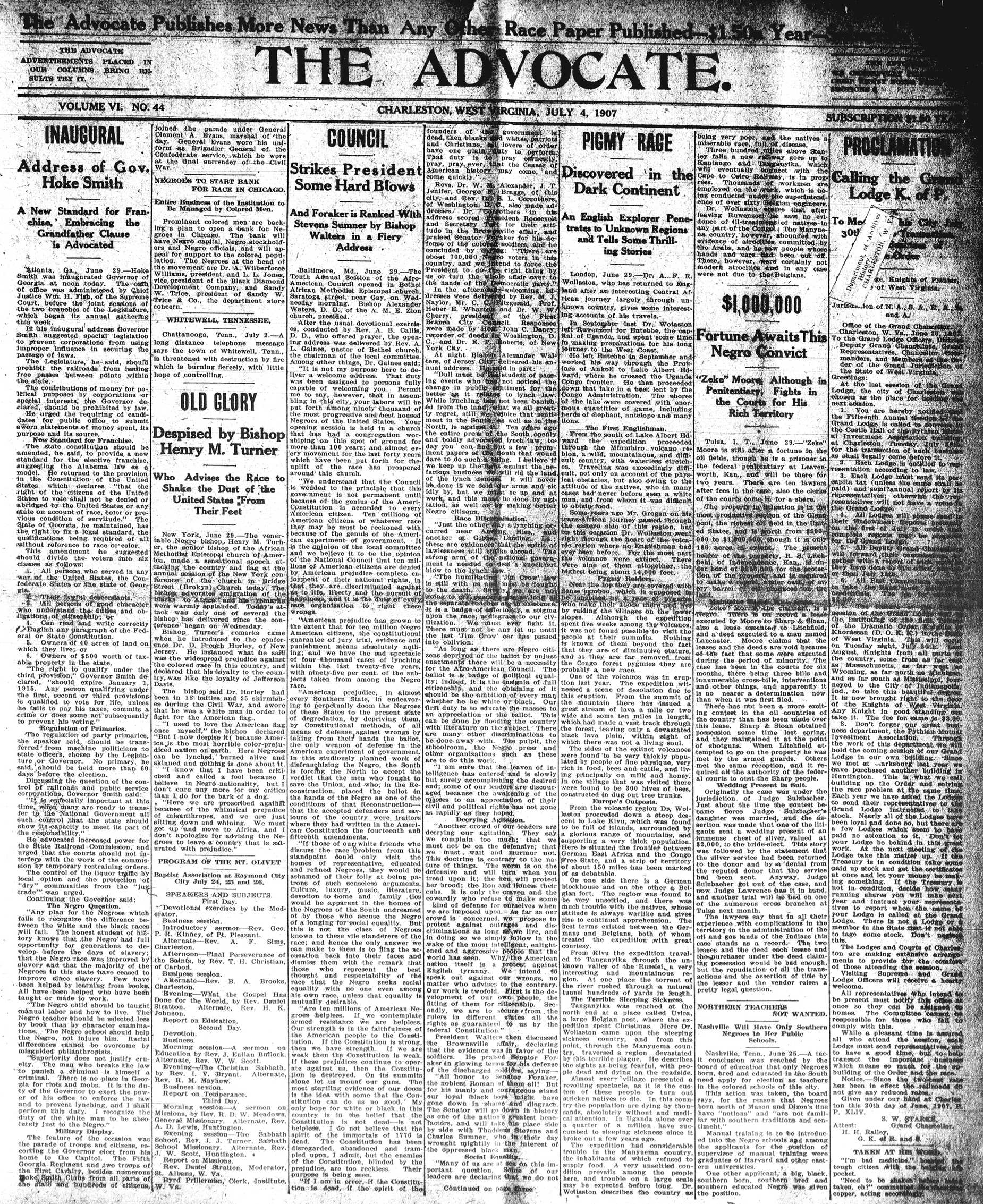
A New Standard for Franchise, Embracing the Grandfather Clause is Advocated
Atlanta, Ga., June 29—Hoke Smith was inaugurated Governor of Georgia at noon today. The court of office was administered by Qhf Justice Wm. H. Fish, of the Supreme Court, before the joint sessions of the two branches of the Legislature, which began its annual gathering this week.
In inaugural address Governor Smith suggested special legislation to prevent corporations from using improper influence in securing the passage of laws.
The Legislature, he said, should prohibit the railroads from issuing free passes between points within the state.
The contributions of money for political purposes by the Governor declared should be prohibited by law.
He urged the requiring of candidates for public office, to submit sworn statements of money spent, its purpose and its source. He also requested a franchise. The state constitution should be amended, he said, to provide a new standard for the elective franchise, suggesting the Alabama law as a model. He returned to the provision he Constitution of the United States, and the right of the citizens of the States to vote shall not be denied or abridged by the United States or any state on account of race, color or previous condition of servitude." The State of Georgia, he maintained, has not required the qualifications being required of all without reference to race or color.
This amendment he suggested should divide the voters into six classes as follows:
1. All persons who served in any war of the United States, the Confederate States or the state of Georgia.
2. Their lawful descendants.
3. All persons of good character who understand the duties and obligations of citizenship; or correctly English any paragraph of the Federal or State Constitution.
4. Owners of 40 acres of land on which they live; or
6. Owners of $500 worth of taxable property in the state.
"The right to qualify under the taxable provision," Governor Smith declared on June 1, 1915. Any person affiliated with the first, second or third provisions is qualified to vote for life, unless he fails to pay his taxes, commits a crime or does some act subsequently to prevent his voting.
The regulation of party primaries, the speaker said, should be transferred from machine politicians to state officers, chosen by the Legislature or Governor. No primary, he said, should be held more than 60 days.
Discussing the question of the control of railroads and public service corporations, Governor Smith said:
"It is especially important at this time, when many are ready to transfer to the National Government all control of the state should show its capacity to meet its part of the responsibility."
He advocated increased power for the State Railroad Commission, and urged that the courts should not interfere with the work of the commission by temporary restraining orders. He also urged the local option and the protection of "dry" communities from the "jug trade" was urged. Continuing the Governor said: The Negro Question. "Any plan for the Negroes which falls to recognize the difference between the Negroes and the white race will fail. The honest student of history knows that the Negro had full opportunity for generations to develop-before the days of slavery; that the Negro race was improved by slavery and that the majority of the Negroes in this state have ceased to work. Few have been helped by learning from books. All have been helped who have been taught or made to work.
"The Negro child should be taught manual labor and how to live. The Negro teacher should be selected less by book than by character examinations. The Negro school should help the Negro, not injure him. Racial differences cannot be overcome by manpower chromatopsis. "Superiority doctrine" usifies cruelty. The man who breaks the law to punish a criminal is himself a criminal. There is no place in Georgia for riots and mobs. It is the duty of the Governor to exert the power of his office to enforce the law and to prevent lynching, and I shall perform this duty. I recognize the duty of the white man to be absolutely just to the Negro." Military Display. The feature of the occasion was the parade of the Governor and citizen, escorting the Governor and citizen home to the Capitol. The Fifth Georgia Regiment and two troops of the First Cavalry, besides numerous松林 Smith, Cliffs from all parts of the state and hundreds of citizens.
joined the parade under General Clement A. Evans, marshal of the day. General Evans wore his uniform as Brigadier General of the Confederate service, which he wore at the final surrender of the Civil War.
NEGROES TO START BANK FOR RACE IN CHICAGO.
Entire Business of the Institution to Be Managed by Colored Men.
Prominent colored men are backing a plan to open a bank for Negroes in Chicago. The bank will have Negro capital, Negro stockholders and Negro officials, and will appeal for support to the colored population. The Negroes at the head of the movement are Dr. A. Wulforce president, and L. L. Jones, vice president, and B. D. Diamond Development Company, and W. Trice, president of Sandy W. Trice & Co., the department store concern.
WHITEWELL, TENNESSEE.
Chattanooga, Tenn., July 2.—A long distance telephone message says the town of Whitewell, Tenn., is threatened with destruction by fire which is burning fiercely, with little hope of controlling.
OLD GLORY
Despised by Bishop Henry M. Turner
Who Advises the Race to Shake the Dust of the United States "From Their Feet
New York, June 29. — The venerable Negro bishop, Henry M. Turcher, the senior bishop of the African Methodist Episcopal church of America, made a sensational speech attacking the country and flag at the annual session of the New York conference of the church in Bridge Brokyn) Church today. The bishop blasted to Africa and the countries were warmly applauded. Today's attack was only one of several the bishop has delivered since the conference began on Wednesday.
Bishop Turner's remarks came when he introduced to the conference Dr. D. French Hurley, of New York. He insisted what he said was the wisdom he gained against the colored race in this country, decked that his loyalty to the country, was like the loyalty of Jefferson Davis. The Bishop said Dr. Hurley had been in 18 battles and 25 skirmishes during the war, and sword that he was a white man in order to fight for the American flag.
"I used to love the American flag once myself," the bishop declared. "But I now despise it (because America is the most horrible color-prejudiced nation on earth. Here Negroes have been alive and skinned and nothing is what I know that I have been criticised and called a fool because I believe in Negro nationality, but I don't care any more for my critics than I do for the bark of a dog. "Here we are proscribed against because of the whimsical prejudice of misanthropes, and we are justifiably proud. We must get up and move to Africa. We don't apologize for advising the Negroes to leave a country that is saturated with prejudice."
PROGRAM OF THE MT. OLIVET
Baptist Association at Raymond City City July 24, 25 and 26
SPEAKERS AND SUBJECTS.
First Day.
Devotional exercises by the Moderator.
Business session.
Introductory sermon—Rev. Geo.
P. R. Klinney, of P. Pleasant.
Alternate—Rev. A. F. Sims.
Charleston.
Afternoon—Final Perseverance of
the Saints, by Rev. T. H. Christian,
of Carbol.
Business session.
MISSION
Alternate- Rev. B. A. Brooks
Charleston.
Evening- What the Gospel Has
Done for the World, by Rev. Daniel
Alternate, Rev. H. K.
Johnson.
Report on Education
Morning session—A sermon on Education by Rev. J. Eallan Bricklor. Alternate, Rev. W. W. Scott. Evening—The Christian Sabbath, by Rev. I. V. Bryant. Alternate Rev. R. M. Mayhew.
Business session.
Report on Temperance.
Third Day.
Morning sermon on
Missions, by Rev. R, D. W. Meadows,
General Missionary. Alternate, Rev.
A. D. Lewis, Huntington.
Evening session—The Sabbath
School, Rev. J. J. Turner, Sabbath
School Missionary. Alternate, Rev.
J. A. Lewis, Huntington.
Report on Missionary.
Daniel Stratton, Moderator,
St. Albans, W. Va.
Byrd Prillerman, Clerk, Institute
W. Va.
CHARLESTON, WEST VIRGINIA, JULY 4, 1907
Baltimore, Md., June 29.—The
Tenth Annual Session of the Afro-
American Council opened in Bethel
African Methodist Episcopal church,
Saratoga street, near Gay, on
wednesday morning. Bishop Alexander
Waters, D. D., of the A. M. E. Zion
church, presided.
After the usual devotional exercises, conducted by Rev. A. B. Callis, D. D., who offered prayer, the opening address was delivered by Rev. A. L. Gaines, pastor of Belt church, the chairman of the local committee. Among other things, Dr. Gaines said; "It is not my purpose here to deliver a message to the people, but was been assigned to persons fully capable of welcoming you. Permit me to say, however, that in assembling in this city, your labors will be put forth among ninety thousand of the most progressive and best housed Negroes of the United States. Your opening session is held in a church that has had a congregation worshiping on the spot of ground for the last seven months, almost every movement for the last seven months have been put forth for the uphill of the race has prospered around this church.
"We understand that the Council is wedded to the principle that this government is not permanent until because of the genius of the American Constitution, it is accorded to every American citizen of whatever race they may be must be reckoned with because of the genius of the American experiment of government. It is the opinion of the local committee and we believe it to be the opinion that ten millions of American citizens by American prejudice complete enjoyment of their national rights, in that they are discriminated against as to life, liberty and the pursuit of happiness, and it is due to every organization to right these wrongs." American prejudice has grown to the extent that for ten million Negro American citizens, the constitutional guarantee of jury trial, evidence and punishment means absolutely nothing; and we have the sad spectacle of four thousand cases of lynching of the six twenty-five years, with ninety-five per cent of the subjects taken from among the Negro race.
"American prejudice, in almost every Southern State, in endeavoring to perpetually doom the Negroes of these States to the present state of degradation, by depriving them of their rights, by means of defense, against wrongs by taking from their hands the ballot, the only weapon of defense in the American experiment of government. In this studiously planned work of distranchising the Negro, the South is forced to accept the verdict that the men who would save the Union, and who, in the Reconstruction, placed the ballot in the hands of the Negro as one of the conditions of that Reconstruction—that the accepted defenders and saviours of the country were traitors in the American Constitution the fourteenth and fifteenth amendments.
"If those of our white friends who discuss the race problem from this standpoint could only visit the homes of representative, educated and refined Negroes, they would be ashamed of their folly at being placed in the homes of culture, luxury, music, literature, devotion to home and family ties would be apparent in the homes of the Negroes of the South undreamed of by those who accuse the Negro of a longing for social equality. But it is not the class of Negroes known by the name of the race; and hence the only answer we can make to them is to fling the accusation back into their faces and dismiss them with the remark that those who represent the best thought and respectability of the race that the Negro seeks social identity will be even among his own race, unless that equality is mutually desirable.
"Are ten millions of American Negroes helpless. If we contemplate armed resistance we are helpless. Our strength is in the faithfulness of the American people to the Constitution. If the Constitution is strong, then we have strength. If we are weak then the Constitution is weak. These prejudices continue to operate and the Constitution is destroyed. On its summits alone let us mount our guns. The most startling evidence of our doom is the idea with some that the Constitution can do us no good. My only hope for white or black in this country is in the belief that the Constitution is not dead—is not helpless. I do not believe that the spirit of the immortals of 1776 is dead. The Constitution has been disregarded, abandoned andramed upon. I am the framers of the Constitution blinded by the prejudice, are too reckless. Their purpose is being seen.
"If I am in error, if the Constitution is dead, if the spirit of the
founders of the government, is dead, then blacks and whites, patriots and Christians, and lovers of order have one plain duty to perform: That duty is to pray correctly, pray, pray ever, that the Ceasar of American history may come, and come quickly. "
Rev. Dr. W. M. Alexander, J. T. Moore, George Braggs, of this city, and George C. Browthers, of Washington, Dr. C. also, and dresses, Dr. C.others, in his address scored President Roosevelt and Secretary Taft for their attitude in the Brownlee affair, and praised Senator Byrker for his defense of the colored soldiers, and he concluded by saying: "There are about 100,000 voters, in this city, that we must do, because the President to do the right things us or turn the whole affair over to the hands of the Democratic steers."
In the afternoon, welcoming addresses were delivered by Rev. M. J. Hether, M. Hitzgeld, ProL. Heber E. Wharton, M. Hitzgeld, Cherry, president of the First Branch City Council. Responses were made by HOR. John C. Dancy, Washington D. C., and Dr. E. F. Roberts, of New York City.
At night Bishop Alexander Walter
taught his students his record-hi
signed address. He helped it
"Dull must be the student of passing events who has not noticed the change in public sentiment for the better as it relates to lynch law. While lynching has not been banished from the land, what we all greatly regret, still we rejoice that sentient in the South as well as in the North have been freed. The entire press of the South openly and boldly advocated lynch law; today you can find but a few prominent papers of the South that would dare to do such a thing. I believe if we keep up the fight against the nefarious business we will rid the land the lynch demons. It will never be done. We will sit and idly by, but we must be done by work, and this must be done by agitation, as well as by making better Negro citizens.
Race Differences.
"Just the other way a lynching occurred near Auding, Miss., and another of Gibbon, Landing, La; these are even that the spirit of the lynching still exists. The strong arm of the national government is needed to deal a knockout blow to the lynch law."
"The humiliating 'Jim Crow' law is still with us and must be tough to the death. Surely we are not going to give peace, peace, peace to the separate coacher in existence, its badge of inferiority, a stigma upon the coacher, our civilization. We must own them until there must not be any let up until the last 'Jim Crow' car has passed into oblivion.
"As long as there are Negro citizens deprived of the ballot by unjust enactments there will be a necessity for the Afro-American Council. The ballot is a badge of political equality; indeed, it is the insignia of full citizenship, and the obtaining of it is a badge of every man whether he is white or black. His first duty is to educate the masses to an appreciation of the ballot. This can be done by flooding the country with literature on the subject. There are many other discriminations to be done away with. The pulpit, the schoolroom, the Negro press and other organizations such as these are to do this work. I am sure that the leaves of the city are deprived and is slowly but surely accomplishing the desired end; some of our leaders are discouraged because the awakening of the masses to an appreciation of their civil and political rights has not gone as rapidly as they hoped.
Decrying Atheism.
"Another way of defending ouriders are decrying our agitation. They say we complain too much; that we must not be on the defensive; that we must . . . wait and murmur not. This doctrine is contrary to the nature of things. The worm is on the tread upon it; the lion will protect it, the herod is on the tread upon it; the hen will protect her brood; the lion and lioness their cubs. It is only the craven and the cowardly who refuse to make some kind of defense for ourselves when we are imposed upon. As far as our propose to protest against ourrages to criminals as long as we live, and in doing so we simply follow in the wake of the most intelligent, enlightened and aggressive people that the world has seen. Why? The American itself is a protest against English army, and speaks out against our wrongs, no matter who advises to the contrary. Our work is twofold. First is the development of our own people, the fitting of them for citizenship. Secondly, we are to secure from the world all the rights as guaranteed to us by the federal Constitution."
President Walters then discussed the Brownsville affair, declaring that the evidence was in favor of the soldiers. He praised Senator Foraker in glowing terms for his defense of the discharged soldiers saving.
"All honor to Senator Foraker, the most noble Roman of them all! But for his manly and courageous stand our loyal black boys might have gone down in shame and disgrace, and we have the history as one of the nation's greatest factors, and will take his place side by side with Thaddeus Stevens and Charles Sumner, who in their day wrought mightily in the interest of the oppressed black man. "Many of us are at see on this important question. Some of our leaders are declaring that we do not
London, June 29.—Dr. A. F. R. Wollaston, who has returned to England after an interesting Central African journey largely through unknown country, gives some interesting accounts of his travels.
In September last Dr. Wollaston left Rwenzorwon for Entebbe, the capital of Uganda, and spent some time in making preparations for his long journey to the West Coast.
He left Entebbe in September and went on a journey through the Province of Ankro to the ward; where he crossed the Uganda Congo frontier. He then proceeded down that take in a beast lent by the Congo Administration. The shores of the take were covered with enor- thousands of game, including herds of elephant, antelope and many lions.
The First Englishman.
From the south of Lake Albert Edward was the expedition proceeded through the valley of Volubilis, a wild, mountainous, and difficult country, with waterless stretches. Traveling was exceedingly difficult, not only on account of the physical obstacles, but also owing to the attitude of the natives, who in many cases never before seen a white man, and from whom it was difficult to obtain food.
Some years ago Mr. Grogan on his trans-African journey passed through the eastern side of this region, but on this occasion Dr. Wollusion went eight through the heart of the volcano, no Englishman had ever been before. The volcanoes were extinct. There were nine of them altogether, the highest being about 14,000 feet.
Pygmy Raiders.
Near the top they are covered with a thick skin, which is supposed to be impaled by the raiders, who make their way there and live by raiding the villages on the lower slopes. Although the expedition spent five weeks among the volcanoes, it was not found possible to visit the sites at their summits. Nothing is known about them, and that they are of diminutive stature, and as they are far removed from the Congo forest pygmies they are probably a new race.
One of the volcanoes was in eruption a year ago, the expedition witnessed a large number of this eruption. From the summit of the mountain there has issued a great stream of lava a mile or two wide and some ten miles in length, which had made a vast track through the forest, leaving only a devastated blaze of light of which there was not a living creature.
The sides of the extinct volcanoes were found to be very thickly populated by people of fine physique, very rich in food, bees and cattle, and living principally on milk and honey. In one village that was visited there once, the people lived of bees, constructed in dug out trunks. Europe's Outposts.
From the volcanic region Dr. Wollaston proceeded down a steep descent to Lake Kivu, which was found to be full of islands, surrounded by a glorious range of mountains, and supporting a very thick population. Here is situated the frontier between German East Africa and the Congo (French) with a strip of territory of about 150 miles has been marked of as debatable.
On one side there is a German blockhouse and on the other a Belgian fort. The region was found to be very unsettled, and there was much trouble with the natives, whose attitude is always warlike and gives rise to continual apprehension. The region was between the Germans and Belgians both of whom treated the expedition with great courtesy.
From Kluu the expedition traveled to Tanganyika through the unknown valley of the Russels, a very interesting and mountainous region. At one place the torrent of the river rushed through a natural tunnel of yards of sand. The Terribile Slide of Tanganyika was reached at the north end at a place called Uvira, a large Belgian post, where the expedition spent Christmas. Here Dr. Wollaston came upon the sleeping sickness country, and from this point, through the Manyuema county, the region devastated by this terrible plague. He sighted the sights as being fearful, with people dead and dying on the roadside. Almost every village presented a revolting spectacle, as it is the custom of these people to turn out stricken natives to die. In this country the population are dying by thousands, absolutely without and medically untreated. One over a quarter of a million have come cupped to sleeping sickness since it broke out a few years ago.
The expedition had considerable trouble in the Manyuena country, the inhabitants of which refused to supply food. A very unsettled condition prevails among the people here, and trouble on a large scale may be expected before long. Dr. Wollaston describes the country as
being very poor, and the natives a miserable race, full of disease.
Three hundred miles above Stanley falls, a new railway goes up to Antango and Thangauyika, which will eventually connect with the Cape Coast Bridge in progress. Thousands of workers employed on the work, which is being conducted under the superintendence of over sixty Belgian engineers.
Dr. Wolfaston states that after leaving Ruwenzor he saw no evidence of all treatments of natives in any part of the Congo. The Manyua country, however, abounded with the Arabs, and he saw committed by the Arabs, and he saw hands and ears and been cut off. These, however, were certainly not modern atrocities and in any case were not due to the Belgians.
$1,000,000
Fortune Awaits This
Negro Convict
"Zeke" Moore, Although in
Penitentiary, Fights in
the Courts for His
Rich Territory
Tulsa, I. T., June 23.—"Zeka" Moore is still after a fortune in the oil fields, though he is a prisoner in the federal penitentiary at Leavenworth, Kan., and will be there for two years. There are ten lawyers after fees in the case, also the clerks of the courts come in for a share. The property in litigation is in the most productive section of the Glenn pool, the richest oil field in the United States, and is worth from $600,000 to $1,000,000, though it is only 180 acres in extent. The present holder of the property, R. S. Lochfield, of Independence, Kan., is under hand of $250,000 for the protection of the property and is required to make a research and earth cash every barrel of oil produced can the
Zeke's Murray, the claimant, is a Trent. There is on record a lease executed by Moore to Sharp & Sloan, also a lease executed to Littelfold, and a deed executed to a man named Lancaster. Moore claims that the leases and the deeds are void because of the fact that some were executed during the period of minority. The case has been in the courts for six years. Moore asserts that the innumerable cross-bills, interventions and other things, and apparently it is no nearer a determination now than when it was first filed.
There has not been a more exciting contest in the oil countries of the country than has been made over this lease. Sharp & Sloan obtained possession some time last spring, and the officers of the shootings. When Litchfield attempted to go on the property he was met by the armed guards. Others met the same reception, and it required all the authority of the federal courts to outst the Sharp people. Wedding Present in Suit. Oratory of Judge Subzbacher the jurisdiction of Judge Subzbacher. Just about the time the contest became fierce Judge Sulzbacher's daughter was married, and the assertion was made that one of the littles sent a wedding present of an immense chest of silver, valued at $10,000. The assertion was followed by the statement that the silver service had been returned to the donor and by a dental from the reputed donor that the service had been sent. Anyway, Judge Sulzbacher got out of the case, and now Judge Lawrence has it in hand, and now he has hand on one of the numerous cross branches at Tulsa next month.
The lawyers say that in all their experience with complications in the territory in the administration of the oil and gas lands of the Indiana this year, they have leased and the deed oed oes leesee and the purchaser under the deed claiming possession would be bad enough, but the repudiation of all the trans- leesee and the vendor raises by the lessor and the vender raises a pretty legal question.
NORTHERN TEACHERS NOT WANTED
Nashville, Tenn., June 25. — A tacit conclusion was reached by the board of education that only Negroes born, bred and educated in the South need apply for election as teachers in the colored schools of this city. This action was taken, the board said, in response to a request born north of Mason and Dixon's line have "notions" and "are not familiar with southern traditions and sentiment."
Manual training is to be introduced into the Negro schools and among the applicants for the position of supervisor of manual training were graduates of Harvard and other eastern positions.
One other applicant, a big, black, southern born, southern bred and southern educated Negro was given the position.
Office of the Grand Chancellor
Charleston, W. Va., June 20, 1849
To the Grand Lodge Officers, District
Deputy Grand Chancellor, Grand
Presidents, Charleston, Grand
managers
der of the Grand Jurisdiction,
of the State of West Virginia.
Greetings:
At the last session of the Grand
Lodge, the city of Charleston was
chosen as the place for holding the
next session.
The city are hereby petitioned to
the Fifteenth Annual Session of the
Grand Lodge is called to convene
the Castle Hall of the Fashion Man-
ual Investment Association building
at Charleston, Tuesday, July 16th
for the transaction of such business
as follows:
1. Each Lodge is entitled to a
presentation according to law.
3. Each Lodge must send its pay-
capita tax (unless the same shall be
paid) and semi/fannual report by his
representatives; otherwise, the re-
presentatives will not have a vote in
the Grand Lodge.
session of the Grand Lodge of the
instituting of the Auxiliary of
the Dramatic Opera Knights of
Khorassan (D. O. K. K.) in the city
of West Virginia. This will come
on Tuesday night, July 30th.
August, Knights from all parts of
the country, some from far east
at Massachusetts, as far west as
Wyoming, as far north as Michigan,
and as far south as Appalachia,
forked to the City of Tinley Park,
Ind., to take this beautiful
it is now brought right to the door
of the Knights of West Virginia.
Any Knight in good standing can
take it. The fee for same is $3.00.
8. Don't forge our great business department, the Pythian Mutual Investment Association. Through the work of this department we will come to a meeting session of our Grand Lodge in our room. Our members we met at Arkansas last year we have purchased another building in Huntington. This is what we can build up the Order and solving the race problem at the same time. Each year we have asked the Lodge to send their representatives to the Grand Lodge stock. Nearly all of the Lodges have been loyal and done so, but there are a few Lodges which seem to have paid no attention to it. Don't let your Lodge be behind in this great work. At the next meeting of the Lodge take this matter up. If the Tortoise is called at some time you take up stock and of the stock at once and let your money be making something. If the Treasury is not in condition, decide how many running shares you will take next year and instruct your representatives to report when the name of the Lodge is called at the Grand Lodge, a member in the State that is not able to tage some stock. Don't negate this.
The Lodges and Courts of Charleston are making extensive arrangements to provide for the comfort of those attending the session.
Visiting Supreme and Grand Lodge Officers will receive a hearty welcome.
All representatives who intend to be present must notify the office once so they can be assigned to homes. The Committees cannot be responsible for those who fail to comply with this.
While a pleasant time is assured as they attend the session, each Lodge officer must to have a good time, but to help transact the important business which means so much for the upbuilding of the Order and the race.
Notice. Since the twenty rate has been in effect the railroad does not give any reduced rates.
Given under our hand at Charleston this 20th day of June, 1907, P. P. XLIV.
S. W. STARKS
Attest: Grand Chancellor
H. H. Railley,
G. K. of R. and S.
TAKEN AT HIS WORD,
"I'm bad medicine," beamed the tough citizen with the hound of pocket.
"Need to be shaken before taken, eh?" commented the shattering copper, acting accordingly.
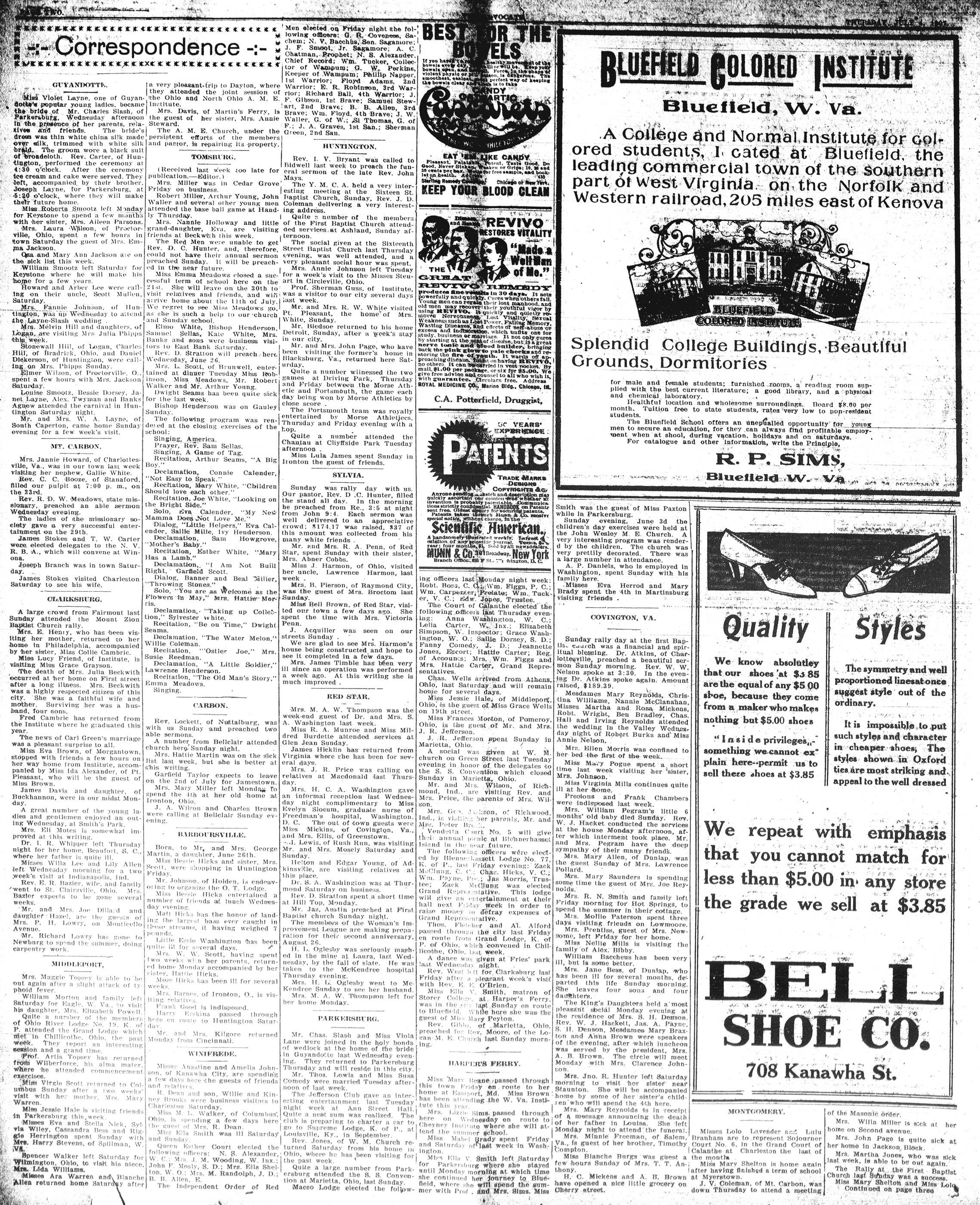
-- Correspondence --
GUYANDOTTE.
Miss Vloiet Layne, one of Guyan-
dotte's popular young ladies, became
the bride of Mr. Charles Slash, of
Parker'sburg, Wednesday afternoon
in the presence of her parents, rela-
tives and friends. The bride's
dress was thin white china silk made
over silk, trimmed with white silk
braid. The groom wore a black suit
of broadeloth. Rev. Carter, of Huntington, performed the ceremony at 4:30 o'clock. After the ceremony
ice cream and cake were served. They
left, accompanied by their brother,
Joseph Layne, for Parkersburg, at
6:20 o'clock, where they will make
their future home.
Miss Roberta Smootz left Monday
for Keystone to spend a few months
with her sister, Mrs. Aileen Parsons.
Mrs. Laura Wilson, of Proctor-
ville, Ohio, spent a few hours in
town Saturday the guest of Mrs. Emma Jackson.
Osa and Mary Ann Jackson are on
the sick list this week.
William Smootz left Saturday for Keystone where he will make his home for a few years.
Howard and Arber Lee were calling on their uncle, Scott Mullen, Saturday.
Mrs. Fannie Johnson, of Huntington, was up Wednesday to attend the Layne-Slash wedding.
Mrs. Melvin Hill and daughters, of Logan, are visiting Mrs. Julia Phipps this week.
Stonewall Hill, of Logan, Charles Hill, of Bradrick, Ohio, and Daniel Dickerson, of Huntington, were calling on Mrs. Phipps Sunday.
Elmer Wilson, of Proctorville, O., spent a few hours with Mrs. Jackson Saturday.
Louise Smootz, Bessie Dorsey, Janet Layne, Alex, Twyman and Banks Agnet attended the carnival in Huntington Saturday night.
Mr. and Mrs. W. A. Layne, of South Caperton, came home Sunday evening for a few week's visit.
MT. CARBON.
Mrs. Jannie Howard, of Charlestonville, Va., was in our town last week visiting her nephew, Gallie White.
Rev. C. C. Booze, of Stanaford, filled our pulpit at 7:00 p. m., on the 23rd.
Rev. R. D. W. Meadows, state missionary, preached an able sermon Wednesday evening.
The ladies of the missionary society gave a very successful entertainment on the 29th.
James Stokes and T. W. Carter were elected delegates to the N. V. R. B. A., which will convene at Winona.
Joseph Branch was in town Saturday.
James Stokes visited Charleston Saturday to see his wife.
CLARKSBURG
A large crowd from Fairmont last Sunday attended the Mount Zion Baptist Church rally.
Mrs. E. Henry, who has been visiting her mother, returned to her home in Philadelphia, accompanied by her sister, Miss Collie Cambric.
Miss Lucy Friend, of Institute, is visiting Miss Grace Grayson.
The death of Mrs. Julia Beckwith occurred at her home on First street after a long illness. Mrs. Beckwith was a highly respected citizen of this city. She was a faithful wife and mother. Surviving her was a husband, four sons.
Fred Cambric has returned from the Institute where he graduated this year.
The news of Carl Green's marriage was a pleasant surprise to all.
Miss Eva Brown, of Morgantown,
stopped with friends a few hours on
her way home from Institute, accompanied by Miss Ida Alexander, of Pt.
Pleasant, who will be the guest of Miss Brown.
James Davis and daughter, of Buckhannon, were in our midst Monday.
A great number of the young ladies and gentlemen enjoyed an outing Wednesday, at Smith's Park.
Mrs. Eli Motes is somewhat improved at this writing.
Dr. I. R. Whiper left Thursday night for her home. Beaufort, S. C., where her father is quite ill.
Misses Willa Lee and Lily Allen left Wednesday morning for a two week's visit at Indianapolis, Ind.
Rev. E. R. Bazier, wife, and family went to St. Clairsville, Ohio. Mrs. Bazier expects to be gone several weeks.
Mr. and Mrs. Joe Dillard and daughter Hazel, are the guests of Mrs. P. H. Lowry, on Monticello Avenue.
Mr. Richard Lowry has gone to Newburg to spend the summer, doing carpentry work.
MIDDLEPORT
Mrs. Maggie Topsey is able to be out again after a slight attack of typhoid fever.
William Morton and family left Saturday for Eagle, W. Va., to visit his daughter, Mrs. Elizabeth Powell.
Quite a number of the members of Ohio River Lodge No. 19, K. of P. attended the Grand Lodge which met in Chillicothe, Ohio, the past week. They report an interesting session and a grand time.
Prof. Artis Topsey has returned from Wilberforce, his alma mater, where he attended commencement exercises.
Miss Virgie Scott returned to Columbus Sunday after a two weeks' visit with her mother, Mrs. Mary Warren.
Miss Jessie Hale is visiting friends in Parkersburg this week.
Misses Eva and Stella Nick, Sylvia Wiley, Cassandra Bess and Riggle Herrington spent Sunday with Mrs. Harry Stevens, of Spillman, W. Wk.
Spencer Walker left Saturday for Wilmington, Ohio, to visit his niece, Mrs. Lida Williams.
Misses Ara Warren and Blanche Allen returned home Saturday after
a very pleasant trip to Dayton, where they attended the joint session of the Ohio and North Ohio A. M. E. Institute. Mrs. Davis, of Martin's Ferry, is the guest of her sister, Mrs. Annie Steward. The A. M. E. Church, under the persistent efforts of the members and pastor, is repairing its property.
TOMSBURG.
(Received last week too late for publication.—Editor.)
Mrs. Miller was in Cedar Grove Friday on business.
Robert Miller, Arthur Young, John Waller and several other young men attended the base ball game at Handly Thursday.
Mrs. Nannie Holloway and little grand-daughter, Eva, are visiting friends at Beckwith this week.
The Red Men were unable to get Rev. D. C. Hunter, and, therefore, could not have their annual sermon preached Sunday. It will be preached in the near future.
Miss Emma Meadows closed a successful term of school on the 21st. She will leave on the 30th to visit relatives and friends, and will arrive home about the 11th of July. We regret to see Miss Meadows go, as she is such a help to our church and Sunday school.
Elmo White, Bishop Henderson,
Samuel Sellas, Kate White, Mrs.
Banks and sons were business
visitors to East Bank Saturday.
Rev. D. Stratton will preach here
Wednesday, June 26.
Mrs. L. Scott, of Brunwell, ent
tained at dinner Tuesday Miss Robinson,
Miss Meadows, Mr. Robert
Walker and Mr. Arthur Young.
Dwight Seams has been quite sick
for the last week.
The following program was rendered at the closing exercises of the school:
Singing, America.
Prayer, Rev, Sam Sellas.
Singing, A Game of Tag.
Recitation, Arthur Seams, "A Big Boy."
Declamation, Connie Calender,
"Not Easy to Speak."
Recitation, Mary White. "Children Should love each other." Recitation, Joe White. "Looking on the Bright Side."
Solo, Eva Calender, "My New Mamma Does Not Love Me."
Dialog, "Little Helpers," Eva Calender, Sallie Mille, Ivy Henderson.
Declaration, Sam Howgrove, "Mother's Baby."
Recitation, Esther White, "Mary Has a Lamb."
Declaration, "I Am Not Built Right," Garfield Scott.
Dialog, Banner and Beal Miller, "Throwing Stones."
Solo, "You are as Welcome as the Flowers in May," Mrs. Hattie Morris.
Declaration, "Taking up Collection," Sylvester white.
Recitation, "Be on Time," Dwight Seams.
Declamation, "The Water Melon," Willie Coleman. Recitation, "Ostler Joe," Mrs. Susie Reedman. Declamation, "A Little Soldier," Lawrence Henderson. Recitation, "The Old Man's Story," Emma Meadows. Singing.
CARBON.
Rev. Lockett, of Nuttalburg, was with us Sunday and preached two able sermons. A number from Bellclair attended church herd Sunday night. Mrs. Hattie Martin was on the sick list last week, but she is better at chis writing. Garfield Taylor expects to leave on the 2nd of July for Jamestown.
Mrs. Mary Miller left Monday. To spend the 4th at her old home at fronton, Ohio. J. A. Wilson and Charles Brown were calling at Bellclair Sunday evening.
BARBOURSVILLE.
Born, to Mr. and Mrs. George Martin, a daughter, June 26th.
Miss Bessie Hicks and sister, Mrs. Scott, were shopping in Huntington Friday.
Mr. Johnson, of Holden, is endeavoring to organize the O. T. Lodge.
Miss Bessie Hicks entertained a number of friends at lunch Wednesday evening.
Matt Hicks has the honor of landing the largest bass ever caught in these streams, it having weighed 7 pounds.
Little Essie Washington has been quite ill for several days.
Mose Hicks has been ill for several weeks.
Mrs. Barnes, of Ironton, O., is visiting relatives.
Frank Good is indisposed.
Harry Eskins passed through here on route to Huntington Saturday.
Mr. and Mrs. Kilgore returned Monday from Cincinnati.
WINIFREDE.
Misser Anastine and Amelia Johnson, of Kanawha City, are spending a few days here the guests of friends and relatives.
R. Dean and son, Willie and Kinney Brooks were business visitors to Charleston Saturday.
Miss M. L. Walker, of Columbus, Ohio, is spending a few days here the guest of Mrs. R. Dean.
Miss Ella Smith was ill Saturday and Sunday.
Queen Esther Court elected the following officers: N. S. Alexander, W. C.; Mrs. J. M. Wooding, W. Inx.; John F. Mosly, S. D.; Mrs. Ella Shelton, W. O.; Mrs. M. Randolph, J. D.; B. B. Allen, E.
Men elected on Friday night the following officers: G. R. Coveness, Sachem; N. V. Bacchus, Sen. Sagamore; J. F. Smoot, Jr. Sagamore; A. C. Chatman, Prophet; N. S. Alexander, Chief Record; Wm. Tucker, Collector of Wampum; G. W. Perkins, Keeper of Wampum; Philpil Napper, 1st Warrior; Floyd Adams, 2nd Warrior; E. R. Robinson, 3rd Warrior; Richard Ball, 4th Warrior; J. F. Gibson, 1st Brave; Samuel Stewart, 2nd Brave; B. B. Allen, 3rd Brave; Wm. Floyd, 4th Brave; J. W. Waller, G. of W.; Sl Thomas, G. of F.; J. A. Graves, 1st San; Sherman Green, 2nd San.
HUNTINGTON.
Rev. I. V. Bryant was called to Bidwell last week to preach the funeral sermon of the late Rev. John Mays.
The Y. M. C. A. held a very interesting meeting at the Sixteen St. Baptist Church, Sunday, Rev. J. D. Coleman delivering a very interesting address.
Quite a number of the members of the First Baptist Church attended services at Ashland, Sunday afternoon.
The social given at the Sixteenth Street Baptist Church last Thursday evening, was well attended, and a very pleasant social hour was spent.
Mrs. Annie Johnson left Tuesday for a week's visit to the Misses Steuart in Circleville, Ohio.
Prof. Sherman Guss, of Institute, was a visitor to our city several days last week.
Mr. Bledsoe returned to his home Detroit, Sunday, after a week's stay in our city.
Mr. and Mrs. John Page, who have been visiting the former's home in Blacksburg, Va., returned here Saturday.
Quite a number wilnessed the two games at Driving Park, Thursday and Friday between the Morse Athletic and Portsmouth, the game each day being won by Morse Athletics by close score.
The Portsmouth team was royally entertained by Morse Athletjees, Thursday and Friday evening with a hop.
Quite a number attended the Chantau at Clyffside Park Tuesday afternoon.
Miss Lula James spent Sunday in Ironton the guest of friends.
SYLVIA.
Sunday was rally day with us. Our pastor, Rev. D. C. Hunter, filled the stand all day. In the morning he preached from Re. 3:5 at night from John 9:4. Each sermon was well delivered to an appreciative crowd; $17.14 was raised, $37 of this amount was collected from his many white friends.
Mr. and Mrs. R. A. Penn, of Red Star, spent Sunday with their sister, Mrs. Abner Cobbs.
Miss J. Harmon, of Ohio, visited her uncle, Lawrence Harmon, last week.
Mrs. B. Pierson, of Raymond City, was the guest of Mrs. Broctom last Sunday.
Miss Bell Brown, of Red Star, visited our town a few days ago. She spent the time with Mrs. Victoria Penn.
J. Acquiller was seen on our streets Sunday.
We are glad to see Mrs. Harmon's house being constructed and hope to see it completed in a few days.
Mrs. James Timble has been very ill since an operation was performed a week ago. At this writing she is much improved.
RED STAR
Mrs. M. A. W. Thompson was the week-end guest of Dr. and Mrs. S. A. Washington last week.
Miss R. A. Munroe and Miss Mildred Burdette attended services at Glen Jean Sunday.
James Hicklin has returned from Virginia where she has been for several days.
Mrs. J. R. Price was calling on relatives at Macdonald last Thursday.
Mrs. H. C. A. Washington gave an informal reception last Wednesday night complimentary to Miss Evelyn Slocum, graduate nurse of Freedman's hospital, Washington, D.C. The out of town guests were Miss Mickins, of Covington, Va. and Mrs. Ellis, of Greenstown.
J. Lewis, of Rush Run, was visiting Mr. and Mrs. Mosely Saturday and Sunday.
Helton and Edgar Young, of Adkinsville, are visiting relatives at this place. Dr. S. A. Washington was at Thurmond Saturday on business.
Rev. D. Stratton spent a short time at Hill Top, Monday.
Mr. Jas, Austin preached at First Baptist church Sunday night. The members of the Woman's Improvement League are making preparation for their second anniversary, August 26. H. L. Oglesby was seriously mashed in the mine at Laura, last Wednesday, by the fall of slate. He was taken to the McKendree hospital Thursday evening. Mrs. H. L. Oglesby went to McKendree Sunday to see her husband. Mrs. M. A. W. Thompson left for her home Monday.
PARKERSBURG
Mr. Chas, Slash and Miss Viola Lane were joined in the holy bonds of wedlock at the home of the bride in Guyandotte last Wednesday evening. They returned to Parkersburg Thursday and will reside in this city. Mr. Thos. Lewis and Miss Susa Comedy were married Tuesday afternoon of last week.
The Jefferson Club gave an interesting entertainment last Tuesday night week at Ann Street Hall. Quite a neat sum was realized. The club is preparing to charter a car to go to Supreme Lodge, K. of P., at Louisville, Ky., in September.
Rev. Jones, of W. M. Church returned Saturday from his home in Ohio, where he has been visiting for the past week.
Quile a large number from Parkersburg attended the S. S. Convention at Marietta, Ohio, last Sunday.
Maceo Lodge elected the follow-
If you haven't a real, healthy movement of the bowels every day, you'll be. Keep your bowels open, and be well. Force, in the shape of violent physio or pho poison, is dangerous. The smoothest, easiest, most perfect way of keeping the bowels clear and clean is to take
CANDY
ON ARTIC
Cocaine
THE WEST WHILE YOU SLEEP
EAT ON LIKE CANDY
Pleasant, Plattsburgh, Potent, Taste Good, Do
Good, Never Shaken, no container, Day and
50 cents per box. Waste for free sample, and book
let on health. Advertise
433
Sterling Remedy Company!
Chicago of New York.
KEEP YOUR BLOOD CLEAN
Dennis and Hugh REVIVO RESTORES VITALITY "Made a Wolf Man of Me." THE GREAT
REVIVO REMEDY
produces five treatments in 30 days. It acts
powerfully and quickly. Cures when others fail.
Young men can repair their lost manhood, and
young women can recover their youthful vigor by
using REVIVO. It also loses power and quietly
removes Nervousness. Lost Vitality and weakness
such as Lost Power, Falling Memory,
Wasting Diseases, and effects of soft abuse or
study and indulgence, which unifies one for
study and marriage. It not only cures
by starting at the marriage, but it is great
nerve tonic and blood buildup. Back the pink glow to pale cheeks and restoring the fire of youth. It wards off apprehension. It rests on having REVIVO,
no other. It can restore the memory. By mail. $1.00 per package or six per package. Give free advice and counsel to all who wish it with guarantee. Circular free. Address
ROYAL MEDICINE CO. Marine Blg. Chicago, IL.
C.A. Potterfield, Druggiat.
GC YEARS' EXPERIENCE
PATENTS
TRADE MARKS
DESIGNS
COPYRIGHTS & C.
Anyone sending a sketch and description may
certainly enquire 7600 whether his
invention is probably patentable. Documents
strictly confidential. HANDBOOK on Patentes
soil from the cover key for securing patents.
Patent taken through the U.S. to receive
special notice, without charge, in the
Scientific American.
A handsomely illustrated weekly. Twenty-se
nine years, four months, $1. Sold by all newdealers.
MUNN & Co. 301 Broadway. New York
Branch Office, R.S. St. 577,ington, D.C.
ing officers last Monday night week:
Robt. Boss, C. C.; Wm. Fliggs, P. C;
Wm. Carpenter; Prelate; Wm. Tucker,
V. C.; Edw. Jones, Trustee.
The Court of Calanthe elected the
following officers last Thursday evening:
Anna Washington, W. C;
Lella Carter, W. Inx.; Elizabeth
Simpson, W. Inspector; Grace Washington,
W. O.; Sallie Dorsey, S. D;
Fanny Comedy, J. D.; Jeannette
Jones, Escort; Hattie Carter; Reg.
of Accounts; Mrs. Wm. Fliggs and
Mrs. Hattie Carter, Grand Representatives.
Chas. Wells arrived from Athens,
Ohio, last Saturday and will remain
home for several days.
Miss Jessie Hale, of Middleport,
Ohio, is the guest of Miss Grace Wells
on 19th street.
Miss Frances Morton, of Pomeroy,
Ohio, is the guest of Mr. and Mrs.
J. R. Jefferson.
J. R. Jefferson spent Sunday in
Marietta, Ohio.
A social was given at W. M. church on Green Street last Tuesday evening in honor of the delegates to the S. S. Convention which closed Sunday in Marietta, Ohio.
Mr. and Mrs. Wilson, of Richmond, Ind., are visiting Rev. and Mrs. Price, the parents of Mrs. Wilson.
Vendetta Court No. 5 will give their annual picnic at Blennerhasset Island in the near future.
The following officers were elected by Blennerhasset Lodge No. 77, K. of P., last Friday evening; Zack McClung, C. C. Chas, Hicks, V. C.; Win, Payne, Pre.; Jas Morris, Trustee; Zack McClung was elected Grand Representative. This lodge will give an entertainment at their hall next Friday week in order to raise money to defray expenses of Grand Representative.
Thos. Fletcher and Al. Afford passed through the city last Friday en route from Grand Lodge, K. of P. of Ohio, which convened in Chillicothe, Ohio, last week.
A dance was given at Fries' park last Wednesday night.
Rev. West left for Clarksburg last Friday after a pleasant week's visit with Rev. E. E. O'Brien.
Miss Ella V. Smith, matron of Storer College, at Harper's Ferry; was in the eve last Sunday on route to Bluefield. While here she was the guest of Miss Mary Peyton. Rev. Gibbs, of Marietta, Ohio, preached for Rev. Moore, of the Logan M. E. Church last Sunday morning.
HARPER'S FERRY.
Miss Mary Beane passed through this town Friday en route to her home at Eastport, Md. Miss Brown has been attending the W. Va. Institute this year.
Mrs. Lizzie Sims passed through here on Wednesday en route to Cheyney Institute where she will attend the summer school.
Miss Mabel Brady spent Friday and Saturday of last week in Washington.
Miss Ella V. Smith left Saturday for Parkersburg where she stayed until Monday morning at which time she continued her journey to Bluefield, where she will spend the summer with Prof. and Mrs. Sims. Miss
BLUEFIELD COLORED INSTITUTE
Bluefield, W. Va.
A College and Normal Institute for colored students, I cated at Bluefield, the leading commercial town of the southern part of West Virginia. on the Norfolk and Western railroad, 205 miles east of Kenova
BLUEFIELD
COLORED INSTITUTE
Splendid College Buildings, Beautiful Grounds, Dormitories
for male and female students; furnished rooms, a reading room supplied with the best current literature; a good library, and a physical and chemical laboratory.
Healthful location and wholesome surroundings. Board $8.00 per month. Tuition free to state students, rates very low to non-resident students.
The Bluefield School offers an unpealed opportunity for young men to secure an education, for they can always find profitable employment when at school, during vacation, holidays and on saturdays.
For catalogue and other information, write the Bureau.
Smith was the guest of Miss Paxton while in Parkersburg.
Sunday evening, June 3d the children's day exercises were held at the John Wesley M. E. Church. A very interesting program was rendered by the children. The church was very prettily decorated. There was a large number in attendance.
A. P. Daniels, who is employed in Washington, spent Sunday with his family here.
Misses Eva Herrod and Mary Brady spent the 4th in Martinsburg visiting friends.
COVINGTON, VA.
Sunday rally day at the first Baptist church was a financial and spiritual blessing. Dr. Atkins, of Charlottesville, preached a beautiful sermon Sunday morning. Rev. W. W. Nelson spoke at 3:30. In the evening Dr. Atkins spoke again. Amount raised, $189.39.
Mesdames Mary Reynolds, Christina Williams, Nannie McClanahan, Misses Martha and Rosa Mickens, Robt. Wright, Ben Bradley, Chas Hall and Irving Reynolds attended the wedding in the Valley Wednesday night of Robert Burks and Miss Annie Nelson.
Mrs. Ellen Morris was confined to her bed the first of the week.
Miss Mary Pogue spent a short time last week visiting her sister, Mrs. Johnson.
Miss Virginia Mills continues quite ill at her home.
Precious and Frank Chambers were indisposed last week
Mrs. William Pegram's little 6 months' old baby died Sunday. Rev. W. J. Hacket conducted the services at the house Monday afternoon, after which interment took place. Mr. and Mrs. Pegram have the deep sympathy of their many friends.
Mrs. Mary Allen, of Dunlap, was the guest Sunday of Mrs. Lawrence Pollard.
Mrs. Mary Saunders is spending some time the guest of Mrs. Joe Reynolds.
Mrs. R. N. Smith and family left Friday morning for Hot Springs, to spend the summer in their cottage.
Mrs. Mollie Paterson spent three days visiting friends on Lowmoore.
Mrs. Prentiss, guest of Mrs. Newsome, left Friday for her home.
Miss Nellie Mills is visiting the family of Alex. Bobby.
William Baccheus has been very ill, but is some better.
Mrs. Jane Bess, of Dunlap, who has been ill for several months, departed this life Sunday morning. She leaves four sons and four daughters.
The King's Daughters held a most pleasant social Monday evening at the residence of Mrs. S. H. Denson. Rev. W. J. Hackett, Jas. A. Payne, S. H. Denson, Mesdames Mary Braxton and Anna Brown were speakers of the eventing, after which luncheon was served by the president, Mrs. A. B. Brown. The circle will meet Monday with Mrs. Clarence Johnson.
Mrs. Jno. R. Hunter left Saturday morning to visit her sister near Staunton. She will be accompanied home by some of her sister's children who will spend the 4th hour.
Mrs. Mary Reynolds is in receipt of a message announcing the death of her father in Louisa. She left Monday night to attend the funeral. Mrs. Minnie Freeman, of Salem, Va., is guest of her brother, Timothy Compton. Miss Blanche Burgs was guest a few hours Sunday of Mrs. T. T. Anthony.
```markdown
```
BELL SHOE CO. 708 Kanawha St.
R. P. SIMS.
Bluefield W. Va
Quality
We know absolutley that our shoes at $3.85 are the equal of any $5.00 shoe, because they come from a maker who makes nothing but $5.00 shoes
"I inside privileges, something we cannot explain here--permit us to sell these shoes at $3.85
We repeat with
that you cannot
less than $5.00 i
the grade we se
BEI
SHOE
708 Kanaw
MONTGOMERY.
Misses Lolo Lavender and Lulu Branham are to represent Sojourn Court No. 6, in the Grand Court of Calanthe at Charleston the last of the month. Miss Mary Shelton is home again after having finished a term of school at Myerstown. J. V. Coleman, of Mt. Carbon, was down Thursday to attend a meeting
The symmetry and well proportioned lines at once suggest style out of the ordinary.
It is impossible to put such styles and character in cheaper shoes; The styles shown in Oxford ties are most striking and appeal to the well dressed
with emphasis not match for 0 in any store sell at $3.85 ELL E CO. awha St.
of the Masonic order.
Mrs. Willa Miller is sick at her home on Second avenue.
Mrs. John Page is quite sick at her home in Jackson, Block.
Mrs. Martha Jones, who was sick last week, is able to be out again.
Continued on page three
and get a bottle of Beef, Wine and Iron for that tired feeling. Don't wait for pring is here. The system is full of impurities which must be evacuated last you will continue to suffer from that "tired feeling." poor appetite, headache and fatigue which comes with the pring
Price per bottle 50c
Get your prescription filled at the GEM where you get pure and fresh ingredients put up with utmost care and skill.
A new line of toilet articles just arrived for the summer.
Special attention is given the "SODA FOUNTAIN" where you enjoy ICE CREAM SODA Choice Flavors.
IS ALL-IT WILL COST YOU
to write for our big FREE BICYCLE catalogue
showing the most complete line of high-grade
BICYCLES, TIRES and SUNDRIES at PRICES
manufacturer or dealer in the world.
BUY A BICYCLE from anyone,
until you have received our complete Free Oata-
tuality every kind of high-grade and low-grade
latest models of our remarkable LOW
new offers made possible by selling from factory
middlemen's profits.
without a great deposit. Pay the Freight and
email and make other liberal terms which no other do.
You will learn everything and get much valu-
ply writing us a postal.
be young meet who apply at once.
1C IS ALL-IT WILL COST YOU
to write for us. THE BRIDGE BIKOLE catalogue
showing the most complete lineup
BIKOLES, TIRES and SUNDARES at FRIES
BELOW any other manufacturer or dealer in the world.
DO NOT BUY A BIGYCLE. from anyone,
or on any kind of lemm, until you have received our complete Free Data-
sheets and describing every kind of high-grade and low-grade
bicycles, old patterns and wonderful new offers made possible by selling from factory
direct to rider with no middlemen's profits.
WE MILLED ON APPROVAL without a cent deposit. Pay the Freight and the Labor. Do not leave the house 10 days before and make other liberal terms which no other house in the world will do. You will learn everything and get much valuable information by simply writing us a postal. We need a Rite Agent in every town and can offer an opportunity to make money to suitable young men who apply at once.
TO PUNCTURE-PROOF TIRES ONLY
$4.80
PER PAIR
$4.80
MAILS TACKS
OR GLASS
WON'T LET
OUT THE AIR
ORDER $4.80
FROM PUNCTURES.
Our experience in the
THORNS GAC.
making. No danger from THORNS, CACTUS, PINS, NAILS, TACKS or GLASS. Serious punctures, like intentional knife cuts, can be vulcanized like any other tire.
Two Hundred Thousand pairs now in actual use. Over Seventy-Five Thousand pairs sold last year.
DESPORTION: Made in all sizes. It is likely and can with a special quality of rubber, which never becomes poro without allowing the air to to scamp will give the price of that that the tires have only been pumped uponcer twice in a ordinary tire, the puncture resisting qualities being of prepared fabric on the tread. That "Holding Back" sensa of well reeds is overcomes by the out-ravel of the
fires is so per pair, but for advertising purposes we are in
of only 50 per pair. All orders shipped since day letter.
We will allow a cash discount of 5 percent (thereby mak
BULL CASE WITH ODEG and enclose this adventure
plated brass hand lump and two small instincts
puncture closers to be used in case of intentional knife cut
at our expense if for any reason they are not satisfactory
We are perfectly able and may sent to us as safe
Banker, H. Presse or Freight Agent or the Editor of this p these tires, you will find that they will ride easier, run finer than any tire you have ever used or seen at any price.
We will give us a postal today.
order at once, hence this remarkable tire offer.
ODASTER-BRAKES, built-up-wheels,
prices charged by dealers and repair men. Write for oumb
DO NOT WAIT but write us a postal today.
wonderful offers we are making. If only casts a postal to
HEAD\(^{\circ}\) CYCLE COMPANY, Dept.
LEARN TO
It's what you save wealth building.
The man with the often accumulates the
Let us tell you how
Fill in and mail this cou
Kanawha Banking and Trust Co., Char
Mail particulars of your system
blanks for opening an account.
Name
Town
County
State
Banking & Trust
Charleston
lively and easy riding, very durable and lined inside
comes porous and which closes up small punctures
natured by jacket, frame and customers stating
at twice in a whole season. They weigh no more
than being given by several layers of thin, specially
letter by recorder. We can have an approval,
overcoming all suction. The regular price of three
items we are making a special factory price to the rider
is as sale as in a bank. Ask your Postmaster
us as a sale as in a bank. Ask your Postmaster
puncture closers on full paid orders at half the usual
knife cuts or heavy gashes). Tires to be returned
not satisfactory on examination.
not of this paper about us. If you order a pair of
tires, run faster, wear better, last longer and look
any price. We now that you will be so well pleased
we want you to write us a small trial
postal today. DO NOT THINK OF BUYING a
tire in movie out. You know the new and
a postal to learn everything. Write it NOW.
Dept. "J L" CHICAGO, ILL.
TO SAVE
save that counts in
the modest income
the most.
how best to save.
this coupon to us:
So., Charleston, West Va.:
system of Savings by mail, and
Trust Company
West Virginia
**DESCRIPTION** Made in all sizes. It is lively and easy riding, very durable and lined inside that their fibres have only been pumped upon once or twice in a white season. They weight no more than 100 pounds and are given by several layers of thin, specially prepared fibres on the bread. That "Holding Back" tread which prevents all air from squeezed out between the tire and the road thus overcoming all suction. The regular price of these treads is $12.99 per pair. All orders shipped same day letter is received. We ship CO2 approval. You do not pay a cent until you have examined and found them strictly as represented.
We will allow a cash discount of 10 percent (thereby making the price $4.50 per pair) if you send us a bank card. We will also send one nickel plated brass hand pump and two Samsonium metal pier closure orders (these metal pier closure to be used in case of intentional knife cuts or heavy gashes). Three to be returned at OUR expense if for any reason they are not satisfactory on examination.
We are reliable and money sent to us is an safe us in a bank. Ask your Postmaster, bank manager, or insurance company for a pair of these tires, you will find that they will ride easier, run faster, wear better, last longer than any fire you have ever used or seen at any price. We know that you will be so well pleased that when you want a bicycle you will give us your order. We want you to send us a small trial order at once, have a term in writing.
**OASTER-BRAKES**, built-up wheels, sandles, pedals, parts and repairs, and repairmen. Write for our big SUNDAY catalogue.
**DO NOT WAIT**, bicycle a pair or more yourself.
THINK OF BUYING a DO NOT WAIT bicycle or a pair of tires from anyone until and wonderful offers we are making. It only costs a postal to learn everything. Write it WOW.
MEAD GYCLE COMPANY, Dept. "J L" CHICAGO, ILL
LEARN TO SAVE
It's what you save that counts in wealth building.
The man with the modest income often accumulates the most.
Let us tell you how best to save. Fill in and mail this coupon to us:
Kanawha Banking and Trust Co., Charleston, West Va.:
Mail particulars of your system of Savings by mail, and blanks for opening an account.
Name
Town
County
State
Regular Price $8.80 per pair.
To Introduce
We Will Sell
You a Sample
Pass for Only
(or with Warranty)
NO MORE TROUBLE FROM PUNITURES.
No result of 15 years experienced in this
CORRESPONDENCE
Continued from page two
Continued from page two Lavender were shopping in Charleston Monday. M. P. Burke, of Charleston, was up Saturday on business. Mrs. Robert Stevenson is suffering with a poisoned foot. Mrs.
Mrs. John Cubit, who has been sick several days, is improving. Woodson Jones, who was sick last week, is out again. The entertainment presented by Isaac Hathaway was well attended and enjoyed by all. The Jones is here in attendance on Mrs. Robert Stevenson. The John Wesley M. E. Church of which Rey. V. Harriday is pastor.
WEST V.A
Notice the thick rubber truss "A" and puncture strips "B" and "D," also rim strip "B" to prevent rim cutting. This makes any other make—SOFT, ELASTIC and EASY RIDING.
had a successful rally on Sunday. It was the largest known in the history of the church having raised the sum of $160. The services of the day were well attended. Rev. E. Duke Venture, of Huntington occupied the pulpit both morning and evening and Rev. Brown-pastor of the Baptist Church of this town at 3 o'clock in the afternoon. The Volling Worker Club gave a coffee supply to Fisherman Hall Monday evening. Dr. B. F. White was called to Paint Creek last week. Miss Cornelia Page, of Kanawha City, is here the guest of Mr. and Mra. E. C. Page. Mr. Venture is a West Indian by birth and a scholar of depth. He is clear, forceful and convincing. His two sermons were masterpieces. A banquet complimentary to Rev.
E. P. Jones of Oklahoma, Miss., is returning home from England where he was a传教士, delegate from the Grand United Order of Odd Fellows of this country, was given last night by the local lodges of that order in their hall. The program rendered was an excellent one and contained the following numbers: Mary Mergan, solar MH Hattle, Wes paper; Mrs. H. H. Railey, welcome address; Miss Lolo Lavender, addresses by Rev. E. P. Jones and J. McHenry, Er-Grand Master.
GEDAR GROVE
Miss Pearl Martin' who has been visiting Mrs. T. W. Martin, havegone to Huntington.
Mrs. Fannie. Coleman was visiting her daughter, Mrs. John Mayes, of Charleston last week.
Miss Bessie Phillips was visiting at Hansford Sunday.
B. Strought, of Red Warrior, was visiting friends here Monday.
Rev. D. D. Davis preached Sunday at 7:30 p. m.
O. H. Beamer made a flying trip to Charleston Saturday.
FREEMAN
James Crider and Mr. Alexander returned from Bervoir Saturday, where they have been attending the district conference. James Crider returned Saturday from Princeton where he has been attending the union. Rev. Randolph preached at the Baptist Church Sunday.
Aunt Priscilla Dickerson was visiting Hiawatha last Saturday.
Mr. Jack Phillips and Mrs. Lucy Haley were married Thursday night by Rev. Mitchell, of Pocahontas. Mrs. Dillard was in Poca shopping last Tuesday. John Reddix, Alonzo Carson, Bolden Caliver and Eddie McClanahan were visiting in Bluefield last Thursday. John Dillard was hurt last Monday in the mines, but he is out again. Mrs. James McGuire is yet very sick. Robert Woods was visiting in Isiah Logan has returned. Bluefield Saturday. John Reddix was visiting in Spicer Sunday.
Miss M. I. Calver and Mr. W. W. McClanahan were married last Wednesday night at the home of her grandparents. The home was decorated with roses and evergreens. The bride was beautifully attired in white and carried a bunch of white roses. The groom wore the conventional black shirt. Bolden Calver, brother of the bride and Mag. W. the McClanahan, sister of the groom. Miss Elotse Sanders, aunt of the bride, and Mr. Eddie McClanahan, brother of the groom were ushers. Rev. Huff officiated, after which refreshments were served.
Rev. Gibbons preached for Rev. Huff Sunday morning and Rev. Ward Sunday night.
Mrs. John Cavil was down to Welch Hospital, Wednesday to see her sister, who has been very ill is some what improved. Watts was visiting in Spleer, Sunday.
Rev. W. Ward has been at Berwin since last Tuesday attending the conference.
Rev. Huff hold a rally at Goods will Sunday. Mrs. Judith Sanders, Mattie Cavil, Hattle Hawkins, Eloise Sanders and Alonzo Carson went from here. Mr. and Mrs. Walter Hapna are in our town. Mr. and Mrs. Jack Phillips were visiting in Splice Sunday. Misses Lizzie Strother and Lena King were visiting their grandmother in Splice Sunday.
PT. PLEASANT.
Howard Meade was the guest of friends here en route home from Institute.
Fred Cambric and Miss Eva Brown left Wednesday morning for their homes at Clarkburg and Morgantown after a very pleasant visit here the guests of Miss Ida Alexander. Miss Alexander accompanied Miss Brown home.
Prof. and Mrs. E. L. Morton Friday night, a baby girl. Mrs. Morton was formerly Miss Mary E. Jordan. The little one will be christened Bessie Doris Morton.
Miss Mosella Colston is the guest of Mrs. Williams at Brosia.
James G. Jordan returned home Monday from Moundsville after a three week's visit the guest of his sister, Mrs. J. H. Campbell.
E. L. Morton leaves this week for Fairmont and Mongantown on business.
Mrs. John Craig, of Wellsville, O., is the guest of relatives.
C. E. Henderson and Presley Alexander were callers in Gallipolis, Sunday.
R. W. White and wife are here guests of Mrs. White's parents, Mr. and Mrs. Alexander.
W. L. Clendinen and Miss Hattie C. Jordan were guests of Capt. Posey and family at Pittsburg Sunday.
Mrs. John Craig is the guest of Mrs. Will Holmes at Gallipolis this week.
Mrs. Joe Jordan was the guest of her sister, Mrs. Chas. Harris, at Gallipolis, Sunday.
ST. ALBANS.
A. C. Spurlock, of Tuskegee, Ala. arrived in the city Sunday to spend his vacation with his father. Dana Gordon, who has been in Charleston for some time, has returned home. Robert Parish and Floyd Waddy, of Institute, spent Sunday at home. H. Erskin spent Sunday in Huntington. Tom Mintree and little daughter Eva, spent a few days at Windfield. Miss Josephine Williams spent Monday in Charleston. Wm. Mellens, of Huntington, was in town Monday. Little Elisie M. Preston died Saturday at the home of her grand parents on Oliver street. Miss JessieWilliams is spending some time in Charleston.
Allen Preston was a business visitor to Charleston Saturday.
The Evening Star Club met with Mrs. R. Green,Tuesday night.
Friday night.
Miss Lena Scott has returned
home.
You Look Prematurely Old
Hinton where he attended the Grand
Lodge of Masonry.
Mrs. Nancy Carl is spending a few
days with her sister at Page.
Harry Pierce has returned home after two years absence.
J. W. Dandridge, of Page, was a business visitor in town Monday. Rev. Barnett spent the week here the guest of friends. Rev. R. W. Strass, of entucky, was the guest of Rev. W. W. Scott.
COUNCIL
Continued from page one want social equality, when they should pause to see what the southern white man means by social equality. If it means to sit side by side with the white man on the street car or on the train, then I am for social equality; if it means to accept an invitation to enter the front door and dine with a white friend, I am for social equality; if it means to occupy a seat at a table in a restaurant, theatre, or hotel, or to try my hat in a white woman on the street, when I am for social equality; if it means to agree and white people marry whom they chose, why it is none of my business about that. But if by social equality it means that the Negro is to force his attentions upon the white woman, or the white man is to force his attentions upon the Negro woman, why I am utterly opposed to both."
At the session on Thursday morning short addressed were delivered by A. H. Grimke x-onsult to San Domingo; Rev. W. R. Tolliver, of Greensboro, N. C.; W. Calvin Chase, editor of the Washington (D. C.) Bee; Prof. Kelly Miller, of Washington, D. C.; Rev. T. H. Messer, of Pittsburg, Pa.; Rev. W. M. Alexander, S. L. Corothers, G. R. Waller, and others. In his address Rev. Waller sharply criticised State Supplement of Education Stevens, for his speech at the annual meeting of the Maryland Teacher's Association favoring the curtailment of the educational facilities for colored children in Maryland.
Among those who delivered addresses were Mrs. Fannie Barrier Williams, of Chicago, III., on "The Quality of Work for Afro-American Women." Rev. L. G. Jordon, secretary of the Afro-American Council, also made a very interesting report of the year's work.
Rev. J. Francis Lee, of Norfolk, Va., recited a poem, composed expressly for the occasion, by himself,
TO DANISH COURT
Kiel, Germany, July 2.—Emperor William, the Empress, Prince Adelbert and a large party saluted for Copenhagen today on the imperial yacht Hohenzollern to visit the Danish court after which the Emperor will take his annual cruise in Scandanavian waters.
ORDER OF PUBLICATION.
State of West Virginia,
Kanawha County, ss
At Rules held in the Clerk's Office of the Circuit Court of Kanawha County, on the first Monday in the month of July, 1907:
Katie Jeffries, Plaintiff,
vs. In Chancery, No. 1495.
Kidd Jeffries, Defendant,
(The object of this suit is to obtain a divorce from the bonds of matrimony.)
This case became the Plaintiff by her Attorney; and on his motion, and it appearing by addant filer, that the Defendant is a non-resident this State, it is ordered that he do appear within one year after the date of the first publication, hereof, and what is necessary to protect his interest in this suit.
Teste: D. M. SHIRKEY, Clerk.
J. W. Chappelle, Sol.
Notice to Take Depositions.
To Kidd Jeffries.
TAKE NOTICE: That on the 10th day of August, A. D. 1907, between the hours of 9 o'clock A. M., and 5 o'clock P. M., at the law office of J. W. Chappelle. 604 1-2 Kanawha street, Charleston, West Virginia, I will take the deposition of myself and others, to be read in evidence in my behalf in a certain suit in chancery now pending in the Circuit Court for the Count rof Kanawha and State of West Virginia, in which I am Plaintiff and you are Defendant.
If from, any cause the taking of said deposition shall not be commenced or completed on the day aforesaid, the same shall be continued from day to day, or from time to time, at the same place, and between the same hours until the same shall be completed.
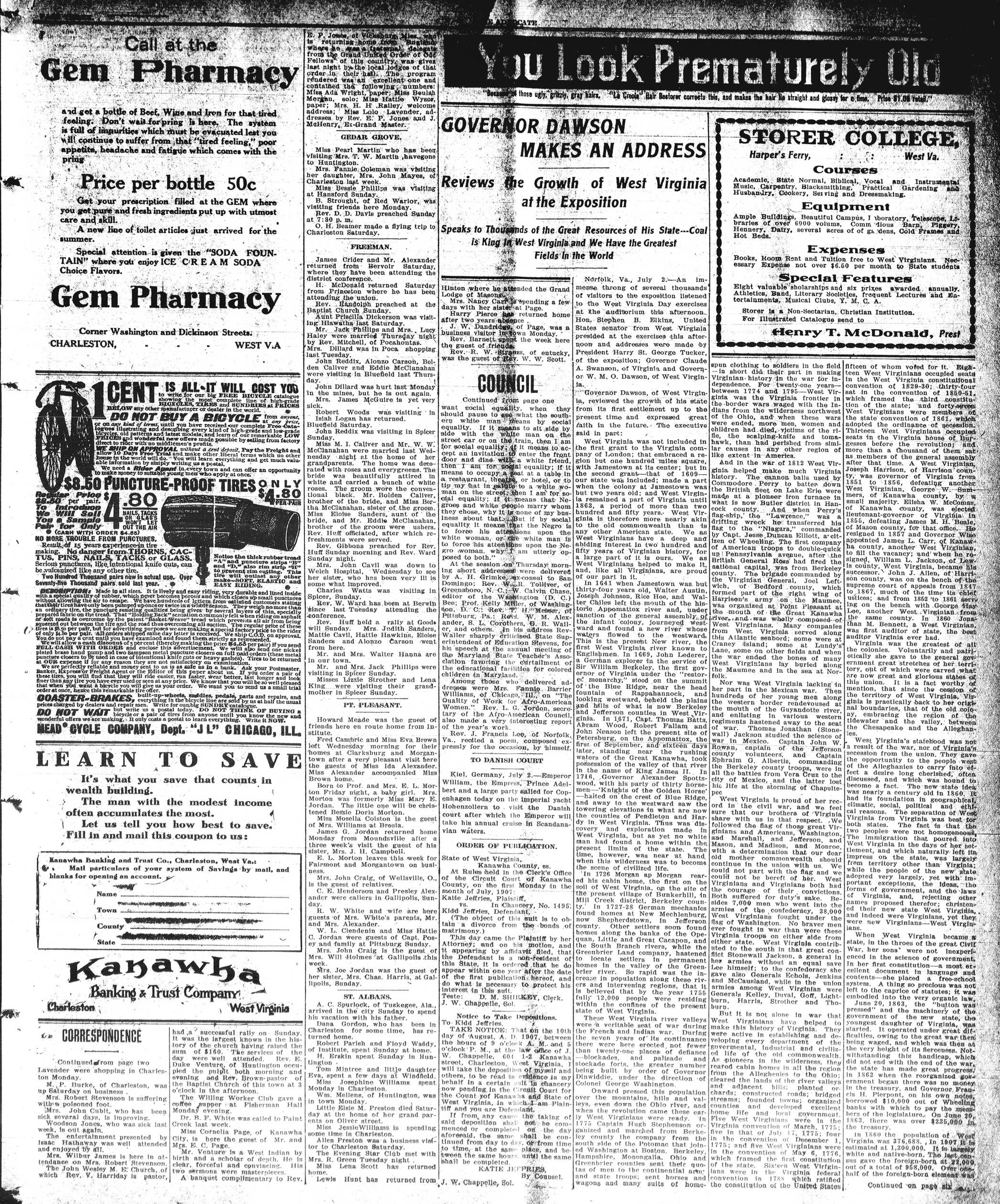
Governor Dawson, of West Virginia, reviewed the growth of his state from its first settlement up to the present time and expressed great faith in the future. The executive said in part:
West Virginia was not included in the first grant to the Virginia company of London; that embraced a region but one hundred miles square, with Jamestown at its center; but in the second grant—that of 1609—our state was included; made a part when the colony at Jamestown was but two years old; and West Virginia remained a part of Virginia until 1863, a period of more than two hundred and fifty years. West Virginia is therefore more nearly akin to the old commonwealth than is to our American state. We as West Virginia are a deep and abiding interest in two hundred and fifty years of Virginia history, for a large part of it is ours. We as West Virginia helped to make it, and, like all Virginians, are proud of our part in it.
In 1641 when Jamestown was but thirty-four years old, Walter Austin, Joseph Johnson, Rice Hoe, and Walter Chiles left the mouth of the historic Appomattox river and, under sanction of the general assembly, of the infant colony, journeyed west ward and found a new river whose waters flowed to the westward. This is the present New river, the first West Virginia river known to Englishmen. In 1669, John Lederer, a German explorer in the service of Sir William Berkeley, the first governor of Virginia under the "restorer monarchy," stood on the summit of the Blue Ridge, near the head of the Blue River, Rappahannock, and looking westward, beheld the plains and bills of what is now Berkeley and Jefferson County, West Virginia. In 1671, Capt. Thomas Batts, Abram Wood, Robert Fallon, and John Neason left the present site, Petersburg, on the Appomattox, the first of September, and sixteen days later, standing near the rushing waters of the Great Kanawha, took possession of the valley of that river in the name of King James II. In 1716, Governor Alexander Spotswood, with his party of thirty horsemen—Knights of the Golden Horse
—hailed on the crest of Blue Ridge, and away on to the westward saw the towering elevations in what are now the counties of Pendleton and Hardy in. West Virginia. Thus was discovery and exploration made in West Virginia, but as yet no white man had found a home within the present limits of the state. The time, however, was near at hand, when this wilderness was to become the scene of civilized life.
In 1726 Morgan ap Morgan reared his cabin home, the first on the soil of West Virginia, on the site of the present village of Bunkerhill, in Mill Creek district, Berkeley county. In 1727-28 German mechanics found homes at New Mechienburg, now Shepherdstown, in Jefferson county. Other settlers soon found homes along the banks of the Opequan, Little and Great Cacapon, and the South Branch rivers, while the Greenbrier Land company, hastened to locate settlers in permanent homes in the valley of the Greenbrier river. So rapid was the increase in population along these rivers and intervening regions, that it is believed that by the year 1755 fully 12,000 people were residing within the confines of the present state of West Virginia.
These West Virginia river valleys were a veritable seat of war during the French and Indian war. During the seven years of its continuance there were here erected not fewer than twenty-one places of defiance—blockades, and palisade and stockade forts, the greater number being built by order of Governor Dinwiddie, under the direction of Colonel George Washington. Onward pressed this population over the mountains, hills and valleys, even down the Ohio river, and when the revolution came these early West Virginiaans were ready. In 1775 Captain Hugh Stephenson organized and marched from Berkeley county the company from the south side of the Potomac that joined Washington at Boston, Berkeley, Hampshire, Monongalla, Ohio and Greenbrier counties sent their quotas of men to the continental army; and state troops; sent horses and wagons and many suits of home-
Courses
Academic, State Normal, Biblical, Vocal and Instrumental Music, Carpentry, Blacksmithing, Practical Gardening and Husbandry, Cookery, Serving and Dressmaking.
Equipment
Ample Buildings, Beautiful Campus, Laboratory, Telescope, Libraries of over 6900 volumes, Commidious Barn, Piggery, Hennery, Dairy, several acres of of gardens, Cold Frames and Hot Beds.
Expenses
Books, Room Rent and Tuition free to West Virginians. Necessary Expense not over $6.50 per month to State students
Special Features
Eight valuable scholarships and six prizes awarded, annually, Athletics, Band, Literary Societies, frequent Lectures and Entertainments, Musical Clubs, Y. M. C. A.
Storer is a Non-Sectarian, Christian Institution.
For Illustrated Catalogue send to
spun clothing to soldiers in the field—in short did their part in making Virginian history in the war for independence. For twenty-one years—between 1774 and 1795—West Virginia was the Virginia frontier in the border wars waged with the Indians from the wilderness northwest of the Ohio, and when these wars added, more men women and children to the ranks of the rifle, the scaling-knife, the hawk, than had perished from similar causes in any other region of like extent in America.
And in the war of 1812 West Virginia helped make much Virginia history. The cannon balls used by Commodore Perry to batter down the British fleet on Lake Erie were made at a pioneer iron furnace in what is now Butler district in Hancock county. And when Perry's flag-ship, the "Lawrence," drifted wreck he transferred his flag to the "Niagara," commanded by Capt. Jesse Duncan Elliott, a citizen of Wheeling. The first company of American troops to double-quick up Pennsylvania avenue, after the British General Ross had fired the national capital, was from Berkeley county. The brigade commanded by the Virginian General, Joel Leffwich, of Bedford county, which formed part of the right wing of Harrison's army on the Maumee, was organized at Point Pleasant at the mouth of the Great Kanawah river, and was wholly composed of West Virginiaians. Many companies from West Virginia served along this Atlantic seabord; some were at Craney island; some at Lundy's Lane, some on other fields and when the war ended the bones of many West Virginiaians lay buried along the Maumee and in the sea at Norfolk.
Nor was West Virginia lacking in her part in the Mexican war. Then hundreds of her young men along the western border rendevoused at the mouth of the Guyandotte river, and enlisting in various western regiments hastened away to the seat of war. Thomas Jonathan (Stonewall) Jackson studied the science of war in Mexico. Captain John W. Rowan, captain of the Jefferson county volunteers, and Captain Ephraim G. Albertis, commanding the Berkeley county troops, were in all the battles from Vera Cruz to the city of Mexico, and the latter lost his life at the storming of Chapultepec
West Virginia is proud of her record in the civil war, and we feel sure that our brothers of Virginia share with us in that respect. We followed the flag of those great Virginians and Americans, Washington, and Marshall, and Jefferson, and Mason, and Madison, and Monroe, with a determination that our dear old mother commonwealth should continue in the union with us. We could not part with the flag and we could not be bereft of her. West Virginians and Virginians both had the courage of their convictions. Both suffered for duty's sake. Besides, 6,000 men who went into the armies, of the confederacy, 38,000 West Virginians fought under the flag of Washington. No braver men ever fought in war than were these Virginia troops in any side from either state. West Virginia contributed to the south in that great conflict Stonewall Jackson, general in her armies without an equal save Lee himself; to the confederacy she gave also Generals Echols, Jenkins and McCausland, while in the armies among West Virginian were Generals Kelley, Duval, Goff, Lightburn, Harris, Strother and Thoburn.
But it is not alone in war that West Virginians have helped to make this history of Virginia. They were active in establishing and developing every department of the govermental, industrial and civilized life of the old commonwealth. As pioneers in the wilderness, they reared cabin homes in all the region from the Alleghenies to the Ohio; cleared the lands of the river valleys and adjacent hills; planted orchards; constructed roads; bridged streams; founded towns; organized schools and developed excellent home life and local government. Five West Virginians were in the Virginia convention of May 1775; five in that of July 17, 1775; four in the convention of December 1775; and five West Virginians were in the convention of May 6, 1776, which framed the first constitution of the state. Sixteen West Virginians were in the Virginia federal convention in 1788 which ratified the constitution of the United States
Campus, I laboratory, Telescope, La-
Comm dious Barn, Piggy-
of of gardens, Cold Frames and
Denses
on free to West Virginians. Nec-
50 per month to State students
Features
six prizes awarded annually.
titles, frequent Lectures and En-
T. M. C. A.
Christian Institution.
end to
McDonald, Prest
fifteen of whom voted for it. Eighteen West Virginiaians occupied seats in the West Virginia constitutional convention of 1829-30; thirty-four sat in the convention of 1850-51, which framed the third constitution of the state; and forty-seven West Virginiaians were members of the state convention of 1861, which adopted the ordinance of secession. Thirteen West Virginiaians occupied seats in the Virginia house of Burgesses before the revolution; and more than a thousand of them sat as members of the general assembly after that time. A West Virginiaian, Joseph Harrison, of Harrison county, was governor of Virginia from 1851 to 1856, defeating another West Virginiaian, George W. Summers, of Kanawha county, by a small majority. Elisha W. McComas, Kanawha county, was elected lieutenant-governor of Virginia in 1855, defeating James M. H. Beale, of Massachusetts, for that office. He resigned in 1857 to Governor Wise appointed James L. Crawford of Kanawha county, another West Virginiaian, to fill the vacancy; and when he signed, William L. Jackson, of Lowis county, West Virginia, became his successor. John J. Allen, of Harrison county, was on the bench of the supreme court of appeals from 1847 to 1867, much of the time its chief useless; and from 1862 to 1861 serving on the bench with George Hay Lee, another West Virginia from the same county. In 1860 Jonathan M. Bennett, a West Virginia, was first auditor of state, the best auditor Virginia ever had.
Virginia was the greatest of all the colonies. Voluntarily and patriotically she gave to the general government great stretches of her territory, out of which were carved, what are now great and glorious states of this union. It is a fact worthy of mention, that since the cession of territory of West Virginia, Virginia is practically back to her original boundaries, to old colony, embracing the region, the tidewater and the valley, between the Chesapeake and the Alleghenies.
West Virginia's statehood was not a result of the war, nor of Virginia's secession from the union. They gave the opportunity to the people west of the Alleghanies to carry into effect a desire long cherished, often discussed, and which was bound to become a fact. The new state idea was nearly a century old in 1860. It had its foundation in geographical, climatic, social, political and ethical reasons. The separation of West Virginia from Virginia was best for both states. The fact is that the two peoples were not homogeneous. The immigration that poured into West Virginia in the days of her settlement, and which naturally left its impress on the state, was largely from territory other than Virginia; while the people of the new state adopted very largely, yet with important exceptions, the ideas, the forms of government, and the laws of Virginia, and, rejecting other names proposed therefor; christened their new state West Virginia, and indeed were Virginians, yet they were new Virginians—West Virginians.
When West Virginia became a state, in the throes of the great Civil War, her sons* were not inexperienced in the science of government. In her first constitution—a most excellent document in language and contents—she placed a free-school system. A thing so preocious not left to the caprice of statutes; it was embodied in the very oracle law.
Juno 20, 1863, the "button was pressed" and the machinery of the government of the new state, the youngest daughter of Virginia, was started. It operated under great difficulties, owing to the great war then being waged, and which was then at the very height of its fierceness. Notwithstanding this handlec, which did not end with the end of the war, the state has made great progress, in 1862 when the reorganized government began there was no money, treasury, and Governor Francis H. Hancock on his own notes, borrowed $10,000, out of Wheeling banks with which to purchase the members of the legislature. On June 20, 1863, there was over $235,000 in the treasury.
In 1860 the population of West Virginia was 376,688. In 1907 it is estimated at 1,200,000. It is largely gave the foreign-born at 22,000 out of a total of 968,000. Over one-half of the foreign-born element was
OFFICES.
WARDEN HADDOX'S ADDRESS.
Speaking on Education and Crime before the State Educational Association at Huntington last week, Warden G. E. Haddox of the State Penitentiary said:
"The census of 1900 shows that of the 205,216 native white voters of native white parents, 23,024 were illiterate, or 11.2 per cent, while of the 14,841 colored voters, 5,594, of 27.7 per cent were illiterate. The white convicts are 1 to each 2,000 of their population, while the colored convicts are 1 to 129 of their population.
Of the 12,878 foreign born white voters in West Virginia, 2,895 are illiterate, or 22.5 per cent. Forty-three of them are in prison, or 1 to each 229 of the foreign born voting population, carrying out the general ratio of ignorance to crime to a mathematical nicety.
The Progress of the Colored Race.
"In calling attention to the large percentage of crime amongst the colored race, it is not done with the belief that crime is the result of race, but owing to the large amount of illiteracy amongst the race and the consequent trend of ignorance to criminality. The progress of the colored man through education is one of the marvels of the ages, for only forty years has it been other than a crime to teach him to read, but his progress since then, all doleful calamity croakers to the contrary notwithstanding, is the most magnificent tribute to education the world has ever seen.
"There is a difference as wide as the world between the refined and cultured Englishman of today and the rough and uncouth Norseman of the ninth century, but eleven hundred years were necessary to make the change. A difference as wide as the difference between the ancient Gauls, who were coquered by the Franks in the tenth century, and the polished Frenchman of the two eleventh century but it took a thousand years to do it.
"The colored race has risen in forty years from utter, absolute and complete ignorance, until today fifty-two per cent are more or less educated. They have risen from complete penury to be the possessors of $40,000 farms, valued at $750,000,000 and $170,000,000 worth of personal property. They have written 500 books, published 300 newspapers and have produced 2,000 law-arguer number of doctors and $2,000,000 have built 29,000 churches, worth $12,000,000 and own $12,000,000 of school property. They support several colleges, seventeen academies, fifty high schools, five law schools, five medical schools and twenty-five theological seminaries—a result of the education of forty years."
We have heard so much of late up on the futility of educating the Negro, or at best, of giving him only manual training, that it warms the cockles of our heart to know that we still have a few friends left at court.
As warden of the penitentiary Mr. Haddox deals with the very worst portion of the race—the criminal element. He knows that our percentage of criminals is 1 to 129, while that of the whites is only 1 to each 2,000. Yet he can see a light ahead and says he does not believe that our high percentage of crime is the result of race, but is due to the large amount of illiteracy and consequent trend of ignorance to criminality.
How different is this from the utterances of Mr. Vardaman and Mr. Mcke Smith, both of whom would limit, is not entirely discontinue, the alleviation of Negro children. Bfinded by their desire to keep the black
man down, they lose eight of the fact that every dollar spent by the state upon education is the best investment it could make and that it is cheaper, even though convicts are leased, to prevent crime by education than to cure it in penal institutions.
BISHOP TURNER
For so many years that the memory of man runneth not to the contrary the Right Reverend Henry M. Turner, a lone voice crying in the wilderness, has advocated the emigration of the Negro to Africa, where, he would have us believe, and where alone shall we come again to our own. Advancing years have increased rather than diminished his zeal in his self appointed task, but the seed he has scattered with lavish hand seems all to have fallen upon barren ground.
No announcement has been made up to the present of his having collected so much as a corporal's guard which was willing to follow his advice to the extent of returning to the land of their forefathers. And this, perhaps, accounts for his ill-advised public utterances about the American flag and the policy of the national government toward the Negro. Poor old man! Will he never realize that his scheme is visionary, that he is chasing a "jack o' lantern" which has led him from the path of practicability?
There might have been a response here and there to the bishop's appeal, if he had set the example. If, instead of so much "go on, boys," he had gone to Africa, prepared the place, demonstrated beyond cavil, his faith in his medicine by taking it himself, and then said "come on, boys," a ship load might have been willing to try their fortunes in the dark continent. But, Bishop Turner to the contrary notwithstanding, the Negro race will remain in this "land of the free and home of the brave." This is the only home they know. Here for three hundred years generation after generation of them have lived and died and her coming generations must work out their destiny be it whatever it may.
Wholesale emigration is but an idle dream and the energy Bishop Turner has wasted in advocating it might have been expended in a better cause. The same time given to advising the race how best to bear here the illis of which he complains, how to fit themselves for the responsibilities of American citizenship, how to meet white American competition in the fields of useful endeavor would have profited the race a thousand fold more than the notoriety which has come to the bishop from his intemperate, irrational propaganda.
GETTING TOGETHER.
While it did not occupy as much space in the newspapers, there was held in Baltimore last week a meeting which is likely to be as far reaching in its influence as the Afro-American Council. A number of Bishops of the Colored Methodist Episcopal, African Methodist Episcopal and African Methodist Episcopal Zion churches assembled in that city and discussed plans for a closer relation between the several denominations which they represented.
Nothing startling occurred at the meeting, but the simple fact of its being harmonious and arrangements being perfected for another next fall, offers encouragement to those who have all along contended that these three organizations, separated by an invisible line, should get together, as has been done by the white churches of the same denominations, and direct their battles against the common enemy from one instead of three separate and distinct headquarters.
Combination in religious as well as secular organizations is the trend of the times, and in some of the combinations the colored brother has found himself on the outside, so far out in fact, that he has begun to entertain the fear that his quondam religious associates would, if they could, bar against him the gates of Paradise. Nothing is more natural then that, since they have the world and the devil to fight, they should enroll in one army under one banner. By so doing they would remove the friction existing in those communities where each has a struggling congregation, and thus be in better position to "carry the war into Africa" than is now the case. All this is in the dim, distant future, but the Baltimore meeting brings cheer to the hearts of the undonists whose dream is a Methodist church which shall rival in numbers and influence the Baptist organization.
COMPULSORY EDUCATION IN VIR GINIA.
While Governor Hoke Smith is talking about an educational test for voters, Virginia proposes to compel her citizens to meet the higher requirements by compulsory education and it is a significant fact that the proposition is ably supported by the newspapers of the smaller towns. In the larger towns of Virginia, es-
pedally as the coal mining section, there are many Northern people who have infected into their communities the Northern spirit; but when the smaller towns take hold of a reform it is evidence that the movement is general. The Farmville Horald has to say upon compulsory education:
If ignorance is a menace to law and order the State should have power to protect itself against that evil, as well as any and all others. When parents and children become members of civilized society they must yield as much of what we are accustomed to call "personal liberty" as is necessary for the common weal, and among other things the parents must give up the right to manage their children as they think best when that management means mischief to the community in which they live.
This is indeed a radical departure from the traditions of the South where the "personal equation" is a fetish, and its proposed subjection as a necessity to the common weal is but another proof of the awakening of the Old Dominion to a new and better life.
There may have been a conspiracy of silence on the part of the dishonorably discharged battalion of the 25th regiment, but no man who reads can make the same charge against the civilian portion of the race. Wherever a half dozen or more are in convention assembled there is anything but silence when the Brownsville affray is mentioned. Last week the Ohio Knights of Pythias voiced their views upon the President's discharge order in tones loud enough to be heard at Oyster Bay and the volume of sound was increased by the mighty roar which went up from Baltimore where the Afro-American Council was in session at the same time.
"ORATORY AS WAS ORATORY."
Parkersburg Dispatch-News
Out of the Norrrrtt the wi-lid news came. For-flashing on its wings of flame. SWEETET-t as the Baw-aw-aw-real light that FLIBS at midnight through the startled skies, and "O-o-over the rivah they beckon to the further side," and "Toh beyee * * * or-r-r- NOT * * * toh bey-bee" (you have to have long hair for that, and snap it at the people savagely while you lower your larynx till it bears on your breast bone) and that piece about "Parley-voo Frogsay, will you find me the loan of a gridiron?" these were all fine pieces, amusing and instructive.
An author, a composer and a cylinder press thus attempt to produce in a current magazine a style of public speaking which was once excessively popular. Every reader of these columns has heard it. Probably every one has wondered that other folks applauded it, even at church entertainments or parlor recitals.
Oratory it was not, of course. Nor elocation. It was a vocal and mental exrescence on the art of public speaking, and bore to oratory about the relation that halloing from a tree top does to conversation. It was the horse play of speech.
Hapily it is passing out of favor along with the forced tremula, much thrilling and florid cadenzas in parlor singing. "Speakin' pieces" is no longer regarded as good pay for social attention. The few who have talent or have been trained by talented teachers will continue to recite—reading their lines naturally, allowing the author to create a picture without interference on their part, and making intelligence their chief aid instead of vociferous sound.
ADDRESS TO THE COUNTRY.
The Afro-American Council in its tenth annual session in the city of Baltimore congratulates the nations of the world in their effort to pro- universal peace through their representatives now assembled at the Hargue.
We rejoice in the aroused humane sentiment in behalf of the natives of the Congo Free State, who have been so cruelly treated by the Belgian government. We rejoice in the general progress of the American people and in the marvelous manifestation of industrial and material expansion which inures to the educational, moral and spiritual betterment of the people. We wish to express our profound gratitude to Miss Jeanes, of Philadelphia, for the gift of a million dollars for the education of colored children in rural districts, to the needy element of the race. We congratulate the Afro-American people on the splendid progress which they are making, and urge our people everywhere to approach the grave problems which confront them with a brave, optimistic spirit.
The story for the year for the colored people in America has been but a repetition of the old story of their struggles and wrongs. Unexamined has been their oppressions and unexamined has been their successes also. Denied nearly everywhere in the South the rights of American citizens; equality at the ballot box, equality in the courts, equality on the railroads, equality in the schools, equality of opportunity and equality of protection from mob violence, the race has gone on doing the labor of the South and piling up for it its vast and increasing wealth, and lifting the level of its own life in many lines at one and the same time.
At the North the race has been knocking at the door of opportunity open to all other races in the Republic but, closed to it alone—closed to it alone not because it is bad, worse than other races, but solely because it is black, darker than other races. It is counselled everywhere to be industrious and decent while it is denied equal opportunities to obtain employment and the sort of contact in the churches, in labor clubs and unions and in residential neighborhoods which may raise it to the
scale with industrial assistance of moral, means of material worth and value to itself and the nation at the same time. Many of the white people serve the colored people, you are weaker than we are, you are inferior to them. But when the white people seek as they are doing, along industrial, educational and political lines to strengthen themselves where they are weak, the white people of the nation, in spite of their boasted freedom, Christianity and civilization, put themselves in the way of the race's progress from its weakness the things and qualities, the power which the whites proclaim it has not, but which they also proclaim through their race prejudice it shall not have in America.
Injustice toward us as a race is everywhere, increasing, race prejudice is growing in the Republic, North and South allike. We are here in the midst of our country, here where we have given our love, our best blood and our most devoted services in peace and in many wars. Gratitude to us seems to be dying in the hearts of the nation, and a bitter and relentless race hatred and contempt are growing to monstrous strength in the souls of the American people. Our faithfulness to the children and children of the South during the war of the Rebellion, our herosism and self-sacrifice in defense of the Union during that man war are almost forgotten, forgotten, the South forgotten by the North in this period of reaction, commercial glorification and criticism of the race.
We approve the stand of President Roosevelt, in behalf of fair play and a square deal for all American citizens, as exemplified in the appointment of Dr. Crum and the Indianapolis post office affair. We regret his discharge of 1923 soldiers of the Twenty-fifth United States Infantry without any competent legal evidence of guilt, as insensitive of fundamental right. We trust that he will yet see the injustice done these patriotic soldiers who have devoted their best efforts to make the nation glorious and will exercise his characteristic courage in correcting this great wrong. We also regret that the President in his annual message, the implication at least, holds the whole Negro race responsible for crimes committed by the few, a pernicious principle which is applied to no other.
We advocate all modes of education for colored youths applicable to other classes in like condition of needs, but we are unalterably opposed, to any special educational brand as a badge of racial inferiority. We as a race suffer great wrings at the hands of the South, at the hands of the nation, and we are counselled by those in high places in and out of office to be silent, and patient, in which counsel there are some colored men base enough to join. But as colored men we declare now and here that we will not be silent or patient at the bidding of such unworthy counsellors, regardless of their high official position or their race or color. We will cry aloud against injustice and oppression, and we spare neither those wrongs nor yet those who abet our enemies. We will cry aloud on the platform from the pulpit, the press, against our enemies, the oppressors, and whenever we can we will indicate our position at the polls—smite them in municipal elections, State election, and next year at the national elections. Let us show no quarter to our foes, high or low, who in obedience to American colorphobia preach to the colored people patience and submission to intolerable conditions and wrongs.
At great peril—at the peril of his political life Senator Foraker has championed the cause of the Black Battalion against the enormous and unexampled injustice and wanton abuse of executive- authority. To the great Senator of Ohio, the colored people owe undying love and gratitude. Let them repay him as his debt by standing as Address to the Country Past two bravely by him in his fight for political life as he stood by the Black Battalion on the floor of the Senate, in the Senate Committee on Military Affairs, and on the platform and in the press.
CHAINED LIKE WILD ANIMALS
Was Negro Hold In Peonage Near Wilmont, Ark.
Hot Springs, Ark., June 29.—James Turner, a white farmer, who lives about four miles from Willmont, Ark., was arrested on June 27, by the police. He was who carried him to Pine Bluff, when he was placed under a $300 bond.
Turner is charged with holding in peonage a Negro named Robertson it is alleged that Ropherson was held for a debt turner and that during the day the Negro was chained to a plow and with the chain around his neck was compelled to guide the impliment. At night he was chained and locked in a corncrib.
He recently filed the chain and escaped. In a letter to the district attorney, he said that his life was continually in danger and that although the neighbors offered to pay Turner the amount owed, Turner refused the money and declared he would "work the Negro to death."
TOY POSSIBILITIES.
If Knox becomes our president,
The Teddy bears must go;
Imagine in a case like that
The toys' that we may know.
Instead of Teddy bears we'll see,
Put up in paper boxes,
Stuffed animals for us to buy,
Yelect Philander foxes.
If Taft becomes our president,
Then Tedy bears must go;
No longer will they be the fad,
A larger toy we'll know.
A greater animal will then
The Teddy bear supplant.
We'll have to please the baby with
A Billie elephant.
Rise up and curse their luck,
And publicly admit that they.
Were absolutely stuck.
Keyser, W. Va., June 30.—West Virginia has as much politics to the square inch as any other state in the union. While this little city is not exactly a political center, that is, it does not contain many politicians, yet it is a point where politicians find it convenient to meet. Right here many political jobs have been hatched and many political schemes matured, some of which succeed while most of them fall. In this day and generation, it is pretty hard to make a political job go through a campaign unless the people favor it or are deceived into thinking it is what they want. And it takes very, very, clever politicians to fool the people of a great state for a whole campaign. Keyser is a place reached by several line of road. There are two routes east and west and both panhandles of the state center rhee. The large portion of the state is south of here, but the most successful politicians era in the north. That I the way it looks to one who does not know all the ins and outs and must judge from general appearances.
West, Virginia is already engaged in the next presidential campaign. Both parties are turning things over and trying to decide what they will do. First and foremost, this is a Roosevelt state on presidential issues. The people want him and, regardless of third term, they would vote for him in convention and in the election if he should be a candidate. With Roosevelt out, which the people here really admit, their second choice is Taft. A month ago Taft would probably have had the delegation, but a year from now he may not be able to get it. This is a protection state. The people have prospered under protection; its great growth during the past 20 years has been on account of the infux of people from Pennsylvania and Ohio who were protectionists and who have become more so in a state which reaps so many benefits from protection. The publication of Taft's speeches and remarks in favor of tariff revision has rather unsettled the ideas of men who were ready to support him.
And they naturally turn toward Senator Knox, the candidate of Pennsylvania. Any man who is good enough for the protectionists of Pennsylvania, which is the very center of high protectionists is good enough of West Virginia. It might not be at all surprising to see Knox get away with the delegation from this state.
West Virginia democrats have always been Gorman democrats. They would have liked to have had Gorman nominated for the presidency. It is possible that this Gorman sentiment was made in a large measure to the fact that two of the wealthiest and most influential democrats of the state are cousins of the late Senator Gorman and naturally were for the Maryland statesman. I refer to Henry G. Davis, candidate for vice-president on the democratic ticket 1 n1904, and "Uncle Tom" Davis, who is the only man the democrats have sent to congress from this state in a dozen year. But a majority of the democrats of this state, and especially those who manipulate the politics of their party, are for some man of the Gorman type rather than for Bryan or a man of his type. In fact I think that such sentiment as exists for Bryan is more personal than because of his political view.
The democratic boss of West Virginia and the man who has always had behind him the Davis influence is John T. McGraw. He will have very much to say as to how the West Virginia delegation shall vote in the next convention and if there is any chance to nominate any other man West Virginia will not be for Bryan. If there is a fight West Virginia will be found in the column of opposition to Bryan. Henry G. Davis has already expressed the opinion that Judge George Gray ought to be nominated.
I take that as a pretty good indication as to what West Virginia will do. It should be remembered that Tom Davis was elected to congress because of the sentiment which the state has for the Davis family and perhaps because the Davis money circulates to some extent when any of the family are up for office. "Uncle Tom" ran once and this congressional district elected him, but he could not be forced to accept another nomination, although the democrapt wanted him.
Another evidence of activity in politics in this state is that although a successor to Nathan Bay Scott will not be chosen until three years hence, the senatorial campaign has already commenced. Candidates for Scott's successor have started up in various portions of the state and the senator is enough of a campaigner to keep pretty active himself. That the state will have a republican seems to be conceded and Scott will be elected unless things turn toopsy-turvy. He has quite a number of advantages on his side. He is a soldier of the civil war and the Union soldiers are wit him. The confederates who vote the republican ticket are also with him. Senator Scott is a manufacturer and a large employer of labor and his own workingmen are for him and believe in him. That gives him quite a lift in
a state where the workingmen cut quite a wide swath. And Scott has the advantage of having a good organisation. He was chosen a member of the republican national committee in 1888 and has held the position for nearly 20 years. He was a member of the legislature, and under the McKinley administration he was commissioner of internal revenue which gave him an opportunity to improve his political fences. He is now serving his second term as senator and wants another. And that is one reason why he will get it. I believe one of the objections raised to Scott is that he is not a native of West Virginia. He engaged in business in the state in 1871 and moved to Wheeling in 1876, where he has since resided. He is president of the Central Glass Works, and has held that position since 1883. In view of the fact that more than half of the present population of the state has immigrated here since Scott came the "carpet-bag" argument is not carrying much weight.
The real facts are that a number of men want the position of United States senator. There is no such unanimity of opinion that a man shall continue to succeed himself as in several of the New England states and such as has prevailed in a number of states south and west. On the contrary there is a determination of several ambitious statesmen to go to the senate and they are in the field, not only when Scott's term is about to expire, but also when Elking is to be re-elected. Elkins has already been elected for three terms and he will probably remain in the senate as long as he desires the position.
Senator Scott is not considered orthodox in his Rooseveltism. When he goes, back to the senate he is "compelled to hold up both hands and swear allegiance to Roosevelt twice a day." That is his own metaphoric expression. Scott was a McKinley man, also a Hanna man; he opposed the confirmation of Leonard Woods as major general, and Wood was the president's friend; he has been inclined to give the colored soldiers of the 25th infantry a favorable hearing; in fact he has not always agreed with the President. At the same time the President likes to consult him about politics and frequently sends for him to talk over affairs when difficult situations arise. Senator Elkins is about out of harmony at the White House. Elkins as chairman of the interstate commerce committee opposed the President's railroad rate program in its early stages. That was enough. He finally supported the President in the later stages of the legislation, but he was long enough in the opposition to cause distrust.
The position of the West Virginia senators with the administration has prevented them from obtaining good federal positions for many of the most prominent republicans of their state. In fact it may be said that West Virginia is "out in the cold" so far as the federal patronage is concerned. In states where the senators are close to the administration a dangerous rival can be put in the cabinet or sent abroad on a foreign mission. That places the prominent men under obligations to the senators and instead of being rival candidates for the senate they become workers for the men who were instrumental in securing positions for them. West Virginia's prominent men have not been given any of these federal positions. Such positions as have been given to that state are small and some of the offers made have been refused because West Virginals to whom they were tendered considered the places beneath the dignity of men of their standing at home.
Failure on the part of senators and representatives to stand well with the administration of their own party is always a handicap and it makes every contest for re-election much harder. "Why don't you stand in with the President" is a question which they are asked, and it does not satisfy the inquirers if the answer is that the senators believe the President is wrong. As a usual thing the people of the state age more often ready to believe in a President than in their senators, and representatives.
A few years ago one senator explained his position to one in reward to his support of the President in regard to the confirmation of a certain man whom the President had nominated for office. I told him that he must know that the man ought not to be confirmed and he agreed with me, but he said he was not going to rub any more skin off his shins by fighting nominations of the President which did not particularly concern him.
"I did that once," said he, "and I learned a lesson. A man in my state, whom we will call Jim Robinson, wanted to be marshal and I promised to help him get the appointment. He had helped me when I was a candidate for the senate and I wanted to return the favor; besides, he was a good man. About that time the President sent in the nomination of a man whom I could not support for confirmation, and I opposed him. He was confirmed. of course, but I had made my record which was known at the White
House. But somehow, could not get Jim Robinson appointed marshal. Every time I went to the White House to talk about the matter I was shunted off. I felt cold shoulder sticking out very prominently. Fortunately, my colleague was friendly to me, and while Jim Robinson was not his choice for the place, he was willing to concede to me the selection of the marshal. I earned through him that the President was willing to name any man he might desire for the place. I started in to find out what was the matter and learned that my opposition to presidential policies was not relished at the White House, and my chances at the 'ple-counter' had been greatly diminished. I still felt independent and believed I could make the martyr play by saying that I was not popular at the White House because I differed with the administration. Jim Robinson came to Washington about that time to see what was going on with the appointment, and I explained:
"Jim," said I, I am not in favor at the White House and that explains why I cannot get the appointment for you.
"Why are you not in favor at the White House?" Jim asked.
"Because I opposed the confirmation of a man the president sent to the senate," I replied.
"Why did you oppose the confirmation?" persisted Jim.
"Because I had conscientious scurples against confirming a man of his character," was my answer.
"But Jim did not seem to appreciate my noble stand. He looked me over with a sneer on his face and ripped out." Conscientious scurples, h—! I had conscientious scurples against supporting you for senator, but I managed to overcome them."
"Then he walked away and I did some rapid thinking. Jim was a power in his section of the state. If he turned against me it would be very serious. For the next few weeks I devoted myself to defending presidential policies and supporting presidential nominations. I was mighty good administration senator. My colleague did not push any other man for marshal, and one day I was gratified by seeing Jim Robinson's name on the list of nominations sent to the senate. I lost no time in wiring him that I had landed the place for him.
"Since that experience with Jim Robinson I have not found it necessary to fight the administration on matters that do not personally concern me and I have also found that it is better to adjust matters with the administration in power. This happened long ago. I will not say who was president at that time, but I have noticed all through the years that I have been here a senator can stand better at home if he will make his conscientious scruples' conform to administration view."
There is quite a political lesson in this. Men who do not get info line with the president have a pretty hard fight on their hands. "Put me down as a Roosevelt man," declared Senator Elkins about a year ago just as he was entering the campaign for re-election to the senate. "I am a Roosevelt man through and through And this word was passed all around West Virginia. Roosevelt may not have believed it; West Virginia or a portion of the state may not have believed it, but there it was, a plain statement from the senator, and in the face of such a declaration those who wanted to oppose him could not make headway by saying he was against the administration. Besides, there were no administration emissaries at work in the state spreading the information that Elkins was inimical to the president. Elkins pulled through all right. When the election came there was no opposition to him.
Two years from now when Senator Scott is making his campaign for re-election in earnest it is not supposed that Roosevelt will be president. I do not think that given if Roosevelt were president he would oppose Scott. White he has not given West Virginia very much in the way of federal patronages and there is no denying the fast that he does not regard the West Virginia senators in the same light as he does many others who are earnet supporters of all his politics, yet he is on very friendly terms with them. He also likes the open, frank manner of Senator Scott and knows where to find him, whether supporting or opposing some of his men and measures.
When West Virginia was torn away from the Old Dominion as a war measure the new state was naturally republican. The mountaineers were union men and those who had enlisted in and were serving in the Union army were allowed to vote and generally voted the republican ticket. There were many men, however, who had followed the fortunes of Virginia at the beginning of the great struggle and were serving in the Confederate army. After the war these men were disfranchised for a time and the state remained in the republican column. Then the Confederates were allowed to vote and the state became as solidly democratic as any portion of the south. There was almost a break away in 1888 when Harrison was elected. Protection sentiment had begun to make some inroads and immigration from northern states was changing the complexion of the politics. In that year two republicans were elected to congress. For two succeeding congressional elections the state continued to be democratic, although there was less of a land-
Continued on page six n
SPECIAL SALE
NUMBER 8
$10.
Men's and Young Men's Suits
For this Day Only
$8.75
For Cash
These are Splendid Values and
you should not miss this
Opportunity
HENRY SMITH
One Price Clothier
Cor. Capitol and Kanawha Sts.
See window display
```markdown
```
THE MT. CLU
& MINERAL
AMERICAN AND EUROPEAN I
Has opened its doors for
People that may come to M
their health and treatment for
Hotel and Mineral Bath House
colored man at any of the
States
THE MT. CLEMENSHOTEL & MINERAL BATH HOUSE
Has opened its doors for the accommodation of Colored People that may come to Mt. Clemens in the future for their health and treatment for Rheumatism. It is the only Hotel and Mineral Bath House owned and conducted by a colored man at any of the health resorts in the United States.
WRITE FOR SPECIAL RATES.
GEO. I. HUTCHINSON, Prop. 48 WELTS STREET.
Mt. Clemens, Mich.
Charleston
Mr. and Mrs. F. H. Huskins and their guests, Mrs. Mary Hatter, spent Sunday at Institute guests of Mr. and Mrs. J. M. Canty.
Miss Mabelle G. Anderson and Mr. R. G. Simpson were quietly married Wednesday of last week at the home of the bride's parents.
G. W. Cuzzens left Monday for Athens, Ohio, to pursue a summer course at Ohio University.
Mrs. Lillie R. Johnson went to Union Saturday, to spend the summer with her mother, Mrs. Lucy Black.
A matinee dance for this afternoon at the K. P. Hall is advertised by Phyllis Wheatey Court of Calanthe.
Mrs. C. O. Lowrey will be hostess to the Twentieth Century Club this afternoon.
7. The Women's Loyal Union held its public meeting at Simpson M. E. Church Monday evening, and rendered an excellent program before a large audience. Their next meeting will be held with Mrs. Annie Smith, on Lewis street.
8. S. W. Starks left Tuesday for Washington on business connected with the Knights of Pythias.
9. Miss Virginia D. Gilmer left Sunday for Chicago to spend a month visiting her brothers.
10. A party composed of Misses Rhoda Banke, Lillian Taylor, Cassie Mitch-
EMENSHOTEL BATH HOUSE PLAN. PHONE 245. for the accomodation of Colored t. Clemens in the future for Rheumatism. It is the only owned and conducted by a health resorts in the United
cell, Allene Irving, Virginia Gilmer and Russell Forney. Adolphus Brown, Eullon Milton and T. G. Nutter had a pleasant hay ride to Lock Six, Friday night. Mrs. C. W. Boyd goes to Huntington today to Institute a Court of Calanthe. Misses Mary Shelton and Lolo Lavender, of Montgomery, were in city Monday shopping. Little Ola Hunter, of Fayetteville, is visiting her grandmother, Mrs. M. A. Parker.
Miss Nettle Elliott is spending a few weeks at Pittsburg Pa., visiting her uncle.
Dr. M. T. Sinclair, of Bancroft, was here yesterday on business.
Rev. Walker, of St. Paul A. M. E. church, attended the A M. E. Sunday school convention at Cincinnati this week.
Milliney goods for sale below cost at Mrs. Brown's, 500 Capitol street. Adv.
Hotel Brown will open its doors to the public for service on the European plan, July 25th. Prices in the reach of all. The dining room has a seating capacity of fifty. Small banquets of fifty can be served, receptions 200, sleeping capacity sixty, F. C. and A. M. Brown, Proprietors. Adv.
After serving four and a half years as headwaiter at the Ruffner hotel, F. C. Brown has tendered his resignation to assume the management of his own hostelry. Mr. Brown will conduct a training school for waiters in connection with his hotel.
Chillicothe, Ohio, June 27. The grand lodge sessions of the colored Knights of Psychas and the court of Calanthe are now in full working order and the meetings are of a most harmonious kind. The grand lodge is represented by the very best element of colored men and women and they have done the town credit by their presence.
The opening session at the High School auditorium last night drew an audience that packed the place to suffocation, and the addresses and musical numbers were most heartily received. Rev. Mr. McHowe of this city presided over the meeting and did so with dignity and credit to himself and the organization.
Mayor Yaple welcomed the visiting ladies and gentlemen and was most enthusiastically received. He complimented the visitors very highly for their fine showing and wished them every success in trying to uplift and elevate their race. He was replied to by Dr. S. S. Jordon of this city, who is the grand chancellor of Ohio. The doctor read an address that was carefully prepared and had for, as theme the hospitality of Chillicothe residents.
Owing to the illness of Miss Redman who was to respond on behalf of the court of Calandhe, Rev. Dr. Gillian, of Columbus, took her place. For the time being the became a woman and made a witty address which was the hit of the evening.
Rev, Mr. McHope made the welcoming address on behalf of Sciotlo lodge No. 26 of this city, and an excellent address was also made by Sir Charles Cottrill the Deputy Recorder of Lucas county. Two big hits of the evening were made by Mrs, Susan Jordan of Circleville with whistling selections and Mrs. J. B. Flemming, of Bendville with songs. The response of Dr. Gillian on behalf of the court of Calanthe was made by Mrs. Dr. E. A. Loverette, of Cincinnati, who is the head of the court of Calanthe. The business sessions of the grand lodges have been mostly of a routine nature and there has been but little for publication. The annual address of Dr. Jordan was a very able paper and he made some very pointed recommendations.
Supreme Vice Chancellor of the World S. W. Greene of New Orleans was also present at the Tuesday session and he made an address in which he complimented the men of Ohio on their fine military showing. He said Ohio took the lead in this respect in Pythianism.
The principal event of note Wednesday was the arrival of S. W. Starks of Charleston, W. Va., the supreme chancellor of the world, Maj. Gen. R. R. Jackson, of Chicago, and Quartermaster General J. M. Hazlewood, of Charleston, W. Va. Past Grand Chancellor L. H. Wilson of Chicago, who is the oldest ranking Ohio grand chancellor, and J. J. Woodson, editor-in-chief of the Python Chronicle of Cincinnati. All made addresses.
The grand parade and prize drill took place Thursday afternoon. The weather was ideal and it was a magnificent military spectacle. Brig. General R. Delaney of Piqua, being in command. In the prize drill which took place at the Fair Ground, Springfield Company won the first prize, Columbus second, and Cincinnati third. Capt. Schooloy's Company of Cincinnati, which is the champion company of the world, gave an exhibition drill which greatly delighted the thousands of people present.
The election of officers, which was held Thursday night, resulted as follows: G. C., J. H. Wilson, Springfield; G. V. C., H. R. Hawkins; Xenia; G. P., Rev. W. P. Myers, Circleville; G. K. of R. & S., J. B. Fleming, Rendville; G. M. of Ex., L. O. Harris, Circleville; G. L., A. J. Riggs, Springfield; G. M. R., Dr. E. H. Gee, Zanosville; G. M. A., Wm. Wilkes, Pomeroy; G. I. G., J. E. Good, East Liverpool; C. Atty., Urbana, A. J. Davidson, Athens; Supreme Representative, Dr. S. S. Jordan, Chillicothe; Members Endowment Board, H. M. Higgins, Cincinnati, Jno. Male, Columbus. The Grand Court reelected nearly all of the old officers, Mrs. Loverthe being the G. W. C. The Grand Lodge adjourned to
The Grand Lodge adjourned to meet at Youngstown in July, 1908.
Of the National Baptist Sunday School Congress and B. Y. P. U. Chataquua.
New Orleans, La., June 30.—The closing session of the National Baptist Sunday Congress and Baptist Young People's Union Chataquua was solemnized with a magnificent religious service at the First African Baptist Church on Third Street between Franklin and Liberty tonight. Thus the second annual session of this worthy organization that has for its prime objects the creating of a more healthy sentiment among the
DR. B. A. CRICHLOW
Physician and Surgeon K. of P. B.
Physician and Surgeon K. of P. Bldg.
Washington and Dickinson Sts.
Electrotherapy, X-Ray examinations
and Vibro Massage by appointment.
Office hours after June 1st, 9 to 11
a. m., 2 to 4 p. m., 7 to 9 p. m.
The New York Steam Cleaning & Dye Works
Buncey churched in favor of the Sunday School and Young People's Organizations as well as the study of the Bible from the International Sunday School Lesson standpoint has passed into history. The attendance while not as large as expected when first advertised was sufficiently large enough to encourage the promoters to already begin their preparations for next year's meeting. That much good has been derived from the meeting is already seen by the scores of young Baptists in New Orleans who have identified themselves with the meetings daily. A summary of the work of the Congress will convince all that the program as well as the work outlined was calculated to do much good.
The session proper opened Thursday morning at ten o'clock by scripture reading led by Rev. John Marks. After invocation the welcome addresses were delivered. Rev. J. H. Fleming of the First District Association, on behalf of that body; Rev. J. M. Young, D. D., on behalf of the First African Baptist Church, and Miss Angle Leahs, on behalf of the churches and Sunday Schools; while Rev. L. C. Simon of Opelousas, La., who is a beautiful speaker, gave a welcome on behalf of the State. The responses were but two, the first was by Rev. Henry Allen Boyd, assistant secretary of the National Publishing Board of Nashville, Tenn., and secretary of the Sunday School Congress, who thanked the committee, the church and the citzens for their hearty welcomes. The next war by Rev. H. W. D. Isaacs, D. D., of Nashville, Tenn., secretary of the B. Y. P. U. Board, and editor of the National Baptist Union. Mr. Isaacs as usual proceeded to take charge of his audience, dwelling at length upon each portion of the welcome addresses, and succeeding in concluding a beautiful response. He closed by paying the Negro women a deserved compliment for their purity, their loyalty and their devotion to Christianity. The entire first day's session after the welcome addresses and the responses was spent in the discussion of such able topics as had been published from time to time in the National Baptist Union. A charming feature was brought out in these sessions when it was shown with what union and harmony the National Baptist Publishing Board, The Home Mission Board of the National Convention, with the B. Y. P. U. Board and all of the officers of the three, were working for the uplift and benefit of the Negro in general and the Baptists in particular. Each day's session of the Congress was opened with fitting devotion service. The most charming part being the prayers and the singing. Nothing in the way of songs was offered during the entire session except the product of Negro brain and skill. The songs of the late Prof. William Roseborough found in Celestial Showers No. 1 and Celestial Showers No. 2 and those in the National Anthem series by Roseborough and J. H. Carter with the songs in the Harp of Zion and B. Y. P. U. Hymnal by
TRIPOLIA
Removes all stains, grease and dirt from bath tubs, toilets, marble tile, glass ware, wood floors and linoleum
15c lb. can
COFFEY PLUMBING CO.
Quarrier St. net Capito
The N Cleani
708 V
DOES THE
Entire Suit Pres
Phones--Bell 547
Commencing, July 7th, excursion rate of $1.50 for the round trip will be in effect each Saturday night to Columbus. Train leaves Charleston 10:20 p. m. Arrives Columbus 5:30 a. m. Sunday. Returning leaves Columbus 8:40 p. m. Sunday. Arrives Charleston 3:15 a. m. Monday. . . . TICKET SALE LIMITED TO 120. Excursion tickets will only be good in special excursion coaches. NOT GOOD IN SLEEPING CARS. Our new trains are on. Do you know about them? If not, ask the agents.
CHAS. B. DAUM, C. T. A.
804 Kanawah Street.
Sherwood, all of which are published by the National Baptist Bubbling Board at Nashville, Tenn., were rendered almost like unto the "heavenly choir," as has often been pictured from many pulpits. Much credit is due to Profs. Thomas W. J. Tobias, and John Pace, musical directors, who took charge of the music and directed the singing as well as the good work done by Prof. James D. Ross, the organist. The whole choir of thirty-five volos was a credit to the city of New Orleans and the Congress. The leading members and ministers among the Baptists who could possibly get to New Orleans were here to do honor to the service. Fully twenty-five states were represented. Conspicuous in the audience daily were many young ministers. The meeting adjourned with bright prospects for next year in whatever city is fortunate enough to capture such a gathering.
Catholic Church Organizes Board for Purpose—National in Its Scope.
Nashville, Tenn., June 24.—The Catholic Board for work among the colored people filed its charter yesterday, the following being named as incorporators: Bishop Thomas Sebastian Byrne, M. A. J. Kasper, D. J. Murphy, A. Waurath and Thos. J. Plunkett. The latter four are local priests who, it is understood, will resign, in favor, of the following, who are not able to come to this city merely to sign their names to the articles of incorporation:
The Cardinal Archbishop of Baltimore, the Archbishop of New York, the Archbishop of Philadelphia, the Archbishop of New Orleans, the Bishop of Savannah and the Bishop of Mobile.
The organization will be national in scope and will be a power for good among the members of the colored race. The work of the board will be the building of churches and chapels, the support of worship, the creation and fostering of a missionary spirit among Catholics and others in favor of the colored people, and ministering to the welfare, both physical and spiritual of the colored race.
The Catholic church has always interested itself in the welfare of the colored people, but the work of this character in the past has been supervised by each Archbishop or Bishop in his own diocese. here have been collections at stated intervals, but the use of the funds thus acquired was not always perhaps as judicious as it might have been, and no strict account was kept. The highest officials met only once each year to distribute the fund, making allowances at those meetings and then closing the matter.
Bishop Byrne's Idea.
The formation of the board above referred to is the result of Bishop Byrne's efforts in that direction. It was he who conceived the idea and
THE Silk Organdies that We have reduced are sheer and lustrous and probably half silk, they are eminently suitable for summer, afternoon dresses or evening or party gowns, at the price they wont last long. The floral printings show a very broader range of designs than one usually finds in these goods. They are white and delicately tinted ground, including all the stylish floral effects and colors. 50c values reduced to 35c vd.
DOTTED Swississes are one of the most staple fabrics in the whole white goods line, its use for dressy occasions, for afternoon and evening dress is as popular as ever. IN OUR WINDOW we are showing a display of plain and fancy Swississes. If you have not a Swiss gown here is an opportunity to have one. An extra gown can be added to your summer wardrobe, and enjoyed, as warm weather demands a larger range of dress than any other season. These prices are astonishingly low and you'll say so too. 15c, 16 2-3c, 20c, 25c, 30c, 40c, 50c, 60c, 75c, a price for everyone, to suit each individual purse.
Dotted Swisses, 25c values, 21c yd
Bonflur Organdy, 15c values, 12 1-2c yd
French Organdy, 20c values, 18c yd
Embroidered Batiste, 25c yd, worth 35c
Closed all Day July Fourth
he has been working on it for some months. It places the whole question on a sound business basis and the fund in future will, in all probability, bring forth much better results. It was on account of the work he has done in the matter that the charter was secured in this city. The board will be composed of the seven higher officials of the church and one priest, who will be the lay member, having a consultive voice on all questions, but no vote. He will be known as the Director-General, and will perform such duties as are assigned him by the board, as well as the specific work outlined by the by-laws. The organization will be officered as other incorporated bodies are, and the Cardinal-Bishop of Baltimore will be elected President. A Secretary and Treasurer will also be selected.
For the present the central office of the organization will be in Nashville, but later it will be moved to New York City, though the Director-General will spend the greater part of his time in the field. It is not the intention of the board to take charge of those colored churches already running, but to practically confine itself to development for the future. The board will reserve the right to withdraw any grant it is making if the work proves of an unsatisfac-
tory character, and in a sense will also have jurisdiction.
No plans are now under way for enlargement of the work among the colored people of this city, nor will Nashville be immediately benefited by its formation. It is believed, now, ever, that the whole country will in time feel its good work and receive benefits therefrom.
LIGHTNING DID THE REST.
Women Started the Work But Light-ning Finished It.
Winsted, Conn., July 3.—Mrs. Louis Mihael and Mrs. Hallock were singing a fowl at Mrs. Michael's home at Plymouth yesterday when a sharp electrical storm came up. The frightened women shut themselves in a clothes closet. Scarcely had they done so when a shaft of lightning entered the house and completely singed the floor. A hall storm followed, and the rattle of the hall sounded to the terrified women like the crackle of flames. The women debated whether or not to leave the closet. Mrs. Michael argued that they would surely be struck by lightning if they opened the door, but in the house was burning they would get out somehow. So they staped in the closet until the storm passed. Luckily, the lightning only tore off plaster and singed the kitchen wall.
it
LA MARITIMA
ARE YOU WORKING FOR MONEY OR IS YOUR MONEY WORKING FOR YOU?
If you are working and saving your money and putting it in a bank where you get no interest, keeping it in a trunk or hiding it somewhere about your house - You Are Working For Money.
you are working and saving your money and investing it in a safe way, where it will be working day and day and wherever you are working or not, and making you at least six per cent. interest—Your Money is Working For You
The Pythian Mutual Investment Association was organized in order to give us an opportunity to put the money we could save together and then put it to work. The above is a picture of our building on the Capitol Square in Charleston. We have just purchased a splendid three story brick building on one of the main business streets in the city of Huntington. The first floor is occupied by the Huntington Herald, the largest daily newspaper published in that section of the state, the second floor is used for office rooms, while the third floor is a large assembly and lodge hall. This building is sure to pay us well. After the Charleston building had been occupied only eight months our stockholders were paid a dividend of six per cent. Stock is still on sale at $10.00 per share, either paid up or on the installment plan. Ask your agent in your locality about it or write t ofthis office.
LET YOUR MONEY WORK FOR YOU Pythian Mutual Investment Association
S. W. STARKS, President
GOVERNOR DAWSON
Continued from page three
from Germany and Ireland. The negro population is about four per cent, and the white is largely Anglo-Saxon. Our people are prosperous and happy.
There is great need of more good men-farmers, gardeners, mechanics, wage-earners. There is work and opportunity for many thousands more. The field is most inviting. The climate is genial; the death-rate small; epidemics of diseases unknown. The state abounds in health resorts and curative mineral springs. A glance at the map will show the fortunate situation, as state as regards the great markets, living, as she does, between the east and the west, the north and south, and especially her nearness to the great cities and marts of the Atlantic sea coast.
In 1867, the assessed value of real estate was $86,894,702; of personal property $32,597,938; of all property, $126,060,743. In 1907 the total assessed value was $878,000,000—real estate $475,000,000, personality $193,000,000. This year the total should run above $900,000,000. The increase of property since 1900, according to x United States census bulletin, was at the rate of $45,000,000 a year.
In equalizing taxation West Virginia has made much progress. The recent reform in our laws in this respect has been great. So large an amount of revenue is raised from license taxes and other like so-called "indirect" taxes, that the levy for state and state school purposes has been cut down in three years from 35 cents on the one hundred dollars to five cents; and the state is committed to the abolition of all direct levies for state purposes. One of the great railroads of the country pays on twenty-six of the fifty-five counties of the state, and reports that the average rate of taxation paid is it last year, and unpaid state, county, district, and municipal taxes, and 67 cents on the one hundred dollars of assessed valuation. Very few states can boast of so low a rate of levy.
Cotton is no longer king. Coal is king. And coal being king West Virginia has the kingship of the world, for she has more coal and better coal than any other territory in this whole wide world. West Virginia coal is indeed the best coal in the world; it is even a little superior
to the famous Cardiff coal of Wales.
The Appalachian coal-field is by far the most extensive in the world, West Virginia is in the heart of this field. Its total workable area is 48,100 square miles, of which nearly 25 per cent is in West Virginia, which has 10 per cent more than Pennsylvania, and 10 per cent more than Ohio, nearly double, that of Kentucky, six times that of Tennessee, more than three times as much Alabama, nine times more than Virginia, and more than thirty times, as much as Maryland, West Virginia contains one-thirteenth of the total coal area of the United States, 5,200 square miles more than all of Great Britain, including England, Ireland, Scotland and Wales. Our production last year was 42,000,000 tons, second only to Pennsylvania. England's production, the greatest of the world, in 1905, was 236,900,000 tons. West Virginia with her far greater area, better coal, and cheaper mining, could duplicate that production for four hundred years. Our coal has little more than been scratched in all the former years, and it is estimated that not more than one-half of one per cent of the deposit removed. The mining is the cheapest, it costs from $2.00 to $2.25 to mine it of English coal; it costs in West Virginia from 75 cents to $1.00. It is estimated that if the value of West Virginia's coal could be capitalized at ten cents per unit it would produce nearly enough money to liquidate the national debts of England, the United States and France combined. Our seams run from three feet to thirteen feet, and the various seams on our 13,000 square miles of workable coal would make an average thickness over the entire earth of over five feet.
On the water trout of these Exposition grounds stands a tower of West Virginia coal 123 1-2 feet high and 16 feet square, containing nineteen distinct coal scams of West Virginia. To obtain an average of each, measurements were made in over four hundred miles. As the falling columns, beneath which the Temple of Minerva, beneath which the ussulman now folds his flocks, proclaims the departed glory of ancient Grecian this column of coal proclaims to the nations the coming commercial glory of our Great Mountain State. The navies of the world can here be supplied for many years with the best of coal, and the fire in the factories of the world kept burning, and at the lowest cost. In 1895 the Davies and Ellis mines coaled our warships at Trinidad, placing the
Charleston, W. Va.
coal there at $3.85 per ton, when other coals there are selling at $7.00 and $8.00 per ton, saving to the navy department in that one instance $50,000. Much of the rapid growth of the thriving cities of Norfolk and Newport News is due to the West Virginia coal and timber brought to their harbors by the Chesapeake & Ohio and the Norfolk & Western railways, to which the Virginian railroad will soon materially add. Hampton Roads is famous in naval history as the battle ground between the Monitor and the Merrimac; it is now becoming famous as the harbor over whose bosom is carried the best steam coals in the world on their mission of peace to the armies of commerce.
The assertion is here ventured that within a few years the value of our coal lands will be doubled, if not increased four-fold. We are today hauling coal three and four hundred miles to the Atlantic seaboard and shipping from there to the Pacific slope cities, around the tempestuous and dangerous Horn, and selling at $10 to $12 per ton in competition with the Vancouver and Japanese coals, which are inferior in grade. The high price of the Vancouver coal is on account of its high cost of mining. The western coast of America from California to Chili is now supplied largely by foreign coals from England, Japan, Germany and Australia, and amounts to millions of tons per year. The West India and entire South American trade is turning its eyes to the Appalachian coal fields. With the completion of the Panama canal, and the cheap and more rapid transportation afforded thereby, we can control the coal trade of the Pacific slope and western South America. It will cut in two the price of our coals in these regions. Today down the Ohio and Mississippi rivers we have the cheapest transportation in the world. It is "down hill" all the way. The rivers which drain the western part of the state and flow into the Ohio, namely the Monongahela, Little Kapawh, Great Kanawha, and Big Sandy, all capable of being locked and damned, freed from ice the year around, penetrate our coal fields. Coal can be loaded on barges on these rivers direct from the drift miles by gravitation. A comparatively small steamboat will handle a fleet of barges on the Ohio river containing coal enough to make twenty-five trains of twenty-five cars each. From the mouth of the Great Kanawha to New Orleans, when the operator owns both the barges and the
steamboat, the size of transportation per ton per mile is about one-twentieth of one per cent. Our coal lands then will double and quadruple in value because we have the greatest supply and best coals in the world, the cheapest mining, the cheapest and best transportation to an appreciative and ever increasing market; not only to the markets of the world, but what might be termed a local market, in the east, the west and the north, where the most stupendous activities of the world are now in progress. West Virginia is first in the production of hardwoods. In 1905 the product of the dumber industries amounted to nearly fifteen million dollars. Our forests of merchantable timber cover sixteen thousand square miles, and consist of Oak poplar, hammock, spruce, walnut, pine and nearly all the trees of the temperate zone. On a conservative estimate they are worth twelve million dollars.
West Virginia is first in the production of petroleum. The annual value of the product is twenty million dollars. West Virginia oil has no superior in the market.
West Virginia is first in the production of natural gas. The extent of the product is unassertained, and its development, is in its infancy. Last year the value of the product amounted to over fifteen million dollars, so it is said, but this figure seems too low. It is the ideal fuel; and the proper appliance makes a most excellent light. Thousands of buildings depend on it exclusively for both light and heat. As a direct source of power, the gas engine greatly cheapens production. Millions of feet of it are consumed under boilers to produce steam. At present only a small part of the production is consumed in the state. West Virginia gas gives power to factories and light and heat to thousands of homes in Pittsburgh, Cincinnati, Columbus, Cleveland, and other cities and towns in the state and out of the state.
Transportation facilities are indispensable to the development of a state. Elsewhere we have referred to water transportation. In railroad building the increase in West Virginia is remarkable. I shall not speak of the electric or trolley railways; they have multiplied and are increasing in number and mileage at an amazing rate.
At the close of the Civil War West Virginia had the Baltimore & Ohio railroad only, extending from Harper's Ferry to Wheeling and Parkersburg on the Ohio river. Now the mileage is 3,000, and new roads and extensions of old lines are constantly building. In the last fifteen years the increase in mileage of railroads in the United States was 27 per cent, Pennsylvania held up to the average, 27 per cent. In Ohio the per centage of increase was 14; in West Virginia it was 96. Today the territory of West Virginia is traversed by seven great systems; the Baltimore & Ohio, principally in the northern part of the state, having trackage in twenty-six counties; the Pennsylvania lines in the northern Panhandle; the Western Maryland, a part of the great, Wabash system, penetrating the central eastern region; and the Chicagopeake & Ohio, the Norfolk & Western, the Deepwater (or Virginian), and the Kanawa & Michigan, of the Central Ohio lines, are located in the southern part of the state. In addition to these interstate roads mention should be made of the Coal & Coke, extending from Charleston, the capital of the state, to Elkins, and the Morgantown & Kingwood road, from Morgantown on the Monongahela to Rowlesburg on the Cheat, traversing the immensely rich counties of Monongalia and Preston. These great inter-state railways, traversing the state from east to west principally, not only bind together the several regions of the state, but also furnish transportation for its products to the Atlantic seaboard and markets of the east, and to the great lakes and the innumerable inland markets of the great west. Branch roads ramify the state as feeders to the great systems and today there are only one or two counties that are not tapped.
The assessed value of the property of steam railroads in the state is over $187,000,000; of electric lines, $8,464,000; of car lines, $985,000; express companies $200,600; telegraph and telephone lines, $3,688,000; pipe lines (oil and gas), $51,-112,000; and of water and light companies, $1,636,000; and the aggregate assessed value of these properties is over $244,000,000. No state in the Union offers greater inducements to the investment of capital in railroads, and no state is more liberal in its treatment of railroads. The state needs and invites immensely more capital to aid in its development. It is the settled policy of the state to treat capital justly and fairly.
I should be extremely sorry to admit that we have given our energy exclusively to making money and the development of material things. If we boast too much of these things, I am persuaded we are not gulliver than our neighbors. The first contribution of the state did not enjoy development of material resources; but it did contribute to the a comprehensive system of popular education. And the work was begun by the first legislature.
In 1865 the whole number of school houses was 133, the total number of schools, including five high and 30 graded schools, was 431, with an enrollment of 15,792, and an average daily attendance of 7..761 pupils; there were employed 287 teachers, who were paid $47,005, and the average length of the school term was 2.7 months. In 1906 there were 6,342 school-houses, 7,118 schools, including 46 high and 761 graded schools; an enrollment of 255,160, an average daily attendance of 173,723, employing 7,830 teachers, who were paid $1,795,645..70 and an average of 6.25 months. Nor had higher education been neglected. We dirigited university at Morgantown been founded by the Monongahela Academy. In 1868 it became a state school and changed its name. With an attendance of 1,200 students, it is one of the leading universities of the South.
The six normal schools had their origin in 1868, too. The parent normal school dates its existence from 1838, when it was established at
West Virginia Colored Institute
The only Industrial Institute for Colored Students in the State.
Regular Normal, Academic and Commercial Courses, also Regular Courses in Agriculture, Carpentery and House Building, Steam Fitting, Smithing, Cabinet Making, Painting and Glazing, Dressmaking, Laundrying, Printing. A complete course in Military Training to Cadets. Rooms. Books, Fuel and Lights Free to Normal Students; and in addition Uniforms for State Students. We have a faculty of Twenty-two Teachers Board only Eight Dollars per Month,
Marshall Academy, named in honor of the great chief justice, it changed its name and became the first normal school of the state in 1868. There are two schools preparatory to the University, located at Montgomery and Keyser, 46 high schools, 761 graded schools, the schools for the deaf and the blind at Romney, the girls' industrial school at Salem, and the boys' reform school at Pruntytown. For the higher education of the colored youth, there are two excellent colleges, besides state aid is given to other colored schools. This year the state will expend about three and a half million dollars in the support of her state schools. The solicitude with which the state regards the liberal education of her youth is demonstrated by the fact that for the last five or six years 51 cents of every dollar paid into the state treasury has been expended for education.
Time fails me to speak of the many hospitals, private and charitable; of the great and good work of the churches and religious denominations; of the work of the Young Men's Christian Association, and the numerous benevolent and fraternal societies and orders; of the many public libraries, scattered all over the state, and especially those conduced with the public schools; of the newspapers of the state; or of those West Virginiaians who have written books or otherwise done honor to the state.
Though as a separate governmental organization West Virginia is young in years, yet the territory of the state has long been known, and its history dates back more than two centuries. Her soil was the scene of the opening conflict of the Revolutionary War and of the Civil War, and the last battle of the Revolution was fought on her territory. Proud of the history of the state both before and since its creation, and of the accomplishments of her sons, yet we know that past deeds will not suffice for future duties. Gathering courage from the past, we look confidently to the future. West Virginia, it is of vital importance that there be an enlightened, healthy, and moral sentiment among the members of the body politic, for public opinion is but the aggregate of individual thought. The moral condition of the commonwealth is what we shall make in. The greatness of a state is measured by the greatness of its men. There are higher and better aspirations than the mere making of money and the accumulation of wealth. Enlightened sense of public duty and integrity, appreciation of relative rights and civic virtue is better to the government than silver and gold. Wealth is not a corollary of worth, and "success" is not an index of character. The problems that confront us are many and weighty. The continuance of our free institutions depends on their wise solution. But we have hope, for we do not put our trust in our great wealth of material things. We know that character and righteous purpose will conquer all things. Making this the new era of a better purpose and a higher endeavor, let us go forward.
Our fathers' God! from out whose hand
The centuries fall like grains of sand,
We meet today, unkilled, free.
And loyal to our land and Thee,
To thank Thee for the era done,
And trust Thee for the opening one.
Oh make Thou us, through centurles long,
In peace secure, in justice strong;
Around our gift of freedom draw
The safeguards of thy righteous law;
And, cast in some diviner mould,
Let the new cycle shame the old!
When Senator Knox and Judge Gray express practically the same identical sentiments in their speeches, the inquiry is, suggested whether Knox is a democrat or Gray a republican. No one thinks that Knox is a democrat.
FRUITS, CANDIES, ICEGRAM
Familles Furnished with Ice Cream. Orders for shipment solicited. We make prompt delivery of Cream and Ices for unday orders. I.E. Nichols
Continued from page four
slide for Cleveland in 1892 than in most of the states.
In the great political unheaval of 1894, when the congressional elections seemed to wipe out the democratic party, West Virginia sent a solid republican delegation to the house and elected a legislature that sent Elkins to the senate. From that time the state has been republican with the single exception of one district one term, when "Uncle Tom" Davis was elected to the house. In 1896 the state voted for McKinley and has voted for every republican presidential candidate since.
There has been a great deal of strife within the republican party in this state. There has been trouble over tax laws and internal administration; there have been political feuds and there have been and are some strong rivalries existing, but there seems to be little hope for the democrats to win unless there should be another political landslide such as was experienced in 1890 and 1892.
For many years West Virginia was considered a southern state and geographically a large portion of the state is south of Mason and Dixon's line. Republicans say it is one of the southern states that remains steadfastly in the republican column and on that account is entitled to recognition. In this case "recognition" means appointments to federal positions. That is the practical politician's view. At present "the federal administration is not run on practical lines, although the best politician of our time is at its head. The average politician calls West Virginia a "border" state. I confess I do not like the term. In the days when the blue and the gray are mingling, when monuments are created to Confederate leaders, when we are making great protestations about a re-united nation, there ought not to be "border" states in the heart of the country. I see no reason why Deleware, Maryland, West Virginia, Kentucky and Missouri should be so denominated either in politics or because of the civil war, unless civil war history is being explained. There is nothing like the word "border" to keep alive sectional feeling. It would be better to stick to the designation that means what it says. Call a state southern if it is in the south and western if it is in the west, but let us drop the designation "border state," as if such state was on the confines of our country and adjoining an unfriendly neighbor.
ADVOCATE FIVE
BISHOPS MEET
To Consider Plans for a Close Union
Among the Several Denominations.
Baltimore, Md., June 29.—A number of Bishops of the African Methodist Episcopal Church, the Colored Methodist Episcopal Church, and the African Methodist Episcopal Zion Church, held a meeting this week in the African Methodist Zion Church, on Pennsylvania avenue, near Hoffman street, for the purpose of considering plans for a closer union between the several denominations represented by them.
The conference was harmonious throughout, each participant evincing a spirit to co-operate in a plan to federate. The conference adjourned to meet in Louisville, Ky., in September, at which time efforts will be made to adopt a nymal that can be used by all in common and an order of service which will be uniform in the several Methodus bodies. A name for a federated board of bishops will also be adopted at the Louisville meeting.
Regrets For Her Organ.
Holton (Mo.) Banner
BOTTON (MO.) BANNER
We regret to learn that Mrs. Walter Smith, one of our leaders of fashion tripped over a rug while chasing the cat out of the house the other day and landed on her nose and badly disfigured that organ. The Banner tenders her its heartfelt sympathies. We too have our sorrows and our dark hours.
There is a regulation note
To this effect—for men, of course,
Before the women oiled the force
That every voter, when he votes
Inside the booth, must let all see
His lower limbs up to the knee.
And now the women—well, they
pause
Ere they obey election laws.
—W. J. Lampton.
The Pythian Mutual Investment
Association.
Notice of Annual Meeting of Stock-
holders of the Pythian Mutual In-
vestment Association.
Notice is hereby given that an annual meeting of the stockholders of The Pythian Mutual Investment Association will be held in the hall room of building owned by said association and situate at the corner of Washington and Dickinson streets, in the City of Charleston, Kanawha County, West Virginia, July 30th, 1907, at 2 o'clock p. m., for the purpose of electing directors of said association for the ensuing year, and for the transaction of such other business as may come before said Association.
Given under my hand this the 1st day of July, A. D., 1907.
THE BAUER MEAT & FISH COMPANY 28 AND 30 CAPITOL ST.
Inour new department we now have the following line of fresh fish
Trou , Pickerel Mackerel,Herring. Salmon, Blue and Cattish
Shrimp, Clams, Lobsters Deviled Crabs, Hard and Soft Shell Crabs, Turtles
Also all kinds of Fancy Cheese, Summer Sausages, Bullions, aSuces, Olives Pickles, etc.
we clean Fish ready for pan.
SEC'Y CORTELYOU ON NATIONS BEHALF
Accepts West Virginia's Coal Column
AT THE EXPOSITION
Norfolk, Va., July 2.—Hon. Geo B. Cortelyou, secretary of the United treasury, was the guest of the state of West Virginia today, West Virginia day at the exposition, and at the dedication of the great coal column erected by that state, made an address accepting the monument on behalf of the nation.
The dedication ceremonies began at 1 o'clock, with Mr. Neil Robinson, the designer of the massive column, presiding. This tower of coal stands in a prominent position overlooking the harbor and is the most prominent feature of the big exposition. It stands 123 1-2 feet in height, 16 feet square at the base and 13 feet square at the top. Ex-Governor W. A. MacCorkle of West Virginia, made the presentation speech. The former governor of West Virginia is an orator and his address today was a masterly effort to inform the visitors of the resources of the state.
Mr. Robinson, made the following remarks in presenting former Governor MacCorkle:
"In all the world there is probably not a substance known to man that is susceptible of refinement into as many different elements of usefulness as coal. From the darkness of our mines comes the light of our homes. From the depths of the earth we dig the power that drives the transportation energy of the world. From the gloom of the underground workings we win the material that warms and cheers the palace of the rich and the cottage of the poor. Coal is king. Fortune is the land that holds store sufficient for its own requirements. Rich is the state that from the abundance of its great supply can send cargoes to the far corners of the earth. West Virginia goals and West Virginia
cokes are going today to Manila, in the far East, to Beunos Ayres in the South; to the heart of Mexico; to the mills of Maine and the industrial centers of Massachusetts and Connecticut. Burros carry our smithing coals to lonely mining camps in the Rocky mountains and the Sierra Nevadas. The great battleships that dot this beautiful harbor steam on their missions of peace and perhaps for war with West Virginia coals as the makers of their speed.
"A great army of more than 55,000 men is digging in our mines; forty-six and a half millions of tons of coal and three and a half millions of tons of coke were shipped away last year; with irresistible force West Virginia is winning its way to a place as a world power in this great commercial industry.
"The coal column, at whose base we are now standing, shows the average workable thickness of the nineteen district seams mined within the borders of our state. Through the combined efforts of the West Virginia commission to the Jamestown exposition, the personal money guarantees of former Governor William A. MacCorkle and Hon. Fredrick. M. Staunton, and the contributions by operators and railway companies, the construction of this column was made possible. Through the skilful engineering work of Mr. H. Rus Warne; the vigilant supervision of Mr. Herman Fouse, and the general direction of Mr. Carel Robinson, the column has been made perfect, and it now looms above us as a striking illustration of West Virginia's towering place in the world of coal."
Mr. Chairman, Ladies and Gentlemen:
You have erected here a unique symbol of the commercial and industrial growth and greatness of your state. I am told that this column is 123 1-2 feet high, and that it contains 835,200 pounds of coal and 38,000 feet of lumber. Whoever devised it was happy in his selection of a means whereby the visitors to this exposition might be given a vivid impression of one of the elements of West Virginia's commercial supremacy. I doubt whether any other method could have been selected that would have called attention so strikingly to one of its great natural products; and there is virtue in a striking illustration. A stranger passing through these grounds and receiving in reply to a natural inquiry, the answer—"That's West Virginia's coal column," will get more condensed information in those
six words than he has probably received for many a day. And if this information leads him to inquire still further he can soon ascertain ths as brief a period your state has grown from a comparatively small to a large population and from great natural resources undeveloped to mining and manufacturing industries and to agricultural production that are now a source not only of immense profit but of honest pride to all your citizens.
It is not my purpose today to dwell at length upon either the historical or statistical features of your development, although I shall use a few figures and estimates to something of vastly more consequence—the causes of your progress, the basis upon which your prosperity rests.
West Virginia entered into the full enjoyment of statehood June 20, 1863. Upon her seal is the inscription—"Montani semper liberi"—"Mountaineers are always free." The spirit that prompted such a motto gives me the first clue. That is the spirit of the typical American citizen. Of West Virginia's early pioneers it is said: "The men of the West were hard frontiersmen, a majority of them soldiers of the revolution and their immediate descendants, without estates, with little but an honorable record of patriotic service and their strong arms for their fortunes. They had their land patents, which were certificates of patriotic service in the revolutionary war, and they depended upon their own labor for the new home in the wilderness." And it was also said of them: "They enjoyed a climate as general as that of the Italians who dwell on the slopes of the Appennines; they had forests more valuable than those that skirt the upper Rhine; they had mineral wealth as great as that which has given England her precedence in the manufacturing progress of the world." And here is a further explanation of your progress in the statement, "They were anxious for self-government." When a people of a state or a nation are filled with that desire and are equal to meeting the responsibilities of its realization, progress and development are natural results.
As I have sought reasons for your progress I find still another in this clause of your constitution: "The legislature shall foster and encourage moral, intellectual, scientific and agricultural improvement; they shall whenever it may be practicable make suitable provision for the blind, mute, and insane and for the organization of such institutions of learning as the best interests of general education in the state may demand."
Of course I fully understand that you do not differ from many of the other states in the American union in the hardy character of your pioneers and in the emphasis you have always lived upon the necessity for education and the care of the unfortunate. But these things account in a measure for your progress they do for that of the others and leads me to a point I wish to make today, that back of your industrial growth has been the indomitable spirit of your liberty-loving people.
A senator of the United States, when advocating the establishment of the state in 1862, said: "This proposed new state contains within its towering hills and mountains treasures richer, perhaps, than can be found within the limits of any other state in this' Confederacy." The products of the state, in the four decades that have passed since West Virginia began its existence, would seem to that the enthusiastic senator did not overestimate the value of the new commonwealth's resources.
Let some recent figures tell the story. In the year 1904 the coal mines of the state yielded 32,602,819 tons of fuel, putting the state third in rank in the amount of that product. This was a gain of more than 3,000,000 tons over that of the year before, which was itself a gain of 4,766,000 tons over the yield of 1902. An exceptional fact connected with the increased amount of the product of this material is found in the further statement that for 24 years there has been only one instance where the yield of the mines was not greater than in any preceding year. In the same year the state produced 2,283,086 tons of oil, nearly one-tenth of the once amount produced in the country, and thus took the third in that production. Of petroleum there was produced 12,644,686 barrels giving the state third rank in that respect, and making its aggregate contribution to the nation's supply, from the first, 157,245,377 barrels of oil. The value of natural gas produced in that year was, approximately, $8,114,249, or 21 per cent of the entire production of the country. This was 13 times as much as 10 years ago, while the country's total product in that period increased only about threefold.
The amount of coal produced in the United States in 1904 was estimated to be equal to 4.24 tons for each inhabitant. That of West Virginia for the same year was equal to about 29 tons for each inhabitant of the state, assuming the population to be about 1,110,000.
There is a steady growth in the amount of manufactures. The value of the output of the manufacturing establishments, which was $38,702,125 in 1890, reached the total of $74,838,320 ten years later, the value of the output*94 per cent* while that of the manufacturing was only about 40 per cent. More marked was the proportion gain in the value of the iron and steel manufactures. The increase here was from $7,490,934 to $16,514,212, or about
120 per cent larger than that of any other state, and much larger than the proportionate gain throughout the country.
While West Virginia is thus well to the front as a mining state, and gaining in the amount of manufactured products, the agricultural resources and productions must not be overlooked. Before the revolution, Washington visited the part of the state on and near the Ohio, and was so well pleased with the agricultural possibilities of the lands that he bought about 40,000 acres on that land, the Great Kanawah. Of these lands, which specifies in a schedule to his will, giving the amount on the Ohio river acres, valued at $10 per acre, and that on the Great Kanawah af 23-441 acres valued at $200,000, he says, speaking of the former:
"These several tracts of land are of the first quality, on the Ohio river, in the parts where they are situated; being almost, if not altogether, river-bottoms. The smallest of these tracts is actually sold at $10 an acre, but the consideration not received. The rest are equally valuable, and sold as high; especially that which lies just below the Little Kanawha, and is opposite to a thick settlement on the opposite side of the river. The four tracts have an aggregate breadth on the river of sixteen miles, and are bounded thereby for that distance."
In regard to the other lands, he says: "These tracts are situated on Great Kanawha river, and the first four are bounded thereby for more than 40 miles. It is acknowledged by all who have seen them (and of the tract containing 10,900 acres, which I have been on myself, I can assert) that there is no richer or more valuable land, in all that region. They are conditionally sold for the amount mentioned in the schedule, that is $200,000; and, if terms of that sale are not complied with, the command considerably more. The tract, of which the 125 acres is a moiety, was taken up by General Andrew Lewis and myself, for and on account of a bituminous spring which it contains, of so inflamable a nature as to burn as freely as spirits, and is nearly as difficult to extinguish."
The General had in mind, undoubtedly, an off spring, of the character of those which are now yielding so largely, but it is evident that he had more in mind the wealth that might be produced from the soil, which appeared to him so promising fertile. Years before, when heylthy he traversed the eastern pennsylvania he notes in his diary that "The land had rich and fertile, all the way, produced an abundance of grain, hemp, tobacco. That he did not exaggerate the possibilities of the virgin soil of the new country is evident. It has shown, and continues to show, its capacity for production of the grains necessary for the subsistence of man and beast. If its yield of the products of the soil does not make as formidable an array of figures as do the mineral resources of the state, it is rememberable that large proportion of West Virginia is covered with forests containing creeks of the most timber to be found in North America; itself so valuable as to make it one of the greatest of the elements of her material wealth. At the Centennial Exposition, we are told, the state had an exhibit, an edifice constructed entirely of native woods, 18 varieties in all, and obtained in one county, the wood being finished in its natural colors. Other exhibits there were at that time showing what could be found in the state, in coal, petroleum, and other products. Slice exhibits were made at the Columbia and Louisiana Purchase Expositions, showing the world a better knowledge that it had had before of the vast resources of the last state erected east of the Mississippi.
I have been informed that there was sold in the city of Philadelphia, about the year 1855, West Virginia lands to the amount of 50,000 acres, for the paltry sum of $1,500; three cents per acre. But it was not West Virginia then. May not those very lands be now yielding large returns to those who are so fortunate as to be the heirs, near or remote, of the man who ventured such a price for wild lands half a century ago?
The railroad mileage of West Virginia, amounting (according to the last report of the interstate commerce commission) to 2,966.05 miles, appears to have doubled in the 15 years immediately preceding, a fact which is true of only one other state, and to have quadrupled in the last quarter of a century. This amount of mileage, it is worthy of note, is larger in proportion to area than is found in any other state of the South, or in any save one west of the Mississippi. The ratio of railroad mileage to area, for the country at large, not including the detached territories, is one hundred to 1,333 square miles of area; that of West Virginia is 100 miles to 815, of area. Again, its ratio of mileage to population is greater than in any other state past the Mississippi, except three. The proportion for the country at large, one mile of railroad to 352 people, we that of West Virginia is one mile to every 223 inhabitants. The census figures of 1900 afford the basis for this calculation.
West Virginia has been called the Child of the Storm. Erected in 1863, she was the last carved out of the original domain of the United States. Fifteen years had elapsed since the last territory within that domain had taken on statehood. Entering the sisterhood as she did, when the country was convulsed with war, the new state had to set up its government under severe conditions. Hardly one of the new states has begun its so much crippled financially as was this one, and to begin at the bottom one, build a government complete in all its powers while the hand of war was on at least a part of its territory, and when a spirit of turbulence was abroad in the land. This too at the end of an epoch of slow progress, such as had hardly fallen to the lot of any states of the union, or even the territories. That with such a discouraging beginning the state should almost at the start demonstrate the
wisdom of its projectors could not be expected. But soon the lethargy which had so marked the early history of the territory embraced within its limits gave way to the new spirit, and the land which so long lay as it were asleep became aroused and a vigor manifested itself that gave promise, since well justified, for the future.
And now West Virginia has come to her own; her lands are demonstrating their value; her resources, the existence of which was more than suspected a century ago, but the immensity of which is now only beginning to be appreciated, are speaking for themselves. The whole country is partaking of the warmth coming from the fuel that the ages have found in her hills; and her flowing wells are giving power for the world's activities, light for cities and towns, for homes and shops. And those do not tell all her greatness, which is developing in many other directions. Whatever may have, retarded the growth of the country we are considering, the causes of thereof have disappeared; and the long-overlooked wealth of this commonwealth is being brought to the attention of the world. Can we say that the progress of the future is to be less marked than in the recent past? Her people are three times as numerous as when she entered the Union. Already her railroad system has an extent, whether measured by area or by population, that is greater than that in most of her sister states, and yet it has by no means reached a limit. Doubled as it has been in 15 years, which is true of only one other state, projected lines of much promise and to bring her nearer and nearer to the markets of the world; so that she may be able to those markets with what she can furnish so readily and cheaply as any other state or province in the world.
Thus has this once neglected but delightful region become one of the great commonwealths of the republic. Her area is limited, it is true; but we do not need to look far to realize that vast territorial extent is not essential to greatness. We see another of our commonwealths little beside this smallest of all in the south, and with a harsher climate and less fertile soil, holding a leadership in industry that the world recognizes. It is yet another, still-more diminutive, and with no better soil or climate, furnishing the world with its timicekeepers as well as supplying many other of its needs. Moreover, they and others like them are supplying from the savings of their wage-earners the moneys that propel vast undertakings.
It has been said that the land which has the best of the earth's products, where are to be found the best men and women, is that where frost and thay are met with. And it has also been said: "If the climate is too moist and too hot, the exuberance of vegetation renders the labor of man insufficient to keep it in subjection; and the infections of malaria destroy the habits of systematic and daily industry. If too dry, vegetation withers, and the labors of the husbandman are not rewarded by a bountie yield of the fruits of the earth. If the growing season is short, the variety of crops is small; if continuous, the ameliorating effects of freezes are lost. The happy combination appears to be that which the amount of humidity and the chine is just sufficient to produce the highest degree of perfection and maturity in the crops, and where the temperature of cold is just enough to injure a physical system, ameliorate the soil, and destroy the germs of disabling diseases. A soil that will produce one crop well is not so valuable as one that will produce a dozen. The writer must have had in mind a region very much like that of the youngest state of the south. It is not necessary for me to say that he could hardly have advertised West Virginia better than in this description of a desirable land. For surely it is yours, and it speaks for itself.
I have tried to point out some of the elements of your state's present prosperous condition as well as the causes of that condition. I am glad to know that your citizens are coming more and more to appreciate their responsibilities and are holding their public servants to a strict accountability in the discharge of their official duties. There will be less discussion as to the functions of the national government and the governments of the states when each commonwealth shall realize and meet her responsibilities as a member of "an indestructible union of indestructible states."
What is to prevent your state, with its equable climate, from supporting in comfort and proseperity a population vastly greater than that which is now contained with in its borders, with industries much more diversified and many times more productive than those which are bringing to it riches and wealth untold?
REMEDY FOR THE BLUES.
Amusing Short Stories from Many Different Sources.
The Wrong Shop.
He was only a plain American pan-handler, says the New York Globe, but he ordered his "schooner" of Bowyer beer with the sang of froid of a plain American plumcrot. Midway in its consumption he sided to the free lunch counter and reduced the pile of big sausages by one.
Two more gulps of beer and a second and third large sausage disappeared. Washing these down, he concluded that he needed a sausage—and got it. Then for the door.
"Here, Bill," the genial barkeeper called, familiarly. "Come back a minute."
The panhandled returned expectantly.
"Say, Bill," the barkeeper continued, in a confidential way, "the next time you want a glass of beer, you go to a butcher shop—see?"
most unanimously that the financier is seldom caught napping. They declare, however, that Mr. Keene is absent-minded constantly, and tell this story on him to prove it. Keene and his fellow "bull-batter." Washington H. Connor, we e at the Keene country place outside of New York. It was a beautiful summer evening and Connor proposed a stroll through the magnificent grounds. Though the guest had left all the cares and worries of the street in the city, apparently his host had not. The two started on the walk, but Connor noticed that Keene was strangely uncommunicative. Suddenly the full moon appeared above the trees, and Connor regarded its splendor in silence for a moment. Then he turned to his companion.
"Isn't the moon beautiful, Keene?" he asked.
"Yep, but it's too high, too high!" was the preoccupied answer, with a sigh.
Doctors Who Were Ready.
According to the British Medical Journal, every doctor has had unpleasant experiences with the economical-minded person who takes advantage of a casual meeting at the dinner table or elsewhere to importune him for counsel as to his alliments. It is not always easy to get rid of these pests.
"nothing was, as we know, equal to the occasion when a wealthy alderman whom we met was a friend's house recited his catalogue of woes, ending up with the question: 'What should I take?' The reply was: "Take advice."
A French doctor recently rid himself in an equally ingenious manner of a patient who sought to impose on his good nature. He was accosted one afternoon on a crowded boulevard by a lady notorious for this practice. She aides began to tell of her afflictions, maltreated by complaint of pain in her hypogastric. To which the doctor gravely replied: "My dear madam, I must examine you. Be good enough to take off your things."
While Waiting
The president of the faculty of a medical college once addressed a graduating class, with reference to the necessity of cultivating the quality of patience in their professional as well as in their domestic relations.
The professor, said: "Gentleman, you are about to plunge into the 'sphere of action.' No doubt you will in some degree, follow the example of those who have preceded you. Among other things, you will doubtless marry. Let me entreat you to be kind to your wives. Be patient with them. Endeavor not to fret yourself under petty domestic trials. If you are going to the theatre, do not permit yourself to become excited if your wife is not downstairs in time. Have a treatise on your specialty always with you. Read it while you are waiting.
'And I assure you, gentleman,' the professor concluded, with delicate irony, "you'll be astonished at the vast fund of information you'll accumulate in this way."—Success.
Tit for Tat.
Young Stevens was on his way north to spend the week-end with his parents and he felt in a particularly joyful mood.
The train in which he was traveling had stopped at a small village. As a farmer, who was sauntering up and down the platform came opposite Stevens' compartment he was asked by the youth if he knew that the duke of Devonshire was on the train.
Immediately the man showed great interest and said:
"No! Is he "
"I think he is not," answered Stevens.
"I only asked if you knew that he was."
The farmer said nothing, but continued his walk on the platform. As he came opposite the window again he remarked that their town had been experiencing some excitement.
"What's the matter?" asked Stevens.
"The authorities wouldn't let some bury a woman," replied the farmer.
"What was the reason for refusing?" "She wasn't dead," was the loconic reply.
And then he strolled away, leaving
you and Stevens biting his lip - Judge's
Library.
Giving Him a Puff.
"Talk 'about journalism," an old newspaper man recently scoffed, when a reference was made to "up-to-date" methods. "Why, the Arkansas Buzzer, the sheet on which I got my training—my real insight, you know—way back in 72, had anything in New York beat a block, easy. This is the way the Buzzer handled things: "One day the editor was out, and an old fellow came in and left a watermelon for him. When the editor came in I called his attention to it. " 'Say, isn't that a buster!' he exclaimed. 'We will have to do something handsome for old Jones on the strength of that. Write him up a nice notice, calling him a prominent citizen and prosperous agriculturist, and head it with that cut of the fellow who was cured of something—you know, the one we were saving to illustrate the article on Three-finger like if he is ever caught. You can pound it some with the hammer if it isn't battered up enough." "Harper's Weekly."
Why He Liked Adc.
A young man was sitting in a barber shop looking at a magazine when an old farmer with little knowledge or appreciation of literary people stepped up behind his chair and looked over his shoulder.
"Who's them?" he inquired, pointing to a group of portraits.
"Well-known authors and playwrights," was the reply.
"Humph!" ejaculated the farmer, contemptuously. "Jist writ' fellers, oh?" Then he caught-sight of George Ade's long solemn face, and his eye lit up. "That's the one I like," he said with decision, putting his finger on Mr. Ade's mournful countenance.
Oh, yes; nearly every one like George Ade," agreed the young man. "His humorous writings are—"
"Don't know nothin' 'bout his writ in' but I like his face."
"Why so?" curiously.
"Cause he's the only feller that looks like he was sorry for what he'd done." —Lippincott's Magazine.
J. W. HILL FOR SPECIAL VALUES FOR BALANCE OF THIS WEEK WILL PAY YOU TO LOOK US OVER J. W. HILL.
CHARLES FISHER MERCHANT TAILOR
25 PER
DISCOUN
This Sale is forced by th
and the prices are redu
$30.00 SUITS
35.00 "
40.00 "
CHARLES
MINERS' PRESIDENT
John Mitchell Will
Meet Officials
OF THIS DISTRICT
The executive committee of the Kanawha Coal Association and the officers of district 17 of the United Mine Workers of America, will hold a conference with President John Mitchell of the mine workers at Cincinnati on the 9th day of July. The purpose of the meeting is to take up with the national president several minor questions affecting the organized portion of West Virginia.
President Mitchell is slowly recovering from the effects of an operation performed upon him at Chicago several months ago. After the operation he was removed to his home at Spring Valley, Illinois, but since that time he has been unable to take an active part in the affairs of the big organization of which he is the head. However, vice president Tom L. Lewis has watched carefully the affairs of the organization while the president has been ill, and spent several weeks in West Virginia where he aroused much interest.
Several dispatches from Indianapolis state that President Mitchell is coming to West Virgina and open headquarters at Charleston for the purpose of conducting a campaign for the organization of miners, but those who know the condition of President Mitchell's health believe that it will be an impossibility for him to do any active work this summer. There have been several organizers in the field for the past three months and the number may be increased, but it is unlikely that President Mitchell may come to have the work done under his supervision.
Vice President Tom L. Lewis left The Doctor Away From Home When Most Needed.
People are often very much disappointed to find that their family physician is away from home when they most need his services. Diseases like cramp colic and cholera morbus require prompt treatment, and have in many instances proven fatal before medicine could be procured or a physician summoned. The right way is to keep at hand a bottle of Chamberlain's Colic, Cholera and Diarrhoea Remedy. No physician can prescribe a better medicine for these diseases. By having it in the house you escape much pain and suffering and all risk. Buy it now; it may save life. For sale by C. A. Potterfield, Druggist.
here about a week ago after spending about three weeks in the field in which he stirred up enthusiasm among the miners from one end of the organized field to the other.
President Mitchell is now at his home at Spring Valley, Illinois, but will come to Cincinnati on the 9th to meet the officers of this district and the executive committee of the Kanawha Coal Association. There has been considerable talk that President Mitchell would be summoned to Boise, Idaho, to testify in behalf of Haywood, but such is not probable at the present time owing to the closing of the case for the defense at an early date.
An article in a recent issue of the New York Sun, setting forth how a Christian in the Northern part of the Empire State, claimed to have produced various more or less re-
106 Capitol Street
R CENT
NT SALE
the unseasonable weather
anced accordingly
$22.50
26.25
30.00
S FISHER
markable cures through the use of hypnotism, has evoked an interesting and thought-provoking reply from Benjamin S. Dean. "K is not," he says, "to be questioned at this time that many seeming 'cures' have resulted. from hypnotism, but it may be stated with certainty that there is no case on record where there has been an actual cure—where there has not been a recurrence of the trouble soon after the hypnotic suggestion has spent its potential force; and there are so many instances in which these alleged cures have resulted in insanity, imbecility, etc., that it hardly seems possible that any reputable physician would attempt to use this little understood and deadly power.
"Hypnotism is a violation of a law of nature; it is a brain paralysis and the substitution of the mind of the operator for that of the patient, and even in those instances in which the mind of the operator is pure and wholesome there. is a breaking down of the barriers intended for the protection of the individual's own being and an exposing of his inmost self to the less serpulous operator who may come afterward.
"In other words, hypnotism is a destructive process; it obscures the individual, takes from him the God-given right to work out his own problems in life and places that power in the hands of another; and no mere temporary physical alleviation can possibly justify any man, woman or child surrendering to the hypnotic control of any other human being. That is a prostitution not of the body but of the soul, and the physician who encourages this practice is assuming a responsibility which no man with a proper appreciation of the divine right of individual, responsible life would ever undertake. All constructive power is potential for good; all destructive power is dedicated to evil, and hypnotism does not build up the individual soul or body; it deadens the sensibilities of the individual and gives place to the potent will of the operator. Every experiment simply weakens the victim's power of resistance, leaving him open to assaults upon his vital forces from every mountebank who may choose to experiment upon him.
"The physician who resorts to hypnotism may produce temporary results which are apparently beneficial, but he is laying the foundation for the distintegration of the personal ego and is working a wrong against himself and his victim. Every intelligent man, woman and child should refuse to sanction such practice'. It is deadly in its effects and can do no permanent good."
TYPHOID FEVER
Water Always Blamed as the Cause, but Milk is Far From Harmless
Paris Edition of the New York Herald.
When typhoid fever is spoken of, water is always blamed. This is a mistake, for the disease may have other causes. In this connection M. Martel, inspector of the veterinary services of the Seine department, has gathered some very precise statistics on this subject.
In Germany, out of 638 epidemics of typhoid fever, 110, that is, 17 per cent were caused by polluted milk.
In New York, in 1905, out of 1,081 cases, 402 occurred among persons who were milk drinkers. In 1904, in a city, out of 1,786 cases observed with 871 deaths, 378 of the patients drank milk.
In France similar observations have been made. In 1892, out of 23 cases of typhoid fever, 18 were due to milk. At Pierrefitte (Seine), in 1904, according to the report made to the counsel d'hygiene, an epidemic affected those persons who drank raw milk obtained from cows in a cowhouse which was found to be contaminated.
In London, according to Copper and Pattin analogous facts have come to light.
Milk, then, is something to blame.
New Phone 1459
and it is necessary to protect it from adulteration with doubtful water and also from other sources of contamination which might affect it. Care is as necessary in regard to milk as in regard to water. Statistics confirm this statement. But it appears to be certain that filtered water is less active in propagating typhoid fever than spring water. The following table demonstrates this: In 1901, with 1,773,200 cubic meters of filtered water, there was a typhoid death rate of 1.31.
In 1904, with 3,024,500 cubic meters of filtered water, there was a typhoid death rate of 1.26. The lowest death rate corresponds with the greatest quantity of filtered water used. This fact tends to throw the blame at certain periods on spring water itself. Paris, however, is relatively favored. Statistics drawn up by M. Bertillon demonstrate that the average mortality from typhoid fever from 1901 to 1905 was 12 deaths per 100,000 inhabitants. In 1905 the figure fell to 8.8, the same as in London, Berlin, and Vienna. This is the lowest figure that has been observed in Paris, and yet the year 1905 was exceptionally rainy.
In Vienna the lowering of the mortality coincided with the bringing into use of large supplies of spring water.
To sum up, the expenses which Paris has incurred to obtain god water during the last 40 years has very appreciably diminished the number of cases of the disease, as is indicated by the statistics showing a drop from 1.48 per cent in 1899 to 0.77 th 1905.
But this is not a reason for interrupting investigations which may result in an even more complete purification of the water supply. As a substitute for filtered water one cannot find a sufficient guarantee in the use of mineral waters, the majority of which are liable to show great variations in quality, contain bacilli in more or less considerable quantities, and are subject to the same variations as the springs which are used for the water supply of cities.
A Confederate Monument to the Negroes.
From Charleston News and Courier.
A correspondent of the Woman's National Daily, of St. Louis, Mo., writes in a very interesting and appreciative way about the recent great reunion of the Confederate veterans in Richmond. "The next monument we build," said one of the correspondent "will be to the 'old mammy' of the South, who stayed with the women and children and helped to take care of them when all the men were away and who remained even after the Negro men deserted. She was the friend of the Southern women and deserves a monument."
This sentiment will appeal, we are sure, to the heart of the South. The relations between the old masters and their slaves were generally of the kindliest character, and there was no break in the true friendship existing among them until the stranger diligently sowed the seeds of dissension and distrust.
The "old mammy" of the South is worthy of honor. She filled a unique place in the social economy of the South, and deserves to be held in remembrance as one of the most faithful and pathetic figures in the history of this part of the country. It is not to be expected that the outside barbarians should know her or appreciate her. She was a creation of Southern civilization—the highest civilization of the New World—and when she passed out a great deal was lost in the South. It is hoped that the Daughters of the Confederacy will carry out their purpose to build a memorial in her honor, and if it is to be done it must be done quickly. We are getting away rapidly from the past, and before the memories of the historic South are lost forever some memorial pile, built by the contributions of those who do not forget, should be set up as a sign to all succeeding generations that the South is not unmindful of the fidelity with which the "old mammy" filled her place.
More than one monument has already been erected in the South to faithful colored folk. There stands at Fort Mill, S. C., an imposing shaft by Cap, S. E. White, a brave Confederate soldier, to the Negroes who served him and his people and who was not willing that their memory should perish from the earth. This monument stands near the Southern Railway within clear view of all the passers-by. Other stones have been erected in memory of loyal slaves, but somewhere in the South, in Richmond or in Charleston, a grander shaft than any of these should be established through the contributions of the Southern people to the faithful colored men and women who, having served their white friends and neighbors here have passed away.
Sunflower Philosophy
Some women are cheerful in order that you may see their pearly teeth.
When you were a boy you were probably as big a fool as anybody about the Fourth of July.
Make your home comfortable. You won't occupy it long, and when you leave it you will be a long time away.
The average man can express his sympathy for another's sorrow about as effectively as he can trim a hat.
Famous Blennerhassett Mansion and John Brown Relics Shown In the State's Historical Display — School System Thoroughly Represented.
In the Historic Arts building at the Jamestown exposition West Virginia has reproduced the Blenherhassett mansion, famous in history as the scene of the hatching of the Burr-Blennerhassett conspiracy in 1806. The house was on Blennerhassett Island, in the Ohio river, Wood county, W. Va. In 1812 the mansion was destroyed by fire. Burr's daughter, Theodosla, spent a season there. She afterward married Governor Alston of South Carolina. When Burr returned to Boston from his exile abroad she sailed from the south in a vessel that was never again heard from.
The historic exhibit also holds a copy of the model of the first seamboot, that of James Runsey of Berkeley, in what is now Morgan county, W. Va. The original model was perfected as early as 1782.
A plike carried in John Brown's raid on Harpers Ferry is shown, as is a shaft of the bolting apparatus of Cummins Jackson's pouring mill at West Fork, Monongahela river, where Stonewall Jackson spent his boyhood days and often operated the mill.
Professor Lewis calls attention to the fact that West Virginia gave twelve general officers to the civil war, six, to each side. These included three who were killed in battle. Thomas Jonathan (Stonewall) Jackson, famous Confederate general who was killed at Chancellorsville in 1863, was born in what is now Lewis county, W. Va. General Albert Gallatin Jenkins of the Confederacy, killed at Floyd Mountain May 9, 1864, and General Jesse Lee Reno of the Union army, killed at South Mountain in September, 1863, were both natives of West Virginia soil.
West Virginia, shows pictures of these officers and of the other general officers, the Federals being General Thomas H. Harris, General Isac H. Duval, General J. M. J. Lightburn, General Ben F. Kelly and General David H. Strother. The other Confederate officers were Generals John McCausland, the only survivor of the twelve; John Echols, John M. Clarkson and William L. Jackson.
West Virginia is well represented in her school system, both as to her university and the public schools, including normal, high and primary schools.
Music at the Exposition.
The music at the Jamestown exposition is one of the most important features of the celebration. Celebrated organists, pianists and vocal artists render special programmes from time to time, while Innes' orchestral band gives regular concerts in the splendid auditorium during the entire exposition period. Visitors are thus enabled to hear the very best productions of these famous makers of harmony. West Virginia day, July 2, the musical features will be by no means unimportant parts of the general programme. In addition to Innes' band, Phinney's Marine band and the Mexican band will lend their music to the enjoyment.
Two days later Thomas Jefferson day, July 4, the musical programme will be equally important. That night a great spectacular carnival will be given, in which 10,000 people, choruses, military bodies and civic organizations, will participate. This undoubtedly will be one of the most distinctive features of the exposition and one that will be long remembered by those who are fortunate enough to be there.
Among the musical artists whose names appear upon the exposition programme are the following, all of whom have wide reputations: Sydney L. Wrightson, vocal; Fitzhugh C. Goldsborough, violin; Mme. Rive-King, plano; David Bispham, vocal; William H. Sherwood, piano; Misses Barnard and Asherfelt, vocal and piano; Miss Rosa Lynn and Joseph Maerz, vocal and piano; Herr Gobanski, piano; Professor Bauer, piano; Mme. Alberta, vocal; Earl Pfouts, violin, and Professor Happick, violin.
To Reach the Exposition.
While the opening days of the Jamestown exposition witnessed considerable congestion of traffic to and from the exposition, this condition existed but a short time and soon adjusted itself to meet every emergency. Two double track trolley lines, one steam trunk line and connections and half a hundred steamer and launch lines are adequate to move thousands of visitors every few minutes. Boats make thirty-two regular daily trips between Newport News and the exposition and even more than that number of trips between Norfolk and the exposition. Old Point Comfort, Hampton, Phoebus, Portsmouth, Ocean View and all other nearby points are immediately connected by steamer with the Tercentennial.
West Virginia Art.
In the exhibit at the Jamestown exposition there are portraits of all the state officers from the formation of the commonwealth till the present time, together with pictures of the twelve West Virginians who were general officers during the civil war. There were six in each army. These pictures, drawings, etc., tell the historical story of West Virginia in art.
London has 300 clubs, with a membership of 280,000.
"Were you in the ark with Noah, grandpapa?"
"No, my child; I was not in the ark with Noah."
"Then why weren't you drowned?""—Punch.
The Needy One—"I say, old man; could you lend me a dollar for a day or two?"
The Other One—"My dear follow, the dollar I lend is out at present, and I've several names down for it when it comes back."—Harper's Weekly.
"It is the nature of women to be a delusion to men," growled the old cynic.
"Yes," merrily replied the young enthusiast, "and it is the nature of men to hug their delusions."—Baltimore American.
She—"Sometimes you appear really manly and sometimes you are quite effeminate. How do you account for it?"
He—"It's hereditary, I suppose. One-half of my ancestors were males and the other half females."—illustrated Bits.
Miss Gilbonds—"Papa has the gout in both feet. Why, where are you going, Freddy?"
Freddy Flittercoin—"It looks to me as if this is a good time to ask him for you."—Illustrated Bits.
"Jimmy, you wasted your breath talking to old Mr. Wilbur this morning. He's as deaf as a post."
"I know that," said Jimmy, with a smile, "but posts don't have 10-cent pieces in their pockets to give to little boys, and Mr. Wilbur does."
The Major—"How did Bluffwood get along in such a swell neighborhood without a motor car"
The Countess—"Oh, every one thought he owned one. He bought a horn, which he would toot in the stable, and they all thought the motor was out of order."—Ally Sloper's Half-Holiday.
Fishing stories are always in order. A man who was enjoying great sport with the finny tribe in Scotland went to the telegraph office and wired his wife as follows: "I've got one; weighs 7 pounds and it is a beauty." In reply came the following, signed by his wife: "So have I; weighs 10 pounds; isn't a beauty, looks like you."—Ally Sloper.
Not infrequently prisoners at the bar give evidence of talent worthy of a batsr cause than crime. Recently a couple of men who had been convicted of stealing a cow and stealing a watch, respectively, met while exercising in the court-yard of the prison.
"What time is it?" inquired the cow thief in a grimly humorous vein.
"Milking time," was the unexpected retort.—Tatler.
One day the question of "prayer" arose in my Sunday school class and a little girl, who appeared to be listening attentively, finally spoke up and said: "If I should be upstairs praying and my mother down-stairs should be calling me, would it be proper for me to interrupt my prayer?"
Before I had time to reply, another one of my bright young boys said: "Why, of course, it would. God will excuse you, and, besides he never angry, while your mother sometimes does."—Chicago Tribune.
Locke, Rhodes' Scholar, the Star Man, Gets Degree Magna Cum Laude.
The following colored men graduated from Harvard University on Wednesday, Aubrey H. Bowser, A. B., Clement Richardson, A. B., Geo W. Harris of Kansas City, Kansas, A. B., Edwin F. Tysor, A. B., and Hugh Francis, both of Washington, D. C.; Richard Birnle, Jr., of Charleston, S. C., mechanical engineering; Walter S. Buchanana of Alabama, agricultural science; Matthew W. Bullock of Everett, Mass., bach of law; Alain Left. Locke, of Philadelphia, Pa., A. B.
Alain Le Roy Locke received a "magna cum laude" grade for "excellence in the entire academic course, and for honors in a special subject Mr. Locke received "honorable mention" in philosophy and won a Bowdoin prize for dissertation in English. He graduates as of the class of 1908. Hugh Francis completed his work in three years and will get his diploma next year.
BLUE MONDAY.
Or Monday, blue Monday, we go back to work!
The fish
Gaily swish
In the pool where they lurk.
The wild roses nod in the sofe summer breeze.
The thrush
From a bush
Warbles carols and glees.
Oh, soft is the bank by the murmur ing stream.
A nook
By a brook
Is a fine place to dream.
'Tis now Nature smiles in her mergiest mood.
But, piff!
What's the diff?
We have got to saw wood!
Look at our special picture at 45c. Look us up and we will save you money. We sell either for Cash or Easy Payments.
1-2 PRICES
THE PEOPLE'S STORE
"That Popular Trading Place" JOEPH SCHWAB, Prop.
Lion
Look at our special
Look us up and we w
We sell either f
Pay
1-2 PR
on Ladies' Su
Millin
THE PEOPLE
"That Popular
JOEPH SC
REAL ESTATE FAKIR
Must Answer For His Misdeeds. Misrepresented Mexican Lots. By the Associated Press. Mayfield, Ky., July 2.—J. L. Mose, a real estate dealer of this city, will be taken to Mt. Vernon, Illinois, tonight, to answer to a charge of obtaining money by alleged misrepresentation of town lots he sold at Las Cruces, New Mexico.
Fitzsimmons
New York, June 29.—Next Thursday will tell the tale and establish Bill Squire's status in the American prize ring. Whether he is a false alarm, like some of the other foreigners who have come to this country within the past year, or will turn out to be another Fitzsimmons, or a Jackson, or a Slavin, is the question that is puzzling the fight fans along Broadway. But as little as actually is known about the foreigner in this city, it is remarkable that so many of the closer students of the game should pick him to win over Burns. If the census takers were to become busy the result of their laborers would probably show that four out of every five fans fancy the Squires end in Thursday's forty-five round affair. There is an undercurrent of feeling that is hard to understand, and when you ask any of the wise ones for their opinion, the answer in a big majority of cases is: "It looks like Squires to me." They seem to think that a big surprise is on tap and that the Australian will prove to be another of those wonderful heavy weights whom the Antipodes keep shooting over here from time to time. The Alameda and Mariposa, which brought so many of the high-class men over, have a lot to answer for in American prize ring history. Those two boats fetched many a winner to this country from Australia.
ALL OFF
"It is estimated that the sun will be able to supply the present amount of heat for at least 30,000,000 years." "Shucks! And I was figuring on a let up in October."
GENUINE GOODS.
We did abuse with heartless glee Our almost-spring.
But this here summer seems to be The real thing.
NOT THE POLITICIAN.
"Politician Refused a Pass."
"I don't take no stock in that headline." declared Farmer Gates.
"You don't understand," explained Farmer Hayes. "It was the railroad company that done the refusing."
WEARY WORK.
And now the youth of the land
carms, its fireworks by practicing
"Monastery Bells" and the "Black
Hawk" waltz.
We have cut the prices on our big stock and can save you money in all our departments.
Go.Carts and Porch and Lawn furniture at a big bargain.
special picture at 45c. we will save you money. for Cash or Easy payments.
RICES
Suits, Skirts andinery at
PLE'S STORE
car Trading Place"
SCHWAB, Prop.
COMMUNICATED
To the Editor of The Advocate.
Dear Sir—Please allow me space through the columns of your paper to make an appeal for the corporestone laying of the Colored Orphan Home and Industrial School, Sept. 29th, 1907. Now, dear friends, we have on roll 80 students and our house room is too small to shelter them. Now we are at work quarrying stone and making brick for a new building, and we appeal to every citizen to favor us with a donation, on or before this day set apart. Every Church and every Sunday school and every lodge are urged to send in their donations in on that day, Sept. 29th. Now we appeal for $5,000 on that day. Just think how easy that amount can be raised by every man sending just what he can, if only one dollar. Every one sending money please send to G. W. Winston, Sec. and Treas., Huntington, W. Va., stating for what purpose the money was donated. We will keep the people posted as to the building fund and publish those names who contribute to this fund. Bear in mind the appropriation that was made for the building was entirely cut off by the governor, leaving us solely upon the charity of the people for our building. Now, again, we urge you to contribute to us this amount, which is not one-third of what the building will cost us.
I remain, yours for the uplifting of my race.
Dog Is a Telepathist
Cleveland Dispatch to the Philadelphia Record.
Mrs. Henry Glezner, of 183 Cook avenue. Lakewood has a pet dog that tells whether her husband is coming home for supper.
"I don't know how the dog knows whether his master is coming home," said Mrs. Glezner tonight, "but he has never failed me yet. I merely yell 'Rover, get your master's slippers; it is nearly time to meet him.' If the dog leaps up, and, taking the slippers in his mouth, runs across the fields to meet my husband, I cook supper for him and myself.' But if Rover merely wags his tail and makes no move toward the slippers, I know Mr. Glenzer is working overtime, and I prepare supper only for myself."
The pessimist will tell you the child is the natural optimist, because it doesn't know any better.
If you have a good friend, appreciate him. Don't drive him off by impudently imposing on him.
The man who boasts he has the courage to say what he thinks always has such disagreeable thoughts.
The men who are bald say there never was a bald idiot. Some time we are going to visit the asylum at Topeka to see if this claim is true.
Investigate any reformer and you will find that his efforts for the common good are not running him in debt.