The Advocate
Thursday, July 18, 1907
Charleston, West Virginia
Page text (machine-generated)
THE ADVOCATE
ADVERTISSEMENTS • PLACED IN
OUR COLUMNS BRING RESULTS TRY IT.
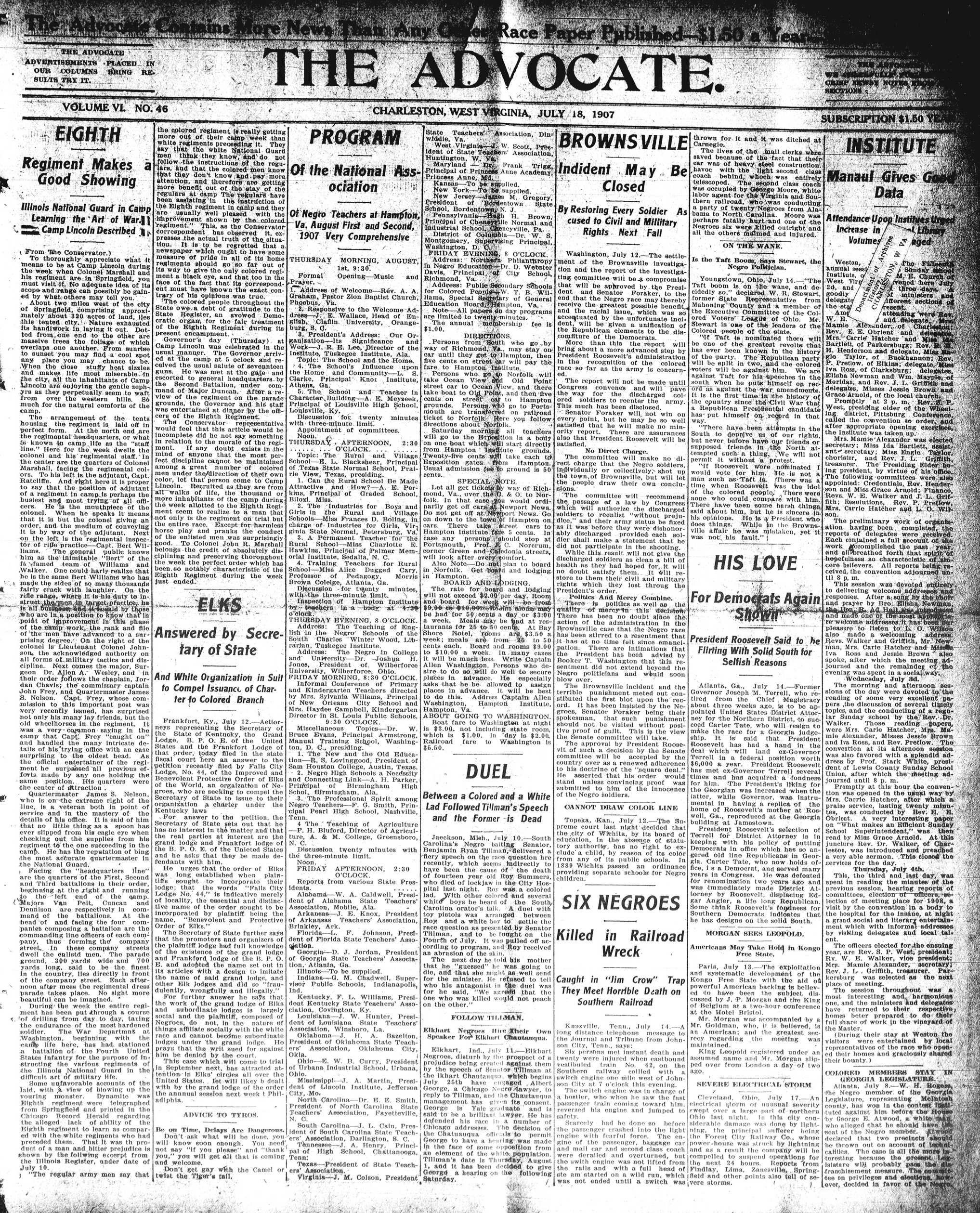
From The Conservator.)
To thoroughly appreciate what it means to be at Camp Lincoln during the week when Colonel Marshall and his regiment are in Springfield, you must visit it. No adequate idea of its scope and range can possibly be gained by what others may tell you.
About two miles west of the city of Springfield, comprising approximately about 320 acres of land, lies this tented city. Nature exhausted its handwork in laying it out. Dotted from one end to the other are massive trees the foliage of which overlaps one another. From sunrise to sunset you may find a cool spot any place you may chance to be. When the close stuffy heat sizzles and makes life most miserable in the city, all the inhabitants of Camp Lincoln are enjoying the gentle zephys as they perpetually seem to waft from over the western hills. So much for the natural comforts of the camp.
The arrangement of the tents housing the regiment is laid off in perfect form. At the north end are the regimental headquarters, or what is known in camp life as the "staff line." Here for the week dwells the colonel and his regimental staff. In the center are the quarters of Colonel Marshall, facing the regimental colors. To his left is the adjutant, Capt. Ratcliffe. And right here it is proper to say the position of adjutant of a regiment in the perhaps the busiest and most trying of officers. He is the mouthpiece of the colonel. When he speaks it means that it is but the colonel giving an order, and the medium of conveying it is by way of the adjutant. Next on the left is the regimental inspector of rifle practice—Capt. Bert Williams. The general public knows him as the infinitable "Bert" of the fa-famed team of Williams and Walker. One could hardly realize that he is the same Bert Williams who has fairly crack with laughter. On the rifle range, where it is his duty to injure the men in target practice, he is all the men in position to know that he are in a position to know that point of improvement in this phase of the man have advanced to a surprising degree. On the right of the colonel is Lieutenant Colonel Johnson, the acknowledged authority on all forms of military tactics and discipline. Next comes the major, Surgeon Dr. Allen A. Wesley, and in their order follows the chaplain, Jordan Chavis; the commissary captain John Frey, and Quartermaster James S. Nelson. Capt. Frey, whose commission to this important post was very recently issued, has surprised not only his many lay friends, but the old wheehlers in the regiment. It was a very common saying in the colonel. Capt. Frey "caught on and handed over" details of his trying office with an ease surprising to the oldest head. As the official entertainer of the regiment he surpassed all previous efforts made by any one holding the same position. His quarters were the center of attraction.
Quartermaster James S. Nelson, who is on the extreme right of the line, is a veteran both in point of service and in the mastery of the details of his office. It is said of him that no little thing as a spoon has ever slipped from his eagle eye when checking out the supplies from his regiment to the one succeeding in the camp. He has the reputation of bing the most accurate quartermaster in the National Guard.
Facing the "headquarters line" are the quarters of the First, Second and Third battalions in their order, beginning at the right and running to the left end of the gamp. Majors Van Pelt, Cuncan and Dennison are respectively in command of the battalions. At the head of and facing the four companies composing a battalion are the commanding line officers of each company, thus forming the company street. In these company streets the pulisil men, wide and ground, 300 yards wide and 700 yards long, said to be the finest in the country, lies directly in front of the company street. Each afternoon after mess the regimental dress parade takes place. No sight more beautiful can be imagined.
During the week the entire regiment has been put through a course of drilling from day to day, tasting the endurance of the most hardened soldier. The War Department at Washington, beginning with the early life life, has had stationed a battalion of the Fourth United States infantry for the purpose of instructing the various regiments of the Illinois National Guard in the difficult art of military life. Saving favorite accounts of the laid, with a view of blowing up the vowing monster. Dynamite was Eighth regiment were telegraphed from Springfield and printed in the Chicago Record Herald regarding the alleged lack of ability of the Eighth regiment to learn as compared with the white regiments who had preceded them. That it was the product of a man and bitter prejudice is shown by the following excerpt from the Illinois Register, under date of July 10.
"The regular army men say that
the colored regiment is really getting more out of their camp week than white regiments preceding it. They say that the white National Guard men think they know, and do not follow the instructions of the regulars, and that the colored men know that they don't know and pay more attention, and therefore are getting more benefit out of the stay of the regulars at camp. The regulars have been assisting in the instruction of the Eighth regiment in camp and they are usually well pleased with the situation shown by the colored regiment. This, as the Conservator correspondent, has observed it, expresses the actual wish of the situation. It is to be requested that a newspaper which ought to have a measure of pride in all of its home regiments should go so far out of its way to give the only colored regiment a black eye, and that too in the face of the fact that its correspondent must have known the exact contrary of his opinions was true.
The colored people throughout the Stateowe a debt of gratitude to the State Register, an avowed Democratic organ, for the fair treatment of the Eighth Regiment during its present encampment. Governor's day (Thursday) at Camp Lincoln was celebrated in the usual manner. The Governor arrived the camp at 5 oclock and received the men's salute of seventeen guns. He was at the gate and escorted to general headquarters by the Second Battalion command of Major Duncan. After a review of the regiment on the parade grounds, the Governor and his staff was entertained at dinner by the officers of the Eighth Regiment.
The Conservator representative would feel that this article would be incomplete did he not say something in relation to the morale of the regiment. If any doubt exists in the mind of anyone that the most perfect discipline cannot be maintained among a great number of colored color, let that personation of their own color, let that personation of the camp Lincoln. Recruited as they are all walks of life, the thousand or more inhabitants of the camp during the week allotted to the Eighth Regiment seem to realize to a man that not only is the regiment on trial but the entire race. Except for harmless horse play and pranks the conduct of the enlisted men was surprisingly good. To Colonel John R. Marshall he received credit of absolutely disciplining and that personation throughout the week the perfect order which been so notably characteristic of the Eighth Regiment during the week just ended.
Answered by Secretary of State
And White Organization in Suit to Compel Issuance of Charter to Colored Branch
Frankfort, Ky., July 12.—Aetternes representing the Secretary of the State of Kentucky, the Grand Lodge, B. P. O. E. of the United States and the Frankfort Lodge of that order, today filed in the state fiscal court here an answer to the petition recently filed by Falls City Lodge, No. 44, of the Improved and Benevolent Protective Order of Elks of the World, an orgalzation of Negroes, who are seeking to compel the Secretary of State to issue to their organization a charter under the Kentucky laws.
No answer to the petition, the Secretary of State gets out that he has no interest in the matter and that the real parties at interest are the grand lodge and Frankfort lodge of the B. P. O. E. of the United States and he asks that they be made defendants with him.
He urges that the order of Elks was long established when plaintiffs sought to incorporate their lodge; that the words "Falls City Lodge No. 44," is indicative merely of locality, the essential and distinctive name of the order sought to be incorporated by plaintiff being the name "Benevolent and Protective Order of the State." The Secretary of State further says that the promoters and organizers of the plaintiff lodge had full knowledge of the existence of the grand lodge and Frankford lodge of the B. P. O. E. and adopted the name set out in its articles with a design to imitate the name of said grand lodge, and other Elk lodges and did so "frauulently, wrongfully and illegally." For further answer he says that the work of the grand lodge of Elks and subordinate lodges is largely social and the plaintiff, composed of若干 things affiliate socially the nature of the white race and cannot become subordinate lodges under the grand lodge. He prays that the writ sued for against him be denied by the court.
This case which will come to trial in September next, has attracted attention in Elks' circles all over the United States. It will likely b dealt the grief the grief lodge of the order the annual session next week (Philadelphia).
ADVICE TO TYROS:
Be on Time, Delays Are Dangerous.
Don't ask what will be done, you
will know soon enough. You need
not say "if you please" and "thank
you," you will get all that is coming
and welcome.
Don't get gay with the Camel or
twist the Tiger's tail.
CHARLESTON, WEST VIRGINIA, JULY 18, 1907
Of Negro Teachers at Hampton, Va. August First and Second, 1907 Very Comprehensive
THURSDAY MORNING, AUGUST,
1st, 9:30.
Formal Opening—Music and
Prayer.
1. Address of Welcome—Rev. A. A.
Graham, Pastor Zion Baptist Church,
Phoebus, Va.
2. Responsive to the Welcome
Address—J. E. Wallace, Head of Engl-
ish Flintin University, Orange-
burg, S. C.
3. President's Address: Our
Organization—its Significance
and Work—J. R. E. Lee, Director of
the Institute, Tuskegee Institute, Ala.
Topic: The School and the Home.
4. The School's Influence upon
the Home and Community—L. S.
Clarke, Principal Knot Institute,
Athens, Ga.
5. The School and Teacher in
Character Building—A. E. Meyzeek,
Principal of Louisville High School,
Louisville, Ky.
Discussion for twenty minutes
with three-minute limit.
Appointment of committees.
Noon.
THURSDAY, AFTERNOON, 2:30
10:30 AM
O CLOCK.
Topic: The Rural and Village School—E. L. Blackshear, Principal of Pouls State Normal School, Prairie View, Texas, building.
1. Can the Rural School Be Made Attractive and How?—A. E. Perkins, Principal of Graded School, Biloxi, Miss.
2. The Industries for Boys and Girls in the Rural and Village Schools—Miss Frances D. Boiling, in charge of Industries for Girls, Virginia State Normal, Petersburg, Va.
3. A Permanent Teacher for the Rural School—Miss Charlotte E. Hawkins, Principal of Palmer Memorial Institute, Sedalia, N. C.
4. Training Teachers for Rural School—Miss Allis Auggled Cary, Professor of Pedagogy Morris Brown College, Atlanta, Ga.
Discussion for twenty minutes, with the three-minute limit.
Inspection of Hampton Institute by teachers in a body at 4:30 o'clock
THURSDAY EVENING, 8 O'CLOCK
Address: The Teaching of English
at Negro Schools of the
South Charles W. Good, Librarian,
Tuskegee Institute
Address: The Negro in College
and 'University'—Dr. Joshua H.
Jones, President of Wilberforce
University, Wilberforce, Ohio.
P.O. Box 1210, Wilberforce, O.C.
OCLC
FRIDAY MORNING, 8:30 O'CLOCK
Informal Conference of Primary and Kindergarten Teachers directed by Mrs. Sylvania Williams, Principal of New Orleans City School and Mrs. Haydote Campbell Kindergarten Director in the Public Schools.
9:30 O'CLOCK
Miscellaneous Topics—Dr. W. Bruce Evans, Principal Armstrong, Manual Training School, Washington, D. C., presiding.
1. The New and the Old Education—R. S. Lovinggood, President of Sam Houston College, Austin, Texas.
2. Negro High Schools a Necessity and Connecting Link—A. H. Parker, Principal of Birmingham High School, Birmingham, Ala.
3. The Professional Spirit among Negro Teachers—F. G. Smith, Principal Pearl High School, Nashville, Tenn.
4. The Teaching of Agriculture—P. H. Bluford, Director of Agriculture, A. & M. College, Greensboro, N. C.
Discussion twenty minutes with the three-minute limit.
FRIDAY AFTERNOON, 2:30
O'CLOCK.
Reports from various State Presidents.
Alabama—W. A. Caldwell, President of Alabama State Teachers' Association, Mobile, Ala.
Arkansas—J. E. Knox, President of Arkansas Teachers' Association, Bunkley, Ark.
Florida—L. F. Johnson, President of Florida State Teachers' Association.
Georgia—D. J. Jordan, President of Georgia State Teachers' Association, Atlanta, Ga.
Illinois—To be supplied.
Texas-President of State Teachers Association.
Virginia-J. M. Colson, President
State Teachers Association, Dinwildie, Va.
West Virginia—J. W. Scott, President of State Teachers' Association, Huntington, W. Va.
Maryland—Dr. Frank Trigg, Principal of Princess Anne Academy, Princess Anne, Md.
Kansas—To be supplied.
Tennessee—To be supplied.
New Jersey—James H. Gregory, President of Bordentown State School, Bordentown, N. J.
Pennsylvania—Hugh H. Brown, Principal of Cheneyville Normal and Industrial School, Cheneyville, Pa.
District of Columbia—Dr. W. S. Montgomery, Supervising Principal, Washington, D. G.
FRIDAY EVENING, 8 O'CLOCK
Address: Northern Philanthropy
Principal Education-Dr. D. Webster
Davis, Principal of City School,
Richmond, Va.
Address: Public Secondary Schools
for Colored People-W. T. B. W.
Williams, Special Secretary of General
Education Board, Hampton, Va.
Note—All papers on day programs are limited to twenty minutes.
The annual membership fee is $1.00.
DIRECTIONS
Persons from South who go, by way of Richmond, Va. may stay on car until they get to Hampton, then five cents on street car will pay the fare to Hampton Institute.
Persons who go to Norfolk will take Ocean View, Old Point street to Ocean View, and there take boat to Old Point, and there five cents on street car to Hampton grounds. Persons who go to Portsmouth are transferred on railroad ticket to Norfolk. Here you follow directions about Norfolk.
Saturday morning all teachers will go to the Deposition in a body on one boat which will start directly from Hampton Institute grounds. twenty-five cents will take each to Deposition gates from Hampton. Usual admission fee to ground is 50 cents
SPECIAL NOTE
Let all get tickets by way of Richmond, Va., over the G. & O. to Norfolk. In that case you would ordinarily get off cars at Newport News. Do not get off at Newport News. Go on down to the town of Hampton on cars. There take street cars to Hampton Institute take 5 cents. In case any persons should stop at north Cedar Creek, Norcum, corner Green and Norcum streets, will look after every comfort. Also Note—Do not plan to board in Norfolk. Get board and lodging in Hampton.
BOARD AND LODGING.
The rate for board and lodging will not exceed $2.00 per day. Room and board for week will be from $9.00 to $10.00. Holidays alone may be had for 50 cents a day or $3.00. Holiday meals may be and at restaurants for 5 to 50 cents. At Bay Shore Hotel, some rooms are $3.50 week; meals are from $5 to 50 cents each. Board and rooms $9.00 to $10.00 a week. In many cases it will be much less. Write Captain Allen Washington. Persons who desire to do so will do well to secure places in advance. He especially asks that he be allowed to assign places in advance. It will be best to do this. Address Captain Allen Washington, Hampton Institute, Hampton, Va.
ABOUT GOING TO WASHINGTON.
Boat fare to Washington at night is $3.00. not including state room,
which is $1.00. in day is $2.00.
Railroad fare to Washington is $5.50.
Between a Colored and a White Lad Followed Tillman's Speech and the Former is Dead
Jaeckson, Mileh., July 10.—South Carolina's Negro baiting Senator, Benjamin Ryan Tillman, delivered a fiery speech on the race question hre recently, which seems indirectly to have been the cause of "the death of fourteen year old Roy Summers, who died of lockjaw in the City Hospital last night. Roy was a colored lad. With other colored and several white boys he heard of the South Carolina orator's talk. A duel with toy pistols was arranged between Roy and a white boy to settle the race question as presented by Senator Tillman, and to be fought on the Fourth of July. It was pulled off acceding program, and Roy received an anastomosis of the shin. The next day he told his mother that he "guessed" he was going to die, and that she might as well send for the minister. He refused to tell who his antagonist in the duel was for he said, "We agreed that the one who was killed would not peach on the other."
FOLLOW TILLMAN.
Elkhart Negroes Hire Their Own Speaker For Elkhart Chantauqua.
Elkhart, Ind., July 11.—Elkhart Negroes, disturb by the prospect of a prejudice being created against them by the speech of Senator Tillman at the elkhart Chantauqua, which begins 25th have engaged Albert George of Chicago the lawyer, to reply to Tillman and the Chantauqua management has given its consent, George is Yale graduate and is said to be a brilliant lawyer. He has defended his race in a number of Chicago addresses. The decision of the Chatauqua officials to permit George to have a hearing was made in the face of some opposition from an element of the white population. Tillman's date is Thursday, August and it has been decided to give George a hearing on the following Saturday.
Washington, July 12.—The settlement of the Brownsville investigation and the report of the investigating committee will be a compromise that will be approved by the President and Senator Foraker, to the end that the Negro race may thereby receive the greatest possible benefit, and the racial issue, which was so accentuated by the unfortunate incident, will be given a unification of the Republican elements to the discomfiture of the Democrats.
More than a mile the report will bring about a more advanced step by President Roosevelt's administration in the recognition of the colored race so far as the army is concerned.
The report will not be made until Congress convenes and will pave the way for the discharged colored soldiers to reenter the army. This much has been disclosed.
Senator Foraker will not win on every point, but he may be so well satisfied that he will make no minority report. There are assurances also that President Roosevelt will be satisfied.
No Direct Charge.
The committee will make no direct charge that the Negro soldiers, individually or collectively, shot up the town, of Brownsville, but will let the people draw their own conclusion.
The committee will recommend the passage of a law by Congress which will authorize the discharged soldiers to reenlist "without prejudice," and their army status be fixed as it was before they were dishonorably discharged provided each soldier shall make a statement that he did not participate in the shooting.
While this result will not give the discharged soldiers as clean a bill of health as hoped for, it will no doubt satisfy the committee to restore to them their civil and military rights which they lost through the President's order.
Politics And Mercy Combine.
There is politics as well as the quality of mercy in this decision.
There has been no doubt since the action of the administration in the Brownsville case that the Negro race has been stirred to a resentment that it has at no time felt since emancipation. There are intimations that the President has been advised by Booker T. Washington that this re-removal did not extend beyond the Negro citizens and would soon blow over.
The Brownsville incident and the terrible punishment meted out constituted the first blot upon the record. It has been insisted by the Negroes, Senator Foraker being their spokesman, that such punishment should not be visited without positive proof of guilt. This is the view the Senate committee will take.
The approval by President Roosevelt of such a decision by the Senate committee will be accepted by the country over as a renewed adherence to his doctrine of the square deal." And he ordered that the order would stand unless convincing proof was submitted to him of the innocence of the Negro soldiers.
CANNOT DRAW COLOR LINE
Topeka, Kan., July 12.—The Supreme court last night decided that the city of Wichita, by its board of education, in the absence of statutory authority, has no right to exclude a child, by reason of its color from any of its public schools. In 1889 Wichita passed an ordinance providing separate schools for Negro children.
SIX NEGROES Killed in Railroad Wreck
Caught in "Jim Crow" Trap They Meet Horrible Death on Southern Railroad
Knoxville, Tenn., July 14.—A long distance telephone message to the Journal and Tribune from Johnson City, Tenn., says: Six persons met instant death and twenty were injured when eastbound restituted train No. 42, on the Southern railway collied with a switch engine one mile west of Johnson City at 7 o'clock this evening. The switch engine was in charge of a hostler, who when he saw the fast passenger train coming toward him, reversed his engine and jumped to safety. Scarcely had he done so before the passenger crashed into the light engine with fearful force. The engine of the passenger, baggage car and mail car and second class coach were derailed and overturned, but the swish engine was not lifted from the rails and with a full head of steam started on a wild run, which was not ended until a switch was
thrown for it and it was ditched at Carnegie.
The lives of the mail clerks were saved because of the fact that their car was of heavy steel construction, havoc with the light second class coach behind, who was entirely telscoped. The second class coach was occupied by George Moore, white labor agent for the Virginia and Southern railroad, who was conducting a party of twenty Negroes from Alabama to North Carolina. Moore was perhaps fatally hurt and one of the Negroes six were killed outright and all the others mutilated and injured.
Is the Taft Boom, Says Stewart, the Negro Policeman.
Youngtown, Ohio, July 14.—"The Taft boom is on the wane, and decidedly so," declared W. R. Stewart, former State Representative from Mahoning County and a member of the Colored Voters' League of Ohio. Stewart is one of the leaders of the Colored people of the state.
"If Taft is nominated there will be one of the greatest revolts that has ever been known in the history of the party. The Republican party will be split in two, and the colored voters will be against him. We are against Taft for his speeches in the south when he puts himself on record as against the war amendments. It is the first time in the history of the country since the Civil War that a Republican Presidential candidate has put himself on record in that way.
"There have been attempts in the South to deprive us of our rights, but never before have our friends or supposed friends in the North attempted such a thing. We will not permit it without a protest.
"If Roosevelt were nominated I would vote for him. He is not a man such as Taft is. There was a time when Roosevelt was the idol of the colored people. There were none who could compare with him. There have been some harsh things said about him, but he is sincere in his opinions. He is a President who does things. While in the Brownsville affair he was mistaken, yet it was not, his fault."
HIS LOVE
For Democrats Again Shown
President Roosevelt Said to be
Filtring With Solid South for
Selfish Reasons
Atlanta, Ga., July 14.—Former Governor Joseph M. Terrell, who retired from the Chief Magistracy about three weeks ago, is to be appointed United States District Attorney for the Northern District, to succeed Carter Tate, who will resign to make the race for a Georgia judgeship. It is said that President Roosevelt has had a hand in the deal which will land ex-Governor Terrell in a federal position worth $6,000 a year. President Roosevelt has met ex-Governor Terrell several times and has acquired a fondness for him. The President's liking for the Georgian was increased when the latter, while Governor, was instrumental in having a replica of the home of Roosevelt's mother at Roswell, Ga., reproduced at the Georgia building at Jamestown.
President Roosevelt's selection of Terrell for District Attorney is in keeping with his policy of putting Democrats in office which has so angered old line Republicans in Georgia. Carter Tate, who now holds office, is a Democrat, and served many years in Congress. He was defeated in the two years ago and was immediately made the attorney by Roosevelt, displacing Edgar Angler, a life long Republican. Some think Roosevelt's fondness for Southern Democrats indicates that he has designs on the solid South.
MORGAN SEES LEOPOLD.
Americans May Take Hold in Konge Free State.
Paris, July 13.—The exploitation and systematic development of the Kongo Free State with the aid of powerful American backing is believed to have been the subject discussed by J. P. Morgan and the King of Belgium at a two-hour conference at the Hotel Bristol. Mr. Morgan was accompanied by a Mr. Goldman, who, it is believed, is an American; and the greatest secrecy regarding the meeting was maintained. King Leopold registered under an assumed name and Mr. Morgan silenced over from London a day of two ago.
SEVERE ELECTRICAL STORM
Cleveland, Ohio, July 17.—An electrical storm of unusual severity swept over a large part of northern Ohio last night. In this city considerable damage was done by lightning, the principal sufferer being the Forest City Railway Co., whose power-house was struck by lightning and as a result the company will be compelled to suspend operations for the next 24 hours. Reports from Findlay, Lima, Zanesville, Springfield and other points also tell of severe storms.
Weston,
annual session,
Institute of,
West Virgina
Department of
Civil Affairs
The Fifteenth
Sunday meeting
M. E. Church of
West Virgina
Department of
Civil Affairs
verned here July
2d, and
goody
minister and
delegate
different sections of
the state
present.
Amy attending werd Rew W. E. and delegate, Mira Mamie Alexander, of Charleston; Rev. E. E. Oblent and delegates, Car. Car Matcheer and Miles M. Bartlett, of Paterson; Rew H. Henderson and delegate, Mira Mangle Taylor, of Bucksnorr; Rev. P. Pretlow, of Elkins; delegates, Iva Ross, of Clarksburg; delegates, Ellisa Newman and Wm. Mayple, of Meridan, and Rev. J. L. Griffith and delegates, Misses Jessie Brown and Grace Arnold, of the local church. Promptly at 2 p. m. Rev. S. P. West, presiding elder of the Wheeling Conference, called the convention to after appropriate opening exercises, the institute was taken up.
Mrs. Mamie 'Alexander was elected secretary; Miss Ida Bartlett, assistant secretary; Miss Engle Taylor, chorister, and Rev. J. L. Griffith, treasurer. The Presiding Elder being president, by virtue of his office. The following committees were also appointed: Credentials, Rev. Henderson, Miss Grace Arnold; Finance, Revs. W. E. Walker and J. L. Griffith; Resolutions, Rev. P. Prettow, Mrs. Carrie Hatcher and L. O. Wilson.
The preliminary work of organization having been completed, the reports of delegates were received. Each contained a full record of work accomplished the past year and all breathed forth that spirit of hopefulness so characteristic of sincere believers. All reports being received, the convention adjourned until 8 p. m.
This session was devoted entirely to delivering welcome addresses and responses. After a song by the choir and prayer by Bro. Misha Newman, the Hon. R. Ad Hall was introduced and made one of the most prominent welcome addresses it has been our pleasure to listen to. L. O. Wilson, Revs. Walker and Griffith, Mr. Newman, Mrs. Carie Hatcher and Miss Iva Ross and Jessie Brown also spoke, after which the meeting adjourned and the remainder of the evening was spent in a social way.
Wednesday, July 3d.
The morning and afternoon sessions of the day were devoted to the reading of some very excellent papers, the discussion of several timely topics, and the conducting of a regu-
Sunday school by the Rev. Dr. Wawr
Wawr Theo Tiehee, and were Mrs. Carle Hatcher, Mrs. Memie Alexander, Misses Jessie Brown and Iva Ross, and Rev. Prelow. The convention at its afternoon session was also favored with a splendid address by Prof. Stark White, pres-
ident of Lewis County Sunday School
Union, after which the meeting ad-
journed until 8 p. m.
Promptly at this hour the convention was opened in the usual way by Mrs. Carrie Hatcher, after which a praise service, lasting twenty minutes, was conducted by Rev. E. E. Obrient. A very interesting paper on "What makes an Efficient Sunday School Superintendent," was then read by Miss Grace Arnold. At this juncture Rev. Dr. Walker, of Charleston, was introduced and preached a very able sermon. This closed the services for the day.
Thursday, July 4th.
This, the third and last day, was spent in seating minutes of the previous session, hearing reports of committees, election of officers, selection of meeting place for 1908, a visit by the convention in a body to the hospital for the insane, at night a grand social and literary entertainment which with informal addresses by visting delegates and local talent.
The officers elected for the ensuing year, are Rev. S. P. West; president; Rv. W. E. Walker, vice president; Mrs. Mamie Alexander, secretary; Rev. J. L. Griffith, treasurer. Parkersburg was selected as the next place of meeting. The session throughout was a most interesting and harmonious one, and the ministers and delegates have returned to the respectful homes to prepare to do their full share of work in the vineyard of the Master. (During their stay at Weston the visitors were entertained by local representatives of the race who opened their homes and graciously shared their bounty.) COLORED MEMBERS STAY IN
GEORGIA LEGISLATURE.
Atlanta, July 8.—W. H. Hogan, the Negro member of the Georgia Legislature, representing McIntosh county, has won in the content instituted against him before the House by George E. Atwood, a white man who alleged at he start that he was a former N. Member. Atwood declared that two prosecutes should be thrown out on account of technicalities. The case is all the more interesting because the present Legislature will probably pass the disfranchisement measure. The committee on privileges and elections, however, decided in favor of the Negro.
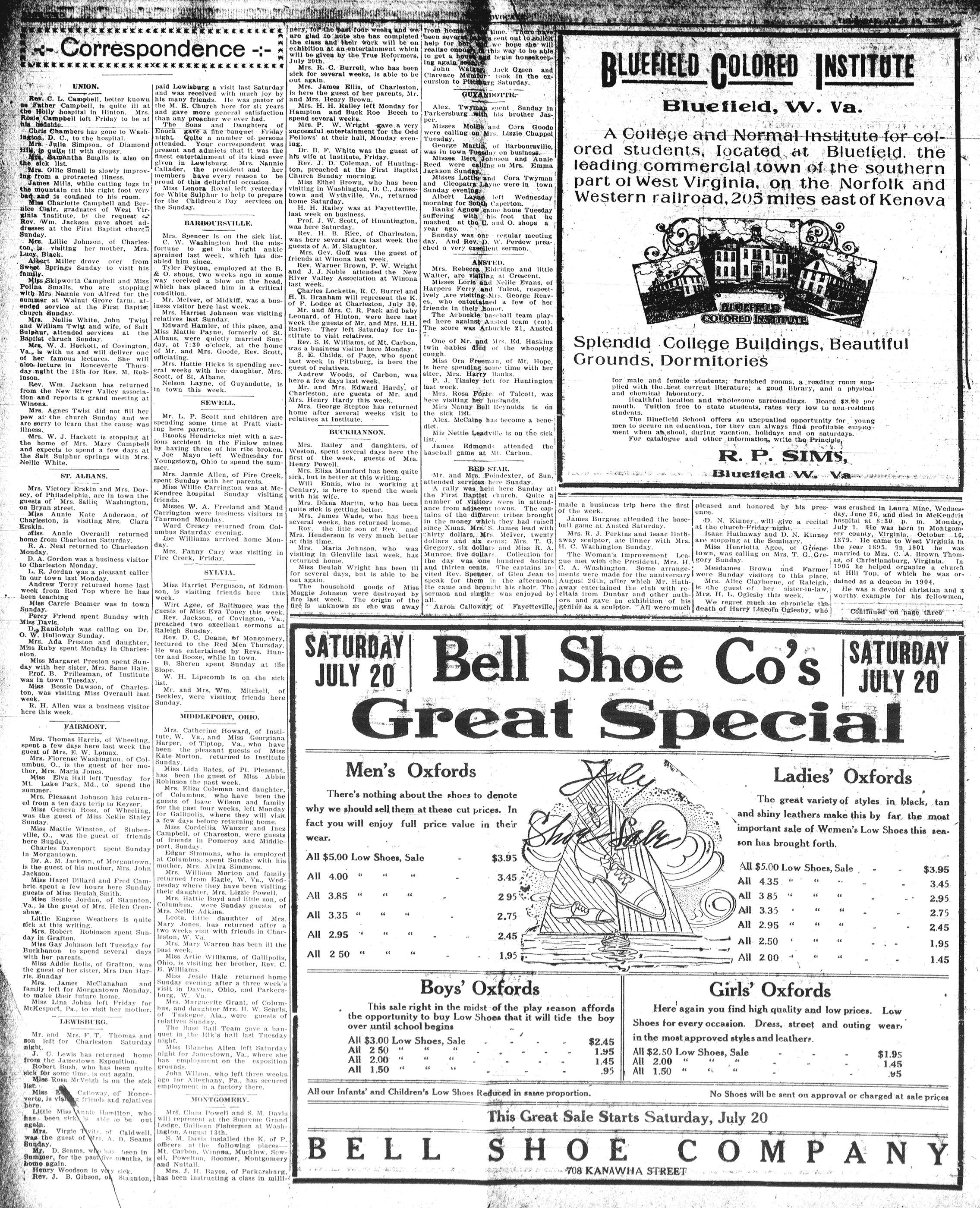
Correspondence
Rev. C. L. Campbell, better known as Father Campbell, is quite ill at the Holly hospital in Hinton. Mrs. Rosie Campbell left Friday to be at his bedside.
Chris Chambers has gone to Washington, D. C., to the hospital.
Mrs. Julia Simpson, of Diamond Hill, is quite ill with dropsy.
Mrs. Samantha Smalls is also on the sick list.
Mrs. Ollie Small is slowly improving from a protracted illness.
James Mills, while cutting logs in the mountain cut his right foot very bad and is confined to his room.
Miss Charlotte Campbell and Bernice Clair, graduates of West Virginia Institute, by the request of Rev. Wm. Jackson gave short addresses at the First Baptist church Sunday.
Mrs. Lillie Johnson, of Charleston, is visiting her mother, Mrs. Luoy. Black.
Albert Miller drove over from Sweet Springs Sunday to visit his family.
Miss Skipworth Campbell and Miss Polina Smalls, who are stopping with Mrs Nannie von Alfred for the summer at Walnut Grove farm, attended service at the First Baptist church Sunday.
Mrs. Nellie White, John Twist and William Twist and wife, of Salt Sulphur, attended services at the Baptist church Sunday.
Mrs. W. J. Hackett, of Covington, Va., is with us and will deliver one of her famous lectures. She will also lecture in Reverencete Thursday night the 18th for Rev. M. Robinson.
Rev. Wm. Jackson has returned from the New River Valley association and reports a grand meeting at Winona.
Mrs. Agnes Twist did not fill her pew at the church Sunday and we are sorry to learn that the cause was illness.
Mrs. W. J. Hackett is stopping at the home of Mrs. Mary Campbell and expects to spend a few days at the Salt Sulphur springs with Mrs. Nellie White.
ST. ALBANS.
Mrs. Victory Erskin and Mrs. Dorsey, of Philadelphia, are in town the guests of Mrs. Sallie Washington, on Bryan street.
Miss Annie Kate Anderson, of Charleston, is visiting Mrs. Clara Erskin.
Miss Annie Overaull returned home from Charleston Saturday.
R. A. Neal returned to Charleston Monday.
D. A. Gordon was a business visitor to Charleston Monday.
L. R. Jordan was a pleasant caller in our town last Monday.
Andrew Terry returned home last week from Red Top where he has been teaching
Miss Carrie Beamer was in town Sunday.
Percy Friend spent Sunday with Miss Davis.
D. Randolph was calling on Dr. O. W. Holloway Sunday.
Mrs. Ada Preston and daughter, Miss Ruby spent Monday in Charleseton.
Miss Bessie Dawson, of Charleston, was visiting Miss Overaull last week. R. H. Allen was a business visitor here this week.
FAIRMONT.
Mrs. Thomas Harris, of Wheeling, spent a few days here last week the guest of Mrs. E. W. Lomax.
Mrs. Florence Washington, of Columbus, O., is the guest of her mother, Mrs. Maria Jones.
Miss Elva Hall left Tuesday for Mt. Lake Park, Md., to spend the summer.
Mrs. Pleasant Johnson has returned from a ten days terip to Keyser.
Miss Geneva Ross, of Wheeling, was the guest of Miss Nellie Staley Sunday.
Miss Mattle Winston, of Stubenville, O., was the guest of friends here Sunday.
Charles Davenport spent Sunday in Morgantown.
Dr. A. M. Jackson, of Morgantown is the guest of his mother, Mrs. John Jackson.
Miss Hazel Dillard and Fred Cambric spent a few hours here Sunday guests of Miss Beulah Smith.
Miss Sessie Jordan, of Staunton, Va., is the guest of Mrs. Helen Crenshaw.
Little Eugene Weathers is quite slick at this writing.
Mrs. Robert Robinson spent Sunday in Grafton.
Miss Gay Johnson left Tuesday for Buckhanon to spend several days with her parents.
Miss Addie Rolls, of Grafton, was the guest of her sister, Mrs Dan Harris, Sunday
Mrs. James McClanahan and family left for Morgantown Monday, to make their future home.
Miss Lina Johns left Friday for McKesport, Pa., to visit her mother.
LEWISBURG
Mr. and Mrs. F. T. Thomas and son left for Charleston Saturday night. J. C. Lewis has returned home from the Jamestown Exposition. Robert Bush, who has been quite sick for some time, is out again.
Miss Rosa McVeigh is on the sick list.
Miss E. Calloway, of Ronce-verte, is visiting friends and relatives here.
Little Miss Annie Hamilton, who has been sick, is able to be out again.
Mrs. Virgle Tivity, of Caldwell, was the guest of Mrs. A. D. Seams Sunday.
Mr. D. Seams, who has been in Summer, for the past five months, is home again.
Henry Woodson is very sick.
Rev. J. B. Gibson, or Staunton,
paid Lewisburg a visit last Saturday and was received with much joy by his many friends. He was pastor of the M. E. Church here for six years and gave more general satisfaction than any preacher we ever had. The Sons and Daughters of Enoch gave a the banquet Friday night. Quite a number of persons attended. Your correspondent was present and admires that it was the finest entertainment of its kind ever given in Lewisburg. Mrs. Nannie Callinder, the president and her members have every reason to be proud of this delightful occasion. Miss Lenora Royal left yesterday for White Sulphur to help to prepare for the Children's Day services on the Sunday.
BARBOURSVILLE.
Mrs. Spencer is on the sick list,
C. W. Washington had the misfortune to get his right ankle sprained last week, which has disabled him since.
Tyler Peyton, employed at the B. & O. shops, two weeks ago in some way received a blow on the head, which has placed him in a critical condition.
Mr. Melver, of Midkiff, was a business visitor here last week.
Mrs. Harriet Johnson was visiting relatives last Sunday.
Edward Hamler, of this place, and Miss Mattie Payne, formerly of St. Albans, were quietly married Sunday, at 7:30 o'clock, at the home of Mr. and Mrs. Goode, Rev. Scott, officiating.
Mrs. Hattie Hicks is spending several weeks with her daughter, Mrs. Scott, of St. Albans.
Nelson Layne, of Guyandotte, is in town this week.
SEWELL
Mr. L. P. Scott and children are spending some time at Pratt visiting here parents.
Books Hendricks met with a serious accident in the Finlow mines by having three of his ribs broken.
Joe Mayo left Wednesday for Youngstown, Ohio to spend the summer.
Mrs. Jannie Allen, of Fire Creek, spent Sunday with her parents.
Miss Willie Carrington was at McKendree hospital Sunday visiting friends.
Misses W. A. Freeland and Maud Carrington were business visitors in Thurmond Monday.
Ward Creacy returned from Columbus Saturday evening.
Joe Williams arrived home Monday.
Mrs. Fanny Cary was visiting in Fire Creek, Friday.
SYLVIA.
Miss Harriet Ferguson, of Edmonson, is visiting friends here this week.
Wirt Agee, of Baltimore was the guests of Miss Eva Toney this week.
Rev. Jackson, of Covington, Va., preached two excellent sermons at Raleigh Sunday.
Rev. D. C. Deane, of Mongomery, lectured to the Red Men Thursday. He was entertained by Revs. Hunter and Booze, while in town.
B. Sheren spent Sunday at the Slope.
W. H. Lipscomb is on the sick list.
Mr. and Mrs. Wm. Mitchell, of Beckley, were visiting friends here Sunday.
MIDDLEPORT, OHIO
Mrs. Catherine Howard, of Institute, W. Va., and Miss Georgiana Harper, of Tiptop, Va., who have been the pleasant guests of Miss Kate Morton, returned to Institute Sunday.
Miss Lida Bates, of Pt. Pleasant, has been the guest of Miss Abbie Robinson the past week.
Mrs. Eliza Coleman and daughter, of Columbus, who have been the guests of Isaac Wilson and family for the past four weeks, left Monday for Gallipolis, where they will visit a few days before returning home.
Miss Cordellia Wanzer and Inez Campbell, of Chareston, were guests of friends in Pomeroy and Middleport. Sunday.
Edgar Simmons, who is employed at Columbus, spent Sunday with his mother, Mrs. Alvira Simmons.
Mrs. William Morton and family returned from Eagle, W. Va., Wednesday where they have been visiting their daughter, Mrs. Lizzie Powell.
Mrs. Hattie Boyd and little son, of Columbus, were Sunday guests of Mrs. Nellie Adkins.
Loota, little daughter of Mrs. Mary Jones, has returned after a two weeks visit with friends in Charleston, W. Va.
Mrs. Mary Warren has been ill the past week.
Miss Artie Williams, of Gallipolis, Ohio, is visiting her brother, Rev. C. E. Williams.
Miss Jessie Hale returned home Sunday evening after a three week's visit in Dayton, Ohio, and Parkersburg, W. Va.
Mrs. Marguerite Grant, of Columbus, and daughter Mrs. H. W. Searls, of Tuskegee, Ala., were guests of relatives Sunday.
The Base Ball Team gave a banquet in the Elk's hall last Tuesday night.
Miss Blanche Allen left Saturday night for Jamestown, Va., where she has employment on the exposition grounds. John Wilson, who left three weeks ago for Alleghany, Pa., has secured employment in a factory there.
MONTGOMERY.
Mrs. Clara Powell and S. M. Davis will represent at the Supreme Grand Lodge, Gallian Fishermen at Washington, August 13th. S. M. Davis installed the K. of P. officers at the following places—Mt. Carbon, Winona, Mucklow, Scwell, Powelton, Boomer, Montgomery and Nuttall. Mrs. J. H. Bayes, of Parkersburg, has been instructing a class in milli-
nery, for the past four weeks and we are glad to note she has completed the class and their work will be on exhibition at an entertainment which will be given by the True Reformers, July 20th.
Mrs. R. C. Burrell, who has been sick for several weeks, is able to be out again.
Mrs. James Ellis, of Charleston, is here the guest of her parents, Mr. and Mrs. Henry Brown.
Mrs. H. H. Railley left Monday for Hampton and Buck Roe Beech to spend several weeks.
Mrs. P. W. Wright gave a very successful entertainment for the Odd Fellows' at their hall, Monday evening.
Dr. B. F. White was the guest of his wife at Institute, Friday.
Rev. J. D. Coleman, of Huntington, preached at the First Baptist Church Sunday morning.
Miss Ethel Brown, who has been visiting in Washington, D. C., James-town and Wythville, Va., returned home Saturday.
H. H. Railey was at Fayetteville, last week on business.
Prof. J. W. Scott, of Huntington, was here Saturday.
Rev. H. B. Rice, of Charleston, was here several days last week the guests of A. M. Slaughter.
Mrs. Gev. Goff was the guest of friends at Winona last week.
Rev. Warner Brown, P. W. Wright and J. J. Noble attended the New River Valley Association at Winona last week.
Charles Lockette, R. C. Burrel and H. B. Branham will represent the K. of P. Lodge at Charleston, July 30.
Mr. and Mrs. C. R. Pack and baby Leonard, of Hinton, were here last week the guests of Mr. and Mrs. H.H. Railey. They left Saturday for Institute to visit relatives.
Rev. S. E. Williams, of Mt. Carbon, was a business visitor here Monday.
Andrew Woods, of Carbon, was here a few days last week. Mr. and Mrs. Edward Hardy, of Charleston, are guests of Mr. and Mrs. Henry Hardy this week. Mrs. George Steptoe has returned home after several weeks visit to relatives at Institute.
BUCKHANNON.
Mrs. Bailey and daughters, of Weston, spent several days here the first of the week, guests of Mrs. Henry Powell.
Mrs. Eliza Mumford has been quite sick, but is better at this writing.
Will Ennis, who is working at Century, is here to spend the week with his wife.
Mrs. Difana Martin, who has been quite sick is getting better.
Mrs. James Wade, who has been several weeks, has returned home.
Roy, the little son of Rev. and Mrs. Henderson is very much better at this time.
Mrs. Maria Johnson, who was visiting in Glenville last week, has returned home.
Miss Beulah Wright has been ill for several days, but is able to be out again.
The household goods of Miss Maggie Johnson were destroyed by fire last week. The origin of the fire is unknown as she was away
SATURDAY
JULY 20
SATURDAY JULY 20 Bell Shoe Co's SATURDAY JULY 20 Great Special
Men's Oxfords
There's nothing about
why we should sell them a
fact you will enjoy full
wear.
All $5.00 Low Shoes, Sale
All 4.00 " " "
There's nothing about the shoes to denote why we should sell them at these cut prices. In fact you will enjoy full price value in their
This sale right in the midst of the play season affords the opportunity to buy Low Shoes that it will tide the boy over until school begins
All our Infants' and Children's Low Shoes Reduced in same proportion.
from home for a time. There have been several calls sent out to solicit help for her, and we hope she will realize enough in this way to be able to get a house and begin housekeeping again soon.
John Walker, Jack Green and Clarence Mumford took in the excursion to Plitvice Saturday.
Alex. Twyman spent. Sunday in Parkersburg with his brother Jasper.
Misses Molle and Cora Goode were calling on Mrs. Lizzie Chappel Tuesday.
George Martin, of Barbouraville, was in town Tuesday on business.
Misses Bert Johnson and Annie Reed were calling on Mrs. Emma Jackson Sunday.
Misses Lottie and Cora Twyman and Cleopatra Laune were in town Sunday evening.
Albert Layne left Wednesday morning for South Caperton.
Banks Agnew came home Tuesday suffering with his foot that he mashed at the C. and O. shops a year ago.
Sunday was our regular meeting day. And Rev. D. W. Perdew preached a very excellent sermon.
Mrs. Rebecca Eldridge and little Walter, are visiting at Crescent.
Misses Loris and Neilie Evans, of Harpers Ferry and Talecot, respectively, are visiting Mrs. George Reaves, who entouained a few of her friends in their honor.
The Arbuckle baseball team played here against Ansted team (col). The score was Arbuckle 21, Ansted 7.
One of Mr. and Mrs. Ed. Haskins twin babies died of the whooping cough.
Miss Ora Freeman, of Mt. Hope, is here spending some time with her sister, Mrs. Harry Banks.
P. J. Tinsley left for Huntington last week.
Mrs. Rosa Forte, of Talcott, was here visiting her husbands.
Miss Nanny Bell Reynolds is on the sick list.
Alex. McCaing has become a benedict.
Mis Nettie Leadville is on the sick list.
James Edmonds attended the baseball game at Mt. Carbon.
Mr. and Mrs. Poindexter, of Sun, attended services here Sunday.
A rally was held here Sunday at the First Baptist church. Quite a number of visitors were in attendance from adjacent towns. The captains of the different tribes brought in the money which they had raised since Xmas. Mrs. S. James lead with thirty dollars, Mrs. McIver, twenty dollars and six cents; Mrs. T. G. Gregory, six dollars and Miss R. A. Munroe, five dollars. Collection for the day was one hundred dollars and thirteen cents. The captains invited Rev. Spencer, of Glen Jean to speak for them in the afternoon. He came and brought his choir. The sermon and singing was enjoyed by all.
Aaron Calloway, of Fayetteville,
Bell
but the shoes to denote
at these cut prices. In
price value in their
e - $3.95
- 3.45
This Great Sale Starts Saturday, July 20
GUYANDOTTE.
ANSTED.
RED STAR.
BLUEFIELD COLORED INSTITUTE
Bluefield, W. Va.
A College and Normal Institute for colored students, located at Bluelield, the leading commercial town of the southern part of West Virginia, on the Norfolk and Western railroad, 205 miles east of Kenova
BLUEFIELD
COLORED INSTITUTE
for male and female students; furnished rooms, a reading room supplied with the best current literature; a good library, and a physical and chemical laboratory.
Healthful location and wholesome surroundings. Board $8.90 per month. Tuition free to state students, rates very low to non-resident students.
The Bluefield School offers an unopalled opportunity for young men to secure an education, for they can always find profitable employment when at school, during vacation, holidays and on saturdays.
For catalogue and other information, write the Principle.
Here again you find high quality and low prices. Low Shoes for every occasion. Dress, street and outing wear, in the most approved styles and leathers.
made a business trip here the first of the week.
James Burgess attended the baseball game at Austed Saturday.
Mrs. R. J. Perkins and isaac Hathaway sculptor, ate linner with Mrs. H. C. Washington Sunday.
The Woman's Improvement League met with the President, Mrs. H. C. A. Washington. Some arrangements were made for the anniversary August 26th, after which Mr. Hathaway entertained the club with recitals from Dunbar and other authors and gave an exhibition of his genius as a sculptor. All were much
$2.45
1.95
1.45
.95
R. P. SIMS,
Bluefield W. Va
Id W. Va
pleased and honored by his presence.
D. N. Kinney, will give a recital at the church Friday night.
Isaac Hathaway and D. N. Kinney are stooping at the Seminary.
Miss Henriotta Agoe, of Greens-town, was calling on Mrs. T. G. Gregory Sunday.
Mesdames Brown and Farmer were Sunday visitors to this place.
Mrs. Alice Clayborne, of Ruleigh, is the guest of her sister-in-law, Mrs. H. L. Oglesby this week.
We regret much to chronicle the death of Harry Lincoln Oglesby, who
Co's
o's SATUR JULY cial
Ladies' Oxfords
The great variety of and shiny leathers make an important sale of Women son has brought forth.
All $5.00 Low Shoes, Sale
All 4.35 " " "
All 3.85 " " "
All 3.35 " " "
All 2.95 " " "
All 2.50 " " "
All 2.00 " " "
the great variety of styles in black
my leathers make this by far the
gent sale of Women's Low Shoes to
brought forth.
00 Low Shoes, Sale
85 " " " -
85 " " " -
85 " " " -
95 " " " -
50 " " " -
00 " " " -
The great variety of styles in black, tan and shiny leathers make this by far the most important sale of Women's Low Shoes this season has brought forth.
Girls' Oxfords
ain you find high quality and low price
ery occasion. Dress, street and our
approved styles and leathers.
r Shoes, Sale
" " "
you find high quality and low prices. Low occasion. Dress, street and outing wear, loved styles and leathers.
shoes, Sale $1.95
" " " 1.45
" " " .95
No Shoes will be sent on approval or charged at sale prices
was crushed in Laura Mine, Wednesday, June 26, and died in McKendry hospital at 8:30 p. m. Monday, July 1. He was born in Mohtgomery county, Virginia, October 16, 1879. He came to West Virginia in the year 1895. In 1901 he was married to Mrs. C. A. Brown Thomas, of Christiansburg, Virginia. In 1905 he helped organize a church at Hill Top, of which he was ordained as a deacon in 1904. He was a devoted christian and a worthy example for his fellowmen,
Continued on page three
SATURDAY
JULY 20
al
of styles in black, tan make this by far the most
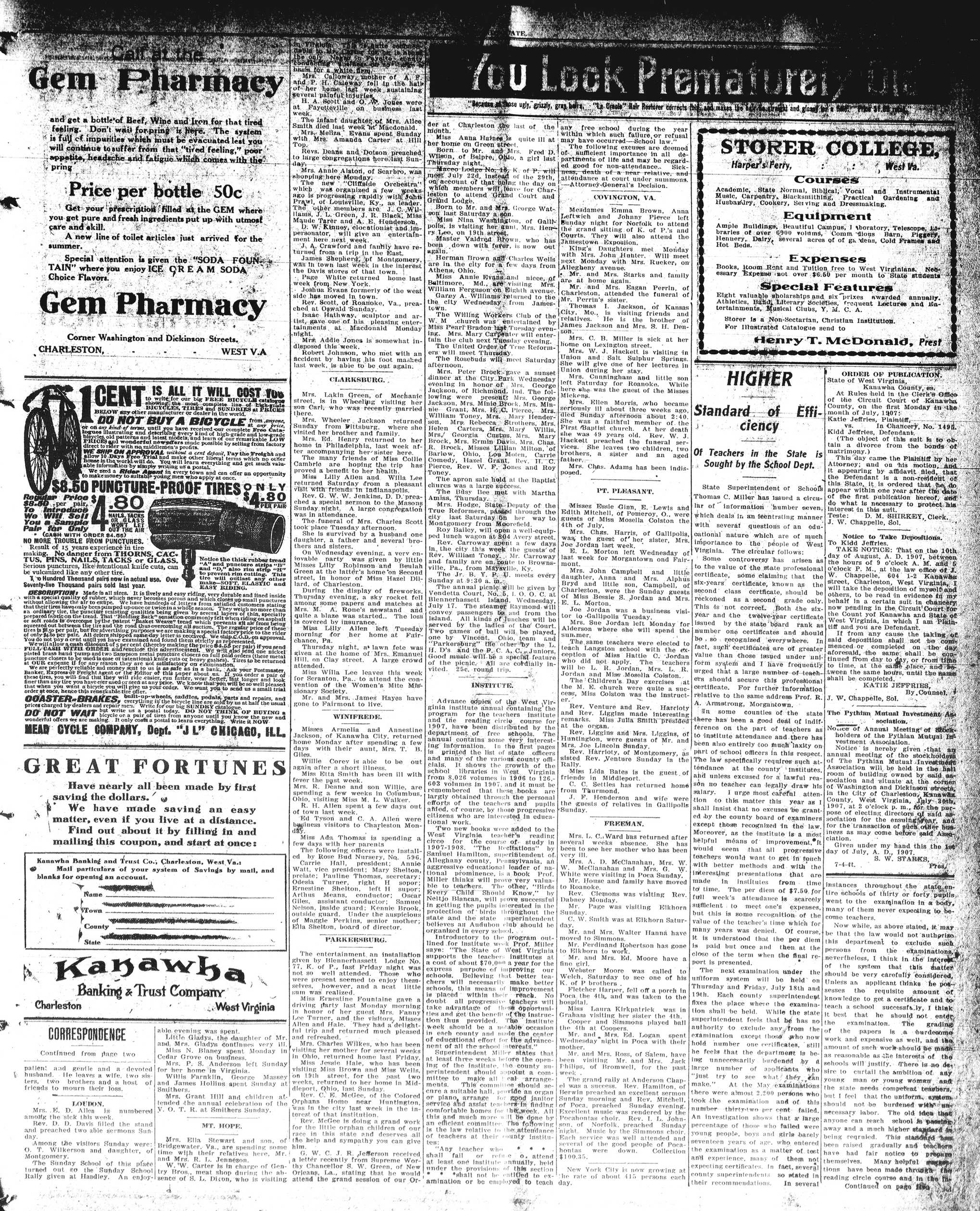
and get a bottle of Beef, Wine and Iron for that tired feeling. Don't wait for pring it here. The system is full of impurities which must be evacuated less you will continue to suffer from that "tired feeling," poor appetite, headache and fatigue which comes with the pring.
Get your prescription filled at the GEM where you get pure and fresh ingredients put up with utmost care and skill. A new line of toilet articles just arrived for the
A new line of toilet articles just arrived for the summer. Special attention is given the "SODA FOUN TAIN" where you enjoy ICE CREAM SODA Choice Flavors.
Gem Pharmacy
ICENT IS ALL IT WILL COST YOU
to sit outside on our FREE BICYCLE catalogue
showing the most complete
BICYCLES, TIRES and SUNDRIES at PRICES
BELOW any other manufacturer or dealer in the world.
DO NOT BUY A BICYCLE from anyone,
or on any kind of terms, until you have received our complete Free Catalog,
contrasting and describing every kind of high-grade and low-grade
bicycles, and wonderful new offers possible by setting from factory
director with no middlemen's profits.
WE SHIP ON APPROVAL without a cent deposit, Pay the Freight and allow 10 Days Free Trial and make other liberal terms which no other house in the work will do. You will learn everything and get much valuable information by simply writing us a postal.
making. No danger from THORNS, CACTUS, PINS, NAILS, TACKS or GLASS. Serious punctures, like intentional knife cuts, can be vulcanized like any other tire.
To Hundred Thousand pairs in actual use. Over Seventy-five Thousand pairs sold last year.
DESCRIPTION In all sizes. It is lively and easy riding, very durable and fined inside. We have hundreds of up to small punctures without allowing the air to escape. We have hundreds of lesters from a small puncture that their tires have only been pumped up once or twice in a whole season. They weigh no more than 10 pounds and have several layers of thin, specially prepared fabric on the tread. That "Holding Back" sensation is important or soft roads is overcome by the patent "Basket Weaver" trend which prevents air from being sucked in. The patent "Basket Weaver" suction. The regular price of these tires is $50 per pair, but for advertising purposes we are making only of only $50 per pair. All orders shipped same day letter is recaved. We ship C.O.D. on approval of the manufacturer. For advertising purposes we are strictly as represented. We will allow a cash discount of 5 percent (thereby making our order $100 less) if you send full CASH WITH ORDER and enclose this advertisement. We will also send one metal plated brass pump and two Sampson metal puncture closers on full pay orders (the metal puncture closers are $100 less) if you send Tires to be returned at OUR expense if for any reason they are not satisfactory on examination. We are perfectly reliable and money sent to us is as safe as in a bank. Ask your Postmaster, we will send you a sample of these tires, you will find that they will ride caser, run faster, wear better, fit finer than any tire you have ever used or seen at any price. We know that you will be so well pleased order at once, hence this remarkable tire offer. Built-up wheels, saddles, pedals, parts and repairs, everything is in the bicycle line are sold by us at half the usual prices charged by dealers and repairers. We will write to you a postal day. DO NOT THINK OF HIVING. DO NOT WAIT.
GREAT FORTUNES
We have made saving an easy matter, even if you live at a distance. Find out about it by filling in and mailing this coupon, and start at once:
Kanawha Banking and Trust Co., Charleston, West Va.:
Mail particulars of your system of Savings by mail, and blanks for opening an account.
1
Otto Pelli Wearal
to
$8.50
Regular Price
$8.80 ,per pak
To Introduce
We Will Sell
You a Sample
Palr for Only
$4.80
MALL TAGS
OR GLASS
WON'T LET
OUT THE AIR
NO MORE TROUBLE FROM PUNCTURES.
Result of 15 years of treatment.
CORRESPONDENCE
Continued from page two
patient and gentle and a devoted husband. He leaves a wife, two sisters, two brothers and a host of friends to mourn their loss.
Mrs. E. D. Allen is numbered amoftg the sck this week.
Rev. D. D. Davis filled the stand and preached two able sermons Sunday.
Among the visitors Sunday were: O T. Wilkerson and daughter, of Montgomery.
The Sunday School of this place turned out to the Sunday School Rally given at Handley. An enjoy-
E-PROOF TIRES ONLY
$4.80
PER PAIR
S, CAC-
GLASS.
cuts, can
use. Over
Notice the thick rubber tread
"D" on the rubber tape.
"R" on the rubber tape.
"D" also rim strip. "R"
to prevent rim cutting. This
to be with outlast any other
make. SOFT ELASYIC and
EASY RIDING
able evening was spent.
Little Gladys, the daughter of Mr.
and Mrs. Gladys continues very ill.
Miss N. Blaney spent Monday in
Cedar Grove on business.
Mrs. P. S. Anderson left Sunday
for her home in Virginia.
Wills Farnknil, George Massey
and N. James Holins spent Sunday at
Smithers.
Mrs. Grant Hill and children att
tended the annual celebration of
the V. O. T. R. at Smithers Sunday.
MT. HOPE
Mrs. Ella Stewart and son, of Bridgewater, Va., are spending some time with their relatives here, Mr. and Mrs. L. Jennengo, W. W. Cattie, of Gentry Bros., meat shop during the absence of S. L. Dixon, who is visiting
on Whitman. The daughter of Mrs. Calloway to Mrs. Calloway is living the early Norwegian in Fayette, shortly conducing business on how she has basis for a white farm.
Mrs. Calloway, mother of A. F. and P. H. Calloway fell in the hale of her home last week sustaining severe injuries.
H. A. Scott and O. W. Jones were at Fayetteville on business last week.
The infant daughter of Mrs. Alice Smith died last week at Macdonald.
Mrs. Meliza Evans spent Sunday with Mrs. Amanda Carter at Hill Top.
Revs. Deans and Dotson preached to large congregations here last Sunday.
Mrs. Annie Alston, of Scarbo, was shopping here Monday.
the new "Cliffside Orchestra" which was organized a few weeks ago is progressing rapidly with John Prawl, of Louisville, Ky., as leader. The other members are J. C. Williams, J. L. Green, J. R. Black, Miss Maude Tarter and A. E. Henderson, W. Kutney, elocutionist and impersonator, give an entertainment here next week. J. A. Crawford and family have returned from a trip in the East. James Shepherd, of Montgomery, was in town last week in the interest the Davis stores of that town.
Page White returned home last week from New York.
Joshua Evans formerly of the west side has moved in town.
Rev. Scott, of Roanoke, Va., preached at Ogwald Sunday.
Isaac Hathway, sculptor and artist, gave one of his pleasing entertainments at Macdonald Monday night.
Mrs. Addie Jonea is somewhat indisposed this week.
Robert Johnson, who met with an accident by having his foot mashed last week, is able to be out again.
CLARKSBURG.
Mrs. Lakin Green, of Mechanic street, is in Wheeling visiting her son Carl, who was recently married there.
Mrs. Wheeler Jackson returned Sunday from Pittsburg, where she visited her brother and family.
Mrs. Ed. Henry returned to her home in Philadelphia, last week after accompanying her sister here.
The many friends of Miss Collie Cambrie are hoping the trip has proved a benefit to her health.
Miss Lilly Allen and Willa Lee returned Saturday from a pleasant visit with friends in Indianapolis.
Roe G. W. W. Jenkins, D. D. preached a special sermon to the Mason's Sunday night. A large congregation was in attendance.
The funeral of Mrs. Charles Scott took place Tuesday afternoon.
She is survived by a husband one daughter, a father and several brothers and sisters.
On Wednesday evening, a very enjoyable party was given by little Misses Lilly Robinson and Beulah Green at the latter's home on Second street, in honor of Miss Hazel Dillard, of Charleston.
During the display of fireworks, Thursday evening, a sky rocket fell among some papers and matches at Mrs. M. A. Rone's newstand and quite a blaze was started.. The loss is covered by insurance.
Miss Lilly Allen left Tuesday morning for her home at Fairchurch Pa.
Thursday night, a lawn fete was given at the home of Mrs. Emanuel Hill, on Clay street. A large crowd attended.
Miss Willa Lee leaves this week for Scranton, Pa., to attend the convention of the Women's Mite Missionary Society.
Mr. and Mrs. James Hayes have gone to Fairmont to live.
WINIFREDE
Misses Armelia and Annestine Jackson, of Kanawha City, returned home Monday after spending a few days with their aunt, Mrs. T. B. Giles. Willie Corey is able to be out again after a short illness. Miss Etta Smith has been ill with fever the past week.
R. H. Allen spent a few days out of town last week.
Miss Ada Thomas is spending a few days with her parents
The following officers were installed by Rose Bud Nursery, No. 596,
Carrie Hall, president; Annie Watt, vice president; Mary Shelton,
prelate; Pauline Thomas, secretary; mesla Turner, right H sopor;
Orrin Turner, left H sopor; Arthur Means, conductor; Oscar Giles, assistant conductor; Saman Nelson, inside guard; Kennie Brook, outside guard. Under the auspicious of Maggie Perkins, senior mother; Ella Shelton, board of director.
PARKERSBURG.
The entertainment an installation given by Blennerhassett Lodge No. 77, K of P., last Friday night was not so well attended. Those who were present seemed to enjoy themselves, however, and a neat little sum was realized. The Blennerhassett Fountain gave a driving party last Monday morning in honor of her guest Mrs. Fanny Lee Turner, and the visitors, Misses Allen and Hale. They had a delightful trip and returned much pleased and refreshed.
Mrs. Charles Wilkes, who has been visiting her mother for several weeks in Ohio, returned home last Friday. Miss Jessie Hale, who has been visiting Miss Brown and Miss Wells, on 9th street, for the past two weeks, has returned home in Middleport, Ohio, last Sunday. Rev. C. E. McGee, of the Colored Orphans Home near Huntington, was in the city last week in the interest of that institution.
Rev. McGee is doing a grand work for the little orphan children of our race in this state and deserves all the help and sympathy you can give him.
G. W. C. J. R. Jefferson received a letter recently from Supreme Worthy Chancellor S. W. Green, of New Orleans, La., stating that he would attend the grand session of our Or-
You Look Premature
der at Charleston the last of the month.
Miss Anna Haines is quite ill at her home on Green street.
Born to Mr. and Mrs. Fred D. Wilson, of Belphe, Ohio, a girl last Thursday night.
Macoe Lodge No. 18, K. of P. will meet July 22d, instead of the 29th, on account of that being the day on which members will leave for Charleston to attend Grand Court and Grand Lodge.
Born to Mr. and Mrs. George Watson last Saturday a son.
Miss Nina Washington, of Gallipolis, is visiting her姑, Mrs. Henry Lee, on 19th street.
Master Valdred Brown, who has been down with fever, is now out again.
Herman Brown and Charles Wells are in the city for a few days from Athens, Ohio.
Miss Annie Evans, and niece, of Battalion Md., are visiting Mrs. William Ferguson, Eighth avenue.
Garey A. Williams returned to the city Wednesday from James-town.
The Willing Workers Club of the W. M. church was entertained by Miss Pearl Bradon last Tuesday evening. Mrs. Mary Carpenter will entertain the club next Tuesday evening. The United Order of True Reformers will meet Thursday. The Rosebuds will meet Saturday afternoon. Mrs. Peter Brock gave a sunset dinner at the City Park Wednesday evening in honor of Mrs. George Jackson, of Richmond, Ind. The following were present: Mrs. George Jackson, Mrs. Minnie Brock, Mrs. Minnie Grant, Mrs. H. C. Pierce, Mrs. William Toney, Mrs. Mary Henderson, Mrs. Rebecca Strothers, Mrs. Helen Carters, Mrs. Mary Willis, Mrs./ Georgia Custus, Mrs. Mary Brock, Mrs. Ermin Davis, Mrs. Chas. R. Brock, Misses Lillian Milton, of Barlow, Ohio, Lou Moten, Carrie Conney, Hazel Grant, Rev. H. C. Pierce, Rev. W. F. Jones and Coy Toney. The apron sale held at the Baptist churches was a large success. The Buzzy Bee met with Martha Amiss, Thursday.
Mrs. Hodge, State Deputy of the True Reformers, passed through the city last Saturday on her way to Montgomery from Moorefield.
Roy Bailey, will open a well-equipped lunch wagon at 804 Avery street.
Rev. Carroway spent a few days in the city this week the guests of Rev. William Toney. Mr. Carroway and family are on route to Brownville, Pa., from Maysville, Ky.
The Jr. B, Y, P, U meets every Sunday at 9:30 a.m.
The annual picnic will be given by Vendetta Court, No. 5, I. O. I. O. C. at Blennerhassett Island, Wednesday, July 7. The steamer Raymond will convey passengers to and from the island. All kinds of lunches will be served by the court, the Court.
Two games of ball will be played, one by Vincent, Ohio, to "Parkersburg" the other by the L. H. D's and the P. C. A. C. Juniors. Good music will be a special feature of the picnic. All are cordially invited, 25c. round trip.
INSTITUTE.
Advance copies of the West Virginia institute annual containing the program for the teachers institute and the reading circle course for 1907, have been distributed by the department of free schools. The department some very interesting information in some of the books is printed the list of state officers and many of the various county officials. It shows the growth of the school libraries in West. Virginia from 8,026 volumes in 1906 to 126,603 volumes in 1907, and it must be remembered that these books are largely obtained through the personal of teachers and pupils affold, of course, by interested progressive citizens who are interested in educational work.
Two new books were added to the West Virginia teacher's reading circle for the course of study in 1907-1908. "The Befftations" by Samuel Hamilton, superintendent of Alleghany county, Pennsylvania, an aggressive educational leader of national prominence, is a book Prof. Miller thinks will prove very valuable to teachers. The other, "Birds Protect Child Should Know," by Nettie Biondion, is successful in getting the pupils interested in the protection of birds throughout the state and the state superintendent believes an Audubon club should be organized in every school.
Introductory to the program outlined for institute week Prof. Miller says: "The State of West Virginia supports the teachers' institutes at a cost of about $70,000 a year for the express purpose of improving our schools. Believing that better teachers will necessarily make better schools, this means of improvement is placed within their reach. No doubt all progressive teachers will take advantage of these opportunities and get the benefit of the instruction thus provided. The institute week should be a notable occasion in each county and made the center of educational effort for the advancement of all the school interests."
Superintendent Miller states that at least three weeks before the opening of the institute, the county superintendent should appoint a committee to make all call arrangements. This committee should secure a suitable hall, provide an organ or piano, arrange for good janitor service and assist teachers in finding comfortable homes for the week. All this and much more will be done by an efficient committee. The following is the law relative to the attendance of teachers at their county institutes:
"Any teacher who * * * * shall fall or refuse * * * attend at least one institute annually, held under the provisions of this section * * * * shall not be entitled to examination or be employed to teach
any free school during the year within which such failure, or refusal may have occurred—School law." The following excuses are deemed of sufficient importance in all departments of life and may be regarded good for non-attendance. Sickness, death of a near relative, and attendance at court under summons. —Attorney-General's Decision.
COVINGTON, VA.
Mesdames Emma Brown, Anna Leftwich and Johnny Pierce left Sunday night for Norfolk to attend the grand sitting of K. of P.'s and Courts. They will also attend the Jamestown Exposition.
King's Daughters met Monday with Mrs. John Hunter. Will meet next Monday with Mrs. Rucker, on Allegheny Avenue.
Mr. and Mrs. Starks and family are at home again.
Mr. and Mrs. Eagan Perrin, of Charleston, attended the funeral of Mr. Perrin's sister.
Thomas I. Jackson, of Kansas City, Mo., is visiting friends and relatives. He is the brother of James Jackson and Mrs. S. H. Denson.
Mrs. C. B. Miller is sick at her home on Lexington street.
Mrs. W. J. Hackett is visiting in Upton and Salt Sulphur Springs. She will give one of her lectures in Union dining hall stay.
Mrs. Canningham and little son left Saturday for Romoka. While here she was the guest of the Misses Mickens.
Mrs. Ellen Morris, who became seriously ill about three weeks ago, died Sunday afternoon about 2:40. She was a faithful member of the First Baptist church. At her death she was 49 years old. Rev. W. J. Hackett preached the funeral services. She leaves two children, two brothers, a sister and an aged father.
Mrs. Chas. Adams has been indisposed.
PT. PLEASANT
Misses Essie Ginn, E. Lewis and Edith Mitchell, of Pomeroy, O., were guests of Miss Mosella Colston the 4th of July.
Mrs. Chas, Harris, of Gallipolis, was the guest of her sister, Mrs. Joe Jordan last week.
E. L. Morton left Wednesday of last week for Morgantown on Fairmont.
Mrs. John Campbell and little daughter, Anna and Mrs. Alphus Bryd and little son, Campbell, of Charleston, were the Sunday guests of Miss Bessie S. Jordan and Mrs. E. L. Morton.
Joe Jordan was a business visitor to-Gallipolia Tuesday.
Mrs. Sue Jordan left Monday for Alderson where she will spend the sun.mer.
The same teachers were elected to teach Langton school with the exception of Miss Hattie C. Jordan who did not apply. The teachers will be L. R. Jordan, Mrs. L. R. Jordan and Miss Mosella Colston.
The Children's Day exercises at the M. E. church were quite a success, Miss Colston was the instructor.
Rev. Venture and Rev. Harrioty and Rev. Liggins made interesting remarks. Miss Julia Smith presided at the organ.
Rev. Liggins and Mrs. Liggins, of Huntington, were guests of Mr. and Mrs. Joe Lincoln Sunday.
Rev. Harrioty, of Montgomery, assisted Rev. Venture Sunday in the Rally.
Miss Lida Bates is the guest of friends in Middleport.
C. C. Settles has returned home from Thurmond.
J. F. Henderson and wife were the guests of relatives in Gallipolis Sunday.
FREEMAN.
Mrs. L. C. Ward has returned after several weeks absence. She has been to see her mother who has been visiting Mrs. A. D. McClanahan, Mrs. W. W. McClanahan and Mrs. G. W. White were visiting in Poca Sunday.
Mr. House and family have moved to Roanoke. Rev. Clemons was visiting Rev. Dabney Monday.
Mr. Page was visiting Elkhorn Sunday.
C. W. Smith was at Elkhorn Saturday.
Mr. and Mrs. Walter Hannah have moved to Simmons.
Mr. Ferdinand Robertson has gone to Elkhorn to work.
Mr. and Mrs. Ed. Moore have a fine girl.
Webster Moore was called to Welch, Saturday to see one of his K. of P brothers.
Fletcher Harper, fell off a porch in Poca the 4th, and was taken to the hospital.
Miss Laura Kirkpatrick was in Graham visiting her sister the 4th. Cooper and Simmons played ball the 4th at Coopers.
Mr. and Mrs. Ed. Logan spent Wednesday night in Poca with their mother.
Mr. and Mrs. Ross, of Salem, have been visiting Mr. and Mrs. Jack Philips, of Bromwell, for the past week.
The grand rally at Anderson Chapel was a success. Rev. Hamilton, of Berwin preached an excellent sermon Sunday morning and Rev. Mitchell, of Poca, preached Sunday evening, Excellent music was rendered by the Pocahontas choir. Rev. I. L. Johnson, of Norfolk, preached Sunday night. Music by the Slimmons choir. Each service was well attended and several of the good people of Pocahontas were down. Collection $100.35.
New York City is now growing at the rate of about 415 persons each day.
Courses
Academic, State Normal, Biblical, Vocal and Instrumental Music, Carpentry, Blacksmithing, Practical Gardening and Husbaklery, Cookery, Seving and Dressmaking.
Equipment
Ample Buildings, Beautiful Car-
braries of over 9000 volumes,
Hennery, Dairy, several acres,
Hot Beds.
Expo
Books, Room Rent and Tuition
essary Expense not over $6.
Special
Eight valuable scholarships and
Athletics, Bands, Literary Socie-
tirements, Musical Clubs, Y
Storer is a Non-Sectartan, U
For Illustrated Catalogue s
HENRY T.
HIGHER
Standard of Effi-
ciency
Ample Buildings, Beautiful Campus, Laboratory, Telescope, Libraries of over 6000 volumes, Comm dions Barn, Piggygery, Hennery, Dairy, several acres of of gardens, Frames and Hot Beds.
Expenses
Books, Room Rent and Tuition free to West Virginiaans. Necessary Expense not over $6.50 per month to State students
Special Features
Eight valuable scholarships and six prizes awarded annually. Athletics, Band, Literary Societies, frequent Lectures and Entertainments, Musical Clubs, Y. M. C. A.
Storer is a Non-Sectartan, Christian Institution.
For Illustrated Catalogue send to
Of Teachers in the State is Sought by the School Dept.
State Superintendent of Schools Thomas C. Miller has issued a circular of information number seven, which deals in an feentristing manner with several questions of an educational nature which are of much importance to the people of West Virginia. The circular follows:
Some controversy has arisen as to the value of the state professional certificate, some claiming that the six-year certificate, known as the second class certificate, should be reckoned as a second grade only. This is not correct. Both the six-year and the twelve-year certificate issued by the state board rank as number one certificates and should be so recognized everywhere. In fact, such certificates are of greater value than those issued under uniform system and I have frequently urged that a large number of teachers should secure this professional certificate. For further information relative to the same address Prof. R. A. Armstrong, Morgantown.
In some counties of the state there has been a good deal of indifference on the part of teachers as to institute attendance and there has been also entirely too much laxity on part of school officers in this respect. The law specifically requires such attendance at the county institutes, and unless excused for a lawful reason no teacher can legally draw his salary. I urge most careful attention to this matter this year as I shall insist that no excuses be granted by the county board of examiners except those recognized in the law. Moreover, as the institute is a most helpful means of improvement, it would seem that all progressive teachers would want to get in touch with better methods and with the interesting presentations that are made in institutes from time to time. The per diem of $7.50 for full week's attendance is scarcely sufficient to meet one's expenses, but this is some recognition of the value of the teacher's time which for many years was denied. Of course, it is understood that the per diem is paid but once and then at the close of the term when the final report is presented.
The next examination under the uniform system will be held on Thursday and Friday, July 18th and 19th. Each county superintendent fixes the place where the examination shall be held. While the state superintendent feels that he has no authority to exclude any from the examination except those who now hold number one certificates, still he feels that the department is being unnecessarily burdened by a large number of applicants who "just try to see what they can make." At the May examinations there were almost 2,200 persons who took the examination and of this number thirty-two per cent failed. An investigation shows that a large percentage of those who failed were young people, boys and girls barely seventeen years of age, who entered the examination as a matter of test and experience, many of them not expecting certificates. In fact, several county superintendents so stated in their recommendations. In several
on free to West Virginia. No-
50 per month to State students
Features
six prizes awarded annually.
offers, frequent Lectures and En-
Y. M. C. A.
Christian Institution
end to
McDonald, Prest
ORDER OF PUBLICATION.
State of West Virginia,
Kanawha County, ss.
At Rules held in the Clerk's Office
of the Circuit Court of Kanawha
County, on the first Monday in the
month of July, 1997.
Katie Jeffries, Palatiff,
vs. In Chancery, No. 1496.
Kidd Jeffries, Defendant.
(The object of this suit is to obtain a divorce from the bonds of matrimony.)
This day came the Plaintiff by her Attorney; and on his motion, and it appearing by alfidavit filed, that the Defendant is a non-resident of the State and is ordered that he do appear within one month later date of the first publication hereof, do what is necessary to protect his interest in this suit.
Teste: D. M. SHIRKEY, Clerk,
J. W. Chapple, Sol.
Notice to Take Depositions.
To Kidd Jeffries.
TAKE NOTICE: That on the 10th day of August, A. D. 1907, between the hours of 9 o'clock A. M. and 5 o'clock P. M., at the law office of J. W. Chappelle, 604 1-2 Kanawah street, Charleston, West Virginia, I will take the deposition of myself and others, to be read in evidence in my behalf in a certain suit in chancery for the Court of Kanawah and State of West Virginia, in which I am plaintiff and you are Defendant.
If from any cause the taking of said deposition shall not be commenced or completed on the day aforesaid, the same shall be continued from day to day, or from time to time, at the same place, and between the same hours, until the same shall be completed.
KATIE JEFFRIES,
By Counsel.
J. W. Chappelle, Sol.
The Pythium Mutual Investment Association.
Notice of Annual Meeting of Stock
Investment Association
Notice is hereby given that an annual meeting of the stockholders of The Pythian Mutual Investment Association will be held in the hall room of building owned by said association and situate at the corner of Washington and Dickinson streets in the City of Charleston, Kannawa City, West Virginia, July 30th, 1907 at 2:00 p.m. for the purpose of electing p. m., of said association for the ensuing sale for the transaction of such other business as may come before said Association.
Given under my hand this the 10th day of July, A. D., 1907.
instances throughout the state entire schools of thirty or forty pupils went to the examination in a body, many of them never expecting to become teachers.
Now while, as above stated, it may be that the law would not authorize this department to exclude such persons from the examinations, nevertheless, I think in the interest of the system that this matter should be very carefully considered. Unless an applicant thinks he possesses the requisite amount of knowledge to get a certificate and to teach a school successfully, I think it best that he should not enter the examination. The grading of the papers is a burdensome work and expensive as well, and the amount of such work should be made as reasonable as the interests of the schools will justify. There is no desire to curtail the ambition of any young man or young woman and the state needs competent teachers, but I feel that the uniform system should not be burdened with unnecessary labor. The old idea that anyone can teach school is passing away and a much higher standard is being requiled. This standard has been raised gradually and teachers have had fair notice to prepare themselves. Many helpful suggestions have been made through the reading circle course and in the file.
Continued on page 104
The Advocate is entered in the Post-office at Charleston, W. Va., as second class matter.
SUBSCRIPTION, RATES:
THURSDAY, JULY 18, 1907.
OFFICES.
New York:
738 7th Avenue.
Washington:
1325 12th St. N. W.
Louisville:
1112 W. Madison St.
St. Louis:
3137 Pine St.
Philadelphia:
702 So. 15th St.
Baltimore:
502 W. Biddle St.
Boston:
94 a Harvard St., Cambridge.
Pittsburg:
461 6th St., Braddock.
Columbus:
266 St. Clair Ave.
New Orleans:
226 So. Robertson St.
Jacksonville:
536 W. Union St.
Nashville:
706 Bass St.
Indianapolis:
1605 Alvord St.
Lexington:
567 N. Upper St.
San Francisco:
865 Union St., Oakland.
Detroit:
261 Elliot St.
El Paso:
Chicago:
3519 Calumet Ave.
MR. WHITE'S CARDIDACY
The political pot has been boiling over ever since the announcement was made last week that the castor of Tax Commissioner and former Governor Albert B. White had been cast in the ring and that he would likely be a candidate for gubernatorial honors before the next Republican State convention. A commotion was noticeable especially in the camps of the anti-tax reformers and Democrats who fear the ex-governor worse than the devil does holy water.
And well they may, for it was during his administration and with his active assistance that the present system of taxation, by which the corporate interests are compelled to bear their just portion of governmental expenses, was advocated and made possible. No man fought harder for the nomination of the present governor than his predecessor and in the notable contest which followed the Wheeling convention no counsel had greater weight than his or contributed more to the victory of the divided party over the Democrats, aided and abetted by insurgent Republicans. Naturally, then, neither Democrates nor mugwump Republicans can see any good in the man and their conflation fits upon receipt of the Preston county advices are easily accounted for—Mr. White's nomination and election would assure the continuation of the policies inaugurated during his administration and continued till now.
Mr. White is entirely too progressive, too liberal and takes the interests of the little fellows—the common people—to much to heart to receive the stamp of approval from the organs of the corporation. He stuck too close to the letter and spirit of his oath of office to have the announcement of his probable return to the executive mansion hailed with joy and sounds of gladness from that source.
But they, fortunately, do not speak for the Republican party as a whole. The element which they represent is a very small factor and its influence becomes less each visit of the tax collector. That portion of the party which has ever turned a fleet car to the song of the street and presented a solid front when disaffections were ripe and deserts popular yet remembers nor will it soon forget Governor White's attitude toward them during his term of office. His recognition of the Negro as an element of the party not to be cajoled with specious promises and dropped after election made for him thousands of staunch friends in the race and, should it be his pleasure to make the fight, they will be enrolled under his standard.
THIS INTERSTATE COMMERCE
COMMISSION ON "JIM
CROW" CARS.
Speaking upon the decision of the
Interstate Commerce Commission in
the "Jim Crow" case, the Nation
votes the opinion to which the Advocate has more than once given expression. Says the Nation:
"In upholding the "Jim Crow car"
laws of the South, the Interstate
Commerce Commission tails back upon previous rulings by members of the Commission and upon a decision of the Supreme Court. It is, Commissioner Lane holds, no discrimination.
tion to separate blacks and whites when racial accommodations are not fulfilled before him, the railroad had discriminated in that it did not furnish a washbowl and towels and a smoking compartment for Negro passengers. With these overviews remedied, the Commission feels that there is no discrimination left; that to put all black persons into one car and all whites into another is perfect equally in the good old American sense. Under this decision any railroad will in future be justified in marking certain cars, "For Jews, only," others "For Chinese and Japanese," others "For Chinese and Japanese exclusively," and still others, "None but Dagoes may ride here"—and one learned commissioners, on gravelly inspecting to see that each coach had the same number of towels and wash-bowls, would declare that they could find no discrimination of any kind. As a matter of fact, they have done their best to do this in their old design—a white class and a black class. As men of intelligence, they know perfectly well that nowhere in the South are the Jim Crow accommodations equal to those given to the whites, either in cleanliness or sufficiency. The railroads simply decline to "clean cars for niggers," knowing them to be not, as the commission precludes, on an equality, but grossly discriminated against, and unable to protest efficiently by reason of their being deprived of the ballot.
The meat in the cocoanut is contained in the last sentence. It is by reason of being deprived of the ballot that the Negro is so grossly discriminated against upon the common carriers of the South. The railroads are not to be blamed for the deplorable conditions, but the men who enacted the laws. First they deprived the Negro of means of redress by taking from him the right of suffrage and all else was easy. It is patent even to the causal observer that present conditions will obtain so long as the Negro's political status at the South is one of taxation without representation, so long as he counts only in congressional apportionments.
ALWAYS IN THE WAY.
From Watertown, N. Y., comes the news that the ordering of the Twenty-fourth Infantry to Oswego and Sackett's Harbor is causing much unfavorable comment in Northern New York and a congressman from that section has gone to Washington to protest against the action of the war department.
When is it considered that there have been Negro regiments for more than a generation and it is only recently that any serious objections have been registered against their location even at Southern posts, the settlement of the problem which brought about the formation of these organizations seems far, far away.
Speaking of the disfavor in which the Negro troops are held at this time the New York World says:
Colored troops have giver, a good account of themselves under many trying circumstances. They have marched and fought well in the deserts of the Southwest, in the rugged mountains of the North, in Cuba, and in the Philippines. It is only in time of peace, when the social factor seems to be taken into account, that they are looked upon with disfavor. All this may be natural and inevitable, but if we are to have black regiments in war we must have them in peace and make the best of them.
A lawyer for the defense of Mrs. Mollie Bowie and her son at La Plata, Md., on trial for the murder of a daughter and cousin by a false lover, said in his address to the jury: "The ingredient of murder, whether in the first or second degree, is malice. Where is there any evidence or malice in the killing of Posey? None whatever. It is true he was killed at the hands of the accused and by deadly weapons, but no malice existed before, at or since he went to his grave. The evidence shows none. He was their kinsman. They respected and cherished for him the kindliest feeling of friendship."
This is a variation of the unwritten law for the first time enunciated and makes a simple case of assassination a trivial act of friendly homicide, by no means to be taken seriously. At the most the murder is not to be considered more reprehensible than a bit of good-natured impoliteness, an indiscretion arising from an exuberance of kindly feelings. This plea had so much weight with the jury that a short deliberation on their part resulted in a vexet of acquittal. In line with this argument it would not be amiss to require the corpse, resulting from such "kindliest feelings, of friendship," to apologize to his slayer for having put him to the inconvenience and annoyance of slaying.
With a few more Ben Tillmans the supremacy of the white man in West Virginia could be re-established.—Clarkburg News.
It would be an interesting bit of information to know just what brand of supremacy the News is hankering for. "The Advocate has heretofore been of the opinion that the white man is the "whole thing" in West Virginia. To him we have ascribed political supremacy, social supremacy, financial supremacy, and, in fact, every other kind of supremacy, except religions with which we have contented ourselves in consonance with the good old hymn—"You may have all this world but give me Jesus."
Can it be that the "white man"
referred to by the News is that particular species of the genus homo which goes to make up the Democratic party? That it is he the News wishes to see occupying the seat of the mighty? Fortunately for us, the views entertained and expressed by Mr. Tillman are at variance with the doctrines taught in West Virginia and his kind of supremacy will have the call when the cows come home from the milky way.
Warm weather can not wither nor custom'stale the practice of Democratic papers limiting their political discussions to the probable winner of the Republican nomination for governor. From this the natural deduction is that available candidates for the honor of leading Democracy to defeat are rather scarce.
Mr] Rockefeller says, he thinks prosperity and opportunity will continue for all. This is possibly true, but let us hope that Mr. Rockefeller has sufficient to satisfy himself at this time, so that the rest of the country may have a chance to take advantage of what is left.
Despite the combined efforts of the California hurrah boys and Japanese yellow poppies cordial relations still exist between the United States and Japan.
The gathering of the Pythian hosts in this city the latter part of this month promises to be the "greatest ever" in colored fraternal circles.
ANNUITY FOR AN EX-SLAVE
A New York Court Decides to Carry
Out The Purpose Of A Will.
Eldridge Cooper, a seventy-year old ex-s slave of the Cooper estate in Columbia county, Tenn., is to continue to receive the $100 a year that Judge Cooper allowed him until the judges mental faculties began to fail two years ago. Eldridge is to get $225 arrears in a lump sum, although the hundred will reach him as before, in quarterly installments. Eldridge lives in Louisville now, since the old home place in Columbia county went to rack and ruin. The Negro will not be the only one to benefit by an order made in the supreme court yesterday by Justice Truax. Several of Judge Cooper's relatives, sisters, brothers and nephews and nieces will get the same annual sum out of the judge's estate which has been in the hands of the Trust Company of America as trustee of his property since the judge was pronounced mentally incompetent a couple of years ago.
Under Judge Truax's order Addison Cooper, a brother, and Miss Martha T. Cooper, Mrs. Eloice C. Stockwell and Mrs. Mary A. Sanson, sisters, are each to receive $1,000 a year and $2,250 arrears. William F. Milner and Rosamont Milner, a nephew and nieces of Judge Cooper, will divide between them $1,000 a year and $2,250 cash, and Christine Cooper, another niece, will receive $800 a year and $1,000 in cash. Besides these payments out of the judge's estate Michael J. Mulqueen the referee will receive $1,250 or his B. Hewlett. He received for $2,250 John B. Stanchfield and John K. Berry, who appeared for the petitioning relatives, asked for $7,500, but under Justice Truax's order will divide $3,500 between them in full payment, for all services rendered. Mr. Berry gets back $769, which he advanced in disbursements.
The Coopers were a great family in Tennessee. Matthew D. Cooper, father of Judge Cooper, owned a big plantation. He married three times the three Mrs. Coopers being first cousins. The first Mrs. Cooper bore three children, of whom the oldest, William F. Cooper, is the present judge, now eighty-seven years old, and suffering from senile dementia. Henry Cooper the second son, was a United States senator from Tennessee until 1882 when he died. Christine Cooper is the only surviving descendant. Mrs.Mary A. Sansom, now seventy-seven and living on a small barren farm in Columbia county, was the third child of Mrs. Matthew D. Cooper
The civil war swept away the Cooper fortunes. The hundreds of slaves were freed, Eldridge, the cook, and his family alone remaining with the family. The thousands of acres passed into other hands and the family was scattered throughout the southern states. William F. Cooper turned lawyer and was, for many years a chancellor in Indiana later served the supreme court. He was a judge of the supreme court till 1890, when he resigned, having reached the age of seventy and moved to New York.
Judge Cooper has always looked after the welfare of his sisters and brothers and their children, even before the death of his father; which occurred in 1878. From 1876 to 1902, when the judge's mind began to show signs of weakness, he never missed a single quarter of sending to each of his sisters and brothers the allowance he made them from his income, beginning with $100 a month, he gradually increased the allowance to $250 every three months for each of the five sisters. Two of them are dead.
In other ways also the judge befriended his relatives. When his sister Eloise married Stockwell, the latter bought a home for $6,000, giving his notes in payment. The judge secretly ought up the notes and presented them to the surprised Stockwell's. Miss Martha Cooper has always been looked upon as the head of the family. She took charge of the father in his latter years. Since the remittances from her brother ceased she was worried until her health is broken because of his condition. She is absolutely without means save what he allowed her. When the remittances first ceased a cousin of the Coopers would run up to New York to remind the old judge that he had skipped a quarter.
As soon as he was reminded at it, he would become regular allowances, remarking, "I overloaded them. It is one of the pleasures of my life to send them, and finally it will be all theirs anyhow."
*From The Pittsburgh Dispatch.*
The distinctions which are to be observed with regard to the tender Southern susceptibilities appear to be wre-drawn. About two years ago the son of General Sherman started with an escort of an officer and eight officers to ride over the route of Sherman's march to the sea. Perhaps there was a little too much advertising of the accursion. At all events, the Navy was late, hysterics, and Southern Senators and Repubrutes focused to the White House to protest that this humiliation must not be inflicted on the crushed and prostrate South. Out of deference to those lacerated feelings the ride was called off.
Now it is heard that a party of 24 officers from Fort Leavenworth has started to ride over the route, and the South has not let out a single shriek. Beyond that, it seems that a military party did the same thing last year, and the South never found it. It was being trampled into the dust. Newspaper men have learned of leading Southerners whether there was any objection to the later form of excursion and find that it is viewed placidly and philosophically. The South welcomes the army officers. They can ride, over any route they choose and Southern sentiment will not be outraged. But, it is explained, it is the fact that Father Sherer was the son of William Tecumseh such an officer that supposedly sums the aspect of a glorification of Sherman's mach, and consequently an indignity to the South.
But this will hardly hold water, General Sherman could not by himself have torn up railroads, burned depots and out the Confederacy in two—which was his real offense. It was the 'act that he had a large and business like United States army with him that put the South out of business. But army officers who ride over historic routes are in this sense as truly the descendants of the army as Father Sherman is of the General. So if a conspiction fit was necessary in the first place it is hard to understand Iow it can be logically omitted in the later cases. Furthermore, the interesting fact which the sensitive South forgot is that General Sherman himself in 1878 visited the principle points of his march, and the South at that time did not know that it was trodden on.
We are thus driven to the conclusion that the South is getting an accession of common sense. This is highly desirable. The task of steering clear of that section's tender suspirable platform that it is only part of the country entitled to have any sentiments on account of the late unpleasantness has in some respects been so prolonged to produce ennui.
WHAT THE PEOPLE WILL STAND FOR
(From The Wheeling Intelligencer,)
Mr. Charles F. Teter, former a candidate for governor, has been interviewed by the Parkersburg Sentinel, and discusses state poilites. Concluding the interview the Sentinel says: "Teter was of the opinion that there was no danger of Ex-Governor A. B. White resolving the nomination, but if such a thing should occur there would be only one result, the people would not stand for it.
It is possible that Mr. Teeter was not quoted correctly by the Sentinel. If he was quoted correctly, and his remarks mean anything, it is that in his opinion ex-Governor White could not be elected, if nominated. In other words a considerable element of Republicans represented by Mr. Teeter and men like him, would bolet. The Intellingencer does not believe that ex-Governor White wishes or will seek the gubernatorial nomination. From what it knows of the situation, it can say without absoluteness only one condition will induce Mr. White to become a candidate. That condition will exist when it appears that the preservation of the victories so far gained by the tax reform cause, and the further success of that cause, require his services.
But the threat that a man who has served the people of West Virginia witl, the ability and sincerity that Governor White has, will be crucified if he seeks further preferment presents a new and more serious feature. It may, as well be, understood now that there can be no stronger influence to bring about the candidacy of A. B. White for governor, than the threats of corporation agents and hirelings to bolt his nomination. If the opponents of Governor White wish to force him into the arena, let them keep up this kind of work, and they will soon have a fight on their hands quite as interesting as any they can wish. The best way to find out what the people will stand for is to give them a chance to speak for themselves.
FATIGUE ANTITOXIN.
(From Lottisville, Courier-Journal.)
A Bavarian pathologist claims to have discovered that fatigue is produced by a toxin, and he gives grounds for hope that he has discovered an antitoxin which will neutralize the effect of the fatigue bacillus, or whatever he calls the germ that produces the tired feeling.
There is of course, an impression that fatigue is produced not by a toxin, but by work. The farmer who goes out at 4 a.m. these long summer days and quits at 8 in the evening does not ask for any explanation why he is tired. He thinks he knows the reason and is far, from playing the blame on any toxin, unless it be the toxin of labor. Eight hours' sleep is as good an antitoxin as he desires, unless he be permitted to extend his period of rest to ten hours which he may do on Sunday mornings.
Nevertheless, there are those who have not labored sixteen hours, or even sixteen minutes, who are overtaken by that tired feeling that
make them indispensable equipment. It is important that they be sold that they are suffering from the ravages of some toxin. Whether they would desire to be cured or not is very questionable. There are those who believe that laziness is not the most approved of all labor-saving devices, and many can testify that it has saved them much painful exertion.
It is not of course, to be supposed that the fatigue, antitoxin is to be used as a substitute for a repose which is absolutely necessary after prolonged exertion. There is nothing morbid about such fatigue, and therefore no treatment is necessary beyond the rest which nature requires. But there are not a few who are said, with much plausibility, to have been "born tired". It may be possible that neither such people nor their parents have committed sins to account for their exertion. Maybe there was a prenatal bellulism, an invidious tooth, which compromised them from their birth to chronic fatigue. This is clearly a morbid state and calls for treatment. If the Bavarian pathologist can cure them, and make them hungry for useful exertion we will introduce sweetness and light into many households which the chronic fatigue of the head of the family has cast a blight.
It may be too early to inquire whether such treatment ought to be compulsory. Involuntary servitude, except as a punishment for crime, is contrary to the Cpstitution. But by the terms of the question the antion would not drive the man to involuntary labor; it would simply make it voluntary; perhaps even delightful. Is this essentially different from treating a man for inebriety or insanity? It is an open question whether laziness does not produce more misery than inebriety; it certainly produces more than insanity, on account of its wider diffusion , and because the failure antion becomes plentiful it will necessarily to watch the employers of labor. One of them might tell his employees that it was his treat that might secretly so incubate them with the antiontin that they would not want to quit work at all. In this way he might get a great deal more work done than he paid for, to the serious prejudice of his working force.
It is so be hoped that the Bavarian gentleman is not too sanguine and is not too intoxic. There are a good many at this season of the year that need it badly.
GO SMILIN' ON YER WAY.
ADVOCATE—THIRTEEN.
JAMESTOWN EXPOSITION NOTES
The ten days following the 4th of July have witnessed.d the presence in Negro Building of a great stream of visitors. Among these was Governor Hughes, of New York, who after looking carefully through the exhibit is reported to have pronounced it the most unique feature of the James-town Exposition. Other distinguished visitors were Dr. W. P. Thirkield, President of Howard University, Rev. W. R. Hunton and Dr. J. E. Morla-d. International Secretaries of the Y. M. C. A. and Dr. W. L. Taylor, President of the U. O. True Reformers, and many others.
Chairman T. J. Caloway announced that the management of the Jamestown Exposition is anxious to have as many colored people as possible attend the Exposition, and to this end all restrictions as to race will be eliminated so far as the management can do so. The Board of Governors called in a body in the Negro Building last Thursday and after inspecting exhibits therein, resolved to issue a manifesto setting forth the policy of the Exposition.
Dr. C. C. White came to the Exposition and installed the musical exhibit of Negro Composers in four days time, thus breaking the record for quickness of action in establishing his exhibit. The musical exhibit is attracting much interest among the musical visitors, and the unique arrangement for the musical instruments by Negro manufacturers and title pages of Negro Composers is very excellent.
There has been placed in the Negro Building a life-size portrait of Col. Gilos B. Jackson, which is the work of Mr. J. C. Farley, a colored artist of Virginia. The portrait is a creditable work of art.
The historical tableaux that have been executed by Miss Meta Vaux Warrick, of Philadelphia, have been entirely completed. The series as heretofore announced, represent the scenic reproduction of the history of the Negro from the landing at James-town until the present. These groups have been worked out with great artistic accuracy and the lighting is dued under the artistic lighting is simply grand. Dr. Thirkield, of Howard University, the other day said that this exhibit of Miss Warrick's was the finest thing in the Negro Building. In view of the very favorable comments on other features, this statement of Dr. Thirkield is exceedingly complimentary to the artist.
Saturday, August 3d, has been set apart as Negro Educational Day at the Exposition and Dr. Booker T. Washington, Principal of Tuskegee Institute, has consented to deliver The Hampton Institute Band. There is also other features including music by the Hampton Institute Band, and the Flak Jubilee Singers. It is proba-
be that the largest crowd of the President, will be present on that day.
Atlanta Constitution
W. H. Rogers, the Negro member
of the House of Representatives from
Meltothus county, will retain his
seat,
by the unanimous resolution
of the committee on privileges and
elections which sat on the contest instituted for the seat by George E. Atwood for four hours yesterday, afternoon this decision was resumed.
A clock will mark the committee emerged from executive session with the following resolution on record:
"Resolved, that, under the law and
evidence, the sitting member is entitled to his seat"
AN APPEAL FOR MISSIONS
---
The second Sunday of August, which is designated as Sunday School Missionary Rally Day, is almost at hand and the needed condition in the various parts of our state makes the necessary for me to urge the friends to the work for which Chilcled to lay aside a liberal offering for Sunday School missionary work.
Your missionary has been constantly on the field since the adjournment of our Sunday School convention, in which strong resolutions, were adopted urging that the Word of God be taken to our people in all parts of our State. As your humble servant I am meeting very strenuous condition on the field. The superior advantage in the industrial circle of West Virginia are bringing to us large numbers daily; unfortunately that are uneducated and unchristianized and it is for us to give them the Heavenly manna; though, they may be crying for the leeks and garlicks of onions of Egypt, we must sweeten the bitter water of Marah while they are wanderers in the wilderness of sin. It is only the Bread of Life and the water which Christ offered the woman at the well that will better their condition.
It is hereby earnestly requested that every Sunday School, young people's union will make a special effort and raise money for Sunday School Missionary, work on the second Sunday in August and send it at once to the Superintendent of Missions, so that the urgent demands on the field can be met.
I will clearly each Sunday School a better clearly setting forth the claim and the plan for raising the money, and it is hoped that each pastor, superintendent and teacher will see that this plan is properly put before the school and that it be carried out.
GREAT.
Nashville Globe
Knoxville, Tenn., July 9. —The largest delegation in the history of the Grand Lodge of the Knights of Pythias, is assembled to participate in the ninth annual session of the Order as a grand lodge under the jurisdiction of Tennessee. Fully two hundred men and seventy-five woben representing the best-thought of th race, are here to work for the principles represented by the mystic F. C. and B. The personnel of the delegation is of such a high order that the whole body has received words of praise upon all sides. Ere the hour of meeting, ten oclock, the Castle Hall, of Rosevett Lodge was packed to almost the suffocation point of the Dr. J. P. Crawford of the Knights of Cresol Church, called the meeting to order for the usual opening services, it was hard to obtain and maintain order. Following the opening ceremonies a Committee upon Ceredentials and another upon securing a larger hall were appointed.
While waiting for the report of committee the Grand Chancellor called upon several new members of the Grand Lodge for an expression of opinion. Several orators from different parts of the State most of whom were preachers responded, but the one to make the greatest expression, the one to make men forget that they were jammed in a hot hall, was Rev. Sutton E. Griggs, Nashville's polished preacher and renowned author. Dr. Griggs called upon simply for an expression of a few words of greeting held the audience spellbound for fifteen minutes, and he would have sat down, the whole Grand Lodge as one man demanded the spellbound or, as it were, Dr. Griggs. In well rounded sentences, so played upon the feelings of the Grand Lodge that an ovation never before witnessed in the history of Tennessee Pythianism was accorded him. Griggs was the hero of the occasion. The rest of the morning session was devoted to routine business, the Grand Lodge adjourning at twelve thirty p. m.
Between the morning session and the services welcoming the deligates to the city, a brisk shower fell delaying the parade. About three o'clock the lodges assembled at the Castle Hall and marched preceded by a battalion of the Uniform Rank, under the direction of Capt. R. E. Gee, and the Grand Lodge officers, through the streets of Knoxville to Mt. Zion Baptist Church, where the local committee had prepared to welcome the visitors to the city. At Mount Zion Baptist Church, one of the prettiest church edifices in the city, the ceremonies welcoming the deligates were held at 3 o'clock, W. L. Mosby, priest of coroner in an short address called the meeting to order, after which R. A. J. Gorham offered invocation which was followed by an excellent, selection by the choir of Mount Zion Church and other numbers on the program.
Hon. S. G. Helskell, mayor of the city, delivered, an address to welcome. Mayor Helskell, unlike most Southern mayors left, the beaten path usually followed on occasions like this, addressed the vast assemblage, explaining how he has worked to make it possible for every citizen no matter what his color, to secure an education so as to fit him for a
If you have a regular healthy movement of the
bowel, you have a bowel movement. You bowel,
and be well. Force, in the shape of
violent physical or pill pollen, is dangerous. The
bowel is clean and is clean to keep it
clean and clean to is clean.
CANDY
OATHARTIO
Cascarets
WALK & OAK WHILE YOU SLEEP
EAT IMM LIKE CANDY
Pleasant, Palatable, Potent, Taste Good, Do Good, Never Sticken, Weaken or Gripe; 10, 25 and 50 cents per box. Write for free sample, and booklet on health. Address
Southern Manmade Company
Chicago or New York.
KEEP YOUR BLOOD CLEAN
C.A. Potterfield, Druggist,
GC YEARS' EXPERIENCE
PATENTS
TRADE MARKS DESIGNS
Copyness & Co.
Anyone sending -- sketch and description may quickly assert our opinion free whether an invention is patented, or not. The HANDBOOK on patented inventions strictly confidential. HANDBOOK sent free. Great agency for securing patents. Patents taken through Munn & Co. receive special notice, without charge, in the
Scientific American.
A handsomely illustrated weekly. Largest collection of any scientific magazine. Revised for modern math. $1. Sold by all newadvertisers.
MUNN & Co. 361Broadway, New York
Branch Office. 625 P. L. 7V. Bingham, D. C.
better citizen. Mr. Helskell, whose labors have been so consistent in behalf of right, whose friendship has been so continuous for the Negroes of Knoxville that the city has dedicated a school bulling which bears his name, had the undivided attention of all present and brought forth unbounded applause. His speech was a model in every respect. Dr. A. M. Townsend, who next to Dr. Sutton E. Griggs, is the most brilliant speaker in the Grand Lodge, responded to the welcome address, and upheld his reputation as an orator of the highest degree. His well-tuned phrases, the skillful construction of his figures of speech, met the appreciation of all present. Other eloquent addresses of welcome following excellent renditions of the choir closed the session. The night session was devoted to the conferring of the Heraldic Degree upon a large number of candidates at the Castle Hall. The Grand Chancellor also appointed the various committees.
WITH THE FUN-MAKERS
A little hammock now and then is rel-
ished by the sleepy men.
—Baltimore Sun
But if she's there a place to take, you
bet they're pretty wide awake.
—Indianapolis News.
Especially, we rise to shout, if her old
dad should wander out.
—Milwaukee Sentinel.
Her dad is apt to use more care; he'll
not disturb a happy pair.
AT LETHARGY BEACH.
"Miss Flirtygirl fell overboard yes
day."
"Accidentally?"
"Opinion is divided on that point."
WISE PARSON.
"Parson, somebody dared us to get married, and we never take a dare, here we are." "Well, my young friends, I dare you to go home and endeavor to cultivate some common sense."
THE TEST.
When a man can pronounce "Les
Viserables" without raising a titter,
he is a conversationalist.
A QUEER BOSTON GIRL.
"Oh, sure," she replied. "But it keeps me humping to get hep to hips meaning sometimes."
My soul today
Is far away
Sailing the Vesuvian Bay.
It pays no board,
And on my word
That's all the trip I can afford.
---
THE MT. CL
& MINERAL
AMERICAN AND EUROPEAN
Has opened its doors for
People that may come to M.
their health and treatment for
Hotel and Mineral Bath House
colored man at any fo the
States
WRITE FOR S
GEO. I. HUTCHINSON, Prop.
Mt. Clem
OUR BISIGHT—BIFOCAL lenses
ple who usually require two pairs
We can now offer you this late
sists of a single piece of glass e
focel for both reading and for dist
es take the place of the two which
saved the annoyance of hunting for
change your range of vision.
Mt. CLEMENSHOP
MINERAL BATH HOUSE
AND EUROPEAN PLAN.
opened its doors for the accommodation
that may come to Mt. Clemens in the
bath and treatment for Rheumatism. It
is Mineral Bath House owned and con-
tained at any fo the health resorts in
WRITE FOR SPECIAL RATES.
HUTCHINSON, Prop. 48 WELT
Mt. Clemens, Mich.
Econom
and
Conveni
HT—BIFOCAL lenses are of splendid interest,
really require two pairs of glasses.
Now offer you this latest invention in optics,
single piece of glass so ground as to have the
reading and for distant vision. Thus one
place of the two which you have had to use
anoyance of hunting for the other pair even
a range of vision.
THE MT. CLEMENSHOTEL & MINERAL BATH HOUSE
Has opened its doors for the accomodation of Colored People that may come to Mt. Clemens in the future for their health and treatment for Rheumatism. It is the only Hotel and Mineral Bath House owned and conducted by a colored man at any fo the health resorts in the United States
Economy
and
Convenience
OUR BISIGHT—BIFOCAL lenses are of splendid interest to old people who usually require two pairs of glasses.
people who usually require two pairs of glasses. We can now offer you this latest invention in optics which consists of a single piece of glass so ground as to have the necessary fool for both reading and for distant vision. Thus one pair of glasses take the place of the two which you have had to use and you are saved the annoyance of hunting for the other pair every time you change your range of vision.
WE. KEEP ABREAST OF THE TIMES
by using the latest and most app
and by offering the most up-to-date
them to look right, feel right and
ERI
BY LAST OF WEEK
ERNST
by using the latest and most approved methods of eye examination, and by offering the most up-to-date lenses and fittings. If you want them to look right, feel right and be right, consult
Street Cars May Be Running Across the Old K. and M. Bridge.
General Manager E. W. Alexander of the Kanawha Valley Traction Company, when asked yesterday, stated that it was very probable that the company will have street cars running across the old Kanawha & Michigan railroad bridge by the last of the week, but he would not promise certainly as there may be some delays. Since the bridge was aban
The N
Cleani
708
DOES THE
Entire Suit Pre
The New
cleaning
708 Virgin
THE BEST W
ntire Suit Pressed Like ev
SCHN
The New York Steam Cleaning & Dye Works
Phones--Bell 547
EMENSHOTEL
BATH HOUSE
PLAN. PHONE 245.
the accomodation of Colored
t. Clemens in the future for
Rheumatism. It is the only
owned and conducted by a
health resorts in the United
SPECIAL RATES.
48 WELTS STREET.
Clemens, Mich.
Economy
and
Convenience
are of splendid interest to old peo-
of glasses.
first invention in optics, which con-
ground as to have the necessary
nt vision. Thus one pair of glass-
sh you have had to use and you are
r the other pair every time you
oved methods of eye examination,
e lenses and fittings. If you want
e right, consult
NST
doned by the railroad a force of men
have been at work constructing the
approaches to the bridge from the
Dryden street line on the east side
and the Bigley avenue line on the
west side. New steel is being laid
for the street cars the whole distance
even the rails on the bridge being
taken up.
Experiments are being made with brown sugar which is said to increase the adhesive properties of mortar greatly. Equal parts of sand and lime are mixed.
Brown's cafe will open its doors to the public Tuesday, July 23rd.
WANTED—Twenty girls., pretty, shapely and good dressers; to assist in Grand Ceremonial Session of the Independent Dramatic Order Knights of Khorassan, Tuesday July 20th, Good pay. Apply at the old K. of P. ha., corner of Washington and Summers streets at 8:00 o'clock sharp.
Mr. King Jackson has returned from a pleasant week's visit with friends at the W. Va. Orphan Home and Industrial school.
Sherman Watts, of Natural Bridge, Va., is the guest of his cousin, Mrs. Mary Lewis.
Junius Mason just before leaving Tuesday to fill the position of chef at the Cold Sulphur Springs had his hand severely cut.
Misses Allene Irving, Rebecca Carr, Minnie Cooper, Rhoda Banks, Castele Mitchell and Adolphus Brown, Russell Forney, Charles Preston, Arthur Jackson and Millard Huellin composed the party which took a delightful trip down the Kanawha Wednesday evening. Mrs. Mary Lewis and son were guests of Columbus, O., friends Sunday.
Mrs. Eliza James, of Columbus, O., who is here visiting her son, C. H. James, has been seriously ill the past week.
Misses Cordella Wanzer and Inez Campbell spent Sunday at Middleport and Pomeroy, O., visiting friends.
Miss Rosalind Friend, of Institute, spent the first of the week here the guest of Miss Olie Meadows.
Miss Mary, Eubank, instructress in sowing at the W. Va. Colored Institute is seriously ill at her home on the West Side.
Miss Nettle Elliott has returned from Pittsburgh where she was the guest of her uncle for five weeks. She reports a pleasant stay in the Smoky City.
Monday morning along Piedmont road the horse, attached to a buggy, in which Charles Carson and William Roy were riding, became frightened and threw them both out. They sustained several painful bruises.
"The Ladies Aid of Simpson M. E. church was entertained at the parsonage by Mrs. J. W. Waters last week. Miss Annie Long presided and the meeting was extremely interesting. A number of new members were taken into the organization.
The week beginning July 29th is being looked forward to with increasing interest by Charlestonians and preparations for the reception of the Grand Lodge Knights of Pythias, Grand Court Order of Calanthe and the meeting of the physicians and surgeons go on apace. Dr. Gamble, who is the moving spirit in the doctors meeting, informs us that the presence of Dr. J. E. Hunter, of Lexington, Ky., is assured and that several capital operations will be performed by him at the local hospital.
Every department of Simpson M. E. church has greatly improved under the pastorate of Rev. J. W. Waters, who is very much pleased that friendly relations have been re-established among all the members.
Miss/Sarah Brown is visiting Miss Charlotte Campbell at Union.
Miss Virgle Keiffer, of Madison, has arrived in the city to conduct a dressmaking department in connection with the millinery establishment of Fulks & Bailey.
July 4th Mr. Clint Harris and Miss Bertha Franklin, both of Rush Run, were united in marriage at the parsonage by Rev. J. W. Waters.
Randolph Irving, who, it was feared, was threatened with typhoid, is reported as very much improved by his physician.
By the removal of the Wachovia club from the K. of P. building, Dr. B. A. Chricklow has been able to secure the room adjoining his office and has fitted it up very lavishly for the reception of his patients.
Mr. and Mrs. C. E. Mitchell, of Institute, are guests of Dr. and Mrs. R. L. Jones.
Mr. Edward Webster and Miss Katie Powell were married on the 10th inst. by Rev. J. W. Waters at the M. E. parsonage.
Several new and original attractions have been prepared for the entertainment of the Tyros at the Dokey institution Tuesday the 30th, including fine vaudeville artists at great expense. Every act is new and original and no expense has been spared to please the audience. Fifty Oriental dancers head the list, followed by the bare-back riders noted for their contortion, distortion and general ability to control the Royal Beast, which will be shipped from the New York Zoo
The residence being erected by J. M. Jonas, by far the handsome on Donnally St., will be ready for occupancy Friday.
Richard Connell, who conducts a prosperous catering business at Cincinnati, was in the city Monday in company with Prof. J. McHenry Jones, of Institute, whose guest he is.
Frank Boyle was at Middleport, O., Sunday visiting friends.
Frazier Hall entertained a number of friends at his home on Bradford street yesterday from 4:00 till 7:00 the occasion being his birthday.
Miss Colle Miller leaves next week to spend the summer with her mother at Union.
Arthur Ellis, and sister, Juanita, of Chicago, are guests of Mrs. F. C. Brown.
Miller Thompson, Jr., is very ill with typhoid fever at the home of his parents on Young street.
Mr. and Mrs. Alfred Scott, of St. Louis, are guests of their sister and brother, Mr. and Mrs. M. Scott, of N. Rand street.
When in the city be sure to visit Mrs. Brown's Hair Emporium, 500 Capitol street. Adv.
Jones Crawford, of St. Albans, attended services at St. Paul A. M. E. church Sunday.
Rev. J. Eullan. Bullock's condition is but little improved.
Rev. W. E. Walker, pastor of St. Paul A. M. E. church will preach at St. Albans Sunday, July 21st at 3:00 p. m.
Rev. S. P. West, presiding elder of this district of the A. M. E. connection spent Monday night in the city, leaving Tuesday morning for Scranton, Pa., to attend the Women's Mite Missionary convention, which convenes there today.
The trustees of St. Paul A. M. E. church gave an excellent entertainment at the church Monday night.
The Twentieth Century Club meets this afternoon with Mrs. George Cuzenz.
Miss Laura Wells, of Pomeroy, O., is expected in the city Sunday to spend a short time with her sister, Mrs. C. O. Lowry.
Mrs. Catlett entertained the Woman's Mite Missionary Society of the A. M. E. church at her residence on Lewis street Wednesday afternoon.
An excursion will be run to Institute Friday by the Clipper baseball club on account of their game there with the club from St. Albans.
At Simpson M. E. church Monday evening Local League "A," of the W. Va., Anti-Tuberculosis League was formed with the following so officers: Dr. H. F. Gamble, president; Mrs. Mary, Brown Tee, vice president; and L. C. Farrar, secretary. Before the close of the meeting, which was opened with prayer by Rev. S. P. West, a fair sized audience had assembled. The object of the meeting and aim of the state league were set forth by Dr. Wallace Longstreth, state organizer. Interesting remarks were made by State Librarian S. W. Starks, Dr. Davis, chief of the city sanitary department, Rev. W. E. Walker, of the A. M. E. church, C. W. Boyd, principal of Garnett school; Rev. J. W. Waters, pastor of Simpson M. E. church, and Dr. Gamble.
Thirty-five persons enrolled as members and pledged themselves to do all in their power to assist in eradicating consumption.
HIGHER STANDARD OF SCHOOLS
stitute annual, and hundreds have taken advantage of these suggestions, but others seem to follow in the old beaten channels. Applicants should not forget, neither should the people lose sight of the fact, that there are two sides to this question, one, that of the individual applicant, the other the state's interest in the protection of its youth from incompetent instructors. Physicians, pharmacists, and even ministers, are required to undergo certain tests before they can perform
Steam Works arcade EAST MONEY anteed by Experts
Home 1451
DR. B. A. CRICHLOW
Physician and Surgeon K. of P. Bldg.
Washington and Dickinson Sts.
Electrotherapy, X-Ray examinations
and Vibro Massage by appointment.
Office hours after June 1st, 9 to 11
a. m., 2 to 4 p. m., 7 to 9 p. m.
professional duties, and shall not the instructors of our youth who, for the time being, stand in the place of the parents, be of the highest character and possess at least a fair knowledge of the elementary branches? I feel that the administration of this trust imposed upon this office is almost a sacred duty, and I have striven to perform it faithfully and conscientiously. Of course, mistakes have been made, but I am led to believe that with efficient aid I have had in the performance of this work, that nothing has ever wrought more for the educational upbuilding of West Virginia.
With reference to this subject of examination and competent teachers, I quote as follows from an intelligent county superintendent: "For several years we have had a shortage of teachers in our county and have been obliged to fill vacancies with teachers from other counties of the state. Most of these teachers have come from —— and —— counties. Some of them hold certificates of No. 1 grade and some hold grade No. 2. Some of them have done very creditable work; but most of them, while possessing a certain amount of "book larnin'", that seems to have been acquired by a sort of cramming process, do not have that broad general culture that it seems to me, one must possess to make a creditable grade under the uniform system of examinations. I have talked with these teachers a great deal and I find that in their home counties they seem to live and study with no higher motive than to "pass the uniform." To that end they literally commit to memory those little books of questions and answers of past examinations and cram themselves with such books as 1001 questions on 1001 subjects." These remarks are much to the point and I trust will become a caution to other teachers who seem to have a mistaken idea as to the meaning of a certificate. The above is so pertinent that I give it, not in any spirit of rejoicing, but in the hope that it may lead teachers and instructors in our schools to do better work, and that the "cramming" process referred to shall be done away with altogether.
Every now and then cases of grave irregularity in connection with the uniform examination system are coming to light. A number of certificates have been revoked recently and other cases will go to the grand jury. Persons employed by the state in the sacred duty of teaching morals to the youth of the commonwealth should, themselves, be of high moral character and above all suspicion of wrong doing. However, the world is not yet perfect, and the teaching profession seems to have its proportion of impostors. These things are very annoying and even humilitating, connected as they are with our educational work, but the law must be obeyed, and this department will not hesitate to enforce its penalties in every case of violation that is fully established.
TUESDAY NIGHT
K. of P. Hall,
THE TE
or T
ADMISSION
MORE FUN TH
SYNOPSIS OF PLAY.
ACT I.—A Jovial band of Arabs hold forth in a temple grand, and a crowd of Tyros "butt in." The venerable man is very much alarmed and proceeds to tell them to mend their ways. They do. They did.
ACT II.—The Tyros are having lots of fun looping the loop, playing tag, etc., when the assistant to it appears and asks them if they are having some fun. They say they are, but guess they will stop. They do! They did!
ACT III.—Joc, an Arab, who once was IT, appears and
$8, $10, and $12.50 Hais to sell one price of
150 Hats all go at Sacrifice unheard of
Final Closing Out Sale of all our Summer Wash Goods at a Great Sacrifice, July 22 to 27. After that time prices go back to original figures.
Prosecuting attorneys have been requested to aid in rooting out this wrong doing and I think we shall soon have less of it.
N. M., Lancaster, Ohio and New York arrived and each train brings additional delegations.
The convention will formally open tomorrow night when the visitors will be welcomed by Mayor Reyburn. The first grand lodge business session will open on Tuesday at 11 o'clock.
LADY MACCABEES
In Session At Atlantic City Elected Officers Yesterday.
Atlantic City, N. J., July 16. The Ladies of Maccabees of the World in session here, today elect-
Gor. Snmmers
Kanna Presents Himself and Band
ERRIBLE
TYROS' HOT R
A Melodrama in Six Acts
Tyro
HAN WATCHING
MONKEYS
tells them a long, funny story. The Tyros get very tired and say they don't believe Joc's story. Joe faints. IT becomes interested and orders Joc take care of. They do! They did!
ACT IV.—Mokanna arrives and tells IT that he has a crowd of billy goats in his temple. IT don't believe so. Mokanna insists. IT becomes convinced and orders the Tyros to ride fast and furious out of his sight. They do! They did!
ACT IV.—The Tyros get tired riding and conclude to
ed the following officers:
Past supreme commander, Mrs
Elizabeth E. Brown, Bradford, M.
Supreme commander, Mrs. Lillian Hollister, Detroit, Mich.
Supreme lieutenant commander,
Mrs. Eva L. McNett, New York.
Supreme record keeper, Mrs
Binh M. West, Port Huron, Mich.
Supreme finance keeper, Mrs
Nellie C. Hepper, Akron, Ohio.
Supreme picket, Mrs. Lillian
Mason, Jonesboro, Ark.
Mrs. Grace Merdeth, Wabash,
Ind., was chosen one of the supreme
trustees. The convention will no
tinue in session until Thursday.
The average weight of a pair of elephant tusks is 180 pounds, but a single tusk has been known to weigh 200 pounds.
JULY 30, 1907
and Kan. Sts.
in
E ARAB
IDE
prospective members, $3.00
G A CAGE OF
get off and walk; the sand is hot being mid-day, and It is watching from his temple with dow. IT laughs and asks the Tyros if the sand is hot. They say "yes mam." IT then shows them a way to cool off. They do! They did!
ACT VI.—Harmony is at last restored. IT orders luncheon. Fun and good seating is at last re-established. The play is a great hit. It sure and come early and gets a good seat.
Wear a shirt! Wear a smile! Bring a candidate! Bring your appetite! Put your dues and look pleasant!
est Virginia Colored
The only Industrial Institute for Colored Students in the State
Regular Normal, Academic and Commercial Courses, also Regular Courses in Agriculture, Carpentery and House Building, Steam Fitting, Smithing, Cabinet Making, Painting and Glazing, Dressmaking, Laundrying, Printing. A complete course In Military Training to Cadets. Rooms, Books, Fuel and Lights Free to Normal Students; and in addition Uniforms for State Students. We have a faculty of Twenty-two Teachers Board only Eight Dollars per Month,
For catalogue and other information address
FRUITS, CANDIES, ICECRAM
Families Furnished with Ice Cream. Orders for shipment solicited. We make prompt delivery of Cream and Ices for unday orders.
Removes all stains, grease and dirt from bath tub marble tile, glass ware, wood floors and linoleum I5c lb. can
COFFEY
PLUMBING CO.
Quarrier St. near Capitol
IMMIGRATION RECORD BROKEN
During the Fiscal Year of 1907—
The Increase.
Washington, July 16.—All immigration records in the history of the country were broken by the aggregate returns for the fiscal year of 1907, which ended on June 30, last. The total number of alien immigrants landed in America during the year was 1,285,340, as against 1,100,735 landed during the fiscal year of 1906.
The increase during the past year was about six per cent, over the greatest number of immigrants that ever arrived in America heretofore in a single year. The figures for the entire year have not been completed in detail but it is known that the great majority of the immigrants reached this country during the last six months, the exact number for that period being 743,952 an increase of 10 per cent over the six months ended on June 30, 1906. A total of 5,962 arriving immigrants were debarred from admission to the country during the last six months. Of the total arrivals during the last six months 132,185 came from Rus
Must be Paid by Ritter Lumber Co., Which Unlawfully Detailed Laborers
With the introduction of the testimony or superintendent S. M. Wolfe of the Wm. Kitter Lumber Company's plant at Maben, Wyoming county, the defense closed the evidence about 3:30 o'clock yesterday afternoon in the case of the government against the Ritter Lumber Company. At the same time Attorney Taylor Vinson stated to the court that the defense had 40 or 50 witnesses present and could introduce evidence along the same lines, but Judge Dayton stated that he did not care to hear further testimony and after making some extensive remarks, he fined the Wm. Ritter Lumber Company the sum of $10,000, the minimum fine, on their plea of guilty to an indictment returned by the federal grand jury charging conspiracy to commit an offense against the United States. As the testimony in the celebrated case came to an end, the crowded court room was hushed as Judge Dayton began his remarks. After expressing his duty in this case to the government and the defendant, he complimented the government for the action taken in permitting a plea of guilty to be entered against the company, saying at the same time he believed that the indictments returned against the several employees of the company, charging them with conspiracy and holding laborers in peonage, could have not been sustained and the government attorneys acted wisely in the matter. Judge Dayton, broad-minded jurist that he is, pointed out that he did not believe the officials of the Ritter company had entered into a preconceived plan to hold these laborers in a condition of peonage for the paltry sum invoked, but they were guilty of a technical violation of the law. He emphasized the point that these men who were held were dishonest and had failed to discharge their obligations and that he had no sympathy with them, but at the same time the lumber company could not by its power or by
oppression compel them to be honest as "nothing could make a dishonest man honest except the spirit of Almighty God." The learned judge struck out twelve of the 22 counts in the indictment and fined the company the minimum fine of $1,000 on each remaining count, making a total of $10,000. His remarks follow:
"I do not care to hear any further testimony about it, gentlemen, because it is a question that appeals to my discretion and I have tried to hear both sides to a limited extent, and neither side to the full extent of their full case. I do not desire to do it. first, because it is an inherent element in human nature, and judges, as well, that upon hearing the principal witnesses in a case their minds can be made up, and generally are made up and the filling out of the case in detail does not accomplish much and when it turns upon a question which appeals to my responsibility and a duty comes, as it comes to me to determine what is fair and just and right to the government on the one hand, and to this defendant on the other, I have to exercise that legal maxim "look on the other side" and which when it comes to the court means to look at it from both sides, which next to language of the old Greek philosopher "Kuow Thyself" is the hardest thing in the world to do. Those representing the government for instance must necessarily become interested in that side of the matter, and they must necessarily have their views and their strong convictions fixed by their study of these questions, and from viewpoints and by the statements that some to them, and on the other hand those attorneys representing the defendant and the defense always see, and it is proper that they should see the situation from their standpoint of view. The court must see it from both sides, and try to see it too in the light of a few plain fundamental rules of law. In the first place, he must remember the very definition of the law, which is that it is "benefice working by rule; working for the good of society; working for the government is the people, and the whole people, that law and order, honesty and peace may be preserved thereby. In all of these offenses there are two elements—two or three elements, that must govern the court must fix the punishment, and must base that punishment upon. That is he must base it with a view to carry out two or three purposes, first, to properly punish where a party is guilty second to deter, by the example of that punishment, others from engaging in the same offense, and third he must remember that to err is human, and many times offenses are committed, not through improper motives, not with malice and with evil hearts, but through mistaken conceptions of duty and obligation to their fellowmen, and through mistaken ideas and conceptions of their rights and of what the law is. "Well I want to say in the first place, that I approve absolutely and unqualifiedly of the action taken by the representatives of the government in this case, in permitting this plea of guilty to be entered in the
case against the corporation. While it has become a common practice in the courts, to take certain measures disintegrate the elements of an offense, and divide it up into two or three different offenses, yet involving the same testimony and the same circumstances and the same conditions, and especially is this true in regard to those cases that more or less have the element of conspiracy in them; while it is true that we have this section—the section in regard to conspiracy, yet in this case I am absolutely satisfied that the indictments against these individuals, charging them with conspiracy, which would have carried with it the penalty of imprisonment, can not be sustained under the testimony in this case, and under the circumstances as they have been developed here during this court. I say I am absolutely satisfied that there was not, while there were elements and there were circumstances that pointed to it, sufficient evidence to convict, yet in view of the facts and circumstances which surround this case, I do not believe that there was any preconceived, preconcerted plan or conspiracy on the part of the officers to get possession of these men and compel them to work there for a debt which they advanced. There are two or three reasons why this is; in the first place the transaction, it was of no long standing, and it is inconceivable, looking these men in the face—looking Blitter in the face—looking Wolfe in the face—it is inconceivable to me I say to believe that these men, for the paltry sums of money involved went to New York and got these men, paid their transportation and got them into their debt for the purpose of violating the law. I do not think that they had any such plan or idea, and therefore I say in the strongest way that I approve absolutely of the stipulation made by the government counsel, and want to stand here and say that it was wise, it was proper, it was the thing for them to do under the law which says that in any crime charged against a person, that the word "person" shall refer to and include corporations; under that general provision, applying to this statute, in other words, to corporations, it was wise to allow this case to settle and determine the whole matter here.
"Now, I want to call your attention to the indictment, and the situation that I am confronted with. It is true that in this stipulation it is expressly provided that the punishment I shall be of such a character as to include these offenses charged against these individuals. Having the strong conviction as I have, that these indictments against the individuals can not be maintained, that the circumstances were not such as to make out a case of conspiracy, and can not well, be under the conditions the very conditions that existed, therefore L do not intend that punishment shall be given for the offenses which I do not think can be maintained, so that will have very little weight with me in fixing this fine."
Judge Dayton then carefully read the indictment and struck out twelve of the 22 counts contained therein. He thus continued:
"So gentlemen, on that indictment when I impose my fine, it seems to me that there are ten counts upon which this company can properly be required to enter this plea of guilty, and that it would not be a matter of right and justice to require them to enter judgment upon any other of these counts.
"Now the question comes up, how many of them in the exercise of my discretion shall I require them to confess on, and then what sums I shall assess as a fine for the violation of each count. In settling that matter, I have tried earnestly to look at that matter from all standpoints of view. I have tried to take into consideration the interest that the government and the people at large can have in this question, and in that connection it is proper for me to call attention to the fact that this statute has been recorded as I read it—Yes, since the second day of March, 1867—thirty years—forty years—and there has never up to this date been a prosecution in the state of West Virginia for an offense of this kind and character, and I am very sure that outside, of the membership of the bar, there is not one man in ten thousand that knows that there is such a statute in existence in the state of West Virginia, or at least did not until these questions—until these indictments were found. Therefore I think it is perfectly proper for me to take into consideration the fact, and to be impressed thereby, and I believe it—and the impression made by this man Wolfe, leads me to believe that he absolutely had no knowledge of the existence of such a law and of such a statute, and it seems that circumstances fully sanction that belief out, because Mr. Cunningham has stated as a witness, that when he went up there to investigate this matter, he was accorded every courtesy, and states the frankness of the
THE HISTORY OF THE MUSEUM
ARE YOU WORKING FOR MONEY OR IS YOUR MONEY WORKING FOR YOU?
If you are working and saving your money and putting it in a bank where you get no interest, keeping it in a trunk or hiding it somewhere about your house—You Are Working For Money.
If you are working and saving your money and investing it in a safe way, where it will be working day and night whether you are working or not, and making you at least six per cent. Interest—Your Money is Working For You.
The Pythian Mutual Investment Association was organized in order to give us an opportunity to put the money we could save together and then put it to work. The above is a picture of our building on the Capitol Square in Charleston. We have just purchased a splendid three story brick building on one of the main business streets in the city of Huntington. The first floor is occupied by the Huntington Herald, the largest daily newspaper published in that section of the state, the second floor is used for office rooms, while the third floor is a large assembly and lodge hall. This building is sure to pay us well. After the Charleston building had been occupied only eight months our stockholders were paid a dividend of six per cent.
Stock is still on-sale at $10.00 per share, either paid up or on the installment plan. Ask your agent in your locality about it or write t of this office.
LET YOUR MONEY WORK FOR YOU Pythian Mutual Investment Association
statements that were made to him, and disclosures made to him by the parties whom he saw there, as to the facts, and under the direction of this same man Wolfe. I take into consideration the further fact that these people, that is the prosecuting witnesses, do not stand from a moral standpoint, in the strongest light. I can see how peonage might very well be equivalent to slavery if it was permitted to be carried on. If a man owed a large sum of money, which he had incurred unfortunately, if misfortunes had come upon him, and his creditors should take him and compel him for weeks, and months and years, to work out his indebtedness, why I say it would be intolerable, but there was not in this transaction, standing alone, any severe hardship upon these men, who wanted work in New York, to agree to that, or agree by their contract to go down there and work for this company for a fixed wage, and that wage was to pay and compensate for their transportation down there, and their board. They did agree to that. I do not have very much sympathy with men who are dishonest and won't keep their contracts. I feel deeply the sympathy for a laboring man which is inherent in every one of our hearts, but I do not care whether he is rich or poor, whether he is the president of the lumber company, or a workingman in the camp, he ought to be honest, and he ought to discharge his obligations and his duties. Still if he is dishonest, the company does not have the right, by its power, by its oppression, to compel him to be honest. It is a misfortune in this world that nothing can make a dishonest man honest except the spirit of Almighty God. I do not have any sympathy with these fellows who did go down there and keep their contracts, and live up to their honest debts, but at the same time, this law, tender of the liberty of the people and of the rights of people, makes this company technically a violator of the law that says that they shall not hold in a condition of involuntary servitude, these men. Therefore it seems to me clearly right
that thy should be punished. Now as to the extent of it. I have not any reason in the world to change the general rule that I have established, and I believe it is based on right, that when an offense has been committed, and where the men have shown their willingness to come and confess their fault; when it is the first offense, or series of offenses charged against them, and when it has not been continuous, and especially when it has not been a violation of law with full knowledge, and purpose, and not with malice in their hearts, but on the contrary when it has been a mistake in judgment of their rights, I say I have generally followed the policy in such class of cases, where they so confess, of filing in the minimum sum that the law requires, and therefore gentlemen, I will assess this sum at ten thousand dollars, in the ten counts that in my judgment can properly be made in this case, an in that I have taken the fact into account that Mr. Cunningham has stated and which was admitted, that as many as ten of these men were brought back, substantially against their will.
The defense in the case of the government against the Wm. Ritter Lumber Company, began the introduction of testimony in the federal court before Judge Alton on yesterday to show extensive circumstances and allow the judge determine what would be a fine to give the company their plea of guilty to the charges in one indictment that the guilty of conspiring against United States.
W. M. Ritter, presi-
pany, was the first in
the defense. He sta-
was engaged in man-
selling lumber and h.
1891. The chief works
are located in McDowell,
a citizen of West Virgina.
Vinson asked Mr. Ritter
ley of the company had
gard to the treatment of
and the witness respon-
had always treated his h
took good care of his la-
never had a strike amo-
ployes and had never had
for an increase of wages as
ny had advanced the wages
when the condition justified
Charleston, W. Va.
ing they are men who have grown up in the business. He had known Mr. Wolfe, the Maben superintendent, for ten years and Mr. Harvey Dorne, the superintendent of manufacturing, for five years. The latter was a stockholder in the company.
Asked why a plea of guilty was entered to this charge of conspiracy to commit an offense against the United States by holding laborers in peonage, Mr. Ritter said he had deemed it advisable for the protection of those employees of the company who were indicted and that it was in line with the business dealings of the company. He placed no restraint on, and knew nothing of his superintendents bringing in laborers, as he left this entirely to his superintendents and he had never received a report that his employees were being treated unfairly by the men in charge at the camp. The first trouble he ever heard in this respect was last January while in the state of Georgia he had received a notice from the secretary of the company that a government official had made an examination at the Maben camp.
When questioned by Judge Dayton, Mr. Ritter stated that his company owned several mills in the state, employed about 300 men at the Maben plant and about 1,200 in the state. On cross examination, the court ruled that the witness need not answer any questions concerning the capitalization of the company. In concluding the witness stated that he would shun and avoid any harsh treatment of the men and would not tolerate it for one minute.
F. D. Caldwell, who has been a contractor on grade work for the past ten years, was at Maben a couple of days and said the camps at that point were better than at many other camps. There was plenty to eat at the camps. John McGraw, an aged farmer, who has lived in Wyoming county, about a mile from camp No. 4 for the past 54 years, was the next witness called and testified that he had furnished supplies for the men and that there was plenty to eat. He also stated that Mr. Wolfe was very kind to his men. "I have made the remark several times that I thought Mr. Wolfe was too kind to his men," said the witness. The food at the camps was better than the people who lived around the works had at their homes. The beds were clean and he never saw any brutality at the works. Attorney Vinson after the examination of the witness had been concluded stated that he had eight more witnesses just like Mr. McGraw, who liv-
THE BAUER MEAT & FISH COMPANY 28 AND 30 CAP1TOL ST.
Inour new department we now have the following line of fresh fish
Shrimp, Clams, Lobsters Deviled Crabs, Hard and Soft Shell Crabs, Turles
Also all kinds of Fancy Cheese, Summer Sausages, Bullions, aSuces, Olives Pickles, etc.
we clean Fish ready for pan.
Continued from page six
ed within one mile of the camps, the only witnesses living in that distance and he could 'call them if necessary. Judge Dayton stated that he would not require any more testimony along that line.
Jordan Meadows worked for the Ritter Company in Mercer county, but had been out of his employ for about three or four years. Mr. Ritter's instructions had always been to allow no drinking around the camps, to eat the men well and keep everything in good condition. One time he was asked from April to September and Mr. Ritter had hired teams and drivers to haul food and chop it, leaving it at his door. When he recovered he endeavored to make a settlement with Mr. Ritter, but the latter told him he didn't owe him a court. He had never heard an employee of the company speak evil of Mr. Ritter.
Joshua Justice and Mr. Wilfred, two witnesses from Knox creek in Buchan county, Virginia, were examined and said that the reputation of Mr. Ritter at his plant, which was formerly located on that creek, was excellent. Dr. W. A. Dodson, of Kentucky, whom the prosecution charged with brutality toward one of the men, was placed on the stand. He stated he worked at the Maben plant from last August to December 8th and pronounced the camp as one of the best he had ever seen. The food was good and wholesome and the bedding was clean. He was there on the New York bunch made its arrival one day while at one of the camps, a Big fishman called him a vulgar name and he struck him twice with a stick that he picked up. He saw no other brutality at the camp.
Elias Hatfield was placed on the stand by the defense and made a good witness. He stated that he had met a Mr. Blankenship at Maben and again at Page and at the latter place he gave him a warrant for the arrest of two men who had left the Maben camp. He was told that the men had gone toward Prince and his warrant was issued by a Fayette county justice of the peace. He boarded a train and went to Prince and there placed the two men under arrest. Thinking there was a justice of the peace at Quinnimont he started to walk up the track with the two men, when one of
No Pre-conceived Plan or Conspiracy
I do not believe that there was any preconceived, preconcerted plan or conspiracy on the partt. of the officers to get possession of these men and compel them to work there for a debt which they advanced. There are two or three reasons for this: In the first place the transaction was of no long standing, and it is inconceivable, looking these men in the face—looking Ritter in the face—looking Wolfe in the face—it is inconceivable to me, I say to believe, that these men, for the paltry sums of money involved, went to New York and got these men, paid their transportation and got them in their debt for the purpose of violating the law—Judge Alston Gordon Dayton.
them; a large fellow, struck him twice in the face. He attempted to return the blows, but Crawford was too strong the poked him under the eye with a plaster. He stated in reply to a question that would have been an easy matter to have shot him, but he did not desire this and wished to quiet his man. Learning the justice of the peace was not at Quincy mon, he boarded a westbound train with his prisoners and they were brought together. Rev. McDonald was on the train and became interested in the prisoners who expressed a desire to get off lightly as possible and the minister asked Hatfield to get the justice to let them off as easy as he could.
Detective Hatfield stated that the men voluntarily requested that they be returned to Maben, and said they did not want to go to trial. He said he was a special officer for the Deepwater railway and was also employed as a special peace officer at the town of Maben.
In corroboration of the testimony of Hatfield, Rev. McDonald was called and stated that he had noticed the two prisoners on the train and asked them what the trouble was. One claimed that it was a piece of hard luck and threw away a crucifix he had in his pocket, stating that ill fortune had pursued him since he had carried it. He stated that detective Hatfield had displayed no malice toward the prisoners and stated he would get them off as easy as he could. One of the prisoners acknowledged to the minister that he had a fight with Hatfield and struck him twice.
John C. Wesley was the next witness called. He lives at Beckley and said he had carried a gun since he was a boy. Never carried it for anybody in particular. He worked for the Ritter company until three weeks ago and they had the best of accommodations at the camp. He was in Maben when the New York men arrived and testified, that they were not guarded and somebody had to go with them to learn them the way to camp No. 4. None of the laborers were abused or forced to work against their will.
C. T. Carson, who is the superintendent of railroad construction work for the Ritter Company on the road from Maben to Clear Fork. He has been in the same kind of business for eight or ten years and the Ritter company compared favorably with any other camp he ever saw. Relative to the difficulty which another witness tated he had with a laborer, Carson
Immediately after the noon recess Mr. Bartlett, one of the men, who came on transportation from New York, was the first witness called He testified the men had plenty to eat at camp, and were never mistreated, he hearing, Mr. Wolfe tell the men on one occasion that they need not go to work in the stormy weather until they had shoes that were fit to wear in that kind of weather. The witness stated he no longer worked for the Ritter Company, but was now employed and lived at Beckley.
William Tolliver was the next witness. He lives at Maben, and was a deputy sheriff up to January or February, 1806. He was employed by the William Ritter Lumber Company, and was present at Maben the night the men arrived from New York. He insisted there were no armed guards to meet the laborers, and said he prepared a fine supper for the men and afterwards heard several of them remark that it was a good supper. He was ordered by Mr. Wolfe to give the men this supper. He helped the men to camp 4, where they were quartered and accompanied them for the purpose of guilding them to their camp rather than to guard them. The same night he was ordered to kill a beef for the breakfast of the new laborers and it was shooting at this steer that caused the men to think the guards were shooting up the camp. He testified that his instructions were not to mistreat any of the men, but if one attempted to leave to try and persuade him to stay. He struck one man, who threatened the life of Superintendent Wolfe, and took three knives away from him. One of the knives was a butcher knife, the other a large, meat knife which had been ground down on both sides and a penknife. He met the same fellow that night and took two large rocks from him, before starting him from the camp. Mr. Wolfe, he said, was very good to the men, and was the best man he ever saw.
Mr. Wolfe was the next witness. He told the court his name was S. M. Wolfe, and he was the superintendent of the William Ritter Lumber Company's plant at Maben, in Wyoming county. Replying to questions of his attorneys he told of his rise in the employ, of this company in the past ten or eleven years from the first he entered their services cutting timber in the woods. How he saved his money, went to school, and gradually worked his way up to his present position, the head of the longest Ritter plant in the state. Before coming to Maben he had charge of the plant in Buchanan county, Virginia. His policy had always been to treat his men fairly, and kindly and as this was the policy of the company he had carried out the instructions to the best of his ability. He denied that the New York laborers were met on their arrival at Maben by armed guards and stated that the reason for their removal to camp 4, a distance of four or five miles that night, was because there were no accommodations for the men at Maben. Before starting them on this trip he ordered that a good supper be prepared and when he started them for camp No. 4, he also sent several men with them as guides who carried lanterns to show them the way across the mountains. Mr. Wolfe denied having placed guards at the different camps, but said because of the fact that some property had been destroyed at the camps in carousals by the men, he had placed several watchmen at the camps, and it was also the duty of those watchmen to notify men who attempted to leave the works that they could have their choice of leaving or going before a justice of the peace. The price at the commissary he said was reasonable, and that once in order to accommodate the men he bought a car load of goods at Beckley at retail prices rather than send away for it. This was the first visit of Mr. Wolfe to a court house in his life with the exception of about a month ago when he appeared to give bond when indicted by the grand jury. In reply to a question asked by Judge Dayton, Mr. Wolfe stated that there was no, prearranged, plan existing between himself. Mr. Dorne, Mr. Mortimer and Mr. Ritter to hold the laborers in camp until their transportation and board had been paid.
The evidence offered by Mr. Wolf was probably the most important heard at the trial. He is a young man, looking not over 30 years of age. He answered all his questions directly and talked free to Judge Dayton when questioned. With the
testimony given. Mr. Ritter in the morning, where was free and ready, it is believed that it had much effect on the court. Neither attempted to sledge and if there had been any laws broken by the company, they did not realize it. After the testimony of Mr. Peck, a witness called by the government, Judge Dayton after condemning the part the New York laborers had played in the case, final the company $10,000, the minimum fine for ten counts in the case indictment. There were twenty two counts in this indictment, but the court considered many of them were reptitions for the same offense.
Record Power Transmission
Record Power Transmission.
The record power transmission is that of the Kern river plant in Southern California, where 25,000 horsepower is sent 117 miles at a pressure of 85,000 volts. Extensions of this plant are contemplated which will increase the horse-power to 65,000.
A New Explosive
Potasimite is a new explosive, perfected in Montefey, Mexico, and first used with success upon the construction of a Mexican, Central railroad branch with, we are told, wonderful results. It is claimed to be safer, cheaper, and more powerful than dynamite.
Wood Turned to Paper
Wood Turned to Paper.
The consumption of wood in the manufacture of pulp for paper during the year 1906 amounted to 3,646,093 cords, as compared with 3,192,123 cords for the previous year. The principal wood used was the domestic spruce, of which 1,944,136 cords were consumed.
Origin of the Word "Plumbago."
Plumbago, popularly black-lead, scientifically graphite, got its name, says the Ironmonger, from the assumption that it contained lead; and indeed, certain lead ores and oxides have been at times called plumbago; but, Enkel found in 1597 that what we now call graphite yielded no lead and he called it sterile plumbago. Scheele, in 1789, proved that it was an allotropic form of carbon.
Saving Their Wooden Bridges.
In railroad operation a great source of loss is that of wooden bridges destroyed by fire, and in nearly all cases the configuration is caused by the live coals dropping from the asphants of the locomotive. In order to obviate this the Northern Pacific Railroad Company now covers the woodwork of all bridges with sheets of galvanized iron, riveted in place. In this manner all portions of the wood-work exposed to such danger are entirely covered.
A. Smokeless Product.
The Canadian commercial agent at Manchester, England, reports an invention at that place for depriving soft coal of its most oplectionable feature by abstracting the oils said to produce smoke and calling the resulting article "coalite," which is some kind of coke in appearance, and which makes one third the present cost of coal. Five thousand of land near Manchester have been purchased and large works will be erected for its production.
Flow of Artesian Well.
To calculate the rate of flow of an artesian well a simple plan is to lower a bottle of aniline fluid to a depth of say 500 feet, and then electrically explode a cap to burst the bottle. The time required for the fluid to appear at the surface gives an accurate gauge as to the velocity of flow. It is claimed that this method gives results as accurate as a wier. The diameter of the pipe being known, the rate of flow readily follows:
THE SUPERIOR BRAIN.
High Intelligence covers a Multi-
tude of Matters.
It is sometimes lamented, says the London Morning Post, that scientific men should stray into politics because it is assumed that the special intelligence which has given them confidence in their own work will not serve them in applying their minds to problems outside it. If there, on the other hand, is such a thing as general intelligence and can we assume that a man whose brain is specially effective in the work he has chosen will enable him to apply a higher level of intelligence to some other, indeed to most other work. The question has lately aroused controversy in the Zeitschrift für Psychologie, and is discussed in the Revue Scientifique. The German investigators have begun at the beginning by endeavoring to find whether sharpened faculties run in groups, and whether, for example, there is some correlation of the senses of touch and of hearing. An additional test consisted in asking the candidate to put together or combine fragments of different authors in various authors in short. It is what we might call a "general intelligence" test. The result, of subjecting a large number of persons to these tests was to establish a distinct relation between the ability to pass one and the ability to pass them all. If other we were there an intimate and a constant connection between intelligence and ability in all, and this central factor of ability in all, this central factor almost exactly the same when the examination was made of different experientialists. Whence the German psychologists Kruger and Fusman are a similar fact to intelligence and that high intelligence in the subjects not a specialized but a superior brain.
Interestate Commerce Commission's Decision on Jim Crow Cars
Throws a Wet Blanket Over the Race---Opinion Handed Down is Along Same Lines of Foraker--Warner Proposed Amendment to Rate Bill Which Was Bitterly Opposed by
(Staff Correspondence.)
(Staff Correspondence).
Washington, D. C., July 17.—Railroads doing an interstate commerce business may separate their passengers on race lines, provided the accommodations offered each are equal in all respects. Such is the gist of the recent decisions of the interstate commerce commission in the case of Villegrande awards against the Nashville, Chattanooga, St. Louis Railway Company, the opinion being rendered through Commissioner Franklin K. Lane. In the investigation the entire story of the conditions under which Negroes were obliged to travel were brought out, and it was pretty clearly shown that the accommodations furnished colored passengers were far inferior to that accorded the whites. In the eyes of the Commission, the separation of the races was not considered "discrimination" except in so far as the railroads failed to supply Negroes with wash-bowls, towels, smoking cars and the usual conveniences that the whites have been getting for the payment of a first-class goes without the saying that Commission officialselson falls upon the colored people of country like the proverbial wet blanket. For the moment, it is difficult for the leaders of the fight against "jim-crowism" to decide upon the course they should take to secure a fair and square hearing before the Supreme Court of the United States.
It is one of the ironies of fate that the opinion handed down by the Interstate Commission is along precisely the same lines as the provisions of the much-mooted Foraker-Warner amendment, to the rate bill, concerning which there was such a wide diversity of sentiment among the colored people of the North and South at the time it was up in Congress for action. Senator Foraker tried his level best to secure the incorporation of an amendment that would prevent separation based upon anything save differences in amount of fare paid, but he was out-voted and as a compromise, he agreed to allow an amendment to be reported permitting the roads to separate the races, on the condition that the accommodations for each concession would be allowed to this compromise at the urgest solicitation of a number of prominent colored men who thought that in this way the down-trodden and helpless Negroes in the southern state could be granted comforts that they could secure by no other method, and that the interference of the federal authorities having once been successfully exercised, further concessions could the more easily be obtained. They supported the so-called "equal" accommodations measure as the very best result that could be gotten out of a bad situation. The North made a howl about the "nationalization of the Jim-crow car," and claimed that such an act would give the Jim-crow a system upon the colored people in every state in the union, etc. So acute was the division of feeling that the Foraker-Warner amendment — providing equal, though separate — accommodations for the races, was defeated. Yet less than a year had elapsed when a delegation of Kentucky ministers and business men of color called on the Railroad Commissioners of that state and asked for the enforcement of the self-same equal accommodations — though separate — embodied in the despised Foraker-Warner amendment, on the theory that "half a loaf was better than no bread." The crux of the situation is that the purposes aimed at by Senator Foraker have been accomplished by construction of the law and the new accommodations plan has been placed in working order without compelling Congress to go on record on the subject. No law has been changed in the slightest, bearing out the content of the friends of the Foraker proposition that the legislation originally outlined gave the railroads not right they did not then possess, but it did give the problem a federal aspect in vindicating the right of the national government to prescribe conditions of travel, to the end that the distressing discriminations practiced against colored passengers in the South might be removed by the mandate of Congress. It was held by this element that the "jim-crow" laws were purely a matter of local sentiment, and the North would not in any way be affected by the new provision and the new accommodations against the mining of the races above the Mason's and Dixon's line. They contended, as has been demonstrated, as far as the Interstate Commission controls the matter, that whenever the railroads reach the conclusion that there should be separate cars in New York, Massachusetts, Ohio or Nebraska, they can set the races apart with immunity, and be upheld by the national authority, provided, of course, that the accommodations for each race be equal. It has been demonstrated by the trend of events that the railroads do not want the "jim-crow" law. If they can get out of it, it means additional expense, litigation and trouble, without adequate recompense in the way of passengers. There isn't the slightest danger of thirteen car law, except in communities where the sentiment of the people overwhelmingly demands a measure. The decision,
of course, is damnable, and to all intents and purposes, establishes the Jim-crow car in any section that the local prejudice calls for it—but what is to be done about it? Will an appeal to the Supreme Court avail anything? Has not that Court always been in accord with popular sentiment on questions involving the privileges of the colored people of this country? Is there any reason to believe that there has been a change among the members thereof in the past year in problems of this character? Best answer: Division overturning all the discriminating laws in vogue in the Southland, could there be anything like an effective enforcement of equality of rights, with a hostile set of officers and a still more virulent populace to wink at every violation of the "open door" policy? As it appears to us, the South is looking rather favorably upon possibility of relief from the dirty waiting-rooms, the filthy cars, and the abominable lack of sanitary arrangements that deterred self-respecting colored people from partoning the railroads at all, and kept them away from many settlements helpful nature, held in cities far from homes. Without condoning the welfare opinion handed down by the Interstate Commerce Commission, we propose this query to the leaders of the National Afro-American Council the Niagara Movement and the Constitutional League:
What is to be done to nullify this decision and to bring the issue squarely before a tribunal of higher jurisdiction?
---
Industrial education is making healthful progress in the District of Columbia. Time was when the professional instinct was so strong in the national capitol, any man who dared to venture in and make a plea for the idea of working with his hands, and placing manual training and domestic science on par with the classics as a means of uplifting the race would be greeted with scant courtesy—if permitted to talk at all. It has been within the last few years that Dr. Dooler, a Washington has been working visitor, especially among the "diety" foes. The Tuskegeean began by dropping a little seed in fertile soil, and then came back at intervals to water the industrial spring and to build lattices upon which the vine could climb.
It did climb and grow in strength until today the spirit of practical industry has taken root in the most substantial families and received the heartiest encouragement at the hands of the most enlightened citizens of this country. Booker T. Washington is not now merely "tolerated"; he is the "toast of the town," and no auditorium is large enough to hold the crowds which flock to hear him whenever he is announced to speak. He has simply educated the people up to his ideals, to his standards, by patiently working out results that could not be denied notice and which finally appealed to the good sense of those who were wise enough to be impressed by cold facts. Out of this systematic inculcation the industrial idea by Booker Washington, the District of Columbia is like an island to a daydream, a full-fledged industrial institute, modelled after Tuskegee, which will offer to the struggling and ambitious Negro youth of this vicinity the same opportunity for the acquisition of a useful trade or training in agricultural and kindred arts that is now open to the black boys and girls of the far South. At a largely-attended meeting at Convention Hall a Sunday or so ago, the matter was brought luminously before the people through the efforts of Rev. S. Geriiah Lankins, a prominent minister of the city, and the plan has now been endorsed to thousands of the constructive forces of the District, including Commissioner MacFarland, who never gives his influence to a project until he examined a site and to take steps to erect the necessary buildings. A fund of $50,000 is to be raised as a nucleus, and there is every reason to believe that before that is fully invested in land, brick, mortar and lumber, philanthropic persons can be found who will carry the amount of money needed to fund an endowment reaching a half a million. In a recent seminar Dr. Lankins referred touchingly to the devotion of Frederick Douglas to the practical training of the Negro boy and girl, and told of the great organization work of the late W. W. Browne, founder of the True Reformers, and of the priceless labors of Booker T. Washington, the pioneer of applied industrial education. He urged the people of the city to see the necessity for an industrial institute here, as these philosophers saw it, and believed that such an institution would greatly relieve the reactionary conditions that are keeping our young folks in poverty, tending to crime, and that it would contribute to the making of purer homes build up the churches, and help the business enterprises of the community in a way that nothing else can do. Dr. Lankins has undertaken a big project, but Washingtonans know how to do things on a big scale and it is thought that they will permit so useful an institution as he proposes to fail through apathy and neglect.
On last Saturday evening, by in-
History of Dr. Derek Vernon, the renowned Rear Treasury, a member of the sensitive newspaper, the country, assembled of the some home, 420 Trest street (LeDroch Park) to meet Mr. Chase Franklin, editor of the Denver ban, of Denver, Col., the oldest most influential race journal published in the Rocky mountain region. After a delicious light lunch, he been served under the direction of Mrs. Vernon, and a box of prince de Gales had been passed around some speechmaking, ingeniously communicating the grave and the gay was indulged in. Register Vernon made an ideal toastmaster, and his happy introductions and witty anecdotes were extremely felicitous and highly entertaining. The bouquets were pretty evenly distributed among the distinguished host, the honored guest and the gentlemen of the press who sat at the gentleman's board, withstanding the footsteps of all the company were champions of nearly every phase of journalism, thought and ardent followers of widely diversified method—not handling the problem of the day, they meet here as friends and comrades, seeking in common goal, and their talks went in harmony with the occasion and a broader instinct of fraternity was generated by the frank interchange of views. In bringing these vital agencies together on such a many platform, in a spirit of mutual respect, Dr. Vernon certainly accomplished a rare feat. Among those who took part in the talkfest" were W. Calvin Chase, editor of the Washington formerly editor of the People's Advocate and the Record, of this city J. Oubert Campbell, Washington correspondent of the Advocate. Charles, W. Va.; Harrison J. Pinkett, of the Press Bureau," and R. W. Thompson, staff correspondent of the Indianapolis woman, and manager of "Thompson's New York Bureau." The closing address by the guest of honor, industrial, agricultural and commercial possibilities that lie in the wake of the enterprising Afro-American in the Golden West, and the story of how he made a success of the printing business without capital or credit was insisting to the last degree. This is Mr. Franklin's first trip east of the Missouri river, and he facetiously characterizes his visit to the national capital as a "liberal education." Before returning to his western home, Mr. Franklin will look in on Philadelphia, New York, Boston, Chicago, and other metropolitan centers. Dr. Vernon is himself a newspaper num of long experience and he has "a feeling" for the craft, and its faithful workers. His beautiful home has become the natural headquarters of the "ink-slinger" with which the capital plenteously abounds.
During the raging fire in Pine Beach, outside of the grounds of the Jamestown Exposition, adjacent to the Negro building, some pathetic scenes were enacted. As a stiff breeze was blowing toward the exposition enclosure, the Negro building was threatened with destruction. The names came nearer and nearer, until they licked the wort and blackened the staff, work, scorched the roof and shattered all the window panes within reach of the structure, in case it caught afire, as a means of protecting the Warpath and the other buildings on the grounds. Chairman Calloway, half-clad, worked with the men, passing buckets of water, to save the roof, and the women, with a bravery that was heroic, ran helter-skelter in search of help. One white man—his name could not be learned—buried from one of the state buildings from as he heard that the Negro building was danger. He said he wanted to lend all the aid he could to save it if it could be done, for was one of the very pictures on the grounds and the colored people had worked so hard to make a creditable exhibit, he hated to see it go up in smoke. A rich lady is said to have run over from the aristocratic Inside Inn, clad in her silks, and actually helped to move the pile of lumber that was lying in the range of the fire. She said she loved the Negroes and would do anything she could to save their building. Some white men, it is said, were told to help with the water on the structure and lend a hand with the bucket brigade. When they refuted—they were "crackers"—the guards, by whom the building was surrounded, leveled their guns at them and told them they would be shot in their tracks if they persisted in their refusal. They went to work with a will, with the guns of the Powhatan Guards pointing at them to see that they kept at it. Everything is all right now, but the country will shudder when it realizes from these touching incidents what a narrow escape the Negro's labor of two years, had from being totally destroyed.
The Grand Lodge, Knights of Pythias, of the State of Virginia, and the Court of Calanthe, are holding their annual encampment this week at Norfolk, July 16, 17 and 18, being the dates. The business sessions are being held in the auditorium of St. John's A. M. E. Church, and the camp of the Uniform Rank is pitched in the commodious Linden Park. Three hundred Uniformed Knights are in attendance, and together with their comrades, and their "sisters, and their cousins, and their aunts," Virginia's Tidewater metropolis is a scene of gavety and mirth.
July 27th is "Negro Development Day." at the Jamestown Exposition. Tentative arrangements have been made to have Dr. Booker T. Washington speak there on the 30th. The famous Hampton Conference will be held July 30 and 21, and the fourth annual session of the National Association of Colored Teachers convened at Hampton, August 1 and 2. August 30 will be a big day at the exhibition. August 30 will be "Physicians Day" an event for whitch Dr. A. M. Culver is making elaborate preparations. September 24th will be "Mason Day."
The A. M. E. Zion church is entering upon an important business you Continued on page eight
Pa inde est Reo yee
Rees SOE
wa wit ee
LORS Re ee
ARR: Pieyenses Th,"
Rana Se Ad
TSN ar ay om matae, ©
ee Ne eR
AT NGS THERA Wish
Bae Ny yaa oceans
RRR NS: Seah Rett
Ley aS Ra Ree Se
REN Rr SSN
SS ay Re)
ans
THE HUB CLOTHING COM’Y’S
GREAT SEML-ANNUAL |
CLEARING SALE
_ Begins Saturday, July 20 |
and continues for 15 days |
See large Hand Bills for price quotations |
A Positive Saving of .25 to 40 per cent an
: « Men’s, Boys’ and Children’s
Clothing and Furnishing Goods
THE HUB CLOTHING COMP’Y
. ! 107 Capitol street, Charleston, W. Va.
ee
ae oon
J Ab |
eS ‘ m
het v
i :
Res
ve
i ee i
o SKI ki 8!
Bro | '
“An elegant showing
of new styles from
“Including Panamas
and Voiles.
All Linen Suits to
‘close af
$4.75
and
«$6.75
We will be pleased
to show you the line
“as they are all separ-
afe and distinct styles
and alitile above the
average line of skirts
‘as you will need one
for your vacation trip.
pit i la sain Bd
sph aaahbipf O48 ADs.
“NOTES
Of Interest About the
New Order
Independent Dramatic Order
Knights of Khorassan to be
Instituted on the 30th Inst.
Come prepared to wear a smile,
tears don’t go with us.
Votary, ever keep in mind this
important truth: Thou art going up
against it good and hard. Keep your
temper, no one wants it. .
‘Wear clean sox, as dirty ones are
no good to us, the laundry ladies for
the Temple have gone on a strike.
Tell your wife to expect you some
time, but do not niake any positive
promise, as we cannot tell how long
fe will take you to recover, it just
depend whether you are used to it
oe cee
If the Camel bucks and things seer
wrong, . 2
Just clinch your knees e-straddle
And don’t lose heart if the road
seems long,
But stick right to the saddle.
The object of the promoters of the
1. D. O. K. K. was to secure socia*
bility among the Knights of Pythias:
and accomplishes this by drawing
together for one common purpose the
members from many lodges.
The work of th{s order is drama-
tic in form, very interesting, is unt-!
que and unequalled among secret
society ritualism. There is much to
enlighten and amuse, and nothing of
a degrading nature or that the most
fastidious would object to. It creates
a bond between Knights of Pythlas
that is not secured in any other
way. A Khorassan is always delight-
ed to meet an Arab that has crossed
the desert. ‘All petty differences are
forgotten and\the members become
banded topether by ties that death
alone can sever.
GENERAL NOTICES.
The fierce MeKanna roams at will
loyally observant of the faithful, has
notified the Editor that he will claim
a brief space of our hospital (ity) and
if we need it, test any one who clainfs
privilege of Knighthood and to stt
at ceremonies. ‘Let none fail in cour-
tesy to the Noble Prince. If busi-
ness interferes, cut out business—
Go to your friend and give the choice
of signing an application or your
note—You will get the application
—If you have cares or troubles bring
them with you, We guarantee to
cure them all—The Hot Time due
July 30 would riven the cherries on
your girls hat. ‘What we do try on
is done in the spirit of benevolence
—All men are not homeless, but
some are home-less than others—
On ‘the '20t of July you will find
us at home. The Tyro Quartette will
sing that touching ballad “Good
ee era
Bye Littie’Git}, Good Bye=-On this
ocoarion. we Will furnish asbestos
garments, although we guarantee
Treo transpértation to the next world
we don't. guarantee the climate—You
niust be the Weather Man.
It showld be borne in mind that
the Caravan now approaching this
Oasis, is coming directly from the
Vales of Arabia, laden with cholcest
viands, flowers and sparkling waters
from Zem Zems colling well. Tie
arts of ancients have descended from
time immemorial.to us in keeping
provisions swegt and fresh without
formaldehyde, and:while the menu
cannot be predicted, the fame of our
banquets Is world wide. But re-
member you can’t see this show un-
less you pay the price.
Remember this and bear in mind,
A bill that’s paid ts left behind,
three dollars NOW Is beter far
Than waiting UM you get the par,
Then comes along’ relentless fate,
And monotones! Alas, too late.
Remember we're men yet let us do
boys,
And laugh with a laugh from the
heart,
Seize hold of that pleasure which
men enjoy,
Where selfishness has not a part.
-. PHE ORDER.
Neither desires nor effects antag:
onism to or rivalry with any kindred
similar organization, nor demeans it-
self by any semblance to, connection
with or trace of any obsolete “side”
order or degrees.
But it does applaud and always
endeavors to aid the Knighthood
“Whose trend is tirelss and to eter-
nity; whose paean first rose o’er the
oasis of Syracuse. in Sicily’s plain,
on fair Italia’s desert, thence rang
out, and rings on for all time, the
world -over through Damon's silvery
voice."
_ That Knighthood which has made
it possible to be more friendly t4
one’s fellows, more cautious in lifes
affairs, braver in defending right,
crushing wrong, correcting error,
protecting woman and her virtue, the
sancity of home and heartstone, antl
aiding always the widow and orphan.
The initiation is new and pleasing
performed in a dramatic manner by
dramatic characters, a beautiful
ceremony, refined in thought and
amusing in form; free from vulgarity
or degenerating practices: entertain:
ing and instructive ‘to the element
—that of a gentteman—to whom
and none other it extends an invita-
tion to membership.
Unger the ritual and ceremony, an-
cient and modern Knighthood and
past current life, and their features
are protrayed in dramatic form, a
feature new and novel in fraternal
‘secret organizations. %
Tt has done mere to cement the
bonds of friendship between Pythians
than any ‘branch of that Order.
Where formerly {t was an exception
to see visitors in large cities from
lodges in the same territory, it fs
now a common thing to have a com-
‘mingling of the entire fraternity at
almost every lodge meeting. It has
broken down the barriers that were
erected through petty jealousies, and
established a true friendship among
the members in every place where lo-
cated.
It proposes to go on with the good
work and assist in carrying out the
true principles of Friendship, Char-
A‘Clean-up Sale of — :
|... Heywood Go-carts
_5@ GO-CARTS AT 20 PER CENT DISCOUNT | |
rom 1.60 to 10.00 Saved ifyoubuy Now __
—_ Bm, We want to clean up'our go-cart stock °° Vz os os
— ey y -.to make room for new fall” lirfes, and in “ne — ’
| —_, y/ order to do this: we have cut the prices of eam a
| ie, every go-cartt 20) PER CENT gi:
) ae IG) for this special sale. We offer you better SNORE LT) ee
! QOL than “END OF THE SEASON” prices now CEE *
! = Don't Miss This Money Saving Chance . :
GRAND RAPIDS
_ FURNITURE CO.
ity and Benevolence. No votary can
remain a membér,of any temple that
allows his membership to iapse in his
‘Pythian Lodge for any cause, when-
ever a votary*Is suspended or leaves
his Pythian Lodge for any cause, ex-
cept to transfer from one lodge to
another, he is at”once dropped from
the roll'of Hils ‘temple.
| Confidential tothe Vutary—Now is
the chance for you to take the I. D.
O. K. K. degpésé-ai our next cere-
monial Sesston,sjAfter this the price
will, in all prohiiility, be advanced
to twenty-five dalars.
| Dear ‘Tyro:=sBon't get uneasy
when you enter-the Temple on that
Grand CeremonfilSession, July 30th
at the old Ks of P. hall. You will
wet on easy stféet’ soon after you
have taken thatilong to be remem.
bered trip. er
It takes thrée_of the long green
stuft ($3.00) dallas to ride on the
Dokay fast -train®=
possibile Se
| A PROSPRRO®S LODGE.
‘The Wm. T.-SKerman Lodge No.
1, Knights of Pythhis of Cumberland
Md.,.can boast of being one of if not
the most prosperg@ns lodge coming
under the immediave jurisdiction of
tue Supreme Lodgé“Knights of Py-
thias‘of N. A. S. AQ'E., A. A. and A.,
of which 8. W. Stake of Charleston
W. Va., is. Suprem#i Chancellor.
‘This lodge was: lntituted 16 years
ago, Its membership numbers 54 and
the’ financial report “for the semi:
annual period shows the lodge—to
have on ‘deposit in’ variéus banks
$1,471.72, of which“amount $1,075.
02 Is bearing interest. The report
further shows that the receipts — for
the semi-annual period ending June
30th, 1907 to be $289.48. "The ex.
penditures for the same period were
$180.70, of which amount $34.06
was paid out for gick and disabled
brothers. The sum of $16 was giv.
en for charity.
The soport of the K. of R. & S
showed the attendance at the meet.
ings wads good and + the, harmon;
among the members the same.
Officers elected for ‘the ensuing
term were as follows: Chancello1
Commander, John BE. Sampson; Vice
Chancellor, ‘Thomas Matthews; Pre
late, Lioyd Hill; Master of the Work
Wm. Cooper: Keeper of Record and
Seal, James W. Halts Master of Fin-
ance, Marcellus Edwards; Master ot
Exchequer, Edward. Rhodes; Mas-
ter of Arms, George Washington;
Inside Guard, Georgé Webster; Out
side Guard, Hayes Pope.
‘The above named officers all sue.
ceeded themselves. Supreme lodge
deputy for the ctate of Marvland
Bro. A. G. Washington was elected.
to represent the lodge at the coming
bi-ennial session which will be held
in Louisville, Ky., eptember 3.
1907.
iy
Continued from page. seven
ture in the City of Néw York that bids
fair to revolulioniza gxistine financtal
methods in our regu organizations,
‘Phe Zionites pury fadinening A
banking institution, the moneys of the
connection to be satiéfactorily invest-
ed, exchanged, Toasts etc., and depos.
its and savings acepants will be car-
rfed, after the maniér of the True
Reformers and other banks of the
race. A caplial ptQek.. sufficient to
protect any nuintye oot. deyosttors
willl ‘be paid in from the office of
the Financial Secretary at Philadel:
phia, and the aolite @upervision will
be placed in the hands of Mr. Robert
W. Taylor, who tegy hoon for years
a capable’ and éffictent financial
agent of Tuskegee. Institute. His
experience and known probity will
Inspire pertect confidence in the saf-
ety of the enterprise. The venture
‘will be in active operation within
a few weeks al the outelde. Anoth-
er new departure wilh be the estab.
lishment of Bishop Alexander Wal-
ters in an Episcopal; residence in
New York City, in offer that he may
give his attention to the financial’
and general Interests of the Zion
church in the Bast. He, in conjunc-
tion with ithe ank will have the
closest relations with the extension
bureau of the Zion church, much of
the money of the institution being
invested, In gilt-edged: church-butld-
ing securities, which, as ‘everybody:
knows, are highly profitable Invest-
ments. Jerscy City will regret. to
ose the genial Bishop as g resident,
and will miss the social te which
the brilliant Mrs. Walters gave the
place.
| The William McKinley Normal
Jand Industrial Institute, Alexandria,
'Va., will be dedicated’ to morrow.
The orator of the day will be the
Rey. Simon :P. W. Drew.
Mr. Edward Lawson son of Prot.
Jesse Lawson, won the first prize
in the class debate at the closing
oratoricals. at Rutgems College, New
Jersey.
Tt is expected that the” general
j headquarters of the Afro-American
jcouncil will be located im this city,
and placed in thé hands of Prof.
Kelly Miller, secretary of the Execu-
tlve Committee.
Ex-Register J. W. Lyons has gone
to Georgia on a poltical mission. ‘He
says he is for “the best'man for all
, the people’ for President.
Jndge M. W. Gibbs, the race's
“grand old. man,', has gone to bis
home in Little Rock, Ark., to pré-
pare to attend the National Negro
Business League's session at Topeka
next month. x
R. W. THOMPSON,
THE, SIXTEENTH ANNIVERSARY
[Of Austrian Bmperor’s Ascension to
the Throne.
Vienna, July 16.—The lower
house of the Austrian reichstrath
today adopted a motion to appoint a
special committee to draft propos:
als for the celebration by the state
lof the sixtieth anniversary of Em-
peror Francis Joseph's accession to
the throne. It will be suggested
to the committee that $25,000/000
be raised to found an old age and
sickness insurance fund.
Francis Joseph was proclaimed
Emperor of Austria after the ab-
diction of his uncle Ferdinand 1, and
the renunciation of thd crown by
his father on December 2, 1848. He
was crowned King of Hungary in
1867, the fortieth anniversary of
which was officially celebrated this
presen
GASSAWAY POSTMASTER _
Named by — Congressman Harry
Woodyard.
Washington, July 16.—The victory
of Harry Woodyard ‘In naming hig
friend Marple: as postmastey at Gas-
saway is regarded as a help to the
congressman In hig fight for renoml-
nation. Woodyard had to contest
with ex-Senator Henry G, Davis, the
father‘intaw of Senator Hiking for
the appointment and Davis {s no
mean foe when it comes to stich a
fight. Davis wanted the woman post-
master retained. She had perved
‘several years when Gassawgy was a
fourth class office and when the ad-
vance In grade and salary was made
it was natural that the good woman
wanted to retain the job. ~
Sentiment 1s all very well and
Woodyard is as gallant as most men
of his state but he can figure out
more political good for himself and
the republican ‘party by putting in
the office his friend, Marple, who
7 ee ee eg
R
; THE GLOBE FURNITURE CO.
: 610 Kanawha St, Both Phones
Furniture Carpets and Stoves
| 4 EP We have cut the prices on
GPUS eR om our big ‘stock and can save
" cs
ee MSO you money ip all our: depart-
d PMc ments. wrt
aay” Go.Carts and Pach and |
| CERES) “Lawn furniture atia big bar-
NOP asin ee
) = 4
Look at our special picture at 45c. |
: Look us up and we will save you money. ,
.
We sell either for Cash or Easy |
Payments.
\
ee ees ae:
has been active in the party organ-
lation and very faithful ‘to tlie
Woodyard cause. When here not
long ago, Woodyard took a very)
cheerful view of the situauwn In his
district and the appointme.t of his
man for postmaster by » President
Roosevelt will give the imp.esston
throughout the distriét that the Hon.
‘Harry stands in with the’ Roosevelt
administration—and he’ does.
Noither senator took any act.
part’ in this little Gassaway post-
office fight but-they were both In-
terested in looking on. While. El-
kins betrayed some trace of disap-
pointment when told that Woodyard
had named his, man, the, senator
made no comment even if his father-
in-law was personally anxious to re-
tain the faithful -woman, official.
Eyanels B. Gessner.
| DR. EDWARD R. TAYLOR
Physician and Lawyer, Now Mayor
of San Francisco,
San Francisco, July 16.—Dr. Ed-
ward R. Taylor, physician and iaw-'
yer, dean of’ the Hastings law col-
lege and the university of Californla
was tonight by the board of supervis-
ors, elected mayor of San Francisco
and by the oper avowal of the wrib-
ery graft prosecution, the eo-called
reign of the big stick came to an end.
HOUSE FELL, NINE KILLED.
Tondon; Ont., Scenc of Bad Mishap,
Work of Rescue.
London, Ont., July 16.—Nine per-
sons are known to haye benn killed,
two are missing and {vé seriously
injured as the result ofa building
collapsing on Dundas street today.
‘The dead: W. T. Hamilton, clothing
merchant; Frank Smith, manager
Brewsters store; Archie McCallum,
photographer; W. . ‘Taniblin, Miss
Clara Mullin, Mr. and Mrs. John Ho-
PRORSDAYS JULY: 14,3007.
wett, Jos. Long and an unitentifled
man.
The.missing: John Robinson, mer-
chant; Mr. Lane, of Hamilton, Long
and to. : e
‘The Injured’are John Loney, frac-
tured skull, and two men and woman
Who aro suffering froin broken Mims.
Rescue parties will work on’ the
ruins all-night. All the Imprisoned
ones who could -be communicated
with have ‘been released. Many
‘who were thought to have been seri-
ously injured ‘are only elightly kurt,
locate Sait EE
WiLL MEEY AT MARLINTON.. ,
Concatenated Order of Hao Hous Bx-
pect Big Tiine. .
Bikins, W. Va., July. 16.+-Invita-
tions are out annoyneing a meeting
of the- Cotieatenated Order-ot- Hoo
Hoo in Marlinton, July 25, and from
what can be learned the meeting
will be one of the biggest and most
enthusiastic gathering, of the kind
ever held in the state. Many kit-
‘tens are expected to seo the light of
the wonderland and the session on
the roof promises to be a grand af-
falr, which will be at the Hotel Mar-
linton .under the care of . James
Kirkpatrick, the present proprietor
of the Hotel Marlinton, who for
years has been a famous steward of
the woods and knows what*the lum-
ber trade and its propegators enjoy
when they assemble about the fextal
board.
‘The Marlinton Orchestra of which
Lieutenant’ R. A, Kramer 1s leader
will render music for the -occasion.
| Many lumber and timber men
with their wives, daughters and
sweethearts are going from here
and word from other parts of the
timber section {s that. the fraternity
will have a good representation in
one of the prettiest little towns in
the eastern section to while away the
heated hours and enjoy the hospital:
ity of Hoo Hoo.