The Advocate
Thursday, August 1, 1907
Charleston, West Virginia
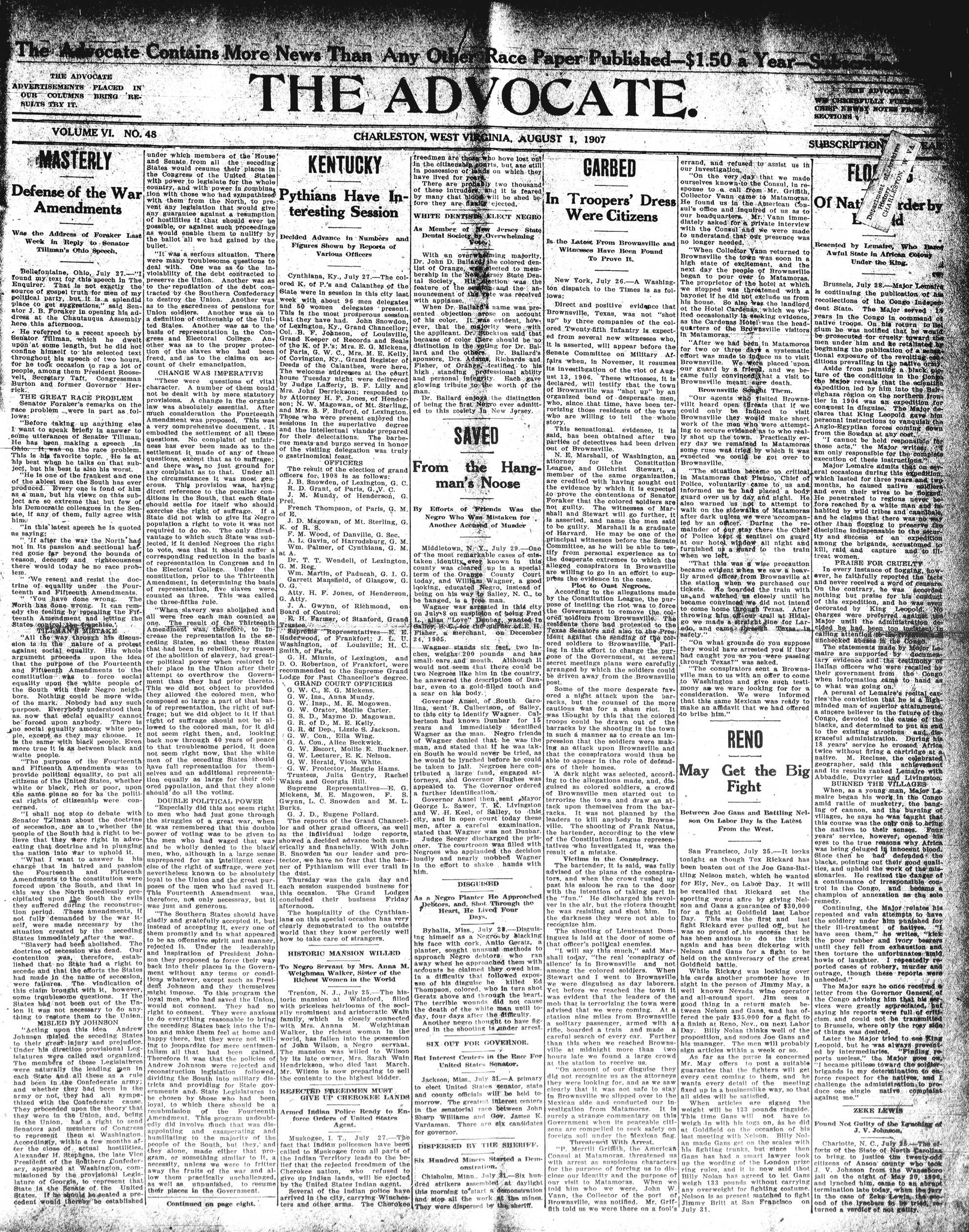
Page text (machine-generated)
Was the Address of Foraker Last Week in Reply to Senator Tillman's Ohio Speech.
Bellefontaine, Ohio, July 27.—"I found my text for this speech in The Enquirer. That is not exactly the source of gospel truth for men of my political party, but, it is a splendid place to get suggestions," said Senator J. B. Foraker in opening his address at the Chautauqua Assembly here this afternoon.
He referred to a recent speech by Senator Tillman, which he dwelt upon at some length, but he did not define himself to his selected text throughout his speech of two hours, for he took occasion to rap a lot of people, among them President Roosevelt, Secretary Taft, Congressman Burton and former Governor Herrick.
THE GREAT RACE PROBLEM
Senator Foraker's remarks on the race problem were in part as follows:
"Before taking up anything else I want to speak briefly in answer to some utterances of Senator Tillman. He has been making a speech in Ohio. It was on the race problem. This is his favorite topic. He is at his best when he talks on that subject, but his best is also his worst.
"He is one of the frankest and one of the ablest men the South has ever produced. Every one is fond of him as a man, but his views on this subject are so extreme that but few of his Democratic colleagues in the Senate, if any of them, fully agree with him.
"In this latest speech he is quoted as saying:
"If after the war the North had not in his passion and sectional harred gone for beyond the bounds of reason, decoying and righteousness there would today be no race problem.
"We resent and resist the doctrine of equality under the Fourteenth and Fifteenth Amendments."
"You have done wrong. The North has done wrong. It can remedy the feeling by repealing the Fifteenth Amendment and letting the States control the franchise," TITLEMAN B MISTAKE
"All the way through his discussion is in the nature of a protest against social equality. His whole argument proceeds upon the idea that the purpose of the Fourteenth and Fifteenth Amendments to the constitution was to force social equality upon the white people of the South with their Negro neighbors. Nothing could be more wide of the mark than people may choose. Everybody understood them as now that social equality cannot be forced upon anybody. There is no social equality among white people, except as they may choose. It is the same with black people. Even more true it is as between black and white people.
"The purpose of the Fourteenth and Fifteenth Amendments was to provide political equality, to put all citizens of the United States, whether white or black, rich or poor, upon the same plane so for as the political rights of citizenship were concerned. I shall not stop to debate with Senator TZlman about the doctrine of secession, nor as to, whether the people of the South had a right to believe that they were right in advocating that doctrine and in plunging the nation into war to uphold it. "What I want to answer is his charge that in hatred and passion the Fourteenth and Fifteenth Amendments to the constitution were forced upon the South, and that in this way the North needlessly precipitated upon the South with violence during the reconstruction period. These amendments, if not fully demanded by the war itself, were made necessary by the situation created by the seceding States immediately after the war.
"Slavery had been abolished. The doctrine of secession was dead. Our contention was, therefore, established that no State had a right to secede and that the efforts the States had made in the name of secession, were failures. The vindication of this claim brought with it, however, some trubblesome questions. If the States had not been out of the Union it was not necessary to do anything to restore the Union. WILLIAM JOHNSON
"Acting upon this idea Andrew Johnson misled the seceding States to their great injury and prejudice. Under his direction provisional Legislatures were called and organized. The members of these Legislatures were naturally the leading men in each State and all these as a rule had been in the Confederate army; and whether they had been in the army or not, they had all sympathized with the Confederate cause. They preceded upon the theory that they were in the Union, and, being in the Union, had a right to send Senators and members of Congress to represent them in Washington. Accordingly, with a few months at hand, they approved of actual hostilities. Alexander H. Stephens, the late Vice President of the Southern Confederacy, appeared at Washington, commissioned by the provisional Legislature of Georgia, to represent that State in the Senate of the United States. If he should be seated a precedent would thereby be established
THE ADVOCATE.
under which members of the House and Senate from all the seceding States would resume their places in the Congress of the United States with power to legislate for the whole country, and with power in combination with those who had sympathized with them from the North, to present any legislation that would give a complete against a resumption of hostilities if that was possible, or against such proceedings as would enable them to nullify by the ballot all we had gained by the bullet.
"It was a serious situation. There were many troublesome questions to deal with. One was as to the inviolability of the debt contracted to preserve the Union. Another was as to the repudiation of the debt contracted by the Southern Confederacy to destroy the Union. Another was as to the sacredness of pensions for Union soldiers. Another was as to a definition of citizenship of the United States. Another was as to the basis of representation in the Congress and Electoral College. Another was as to the proper protection of the slaves who had been freed, and as to the claims on account of their emancipation.
CHANGE WAS IMPERATIVE
"These were questions of vital character. A number of them could not be dealt with by mere statutory provisions. A change in the organic law was absolutely essential. After much consideration the Fourteenth Amendment was proposed. This was a very comprehensive document. It embodied the settlement of all these questions. No complaint of unfairness has ever been made as to the settlement it made of any of these questions, except that as to suffrage; and there was no just ground for any complaint as to that. Under all the circumstances it was most generous. This provision was, having direct reference to the peculiar conditions in the South, that each State should settle for itself who should exercise the right of suffrage. If a State did not wish to give its Negro population a right to vote it was not supposed to. The only disadvantage to which such State was subjected, if it denied Negroes the right to vote, was that it should suffer a corresponding reduction in the basis of representation in Congress and in the Electoral College. Under the constitution, prior to the Thirteenth Amendment, in determining the basis of representation, five slaves were counted as three. This was called the three-fifths rule.
"When slavery was abolished and all were free each man counted as one. The result of the Thirteenth Amendment was, therefore, to increase the representation in the seceding States, so that these States that had been in rebellion, by reason of the abolition of slavery, had greater political power when restored to their place in the Union after their attempt to overthrow the Government than they had prior thereto. This we did not object to provided they allowed the colored men, who composed so large a part of that basis of representation, the right of suffrage; but we did object to it if that right of suffrage should not be imposed on it for it did not seem right then, and, looking back now through 40 years of peace to that troublesome period, it does not seem right now, that the white men of the seceding States should have full representation for themselves and an additional representation equally as large for their colored population, and that they alone should do all the voting.
DOUBLE POLITICAL POWER
"Especially did this not seem right to men who had just gone through the struggles of a great war, when it was remembered that this double power of voting was to be given to the war and to be wholly denied the whole men, who, although in a large sense unprepared for an intelligent exercise of the right of suffrage, were yet nevertheless known to be absolutely loyal to the Union and the great purposes of the men who had saved it. This Fourteenth Amendment was, therefore, not only necessary, but it was just and generous.
"The Southern States should have gladly and gratefully accepted it, but instead of accepting it, every one of them promptly and in what appeared to be an offensive spirit and manner, rejected it. Under the leadership and inspiration of President Johnson they proposed to force their way back into their places in the Government without any terms or conditions whatever, except such as President Johnson and they themselves might impose. To this program the loyal men, who had saved the Union, would not consent. They had no right to consent. They were anxious to do everything reasonable to bring the seceding States back into the Union and make them feel at home and happy there, but they were not willing to jeopardize for mere sentiment all that had been gained. Therefore that the policies of Andrew Johnson they proposed, reconstruction legislation followed, dividing the South into military districts and providing for State governments and State Legislatures to be chosen by those who had been loyal, to which there should be a resumption of the Fourteenth Amendment. This program undoubtedly did involve much that was disappointing and exasperating and humiliating to the majority of the people of the South, but they, and they alone, made either that program, or something similar to it, a necessity, unless we were to fritter away the fruits of the war and allow them practically unchallenged, as well as unpunished, to resume their places in the Government.
Continued on page eight.
CHARLESTON, WEST VIRGINIA, AUGUST 1, 1907
Decided Advance in Numbers and Figures Shown by Reports of Various Officers
Cynthiana, Ky., July 27.—The colored K. of P.'s and Calanthes of the State were in session in this city last week with about 96 men delegates and 50 women delegates present. This is the most prosperous session that they have had. John Snowdon, of Lexington, Ky., Grand Chancellor; Q. B. F. Johnson, of Louisville, Grand Keeper of Records and Seals of the K. of P.'s; Mrs. E. G. Mickens, of Paris, G. C., Mrs. M. E. Kelly, of Covington, Ky., Grand Register of Deeds of the Calanthes, were here. The welcome addresses at the court house Tuesday night were delivered by Judge Lafferty, B. F. Lilly. Mrs. John Derrickson, responded to by Attorney H. F. Jones, of Henderson; N. W. Magowan, of Mt. Starling, and Mrs. S. F. Buford, of Lexington. Those who were present enjoyed the sessions in the superlative degree and the intellectual v兰nda prepared for their delectations. The barbecue meats and burgo served in honor of the visiting delegation was truly a gournicanomial feast.
The result of the election of grand officers for 1908 is as follows: J. B. Snowden, of Lexington, G. C. R. D. Grant, of Paris, G. V. C. J. M. Mundy, of Henderson, G. Prel. French Thompson, of Paris, G. M. of E. J. D. Magowan, of Mt. Sterling, G. K. of R. S.
F. M. Wood, of Danville, G. Sec.
A. L. Gavin, of Harrodsburg, G. M
Wm. Palmer, of Cynthiana, G. M
M at W.
Dr. T. T. Wendell, of Lexington,
G. M. Reg.
Wm. Martin, of Paducah, G. I. G.
Garrett Mansfield, of Glasgow, G.
O. G.
Atty. H. F. Jones, of Henderson,
G. Atty.
J. A. Gwynn, of Richmond, on
Board of Control:
R. H. Farmer, of Stanford, Grand
Trustees.
Supreme Representatives—E. E.
Underwood, of Frankfort; J. L. U.
Washington, of Louisville; H. C.
Smith, of Paris.
G. H. Minnis, of Lexington, and
D. O. Robertson, of Frankfort, were
recommended to the Supreme Grand
Lodge for Past Chancellor's degree.
Officers
G. W. C., E. G. Mickens.
G. W. Ins., A. M. Mundy.
G. W. Insp., M. E. Mogowen.
G. W. Prator, Mollie Carter.
G. S. D. Mayne D. Mogowan.
G. R. of D. M. E. Kelly.
G. R. of Dep. Lizzio S. Jackson.
G. W. Con, Ella Wing.
G. A. Con, Alice Beckwick.
G. W. Escort, Mollie E. Buckner.
G. W. Lecturer, E. K. Nelson.
G. W. Herald, Viola White.
G. W. Protector, Maggie Hams.
Trustees, Julia Gentry, Rachel
Wakes and Georgia Hill.
Supreme Representatives—E. G.
Mickens, M. E. Magowen, F. S.
Gwynn, L. C. Snowden and M. L.
Burks.
G. J. D. Eugene Pollard
The reports of the Grand Chancellor and other grand officers, as well as the individual lodge reports, showed a decided advance both numerically and financially. With John B. Snowden as our leader and protector, we have no fear that the banner of Pythianism will ever trail in the dust. Thursday was the gala day and each session suspended business for this occasion. The Grand Lodges concluded their business Friday. The hospitality of the Cynthianlang on this special occasion has very clearly demonstrated to the outside world that they know perfectly well how to take care of strangers.
HISTORIC MAÑSION WILLED
To Negro Servant by Mrs. Anna M. Weighman Walker, Sister of the Richest Women in the World
Trenton, N. J., July 25.—The historic mansion at Wainford, filled with priceless heirlooms of the socially prominent and aristocratic Wain family, which is closely connected with Mrs. Anna M. Weightman Walker, the richest woman in the world, has fallen into the possession of John Wilson, a Negro servant. The mansion was willed to Wilson by its late owner, Mrs. Sarah Wain Hendrickson, who died last March. Mr. Wilson is now preparing to sell the contents to the highest bidder.
REJECTED FREEDMEN MUST
GIVE UP CHEROKEER LANDS
Armed Indian Police Ready to Enforce Orders of United States Agent.
Muskogee, I. T., July 27.—The fact that Indian policemen have been called to Muskogee from all parts of the Indian Territory leads to the belief that the rejected freedmen of the Cherokee nation, who refused to give up Indian lands, will be ejected by Indian forces. Several of the Indian police have arrived in the city, carrying Winchester and other arms. The Cherokee
freedmen are those who have lost out in the citizenship courts, but are still in possession of lands on which they have lived for years.
There are probably two thousand of these intruders, and it is feared by many that blood will be shed before they are finally ejected.
WHITE DENTIST ELECT NEGRO
As Member of New Jersey State Dental Society by Overwhelming Press
With an overwhelming majority, Dr. John D. Ballard the colored dentist of Orange, was elected to membership in the New Jersey State Dental Society. His election was the feature of the session and the announcement of the vote was received with applause.
When Dr. Ballard's name was presented objection arose on account of his color. It was evident, however, that the majority were with the applicant. Dr. Stockton said that because of color there should be no distinction in the voting for Dr. Ballard and the others. Dr. Ballard's sponsors, Drs. Adama, Richards and Fisher, of Orange, testified to his professional ability and personal integrity. Each gave glowing tribute to the worth of the man. Dr. Ballard enjoys the distinction of being the first Negro ever admitted to this society In New Jersey.
SAVED
From the Hangman's Noose
By Efforts of Friends Was the Negro Who Was Mistaken for Another Accused of Murder
Middletown, N. Y., July 29 —One of the most remarkable cases of mistaken identity, ever known in this county was cleared up in a special term of the Orange County Court today, and William Wagner, a good looking, educated Negro, instead of being on his way to Salley, N. C., to be hanged, is a free man.
Wagner was arrested in this city on July 8 on suspicion of being Fred L., alias "Love" Dunbar, wanted in Galley, B. C., for the murder of E. H. Fisher, a merchant, on December 24, 1905.
Wagner stands six feet, two inches, weighs 200 pounds and has small ears and mouth. Although it would not seem that there could be two Negroes like him in the country, he answered the description of Dunbar, even to a gold-filled tooth and a scar on his body.
Governor Ansel, of South Carolina, sent B. C. Bulbertson, of Salley, to this city to identify Wagner. Bulbertson had known Dunbar for 15 years and immediately identified Wagner as the man. Negro friends of Wagner denied him. he was the man, and stated that if he was taken Sound he would never be tried, as could be lynched before he could be taken to jail. Wagner here contributed a large fund, engaged attorneys, and Governor Hughes was appealed to. The Governor ordered a further identification.
Governor Ansel then sent Mayor George L. Sawer, T. K. Livingston and W. H. Keel, of Salley, to this city, and in open court today these men, after a careful examination, stated that Wagner was not Dunbar. Judge Seeger discharged the prisoner. The courtroom was filled with Negroes who applauded the decision loudly and nearly mobbed Wagner in the effort to shake hands with him.
As a Negro Planter He Approached Debtors, and, Shot Through the Heart, He Lived Four Days.
Byhalia, Miss., July 29.—Disguising himself as a Negro by blacking his face with cork, Antio Geratz, a planner, sought unusual methods to approach Negro debtors who ran away when he approached them with accounts. He owed them owed him. He implicitly that followed exposure of his disguise he killed Ed Thompson, colored, who in turn shot Geratz above and through the heart. The terrible wounds did not cause the death of the white man until today, four days after the difficulty.
Another negro thought to have figured in the shooting is under arrest
SIX. OUT FOR GOVERNOR.
But Interest Centers in the Race For United States Senator.
Jackson, Miss., July 31.—A primary to elect United States senator, state and county officials will be held to tomorrow. The greatest interest centers in the senatorial race between John Sharp Williams and Gov. James K. Vardaman. There are six candidates for governor.
DISPERSED BY THE SHERIFF.
Six Hundred Miners Started a Demonstration.
Chisholm, Minn., July 31.—Six hundred strikers assembled at daylight this morning to start a demonstration and stop all the work at the mines. They were dispersed by the sheriff.
In Troopers' Dress Were Citizens
Is the Latest From Brownsville and Witnesses Have Been Found To Prove It.
New York, July 26.—A Washington dispatch to the Times is as follows:
Direct and positive evidence that Brownsville, Texas, was not "shot up" by three companies of the colored Twenty-fifth Infantry is expected from several new witnesses who, it is asserted, will appear before the Senate Committee on Military Affairs when, in November, it resumes its investigation of the plot of August 13, 1906. These witnesses, it is declared, will testify that the town of Brownsville was "shot up" by an organized band of desperate men, who, since that time, have been terrorizing those residents of the town who are willing to tell the whole story.
This sensational, evidence, it is said, has been obtained after two parties of detectives had been driven out of Brownsville. N. E. Marshall, of Washington, an attorney for the Constitution League, and Glover Stewart, a member of the same organization, are credited with having shut out the evidence by which it is expected to prove the contentions of Senator Foraker that the colored soldiers are not guilty. The witnesses of Marshall and Stewart will go further, it is asserted, and name the men said to be guilty. Marshall is a graduate Harvard. He may be one of the principal witnesses before the Senate Committee, as will be able toify from personal experience and to the desperate extremes to which the alleged conspirators in Brownsville are willing to go in an effort to suppress the evidence in the case.
Plot to Oust Negroes.
According to the allegations made by the Constitution League, the purpose of insisting the riot was to force the amendment to remove the colored soldiers from Brownsville. The residents that protested to the Texas Senators and the Governor against the sending of the colored soldiers to Brownsville. Pulling in this effort to change the purpose of the Government, at several secret meetings plans were carefully arranged by which the soldiers could be driven away from the Brownsville post.
Some of the more desperate favored a night attack upon the barracks, but the counsel of the more cautious was for a sham riot. It was thought by this that the colored troops could be drawn out of the barracks by the shooting in the town in such a manner as to create an impression that the soldiers were making an attack upon Brownville and that the conspirators would thus be able to appear in the role of defenders of their homes.
A dark night was selected, according to the allegations made, and, disguised as colored soldiers, a crowd of Brownsville men started out to terrorize the town and draw an attack upon themselves from the barracks. It was not planned by the leaders to kill anybody in Brownsville. The shooting of Frank Natus, the bartender, according to the view of the Constitution League representatives who investigated it, was the result of a mistake.
Victims in the Conspiracy.
The bartender, it is said, was fully advised of the plans of the conspirator who led the crowd uped up past his saleen he run to the door with the intention of taking part in the "fun." He discharged his revolver in the air, but the rioters thought he was resisting and shot him. In the darkness they were not able to recognize him.
The shooting of Lieutenant Dominguez is laid at the door of some of that officer's political enemies.
"I will say this much," said Marshall today, "the real 'conspiracy of silence' is in Brownville and not among the colored soldiers. When Stewart and I went to Brownville we were disguised as day laborers. Yet before we reached the town it was evident that the leaders of the mob that is terrorizing the town were advised that we were coming. At a station nine miles from Brownville a solitary passenger, armed with a rifle, boarded a train and made a careful search of every car. Further than this when we reached Brownville at midnight more than two hours late we found a large crowd at the station to receive us.
"On account of our disguise they did not recognize us as the attorneys they were looking for, and as we saw clearly that it was not safe to stay in Brownsville we slipped over to the Mexican side and conducted our investigation from Matamoros. It is surely a strange commentary on this Government when its peaceable citizens are compelled to seek safety on foreign soil under the Mexican flag.
Hirebacked the Arrest.
"P. Mertil Griffith, the American Consultant at Matamoras, appended us with arrest as misplaced characters for the purpose of forging us to disclose our identity and the purpose of our visit to Matamoras. When we told him who we were, John W. Vann, the Collector of the port of Brownsville, was notified, Mr. Griffith told us we were there on a fool's
errand, and refused to assist us in our investigation.
"On the very day that we made ourselves known to the Consul, in response to a call from Mr. Griffin, Collector Vann came to Matamqara. He found us in the American Con- served an inquired of us as to our headquarters. Vann immediately asked for a private servi- velf with the Consul and we were made to understand that our presence was no longer needed.
"When Collector Yann returned to Brownville the town was soon in a high state of excitement, and the next day the people of Brownville began to pour over to Matamoras. The proprietor of the hotel at which we stopped was threatened with a bayonet if he did not exclude us from his house. So also was the landlord of the Hotel Cardenas, which we visited occasionally in seeking evidence, as the Cardenas Hotel was the headquarters of the Brownville visitors in Matamoras.
"After we had been in Matamoros for two or three days a systematic effort was made to induce us to visit Brownville. We were upon our guard by a friend, and became fully convinced that a visit to Brownville meant sure death.
Brownsville Sought Them
Brownsville sought them.
"Our agents who visited Brownsville will open up facts that if we could only be in touch with visit Brownsville they would make show work of the men who were attempting to secure evidence as to who really shot up the town. Practically every day we remained in Matamoras some ruse was tried by which it was expected we could be got over to Brownsville.
"The situation became so critical in Matamoras that Pisano, Chief of Police, voluntarily came to us and informed us he had placed a body guard over us by day and night. He also warned us not to attempt to walk on the sidewalks of Matamoras after dark unless we were accompanied as the maidner of our stay there the Chief of Police kept a sentinel on guard at our hotel window all night and furnished us a guard to the train when we left.
"That this was a wise precaution became evident when we saw a heavily armed officer from Brownville at the station when we purchased our tickets. He boarded the train with us and watched us closely until he became convinced we did not intend to come home through Texas. After throwing him on our trail at Hidalgo we made a straight line for Laredo, and came through Texas, in safety."
"On what grounds do you suppose they would have arrested you if they had caught you as you were passing through Texas?" was asked.
"The conspirators sent a Brownville man to us with an offer to come to Washington and give such testimony as we were looking for for a consideration. We were informed that this same Mexican was ready to make an amidavit that we had offered to brite him."
RENO May Get the Big Fight
Between Joe Gans and Battling Nelson On Labor Day is the Latest From the West.
San Francisco, July 25.—It looks tonight as though Tex Rickard has been beaten out of the Joe Gans-Battling Nelson match, which he wanted for Ely, Nev., on Labor Day. It will be recalled that Rickard set the sporting world afire by giving Nelson and Gans a guarantee of $30,000 for a fight at Goldfield last Labor Day. This was the first and last fight Rickard ever pulled off, but he was so proud of his success that he has been anxious to do the trick again and has been dickering with Nelson and Gans for a fight to be held on the anniversary of the great Goldfield battle.
While Rickard was looking over his cards another promoter hove in sight in the person of Jimmy May, a well known Nevada wine operator and all-around sport. Jim sees a good thing in a return match between Nelson and Gans, and has offered the pair $35,000 for a fight to a finish at Reno, Nev., on next Labor Day. Billy Nolan thinks well of the proposition, and sodoes Joe Gans and his manager. The men will probably sign articles within a week or so. As far as the purse is concerned Mr. May offers to post a suitable guarantee that the fighters will get every cent coming to them, and he wants every detail of the meeting fixed up in a businesslike way, so that all sides will be satisfied.
When articles are signed the weight will be 133 pounds ringside. This time Gans will not have to weigh in with his togs on, as he did at Goldfield on the occasion of his last meeting with Nelson. Billy Nolan made Gans get on the scales with his fighting trunks, but since then Gans has had a smart lawyer look up the wording of the London ringing trunks, and it is not said that Billy Nolan has agreed to let. Gans weigh 133 pounds without carrying any overweight for fighting costume. Nelson is as present matched to fight Jimmy Britt at San Francisco on July 31.
Resented by Lemaire, Who Bases Awful State in African Colony Under the King.
Brussels, July 28.—Major Lemaire is continuing the publication of his recollections of the Congo Independent State. The Major served 15 years in the Congo in command of native troops. On his return to Belgium he was notified that he would be prosecuted for cruelty toward the men under him and he retaliated by beginning the publication of a educational exposure of the revolting conditions prevailing in the native army. Aside from painting a black picture of the conditions in the Congo, the Major reveals that the scientific education led by him into the Harleighaza town on the northern frontier in 1904 was an expedition for conquest in disguise. The Major declares that King Leopold personal instructions to vanquish the Anglo-Egyptian forces coming down from the Soudan at any cost.
"I cannot be held responsible for these acts," the Major writer, "I am only responsible for the complete execution of these instructions."
Major Lemaire admits that on several occasions during this expedition, which lasted for three years and two months, he caused native soldiers and even their wives to be floromed. He penetrated to regions never reached by a white man and in habit trees and cannibals, and he claims that there was no way other than flogging to preserve the discipline indispensable to the unity and success of an expedition among the brigands, accustomed to kill, raid and capture and to ill-treat women.
PRAISE FOR CRUELTY
In every instance of flogging, however, he faithfully reported the facts and never received a word of censure. On the contrary, he was accorded the but praise for his conduct of this criminal act, decorated by King Leopold. No charges were preferred against the Major until the administration decided he had been too incestant in calling attention to the unchecked abuses in the Congo. The statements made by Major Leatoure are supported by document evidence and the testimony of Italian officers, who were called by their government from the Congo when information came to hand as to what was going on.
A perusal of Lemaire's recital carries the conviction that he is a high-minded man of superior attainments, a sincere believer in the future of the Congo, devoted to the cause of the blacks, and determined to put an end to the existing atrocities and disgraceful administration. During his 18 years' service he crossed Africa twice without firing a cartridge at a native. M. Recluse, the celebrated geographer, said this achievement and its results ranked Lemaire with Abbaddie, Duuvrler and Livingston.
BURNED THE VILLAGES
When, as a young man, Major La-maire began his work in the Congo amid rattle of muskety, the banging of cannon, and the burning of villages, he says he was taught that this course was the only one to bring the natives to their senses. Four years later, he opened eyes to the true reasons why Africa was being deluged in innocent blood. Since then he had defended the blacks, pointing out their good qualities, and upheld the work of the missionaries. He realized the danger of a continuance of irresponsible control in the Congo, and became a champion of annexation as the sole remedy.
Continuing, the Major relates his repeated and vain attempts to have the soldiery under him punished for their ill-treatment of natives. "I have seen them," he writes, "took the poor rubber and ivory beers until they fell from exhaustion and then torture the unfortunate; humble howls of laughter. I repeatedly reported cases of robbery, murder and outrage, though these reports were unheeded." The Major says he once received a letter from the Governor General of the Congo advising him that his services were greatly appreciated, but saying his reports were full of criticism, and could not be transmitted to Brussels, where only the roay side of things was desired.
Later the Major tried to see King Leopold, but he was always prevented by intermediaries. "Finding reports useless," the Major goes on, "I became piltless toward the soldier-brigands in my determination to enforce respect for the natives, and I challenge the administration, to produce one single native complaint against me."
Charlotte, N. C., July 25.—The efforts of the State of North Carolina to bring to justice the twenty-odd citizens of Anson county who took J. V. Johnson from the Wanesboro jail on the night of May 20, 1906, and lynched him, came to an abrupt conclusion in the case of Jake Lewis, the second of the lynchers to be tried, returned a verdict of not guilty.
Speculation Rife Under the Great White Dome as to Republican Candidates
The President's Probable Course a Source of Worry to the Slate Makers To Whom Will He Throw His Strength If Taft Becomes an Impossibility is Being Asked On All Sides-The Opportunity of the Negro Leader in Georgia, Where Disfranchise-
Stan Correspondence.
Washington, D.C., July 31.
Who will be the next Republican
nominee for the presidency?
This is the question that is agitating the minds of the politicians and of the laity, and wherever two or three are gathered together on the continent, the discussion turns to this everlasting problem.
Will President Roosevelt stick to his pronunciation given out on the night of the election of 1904, and decline a renunciation? Or, will he finally yield to what may seem to be a spontaneous call for him, and allow the convention to name him, without protest on his part? Again, will he insist upon the nomination of Secretary Taft, if he decides that he will not, under any circumstances, permit his own name to be used. Then, should it be found impossible to make Taft the nominee, would he throw the strength of the administration to another candidate? In that event, would the "dark horse" be George Bruce Cortelyou, who surprised everybody by his phenomenal management of the campaign which gave Roosevelt the biggest popular majority received by any presidential aspirant since the rise of the Republican party? If Roosevelt should eliminate himself and there should be a prolonged fight in the convention, who would benefit in the "break-up"? Fairbanks, Cannon, Knox, Foraker, Hughes, LaFollette or somebody yet unheard of
These are the queries that are worrying the wisecacres, and the attempt to reach a solution is going far to enliven the dull "dog day" season in and out of the national capital. At this writing it is anybody's fight, and there is little likelihood of a crystallization of sentiment along positive lines before the meeting of Congress in December. Some politics will doubtless be played in the various camps, and no one will be allowed to go to sleep after the game starts in earnest. Not the least of the burning questions that must come up for settlement will be the part the South will play in the selection of a candidate. It is expected that the usual agitation for a reduction of representation will be sprung, on the score that with less than 200 Northern votes in the convention, added to its own strength, the South, without ability to deliver a single electoral vote, will be powerful enough to dictate the nominee. The result will probably be the same that it has been in former years—the South will retain its representation, but the seats will go to those who are willing to support the candidate and platform that offer the best returns to the party as a whole. In the meantime, the friends of the administration and the antis, the lilywhites and the black-and-tans, the ins and the outs are looking to the main chance and overlooking no bets.
Former Register Judson W. Lyons has been on a trip through several districts of Georgia, examining the situation with reference to the fight that the whites are making to disfranchise the Negro. In a brief interview he admitted that the struggle would be a fierce one and that there would soon be a strong "line-up" of the contending forces, preparatory to a fight to a finish. He hazarded no guess as to the outcome, but there was a determined ring in his voice which gave an impression that the Negro would not submit tamely to a forfeiture of his existing right to vote. A strenuous effort, it is said, will be made to have every Negro in the State qualify for the suffrage, and in order to save the day, it will be necessary to get every one of the race's votes in the ballot box and see to it that they are honestly counted. Unless some extraordinary clever missionary work is done in this direction the proud State of Georgia will fall in behind her sister commonwealths in the deto show in a practical way that true the autonomy of the Negro will be gradation of her black citizens and home of a number of our most agone forever. As Georgia is thegressive agitators for manhood rights for the race and a free ballot, a chance is now offered them charity begins at their own hearthstone. "If they do not themselves of inconsistency, if not cowardice qualify and strain every nerve to preserve their sacred heritage, they will lay themselves open to a charge. If they are constructive statesmen and not mere doctrinaires and dreamers, they will bestir themselves and set so warm a pace in this matter that even if they should lose, they deserve the respect of their fellow men in all sections of the land.
Reverting once more to politics and the presidency, T. Thomas Fortune, the brainy editor of the New York Age, essays the role of a prophet, and comes out flat-footedly and unequivocally in favor of Chas. Evans Hughes, of New York. The stroke is a bold one, and is distinctively "Fortunesque." Its very audacity has set the local doubters on edge, and for the moment, no one had anything to say on the subject. The sages are shaking their heads and wondering what is behind it all. They cannot understand why a
man of Mr. Fortune's experience and recognized sagacity should so, suddenly strike out for an unknown quantity like Governor Hughes and so completely burn his bridges behind him, as he has done in this instance, unless he sees something insight of a deplie and positive character. They argue that it is not "like Fortune" to jump into midcased somewhere about his person. Be that as it may, here is what Mr. Fortune hands out to his readers at the head of the editorial columns of last week's Age:
"It is written in the stars that the next Republican national convention will nominate Charles Evans Hughes, of New York, as the candidate of the Republican hosts to be President.
"It is written in the stars that the Joseph Benson Foraker, of Ohio, will arise in his seat in the Republican national convention and place in nomination Charles Evans Hughes, of New York, as the candidate of the Republican hosts to be President.
"It is written in the stars that the Charles Evans Hughes, of New York, will be elected by the sovereign people of the United States to be their President in succession to Theodore Roosevelt, of New York."
Now, there you have it! Is this daring slogan a bid or a "defi" to the Foraker masses? Will the friends of Senator Foraker content themselves with sending their champion back to the Senate, and enter upon this new and startling program? The attitude of the brilliant editor of the Age is dramatic in the extreme, and lovers of the spectacular are compelled to admire his success in creating thrilling stage pictures, even if they fail to rally to the rescue at the psychological moment, after the approved melodramatic fashion.
But who knows Mr. Fortune has sometimes missed his guess, but he may be wiser in his day and generation than we of the "great outside" wot of. The plot thickens. The gayety of nations is not lacking in valuable and entertaining contributions. It is the "press gang's" next move!
Speaking of the New York Age, we are reminded that for several weeks—in fact, ever since the Age became the property of a stock company—it has been bruited abroad with much positiveness of statement that the paper had been bought outright by Dr. Booker T. Washington as the officia lorgan of the Tuskegee Institute and as the special champion of industrial education and the policies in general of the head of that great school. It was further asserted with assurance that Mr. Fortune was no longer editor in his own right of the sheet that he founded in the long, long ago—that he was simply a paid writer and subject to others as to the kind of matter he must prepare for his patrons.
The Washington Bee fathered the rumor, as did also the Washington Horizon, if our memory serves us aright. The close friends of Dr. Washington were in blissful ignorance of this alleged new move on the part of the man whose confidence they thought they enjoyed, and silently wondered why it was that the principal individuals who possessed this great secret should be persons who have not been known as sympathizers with either the man or his work. They imagined they saw the virile and emphatic Fortune of other days in every line of the editorial page—but the "wise guys" thought differently. They knew what they were talking about; Fortune was in the office—in an "advisory capacity," perhaps, but as the thinker of his own thoughts, he was no more. So THEY said. Commenting with some warmth on the matter contained in a recent issue of the Washington Bee, this is what Mr. Fortune has to say for himself on the subject:
"The Washington Bee says there is a rumor, but where and how it originated it does not specify, that" Fortune is no longer editor of the New York Age, but acts only in an advisory capacity. Now, this is not argument, although Mr. Chase may think it is. But, if he or any other person really thinks the rumor has any bottom in it, let him try' to break into The Age reservation and he will get a jolt that will make him shiver from center to circumference of his hulk."
If anybody really thinks Mr. Fortune is off on a vacation, or has degenerated into a mollycoddle, here is a "come on" that sounds as if it meant business. If Booker T. Washington has purchased a controlling interest in the paper, the person who first gets to Tuskegee, Alabama, with the proof, will hear something very decidedly to his advantage.
Dr. Booker T. Washington's suggestion that the Negroes throughout the country appropriately observe the 100th anniversary of the birth of John Greenleaf Whittier on the 17th day of December next is a timely one. We cannot do too much to keep green the memory of the valiant souls who gave the best that was in them to help on the work of throttling that monster evil, slavery, and "The Poet of Freedom" stood in the front rank of the revered abolitionists of New England who
contended for the manhood rights of the Negro bondmen. His voice and pen and his means were liberally given to this noble cause, and whenever an opportunity presents itself for us to meet and gratefully acknowledge the priceless service he rendered for us, we should be quick to take advantage of it. All will remember the magnificent gatherings everywhere less than two years ago, when we celebrated the centenary of another anti-slavery hero, William Lloyd Garrison, and the inspiration that grew out of those massive meetings is still manifest among our people, North, East, South and West. We should hasten to put into action the wise suggestion of Dr. Washington, and by beginning now, there will be no difficulty in making arrangements to observe the natal day of this great and good man in the way that will adequately show our appreciation of his humane labors and lift us up to higher planes of thought and a keener perception of the duties and responsibilities that have come to us by reason of his manly stand for liberty, equality and fraternity. Steps have already been taken, we learn, by prominent members of the Bethel Literary and Historical Association, the Second Baptist Lyceum, the Pen and Pencil Club and the Book Lovers' Club, of Washington, to take notice of the day in a manner befitting the sacred occasion.
Prof. C. F. Williams, principal of the institution for the Blind, Deaf and Dumb, for colored children, located at Raleigh, North Carolina, died very suddenly at Norfolk last Wednesday night. Appoplexie was the cause. The death of Prof. Williams was the first to occur in the Negro Department of the Jamestown Exposition, and he will be greatly missed. He had worked unceasingly for many months to make the North Carolina exhibit a worthy one, and it is extremely regretable that he was called away before the end of the season, which was to have been fraught with so much that was valuable to him and to the race because of his painstaking efforts in behalf of human progress.
Dr. W. T. Vernon leaves Washington August 5th for St. Joseph, Mo., where he will address the Tri-State Fair, embracing Kansas, Missouri and Nebraska. He will visit his school, the Western University, at Quindaro, Kansas, and then go on to the meeting of the National Negro Business League Topeka, where he is announced for an address on "The Negro and the Nation."
The advance sheet of the program for the eighth annual session of the National Negro Business League is out, and it is full of good things. All in all it is the best-rounded program yet offered by this wonderful organization. You cannot afford to miss it.
R. W. THOMPSON.
Dr. F. S. Smith, who has been spending two weeks in the East, has returned home.
Men's O
There's nothing about
why we should sell them a
fact you will enjoy full
wear.
All $5.00 Low Shoes, Sale
All 4.35 " " " "
All 3.85 " " " "
All 3.35 " " " "
All 2.95 " " " "
All 2.50 " " " "
Bell Shoe Co's Great Special
There's nothing about the shoes to denote why we should sell them at these cut prices. In fact you will enjoy full price value in their wear.
Boys' Oxfords
This sale right in the
the opportunity to buy Low
over until school begins
All $3.00 Low Shoes, Sale
All 2.50 " " " "
All 2.90 " " " "
All 1.50 " " " "
All our Infants' and Children
This sale right in the midst of the play season affords the opportunity to buy Low Shoes that it will tide the boy over until school begins
All our Infants' and Children'a Low Shoes Reduced in satae proportion.
FOR QUANTITY TO HORSE
Parkersburg, W. Va., July 81—J. H. Rowland, who "resides some miles back at palpre, came over here Saturday to trade horses. According to the statement made after his arrest, he succeeded in making a trade with a man named Buckhannon, that was soon dissatisfied with the trade and wanted to renig, but Buckhannon would not stand for it. They had a quarrel over the matter, and then a scrap. Afterwards, it is alleged that Roland jerked the horse around in a brutal manner, multitasking its mouth with the bridle hit. He was afterwards arrested, and taken before Squire Ruttencutter, who, after hearing the evidence, gave him $10 and costs, $22 in all. In default of payment he was given a stall jail sentence.
A SUGGESTION.
A happy solution
Of problems we seek,
I move to abolish
The daya of the week.
Without any Monday
Of course it is seen
We'd all without labor
Be equally clean.
With Saturday banished
And pay day wiped out,
Our wealth would be equal
Without any doubt.
Without any Sunday
To preach what we should,
We'd all of us sinners
Be equally good.
No more shall we hunger,
No more shall we sigh,
When each day shall be no day
Some sweet by and by.
— N. Y. Sun.
The Pythian Mutual Investment Association.
Notice of Annual Meeting of Stockholders of the Pythian Mutual Investment Association.
Notice is hereby given that an annual meeting of the stockholders of The Pythian Mutual Investment Association will be held in the hall room of building owned by said association and situate at the corner of Washington and Dickinson streets, in the City of Charleston, Kanawha County, West Virginia, July 30th. 1907, at 2 o'clock p. m., for the purpose of electing directors of said association for the ensuing year, and for the transaction of such other business as may come before said Association.
Given under my hand this the 1st day of July, A. D., 1907.
State of West Virginia,
Kanawha County, ss.
At Rules held in the Clerk's Office
of the Circuit Court of Kanawha
Bell S
rea
xfords
t the shoes to denote
t these cut prices. In
price value in their
$3.95
3.45
2.95
2.75
2.45
1.95
a Low Shoes Reduced in same pr
enote
ea. In
their
July
Shoe Sale
$3.95
3.45
2.95
2.75
2.45
1.95
BLUEFIELD COLORED INSTITUTE
Bluefield, W. Va.
A College and Normal Institute for colored students, located at Bluelield, the leading commercial town of the southern part of West Virginia, on the Norfolk and Western railroad, 205 miles east of Kenova
BLUE HILL
COLORED INSTITUTE
Splendid College Buildings, Beautiful Grounds, Dormitories
for male and female students; furnished rooms, a reading room supplied with the best current literature; a good library, and a physical and chemical laboratory.
Healthful location and wholesome surroundings. Board $8.00 per month. Tuition free to state students, rates very low to non-resident students. The Bluefield School offers an unparalleled opportunity for young men to secure an education, for they can always find profitable employment when at school, during vacation, holidays and on saturdays. For catalogue and other information, write the Principio.
Here again you find high quality and low prices. Low Shoes for every occasion. Dress, street and outing wear, in the most approved styles and leathers
County, on the first Monday in the month of July, 1907: Katie Jeffries, Plaintiff, vs. In Chancery, No. 1495. Kidd Jeffries, Defendant. (The object of this suit is to obtain a divorce from the bonds of matrimony.) This day came the Plaintiff by her Attorney; and on his motion, and it appearing by affidavit filed, that the Defendant is a non-resident of this State, it is ordered that he do appear within one year after the date of the first publication hereof, and
Shoe
It Sp
July
Shoe Sale
Gir
Here again you fi
Shoes for every occasion
in the most approved s
All $2.50 Low Shoes, S
All 2.00 “ “
All 1.50 “ “
pportion.
HOE
708 KANAWHA STREET
R. P. SIMS, Bluelield W. Va
Teste: D. M. SHIRKEY, Clerk.
J. W. Chappelle, Scl.
Notice to Take Depositions.
To Kldd Jeffries.
TAKE NOTICE: That on the 10th day of August, A. D. 1907, between the hours of 9 o'clock A. M. and 5 o'clock P. M., at the law office of J. W. Chappelle, 604 1-2 Kanawha street, Charleston, West Virginia, I will take the deposition of myself and others, to be read in evidence in my behalf in a certain suit in chancery
Co's
cial
Ladies' Oxfords
The great variety of s and shiny leathers make the important sale of Women's
the great variety of styles in bla any leathers make this by far thant sale of Women's Low Shoes t
The great variety of styles in black, tan and shiny leathers make this by far the most important sale of Women's Low Shoes this season has brought forth.
No Shoes will be sent on approval or charged at sale prices COMP'Y
now pending in the Circuit Court for the Count yof Kapawha and State of West Virginia, in which I am Plaintiff and you are Defendant.
If from any cause the taking of said deposition shall not be commenced or completed on the day aforesaid, the same shall be continued from day to day, or from time to time, at the same place, and between the same hours, until the same shall be completed.
KATIE JEFFRIES.
J. W. Chappelle, Sol. By Counsel.
of styles in black, tan make this by far the most
Call at the Gem Pharmacy
and get a bottle of Beef, Wine and iron for that tired feeling. Don't wait for Spring is here. The system is full of impurities which must be evacuated leat you will continue to suffer from that "tired feeling," poor appetite, headache and fatigue which comes with the pring
Price per bottle 50c
Get your prescription filled at the GEM where you get pure and fresh ingredients put up with utmost care and skill.
A new line of toilet articles just arrived for the summer.
Special attention is given the "SODA FOUNTAIN" where you enjoy ICE CREAM SODA Choice Flavors.
Gem Pharmacy
Corner Washington and Dickinson Streets CHARLESTON, WEST V.A.
CENT IS ALL-IT WILL COST WAY
to write for our big BROTHERS, showing the most complete line of high grade
metals available at FRANCE
BELOW any other manufacturer or dealer in the world.
DO NOT BUY A BICYCLE from anyone
or on any kind of tour, until you have received our complete Data
tables illustrating and describing every grade and low grade
bicycles, old patterns and latest models, and learn of our
products and wonderful new offers made possible by selling from factory
and with no middlemen's profits.
WITH APPROVAL without a 'cert' default. Pay the Freight and
house in the same city. Trial and make other liberal terms which no other
house in the same city will learn everything and get much valuable
information by simply writing us a postal.
PER PAIR
Result of 15 years experience in tire making. No danger from THORNS, CACTUS, PINS, NAILS, TACKS or GLASS. Section pictures, like intentional knife cuts, can be used to determine the type of tire. Two Hundred Thousand pairs now in actual use, Over Seventy-five Thousand pairs sold last year.
lively and easy riding, very durable and l�ed Inside ecomes porous and which closes up small punctures undryes of letters from satisfied customers at the time in a whole season. They weigh no more than one binge given given by several layers of thin, specially cigar-dotted, small-size, when riding on asphalt set Weave's tread which prevents all air from being overcoming all suction. The regular price of these is about $10 per pack. The price is not as high as the price for the rider, hereby making the price $40 per pair. On approval, and found them strictly as represented. We�bip CO.D. on the driver's post is received. We'll be sent one ticket at a time. We will also send one ticket for the�ncture closers on full paid orders (these metal and knife cuts or heavy gases). Tires to be returned are not satisfactory on examination.
We is as safe as in a bank. Ask your Postmaster, if this paper about us. If you order a pair of a sticker, run after, wear better, look longer and look any price. We know that you will be so well pleased your order. We want you to send us a small trial.
We make the best use of your vehicle, maddies, paddies, parts and repairs, and in the bicycle line are sold by us at half the usual time for our big SWIRR-P� entails.
Spare Dollar
With it — save it. It will
to success — probably
To save it. Fill out and
d learn about it:
Co., Charleston, West Va.:
system of Savings by mail, and
awba
Trust Company
West Virginia
**DESCRIPTION** Made in all sizes. It is lively and easy riding, very durable and lined inside with a heavy foam padding and which closes up small punctures without allowing the air to escape. We have hundred pairs of these that their three have only been pumped up once or twice in a whole season. They weigh no more than 10 pounds and the material being given by several layers of skin, specially prepared fabric on the tread. This "Holden Weave" tread which prevents all squeezed out between the tread and the road thus overcoming all suction. The regular price of these squeezed out between the tread and the road thus overcoming all suction is a special factory price to the rider of only $40 per pair. All order: shipped same day letter is required for approval. You do not pay a cent until you have examined and found them strictly as represented.
It will allow a cash discount of $ per car (thereby making the price $ 8.55 per pair) if you send a ticket for the car and will also send one ticket for the brass hand pump and two Samson metal puncture closers on full price. Puncture closers to be used in case of intentional knife cuts or heavy gadgets. Tickets to be returned in the form of a cash payment upon examination. We are perfectly reliable and money sent to us is so safe that your Postmaster, Banker, Express or Freight Agent or the Editor of this paper about us. If you order a pair of brass hand pump and two Samson metal puncture closers find that they will ride easier, run faster, wear better, last longer and look finer than any live car. We will be so well pleased that when you want a bicycle you will give us your order. We want you to send a small trial order at once, hence this remarkable offer.
GOASTER-BRAKES, everything in the bicycle line are parts and repairs, and the usual prices charged by dealers and repair men. Write for our big SUNDRY catalog. half the
Your Next Spare Dollar
Do the wise thing with it—save it. It will be a stepping-stone to success—probably wealth. It is easy to save it. Fill out and mail this coupon and learn about it:
Manawha Banking and Trust Co., Charleston, West Va.: Mail particulars of your system of Savings by mail, and blanks for operating an account.
a. yesterday.
---
Rollback Price
$8.50 per pair.
To Introhooze
We Will Sell
You a Sample
Pair for Only
4.80
NAILS TACKS
WON'T LET
OUT THE AIR
At Columbus, Ohio, yesterday, the candidacy of Wijliam H. Taft for president was endorsed by the Republican State Central committee by a vote of 15 to 6. It also voted to retain Foraker as senator and Dick as chairman. From Cincinnati, Foraker sent out a defiance to the committee, declaring that the committee had no right to speak on the matter.
In the trial of Caleb Powers, for the fourth time, for complicity in the murder of Governor Gerald, the prosecution rationalized the plea of the defense in asking that Judge Robbins va-
Nothole the thick ribbons tremel
"A" and punctate stripes "g";
"and" Bp? also rim strip "h"
to prevent rim cutting. This
make-SOFT, ELASTIC or
EASY BIDING.
vate the bench. This motion was made on the allegation that in the former trial the court took a partisan newspaper to the jury containing an article in which it was reported that the only question for the jury to decide was the life sentence or death penalty.
Yesterday the house of delegates of the Georgia legislature passed the senate prohibition bill, making Georgia a prohibition state.
Officials at Washington, it is said, are fearing another coal famine in the Northwest next winter, and warnings to that effect have been issued.
The Fairbanks family, of which Vice-President Fairbanks is a member, held a reunion at Deetham, Macs.
SNAPSHOTS AT SMIT AND THINGS
FROM WASHINGTON
Change in Curriculum in the Maxal
Academy—New Complication
Coming From Texas Laws
Washington, July 31.—The change in the curriculum at the Naval Academy, which combines the departments of mathematics and mechanics in charge of Prof. Stinson J. Brown, recalls the local astronomical work of that officer, who was stationed for some years at the United States Naval Observatory, on Georgetown Heights. Prof. Brown was in charge of the great equatorial at the observatory for a number of years prior to his assignment to the Naval Academy. He was director of the observatory from 1888 to 1901, and also director of the Nautical Alarm 1909-1901. He prepared a catalogue of stars for the Berliner Johrbuch at Annapolis in 1885-87, and at the observatory of the University of Wisconsin, 1899-90, also various scientific memoirs in the Astronomical Journal, founded on original observations and researches.
Capt. J.; C. Badger, who has just assumed the superintendency of the Naval Academy, does not approve of all the recommendations and changes made by the Walnwright board, but has approved the consolidation of mathematics and mechanics, of which the former Washington scientist is to be in charge. Prof. Brown lived for a number of years in Georgetown, where he was married, and where Mrs. Brown's family still reside. He was educated at Cornell and at the Naval Academy, from which he graduated, at the head of his class, in 1876. He was appointed professor of mathematics in 1883.
Another one of the many remarkable laws enacted by the last session of the Texas legislature is now attracting attention. It is the one forbidding the issuance of free passes by railroads, and it has been brought into the public eye as a result of a suit filed by the Wells-Fargo Express Company against the various lines over which it operates to compel the carrying out of contracts, not yet expired, which provides for the free transportation of certain express company employees. The suit has been filed in one of the state district courts at Houston. Counsel for the plaintiff insist that they, have a strong case, this opinion being partially based, apparently, on the assumption that the railroads have construed the anti-pass law improperly.
The position of its defendant railroads is that they cannot fulfill their contracts with the express companies without violating the new statute, but the plaintiff concern contends that the legislation does not apply to contracts in force prior to its enactment. If this contention fails, the claim will be made that the law is unconstitutional, in that the state legislature has no right or authority under the federal or state constitutions, to enact any law which impairs the obligations of contracts, and because the enforcement of the law in such a way as to annul the existing contracts would constitute the taking of property without due process of law. In the event named it doubtless would be further contended that the law interferes with interstate commerce, and that it denies the Wells-Fargo Company the equal protection of the law.
In view of the recent developments in the North Carolina case, a statement made by Judge Stockton, of New York, general attorney for the plaintiff company, is decided interesting. "Our reasons for going into the state court," he said, "is because the state statute should be decided by the state courts, and this is not necessarily a federal question."
As a result of a concession made by Secretary of the Navy Motoff, naval officers who are traveling under and do not receive mileage, as well as civilian employees of the Navy Department who travel on official business, may now enjoy their baths at the expense of the taxpaying public. The action of the Secretary followed a recommendation of the Paymaster General, and now only the sanction of the Comptroller of the Currency, who must pass on the legality of the proposed innovation, is needed to remove all elements of uncertainty. The plan is to establish a definite scale of allowances, so that officers may know exactly what they may expect from the Treasury in the way of reimburssement for traveling expenses. Furthermore, the department proposes to eliminate the delays of from two to six months in the settlement of expense accounts, which heretofore have distinguished such transactions. The allowances for baths will change a Treasury Department rule of long standing.
There has been a revival of interest in Germany in all that pertains to Vischer, the eccentric author, due to the celebration of the one hundredth anniversary of his birth. One of the stories told of him is of his adventure with an American girl. He was busy with his treatise on aesthetics, which afterward became famous, when the girl secured the next room to his, and played on the place for hours at a time. He begged for quiet, but was told that if he did not like his room he could leave. He had occupied his apartments for fourteen years, and was loath to change; one day he burst from his room, tooaming and yelling like a madman and so scared the stables.
You Look Prematurely Old
that she moved the next day. It was Vlischer, too, who, while in italy, became angered at a waiter in a cafe, and being short on Italian phrases, held the waiter by the coat-tail, while with the other hand he searched a pocket dictionary for the Italian word meaning scoundrel. As a centenary gift Vlischer's letter from Italy has been printed by his son.
Putnam County's Teachers' Institute
Pharleria Courtright.
There was a pleasant breeze
Blowing through the locust trees.
The skies were clear, the sun shone
bright.
That Miller thus has passed his word
In sending men of merit down
To the Putnam river, town
To tell the Teacher a Institute
How to make new knowledge shoot.
He might have found a man some thinner
Than dear Doctor J. M. Skinner,
Prof. pluk is like no song
As Prof. R. Armstrong,
But Doctor Skinner is the Twain
Of the things that now remain—
He touches with a gentle touch
And stops before he says too much
He a humor? Well, no,
Just agreeable, and so
The kind o' man you like to know.
And R. A. Armstrong, don't you see?
Is the literary key
That unlocks the store of books
That are brought a from nameless nooks
His tongue, his power, his force,
His delivery of discourse
Pucks the heart from poet's song,
(Does Prof. R. Armstrong?)
And casts it upward its wings
With a melody that rinses
Ah 'tis thus that Armstrong sing!
Importative teachers see
What these great instructors be.
The hundred and the enrollment
gives
A sign that education lives;
And West Virginia credited yet
Can not forget, can not forget
With such reminders in such force
As these instructors gave discourse.
This was a sort of institution
That required no contribution.
Armstrong was busy all his life—
To worry to be a man
But he delighteds, and he's said to know
The institution's bound to grow.
But Mr. Stover wise and good
Has not the lover's age withstood,
But growing up about his fire
Are children, who will bless their
Sire.
Who is today the corner stone
Of Putnam's education throne.
Stover and Stover head
Are waking up withitions dead,
And in the full years to be
His mark Putnam's school will be,
Then came the days to part
Each lover almost broke his heart,
And hied to school, books, chalk and
chart.
THE LIBERAL LANDLADY.
She Promised a "Sea-View" and She Kept Her Word.
A London gentleman advertised for apartments at a fashionable watering place, and received many replies. He pitched upon one, chiefly because it mentioned a splendid "sea view"; and, as it was not convenient for him to leave his business to see the apartments, he closed with the offer by post, sending a substantial deposit.
When the time came for him to take his holiday, says Tit-Bits, he duly arrived at his destination, and was surprised to find that not a glimpse of the sea was obtainable from any window of his apartments.
"I thought you said there was a splendid sea view?" he said, angrily, to the landlady.
"So there is, sir," said the landlady, drawing his attention to a picture on the wall, a really excellent painting of the sea.
"Why, you-er-er—What do you mean by such a swindle?" gasped the gentleman. "I meant a view of the 'real' sea."
"Oh, did you sir?'" coolly said the landlady. "If you will refer to my letter you will see that I distinctly stated that there was a splendid sea view 'in' the drawing room. Had I meant a view on the real sea I should have said there was a splendid sea view 'from' the drawing room. I can not think how an educated gentleman, as you evidently are, could have made such an egregious error."
Mrs. Frank Lively, of Hinton, is in the city visiting.
Mrs. J. M. Neighbors and daughters of Knoxville, Tenn., are the guests of Mrs. C. W. Campbell.
Mr. and Mrs. J. A. Chambers have returned from an extended trip to the East.
Miss Golda Coney, who has been visiting in Malden, has returned home.
"Say, is Lee street, between Morris and Bradford within the limits of the city of Charleston? If so, can you tell me why it has been abandoned by the authorities until it is the most disreputable street to be found anywhere, as far as its condition as a public thoroughfare is concerned," said a resident of the street to the Mail today.
"Today the street is full of mud holes, filled with black mud and decaying fetid matter, sending forth a horrible stench, and breeding more kinds of disease than Cuba, Havana, or Colon, Panama, before the Americans took control. I know nothing that those mudholes, after a rain and under a broiling sun resemble more than a hog wallow. Its condition is a disgrace to any community and to any city administration.
"There is no drainage. An attempt was made to do some work on it some time ago. The scraper was run over it and one side of the street was scraped, the loose dirt being shoved over into the shallow ditches, stopping them up and preventing the little drainage that then existed from carrying off what little water did run off before. Then, as if fleeing from the pestilence the authorities had provided for by their unfinished work, the street was abandoned until just at this time it is in the worst condition that it has ever been in, and successfully defies any other street in the city to be worse.
"Is it not possible that the high-priced board of affairs can be induced to go out and look at this street? Can not the health officer pay it a personal visit? Can not the street commissioner do something? I believe he is willing to do it. What, then, holds him back? Will not the councilmen of the city take some little interest in this matter? Up to a few years ago, owing to the Noyes house on Morris cutting off traffic from lower Lee, this section of Lee street was not traveled much, and, while it never did receive half decent attention, it was kept in something of a shape. Now that with the opening up of traffic on upper Lee and the increased building on Lee further up, the street is used more, its condition, after a rain, is simply horrible.
"I understand that a petition signed by the property owners has long laid before council for the paving of this street. I don't know why it has not been acted upon except, perhaps, owing to the condition of the city's finances. But, if the city can not pave it, it can at least drain it and keep it drained. Certainly, neither the city nor its officials should go there and deliberately, as it were, after making a pretense of work, put it in a much worse condition than before they went there.
"If the Mail can prevail upon the mayor, the city council, the board of affairs, the chief of police, the city engineer, the health officer, all to come out and look at Lee between Morris and Bradford, especially after a rain, and all will bring their noses with them as well as their eyes, perhaps something may be done and a disgrace as well as prolific disease breeder wiped out, and we may all get some measure of relief."
ADVERTISED LETTER LIST
R. B. Allen, George Anderson, George Anderson, Rosie Anderson, Mabelle Anderson, Albert L. Amich, Emmet Baber, Landon C. Bell, Charles Bell, Willie Boggess, Charlie Brown, J. A. Bowles, L. P. Bush, Eliza Chapman, T. P. Charlton, T. P. Charlton, C. C. Carney, H. L. Carney, Mary J. Cox, Edwin D. Detwiler, Joe Dean, Florence DelHart, Hazel Dillard, Dr. W. R. Wove, J. W. Eskew, Ewil Ewings, Samuel Foote, Dora Gilles, Professor John Gibson, Lizzie Godr, Otto Hanshaw, A. F. Harmon, Mary Hicks, Berrell T. Howard, Mrs. Jao, Hoder, Alice Hull, W. B. Ingerman, Daisy Jarrett, Albert Johnson, Alice Johnson, W. S. Johnson, Kanawa Co, F. Kary, O. A. Kintzel, H. M. Light, Grace Lightburg, Turner Marritt, M. G. Marton, Ernie McLaughlin, Blanch Mason, Celia Moels, Lottie Mitchell, Bennie Morris, Minnie Moran, Bob Myers, Pearl Naylor, Charley Nash, Mary Nawlur, Wm. G. Norton, Mary S. Patterson, Mrs. Wm. H. Pack, James Petty, Thos. Popp, Claude Ryan, Minnie Sailshury, Mary Maude, Mrs. Mrs. E. Shadle, W. M. Scales, J. W. Straight, Will Shea, May Sears, J. W. Swetman, Harry Scott, W. E. Smoot, Pearl Stone, Preston Triplett, Luitha Thomas, Pearl
A man in a suit holding a hat.
Thomas, Bell Truss., Henry Tyler,
Mary Ullita, Dorothy Ware, Miss Eva
Wade, Jno. R. Hubbard Walker, Mrs.
S. A. Walker, Robert Wiltshire, R.
G. White.
IMPROVING THEIR PLANT
Agnew Electric Company Increasing Their Facilities.
The Agnew Electric Company has become one of the most important manufacturing concerns in the city and the business has increased so rapidly during the past year or more that it has been necessary for the company to make a number of improvements on their plant. Workmen are now substituting a steam power plant for the gas engine now in use. The new plant consists of a 75 H. P. automatic engine built by the Ironton Engine Company of Ironton, Ohio, a 100 H. P. Union Iron Works boiler and a 100 K. W. generator built by the Agnew company.
The new plant will be housed in a neat, brick building 30 by 40 feet and will furnish the electricity for power, lighting and testing purposes. A complete testing apparatus to test each piece of machinery made by the company before it leaves the factory will be installed and during the next year the Agnew company expects to make $100,000 worth of machinery. The business has increased so rapidly that the company's old building was found to be grossly inadequate.
At Boise, Idaho, yesterday, Charles H. Moyer, president of the Western Federation of Miners, under indictment for conspiring the murder of Former Governor Steuenberg, was admitted to ball in the sum of $25,000. The hound was signed by Timothy Reagan and Thomas J. Jones, of Boise. Immediately after his release, Moyer left with Haywood for the federation headquarters at Denver.
HE WANTED "OUT OF JAIL"
So He Simply "swiped" the Jail Key and Went Out.
Because he had the inclination to make an attempt to secure his freedom Eugene Reavely enjoyed several hours in the country and the pleasure of eluding the officers who were hot on his trail, but he was brought back at noon Tuesday just in time to join his other jail companions and leave on the noon train for Moundsville where he will serve five years, having been convicted of stealing from the "Busy Bee" clothing house on Kanawha street.
STORER
Harper's Ferry,
COU
Academic, State Normal, Bibl
Music, Carpentry, Blacksmith
Husbandry, Cookery, Serving
Academic, State Normal, Biblical, Vocal and Instrumental Music, Carpentry, Blacksmithing, Practical Gardening and Husbandry, Cookery, Serving and Dressmaking.
Equipment
Ample Buildings, Beautiful Car
braries of over 6000 volumes,
Honnery, Dairy, several acres
Hot Beds.
Expo
Books, Room Rent and Tuition
essary Expense hot over $6.
Ample Buildings. Beautiful Campus. Laboratory. Telescope. Library of over 6000 volumes. Commissional Barn. Piggery. Honnery. Dairy, several acres of of gardens, Cold Frames and Hot Beds.
Expenses
Books, Room Rent and Tuition cost to Weas Virginiaans. Necessary Expense not over $6.50 per month to State students
Special Features
Eight valuable scholarships and Athletics, Band, Literary Society entertainments, Musical Clubs, Y
Storer is a Non-Sectarian, C
For Illustrated Catalogue see
Henry T.
Eight valuable scholarships and six prizes awarded annually,
Athletics, Band, Literary Societies, frequent Lectures and Retreatments, Musical Clubs, Y. M. C. A.
Storer is a Non-Sectarian, Christian Institution.
For Illustrated Catalogue send to
Reavely secured the keys of the jail Sunday night about ten o'clock while no one was watching him and got out of jail. A short time afterwards his escape was discovered and officers were notified but not until Tuesday shortly before noon was there any trace of him found. Officer Overstreet found the man a short distance above Magazine Hollow and returned with him to the city where the guard from the penitentiary was waiting with a pair of headguards.
THE VIEWS OF ONE.
When no one has to go to work,
Or paddle ice or meat.
And every artisan and clerk
Is out upon the street——
When every soul in town is free,
To go abroad and play,
There's very little fun for me
In such a holiday.
I like to watch the others toll
The white I fdly stroll;
I live to see 'em mawl the soil
And heavy bowlers roll.
When others have to pull and haul
And I am free and gay,
That is what L prefer to call
A real holiday.
QUITE SO.
"These fellers that 'spect to ketch
the farmer vote pitchin' hay hey got
the wrong idea."
"How's that, Jabez?"
"A reel farmer spends his time
pitchin' horse shoes."
ALL IN ONE DAY.
"I see by this paper that the American woman engages in no less than 202 occupations."
"Well?"
"I thought my wife was exaggerating when she complains about what she has to do."
BREAM SUNDAY SCHOOL PICNIC.
The Sunday School of Bream Memorial church will have their annual picnic tomorrow at Glenwood Park near Grant Hall's. The Sunday school and others will gather at the park at 10:00 o'clock with their baskets packed with eatables and spend the day in the shade, eating good things and the children with various games and amusements. The day will no doubt be spent pleasantly by those who attend.
Miss Carrie Holt Left last night for Philadelphia to visit her sister. Mrs. George Laidley and son left last night to visit Mrs. Laidley's mother, Mrs. Bradford at Marmet. Mr. George Fitz, of Staunton, Va., is visiting at the home of Mrs. Mabel Anderson on Broad street.
COLLEGE,
West Va.
Physical, Vocal and Instrumental
ing. Practical Gardening and
and Dressmaking.
six prizes awarded annually. ties, frequent Lectures and Mo- M. C. A. Christian Institution. end to McDonalds
QUITE SO.
The Advocate is entered in the Post-office at Charleston, W. Va., as second class matter.
THURSDAY, AUGUST 1, 1907.
OFFICES.
OFFICES.
New York:
738 7th Avenue.
Washington:
1325 12th St. N. W.
Louisville:
1112 W. Madison St.
St. Louis:
3137 Pine St.
Philadelphia:
702 So. 15th St.
Baltimore:
502 W. Biddle St.
Boston:
94 a Harvard St., Cambridge.
Pittsburg:
461 6th St., Braddock.
Columbus:
266 St. Clair Ave.
New Orleans:
226 So. Robertson St.
Jacksonville:
536 W. Union St.
Nashville:
706 Bass St.
Indianapolis:
1605 Alvord St.
Lexington:
567 N. Upper St.
San Francisco:
865 Union St., Oakland.
Detroit:
261 Elliot St.
El Paso:
Chicago:
2519 Calumet Ave.
BEATING THE TOM-TOM
BEATING THE TOM-TOM
Mr. George Byrne, late editor of the Charleston Gazette and Sunday Schmitar, who makes a bid for fame as the apostle in this State of Negro disfranchisement and "jim crow" cars, is again engaged in his favorite amusement of beating the tom-tom.
In an interview in an up-state paper Mr. Byrne hies him back from the limbo of oblivion into which he had sunk since the Maryland campaign to advance the same old, threadbare argument for disfranchisement—Negro domination, and professes to "believe that West Virginia will go to the bow-wows, unless his pet measures are adopted.
Poor, disappointed old man. While not approving his motive, The Advocate sympathizes with him in wishing for a return to power of the Democratic party, for is he not "all in, down and out?"
The desire to hold down a good, fat job; to put both feet is the salary trough has driven men to more despicable acts than the advocacy or reg isolation having for its end the humiliation of a struggling people. What matters the means when the end offers freedom from the daily cares of the things they loath? Life has been taken to escape the importunities of the butcher, the baker or the candlestick maker. Mr. Byrne's method is less reprehensible, if one forgets that "Therefore, all things whatever ye would that men should do to you, do ye even so to them; for this is the law and the prophets."
RAILROADS AND COURTS
North Carolina railroads are anything but consistent in their opposition to the legislation enacted at the last session of that State's Legislature. They accepted without a protest the measure compelling them to separate the races, but the outlay required to meet the requirements of the "Jim Crow" law, even though first and second class accommodations were furnished both races, was a more bagatelle as compared with the loss they anticipate from the new rate law. Hence the opposition which involved the State and national courts and threatened at one time to disrupt the peaceful relations exiting between the governments at Washington and Raleigh.
There was absolutely no necessity for that little tempest in a teapot, and it could have been avoided easily by the adoption of the methods used in Missouri, where similar conditions obtained. There the court held that the railroads should prove their contention that great loss would be sustained by reducing passenger rates, and the law will be operative a sufficient time to give all interested parties an opportunity to produce facts. Judge Pritchard preferred the more spectacular course and the railroad representatives found themselves the shuttle-cock between the court of the nation and state. The spectacle was edifying only in that it furnished further evidence of the need of a better defined linq of demarcation between the jurisdictions of the Federal and State courts.
In Oklahoma the civil and political status of the Negro, whether of pure blood or a mixture with the white or Indian, will, according to a contributor to last week's Independent, be but little, if any, removed
from that of his brethren in Alabama or any of the other disfranchising States. In the new State, he says, with the census of 1900 as authority, there were 55,601 Negroes with a larger per centage of home-owners in comfortable circumstances than probably can be found elsewhere in the United States. Their number is relatively small, for. If the entire population be approximated at two millions, they will not exceed one hundred thousand. They can scarcely be termed improvident, yet the hostility which confronts them on every hand is not less bitter than that of the Black Belt.
In the campaign to elect delegates to the constitutional convention that party, which was the most outspoken in its pronouncements against the Negro, elected an overwhelming majority and the measures which first claimed their attention were disfranchisement, separate schools and "Jim Crow" cars.
The reasons—shiftlessness and a large Negro population—which were put forward elsewhere for the enactment of these restrictive laws do not obtain in Oklahoma, as was shown above, nor will they affect the Indian, "But why," asks the writer, and we join in the query, "is the Negro ostracised, while the Indian, more numerous than the Negro, is everywhere met with friendly toleration, no social barrier being raised against him? Is it the stigma of recent slavery that makes the difference? Fullblood Indian is quite as improvident and as slothful as the Negro. In both territories there is but one tribe of Indians—the Apaches—that, so far as I know, actually farms except by proxy. They are prisoners of war at Fort Sill. But any of these Apache prisoners or the most ignorant Wichita, can hope for more in Oklahoma than the best educated Negro that the new State can produce."
The highly sensational report from Chicago detailing the "exposure" of a colored girl masquerading as white bore all the earmarks of the emenations of the yellow jouranlist and has been proved the feriest rot.
It was difficult for even the casual reader to understand how Miss Cecilia Johnson, living as she did in the city with her people, could have succeeded five years in concealing, had she attempted to do so, her connection with the Negro race. She was and had been for a number of years a prominent worker in a colored church and had entertained her colored friends at her residence upon various occasions. What popularity may have come to her was due solely to her character energy and brains and not to the membership in any sorority or other student organization. Of course, she did not go around wearing a placard upon her back setting forth her ancestry, but, we learn, the evidence of there being colored blood in her veins is apparent to those not affected with astigmatism or total blindness. The incident appears to the St. Louis Post-Despatch in this light:
"When Chicago telegraphs that Miss Cecilia Johnson is ill and suffering, because she has been "exposed," it is a challenge to the lightning which ought at once to set ablaze the whole Babel pile of Chicago educational and "ethical" false pretenses. As a social leader and an honor graduate of the Chicago University, this talented young woman is reported from Chicago to have had many admiring friends during the time she was being educated under the Rockefeller system. When she has met its wisely and lofty tests triumphantly, Chicago oddly discovers that the private means which enabled her to do so are "tainted money," derived from the dive of "Mushroom" Johnson.
"It is further alleged by Chicago that in using this tainted money in learning ethics and esthetics, the ward of "Mushmouth" Johnson allowed herself to be flattered, followed, adulated and almost, if not quite, worshiped, without disclosing the fact that her great grandfather was a respectable resident of St. Louis, who, being in his generation a Negro and a slave, never had tainted money in his possession.
"Miss Cecilia Johnson denies that she concealed anything." "Mushmouth" Johnson also denies that anything was concealed in his education, a deduction which made Miss Cecilia Johnson a social leader was a free, voluntary, spontaneous and practically irresistible result of Chicago habits.
"Mushmouth" Johnson is glad, and he is entitled to be glad, that Chicago feels humiliated. "He sees that the 'exposure' is an exposure not of himself and of the taint of the money he used for higher education, but of Chicago habits. As for his ward, who suffers now from the reactions of educated nerves, she is entitled to take the same view. The unfortunate result of the Rockefeller system, however, is to educate her into capacity for nervous prostration when she becomes openly the victim of its false pretenses."
At Huntington last week a girl attempted suicide by swallowing an umbrella. Heretofore carbolic acid has been the means employed by those who preferred Hell to Huntington, to shuffle off this mortal coil. The young lady, although unsuccessful, is to be congratulated upon hav-
ing discovered a new method of putting an end to one's troubles.
Senator Foraker's address at Bellefontaine, O., Saturday was a masterly defense of the Fourteenth and Fifteenth Amendments, which had been the objects of attack by Senator Tillman a short time before. There is never any hedging or sidestepping when Ohio's senior senator takes the floor.
Negro Day at the Jamestown Exposition, upon which occasion Dr. Booker T. Washington will deliver an address, is expected to draw a record breaking crowd to the scene of the "first landing."
The reduction of the Negro Criterion, Col. Giles B. Jackson's paper, to six columns gives rise to the thought that the one hundred thousand dollar appropriation must be about exhausted.
AMERICAN GIRLS.
One of Vintage of '45 Expresses
Herself.
"I don't know what the world is
coming to," sighed a New York woman
of the vintage of '45 to a New
York Evening Sun representative.
"Time was when we used to go down
to Castle Garden and watch the immigrants come in for the purpose of congratulating ourselves on being American girls.
"You know how the immigrants look when they come in, the women and girls weighted down with huge bundles, boxes and bags containing the worldly goods of the whole family, and the men and boys walking along with their hands in their pockets. We used to feel so sorry for the women and the girls and so indignant with the men, and along with it all so proud that we were born in a country where all women were treated with consideration, not made the burden-bearers of the whole family.
"Now, from all I can see and hear, it appears that American girls are no longer proud of the way their fathers and brothers have been relieving them of burdens. They not only want to carry all the boxes and bundles of the poor immigrant women, but they wish to take on themselves all the responsibility of the government.
"I don't know anything about the suffrage question. I'm neither for nor against it, but I do know that if I had my life to live over again I had rather be an American woman than any other created being. That is, of course, under the old order of things. I have had men protect me and humor me all my life, and have found it pleasant enough to be willing to live it all over again."
"But suppose you had to earn your own living, be your own protector, with no one to humor your whims, what then?" asked the suffragist.
"If I just had to I suppose I should do my best; but I don't like to think of such a possibility. If I just had to be a drudge, I suppose I would want as much money as the men drudges, and in time I might want the ballot."
"That is all we are asking for," the suffrager rejoined. "Industrial conditions have forced us out of the homes, driven us into the army of workers. Since we have to do men's work we wish men's pay and their privileges, the ballot. We only wish for a fair deal and no favor."
Fair deal and no favor! How many women in this land of the free and the brave would be content with a fair deal and no favor? A fair deal? Yes, when it comes to no favor there will be precious few who are willing to sign their rights away even for the power of the ballot. So long as women nature is woman nature and the American man is the American man the American woman will claim and get favor. Unless the signs of the times have been stacked in the shuffle she will also get her fair field.
COMPLETED
Are Arrangements For the Gans
Menisc Go at Los Angeles.
Los Angeles, Cal., July 25—Final arrangements for the proposed lightweight championship battle between Joe Gans and George Mecury (Jimmy Burns), of Chicago, which will likely take place August 16, are now complete. Ben Selig, Gans' manager arrived in Los Angeles today and had a conference with Manager McCarey and Mecury. Selig enumerated different things he demanded, and a set of articles was drawn up which was satisfactory to all concerned. The articles will not, however, be signed until Tommy Burns, manager of Mecury, arrives from San Francisco, and posts his forfeit money. The only wangle in the proceedings was caused by Selig demanding that McCarey deposit $4,000 as a guarantee that the club would pull off the fight. McCarey refused to do this, claiming if the fight was not pulled off it would be from no cause on his part, and as a compromise agreed to place in Jeffries' hands, who will referee, $2,000, and when the men enter the ring, to place an additional $8,000 in Jeff's hands, making $10,000, win, draw or lose. The weight will be 133 pounds ringed, stripped. The club demands that the fighters weigh every day for a week before the contest, so that the public can be sure there will not be another Nelson-Herrera flasco. Every demand made by Selig of Mecury was gracefully acceded to by the latter.
C. W. Dillon, former tax commis sioner, is in the city from Favette.
The Mother of States The National Government's Debt to Virginia
By a majority of only ten votes the convention of Virginia, on June 26, 1788, ratified, the Constitution of the United States and proposed the amendments which incorporated the bill of rights into a fundamental law of the country, writes Frederick J. Haskins in the Washington Herald. The debate was long and earnest, and no more important vote has been recorded in the history of the United States. Men of the highest patriotism fought it earnestly, because they believed the new construction threatened the liberties of the people. Without the approval of Virginia, the ratification by New York would have been impossible, and without New York and Virginia the Union would not have been consummated.
The Commonwealth of Virginia was once a greater and more powerful government, than the United States of America, even after the adoption of the Federal Constitution. When there were no funds to build a capitol at Washington, the rich state of Virginia loaned the impoverished Federal government the money to build it. Strange to say, our great government, now rolling in wealth, has never paid this debt. Virginia gave to the Federal government the territory from which the states of Ohio, Indiana, and Illinois are carved, and the States of Kentucky and West Virginia were also set up directly from Virginia. The nation probably never will be able to pay the debt of gratitude it owes to Virginia for many features of our national system, but Virginians hope that the government will some day pay the money it borrowed over a century ago to build the very house in which Congress sits.
June is the month of State anniversaries in Virginia. It was on June 29, 1776, that the Commonwealth of Virginia formally declared herself an independent State and elected Patrick Henry governor. On that day the Virginia delegates to the Continental Congress were formally instructed to vote for the declaration of independence of the thirteen American colonies. Virginia sent Jefferson to write that famous paper, and gave Washington to lead the army that was to make it effective. On June 29, 1861, the people of the western counties of Virginia, who did not believe in secession, formed a secret government, and on June 19, 1863, the State of West Virginia was admitted to the Union. Kentucky, another state which Virginia gave of her free will from heft territory, came into the Union June 1, 1792.
---
The Virginia convention which decided for the Federal government under the Constitution by a vote of 89 to 79 was a forum for masterful debates by giant minds. James Madison, the father of the Constitution, was its principal advocate, backed by John Marshall and Richard Henry Lee. Opposite to him were the mighty Patrick Henry, the firebrand of the Revolution; George Mason, who wrote Virginia's bill of rights, and James Monroe, who was one day to be President under the very Constitution which he fought so bitterly. Henry, who had said "Give me liberty, or give me death," declared that the new Constitution gave too much power to the President; that it "squinted at a monarchy." He demanded, to know by what right the national convention had said "We, the people," instead of "We, the States."
Madison and Marshall met every argument and counseled union and harmony. Their views prevailed; a month later New York also ratified the new plan of government. North Carolina and Rhode Island dropped into line within the next two years, making up the union of the thirteen states complete. Virginia gave Washington to be the first President, in fact, four of the first five Presidents were Virginians elected from Virginia, two others afterward elected from other States were natives of Virginia, and one Vice-President who succeeded fo the Presidency was a Virginian.
Virginia is the oldest of the American States in point of settlement, the exposition now going on at Jamestown celebrating the completion of three centuries, Virginia, Massachusetts, and South Carolina were the leaders in the movement which brought about the separation from England. In the struggle that ensued Virginia furnished more troops and money than any other State. Later on, in the Mexican war, Virginia gave Zachary Taylor and other leaders to the American army. Her nativeborn sons, Houston and Austin, had led the fight for the liberation of Texas.
---
In the war between the States Virginia maintained her fame. The principal battles of that war were fought on Virginia soil. To the Southern army Virginia gave its great commander, Robert E. Lee. The leader of a defeated host, he is recognized by the world as one of the greatest generals of history, while his character as a man is admired by men of every section of the country, and of every shade of political belief. The mother of
States and statesmen also gave Stonewall Jackson, J. E. B. Stuart, and many other commanders to the Confederate army. To the Union cause Virginia gave George H. Thomas, one of the ablest and bravest generals who wore the blue.
The fortunes of war and politics lost to Virginia the western portion of the State, but the Old Dominion, after weathering the storms of reconstruction and the readjustment of the State debt, has been devoting herself for the last thirty years to the arts of peace. Her mines are rich, her valleys fertile, her streams and bays abound with fish and oysters, and her olties are becoming important manufacturing centers. Her ancient seats of learning are still instructing the youth of the land, and her history inspires her children to work for the fullest measure of human success.
These are but a few of the facts that stand out in Virginia's rich history. The early story of the American nation is told in the biography of Virginia's sons, and a review of the politics of the State would be a review of the politics of the nation down to the end of the civil war. Since that time the Old Dominton has not taken a prominent part in political affairs. Other States have outstripped her in wealth and population, because the calamity of the civil war was such that she has not yet fully recovered from it. Development of the natural resources of the State is now the main business of Virginians, and political meetings have given way to sessions of boards of trade, chambers of commerce, and farmers' institutes.
When Jamestown was settled, 300 years ago, the English found Virginia the seat of the confederated empire of Powhatan. Those early settlers had much respect for the tribal government of the savages, and were careful to bestow titles of king and emperor upon many redskins whose power really extended over a very small territory. When Pocahontas married John Rolfe and went with him to England, King James was incensed because Rolfe had the presumption to marry a princess of royal blood. So little did James understand Powhatan.
Powhatan knew as little about James, for he sent a trusted brave with Peahontas to count the English and see if it would be practical for the Indians to cross the Atlantic and take London. The poor Indian started in bravely to take his census by cutting a notch on a stick every time he met a man, but the job soon proved too much for him. He went back to Virginia and reported that the English were as the stars of heaven and sands of the sea. But Powhatan would not believe him.
In the 170 years of the colonial history of Virginia, there was as great development, relatively, as has taken place in America since Virginia became a State. The population at the time of the first Federal census, 1790, was twice as great as that of New York State, and nearly half of what it is now. In tidewater Virginia the people lived in the luxury of rural England. The land was entailed by laws of primogeniture, and the rich planters were aristocrats of the aristocrats. Yet these very aristocrats were the first to cry out against the oppression of the English government. The colonial Virginians have been described as slaves to church and king, yet they were the first people in the world to enact a statute guaranteeing absolute religious freedom; they were the first people to declare by formal enactment that all men are created equal, the first to assert that governments should derive their just power from the consent of the governed
The aristocrats of the Tidewater were called Tuckahoes by the simpler folk who lived in the valley of Virginia and in the foothills of the mountains. The latter were called Cohees. The Tuckahoes were of pure English stock. Most of them were descended from the original Jamestown colonists, with the admixture of the blood of the royalists who fled from England when Cromwell and Parliament set up the commonwealth. The Cohees were of English, Scotch, Irish, Dutch, and German descent, much more like the average American of today. But these strains of blood did not commingle as amicably then as they do now.
The town of Winchester was established in 1752, and was settled by Irish and Dutch. On St. Patrick's Day the Dutch always arranged a procession, and with mock solemnity would carry through the streets a figure of St. Patrick and his wife, Sheeley. About the good saint's neck hung a necklace of potatoes, and his wife's apron was also full of the same Irish fruit. On St. Michael's Day the Irish and the merry custom of retaliating by parading a figure of the Dutch saint dressed in frills of sauerkraut. All these strains of blood have been intermingled in the century of State life, and the Virginian of today is a composition of European bloods, as are all Americans, but the English is predominant. Virginians hold to their State pride with great tenacity; they are nearly all experts in tracing family
histories, and but of them can be found who will not confess to an ancestor who was prominent in colonial or Revolutionary days. They are courteous and hospitable, and most of them are striving hard to make money that they may see a revival of Virginia's greatness.
JAMESTOWN EXPOSITION, NOTES
Great preparations are now on at the Jamestown Exposition in preparation for Negro Day, on which Dr. Booker T. Washington will deliver an address. The Exposition management is arranging to run excursions from various sections and to have a special display of fireworks in honor of the day. The Hampton Institute students will give a special military drill exhibition on Lee Parade and a o'clock in the morning, after which the Hampton Institute brass band will lead the march from the Lee parade ground to the Negro Building, where arrangements will be made to seat 10,000 visitors to listen to the address of Dr. Booker T. Washington. After the address and luncheon, which will be served by the three restaurants on the Negro Reservation, the Home Restaurant, Virginia Cafe and Norris Cafe, there will be a public reception in honor of Dr. Washington and the visiting teachers from the Hampton Teachers' Conference from 4 to 6 p.m. in the Negro Building. Mrs. A. M. Curtiss, Hostess of the Negro Building, assisted by Mrs. T. J. Callaway, Assistant Hostess of the building, and all the ladies connected with the Negro Exhibit and distinguished guests present will receive. In the evening, from 13 to 8:30 will be a grand concert by the Fisk Jubilee Singers, assisted by representatives of the Hampton Institute 'Band' and other musical talent. After the concert there will be a special display of fireworks, at the close of which banquet will be served, at which arrangements will be made to seat a thousand people. Altogether it is expected that Saturday, August 3rd, will be a "red letter day" in the history of the Jamestown Exposition. Prof. J. R. E. Lee, President of the National Association of Negro Teachers, which convenes in Hampton August 1 and 2, writes that there will be at least 500 colored teachers who will come in a body from Hampton Institute to the Negro Building on Saturday, August 3rd, a trip educational Day. The boat trip across Hampton Roads from the beautiful grounds of the Hampton Institute to the Negro Building will be one of the rare treats connected with this visit of the teachers to the historical surroundings of the Hampton Roads.
Commissioner Willkamson, representing the Negro Exhibit from the State of North Carolina, has requested 150 plates at the Booker T. Washington banquet on Saturday, August 3rd. According to this the maximum number of 1,000 plates will soon be exhausted. Following letter has been received at the Negro Building, Jamestown Exposition, and shows something of the success of the Exhibit: "Dear Sirs:
"I am pleased to be able to advise you that the members of the Board of Governors of the Jamestown Exposition, who had the pleasure of inspecting your exhibits in the Negro Building today, were gratified at the extent, variety and value of the exhibits found therein. They are a credit to your race, and they are extremely valuable as marking the progress which has been made by your efforts. The booker T. Washington progress which must be pleasing to you, and should be gratifying to every American citizen.
"Beg to assure you the officers of the Jamestown Exposition most heartily join you in the wish that many of your people will visit the Exposition, and we beg, through you, to give them the assurance that they will be welcome, and that every building on the grounds is open to them for their inspection. We trust that your efforts to secure a large attendance may be rewarded, and we shall be happy to join with you in any way to secure an increase in the number of visitors whose coming will be gratifying to its.
"Very truly yours.
(Signed) G. BROOKS JOHNSTON,
Chairman Board of Governors."
LAST OF NEGRO TROOPS
SAIL FOR PHILIPPINES
Chicago, July 25.—In pursuance of the policy of the war department, the two remaining troops of Negro cavalry at Fort Sheridan left today for the Philippines, and no more colored troops will be quartered at the post. Their places will be taken by several squadrons of the Thirteenth Cavalry, which will come in September from Fort Riley, Kansas. Nine squadrons of the Ninth Cavalry regiment, colored, were brought to Fort Sheridan from a post in Tennessee last August. A few days after their arrival numerous complaints were made regarding the presence of the Negroes by the citizens of the vicinity, the citizens of Exanston and Lake Forest raising a veritable storm of protest.
Requests that the Negro soldiers be removed as soon as possible were laid before the war department by Senator Shelby M. Cullom, but for a time no action was taken in the matter. It was the Brownsville affair, according to Fort Sheridan officers which convinced President, Roosevelt that it might be well to send all troops to the Philippines and Cuba. All of the black warriors formerly stationed at Fort Sheridan except the two troops which departed today, are already in the Philippines.
COLORED MEDICAL SOCIETY.
The West Virginia Medical Society is now in session in the city. The society met, organized and elected Dr. H. F. Gamble acting chairman and Dr. R. L. Jones acting secretary yesterday. At the afternoon session interesting and instructive papers were read and discussed. The society will go into permanent organization at this afternoon's session during which time
THURSDAY/ AUGUST-1, 1907.
BEST FOR THE BOWELS
If you haven't a regular, healthy movement of the bowels and bowels open, and be well. Force, in the shape of violent physio or pill polson, is dangerous. The smoothest, easiest, most perfect way of keeping the bowels clear and is clean to take.
CANDY
CATHARTIC
THY WORK WHILE YOU SLEEP
EAT 'EM LIKE CANDY.
Plaque at Palms, Palms, Palms, Food, Do Good, Never Sloken, Wokenen or Gripe; 10, 25 and 50 cents per box. Write for free sample, and book-UK Sterling Ransom Company. Chicago or New York.
KEEP YOUR BLOOD CLEAN
Physician and Surgeon K. of P, Blldg,
Washington and Dickinson Sts.
Electrotherapy, X-Ray examinations
and Vibro Massage by appointment.
Office hours after June 1st, 9 to 11
a. m., 2 to 4 p. m., 7 to 9 p. m.
Disease and Health
RESTORES VITALITY
THE GREAT REVIVO REMEDY
produces fine results in 30 days. It acts powerfully and quickly. Cures when others fall.
Young men can regain their lost manhood, and old men may recover their youthful vigor by using REVIVO. It quickly and quietly removes Norvousness. Lost Vitality, Sexual Weakness, such as Lost Power, Falling Memory, Wasting Direction, and Effects of sex subuse or excess and Indiscretion, which benefits co-for study, business or marriage. It not only cures by starting at the seat of disease, but is a great nerve tonic and blood builder, bringing back the pink glow to pale cheeks and restoring the fire of youth. It wards off an weakling heart. Lastly on having REVIVO, it is not only a recovery from the pain, but also a no other. It can be done with very well, with guarantee. Circulars free. Address ROYAL MEDICINE CO., Marine Bld., Chicago, IL.
C.A. Potterfield, Druggist,
UC YEARS' EXPERIENCE
PATENTS
TRADE MARKS DESIGNS
COPYRIGHT A.C.
Anyone sending ... sketch and description may quickly ascertain our opinion free whether application is approved by the Patent Board or strictly confidential. HANDBOOK on Patent documents taken directly or sourcing patients. Patients taken through MUNN & Co. receive special notice, without charge, in the Scientific American.
A handsomely illustrated weekly. Largest and animation provided by the MUNN & Co. year; four months. $1. Sold by all newsletters.
MUNN & Co. 36 185roadway, New York
Branch Office: 655 F. St. 77th, Jalapeng, D.C.
more papers will be read and discussed. This morning at 10 o'clock operations and surgical clinics were conducted at the Charleston General Hospital by Dr. John E. Hunter, of Lexington, Ky., one of the leading surgeons of the Blue Grass State. This evening at 8 p. m., at Simpson M. E. Church there will be a general discussion of tuberculosis to which the pubic life is cordially invited. The physicians in attendance besides Dr. John E. Hunter are Dr. $ ^{1} $ Dr. H. Holmes, of Winchester, Ky., Dr. Holley of Hinton, Barnett, of Huntington; Shellcroft, of Parkersburg; White, of Montgomery; Washington, Red Star; Holloway, of St. Albans, Gamble, Jones and Critchlow, of Charleston.
DIED OF TYPBOID
Mr. James Midkiff died at his home on the South Side Tuesday afternoon after two weeks illness with typhoid fever. The funeral services will be conducted Wednesday afternoon and the burial under direction of Undertaker Simpson at Spruce Grove. Mr. Midkiff was only eighteen years of age and was the son of Mr. and Mrs. L. H. Midkiff.
Ohio Central Lines
14000 YARD RAMPY
$8.00 to Ludington, Manistee, Elk Rapids, Traverso City, Charlovok, Peto'skey, Bay View, Harbor Springs, Alpena, Queton sing, Clynhoygan, Roaring Gladwin, Winnipeg, Topinabee, Lewiston, and Indian
River and return, and $9.00 to Macinac island and return, via the Ohio Central Lines in connection with the Pere Marquette and Michigan Central Rys, from Toledo. Tickets will be sold Tuesday, August 13, good returning until Monday, August 26th, inclusive.
Train No. 3 arriving Toledo at 6:20 p. m. will carry through coaches for both Pere Marquette and Michigan, thus avoiding change of cars at Toledo. Sleeping cars will be attached to evening train from Toledo, and berth reservations may be obtained in advance through agents of the Ohio Central Lines. Children half the excursion rate. Baggage
Ladies' Linen Collars, an assortment of 10c and 12 1-2c makes for 5c
Full cut Check Gingham Aprons, made of good standard fabrics. at price of raw material
22c
White India Linen Aprons with bibs, for nurses and general household use.
Ladies' Embroidered Turnovers, a ten cent assortment, reduced to, each 5c
5c
Turnovers that sold for merly for 50c, reduced to 25c
Ladies' Embroidered Collar and, Cuff Sets, 50c and 75c sets reduced to
25c
$1-75 sets reduced to
95c
A general Clearing in our Muslin Underwear department deserves prominent mention. A large quantity of odd or rumpled pieces, in all garments, chiefly our better grades, will be priced at a reduction of 1.3 off
1.3 off
CHARLESTON
S. B. Allen, proprietor of the Allen Hotel at Middleport, O., is in the city to witness the Grand Lodge festivities.
Miss Eva Parker entertained fifty of her young friends Tuesday evening, the occasion being her birthday. An enjoyable time was spent by her guests.
Miss Bessie and Blanche Smith are guests of Misses Eva and Neva Parker.
Miss Blanche Teal, who has been in Wheeling the past six months, was called home by the serious illness of her mother.
Miss Virginia D. Gilmer has re
FURNISHED ROOMS 50G UP.
BAYMORE
THE MT. CLEAR
& MINERAL B
AMERICAN AND EUROPEAN PLAN
Has opened its doors for the
People that may come to Mt.
their health and treatment for Rh
Hotel and Mineral Bath House of
colored man at any fo the he
States
MT. CLEMENS
MINERAL BATH H
AND EUROPEAN PLAN.
opened its doors for the accommodation
it may come to Mt. Clemens in
h and treatment for Rheumatism.
Mineral Bath House owned and co-
ran at any fo the health resorts
THE MT. CLEMENSHOTEL & MINERAL BATH HOUSE
Has opened its doors for the accomodation of Colored People that may come to Mt. Clemens in the future for their health and treatment for Rheumatism. It is the only Hotel and Mineral Bath House owned and conducted by a colored man at any fo the health resorts in the United States
WRITE FOR SPECIAL RATES.
GEO. I. HUTCHINSON, Prop. 48 WELTS STREET.
M t. Clemens, Mich.
---
---
END OF SEASON CLEAN SWEEP of all Summer Goods From Thursday Aug. 1 THREE DAYS To Saturday, Aug. 3
PRIGES REDUCED ON SHEETS
These are way under market:
63x90 good quality bleached sheets - 58c
72x90 good quality bleached sheets - 63c
81x90 good quality bleached sheets - 68c
Clean Sweep of
The remainder of our big line of Black Panama Skirts in stylish values for ...
Handsome Gray Plaid and Stripe quality ...
Black Voile Skirts trimmed in T price to close ...
Black Taffeta Skirts reduced from
IWO SUIT
Ladies' Black Taffete Jumpers, for
Ladies' Wash Suits in cotton pop
Models that sold from $15.00 to $33.50
The remainder of our big line of dollar white auto skirts at.
Black Panama Skirts in stylish plaited and strapped effects,
value $100.
Handsome Gray Plaid and Striped Worsted Skirts in our ten
quality
Ladies' Black Taffete Jumpers, former price $3.50, reduced to $2.00
Ladies' Wash Suits in cotton poplin and linen, this season's styles.
Models that sold from $15.00 to $33.50 will go at half-price.
LOW PRICES--SWISS CURTAINS
About two dozen pairs of fine Swiss Curtains with ruffles and 2 rows of lace insertion. Two styles that sold formerly at $1.50 and $1.75, specially reduced for this sale to
$1.13
Coy
Coyle&Richardson
turned from a month's visit to her brothers in Chicago.
W. H. Walker spent the latter part of last week at Staunton visiting his father.
Miss Alma Booker is spending her vacation at Hampton, Va.
Miss Fannie C. Cobb returned Saturday from Columbus, O., where she attended summer school at the Ohio State University. She left Monday for Lewisburg to be present at the sessions of the W. Va. Woman's Baptist State Convention, of which she is Secretary.
Mrs. Bunice Penn, Allen, of Middleport, is here for a few days visiting her aunt, Mrs. I. M. Carper.
Monday evening Mr. and Mrs. Isaiah Campbell received from S. to 11 at their home on Lewis street in honor of their guests, Mr. and Mrs.
EMENSHOTEL BATH HOUSE
by the accomodation of Colored St. Clemens in the future for Rheumatism. It is the only one owned and conducted by a health resorts in the United
He w
tion
count
Clean Sweep of Summer Skirts
$1.13
MEALS 50C UP
PHONE 245.
July 31 marks the close of the summer season from a mercantile standpoint --even tho two hot months are yet to come, and it's the logical time for a general clearing of stock. Here it comes good and heavy in a sale that stands out among other sales like an automobile in a procession of wheelbarrows. But let the figures talk.
SPECIALS FROM OUR RUG DE PARTMENT
Standard all-wool. 9x12 Ingrain
Rugs, hemmed ends and neat all-over
designs in blue, red, green and
brown. Reduced from $10.00 to
$8.25
Big special in hearth rugs. A bale of
27x34 wool Brussels rugs in pretty
floral and Oriental designs. For
three days only $1.23
9x23 Crex Matting Rugs for dining
rooms and bed rooms, red and
green only $6.75
6x9 of same, blue only $3.75
Japanese matting Rugs—pretty red
and blue designs, reduced to $2.75
Terms Cash--
yle&
Garfield Robinson and Miss Randall of Ashland, Ky. Those present besides the guests of honor were: Mesdames Cobbs, Waynesboro; Smith, Burkes, Toms and Parker; Misses Davis, Taylor, Vaughn, Ford and Hutchinson; Messrs. Chapman, Waugh, Lee, Woodford and Robertson.
Mrs. Sam Miller, of Richmond, Ky., has come to the city to join her husband. They are making their home with Mrs. Francis Mays.
Dr. John H. Holmes, who has been in the city visiting Dr. and Mrs. R. L. Jones, returned to his home yesterday. Dr. Holmes is Mrs. Jones' uncle.
Little, if any improvement, is noticeable in the condition of Rev. J. Eulen Bullock and his friends have begun to fear that his illness will terminate fatally.
At last week's meeting the Woman's Loyal Union decided to discontinue its meetings till September.
Rev. W. E. Walker, of the State St. A. M. E. Church, preached at St. Albans Sunday at 11 and 2 p.m. After the afternoon service he organized an A. M. E. Church there.
Misses Flora Haynes and Rosa Thotne leave Saturday for a month's stay in Buchanan, Charlottesville and Roanoke, Va. They will also visit the Jamestown Exposition.
Miss Ora Franklin is recovering from a recent illness.
Beautiful switches at Mrs. Brown's, 500 Capitol St.
Mrs. Clennie Poindexter has returned to her home at Huntington after a week's visit to Mrs. M. Kyle.
Rev. W. E. Walker has been ill the past week.
Nelson Kyle has returned from a week's visit in Staunton, Va., his former home.
Mrs. J. H. Henderson has as her guest her cousin, Miss Virgie Parts, of Staunton, Va.
Manuel Hale and Miss Hallie Fry, both of Charleston, were joined in matrimony July 24 by Rev. J. W. Waters.
The Ladies' A'd Society of Simpson M. E. Church held a very interesting meeting at Miss Bettie Long's, Sentz street.
Dr. Hunter, of Lexington, Ky., who is a surgeon of note, spent a few days in the city. Several operations were perforated by him at the City Hospital. He was assisted by Dr. Gamble and others, who freely acknowledge that he is truly a master of his profession. He was the guest of Mrs. Nancy M. Waters. Drs. Hunter and Gamble entertained a very appreciative gathering at Simpson M. E. Church July 30 on the subject of consumption.
SECRETARY JORDAN'S NOTES.
This has been a most blessed year at all our stations in Africa, South America, the West Indies and Russia, for which we praise God.
Dr. H. D. Prowd, Superintendent of Baptist missions in South America and the West Indies, is now on furlogh and is enroute for America. He will attend the National Convention in Washington while in this country.
Brother L. N. Cheek went to Africa in 1901 alone, he returns with a wife and two babies. He has served longer, and without a furlough at a greater distance from home than any workers of the National Baptist Convention. Hear him tell about it at the National meeting.
Rev. D. E. Muff, Superintendent of our South African mission work, reached New York from Africa on the 15th of July, and is now at the rooms on the Foreign Mission Board.
He reports the work in fair shape and the outlook as very encouraging. The Reverend will return to Africa after the National Convention in September.
Five of our best and most successful workers from foreign fields will be at Washington during our National meeting. This leaves our work in Africa and South America in charge of our native helpers, many of whom are consecrated and useful men. Join us in prayer for their steadfastness. In the faith.
Isaiah D. Ngidi, one of our African students who came to us in 1898 and who finished from the Virginia Seminary and College as valedictorian of his class in 1905, died of consumption in Baltimore, Md., on the 20th day of July. He is now with God and his old teacher, Prof. G. W. Hayes. Just why he was permitted to come 10,000 miles, hear the story of Christ, believe, and obey, then spend seven years in school, and as he is ready to work in Africa, where he was so much needed, and die without doing it, God knows. We must not murmur nor complain, but work and wait. He will make it plain some day.
The past eleven years have been years of activity, years of prayerful planning that our work in all foreign countries might reflect credit on our Baptist Zion, glorify the name of our risen and ascended Lord and lift up the people among whom He has called us to work. We are confronted this year with needs superior to my past year. Brother Murff must have a thousand dollars to push the work at Capetown, fifteen hundred dollars to build a boarding and lodging hall for our students at Queenstown. At this writing the Board has bills amounting to a thousand dollars for food and clothing supplied our missionaries by our merchants in Scotland and London. We appeal to all who read these lines to make a little offering for this very needy work. Like Asahel Grant, may you say, "I can not. I Dave not, go up to the judgment till I have done the utmost God enables me to do to diffuse His glory through the world."
ZEGAR-KEZEWICKA
Joseph Zegar and Sophia Kezewicka of the First ward were married Monday at the Sacred Heart church. As is the custom of these people three days of general rejoicing on the part of the friends of the bride and groom followed. Dancing, drinking, feasting, and a general good time is enjoyed by all.
BIG REDUCTIONS IN COTTON STAPLES.
Best Simpson's and American Prints light and dark, per yard 6¢
Standard Amoskeg and Lancaster Apron Ginghams, per yard ... 7¢
Heavy, yard-wide brown cotton, worth 8 1-3¢ today, per yard 6 1-4¢
44 Bleach Cotton. A nice soft, finish quality, per yard ... 8 1-3¢
36-Inch Pillow Tubing ... 15¢
India Linens, 10¢ quality for 7½¢.
12½¢ quality for 9½¢; 15¢ quality for ... 12½¢
Foods Will be Charged.
chards
went to Af-
returns with
EVANS A DIPLOMAT
---
Big Cut in Toilet Articles
Sana Derma Talcum Powder . . . 10c
Mennon's Talcum Powder . . . 12½c
Eastman's Talcum Powder . . . 12½c
Amollin Talcum Powder . . . 12½c
Rogers & Gallet Talcum Powder 20c
Allen's Foot-Ease . . . 12½c
20 Mule-Team Borax . . . 4c
Colgate's Florida Water . . . 21c
Lyon's Tooth Powder . . . 15c
Eastman's Tooth Powder . . . 10c
Public Has Wrong Impression of Well-known Aumiral.
A good many false Impressions about men are bred by their conversational habits or their letter-writing talent. There is "Bob" Evans, for example. Some people once called him "Fighting Bob," and he promoted the conception that was formed from that unenviable term by picturesquely purple talk and letters. But as a matter of fact, there is no more tactful, polite, and cautious officer in the navy than Evans. Once in Alexandria he was comfortably anchored in an admirable berth, when the British fleet entered upon command of one of the Seymours. The flagship signaled to the others that an American ship was occupying the spot which the admiral intended for his own ship. Evans, reading these signals through his glass, set sails, reversed, and backed out, to become the friend of the British admiral forever after. Schley, the tactful—and the tactician—sent his men ashore in Chile, whose people then wanted to destroy the United States; a row followed, and a United States boatswain was killed. The "blustering" Evans in the Yankee, would not grant shore liberty to any of his fleet. He was too cautious. A very sedate officer, one whose fame for caution is still prevalent in the service, insisted upon preferring charges against Schley, but the "hasty" Evans advised that it should not be, for "politics" would defeat them. Of all men who shouldn't be taken on their face, but on their deeds, Evans and other sailormen are among the most conspicuous. Observe, too, how many different kinds of Presidents have affected him. Hayes was a companion; Cleveland shot snipe with him; Roosevelt admires him. The only Secretary of the Navy who did not like him was William E. Chandler.
DIPLOMACY AND FRANKNESS.
Wheeling News.
Auditor Arnold Scherr continues cleverly to combine diplomacy and frankness in his newspaper discussions of his probable candidacy for the republican nomination of governor. The auditor says he does not know that he shall be a candidate or not, but adds that he is giving the question serious consideration because of the urgings of his numerous friends. Which means, doubtless, that should the outlook be propitious the name of Mr. Scherr will be presented to the convention.
Mr. Scherr would make a good governor if the quality of his service as an auditor can be taken as a criterion. His handling of the au-
A big clean-up of fancy checks and stripes in taffeta silks for suits and waists. All styles that sold from 65c to 75c,
50c
Toilet Articles
Sanitol Tooth Powder . . . 21c
Sanitol Tooth Paste . . . 21c
Mouth Elixir . . . 21c
Rogers & Gallet Soap . . . 21c
Cuticura Soap . . . 21c
Pear's Soap . . . 11c
Glycerine Soap . . . 8c
Buttermilk Soap . . . 8c
Tussines Soap . . . 4c
Hellotrope Soap . . . 4c
TWO COUNTERPANE BARGAINS
A lot of heavy crocheted bed spreads, fringed with cut corners, market price $1.50, reduced price $1.08 Fine Marseilles Counterpanes, double bed size, regular price $1 85 reduced,
ison ditor's office has been a model of efficiency and though hampered by insufficient laws he has made the insurance department of the state really worth something.
LO, THE POOR CHAPERON
"If being a successful chaperon consists in having a good time, then I'm a dismal failure," said a popular young married woman to a New York Sun reporter. "If, on the other hand, it is looked upon as a sort of supplementary course to matrimony to train a woman to be unselfish, then I'm sure I have profited by my experience.
"It was only the other day that my husband and my brother were talking about the way I had changed. They said I seemed like another girl. They used to have all manner of trouble looking after me, seeing that I had on my coat, picking up my handkerchief and gloves, etc. According to their account I was the most helpless of creatures, and I'm sure I think I was.
"The change began with my duties as a chaperon. When I became a sort of general hat and coat rack for
OUR BISIGHT—BIFOCAL lenses
ple who usually require two pairs
We can now offer you this late
lists of a single piece of glass s
foei for both reading and for dis
es take the place of the two wh
saved the annoyance of hunting
change your range of vision.
OUR BISIGHT—BIFOCAL lenses are of splendid interest to old people who usually require two pairs of glasses.
We can now offer you this latest invention in optics which consists of a single piece of glass so ground as to have the necessary foci for both reading and for distant vision. Thus one pair of glasses take the place of the two which you have had to use and you are saved the annoyance of hunting for the other pair every time you change your range of vision.
WE KEEP ABREAST OF THE TIMES
by using the latest and most app
and by offering the most up-to-date
them to look right, feel right and
good
is ser-
ken as
the au-
by using the latest and most approved methods of eye examination and by offering the most up-to-date lenses and fittings. If you want them to look right, feel right and be right, consult
FANCY SILKS
Cotton Huck Towels 9c
Crash Outing Hats for boys and girls, reduced from 50c to
Ladies' Hemstitched Initial
Handkerchiefs. Broken letter assortment, each
5c
Rubdry Wash Cloths reduced to
2c
Ladies' Dollar Umbrellas, fast black covers, fancy or natural wood handles, special price
the party. I was chaperoning, and my lap the receptacle of gloves, fangs, bouquets and everything; else they didn't feel like taking around with them. I soon learned to be careful with my own belongings. The training was beneficial, that I'm not denying, but I do say it was not what every one would enjoy. "I enjoyed it, yes, I think, because I am in love with my husband. I don't care a row of pins for another man's attention. Of course, I wish to be treated with consideration; that is just where the fun in being a chaperon sometimes falls short; the girls and the men let me see too plainly that I am not the one they care to please. Still I much prefer that kind of man to the one who considers it his duty to get up in flirtation with the chaperon.
"I always want the men to be in love with the girl who is under my care. I'm in love myself, and I love to watch others with the same complaint."
"What will happen when get the franchise?"
"A few will exercise it, but majority of our citizenesses will main consistently away from polls."
Economy
and
Convenience
cases are of splendid interest to old poo-
airs of glasses.
latest invention in optics which con-
sists so ground as to have the necesa-
tive distant vision. Thus one pair of glass
which you have had to use and you are
g for the other pair every time you
approved methods of eye examination. Do-date lenses and fittings. If you want and be right, consult RNST
West Virginia Colored Institute
INSTITUTE, WEST VA. The only Industrial Institute for Colored Students in the State.
Regular Normal, Academic and Commercial Courses, also Regular Courses in Agriculture, Carpentery and House Building, Steam Fltting, Smithing, Cabinet Making, Painting and Glazing, Dressmaking, Laundrying, Printing. A complete course in Military Training to Cadets. Rooms, Books, Fuel and Lights Free to Normal Students; and in addition Uniforms for State Students. We have a faculty of Twenty-two Teachers Board only Eight Dollars per Month,
For catalogue and other information address
FRUITS, CANDIES, ICECRAM
Families Furnished with Ice Cream. Orders for shipment solicited. We make prompt delivery of Cream and Ices for un- day orders.
THE1 JUDGE VACATED BENCH
Special Judge Robbins, in Written Opinion, Refuses to Sit in the Caleb Powers Case.
Georgetown, Ky., July 31.—Special Judge J. E. Robbins, in a written decision, vacated the bench in the Caleb Powers case this morning, following an affidavit filed by Powers, alleging that Robbins was prejudiced and could not give the defendant a fair trial.
After leaving the bench, Judge Robbins asked the clerk to notify the governor and the attorneys in the case that he had retired. An effort will be made to agree on another judge.
"PREFERENCE" FREIGHT
Railroads Make Great Strides in Handling Business.
New York, July 31.—Not long ago five carloads of silk were carried in a single train across the continent from San Francisco to New York. Each carload was worth about $100,000, making the five worth approximately half a million dollars. The silk came from the Far East, and was bound for New York and Europe. Naturally, on account of its great value it was well guarded and sent forward with the
Just Received a Fresh
New Line of
Garden Hose
Nasels and
Lawn
Sprinklers
COFFEY
Plumbing Co.
greatest possible speed. The time in transit from the Pacific Coast to Chicago was six days, and from Chicago this precious consignment was carried to New York over the lines of the Pennsylvania Railroad in sixty hours. This was not uncommon like swift movement of Eastern silk happens every little while, and illustrates the state of development to which the handling of preference freight, as it is called, has been brought by the railroads.
The more popular name for this class of traffic is "preference" or "fast freight" and that is expressive of its character. Speed in the movement of freight receives less attention from the public—it is less spectacular than the flight of luxurious passenger trains. Nevertheless, it is one of the significant achievements of modern railroading, and its importance in the every day life of the average citizen is something he is little apt to realize.
A regular schedule, as definite and fixed as the passenger schedule, is the perfecting step in the rapid development of preference freight. At stated times the commodity trains, the cattle trains, and the fruit and vegetable trains leave certain points, and at stated times they arrive at their several destinations. On the road arrangements are made for their passage with just as much regularity as for the passage of passenger trains. And the goods are met by consignees at the destination, in many cases just as a passenger is met by a friend or relative at his journey's end.
BEVERIDGE-EDDY WEDDING
Now Settled That It Will Take Place in August.
Berlin, July 31.—It has been definitely settled that the wedding of Katharine Eddy, of Chicago, sister of Spencer E. Eddy, first secretary to the American embassy, and United States Senator Beveridge, from Indiana, is to take place August 7 at residence of Ambassador and Mrs. Tower. The wedding will be private. The senator will arrive here tomorrow.
As a courtesy to Senator Albert J. Beveridge and other prominent Americans interested in his approaching wedding to Katharine Eddy in Berlin, the German foreign office has secured a special dispensation waiving the usual legal restriction regarding residence qualifications upon the marriage of foreigners.
According to present plans, the registrar will perform the civil ceremony at Ambassador Tower's residence, after which the religious marriage will be performed by Rev. Thomas Hall, of New York. David Graham Phillipps, the novelist, will act as best man. Only relatives and friends, possibly thirty persons, will be present.
REFORMER TURNS GAMBLER?
HENRY SPINNER ARRAIGNED ON THIS CHARGE
Chief and Policeman Walk In when Game Was Going On and Room Full of Sports, All Busy.
Henry Spinner, the talented colored democratic politician, who performs astonishing feats in the "Triangle" on election days, must now devote his talents to free himself from the clutches of the law. A few months ago Henry was a real reformer, but gradually he fell down the ladder and for some time has been conducting a gambling room on Summers street, and for this latter offense he will be given a trial in the city police court in the morning.
Chief Levi had heard rumors that the big and gentle Spinner had been running a game in the room above Smith and Givens' saloon on summers street and yesterday with Officer Virgil Overstreet, went to the place without a warrant to investigate. The officers had no difficulty in making their entrance to the room except for the many idle negroes standing about, as Henry was so confident of not being molested that he had failed to close the door to the room.
The officers entered the room and the gamblers were taken unawares. They stood about four deep around the table, some spectators and some testing their fortunes. Henry was brought before the court this morning and asked for a continuance that he might get his witnesses here. It is evident that he intends fighting the case, but it is stated the evidence against him will be pretty conclusive that he is guilty of conducting a gambling room.
Gus Young pleaded guilty of conducting a gambling room on the third floor of the Erb building and was fined $25 and costs. The charges that there were several gambling, among whom was a Pittsburg traveling man, could not be sustained.
Mildred Sears and Joe Cornellus, two denizens of the Redlight district, were before the court charged with disorderly conduct. It seems both had created some disturbance in their section and their neighbors complained. They were assessed $3 and costs each.
Henry Cole, black as coal, was on a plain drunk without any fancy fringes and Recorder Ross gave him the minimum fine of $1 and costs.
Chas, Snutters, walked up to a colored barber on the street yesterday and asked him the reason why he had quit speaking to his "brudder." The barber said he didn't care to associate with such things as Charlie and when the latter called him a vile epithet, he called an officer and had Snutters arrested. He was released on paying the costs.
Curtis Collins, whose mind seems to be affected by the heat, went to the home of Mr. Kidd last night about 11 o'clock and told him somebody was either going to kill or rob him. Kidd called Officer Gardner and the officer asked Collins to go with him to another hotel. He said that he preferred to go to the lockup and the office brought. him to the city jail. This morning nobody was able to find any charges against Collins but he acted very quietly and Recorder Ross dismissed him with the advice that he had better go to his home at Malden and rest up.
The fifteenth annual session of the Grand Lodge of Knights of Pythias, and the seventh annual session of the Grand Court of Calanthe met in the Pythian Temple at 10:30 this morning. Delegates from the various lodges have been arriving for several days and when Grand Chancellor S W. Starks called the meeting to order, their large and commodious hall was filled.
Grand Chancellor Starks spoke briefly and thoroughly impressed the delegates with the importance of conducting not only their meetings in a business-like manner, but assured them that they, represented the greatest and strongest and most practical organization in the world. Starting as the organization did in West Virginia in 1893 with a few members and steadily gaining in members and influence until it has the pleasure and honor of meeting in its own temple in the most progressive city in this state. The welcome address, on behalf of the citizens and lodges was made by Prof. C. W. Boyd, principal of Garnet school, and was logical.
Prof. Boyd said that the delegates were welcomed to this city, because all Pythians were gentlemen and ladies, and that just so long as they exemplified these characteristics Charleston was always ready to extend to them the privileges of citizenship which carried with it at all times a hearty welcome.
Mrs. J. M. Hazlewood followed on behalf of the Courts of Calanthe and merited much applause.
The responses by Rev. J. V. Whittier, of Macdonald, W. Va., and Mrs. Mary S. Reid, demonstrated the fact that nothing but harmony existed along Pythian lines, and that the session would be the best that has ever been held in West Virginia.
Grand Chancellor Starks introduced Hon. S. W. Green, of New Orleans, La., and Hon. C. K. Robinson of St. Louis, both highly polished and able orators, as well as officials of the Supreme Lodge, who in well chosen words complimented the Sir Knights of this state on the advancement that they have made along fraternal and business lines under the leadership of S. W. Starks. Says Sir Green: "West Virginia is proud of two, the most eminent colored men in America because they belong to her. Bonker T. Washington for his efforts along the industrial and educational line, and S. W. Starks for his ceaseless efforts in the fraternal world, and his honesty and strict integrity in the business world." At noon the session adjourned to meet at 3:00 p. m.
Proceedings of Wednesdays' Session of the Grand Lodge.
The second session of the Grand Lodge Knights of Pythias was called to order by Grand Chancellor Starks at 3:30 p. m. at Pythian Temple and prayer was made by Grand Prelate J. V. Whittico. After receiving the report of the Committee on Credentials Vice Supreme Chancellor S. W. Green, of New Orleans, filled the chair, while Grand Chancellor Starks delivered his annual address.
Backed by facts and figures and never for once tempered with any idea that success cannot come to any race of people who work earnestly and by united effort, show that they are doing something, he urged that the colored people throw away the idle things and look upward and invest their earnings in enterprises that bespeak more for them than mere words of praise.
He showed that the endowment department was in a healthy condition financially, and that it had done more to relieve the sick, and help cheer the widow than any other department of the order, and that it had never failed to keep its promise.
Fifteen years ago the order started its Grand Lodge with scarcely enough members to fill the various positions. Today it has throughout the jurisdiction 72 lodges and a membership of 2773, and is worth considerably over $15,000.
The spirit of enthythmism stirred up by the ringing words of the Grand Chancellor, made itself manifest, and from the expressions of approval, the example set by the Pythians of West Virginia will lead to an individual betterment, which will tend to make many who listened, thoughtful and frugal.
J. M. Hazlewood, Grand Moster of Exchequer, made the financial report. The resources and liabilities of the Grand Lodge were handled in a masterly manner and showed a large balance.
The report of the Grand Keeper of Record and Seals, H. H. Ralley, of Montgomery, was well received and showed that considerable time had been spent in preparing statistics.
Grand Lecturer L. O. Wilson, who is possibly better acquainted with the individual lodges throughout the State than any other person, delivered a speech that would have done credit to a Sloddard. His timely suggestions for enlarging the membership, and his description of the hills and valleys of West Virginia, among which are situated the various lodge rooms, were handled so delicately in the midst of routine data, that the delegates were unanimous in their approval of its value.
After listening to the encouraging report of Grand Medient Director Dr. C. C. Barnett, of Huntington, who spoke of the mortality among the colored people of this state, Grand
THE
MUSEUM
OF
ART
AND
SCIENCE
ARE YOU WORKING FOR MONEY OR IS YOUR MONEY WORKING FOR YOU?
If you are working and saving your money and putting it in a bank where you get no interest, keeping it in a trunk or hiding it somewhere about your house—You Are Working For Money
If you are working and saving your money and investing it in a safe way, where it will be working day and night whether you are working or not, and making you at least six per cent. interest—Your Money is Working For You.
The Pythian Mutual Investment Association was organized in order to give us an opportunity to put the money we could save together and then put it to work. The above is a picture of our building on the Capitol Square in Charleston. We have just purchased a splendid three story brick building on one of the main business streets in the city of Huntington. The first floor is occupied by the Huntington Herald, the largest daily newspaper published in that section of the state, the second floor is used for office rooms, while the third floor is a large assembly and lodge hall. This building is sure to pay us well. After the Charleston building had been occupied only eight months our stockholders were paid a dividend of six per cent.
Stock is still on sale at $10.00 per share either paid up or on the installment plan. Ask your agent in your locality about it or write t othis office.
LET YOUR MONEY WORK FOR YOU Pythian Mutual Investment Association
S. W. STARKS, President
Chancellor Starks appointed the various committees, to whom the reports were referred.
The Grand Court of Calanthe, the woman's auxiliary of the K. of P.'s, met in their seventh annual session at the Simpson M. E. Church and Grand Worthy Counsellor J. Rupert Jefferson made his report.
He stated that the Order was in good condition financially, notwithstanding the high death rate which had prevailed during the past year. The Grand Worthy Counsellor urged upon the ladies of the Order the necessity of bending their efforts not only toward building up the Order, but assured them that the best and only way to have a great and useful Order was to help make the home environments such as would send from its doors girls trained to lend a hand wherever a youth was struggling to make himself a useful and respected citizen. With such wholesome advice as is falling from the lips of such representative men and women as the Knights have assembled in this city this week, there can be no doubt but what its influence will be beneficial.
The report made by Mrs. E. V. Seames, Grand Register of Deeds, of Parkersburg, was replete with facts and showed very clearly her keen perception of the affairs of the Courts. Twenty-four applicants received the degree of Past Worthy Counsellor.
The Knights of Pythias Band gave an outdoor concert last night up front of the Pythian Temple and elicited the continued applause of an assembled multitude.
At 8:30 p. m., under the management of a well trained and intelligent team, the institution of the first temple of the Independent-Dramatic Order, Knights of Khorassan in the State of West Virginia was successfully carried out, and 93 tyros were initiated into its mysteries. The teams was composed of J. C. Gilmer, C. W. Boyd, Arthur Jackson, Dr. R. L. Jones, Dr. B. A. Critchlow, R. L. Mickie, G. P. Porter, Henry Burke, Mason Burke, T. G. Nutter, Joel Taylor and J. F. J. Clarke.
That it was well done is attested by those who crossed the burning sands. Headed by the band the Knights returned to the Pythian building, where they were banqueted.
Tonight the following program will be rendered.
Simpson M. E. Church—Public meeting and memorial services. Chorus. Address—S. W. Green, S. V. C. and S. W. C., of New Orleans, La. Address—C. K. Robinson, S. K. of R. and S., St. Louis, Mo. Memorial exercises. Chorus. Invocation—Rev. J. H. Williams. Solo—Mrs. A. F. Davis. Memorial Address—L. O. Wilson. Solo—Miss Nellie Lewis. Resolutions. After the exercises a social session will be held at the Pythian Hall.
After a short morning session the Knights will form on Washington and Dickinson streets and parade the streets of Charleston to the K. & M. depot, where they will take a special train to the West Virginia Colored Institute. At Institute the Grand Lodge will be installed and the day spent in recreation.
WANDERLIED
Oh, when shall I come home again—
My darling, tell me true?
To wander east, to wander west's a
dreary thing to do!
See summer burn the changing
leaves
Beneath the homeland sky,
White winter fold familiar eaves—
Oh, when shall I
The rose shall tinge the coverts,
And the field-bird leave her nest,
And autumn gather golden grain
against her glowing breast;
The Word shall find the snow-
banned,
And the wanderer back shall fly,
And allens seek their native land—
Oh, when shall I?
The axes strike the yielding pine,
The beams swing up of yew;
To build a house for love and rest's
a happy thing to do!
A feathered pair have swung their
nest,
All secret, safe and high,
And everyone finds home and rest—
Oh, when shall I?
Marle van Vorst, in the Fiction
Number (August) Scribner.
HE PREFERRED DEATH
To Testimony at Inquest of Dead Female Friend.
Colorado Springs, July 31. —Amos B. Rumbaugh, who shot himself yesterday rather than testify at the inquest over the body of his friend.
Miss Laura Mathews, died this morning; Rumbaugh was married and one of the most prominent citizens of Mt. Pleasant, Penn.
THROWN FROM HORSE
Harrison County Lady May Die of Injuries.
Clarksburg, W. Va., July 31.—Miss Bessie Harbert, of Lumberport, was probably fatally injured as a result of being thrown from a horse while out riding. The horse became frightened and she was thrown against a fence, alighting on her head and shoulder. She was quickly brought to a nearby house, and it was thought at first she was dead. A doctor was summoned, and she is now in a serious condition.
TEMPERATURE UP TO 179.
Terrific Heat in Texas in Area Three
Long and Two Wide.
1 o. Tex. July 31. A most
rem
the phenomenon in the wea
ther
occurred in Texas Sunday
and
1 a panic among the people
affer
A despatch from McGregor
Lim
A county, says that the most
terr
ab visitation ever known
ther
experienced Sunday, which
was
used for about an hour and
twen
minutes. The thermometer
regis
179 degrees in the sun
and
1 on the shade.
At three miles long and two miles was affected, and the visitation accompanied by a peculiar lance ranging like a vell in the sky, moved over the area affected. People's mouths had a brassy taunt and there was an incipient panic. Some of people were overcome by horses, cattle, hogs, one man learched thirty-five head of stock. The plenon has not been explained.
Aug. 17 and 18 are the three days we have been chosen as the home to be held at the Lower Pinch house at. Rockwood Glenn. Number of Charleston citizens have moved to this city from alk are working to make the honouring one of the greatest events over residents have ever known. Three days will be devoted to speech making and other ent
Correspondence
A number of people are attending the basket meeting held at Procterville today.
James Justice and Miss Lottie Twyman left Saturday for Caperton, where they will spend a few days visiting friends.
Scott Mullins and T. G. Agnew were in Huntington shopping Saturday evening.
Miss Teng Dickson was visiting relatives here Friday.
Mrs. Gusse Layne, after a short visit here, test for her home at Caperton Tuesday morning.
Mr. Bimbo and Mark Layne, Miss Louise Smooth and Miss Janet Layne spent Sunday in Petersburg.
Joe Maho and Linda Jackson were in town Wednesday.
Harry Layne left for Caperton Tuesday morning to spend a few months.
Virginia Warner returned home Sunday evening after a very pleasant visit here and at Pomeroy. She was accompanied by her cousin, Morris Payne, and Miss Sadie Wylie, of Pomeroy. Mrs. S. B. Allen, Mrs. Edward Stinson and daughter, Ethel, left Saturday. Athena and the guests of Mrs. Ed Berry and Mrs. Allen James Nick and F. A. Conner spent Sunday with friends in Rend-ville. Mrs. Lon Stevens, of Spillman, was calling on friends here Saturday. Mrs. Priscilla Williams visited friends in Rutland several days last week. "Thirty Years of Freedom," the drama given by the young people of A. C. Coughlin on last Thursday night, was quite a success and much credit is due the director, Mrs. P. E. Williams.
Mrs. Mamie McWithers,'of Steubenville, is visiting friends here and at Pomeroy.
Frank Knight returned home last Sunday, several months' absence on the river.
Born to Mr. and Mrs. Buford Rayford, a son, Tuesday, July 23. Both mother and child are doing nicely.
Miss Stella Black, of Pomeroy, is the guest of her cousin, Mrs. Nellie Webster.
Miss Rhoda Graham returned Sunday from Huntington, where she submitted her letters with her sister, Mrs. Daniel Lynch.
Hugh Bess spent Sunday and Monday with friends here.
Mrs. Caroline Nowlin has moved from here to Kelly's Creek.
Mrs. M. E. Groves, who has been
THE BAUE
& FISH C
28 AND 30
Inour new o
we now ha
lowing line
Trou , Pick
Mackerel
Salmon,
THE BAUER MEAT & FISH COMPANY 28 AND 30 CAPITOL ST.
Inour new department we now have the following line of fresh fish
Trou, Pickerel, Mackerel,Herring, Salmon, Blue and Catfish
And the Sea Foods as follows:
Shrimp, Clams, Lobster
Deviled Crabs, Hard a
Soft Shell Crabs,
Also all kinds of Fancy Cheese, S
mer Sausages, Bullions, aSuces, OI
Pickles, etc.
Shrimp, Clams, Lobsters Deviled Crabs, Hard and Soft Shell Crabs, Turtles Also all kinds of Fancy Cheese, Summer Sausages, Bullions, aSuces, Olives Pickles, etc.
we clean Fish ready for pan.
MIDDLEPORT
LONDON
taking under home.
making a treatment in Montgomery under Dr. Lawrence, has returned home. Gladys A. the three year old daughter of Mrs. and Mrs. J. M. Blaney, died Friday of morning of bronchial pneumonia, and was buried Saturday at the Hughaston cemetery. Rev. Dan Lipscomb onlaced, assisted by Rev. Kinney. Rev. D. D. Davis filled his appointment here Sunday.
Mrs. M. E. Prillerman, of Institute, attended the funeral of her niece Saturday.
M. L. Blaney, of Sun, was, the guest of his brother, J. M. Blaney, Thursday and Friday.
Pommesarks continues to be ill at the home of his parents, Mr. and Mrs. Phil Parks.
* Fred Morris is much improved at this writing.
Miss B. R. Booker is numbered among the sick this week.
R. J. Arthur and James Tates, of Thayer, are here among friends this week.
Misses Frances James, Mary L. Blaney, Mrs. Wm. Brown, and Mrs. D. Q. Seay visited Presley Sunday.
Mrs. Ida Brown continues ill.
Mr. Braxton, of Ward, was the guest of E. D. Allen Sunday.
CEDAR GROVE
Rev. J. J. Turner, of Mt. Carbon, was here a short while, Monday.
M. Beamer is recovering from the injuries he received last week and is able to be about again.
Miss Dolores Carter, of Hunsford, was here Sunday visiting her aunt, Mrs. M. Beamer.
Mrs. Bettie Strudwick was calling on friends at Crown Hill Sunday.
Mrs. Edith Fulks, of Glen Ferris, was calling on friends here Sunday.
Joe Milburn, of Mucklow, was here on business Monday.
Mrs. Hassle Meadows and Mrs. Minnie Mims were calling on their sister, Mrs. C. H. Jones, Sunday.
Mr. and Mrs. Claude Hurt, of Shrewsbury, were calling on friends Sunday.
Jordan Austin, of Riverside, was calling on Lee Richmond Sunday.
Mrs. James Brooks, of Charleston, has returned to her home from a visit to her daughter, Mrs. Ida Buster.
Mrs. Lena Beamer, of Mammoth, was here Monday on her way to Charleston.
John Henry King and wife were calling on Mrs. Myra Richmond Sunday.
Miss Pearl Martin, of Huntington, is visiting Mrs. Serena Martin.
J. F. Trust, of Charleston, was here on business Saturday.
J. W. Owens has returned from the
Shewing Arms Hospital, where he had been conned with a fractured skull.
Bernard Waynesboro made a flying trip to Boomer on business Monday. Master Stanley Turner of Charleston, was visiting his aunt, Mrs. J. W. Staudwick, last week.
Mr. and Mrs. Joe Vaughn were calling on Mrs. Jamce Copeland Sunday.
Miss Viola Crews spent Sunday at Gauley Bridge.
Miss Lucy Friend, daughter of Mrs. Elizabeth Friend, is slick in Clarksbury, and both her mother and sister Rosalind were hurriedly called to that city a few days ago. Richard L. Brown left last week for a trip to her home at Tip Top, Va. He returning she will visit the Jamestown Exposition.
The Misses Spriggs gave a reception in honor of their guest, Miss Dalsy Ball, of Washington, D. C., last night.
President J. McHenry Jones attends the Wednesday session of the Grand Lodge of Pythians at Charleston.
MT. CARBON.
Mrs. S. E. Williams and husband were hastily called to Bluefield Thursday on account of the sudden illness of her brother. Mrs. Mattie Reynolds, of Ashland, KS, the guest of Rev. and Mrs. S. W. Wilson. Miss Alma Collins, of Cotton Hill, is visiting Mr. and Mrs. Phil Smith. Leota Harris is very sick at her home. The aged mother of J. N. Winbush remains very ill. The following attended the Grand Lodge: Mr. and Mrs. J. J. Anderson, M. M. Hill, R. and Mrs. R. D. Rowe, Mr. R. D. Johnson. The Gallican fishing entertainment last Saturday evening under the guidance of Miss Gertrude Johnson and Rose Winbush.
ANSTED
Rev. H. C. Gregory entered his new field of labor here the 28th and preached two inspiring sermons. The weather was fine and a large crowd was present to receive the new minister.
The church will have a rally the fourth Sunday in September.
The Sunday school will give a picnic to the third of August for the little folks' "buy-again" request at parents to come and bring their basket children, members or not members.
Charley Randall was elected delegate to the Baptist State convention which convenes at Hinton.
Mrs. Nany Clay will be delegate to the women's convention at Lewisburg.
Poke Roy and Miss Jennie Kimbo are visiting Mrs. Eddleton and Mrs. Eldridge.
Mrs. Rebecca Eldridge started to Boolea to visit friends, but owing to poor communication on the back which rails from, Abisted To Thank's Nest, she had to back come without making her trip.
Jonas Lawson, William Forte and James Edmonds are the school trustees.
Mrs. Harry Banks was elected church clerk, Mrs. Nany Clay assistant.
Mrs. Sarah Edmonds has consented to act senior mother for the Rosebud Nursery and Mrs. Allen Eldridge will act as junior mother. They request the children to meet August 2nd at 3 o'clock p. m.
Mrs. Luvena Wooldridge was visiting on Loup Creek.
Mrs. Rebecca Eldridge has returned from Morris Creek, where she visited her son Charley.
Mrs. Cox, accompanied by Mrs. Young and children, will leave for Richmond, Va. Tuesday.
SEWELL
Rev. O. T. Harris filled his regular appointment here Sunday.
Rev. A. D. Lockett, of South Nuttall, attended church here Sunday.
P. B. Jasper, ond Mrs. L. B. Noel will represent Fanny L. Starks Court in the Grand Lodge.
Madison Jones and J. D. Morris will represent Eastern Star Lodge K. of P. in the Grand Lodge.
Born to Mr. and Mrs. P. B. Jasper a.
Miss Fanny Cary left Monday for New York.
Mrs. Lelia Harris, of Hinton, is here the guest of her mother.
G. L. Jackson was visiting his parents at Kanawah City Saturday and Sunday.
HARPER'S FERRY.
On the evening of the 23rd a musicale was given by local talent at the Harper's Ferry Opera House under the direction of Chas. S. Arter. The following selections were rendered:
Chorus—Great and Glorious.
Prayer—Rev. Carter.
Chorus—Selections from Eather.
Vocal solo—Fisher's Lullaby, Miss Lillian Evans.
Vocal solo and quartet—Somewhere, Miss Burrell and others.
Vocal solo—Suwaeane River, Miss Machney.
Acoust—Life's Marry Morn, Misses Luly and Celestine Herod.
Declaration—Chas. W. Warfield.
Inst. solo—Second Waltz, Miss Cornella Lampton.
Sextette—Hall Hall, Ye Free.
Bass solo—Old Black Joe, Chaser.
Quartet—Come Where the Lillies Bloom.
The musicale was given for the benefit of the John Wesley M. E. Church. It was a great success and largely attended by an appreciative audience. Visitors in town during the past week: C. B. King, of Washington; Mrs. Perry Scott, Miss Nannie Scott; Mr. Frank Briscoe, of Martinsburg:
Misa Bessig, Mabooy, Va.
Rev. Rev. Jerry Krys,
Rev. Wm. H. Jenkins,
Prof. and Mia Coyle,
Mrs. Claudia Herro
Thomas is the great
Mr. and Mrs. Herro
Miss Bessie M. Minnell, of Hillsburg, Va.; Rev. Jerry A. Miller, of Cairo, Ill.; Rev. Wm. H. Jenkins, of Baltimore; Prof. and Mm. Gail, of Washington. Mrs. Claudia Herrod Willis, of Thomas is the guest of her parents, Mr. and Mrs. Herrod.
A private social and dance was given by the young men of this place at the Opera House Friday evening. Julie Music was furnished by Lewis Brown of Washington. Some of the out of two guests were; Mrs. Hart, Misses Lillian Evans, Rosa Piper, Cassie Angler, the Miss Lamptons, Alphonso Harry, Mrs. Bacchus, of Washington; Miss Ninnie Scott, Frank Brisoee, Dr. Samuel Gray, of Martinsburg; also a number of officers of the First Saparate Battalion of the District Guards, who have been encamped here for two weeks. Each one present expressed Himself as having spent a very dullful evening.
The Star Laundry. Charles W. Warfield and Paul Crane, realizing the sore need of a first class hand laundry and cleaning and, pressing establishment, have after strenuous efforts, opened the old Sentinel building on Washington street, and are in a position to supply the needs of the people.
The encampment here of the National Guards of the District of Columbia stands with some of the regulars, has been the place of drawing many visitors to town during the past two Weeks. The dress parades in the afternoon and the band concerts in the evenings were well attended. This has been a time of harvest for the teamsters, as the camping ground is about a mile and a half from the station and leading hotels.
Prof. and Mrs. Brackett have gone to Henry county, Va. to visit their daughter, Mrs. Coleste Newcomer.
Mr. and Mrs. Will Holmes spent Sunday here with Mrs. Holmes' parents.
Misses Georgiana and Hazel Williams, of Jackson, O., who have been guests of relatives here the past three weeks, left Sunday for Parkersburg to be guests of their uncle. The Misses Williams won a number of friends while here and received quite an amount of social attention. Misses Virginia and Mary Lincoln and Lida Bates were guests of relatives in Marletta Sunday.
Mrs. Ed None, of Clarksburg, was the guest of Miss B. S. Jordan Monday en route to Charleston. The K. of P.'s of this city have reinstated. Miss Grace Kelley, after a pleasant visit of two weeks with her sister, Mrs. Hoggss, in Charleston, returned home Saturday. Mrs. Enos Smith and baby, of Pomeroy, were guests of Mrs. Ora Hunter last Friday. Miss Colorado Williams, of Broslo, is the guest of relatives here.
Sunday morning Rev. Hackett prescheduled from 1 SAM, 20-3, subject: "Death." Prof T' MEM, Simpson, of Richmond, spokesfor Rev. Hackett Sunday evening. His talk was enjoyed greatly by his hearsens.
Mrs. Pleasant Loving, of Clifton Forrester was the guest Sunday of Mrs. C. B. Brinkley.
Mrs. David Dickinson was called to Basic City last week by the illness of her aged father.
Cornelius Beale attended the funeral of his grandmother, Mrs. Charlotte Tomblin, who was buried at Lick Run-Tuesday.
Mrs. Kelley Kenney, who has been quite sick, is better.
Mrs. Helen Bartee is thought to be seriously ill. The baby boy is doing nicely.
Miss Sadle Wright and H. C. Mickens represented the "First Baptist Sunday school at the convention held at the Warm Springs this week. They are able representatives and also most efficient workers in the Sabbath school.
Miss Clara Wright was indisposed the first of the week.
The Institute closed here last week and the first three days this week were spent in taking examinations. The teachers who attended the Institute this summer were: Miss Brianna Browne, Gate; Miss White, of Wrightsville; Mate Saunders, Mrs. Kemella Sellars, Miss Kemella Scott, of Clifton Forge; Miss Mamie Loving, of Iron Gate; W. G. Watson, A. F. Lomans, G. G. Grimes and Rev. White.
Miss Nellie Starks and Lettie and Rebecca Ferguson were guests Saturday of Mrs. C. B. Brown. Miss Starks is Mrs. Brown's sister.
Mrs. Lawrence Pollard has been complaining for a few days.
The following program was rendered on Wednesday, July 24, by the teachers of the Institute and some local talent.
Recitation—Miss F. Mitchell.
Oration—G. G. Grimes.
Recitation—Miss Loving.
Comic reading—Mrs. K. Sellars.
Solo—Mrs. M. Edwards.
Music by the band.
Miss Kesiah White, of Orange
was a guest some days last week of
Mighty Mighty.
Mrs. Ad Davis, of Wrightsville, is
about well again.
Mrs. Clarence Johnson left Tues-
day morning for Louisa.
We failed to mention William Neshome's trip to the Jamestown Exposition about two weeks ago. He spent three days there.
FAIRMONT.
Mrs. Sallie Olsen returned Monday from Staunton, Va., where she had spent several weeks with friends.
Floyd Lewis has returned from Philadelphia. In there he has been working for several months.
Charles William, while jumping in a graveyard path, was thrown to the ground and received very painful injuries.
Norma Williams of Cumberland, Va., is the guest of her father, Chas. Williams.
Mrs. Ria Scott entertained at 8 o'clock dinner Friday. Mrs. Florence Washington, of Columbus, O. Miss Cornalina Meade, of Clarkstown, and Miss Pearl Washington and Bessie Meade.
The younger set gave a dance conglomeratory to Miss Cornelia Mendel, on Thursday at Smith's Pavilion. Mrs. Mendel, J. F. Staley, A. H. Meade, H. Meade, and A. H. Lomax chaperoped. At a late hour dainty refreshments were served.
Mrs. Wm. Maye entertained at dinner Thursday a few friends, conglomeratory to Mrs. Florence Washington, of Columbus, O.
Mrs. Helen Orenshaw entertained at dinner Sunday Mrs. Washington, Miss Cornelia Meade and Misses Pearl Washington and Bessie Meade. B. B. Martin preached at Trinity Church, Clarkstown, Sunday morning.
Mrs. Florence Washington left for her home Saturday. She was accompanied by her mother, Mrs. Maria Jones.
Mrs. P. H. Jackson entertained at breakfast Thursday morning Mrs. Washington, Miss Meade and Misses Washington and Meade. Mr. Martin was quite slick a few days later, week, but is better at this writing. Little Eugene Weather continues quite II.
Rev. G. W. W. Jenkins was here on-business last Thursday.
Mrs. W. D. Forney has returned from East-Liverpool, O.
Miss Gay Johnson returned Wednesday from Buckhannon, where she had been the guest of her parents.
LEWISBURG.
Mr. Hathaway, the noted colored sculptor, is with us and will give his unique entertainment at the M. E. Church tonight. We bespoke for him a full house, as not one of our people should miss such a rare opportunity as this occasion will afford, to see and to know something of what our race is doing. Every one is anticipating the pleasure of the Women's Baptist State Convention, which convenes here Wednesday. This body will be received with warmest welcome by our people, whose hospitality is known and appreciated all over the State. Mr. Robert Bush has had her residence remodeled and it is now one of our most beautiful homes. J. E. Johnson will soon move into his handsome cottage on Rocket street. Thurston Bush, of Charleston, has been here since Thursday visiting his father, who has been quite sick. Owing to his pleasing manners Thurston is very popular with the people of his home town.
Mrs. Dillard, the accomplished milliner, is here organizing a class in her line of work. she gave a most excellent talk to the large audience which attended the M. E. Church Sunday night, of what she has done elsewhere and hopes to do for our young girls of Lewisburg. She ceremed the peculiar gift of presenting her charm, dignity, well chosen words, which cause erybody to take interest in what she has to say.
The M. E. Church held the most successful grand rally Sunday ever had in Lewisburg. Rev. Lake and co-workers had been preparing for this rally, about a month and great was the success which crowned their efforts, for every one was amazed when at the close of the night service it was announced that the collection for the day was $151. The history of the event, nothing over approaching this curse and may Rev. Lake and his congregation feel proud of the good work accomplished.
The Sons and 'Daughters of Enoch—our only local society—turned out in a body on the above occasion for their annual sermon. The discourse of Rev. Lake was well conceived, excellently delivered and received the commendation of all. The deeds of kindness and charly which this order has conferred upon the suffering and bereaved of this community will not soon be erased from the hearts of our people. Robert Bush, who has been sick for some time, is now much improved. The Lewisburg team wolloped the fast White Sulphur Glants on the latter's ground last Thursday. The score was 7 to 5. Batteries: Gardner and Robinson. The game has greatly encouraged the locals, who expect to play Hot Springs soon.
GLEN JEAN.
Rev. Braxton, of Harvey, preached two excellent sermons at the First Baptist Church Sunday. The supper given by the Ald Society Saturday night and the one given by the St. Luke's Monday night were well attended. Matthew Yancy, of Beckley, was shaking hands with friends here Sunday. Mr. and Mrs. Lewis Early were visiting at Beckley Sunday. Quite a number of persons attended the camp meeting at McDonald Sunday. A large crowd from Fayetteville passed through our town Sunday en route to the camp meeting.
Harrison Taylor was calling on friends at Thurmond Sunday. The Glen Jean baseball team will cross bats with the Greenstown Blues Saturday evening at the park. Game called 3:30. Messrs. McGhee and Leftwich represented the B. T. Washington Lodge at Charleston. Mrs. Susan Ragland left for the Women's Convention Monday, where she was sent as a delegate. The Sunday school is looking forward to a picture the dear future. Miss Linda McNorton, of Christiansburg, is visiting Mr. and Mrs. McNorton on McKell's avenue. The merry-go-round is the center of attraction in town at present. The Mt. Hope Band played here Monday for the celebration of the Hugharians. They rendered some very good selections.
The most profitable for YOU ever held in Charleston.
98c each
See window
Reduced price
Goods at
THE PEOP
"That Popular
Joseph Sch
602 Kanawha C
Larder Johnson has returned from the hospital much improved. W. J. Napier was visiting at McKendree Sunday.
Miss Mary Eliz, of Pittsburg, is visiting her mother and friends here. Messrs. Early and Jackson have opened up a dancing school in hall over Standard hardware store. Creed School instructor. Weston Clarksburg crossed bats on Hospital Ground at Wednesday afternoon. The coo stood 5 to 18 in favor of Weston. Batteries: Hutchinson and Brown for Weston; Robinson and Thomas for Clarksburg.
Mrs. Gertle Riddles entertained quite a host of young and old people in honor of her son, Charlie's birthday day evening.
Prof. Wilson has been re-elected teacher and daughter again.
Mrs. Arnold and daughter Gracte, and Miss Joe Steward have a few days in Clarksburg last week.
John Early and Creed Smith have been on the slick list.
WINIFREDE.
R. H. Allen has moved his family to St. Albans, where they will make their future home.
B. B. Allen has been out of town the past week on business.
Miss G. E. Hays, G. W. Perkins and N. S. Alexander left Tuesday to attend the Grand Lodge and Grand Court in session at Charleston.
Little Annie B. King, of Hugheson, is spending a few weeks here the month of her uncle, T. B. Giles.
The True Reformers, headed by the Wintfreder Bauer, marched Sunday from the school house to the church, where they listened to their annual thanksgiving service delivered by Rev. J. W. Carter, of Huntington.
HUNTINGTON
The social given at the First Baptist Church for the building fund, Friday night was well attended and a pleasant time had by all.
Abe Carter was quite painfully burned about the face and right hand Saturday evening at the shingle plaza by a premature explosion of powdered dust in blasting.
Mrs. Isaiah was entertained a number of young people Friday evening, complimentary to Miss Anna Norman, who is her guest.
Dr. G. W. Holly, of Hinton, was a visitor to friends in the city Friday for a few hours.
Rev. I. V. Bryant returned from the association at Raymond City Saturday and reports an interesting and profitable session.
Will Carmute, of Portsmouth, O., visited friends in the city last week.
Prof. Canty of Institute, was a visitor to the city Saturday.
Miss Rhoda Graham returned to her home in Middleport offer a visit of two weeks to her sister, Mrs. Daniel Lynch.
Miss Ethel Bryant left for her home at Bidwell, O., for a several weeks' visit.
Mesdames Johnson and Walker returned Saturday from a pleasant visit to Ironton relatives and friends.
Mr. and Mrs. Chase Richardson spent Sunday with Portsmouth friends.
Mr. and Mrs. Fred Husking spent Thursday with friends.
Mrs. Lyda Lee is able to be about again.
Prof. Patton, of Institute, spent several days in the city last week.
Quite a number of our Huntington people spent Sunday at the basket meeting at Proctorville, O.
Several delegates left Monday to attend the grand lodge meeting at Charleston.
WESTON
display. tes on all Summer PLE'S STORE "Trading Place" awab, Prop. Cor. Alderson Sts. MEXICAN BUINS UNCOVERED
Two Village Found. One Upon the
Other—Secretary, Root, Max
Mexico City, Mex, July 31.
Leopold Batres, director of the Archaeological Works of Merida, reports an important discovery at the ruins of San Juan Teotihuacan, near this city. By excavation he has found that there were two villages one above the other.
In the corner of one of the rooms forming the group of buildings are uncovered he found the polished stones bearing the symbolic figure of the serpent's head. He had them removed and found under them the end of a gallery with a stone staircase. The exploration was continued along the stair and the gallery until he discovered several buildings separated by narrow corridors and forming a real village, corresponding to that of the upper floor.
The work has been done very carefully in order to prevent any incident. The ceiling of the lower rims is to be supported by a strong iron frame and when this is completed it will be possible for the visitor to walk among the rims. The stair that leads to the lower rims is barely a hundred yards long. In the upper rims there was found some fresco work wonderfully preserved. Opposite the place where the frescoes were found a temple has just been uncovered.
Magnificent stairs lead to the entrance of the building, the real size of which has not been ascertained. In order to facilitate work of exploration a railroad three miles long will be built. Senior Batres intends to have everything ready for the coming visit of Secretary Root and hopes to have him banqueted there.
WOMAN KILLS HER HUSBAND
Colored. Woman. Resume. Reading
Given by Her Spouse.
Mayfield, Ky., July 81. Mary
Roland, colored, does not believe
that one of the rights and function
of a husband is to beat, his wife
whenever he thinks she needs chastisement.
Engaged at what he could
derided dereliction of duty on the
part of his spouse. Roland administrated a severe heating. The wife, resenting the whipping, got a gun and shot and killed her husband.
Fairmont, W. Va., July 21—An important occasion for Fairmont will be the visit of 100 or more capitalists from the east, who will come here on August 2 to be the guests of the Fairmont Coal company. Who are located in Baltimore, including President C. W. Watson, will accompany the party here, and they will be shown over the coal regions of this section, and also the Clarksbury region. A special train will arrive the crowd here Friday morning and after a visit to the mines in this section the party will go by train to Clarksbury, stopping at the mines along the route. On Saturday morning the capitalists will leave for Bed Park, Md., where they will be entertained over Sunday.
But filling every every order F. F. V. Time. We desire to call your attention to the importance of trading with us;
We save you money. We guarantee to please you. We keep the most up-to-date and neatest store in the city. Our Motto---"Courtesy to All"
Prompt delivery to every part of the city.
PEOPLE'S GROCERY CO.
Home Phone 183
Washington St.,
MASTERLY
Continued from Page One.
MADE THE FIFTEENTH NECESSARY
"If they had accepted the Fourteenth Amendment there would not have been any Fifteenth Amendment, for with the Fourteenth Amendment accepted and all the seceding States restored to their places in the Government the ratification of the Fifteenth Amendment by the requisite number of States would have been an impossibility. If therefore, there be any fault to find with anybody on account of the Fifteenth Amendment, it rests with those seceding States, for they, by their refusal to accept the Fourteenth Amendment, not only compelled reconstruction, but precipitated a submission and ratification of the Fifteenth Amendment.
"They accentuated all this by their treatment of the freedmen. It would be difficult to exaggerate the unfriendly character of the legislation affecting them that was enacted immediately after the war in most of the seceding States.
"Loitering statutes were common. They provided heavy fines of $50 to $100 to be imposed upon any one who was found loitering without work. The freedman, who had just been emancipated, had neither work nor money. No matter how zealously he might seek employment, he was helpless if employment should be refused him. Under these statutes, if found idle he was a loiterer, and if he had no money, as he did not have, with which to pay his fines, he was hired to the highest bider, thus becoming bound to labor for those who had no interest whatever in either his health or his life beyond the term for which he was hired.
"This brought about a condition of things worse than slavery. By another bill it was provided that every adult freedman should provide himself with a comfortable home and visible means of support within 20 days after the passage of the act, and falling to do so, should be hired at public outey to the highest bidder for the period of one year. By another law it was provided that all agricultural laborers should be compelled to make contracts for labor during the first 10 days of January for the entire year. All failing to do so were liable to heavy fines and severe penalties. Scores of like statutes, some of them worse even than these, were enacted.
WAS AN INJUSTICE
"It is no exaggeration to say that the spirit of this legislation was not justice, but injustice, and that of the most malicious and revengeful character. This kind of legislation, coupled with refusal to accept what were thought to be the generous terms of the Fourteenth Amendment, naturally created a public sentiment in the North that secured the ratification of the Fourteenth Amendment and led to the Fifteenth Amendment, by which it was provided that no State should have the right to deny or abridge the right to vote on account of race, color or previous condition of servitude. But it was not passion, neither was it hatred, that brought about these results, but only a solemn sense of duty. There was never a time, except only when the Fifteenth Amendment was adopted, that it could have been adopted, and there has never been a time since it was adopted when it could have been repealed, and in my opinion there never will be a time when it can be repealed, simply because it was right then and is right now. It was a great forward step in the recognition by Government to participate in their government and to have equal protection under it. If in some places it has failed to bring good results, that fact is due more to the bad faith that has been due to defeat its purpose than to any inherent trouble.
"Except only to state these facts of history I have no desire to pursue this subject further at this time, but I cannot help remarking that 'God moves in a mysterious way his wonders to perform.' Out of the vanity and folly of Andrew Johnson and the obduracy and unreasonable conduct of the seceding States came the conditions that prevented the American people from stopping short in the great work of establishing the doctrine of human equality before the law for all men. That was not the work of the Republican party of the people of the North, but of the ever living God. The noble men who
Old Phone 597
W. H. PARKER, Mgr
were the actors were but His instruments to register His decrees. No one seems to know what will be the solution of the race problem, but it may be said confidently that it will not be found in trying to undo any of these works of the Almighty, for they shall endure forever."
NEGRO DAY AT THE JAMESTOWN EXPOSITION
Jamestown Exposition, Va., July 26.—The Negro Development and Exposition Company, under whose direction is the Negro exhibit at the Jamestown Exposition, has arranged for Negro Day at the Ter-Centennial. The date fixed is August 3rd, and Booker T. Washington will be the orator of the day and the celebrated Fisk Jubilee Slugers will render their famous old time melodies. Five hundred students from the Hampton Institute, headed by their band, will constitute another feature of the day.
The day's program will begin with a drill and parade by the Hampton Institute students on Lee's Parade at 10 a.m. Immediately after the drill will be a march to the Negro Building, where the speaking will occur. The address of welcome will be delivered by T. J. Calloway, Chairman of the Executive Committee, in charge of the Negro Building and exhibits. He will be followed by Booker T. Washington, the great Negro educator.
From 4 to 60'clock in the afternoon a public reception will be held at the Negro Building by the hostess, Mrs. A. M. Curtiss, and her assistants. At 7:20 in the evening there will be given a grand concert by the Fisk Jubilee Singers at the Auditorium in the Negro Building, and at 9 o'clock there will be an attractive display of fireworks on the ground near the Negro Building.
All railway and steamboat lines entering Norfolk, Newport News and Hampton Roads will make very low excursion rates for Negro Day and large crowds are expected at the Exposition from all directions, to see what the Negro race has done and can do, and to inspect, not only the wonderful and creditable exhibits in the magnificent Negro Building, but the exhibits from all the States, gathered in the many buildings of the Exposition.
MARK TWAIN THE PHILOSOPHER
No humorist has ever won permanent fame by virtue of his humor alone. The jokes of Aristophanes were excruciatingly funny in their day, but if our appreciation of this Attic comedy depended on its power to keep us laughing now, the shelves whereon it reposes would be even dustier than they are. Mark Twain holds his place because he has thought, deeply and seriously, about mankind and its needs. This thought has been colored, of course, by his own situation and experiences. Once, when he was young, and the prizes of life were fresh and sweet, and the road from success to success stretched invitingly ahead, and the Great Divide seemed a long way off, his feelings were optimistic. He looked on the bright side of everything. If everything was not for the best in the best of all possible worlds, things were at least doing very well, and this was a pretty good world. Later, when bereavements came, and disappointments, and the rough edges of life intruded where their touch seemed a profanation, and fame seemed to have less entachment in the possessing than had glowed about it in the winning, and the snow fell upon the hair of friends, and life offered little more to look forward to, his thoughts became more somber. But the character of his philosophy has never changed. From the first to the last he has fought the good fight. Whether he has fought in the buoyant certainty of victory or in the resigned expectation of defeat, he has always been on the same side. He has always tried to lighten the world's ills, to abolish injustices, and to help the victim of oppression, whether the oppressor-be an American boss, a Russian Czar or a Belgian rubber-trading King. Nobody ever needs to ask where he stands. It is enough to know that a wrong has been committed to know that he is against it. The sufferer may be an American Negro, an Indian, a Chinaman, a Filipino, or a Congo savage, he will find a defender in Mark Twain. And with all that there is charity for the oppressor, too, unless he has sinned against the light. The sympathy with the slave in "Huckleberry Finn" was no more perfect than the sympathy with the slave-holder who suffered from the same system. That is why the world
Is learning to call Mark Twain something more than "humorist."—From "Mark Twain, Doctor of Letters," by Samuel E. Moffett, in the American Review of Reviews for August.
CONGO'S ANNEXATION
To Belgium Augured By the Agreement Recently Reached.
Brussels, July 25.—The close of King Leopold's long struggle to stave off the annexation of the Congo to Belgium and to retain his personal sovereignty over this rich and extensive African state is foreshadowed in the agreement reached on July 12 between the Belgian and the Congo Governments, elaborating the terms upon which the Congo Free State shall pass into the possession of Belgium. The British and American Governments have favored this plan, as foreign Governments can deal with the Congo through the usual diplomatic channels if the Belgian Government assumes responsibility for its administration.
The proposed transfer comes at a time when Major Lomair's charges of Congo atrocities are again directing attention to the past administration.
No difficulty about the treaty of annexation itself is anticipated. It is expected to be similar to the one proposed by Count Nerode when he was Premier in 1895.
The indications are that the whole subject will be thrashed out in Parliament during the fall, and that January or February, 1908, will see the Congo Free State a colony of Belgium instead of a personal dependency of King Leopold.
PARKERSBURG.
Prof. Lee Jordon, of Pt. Pleasant, passed through our city last Tuesday enroute to Jamestown, Va., to attend the Exposition. He will also visit Washington and Baltimore and attend the National Education Association, which convenes next month at Hampton, Va.
Miss Rosalind Friend, of Institute, passed through the city last Tuesday enroute to Clarksburg, where she learned her sister, Lucy, who has been visiting there, had taken suddenly ill.
The Cantata given at Logan M. E. Church hall last Wednesday evening was a grand success. The children, about thirty-six in number, had been in training for several weeks by Mrs. J. R. Jefferson and they showed that they were masters of their various parts. A large audience was present and a handsome sum was realized for the church.
Grand Lecturer L. O. Wilson met both K. of P. Lodges last Thursday evening and entertained and instructed them in a pleasing manner. We were sorry that a larger membership was not present. After the business ice cream, cake and cigars were served and all present enjoyed the evening until a late hour. Three new members were initiated into Blennherhassett Lodge last Friday night, and one into Maceo. Pythianism is all the go in the city at this time. Five shares of P. M. I. A. stock was taken out by Maceo Lodge last Monday night and two shares by the Court of Calanthe last Thursday night. The representatives and visitors to Charleston during the session of the Grand Court and Grand Lodge left at noon Monday over the O. R. R. for Charleston.
Mrs. J. R. Jefferson and little son, Harry, left Monday for Charleston to visit Mrs. S. W. Starks during the session of the Grand Lodge and Court.
Mrs. Wm. Dandridge and children left last Saturday for Charleston to visit her mother for several weeks.
Quite a number expect to take advantage of the excursion to Niagara Falls, which leaves here on the third of August.
Mrs. W. J. Daniels, wife of Dr. W. J. Daniels, of Washington, D. C., is visiting her brother, S. B. Robinson, of 318 1-2 Ninth street.
Rev. E. E. O'Brien, who has been on the sick list, is improving.
George Watson is the happiest man in town over the arrival of a bouncing baby boy at his home.
Mrs. Haynes left Thursday for day at Huntington the guest of friends.
Mrs. Erminia left Thursday for Atlantic City.
Martha Dorsey and daughter Sallie will leave shortly for Clarksburg to visit friends.
Mrs. Hattie McCord was somewhat indisposed last week.
Joseph Peters and daughter Grethel will leave tonight for Keyser, W. Va., where the former hopes to regain his health among his friends and relatives.
Lee Bowles and wife have as their guests the former's sister, Mary E. Bowles and her son and daughter, Forrest Bowles and Lina Bowles, of Clifton Forge, Va.
The concert given at the Ann street hall was quite a successful affair.
McClung's orchestra gave a picnic at the City Park Wednesday, a large crowd being in attendance. A base ball game was played by the L. H. D.'s and the Chancellor, the former winning by a score of 11 to 9.
The Busy Bee of the Zion Baptist Church met with Mrs. Charlie Day Thursday evening.
The Sewing Circle of the Zion Baptist Church met with Mrs. J. L. Davis Tuesday evening. Next week it will meet with Carrie Comedy.
Maceo Lodge No. 16 K. of P., held a social session Thursday evening.
The United Order of True Reformers will meet Thursday.
The Rosebuds will meet next Saturday afternoon.
The following services on Sunday will be observed at the Bethel A. M. E. Church: Preaching at 11 a. m.; Sabbath school at 2 p. m.; special service in the evening at 2 p. m.; preaching by Gettrude Donaway.
There will be a musical concert on the 31st given by Mary E. Betts and some of the best local talent of the city. All are invited to attend.
An elegantly appointed six o'clock dinner was served last Friday evening at the home of Wm. A. McClung on 8th street. The following person
Don't Miss This Money Saving Chance
GRAND RAPIDS FURNITURE CO.
The quick brown fox jumps over the lazy dog.
GRAN
were present; Mr. and Mrs. J. M. Carter, Dr. and Mrs. J. W. Shelleroft, Mr. and Mrs. Edward V. Seams, Mr. and Mrs. Wm. A. McClung, Mr. and Mrs. J. R. Jefferson, Mrs. Fannie Lee Turner, of Wheeling; Mr. L. O. Wilson, of Weston, and Miss Willa Allen, of Carrollton, Mo.
Prof. L. O. Wilson and J. R. Jefferson dined with Mr. and Mrs. Wm. Mellentree on Liberty street last Sunday noon.
Henry Lee, who has been confined to his home on 19th street for the past two weeks on account of an attack of rheumatism, is now much improved.
Rev. Chas. Jones, of Chicago, preached at the W. M. Church last Sabbath evening.
Theodore, the brother of Wm. Figgs, was up from Huntington on the excursion last Sunday to see his brother.
They Are Made Known by Publication of the Census of 1790.
Genealogists will be interested in the announcement from the director of the United States census that pamphlets are now in $ ^{i}$press containing lists of the names and heads of families in the states of Vermont, New Hampshire and Maryland at the date of the first census, 1790. These pamphlets, of about 150 pages for each state, are sold separately by the director of the census, Washington, D. C., at $ 1 each.
These lists have never been published before. A summary of the census was published in 1791 in a volume of fifty six pages. The original schedules were preserved in Washington until the burning of the Capitol by the British soldiers. In that fire the returns for Delaware, Georgia, Kentucky, New Jersey, Tennessee and Virginia were destroyed. On account of the numerous requests for information addressed to the census bureau it seemed best to print these early schedules for the first time. The appropriation for the printing of the census bureau for the year 1907 was not large enough to permit the publication of more than three state lists. It is hoped, says the Chicago Tribune that the next congress will appropriate money enough to permit the lists of heads of families in Maine, Massachusetts, Rhode Island, Connecticut, New York, Pennsylvania and the Carolinas to be published.
The first census report filled 56 pages, the twelfth fills 10,400 pages, each as large as several pages of the first report. In 1790 Philadelphia was the capital of the United States and had 28,522 inhabitants. New York was the largest city, with 32,131 inhabitants. The "Federal City" was planned in part, but not yet built and not yet named. Chicago did not exist. There were in the United States about 540,000 heads of families. The records of 140,000 of these names have been destroyed. The lists about to be published contain about one-third of the rest. In 1790, the first four states in population were, in the order named, Virginia, Pennsylvania, Massachusetts, North Carolina. Male whites outnumbered female whites in every state except Massachusetts, Rhode Island and Connecticut. Maine Massachusetts and Vermont alone had no slaves, although by a printer's blunder Vermont was credited with sixteen. The entire cost of the first census was $14,377.
A substantial public demand for these lists will give moral support to the demand for the publication of the remaining lists. These are the official rolls of the real first families of the republic
1.50 to 10.00 Saved if you buy We want to clean up our go-cart stock to make room for new fall lines, and in order to do this we have cut the prices of every go-cart 20 PER CENT for this special sale. We offer you better han "END OF THE SEASON" prices now
ALL FORAKER MEN
Practically Are on the Advisory Committee and Foraker Is Considered Certain to Receive Boost—Great Boom For Foraker Coming.
Washington, July 31.—The few Ohio politicians who are in this town read with much interest and some perturbation an innocent sort of a news item in their Ohio papers the other day and then did some gossiping about it. The item referred to the next banquet of the Ohio Republican league, which will be held at Lebanon, Ohio, Feb. 12, 1908. President-Speelman appointed an advisory committee which will have much to do with the banquet and convention. The Ohio papers do not seem to have paid much attention to the makeup of the advisory committee yet the names suggest that an attempt will be made at the next convention to boom Foraker as Ohio's candidate for president in opposition to Taft or at least Foraker will be given an ovation that will aid his ambition to remain master of the republican organization in the state. Each member of the advisory committee is known as a Foraker man.
The list begins with Warren G. Harding, of Marion, who has long been the Foraker candidate for governor and who may be the man picked to lead the ticket next year by the Foraker faction whether old Gov. Harris decides to ask another term or not. The second name is that of John J. Adams, of Zanesville. It will be remembered that, Adams was endorsed by both Ohio senators and most of the congressmen for the U. S. judgement last winter. The president in his desire to humiliate Foraker and to aid the Taft fellows, turned down the endorsements of the senators and appointed Sater of Columbus—and it is not forgotten that Sater is not yet confirmed and he will have a fight for confirmation next winter. The third name is that of Dan J. Ryan of Columbus and Ryan is very much opposed to Taft. Asa W. Jones, of Youngstown, once lieutenant governor and a fervent Foraker adherent is the fourth man on the list. Then comes W. S. Capellier of Mansfield, and the only one in the United States who had the courage to criticise the president for mixing up Ohio affairs. Scott Bonham, of Cincinnati, long a determined Foraker man, is number six on the list. He is followed by Chas. Cottrill, a negro of Toledo, who was considered by the president for an appointment, some time ago but who was thrown down as being too friendly to the Foraker side
THE GLOBE FURNITURE CO.
610 Kanawha St. Both Phones
Furniture Carpets and Stoves
We have cut the prices on our big stock and can save you money in all our departments.
Go.Carts and Porch and Lawn furniture at a big bargain.
Look at our special picture at 45c.
Look us up and we will save you money.
We sell either for Cash or Easy Payments.
of, things. Mener Norton, of Cleveland, is one of this newly appointed committee of the league and he has been a consistent fighter of the Taft following in Cuyahoga county. D. Q. Morrow, of Hillsboro, another member has long held up the Foraker banner in this district and in consequence has been kept out of office. Judge Dustin, of Dayton, Tom Kyle, of Troy, D. N. Powell, of Putnam county, and Postmaster Perry, of Chillicothe, are other members of this new advisory committee and each one can be counted on to rally around the Foraker banner when it will do the most good to do so.
Any one conversant with Ohio politics can see in this committee and in the arrangements for the Lebanon banquet that the Foraker men will be in control and that they will turn the event into a ratification meeting if not a preliminary nominating convention for Foraker rather than for Taft. The date is a few weeks ahead of the state convention for the election of delegates to the national convention and pains will be taken to let the rest of the country know that Ohio is not so solid for Taft as expected or promised. The Lebanon banquet will give the Foraker following a chance to say much for the senator and from now on there will be activity on the part of the Taft people to send delegates to the affair. No matter what happened at Columbus this week at the meeting of the state committee, the fight against Taft will be kept up until after the national convention and politicians at this end of the line do not see how Taft can hope for Ohio unless he retracts his tariff revision views. No one expects Taft to do any retracting. He has never been accused of cowardice and retracting is not in his make-up.
Nor can he back out of the contest even if his personal inclinations were that way. His half brother has spent too much money not to get some return. When the half brother was talking it over with Elmer Dover and asking Dover to be the national manager, Dover very quietly remarked
A
RE CO.
that it would take a great deal of money to make the people turn to Taft as a candidate for president. This did not disturb the brother who has many millions and no doubt the Taft treasury will pour out thousands from now on. Dover is here this week and while he is saying little he is naturally interested in the fight between Foraker and Taft in the state. Dover declined to take up the management of the Taft cause unless there was an assurance of harmony between the factions. Charles P. Taft was willing to make some concessions that would bring about harmony but Will Taft himself would listen to nothing that gave the least recognition to the Foraker element in the state. When informed of this Dover declined to have and further hand in the movement to make Taft the republican nominee.
SCHERR'S ROUND UP
Moundsville Herald.
The visit of Auditor Scherr to this section after being over many parts of the state undoubtedly means that he is investigating public sentiment and feeling the republican party on the subject of the governorship. He frankly says that he will become a candidate if there is substantial call for him to do so. There has been considerable expression favorable to Scherr but whether he considers it substantial enough to bring him into the fight or not be has not indicated. Probably he is collecting data as to the matter and will then go to some quiet place and test its substantiality. Scherr has many friends throughout the state which fact is simply attested by his being twice nominated for auditor over very strong opponents. He is a good campaigner and would make a good governor.
RETROGRESSION
"Two banks where one grew before means progress."
"Say on."
"But two churches may mean nuthin' but a split."
FURNITURE CO.
Both Phones
pets and Stoves
We have cut the prices on