The Advocate
Thursday, August 8, 1907
Charleston, West Virginia
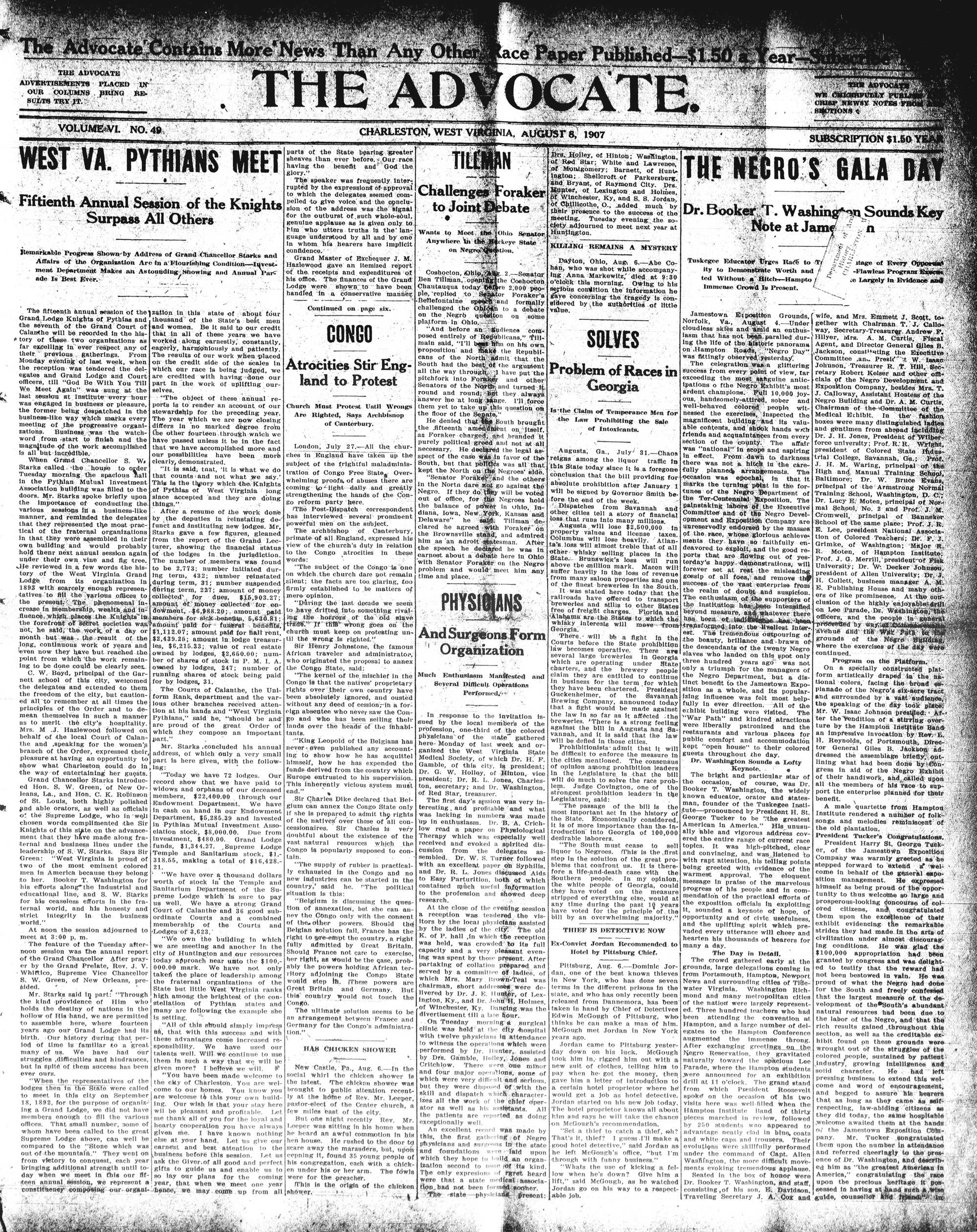
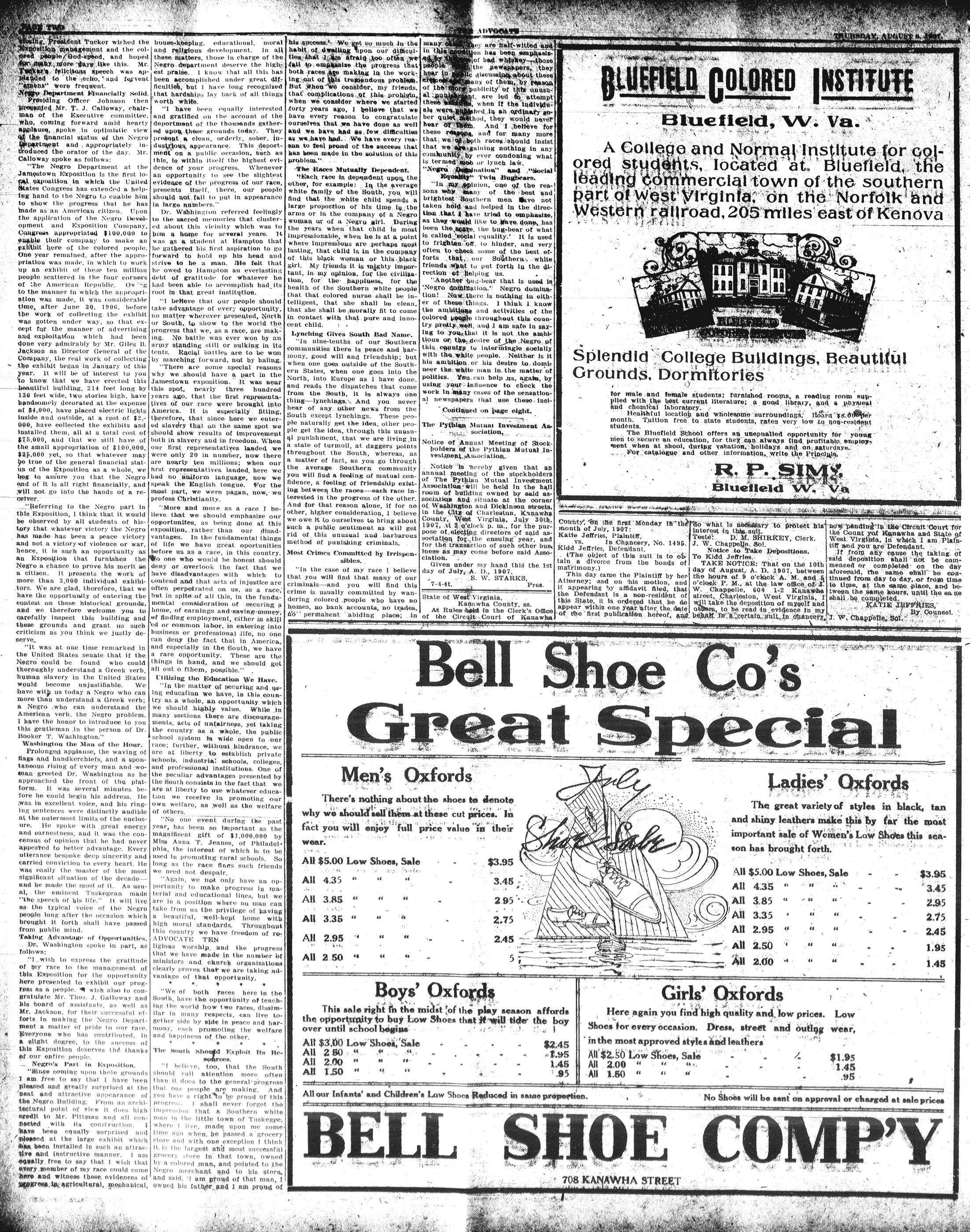
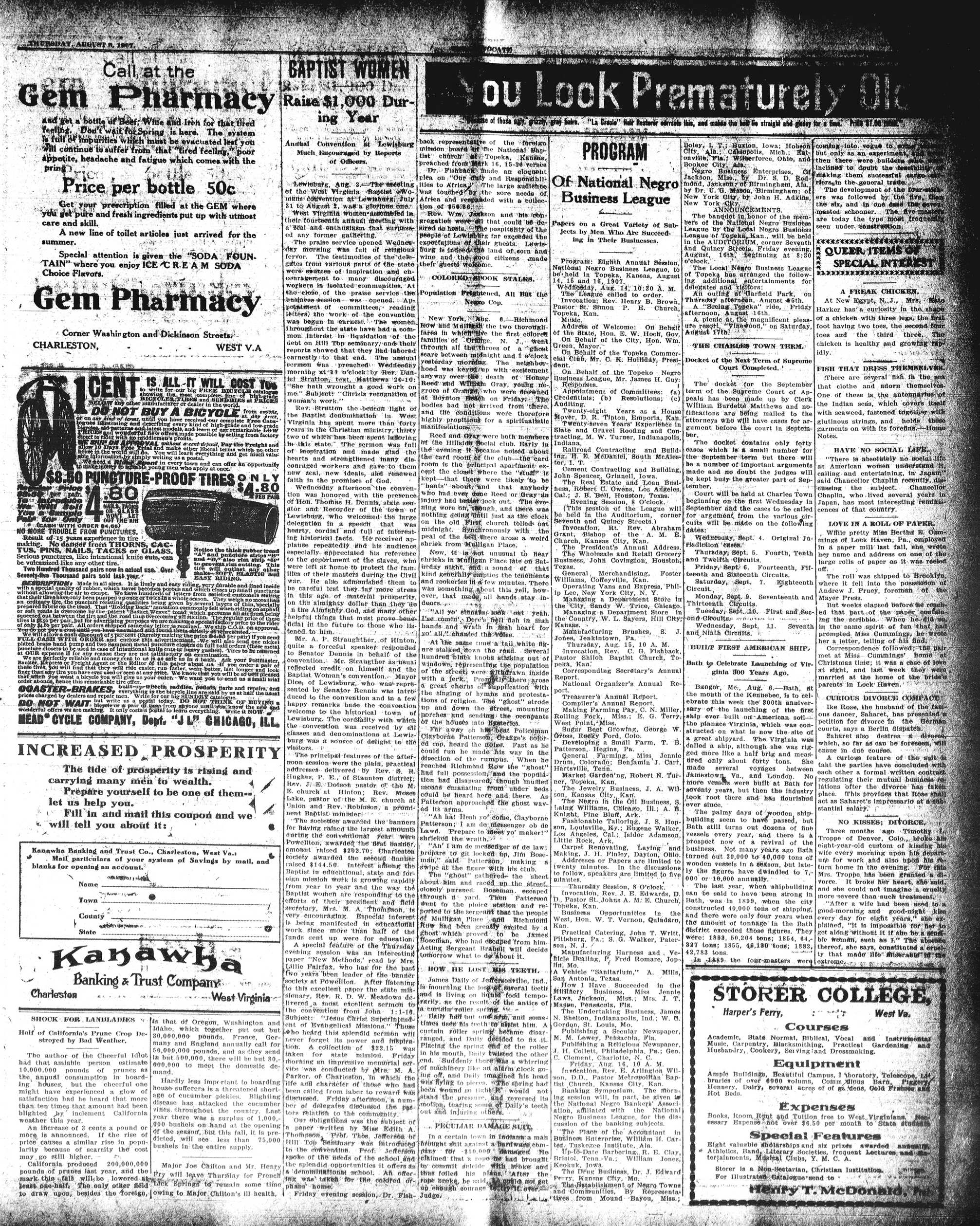
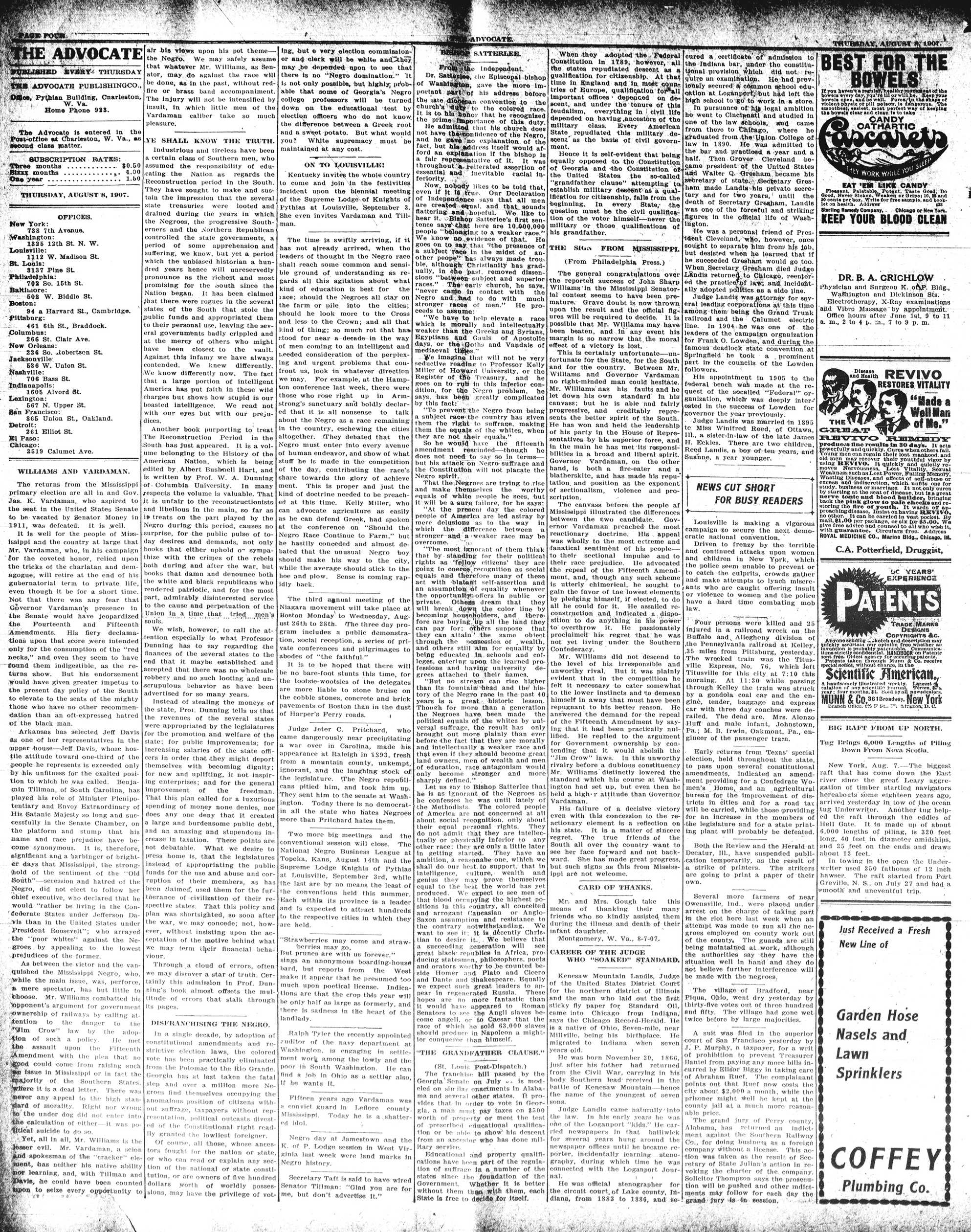
Page text (machine-generated)
WEST VA. PYTHIANS MEET
Remarkable Progress Shown-by Address of Grand Chancellor Starks and Affairs of the Organization Are in a Flourishing Condition—Investment Department Makes an Astounding Showing and Annual Parade Is Best Ever.
VOLUME VI. NO. 49
WEST VA. PYT
Fiftieth Annual Session
Surpass All
Remarkable Progress Shown-by Address
Affairs of the Organization Are in
ment Department Makes an Astonu
ade Is Best Ever.
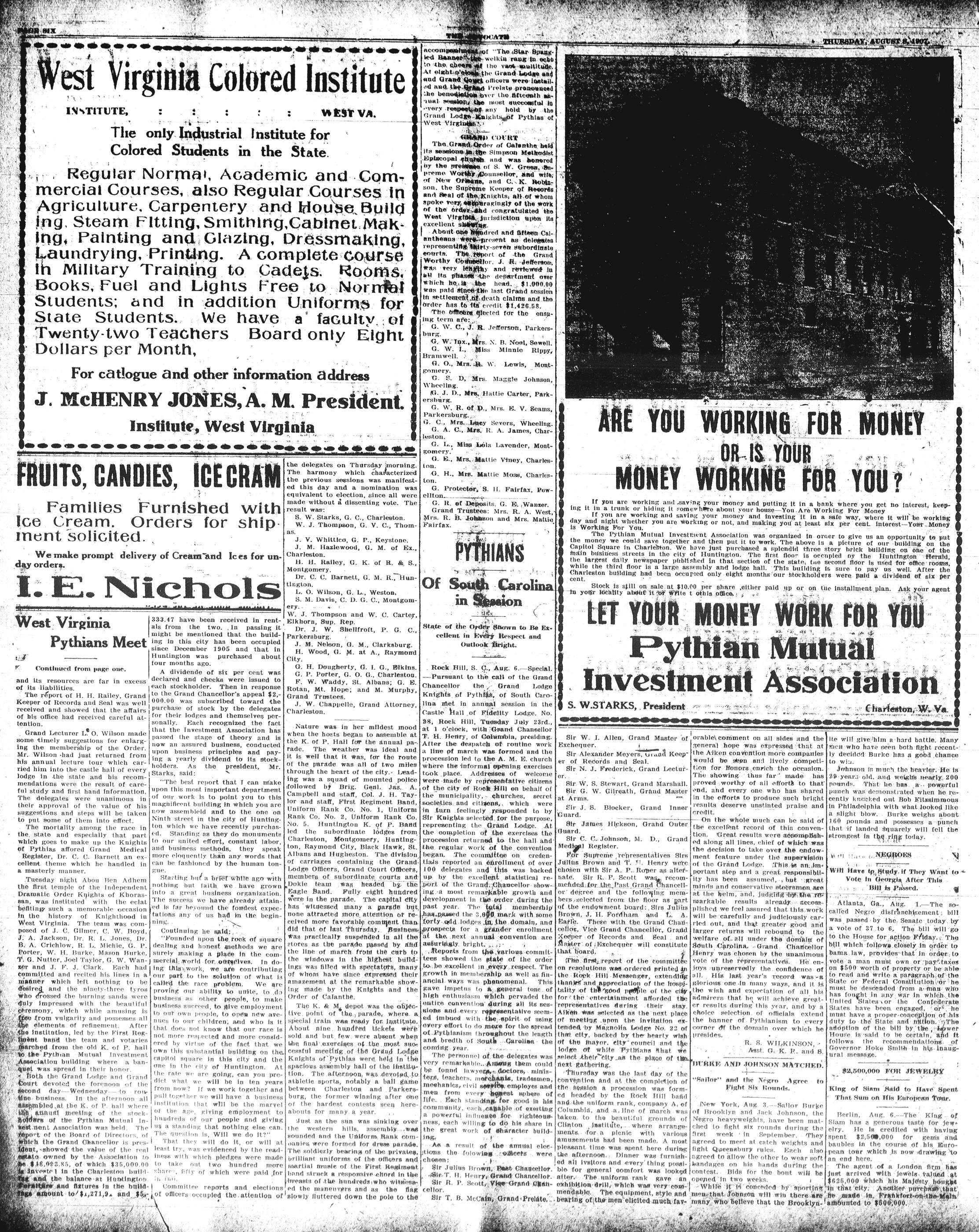
The fifteenth annual session of the Grand Lodge Knights of Pythias and the seventh of the Grand Court of Calanthe will be recorded in the history of these two organizations as far excelling in ever respect any of their pravious gatherings. From Monday evening of last week, when the reception was tendered the delegates and Grand Lodge and Court officers, till "Gill Be With You Till We Meet Again" was sung at the last session at Institute every hour was engaged in business or pleasure, the former being despatched in the business-like way which marks every meeting of the progressive organizations. Business was the watchword from start to finish and the magnitude of the work accomplished is all but incredible.
When Grand Chancellor S. W. Starks called the house to order Tuesday morning the spacious hall in the Pythian Mutual Investment Association building was filled to the doors. Mr. Starks spoke briefly upon the importance of conducting the various sessions in a business-like manner, and reminded the delegates that they represented the most practical of the fraternal organizations in that they were assembled in their own building and would probably hold their next annual session again under their own vine and fig tree. He reviewed in a few words the history of the West Virginia Grand Lodge from its organization in 1893 with scarcely enough representatives to fill the various offices to the present. The phenomenal increase in membership, wealth and influence, which places the Knights in the forefront of secret societies was not, he said, the work of a day or month but was the result of the long, continuous work of years and even now they have but reached the point from which the work remaining to be done could be clearly seen.
C. W. Boyd, principal of the Garnett school of this city, welcomed the delegates and attended to them the freedom of the city, but cautioned all to remember at all times the principles of the Order and to demean themselves in such a manner as to merit the city's hospitality. Mrs. M. J. Hazlewood followed on behalf of the local Court of Calantha and, speaking for the women's branch of the Order, expressed their pleasure at having an opportunity to show what Charleston could do in the way of entertaining her guests.
Grand Chancellor Starks introduced Hon. S. W. Green, of New Orleans, La., and Hon. C. K. Robinson of St. Louis, both highly polished and able orators, as well as officials of the Supreme Lodge, who in well chosen words complimented the Sir Knights of this sage on the advancement that they made along fraternal and business lines under the leadership of S. W. Starks. Says Sir Green: "West Virginia is proud of two of the most eminent colored men in America because they belong to her. Booker T. Washington for his efforts along the industrial and educational line, and S. W. Starks for his ceaseless efforts in the fraternal world, and his honesty and strict integrity in the business world." At noon the session adjourned to meet at 3:00 p. m.
The feature of the Tuesday afternoon session was the annual report of the Grand Chancellor After prayer by the Grand Prelate, Rev. J. V. Whitlock, Supreme Vice Chancellor S. W. Green, of New Orleans, presided.
Mr. Starks said in part: "Through the kind providence of Him who holds the destiny of nations in the hollow of His hand, we are permitted to assemble here, where fourteen years ago our Grand Lodge had its birth. Our history during that period of time is familiar to a great many of us. We have had our struggles, difficulties and hindrances, but in spite of them success has been ever ours.
"When the representatives of the lodges then in the State were called to meet in this city on September 18, 1882, for the purpose of organizing a Grand Lodge, we did not have members enough to fill the various offices. That small number, some of whom have been called to the great Supreme Lodge above, can well be compared to the "Stone which was out of the mountain." They went on from victory to conquest, each year bringing additional strength until today when we meet in this our fifteen annual session, we represent a constituency composing our organi-
zation in this state of about four thousand of the State's best men and women. Be it said to our credit that in all of these years we have worked along earnestly, constantly, eagerly, harmoniously and patiently. The results of our work when placed on the credit side of the scales in which our race is being judged, we are credited with having done our part in the work of uplifting ourselves.
"The object of these annual reports is to render an account of our stewardship for the preceding year. The year which we are now closing differs in no marked degree from the other fourteen through which we have passed unless it be in the fact that we have accomplished more and our possibilities have been more clearly, demonstrated.
"It is said, tnat, 'it is what we do that counts and not what we say.' This is the theory which the Knights of Pythias of West Virginia long since accepted and they are doing things."
After a resume of the work done by the deputies in reinstating defunct and instituting new lodges, Mr. Starks gave a few figures, gleaned from the report of the Grand Lecturer, showing the financial status of the lodges in the jurisdiction. The number of members was found to be 2,773; number initiated during term, 432; number reinstated during term, 31; number suspended during term, 227; amount of money collected for dues, $15,903.27; amount of money collected for endowment, $6,888.29; amount paid members for sick benefits, 5,630.81; amount paid for funeral benefits, $1,112.07; amount paid for hall rent, $2,439.25; amount in lodge treasuries, $6,215.33; value of real estate owned by lodges, $2,650.00; number of shares of stock in P. M. I. A. owned by lodges, 247; number of running shares of stock being paid for by lodges, 31.
The Courts of Calanthe, the Uniform Rank, department and the various other branches received attention at his hands and "West Virginia Pythians," said he, "should be and are proud of the great Order of which they compose an important part."
Mr. Starks concluded his annual address, of which only a very small part is here given, with the following:
"Today we have 72 lodges. Our record show that we have paid to widows and orphans of our deceased members, $22,400.00 through our Endowment Department. We have in cash on hand in our Endowment Department, $5,285.39 and invested in Pythian Mutual Investment Association stock, $8,000.00. Due from investment, $480.00. Grand Lodge funds, $1,344.27. Supreme Lodge Temple and Sanitarium stock, $1,318.55, making a total of $16,428.21.
"We have over a thousand dollars worth of stock in the Temple and Sanitarium Department of the Supreme Lodge which is sure to pay us well. We have a strong Grand Court of Calanthe and 36 good subordinate Courts and a combined membership of the Courts and Lodges of 3,623.
"We own the building in which we are meeting and another in the city of Huntington and our resources today approach near unto the $100,000.00 mark. We have not only taken the place of leadership among the fraternal organizations of the State but little West Virginia ranks high among the brightest of the constellation of Pythian states and many are following the example she is setting.
"All of this should simply impress us, that with this success and with these advantages come increased responsibility. We have used our talents well. Will we continue to use them in such a way that we will be given more? I believe we will.
"You have been made welcome to the city of Charleston. You are welcome to our homes. You know you are welcome to this your own building. Our wish is that your stay here will be pleasant and profitable. Let me thank all of you for the loyal and hearty cooperation you have always given me. I have known nothing else at your hand. Let us give our earnest and best attention to the business before this session. Let us ask the Giver of all good and perfect gifts to guide us and enable us to so lay our plans for the coming year, that when we meet one year hence, we may come up from all
CHARLESTON, WEST VIRGINIA, AUGUST 8, 1907
parts of the State bearing greater sheaves than ever before. Our race having the benefit and God the glory." The speaker was frequently interrupted by the expressions of approval to which the delegates seemed compelled to give voice and the conclusion of the address was the signal for the outburst of such whole-soul, genuine applause as is given only to him who utterts truths in the language understood by all and by one in whom his hearers have implicit confidence. Grand Master of Exchequer J. M. Hazlewood gave an itemized report of the receipts and expenditures of his office. The finances of the Grand Lodge were shown to have been handled in a conservative manner
Church Must Protest Uatll Wrongs Are Righted, Says Archbisnop of Canterbury.
London, July 27. All the churches in England have taken up the subject of the frightful maladministration of Congo Free State. Overwhelming proofs, of abuses there are coming to light daily and greatly strengthening the hands of the Congo reform party here.
"The Post-Dispatch correspondent has interviewed several prominent powerful men on the subject.
The archbishop of Canterbury, primate of all England, expressed his view of the church's duty in relation to the Congo atrocities in these words:
"The subject of the Congo is one on which the church dare not remain silent; the facts are too glaring, too firmly established to be matters of mere opinion.
"During the last decade we seem to have drifted into something rivaling the horrors of the old slave trade." If this wrong goes on the church must keep on protesting until the wrong is righted."
Sir Henry Johnstone, the famous African traveler and administrator, who originated the proposal to annex the Congo State, said:
"The kernel of the mischief in the Congo is that the natives' proprietary rights over their own country have been absolutely ignored, and ousted without any deed of cession—in a foreign absentee who never saw the Congo and who has been selling their lands over the heads of the inhabitants.
"King Leopold of the Belgians has never even published any accounting to show how he has acquitted himself, how he has expended the funds derived from the country which Europe entrusted to his supervision. This inherently vicious system must end."
Sir Charles Dike declared that Belgium can annex the Congo State only if she is prepared to admit the rights of the natives over those of all concessionaires. Sir Charles is very doubtful about the existence of the vast natural resources which the Congo is popularly supposed to contain.
"The supply of rubber is practically exhausted in the Congo and no new industries can be started in the country," said he. "The political situation is this:
"Belgium is discussing the question of annexation, but she can annex the Congo only with the consent of the other powers. Should the Belgian solution fail, France has the right to preempt the country, a right fully admitted by Great Britain. Should France not care to exercise, her right, as would be the case, probably the powers holding African territory adjoining the Congo State would step in. These powers are Great Britain and Germany. But this country would not touch the Congo.
The ultimate solution seems to be an arrangement between France and Germany for the Congo's administration."
HAB CHICKEN SHOWER
New Castle, Pa., Aug. 6.—In the social whirl the chicken shower is the latest. The chicken shower was brought to public attention recently at the home of Rev. Mr. Leeper, pastor-elect of the Center church, a few miles east of the city.
But one night recently Rev. Mr. Leeper was sitting in his home when he heard an awful commotion in his hen house. He rushed to the door to scare away the marauders, but, upon ceeping it, found 35 young people of his congregation, each with a chicken under his or her arm. The fowls were for the preacher.
This is the origin of the chicker shower.
Coshocton, Ohio, Aug. 2. — Senator Ben Tillman, opening the Coshocton Chauquaaua today before 2,000 people, replied to Senator Foraker's Bellefontaine speech and formally challenged the Ohioan to a debate on the Nebraska question on some platform in Ohio.
"And before an audience composed entirely of Republicans," Tillman said, "I'll best him on his own proposition and make the Republicans of the North admit that the South had the best of the argument all the way through. I have put the pitchfork into Foraker and other Senators of the North and turned it round and round, but they always answer me at long range. I'll force them yet to take up this question on the floor of the Senate."
He denied that the South brought the fifteenth amendment on itself, as Foraker charged, and branded it purely political greed and not at all necessary. He declared the legal aspect of the case was in favor of the South, but that politics was all that kept the North on the Negroes' side. "Senator Foraker, and the others in the Nortna dare not go against the Negro. If they do they will be voted out of office, for the Negroes hold the balance of power in ohio, Indiana, Iowa, New York, Kansas and Delaware" he said. Tillman declared he agreed with Foraker on the Brownsville stand, and admired him as an adroit statesman. After the speech he declared he was in earnest about a debate here in Ohio with Senator Foraker on the Negro problem and would meet him any time and place.
PHYSICIANS
And Surgeons Form Organization
Much Enthusiasm Manifested and Several Difficult Operations Performed.
In response to the invitation issued by the local members of the profession, one-third of the colored physicians of the state gathered here Monday of last week and organized the West Virginia State Medical Society, of which Dr. H. F. Gamble, of this city, is president; Dr. G. W. Holley, of Hinton, vice president; Dr. R. L. Jones, Charleston, secretary; and Dr. Washington, of Red Star, treasurer.
The first day's session was very interesting, and profitable and what was lacking in numbers was made up in enthusiasm. Dr. B. A. Crichlow read a paper on Physiological Therapy which was especially well received and evoked a spirited discussion from the delegates assembled. Dr. W. S. Turner followed with an excellent paper on Syphilis, and Dr. R. L. Jones discussed Aids to Easy Parturition, both of which contained much useful information to the profession and showed deep research.
At the close of the evening session a reception was tendered the visitors by the local physicians assisted by the ladies of the city. The old K. of P. hall in which the reception was held, was crowded to its full capacity and a very pleasant evening was spent by those present. After partaking of collation prepared and served by a committee of ladies, of which Mrs. Mary Brown-Teal was chairman, short addresses were delivered by Dr. J. E. Hunter, of Lexington, KY, and Dr. John H. Holmes, of Winchester, Ky. Dancing was the divertissement till a late hour.
On Tuesday morning a surgical clinic was held at the city hospital with twelve physicians in attendance to witness the operations which were performed by Dr. Hunter, assisted by Drs. Gamble, Holley, Jones and Critchlow. There were one minor and four major operations, some of which were very difficult and serious, but they were disposed of with the skill and dispatch which characterizes all the work of the chief operator as well as his assistants. All the patients are reported as doing exceptionally well.
An excellent record was made by this, the first gathering of Negro physicians and surgeons in the state and foundations were laid upon which they hope to build an organization second to none of its kind. The only expressions of regret heard were that a state medical association had not been formed sooner.
The state physicians present:
Drs. Holley, of Hinton; Washington, of Red Star; White and Lawrence, of Montgomery; Barnett, of Huntington; Shellcroft of Parkersburg, and Bryant, of Raymond City. Drs. Hunter, of Lexington and Holmes, of Winchester, Ky, and S. S. Jordan, of Chillicothe, O., added much by their presence to the success of the meeting. Tuesday evening the society adjourned to meet next year at Huntington.
KILLING REMAINS A MYSTERY
Dayton, Ohio, Aug. 6.—Abe Cohan, who was shot while accompanying Anna Markewitz, died at 9:30 o'clock this morning. Owing to his serious condition the information he gave concerning the tragedy is considered by the authorities of little value.
SOLVES
Problem of Races in Georgia
Is the Claim of Temperance Men for the Law Prohibiting the Sale of Intoxicants.
Augusta, Ga., July 31.—Chaos reigns among the liquor traffic in this State today since it is a foregone conclusion that the bill providing for absolute prohibition after January 1 will be signed by Governor Smith before the end of the week.
Dispatches from Savannah and other cities tell a story of financial loss that rung into many millions
Augusta will lose $2,500,000 in property values and license taxes. Columbus will lose heavily. Atlanta's loss will almost treble that of all other whisky selling places in the State. Brunswick's loss will run above the million mark. Macon will suffer heavily in the loss of revenue from many saloon properties and one of the finest breweries in the South. It was stated here today that the railroads offered to transport breweries and hops to other States free of freight charges Florida and Alabama are the States to which the whisky interests will move from Georgia.
There, will be a fight in the Courts before the State prohibition law becomes operative. There are several large breweries in Georgia which are operating under State charters, and the brewery people claim they are entitled to continue to press for the term for which they have been chartered. President Guckenheimer, the Savannah Brewing Company, announced today that a fight would be made against the law in so far as it affected the breweries. 'There is a strong feeling against the bill in Augusta and Savannah, and it is said that the law will be defied in those cities.
Prohibitionists admit that it will be difficult to enforce the measure in the cities mentioned. The consensus of opinion among prohibition leaders the Legislature is that the bill will do more to the race problem. Judge Covington, one of the strongest prohibition leaders in the Legislature, said:
"The passage of the bill is the most important act in the history of the State. Economically considered, it is of more importance than the introduction into Georgia of 100,000 desirable laborers.
"The South must cease to sell liquor to Negroes. This is the first step in the solution of the great problems that confront us. It is therefore a life-and-death case with the Southern people. In my opinion, the white people of Georgia, could they have voted on the measure stripped of everything else, would at any time during the past 10 years have voted for the principle of the bill by an overwhelming majority."
THIEF IS DETECTIVE NOW
Ex-Convict Jordan Recommended to Hotel by Pittsburgh Chief.
Pittsburg, Aug. 6.—Dominic Jordan, one of the best known thieves in New York, who has done seven terms in the different prisons In the state, and who has only recently been released from Danaemora, has been taken in hand by Chief of Detectives Edwin McGough of Pittsburg, who thinks he can make a man of him. McGough met Jordan in New York years ago.
Jordan came to Pittsburg yesterday down on his luck. McGough took him in, rigged him out with a new suit of clothes, telling him to pay when he got the money, then gave him a letter of introduction to a certain hotel proprietor where he would get a job as hotel detective. Jordan started on his new job today. The hotel proprietor knows all about him and says he will take the chance on McGough's recommendation.
"Set a thief to catch a thief, oh? That's it, thief? I guess I'll make a good hotel detective," said Jordan as he left McGough's office, "but I'm through with funny business."
"What's the use of kicking a fellow when he's down? Give him a lift," said McGough, as he watched Jordan go on his way to a respectable job.
THE NECRO'S GALA DAY
Dr. Booker T. Washington Sounds Key Note at Jamestown
Tuskegee Educator Urges Race to Tolerance of Every Opportunity to Demonstrate Worth and Respect—Flawless Program Executes Without a Hitch—Hampto Largely in Evidence and Immense Crowd Is Present.
Jamestown Erposition Grounds, Norfolk, Va., August 4.—Under cloudless skies and amid an enthusiasm that has not been paralleled during the life of the historic panorama on Hampton Roads, "Negro Day" was famously observed yesterday.
The celebration was a glittering success from every point of view, far exceeding the most sanguine anticipations o the Negro Exhibit's most ardent champions. Full 10,000 hands, handsomely-attired, sober and well-behaved colored people witnessed the exercises, inspected the magnificent building, and its valuable contents, and shook hands with friends and acquaintances from every section of the county. The affair was "national" in scope and aspiring in effect. From dawn to darkness there was not a hitch in the carefully planned arrangements. The occasion was epochal, in that it marks the turning point in the fortunes of the Negro Department of the Tor-Continental Exposition. The palestaking labors of the Executive Committee and of the Negro Development and Exposition Company are unreservedly endowed by the masses of the race, whose glorious achievements they have so faithfully endeavored to exploit, and the good reports that are flowing out of yesterday's happy demonstrations, will forever set at rest the misleading overseas of all foes, and remove the success of the vast enterprise from the realm of doubt and suspicion. The enthusiasm of the supporters of the institution has been intensified beyond measure, and whatever there has been of indifference has been transformed into the dwelling interest. The tremendous outpouring of the beauty, brilliance and brawn of the descendants of the twenty Negro slaves who landed on this spot only three hundred years ago was not only a triumph for the managers of the Negro Department, but a distinct benefit to the Jamestown Exposition as a whole, and its popularizing influence was felt most helpfully in ever direction. All of the exhibit building were visited. The "War Path" and kindred attractions were liberally patronized and the restaurants and various places for public comfort and accommodation kept "open house" to their colored guests throughout the day.
Dr. Washington Sounds a Lofty Keynote.
The bright and particular star of the occasion, of course, was Dr. Booker T. Washington, the widely known educator, orator and statesman, founder of the Tuskegee Institute—pronounced by President H. St. George Tucker to be "the greatest American in America." His unusually able and vigorous address covered the entire range of current race topics. It was high-pitched, clear and convincing, and was listened to with rapt attention, his telling points being greeted with evidence of the warmest approval. The eloquent message in praise of the marvelous progress of his people and in commendation of the practical efforts of the exposition officials in exploiting it, sounded a keynote of hope, of opportunity and of civic usefulness, and the uplifting spirit which prevailed every utterance will cheer and hearten his thousands of hearers for many a day.
The Day in Detail.
The crowd gathered early at the grounds, large delegations coming in from Portsmouth, Hampton, Newport News and surrounding cities of Tidewater Virginia. Washington Richmond and many metropolitan cities of the nation were largely represented. Three hundred teachers who had been attending the convention at Hampton, and a large number of delegates to the Hampton Conference augmented the immense throng. After exchanging greetings on the Negro Reservation, they gravitated naturally toward the apacious Lee Parade, where the Hampton students were announced for an exhibition drill at 11 o'clock. The grand stand from which President Roosevelt spoke on the occasion of his two visits here was well-filled when the Hampton Institute Band of thirty pieces marched in review, followed by 250 students who appeared to advantage neatly clad in blue coats and white caps and trousers. Their evolutions were skillfully performed under the command of Capt. Allen Washington, the more difficult movements evoking tremendous movements. Seated in the box of honor were Dr. Booker T. Washington, and staff, consisting of, his son, E. Davidson, Traveling Secretary J. A. Cox and
wife, and Mrs. Emmett J. Scott, together with Chairman T. J. Calloway, Secretary-Treasurer, Andrew R. Hillyer, Mrs. A. M. Curtis, Fiscal Agent, and Director General Giles B. Jackson, constituting the Executive Committee an, President t W. Isaac Johnson, Treasurer R. T. Hill, Secretary Robert Kelser and other officials of the Negro Development and Exposition Company, besides Mrs. T. J. Calloway, Assistant Hostess of the Negro Building and Dr. A. M. Curtis, Chairman of the Committee of the Medical Exhibit. In the fashion boxes were many distinguished ladies and gentlemen from abroad including Dr. J. H. Jones, President of Wilberforce university; Prof. R. R. Wright, president of Colored State Industrial College, Savannah, Ga.; Prof. J. H. M. Waring, principal of the High and Manual Training School, Baltimore; Dr. W. Bruce Evans, principal of the Armstrong Normal Training School, Washington, D. C.; Dr. Lucy E. Moten, principal of Normal School, No. 2 and Prof. J. M. Cromwell, principal of Bannerk School of the same place; Prof. J. R. E. Lee, president National Association of Colored Teachers; Dr. F. J. Grimke, of Washington; Major R. R. Moten, of Hampton Institute; Prof. J. G. Merrill, president-of Pisk University; Dr. W. Decker Johnson, president of Allen University; Dr. J. H. Collett, business manager A. M. E. Publishing House and many others of like prominence. At the conclusion of the highly enjoyable drill on Lee Parade, Dr. Washington, the officers, and the people in general proceeded by way of Colored Avenue did the War Path to the grounds of the Negro Building, where the exercises of the day were continued.
Program on the Platform.
On a specially constructed platform artistically draped in the national colors, facing the broad expanse of the Negro's six-sore tract and surrounded by a vast audience, the speaking of the day took place. Mr. W. Isaac Johnson presided. After the Vendition of a stirring overture by the Hampton Institute Band an impressive invocation by Rev. E. H. Reynolds, of Portsmouth, Director General Giles B. Jackson addressed the assemblage briefly, outlining what had been done by Congress in aid of the Negro Exhibit of their handiwork, and called upon all the members of his race to support the enterprise planned for their benefit.
A male quartette from Hampton Institute rendered a number of folk-songs and melodies reminiscent of the old plantation.
President Tucker's Congratulations.
President Harry S. George Tucker, of the Jamestown Exposition Company was warmly greeted as he stepped forward to extend a welcome in behalf of the general exposition management. He expressed himself as being proud of the opportunity to thus welcome so large and prosperous-looking concourse of colored citizens, and congratulated them upon the excellence of their exhibit evidencing the remarkable strides they had made in the arts of civilization under almost discouraging conditions. He was glad the $100,000 appropriation had been granted by congress and was delighted to testify that the reward had not been bestowed in vain. He was proud of what the Negro had done for the South and freely confessed that the largest measure of the development of the South's abundant natural resources had been due to the labor of the Negro, and that the rich results gained throughout this section, as well as the creditable exhibit found on these grounds were wrought out of the struggles of the colored people, sustained by patient industry, growing intelligence and solid character. He had left pressing business to extend this welcome and word of encouragement, and begged to assure his heirs that as long as they came as self-respecting, law-abiding citizens as they did today, the same hospitable welcome awaited them at the hands of the Jamestown Exposition Company. Mr. Tucker congratulated them upon the number in attendance and referred cheerfully to the presence of Dr. Washington, and described him as "the greatest American in America," congratulating the race upon the precious heritage it possessed in having at hand such a wise guide, counselor and friend." He
bobbing, President Tucker wished the Exposition management and the cooped people/God-speed, and hoped for many more days like this. Mr. Tucker's felicious speech was applauded to the echo, and fervent "amens" were frequent.
Negro Department Financially Solid
Presiding Officer Johnson then
presented Mr. T. J. Calloway, chairman of the Executive committee, who, coming forward amid hearty applause, spoke in optimistic view of the financial status of the Negro Department and appropriately introduced the orator of the day. Mr. Calloway spoke as follows:
"The Negro Department at the Jamestown Exposition is the first local exposition in which the United States Congress has extended a helping hand to the Negro to enable him to show the progress that he has made as an American citizen. Upon the application of the Negro Development and Exposition Company, Congress appropriated $100,000 to enable their company to make an exhibit here of the colored people. One year remained, after the appropriation was made, in which to work up an exhibit of these ten million people scattered in the four corners of the American Republic. Owing to the manner in which the appropriation was made, it was considerable time, after June 30, 1906, before the work of collecting the exhibit was gotten under way, so that except for the manner of advertising and exploitation which had been done very admirably by Mr. Giles B. Jackson as Director General of the Company, the real work of collecting the exhibit began in January of this year. It will be of interest to you to know that we have erected this beautiful building, 214 feet long by 130 feet wide, two stories high, have handsomely decorated at the expense of $4,000, have placed electric lights inside and outside, at a cost of $2,000, have collected the exhibits and installed them, all at a total cost of $75,000, and that we still have of the small appropriation of $100,000, $25,000 yet, so that whatever may be true of the general financial status of the Exposition as a whole, we hog to assure you that the Negro end of it is all right financially, and will not go into the hands of a receiver.
"Referring to the Negro part in this Exposition, I think that it would be observed by all students of history that whatever victory the Negro has made has been a peace victory and not a victory of violence or war, hence, it is such an opportunity as an Exposition that furnishes the Negro a chance to prove his merit as a citizen. It presents the work of more than 3,000 individual exhibitors. We are glad, therefore, that we have the opportunity of entering the contest on these historical grounds, and we therefore welcome you to carefully inspect this building and these grounds and grant us such criticism as you think we justly deserve.
"It was at one time remarked in the United States senate that if the Negro could be found who could thoroughly understand a Greek verb, human slavery in the United States would become unjustifiable. We have with us today a Negro who can more than understand a Greek verb; a Negro who can understand the American verb, the Negro problem. I have the honor to introduce to you this gentleman in the person of Dr. Booker T. Washington."
Washington the Man of the Hour. Prolonged applause, the waving of flags and handkerchiefs, and a spontaneous rising of every man and woman greeted Dr. Washington as he approached the front of the platform. It was several minutes before he could begin his address. He was in excellent voice, and his ringing sentences were distinctly audible at the outermost limits of the enclosure. He spoke with great energy and earnestness, and it was the consensus of opinion that he had never appeared to better advantage. Every utterance bespoke deep sincerity and carried conviction to every heart. He was easily the master of the most significant situation of the decade—and he made the most of it. As usual, the eminent Tuskgean made "the speech of his life." It will live as the typical voice of the Negro people long after the occasion which brought it forth shall have passed from public mind.
Taking Advantage of Opportunities.
Dr. Washington spoke in part, as follows:
"I wish to express the gratitude of my race to the management of this Exposition for the opportunity here presented to exhibit our progress as a people. I wish also to congratulate Mr. Thos. J. Galloway and his board of assistants, as well as Mr. Jackson, for their successful efforts. In making the Negro Department a matter of pride to our race. Everyone who has contributed, in a alight degree, to the success of this Exposition deserves the thanks of our entire people.
Negro's Part in Exposition.
"Since coming upon these grounds
I am free to say that I have been
pleased and greatly surprised at the
neat and attractive appearance of the Negro Building. From an architectural point of view it does high
credit to Mr. Pittman and all connected with its construction.
I have been equally surprised and pleased at the large exhibit which
has been installed in such an attractive and instructive manner. I am equally free to say that I wish that every member of my race could come here and witness these evidences of progress in agricultural, mechanical,
house-keeping, educational, moral and religious development. In all these matters, those in charge of the Negro department deserve the highest praise. I know that all this has been accomplished under great difficulties, but I have long recognized that hardships lay back of all things worth white.
"I have been equally interested and gratified on the account of the deportment of the thousands gathered upon those grounds today. They present a clean, orderly, sober, industrious appearance. This deportment on a public occasion, such as this, is within itself the highest evidence of your progress. Whenever an opportunity to see the slightest evidence of the progress of our race, presents itself, there, our people should not fail to put in appearance in large numbers."
Dr. Washington referred feelingly to the sacred memories that clustered about this vicinity which was to him a house for several years. It was as a student at Hampton that he gathered his first aspiration to go forward to hold up his head and strive to be a man. He felt that he owed to Hampton an everlasting debt of gratitude for whatever he had been able to accomplish had its root in that great institution.
"I believe that our people should take advantage of every opportunity, no matter wherever presented, North or South, to show to the world the progress that we, as a race, are making. No battle was ever won by an army standing still or sulking in its tents. Racial battles are to be won by marching forward, not by haling. "There are some special reasons why we should have a part in the Jamestown exposition. It was near this spot, nearly three hundred years ago, that the first representatives of our race were brought into America. It is especially fitting, therefore, that since here we entered slavery that on the same spot we should show results of improvement both in slavery and in freedom. When our first representatives landed we were only 20 in number, now there are nearly ten millions; when our first representatives landed, here we had no uniform language, now we speak the English tongue. For the most part, we were pagan, now, we profess Christianity.
"More and more as a race I believe that we should emphasize our opportunities, as being done at this exposition, rather than our disadvantages. In the fundamental things of life we have great opportunities before us as a race, in this country. No one who would be honest should deny or overlook the fact that we have disadvantages with which to contend and that acts of injustice are often perpetrated on us, as a race, but in spite of all this, in the fundamental consideration of securing a home, of earnings and saving money, of finding employment, either in skilled or common labor, in entering into business or professional life, no one can deny the fact that in America, and especially in the South, we have a rare opportunity. These are the things in hand, and we should get all out of fthem, possible."
Utilizing the Education We Have.
"In the matter of securing and using education we have, in this country as a whole, an opportunity which we should highly value. While in many sections there are discouragements, acts of unfairness, yet taking the country as a whole, the public school system in wide open to our race; further, without hindrance, we are at liberty to establish private schools, industrial schools, colleges, and professional institutions. One of the peculiar advantages presented by the South consists in the fact that we are at liberty to use whatever education we receive in promoting our own welfare, as well as the welfare of others.
"No one event during the past year, has been so important as the magnificent gift of $1,000,000 by Miss Anna T. Jeanes, of Philadelphia, the interest of which is to be used in promoting rural schools. So long as the race fines such friends we need not despair.
"Again, we not only have an opportunity to make progress in material and educational lines, but we are in a position where no man can take from us the privilege of having a beautiful, well-kept home with high moral standards. Throughout this country we have freedom of READVOCATE TEN
ligious worship, and the progress that we have made in the number of ministers and church organizations clearly proves that we are taking advantage of that opportunity.
"We of both races here in the South, have the opportunity of teaching the world how two races, dissimilar in many respects, can live together side by side in peace and harmony, each promoting the welfare and happiness of the other.
The South Should Exploit Its Resources.
"I believe, too, that the South should call attention more often than it does to the general progress that our people are making. And you have a right to be proud of this progress. I shall never forget the impression that a Southern white man in the little town of Tuskegee, where I live, made upon me some time ago when, he passed a grocery store and with one exception I think it is the largest and most successful grocery store in that town, owned by a colored man, and pointed to the Negro merchant, and to his store, and said, 'I am proud of that man, I owned his father, and I am proud of
Bell Shoe Co's Great Special
his success." We get so much in the habit of dwelling upon our difficulties that I am afraid too often we fall to emphasize the progress that both races are making in the working out of this tremendous problem. But when we consider, my friends, that complications of this problem, when we consider where we started forty years ago, I believe that we have every reason to congratulate ourselves that we have done as well and we have had as few difficulties as we have had. We have every reason to feel proud of the success that has been made in the solution of this problem."
The Races Mutually Dependent. "Each race is dependent upon the other, for example: In the average white family of the South, you will find that the white child spends a large proportion of his time in the arms or in the company of a Negro woman or of a Negro girl. During the years when that child is most impressionable, when he is at a point where impressions are perhaps most lasting, that child is in the company of this black woman or this black girl. My friends it is mighty important, in my opinion, for the civilization, for the happiness, for the health of the Southern white people that that colored nurse shall be intelligent, that she shall be clean, that she shall be morally fit to come in contact with that pure and innocent child.
Lynching Gives South Bad Name. "In nine-tenths of our Southern communities there is peace and harmony, good will and friendship; but when one goes outside of the Southern States, when one goes into the North, into Europe as I have done, and reads the dispatches that come from the South, it is always one thing—lynchings. And you never hear of any other news from the South except lynchings. These people naturally get the idea, other people get the idea, through this unusual punishment, that we are living in a state of turmoil, at daggers points throughout the South, whereas, as a matter of fact, as you go through the average Southern community you will find a feeling of mutual confidence, a feeling of friendship existing between the races—each race interested in the progress of the other. And for that reason alone, if for no other, higher consideration, I believe we owe it to ourselves to bring about such a public sentiment as will get rid of this unusual and barbarous method of punishing criminals.
"In the case of my race I believe that you will find that many of our criminals—and you will find this crime is usually committed by wandering colored people who have no homes, no bank accounts, no trades, no permanent 'abiding place,' in
many cases they are half-witted and in this condition has been emphasized by the news of bad whiskey—those people who are the newspapers, they hear in public discussion about these crimes and many of them, by reason of the more publicity of this unusual punishment, are led to attempt these assaults, when if the individuals were published, in an ordinary sober quiet method, they would never hear of them. And I believe for these reasons, and for many more that we of both races should insist that we are gaining nothing in any community by ever condoning what is termed mob or lynch law. "Nerog Destination" and "Social
Equally. Twin Bugbears.
"In my opinion, one of the reasons why many of the best and brightest Southern men have not taken hold and helped in the direction that I have tried to emphasize, as they would like to have done, has been the same, the bug-bear of what is called social equality." It is used to frighten off, to hinder, and very often to check some of the best efforts that, our Southern, white friends what to put forth in the direction of helping us.
"Another big-bear that is used is 'Negro domination.' Negro domination! Now there is nothing in either of these things. I think I know the ambitions and activities of the colored people throughout this country pretty well, and I am safe in saying to you that it is not the ambitious or the desire of the Negro of this country to intermingle socially with the white people. Neither is it his ambition or his desire to domineer the white man in the matter of politics. You can help us, again, by using your influence to check the work in many cases of the sensational newspapers that use these incl-
Continued on page eight.
The Pythian Mutual Investment Association.
Notice of Annual Meeting of Stockholders of the Pythian Mutual Investment Association.
Notice is hereby given that an annual meeting of the stockholders of The Pythian Mutual Investment Association will be held in the hall room of building owned by said association and situate at the corner of Washington and Dickinson streets, in the City of Charleston, Kanawha County, West Virginia, July 30th, 1907, at 2 o'clock p. m., for the purpose of electing directors of said association for, the ensuing year, and for the transaction of such other busness as may come before said Association.
Given under my hand this the 1st day of July A. D., 1907.
Kanawha County, ss.
At Rules held in the Clerk's Office of the Circuit Court of Kanawha
BLUEFIELD COLORED INSTITUTE
A College and Normal Institute for colored students, located at. Bluefield, the leading commercial town of the southern part of West Virginia, on the Norfolk and Western railroad, 205 miles east of Kenova
ELIETHILD
COLORADO STATE UNIVERSITY
for male and female students; furnished rooms, a reading room supplied with the best current literature; a good library, and a physical and chemical laboratory.
The Bluefield School offers an unepualled opportunity for young men to secure an education, for they can always find profitable employment when at shool, during vacation, holidays and on saturdays. For catalogue and other information, write the Principle.
County, on the first Monday in the month of July, 1907:
Katie Jeffries, Plaintiff,
vs.
In Chancery, No. 1495.
Kidd Jeffries, Defendant.
(The object of this suit is to obtain a divorce from the bonds of matrimony.)
To what is necessary to protect his interest in this suit.
Testei: D. M. SHIRKEY, Clerk.
J. W. Chappelle, Soli.
Notice to Take Depositions.
To Kidd Jeffries
TAKE NOTICE: That on the 10th day of August, A. D. 1907
This day came the Plaintiff by her Attorney; and on his motion, and it appearing by affidavit fled, that the Defendant is a non-resident of this State, it is ordered that he do appear within one year after the date of the first publication, hereof, and
Notice to Take Depositions.
To Kidd Jeffries.
TAKE NOTICE: That on the 10th day of August, A. D. 1907, between the hours of 9 o'clock A. M., and 5 o'clock P. M., at the law office of J. W. Chappelle. 604 1-2 Kanauha street, Charleston, West Virginia, I will take the deposition of myself and others, to be read in evidence in my behalf in a certain suit, in chancery.
now pending in the Circuit Court for the Count of Kanawha and State of West Virginia, in which I am Plaintiff and you are Defendant. If from any cause the taking of said deposition shall not be commenced or completed on the day aforesaid, the same shall be continued from day to day, or from time to time, at the same place, and between the same hours, until the same shall be completed.
KATIE JEFFRIES,
By Counsel.
J. W. Chappelle, Sol.
and get a bottle of Beef, White and Iron for that tired feeling. Don't wait for Spring is here. The system is full of impurities which must be evacuated leaf you will continue to suffer from that "dired feeling," poor appetite, headache and fatigue which comes with the pring
Get your prescription filled at the GEM where you get pure and fresh ingredients put up with utmost care and skill. A new line of toilet articles just arrived for the summer. Special attention is given the "SODA FOUNTAIN" where you enjoy ICE C R.E A M SODA Choice Flavors.
CENT IS ALL-IT WILL COST YOU
to write for our big FREE BUYUOLE catalogs
that are most complete, line-of-high grade
BILGYOLES. TAXES & INSURANCE AT PRICES
BELOW big other manufacturer or dealer in the work.
DO NOT BUY A BICYCLE from anyone, at any price, of on any kind of tenure, until you have received our complete logos illustrating and describing every kind of high-grade and low-grade bicycles, old patterns and latest models, and learn of our remarkable K-10 bicycles and wonderful new offers made possible by selling from factory direct to your middleman's profits.
GUIDE TO APPROVAL without a cent deposit. Pay the Proceed and allow a notice of other liberal terms which no other house in the world will do. You will learn everything and get in touch valuable information by simply writing us a postal.
We need a Rite Aid Deposit in every town and can offer an opportunity to make money to equip young men who apply at once.
NO PUNCTURE-PROOF TIRES ONLY
$4.80
PER PAIR
4.80
MILLA JAMON
OR GLASS
WON'T LET
OUT THE WIR
PROPER DEPOSIT
FROM PUNCTURES
experience in tire
making. No danger from THORNS, CACTUS, PINS, NAILS, TACKS or GLASS. Serious punctures, like intentional knife cuts, can be vulnicated like any other tire.
Two Hundred Thousand pairs now in actual use. Over Seventy-four Thousand pairs sold last year.
DESCRIPTION: Made in all sizes. It is likely and easy to use.
with a special quality of rubber, which never becomes porous without allowing the cleft to be removed. We have many models of
that their three highly-relies pumped-up once or twice as an ordinary tire, the puncture-resisting qualities being prepared by the
or soft outside in over time by that "Holing Back" sensation squeezed out between the tire and the road thus overcoming tires in 60 per pair. All orders shipped since May 1987 were
of only 100 per pair. All orders shipped since May 1987 were
We will allow a cash discount of 5 percent (thereby match
with all cases with the same price.
plated brass band pump and two Sampson metal puncture
puncture closers to be used in case of intentional knife cut
or a 100 per pair.
We are perfectly reliable and money sent to us is as safe as
Bankers. Express or Freight Agent or the Editor of this piece
these tires, you will find that they will take cash, run
the first, you will find that they will take cash, run
the first, you will find that they will take cash, run
order at once, hence this remarkable tire offer.
OOASTER-BRAKES
everything in the b
prices charged by dealers and repair
t�. Write for our
do not wait.
Bicycle or a pair of
wonderful offers we are making.
It only costs a postal to
HEAD CYCLE COMPANY, Dept.
INCREASED PR
The tide of prosperity carrying many men to
Prepare yourself to be let us help you.
Fill in and mail this will tell you about it:
Kanawha Banking and Trust Co., Charl
Mail particulars of your system
blanks for opening an account.
Name
Town
County
State
Kanawha Banking & Trust
Charleston
SHOCK FOR LANILADIES
Is that
lively and easy riding, very durable and fixed inside
seconds porous and which closes up small punctures
insured of letters from satisfied customer's stating
or twice in a whole season. They weigh no move that
lies being given by several layers of thin, specially
asks to ensure the small part when riding on asphalt
ket. We've'll read which presents all air from being
up overcoming all situation. The regular price of these
seeds we are making a special factory price to the rider
every day letter is received. We ship COD on the
throethy matching the price $4.65 per pair (if you send
air air pressure open to full paid orders) (these metal
trials) are set up to be sent one week after
not satisfactory or heavy gases). Tires to be returned
are as safe as in a bank. Ask your Postmaster,
or of this paper about us. If you order a pair of
air air pressure, run finer, weak, butter, last longer and look-
up in the case of a small trial
to your order. We want you to send us a small trial
for wheels, saeless, podds parts and repairs, and
ing in the bicycle line are sold by us at half the usual
time for our big SUNDAY catalogue.
Popпati today. DO NOT THINK OF BUYING a
of these from anyone until you know the new end
as a postal to learn everything. Write it NOW.
Dept. "J. L" CHICAGO, ILL.
PROSPERITY
Asphalt is rising and
en to wealth.
If to be one of them...
If this is:
Co., Charleston, West Va.
r system of Savings by mail, and
asbba
West Virginia
**DESCRIPTION:** Made in all sizes. It is lively and easy riding, very durable and lined inside. It is porous and which closes up small punctures without allowing the air to escape. We have lined the fabric with their tine have only been pumped up once or twice in a whole season. They weigh no more than 10 pounds and guitars being given by several layers of thin, specially prepared fabric on the head. The "Hot" fabric is soft and soft needs in overcome by the patient "Wenwe Wenwe" tread, which presents all air squeezes out between the fire and the road thus overcoming all stiction. The regular price of these fabric is $12.00 per pair. All orders shipped same day are received. Weship Co. is approved. You do not pay a cash until you have examined and found their stitility is represented.
We will allow a cash discount of $ percent (thereby making the price $ per pair) if you send
WILL CASH WITH ORDER and enclose this advertisement. We will also send one nickel
picture closure to be used in case of intrinsic knife cuts on full paid orders (the metal
picture closers to be used in case of intrinsic knife cuts on full paid orders
at OUR expense if for any reason they are not satisfactory on examination).
We are perfectly reliable and money sent to us is as safe as it is bank. Ask your Postmaster, we will send you a letter of paper about us. If you order a pair of these tires, you will find that they will ride easier, and you will finer than any tire you have ever used or seen at any price. We know that you will be so well pleased that any tire you have ever used or seen at your order. We want you to send us a small trial order about tires, because this remarkable tire offer.
**OASTER-BRAKES** built-up-wheels, saddles, pedals, parts and repairs, and usual prices charged by dealers and repair tacn. Write for our big SUNNY catalogue.
INCREASED PROSPERITY
The tide of prosperity is rising and carrying many men to wealth.
Prepare yourself to be one of them—let us help you.
Fill in and mail this coupon and we will tell you about it:
Kanawha Banking and Trust Co., Charleston, West Va.:
Mail particulars of your system of Savings by mail, and blanks for opening an account.
Name
Town
County
State
Kanawha
Banking & Trust Company
Charleston
West Virginia
Regular Price
$80.00 per pair.
To Murphete
We Will Sell
You a Sample
Park for Only
CARM WITH ORDER $4.68
NO MORE TROUBLE FROM PUNCTURES.
Half of California's Prune Crop Destroyed by Bad Weather.
The author of the Cheerful Ilot had that amiable person estimate 10,000,000 pounds of prunes as the annual consumption in boarding houses, but the cheerful one might have experienced a glow of satisfaction had he heard that more than ten times that amount had been blighted by inclement California weather this year.
An increase of 3 cents a pound or more is announced. If the rise of price causes a similar rise in popularity because of scarcity the cost may go still higher.
California produced 200,000,000 pounds of prunes last year, and the mark this fall will be lowered as least one-half. The only other field to draw upon, besides the foreign,
Notice the thick rubber trunk
"A" and puncture strips "B"
and "D". Also rim strip "E"
to prevent rim erimting. This
may be any other
make--SOFT, BLASIC and
EASY RIDING.
is that of Oregon, Washington and Idaho, which together put out but 30,000,000 pounds. France, Germany and England annually call for 50,000,000 pounds, and as they send in but 500,000, there will be but 80,000,000 to meet the domestic demand.
Hardly less important to boarding house sufferers is a threatened shortage of cucumber pickles. Blighting disease has attacked the cucumber vines throughout the country. Last year there was a surplus of 1,000,000 bushels on hand at the opening of the season, but this fall, it is predicted, will see less than 75,000 bushels in the entire supply.
Major Joe Chilton and Mr. Henry Fry will leave Thursday for French Lick Springs to remain some time owing to Major Chilton's ill health.
---
of Officers.
Lewinburg, Aug. 3.—The meeting of the West Virginia Baptist Women's convention at Lewinburg; July 31 to August 2, was a glorious one. West Virginia women assembled in their fourteenth annual meeting with a zeal and enthusiasm that surpassed any former gathering.
The praise service opened Wednesday morning was full of religious fervor. The testimonies of the delegates from various parts of the state were sources of inspiration and encouragement to many discouraged workers in isolated communities. At the close of the praise service the business session was opened. Appointment of committees; reading letters; the work of the convention was begun in earnest. The women throughout the state have had a common interest in Liquidation of the debt on Hill Top seminary; and their reports showed that they had labored earnestly to that end. The annual sermon was preached. Wednesday morning at 11 o'clock by Rur. Daniel Stratton; text, Matthews' 26-10: "She hath wrought a good work on me." Subject: "Christs recognition of woman's work."
Rev. Strutton the beacon light of the Baptist denomination in West Virginia has spent more than forty years in the Christian ministry, thirty two of which has been spent laboring in this state. The sermon was full of inspiration and made glad the hearts and strengthened many discouraged workers and gave to them new zeal, new ideals, and renewed faith in the promises of God.
Wednesday afternoon the convention was honored with the presence of Hon. Thomas H. Dennis, state senator and Recorder of the town of Lewisburg, who welcomed the large delegation in a speech that was hearty, cordial and full of interesting historical facts. He received applause repeatedly and his audience especially appreciated his reference to the deportment of the slaves, who were left at home to protest the families of their masters during the Civil war. He also admonished them to be careful lest they lay more stress in this age of material prosperity, on the almighty dollar than they do in the Almighty God, and many other helpful things that must prove beneficial in the future to those who listened to him.
Mr. A. P. Straughter, of Hinton, quite a forceful speaker responded to Senator Dennis in behalf of the convention. Mr. Straughter as usual reflected credit on himself and the Baptist Woman's convention. Mayor Dice, of Lewisburg, who was represented by Senator Rennick was introduced to the convention and in a few happy remarks bade the convention welcome to the historical town of Lewisburg. The cordiality with which the convention was received by all classes and denominations at Lewisburg was a source of delight to the visitors.
The principal features of the afternoon session were the plain, practical addresses delivered by Rev. S. H. Hughes, P. E., of Staunton district; Rev. J. E. Dotson pastor of the M. E. church at Hinton; Rev. Moses Lake, pastor of the M. E. church at Union and Rev. Robinson, a prominent Baptist minister.
The societies awarded the 'banners' for having raised the largest amounts during the conventional year; were Powellton; awarded the first banner; amount raised $203.70; Charleston society awarded the second banner raised $144.50. Interest among the Baptist in educational, state and foreign mission work is growing rapidly from year to year and the way the Baptist women are responding to the efforts of their president and field secretary, Mrs. M. A. Thompson, is very encouraging. Especial interest is being manifested in educational work since more than half of the funds sent up were for education.
A special feature of the Thursday evening session was an interesting paper "New Methods," read by Mrs. Lillie Fairfax, who has for the past two years been leader of the banner society at Powellton. After listening to this excellent paper the state missionary, Rev. R. D. W. Meadows delivered a most excellent sermon to the convention from John 1:1-10. Subject: "Jesus Christ Superintendent of Evangelical Missions." Those who heard this splendid sermon will never forget its power and inspiration. A collection of $22.15 was taken for state mission. Friday morning an impressive memorial service was conducted by Mrs. M. A. Parker, of Charleston, in which the life and character of those who had been called from labor to reward was discussed. Friday afternoon, a number of delegates discussed the pastors relation to the community.
Our obligation was the subject of a paper written by Miss Edith A. Thompson. Prof. Thos. Jefferson of Hill Top Seminary was introduced to the convention. Prof. Jefferson spoke of the needs of the school and the splendid opportunities it offers as a 'denominational school. An offering was taken for the caldred orphans' home.
Friday evening session, Dr. Fish-
you Look Prematurely
back representative of the foreign mission board of the National Baptist church at Topeka, Kansas, preached from Mark 16, 15-16 verses. Dr. Flishback made an eloquent plea on "Our duty and Responsibilities to Africa." The large audience was touched by the sore needs of Africa and responded with a collection of $5036.
Rev. Wm. Jackson and his congregation wore all that could be desired as host. The hospitality of the people of Lowland far exceeded the expectations of their guests. Lewisburg is indeed the land of corn and wine and the good citizens made their guests welcome.
New York, Aug. 6. - Richmond How and Mulligan the two thoroughfares in which live the first colored families of Orange, N. J., went through all the throes of a ghost scare between midnight and 1 o'clock yesterday morning. The neighborhood was keyed up with excitement anyway over the death of Homer Reed and William Gray, young negroes of Orange, who were drawn at Hoynton Beach on Friday. The bodies had not arrived from there, and the conditions were therefore highly propitious for a spiritualist manifestation.
Reed and Gray were both members of the Hillside Social club. Early in the evening it became noised about the card room of the club—the card room is the principal apartment except the closet where the "stuff" is kept—that there were likely to be "bants" about, and that anybody who had ever come Reed or Gray an injury had better look out. The evening wore on, though, and there was nothing doing until just as the clock on the old First church tolled out midnight. Synchronously with the peal of the bell there arose a woird shriek from Mulligan Place. Now, it is not unusual to hear shrieks in Mulligan Place late on Saturday night, and a sound of that kind generally emplies the tenements and rookeries in a few minutes. There was something about this yell, however, that made all hands stay indoors.
"All yo sinnah! root out yeah.
Use comin! Here's lilah hah in mah hands and wrath in mah heart for yo all," chanted the Voice.
At the same time a tail, white figure stalked down the road. Several hundred black knobs stalking out of windows, representing the population of the street, were withdrawn inside with a ferk. Promptly there arose a great chorus of supplication with the singing of hymns and protestations of religion. The "ghost" strode up and down the street, mounting porches and sending the occupants of the houses into hysteria.
Far away on his beat Policeman Clayborne Patterson, Orange's colored cop, heard the noise. Fast as he could run he made his way in the direction of the rumpus. When he reached Richmond Row the "ghost" had full possession, and the population had disappeared, though muffled moans emanating from under beds could be heard here and there. As Patterson approached the ghost waved its arms.
"Ah ha! Heah yo' coffe, Clayborne Patterson; I am de messenger ob de Lawd. Prepare to meet yo' maker!" shriekid the wraith.
"An' I am de messenger of de law; prepare to git locked up, Jim Boschman," said Patterson, making a swine at the figure with his club.
The "ghost" gathered—the sheet about him and raced up the street, closely pursued. Bosseman, escaped through a yard. Then Patterson went to the police station and reported to the sergeant that the people of Mulhigan, Place, and Richmond Row had been greatly excited by a ghost which proved to be James Bosseman, who had escaped from him. Acting Sergent Brabail will decide to borrow what to do about it.
HOW HE LOST HIS TEETH.
James Daily of Jeffersonville, IN, is mourning the loss of several teeth and is living on liquid food temporarily, as the result of the antes of a curtain roller spring. Daily had but one arm, and sometimes uses his teeth to assist him. A curtain roller spring became disarranged, and Daily decided to fix it. Placing the spring end of the roller in his mouth, Daily twisted the other end. Suddenly there was a whirring of machinery like an alarm clock going off, and Daily imagined his head wishing to pieces. The spring had been wound so tight it would not attach the pressure, and reversed its motion, tearing some of Daily's teeth out and injuring others.
... PECULIAR DAMAGE SUIT.
In a certain town in Indiana a man brought suit against a hardware company for $10,000 damaged. He claimed that a rope he had brought to commit suicide with broke and thus folled his plans. After the rope broke, he said, he could not get up enough courage to fight it over.
Papers on a Great Variety of Subjects by Men Who Are Succeeding in Their Businesses.
Program: Eighth Annual Session
National Negro Business League, to be held in Topokia, Kansas, August 14, 15 and 16, 1907.
Wednesday, Aug. 14, 10:30 A.M.
The League called to order.
Clerk to Order.
Invocation; Rev. Henry B. Brown,
Pastor St. Shmon P. E. Church,
Toppea, Kan.
Muscle.
Address of Welcome: On Behalf of
the State, Hon. E. W. Hoch, Gov.
On Behalf of the City, Hon. Wm.
Green, Mayor.
On Behalf of the Toppea Commercial
Club, Mr. O. K. Holiday, President.
On Behalf of the Toppea Negro
Business League, Mr. James H. Guy.
Responses.
Appointment of Committees; (a)
Credentials; (b) Resolutions; (c)
Auditing.
Twenty-eight Years as a House
Mover, D. R. Tipton, Emporia, Kah.
Twenty-seven Years Experience in
State and Gravel Roofing and
Contracting, M. W. Turner, Indianapolis,
Indiana.
Railroad Contracting and Building,
E. B. McDaniel, South McAlesser,
I. T.
Cement Contracting and Building,
John Spencer, Grunnell, Iowa.
The Real Estate and Loan Busi-
ness, Robert C. Owens, Los Angeles
Cal.; J. B. Bell, Houston, Texas.
Invocation, Rt. Rev. Abraham Grant, Bishop of the A. M. E. Church, Kansas City, Kan. President's Annual Address. The Wholesale and Retail Grocery Business, John Covington, Houston, Texas. General, Merchandising, Foster Williams, Coffeyville, Kan.
Operating Vans and Express, Philip Lee, New York City, N. Y.
Managing a Department Store in the City, Sandy W. Trice, Chicago, Managing a Department Store in the Country, W. L. Sayers, Hill City, Kansas.
Manufacturing Brushes, S. J. Jones, Jenkintown, Pa.
Thursday, Aug. 15, 10 A. M.
Invocation, Rev, C. G. Fishback,
Pastor Shilof Baptist Church, Topeka, Kan.
Corresponding Secretary's Annual Report.
National Organizer's Annual Report.
Treasurer's Annual Report.
Compiler's Annual Report.
Making Farming Farm, C. N. Miller,
Rolling Mills Miss.; E. G. Terry,
West Point, Miss.
Sugar Beet Growing, George W.
Gross, Rocky Ford, Coio.
Developing a Small Farm, T. B. Patterson, Hegins, Pa.
General Farming, Miss, Jennifer Drum, Colorado; Benjamin J. Carr, Hartville, Penn.
Gambling Farming, Robert N. Turner, Topeka, Kan.
The Jewelry Business, J. A. Wilson, Kansas City, Karr.
Fashionable Tailorling, J. S. Hopson, Louisville, KY; Eugene Walker, Los Angeles, Cal.; Isidor Adamson, Little Rock, Ark.
Carpet Renovating, Laying and Making, J. H. Finkley, Dayton, Ohio
Addresses or Passages are limited to twenty minutes. In the discussions to follow, speakers are limited to five minutes.
Thursday Session, 8 O'clock.
Invocation, Rev. J. E. Edwards, D. D. Pastor St. Johns A. M: E. Church, Topeka, Kan.
Business Opportunities in the West, Hon. W. T. Vernon, Quindardo, Kan.
Practical Catering, John T. Writt, Pittsburg, Pa.; S. G. Walker, Paterson, N. J.
Manufacturing Harness and Vehicle Dealing, P. Fred Romare, Joplin, Mo.
A Vehicle "Sanitarium," A. Mills, San Antonio, Texas.
How I Have Succeeded in the Milherrry Business, Miss Jennie Laws, Jackson, Miss.; Mrs. J. T. Magan, Penacola, Fla.
The Undertaking Business, James N. Shelton, Indianapolis, Ind.; W. C. Gordon, St. Louis, Mo.
Publishing a Secular Newspaper, M. M. Lowey, Penacola, Fla.
Fishing a Religious Newspaper, J. H. Ghelter, Delphinia Pa.; Geo. C. Clement, Charleston, N.C.
Friday, Aug. 16, 10 A. M.
Invocation, Rev. E. Arlington Wilson, D.D., Pastor Metropolitan Baptist Church, Kansas City, Kan.
Banking Symposium. The morning session will, in part, be given the National Negro Bankers' Association, affiliated with the National Negro Business League, for the discussion of the banking subjects.
The Place of the Accountant in Business Enterprise, William H. Carter, Tuskegee Institute, Ala.
Up-6-Date Barbering, R. E. Clay,
W. William Jones; William Jones,
Keckuk, Iowa.
The Drug Business, Dr. J. Edward Perry, Kansas City, Mo.
The Establishment of Negro Towns and Communities, By Representatives from Mound Bayou, Miss.;
STORER COLLEGE,
Harper's Ferry, West Va.
Courses
Academic, State Normal, Biblical, Vocal and Instrumental Music, Carpentry, Blacksmithing, Practical Gardening and Husbandry, Cookery, Serving and Dressmaking.
Equipment
Ample Buildings, Beautiful Campus, Laboratory, Telescope, Libraries of over 6900 volumes, Committious Barn, Piggery, Hennery, Dairy, several acres of of gardens, Gold Frames and Hot Beds.
Expenses
Books, Room, Rent and Tuition free to West Virginians. Necessary Expense not over $6.50 per month to State students.
Special Features
Eight valuable scholarships and six prizes awarded among Athletics, Band, Literary Societies, frequent Lectures and Entertainments, Musical Clubs, Y. M. C. A.
Storer is a Non-Sectarian, Christian Institution.
For Illustrated Catalogue send to
HENRY T. McDonald, Ph.
Boley, L. T.; Burton, Iowa; Hobson City, Ala.; Alabama, McChill; Eatonville, Fla.; Witterforce, Ohio, and Booker City, Ala.
Negro Business Enterprises, Of Jackson, Miss., by Dr. S. D. Redmond, Jackson of Birmingham, Ala., by Dr. U. G. Mason, Birmingham; of New York City, by John H. Adkins, New York City.
ANNOUNCEMENTS.
The budget in honor of the members of the National Negro Business League by the Local Negro Business League of Topokee, Kan, will be held in the AUDITORIUM, corner Seventh and Quinney Streets, Friday evening, August, 16th, beginning at 8:30 o'clock.
The Local Negro Business League of Topeka has arranged the following additional entertainments for delegates and visitors:
An outing at Garfield Park, on Thursday afternoon, August 5th.
A "Seeing Topeka" ride, Friday afternoon, August 16th.
A picnic at the magnificent pleas
ure request, "Vince soot," on Saturday
August 17th!
THE CHARLES TOWN TERM
Docket of the Next Term of Supreme Court Completed.'
The docket for the September term of the Supreme Court of Appeals has been made up by Clerk William Burdette Matthews and notifications are being mailed to the attorneys who will have cases for argument before the court in September.
The docket contains only forty cases which is a small number for the September term but there will be a number of important arguments made and no doubt the judges will be kept busy the greater part of September.
Court will be held at Charles Town beginning on the first Wednesday in September and the cases to be called for argument from the various circuits will be made on the following dates:
Wednesday, Sept. 4. Original jurisdiction cases.
Thursday, Sept. 5. Fourth, Tenth and Twelfth Circuits.
Friday, Sept. 6. Fourteenth, Fifteenth and Sixteenth Circuits.
Saturday, Sept. 7. Eighteenth
Circuit.
Monday, Sept. 9. Seventeenth and
Thirteenth Circuits.
Tuesday, Sept. 10. First and Second
Circuits.
Wednesday, Sept. 11. Seventh
and Ninth Circuits.
BUILT FIRST AMERICAN SHIP.
Bath to Celebrate Launching of Virginia 800 Years Ago.
Bangor, Me, Aug. 6.—Bath, at the mouth of the Keninebec, is to celebrate this week the 800th anniversary of the launching of the first ship ever built on American soil—the pinnace Virginia, which was constructed on what is now the site of a great shipyard. The Virginia was called a ship, although she was rigged more like a half brig and measured only about forty tons. She made several voyages between Jamestown Va., and London. No more vessels were built at Bath for seventy years, but then the industry took root there and has flourished ever since.
The palmy days of wooden shipbuilding seem to have passed, but Bath still turns out dozens of fine vessels every year, and there is a prospect now of a revival of the business. Not many years ago Bath turned out 30,000 to 40,000 tons of wooden vessels in a season, but later the figures have dwindled to 7,000 or 10,000 annually.
The last year, when shipbuilding can be said to have been strong in Bath, was in 1899, when the city constructed 40,000 tons of shipping, and there were only four years when the amount of tonnage in the Bath district exceeded those figures. They were: 1883, 50,204 tons; 1854, 64,327 tons; 1855, 49,130 tons; 1882, 42,783 tons.
In 1899 the four-masters were
coming into, vogue to some extent, but only as an experiment, and then there were builders who were inclined to doubt the feasibility of making them successful cargo carriers in the general trade.
The development of the four soldiers was followed by the five, then the six, and in one case the seven-masted schooner. The five-men are today the type most frequently seen under construction.
A FREAK CHICKEN
At New Egypt, N.J., Mrs. Kate Harker has a curiosity in the shape of a chicken with three legs, the first foot having two toes, the second four toes and the third three. The chicken is healthy and growing rapidly.
FISH THAT DRESS THEMSELVES
There are several fish in the sea that clothe and adorn themselves. One of these is the antennaries of the Indian seas, which covers itself with seaweed, fastened together with glutinous strings, and holds these garments on with its forefins.—Home Notes.
HAVE NO SOCIAL LIFE,
"There is absolutely no social life as American women understata it, calling and entertaining, in Japan," said Chancellor Chaplin recently, discussing the subject. Chancellor Chaplin, who lived several years in Japan, has most interesting reminiscences of that country.
LOVE IN A ROLL OF PAPER.
While pretty Miss Bertha E. Cummings of Lock Haven, Pa., employed in a paper mill last fall, she wrote her name and address on one of the large rolls of paper as it was reeled off.
The roll was shipped to Brooklyn, where it fell into the possession of Andrew J. Pruey, foreman of the Mayer Press.
But weeks elapsed before he reached that part of the paper containing the serbble. When he did so, in the same spirit of fun that had prompted Miss Cummings, he wrote her a letter, telling of his find.
Correspondence followed; the pair met at Miss Cummings' home at Christmas time; it was a case of love at sight, and last week they were married at the home of the bride's parents in Lock Haven.
CURIOUS DIVORCE COMPACT
Ike Rose, the husband of the famous dancer, Saharet, has presented a petition for divorce in the German courts, says a Berlin dispatch. Saharet also desires a divorce which, so far as can be foreseen, will ensue in due course.
A curious feature of the suit is taht the parties have concluded with each other a formal written contract regulating their mutual business relations after the divorce has taken place. This provides that Rose shall act as Saharet's impressario at a substantial salary.
Three months ago Timothy L. Tropea of Denver, Colo., broke his eight-year-old custom of kissing his wife every morning upon his departure for work and also upon his return home in the evening. For this Mrs. Tropea has been granted a divorce. It broke her heart, she said, and she could not imagine a cruelty more severe than such treatment.
"After a wife had been used to a good-morning and good-night like every day for eight years," she explained, "it is impossible for her to get along without it if she be a sensible woman, such as I." The absences thereof, she says, constituted a cruelty that made life miserable in the extreme.
The Advocate is entered in the Post-office at Charleston, W. Va., as second class matter.
OFFICES.
New York:
738 7th Avenue.
Washington:
1825 12th St. N. W.
Louisville:
1112 W. Madison St.
St. Louis:
8137 Pine St.
Philadelphia:
702 So. 15th St.
Baltimore:
502 W. Biddle St.
Boston:
94 a Harvard St., Cambridge
Pittsburgh:
461 6th St., Braddock.
Columbus:
266 St. Clair Ave.
New Orleans:
226 So. Robertson St.
Jacksonville:
586 W. Union St.
Nashville:
706 Bass St.
Indianapolis:
1605 Alvord St.
Lexington:
567 N. Upper St.
San Francisco:
865 Union St., Oakland.
Detroit:
261 Elliot St.
El Paso:
Chicago:
3519 Calumet Ave.
WILLIAMS AND VARDAMAN.
The returns from the Mississippi primary election are all in and Gov. Jas. K. Vardaman, who aspired to the seat in the United States Senate to be vacated by Senator Money in 1911, was defecated. It is well.
It is well for the people of Mississippi and the country at large that Mr. Vardaman, who, in his campaign for the coveted honor, relied upon the tricks of the charlatan and demagogue, will retire at the end of his gubernatorial term to private life, even though it be for a short time. Not that there was any fear that Governor Vardaman's presence in the Senate would have jeopardized the Fourteenth and Fifteenth Amendments. His fiery declamations upon that score were intended only for the consumption of the "red necks," and even they seem to have found them indigestible, as the returns show. But his endorsement would have given greater impetus to the present day policy of the South to elevate to the seats of the mighty those who have no other recommendation than an oft-expressed hatred of the black man.
Arkansas has selected Jeff Davis as one of her representatives in the upper house—Jeff Davis, whose hostile attitude toward one-third of the people he represents is exceeded only by his unfitness for the exalted position to which he was called. Benjamin Tillman, of South Carolina, has played his role of Minister Plenipotentiary and Envoy Extraordinary of His Satanic Majesty so long and successfully in the Senate Chamber, on the platform and stump that his name and race prejudice have become synonymous. It is, therefore, significant and a harbinger of brighter days that Mississippi, the stronghold of the sentiment of the "Old South"—secession and hatred of the Negro, did not elect to follow her chief executive, who declared that he would "rather be living in the Confederate States under Jefferson Davis than in the United States under President Roosevelt"; who arrayed the "poor whites" against the Negroes by appealing to the lowest prejudices of the former.
As between the victor and the vanquished the Mississippi Negro, who, while the main issue, was, perforce, a mere spectator, has but little to choose. Mr. Williams combatted his opponent's argument for government ownership of railways by calling attention to the danger to the "Jim Crow" law by the adoption of such a policy. He met the assault upon the Fifteenth Amendment with the plea that no good could come from raising such an issue in Mississippi or in fact the majority of the Southern States, where it is a dead letter. There was never any appeal to the high standard of morality. Right nor wrong to the under dog did not enter into the calculation of either—it was political suicide to do so.
Yet, all in all, Mr. Williams is the lesser evil. Mr. Vardaman, a sion and spokesman of the "cracker" element, has neither his native ability nor learning, and, with Tillman and Davis, he could have been counted upon to seize every opportunity to
air his views upon his pet theme—the Negro. We may safely assume that whatever Mr. Williams, as Senator, may do against the race will be done, as in the past, without redfire or brass band accompaniment. The injury will not be intensified by insult, in which little men of the Vardaman caliber take so much pleasure.
WE SHALL KNOW THE TRUTH. Industrious and tireless have been a certain class of Southern men, who assumed the responsibility of educating the Nation as regards the Reconstruction period in the South. They have sought to make and sustain the impression that the several state treasuries were looted and drained during the years in which the Negroes, the progressive Southerners and the Northern Republican controlled the state governments, a period of some apprehension and suffering, we know, but yet a period which the unblased historian a hundred years hence will unreservedly pronounce as the richest and most promising for the south since the Nation began. It has been claimed that there were rogues in the several states of the South that stole the public funds and appropriated them to their personal use, leaving the several governments badly crippled and at the mercy of others who might have been closest to the vault. Against this infamy we have always contended. We knew differently. We know differently now. The fact that a large portion of intelligent America has put faith in these wild charges but shows how stupid is our boasted intelligence. We read not with our eyes but with our prejudices.
Another book purporting to treat The Reconstruction Period in the South has just appeared. It is a volume belonging to the History of the American Nation, which is being edited by Albert Bushnell Hart, and is written by Prof. W. A. Dunning of Columbia University. In many respects the volume is valuable. That it is unfair to the reconstructionists and libellous in the main, so far as it treats on the part played by the Negro during this period, causes no surprise, for the public pulse of today desires and demands, not only books that either uphold or sympathize with the crimes of the rebels both during and after the war, but books that damn and denounce both the white and black republicans who rendered patriotic, and for the most part, admirably disinterested service to the cause and perpetuation of the Union in a time that tried men's souls.
We wish, however, to call the attention especially to what Professor Dunning has to say regarding the finances of the several states to the end that it maybe established and accepted that there was no wholesale robbery and no such looting and unscrupulous behavior as have been advertised for so many years.
Instead of stealing the moneys of the state, Prot. Dunning tells us that the revenues of the several states were appropriated by the legislatures for the promotion and welfare of the state; for public improvements; for increasing salaries of the state officers in order that they might deport themselves with becoming dignity; for new and uplifting, it not inspiring enterprises; and for the general improvement of the freedman. That this plan called for a luxurious spending of money none denies, nor does any one deny that it created a large and burdensome public debt, and an amazing and stupendous increase in taxation. These points are not debatable. What we desire to press home is, that the legislatures instead of appropriating the public funds for the use and abuse and corruption of their members, as has been claimed, used them for the furtherance of civilization of their respective states. That this policy and plan was shortsighted, so soon after the war, we may concede; not, however, without insisting upon the acceptance of the motive behind what we may term their financial behaviour.
Through a cloud of errors, often we may discover a star of truth. Certainly this admission in Prof. Dunning's book almost offsets the multitude of errors that stalk through its pages.
DISFRANCHISING THE NEGRO
In a single decade, by adoption of constitutional amendments and restrictive election laws, the colored vote has been practically eliminated from the Potomac to the Rio Grande. Georgia has at last taken the fatal step and over a million more Negroes find themselves occupying the anomalous position of citizens without suffrage, taxpayers without representation, political outcasts diverted of the Constitutional right readily granted the lowest foreigner. Of course, all those, whose ancestors fought for the nation or state, or who can read or explain any section of the national or state constitution, or are owners of five hundred dollars worth of worldly possessions, may have the privilege of vot-
ing, but e very election commissioner and clerk will be white and they may be depended upon to see that there is no "Negro domination." It is not only possible, but highly probable that some of Georgia's Negro college professors will be turned down on the educational test by election officers who do not know the difference between a Greek root and a sweet potato. But what would you? White supremacy must be maintained at any cost.
ON TO LOUISVILLE!
Kentucky invites the whole country to come and join in the festivities incident upon the biennial meeting of the Supreme Lodge of Knights of Pythias at Louisville, September 3. She even invites Vardaman and Tillman.
The time is swiftly arriving, if it has not already arrived, when the leaders of thought in the Negro race shall reach some common and sensible ground of understanding as regards all this agitation about what kind of education is best for the race; should the Negroes all stay on the farm or pile into the cities; should he look more to the Cross and less to the Crown; and all that kind of thing; so much rot that has stood for near a decade in the way of men coming to an intelligent and needed consideration of the perplexing and urgent problems that confront us, look in whatever direction we may. For example, at the Hampton conference last week, there were those who rose right up in Armstrong's sanctuary and boldly declared that it is all nonsense to talk about the Negro as a race remaining in the country, eschewing the cities altogether. They debated that the Negro must enter into every avenue of human endeavor, and show of what stuff he is made in the competition of the day, contributing the race's share towards the glory of achievement. This is proper and just the kind of doctrine needed to be preached at this time. Kelly Miller, who can advocate agriculture as easily as he can defend Greek, had spoken at the conference on "Should the Negro Race Continue to Farm," but he hastily conceded and almost debated that the unusual Negro boy should make his way to the city, while the average should stick to the hoe and plow. Sense is coming rapidly back.
The third annual meeting of the Niagara movement will take place at Boston Monday to Wednesday, August 26th to 28th. The three day program includes a public demonstration, social reception, a series of private conferences and pilgrimages to abodes of "the faithful."
It is to be hoped that there will be no bare-foot stunts this time, for the tootsie-wooties of the delegates are more liable to stone bruise on the cobble stones, concrete and brick pavements of Boston than in the dust of Harper's Ferry roads.
Judge Jeter C. Pritchard, who came dangerously near precipitating a war over in Carolina, made his appearance at Raleigh in 1993, fresh from a mountain county, unkempt, ignorant, and the laughing stock of the legislature. (The Negro republicans pitied him, and took him up. They sent him to the senate at Washington. Today there is no democrat in all the state who hates Negroes more than Pritchard hates them.
Two more big meetings and the conventional session will close. The National Negro Business League at Topeka, Kans, August 14th and the Supreme Lodge Knights of Pythias at Louisville, September 3rd, while the last are by no means the least of the conventions held this summer. Each within its province is a leader and is expected to attract hundreds to the respective cities in which they are held.
"Strawberries may come and strawberries may go.
But prunes are with us forever." sings an anonymous boarding-house bard, but reports from the West make it appear that he presumed too much upon poetical license. Indications are that the crop tbs year will be only half as large as formerly, and there is sadness in the heart of the landlady.
Ralph Tyler the recently appointed auditor of the navy department at Washington, is engaging in settlement work among the lowly and the poor in South Washington. He can find a job in Ohio as a settler also, if he wants it.
Fifteen years ago Vardaman was a convict guard in Leflore county, Mississippi. Today he is a shattered idol.
Negro day at Jamestown and the K. of P. Lodge session in West Virginia last week were land marks in Negro history.
Secretary Taft is said to have wired Senator Tillman: "Glad you are for me, but don't advertise it."
---
Dr. Satterlee, the Episcopal bishop of Washington, gave the more important part of his address before the late diocesan convention to the church's duty to the colored race. It is to his honor that he recognized the prime importance of this duty. He admitted that his church does not have the confidence of the Negro, and he gave no explanation of the fact, but his address had would afford an explanation if the bishop is a fair representative of it. It was throughout a reiterated assorption of essential and inevitable racial inferiority.
Now, nobody likes to be told that, even if it is true. Our Declaration of Independence says that all men are created equal, and that sounds flattering and hopeful. We like to hear it. Bishop Satterlee's first sentence says that here are 10,000,000 people "belonging to a weaker race." We know no evidence of that. He goes on to say that "the presence of a subject race in the midst of another people" has always made trouble, although Christianity has gradually, in the past, removed dissensions "between subject and superior races." The early church, he says, "never came in contact with the Negro and had to do with much stronger races of men." He proceeds to assume:
"We have to help elevate a race which is morally and intellectually weaker than the Greeks and Syrians, Egyptians and Gauls of Apostolite days, or the Goths and Vandals of mediaeval times."
We imagine that will not be very seductive reading to Professor Kelly Miller of Howard University, or the Register of the Treasury, and he goes on to rub in this inferior condition, for the Negro problem, he says, has been greatly complicated by this fact:
"To prevent the Negro from being a subject race the country has given them the right to suffrage, making them the equals of the whites, when they are not their equals."
So he would have the fifteenth amendment rescinded—though he does not need to say so in terms—but his attack on Negro suffrage and the abolition will not place the Negro spirit.
That the Negroes are trying to rise and make themselves the worthy equals of white people he sees, but it will be a sure failure, for he says:
"At the present day the colored people of America are led astray by mere delusions as to the way in which the difference between a stronger and a weaker race may be overcome.
"The most ignorant of their think that by standing for their political rights as 'fellow citizens' they are going to coerce recognition as social equals and therefore many of these act with blatant self-assertion and an assumption of equality whenever the opportunity offers in public or private. Others dream that they will break down the color line by becoming householders, and therefore are buying, up all the land they can pay for; others suppose that they can attain' the same object through the possession of wealth, and others still aim for equality by being educated in schools and colleges, entering upon the learned professions and having university degrees attached to their names.
"But no stream can rise higher than its fountain head and the history of the Negro race in the past 40 years is a great historic lesson. Though for more than a generation the Negroes have been made the political equals of the whites by universal suffrage, the result has only brought out more plainly than ever before the fact that they are morally and intellectually a weaker race and that even if they should become great land owners, men of wealth and men of education, race antagonism would only become stronger and more sharply defined."
Let us say to Bishop Satterlee that he is as ignorant of the Negroes as he confesses he was until lately of the Methodists. The colored people of America are not concerned at all about social recognition, only about their equal personal rights. They do not admit that they are intellectually or physically inferior to any other race; they are only a little later in getting started. They have an ambition, a reasonable one, which we shall do our best to support, that in intelligence, culture, wealth and genius they may prove themselves equal to the best the world has yet produced. We expect to see men of that blood occupying the highest positions in this country, all conceived and arrogant Caucasian or Anglo-Saxon assumption and resistance to the contrary is not outstanding. We want to do it. It is decently Christian to desire it. We believe that a succeeding generation will see great black republics in Africa, producing statesmen, philosophers, poets and orators worthy to be counted beside Homer and Plato and Cicero and Dante and Shakespeare. Equally we expect such great leaders to appear in regenerated Russia. These hopes are no more fantastic than it would have appeared to Roman Senators to see the Angil slaves become angel, or to Caesar that the race of which he sold 63,000 slaves should produce in Napoleon a mightier conqueror than himself.
"THE GRANDFATHER CLAUSE."
(St. Louis Post-Dispatch.)
The franchise bill passed by the Georgia Senate on July 21 is modeled on similar enactments in Alabama and several other states. It provides that in order to vote in Georgia, a man must pay taxes on $500 worth of property or meet the test of prescribed educational qualification or be able to show his descent from an ancestor who has done military service.
Educational and property qualifications have been part of the regulation of suffrage in a number of the states since the foundation of the Government. Whether it is better without them than with them, each State is free to decide for itself.
When they adopted the Federal Constitution in 1789, however, all the states repudiated descent as a qualification for citizenship. At that time in England and in most countries of Europe, qualification for all important offices depended on descent, and under the tenure of this feudalism, everything in civil life depended on having ancestors of the military class. Every American State repudiated this military descent as the basis of civil government.
Hence it is self-evident that being equally opposed to the Constitution of Georgia and the Constitution of the United States the so-called "grandfather clause" attempting to establish military descent as a qualification for citizenship, falls from the beginning. In every State, the question must be the civil qualification of the voter himself—never the military or those qualifications of his grandfather.
THE SIGN FROM MISSISSIPPI (From Philadelphia Press.)
The general congratulations over the reported success of John Sharp Williams in the Mississippi Senatorial contest seems to have been premature. Grave doubt is now thrown upon the result and the official figures will be required to decide. It is possible that Mr. Williams may have been beaten, and in any event his margin is so narrow that the moral effect of a victory is lost.
This is certainly unfortunate—unfortunate for the State, for the South and for the country. Between Mr. Williams and Governor Vardaman no right-minded man could hesitate. Mr. Williams nas his faults and he let down his own standard In his canvass; but he is able and fairly progressive, and creditably represents the better spirit of the South. He has won and held the leadership of his party in the House of Representatives by his superior force, and in the main he has met its responsibilities in a broad and liberal spirit. Governor Vardaman, on the other hand, is both a fire-eater and a blatherskite, and has made his reputation, and position as the exponent of sectionalism, violence and proscription.
The canvass before the people af Mississippi illustrated the differences between the two candidate. Governor Vardaman preached the most reactionary doctrine. His appeal was wholly to the most extreme and fanatical sentiment of his people—to their sectional impulse and to their race prejudice. He advocated the repeal of the Fifteenth Amendment, and, though any such scheme is utterly chimerical, he sought to gain the favor of the lowest elements by pledging himself, if elected, to do all he could for it. He assailed reconstruction and indicated a disposition to do anything in his power to overthrow it. He passionately proclaimed his regret that he was not yet living under the Southern Confederacy.
Mr. Williams did not descend to the level of his irresponsible and unworthy rival. But it was plainly evident that in the competition he felt it necessary to cater somewhat to the lower instincts and to demean himself in away that must have been repugnant to his better reason. He answered the demand for the repeal of the Fifteenth Amendment by saying that it had been practically nullified. He replied to the argument for Government ownership by contending that it would abolish the "Jim Crow" laws. In this unworthy rivalry before a dubious constituency Mr. Williams distinctly lowered the standard which his course at Washington had set up, but even then he held a high-r attitude than Governor Vardaman.
His failure of a decisive victory even with this concession to the reactionary element is a reflection on his state. It is a matter of sincere regret. The true friends of the South all over the country want to see her face forward and not backward. She has made great progress, but such signs as this from Mississippi are not welcome.
CARD OF THANKS.
Mr. and Mrs. Gough take this means of thanking their many friends who so kindly assisted them during the illness and death of their infant daughter. Montgomery, W. Va., 8-7-07.
CAREER OF THE JUDGE
WHO "SOAKED" STANDARD
Kenesaw Mountain Landis, Judge of the United States District Court for the northern district of Illinois and the man who laid out the first sticky fly paper for Standard Oil, came into Chicago from Indiana, says the Chicago Record-Herald. He is a native of Ohio, Seven-mile, near Millville, being his birthplace. He migrated to Indiana when seven years old.
He was born November 20, 1866, just after his father had returned from the Civil War, carrying in his body Southern lead received in the battle of Kenesaw Mountain—hence the name of the youngest of seven songs.
Judge Landis came naturally into the law. In his early years he was one of the Loganport "kids." He carried newspapers in that bailwik for several years hung around the newspaper offices until he became reporter, incidentally learning stenography, during which time he was connected with the Loganport Journal.
He was official stenographer for the circuit court of Lake county, Indiana, from 1883 to 1886, and se-
cured a certificate of admission to the Indiana bar, under the constitutional provision which did not require an examination. He had previously secured a common school education at Loganport, but had left the high school to go to work in a store. In pursuance of his legal ambition he went to Cincinnati and studied in one of the law schools, and came from there to Chicago, where he graduated from the Union College of law in 1890. He was admitted to the bar and practiced a year and a half. Then Grover Cleveland became president of the United States and Walter Q. Gresham became his secretary of state. Secretary Gresham made Landis his private secretary and for two years, until the death of Secretary Gresham, Landis was one of the forceful and striking figures in the official life of Washington.
He was a personal friend of President Cleveland, who, however, once sought to separate him from his job, but desisted when he learned that if he succeeded Gresham would go too. When Secretary Gresham died Judge Landis returned to Chicago, reentered the practice of law, and incidentally adopted politics as a side line. Judge Landis was attorney for several leading corporations at this time among them being the Grand Trunk railroad and the Calumet electric line. In 1904 he was one of the leaders of the campaign organization for Frank O. Lowden, and during the famous deadlock state convention at Springfield he took a prominent part in the councils of the Lowden followers. His appointment in 1905 to the federal bench was made at the request of the so-called "Federal" organization, which was deeply interested in the success of Lowden for governor the year previously.
Judge Landis was married in 1895 to Miss Winifred Reed, of Ottawa, Ill., a sister-in-law of the late James H. Eckles. There are two children. Reed Landis, a boy of ten years, and Suanne, a year younger.
NEWS CUT SHORT
FOR BUSY READERS
Louisville is making a vigorous campaign to secure the next democratic national convention.
Driven to frenzy by the terrible and continued attacks upon women and children in New York, which the police seem unable to prevent or to catch the culprits, crowds gather and make attempts to lynch miscreants who are caught offering insult or violence to women and the police have a hard time combating mob law.
Four persons were killed and 25 injured in a railroad wreck on the Buffalo and Allegheny division of the Pennsylvania railroad at Kelley, 35 miles from Pittsburg, yesterday. The wrecked train was the Titusville Express, No. 76, which left Titusville for this city at 7:10 this morning. At 11:30 while passing through Kelley the train was struck by a gondola coal car and the engine, tender, baggage and express car with three day coaches were derailed. The dead are. Mrs. Alonzo Huff and male infant, Johnstown, Pa.; M. B. Irwin, Oakmont, Pa., engineer of the passenger train.
Early returns from Texas' special election, held throughout the state, to pass upon several constitutional amendments, indicated an amendment providing for a Confedrate Women's Home, and an agricultural bureau for the improvement of districts in cities and for a road tax will be carried, while those providing for an increase in the members of the legislature and for a state printing plant will probably be defeated.
Both the Review and the Herald at Decatur, Ill., have suspended publication temporarily, as the result of a strike of printers. The strikers are going to print a paper of their own.
Several more farmers of near Owensville, Ind., were placed under arrest on the charge of taking part in the riot here last week when an attempt was made to run all the negroes employed on county work out of the county. The guards are still being maintained at work, although the authorities say they have the situation well in hand and they do not believe further interference will be made with the negroes.
The village of Bradford, near Plqua, Ohio, went dry yesterday by thirty-five votes out of three hundred and fifty. The village had gone wet twice before by large majorities.
A suit was filed in the superior court of San Francisco yesterday by J. P. Murphy, a taxpayer, for a writ of prohibition to prevent Treasurer Bantel from paying any more bills incurred by Elisor Biggy in taking care of Abraham Ruef. The complainant points out that Ruef now costs the city about $2,000 a month, while the prisoner might well be kept at the county jail at a much more reasonable price.
The grand jury of Perry county, Alabama, has returned an indictment against the Southern Railway Co., for doing business as a foreign company without a license. This action was taken as the result of Secretary of State Julian's action in revoking the charter of the company. Sollicitor Thompson says the prosecution will be pushed and other indictments may follow for each day the grand jury is in session.
If you haven't aRegistry, healthy morment of the
bowels open, and be well. Force in the shape of
violent physica or pill poison, is dangerous. The
smoothest, easiest most perfect way of keeping
the bowels clear and down is to make
CANDY
CATHARTIC
Cocoa
THEY WORK WHILE YOU SLEEP
EAT 'EM LIKE CANDY
Pleasant, Skinny, Good. Do
Good, Never Slime, Weaken or Gripe; 10, 25
and 50 cents per box. Write for free sample, and book-
kinds and deliver.
Stirling Remedy Company. Chicago or New York.
KEEP YOUR BLOOD CLEAN
DR. B. A. CRICHLOW
Physician and Surgeon K. o. p. Bldg.,
Washington and Dickinson Sts.
Electrotherapy, X-Ray examinations
and Vibro Massage by appointment.
Office hours after June 1st, 9 to 11
a. m., 2 to 4 p. m., 7 to 9 p. m.
REVIVO REMIDEY
produces fine results in 30 days. It acts powerfully and quickly. Cures when others fall. Young men can regain their lost manhood, and old men may recover their youthful vigor by using REVIVO. It quickly and quietly removing nervousness. Lost vitality, sexual weakness, such as Lost Power, Breeding Memory, Wasting Diseases, and effects of various or excess and indiscretion, which unfits one for study, business or marriage. It not only cures by starting at the seat of disease, but is a great nerve tonic and blood builder, bringing back the pink glow to pale cheeks and reproaching discomfitous. Last year, it wards off approaching diseases. It has been having REVIVO, no other. It can be carried in vials, in jugs, or mail, £1,000 per package, or six for $5.00. We give free advice and counsel to all who wish it, with guarantee. Circulars free. Address ROYAL MEDICINE CO., Marine Bldg., Chicago, IL
C.A. Potterfield, Druggist,
50 YEARS' EXPERIENCE
PATENTS
Trade Marks
DESIGNS
COPYRIGHT & C.
Anyone sending a sketch and description may
provide proof of ownership. Invention is probably patentable. Communications
strictly condensed. HANDBOOK on Patente
fresh. Often agency for receiving patent.
Patents taken through Munn & Co. receive
special notice, without charge, in the
Scientific American.
A handsonly illustrated weekly. Largest
edition of any scientific journal. Terms, fee
and other information. MUNN & Co. 361 Broadway, New York
Branch Office, 361 Broadway, New York
Branch Office, 361 Broadway, New York
Tug Brings 6,000 Lengths of Piling Down From Nova Scotia.
New York, Aug. 7. —The biggest raft that has come down the East river since the great Leary aggregation of timber started navigators hereabouts some eighteen years ago, arrived yesterday in tow of the ocean tug Underwriter. Another tug helped the raft through the eddies of Heil Gate. It is made up of about 6,000 lengths of piling, is 320 feet long, 40 feet in diameter amidships, and 25 feet on the ends and draws about 12 feet. In towing in the open the Underwriter used 250 fathoms of 12 inch hawser. The raft started from Port Greville, N. S., on July 27 and had a smooth and uneventful trip.
Just Received a Fresh
New Line of
Garden Hose
Nasels and
Lawn
Sprinklers
COFFEY
Plumbing Co.
FOR THE EARLY BUYERS
We are showing just a few new fall suits which are very handsome styles. Come in fitted and cut-away styles. Cloths and velvets, only one of a shade and style,
NEWSKIRTS
NEWSKIRTS
Our department is now just full of new Skirts, all colors and styles consisting of Voiles and Panamas. We only ask you to look, as the skirts themselves, have character enough to sell themselves.
J.W.HILL
CHARLESTON
Mr. and Mrs. C. O. Lowry have moved to Boomer for permanent residence.
Mrs. M. A. Roane, who was the guest of Mr. and Mrs. J. M. Hazlewood last week, left Monday for her home at Clarkshire. She was accompanied as far as Pt. Pleasant by her hostess.
Mrs. J. R. Jefferson and son, Harry, guests of Mr. and Mrs. S. W. Starks since Monday of last week, left Tuesday for their home at Parkersburg.
Miss Ella Page spent Sunday at her home at Kanawha City with her parents.
C. E. Mitchell, head of the Commercial department at institute, passed through the city Friday of last week on route to the Jamestown exposition.
Miss Cornelia Davis, accompanied by Little Miss Catherine Gamble, leave today for Atlantic City to spend a few weeks by the sea.
Mrs. Mollie Bell, a, guest of Mr. and Mrs. Storks during Grand Lodge week, returned to her home at Athens last week.
Mrs. Belle Pride and little son, Armstead, of Washington D. C., are guests of Dr. and Mrs. R. L. Jones. The condition of Rev J. Eullan Bullock remains unchanged and hopes are entertained by his physician, Dr. Jones, of his ultimate recovery.
Mrs. Rose entertained a number of young people at her home at Glenwood Friday evening of last week. Dancing was the divertissement of the evening.
A number of the younger set gathered at the home of Mrs. I. M. Carper Tuesday evening where an informal reception was held complimentary to Miss Emuice Penn-Allen. The evening was spent very pleasantly. Mrs. Allen has planned to return to her home at Middleport, O., the last part of the week.
FURNISHED ROOMS 500 UP.
THE MT. CL & MINERAL
THE MT. CLEMENSHOTEL & MINERAL BATH HOUSE
Has opened its doors for the accommodation of Colored People that may come to Mt. Clemens in the future for their health and treatment for Rheumatism. It is the only Hotel and Mineral Bath House owned and conducted by a colored man at any fo the health resorts in the United States
WRITE FOR SPECIAL RATES.
GEO. I. HUTCHINSON, Prop. 48 WELTS STREET.
Mt. Clemens, Mich.
who died last week of rheumatism,
was conducted Sunday morning,
at the First Baptist church by the
pastor, Rev. S. R. Bullock.
The concerts given each evening
during the Grand Lodge week by the
First regiment K. of P. band drew
large crowds. The band shows marked
improvement under the leadership
of Walter Grump and the boys expect
to rank among the first at the
Supreme Lodge session at Louisville
next month.
G. L. Cuzzens, who spent the past
six weeks at Athens, O., pursuing a
summer course at Ohio University,
returned to the city Saturday.
Misses Mary McGhee and Matilda Scott entertained Tuesday evening complimentary to Misses Blanche and Bossie Smith. Those who enjoyed their hospitality were: Misses Doreas Wanzer, Ada Ellis, Maydel Bradford, Eva Parker, Nellie Merritt and Neva Parker; Percy Campbell, Stewart Wayndsboro, Bruce Clark, Roy Winston, Virgil Benon, and Ernest Jones.
Dr. S. S. Jordan, of Chillicothe, O., ex-Grand Chancellor of his state, was a welcome and interested visitor at the sessions of the Grand Lodge and Physicians' meetings.
Mrs. D. W. Carter and Miss A. E. Brooks, of Institute, spent a few hours here Tuesday guests of Mrs. King Jackson.
W. H. Davis and little daughter left yesterday morning for Niagara Falls.
Mrs. F. M. Fletcher, the guest of Miss Carrie James for the past two weeks, returned to her home at Marietta, O., yesterday at noon.
Mrs. F. V. Seams and Mrs Halle Carter, of Parkersburg, who remained over from the Grand Court sessions as guests of Mr. and Mrs. Chas. Stevenson, left for their home yesterday morning.
Misses Hilda Dillard and Maud Viney left for Wheeling today to spend several weeks with friends. They were accompanied as far as Parkersburg by Jack McClung.
S. M. Davis left Sunday for Washington to attend the annual meeting of the Grand Lodge of Fisherman.
Mr. Davis will spend several weeks
EMENSHOTEL BATH HOUSE
the accommodation of Colored Clemens in the future for Rheumatism. It is the only owned and conducted by a health resorts in the United
PHONE 245
visiting in Virginia before returning.
Mrs. Rufus Penn and Miss Minnie Burks are guests of relatives at Red Sulphur springs this week.
Mr. and Mrs. B. T. Graham and little daughter, Eloise, of New York City, are in the city with a view of locating.
C. A. Brands, of Chicago, is in the city.
We are stil carrying a first class line of hair goods. Mrs. Brown, 500 Capitol Street.
Mr. and Mrs. Lewis Mosby, of Greenwood, Va., were in the city Tuesday en route to Plymouth.
Mrs. Will Dandridge, of Parkersburg, accompanied by her children, is visiting her mother, Mrs. Maria Alexander, of Sentz street.
Mrs. Walter Harris had as her guests at dinner Sunday evening Mrs. Seams, Mrs. Carter and Mrs. Dandridge, of Parkersburg. Mrs. Sam Fields entertained the same ladies at dinner Tuesday. Mrs. May Thomas left Tuesday for Salt Sulphur Springs. Miss Rhoda A. Wilson, of St. Albans, was in the city shopping Tuesday. Miss Wilson, accompanied by her sisters and Miss Georgia Banks, leaves today for a fifteen day trip to the Jamestown exposition. Mrs. Minnie Samuel has recovered from a very severe illness. To see her
Rev. W. E. Walker is able to be out again.
The Women Mite Missionary society of St. Paul A. M. E. church will meet Sunday afternoon at 4 p.m. at the church, when a very interesting program will be rendered, Miss Bessie Taylor president. Master Julius Moss has been quite sick for a week, but is able to be out again. Mrs. R. B. Walker has returned from Winston-Salem, N. C.
The members of St. Paul A. M. E. church are preparing for a rally Sunday, September 15th at which time the new pews for the church will be in and set up. Mr. and Mrs. T. B. Watson have taken room with Mrs. Bowies on Lawrence street. Mrs. Steward, president of the Ladies Aid Society of St. Paul A. M. E. church, is able to be out from an attack of measles.
SCIENCE & INDUSTRY
Bits of Valuable Information
From Many Different
Sources.
REMARKABLE SEARCHLIGHTS
British battle ships are being provided with searchlights, by the light of which a newspaper can be read at a distance of eighteen mifes. They have 48-inch projectors.
MOVING A VILLAGE
The village of Sohrusan, in Bohemia, which was found to be built on a valuable coal bed, has been bought for $500,000 by a speculator and razed to the ground. The inhabitants, who number more than 1000, are rebuilding their houses a mile away.
YEARS TO DRY SALTON SEA
With the final closure of the Colorado river, the great Salton sink, which is inundated as the result of a poorly constructed headgate of an irrigation canal and rapidly converted in to an inland sea, will gradually dry up. Inasmuch as there are practically no outlets for this vast body of water, the sink must, naturally evaporate to dryness. According to one opinion the Salton Sea will dry up in about eight years.
NEW FOLDING FIRE ESCAPE
Consul T. H. Norton of Chemnitz reports that German officials in charge of fire protection are, much interested in a new form of fire escape, lately perfected by a Swiss engineer, and now introduced by a Viennese manufacturer. It consists of a series of folding iron ladders, attached to window frames. Each one reaches from one window to the next below it. By turning a crank on any floor all o the frames beneath are unfolded in less than a minute, and form a continuous means of communication to the ground.
JAPANESE MILITARY TRICK
JAPANESE MILITARY TRICK.
An Austrian military organ draws attention to one of the minor details of Japanese musketry practice during the late war, which seems to have escaped hitherto in Europe. In European armies the question of a rifle test for a long range firing has led to many ingenuous contrivances for devising tripod arrangements. The Japanese War Department solved the difficulty in a much simpler but equally effective way. They just provided the soldier with a bag of stout cotton 8 inches wide and 20 inches long, which he could carry in his cartridge case on the march, and on reaching the fighting line could in a minute stuff with earth or stones. The device gave amazing assistance in accuracy of rifle fire.
REGULATING ELECTRIC LIGHT It is possible that the incandescent electric lamp will soon be susceptible to the same amount of regulation as gas, for there is now on the market a lamp operated by a chain which is capable of three degrees of illumination. One pofft sheds an illumination of 80 per cent of its total capacity, which, in the case of the sixteen candle-power lamp, is barely sufficient to indicate the location of the lamp to one entering the
room and who may want to reach the light in order to turn it up higher. This tiny glow does away with the necessity of grooming around in the dark in the search for the lamp, often at the surface of some brie-brac of furniture of the room. The second point of adjustment causes the filament to glow at about three-quarters of the lamp's capacity.
IN A FOG
Nothing has such a bewildering effect as fog. Only animals which find their way by scent can get about in it with any certainty, says Chums. Birds are confused by it. Tame pigeons remain all day motionless and half asleep, huddled up, either in or just outside their pigeon houses. Chickens remain motionless for hours during heavy fogs. No bird slings or utters a call, perhaps because it fears to betray its whereabout to an unseen foe. During one very thick fog a blind man was found wandering about a certain district of London. This man was in the habit of coming up every day from a suburb, carrying notes and parcels, and had scarcely ever lost his way before. Asked why he had gone astray (for he was quite blind, and it was supposed that weather would have made no difference), he said that in a fog the ground "sounded quite differently."
HAD HE SAVED $150 EACH DAY SINCE CREATION.
To Catch Up With John D. Rockefeller, According to Governor Cummins, of Iowa.
Chicago, Aug. 7. — Without confusing his audience with a bewildering array of figures, Gov. A. E. Cummins, of Iowa, announced in an address before the Will County Chautauqua Assembly the result of a problem he has been working out.
"I understand Mr. Rockefeller is worth $1,000,000, Gov. Cummins said. "No honest man could have saved such a sum in a life time. Had Adam started in on the $450-a-day schedule, worked week days and also Sundays, lived tragically, and denied Eve a dress or bonnet of any kind, he would be on a nearly equal financial footing today with Rockefeller."
Gov. Cummins placed the Chicago and Alton and the Chicago and Rock Island railroads in the same class with Mr. Rockefeller for mushroom business dealings, declaring that the manner in which the stock of these roads was watered was a crime.
"Four years ago the capital stock of the Rock Island was $75,000,-000," said Gov. Cummins. "Since that time earnings have increased, but instead of giving the public the benefit of the profits the capital stock was watered until today it has reached the gigantic sum of $412,000,000. In the same manner Harriman has watered the Alton stock from $33,-000,000 to $113,000,000.
"When we learn of such business tactics it does not take any great mental acumen to see that we must call a halt. Judge Landis has done just what was necessary. The fine of $29,240,000 is not out of proportion to the earnings of the company or the seriousness of the crime. It is too bad that it was no bigger."
MEN'S PACE TOO FAST.
Chicago, Aug. 7.—The strenuous life is killing the men of Chicago at a tremendous rate, while the women are increasing their longevity by the simple life, says a bulletin issued by Health Commissioner Evans. He declares that a few centuries will see Chicago an Adamless Eden. In the last seven months five men died for every two women.
He says that in the last year the ratio of difference in the death rate between men and women has been 30, against less than 10 per cent, twenty years ago.
"The men," he says, "are living at a rate that is 30 per cent, faster than that of one women. They work harder. They take less care of themselves than of their wives and daughters. They court danger. They dislipate more. They exhibit a carelessness begotten of familiarity with danger."
He mentions the quick lunch as a contributing cause.
New York, Ann. 7.—Figures compiled by the health department show that approximately 10 percent, more men than women die annually in New York. To offer this the records show that each year the stork delivers more males than females
DEATH AT BELL
Several from this city left today to attend the funeral services of the late George W. Kirby, who died at his home in Bell, W. Va., Tuesday morning. Mr. Kirby was eighty-six years of age and was one of the best known merchants in this violinity.
COW KICKS MILKER TEN FEET.
Wheeling, W. Va., Aug. 7.—Mrs. Mollie Girchman, wife of a Marshall county farmer, was Ricked 10 feet by a cow she was milking and sustained injuries from which she is dying. A little son of the woman tickled the cow just to see what she could do.
History of Rural Road Making in America
The first settler who built a road followed the most convenient Indian trail, except he must needs blaze a mark on tree trunks to guide the next traveler, writes Frederick J. Haskins in the Washington Herald. The Indian needed no mark of the kind, the bark on the tree, the bend of the leaves, the tilt of grass blades, being sufficient sign for him. The first road maker was too anxious to get to the promised land beyond the hills to take much palms with the new thoroughfare. He built temporary bridges, zig-zagged across the plains, threw down a corduroy foundation where the marshes hindered him, and plunged on. The next wagon cut the roads deeper. When the settlements sprang up along this route the old road became a public thoroughfare over which product must be taken to market and supplies brought home. When the road became impassable, there, was a problem to be met. Road building soon rose from a matter of neighborhood interest to one of national importance.
A good or bad road determines the price of farm products, and the value of farms have fluctuated in many states with the condition of the roads. The rapid growth of cities and the consequent depopulation of rural communities can be traced directly or indirectly to the country roads that have prevented intercourse with the world. In New York the shrinkage in value of farm property in 1900 was estimated to be $69,000,000, and in connection with this it may be stated that this state has only 7 per cent of her country roads improved by surface dressings and proper grading. In Maryland the shrinkage in farm values is estimated at $200,000 a year, and Maryland has only 9 per cent of her roads improved. The nation's bill for wagoning farm produce is at least a billion dollars a year; $600,000,000 of this is a useless waste, and is attributable to bad roads. North Carolina alone is said to lose $10,000,000 a year in this fashion.
America had many thousands of years of historic road-making back of her when she started to build her own thoroughfares, and, in some belated Instances, profited by them. Today one may travel on Roman roads from Northern Scotland to Malatia, near the Euphrates, a distance of nearly 4,000 miles, exclusive of the water crossings. These roads were built in, the time of Rome's greatness, when commercial power, order, and law were to be kept supreme, and she knew that roads were her best civilization. She spent from $30,000 to $100,000 a mile on these roads, and the bed is from three to seven feet deep. Our most costly American roads have cost from $14,000 to $15,000 a mile. The greatness of old Peru is a tale of long ago, yet the massive stone highways of the Incas today defy time, and dynasty, and death, and stand as a memorial to the people who built them under so much discomfort centuries before the coming of Pizarro. The decay of China is said to be in a great measure due to her lack of good roads.
When the Western migration began, and the newly-made states realized that dirt roads could not bear heavy travel at all seasons of the year, the study of road-making became a serious matter. One John L. Macadam, of England, had demostrated the efficiency of a gravel dressing on a leveled clay surface. In 1792 this was tried in the United States for the first time on the plike running from Lancaster to Philadelphia, sixty-two miles being completed in two years, at a cost of $465,000. Toll-gates were set along the way, and the era of good roads in America had dawned. It was a slow and expensive progress, however, for the gravel was not always available in all the states, and the only method of transportation was by wagon. New York turned her experiments in another line, and in 1837 built the first plank roads in this country. This idea took readily and spread like wildfire. Timber in those days was not only identified but an annoying superfluity, and road-making seemed a good way in which to use it up. In fifteen years New York had 2,000 miles of plank roads, and other states were building them as fast as they could. The cost was usually about $2,000 a mile, and the farmers and merchants were saved more than in the long run. However, plank wore out rapidly, and timber ceased to be a nuisance.
Then attention was turned to macadam and telford. In the past quarter century the government took a hand in the road building question and established a bureau of road inquiry with the late Roy Stone as director. Realizing that indifference to improvement and ignorance of
the fundamental principles of road-building caused most of the bad roads in the country, the government set about giving object lessons in the proper structure of thoroughfares. Six years ago the first train-load of machinery for experimental stations was sent out from Washington. It passed from State to State, stopping wherever there was an expressed desire from the citizens to learn how to improve their roads. In the short time that has elapsed a general improvement in country highways has been marked. Last year seventeen roads were built in this fashion in eleven different States, and demonstrated to the people of each section the possibilities in the nearest road-building materials and the advantage of straight roads, more gradual slopes, and careful attention to drainage. The materials used were widely varied, ranging from limestone, granite, chert, and schist, to slag, clam and oyster shells, gravel and sand clay. In California much encouragement is given the use of petroleum on clay and sand roads, a treatment that results in a surface like asphalt.
The problem, is greatest in the Mississippi Valley, where the alluvial soil is apparently bottomless in the winter months, and there is no available building material within reasonable transporting distance. Corduroy roads have been the last resort for years, but the expense of building and repairing them has been great. Now, through careful experiment, it has been demonstrated that the roadbed and near-by fields may furnish the materials for the necessary surface dressing. Buckshot mut and "gumbo" clay can be converted into clinkers of sufficient hardness to bear the weight of loaded vehicles and to withstand the action of water, and moreover, this burning can be done on the roadbed with wood gathered from the plentiful supply in the forests near-by. This clinkered clay, spread on a roadbed of ordinary clay, has stood the test of weather and traffic, and including every item of cost can be made in the prairie countries at a total cost of $1,600 a mile. Mississippi has at present over 38,000 miles of roadway, of which only about 150 miles have been improved, making her percentage of improved roads lowest of all in the United States, except Louisiana, which has only one mile of modern roadway to every 40,000 inhabitants. This is chiefly due in both instances to the fact that the best-known road-making materials were not available and the supply of road money not enough to cover the great expense of importing gravel or stone.
Massachusetts has the greatest percentage of improved roads, 45 per cent of her thoroughfares being paved by some modern process. This allows one mile of good road to every 357 inhabitants. Rhode Island is second with 43 per cent, and Indiana ranks next with 35 per cent—one mile for every 105 people within her borders. In all, the United States has now about 130,000 miles of improved roadway in her many hundred million miles of highways that cross and recross the States and Territories. The earliest were maintained by private individuals through whose land they led. Then the town, the county, and the State took up the matter of their building and support. The roads are usually supported by a property and labor tax, and are under the jurisdiction of county or town officers. In the South convict labor has been utilized to a great extent in road building, North Carolina and Tennessee being especially able to prove the efficiency of such labor in several instances. It is a generally accepted theory in that section that the best way in which a criminal may help in his moral redemption is to build highways that will bring education, and consequently morality, within the reach of the rest of the world. Charles Sumner is responsible for the assertion that "the road and the schoolmaster are the two most im-
OUR BISIGHT—BIFOCAL lenses
ple who usually require two pairs
We can now offer you this lat-
sists of a single piece of glass, s
foci for both reading and for dis-
es take the place of the two whi-
saved the annoyance of hunting t
change your range of vision.
OUR BISIGHT-BIFOCAL lenses are of splendid interest to old people who usually require two pairs of glasses.
We can now offer you this latest invention in optics which consists of a single piece of glass so ground as to have the necessary foci for both reading and for distant vision. Thus one pair of glasses take the place of the two which you have had to use and you are saved the annoyance of hunting for the other pair every time you change your range of vision.
WE KEEP ABREAST OF THE TIMES
by using the latest and most approved methods of eye examination and by offering the most up-to-date lenses and fittings. If you want them to look right, feel right and be right, consult ERNST
River and return, and $9.00 for Mac
inac Island and return, via the China
Central Lines in connection with the
Pere Marquette and Michigan Central
Rys. from Toledo. Tickets will be
sold Tuesday, August 18, good
returning until Monday, August 26th.
Inclusive.
Train No. 3 arriving Toledo at 6:20 p. m. will carry through coaches for both Pere Marquette and Michigan, thus avoiding change of cars at Toledo. Sleeping cars will attached to evening train from Toledo. Toledo will be made in advance through agents of the Ohio Central Lifes. Children half the excursion rate. Baggage will be checked through.
portant agents in advancing civilization.
As far back as 1794 the question of the wide tire was earnestly discussed. On the Lancaster, trumpet the law was rigid in regard to the amount of freight a narrow-tired wagon might take in bad weather, and on other roads wagons with tires over six inches wide were allowed to go free of toll, because it was considered that they packed the road and were a great benefit. When broached in various legislatures, the matter of changing tires has produced many storms. The cost to the farmer has been made a great reason for the killing of any measure requiring wider tires, and the loss to the manufacturer has also been made a point. There are possibly 50,000 wagons now in use in each agricultural State, and it is estimated that the cost of altering the tires would be $20 each. Massachusetts has argued that this $1,000-000 so expended might better be placed in the building of roads that require no special kind of tire on its surface. Thirteen States, the Philippines, and Hawaii have legislation of some kind affecting the width of tires.
GUARDS PANAMA CANAL
Washington, Aug. 6. - The N department is completing a which may have an important bing on the general plan of defense the Panama Canal. The final c work incidental to the survey of mirante Bay, off the coast of Fima, for a naval station, is made ready for the hydrographic fice.
Admiral Crowninshield, when chief of the navigation bureau, ten years ago, first realized the possibilities of Almirante Bay as a naval rendezvous and coaling station. He went as far as he could, in the absence of Congressional appropriations, to avail of this sheet of water by using it for drill purposes and projected a considerable training station to be located there. Even now the bay is used to some extent by naval vessels as a coaling ground, and, while it has no dock or machinery, the fine shelter afforded makes it easy for a warship to replenish her coal from the collers directly alongside. In fact, this was done by the naval vessels which took the President to the 15thmast last year.
Wheciling, W. Va., Aug. 7—A number of cigar storekeepers and men running postal card stands have been ordered to close by the authorities, the cards having been pronounced offensive and immoral. This class of cards seldom reach the mails except under cover.
Economy
and
Convenience
are of splendid interest to old poo-
of glasses.
best invention in optics which con-
do ground as to have the necesa-
tant vision. Thus one pair of glass
which you have had to use and you see
or the other pair every time you
West Virginia Colored Institute
Regular Normal, Academic and Commercial Courses, also Regular Courses in Agriculture, Carpentery and House Building, Steam Fitting, Smithing, Cabinet Making, Painting and Glazing, Dressmaking, Laundrying, Printing. A complete course in Military Training to Cadets. Rooms, Books, Fuel and Lights Free to Normal Students; and in addition Uniforms for State Students. We have a faculty of Twenty-two Teachers Board only Eight Dollars per Month,
For catalogue and other information address J. McHENRY JONES, A. M. President. Institute, West Virginia
FRUITS, CANDIES, ICECRAM
Families Furnished with Ice Cream. Orders for shipment solicited. We make prompt delivery of Cream and Ices for un- day orders.
Continued from page one.
and its resources are far in excess of its liabilities.
The report of H. H. Railey, Grand Keeper of Records and Seal was well received and showed that the affairs of his office had received careful attention.
Grand Lecturer L. O. Wilson made some timely suggestions for enlarging the membership of the Order. Mr. Wilson had just returned from his annual lecture tour which carried him into the castle hall of every lodge in the state and his recommendations were the result of careful study and first hand information. The delegates were unanimous in their approval of the value of his suggestions and steps will be taken to put some of them into effect.
The mortality among the race in the state and especially that part which goes to make up the Knights of Pythias affored Grand Medical Register, Dr. C. C. Barnett an excellent theme which he handled in a masterly manner.
Tuesday night Abou Ben Adhem the first temple of the Independent Dramatic Order Knights of Khorassan, was instituted with the eclat befitting such a memorable occasion in the history of Knighthood in West Virginia. The team was composed of J. C. Gilmer, C. W. Boyd, J. A. Jackson, Dr. R. L. Jones, Dr. B. A. Criclow, R. L. Michie, G. P. Porter, W. H. Burke, Mason Burke, T. G. Nutter, Joel Taylor, G. W. Wanzer and J. F. J. Clark. Each had committed and recited his lines in a manner which left nothing to be desired and the ninety-three tyros who crossed the burning sands were duly impressed with the beautiful ceremony, which while amusing is free from vulgarity and possesses all the elements of refinement. After the institution, led by the First Regiment band the team and votaries marched from the old K. of P. hall to the Pythan Mutual Investment Association building where a banquet was spread in their honor.
Both the Grand Lodge and Grand Court devoted the foremost of the second day—Wednesday to routine business. In the afternoon all assembled at the K. of P. hall where the annual meeting of the stockholders of the Pythian Mutual Investment Association was held. The report of the Board of Directors, of which the Grand Chancellor is president, showed the value of the real estate owned by the Association to the $18,092.85, of which $35,000.00 is invested in the Charleston building and the balance at Huntington furniture and fixtures in the buildings amount to $1,271.9, and $5,
333.47 have been received in rentals from the two. In passing it might be mentioned that the building in this city has been occupied since December 1905 and that in Huntington was purchased about four months ago.
A dividende of six per cent was declared and checks were issued to each stockholder. Then in response to the Grand Chancellor's appeal $2,000.00 was subscribed toward the purchase of stock by the delegates for their lodges and themselves personally. Each recognized the fact that the Investment Association has passed the stage of theory and is now an assured business, conducted upon business principles and paying a yearly dividend to its stockholders. As the president, Mr. Starks, said:
"The best report that I can make upon this most important department of our work is to point you to this magnificent building in which you are now assembled and to the one on Ninth street in the city of Huntington which we have recently purchased. Standing as they do monuments to our united effort, constant labor, and business methods, they speak more eloquently than any words that can be fashioned by the human tongue.
Starting but a brief white ago with nothing but faith we have grown into a great business organization. The success we have already attained is far beyond the fondest expectations any of us had in the beginning.
Continuing he said:
"Founded upon the rock of square dealing and honest methods we are surely making a place in the commercial world for ourselves. In doing this work, we are contributing our part to the solution of what is called the race problem. We are proving our ability to unite, to do business as other people, to make business succeed, to give employment to our own people, to open new avenues to our children, and who is it that does not know that our race is not more respected and more considered by virtue of the fact that we own this substantial building on the capitol square in this city and the one in the city of Huntington. At the rate we are going, can you predict what we will be in ten years from now? If we work together and pull together we will have a business institution that will be the marvel of the age, giving employment to hundreds of our people and giving us a standing that nothing else can. The question is, Will we do it?"
That they will do it, or will at least try, was evidenced by the readiness with which pledges were made to take out two hundred more share, fifty of which were paid for in this. Committee reports and elections of officers occupied the attention of
the delegates on Thursday morning. The harmony which characterized the previous selections was manifested this day and a nomination was equivalent to election, since all were made without a dissenting vote. The result was:
S. W. Starks, G. C., Charleston.
W. J. Thompson, G. V. C., Thomas.
J. V. Whittico, G. P., Keystone.
J. M. Hazlewood, G. M. of Ex., Charleston.
H. H. Railey, G. K. of R. & S., Montgomery.
Dr. C. C. Barnett, G. M. R., Huntington.
L. O. Wilson, G. L., Weston.
B. G. WILSON, G. L., Weston
S. M. Davis, C. D. G. C., Montgomery.
W. J. Thompson and W. C. Cartey,
Elkhorn, Sup. Rep.
Dr. J. W. Shellfroft, P. G. C.,
Parkersburg.
J. M. Nelson, G. M., Clarksburg.
H. Wood, G. M. at A., Raymond
City.
G. H. Dougherty, G. I. G., Blkins.
G. P. Porter, G. O. G., Charleston.
F. W. Waddy, St. Albans; G. E.
Rotan, Mt. Hope; and M. Murphy,
Grand Trimstees.
J. W. Chappelle, Grand Attorney,
Charleston.
Nature was in her mildest mood when the hosts began to assemble at the K. of P. Hall for the annual parade. The weather was ideal and it is well that it was, for the route of the parade was all of two miles through the heart of the city. Leading was a squad of mounted police followed by Brig. Genl. Jas. A. Campbell and staff, Col. J. H. Taylor and staff, First Regiment Band, Uniform Rank Co. No. 1, Uniform Rank Co. No. 2, Uniform Rank Co. No. 5. Huntington K. of P. Band led the subordinate lodges from Charleston, Montgomery, Huntington, Raymond City, Black Hawk, St. Albans and Hugheston. The division of carriages containing the Grand Lodge Officers, Grand Court Officers, members of subordinate courts and Dokie team was headed by the Eagle Band. Fully eight hundred were in the parade. The capital city has witnessed many a parade but none attracted more attention or received more favorable comment than did that of last Thursday. Business was practically suspended in all the stores as the parade passed by and the line of march from the curb to the windows in the highest buildings was filled with spectators, many of whom have since expressed their amazement at the remarkable showing made by the Knights and the Order of Calanthe.
The K. & M. depot was the objective, point of the parade, where a special train was ready for Institute. About nine hundred tickets were sold and but few were absent when the final exercises of the most successful meeting of the Grand Lodge Knights of Pythias were held in the spacious assembly hall of the institution. The afternoon, was devoted to athletic sports, notably a ball game between Charleston and Parkersburg, the former winning after one of the hardest contests seen here-abouts for many a year.
Just as the sun was sinking over the western hills, assembly was sounded and the Uniform Rank companies were formed for dress parade. The soldierly bearing of the privates, brilliant uniforms of the officers and martial music of the First Regiment band struck a responsive chord in the breasts of the hundreds who witnessed the maneuvers and as the flag slowly fluttered down the pole to the
accompaniment of "The Star Brangled Banner" the welkin rang in echo to the cheers of the vast multitude. At eight o'clock the Grand Lodge and Grand Court officers were installed and the Grand Prelate pronounced the benediction over the fifteenth annual session, the most successful in every respect of any hold by the Grand Lodge Knights of Pythias of West Virginia.
The Grand Order of Calanthe held its sessions in the Simpson Methodist Episcopal church and was honored by the presence of S. W. Green, Supreme Worthy Counsellor, and wife of New Orleans, and C. K. Robinson, the Supreme Keeper of Records and Seal of the Knights, all of whom spoke very encouragingly of the work of the order, and congratulated the West Virginia jurisdiction upon its excellent showing.
About one hundred and fifteen Calantheans were present as delegates representing thirty-seven subordinate courts. The report of the Grand Worthy Counsellor, J. H. Jefferson, was very lengthy and reviewed in all its phases the department over which he is the head, $1,000.00 was paid since the last Grand session in settlement of death claims and the order has to its credit $1,426.58.
The omens elected for the ensuing term are:
G. W. C., J. R. Jefferson, Parkersburg.
G. W. Inx., Mrs. N. B. Noel, Sewell.
G. W. L., Miss Minnie Rippy, Bramwell.
G. O., Mrs. R. W. Lewis, Montgomery.
G. S. D, Mrs. Maggie Johnson, Wheeling.
G. J. D., Mrs. Hattie Carter, Parkersburg.
G. W. R. of D., Mrs. E. V. Seams, Parkersburg.
G. C., Mrs. Lucy Severs, Wheelling.
G. A. C., Mrs. R. A. James, Charleston.
G. L., Miss Lola Lavender, Montgomery.
G. E., Mrs. Mattie Viney, Charleston.
G. H., Mrs. Mattie Moss, Charleston.
G. Protector, S. H. Fairfax, Powellton.
G. R. of Deposits. G. E. Wanzer.
Grand Trustees: Mrs. R. A. West
Mrs. R. B. Johnson and Mrs. Mattie
Fairfax.
State of the Order Shown to Be Excellent in Every Respect and Outlook Bright
Rock Hill, S. C., Aug. 6. — Special.
—Pursuant to the call of the Grand Chancellor the Grand Lodge Knights of Pythias, of South Carolina met in annual session in the Castle Hall of Fidelity Lodge. No. 28, Rock Hill, Tuesday July 23rd, at 1 o'clock, with Grand Chancellor T. H. Henry, of Columbia, presiding. After the despatch of routine work a line of march was formed and the procession led to the A. M. E. church where the informal opening exercises took place. Addresses of welcome were made by representative citizens of the city of Rock Hill on behalf of the municipality, churches, secret societies and citizens, which were in turn feelingly responded to by Sir Knights selected for the purpose, representing the Grand Lodge. At the completion of the exercises the procession returned to the hall and the regular work of the convention began. The committee on credentials reported an enrollment of over 100 delegates and this was backed up by the excellent statistical report of the Grand Chancellor showing a most remarkable growth and development in the order during the past year. The total membership has passed the 3,000 mark with some forty odd lodges in the domain, and prospects for a grander enrollment at the next annual convention are assuringly bright.
Reports from the various committees showed the state of the order to be excellent in every respect. The growth in membership as well as financial ways was phenomenal. This gave impetus to a, general tone of high enthusiasm which pervaded the entire convention during all its sessions and every representative seemed imbued with the spirit of using every effort to do more for the spread of Pythianism throughout the length and breadth of South Carolina the coming year.
The personnel of the delegates was very remarkable... Among them could be found lawyers, doctors, ministers, teachers, merchants, tradesmen, mechanics, civil service employees and men from every honest sphere of life. Each standing for good in his community, each capable of exerting a powerful influence for righteousness, each willing to do his share in the great work of character building.
As a result of the annual elections the following officers were chosen:
Sir Julius Brown, Feat Chancellor.
Sir T. H. Henry, Grand Chancellor.
Sir R. P. Scott, Vice Grand Chancellor.
Sir T. B. McCain, Grand Prelate.
The building is a large, multi-story structure with a series of columns and a large, arched entrance. It appears to be a public building, possibly a museum or a government office, given its grand scale and architectural style. The building is surrounded by a fence, and there are no visible signs of activity or people around it.
ARE YOU WORKING FOR MONEY OR IS YOUR MONEY WORKING FOR YOU?
If you are working and saving your money and investing it in a safe way, where it will be working day and night whether you are working or not, and making you at least six per cent. Interest—Your Money is Working For You.
The Pythian Mutual Investment Association was organized in order to give us an opportunity to put the money we could save together and then put it to work. The above is a picture of our building on the Capitol Square in Charleston. We have just purchased a splendid three story brick building on one of the main business streets in the city of Huntington. The first floor is occupied by the Huntington Herald, the largest daily newspaper published in that section of the state, the second floor is used for office rooms, while the third floor is a large assembly and lodge hall. This building is sure to pay us well. After the Charleston building had been occupied only eight months our stockholders were paid a dividend of six per cent.
Stock is still on sale at $10.00 per share either paid up or on the installment plan. Ask your agent in your locality about it or write t othis office.
LET YOUR MONEY WORK FOR YOU Pythian Mutual Investment Association
S. W. STARKS, President
Sir W. I. Allen, Grand Master of Exchequer.
Sir Alexander Meyers, Grand Keeper of Records and Seal.
Sir N. J. Frederick, Grand Lecturer.
Sir W. S. Stewart, Grand Marshall.
Sir G. W. Gilreath, Grand Master at Arms.
Sir J. S. Blocker, Grand Inner Guard.
Sir James Hickson, Grand Outer Guard.
Sir C. C. Johnson, M. D., Grand Medical Register.
For Supreme representatives Sirs Julius Brown and T. U. Henry were chosen with Sir A. P. Roper as alternate. Sir R. P. Scott was recommended for the Past Grand Chancellor degree and the following members selected from the floor as part of the endowment board: Sirs Julius Brown, J. H. Fordham and L. A. Earle. These with the Grand Chancellor, Vice Grand Chancellor, Grand Keeper of Records and Seal and Master of Exchequer will constitute that board.
The first report of the committee on resolutions was ordered printed in the Rock Hill Messenger, extending thanks and appreciation of the hospitality of the good people of the city for the entertainment afforded the representatives during their stay. Alken was selected as the next place of meeting upon the invitation extended by Magnolia Lodge No. 22 of that city, backed by the hearty wish of the mayor, city council and the lodge of white Pythians that we select their city as the place of the next gathering.
Thursday was the last day of the convention and at the completion of the session a procession was formed headed by the Rock Hill band and the uniform rank, company A, of Columbia, and a line of march was taken to the beautiful grounds of Clinton Institute, where arrangements, for a picnic with various amusements had been made. A most pleasant time was spent here during the afternoon. Dinner was furnished all invitors and every thing possible for general comfort was looked after. The uniform rank gave an exhibition drill, which was very commendable. The equipment, style and bearing of the men elicited much fay-
orable comment on all sides and the general hope was expressed that at the Alken convention more companies would be seen and lively competition for Honors enrich the occasion. The showing thus far made has proved worthy of all efforts to that end, and every one who has shared in the efforts to produce such bright results deserve unstinted praise and credit.
On the whole much can be said of the excellent record of this convention. Great results were accomplished along all lines, chief of which was the decision to take over the endowment feature under the supervision of the Grand Lodge. This is an important step and a great responsibility has been assumed, but great minds and conservative steersmen are at the helm, and, judging by the remarkable results already accomplished we feel assured that this work will be carefully and judiciously carried out, and that greater good and larger returns will rebound to the welfare of all under the domain of South Carolina. Grand Chancellor Henry was chosen by the unanimous vote of the representatives. He enjoys unreservedly the confidence of all. His last year's record was a glorious one in many ways, and it is the wish and expectation of all his admirers that he will achieve greater results during this year, and by a choice selection of officials extend the banner of Pythianism to every corner of the domain over which he presides.
R. S. WILKINSON,
Asst. G. K. P. and B.
"Sailor" and the Negro Agree to Fight Six Rounds.
New York, Aug. 3.—Sailor Burke of Brooklyn and Jack Johnson, the Negro heavyweights, have been matched to fight six rounds during the first week in September. They agreed to meet at catch weights and fight Queensbury rules. Each also agreed to allow the other to wear soft bandages on his hands during the contest. Bids for the bout will be opened in two weeks.
While it is conceded by sporting men that Johnson will win there are many who believe that the Brooklyn-
ite will give him a hard battle. Many men who have seen both fight recently decided Burke has a gobd chance to win.
Johnson is much the heavier. He is 29 years old, and weighs nearly 200 pounds. That he has a powerful punch was demonstrated when he recently knocked out Bob Eitzsimmons in Philadelphia with what looked like a slight blow. Burke weighs about 160 pounds and possesses a punch that if landed squarely will fell the strongest in the ring today.
Will Have tp. Study, if They Want to +
Vote in Georgia After This
Atlanta, Ga., Aug. 1.—The so-called Negro disfranchisement bill was passed by the Senate today by a vote of 37 to 6. The bill will go to the House for action Friday. The bill which follows closely in order to bama law, provides that in order to vote a man must own or pay taxes on $500 worth of property or be able to read and write a paragraph of the State or Federal Constitution or he must be descended from a man who has fought in any war in which the United States or the Confederate States have been engaged, or he must have a proper conception of his duty to the State and nation. The adoption of the bill by the Lower House is said to be certain, and it follows the recommendations of Governor Hoke Smith in his inaugural message.
$2,500,000 FOR JEWELRY
King of Siam Said to Have Spent
That Sum on His European Tour.
Berlin, Aug. 6.—The King of Slam has a generous taste for jewelry. He is credited with having spent $2,500,000 for gems and baubles in the course of his European tour which is now drawing to an end here.
The agent of a London firm has just arrived with jewels valued at $625,000 which his Majesty bought in that city. Ancester purchase that he made in Frankfort-on-the-Main amounted to $500,000.
Correspondence
MIDDLEPORT.
Mrs. Flora Sutton, of Pomeroy, has as guests this week Misses Minnie and Martie Bell, of Athens, and Miss Amanda Sutton, of Rutland.
Miss Carrie Riickman, of Jackson, is the guest of friends here.
Prof. Charles Guthrie, of Owensboro, Ky., was the guest of Walter Bates and family several days last week.
Reuben Watts and wife, of Pittsburg, Pa., are the guests of the former's mother, Mrs. Fanny Watts.
Mrs. Grace Herrington, Mrs. Maria Thomas and Regie Herrington were among the excursionists to Columbus Sunday.
Mrs. F. B. Jones, of Wheeling, W. Va., arrived Wednesday to be the guest of her mother.
Miss Georgia Sutton, of Rutland, is the guest of her slater, Mrs. Colia Morris.
Miss Jessie Hale returned Saturday after a few days spent very pleasantly in Charleston.
Joe Morris, Lewis Bess, Mr. and Mrs. Chas, Manley, Mrs. Eliza Stevens, Misses Mary Johnson and Cassia Bess were among those who attended the K. of P. festivities at Charleston.
Mrs. Laura Morton and daughter Goldie, of Columbus, spent Sunday with relatives.
Miss Ara Warren, who has been ill for several weeks, is able to be out again.
Prof. Artis Topay left Saturday for Christiansburg, Va., to resume his work for the coming year.
Mrs. Lottie Bess is quite ill at her home on Sycamore Street.
Miss Nona Morris spent several days last week with friends in Spillman.
Endowment Day exercises were held at A. M. E. Church Sunday evening. An excellent program was rendered, which was attended by a large and appreciative audience.
LEWISBURG.
Harry Perkins left for a visit to Charleston Monday.
Robert Bush is much improved at this writing.
Rev. Moses Lake went over to Harrisonburg last week on business.
Rev. Hughes, P. E., held his second quarterly conference, here last Wednesday night. Rev. Hughes has been received with much joy by the entire district and is meeting with brilliant success. His discourses Sunday impressed all who were present with the fact that he is an extra
THE BAUE
& FISH C
28 AND 30
Inour new o
we now h
lowing line
Trou , Pick
Mackerel
Salmon,
THE BAUER MEAT & FISH COMPANY 28 AND 30 CAPITOL ST.
Inour new department we now have the following line of fresh fish
And the Sea Foods as follows:
Shrimp, Clams, Lobster
Deviled Crabs, Hard a
Soft Shell Crabs,
Also all kinds of Fancy Cheese, S
mer Sausages, Bullions, aSuces, OI
Pickles, etc.
Shrimp, Clams, Lobsters Deviled Crabs, Hard and Soft Shell Crabs, Turtles Also all kinds of Fancy Cheese, Summer Sausages, Bullions, aSuces, Olives Pickles, etc.
we clean Fish ready for pan.
---
The Baptist Woman's Convention est church worker, held a very interesting session in the Mt. Tabor Baptist church July, 31, to Aug. 8. It was attended by many prominent men and women, and was presided over by Mrs. M. A. W. Thompson, who displayed rare ability in conducting the proceedings. Our people were treated with grand sermons and addresses and successful meeting.
The Epworth League held their regular Sunday evening literary service at the M. E. church. The meeting was well attended and Rev. Hughes was present. The program consisted of the usual readings and singing. We mention particularly the essay on Paul Lawrence Dumbar by Edward A. Bolling, which abounded in originality, breadth and interest and elicited much praise from Rev. Hughes and others:
Mrs. Charity Robinson and Miss Wille Gardner attended the tenth wedding anniversary, of Mr. and Mrs. Wm. Green, of Ronceaverte.
Among the many visitors who were here last week, we mention Misses Charlotte Campbell and Sara E. Brown, who spent two days. They expressed themselves as highly delighted with out town and people. They returned Friday to Union.
HUNTINGTON.
Mrs. G. W. Hughes and daughter, Rebecca, returned Monday from a visit to her nome at Blacksburg, Va.
Squire Carter and wife stopped over Friday en route to their home at Elkhorn from the Grand Lodge of K. of P's at Charleston.
The social given by Mrs. Belle Winston last Friday evening at her home on 8th Ave., for the benefit of the 16th Street Baptist church, was well attended and all enjoyed a pleasant evening.
Miss Josie Burnett leaves for a visit to Richmond and Jamestown, Thursday.
Miss Clora Butler was the guest of Mrs. Amanda Bell, Sunday.
Rev. Thurston held services at the Orphans' Home Sunday afternoon, which was very much enjoyed by the children.
Miss Elmira Riddle visited relatives here this week.
Messrs. Ollie Wilson and Jno. Jefferson passed through our city Saturday en route home from Charleston.
All the delegates and band, and
unlimited bank withdrawals. Thar-
ER MEAT COMPANY CAPITOL ST.
Department have the fol- of fresh fish
kerel,
, Herring,
Blue
nd Cattish
, Lobsters
Cobs, Hard and
Crabs, Turtles
ncy Cheese, Sum-
ons, aSuces, Olives
---
leston Friday and report a grand
time.
Mr. and Mrs. Lewis have moved
into their new home on Artisan ave.
Mr. Samuel Wade and children
left for a visit to relatives in Virginia last week.
J. W. Reed spent Sunday visiting Portsmouth friends.
Mrs. R. W. White left for a visit to her parents at Pt. Pleasant, before returning to Washington, to resuille her studies at Howard University.
GUYANDOTTE.
Misses Bebsie, Dorney, Florence Ward and Norma Brown were calling on Mrs. Maggie Holland Thursday.
Miss Fletta Brooks ran a nail into her foot Thursday, but her condition does not cause any sturm.
Nelson Layne, Scott Mullins and Banks Agnew attended the K. of P.'s turn out in Charleston Thursday.
Ocle Jackson is on the sick list this week.
Mrs. Elmer Wilson spout a few hours in town Saturday.
Mississippi Cora Twyman and Cleoquat-
lake were in town Sunday.
Miss Mary Hill, of Proctorsville,
O., was calling on Miss Louise Smoot
Sunday.
Misa. Virginia. Smoots returned home. Wednesday after spending a few days with friends in Burlington. Mrs. Oma Pleasant, of Hurlington, spent a few days with Mrs. Maggie Holland this week. Master Lorenzia Pleasant spent last week with Misses Louise and Virginia Smoots.
THE NIAGARA MOVEMENT.
The Third Annual Meeting of the Niagara Movement will take place in Boston, Mass. Monday to Wednesday, August 26 to 28th.
The 3 day program will include: one public demonstration, one social reception, a series of private conferences in committee groups, pligrimages to abodes of "the faithful." There will also be a celebration of the 100th anniversary of the abolition of the slave trade.
Railroad rates a fare and a third, round trip, certificate plan.
All lovers of liberty and equal rights are cordially invited.
W. E. B. DuBOIS,
General Secretary.
C. G. Morgan, State Secretary for Massachusetts, Chairman Local Committee of Arrangements, 39 Court Street, Boston, Mass.
WESTON.
Geo. Perklin Wm. Riffle and Wm. Furby spent a few days in Clarksburg last week.
Little Blanch Riffle, who has made her home with her son, Betty Johnson, for the past 10 years, left for Clarkshurg to make her future home with her sister, Mrs. Mary Oqgen.
Miss Mary Elza left Sunday for a few days' visit amping friends at Fairmont.
Weston and Elkins crossed bats on Hospital grounds last Friday afternoon. The score stood 6 to 7 in favor of Weston. Our boys are doing some good playing this season and stand ready to meet any team in the state.
Miss Nancy Molton, of Clarksburg, is visiting her mother and friends here.
Rev. G. W. Johnson, of Wheeling, while on his way from District Conference at Piedmont, is visiting his relative, Mrs. Lella Grant. He preached an excellent sermon Sunday morning at 11:30 at the A. M. E. Church.
BARBOURSVILLE
Rev. C. E. McGee was a business visitor here Monday.
Samuel Reynolds, of Burlington, and Charley Lewis, of Huntington, were visiting friends here last week.
The First Baptist S. S. will give their annual picnic Friday, 16th lust.
An enjoyable outing, as usual, is assured, if the weather is favorable.
Misses' Clora Butler and Emina Wrone, of Columbus; A. Riddle, of Gallipolis; M. Dickerson, E. Lewis, and Miss Martin, of Huntington, Gertrude Kilgore, of this place, are among those attending the teachers' institute here this week.
Tyler Peyton is able to resume his work at the C. & O. shops.
S. Washington was visiting relatives here Sunday.
Rev. Scott stopped off Monday en route to Louisiana, his former home, for a few weeks. His family will be here till his return.
Correspondents are requested to mail their letters in time to reach this office not later than Thursday morning. —Editor.
PAIRMONT.
C. W. Hamilton left Sunday for
Pt. Pleasant and Pomeroy, Ohio.
While away he will be the guest of
Miss Bess S. Jordan and Prof. E. L.
Morton and family.
Charles Williams spent Sunday in
Mountain Lake Park, Md.
Miss Beulah Smith spent Sunday
in Clarksburg the guest of Miss Hazel Dillard.
Frank H. Jackson is sick with typhoid fever.
Andrew Noel is improving slowly.
Mrs. B. B. Martin has been quite
ill the past few days.
Miss Lillie Noten and Mr. Henry
Miles were married at the residence
of Mr. and Mrs. Robert Smith on
Barry, at age 37, Tuesday morning, July
30, by Wayne H. Arnold
Mesdames Robt. Ipwitt, Sadie Stubbs and Sandy Hall, of Moxonagh, were calling on friends here Sunday.
Mrs. Sallie Oble has returned from Stagton, Nc., where she apexed several weeks with friends and relatives.
Mrs. Bettie Chamberlain and Mrs. Lizzie Taylor are on the sick list.
Correspondents are requested to mail their letters to reach us not later than Tuesday morning—Editor.
SEWELL
H. C. Hargrove, of Dunloop, was calling on friends here several days last week.
Mrs. Lucy Winston very pleasantly entertained at a birthday party Monday afternoon.
Mrs. L. P. Scott and children and Mrs. William Morris and children left for Lolish, Va., Friday evening to spend some time with their parents.
Mr. and Mrs. Ernest Vanhook and Mr. and Mrs. Willis Vanhook left Thursday for Rongemont, N. Go, to spend some time.
Misses Maud Carrington and W. A. Freedland, G. L. Jackson and H. C. Hargrove, were visiting in Hinton Thursday.
Rev. Harris, agent for the Coldred Orphans' Home, was with us Sunday and preached a very interesting sermon Sunday night.
The following persons who attended the Grand Lodge, returned Saturday, June 11, Noel, J. D. Monroe, P. B. Jasper, Madison Jones and P. J. Wilson.
COVINGTON, VA.
Mrs. Oscar Bartee, (no Hunter), after an illness of two weeks, died Thursday night at 10:55 of a complication of diseases. The funeral was held at the First Baptist church Friday afternoon and the services were conducted, by Rev. E. P. Jackson. Mrs. Bartee was a member of the First Baptist church from childhood to her death. She was married to Oscar Bartee six years ago and was a loving mother and a devoted wife. She leaves a husband, three children, mother, father, sisters and brothers to mourn their loss.
Mrs. Sarah Hunter is yet ill,
Mrs. Kelley Keney is convalescing,
Mr. and Mrs. C. R. Beale lost their
little infant of two weeks, Thursday
night at 11 o'clock. Services were
conducted Friday by Rev. E. P. Jackson at the house about 2 o'clock,
after which interment took place in Covington cemetery.
Rev. W. P. Shackett spent some
time in Goshen last week.
Mrs. Charles Miller is growing better after an illness of several weeks.
Kings Daughters will meet Monday with Mrs. Bessie Jordan in Wrightsville.
Miss Bertha Harris, who has been confined to bed for several weeks, is somewhat better.
Chestina Leftwich and Miss Flossy Hurges accompanied Miss Mamie Loving to her home in Wilton, Friday.
James Owens and little daughter Ottie, and Herbert Leftwich spent Sunday at Glenn Wilton.
Miss Eva Beale, who is in bed with billous fever, is getting along nicely. Miss Amelia Allen spent Sunday at her home in iron Gate. In a free for all fight in Wrightsville Saturday, Charley Quarles shot John Wright in the abdomen. Up until Tuesday the doctor thought Wright would recover. Quarles made good his escape. Little Adorina, daughter of Mr. and Mrs. Howard Gilliam, died Tuesday morning about 8 o'clock of measles and whooping cough. Adonia was the only child and everything that tender hands could do was done that she might get well, but God called his own to rest. She was five years old. The parents have the sympathy of their many friends.
Isaac Carter, of Basic City, died at his home on Friday, July 26, at the ripe age of 82 years and 11 months. He was a loving father and devoted husband. He leaves a wife and eight children, namely: Columbus D., of Pittsburg; Wilmer N. and Isaac G., of New York; Mrs. Mazzeetta Miller, Braddock, Pa.; Mrs. Rebecca Wells, of New York; Mrs. Amanda Russell, of Allegheny, Pa.; Mrs. Rachael Burns, Staunton, Va.; Mrs. Ellie Dickinson, Covington, Va. Mr. Carter visited his daughter here last fall and made many friends.
Miss Inez K. Polard spent some time visiting relatives in Clifton Ibis week.
Baseball club No. 2 went to Hot Springs Saturday and beat the Hot Springs team, 6 to 5. T. T. Anthony, captain, challenged Lewisburg and will play them in the park here Friday.
Mrs. Millie Patterson and Mrs. Maria Perkins spent some time in Lowmoor attending a division meeting of the True Reformers.
Frank Pollard and Irving Reynolds went to Charleston the first of the week.
Correspondents are requested to mail their letters to reach this office not later than Tuesday morning. Editor.
LABOR'S MISFORTUNE.
Too frequently labor—concien-
tious, deserving and patriotic labor—
is unfortunate in the leaders. The
latest instance in point is that of
a leader of the striking miners in
Minnesota, who is so far lacking in
roadlight, judgment and responsibility into counsel the miners to report to violence and bloodshed. He is a representative of the Western Federation of Miners, the same organization of which William D. Haywood is president. Haywood's inflammatory utterances were largely responsible for the instant suspicion that he had had a hand in the assassination of Mr. Stéunenberg, of which crime he was just acquitted. The Federation itself did not show up in any favorable light at the trial of Haywood, too facts were brought out in incontrovertible ways that showed the wanton, brutal and not irreproachable methods of the organization in conducting its affairs. The man Petriella's mottlings do not serve to restore the Federation in the confidence of the friends of law and the lovers of fair play. He, too, is an apostle of hatred, dynamite and death. He preaches violation of law. He urges murder. And why? Simply because he holds the Indefensible and fallacious view that the miners of Minnesota, havik struck, should, at all costs, prevent any other persons who are willing to work from succeeding them. He intensely declares that a man has not only the Right to quit work, but to pass on the right of any other man to work. To this illogical and illegal content he adds the counsel of crime—the breaking of God's commandments and society's laws.
It is a pity that labor should fall into the hands of such a leader. Labor, composed in the main of stalwart and peaceable men, is placed by this sort of talk in a false attitude. The many are apt to be visited, unjustly, with the odum that should belong to the few. It be behooves labor to be vigilant in the selection of its owners and leaders. Instead of giving its reputation and pollices into the hands of firebrands and anarchists, whose every word and deed labels the masses of the workers, it should use care to choose men who counsel always law and order, calmness, fair play, amphibility and scorn of violence of any kind.
A RHYME OF THE
William Allen White.
Down near the end of the wandering lane,
That runs round the cares of the day,
Where Conscience and Memory meet
and explain
Their quaint little quarrels away,
a miray air-castle sita back in the
mountain.
Where brownies and hobgoblins
dwell,
And this is the home
Of a busy old gnome
Who is making up dream things to
sell, My dear,
The daintest dream things to sell.
He makes golden dreams out of wicked men's slobs.
a men's sighs,
He weaves on the thread of a hope
The airiest fanoles of pretty brown
eyes,
And patterns his work with a
trope,
The breath of a rose and the blush
of a wish
Bolled down to the ghost of a bliss,
He wraps in a smile
Every once and a while
And calls it the dream of a kiss,
Dear heart,
The dream of an unborn kiss.
Last night when I walked through
the portals of sleep
And came to the weir little den
looking at the place where the elf-
man should keep
A dream that I buy now and then.
"Tis only the sweet, happy dream of
you."
Yet one that I wish may come
true—
But I learned from the elf
But I learned from the off
He'd been there yourselves
And he'd given our dream to you,
Sweetheart,
He'd given our dream to you.
SLAVES IN MASSACHUSETTS.
The Old House in Which They Were Sold in Town of Hanover.
Boston Herald.
A relic of slavery days in New England in the middle of the eighteenth century, the old Tilden House on Winter street, West Hanover, the only house in that town where slaves were kept for market, is now being demolished.
The house is one of the best-known landmarks in Plymouth county and has stood for nearly 200 years. It was used as a tavern in its early days and later for a residence. Of recent years it has been abandoned to the elements and has rapidly fallen into decay.
No one knows the exact date of the building of the house, but historians agree that it was long before the incorporation of the town of Hanover in 1727.
Jedediah Dwelley of North Hanover, who has spent much time in gathering facts concerning the early history of the town, says: "While there was more or less buying and selling of slaves (as in the middle of the eighteenth century nearly all the wealthy families owned one or more) this probably was the only place where the traffic was carried on for revenue. I have seen two bills of slaves sold from this house. One was from Job Tilden to a Mr. Bailey of Seltmute, a negro child named Morrow, nine years of age, of good bodily health and a kind disposition." One of Mr. Tilden's slaves named Coffee served as a soldier in the revolutionary war, and, according to an old payroll, he was stationed at Hull, March 1, 1777. He was with Col
The most profitable for ever held in Charleston
Choice of 45 dozen Wash Silk and Lawn Waists in all sizes and made to sell from $1.25 to $2.50 in this sacrifice sale at
Bailley and died at Valley Forge. He was known as Coffee Tilden, and was so inscribed on the printed rolls. The books of the First Congregational church of Hanover record the marriage by the Rev. Benjamin Bass, February 8, 1751, of Jack and Billah, servants owned by Job Tilden, and also the death of a negro boy owned by Job Tilden, February 12, 1760. There are many other brief records of slaves kept in different families in Hanover.
LIBERIA, HOPE OF THE NEGRO
SAYS SENATOR JACKSON OF
THAT COUNTY
Now on a Visit Here—His Parents
Left, America For That Country
Just After the Civil War
New York, Aug. 7.—Senator R. H.
Jackson, of Liberia, who is now in
this city, is convinced that the only
hope of the American negro is in the
African republic. The senator is a
small black man considerably past
middle age. His parents were among
the first to go from America to Africa.
They were once slaves and emigrated from New Orleans to Monrovia.
"I see no hope for the negro in America," he said. "I agree with Bishop Turner that all who have the means should seek a home in Liberia, if I saw him combining with whites in business and being treated with impartiality I would say nothing, but he is to be found in no large enterprises to speak of, and so socially he is an outcast.
"The Liberian Emigration Society formerly transported the negroes and maintained them for six months. It would be well for the negroes and the whites, if the United States government—which now protects the republic from foreign aggression—would undertake the work which the society is no longer able to perform."
"Do you intend to see President Roosevelt upon this proposal?" asked the reporter.
"No," replied the senator. "I am in this country on a private business enterprise and have no commission from my government to take the matter up with him, and I would not presume to bring it up otherwise."
"What do you think of the proposal to set aside a portion of the United States and restrict its use to negroes?"
"That would fail. It would only lead to trouble. The only plan for doing away with the race problem is to make it possible for any of the negroes who wish to go to Africa." "You would not propose a general transmigration, would you?"
"No; I would not like to see a great number going to Liberia at one time. I would not have any one go who did not do so voluntarily, and I would not have them go with delusions.
"The pioneers went to Africa newly released from slavery. They were spurred on to face all sorts of hardships by the thought that they would be free, and succeeded. Their descendants have so much inspiration and many of them have fallen into shiftless ways. Take them all
for all, they are just about the same as the negroes are here. Some were and some do not.
"The Liborians are about 44,000 in number, and there are 1,500,000 heathens about them. They are along well with the natives, a number of whom are civilized now. We have our schools and our churches and about half, our population can read and write. The people here tell me that some day they will have a share in the government, but tell them that will never be.
"They must be equal in power equal in purse, and equal in number before they can hope for the life there is no immigration of people to this country, and whites are continually coming in from all areas. The negroes can only dwindle in numbers."
— "Then you believe Liberia should afford the solution of our race problem?"
"Yes. If the government of the United States take steps to enlarge Liberia and assist in the development of its resources, by lending financial aid, there is no reason why we should not become a propararous nation. /That in itself would draw the negroes whom the government would assist in establishing in our republic."
Fairmont, W. Va., July 7 — Same
thousand killed in some slaughter
even if the victims were English
sparrows.
Recently Mr. Joe Mintz Fleming
of Johnstown, has been anbling his
spare time with a shiiton bird,
the pesky little birds from a wood
field near his house which has been
threatened with deformation by
them. The best he could do was
from ten to fifteen dead per share,
the birds were there in such danger
that all of the powder used by Mr.
Fleming failed to thin their waste.
Two Belgians employed by a small
glass house came to the wheat field
rescue and as a result the families
on the South side have been
feasting lavishly on sparrows.
Armed with a gigantic net the Belgians secreted themselves in the field and the first dash out of the box they bagged over 700 bells that was a week ago and up until breakfast day night over 7,000' had been caught and killed, and the kingpin will not cease until 16,000 bells heads have been wrenged off.
In the meantime the ranks of the wheat field's invaders are becoming very thin.
Warsaw, Ind., Aug. 6 — Gay Tempin, pin of Indianapolis, was shot in face by Glen McDonald of Indianapolis, when a rifle in the hands was accidentally discharged. Turpin's condition is critical.
Forest R. Houser, emplaced on the American Sheet, Steel and Plate Company, at Plain, Ohio, jumped on a slowly revolving rail to 'speak to a workman and hold back broken and life compromised.' He suffered horrible groans until he died.
We Are Moving
But filling every every order F. F. V. Time. We desire to call your attention to the importance trading with us
We save you money. We guarantee to please you. We keep the most up-to-date and neatest store in the city. Our Motto----"Courtesy to All"
Prompt delivery to every part of the city.
PEOPLE'S GROCERY CO.
Because
We save you money.
We guarantee to please
We keep the most up-
the city.
Our Motto---"C
Home Phone 183
Prompt delivery to
PEOPLE'S G
Washington St.,
BAD WEATHER SCARCE LABOR Unite, it is Said, to Delay the Work Upon the Sewer System
NOW. 40 DAYS LATE
Consulting Engineer Hatton Writes Letter to Contractors Directing Them to Increase Their Force—Shipment of Material Delayed.
Alleging that the contractors have been dilatory in their work of constructing Charleston's new sewer system, T. Chalkley Hatton, the city's consulting engineer, has written them a letter in which he directs that they increase their force of men and facilities so that the contract can be completed within the stipulated time. Engineer Hatton has estimated that the contractors are now '40 days late with their work.
One cause of the delay has been the unfavorable weather and another the difficulty in securing labor. Then shipments of material have been delayed, some pipe that was ordered three months ago arriving only a few days ago. Engineer Hatton also states that the contractors have changed the brand of cement without his permission. The letter in full is as follows:
T. C. McCracken & Co., Charleston,
Gentlemen:—Up to the present time I have said very little to you about prosecuting your work more vigorously, because the weather conditions have been very discouraging, during the time you have been employed upon the construction of the Charleston sewerage system, but the time has came when I must insist that you increase the number of men and facilities for more rapidly prosecuting this work.
Your estimate on July 1st showed that you were over 30 days behind in the time in which you agreed to complete the contract, and during July you have done much less work than in any month during the time you have been engaged upon it, so that up to the first of August you will be 45 days behind time.
Under the terms of your contract you were to complete approximately $17,000 worth of work per month, whereas up to the present time there has only been one month during which you have approximated this quality.
From my observation I believe that one of the reasons for the slow progress you are making is the want of more men and increased facilities for handling your work and I would therefore direct you, under paragraph 6, page 31 of your contract, to increase your forces of men to 150 approximately with such facilities as may be necessary to properly employ this number of men.
I also direct you to begin at once the construction of the Vine street sewer in West Charleston, engaging thereon at least 40 men with the proper tools and implements for vigorously carrying on the work. This work may be started at two points simultaneously; one at Third and Vine streets and the other at Vine and River. The excess materials excavated from the trench north of Third street may be placed in the beds of Vine street north of the creek and Main street, west of the creek so as to bring these two streets to the proper city grade and width.
I also direct you to at once begin the construction of the Kentucky street sewer more vigorously. You
Old Phone 597
W. H. PARKER, Mgr
have been working in a desultory way upon the construction of this work now for four months at different intervals, and during that time you have constructed but a few feet of it. Now it is highly important to the city of Charleston that this sewer be completed from McClung street to the river on or before October 15, 1907, for the reason that no sewer assessments can be levied for the sewers which are completed and connected with Kentucky street sewer until the outlet is completed and as payments for such sewerage assessments are made only in November and April, no collections can be made until April of next year unless the sewer is completed early enough to levy the assessment on or before November first.
I mention this fact to you so that you may yourself judge how important it is to push this piece of work with the utmost vigor, which I hereby again direct you to do, placing upon it all the men and plant that you can judiciously use.
I also beg to call your attention to the delay in completing the storm water inlets in connection with the various sewers which you have so far completed and it is highly important that these inlets should be completed as the sewers are constructed and I understand they are held up for the want of some cast iron bends which from my information have been ordered for three months. These bends must be procured at once and these inlets pushed to completion.
I am also somewhat dissatisfied with the change of cement during the construction of this work as I accepted one brand of cement on the start and desire this brand used so long as it meets with the specifications. Of course if it is necessary to use another brand because you cannot get the first brand I will consider your request for such change, but I would suggest that you use all methods in providing that sufficient cement for your work be on hand at all times in advance so that you need not become short at any time and thus have to change brand before closing work.
Trusting you will take these matters up at once and that I will have no further cause for complaint in the future, I am.
Very truly yours,
T. CHALKLEY HATTON,
Consulting Engineer.
Asbestos Horseshoes.
Kansas City Journal.
Asbestos horseshoes are an invention of a Honolulu blacksmith. There has long been a demand for such an article, it is said. Visitors to the volcano near Honolulu usually ride from the volcano house down into the pit and across to the Kalemauman pit on horses. But the heat underneath the floor of Kilauea has been increasing to such a degree that the horses' feet suffer, hence the need of non-heat-conducting shoes.
A NUTMEG SECRET.
New York Press.
"Brush that white powder off the nutmeg before you begin to grate 'em," said the bartender to the young apprentice.
"But that's the bloom, ain't it?" remonstrated the lad.
"Bloom!" sneered the bartender.
"No, sir; it is oyster shell powder. The natives, as soon as they gather the nutmeg, roll it in a powder of ground oyster shells, and that protects it, on its long voyage to market, from the weevils. The weevils, otherwise would eat it up. But the powder has served its turn now, so brush it off."
LIKED THE WEST
Charlestonians Back After a Pleasant Trip.
Dr. B. Stephenson, Mr. C. K. McDermott and Mr. J. H. Huling have returned from the Red mountain country in Colorado, where they have been looking after some important mining propositions. The gentlemen visited near Ouray, the famous health resort, and were delighted with the Western country.
Negro's Gala Day
Continued from Page Two. dents in connection with the Negro to give them circulation/ to give them popularity among a certain class of people.
Sensationalists Ride Into Office on Negro's Back.
"You can help us again by using your influence by bringing to bear your Christian ideas of citizenship upon the public mind of the South so that in the future they will not, as they have in so large a degree in the past, rode into office or attempted to ride into office on the Negro. My friends there are some men in office who never would have seen an office, except for the Negro. And on every possible occasion, when they want to go to the legislature, when they want to go to congress, when they want to be governor, or to be United States senator, these men who have no idea of constructive, progressive statesmanship, they fall back on the old idea of 'Negro domination' and they just go through the country harping on the Negro all the time.
How to Solve the Race Problem.
"If you want to know how to solve the race problem, place your hand upon your hearts and then with a prayer to God, ask Him how you, today, were you placed in the position that the black man occupies, how you would desire the white man to treat you, and whenever you have answered that question in the sight of God, and man, this problem in a large degree will have been solved.
The Two Races Are Going to Be
Friends and Not Enemies.
"The white man in America cannot afford to be unjust to the Negro. Every act of injustice will remain to weaken further generations. Every law so administered to mean one thing for a black man and another thing when applied to a white man means the moral degradation to the individual who enforces such law. The Negro was invited to come here and here he will stay. The white man cannot hold us down in the ditch without remaining there himself. In Christian conduct resides a happy issue out of all our affections.
"Finally above all things we should not be discouraged, as a race. No man, discouraged, ever wins a victory. There is more in our favor than there is against us. We have magnificent opportunity to teach the world how, by patience, courage, and work we can overcome difficulties and secure and maintain our rightful place as useful citizens in our common country."
Dr. Washington spoke for nearly two hours and said many good things that space will not permit us to report in full. Upon concluding there was a tumultuous demonstration and he was compelled to again and again bow his acknowledgements.
Closing Events.
Following the address of Dr. Washington, Dr. J. H. Jones, president of Wilberforce, delivered a torrible ten minute speech, which was well received, and Mrs. A. M. Curtis, Fiscal Agent, told in a winning way the part which woman had played and is playing in the building of the races greatest exposition.
A highly interesting feature of the occasion was the brief but complimentary remarks of Mr. G. T. Shepperd, Secretary of the Jamestown Exposition Company, who left a sick bed to participate in the exercises and to add an expression of his appreciation of the superb work that had been done by the promoters of the Negro Exhibit. He spoke of his visit to Massachusetts to interest both races in the exposition and how he had succeeded in securing an endorsement of the project, despite the growling of a few petty politicians. He declared that the Jamestown officials would continue to do all that they could to make the visits of colored people pleasant and profitable and invited all to come.
Musical selections by the Fisk Jubilee Singers in the Auditorium and open-air concert by a band of eighty pieces from St. Emma Industrial at Rock Castle, Va., a public reception by Mrs. A. M. Curtis, hostess of the Negro Building, assisted by Mrs. T. J. Calloway and representative ladies, followed by a beautiful display of fireworks by the Jamestown Exposition Company and a tour of the War Path, rounded out a day of continuous and interesting incidents, one that shall long have an abiding place in the memory of all who had the good fortune to be present.
The Negro Exhibit at Jamestown from this time on is not an experiment. It is an assured success. "Negro Day" has set a pace which the pride of the 10,000,000 Negroes on the American continent should not allow to slacken. R. W. THOMPSON.
SONGS IN MERRY MOOD.
The foregoing is the title of a neat little volume of poems by Robert L. Pemberton, of the St. Mary's Oracle, and issued from the press of that establishment. The volume contains some sixty-odd poems, considerably above the average in merit, and despite the title, its contests are by no means devoted wholly to jest, and everything within its covers is well worthy of careful perusal and distinctly creditable to its talented author.
Sham Battle and a Reunion of Descendants of the Signers.
The Fourth of July will be celebrated at the Jamestown Tercentennial with features entirely new and of such nature as to be of interest to the entire nation. The great feature of the day will be the first reunion of the descendants of the signers of the Declaration of Independence.
The day will be ushered in at sunrise by the firing of salutes by artillery on shore and from vessels in Hampton Ronds.
At 10:30 there will be a parade of all military and naval forces, followed by a review by distinguished guests and "descendants" from the grand stand on Lee's Parade. At the conclusion of the review all taking part in the parade will be drawn up in line on Lee's Parade, when bands in concert will render "America," followed by "Salute to the Colors."
Following is the programme for the reunion:
At 12 o'clock m., all being in readiness, exercises will begin by the singing of "America," by a specially organized chorus of 600, directed by Professor William Wall Whiddit, with organ and band accompaniment. The audience will join.
The signal to "commence singing" will be the firing of a national salute from artillery on Lee's Parade, to be done by electrical connection with the United States naval observatory at Washington. The audience will then be called to order by Hon. J. Taylor Ellyson, lieutenant governor of Virginia and governor of the department of history and education of the exposition.
Invocation, followed by introduction by Mr. Ellyson of the presiding officer. Brief address by presiding officer, who will announce the secretary of the meeting (William Shields McKean, founder and secretary of the Thomas Jefferson Memorial-association), who will read list of vice presidents to represent the thirteen original states (named by governors and regularly commissioned) and patriotic societies, all of whom are lineal descendants of signers of the Declaration of Independence from respective states, also list of assistant secretaries.
Music by Band—"The Thomas Jefferson March," written and inscribed by Lleutenant William H. Santelmann, director of the band of the United States marine corps, to the Thomas Jefferson Memorial association of the United States.
Address of Welcome—Hon. Harry St. George Tucker, president of the Jamesstown exposition.
Reading—The Declaration of Independence, by Hollins N. Randolph of Atlanta, Ga., a great-great-great-grandson of Thomas Jefferson.
Music—"Hall, Columbia," chorus and organ.
Address—"July 4, a Day Revered by All True Americans," Hon. Charles E. Hughes, governor of the state of New York.
Music—"Jamestown Exposition Opening Hymn," chorus and organ (written by William M. Pegram of Baltimore, Md., and first sung at the official opening of the exposition on April 26).
Address—"The Author and Other Signers of the Declaration of Independence and Their Descendants," Dr. Woodrow Wilson, president of Princeton university (vice president of the Thomas Jefferson Memorial association for New Jersey).
Music—"The Star Spangled Banner," to be sung as a solo and chorus, organ and band accompaniment, and other novel and inspiring features.
Benediction—Rev. Abram Simon, Washington, D. C.
At the conclusion of the programme in Convention hall a temporary organization of descendants will be made, then adjournment until next day, to organize on a permanent basis.
At night all the buildings and the exposition grounds will be illuminated by the marvelous electrical display and numerous novel features of illumination by colored fire, fireworks, etc.
During the day there will be a sham battle between militia companies, with a hundred other attractions.
Model Sanitary Conditions.
Dr. Rupert Blue, chief of the department of sanitation of the Jamestown exposition, reports on the health conditions at the exposition as follows: "As shown by the analyses made by the United States laboratory at Washington, the water supply of the Jamestown exposition is of unusual purity and is free from harmful constituents. The sewer and drainage systems have been carefully constructed and are superior to those of many of the largest cities. As yet no case of infectious disease has been found on the grounds, and it is doubtful if any occur unless imported. A sanitary surveillance of the hotels and restaurants is constantly maintained by an efficient corps of inspectors. The salinity of the climate of the exposition area is too well known to require a statement from the department of sanitation."
Accommodations at Exposition
Accommodations at Exposition.
Visitors to the Jamestown exposition have been very agreeably surprised on account of the reasonable accommodations in the vicinity. Many were led to expect the reverse by exaggerated stories of extortion, and it has been a source of great relief to feel by actual experience that living expenses are no higher at the exposition than anywhere else. Rooms by the hundreds are to be had in any of the surrounding cities at from 50 cents up and meals at from 25 cents up. Hundreds of private families have opened their homes to visitors and are charging these prices, which are as cheap as can be found anywhere in the country.
Judge and Mrs. G. W. Atkinson expect to leave tomorrow for Mill-
boro Springs to spend several weeks.
SAVING THE PINE TREES NOW
New System of Gathering Turpentine Prolongs Life and Usefulness of the Producers.
United States Forest Service.
Twenty millions turpentine cups are used in the pine forests of the South to catch the flow of resin from the trees and seven or eight million are added each year. These simple-looking cups, which are not unlike flower pots in size and shape, indicate a rapid and highly important change in the American method of gathering turpentine, due to the need of economy in using all forest products and to the application of science in an old-fashioned industry.
The old plan of cutting deep boxes in the trees, in which the turpentine collected after running down the sacrificed trunks, was universal until a few years ago. It was wasteful and destructive. Trees so mutilated survived only about four years. They might continue to live and they usually did for years, but their value as turpentine producers was at an end and their value for lumber was seriously lessened.
The cup and gutter were devised to take the place of the old wasteful method. No box is needed and the trunk is left strong and but little injured. Small galvanized iron gutters, attached in a simple yet secure manner to the tree, lead the turpentine from the sacrificed wood to the cup. The amount thus collected is greater than by the old method, it is of superior quality and it commands a higher price. Further than this, the tree thus operated upon is productive about eight years instead of four as under the old method and produces more each year. In other words, one tree during its productive period gives more than the former yield of two.
The cup and gutter method did not go into general use at once. Nor is it generally used yet. The majority of operators cling to what they have always known. But the millions, of cups scattered among the pine forests from South Carolina to Louisiana are proof that the four or five years since the new method was introduced have made a great change in an important industry.
The world depends largely on Southern pine forests for naval stores. About half the product is exported. It is worth many millions annually. Turpentine supplies an enormous trade. America can hold this trade, but if it is to do so the valuable Soulthedn pine must be cared for. It was this which led to investigation on the part of the Forest Service in the effort to economize in reaping the turpentine crop. Several turpentine operators were fore sighted enough to welcome the work and co-operation between these private interests and the Government foresters led to the introduction of the cup and gutter system.
The turpentine cup encountered prejudice and at first overcame it slowly. The inventor found it necessary, with his associates, to buy a pottery to make the cups. Potters would not undertake the work. The article was new, was not in demand and on one cared to take the risk of manufacturing it.
A veteran of the wheel and kiln, more venturesome than the others, at one time half-way consented to make the cups. He said he could turn out 100,000 a year. When told that it was a matter of millions of cups, annually he cut negotiations short, said it was a dream of college men and that he was there to talk business and not foolishness. That ended it with him.
A pottery was bought near Chattanooga, machines were installed which make 18 cups a minute each and the cost per cup has been reduced from 4 cents, the price when hand made, to 1 6-10 cents.
Manufacturing the cups was only part of the battle. Operators in the turpentine forests, at the outset, would not touch the article. Then, when a tract of pine was at length secured, a great deal of trouble was had in persuading the laborers to work with the new device.
The cups won the day. Laborers learned to like them and operators took them up. The source of supply for naval stores, and for all other uses of turpentine and its products, both for this country and for others, is more secure. Pine forests will last longer, produce more turpentine and rosin and the timber is better.
When trees are boxed, that is, cut deeply, they are weakened. Wind levels them and they often decay before the arrival of the lumberman, who follows the turpentine operator. Fire attacks the notched trunks of standing trees and large numbers are lost. The slight mutilation for the cups and gutters does not subject the trees to so great danger and the lumberman finds them little injured.
ETERNAL PUNISHMENT
A Buffalo preacher says that hell is full of peek-a-boo haws, so men can't dodge the job of buttoning them, even after death.
Look at our special picture at 45c.
Look us up and we will save you money.
We sell either for Cash or Easy Payments.
BABY CARRIAGE
Look at our spec
Look us up and we
We sell either
Pa
CHANGES AT THE REFORM SCHOOL
Number in Minor Positions Have Taken Place There Recently
HEAD OF THE SCHOOL
Dr. Hammoud, Superintendent, Says He Knows Nothing About Falling Under the Displeasure of the Governor—A Wheeling Story.
Special to The Mall.
Grafton, Aug. 7.—Several important changes have been made at the State Reform school during the past few days, Mr. and Mrs. Selgel Fleming, who had charge of the Davidson cottage for some years past, resigning and taking their departure from the school, and also Mr. G. W. Lawson, an instructor in the colored department, having resigned. Mr. and Mrs. Fleming have been replaced by the appointment of Mr. and Mrs. W. H. Fink, who have been connected with the institution for some time past and who are very familiar with the work. Mr. and Mrs. Fleming left the institution yesterday, their resignation dating August first, and went from here to Fairmont, where they will be the guests of relatives for several weeks, prior to Mr. Fleming entering business for himself. Both Mr. and Mrs. Fleming were able and faithful officials and they will be greatly missed at the school. They had been engaged in the work for some four years past, and resigned simply because they had tired of their positions. Mr. and Mrs. Fink have already taken up the work left off by Mr. and Mrs. Fleming, and being entirely familiar with every department of the school the work has moved an as though no change had been made. Also Guard Rexroad, of Preston county, who was connected with the school some time ago, has returned and resumed his duties as guard at the Davidson cottage. Dr. Hammond, superintendent of the school, stated that the health of the boys is splendid at this time. The boys have recently gone through with a siege of measles, and at times as many as seven or eight were suffering with the disease at a time, but all have recovered, and, aside from one boy complaining of feeling bad today, there isn't a case of sickness of any kind in the school.
The Wheeling News published an item stating that Superintendent Fisher, of the Kingwood schools was in Wheeling as a candidate for the superintendency of the State Reformatory at Pruntytown, and that Governor Dawson was for him for the place. Upon being questioned as to this matter Dr. Hammond said he knew nothing whatever about it, and was not aware of any change being premeditated. Certainly, the Reform school is doing very nicely at this time. Dr. Hammond's administration, so far as can be seen, or so far as can be learned by the reporter, has been eminently satisfactory. The inmates are all apparently contented and happy and prosperous, and there have been very few attempts of escape during the past few months. Dr. Hammond has endeared himself to many people in and about Pruntytown and this city and section generally, and the officers of the school all speak of him in high terms, appearing to be well pleased with the administration of affairs. Unless the doctor himself desires it, it would seem that
Both Phones
We have cut the prices on our big stock and can save you money in all our departments.
Go.Carts and Porch and Lawn furniture at a big bargain.
cial picture at 45c. we will save you money. for Cash or Easy payments.
a change of management at this time would not be the best thing for the school. The News, in its mention of the candidacy of Mr. Fisher, states that he was formerly connected with the South Penn Oil Company, but for the past several years had had much experience in school work and would make an excellent man for the place; also that he has many friends over the state who are working in his interests and that it is understood that a number of the members of the state board are favorable to him.
CAPTAIN MORTON DEAD
Former Staunton Neswspaper Man Well Known Here.
The announcement of the death of Captain Thomas Colgate Morton, which occurred at his home in Staunton, Va., on July 30, will come as a shock to his many friends in this city, where he was a frequent visitor, and had a large circle of business and personal friends. On the morning of the day of his death he had been down the street attending to various matters, and apparently was in his usual health.
In the afternoon he went out and fed some chickens he felt interested in; and returned to the house. After being seated a few moments, he fell forward to the floor and expired in a few minutes, without speaking or showing consciousness.
He was sixty-eight years old April 16th, a native of Charlotte county. He was teaching school when the war broke out. He entered the service and become a captain in Edgar's battalion, serving to the close of the war, being left on the field of battle at Cold Harbor for dead. In 1860 he married Fannie Elvira Barksdale of Hallfax county, who, with six children, survive him. The latter are Mrs. J. S. LeFils of Jacksonville, Fla., Mrs. Hugh G. Timberlake and Miss Minnie T. Morton of Stanton, Arthur S., of Staunton, and Professor W. C. and Isaac of Newport News.
Captain Morton was past commander of Stonewall Jackson Camp, inspector general of the Grand Camp of Virginia, member of the Masons, Knights of Pythias, Knights of Honor, and Royal Arcanum, in all of which he was prominent, and for many years past a ruling elder in the Second Presbyterian church. He was a leading member of the Presbyterian Orphanage Home Board at Lynnehburg. He spent the greater part of his life in charitable, religious and patriotic work, being one of the most generous and self-sacrificing of men.
The funeral took place last Thursday.
He was a member of the Y. M. C. A. State board and was an able writer, engaged for many years in newspaper work and other writing.
MUSINGS OF THE GENTLE CYNIC
It sometimes happens that the better half doesn't believe in doing things by halves.
Marriage frequently demonstrates that it is difficult to combine business and pleasure.
There may be safety in numbers, and yet we are told that too many cooks spoil the broth.
Lots of us spend all our lives wanting what we don't get and getting what we don't want.
When it comes to deciding between a rich scoundrel and a penniless saint, a girl generally chooses the least saintly.
The small boy is apt to wonder why the young-man has the shoulders of his coat padded instead of the seat of his trousers.
By the Vice President.
"The influence of the newspapers upon the proprieties is enormous—and the danger of false news is almost irredeemable."