The Advocate
Thursday, November 28, 1907
Charleston, West Virginia
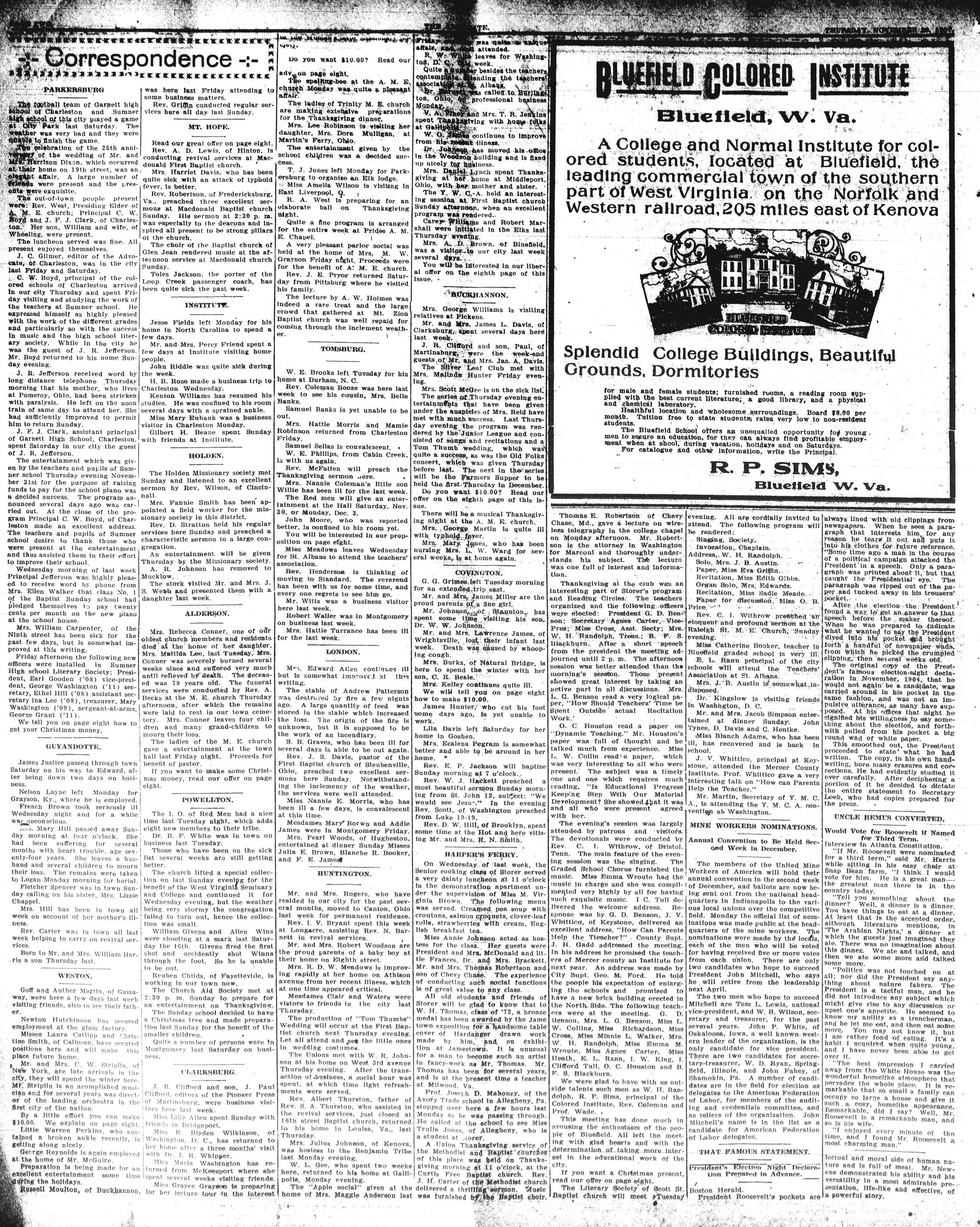
Page text (machine-generated)
THE ADVOCATE
ADVERTISEMENTS PLACED IN
OUR COLUMNS BRING
RESULTS TRY IT.
VOLUME VII. NO. 11
GARNETT
Outplays the Sumner High School at Parkersburg
But Game is Awarded the Latter by Parkersburg Official on a Technical Game Played in Mud
Special to The Advocate.
Parkersburg, Nov. 23.—In a veritable sea of mud at City Park this afternoon the football team of Garnett high school of Charleston and Sumner High School of this city battled twenty minutes in what promised, in spite of unfavorable weather conditions, to bg as pretty a gridiron contest as has been pulled off here this season.
Owing to the inability to secure neutral officials, it was agreed to by both teams to accept the services of a member of the white high school team as referee while Gay Brown, Coach of the Charleston boys, acted as umpire. Parkersburg won the toss and kicked to Charleston's five yard line. The ball was advanced steadily by the visitors by ends runs and line bucking and rushed over for a touch down after about ten minutes of fierce playing, but no goal was kicked. Then it was that the rumpus began. One Ben Jackson, claiming to me the coach of the local team, invaded the field and demanded that the umpire, Brown, be removed because of his connection with the visiting team. A long discussion arose finally teemlnated with the withdrawal of Brown with the understanding that his team be allowed to fill the vacancy. The referee here asserted his authority and threatened to award the game to Parkersburg unless play was resumed within one minute. It being impossible to find within the allotted time a person qualified to act as umpire, the game proceeded with one official—the refereed a local man. Neither side was able to score again before the end of the half, although the visitors were dangerously near the local goal in one instance, and both had been penalized for off side playing and holding.
When the whistle blew for the beginning of the second half conditions were more unfavorable, if such was possible, than at the beginning. The rain continued to tall with a steady pour as it had since morning and the players were simply animated balls of mud, while the ground was flooded, utterly precluding any other style of play than the bucking. Again Mr. Jackson, who seemed to have arrogated to himself the task of winning the game for his team by fair means if possible; if not, otherwise, substituted a player from the city team whose weight was far in excess of that agreed upon in the correspondence which made the contest possible. A bowl went up from the
Garnett boys, who objected ip no uncertain terms to the new man. They held that he was ineligible both because of his weight, which was apparently 160 pounds, and his not being then nor in the past scholastic year in attendance upon the Summer school, as provided for in the articles of agreement. In this they were sustained by the captain of the local team, who ordered the new man from the field. Mr. Jackson's authority seemed, however, to have more weight than the captain's, for the substitute, at his command, returned and took his place in the line-up. The Charleston team then seeing the futility of further argument consented to finish the game, but before they could resume their positions, the referee called the game o f hand awarded it to Parkersburg 6 to 0.
To say that his decision stirred up a hornet's neat is putting it rather mildly. The visitors, in view of their having been malucted on the question of officials, were more forcible than elegant in their expressions of disapproval of the referee's last decision and in this they had the aid and comfort of a greater portion of the spectators, who felt that they, since they had run the risk of rheumatism, grippe and every other ill to which flesh is hief, had not received a square deal.
The unsatisfactory termination of the game is attributed solely to the unauthorized actions of the Parkersburg coach, who, in the unavoidable absence of the principal of the Sumner school dominated the situation and ran things to suit himself. The visitors felt very keenly the utter disregard of their protests against the rankest kind of ruling both as regarded the game itself and the right of their friends within the lines, who were summarily put out while local men were not mocked. They claimed, and without out good grounds, that their superiority, demonstrated by making the first touch down and keeping the ball thereafter in the enemy's territory, was apparent, and that the Parkersburg coach determined to
break the game up since his team could not win it.
could not win it.
Before returning to their homes Sunday afternoon, the Charleston boys, accompanied by Prin. C. W. Boyd, assistant principal J. F. J. Clark, J. H. Taylor and J. C. Glimer, began negotiations for a game at Charleston between the same teams to be played December 7th. Should the Summer boys accept the same terms upon which the capital city team played here today, the game is a certainty and will doubtless demonstrate which is entitled to the honors.
The line-up follows:
Sumner Garnett
Carter C. Anderson
Taylor C P Willcher
Hayzes F H James
Tucker R B Payne
Dodd L H Neal
Carr L H James
Jones R G Chandler
Jones R T Wright
Johnson L T Hicks
Walker R E Davls
Lee L E Ferguson
Subs.—James, Falks, Price.
RETURNS FROM NOME TO
HER OLD IOWA HOME, RICH
Des Moines, Ia., Nov. 23. —From the gold Telds of far-off Nome Mrs. J. B. Verden, a former East Des Moines colored woman has returned after an absence of thirteen years. She drove directly to her old home, an humble cottage at 1108 Fremont street, which she had left a poor girl to return a woman of wealth.
Mrs. Verden conducted hotels in the Yukon country while others mined breathlessly for gold. She charged miners $190 a month for meals alone, but she was obliged to pay as high as 78 cents a pound for meat She saved enough to invest in mines and her fortune was founded.
Mrs. Verden returns to Des Moines to make her aged father, Henry Bell, comfortable. Other members of the family have died in the long absence.
The teachers of Mercer county, held their first Institute in the Raleigh Street M. B. church Friday. It was largely attended by the patrons and visitors. The meeting was a grand success in every particular and those present expressed themselves as being greatly benefited by the papers and discussions.
The meeting was opened at 10:00 a.m. m. Prof. E. L. Rann, the principal of Bluefield Graded School conducted the devotionals. After which the rendition of the program began B. F. S Blackburn read a very interesting paper on District Institute for the week. A course dinner was served by the Junior class. The following menu was served: oyster soup celery, mashed potatoes, plum pudding, mince, apple and squash pie, crisp crackers, salted peanuts, onions with cream, hard sauce.
Miss Emma Louis was hostess and Mr. Fred Wims host for the occasion. Their guests, besides the boarding students, consisted of the faculty and Mr. and Mrs. Thomas Robertson, of Chevy Chase, Md. Between courses toasts and musical selections were given. Music through the entire dinner hour was furnished by the Junior orchestra. At the close of the day everyone who was present at this social function had a great deal, for which to be thankful.
Rev. John R. Bean, of Eastport, Md., and his son, Rev. Samuel Bean, of Martinsburg, were in town on Monday and were very welcome guests at Storer for a few hours during which time Rev. John Bean gave a most interesting talk to the students on the importance of an education. Rev. Bean always has some good word of cheer to give to Storer son and daughters.
NEGRO COLEGE BURNED
Guthrie, Okla., Nov. 24. — Fire destroyed the main building of the State Agricultural and Normal University at Langston today. The loss is $35,000 with Insurance of $32,000 Langston is inhabited solely by Negroes. The university was established here ten years ago. Nearly five hundred students are enrolled. It is believed the fire was of incendiary origin, resulting from the bitter Jim Crow fight.
GEORGIA FIEND WITH A BAZOR
Slashes Two Women With a Razor and Then Kills Himself—The Women Will Recover.
Lithonia, Ga., Nov. 27.—Enoch Sanders, aged thirty-eight, who lives at the home of his sister-in-law, Mrs. Alice Sanders, slashed a razor across the throat of his niece, Bertha, and seriously cut Mrs. Sanders, then turned the razor on his own throat. He will die. The two women will recover.
MEDAL
State School Among Those Which Received Gold Medals for Exhibit of Industrial Work.
Gold—Fisk University, Nashville, Tenn., two (2) one for painting of Original Jubilee Singers and other for Demonstrations and Literary Work," West Virginia Colored Institute, Institute, West Virginia, Industrial Exhibit, Wilberforce University, Wilberforce, Ohio, Drawings, Painting's Literary and Industrial Work, Silver—Rufus Jordan, Henderson, Ky., Tobacco: H. N. Brazelton, Chattanooga, Tenn., Photographs: Jennie Higgins, Westville, Ohio; Battenburg work: Dr. E. B. Jefferson, Nashville, Tenn., Plate Work: J. J. Lay, Nashville, Tenn., Photographs: Knoxville College, Knoxville, Tenn., Photographs: Xenia Public School, Xenia, Ohio. Class room and Industrial work.
Bronze—Clara E. Allen, Sweet Springs, West Virginia, Counterpane; Blanche Brown, Findlay, Ohio, Table Cover; Miss Addie Byrd, Columbus, Ohio, hand painted China; G. F. Curr, Lexington Ky., Incubator and Bread Baker; John T. Dooley, Old Sweet Springs. W. Va., Jewelry; Mrs. Fowler, Henderson, Ky., Hair Work; William E. Spencer, Cedarale, Ohio, combination bookcase; William Sutton, Henderson, Ky., Tobacco; Dr. J. T. Wilson, Nashville, Tennessee; Wilson's Infirmary; Attucks Public School, Carbondale, Ill., Class Work; Chilliecote Public Schools, Chilliecote, Ohio, Class Work; Curry Normal and Industrial Institute, Urbana, Ohio, Class Work; Henderson Public School, Henderson, Ky., Class Room and Industrial Work; Lincoln Public School, E. St. Louis, Ill., class work; Manassas Public School, Memphis, Tenn., Examinations; Owenboro Public School, Owensboro, Ky., Class Work; Portsmouth Public school Portsmouth, Ohio, Class Room and Industrial Work; Terra Haute Public School, Terra Haute, Ind., class
Our football warriors have returned from their invasion of the Far North with banners trailing in the dust, and defeat writ large across their standards.
They left here Thursday, November 7th and played their first game against Howard University on Saturday, November 10th. The other games in consecutive order were played against Hampton Institute, November 11th; against West Virginia Institute, at Charleston, W. Va., on November 12th; against Baptist State University, at Louisville, Ky., on November 14th; against Meharry Medigal College on November 16th; and against Talladega College for Birmingham on November 18th. The second scores of the series of games follow:
Howard, 16; Tuskegee, 0;
Hampton, 10; Tuskegee, 0;
West Virginia, 6; Tuskegee, 5;
Louisville, 16; Tuskegee, 0;
Meharry, 27; Tuskegee, 0;
Talladega, 7; Tuskegee, 0
In the six games they scored only once. The boys are good losers; they do not complain nor whine; they were beaten, as the scores attest, and that's all the story. The almost invincible "dissers" of other years are now humbled in the dust, but determined to do better another year. It will be noted that six games were played in the twelve days intervening between the date of their departure and return. It could hardly be expected talt traveling as far as they did, and always on the road, that they could expect to win against teams remaining at home, fresh, being carefully coached and held in reserve, for the games against the Tuskegee team, and not disappointment is ours that they won not against any of their opponents. The whole party the players, the coach, Mr. E. T. Attwell, the manager, Mr. J. B. Washington, the captain, Lacy, Mr. Cheeseman and Mr. Williams—returned in good health and the worse for the gruelling experience through which they passed. Good treatment, in the main, was everywhere given them. The crowd in attendance were enthusiastic, that attests satisfactory, and only the men cholly reflection that the Tuskegee Tigers were Tamed remain. The Tuskegee Student.
To Be Divided Between the Two Grandson of Charles Deering, Manufacturer
Rock Island, Ill. Nov. 27 — The general term of the will of the late Charles H. Deering, implement manufacturer has been made public. Practically the entire property is valued at $20,000,000 and goes eventually to the two grandson of Charles Deering, William and Dwight.
ENDED TRAMP OF 1,234 MILES
Edward Payson Arrives at Chicago on a Long Tramp From Portland, Maine.
Chicago, Nov. 27.—Edward Payson ended a tramp of 1,234 miles from Portland, Maine, at the federal building here at 12.15 today. He left Portland October 22, thus making his, travelling time, exclusive of Sundays, twenty four days, fifteen hours and fifteen minutes. Weston did not walk on Sundays. Weston broke his record of forty years ago by a day, three hours and twenty five minutes. He was welcomed by a large crowd.
FATHER NS NEGRO BURNED BY MOB, SAYS HE NOW HAS NAMES
Asks for Legal Action Against Leavenworth Lynchers For Death in 1001.
Topeka, Kan., Nov. 23.—Declaring that he had a confession of one of the men of the mob and the names of many more, George Alexander, an aged Negro, came before Gov. Hoch and asked that legal action be taken in the death of his son who was burned at the stake in Leavenworth, Jan. 15, 1901. Alexander was accompanied by O. T. Drummond, an attorney of Doniphan, Kan. Drummond and Alexander inquired if the reward of $500 was still standing for the arrest and conviction of mob members. They were told that it had expired within 90 days. They were also told to take their case before the prosecuting attorney of Leavenworth.
NEGRO IS PRIZE WINNER
Brenham, Tex., Nov. 23. - Horace Lindsey, Negro, is in receipt of the first prize awarded at the State Fair for the best ice machine exhibit. The machine is Lindsey's own invention.
NEGRO SCHOOL INCREASES.
Langton, Ok., Nov. 23. The Negro university now has an enrollment of more than 300, the largest for this time of the year in the history of the school.
GOING DRY
Alabama the Last State to Exclude Intoxicants and Whole State Will Be Dry Jan. 1, 1908.
Birmingham, Ala., Nov. 23.—When the Alabama legislature this week passed the bill establishing prohibition throughout the state, beginning January 1, 1909, another important step was taken in the movement that promises to make the entire South dry.
That this section of the country, which ordinarily is strongly opposed to all sumptuity laws and loves its julep and its brandy, has caused some amusement throughout the North.
As a matter of history, the crusade has not appeared in the white man's antipathy to liquor as a general violous agent, but it is in the use by Negroes that it has met its doom. Better labor and less crime—these have been the arguments that have won the South to the temperance ranks. And, while the prohibition leader was arguing, his finger was pointed at the Negro.
By the fusing of the race and industrial problems and the liquor question, through inevitable results, temperance in the South received an impetus that the old method of berating "demon rum" never approached. The weird pictures of the fingers of the black men around white women's throats fired the South where tons of literature failed.
Whisky, is was proved by statistics was striking at the South socially and industrially through the Negro and the dive saloons. These rendezvous, where the Negroes' brains were fired by cheap whisky, were depopulating the fields and breeding crime. The rope was resorted to as a remedy. But lynching did not increase the safety to women or old industry that was crying for labor. Then came calculation. While the Negro and his labor were a needed asset, the Negro and his whisky were dangerous liability. The Southerner was willing to enact laws that might affect his own personal habits that he might safeguard his home and upbuild his business.
The South began to understand prohibition from an economic standpoint and voted against saloons on the same reasoning, that, the Federal government, excludes liquor from Indian reservations and shuts it out by international agreement from the islands of the Pacific. The British government, having learned the lesson of liquor's effect upon an undeveloped race, bars it from the Negroes of Africa.
Arguing that the Negro and bad whisky were as great a menace as fire and gasoline, the father and brother and the merchant and planter went to the polls.
In Georgia, the movement was statewide and, after the first of the year, liquor will be barred from 146 counties and 3,414 towns.
And Negro dives, which permit gambling and loading, will be leveled by the torch, officially applied.
In Florida of the 47 counties, 34 are dry. In Alabama only 181 towns under existing conditions, continue to license the saloons, three-fourths of the state being dry. The drought will be statewide in 1909. Of the 75 counties in Mississippi, 69 are without saloons. More than half of Louisiana has banished the saloon and the same condition applies to Texas.
After next April there will be only six cities and towns in Tennessee that will license saloons. And Kentucky, the home of bourbons, has put the lid on 54 of the 119 counties.
Senator Tillman's state, South Carolina, has closed the saloons in 62 of the 97 counties. Only 30 cities and towns have dramshops. The sister State, North Carolina, has made 17 of the 41 counties dry. Of the 100 Virginia counties, 46 are without saloons and 33 of the 55 West Virginia counties have stopped liquor traffic.
Oklahoma came into the Union as a dry state.
FAIRMONT
Robert Early, of Clarkesburg, was a Sunday visitor here.
Handsom Hunter, of Mannington, was calling on friends here last Sunday.
Prof E. L. Morton spent Sunday in Clarkesburg the guest of Prof. J. W. Robinson.
Richard, the little son of Mr. and Mrs. Arch Meade, was seriously burned Sunday morning by his dress catching fire from a gas stove. The extent of his injuries are unknown as yet though they are very painful.
Rev. N. B. Dunn will preach the Thanksgiving sermon at Mt. Zion Baptist Church at 11:00 a.m.
Presiding Elder Briggs preached
at the M. E. church Sunday morning.
Mt. Zlion Baptist church has called Rev. L. B. Coleman, of Bergistown, Pa., to fill the pulpit for the year of 1908.
Miss Grace Martin was indisposed a few days the past week.
Harrison Jones left Monday of last week for Mason Town, Pa., where he has employment.
Mrs. G. H. Jordan will arrive here Tuesday evening to be the guest of her daughters, Miss Bessle Jordan and Mrs. E. L. Morton. She will also visit her daughter, Mrs. A. H. Williams, at Morgantown.
Miss Lucy Lacy was the guest of her sister, Miss Ella Lacy, Sunday.
Mrs. Daley Martin was on the slick list a few days last week.
Mrs. F. H. Jackson entertained the embroidery club Friday evening and served a delicous luncheon to her guests.
We tell you on page eight how to make $10.00.
DAMAGING TESTIMONY TAKEN
Washington, Nov. 27.—Damaging testimony was given today against Mrs. Bradley. Quite a number of witnesses were called in rebuttal, all being asked as to her mental condition and declared that the question of her sanity had not been suggested to them, that she appeared rational and talked coherently. Many of
York, Pa., Nov. 27.—The York silk manufacturing company was placed in the hands of a receiver, on petition of its creditors, who allege the company is insolvent.
CHICAGO GRAIN MARKET.
Chicago, Nov. 27.—Wheat 95 1-2,
corn 55, oats 47 3-8.
JOE GANS WAS RETIRED.
This Time Only For the Night After
the Wake.
Minneapolis, Minn., November 22.
After a conference of many hours
today Joe Gans and Battling Nelson
agreed upon all the details of their
proposed fight except the weight.
Nelson insists that Gans shall fight
at 133 pounds. No articles have been
signed as yet, but the men stipulate
that the winner shall receive 75 per
cent of the receipts and the loser 25
per cent. The fight will be at Gold-
field, at a date to be determined later.
Nelson will remain in Minneapolis
with the expectation of signing
articles before he leaves.
ALL STATIONS DECORATED
Along the Route of Secretary Taft in Russia.
Petropavlovsk, Asiatic Russia, Nov.
27. The train bearing Secretary Taft and party from Vladivostok to Moscow, arrived here today. All members of the party are well. All the stations along the route were decorated in honor of Secretary Taft.
NEW KIND OF FEDERALISM.
Southern States Going to Queer Extreme Fighting Railroads. Norfolk Virginian-Pilot.
To go to the logical conclusion of the argument made by the Atlanta Journal, and followed in the conference of governors and railroad commissioners of several Southern states last week in that city, we should have joint action not only among the states of the South, but among the states of the entire Union. That would be federal action. The federal government represents "co-operation" among the states of the Union. If the States get away from the principles of managing their railroad affairs each for itself, the states will logically commit themselves to the principle of federal regulation. If separate sectional regulation would be equally impracticable. Yet the states which are themselves most aggressive in reducing railroad rates are those in which sentiment is strongest, apparently against Federal control of state rates.
It seems to us that the states are thus being driven towards ultimate federal regulation by a mistaken view of the railroad problem. There could not well be too much agitation against rebates and unjust discrimination, and similar abuses which have been prevalent in the railroad business; but the cry for reduction of the general average of rates is thoroughly unreasonable. It is an artificial issue. At a time when the average rates of the railroads in the United States, including the Southern section of the United States, are much lower than the general average of expense in the railroad business is decidedly higher than it has ever been before, it is not fair or sensible to be forcing reduced charges upon the common carriers. The 2-cent-a-mile agitators is misdirected.
SUBSCRIPTION $1.50 YEAR
COMMUTED
To Imprisonment for Life
Was Death Sentence
McDowell Negro Who Shot Respondent
Sheriff Will Spend Remainder
of Life Behind Prison
Bars.
William Combs, the colored murderer of Zach De Witt, brother of N. T. DeWitt, of the Bluefield Book and Stationery Company, and killed while acting in the a deputy sheriff for McDowell, will not hang on Friday 13th, which date was for execution by Governor when he was granted a repayment-25th, the former for his death. When he was granted by the exec it was for the pu making a thorough investigation the circumstances of the conviction of Combs
and Thursday Governor Dawson commuted his sentence to life imprisonment in the penitentiary.
The commutation of the sentence of Combs was made possible through an investigation conducted by Pardon Attorney Frank Lively. When an application was made for commutation of sentence by the attorney and friends of the condemned man, it was accompanied by affidavits telling of the peculiar circumstances under which the death penalty was inflicted.
Because of these circumstances a reprieve was granted to Friday, December 13th, in order to allow the pardon attorney to make a full investigation. When the prisoner confined at the penitentiary, learned that he had been reprieved until Friday, December 13th, superstitions as he was, he gave up all hope of commutation and said there was no longer any hope for him.
In his efforts to secure all the circumstances, Pardon Attorney Lewis secured the affidavits of six jurors who convicted Combs of murder in the first degree in the criminal court of McDowell county. That stated that while discussing the case in the jury room, they were questioned of giving the prisoner life sentence, but were informed by others of the jury and the foreman that the court alone had power to prescribe death or life imprisonment for murder in the first degree, and so they rendered a verdict without any recommendation, the court sentencing the prisoner to be hanged on October 25th.
The foreman of the jury wrote to the state officials and corroborated the affidavits of the six jurors, taking all the blame for the verdict upon himself, and stating that he believed the law which required a recommendation for mercy in a murder case, had been repealed and that if the jury had not been led to the belief that the court alone had this power to inflict a life sentence, they would have returned a life sentence.
Combs is a colored man and one night last summer, while in an exuberant spirit, attended a festival given by one of his race in McDowell county. Mr. DeWitt, who had been sworn in a deputy sheriff to assist in quelling a disturbance, was approaching the house to place one of those present under arrest, when he was killed by a bullet fired promiscuously by Combs from a window of the house. Combs has always contended that he did not know the sheriff was about at the time and the killing was purely accidental. However, the circumstances of the case did not enter into the minds of the officials when the sentence was commuted, the state merely desiring to carry out the intent of the jury, which was made plain by the affidavits received.
CONVICTS' SAVINGS
FOR PARDON FUND.
Nebraska Negro Asks Governor's Permission to Appeal to Fellow Prisoners.
Lincoln, Neb., Nov. 23.—Harrison Clarke, a Negro condemned to hang Dec. 13, has asked Gov. Shelton for permission to take up a collection among his fellow-convicts in order to provide funds to make one last attempt to save his life. The curious part of it is that the permission is asked of the Governor to whom the appeal is to be made for clemency. Practically all of Clarke's fellow-convicts who have money in the Warden's hands, earned at working overtime in the prison factories, are anxious to contribute to save Clarke, and several hundred dollars is expected from this source to pay attorneys to collect evidence for the showing the new law requires to be made in asking a pardon.
The Negroes of the State are much exercised over the proposed execution. The Supreme Court changed the sentence of one of Clarke's companions, Jay O'hearn, from death to life imprisonment, and the Negroes insist that if Clarke is hung it will be rank discrimination because of his color.
-- Correspondence --
PARKERSBURG
The football team of Garnett high school of Charleston and Sumner high school of this city played a game at City Park last Saturday. The weather was very bad and they were unable to finish the game.
The celebration of the 25th anniversary of the wedding of Mr. and Mrs. Harrison Dixon, which occurred at their home on 19th street, was an elegant affair. A large number of friends were present and the presents were exquisite.
The out-of-town people present were: Rev. West, Presiding Elder of A. M. E. church; Principal C. W. Boyd and J. F. J. Clark, of Charleston. Her son, William and wife, of Wheeling, were present.
The luncheon served was fine. All present enjoyed themselves.
J. C. Gillmer, editor of the Advocate, of Charleston, was in the city last Friday and Saturday.
C. W. Boyd, principal of the colored schools of Charleston arrived in our city Thursday and spent Friday visiting and studying the work of the teachers at Sumner school. He expressed himself as highly pleased with the work of the different grades and particularly so with the success in music and the high school literary society. While in the city he was the guest of J. R. Jefferson. Mr. Boyd returned to his nome Sunday evening.
J. R. Jefferson received word by long distance telephone Thursday morning that his mother, who lives at Pomeroy, Ohio, had been stricken with paralysis. He left on the noon train of same day to attend her. She had sufficiently improved to permit him to return Sunday.
J. F. J. Clark, assistant principal of Garnett High School, Charleston, spent Saturday in our city the guest of J. R. Jefferson.
The entertainment which was given by the teachers and pupils of Sumner school Thursday evening November 21st for the purpose of raising funds to pay for the school piano was a decided success. The program announced several days ago was carried out. At the close of the program Principal C. W. Boyd, of Charleston made an excellent address. The teachers and pupils of Sumner school desire to thank those who were present at the entertainment and thus assisted them in their effort to improve their school
Wednesday morning of last week Principal Jefferson was highly pleased to receive word by phone from Mrs. Ellen Walker that class No. 1 of the Baptist Sunday school had pledged themselves to pay twenty cents per month on the new piano at the school house.
Mrs. William Carpenter, of the Ninth street has been sick for the past few days, but is somewhat improved at this writing.
Friday afternoon the following new officers were installed in Sumner High school Literary Society: President, Earl Gooden ('08) vice-president, George Washington ('11) secretary, Ethel Hill ('08) assistant secretary Ina Lee ('08), treasurer, Mary Washington ('09), sergeant-at-arms, George Grant ('11).
We tell you on page eight how to get your Christmas money.
GUYANDOTTE.
James Justice passed through town Saturday on his way to Edward, after being down two days on business. Nelson Layne left Monday for Grayson Ky, where he is emplaced.
Grayson, KY., where he is employed.
French Brown took seriously ill
Wednesday night and for a while
was unconscious.
Mrs. Mary Hill passed away Sunday
morning at four o'clock. She
had been suffering for several
months with heart trouble, age seventy-four years. She leaves a husband and several children to mourn
their loss. The remains were taken
to Logan Monday morning for burial.
Fletcher Spencer was in town Sunday
calling on his sister, Mrs. Lizzie Chappel.
Mrs. Hill has been in town all
week on account of her mother's illness.
Rev. Carter was in town all last
week helping to carry on revival services.
Born to Mr. and Mrs. William Harris
a son Thursday last.
WESTON.
Goff and Auther Martin, of Gassaway, were here a few days last week visiting friends, also to see their father.
Newton Hutchinson has secured employment at the glass factory.
Misses Laura Catlipp and Christine Smith, of Calhoun, have secured positions here and will make this place future home.
Mr. and Mrs. C. W. Striplin, of New York, are late arrivals in the city, they will spend the winter here.
Mr. Striplin is an accomplished musician and for several years was director of the leading orchestra in the first city of the nation.
By a little effort you can make $10.00. We explain on page eight.
Little Warren Perkins, who sustained a broken ankle recently, is getting along nicely.
George Reynolds is again employed at the home of Mr. McGuire. Preparation is being made for an excellent entertainment some time during the holidays. Russell Moulton, of Buckhannon,
was here last Friday attending to some business matters. Rev. Griffin conducted regular services here all day last Sunday.
MT. HOPE
Read our great offer on page eight.
Rev. A. D. Lewis, of Hinton, is conducting revival services at Macdonald First Baptist church.
Mrs. Harriet Davis, who has been quite sick with an attack of typhoid fever, is better.
Rev. Robertson, of Fredericksburg, Va., preached three excellent sermons at Macdonald Baptist church Sunday. His sermon at 2:30 p. m. was especially to the deacons and inspired all present to be strong pillars of the church.
The choir of the Baptist church of Glen Jean rendered music at the afternoon service at Macdonald church Sunday.
Toles Jackson, the porter of the Loop Creek passenger coach, has been quite sick the past week.
INSTITUTE
Jesse Fields left Monday for his home in North Carolina to spend a few days.
Mr. and Mrs. Percy Friend spent a few days at Institute visiting home people.
John Riddle was quite sick during the week.
H. B. Rose made a business trip to Charleston Wednesday.
Kenton Williams has resumed his studies. He was confined to his room several days with a sprained ankle.
Miss Mary Eubank was a business visitor in Charleston Monday.
Gilbert H. Beane spent Sunday with friends at Institute.
HOLDEN
The Holden Missionary society met Sunday and listened to an excellent sermon by Rev. Wilson, of Cincinnati.
Mrs. Fannie Smith has been appointed a field worker for the missionary society in this district.
Rev. D. Stratton held his regular services here Sunday and preached a characteristic sermon to a large congregation.
An entertainment will be given Thursday by the Missionary society.
A. R. Johnson has removed to Mucklow.
The stork visited Mr. and Mrs. J. S. Webb and presented them with a daughter last week.
ALDERSON.
Mrs. Rebecca Conner, one of our oldest church members and residents died at the home of her daughter, Mrs. Matilda Lee, last Tuesday. Mrs. Conner was severely burned several weeks since and suffered very much until relieved by death. The deceased was 79 years old. The funeral services were conducted by Rev. A. Becks at the M. E. church Thursday afternoon, after which the remains were laid to rest in our town cemetery. Mrs. Conner leaves four children and many grand-children to mourn their loss.
The ladies of the M. E. church gave a entertainment at the town hall last Friday night. Proceeds for benefit of pastor.
If you want to make some Christmas money, read our offer on page eight.
POWELLTON.
The I. O. of Red Men had a nice time last Tuesday night, which adds eight new members to their tribe.
Dr. B. F. White was in town on business last Tuesday.
Those who have been on the sick list several weeks are still getting better.
The church lifted a special collection on last Sunday evening for the benefit of the West Virginia Seminary and College and continued it for Wednesday evening, but the weather being very stormy the congregation failed to turn out, hence the collection was small.
William Givens and Allen Wins were shooting at a mark last Saturday the 16th. Givens fired the first shot and accidently shot Winnas through the foot. So he is unable to be out.
Reuben Childs, of Fayetteville, is working in our town now. The Church Aid Society met at 2:30 p. m. Sunday to prepare for an entertainment on Thanksgiving.
Quite a number of persons were in Montgomery last Saturday on business.
CLARKSBURG
J. R. Clifford and son, J. Paul Clifford, editors of the Pioneer Press of Martinsburg, were business visitors here last week.
Miss Lilly Allen spent Sunday with friends in Bridgeport.
Miss R. Blyden Wilkinson, of Washington, D. C., has returned to her home after a three months' visit with Dr. L. R. Whipper.
Miss Maria Washington has returned from McKeesport where she spent several weeks visiting friends.
Miss Grayce Grayson is preparing for her lecture tour in the interest
Do you want $10.00? Read our
adv on page eight.
The spelling bee at the A. M. E. church Monday was quite a pleasant affair.
The ladies of Trinity M. E. church are making extensive preparations for the Thanksgiving dinner.
Mrs. Lee Robinson is visiting her daughter, Mrs. Dora Mulligan, at Martin's Ferry, Ohio.
The entertainment given by the school children was a decided success.
T. J. Jones left Monday for Parkersburg to organize an Elk lodge.
Miss Amelia Wilson is visiting in East Liverpool, Q.
R. A. West is preparing for an elaborate ball on Thanksgiving night.
Quite a fine program is arranged for the entire week at Prides A. M. E. Chapel.
A very pleasant parlor social was held at the home of Mrs. M. W. Grayson Friday night. Proceeds were for the benefit of A: M. E. church. Rev. J. E. Pryor returned Saturday from Pittsburg where he visited his family. The lecture by A. W. Holmes was indeed a rare treat and the large crowd that gathered at Mt. Zion Baptist church was well repaid for coming through the inclement weather.
TOMSBURG.
W. E. Brooks left Tuesday for his home at Durham, N. C.
Rev. Coleman Booze was here last week to see his cousin, Mrs. Belle Banks.
Samuel Banks is yet unable to be out.
Mrs. Hattie Morris and Mamie Robinson returned from Charleston Friday.
Samuel Sellas is convalescent. *
W. E. Phillips, from Cabin Creek, is with us again.
Rev. McFatten will preach the Thanksgiving sermon here. *
Mrs. Nannie Coleman's little son Willie has been ill for the last week.
The Red men will give an entertainment at the Hall Saturday, Nov. 30, or Monday, Dec. 3.
John Moore, who was reported better, is confined to his room yet.
You will be interested in our proposition on page eight.
Miss Meadows leaves Wednesday for St. Albans to attend the teachers' association.
Rev. Henderson is thinking of moving to Standard. The reverend has been with us for some time, and every one regrets to see him go.
Mr. Witts was a business visitor here last week.
Robert Waller was in Montgomery on business last week.
Mrs. Hattie Turrance has been ill for the last week.
LONDON
Mrs. Edward Allan continues ill but is somewhat improved at this writing.
The stable of Andrew Patterson was destroyed by fire a few nights ago. A large quantity of feed was stored in the stable which increased the loss. The origin of the fire is unknown, but it is supposed to be the work of an incendiar.
S. B. Graves, who has been ill for several days is able to be out again.
Rev. J. S. Davis, pastor of the First Baptist church of Steubenville, Ohio, preached two excellent sermons here Sunday. Notwithstanding the inclementy of the weather, the services were well attended.
Miss Nannie E. Morris, who has been ill a few days, is convalescent at this time.
Mesdames Mary Borwn and Addie James were in Montgomery Friday. Mrs. Pearl Woods, of Hugheston entertained at dinner Sunday Misses Julia E. Brown, Blanche R. Booker, and F. E. James
HUNTINGTON
Mr. and Mrs. Rogers, who have resided in our city for the past several months, moved to Canton, Ohio last week for permanent residence. Rev. I. V. Bryant spent this week at Longacre, assisting Rev. N. Barnett in revival services. Mr. and Mrs. Robert Woodson are the proud parents of a baby boy at their home on Eighth street. Mrs. R. D. W. Meadows is improving rapidly at her home on Athison avenue from her recent illness, which at one time appeared critical. Mesdames Clair and Waters were visitors to friends in the city last Thursday. The production of "Tom Thumbs" Wedding will occur at the First Baptist church next Thursday evening. Let all attend and see the little ones in wedding costumes.
The Unions met with W. R. Johnson at his home on West 3rd avenue Thursday evening. After the transaction of business, a social hour was spent, at which time light refreshments were served.
Rev. Albert Thurston, father of Rev. S. A. Thurston, who assisted in the revival services, just closed at 16th street Baptist church, returned to his home in Louisa, Va., last Thursday.
Mrs. Julius Johnson, of Kenova, was hostess to the Benjamin Tribe last Monday evening.
W. L. Gee, who spent two weeks here, returned to his home at Gallipolis, Monday evening.
The "Apple social" given at the home of Mrs. Maggie Anderson last
finally, it was quite unique
affair, and she attended.
R, W, W. leaves for Washington, D. C., week.
Quite a number besides the teachers contemplates attending the teacher's association at Albaug.
Dr. W. Winters was called to Burlington, Ohio, on professional business Monday.
V. A. Niner and Mrs. T. R. Jenkins spent Thanksgiving with home folks at Galiphee.
W. O. James continues to improve from his recent illness.
Dr. Johnson has moved his office in the Woodson building and is fixed up nicely for business.
Mrs. Daniel Lynch spent Thanksgiving at her home at Middleport, Ohio, with her mother and sister.
The Y. W. C. A. held an interesting session at First Baptist church Sunday afternoon, when an excellent program was rendered.
Carey Williams and Robert Marshall were initiated in the Elks last Thursday evening.
Mrs. A. D. Brown, of Bluefield, was a visitor to our city last week several days. You will be interested in our liberal offer on the eighth page of this issue.
BUCKHANNON.
Mrs. George Williams is visiting relatives at Pickens.
Mr. and Mrs. James L. Davis, of Clarksburg, spent several days here last week.
J. R. Clifford and son, Paul, of Martinsburg, were the week-end guests of Mr. and Mrs. Jas. A. Davis.
The Silver Leaf Club met with Mrs. Mallinda Hunter Friday evening.
Mrs. Scott McGee is on the slick list. The series of Thursday evening entertainments that have been given under the auplicles of Mrs. Reid have met with much success. Last Thursday evening the program was rendered by the Junior League and consisted of songs and recitations and a Tom Thumb wedding, which was quite a success, as was the Old Folks concert, which was given Thursday before last. The next in the series will be the Farmers Supper to be held the first Thursday in December. Do you want $10.00? Read our offer on the eighth page of this issue. There will be a musical Thanksgiving night at the A. M. E. church.
Mrs. George Martin is quite ill with typhoid fever.
Mrs. Mary Jones, who has been nursing Mrs. L. W. Ward for several weeks, is at home again.
COVINGTON
G. G. Grimes left Tuesday morning for an extended trip east.
Mr. and Mrs. James Miller are the proud parents of a fine girl.
Mr. Johnson, of Staunton, has spent some time visiting his son, Dr. W. W. Johnson.
Mr. and Mrs. Lawrence James, of Wrightsville, lost their infant last week. Death was caused by whooping cough.
Mrs. Burks, of Natural Bridge, is here to spend the winter with her son, C. R. Beale.
Mrs. Kelley continues quite ill.
We will tell you on page eight how to make $10.00.
James Hunter, who cut his foot some days ago, is yet unable to work.
Lila Davis left Saturday for her home in Goshen.
Mrs. Ecalena Pegram is somewhat better and able to be around in her home.
Rev. E. P. Jackson will baptize Sunday morning at 7 o'clock.
Rev. W. J. Hackett preached a most beautiful sermon Sunday morning from St. John 12, subject: "We would see Jesus." In the evening Rev. Scott, of Washington preached from Luke 19-19.
Rev. D. W. Hill, of Brooklyn, spent some time at the Hot and here viting Mr. and Mrs. R. N. Smith.
HARPER'S FERRY.
On Wednesday of last week, the Senior cooking class of Storer served a very dalty luncheon at 11 o'clock in the demonstration apartment under the supervision of Miss M. Virginia Brown. The following menu was served. Creamed pea soup with croutons, salmon croquets, clover-leaf rolls, strawberries with cream, English breakfast tea.
Miss Annie Johnson acted as hostess for the class. Her guests were President and Mrs. McDonald and little Frances, Dr. and Mrs. Brackett, Mr. and Mrs. Thomas Robertson and son of Chevy Chase. The experience of conducting such social functions is of great value to any class.
All old students and friends of Storer will be glad to know that to W. H. Thomas, class of '72, a bronze medal has been awarded by the Jame town exposition for a handsome table cover of Hardanger drawn work made by him, and on exhibition at Jamestown. It is unusual for a man to become such an artist in fancy-work as Mr. Thomas. Mr. Thomas has been for several years, and is at the present time a teacher at Milwood, Va.
Prof. Joseph D. Mahoney, of the Avory Trade school in Allegheny, Pa. stopped over here a few hours last Monday as he was passing through. He called at the school to see Miss Trulla Jones, of Allegheny, who is a student at corer
A Union Thanksgiving service of the Methodist and Baptist churches of this place was held on Thanksgiving morning at 11 o'clock, at the Curtis Free Baptist church. Rev. J. H. Carter of the Methodist church delivered a thrilling sermon. Music was furnished by the Baptist choir.
BLUEFIELD COLORED INSTITUTE
Bluefield, W. Va.
A College and Normal Institute for colored students, located at Bluefield, the leading commercial town of the southern part of West Virginia. on the Norfolk and Western railroad,205 miles east of Kenova
ELEVENHUD
COLORADO INSTITUTE
Splendid College Buildings, Beautiful Grounds, Dormitories
for male and female students; furnished rooms, a reading room supplied with the best current literature; a good library, and a physical and chemical laboratory.
Healthful location and wholesome surroundings. Board $8.00 per month. Tuition free to state students; rates very low to non-resident students.
The Bluefield School offers an unequalled opportunity for young men to secure an education, for they can always find profitable employment when at shool, during vacation, holidays and on Saturdays.
For catalogue and other information, write the Principal.
Thomas E. Robertson of Chevy Chase, Md., gave a lecture on wireless telegraphy in the college chapel on Monday afternoon. Mr. Robertson is the attorney in Washington for Marconi and thoroughly understands his subject. The lecture was one full of interest and information.
Thanksgiving at the club was an interesting part of Storer's program and Reading Circles. The teachers organized and the following officers were elected: President G. D. Benson; Secretary Agnes Carter, Vice-Pres; Miss Cross, Asst. Secy; Mrs. W, H. Randolph, Treas.; B. F. S. Blackburn. After a short speech from the president the meeting adjourned until 2 p.m. The afternoon session was better attended than the morning's session. Those present showed great interest by taking an active part in all discussions. Mrs. L. G. Benson read a very logical paper, "How Should Teachers' Time be Spent Outside actual Recitation Work."
O. C. Houston read a paper on "Dynamie Teaching." Mr. Houston's paper was full of thought and he talked much from experience. Miss L. W. Collin read a paper, which was very interesting to all who were present. The subject was a timely one and one which requires much reading, "Is Educational Progress Keeping Step With Our Material Development? She showed that it was and all who were present agreed with her.
The evening's session was largely attended by patrons and visitors. The devotionals were conducted by Rev. C. I. Withrow, of Bristol, Tenn. The main feature of the evening session was the singing. The Graded School Chorus furnished the music. Miss Emma Wroute had the music in charge and she was complimented very highly by all for having such exquisite music. I C. Tull delivered the welcome address. Response was by G. D. Benson, J. V. Whittica, of Keystone, delivered an excellent address, "How Can Parents Help the Tteacher?" County Supt. J. H. Gadd addressed the meeting. In his address he promised the teachers of Mercer county an Institute for next year. An address was made by City Supt. Geo. M. Ford. He told the people his expectation of enlarging the schools and promised to have a new brick building erected in the North Side. The following teachers were at the meeting. G. D. Benson, Mrs. L. G. Benson, Miss L. W. Collins, Miss Richardson, Miss Cross, Miss Mintele L. Walker, Mrs. W. H. Randolph, Miss Emma M. Wroute, Miss Agnes Carter, Miss Heath, E. L. Rann, I. W. King, I. Clifford Tull, O. C. Houston and B. F. S. Blackburn.
We were glad to have with us outside talents such men as W. H. Randolph, R. P. Sims, principal of the Colored Institute, Rev. Coleman and Prof. Wade. This meeting has done much in arousing the enthusiasm of the people of Bluefield. All left the meeting with glad hearts and with the determination of taking more interest in the educational work of the city. If you want a Christmas present, read our offer on page eight. The Literary Society of Scott St. Baptist church will meet Tuesday
R. P. SIMS.
Bluelfield W. Va.
evening. All are cordially invited to attend. The following program will be rendered:
Singing, Society.
Invocation, Chaplain.
Address, W. H. Randolph.
Solo, Mrs. J. B. Austin.
Paper, Miss Eva Griffin.
Recitation, Miss Edith Gibbs.
Organ Solo, Mrs. Edwards.
Recitation, Miss Sadie Meade.
Paper for discussion, Miss O. B. Price.
Rev. C. I. Withrow preached an eloquent and profound sermon at the Raleigh St. M. E. Church, Sunday evening.
Miss Catherine Booker, teacher in Bluefield graded school is very ill.
E. L. Rann principal of the city schools will attend the Teachers' Association at St. Albans.
Mrs. J. B. Austin is somewhat, in-disposed.
Dr. Kingslow is visiting friends in Washington, D. C.
Mr. and Mrs. Jacob Simpson entertained at dinner Sunday. John Tynes, D. Davis and C. Henike.
Miss Blanch Adams, who has been ill, has recovered and is back in school.
J. V. Whittico, principal at Keystone, attended the Mercer County Institute. Prof. Whittico gave a very interesting talk on "How can Parents Help the Teacher."
Mr. Martin, Secretary of Y. M. C. A., is attending the Y. M. C. A. convention at Washington.
MINE WORKERS NOMINATIONS.
Annual Convention to Be Held Second Week in December.
The members of the United Mine Workers of America will hold their annual convention in the second week of December, and ballots are now being sent out from the national headquarters in Indianapolis to the various local unions over the competitive field. Monday the official list of nominations was made public at the headquarters of the mine workers. The nominations were made by the locals, each of the men who will be voted for having received five or more votes from each union. There are only two candidates who hope to succeed President John Mitchell, who says he will retire from the leadership next April.
The two men who hope to succeed Mitchell are Tom L. Lewis, national vice-president, and W. B. Wilson, secretary and treasurer, for the past several years. John P. White, of Oskaloosa, Iowa, a well known western leader of the organization, is the only candidate for vice president. There are two candidates for secretary-treasurer, W. D. Ryan, Springfield, Illinois, and John Fahey, of Shamokin, Pa. A number of candidates are in the field for election as delegates to the American Federation of Labor, for members of the auditing and credentials committee, and as tellers of the organization. John Mitchell's name is in the list as a candidate for American Federation of Labor delegates.
THAT FAMOUS STATEMENT
President's Election Night Declaration Prepared in Advance.
Boston Herald.
President Roosevelt's pockets are
Boston Herald.
always lined with old clippings from newspapers. When he sees a paragraph that interests him, for any reason he tears it out and puts it into his clothes for future reference. "Some time ago a man in the course of a political campaign attacked the President in a speech. Only a paragraph was printed about it, but that caught the Presidential eye. The paragraph was ripped out of the paper and tucked away in his trousers' pocket.
After the election the President found a way to get an answer to that speech before the maker thereof. When he was prepared to indicate what he wanted to say the President dived into his pocket and brought forth a handful of newspaper wads, from which he picked the crumpled clipping, then several weeks old.
The original copy of the President's famous election-night declaration in November, 1904, that he would not again be a candidate, was carried around in his pocket in the same fashion, and was not an impulsive utterance, as many have supposed. At his offices that night he signified his willingness to say something about the election, and forthwith pulled from his pocket a big round wad of white paper. This smoothed out, the President proceeded to state what he had written. The copy, in his own handwriting, bore many erasures and corrections. He had evidently studied it over carefully. After deciphering a portion of it he decided to dictate the entire statement to Secretary Loeb, who had copies prepared for the press.
UNCLE REMUS CONVERTED.
Would Vote for Roosevelt if Named for Third Term.
Interview in Atlanta Constitution.
"If Mr. Roosevelt were nominated for a third term," said Mr. Harris while sitting in his easy chair at Snap Bean farm, "I think I would vote for him. He is a great man—the greatest man there is in the country today.
"Tell you something about the dinner? Well, a dinner is a dinner. You have things to eat at a dinner. At least that is the accepted order, although literature mentions, in 'The Arabian Nights,' a dinner at which the guests just imagined they ate. There was no imagination about this dinner. We ate and talked, and then we ate some more and talked some more.
"Politics was not touched on at all; nor did the President say anything about nature fakers. The President is a tactful man, and he did not introduce any subject which might give rise to any discussion or upset one's appetite. He seemed to know my ability as a trenchman, and he let me eat, and then eat some more. You may not know it, but I am rather fond of eating. It's a habit I acquired when quite young, and I have never been able to get over it.
"The best impression I carried away from the White House was the wonderful homelike atmosphere that porvades the whole place. It is remarkable that so small a family can occupy so large a house and give it such a cosy, homelike appearance. Remarkable, did I say? Well, Mr. Roosevelt is a remarkable man, and so is his wife.
"I enjoyed every minute of the time, and I found Mr. Roosevelt a most charming man." Lectual and moral side of human nature and is full of meat. Mr. Newenw demonstrated his ability and his versatility in a most admirable presentation, life-like and effective, of a powerful story.
~ THURSDAY, NOVEMBER 28, 1907.2
» HE SAW THE “SIGN, Wy
Cause of the Smashup as Told by the
Old Darky Driver. |
‘Tbe old darky was sulng the raitroad
compuny for damagos. ‘the mao con- |
tended that, not belng warned by. whl |
tle or engine bell, bo, hud started to,
Arlve st¥) rig) across, the “company’s
tragk when 8 shunted-box ay of sald
company -erisbed into- his. puttt, causa
ingithe death of the horse, loss of thet
wagon aii mtuot injuries to: bimeelt,
After tho prosecution bad closed ite,
elde of the case the oeganys lawyer)
called the old darky to the stand and | ;
went at him.
“Mr, Lamson,” he began, “your rig |
was struck by the box car in full day- |,
Jight, was St not?” ~
“F fnk dar was some clouds ovahend, |
ub," unswered the cavillug witness. "|.
“Never intud the clouds! Aad only |-
few days before thls uccldeut the |
vallroad company uad put w uew sign |,
ut that crossing?"
“Dar was a sign dar; yaas, sub!"
"And didn't that sigu say: ‘Stop! |,
Look! Listen?” ;
“Now, dar am de whofe accusation |
ub de trouble!" deciared the darky.
with animation. “it dat ‘Stop’ sign |
badn't caught dis chile’s eye jes’ ‘s |.
Ab.war square op dat track. dar would. |
n't ‘a’ been no emashup!"—Bobpmlan. |
THE DEADLY ‘UNDERTOW.
What to Do When Caught In the
‘Treacherous Currentes
‘Those deadly undertows which so
often prove fajal to swimmers aré pro.
duged by tides and coast currents. The
former only curry out at ebb tide; the
latter usuglly zigzag along the shore. ,
“If you are a robust swimmer,” sald
‘8 professgr of the art, “you can gen-
erally overcome them by quick, alert
strokes. If, however, you do not:at
once succeed don't persevere, for this
is one of the exceptions to the rule
about perseverance. Stop fighting be-
fore exhaustion comes and go with the
tide or current. By resting a_ short
time, floating or swimm|ng lelsurely,
you will have time to take your bear-
ings‘ and either make another attempt
or call for assistance.
“Sometimes you will fiid the under-
tow runs parallel to the shore. You
may then let yourself be carried along
with the certainty that before long tt
will twist inshore, when a short spurt
will bring you to safety.”—Cassell's
Journal. .
OA aire
“Do you know,” said the-head waiter
at a fashionable. restaurant, “that ,an
experlonced waiter ean usually tell
whepher a diner ts wenlthy or not! by
the way. be’ bandlew tis::meal check?
Af a: than ‘earelo@ly pitches’ out his
money for the Waiter to piy the bill
without logking over tils check we kndw
the chances arg tliat be Isn't wealthy,
He Is indulging ip, a luxury, and, fears
he might he ridiculed, if he oxainined
the check. . On..the other, hand, the
man who has plenty of ,money ex-
amines bis check closely, as a rule. If
he finds ap {tem which’ he thinks ts
Wraps ho-tolls the walter about tt, It
wad probably just such care as that
tha* madé biin rich. Is ho laughed at?
Well, 1 guess not. Th fact the wait-
ers admire lin for bis carefulness, and
the result 1s they are doubly particular
about how he fs charged.”—New York
Press. *
Bhakesiiare end: tis Sida.
‘The Shakespeare-Bacon controversy
is right where it began many years
ago. ‘The “man from Stratford Is still
in possession, though there are many
learned men who seriously questien
his rights. Tt has not been proved that
Bacon wrote the plays or that Sbake-
Speare did uot write them. One thing
the controversy has done, bowever—tt
has immeasurably heightened the mys-
tory of the fact, If it ix a fet, that the
plays were written by the bistorlen!
ihakespeare. Between the Shakespeare
we know in history and thé man who
wrote Lear," “Hamlet!” and “Mac
Veth" there would seem to be nn un-
bridged distance.—New York Ameri-
can,
The Way of Néw York.
Tn New York you buy your thedter
tickets from a’ specuintor for two
prices, aud after the show you bribe
4 waiter to bring you food for which
sou pay the folly Innkeeper two and
one-half prices, after which you may
be bauled home by a rheumatic horse
if you pay the driver once for hauling
you home and once for not getting
down from his perch and booting you
out of the hansom.—Louisvillg Courier:
Journal.
The Man With Tact.
Casual Caller (to one next bim)—
was Introduced to that squint eyed,
red hatred woman over thero as Mrs.
Somebody or other. Don't you think
{he man was an tdtot that married her?
Kext One (meekls)-t can't Just say.
Y'm the wan.—Baltimore Auericau,
Fie Cans:
“Wunny thing about Dubley. He sald
he needed a ittle whisky beenuso he
was run down."
“Well, wasn't he run down?"
"t don't know about that, but 1 do
know be wag run tu."—Catholle Stand:
ard and Times.
Suited Hix Temper.
“You seom to find that book very tn-
teresting.” anid Mrs. Henpeck.
"Yes," replied Henry; “it's delight-
ful. Tve glanced at the ending, and
the hero and herdtne don't get married
after all.”"—Washiugton Horald,
Whether a knave or a fool can do the
greater barn Is one of the questions
which twenty centuries of experience
bas not fully doterminedg- Dallas
News. fiat! “Sy
Ppa aca
wnt a
tom dollar” tilese ‘di ‘nei-
éysarlly-mean {t's his last, “Dut-that
It {yn the bottom of hig gock.
» A GAME IN EARNEST.
Courageous Acting Which Averted a
Paric at Sea.
Captain John ““heaker of the Harl of
Fidon was homeward bowid trom-Bom:
‘bay ‘with w load of cotton... A lirge
number of pussengote werg on hoard,
About three days out: the captain
yind good reasou: to belleve that the
cotton ‘was smoldering. Any knowl-
edge of, such n catastroplie would cause
a general panic, It was tinpbssible to
put, back Ju: the teeth of ‘a northeast
-mongoon,.80 the commander ‘quietly
Prepared for the Inevitable.
‘The passeagers, bored. from, lack of
occupation, were amused and interest:
ed’ when Captain ‘Tueaker proposed to
play at having a fre on baard, He
said that they would go through all
mancuyers just as if a conflagration
were taking place,
‘The passengers fell in with the sug-
gestion eagerly. The boats were got
ready; provisions were ymt'-in, witb
water, salls and compasses... ‘The seats
in the varlous boats were allotted, and
the passengers made up bundles of the
valuables they considered. the , most
precious. Thus, quletly, but autickly,
the “Joke” was carried out to the full.
‘When all was ready the captain
calmly told the players that, the game
was In earnost and that the ship wag
really on fire, with the flames making
toward tho powder magazine. . ‘The
doats ware speedily got off, aiid th Tess
than an hour the explosion occurred.
The boats wore 1,000. mites,, from
land, but the weather’ remained fatr,
and in fourteen days every soul was
landed tn ‘safety.—‘"The Still Lite of
the Middle Temple.”
SIMPLE ARITHMETIC.
It Points an Easy Road to the Get-
Rich-Quick Station.
Perhaps she rend the statement made
by the department of agriculture that
the value of the eggs lad by tho hens
of the United States in a year «ould
be enough to pay off the national debt
or maybe she “just thought Jt up,”
but anyway this pretty little Baltimore
girl was convinced that she had every-
thing all Oxed. She has been engaged
to a very nice young fellow for some
tlme, but to most people ‘the. amount
of his present rniary would aspenr an
lusurmountable obstacle to matyimony.
This was the view. of her father, but
‘when expressed she'met it with a’ hap-
py smile i 1.
“Oh, 1 have thought thet all out,”
she declared.
“You have, eb?" papa asked, know-
Ing something of his daughter's buat
ness abilities. , ;
“Yes, and St was, 20,easy," she bub-
dled, “I was- passing the market. the
ather day, and I saw a dear little pol-
14 dotted hen for only 60 cents, and I
dought her, J read In a poultry paper
that a ben will ralse twenty chicks In
2 season. Well. next year we'll have
twenty-one hens, and 9, of course,
there'll be 420 chicks the next year,
and 8,400 the next, and 168,000 the
next, nd 3,360,000 the next. And just
see What that amounts tol Why, sell-
ing them at 60 cents each would give
us $1,500,000 In five years, and that
won't be 80 long to walt for that
much.”—Harper’s Weekly.
‘The Old Man's Sorrow.
“You have a daughter, bare you not,
sir?” said a minister to an old gen:
tleman with whom he had formed a
casual acquaintance as a fellow pas:
senger. e
‘The old -gentieman essayed to an-
swer, but the question had strangely
affected bin,
“1 beg your pardon,” sald the mjn-
fster, “it 1 lave thoughtlessly awak-
ened In your mind recollections of a
painful nature, ‘The world 1s full of
sorrow, sir, and perhaps my question
recalls to your memory a fair, heautt-
ful girl whose blossoming young lito
had withered tn its bloom. Am I
right, sir?”
“No, not exactly," replied the old
Kentleman, sadly, “I heve five unmar-
rled darters, mister, an’ the youngest
of the lot fs twenty-eight years old.”
A USE FOR SPIDERS.
Keep Them tn the House and You Will
Have No Roaches.
“It 19, too bad 60 many peopte aro
prejudiced against spiders,” said the
man who always finds out curious
things. "If they could stand it to
have spiders around, they would soon
Ket rid of cockroaches. In the spider
tho cockroach has an enemy that pur-
sues him with more mateyolence thaa
does the claggiy housewife. And not
only Is this intrea more deep rooted: It
fe more i ily All things considered,
the cockryuch' shows mighty little re:
apect for the bumnan race, He knows
that, although he 1 smail, he is chock
full of Juventive genius, and he laugh:
Ingly scorns the futile attempts of men
and women {o ciretinvent and destroy
him
"So long-has be been paitling for
Mo against paris green, sy paper, hot
water and wire cages that he has
learned to saunter through green lanes
of polson and wade rivers of giite
without so miuch as soiling his toes,
and when It comes to the scalding bath
be swims blithely out and wrigiles bis
whiskers Jn derision at his would be
slayers. But he dares not treat the
spider with auch disdain, In fact, he
doesn't have a chance, for the apider
ouldoes even the cockroach in cunning
And nabs him without the tecst cere
mony.
“SUI It would be hardly sdvisable
to recommend ralging a crop of spiders
49 0 sure preventtye of’ cockroaches,
foF to. most poople’s tnthds tho exter-
Sila gtog far than te
vietien,'"-e iets
~ ABOARD A. MAN-OF-WAR.
Life Largely Mado Up of Serubbings,
Regulations. and Inspections.
The dpy's-programme uboand a man-
of-War-ls caleulated to make-the boy
who wants to run away to sea sit up
and think twie’, It varias somewhat
according as the ship:ts tn port or at
Sea and Under different commands, but
in aby case, trom,6 o'clock In the more
Ing til 7:80 at night, te Jem rather
etrenuous round. of serubbings . and
drills,’ ‘The recruit reallzes-very soon
that the expression “shipshape” means
@ good'deal, era
Saturday morning ts a tywmendous
cleaning time, called “feld day7” which
1s followed -by. a half holiday in the
atternoon, and on Sunday morning the
‘captaln himself suspects ils ship Crom
keel to'truck, The marine band ts xta-
Hloned Just velow" on tie, hurricane
deck, and the UMejackets stand on, the
Port side. of the quarter deck and the
marines on the starboard, all ready
tor inspection. .
But life. isn’t atl scrubblugs, regula-
tlons and Inspections. On the larger
ships tbe goyerument furotshes: ath:
letie’ supplies, and each man-of-war
hus. ber: champion boxer aad baseball
‘and football teams. ‘These teams are
‘managed or supervised, at least, by
officers, and many an ensign or lew-
tenant who has won ‘his “N" at the
‘Naval academy plays shoulder to sboul-
der With ls Bluelackats: "suel. f.
millarity would have scandalized oll
Commofiore Porter beyond words.—St,
Nictiolas. 1, atagt eee?
A .PARASITE.. CREEPER. -
| New.Zealand’s Vegetable Caterpillar Is
a Mést: Peculiar Plant.
‘The most extinordinary ‘object 1 havo
ever seen ts the New Zealand vegetablu
‘caterpillar, “the rata 1 a parasite
‘creeper which fitst dystroys its forest
‘ost and then rushes it to death and,
usurping its skeleton, becomes a tree
Mself. If the rata’ seedling Is dug up
it ts found to be springing not from a
seed, but from the head of a perfectly
formed caterpillar.
It is supposed by some that the
caterpillar, which on dissection proves
to be internally the exact counterpart
of Its living insect relative, swallows
the tiny rata seed while living and,
burrowing Into the ground, becomes,
Instead of a chrysalls, the germinating
home of the ‘seed, ‘which by: some
agency’ tits its unfortunate. foster
tnpther Into wood. sas
Dthers, however, contend the cater-
pillar itself {s°producéd by ‘the rata,
urging in support of thelr theory that
Af| springing. from a :#eed. the “shoot
‘wpuld grow out of dierent: pests, af
‘the.,caterpiliar Instead. .of Invagiably
giowing:out of the heads oe as,
que Znaect -voxetablo ts yellow
jout:four-Inehes long and {8.{ully..ex-
tended, I bave seen, them freshly dug
‘up and others that have been. kept for
‘Years, and all had the appearance of a
perfect Insect curved. {In wood.—-Pear-
son Weeksy. i
; es cepa eee ‘
| One of the greatest hardships 'suffer-
ed by. men who run elevators in’ tlie
tall office bulldings downtown ‘tlie
bad effect It bas on thelr eyes. “The
cars are run at a high rate of speed,
and, as the men have to look straight
ahead of them most of the time, their
eyes soon feel the strain of the con-
stant motion,
“I've worked in the subway,” ro-
marked one of these elevator’ men,
“and I thought that was pretty bad,
but it isn’t a patch to the way my
eyes feel after a day’s work In these
ears, If you ever run across an ele-
vator man who seems unusually bad
tempered toward the clote of the busi-
ness day, just look at his eyes and you
will be apt to forgive him. ‘They gen-
erally show the stiain that has been
put on them for eight or ten hours." —
‘New York Press.
re
@ ae Exemolified.
A learned professor was dining with
the Diltzes and the table was'set with
the best ware that Mrs. Diltz’s china
closet" afforded. ‘The guest was par-
ticularly interested in the display and
Admired it greatly. Picking up the
plate in front of him and noting the
stamp of the manufacturer on the bot-
tom of it, he remarked:
“I presume you know that china, or
the art of making it, was discovered by
accident?”
Just then there was heard in the
kitchen, where the maid was busily at
work, a loud erash.
"Yes," answered Mrs. Diltz, with a
pained smile, “and most of It is brokea
In the same way.""—Youth's Companion,
Wigs and Fans.
“There is one thing T want to warn
you about.” sald the avigmaker to the
inan who was busing bis frst wig,
“and that is the electric fan. When:
ever you see an electric fau In motion
give ita wide berth. If you don’t ft 18
apt to embarrass, you. Blectric fans
and wigs are deaily enemies Noth
lug outside of an tudian and a toma:
hawk will Hit a wig from the wear.
er's hend quicker than an electric Yan
$n tmotion.”--New York Sun
Wade: Puke:
| Dear little Maudie awoke about 2
orclock the other morning and asked
mamma {0 tell her a fairy tale,
| “It's too tate, darling.” mamma rer
piled. “Daddy will be in shortly, and
he'll tell us both one."—Philadelphia
Inquirer.
Our Language.
“Ho's the coming man.”
“Yes; be's one of the best fellows go-
tng."—Raithnore American
‘The great republic shall lve as long
ag the poorest citizen freely expresses
hls pergonal.and polities! opinion, and
‘no longer, —Baltimore American,
Peobyhgiie Hamby ts reported to” be
lowly impfoving from a recent ally =
lowly Stupeoving: from a regent attr -
You Look rer at Gid
THE-ADYOCATE.
. A MANLY. MAN,
Free from Fear. and Shame and
: Fears
~
By “Fintiocw’ Perry,
ep eee Pectin ey MERE Ee srs Se Oe Ome
his convictions, uiswerving Adolity,
to his engagerfents, rizorous integ-
rity, pursuing a course of life and
conduct that admitsot no question,
and possessing, witha, x delleate
consideration for. the rights. and
opinions of others..." :
Is there: an: indivianai xnown to
vs who better fills. this outline than
our fellow eltizen, Addison M. Scott?
His name carries with It a general
acknowledgment of his usefulness as
a citizen, his publie-spirit as a bust-
ness man, his eminiént capacity in
carrying to sueegsitul completion
the permanent tmprovement of the
nayigation of the:-<Great Kanawha
river, and his fii" Yporal, inteltect-
ual and social qualigies. "sty. Scott
ide man whom ft W9uld be hard to
overestimate,
NAbout twenty-fve years ago, when
2 young man, he game to our city ag.
ohn Assistant, of Gd) Merrill, of the
US. Engineer Gotps,, who had in
ctiarge the improvement of the Kan;
awha-river. He gi@not come with
Ifeconceived ideas,ag.to tho work to
he done. On the songtary, he studied
thie river, tt needs, ats possibilities,
and this he did eatefully and indus-
triously. He at oneg put himself in
touch with pilots and other river
men, with shippers, with — business
men, He became. thoroughly famil=
jan with our great water way. Hay-
ing faith im its becomming an import-
ant artery of commerce, he had w.
|pride in making {t such, and to this
end utilized the “orginally scanty
government appropriations to the
greatest advantage, He exhibited the
soundest judgment if tccomplishing
a8 miich Ab ‘possible Hlth the meats
at his dibposal! ’) -! eu
' Afterwards “Goiigiss determined
to lock and die tig ever. and, from
time to time, wade Naequate appro-
priations “for “thal purposes” Our
Senators and, -Réprédntatives’” who
}eecurdd’ ‘these ‘appfdbyiatldns;” used
the obvioushi' " ddaSevvative antl
thorough. ‘répdtts! of Pnginber Scott
26;.thd Visis Yor thos? Pgmanids tor
such, appropriatiqns,, ait. #hos,,.one
and all, hore, wilting tgstimony to: the
reat pervice sgnderod, hg, ection
of the tate by the character jpf,.the
official .reperts,,submisted by, Mr,
SOU tine ai La <o
For Years Mr. Scott labored, upon
the work of, improving que river un-
der suecessive chielx, ot dopartment,
whose respect and conidence..he on-
Joyed in the fullest measure. No pub-
Me works ‘were ever conducted more
honestly or more capably. ‘The mag-
nificent waterway of the Kanawha
niver stands as a monument to the
engineering skill, the executive abtl-
ity, the business tact and the fidelity
of Addison M. Scot!, who as a gov-
ernment offielal never forget that he
was a servant of the people. No
wonder that he possesses the respect
‘and esteom of the people of the en-
tire Kanawha Valley. “We ate glad
that he calls ‘Charleston his home.
‘Though ‘born in another State, we
feol that he belongs to us. And he
really does, for nothing that looks
to thé substantial growth and” pros-
pority of the City of Charleston falls
to enlist his’ interest and, co-opera-
Yon; and no’ one of ovr citizens Is
more liberal and public spirited than
he in contributing to whatever may
Promote our welfare. Tt was In
Yecognition of ll this that he was
recently elected Vice President-of the
Charleston Chamber of Commerce.
It ie @ distinct addition to the make:
up Of his character that, while “ditt.
Kent in business," he has nover neg-
jlected the soctal side of Ute. He
loves the companionship of Wis In-
unmerable friends. What ts stilt
better, everybody likes him.
Now the occasion for the above
expression of rogard is a happy event
that has recently come into his lite
am event that will cull forth congrat-
naltions at the hands of our entire
citizenship. He has given another
proor of is proverbially sound judg-
inent by assenting 10 the seniptural
declaration that “1! ix not, good for
man to be lone.” Mra, Soott is a
New York lady of culture’ and-refine-
went, and of distingiished.. famsty.
We welcome her to her new home,
and trust that long life and abundant
happinosn may ie vouchsated. to her
and her most worthy husband,
CONSULAT. REFORM.
Necessity of Legisiation for the Pers
manency of New System.
New York Journal ot Commeree.
A marked Improvement has. ale
ready been effected in the consular
service through the operation of tho
President's executive orders. But
the fact should not be forgotten. by
ail who are interested fp, the im-
Provement of consular nbiffty, and
thould be taken into acegunt, dy the
coming. conference in agum,
"thay “merely Ore
band, therefore, subj 4
cation. It is urgently necessary, If
all that has “already been accom-
plished toward the elovation of the
standard of consular capacity is to
be placed beyond datiger of partisan
attack, that congress should pads at
lls uoxt Session a bill confirming the
executive ordeis under which tho
service 1s now operated, thus lending
them ‘the force of law. Some years
ago Mr. Cleyeland told in a magazine,
article of the struggle he had in 1886
to live up to the pledges he had
givon of fidelity to the principles of
Glvil Service reform. He declared
that there pledges were. ngt made
without a full appreciation of the
difficulties and perplexttles that
would follow in thelr train, It was
anticipated that party associates
would. expect, notwithstanding ex-
ecutive pledges made in advance,
‘hat there would be a speedy and
Uberal distribution among them of
the dMces from which they had been
inexorably excluded for nearly a
‘quarter of a century. -1t was plainly
séen that many party friends would
Ge disappointed, that, parsonal
friends would “be allenated, and
that the charge of-Ingratitude, the
most ‘depressing and painful of. all
accusations, Would flnd abundant
volce.’ Jt. would be well, by bringing
Yhe entiré consular system within
the scope of the Civil Service law,
ly! take ft once and for all out of
thé arena of partisan polties.
A
IF NOT WHY NOT?
gee En Gh Soe tt ar
Do you not know that they
Knights of Pythias is the 4
strongest and most progres-*;%
sive order of the age? fone
The four departments of the. |
order are as follows; a
SUBORDINATE LODGE =
In this the members. are: |
‘united to.care for and pro-)
tect each other’s interests
as Well as sickness and):
distress. 4
| ' <M
| In this department our)
|. young men are regeivinag. »
military education wikia
‘they can, get in no others,
way...thus “mahing © hers %
. “bettér, and more uséfube
e citizens. - Pal tt ae a
: oO gas . Ste
LADIES COURT =
In this the wives, mothérsyi «
widows, daughters afids
sisters of Knights are un-,:
ited for the comm-n pur. Wl
poses of life. Ke
ENDOWMENT a
In this departmeat we are...
| paying out thousands of:
dollars annually to the ©
widows and heirs of de- ~
ceased Knights. ie
If there is' no lodge in your’:
‘locality. confer with the Dep- |.
uty Grand Chancellor of your »
district or write S. W. Starks,”
Charleston, W. Va., for terms, ©
upon which to organize °
a lodge , 4
PSOE LD FIR BT CD A SD Lt PY TR LE VDDD ES GE ST 2
STORER COLLEGE,
Harper’s Ferry, g é West Va. .
. Continuous Cooking.
“New York is a place of continuous
cooking,” said the woman from the
west. “Walk along any street at any
time and you ‘will get a whiff of coffee
and broiling ment. There doesn't
seem to be any set time for meals.
Jeaeing by the smell, breakfast is a
movible feast that takes place any
time between 6 o'clock and noon."—
New -York Post. mettle
» «Kong Felt Wants! 1
Jaggles—Do.you think there will.ever
bq any radical change {n the style of
men’s . hats? Waggies+-Not.: unless
‘ndmebody invents a iat that will cover
the bald spot on the back of the bend.
Harper's ee Loretety .
"Not only to appewr good aught man
sto care, but to be so. both, privately.
sad publicly.—Platoyese toot man revn ee
3 His Excellency the Turkey, |
As early as 1541 the.turkey was
classed among the flainties;in England,
‘The wild turkey of,North, America haw
been used mainly ag Yhe foundation
from. whieh size abd. vigor, In our do:
mestle stock have been galned. ‘The
bronze. holds the post of hongr and
probably origliated. trom @ cross be:
tween the wild and the tame turkey.
Its beautiful plumage and size come
from Sts wild progenitor. To maintain
these desirable qualities crosses are
continually made. ‘Tho standard
weight {s from sixteen to thirty-ofx
pounds, according to age and sex.
In point of production the bronze ex.
ceeds all: others. Tho coloring fs a
ground of black blazoned. or shaded
with bronze. ‘This shading is rich and
glowing, and when the sun's rays aro
reflected from these colors they shine
lke polished steel. While the fémale
has the: same color, it {s not so rich
as that of the male. | Much of this rich-
ness of color is lost through inbreed.
ing. On the other hand, {t 1s Improved
by each cross with the wild birde.
Employment, sir, and hardships pre-
yent_melin-holy.—Fohnson.
A Miraculous "Tale.
Johnson watted patiently until
Thompson had finished his fishing
story; then he sald:
“L want to tell you something that
happened to me right up in that wild
district where you say you landed a
string of a thousand in half a day.
You know Beverly and 1 wont up
there two summers ago in an auto-
mobile?"
"Yes, | remember."
“Well, sir, we loxt our way, and
for five days and nights we contdn't
sight a farmhouse or a human. be-
ing.”
“Had any food with you?” asked
‘Thompson.
“Not even a sandwich,"
“What did you live on?"
“Soup—soup morning, noon and
night.”
“Soup? But what did you have to
inake Koup of?" .
“Why.” sald Johnson, without even
the auspfelon of a smile, “the first
day we got lost the auto struck a
slone and turned turtle. —Judge.
Tp iontigeinn enc 2 sateen tie otto eter ai ea
| STORER COLLEGE,
Harper’s Ferry, é é West Va.
j Courses
| Academic, State Normal, Biblical, Vocal nd Instramentar
| Music, Carpentry, Blacksinithing, " Practical Gardening and
) Husbandry, Cookers, Sq ving and Dresemaking, 4
I Equipment
) Ample Bulldings, Beautiful Campus, 1 vhoratory, Telescope; Lie > -
) brarles of over 6900 volums, Comm lous Barn, Piggery,
Hennery, Dairy, several acres of of ga dens, Cold Frames and
} Hot Beds.
‘
, Expens:s
Books, Koom Kont and Tuition free to West Virginians. Neo
essary Experso pol over $6.50 per month to Btate stndente
Special Feytures }
) Eight vatuable sholarships and six j-rixes awarded annuatty.! /
Athletics, Band: Literary ooletien. ‘-yuent Lectures and Md)
) tertainments, Musical Clubs, Y. M,C. A ae
Storer Is a Non-Sedtaiian, Chrsticu Inettention re
For lilustrated. Catatogue seta 19 cal
gs. tet Ve :
ce ARRON TR
Pete Sa A. PD ied ek
A Helping Hand.
When the foreign missionary had
conchided hits talk, he made hie usual
appeal for cohtributions, however
small. Coming wp to the platform
with several others, a amall boy
motnted to the level of the lecturer
and hastening toward him sald:
“Please, sir, | was very much in-
terested iu your lecture, and—
and———"
“Go on, my little man,” said the
missionary enconragingly. “You
want to help in the good work?”
“Not exactly sir,” sald the boy.
“what J msal to say 4s, have you
any foreign stamps you don’t want?”
ehceas Magasinen. =~ 2
OFFICES.
OFFICES.
New York:
738 7th Avenue.
Washington:
1325 12th St. N. W.
Louisville:
1112 W. Madison St.
St. Louis:
3137 Pine St.
Philadelphia:
702 So. 15th St.
Baltimore:
502 W. Biddle St.
Boston:
94 a Harvard St., Cambridge
Pittsburg:
461 6th St., Braddock.
Columbus:
266 St. Clair Ave.
New Orleans:
226 So. Robertson St.
Jacksonville
536 W. Union St.
Nashville:
706 Bass St.
Indianapolis:
1605 Alvord St.
Lexington:
567 N. Upper St.
San Francisco:
865 Union St., Oakland.
Detroit:
261 Elliot St.
El Paso:
Chicago:
3519 Calumet Ave.
THE PRESIDENT DISCOURAGES A NUISANCE.
Every lover of decency in government and in the workings of political organizations must gather a good deal of encouragement from President Roosevelt's brave and timely rebuke administered to those of his administration both in Washington and throughout the country, especially in the far South, who have been busy themselves here of late seeking to control district and state republican conventions for Mr. Roosevelt or for Mr. Taft, who, until yesterday, was supposed to be the President's legatee to the Presidency. These pernicious and altogether contemptible office holders have gone about their work, not upon their own responsibility nor personal influence, but rather with the President's name as their chief trump-card, saying that it was his personal desire that delegates should be chosen with his renomination, or that of Secretary Taft, in view.
Instead of the President having instructed members of his administration to influence delegates in his behalf, he has discouraged this kind of thing all along, and now he openly demands that there shall be no more of it. His remarks were addressed particularly to Assistant Postmaster-General Hitchcock and John C. Capers, Commissioner of Internal Revenue, who, as those who read will readily recall, was run out of South Carolina by Edmund H. Deas, chairman of the state committee. Mr. Hitchcock has been extremely busy in the South quite recently, obstensibly on business for his department but in reality, as later developments have shown, in the interest of his political fortunes, he having promised certain interests that his position, through which most of the postoffice at the South are given out, he could use to influence the selection of delegates to the next National Convention. Only about three weeks ago Mr. Hitchcock was the center of a political group that met in a Pullman car in Tennessee and "fixed" the entire Southern delegation, "fixed" it to their heart's desire.
The President's disposition of the matter does not in the least surprise us. A wary politician, one of the finest the country has ever seen, yet he did not stoop so low as his friends and representatives had him, in order to both win delegates to the next convention, and choke off the real desires of the Republicans at the South. That he would like to control the next convention is most likely, is very proper, and does not even faintly disturb us. He is a man, with all the ambitions of a man seeking a continuance of power. The game however, is an open one, and he is not in the business of rushing the "pot." His anger, we have it from high authority, was but slightly indicated in even so pointed a letter as he penciled. Nothing does this surprise us, for see how mean a thing his "friends" had dragged him down to! The President of the Nation engaged in vote-trading! That is exactly what it meant, simply that he nothing less. Some men need more saved from their friends. The
President needs to be delivered from some of his thick-head officeholders especially at the South, for in that section for many years, in fact since the earlier seventies, Federal officeholders have traded on their positions and their representations in the name of the President. From this thing the South needs to be delivered. The President has certainly served the cause in a small way.
We have it direct from a source of some knowledge that the President wrote his letter after he had consulted with Senator Foraller. He did not desire that the Ohioan should think the Administration opposed to him; rather did he seek to prove that if any section of the country was partial toward the ambition of the senator, the limitation would do nothing to threat the will of the people. Hitchcock and Capers to the rear! The friends of Socrates and Taft, of Hughes, Fairbanks and "Uncle Joe," may possess their souls and labor on.
ONE MORE WITH US
All the fools are not dead yet. In fact, each year seems more prolific of them than the last year.
The strictures the New York Sun has repeatedly placed on "Merrimac" Hobson, he of Alabama and a kissing one at that, have not at all times to us seemed fair. But the Sun is a wise old shining thing. If there was left any doubt as to Hobson's unassuring state of mind immediately it vanished with his latest proposition. Hobson is great on propositions. May we not call him the nation's Proposition?
Being now a member of Congress, to which he was elected before whiskey was voted out of Alabama, the kissed and kissig hero thinks it encumbent upon him to make for himself a name. Just why he wants to write that name with folly's pen instead of with the idelible point of wisdom, is not for us. It is hardly for any one, save Hobson, to say. He serves notice on the American people that he will introduce a bill as soon as Congress meets to pension Confederate veterans out of the national treasury, which they fought so hard to destroy. So preposterous and, ridiculous a measure needs no discussion; it is really deserving of no serious attention. But it was hard, it was impossible, to refrain from reminding our readers that all the foods are not dead yet. And it will afford us no little gratification when Hobson meets his obvious end, to call up that we were first among those to indicate his saddening condition of mind. Only a crazy man would talk about pensioning the rebels.
The Negroes of New York city, under the lead of the Metropolitan Mercantile and Realty Company, which has had tremendous success, and which is erecting a sky-scraper right in the heart of the metropolis are soon to have a bank, the first to be opened so far east. It does not become us to preach conservatism to an organization which seems to have nursed that virtue through all its years, but we do feel impelled to remind the management that in a large measure its efforts to operate a banking house in the very home of the center of all banking systems in this country, will, whether it is fair or whether not, be regarded as the "try-out" of the Negro race in that branch of the development of the race. Assuredly they are learning much now that will be of vast benefit to them in the years to come. The panic is not without its lessons to the bankers that are to be. It not only has its lessons but it has its encouraging aspects also. If it teaches that banks cannot be too careful, and that "chances" are always dangerous, it also teaches that the strong down. It holds up to the American Negro that white men stumble by the way much oftener than Negroes stumble. However, because the whites stumble is not to be taken as an excuse whatsoever for a Negro stumbling when he could just as well stand up and go on. We do not know but that the country criticises the Negro entirely too harshly when he faints, considering the great disadvantages in his way, and the hindrances maliciously put there by those of his own race anxious to exclaim "I told you so;" and by the whites who must go to work if Negroes succeed in business ventures. These financial leaders in New York enjoy the unbounded confidence of the people there, and already $50,000 of the $100,000 necessary to begin operation, have been subscribed. And because they enjoy the confidence of the people, some of whom have suffered much, they will, we are sure he careful, remembering that they cannot be too careful.
The recent appointment of James A. Cobb to be special assistant U. S. attorney for the District of Columbia, ought to be nominently satisfactory to the Negro race everywhere Mr. Cobb represents the new Negro. He is an educated gentleman; a lawyer of high standing and a citizen who enjoys the respect of a city that
respects, but few men. The President has made mistakes in appointing some colored men to office, just as he or some one in his Cabinet (the attorney-general makes this appointment) has made mistakes in appointing some white men to office. A disgrace is a disgrace, matters not who dresses up in it. But we are concerned, since so much fuss is made when a Negro is called out and honoured in any way, that the best in the race shall be chosen to represent his race and the government. For when a Negro is appointed to an office of prominence, he is immediately chalked down as "representing his race." This is true of no member of any other element in our population. While we can't change the popular mind in this respect, we can demand, and do demand, that every Negro who "lands" here or there or anywhere, shall be of the stuff of which the best in the race is made. Else we go before the nations worst off with than without. Mr. Cobb is such a man as we all of us may properly acclaim with pride and great hope. And there are others; indeed, more of that kind, than of another.
The Whittier Centenary is fast coming upon us. Wherever there are as many as ten Negroes, there ought to be on December 17 a meeting in honour of this man, whose pen was charged with God's lightning, and who used his gifts to advance the liberty of man and to sing the glories of Heaven. He was never the kind of poet he aspired to be until the cause of the slave aroused his other self. What he wrote, and how he sang, is recorded in the Emancipation Proclamation. He touched men's hearts, shamed a truant clergy, tuned his lyre with the harmonies of Heaven and liberated a people. His virtues need no extolling. But the Negro people ought to celebrate him because to fail to do so is to be construed as meaning that ingratitude entwines their heart, and, is not ingratitude the basest of sins? In New York the Whittier oration will be delivered by a prominent race orator and at the same time, the Rev. Dr. Chas. E. Jefferson, of the Broadway Tabernacle, the very hotbed of abolition in stirring times, will deliver an address. Other citizens are preparing for the occasion. What's the matter with Charleston?
A NEGRO SCULPTRESS
Kansas City Journal
Kansas City Journal
The current issue of The World Today contains an interesting article dealing with the artistic attainments of Meta Warrick, a Philadelphia sculptress, recognized throughout the country as one of the true artists of the nation. The author of "The Clansman" or the pitchfork statesman of South Carolina would of course consider himself everlastingly disgraced if he shook hands with her, for she is a Negress. The only trace of Caucasion blood in her ancestry is from the white husband of a far-off semi-barbarian "princess," of which Miss Warrick claims to be a descendant. But her ancestors of recent generations were slaves and she herself was a truck gardner child in the environs of Philadelphia.
The art critics have enthusiastically declared that she bids fair to out-Rodin Rodin, the French master who has so signally befriended her with his counsel. The negrophobes would probably think that M. Rodin, of whom they probably never heard, had very little self-respect to receive Miss Warrick as a pupil, but M. Rodin is himself hailed as the Michael Angelo of today. When he permits anyone to call on him, it must be someone of artistic account, and when he calls on anyone, that one's artistic standing is assured.
Miss Warrick is the sculptress of the group at the Jamestown exposition depleting the progress and development of the Negro race since the first Negroes were landed at Jamestown in 1619. This group has been highly praised, though it was executed with such haste that it can hardly be fairly compared with her other works. She has had the distinguished honor of two examples of her work in the Paris salon in one year. She delights in the horrible, the tragic and the grotesque. As a student her best piece was a head of Medusa, and among her most famous pieces is "The Thief on the Cross." She has not yet attempted a bust of Senator Tillman or of the Rev. Thos. Dixon.
Miss Warricks career is one of inspiration to the race to which she belongs, and though she is only an individual, yet her achievements go a long way toward refuting the declarations of such authors as Dr. R. W. Schuteldt, whose recent book is entitled "The Negro a Menace to American Civilization," and who have not yet learned that injustice and oppression are greater menaces to an civilization than those who are the victims thereof.—K. C. Journal.
WHY SHOULD HE BOAST?
"I have seen London," said the speaker, waving his left arm, "I have ridden through the streets of Paris; I have stood among the monuments of Berlin; I have feasted my eyes upon the beauties of Vienna; I have gazed upon the eternal hills of Rome, and I——" "Yes," interrupted a man in the gallery, "but I'll bet $40 you've never seen Main street in Scrubbgrass, Pennsylvania."
A MESSAGE FROM MARS.
His Proof That the Planet Was Inhabited and Civilized.
Ebenezer was driving his master's plow straight and true, but none the less with a thoughtful air, as though his thoughts were elsewhere. And so they were; they were soaring far aloft above the plow and the brown earth turned up as to reach Mars.
The previous evening Ebenezer had attended a lecture at the village schoolroom on "The Heavens," and what the lecturer had said about Mars being inhabited profoundly impressed Ebenezer. As he mechanically guided his horses and his plow something struck him suddenly on the head, and he dropped senseless to the ground. A balloonist passing overhead had accidentally dropped an empty whisky bottle upon Ebenezer's fortunately thick skull. When he recovered consciousness the balloon had passed out of sight, but the cut on his head and the blood stained bottle at his feet remained. Ebenezer gasped in amazement and awe as he gazed all around the wide brown fields and the blue sky above. Then he picked up the bottle and smelled at it and at once deserted his team in great excitement and set off posthaste for the vavage.
"I mun tell vicar Mars be 'habited right enough," he muttered. "Civilized, too; they drinks whisky."—London Express.
A FASHION FROM WAR.
How Flat Watches Took Place of the Old Time "Turnips."
When the neat man takes unto himself a watch as thin as parchment he little thinks that that thin watch results from army regulations.
Up to the time of the allies taking Paris the ordinary watch was convex in shape and called from its outline a "turnip." The officers of the Russian and other armies objected to this because its bulbous form made the uniform of a man on parade look untidy, whether it were carried in the coat or the fob. In Paris, however, they found that the watchmakers of the Palais Royal had contrived a chronometer which got over the difficulty.
Flat watches were the fashion in Paris. The English when they appeared in the streets of the French capital marched in not in gala dress such as the others wore, but in the raiment which they had worn on campaign. Great was the impression which their habiliments created, but they at once, adopted the smart flat watch and, brought it back to England for our own manufacturers to copy. London Standard.
Oh. Say.
Englishman-I wouldn't want to hear more than the first line of."The Star Spangled Banner" to know that it was written by an American. American-Why so? Englishman-The first two words tell me that.-Exchange.
Why He Was Smooth
"That convict I was talking to," said the visitor at the prison, "seems to be a smooth kind of man."
"Doubtless," responded the warden. "You see, he was ironed when he got here."—Battimore American.
Couldn't Tell.
"Is marriage a failure?" asked the old bachelor of the young bride.
"I don't know yet," replied the bride innocently. "You know, my husband does not get paid until next Wednesday." Detroit Free Press.
BLIND MAN'S BUFF.
This Common Game Is of Great Antiquity and French Origin.
Blind man's buff is of French origin and of very great antiquity, having been introduced into England in the train of the Norman conquerors. Its French name, "Colin Maillard," was that of a brave warrior, the memory of whose exploits still lives in the chronicles of the middle ages. In the year 900 Liege reckoned among its valiant chiefs one Jean Colin. He acquired the name Maillard from his chosen weapon being a mallet, wherewith in battle he used literally to crush his opponents. In one of the feuds which were of perpetual recurrence in those times he encountered the Count de Toulraine in a pitched battle, and, so runs the story, in the first onset Colin Maillard lost both his eyes.
When Robert of France heard of these feats of arms he lavished favor and honors upon Colin, and so great was the fame of the exploit that it was commemorated in the pantomimic representation that formed part of the rude dramatic performance of the age. By degrees the children learned to act it for themselves, and it took the form of a familiar sport. The blindfolded pursuer, as, with bandaged eyes and extended hands, he gropes for a victim to pounce upon, in some degree repeats the action of Colin Maillard, the tradition of which is also traceable in the name "blind man's buff."—London M. A. P.
Great Scheme.
Host—Why did you write all our guests that this is to be a very informal affair? Hostess—So I'd be sure to be the best, dressed woman here.—Life.
Very Plain.
The Six Seasons Girl—You ask me to marry you. Can't you see my answer in my face? The Hon. Bertie (absently)—Yes. It's very plain—London Tatler.
BEST FOR THE BOWELS
If you haven't a regular, healthy movement of the
body, keep your bowels open, and be well. Force in, the
violent physic or pill polson, is dangerous. The
bowels clear and clean is to take of keeping
the bowels clear and clean is to take
CANDY
OATHARTIC
Fascarets
THEY WORK WHILE YOU SLEEP
EAT 'EM LIKE CANDY
Pleasant, Palatable, Potent, Taste Good, Do
Good, Never Stick, Weaken or Gripe; 10, 25 and
50 cents per box. Write for free sample, and book-
let on health. Address
483
Stetling Remedy Company,
Chicago or New York.
KEEP YOUR BLOOD CLEAN
Disease and Health REVIVO RESTORES VITALITY "Made a Well Man of Me." THE GREAT
REVIVO REMEDY produces four results in 30 days. It acts powerfully and quickly. Cures when others fail. Young men can regain their lost manhood, and old men can recover their youthful vigor by using REVIVO. It removes Nervousness, Lost Vitality, Weariness such as Lost Power, Failing Memory, Wasting Diseases, and affects of self-abuse or indisposition, which unifies one for study, business at the seat of disease, not only cures by starting at the seat of disease, nerve tonic and blood builder, bringing back the pink glow to pale cheeks and restoring the fire of youth. It wards off apprehension. It assists on having REVIVO, no other. It can be bought in a mall, $1.00 per package, or six for $5.00. We give free advice and counsel to all who wish it, with guarantee. Circulars free. Address GOYAL MEDICINE CO., Marine Bldg., Chicago, IL.
UC YEARS'
EXPERIENCE
PATENTS
TRADE MARKS
DESIGNS
COPYRIGHTS & C.
Anyone sending . sketch and description
quickly ascertain our opinion free whether air
invention is probably patentable. Communications strictly confidential. In Patent
portions only. Good work for securing our
Patents taken through Munn & Co. receive
special notice, without charge, in the
Scientific American.
A handsomely illustrated weekly. Largest
culation of any scientific journal. Terms, $2 a
year; four months, $1. Sold by all paywashers.
MUNN & Co. 381 Broadway, New York
Weapon D.C.
NOTES FROM THE SIXTEENTH
STREET RAPTIST BAPTIST
CHURCH.
Editor of the Charleston Advocate:
Please allow us space in your most
valuable paper to say a few words
concerning our church and its people.
We are proud to say to the Baptist Brotherhood of the state of West Virginia that we are neither dead nor asleep, but that we are alive and wide awake to the great work of the evangelization of the world. We are glad to say that peace and prosperity reign supremely within our walls. Rev. S. A. Thurston, B. D., who was called to the pastorate of our church twelve months ago, has proven himself first of all, to be a veritable ecclesiastical giant, and a preacher of no mean reputation. He has proven himself to be a wise and efficient leader, and last but not least a Christian gentleman, in every sense of the word. We love, honor and respect him for his worth. He is honored and respected by the populace of the city of Huntington, both white and colored.
We have just closed a very successful revival, Christians have been revived, backsliders reclaimed, sinners have been converted and the entire community has been spiritually-awakened. Rev. Thurston was ably assisted by his father, Rev. Albert Thurston, of Louise, Va., and by the pastors and members, of the sister churches of the city. Able sermons were preached by the following divines of the city, viz: Rev. Dr. L. V. Bryant, Rev. R. D. W. Meadows, and Rev. S. A. Lewis.
The Sabbath school under the supervision of Bro. G. W. Winston, is in a flourishing condition, Brother Winston is a very useful young man in God's service. Brother G. W. Hughes, our secretary, is a man of inestimable value to us, he keeps a good clear record of all the proceedings of our church, and sees that nothing goes wrong. Dr. W. R. Franklin is rendering very valuation assistance to our choir. He is a young man of rare scholarly attainments.
The Foreign Mission society, under the leadership of Miss S. A. Wilkins a brilliant young lady of our church and a teacher in the Douglas High school, is doing good work.
Circles A, B and C presided over
by Mrs. M. M. M. M. M.
dollar Carter and Mr. Willie Mills are
rendering invaluable aid to the finan-
cial feature of the church.
We have a very strong deacon
board, they se
be united in the
bonds of love
have the inter-
est of their
at heart. They
are as follows
hors W. H. Har-
ris, G. W. W
Alex. Winston,
John Watson,
J. W.
Jackson, A. D.
n. Thomas Wil-
kins, Reid and S.
McLain.
Sister A, D. Brown, the wife of
Brother A, D. Brown, who is associ-
ated with the uncleld Institute at
Bluefield, visits
the third Sunday
of this month, and owes her appre-
ciation of her charachery intaguying
---
Daniels
ord bless NO DOUBT.
SIZES IN
d Overcoats
AT
ODD SIZES IN
Suits and Overcoats
AT
Sacrifice Prices
$10.00 Suits Sold for $7.50
$12.00 Suits Sold for $8.25
$15.00 Suits Sold for $10.75
$18.00 Suits Sold for $12.50
QUALITY the BEST; STYLE the LATEST.
Henry Smith,
Cornman Capstol & Kamausha Streets
ONE PRICE CLOTHIER
Coaks Suits Skirts
Furs
Dress Goods
---
Under-
wear
Hosiery
&c.
D
the sum of $8.05, may the Lord bless her and crown her efforts with success.
Sunday was a high day in Zion, with us, our pastor Rev. S. A. Thurston preached two powerful sermons morning and evening at 11 a. m. He used as text Acts 11-26, subject: "Christian Character." At 8 p. m. Psalms 77-2.
"I know which side of my bread is buttered," said the positive passenger.
"Possibly, possibly," responded his seat-mate, "but in these days of oleo-margarine you must admit that the problem grows complex."
ODD Suits and
THURSDAY, NOVEMBER 28, 1907.
Cloaks Separate Skirts, Shawls, etc,
etc. at about HALF former prices.
Child's Bear Skin Coats, all colors
and sizes, $2 to $5, $100, Misses'
Cloaks, 4 to 14 years, now $1.98 to
$7.50, formerly $5 to $15, Ladies'
Long Black Cloaks worth ten—this
Sale $5.00. Fifty high grade Fine
French Broadcloths, all colors, best
of trimmings, regular $25 values,
while they last for $10. One lot
Rain Coats FIVE. Ladies' Suits,
good quality, as a job $5 to $7.50
material cost double. SKIRTS,
large line in Blacks and colors.
skirts $1.50-$2.50 to $7.50—all
about half while they last.
DISHES AT COMPARATIVELY
YOUR OWN PRICE—2ND FLOOR
About 40 sets of Furs consigned to us by the manufacturer with orders to SEEL and send them the CASH. Furs for $25, ordinarily worth fifty. Furs for $1.50 to $10—formerly sold from $15 to $20. One lot fine large long Furs for FIVE Dozens of Boas for 98c. Misses' and Children's Coney Furs $3 to $5 set.
EXTRA VALUES IN HOSIERY AT
THIS SALE
Thousands of yards finest Foreign and Domestic Dress Fabrics, made to sell from $1.00 to $2.00 a yard, WILL GO from 49 to 98c. Hundreds of Dress Patterns in medium weight Serges, Panamas, Volloes and Novelties from 25c. to 50c. NOT OVER ONE-HALF the usual price. Silk and Wool Pladds for Children'swear Broadcloths, all shades, marked down to a dollar to close. Remnants for 10c, 25c and 50c; simply give away to close. 4,000 and yards good Outings 7 1-2. Blue Calicoes 5 3/4c. Gingham in the best dress styles at old time figures. Fruit of Loom Musz8c. sold everywhere at 35c. Every piece of Staple Dry Goods AT LESS THAN MANUFACTURER'S COST TODAY. 1,500 yards heavy Taffeta Silks at old time figures.
ROOM
During this Sale we promise you some eye Openers in what Underwear we have left while they last.
Ladies' Vests asd Pants 19c., others ask 35c.
Ladies' Union Suits 44c., worth up to one dollar.
Boys' Heavy Fleeced Shirts and Drawers 24c.
Boys' Union Suits 24c. to 34c., formerly 50c.
Men's Elastic Fleece Underwear, while it lasts at 50c—3000 pairs—not matchable under 75c to $1.00.
Lots of Odd Pieces one-half value. 1000 pairs Men's, Austrialion Wool Shirts and Drawers, this sale 9$c., worth up to $1.75.
Men's Fine Broadcloth and Corduroy Overshirts from 98c to $1.98.
Men's Blue Flannel Shirts 50c to $2.00.
Sweaters, Caps, Gloves, Hats, etc., about ONE-HALF. Misses' Caps.
1500 PAIRS OF WOOL BLANKETS
AT A-REDUCTION
1000 pairs Finest $8.00 Plaid All Wool Blankets, to close from $3.59 to $4.00. Ten Bales of Comforts LESS THAN COST OF MATERIALS, 300 large size Cotton Blankets $1.25 to $1.50. Way off Extra Heavy Lumberman's Blankets.
They'll spell it "Ten Nights is, a Barroom" a hundred years hence, and add a preface explaining that barrooms really existed in medieval times.
"If you refuse me," said the young man, "I shall blow out my brains."
"I'd hate to have you do that," replied the girl, thoughtfully, and yet it would be a good joke on pa. He says you haven't any, you know."
Don't say a horse can't lose, Whatever you do, The horse may, if he choose, Discrease you.
We have a new line of
GAS
STAND
LAMPS
Come in and look them over
COFFEY
Plumbing Co.
Quarrier St., near Capitol
CHARLESTON
A very good program was rendered by the Women's Loyal Union at the First Baptist church Monday night. The Union meets next week with Miss Jane Johnson.
Mrs. Bettie Hall and little son are spending Thanksgiving with her sister, Mrs. Annie Hunter, at Fayetteville.
Miss Rhoda Wilson left yesterday evening to spend Thanksgiving at home with her parents.
Mrs. Mabel Simpson has been ill the past two weeks at her home on Washington street.
C. E. McGhee spent the first of the week here soliciting for the Orphans' Home and Industrial school 'near Huntington.
Brazilill Allen passed through the city Tuesday on his way to Columbus, Ohio, where he will spend the week with friends.
Mrs. Albert Jefferson has gone to spend Thanksgiving with her mother, J. M. Hazlewood left Tuesday for Chicago, where, with the sub committee of the Pythian Temple and Sanitarium Commission, he will make a $12,000,00 payment on the property recently purchased by the Knights.
Preston and Henderson have opened a clothes pressing establishment in the K. of P. building and solicit the patronage of the public. They are being assisted by Miss Willie Stribling, who has charge of the women's department.
Mrs. Annie Fulks Davis was operated upon Monday for abdominal troubles at the Charleston General Hospital by Drs. Gamble and Jones of this city, and J. E Hunter, of Lexington, Ky., who was called here for that purpose. The operation was exceedingly difficult one, but Mrs. Davis rallied nicely and is reported on the road to recovery.
Miss Esther Fulks, who has been pursuing the dressmaking course at the Carnegie Technical Schools, Pittsburg, has been compelled to discontinue her studies temporarily on account of her mother's illness. She arrived in the city Friday of last week.
Z. T. Brown, of Institute, was a visitor in the city a few hours yesterday on his way to Hinton to spend
Fall Weddings.....
We have just open-
ed a new line of......
Choice Pictures
Especially suitable
for Wedding Gifts at
prices ranging from
a dollar up.....
Visit our Art Room
Visit our
on the second floor and see the display.
MOORE'S
118 CAPITOL STREET N. B.---We make a specialty of printed and engraved wedding invitations at lowest prices.
Thanksgiving with his daughter, Mrs. Eva Pack.
The Garnett High, school foot ball team, accompanied by: Principal C. W. Boyd, Assistant Principal J. F. J. Clark, coach Gay Brown, J. H. Taylor and J. C. Gilmer, returned from Parkersburg Sunday very jubilant over the excellent showing they made against the Sumner high school team.
The public schools will be closed from Wednesday till Monday next for the Thanksgiving holidays, and the majority of the teachers will spend today and Friday at St. Albans in attendance upon the Teachers Association.
William Gilmer and Miss Lizzie Sims were married at the residence of Mrs. McGhee, Sentz St., by Rev. S. R. Bullock, pastor of the First Baptist church. The contracting parties were from Cedar Grove.
Rev. I. V. Bryant, of Huntington, passed through Tuesday en route to Raymond City where he will assist Rev. N. Barnett in a protracted meeting.
Last evening at the residence of the bride on Washington St. Miss Ellen Price and Mr. Andrew D. Jefferson were united in marriage by Rev. S. R. Bullock.
Rev, W. A. Moore, the blind preacher of Huntington will preach at the First Baptist church Sunday night. Rev. Moore is said to be an eloquent speaker and will doubtless be greeted by a large congregation.
Preparations are on foot for the Christmas bazaar at the Baptist church. The affair will be on a larger scale than ever before and is expected to add considerable to the finances of the church.
H. P. Stewart has returned from Jamestown.
Rev. W. M. Claire, D. D., of Washington, D. C., returning from Portland, Ore., where he attended the Missionary Board of the M. E. church, breached an excellent sermon at simpson M. E. church Tuesday night.
Jermaine Cromwell and James M. Logan, photographers of Syracuse, N. Y., are in the city.
Miss Sallie and Minnie Burks are Spending Thanksgiving at Lewisburg guests of Mrs. Hamnett.
Miss Rhoda Banks and Mr. Millard Ulen were united in marriage by Rev. J. W. Waters at the parsonage Monday.
The Lifters club of Simpson M. E. church and Aid Society No. 1, held prayer meeting last week, looking forward to a revival.
I. C. Cabell has been qualified as president of the Epworth League and will soon organize a chapter at Simpson M. E. Church.
Daniel Davis, a former resident of this city, after an absence of ten years, is visiting the family of Dabney Elliott. Mr. Davis resides at Parkersburg.
Rev. and Mrs. S. H. Bullock spent yesterday distributing the contributions of the church to the poor.
Miss Stella James is spending the week at Bluefield visiting her sister, Mrs. B. A. Crichlow.
RESPECT FOR WOMAN
Is Man Losing It Through Woman's Independence of Man.
Judge Willard M. McEwen, who is among the republican possibilities for governor of Illinois, is the embodiment of practical philosophy, and to this he owes much of his popularity, says the December Delineator. In his six years on the bench in Chicago he has tried over two thousand divorce cases and in every one of them he has shown his understanding of human nature and his clear insight into modern conditions. He does not content himself merely with looking at the actual facts, as presented by the lawyers. He goes deeper, examines the reasons under the trouble, and whenever possible suggests some readjustment of the marital relations that may result in a reconciliation.
Judge McEwen does not condemn those who seek divorce so much as he deplores the conditions which have brought about the present state of affairs. He holds that social conditions are abnormal, and that the way to cure the divorce evil is not to shriek against those who seek a legal dissolution of marriage, but to devise some means of developing more normal men and women, content to live under more normal conditions. The place of the woman, he says, is to keep the home and to rear children, while the man provides for the daily living. This is the normal life, which is not, by any means as common as it should be.
"We men," says the judge, "are losing the respect of women. Statistics recently compiled by the bureau of commerce and labor show that one woman in every five women in the United States works. That is an appalling proposition. It shows both the reason and the result of the popularity of divorce in this country. Woman naturally looks down on man when she works beside him day by day. Either she remains single or she marries a man for whom she does not have the highest regard of which her nature is capable. Having taken care of herself, naturally she is independent."
TIRED OF IT
"Now, I will explain to you how Judge Konsawe Mountain Landis got his peculiar name."
"No, you won't. I'll listen to any other twice-fold into you may wish to reel out, but not that one."
THE DOLLAR.
Its Evolution From the One Time Bleat or Bellow.
The dollar took some rounding. Nor did it formerly ring true, but, much alive, simply gave a bleat or bellow. Cattie, among country folk, at one time constituted the dollar, while primitive man generally made use of any article sufficiently abundant for the standard payment of all merchandise.
Thus, in ancient Greece, a large bronze tripod had the value of a dozen oxen. A good hardworking woman, on the ether, hand, was given in exchange for only four such beasts.
When-metal took the place of money the dollar clung to its traditions, and coins were still called after live stock. Thus "pecunia," applied to metal money, derived its origin from "pecus" (cattle). From the custom of counting heads of cattle came the present designation of a sum in cash—capital or "capita" (heads). In Sanskrit roupa (herd, flock) made roupya or the Indian ruppe, while ingots of electrum or admixture of gold and silver when first in use as money bore the impress of an ox or cow.
Not clumsy, but too fragile, were the shells in use as money by the negroes of Africa and throughout ancient Asia, where the mutives, taken by its beauty, gave the shell a money value.—R. Holt-Lomax in Harper's Weekly.
THE MINE PACK BURRO.
Information Gleaned by the Newcomer In Camp.
He was a newcomer in the m'ling camp, and as everything he so appeared novel and interesting he kept up a rapid fire of questions that seemed mighty foolish to the boys.
The placid little pack burros, mostly ears and voice, pleased him immensely, and he supposed they were kept as pets or else as camp scavengers to nibble the labels from old cans and eat stray newspapers. He came across one packing a wheelbarrow secured on its back with wheel and handles in the air.
"My good man," he asked the owner, "can you tell me why the little donkey is tied to the wheelbarrow in that odd fashion?"
"I shore can, stranger," replied that accommodating individual. "This here jassax has been acquired by old Walapal Huggins for a house pet at the Bully Boy mine, an' bein' as the annimule is too dellycat to walk all the way over them rough traits, the old man drives him uphill an' at the summit les' naterally turns him down the other side. Yessir, it do come hard on old Walapal, but it's mighty restin' for the jassax."—Success Magazine.
Eating on the Train In Spain.
Eating on the Train in Spain.
As even express trains seldom attain a higher rate of speed than twenty-five miles per hour travel is slow and tedious, though fairly comfortable, and to enjoy Spain one must assume the leisurely indifference of the Spanish to whom manana is always the chosen time. He is wise who carries his own luncheons, and never are dainty tea baskets more indispensable than on these long journeys. Spanish etiquette demands that the traveler before partaking of his food must politely offer it to those who share the compartment with him. It may either be graciously accepted or declined. In no country is it so difficult to travel and to secure information, as but little English is spoken even by important officials.—Travel Magazine.
Not Business.
Two highland farmers met on their way to church.
"Man," said Donald, "I wass wonderin' what you will be askin' for you bit, sheep over at your steadin'?"
"Män," replied Dougal, "I wass thinkin' I wad be wantin 50 shullin's for that sheep."
"I will tak' it at that," said Donald, "but, och man, Dougal. I am awful surprised at you doing business on the Sawbath."
"Business!" exclaimed Dougal. "Man, sellin' a sheep like that for 50 shullin's is not business at all. It's just charity."—Dundee Advertiser.
He Had the Name.
She had gone up the scales once, and then she had gone down the scales. Then she had done the same thing over again, after which some one asked:
"In what school of music were you taught?"
Thereupon some one else interrupted in an undertone:
in an undertone:
"Iudgery by the speed I should can
"Judging by the speed, I should say it was a riding school." And there were many present who deemed the sentiment a good one.
Fair Share.
It was at a theater in Manchester. The king, aged and infirm, was blessed with two sons. He was pacing up and down the stage, with a wearied, troubled look, exclaiming aloud, "On which of these my sons shall I bestow my crown?" Immediately came a voice from the gallery, "Why not 'arf a crown aplece, guv'nor?"—London Mall.
The Prodigal Son.
Prodigal—Father, I have come home to die!
"Confound you! Haven't you cost me enough already without adding the expense of a funeral?"—Life.
The Naval Way
"Say, pop, what's a raffle?"
"A raffle, my son, is where I buy nineteen chances on a diamond ring and the fellow with one chance wins it."—Kansas City Star.
The hardest thing to win in the world is your own self respect—St. Louis Globe Democrat.
THE ADVOCATE.
parsonage on the 6th inst. by the pastor, Rev. J. W. Waters.
MODERN SURGERY.
its Minute and Elaborate System of Sterilization.
The scene at an operating table in one of our hospitals now would make one of the old masters of surgery stare. The operator himself and all his staff are dressed like the old holy priests of Solomon's temple, wearing white caps and gowns, with the nurses standing around like priestesses all in spotless white, while every one about the table has gone through as many ablutions as befits the occasion of a bloody sacrifice under the auspices of the immaculate goddess of cleanliness. A minute and elaborate ritual has been observed of sterilizing everything—towels, threads, needles, forceps, instruments and what not—while the floor itself is made of glass or glazed tiles rather than of wood. The surgeon himself does not venture to cut the victim till he has put on his sterilized gloves, because he cannot possibly clean his fingers enough. Should any onlooker take his hand out of his pocket to reach for the gaping wound he would be ejected instanter for spoiling the whole performance with his defiling touch.
The results of this vigilant war against microbes are simply marvelous and can be fully appreciated only by those who, like myself, can remember the surgery of former days in hospital wards and on the battlefield.—Everybody's Magazine.
BUTTER BY THE YARD.
The Way It Is, Sold, Pure and Sweet,
In Cambridge, England.
In Cambridge, England, butter is sold by the yard. For generations it has been the practice of Cambridge-shire dairy folk to roll their butter into lengths, each length measuring a yard and weighing a pound. Definitely wrapped in strips of clean white cloth, the cylindrical rolls are packed in long, narrow baskets made for the purpose and thus conveyed to market. The butter women who, in white lineu aprons and sleeves, preside over the stalls in the market have no need of weights or scales for dispensing their wares. * Constant practice and experienced eyes enable them with a stroke of the knife to divide a yard of butter into halves or quarters with almost mathematical exactness.
The university people are the chief buyers of this curiosity shaped product. In addition to being famed for its purity and sweetness Cambridge "yard butter" is eminently adapted for being served to the students in the daily commons. But in conveniently sized pieces and accompanied by a loaf of the best wheat bread, a stated portion is sent around every morning to the rooms of the undergraduates for use at breakfast and tea.-Chicago Record-Herald.
Thought He Knew' Him.
A laborer was engaged in the grounds of an asylum and received instructions to pay no attention whatever to the remarks of the patients.
Some little time after he commenced work the governor of the asylum, a well known doctor, looking at the progress of the work, mildly suggested one alteration. The workman dug steadily on and never lifted his head.
The doctor raised his voice, but the man, without answering, went on digging energetically. The doctor threatened, stormed and finally thundered out:
"Do you know who I am?"
The laborer straightened his back, looked at him a minute and, shaking his head, sorrowfully exclaimed:
"Poor chap! I am, sorry for ye," and went on calmly with his work.—London Express.
A Monster Spring.
No state in the Union has larger or more numerous springs than Florida. Many of them form good sized streams from the start, and some of them are navigable. The largest spring in the state, and one of the largest and probably the best known in the United States, is Silver spring, which is located six miles east of Ocala. This spring forms the source of the Oklawha river, a tributary of the St. Johns, and steamboats traversing the river enter the spring basin, which has an area of several acres. The water is from twenty-five to thirty feet deep and is wonderfully clear, appearing absolutely devoid of color—Minneapolis Journal.
Etiquette Not Involved
Mrs. Hendricks (the landlady)—Can I help you to some more soup, Mr. Dumley?
Mr. Dumley-No, thanks.
Mrs. Hendricks (engagingly)—Don't refuse, Mr. Dumley, because it isn't considered good form to be helped twice to soup. We're not particular people here.
Mr. Dumley-Oh, etiquette has nothing to do with it. madam. It's the soup.-Pearson's Weekly.
Didn't Half. Try.
Father—How's this, Harold? I hear you have been as bad as you could be today. What have you got to say for yourself? Small Harold—Please don't believe all you hear, papa. I could have been a whole lot worse.—Chicago News.
The Woman Suicide's Hat.
An interesting contribution to the study of feminine psychology has been made by the Hampstead coroner. "Women always take off their hats before committing suicide," said he. London Telegraph.
Cunning always has been the offensive and defensive weapon of ignorance. "Match cunning with cunning" only as a last resort—when a How-
$ $
HIGA-ART CLOTHES for THANKSGIVING
THE Annual Feast day, so universally observed in every American home, is close at hand. Perhaps your wardrobe is not well equipped for your Thanksgiving outing or inning.
We've Thankful Overcoats, they are Beauties. Blessings in Suits at all Prices, Shades, Styles and Qualities. Thankful that we are able to fit and furnish the public with REGAL SHOES in all sizes and widths at the popular price of $3.50,-$4-$5
We've many things in store for you that will tend to make our National Feast day an occasion long to be remembered.
The Only One Price Clothiers. OUTFITTERS FROM HEAD TO FOOT.
An Important Meeting at Cincinnati, on Friday Evening
HON. VIRGIL A. LEWIS
Will on That. Date Deliver an Address—Before Doing So, He Will Stop at His Home in Mason and Eat His Thanksgiving Turkey.
---
State Historian and Archivist Virgil A. Lewis left this morning for his home at Mason City, where tomorrow he will eat Thanksgiving dinner with his family and in the evening go to Cincinnati, where on Friday evening he will deliver a address before the Ohio Valley History Conference, which assembles in the University of Cincinnati. This will be the most important convention ever held in the Ohio Valley, and prominent men from all the Ohio Valley states will be present and participate in the discussion pertaining to the best methods of rescuing from oblivion and preserving for posterity the history of this great valley.
Hon. E. O. Randall, of Columbus, Ohio, secretary of the Ohio State Archaeological and Historical Society, will speak upon the "Relations of State Work to Local History." He will be followed by Prof. Lewis whose subject is "State Aid in Local History Work." Among the other prominent people taking part are: Samuel Bannister Harding of the University of Cincinnati; Archer B. Hulbert, Professor of American History of Marietta college; James Alton James, Professor of American History of
Northwestern University; Reuben C. Thwaltes, of the University of Wisconsin; Hon. C. B. Galbraith, State Librarian of Ohio; Frederick W. Hinkle, of the Archaeological Institute of America, and W. W. Longmoor, of the Kentucky Historical Society.
The interest of hereditary, patriotic societies in the work to be accomplished, will be presented by Mrs. Horace Groosbeck for the Society of the Colonial Dames; Rev. Henry M. Curtis, for the Society of Colonial Wars; Mrs. John A. Murphy, for the Daughters of the American Revolution; John A. Blaine, for the Sons of the Revolution; and Mrs. Joseph C. Hosea for the Daughters of Confederacy. Never in the settlement of these American states has there been such wonderful interest in the collection and preservation of the history that they have made.
One Charter Granted.
The Pittsburg Portable Radiator Company, of Pittsburg, was granted a charter this morning at the Secretary of State's office for the purpose of acquiring franchises of various corporations, and to buy and sell products manufactured from iron, steel, copper, or other materials. The capital stock is $22,500, of which $250 has been subscribed and $50 paid. The incorporators are: Mortimer C. Miller, G. Terrence Miller, J. S. Humbird, C. C. Morrison and L. F. Cotter, all of Pittsburg.
Statehouse Briefs.
Secretary of State Charles Wesley Swisher is expected to return to the city tonight after spending a few days in different cities of the state. Former State Tax Commissioner C. W. Dillon, of Fayette county, is in the city and called at the departments in the state house yesterday. Judge E. S. Doolittle, of Huntington, was in the city this morning and called upon Attorney General Clarke W. May. Judge Doolittle just closed a term of court in Putnam county Saturday. Wm. Erskine, of Wheeling, the dean of the Ohio county bar, called at the office of Tax Commissioner White this morning on business. Judge W. R. Bennett, circuit judge of Fayette county, was a visitor at the supreme court of appeals this morning.
G: W, Campbell and F. B. Bellow, two prominent attorneys of Huntington, were callers at the defense of Clark
Mathews of the supreme court this morning. W. Y. Smith, of Roane county, and P. N. Foster, of Summers county, were visitors at the office of Auditor Scherr this morning.
THE CIRCUIT COURT
Suit for $5,000 Damages Against C. & O. Began This Morning.
The case of Andrew J. Ferrell against the Chesapeake & Ohio railroad company was begun in circuit court this morning. Mr. Ferrell through his attorney, Mr. Sam Litlepage brought suit against the railroad company to recover $5,000 damages which he claims is due him for personal injuries received while a passenger on the company's road. It is claimed that while Mr. Ferrell was attending to alight from the train at Malden the engine started throwing him off.
The railroad company is represented by Attorneys Baker and Kirkpatrick.
The following orders were entered in circuit court today:
Mary M. Smith vs. Lon Reynolds: judgment for plaintiff for $75 and possession of the property.
Edgar L. Beleal vs. Manile L. Beleal; divorce granted.
Lorena Castro vs. Vaughan Cunningham; order of survey.
Merchants and Manufactured Bank vs. Ohio Valley Furniture Co. order giving plaintiff leave to withdraw certain notes filed in the proceedings.
WHEN WE ARE JU.GED.
When we are judged at last, when al
Our little faults are set aside.
When kindly Charity lets fall
Her mantle o'er us, what we tried
With honest cagerness to do
And ne'er accomplished will be
placed
Among the triumphs that we knew
And that our useful efforts graced
When we are judged the bobsta we
made
Of strength we had, but always hid.
Of worthiness we ne'er displayed.
Of things we might do but ne'er did.
Because we never bravely tried
For fear that failure might ensue
These things will have no place beside
The honest prudent but we know
West Virginia Colored Institute
INSTITUTE, : : : : WEST VA. The only Industrial Institute for colored Students in the State.
Regular Normal, Academic and Commercial Courses, also Regular Courses in Agriculture, Carpentery and House Building, Steam Fitting, Smithing, Cabinet Making, Painting and Glazing, Dressmaking, Laundrying, Printing. A complete course in Military Training to Cadets. Rooms. Books, Fuel and Lights Free to Normal Students; and in addition Uniforms for State Students. We have a faculty of Twenty-two Teachers Board only Eight Dollars per Month,
For catalogue and other information address
J. McHENRY JONES, A. M. President.
FURNISHED ROOMS 50C UP.
```markdown
```
THE MT. CLEM
& MINERAL BA
MT. CLEMENS HO
NERAL BATH HO
THE MT. CLEMENSHOTEL & MINERAL BATH HOUSE
AMERICAN AND EUROPEAN PLAN. Has opened its doors for the a People that may come to Mt. Cle their health and treatment for Rheu Hotel and Mineral Bath House own colored man at any of the heal States
ened its doors for the accomodation of it may come to Mt. Clemens in the f and treatment for Rheumatism. It is mineral Bath House owned and conducted at any of the health resorts in the
Has opened its doors for the accomodation of Colored People that may come to Mt. Clemens in the future for their health and treatment for Rheumatism. It is the only Hotel and Mineral Bath House owned and conducted by a colored man at any of the health resorts in the United States WRITE FOR SPECIAL RATES.
M1. Clemens, Mich
Economy and Conveni
OUR BISIGHT-BIFOCAL lenses are of pie who usually require two pairs of glass. We can now offer you this latest invsists of a single piece of glass so group for both reading and for distant vis es take the place of the two which you saved the annoyance of hunting for the change your range of vision.
IT-BIFOCAL lenses are of splendid interest, usually require two pairs of glasses. Now offer you this latest invention in optics: a single piece of glass so ground as to have the reading and for distant vision. Thus one place of the two which you have had to use a noxious of hunting for the other pair every range of vision.
OUR BINSIGHT-BIFOCAL lenses are of splendid interest to old people who usually require two pairs of glasses.
We can now offer you this latest invention in optics which consists of a single piece of glass so ground as to have the necessary foci for both reading and for distant vision. Thus one pair of glasses take the place of the two which you have had to use and you are saved the annoyance of hunting for the other pair every time you change your range of vision.
WE KEEP ABREAST OF THE TIMES.
by using the latest and most approved and by offering the most up-to-date lens them to look right, feel right and be right ERN
ERNST
by using the latest and most approved methods of eye examination, and by offering the most up-to-date lenses and fittings. If you want them to look right, feel right and be right, consult
MEALS 50C UP
As Prospective Speaker He is a Closely Observed Man
THOSE
The Badges of Honor, Distinction and Recognition, are Potent Drawing Cards—The Prospects of the West Virginia Delegation.
Washington, Nov. 27.—The most watchful and the most watched man in Washington from now on will be Uncle Joe Cannon. As prospective Speaker he will be most carefully watched by new and old members of the House who expect good committee assignments. That is an old story but the fact does not add to the peace of Uncle Joe's mind. Incoming members of both parties pay a call of respect to the genial old man and then add a line about something else save the weather. He is used to it and smiles over the cocked up cigar when an old member mentions a promotion on the committee list. Those who suggest that they might be able to push ahead the Cannon presidential boom at home are viewed with some suspicion by Uncle Joe. He knows each district of the country and the prevailing presidential sentiment and few can fool him with vain promises this far ahead of the national convention. With all his humor and quaintness Uncle Joe has a serious side and he goes into this third term as speaker knowing that he will have to travel along a very hard pathway. As a presidential candidate he will have to be wary and as speaker representing the republican party he must think first of his party rather than of his own ambition. There are many more democrats in this coming house than in the last. They will have the same leadership as before and some of the new members may yearn to make a reputation by fighting the republican leader. This will be fun for Uncle Joe but it takes gray matter and he is that old that he does not care to waste it. The assignment of members to committees is the least of Uncle Joe's worries this winter. New members get what is left as a rule after the older members have been served and this is expected but Uncle Joe has taken pains to learn much about some of the new republicans who are known as men of ability and he is planning to give a square deal all around. During this week the most prominent congressional veterans will drop in ostensibly to locate for the session but in fact to talk it over with the speaker and he is wise enough to consult with others. He will not as sume to know it all and he wants a few sores as possible once his committee list is announced. Never has
PHONE 245.
COMMITTEES
THE ADVOCATE
a speaker had so many choice gifts to bestow. The five vacancies on Ways and Means have caused much thought and many yearnings. While no living person has a right to predict what the speaker will do as regards the filling of these vacancies, the time is so near for announcement that there is partial safety in predicting that two states that wore represented on that committee before will not be honored this time. These states are Wisconsin and Minnesota. Habcock was beaten in the election and no other Wisconsin member seems to measure up to Uncle Joe's standard. For be it remembered he will not put on ways and means any man who has the least tendency to tariff revision. McCleary, of Minnesota was beaten at the polls by a tariff revision defection among republicans for the reason that he had stood valiantly for the faith of the standpatters and it is retributive justice that the state great as it is should be deprived of membership on the most important committee of the House. It is possible that Michigan that lost a member of ways and means when Wm. Alden Smith was sent to the Senate, may be given an appointment. Curtis, of Kansas, went to the Senate and his place on the committee may be given to Campbell although there are other members from that state who have served longer. That even two places on ways and means will go to new states has aroused much anxiety among capable members and it is pointed out that West Virginia which has stood pat on the tariff ought to be rewarded. With the governor of the state talking for revision it is worthy of remark in congressional circles that the congressmen are standing as pat as even old Mark Hanna would have desired. It was the standpat attitude of Hubbard the new member from Wheeling that attracted the attention of the speaker and while few members in the past have been put on ways and means during their first terms it has been done and may be done again without disturbing precedents and the compliment to West Virginia whether Hubbard or Gaines is chosen would be well bestowed. As Hubbard has been insistent on his appointment to rivers and harbors for the unselfish reason that he feels he can do more good for his district, Uncle Joe may appoint him there and select Gaines for ways and means. The fact that the predecessor of Hubbard served long on rivers and harbors creates a precedent that may operate in Hubbard's favor and no matter which Hubbard goes it may be predated that he will do his part for his state. He has let the other candidates for the river and harbors committee do the talking about their long service, etc., but he has said little save to manifest his interest in doing all he can for the rivers of his district.
With the national committees of both great political parties meeting in Washington this coming month; with a great river convention, and the opening of Congress, well, it looks as if there would be much doing. That the democratic committee should elect to meet here just a week after the republican body means that we will have little else but politics to talk about for the days preceding Xmas. The preliminary conference of the democrats at Tom Taggart's Indiana tavern gave the tip that Chicago would no doubt be chosen for the democratic convention and it is easy to predict that the republicans will pick the same town. The same convention hall can shelter the heads of both parties and talks with members of the republican committee indicate that Chicago will win when the committee meets next week.
It was cruelly unfortunate for the Ilon. Wade Ellis, of Ohio, that his speech at Warren, Ohio, should have been made just prior to call at the White House of J. Pleipont Morgan. Ellis declared in his splendid address that Morgan and his associates had cleared millions during the recent panic and that they had purposely started an artificial panic for the sake of discrediting the administration, etc. Since the conference between Roosevelt and Morgan there has been much laughter over the Ellis speech and attention has been called to the fact that the president thanked Morgan and others for aiding the restoration of confidence. Ellis is a good chap and young enough to expect higher honors in the future but he got in bad with the talk about Morgan and company. Morgan's visit to Washington this
HOTELBROWN EUROPEAN
When Visiting Charleston stop at West [Virginia's popular colored Hotel. Rooms 25c, 50c and 75c per day. Rooms in suite for receptions, committees, etc., $1.50 per day.
THE MUSEUM OF THE WORLD
ARE YOU WORKING FOR MONEY? OR IS YOUR MONEY WORKING FOR YOU?
If you are working and saving your money and putting it in a bank where you get no interest, keeping it in a trunk or hiding it somewhere about your house--You Are Working. For Mongy
If you are working and saving your money and investing it in a safe way, where it will be working day and night whether you are working or not, and making you at least six per cent. interest—Your Money is Working. For You.
The Pythian Mutual Investment Association was organized in order to give us an opportunity to put the money we could save together and then put it to work. The above is a picture of our building on the Capitol Square in Charleston. We have just purchased a splendid three story brick building on one of the main business streets in the city of Huntington. The first floor is occupied by the Huntington Herald, the largest daily newspaper published in that section of the state, the second floor is used for office rooms, while the third floor is a large assembly and lodge hall. This building is sure to pay us well. After the Charleston building had been occupied only eight months our stockholders were paid a dividend of six per cent.
Stock is still on sale at $10.00 per share either paid up or on the installment plan. Ask your agent in your locality about it or write to this office.
LET YOUR MONEY WORK FOR YOU
Pythian Mutual
Investment Associaion
last week and his cooperation with the president and Cortelyou to restore confidence and prevent further panic has been warmly approved by the very men who a year ago were putting the great financier in the "malefactor of great wealth" class. FRANCIS B. GESSNER.
A GRANT COUNTY VENIRE
Question of Summoning One in the Powers Trial Discussed.
Georgetown, Nov. 27. The investigation as to the suimoning of a Grant county venire on which was based the defense's challenge for dismissing the last division of the venire occupied the forenoon session of the Caleb Powers tral.
State of West Virginia.
County of Kanawha, ss.
William E. Vickery, Plaintiff,
vs.
In Chancery.
Matilda J. Vickery, Defendant.
In the Circuit Court of Kanawha
County, West Virginia.
The object of the above named
cause is to obtain a divorce from the
bonds of matrimony for the plaintiff
against the defendant.
The plaintiff having filed his affidavit, that the defendant is a nonresident of this State, and the court having entered an order awarding an order of publication herein, it is therefore order that the said Matilda J. Vickery to appear within one month after the date of the first publication hereo and do whatever is necessary to prove her interest in this suit.
Teste. SHIRKEY.
Clerk.
Notice to T. Depositions.
To Matilda J. ary: TAKE NO-
TICE, that on N. December 23,
1907, between urs of 9 o'clock
A. M., and 6 o'clock M., at the law
THURSDAY, NOVEMBER 28, 1907.
WORKING FOR MONEY
OR IS YOUR
WORKING FOR YOU?
money and putting it in a bank where you get it out your house. You Are Working For Money, money and investing it in a safe way, where it is not, and making you at least six per cent. Intercession was organized in order to give us an input it to work. The above is a picture of our purchased a splendid three story brick building on the first floor is occupied by the Hunts section of the state, the second floor is used and lodge hall. This building is sure to pay us eight months our stockholders were paid a dividend either paid up or on the installment plan.
MONEY WORK FOR YEAR MUTUAL ASSOCIATION
MITS, CANDIES ICE Cream. Families Furnished Cream. Orders for not solicited.
We make prompt delivery of Cream and orders.
E. Nich
FOR MONEY?
FOR YOU?
bank where you get no interest, keep working For Money a safe way, where it will be working at six per cent. Interest—Your Money officer to give us an opportunity to put is a picture of our building on the story brick building on one of the occupied by the Huntington Herald. The second floor is used for office rooms, it sure, to pay us well. After the owners were paid a dividend of six per cent the installment plan. Ask your agent
K FOR YOU
virtual
association
Charleston, W. Va.
IES ICE CREAM
Furnished with
Orders for ship
l.
every of Cream and Ices for Su
ichols
DOLLAR
begin than to bring it here?
FRUITS, CANDIES ICECREAM
Families Furnished with Ice Cream. Orders for shipment solicited. We make prompt delivery of Cream and Ices for Sunday orders.
TAKES ONLY A DOLLAR TO OPEN YOUR SAVINGS ACCOUNT
—No better way to begin than to bring
—No better way to begin than to bring it here?
Write or call for full particulars
Capital $250,000 Surplus $150,000
Kanawha
Banking & Trust Company
Charleston
In my behalf in the above between the same
unit; and if said depositions pleted.
commenced or completed on
the taking of same will be
in day to day, or from McWHORTER & L.
time, at the same place and 11-21-41.
awha
Trust Company
West Virginia
live between the same hours, until co-
ns pleted.
on WILLIAM E. VICKERY;
be By Counsel
from McWHORTER & LOEWENSTEIN.
3011-21-4t. Sols
Yes it's PRINDLE'S for a square deal and good treatment. We have what you want. Our building is filled in every department with all the late things on the market, of Quality the highest and Prices the lowest. We want your business, let us show you through, whether you buy or not. We can furnish your home complete. Gas Ranges, Gas Heaters, Coal Stoves and Ranges and Kitchen Cabinets. We have what you want from Kitchen to Parlor. Our line of Carpets and Rugs are complete. Ask to see them. Come now while the selections are good.
Beef, Veal. Mutton, Pork, Fresh Pork Sausage and Weiner Our Own Make
The Best Qualities in all the popular kinds of
We want your patronage, for we have complete stock in our lines and you can get it when you want it most.
LEGISLATURE
Will Meet In Extra Session on January 21st
Governor Dawson Calls the Solons to Enact Some Much Needed Legislation on Several Subjects.
Governor Dawson has decided to call an extra session of the Legislature, to meet January 21, which is the third Tuesday of that month.
Preliminary to this the Governor has called a special election in the Thirteenth senatorial district, composed of the counties of Barbour, Pendleton, Randolph and Upshur, to be held on Saturday, January 11th. This election is necessary to choose a successor to the late Senator W. D. Talbott, of Upshur county, who died near the close of the last session of the legislature.
The Governor has not issued his proclamation for the extra session.
PRINDLE'S
Easy Payments and 30, 60 and 90 Days, same as cash.
As is well known under the Constitution, an extra session called by the Governor, can legislate on such subjects only as are specified in the call. The formal proclamation will be issued in a few days, but it is known that the Governor will include in the call as subjects of consideration by the special session, the following:
Regulating and limiting the levies by county courts, municipal corporations, and boards of education.
Submitting such amendments to the Constitution as the Legislature may see fit.
Payment of salaries to county officers and providing that all fees collected shall be paid into the county treasuries.
Safe-guarding the investment of sinking funds of counties, municipal corporations, and districts.
Amending election law—especially the enactment of a corrupt practice act, a better registration law, and a better form of ballot. The Governor desires the whole election law revised, a most thorough and stringent corrupt practice act passed, and the
present very lame registration law amended.
A general law concerning elections for voting bonded indebtedness, by counties, municipal corporations, and districts, so that they may be held, especially to refund outstanding bonds at a lower rate of interest, without having special enabling acts passed.
Amend law concerning salaries of assessors.
Amend the social club license law, or repeal it.
Pass a local option law. The Governor favors a vote every two years on the question of whiskey license in every incorporated city, town or village, and outside of them in the smallest political division practicable.
Revision of the school law. Consider the Virginia debt. No limitation will be placed on the Legislature as regards this matter. The Governor feels that he should not restrict the Legislature in this respect in the East. Pass bills raising committees or commissions to investigate subjects of legislation, and report to the next session.
A uniform public accounting law. It is probable that other subjects will be added when the Governor issues his proclamation. It is known that he is exceedingly anxious to get proper and efficient legislation regulating the laying of levies for taxation, the limitation of such levies, and revising the whole law concerning the issuing of county orders, their payment, and the payment of interest on them, so as to simplify and put on a business basis the fiscal affairs of the counties, as well as of cities, towns and villages, and boards of education, so as to avoid the illegal creation of debts, and prevent extravagance, waste of public money and graft.
It may be said also that the Governor strongly favors the payment of straight salaries to county officers, instead of fees. He thinks this ought to be done at this session, before these officers enter upon a new term, and so that candidates for such offices may know what to expect. The Governor, therefore, has felt compelled to put this subject in his call, although it is his policy to leave out everything that would tend to create violent antagonisms in the Legislature or appeal to factional differences, as he desires a harmonious and business-like session.
The Governor will urge upon the President of the Senate and the Speaker of the House, and the clerks of the Senate and House, to summon such employees of the Legislature to attend the extra session whose services are absolutely necessary.
A SPECIAL ELECTION
At 2:30 o'clock this afternoon, Governor Dawson issued the following proclamation and writ of election to the sheriffs of the counties composing the thirteenth senatorial district, calling a special election to be held on the 11th day of January for the purpose of filling the vacancy created by the death of Senator W. B. Talbott of Buckhannon, which occurred during the last session of the legislature:
A PROCLAMATION AND WRIT OF ELECTION:
BY THE GOVERNOR.
To the Sheriffs of the Counties of Barbour, Pendleton, Randolph and Upshur, composing the Thirteenth Senatorial district of the State of West Virginia, Greeting:
Whereas, A vacancy exists in the office of State Senator of the said Thirteenth senatorial district, caused by the death of W. D. Talbott, a State Senator of said district:
Now, therefore, I, William M. O. Dawson, Governor of the State of West Virginia, in pursuance of section 7 of chapter 4 of the Code of West Virginia (section 126. Code of
209 Capitol Street.
DO NOT BUY A BICYCLE from anyone, at any price, on any kind of term, until you have received our complete Free Catalogues illustrating and describing every kind of high-green bicycles, old patterns and latest models, and learn of our remarkable LOW RISES and wonderful new offers made possible by selling from factory with no middlemen's profits.
Ship ON PROPRIETAL without a cent deposit. Pay the Freight and allow 10 Days for delivery of liberal terms which no other house in the world will do. You will learn nothing and get much valuable information by simply writing us a postal.
We need a Rider Agent in every town and can offer an opportunity.
DESORPITION! Made in all sizes. It is lively and easy riding, very durable and lined inside with a special quality of rubber, which never becomes porous and which closes up small punctures without allowing the air to escape. We have hundreds of letters from satisfied customers stating that their tires will be pumped up once or twice in a whole season. They weigh more than an ordinary car, the puncture-resisting qualities being given by several layers of thin, specially prepared fabric on the tread. That "Holding Back" sensation commonly felt when riding on a path or soft roads is overcome by the patent "Basket Weave" tread which prevents all air from being squeezed out between the tire and the road thus overcoming all suction. The regular price of these tires is $3.50 per pair, but for advertising purposes we are making a special factory pride to the rider of only $2.50 per pair. All orders shipped same day letter is received. We ship C.O.D. on approval. You do not pay a cent until you have examined and found them strictly as represented.
FULL CASH WITH ORDER and enclose this advertisement. We will give you a pair (if you send a plated brass hand pump and two Samsonium metal puncture closers on full paid orders (the metal is not included in the price)) or heavy gashes. Tires to be returned at OUR expense if fony reason they are not satisfied or not satisfied with our offer. We are perfectly reliable and money sent to us is safe as we in a bank. Ask your Postmaster, banker, Express or Freight dr the Editor of this paper about us. If you order a pair of finer than any tire you have ever used or seen at any price, we know that when you want a bicycle you will give us your order. We want you to send us a small trial order at once, hence this remarkable offer.
OASTER-BRAKES, everything in the bicycle are sold by us at half the usual prices charged by dealers and repair men. Write for our big SUNDEY catalogue.
DO NOT WAIT, bicycle or a pair of tires from anyone until you BUYING a wonderful offer we are making. It only costs a postal to learn everything. Write R NOW.
BIG REDUCTION SALE STILL GOING ON
A great many people have taken advantage of the BIG CUT in prices during the past week and our business has been very satisfactory.
Come early before the choice goods are selected. Everything in our immense stock included in this sale.
making. No danger from THORNS, CACTUS, PINS, NAILS, TACKS or GLASS. Serious puncture can intentional knife cuts; can be vulcanized like any other tire.
Two Hundred Thousand pairs now in actual use. Over
Seventy-four Thousand pairs sold last year.
DESCRIPTION Made in all sizes. If it lively and ea-
s with a special quality of rubber, which never becomes por-
nent without allowing the air to escape. We have hundreds of
of that their thickness has been pumped up once of twice in as
prepared fabric on the tread. That "Holding Back" sensati-
vity soft roads is overcome by the patent "Basket Weave"
quessed out between the tine and the road thus overcom-
ing. All of the rubber is of the highest quality of only 50 per pair. All orders shipped same day letter if you do not pay a cent until you have examined and found
We will allow a cash discount of 5 per cent (thereby make
plated brass pump plates and enclose this adverti-
pure closure to be used in case of intunctual) knife cuts at OUR expires if for any reason they are not satisfies
We are perfectly reliable and money sent to us is an safe
these tires, you will find that they will ride easier, for finer than any tire you have ever used or seen at any price. We that when you want a bicycle you will give us your order.
order at once, hence this remarkable tire offer.
GOASTER-BRAKES, everything in the blue
prices charged by dealers and repair men. Write for our b
DO NOT WAIT but write us a postal today,
bicycle or a pair of tires from
wonderful offers we are making. It only costs a postal to
WEAD® CYCLE COMPANY, Dept.
1906), and of the power and authority thereby vested In me as Governor aforesaid, do hereby order and direct that an election of the qualified voters of said counties be had, held and conducted at all election precincts within the said Counties of Barbour, Pendleton, Randolph and Upshur, composing' the said senatorial district, on Saturday, the Eleventh day of January in the year one thousand and nine hundred and eight, for the purpose of electing a State Senator for this said district to fill the vacancy caused by the death of W. D. Talbott, and that the result of said
BIG REDUCTION
A great m
CUT in prices o
very satisfactory.
WE WILL HAVE
Come early
Everything
SALE CONTINU
THE GLOB
FURNITURE
610 KANAWHA STREET
Notice the thick robot head
"i" and puncture struts "i"
and "iI", also rim struts "iI"
to prevent him cutting. This
will almost any other
make-SOFT, BASIC and
EASY BIDING.
ly and easy riding, very durable and lined inside
mesos porous and which closes up small punctures
dres of letters from satisfied customer dating,
being given by several. They weight more than
being given by several. They weight more than
"sensation commonly felt when riding on paddle
Weave" tread which prevents all air from being
counting all motion. The regular price of these
we are making a donation to the rider
letter is received. We ship C.O.D. on approval.
and found them strictly as represented.
rely making the price $3.56 per pair) if you send
one nickel puncture closers on full paid order (the
knife cuts or heavy gashes). Tires to be returned
satisfactory on examination.
in bum in bum. Ask your Postmaster,
of this paper book us. If you want
run faster, wear better, last longer and look
price. We know that you will be so well pleased
our order. We want you to send us a small trial
heels, saddles, pedals, parts and repairs, and
in the bicycle line are sold by us at half the
for our big SUNDY catalogue.
tires from anyone until you know the new
post to teach everything. Write it NOW
ept. "J L" CHICAGO, ILL.
election be certified as required by
law.
In testimony whereof I have hereunto set my hand and caused to be affixed the Less Seal of the State. Done at the Capitol in the City of Charleston, this 25th day of November, in the year one thousand nine hundred and seven, and of the State the forty-fifth.
By the Governor:
WM. M. O. DAWSON.
C. W. SWISHER.
Secretary of State.
Call on the
GEM PHARMACY
and see our new line of
RUBBER GOODS, SOAP,
PERFUMES & DRUG SUN-
DRIES.
Prescriptions accurately filled and all orders
called for and delivered promptly,
Hot and cold fountain ser-
vice all winter.
Od phone 897. New phone 1207.
GEM PHARMACY
Corner Washington & Dickinson streets
Charleston W. Va.
into good Stocks and Bonds, between October 20th and November 1 Don't fall to take advantage of some of the Remarkable OPOR TUNITIES offered to invest your money in a way to bring large returns.
Investment Securities 35 Broad Street, New York City "In the heart of the Wall Street District."
According to the WALL STREET JOURNAL Small investors put
STOVES BOTH PHONES
CHRISTMAS
GIFT
Everybody Wants
greatest of all newspa
n and child. Ever
y person sending u
1.50 per year we w
everybody
Wants
of all newspaper of
child. Everyone w
n sending us twen
r year we will.sen
For Everybody Who
Wants It
This greatest of all newspaper offers is open to every man, woman and child. Everyone who will, may accept it.
To every person sending us twenty-five paid up sub-
scribers at $1.50 per year we will send Ten Dollars
in Gold
Gold fo
in Gold for a
Christmas Gift
This leaves no excuse for anyone not having Christmas money, for any school boy or girl can get 25 subscribers to this great race paper.
The same will be given for collection from old subscribers---that is if you collect from old subscribers and send to us $37.50; Ten Dollars in Gold will be sent to you, or if you secure some new subscribers and collect some from old ones; just so the amount is $37.50, the Ten Dollars in Gold will be given you.
Go to work at once and make your Christmas money
THE ADVOCATE Charleston, W. Va.
sure.
1. 2. 3. 4. 5. 6. 7. 8. 9. 10. 11. 12. 13. 14. 15. 16. 17. 18. 19. 20. 21. 22. 23. 24. 25. 26. 27. 28. 29. 30. 31. 32. 33. 34. 35. 36. 37. 38. 39. 40. 41. 42. 43. 44. 45. 46. 47. 48. 49. 50. 51. 52. 53. 54. 55. 56. 57. 58. 59. 60. 61. 62. 63. 64. 65. 66. 67. 68. 69. 70. 71. 72. 73. 74. 75. 76. 77. 78. 79. 80. 81. 82. 83. 84. 85. 86. 87. 88. 89. 90. 91. 92. 93. 94. 95. 96. 97. 98. 99. 100.
PARIS IN 1869.
Never Had the Empire Seemed More Assured, the Court More Brilliant.
The last, Slicker of the candle, the last name of the dying fire, is ever the brightest, and so it was with Paris In 1869.
Never had the empire seemed more assured, the court more brilliant, the fetes more gorgeous. The light hearted Parisians revealed in the daily sights of royal prowess and cavalcades. The Bols de Boulogue and the Champs Elysees, where we were living at that time, were crowded with splendid equilpages. I remember often seeing the Empress Eugenie, then the handsomest woman in Europe, driving in her daumont, the green and gold livery of the postillons and outriders making a brave show. Nor were four horses and postillons the privilege of royalty alone. Princess Metternich, the wife of the Austrian ambassador, often went out in similar style. The beautiful Mme. de Canisly and the Duchasse de Mouchy, the empress' greatest and perhaps only intimate friend, and a host of court ladies habitually drove out in great state and helped by the magellance of their appearance to give to Paris that air of elegance and distinction which could neither be surpassed nor emulated by any other capital in Europe. Even among those who had forebodings of the gathering storm no one had described the black shadow cast on the blue sky by the approaching figure of Bellona, her fierce eyes fixed on happy, smiling, tranquil France.-Lady Randolph Churchill in Century.
QUITE A NICE GAME.
Why the Girl Who Proposed It Lost Her Temper.
The other day Miss Fannie Lomer ran across the road to see an intimate friend. As is usual with young ladies, they had a good deal to tell one another. In the course of the conversation Fannie said:
"I used to think that Gus Simpson was a nice young man, but I just hate him now."
"Why, what has he done?"
"He's treated me shamefully."
"In what way?"
"Why, the other evening at a party I said to him: 'Let's play the old game of temptation. If I say 'Yes' or 'No' to your questions, I will owe you a box of gloves, and if you say 'Yes' or 'No' you'll give me a box."
"Well, after the party he took me home, and all the way there he talked as sweetly as could be about love and that man should not live alone, and al that. And when we got to the front gate he said, 'Fannie, I have waited for this opportunity a long time—will you marry me?' I whispered 'Yes in a low voice, and' (Here her socks clucked her voice!)
"And what did he do then?" inquired her listener carefully.
"His job—clucked and said, 'You have lost, Fannie; I take No. 9's, then laughed with all his might! That's what he did.' London Answers.
A Tomnyson Growl.
A Tennyson Growl.
In Walter Crane's autobiography he gives an interesting picture of Tennyson. It was at a dinner party at the Rev. Stopford Brooke and the poet was reading to the company his "Ballad of the Fleet" "in his deep, impressive voice in a way which reminded me of his own description in the 'Morte d'Arthur' of how the poet Everard Hall (which may have been himself) "Read, mouthing out his hollow o's and a's, Deep chested music."
When the reading was finished and when the applause and gratitude of the small audience had subsided the laureate growled out, Yes, and to think that these wretched fellows of the nineteenth century gave me only $1,500 for it."
There is more nonsense talked in the abstract about marriage as a failure than is talked about any other branch of the conduct of life. If a census on the subject could be taken I am sure it would be found that the majority of married people jog along very comfortably and are much happier in their united state than they possibly could have been had they remained unmarried. The number of divorces is usually quoted to prove that marriage is a failure, but what, after all, is the number of divorces in proportion to a population of many millions of married people?-Mme. Sarah Grand in London Chronicle.
Thoughtful.
Mrs. Greene—My husband is such a thoughtful man! He always goes down into the basement kitchen to smoke. Mrs. Gray—And lets the smoke come upstairs into the dining room through the dumb waiter. Mrs. Greene—Yes, but that's because he is absentminded, poor man! That has nothing to do with his thoughtfulness, you know.—Bostoh Transcript.
Mixed.
Earnest Female—Professor, I hear you are a great ornithologist. Professor—I am an ornithologist, madam. Earnest Female—Then could you kindly tell me the botanical name for a whale?—Punch.
His Protest.
The milk dealer fined for selling a watered article protested. "Why," he exclaimed indignantly, "if I didn't water the milk half of my customers wouldn't get any."—Philadelphia Ledger.
The attitude of unhappiness is not only painful; it is mean and ugly. James.
Beautiful plumage cheap at Mrs. Brown's, 500 Capitol street.
Colonel Bill Sterret and the Privilege He Craved.
When Colonel Bill Sterret first went to Washington to report the news of the capitol for his Texas papers, he had desk room in the office of General H. V. Boynton, then the militant correspondent of the Cincinnati Commercial.
General Boynton spoke out in meeting. He said things about statesmen that made the statesmen angry. He had many personal encounters with patriots whose feelings had been ruffled.
One night a man came into Boynton's office loudly proclaiming that he intended to shoot Boynton. The general grabbed a chain, beat the intruder over the head with it, knocked him down and threw him out. All this time Sterret sat at his desk, looking on in great amusement.
When the man landed in the gutter Sterret came timidly over to Boynton. "General," he said, "beling a new band here. I don't know the practices of this office nor the customs that pertain to Washington correspondents, and I didn't want to intrude. Now that I have seen what has happened, I trust you will allow me a question?" "Go ahead," said Boynton. "When the next man comes in, would it be too forward if I should crave the privilege of kicking him a few times in honor of the sainted Confederate dead?"—Saturday Evening Post.
REMOVED AT LAST:
The Figures Did Not Appear In the Final Set of Drawings.
A candidate for the royal engineers some years ago was told by his instructor to draw up the plans and specifications for a railway viaduct to connect two high hills, between which ran a small stream.
In due course an excellent set of drawings was presented, one showing the bridge in its completion, with a sketch of the surroundings, and on which sat two men, with their legs hanging over the side, fishing. The drawing was returned with the request that the men be removed from the bridge.
Upon receiving the paper the second time the professor discovered that his instructions had been carried out, but that the two men were seated on the bank of the stream, still in quest of representatives of the funny tribe.
Again was the paper returned, and this time with positive orders to remove the men from the drawing altogether. Imagine the consternation which overspread the features of the learned instructor upon receiving the papers for a third time to find two little graves and tombstones with appropriate epitaphs situated near the bank of the stream. His orders had been obeyed and the men behoved altogether. London Answers.
Sandy and the Mars
A Scottish paper tells a story of Sandy Mc—a Fortarshire farmer who had been spending an hour or two in the evening with a friend a couple of miles away. It was a moonlight night, and Sandy, after partaking freely of his friend's hospitality, was riding quietly home across the sheep pastures on his "guid auld mare," when they came to an open ditch, whICH his mare refused to cross.
"Hoot awa, Maggle," said the rider, "this winna dae. Ye maun jist gang ower."
He turned back about 100 yards, wheeled round and gave the mare a touch of his whip. On she weat at a brisk canter, but as they reached the edge of the ditch she stopped dead and shot Sandy clean over to the other side.
Gathering himself up, Sandy looked his mare straight in the face and said: "Vera weel pitched indeed, ma lass. But hoo are ye goln' to get ower yersel, eh?"
Ho Was an Expert at Figures.
After an absence of several years a one time cavalier of a lady called on her. He found her in the company of her three children.
"Well, well!" he said. "And how old are they?"
"Johnny," answered the lady, "is seven. Julia is five and Maud is two." "Dear me!" he cried, alarm in his voice. "Is it possible, time files live that? Who would think that you had been married fourteen years?"—Philadelphia Ledger.
The Incentive.
"Does your son study Greek in college?"
"Oh, yes. He's very enthusiastic over it."
"I thought he didn't care for languages?"
"He doesn't, as a rule, but next year the football team is to have Greek signals and Harry is trying for the 'leven.'" - Kansas City Independent.
Tommy Changed His Bhat
Teacher—Can the leopard change his spota? Now, Tommy, answer me! Tommy—Yes, sir; he can. Teacher—Nonsense! How can he? Tommy—Well, sir, when he's tired of sitting in one spot he can change to another, can't he, sir?—Winnipeg Telegram.
A Reprogch.
Cook - Lawks! Here's mistress!
Quick, into the clothes press!
Soldier Sweetheart- In the clothes press and not in the larder? Mina,
and you say you love me.-Meggendorfer Blatter.
Lucky. Then.
Mrs. Benham-I got it for 13 cents a yard. Benham-Isn't 13 an unlucky number? Mrs. Benham-Not when it is marked down from 15.-New York Press.
Miss Mary. Preston is recovering from a recent illness.
It is the Opposite of an Explosion and Less Familiar. Every one knows what an explosion is, but its opposite, an implosion, is less familiar. At great depth in the sea the conditions are favorable for its production. At 2,500 fathoms the pressure is, roughly speaking, two and a half tons to the square inch—that is to say, several times greater than the pressure exerted by the steam upon the piston of a powerful engine. An interesting experiment to illustrate the enormous force of this deep sea pressure was made on the Albatross, a government vessel engaged in deep sea exploration.
A thick glass tube several inches in length, full of air, was hermetically sealed at both ends. This was wrapped in flannel and placed in one of the wide copper cylinders used to protect deep sea thermometers when they are sent down with the sounding apparatus. The copper cylinder had holes bored in it, so that the water had free access inside, round the glass. The case was then sent down to a depth of 2,000 fathoms and drawn up again. It was found that the cylinder was bulged and bent inward, just as if it had been crumbled inward by being violently squeezed. The glass tub itself, within its flannel wrapper, was reduced to a fine powder, almost like snow. The glass tube, it would seem, as it slowly descended, held out long against the pressure, but at last suddenly gave way and was crushed by the violence of the action to a fine powder.
This process, exactly the reverse of an explosion, is termed an implosion. —Chicago Record-Herald.
MASTERY OF THE NILE.
The Method by Which the Flow of Water is Controlled.
Every morning from a little room of a great white house on the eastern shore of the Nile at Assouan is clicked by telegraph to Cairo the question, "How much water?" The answer comes so many thousand gallons more or so many thousand gallons less. A button is pressed, the water which flows under the iron bridge at Cairo is increased or diminished some ten days later in accordance with the telegraphic answer, and the intervening valley between Assouan and Cairo has a little more or a little less water on its surface. The man at the button may bring joy or sorrow to thousands of little farms—it is all according to the message he receives.
From the great white house there extends across the river a granite wall of dam 150 feet high. Halfway up this wall and stretching its entire length a line of shutters opens or closes by a pressure of the button. In the winter months a huge fake expands to the southward, which has every appearance of being a flood, for in certain places the tops of palm trees are discernible above its surface, and the summits of inundated ruins apparently mark the sites of sunken cities. As the days go by and Cairo demands more and more water the palm trees and the ruins seem to rise from their watery beds until in June and early July the river news freely with all its historic indulgence. New York Times.
Three Layers of Atmosphere.
It appears that in the atmosphere there are three distinct currents of air, the first lying at an elevation of from 900 to 1,500 meters, the second at from 2,500 to 4,000 meters and the upper one at from 6,000 to 8,000 meters above the surface of the earth. These are to an extent separate currents, flowing each with its own velocity. At the bottom of each of the layers the stratus clouds are formed, and at the top of each of the layers occur the cumulus clouds. This suggests that the stratus originate at the bottom of a moving current and the cumulus at the top. It is probable, then, that the stratus owe their origin to the difference in velocity and temperature of the two layers, while the cumulus are formed by ascending currents within the layer of air.
Bad, but Still Good.
A judge from one of the African crown colonies, now home on leave, is telling this story: It is the custom in the local courts to administer to the natives the form of oath which they consider most blinding. One day a Christian colored gentleman, of whose good faith the judge entertained some doubts, was about to give evidence. At his own request he was allowed to take the oath of a Christian. Then the judge intimated that he must also be sworn in the native fashion. The man was visibly discerted. "Oh, no, massa," he pleaded. "Not dat. Me very bad native, but me very good Christian."-Manchester Guardian.
Reversed the Process
"Yes, sir, the major went in swimmin' an, an' I'm bief of a feller didn't come along an' steal all his clothes!" "An' what did he do then?" "Broke the record by goin' home in a barrel, instead o' the barrel goin' home in him."-Atlanta Constitution.
Shocks to the Ear.
A succession of noises means a succession of shocks, says Country Life. The ear, unlike the eye, has no lid under which it may go to sleep, and indeed it has been proved that the sense of hearing is at work just after sleep comes on.
An Obliging Cyclone.
People who want something bright and original may be referred to the story of a Texas cyclone that picked up a letter and delivered it to the person to whom it was addressed, twenty miles away.—Toledo Blade.
C. McPherson, of Washington, D. C., is registered at Brown Hotel.
THURSDAY, NOVEMBER 28, 1907.
LIBERAL CREDIT BUY BEFORE Thanksgiving PAY AFTER
WEAR STYLISH CLOTHES
Come here—to the store of the leading credit clothiers in the world and buy all the clothing you want so that you can be dressed in proper style on Thanksgiving day. Never mind the money—come and get the clothes now—your promise to pay is good enough for us. Pay after Thanksgiving—surely you can spare $1 a week. 73 stores—factory to wearer.
JOE W. CLENNIE
FURNISHER
1/1/1914
354
No better values in Ladies' and Misses' Coats can be found in town. All prevailing colors—all new styles—all lengths. Pay in convenient payments.
FURS ON CREDIT.
Women's Suits . . . $10 to $30
Trimmed Hats . . . $2 to $10
Girl's Coats . . . $3 to $7
Silk Waist . . . $50 to $9
```markdown
```
MEN'S OVERCOATS.
Overcoat time is here and you will go long way before you can match our quality or price. Splendid Overcoats of warm all-wool material for men and youths—easy terms.
$10 to $20
Men's Suits.....$10 to $25
Boys' 2 Piece Suits
$2.50 to $6
Men's Raincoats..$10 to $20
Boys' Overcoats...$5 to $16
Liberty
Credit
Company
617 Virginia Street
Home Phone 1063
Open Evenings