The Advocate
Thursday, January 30, 1908
Charleston, West Virginia
Page text (machine-generated)
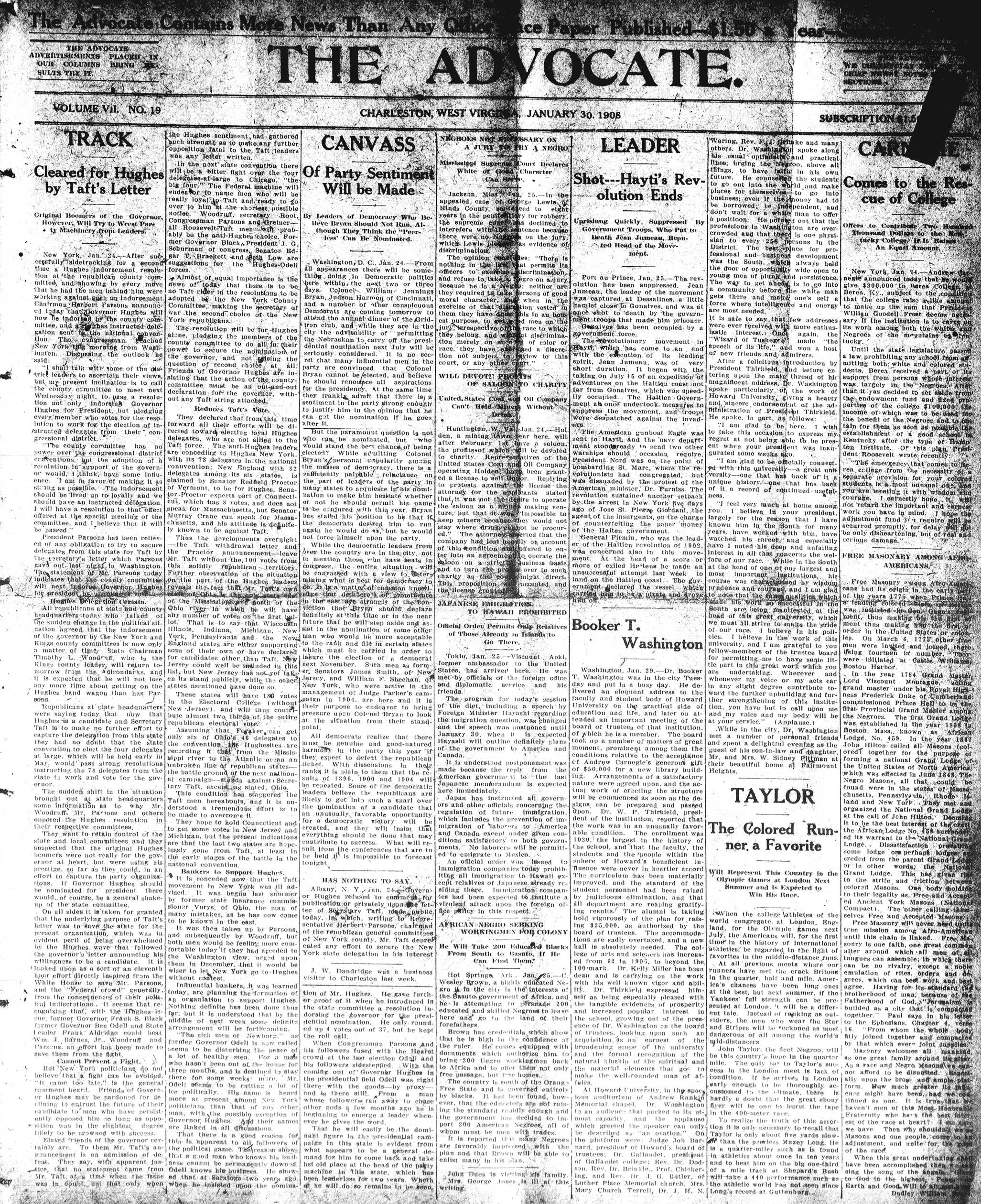
Original Boomers of the Governor, However, Will Try to Wrest Party Machinery from Leaders.
New York, Jan. 24.—After successfully sidetracking for a second time a Hughes indorsement resolution at the republican county committee, and showing by every move that he had the men behind him were working against such an indorsement Chairman Herbert Parsons announced today that Governor Hughes will now be indorated by the county committee, and a Hughes instructed delegation sent to the national convention. The congressman, Laachad New York, this morning from Washington. Discussing the outlook he said:
"I shall talk with some of the district leaders to ascertain their views, but my present inclination is to call the county committee to meet next Wednesday night, to pass a resolution not only indoraths Governor Hughes for President, but pledging every member who votes for the resolution to work for the election of instructed delegates from their congressional district.
"The county committee has no power over the congressional district conversations, but the adoption of a resolution in support of the governor would, I think, have some influence. I am in favor of making it as strong as possible. The indorsement should be lived up to loyally and we should have an instructed delegation. I will have a resolution to that effect offered at the special meeting of the committee, and I believe that it will be passed."
President Parsons has been relieved of any obligation to try to secure delegates from this state for Taft by the secretary's letter which Parsons gave out last night in Washington. The statement of Mr. Parsons today indicates that the county committee will next indorse Governor Hughes for president by unanimous vote.
Hunters Delegation Certain.
All republicans at state and county headquarters today talk of or the sudden change in the political situation agreed, that the indorsement of the governor by the New York and Kings county committees is now only a matter of time. State Chairman Timothy L. Wood-uff, who is the Kings county leader, will return tomorrow from the dirondacks, and it is expected that he will not lose any more time about getting on the Hughes band wagon than has Parsons.
Republicans at state headquarters were saying today that now that Hughes is a candidate and Secretary Taft is to make no further effort to capture the delegation from this state they had no doubt that the state convention to elect the four delegates at large, which will be held early in May, would' pass strong resolutions instructing the 78 delegates from the state to work and vote for the governor.
The sudden shift in the situation brought out at state headquarters some information as to why Mr. Woodruff, Mr. Parsons and others opposed the Hughes resolution in their respective committees. They want to retain control of the state and local committees and they suspected that the original Hughes beoners were not really for the governor at heart, but were using his prestige, so far as they could. In an effort to capture the party organizations. If Governor Hughes should be nominated for president there would, of course, be a general shake-up of the state committee.
On all sides it is taken for granted that the underlying purpose of Taft's letter was to save the state for the present organization, which was in evident peril of being overwhelmed by the Hughes wave that followed the governor's letter announcing his willingness to be a candidate. It is looked upon as a sort of an eleventh hour effort directly inspired from the White House to save Mr. Parsons, and the "Federal crowd" generally, from the consequences of their political indiscretions. It seems that recognition that, with the Hughes issue, former Governor Frank S. Black former Governor Ben Odell and State Leader Frank Aldridge could beat Wm. J. Barnes, Jr., Woodruff and Parsons, an effort has been made to save them from the fight.
Cannot Prevent a Fight.
But New York politician do not believe that a fight can be avoided. "It came too late," is the general comment heard. Friends of Governor or Hughes may be pardoned for declining to entrust the future of their candidate to men who have persistently opposed him so long as opposition was in the slightest, degree likely to be crowned with success.
Elated friends of the governor certainly are. To them Mr. Taft's announcement is an admission of defeat. They say, with apparent justice, that no statement came from Mr. Taft, at a time when the issue was in doubt, but that only when
the Hughes sentiment, had gathered such strength as to make any further opposition fatal to the Taft leaders was any letter written.
In the next state convention there will be a bitter fight over the four delegates at large to Chicago, "the big four." The Federal machine will endeavor to name men who will be really loyal to Taft and ready to go over to him at the shortest possible notice. Woodruff, secretary Root, Congressman Parsons and Greiner—all Roosevelt-Taft men—will probably be the anti-Hughes choice. Former Governor Black, President J. G. Schurman of congress, Senator Edgar T. Brauckett and Beth Low are suggestions for the Hughes-Odell forces.
Almost of equal importance is the news of today that there is to be no Taft rider in the resolutions to be adopted by the New York County Committee, making the secretary of war the second choice of the New York republicans.
The resolution will be for Hughes alone, lodging the members of the county committee to do all in their power to secure the nomination of the governor, and not raising the question of second choice at all. Friends of Governor Hughes are insisting that the action of the county committee must be an out-and-out declaration for the governor, without any Taft string attached.
They declared that from this time forward all their efforts will be directed toward electing loyal Hughes delegates, who are not allied to the Taft force. The anti-Hughes leaders are conceding to Hughes New York, with its 78 delegates in the national convention; New England with 82 delegates among its six states, is claimed by Senator Rodfield Proctor of Vermont, to be for Hughes. Senator-Proctor expects part of Connecticut, which has 8 votes, and does not speak for Massachusetts, but Senator Murray Crane can speak for Massachusetts, and his attitude is definitely known to be against Taft.
Thus the developments overnight—the Taft withdrawal letter and the Proctor announcement—leave Mr. Taft without the, 100 votes from this solidly republican territory. Further observation of the situation on the part of the Hughes leaders reveals the fact that Mr. Taft's own statement of Ohio is the only vote that of the Mississippi and north of the Ohio River. In which he will have any number of votes on the first ballot. That is to say that Wisconsin Illinois, Indiana, Michigan, New York, Pennsylvania and the New England states are either supporting sons of their own or have declared for candidates other than Taft. New Jersey could well be included in this list, but New Jersey has not yet taken its stand publicly, while the other states mentioned have done so. These states will have 180 votes in the Electoral College (without New Jersey), and will thus contribute almost two thirds of the entire republican electoral vote.
Assuming that Forgker can get only six of Ohio's 46 delegates to the convention, the Hughesites are recording it that from the Mississippi river to the Atlantic ocean an unbroken line of republican states—the battle ground of the next mallion—a campaign—stands against Secretary Taft, excepting stated, Ohio. This condition has staggered the Taft men hereabouts, and it is understood a tremendous effort is to be made to overcome it. They hope to hold Connecticut and to get some votes in New Jersey and Michigan, but the present indications are that the last two states are hopelessly gone from Taft, at least in the early stages of the battle in the national convention.
Bankers to Support Hughes.
It is conceded now that the Taft movement in New York was ill advised. It was begun last summer by former state insurance commissioner Vorys, of Ohio, the man of many mistakes, as he has now come to be known in the east.
It was then taken up by Parsons, and subsequently by Woodruff, but both men would be feeling more comfortable today if they had acceded to the Washington view, urged upon them in December, that it would be wiser to let New York go to Hughes without contest.
Influential bankers, it was learned today, are planning the formation of an organization to support Hughes. Nothing definite has been done thus far, but it is understood that by the middle of next week some definite arrangement will be forthcoming.
"The sick men of Newburg," as former Governor Odell is now called seems to be disturbing the peace of a lot of healthy men. For a man who hasn't been out of the house for three months, and is destined to stay there for some weeks, more. Mr. Odell seems to be cutting a lot of ice politically. His name is heard more at present among New York politicians than that of any other man, with the possible exception of Governor Hughes. And their names are linked in all discussions.
That there is a good reason for this is apparent to all followers of the political game. The reason shows that a good man who knows his business cannot be permanently downed. Odell knows his business. He showed that at Saratoga two years ago, when he insisted upon the nomina-
Washington, D. C., Jan. 24. —From all appearances there will be something doing in Democratic politics here within the next two or three days. Colonel William Jennings Bryan, Judson Harmon of Cincinnati, and a number of other conspicuous Democrats are coming tomorrow to attend the annual dinner of the Gridron club, and while they are in the city the advisability of permitting the Nebraskan to carry off the presidential nomination next July will be seriously considered. It is no secret that many influential men in the party are convinced that Colonel Bryan cannot be elected, and believe he should renounce all aspirations for the presidency. At the same time they frankly admit that there is a sentiment in the party strong enough to justify him in the opinion that he can get the nomination if he goes after it.
But the paramount question is not who can be nominated, but who would stand the best chance of being elected? While acquitting Colonel Bryan's personal popularity among the masses of democracy, there is a sufficiently palpable reluctance on the part of leaders of the party in many states to acquiesce in his nomination to make him hesitate whether or not he should permit his name to be confined with this year. Bryan has stated his position to be that if the democrats desired him to run again he would do so, but he would not force himself upon the party.
While the democratic leaders from over the country are in the city, not to mention those who have seats in congress, the entire situation will be canvassed with a view to determine what is best for democracy to do. It is a matter of common knowledge that democracy is prone to the east and strongly of the concession that Bryan should declare definitely at this time or in the near future that he will step aside and assist in the nomination of some other man who would be more acceptable to the rank and file in certain states which must be carried in order to insure the election of a democrat next November. Such men as former, Senators James Smith, of New Jersey, and William F. Sheehan, of New York, who were active in the management of Judge Parker's campaign in 1904, are here and it is their purpose to endeavor to bring pressure upon Colenel Bryan to look at the situation from their standpoint.
All democratics realize that there must be genuine and good-natured harmony in the party this year if they expect to defeat the republican ticket. With dissensions in their ranks it is plain to them that the results of 1896, 1900 and 1904 will be repeated. Some of the democratic leaders believe the republicans are likely to get into such a snarl over the nomination of a candidate that an unusually favorable opportunity for a democratic victory will be created, and they will insist that everything should be done that may contribute to success. What will result from the conferences that are to be held it is impossible to forecast tonight.
Albany, N. Y., Jan. 24. Governor Hughes refused to comment for publication or privately upon the letter of Secretary Taft, made public today. In which, writing to Representative Herbert Parsons, chairman of the republican general committees of New York county, Mr. Taft deprived any effort to secure the New York state delegation in his interest.
J. W. Dandridge was a business visitor to Charleston last week.
tion of Mr. Hughes. He gave further proof of it when he introduced in the state committee a resolution indorsing the governor for the presidential nomination. He only rounded up 4 votes out of 37, but he kept the roll call.
When Congressman Parsons and his followers fused with the Hearst crowd at the last election Odell and his followers sidestepped. With the coming out of Governor Hughes in the presidential field Odell was right there with the goods—by proxy—and is there still. From a man whose followers ran away to chase other gods a few months ago he is beginning to emerge a leader whenever he gives the word.
That he will easily be the dominant figure in the presidential campaign in this state is evident from what appears to be a general demand for him to come back and take his old place at the head of the party machine in this state, which has been leaderless for two years. Whether he will do so remains to be seen.
United, States Cool and Oil Company
Can't Hold Milken Without
Drink.
Huntington, W. Va., Jan. 24.—Hol den, a mining town near here, will after February last have a saloon, the profits of which will be devoted to charity. Reprints of the United States Compt. and Oil Company operating Holden, have been granted a license to sell liquor. Replying to protests against the license the attorney for the applicants stated that, it was not the desire to operate the saloon as a money making venture, but that it was, impossible to keep miners because they would not stay where drinks cannot be procured." The attorney asserted that the company had lost heavily on account of this condition and offered to enter into an agreement to operate the saloon on a strictly business basis and to turn the prospect to such charity as the company might direct. This proposition was accepted and the license granted.
JAFANESE EMIGRATION
TO HAWAII PROHIBITED
Tokio, Jan. 25. -Viscount, Aokl, former ambassador to the United States, has arrived here. He was met by officials of the foreign office and diplomatic service and his friends.
The program for today's session of the diet, including a speech by Foreign Minister Hayashi regarding the immigration question, was changed and the speech was postponed until January 30, when it is expected Hayashi will outline definitively plans of the government to America and Canada.
It is understood postponement was made because the reply from the American government to the last Japanese memorandum is expected here immediately.
Japan has instructed all governors and other officials concerning the regulation of future immigration, which includes the prevention of immigration of laborers to America and Canada except under given conditions satisfactory to both governments. No laborers will be permitted to emigrate to Mexico.
An official order was issued to immigration companies today prohibiting all immigration to Hawaii except relatives of Japanese already residing there. Immigration companies had been expected to institute a virulent attack upon the foreign office policy in this respect.
AFRICAN-NEGRO SERKING
WORKINGMEN FOR COLONY
He Will Take 200 Educated Blacks From South to Usafu, If He Can Find Them.
Hot Springs, Ark. Jan. 25.—C. Wesley Brown, a highly educated Negro is in the city in the interests of the Basuto government of Africa, and he is attempting to persuade 200 educated and skilled Negroes to leave here and go to the land of their forefathers.
Brown has credentials which show that he is high in the confidence of the ruler. He comes equipped with documents which authorize him to bring 200 Uzegro workingman back to Africa and to offer them not only free passage, but free homes.
The country is south of the Oranges. Free State and is governed entirely by blacks. It has been found, however, that the educators are not raising the standard readily enough and the government has decided to import 200 American Negroes, all of whom must be men with trades. It is reported that many Negroes are favorably impressed, with the plan and that Brown will be able to enlist many in his plan.
Port au Prince, Jan. 25.—The revolution has been suppressed. Jean Jumeau, the leader of the movement was captured at Dessalines, a little hamlet close to Gonalives, and was at once shot to death by the government troops that made him prisoner. Gonalives has been occupied by a government force. The revolutionary movement in Maytia, which has come to an end with the execution of its leading spirit, Jean Jumeau, was of very short duration. It began with the taking on July 15 of an expedition of adventures on the Haitian coast not far from Gonalives, which was speedily occupied. The Haitian Government at once undertook measures to suppress the movement, and troops were despatched against the invaders.
The American gunboat Eagle was sent to Hayt, and the navy department stood ready to send two other warships should occasion require. President Nord was on the point of bombarding St. Marc, where the revolutionists had congregated, but was dissuaded by the protest of the American minister, Dr. Furniss. The revolution sustained another setback by the arrest in New York five days ago of Jose St. Pierre Globdan, the agent of the insurgents, on the charge of counterreiting the paper money of the Halten government.
General Flemin, who was the leader of the Halten revolution of 1902, was concerned also in this movement. At the head of a score or more of exiled Heftens he made an unsuccessful attempt last week to land on the Halten coast. The government declared the vessel which sailed near his pirate and drove him on.
Washington, Jan. 29.—Dr. Booker T. Washington was in the city 'tuesday and put in a busy day. He delivered an eloquent address to the faculty and student body of Howard University on the practical side of education and life, and later on attended an important meeting of the board of trustees of that institution, of which he is a member. The board took up a number of matters of great moment, prominent among them the conditions relative to the acceptance of Andrew Carnegie's generous gift of $50,000 for a new library building. Arrangements of a satisfactory nature were agreed upon, and the actual work of erecting the structure will be commenced as soon as the designs, can be prepared and passed upon. Dr. W. P. Thirkield, president of the institution, reported that the work was in an unusually favorable condition. The enrollment was 1020, the largest in the history of the school, and that the faculty, the students and the 'people within the sphere of Howard's beneficial influence were never in heartier accord. The curriculum has been materially improved, and the standard of the student personnel had been raised by judicious elimination, and that all department are reaping gratifying results'. The alumni is taking hold vigorously of the plan for raising $25,000, as authorized by the board of trustees. The accommodations are gaily overtaxed, and a new hall is absolutely needed. The college of arts and sciences has increased from 62 in 1905, to beyond the 100-mark. Dr. Kelly Miller has been dean and is carrying on the work with his well known vigor and ability. Dr. Thirkield expressed himself as being especially pleased with the tangible evidences of prosperity and increased popular interest in the school, growing out of the presence of Dr. Washington on the board of trustees, looking upon such an acquisition as an earnest of the broadening scope of the university and the formal recognition of the natural kinship of the spiritual and the material elements that go to make the well-rounded man of affairs.
At Howard University, in the spacious auditorium of Andrew Rankin Memorial chapel. Dr. Washington to an audience that packed to its utmost capacity, and the applause which greeted the speaker can only be described as "an ovation." On the platform were: Judge Job Barnard, president of Howard's board of trustees; Dr. Gallaudet, president of Gallaudet college; Rev. Dr. Dodson, Rev. Dr. Brinkle, Prof. Chickering, and Rev. Dr. J. G. Batter, of Luther Place Memorial church, Mrs. Mary Church Torrell, Dr. J. H. N.
Waring, Rev. F.J. Grituke and many others. Dr. Washington spoke along his usual optimistic and practical lines, urging the Norcoo, above all things, to have taken in his own future. He counseld in his own place to go out into the world, and make places for themselves—to go into business, even if the money had to be borrowed, be independent, and don't wait for a white man to offer a position. He pointed out that the professions in Washington are overcrowded and that there is one physician to every 258 Persons in the District. The best place for professional and business development was the South, which always held the door of opportunity wide open to young men of plums and persistence. The way to get ahead is to go into a community before the white man gets there and make one's self a force where intelligence and energy are most needed.
It is safe to say that few addresses were ever received with more enthusiastic interest. Once again, the "Wizard of Tuskegee" made "the speech of its Life," and won a host of new friends and admirers.
After a folliculous introduction by President Thirkield, and before entering upon the main thread of his magnificent address, Dr. Washington spoke particularly of the work of Howard University, giving a hearty and sincere, endorsement of the administration of President Thirkield.
He spoke, in part, as follows:
"I am glad to be here. I wish to take this occasion to express my regret at not being able to be present when your president was inaugurated some weeks ago.
"I am glad to be officially connected with this university—a great university—one that has back of it a unique history—one that has back of it a record of continued usefulness.
"I feel very much at home among you. I believe in your president, largely for the reason that I have known him in the South for many years, have worked with him, have watched his career, and especially have I noted his deep and unfailing interest in all that concerns the welfare of our race. While in the South at the head of one of our largest and most important institutions, his course was characterized by wisdom prudence and courage, and I am glad to note that the same qualities which made his work so successful in the South are being manifested at the head of this great university, which we must all strive to make the pride of our race. I believe in his policies. I believe in the work of this university, and I am grateful to you fellow-members of the trustee board for permitting me to have some little part in this great work which you are undertaking. Wherever and whenever my voice or my acts car in any slight degree contribute toward the further upbuilding and further strengthening of this institution, you have but to call upon me and my voice and my body will be at your service." (Applause.)
While in the city, Dr. Washington met a number of personal friends and spent a delightful evening as the guest of his son-in-law and daughter, Mr. and Mrs. W. Sidney Pittman at their beautiful home at Fairmount Heights.
TAYLOR The Colored Runner. a Favorite
Will Represent This Country in the Olympic Games at London Next Summer and Is Expected to Win His Race.
When the college athletes of the world congregate at London, England, for the Olympic games next July, the Americans will, for the first time in the history of International athleties, be regarded in the light of favorites in the middle-distance runs. At all previous meets where our runners have met the crack Britons in the quarter, half and mile, America's chances have been long ones at the best, but next summer, if the Yankees' full strength can be presented at London, it will be a different tale. Instead of raking as outsiders, the men who wear the Star and Stripes will be reckoned as most dangerous of all among the world's mild-distancers.
John Taylor, the fleet Negroon, will be this country's hope in the quarter mile. The only hat to Taylor's success in the London meet is lack of condition. If he arrives in London early enough to be thoroughly accustomed to the climate, there is hardly a doubt that the great ebony flyer will be one to burst the tape in the 400-meter race. To realize the truth of this assertion it is only necessary to recall that Taylor is only about five yards slower than the pearless Maxey Long. He is a quarter-miler such as is found in athletics about once in ten years and to beat him on the big one-third of a mile track at Shepard's Bush will take a 440 performance such as the athletic world has not seen since Long's record at Guttenburg.
New York, Jan. 24. — Andrew the nagle announced today that he would give $300,000 to Beren College in Beren, Ky., subject to the condition that the college raise a like amount to make up the sum that President Willian Goodell. Frost does necessary if the institution is to carry on its work among both the whites and Negroes of the mountains on Kentucky.
Until the state legislature passed a law prohibiting any school from admitting both white and colored students, Borea received a point of its support from persons whose interest was largely in the Negroes. After that it was decided to set aside from the endowment fund and fixed properties of the college $100,000, the income of which was to be used for the benefit of the Negroes and to be taken for them as soon as possible in the establishment of a good school in Kentucky after the type of Hamilton Institute. Of this plan President Roosevelt wrote recently:
"The emergency that comes to therea college from the necessity of a separate provision for your colored students is a most unusual one, and you are meeting it with wisdom and courage. I earnestly hope, it will not retard the important and proper work you have in mind. I hope the adjustment fund you require will be secured promptly, for delay will not be only disheartening, but of real and serious damage."
FREE MASONARY AMONG AFRICAN AMERICANS.
Free Masonry wrong Afro-Americans had its origin in the early half of the years 1775 when Prince Hall, leading colored abolition, was initiated in Gen. George Washington, thus making his the first moment thus making him the first order in the United States or colonies. On March 6, 1775 other free men were invited and joined, these being fourteen in number. They were initiated at Castle William, Boston Harbor.
In the year 1784 Grand Master Lord Viscount Montague, adding grand master under his Royal Highness Frederick Duke of Cumberland, commissioned Prince Hall to be the first Provincial Grand Master among the Negroes. The first Grand Lodge was established in the year 1808 in Boston, Mass., known as African Lodge, No. 459. In the year 1847 John Hilton called all Masons (colored) together for the purpose of forming a national Grand Lodge of the United States of North America, which was effected in June 1848. The Negro Masons, all that could be found were in the states of Massachusetts, Pennsylvania, Rhode Island and New York. They met and organized the National Grand Lodge at the call of John Hilton. Dooming it to be the best interest of the craft the African Lodge No. 459 surpassed its warrant to the National Grass Lodge. Dissatisfaction prevails some lodge or perhaps lodges credited from the parent Grand Lodge or in other words, the National Grand Lodge. This has given rise to the strife and friction between colored Masons. One body mobilized to their legality as, Free and Accessed Ancient York Masons (National Compact). The other calling themselves Free and Accessed Masons.
Free Masonry will never need to prove mission among Afro-American until this chain is linked. Free Masonry is one faith, one great common alter around which all men of all tongues can assemble; in which there can be no rivalry, except a noble emulation of rites, orders and degrees, which can best work and best agree. Having for its standard the brotherhood of man, because of the Fatherhood of God, "Perseal is built as a city that is compacted together." Paul says in his letter to the Ephesians, Chapter 4, verse 18. "From whom the whole body fully joined together and compacted by that which ever joint suppiles."
Masonry welcomes all mankind, as one great family around the alter. As a race and Negro Masonry we cannot afford to be dissuited. Basically upon the brose and simple platform. How much greater its influence might have been, had we continued as one. It is true, that we haven't men of this Most Honourable Fraternity who have the best interest of the race at heart? I am sure we have. Then why should we we Masonry and one people come to an adjustment, and unite for the sake of the race?
When this great undertaking shall have been accomplished then a song the song of the angels. Goes to God in the highest. Power Earth and Good Will to affirm it. Dudley William
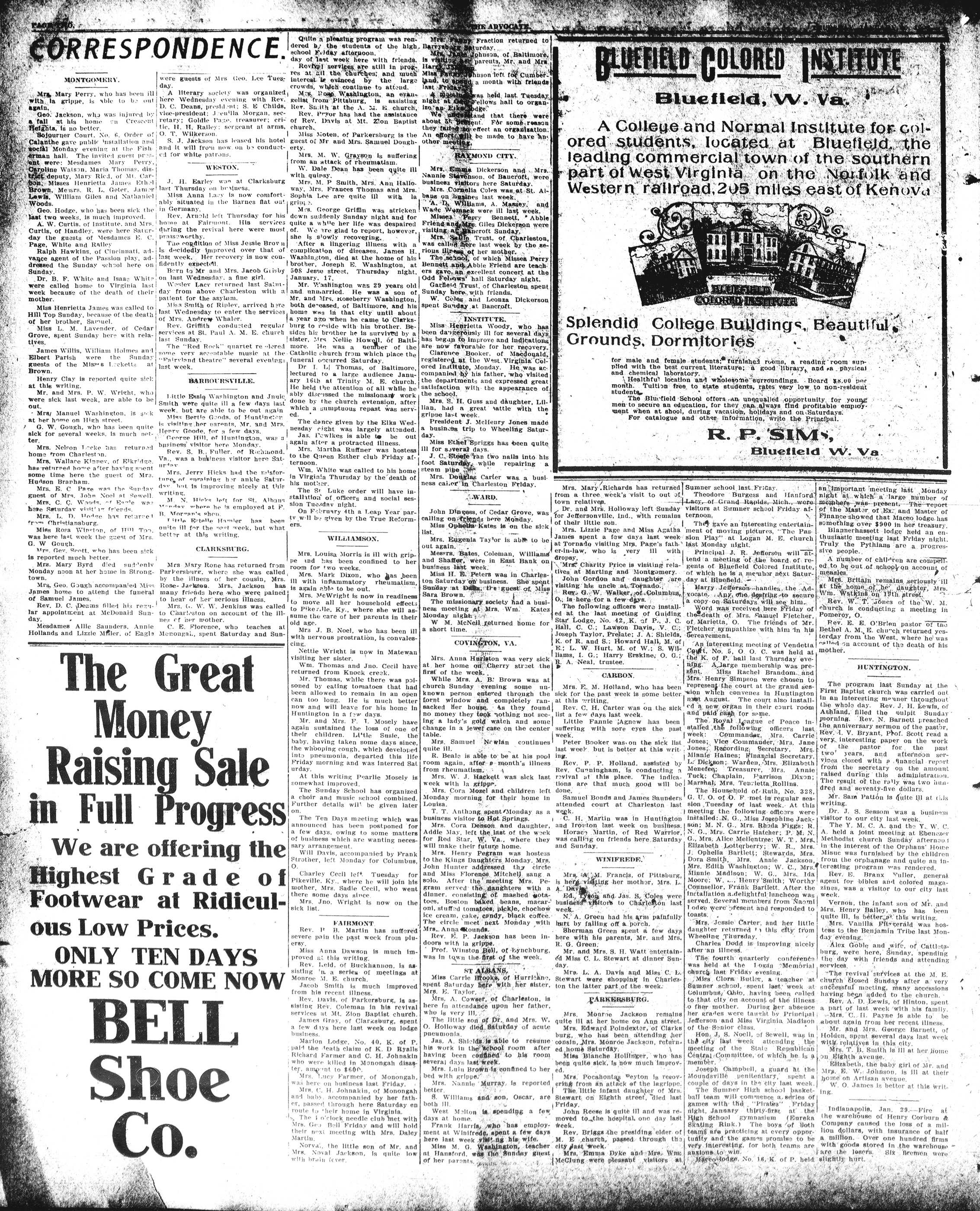
CORRESPONDENCE
The Great Money Raising Sale in Full Progress
We are offering the Highest Grade of Footwear at Ridiculous Low Prices.
ONLY TEN DAYS MORE SO COME NOW
BELL
Shoe
Co.
MONTGOMERY
Mr. Mary Perry, who has been ill with la gripe, is able to be out again.
Geo. Jackson, who was injured by a fall at his home on Crescent Heights, is no better.
Sojourner Court. No. 6. Order of Calanthe gave public installation and social Monday evening at the Fisherman hall. The invited guest present were: Mesdames Mary Perry, Caroline Watson, Maria Thomas, district deputy, Mary Ried, of Mt. Carbon, Misses Henrietta James Ethel Brown, Messrs. R. L. Geter, James Lewis, William Giles and Nathaniel Woods.
Geo. Hodge, who has been sick the last two weeks, is much improved.
A. W. Curtis, of Institute, and Mrs. Curtis, of Handley, were here Saturday the guests of Mesdames E. C. Page, White and Railey.
Ralph Hawkins, of Cincinnati, advance agent of the Passion play, addressed the Sunday school here on Sunday. Dr. B. F. White and Isaac White were called home to Virginia last week because of the death of their mother.
Miss L. M. Lavender, of Cedar Grove, spent Sunday here with relatives.
James Willis, William Holmes and Elbert Parish were the Sunday guests of the Miss's Locketts at Brown.
Henry Clay is reported quite sick at this writing.
Mr. and Mrs. P. W. Wright, who were sick last week, are able to be out.
Mrs. Manuel Washington, is sick at her home on High street.
G. W. Gough, who has been quite sick for several weeks, is much notter.
Mrs. Nelson Locke has returned home from Charleston.
Mrs. Wallace Kinney, of Elkridge, has returned home after having spent some time here the guest of Mrs. Hudson Bramph.
Mrs. E. C. Page was the Sunday guest of Mrs. John Noel at Sewell.
Mrs. C. C. Woods, of Eagle was here Saturday visiting friends.
Mrs. L. D. Hodge has returned from Christiansburg.
Miss Rosa Winston, of Hill Top, was here last week the guest of Mrs. G. W Gough.
Mrs. Gev. Scott, who has been sick is reported much better.
Mrs. Mary Byrd died suddenly Monday noat at her home in Strong-town.
Mrs. Geo. Gough accompanied Miss James home to attend the funeral of Samuel James.
Rev. D. C. Deams filled his regular appointment at McDonald Sunday.
Meadames Allie Saunders, Annie Hollands and Lizzie Muller, of Eagle
were guests of Mrs Geo, Lee Tuesday.
A literary society was organized here Wednesday evening with Rev. D. C. Deans, president; S. E Childa, vice-president; J. Jenilla Morgan, secretary; Goldie Page, treasurer; critic, H. H. Ralley; sergeant at arms, O. T. Wilkerson.
S. J. Jackson has leased his hotel and it will from now on be conducted for white patrons.
WESTON.
J. H. Earley was at Clarksburg last Thursday on bradness.
Miss Anna Lacy is now comfortably situated in the Barnes flat out in Germany.
Rev. Arnold left Thursday for his home at Fairmont. His services during the revival here were most praiseworthy.
The condition of Miss Jessie Brown is decidedly improved over that of last week. Her recovery is now confidently expected.
Born to Mr and Mrs. Jacob Grisby on last Wednesday, a fine girl.
Wesley Lacy returned last Saturday from above Charleston with a patient for the asylum.
Miss Smith of Ripley, arrived here last Wednesday to enter the services of Mrs. Andrew Whaler.
Rev. Griffith conducted regular services at St. Paul A. M. E. church last Sunday.
The "Red Rock" quartet re-released some very accountable music at the "Fairyland theatre" several events last week.
BARBOURSVILLE.
Little Essiq Washington and Juulie Smith were quite ill a few days last week, but are able to be out again. Miss Bertie Goods, of Huntington is visiting her parents, Mr. and Mrs. Henry Goode, for a few days. George Hill, of Huntington, was a business visitor here Monday.
Mrs. Jerry Hicks had the耐fortune of spraining her ankle Saturday but is improving nicely at this writing.
M. N. Hicks left for St. Albans Monday where he is employed at F. B. Morgan's shop.
Little Estelle Hamler has been onite ill for the next week, but what better at this writing.
CLARKSBURG.
Mrs. Mary Rone has returned from Parkersburg, where she was called by the illness of her cousin, Mrs. Rose-Jackson. Mrs. Jackson has many friends here who were pained to hear of her serious illness. Mrs. G. W. W. Jenkins was called to Charleston on account of the illness of her mother. C. E. Florence, who teaches at Monongahela, spent Saturday and Sun-
Quite a pleasing program was rendered by the students of the high school Friday afternoon.
day of last week here with friends. Revful services are still in progress at all the churches; and much intercat is enforced by the large crowds, which continue to attend.
Rev. Pryor has had the assistance of Rev. Davis at Mt. Zion Baptist church. Miss Noten, of Parkersburg is the guest of Mr. and Mrs. Samuel Dougherty.
W. Dale Dean has been quite ill with quinies.
Mrs. M. P Smith, Mrs. Ann Halloway, Mrs. Frances Thomas and Mrs. Sophia Lee are quite ill with la gripe.
Mrs. George Griffin was stricken down suddenly Sunday night and for quite a while her life was despaired of. We are glad to report, however, she is slowly recovering.
After a lingering illness with a complication of diseases, James H. Washington, died at the home of his brother, Joseph E. Washington, at 508 Jesse street, Thursday night, January, 17.
Mr. Washington was 29 years old and unmarried. He was a son of Mr. and Mrs. roseberry Washington, both deceased, of Baltimore, and his home was in that city until about a year ago when he came to Clarksville to reside with his brother. Besides his brother he is survived by a sister, Mrs. Nellie Howell, of Baltimore. He was a member of the Catholic church from which place the funeral occurred Saturday. Dr. L. L| Thomas, of Baltimore, lectured to a large audience January 16th at Trinity M. E. church. He held the attention of all while he ably discussed the missionary work done by the church extension, after which a sumptuous repast was served. The dance given by the Elks Wednesday eight was largely attended. Jas. Pewlkes is able to be out again after a protracted illness.
Mrs. Martha Ruffner was hostess to the Queen Esther club Friday afternoon.
Wm. White was called to his home in Virginia Thursday by the death of his mother.
The St Luke order will have installation of officers and social session Tuesday night.
On February 4th a Leap Year party will be given by the True Reformers.
WILLIAMSON.
Mrs. Louisa Morris is ill with grippie and has been confined to her room for two weeks.
Mrs. Mark Dixon, who has been ill with inflammatory rheumatism, is again able to be out.
Mrs. McWright is now in readiness to move all her household effects to Pikeville, Ky., where she will assume the care of her parents in their old age.
Mrs J. B. Noel, who has been ill with nervous prostration, is convalescing.
Nettle Wright is now in Matewan visiting her sister.
Wm. Thomas and Jno. Cecil have returned from Knock creek.
Mr. Thomas, while there was poisoned by eating tomatoes that had been allowed to remain in an open can too long. He is much better now and will leave for his home in Huntington in a few days.
Mr. and Mrs. F. I. Mosely have again sustained the loss of one of their children. Little Susie, the baby, having taken some days since, the whooping cough, which developed into pneumonia, departed this life Friday morning and was interred Sat urday.
At this writing Pearlie Mosely is somewhat improved.
The Sunday School has organized a choir and music school combined. Further details will be given later on.
The Ten Days meeting which was announced has been postponed for a few days, owing to some matters of business which are wanting necessary arrangement.
Will Davis, accompanied by Frank Strrother, left Monday for Columbus, O.
Charley Cecil lef* Tuesday for Pikville, Ky.. where he will join his mother, Mrs. Sadie Cecil, who went there some days since Mrs. Jno. Wright is now on the sick list.
Rev. P. B. Martin has suffered severe pain the past week from plueray.
Miss Anna Dawson is much improved at this writing.
Rev. Leid, of Buckhannon, is assisting in a series of meetings at Monroe M. E. church.
Jacob Smith is much improved from his recent illness.
Rev. Davis, of Parkersburg, is assisting Rev. Coleman in his revival services at Mt. Zion Baptist church.
James Gray, of Clarkesburg, spent a few days here last week on lodge business.
Marlon Lodge, No. 40, K. of P. paid the death claim of K. D Ryallis Richard Farmer and C. H. Johnakin who were killed in Monongah disaster, amount to $600.
Mrs. Lucy Farmer, of Monongah, was here on business last Friday. Mrs. C. H. Johnakin, of Monongah and baby, accompanied by her father, passed through here Saturday en route to their home in Virginia. The 1 o'clock needle club met with Mrs. Geo. Boll Friday and will hold their next meeting with Mrs. Daley Martin. Norval, the little son of Mr. and Mrs. Naval Jackson, is quite low with brain fever.
Mrs. Pammy Fraction returned to Barrysburg Saturday.
A meeting was held last Tuesday night at Gay Fellows hall to organize an Elkridge. We understand that there were about 51 present. For some reason they failed to effect an organization. An effort will be made to have another meeting.
RAYMOND CITY
Mrs. Emma Dickerson and Mrs. Nannie Stevenson, of Bancroft, were business visitors here Saturday.
Mrs. Cormella Coles was at St. Albans on business last week.
A. D. Williams, A. Massey, and Wade Wannack were ill last week.
Misses Perry Bennett, Abbie Friend and Mrs. Giles Dickerson were visiting at Bancroft Sunday.
Mrs. Sallie Trust, of Charleston, was called here last week by the serious illness of her mother.
The school, of which Misses Perry Bennett and Abbie Friend are teachers gave, an excellent concert at the Odd Fellows, hall Saturday night.
W. Cole, and Leonza Dickerson spent Sunday at Bancroft.
INSTITUTE
Miss Henrietta Woody, who has been dangerously ill for several days has begun to improve and indications are now favorable for her recovery. Clarence Booker, of Macdonald, registered at the West Virginia Colored Institute, Monday. He was accompanied by his father, who visited the departments and expressed great satisfaction with the appearance of the school. Mrs. S. H. Guss and daughter, Lillian, had a great battle with the grippe last week. President J. McHenry Jones made a business trip to Wheeling Saturday. Miss Ethel Springgs has been quite ill for several days. J. C. Stoele ran two nails into his foot Saturday, while repairing a steam pipe. Mrs. Douglas Carter was a business caer in Charleston Friday.
WARD.
John Dingass, of Cedar Grove, was calling on friends here Monday.
Miss Ophelia Kates is on the sick list.
Mrs. Eugenia Taylor is able to be out again.
Messrs. Bates, Coleman, Williams and Shaffer, were in East Bank on business last week.
Miss H. E. Peters was in Charleston Saturday on business. She spent Sunday at Dale, the guest of Miss Sara Brown.
The missionary society had a business meeting at Mrs. Wm. Kates Monday night.
W M. McNeil returned home for a short time.
COVINGTON, VA.
Mrs. Anna Hurston was very sick at her home on Cherry street the first of the week.
While Mrs. A. B. Brown was at church Sunday evening some unknown person entered through the forst window and completely ransacked her house. As they found no money they took nothing not seeing a lady's gold watch and some change in a jewel case on the center table.
Mrs. Samuel Newlan continues quite ill.
R. Beale is able to be at his pool room again, after a month's illness from rheumatism.
Mrs. W. J. Hackett was sick last week with la gripp.
Mrs. Cora Mozel and children left Monday morning for their home in Louisa.
T. T. Anthong spent Monday as a business visitor to Hot Springs.
Mrs. Cora Denson and daughter,
Addie May, left the last of the week
for Red Star, W. Va., where they
will make their future home.
Mrs. Henry Pegram was hostess
to the Kings Daughters Monday. Mrs.
John Hunter addressed the circle
and Miss Florence Mitchell, sang a
solo. After the meeting Mrs. Pegram
served the naughters with a
dinner, consisting of mashed potatoes. Boston baked beans, macaroni, stuffed tomatoes, pickle, chochow ice cream, cake, candy, black coffee. The circle meet next Monday with Mrs. Anna Bounds.
Rev. E. P. Jackson has been indoors with la gripe.
Prof. Winston Bell, of Lynchburg,
was in town the first of the week.
ST ALBANS
Miss Carrie Brooks, of Hurricane, spent Saturday here with her sister, Mrs. E. Taylor.
Mrs. A. Cowser, of Charleston, is here in attendance upon her father, who is very ill.
The little son of Dr. and Mrs. W. O. Holloway died Saturday of acute pneumonia.
Jas, A. Shields is able to resume his work in the school room after having been confined to his room several days last week.
Mrs. Lulu Brown is confined to her bed with gripe.
Mrs. Nannie Murray is reported better.
S. Williams and son, Oscar, are both ill.
West Melton is spending a few days at home.
Frank Harris, who has employment at Winifreds, spent a few days here last week visiting his wife.
Miss M. G. Washington, teacher at Hansford, was the Sunday guest of her parents.
BLUEFIELD COLORED INSTITUTE
A College and Normal Institute for colored students, located at Bluefield, the leading commercial town of the southern part of West Virginia on the Norfolk and Western railroad,205 miles east of Kenova
BLUFFIELD
COLORED INSTITUTE
Splendid College Buildings, Beautiful Grounds, Dormitories
for male and female students; furnished rooms, a reading room supplied with the best current literature; a good library, and a physical and chemical laboratory.
Healthful location and wholesome surroundings. Board $8.00 per month. Tuition free to state students, rates very low to non-resident students.
The Bluefield School offers an unequalled opportunity for young men to secure an education, for they can always find profitable employment when at school, during vacation, holidays and on Saturdays.
For catalogue and other information, write the Princethal.
Mrs. Mary Richards has returned from a three week's visit to out of town relatives.
Dr. and Mrs. Holloway left Sunday for Jeffersonville, Ind., with remains of their little son.
Mrs. Lizzie Page and Miss Agatha James spent a few days last week at Tornado visiting Mrs. Page's father-in-law, who is very ill with dropsy.
Mrs. Charity Price is visiting relatives at Marting and Montgomery.
John Gordon and daughter are visiting his uncle at Tornado.
Reg. G. W. Walker, of Columbus, O. is here for a few days.
The following officers were installed at the last meeting of Guiding Star Lodge, No. 42, K. of P., J. C. Hall, C. C.; Lawson Davis, V. C.; Joseph Taylor, Prelate; J. A. Shields, K. of R. and S.; Howard Hall, M. of E.; L. W. Hurt, M. of W.; S. Williams, I. G.; Harry Erskine; O. G.; R. A. Neal, trustee.
Mrs. P. M. Holland, who has been sick for the past week is some better at this writing.
Rev. C. H. Carter was on the sick list a few days last week.
Little Fannie Agnew has been suffering with sore eyes the past week.
Peter Booker was on the sick list last week, but is better at this writing.
Rev. P. P. Holland, assisted by Rev. Cunningham, is conducting a revival at this place. The indications are that much good will be done.
Samuel Bonds and James Saunders attended court at Charleston last week.
C. H. Martin was in Huntington and Irionton last week on business.
Horace Martin, of Red Warrior, was calling on friends here Saturday and Sunday.
WINIFREDE
Mrs. A. M. Francis, of Pittsburg,
is here visiting her mother, Mrs. L.
A. Davi.
Ed. Tyson and Jas. S. Coles were
business visitors to Charleston last
week.
N. A. Green had his arm painfully
hurt by falling off a porch.
Sherman Green spent a few days
here with his parents, Mr. and Mrs.
R. G. Green.
Mr. and Mrs. S. H. Watt entertained
Miss C. L. Stewart at dinner Sunday.
Mrs. L. A. Davis and Miss C. L.
Stewart were shopping in Charleston
the latter part of the week.
PARKERSBURG.
Mrs. Monroe Jackson remains quite ill at her home on Ann street.
Mrs. Edward Poindexter, of Clarksburg, who has been attending her consin. Mrs. Monroe Jackson, returned home Saturday.
Miss Blanche Hollinger, who has been quite sick, is now much improved.
Mrs. Pocahontas Peyton is recovering from an attack of the lagrype. The little infant daughter of Mrs. Stewart on Eighth street, died last Friday.
John Reese is quite ill and was removed to the hospital, one day last week.
Mrs. Emma Dyke and Mrs. Wm. McClung were pleasant visitors at
Bluefield W. Va
Summer school last Friday.
Theodore Burgess and Hanford Lacy, of Grand Rapids, Mich., were visitors at Summer school Friday afternoon.
The gave an interesting entertainment of moving pictures, "The Passion Play" at Logan M. E. church last Monday night.
Principal J. R. Jefferson will attend a meeting of the board of regents of Bluefield Colored Institute, of which he is a member next Saturday at Bluefield.
Harry Jefferson handles the Advocate. Any, the desiring to secure a copy on Saturdays will see him.
Word was received here Friday of the death of Mrs. Samuel Fletcher, of Marietta, O. The friends of Mr. Fletcher sympathize with him in his bereavement.
An interesting meeting of Vendetta Court, No. 5, O. O. C. was held at the K. of P. hall last Thursday evening. A large membership was present. Miss Rachel Brandom, and Mrs. Henry Simpson were chosen to represent the court at the grand session which convenes in Huntington next August. The court also installed a new organ in their court room and paid cash for some.
The Royal League of Peace installed the following officers last week: Commander, Mrs. Carrie Jones; Vice Commander, Mrs. Jane Jones; Recording Secretary, Mrs. Minnie Haines; Financial Secretary, L. Dickson; Warden, Mrs. Elizabeth Menefee; Treasurer, Mrs. Annie Tuck; Chaplain, Harrison Dixon; Marshal, Mrs. Tenniella Rollins.
The Household of Ruth, No. 328,
G. U. O. of O. F. met in regular session Tuesday of last week. At this meeting the following officers were installed: N. G., Miss Josephine Jackson; M. N. G., Mrs. Rhoda Figgs; R. N. G., Mrs. Carrie Hatcher; P. M. N. G., Mrs. Alice Mellentree; W. T., Mrs. Elizabeth Lotterberry; W. R., Mrs. J. Ophelia Bartlett; Stewards, Mrs. Dora Smith, Mrs. Annie Jackson, Mrs. Edith Washington; W. C., Mrs. Minnie Madison; W. G., Mrs. Ida Moore; W. . . Henry Smith; Worthy Counsellor, Frank Bartlett. After the installation a delightful luncheon was served. Several members from Naomi Lodge were present and responded to toasts.
Mrs. Jessie Carter, and her little daughter returned to this city from Wheeling Thursday.
Charles Dodd is improving nicely after an illness.
The fourth quarterly conference was held at the Logan Memorial church last Friday evening.
Miss Clora Butler, a teacher at Sumner school, spent last week at Columbus, Ohio, having been called to that city on account of the illness of her mother. During her absence her grades were taught by Principal Jefferson and Miss Virginia Madison of the Senior class.
Hon. J. S. Noell, of Sewell, was in the city last week attending the meeting of the State Republican Central Committee, of which he is a member.
Joseph Campbell, a guard at the Moundsville penitentiary, spent a couple of days in the city last week.
The Summer High school basketball team will commence a series of games with the "Pirates" Friday night, January thirty-first, at the High School gymnasium (Enreka Skating Rink.) The boys of both teams are practicing at every opportunity and the games promises to be very interesting, for both teams are anxious to win. Macco lodge, No. 16, K. of P. held
an important meeting last Monday night at which a large number of members was present. The report of the Master of Ex. and Master of Finance showed that Maceo lodge has something over $900 in her treasury.
Blamerhassett lodge held an enthusiastic meeting last Friday night. Truly the Pythians are a progressive people.
A number of children are compelled to be out of school on account of measles.
Mrs. Britain remains seriously ill at the home of her daughter, Mrs. Wm. Watkins on 19th street.
Rev. W. T. Jones of the W. M. church is conducting a meeting in Pomeroy, O.
Rev. E. E. O'Brien pastor of the Bethel A. M. E. church returned yesterday from the West, where he was called on account of the death of his mother.
The program last Sunday at the First Baptist church was carried out in an interesting meander throughout the whole day. Rev. J. H. Lewis, of Ashland, filled the oulpit Sunday morning. Rev. N. Barnett preached the anniversary sermon of the pastor, Rev. I. V. Bryant, Prof. Scott read a very interesting paper on the work of the pastor for the past two years, and afternoon services closed with a financial report from the secretary on the amount raised during this administration. The result of the rally was two hundred and seventy-five dollars.
Mr. Sam Patton is quite ill at this writing.
Dr. J. S. Sesson was a business visitor to our city last week
The Y. M. C. A. and the Y. W. C. A. held a joint meeting at Ebenezer Methodist church Sunday afternoon in the interest of the Orphans' Home Miscue was furnished by the children from the orphanage and quite an interesting program was rendered. Rev. E. Branx Fuller, general agent for bibles and colored magazines, was a visitor to our city last week. Vernon, the infant son of Mr. and Mrs. Henry Bailey, who has been quite ill, is better at this writing. Mrs. Vanilla Flitgerald was hostess to the Benjamin Tribe last Monday evening. Alex Goble and wife of Cattlettsburg, were here, Sunday, spending the day with friends and attending services.
The revival services at the M. E. church closed Sunday after a very successful meeting, many accessions having been added to the church.
Rev. A. D. Lewis, of Hinton, spent a part of last week with his family.
Mrs. C. H. Payne is able to be about again from her recent illness.
Mr. and Mrs. George Barnett, of Holden, spent several days last week with relatives in this city.
Mrs. T. B. Smith is ill at her home on Eighth avenue.
Elizabeth, the baby girl of Mr. and Mrs. E. W. Johnson, is ill at their home on Artisan avenue.
Indianapolis, Jan. 29. -Fire at the warehouse of Henry Corburn & Company caused the loss of a million dollars, with insurance of half a million. Over one hundred firms with goods stored in the warehouse are the losers. Six firemen were slightly hurt.
HUNTINGTON
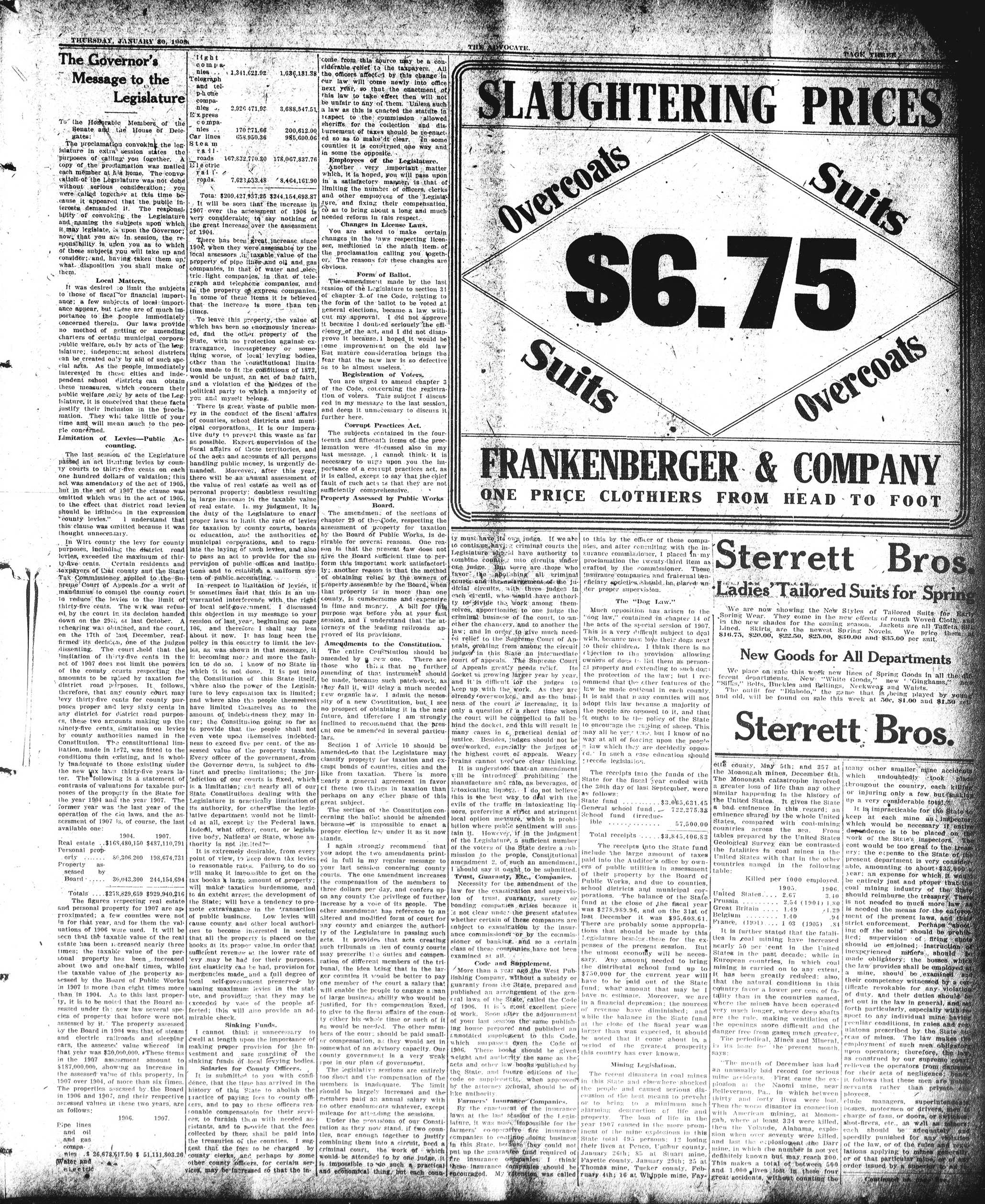
To the Honorable Members of the Senate and the House of Delegates:
The proclamation convoking the legislature in extra session states the purposes of calling you together. A copy of the proclamation was matted each member at his home. The convo-callout of the Legislature was not done without serious consideration; you were called together at this time because it appeared that the public interests demanded it. The responsibility of convoking the Legislature and naming the subjects upon which it may legislate, is upon the Governor; now that you are in session, the responsibility is upon you as to which of these subjects you will take up and consider; and, having taken them up, what disposition you shall make of them.
Local Matters
It was desired to limit the subjects to those of fiscal or financial importance; a few subjects of local importance appear, but these are of much importance to the people immediately concerned therein. Our laws provide no method of getting or amending charters of certain municipal corporal public welfare, only by acts of the legislature; independent school districts can be created only by aid of such special acts. As the people immediately interested in these cities and independent school districts can obtain these measures, which concern their public welfare only by acts of the legislature, it is conceived that these facts justify their inclusion in the proclamation. They will take little of your time and will mean much to the people concerned.
Limitation of Levies—Public Accounting.
The last session of the Legislature passed an act limiting levies by county courts to thirty-five cents on each one hundred dollars of valuation; this act was amendatory of the act of 1905, but in the act of 1907 the clause was omitted which was in the act of 1905, to the effect that district road levies should be included in the expression "county levies." I understand that this clause was omitted because it was thought unnecessary.
In Wirt county the levy for county purposes, including the district road levies, exceeded the maximum of thirty-five cents. Certain residents and taxpayers of that county and the State Tax Commissionary, applied to the Supreme Court of Appeals for a writ of mandamus to compel the county court to reduce the levies to the limit of thirty-five cents. The writ was refused by the court in its decision handed down on the 29th, or last October. A rehearing was obtained, and the court, on the 17th of last December, reaffirmed its decision, one of the judges dissenting. The court held that the limitation of thirty-five cents in the act of 1907 does not limit the powers of the county courts respecting the amounts to be raised by taxation for district road purposes. It follows, therefore, that any county court may levy thirty-five cents for county purposes proper and levy sixty cents in any district for district road purposes, these two amounts making up the ninety-five cents limitation on levies by county authorities named in the Constitution. The constitutional limitation, made in 1872, was fitted to the conditions then existing, and is wholly inadequate to those existing under the new tax laws thirty-five years later. The following is a statement of contrasts of valuations for taxable purposes of the property in the State for the year 1904 and the year 1907. The former year was the last year of the operation of the city laws, and the assessment of 1907 is, of course, the last available one:
Totals ... $278,829,659 $929,940,216
The figures respecting real estate and personal property for 1907 are approximated; a few counties were not in for that year, and for them the valuations of 1906 were used. It will be seen that the taxable value of the real estate has been increased nearly three times; the taxable value of the personal property has been increased about two and one-half times, while the taxable value of the property assessed by the Board of Public Works in 1907 is more than eight times more than in 1904. As to this last property, it is to be noted that the Board assessed under the new law several species of property that before were not assessed by it. The property assessed by the Board in 1904 was that of steam and electric railroads and sleeping cars, the assessed value whereof in that year was $30,000,000. These items in the 1907 assessment amount to $187,000,000, showing an increase in the assessed value of this property, in 1907 over 1904, of more than six times. The properties assessed by the Board in 1906 and 1907, and their respective assessed values in these two years, are as follows:
nies. $ 26,673,617.90 $ 51,111,803.26
Water and
electric
ligh t
compa-
nies ... 1,341,621.92 1,036,181.38
Telegraph
and tele-
phone
compa-
nies ... 2,926,471.93 3,688,547.51
Express
compa-
nies ... 170,671.66 200,612.00
Car lines 658,950.36 985,600.06
Steam
rail
roads 167,832,770.30 178,067,837.76
Electric
rail
roads 7,621,533.48 8,464,161.90
Tota: $209,427,937.25 $244,154,693.87
It will be seen that the increase in
1907 over the assessment of 1906 is
very considerable. To say nothing of
the great increase over the assessment
of 1904.
There has been great increase since 1904, when they were assessable by the local assessors in taxable value of the property of pipe lines and oil and gas companies, in that of water and electric light companies, in that of telegraph and telephone companies, and in the property of express companies. In some of these items it is believed that the increase is more than ten times.
To leave this property, the value of which has been so enormously increased, and the other property of the State, with no protection against extravagance, incompetency or something worse, of local levying bodies, other than the constitutional limitation made to fit the conditions of 1872, would be unjust, an act of bad faith, and a violation of the pledges of the political party to which a majority of you and myself belong.
There is great waste of public money in the conduct of the fiscal affairs of counties, school districts and municipal corporations. It is our imperative duty to prevent this waste as far as possible. Expert supervision of the fiscal affairs of these territories, and of the acts and accounts of all persons handling public money, is urgently demanded. Moreover, after this year, there will be an annual assessment of the value of real estate as well as of personal property; doubtless resulting in large increases in the taxable value of real estate. In my judgment, it is the duty of the Legislature to enact proper laws to limit the rate of levies for taxation by county courts, boards or education, and the authorities of municipal corporations, and to regulate the laying of such levies, and also to pass an act to provide for the supervision of public offices and institutions and to establish a uniform system of public accounting.
In respect to limitation of levies, it is sometimes said that this is an unvaried interference with the right of local self-government. I discussed this objection in my message to your session of last year, beginning on page 106, and therefore I shall say less about it now. It has long been the policy in this country to limit the levies, as was shown in that message, it is becoming more and more the fashion to do so. I know of no State in which it is not done. It is put into the Constitution of this State itself, where also the power of the Legislature to levy capitation tax is limited; and where also the people themselves have limited themselves as to the amount of indebtedness they may incur; the Constitution going so far as to provide that the people shall not even vote upon themselves indebtedness to exceed five per cent. of the assessed value of the property taxable. Every officer of the government, from the Governor down, is subject to distinct and precise limitations; the jurisdiction of our courts is fixed, which is a limitation; and nearly all of our State Constitutions dealing with the Legislature is practically limitation of its authority, for otherwise the legislative department would not be limited at all, except by the Federal laws. Indeed, what officer, court, or legislative body, National or State, whose authority is not limited?
It is extremely desirable, from every point of view, to keep down tax levies to reasonable rates. Failure to do so will make it impossible to get on the tax books a large amount of property; will make taxation burdensome, and to an extent arrest the development of the State; will have a tendency to promote extravagance in the transaction of public business. Low levies will cause county and other local authorities to become interested in seeing that all the property is placed on the books at its proper value, in order that sufficient revenue at the lower rate of 'levy may be had for their purposes. But elasticity can be had, provision for mergencies made, and a full degree of local self-government preserved by naming maximum levies in the statute, and providing that they may be exceeded by vote of the people affected; this will also provide an admirable check.
Sinking Funds.
I cannot think it unnecessary to dwell at length upon the importance of making proper provision for the investment and safe guarding of the sinking funds of local levying bodies. Salaries for County Officers. It is submitted to you with confidence, that the time has arrived in the history of this State to abolish the practice of paying fees to county officers, and to pay to these officers reasonable compensation for their services, to furnish them with needed assistants, and to provide that the fees collected by them shall be paid into the treasuries of the counties. I suggest that the fees to be charged by county clerks, and perhaps by some other county officers, for certain services, may be increased so that the in
come from this source may be a considerable relief to the taxpayers. All the officers affected by this change in our law will come newly into office next year, so that the enactment of this law to take effect then will not be unfair to any of them. Unless such a law as this is enacted the statute in respect to the commission allowed sheriffs for the collection and disbursement of taxes should be enacted so as to make it clear. In some counties it is constituted one way and in some the opposite.
Employees of the Legislature.
Another very important matter which, it is hoped, will pass upon in a satisfactory manner, is that of limiting the number of officers, clerks and other employees of the Legislature, and fixing their compensation, so as to bring about a long and much needed reform in this respect.
Changes in License Laws.
You are asked to make certain changes in the laws respecting licensee, mentioned in the ninth item of the proclamation calling you together. The reasons for these changes are obvious.
Form/ of Ballot.
The amendment made by the last session of the Legislature to section 31 of chapter 3. of the Code, relating to the form of the ballot to be voted at general elections, became a law without my approval. I did not approve it because I doubled seriously the efficiency of the act, and I did not disprove it because I hoped it would be some improvement on the old law. But mature consideration brings the fear that the new law is so defective as to be almost useless.
Registration of Voters.
You are urged to amend chapter 3 of the Code, concerning the registration of voters. This subject I discussed in my message to the last session, and deem it unnecessary to discuss it further here.
Corrupt Practices Act.
The subjects contained in the fourteenth and fifteenth items of the proclamation were discussed also in my last message, I cannot think it is necessary to urge upon you the importance of a corrupt practices act, as it is called, except to say that the chief fault of such acts is that they are not sufficiently comprehensive.
The amendment of the sections of chapter 29 of the Code, respecting the assessment of property for taxation by the Board of Public Works, is desirable for several reasons. One reason is that the present law does not give the Board sufficient time to perform this important work satisfactorily; another reason is that the method of obtaining relief by the owners of property assessable by the Board, when that property is in more than one county, is cumbersome and expensive in time and money. A bill for this purpose was before you at your first session, and I understand that the attorneys of the leading railroads approved of its provisions.
Ameqdments to the Constitution.
The entire Constitution should be amended by a new one. There are those who think that no further amending of that instrument should be made, because such patch-work, as they call it, will delay a much needed new organic law. I admit the necessity of a new Constitution, but, I see no prospect of obtaining it in the near future, and therefore I am strongly inclined to recommend that the present one be amended in several particulars.
Section 1 of Article 10 should be amended so that the Legislature may classify property for taxation and exempt bonds of counties, cities and the like from taxation. There is more nearly a general agreement in favor of these two things in taxation than perhaps on any other phase of this great subject.
The section of the Constitution concerning the ballot should be amended because it is impossible to enact a proper election law under it as it now stands.
I again strongly recommend that you adopt the two amendments printed in full in my regular message to your last session concerning county courts. The one amendment increases the compensation of the members to three dollars per day, and confers upon any county the privilege of further increase by a vote of its people. The other amendment has reference to an altered and modified form of court for any county and enlarges the authority of the Legislature in passing such acts. It provides that acts creating such tribunals in lieu of county courts may prescribe the duties and compensation of different members of the tribunal, the idea being that in the larger counties it would be better to pay one member of the court a salary that will enable the people to engage a man of large business ability who would be justified, for the compensation fixed, to give to the fiscal affairs of the county either his whole time or such of it as would be needed. The other members of the court should be paid smaller compensation, as they would act in somewhat of an advisory capacity. Our county government is a very weak spot in our plan of government.
The legislative sessions are entirely too short and the compensation of the members is inadequate. The limit should be largely increased and the members paid an annual salary with no other enrolments whatever, except mileage for attending the sessions.
Under the provisions of our Constitution as they now stand, if two counties, near enough together to justify combining them into a circuit, need a criminal court, the work of which would be attended by one judge, it is impossible to do such a practical and economical thing, but each conn-
SLAUGHTERING PRICES
FRANKENBERGER & COMPANY ONE PRICE CLOTHIERS FROM HEAD TO FOOT
must have its own judge. If we are to continue, have; criminal courts the Legislature should have authority to combine counts into circuits under one judge. But there are those who favor the appointing all criminal courts and the management of the judicial circuits, with three judges in each circuit, who would have authority to divide the work among themselves, apportioning to one judge the criminal business of the court, to another the chancery, and to another the law; and in order to give much needed relief to the Supreme Court of Appeals, creating from among the circuit judges in this State an intermediate court of appeals. The Supreme Court of Appeals greatly needs relief. Its docket is growing larger year by year, and it is difficult for the judges to keep up with the work. As they are already overworked, and as the business of the court is increasing, it is only a question of a short time when the court will be compelled to fall behind the docket, and this will result in many cases in $c_{p}$ practical denial of justice. Besides, judges should not be overworked, especially the judges of the highest court of appeals. Weary brains cannot produce clear thinking
It is understood that an amendment will be introduced prohibiting the manufacture and sale, as beverages, of intoxicating liquors. I do not believe this is the best way to deal with the evils of the traffic in intoxicating liquors, preferring a strict and stringent local option measure, which is prohibition where public sentiment will sustain it. However, if in the judgment of the Legislature, a sufficient number of the voters of the State desire a submission to the people, Constitutional amendment 2, of such an amendment, I should say it ought to be submitted. Trust, guaranty, Etc., Companies. Necessity for the amendment of the law for the excavation and supervision of trust, guaranty, surety or bonding companies arises because it is not clear under the present statutes whether certain of these companies are subject to examination by the insurance commissioner or by the commissioner of banking, and so a certain class of these companies have not been examined at all.
Code and Supplement.
Code and Supplement.
More than a year ago the West Publishing Company, without a subsidy or guaranty from the State, prepared and published an arrangement of the general laws of the State, called the Code of 1906. It is its most excellent piece of work. Soon after the adjournment of your last session the same publishing house prepared and published an annotated supplement to this Code, which suppressed even the Code of 1906. These books should be given weight and authority the same as the nots and other law books published by the State, and future editions of the code or supplements, when approved by the attorney general, should be of like authority.
Farmers' insurance Companies. By the enactment of the insurance laws at the last session of the Legislature, it was made impossible for the farmers' cooperative fire insurance companies to continue doing business in this State, because they could not put up the guarantee fund required of fire insurance companies. I think these insurance companies should be encouraged. My attention was called
to this by the officer of those companies, and after consulting with the insurance commissioner, I placed in my proclamation the twenty-third item as crafted by the commissioner. These insurance companies and fraternal beneficiary societies should be placed under proper supervision.
The "Dog Law."
Much opposition has arisen to the "dog law," contained in chapter 14 of the acts of the special session of 1907. This is a very difficult subject to deal with, because men love their dogs next to their children. I think there is no objection to the provision allowing owners of dogs to list them as personal property and extending to such dogs the protection of the law; but I recommend that the other features of the law be made optional in each county. It is said that many counties will not adopt this law because a majority of the people are opposed to it, and that it ought to be the policy of the State to encourage the raising of sheep. This may all be very true, but I know of no way at all of forcing upon the people a law which they are decidedly opposed. In such a case education should precede legislation.
The receipts into the funds of the State for the fiscal year ended with the 30th day of last September, were as follows:
State fund ..... $3,055,631.145
General school fund ..... 722,275.753
School fund (irreducible ..... 57,500.00
Total receipts ..... $3,845,406.82
The receipts into the State fund include the large amount of taxes paid into the Auditor's office by owners of public utilities in assessment of their property by the Board of Public Works, and due to counties, school districts and municipal corporations. The balance of the State fund at the close of the fiscal year was $78,989.96, and on the 31st of last December it was $95,608.61. There are probably some appropriations that should be made by this Legislature besides these for the expenses of the present session. But the utmost economy will be necessary. Any amount needed to bring the distributional school fund up to $750,000 for the current year will have to be paid out of the State fund; what amount that may be I have no estimate. Moreover, we are in a financial depression; the sources of revenue have diminished; and while the balance in the State fund at the close of the fiscal year was larger than was expected, it should be noted that it come about in a period of the greatest prosperity this country has ever known.
Mining Legislation
The recent disasters in coal mines in this State and elsewhere shocked the people and caused serious discussion of the best means to prevent or to bring to a minimum such alarming destruction of life and property. The loss of life in the year 1907 caused in the more prominent of the mine explosions in this State total 195 persons; 12 losing their lives at Penco, Upshur county, January 26th; 85 at Stuart mine, Fayette county, January 29th; 25 at Thomas mine, Tucker county, February 4th; 16 at Whipple mine, Fay-
Sterrett Bros Ladies Tailored Suits for Spring
We are now showing the New Styles of Tailored Suits for Earls
Spring Wear. They come in the new effects of rough Woven Cloth, and
in the new shades for the coming season. Jackets are all Taffeta Slim
Lined. Skirts are the newest Spring Novels. We price them at
$16.75, $20.00, $22.50, $25.00, $30.00 and $35.00 per suit.
New Goods for All Departments
We place on sale this week new lines of Spring Goods in all the different departments. New "White Goods," new "Ginghams," new "Sifas" beds, Buckles and Bellings, Neckwear and Waists. The outfit for "Diaholo," the game that is being played by young and old, will be found on sale this week at 50c, $1.00 and $1.00 off.
Sterrett Bros.
otf county, May 5th; and 257 at the Monongah mines, December 6th. The Monongah catastrophe involved a greater loss of life than any other similar happening in the history of the United States. It gives the State a bad enmence in this regard; an eminence shared by the whole United States, compared with coal-mining countries across the sea. From tables prepared by the United States Geological Survey can be contrasted the fatalities in coal mines in the United States with that in the other countries named in the following table:
Killed per 1000 employed
1905. 1906.
United States . . . 2.67 3.40
Prussia . . . 2.54 (1901) 1.80
Great Britain . . . 1.49 1.29
Belgium . . . 1.40 94
France, (1901) . . . 1.03 (1905) 84
It is further stated that the fatalities in coal mining have increased nearly 50 per cent in the United States in the past decade; while in European countries, in which coal mining is carried on to any extent, it has been greatly reduced; also, that the natural conditions in this country favor a lower per cent of fatality than in the countries named, where the mines have been operated very much longer, where deep shafts are the rule, making ventilation of the openings more difficult and the danger free from gasse much greater.
The periodical, Mines and Mineral, in its issue for the present month, says:
"The month of December has had an unusually bad record for serious mine accidents. First came the explosion at the Naomi mine, near Belleverson, Pa., in which between thirty and forty lives were lost. Then the worst disaster in connection with American mining, at Monongah, where at least 334 were killed, then the Yolande, Alabama, explosion when over seventy were killed, and last the explosion at the Darr mine, in which the number is not yet definitely known but may reach 200. This makes a total of between 500 and 1,000 lives lost in these four great accidents, without counting the
many other smaller nine accidents which undoubtedly took place throughout the country, each killing or injuring only a few but making up a very considerable total
It is impracticable for the State to keep at each mine an inspector, which would be necessary if entire dependence is to be placed on the work of the State's inspectors. The cost would be too great to the treasury; the expense to the State of the present department is very considerable, amounting to about $25,000 a year; an expense for which it would be entirely just and proper that the coal mining industry of the State should reimburse the treasury. There is not needed so much more law as is needed the means for the enforcement of the present laws, and their strict enforcement. Perhaps "shooting off the solid" should be prohibited; supervision of firing shots should be enjoined; instruction of inexperienced miners, should be made obligatory; the bosses which the law provides shall be employed at a mine, should be examined and their competency witnessed by a certificate revokable for any violation of duty, and their duties should be set out in the law in general, and so forth particularly, especially with respect to any individual mine having peculiar conditions, in rules and regulations prescribed by the State bureau of mines. The law makes the employment of such men obligatory upon operators; therefore, the law, as construed by our supreme court, relieves the operators from damage for their acts of negligence; hence it follows that these men are public servants rather than private employees.clude managers, superintendent bosses, motormen or drivers, men in charge of fans, or doors, or switches, shot-fireers, etc., as well as miners; each should be adequately and speedily punished for any violation of the law, or of the rules and regulations applying to mines generally, or of that particular mine, or of any order issued by a superior to an officer.
ADVOCATE PUBLISHINGCO.
Boston, Pythian Building, Cnarleston,
W. Va.
SUBSCRIPTION RATES:
months ..... $0.50
months ..... 1.20
years ..... 1.60
You are a candidate for the office of
Council of Kanawha county, subject
to the decision of the Republican pri-
vory election. Your support is solicite-
d. S. P. SMITH.
When we indulged in our latest issue in a few faithful, sincere, and, we protest, disinterested observations as to Charles Evans Hughes, of New York, we entertained the suspicion that he would, sooner or later, declare himself, if not an aggressive, then a "zealous receptive candidate for the republican presidential nomination. We ventured no positive remark upon this point, for the very simple reason that Gov. Hughes is such a new and peculiar figure in American politics, that even an editor is forbidden, upon ever so mild a move or motion, from forecasting what, in the nature and philosophy, of the thing, the Governor will do on the morrow! But there is no longer any doubt whatsover as to where he stands today, nor as to where he would like to stand in the immediate future. It is as we expected, and as we predicted, at least to the friendly circle.
The Governor's letter signifying his willingness to be presented to the Chicago Convention by the state of New York, changes the entire political situation. That he will make an interesting candidate no one denies, and no one who knows him would deny he would make an ideal candidate, as cementing the party, now torn into factions, and doubtless leading on to victory! He appeals to the popular heart, and it was the demonstration of the rank and file of the party, not the bosses, that smoked him out. New York republicans are now solidly massed behind him, and the Hughes League is recruiting the powerful forces in the organization every day. Indeed, it is announced that ex-Governor Black, who fired the Ephesian dome for Theodore has consented to publish and proclaim the virtues of Governor Hughes at Chicago in June. New England, through Senator Crane, is falling to him, and he himself goes over to capture the west when he speaks at Chicago in February. All in all, and most truly, the Governor is already a most formidable aspirant, and no one knows the end.
The republican club of New York tenders the governor a reception next Friday evening. This occasion will mark the formal opening of his campaign, and here he will declaim upon the issues of the day. It comes from authority most reliable that at this time he will speak out regarding the constitutional rights of the Negro as distinguished from his educational interest, and it is promised that his views will prove to be far in advance of the known views of either of the remaining candidates, excepting those of Senator Foraker.
And so we're off—off to Chicago with a company of captains to choose the leader; off from these to victory! Foraker, Tatt, Hughes, Cannon, Fatrbanks, Knox, LaFollette—there they are, all willing, each an able and a patriotic citizen.
We shall see what we shall see!
ANDREW YOU, MR. CARNEGIE.
Andrew Carnegie is a paradox, a pleasing paradox; very benvolent, and quile a glory to his day. Towards the support of Negro education, the Ironmaster has given generously, unostentatiously, and with that happiness that beccovers gifts with the simplicity in which there is so much power and so much good. We say he is a paradox because he mails the accepted proverb that a man of words is not a man of deeds and all that kind of thing. Our philanthropist and our friend is not only capable of many words, but he is often and prolificly engaged in them, both on this and on Other side of the Atlantic. And when he speaks or when he writes, he speaks, and writes for audiences. But who more than he engages in noble deed? Who speaks longer for humanity? Who believes more in humanity? Or who gives more bountifully for its salvation. No one. It is not too much to say that in many directions, Mr. Carnegie is the ideal American citizen.
The friends, not only of Berea College, but of the Negro race, no less than of the redemption of the South from ignorance and its handmade prejudice, must take new courage with the latest manifestation of Mr. Carangue's benvolence. For estab-
lishing a Negro Berea College, to be operated in connection with the parent school, he has promised and pledged $200,000, provided a like amount President Frost can raise from other sources. This is doubly generous, because it is the first step towards defeating the purposes and activities of those who drove the colored students from Berea by enclosing the Kentucky Legislature to pass a law prohibiting white and colored students from attending the same institution of learning, notwithstanding that Berea for more than forty years had kept its doors open to all who deserved knowledge, without regard to color or race.
We shall not again go into the story of how this came about. Our readers will recall that we devoted much time and space last year to discussing the whole thing. They cannot forget that no less a person than William Lloyd Garrison indicated in a moving and convincing letter to the New York Evening Post that President Frost of Berena, I not openly in cahoot with those who sought to disturb the noble traditions of the university, certainly he was losing neither time nor energy to defeat them. But that is an old story, now. If President Frost was so ignoble in his attitude, let him beware of Remorse, else she'll overtake him.
Mr. Carnegie has never given more generously, more nobly, nor to a more deserving cause than this gift to Berea. For this and all other benefactions, and they almost challenge description and recital, the Negro race is grateful far beyond its power to express or even indicate
We do not know how the American Negro can refrain from lifting up his voice against the malice and iniquity of certain sections of our country. We cannot see how the Negro race can fancy or figure that it can win either the estimation of the great American people or the praise of their children by sitting idly by, without a word of protest or the expediture of a dollar for more warfare, while legislatures go on in their damnable schemes to disfranchise the race, and thus hurry it on to selfdom! And that it is hurrying on to serfdom, because of its nakedness in the body politic, especially in those states where its members are most numerous, none will, none can, none dare deny. Dr. Booker Washington has often and as truthfully observed the stupidity of his kith and kind when its rights are assailed, and its very political life extinguished.
During the week two state legislatures have moved to disfranchise the Negro. In one state, the state of Maryland, whose democratic madfie tried seven years ago to adopt a constitutional disfranchising amendment, a committee of shrewd and smart democratic lawyers brought in a report which embodied the best way as it thinks, to take away the Negro's right to vote, without stumbling up on the federal constitution. A United States senator said he cared little about the plan, the purpose to disfranchise the "backbone of the republican party" must be carried through.
The other state, the newest in the sisterhood, Oklahoma, consecrated a few weeks ago by the blood of an innocent man, has a new scheme, but an effective scheme, nevertheless. By the time this writing shall have reached the reader, the scheme will be a bill introduced in the state senate. And so the work goes on from day to day.
It occurs to us that the conscience of the American people could not much longer put up with this kind of thing, unless the old philosophy of freedom has been defeated. This we believe is not true. Neither do we believe it altogether true that the United States Supreme court will refuse to break these disfranchising laws if a determined and intelligent, and likewise a constant effort is made to carry them there, and one by one, year after year, keep them there.
Strange, so strange, aht, sadly strange is the silence of the race, under all the overwhelming cruelty and injustice.
THE BUSINESS OUTLOOK
The restoration of confidence in the banks, and the free circulation once more of the country's currency have given a wholly different aspect which was prevalent in November and December. The money stringency stopped the movement of wheat and corn and cotton from the farmers to the markets. It stopped the wheels of factories everywhere. It closed many mines, brought building operations to a standstill, and threw hundreds of thousands of men out of work. It crowded the steerages of east-bound steamers with to the economic conditions from that scores of thousands of workmen who chose to return with their savings to their native lands until the demand for labor should call them back here again. But the country is fundamentally prosperous, and in most sections there is evident a gradual resumption of activity and a great deal of confidence as respects the future. Quite a part from the transient currency panic, there has set in a wide-spread process of what is called ed liquidation. Loans have been called in and credits are under
MILANO
ARE YOU WORKING FOR MONEY ? OR IS YUR MONEY WORKING FOR YOU?
If you are working and saving your money and putting it in a bank where you get no interest, keeping it in a trunk or hiding it somewhere about your house - You Are Working. For Money
If you are working and saving your money and investing it in a safe way, where it will be working day and night whether you are working or not, and making you at least six per cent. interest—Your Money is Working For You.
The Pythian Mutual Investment Association was organized in order to give us an opportunity to put the money we could save together and then put it to work. The above is a picture of our building on the Capitol Square in Charleston. We have just purchased a splendid three story brick building on one of the main business streets in the city of Huntington. The first floor is occupied by the Huntington Herald, the largest daily newspaper published in that section of the state, the second floor is used for office rooms, while the third floor is a large assembly and lodge ball. This building is sure to pay us well. After the Charleston building had been occupied only eight months our stockholders were paid a dividend of six per cent.
Stock is still on sale at $10.00 per share either paid up or on the installment plan. Ask your agent in your locality about it or write to his office.
LET YOUR MONEY WORK FOR YOU Pythian Mutual Invsetment Associaion
---
S. W.STARKS, President
going readjustment upon a hard-times basis. There will be a good many business failures yet to come; and for a year, perhaps two years, there will in many lines of business be a comparatively dull showing. It will be a period for the practice of thrift and the homely economic virtues, in order that resources, both private and public, may be used for the best possible results. There will be a very sharp reduction in luxurious expenditure and a corresponding increase in the amount of new capital that can be devoted to business undertakings.—From "The Progress of the World," in the American Review of Reviews for February
ABOUT DEGREES
The Sentinel, edited by the president of the West Virginia Seminary and College, whose lucinations we read weekly with much pleasure and profit, reproduced in its last issue, our weak effort on "Peddling Digness," and commented upon it at some length.
Lest the Advocate should seem to be wanting in courtesy, the comments of the Sentinel are reprenued in full. Said the Sentinel:
"The above article appeared in the columns of The Advocate of last week's issue, and as it was sent to us marked, we feel it our duty to at least, say a word in reply.
In the first place, we will much surprised to know that the great editor of The Advocate is the acceptedate of the dioceses of the State of West Virginia, and, therefore, should have been consulted as to the advisability of conferring, what in the humble judgment of the TRUSTEE BOARD of the West Virginia Seminary, is an honorary degree, on a member or members of its bishopric.
However unwise this may seem to others, in the judgment of the Trustee Board of said school, the gentleman saw fit to do, and knowing as they do, that there are some things that men do that render them responsible only to their God, they acted as they saw best and not as the editor of The Advocate might have advised, had he been consulted. The first fallacy in the gentlemen's argument is, "Prof — conferred the degree of doctor of divinity upon our pastor, Rev. —." "The 'Prof,' didn't confer anything, and any person, knowing anything at all about school work, knows that it is not within the province of the head of any school
to confer any honorary degree, but it must be done by the Trustee Board. The "Prof." in question simply presented the diploma bearing what had been conferred by the Trustee Board in its spring session, where the other degrees had been granted, and as the diplomas were not on hand, presented it when they came
The mountain did go to Mahomet, but this rather speaks well for the mountain, for in so doing, it did not think too well of its elevated position as to stoop to its neighbor who dwells in his plains, but rather followed the Biblical infunction, "He that exalted himself shall be abased, but he that humbleth himself shall be exalted." Grant that it is not expedient on the part of the Trustee Board to grant or confer degrees on those who are not superlatively scholarly; which looks the worse, the making of a mistake ignorantly or the tiring of the said, mistake knowingly?
We wish further to refer to the headline of said article, Pedling Diplomas." This, we are quite sure, was far from the minds of the Trustee Board, for it was not a matter of finance, but purely honorary; and were it true that this school were in the "pedding" business, we would, doubtless, do a landstake business in the lower end of the Ctate, especially in the Ph. D. line."
Hoch, hurrah and likewise, banzai for the Sentinel! May it live long and prosper!
The writer confesses, since it has already been disclosed, his criminal ignorance of matters scholastic, and hereby acknowledges an unpayable debt of gratitude for enlightenment as to the proper parties of the first part when a diploma is conferred or presented. With thanks acknowledge ment is also made, for information as to the terms to be used to differentiate Doctors of Divinity of the Baptist faith from the common, every day reverends. Hereafter we shall be at some pains to speak of the former only as prelates of dioceses or members of the bishropic. To be sure, this is a little at variance with our youthful Baptist teachings, but time changes all things. Pardon a slight diversion. We notify our correspondents, while the matter is fresh in mind, to observe the following form, when the occasion demands.
"The Rev. George . . . Washington Johnston, D. D., prelate of the diocese of Shakhtown, preached two wonderful sermons to his congregation
Charleston, W. Va.
of the First Baptist church, Sunday. The doctor is one of the most eminent members of the Baptist bishopric.
As to the demands in the market for Ph. D.'s, there again are we in Styglian darkness. Name your men, Mr. Sentinel. Let your readers know who are these fledglings whose souls crave this honor, "as the hart panteth after the water brooks." In making the list, The Sentinel will give, of course, the writer the benefit of the doubt expressed by General Jackson's colored body servant, who, as the Courier Journal has it, on being asked, after Old Hickory's death, whether he thought his master had gone to Heaven, promptly replied: "I ain't jist so sho' 'bout dat, sah."
"Why, wasn't the General a good man?"
"Yassah, he was a very good man." "Well, then, if he was such a good man, why hasn't he gone to Heaven?" "It all depends, sah," the old man answered, "on whedder de General wanted to go to Heaven, or whedder he didn't want to go thar. Ef he did, he's thar. But ef he didn't all H—I couldn't or made him go." The D. D.'s having been disposed of, bring on the embryonic Ph. D.'s We would know over what district schools they preside before they are clothed in the purple-trimmed hood and gown.
Building Forts Not Consistent With Peace Talk
Building Forts Not Consistent With Peace Talk
Washington, Jan. 29. Declaring that the American declaration of friendship for Japan is not consistent with its policy of fortifications on the Pacific coast, Representative Bartholdt made a plea last night for international peace.
Mr. Bartholdt, who was America's premier apostle of peace, discussed the idealism of peace and the uselessness and degeneracy of war at a meeting of the Missouri Society.
He warned his audience that o
ARE YOU A K.OFP.? IF NOT WHY NOT?
Do you not know that the Knights of Pythias is the strongest and most progressive order of the age? The four departments of the order are as follows:
SUBORDINATE LODGE
in this the members are united to care for and protect each other's interest as well as sickness and distress.
in this department our young men are receiving a military education which they can get in no other way. thus making them better and more useful citizens.
In this the wives, mothers, widows, daughters and sisters of Knights are united for the common purposes of life.
In this department we are paying out thousands of dollars annually to the widows and heirs of deceased Knights. If there is no lodge in your locality, confer with the Deputy Grand Chancellor of your district or write S. W. Starks, Charleston, W. Va., for terms upon which to organize a lodge
UNIFORM RANK
In this depa young men an military educo they can get way. thus m better and citizens.
LADIES' COURT
In this the widows, da sisters of Kn ited for the poses of life.
ENDOWMENT
In this department paying out the dollars annual widows and ceased Knight If there is no locality, confer wity Grand Chanc district or write Charleston, W. V upon which a lodge
continuation of the policy of tortifying the Pacific coast actually has the effect of inviting an attack from the enemy.
He declared that the question of universal peace was one of the most serious problems confronting the people today, but at the same time, one of the most simple.
Representative Bartoldt made a good point against the policy of building more fighting ships by asking if a man could inspire his neighbor with his peacefulness by going to him with a revolver in his pocket, and making it known to him that the revolver was necessary to pay him a visit.
"Would not that neighbor be infinitely more impressed with the good intentions of the man if he came unarmed?" he asked.
"We say we want to be friends with Japan," he continued, "and the Japanese say the same in regard to us, but at the same time we clamor for the fortification of the Pacific Coast. Would not our words of friendship find more ready credence if we were not fortifying ourselves? "The second Hague conference has stipulated that no unfortified cities, towns, or villages shall ever be bombarded by an enemy. Now, if we proceed to fortify our cities, towns, and villages on the Pacific Coast, what will be the effect? We will be actually inviting the fire of the enemy on places which would otherwise be absolutely immune and safe, and for the purpose of inviting such bombardment we are asked to spend millions upon millions of dollars.
"If you want peace, I say, prepare for peace. And how easily it can be recured! If the German Emperor would say to King Edward, 'Let us have peace!' It would practically mean the end of war. They would soon be joined by the President of the United States and the President
of France, and we would have a league of peace strong enough to prevent violence and to cope with any combination bent on violence. Their own differences could be settled by The Hague court, and all other nations would readily follow their example.
War Does Not Decide Right.
"What excuse, then, is there for going to war except to hide an unholy purpose? I wish you to remember, also, that war settles nothing. It never decides the question of right and wrong, but merely as to which side is the stronger.
"I said at the outset that a reign of justice can be substituted for the present reign of militarism and war in a formal way. By that I do not mean that all the different nations should pool their interests and tie themselves to each other. When the several nations enter into an agreement to keep the peace or to settle their differences by arbitration, they must start out by guaranteeing to each other their absolute sovereignty in home affairs, their national independence and their territory, and the rest will be easy."
Representative Bartholdt closed his address by declaring that President Roosevelt has saved the life of The Hague tribunal by referring to it the first case. "He has called the second Hague conference," he declared, "and has restored the peace of the world by bringing Russia and Japan together. Hence it seems that it will become a nation which can boast of such Presidents and which is animated by such sentiments to appear in the world's councils carrying the gospel of humanity and peace."
Representatives Russell, Smith, and Hamlin of Missouri were present, and made short addresses.
West Melton is spending some time at St. Albans.
Mrs. Dora Moss entertained the Loyal Union Monday night. Their meetings will be discontinued for the next few weeks on account of the revivals.
"A slight improvement is noted in the condition of Andrew Parker.
Ralph R. Hawkins, of Cincinnati, O., manager and advance agent of "The Passion Play," was here last week arranging for an exhibition. He left Sunday for Montgomery and Eagle.
The Ladies Aid of the St. Paul A. M. E. church was entertained by Mrs. Mattle Moss, at her residence on Craig street. Thursday of last week.
Mrs. Nina Brown-Booth, of Kalamazoo, Mich. is visiting her grandmother, Mrs. M. Brown, of Young street.
Edward Ferguson, of Ronnoke, Va., and P. H. F. Young, of Greensboro, N.C. are in the city,
Three services will be held at S. Paul A. M. E. church Sunday; at 11:00 a. m., 3:00 and 7:30 p. m. Communion at 3:00, which all members are requested to attend.
Mrs. Fannie Cattell is very ill at her home on Lewis street.
Mr. and Mrs. E. W. Washington and Mr. and Mrs. Patterson have returned from a month's visit to Rocky Mount, Va.
Coleman Hammond left Monday for Louisville, Ky., where he was call ed by the death of his sister.
Born to Mr. and Mrs. Walter Harris last week a daughter.
Mr. and Mrs. Walter Stevenson, of Columbus, O., are guests of the formers brother, Charles.
Henry Jefferson is reported seriously ill.
Miss Brown, of Pennsylvania, is in the city visiting her cousin, Mrs. Ida Thompson, on Young street.
Miss Hattie Powell is indisposed this week.
Little Martha Bolle Jenson is very ill with whooping cough.
Miss Battle Peters, teacher at Ward, spent Saturday and Sunday here with friends.
Mrs. Sarah Warren left Saturday for Rendville, O., where she will spend a few weeks visiting relatives before returning to her home at Buxton, Iowa. Mrs. Warren was the guest of her sister, Mrs. M. J. Hazlewood, while here.
W. H. Parker, manager of the People's Grocery store, has been confined to his room since Monday with gripe.
Miss Clara Stewart, teacher at Whifrede, was here shopping Saturday.
Rev. R. D. W. Mendows, of Huntington, and A. P. Straughter, of Hinton, passed through yesterday on their way to Raymond City.
Mrs. H. F. Gamble and her little son and little Miss Katherine are all with gripe. Mrs. Estella Carey Francis is in attendance upon the family.
Mrs. Mary Starks is slowly improving from a very serious illness.
J. E. Meadows, of Keystone, was among the interested spectators at the opening session of the legislature.
Phyllis Wheatley Court, No. 1, Order of Calaïthe installed the following officers at their meeting Tuesday night: W C. Mrs. Mattie Moss; W. Inspx, Mrs. Lice Rice; W. I. Mrs. Fannie C. DeHonney, W. S. D. Mrs. Mattie Porter; W. J. D. Mrs. Mamie Taylor; W. O. Mrs. Lillie B. Johnson; W. R. D. Mrs. M. J. Hazlewood; W. R. of A., Mrs. Mattie Vine; W. R. of Dep, Mrs. R. A. James; W. E., Mrs. Frances Mays; W. Con- Miss Laura Webb; W. Asst. Cond. Mrs. Sarah-Henderson; W. H, Mrs. Lida Walker; P. W., Mrs. Gertrude Mickens; Trustees, Mrs C. L. Terry, Mrs Nannie Wright and Mrs F. C. DeHonney. After the installation the members enjoyed a social session which was devoted to the consumption of an excellent lunch.
Mrs. S. M. Davis continues to improve slowly.
The revival at Sympson M. E. church continues with unanticipated interest. Mrs. Sarah Brown of New York is conducting the service.
Mrs. Vigal, of Ohio, started services Sunday evening at the First Baptist church and will continue several weeks. Both churches are accommodating immense crowds each evening and much interest is being manifested.
Mrs. Annie Smith had as her guest last week k Mrs. Mary Richards of St. Albans.
Mrs. Thomas Hale is able to be out after an illness of several months.
Mrs. Charlotte Henley and her little son Arthur were in the city last weeks guests of Mrs. F. C. DeHooney on Lovestreet.
The death of Mrs. Chlora Garland
came a sad surprise to her friends
in this city. Mrs. Garland died
Sunday night week at her home in
Snow Hill after an illness of six days.
Say, was a daughter of Mrs. Patty
Weaver. She was a good mother and
a woman who exerted a far-reaching
Christian influence in her family
and in the community. Rev. J. W.
Waters of this city assisted in the
funeral service.
The co-trained illness or J. H. Robinson
at his home on Quarter
street is regretted by his friends.
Mr. and Mrs. Jinc Chambers have
returned to the city after an also co
of several months.
Miss Estella James is conned to her home this week by illness. At the residence of the bride on Donnally street, Mrs. Maggie Calhoun and Mr. J. P. Saunders of Marshes, were married last night. Among the few witnessing the ceremony was s.T. H. Saunders, son of the groom.
PAGE 1
Rev. N. A. Smith and Ivan Gate, Va.
died the pulpit Sunday in the absence of our pastor, Rev. R. D. Meigh,
and preached two able sermons.
Mrs. Carrie Johnson and children left Monday for Ohio.
H. H. Washington is on the kick list.
Frank Stanley spent Sunday with his family.
Born to Mr. and Mrs. Allie Pryer, a daughter.
Mrs. Lula Joner is ill at her home on Railroad avenue.
R. B. Jones was in Montgomery last week.
Alex Crow spent Sunday with his family at this place. Sandle Bolling of Carbon, was here
Sandle Bolling, of Carbon, was here last week.
Our B. Y. P. U. is getting alon-
nely. Sunday at 8:30 quite a nite
program was rendered, as follows:
Singing by the choir, quotations by
the members, Select Reading, Mrc.
Early.
Recitation, "The Master's Calling."
Miss Mary Dus.
Recitation, "Don't Give Up," Seedoln Jones.
Singing—Choir.
Recitation, "My Dream," Theresa Washington.
Recitation, "Whistle and Hoe," Virgile Boling.
Solo—Mrs. Nellie Van Hook.
Recitation. "Two Side to a Picture." Miss Mary Stanley.
Piano solo—"Burning of Rome." Mrs. Willis Van Hook.
Dobate: "Resolved that Man Gains More Knowledge from Reading Than Traveling." Affirmative, J. W. Dandridge; negative, R. W. Snead. Rev. N. A. Smith addressed the D.
Rev. N. A. Smith addressed the B.
Y. P. U.
Duet and chorus—Mrs. Nellie Vanhook and Miss Georgia Banks.
MT. CARBON.
what we can learn, tulings will begin to boom about February 1st.
Miss Josie P. Jackson who has been sick since the holidays is able to resume her work in the school room.
The funeral of Little Naucle Nichols, aged 13 years; who suffered only two weeks with typhoid fever, was conducted by Rev. Harris on the 19th. The attendance was among the largest ever seen here. Her mother has our sympathy.
Mrs. Channie Ellis and Mrs. Emma Williams are now on the sick list.
A successful surprise party was conducted at the home of Mr. and Mrs. J. W. Johnson by the ladies of our community.
ALDERSON.
J. M. Trice, who had been confined to his home for more than a week with eye trouble is much improved. Rez. Banks filled Mr. appointment at the M. E. church where a rally was conducted for him last Sunday. F. E. Hopkins has been receiving the attention of a physician but is much better. Mrs. Ellen Smith, who was confined to her bed with an attack of la gripe, is able to be out again. Albert Daniels, whose leg was broken some time ago, is able to sit up. The aid met with Mr. and Mrs. Floyd Hopkins last Thursday evening. Several matters of much importance were brought up, which made the meeting of unusual interest. Refreshments were served by the hostess and all present had a merry time. James Brown has been suffering with an injured hand, but is somewhat better.
The infant child of Mr. and Mrs H. E. Freeman is ill. William Robbinson and Edward Williams, of Lewisburg, were visiting here last Sunday week.
OVERHEARD IN THE THEATRE.
It was at the Herald Square Theatre. Two schoolgirls were chatting. They were extraordinary gleeful; someone had presented them with the tickets. They had arrived early. The orchestra had not even begun its strains.
Two men dropped in and occupied the chairs behind them. The men had nothing of special interest to talk about, but one cannot sit dumb in a place of amusement when there is no close tie. A salesman and his customer, perhaps; they mumbled something; nothing said had caught the girl's attention. Not being young or handsome or magnetic—what interest could they excite in school girls?
But in a moment their attention was arrested by a word the pronunciation of which they had discussed in class only that morning—"acoustic."
"The acoustics of this theatre are very bad," one of the men was saying.
"Do you think so?" rejoined his companion, "why, I hadn't detected any disagreeable odor."
At this painful juncture the orchestra swung into a waltz and furnished an opportunity for the decorous expression of suppressed feeling which had well nigh reached the bursting point.—Exchange.
COLORED MAN DIES.
Chandler Weaver, one of the best known colored men in this section, died yesterday at his residence at Snow Hill, and was buried this afternoon at two o'clock, the funeral being in charge of Undertaker Barlow, of this city. Weaver was about seventy years of age, and had best a family figure about the city and county for many years.
The Message
ferior. It is impracticable, in my judgment, to cover all details in a statute; much discretion, therefore, must be given to the bureau of mines, with provision of protection of operators against the mistake or prejudice of d.o. 2individual Inspector.
There are two classes of coal operators or owners of coal mines in this state. The first class are those who yield careful obedience to the law, who see in the inspector a friend and an old, and consider the bureau of mines an institution for their benefit. The other class resist the enforcement of law, see in every inspector a say and an enmity, and look upon the bureau as an invention of oppression. I am glad to say that the Fairmount Coal Company, the owners of the Monongah mines, belong to the first class; but this remark is not to be construed as expression of opinion as to the cause of the explosion in those mines nor is to the guilt or guiltlessness of any one connected with the mines for thereat disaster of December 6th. The other class persistently fight the enforcement of law, act as though they regard not God or man or law, treat with brutal disregard their workmen oppress and wrong them in various ways, and bring discredit on the whole class of coal operators and the business of coal mining in West Virginia. In some parts of the State
it is practically impossible to enforce the mining laws against any one but miners. If the Legislature cannot contrive some means to remedy this state of affairs, I suggest that you authorize the withdrawal of inspectors from such parts. It is worse than a vain thing to attempt to enforce these laws, at the cost of the taxpayers, unless conditions change, or additional measures are afforded. In this connection, I earnestly suggest that stringent laws be passed punishing attempts to intimidate, or assaults upon, any mine inspector, and that every inspector be made a police officer.
The enactment of mining legislation, under present conditions, is to be done in a sober and sorrowful spirit. The coal operators of West Virginia have the advantage of having a coal easy of mining, and cheaper of mining than other competitors, and of superior quality; of favoring laws and favoring decisions of our courts. They have the disadvantages that but a small part of the coal they mine have a home market, practically all of it must bear the cost of a long haul to market, at rates not too low, to say the least; for instance, in 1877 the rate of rail transportation per ton from the Kanawha district to eastern tidewater, was sixty-five cents. Now it is $1.50. The advance in the price of coal has not kept pace with the increase in the cost of transportation, nor perhaps with the cost of mining. Any unreasonable burden placed upon our coal industry would result in shutting down our mines or a part of them, or reduce the wages of miners and other workmen. West Virginia coal must compete in the market with the coal of other States which are nearer market than we are. But, being sure of our soberness and that we are not moved by public clamor or prejudice, we should do those things that appear fitted, and which are right and within reason, in our best judgment, to prevent a repetition of the fearful loss of life and the great destruction of property which was caused by the recent disasters; or, if we cannot prevent, to minimize the danger thereof as far as possible.
The Virginia Debt.
At the October term, 1905, the Commonwealth of Virginia filed a bill, in the Supreme Court of the United States, against the State of West Virginia. The bill with the exhibits is a voluminous document of nearly 100 pages of printed matter. Virginia—or rather the holders of the so-called "West Virginia Certificates"—seeks to recover from this State a large sum of money as our share of the public debt of Virginia existing January 1, 1861. As you have already been advised, prompt action was taken by the Governor and Attorney General of this State, after conference with prominent citizens, to defend the interests of this State. Attorneys were engaged to assist the Attorney General in the litigation on behalf of West Virginia. These attorneys are the Hon. John G. Carlisle, the Hon. John C. Spooner, Professor Charles E. Hogg, and Messrs. Mollohan, McClintic and Mathews. At the October term, 1906, of the Federal supreme court our attorneys filed a demurrier to Virginia's bill, the questions arising in which were argued by briefs and orally by the attorneys of Virginia and West Virginia. May 22, 1907, the Supreme Court of the United States, through its Chief Justice, handed down an opinion overruling the demurrier "without prejudice to any question." Two main points were raised by the demurrier: (1) That Virginia had no such interest in the controversy, as under her contract with the certificate holders, she was not liable for any part of the debt that she had not already assumed and funded: (2) that the court had no jurisdiction of a part of this nature, in which one State seeks to make another State liable for a mere money demand. All the proceedings, including the decision of the court overruling the demurrier, and including a valuable appendix, were published in a book by the Attorney General, in order that the people of this State might have the fullest information and as an offer to vile insinuations spoken and pub
lished an article newspapers. At the October 1907, this State filed a well-considered answer to the bill of Virginia. This bill will answer the unfounded assertion that this State never look any action to settle her liability, with Virginia; and also shows it to be a fact that Virginia brought the suit in the supreme court under agreement with the certificate holder that she was to be liable for any costs or expenses thereby, not even court costs; and that the suit was not brought until Virginia had several times adjusted the part of the debt she voluntarily assumed and was released from any further liability. The phase of the controversy now before the supreme court is the motion of Virginia for an order appointing a referee to state the account between the two States.
The convention of the restored government of Virginia of August, 1861, (composed of delegates from those counties of Virginia which refused to (allow Virginia into the Southern confederacy), in authorizing the formation of the State of West Virginia out of the territory of Virginia, stipulated that the proposed new state should pay a just proportion of the public debt of Virginia existing on the first day of January, 1861, and prescribed the mode wherefore that portion was to be ascertained. This was done in section 9 of that ordinance, as follows,
"9. The new state shall take upon itself a first proportion of the public debt of the commonwealth of Virginia prior to the first day of January, 1861, to be ascertained by charging to all state expenditures within the limits thereof, and a just proportion of the ordinary expenses of the state government, since any part of such debt was contracted; and discharging therefrom the moneys paid into the treasury of the commonwealth from the counties included within the said new state during the same period. All private rights and interests in lands within the proposed state, derived from the laws of Virginia prior to such separation shall remain valid and secure under the laws of the proposed state, and shall be determined by the laws now existing in the state of Virginia."
Of the same ordinance section 10 provides that—
"10. When the general assembly shall give its consent to the formation of such new state, it shall forward to the congress of the United States such consent, together with an official copy of such constitution, with the request that the said new state may be admitted in the union of states."
The first constitution of West Virginia, adopted in November, 1861, provided, in conformity to section 8 of the ordinance, intersection § of article §, as follows:
"8. an equitable proportion of the public debt of the Commonwealth of Virginia prior to the first day of January in the year one thousand eight hundred and sixty-one, shall be assumed by this State; and the Legislature shall ascertain the same as soon as may be practicable, and provide 16. the liquidation thereof, by a shipling fund sufficient to pay the accruing interest, and redeem the principal within thirty-four years."
The Legislature of Virginia gave its consent to the formation of West Virginia under this constitution by an act passed May 13, 1862, and petitioned Congress to admit the State into the Union under the constitution containing the section (section 8 of article 8) above quoted, whereby the Legislature of West Virginia was agreed upon as the tribunal to ascertain the amount of the debt.
Nothing, of course, could be done until the close of the Civil War. Soon after that, Virginia brought guilt against West Virginia, in the Supreme Court of the United States, to recover jurisdiction of Berkeley and Jefferson counties. While this guilt was pending, no settlement could be made, because until the boundary of the new State was fixed no statement of the account could be made under the terms of the said ordinance; nor could a settlement be made on the contention of Virginia, which was that West Virginia's share should be ascertained according to the population and territory of West Virginia compared to those of Virginia. It is evident that the respective territory and population of the two states could not be known until the suit in the Supreme Court was ended.
This suit was not ended until March, 1871, when it was decided in favor of West Virginia. As soon as this suit was ended, Governor Jacob of West Virginia (being empowered by a joint resolution of the Legislature) appointed a commission of eminent citizens of this State, who were charged with the duty, in conjunction with the authorities of Virginia, to state the account, and report to the Legislature of West Virginia the amount, if any, that West Virginia might owe.
This commission (known in West Virginia as the "Debt commission of 1871") consisted of the Hon. Jonathan M. Bennett, former First Auditor of the State of Virginia, and confessed one of the most capable Auditors the old Commonwealth ever had, and General John J. Jackson, the father of the late Federal Judge John J. Jackson, of the late Judges Monroe Jackson, and of the late Jacob Beeson Jackson, the sixth Governor of West Virginia. The third member was the Hon. Archibald W. Campbell, also now deceased, nephew of the famous Alexander Campbell, founder of the Christian
If you haven't a regular, healthy movement of the body, you may be bowling open, and be well. Force, in the shape of physical or pill potion, is dangerous. The bowling clear and clean is to take the bowling clear and clean is to take
CANDY
CATHARTIC
Candarets
THEY WORK WHILE YOU SLEEP
EAT 'EM LIKE CANDY
Please bring a Potent, Potent, Taste good, Do
Good, Never Sicken, Worken or Gripe, 10,25
and 50 cents per box. Write for free sample, and book
lot on health. Address
433
Starking Remedy Company. Chicago or New York.
KEEP YOUR BLOOD CLEAN
("Campbellite") Church, and who,
like his noted uncle, was a man of
great strength of intellect, and a
publicist of high order.
Soon after their appointment, the commission notified the Governor of Virginia (Governor Walker) of their appointment and authority, and repaired to Richmond. Governor Walker refused to recognize them; and a few days later, in his message to the Virginia General Assembly, "proceeded to arraign the good faith of the authorities of this State" and "to asperse the good faith of the State of West. Virginia." (These quotations are from pp. 5 and 10 of the report of the commission made to Governor Jacob.) The commission not only failed to obtain recognition of Governor Walker, but the Second Auditor of Virginia, refused to furnish them with certain pertinent information from the records of his office, although they offered to pay all cost of obtaining it. The commission reported that West Virginia owed Virginia a little less than a million dollars, but admitted that these figures were only ap proximate.
The Virginia Legislature then proceeded, in 1871, to find out the amount of the debt, with the interest twice compounded (once in 1866 and again in 1871), and funded two-thirds of the amount so ascertained in her bonds, and for the other one third issued the so-called "West Virginia Certificates," whereby for that amount of her old debt Virginia was not to be liable until she had a "settlement with West Virginia." Hence, it was to her interest never to have such settlement.
Naturally, the refusal of Governor Walker and other officers of Virginia to receive our debt commissioners, Governor Walker's "aspersion of the good faith" of West Virginia, and the arbitrary setting aside of one-third of the debt as it existed in 1871 (and not in 1881) as West Virginia's share, and the issuance of the so-called "West Virginia Certificates," did not strike West Virginia favorably; indeed, they caused strained relations between the two States. Virginia set aside one-third of the debt to West Virginia, because, she said, West Virginia got one-third of her population and territory. West Virginia claimed, that in so doing, Virginia repudiated the ordinance of the Virginia Convention of August, 1861, and the act of her General Assembly of May 13, 1862, giving consent to the formation of West Virginia, by which she agreed to the provision of the constitution of West Virginia (section 8 of article 8, above quoted). In fact Virginia has repeatedly repudiated that ordinance and has never recognized its binding force.
On the 22nd day of December, 1873, the finance committee of the Wesl Virginia State Senate made a report on this debt matter, in which they say that, stating the debt according to the ordinance above quoted, West Virginia had overpaid Virginia to the amount of $525,000. This report was significant, because the chairman of the committee and the author of the report was the same Jonathan M. Bennett, who had been the First Auditor of Virginia and a member of the West Virginia Debt commission of 1871. Thus it is that many of our citizens have been of the belief that West Virginia is not indebted to Virginia.
West Virginia holds that there is a contract or compact between the two States touching this matter, expressed in section 9 of the Ordnance of August., 1861, (above quoted,) and in section 8 of article 8 (above quoted) of the first constitution of West Virginia; that stating the debt on population and territory, as Virginia did, was a repudiation of that compact. West Virginia has always been ready to settle according to that compact, that she refused and refuses to settle on any other. It is submitted that this contention of West Virginia is an assailable.
Documents accompanying this message:
L. Letter of James W. Paul, Chief of Department of Mines, dated January 26, 1908.
2. Copy of evidence given by said Paul before the coconer's inquest held on the explosion in miles Nos. 6 and 8 of the Fairmort Coal Company, at Monongah, Marion county, December 6, 1907.
3. Copy of Report of ten of the District Inspector of Mines respecting said explosion.
4. Copy of Report of R. S. LaRue, Inspector of the First Mining District, respecting said explosion.
5. Copy of Report of John F. Bratt, Inspector of the Third Mining Disaster, respecting said explosion.
Families. Furnished with Ice Cream. Orders for shipment solicited. We make prompt delivery of Cream and Ices for the day orders.
Our offering is of high-class novels recently published at $1.50, handsomely bound and mostly all illustrated.
Now 50 Cents Per V
There will be a big demand for special price. We have space here to a few of the titles.
ALL ARE WINNERS.
10 Cents/Per W
I will be a big demand for
We have space here to
tles.
ALL ARE WINNERS.
Now 50 Cents Per Volume
There will be a big demand for these books a special price. We have space here to mention only a few of the titles.
ALL ARE WINNERS.
Beverly of Graustark
By Geo. Barr McCutcheon
The Gambler
By Katherine Cecil Thurston
Princess Maritza
By Perey Brebner
St. Elmo
By Augusta J. Evans
The Marriage of Wm. Ashe
By Mrs. Humphrey Ward
The Virginian
By Owen Wister
The Masquerader
By Catherine Cecil Thurston
The Right of Way
By Gilbert Parker
The Captain of the Gray Horse Troop
By Hamlin Garland
Brewster's Millions
By Geo. Barr McCutcheon
The Blazed Trail
By Stewart Edward White
Lady Rose's Daughter
By Mrs. Humphrey Ward
Any of above S. Spencer
of above by Mail
ncer Moore
118 Capitol Street.
Goods Mus
We will soon move
room now occup
Richardson in the
ing hence our
GRAND REM
Many Goods
Every S
Some $10 su
$3.00 Pants re
15c Hosie
and other thing
HENRY
Cor. Kanawha a
Charlesto
It's Must Be
all soon move our store
now occupied by C
elson in the Bradford
ce our
REMOVAL
Any Goods at Half Price
Every Sacrifice
come $10 suits only 5,
00 Pants reduced to 2,
15c Hosiery only 10
other things in Propo
NRY SM
anawha and Capitol
Charleston, W. Va.
We will soon move our store to the room now occupied by Coyle & Richardson in the Bradford building hence our
Many Goods at Half Price
Every Sacrifice
Some $10 suits only 5.00
$3.00 Pants reduced to 2.00
15c Hosiery only 10
and other things in Proportion
Cor. Kanawha and Capitol street Charleston, W. Va.
L. N. BROWN, CONTRACTOR AND BUILDER, WILL GLADLY FURNISH ESTIMATES ON ALL STYLES OF BUILDINGS AND GUARANTEES SATISFACTION, IF YOU INTEND TO BUILD, WRITE ME AT INSTITUTE, W. VA. 1-2-160
HOTEL BROWN
EUROPEAN
ROWN GAS STAN
West Virginia's Popular Hotel for Colored People. 35 Rooms 35c., 50c., 75c. and $1.00 per day Special Rates by week or month.
Accomodations for 75 People Rooms in Suite, $1.50 to $2.00 Per Day.
New Phone 1098
F. C. Brown, Prop.
500 Capitol Street
CHARLESTON, W. VA.
r 75 People
1.50 to $2.00
y.
1098
Capitol Street
N. W. VA.
Per Volume. demand for these books of face here to mention only WINNERS.
The Masquerader
By Catherine Cecil Thurston
The Right of Way
By Gilbert Parker
The Captain of the Gray
Horse Troop
By Hamiln Garland
Brewster's Millions
By Geo. Barr McCutcheon
The Blazed Trail
By Stewart Edward White
Lady Rose's Daughter
By Mrs. Humphrey, Ward
by Mail 60c.
Moore & Co.
Not Be Sold
are our store to the
built by Coyle &
Bradford build-
NOVAL SALE
at Half Price
acrifice
its only 5.00
produced to 2.00
by only 10
in Proportion
SMITH
and Capitol street
n, W. Va.
We have a new line of
GAS
STAND
LAMPS
Come in and look them over
COFFEY
Plumbing Co.
Quarrier St., near Capitol
Prescriptions accurately filled and all orders called for and delivered promptly.
Hot and Cold Fountain
Service all Winter.
Old Phone 897. New Phone 1207.
Corner Washington &
CHARLESTON
SAVE YOUR MONEY
PUT IT TO WORK
- The interest we pay makes it well worth your while to open a savings account here.
Beef, Veal. Mutton, Pork Fresh Pork Sausage and Weiner Our Own Make
Try our machine sliced
The Best Qualities in all the popular kinds of
We want your patronage, for we have complete stock in our lines and you can get it when you want it most.
GEM
Washington, D.C., Jan. 29 — And now the Hughes beams moves toward the horizon! The declaration of Governor Charles Evang Hughes, of New York, that he is "willing," brings him into serious consideration as a candidate for the presidency. His previous refusal had unleashed ambivalence almost a ridiculous quantity, and the reserve of the political game were almost ready to equal him. His appearance on the stage in his new guide overture to surprise for the nominee, it became in what that he had called New York for the governor, and the public press on the ticket to win a hard-fought campaign his personal touch on a vast and interest, and this gallant effort that was an once in a lifetime debate. Any man of any profession who can carry New York, with its ability to give electoral votes to reach, is set of a "thankful" on the presidential futurity, so the Hughes beams with us, and it is being ablaze to a searching, complicated by the wills of the truth. Will he be chosen the wearer of the mantle or fly in with him? Will he be effect on the stirring of the other factors in the contest? These are the problems that are present, for solution since last year, and most important. Much will depend in the governor's promised search for the 51st, which will have been delivered, when this better meets the eyes of our readers and the climax of Act I will have been reached. Then what will the plot unfold? Walk.
It is the opinion of the seasoned politicians here that the event, which has been made so much of by the papers eager for a new sensation, will make little or no difference in the standing of the other men in the race. New York had not been committed definitely, although it was merely generally understood that Taft would get a good slice of the delegation of the Emperor State, in the abuse of any "favorite son." The generous colon of the latter in deciding to have his friends make any center for delegates there, and conceding the 78 votes to Hughes, is proving to be a big feather in the cap of the war secretary. The spirit of Mr. Taft's letter to Chairman Parsons was of the best, and is evoking, widespread approval. In the language of the Washington Evening Star, "It represents good taste, good feeling and good politics." Granting that, as the battle stands, it is the field against Taft, the latter loses nothing by the Hughes entry, and the net result is one more addition to the favorite son class. Allowing New York to Hughes, Pennsylvania to Knox, Indiana to Fairbanks, Illinois to Cannon, Wisconsin to Laudette, and probably to Shaw, the light turns on the delegations from the South, the Far West and New England. There will doubtless be many divided delegations, and the next few weeks will see some highly exciting developments in scientific campaigning by the brightest intellects in the world. Ohio is certain now for Taft, and it is admitted that Foraker has no chance for the nomination. The senator is a strong fighter, but has never been known to oppose the success of his party by showing bitterness over matter of a personal character after the issue had been fought to a English. The evidence of cortical feeling between Foraker and Taft ages is a satisfactory adjustment of all differences in the not distant future. The White House is making no direct statement this week, but it is reported that the President has not changed his opinion that Taft will remain in the lead and be nominated on the first ballot at Chicago. To express, the sentiment is decidedly favorable to the war secretary, and a straw vote the other day gave him a safe margin over all competitors. The colored papers, for the most part, are giving excellent notices. His candid expression in New York touching the Mr. Awlsville incident, as well as a letter to the editor of the Cleveland Journal, disclaiming the charge of indifference to the three war amendments and creating the information that he is in favor of the citizen right of the Nicaragua have cleared away many misperceptions as to his attitude toward the colored people, and induced a friendlier feeling where doubt existed before. A careful reading of Mr. Taft's notable address, at Tuskegee and at Lexington will disclose a tone of the Irish sympathy with the Nicaragua highest ambitions along civil and political lines, although the purpose of the speeches were analytical and not intended to carry dhamamian "ensements" for the delegation of the galleries.
In his letter to Editter Brascher, Mr. Titl makes his house of charging that the misconstruction of his attic is on the case question is being done intentionally, with a view of are indicating the colored people against him as far as possible. He says, in part:
It is a painful experience when one lings hard match at heart the welfare of an unfortunate and struggling race, and has done what he could to assist them, and lings inherit from his father the deep sympathy of abolition days, to find himself held up to expropriation by many of the race, or the instance of persons who should know better that it neither discurses nor surprises me. It is an injustice that others have had to begin, and it does not affect in the slightest degree my earnest desire and helpfulness for the betterment of the Negro people of the United States." Your correspondent holds no brief for Air, Taft in this controversy, but sees congratulation of tair play and com-
un desency, the bitter and wholly uncalled for attacks upon him in certain quarters ought to cease. They do us no good, and harm Mr. Taft very little, in the aggregate. Further than this, they place the thoughtful element of the race in an embarrassing situation, betraying an intolerance of spirit that reflects upon our judgment and exposes an ignorance of local procedure. In cases where an can only be taken according to terms and procedures. Those familiar with the discipline incidental to the history of large bodies of men do not make this mislead. It seems to be that it might be possible or even of reason that the influence to sit their opposition to their service of their friends and so locally surreptitiously candidate to the president, without going out of their way to assault a man who has always been kindly disposed toward the Negro, and whose land-gauged administration of the high office should command the most of every particular citizen. No one who has followed Mr. Taft's own useful career can deny that he served well his life and generation. Just as we demeaned the excellent gentleman, against Vice-Admiral Fairbanks, our account of that hypocritical episode we register our disapproval of the sand-bagging noisy that many of our well-meaning, but misinformed loved friends have adopted with reference to Secretary Taft, who, to our knowledge has made sacrifices for our people's protection on more than one significant occasion. Yet, even in self-defense, he would not bring these facts to our attention at this time. It is the right of every man, black or white to espouse the cause of any candidate that he chooses, and we are fortunate in having a most acceptable field to select from. Fairbanks, Foraker, Cannon, Hughes, Knox, Shaw, LaFollette or Taft would make a Chief Executive to whom the Negro could trust his fate with equal safety. We may divide as we may man person or economic lines, but let us be sure to remember that we owe it to ourselves and to the candidates we oppose, to conduct our campaign in a manner that is just and fair to all concerned. If the Negro would have the nation respect him as a political factor, we should avoid hysteria that may or may not be adroitly inspired for a purpose, and see to it that our conduct is governed by a deliberation that is at once sober, tactful and wholesome.
The Baltimore Conference of the A. M. E. church did itself proud in electing Rev. A. L. Gaines as a delegate to the general conference at Norfolk, and the general conference will, without doubt, honor Dr. Gaines and itself by placing him in the sanctum sanctorum of the Christian Recorder, a poet, for which he is by experience and natural endowment, pre-eminently fitted. Perhaps connectional interest was centered on no other conference in the selection of delegates to the general conference more than in the election in the Baltimore conference. This is due to several reasons, among which may be mentioned the great number of able men in the conference from which to select, because of the great number of prominent charges clustering in the vicinity, and also the unusually large number of men in that conference aspiring to connectional honors. In keeping with its past record, the Baltimore conference has selected a strong delegation and its influence will be felt most potently on the floor of the general conference.
More than ordinary interest was attached to the election of Dr. Gaines as it is generally regarded that his election as editor of the Christian Recorder is practically assured. Having received 104 votes for that position in 1904, it is reasonable to suppose that he would have been chosen at Chicago, had the general conference of that year decided more bishops and promoted Dr. H. T. Johnson. It is now fair to presume that the intention of four years ago will now be crystallized into a reality, and that Dr. Gaines will be made Dr. Johnson's successor. Dr. Gaines is a native of Georgia and began his ministry in that state. He served five years in the North Georgia conference. Being transferred to Virginia by Bishoo Grant, he served four years as pastor of St. John's at Norfolk four years at Emanuel church at Portsmouth, and three years as preceding elder of the Norfolk district, after which he was transferred to the Baltimore conference and stationed at Bethel church, Baltimore, where he is closing his fifth year, under very favorable auspices.
At his first charge, Rutland, Ga., Dr Gaines began a career that has been marked by an unbroken line of successes. There he built a new church where there was none; at St. James, Attica, he remodeled and renovated the church; at St. John's, Norfolk, he reduced the indebtedness and conducted a revival which increased the membership of St. Johns from 1,100 to 1,600 and raised the dollar money report from $212 to $400; of Emmanuel church, Portsmouth, the church and parsonage were renovated; as presiding elder of the Norfolk district, the general interests of the church were admirably protected; at Botel church, Baltimore, the Old Folks' Home has been cleared from all debt by Dr. Gaines's palmstaking financier and which
West Virginia Colored Institute
INSTITUTE, WEST VA. The only Industrial Institute for colored Students in the State.
Regular Normal, Academic and Commercial Courses, also Regular Courses in Agriculture, Carpentery and House Building, Steam Fitting, Smithing, Cabinet Making, Painting and Glazing, Dressmaking, Laundrying, Printing. A complete course in Military Training to Cadets. Rooms. Books, Fuel and Lights Free to Normal Students; and in addition Uniforms for State Students. We have a faculty of Twenty-two Teachers Board only Eight Dollars per Month.
For catalogue and other information address
stands as a credit to Baltimore African Methodism, Dr. Galines was secretary of the church extension board for eight years and is now a member of the Sunday school board. The fraternal address delivered by Dr. Galines before the general conference of the C. M. church at Montgomery, Teun. in 1906, is acknowledged to be making the best ever heard on such an occasion. In the "Voice of the People," Bishop Turner said of the address:
In this issue of our paper will be found the great and far reaching address of Dr. A. L. Gaines, of Baltimore, delivered before the conference of the Colored Methodist Episcopal church. Much could be said of its learning and its eloquentary style an presentation but we will simply say it will pay our ministers especially to read it. It contains information which will assist them in preaching and in religious addresses. Dr. Gaines has put the gate ajar that leads to promotion, and if he continues, his elevation is assured."
The success that has attended the ministry of Dr. Guines, aside from his natural ability, is due to the fact that he is one of our ministers who are thoroughly trained for the calling. He completed his grammar school at Knox Institute, Athens, Ga., his collegiate course at Atlanta University, and his theological course at Gamma Theological school of Theology at Atlanta. The degree of Master of Arts was conferred upon him by Atlanta University and the honorary degree of Doctor of Divinity was conferred on him, after presentation of the thesis by Wilberforce University. Aside from his scholastic training, Dr. Guines has a preferred claim upon the consideration of his brother for the editorship of the connection spokesman by virtue of a splendid record as editorial writer on a number of standrd publications and his practical knowledge of the printing trade—a highly essential qualification for any up-to-date newsman man. The energetic young Baltimorean has our congratulations upon his excellent prospects. It is our candid opinion that he will make a worthy successor to such brilliant and scholarly sentiment-nowders as Editors B. T. Tanner and Lee (now Bishops), and Dr. H. F. Johnson, who will probably receive higher honors at the hands of his connection this year.
Recorder of Deeds John C. Dancy was the principal orator at the race conference held recently at Columbia, S. C., under the direction of Rev. Richard Carroll. About fifteen hundred farmers, ministers, teachers, industrial workers and business men from all parts of the state were in attendance, and, resolutions were adopted, suggesting means by which the agricultural production might be enlarged, longer terms for schools be procured, better wages granted to skilled mechanics, as well as show there may be propagated a higher social and religious life in the rural districts of South Carolina and the South in general. At the request of the body Mr. Dancy presided, and the appreciative delegates were not slow to give evidence of their pride in having so distinguished a member of their race to supervise their deliberations. Several attempts were made to inject politics into the proceedings, but Chairman Dancy held the convention rigid to the printed program and peremptarily ruled out everything of a political nature. The Columbia Daily News printed a full report of the series of meetings and says the people of the town, white and colored were "carried away" with the senity and solid substance contained in Mr. Dancy's felicitous address. At the last conference Dr.
Doctor T. Washington was the speaker. The next conference will be held in November in connection with the first annual Afro-American State Fair of South Carolina.
The death of Capt. C. W. Kentts, a prominent man of Little Rock, Ark., is regretted by the country at large. He passed away January 17 after a pretreated illness—leaving a mother and wife and a host of friends of both races to mourn his loss. Capt. Kentts was national Grand Master of the Nesale Templars of Amherst and was one of the wealthiest and most highly respected colored men in the South. He has filled numerous offices of trust and responsibility, and some years ago was appointed receiver of the Little Rock Traction and Electric Company, giving a bond for $10,000 and winding up the affairs of the corporation with仑nont satisfaction. W. M. Alexander who was elected National Agronic Grand Master of the order at Pine Bluff in 1903, succeeded Capt. Kentts as National Grand Master.
Senato Tilliman is again urging the repeal of the 15th amendment. He realist that the increased education of the Negro will soon render thousands of Negroes eligible to the ballot in the South, and it will be impossible to keep them from controlling by force of intelligence and numbers. He goes no way for the white to maintain their supremacy except by rebelling the Negro, of suffrage and keeping him entirely out of the political equation.
The semi-annual session of the Bishops' council of the A. M. E. Zion church will open next Wednesday at Union Wesley church, of which Rev. W. H. Davenport is pastor. According to the program arranged, Rev. W. H. Davenport will call the council to order and introduce resident Bishop J. W. Smith, who will preside during the preliminary exercises. Recorder of Deeds J. C. Darby will give the address of welcome on behalf of the citizens of the district of Columbia, and Bishop Alexander Walters, of New Jersey, will respond. Rev. S. L. Corrothers will welcome the body on behalf of the local churches, with response by Bishop J. W. Alsork, of Alabama; Prof. Kelly Miller, of Howard university, will extend the welcome of the educational institutions, and Prof. S. G. Athias, of North Carolina, will respond. Additional words of welcome will be offered on behalf of the
STORER
Harper's Ferry,
Academic, State Normal, Bill
Music, Carpentry, Blacksmith
Husbandry, Cookery, Serving
Courses
Academic, State Normal, Biblical, Vocal and Instrumental Music, Carpentry, Blacksmithing, Practical Gardening and Husbandry, Cookery, Serving and Dressmaking.
Equipment
Ample Buildings. Beautiful C
braries of over 60,000 volumes.
Honery, Dairy, several acres
Hot Beds.
EXP
Books, Room rent and Tulli
essary Expense lot over $6.
Ample Buildings, Beautiful Campus, laboratory, Telescope, Libraries of over 60,000 columns, Commissious Barn, Piggery, Hennessy, Dairy, several acres of gardens, Cold Frames and Hot Beds.
Expenses
Books, Room rent and Tuition free to West Virginians.
Necessary Expense not over $6.50 per month to State students
Special Features
Eight valuable scholarships and Athletics, Band, Literary Society entertainments, Musical Clubs,
Storer is a Non-Sectarian, For Illustrated Catalogue:
Eight valuable scholarships and six prizes awarded annually. Athletics, Band, Literary Societies, Frequent Lectures, and Entertainments, Musical Clubs, Y. M. C. A. Storer is a Non-Sectarian, Christian Institution. For Illustrated Catalogue send to
Institute, West Virginia
press, the bar and the ladies, and the exact date of the grand reception to be tendered the visitors at Galbraith church will be announced. The choirs of the Zion churches will alternate in furnishing music for the session, which closes Sunday, February 9. The major portion of the delegates will remain in the city, for GALLEY N. NE.
the purpose of attending the joint council of bishops of the A. M. E. the C. M. E. and the A. M. E. Zion connections, which opens for a lengthy session at Metropolitan A. M. E. church February 12.
The Haitian revolution was a little 'pop-gun' affair and ended as inglorious', as it began, but it served to bring into very favorable notice our capable minister at Port-an-Prince, Dr. H. W. Furniss, of Indiana, one of the best-posted men in the oblomatic corps, and Dr. L. W. Livingston, or Florida, the alert United State; consul at Cape Haitien.
---
Dr. George R. Parkin, of London, England, who is in charge of the arrangements, for examining applicants for the Cecil Rhodes scholarships at Oxford, is in the city. The election of students is to be completed by April 15. There are at present 100 Rhodes scholarships at Oxford, but it will be several years before the limit is reached and the field is open to the world, regardless of color or nationality. It will be remembered that one colored young man, Men LeRoy Locke, of Pennsylvania, captured one of the prizes last year, and Dr. Parkin reports that he is "making good" at England's historic set of learning.
R. W. THOMPSON.
PATENTS
TRADE MARKS
DESIGNS
Scientific American.
A handsome illustrated weekly. Largest and
most popular weekly. four months. $1.00. All new
newspapers. WORN & CO. 200 S. 1st St. New York
Mercantile Office.
McDONALD. Pres.