The Advocate
Thursday, August 20, 1908
Charleston, West Virginia
Page text (machine-generated)
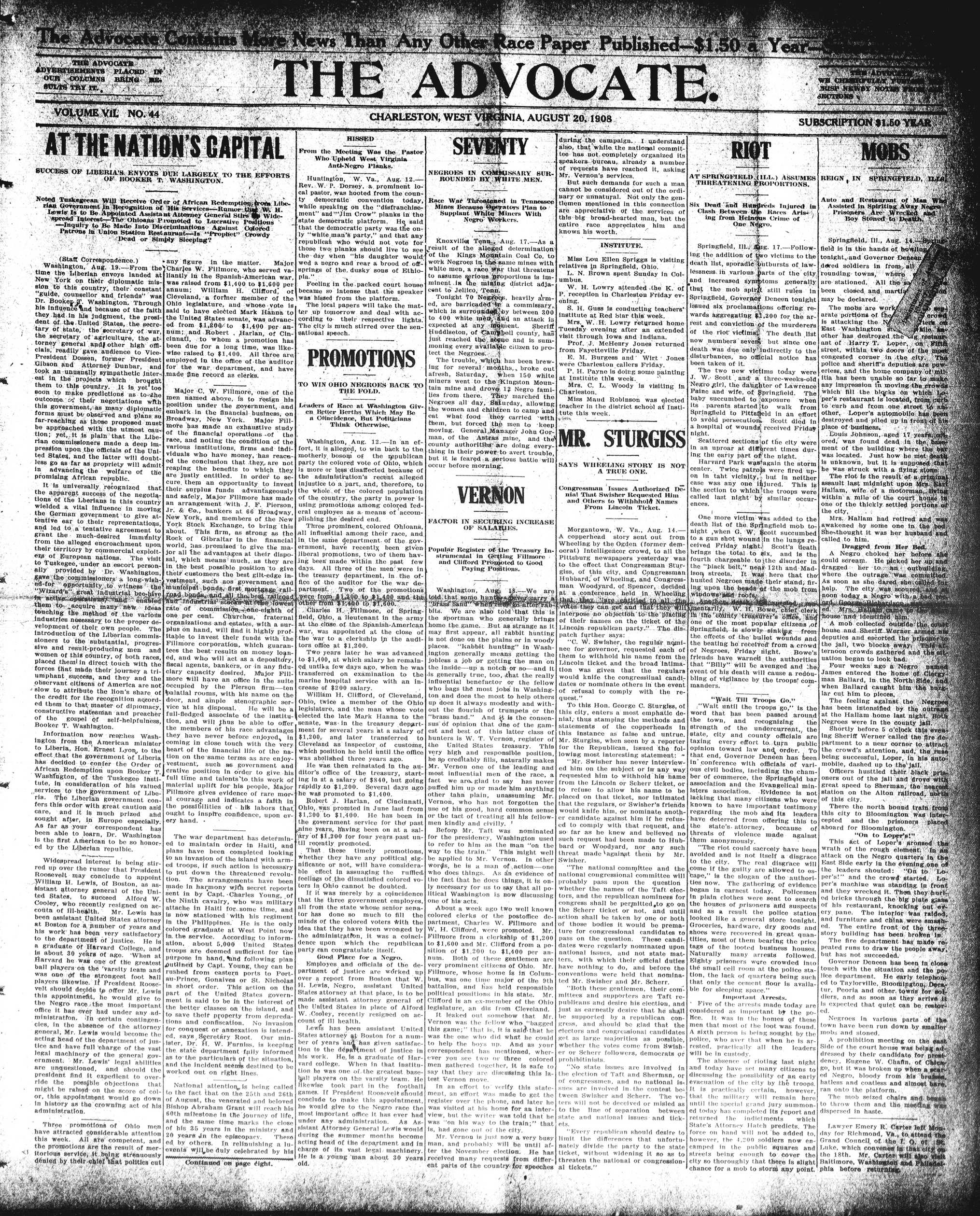
SUCCESS OF LIBERIA'S ENVOYS DUE LARGELY TO THE EFFORTS OF BOOKER T. WASHINGTON.
Noted Tuskegeean Will Receive Order of African Redemption from Liberian Government in Recognition of His Services—Rumor that W. H. Lewis Is to Be Appointed Assistant Attorney General Stirr to Widespread Interest—The Ohioans Promoted to Lucrative Positions
—Inquiry to Be Made Into Discriminations Against Colored Patrons in Union Station Restaurant—Is "Prophet" Crowdy Dead or Simply Sleeping?
VOLUME VIL NO.44
(Start Correspondence.)
Washington, Aug. 19.—From the time the Liberian envoys landed at New York on their diplomatic mission to this country, their constant "guide, counselor and friends" was Dr. Booker T. Washington. Through his influence and because of the faith they had in his judgment, the president of the United States, the secretary of state, the secretary of war, the secretary of agriculture, the attorney general and other high officials, readily gave audience to Vice-President Dosen, former President Gibson and Attorney Dunbar, and took an unusually sympathetic interest in the projects which brought them to this country. It is yet too soon to make predictions as to the outcome of their negotiations with this government, as many diplomatic forms must be observed and plans so far-reaching as those proposed must be approached with the utmost caution; yet, it is plain that the Liberian commissioners made a deep impression upon the officials of the United States, and the latter will doubtless go as far as propriety will admit in advancing the welfare of the promising African republic.
It is universally recognized that the apparent success of the negotiations of the Liberians in this country wielded a vital influence in moving the German government to give attentive ear to their representations, and led to a tentative agreement to grant the much-desired immunity from the alleged encroachment upon their territory by commercial exploiters of European nations. The visit to Tuskegee, under an escort personally provided by Dr. Washington, gave the commissioners a long-winded-for opportunity to witness the "Wizards" great industrial bio-life in active operations, and enabled them to acquire many new ideas touching the method of the various industries necessary to the proper development of their own people. The introduction of the Liberian commissioners to the substantial, progressive and result-producing men and women of this country, of both races, placed them in direct touch with the forces that made their journey a triumphant success, and they and the observant citizens of America are not slow to attribute the lion's share of the credit for the recognition accorded them to that master of diplomacy, constructive statesman and preacher of the gospel of self-helpfulness, Booker T. Washington.
Information now reaches Washington from the American minister to Liberia, Hon. Ernest Lyon, to the effect that the government of Liberia has decided to confer the Order of African Redemption upon Booker T. Washington, of the Tuskegee Institute, in consideration of his valued services to the government of Liberia. The Liberian government confers this order with great caution and care, and it is much prized and sought after, in Europe especially. As far as your correspondent has been able to learn, Dr. Washington is the first American to be so honored by the Liberian republic.
Widespread interest is being stirred up over the rumor that President Roosevelt may conclude to appoint William H. Lewis, of Boston, as assistant attorney general of the United States, to succeed Alford W. Cooley, who recently resigned on account of ill-health. Mr. Lewis has been assistant United States attorney at Boston for a number of years and his work has been very satisfactory to the department of justice. He is a graduate of Harvard College, and is about 30 years of age. When at Harvard he was one of the greatest ball players on the 'varsity team and was one of the strongest foot ball players likewise. If President Roosevelt should decide to offer Mr. Lewis this appointment, he would give to the Negro race the most important office it has ever had under any administration. In certain contingencies, in the absence of the attorney general, Mr. Lewis would become the acting head of the department of justice and have full charge of the vast legal machinery of the general government. Mr. Lewis' legal abilities are unquestioned, and should the president find it expedient to override the possible objections that might be raised on the score of color, this appointment would go down in history as the crowning act of his administration.
Three promotions of Ohio men have attracted considerable attention this week. All are competent, and the promotions are the result of meritorious service, it being stronely denied by their chief that politics out
any figure in the matter. Major Charles W. Fillmore, who served valiantly in the Spanish-American war, was raised from $1,400 to $1,600 per annum; William H. Clifford, ot Cleveland, a former member of the Ohio legislature, and whose vote is said to have elected Mark Hanna to the United States senate, was advanced from $1,200/ to $1,400 per annum; and Robert . Harlan, of Cincinnati, to whom a promotion has been due for a long time, was likewise raised to $1,400. All three are employed in the office of the auditor for the war department, and have made fine record as clerks.
Major C. W. Fillmore, one of the men named above, is to resign his position under the government, and embark in the financial business, on Broadway, New York. Major Fillmore has made an exhaustive study of the financial operations of the race, and noting the condition of the various institutions, firms and individuals who have money, has reasoned the conclusion that they are not reaping the benefits to which they are justly entitled. In order to secure them an opportunity to invest their surplus funds advantageously and safely, Major Fillmore has made an arrangement with J. F. Pierson, Jr. & Co., bankers at 66 Broadway, New York, and members of the New York Stock Exchange, to bring this about. This firm, as strong as the Rock of Gibraltar in the financial world, has promised to give the major all the advantages at their disposal, which means much, as they are in the best possible position to give their customers the best gilt-edge investment, such as government and municipal bonds, and all the railroad and industrial stocks at the lowest rate of commission—one-eighth of one per cent. Churches, fraternal organizations and estates, with a surplus on hand, will find it highly profitable to invest their funds with the Fillmore corporation, which guarantees the best results on money loaned, and who will act as a depositary, fiscal agents, bankers, or in any fiduciary capacity desired. Major Fillmore will have an office in the suite occupied by the Plerson firm—ten palatial rooms, with his name on the door, and ample stenographic service at his disposal. He will be a full-fledged associate of the institution, and will thus be able to offer the members of his race advantages they have never before enjoyed, in coming in close touch with the very heart of the financial life of the nation on the same terms as are enjoyment, such as government and creative position in order to give his full time and talents to this work of material uplift for his people. Major Fillmore gives evidence of rare moral courage and indicates a faith in the possibilities of his labors that ought to inspire confidence, upon every hand.
The war department has determined to maintain order in Haiti, and plans have been completed looking to an invasion of the island with armed troops, if such action is necessary to put down the threatened revolution. The arrangements have been made in harmony with secret reports sent in by Capt. Charles Young, of the Ninth cavalry, who was military attache in Haiti for some time, and is now stationed with his regiment in the Philippines. He is the only colored graduate at West Point now in the service. According to information, about 5,000 United States troops are deemed sufficient for the purpose in hand, and following plan outlined by Capt. Young, they can be rushed from eastern ports to Port-au-Prince, Gonaives or St. Nicholas in short order. This action on the part of the United States government is said to be in the interest of the better classes on the island, and to save their property from depredations and confiscation. No invasion for conquest or annexation is intended, says Secretary Root. Our minister, Dr. H. W. Furniss, is keeping the state department fairly informed as to the particulars of the situation, and the incident seems destined to be worked out on right lines.
National attention is being called to the fact that on the 25th and 26th of August, the venerated and beloved Bishop Abraham Grant will reach his 60th milestone in the journey of life, and the same time marks the close of his 35 years in the ministry and 20 years in the episcopacy. These ed by others. In relinquishing a leuvenis will be duly celebrated by his
THE ADVOCATE.
CHARLESTON, WEST VIRGINIA, AUGUST 20, 1908
From the Meeting Was the Pastor Who Uphold West Virginia Anti-Negro Planks.
Huntington, W. Va., Aug. 12.—Rev. W. P. Dorsey, a prominent local pastor, was hooted from the county democratic convention today, while speaking on the "disfranchisement" and "Jim Crow" planks in the state democratic platform. He said that the democratic party was the only "white man's party," and that any republican who would not vote for those two planks should live to see the day when "his daughter would wed a negro and rear a brood of offsprings of the dusky sons of Ethiopia."
Feeling in the packed court house became so intense that the speaker was hissed from the platform. The local papers will take the matter up tomorrow and deal with according to their respective lights. The city is much stirred over the sensational speech.
PROMOTIONS
TO WIN OHIO NEGROES BACK TO THE FOLD.
Leaders of Race at Washington Given Better Berths Which May Be a Coincidence, But Politicians Think Otherwise.
Washington, Aug. 12.—In an effort, it is alleged, to win back to the motherly bosom of the republican party the colored vote of Ohio, which is more or less disaffected because of the administration's recent alleged injustice to a part, and, therefore, to the whole of the colored population of the country, the party in power is using promotions among colored federal employees as a means of accomplishing the desired end.
Three prominent, colored Ohioans, all infiltrated among their race, and in the same department of the government, have recently been given liberal promotions, two of them having been made within the past few days. All three of the men were in the treasury department, in the office of the auditor for the war department. Two of the promotions were from $1,200 to $1,400 and the other from $1,400 to $1,600. Charles H. Fillmore, of Springfield, Ohio, a lieutenant in the army at the close of the Spanish-American war, was appointed at the close of the war to a clerkship in the auditors office at $1,200. Two years later he was advanced to $1,400, at which salary he remained until a few days ago, when he was transferred on examination to the marine hospital service with an increase of $200 salary.
William H. Clifford, of Cleveland, Ohio, twice a member of the Ohio legislature, and the man whose vote elected the late Mark Hanna to the senate, was in the treasury department for several years at a salary of $1,200, and later transferred to Cleveland as inspector of customs, which position he held until the office was abolished three years ago. He was then reinstated in the auditor's office of the treasury, starting in at a salary of $840, but going rapidly to $1,200. Several days ago he was promoted to $1,400. Robert J. Harlan, of Cincinnati, Ohio, was promoted in June last from $1,200 to $1,400. He has been in the government service for the past nine years, having been on at a salary of $1,200 for four years past until recently promoted.
That these timely promotions, whether they have any political significance or not, will have considerable effect in assuaging the ruffled feelings of the dissatisfied colored voters in Ohio cannot be doubted. If it was merely by a coincidence that the three government employees, all from the state whose senior senator has done so much to fill the minds of the colored voters with the idea that they have been wronged by the administration, it was a coincidence upon which the republican party can congratulate itself.
Good Place for a Negro.
Employees and officials of the department of justice are worked up over a report from Boston that W. H. Lewis, Negro, assistant United States attorney at that place, is to be made assistant attorney general of the United States in place of Alford W. Cooley, recently resigned on account of ill health.
Lewis has been assistant United States attorney at Boston for a number of years and has given satisfaction to the department of justice in his work. He is a graduate of Harvard college. When in that institution he was one of the greatest baseball players on the varsity team. He likewise took part in the football games. If President Roosevelt should conclude to make this appointment, he would give to the Negro race the most important office it has ever had under any administration. As Assistant Attorney General Lewis would during the summer months become acting head of the department and in charge of its vast legal machinery. He is a young man about 30 years
SEVENTY
SEVENTY
NEGROES IN COMMISSARY SURROUNDED BY WHITE MEN.
Race War Threatened in Tennessee
Mines Because Operators Plan to
Supplant White Miners With
Negro Workers
Knoxville Tenn., Aug. 17.—As a result of the alleged determination of the Kings Mountain Coal Co. to work Negroes in the same mines with white men, a race war that threatens to assume serious proportions is imminent in the mining district adjacent to Jellicoe, Tenn.
Tonight 70 Negroes, heavily armed, are barricaded in a commissary, which is surrounded, by between 300 to 400 white men, and an attack is expected at any moment. Sheriff Huddsethe, of Campbell county, has just reached the scene and is summoning every available citizen to protect the Negroes.
The trouble, which has been brewing for several months, broke out afresh, Saturday, when 150 white miners went to the Kingston Mountain mine and drove 12 Negro families from there. They marched the Negroes all day, Saturday, allowing the women and children to camp and eat what food they carried with them, but forced the men to keep moving. General Manager John Gorman, of the Astras mine, and the county authorities are doing everything in their power to avert trouble, but it is feared a serious battle will occur before morning.
FACTOR IN SECURING INCREASE OF SALARIES.
Popular Register of the Treasury Instrument in Getting Fillmore and Clifford Promoted to Good Paying Positions.
Washington, Aug. 18.—We are told that some hunters never carry a "brass band" when they are active rabbits. We are also told that this is the sportman who generally brings home the game. But as strange as it may first appear, all rabbit hunting is not done on the plains or in woody places. "Kabbit hunting" in Washington generally means getting the jobless a job or getting the man on the inside—up a notch or so—and it is generally true, too, that the really influential benefactor or the fellow who bags the most jobs in Washington and does the most to help others up does it always modestly and without the flourish of trumpets or the "brass band." And it is the consensus of opinion that one of the games and best of this latter class of hunters is W. T. Vernon, register of the United States treasury. This very high and responsible position, he so creditably fills, naturally makes Mr. Vernon one of the leading and most influential men of the race, a fact we are glad to say has never puffed him up or made him anything other tahn plain, unassuming Mr. Vernon, who has not forgotten the use of his good, hard common sense or the tact of treating all his fellowmen kindly and civilly.
Before Mr. Taft was nominated for the presidency, Washington used to refer to him as the man "on the way to the train." This might well be applied to Mr. Vernon. In other words, he is a man of action—one who does things. As an evidence of the fact that he does things, it is only necessary for us to say that all political Washington is now discussing one of his acts.
About a week ago two well known colored clerks of the postoffice department, Charles W. Fillmore and W. H. Clifford, were promoted. Mr. Fillmore from a clerkship of $1,200 to $1,600 and Mr. Clifford from a position of $1,200 to $1,400 per annum. Both of these gentlemen are very prominent citizens of Ohio. Mr. Fillmore, whose home is in Columbus, was one time major of the 9th battalion, and has held responsible political positions in his state. Mr. Clifford is an ex-member of the Ohio legislature an ad from Cleveland.
It leaked out somehow that. Mr. Vernon was the fellow who "bagged this game;" that is, it is said that he was the one who did what he could to help the boys up. And as your correspondent has mentioned, wherever you see two or three colored men gathered together, it is safe to say that they are discussing this latest Vernon move.
In an effort to verify this statement, an effort was made to get the register over the phone, and later he was visited at his home for an interview, but the writer was told that he was "on his way to the train;" that is, had gone out of the city.
Mr. Vernon is just now a very busy man, and probably will be until after the November election. He has received many requests from different parts of the country for speeches.
during the campaign. I understand also, that while the national committee has not completely organized its speakers' bureau, already a number of requests have reached it, asking Mr. Vernon's services. But such demands for such a man cannot be considered out of the ordinary or unnatural. Not only the gentlemen mentioned in this connection are appreciative of the services of this big broad-hearted man, but the entire race appreciates him and knows his worth.
INSTITUTE.
Miss Lou Ellen Spriggs is visiting relatives in Springfield, Ohio. L. N. Brown spent Sunday in Columbus. W. H. Lowry attended the K. of P. reception in Charleston Friday evening.
Miss Maud Robinson was elected teacher in the district school at Institute this week.
MR. STURGISS
SAYS WHEELING STORY IS NOT A TRUE ONE.
Congressman Issues Authorized Denial That Swisher Requested Him and Others to Witchhold Names From Lincoln Ticket.
Morgantown, W. Va., Aug. 14.—A copperhead story sent out from Wheeling by the Ogden (former democrat) Intelligence crowd, to all the Pittsburg newspapers yesterday was to the effect that Congressman Sturgiss, of this city, and Congressman Hubbard, of Wheeling, and Congressman Woodyard, of Spencer, decided at a conference held in Wheeling that they are entitled to all the votes they can get and that they will interpose no objection to the practicing of their names on the ticket of the Lincoln republican party." The dispatch further says:
"C. W. Swisher, the regular nominee for governor, requested each of them to withhold his name from the Lincoln ticket and the broad intimation was given that the regulars would knife the congressional candidates or nominate others in the event of refusal to comply with the request."
To this Hon. George C. Sturgles, of this city, enters a most emphatic denial, thus stamping the methods and statements of the copperheads in this instance as false and untrue. Mr. Sturglass, when seen by a reporter for the Republican, issued the following most interesting statement:
"Mr. Swisher has never interviewed him on the subject or in any way requested him to withhold his name from the Lincoln or Scherr ticket, or to refuse to allow his name to be placed on that ticket, nor intimated that the regulars, or Swisher's friends would knife him, or nominate another candidate against him if he refused to comply with that request, and so far as he knew and believed no such request had been made to Hubbard or Woodyard, nor any such threat made against them by Mr. Swisher.
"The national committee and the national congressional committee will probably pass upon the question whether the names of the Taft electors, and the republican nominees for congress shall be permitted to go on the Scherr ticket or not, and until action shall be taken by one or both of those bodies it would be premature for congressional candidates to pass on the question. These candidates were regularly nominated upon national issues, and not state matters, with which their official duties have nothing to do, and before the conventions were held that nominated Mr. Swisher and Mr. Scherr.
"Both these gentlemen, their committees and supporters are Taft republicans and desire his election, and just as earnestly desire that he shall be supported by a republican congress, and should be glad that the electors and congressional candidates get as large majorities as possible, whether the votes come from Swisher or Scherr followers, democrats or prohibitists.
"No state issues are involved in the election of Taft and Sherman, or of congressmen, and no national issues are involved in the contest between Swisher and Scherr. The voters will not be deceived or misled as to the line of separation between state and national issues and tickets.
"Every republican should desire to limit the differences that unfortunately divide the party to the state ticket, without widening it so as to threaten the national or congressional tickets."
Six Dead and Hundreds Injured in
Clash Between the Races Arising
from Helvetic Crime of
One Negro.
Springfield, Ill., Aug. 17. —Following the addition of two victims to the death list, sporadic bursts of lawlessness in various parts of the city and increased symptoms generally that the mob spirit still rules in Springfield, Governor Deneen tonight issued six proclamations offering rewards aggregating $1,300 for the arrest and conviction of the murderers of the riot victims. The death list now numbers seven, but since one death was due only indirectly to the disturbances, no official notice has been taken of it.
The two new victims today were J. W. Scott, and a three-weeks-old Negro girl, the daughter of Lawrence Paine and wife, of Springfield. The baby succumbed to exposure when its parents started to walk from Springfield to Pittsgrove in an effort to avoid persecution. Scott died in a hospital of wounds received Friday night.
Scattered sections of the city were in an uproar at different times during the early part of the night.
Harvard Park was again the storm center. Twice patrols were fired upon in taht vicinity, but in neither case was any one injured. This is the section to which the troops were called last night by similar occurrences.
One more victim was added to the death list of the Springfield mob tonight, when G. W. Scott succumbed to a gun shot wound in the lungs received Friday night. Scott's death brings the total to six, and is the fourth chargeable to the disorder in the "black belt," near 12th and Madison streets. It was here that the hunted Negroes made their stand, firing upon the heads of the mob from windows and roofs. Another victim was mentally, W. H. Bowe, chief clerk in the county treasurer's office, and one of the most popular citizens of Springfield, is slowly sinking from the effects of the bullet wounds and the beating he received from a crowd of Negroes, Friday night. Bowe's friends have warned the authorities that "Billy" will be avenged and the event of his death will cause a redoubling of vigilance by the troops' commanders.
"Wait. Till Troops Go."
"Walt Till Troops Go."
"Walt until the troops go," is the word that has been passed around the town, and recognizing the strength of the undercurrent, the state, city and county officials are taxing every effort to turn public opinion toward law and order. To that end, Governor Deneen has been in conference with officials of various civil bodies, including the chamber of commerce, the Springfield bar association and the Evangelical ministers association. Evidence is not lacking that many citizens who were known to have important testimony regarding the mob and its leaders have deterred from offering this to the state's attorney, because of threats of violence made against them anonymously.
"The riot could sacrely have been avoided and is not itself a disgrace to the city. The real disgrace will come if the guilty are allowed to escape," is the slogan of the authorities now. The gathering of evidence began in earnest today. Policemen in plain clothes were sent to search the houses of prisoners and suspects and as a result the police station looked like a general store tonight. Groceries, hardware, dry goods and shoes were recovered in great quantities, most of them bearing the price tags of the looted business houses. Naturally many arrests followed. Eighty prisoners were crowded into the small cell room at the police station, the lack of quarters being such that only the cement floor is available for sleeping space."
Five of the arrests made today are considered as important by the police. It was in the homes of these men that most of the loot was found. A sixth person is being sought by the police, who aver that he is arrested, practically all the leaders will be in custody. The absence of rioting last night and today have set many citizens to discussing the possibility of an early evacuation of the city by the troops. It is practically certain, however, that the military will remain here until the special grand jury summoned today has completed its report and returned the indictments which State's Attorney Hatch predicts. The force on hand will not be added to, however, the 4,200 soldiers now encamped in the public squares and streets being enough to cover the city so thoroughly that there is slight chance for a mob to storm any point.
THIS ADVERTISING
WE CLEARLY SUMMER AND
WILL NEVER NOTICE FROM NEW
SECTIONS :
SUBSCRIPTION $1.50 YEAR
tonight, and Governor Denseen deed soldiers in from all rounding towns, where they are stationed. All the said troops have been closed and martial, and may be declared.
The mobs are work to separate portions of the crowd is attacking the N. West end of East Washington st. While, his other has destroyed the big restaurant of Harry T. Loper, on Fifth street, within two doors of the most congested corner in the city. The police and sheriff's deputies are powerless, and the home company of militia has been unable so far to make any impression in moving the crowd which fill the blocks on which Loper's restaurant is located, from curb to curb and from one street to another. Loper's automobile has been destroyed and piled up in front of his place of business.
Louis Johnson, aged 17 years, observed, was found dead in the basement of the building where the bar was located. Just how he met death is unknown, but it is supposed that he was struck with a firing store.
The riot is the result of a criminal assault last midnight upon Mrs. Karl Hallam, wife of a motorman, living within a mile of the court house in one of the thickly settled portions of the city.
Mrs. Hallam had retired and was awakened by some one in the bed She-thought it was her husband and called to him.
Dragged from Her Bed.
A Negro choked her before she could scream. He picked her up and dragged her to an outbuilding where the outrage was committed. As soon as she dared she called for help. The city was scoured, and noon today a Negro with a bad record, George Richardson, escaped. Mrs. Hallam came to the house and identified him.
A mob collected outside the court house and Sheriff Werner armed his deputies and escorted the prisoner to the jail, two blocks away. This afternoon crowds gathered and the situation began to look bad.
Four weeks ago a Negro named James entered the home of Cleggman Ballard, in the North Side, and when Ballard caught him the burglar cut him to pieces.
The feeling against the Negroes has been intensified by the outrage at the Hallam home last night. Both Negroes were in the county jail.
Shortly before 5 o'clock this evening Sheriff Werner called the fire department to a near corner to attract the crowd's attention, and the ruse being successful, Loper, in his automobile, dashed up to the jail.
Officers hustled their black prisoners out of the jail and drove with great speed to Sherman, the nearest station on the Alton railroad, north of this city.
There the north bound train from this city to Bloomington was intercepted and the prisoners placed aboard for Bloomington.
"On to Loper's!"
This act of Loper's arroused the wrath of the rough element. In an attack on the Negro quarters in the East Side early in the evening one of the leaders shouted: "On to Loper's!" and the crowd started. Loper's machine was standing in front and they wrecked it. Then they hurled bricks through the big plate glass of his restaurant, knocking out every pane. The interior was raided, and furniture and china were smashed. The entire front of the threestory building has been broken in. The fire department has made repeated runs to draw the people away, but has not succeeded.
Governor Deneen has been in close touch with the situation and the police department. He early telephoned to Taylorville, Bloomington, Decatur, Pearla and other towns for soldiers, and as soon as they arrive it is expected that quiet can be restored.
town have been run down by smaller mobs and stoned.
A prohibition meeting on the east Side of the court house was being addressed by their candidate for presidency, Eugene W. Chaffn, of Chicago, but it was broken up when a scared Negro, bloody from his brains, hatless and contagious and almost bare, ran onto the platform.
The mob seized chairs and began to throw them and the meeting was dispersed in haste.
Lawyer Emery R. Carter left Monday for Richmond, Va., to attend the Grand Council, of the F. O. of St. Luke, which convened in that city on the 18th. Mr. Carter will also visit Baltimore, Washington and Philadelphia before returning.
CORRESPONDENCE
GREAT SHOE SALE
PARKERSBURG.
The representatives from Courts and Lodges of O. O. C. and K. of P. returned home, Saturday, from the Grand sessions at Huntington. They report an important session.
The report of the representatives. Mrs. Elizabeth Simpson and Rachel Brandom, from Vendetta Court, No. 6, O. O. C., to the Grand Court at Huntington, was an exhaustive and interesting one. They did credit to their organization. They reported at the meeting of the Court last Thursday evening.
Macoe Lodge, No. 16, and Blenerhassett Lodge, No. 77, K. of P., convened Monday and Friday nights of last week respectively. They listened to interesting reports from their representatives to the Grand Lodge.
An interesting crowd of young folks spent last Friday evening on Fort Boreman. The picnic was in honor of Miss Mary McGhee, of Charleston, the guest of Miss Almeda Brown. They were chaperoned by Mrs. J. R. Jefferson. They returned from the fort at 8:30 p. m., and spent a pleasant hour at the home of Mr. and Mrs. J. R. Jefferson.
Edw. Morton passed through the city, Wednesday of last week, en route to his home in Fairmont. He spent Saturday, Sunday and Monday visiting his parents in Pomegranate, O., after the Grand Lodge session in Huntington.
Wm. McClung and Misses Julia McClung, Gretel Peters and a number of others left. Wednesday night, on an excursion to Atlantic City, where they will spend several days.
Misses Lena and Alberta McClung are visiting their sister, Miss Anna McClung, in Chicago.
Miss Bernardine Peyton returned home, Saturday, after a pleasant week's visit to Miss Esther Colston, in Zanesville, Ohio.
Mrs. J. M. Carter, Mrs. E. V. Scans and Mrs. J. W. Shellcroft were in Marietta, Ohio, last Saturday evening, to see Mrs. Thomas Fletcher, who has been quite ill for several weeks.
L. O. Wilson, of Weston, is the guest of J. R. Jefferson.
Rev. Simon Huskins reports an interesting session of the District Conference of M. E. echhrch, which he attended in Huntington last week.
The Sabbath school picnic of Bethel A. M. E. church, which was held at City Park, was a delightful one and highly enjoyed and appreciated by all who were present.
Rev, S) P. West, P. E., of A. M. E. church, was in the city, Friday and Saturday of last week.
Miss Stella Powell, of Rochester, N. Y., who has been the guest of Miss Eva Taylor, of Belpre, Ohio, for several weeks, returned home, Wednesday of last week. H. D. Hazlewood left Wednesday afternoon of last week for Buckhannon, where he will visit until the last of this week. Rev. Wm. Toney spent last week attending the Baptist Association in Wheeling. He reports a pleasant and profitable sitting. Mrs. J. M. Carter returned from Charleston, Wednesday of last week, where she spent several days, after the Grand Court session in Huntington visiting Mrs. Thomas Whittaker.
Mrs. J. C. Jackson sustained very serious injuries last Saturday morning, by falling from a step ladder and down the steps at the home of W. P. Rathbone, on Market street, where she was working.
Wm. Figgs has sold his house, on Liberty street, and will move nearer the business part of the city.
POWELLTON
Mrs. Eila J. Perrin, of Charleston, who has been visiting her brother, T. L. Thompson, a few days, returned home last Monday.
Madames Lucy Carter and Lilly Fairafx attended the Woman's Baptist State Convention at Fayetteville, last week.
James H. Graves and Wm. Branch left last week to work for the C. and O. Railway Company.
R. T. Dailey, of Kimberly, was here on business last week.
Mrs. Mattie Jones, of Page, arrived here. Saturday.
Mrs. Mary J. Preston, of Charleston, is visiting, her sister, Mrs. Sophia Robinson.
The regular church meeting was held Saturday evening and preaching Sunday in the new church building. The church gave a special rally, Sunday, which was a success. Many visitors from Elk Ridge and Kimberly were present. Mrs. Sallie West departed, Sunday, for Richmond, where she will represent in the Grand Lodge of St. Lukes. Mrs. Sallie Mills and children returned, Saturday, from Virginia, where they have been visiting relatives.
BARBOURSVILLE
Rev. G. Kinney, of Catlettsburg, is the pastor of the First Baptist church here. Henry Goode has been indisposed for several days.
George Martin has been quite ill for two weeks at his home, on McClung avenue.
Tyler Feyton returned, Sunday, from Cincinnati.
Mr. and Mrs. Nelson Layne were guests of Mr. and Mrs. Geo. Martin, Sunday.
Mrs. G. W. Hamler spent Sunday in St. Albans with her sister, Mrs. W. W. Scott.
Miss Cleopatra Layne, Alex. Twyman and Otis Jackson were calling on friends here, Sunday.
Henry Hicks is quite ill with asthma.
Mr. and Mrs. J. Hicks, Mrs. Kilgore and daughter, attended the Holiness meeting, Sunday, at Davis creek.
Hattie Beckley, of Holden, is visiting friends here.
Mr. and Mrs. Taylor Fliggins have sold their property, on Main street, and moved to Cincinnati, Ohio.
WINIFREDE.
C. H. Turner, an old resident of this place, has moved his family to Cedar Grove, where they will make their future home.
Miss Estella Mitchell was shopping in Charleston, Tuesday.
C. A. Thomas has been confined to his bed for the past week.
George Smith is able to be out again, after a severe attack of typhoid fever.
Mrs. A. Thomas and children, of Charleston, spent Saturday and Sunday here, visiting her husband, S. J. Thomas.
Miss Virginia Burns spent a few days here, the guest of her cousin, Mrs. Ed. Tate.
Joe Hubbard is improving slowly.
PAGE.
Mrs. I. V. Doddridge, of White Oak, is visiting her son, J. W. Doddridge, and friends of Page.
Sam Childs, of Montgomery, is visiting our town.
Mrs. H. H. Washington was a delegate to the Woman's State Convention at Fayetteville last week.
Mrs. Martin, of Kincaid, is very ill at this writing.
Mrs. Ellis Jones is visiting at Powellton this week.
Rev. Williams, of Mt. Carbon, will preach for us, Monday night. We are expecting about 30 or 35 delegates to stop over here, Monday, on their way to the State Convention. Our delegate from here will be H. H. Washington.
CARBON.
Mrs. Ward, who has been visiting her daughter, Mrs. A. W. Alston, the past week, departed for her home in Lynchburg, Va., last Wednesday. Mr. and Mrs. Alston went with her as far as Charleston.
Rev. C. H. Carter has been on the sick list the past week, but is better at this wrifting.
R. M. Miller was in Charleston last Monday on business.
T. G. Agnew has been suffering with a sprained foot for the last week, received while working in the mine.
Mrs. Emma Dickerson, of Bancroft, is visiting Rev. P. P. and Mrs. Holland.
Edward Hughes, of Lamont, was calling on friends here last Friday. A number of our young people took a hay ride to Leewood last Sunday evening.
A crowd of our young people attended a social last Monday night, at the residence of Mrs. Brooke, at Bell-clare.
S. R. Mason is contemplating visiting his old home in Maryland in the near future.
James Saunders was taken with a very serious spell of cramps last Friday, and was in a critical condition for awhile. He is better at this writing.
Rev. P. P. Holland went to his church at Plymouth, Saturday.
George Washington, who has been here for quite awhile, left, Saturday, for points in Ohio.
Misses Lelia Young and Lena Dickerson were visiting down at Lamont, Saturday and Sunday, guests of Misses Mamie Hughes and Mabel Jones.
Sunday night, Rev. C. H. Carter preached an able sermon.
RED STAR.
Miss Frances Woodson, of Ronceverte, is here attending the Institute, and is a guest of Mrs. M. T. Benton. Mrs. Wm. Claytor, of Glen Jean, was a visitor here, Sunday, guest of Mrs. M. T. Benton and her aunt, Mrs. E. James.
Miss Woodson was calling on Mrs. J. B. Calloway, of Mt. Hope, Sunday. Miss Eva Murray, of Staunton, Va., arrived, Saturday afternoon, to visit her sister, Mrs. Thos. Jefferson, Mr. and Mrs. T. G. Gregory and Dr. S. H. Washington attended the Woman's Baptist State Convention at Fayetteville, Thursday. H. Rose and Miss Mildred Burdette went to Fayetteville, Friday, to attend the convention.
Jas. Austin left, Monday morning, for Raleigh, to spend an indefinite time.
Mrs. Stella Terry, of Glen Wilton, is in town.
Teachers' Institute opened here, Monday morning, with a good enrollment. Prof. S. H. Guss is instructor. Mrs. A. M. Banks is quite ill at this writing. Mrs. Mary Gaines was visiting Mrs. Ronche, of Harvey, Sunday. Mrs. M. E. Davis went to Montgomery last week on business. The Womans Improvement League will celebrate their third anniversary, August 30-31. Sunday, at 2:30 p. m., Prof. S. H.
Guss will give a lecture, and at 7:30 there will be a round table discussion; subject, "Training Our Boys"; Monday evening they will give a Japanese Tea Party and render a program. All are invited.
Miss Daley Hutcherson spent Sunday at Hot Springs, Va., with relatives.
Forest Hunter has returned home from Ohio, to spend his vacation with his father, J. R. Hunter.
Miss Ethel Page, of Farmville, Va., is visiting Miss W. W. Johnson.
Iev. W. W. Hackett preached an annual sermon to one of the fraternities at Low Meor, Va. A number of his members followed him.
Archie Wright and son, Robert, have returned home from Alderson, W. Va.
Rev. Sam Turner preached at the First Baptist church, Sunday night.
Miss Maggie Dobson, who has been visiting relatives in Buchannan, Va., has returned home.
Miss Plassee Parnell, of Staunton, Va., is visiting Miss C. M. Wright.
Mrs. Rosa Pierce has returned home from Louisa, Va., where she has been visiting her parents.
Prof. Bell, of Lynchburg, Va., is in town on business.
Mrs. Martha Jackson has gone to White Sulphur Springs, W. Va., where she will spend a few days and from there to Charleston, W. Va., to make her future home.
Mr. and Mrs. Joshua Hunter have returned from Lynchburg, Va.
RAYMOND CITY.
Miss Mattie B. Woodson, of Charleston, spent last week here, visiting her mother.
Mrs. Martha Booth and Miss Lillie Woodson met with a very sad accident last Wednesday. While on their way to Bancroft their horse ran the buggy over a large rock and threw them out. Mrs. Booth was very painfully, but not seriously hurt.
Miss Nettie Garland, of Virginia, is visiting her aunt, Mrs. Lydia Shore.
Mrs. Cornelia Coles returned from Fayetteville, Saturday, where she had been attending the woman's convention and reported a pleasant trip.
Mr. and Mrs. Robert Dickerson, Mrs. Eva Walker and Miss Lucinda Coles attended preaching at Bancroft, Sunday.
W. Coles was in St. Albans, Saturday night.
H. B. Good, Ed Pendleton, H. Woods, Giles Dickerson and A. Osby left, Saturday evening, for Charleston.
ONie Pierson and his brother Walter spent Sunday in Charleston. They were accompanied home, Monday, by their mother, Mrs. M. A. Pierson.
John H. Shinders was accompanied home, Monday, by his little brother.
Mrs. Victoria Duckwyler was a business visitor to Charleston, Monday.
Born, to Mr. and Mrs. S. W. Lee, a boy.
Mrs. Ada Price is sick.
Born, to Mr. and Mrs. Walter Alston, a girl.
R. W. Williams is confined to his room.
MONTGOMERY.
Mrs. Robert Watson, Mrs. John Brown, Mrs. Mary Perry, Mrs. William Allen, and Mrs. Warner Brown returned. Saturday, from Fayeteville, where thy attended the woman's convention. All report a successful meeting and a pleasant trip. Rev. Daniel Stratton, of St. Albans, was a business visitor here last week. Misses Nellie M. Lewis, Marie Shelton and Lola M. Lavender will leave next week for Bluefield, where they will teach in the city school.
Thursday evening, Miss Marie Shelton delightfully entertained, in honor of her house guests, Dr. and Mrs. W. D. Pannell and daughter, Miss Plassie, of Staunton, Va. Those present were: Miss' Lola M. Lavender, Mr. and Mrs. Thos Johnson, Mr. and Mrs. Geo. Jackson, Mr. and Mrs. Floyd Rogers, Mr. and Mrs. William Miller, Mr. and Mrs. H. H. Railey, Dr. and Mrs. B. F. White, Mr. and Mrs. S. B. Morgan, Mrs. B. L. Taylor, Rev. and Mrs. E. C. Page, Miss Joe Willa Morgan, Messrs. M. D. Buster and David Deans.
Grand Chancellor W. J. Thompson, of Charleston, was here several days last week.
Mrs. James B. Washington, of Fayetteville, was shopping here last week.
Mr. and Mrs. William Miller gave tea, Saturday evening, complimentary to Dr. and Mrs. W. D. Pannell and daughter. Those fortunate to receive invitations spent a most delightful evening.
Miss Hattie Peters, of Sissonsville, was the last week guest of Mr. and Mrs. Ernest Hardy.
David Bowles, of Charleston, was calling on friends here, Sunday.
Mrs. Estelle St. Clair, of Kymmoor, is here, the guest of her parents, Mr. and Mrs. William Allen.
Miss Annistene Rice, of Charleston, was up a few days last week, visiting her mother.
Mrs. Cecil Burke returned home last week, from a visit of several weeks to her old home in Virginia.
P. W. Wright, who has been sick several weeks, is much improved.
Dr. and Mrs. B. F. White had to tea, Sunday afternoon, Dr. and Mrs. W. D. Pannell and Miss Plassie, of Staunton, Va.; Mrs. B. L. Taylor, of Keyser; Mr. and Mrs. Samuel Bustler, Miss Marie Shanker and H. H. Halley. Dr. and Mrs. Pannell left Sunday for Coventry, Va.
day for Covington, Va.
Mrs. P. W. Wright's club, known as the 20th century club, gave a high-class literary and musical entertainment, Monday evening. A large crowd was out, and it was a decided success, financially.
Mrs. H. H. Ralley is sick with malaria fever at her home, on Fifth Avenue.
Fire, Sunady morning, destroyed the homes of Mr. and Mrs. Luke Mitchell and Mr. and Mrs. Peter Hopkins.
Mr. and Mrs. W. T. Thompson, of Powellton, were business visitors here last week.
The board of education and trustees met, Tuesday, and elected H. H. Railey, principal; Miss Ethel Brown, Miss Henrietta James and Mrs. Goldie Page, assistant teachers. The fifth teacher has not been elected.
QUINNIMONT.
Rev. D. C. Hunter preached, Sunday.
Miss Maggie Waddy and Mrs. Emma Dickerson left, Monday, for Louisa, Va.
Miss Peggie Price, who has been visiting relatives here, left, Friday night, for Trevillians, Va.
Miss Eliza Shelton left, Monday morning, to attend the institute at Hill Top.
Misses Lillie Shelton and Peggie Price visited Mrs. Bradley, at Harvey last week.
Albert Clark was in Hinton to see his father last week.
Cliff Johnson was the guest of Miss Bradley last week.
Misses Lillie Shelton and Peggio Price were in Montgomery last week.
Mr. and Mrs. Rister Brown were called to Alderson, on account of the death of his brother.
Joe Brock accompanied Miss Peggie Price to Virginia last week.
Miss Flora Brock and Mrs. Carter will leave, Tuesday, for Virginia. Mrs. Laura Brown attended the convention at Fayetteville last week. Mrs. Mary Davidson, of Skelton
Oscar McKavey, of Raleigh, was the guest of Miss Bradley. Miss Lizzie Johnson and Edward Booker were at Fayetteville on business. Joe. Granderson is indisposed at this writing. Martin Burse met with a painful accident last Thursday, by breaking his leg. He was at once moved to the Clifton Forge hospital. Mrs. Lue Johnson was the guest of Mrs. Carter this week. Wilson Dandridge's conditions remains unchanged. Mrs. M. E. Chiles is visiting her sister, Mrs. R. H. Freeman, in Alderson.
PT. PLEASANT
Miss Kate Morton, of Pomeroy, was the guest of Miss Julia Smith last week.
Miss Maggie Mitchell, of Pomeroy, was the guest of Miss Ida E. Alexander last week.
Miss Frances Morton, of Pomeroy, was the guest of Miss Bess Jordan last week.
Cotton Blossom, of Mason City, played the Teddy B. team, of this place, Sunday. Score, 12 to 9, in favor of Pt. Pleasant.
Mrs. G. H. Jordan entertained at supper, Thursday evening, Miss Alice Jordan and Garl Hutchinson.
Rev. G. P. R. Kenney preached two very able sermons, Sunday, at the First Baptist church.
The M. E. Sunday school will hold a picnic at the Fair Ground, Friday of this week.
Mrs. E. L. Morton has returned from Poméroy, after a pleasant visit with Mr. Morton's parents.
Mrs. G. H. Jordan and daughters, Miss Bess Jordan and Mrs. E. L. Morton, will visit relatives in Columbus, Sunday.
Miss Alice E. Jordan returned to Weston, after a 20 days' visit at home. Miss Jordan was accompanied by Mr. Hutchinson, who was her guest the last week of her stay at home.
Miss Kate Craig returned home last Wednesday, after a pleasant visit among Huntington friends.
Garl Hutchinson, Misses Alice E. Jordan, Bessie S. Jordan and Frances Morton attended the Chautauqua at Gallipolis last Wednesday and heard Senator Dolliver's speech.
Matthew Hicks and Jess Hall, of St. Albans, were Sunday visitors here.
R. W. White, of Huntington, visited his wife here, Sunday.
Misses Gertrude and Eldorado Williams were guests of friends in Gallipolis a few days this week.
A LAWYER'S GUIDE.
A New York lawyer was called recently to a hamlet in Berks county, Penn., in the interest of a large coal corporation, and now he is telling this story on himself:
He was driving along a country road, and feared to might have lost his bearings. The village he wanted to reach seemed elusive, so he halted in front of a farmhouse to make inquiries.
"Maddam," he called out to a broad Grman woman, who stood looking at him from beneath a "poke" bonnet, "can you tell me how far it is to the next village?"
"Oh, just a leodle vays," came the response.
"But, my good woman, how far is it? It is two, four, six, or eight miles? That's what I want to know."
"Yah, I Unks so."
And the Wall street lawyer drove on a wiser man.
STORER COLLEGE
Harper's Ferry,
Courses
Academic, State Normal, Biblical, Vocal, and Instrumental Music, Carpentry, Blacksmithing, Practical, Gardening, and Husbandry, Cobkey, Serving and Dressmaking.
Equipment
Ample Buildings, Beautiful Campus
braries of over 6000 volumes. Co-
Henryory, Dairy, several acres of o
Hot Beds.
Expense
Books, Room Rent and Tuition free
essary Expense not over $6.50 per
Special Fees
Eight valuable scholarships and s/x
Athletics, Band, Literary Societies,
tertainment, Musical Clubs, Y. M.
Storer is a Non-Sectarian, Christ
For Illustrated Catalogue send t
buildings, Beautiful Campus, Laboratory, Ten
fifth over 6000 volumes, Committious Barn
Dairy, several acres of of gardens, Cold I
Expenses
Room Rent and Tuition free to Wost Virgil
expense not over $6.50 per month to Sta
Special Features
duable scholarships and six prizes awarded
Band, Literary Societies, frequent Lectur-
ents, Musical Clubs, Y. M. C. A.
Is a Non-Sectarian, Christian Institution.
Illustrated Catalogue send to
Ample Buildings, Beautiful Campus, Laboratory, Telescope, cabarries of over 6000 volumes, Commissary Barn, Piggery, Hennecy, Dairy, several acres of gardens, Cold Frames and Hot Beds.
Books, Room Rent and Tuition free to West Virginia. Necessary Expense not over $6.50 per month to State students
Special Features
Eight valuable scholarships and six prizes awarded annually. Athletics, Band, Literary Societies, frequent Legatures and Matertainments, Musical Clubs, Y. M. C. A.
Storer is a Non-Sociarian, Christian Institution.
For Illustrated Catalogue send to
HENRY T. McDONALD, Pres.
ARE YOU A
IF NOT WH
Do you not kn
Knights of Pyth
strongest and m
sive order of the
The four depar
order are as follow
SUBORDINATE L
In this the re
united to care
tect each oth
as well as s
distress.
YOU A K. O
NOT WHY N
you not know the
tits of Pythias in
gest and most pr
order of the age?
four departments
are as follows;
ORDINATE LODGE
this the member
ited to care for an
t each other's it
well as sicknes
stress.
ARE YOU A K.OFP.? IF NOT WHY NOT?
Do you not know that the Knights of Pythias is the strongest and most progressive order of the age? The four departments of the order are as follows:
SUBORDINATE LODGE
In this the members are united to care for and protect each other's interest as well as sickness and distress.
UNIFORM RANK
In this dep young men are military edu they can get way, thus n better and citizens.
this department young men are receive military education they can get in no way, thus making better and more citizens.
In this department our young men are receiving a military education which they can get in no other way, thus making them better and more useful citizens.
LADIES' COURT
In this the widows, da sisters of Knited for the poses of life.
this the wives, meadows, daughter letters of Knights and for the common ses of life.
In this the wives, mothers, widows, daughters and sisters of Knights are united for the common purposes of life.
ENDOWMENT
In this depart pay ing out the dollars annu widows and ceased Knight If there is no locality, confer wuty Grand Chanc District or write
this department w lying out thousand dollars annually dows and heirs based Knights. ere is no lodge in y. confer with the and Chancellor o
In this department we are paying out thousands of dollars annually to the widows and heirs of deceased Knights. If there is no lodge in your locality, confer with the Deputy Grand Chancellor of your District or write W. J. Thompson, Charleston, W. Va., for terms upon which to organize lodges
Exceptional Offering
Swell Suits
for Young Men
$12.50 $13.50 $15
Schwahe & May
"For Better Clothes." See Window Display.
Families Furnished with Ice Cream. Orders for shipment solicited. We make prompt delivery of Cream and Ices for Sunday orders. I. E. Nichols
THE DEMAND FOR AN EDUCATED MINISTRY.
Healizing the demand among the Negro people for an educated ministry, the Tennessee Normal and Industrial Institute conducts in connection with its other departments a Bible Training School. The courses of study are so arranged that, not only ministers and licentiates may be benefited, but those who desire to do better, missionary work or become intelligent Sunday school teachers.
The chief aim of the Bible Training School is to afford a comprehensive knowledge of the English Bible and to implant in the hearts of those who attend an ambition to dedicate their lives to the elevation and Christianization of their people. Daily supplementary exercises designed to instill habits of sobriety, cleanliness, regularity and accuracy are provided. The teaching is wholly undemonimational, the intention being not to oppose or antagonize any theological work being done elsewhere, but instead, to assist all denominations. During the past year, the enrollment in the Bible Training School has been satisfactory, but the opportunity is now provided for a considerably larger number.
The teaching is free. The cost of board, including furnished room, light, fuel, laundering, etc., is $8.50 per month. The entrance fee is $7, to be paid in cash by each student when he registers. Students will be given the opportunity to work out much of the $8.50, in some cases all of it. Lack of means should not keep any one from entering the Bible School. If the student is not afraid of work and study, he will succeed. For further information, address BOOKER T. WASHINGTON, Prinelpal, Tuskegee Institute, Ala. 6-25-12t
A GREAT OPPORTUNITY FOR YOUNG MEN WHO DESIRE AN AGRICULTURAL EDUCA-
Many of the young men who have finished, the courses in agriculture at the Tuskegee Institute are commanding salaries ranging from $50 to $100 per month. The graduates of
GAS
STAND
LAMPS
Come in and
look them
over
COFFEY
Plumbing Co.
Quarrier St., near Capitol
this department of the school are successfully employed as instructors, or as managers of important agricultural operations. The school has an agricultural faculty of 20 instructors; men who have received their training in the best agricultural schools of the country. Young colored men and women who desire to take courses in practical and scientific agriculture are now offered the best opportunity to pursue such courses in one of the largest and best equipped schools for practical and scientific agriculture to be found in the south. The following courses are offered:
Poultry Raising, two years course.
In addition there is a special Post Graduate course of or two years provided for graduates of high schools and colleges. We are especially anxious to have a large number of agricultural students who have finished high school or college courses. Any young man who is ambitious enough to finish any of the courses above mentioned can readily secure immediate employment at good salaries.
Opportunities are now open to 500 young men and women who may wish to take any of the above courses of instruction. The cost of board, is $8.50 per month. No charge for instruction.
For further information, address BOOKER T. WASHINGTON,
NOTICE TO STOCKHOLDERS.
Notice is hereby given that the annual meeting of the stockholders of the Pythian Mutual Investment Association, a corporation organized and doing business under the laws of West Virginia, will be held the 5th day of August, A. D. 1908, at 2 o'clock p. m. of that day, in the large hall room in that certain building owned by said Association, situate in the city of Huntington, county of Cabell, state of West Virginia, for the purpose of electing directors for said Association pursuant to its by-laws, and for the transaction of such other business as may lawfully come before said meeting.
Given under my hand this 2nd day of June, A. D. 1908.
W. J. THOMPSON, Pres.
7-2-4t
Save up for the Institute City Lot Sale, July 23.
BEST FOR THE BOWELS
If you haven't a regular, healthy movement of the bowels every day, you're ill or will be. Keep your open, and be well. Force, in the shape of a lotus flower, will phlegm, dangerous. The smallest, easiest, most perfect way of keeping the stomach clear and clean is to take
CANDY
GATHARTIO
Biscounets
NEW WORK WHILE YOU SLEEP
EAT 'EM LIKE CANDY
Pleasant, Palatable, Potent, Taste Good, Do
Good, Never Glitter, Written or Gripe; 10, 25
and 50 cents per box. Write for free sample, and book-
let on health. Address:
Stephens-temple Company
Chicago or New York.
KEEP YOUR BLOOD CLEAN
SCOTT IS WITH THE REGULARS
United States Senator Answers Letter of Republican Chairman, Saying That He is Too Old to Leave the Party For One Like Scherr's.—Will Do All in His Power to Elect the Ticket Nominated by the Regular Convention.
Clarksburg, Aug. 19.—Chairman S. V. Mathows, of the republican state committee, is in receipt of a letter from Senator Scott in which the latter declares himself for the regular Republican ticket and predicts its success at the polls in November. The letter is in answer to the recent circular letter sent to the Republican leaders by Chairman Matthews. The letter is read.
I have yours of the thirteenth and note the contents. I cast my first vote while in the army for Abraham Lincoln and I have voted the straight Republican ticket ever since. I am too old now to join a new political party and even should I have felt like supporting Mr. Scherr, the platform on which he stands is a revolution of condemnation of Senator Elkins, Governor Dawson and myself.
I shall do all in my power to elect the ticket nominated by the regular convention and I have not the slighest doubt of its triumphant success at the polls in November.
Very truly yours,
N. B. SCOTT,
SPRINGFIELD
QUIET AGAIN
NORMAL CONDITIONS PREVAIL IN CITY WHERE RACES RIOTED AND SLEW—TWO REGIMENTS OF INFANTRY LEAVE AND GRAND JURY BEGINS ITS WORK.
CANDIDATE FOR PROSECUTING ATTORNEY ON THE DEMOCRATIC TICKET IN LINCOLN COUNTY, IS STATE COMMITTEEMAN ON THE BOLTING TICKET.
FALL FASHIONS FOR THE SCHOOLGIRL
Springfield, Ill., Aug. 19.—Two regiments of infantry left this morning and with their departure and the beginning of the grand jury investigation of the recent race riots. Springfield saw the first steps taken to a resumption of normal condi
Democrat On Scherr
CANDIDATE FOR PROSECUTING ATTOTI TICKET IN LINCOLN COUNTY, IS ON THE BOLTING
John G. Evans, of Lincoln county, a lawyer of, some repute and a staunch democrat; so loyal to his party that he was given the nomination for prosecuting attorney, has been on the The decla candle crat
FALL FASHIONS
THE SO
Suggestions for Dainty Attire For Young Women.
There must always be a good-looking tailored suit that can be worn with a lingerie waist or a pretty silk blouse for church, shopping, matrices and informal teas in the wardrobe of the schoolgirl, says the September Delineator. The little girls wear straight plaited skirts with bretelles or suspenders, and double-breasted box-coats that are childish looking in spite of being tailor made. The older girls wear the smart single-breasted coats with a pointed outline at the bottom, which gives the figure a graceful little dip. The plaited skirt is prettier than the gored one for this kind of a suit. If the autumn tailorinade is to be worn again in the spring, choose a color that will look well in warm weather; navy or royal blue is good for either season,—so is golden brown or smoke-gray or a pretty check.
For every-day wear throughout the school year, there is nothing prettier for a girl, whether she is eight or eighteen, than the regulation sailor suit in dark blue sorge. In fact, many boarding-schools require it during school hours, and the effect produced by it when it is worn by all students is very pretty.
For the warm dawn in the autumn and the long stretch of hot weather in May and June, a girl should have plenty of simple tub dresses. Even the s.x and eight cent wash fabrics make up prettily and keep a girl sweet and fresh looking, without in-
tions.
The morning hours were the most quiet which the city has experienced since the troubles began.
The grand jury is ready to take evidence in the lynching cases, and is expected to return a number of indictments.
On the Committee
ATTORNEY ON THE DEMOCRATIC IS STATE COMMITTEEMAN TING TICKET.
been named a state committeeman on the Lincoln republican ticket.
The Scherr-men in Lincoln county declare that if they cannot elect their candidate, they prefer to see a democrat victorious.
DNS FOR
SCHOOLGIRL
volving and great expense. The princess or semi-princess jumper dresses and the separate jumper joined under a belt to a pretty skirt are the neatest kinds of dresses.
For rainy days there should be a walking skirt, a flannel waist or two and a long stormcoat. There is the sweater or jersey for outdoor sports, and the gymnasium suit required by most schools. These, things complete the list of the ordinary daytime outfit.
For the dinner hour, white serge or cloth, etamines and volles in pale blues and pinks, or dainty dresden silks make appropriate little dresses that can be worn fall, winter and spring. These dresses need not represent any great expenditure—in fact, they should be most simple, and their beauty should lie in their daintiness and freshness. The younger children will need a greater supply than the older girls, for they are always meeting with calamities. On the other hand, the older girl will need an evening wrap, a pretty dancing frock or two of batiste of tallie as well as a suitable reception dress. There are dances and promenades, glee-club concerts and formal dinners that will require pretty dresses from time to time during the year. The more complete the outfit, the keener will be the girl's enjoyment of her school life.
Score: R. H. E.
Chicago... 0 2 0 0 0 1 0 0 0 -3 6 2
Phila.... 0 0 0 3 5 0 0 0 0 -8 12 0
Batteries: Lundgrey, Frazer and
Kling; Sparks and Dooln.
August 17, 1908.
Dear Mr. Editor: -Perilit me, through the columns of your paper, to thank the Grand officers, louges, representatives and all others, who gave me their hearty and loyal support in my recent race for the Grand Chancellorship of the Knights of Pythias of the State of West Virginia. Since I am unable to see each individual personally, as I so much desire to do, I take this means and opportunity to express my sincere appreciation.
With best wishes for the future success of the order, I desire to remain,
A DANGER SIGNAL
The Rapid Breaking Down of Municipal Lighting Plants All Over the Country is a Warning Against Further Ventures in That Direction.
The census report based upon statistics gathered in 1902 showed that of 828 municipal electric light plants only thirteen had been leased, sold or abandoned. During the last fourteen months at least thirty such plants have reverted to private operation, more than twice as many as in all the years preceding 1903. Put in another way, this means that in 1902 there was only one admitted failure out of every sixty-five attempts at municipal operation, while 'today the ratio has risen until it is on out of every twelve.
The reason of this is not far to seek. In 1902 the great majority of municipal plants were only a few years old. Their original installation had not yet worn out, and attention had not generally been called to the misleading bookkeeping which made possible seemingly low rates by ignoring such necessary items as interest, depreciation and renewals, legal service and the services rendered by other city departments at the cost of the taxpayers. Now, however, many of these plants find that their equipment is worn out or so out of date as to be uneconomical and then a adequate provision has not been made for paying off the original bonded indebtedness or providing for a renewal of the equipment.
The lack of intelligent care on the part of politically appointed superintendents has frequently been responsible for the breakdown of plants before the expected time, while the rapid development of the industry has made the old methods relatively so expensive that many cities have found it more economical to pocket their loss, long before the equipment had worn out, finding it cheaper to make contracts with companies whose plants are more modern.
Wakefield, Mags., Wakes Up. The question of abandoning the municipal lighting plant and purchasing electricity and gas for the town from some private corporation or the expenditure of $72,000 to put the plant in first class condition is being seriously considered by the town. It is claimed that the plant has been run at a loss for the last few years. A committee of nine has been appointed to investigate the matter and was also authorized to secure the services of an expert at a cost not to exceed $800 and to report not later than the November town meeting. The estimated cost of putting the electrical branch of the plant in up to date condition is $52,000, and an expenditure of $20,000 will be required for the gas plant. Electrical World.
Not Sauce For the Gander.
The water department of Salt Lake City, Utah, has been running behind for some time. As a result the rates have been raised from 25 to nearly 200 per cent for various classes of consumers. Of course it's good business, but if a corporation did anything like that the yellow press would have a spasm and invent several new epithets to apply to it.
Costly Economy.
Linneus, Mo. has had a little experience with false economy. When the municipal lighting plant burned down recently it was found that the insurance covered only about 40 per cent of the loss. Bonds will have to be issued to rebuild.
Yesterday's Results.
Wilmaukee, 7; Toledo, 0.
St. Paul, 5; Louisville, 4.
Kansas City, 0; Columbus, 3.
Minneapolis, 5; Indianapolis, 6.
NOTICE TO TEACHERS
The Third Uniform Examination for anawha county this year will be held in the Charleston High School, on Quarrier street, Friday and Saturday, September 11th and 12th, commencing at 7:30 a. m. on Friday.
The General History questions will be limited to the history of the 18th and 19th centuries, not including English History.
The Kanawha County Institute will convene in Mercer Hall on August 31. A splendid corps of instructors has been secured.
M. P. SHAWKEY,
8-20-2t
County Supt.
RED TAG WEEK
WINDING UP OF
GREAT
MID-SUMMER
SALE
This means
Greater Reductions Than Ever
EVERYTHING GOING
AT a SACRIFICE
Some $10,$12 and $15 Suits Reduced $4.75
All Clothing, Hats and Furnishings at Extremely Low Prices. Strictly for Cash.
HENRY SMITH
ONE PRICE CLOTHIER
222 CAPTTOL STREET
GEM
Call and
Perfume
Goods a
We make
scription
purest d
We send medicine
Fountain se
pared to t
We
New Phone]1072.
GEM
Corner Wash
CHARLESTON
M PHARMACY
all and see our full line of
perfumes, Soaps, Rubber
foods and Drug Sundries.
We make a specialty of pres-
criptions using only the
nearest drugs :
medicine to any part of the state upon
mountain service and ice cream pre-
pared to take home at all times.
We Welcome You.
Noe]1072. Old Pho
M PHARMACY
erner Washington & Dickinson Street
ESTON
GEM PHARMACY
Call and see our full line of Perfumes, Soaps, Rubber Goods and Drug Sundries. We make a specialty of prescriptions using only the purest drugs : : : : :
We send medicine to anypart of the state upon
Fountain service and ice cream prepared to take home at all times.
We Welcome You.
New Phone]1072. Old Phone 897. GEM PHARMACY
LITTLE BANKS
We will gladly which to accumulate regular deposits in
will gladly supply you with Home B accumulate pinnies, nickles and di deposits in our
We will gladly supply you with Home Banks in which to accumulate pinnies, nickles and dimes for regular deposits in our
Savings Department
A Home Bank
A Savings Dep
Do YOU want
Kanawha
ome Bank will help you to save.
savings Deposit will help you to succeed
YOU want one for your boy or girl?
awha Banking & Trust
Charleston, W. Va.
A Home Bank will help you to save.
A Savings Deposit will help you to succeed.
Do YOU want one for your boy or girl?
CAPITAL $250,000.00.
NIAGARA F
EXC
DURING
Via OHIO
AT LOW
For full partici
limits, stop
NIAGARA FALLS AND SEASHORE EXCURSIONS DURING JULY AND AUGUST Via OHIO CENTRAL LINES AT LOW EXCURSION RATES For full participlars as to dates of sale, rates, routes limits, stopovers, etc., call upon Agents
Home Phone 923.
The Advocate is entered in the Post-office at Charleston, W. Va., as second class matter.
SUBSCRIPTION RATES:
Three months ..... $0.50
Six months ..... 1.00
One year ..... 1.60
THURSDAY, AUGUST 20, 1908.
REPUBLICAN TICKET.
Election November 8, 1908.
For President:
WILLIAM HOWARD TAFT,
of Ohio.
For Vice-President:
JAMES S. SHERMAN,
of New York.
CONGRESSIONAL TICKET.
For Congress:
JOSEPH HOLT GAINES.
For Governor:
CHARLES W. SWISHER,
of Marion County.
For Judges of Supreme Court:
IRA E. ROBINSON.
W. N. MILLER.
L. JUDSON WILLIAMS.
For Secretary of State:
STUART F. REED,
of Harrison County.
For Auditor:
JOHN SHERMAN DARST,
of Jackson County.
For Attorney General:
WILLIAM G. CONLEY,
of Preston County.
For State Supt. of Schools:
M. P. SHAWKEY,
of Kanawha County.
For Treasurer:
E. L. LONG,
of McDowell County.
For State Senate:
E. T. ENGLAND
of Logan County.
KANAWHA COUNTY TICKET.
For House of Delegates:
CHARLES W. GOOD.
JOHN NUGENT.
JOHN A. THAYER.
SAM. C. HARLESS.
E. C. COLCORD.
For Clerk of County Court:
L. C. MASSEY.
For Clerk of Circuit Court:
IRA H. MOTTESHEARD.
For Prosecuting Attorney:
S. B. AVIS.
For Judge Intermediate Court:
HENRY K. BLACK.
For Sheriff:
S. P. SMITH.
For County Commissioners
M. P. MALCOLM.
A. R. SHEPARD.
For Assessor:
GRANT COPENHAVER.
For County Surveyor:
FRANK D. BARRON.
Even a democratic convention would not stand for the Rev.(?) W. P. Dorsey, when he said that any republican who would not vote for the "Jim Crow" planks, would live to see the day when "his daughter would wed a Negro and rear a brood of offsprings of the dusky sons of Ethiopia."
If ever a man deserved a coat of tar and feathers, or even worse, that man is W. P. Dorsey. An expounder of the teachings of the lowly Nazarene, whose mission was one of love; wearing the garb which all men, regardless of color, are taught to respect; he deliberately sought to create sentiment against an inoffensive people by appealing to the basest passions of mankind.
He knows, as does every man with the average amount of gray matter in his cranium, that whatever of amalgamation there is going on between the gaces is attributable to the race of which Mr. Dorsey is an undesirable member. Nine hundred and ninety-nine out of every 1,000 Negroes, through whose veins course the blood of the white race, may look to that race for their male ancestors. This is the heritage we received from slavery. This is the evil, which unto this day, besets our women on every street corner.
Here in Charleston, as is true in Huntington, there are many well-known, but seldom mentioned, instances of white men sustaining illegal relations with the women of the Negro race. Many and many a home shields the waits of our womankind who have lost the world and its friendships, who once were pure till tempted from the path of virtue by men of the superior race and have been left to tread the road of misery ending with scorn and contempt from race alike, and kicks and cuffs of those who should have held them in their hearts like Mary Magdalenes.
We say again, Mr. Dorsey knows
this; he knows that the analgamation of the races, about as probable as his admittance into heaven, will be advanced or retarded in no respect by any man's vote on the anti-Negro planks. Yet knowing it, he stood up in a crowded hall and gave vent to utterances unworthy of the rankest demagogue.
If the Rev.(?) Dorsey had been a bird, he would have been a buzzard; if he had been an animal, he would have been a skunk; if he had been a fish, he would have been a mud cat. But God made him for a man. Let him pass.
SPRINGFIELD'S SHAME.
"Scratch a Russian and you will find a Tartar," might be paraphrased to read: Scratch an American and you will find a savage.
Savage is too mild a term to apply to the citizens of Springfield, Ill, who, last week, wreaked dire vengeance upon thousands of innocent, defenseless Negroes for the alleged brutal crime of one. There is not in the history of Indian warfare a deed more brutal, more shocking in details than the cold-blooded murder of decrepit old Donegan.
For 50 years a citizen of Springfield; he was what is termed a "good" Negro. The only crime of which he was guilty was the possession of a black skin, for which he was no more responsible than the rivers which run down to the sea. His 50 years of exemplary citizenship counted for naught. His ownership of property raised him not an inch above the vagabond. His politeness, his soft answers turned not away the wrath of the frenzied mob, which deaf to his appeals for mercy, strung him up and fired his home where his terrified kin, cowering in dark corners, feared so much as to utter a sound in protest against his diabolical murder.
At the same time, in other parts of the city, black men and women, bent with the weight of years, shuffled along the streets on their way to mobilization points, where they could find a haven of safety. Some of these says a correspondent, in fact, most of them, had, by their years of upright living, won the esteem of their white brethren. But this was forgotten during the black days of horror when the blood-crazed mob swept aside constituted authority in the city made famous by the great Emancipator and showed all too plainly how feeble is the form of government he did so much to save.
The shame is not Springfield's alone. Her sister states can not, if they would, point the finger of scorn at Illinois. Neither the east nor the west, the north nor the south, may justly put on the holier-than-thou-air. Each has had its clash of race, each its period of longer or shorter duration when might was right and force was law. The shame is national, for the United States, like Russia, is unable to protect one class of its citizens against another, thereby exhibiting a weakness in its foundation which is among the greatest dangers to its stability.
WHAT WILL DARST DO?
The Advocate does not share the apprehensions of some of its contemporaries that Mr. Darst will fall short of expectations in his decision as to whether or not his name shall be placed on the Lincoln ticket for auditor.
In all the years of his public life, no man can truthfully say that Mr. Darst was anything but a paragon of honor, and even to think that after such pledges of fealty, both written and oral, as he has made, he would now play double, requires an unusual elasticity of imagination.
We feel that Darst will declare himself at the proper time and that his declaration will be a reiteration of his intention to support the regular republican ticket and none other.
REMEMBER HASHCELL AND WEST VIRGINIA.
The Negro writers and papera which are making so much of the employment of a Negro as editor of his paper by the chairman of the democratic national committee, seem to have lost sight of the part played by Governor Haskell, national treasurer, in the passage of Oklahoma's discriminatory laws. Their attention is called also to the anti-Negro planks adopted by the democratic state convention of West Virginia, the first state to break away from the solid south.
BYRNE'S CONTRIBUTION
From the big talk Byrne did about purchasing Negro voters, one would think he would have been among the first to contribute to the democratic slush fund. Evidently the $5 pace set by some of the contributors is too fast for him and he is holding back to come in on the home stretch with about two bits.
Springfield, Ohio; Springfield, Missouri; Springfield, Illinois! Wag there ever a name more infamous since the days of Sodom and Gomorah?
WHAT WILL ADAM DO?
There is considerable speculation as to what will be the attitude of Mr. Adam B. Littlepage, candidate for secretary of state on the democratic ticket, on the anti-Negro planks of his party.
Mr. Littlepage is an attorney for the United Mine Workers of America, an organization which makes no discriminations as to color. It was largely through his connection with this organization that he was able to secure the support of the Negro miners in this district in his campaign, two years ago, for the state senate.
Can he consistently retain his position as attorney for the miners and at the same time actively support the platform adopted by the democratic state convention, or will he, like Brer Rabbit, lay low and attempt to get by without committing himself? His course will be watched with unusual interest.
Kanawha democrats, in county convention assembled, last Saturday, endorsed their national, congressional and state platforms, swallowing the jim crow planks without so much as a flutter of the eyelid. Yet there were some so credulous as to think that they would repudiate the opposition of their delegates to jim crow cars and disfranchisement.
$100 REWARD
A reward of $100 will be paid by the Temple and Sanitarium Commission for information leading to the location of that $1,000 which Grand Chancellor John Mitchell, Jr., of Virginia, succeeded, "after some difficulty," in having his state appropriate to the Temple and Sanitarium fund. All communications should be addressed to this office.
BAPTIST
WOMEN MEET IN ANNUAL CONVENTION.
Largest and Most Enthusiastic Gathering in History of the Organization is Ably Assisted by Male Denominational Workers.
Fayetteville, Aug. 15.—The meeting of the West Virginia Baptist Woman's convention in its 15th annual session, was by far the largest and most enthusiastic in its history. Each day from its opening to its close was one of inspiration and consecration.
The Praise service opened Wednesday morning with singing "Bring in the Sheaves," followed by prayer by Rev. C. N. Harris, pastor in charge here led the petition and brought upon the meeting showers of blessing that continued till the close. The songs, prayers and experiences of the workers on the field were a source of inspiration and brought new zeal, hope and encouragement to the women, who labor in their isolated communities for the cause of missions and Christian education.
The meeting was harmonious throughout. The number of delegates present, and the large number which it represents, the enthusiasm and the uplift of the tender companionship, which passes beyond all limit of sect or society, to plant itself firmly on the simple basis of common sisterhood is an evidence that Baptist women in West Virginia are becoming thoroughly awakened to their duty as Christians and fully realize that they have been "Saved for Service." There was everywhere present throughout the meeting an evidence of that broad, helpful, kind and generous spirit that ought to characterize all meetings where large numbers come together with a common purpose for a common good.
To the wise and able leadership of the president, Mrs. M. A. W. Thompson, is due much of the marvellous success that has, attended the growth of the Baptist Woman's work in West Virginia. Mrs Thompson is a woman of ability and such strength of character as to inspire confidence and respect in all who know her.
Every one attending the meeting of the convention at Fayetteville was impressed with the fact that its deliberations were marked throughout by a strong intellectuality. The character of the subjects discussed and the quality of the thought expressed by the women was the subject of much favorable comment among both the white and colored visitors to the meeting. Every paper had been carefully prepared. The persons who took part on the program did themselves proud.
The executive board desires to express its gratitude to the missionary societies, who have striven so earnestly to carry out their district plan. The president has been encouraged to go forward with the work of the convention by the splendid support she has been receiving from loyal Baptist women throughout the state. The board realizes that the individual club small and large, is its foundation. They have seen as never before the power of organization. They see now that they have large opportunities, and large opportunities bring correspondingly large responsibilities, and they mean to make themselves equal to the work. The encouragement given the board last year caused them to undertake greater things for Christ and the Baptist cause. At Fayetteville the board by the direction of the convention, placed on the field
two office secretaries for the year.
The sales workers to begin work not later than January. They will also undertake to get out literature consisting of calendars, pamphlets and such other matter as will aid the societies in their work. This matter will be prepared at once by the executive board.
The field workers for the ensuing year are Mrs. Mary Stratton, of St. Albans, and Mrs. Pearl Smith Woods, of Humboldt, both of whom are women of ability and wide experience. Mrs. Stratton is a pioneer in mission work in West Virginia and is, therefore, by her large acquaintance and wide experience especially fitted for work on the field. Mrs. Woods was for a number of year field secretary for the Baptist woman's convention in Virginia, and on her removal to this state she identified herself with the work here and has rendered valuable service.
The convention honored itself by sending Mrs. M. A. Parker, or Charleston, to the national convention at Lexington, Ky., Sept. 15-20. Mire. Parker is president of the society, holding the state convention's first banner, having sent to the annual meeting at Payetteville $230 for convention purposes. Hinton took the second banner. A. P. Straught, or Hinton, conducted the song service throughout the sessions.
Song Service
The music was especially attractive and added much to the interest. Sentiment was sung into the hearts of the visitors and delegates that otherwise might not have been touched. With Mr. Straugher as musical director old songs, like "Work for the Night is Coming." "I Love Thy Kingdom, Lord," "Praise God from Whom All Blessings Flow," "Stand Up, Stand Up for Jesus," and "Father, I Stretch my Hands to Tuee" were sung with an enthusiasm and zest that was inspiring. One of the new songs which was an especial favorite was "Think of His Goodness."
Mrs. Lula Jackson representative of the woman's auxiliary of the national Baptist convention, conducted a model missionary society to give the delegates a clearer idea of how to successfully conduct a missionary meeting in their various localities. Much interest was manifested in this meeting because it appealed immediately to their needs, as district workers and organizers. The lesson was taken from the second week of the third quarter of the topic card.
Subject: "The folly of pleasing man rather than obeying God." The beauty of obedience was brought out by the delegates. The far reaching results of the missionary meeting cannot now be estimated.
Speakers Attending the Convention.
President J. McHenry Jones, of West Virginia institute, made a most eloquent plan for education. The annual address of the president was one of the interesting features of the program. Rev. R. D. W. Meadows delivered a sermon from John 4. subject: "Kindness." Rev. Meadows was in the spirit and lifted the souls of his hearers to higher grounds. Rev. S. R. Bullocks preached two sermons and won for himself many friends and put the Woman's Baptist state convention under obligations to him for the interest he manifested in them and the work they are striving to do for God and the denomination.
Rev. Daniel Stratton delivered the most impressive points were, Christians should keep busy for the Master, Christians should be known by their walk, so that when the end comes they can say: "It is well with my Soul." He made it understood that death is not to be feared but made plain "How blest are the dead who die in the Lord."
Mrs. Lula Jackson, of Louisville, made a strong plea for Africa's needs and our home mission work, the training school in Washington.
Mrs. Josephine Straughn, agent of the foreign mission board of the national Baptist convention spoke of her work. Both of these workers were well received.
Mrs. Simmons, of Fayetteville, was present and presented the work of the W. C. T. U. Mrs. Simmons is president of the state work and hopes to organize the work among colored women.
Judge Bennett gave plain practical talk on the eyills of intemperance, and the cigarette habit. He urged that the Christian women throughout the state arise in their strength and sweep from this fair land the terrible evil that is destroying our homes. He pled that parents take more care in the training of their children and save the youth of the land.
The meeting, was held in the court house, spacious, cool and comfortable. The homes in which the delegates were entertained were models of neatness and comfort and the most cordial treatment possible was accorded them. Indeed Fayetteville, beautiful and hospitable, did herself proud in the way she cared for the largest delegation of Baptist women ever assembled in the state.
Officers for the Ensuing Year.
President, Mrs. M. A. W. Thompson, Pratt, W. Va.
First vice president, Mrs. Lillie Fairfax, Powellton, w. Va.
Second vice-president, Mrs. B. L. Jones, Hinton, W. Va.
Recording secretary, Miss Fannie
C. Cobb, Charleston.
Corresponding, secretary, Mrs. A.
K. Dandridge, Ronceverte.
Treasurer, Mrs. Marla Alexander,
Charleston.
The total receipts during the year
amounted to $345.76, sent up for the
following objects:
Representation. $100.00
West Virginia Colored Institute
Regular Normal, Academic and Commercial Courses, also Regular Courses in Agriculture, Carpentery and House Building, Steam Fitting, Smithing, Cabinet Making, Painting and Glazing, Dressmaking, Laundrying, Printing. A complete course in Military Training to Cadets. Rooms, Books, Fuel and Lights Free to Normal Students; and in addition Uniforms for State Students. We have a faculty of Twenty-two Teachers Board only Eight Dollars per Month,
---
A College and Normal Institute for colored students, located at Bluefield, the leading commercial town of the southern part of West Virginia. on the Norfolk and Western railroad,205 miles east of Kenova
BLUEFIELD
COLORED INSTITUTE
Splendid College Buildings, Beautiful Grounds, Dormitories for male and female students; furnished rooms, a reading room supplied with the best current literature; a good library, and a physical and chemical laboratory. Healthful location and wholesome surroundings. Board $8.00 per month. Tuition free to state students, rates very low to non-resident students.
The Blurfield School offers an unequalled opportunity for young men to secure an education, for they can always find profitable employment when at school, during vacation, holidays and on Sundays. For catalogue and other information, write the Principal.
INSTITUTE
The colore
Regular N
mercial Cour
Agriculture, C
ing, Steam F
ing, Painting
Laundrying,
in Military T
Books, Fuel
Students; an
State Student
Twenty-two
Dollars per M
For catalog
J. McHENR
State mission .....
Foreign mission .....
W. Va. Sem. .....
Pub. col. .....
Badges .....
Membership, life and annual,
Donation, Mrs. Sarah Givens,
Returned (Mrs. Lillie Fair
fax .....
Contrib. during the
One of the most touching incidents of the convention's meeting was the visit of the president and a number of delegates to the county jail in which a number of men and women of our race are confined as criminals. Some of the men are charged with murder as well as several of the women. A service of song and prayer was offered in behalf of their wretched condition. Some asked for prayer, and the ready response to questions asked the inmates about mother and friends at home, and the penitent tears shed, made the county jail at Fayetteville a sad place to visit, but good will unquestionably follow it.
Visitors Attending Convention.
Among the prominent visitors to the convention were: Rev. J. J. Turner, surpt. of S. S. Missions; Rev. Dani Stratton, of St. Albans; Mrs. Lula M. Jackson, agent of the Woman's Auxiliary of the National Baptist Woman's Conv.; Mrs. Josephine Straughn,
BLUEFIEL
Institute, West Virginia
of British Guinea, representing the Foreign Miss, Board of the Nat'l Baptist Con.; Rev. S. R. Bullock, of the 1st Baptist church, of Charleston; Rev. C. N. Harris, pastor in charge at Fayetteville and moderator of the New River Valley Ass'n.; Rev. Milton S. Malone, editor of the Sentnet; Mrs. Mary S. Reid, of Mt. Carbon, corresponding delegate from the S. S. Convention; Rev. D. C. Hunter, representative from the New River Valley Ass'n.; Pres. J. McHenry Jones, of the W. Va. Institute; Rev. R. D. W. Meadows, our state missionary; Mrs. Simmons, President of the W. C. T. U. Work, and Mrs. Scaggs, both white women, who are deeply interested in the work of temperance; Hon. J. M. Ellis, member of the legislature; Judge Rennett, of the Fayette Co. Court; Rev. S. E. Williams, of Mt. Carbon; Rev. Smith, Rev. D. C. Dean, Prin. of the Montgomery school; Miss Catherine Booker, of Hinton, and prominent in educational circles of Summers and Fayette counties; Miss Rhoda Wilson and Georgia Banks, of St. Albans, Kanawa county educators, and Rev. Albert Harris.
Thus came the W. Va. Baptist women to their 15th annual meeting, bringing in the sheaves. They have with faith, prayer, and toil gleaned much for the Master and are doing much to spread the gospel of Christ
NEGRO PLANK IN THE DEMOCRATIC STATE PLATFORM.
"We favor the enactment of a law requiring somone carriers engaged in passenger traffic to furnish separate coaches or compartments for white and colored passengers.
"believing that the extension of the elective franchise to a race inferior in intelligence and without / preparation for the wise and prudent exercise of a privilege so vital to the maintenance of good government, was a mistake, if not a crime, committed by the republican party, during the reign of passion and prejudice following the civil war, for political ends and purposes, we declare that the democratic party is in favor of so amending the constitution as to preserve the purity of the ballot, and the electorate of the state from the civil results from conferring such power and privilege upon those who are unfited to appreciate its importance, as it affects the stability and preservation of good government."
at home and abroad, "Saved for service" is their motto, and very acceptable service have they rendered the past year.
PSS th eu eee: i I CORPT CORR IC SRE, cry ten Ce 7 RA SEA Sera Oe eR Cras are RS Ls a Sas
~ ina ch Ta aah A PPO OTe MPAA NT Ta SOEs any GH ht re Ue BRO an ot ONT CEN oe SSO ee Ee IE UN
aS ara RR Sr ne nye oe eee ei SPE ont ae BG. SN UORIIP Ree) LAU MRD Ute FAN We Ore A OE)
ROLE TG en RRR PRT eT ATT eR PSS RD RIS ist ici re eg i Dn ELSA Re aN 2 ae
tein a ae BS
& FISH COMPATY
28 AND 30 CAPITOL ST.
Beef, Veal, Mutton, Pork,
‘Fresh ‘Pork ‘Sausage
re , .. OUR-OWN MAKE, :
Try our machine sliced '
Hams and Bacon!
OYSTERS, FISH, POULTRY
|
The best qualities in all the popular
% oo Ikinds | of a
Cheese
SR NCEE TR ARE
We want your patronage for wehave
! complete .stock in our lines and you
oan get it; when you want it moet
Lt PURE AT Lira dh. henge
oe: aie ae
Btate ot west Vivaah a
-- Kanawha Coveity,-a0:
At Rules held jn the Clork’s ome
of the “Circuit Court of Kanawha
County, on the first Monday in the
month of July, 1908.
Alexander Henderson, Plaintim,
va)" In Chanoesy.
Mary FE. Hedderdon, ‘Rerendant.
(The object: of this suit is to ob-
tain a divorce from the bonds of ma-
trimony.) aeeie |
‘This day’ camp’ Plaintitt by his “At-
torney; and on:tis motion, and it ap-
pearing by afldayit filed, that the De-
fendant Is a non-resident of this
“Stgte, It Ig ordered that sho do’ ap-
peat within oné month'atter the date
of the first pubiféation hereof, and do
what $s necessary: to, protect’ her in-
terest in this suit, E
‘Teste: z
D. M; SHIRKEY, Clerk.
T. G. NUTTER, Sot,
wat Te {
Notice to, Take” Depositichs.
To Mary B, Henderson:
‘Take Notico:. Phat on the 1st day
of August, A. D, 1908) between the
hours of 9 o'clock a.m. and 4 o'clock
p. m,, at the law office of 'T. G. Nut-
ter, Bsq,, 604152 Kanawha street,
Charleston, W. Vai, I will take the
depos'tion of myseit’and others, to
be read in evidépco in my behalf in
a certain gult in‘chancety now pend-
ing in the Cireutt Court of the Coun-
ty of Kanawha, and State of West
‘Virginia, in whiéh Alexander Hender-
son is Plaintiff ant Mary B. Mender-
son is Defondants +
If from any causs the taking of
vaid “deposition shall not be com-
menced or ¢ompleted on the day
‘aforesald, the same shall be contina-
ed from ‘day to day, or from time to
time, at the same place, and between
American and Kuropean,
SS
A Ponmlar Hotel for Colored
People, 3% Rooms. Me, 75.
aud B1 per day. Lodging, 5¢
and "500. Special Rates by
Weok or Month.
=
We cater to: Weddings, Sup-
pers and Noctety Kunctions,
ea!
Ono Block ‘fom State Capitol.
New Phone 1098,500 Capitol St
te
7
F.C. BROWN, Prop.
Tape CAMA dees, epee
the same hoars, untti-the smo’ shaft
be completed.
ALEXANDER: HENDERSON;
By Counsel,
1! G. NUTTER, Sol,
RESOLUTIONS OF CONDOLENCE.
God to remove from among us, our
Setoved brother, Peter Siunders, who
died, Tuesday, August 4, 1908, and
Whereas, ie had been a faithful
member of Charleston Aid Fountain,
No. 2689, G. U. 0. of T, R., there-
fore, be it
: Resolved, ‘That we extend to the
bereaved wife our aympathy in this
dark hour of affiction and commend
her to Him who marks even the spar-
row's fall, :
G. 1 .woops.
GRANT JoNuS.
JENNINGS FERRELD.
MRS. LER WHITE,
MRS. M. RAY.
CANTON, OHIO.
_, Garbed in flowing robes of purple,
C.-C. Cheebzzli, who claims to be a
priest of Goptfé,"the national relig-
fon’ot|Abjesinia, wie In Canton
Wednesday and Thureday, Aligust 12
and 12, and delivered a speech at
Bt. Paul's A. M. EB. chureh, in which
he ably gave the history, —govern-
ment and customs of his country. He
claims to. have come to bring the
message to the black people of Am-
erica, that they are to ‘reunite in: At-
riea at a distant dato and drive the
white man from the Negroes’ old do-
main. Although very black, Chacllz-
us denies that he is a Negro, claiming
‘that the term does not refer to the
color, but to the caste ar condition
of black people, “He elms. to. be
master of 15 languages and a grad.
mato of several European untverst
tes. He is traveling around the
world the second time to. tell the col:
ored people that they are to meet. in
Africa and drive out the white man
by peaceful methods, if pobsible, ot
by the sword, if necessary. - The
priest reserves high honor for the
Abbysisinian race. He claims tha
Hit is the only nation, on earth whict
has never been conduered and tha
when Alexander the Great wopt, I
was not because he could find’ nc
more worlds to conquer, but because
he could not overcome the Abyssin
fans. ‘The priest left, Priday morn
ing, for Cleveland, Ohio. He will
be back to Canton, August 21, to de
liver another speech at St. Paul's A
M. B. ehureh,
Mr. and Mrs, C. W. Richardson left
Monday for Piqua, Ohio, to attenc
the F, and A, M. Grand Lodge of Ma
fons.
Miss Gena Smith, ‘of Columbus, i
visiting In the city, stopping with ref
atives, Mr. And Mra. J. R. Mackey.
Miss C. Evans ts very Ml at her
fiome. :
Miss Hattte Ramsey fs 111 with ton.
ANN a it ges Rea ‘
—_=_=___=
sae Se. ont ema Oe! SRM Ge S2e
[bows and Misses Stella. Williams
and mma, Moss leave. this evening
ser Atlantic City for their vacation
‘of two weeks.» .
Miss Fannie'C,.Cobb gdes tp Blue-
field nect week to assist in conduct-
ing the institute for colored teagh-
ere 4
Lee Johnson, of Winitrede, was.
business Visitor here Monday... \
‘Miss, Juila Brooks, who*spent sev;
eral weeks here visiting her ‘liter,
Mrs. R. L. Jonos, left Mondiy even-
ing for New York, where she will rei
main till the opening of the Wash-
ington schools. Misa Brooks is a
momber of the faculty of the high
school at the national capital.
‘Misa Pldgie Whittaker and her
house guest, Miss Mary Brady, spent
Monday’ at| Institute the guests of
Migs Jennie Brown. 2
B. P. Brownlev pharmacist at the
Gem, returned’ Thuriday of last week
from Princeton, N. J., and Washing-
ton, D. C., where he spent his. vaca-
tlon with ‘telatives and friends.
“Mrs, Mary.J. Yreston. visited rela-
tyes at Poweilton last week.
“With the score of 1 to 1, the base
ball ‘game between the Charleston
‘and-Columbijs, Ohio; teams, Sunday,
‘at Columbus broke up in a row in the
‘eighth inning.
| Mrg. H. F. Gamble and little. son
and Mrs, J. H. Page and Mttle daugh-
ter leave tonight for Buckroe Beach
for a two” weeks’ vacation. ‘They
{Will be acconipanted. as far as Gor-
donavitle by Dr. Gamble, who govs
to New: York to attend the National
Medical Assoclation.
The parade of the Third Rétmk and
Dokles teams and Cos, 1 and 20 of
the Uniform Rank, headed by the
Pirst Regiment Band, was witnessed
Rriday night, by hundreds of apecta-
tors who Iied the long line of march.
‘Phe Degree teams were the cynosure
of all eyes and thelr gorgeous cos-
tumes received: much favorable com-
thont. 2
‘The funerab of Klis, the little son
ot Mr. ‘and Mrs. Henry Anderson,
who’ was crushed to death at the
Kangyha hotel Saturday Afternoon,
was pteached Tuesday at the First
Baptist chureh.
The Uttle fellow, who was a. bell
boy at the hotel, attempted to jump
from the elevator and was caught
between the door: and floor of the
cage, sustaining injuries from which
he dfed In the ambulance while being
taken to therhospital. §
Mrs. Gertrude Goff, and, adughter
dott, Busaday, for, Mayeville, Ky, for
@¥and“Ohbutellbr WJ: Thompson
Iwnpendingtwd weeks at his home at
‘Thomas, visiting his family,
Mra, Helen Farrar will represent
Household of Ruth No, 163 at the
B. M. C., which convenes at Atlantic
City, Bept, 14th,
Mr. .M. B. Ward and Mrs. Mary
Bilis, of’ Lynchburg, Va., were in the
city last week, ;
R. C. Puggsley, of Boston, spent
Sunday here,
Mrs, Harvey Mickens visited
friends at Hinton, last-week.
Mr, and Mrs. Austin, of Carbon,
Were shopping liero Thuraday last,
‘Miss. Ada Bailey has returned t6
her home ‘at Roanoke, Va.
Mra. Ora Campbell, Miss Mattie
Anderson, I, M, Carper and Philip
Robingon, of Tnstitute, leave this ev-
ening for Atiantic City.
‘The Ladies Ald society of St. Paul
A. Mo, ehurch will meet with Mrs.
Barnes, on Court street, tonight,
Rev. 8. P. West, D.'D., preached
two vety interesting sermons Sunday
at St. Paul chureh: and held the last
quarterly conference for the confer-
ence year, Monday night,
Rev. W. B. Walker, 5. P. West and
Mrs, R. B. Walker left Wednesday
for St. Albans, where Rev. Walker
will conduct a camp meeting for ten
days,
‘The trustees and stewards’ reports
atthe quarterly conference of St.
Paul church showed that 20 members
had been recolved and $580.00. for
all purposes raided in the past throe
months.
A musical entertainment of , un-
usual excellence is billed for Friday
night at the Simpson M, FE. Church.
Last friday, Mra. Long, of Seitz
strest, entertained complimentary to
Mr. T.. Ratidall, who left the next
morning for Pittsburg.
The Misses Wanzer entertained tn
honor of Miss Mary Brady Monday
night,
Miss’ Minnse Cureton’s friends will
be pleased to hear that she is on the
road to recovery. i
Prof. J. B. J. Clark and ©. ff.
James were In Gallipolis last week on
business,
Lawyér John W. Chappelle was in
Miatrniicne tack cee Gee
THE BANKLY SONGS.
‘Take Park Urdeta ¢
Few men of our generation have
leit auch @ broad trail of personal int
fluenve about the earth as ira D. San-
key, Wh died.An . Brookiyn » tadt
eS OE POCA Te!
Thoraday? th a feody ana dan:
Koy"! s6nigo) WABUYS bia work, , are
sing gheréyerithe Baglisy language
is epoken: Acie ge-them may maki
for themselvéé w'peFmanent place.
‘Tho wiwBlé’ of theo songs 1s an
amateur's lamentable trash. They
are Jn ‘lara sad falling off
from. the wotle older hymns which
most of the Prdtogtant churches were
using’a generation ago, and still use.
But they will.go.wity a swing, ‘They
are “easy.” Thére are no subtle
hirmonies for. bunglers to. spol.
“The Ninety: ahd Nine,” perhaps tle
moat successtil’of' them, is practi-
cally a story recitég to chord accom-
paniment. The. parable and. the
great voice of the Binger carried ‘{t
to-suecess.. 7"
It 18 worth whtig'to have primitive
songs for peopld Who cannot off will
not sing better ones. _ In that he in-
creased the volamé of serious song
in the world Mr Bankey rendered a
service. We hav jot too much of
it to balance the alleged “comic” in-
anitles which eysr} phonograph
shricks at a, maddened age,
CLARKSBURG.
Quite a number. persons took
advantage of; the xeg@Mced rates and
visited Pittsburg, Sudday.
Miss Anni Poindetler left, Thurs-
day, to visit friends iin Zanesville, 0.
Mrs, Maria {ittieton will ‘eave,
Thursday, to visit her daughter, Mrs.
Jas, Davis, at Buckhannon,
Little Miss Helenot Pryor, of Me-
Keesport, Pa. who was visiting at
the home of “Rev.-and Mrs. G. T.
Smith, left, Friday morning, for her
‘home. 7 ae
| Walter Dangerfield ‘is spending bis
vacation at Auaay City. .
Misses Florendy,and Emma Riffin
returned, Friday, from AUlantic City
and other eastern citles, where they
visited friends.
Anita Lodge, K, of P., is prepar-
ing to give a plenie,“Thursday, at the
are offered. 4
Mrs. Jos. Grayson, Geo. Jordan,
and his sister, of Wheeling, attended
tives of the deceased.
attended the ball.game at Fairmont,
‘Thursday and Friday,
Miss Beulah Smith has returned to
her home at Falrmant, xfter: com:
pleting the hair trade under Mrs. M.
Miss Efe Lowry spent a few days
Mr. and Mrs. B: $.'Turner, Messrs,
Miller and Grayson, ‘Mesdames Lutie
‘Tuck, Grace Biglow, Blizaboth Black-
well and Misses Emma Anderson and
Wile ven, tat \
watering mage ee
‘Dort’a Pleasant thine and an’ appreci-
ative audience.
' Mrs. Annetta Turner spent Thurs-
day and Friday at Morgantown.
her daughters, Mra. White and Mrs.
Mrs. Ed Henry, of Philadelphia, is
expected here this week, to visit her
parents, Mr, and Mrs. Cambric.
Miss Ella Colston and Mrs. Eliza
Frazier continye quite il.
Dr. B. B. Budanauro, of Havana,
M, E. church, Wednesday night.
Revs, J. E. Pryor, J. W. Robinson
and Geo. Jett are attending the Bap-
The schools here will probably
LEWISBURG,
Mrs. Albert Slaughter, who has
deen fil for soveral days, is now con-
valeseing. i
. Rey. Wm. Jackson ogeupled the
bulpit of the Baptist chureh, Sun-
day. oe
Misses Florence Bolling and Lydia
Winston afe visiting at the White
Sulphur Springs.
Clark Harris Is here assisting Al-
bert Slaughter in his barber parlor.
Rev. 8. F. Clay has gone on a busl-
ness rip to the Sweet Chalybeate
Springs. .
. The M. B. Sunday schoo! had their
plenfe at White Sulphur Jast Friday.
A large crowd of young and old peo-
ple spent a most delightful day. All
enjoyed the free trip im the riding
gallery,
Junior Harris has returned — to
Charleston,
A errowd of picnickers from Nich-
‘olls Mills, Fort Spring and other pla-
ces were in our town, Saturday.
Mr. and Mrs. Fred Huskins were
In our town last week, guests of Mra,
Frank Perkins.
Hiljah Prince left. last week for hts
home in Richmond, Va.
Miss Josephine Jackson has gone
oti an extended trip to Fayette. She
was In attendance at the eonyention
tast_ week
Mrs. Estey Perkins is visiting In
Alderson,
HINTON.
Miss Mary 8. Booth, head nurse at
the Holley Sanitatium, returned to
Hinton, Saturday night, from her va-
cation. While away, Mine Booth vis-
fed friends in different parts of her
home state (Virginia) and Wash-
ington, D.C.
Dr. G. W. Holley, our prominent
physician, left, Wednesday, for his
vacation. He will attend the Nation-
al Negro Business League In Balti-
more, stopping in Atlante City, and
from there to New York, Where he
‘will attend the National Medical Av.
sociation. ‘2
Bh eae SLY ai ai Ak ne Opa SESE Cn, oe ea ae
ae RoR ART igs Crea hee eh Ene fi oo vA
Ren ee ;
ace tar? To AAS SSCS TES ae, 6 Seca aaa aa
Be cae AM TS
Perens |p) ab a ae DR
i 2 ii al eas
HON ane yee a Mi Oa eee
Be Bae ares weet Mae aaa ‘ees
Ba ad aa Bice “ Ba ae
ie Fae aS a eta kc oth Meera
ei ee seek WS SK Neg Beles ria !
aes ee a ate WA ee cat im Fite. 3 cocoa
a kar 4 Pe hth ee tity Bit Lo ie es ;
AS SS 9 EE Nia
Fey vty OCOD Lanse! AUG". fea ;
ph crcee Bel ae any Bh a Ba
: a ee ae meg SL Re a :
: ae Sie ROL ON cd OC A
can am: Od Cae May :
5 Ee nee oi, Se eae Co ‘
5 F Oe ERs es Py 5 > a eR
ake a oe ta. OM ee
Rae i % Paine I ea cto. 5 ae a aE
: ewe ee ee ae
Rec Be ie A 2a Sa ee
eee Me eo eee
“ae aces eS ee: gees
oa a oe ee y
4 me pigeered ie Be ei Ears
{i on aa xe :
Ck, Saad cc eee
H See Se aa oe bis F
H Mn reece Pe eu cies
! Sa ee Ree Ro ea: ;
oo Lecce Morr oO i
ake : He onee Uren pine hans : c
Meer tn Cian Pam cee oy see « P
See se erie, Ua :
he : eo ees ao
oe Bes Carre cosa eee Coe 7 at
i Cea be te eke ean :
d se ae : ‘
ts ne i Ce ot
a : / Oe
Ti ? : OE
Are You WorkingjforIMoney? = __ Aa
Or is Your Money Working for You?!
i If you are working and saving your money and putting it In a bank where you get no interest, eed,
ing f€ In a trunk or hiding It somewhere about your houwse-—-You Are. Working Per Money: team
Pteh, Ste Working and saving your. money and Investing {t in’ a safe way, whbre it will be wodkis sy
day and night whether you are working or not, and making you at least six per cent. Interest event Money
is working For You. °° : sae
‘he Pythian Mafia) Investment Association waa! organized in Order to give us an opportunity tele
the money we could save together and thon put it to work. ‘The above ly a pleture of oie building?on) the |
Capitol Square In Charleston, We have just purdhased n splendid fhree story bite waste we ‘ond af hips
Thain usiness streeta in the city of Huntington. ‘Thejfirst floor is occupied by. the Huwogear ‘Herel
the largest daily newspaper published in that section of the stato, the second floor is used for office ‘ys :
“Charlene ned 00" te large assembly and. todgo hall." This ‘building ie sure to-pay us. wall atieeate
GUirleston building had been oceupled gnly elght months our stockholders were paid a dieidengce alsy Dee’,
cent, eee
es tock ta alt on nate at $20.00 ver share, either pald up or on the Installment plan. AA’ Awe
agent th your locality about it or wrlte'te this oe ou
Let Your Money Work for You. a
‘ a i Daa
Pythian Mutual 5 0 a
pce) SRE banc Fok sec BO eee Sot ncy an ett creat pli antennal il
PN cia ‘ aaa le a pig anie fe cote he
Investment / station. nae
W. J. Thompson, President, Charlestor, W. Va. de
x (em
que shonieemnremnamnsyemmmnmenmeneneeeene TNE
Oe ye LL er i eatereserseiehdaiie nant
| Miss Lucy Price, of Danville, Va.,
is the guest of the Misses Smithers.
* Mrs. Harvey Mickens, of Charles,
ton, {S-the guest of Mrs. Annie Mlek-
ens.
Robert Pack has moved to Sylvia
to live. .
‘The Missionary Band: of, thegGe
‘ond Baptist chureh received thPaecc:
ond banner from the Woman's Bup-
‘Ust Misstonary convention. +
Rey. A. D. Lewis, of the Second
‘Baptist church, i off on his vacation
for a month. ‘His members ‘vill be
‘glad to welcome him back.
| Mrs, Lula Jackson, of Loutevills
Ky., was in our city, Sunday, and
gave the Sunday school an encour-
aging talk, and at 8.p. m, gave an
address on’ the work of the Woman's
National Baptist Misslonary Soclety,
Mrs. Jackson is secretary, of this no-
ble band of women workers,
A. P. Straughter and Nathan Trent
left, Monday, for the Baptist State
convention.
James Nelson, of this elty, was
badly hurt, Monday, on the ©. and 0.
yard. He’ was taken to the Holley
Sanitarium for treatment,
Misses Lonise Smithers, Alfeda
Smithers, Dorthnla Pack and Annie
Simpson ‘have Been appointed teach-
ers here for the coming term,
; BUOKHANNON. ‘
Mrs. William Mumford, who: has
been the gest of relatives in Zanes-
ville and Columbus for some time,
has returned
Mrs, Jessie Wright and Uttle son
eft last week for several point tn
Ohio, where they will visit for sev-
eral weeks.
Mrs. William Ennis, after spend-
ing several weeks as the guest of
friends in Baltimore, eame"home last
week.
Rev. 0. T! Davis went to. Morgan:
town last week to assist Rev, Chris:
Gian in his rally.
i. D. Hazlewood is in town, the
guest of Mr. and Mra. J. A. Davts,
Mist Cora ‘Taylor ix quite Mf al
this writing.
4 Mins Mand Tyler has gone lo Phil
Ippi to spend Keveral weeks,
7. A. Brown is sojonrning at
Camp. Pennyroyat
Mra: O. T. Davis is attending the
Federation of Woman's Clubs at ge
wiekley. Pa
Miss Odie Black, who has been the
gueat of Mixx Jeanette Powell to
xome time, returned to her home a
Pittsburg, Saturday .
Frank Powell is here to vigtt bi
parents, Mr, and Mrs, Henry Powell
Missen Jeanette and Letia Powel
and brother Frank took in the excur
dion to Pittsburg, Saturday night,
9, i ile ae
“A Bag of Dewey’s Best Flour:
ill put more loaves of good bread table, than any! attier! foo |
You can buys ‘Wo sald’good brcnge 7 3etgbler ti ate it and
comes out in plump, sweet swelling, well browned low neg
‘Your motith water if you are ea
EP. ‘the oven door is opened. I lng
BAIT, ssid its white-suretorbe, ee HF Rr
Loy La WE WANT YOU 10 ity 705)
LY bre SO, Dewey’s Best Flour;
hy. ae Ord k “from your dé cs Selig
HC xtethe =e Sent ie ont send bc yo ao
MA fs re) Ly . wil a a)
eT etree et Tons waua |
te NS ey helps to let the people know wilat the, aie §
rma” Ty. 20nd that ha hak conf
a ee hehe, flour with life in i6,—thy float! of
The Dewey Bros. Co., Millers, Blanchester, Ohio,’
SuLUn=ananoennnn FOr Sale By prenercrennenerneraanged
ee ee NN ET CORRE RSS)
6 paige :
CU DISPLAY ‘OF ae
Ladies’ Misses’ and Children’s Ready~(@i4
Wear garments, Millinery and Dress Pabrigg. |
Is the largest in the Clty and our Prices ax usuat the towest Ghat
can he mate up-to-date Merchandise, Va
ae
GIVE US o “That Popular”
seas The People’s Store rise mas,
JOSEPH SCHWAB, Prop. 7)
602 Kanawha, cor. Alderson st, CHARLBETON Wid | “7
| - Rev. C, E. Curry held his second
‘quarterly conference hore, Sunday.
Rev. Curry will also glve a lecture on
Wednesday night, the 19th; subject,
“Child Culture.”
Mrs, Hsta Martin entertained at
dinner, Sunday, Rev. C. . Curry and
Rey. and Mrs, iteid:
Mrs, Bertha Lewis was hostess ‘to
the Ladies Ald Society, Friday after-
noon, g
‘The Silver Leat Club of the A. M.
E,chureh met with Mrs. Willlam
Mumford, Friday night.
Major Wilson was calling on Wp8-
ton friends, Friday. 1
‘The box social given by the mem-
bors of the Silver Leat Chub, last
‘Thursday night, was a success fuan-
clally.
‘The Ladies Aid Scctety ‘expect in
thd near future to give the play, en-
tijled, “The Old Maids “Convention.”
and hope to have great success.
“Ae Sao
ada ot Ramee
: i Geaatet
steiner crac teeta
Fae ons aes
ae Ea
a bd mee):
Scientific American.
Atonteety tenet wash ane
Faria auch LA a ee
MUNN & Co‘20 uss Mane tai
ramen Geiser dy: 3 4a oa mons Pains
‘arter, who has beeh ahite Utsdprb
carer ho has ea gS
ARLESTON MEN PROMINENT ON COMMITTEES OF WESTVIRGINIA DRUGGISTS ASSOCIATION
This City Has Members of Committees Named by the State Pharmaceutical Association.
REPORTS ARE BEING COMPILED.
The various committees of the West, Virginia Pharmaceutical Association have been named by the executive council. State Secretary F. P. Johnson, of Elkins, is now busy compiling the report and proceedings of the second annual convention, which was held at Charleston. The report is a comprehensive affair and will contain a large number of cuts of prominent druggists throughout the state. The report will be issued next month.
The following committees have just been named by the state association:
Pharmacy Laws and Legislation—C. M. Potterfield, Charleston; Walter E. Dittmeyer, Harpers cerry; F. B. Haymaker, Clarksburs; W. W. Irwin Wheeling; D. O. J. Henderson, Montgomery; T. N. Boggess, Huntington; O. O. Older, Charleston; G. O. Young Buckhannon; Thomas J. Casey, Morgentown; W. E. Peabody, Moundsville; Harry Mccill, Grafton; W. C. Price, Charleston.
Trade Interests—Alfred Walker Sutton; W. E. Weiss, Wheeling; J. S. Rubberry, Morgantown; J. M. Lowry, Huntington; W. W. Disher, Berkeley Springs.
Papers and Queries—W. C. Gordon, Wheeling; R. W. Snavely, Davis, and F. C. Klostermeyer, Charleston.
Adulteration and Sophistication—Wallace Proctor, Wheeling; E. P. Brown, Parkersburg; John F. Hagerty, Charleston.
Pharmaceutical Education — John Coleman, Wheeling; Walter H. Meyers, Morgantown; S. M. Scott, Terra Alta.
Press and Publicity — E. Bruce Dawson, Wheeling; J. A. Tierney, Weston; Charles Fowler, Morgantown.
Auditing — W. C. Price, Charleston; W. H. Mowell, Ravenswood; W. H. Crane, Fairmont.
Traveling Men's Auxiliary—Officers: E. W. Harrison, president; G. L. Riley, first vice-president; F. L. Malby, second vice-president; A. H. Baker, third vice-president; C. W. Windson, fourth vice-president; W. Albers, treasurer, and H. E. White, secretary.
Delegates A. P. A. — G. O. Young, Buckhannon; T. J. Casey, Morgantown; W. J. Worthing, Baltimore, Md.
TALK OVER THE TROUBLE IN THE INDIANA MINES
Indiana Bituminous Coal Operators
Discuss With Mitchel, Colliery
Troubles.
Indianapolis, Aug. 19.—Representatives of the Indiana Bituminous
Coal Operators' Association and the
United Mine Workers of America,
headed by John Mitchell, met here
today to discuss the trouble in the Indiana coal fields.
GENERAL WOODS AGAIN ON STREET
Mad Been Very ill for Several Months, But Trip to Springs Helped Him.
Seen General Ned Wood since he got back?
Those who have are surprised at the marked improvement in his condition, and are much pleased with the fact that he is regaining his former good health. The General has been a very sick man for several months, and for a while it was believed that he had a poor chance to recover. But now he is showing decided improvement, and says he feels better than he has in years.
General Wood was at Barger Springs, where he spent several weeks, together with Mrs. Wood, and the trip has proved of great benefit. The General came down town, Wednesday morning.
NIGHT RIDERS ARE AT WORK AGAIN
Mayfield, Ky., Aug. 19.—Night riders last night burned the large tobacco barn owned by Sam Douthitt. The loss is $3,000. Douthitt belonged to the Tobacco Association.
ROOSEVELT FAVORS FREEDOM FOR THE PHILLIPPINE ISLANDS
TELLS ISLAND ASSEMBLY LEADER NATIVES SHOULD BE READY FOR INDEPENDENCE IN 20 YEARS—TAFT ARRANGED THE MEETING—THE BROWN MEN ARE FOR THE JUDGE FOR PRESIDENT.
ROUTINE WORK BUSIES SESSION OF BOARD OF AFFAIRS
ONLY TWO MEMBERS ATTEND MEETING, CAPT. WHITE IS IN THE EAST—HEALTH ORDINANCES INVOKED AGAINST SLAUGHTER MOUSE AND D HACK STAND.
Oyster Bay, I. L., Aug. 19.—President Roosevelt told Senor Manuel Quezan, leader of the National party in the Philippine assembly, that he is in favor of granting independence to the Filipinos within the next twenty years. By that time, Mr. Roosevelt thought the Filipinos would have advanced far enough to be able to work out their own destiny.
Senor Quezan came to this country three months ago to ask the president to do something to stop the American invasion of the conquered islands, and he returns with the assurance that his countrymen will be protected as much as possible from the inroads of American business and political activity.
Phone to Taft.
It developed from Senior Queanan's visit to Oyster Bay that the president has a direct wire running to Secretary Taft's headquarters at Hot Springs. The president had the special wire installed a few days ago, and there is scarcely a political move of any importance made by the publican presidential nominee that the president does not first know all about it. Senior Queanan's interview with the president was arranged over this private wire by Mr. Taft, and it is of political significance as forecasting the attitude of the Taft administration toward the Phillipid regime.
"I was in Hot Springs on Saturday, where I saw Mr. Taft, whom I had met several times in the Philippines," said Senator Quezan. "I told Mr. Taft that I would like to speak with the president regarding what concessions in the way of business and politics the Filipinos might expect, so that I would be able to give the members of the assembly there a message from the president at first hand.
Avows Concessions.
"The president assured me that he was in favor of giving all possible
Only two members of the board of affairs attended Tuesday's meeting. President Charles Loeb and A. J. Humphreys, Capt. John Baker White is in Atlantic City, and is supposed to be enjoying the sea breezes and saline baths.
Only matters of a routine nature were considered. The first matter was the appearance of F. C. Allen complaining against a slaughter house outside the corporation line but within the jurisdiction of the city health authorities. City Health Commissioner Dr. Davis presented the case. President Loeb quoted from the ordinance as to their requirements, and Mr. Allen admitted that, during the absence of his brother on Cabin Creek, things had gone wrong. He said, however, they were erecting a stone building with a concrete floor and a concrete cellar, would build a tank and run the stack high enough to do away with the admissible fumes, and do other things that would make the slaughter house self-sufficient to the requirements of the board of health and the wishes of the board of affairs. He said that he thought this would all be done within thirty days and that in the meantime he would stop the rendering of lard and thus do away at once with one of the nuisances complained of.
Water Matts Leak.
Complaints as to leaks in water matts were recorded as follows:
Bigley avenue, near Charleston street; Willow street, on Bigley avenue; between Bigley street and Railroad street, on Bigley avenue; corner of Summer's street and Patrick street; between Brooks street and Sentz alley, on Washington street; and a bad leak on the corner of Brooks and Virginia street. The Water and Light company will have their attention called officially to these leaks.
An order was entered notifying the Mead Furniture company that unless the file cabinet ordered June 9, 1908, is delivered by the twentieth, the order will be rescinded.
It was also ordered that the Loring Planning mill be again notified to install a muffler to their exhaust inside of ten days or reported to the police department.
A communication from the Capital
concessions to the natives who are able to carry out improvements.
"But the best message I can take back to my people from the president is his assurance that he hopes to see the islands absolutely independent within the next 20 years. The president said that he did not believe my countrymen would have learned enough about free government before that time, nor become rich and strong enough to defy outside enemies.
"The president made it plain that America does not wish to see any condition brought about that would give any other nation a chance to interfere in the affairs of the islands. I can tell my people, however, that when we are strong enough to preserve it we shall surely have independence.
"I asked the president how soon we could expect an extension of our present political rights, and the president replied that he was pleased with the work of the present assembly, and that he believed that if the assembly next elected could show the same ability, then a considerable extension of power would be granted. The next assembly will be chosen two years hence.
"My visit to this country has been entirely successful, and I will now be able to answer plainly any questions put to me by my fellow-members of the assembly. I am the leader of the majority, and we have 65 votes to the minority's 15.
"In the islands we hope Mr. Taft will be elected, for he knows all about our needs and many of our leaders are personally acquainted with him. Everything is peaceful in the islands. We are having many Japanese settlers there, but not in such numbers as to occasion any alarm as yet.
"I was completely conquered by the president; he is a great and charming man."
ORK BUSIES
OF BOARD
FAIRS
MEETING, CAPT. WHITE IS IN THE
INVOKED AGAINST SLAUGH-
D HACK STAND.
City Iron and Metal company of Columbus, Ohio, enclosing a bid for the old cables of the Keystone bridge was referred to Engineer Charles Venable to report upon its offer in respect to a fair valuation for the cables.
A communication was presented from City Engineer Hogue from T. Chickelky Hatton, who planned the new sewer system, purporting to contain plans, details and tracings, the city engineer reporting that not all of the enclosures had reached his office. Mr. Hatton's attention will be called to the omission.
More Hose Wanted.
Chief Rand of the fire department said it was necessary to have 1,000 more feet of hose. Chief Rand stated that in the eighteen days of this month there had been fifteen fires, some of them long runs and hard on horses and material, which brought up the subject of the purchase of a new horse for the department. There was offered the department a good horse from up Elk for $200, which, he thought, would fill the requirements. The board took into consideration the matter of the new horse and after adjournment made a personal inspection of the animal.
The board entered an order recommending to council the purchase of the new hose asked for. Chief Riand also said he had received an invitation from the committee having in charge the preparations for the celebration of Labor day.
To Take Part
in the parade, and the board granted the permission, with the understanding that should the route of the parade be too long the fire department should drop out whenever the chief considered it necessary for the profiler maintenance of the efficiency of the fire department.
The street commissioner was ordered to repair a hole in McFarland street.
Mr. W. D. Payne, by request of the board, an attorney for Mrs. Hogeman, appeared in the matter of the alleged nuisance caused by the Quarrier street hack stand. There has been much complaint. The board of affairs suggested a remedy which Mr. Payne pledged to have carried out.
MAN LIES DEAD THREE MINUTES IN A HOSPITAL; RECOVERS
Is Restored to Life by Physician With Strychnia and Artificial Respiration.
EVERY SIGN OF DEATH WAS PRESENT FOR A TIME
Trained Nurse Announced Demise of the Patient—Wife Had Engaged an Undertaker.
New York, Aug. 19.—Oscar Culver was dead for three minutes in the eastern district hospital, Brooklyn yesterday. Then by means of a powerful heart stimulant and artificial respiration to get his lungs in to play again, the doctors brought him back to life. His heart was beating, he was breathing this morning, but his hold on life was most precarious. His wife, who had engaged an undertaker, informed him later that his services would not be needed—yet.
Culver is twenty-nine years old; his home is at No. 262 South Fourth street Williamsburg. He has been in bad health a long time but, up to four weeks ago, worked in the rolling, mill of the iron works at Kent avenue and South Sixth street, owned by Frederick W. Wurster, a former mayor of Brooklyn. His physician found that Culver had consumption of the lungs complicated by rheumatism and, a fortnight ago, had been removed to the hospital.
Nurse Announces His Death.
"Oscar Culver is dead," announced Miss Josephine Ryan, a trained nurse, who had been nursing Culver as she entered the office of Dr. Louis Wilgand, superintendent of the hospital, yesterday. It can be said, without rebooting on Miss Ryan's ability as a nurse, that she is familiar with the signs of death and that, when she said Culver was dead, she was certain of it.
"Have the body taken to the dead house in the basement," roared Dr. Weigand. "Notify his widow immediately, and tell her to bring an undertaker." It happened luckily for Culver that Dr. Michael Jaffer, of the visiting staff, was in Dr. Weigand's office. Dr. Jaffer, of course, believed 'dulver was dead, but he said: "I want to see that body. It's an opportunity for me to try an experiment I've been making."
Hurried to the Ward
Hurried to the Ward where Culver lay, made some of the tests for death. The pupils of Culver's eye did not respond to irritation; he was pulseless at his wrist; his heart was not heating; he had ceased to breathe; to all appearance he was dead as a man can be. Still, hurriedly, Dr. Jaffer injected under the skin and over the heart of the seeming corpse one tenth of a grain of xychin, which, given hyperdermically is a mighty big dose of the most powerful muscle-stimulant; it would throw many a healthy child into telaconic convulsions. Instantly too, Dr. Jaffer performed artificial respiration; trying to inflate and empty Culver's lungs systematically as in natural breathing.
Seening Corpse Signs.
Three minutes had passed since Miss Rynth thought Culver died when he sighed ever so faintly. All the doctors in the hospital instantly heard the astounding news and hurried to his cot; they relieved each other in keeping an artificial respiration. Pretty soon Dr. Jaffer, listening intently, heard Culver's heart flutter; then, feeling his radial artery, the doctor detected a slow, weak pulse. Pretty soon Culver breathed less weakly and his heart beat more regularly. Then he opened his eyes and started fixedly into the world from which by all the signs known to medical men, he had made his exit.
Mrs. Culver soon arrived with the undertaker, who apiously congratulated her on the fact that she was not a widow.
Goes to India as College Instructor
Huntington, Aug. 19.—Dwight Donaldson has accepted a position as an instructor in an East Indian college and he will leave in a few days for India to take up his new work.
Mr. Donaldson is one of the most popular young men of Huntington. The greater part of his boyhood was spent here and he got his preliminary education at Marshall college. After leaving Marshall he went to Washington and Jefferson college where he gained high honors. He is to remain in India for three years.
Charleston People Interested in Petroleum Territory Expect Gushers Soon.
C. M. Anderson, who, with a number of other Charleston parties, is interested in a new oil field in Lincoln county, says the company is drilling in three new wells upon its property and expect to have them come in within a short time. This is virgin territory, and the initial well drilled in a short time since, which has been holding out well, has raised fine hopes of developing a new field.
A prominent Charleston oil man, who controls some valuable oil property, is forming a company with a large capital to develop it.
HILL WILL NOT
LOSE USE OF
HURT HAND
St. Paul, Minn., Aug. 18.—J. J.
Hill will not lose the hand, which
was mangled when he attempted to
repair his automobile near Grasson,
sixty miles north of here.
When the chauffer started the
car, before the railroad magnate had
his hand out of the machinery, the
skin was torn and it was badly crush-
Langdon's Lighting Loss.
A well informed citizen of Langdon, D. D., writes:
"The city bought the electric light plant in 1902 for $7,500 and added about $10,000 in improvements. Four and a half years later the plant was sold for $9,000, involving a capital loss of $3,500. In addition to this there was an operating loss of $2,000 a year, making a total loss for four and a half years of $17,500.
"It is not known just what the conditions were, but the above statement is the closest I can get, as the accounts of the lighting business were mixed with the rest of the city accounts, and the recorder never made a statement showing the condition of the plant.
"While the plant cost the city over $17,000, it cost it very much more in factional fights, as when the plant was sold there was nothing too mean for one side to say and do against the other, and whatever any one wanted, whether it were right or wrong, he had to fight somebody if it was of a public nature, as there was no harmony."
Paying Out of the Tax Pocket.
When the municipality of Kingston, Canada, took over the works of the Kingston Gas Light company for operation on municipal account the selling rate was put at $1 per 1,000 cubic feet. A reduction of 10 cents from the rate that was ruled when the plant was owned by ordinary capitalists. The date of the take over was July 1, 1957. Up to the 1st of April, 1958, it is figured that the works ran behind in its charges $3,000, with the prospect that the total for the year will be close to $4,000. The output there will amount to not over 12,000,000 cubic feet for the twelve-month-American Gas Light Journal.
When allowance is made for lost taxes and depreciation Kingston will find that its gas has cost more than the $1.50 the company charged. It will have to pay the amount in excess of $1 out of another pocket.
True to Nature.
"Are you satisfied with your dentist?"
"Perfectly. He's a real artist. His false teeth are perfect jewels."
"Can't you tell the difference?"
"They are exact imitations of nature. There is even one that is so good an imitation that it achieves sometimes."
—Parts Journal.
THE WELSHERS.
How Abstonding BotMaker Are
Treated in England.
One fiting that deters people from wagering large sums' at the tracks of England is the comparative frequency with which the bookie there departs with the strikes. This is a rascally almost unknown at an American course, and in the very exceptional cases when it does happen the turf association always makes good all losses.
But if the cry of "weisher" goes up on an English track, prepare for trouble. Battle, murder and sadden death generally follow. As everybody knows a gambling debt is illegitimate, so the motif's only recourse is to take its money's worth out of the unfortunate man's person. They knock him off his box, tear his clothes to pieces, beat, kick and trample on him, and unless he is rescued in time by the police they are apt to finish him altogether. The authorities are on the alert to prevent such things, and as soon as there is a sign of trouble the terror attacken bookmaker is surrounded by a group of "bobbles," who fight their way through the dense mass and escort him beyond the reach of the fury of the mob.—From "The People, and the Ponies," by G. F. Peters, is Boltzman.
SEVENTY NINEN ARE DEAD IN BRITISH MINE
Not a Single One Escaped Death in Explosion in Colliery in England.
RESCUERS FIND THE BODIES OF EIGHTEEN.
All Are Frightfully Mutilated, Having Legs, Arms and Heads Blown Off.
Wigan, England, Aug. 19.—It is now believed that no ta single man of the seventy minors entombed by the explosion in the May Pole coal mine, Tuesday, survived the disaster.
A rescuing party, braving the dangers of the gas and falling rock and slate, found eighteen bodies not far from the bottom of the shaft. All were frightfully mutilated, having the legs, arms and heads blown off. Conditions here are well nigh indescribable. The women are fraught. Several premature births have occurred.
Dull Times Don't Affect West Side
Despite the hot weather, and the naturally dull season that follows this time of the year improvements on the West Side of Elk river continue. This has been noted all spring and summer. Building there has kept up well.
Alex Harah is erecting a threestory pressed brick business building adjoining the building of the Glenwood bank, white six or seven other residences are going up in the immediate neighborhood. It is the intention to pave this portion of Virginia street, and persons interested in that section are enthusiastic over the prospects when the paving shall have been completed.
The funeral of Mrs. B. B. Allen, who died on the train Tugaday just before she reached Cincinnati, will take place at 3:30 Thursday afternoon from the First M. B. church, South, with interment in Spring Hill cemetery. P. A. Simpson has charge of the arrangements.
Mrs. Allen was on her way to a nerve specialist in Cincinnati when death came. She leaves, besides her husband, four small children.
Jarret Home From Typo's Convention
Howard S. Jarrett, delegate from Charleston Local, No. 146, returned home Wednesday morning from the convention of the International Typographical Union in Boston.
"There were 1,800 delegates and ex-delegates," said Mr. Jarrett, "and every one had a great time.
"We had an excursion every day, and were taken to all the places about and in Boston which are mentioned in history.
"It was a fine trip and I appreciate the honor that the boys have selected me to act as their representative. And it will be just as great a meeting next year in St. Joseph.
Mr. Jarrett is one of the most popular members of the local union. He works in the Mail office.
Some little excitement was caused at the corner of Virginia and Capitol streets by a fine looking white horse attached to a team of the Dawley Furniture company falling as he was making the turn. After being unhitched, the animal easily regained his feet seemingly uninjured and the crowd rapidly dispersed.
Grafton, W. Va., Aug. 19.—Sidney Dillon, an inmate of the state hospital for the insane, who had escaped last week, has been captured by Sheriff Means, of this county, and returned to the institution. When found he was fully armed with deadly weapons, but made no attempt to resist.
cash bond.
Sohnie Brown was charged with disorderly conduct, but the evidence did not sustain the charge, while it showed he was guilty of indecent exposure, for which no charge had been preferred. He was dismissed.
Jack Finnigan appeared to answer two charges, but the city was not ready and the cases went over until tomorrow.
Several minor cases of drunks drew one dollar and costs
Property Valued at Fifty Million Dollars in Ohio County is Claimed.
Wheeling. Aug. 19.—Some, fifty heirs of the estate of the late Joseph Ball, said to be valued at $50,000,000, met in the second branch of counsel yesterday to take steps to recover the fortune. Attorney B. B. Dovonor is acting for them. The first step to be taken is to ascertain who are really heirs and that was begun yesterday. A portion of the estate is held by the United States government and the remainder is inducts under lease and contest in other parts of the country.
Judicious Whipping Is Good for the Boy
Youngsters Who Stole Watermelon Not From Vine But From Grocery, Face the Court.
Chicken or, No Chicken, That is the Question, Which the Bench Was Called to Solve.
The eternal problem, how to handle the juveniles who go wrong came up before Police Judge McCorkle Wednesday. It seems a most perplexing problem but the same may be said to a certain extent, of how to deal with those who have reached the age of discretion as defined by the law.
The case was over the master of stealing a watermelon from a store. There has been a time when the theft of a watermelon was not considered a crime, that is if it were out in the country and on the vine. But times have changed; besides this melon, however tempting, was not on the vine, but was part and parcel of the stock of a Charleston merchant. The youngsters were between the ages of ten and eleven answered to the names of Earl Cobb, Charles Legg and Leonard Harris. Their parents were in court with them. The boys acknowledged the theft. After explaining to the parents the difficulty of dealing adequately with boys of such tender years by means of the machinery of the law, Judge MacMackie dismissed the cases, recommending that the parents chastise the boys themselves as the best corrective, saying that a whipping occasionally when young boys go wrong, judiciously administered, is the best method of discipline and of inculcating right living and right conduct.
The Chicken Question
The question of the violation of the ordinance prohibiting chickens running at large, also had an airing in police court, the complainant being Mrs. M. Frankenberger, and the defendant, her neighbor, Thomas Wood. Mrs. Frankenberger said Mr. Wood's chickens had continually invaded her premises, they had eaten all her strawberries last spring, were now eating her grapes and were soling her porch and her sidewalk, and she could not keep a servant on account of them. She had stood the loss of the strawberries and even of the grapes, but she drew the line when she found she could not keep a servant on account of the chickens.
Mr. Wood testified he had his chickens wired in, but admitted that one or two might get out occasionally, that it was impossible, with his best efforts, to keep his chickens in all the time. He suggested that it might be some other person's chickens that were annoying Mrs. Frankenberger, and alleged spite work on the part of Mrs. Frankenberger, owing to another matter in which there had been trouble between the two, Mrs. Frankenberger demied the spite work and was sure the chickens complained of belonged to Mr. Wood. After bearing all the evidence, with the injunction that Mr. Wood stop up all the cracks and holes that none of his chickens might hereafter escape, the case was dismissed.
Beat Hig. Wife.
Horace Barton, on complaint of his wife, was arrested on a charge of assault upon that lady. He pleaded guilty and said he had quit work, got drunk, and when he went nome the remarks made to him by his wife exasperated him and he slapped her. Other evidence of the complaining witness and another lady convinced Judge MacCorkle that the offense was somewhat more aggravated than the husband admitted. Barton was fined $10.
Arthur Thomas was accused of being drunk and of refusing to pay for his drink. He drew one dollar and costs.
J. J. Thompson was charged with violating a health ordinance requiring him to clean up the premises where he lived when he vacated them. It was brought out that Thompson had his goods packed and expected to leave for Virginia. He said he had made arrangements to have the premises cleaned, but there were so many other circumstances connected with the case that Judge MacCorkie held the defendant for his acquittance. Thursday on a $60
FINE HORSE FALLS.
"Snake", Wilson, With a Thrilling Record, Will End His Days In New York City.
New York, Aug. 19 — Followed by defectives, "Snakes", Wilson, the famous octogenarian, Burglar, is now traveling the hills and valleys of Lawrence county trying to locate the spot where, seven years ago, he secured jewels and diamonds to the amount of $25,000.
The real name of "Snakes" is James Anderson. His alias was John Wilson, but his actions during the seven terms he was at Riverside continentary earned him the sobriquet of "Snakes." Almost sixty of his eighty-four years have been spent behind prison walls.
In his time he has shot eleven officers, but luckily killed no one. His exploit of robbing thirty dwellings in three nights and rounding, out the excitement by dropping a town policeman and a township constable in a running gun fight stands as the record; for this is what "Snakee" did seven years ago in New Castle, Pa. Port of the loot from these thirty houses is what Wilson buried.
Wilson had just then, finished a thirteen-year term at Riverside Penitentiary, his sixth term, and he was hurried back to begin another term of ten years. He would have been given twenty years but for his age. Wilson spent ninety-seven days and nights in succession in the dungeon, yet he came out of "the hole" still full of fight and within seventy-two hours made three more attempts to burn down the penitentiary.
He declares that if he dends the jewels and makes a dicker with his vibtims he will go to New York and spend the rest of his days honestly. "I want to give the Great White Way a play anyway before I die," said "Snakes."
Wilson was known as "the best dressed burglar in the world." He always wore a high silk hat, with his revolver ever ready hanging from a holster under his Prince Albert coat. One night Detective Johnston saw a fashionably dressed man of middle age passing along a crowded Allegheyn street with what seemed a dinner pail, in his hand. The dinner pail and high hat did not seem to agree and Johnson shouted at the man, who turned, and as he did so he shilted the dinner pail to his left hand and his right one came up with a gun. It was a pretty gun play for a time, the man of fashion and dinner bucket being winged. The bucket was found to contain a fine kit of burglar's tools. Five residences had been robbed, and for this "Snakes" got thirteen years.
CHARLESTON WILL HAVE HORSE SHOW
Exhibition of Equines Will Be Held At Dunbar, Late in September.
It is certain that Charleston will have a horse show.
The dates are September 23rd and 24th; the place selected is at Dunbar where, beginning Saturday of this week matined events will be held. There is an excellent coedre there, and since the location is only five miles below the city, it is expected that many will take advantage of the events which take place between now and the time for the horses how, which will be one of the biggest events of the kind ever held in West Virginia.
At the show there will be about 25 classes, and there will be six races, at least, although the entire program has not wet been fully completed.
The prize list has not been decided on yet.
The Matinee Driving Club will have in charge the Saturday events and it is expected that a large number of owners of thoroughbreds will take part. In the club are 110 members now, two new ones having been recently admitted to the rganization.
NO CHARTERS FOR
TWO WHOLE DAYS
Business Dull in the Office of the Secretary of State—New Companies Forming.
No charters have issued from the office of the secretary of state for two days. Business has been unusually dull there, probably because of the season, when there is so little doing in a business way all over the state. The first of next month is expected to be characterized by the formation of a number of new corporations, which will do business in this state. Several new coal companies as well as several-intending to operate for oil and others to engage in sundry business enterprises are about to be formed, a number of which are already ready to apply for charters.
Uncle Sam's New Foresters and the Work They Will Do
Grizzled Veteran Bids Farewell to the Life of the Wave—Magnificent Reception Tendered Him by Lake Mohawk—The President Words of Appreciation.
Lake Mohok, N. Y. Aug. 19—Rear-Admiral Robley D. Evans big good-bye to the naval service here next night. One of the most magnificent receipts ever tendered a retiring warrior was given him.
Letters of appreciation from men prominent in the service and one from the President of the United States indicated bow Evan's retirement affected the nation.
J. Edward Simmons made the address of the evening.
Mr. Simmons said that the occasion of the retirement of Rear-Admiral Evans was to be.
Deeply Regretted,
first because of the ill health which compelled him to surrender the chief command of the greatest fleet of battleships that has ever made a tour of the world, and because the Admirals' brilliant career terminated under the law, on his sixty-second birthday, and the navy loses one of its most experienced officers at a time when in building up the new navy, his professional services would be of inestimable value.
It was appropriate, Mr. Simmons said, that the retirement of Rear Admiral Evans should be celebrated in the "Temple of Peace" created by the Mohonk society of Peace years ago, because while Rear Admiral Evans had justly won the title of "Fighting Bob Evans," he is an outspoken, insistent and persistent fighter for peace.
"Now that we have become a world power," said the speaker, "and now that our domestic affairs, as well as our responsibilities in the Philippines, at Panama, in Hawaii, in Cuba and Perto Rico, subject as to constant danger from the jealous and ambitious aggressions of great naval establishments in Europe as well as in the Orient, it stands to reason that both prudence and duty now demand that we do precisely what our klusmen in the British Isles long ago
Nine American Postal Schools Send
Out Thirty-Nine Graduates to
Work in Woods.
A PROFESSION FOR
AMBITIOUS YOUNG MEN
Not a Life of Ease Nor Luxury, But
Lovers of Nature Will Find it a
Pleasant Employment.
Thirty-nine young graduates of nine American forest schools have lately received appointments as forest assistants in the Forest Service and have been assigned to positions for the present field season. The new appointees are drawn from the various forest schools as follows: Yale, 18; Baltimore, 5; University of Minnesota, 4; University of Michigan, 4; Michigan Agricultural College, 3; Harvard, 2; Cornell, 1; University of Iowa, 1; and University of Nebraska, 1. They have secured their appointments as a result of passing the regular Civil Service examination, which is the only avenue to employment as a forester under the government. In addition to these graduates of forest schools, fifteen other candidates passed the examination.
Twenty-two of the new appointees are already at work on various national forests, taking part in their administration, and seventeen have been assigned to different projects connected with the technical
Study of Silviculture
Forest assistants are men who have completed their preliminary training for the profession of forestry, as the graduates of a law or medical school have completed theirs and are ready to enter on practical work. Until they have gained experience in their work, however, their positions are necessarily subordinate. They are at the foot of the ladder, and must prove their fitness in order to mount higher. The government pays them $1,000 a year at the start.
On the national forests the forest assistant often acts as adviser to the supervisors in charge, who are western men experienced in all practical matters, but usually without school training in the science of forestry. Or they may be assigned to the study of some particular problem which needs to be investigated in the interest of good.
As forestry means knowing how to get the most out of any given piece of forest land, it calls for studies and experiments, both scientific and practical, like those which have to be made in the interest of good farm management, and the forest assistant is prepared to do valuable work along this line.
There is a growing interest in the profession of forestry, now, and many young men are asking how to
found absolutely necessary to their self preservation."
At conclusion Mr. Simmons said:
"We welcome you, Admiral Evans, to the
Shades of Private Life.
We hope your health will be speedily and permanently re-established, and we wish for you, and for your family all the sweetest blessings of prosperity and happiness.
Gets Loving Cup.
A loving euth was presented to Admiral Evans be the guests of the Lake Monokh Mountain House. In response to the presentation speech, Admiral Evans said:
"In one respect at least naval officers are exactly like any other who servants of the people—they are glad when they have pleased their employers. From what I have learned and seen here tonight, it seems that during my forty-eight years of naval service I have given satisfaction to you who may fairly be assumed to represent the people of the United States—my employers. I have not the necessary words with which to thank you for what you have to night done for me. Please accept my sincere thanks for the beautiful cup, which will be preserved and valued by those of my family who survive me."
"It may not be out of place for
"It may not be out of place for me to say that during my Forty-Eight Years of service I have done all in my power to uphold the honor and dignity of my country, and that I have loved the dear old dag as I love nothing else in this world. That I have suffered severely under that flag must be evident to any one who sees me, but I would live my life over again just as I have lived it if I knew the suffering was to be a thousand times as great. I go to the retired list with a feeling that it is a reward for long and honorable service, and I hope to enjoy the rest and comfort it may bring, unless some emergency shall call me back into active service, when I shall give all that remains of me to my country as willingly as I have given the best years of my manhood."
"I thank you most sincerely for the courtesy you have shown me."
get into it and what it promises.
Gifford Pinchot, the government forester, has lately written on this subject:
"To be a good forester a man should combine something of the naturalist with a good deal of the business man. To know how to use the forest he must be able to study it. He must have, therefore, the power of observation, a
Proudness for nature,
and the ability to penetrate her secrets.
But if he is to succeed he
must also have good practical judgment
and the ability to meet and
handle men. He must be resourceful,
able to stand by himself, willing
to undergo privations of rough life,
and capable of commanding the respect
of rough men, who quickly
recognise virility and geniusness of
character, but will not tolerate pretense or the assumption of superiority. A forester needs a vigorous mind in a vigorous body. He must be of the kind that likes to get things done, and does not give up when things are not going his way. He will have to face difficulties and work out problems far from outside help, relying solely upon himself. He ought to be hard to whip.
"The professional forester cannot
Hope For Big Fees
and certain pleasant surroundings of life which crown distinguished success in some other professions. The first prizes which are bestowed upon the great lawyer, the eminent physician, are not yet to him. He must, he content without much luxury, he will have to spend a good deal of time out of reach of the ordinary comforts. He must be able and willing to rough it without complaint—to sleep on hard beds, eat homely fare, endure prolonged exertion and, get along with plain people. On the other hand, if he is at all fitted for his profession—and a few weeks of actual forest work or good summer-school work will tell him whether he is or not—there is open to him a rich reward—life in the open, in the midst of beautiful, healthful and congenial surroundings.
Creative Work
of unmatched usefulness in any material field, a place of large responsibility and dignity and with it all a fair living.
"If the forester's temperament is scientific he will have the joy of the discoverer and organizer of knowledge in a rich and almost virgin field, while if he be practical he will have the chance of sharing in a national work of prime importance to our people both now and hereafter."
NO TRANSFERS TODAY.
Up to two o'clock this afternoon not a single transfer of real estate had been reported at the office of the county clerk.
Minneapolis, Aug. 18 — An automobile containing four passengers, John Gluek, his wife and two year old daughter and Mrs. Edward Lebaire, collided with in first Minneapolis and St. Louis, and at Cottagewood, Lake Minnetonka, and resulted in the death of Gluek and his wife.
Mrs. Lebaire and the child were fatally injured.
Gluek was a wealthy brewer of this city.
Fairview, Lincoln, Neb., Aug. 19. The long expected trick mule arrived today. It is a gift of the Minnesota state agricultural society and is to be the mascot of the party this fall. "I am going to have a caucus of newspaper correspondents to select a name for this mascot," declared Mr. Bryan, when the animal was received.
THE FRIGATE PELICAN.
It is a Small Bird With an Innermous
Bristch of Wing.
The frigate pelican, or man-of-war bird, is usually found between the tropics. Although when stripped of its feathers it is, hardly larger than, a pigeon, yet no man can touch at the same time the tips of its extended wings. The long wing bones are exceedingly light, and the whole apparatus of air cells is extremely developed, so that its real weight is very trifling. It files at a great height above the water and from that elevation pounces down on fish, especially preferring the poor, persecuted flying fish for its prey.
Under the threat of the frigate pelican is a large pouch of a deep red color, which can be distended with air at the pleasure of the frigate. The pouch is larger and of a more brilliant red in the male than in his couch and the general plumage of the female is not so bright as that of the male.
Although its swiftness of wing and general activity enable it to snatch a fish from the surface of the water or to pounce upon the flying fish before it can again seek the protection of its native element, yet it too often uses its powers in robbing other birds of their lawful prey. It is enabled in some mysterious way to find its way home by night, even though it may be 400 or 500 miles from land. The length of the mate bird is three feet and the expanse of wing eight feet.
Many Sides.
"That's the way the thing was told to me, but of course there's always more than one side to a story."
"Of course. There are always as many sides to a story, as there are people to blame." - Philadelphia Press.
Quite a Difference.
"What does Vernon do for a living?"
"He works in a paint shop."
"Why I understood he was a writer for the magazines."
"Well, you asked me what he did for
it living." Bohamian.
AN AERIAL HORROR.
The Very Dreadful Thing That Strohschneider Did.
A group of aeronauts were talking aeronautics.
"Did you ever hear of Strohschneider?" said a German. "He did a dreadful thing once. I'll tell you about it."
Strohschneider appeared in a certain village and advertised that he would take the landlord of the village inn up with him on a trapeze hanging from the car of his balloon.
"Though the landlord's wife made a kick and the authorities, upholding her, forbade the man to accompany Strohschneider, the landlord sat in state on the trapeze beside the famous aeronaut when the ascension began.
"But those nearest to him noticed that he was paler than a ghost and that his arm was thrown around Strohschneider's neck as if in terror. And, noting these things, the people nodded omniously to one another.
"Up and up went the balloon, and now a murmur of horror arose among the multitude. The aemont, and the landlord were quarrelling; they warty fighting. High up there in the clouds, perched on the swaying treppe, they strarried, stumped, kicked.
"Suddenly the aemont, in a mad burst of rage, seized the landlord by the throat, thrust him backward and murmur into space. Down the poor fellow dropped like a stone, turning over and over. He alighted on his head.
"The people, mad with horror and rage, rushed to the spot. And there, to their amazement, stood the landlord, laughing heartily. The aemont had fallen was a mankin dressed up in his clothes.
It has been calculated that the Lakewanna river, which runs through Scranton, leaks into the milieu and is pumped out again twenty-five times in a distance of seven miles.
An individual anthractite operator, whose property is a few miles from Scranton, said recently that he pumps out 28 tons of water for every ton of coal mined. "And the worst of it is," he said, "the deeper we go, the more plentiful the water and the scarcer the coal."
Drainage, always an important feature of coal mining, becomes more serious as the deposits nearer the surface, are exhausted and lower levels are tapped. The experience of the operator who takes twenty-eight times an inch water as coal out of the ground is not at all unusual in the anthracite region—it is typical of general conditions. In some mines the proportion may be less, in some it is considerably greater.
According to the latest report of the state department of mines, the pumps in the anthracite mines of northeastern Pennsylvania have a capacity of 851,154 gallons a minute, or, in
Terms of Weight,
4,255 tons of water a minute. The quantity actually delivered to the surface, while the pumps were in operation, was 2,234 tons a minute. Most of the pumps work at night as well as in the daytime.
One of the larger antichute companies pumped 24,437,000,000 gallons of water to the surface in 1906. This amounts to more than 120,000,000 tons. A single pumping station up 3,000,000,000 gallons or 15,000,000 tons. Pumps, costing twenty or thirty thousand dollars each, are installed in chambers hawn, out of gold rock hundreds of feet beneath the surface Shafts are sunk to accommodate huge tanks which, loaded with water, are hoisted with unfailing regularity day after day and month after month Underground tunnels thousands of feet long—sometimes, miles long—are driven through rock, when the lay of the land permits.
Natural Drainage.
Iron pipe, of varying diameters, is bought by the mile; and, when it is destroyed by the chemical action of the mine water, more is bought to replace it.
There is probably no other natural fact that causes so much expense to the operators as the disastrous effect of mine water upon iron. The effect is rapid and sure. There is no way or preventing it, except to have pipes made of material that is not subject to the chemical action of sulphuric acid. And such material is so expensive as to make this method impossible.
In one mine the water may be more destructive than in another. A pipe line, quite new, has been known to be ruined in three months. The rails of the gangway tracks are eaten through by water-dripping from the roof. In a mine wetter than the average, the wheels of mine cars have been seriously affected.
In the large pumps it is a common practice to have the parts which come in
Contact With the Water made of bronze. On account of the relatively small quantity of the metal used, and the great cost of the pump parts, it is economical here to use the more expensive substance in place of the easily corroded iron. The water can rarely be put to any use, after it has reached the surface. It would wear put potler pipes speedily and pure water has to be brought from the top of some, neighboring mountain for the boilers. The mine water is turned off into the most available outlet—and whatever doesn't leak back into the mine flows toward the sea. Its use in the breakers, as in the boilers, is impossible, for it would do serious damage to the breaker machinery.
Conditions in a mipe at Hazleton, Pa., offer an illustration of the importance of the role which plugs in anthracite goal mining. At the bottom of a slope 1,100 feet long, 550 feet beneath the surface in a perpendicular line, is the pumping plant. It is laid out symmetrically with respect to the slope, half of the equipment being to the left, as one reaches the bottom and half to the right.
The two pump chambers are Hewn Out of Rock.
Each of the pumps is of the type known as. Dickson cross compound plunger, with high pressure cylinder 32 inches and low pressure cylinder 60 inches in diameter. The plunger is $13\frac{1}{2}$ inches in diameter and has a 48-inch stroke. The pumps cost between $25,000 and $30,000 each.
They discharge to the surface, together, 7,000 gallons a minute. At times, when the water is high, they work twenty-four hours a day. There are auxiliaries, for use in case any accident happens or in case of any high water. There are also two "snow pumps," or condensers, the function of which is to condense the exhaust steam to liquid form so that it may be pumped out with the rest of the water.
On account of the formation of the basins, the water problem is pe-
culturally difficult in the Hazleton district. The veins, bowwilde, coming to the surface on each side of the valley, provide it way for the surface water to sink downward and enter the workings. Thus the passage of water from the surface to the mines is more easy than if the veins were horizontal with layers of rock between.
The installation of pumps and other
Drainage Apparatus
never comes to an end. Work upon another pumping plant, in the mine where the two big Dickson pumps are in operation, is now in progress. It will keep free from water lower basins which are not reached by the existing plant. A stout masonry dam is to be built, and behind this dam will pile up the water which the pumps are to dispose of. The two new pumps here will probably cost $30,000 each.
Pumping is supplemented, at many of the mines, by holding. In some cases two tanks are operated in a shaft, one coming up as the other goes down. At the surface the water is turned into a fume, or runway, leading to the nearest stream. The tank used in a shaft near Hazleton holds 2,000 gallons and is hoisted 95 lines an hour. That is, 950 tons of water are brought up every hour.
At a Scranton colliery has been installed a new
Hoisting Apparatus
which, is said to be the nearest approach to perfection. Twin tanks are accommodated in the one shaft and each brings up its load 34 times in an hour. As each tank holds 4 gallons, this means that the two together have an hourly hoisting capacity of 1,393 tons.
The hoisting machinery is in a brick building nearby. It includes several new inventions which contribute to the smoothness of the operation. The filling and emptying of the tanks is entirely automatic. Down in the mines the tank falls into a sump and the water enters through a bottom which acts as a kind of valve. When the tank is full the pressure closes the valve and the upward journey begins.
At the top of the shaft, the tank is half overturned—this is also automatic—and empties into a Small Reeckock by which the shaft is surrounded. Besides the tank at this mine, there are pumps which send out 3,000,000 gallons a day.
Like all the other branches of anthracite coal mining, drainage has become vastly more expensive in recent years than it used to be. This is partly due, of course, to the rise in the price of all materials, but it is due more to the extension of the mines, both laterally and vertically. When one vein is worked out, and is of no more value, it has to be drained just the same as ever, in order that the workings beneath it may be kept in safe condition for the mine workers. Thus the area which must be drained is on the constant increase.
BRIDE IS "MAN"
GROOM, "WOMAN"
Eva Tahquay and Juliah Elinger
Stage Impersonators
Will Wed.
New York, Aug. 19.—When Eva Tanquay marries Julian Elitings there will be a wedding, the like of which has not excited stagelight for a long time. The announcement of the engagement sounds commonplace, but the wonder comes when one realizes that the bridegroom elect is one of the best-known impersonators of women, while Miss Tanquay has won no small amount of notice impersonating men. From Mr. Elitings comes the announcement of the engagement, and he says that the ceremony will take place some time before October, either in Cambridge, Mass., his home, or in New York, which is Miss Tanquay's home. The following personnel for the bridal party might not be inappropriate: Mald of honor, Richard Harlow, the "Dalay Queen of Spain;" beest man Miss Mamie James, Barnum's bearded lady; flower girls, the Russell brothers; chief usher, Miss Vesta Tilley.
DIES IN CELL OF BROKEN HEART
Pittsburgh, Aug. 15. Robert Shankey,
thirty-five years old, was sentenced to forty-eight hours in jail for boisterous conduct at a picnic. His father died suddenly, and officials refused to release the son till his sentence was completed. "My heart will break," said he, and fell into a comatose condition, and died soon afterward today.
WILLIAMS A NOTARY.
W. Lee Williams, of Clarksburg, was issued a notary commission this morning.
There is no limit for the extent sent out from Clamburgh About June 24 that the Gauley-Goal Land company owning a very large tract of land in Nicholas and Webster counties, West Virginia, was preparing to bring suit for several million dollars against the Baltimore and Ohio railroad company, eliminating that the railroad company had failed to out a promise to build a branch from Curtin to Gauley Mills, and thus give an outlet to the Gauley property.
Mr. C. E. Ellis, of Boston, Massey secretary of the Gauley Coal Land company, says the report has foundation and that, he does not know where it originated. "The officers of the Baltimore and Ohio Railroad company have broken no promise made to us," said Mr. Ellis, and we have no ground for complaint. We are not fond of law suits and nobody connected, with our company has thought of or suggested an action against the B. & O. or any other railroad company."
REFORMERS URGE
EASY DWORGE LAW
London, Aug. 17. Clashing violently as to the wisdom and morality of a relaxation in the strictness of the British marriage tie, members of the committee of bishops on questions relating to marriage and divorce and of the Divorce Law Reform Union are now waging a fierce campaign of publicity in support of their respective views. The recent report of the bishops, following their investigation of matrimonial conditions throughout the world, recommend greater stringency in marriage contracts, precipitated the violent discussion. Members of the reform union declare that the present law, which permits magistrates to grant legal separations—not divorces—to couples they consider unmated, is weak only in theiraders if virtually impossible for matrimonially unhappy to secure divorce later. A reasonably easy divorce law, they believe conducts morality and an unduly strict one an encouragement of the very evils it seeks to prevent.
The Archbishop of Canterbury and President Sir Gorrell Barnes of the divorce court are the leaders of the respective sides.
Worthington, S. D., Aug. 19.—Henry Hanson, farmer, reports the loss of a calf, carried off by a grinning pike.
The farmer heard a noise coming his cattle one night and rushed toward the trouble, which he found was near the canal. He found several calves standing belly deep in water and noticed one little girl making a desperate effort to pull the tall free from something.
Hanson made a desperate effort to reach the animal before, it was digged into the canal, but he failed the calf struggled until it had drowned.
Finnigan Hit Smith; Then Pays $18 Fine
The case of Grant Smith vs. Jack Finnegan was tried before Justice of the Peace Cottrell, Wednesday. Finnegan was charged with disturbing a boat, striking Smith with a rock and disgusting him. Both parties are from Kawanawa City, and the fraces occurred August 14, and the fraces occurred August 14, Finnegan took the evidence, Finnegan took the evidence, and when Smith demanded the back, Finnegan returned them. Some words followed and during the controversy, Smith was said to have thrown his hands back to his hip pocket, when Finnigan assaulted him. It was also brought out in the evidence that Smith had the reputation of being a dangerous man, who shot a gun. Attorney's case were W. H. Johnson for the state and L. Caste for the defense. After hearing the evidence and th arguments, Justice Cottrell fined the defendant $10 and costs, making $18 in all.
WINS CHOCOLATE SET
The chocolate set, raffled off by the Hebrew Ladies Aid Society, was won by Mrs. Philip Aronston, with number 64.
W. M. Miller is a business visitor here from Parkersburg. He has been in the lower end of the state looking after some people in flinber and coal lands.
THURSDAY, AUGUST 20, 1906.
Wall Paper Sale
The month of August is the time to buy Wall Paper at the Lowest Notch.
Special Prices
on every pattern in our store.
Pretty Patterns
Choice Colors
A large number of REMNANTS at Very Low Prices.
Now is TO
the
Time SAVE
MOORE'S
is the
Place MONEY
S.
Spencer
Moore
& Co.
118 Capitol St.
Charleston, W. Va.
At the National Capitol
Continued from page one
Friends and admirers at Kansas City on the dates mentioned, and the people of the entire western section, regardless of denomination, will participate in the occasion and make it the most memorable anniversary ever observed beyond the Mississippi river. Several of the bishops of the A. M. E. connection and many prominent divines from the country at large will be in attendance. No prelate on the A. M. E. bench is more popular with the masses than Bishop Grant and everybody joins in wishing him many more years of usefulness and happiness.
The delegates to the 14th biennial movable committee, representing the lodges of the District of Columbia, have organized and elected the following officers: Chairman of the district delegation, W. C. Martin; vice chairman, C. S. Hill; secretary, Dr. Carroll Brooks; treasurer, J. W. Lee. The committee on transportation is made up of H. W. Davis, T. H. Wright and H. W. Nailor, with J. H. Coleman, W. H. Brown and J. McCowan as committee on badges. The delegation is instructed solidly for the re-election of Grand Master W. L. Houston. The B. M. C. opens at Atlantic City, September 14.
It is reported that an effort is being made to discriminate against colore patrons in the seating arrangements in the Union Station restaurant. Heretofore, the one spot where the races enjoyed equal accommodations in the matter of eating, has been the Pennsylvania station. The service was excellent, and there was no friction whatever, under the former conditions—prior to the erection of the new station and the consolidation. The management has been changed and the new lessee, they say, has set apart certain tables and one end of the counter for colored people. Considerable indignation is being manifested by Negroes of intelligence and culture, who, in changing cars here, desire to take a meal at the station, and steps are to be taken by the local leaders to investigate the situation. It is broadly intimated that the lessee will be waited upon by a committee, and if the restrictions in this quasi-government building cannot be removed by pleasant means, the issue will be carried to the district commissioners, and, perhaps, finally to the president of the United States, with the view of having his license forfeited for violation of the civil rights law.
"Prohpet" W. S. Crowdy, the official head of the Church of God and Saints of Christ, is dead. His remains have been taken to Newark, and are presumably interred there. His followers refuse to consider him dead; they say he "affirm" "steeped." The widow, in order to secure letters of administration, admits his demise and whatever the disciples choose to believe, she will probably have her husband pronounced legally dead, so as to parcel the estate. "Elder" Joe Crowdy, of Philadelphia, is slated to succeed his father as "Prohpet." The Church of God is to be carried on, and the members claim the cult is so strongly established that it will not die with the passing of its illustrious founder.
The National Christian Congress convenes this week at the Cosmopolli itabian Baptist Temple, of which Rev. Simon P. W. Drew is pastor. Rev. R. B. Robinson, president of the organization, is to preside, and the program includes a welcome address by Dr. Drew, with response by Prof. J. W. Coles, of Virginia. Thirty-six states of the union are to be represented.
The National Negro Business League convention in Baltimore has drawn many substantial business men to this city, en route to the Monumental City, and a prosperous 'session' is assured. The doctors will have a large representation at New York's convention of the National Medical Association next week. Prominent features of this convention will be the report of the committee on education and the adoption of plans taking to the improvement of the Negro medical schools, and the movement on the part of leading pharmacists to manufacture their own proprietary medicines and relieve themselves of the extortionate prices charged by the large manufacturers.
Frank Ross, an Italian laborer, and Miss Beulah Coates, colored, were united in marriage a few evenings ago by Rev. Aquila Sayles. This is the fourth intermarriage of whites and blacks performed by Minister Sayles in the past eight months. Ross has lived in this country about 16 years and is a thrifty worker. Questioned as to why he married a colored woman, he said he loved him and did not think it was anybody's business who he chose for a wife. There is a fear among the "po whites" that Washington is becoming a Greta Green for mixed marriages.
R. W. THOMPSON
Bass fishing will be the principal sport of a party of three young men who left here today for Rockingham county, Va. The party is comprised of Will Burdette, Capt. Phil Walker, and Clarence Burdette. They will be guests of Capt. Walker's mother, Mrs. M. E. Walker, who has an immense farm in the Shenandoah Valley. The party will be gone a couple of weeks and nearly all of that time will be spent fishing.
In most British municipal plants little or nothing is set aside for depreciation, while they are taxed much less than private plants of equal capital. In many cases also, by "cooking" accounts, operating and maintenance expenses are charged to the capital accounts, while damages are apparently never paid out of the earnings. In spite of all this, a large proportion of these undertakings show actual deficits in their annual reports, and these deficits have to be made up by general taxation. Some of these from the last report are as follows:
ELECTRIC LIGHT PLANTS.
Accrington 12,200 Londonderry 16,655
Acton 13,075 Loughborough 9,130
Alloa 2,450 Manfield 9,190
Amman 1,500 Ammanbe 9,180
Barking Town 2,790 Morley 4,830
Bath 2,760 Nelson 5,445
Battersea 22,015 Oldham 2,753
Brighton 51,105 Pembroke 3,015
Brighton Ed. mounds 2,155 Pontypridd 12,853
Cardiff 23,190 Redditch 3,165
Dartford 6,906 Reigate 2,584
Dublin 21,145 Sheffield 6,875
Eccles 1,510 Shleipley 2,700
Elland 2,335 Southeast 6,640
Epworth 4,700 Stalybridge 27,238
Fulham 3,675 Sunderland 3,456
Gillingham 2,610 Surbiton 3,710
Gloucaster 3,845 Todmorden 7,181
Glasgow 4,700 Takenbridge 2,900
Hornsey 5,765 Tornouth 3,900
Hove 2,910 Watford 1,786
Ipwish 7,020 Wednebury 8,550
Keighley 5,025 West Ham 9,164
Kettering 5,099 Wqthling 1,810
Kilmarnock 5,265 Willisden 4,900
Lalgh 2,035 Wrexham 4,785
Longton 1,010 York 11,355
MUNICIPAL STREET RAILWAYS.
Blackburn 5,125 Lowesthorne 10,655
Colchester 10,454 Lancaster 14,185
Darlington 2,740 Lincoln 2,510
Doncaster 11,630 Lowesthorne 10,655
Parnworth 12,280 Perth 6,740
Burgham 20,350 Burgham 9,205
Halfax 5,350 Wigan 90,000
Ipwish 3,550 Wigan 90,000
Keighley 2,175
COIN MOTTOES.
Inscriptions That Were a Joy to the Cynics and Critics.
A collection of coin mottoes gathered by an Italian student, Amerigo Scarlett, was published in Minerva, an Italian periodical. Scarlett is of the opinion that such inscriptions, though not intended to be cynical, too often admit of such an interpretation through the irresistible habit of the public of ignoring the intention of the designer and applying the motto to the coin itself.
Thus when Charles II., king of the two Sicilies, had engraved on his siliver ducat the Latin words "Unus non Sufficit," meaning "One is not enough," all the world insisted on forgetting that the king referred to a single scepter and enthusiastically agreed with him that one ducat wasn't enough for any one.
On the contrary, a storm of ironical opposition was aroused when Louis de Bourbon, king of Etruria, in the early part of the last century inscribed "Vildeant Pauperes et Lactentur" on his coins. The words mean "Let the poor see and rejoice," and of course every one wanted to know why a poor man should rejoice at merely seeing a piece of money.
On the papal colony of 1573 bearing the arms of Gregory XIII, are the words "Et Super Hanc Petram" (And upon this rock). Of course the pope and the artist who designed the coin meant the words to refer to the papacy, but the evil minded applied them so maliciously to the coin itself that the issue was speedily stopped. A similar opportunity for evil tongues was afforded when the Knights of Malta coloned an issue of dollars with the sign of their order, the Maltese cross, and their motto, "In Hoc Signo Militantum" (In this sign we combat). The ribald affected to take it as a confession that with them money was truly the snew of war.
A Venetian Ira dated 1474 has the somewhat ambiguous motto "In Tibl Solo Gloria" (To three alone the glory). A sequin coiled by Cardinal Rezgonico in 1744 bears the words "Veni Lumen Cordium," or "Come, thou light of hearts." Clement XI. issued a coin with an image of the Madonna, with the legend "Causa Nostrae Lactiflora" (Cause of our joy), and a Venetian piece with an allegorical figure of Justice, with the words "Nostra in hac elicitas" (Our happiness in this). All of these inscriptions were irreverently diverted by contemporaries from their true object to the money itself.
Comment is Unnecessary.
Chicago, Illinois 711
To the Honorable the City Council:
Gentleman - The city of Chicago has been the electric lighting business for about 100 years and is able to acquire from the city records exact information as to the municipal lighting plant's value or the cost of the electric lighting plant. You can contact yourself. The records simply show from year to year the cash appropriated and expanded for material and labor in the lighting plants. No attempt has been made apparently to ascertain the exact cost. The city should know how much material and operated utilities are coating and how it has invested in such undertakings.
Therefore I would respectfully ask your honorable body for authority to employ such expert assistance as may be necessary to acquire accurate information government officials can provide to a electric light plant, the present values of the plant and in detail what it costs the city of Chicago to light its streets with its own electric lighting plant, the results of such inquiry to be laid before your honorable body. Respectfully submitted.
They Kick Just the Bame.
Residents of Chicopee Falls, Mass., who are patrons of the municipal electric plant have petitioned council, protesting against the present meter rates and requesting a hearing. Some consumers complain that their bills have been doubled since meters were installed.-Municipal Journal and Engineer.
An American Newspaper Man Takes a Peep Into the Workings of the System—People That Government Employees Don't Dare Vote Against the Party in Control—Would Mean the End of Democracy in America.
BY SEXTER MARSHALL
I had a talk with a Vienna business man the other day about municipal ownership in Austria. It would be obviously improper to use his name, but he is man of weight and standing, who knows what he is talking about. In the light of what he said it is easy to see how municipal ownership of public utilities in the United States might keep one political party permanently in power and thus perpetuate whatever system of graft might spring up.
My friend would not talk about the existence of graft in connection with the operation of utilities there, but he was emphatic in his statement concerning the hold it has given the party in power.
Public ownership is well developed in Austria, there being practically no privately owned railroads or street cars in that country. Vienna owns not only the street cars, the electric light and gas works, but many other things, including a great array of butcher shops, the largest brewery and the most impressive beer drinking place in the city, besides some of the most desirable quarries in the vicinity. These quarries were acquired when the famous Kingstrasse was to be opened in order that the government might possess its own supply of stone for the erection of the public buildings now ranged on either side of the beautiful thoroughfare. The purpose for which the quarries were acquired was accomplished years ago, but they are still operated by the city in competition with private quarrymen.
I asked whether the various municipal and government enterprises in Austria paid a profit for the reduction of taxes or not.
"They are supposed to do so," he replied, "but no one save those in high places will ever really know much about it. Anyway, the system of public ownership is certain to be extended rather than checked in Austria.
"Why? Partly because it is largely by the votes of the men employed on the railroads, the street car lines and all other public enterprises that the government is able to maintain itself. This is so important a factor in the situation that public utilities would continue to be operated by the authorities even if the result were a money loss.
"The suffrage is restricted in Austria to such an extent that there are only about 3,000,000 qualified voters in the country. They include the conductors, trainmen, engine drivers, firemen, etc., on the national railways; also the station keepers and other employees at each station, the men employed on the tracks, in the shops, etc. They also include the street car men in Vienna and other municipalities, the men employed in the Vienna slaughterhouses, in the meat shops, in the great municipal brewery, and so on, besides the thousands employed in the legitimate governmental bureaus.
"Now, there may be public utility employees here and there who have enough personal independence to vote as they choose regardless of their employment, but they are few and far between. When found out their usefulness in the public service is no longer apparent, and they lose their jobs promptly. The result is that the government can always count practically upon a solid block of 700,000 voters, or about one in four of the entire electorate, at the popular elections.
"As a matter of fact, the government has almost as strong a hold upon many other thousands of workingmen voters as it has upon those who are directly in its employ, some say 300,000 at least. A portion of them work in the locomotive shops, the rolling mills, the car shops and other establishments which furnish the rolling stock, the rails and the supplies to the government and municipal railroads.
"As there are practically no possible customers for railis or cars, for locomotives, either steam or electric, or, in fact, for any sort of railway supplies, except the national and municipal governments, the managers of the establishments furnishing such things must stand well with the authorities or be wiped out, and the same is true, though in a less degree, of the makers of dynamos and motors and many other things.
"The best way for these manufacturers, who next to the government itself, are the most extensive employers of labor in Austria, to stand well with the government is to see to it that their workmen 'vote right', and this they certainly do."
"The thousands of men they can control, added to the 700,000 in the various forms of direct government employment, make up a total of a million voters, or one third of the whole. Their solidarity practically insures indefinite control of the government by the party with which they vote. There can certainly be little chance in Austria for a change in governmental conditions so long as there is no change with regard to the country's utilities. There are observers who, bearing in mind the many warring elements in Austria, do not hesitate to say that the stability of the government throne itself depends largely upon the cohesive power of public ownership."
Drowned Manuscripts
James Russell Lowell, the best editor of the Atlantic, was walking across Cambridge bridge when his hat blew off and fell info the Charles with half a dozen or more manuscripts with which it was freighted and which he was returning to the Boston office. A boatman recovered the hat, but the scattered manuscripts perished in those waves of oblition. "If they had been accepted articles, it wouldn't have been quite so bad, for" said he, "we might with some grace ask the writers for fresh copies. But how can you tell a self respecting contributor that his manuscript has been not only rejected, but sent to a watery grae?"—I. T. Trowbridge in Atlantic.
A. Domestic Breakdown
A well known lord discovered a theft in his London house. Alled by the butler, he secured the man and then rang the bell. A servant appeared, whom the beer requested to "go late the kitchen and bring up a policeman or two." The domestic returned and said there were no policemen on the premises. "What!! exclaimed his master in incredulous tones. "Do you mean to tell me that with a cook, two scullery maids, a kitchen maid and three housemaids in my employer there is no policeman in my kitchen." It is indeed a miracle, and our prisoner shall reap the benefit. Turner, let the man go instantly!"—London Standard.
Politicians manage municipal affairs in such a way that their own interests are cared for first and public service is only a minor and subsidiary feature. Money collected from taxpayers is spent for the benefit of the "gang" instead of for that of the people, and the consequence is that enterprises conducted by the city are invariably not merely ill managed, but enormously expensive.
There is no reason to hope that this state of affairs will be changed so long as human nature remains, what it is, and therefore the people will not be likely in their sober senses to intrust any public utility that can safely be left in the hands of private enterprise to any city government—Chicago Journal.
The best and cheapest swamp draining is done by drying a six or eight inch wrought iron pipe down the lowest part of the swamp to the sand, gravel or rock formation. A pit three feet square is then sunk and filled with stone and gravel to filter the water going down the pipe.
A Scold's Chair
A fine specimen of a "scold's chair" is among the remaining contents of Sherfield manor, Basingstoke, England. It dates from 1723 and is in oak and is elaborately carved in high relief in bold scroll ornament. The seat is worked in a lever from behind, and the sitter is locked in by falling arched bars in front.
AN EYE OPENER
Chicago's City Electrician Can See Both Backward and Forward Now. For years the city electrician of Chicago has been furnishing to the reporters copy about the city electric light plant—good copy that was wired all over the country and made the citizens of places that hadn't municipal plants think that they were being robbed by the lighting companies. He is still furnishing copy, but it isn't good copy for the M. O. press bureau. The other day Mayor Busse wrote a letter to the city council asking for an investigation of the plant, and immediately the city electrician began to see things. One of the things he saw after the letter had opened his eyes was that of the four stations only, one was up to date. His previous blindness to this serious condition was due to the fact that it costs a lot of money to keep plants up to date, and such an expenditure might open the eyes of the taxpayers to the real cost of municipal lighting.
According to the Chicago Post, the city electrician stated further after reading the mayor's letter:
"In fixing the actual cost of lighting one should consider the interest on the investment, depreciation, use of water, rent and like matters."
This is especially interesting because none of these items have been included in the cost of lights shown in the annual reports of his department for the simple reason that their inclusion would have made it impossible to give the impression that the cost of arcs was only $52 or $63 a year, as claimed therein. In view of the impending investigation the electrician admits that the cost is $76 and adds natively, "Undoubtedly a business man would make the figure even higher."
Most undoubtedly, for in 1900 Haskins & Sells, chartered accountants employed by the Reform club of New York, declared the cost to be $00.88, and in 1905 Marwick, Mitchell & Co., chartered accountants employed by the National Civic federation, showed the cost to be $100.06.
A Blow at Public Ownership
A Blow at Public Ownership.
No heavier blow was ever struck at government ownership and operation in this country than the report of the joint congressional committee to investigate the workings of the postoffice department. After describing the unbusinesslike, crude and wasteful methods that have grown up the report says, with admirable directness: "Under such a system a large railroad, commercial or industrial business would inevitably go into bankruptcy, and the postoffice department has averted this fate only because the United States treasury has been available to meet deficiencies."
For years there has been a large deficit, always made up by a dip into the treasury. It is true that it has been held that if the service that the department extends free to the government and to congression under the
New York, Aug. 19.—Thirteen handsome young women, followed by three men of fine physique, marched into the corridor of the hotel Marlborough last night and registered as coming from Muskegee, Oklahoma. Every one of the sixteen were an unusually large button in the shape of a five pointed red star. Inscribed around the star in large letters were "Muskegee, cheap gas, oil and coal, free rivers and state of the New Star." Jeff W. Watts, a lawyer of Salisbury, Oklahoma, is in charge of the party, and he and his companions explained their mission as follows: "We came east as guests, we are our governor, Mr. Haskell. We are anxious to let all the people in the East know how prosperous we are. We have heard of your panies but we have hone in our new country.
There is one woman representative from each of the five congressional districts in Oklahoma, and among them are several half-breed Indians. The visitors started out at once to look for converts. All within their reach were decorated with the big stars. They said that after they had looked Coney Island over they would call on President Roosevelt after which they would go to Washington. As for politics, well, the visitors did not care to be committed, but some of the women insisted that this is a fine year for democrats.
A curly headed girl of six years hold up an express train of the Long Island railroad near Richmond Hill. Queens Borough. Lulu Emile is her name. She lives in Brooklyn, but is visiting her nunt, Mrs. Heinstadt, of No. 54 Vine street, Richmond Hill. With her little cousin Emily, aged nine, Lulu, although strictly forbidden to do so, went to play upon the railroad tracks.
"The trains never stop for anybody," said Emily.
"Poch! I can make one stop; see if I can't," said Lulu.
The scream of an express train sounded in the distance. Lulu sprang between the rails, planted her feet well apart, squared her shoulders and faced the oncoming train. The engineer saw her and shook his clenched fist. She budged not an inch. He shut off steam and waved his arms and tooted his whistle. Lulu pursed her lips and whistled in reply. A mounted policeman a block away saw the child's danger and spurred his horse, but he was not needed. There was nothing else to do, and the engineer stopped. "Don't arrest that kid, officer," said he. "She's too game a sport. Now go home, grille, and don't take any more risks like that." "I told Emily I could stop the train, and I did," said Lulu.
Oscar Hammerstein's new method of filling an opera chorus—which the impresario describes as "the painless system"—was ably demonstrated at the Manhattan Operahouse yesterday.
Before each aspirant was asked to run the various scales a throat specialist examined her vocal apperitances and ere she was put to the test Mr. Hammerstein had a fair idea as to what the future might bring forth in the matter of heretofore unknown Melbas or Tetrazins.
From all parts of the country came would-be prima donnas to be experimented upon
They were all ages and sizes; some confident, some nervous, but one and all expressed themselves as delighted, with the innovation. From a scientific standpoint it was a great success and one that will command recognition and probably gain a per-
franking act were properly charged up the deficiency would disappear—that it is merely a bookkeeping one. The fact remains nevertheless that the department always runs behind, requiring from $10,000,000 to $14,000,000 to pay its debts at the end of the year—Saginaw (Mich.) Courier-Herald.
SIMPLE ARITHMETIC.
It Points an Easy Road to the Get-Rich-Quick Station.
Perhaps she read the statement made by the department of agriculture that the value of the eggs laid by the bons of the United States in a year would be enough to pay off the national debt or maybe she "just thought it up," but anyway this pretty little Baltimore girl was convinced that she had everything all fixed. She has been engaged to a very nice young fellow for some time, but to most people the amount of his present salary would appear an insurmountable obstacle to matrimony. This was the view of her father, but when expressed she met it with a happy smile.
"Oh, I have thought that all out," she declared.
"You have, eh?" papa asked, knowing something of his daughter's business abilities.
"Yes, and it was so easy," she bubbled. "I was passing the market the other day, and I saw a dear little polka dotted hen for only 60 cents, and I bought her. I read in a poultry paper that a hen will raise twenty chicks in a season. Well, next year we'll have twenty-one hen, and so, of course, there'll be 420 chicks the next year, and 8,400 the next, and 148,000 the next, and 32,800 the next. And just see what that amounts to. Why, all
manent place hereafter in all voice trials.
About eighty-five voices were tested. Mr. Hammerstein sat upon the stage beside a table, phalamaxed by a group of newspaper men, and after each girl sang several airgreggs she stepped forward and her name and address were entered in a large book. All save five were recorded. They were announced "impossible" Where a voice seemed promising, but there was nervousness or evidences of a cold or throat trouble, the applicant was ushered into the prima donna's dressing room, where Dr. Frank E. Miller, throat specialist, of No. 22 West Thirty-first street, made a thorough examination which was recorded upon cards.
Possibly half the applicants were sent to him, and of these but one had perfect vocal cords.
New York theatrical managers, always willing to cater to the public tests when by so doing they can bring dollars to their box-offices, offered one new "Solome" "sensation" Monday night and a brace of poetic dances. In each instance the houses presenting the attractions were packed to the doors.
The chief of the trio of events came at the Keith and Proctor One Hundred and Twenty-fifth street theatre, where the managers advertised the appearance of "a mysterious dancer from London" in a new version of "Salome." The women who jammed the playhouse to suffocation were all agog when the curtain wont unpick a figure clad in a wondrous gown liberally sprinkled with sparkling brilliants. On the toes of the dancer flashed half a dozen three-carat diamonds, while the band holding a wealth of luxurious hair boasted as many more jewels. The scenic investiture was elaborate. The vision called forth exclamations of delight—until it moved. Then the story was different. As it is quite beyond words to adequately describe the "poetib" dance which followed, it may be stated that this Salome most suggested a cow grating about a meadow after it had been introduced to a swarm of bees. There was a reason for this, however. The "London mystery" was none other than Lind, a female impersonator of local repute, and he appeared under pressure. The pressure was supplied by a pair of corsets into which the man seemed to have been poured. Forty pounds pressure to the square inch is a reasonable guess, and the corsets naturally acted as a stay on the poetry of motion. They were, in fact, so tight that all the wearer could do was to hop up and down and spin in circles.
William Hammerstein presented Gertrude Hoffman in an imitation of Maud Allan's "Spring Song" dance, a dainty creation beautifully set. Although Miss Hoffman does not pretend to be an expert dancer she made an admirable impression. She appeared in a costume more modest than her Salome garb, albeit limbs and feet were bare, and executed the movements in a pleasing manner after she had first swung in a garland swing. Several pretty children were employed in the act, which is highly creditable.
At the Fifth avenue theatre La Sylphie attempted a Greek dance called "Calypao." The setting was artistic, but the dance, if it may be so called, was a disappointment. The scene showed a grotto in which Calypao met and entranced Ulysses. La Sylphie did not dance. She performed a series of acrobatic evolutions uninteresting and devoid of grace. She showed lack of practice. Her Salome dance which followed was better than usual.
Ing them at 50 cents each would give us $1,500,000 in five years, and that won't be so long to wait for that much."—Harper's Weekly.
A SEAT IN THE COMMONS
Going to Parliament a Costly Honor For Englishman.
Every Englishman who is not fortunate enough to be a peer wants to become an M. P. Every man who has succeeded in business or professional life feels that a coveted seat in the commons is necessary to round out his career. But many men of moderate means are deterred from pampering their ambitions by the big expense entailed. No salaries are paid, and, besides supporting himself, an M. P. is called upon to meet heavy drains upon his pocketbook during his entire term.
At the most moderate estimate the expenses of a campaign are $5,000. Once elected, the member must "nurse" his constituents. Clubs and charities are the greatest beneficiaries of this nursing, but many individuals come in for assistance also. Not less than $3,000 a year is required for this item, which for a term of five years represents an outlay of $18,000.
All told, then, a prospective member faces an outlay of $20,000 in addition to his living expenses, which in London are far from moderate when he maintains himself in keeping with the dignity of his position.
Many of the commoners of course spend far more than the above amount. And, in addition to the cash outlay, some of them find their lives embittered by the worries and exactions of their positions.