The Advocate
Thursday, September 17, 1908
Charleston, West Virginia
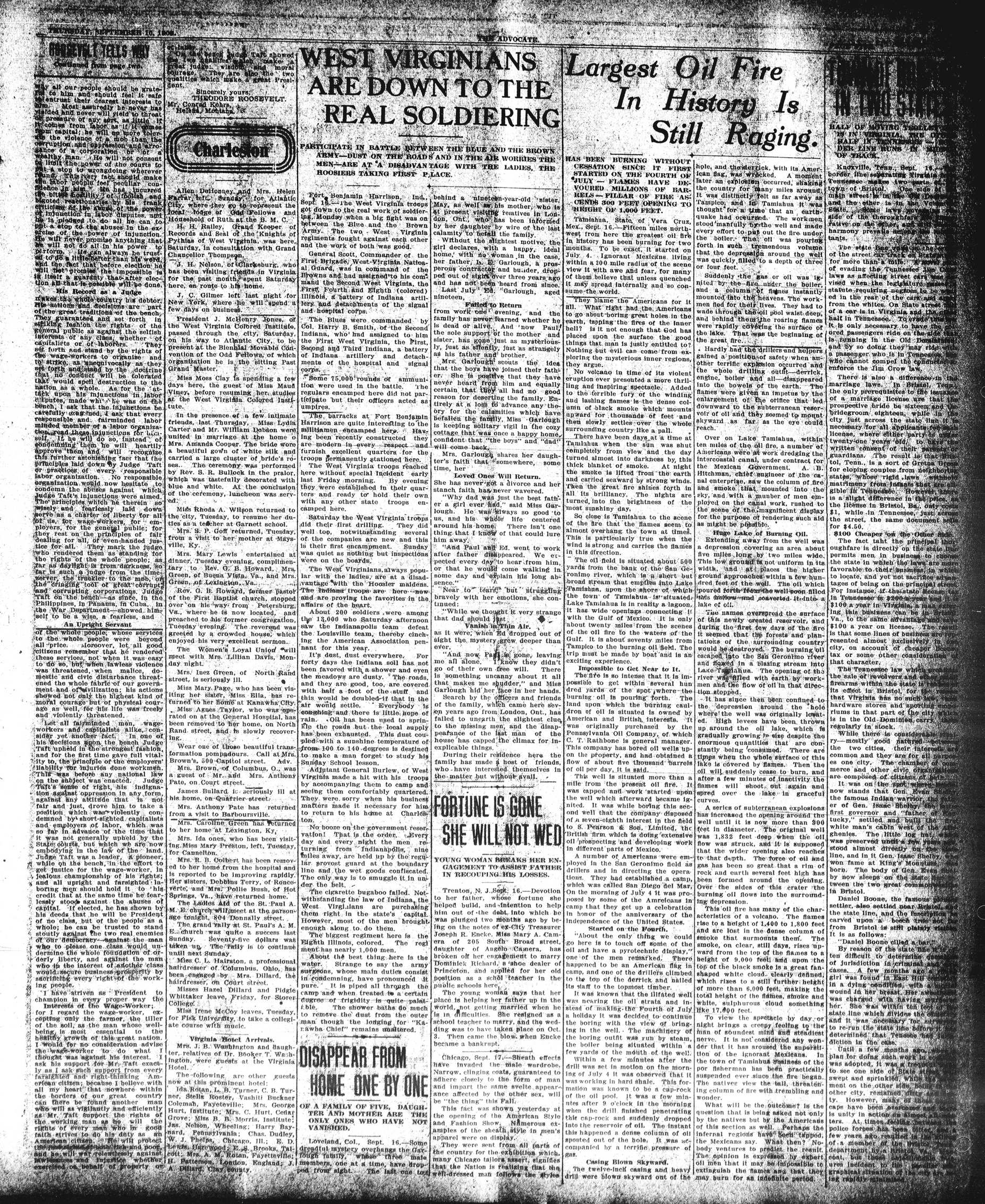
Page text (machine-generated)
REVISITED BY BOOKER T. WASHINGTON, WHO SPENDS FIRST OF WEEK AMONG OLD FRIENDS.
Noted Educator Visits Sister at Malden, Where He Lived Before Entering Upon His Life's Work, and Renews Friendships Formed Before the World Claimed Him as Its Own—Delivers His Message of Equal Importance to Both Races Before a Large Audience of White and Colored People in Which He Dealt in a Practicable Way With the Most Perplexing Problem That Confronts the People of America—Reviews His Work at Tuskegee and Is the Honor Guest of Business and Professional Men of Charleston.
To a large and representative audience, of both white and colored people, at Merger Hall Monday night, Dr. Booker T. Washington, the leader of his race and one of the foremost educators in the country, brought his message. It was a message of equal importance to both races, for it dealt, in a practicable way, with the great race problem, one of the most perplexing problems that confront the people of America today.
tion is only useful when the person who has it can go into the community and make somebody better. When we make the Negro of such economic value to the community that he is needed there, then the race problem will have been solved."
He spoke at length upon the marvelous advancement made by the Negro during his 40 years of freedom, and pointed out the similarities between his race and the Anglo-
"The Negro is here to stay," declared Dr. Washington. "He is going to live side by side with the white man, and to solve the race problem, the Negro must be made of such economic value that he is needed in the community. This can come only through education and work." Dr. Washington arrived here early Sunday morning and was met by Dr. H. F. Gamble, who accompanied him and his secretary, Mr. Hunt, to the home of Mr. and Mrs. J. M. Hazlewood, the "Wizard's" hosts during his stay in Charleston. After breakfast, Dr. Washington, in company with Dr. Gamble and J. C. Glimer, drove to Malden, where he remained till Monday noon visiting his sister, Mrs. Amanda Johnson, renewing old friendships and viewing the familiar scenes, of his childhood days.
Ex-Governor Akinson, Judge of the United States Court of Claims, presided at the meeting, and in speaking of Dr. Washington, referred to him as the greatest educator in the United States. He not in the world. "An acknowledging Judge Akinson's issuatory remarks, Dr. Washington mentioned the fact that a paper owned and edited by the judge was the first he ever read and that a political meeting addressed by him was the first he attended.
Rev. O. D. King, pastor of the State M. E. church (white), invoked divine blessing, and was followed by Dr. Ernest Thompson, of the First Presbyterian church, introducing Dr. Washington, who spoke in part as follows:
It is always a peculiar pleasure to me to come back to this valley and/renew boyhood acquaintances and view these gorgeous hills. No memory is more precious to me than of my old home here. No people are dearer to me than thiepeople of this valley of both races, who have so encouraged me in my work.
In the Black Belt.
"I believe there is a chance for every individual, no matter what his race, his position, or his education may be, to do something to make the world better. I have always had the idea that education should be of some value to the individual. After leaving Presbyterian, church, introducing belt of Alabama, where in some places the members of my race outnumbered the white people six to one. It is in tahit part of the country that what is known as the racial problem exists in its greatest selflessness."
Dr. Washington told of the growth of Tuskegee Institute, from a school of one teacher and 20 students, to a great industrial and norami school of 1,500 students, coming from all parts of the world, and 166 instructors. The first building has grown into 90 and the little plot of ground is now, 2,900 acres. The total holding of the institute amount to more than $3,000,000.
"But," said the speaker, "buildings and land do not make an institution. They are only in keeping with the higher end in view. In our work at Tuskegee, we first had to make a careful study of the needs of our people in that part of the country and do what was best for them. It was necessary to brush aside all artificiality and get down to the bed rock of their needs.
- Something to Get Rid Of.
"The effect of slavery on my people was to make them think that an education was something that put them in a position where they would not have to work. We had to get rid of that and we had to make them believe that working made an education; that there was a vast difference between working and being worked. The greatest work we have accomplished has been the changing of the ideas of our race in regard to labor, that honest toll is Christianizing. We have completely conquered the old prejudice of our race in the south in regard to labor.
"The mere getting of an education doesn't amount to anything. Educa-
tion is only useful when the person who has it can go into the community and make somebody better. When we make the Negro of such economic value to the community that he is needed there, then the race problem will have been solved."
He spoke at length upon the marvelous advancement made by the Negro during his 40 years of freedom, and pointed out the similarities between his race and the Anglo-Saxon, emphasizing their likeness in religion, speech and dress in contrast distinction to the ignorant immigrant, whose criminal record is giving the country much concern. He called attention to the kindly feeling existing between the better classes of both races at the south, and warned his hearers against relying too much upon newspaper reports, which give prominence to the Vardamans and Tillmans of the whites and the murderers, and rapists of the blacks, but, have nothing to say about the thousands of Negroes, who are respected citizens in their respective communities, or the kindly disposed whites, who uphold them in their efforts to better their condition.
At the conclusion of Dr. Washington's address, which consumed about two hours, the speaker received an ovation from all parts of the house, both races joining in vigorous applause. Many availed themselves of the opportunity to shake his hand, and those in the audience who knew Dr. Washington before the world had claimed him as its own reviewer with him incidents which had transpired in the days of their youth.
A banquet, at which were present many of the business and professional men of Charleston, was served in honor of the distinguished visitor in the dining hall of the K. of P. building, after the exercises at Mercer Hall. The function, which was under the direction of Dr. R. L. Jones, equalled in its appointments any affair of a similar nature given here for months, and reflected credit upon the cateress, Mrs. W. O. Terry, whose service could not have been improved upon.
Upon the beautifully decorated square table the following menu was served:
Oyster Cocktail
Salted Almonds
Olives
Cream of Tomato
Soda Wafers
Chicken, a la Kanawha
French Peas
Neapolitan Cream Assorted Cake Coffee Neufchatel Cheese Cigars.
Attorney T. G. Nutter responded to the toast, "The Professional Man," proposed by Dr. H. F. Gamble, the toastmaster, in an oligent speech of five minutes. Honesty, sobriety and a close application to business are the qualifications which make for the success of our professional men, said Mr. Nutter. He paid a glowing tribute to Dr. Washington, naming him the greatest professional man of the race, a man whose achievements, in spite of the handicaps of race and poverty, stamp him one of nature's noblemen.
Dr. Washington said, in responding to the toast, "Our Guest," that the laboring man, the man who earns his bread by the sweat of his brow, is the underpinning of the professional man. He urged those present to keep an eye on the underpinning, upon which depends the stability of their house; to cultivate the friendship of the class upon which depends their success, from which they must draw their support. His remarks, though brief, were to the point and called forth unstinted applause both at their conclusion and during their delivery.
Besides Dr. Washington, there were seated at the table: Messrs. J. M. Hazlewood, Dr. H. F. Gamble, W. J. Thompson, Dr. J. S. Sessoms, Wm O. Lee, Jas. A. Campbell, W. O. Terry, Allen A. DeHonney, J. H. Taylor, Dr. R. L. Jones, A. G. Brown, F. D. Cambric, J. M. Jones, T. G. Nutter, Dr. C. H. Gray, Dr. B. P. Brownley, J. Arthur Jackson, J. M. Canty, F. C. Brown, G. L. Cuzzens and J. C. Glimer.
Parkersburg, Sept. 11.—Earl Dills, black, but claimed to be of white lineage, and of pure Caucasian strain, is going to school at Sand Plains, against the protest of the patrons, pending an investigation to be made by the board of education.
The legality of his right to attend on the claim that he is white, though colored, has been admitted for the time being, until thorough inquiry can be made.
President Coleman has the matter in charge and will present the case to the board at the next session. It is understood that both the father and mother have statements to make concerning the case. The purport of the mother's statement has been given. Omar Dills, the father, will give his version, and it is not known if that differs from the mother's statement already made, or not.
The mother's story, as recited to members of the board, is the one which she has long since pleaded to the neighborhood, and which has been pretty generally accepted. She claims that the child's dark color, resembling so closely the hue of a mulatto as to make it undistinguishable, is the result of a pre-natal influence. She declared that before the child was born she was frightened by a colored man, and the effect of the fright was the strange resemblance he bears to a mulatto. His features are those of a white child, while his hair is straight and there is no trace of the kinkiness which almost invariably would betray the mulatto or even the bearer of less Negro blood. The mother and mother of the child are both Caucasians of apparently purt strain, and there is not the slightest mark of suspicion of other blood in either of them. In fact, it is known that both are pure Caucasians.
The Dils child was dark from birth and where the facts were not known it has always been regarded as a Negro. The parents feel the affliction sorrelly and have suffered many taunts and jibes as the result of what they claim is a wholly helpless and innocent situation, and an affliction, the penalty and nature.
When the nortest was first brought by some of the patrons of the Sand Plains schools, against what they believed to be co-education of black and white, which is contrary to the education laws, the matter was brought to the attention of Superintendent Morris. The superintendent heard the story as the mother tells it the first of the week.
IS THE REPORT THAT WASHINGTON WILL TAKE ACTIVE PART IN CAMPAIGN.
Noted uskegecean Says That He Will Take No Active Part in the Campaign, Taft, Taft, Although He Personally Desires His Success.
During his visit to this city, a representative of the Advocate called the attention of Dr. Washington to a report, emanating from New Yorg last week, which follows:
"As a result of a conference today between C. Coleman Dupont, head of the speakers' bureau of the Republican National Committee and Booker T. Washington, it was decided that the latter would work in connection with the committee in behalf of securing Tatt's election.
"Instead of going upon the stump Washington will devote his attention to organization work among the Negro schools, colleges and churches. He realizes that the Brownsville incident threats to cause a considerable disaffection in the colored vote, and it will be his business to try and prevent this."
"For the present he will maintain his headquarters here, preparing a mass of literature especially designed for the colored voter. This will not only discuss the Brownsville matter, but will question the benefits to be derived from assisting in putting in power the Democratic party, whose greatest strength comes from the south, where the disfranchisement of the Negro is sought.
His efforts will be directed more especially to the states of Ohio, Indiana, Illinois, Missouri, West Virginia, Maryland and New York, where the colored vote is an improptant factor."
Dr. Washington branded the report as having no foundation in fact and authorized a complete denial.
The friendship meeting between the leading candidate on the Republican ticket and Mr. Washington is well known, so he is his desire that Judge Taft be successful at the polls next November, but he will not allow his personal inclinations to cause him to deviate from a long established rule to take no active part in politics.
Huntington, Sept. 14. — The home of Mrs. J. W. Jackson was the scene of a most pleasing reception and progressive white party on last Friday night, in honor of Miss Gertrude Mills, who left for Texas on Tuesday, to resume her professional duties. The house was beautifully decorated, and Mrs. Jackson, usually a good hostess, maintained her reputation on this occasion.
The prize was won by R. W. James, who gallantly presented it to Miss Clara Stewart, an out of town visitor, on route to assume her duties as teacher at the Orphans Home. After having been served, the guests departed, feeling better for having enjoyed the hospitality and social contact of such a delightful gathering.
Those present were Misses Stewart, Winston, James, Barnett, White Mills (Gertrude and Lillie), and Mrs. Sexton; Messrs. Franklin, Johnson, Smith, James, Carter and White.
Des Moines, Iowa, Sept. 10. —The color line was drawn today at Highland Park College here; when President O. H. Langwell dismissed every colored student and announced that no more would be admitted. Owing to the number of recent assaults on white women by Negroes the feeling against the blacks in Des Moines is strong, and President Langwell says the white students take exceptions to the social equality employed in permitting colored students to attend the college.
WILLIAM HOWARD TAFT.
A Man Who Has Done Things.
Responding to the call of the nation for a man equal to the emergencies confronting the republic, the people themselves have found him and presented him to the electorate. Naturally, the people sought among themselves for one truly representative to the highest ideals of American citizenship. Their self-understanding and correct valuation of men led them to the individual who more thoroughly than any other fulfilled their requirements, and that was William Howard Taft.
William Howard Taft, of Lincolnnatt, Ohio, probably is the way he would designate himself. That designation, however, is grossly inadequate. For while Mr. Taft is an American of Americans, he is also a citizen of the world, who, as invited guest, counsellor and advisor of foreign governments, has exerted an influence for peace and international good will unsurpassed by that of any other American staesman, living or dead.
The dignity of private citizenship, which he enjoys today, is in perfect accord with his temperament and inclination. There never has been, nor will there ever be, anything in official honor sufficiently alluring to draw Mr. Taft away from his lifelong identity with the plain people.
As a boy in Cincinnati he was ready to give and take in all the stirring controversies, mental and physical, which give effect to the law of the survival of the fittest. As a student at Yale he displayed all the qualities of wholesome young manhood which have made that university famous, and the endearing traits of his character were honored at the reunion of his class during the recent summer by a celebration more delightful to him, perhaps, than any other demonstration of public favor possibly could be.
HOPE DEFERRED.
(From the Boston Transcript.)
Chairman Mack's reported "hope for Bryan" in the signs of the Vermont election probably was not intended to apply to 1908.
Paris, Sept. 17. Flying at Issy, Thursday, Leon Delagrange stayed aloft in his airplane 28 minutes and 20 seconds.
MAKES FIRST SPEECH OF CAMPAIGN TO MINISTERC OF A. M. E. CHURCH.
Expresses His Sympathy for Negro Inherited from Father and Deplores Mob Violence—Proposes Improvement in Administration of Laws as a Remedy.
Cincinnati, O., Sept. 15—Candidate William H. Taft today declined to go farther with Mr. Bryan in a newspaper controversy over the issues of the campaign.
“There is nothing in Mr. Bryan’s statement of today which seems to require an answer. Should it appear later, I will take up the subject in my public speeches.”
This was Mr. Taft's ultimatum, as he expressed a willingness that Mr. Bryan should have the last word of comment on President Roosevelt's Taft letter.
The gratification of Mr. Taft on the re-nomination of Governor Hughes was expressed in a telegram he sent the Governor, congratulating him on his "well deserved nomination." He added:
"It not only makes the State of New York safe in November, but greatly strengthens the national ticket in every state in the Union."
He expressed the hope that the Governor would be able to give some of his time to the campaign in the west.
Taft 51 Years Old.
This, the 51st anniversary of Mr. Taft's birth, proved to be the busiest day he has had since his arrival here a week ago. He delivered an address tonight to an audience of ministers composing the Ohio Conference of the African Methodist Episcopal Church, the first speech of his campaign to Negroes. The address was not political, but gave a clear outline of the sympathetic understanding and feeling entertained for the sympathies of the race possessed by the candidate.
The candidate was escooted from the Taft residence to Allen Temple in the evening by a party of the clergymen. He began his address by commenting on his familiarity with the temple and the congregation.
Sympathy for Race.
He was there, he said, for the purpose of expressing his sympathy with the Negro race in its struggle for better things.
"A sympathy," he said, "which I have had from the time I was a small boy, for I inherited it from my father, Alphonso Taft, than whom the colored race had no better friend."
This interest, Mr. Taft said, had been stimulated through his experience in the Philippines. He reviewed the struggle, of the race from the time of slavery. It had the most progress in agricultural pursuits, and it was in this line he believed they
Black Fighter Has Finally Forced Burns to Take Him on After Chasing Him Around the Globe to Get a Match.
Johnson:
London, Sept. 10. — Tommy Burgs, the American heavyweight champion, has at last decided to fight Jack Johnson, the colored heavyweight, who has trailed him all over the world for a battle.
A syndicate of Australians has practically clinched the match, which probably will take place in Sydney during the latter part of November. The Australians have offered a purse of $25,000 for a finish fight, with four-ounce gloves, the winner to receive 60 and the loser 40 per cent. The arrangements were concluded here today, and the details are all that remain to be served.
During his victorious and profitable stay in this country, Burkin has lost many friends by his refusal to meet the Negro. His claim that he should receive almost the entire receipts did not savor very much of sportsmanship, and it began to appear as if the fear of his rival kept him from signing up for a battle to determine the world's championship. Johnson has gained many admirers, who do not hesitate to say that he will beat Burns if they meet. The constant pressure kept upon Burns and the fact that he was going backward in public esteem are supposed to be the main reasons why he has at last concluded to fight Johnson.
Many Valuable Successes Are Received From Reach the Black Vote—Speakers and Writers for the Battle and Are Assured of Victory
Make the Largest Demonstration in Years and Are Addressed by Dancy and Vernon in Issuance
Talking What the Republican Party Is
Substantial Victory for the African-American Number in of Government Has More Doubled in Years
Years.
(Special by National Negro Press Bureau.)
Washington, D. C. Sept. 16.—The developments of the past week in political circles have been very gratifying to the Republicans. The plans maned out for the colored element of the party by Chairman Hitchcock, Col. W. L. Wood and Col. DuPont, are pleasing alike to the leaders and to the rank and file of our people, and the campaign has opened wit han "era of good feeling" all around. Colored leaders from the west, east and south have been in conference at the New York headquarters, and many valuable suggestions have been adopted by the managers looking to a united effort to carrying the pivotal states for Taft and Sherman. Whatever there may be of rivalry among the men of influence and ability in their earnest striving to see who can be of the greatest service in promoting the cause nearest to their hearts. The speakers who are to carry the message to the masses are "cocked and primed" with facts of history and full of hope for the future; the writers have their peninsula sharpened to a fine point, and the workers are being instructed how and where to put in their best looks. Some have been chosen for these responsibilities—and they represent the best talent procurable, and energy will be selected as the requirements demand their services.
Word comes from Philadelphia that the largest demonstration made in years by Negroes in that city, in behalf of the Republican party was that of last Thursday night in the Calvary Methodist Episcopal church, on Broad street, near Fitzwater. The meeting was under the auspices of the Civil Rights League, recently organized there to look after the political interests and general welfare of the colored people. The principal speakers were two of the most prominent orators of the race, Hon. John C. Dancy, Recorder of Deeds of the District of oclumba, and Hon. William T. Vernon, Register of the Treasury at Washington. Mr. Dancy was fired with enthusiasm for the Republican party and for the national ticket, and made what his admirers considered "the effort of his life." He succeeded in generating in the great audience of 2,000 all the enthusiasm he felt himself and every point was greeted with vociferous cheers and cries of "That's so! hit! amg again!" in the hour that Mr. Dancy held his hearers spellbound he extolled the record of the Republican party and recited its achievements in war and peace, and described its labors to make the black man a full-fledged citizen of the nation. The credit of the government, the protection of our people in the enjoyment of their civil and political rights, and the integrity of the courts are all bound up, he claimed in the continuance in power of the party of freedom, commercial expansion and civic equality. To the surprise and delight of the vast assemblage, Mr. Dancy met the Brownsville question squarely and placed all the blame for the vexatious episode on the shoulders of the Democratic party. He made it very clear that the Republican party made the Negro soldier possible and that the Democratic party is on record as favoring the complete elimination of the Negro from the army establishment. He recalled the fact that the Republicans all favored the restoration of the soldiers, differing only as to method, while the Democrats stood like a stone wall in opposition to their return to the army on any basis. He brought down the house by declaring that it was idiocy for any colored man to attempt to prove to an intelligent audience that the triumph of the Democratic party would inure to the benefit of the Negro and foolish to assert that the election of Bryan would be a vindication of Senator Foraker, whose valorous defense of the race the demand worthy of the highest praise. A vote for a party which stood out against Foraker and the Negro would be an abandonment of all that the senator had stood for last year, and would be a fatal handicap to the plan of adjustment arranged by the party leaders for the next session of Congress. Mr. Dancy traced the entire incident from the appearance of the troops at Brownsville to the dis
SUBSCRIPTION $1.30 YEAR
ATIONS CAPITAL
ALL 8 ECTIONS IN CONFERENCE WITH
POLICIAN MANAGERS
Are Received From
Missouri State War
Makers and Writers
of Victory
Operation in Years
Missouri State War
Makers and Women
of the Republican Party Just Deserted
Afro-American—Number in Service
more than Doubled in Last Four
Years.
charge, proving that the prejudice of the Democracy against Negroes military started the trouble and had finally defeated the efforts of the republicans to bring about a satireory ending up to this time. The historer, he felt, will be adjusted on an equitable basis and a vote of confidence in the Republican party would be the longest step toward such an adjustment. Mr. Denoy brought forward statistics to show that the Republicans had accorded to the Negro a fair share of the ojcal patronage and that more would be given in the future; whole nothing worthwhile could be hoped for from the Democrats who had not the courage to mention the race in its platform. On the contrary, the race would lose to a very large extent, the comparison it now has in the event of Mr. Ryan's election.
Register Vernon, who was far from well, followed in a brief, but eloquent address, in which he compared the records of the parties and pointed out the dangers that would threaten the Negro in the instances of his great friendship for the Negro and the dark races in the Philippines and Cuba. He had no doubt, that Judge Taft would make a President whom the colored people would revere as they do Lincoln, the Emancipator. He would be just sympathetic, strong and progressive.
alienate bleakness their Both speakers were worthy and plaque throughout their speeches. Other speeches were delivered by Dr. John M. Palmum, bishop of Dr. C. A. Tindall, bishop of G. D. P. Tallaforte, bishop of Well, Bishop G. W. Clinton and G. W. L. Offard, secretary of the Civil Rights League.
Bishop Caldwell, of the A. M. B. Zion connection, a staunch Taoist advocate, presided.
Below are given some statistics showing what the Republican party is doing in a substantial war for the Afro-American. Office holding does not cover everything a race wants but the recognition of the Negro ability to administer a small amount and to protect his civil rights in condition thereto, surely entitles a party to more credit than a party that cost neelchr—nor even promises to be anything of a helpful nature, morally or materially.
According to carefully compiled statistics, the number of African Americans in the service of the government, exclusive of the army and navy, has more than doubled in the last four years of the Roosevelt administration and their aggression was increased from $8,000,000 in 1900 to over $8,000,000 in 1908. The following shows the number of African American employees in the service of the Federal government, the number of whose retention depends in a large measure upon the continuance of the Republican party at the national helm.
Diplomatic and consular service
11; salaries, $35,000.
Departmental service, Washington
D. C.; state, 19; salaries, $14,266
treasury, 689; salaries, $77,301;
war, 146; salaries, $105,891;
war, 47; salaries, $25,736; postoffice, 149;
salaries, $106,468; interlay, 50;
salaries, $237,775; land, 23;
salaries, $14,300; agriculture, 581;
salaries, $63,924; commissary labor,
119; salaries, $17,040; government
printing office, 552; salaries, $856;
180; interstate commissary com-
mission, 31; salaries, $11,440; United
States capitol, 185; salaries, $116
420; Washington portfoil, $20;
salaries, $150,240; District of Col-
umbia government, including miskilled
labors, 2,788; salaries, $1252,588;
Departmental service at large;
customs and internal revenue,
585; salaries, $493,111;
postoffice, 2,958; salaries, $89,326;
interior, 23; salaries, $89,326;
commerce and labor, 60; salaries, $398
002; United States army, offices,
51; salaries, $29,285; United Natio-
my, enlisted men, 2,996;
$901,083; miscellaneous, internal
unclassified, 1,925; salaries, $1,250.
Total, 13,973; salaries, $102.355.
In the city of Washington about
5,499 Negroes, employed by the gov-
ernment, drew satirists that apologized
gate $3,044,404—an amount of the
Continued. we have
ROOSEVELT TELLS WHY JUDGE TAFT SHOULD BE CHOSEN
WRITING TO HIS OLD FRIEND, CONRAID KOHRS, THE PRESIDENT GIVE HIS REASONS FOR THE ELECTION OF THE REPUBLICAN CANDIDATE—POINTS OUT THAT HE DOES NOT PROMISE MUCH, BUT ALWAYS MORE THAN MAKES GOOD—RECORD AS JUDGE SHOULD WIN HIM FRIENDSHIP OF UNION LABOR—TREATMENT OF THE RAILROAD QUESTION.
Let Every Republican see that his Name is Registered UNLESS YOU REGISTER YOU CANNOT VOTE Should you be away when the Registrar calls look him up and have your name put on. The sooner you register the better for you, you cannot vote by affidavit on election day.
You Must Register in Your Own Voting Precinct.
Oyster Bay, Sept. 14.—President Roosevelt's letter to Conrad Kohrs, of Helena, Montana, in which the chief executive tells why Judge Taft should be elected President, was made public at the executive offices this morning.
Mr. Kohrs is an old-time Montana cattle man and one of the most prominent citizens of Montana. He and the President came into close relationship more than twenty years ago, when they were both members of the Montana Stock Growers Association, the President being at that time the representative of the Little Missouri Stock Growers in the association. The intimacy has been kept up ever since. Mr. Kohrs is one of the pioneer citizens of the Nortehrn Rocky Mountain region and one of the men who has taken a leading part in its great development.
Oyster Bay, N. Y., Sept. 9, 1908.
My Dear Mr. Kohrs:
I have received your letter about the candidacy of Mr. Taft, the man who I feel is in an especial sense the representative of all that in which I most believe in political life.
Every good citizen should desire to see both prosperity and justice, prosperity and fair and righteous dealing as between man and man, obtain permanently in this great republic. As a people we are justly proud of our business industry, of our energy and intelligence in our work; and it is entirely right that we should ask ourselves as to any given course of conduct, "Will it be profitable?" But it is also no less emphatically true that the bulk of our people, the plain people who found in Abraham Lincoln their especial champion and spokesman, regard the question, "Is this morally right?" as even more important than the question, "Is this profitable?" when applied to any given course of conduct. Indeed, in the long run our people are sure to find that in all dealings, alike in the business and the political world, what is really profitable is that which is morally right. The last few years have seen a great awakening of the public conscience and the growth of a storm determination to do away with corruption and unfair dealing, political, economic, social. It is urgently necessary that this great reform movement should go on. But no reform movement is healthy if it goes on by spasms; if it is marked by periods of frenzied advance, followed, as such periods of frenzied advance must always be followed, by equally violent periods of reaction. The revolutionary and the
reactionary really play into one another's hands, to the extent that each by his excesses necessarily tends to arouse such disgust, such a feeling of revolt, in the minds of quiet people, as temporarily to restore the other to power. To permit the direction of our public affairs to fall alternately into the hands of revolutionaries and reactionaries, of the extreme radicals of unrest and of the bigoted conservatives who recognize no wrongs to remedy, would merely mean that the nation had embarked on a feverish course of violent oscillation which would be fraught with great temporary treble, and would produce no adequate good in the end. The true friend of reform, the true foe of abuses, is the man who steadily perseveres in righting wrongs, in warring against abuses, but whose character and training are such that he never promises what he cannot perform, that he always a little
More Than. Makes Good
what he does promise, and that, while steadily advancing, he never permits himself to be led into foolish excesses which would damage the very cause he champions. In Mr. Taft we have a man who combines all of these qualities to a degree which no other man in our public life since the Civil War has surpassed. To a flaming hatred of injustice, to a score of all that is base and mean, to a hearty sympathy with the oppressed, he unites entire disinterestedness, courage both moral and physical of the very highest type, and a kindly generosity of nature which makes him feel that all of his fellow-countrymen are in very truth his friends and brothers, that their interests are his, and that all his great qualities are to be spent with lavish freedom in their service. The honest man of means, the honest and law-abiding business man, can feel safe in his hands because of the very fact that the dishonest man of great wealth, the man who swindles or robs his fellows, would not so much as dare to defend his evil-doing in Mr. Taft's presence. The honest wage-worker, the honest laboring man, the honest farmer, the honest mechanic or small trader, or man of small means, can feel that in a peculiar sense Mr. Taft will be his representative because of the very fact that he has the same scorn for the demagog that he has for the corruptionist, and that he would front threats of personal violence from a mob with the unquailing and lofty indifference with which he would front the bitter anger of the wealthiest and most powerful corporations. Broad though his sympathies are, there is in him not the slightest tinge of weakness. No considera-
tion of personal interest, any more than of fear for his personal safety, could make him swerve a hair's breadth from the course which he regards as right and in the interest of the whole people.
I have naturally a peculiar interest in the success of Mr. Taft, and in seeing him backed by a majority in both houses of Congress which will heartily support his policies. For the last ten years, while I have been Governor of New York and President, I have been thrown into the closest intimacy with him, and he and I have on every essential point stood in heartiest agreement, shoulder to shoulder. We have the same views as to what is demanded by the national interest and honor, both within our own borders, and as regards the relations of this nation with other nations. There is no fight for decency and fair dealing which I have waged in which I have not had his heartiest and most effective sympathy and support, and the policies for which I stand are his policies as much as mine.
It is not possible in the space of this letter to discuss all the many and infinitely varied questions, of moment with which.
Mr. Taft as President
would have to deal; let him he judged by what he has himself done, and by what the administration, in which he has played so conspicuous a part, has done. But to illustrate just what his attitude is, let me touch on two matters now prominent in the public mind.
Mr. Taft can be trusted to exact from the railroads for the very reason that he can be trusted to do justice to the railroads. The railroads are the chief instruments of interstate commerce in the country, and they can neither be held to a proper accountability on the one hand nor given proper protection on the other save, by the affirmative action of the Federal Government. The law as laid down by the Federal courts clearly shows that the States have not and cannot devise laws adequate to meet the problems caused by the great growth of the railroads doing an interstate commerce business, for more than four-fifths of the business of the railroads is interstate, and under the Constitution of the United States only the Federal Government can exercise control thereof. It is absolutely necessary that this control should be affirmative and thoroughgoing. All interstate business carried on by the great corporations should, in the interest of the whole people, be far more closely supervised than at present by the National Government; but this is especially true of the railroads, which cannot exist at all save, by the exercise of powers granted them on behalf of the people, and which,
GREAT
SHOE
SALE
NOW
IN
FULL
BLAST
AT
BELL
SHOE
CO.
708 Kanawha St.
therefore, should be held to a peculiar accountability to the people. It is in the interest of the people that they should not be permitted to do injustice; and it is no less to the interest of the people that they should not suffer injustice. Their prime purpose is to carry the commodities of the farmers and the business men; they could not be built save for the money contributed to them by their shareholders; they could not be run at all save for the money paid out in wages to the rairoad employees; and dinally, they could not be run judiciously, or profitably to any one, were it not for the employment by them of some masterful guiding intelligence, whether of one man or of a group of men. There are therefore several sets of interests to be considered. Each must receive proper consideration, and when any one of them selfishly demands exclusive consideration the demand must be refused. Along certain lines, all of these groups have the same interests. It is to the interest of shipper, farmer, wage-worker, business man, honest shareholder, and honest manager alike that there should be economy, honesty, intelligence, and
Fair Treatment of All.
To get an effective stop to stock watering would be a benefit to everybody except the swindlers who profit by stock watering; it would benefit the honest shareholder because honest investments would not be brought into competition with mere paper; it would benefit the wage-worker because when the money earned does not have to go to paying interest on watered capital, more of it is left, out of which to pay wages; it would benefit the shipper because when only honest stockholders have to be paid interest, rates need not be improperly raised; it would benefit the public because there would be ample money with which to give efficient service. Similarly, the prevention of favoritism as among, shippers does no damage to any one who is honest, and confers great good upon the smaller business man and the farmer, whom it relieves of oppression. Again, such supervision of accounts and management as will prevent crookedness and oppression works good, directly or indirectly, to all honest people. Therefore everything that can be done along all these lines should be done; and no man's legitimate interest would thereby be hurt. But after this point has been reached great care must be exercised not to work injustice to one class in the effort to show favor to another class, and each class naturally tends to remember only its own needs. The stockholders must receive an ample return on their investments, or the railroads cannot be built and successfully maintained; and the rates to shippers and the wages to employees, from the highest to the lowest, must all be conditioned upon this fact. On the other hand, in a public service, corporation we have no right to allow such excessive profits as will decompile rates being unduly high and wages unduly low. Again, while in all proper ways rates must be kept low, we must always remember that we have no right and no identification to re-
duce them when the result is the reduction of the wages of the great army of railroad men. A fair working arrangement must be devised according to the needs of the several cases, so that profits, wages and rates shall each be reasonable with reference to the other two—and in wages I include the properly large amounts which should always be paid to those whose masterful ability is required for the successful direction of great enterprises. Combinations which favor such an equitable arrangement should themselves be favored and not forbidden by law; although they should be strictly supervised by the Government through the Interstate Commerce Commission, which should have the power of passing summarily upon not only the question of the reduction but the raising of rates.
This Railroad Problem is itself one of the phases of one of the greatest and most intricate problems of our civilization; for its proper solution we need not merely honesty and courage, not judgment, good sense, and entire fair-mindedness. Demagogy in such a matter is as certain to work evil as corruption itself. The man who promises to raise the wages of railroad employees to the highest point and at the same time to reduce rates to the lowest point is promising, what neither he nor anyone else can perform; and if the effort to perform it were attempted disaster would result to both shipper and wageworker, and ruin to the business interests of the country. The man to trust in such a matter as this is the man who, like Judge Taft, does not promise too much, but who could not be swayed from the path of duty by any argument, by any consideration; who will wage relentless war on the successful wrongdoer among railroad men as among all other men; who will do all that can be done to secure legitimately low rates to shippers and absolute evenness among the rates thus secured; but who will neither promise nor attempt to secure rates so low that the wage-earner would lose his earnings and the shareholder, whose money built the road, his profits. He will not favor a ruinous experiment like government ownership of railways; he will stand against any kind of confiscation of honestly acquired property; but he will work effectively for the most efficient type of government supervision and control of railways, so as to secure just and fair treatment of the people as a whole.
What is here said as to his attitude on the railway question applies to the whole question of the trusts. He will promise nothing on this subject unless he firmly believes he can make his promise good. He will go into no chimerical movement to destroy all great business combinations; for this can only be done by destroying all modern business; but he will in practical fashion do everything possible to secure such efficient control, on behalf of the people as a whole, over these great combinations as will deprive them of the power to work evil. Mr. Tatt's decision in the Addystone pipe Line case while on the bench is proof by deeds not by words, of the far sighted wisdom with which he serves
ARE YOU A K. OF P. IF NOT. WHY NOT?
SUBORDINATE LODGE
In this the members are united to care for and protect each other's interest as well as sickness and distress.
In this department our young men are receiving a military education which they can get in no other way, thus making them better and more useful citizens.
In this the wives, mothers, widows, daughters and sisters of Knights are united for the common purposes of life.
In this department we are paying out thousands of dollars annually to the widows and heirs of deceased Knights.
If there is no lodge in your locality, confer with the Deputy Grand Chancellor of your District or write W. J. Thompson, Charleston, W. Va., for terms upon which to organize lodges
LADIES' COURT
In this the widows, da sisters of Knight ited for the poses of life.
ENDOWMENT
In this department paying out the dollars annuity widows and ceased Knight If there is no locality, confer utility Grand Chanc District or writer Charleston, W. W upon which lodges
the interests of the whole people even those of the most powerful corporations are hostile thereto.
If there is one body of men more than another whose support I feel I have a right to challenge on behalf of Secretary Taft it is the
Body of Wage-workers of the county. A steward, friend, a fairer and better representative, they cannot find within the borders of the United States. He will do everything in his power for them except to do that which is wrong. He will do wrong for no man, and therefore can be trusted by all men. During the ten years of my intimate are
quaintance with him, since I have myself, as Governor and President, been obliged to deal practically with labor problems, he has been one of the men upon whose judgment and aid I could always rely in doing everything possible for the cause of the wage-worker, of the man who works with his hands, or with both hands and head.
Families Furnished with Ice Cream. Orders for shipment solicited. We make prompt delivery of Cream and Ices for Sunday orders.
Renting the demand across the Negro people for an educated ministry, the Tuskegee Normal and Industrial Institute, conducts its connection with its other departments in H Bible Training School. The courses of study are no arranged that, 'not only ministers and loiterates may be benefited, but those who desire to do better missionary work or become intelligent. Sunday school teachers.
The chief aim of the Bible Training School is to afford a comprehensive knowledge of the English Bible and to implant in the hearts of those who attend an ambition to dedicate their lives to the elevation and Christianization of their people. Daily supplementary exercises designed to instill habits of sobriety, cleanliness, regularity and accuracy are provided. The teaching is wholly undenominational, the intention being not to oppose or antagonize any theological work being done elsewhere, but instead, to assist all denominations. During the past year, the enrollment in the Bible Training School has been satisfactory, but the opportunity is now provided for a considerably larger number.
The teaching is free. The cost of
board, including furnished room,
light, fuel, laundering, etc. is $8.50
per month. The entrance fee is $7,
to be paid in cash by each student
when he registers. Students will be
given the opportunity to work out
much of the $8.50, in some cases all
of it. Lack of means should not keep
any enrolment from entering the Bible
School. If the student is not afraid
of work and study, he will succeed.
For further information, address
BOOKER T. WASHINGTON,
Principal,
Tuskegee Institute, Ala.
6-25-12t
Many of the young men who have finished the courses in agriculture at the Tuskegee institute are commanding salaries ranging from $50 to $100 per month. The graduates of this department or the school are successfully employed as instructors, or as managers of important agricultural operations. The school has an agricultural faculty of 20 instructors; men who have received their training in the best agricultural schools of the country.
Young colored men and women who desire to take courses in practical and scientific agriculture are now offered the best opportunity to pursue such courses in one of the largest and best equipped schools for practical and scientific agriculture to be found in the south. The following courses are offered:
General Farming, two years course.
Truck Gardening, two years course
Care and Management of Cattle
and Stock, two years course.
Poultry Raising, two years course.
In addition there is a special Post Graduate course of or two years provided for graduates of high schools and colleges. We are especially anx-
We have
a new line of
GAS
STAND
LAMPS
Come in and
look them
over
COFFEY
Plumbing Co.
Quarrier St., near Capitol
BEST FOR THE BOWELS
If you haven't regular, healthy movement of the bowle every day, you're older will be. Keep your bowls open, and be well. Morse, in the shape of violent physique or pill, polsem, in dangerous. The smoothness, easest, most perfect way of keeping the bowls clear and clean is to take
GANDY
OATHARTICIO
CONCERTS
ONLY WORK WHEN YOU SLEEP
EAT 'EM LIKE GANDY
Pleasant, Palatable, Potent, Taste Good, Dg
Good, Never Slicken, Weaken or Gripe, 10, 25
and 40, or Free sample and book-
let on health. Address
Storing Remedy Company.
Chicago or New York.
KEEP YOUR BLOOD OCEAN
tous to have a large number of agric-
ultural students who have finished
high school or college courses. Any
young man who is ambitious enough
to finish any of the courses above
mentioned can readily secure imme-
diate employment at good salaries.
Opportunities are now open to 600 young men and women who may wish to take any of the above courses of instruction. The cost of board is $8.50 per month. No charge for instruction.
For further information, address BOOKER T. WASHINGTON, Principal, Tuskegee Institute, Ala.
6-25-12t
TAFT
(Continued from Page One.)
should continue, although he spent considerable time in his comment on the value of education, which he said had increased from 5 to 50 per cent in the past 40 years. The education to be most sought for by the Negro race, he said, was primarily the rudiments of knowledge combined with industrial training. This should be supplemented by higher education for a more limited number to furnish well-rounded ministers, doctors, teachers and lawyers.
"It will be greatly easier for him, (the Negro), to secure his civil and political rights" when he becomes useful to the community and a source of profit to many members of it.
"Prejudice against the race fades away most rapidly when there are peculiary reasons for its disappearance."
The candidate said, he had not always been in favor of higher education for members of the Negro race.
"But after a full consideration of the needs of the race, I am convinced that I was in error."
Discusses, Mob Violence.
On the subject of race prejudice and mob violence, Mr. Taft said:
"I don't know that the race bitterness is any stronger today that it ever was. For a length of time it seems to be altogether abated, and then there will be an outbreak; a mob will be formed, developing the most fiendish cruelty, manifesting itself in the blindest and most unreasonable assaults, upon perfectly innocent people, simply because of their color. It is only fair to say that such brutish exhibitions are not confined to any one section.
"It is impossible to read accounts of this sort, without having one's blood boil with indignation, that there can reside in the human breast such a savage and beastly impulse and motive. But we must remember two things: First, that in spite of our education and refinement and progress toward Christian ideals, we still retain in our nature a good deal of the original animal, and second, that the spirit of a mob seems to be a different spirit from that of the individuals making it up, and to disclose a more insensitive and inhuman state of impulse that it would be possible to find in any one of its members. The best remedy and the necessary one, is an improvement in the administration of our criminal laws and the holding to strict account, the officers of the law who do not use all possible means to prevent and suppress such outbreaks."
Mr. Taft's speech was warmly received, and many of his periods roundly applauded.
NOTICE
The Executive Board of the West Virginia Woman's State Federation will meet, Saturday, at the residence of Mrs. Mary Clark, 909 Washington street, Charleston, at 10 a. m. All the members are requested to be present.
MRS. M. E. PRILLERAN,
Chairman.
Michigan City, Ind., Sept. 17.
Edward Quick, a guard in the penitentiary here, was murdered in his home early Thursday by a burglar, whom he discovered ransacking a dresser. The slayer escaped.
Miss Lena McClung arrived home, Thursday evening of last week, after spending a pleasant month's visit with her bister, Anna, in Chickoga, Ill. J. R. Jefferson reports a very pleasant and profitable visit to Keystone, where he addressed a most excellent meeting of the secret orders of the Norfolk and Western toal fields, the night of September 4th. Sumner School opened, Monday, September 7th, with the largest enrollment for years. Every room is well filled and the school year promises to be an exceedingly successful one.
Mrs. Grace Spraggins, who has been confined to her bed for the past five weeks, is now able to go about the city.
Mrs. Carrie Jones and sister, Miss Blanche Hollinger, spent Sunday week in visiting relatives in Wheeling.
Miss Grace Washington was quite ill last week at her home, on Fourth street.
Mrs. Pet Griffin entertained Miss Joanna Maston, Mr. and Mrs. J. R. Jefferson and their two gons, Harry and Miles, and H. D. Hazlewood, at dinner last Sunday week.
Charles Wells, who is working in Athens, Ohio, spent several days at bome last week.
Herman Brown secured a nice position last week in Washington, D.C. He writes that he is pleasantly located and likes his place.
Vendetta Court, No. 5, O. Q. C., held a very pleasant and profitable session at their hall last Thursday evening.
Mrs. E. V. Senna, Mrs. Isaac Custis, Mrs. J. W. Schellcroft, Miss Rebecca Brown and Mr. and Mrs. J. M. Carter spent Sunday in Middleport, Ohio, the guests of Miss Jessie Hale.
Mrs. Andrew Burton, Mrs. Eva Taylor and Louis Jones, of Belphe, Ohio, were in attendance at Logan M. E. church services, Sunday morning.
Miss Mabel Brady spent several days in the city this week, the guest of Miss Mary Peyton. Miss Brady is one of the instructors in Storer College, Harpers Ferry.
Misses Mary Peyton and Brady will leave, Sunday, for Harpers Ferry, where they will both be employed as members of the faculty of Storer College the ensuing term.
Revs. W. F. Jones and H. G. Pierce were pleasant visitors to Sumner School, Monday morning.
Mrs. Wm. Watkins and daughter, Claudia, returned to the city, Tuesday evening, the 8th, after having spent a pleasant summer in Canton, Ohio.
The little daughter of Mr. and Mrs. Charles Pierce was quite ill the latter part of last week, but is now convalescent.
The funds being raised by Logan M. E. church for new windows nave about reached an amount sufficient to cover the indebtedness.
Louis Jones, of Belpre, Ohio, left
Sunday, for Storer College, Harpers
Ferry, where he will complete his
course the ensuing term.
Mrs. F. O. Lacy and children and
brother Louis were pleasant visitors
to Mrs. J. R. Jefferson last Sunday
afternoon from Belpre, Ohio.
Allen Green, of Zanesville, Ohio,
was in the city last Sunday. Mr.
Green formerly lived in this city, but
has not been back here since leaving
until Sunday, a period of 29 years
having elapsed.
Miss Thompson, of Athens, Ohio,
was in the city last week, the guest
of Mrs. Anna Washington
Miss Edith Thompson, of Pratt,
was shopping here, Friday.
A. L. Topson, of Cincinnati, was a
business visitor here last week, while
here he was the guest of Mr. and
Mrs. O. T. Wilkerson.
Mrs. Emanuel Washington is sick
at her home, on High street.
Mrs. Ruth Fields and children, of
Charleston, are here, guests of Mr.
and Mrs. George Gough.
Miss Iva Miller, of Greenville, is
here, the guest of Mrs. B. F. White.
Prof. Thomas Jefferson, of Hill
Top, came down. Thursday, on business.
Mrs. Willa Washington and Mr.
and Mrs. Edward Taylor, and baby
Goldleid, of Hawks Nest, were guests
of Mr. and Mrs. P. H. Shepherd last
week.
Mrs. B. F. White and, Mrs. H. H.
Railey were entertained at tea, Sunday
evening, by Mrs. S. T. Jackson.
Key. M. Stranghther, of Malden, was here; Sunday, the guest of Mr. and Mrs. R. E. Russell.
Miss Yanhella-Brovin, of Hill Top, was last week the guest of Miss Ella Burke.
M. D. Buster left Sunday evening for Atlantic City to attend the B. M. C.
Misses Lena Rice, Ada Burke and Mrs. Minnie Samuels, of Charleston, took the teachers' examination here, Friday and Saturday.
Misses Mamie Hall, of Kinneys Creek, was visiting Misses Mary and Vanilla Noel last week.
Misses Annie Rotan and Bertha Turner, of Rayetteville, were business visitors here. Friday and Saturday.
Monday, with a good enrollment.
Rev. Nelson Barnett, of Huntington, was a business visitor here; Monday.
Miss Victor Rockney, of Columbus, and Miss Bella Buster, of Handley, were guests of Mr. and Mrs. Edward Harry last week.
Mr. and Mrs. William Wilkerson, of Macdonald, spent several days here last week with Mr. and Mrs. V. M. Willis.
Rov. D. C. Deems left, Saturday, for Macdonald, to all his regular appointment at church, and to begin school, Monday.
Pomp Hobson, of Bluefield, and Miss Rosa-Mickens were quietly married last Tuesday, evening, at 7:25, at the residence of the bride. Miss Mickens is quite popular and her friends wish her a happy life. Mr. and Mrs. Hobson left, Wednesday morning, for Bluefield, their future home. H. C. Mickens is visiting friends and relatives in my this week.
Miss Florence Mitchell gave a delightful party at her home last Friday evening. Quite a number, of young people was present and spent a pleasant time.
Samuel Calloway, of Richmond, spent Friday here, the guest of Miss Bertha Halee.
Miss Mary L. Williams came home, Saturday, from a visit to relatives in Charleston. She will teach here this winter.
Harvey Neusome and Archie Clemmons, who spent the summer at White Sulphur, are home again.
Miss Willie Stewart will leave next week to see her burry, W. Va., to spend the winter with her sister, Mrs. Lee Watkins.
Master Eugene Payne entertained a number of his friends. Thursday evening, at his home, on Elk street. The little folks enjoyed their simple games until about 10 o'clock.
LEWISBURG.
Rev, J. W. Weyers returned, Saturday, after an absence of three weeks. During this time he visited Harrisonburg, Charles Town, Marlinsburg, Darksville, and other points.
Jutte a number of our people attended the camp meeting at Ronceverte. We learn that a large crowd was there from many points on the C. and O. This meeting is conducted by Revs. Withrow and Beck.
The Lewisburg Graded School opened Monday, with an enrollment of 102. This is by far the largest in its history. The teachers are: E. A. Bolling, principal, and Misses F. V. Woodson, Mamie Curry and Josephine Jackson, assistants.
W. F. Robinson and wife, of Fairmont, are visiting relatives here.
Miss Lydia Winston left yesterday morning for a six weeks' visit to Charleston.
Miss Ella Scot is visiting Alderson. John Baker has erected a fine residence, on Montgomery Hill. Miss Myrtle Cooley is on a short visit to Hinton. E. A. Bolling, jr., left Saturday for Alderson, where he will teach the coming term. Mrs. Sarah Dawson, who spent a month here visiting friends and relatives, returned to Charleston last week. Robert Bush, who has been sick for some time, is not much improved. Rev. Turner preached at Mt. Tabor Baptist church, Sunday morning and night.
CARBON.
C. H. Martin has been on the sick list a few days, but is better at this writing.
Whooping cough is quite serious among the little children at present. Our school opened last Tuesday, the 8th, with A. W. Alston, teacher. Rev, P. P. Holland and wife are the proud parents of a fine girl, born on the 8th.
Rev. Edward Allen, of London, was with us last Wednesday night, and preached a good sermon. He contemplates going to Tuskegee, Ala., to enter the Ministers' school.
Mrs. Cora Wormley, of Elkridge, was visiting her sister, Mrs. Nannie Wilson, last week.
Mrs. A. C. Brannon, of Charleston, was calling on Mrs. Nannie Wilson one day last week.
Sunday was our regular preaching day. Rev. Holland preached two able sermons. At 7:30 he preached a special sermon.
Mrs. Lottie Saunders is suffering very much from having some teeth extracted.
Charles Reid was visiting on Coal river, Saturday and Sunday.
Work has begun on our new church, which we expect to be in by the first of November.
POWELLTON.
The public school opened last Tuesday, with Miss Cornelia F. Spears as teacher. The Church Aid Society gave an entertainment in the church yard last Wednesday evening. It was very
NOTICE TO TEACHERS
The Third Uniform Examination for anawha county this year will be held in the Charleston High School, on Quarrier street, Friday and Saturday, September 11th and 12th, commencing at 7:30 a. m. on Friday.
The General History questions will be limited to the history of the 18th and 19th centuries, not including English History.
The Kanawha County Institute will convene in Mercer Hall on August 31. A splendid corps of instructors has been secured.
M. P. SHAWKEY,
8-20-2t
County Supt.
well attended.
Mrs. Ida M. Jones arrived on the 5th from New Jersey. Mrs. Jones expects to instruct in the sewing department of the West Virginia Seminary this year.
The Missionary Society convened on the 6th inst. in its first session of the missionary year. The delegate, Mrs. Lucy Carter, made a favorable report of the convention.
* T. L. Thompson returned from a business trip to Virginia last Wednesday, where he spent a few days with relatives. He had to make his trip very short, in order to get back to attend the teachers' examination in Montgomery, on the 11th and 12th inst.
Mrs. Joseph Edmond and little daughter Margaret, of Huntington, are visiting Mrs. Sallie Mills.
J. F. Fairfax resigned his position as check weighman for the mine workers last Friday evening at a regular meeting of the miners. He is expecting to take a normal course at the West Virginia Colored Institute. Mr. Fairfax served the miners as check weighman for near four years, and his work was so satisfactory that the miners regretted to give him up.
CANTON.
Rev. H. F. Fox took for his subject, Sunday evening, September 13, "The riches of poverty and the poverty of riches," from which he brought much food for the soul and brain, Collection, $22.83. Rev. Fox will preach his last sermon, Sunday evening, September 20, for his conference year. He will leave Tuesday, the 22nd, for Dayton, where he will attend the annual conference.
Mr. Martin, of Salem, Ohio, was the guest of Mrs. L. Kane, Labor Day.
Mr. Monroe was called away last Wednesday to attend the funeral of a brother, who was drowned near Butler, Pa.
W. A. Lewis spent Saturday and Sunday in Cleveland.
N. V. Waugh left Friday on a business trip through Zanesville and Lexington, Ky.
Mrs. C. A. Rogers has returned from her trip to Germantown, N. C. where she has been since July 10, on account of the death of her sister and illness of her father.
Mrs. Susie Evans, of Harvysburg, Ohio, is visiting her daughter, Mrs. Alice Jackson.
Mr. and Mrs. D. A. Hall entertained friends at 6 o'clock dinner, Sunday.
Mrs. Lydia Lee is very ill at her home.
George Scott met with a very painful accident by the fall of lime in his right eye.
The Nonpareil Musical and Dramatic Club was entertained last Friday evening by Carlos Pardo, at the home of Mr. and Mrs. R. W. Green. A splendid program was rendered, and a dainty luncheon was served.
Mrs. L. Kane spent Sunday in Salem.
The Ladies Aid of St. Paul's A. M. E. church met, Thursday afternoon, with Mrs. J. R. Mackey. A brilliant sesslon was held. After which, lunch-con was served. W. R. Smallwood spent Sunday in Cleveland, the guest of Mr. and Mrs. W. A. Lewis.
HUNTINGTON.
Mr. and Mrs. L. O. Jackson, of Cincinnati, are visiting friends here this week.
Rev. I. V. Bryant was called to Gallipolis, Tuesday, to preach the funeral of Mrs. Martha Taylor.
Mrs. R. W. White, who is spending a few days with friends here, prior to the resumption of her studies at Howard University, was quite ill, but is much improved.
Prof. J. R. Jefferson, of Parkersburg, and Charles Hicks, of Pittsburg, were the dinner guests. Thursday, of Mr. and Mrs. J. L. Johnson, of Kenova.
Mrs. George Barnett returned to Holden, Monday, having come down to place her little daughter Ouida in school.
School opened, Monday, with a large enrollment for beginning. The building, since completed, is one of the prettiest and most commodious in the city.
Mr. and Mrs. Johnson, of Kenova, entertained at dinner, Friday, in a most charming manner, Mrs. T. R. Jenkins, Mrs. C. H. Payne, Miss Lena Dills, and Charles Hicks.
Misses Ida Alexander and Clara Stewart passed through our city last week to begin their work as teachers at the Orphans Home.
Little Chester Lewis remains quite ill.
Mrs. C. C. Barnett returned, Friday, from a brief visit to her home in Gallipolis, Ohio.
Prof. E. A. Viney returned from a
GEM PHARMACY
Call and see our full line of
Perfumes, Soaps, Rubber
Goods and Drug Sundries.
We make a specialty of pre-
scriptions using only the
purest drugs : : : : : :
We send medicine to any part of the state upon order.
Fountain service and ice cream pre-
pared to take home at all times.
e elcome You.
New Phone 1072. Old Phone 897
GEM PHARMACY
Corner Washington & Dickinson Streets.
CHARLESTON W. VA
BENJ. FRANKLIN Said:
"If You Know How to Spend Less han You Get, You Have the Philosopher's
Charleaton, W. Va. "The Bank that You Can Depend on." $1.00, and up, opens and account. Deposit draws compound semi-annual
WEST CHARLESTON FEED COMPANY
OUR DISPLAY OF
Ladies' Misses' and Children's Ready-to-Wear garments, Millinery and Dress Fabrics
Is the largest in the City and our Prices as usual the lowest that can be made up-to-date Merchandise.
GIVE US
A CALL
The People's Store
"That Popular Trading Place"
JOSEPH SCHWAB, Prop.
602 Kanawha, cor. Alderson St., CHARLESTON W. 24
of the
visit to his home, Lancaster, Ohio,
Sunday, to resume his school work.
Mr. and Mrs. T. B. Smith entertained Mr. and Mrs. J. L. Johnson, of Kenova, at dinner, Sunday.
G. W. Hughes left for Atlantic City, Sunday, to attend the B. M. C. of Odd Fellows.
L. O. Jackson returned to Cincinnati, Monday, leaving his wife and little son Harold for a visit to friends
Mrs. I. D. Kitchen, who was taken suddenly II, Saturday, is much improved at this writing.
Robert Woodson has returned from a visit to his wife and baby, who are spending the summer with home folks in Virginia.
I. H. Holmes, of Gallipolis, spent Thursday and Friday with his brother-in-law, Dr. Barnett.
Mrs. John Sessor is suffering with a very painful felon on her thumb.
HINTON.
The Second Baptist church was filled to overflowing, 'Sunday night. Rev. Hatter, of Sewell, preached a fine sermon. After the regular services, Rev. A. D. Lewis baptized five persons. All joined the church.
A. P. Straughter left Sunday for Atlantic City, where he will attend the Odd Fellows annual meeting.
J. Paul Clifford, of Martinsburg, was in our town this week in the interest of the Pioneer Press, of his city. He made good impressions on all who met him.
Dr. G. W. Holley was called professionally to Stanaford on Tuesday. The "400", of Hinton were out in a "lump" to see Black Patti, Saturday evening.
Albany, West Australia, Sept. 17.
The American battleship fleet will leave here Friday instead of Thursday, as originally planned, on the long trip to Manila.
OVERDANGED AND DIED AS RESULT
COLORED MAN COULD NOT BE SIST THE SWEET STRAINS OF THE HURDY GURDY.
Pittsburg, Sept. 16.—"Death from overdancing" would be the proper verdict in the case of Albert Hulton, aged twenty-five, a mulatto, who was found dead in his bed.
Hulton was attracted to the ground by the tune of a hurdy-gurdy, and throwing the operator a quarter of a dollar, told him to repeat the tune as often as the coin would pay for. Then Hulton began dancing, executing two-steps, waltz, jig and bunt and wing steps, as the movement changed. A crowd gathered, and when the music the first coin paid for ceased, another one was passed up and the dancing continued until the police interfered.
Hulton retired to his room and the doctor, called when the body was found, said death was due to heart disease caused by overexertion.
Chicago, Sept. 17. A dense fog which gathered over Chicago and its environs Thursday proved a serious handicap to the transportation companies, both steam and electric and is responsible for a number of incidents in which two laborers were killed and several persons were injured.
REPUBLICAN TICKET.
Election November 8, 1908.
For President:
WILLIAM HOWARD TAFT,
of Ohio.
For Vice-President:
JAMES S. SHERMAN,
of New York.
CONGRESSIONAL TICKET.
For Congress:
JGSEPH HOLT GAINES.
For Governor:
CHARLES W. SWISHER,
of Marion County.
For Judges of Supreme Court:
IRA E. ROBINSON.
W. N. MILLER.
L. JUDSON WILLIAMS.
For Secretary of State:
STUART F. REED,
of Harrison County.
For Auditor:
JOHN SHERMAN DARST,
of Jackson County.
For Attorney General:
WILLIAM G. CONLEY,
of Preston County.
For State Supt. of Schools:
M. P. SHAWKEY,
of Kanawha County.
For Treasurer:
E. L. LONG,
of McDowell County.
For State Senate:
R. T. ENGLAND
of Logan County.
For House of Delegates:
CHARLES W. GOOD.
JOHN NUGENT.
JOHN A. THAYER.
SAM. C. HARLESS.
M. C. COLCORD.
For Clerk of County Court:
L. C. MASSEY.
For Clerk of Circuit Court:
IRA H. MOTTESHEARD.
For Prosecuting Attorney:
S. B. AVIS.
For Judge Intermediate Court:
HENRY K. BLACK.
For Sheriff:
S. P. SMITH.
For County Commissioners
M. P. MALCOLM.
A. R. SHEPARD.
For Assessor:
GRANT COPENHAVER.
For County Surveyor:
FRANK D. BARRON.
It develops now that the reports circulated by the Lincoln party that the sub-committee, appointed by the National Republican Committee to decide upon the regularity of the two tickets in West Virginia, had ordered the names of the Presidential Electors and Congressmen placed upon their ticket, has no foundation In fact.
Elsewhere in this issue of the Advocate is printed the full text of the correspondence between Chairman Matthews and the National Committee. Not even between the lines can there be found any basis for the claim of the Lincolniites. But, on the other hand, it is explicitly stated that no such recommendation was made by the sub-committee, and the "trumpa" are again at sea.
They are now in the last ditch and are planning to name their own electors, charging the regular committee with having broken faith with the National Committee, to whom, they say, Mr. Swisher's supporters promised pot to object to the names of the regular electors being placed on both tickets. By this and other rebellious acts, the bolters show all too plainly that the purification of the Republican party is not so much their aim, that they loudly proclaim, but that they would rule or ruin the party which has supported some of them for years.
STICK TO THE REGULARS Now that the Lincoln Republican party has broadly announced that their hope is not that success will crown their efforts in November, but that they may encompass the defeat of the regular ticket, they have surrendered all rights to be classed as Republicans or to receive any support from those who lay claim to Republican principles.
With the Republicans split and the Democrats openly avowing their intention to Jim-Crow and disfranchise us, self-interest demands that we safeguard our manhood rights to supporting that Republican ticket which stands the best show to win. Then, since the most influential white Republicans have declared for the regular ticket, it would seem suicidal for us to cast our lot with the Lincolnites, who have abandoned all hope of winning. Our hope lies with the ticket headed by Mr. Swisher, and it is the duty of every black man to do all in his power toward its success. Every vote cast for Mr. Scherr favors the Democratic party, which no Negro can afford to assist at this crisis in his political life.
BACK AMONG THE OLD FOLKS.
The reception accorded Dr. Booker T. Washington by the citizens of Charleston, both white and colored, attests the high esteem in which he is held by the people among whom he spent the early years of his life.
West Virginia in general and the Kanawha Valley in particular are proud of the magnificent record he has made in his laudable endeavor to better the condition of the Negro in America, and the attention he attracts here on every public appearance and the eagerness with which his utterances are received place him easily among the top-notchers of West Virginia's favorite sons, whom all delight to honor.
LET HIM STICK TO HIS TRADE.
It comes with poor grace from ex-Governor Atkinson to criticize the conduct of affairs in the Republican party, after he, by the efforts of those whom he criticizes, has been placed in a lucrative, life-long position.
As Judge of the Court of Claims of the District of Columbia, he lowers his dignity by an active participation in politics and jeopardizes the high esteem in which he was formerly held by all factions. It appears that he would play the better part by steering clear of our factional differences, especially since his engagement therein does not make for harmony.
THE UNDERFINING
Dr. Washington's introduction to our professional men to keep an eye on the underplanning—the people from whom they get their support, was pertinent and timely.
It is upon the laboring people that the lawyer, the doctor, and, in fact, every man engaged in professional work, must depend for whatever of success comes to him. He must look to the man who works with his hands for clients and patients, and, as Dr. Washington said, it is to the professional man's interest to cultivate the friendship of this large majority of the race.
If you have not registered, it k' your duty to do so at once. No man who is not registered can vote in November. The law which allowed you to make an affidavit on election day is no longer in effect. Call on the register for your precinct and have him place your name on his roll, otherwise, you will disfranchise yourself.
Economy is a good cry, but to be effective it must be illustrated, so to say. Particulars as to extravagances complained of and as to promised retrenchments must be given. This is the difficulty with Mr. Bryan's latest campaign deliverance. It is not sufficiently specific. Appropriations have grown. But so has the country. The army and the navy are costing more than ever before. But they are doing more than ever before. Would Mr. Bryan halt the country's growth? Would he reduce the army to the old skeleton figure, and stop all additions to the navy? Let us see how that sort of retrenchment would work with the Bryan policies in force.
The peerless leader would have us haul down the flag immediately in the Philippines, turn the country over to the natives, and warn the outside world to keep hands off as to the native control. But what would such a warning be worth in the face of the continued growth of the naval power of other nations and the decay of our own? What power would heed it? We should in issuing it simply make ourselves a laughing stock.
Then suppose we should brandish a sword in the face of the Orient, Japan in particular, on the general proposition of Asiatic immigration, inviting trouble and certain to provoke it. If we had cut off naval increase and put that service on short commons, what would inevitably the result? War, with this government unprepared, and European sympathy scant because of our cheese-paring policy toward our national defense.
We should occupy the ridiculous attitude of having made a bluff without the matter of support it.
As to other things, Mr. Bryan should know, and does know, that there has been much Democratic as Republican support for pensions, for improving rivers and harbors, for public buildings, for extending rural free delivery, and all such matters.
When what is called the "pork barrel" is opened, as many Democratic as Republican arms are thrust in, and both sides draw out as large slices as they can sense.
If Mr. Bryan reaches the White House he will want Congress to do for him, and so he will be obliged to do for Congress. He will find himself powerless if he vetoes appropriations right and left in order to redeem campaign deliverances about economy. Bills will be passed over his vetoes for appropriation bills are always popular—while measures he desires will find hard, sledding, and may not get through at all. Uncle Sam's establishment requires a good deal of money, and stifling it would not be economy, but, in the end, the very opposite.
(From the Boston Transcript.)
The vote for the minor parties in Vermont proved in the aggregate the largest in the history of the state. Another respect in which it is doubtless a trustworthy barometer of coming events.
In saying that the Presidential contest is "a case of Taft standing on his record and Bryan running away from it," Nicholas Longworth has constructed one of the best epigrams of the season.
The campaign watchwords, "Shall the People Rule?" and the demand, "Whether the Government Shall Remain a Mere Business Asset of Favor Seeking Corporations," are not impressive when emblazoned on the banners of Tammany Hall or of other essential allies.—Gov. Hughes, at Youngstown, Ohio.
That (Democratic) opposing party proffers a candidacy which is at once a monument and a guide post. It memorializes the fallacies and unsafe policies we are asked to forget, and it prints the way to business uncertainty and to the impairment of confidence.—Gov. Hughes; at Youngstown, Ohio.
Mr. Bryan insists on an overthrow of the entire system of protection, thus threatening the dissolution of trade and the most serious disturbance of industry. He seeks not tariff revision, but tariff revolution.—Gov. Hughes, at Youngstown, Ohio.
Mr. Bryan is an adroit critic, but the record of the Republican party is known to all, and the American people will neither be confused nor misled by adroit thrust or pleader's skill.—Gov. Hughes, at Youngstown, Ohio.
The delusion of 1908 is comparable only to that of twelve years ago. Gov. Hughes, at Youngstown, Ohio.
AN APPREAL FOR SUNDAY SCHOOL MISSIONS.
Dear Sunday Schools: On the 24th of July letters were mailed from the office of the superintendent of Missions of the West Virginia Baptist Sunday School Convention, asking that special effort be made the second Sunday in August to raise money for Sunday school missionary work. To said appeal, several of our schools have responded with liberal contributions, while there are others that have not as yet contributed anything to the support of missionary work. Since our laborers are on the field and there are places in our state that are asking us to send workers among them, it is necessary that I urge you to send up means for the support of this work. Please give the matter your immediate attention and send up something to the office of superintendent of Missions by October 1st, so as to enable us to pay as we go.
Superintendent of Missions.
Box 4, Mt. Carbon, W. Va.
BRYAN.
He talks in the morning and talks in
the night,
he talks when he's wrong and he
talks when he's right,
he talks at the office and talks in the
hall.
BRYAN.
He talks in the church and he talks at the ball.
He talks to the press and he talks to the crowd.
He talks and he·talks with a voice long and loud:
Like an old clapper mill, he'll sound to the end.
BRYAN AND THE NEAGO.
(From the Springfield Republican)
Mr. Bryan complains that Mr. Taft is stealing from the Democratic platform and writing things into the Republican platform which are not there. Why not pay him back in his own coin? Thus, the Republican platform has something to say about the Negro, while the Democratic platform is studiously silent. Let Mr. Bryan, then, put something about the Negro into his personal platform.
of education, and meeting yesterday evening with the institution on the case of Earl D. Dawkins, to be colored and attended by counsel for the later until next Monday evening. A committee, consisting of Messrs. Quirle and Mulgravey, was appointed for the purpose of securing the attendance of the parents of the boy, the latter himself, and the others whom they think necessary.
The matter was brought up in the regular course of business. President Coleman reported that a petition signed by about 100 residents of Sand Plains, having children at the Grand Plains school, had been handed to Superintendent Morris and turned over by the lawyer to him. The petition asked the removal of the Dils boy from the school on the ground that Negro Blood flows in his veins. President Coleman did not detail the claim of Mr. Dils that the boy's color had been caused by a pre-natal influence. He said that all the members were probably familiar with the case as to that feature.
Attorney James A. Watson, who has been engaged by the parents of the boy to represent them, was present and addressed the board. He stated that both parents of the boy are white and that he has known them for several years. Despite the white skin of Mr. and Mrs. Omar Dils, the boy is of a very dark complexion. But his eyes are brown and his hair is straight. Mr. Watson stated that acting on the advice of Superintendent Morris the parents had sought a physician during the day, but had been unable to find the one suggested and for that reason had not brought the dark-skinned younger to the meeting of the board. Mr. and Mrs. Dils had come to the library, expecting to be called in the meeting.
Several members of the board were of the opinion that the case should be immediately gone into and settled, if possible. Mr. Watson stated that the parents were very anxious to have the matter disposed of.
President Coleman seem to be in favor of a plan to have three physicians examine the child and render an opinion. Mr. Watson also was in favor of a medical examination.
Principal Wigal, of the Sand Plains school, was asked about the treatment given the Dils boy by the remainder of the children. He stated that young Dils plays with the other pupils and that there seems to be no feeling whatever against him. He said that last year the boy was a pupil at the Riverside school, but so far as he knew no previous complaint has ever been made.
On a motion of Mr. Quick, the case was deferred for final action until Monday evening. At that time it is thought that the matter will be finally settled.
TAFT-SWISHER ORGANIZATION IS FORMED AT COURTHOUSE WITH A MEMBERSHIP OF THREE HUNDRED.
The Taft-Swisher colored Republican Club was organized at the Court House Tuesday night with a membership of 300. J. W. Viney presided over the meeting and was made permanent chairman, G. Walter Harris, secretary, and Frank Johnson, assistant secretary. The club will meet every Tuesday night at 7:30 o'clock in the county court room. Books are now open for new members.
Resolutions endorsing the national administration, pledging support of Judge Tatt, Hon. Joseph H. Galnes and Secretary of State Swisher for the offices of president, congressman and governor respectively and condemning the disfranchising and separate car plains in the Democratic platform, were adopted.
paired to the main hall, where were
atherers, too, mostly the elite of the city, who had divertement was danced by; a late liqueur.
Dr. Washington left at 4 o'clock
Tuesday morning, for New York,
where he expects to remain a few
days before returning to Tuskegee.
Listen now. There aren't any more country doctors, but such as live in towns and serve the farmers will tell you, the first thing they say about their practice, that they collect 95 per cent of all their bills. It's business with them. If old Jake Hine-hart calls them up by phone some nasty, rainy night, and old Jake is slow pay, why * * * Well, business is business, you know.
There are no more country doctors. Do you know why? You remember how interested he was in all kinds of farming implements that saved labor. They were clumsy things in his day, always breaking down and getting out of filter, but they have been gradually improving until now their purpose is well-nigh accomplished. They have saved in
The only Industrial Institute for colored Students in the State
Regular Normal, Academic and Commercial Courses, also Regular Courses in Agriculture, Carpentry, and House Building, Steam Fitting, Smithing, Cabinet Making, Painting, and Glazing, Dressmaking, Laundrying, Printing. A complete course in Military Training to Cadets, Rooms, Books, Fuel and Lights Free to Normal Students; and in addition Uniforms for State Students. We have a faculty of Twenty-two Teachers Board only Eight Dollars per Month.
A College and Normal Institute for colored students, located at Bluefield, the leading commercial town of the southern part of West Virginia, on the Norfolk and Western railroad,205 miles east of Kenova
WILLIAMS
COLLEGE INSTITUTE
The Blufield School offers an unequaled opportunity for young men to secure an education, for they can always find profitable employment when at school, during vacation, holidays and on Saturday. For catalogue and other information, write the Principal.
bor, without a doubt. They have made the farmer's boy unnecessary, and have driven him to town. The "thrashers" who had such good appetites, and whose coming was a sort of festival, are no longer friends and neighbors, but nomads from afar. You remember the old-time country school house, chock-ablock with young ones. It is empty as a dried gourd nowadays. I passed by one, in a once thickly settled neighborhood. School had just let out. Five children walked along the road with teacher.
gregate dalafies of all Negroes employed under the general government in every state in the Union four years ago. This, the showing made by the party which some misguided professors and visionary shepherds are asking the Negroes of the nation to turn out of power.
The, bare statement of facts, as given above, makes its own argument. The record may be read and understood in all its force by him who runs.
will take part in the Tennessee campaign as soon as he is able to go home.
Emmett J. Scott passed through the city, Monday night, en route to New York, where he will spend his month's vacation.
Judge M. W. Gibbs, of Little Rock, Ark., is visiting his daughter in the city.
Dr. George C. Hall, of Chicago; Dr. R. F. Boyd, of Nashville, Tenn., and Col. J. H. Deveaux, of Savannah, Ga., were recent visitors at the capital.
Charles E. Hall, of the Census office, is fentoned in connection with the office of Assistant Register of the Treasury. The subject of official reward, whoever, is not being considered by Mr. Hall or any of the workers, until after the victory is won and William Howard Taft is well on the road to the White House.
Akron, O. S, Sept. 17, -Sheriff Dan P. Stein is being held a prisoner in the jail over which he has jurisdiction.
The sheriff was locked up on order of Mayor Sawyer who alleged contempt of court, because the
NEGRO PLANK IN THE DEMOCRATIC STATE PLATFORM
"We favor the enactment of a law requiring solution carriers engaged in passenger traffic to furnish separate coaches or compartments for white and colored passengers.
"Believing that the extension of the elective franchise to a race inferior to intelligence and without preparation for the wise and prudent exercise of a privilege so vital to the maintenance of good government, was a mistake, if not a crime, committed by the republican party, by the religious passion and prejudice, against the civil war, for political ends and purpose, we declare that the democratic party is in favor of so amending the constitution as to preserve the purity of the ballot, and the electorate of the state from the civil results from conferring such power and privilege upon those who are unfit to appreciate its importance, as it exerts the stability and preservation of good government."
Sheriff refused to take two prisoners before the mayor for a preliminary hearing on a charge of murder.
why all our people should be grateful to him and should feel it safe to entrust their dearest interests to him. Most assuredly he never has yielded and never will yield to threat of pressure or any sort, as little if it comes from labor as it is comes from capital; he will no more tolerate the violence of a mob than the corruption and oppression and arrogance of a corporation or of a wealthy man. He will not consent to limit the power of the courts to put a stop to wrongdoing wherever round. This very fact should make the labor people feel peculiar confidence in him. He has incurred the bitterness of a collab and blooded reactionaries by his frank criticism of the abuses of the power of infusion in labor disputes, and he is pledged to do all he can to opt-out to the abuses in the exercise of the power of infusion. He will never promise anything that he will not do all in his power to perform. He can always be trusted to do a little better than his word, and the fact that before election he will not promise the impossible is itself a guarantee that after election all that is possible will be done.
His Report as a Judge
nates, the whole country his dabber.
The actions and decisions are part of the great traditions of the bench.
They guaranteed and set forth in solving fashion the rights of the selfish interests of any citizen, capitalists or of laborers. They set forth and stand by the rights of the wage-workers to organize and to strike, as unanimously as they to force and abandish by the doctrine that would spell destruction nation as a whole. As for the attack upon his injunctions in labor disputes, made what he was on the bench, I ask that the injunctions be responsible and fair, that every responsible and fair-minded member of a labor organization read these injunctions for Lincoln. If he will do so, instead of condemning them he will heartily recognize the further responsibility for principles laid down by Judge Taft or practices of every responsible labor organization. No responsible organization would now hesitate to condemn the abuses against which the principles which were aimed. The principles which were aimed wisely and fearlessly laid down serve as a charter of liberty for all of us, for wage-workers, for employers, for the general public; for they rest on the principles of fair labor and fairness for all. They mark the judge who rendered them as standing for the rights of the whole people; as far as daylight is from darkness, so far is such a judge from the time of the first capitalist and the "firing-up" tool of great试错 and corrupting judges. Judge Taft on the bench—as since, in the Philippines, in Panama, in Cuba, in the War Department—showed himself to be a wise, a fearless, and
An Upright Servant of the whole people, whose services of the whole people were beyond all price, all citizens remember that he rendered these services, not when it was easy to do so, but when lawless violence threatened them, malice domestic life brought them to end the whole fabric of our government and of civilization; his actions showed not only the highest kind of physical courage as well, for his life was freely and violently threatened.
Let all farm-minded men, wage-workers and capitalists alike, consider yet another fact. In one of his decisions upon the bench Judge Taft upheld in the strongest fashion, that the principle of the employers' liability for injuries done workman. This was before any national law on the subject was enacted. Judge Taft's some of right, his indignation against oppression in any form, his fear of the threat of unfair and just, drove him to take a position which was violently condemned by short-sighted capitalists and employers of labor, which was so far in advance of the time that State courts, but which we are now embodying in the law of the land. Judge Taft was a leader, a pioneer, while on the bench, in the effort to get justice for the wage-worker, in jealous championship of his rights; in boring men should hold it to his credit that at the same time he fearlessly stood against the abuses of capital. If elected, he has shown by his deeds that he will be President of no class, but of no class which can be trusted to stand stoutly against the two real enemies of our democracy against the man who to please one class would undermine the whole foundation of orderly liberty, and against the man who would secure business prosperity by sacrificing every right of the working people.
I have 'arrived as' President to champion in every proper way the interests of the people, to regard the wageworker, excepting only the farmer, the tiller of the soil, as the man whose well-being is most essential to the healthy growth of this great nation. Would he for no consideration advise the President of the thought was against his interest. I ask his support for Mr. Taft exactly as I ask such support from every farragged and right-thinking American citizen, because believe within the borders of our great country can there be found another man who will as vigilantly and efficiently as Mr. Taft support the rights of the man who is a man of rights of even man who is good rath strives to do his duty as an American citizen. 'He will protect the man who is boundless and poor, and he will war relentlessly against Mr. Taft, whether he endured on behalf of property or
calmness.
The best polish indeed. Take showed
the two qualities which make a great
judge. wisdom, wisdom, courage.
They are also the two
qualities which make a great President.
Sincerely yours.
Charleston
Allen DuHonney and Mrs. Helen Farrar left, Sunday, for Atlantic City, where they go to represent the local judge of God Dellows and Household of Ruth at the B. M. C.
H. H. Ralley, Grand Keeper of Records and Seal of the Knights of Pythias of West Virginia, was here, Saturday, in consultation with Grand Chancellor Thompson.
J. H. Nelson, or Clarkesburg, who has been visiting friends in Virginia for the past month, spent Saturday here, on routes to his home.
J. C. Glmer left last night for New York, where he will spend a few days on business.
President J. McHenry Jones, of the West Virginia Colored Institute, passed through the city, Saturday, on his way to Atlantic City, to be present at the Biennial Movable Convention of the Odd Fellows, of which organization he is the sitting Past Grand Master.
Miss Moss Clay is spending a few days here, the guest of Miss Maud Viney, before resuming her studies at the West Virginia Colored Institute.
In the presence of a few intimate friends, last Thursday, Miss Lydia Carter and Mr. William Dobson wore united in marriage at the home of Mrs. Amanda Cooper. The bride wore a beautiful gown of white silk and carried a large cluster of bride's roses.
The ceremony was performed by Rev. S. R. Bullock in the pralor, which was tastefully decorated with blue and white. At the conclusion of the ceremony, luncheon was served.
Miss Rhoda A. Wilson returned to the city, Tuesday, to resume her duties as a teacher at Garnett school.
Mrs. S. P. Goff returned, Tuesday, from a visit to her mother at Maysville, Ky.
Mrs. Mary Lewis entertained at dinner, Tuesday evening, complimentary to Rev. G. B. Howard, Mrs. Green, of Buena Vista, Va., and Mrs. Green, of Lexington, Va.
Rev. G. B. Howard, former pastor of the First Baptist church, stopped over on his way from Petersburg, Va., where he is now located, and preached to his former congregation, Tuesday evening. The reverend was greeted by a crowded house, which enjoyed his very excellent sermon.
The Women's Loyal Union will meet with Mrs. Lillian Davis, Monday night.
Mrs. Inez Green, of North Rand street, is seriously ill.
Miss Mary Page, who has been visiting her sister, Miss Ella, has returned to her home at Kanaanwa City, Miss Agnes Taylor, who was operated on at the General Hospital, has been removed to her home, on North Rand street, and is slowly recovering.
Wear one of those beautiful transformation pompadours. Call at Mrs. Brown's, 500 Capitol street. Adv. Mrs. Brown, of Columbus, O., was a guest of Mr. and Mrs. Anthony Pate, on Court street.
James Bullard is seriously ill at his home, on Quarrier street.
Mrs. Anthony Pate has returned from a visit to Barboursville.
Mrs. Caroline Green has returned to her home at Lexington, Ky.
Mrs. Ida ones, who has been visiting Miss Mary Prenton, left, Tuesday, for Carnellon.
Mrs. R. B. Colbert has been removed to her home from the hospital and is reported to be improving rapidly. Her sisters, Dobbins Terry, of Ronceverte, and Mrs. Pollie Bush, of Hot Springs, Va. have returned home.
The Ladies Aid of the St. Paul A. M. E. church will meet at the parsonage tonight. 804 Donnally street.
The grand rally at St. Paul A. M. E. church was quite a success last Sunday. Seventy-five dollars was taken up. The Fally is to continue the parsonage at St. Paul A. M. E. C. L. Hairton, a professional hairdresser of Columbus, Ohio, has been engaged by Mrs. Dillard the hairdresser, on Court street.
Misses Hazel Dillard and Pidgie Whittaker leave, Friday, for Storer College.
Miss Irene McCoy leaves, Tuesday, for Fisk University, to take a collegiate course with music.
Virginia Hotel Arrivals
Mrs. J. B. Washington and daughter, relatives of Dr. Booker T. Washington, were guests at the Virginia Hotel.
The following are other guests now at this prominent hotel:
Ida Rotan, L. B. Turner, C. B. Turner, Stella Roster, Vashii Buckner Colemah, Fayeteville; Mrs. George Hurt, Institute; Mrs. C. Hurt, Cedar Grove; Miss B. B. Morris, Institute; Jas. Nelson, Wheeling; Harry Baynard, Pennsylvania; Chas. Dudley, W. J. Phelps, Chicago, Ill.; E. D. Levin, Harveywood; E. S. Brooks, Talcott; Mrs. A. M. Rotan, Fayeteville; H. Patterson, London, England; J. A. Dillard, Clay county.
WEST VIRGINIANS ARE DOWN TO THE REAL SOLDIERING
Fort Benjamin Harrison, Ind,
Sept. 11, the West Virginia troops
got down to the real work of soldiering.
Monday when a big fight was on
between the Blue and the Brown
Army. The two, West, Virginia
regiments fought against each other
and the work of both was good.
General Scott, Commander of the
First Brigade, West Virginia National
Guard, in command of the
Browns and hand command
the Second West Virginia,
First Fourth and Eighth (colored)
Illinois, a battery of Indiana artillery and detachments of the signal and hospital corps.
The Blues were commanded by Col. Harry B. Smith, of the Second Indiana, who had assigned to him the First West Virginia, the First, Second and Third Indiana, a battery of Indiana artillery and detachments of the hospital and signal corps.
Some 75,000 rounds of ammunition were used in the battle. The regulars encamped here did not participate but their officers acted as amputes.
The barracks at Fort Benjamin Harrison are quite interesting to the militiamen encamped here. Having been recently constructed they stood in every respect and furnished excellent equipment to the troops permanently stationed here.
The West Virginia troops reached here without special Incident early last Friday morning. By evening they were established in their quarters and ready to hold their own with any other state troops encamped here.
Saturday the West Virginia troops did their first drilling. They did well too, notwithstanding several of the companies are new and this is their first encampment. Sunday was quiet as nothing but inspections were on the boards.
The West Virginiaians, always popular with the ladies, are at a disadvantage with the Hosser maledens. The Indian troops are here now and are proving the favorites in the affairs of the heart.
The Indian soldiers were among the 13,000 who Saturday afternoon saw the Indianapolis team defeat the Louisville team, thereby chucking the American Association penchant for this year.
It's dust, dust everywhere. For forty days the Indiana soil has not been favored with a shower and even the meadows are dusty. The roads, and they are good, too, are covered with half a foot of the stuff, and this would be doubled if that in the air would settle. Everybody is coughing and there is little hope of rain. Oil has been used to sprinkle the roads but the local supply has been exhausted. This dust coupled with a sunshine temperature of from 100 to 140 degrees is destined to make a man forget to study his Sunday School lesson. Adjunct General Burlew, of West Virginia made a hit with his troops by accompanying them to camp and seeing them comfortably quartered. They were sorry when his business matters made it necessary for him to return to his home at Charleston.
No booze on the government reservation! That is the order. Every day and every night the men returning from Indianaapolis, nine miles away, are held up by the regular provost guard at the boundary line and the wet goods confiscated. The only way is to smuggle it in under the belt. The cigarette bugaboo failed. Not withstanding the law of Indiana, the West Virginians are purchasing them right in the state's capital. However, most of the men brought enough along to do them. The biggest regiment here is the Eighth Illinois, colored. The regiment has nearly 1,000 men.
About the best thing here is the water. Strange to say the army surgeons, whose main duties consist in condaining, have pronounced it pure. It is piped all through the camp and when treated to a certain degree of frigidity is quite palatable. The shower baths do much to remove the dust from the outer man though the longing for "Karanwha Chief" remains mattered.
DISAPPEAR FROM HOME ONE BY ONE
OF A FAMILY OF FIVE, DAUGHTER AND MOTHER ARE THE ONLY ONES HAVE NOT VANISHED. Loveland, Col., Sept. 16.—Some dreadful mystery overhangs the Gatling family, whose three made members, one at a time, have dropped from sight. The last one tro
behind a nineteen-year-old, sister, May, as well as his mother, who is at present visiting relatives in London, Ont., who has been informed by her daughter by wire of the last calamity to besell the family.
Without the slightest motive, the girl declares, with a happy, ideal home, with no woman in the case, her father, L. D. Garlough, a prosperous contractor and buider, dropped out of sight after three years ago and has not been heard from since. Last July Ed. Garlough, aged nineteen.
Failed to Return from work one evening, and the family has never learned whether he is dead or alive. And 'now Paul the sole support of the mother and sister, has gone just as mysteriously, just as effently, just as strangely as his father and brother.
Mrs. Garlough scouts the idea that the boys have joined their father. She is positive that they have never heard from him and equally certain that they all had no good reason for deserting the family. Enirely at a loss to advance any theories which have beaten the family. Mrs. Garlough is keeping solitary vigil in the cozy cottage that was once a happy confidence that "the boys" and "dad" will come back.
Mrs. Garlough shares her daughter's faith that "somewhere, some time, her Loved Ones Will Return.
She has never got a divorce and her stanch faith has never wavered.
"Why dad was just the best father girl ever had," said Miss Garlough. "She always so good to us, and his whidy. He centered around his home. There isn't one thing that I know of that could lure him away.
"And Paul and Ed. went to work after father disappeared. We expected every day to hear from him, or that he would come walking in day and explain his long absence. "Near to 'lears' 'but' struggling bravely with her emotions, she continued:
"While we thought it very strange that dad should just
Vanish in Thin Air.
as it were, when I dropped out of sight the mystery, grew deeper than ever.
"And now I pledge, gone, leaving me all alone. I know they didn't go of their own free will. There is something uncanny about it all that makes me shudder," and Miss Garlough hld her face in her hands. Search by the officers and friends of the family, which came here seven years ago from London, Ont., has failed to unearth the slightest clue to the missing men, and the disappearance of the last man of the house has capped the climax for inexplicable things. During their residence here the family has made a host of friends, who have interested themselves in the matter but without avail.
FORTUNE IS GONE SHE WILL NOT WED
YOUNG WOMAN BREAKS HER ENGAGEMENT TO ASSIST FATHER IN RECOUPING HIS LOSSES.
Trenton, N, J. Sept. 16—Devotion to her father, whose fortune she helped build, and intention to help him out of the debt into which he was plunged two months ago by being on the notes of ex-City Treasurer Joseph R. Encke, Miss Mary A. Camera of 205 South Broad street, daughter of Angelo Camera, has broken off her engagement to marry Dominick Richard, a shoe dealer of Princeton, and applied for her old position as a school teacher in the public schools here.
The young woman says that her place is helping her father up in the world, not getting married when he is in difficulties. She resigned as a school teacher to marry, and the wedding was to have taken place on Oct. 3. Then came the blow, when Encke became a bankrupt.
Chicago, Sept. 17.—Sheath effects have invaded the male wardrobe, Narrow, clinging coats, guaranteed to adhere closely to the form of man and impart the same exelete appearance affected by the other sex, will be "the thing" this Fall.
This fact was shown yesterday at the opening of the American Style and Fashion Show. Numerous examples of the sheath style in men's apparel were on display.
They were sent from all parts of the country for the exhibition which many Chicago tailors assert, signifies that the Nation is realizing that the well-dressed man follows the styles
Largest Oil Fire In History Is Still Raging.
HAS BEEN BURNING WITHOUT CESSION SINCE IT FIRST STARTED ON THE FOURTH OF JULY — FLAMES HAVE DEVOURED MILLIONS OF BARRELS — FILLAR OF FIRE ASCENDS 300 FEET OPENING TO HEIGHT OF 1,000 FEET.
Tamiahua, State of Vera Cruz, Mex. Sept. 16. — Fifteen miles northwest from here the greatest oil fire in history has been burning for two months. To be exact, it started on July 4. Ignorant Mexicans living within a 300 mile radius of the scene view it with awe and fear, for many of them believe that unless quenched it may spread internally and so consume the world.
They blame the Americans for it all. What right had the Americans to go about boring great holes in the earth, tapping the fires of the inner hell? is it not enough that God has placed upon the surface the good things that man is justly entitled to? Nothing but evil can come from exploring the mysterious inner regions, they argue.
Volcano in time of its violent eruption presented a more thrilling and suspenseful spectacle. Added to the terrible winding and lashing flames is the same column of black smoke which upward for thousands of feet and then slowly settles over the whole surrounding country like a nail.
There have been days at a time at Tamlahua when the sun was shut completely from view and the day turned almost into darkness by this thick blanket of smoke. At night the smoke is lifted from the earth and carried seaward by strong winds. Then the great fire shines forth in brilliance. The nights are turned in brightness of the most sunshine day. So close is Tamlahua to the scene of the fire that the flames seem to almost overhang the town at times. This is particularly true when the wind is strong and carries the flames in this direction.
The oil field is situated about 500 yards from the bank of the San Geronimo river, which is a short but broad stream that empties into Lake Tamisha, upon the shore of which the town of Tamishauna is situated. Lake Tamishauna is in reality a lagoon, it has wide openings connecting if the Gulf of Mexico. It is only about 10 miles from the scenera of the oil fire to the Gulf. It is about seventy miles from Tampa to the burning oil field. The trip must be made by boat and is an exciting experience.
Impossible to Get Near to It.
The fire is so intense that it is impossible to get within several hundred yards of the spot, where the burning oil is pouring forth. The land upon which the burning cauldron of oil is situated is owned by American and British, interests. It was originally purchased by the Pennsylvania Oil Company, of which C. T. Rathbone is general manager. This company has bored oil wells upon the property, and had obtained a flow of about five thousand barrels of oil per day, it is said.
This well is situated more than a mile from the present oil fire. It was capped and work started upon the well which afterward became ignited. It was while boring this second well that the company disposed of a seven-eighth interest in the field to S. Pearson & Son, Limited, the British firm which is doing extensive oil prospecting and developing work in different parts of Mexico.
A number of Americans were employed in the San Geronimo field as drillers and in directing the operations. They had established a camp, which was called San Diego del Mar. On the morning of July 4 it was proposed by some of the Americans in camp that they get up a celebration in honor of the anniversary of the independence of the United States. Started on the Fourth. "About the only thing we could go here is to touch off some of the oil and have a protecithic display," one of the men remarked. There happened to be an American flag in camp, and one of the drillers climbed to the top of the derrick and nailed its staff to the topmost timber. It was known that the illfated well was nearing the oil strata and instead of making the Fourth of July a holiday it was decided to continue the boring with the view of bringing in the well. The machinery of the boring outfall was run by steam, the boiler being situated within a few yards of the mouth of the well.
Within a few minutes after the drill was set in motion on the morning of July 4 it was observed that it was working in hard shale. This formation was known to be a cap-rock of the oil pool. It was a few minutes after 9 o'clock in the morning when the drill finished penetrating the cap-rock and suddenly dropped into the reservoir of oil. The instant oil spotted out of the hole. It was accompanied by a terrific pressure of gas.
Casing Blown Skyward.
The twelve-inch casing and heavy drill were blown skyward out of the
hole, and the derrick, with its American flag, was wrecked. A moment later an explosion occurred, shaking the country for many miles around. It was distinctly felt as far away as Tampico, and in Tamilahua it was thought for a time that an earthwork was erected. The workmen stood 'mantifully' on the cell and made every effort to put out the fire under the boiler. The oft was forth in such tremendous volumes that the depression around the well was quickly filled to a depth of three or four feet.
Suddenly the gas or oil was ignited by the fire under the boiler, and a column of flames instantly mounted into the heavens. The workmen fired for their heavens. They had to wade through the oil pool waist deep, and behind them the roaring flames were rapidly covering the surface of the lake. That was the beginning of the great fire.
Hardly had the drillers and helpers gained a position of safety when another terrific explosion occurred and the whole drilling outfall—derrick, engine, boiler and all—disappeared into the bowels of the earth. The flames were given an impetus by the enlargement of the orifice that led downward to the subterranean reservoir of oil and they seemed to mount skyward as far as the eye could reach.
Over on Lake Tamahua, within ten miles of the oil fire, a number of Americans are at work dredging the intercoastal canal, under contract for the Mexican Government. A. B. Hitchman, chief engineer of the canal enterprise, saw the column of fire and smoke that mounted into the sky, and with a number of men employed on the canal work, rushed to the scene of the magnificent display for the purpose of rendering such aid as might be possible.
Huge Lake of Burning Oil.
Extending away from the well was a depression covering an area about five miles long by two miles wide. This low ground is not uniform in its width, and at places the higher ground approaches within a few hundred feet of the well. The oil which poured forth from the well soon filled this unknown and covered it into a lake of oil.
The names overexpread the surface of this newly created reservoir, and during the first few days of the fire it seemed that the forests and plantations of the surrounding country would be destroyed. The burning oil escaped into the San Geronimo river and flushed in a blazing stream into Lake Tajahun. The opening of the river was filled with earth by workmen and the flow of oil in that direction stopped.
It has since then been confined to the depression around the hole where the well was originally located. High levels have been thrown up around the hole, which is gradually growing in size due to enormous quantities that are constantly being consumed. There are times when the whole surface of this lake is covered by flames. Then the oil will suddenly cease to burn, and after a few minutes of inactivity the flames will shoot, out again and spred over the lake in graceful curves.
A series of subterranean explosions has increased the opening around the well until it is now more than 300 feet in diameter. The original well was 1,832 feet deep when the oil flow was struck, and it is supposed that the wider opening also reaches to that depth. The force of oil and gas has been so great that a rim of rock and earth several high has been formed around the opening. Over the sides of this crater the burning oil flows into the surrounding depression. This oil fire has many of the characteristics of a volcano. The flames rise to a height of 1,400 to 1,800 feet and float in the dense column of smoke that covers the smoke, on clear, still days, fires ward from the top of the flames to a height of 9,000 feet and upon the top of the black smoke is a great fanned-shaped white cloud, clearly defined, which rises to a still further height of more than 6,000 feet, making the total height of the flames, smoke and white, sulphurous cloud something like 17,000 feet.
To view the spectacle by day or night brings a creepy, feeling to the man of soundest mind and steadiest nerve. It is not considered any wonder that it has aroused the superstition of the ignorant Mexicans. In the town of Tamiahua business of the por fisherman has been practically suspended ever since the fire began. The nations view the tail, threatening column of fire with trembling and wonder. What will be the outcome? is the question that is being asked not only by the natives but by the Americans of this section as well. Possible infernal regions have need'd tripod, the Mexicans say. What then? Nobody ventures to predict the result. The opinion is expression by expert oil men that it may be impossible to extinguish the flames and that they may burn for an indefinite period.
Knoxville, Tenn. Sept. 18, 1860, border line, separating Virginia from Tennessee, makes two cities, town of Bristol, one side of main street, to unite the Dames and the other is in the Vatican State. Some laws govern side of the thoroughfare, native on the other, and with harmony prevails among the antants.
The state law varies the size of the street, on Crane on State for more than a mile. A number of evading the Tunnessee Jim Dames laws as affecting street cars arevised when the legislature passes statute requiring nuggets, to be carried in the rear of the carc and as from the whites. On State street, in Illinois and the half in Tennessee. Tovyard that it is only necessary ordered passengers ride on the side is running in the Old Dames and by so doing they may ride with a passenger who is in Tennessee who cannot compel the enforcer the Jim Crow law.
There is also a difference in the marriage laws. In Bristol, Tenn. the only predequites to the issuance of a marriage license are that the prospective bride be sixteen and the bridegroom eighteen, while in the city just across the state line it is necessary for all applicants for a marriage license, where either party is making twenty-one years old, to have the written consent of their parents or guardians. The result is that Bristol, Tenn. is a sort of Gretna Grass for eloping couples from neighboring states, whose rigid laws withhold matrimony from infants that are eligible in Tennessee. However, there is a slight difference in the price, as the license in Bristol, Ba, only costs $1, while in Tennessee, just across the street, the same document sells for $4.50.
$100 Cheaper on the Other side.
The fact that the principal thoroughfare is directly on the state line permits the state to allow the state in which the law is favorable to their business, in which to locate, and yet not sacrifice advantages of being on the principal street. For instance, if the state license tax in Tennessee is $200 a year and that $100 a year in Virginia, a man making this business can be in Bristol Vn., to the same advantage and have $100 a year on License. The result is that some lines of business are represented almost exclusively in the account of cheapest tax or other consideration in that character.
The Tennessee law which provides the firearms of involvers and other firearms within the state is the effect in Bristol, for the reason that Virginia has no such law, that hardware stores and sporting companies in that part of the city where is in the Old Dominion carry their regularly in stock.
While there is considerable history—mostly good natured—between the two cities, their infersive are common and they are for all purposes one city. The chamber of commerce and other civic organizations are composed of citizens of both. It was on the spot where now stands that Gen. Evan Shaw, the famous Indian warrior, the first Gen. Isaac Shaw, the first governor, the tucky" settled, and built the white man's cabin west of the gingerles. The little log that was preserved until a few years stood almost directly on the line, and in it Gen. Isaac Shaw's womens fame at King's Mountaintown born. The body of Gen. Evan Shaw by now sleeps on the state line between the two great commonwealths in Bristol.
Daniel Boone, the famous pioneer settler, also settled near Bristol, the state line, and the inscription he carved upon a beech tree not from Bristol is still plainly visible: it is as follows:
"Daniel Boone ciled a bar."
By reason of the state line it ten difficult to determine question of jurisdiction in criminal and cases. A few months ago a girl was found in East Hull ward a drifting vehicle and wound in her breast. Her sentence was charged with having wounded her. She was within ten feet of state line which divides the county and it was necessary for sure to re-run the state line before it determined that Tenesse had a diction in the case.
Until a few months ago, a plan for doing such work in an adopted was adopted. It was a treatment to see one side of State attack swept and sprinkled, while安置 on the other side, home to other city, remained utterly empty. However, many of these cape have been overcrowded and is unity in action almost always. At times, deadly hurricanes police forces has been briefed, for few years ago, resulted in the death of a member of the British department, by a British warcoat, but these incidents unresolved incident to the general graphical situation of the city being rapidly maintained.
SCHOOL BOOKS AND SCHOOL SUPPLIES
SCHOOL BOOKS AND SCHOOL SUPPLIES
READ THIS SCHOOL BOOK OFFER:
Beginning SEPT. 16th and ending at 6 o'clock P. M. on SEPT. 25th we will gtve a ticket to each CASH purchaser of ONE DOLLAR or more of School Books or School Supplies. Each ticket will be numbered and on Sept. 26th the holder of the lucky number will receive a prize valued at $20. This prize will consist of
ONE FOLDING CAMERA AND OUTFIT.
Which can be seen in our Window.
Every boy and girl wants
ford to miss this oppot
SCHO
BUY
CHOOL
Every boy and girl wants a Camera and you cannot afford to miss this oppottunity of getting one.
SCHOOL
BOOKS
AND
School
SUPPLIES
AT
MOORE'S
Book Store
OKS
ool
PLIES
RE'S
Store
apitol St.
THE B
& FIS
28 AND
Beef, Vea
Fresh
Try ou
118 Capitol St. Remember we give Trading Stamps with all Cash Sales.
Don't Forget the Place
RE'S The best qu
ORDER OF PUBLICATION.
At Rules held in the Clerk's office of the Circuit Court of Kanawha County, on the first Monday in the month of July, 1908.
Alexander Henderson, Plaintiff, vs. ) In Chancery.
Mary E. Henderson, Defendant.
(The object of this suit is to obtain a divorce from the bonds of matrimony.)
This day came Plaintiff by his Attorney; and on his motion, and it appearing by affidavit filed, that the Defendant is a non-resident of this State, it is ordered that she do appear within one month after the date of the first publication hereof, and do what is necessary to protect her interest in this suit.
Teste:
D. M. SHIRKEY, Clerk.
T. G. NUTTER, Soi.
Notice to Take Depositions.
To Mary E. Henderson:
Take Notice: That on the 1st day
of August, A. D. 1908, between the
hours of 9 o'clock a. m. and 4 o'clock
p. m., at the law office of T. G. Nutter.
Esq. 604 1-2 Kanawha street,
Charleston, W. Va., I will take the
10
YOUR
AND
AT
EAT
MOORE'S
State of West Virginia,
Kanawha County, ss.
its a Camera and you cannot a
otunity of getting one.
DOL BO
deposition of myself and others, to
be read in evidence in my behalf in
a certain suit in chancery now pending
in the Circuit Court of the County
of Kanawha, and State of West
Virginia, in which Alexander Henderson is Plaintiff and Mary E. Henderson is Defendant.
If from any cause the taking of said deposition shall not be commenced or completed on the day aforesaid, the same shall be continued from day to day, or from time to time, at the same place, and between the same hours, until the same shall be completed.
ALEXANDER HENDERSON,
By Counsel.
T. G. NUTTER, Sol.
THE BAU
& FISH C
28 AND 30
Beef, Veal,
Fresh Port
OUR OW
Try our ma
Hams an
OYSTERS, FI
The best qualities
kind
E BAUER MEAT
FISH COMPATY
AND 30 CAPITOL ST.
f, Veal, Mutton, Pork,
Fresh Pork Sausage
OUR OWN MAKE.
ry our machine sliced
ams and Bacon
TERS, FISH, POULTRY
best qualities in all the popular
kinds of
28 AND 30 CAPITOL ST.
Beef, Veal, Mutton, Pork, Fresh Pork Sausage OUR OWN MAKE.
Try our machine sliced Hams and Bacon
OYSTERS, FISH, POULTRY
The best qualities in all the popular kinds of Cheese
We want your pat complete stock in can get it when
want your patronage for we have entire stock in our lines and you get it when you want it most
We want your patronage for we have complete stock in our lines and you can get it when you want it most
CORRESPONDENCE
(Continued from Page Three.)
INSTITUTE.
J. Arthur Jackson, T. G. Nutter, and Matthew T. Obie were Institute visitors, Saturday, guests of the Institute Tennis Club. Misses Fannie Cobb and Nina Clinton spent Thursday at Institute.
BANK OF THE
UNITED STATES
OF AMERICA
10
UNITED STATES OF AMERICA
1900 JULY 14
ARTHUR R. FOOTE & CO.
ACME CLEANING
Cleaning and Blocking of all kinds of Hats. Suits made to order.
Mrs. Eva Pack.
J. M. Canty attended the lecture of Dr. Booker T. Washington in Charleston, Monday evening.
Henry Patterson spent Monday afternoon at Institute.
Miss Minnie Carr was the guest of Miss Mollie Robinson this week.
Miss Mary Brady, of Harpers Ferry, was the guest of Mr. and Mrs. J. M. Canty, Tuesday.
Mrs. E. M. Jones left for Cincinnati, Saturday.
F. D. Cambric, Luther Jefferson.
Kitchen utensils &c. &c. 5c, 10c, 25c, 50c Everyching at about ONE-HALF on this Floor. Remember please we are selling fine LARGE ROOM RUGS
We are Selling
From our S
all our Table Ware
all our Granite Ware
large de
all our White line Porcelain w
Kitchen utens
Everyching at about ONE-HA
Remember please we are sell
LARGE RO
Hearth Ruga 98c and $1.44
Willie Robinson, Cornelius Howard, and Henry Smith spent Sunday at Institute.
Mr. and Mrs. R. L. Brown, Mrs. C. L. Woody, Elvin Howard, Henia Howard and Clint Friend attended the show in Charleston, Monday evening.
CEDAR GROVE
The Baptist church is holding a series of meetings, in which the pastor, Rev. D. D. Davis, is being assisted by Rev. M. Mayhew.
Miss Bessie Phillips left for Huntington, Sunday, where she will enter school this year.
Harold and Henry Chandler, of Mound, were gucats of Misses Emma Meadows and Hattle Peters last Friday.
Miss Amelia McDaniel, of Wilmington, Del., passed through here last week, en route to Ward, where she will open school, September 14.
T. W. Martin and J. H. Dingess made a business trip to Charleston last Monday.
Miss Nannie Lawson, of Kanawha City, was called here by the illness of her sister, Mrs. Carrie Anderson.
School opened Last Tuesday, with an enrollment of 65 pupils, and Misses Emma Meadows and Hattie Peters as teachers. Mr. and Mrs. Tom Buster went on the excursion to Detroit, Saturday.
SEWELL
C. H. Saunders returned from Virginia, Friday.
Dr. R. L. Gordon, of Thurmond, was a business visitor here, Monday.
Mrs. M. A. Thompson and daughter spent several days here last week, guests of Mrs. L. P. Scott and Mrs. G. W. Johnson.
Rev. E. L. Page, of Montgomery, filled his regular appointment here, Sunday morning. He preached a very interesting sermon.
Mrs. Nellie Vanhook, of Page, is here the guest of her parents.
G. L. Jackson, who was hurt in a wreck on the Longdale road is getting along very nicely at McKendree hospital.
Miss W. A. Freeland was at McKendree, Friday, to see G. L. Jackson, a patient at the hospital.
Miss Emma Burrows, of Quinnimont, is the guest of her sister, Mrs. Rose Dudley. Mrs. Lucy Winston returned from Charleston, Wednesday, after spending several days visiting her sister, Mrs. Amanda McGhee.
CLARKSBURG
Mr. and Mrs. James Hayes are here greeting old friends, and will probably make this their future home. Mrs. Carrie Hatcher spent Sunday
for TEN DOLLARS
100 prs. blankets at a bargain.
niels
Miss Moss Clay left Monday morning to spend a week with friends in Charleston, before returning, to school at Institute.
Dr. I. R. Whipper returned Friday from a pleasant visit with Miss Newd Davis, at Buckhannon.
Mrs. Neal Dixon, of Wheeling; Mrs. Simpson and Miss Jones, of Parkersburg, were guests of Misses Johnson last week.
Miss Jessie Taylor, of Bridgeport, was shopping here, Monday.
Elaborate preparations are being made by Trinity M. E. church and Mt. Zion Baptist church, of this city, and the Baptist church, of Fairmont, for a union meeting to be held at Gypsy, September 20th and 27th.
Miss Bertha Lee left Saturday for Atlantic City.
Mrs. Julia Hayes, of Washington, D. C., who has been here some time in the interest of I. O. St. Luke, left Saturday for her home.
Miss Peyton, of Cambridge, Ohio, is in the city with Mr. and Mrs. Jas. Hayes.
Miss Anna Poindexter has returned, after a delightful visit in East Liverpool, Ohio.
Mr. and Mrs. John Brown celebrated the 20th anniversary of their marriage at the home of Miss Henrietta Brown, Monday evening. Quite a number of persons gathered to offer congratulations and best wishes. They received many beautiful presents. An elegant repast was served and a delightful evening spent. Thomas Cambric has returned to Washington, D. C., after a pleasant visit with his family. Rev. O. T. Davis, of Buckhannon, preached at Pride A. M. E. church, Monday night. A lecture was given Tuesday night at Pride A. M. E. church by a native Abyssinia.
WESTON.
WESTON.
Prof. Black, of Romney, spent a few hours here, Sunday. He was on his way to Buckhannon, where he will teach the school this year.
J. H. Earley attended the Buckhannon fair.
Dr. W. S. Turner, of Clarksville, was in the city a few hours one day last week, shaking hands with old friends.
Miss Gay Branson was very sick several days last week. Though not entirely well, she is able to perform her duties at the Bailey House.
Mr. and Mrs. Jas. Bailey and son, George, attended the fair at Buckhannon two days. They report a pleasant time.
Miss Belle Green, of Buckhannon, was the gest of Mrs. Sallie a Biley and Miss Gay Branson several days last week.
through here, Sunday, on her way to Buckhannon.
Jessie Johnson left last Monday for Clarksburg, where he will remain this winter.
Mr. and Mrs. Gilbert Grant were guests of Mr. and Mrs. Chas. Smith, of Buckhannon last week. While there they attended the Upshur county fair.
Little Daisy Riddle gave a birthday party last Wednesday at the home of, her parents, on Diamond Hill. A large number of little folks was present, and they had a most enjoyable time.
Rev. Reed, of Buckhannon, was in the city last week, looking after church affairs.
RONCEVERTE.
On Labor Day the Roncevertes vs. Claremonts played, two exciting games of baseball at Walnut Hill Park. First game was won by home team, score 10 to 8. In the afternoon game the visitors put in their crack battery and trimmed our boys by a score of 7 to 6. Batteries, Ronceverte, A. M. Hopkins and Early; Claremont, Hutcherson and Moore. P. M. Early and Hopkins; Hughes and Monroe. Dr. G. W. Holley, of Hinton, spent a few hours with Is Labor Day.
Misses Emma, and Allie Berry and Bessie Coleman, of White Sulphur; Minnie Watkins, of Hinton; Mr. and Mrs. Angros Evans, Stella and Nellie Evans, of Talcott, spent Monday here.
Ernest Hopkins spent last week in Talcott.
Mr. and Mrs. Clark Lewis, of Lewisburg, was in town this week.
Henry and Oscar Johnson, of Frankfort, were guests of Misses Edith and Flossie Wood last unday.
A. L. Slaughter and wife, of Lewisburg, spent Sunday with Mrs. H. T. Moore.
Misses Nichols, Marshall, Freeland attended camp meeting last Sunday.
Mrs. Bess Cosby was called to Thurmond by the illness of her mother.
Mrs. Alice Bolling spent a few days visiting her daughter at Ansted.
Mr. Saunders, of Glen Jean, is visiting his sister, Mrs. Willie Snead.
G. Board was a business visitor to Montgomery.
Miss Georgia E. Banks returned; Monday, from a business trip on Kanawha.
Miss Martha Opie Langhorn, of Richmond, Va., has returned home, after spending a most delightful vacation of four weeks visiting her cousin.
Rev. A. D. Lewis preached a most excellent sermon, Sunday morning. Rev. Lewis is spending this week in Huntington with his family.
Rev. Hatter, of Sewell, preached Sunday night. The sermon was enjoyed by those present.
The Sunday school gave a picnic, Saturday.
Miss Catherine Booker is remodeling her house, on Hermon street.
Black Patti gave a very good play here, Saturday night.
RAYMOND CITY
Rev. W. W. Scott, of St. Albans, preached two excellent sermons at the First Baptist church, Sunday.
Rev. G. S. Muse preached for the Methodists here, Sunday.
Mr. and Mrs. Hale Dickerson and son, of Bancroft, attended preaching here, Sunday.
Miss Rose Good and sister, of Charleston, are here visiting their sister.
Mr. and Mrs. Segoins, of Bancroft, attended preaching here, Sunday.
GUYANDOTTE.
Rev. D. W. Parke preached a fine sermon here, Sunday night. Visitors from Huntington here, Sunday, at church were: Messrs, Jenkins and Johnson McClain.
T. G. Aghew was here, Sunday. Misses Mary and Ella Dickerson, of Huntington, were here, Monday, calling on friends.
That Julius A. deGruyter, Jr., aged thirteen, has not a pike four and a half feet long to his credit, is not his fault. In the first place, he was not looking for pike at all. He was chasing the elusive bass in the waters of the Elk at the camp of the Charleston Gun club up near Elkhurst. By accident, he hooked a pike. His apparatus was not strong enough either to hold or to land a fish of such proportion and weight; he had no gait to help him land the monster, so this fine specimen of the few remaining fish that inhabit the Elk has gone free, to be the object of other sportsmen's attempts to land him.
DIAMONDS
1. ORNAMENTS OF BEAUTY,
2. EVIDENCE OF THRIFT,
3. INVESTMENTS FOR PROFIT,
4. THE IDEAL MEANS OF STORAGE
for capital for which you have no immediate use.
where you know
1. THE PRICE IS RIGHT.
2. THE QUALITY IS GUARANTEED
by a dealer whose guarantee is recognized as absolutely reliable.
ERNST
Jeweler & Mfg. Optician,
Cor. Va. St. and Arcade,
CHARLESTON, W. VA.
EXPERIENCE
PATENTS
TRADE MARKS
DESIGNS
COPYRIGHTS & C.
Anyone sending ... sketch and description may quickly ascertain our opinion, free whether an invention is genuine or not, and all inventions strictly confidential. HANDBOOK on Patentee安心 free. Oldest agency for sourcing patentee. Patentee taken through MUNN & Co. to receive special notice, without charge in the
Scientific American.
A handmade illustrated monthly magazine, publication of any scientific journal, terms, & years, four months, $L. Sold by your newadeger.
MUNN & Co. 0616 Broadway New York
Hotel Brown
American and European.
A Popular Hotel for Colored People. 35 Rooms. 50c, 75c, and $1 per day. Lodging, 35c and 50c. Special Rates by Week or Month.
We cater to Weddings, Suppers and Society Functions.
One Block from State Capitol.
New Phone 1098 500 Capitol St
F. C. BROWN, Prop.