The Advocate
Thursday, May 27, 1909
Charleston, West Virginia
Page text (machine-generated)
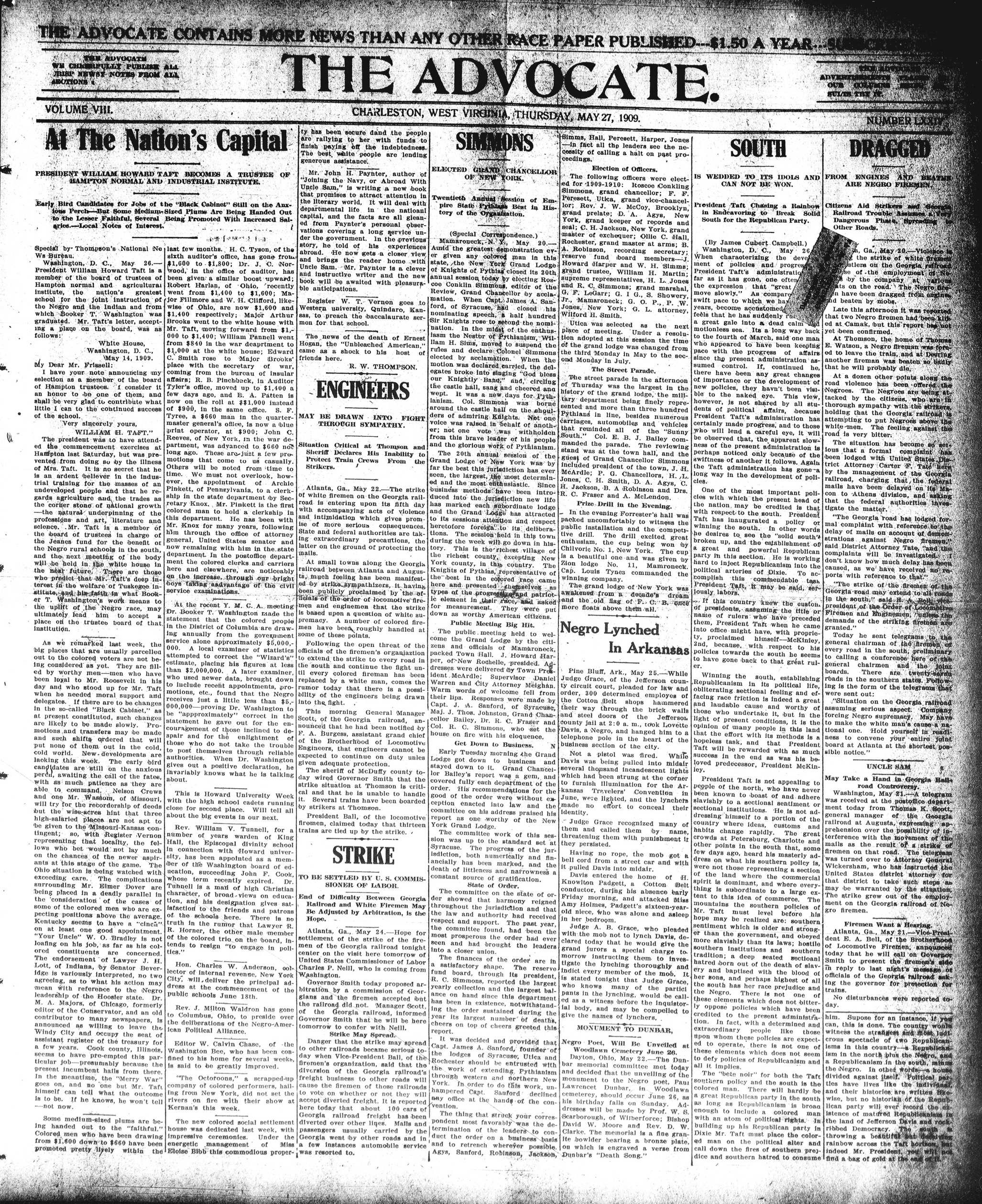
At The Nation's Capital
PRESIDENT WILLIAM HOWARD TAFT BECOMES A TRUSTEE OF HAMPTON NORMAL AND INDUSTRIAL INSTITUTE.
Early Bird Candidates for Jobs of the "Black Cabinet" Still on the Anxious Perch—But Some Medium-Sized Plums Are Being Handed Out to the Lesser Faithful, Several Being Promoted With Increased Salaries—Local Notes of Interest.
VOLUME VIII.
At The Nation
PRESIDENT WILLIAM HOWARD THE
HAMPTON NORMAL AND
Early Bird Candidates for Jobs of the
tous Porch—But Some Medium-
to the Lesser Faithful, Several
aries.—Local Notes of Interest
Special by- Thompson's National New
Ws Burgan.
Washington, D. C., May 26.—President William Howard Taft is a member of the board of trustees of Hampton normal and agricultural institute, the nation's greatest school for the joint instruction of the Negro and the Indian and from which Booker T. Washington was graduated. Mr. Taft's letter, accepting a place on the board, was as follows:
I have your note announcing my selection as a member of the board of Hampton trustees. I consider it an honor to be one of them, and shall be very glad to contribute what little I can to the continued success of the school.
Very sincerely yours.
WILLIAM H. Taft."
The president was to have attended the commencement exercises at Hampton last Saturday, but was prevented from doing so by the illness of Mrs. Taft. It is no secret that he is an ardent believer in the industrial training for the masses of an undeveloped people and that he regards agriculture and the trades as the corner stone of national growth—the natural underpinning of the professions and art, literature and science. Mr. Taft is a member of the board of trustees in charge of the Jeanes fund for the benefit of the Negro rural schools in the south, and the next meeting of the body will be hold in the white house in the next future. There are those who predict that Mr. Taft's deep interest in the welfare of Tuskegee institute, and his faith in what Booker T. Washington's work means to the uplift of the Negro race, may ultimately lead him to accept a place of the trustee board of that institution.
As we remarked last week, the big places that are usually parcelled out to the colored voters are not being considered as yet. They are filled by worthy men—men who have been loyal to Mr. Roosevelt in his day and who stood up for Mr. Taft when he needed moral support and delegates. If there are to be changes in the so-called "Black Cabinet," as at present constituted, such changes are likely to be made slowly. Promotions and transfers may be made and such shifts ordered that will put none of them out in the cold, cold world. New developments are lacking this week. The early bird candidates are still on the anxious percol, awaiting the call of the fates, with as much patience as they are able to command. Nelson Crews and one Mr. Wassom, of Missouri, will try for the recordship of deeds but the wise acres hint that three high-salaried places are not apt to be given to the Missouri-Kansas contingent; so, with Register License representing that locality, the fellows who bet would not lay on the chances of the newer aspirants at this stage of the game. The Ohio situation is being watched with excessive care. The complications surrounding Mr. Elmer Dover are being placed in a dendly parallel in the consideration of the cases of some of the colored men who are expecting positions above the average. Kentucky seems to have a "clinch" on at least one good appointment. "Your Uncle" W. O. Bradley is not loafing on his job, as far as his colored constituents are concerned. The endorsement of Lawyer J. H. Lott, of Indiana, by Senator Beveridge is variously interpreted, no two agreeing, as to what his action may mean with reference to the Negro leadership of the Hoosier state. Dr. M. A. Majors, of Chicago, formerly editor of the Conservator, and an old contributor to many newspapers, is announced as willing to leave the Windy City and occupy the seat of assistant register of the treasury for a few years. Cook county, Illinois, seems to have pre-empted this particular job—presumably because the present incumbent halls from there. In the meantime, the "Merry War" goes on, and no one but Mr. Taft himself can tell what the outcome is to be. If he knows, he won't tell—not now.
Some medium-sized plums are be-
ing handed out to the "faithful."
Colored men who have been drawing
from $1,500 down to $660 have been
promoted pretty lively within the
last few months. H. C. Tyson, of the sixth auditor's office, has gone from $1,600 to $1,800; Dr. J. C. Norwood, in the office of auditor, has been given a similar boost upward; Robert Harlan, of Ohio, 'recently went from $1,400 to $1,600; Major Fillmore and W. H. Clifford, likewise of Ohio, are now $1,600 and $1,400 respectively; Major Arthur Brooks went to the white house with Mr. Taft, moving forward from $1,400 to $1,400; William Pannell went from $840 in the war department to $1,000 at the white house; Edward C. Smith rose to Major Brooks' place with the secretary of war, coming from the bureau of insular affairs; R. B. Pinchback, in Auditor Tyler's office, moved up to $1,400 a few days ago, and E. A. Patten is now on the roll at $1,100 instead of $900, in the same office. S. F. Tyreum, in the master general's office, is now a blue print operator, at $900; John C. Reeves, of New York, in the war department, was advanced to $660 not long ago. These are just a few promotions that come to us casually. Others will be noted from time to time. We must not overlook, however, the appointment of Archie Pinkett, of Pennsylvania, to a clerkship in the state department by Secretary Knox. Mr. Pinkett is the first colored man to hold a clerkship in this department. He has been with Mr. Knox for many years, following him through the office of attorney general, United States senator and now remaining with him in the state department. In the postoffice department the colored clerks and carriers here and elsewhere, are noticeably on the increase, through our bright boys taking advantage of the civil service examinations.
At the recent Y. M. G. A. meeting Dr. Booker T. Washington made the statement that the colored people in the District of Columbia are drawing annually from the government service alone approximately $5,000,-000. A local examiner of statistics attempted to correct the "Wizard's" estimate, placing his figures at less than $2,000,000. A later examiner, who used newer data, brought down to include recent appointments, promotions, etc., found that the Negro receives just a little less than $5,000,000—proving Dr. Washington to be "approximately" correct in the statement he gave out for the encouragement of those inclined to despair and for the enlightenment of those who do not take the trouble to post themselves through reliable authorities. When Dr. Washington gives out a positive declaration, he invariably knows what he is talking about.
This is Howard University Week with the high school cadets running close for second place. Will tell all about the big events in our next.
Rev. William V. Tunnell, for a number of years warden of King Hall, the Episcopal divinity school in connection with Howard university, has been appointed as a member of the Washington board of education, succeeding John F. Cook, whose term recently expired. Dr. Tunnell is a man of high Christian character, of broad-views on education, and his designation gives satisfaction to the friends and patrons of the schools here. There is no truth in the rumor that Lawyer R. R. Horner, the other male member of the colored trio on the board, intends to resign "to engage in politics."
Hon. Charles W. Anderson, collector of internal revenue, New York City, will deliver the principal address at the commencement of the public schools June 18th.
Rev. J. Milton Waldron has gone to Columbus, Ohio, to preside over the deliberations of the Negro-American Political Alliance.
Editor W. Calvin Chase, of the Washington Bee, who has been confined to his home for several weeks, is said to be greatly improved.
"The Octooroons," a scrapped-up company of colored performers, hailing from New York, did not set the rivers on fire with their show at Kernan's this week.
The new colored social settlement house was dedicated last week, with impressive ceremonies. Under the energetic management of Miss Eloise Bbbb this commodious proper-
ity has been secure dand the people are rallying to her with funds to finish paying off the indebtedness. The best, white people are lending generous assistance.
Mr. John H. Paynter, author of "Joining the Navy, or Abroad With Uncle Sam," is writing a new book that promises to attract attention in the literary world. It will deal with departmental life in the national capital, and the facts are all gleaned from Paynter's personal observations covering a long service under the government. In the previous story, he told of his experiences abroad. He now gets a closer view and brings the reader home with Uncle Sam. Mr. Paynter is a clever and instructive writer and the new book will be awaited with pleasurable anticipations.
SIMMONS
ELECTED GRAND CHANCELLOR OF NEW YORK.
Twentieth Annual Session of Empire State Pythias Best in History of the Organisation.
(Special Correspondence.)
Mamaroneck, N. Y., May 20.—Amid the greatest demonstration ever given any colored man in this state, the New York Grand Lodge of Knights of Pythias closed its 20th annual session today by electing Roscoe Conklin Simmons, editor of the Review, Grand Chancellor.
Simms, Hall, Peresett,—in fact all the leaderessy of calling a hallceedings.
Election of Off
The following officer for 1909-1910: Ro Simmons, grand chancellor, Peresett, Utica, grand lor; Rev. J. W. McCgrand prelate; D. A. York, grand keeper of seal; C. H. Jackson, New master of exchequer; Rochester, grand master; A. Robinson, recordin reserve fund board; Howard Harper and W. grand trustee; William supreme representatives and R. C. Simmons; g. F. L. Goeck.
Register W. T. Vernon goes to Western university, Quindaro, Kansas, to preach the baccalaurate sermon for that school.
The news of the death of Ernest Hogan, the "Unbleached American," came as a shock to his host of friends here.
MAY BE DRAWN INTO FIGHT THROUGH SYMPATHY.
Situation Critical at Thomson and Sheriff Declares His Inability to Protect Train Crews From the Strikers.
Atlanta, Ga., May 22.—The strike of white firemen on the Georgia railroad is entering upon its fifth day with accompanying acts of violence and intimidation which gives promise of more serious consequences. State and federal authorities are taking extraordinary precautions, the latter on the ground of protecting the mails.
At small towns along the Georgia railroad between Atlanta and Augusta, much feeling has been manifested by strike sympathizers, it having been publicly proclaimed by the officials of the order of locomotive firemen and engineer that the strike is based upon a question of white supremacy. A number of colored firemen have been roughly handled at some of these points.
Following the open threat of the officials of the firemen's organization to extend the strike to every road in the south and continue the fight until every colored fireman has been replaced by a white man, comes the rumor today that there is a possibility of the engineers being drawn into the fight.
This morning General Manager Scott, of the Georgia railroad, announced that he had been notified by F. A. Burgess, assistant grand chief of the Brotherhood of Locomotive Engineers, that engineers cannot be expected to continue on duty unless given adequate protection.
The sheriff of McDuffy county today wired Governor Smith that the strike situation at Thomson is critical and that he is unable to handle it. Several trains have been boarded by strikers at Thomson.
President Ball, of the locomotive firemen, claimed today that thirteen trains are tied up by the strike.
STRIKE
STRIKE
TO BE SETTLED BY U. S. COMMISSIONER OF LABOR.
End of Difficulty Between Georgia Railroad and White Firemen May Be Adjusted by Arbitration, is the Hope.
Atlanta, Ga., May 24.—Hope for settlement of the strike of the firemen of the Georgia railroad tonight center on the visit here tomorrow of United States Commissioner of Labor Charles P. Nell, who is coming from Washington.
Governor Smith today proposed arbitration by a commission of Georgians and the firemen accepted but the railroad did not. Manager Scott, of the Georgia railroad, informed Governor Smith that he will be here tomorrow to confer with Nell.
Strike May Spread.
Danger that the strike may spread to other railroads became serious today when Vice-President Ball, of the firemen's organization, said that the diversion of the Georgia railroad's freight business to other roads will cause the firemen of those railroads to vote on whether or not they will accept diverted freight. It is reported here today that about 100 cars of Georgia railroad freight has been diverted over other lines. Malls and passengers usually carried by the Georgia went by other roads and in a few instances automobile service was resorted to.
(Special Correspondence.)
Mamaroneck, N. Y., May 20.—Amid the greatest demonstration ever given any colored man in this state, the New York Grand Lodge of Knights of Pythias closed its 20th annual session today by electing Roscoe Conklin Simmons, editor of the Review, Grand Chancellor by acclamation. When Capt. James A. Sanford, of Syracuse, had closed his nominating speech, a half hundred Sir Knights rose to second the nomination. In the midst of the enthusiasm the Nestor of Pythianism, William H. Sims, moved to suspend the rules and declare Colonel Simmons elected by acclamation. When the motion was declared carried, the delegates broke into singing "God bless our Knightly Band," and, circling the castle hall, sang and cheered and wept. It was a new days for Pythianism. Col. Simmons was around the castle hall on the shoulders of admiring Knights. Not one voice was raised in behalf of another; not one vote was withholden from this brave leader of his people and the glorious work of Pythianism. The 20th annual session of the Grand Lodge of New York was by far the best this juridiction has ever seen, the largest, the most determined and the most enthusiastic. Since business methods have been introduced into the jurisdiction new life has marked each subordinate lodge and the Grand Lodge has attracted to its sessions attention and respect heretofore foreign, to its deliberations. The session held in this town during the week will go down in history. This is the richest village of the richest county, excepting New York county, in this country. The Knights of Pythias, representative of the best in the colored race came here and presented themselves as types of the progressive and patriotic element in their race, and asked for measurement. They were put down as worthy American citizens.
Public Meeting Big Hit
Get Down to Business
GET DOWN to Business. N
Early Tuesday morning the Grand
Lodge got down to business and
stayed down to it. Grand Chancellor
Bailey's report wag a gem, and
covered fully each department of the
order. His recommendations for the
good of the order were without
exception enacted into law and
the committee on his address praised his
report as one worthy of the New
York Grand Lodge.
The committee work of this session was up to the standard set at Syracuse. The progress of the jurisdiction, both numerically and financially has been marked, and the death of littleness and narrowness a constant source of gratification.
State of Order.
The committee on the state of order showed that harmony reigned throughout the juridiction and that the law and authority had received respect and support. The past year, the committee found, had been the most prosperous the order had ever seen and had brought the leaders into a closer union. The finances of the order are in a satisfactory shape. The reserve fund board, through its president, R. C. Simmons, reported the largest yearly collection and the largest balance on hand since this department has been in existence, notwithstanding the order sustained during the year its largest number of death, cheers on top of cheers greeted this report.
It was decided and provided that Capt. James A. Sanford, founder of the lodges of Syracuse, Utica and Rochester should be entrusted with the work of extending Pythianism through western and northern New York. In order to do this work, unhampered Capt. Sanford declined any office at the hands of the convention. The thing that struck your correspondent most favorably was the determination of the leaders to conduct the order on a business basis and to retrench wherever possible. Agys, Sanford, Robinson, Jackson
Simms, Hall, Perceset, Harpor, Jones — in fact all the leaders see the necessity of calling a halt on past proceedings.
Election of Officers.
The following officers were elected for 1909-1910: Roscoe Conkling Simmons, grand chancellor; F. F. Peterson, Utica, grand vice-chancellor; Rev. J. W. McCoy, Brooklyn, grand prelate; D. A. Agys, New York, grand keeper of records and seal; C. H. Jackson, New York, grand master of exchequer; Ollie C. Hall, Rochester, grand master at arms; B. A. Robinson, recording secretary; reserve fund board members—J. Howard Harper and W. H. Simms; grand trustee, William H. Martin; supreme representatives, H. L. Jones and R. C. Simmons; grand marshal, G. F. LeGarr; G. I G., S. Showery, Jr., Mamaroneck; G. O P., P. W. Jones, New York; G. L. attorney, Wilford H. Smith.
Utica was selected as the next place of meeting. Under a resolution adopted at this session the time of the grand lodge was changed from the third Monday in May to the second Monday in July.
The Street Parade.
The street parade in the afternoon of Thursday was the largest in the history of the grand lodge, the military department being finely represented and more than three hundred Pythali in line, besides numerous carriages, automobiles and vehicles that reminded all of the "Sunny South." Col. E. B. J. Bailey commanded the parade. The reviewing stand was at the town hall, and the guest of Grand Chancellor Simmons included president of the town, J. H. McArdle; P. G. Chancellors, H. J. Jones, C. H. Smith, D. A. Agys, C. H. Jackson, B. A Robinson and Drs. R. C. Fraser and A. McLendon
Prize Drill in the Evening
In the evening Forrester's hall was packed uncomfortably to witness the public installation and the competitive drill. The drill excited great enthusiasm, the cup being won by Chilvore No. 1, New York. The cup is a beautiful one and was given by Zion lodge No. 11, Mamroneck. Cap. Louis Tynes commanded the winning company. The grand lodge of New York was awakened from a decade's dream and the old flag of F. C. B. once more floats above them all.
Pine Bluff, Ark., May 25. While Judge Grace, of the Jefferson county circuit court, pleaded for law and order, 300 determined employees of the Cotton Belt shops hammered their way through the brick walls and steel doors of the Jefferson county jail at 2:0 a.m., took Lovette Davis, a Negro, and hanged him to a telephone pole in the heart of the business section of the city.
Not a pistol was fired. While Davis was being pulled into midair several thousand incandescent lights which had been strung at the corner to furnish illumination for the Arkansas Travelers' Convention in June, were lighted, and the lynchers made no effort to conceal their identity.
Judge Grace recognized many of them and called them by name, threatening them with punishment if they persisted.
Having no rope, the mob got a bell cord from a street car and with it pulled Davis into midair.
Davis entered the home of H. Knowlton Padgett, a Cotton Belt conductor, during his absence early Friday morning, and attacked Miss Amy Holmes, Padgett's sixteen-year-old niece, who was alone and asleep in her bedroom.
Judge A. B. Grace, who pleaded with the mob not to lynch Davis, declared today that he would give the grand jurors a special charge to morrow instructing them to investigate the lynching thoroughly and indict every member of the mob. It is stated tonight that Judge Grace, who knows many of the participant in the lynching, would be called as a witness before the inquisitorial body, and may be compelled to give the names of lynchers.
MONUMENT TO DUNBAR.
Negro Poet, Will Be Unveiled as
Woodlawn Cemetery Jr.
South Cemetery June 26.
Dayton, Ohio, May 22. The Dunbar memorial committee met today and decided that the unveiling of the monument to the Negro poet, Paul Lawrencet Dunbar, in Woodlawn cemetery, should occur June 26, as his birthday falls on Sunday. Addresses will be made by Prof. W. S. Scarborough, of Witberforce; Bishop David W. Moore and Rev. D. W. Clarke. The memorial is a fine granite bowler bearing a bronze plate, on which is engraved a verse from Dunbar's "Death Song."
SOUTH
IS WEDDED TO ITS DOOLS AND CAN NOT BE WON.
President Taft Chasing a Rainbow in Endeavoring to Break Solid South for the Republican Party.
(By James Cubert Campbell.)
Washington, D. C., May 26.
When characterizing the development of policies and progress, President Taft's administration far as it has gone, one often expresses the expression that "great move slowly." As compared, swift pace to which we have years, become accustomed, feels that he has suddenly reached a great gale into a dead calm and motionless sea. Its a long way back to the fourth of March, said one man who appeared to have been keeping pace with the progress of affairs since the present administration assumed control. If, continued he, there have been any great changes of importance or the development of new policies, they haven't been visible to the naked eye. This view, however, is not shared by all students of political affairs, because President Taft's administration has certainly made progress, and to those who will lend a careful eye, it will be observed that, the apparent slowness of the present administration is perhaps noticed only because of the swiftness of another it follows. Again the Taft administration has gone along way in the development of policies.
One of the most important policies with which the present head of the nation, may be credited is that with respect to the south. President Taft has inaugurated a policy or winning the south. In other words he desires to see the "solid south" broken up, and the establishment of a great and powerful Republican party in this section. He is working hard to inject Republicanism into the political arteries of Dixie. To accomplish this commendable task President Taft, it may be said, seriously labors. ... If this country know the custom of presidents, assuming the title or name of rulers who have preceded them, President Taft when he came into office might have, with propriety, proclaimed himself—McKinley, 2nd, because, with respect to his policies towards the south he seems to have gone back to that great ruler.
Winning the south, establishing Republicanism in its political life, obliterating sectional feeling and effacing race friction is indeed a great and laudable cause and worthy of those who undertake it, but in the light of present conditions, it is the opinion of many people in this land that the effort with its methods is a hopeless task, and that President Taft will be rewarded with as much success in the end as was his beloved predecessor, President McKinley.
President Taft is not appealing to people of the north, who have never been known to boast of and adhere slavishly to a sectional sentiment or sectional institutions. He is not addressing himself to a portion of the country where ideas, customs and habits change rapidly. The great crowds at Petersburg, Charlotte and other points in the south that, some few days ago, heard his masterly address on what his southern policy is, were not those representing a section of the land where the commercial spirit is dominant, and where everything is subordinate to a large extent to this idea of commerce. The mountains the southern policies of Mr. Taft must level before his hope may be realized are: southern sentiment which is older and stronger than the government, and obeyed more slavishly than its laws; hostile southern institutions and southern tradition; a deep seated sectional hatred out of the death of slavery and baptised with the blood of her sons, and perhaps highest of all the south has her race prejudice and the Negro. There is not one of these elements which does not bitterly oppose policies which have been credited to the present administration. In fact, with a determined and extraordinary people like those upon whom these policies are expected to operate, there is not one of these elements which does not seem to defy policies of Republicanism and all it implies.
The "bete noir" for both the Taft southern policy and the south is the colored man. There will hardly be a great Republican party in the south as long as Republicanism is broad enough to include a colored man with an atom of political rights. In building up his Republican party in Dixie Mr. Taft must place the colored man on the political alter and call down the fires of southern prejudice and southern hatred to consume
A. Ga., May 20. — Violence is the strike of white firemen and protesters on the Georgia refugee house of the employment of Negroes by the company at various stations on the road. The Negro firemen have been dragged from engines and beaten by mobs. Late this afternoon it was reported that two Negro firemen had been killed at Camak, but this report has not yet been confirmed. At Thomson, the home of Thomas E. Watson, a Negro fireman was forced to leave the train, and at Dearing another fireman was beaten so badly that he will probably die.
At a dozen other points along the road violence has been offered the Negroes. The Negroes are being attacked by the citizens, who are in thorough sympathy with the strikers, holding that the Georgia railroad is attempting to put Negroes above the white-men. The feeling against the road is very bitter.
The situation has become so serious that a formal complaint has been lodged with United States District Attorney Carter F. Tate long by the management of the Georgia railroad, charging that, the federal mails have been delayed on its Macon to Athens division, and making that the federal authorities investigate the matter.
"The Georgia road has lodged formal complaint with reference to the delay of mails on account of demonstrations against Negro firemen," said District Attorney Tate, "and the complaints will be investigated. I don't know how much delay has been caused, as we have received no reports with reference to that."
"The strike of the firemen of the Georgia road may extend to all roads in the south," said B. A. Bell, president of the Order of Locomotive Firemen and Enginemen, "unless the demands of the striking firemen are granted."
Today he sent telegrams to the general chairman of the firemen of every road in the south, preliminary to calling a conference here of the general chairmen and the joint boards. There are twenty-seven roads in the southern states. Following is the form of the telegrams that were sent out:
"Situation on the Georgia railroad assuming serious aspect. Company forcing Negro supremacy. May have to make the white man's cause a national one. Hold yourself in readiness to convene your entire joint board at Atlanta at the shortest possible notice."
UNCLE SAM
road Controversy.
Washington, May 21.—A telegram was received at the postoffice department today from Thomas K. Scott, general manager of the Georgia railroad at Augusta, expressing apprehension over the possibility of interference with the movement of the mails as the result of a strike of firemen on that road. The telegram was turned over to Attorney General Wickersham, who has instructed the United States district attorney for that district to take such steps as may be warranted by the situation. The strike grew out of the employment on the Georgia railroad of Negro firemen.
Firemen Want a Hearing.
Atlanta, Ga., May 21.—Vice-President E. A. Bell, of the Brotherhood of Locomotive Firemen, announced today that he will call on Governor Smith to present the firemen's side in reply to last night's message of officials of the Georgia railroad asking the governor for protection for trains.
No disturbances were reported today.
him. Supose for an instance, if you can, this is done. The country would witness the strongest and most indiscrucous spectacle of two Republicanisms in this country—a Republicanism in the north plus the Negro, and a Republicanism in the south, amid the Negro. In other words, a house divided against itself. Political parties have lives like the individual, and their histories are written likewise, but no historian of the Republican party will ever record the existence of matured Republicanisms in the land of Jefferson Davis and rockribbed Democracy. The south is throwing a beautiful but festive rainbow across the Taft horizons, but indeed Mr. President, you will not find a bag of gold at the end of it.
BASE BALL
MONTGOMERY
The Fisherman order met Thursday of last week in the Fisherman hall.
Miss Sadle Allen had as her Sunday guest layette Walker, of Hurricane.
Those who took the teachers examination here last week were: Mrs. and Mrs. J. C. Clemmons, of Red Star; Mrs. C. A. Giesey and Thos. Jefferson, of Hill Top; Mrs. Jane Young, Greenville; R. L. Wormley, Bikridge; D. H. Twyman, Browne; Mrs. J. B. Calloway and Miss Woodson, Mt. Hope; Laghera Edmunds, Miss Mayne Hale, Nuttall, and Miss Ethel Brown and Mrs. Warner Brown, of this city.
Miss Etta Hall is home from Institute for a few days.
The Knights of Pythias, Odd Follows, True Reformers, Fishermen, Red Men, Court of Calanthe, Household of Ruths and Masons lodges are preparing for union decoration, on Monday, the 31st.
Washington Hunter, of Page, was the guest of Miss Bernice Carter, on Sunday.
The ladies aid of the M. E. church gave an entertainment at the Odd Follows' hall, Monday evening. Chances for a silk quilt were sold and Washington Hunter, of Page, was successful in drawing the quilt. Dr. and Mrs. B. F. White, Mrs. H. B. Branham and Miss Ethel Brown attended the United States Council of Red Men and Daughters of Pocahonta at Ronceverey, this week.
Rev. D. Stratton, of St. Albans was a business visitor here last week. Presiding Elder G. E. Curry was here last week, and preached at the M. E. church, Sunday morning, and at the First Baptist church in the afternoon.
SMITHERS-LONGACRE
The True Reformers will have their annual sermon at Canneiton hall Sunday at two o'clock. All are invited to come.
Mrs. James Banks, who has been slick for a short time, departed this life the 21st. She was a member of the True Reformers and the Independent Order of Calanthe.
Mrs. Nannie B. Cobbs, of Charleston, was visiting her sister in Smithers, Mrs. Mary Cabell, last week.
Ernest Hardy and Miss Emma Hardy, of Montgomery, were the Sunday guests of Mr. and Mrs. Will James.
Mrs. Peggie Doulton is on the sick list.
The Queen Esther club will be entertained at the home of Mrs. B. B. Daulton, Monday.
Mrs. Cora Rogers left for Ronceverte, Monday.
Teacher's meeting was held with Mrs. M. Williams, Tuesday evening.
Mrs. Mittie Gilmore is on the sick list at this writing.
Rev. F. E. Smith filled his pulpit Sunday, and preached two able sermons.
CLARKSBURG.
Guy Ruffin and Benjamin Smith arrived Sunday from Washington, D. C., where they attended Howard university.
Missen Jennie Littleton and Lily Allen spent Sunday in Grafton.
On Thursday evening the play given by the grammar department of Water street school was very well received. Owing to inclement weather the attendance was not so good.
On Friday afternoon a pleasing program was rendered by the 3rd,
4th, 5th and 6th grades and in the evening, "Hearts and Flowers," a 3-act comedy, was presented.
After the farewell remarks by the principal, Miss Estella Walker, in behalf of the Golden Rule Literary society presented a five dollar gold piece to him. A very large crowd was in attendance and seemed well pleased with the program.
Very enjoyable was the reception and handkerchief shower complimentary to Miss Bessie Jordan, bride-elect, of Fairmont, at Mrs. M. W. Gravson's, Monday night, May 24th. The decorations were pink and white and with the gilded horse shoes formed a pleasing and unique decoration. The out-of-town guests, besides the honor guest were: C. W. Hamilton and Matthew Oble, of Fairmont; Miss Alice Jordan and Garland Hutchinson of Weston.
M. P. Smith, William Lewis, Clayborne Brent, Mrs. Eliza Westfall and Mrs. James Webster are on the sicilist.
A pleasing program has been arranged for Tuesday evening at Pride A. M. E. church.
Sunday is woman's day at Pride A. M. E. church.
Mrs. Grace Lomac was called to Detroit, Mich., on account of the illness of her daughter, Bessie. She returned Saturday with her children.
Dr. Mason lectured last Monday morning to school children on tuberculosis. The exhibit is being held this week at central school building.
Rev. J. W. Robinson filled his pulpit at St. Albans, Sunday.
The Daughters of Sphinx held an entertainment at Trinity M. E. church Friday night.
A social will be held Thursday night at the hall on Hewes street by W. S. Kearney court.
PAGE
Sunday being our regular preaching day, Rev. N. A. Smith preached for us two good sermons.
The B. Y. P. U. was called in the afternoon at 3 o'clock by J. W. Branch. A large number was out.
Mrs. Alice Bolden left Monday for Ronceverte to attend the grand council.
The Pocahontas tribe had success with their entertainment, Saturday night.
Mr. and Mrs. Frank Snyder were visiting at Anstead Saturday and Sunday.
Biss-Borthia Lewis has been confined to her room for several days.
Rev. Smith dined with Mr. and Mrs. James Cosby, Sunday.
Miss Bettie Hanger has returned to Page.
Miss Beatrice Qualls left last week for her home in Virginia.
EAGLE
Rev. V. Harriday, of Montgomery, was visiting friends, Friday.
Mrs. Emma Henley, of Page, is visiting her mother, Mrs. Annie Holland.
Quite a number was in Montgomery Wednesday to John Spark's big show.
Miss Zephyr Smith, of Charleston, is visiting her mother, Mrs. Ellen Jones.
Mrs. S. E. Williams, of Mt. Carbon, was visiting friends, Friday.
The Eagle Stars and Crescent Pick-Ups had a fine games Thursday. Store 8 to 2 in favor of the Eagle Stars.
SEWELL
Mrs. Hundley, of Virginia, arriv-
ed here Monday to spend some time with her husband.
Rev. E. C. Page filled his regular appointment here, Sunday.
Dr. and Mrs. H. C. Hargrove are spending the week at Cliff Top, visiting relatives.
G. W. Johnson was a visitor to Thurmond, Sunday.
Mrs. Willie Hendricks spent Sunday here, the guest of Mrs. G. W. Johnson.
W. A. Allen, Frank Chambers, Lynn Bilbb, and James Finks were Sunday visitors to Thurmond.
The church is preparing to have a supper at the hall, Saturday night.
Mrs. Gibson, the mother of Mrs. Iola Freeland, is reported to be very sick.
RED SULPHUR SPRINGS
There will be preaching Sunday by Rev. O. T. Harris.
Mr. and Mrs. Wirt Williams were guests of Mrs. Thomas Connors Sunday.
The ladies ald met with Mrs. R, H. Hamilton, Thursday afternoon. After their usual routine of business a very appetizing luncheon was served by he hostess.
Edward White left Sunday for Salt Sulphur Springs.
Y. R. Crawford left Friday for Cashier's Hill, where he will close his school.
Pearl Walker entertained at luncheon Miss Hattle McClurman, Sunday.
Mrs. Richard Hamilton has returned home from a short trip to Indian Mills, visiting friends.
Lawrence Haynes left Sunday for Sinks Grove.
There was a good crowd at the First Baptist church Sunday school, Sunday afternoon. Mrs. Ollie Bowlinger is on the sick list this week. Mrs. Harry Pack left Sunday for Keystone, where she expects to remain for the summer.
SOUTH CARBON.
Rev. Rucker preacher an able sermon here Sunday night.
Mr. Holland moved his family from here last Thursday to Raymond City.
The K. of P. gave an entertainment Saturday night which was well attended.
Mrs. Peter Wilson left the 24th for Paint Creek hospital.
for Paint Creek hospital.
Rev. Rucker was the Sunday guest of Mr. and Mrs. W. C. Carter.
RED STAR.
Mesdames Claytor and Benton attended services at Glen Jean, Sunday morning.
Mr. Carter, of Scarbro, was here Sunday to see Mrs. Dotson.
Mrs. Price, the Misses Smith worshiped at Glen Jean, Sunday.
Mrs. B. Hubabrd is moving to Glen Jean.
Phil Scott, who has been suffering with severe hoarseness, is somewhat better.
Mesdames Oglesby, Davis, Mr. and Mrs. Clemmens and Prof. Thos, Jefferson went to Montgomery last week to take the examination.
Mrs. M. E. Davis, who has been taking the teachers' course at Institute, has returned home.
H. M. James has opened a millinery store.
Little Thelma, the five months old daughter of Mr. and Mrs. James Childress, died Thursday, May 11th, about 4 o'clock and was buried in the afternoon.
Rev. D. Stratton was seen in our town last week.
HIGH GRADE
FOOTWEAR
LOW GRADE
PRICES
BELL
SHOE
COM'Y
708
KANAWHA ST.
ST. ALBANS.
Rev. J. W. Robinson, pastor of the St. Paul Baptist church, filled his regular appointment here, Sunday.
Miss Mildred Spurlock, of Pittsburg, spent a few hours with her sister, Mrs. Mary Green, Monday.
Quie a number took the examination that was held here last Thursday and Friday.
Miss Gertrude Parrish, teachers at Vanetta, spent a few days with her parents here last week.
Robert Allen, of Winifrede, spent Sunday with his family.
Mrs. Alice Morten, who is employed at Charleston, spent Sunday with her husband.
Rev. J. W. Robinson will move his family here from Clarksburg this week and on next Sunday he will be installed as pastor of the St. Paul Baptist church. The installation sermon will be preached by Rev. R. D. Meadows.
Henry Melton has the small pox.
The friends of Mrs. Lillie Preston, who has been at the hospital for two weeks, will be glad to know that she is improving.
George Bond, of McKendree, spent Sunday with his family.
Rev. T. T. Brinkley filled his regular appointment at the A. M. E. church, Sunday.
Rev. H. K. Johnson, of Charleston, was calling on friends, Sunday.
PARKERSBURG
The Needlework club meets Thursday afternoon with Mrs. Mollie Bell, on Swann street.
The commencement address of the Summer high school will be delivered by Rev. John W. Robinson, of Covington, Ky.
Commencement will be heid June 11th at 8 p. m. at the Camden theater. Sermon will be preached to senior class June 6th in the afternoon at Zion Baptist church by Rev. Wm. Toney.
Rev. W. F. Jones spent Sunday in Pomeroy, O., holding church services.
Mrs. Almeda Jefferson returned home Saturday from Cambridge, O., where she spent about 5 weeks visiting her niece, Mrs. W. Hazlewood.
Henry Simpson, who was quite ill with rheumatism, is now able to be out again.
Frank Carter, or Pomeroy, Ohio, was in the city Sunday the guest of Mrs. Almeda Jefferson.
Mrs. J. W. Shellcroft and Mrs. E. V. Seams were in Marlatta, O., Friday afternoon, attending a card party given by Mrs. Frank Flecker and Mrs. Mirt Mason.
Blenerhassett lodge, No. 77, K. of K., is planning to give an entertainment in Byers' hall, Thursday, night.
Vendetta Court, No. 5, O. O. C., gave a dance at the rink on Seventh street. Friday night.
The May fair given at Ann street hall by Logan M. E. church the nights of the 24th and 25th was a success.
The Sunday school began practice on Children's Day exercises last Sunday morning.
Monroe Jackson and Mrs. Lizzie Minifee were married last Thursday night at the parsonage by Rev. John Carroll.
GUYANDOTTE.
Miss Ella Dickerson and Miss Ethel Lewis, of Huntington, attended the examination here last week.
Mrs. Lottie Justice, of Burlington, was visiting her sister, Mrs. Maud Layne, Thursday.
Miss Gayzella Toney, of Burlington, attended the examination here last week.
Miss Bertie Smootz came home, Friday, from Keystone, where she had been teaching.
Nelson Layne and son, Velmer, went on the excursion to Parkersburg, Sunday.
Abram Epps, of Huntington, was in town Friday on business.
Mrs. Kittle Robinson and Miss Fleeta Brooks attended services in Huntington, Sunday evening.
Announcement for Commencement at the West Virginia Colored Instituted, 1909:
May 28, 10:30 a. m.—Pupils' Recital. Music Department.
June 5th, 2:00 p. m.—Base Ball.
7:30 p. m.—Wheatley-Dunbar Literary Society.
June 6th, 8:00 p. m.—Commencement Sermon, Rev. J. W. Waters, of Simpson M. E church, Charleston, W. Va.
June 6th, 7:30 p. m.—Union meeting of the Y. M. C. A. and the Y. W. C. A. Address by Mr. W. C. Florain, Secretary of the Charleston Y. M. C. A.
June 7th, 2:00 p. m.—Base Ball.
7:30 p. m.—Junior Oratorical contest.
June 8th, 2:00 p. m.—Annual Industrial Commencement.
7:30 p. m—Alumni Reunion. Address by President J. McHenry Jones.
June 9th, 1:30 p. m.—Commencement exercises of the Academic, Commercial and Normal departments.
Address to graduates, Governor William E. Glasscock.
Presentation of Diplomas, Hon. M. P. Shawkey.
9:00 to 11:00 p. m.—President's reception to graduates and visitors, east hall.
"She broke him off smoking so that he could save money."
"And did he save money."
"Yes; he got so interested in saving money that he broke off their engagement so that he could save still more."—Houston Post.
28 AND 30 CAPITOL ST.
Beef, Veal, Mutton, Pork, Fresh Pork Sausage OUR OWN MAKE.
ry our machin sliced Hams and Bacon
OYSTERS, FISH, POULTRY
The best qualities in all the popular kinds of
We want your patronage for we have complete stock in our lines and you can get it when you want it most.
STORER COLLEGE
Courses
Academic, State Normal, Biblical, Vocal and Instrumental Music, Carpentry, Blacksmithing, Practical Gardening and Husbandry, Cookery, Serving and Dressmaking.
Equipment
Ample Buildings, Beautiful Car
barries of over 6000 volumes,
Hennery, Dairy, several acres
Hot Beds.
Expense
Books, Room Rent and Tuition
essary Expense not over $6.50
Landings, Beautiful Campus, Laboratory, T
over 6000 volumes, Comm Ilous Bar
alry, several acres of of gardens, Cold
Expenses
from Rent and Tuition free to West Virg
ense not over $6.50 per month to St
Ample Buildings, Beautiful Campus, I Laboratory, Telescope, Libraries of over 6000 volumes, Comm ilious Barn, Piggory, Hennery, Dairy, several acres of of gardens, Cold Frames and Hot Beds.
Expenses
Books, Room Rent and Tuition free to West Virginia. Necessary Expense not over $6.50 per month to State students
Special Features
Eight valuable scholarships and Athletics, Band, Literary Society tertainments, Musical Clubs, Y.
Storer is a Non-Sectarian, C
For Illustrated Catalogue set
table scholarships and six prizes, awarded
and, Literary Societies, frequent Lectu-
sions, Musical Clubs, Y. M. C. A.
a Non-Sectarian, Christian Institution.
Instrated Catalogue send to
Eight valuable scholarships and six prizes, awarded annually
Athletics, Band, Literary Societies, frequent Lectures and Entertainments, Musical Clubs, Y. M. C. A.
Storer is a Non-Sectarian, Christian Institution.
For Illustrated Catalogue send to
HENRY T. McDOZ LD, Pres.
FRUITS, CAND
Families
Ice Cream. O
ment solicited.
We make prompt delive
day orders.
I. E. N
S, CANDIES ICE
families Furnish
cream. Orders for
solicited.
e prompt delivery of Cream an
E. Nich
FRUITS, CANDIES ICEGREAM
Families Furnished with Ice Cream. Orders for shipment solicited.
We make prompt delivery of Cream and Icees for Sunday orders.
I. E. Nichols
Smith slapped Jones on the back. "Hello, old chap!" he gurgled familiarly. "I'll wager $50 you don't recall me!" Jones gave his an icy stare. "You win!" he said, passing on.—Lipolincott's Magazine.
What will you name him? Bill.
Why Bill? Because he came the first of the month—New York Herald.
"What do you do to get rid of bores?"
Just as soon as they come into my office I start in telling them of the latest cute thing my baby said."
—Detroit Free Press.
"What do you mean by parlor socialism?"
"Giving everybody an equal chance at the boarding house plano." — Louisville Courier-Journal.
He (just rejected)—I shall never marry now.
She—Foolish man! Why not?
He—If you won't have me, who will?—Boston Transcript.
Ampus, Laboratory, Telescope, L.
Comm Hous Barn, Piggory,
of of gardens, Cold Frames and
nses
free to West Virginiaans. No-
per month to State students
Features
six prizes, awarded annually,
frequent Lectures and En-
M. C. A.
Christian Institution.
d to
IES ICECREAM
Furnished with
orders for ship-
ry of Cream and Ices for Sun-
ichols
What will you name him?
Bill.
Why Bill?
Because he came the first of the
month—New York Herald.
"Yes, many thousand immigrants
come to America every year."
"Why?"
"What assimilates them into good American citizens?"
Mistress—Look here, Susan, I can write my name in the dust upon this table.
Susan—Ah, mum, there's nothing like edication, is there, mum? — Comic Cuts.
Tommy—Met the new minister on my way home from Sunday school yesterday, and he asked me if I played marbles on Sunday.
Mother—Well, what did you say?
Tommy—Get thee behind me Satan! — Sketch.
A College and Normal Institute for colored students, located at Bluefield, the leading commercial town of the southern part of West Virginia. on the Norfolk Westren railroad.205 miles east of Kenova
BLUENEED
COLORED INSTITUTE
Splendid College Buildings, Beautiful Play Grounds, Dormitories
for male and female students; furnished rooms, a reading room supplied with the best current literature; a good library, and a physical and chemical laboratory. Healthful location and wholesome surroundings. Board $8.00 per month. Tuition free to state students, rates very low to non-resident students.
The Bluefield School offers an unequalled opportunity for young men to secure an education, for they can always find profitable employment when at school, during vacation, holidays and on Saturdays. For catalogue and other information, write the Principal.
If you haven't a regular, healthy movement of the bowels every day, you'll be well. Keep your bowels open, and be well. Fence in the shape of violent physio or pill poison is dangerous. The smoothest, easiest, most perfect way of keeping the bowels clear and clean is to take
CANDY
OATHARTIO
Cascarets
THEY WORK WHEN YOU SLEEP
EAT 'EM LIKE CANDY
Flissant, palatable, Potent, Taste Good, Do
Good, Never dilute, Necessary, Useful and
50 cents per box. Write for free sample, and book
let on health. Addressee: 452
Storring Remedy Company, Chicago or New York.
KEEP YOUR BLOOD CLEAN
As Reported by the National Negro Business League
Local Business, Leagues were recently organized at Greenville, S. C., Rome, Ga., Hopkinsville and Bowling Green, Kentucky.
In Greenville, S. C., there are quite a number of prosperous colored men engaged in the professions, business and trades of various kinds. Among the business men, perhaps the most successful are Messrs. Homer and Blake Goldsmith, who have been conducting a grocery store for about fifteen years, doing an annual business of nearly $20,000; Pink Chapel, twenty years; in business, $10,000 a year; John Thompson, fresh meat merchant, $6,000 a year; Andrew Harris and Brother, grocers, $10,000 annually; William Payne, $5,000.
Mr. L. D. Bowman does a good business in the shoe trade, with a $3,000 stock. Mr. William Bullman is the promoter of a very successful insurance company in the state of South Carolina and also the leading funeral director here.
The Negro contractor has a chance and is evidently making good in this city. For instance: A. D. McDaniel, a first-class plasterer, won out in competition with several white contractors in securing the job of plastering the rooms of one of the finest hotels in the south, erected here at a cost of $125,000. Mr. McDaniel worked about fifteen men on this job, some of whom were also white men.
Then there are Messrs. W. R. Sewell and James Dayley, carpenter contractors, who each employ from six to ten workmen.
The professions are represented by Drs. Wm. T. Smith, E. A. Boyd, and G. W. Harvey, the latter a dentist as well as a medical practitioner. There is a drug store, the proprietors of which are Dr. E. A. Boyd and Mr. James Williams, a graduate pharmacist of Leonard Medical College Raleigh, N. C.
The Atlanta State Savings bank, 185 Auburn avenue, opened up for business January 6th. Its authorized capital is $25,000. The officers are Messrs. J. O. Ross, president; H. R. Butler, M. D., vice-president; H. Strawbridge, secretary; H. E. Perry, assistant secretary; D. T. Howard, Sr., treasurer. The amount of business transacted since its doe first
opened is about $15,000.
A few of the successful merchants of Atlanta are Messrs. Murphy & Sons, 514 Decatur street, who are engaged in the grocery business, enjoying a patronage of probably $25,-000 a year; W. H. Scott, 205 Little street, grocery, $15,000; J. O. Ross, 375 West Hunter street, groceries and fresh meats, $30,000 annually.
Here is also a shoe store; 30 South Broad street, Daniel T. Howard, manager, doing a fairly good business, while Messrs. Goodrum & Co., own a stove, tin and plumbing establishment at 108 Edward avenue, and conduct a flourishing business in their line. C. P. Cochran is the proprietor of a well furnished shoe, dry goods and variety store at 138 Auburn avenue.
The Standard Life Insurance company (old line) recently organized and chartered with a capital stock of $200,000, is meeting with much success. Shares are being subscribed for right along by those who are in sympathy with the movement in different parts of the country. It will not be long before the officers will be ready for business. Mr. H. E. Perry is the secretary, Rucker building, Auburn avenue, Atlanta, Ga.
Mr B. Jackson, of Jacksonville, Fla., landed there twenty-five years ago with only $5.00 in his pocket; today he is regarded as a man of wealth. His county and city taxes amount to $350 per annum. He is one of the largest contractors and builders in the city. Besides he operates and owns one of the largest wood mills in the city. He carries a life policy of $50,000, and lives on Jesse and Van Buren streets.
Mr. J. D. Duffy, of Ocala, Fla., is a very successful truck farmer. Eleven years ago he started with a rented 3-acre farm, now he owns over six hundred acres of land. Last season he shipped ninety cars of watermelons and eighteen cars of cantaloupes to northern markets. In connection with his fruit farm, Mr. McDuffy is also a stock raiser. The proceeds from the latter business amounts to nearly ten thousand pounds of pork annually. In the fruit season he employs about one hundred and twenty-five hands.
Cuban. Finances.
(From Baltimore American.)
The reorganized Cuban Republic is now facing a critical situation, which is the immediate necessity of financing the governmental enterprise. It cost this country somewhere between eight and ten millions of dollars to extricate the young republic from the chaotic condition into which it quickly lapsed following the first attempt at home government. This is a claim which has not yet been formally presented and of which payment may never be demanded. It is not the reorganization cost that is causing embarrassment. The cost of equipping and maintaining the new permanent army, will, run high into the millions; the national legislature is also a costly luxury and under the political obligations which the official representatives of the successful party, including the President, feel it incumbent upon them to meet, there has resulted an immense expansion of the civil employment list.
Governor Magnon's budget of expenditures for the current fiscal year, which will end June 30, was $24-$250,000, and to meet this there will probably be a revenue of something over $27,000,000. In other words, a
COLORED I
Bluefield, W.
and Normal Inst
s, located at
mercial town of
Virginia. on the
road. 205 miles e
BLUEFIELD
COLORED INSTITUTE
lege Buildings,
mitories
ale students; furnished rooms, a rea
current literature; a good library,
factory.
ation and wholesome surroundings. B
see to state students, rates very low.
School offers an unequalled opportun
education, for they can always find pro
during vacation, holidays and on S
and other information, write the Pr
R. P. SIM
Bluefield W. Va.
Housekeepers, can you use, will you buy a floor covering? Never such prices as we quote for this entire week Druggets sold everywhere at $25, for $19. Druggets worth up to $20, for $14. Druggets worth up to $12, for $7.50. Rugs for 75c, 98c and $1.44.. Fifty Rolls Matting, entire week, from 10c, 14c, 19c and 24c.
Linoleums
29c, 34c and 44c, not laid. Buy our 4-yard Cork Linoleum—best in the world, no cracks.
Lace Curtains
Formerly $4 to $5, this sale $2.44; 300 pairs 750, 98c and $1.44. Liberal discount on all our Irish Point Lace Curtains. A few good second hand Tents.
snug surplus. But the estimates of governmental expenditures for the fiscal year, that will begin with July place the total at $30,000,000 and some of the experts who have figured out the costs place the total that will be required at $40,000,000. This prospective expansion in the running expenses is rendered graver by the fact that the indications point to a decrease in the ordinary revenue receipts. It is estimated that the total revenues for the next fiscal year will drop to $24,000,000, which would mean a deficit of from $6,000,000 to $16,000,000.
Such is the ratio of difference between receipts and expenditures would mean disaster. It is evident that the insular republic is in need of wise steering at this critical juncture.
Another Liquor Decision
No new principle is involved in the liquor shipment case decided by the Supreme Court of the United States against the State of Kentucky yesterday. It is but a new affirmation of the inter-State commerce principle, first stated in the Iowa original package case. The Court holds that a State law is powerless to prevent inter-State shipment, which is guaranteed by that clause of the Constitution which says that trade between States shall be free, and that no State shall pass any law to the contrary. Kentucky has but given another illustration of the recklessness of State Legislatures in passing clearly unconstitutional bills in the face of better advice.
The decision does, however, give point to the position taken on this subject in the United States Senate by Secretary Knox while a member of that body. He decided that a proposition to prohibit such shipments would not be sustained. And he pointed out that the most that could be accomplished along that line, without an amendment to the Constitution, would be to prohibit carriers from completing a transaction of barter. That is, the express companies could be prevented from accepting shipments to indefinite consignors and from delivering to any but those clearly nominated in the way bill. In the light of this decision of yesterday there can be no doubt that Senator Knox was absolutely right.
INSTITUTE
Va.
Institute for col-
Bluefield, the
the southern
Norfolk
east of Kenova
Beautiful Play
ding room sup-
and a physical
board $8.00 per
to non-resident
unity for young
affitable employ-
turdays.
principal.
S,
the sp
the labo
trained n
have pla
ins
sale $2.
d $1.44.
Grand
Porch
Swings from $5.50 to $16.50.
Porch Chairs $2.50 to $5.50.
Setters $5.00.
WE
Also Handle the famous Heywe
and Wakefield Bros.' Wic
goods.
Science Decrees
of the Dome
Dog and Cats, Parrots an
Active Agents in Spread
The haughty, insolent Angora, the aristocratic Maltese and all of the feline tribe down to the homely, purring hearthstone. Tabby must yield their favorite cushions and wend their sorrowful way into a cold and unfeeling world, where nice warm milk and cozy corners are not the portion of bacteria breeding and germ-carrying cats.
No more will the frisky squirrel wave his bushy tail in vain endeavor to attract some kindred boy spirit to join in a romp and a hunt for nuts. Rabbits and guinea pigs will find their sphere of usefulness limited to the laboratory and goat teams and trained mice and white rats will only have place in the fairy legends of a
Overstocked on Wash Goods
Extra week we will sell at a big discount from our wash goods stock — 1,000 yards Walstings, were 25c to 40c values, for 14c; some 2,000 yards, good fine Lawns, Organdles, etc., worth up to 25c, for 10c. STAPLES—Lancaster Gingham quality for 5c; best Prints made, 4 3-4c; 5 bales fine Muslins, 5c, while it lasts. Big discounts on all trimmings, linings, embroideries, etc., etc., 2,000 yards Ribbons for 10c to 14c, worth 25c. All Notions reduced to unload.
Hosiery
200 dozen Children's Hose, one-third off; 50 dozen Ladies' fine Hose, one-fourth off.
Grand Rapids Furniture Co.
Science Decrees the Doom of the Domestic Animal Pet
Dog and Cats, Parrots and Monkeys Among the Most Active Agents in Spreading Dangerous Diseases.
The doom of the domestic animal as a household pet is sounded! In the near future cats, dogs, rabbits, squirrels, white rats and mice, pigeons, parrots and guinea pigs will be prohibited from sharing the joys and affections of children. Medical science is constantly making new discoveries as to the cause and the control of disease. The knowledge is growing that parasites are responsible for the spread of the most terrible and deadly diseases. It is gradually showing to us countless dangers that daily surround us in the care and companionship of our long cherished pets.
long ago, when germ ignorance was bliss.
Before the edict of exile has been accepted and adhered to by animal lovers, they will demand to know in the fullest detail all of the particulars of the so-called dangers of close association with the domestic animal.
Take the Dog.
Take the dog, every man's faithful friend and the boy's pride and cherished playmate. Through all of the ages since the world began he has held his position of guardian and protector. His intelligence and sagacity has oftentimes been greater
All animals, both the domesticated and the wild are the host of hordes of parasites. Recent discoveries have disclosed the startling facts that many of the very common diseases, as well as those of the epidemics, are traceable to the contact with our various pets.
Just as we suffer from all of the ills and pains which ignorance and abuse of her laws place upon poor overtaxed nature, so our dumb brute friends likewise suffer all of the all-ments peculiar to their kind.
They are continually in a more or less diseased condition and all of the time they are carrying about a vast number of disease transmitters in the shape of fleas, lice, ticks and so forth, to all of which have been attributed the ability of distributing one or more diseases of the animal kingdom, but among humans. It may not be in this generation that sanitary education and scientific research will triumph over the agebound ties between the human and animal families so that all sentiment be sacrificed upon the altar of sanitation. In that day which is surely coming, though doubtless a long way off, since it has ever been the fate of civilization and progress to be contested step by step, Fido and Tabby will find themselves banished to the public zoological parks along with other animal curiosities to be admired at a distance.
Away With Pets.
With the absence of the live pets we will no doubt find all sentiment rendered safe and germ proof by sterilization and fumigation and ladied out in homeopathic doses to both young and old, if there be either in that spotless, germless, petless age of progression.
With the immediate approach of the millennium of healthy dogs of all descriptions will cease to share the family affections. The majestic Dane, the noble and useful St. Bernard, the pampered poodle, the idolized Pomeranium and the ordinary yellow cur, must all descend from their thrones in childish hearts and travel hence to a dog paradise or a boyless wilderness.
Rapids
Davenports
In genuine leather, $65.00, $75.00 and $85.00; Imitation leather $25.00 to $40.00.
LEATHER
Couches from $37.50 to $60.00;
Imitation Leather $15.00 to $30;
214-216 CAPITOL STREET.
the Doom
estic Animal Pet
and Monkeys Among the Most
ling Dangerous Diseases.
long ago, when germ ignorance was
bliss.
Before the edict of exile has been accepted and adhered to by animal lovers, they will demand to know in the fullest detail all of the particulars of the so-called dangers of close association with the domestic animal.
Take the Dog.
Take the dog, every man's faithful friend and the boy's pride and cherished playmate. Through all of the ages since the world began he has held his position of guardian and protector. His intelligence and sagacity has oftentimes been greater in emergencies than that manifested by his master. What possible harm can a poor dog do?
Hydrophobia, first and foremost in the catalogue of disease crimes laid at the canine door, the very existence of which except as a figment of an overlooked imagination is disputed and scouted by so many people but nevertheless remains a lasting horror and a constant menace.
Dogs, also in their affectionate licking on the baby's little hands and face convey by means of the saliva thus deposited the germs of various diseases, one of which, so common among children, is ringworm. This annoying and persistent affliction is now sufficiently dreaded as to cause the expulsion from school of any child so affected.
Cats as well as dogs are accused of causing ringworm and to both is laid the blame of certain nasal diseases. The sleek pussy has been the means of spreading the contagion of diptheria and minor throat troubles while her bite in anger has been known to be as venomous as that of her rabies-affected canine rival.
Myriads of Parasites.
If dogs and cats and other animals could be kept free from the myriads of parasites with which they are infested, the danger is having them about would be greatly minimized.
To fleas alone may be attributed more of the deadly epidemics than to any other of the known parasites.
There are five species of fleas, whose ready recognition is likely soon to become a matter of vital importance to the medical practitioner. These are the Pullx Irritans, usually harboring on man, Pulex felis commonly found on dogs and cats, but often found on humans as well as on rats, squirrels and various other animals, though it seems to have a preference for rats all over the world.
There is also a blind species which is so very obviously blind, as to be easily distinguished from other varities. Pulex Cleopis is supposed to be peculiar to the tropical parts of the globe, but can maintain itself in the temperate climates as a specimen was found on a rat caught in Plymouth. This being a large seaport and arsenal it is always exposed to the dangers of epidemics. Fleas will travel in railroad trains and in all sorts of baggage.
To the white rats and the Bombay rats was ascribed the terrible Black Death in Europe in the fourteenth century, again in the seventeenth century, and also the great plague of London. One of the difficulties in the way of suppression of plague fleas has been that under favorable conditions only will each species of fleas stay with its own peculiar host. When hungry they will attack anything with life within reach.
---
We offer some 1,000 pieces Men's Negligence or Work Shirts at manufacturers'
While they last. By far the best values you will find for many a day on all Men's Shirts, 25c to $1; Underwear, 25c to $2; Neckwear, only one-half; Half Hose, Suit Cases, Bags, etc., at Wholesale or Retail.
The Plaguo Fleas.
Cost
Furnitu
Baby Carriages
Autoes and Go-Carts from $10.00 to $35.00. The best on the market.
BRASS
Beds from $22.50 to $55.00. Best Quality.
214-216 CAPITOL STREET.
Fortunately for us, of the domestic pet animals only dogs, cats and rabbits have fleas. These are the true epidemic carriers.
Many contend that the days of such horrible epidemics have passed, owing to the rapid spread of sanitary science, and that in these days of medical progress we may rest secure in the belief that such a plague will not again occur to scourge the earth. Sanitary science is of little use unless it is put to practical application, and in India at the present time the ravages of the plague, while/not so great as those of the black death and the Great Plague are nevertheless dreadful.
The Plague in India.
During the first six moths of the year 1907 no less than 1,000,000 deaths from plague occurred in India. Out of that number 633,000 occurred in Punjab, which has a population of only 25,000,000 people. That is to say one person out of every forty inhabitants in this district died from plague.
This awful mortality is a long way from the United States and among clines and the disease dies.
Refle
The Reflexlier
```markdown
```
THROW 90 of its li The best and ever placed o
THROW 90 PER CENT of its light downward. The best and "cheapest" light ever placed on the market. I will place on trial in any business house or residence one of these famous lights and convince you of its great value.
and will make it worth your attention to help us out.
Daniels
Furniture Co.
ages
$10.00
the mar-
00, Best
EET.
Iron Beds
From $3.00 to $22.50, in white,
green and blue.
ALL GOODS
MARKED IN PLAIN
FIGURES.
214-216 CAPITOL STREET.
The lexier
an alien race, and naturally viewed with more or less indifference by the people of this country. However, there is a phase of the plague which is well worthy of our closest attention. Its horrors are familiar history to both young and old. We have only to consider the increasing opportunities for the spread of this and other foreign and tropical diseases through the daily widening of the channels of commerce to all parts of the world and the steady stream of occidental population landing on our shores to realize that our immunity from the scourges and pests of alien races is rapidly diminishing.
The virulence of the bubonic plague is capable of great increase and decrease. In its first stages it seemoat feeble to attack a man, but will attack small animals and rats and mice. At length after passing successively through numerous rats it becomes more and more virulent, and at last attacks man. As the epidemic proceeds the poison becomes of greater and greater strength, and the rate of mortality large and large after a time the virulence de-
The Advocate is entered in the Post-office at Charleston, W. Va., as second class matter.
The decision of the Interstate Commerce Commission in the complaint of Winfield F. Cozart against the Southern Railway Company may have been based on the law, but it will be rather difficult to make the average layman see that justice was not raped.
The uncontricted testimony of Coatz, the complainant, a Negro newspaper correspondent of Atlantic City, N. J., was that on a trip from Atlanta, G.., to Washington, D. C. he was compelled to ride in a compartment, designated "For Colored." in which, although he was accompanied by his wife, smoking was permitted. It was further shown that the compartment contained only one toilet, wet and "messy" in the extreme, much to the annoyance and embarrassment of his wife, and that it was impossible to use the wash basin on account of the broken pump. Nor did the defendant attempt to disprove the statement that no such conditions obtained in the tars occupied by the white passengers on the same train.
It was upon the statement of the railway attorneys that of the 257 cars owned by the company fifty with but one toilet was used for white passengers without complaint, and that occasionally, as in this instance, the car as delivered by the connecting road is turned so that the compartment containing a smoking room, assigned to Negroes, being next to the other coaches must be used by the whites, that the commission based its opinion. It dismissed the complaint because, as it says:
"In order to make out a case of unjust discrimination it must be shown that separate toilets are furnished white men and women and that the instances in which the car is turned are so frequent as to constitute a substantial deviation from defendant's usual practice—which is non-discriminatory. We are of the opinion that as to the turning of the car the rules of the defendant are such as to remove that phase of the case from the realm of unjust discrimination. * * * "The question of separate toilets was considered by the Commission in the Edwards case, and no order was made thereon. It is apparent the same conditions exist here. Defendant has a number of cases equipped with but one toilet, which are used by white passengers; and we think the absence of distinguishing designation is not unjust discrimination."
"It follows that the complaint
"It follows that the complaint must be dismissed."
It would seem also to follow that the Negro passenger can find no relief from the Interstate Commerce Commission for being compelled to ride as a first-class passenger in a compartment filled with tobacco smoke, the floor of its single toilet wet and "messy," and lacking the comforts provided for the white passengers on the same train, unless he can show that such conditions are customary. If a part of the white passengers of a road are sometimes furnished with the inferior equipment always provided for the accommodation of all the Negroes, then the black complainant has no kick coming, for he has not been discriminated against.
Now, wouldn't that decision make Chief Justice Tancy, peace be to his ashes, feel that after all he was in the right when he handed down the opinion which made him infamous.
II.
If the opinion referred to above does not make the shade of Mr. Justice Tancy pat itself on the back, it most certainly experienced a thrill of joy when it read the opinion of the New York justice who holds that a Negro, acquitted of a charge of theft, should not be given the same amount of damages awarded to a white man under similar circumstances because the black man's mental sufferings are not so intense, his humiliation is not so great, his degradation—arising from such an accession—is not so low as that of a white man similarly situated.
This New York justice must have been guided by the opinion of the North Carolina court, which awarded damages to two white men whose names appeared in a city directory preceded by a star, the designation for Negro, but dismissed the suit of a Negro hotel keeper, who, not being designated as such in the same directory, prayed for redress on the grounds that his business was being managed because those ignorant of his race suspected him to be a white
man. The court held that a Negro does not suffer in any way by reason of a misstatement of his racial identity. Which brings to mind a doggerel of childhood days: "Nought's a nought and figger's a figger."
All for the white man and nothing for the nigger."
HAS BEEN TRIFED.
A singular manifestation of the race question, says the Pittsburgh Dispatch editorially, is presented by the joint efforts of the Macon Telegraph and the Washington Post. These papers point out instances of the successful practice of the professions by colored men in the north. Cases are told of a Negro school principal, at Cambridge, Mass., and a colored doctor attending white patients in Brazil, ind. Increases of 50 to 70 per cent in the number of colored men in the professions in northern states are cite. Wherefore the two papers seem to unite in urging what the Post calls "the final settlement of the so-called race problem—the exodus from the south to north of blacks, and from north to south of whites."
This representation of a solution evokes two comments. One is with reference to that long-standing assertion of southern journals against the presentation of northern opinions on the race question. It was that the north only cares for Negroes at the south, and does not treat Negroes at the north as well as the south does. Two leading exponents of the southern view now present statistical refutation of that stock retort.
The other is to summon the light of experience on the recommended exodus. It so happens that one of the cases in point was given exactly that title. The color line several years ago was being vigorously imposed by White Leagues at the south and several states in the north—Kansas particularly—were in need of agricultural labor. It was proposed to aid southern laborers to come north on a guarantee of employment. Did the south welcome that movement? On the contrary, the agents of the exodus were driven out of the southern states by mobs. As to the removal of whites to the south, a good many northerners tried that some forty years ago and found that they could stay there only on the surrender of the liberty to express their political convictions.
It is certainly worth while, in the light of history, for exponents of southern opinion to season their discussions of the race problem with a little memory and common sense.
TURN THE RASCALS OUT
In its crusade against sexual immorality, drunkenness and dissonesty in the pulpit of Negro churches, the New York Age should have the support of all who have or pretend to have the advancement of the race at heart.
Blest, indeed, is that community which has not been afflicted with this greatest of all obstacles to a struggling peoples progress-a preacher who was a libertine, a drunkard, or worse.
The preacher of all men should be a paragon of sobriety, of chastity, of truth. Hedged about as he is by his super-superstitious congregation with an influence not surpassed by any other man. In the community, he is in the position to be a great power for good or for evil as he listeth. If he be one honestly striving to follow the foot-steps of the Master, doing unto others as he would have them do unto him, judging not lest he be judged, fortunate, indeed, is the flock which he shepherds and happy is the field in which he labors. But if he be a bloated bigot, or one given to looking upon womankind with lust in his eyes; or yet does "As so many ungracious pastors do, Show me the steep and thorny way to heaven. Whilst, like a puffed and reckless Libertine,
Himself; the primrose path of dalliance treads,
And wrecks not his own rede."
the saloon, nor the gambling joint,
nor the house of ill fame were so great a curse, nor has society a more insidious foe.
A DOSE OF THEIR OWN MEDICINE.
The Dayton, O., papers report that Dehomey park, opened by a Negro, at a cost of $40,000, for the exclusive use of members of his race, "is intended for the use of colored people and the patronage of others is not solicited; but white people will be civilly treated and served when they visit the park." Mose Moore, the owner, evidently thinks that what's sauce for the goose is sauce for the gander.
Judge Dickson, of the Vicksburg police court, takes a terrible fall out of the thousand and one writers on the Negro problem, when he says, in the current Hampton mag-
azine that no white man ever knew the Negro en masse, noone knows him, now, and none will ever know him. He had the good grace to include himself in this sweeping assertion, but how unkind he was to the other fellows who have been telling us all along that they know_all about us.
The Tuskegee Student announces the line of march on Baccalaureate Sunday. Tuskegee Institute, which countenances no shams, is surely not having a Baccalaureate Sunday for graduates from normal, and industrial courses.
The Bluefield papers are poking fun at Charleston because its saloons are to be wiped out after July 1st. Ah, well! It might be worse. Just suppose we did not have an uncontaminated water supply.
An electrical expert has perfected a machine with which one may cut his own hair, but he is not receiving one-tenth the newspaper space which will be given to him who makes hair grow on a bald head.
Next week, (Mae, the sweet girl graduate, will solve all the intricate problems which vex mankind. The week following, she will take lessons from ma in the simple equations of house-keeping.
General Sherman on Negro Suffrage and the Attitude of the Southern People.
Stanton wants to kill me because I do not favor the scheme of declaring the Negroes of the south, now free, to be loyal voters whereby politicians may manufacture just so much more pliable electioneering material. The Negroes don't want to vote. They want to work and enjoy property, and they are no friends of the Negro who seek to complicate him with new prejudices. As to the people of the south they are subjugated, but of course do not love us any more than the Irish or Scotch love the English, but that is no reason why we should assume all the expenses of their state governments. Our power is now so firmly established that we need not fear again their internal disturbances. I have papers and statistics which I will show your father in time. I showed some to Charley today and he perfectly agreed with me; so do all my officers
We cannot kill disarmed men. All this clamor after Jeff Davis, Thompson and others is all bosh. Any young man with a musket is now a more dangerous object than Jeff Davis.
—From "General Sherman's Letters Home." Edited by M. A. DeWolfe Howe, in the June Scribner.
The Horizon and the Wood.
There, through the closing gate of Day.
The sunset seems to drift away in pallid gold and dream like red With thin gray cloud-lines overhead, At the dim margin of the blue Venus is trembling into view, Pulsing with timid, silvery light— The first gem on the breast of Night, Here, in the wood, all birds are still, Save the sad-hearted whippoorwill, Invoking through insistent song, Reluctant vengeance for some wrong, Above the fire-fly's fitful spark An owl sits brooding in the dark Silent, beneath his feather hood— A gombre wizard of the wood. —W. H. Hayne, in Scribner.
Monrovia, Liberia, May 23.—The members of the American Liberian commission, R. P. Fulkner, E. J. Scott and Dr. George Sage, who arrived at Monrovia May 8 on board the scout cruiser Chater, have been busy since their arrival with the preliminaries to their investigation into conditions in the Liberian republic. They are all in excellent health, but inclined to complain of the attentions and courtesies shown them on every hand, as the many invitations interfere with the work before them.
Last Sunday the commissioners attended, the Methodist church and heard Bishop Scott preach. They were much impressed with the reverence of the congregation and the dignity of the service. Sunday evening the visitors and a number of distinguished guests were entertained at an informal dinner by Ernest Lyon, the American minister resident and consul general. Speaking of Monrovia, one of the commissioners described it as "a southern city with a puritanical atmosphere." May 10 Commander Henry B. Wilson, of the Chester, and the members of the commission were cordially received by President Barclay and the members of the cabinet. The government has promised its hearty cooperation in the investigation, and the legislature will be convened in special session to assist in the work. The night of May 10 there was an elaborate and formal dinner at the American legation.
On May 10 the president of the republic gave a formal reception in honor of the American visitors. All the leading men of Liberia were present. The commissioners, who had been living on the board the Chester, have taken up their residence in Monrovia. This was done to avoid the necessity of going back and forth through the dangerous surf.
Montgomery, Ala., asMy 24. —The impeachment trial of Sheriff Frank Cazalas, of Mobile, today developed the fact that the people of Mobile knew early in he night of January 23 last that Richard Robertson, a Negro, was to be lynched. One man said he told the sheriff that precautions were necessary, but that the warning was not heeded. Another swore that before the lynching he was invited down to see the fun, and still another that he was told there would be a 'hot time in the old town.' For allowing the Negro to be hanged the state has brought the impeachment charges.
American Political League.
Columbus, O., May 24.—Arrangements are being completed for the second annual meeting of the National Negro American Political League, to be held in this city next Wednesday. Governor Harmon is on the program for an address, as well as many of the leaders of the race. The purpose of the league is to train the Negro relative to his political rights.
What is the meaning of, "and Abraham believed God and it was imputed unto him for righteousness? Love is an essential part of faith, and love implies action, or good works, hence is it at all possible for a person to have faith who is not engaged in good works? (This question must be answered in writing by members of the club.) Lesson for Sunday, June 6th, 1909 —The Power of the Tongue. James Hill: 1-12.
NEGRO LYNCHED BY MOB
All Others Warned To Be Good or Get, Same Fate.
Lincolnton, Ga., May 24.—Albert Alken, the Negro who desperately wounded John Spiresa, a white farmer, near here last Thursday, was hanged by a posse of about 100 men early today. Alken was in jail here and shortly after midnight the posse broke into the jail, seized the Negro and carried him into the country. His body was found today marked by bullet holes and bearing this paccard:
NOTICE: "This is what will happen to all Negroes in Lincoln county under similar circumstances.
(Signed) "REGULARS."
By Taft's Acceptance of School Trusteeship, Declared Speaker.
Hampton, Va., May 23.—At the commencement exercises at the Hampton normal and agricultural institute this morning a letter was read from President Tatt in which he announced his acceptance of a place on the board of trustees of the school.
Mr. Tatt's letter to Dr. H. B. Frissell, principal of the school, was as follows:
"White House, Washington, D. C.
"May 14, 1909.
"My Dear Mr. Frissel: I have your note announcing my selection as a member of the board of Hampton trustees. I consider it an honor to be one of them and shall be very glad to contribute what little I can to the continued success of the school."
Dr. Frissel announced that the election of Mr. Taft was made at a meeting of the board held in New York during the early part of May. Dr. H. S. Pritchett, of Washington, delivered the baccalaureate address before the students of the school this morning and in commenting on Mr. Taft's letter said: "Mr. Taft, by his acceptance, honors education and no less the high office of president in showing his interest in the educational methods of his country."
Is Spreading and Governor of Puerto Plate-May May Dead.
Cape Hattien, Haiti, May 23.—By courier from Moto Christi, Santo Domingo.—The revolutionary movement is spreading. General Camacho, the former governor of Monte Christi, who is working in unison with General Quirito Felice for the overthrow of the government, has attacked and seized Guayabuin and Dujabon, which are situated on the Hattien frontier.
There has been fighting between the revolutionists and the loyal forces at Monte Christi. The fate of Jose Bordas, governor of Puerto Plata, is not known, but it is reported that he is either dead or a prisoner. Communications are interrupted and government troops are expected to reach the disaffected districts by sea.
Hague Down in Fourth.
London, England, May 24.—Sam Langford, the colored, heavy weight, of Boston, knocked out Ian Hague, the heavy weight champion of England, in the fourth round at the National Sporting club tonight. The fight, which was for a purse of $-000 and the championship, was scheduled to go twenty rounds.
SO MUCH THEY CAN NOT TRANSACT BUSINESS
Librarian Communications Complaint of an Overdue bus. Serial Attachment at Capital of Elkhorn Rapidite
SHERIFF KNEW.
The Negro Was to Be Lynched—May Be Impeached.
EXCURSION TO CINCINNATI ON SUNDAY NEXT
Cincinnati won the second game of the series from Philadelphia, Tuesday afternoon, on a home run made by Dick Hobbitzell, the Parkersburg boy, playing first base for Clarke Griffith and his Reds. Hobby, who is batting well for a youngster in the big league, poked the ball over the fence and had an easy time roping home. The hit was the best one of the four made off Frank Sparks, the Georgia twirler, who has been doing some fine catapulting for Billy Murray and his men.
The Reds return from the East next Saturday, and on Saturday and Sunday play St. Louis at Cincinnati. The Chesapeake and Ohio road will run an excursion from Charleston, leaving the Capital City at 4:15 a.m., Sunday morning, May 30. The fare will be $3 for the round trip.
Miss Bennie M. Mallory left last Thursday noon for Lawrenceville, Va., to spend a few days with Miss Alma Booker, who is Instructor of sewing at St. Paul's Industrial school. Miss Mallory white away will visit with Miss Booker many of the eastern cities, including Washington and New York.
Homes and Investments
FOR SALE—no property in this city and nearby
Homes and Investments
FOR SALE: 3,000 prop-
ities in this city, in the
states. Free Sales List to buyers
and sellers. Special worksite for new Sales List.
WASHINGTON
WARNINGTO
tape pages, 3,000 pictures—mobiles, buildings, views,
etc. Ten cents for postage. See Our Special Agent in your
city. AMERICAN REAL ESTATE, WASHINGTON, D. C.
Washington, May 24.—For the first time, in so soaring a case, the supreme court of the United States will on next Tuesday, undertake to make out punishment for the crimes of contempt of the court, itself, and the importance of the occasion will be enhanced by a number of defendants.
The proceeding, will take place in concession with the cases of Shorif Shipp and Deputy Sheriff Gibson, of Hamilton county, Tennessee, and of four other residents of that county named respectively Williams, Nolam Padgett and May. These men today were declared by the court to be guilty of an act of contempt in combining, in 1905, in a conspiracy to lynch a Negro named Johnson, who had been sentenced to death by the local courts on the charge of rape and in whose case the supreme court had interfered to the extent of granting an appeal which had the effect of supersedeas.
On the night following the announcement of the court's action, Johnson was taken out of the jail in Chattanooga by a mob and lynched. There was no resistance on the part of the jail authorites and Shipp and a number of his deputies, as well as about twenty citizens were proceeded against on the charge of contempt or the federal court.
Six Convicted.
The case has been punding ever since and the number of defendants was from time to time reduced to nine. Of these nine three were today found guiltless while the other six were ordered to be brought into court next Tuesday for sentence. They will be taken into custody immediately and will appear in court in charge of Marshal Wright. The sentence may be either fine or imprisonment, or obth.
Case of Great Interest.
The case is regarded as of exceptional interest because it is practically the first time that the highest court in the United States has ever undertaken to assert its dignity or to resent acts or words reflecting upon it. In one previous case, some years ago, a defendant was fined for some expressions of contempt, but the case was so comparatively insignificant as to leave the present proceedings standing alone.
In the cases of Sherif Shipp and Deputy Gibson, the court in effect declared that they may be contempt in faith for the offence of the law to prevent crime in contempt of the court and in taking cognizance of an offense at so great a distance. The court for the first time asserts by action its right to compel proper respect for and treatment of its verdicts in all parts of the union.
Many Threats of Lynching.
Reviewing the proceedings in the case of Johnson, the Negro who was lynched, the chief justice pointed out that even before the case was brought to the supreme court, there had been many threats of lynching because of the serious character of the Negro's offense. Continuing, he said of the proceeding on the night of the lynching:
"The assertions that mob violence was not expected and that there was no occasion for providing more than the usual guard of one man for the jail in Chattanooga are quite unreasonable and inconsistent, with the statements made by Sheriff Shipp and his deputies that they were looking for a mob on the next day." Jail Was Unguarded. The chief justice pointed out that the jail had been left entirely unguarded and in charge of Deputy Gibson, when every precaution to guard the prisoner should have been taken. The chief justice quoted liberally
If You Have
an interest in BOYS' this liberal offering.
About two hundred Boys' tire assortment which their actual value.
$10, 8.50 and 7.50 Suits Reduced
$6.00 and 5.00 Suits Reduced
$4.50 and $4 Suits Reduced
Boys' Knee Pants
Good $1.25 and $1.00
$1.00 Straight Bottom
Good 50c Pants Reduced
Schwabe
"FOR BETTER CLOTHES"
we have
a new line of
GAS
STAND
LAMPS
Come in and
look them
over
COFFEY
Plumbing Co.
Quarrier Sh., near Caprio
ro man interview given out by Shipp some days after the rynching in which Shipp said that he "did not attempt to hurt any of the mob," and in which he charged the surrime court the responsibility for the lynching because of its interference in the case.
Commenting on this utterance, the chief justice said:
"Under the facts shown, when the sheriff and his deputies assert that they expected a mob on the 20th they practically concede the allegation or information and that they were informed and had every reason to believe that an attempt would be made on the evening of the 19th or early on the morning of the 20th.
Shipp Aided Moh.
"In view of this Shipp's failure to make the slightest preparation to resist the mob; the absence of all of the deputies, except Gibson, from the fall during the mob's proceeding; occupying a period of some hours in the early evening; the action of Shipp in not resisting the mob; and his failure to make any reasonable effort to save Johnson or to identify the members of the mob, justify the inference of a disposition upon his part to render it easy for the mob to lynch Johnson and to acquiesce in the lynching."
The chief justice also declared that after Johnson was taken from the jail the sheriff had made no effort to go after the lynchers or to reach the police or the militia or others. Reaching his conclusion with reference to Shipp, the chief justice said it was "That Shipp not only made the work of the mob easy, but in effect added and abetted it."
Jaller Gibson Involved.
The court found Jaller Gibson to be involved in the same condemnation though under less responsibility. Consequently, attachments were ordered to be issued for both the sheriff and his deputy, the jailer, as they were for Williams, Nolan, Padgett and May, the last four being charged with being members of the lynching party. Against them, to use the technical language of the court, "The rule was made absolute."
Deputy Galloway and two men, Justice and Ward, were discharged. The court said there was direct testimony of the participation of Williams and Nolan in the lynching, while it was stated that Padgett and May had themselves made statements which incriminated them.
CATON COLLEGE Penn & Sibir Ss. Pittsburgh's
best school of Accounting and Biography.
No Better Schools than any price.
PENNSYLVANIA TELEGRAPH COLLEGE
204 Sixth Street, Pittsburgh Entrances operators for
Ridgways, Posttowns $98.00 indemnity. Write.
CATON TECHNICAL SCHOOL Stig & Penn Ai
Engineering, Electricity Drafting, Mathematics
every graduate employed. Short Practical Course.
SUITS take advantage of
boys' Suits comprise the en-
have been reduced to Half
Redced to - - $5.00
Redced to - - 3.50
Red to - - 2.50
Knicker Pants - 75c
Pants - - 50c
Redced to - - 35c
& May
---
THE MAYOR OF MIDDLEBURG IS SUPPORTING THE NEW YORK CITY MAYORAL ELECTION. THE MAYOR OF MIDDLEBURG IS SUPPORTING THE NEW YORK CITY MAYORAL ELECTION.
e You Working for Money? Or is Your Money Working for You?
If you are working and saving your money and putting it in a bank where you get no interest, keep it in a bank or hiding it some where about your house—You Are Working For Money.
ing it in a trunk or hiding it some where about your house—You Are Working For Money.
If you are working and saving your money and investing it in a safe way, where it will be working day and night whether you are working or not, and making you at least six per cent. Interest—Your Money is working For You.
The Pythian Mutual Investment Association was organized in order to give us an opportunity to put the money we could save together and then put it to work. The above is a picture of our building on the Capitol Square in Charleston. We have just purchased a splendid third story block building on one of the main business streets in the city of Huntington. The first floor is occupied by the Huntington Herald, the largest daily newspaper published in that section of the state, the second floor is used for office rooms, while the htird floor is a large assembly and lodge hall. This building is sure to pay us well. After the Charleston building had been occupied only eight months our stockholders were paid a dividend of six per cent.
Stock is still on sale at $10.00 per share; either paid up or on the installment plan. Ask your agent in your locality about it or write to this office.
Let Your Money Work for You.
v estment Association.
WestVa.Colored Institute
INSTITUTE, : : : : WEST VA. The only Industrial Institute for colored Students in the State
Regular Normal, Academic and Commercial Courses, also Regular Courses in Agriculture, Carpentery and House Building, Steam Fitting,Smithing,Cabinet Making, Painting and Glazing, Dressmaking, Laundering, Printing. A complete course in Military Training to Cadets. Rooms, Books, Fuel and Lights Free to Normal Students; and in addition Uniforms for State Students. We have a faculty of Twenty-two Teachers Board only Eight Dollars per Month,
The third nut which Senator Scott has to crack within the next few months is the appointment of a marshal for the northern district. The place is now held by Major Charles Elliott, of Parkersburg, learned in political craft, and his position is wanted by Elliott and Sherman Denham, the Clarksburg postmaster, the manipulator of the First district, whose influence at Washington was so great that Congressman Hubbard failed to have him removed when he preferred charges of pernicious activity against him last winter. Denham was mentioned some months ago as a possible choice of
Frank Hitchcock for a place in the postmaster general's department, but he has now become insatiated with the desire to be the United States marshal for the northern district and Denham is a tireless worker.
Major Elliott, also, is equally well known throughout the whole state and it is one of the burdensome and unpleasant duties of a United States senator to make the selection.
A stack of wheats,
A slab of pie;
And then dyspepsia,
By and by.
—Philadelphia Ledger
Atlas was bearing the world on his shoulders.
"The graduates will soon relieve me," he cried.
Herewith he gave it another shift.
—New York Sun.
"Professor, what do you suppose is the origin of that tiresome slang phrase, 'O you!'
"It sounds as if it might be a contraction of the even more tiresome I. O. U.'"—Chicago Tribune.
CHICAGO GRAIN MARKET
Chicago, May 2. — Wheat closed at
$1.34 l; Corn 75 l-1; Oats at 61.
Mrs. Henry Smith, of Lewis St. is able to be out after an illness of several weeks.
J. H. Campbell a guard at Moundsville state prison, was here Tuesday evening on his way to Fayette county for prisoners for the penitentiary.
Mrs. Ed Tuck continues ill.
Mrs. Sherman Walden, of Parkersburg, is in the city.
Mrs. Gertrude James, who has been ill at Hotel Brown for several weeks, has returned to her home at Barboursville.
The attention of our women readers is called to the advertisement of Solof Bros. to be found elsewhere in this issue of the Advocate. They are offering unheard of bargains at unprecedented prices, and those in need of anything in their line would do well to visit the Solof store before the sale closes.
Hotel Brown is fully equipped to meet all demands of comfort and service. Strict attention given to ladies. Ministers at half price. 500 Capitol street. adv.
Mrs. Susan Payne has been ill at her home on Bradford street.
Mrs. Mary Royster is seriously ill with appendicitis at the general hospital.
Miss Hattle Peters was in the city, Sunday.
Mrs. E. L. Brown, of Jersey City, N. J., has returned to her home after spending a few weeks with Mrs. Helen Farrar, on Brooks street.
Miss Sadie L. Jones, D. M. N. G. of the Household of Ruth, of Wheeling, W. Va., and Dr. J. McHenry Jones, Past Grand Master of the Q. U. O. of Odd Fellows in America, will address the public at the First Baptist church, Wednesday evening, June 2nd. Music will be furnished by our city's best talent. Neighboring lodges will be present. Refreshments will be served by the local Household of Ruth, No. 163.
Is your hair Harsh and Stubborn? If so, make it Pilant, Soft and Glossy by using Nelson's Hair Dressing. The best of all hair pomades.
It contains no dangerous chemicals.
Sold by the Gem Pharmacy. 25c
per box, Charleston, W. Va.
Mail orders to any part of the
state.
Mr. R. W. Liggins and Miss Alice Green were united in holy wedlock at the A. M. E. parsonage by Rev. W. E. Walker, Saturday evening. The ladies aid of St. Paul A. M. E. church will meet tonight at the parsonage, 804 Donnally street. Mrs. Maggie Barnes and Mrs. Hodge have returned from Middleport, Ohio, where they have been visiting relatives and friends. A church conference was held in St. Paul A. M. E. church, Monday night, and the officers and members decided to have a rally the fourth Sunday in June. Each member is requested to give two dollars. Rev. T. T. Brinkley, who has charge of the A. M. E. church at St. Albans, is visiting in the city this week.
Rev. S. R. Bullock gave an exhibition at St. Paul A. M. E. church Tuesday night.
Miss C. L. Hairston and brother, J. J. Hairston, have returned from Martinsville, Va., where they were called on the account of the illness of their sister.
At the morning hour of worship at Simpson M. E. church, the pastor, Rev. J. W. Waters, preached on "Hearing the Voice of God." He said that some worship, music, some oratory, some dress, and some gold and silver. "But," said he, "we are commanded not to fear them for they can do us no harm. Neither should we honor or worship them because they can do us no good. But fear, honor and worship God, for it is He who after having done us good will turn and do us hurt if we fail to do him homage. At the evening hour the Rev. G. E. Curry, district superintendent of the Cumberland district, preached a soul-stirring sermon from the text "Whatsoever thy hands and to do, do it with thy might." He urged individual activity in the home and in the community. "Not what we do," said he, "but how well we do is what counts. Opportunity never comes but once; hence, the importance of doing now the thing that milieh near thee with might of soul and body."
"The May Fair," at Simpson M. E. church, which began on Monday night of last week and ended Tuesday night of this week was a decided success.
The Rev. S. R. Bullock, pastor of the First Baptist church, will exhibit his panorama of beautiful scenes at Simpson M. E. church, on Thursday evening of this week. Rev. Bullock comes as financial agent of the Hill Top school, the building of which was recently destroyed by fire.
The congregation of Simpson M. E. church will go to Institute, Sunday, June 6, to hear the commencement sermon by the pastor, Rev. J. W. Waters. The boat will leave here promptly at 1 o'clock p. m. The boat will return in time for the evening worship at the church.
Mrs. Maria Willis continues ill at her home on Young street.
OF SENATOR SCOTT NOT LESSEN-
ED BY MANN'S ABSENCE.
Did Not Cinch Fifth District Even by
Handing it the Best Plums on the
Tree, and Still Has Other Troubles.
Writing of the political conditions in West Virginia, J. V. Sullivan said in last Sunday's Cincinnati Enquirer:
"When the Norfolk & Western coal baron, Isaac Timotheus Mann, set sail this week for foreign climes to spend the torrid spell he carried with him from historic Bramwell his little boomlet for the United States senate; and on foreign shores it may blossom and bloom or wither as the transplanted willow.
Mann's departure for Europe had no perceptible effect on West Virginia politics. His going road was like his entry into the politics of the state about a year ago—without the sound of trumpets, with the exception that, Castro like, he left his native heath when there was seismic disturbances and rumblings in his own domination, emanating from some who are likely to dispute with him for the opportunity to wield the scepter.
For more than a year the industrious correspondents have told of the prewess of Mann, and there is no doubt that the constant mention of his name as a successor of Senator Scott considerably worried the Wheeling senator, who on one occasion proved to Scott that he was no tight-wad at least.
It happened after Charley Swisher went down in the Norfolk & Western section during his ca fidlacy for governor, and with the assistance of Mann secured the larger portion of the delegates from that section.
To secure the gubernatorial nomination did not end that unhappy struggle, for the militant Scherr continued, aided by legions of Republicans still protesting against Swisher. After the latter had secured the nomination Elkins and Scott came out boldly for Swisher, but they realized that it would require a large amount of lucre to put him over the goal with the large amount of dissatisfaction then existing.
Scott and Elkins and Mann met at Hot Springs, Va., and discussed he cost of a victory, with Swisher as the standard bearer. One of them suggested that it would take a considerable sum of money, about $100,000. "All right," was the reply of Mann, "I'll contribute ont-third of that amount."
Since that eventful day Senator Nathan Bay Scott has watched Ike Mann, and has ofen wondered what Mann would do if he were a candidate himself for some important position like the United States senate.
When Mann insisted a few weeks ago that the minister plenipotentiary to Bogota and the district attorney be selected from the Fifth congressional district, Scott acquiesced at once in his desires and sent to the president the names of Elliott Northcott, and Harold A. Ritz, and the plums were pulled.
Following the appointment it was announced that Mann did not aspire to be the successor of either Scott or Elkins, and in consideration of the favors he had received would aid them both in securing a re-election, and to himself was reserved the right to step into the first vacancy.
But nobody believes that Mann made such a promise, and if he did the politicians content there never was a war until a treaty of peace had been snapped. But time alone is the only acid test to prove the strength of Mann and put to rest the rumors concerning his senatorial
sectoral candidacy.
Down on the Norfolk & Western section they do not take seriously the suggestion of Mann for the senate, and ridicule he oft-advanced idea that he rules that Gibraltar of Republicanism, which furnishes biennially and quadriennially just such a Republican majorly as the leaders of that party agree upon.
Down at Ike Mann's home, in the coal fields, they look upon him as a first-rate business man, who has succeeded in that breeding place for millionaires, and as a political novice who knows not the wily ways of the political peddlers.
The real leaders down in the N. & W. country are Dr. H, D. Hatfield, the leader in the state senate, and "Walla Walla" Whyte, his predecessor. They control the organizations and have the votes to deliver, and both are said to be dissatisfied with the appointments made by Senator Scott and the appointment of Jack Sheppard as a member of the board of control.
If Senator Scott made the two appointments from the Fifth district without consulting either Hatfield or Whyte, and solely upon the recommendation of Mann, he not only alienated the support of Third district in his candidacy for re-election in making both appointments from the Fifth, but also failed to satisfy the men in the latter district who are in control in the district.
The loss of the southern section of the state, which has heretofore been a Scott stronghold, would mean his elimination from the race, for no candidate could be successful without at least a portion of the votes
FREE
With every cash value of
Wall Paper
(of $1.00 or more)
An Illustrated Souvenir
Directory of Charleston.
New Wall Paper Just In
Big Bargains in Remnants
MOORE'S
CHARLESTON'S LEADING WALL PAPER HOUSE.
118 Capitol Street.
Ladies' Misses' and Children's Ready-to- Wear garments, Millinery and Dress Fabrics Is the largest in the City and our Prices as usual the lowest that can be made up-to-date Merchandise.
Reason No. 1.
Why You Should Open a Savings Account at the Kanawha Banking & Trust Co.
It is an incentive to save the dimes and dollars which you now spend carelessly. These sums seem small when you are spending them, one by one, but when added up for a year they amount to a worthy sum,
"The Bank That You Can Depend Upon."
Capital $250,000. Charleston, W. Va. Surplus $160,000.
OUR DISPLY OF
Ladies' Misses' and
Wear garments, M
Is the largest in the City and our P
can be made up-to-date Merchandise
GIVE US The People's
A CALL
JOS EPH SCHW
602 Kanawha, cor. Alderson St.,
GIVE US A CALL
from the southern tier of counties.
For the same reason W. P. Hubbard,
the Wheeling congressman, would
have little chance of wresting the
toga away from Scott, for he is little
known in the southern section.
At the present time former Governor
Dawson is the only person who
could command a division of the
votes in the strong Republican counties
of southern West Virginia.
Scott's troubles in connection with
appointments are not o'er. He has
yet to select a United States Marshal
for the southern district and a marshall and district attorney for the northern district, and it is not going
to be a pleasant task for the old veteran, for there are several determined antagonists to be pacified.
For the three offices the Third congressional district has two candidates. Frank L. Tyree, former bodyguard of President Roosevelt, is the present United States marshal for the southern district. He lives at Huntington, in the Fifth district, and is a big factor in the politics of Caroll county, with three votes in the legislature. The Fifth, having been remembered a few weeks ago with two federal appointments, the politicians say there is no doubt that the marshalship will fall to a Third district man, and Cyrus Willey, postmaster at Hinton, is making a noise like a candidate for the place.
Fifteen years ago Willey was a candidate for the place, and that sturdy old confederate veteran, John K. Thompson, took it away from him when Willey had it in his clutch. Steve Elking has been promising the place to Willey ever since that time, and as Willey has now advanced to a mature age he believes it time to fulfill these promises. Of course, Scotty has the nut to crack. It's up to the Wheeling senator to say whether he will take chances with the three votes from Gabel county,
Reason Why You Should O
A GRAND TWO-DAY EXCURSION TO Toledo, Ohio
GOING
SATURDAY NIGHT, JUNE 5
VIA
K. & M. RY.
A Special Train consisting of
first-class day coaches, and
PULLMAN TOURIST SLEEP-
ING CARS
Will leave Charleston at 10:
00 p. m., arriving at Toledo,
Sunday morning, June 6th.
FARE ROUND TRIP, ONLY
$3.00.
Double berth in sleeping car,
accommodating two people, only
$1.25 each way.
Returning; Tickets will be
good returning on special train
leaving Toledo, Monday, June
7th, at 7:00 p. m., allowing
Two Full Days in Toledo.
For tickets, berth reserva-
tions and full particulars, call
upon Agents.
where Tyre resides, and which he will have some part in selecting.
Harrison Wylle, of Pomeroy, Ohio one of the founders of Simpson M. E. church, spent a few days with old friends in the city and was one of the worshippers at his old church Sunday. He was the guest of Mr. and Mrs. G. E. Wanzer, on Donnally street.
On account of their enjoyment in the May Fair the societies of Simpson church did not meet last nor this week.
ANOTHER EARTHQUAKE A Mighty Bargain Upheaval In Ladies Wearing Apparel
BARGAINS Beyond the pale of expectations. Values that will stagger imagination! Thousands of Dollars worth of good dependable Merchandise Ruthlessly Slaughetered in this unparralled Sale. A MATCHLESS Marvelous, Merchandise Movement, Great Bargain Holacaust takes in Merchandise of the most wanted and Myriads of Mystifying Bargains be-yond description. The scope of this dependable character.
NEVER BEFORE in the History of Charleston were you ever offered such a splendid opportunity at this time of Season to buy such seasonable Merchandise at such ridiculously low prices. You must come to the STORE to appreciate such Values. We are determined to make this the most talked of Bargain Event ever held by any Store at ally Season, in any City of the Union. This is not the every day sale that you read about. A glance at this page will convince you of the importance of attending this sale. Countless Purse Stirring Bargain Thrillers for Ten Days.
The Best Manufactured For
39
B. V. D
Balb
Lisl
39 CENT
This Sale Includes
B. V. D., Peroski
Balbrigan and
Lisle Thread
Remember the Time
7 o'clock
SATURDAY
Positivel
Henr
One
222 C
AN
BARGAINS Beyond the
dependabl
Act at
NEVER BEF
7 o'clock to 11 o'clock
SATURDAY EVENING
Positively No Other Time
Henry Smith
One Price Clothier
222 Capitol Street.
ANOT
A Mighty
BIGGINS Beyond the pale of expectations. Values dependable Merchandise Ruthlessly Slaug
Act at Once
EVER BEFORE
in the History of such Values. We page will convince
SATURDAY EVENING Positively No Other Time
Dry Goods Department
15c. BORDERED LAWNS
15c. FIGURED LAWNS
COLORED LAWNS, 12
25c. WHITE WAISTING
TAN VOILE, regular 5
ALL 12 1-2c. PERCAL
SECCO SILKS, all Colo
26 inch TAFFETA, $1.
$1.25 MESSALINE AL
50c. FOULARDS go at
SPIDERS' SILK, 50c. V
35c. DRESS LINEN, at
35c. WHITE LINEN,
BOLSETTE, All Colors
35c. PONGEE SILKS,
35c. SILK MULE, at.
1. BORDERED LAWNS, 36 in. wide, at..... 7 1-2c
2. FIGURED LAWNS, 36 in. wide, at..... 7 1-2c
3. LORED LAWNS, 12 1-2c. Values at..... 7 1-2c
4. WHITE WAISTINGS at..... 10c
5. N VOILE, regular 50c. Value, at..... 83c
6. L 12 1-2c. PERCALES, to go at..... 7 3-4c
7. COCO SILKS, all Colors, at..... 10c
8. inch TAFFETA, $1.50 Values, at..... 83c
9. 25 MESSALINE ALL SILK, at..... 73c
10. FOULARDS go at..... 20c
11. DIDERS' SILK, 50c. Values, at..... 33c
12. DRESS LINEN, at..... 19c
13. WHITE LINEN, at..... 17c
14. SETTE, ALL Colors, at..... 19c
15. PONGEE SILKS, at..... 19c
16. SILK MULE, at..... 19c
15c. FIGURED LAWNS, 36 in. wide, at..... 7 1-2c
Charleston Huntington Pittsburg
---
230 CAPITOL STREET---OPPOSITE BURLEW THEATRE
Hold Song Writer, Ernest Hogan, Native of Kentucky, is Dead.
New York, May 20—Ernest Hogan one of the best known Negro comedians and song writers, died this morning at his home in the Bronx of tuberculosis.
He was born in Bowling Green, Ky., about 50 years ago. His mother was a cook in the family of a Judge Hogan at Bowling Green, and the boy took the family name.
Hogan wrote several hundred songs, of which "All Coons Look Allike to Me," was the most successful. It is said that he cleared $40,000 from this song alone.
BY PHILADELPHIA PREACHER
Philadelphia, May 24—Jack Johnson, the colored puglist, was severely criticised by Rev. Frank DeWitt Talmage, pastor of the Chambers-Wylie church, in a sermon delivered Sunday night. In the course of his remarks he said:
"Now he is the new idol before whom thousands of the American people are bowing. He is a big brute of a Negro who has no claim upon the respect of mankind except for the fact that his big black fist has more of the strength of the animal than that of man. This Negro has defied all the laws of blood by taking unto himself a wife of white blood. That kind of intermarrying is today the greatest social danger which is threatening our country."
ON TUESDAY
Champion Heavy Weight Jack Johnson Will Go Abroad.
New York, May 23.—Jack Johnson sails for London Tuesday, where he is billed to appear at several music halls. He said that he doesn't intend to fight while abroad, giving as an excuse that he can get ten times as much for every appearance here. Charley Harvey is out with an offer to pit Joe Jeanette against the black champion. Harvey makes an offer of $20,000 for a finish fight, and will wager $5,000 on the side with Johnson. Harvey represents a Paris syndicate of sporting men. If Johnson will not agree to the finish fight and up to now he doesn't seem to be over-anxious to indulge in them, Harvey will make it a twenty-round affair, the $5,000 bet to be called off, but the purse to stand. Johnson hasn't said what he will do in regard to the offer.
Jack O'Brien is going to London. The Philadelphia wants a rest after the wear, and tear of the training sieges for Ketchel and Johnson. O'Brien may go to Paris and take on some of the soft ones that Jeannette and Willie Lewis have been knocking over.
THER
y Bargain Uph
that will stagger imagination! Thousands of Dollars
gathered in this unparralled Sale.
The Present
Charleston were you ever offered such a splendid oppo
we are determined to make this the most talked of Barg
ce you of the importance of attending this sale. Count
SALE BEGINS
Lasts 10 Days
Sale Begins Friday, May 28,'09 at 8:30 A.M.
Sale Ends Tuesday, June 8th, '09
230 CAPITOL ST
South Charleston
PEOPLE IN SOUT CHARLESTON NOW.
Buy now before the prices go up. They go up when the the cars go in. Terms: 1-10 cash, balance in monthly payments to suit. Discount for all cash.
THERE APRIL 1, 1907.
Lasts 10 Days
Sale Begins Friday, May 28,'09 at 8:30 A. M.
Sale Ends Tuesday, June 9th, '09
Shirt Waists
THE GREATEST BARGAIN OF THE AGE
IS LINE WE ARE GOING TO CUT RIGHT
FT AND STOP AT NOTHING. WE ARE O
TAKE ALL OUR ODDS AND ENDS OF
25 AND $1.00, AND GIVE YOU CHOICE AT
AGAIN OF THE AGE. IN
ING TO CUT RIGHT AND
THING. WE ARE GOING
S AND ENDS OF $1.50.
WE YOU CHOICE AT..83c.
THE GREATEST BARGAIN OF THE AGE. IN THIS LINE WE ARE GOING TO CUT RIGHT AND LEFT AND STOP AT NOTHING. WE ARE GOING TO TAKE ALL OUR ODDS AND ENDS OF $1.50, $1.25 AND $1.00, AND GIVE YOU CHOICE AT..83c.
Linen Skirts
COMPARE OUR PRICES WITH OTHERS.
DIES' SKIRTS, TAILOR MADE AND RETAIL
EVERYWHERE AT $1.50; YOUR CHIC
AT .....
LOOK AT OUR LINE OF LINGERIE WAISTS;
PRETTIEST SELECTIONS EVER PLACE
SIDE OF A STORE; FROM ....98c. TO
L $6.00 NET WAISTS, ALL COLORS, IN HIGH
LOW DUTCH COLLAR; ON SALE AT .....
E PLACE ON SALE A LOT OF TAFFETA W
$3.00 AND $3.50 VALUES TO GO AT ....
R MADE AND RETAILS
$1.50; YOUR CHOICE
..... 88c.
CLINGERIE WAISTS, THE
ONS EVER PLACED IN
FROM ..... 98c. TO $5.00
ALL COLORS, IN HIGH OR
ON SALE AT ..... $2.98
OT OF TAFFETA WAISTS,
JUES TO GO AT ..... $1.98
Charleston Huntington Pittsburg
---