The Advocate
Thursday, June 3, 1909
Charleston, West Virginia
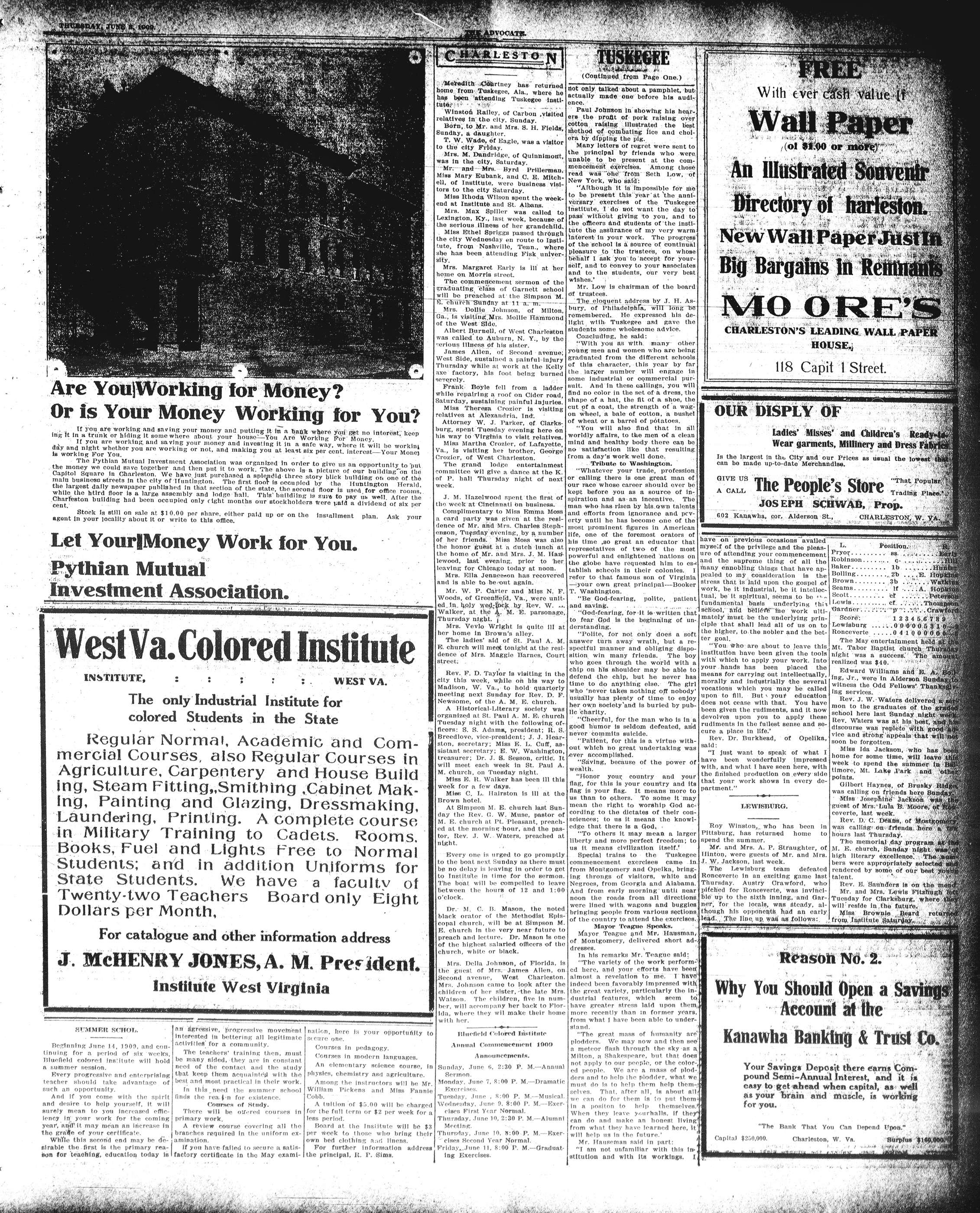
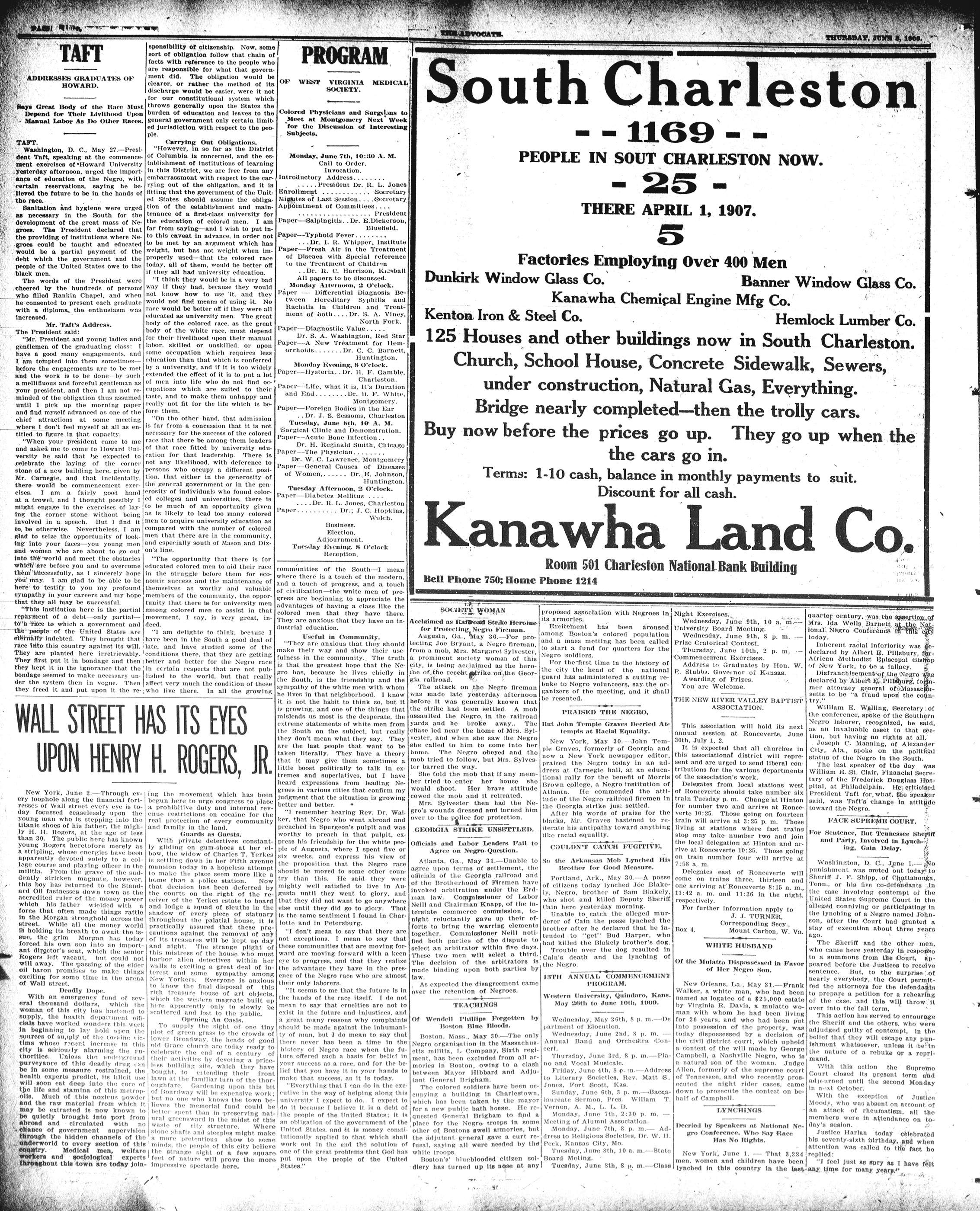
Page text (machine-generated)
AT THE NATION'S CAPITAL
TAFT'S MASTERLY ADDRESS TO HOWARD GRADUATES, A REFRESHING BREEZE AFTER DROUGHT.
Speech Contained Much Solid Encouragement for Colored People and Will Be Productive of Much Good. Editor Johnson Looking Over the Field for a Job. The Foraker Scholarship Idea Takes Root. Items of Interest About People and Things.
THE ADVOCAT
WE CHEERFULLY PUBLISH ALL
JRISP NEWSY NOTES FROM ALL
SECTIONS
VOLUME VIII.
(Thompson's National News Bureau.)
Washington, D. C., June 1.—The masterly address of President William Howard Taft at the commencement exercises of Howard University last Wednesday came as a refreshing breeze after a season of drought. Mr. Taft's deliverance before the faculty, students and friends of the race's principal institution for the higher education was simple, direct and earnest. His sentiments, spoken in such plain and unequivocal manner, admitted of no misconstruction by the most caputious. "He indulged in no rhetorical frills, bolstered up no false theories by an attempt at fine phrasing, and gave no hope to the enemies of our people by placing any limitation upon the possibilities of those who strive intelligently and persistently for the highest goals of citizenship. In short, the President, in the language of the commonality, "got right down to brass tacks" from the outset, and handled the educational aspect of the race problem without gloves.
No speech that the President has heretofore delivered has contained so much solid encouragement to the Negro people. At no time has he shown more conclusively that he is deeply concerned about our welfare as a race than on this occasion. He spoke as a personal friend, as well as a national magistrate. In pointing out our elements of strength and not overlooking some timely warnings as to our weaknesses, he rendered the race a service, for only in candid statement can we discover the helpful truth. In exposing the insecurity of the South on the Negro question, and in encouraging races to cultivate friendly relations and mutual respect and confidence, he struck a keynote that met the sanction of all who wish for a united, prosperous and happy nation.
The President's reception on Howard Campus was enthusiastic to the last degree... Owing to the inclement weather, he also exercises planned for out-of-doors, had to be held in Andrew Rankin Memorial Chapel. Twenty-five hundred persons fought their way into this building and heard his thrilling address... In the course of his remarks he was frequently interrupted by long and hearty applause, and particularly well pleased were all with his declaration that Howard University stood as the partial repayment of a debt to a race to which the government and the people of the United States are eternally indoubted, concluding with the pledge that he would do all that lay within his power as an executive to help the institution, an ideal agency for moral, intellectual and material uplift of the Negro people. Every heart was touched by this frank awowal, and the house rang with continued cheering and fervent "amens." Six thousand men, women and children witnessed the laying of the corner stone of the $50,000 Carnegie Library by the President and the brief speech of dedication, coupled with the echo of the chapel deliverance made Mr. Taft at that moment the most popular living American, as far as the Negro could make him so.
The President's speech was delivered upon a fitting occasion for the emphasis of Negro opportunity and Negro duty, and he made the most of it. It will easily rank with the most notable state papers in the history of our country, and will live long in the memory of a grateful constituency. It should be read in full in every Negro home in the land, and should form a permanent part of the archives of every school house controlled by our people. More and more the thinking colored citizens of the nation are coming to realize that William Howard Taft is a statesman of the loftiest type, and a Chief Magistrate who will do his level best to administer this government in the spirit of the Constitution written by the fathers of the Republic and strengthened and re-vitalized by the War Amendments.
Last week was indeed "educational week" in Washington. The several departments of Howard University held their commencement exercises at various times, according to the widely circulated program. On the 26th, as has been told so graphically by the Associated Press, the "big event" took place, with the President of the United States as the stellar attraction. With his own hands the Chief Executive handed out the long-coveted "sheepskins" to about 150 graduates in the arts and science department, in medicine, theology, law, pharmacy, pedagogy, dentistry, and other divisions and special courses. The annual competitive drill of the five companies of
the High School Cadets was hold Tuesday afternoon at American League Park, in the presence of a brilliant and fashionable audience of fond parents, adoring sweethearts and sympathetic sisters and brothers, uncles and aunts, numbering upwards of 10,000. Company E of Armstrong Technical High school won the flag, after a hard-fought battle with the other four companies. A and B from M Street High School and C and D from Armstrong. The judges were Lieut. Benjamin O. Davis, of the 10th Cavalry, United States Army; Leut. James F. Walker and Lieut. Thomas O. Jones, of the District National Guard, Commissioner Macfariani presented the prize pennant to Capt. Alruthens Taylor, of Company E, and each man got a badge. Lawyer R. R. Horner, of the Board of Education, presented silver medals to Lieut. Stevens and Carter, after Capt. Taylor had been awarded with a gold medal. Supt. R. C. Bruce, Military Instructor, Major Arthur Brooks and Principalals Jackson and Evans were warmly congratulated over the successful outcome of the year's work of the hustling high school boys under their care. The officers of the battalion were Major Clyde McDuffie and Adjutant William M. Dent. The captains were: Company A, Burnette Robinson; Company B, H. Bray; Company C, Alphonse Burwell; Company D, Ernest Hardy; Company E, Alruthens Taylor. The triumph of Company E is all the more noteworthy because it is the youngest company, having been formed only in February, from the increased number of boys entering Armstrong at the beginning of the February semester. Victors and vanquished banqueted Tuesday night at the M Street High School and made the wellik ring.
Editor W. D. Johnson, of the Standard, published at Lexington, Ky., was in town this week, looking over the field. He is accredited by the sharpshooters hereabouts with having an ambition to be Recorder of Deeds. Editor Johnson had a very satisfactory interview with President Taft, with whom he has been personally acquainted for more than twenty years, and the close friends of the brainy Kentuckian say that he received positive assurance that something good would likely come his way ere the snow flies. Mr. Johnson was among the first to wave the Taft banner in Kentucky, when the State seemed hopelessly against the genial War Secretary; but, with characteristic courage, he girded up his loins and helped very materially to turn the tide and send a solid Taft delegation to the Chicago convention. Mr. Johnson was himself a candidate for delegate on the Taft ticket. While here Editor Johnson met all of the "Black Cabinet," and was given the glad hand. It is stated that if Mr. Johnson succeeds in landing in Washington, he may bring his paper with him and treat the slow-going denizens of the nation's capital to a sample of genuine "Blue Grass" editorial thunder. It is certain that something will be doing when Brother Johnson takes hold of the helm here or anywhere else.
At the regular annual meeting of the Board of Trustees of Howard University, Prof. George William Cook, dean of the commercial department and acting secretary for several months, was unanimously elected permanent secretary. Prof. Cook came to the school in 1874 as a student, became a tutor immediately upon graduation, and has made the institution his home ever since, with the exception of one year, when he was loaned to the District authorities for the purpose of establishing, at Blue Plains on the Potomac, a Home School for colored children. Closing his work there he nominated a successor and returned to his alma mater. Prof. Cook is a member also of the Board of Associated Charities and takes an active part in the work of that body. A notable addition was made to the faculty in the person of Prof. Richard R. Wright, Jr., of Philadelphia, who comes by unanimous election to take the newly-created chair of sociology, and will also instruct in German. Prof. Wright is a graduate of the University of Pennsylvania, and has carried on some valuable sociological investigations among the Philadelphia Negroes at the instance of this school. For a number of months he has been serving as editor and business manager of the Christian Recorder, filling out the unexpired terms of Drs. Johnson and Collett, the former of whom is on sick leave and the latter is dead.
CONTINUED FROM PAGE ONE.
THE ADVOCATE.
CHARLESTON, WEST VIRGINIA, THURSDAY, JUNE 3, 1909.
CAUSE
National Conference of Noted White and Colored Men and Women Speak in His Behalf at New York Meeting.
New York, May 31.—A national conference in the interest of the American Negro was opened in the United Charities building in this city today by Prof. Burt G. Wilder, of Cornell university, and Profs. Livingston Farrand, E. R. A. Soligman and John Dewey, of Columbia university. The conference will be in session for two days.
Prof. Wilder brought from Rhaca several brains, including those of an ourang-outang, an unscrupulous politician, an illiterate colored janitor and an eminent mathematician.
"The brains of the average American Negro seems to be about two ounces lighter than that of the average white man," said Wilder, "and probably there occurs more frequently than in the white man a less development of the prefrontal lobes. These two conditions render it likely the whites will remain the dominant race."
Mrs. Cecilia Parker Wooley, founder of the Frederiek Donglass Center in Chicago, was the chairman of the afternoon session, and spoke on "The Industrial and Educational Status of the Negro". Prof. W. E. Dubois, of Atlanta university, Georgia, declared that the idea of taking the Negro out of politics is wrong, as it leaves him a prey of mobs.
At the evening session the speakers included Judge Wendell Phillips Stafford, of the supreme court of the District of Columbia; Rev. Jenkings Lloyd Jones, of Chicago; Prof. John Spencer Barrett, of Smith college, Northampton, Mass.; Rev. J. Milton Waldron, of Washington, D. C., and Clarence Darrow, of Chicago
STAND
AGAINST COLORED FIREMAN RETARDS.
Settlement of Railroad Strike in Georgia, As Neither Side Seems Willing (1) Give in on This Point.
Atlanta, Ga., May 30.—There were no new developments in the strike situation today. Officials of the Georgia railroad and the Brotherhood of Locomotive Firemen spent nearly the entire day in conference, taking up the questions in the strike agreement that remain to be settled.
Commissioner Neill, Chairman Knapp and Second Assistant Postmaster General Stuart were present at the conference, which will be resumed tomorrow. It is thought by those conversant with the strike situation that the points in dispute will be given to a board of arbitration, under the Erdman law.
The race question will retard the settlement of the strike, as the white firemen are determined to stick to their stand that the Negro firemen must go and not be employed in any capacity. The other points will be speedily adjusted, it is expected.
There are several reasons why the race question is so important. The Georgia railroad is considered a home institution. It employs Georgia men only. Its firemen and engineers and conductors, and even its brakemen, are all natives of towns and villages through which its trains run. These men have intermarried until nearly whole communities are related. One engineer told Commissioner Nell that there was not a town on his run between Atlanta and Augusta in which he did not have blood relatives. Many of the men come from old and highly respected families, and the idea of working with a Negro is abhorrent to them. It is repulsive to their relatives, too, and to this feeling is attributed the strong stand taken by entire communities against the railroad.
Should the Negroes win in the final settlement of the dispute many believe there will be strong sentiment created against permitting the Negroes to continue at work. This feeling does not exist so strongly in the larger cities, such as Atlanta and Augusta, and it is possible that if the railroad insists upon keeping some of the older black employees and will consent to work them only in the yards of the cities named that the problem will be solved.
It is expected that normal train service, with the exception of the freight department, will be established at an early hour tomorrow morning.
DUTY
Efforts of West Virginia and Other Senators Meet With Success After Strong Opposition in Senate.
Washington, D. C., May 29. —Lumber is not to be free. That much the West Virginia senators in connection with their other friends, have been able to accomplish. By an overwhelming majority the senate on Monday voted down the free lumber amendment to Senator McCumber. Just yet it is not known what the rate is that will be fixed on this product, but it is sure that it cannot below $1. The chances are that a rate of $2 will be fixed by the Senate. The two West Virginia Senators can congratulate themselves on this. Each Senator has worked vigorously for this result. They have been insistent in season and out of season and are beginning to reap their reward. Senator Elkins made a very strong speech against free lumber on Saturday, the 22nd. It was listened to with marked attention by his colleagues. It was a strong argument and he was warmly congratulated after he had concluded his remarks. The light against free lumber, being on Senator Scott. Followed Senator Elkins and said in part:
"Mr. President, I merely desire to add a word to what my colleague said, and very ably said, indeed, in regard to the South."
"I desire to call the attention of the Senate to the fact that in the dark days of the civil war, when a certain portion of the country was trying to make it appear that the war was a failure, when that great and good man, President Lincoln, was almost ready to throw up his hands in despair, when gold was at a great premium, when an election was to be held in the fall, when it was thought in all probability that the next Congress of the United States would be Democratic and that the policy of the country and the policy of President Lincoln would not be upheld for the lack of means to support the army, that the border Southern States which came to the rescue, and upheld the hands of President Lincoln and made, it possible for him to carry that war to a successful termination.
Notwithstanding that many of the great Republican States like Massachusetts, New York and Pennsylvania failed to elect a united Republican delegation then, the States of Delaware and Maryland, the States of West Virginia, Kentucky, and Missouri sent enough RepubHcan members to Congress in that election to save the country from the disgrace of having to ask the soldiers of the Republic who were offering up their lives to go without their pay and of having the war declared a failure.
"Mr. President, we of the border States ask for nothing more than we are willing to give to any other State in this Union. I am willing to vote for a tariff and right to every section of the country, whether we produce any of the articles in my State or in the Southland. The southern people are not selfish; they are a generous people; they are warm-hearted; and they only ask for themselves what they are willing to give to others. I hope when it comes to humber, coal and oil, and when it comes to other articles for which we are asking only a fair protection in the great bill that is before the Senate, the South, not particularly West Virginia, but the entire South, will be taken care of; and I predict as I did a few days ago, that the time is not far distant when the greatest protectionists, the most earnest advocates of the principles of protection, will come from the so-called 'Southern States.' I ask in fairness and candor and as I stated before on the same line that we are willing to give to others, to the farmer, and to the mechanic, and to the laborer, that same measure may be meted out to us."
A very gratifying incident happened during the past week; it was gratifying to Senator Scott, at least. A woman, widow of a Union soldier, was discharged from the Government Printing office. She was a West Virginian and her friends wrote to the Senator telling him about it. He immediately addressed a communication to the Public Printer in which he said that the widow of a Union soldier should be kept at work as long as she lived, or as long as she needed the work. On the 27th he received a letter from the Public Printer stating that he recognized the justice of these remarks and had ordered the reinstatement of the woman in question.
Hon. A. D. Williams, Member of House of Delegates from Pocahontas County, spent a few days in the city. Mr. Williams was here on business and paid his respects to the Senators, Speaking of the re-election of Senator Scott he said:
EXISTENCE
OF NEGRO PYTHIANS IN JEOPARDY.
White Organizations of Mississippi and Louisiana Authorize Actions to Restrain Them From Using the Name.
Vicksburg, Miss., May 31.—At the recent meetings of the grand lodges Knights of Pythias (white) of this state and Louisiana action at law to restrain Negro organizations from using the same name.
name was authorized.
This move on the part of these two jurisdictions was not unexpected. It has been contemplated for some years and was only postponed to await the outcome of the suit in Georgia, where the grand lodge, with the permission of the supreme lodge, secured an injunction from the supreme court restraining the county of Fulton from granting incorporation papers to the Negro organization. The question is now before the supreme court of the United States and, until its final settlement, the Negroes will make no change in their name or emblems. They appear to have a good case, one of which the outcome would not be in doubt if left to an unprejudiced tribunal, for the white knights themselves had taken no steps to incorporate before the application of the colored organization.
The Negro Pythians are not the only ones who are being called upon to protect their organization's name. A suit is now pending in the Mississippi court against the Grand United Order of Odd Fellows, which, though affiliated directly with the parent body in England, is called upon to fight for its life. Both these fraternities are doing excellent work for the uplift of their members throughout the southland. At New Orleans, the Pythians are erecting a temple of reinforced concrete which is surpassed by no other fraternal headquarters building south of the Ohio. They like the Odd Fellows here and, in fact, all through the south, are spending thousands of dollars caring for their sick, burying their dead and providing for the maintenance of the widows and orphans of deceased members. If there is a need of business the whites who complain so loudly now of the black man's disinclination to help himself will have additional cause for complaint, for they will be called upon to do, in a large measure, what the Negro secret societies are now doing. It goes without the saying that the court's decisions are awaited with much anxiety by both whites and blacks.
"Senator Scott ahs made himself very solid down in our country by his stand on lumber and coal; both Senators have for that matter and we feel that we have representatives in the Senate who are on their job and who know how to hold it down. It would be a great pity to send a man to the Senate in place of Senator Scott. I begin to see how influential a man may become after serving one or two terms in the United States Senate."
While talking on the political subjects it might be well to say something about the Marshalship of the Southern District and the Attorney-ship and Marshalship of the Northern District. Many of the papers of the State have been stating that Senator Scott, especially, has made definite promises to certain gentlemen concerning these appointments. The Senator was asked about this and said:
"The terms of the gentlemen holding these offices do not expire until along in December or January, nearly a year away. It is too early to take action of any kind and it is also too early to make promises. I have made no promises and do not intend to make any promises. When the time comes I will do the best I can; but I want it distinctly understood until then I will promise nothing." A number of other West Virginiaans have been visitors in the city. Mr. H. M. O'Blenns, of Parkersburg, spent a half day at the Capitol on his way East. He was interested in business matters. Hon. Samuel Dixon, of Fayette County, and Hon. Mike Roach, of Karawah County, were also here. They spent a couple of days in the city looking after their coal interests.
Messrs. Hooton and Wheeler, of Rowlesburg, were also visitors. They came especially to see Mr. Sturgiss and after calling on him dropped into the Senate to hear tariff speeches.
Hon. John H. Snodgrass, Consul at Kobe, Japan, and a West Virginia, has received a very handsome promotion in the general change made in the consular service; he was transferred to Moscow, Russia, at a salary of 15,000. All the West Virginia consuls are making a record.
She—Does the course of their love run smooth?
He—Oh, yes! there are banks on both sides.—New York Evening Telegram.
Largest Class in History of the Institution Turned Out Last Week at North Carolina A. & M. College.
Greensboro, N. C., May 27. — The week will long be remembered in history of Greensboro. It was commencement week of the Agricultural and Mechanical college located in Greensboro for the education of the young men. It is perhaps the only real agricultural and mechanical college in the country, and the young men who graduate from the institution are doing a great work. It may be said to the credit of many of the states that there are A. & M. colleges for the education of the youth of the race, but they are not confined to that particular branch of work. At the head of the A. & M. college here is, Prof. J. B. Dudley, one of the most noted educators of the race, and a man of ability. He has been at the head of the school for a number of years, and is devoted to the work. Each year there are improvements, and larger classes turned out.
The commencement exercises started last Sunday morning with the baccalaureate sermon by the Rev, Mr. J. E. King, of Raleigh, rector of the Episcopal church there. This sermon contained some good advice to the young men. He was eloquent and at the same time practical. The college chapel was crowded to its limit to accommodate the large crowd. Several of the city churches suspended services.
Sunday night, the address to the Y M. C. A. was delivered by Charles Stewart, A. M., of Chicago, the newspaper correspondent. A large crowd was present.
Tuesday night, Prof. G. A. Edwards, of Shaw university, Raleigh, N. C., delivered the address to the Mechanical Literary Society, Prof. Edwards felt that it was a high compliment to be invited to address the literary society in the school from which he graduated but a few years ago. His theme was composed of one word, "Success," which he expressed volumes in the handling of it. He told the young men going out in life how to achieve success and greatness in the world, "Reliability," was held up as the watchword and they were told to back that up with industry and push.
Wednesday night, it seemed that everybody in Greensboro, and for miles around tried to crowd into the chapel. One of the features of the commencement for several years has been a drama, which has been written and staged by Mrs. J. B. Dudley, the wife of the president of the institution. These dramas have been of particular interest because they portrayed some phase of the race question and told in words of the success and progress the Negro was making for himself. This has had much to do with drawing a large crowd as well as the ability of the author.
"The Negro's Quoto in the Development of the Country,' was the drama Wednesday night and one which will be an important factor in racial development in North Carolina. The A. & M. collega song which was used throughout the commencement was also composed by Mrs. Dudley.
Every train coming into Greensboro Thursday morning brought large crowds. This was commencement day, and this is the time when the people come to town. The orations of the students were of a high order. Eighteen young men graduated and the address was delivered by Mr. Josephus Daniels, editor of the News and Observer, of Raleigh. He made a good address. He spoke to the students of the institution, not as white men or black men, but as men, who must fill their places in the world.
Mr. Daniels in addition to being one of the leading editors in the south is also a great orator. His address Thursday morning was eloquent and scholarly. The diplomas were presented by President Dudley. Prof. Dudley is putting forth a strong effort to have the young men of his race remain in school and become useful men. He could see that the future of the race had much to do with that. He appealed to the people to create a fund or to pay for a scholarship out of which the young men could receive some assistance.
CONTINUED ON PAGE FOUR.
A vast dome of the state capital style, looking from the new dining hall, a turret on the new dormitory for girls, from which a big clock would toll the hours to the industrial boy and girl, a big black iron tank with a capacity of 40,000 gallons of water, a new agricultural building breaking the horizon line from the school looking west, a little village is which new houses almost daily sprout, are some of the marks which have given new features to the whole school.
With these changes have come constant increase of students built town students, day students apart the 2,000 mark has, nearly been reached The increase is most noticeable in the graduating classes. The graduating class of this year numbers 105, against 90 of last year, and the class which is to finish in 1910 numbers now 140.
Thus each year is witnessing an increase of boys and girls who are seeking to learn a trade whereby they expected to earn a living and be of service to their race.
From the very outset the school this year has emphasized its own kind of commencement exercises. The choir which so charmed the heart of Andrew Carnegie and the school band which so thrilled Belton Gleath, of Birmingham outfitted their own good records for handling Negro melodies for commemorating music.
The divinity school or Trinity Bible school, in graduating life, placed additional stress on the importance of knowing people and embellishing now rather than the thousands of years ago. In a word, additional stress was placed upon practical everyday living even for ministers. Typical too were the subjects for the Boston prize. Trinity contend "Good Roads in Their Relation" to Farm Life." "The Call of the Rural Districts." "Thomas Edison"—all subjects of a practical nature such as the student will have to deal with in after years.
Commencement Exercises
The program was divided into two parts, part one taking place in the morning, and part two in the afternoon. In the morning, Raymond D. Taburn salutatorian, discussed "Modern Methods in the Education of the Farmer;" Paul J. Jefferson discussed "The Value of, Pork Production to the Southern Farmer;" Charles L. Pearson, "The Small Farmer as a Factor in Our National Life;" Belle E. Williams, "Work in Corn-Shucks" and the wife of M. C. Moore, of Austin, closing the morning exercises with the alumni anniversary address.
In the afternoon the program was continued with a speech by Stonewall J. Dillard on "Open Fields for the Graduates of the Trade and Technical Schools;" Algie H. Caruthers, "Making a Pamphlet;" Reginald A. Morter, "Electricity as a Source of Motive Power;" Charles W. Carpenter, valedictorian; "The Teacher's Paradise."
The special features of the day were the music, the student illustration of his own work, letter of regret read from absent friends, and the visitors.
The music for the day was as follows:
The Holy City—Orchestra,
O Cap Your Hands Together—Choir.
Melodies, Selected—School.
Negro folk song, "Dry Yo' Eyes"—Choir.
Medley, National Aira—School.
"Let's Be Laughing"—Choir.
"Hail Alma Mater"—Choir and Orchestra.
"Then You'll Remember Me"—Orchestra, W. M. Graham, soloist.
"Praise Ye the Lord, O My Soul"—Choir.
"Away to the Woods"—Choir.
Melodies, Selected—School.
Negro folk song, "Diana"—Choir.
Tunekege Song—School.
"Haltleigh Chorus"—Choir.
Demonstration by Students.
The student's illustration of a work while speaking was an attractive feature of the exercise. John Williams, is her speech, working on corn shucks, had a clash on the ground, form making hats, scrubbing brushes and bottoming chairs with corn shucks.
Algie Caruthers, in the same work.
BASE BALL
West Virginia Colored Institute, at Institute
K. & M. Noon Train Will Stop at Institute Admission 25c
Howard Jackson, of Mason, spent Sunday in town the guest of friends.
Miss Salena Cobb, of Columbus, came over Sunday of last week to be present at the graduation of her cousin, Russell Colston. She will spend some time here the guest of relatives.
Dana Gatewood, of Middlepart, spent Sunday in town.
George Bradley and John James, of Parkersburg, were guests of friends Sunday.
Dr. J. McHenry Jones, of Institute, delivered the address to the graduating class of Langston High School. Not only the class and teachers but all who heard it, both white and colored, declared it the most able address ever made to a class in our city. Dr. Jones knows what needs to be said and he says those things in such a way that they can be understood and appreciated by all.
Miss Carrie Brown, of Pittsburgh, is the guest of her sister, Mrs. A. McFeters. Mrs. Brown came to be present at the graduation of her niece, Miss Anna Green.
Misses Jess Hale and Edith Bates, teachers of the Middleport school, assisted by Fred Payne, brought the entire school here Friday for a day's outing. They were met by Miss Mosella H. Colston and a number of primary and intermediate pupils of Langston school. After lunch was served all departed for the Baseball Park where a game took place between Middleport and Pt. Pleasant intermediate school boys. The game was the most enjoyable one of the season.
Misses Eva Nick, Cassie Bess and Bessie A. Norman accompanied Misses Hale and Bates here Friday on the outing.
Rev. S. A. Thurston, of Huntington, who was one of the number on the commencement program, left for his home Wednesday.
Miss M. Frances Morton, intermediate teacher in Langston School, left for her home Thursday after finishing a very successful term here.
L. R. Jordan and family left for his farm at Institute, where he will spend vacation.
Miss Wares, of Huntington, came up to commencement. While here she was the guest of Miss Ida Alexander.
Misses Bazette Jenkins and Besaine Davis, of Gallipolis, were in town Monday.
Little Miss Nola Holmes, of Gallipolis, is visiting her grandmother, Mrs. A. Smith.
Mrs. Charles Harris and children, of Gallipolis, are guests of her sister, Mrs. J. Jordan.
Misses Mosella H. Colston, Luella Roberts and Anna Green have been made Librarians of Langston School. The library will be open to the public Wednesday of each week. Books may be kept out two weeks. For every day after, that time a fee of one penny a day must be paid.
Misses Mina Jones and Florence Moore, of Henderson, spent a few days of last week in town.
The Grand Council of Red Men and Daughters of Pocahontas held their first biennial meeting here last Tuesday, Wednesday and Thursday. Mayor Dougherty's address of welcome was very encouraging and was heartily received. Addresses were made by D. R. Hickman. Thomas Sweeney and Mrs.Mary H. Lewis. Dr. Woods was master of ceremonies. In the evening a street parade was had, all wore Indian costumes and made a fine appearance. Officers were elected for the ensuing term and a public installation was held Friday night at the Baptist church. Some of the delegates who attended were: Rev. W. D. Woods and wife
Mrs. Hoiston, Mrs. Wills, of Roanoke, Va.; Dr. Johnson, Mrs. Mary W. Freeman, Mrs. Mary Edwards, Mrs. Emma Brown, Mrs. Annie Brown, Mrs. Miller and Mrs. Cassie Loman, of Covington, Va.; Mrs. M. E. Branham, Miss Ethel Brown, Dr. B. F. White and wife, of Montgomery; Miss Alice Bolding of Page; Mrs. M. A. Farmer, Mrs. Ella Lewis, of Boomer; Mrs. C. H. Rogers, Smithers; Dr. Hunter, James Jackson, Sylvia; Dr. S. A. Washington and Rev. Dean, Hill Top; T. J. Sweeney of Fuyetteville; Hon. J. M. Ellis, of Oak Hill; T. L. Thompson, of Powelton; Rev. Charles Lewis, H. T. Moore. Mrs. Mary H. Lewis and Mrs. D. R. Hickman, of Conceverte; W. W. Allen, Uniontown, Pa.; George Ridout, Ohio. Mrs. Mary Freeman had a special coach attached to No. 3 last Tuesday for the benefit of the Covington councils.
Mrs. Halay, of Maysville, Ky., is visiting Mrs. Henry Morton on Morrow avenue.
Miss Maggie K. Marshall returned last week from Maybeury where she taught a very successful term of school
Miss Viola Thompson left Saturday for Elkins, to see her father, Tom Tompkins, who is very ill.
Mrs. Owen Price, of McKendree Hospital, and Mrs. Thomas Johns and daughter were visiting Mrs. D. R. Hickman last week.
Charles Mills and wife left last week for Union.
Miss Josephine P. Jackson, of Lewisburg, was the guest of Mrs. H. T. Moore Wednesday and Thursday of last week.
Quite a crowd of Odd Fellows and Ruths attended the Thanksgiving sermon at Alderson Sunday.
MONTGOMERY.
Mrs. George Brown is sick at her home on Fourth avenue.
Mrs. Peter Hall, who has been quite sick, is reported much better.
Mrs. Samuel Buster is out again after several weeks illness.
J. W. White, of Charleston, was the guest of relatives here Sunday.
J. S. Noel is a business visitor to Huntington this week.
Mr. and Mrs. P. W. Wright have moved into their new cottage on College street.
Miss Ada Burke, of Huntington, is here, the guest of her sister, Mrs. Silas Marks.
George Jackson is out again after several days' illness.
Mrs. Woodson Jones, who sustained injuries by a fall, is able to be out again.
Mrs. Beulah Jackson spent a few days with relatives at Hansford last week.
C. R. Pack, of Sylvia, was the guest of relatives here Friday.
Mrs. H. H. Ralley is sick at her home on Fifth avenue.
Miss Mary Noel, of Institute, is spending a few days here with her parents.
Miss Alberta Gay, of Boomer, is this week's guest of Miss Ethel Deans.
V. M. Willis is spending a few days in Charleston this week.
Miss Ethel Brown, the daughter of Mr. and Mrs. Luther Brown, of Eagle, died Friday and was buried here Sunday.
Leon Jones, of Red Star was the guest of R. L. Geter a few days last week.
Drs. Lawrence and White are arranging for the entertainment of the Medical Association, which meets here next week.
Union Decoration Day was observed here on Monday with impressive ceremonies.
The various fratern organizations and citizens met at the Odd Fellows
Hall at 1 o'clock p.m. where A. W. Slaughter, grand marshal, formed the line of march. Headed by the M. J. S. Concert Band the procession moved toward the cemetery. Following in carriages were Master of Ceremonies S. B. Morgan and the speakers of the day, W. J. Campbell, national board of the U. M. W. A., Dr. J. McHeilnry Jones, president W. V. C. I., W. J. Thompson, G. C. of N. of P. of V. Va., and A. P. Straighteners, field agent for the United Order of St. Lukes.
The M. E. church being near the cemetery, the trustees and pastor generously threw open its doors for the speaking. The following program was rendered:
A Selection form Band
The Master of Ceremonies S. B. Morgan introduced A. P. Strughther, who in a neat and appropriate speech introduced President Jones, who after reviewing the history and cause of Decoration Day, spoke on education and industrialism.
W. J. Thompson was next introduced. He spoke on the moral standing of our people; admonishing the audience that no race rises higher than the status of its women.
W. J. Campbell spoke on organization and unity, reminding us of the fact that we can not help the dead; but must prepare to live here by uniting hearts, hands and minds. He admonished us to not pay so much attention to lodge or denomination, since one black man's interest was the interest of the whole race and that one can not possibly rise without the assistance of the other.
The entire exercises were impressive and instructive from every standpoint. They were closed by singing Americo. Lodges and Tribes from all the nearby towns were here and took part in the decoration.
CLARKSBURG.
Horace Lee, of Columbus, O., was called home by the illness of W. H. Lewis.
Miss Lee, of Weston, is visiting her sister, Mrs. Wm. Lewis.
Mrs. C. A. McGee and two daughters, Antoinette and Grace, of Cannonsburg, Pa., are visiting relatives here.
Miss Maria Ogden-Jones left Saturday for her home at McKeesport, Pa., after spending several weeks here with relatives.
Miss Lily Allen returned to her home at Fairchance, Pa., Saturday.
Samuel Brown, of Parkersburg, was in the city Sunday.
The regular monthly social of the Women's Mite Missionary Society will be held Thursday night at Mrs. Thomas' residence.
Mrs. J. W. Robinson and children left Thursday morning for Elizabeth City, N. C., where she will visit her parents, after which she will take up her residence in St. Albans, where her husband, has accepted the pastorate of the Baptist church. Rev. and Mrs. Robinson have made many friends during their stay among us and the best wishes of this community follow them.
Mrs. Lottie Brown entertained Wednesday evening in honor of Rev. and Mrs. Robinson.
Misses Cornelia Mead, Inez Tuck, Ophelia Washington, May Robinson and several others attended the closing school exercises at Fairmont Thursday.
The Ladies of the Eastern Star will hold a lawn fete Thursday evening at the home of Mrs. Nannie Howard, on Monticello avenue.
Woman's Day was observed at Pride Chapel Sunday, under the auspices of the Wohmen's Mite Missionary Society. The pastor preached an excellent sermon to the women at the morning service. In the afternoon a pleasing program was rendered, as follows:
Singing — From Greenland's Icy Mountains.
Prayer.
Singing—"Coming to Thee," Mrs. Ida Roberts.
Paper—Miss Bertha Lee.
Paper—Miss Lutie Tuck.
Singing—Missionary Hymn, Choir.
Remarks—Mr. Jno Lee, president of the society.
HIGH GRADE
FOOTWEAR
LOW GRADE
PRICES
BELL
SHOE
COM'Y
708
KANAWHA ST.
Offering.
Benediction.
Mr. Gillespie, who is here lecturing at the tuberculosis exhibit, spoke at the three churches Sunday.
A committee of three was appointed from each church to meet at the school hall Monday evening and arrange for practical work in this community.
Rev. J. W. Colbert and Mrs. Aaron Wilson spent Sunday afternoon at Fairmont looking after church matters
L. O. Wilson, of Weston, passed through the city Thursday en route to Fairmont to address the class.
James West, who has been attending school at Wilberforce, O., is now here with his father, Rev. S. P. West.
Mrs. S. P. West spent Sunday here with her husband and son. She expects to return soon to reside permanently.
ST. ALBANS.
The pulpil of the St. Paul Baptist church was filled Sunday morning and at 2:30 p. m. by Rev. R. D. W. Meadows, and at night by Rev. J. W. Robinson, who was installed as pastor at 2:30 p. m. The installation sermon was preached by Rev. Meadows, assisted by Rev. Daniel Robinson and Rev. T. T. Brinkley, of the A. M. E. church. Miss Bessie Dawson, of Charleston, was visiting her aunt, Mrs. Mary Carr, Sunday. Miss Rhoda A. Wilson, teacher at Charleston, spent Sunday with her parents. Miss Rubie Preston, who has been very ill for some time, remains about the same. A. C. Branham spent Sunday with his family.
Henry Milton and Edward Turkery and their mother, Mrs. Mary Turkery, who have had the small pox for several weeks, are rapidly improving. James Fouler and wife came down from Page Saturday to his wife's people. Mrs. Nancy Brooks, of Plymouth, was calling on her mother, Mrs. Lou Wilson, Sunday. George Sullivan, of Elk Ridge, was calling on friends Saturday. Henry Coles, of Raymond City, was a business caller here Saturday.
HUNTINGTON.
Miss Ida Stafford and John Daniels were united in marriage, Tuesday, at Catlettsburg.
R. Smith is erecting a very nice residence on 10th avenue.
Misses Helen and Lottie Bass, of Holden, were guests of Miss Josie Barnett, last week, attending the commencement and returning home Tuesday.
Miss Elmira Riddle is visiting relatives in Baltimore.
The teachers of Douglass school tendered a reception to Dr. S. B. Moore, of Washington, D. C., last
Friday evening at the home of Mr. and Mrs. G. W. Hughes. Quite a number responded to the invitation, and a most enjoyable evening was spent.
Rev. S. O. Lewis, pastor of the 1st Baptist church, Lynchburg, Va., is here spending commencement season with his parents and friends.
Mrs. I. H. Holmes was removed, Sunday, from Kesseler hospital to the home of her sister, Mrs. C. C. Barnett, and is improving rapidly.
The sophomores and juniors of Douglass high school held a reception at the home of Mr. and Mrs. Edwin Dickerson, Tuesday evening, in honor of the class of this year. The house was beautifully decorated for the occasion, with potted plants, cut flowers and draperies carrying out the scheme of the class colors, blue and white. The evening was spent in social chat and music, and at an appropriate hour refreshments in several courses were most charmingly served by the young ladies of the two classes. After the refreshments, toasts were given and responded to by the various participants.
Little Fragilla Smith, who was ill last week, is very much better.
last week, is very much better.
The alumni association of Douglas high school held its annual reception for the class of 1909. at Douglas school building Monday evening. A very interesting literary program was rendered, besides a most practical and eloquent address from an alumnus, now pastor of one of the largest churches in Lynchburg, Va., Rev. L. O. Lewis. At the close of the program, refreshmests were served by the young ladies of the junior class.
John Noel was the guest of G. W. Hughes, Sunday.
One of the most profitable and enjoyable commencements in the history of Douglass school, was that held at the Huntington theatre, Friday evening. The three young ladies of the class acquitted themselves in a most creditable manner and showed careful study and preparation of their subjects. The music rendered under the direction of Prof. E. A. Viney, was beautiful and of the highest class. Miss Lula James was at her best in the rendition of a most difficult piano solo. The address to the class by Dr. S. B. Moore, one of the faculty of Howard university, of Washington, D. C., was so full of good advice and instruction, plainly, but fluently expressed, that its real worth, not only to pupils, but to all who heard it, could not have been estimated in dollars and cents. He labored to impress upon the class and all present the importance of a stable, undeviating character, and his instructions, as to how to build such a character, were worth more than gold to every young person in the audience. It was an address that was impressively appropriate to our people and should not be forgotten. The
Beef, Veal, Mutton, Pork, Fresh Pork Sausage OUR OWN MAKE.
ry our machin sliced Hams and Bacon
OYSTERS, FISH, POULTRY
The best qualities in all the popular kinds of
We want your patronage for we have complete stock in our lines and you can get it when you want it most
STORER COLLEGE Harper's Ferry. West Va.
Courses
Academic, State Normal, Biblical, Vocal and Instrumental Music, Carpentry, Blacksmithing, Practical Gardening and Husbandry, Cookery, Serving and Dressmaking.
Equipment
Ample Buildings, Beautiful Car
libraries of over 6000 volumes,
Heuernery, Dairy, several acres
Hot Beds.
Expe
Books, Room Rent and Tuition
essary Expense not over $6.5
Holdings, Beautiful Campus, Laboratory, T
over 6000 volumes, Comm Ilous Barn
dairy, several acres of of gdvegs, Cold
Expenses
Item Rent and Tuition free to West Virg
dense not over $6.50 per month to Sta
Ample Buildings, Beautiful Campus, Laboratory, Telescope, Libraries of over 6000 volumes, Comm Hous Barn, Piggery, Hennery, Dairy, several acres of of geodes, Cold Frames and Hot Beds.
Books, Room Rent and Tuition free to West Virginia. Necessary Expense not over $6.50 per month to State students
Special Features
Eight valuable scholarships and Athletics, Band, Literary Society tertaintments, Musical Clubs, Y Storer is a Non-Sectarian, C For Illustrated Catalogue se
table scholarships and six prizes awarded
Band, Literary Societies, frequent Lectur-
ers, Musical Clubs, Y. M. C. A.
is a Non-Sectarian, Christian Institution.
Illustrated Catalogue send to
Eight valuable scholarships and six prizes awarded annually Athletics, Band, Literary Societies, frequent Lectures and Entertainments, Musical Clubs, Y. M. C. A.
Storer is a Non-Sectarian, Christian Institution.
For Illustrated Catalogue send to
HENRY T. McDOZ LD. Pres.
FRUITS, CAND
Familles
Ice Cream. O
ment solicited.
We make prompt deliv
day orders.
I. E. N
S, CANDIES ICEL
milles Furnished
ream. Orders for
solicited.
e prompt delivery of Cream and
E. Nich
Familles Furnished with Ice Cream. Orders for shipment solicited.
We make prompt delivery of Cream and Ices for Sunday orders.
I. E. Nichols
following program was rendered: Invocation ... Rev. S. A. Thurston Chorus—"O, Lord Most High"... Essay—Science in Economy... Pearl, were at the hospital to see his wife. They report her improving.
Mrs. P. J. Parham was in Montgomery Thursday.
Lucie Fountain.
Oration—Abraham Lincoln
Magnolia V. Allon.
Chorus—"To the Woods"
Oration—Stepping Stones to Success.
Regellar Carter.
Piano Solo—Chanson des Alpes.
Lula James.
Address
Lewis B. Moore, Ph. D., Howard
University, Washington, D. C.
Semi-Chorus—"O, Hall Us, Ye Free"
Presentation of Diplomas
Doxology
Benediction—Rev. B. M. Carson
SOUTH CARBON.
Peter Wilson and daughter, Miss
and daughter, Miss gomery Friday.
Miss Maggie Wilson was in Mont-
Peter Wilson and daughter, Miss gomery Friday.
Campus, Laboratory, Telescope, Li-
Committious Barn, Piggery,
of of grides, Cold Frames and
Denses
free to West Virginia. Neo-
0 per month to State students
Features
six prizes awarded annually;
des, frequent Lectures and Mu-
M. C. A.
Christian Institution.
and to
IES ICECREAM
Furnished with
orders for ship-
ery of Cream and Ices for Sun-
ichols
Pearl, were at the hospital to see his wife. They report her improving.
Mrs. P. J. Parham was in Montgomery Thursday.
Miss E. L. Young was an out of town visitor Saturday and Sunday.
Miss Annie Wooden was in Montgomery Thursday.
Mrs. Walker Reed's mother is slowly improving.
Miss Lelia Young was shopping in Montgomery Thursday.
Conlinder Young stuck a nail in his foot Sunday.
Winston Raily spent Saturday and Sunday in Charleston.
Charles Reed was out of town Saturday and Sunday.
Mason Alston, of Mt. Carbon, was in our town Sunday.
Miss Maggie Wilson was in Montgomery Friday.
BLUEFIELD COLORED INSTITUTE
A College and Normal Institute for colored students, Iocated at Bluefield, the leading commercial town of the southern part of West Virginia on the Norfolk Westren railroad.205 miles east of Kenova
BLUEFIELD
COLORED INSTITUTE
Splendid College Buildings, Beautiful Play Grounds, Dormitories
for male and female students; furnished rooms, a reading room supplied with the best current literature; a good library, and a physical and chemical laboratory.
Healthful location and wholesome surroundings. Board $8.00 per month. Tuition free to state students, rates very low to non-resident students.
The Bluefield School offers an unequalled opportunity for young men to secure an education, for they can always find profitable employment when at school, during vacation, holidays and on Saturdays.
For catalogue and other information, write the Principal.
If you haven't a regular, healthy mover one of the
bowels open, and you will be. Keep your bowels open, and be well. **Be sure** the violent phloe or pill poison, is dangerous. The bowels clear and clean is to keep the bowels clear and clean is to keep
CANDY
OATHARTIO
Cascaretta
THEY WORK WHILE YOU SLEEP
EAT 'EM LIKE CANDY
Pleasant, Palatable, Potent, Taste Good, Do
Good, New, Bloken, Weaken or Gripe; 40, 50 and
50 cents per box. Write for free sample, and book-
let on health. Address
Storing Remedy Company, Chicago or New York.
KEEP YOUR BLOOD CLEAN
AT NATION'S CAPITAL
INGTON will make it necessary for the A. M. E. Publishing Board to find another man to run the Recorder. Prof. Wright will make a very desirable addition to the colony of expert scientists in this city.
Apropos of the selection of another editor for the Christian Recorder the name of Rev. A. L. Galnes, of Baltimore, is again brought to the fore. Dr. Galnes is an able writer, an experienced financier, has a thorough knowledge of the needs of the church and is conversant with the speediest method by which a great diocesanical organ can be built up. In the existing crisis, may it not be permissible to repeat our former declaration that "the A. M. E. Church will gain by taking Galnes"?
Collector Charles W. Anderson, of New York, who comes in a few days to deliver the commencement address for the public schools of Washington, is to be given a royal reception by his host of friends here. An automobile ride, a shad-bake at Washington Park on the Potomac, and a monster stag are a few of the things proposed in his honor.
Attorney Albert S. White, of Louisville, is expected in the city this week on legal business. Mr. White has been strongly endorsed by Senator Bradley
Homes and Investments
FOR SALE—1,000 properties in this city (and nearby states). Free Sales List to buyers
Homes and Investments
FOR SALE...3000 properties in this city that need to be
states. Free Sales List to buyers
and sellers. Additional properties wanted for new Sales List,
WA. SHINGTON SKETCH BOOK
124 pages, 1,000 pictures--public men, buildings, views,
etc. Ten cents for postage. Your Special Agent in your town or for full information address.
AMERICAN REALITY CO., 1000 N. 10TH ST.
COLLEGE
6th St. and Pem Ave.
PITTSBURGH
COLLEGE
6th St. and Penn Avo.
PITTSBURGH
PITTSBURGH
Preparatory, Commercial, Stenography, Telegraphy, Electricity, Engineering, Drafting, Mathematics, Languages and Civil Service. Day and evening sessions all year.
Good Equipment, Best Location, Excellent Light, Able Faculty, Strong Courses of Study. CATALOG FREE.
MARTIN JENNINGS CATON. S. L., D., Pres,
BLUEFIELD
R. P. SIMS, Bluelfield W. Va.
for a high-grade appointment in the federal service, at home or abroad, and was presented to the President on the occasion of his visit here some weeks ago.
The suggestion that a scholarship be established at Wilberforce University as a testimonial to the services of Senator Foraker in behalf of the Negro race, is being accepted here with no small degree of enthusiasm. "The Wilberforclans," an organization numbering about forty, made up of the alumni of the school, has decided to take up the matter with a vigorous hand. Under the leadership of President W. A. Joiner, a canvass will be begun at once for subscriptions. A committee embracing such representative men and women as Register W. T. Vernon, J. A. Lankford, General Henry Forrest, Mrs. Emily Embry Vernon, John T. Layton, Mrs. Mary Hamilton Houston, Dr. W. L. Board, J. S. Coage, Mrs. M. E. Cheeks, Dr. and Mrs. J. F. Hurst, Mr. and Mrs. C. E. Hall, Mr. and Mrs. J. C. Wright, Mr. and Mrs. J. Frank Blagburn, Rev. L. M. Beckett, Misses Lucy Hamilton Nookes and Laura E. Joiner, will be called upon to take the initiative in the splendid work proposed. Full instructions as to the amount necessary for the support of a single scholar or a number of scholars have been forwarded by the energetic President W. S. Scarborough and the matter will doubtless be agitated with the persistence and diligence that it deserves. The suggestion for the Foraker scholarship originated with Mrs. Patricia Robinson, of Moro, Oregon.
Thanks to the progressive colored citizens of Freestone County, Texas, our Prof. Kelly Miller, dean of the College of Arts and Sciences of Howard University, has been ushered into the limelight in a new and highly practical fashion. A town, situated on the Trinity and Brazos Valley Railroad, about eighty-seven miles south of Dallas, has been founded by Afro-Americans for Afro-Americans, has been named "Kelly Miller," as a tribute of their appreciation of his work for the advancement of the race. The town site covers ninety-three acres, having 24 blocks, subdivided into 312 lots, each block being 300 feet square. The public square is to be dedicated to the memory of the Texans' beloved leader, N. Wright Cuney. Washingtonians are displaying a pardonable pride over the popularity that Prof. Miller has won at the hands of his follow-countrymen in every section of the land, and particularly in Teras, where he has been so signally and permanently honored.
Those who are disposed to berate the President for what they fear his Southern policy may mean to the Negro officeholders of the South should not overlook the fact that Walter L. Cohen, administrator of the Law Office at New Orleans, has been given positive assurance that he will be re-appointed, and that Collectors H. A. Rucker, J. H. Deveaux, Robert Smalls, Joseph E. Lee and others are drawing their salaries, without hint from headquarters that they are in any immediate danger of the headsman. It is being impressed upon the thinking element of our body politic that Mr. Taft is not the President of any single faction or race or party, but the Chief Executive of the whole people.
NEWSY NOTES.
The Negro employees of the general government numbering something over 13,000 draw more than $8,000,000 in round figures from the United States Treasury every year. The total has nearly trebled in money received by Negroes since the accession of Roosevelt to the Presidency, and the indications are that the threetimes mark will be reached before the retirement of President Taft.
Your correspondent is indebted to Dr. Henry W. Furniss. Minister to Haiti, for copies of Le Matin and Le Nouvelleiste, principal newspapers of Port-au-Prince, the Haitien seat of government, containing very full accounts of the grand ball and reception given by Dr. Furniss at the American Legation in honor of the inauguration of Taft and Sherman. Minister and Mrs. Furniss, now in this country visiting friends and relatives, will return to Washington before sailing for Haiti.
Some material improvements are to be made shortly in the furnishings of the office of Special Assistant District Attorney James A. Cobb. This capable representative of the Department of Justice in the handling of cases under the pure food and naturalization laws has a spacious suite of rooms in the building in which is held the sessions of the Police Court of the District, and is one of the points of interest sought out by colored sight-seers when they come to the capital.
Chaplain W. W. E. Gladden, of the 24th Infantry, has been serving as a member of the Board of Inquiry, by designation of the Secretary of War, to devise ways and means for increasing the efficiency of chaplains in the United States Army. The sittings were held at Fort Leavenworth, Kansas, and the suggestions put forth by Dr. Gladden were given a very attentive and cordial hearing. He was the only colored member of the board and the first of the race to be called upon to act in such a capacity.
The Post-Graduate School of Medicine and Dentistry, fostered by the Medical Department of Howard University, has opened auspiciously under the personal supervision of Drs. W. C. McNeill, A. M. Curtis, D. S. Lamb and Dean E. A. Balloch. Dr. C. Summer Wormley, president of the Washington Association of Dentists, has a splendid class in dentistry, and is one of the mainstays of the postgraduate school movement. The institution will continue for several weeks yet, and appreciable good is already being accomplished.
Messrs. W. T. Menard, George H. Proctor, W. E. Cobb and Ellias S. Webb Inotype operators at the Government Printing Office, long employed at this great printery, and well known throughout the country as expert workmen and prominent in fraternity circles, have been furloughed for a short period, owing to a scarcity of work.
William Polk, for many years principal musician (assistant leader) of the band of the 24th Infantry, stationed at Madison Barracks, Sackett's Harbor, New York, has been designated by the War Department as Chief Musician of the Regiment, to succeed Wilfred O. Thompson, white, transferred
Grand Rapids Furniture Co.
A cablegram from Commissioner | Mrs. R. B. Johnson visited her son Emett J. Scott, from Monrovia, Liberia, at Lage last week.
Swings from $3.50 to $16.50;
Porch Chairs $2.50 to $5.00;
Setters $5.00.
to Fort Sam, Houston, Texas, in conformity with the order of President Roosevelt to place colored bandmasters at the head of Negro regimental bands as rapidly as openings could be made for them. This gives the race three of the four bandmasters provided for the Negro regiments in the United States Army, with one Negro principal musician acting as bandmaster in the Fourth Regiment. The appointment of Chief Musician Polk is another gratifying instrument of the great victory achieved by Emmett J. Scott in pushing to a finish the movement to have Negro bandmasters in charge of all the Negro regiments of the army.
Lawyer Thomas L. Jones, a practitioner of high standing at the District bar, is said to be booked for a responsible assignment under the Department of Justice, in recognition of his effective labors for Taft, and Sherman in the recent campaign in Maryland, Delaware, West Virginia, and other states. Mr. Jones is regarded as one of the most magnetic critics in the country and is to be utilized as far as his time will permit by the republican authorities in Maryland this fall to insure the defeat of the disfranchisement amendment which is to be voted upon by the people in November.
Grateful acknowledgement is made of invitations to attend the commencements of Tuskegee Institute, Livingstone College, Howard University, Wilberforce University, the Curry School and the Western University. We are under obligations to Assistant Superintendent Roscoe Conkling Bruce of the Washington public schools, for box seats at the drill of the High School Cadets and for a similar favor in connection with the joint commencement of the high and normal schools at Convention Hall.
Chaplain W. T. Anderson, of the 10th Cavalry, is in the city, circulating among friends and old comrades. He is looking none the worse for his strenuous campaign in the Phillippines. Through the efforts of Auditor Ralph W. Tyler, Chaplain Anderson was, not long ago, raised to the rank of a Major with all the honors, emoluments and privileges attaching thereunto. Last Sunday the Chaplain delivered an instructive address to the Y. M. C. A. at True Reformers Hall. Like Secretary Lewis E. Johnson, upon whose invitation he spoke, Chaplain Anderson is a Cleveland boy.
The assignments for the Zion pulps of the Washington District by the Philadelphia and Baltimore Conference of that denomination at the Williamsport, Pa., Conference, are as follows: M. L. Blalock, presiding elder; Metropolitan, W. A. Ray; Galbraith, (8th year), S. L. Corrothers; John Wesley, C. C. Alleynn; Union Wesley, W. H. Ferguson; Arlington, H. W. Smith; Burrville, Logan Johnson; Trinity (to be supplied). Bishop J. W. Smith, of this city, presided over the deliberations of the conference.
The Illinois politicians "of color," who aspire to be known as national leaders, are sitting up of nights trying to take the measure of the new Senator from the "sucker State," the Hon. William Lorimer. Among those busiest with the tape-line are Assistant Register o f the Treasury Cyrus Field Adams, Charles E. Hall, Major John C. Buckner, Col. John R. Marshall, Major R. R. Jackson, Dr. M. A. Majors, and other Cook County patriots, the majority of whom are casting "sheep's eyes" at the fat job now held down by Brother Adams. Walter R. Farmer, who has the advantage of halling from both Illinois and Missouri, is expected on the ground with a yard-stick at an early date, prepared to stake off a choice claim, independent of the brethren of either state, with Senator Lorimer or Secretary Nagel as his alternating currents of "influence." The Illinois situation is threatening to give somebody trouble ere long.
J. Elmer Spyglass, described as a world-renowned baritone, of Toledo, O. will make his initial appearance in Washington June 15 at the Metropolitan A. M. E. Church in a classic recital. He sings in English, German, French and Italian, and has been heard to advantage in Paris, Munich, London, Glasgow, and the leading art and musical centers of Europe. He will be assisted by Miss Charlotte Wallace, contraito; Mr. H. Leonard Jeter, cellist, and Miss Mary L. Europe, accompanist. The proceeds will go for the benefit of the Home for Friendless Girls, of which Mrs. Rosetta E. Lawson is president and manager.
Davenports
In genuine leather, $65.00, $75.00
and $85.00; Imitation leather
$25.00 to $40.00.
LEATHER
Conches from $37.50 to $60.00;
Imitation Leather $15.00 to $30.
214-216 CAPITOL STREET.
states, that the party has finished its work in Liberia proper and is getting ready to return homeward. Before sailing, however, he is making some investigations in Sierra Leone and will touch at the Madeira and Canary Islands for observation purposes. The trip has been pleasant and informing, but Mr. Scott adds that he is half "home slick," and will not be sorry to follow the path of the setting sun, leading to American shores.
BLUEFIELD
Scott street Baptist church, Sunday, had their ladies' grand rally, while Rev. Mitchell furnished the cloquence. Crozier Temple chorus furnishel good music.
The Odd Fellows of the city had their annual sermon at Raleigh street M. E. church, where a large audience assembled to hear Rev. Brown, of Graham, as he discussed the principals of the order. In the evening the Household of Ruth had their sermon.
Mt. Zlon church also was in evidence with their baptizing. Several candidates went through the outward form of an inward purity.
Monday night at the Scott street Baptist church the Bluefield graded school held their closing exhibition. Prof. E. L. Rann deserves much credit for what he has accomplished since having charge of our graded schools. The patrons feel very grateful to him and the other teachers for the good work they have done and trust the school board may return them next session. The commencement sermon of the Bluefield colored institute will be held in the auditorium of the institute, Sunday, June 6th, at 2:30 p.m. Prof. J. M. Arter, of the West Virginia seminary, will deliver the sermon for the occasion.
Solomon Jordan, for a number of years a resident of our city and a member of Mt. Zion Baptist church, dled at his home in North Bluefield, suddenly Thursday evening, while sitting on his front porch. It is supposed he had heart-failure. There is some talk of the Norfolk & Western railway company building an up-to-date Y. M. C. A. for their colored employees at this point. This, if true, will be very gratifying to those who have labored so hard for the cause.
The new officers ejected under the bi-partisan charter will go into their respective offices June 1st, and it is truly hoped that we will note a marked improvement in the affairs of the city. It is understood that the colored people will ask the board of affairs to put the curfew law in force and not to permit children to remain on the street after 8:30 unless accompanied by parents or guardians. There is also a class of women who should be compelled to keep off the streets at all times, and a class of men who should not be allowed to remain in town.
Cismont lodge, A. F. & A. M. will celebrate St. John's day the 3rd Sunday in June. Rev. Mitchell, of Kimball, will address them at Scott street Baptist church, at 11 a. m.
BARBOURSVILLE
Mrs. Harriet Johnson was visiting relatives Monday.
Wendell Hamler was in Guyandotte, Monday.
Mrs. G. W. Hamler and children, of Hot Springs, Va., are spending their vacation here for a short while.
George Hill made a trip to Huntington, Saturday.
Mrs. Herbert James (nee) Gertrude Kilgore and son arrived last week.
Miss Julia Watkins, of St. Albans, and Vaughn Brooks, of Hurricane, are employed at the Hotel Edgar.
T. Hendrieks, of Russell county, Va., will make his future home here.
Rev. S. R. Bullock's lecture and stereoptican views were highly appreciated here the 21st by a full house.
MT. CARBON
The K. of Ps., True Reformers and Red Men decorated the graves of their dead Sunday at 1 o'clock p. m.
Rev. J. J. Turner assisted Rev. S. C. Wilson at Eagle, Sunday.
Mrs. Mary J. Bicy is visiting friends in Charleston.
Mrs. S. C. Williams is arranging a children's day program.
Mrs. Gertrude Wallace and Mrs. Emma Williams went to Charleston, Monday.
The strike remains very critical so far. Some of the miners will not resume under the present conditions. There may be a few which will begin work Tuesday.
The Reflexlier
THROW 90 PER CENT of its light downward. The best and "cheapest" light ever placed on the market. I will place on trial in any business house or residence one of these famous lights and convince you of its great value.
Baby Carriages
Autoes and Go-Carts from $10.00
to $35.00. The best on the market.
BRASS
Beds from $22.50 to $55.00 Best
Quality.
214-216 CAPITOL STREET.
Miss C. E. Bennett and Mr. W. E. Wells were quietly married at Fayetteville Monday. They will reside at Fire Creek.
The supper given by the church Saturday night was a success.
The annual sermon of the Elks was preached here, Sunday, by Rev. P. A. Harris. A large number of out-of-town visitors was present.
Decoration day was preceded by
Decoration day was properly observed here, Monday.
Mrs. Eliza Bennett was a business visitor at Fayetteville, Monday.
Mrs. Lucy Winston, Mrs. A. Saunders and C. H. Saunders were calling on friends here, Monday.
Dr. and Mrs. H. C. Hargrove, Miss W. A. Freeland were shopping in Thurmud Saturday.
G. S. Jackson was calling on friends here, Friday and Saturday.
Rev. P. A. Harris preached a very interesting sermon here Sunday evening.
BUCKHANNON.
Born, May 11th, to Mr. and Mrs. J. M. Rickert, a daughter.
Mrs. Thornton Jackson is quite ill at her home in East Buckhannon.
Mr. and Mrs. J. W. Mumford entertained the Silver Leaf club, Friday evening.
Mrs. James Wade, Mrs. Isom Taylor and Blair Dabney were called to Parkersburg Friday on account of the death of their sister, Mrs. Sophia Tibbs.
Miss Lotta Smith, who has been in Pickens for some time, came home Thursday. She has been suffering with asthma since her return.
Mrs. Laura Watson entertained the ladies' aid society, Friday afternoon, at her home in South Buckhannon.
Grand rally at Simpson
Church, Sunday, May 30th, was a
success. Sermons were preached during
the day. Amount raised $62.00.
$25.00 was presented to 4th trustees
by the ladies, aid society. Rally
continued next Sunday, June 6th.
Samuel Bolden attended the funeral of his aunt, Mrs. Sophia Tibbs,
at Parkersburg, Saturday.
Cephus Green is visiting friends in
Parkersburg.
Refle
```markdown
```
THROW 90
of its light
The best and 't
ever placed on
I will place on t
ness house or re
these famous li
vince you of i
P. A. D
The Light tore
From $3.00 to $22.50, in white, green and blue.
ALL GOODS
MARKED IN PLAIN
FIGURES.
214-216 CAPITOL STREET.
A GRAND TWO-DAY EXCURSION TO Toledo, Ohio
A Special Train consisting of first-class day coaches, and PULLMAN TOURIST SLEEPING CARS
Will leave Charleston at 10: 00 p. m., arriving at Toledo, Sunday morning, June 6th.
FARE ROUND TRIP, ONLY $3.00.
Double berth in sleeping car, accommodating two people, only $1.25 each way.
Returning; Tickets will be good returning on special train leaving Toledo, Monday, June 7th, at 7:00 p. m., allowing Two Full Days in Toledo.
For tickets, berth reservations and full particulars, call upon Agents.
Elkins, where she will visit friends for several days. Miss Beulah. Wright was on the sick list last week.
EAGLE.
Mrs. Pierson and son were visitors at Eagle last week.
Mrs. Ada Clark continues ill.
Born, to Mr. and Mrs. Howard, a daughter, on the 25th ult.
Ferdinand Clayton, of Caperton visited Miss Hattie Cosby, Sunday.
Miss Emma Cosby is visiting at Gallipolis, Ohio.
Rév. J. J. Turner filled the pulpit at Eagle, Sunday.
The Eagle Stars played Institute at Institute, Saturday. Score 7 to 0 in favor of Institute.
Miss Ethel Brown, who has been sick for some time, died Saturday noon.
xlier
500 Candle Power Light at a cost of one cent per day.
PER CENT. light downward. "cheapest" light
PAGE FOUR
PUBLISHED EVERY THURSDAY
THE ADVOCATE PUBLISHINGGO.
The Advocate is entered in the
Post-office at Charleston, W. Va., an
second class matter.
SUBSCRIPTION RATES:
Three months $0.50
Six months 1.50
One year 1.50
THURSDAY, JUNE 3, 1909.
LIBERIA'S WANTS.
The Atlanta Constitution exhibits a lamentable ignorance of the facts or, else, wilfully distorts them when it says, speaking of Liberia: "There would be a wide departure from time honored American policies of this country, if we are to become entangled in any way in the affairs of the 'Black Republic.' No one threatens Liberia—it is simply not prosperous."
Departure from time-honored policies! What about the purchase of the Philippines and their subjection by the sword to beneficient American rule? Did not the same time-honored policies get a jar when Hawaii was forcibly annexed, and the custom duties of San Domingo were collected by American officials? We refrain from mentioning the intervention in Cuban affairs, and patriotism compels our silence as to recent developments concerning the independence of Panama and the purchase of the canal zone. Time-honored policies, indeed! Dewey shot them so full of holes at Manila that even their hides are worthless.
It is equally eroneous to say that the territorial integrity of Liberia is not in danger. Both England and France are guilty of encroachments, the matter having reached such a stage that a conflict between the armed forces of one of these great powers and those of Liberia was averted only by the intercession of the foreign representatives stationed at Monrovia.
The report of the commission, which will soon return to this country, will throw much light on Liberia's condition, and its findings and recommendations, whatever they may be, will receive the consideration they deserve at the hands of congress and the president. Would it not, then, be wise to reserve judgment till it is known what action the commissioners suggest.
SOMETHING NEW FROM AFRICA.
A significant and welcome feature of the constitution for the union and government of the British colonies in South Africa is a clause which provides that four of the senate, out of a total of thirty-two, must be appointed because of their special knowledge of the needs and wants of the colored races. It is very far, indeed, from giving the colored races a standing equal to the standing of the whites, but promises at least intelligent government in the most critical of questions which will confront the new government.
No peanut politicians there will arise to place and power by stirring up the fires of race prejudice. No voter is to be disqualified by race or color, and all propositions affecting in any way the civil or political status of the blacks must meet the approval of the four senators, who, if endowed with the peculiar wisdom which characterizes the Briton in dealing with darker races, will legislate for the uplift of the natives. The constitution will bring under one government Cape Colony, Natal, the Transvaal, and the Orange Free State, and brings the people of that whole great area together in bonds as close as those which unite Ontario and Quebec.
The central parliament is to have 121 members, of whom Cape Colony will elect 51, the Transvaal 36, and the Orange Free State and Natal 17 each. The members of parliament must be British subjects of European race, who have lived in the colony five years. There are two official languages, English and Dutch. Pretoria, where Kruger held away, is to be the executive capital, Cape Town is to be the seat of legislative power, and Bloemfontein, the old capital of the Orange Free State, the seat of the judiciary, which is to center around a new supreme court from which one may appeal only to the British Privy Council.
The constitution of Canada was followed very closely in the organization of this new government, which will have a crown-appointed governor general, who, in turn, will appoint administrators to head the government in their respective provinces. The aim of the framers of the constitution seems to have been to give all the peoples, who inhabit the wide area affected, a square deal. The result of their labors will be watched with considerable interest by the world.
If Governor Glasscock succeeds in having passed and then enforcing an anti-lobbying law, he will confer an inestimable blessing upon West Virginia.
The general public neither knows nor has it concerned itself: if to know the weight of the influence exerted by the gentlemen of the "Third House" over its legislature. The public thinks it has performed its duty in securing desired legislation, when its wish is incorporated in a platform or expressed in a voluminous petition. Then the "pee-pul" go way back and sit down. Not so with the interest affected. It sends its paid lobbyist to the state capital with instructions to get results, honestly, if possible, but to get results. Do they get them? Was the prohibition amendment submitted? Was a proper primary election law passed? Was there ever a privilege of a corporation curtailed, or a tax levied on a trust without strong opposition? It's a cold day when the lobby
It's a cold day when the lobby does not get what it wants.
WHAT WILL THEY DO
Have you asked yourself what the thousand and one boy and girl high and normal school graduates will find to do after they leave school. All of them can not be teachers. But few have either the inclination or means to pursue professional courses. If they are not to become domestic servants, their parents must support the Negro enterprises already established, or, else, establish some.
Too many of us are taking literally the scriptural injunction: "Lay not up treasures on earth where thieves break in and moths corrupt." God is not going to be displeased with you, if you lay up a nice, fat bank account by honest labor, nor will He consign you eternal dammation if you own a slice of His footstool.
The Advocate acknowledges, with thanks, receipt of invitations to the commencement exercises of the Garnett high school, Bluefield colored institute, West Virginia colored institute, Tuskegee Normal and Industrial institute, Alabama Normal and Industrial institute, State University of Kentucky, and the University of Pittsburg.
The attempt of the Pioneer Press to disprove the contagion of tuberculosis by citing the case of a man who lived fifty years after having lost one lung as a result of this disease, is rather poor logic. With as much reason one might advocate the universal discontinuance of buttermilk as a beverage because it made John Doe sick.
A mussel, which closed on the shoe string of a Muncie, Ind., man, who was being baptized, in being opened was found to contain a pearl worth $500. It is needless to say that baptism by immersion has a decided lead now over sprinkling in that neck of the woods.
The Negro banks in Richmond are doing remarkably well. Has anybody ever heard of any Negro banks in any of the northern towns.—Charleston News and Courier.
Well, yes. There are Negro banks in Chicago and Philadelphia.
The granting of a re-hearing to Sheriff Shipp and his five co-defendants makes it appear that the supreme court was four-flushing.
The offer of surburban lots at low figures is still being extended. Have you bought?
RURAL SCHOOLS AND FARMING.
Mr. Hays sees the little rural school of such glorious and blessed memory pass away with the spinning wheel and the grain cradle. He sees in its place the consolidated rural and village school to and from which the farm youth are transported mainly in school wagons. These schools can supply far stronger work than now in the studies common to all schools and in addition studies in agriculture and home-making. Above the local schools are high schools splendidly combining the technical and the vocational school subjects, some of them veritable colleges of the people, splendidly equipped to teach agriculture, thus to supply the closing vocational courses for those who return from the secondary school to the farm or to teach the rural school. The State normal schools and the State colleges of agriculture and mechanic arts stand at the top of the system.
There is inspiration in figures. Of 6,000,000 rural school pupils this educator estimates that 5,000,000 live in rural communities where there is sufficient wealth to support the large consolidated rural and village school with an instructor in agriculture and another in home-making in each school. The other 1,000,000 live in communities too isolated or sparsely settled to make it practicable to have the consolidated rural school with its wagons with which to transport the pupils to and from school, but will adhere to the little district school.
- Thirty thousand teachers of agri
Copyright 1909 by Rev. T. S. Linscott, D. D.
-:- WITH THE STATE PRESS-:-
June 6, 1909.
The power of the tongue. James
3: 1-12.
Golden Text—Whoso keepeth his
mouth and his tongue keepeth his
soul from troubles. Prov. 31: 23.
This chapter continues the thought
of last week's lesson, based on the
previous chapter.
Will one who is in rapt love with his fellows want to rule them, or will he judge them harshly?
Unfaithful Christians always put up a high standard for others; what effect will that have upon the standard with which God will measure them? See Matt. 7: 1-5.
Verse 2.—How much of our trouble and how much of the trouble we make for others is caused by our tongues?
If a man says hard and unkind things about his neighbors, and intentionally wounds the feelings of others by his words, is he necessarily a bad man?
Is the control of the tongue the key to the control of the entire man?
Verse 3—It takes an iron bit to control a horse, what is the "bit" which will effectually control the tongue?
In what respect is an ungoverned tongue like a runaway horse with a broken bit, and what are generally the results in each case?
(This quesition must be answered
An Erring Sheriff. (From Wheeling News.)
They are certainly jacking up the county officials of Ohio and compelling them to conform strictly to the law with vengeance and other things. Among those who are in bad is the sheriff of Jackson county. The state examiner who went over his books reported that the aforesaid sheriff without the fear of the law in his heart and against the peace and dignity of the state assumed the authority of spending $50 of the public monies for "bug juice." Unfortunately, the examiner did not specify whether the bug juice was of the kind that lands Ohio side visitors in the Wheeling lock-up or of the variety that the investigating committee said was not used in the Weston asylum. Anyhow the sheriff is liable and he is also guilty of two other malfaecances. He unlawfully spent $11.29 for white-washing the county jail and looted the treasury to the amount: of $4 for barbering jurors. There is nothing like a strong and vigorous government for compelling county officials to obey the law and we trust the sheriff of Jackson county will get his deserts.
May a Business Month.
(From Wheeling Intelligencer)
The New York Journal of Commerce's review in the iron and steel trade for the month of May indicates a complete return to normal industrial conditions. Orders in the wire trade for the month reached a figure that eclipses all past records, while the orders for fabricated shapes were the heaviest of all months but one in history.
In New England alone the plans for mill improvements call for $54,000,000 worth of structural material. The total contracts for fabricated steel placed in May was close to 225,000 tons, distributed pretty well over the entire country. In the wire trade the American Steel and Wire company beat all previous records by booking orders for 270,000 tons. During the last two weeks, according to the Journal, the orders have averaged 10,000 tons per day or a total of 120,000 tons since the advance of $2 per ton in prices.
The good effects of this trade revival are felt locally in the resumption of the Carnegie plant at Bellaire and the Riverside tube works at Benwood. By the first of July, when the tariff bill will be out of the way, the business depression will be but a memory.
Who Will Be Speaker?
(From Sisterville On Review.)
In case of an extra session of the legislature, which now seems to be inevitable, who will be speaker of the house? It seems that Hon. James Strickling has forfeited his membership in the state body by his removal to another county than the one he represents. His friends, however, claim that he is still entitled to hold his seat until his successor is elected, and therefore will still be speaker. We would, of course, like Tyler county to retain that honor, but do not see how it can be done under the law.
culture and 20,000 teachers of home science and art living in daily communication through the active children with 5,000,000 farms and farm homes, think of the speedy evolution of the countryside. What a field of work for 60,000 teachers trained in hundreds of high schools highly equipped to teach farm subjects. State normal schools each with its department of agricultural education! M. C. Judd, in Ameri can Review of Reviews for June.
on the Sunday School
Dr. Linscott for the
Super Bible Study Club.
R. T. S. Linscott, D. D.
in writing by members of the club,
Verses 4-5—It is actually so, that
the tongue is to the man what the
rudder is to the ship, that is, does
the tongue govern the influence of
the man?
Is it necessary at all times to
watch our tongues, compelling them
to refrain from wrong words, and to
use right words; just as the man at
the wheel of a ship controls the rud-
der with vigilant watchfulness?
Is the tongue capable of setting a church or a neighborhood all ablaze with scandal, just a as match may sot fire to a city?
Verse 6.—What are some of the many "iniquities" which the tongue can cause?
Can you recall and mention some of the moral poison omitted by an evil tongue?
Do persons with an evil tongue always draw their inspiration from "hell?"
Verses 7-8—Man can do very wonderful things, in training animals and controlling the forces of nature, but cannot "tame" the human tongue, nor destroy its poison; to whom may we apply to have this effectually done?
Verses 9-12—if a man uses his tongue both for bad and for good, for "blessing and cursing," does this not stamp him as a rank hypocrite? Is it possible for a person with an evil tongue, to be at the same time well pleasing to God? Lesson for Sunday, June 13th, 1909. Heroes of Faith. Heb. 11: 1-40.
TATE PRESS:-
On.
(From Wheeling Intelligencer.)
On to Charleston by a short line railroad, on to Cincinnati by trolley line, ditto Pittsburgh, on to the lakes by canal, on to Richmond with iron rails, on the Ohio river at a nine-foot-all-the-year around stage, on to Murphytown, Harrisville and West Union by an electric conveyance, on to Lubeck, Williamstown and any other old place in Wood county by a million year road, on to Mars by "wireless," balloon or airship!—Parkerersburg State Journal.
On to Matteawan by the unwritten law, route, on to Moundsville via Democracy, on to Weston via blind tiger bug juice, on to wealth, health and happiness by way of living in Wheeling, on to soulless rest and contentment by the State Journal editorial line!
To Increase Wages. (Martinsburg World.)
It is rumored that the Baltimore and Ohio will shortly increase to the old standard the wages of men who received cuts as a result of the financial depression in 1908. Only those receiving more than $160 a month were affected by the reduction, and it is understood that the higher rate will be effective June or July 1.
"Tommy, do you know where little boys go to that tell lies:
"You bet I do! That's the way most of 'em go to the ball games."—Chicago Tribune
Friend—What, you married? I'm surprised. And you declared you'd be no man's slave.
Mrs. Newlywed—Well, do I look as though I was?—Boston Transcript
"Algy, dear," remarked a young wife to her husband, "I wish you would taste this milk and see if it is perfectly sweet. If its the least bit sour, I must give any of it to our dear little Fido—Judy.
"They used to say I was a man with a future."
"And now,".
"Now they refer to me as a man with a past. Wish I could have a present once."—Cleveland Leader.
"I can't understand Brown at all. He's not a bit like other men."
"Is that so?"
"Yes' he actually said it was a good game of baseball and the home team lost."—Detroit Free Press.
Johnny—Why do you want your father to be a detective?
Freddy—Because a gum shoe wouldn't a hurt so.—Puck.
"You know Casey the contractor?"
"Ol do."
"Is he what ye call reliable?"
"He is the most reliable man I ever new. Whenever he tells you any thing ye can depend on it not being so.—Tit-Bits.
"Blanche is simply a hopeless," exclaimed a lady who has been trying to teach a friend to play whist.
"Why?" asker her husband.
"I began by asking her if she knew the value of cards and she said: 'Why certainly, abouta quarter a pack.'"—Stray Stories.
CHAMBERLAIN'S COUGH REME
DY THE MARKET ON THE
"I have used Chamberlain's Cough Remedy and find it to be the best on the market," says E. W. Tardy, editor of the Sentinel, Gainsbury, Tenn. "Our baby had several colds the past winter and Chamberlain's Cough Remedy always gave it relief at once and cured it in a short time. I always recommend it when opportunity presents itself." For sale by C.A. Potterfield, corner Gaphol and Virginia streets, and Ideal Pharmacy, No. 224 Charleston street.
DUMLEY'S
(Continued from Page One.)
Many were the responses to the appeal. One of the largest business concerns controlled by members of the race, the North Carolina Mutual and Provident Association, sent a check for $25 to apply on a scholarship.
"This is what the young men are doing to encourage the race," said Prof. J. B. Dudley. "This is one of the strongest companies in the country. While they are not backed by millionaires, yet they have at the head strong young men, and some of them who own good real estate themselves, and who are prepared to help the race.
John J. Merrick, the president started as a barber; Dr. Moore, the secretary and treasurer, and all around worker, while the manager and vice-president, C. C. Spaulding, started life as a cook and butler, and now they are doing business. They own a company good real estate, and are now erecting a building in Columbia, S. C. They have put up the required amount, $10,000, with the treasurer of South Carolina to do business in the state, and recently had to put up an additional $5,000 on account of the growing business."
"Young men when you enter life, go there to do something. You have it in your power. Do not sit down and wait for something to turn up, but you turn up something." A reception by the alumni association followed in the afternoon, and evening, and the school closed until next fall.
KANAWHA CITY.
Mrs. W. W. Lewis was visiting in Charleston last week.
Aquila Page was the guest of his parents Sunday.
G. L. Jackson was a visitor at Sewell last week.
Misses C.. B. and Mary Page were visiting in Charleston Tuesday.
Robert Green and sons, Sherman and Napoleon, spent Sunday at home.
John Woods was a business visitor in Charleston last week.
Miss Russle Sellers spent Sunday here the guest of her mother.
Miss Ivory Woods has returned home from Boomer after spending a week with her aunt and uncle.
Will Page has returned to Montgomery, after spending several weeks here.
Mrs. R. B. Johnson was visiting her son in Charleston last Monday.
RED SULPHUR SPRINGS
Willie Johnson is here visiting relatives.
Ed Steele, from the upper Monroe,
passed through en route to Bluefield.
There was held a most splendid May
party the 28th, inst., at the First Baptist
church. A unique program was
recited by the Misses Sadie Agee, Helen
Hamilton, Ella Johnson; solo by
Miss Pearl Walker; select reading by
Miss Zula Johnson and an oration by
G. R. C. Crawford. W. W. Williams
acted as master of ceremonies.
Pearl Walker was the guest of Mrs.
Thomas Connor Sunday.
MacDONALD.
The National Decoration Day was observed by the following lodges under the escort of the Citizens Band of Mt. Hope; Rose of Sharon, No. 15, K. of P.; Tabernacle, No. 747; Miriam Court, No. 32; Shawnee Tribe, No. 6, and St. Lukes, No. 352. They met at the hall and were escorted to the First Baptist church by the band, where Dr. D. C. Deans delivered a splendid address in memory of the departed fraternal dead, and in a memorial way paid homage to the old veterans who gave their lives for the maintenance of the Union, and the preservation of the flag. At the conclusion of his address the grand Marshals, C. Fleming and Thos. Henley, assumed command and a line of march was formed and about 700 followed the band, under the leadership of James Williams, to the cemetery, where special eulogistic papers and short speeches were made to the memory of the following persons:
K. of P., No. 15—Frank Johnson,
Lonsley Kelley, Dr. A. J. Colloway and
Otaway Hunter.
Miriam Court, No. 32—Mrs. E. V.
Saunders and Mrs. Georgiana Lynch.
Fisherman, No. 747—Mrs. M. Bally.
Mrs. F. Settle and Mrs. G. Lynch.
Shawnee, No. 6—Jake Hurbert.
Perkins Council No. 352, St. Luke—
Dr. R. J. Perkins, D. D.
D. T. Robinson, the only C. & O.
Negro conductor on the New River
division, who has charge of the manifest freight in the Middle Hinton Yards, was a business caller on R. D. Robinson and H. A. Scott Monday.
Rev. M. Robinson, of Staunton, Va., was seen on the streets Monday.
Hon. J. M. Ellis will represent Accia
Lodge, No. 23, at the grand lodge of Masons, which will meet in Clarksburg June 22.
Rev. D. C. Deans, the principal of McDonald Graded School, will close the nine months term Monday, June 7th. A splendid program will be rendered at the church by the pupils on that day. This is the largest school in the district, and will require three teachers this year.
Instructor—Now then No. Three, what's a file?
Becruft (brightening up)—Two
men of D Company.—Punch.
Marks An Epoch in Life of the Colored Methodists Who Raised $75,000 for Its Maintenance.
(Horace D. Slatler.)
Birmingham, Ala., May 28.—The commencement exercises of the Miles Memorial College at this place, of which Dr. Dr. James A. Bray is president, hay], demonstrated the greatness of the work of that institution and the security of the place it has gained in the affections of the people this early in its history. It was not so long ago, that after herculean efforts on the part of the clergy and laymen in the Colored Methodist Episcopal Church in the State of Alabama, that the existence of Miles Memorial College, with its great and beneficial work for the Negroes of the State was made possible. Considerable sacrifices resulted in the raising of more than $75,000 of black folks money with which to maintain and erect this magnificent institution.
The character of the exercises rendered by the students show conclusively the excellence of the training and discipline, and a brighter and more acceptably appearing body of young men and women cannot be found anywhere in the South.
To Dr. James A. Bray, the president of the institution, much credit is due for this remarkable display; his educational ability as a director and leader is fully demonstrated and his power to draw unto him the solid support of all the leaders in the church, and the active and conscientious endeavors of his faculty prove him to be a man of rare ability as an executive, and administrator.
The commencement exercises proper began Sunday, May 23th, with the baccalaureate sermon by Rev. W. B. Johnson, D. D., pastor of St. John A. M. E. church, Birmingham, Rev. Johnson spoke from the text, "But when that which is perfect shall come, that which is in part shall be done away." I. Cor. xill: 10. His theme was "The Clearer Vision." He declared that men and women would look with different eyes upon everyday occurrences, and shape their courses along different lines, when they had that clearer vision born of a life in Christ. To the question if the world is growing better, Dr. Johnson declared that it was, and that every one, save the most gloomy pessimist, could see the change for the better.
"The tremendous amount of crime, murder, theft, highway robberies, lynchings, the super-indulgence in social evils, all shall be forgotten, when the life of Christ, the perfect man, shall be taken as a pattern and lifted up in the hearts of individuals, races and nations," he declared, "the wings of justice will not be bruised and broken, hope will ripen in every heart and sweet peace will take the place of confusion."
The principal feature of the second day's proceedings was the exercises of the undergraduate departments. The exercises of the primary department was held in the afternoon and those of the English department in the evening on the campus of the institution. Rev. Dr. G. E. Coley, of Selma, Ala., agent for the publishing board of the C. M. E. Church, and a member of the board of trustees, delivered the address.
The ordinary affairs of women's work, and the great part the women of the race can play in its final development furnished the theme of a strong address by Miss Fannie Hawkins, president of the Woman's Home Missionary Board of the C. M. E. Church, at the third day's exercises. Miss Hawkins gave some sensible advice to the young women in the audience, advice that is of practical every-day application. She laid particular emphasis upon the doctrine of soap and water and personal cleanliness, which she maintained was ab-
If You Have
an interest in BOYS' S
this liberal offering.
About two hundred Boy
tire assortment which ha
their actual value.
$10, 8.50 and 7.50 Suits Red
$6.00 and 5.00 Suits Reduced
$4.50 and $4 Suits Reduced to
an interest in BOYS' SUITS take advantage of this liberal offering.
About two hundred Boys' Suits comprise the entire assortment which have been reduced to Half their actual value.
$10, 8.50 and 7.50 Suits Redced to - - $5.00
$6.00 and 5.00 Suits Reduced to - - - 3.50
$4.50 and $4 Suits Reduced to - - - 2.50
Boys' Knee Pants
Good $1.25 and $1.00 K
$1.00 Straight Bottom P
Good 50c Pants Reduced
Schwabe
Good $1.25 and $1.00 Knicker Pants - 75c
$1.00 Straight Bottom Pants - - 50c
Good 50c Pants Reduced to - - 35c
"FOR BETTER CLOTHES"
solutely necessary to be taught in the homes and in the schools.
"This matter of personal cleanliness of surroundings goes hand in hand with moral cleanliness," she declared. "Clean bodies are usually accompanied by clean lives."
Dr. G. F. Welch, secretary of the Board of Trustees, and Rev. F. M. Mashaw also spoke on the occasion. The annual musicale was held at the Thirggood C. M. E. church, in the city of Birmingham, Tuesday, May 25th, before a large audience.
Prof. William E. Lew, of Cambridge, Mass., a musician of considerable ability, has charge of the musical department, and presented a fine program. Prof. Lew comes from an unbroken line of colored patriots who were active, not only in the Revolutionary war from Massachusetts, but his ancestors, as colored men, helped the Massachusetts colony out in its quota in the French and Indian wars, on both his paternal and maternal sides.
The Massachusetts records, it is said, show that the laws were the musicians from the. Massachusetts quota from the old town of Groton. They have since had great records as musicians through Essex and Middlesex counties in Massachusetts.
The following program was presented in an acceptable manner: Gunod, "Soldier's Chorus from Faust."
Chonla, Polonise, Militaire in A Flat, Miss Jessie Collins and Prof. Low.
Tours, "The New Kingdom," Miss Essie O'Neal.
Rodney, *Clarke* the *Forge."
(a) Grang, Butterfly.
(b) Koelling, Hungary; (rapso-
die mignone). Mrs. G. A. Payne.
Cocer, "Lovely Spring," Mr. J. R. Barnes. Paper, "Why Should the Negro Study the Highest Branches of Music?" Miss Sadie P. Holland. Ball, "To the End of the World," Miss E. O. Wyatt.
(a) Lysberg, "The Fountain;"
(b) Ganne, "La Czarine," Miss Collins.
Andrews, "O, For a Day in Spring," Miss Charlotte Moore.
Perhaps the best of all the exercises by the students were those presented by the Normal and College Preparatory Departments, Wednesday, May 26th:
Act 4, scene 3, from Julius Caesar.
Act 4, scene 1, from Macbeth.
They were presented in a very interesting and creditable manner.
In addition to these scenes, recitations and special music was presented by various students in the department.
SUITS take advantage of
boys' Suits comprise the en-
have been reduced to Half
dedced to - - $5.00
ded to - - 3.50
to - - 2.50
Knicker Pants - 75c
Pants - - 50c
ded to - - 35c
& May
---
THE MUSEUM OF THE WORLD
Are You Working for Money? Or is Your Money Working for You?
If you are working and saving your money and putting it in a bank where you get no interest, keep it in a trunk or hiding it some where about your house—You Are Working For Money.
The Pythalan Mutual Investment Association was organized in order to give us an opportunity to put the money we could save together and then put it to work. The above is a picture of our building on the Capitol Square in Charleston. We have just purchased a splendid three story block building on one of the main business streets in the city of Huntington. The first floor is occupied by the Huntington Herald, the largest daily newspaper published in that section of the state, the second floor is used for office rooms, while the htird floor is a large assembly and lodge hall. This' building is sure to pay us well. After the Charleston building had been occupied only eight months our stockholders were paid a dividend of six per cent. Stock is still on sale at $10.00 per share, either paid up or on the installment plan. Ask your agent in your locality about it or write to this office.
Investment Association.
WestVa.Colored Institute
The only Industrial Institute for colored Students in the State
Regular Normal, Academic and Commercial Courses, also Regular Courses in Agriculture, Carpentery and House Building, Steam Fitting,Smithing Cabinet Making, Painting and Glazing, Dressmaking, Laundering, Printing. A complete course in Military Training to Cadets. Rooms. Books, Fuel and Lights Free to Normal Students; and in addition Uniforms for State Students. We have a faculty of Twenty-two Teachers Board only Eight Dollars per Month,
For catalogue and other information address
SUMMER SCHOL.
Beginning June 14, 1909, and continuing for a period of six weeks, Bluefield colored institute will hold a summer session.
Every progressive and enterprising teacher should take advantage of such an opportunity.
And if you come with the spirit and desire to help yourself, it will surely mean to you increased efficiency in your work for the coming year, and it may mean an increase in the grade of your certificate.
While this second end may be desirable the first is the primary reason for teaching, education today is
an aggressive, progressive movement interested in bettering all legitimate activities for a community.
The teachers' training then, must be many sided, they are in constant need of the contact and the study that keep them acquainted with the best and most practical in their work.
In this need the summer school finds the reason for existence.
Courses of Study.
There will be offered courses in primary work.
A review course covering all the branches required in the uniform examination.
If you have failed to secure a satisfactory certificate in the May exami- nation, here is your opportunity to secure one.
Courses in pedagogy.
Courses in modern languages.
An elementary science course, in physics, chemistry and agriculture.
Among the instructors will be Mr. William Pickens and Miss Fannie Cobb.
A tuition of $5.00 will be charged for the full term or $2 per week for a less period.
Board at the Institute will be $3 per week to those who bring their own bed clothing and linens.
For further information address the principal, R. F. Sims.
Courses in pedagogy.
Courses in modern languages.
An elementary science course, in physics, chemistry and agriculture.
Among the instructors will be Mr. William Pickens and Miss Fannie Cobb.
A tuition of $5.00 will be charged for the full term or $2 per week for a less period.
Board at the Institute will be $3 per week to those who bring their own bed clothing and linens.
For further information address the principal, R. F. Sims.
Meredith Courtney has returned home from Tuskegee, Ala., where he has been attending Tuskegee institute.
Winston Railey, of Carbon, visited relatives in the city, Sunday.
Born, to Mr. and Mrs. S. H. Fields, Sunday, a daughter.
T. W. Wade, of Eagle, was a visitor to the city Friday. Mrs. M. Dandridge, of Quinnimont was in the city, Saturday.
Mr. and Mrs. Byrd Prillerman,
Miss Mary Eubank, and C. E. Mitchell,
of Institute, were business visitors to the city Saturday.
Miss Rhoda Wilson spent the week-end at Institute and St. Albans.
Mrs. Max Spiller was called to Lexington, Ky., last week, because of the serious illness of her grandchild.
Miss Ethel Spriggs passed through the city Wednesday en route to Institute, from Nashville, Tenn., where she has been attending Fisk university.
Mrs. Margaret Early is ill at her home on Morris street.
The commencement sermon of the graduating class of Garnett school will be preached at the Simpson M. E. church Sunday at 11 a. m.
Mrs. Dollie Johnson, of Milton, Ga., is visiting Mrs. Mollie Hammond of the West Slide.
Albert Burnell, of West Charleston was called to Auburn, N. Y., by the serious illness of his sister. James Allen, of Second avenue; West Side, sustained a painful injury Thursday while at work at the Kelly axe factory, his foot being burned severely.
Miss Theroga Crozier is visiting relatives at Alexandria, Ind.
Attorney W. J. Parker, of Clarksburg, spent Tuesday evening here on his way to Virginia to visit relatives
The grand lodge entertainmentest committee will give a dance at the K. of P. hall Thursday night of next week.
J. M. Hazelwood spent the first of the week at Cincinnati on business.
Complimentary to Miss Emma Moss a card party was given at the residence of Mr. and Mrs. Charles Stephenson, Tuesday evening, by a number of her friends. Miss Moss was also the honor guest at a dutch lunch at the home of Mr. and Mrs. J. M. Hazlewood, last evening, prior to her leaving for Chicago today at noon.
Mrs. Ella Jennesson has recovered and is able to be out again.
Mr. W. P. Carter and Miss N. F. Woods, of Greenfield, Va., were united. In holy glory by Rev. W. W. Walker, at the A. M. E. parsonage Thursday night.
Mrs. Vevlo Wright is quite ill at her home in Brown's alley.
The ladies' aid of St. Paul A. M. E. church will meet tonight at the residence of Mrs. Maggie Barnes, Court street:
Rev. F. D. Taylor is visiting in the city this week, while on his way to Madison, W. Va., to hold quarterly meeting next Sunday for Rev. D. F. Newsome, of the A. M. E. church.
A Historical-Literary society was organized at St. Paul A. M. E. church Tuesday night with the following officers: S. S. Adams, president; R. S. Breedlove, vice-president; J. J. Hearston, secretary; Miss E. L. Cuff, assistant secretary; E. W. Washington, treasurer; Dr. J. S. Sesson, critic. It will meet each week in St. Paul A. M. church, on Tuesday night.
Miss E. R. Walker has been ill this week for a few days.
Miss C. L. Hairston is ill at the Brown hotel.
At Simpson M. E. church last Sunday the Rev. G. W. Muse, pastor of M. E. church at Pt. Pleasant, preached at the morning hour, and the pastor, Rev. J. W. Waters, preached at night.
Every one is urged to go promptly to the boat next Sunday as there must be no delay is leaving in order to get to Institute in time for the sermon. The boat will be compelled to leave between the hours of 12 and 1:00 o'clock.
Dr. M. C. B. Mason, the noted black orator of the Methodist Episcopal church, will be at Simpson M. E. church in the very near future to preach and lecture. Dr. Mason is one of the highest salaried officers of the church, white or black.
Mrs. Della Johnson, of Florida, is the guest of Mrs. James Allen, on second avenue, West Charleston. Mrs. Johnson came to look after the children of her sister, the late Mrs. Watson. The children, five in number, will accompany her back to Florida, where they will make their home with her.
Sunday, June 6, 2:30 P. M.—Annual
Sermon.
Monday, June 7, 8:00 P. M.—Dramatic
Exercises.
Tuesday, June , 8:00 P. M.—Musical.
Wednesday, June 9, 8:00 P. M.—Exercises
First Year Normal.
Thursday, June 10, 2:30 P. M.—Alumni
Meeting.
Thursday, June 10, 8:00 P. M.—Exercises
Second Year Normal.
Friday, June 11, 8:00 P. M.—Graduat-
ing Exercises.
(Continued from Page One.)
not only talked about a pamphlet, but actually made one before his audience.
Paul Johnson in showing his hearers the profit of pork raising over cotton raising illustrated the best method of combating lice and cholera by dipping the pig.
Many letters of regret were sent to the principal by friends who were unable to be present at the commencement exercises. Among those read was one from Seth Low, of New York, who said:
"Although it is impossible for me to be present this year at the anniversary exercises of the Tuskegee Institute, I do not want the day to pass without giving to you, and to the officers and students of the institute the assurance of my very warm interest in your work. The progress of the school is a source of continual pleasure to the trustees, on whose behalf I ask you to accept for yourself, and to convey to your associates and to the students, our very best wishes."
Mr. Low is chairman of the board of trustees.
The eloquent address by J. H. Asbury, of Philadelphia, will long be remembered. He expressed his delight with Tuskegee and gave the students some wholesome advice.
Concluding, he said:
"With you as with. many other young men and women who are being graduated from the different schools of this character, this year by far the larger number will engage in some industrial or commercial pursuit. And in these callings, you will find no color in the set of a dress, the shape of a hat, the fit of a shoe, the cut of a coat, the strength of a wagon wheel, a bale of cotton, a bushel of wheat or a barrel of potatoes.
"You will also find that in all worldly affairs, to the men of a clean mind and healthy body there can be no satisfaction like that resulting from a day's work well done.
"Whatever your trade, profession or calling there is one great man of our race whose career should ever be kept before you as a source of inspiration and as an incentive. The man who has risen by his own talents and efforts from ignorance and poverty until he has become one of the most prominent figures in American life, one of the foremost orators of his time, so great an educator that representatives of two of the most powerful and enlightened nations on the globe have requested him to establish schools in their colonies. I refer to that famous son of Virginia—your own great principal—Booker T. Washington.
"Be God-fearing, polite, patient and saving.
"God-fearing, for it is written that to fear God is the beginning of understanding.
"Polite, for not only does a soft answer turn away wrath, but a respectful manner and obliging disposition win many friends. The boy who goes through the world with a chip on his shoulder may be able to defend the chip, but he never has time to do anything else. The girl who 'never takes nothing off nobody' usually has plenty of time to enjoy her own society and is buried by public charity.
"Cheerful, for the man who is in a good humor is seldom defeated, and never commits suicide.
"Patient, for this is a virtue without which no great undertaking was ever accomplished.
"Saving, because of the power of wealth.
"Honor your country and your flag, for this is your country and its flag is your flag. It means more to us than to others. To some it may mean the right to worship God according to the dictates of their consciences; to us it means the knowledge that there is a God.
"To others it may mean a larger liberty and more perfect freedom; to us it means civilization itself."
Special trains to the Tuskegee commencement exercises came in from Montgomery and Opelka, bringing throngs of visitors, white and Negroes, from Georgia and Alabama. And from early morning until near noon the roads from all directions were lined with wagons and buggies bringing people from various sections of the country to attend the exercises.
Mayor Teague and Mr. Hausman, of Montgomery, delivered short addresses. In his remarks Mr. Teague said: "The variety of the work performed here, and your efforts have been almost a revelation to me. I have indeed been favorably impressed with the great variety, particularly the industrial features, which seem to have greater stress laid upon them more recently than in former years, from what I have been able to understand.
"The great mass of humanity are plodders. We may now and then see a meteor flash through the sky as a Milton, a Shakespeare, but that does not apply to our people, or the colored people. We are a mass of plodders and to help the plodder, what we must do is to help them help themselves. That, after all, is about all we can do for them is to put them in a position to help themselves. When they leave your halls, if they can do and make an honest living from what they have learned here, it will help us in the future."
Mr. Hauseman said in part:
"I am not unfamiliar with this institution and with its workings. I
FREE
With ever cash value if
Wall Paper
(ol $1.00 or more)
An Illustrated Souvenir
Directory of harleston.
New Wall Paper Just In
Big Bargains in Remnants
MO ORE'S
CHARLESTON'S LEADING WALL PAPER
HOUSE.
118 Capit 1 Street.
Is the largest in the City and our Prices as usual the lowest that can be made up-to-date Merchandise.
Reason No. 2.
Why You Should Open a Savings Account at the Kanawha Banking & Trust Co.
Your Savings Deposit there earns Compound Semi-Annual Interest, and it is easy to get ahead when capital, as well as your brain and muscle, is working for you.
"The Bank That You Can Depend Upon."
Capital $250,000. Charleston, W. Va. Surplus $160,000.
have on previous occasions availed myself of the privilege and the pleasure of attending your commencement and the supreme thing of all the many ennobling things that have appealed to my consideration is the stress that is laid upon the gospel of work, be it industrial, be it intellectual, be it spiritual, seems to be the fundamental basis underlying this school, and believe me work ultimately must be the underlying principle that shall lead all of us on to the higher, to the nobler and the better goal.
"You who are about to leave this institution have been given the tools with which to apply your work. Into your hands has been placed the means for carrying out intellectually, morally and industrially the several vocations which you may be called upon to fill. But your education does not cease with that. You have been given the rudiments, and it now devolves upon you to apply these rudiments in the fullest sense and secure a place in life."
Rev. Dr. Burkhead, of Opelika, said:
"I just want to speak of what I have been wonderfully impressed with, and what I have seen here, with the finished production on every side that your work shows in every department."
LEWISBURG.
Roy Winston, who has been in Pittsburg, has returned home to spend the summer.
Mr. and Mrs. A. P. Straughter, of Hinton, were guests of Mr. and Mrs. J. W. Jackson, last week.
The Lewisburg team defeated Ronceverte in an exciting game last Thursday. Austry Crawford, who pitched for Ronceverte, was invincible up to the sixth inning, and Garner, for the locals, was steady, although his opponents had an early lead. The line up was as follows:
Edward Williams and E. A. Bolling, Jr., were in Alderson Sunday to witness the Odd Fellows' Thanksgiving services.
Rev. J. W. Waters delivered a sermon to the graduates of the graded school here last Sunday night week. Rev. Waters was at his best, and his discourse was replete with good advice and strong appeals that will not soon be forgotten.
Miss Ida Jackson, who has been home for some time, will leave this week to spend the summer in Baltimore, Mt. Lake Park and other points.
Gilbert Haynes, of Brusky Ridge, was calling on friends here Sunday.
Miss Josephine Jackson was the guest of Mrs. Lula B. Moore, of Rocheverte, last week.
Rev. D. C. Deans, of Mostgomery, was calling on friends here a few hours last Thursday.
The memorial day program at the M. E. church, Sunday night was of high literary excellence. The numbers were appropriately selected and rendered by some of our best young talent. Rev. E. Saunders is on the mend. Mr. and Mrs. Lewis Fitzhugh for Tuesday for Clarksburg, where they will reside in the future. Miss Brownie Board returned from Institute Saturday.
WALL STREET HAS ITS EYES UPON HENRY H. ROGERS, JR.
TAFT ADDRESSES GRADUATES OF HOWARD.
Says Great Body of the Race Must Depend for Their Livelihood Upon Manual Labor As Do Other Races.
Washington, D. C., May 27.—President Taft, speaking at the commencement exercises of Howard University yesterday afternoon, urged the importance of education of the Negro, with certain reservations, saying he believed the future to be in the hands of the race.
Sanitation and hygiene were urged as necessary in the South for the development of the great mass of Negroes. The President declared that the providing of institutions where Negroes could be taught and educated would be a partial payment of the debt which the government and the people of the United States owe to the black men.
The words of the President were cheered by the hundreds of persons who filled Rankin Chapel, and when he consented to present each graduate with a diploma, the enthusiasm was increased.
Mr. Taft's Address.
"Mr. President and young ladies and gentlemen of the graduating class: I have a good many engagements, and I am tempted into them sometimes—before the engagements are to be met and the work is to be done—by such a mellifluous and forceful gentleman as your president, and then I am not reminded of the obligation thus assumed until I pick up the morning paper and find myself advanced as one of the chief attractions at some meeting where I don't feel myself at all as entitled to figure in that capacity.
"When your president came to me and asked me to come to Howard University he said that he expected to celebrate the laying of the corner stone of a new building here, given by Mr. Carnegie, and that incidentally, there would be commencement exercises. I am a fairly good hand at a trowel, and I thought possibly I might engage in the exercises of laying the corner stone without being involved in a speech. But I find it to be otherwise. Nevertheless, I am glad to seize the opportunity of looking into your faces—you young men and women who are about to go out into the world and meet the obstacles which are before you and to overcome them successfully, as I sincerely hope you may. I am glad to be able to be here to testify to you my profound sympathy in your careers and my hope that they all may be successful.
"This institution here is the partial repayment of a debt—only partial—to a race to which a government and the people of the United States are eternally indebted. They brought that race into this country against its will. They are planted here irretrievably. They first put it in bondage and then they kept it in the ignorance that the bondage seemed to make necessary under the system then in vogue. Then they freed it and put upon it the re
WALL STREET HAS UPON HENRY H
New York, June 2.—Through every loophole along the financial fortresses of Wall street every eye is today focussed ceaselessly upon the young man who is stepping into the titanic shoes of his father, the mighty H. H. Rogers, at the age of less than 30. The public here has known young Rogers heretofore merely as a stripling, whose energies have been apparently devoted solely to a college course and playing officer in the militia. From the grave of the suddenly stricken magnate, however, this boy has returned to the Standard Oil fastnesses down town as the accredited ruler of the money power which his father wielded with a force that often made things rattle in the Morgan stronghold across the street. While all the money world is holding its breath to await the issue, the grim Morgan has today forced his own son into an important digtor's seat, which the senior Rogers left vacant, but could not will allow. The passing of the elder oil baron promises to make things exciting for some time in the arena of Wall street.
Deadly Dope.
With an emergency fund of several thousand dollars, which the woman of this city has hastened to supply, the health department officials have worked wonders this week in beginning to lay hold upon the sources of supply of the cocaine victims whose recent increase in this city is seriously alarming the authorities. Unless the underground purveyance of this deadly drug can be in some measure restrained, the health experts predict, its illicit use will soon eat deep into the core of the life and stamina of this metropolis. Much of this noxic powder and the raw material from which it may be extracted is now known to be quietly brought into port from abroad and circulated with no chance of government supervision through the hidden channels of the underworld to every section of this country. Medical men, welfare workers and sociological experts throughout this town are today join-
---
sponsibility of citizenship. Now, some sort of obligation follow that chain of facts with reference to the people who are responsible for what government did. The obligation would be clearer, or rather the method of its discharge would be easier, were it not for our constitutional system which throws generally upon the States the burden of education and leaves to the general government only certain limited jurisdiction with respect to the people.
Carrying Out Obligations.
Carrying Out Obligations.
"However, in so far as the District of Columbia is concerned, and the establishment of institutions of learning in this District, we are free from any embarrassment with respect to the carrying out of the obligation, and it is fitting that the government of the United States should assume the obligation of the establishment and maintenance of a first-class university for the education of colored men. I am far from saying—and I wish to put into this caveat in advance, in order not to be met by an argument which has weight, but has not weight when improperly used—that the colored race today, all of them, would be better off if they all had university education.
"I think they would be in a very bad way if they had, because they would not know how to use it, and they would not find means of using it. No race would be better off if they were all educated as university men. The great body of the colored race, as the great body of the white race, must depend for their livelihood upon their manual labor, skilled or unskilled, or upon some occupation which requires less education than that which is conferred by a university, and if it is too widely extended the effect of it is to put a lot of men into life who do not find occupations which are suited to their taste, and to make them unhappy and really not fit for the life which is before them.
"On the other hand, that admission is far from a concession that it is not necessary for the success of the colored race that there be among them leaders of that race fitted by university education for that leadership. There is not any likelihood, with deference to persons who occupy a different position, that either in the generosity of the general government or in the generosity of individuals who found colored colleges and universities, there is to be much of an opportunity given as is likely to lead too many colored men to acquire university education as compared with the number of colored men that there are in the community, and especially south of Mason and Dixon's line.
"The opportunity that there is for educated colored men to aid their race in the struggle before them for economic success and the maintenance of themselves as worthy and valuable members of the community, the opportunity that there is for university men among colored men to assist in that movement, I say, is very great, indeed.
"I am delightte to think, because I have been in the South a good deal of late, and have studied some of the conditions there, that they are getting better and better for the Negro race in certain respects that are not published to the world, but that really affect very much the condition of those who live there. In all the growing
ing the movement which has been begun here to urge congress to place a prohibitive duty and internal revenue restrictions on cocaine for the real protection of every community and family in the land.
Guards as Guests.
Guards as Guesses.
With private detectives constantly gliding on gum-shoes at her elbow, the widow of Charles T. Yerkes is settling down in her Fifth avenue mansion today in a hopeless attempt to make the place seem more like a home than a police station. Now that decision has been deferred by the courts on the right of the receiver of the Yerkes estate to board and lodge a squad of sleuths in the shadow of every piece of statuary throughout the palatial house, it is practically assured that these precautions against the removal of any of its treasures will be kept up day and night. The strange plight of this mistress of the house who must harbor alien detectives within her walls is exciting a great deal of interest and some sympathy among New Yorkers. Everyone is anxious to know the final disposal of this rich treasure house of art objects, which the western magnate built up here apparently only to slowly be scattered and lost to the public.
Opening An Oasis.
To supply the sight of one tiny plot of green grass to the crowds of lower Broadway, the heads of good Old Grace church are today ready to celebrate the end of a century of their activities by devoting a priceless building site, which they have bought, to extending their front lawn at the familiar turn of the thoroughfare. Gardening upon this bit of Boardway will be expensive work; but no one who knows the town believes the memorial fund could be better spent than in preserving natural greensward in the midst of this waste of city structure. Where stone shafts and steeples might make a more pretentious show to some minds, the people of this city believe the strange sight of a few square feet of nature will prove the more impressive spectacle here.
OF WEST
Colored Physicians and Surgeons to Meet at Montgomery Next Week for the Discussion of Interesting Subjects.
Monday, June 7th, 10:30 A.M.
Call to Order.
Invocation
Paper—Typhoid Fever.....Dr. I. R. Whipper, Institute
Paper—Fresh Air in the Treatment of Diennes with Special reference to the Treatment of Children
Dr. R. C. Harrison, Kirkball All papers to be discussed.
Monday Afternoon, 2 O'clock.
Paper — Differential Diagnosis Between Hereditary Syphilis and Rachitis in Children and Treatment of both.....Dr. S. A. Viney, North Fork.
Paper—Diagnostic Value.....Dr. S. A. Washington, Red Star
Paper—A New Treatment for Hemorrhoids.....Dr. C. C. Barnett, Huntington.
Monday Evening, 8 O'clock.
Paper—Hysteria.....Dr. H. F. Gamble, Charleston.
Paper—Life, what it is, It's Duration and End.....Dr. B. F. White, Montgomery.
Paper—Foreign Bodies in the Ear
. Dr. J. S. Sessoms, Charleston
Tuesday, June 8th, 10 A. M.
Surgical Clinic and Demonstration.
Paper—Acute Bone Infection...
Dr. H. Reginald Smith, Chicago
Paper—The Physician...
Dr. W. C. Lawrence, Montgomery
Paper—General Causes of Diseases
of Women,.... Dr. E. Johnson,
Huntington.
Tuesday Afternoon, 2 O'clock.
Paper—Diabetes Mellitus...
Dr. R. L. Jones, Charleston
Paper.... Dr.; J. C. Hopkins,
Welch.
Business.
Election.
Adjournment.
Tuesday Evening, 8 O'clock
Reception.
communities of the South—I mean where there is a touch of the modern, and a touch of progress, and a touch of civilization—the white men of progress are beginning to appreciate the advantages of having a class like the colored men that they have there. They are anxious that they have an industrial education.
Useful in Community
Useful in Community. "They are anxious that they should make their way and show their usefulness in the community. The truth is that the greatest hope that the Negro has, because he lives chiefly in the South, is the friendship and the sympathy of the white men with whom he lives in that neighborhood. I know it is not the habit to think so, but it is growing, and one of the things that misleads us most is the desperate, the extreme statements of white men from the South on the subject, but really they don't mean what they say. They are the last people that want to be taken literally. They have a theory that it may give them sometimes a little boost politically to talk in extremes and superlatives, but I have heard expressions from leading Negroes in various cities that confirm my judgment that the situation is growing better and better.
"I remember hearing Rev. Dr. Walker, that Negro who went abroad and preached In Spurgeon's pulpit and was worthy to preach in that pulpit, express his friendship for the white people of Augusta, where I spent five or six weeks, and express his view of the proposition that the Negro race should be moved to some other country than this. He said they were mighty well satisfied to live in Augusta until they went to glory, and that they did not want to go anywhere else until they did go to glory. That is the same sentiment I found in Charlotte and in Petersburg.
"I don't mean to say that there are not exceptions. I mean to say that those communities that are moving forward are moving forward with a keen eye to progress, and that they realize the advantage they have in the presence of the Negro race who are almost their only laborers.
"It seems to me that the future is in the hands of the race itself. I do not mean to say that cruelties are not to exist in the future and injustices, and a great many reasons why complaints should be made against the inhumanity of man, but I do mean to say that there never has been a time in the history of Negro race when the future offered such a basis for belief in your success as a race, and for the belief that you have it in your hands to make that success, as it is today.
"Everything that I can do in the executive in the way of helping along this university I expect to do. I expect to do it because I believe it is a debt of the people of the United States; it is an obligation of the government of the United States, and it is money constitutionally applied to that which shall work out in the end the solution of one of the great problems that God has put upon the people of the United States."
South Charleston
Factories Employing Over 400 Men Dunkirk Window Glass Co. Banner Window Glass Co. Kanawha Chemical Engine Mfg Co.
Terms: 1-10 cash, balance in monthly payments to suit. Discount for all cash.
Bell Phone 750; Home Phone 1214
SOCIETY WOMAN
Acclaimed as Railroad Strike Heroine
for Protecting Negro Fireman
Augusta, Ga., May 30.—For protecting Joe Bryant, a Negro fireman, from a mob, Mrs. Margaret Sylvester, a prominent society woman of this city, is being acclaimed as the heroine of the recent strike on the Georgia railroad.
The attack on the Negro fireman was made late yesterday afternoon before it was generally known that the strike had been settled. A mob assaulted the Negro, in the railroad yards and he broke away.. The chase led near the home of Mrs. Sylvester, and when she saw the Negro she called to him to come into her home. The Negro obeyed and the mob tried to follow, but Mrs. Sylvester barred the way.
She fold the mob that if any member tried to enter her house she would shoot. Her brave attitude cowed the mob and it retreated.
Mrs. Sylvester then had the Negro's wounds dressed and turned him over to the police for protection.
GEORGIA STRIKE UNSETTLED.
Officials and Labor Leaders Fail to Agree on Negro Question.
Atlanta, Ga., May 31.—Unable to agree upon terms of settlement, the officials of the Georgia railroad and of the Brotherhood of Firemen have invoked arbitration under the Erdman law. Commissioner of Labor Neill and Chairman Knapp, of the interstate commerce commission, tonight reluctantly gave up their efforts to bring the warring elements together. Commissioner Neill notified both parties of the dispute to select an arbitrator within five days. These two men will select a third. The decision of the arbitrators is made binding upon both parties by law.
As expected the disagreement came over the retention of Negroes.
TEACHINGS
Of Wendell Phillips Forgotten by Boston Blue Bloods.
Boston, Mass., May 30.—The only Negro organization in the Massachusetts militia, L Company, Sixth regiment, has been excluded from all armories in Boston, owing to a clash between Mayor Hibbard and Adjutant General Brigham.
The colored soldiers have been occupying a building in Charlestown, which has been taken by the mayor for a new public bath house. He requested General Brigham to find a place for the Negro troops in some other of Bostons swell armories, but the adjutant gave a curt refusal, saying all were needed by the white troops.
Boston's blueblooded citizen soldier has turned its nose at any
PEOPLE IN SOUT CHARLESTON NOW.
THERE APRIL 1, 1907.
Room 501 Charleston National Bank Building
proposed association with Negroes in its armories.
Excitement has been aroused among Boston's colored population and a mass meeting has been called to start a fund for quarters for the Negro soldiers.
For the first time in the history of the city the head of the national guard has administered a cutting rebuke to Negro volunteers, say the organizers of the meeting, and it shall be resented.
PRAISED THE NEGRO.
But John Temple Graves Decried Attempts at Racial Equality.
New York, May 30.—John Temple Graves, formerly of Georgia and now a New York newspaper editor, praised the Negro today in an address at Carnegie hall, at an educational rally for the benefit of Morris Brown college, a Negro institution of Atlanta. He commended the attitude of the Negro railroad firemen in the Georgia strike just settled. After his words of praise for the blacks, Mr. Graves hastened to reiterate his antipathy toward anything like racial equality.
COULDN'T CATCH FUGITIVE,
So the Arkansas Mob Lynched His Brother for Good Measure.
Portland, Ark., May 30.—A posse of citizens today lynched Joe Blakely, Negro, brother of Sam Blakely, who shot and killed Deputy Sheriff Cain here yesterday morning.
Unable to catch the alleged murderer of Cain the posse lynched the brother after he declared that he intended to "get" Bud Harper, who had killed the Blakely brother's dog.
Trouble over the dog resulted in Cain's death and the lynching of the Negro.
13TH ANNUAL COMMENCEMENT PROGRAM.
Western University, Quindaro, Kans May 26th to June 10th, 1909.
Wednesday, May 26th, 8 p. m. — Department of Elocution.
Wednesday, June 2nd, 8 p. m. — Annual Band and Orchestra Concert.
Thursday, June 3rd, 8 p. m. — Piano and Vocal Musicale.
Friday, June 4th, 8 p. m. — Address to Literary Societies, Rev. Matt S. Jones, Fort Scott, Kas.
Sunday, June 6th, 3 p. m. — Baccalaureate Sermon, Pres. William T. Vernon, A. M., L. L. D.
Monday, June 7th, 2:30 p. m. — Meeting of Alumni Association.
Monday, June 7th, 8 p. m. — Address to Religious Societies, Dr. W. H. Peck, Kansas City, Mo.
Tuesday, June 8th, 10 a. m. — State Board Meting.
Tuesday, June 8th, 8 p. m.—Class
Night Exercises.
Wednesday, June 9th, 10 a. m.
University Board Meeting.
Address to Graduates by Hon. W
P. Stubbs, Governor of Kansas.
Awarding of Prizes.
You are Welcome.
THE NEW RIVER VALLEY BAPTIST ASSOCIATION.
---
This association will hold its next annual session at Ronceverte, June 30th, July 1, 2.
It is expected that all churches in this associational district will represent and are urged to send liberal contributions for the various departments of the association's work.
Delegates from local stations west of Ronceverte should take number six train Tuesday p. m. Change at Hinton for number two and arrive at Ronceverte 10:25. Those going on fourteen train will arrive at 3:25 p. m. Those living at stations where fast trains stop may take number two and join the local delegation at Hinton and arrive at Ronceverte 10:25. Those going on train number four will arrive at 7:58 a. m.
Delegates east of Ronceverte will come on trains three, thirteen and one arriving at Ronceverte 8:15 a. m., 11:42 a. m. and 11:36 in the night, respectively.
For further information apply to
J. J. TURNER,
Corresponding Secy.,
Box 4. Mount Carbon, W. Va.
WHITE HUSBAND
Of the Mulatto Dispossessed in Favor of Her Negro Son.
New Orleans, La., May 31.—Frank Walker, a white man, who had been named as legatee of a $25,000 estate by Virginia R. Davis, a mulatto woman with whom he had been living for 26 years, and who had been put into possession of the property, was today dispossessed by a decision of the civil district court, which upheld a contest of the will made by George Campbell, a Nashville Negro, who is a natural son of the woman. Judge Allen, formerly of the supreme court of Tennessee, and who recently prosecuted the night rider cases, came down to prosecute the contest on behalf of Campbell.
LYNCHINGS
Decried by Speakers at National Negro Conference, Who Say Race Has No Rights.
New York, June 1. — That 3,284 men, women and children have been lynched in this country in the last
THURSDAY, JUNE 5, 1909.
w.
Window Glass Co.
lock Lumber Co.
n Charleston.
k, Sewers,
ything.
y cars.
up when the
to suit.
I Co.
quarter century, was the assertion of Mrs. Ida Wells Barnett at the National Negro Conference in this city today.
Inherent racial inferiority was declared by Albert E. Pillsbury, for African Methodist Episcopal Bishop of New York, to be a fallacy.
Distranchisement of the Negro was declared by Albert E. Pillsbury, former attorney general of Massachusetts to be "a fraud upon the country."
William E. Walling, Secretary of the conference, spoke of the Southern Negro laborer, recognized, he said, as an invaluable asset to that section, but having no rights at all.
Joseph C. Manning, of Alexander City, Ala., spoke on the political status of the Negro in the South.
The last speaker of the day was William E. St. Clair, Financial Secretary of the Frederick Douglass Hospital, at Philadelphia. He criticised President Taft for what, the speaker said, was Taft's change in attitude toward the Negro.
FACE SUPREME COURT.
For Sentence, But Tennessee Sheriff and Party, Involved in Lynching, Gain Delay.
Washington, D. C., June 1. No punishment was meted out today to Sheriff J. F. Shipp, of Chattanooga, Tenn., or his five co-defendants in the case involving contempt of the United States Supreme Court in the alleged conniving or participating in the lynching of a Negro named Johnson, after the Court had granted a stay of execution about three years ago.
The Sheriff and the other men, who came here yesterday in response to a summons from the Court, appeared before the Justices to receive sentence. But, to the surprise of nearly everybody, the Court permitted the attorneys for the defendants to prepare a petition for a rehearing of the case, and this will throw it over into the fall term.
This action has served to encourage the Sheriff and the others, who were adjudged guilty of contempt, in the belief that they will escape any punishment whatsoever, unless it be in the nature of a rebuke or a reprimand.
With this action the Supreme Court closed its present term and adjourned until the second Monday in next October.
With the exception of Justice Moody, who was absent on account of an attack of rheumatism, all the members were in attendance on today's session.
Justice Harlan today celebrated his seventy-sixth birthday, and when attention was called to the fact he replied:
"I feel just as spry as I have felt any time for many years."