The Advocate
Thursday, July 8, 1909
Charleston, West Virginia
Page text (machine-generated)
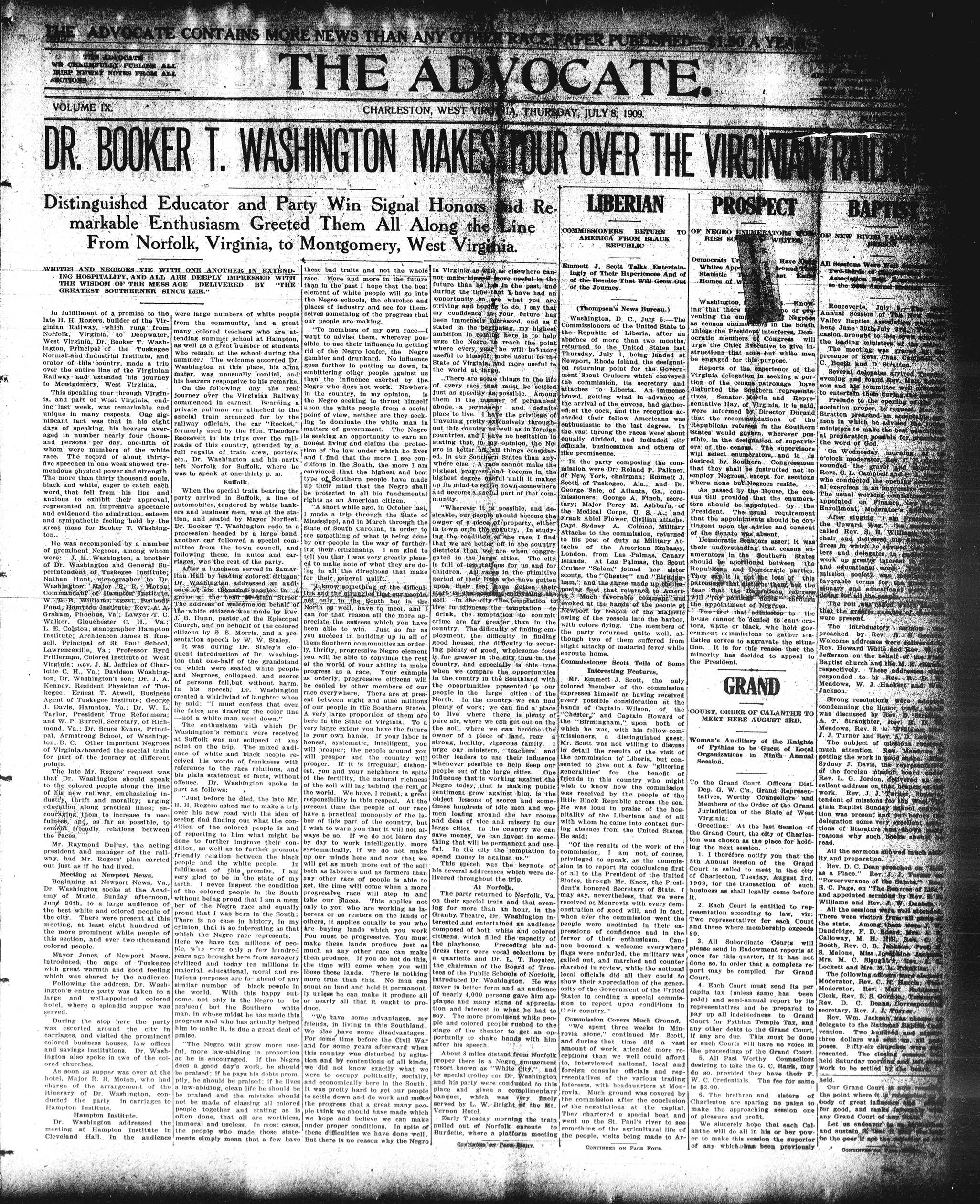
DR. BOOKER T. WASHINGTON MAKES TOUR OVER THE VIRGINIAN RAIL
Distinguished Educator and Party Win Signal Honors and Remarkable Enthusiasm Greeted Them All Along the Line From Norfolk, Virginia, to Montgomery, West Virginia.
WHITES AND NEGROES VIE WITH ONE ANOTHER IN EXTENDING HOSPITALITY, AND ALL ARE DEEPLY IMPRESSED WITH THE WISDOM OF THE MESS AGE DELIVERED BY "THE GREATEST SOUTHERNER SINCE LEE."
THE ADVOCATE
WS CHILKINFULLY PUBLISH ALL
JRISP NEWSY NOTES FROM ALL
ACTIONS
VOLUME IX.
DR. BOOKER
Distinguished Ed
markable Ent
From Norfo
WHITES AND NEGROES VIE WITH
ING HOSPITALITY, AND ALL AR
THE WISDOM OF THE MESS AC
GREATEST SOUTHERNER SINC
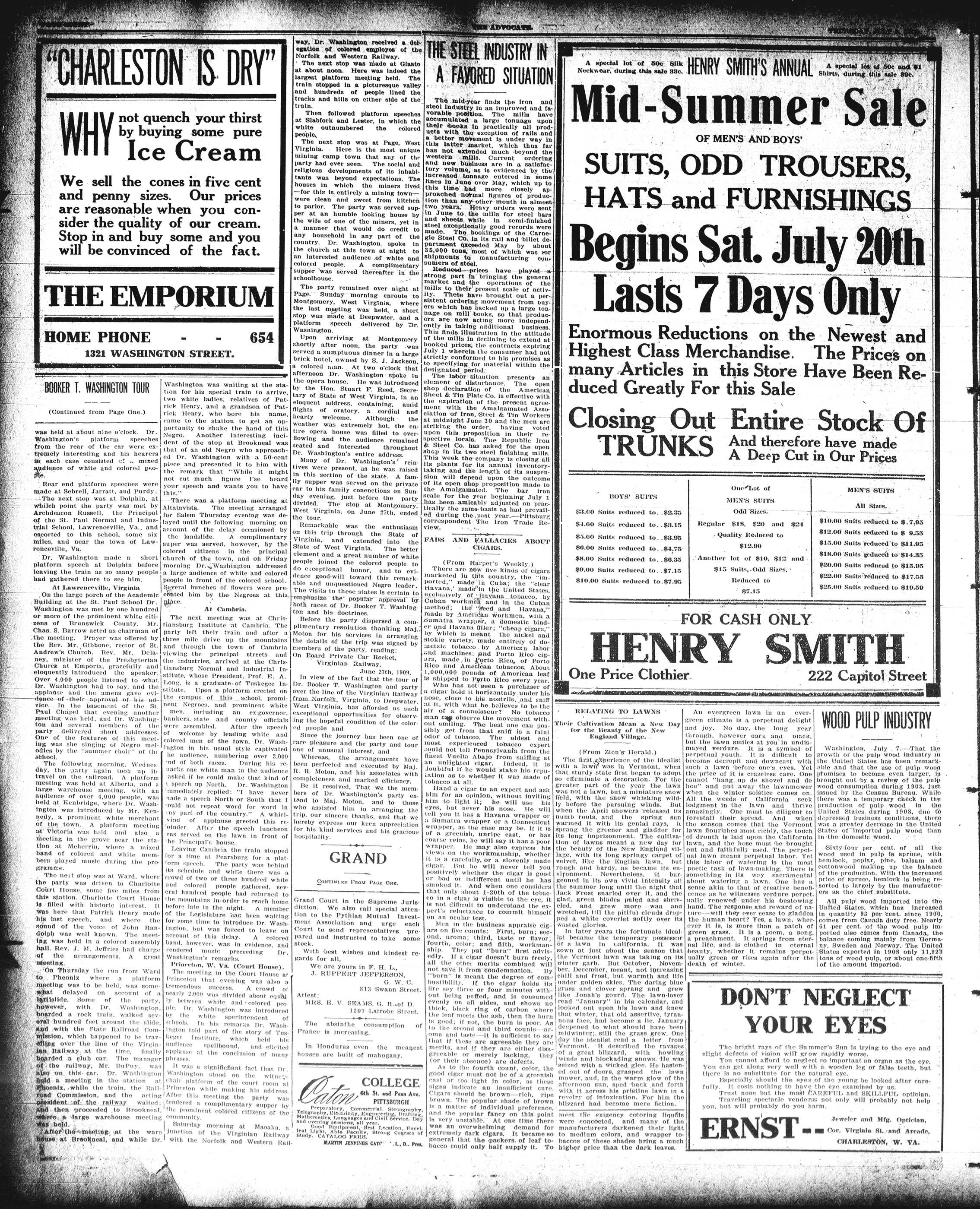
In fulfillment of a promise to the late H. H. Rogers, builder of the Virginian Railway, which runs from Norfolk, Virginia, to Deepwater, West Virginia, Dr. Booker T. Washington, Principal of the Tuskegee Normal and Industrial Institute, and orator of this country, made a trip over the entire line of the Virginian Railway and extended his journey to Montgomery, West Virginia.
This speaking tour through Virginia, and part of West Virginia, ending last week, was remarkable and unique in many respects. One significant fact was that in his eight days of speaking, his hearers averaged in number nearly four thousand persons per day, one-ninth of whom were members of the white race. The record of about thirty-five speeches in one week showed tremendous physical power and strength. The more than thirty thousand souls, black and white, eager to catch each word that fell from his lips and anxious to exhibit their approval, represented an impressive spectacle and evidenced the admiration, esteem and sympathetic feeling held by the great mass for Booker T. Washington.
He was accompanied by a number of prominent Negroes, among whom were: J. H. Washington, a brother of Dr. Washington and General Superintendent of Tuskegee Institute; Nathan Hunt, stenographer to Dr. Washington; Major R. R. Motona Commandant of Hampton Institute W. E. B. Williams; Agent, Beahead Fund, Hampton Institute; Rev. A. A. Graham, Phoebus, Va.; Lawyer T. C. Walker, Gloucester C. H. Va.; L. E. Colston, stenographer Hampton Institute; Archdeacon James S. Russell, Principal of St. Paul School, Lawrenceville, Va.; Professor Byrd Prillerman, Colored Institute of West Virginia; Aevv, J. M. Joffries of Charlotte C. H., Va.; Davidson Washington, Dr. Washington's son; Dr. J. A. Kenney, Resident Physician of Tuskegee; Ernest T. Atwell, Business Agent of Tuskegee Institute; George J. Davis, Hampton, Va.; Dr. W. L. Taylor, President True Reformers; and W. P. Burrell, Secretary, of Richmond, Va.; Dr. Bruce Evans, Principal, Armstrong School, of Washington, D. C. Other important Negroes of Virginia/boarded the special train for part of the journey at different points.
The late Mr. Rogers' request was that Dr. Washington should speak to the colored people along the line of big new railway, emphasizing industry, thrift and morality; urging education along practical lines; encouraging them to increase in usefulness, and, as far as possible, to cement friendly relations between the races.
Mr. Raymond DuPuy, the acting president and manager of the railway, had Mr. Rogers' plan carried out just as if he had lived.
Meeting at Newport News.
Beginning at Newport News, Va., Dr. Washington spoke at the Academy of Music, Sunday afternoon, June 20th, to a large audience of the best white and colored people of the city. There were present at this meeting, at least eight hundred of the more prominent white people of this section, and over two thousand colored people.
Mayor Jones, of Newport News, introduced, the sage of Tuskegee with great warmth and good feeling which was shared by the audience. Following the address, Dr. Washington's entire party was taken to a large and well-appointed colored hotel, where a splendid supper was served.
During the stop here the party was escorted around the city in carriages, and visited the prominent colored business houses, law offices and savings institutions. Dr. Washington also spoke in two of the colored churches.
As soon as supper was over at the hotel, Major R. R. Moton, who had charge of the arrangement of the itinerary of Dr. Washington, conducted the party in carriages to Hampton Institute.
Hampton Institute
Dr. Washington addressed the meeting at Hampton Institute in Cleveland Hall. In the audience
were large numbers of white people from the community, and a great many colored teachers who are attending summer school at Hampton, as well as a great number of students who remain at the school during the summer. The welcome accorded Dr. Washington at this place, his alma mater, was unusually cordial, and his hearers responsive to his remarks. On the following day the real journey over the Virginia Railway commenced in earnest. Boarding a private pullman car attached to the special train arranged for by the railway officials, the car "Rocket," formerly used by the Hon. Theodore Roosevelt in his trips over the railways of this country, attended by a full regalia of train crew, porters, etc., Dr. Washington and his party left Norfolk for Suffolk, where he was to speak at one-thirty p. m.
Suffolk.
When the special train bearing the party arrived in Suffolk, a line of automobiles, tendered by white bankers and business men, was at the station, and seated by Mayor Norfleet, Dr. Booker T. Washington rode in a procession headed by a large band, another car followed a special committee from the town council, and following these, in autos and carriages, was the rest of the party.
After a luncheon served in Samaritan Hall by leading colored citizens, Dr. Washington addressed an audience of six thousand people. In a grove at the heath of Stain Street. The address of welcome on behalf of the white citizens was made by Rev. J. B. Dunn, pastor of the Episcopal Church, and on behalf of the colored citizens by S. S. Morris, and a presentation speech by W. W. Staley.
It was during Dr. Staley's eloquent introduction of Dr. Washington that one-half of the grandstand on which were seated white people and Negroes, collapsed, and scores of persons fell, but without harm. In his speech, Dr. Washington created a whirlwind of laughter when he said: "I must confess that even the fates are drawing the color line—not a white man went down." The enthusiasm with which Dr. Washington's remark were received at Suffolk was not eclipsed at any point on the trip. The mixed audience of white and black people received his words of frankness with reference to the race relations, and his plain statement of facts, without offense. Dr. Washington spoke in part as follows:
"Just before he died, the late Mr. H. H. Rogers asked me to make a trip over his new road with the idea of seeing and finding out what the condition of the colored people is and of reporting to him what might be done to further improve their condition, as well as to further promote friendly relation between the black people and the white people. In fulfillment of this promise, I am very glad to be in the state of my birth. I never inspect the condition of the colored people in the South without being proud that I am a member of the Negro race and equally proud that I was born in the South: There is no case in history, in my opinion that is so interesting as that which the Negro race represents. Here we have ten millions of people, who were only a few hundred years ago brought here from savagery civilized and today ten millions in material, educational, moral and religious purposes are for ahead of any similar number of black people in the world. With this happy outcome, not only is the Negro to be praised (but the Southern white man, in whose midst he has made this progress and who has actually helped him to make it, is due a great deal of praise.
"The Negro will grow more useful, more law-abiding in proportion as he is encouraged. If the Negro does a good day's work, he should be praised; if he pays his debts promptly, he should be praised; if he lives a law-abiding, clean life he should be praised and the mistake should not be made of classing all colored people together and stating as is often done, that all are worthless, immoral and useless. In most cases, the people who made those statements simply mean that a few have
these bad traits and not the whole race. More and more in the future than in the past I hope that the best element of white people will go into the Negro schools, the churches and places of industry and see for themselves something of the progress that our people are making.
"To members of my own race I want to advise them, wherever possible, to use their influence in getting rid of the Negro loafer, the Negro gambler and drunkard. No influence goes further in putting us down, in embittering other people against us than the influence exerted by the Negro who does not work." Nowhere in the country, in my opinion, is the Negro seeking to thrust himself upon the white people from a social point of view, neither are they seeking to dominate the white man in matters of government. The Negro is seeking an opportunity to earn an honest living and claims the protection of the law under which he lives and I find that the more I see conditions in the South, the more I am convinced that the highest and best type of Southern people have made up their mind that the Negro shall be protected in all his fundamental rights as an American citizen.
"A short while ago, in October last, I made a trip through the State of Mississippi, and in March through the State of South Carolina, in order to see something of what is being done by our people in the way of furthering their citizenship. I am glad to tell you that I was very greatly pleased to make note of what they are doing in all the directions that make for their general uplift.
"I know something of the difficulties and the struggles that our people not only in the South but in the North as well, have to meet, and I can for that reason all the more appreciate the success which you have been able to win. Just so far as you succeed in building up in all of these Southern communities an orderly, thrifty, progressive Negro element you will be able to convince the rest of the world of your ability to make progress as a race. Your example as orderly, progressive citizens will be copied by other members of our race everywhere. There are at present between eight and nine millions of our people in the Southern States. A very large proportion of them are here in the State of Virginia. To a very large extent you have the future in your own hands. If your labor is honest, systematic, intelligent, you will prosper; the people around you will prosper and the country will prosper. If it is irregular, dishonest, you and your neighbors in spite of the fertility, the natural richness of the soil will lag behind the rest of the world. We have, I repeat, a great responsibility in this respect. At the present time the people of our race have a practical monopoly of the labor of this part of the country, but I wish to warn you that it will not always be so. If we do not learn day by day to work intelligently, more systematically, if we do not make up our minds here and now that we will get as much more out of the soil both as laborers and as farmers than any other race of people is able to get, the time will come when a more progressive race will step in and take our places. This applies not only to you who are working as laborers or as renters on the lands of others, it applies equally to you who are buying lands which you work. You must be progressive. You must make these lands produce just as much as any other race can make them produce. If you do not do this, the time will come when you will loose these lands. There is nothing more true than this. No man can squat on land and hold it permanently unless he can make it produce all or nearly all that it ought to produce.
"We have some advantages, my friends, in living in this Southland. We also have some disadvantages. For some time before the Civil War and for some years afterward when this country was disturbed by agitation and by contentions of all kinds, we did not know exactly what we were to occupy politically, socially, and economically here in the South. It was pretty hard to get our people to settle down and do work and make the progress that a great many people think we should have made which we hope and believe we can make under proper conditions. In spite of these difficulties we have done well. But there is no reason why the Negro
in Virginia as well as elsewhere cannot make him more useful in the future than he has in the past, and during the time that I have had an opportunity to see what you are striving and hoping to do. I say that my confidence in your future has been immensely increased, and as I stated in the beginning, my highest ambition in coming here is to help urge the Negro to reach the point where every year he will be more useful to himself, more useful to the State of Virginia, and more useful to the world at large.
... there are some things in the life of every race that must be settled just as speedily as possible. Among them is the manner of permanent abode, a permanent and, definite place to live. I have the privilege of traveling pretty extensively throughout this country as well as in foreign countries, and I have no hesitation in stating that, in my opinion, the Negro is better on all things considered. in our Southern States than anywhere else. A race cannot make the highest progress and become in the highest degree useful until it makes its mind to settle down somewhere and become a peaceful part of that community.
"Wherever it is possible, and desirable, our people should become the owner of a piece of property, either in town or in the country. In studying the condition of the race, I find that we are better off in the country districts than we are when congregated in the large cities. The city is full of temptations for us and for children. All races in the primitive period of their lives who have gotten upon their feet have gotten their start in the movies, cultivating the soil. In the city the temptation to live in idleness, the temptation to drink, the temptation to commit crime are far greater than in the country. The difficulty of finding employment, the difficulty in finding good houses, the difficulty in securing plenty of good, wholesome food is far greater in the city than in the country, and especially is this time in the country in the Southland with the opportunities presented to our people in the large cities of the North. In the country we can find plenty of work; we can find a place to live where we can get out on the soil, where we can become the owner of a piece of land, rear a strong, healthy, vigorous family. I urge our ministers, teachers and other leaders to use their influence whenever possible to help keep our people out of the large cities. One influence that is working against the Negro today, that is making public sentiment grow against him, is the object lessons of scores and sometimes hundreds of idle men and women loafing around the bar rooms and dens of vice and misery in our large cities. In the country we can save money, we can invest in something that will be permanent and useful. In the city the temptation to spend money is against us."
This speech was the keynote of his several addresses which were delivered throughout the trip.
At Norfolk
The party returned to Norfolk, Va. on their special train and that evening for more than an hour, in the Granby, Theatre, Dr. Washington interested and entertained an audience composed of both white and colored citizens, which filled the capacity of the playhouse. Preceding his address there were vocal selections by a quartette and Dr. L. T. Royster, the chairman of the Board of Trustees of the Public Schools of Norfolk, introduced Dr. Washington. He was never in better form and an audience of nearly 4,000 persons gave him aplaeuse and many signs of appreciation and interest in what he had to soy. The more prominent white people and colored people rushed to the stage of the theater to get an opportunity to shake hands with him after his speech.
About 8 miles distant from Norfolk proper there is a Negro amusement resort known as "White City," and by special trolley car Dr. Washington and his party were conducted to this place and given a complimentary banquet, which was very nicely served by L. W. Bright of the Mt. Vernon Hotel.
Early Tuesday morning the train pulled out of Norfolk enroute to Burdette, where a platform meeting Costume on Paper Board.
Emmott J. Scott Talks. Entertainingly of Their Experiences. And of of the Results That Will Grow Out of the Journey.
(Thompson's News Bureau.)
Washington, D. C., July 5. —The Commissioners of the United State to the Republic of Liberia, after an absence of more than two months, returned to the United States last Thursday, July 1, being landed at Newport, Rhode Island, the designated returning point for the Government Scout Cruisers which conveyed the commission, its secretary and attaches to Liberia. An immense crowd, getting wind in advance of the arrival of the envoys, had gathered at the dock, and the reception accorded their fellow Americans was enthusiastic to the last degree. In the vast throng the races were about equally divided, and included city officials, businessmen and others of like prominence.
In the party composing the commission were Dr. Roland P. Falkner, of New York, chairman; Emmett J. Scotti of Tuskegee, Ala., and Dr. George Sale, of Atlanta, Ga., commissioners; George A. Finch, secretary; Major Percy M. Ashburn, of the Medical Corps, U. S. A.; and Frank Abel Florp, Civilian attache. Capt. Sydney A. Colman, Military Attache to the commission, returned to his post of duty as Military Attache of the American Embassy, London, from Las Palmas, Canary Islands. At Las Palmas, the Spout Cruiser "Salem" joined her sister scouts, the "Chester" and "Hirlungham," and the three made up an imposing foot that returned to America. Much favorable comment was evoked at the hands of the people at Newport by reason of the majestic swing of the vessels into the harbor, with colors flying. The members of the party returned quite well, although two of them suffered from slight attacks of malarial fever while enroute home.
Commissioner Scott. Tells of Some Interesting Features.
Mr. Emmett J. Scott, the only colored member of the commission expresses himself as having received every possible consideration at the hands of Captain Wilson, of the "Chester," and Captain Howard of the "Birmingham." upon both of which he was, with his fellow-commissioners, a distinguished guest. Mr. Scott was not willing to discuss in detail the results of the visit of the commission to Liberia, but consented to give out a few "gittering generalities" for the benefit of friends in this country who might wish to know how the commission was received by the people of the little Black Republic across the sea. He was loud in praise of the hospitality of the Liberians and of all with whom he came into contact during absence from the United States. He said:
"Of the results of the work of the commission, I am not, of course, privileged to speak, as the commission is to report its conclusions first of all to the President of the United States, through Mr. Knox, the President's honored Secretary of State. I may say, nevertheless, that we were received at Monrovia with every demonstration of good will, and in fact, when ever the commission went the people were unstinted in their expressions of confidence and in the fervor of their enthusiasm. Cannon boomed a welcome everywhere flags were unfurled, the military was called out, and marched and counter marched in review, while the national local officials did all they could. to show their appreciation of the generosity of the Government of the United States in sending a special commission to report upon conditions in their country."
Commission Covers Much Ground.
"We spent three weeks in Minrovia alone," continued Mr. Scott, and during that time did a vast amount of work, attended more receptions than we well could afford to, interviewed national, local and foreign consular officials and representatives of the various trading interests, with headquarters at Monrovia. Much ground was covered by the commission after the conclusion of the negotiations at the capital. They chartered a special boat and went up the St. Paul's river to see something of the agricultural life of the people, visits being made to Ar-
Washington, D.C. — Knowing that there is a type of preventing the emperor Negroes as census enumerators in the South unless the President interferes, Democratic members of Congress will urge the Chief Executive to give instructions that none but white men be engaged for this purpose.
Reports of the experience of the Virginia delegation in seeking a portion of the census patronage have disturbed the Southern representatives. Senator Martin and Representative Hay, of Virginia, it is said, were informed by Director Durand that the recommendations of the Republican referendum in the Southern States would govern, wherever possible, in the designation of supervisors of the census. The supervisors will select enumerators, and it is desired by Southern Congressmen that they shall be instructed not to employ Negroes, except for sections where none but Negroes reside. As passed by the House, the census Bill provided that the enumerators should be appointed by the President. The usual requirement that the appointments should be contingent upon the advice and consent of the Senate was absent.
Democratic Senators assert it was their understanding that census enumerators in the Southern States should be apportioned between the Republican and Democratic parties. They say it is not the loss of this patronage that distracts them, but the fear that the Republican reserves will "may politicize" demos through the appointment of Negroes.
The fact that admission to the home cannot be denied to enviru-
rators, white or black, who hold govern-
ment commissions to gather statistics serves to aggravate the situation. It is for this reason that the minority has decided to appeal to the President.
GRAND
COURT, ORDER OF CALANTHE TO MEET HERE AUGUST 3RD.
Woman's Auxiliary of the Knights of Pythias to be Guest of Local Organizations in Ninth Annual Session.
To the Grand Court Officers District, Dep. G. W. C's, Grand Representatives, Worthy Counsellors and Members of the Order of the Grand Jurisdiction of the State of West Virginia:
Greeting: At the last Session of the Grand Court, the city of Charleston was chosen as the place for holding the next session.
1. I therefore notify you that the 8th Annual Session of the Grand Court is called to meet in the city of Charleston, Tuesday, August 3rd, 1909, for the transaction of such business as shall legally come before it.
2. Each Court is entitled to representation according to law, viz: Two representatives for each Court and three where membership exceeds 80.
3. All Subordinate Courts will please send in Endowment reports at once for this quarter, if it has not done so, in order that a complete report may be compiled for Grand Court.
4. Each Court must send its per capita tax (unless same has been paid) and semi-annual report by its representatives and be prepared to pay up all indebtedness to Grand Court for Pythian Temple Tax, and any other debts to the Grand Court, if any are due. This must be done or such Courts will have no voice in the proceedings of the Grand Court.
5. All Past Worthy Counsellors desiring to take the G. C. Ranks, may do so, provided they have their P. W. C. Credentials. The fee for same is $2.00.
6. The brethren and slaters of Charleston are sparing no pain to make the approaching session one of pleasure and profit.
We sincerely hope that each Calanthe will do all in his or her power to make this season the superior of any which she has previously
Ronceverte, July 8. The New York
Annual Session of The New York
Valley. Baptist Association was held
here June 30th July 31st. The
casion brought to this town about
the leading ministers of the church.
The meeting was graced by the
presence of Revs. Chas. Chappell
C. Booth and D. Cockrum.
C. Boeck and D. Stratton.
Several delegates arrived Tuesday evening and found Rev. Mark Benson son and his committee well prepared to entertain them during the meeting. Prelude to the opening of the society proper, by request, Rev. D. Stratton preached an acceptable mon in which he advised the minister to make the best preparation possible for presenting the word of God.
On Wednesday, morning at no o'clock moderator, Rev. L. N. Sutherland sounded the gravel and shattered Revs. C. L. Campbell and P. Benson who conducted the opening devotion al exercises in an impressive manner. The usual working committee was appointed on Finance, New York Enrollment, Moderators, and
After singing "I am Prepared to the Upward War," the minister called Rev. S. E. Williams, his chair and delivered his address in dress, in which he advised his teachers and delegates to endeavor to work up greater interest in and educational work. The mission society was mobilized favourable terms for the presiding sionary and educational work, doing so all the people. The roll was called White Note that the greater number of children were present.
The introductory sermons were preached by Rev. R. E. Garrett. Welcome addresses were delivered by Rev. Howard White and Rev. W. E. Jefferson on the beliait of the First Baptist church and the M. E. church respectively. These addresses were responded to by Rev. R. D. Mendows, W. J. Hackett and Will Jackson.
Strong resolutions were adopted condemning the liquor trade, which was discussed by Rev D. Stratham, A. P. Stranghra, Rev R. D. Mendows, Rev S. E. Williams, Rev J. T. Turner and Rev A. D. Lawson.
The subject of missions requires much attention. Rev. Meadown getting the work in good shape, like Sydney J. Davis, the representative of the foreign mission board under Rev. L. G. Jordon, delivered an excellent address on that branch of the work. Rev. J. J. Turner, Sr. tendent of missions for the West Virginia Baptist Sunday school convention was present and put before the delegation some very excellent reasons of literature and shows many reasons why such books should be read.
All the sermons allowed much utility and preparation.
Rev. D. C. Dean preached on "Hill as a Place." Rev. J. L. Tanner and "Perserverance of the Saints." Rev. E. C. Page, on "The Resources of Life," and appointed sermons by Rev. K. M. Williams and Rev. J. W. Daniels.
All the sessions were well attended. There were visitors from all parts of the state. Among them were J. W. Dandridge, F. D. Baird, Mrs. A. R. Calloway, M. H. Hill, Rev. C. O. Booth, Rev. C. B. Jackson, Paul S. Malone, Miss Joanneine Leatman, Mrs. M. C. Slaughter, Rev. A. C. Lockett and Mrs. M. A. Knifinia.
The following officers were elected Moderator, Rev. C. N. Harris; Web Moderator, Rev. Matt Hopkins; Clerk, Rev. R. S. Gordon; Treasurer, Rev. D. C. Deans; Corresponding secretary, Rev. J. J. Furrow.
Rev. Wm. Jackson was chosen to delegate to the National Baptist Convention. Two hundred and sixty-three dollars was sent up, all six poses. Fifty-six churches were presented. The closing session held Saturday morning and left work to be settled by the board held.
Our Grand Court is now renamed the point, where it is positioned body of great influence the best for good, and ranks fecundity any Grand Court of any State.
Let us endeavour to be institution and sustain it that it may be the peer if not the institution of
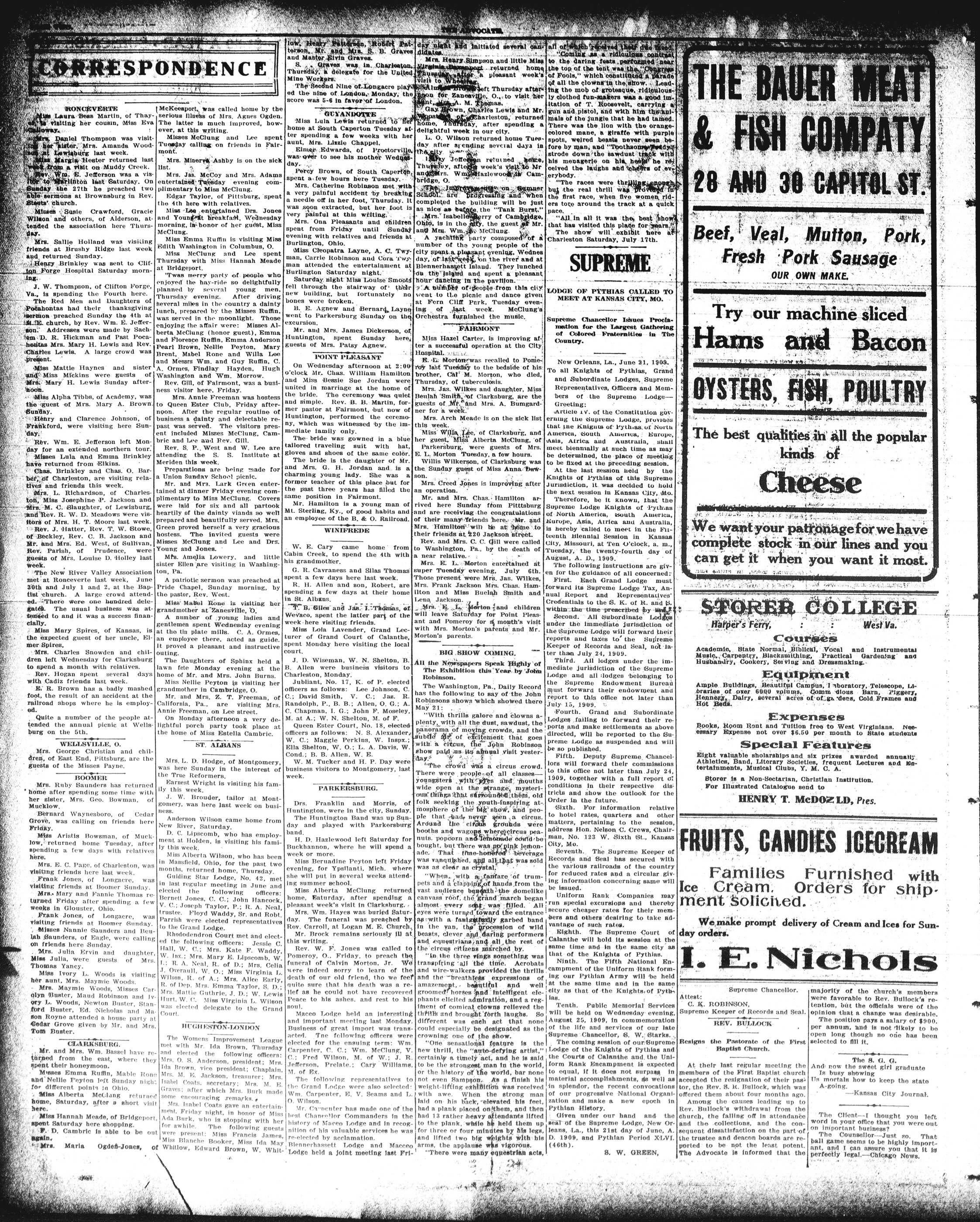
CORRESPONDENCE
Miss Laura Bess Martin, of Thay-
ah, is visiting her cousin, Miss Eva
Galloway.
Mrs Daniel Thompson was visiti-
ng her sister, Mrs. Amanda Wood-
son at Lawsburg last week.
Miss Margie Hester returned last
week from a visit on Muddy Creek.
Rev. Wm. E. Jefferson was a visi-
tor to Marlinton last Saturday. On
Sunday the 27th he preached two
able sermons at Brownsburg in Rev.
Steets' church.
Misses Susie Crawford, Gracie
Wilson and others, of Alderson, att
tended the association here Thursday.
Mrs. Sallie Holland was visiting
friends at Brushy Ridge last week
and returned Sunday.
Henry Brinkley was sent to Clifton
Forge Hospital Saturday morning.
J. W. Thompson, of Clifton Forge, Va., is spending the Fourth here. The Red Men and Daughters of Podahontas had their thanksgiving german preached Sunday the 4th at M. E. church, by Rev. Wm. E. Jefferson. Addresses were made by Sachem D. R. Hickman and Past Podahontas Mrs. Mary H. Lewis and Rev. Charles Lewis. A large crowd was present. Miss Mattle Haynes and sister and Miss Mickins were guests of Mrs. Mary H. Lewis Sunday afternoon. Miss Alpha Tibbs, of Academy, was the guest of Mrs. Mary A. Brown Sunday. Henry and Clarence Johnson, of Frankford, were visiting here Sunday.
Rev. Wm. E. Jefferson left Monday for an extended northern tour. Misses Lula and Emma Brinkley have returned from Elkins. Chas. Brinkley and Chas. O. Barber, of Charleston, are visiting relatives and friends this week. Mrs. L. Richardson, of Charleston, Miss Josephine P. Jackson and Mrs. M. C. Shaughter, of Lewisburg and Rev. R. W. D. Meadows were visitors of Mrs. H. T. Moore last week. Rev. J. Hatter, Rev. T. W. Stowe of Beckley, Rev. C. B. Jackson and Mr. and Mrs. Ed. West, of Sullivan, Rev. Parish, of Prudence, were guests of Mrs. Louise D. Holley last week.
The New River Valley Association met at Ronceverte last week, June 30th and July 1 and 2, at the Bapstist church. A large crowd attended. There were one hundred delegates. The usual business was attended to and it was a success financially.
Miss Mary Spires, of Kansas, is the expected guest of her uncle, Elmer Spires.
Mrs. Charles Snowden and children left Wednesday for Clarkshows to spend a month with relatives.
Rev. Hogan spent several days with Cadiz friends last week.
E. R. Brown has a badly mashed foot, the result of an accident at the railroad shops where he is employed.
Quite a number of the people attended the annual picnic at Wellsburg on the 5th.
Mrs. George Christian and children, of East End, Pittsburg, are the guests of the Misses Payne.
BOOMER
Mrs. Ruby Saunders has returned home after spending some time with her sister, Mrs. Geo. Bowman, of Mucklow. Bernard Waynesboro, of Cedar Grove, was calling on friends here Friday. Miss Aristis Bowsman, of Mucklow, returned home Tuesday, after spending a few days with relatives here. Mrs. E. C. Page, of Charleston, was visiting friends here last week. Frank Jones, of Longacre, was visiting friends at Boomer Sunday.
Visiting friends at Boomer Sunday.
Mrs. Mary and Fannie Thomas returned Friday after spending a few weeks in Glouster, Ohio.
Frank Jones, of Longacre, was visiting friends at Boomer Sunday.
Misses Nannie Saunders and Beulah Saunders, of Eagle, were calling on friends here Sunday.
Mrs. Julia Ervin and daughter, Miss Julia, were guests of Mrs. Thomas Yancy.
Miss Ivory L. Woods is visiting her aunt, Mrs. Maynie Woods.
Mrs. Maynie Woods, Misses Carolyn Buster, Maud Robinson and Ivory L. Woods, Newton Buster, Stanford Buster, Ed. Nicholas and Mason Royne attended a house party at Gedar Grove given by Mr. and Mrs Tom Buster.
Mr. and Mrs. Wm. Bassel have returned from the east, where they spent their honeymoon.
Miss Alberta McClang returned home, Saturday, after a short visit here.
Miss Hannah Meade, of Bridgeport, spent Saturday here shopping.
F. D. Cambric is able to be out again.
McKeesport, was called home by the serious illness of Mrs. Agnes Ogden. The latter is much improved, however, at this writing.
Misses McClung and Lee spent Tuesday calling on friends in Fairmont.
Mrs. Minerva Ashby is on the sick list.
Mrs. Jas. McCoy and Mrs. Adams entertained Tuesday evening complimentary to Miss McClung.
Edgar Taylor, of Pittsburg, spent the 4th here with relatives.
Miss Lee entertained Drs. Jones and Young at breakfast, Wednesday morning, in honor of her guest, Miss McClung.
Miss Emma Ruffin is visiting Miss Edith Washington in Columbus, O
"Twas merry party of people who enjoyed the hay-ride so delightfully planned by several young men, Thursday evening. After driving several miles in the country a dainty lunch, prepared by the Misses Ruffin, was served in the moonlight. Those enjoying the affair were: Misses Alberta McClung (honor guest), Emma and Florence Ruffin, Emma Anderson Pearl Brown, Nellie Peyton, Mary Brent, Mabel Rone and Willa Lee and Messrs Wm. and Guy Ruffin, C. A. Ormes, Findlay Hayden, Hugh Washington and Wm. Morrow.
Rev. Gill, of Fairmont, was a business visitor here, Friday.
Mrs. Annie Freeman was hostess to Queen Ester Club, Friday afternoon. After the regular routine of business a dainty and delectable repast was served. The visitors present included Misses McClung, Cambric and Lee and Rev. Gill.
Rev. S. P., West and W. Lee are attending the S. S. Institute at Meriden this week.
Preparations are being made for a Union Sundav School picnic.
Mr. and Mrs. Lark Green entertained at dinner Friday evening complimentary to Miss McClung. Covers were laid for six and all partook heartily of the dainty viands so well prepared and beautifully served. Mrs. Green proved herself a very gracious hostess. The invited guests were Misses McClung and Lee and Drs. Young and Jones.
Mrs. Amelia Lowery, and little sister Ellen are visiting in Washington, Pa.
A patriotic sermon was preached at Pride Chapel, Sunday morning, by the pastor, Rev. West.
Miss Wabel Rone is visiting her grandmother at Zanesville, O.
A number of young ladies and gentlemen spent Wednesday evening at the tin plate mills. C. A. Ormes, an employee there, acted as guide. It proved a pleasant and instructive outing.
Miss Nellie Peyton is visiting her grandmother in Cambridge, O. Mr. and Mrs. Z. T. Freeman, of California, Pa., are visiting Mrs. Annie Freeman, on Lee street. On Monday afternoon a very delightful porch party took place at the home of Miss Estella Cambric.
ST. ALBANS
Mrs. L. D. Hodge, of Montgomery, was here Sunday in the interest of the True Reformers.
Earnest Wright is visiting his family this week.
J. W. Brouder, tailor at Montgomery, was here last week on business.
Anderson Wilson came home from New River, Saturday.
D. C. Lipscomb, who has employment at Holden, is visiting his family this week.
Miss Alberta Wilson, who has been in Mansfield, Ohio, for the past two months, returned home. Thursday.
Guilding Star Lodge, No. 42, met in last regular meeting in June and elected the following officers: Bernett Jones, C. C.; John Hancock, V. C.; Joseph Taylor, P.; R. A. Neal, trustee. Floyd Waddy, Sr. and Robt. Parrish were elected representatives to the Grand Lodge.
Rhododendron Court met and elected the following officers: Jessie C. Hall, W. C.; Mrs. Kate F. Waddy, W. Inx.; Mrs. Mary E. Lipscomb, W. L.; R. A. Neal, R. of D.; Mrs. Celia, J. Overaull, W. O.; Miss Virginia L. Wilson, R. of A.; Mrs. Alice Early, R. of Dep. Mrs. Emma Taylor, S. D.; Mrs. Mattie Guthrie, J. D.; W. Lewis Hurt, W. C. Miss Virginia L. Wilson was elected delegate to the Grand Court.
HUGHESTON-LONDON
The Womens Improvement League met with Mr. Ida Brown, Thursday and elected the following officers: Mrs. O. S. Anderson, president; Mrs. Ida Brown, vice president; Chaplain, Mrs. M. E. Jackson, treasurer; Mrs. Isabel Coats, secretary; Mrs. M. E. Graves; after which Mrs. Burk made some encouraging remarks. Mrs. Isabel Coats gave an entertainment, Friday night, in honor of Miss Ada Burk, who is stopping with her for awhile. The following guests were present: Miss Francis James, Miss Blanche Booker, Miss Ida May Whitlow, Edward Brown W. Whit
low, Henry Patterson, Robert Patterson, Mr. and Mrs. S. B. Graves and Master Elvin Graves. S. Graves was in Charleston, Thursday, a delegate for the United Mine Workers. The Second Nine of Longacre played the nine of London, Monday, the score was 5-6 in favor of London.
GLYANIQOTE
Miss Lula Lewis returned to her home at South Caperton Tuesday after spending a few weeks with her aunt, Mrs. Lizzie Chappel. Elmer Edwards, of Proctorville, was over to see his mother Wednesday.
Percy Brown, of South Caperton, spent a few hours here Tuesday.
Mrs. Catherine Robinson met with a very painful accident by breaking a needle off in her foot, Thursday. It was soon extracted, but her foot is very painful at this writing.
Mrs. Ona Pleasants and children spent from Friday until Sunday evening with relatives and friends at Burlington, Ohio.
Miss Cleopatra Layne, A. C. Twyman, Carrie Robinson and Cora Twyman attended the entertainment at Burlington Saturday night.
Saturday, night Miss Louise Smoots fell through the stairway of their new building, but fortunately no bones were broken. B. E. Agnew and Bernard Layne went to Parkersburg Sunday on the excursion. Mr. and Mrs. James Dickerson, of Huntington, spent Sunday here, guests of Mrs. Patsy Agnew.
POINT PLEASANT
On Wednesday afternoon at 2:00 o'clock Mr. Chas. William Hamilton and Miss Bessie Sue Jordan were united in marriage at the home of the bride. The ceremony was quiet and simple. Rev. B. B. Martin, former pastor at Fairmont, but now of Huntington, performed the ceremony, which was witnessed by the immediate family only.
The bride was gowned in a blue tailored traveling suit with hat, gloves and shoes of the same color.
The bride is the daughter of Mr. and Mrs. G. H. Jordan and is a charming young lady. She was a former teacher of this place but for the past three years has filled the same position in Fairmont.
Mr. Hamilton is a young man of Mt. Sterling, Ky., of good habits and an employee of the B. & O. Railroad.
WINIFREDE
W. E. Cary came home from Cabin Creek, to spend the 4th with his grandmother.
G. R. Cavraness and Silas Thomas spent a few days here last week.
R. H. Allen and son, Robert, are spending a few days at their home in St. Albans.
R. B. Giles and Jas. I. Thomas, of Wevaco, spent the latter part of the week here visiting friends.
Miss Lola Lavender, Grand Lecturer of Grand Court of Calanthe, spent Monday here visiting the local court.
J. D. Wiseman, W. N. Shelton, B. B. Allen were business visitors to Charleston, Monday.
Jubilant, No. 17, K. of P. elected officers as follows: Lee Johnson, C. C.; David Smith, V. C.; Jas. R. Randolph, P., B. B.; Allen, O. G.; A. C. Chapman, I. G.; John F. Moseley, M. at A.; W. N. Shelton, M. of F.
Queen Ester Court, No. 18, elected officers as follows: N. S. Alexander, W. C.; Maggle Perkins, W. Inspx; Ella Shelton, W. O.; L. A. Davis, W. Cond.; B. B. Allen, W. E.
W. M. Tucker and H. P. Day were business visitors to Montgomery, last week.
PARKERSBURG.
Drs. Franklin and Morris, of Huntington, were in the city, Sunday. The Huntington Band was up Sunday and played with Parkersburg band. H. D. Hazlewood left Saturday for Buckhannon, where he will spend a week or more. Miss Beruadine Peyton left Friday evening, for Ypsillanti, Mich. where she will put in several weeks attending summer school. Miss Alberta McClung returned home. Saturday, after spending a pleasant week's visit in Clarksburg. Mrs. Wm. Hayes was buried Saturday. The funeral was preached by Rev. Carroll, at Logan M. E. Church. Mr. Brock remains seriously ill at this writing.
Rev. W. F. Jones was called to Pomeroy, O. F., Friday, to preach the funeral of Calvin Morton, Jr. We were indeed sorry to learn of the death of our old friend, tho we feel quite sure that his death was a relief as he could not have recovered Peace to his ashes, and rest to his soul.
Maceo Lodge held an interesting and important meeting last Monday. Business of great import was transacted. The following officers were elected for the ensuing term: Wm. Carpenter, C. C.; Wm. McClung, V. C.; Fred Wilson, M. of W.; J. R. Jefferson, Prelate.; Cary Williams, M. of Ex.
The following representatives to the Grand Lodge were also selected: Wm. Carpenter, E. V. Seams and L. O. Wilson.
Mr. Carnceter has made one of the best Chancellor Commanders in the history of Macco Lodge and in recognition of his valuable services he was re-elected by acclamation. Blennherassett Lodge and Macco Lodge held a joint meeting last Fri-
Mrs. Henry Simpson and little Miss Virginia Simpson returned home Thursday, after a pleasant week's visit to Wheeling.
Alma Brown, left Thursday afternoon for Zaneaville, O., to visit her hint, Mrs. A. M. Thomas.
Gax Brown, Charles Lewis and Mr. Simpson, of Charleston, returned home, Thursday, after spending a delightful week in our city.
L. O. Wilson returned home Tuesday after spending several days in the city.
Larry Jofferson returned home, Thursday, after week's visit to Mr. and Mrs. Wm. Hazlewood in Cambridge, O.
The Improvement on Summer School, are progressing and when completed the building will be just as nice as before the "Tank Burst," Mrs. Isabelle berry of Cambridge, Ohio, is in the city, the guest of Mr. and Mrs. Win. w. McClung.
A yachting party composed of a number of the young people of the city spent a pleasant evening, Wednesday, of last week on the river and at Blennherhassett Island. They lunched on the island and spent a pleasant hour dancing in the pavilion.
A number of people from this city went to the picnic and dance given at Fern Cliff Perk, Tuesday evening of last week. McClung's Orchestra furnished the music.
FAIRMONT
Miss Hazel Carter, is improving after a successful operation at the City Hospital.
E. E. L. Morton was recalled to Pomeroy last Tuesday to the bedside of his brother, Cal M. Morton, who died, Thursday, of tuberculosis.
Mrs. Jas. Wilkes and daughter, Miss Beulah Smith, of Clarksburg, are the guests of Mr. and Mrs. A. Bumgardner for a week.
Mrs. Arch Meade is on the sick list this week.
Miss Willa Lee, of Clarksburg, and her guest, Miss Alberta McClung, of Parkersburg, were guests of Mrs. E. L. Morton Tuesday, a few hours.
Willis Wilkerson, of Clarksburg was the Sunday guest of Miss Anna Dawson.
Mrs. Creed Jones is improving after an operation.
Mr. and Mrs. Chas. Hamilton arrived here Sunday from Pittsburgh and are receiving the congratulations of their many friends here. Mr. and Mrs. Hamilton will be at home to their friends at 220 Jackson street.
Rev. and Mrs. C. C. Gill were called to Washington, Pa., by the death of a near relative.
Mrs. E. L. Morton entertained at super Tuesday evening, July 6th. Those present were Mrs. Jas. Wilkes, Mrs. Frank Jackson Mrs. Chas. Hamilton and Miss Buelah Smith and Lena Jackson.
Mrs. E. L. Morton and children will leave Saturday for Point Pleasant and Pomeroy for a month's visit with Mrs. Morton's parents and Mr. Morton's parents.
BIG SHOW COMING
All the Newspapers Speak Highly of
The Exhibition this Year by John
Robinson.
The Washington, Pa., Daily Record
has the following to say of the John
Robinson's shows which showed there
May 21:
"With thrills galore and clowns
aplenty, with all the dust, sawdust, the
panorama of moving crowds, and the
subtle act of excitement that goes
with a circus, the John Robinson
show paid us its annual visit yesterday."
"The crowd was a circus crowd. There were people of all classes--youngsters with eyes and mouths wide open at the strange, mysterious things that surrounded them, old folk seeking the youth-inspiring atmosphere of the big show, and people that had, never seen a circus. Around the circus grounds were booths and wagons where circus peanuts, popcorn and lemonade could be bought, but there was no pink lemonade. That time-honored beverage was vanquished, and all that was sold was as clear as crystal.
"When, with a fanfare of trumpets and a clapping of hands from the vast audience beneath the domelike canvass roof, the grand march began almost every seat was filled. All eyes were turned toward the entrance as with a fantastically garbed band in the yan, the procession of wild beasts, clever and daring performers and equestrians, and all the rest of the circus citizens marched by.
"In the three rings something was transpiring all the time. Acrobats and wire-walkers provided the thrills and the breathless expressions of amazement, beautiful and well groomed horses and intelligent elephants elicited admiration, and a regiment of comical clowns relieved the thrills and brought forth laughs. So different was each act that none could especially be designated as the crowning one of the show.
"One sensational feature is the new thrill, the "auto-defying artist," certainly a timely act, and he is said to be the strongest man in the world, or the history of the world, bar none not even Sampon. As a finish his weight-lifting exhibition was received with awe. When the strong man laid on his back, elevated his feet, had a plank placed on them, and then had 13 rather heavy attendants lifted to the plank, while he held them up for three or four minutes by his legs, and lifted two big weights with his arms, the applause was vigorous.
"There were many concert acts
all of which received these due need. "Coming as a ridiculous contrast to the daring feets performed near the top of the tent was the "Congress of Fools," which constituted a parade of all the clowns in the show. Leading the mob of grotesque, ridiculously clothed fun-makers was a good imitation of T. Roosevelt, carrying a gun and pistol, and with him the animals of the jungle that he had tamed. There was the lion with the orange-colored mane, a giraffe with purple spots, weired beasts never seen before by man, and "Toothsonnure Buddy" strode down the sawdust track with his managerie on his heels he received the laughs and cheers of everybody.
"The races were thrilling enough but the real thrill was provided in the first race, when five women riders tore around the track at a quick pace.
"All in all it was the best show that has visited this place for years." The show will exhibit here at Charleston Saturday, July 17th.
SUPREME
LODGE OF PYTHIAAS CALLED TO MEET AT KANSAS CITY, MO.
Supreme Chancellor Issues Proclamation for the Largest Gathering of Colored Fraternities in The Country.
New Orleans, La., June 21, 1998.
To all Knights of Pythias, Grand
To all Knights of Pythias, Grand and Subordinate Lodges, Supreme Representatives, Officers and Members of the Supreme Lodge—Greeting:
Article IV. of the Constitution governing the Supreme Lodge, proves that the Knights of Pythias, of North America, South America, Europe, Asia, Africa and Australia, shall meet biennially at such time as may be determined, the place of meeting to be fixed at the preceding session.
At the last session held by the Knights of Pythias of this Supreme Jurisdiction, it was decided to hold the next session in Kansas City, Mo.
Therefore, be it known, that the Supreme Lodge Knights of Pythas of North America, South America, Europe, Asia, Africa and Australia, is hereby called to meet in the Fifteenth Biennial Session in Kansas City, Missouri, at Ten O'clock, a. m., Tuesday, the twenty-fourth day of August, A. D., 1909.
The following instructions are given for the guidance of all concerned: First. Each Grand Lodge must forward its Supreme Lodge Tax, Annual Report and Representatives' Credentials to the S. K. of R. and S. within the time prescribed by law. Second. All Subordinate Lodges under the immediate jurisdiction of the Supreme Lodge will forward their reports and taxes to the Supreme Keeper of Records and Seal, not later than July 24, 1909.
Third. All lodges under the immediate jurisdiction of the Supreme Lodge and all lodges belonging to the Supreme Endowment Bureau must forward their endowment and report to this office not later than July 15, 1909.
Fourth. Grand and Subordinate Lodges failing to forward their reports and make settlements as above directed, will be reported to the Supreme Lodge as suspended and will be so published.
Fifth. Deputy Supreme Chancellors will forward their commissions to this office not later than July 24, 1909, together with a full report of conditions in their respective districts and show the outlook for the Order in the future.
Sixth. For information relative to hotel rates, quarters and other matters, pertaining to the session, address Hon. Nelson C. Crews, Chairman, No. 123 W. Sixth St., Kansas City, Mo.
Seventh. The Supreme Keeper of Records and Seal has secured with the various railroads of the country for reduced rates and a circular giving information concerning same will be issued.
Uniform Rank Companies may run special excursions and thereby secure cheaper rates for their members and others desiring to take advantage of such rates.
Eighth. The Supreme Court of Calanthe will hold its session at the same time and in the same city as that of the Knights of Pythias.
Ninth. The Fifth National Encampment of the Uniform Rank forming our Pythian Army will be held at the same time and in the same city as that of the Knights of Pythias.
Tenth. Public Memorial Services will be held on Wednesday evening, August 25, 1909, in commemoration of the life and services of our late Supreme Chancellor, S. W. Starks.
The coming session of our Supreme Lodge of the Knights of Pythias and the Courts of Calanthe and the Uniform Rank Encampment is expected to equal, if it does not surpass in material accomplishments, as well as in splendor, the recent convocations of our progressive National Organization and make a new epoch in Pythian History.
Given under our hand and the seal of the Supreme Lodge, New Orleans, La., this 21st day of June, A.D. 1909, and Pythian Period XLVI (46th).
S. W. GREEN.
THE BAUER MEAT & FISH COMPATY 28 AND 30 CAPITOL ST.
Beef, Veal, Mutton, Pork Fresh Pork Sausage OUR OWN MAKE.
The best qualities in all the popular kinds of
We want your patronage for we have complete stock in our lines and you can get it when you want it most.
Courses
Academic, State Normal, Biblical, Vocal and Instrumental Music, Carpentry, Blacksmithing, Practical Gardening and Husbandry, Cookery, Serving and Dressmaking.
Equipment
Ample Buildings, Beautiful Car-
raries of over 6000 volumes.
Hennery, Dairy, several acres
Hot Beds.
Expe
Books, Room Rent and Tuition
essary Expense not over $6.50
Buildings, Beautiful Campus, Laboratory, T
of over 6000 volumes, Comm ulous Barr
Dairy, several acres of of gardens, Cold
Expenses
Bloom Rent and Tuition free to West Virgil
Expense not over $6.50 per month to St
Ample Buildings, Beautiful Campus, Laboratory, Telescope, Libraries of over 6000 volumes, Commissary Barn, Piggery, Hennery, Dairy, several acres of of gardens, Cold Frames and Hot Beds.
Expenses
Books, Room Rent and Tuition free to West Virginians. Necessary Expense not over $6.50 per month to state students
Special Features
Eight valuable scholarships and Athletics, Band, Literary Society tertaintments, Musical Clubs, Y
Storer is a Non-Sectarian, C
For Illustrated Catalogue see
luable scholarships and six prizes awarded, Band, Literary Societies, frequent Lectures, Musical Clubs, Y. M. C. A. is a Non-Sectarian, Christian Institution. Illustrated Catalogue send to
Eight valuable scholarships and six prizes awarded annually. Athletics, Band, Literary Societies, frequent Lectures and Mastertainments, Musical Clubs, Y. M. C. A.
Storer is a Non-Sectarian, Christian Institution.
For Illustrated Catalogue send to
HENRY T. McDOZ LD, Pres.
FRUITS, CAND
Families
Ice Cream. O
ment solicited.
We make prompt deliver
day orders.
I. E. N
TS, CANDIES ICE
families Furnished
ream. Orders for
solicited.
take prompt delivery of Cream an
E. Nich
FRUITS, CANDIES ICECREAM
Families Furnished with Ice Cream. Orders for shipment solicited. We make prompt delivery of Cream and Ices for Sunday orders.
Supreme Chancellor.
Attest:
C. K. ROBINSON,
Supreme Keeper of Records and Seal.
REV. BULLOCK
Resigns the Pastorate of the First Baptist Church.
At their last regular meeting the members of the First Baptist church accepted the resignation of their pastor, the Rev. S. K. Bullock, which was offered them about four months ago.
Among the causes leading up to Rev. Bullock's withdrawal from the church, the falling off in attendance and the collections, and the consequent dissatisfaction on the part of the trustee and deacon boards are reported to be not the least potent.
The Advocate is informed that the
---
---
Campus, Laboratory, Telescope, Li-
Comm dious Barn, Piggery,
of of gardens, Cold Frames and
denses
free to West Virginians. Nee-
0 per month to State students
Features
six prizes awarded annually;
les, frequent Lectures and M.
M. C. A.
Christian Institution.
and to
DIES ICECREAM
Furnished with
orders for ship-
ery of Cream and Ices for Sun-
ichols
majority of the church's members were favorable to Rev. Bullock's retention, but the officials were of the opinion that a change was desirable. The position pays a salary of $900. per annum, and is not likely to be open long though no one has been selected to fill it.
The S. G. G.
And now the sweet girl graduate
Is busy showing
Us mortals how to keep the state
A-going.
—Kansas City Journal.
The Client-I thought you left word in your office that you were out on important business?
The Counsellor-Just so. That ball game seems to be highly important, and I can assure you that it is perfectly legal.-Chicago News.
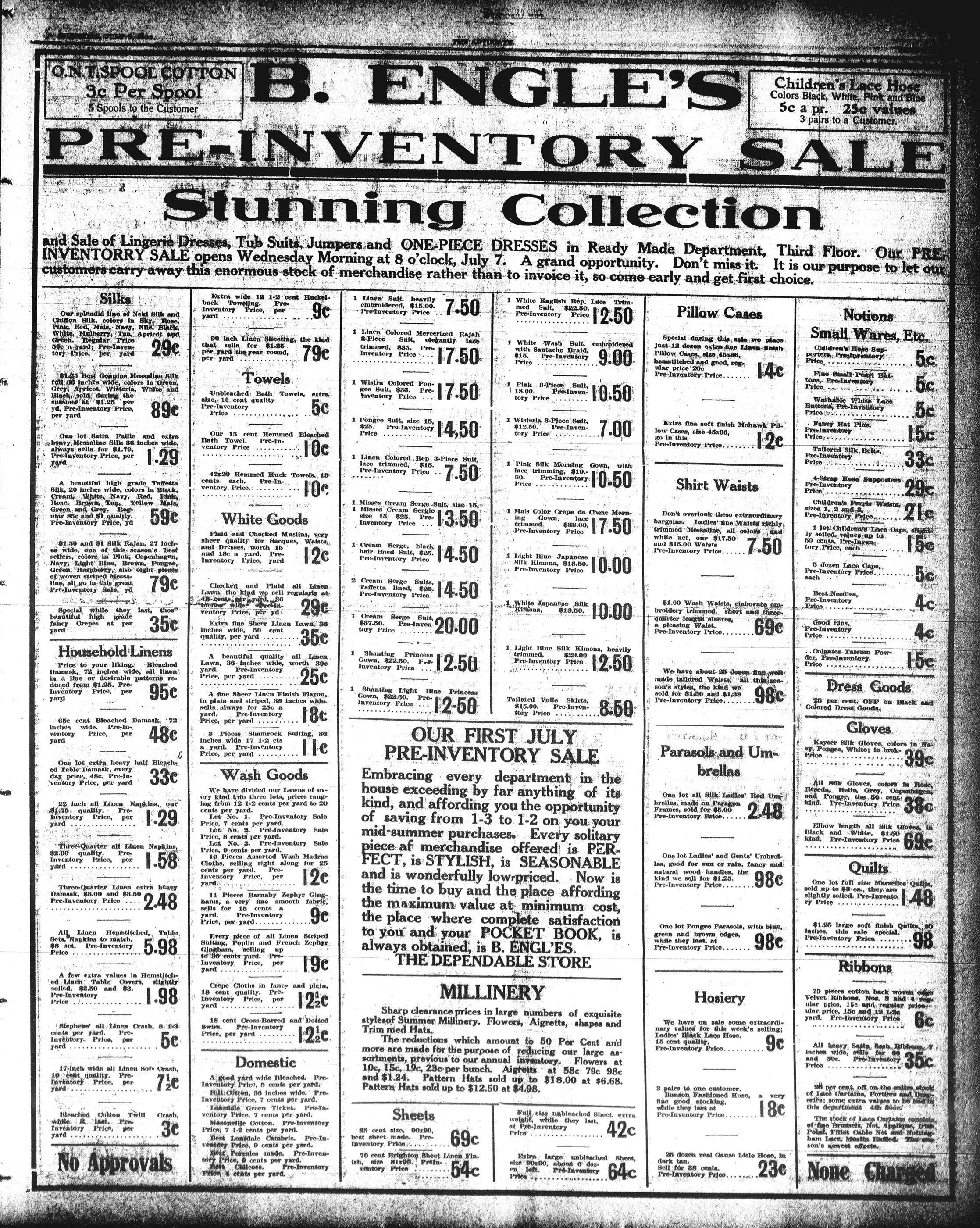
Stunning Collection
and Sale of Lingerie Dresses, Tub Suits, Jumpers and ONE-PIECE DRESSES in Ready Made Department, Third Floor. Our PRE INVENTORRY SALE opens Wednesday Morning at 8 o'clock, July 7. A grand opportunity. Don't miss it. It is our purpose to let our customers carry away this enormous stock of merchandise rather than to invoice it, so come early and get first choice.
A beautiful high grade Taffetta Silk, 20 inches wide, colors in Black, Cream, White, Navy, Red, Pink, Rose, Brown, Tan, Yellow Mals, Green, and Grey, Regular 85c and $1 quality. Pre-Inventory Price, yd
59c
$1.50 and $1 Silk Rajan, 27 inches wide, one of this season's best sellers, colors in Pink, Copenhagen, Navy, Light Blue, Brown, Ponger, Green, Raspberry, also eight pieces of woven striped Messaline, all go in this great Pre-Inventory Sale, yd
79c
Special while they last, those beautiful high grade fancy Crepes at per yard
35c
Household Linens
All Linen Hemstitched, Table Sets, Napkins to match, $8 act. Pre-Inventory Price 5.98
A few extra values in Homstifched Litchi Table Covers, slightly soiled, $3.50 and $8.
Pre-Inventory Price 1.98
Stéphane' all l'Anon Crash, 8 1/3
cents per yard. Pre-
Inventory. Price, per
yard. 5c
17-inch wide all Linen Soft Crash,
10 cent quality. Pre-
Inventory Price, per
yard. $7 \frac{1}{2} c$
Bleached Colton Twill Crash, while it last. Pre- Inventory Price, per yard 3c
No Approvals
White Goods
Plaid and Checked Musilns, very sheer quality for Sacques, Waista, and Dresses, worth 15 and 18c a yard. Pre-Inventory Price, yard 12c
Checked and Plaid all Linen Lawn, the kind we sell regularly at 48 cents per yard, 36 inches wide. Pre-Inventory Price, per yd 29c
Extra fine Sheer Linen Lawn, 36 inches wide, 50 cent quality, per yard 35c
A beautiful quality all Linen Lawn, 36 inches wide, worth 39c yard. Pre-Inventory Price, per yard 25c
A fine Sheer Linen Finish Flaxon,
in plain and striped, 36 inches wide,
sells always for 25c a
yard. Pre-Inventory
Price, per yard 18c
3 Pieces Shamrock Suiting, 36
inches wide 17 1-2 cts
a yard. Pre-Inventory
Price, per yard 11c
Wash Goods
We have divided our Lawns of every kind into three lots, prices ranging from 12 1-2 cents per yard to 20 cents per yard.
Lot No. 1. Pre-Inventory Sale Price, 7 cents per yard.
Lot No. 2. Pre-Inventory Sale Price, 8 cents per yard.
Lot No. 3. Pre-Inventory Sale Price, 9 cents per yard.
10 Pieces Assorted Wash Madras Cloths, selling right along for 25 cents per yard. Pre-Inventory Price, per yard.
11 Pieces Barnaby Zephyr Ginghans, a very fine smooth fabric, sells for 15 cents a yard. Pre-Inventory Price, per yard.
Every piece of all Linen Striped
Suiting, Poplin and French Zephyr
Gingham, selling up
to 30 cents yard. Pre-
Inventory Price, per
yard 19c
Crepe Cloths in fancy and plizin,
18 cent quality. Pre-
Inventory Price, per
yard 12<sub>2</sub>c
16 cent Cross-Barred and Dotted
Swiss. Pre-Inventory
Price, per yard 12<sub>2</sub>c
Domestic
OUR FIRST JUICE INVENTORY
every department
needing by far anytime
affording you the c
from 1-3 to 1-2 c
or purchases. Every
merchandise offered
BYLISH, is SEA-
derfully low-priced
to buy and the place
sum value at min-
where complete
your POCKET
tained, is B. ENGL
DEPENDABLE S
OUR FIRST JULY PRE-INVENTORY SALE
Embracing every department in the house exceeding by far anything of its kind, and affording you the opportunity of saving from 1-3 to 1-2 on you your mid-summer purchases. Every solitary piece af merchandise offered is PERFECT, is STYLISH, is SEASONABLE and is wonderfully low-priced. Now is the time to buy and the place affording the maximum value at minimum cost, the place where complete satisfaction to you and your POCKET BOOK, is always obtained, is B. ENGL'ES.
THE DEPENDABLE STORE
MILLINERY
Sharp clearance prices styles of Summer Millinery. Trim med Hats.
The reductions which more are made for the purse sortments, previous to our 10c, 15c, 19c, 23c per bunt and $1.24. Pattern Hats Pattern Hats sold up to $12
ance prices in large numbe Millinery. Flowers, Aigret tons which amount to 5 for the purpose of reduc bus to our annual invente per bunch. Aigretta tern Hats sold up to $12.50 at $4.98.
Sharp clearance prices in large numbers of exquisite styles of Summer Millinery. Flowers, Aigretts, shapes and Trim med Hats.
The reductions which amount to 50 Per Cent and more are made for the purpose of reducing our large assortments, previous to our annual inventory. Flowers at 10c, 15c, 19c, 23c per bunch. Aigretts at 58c 79c 98c and $1.24. Pattern Hats sold up to $18.00 at $6.68. Pattern Hats sold up to $12.50 at $4.98.
85 cent size, 90x90,
best sheet made. Pre-
Inventory Price ..... 69c
70 cent Brighton Sheet Linen Fin-
ish, size 81x90. Pre-In-
ventory Price ..... 54c
---
Sheets
EST JULY
TORY SALE
department in the
far anything of its
you the opportunity
to 1-2 on you your
uses. Every solitary
be offered is PER-
is SEASONABLE
now-priced. Now is
the place affording
at minimum cost,
complete satisfaction
OCKET BOOK, is
B. ENGL'ES.
ABLE STORE
large numbers of exquisite
flowers, Aigretts, shapes and
amount to 50 Per Cent and
e of reducing our large as-
sumual inventory. Flowers at
Aigretts at 58c 79c 98c
fold up to $18.00 at $6.68.
0 at $4.98.
Full size unbleached Sheet, extra
weight, while they last,
at Pre-Inventory
Price
42c
Extra large unbleached Sheet,
size 90x90, about 6 doz-
en left. Pre-Inventory
Price ..... 64c
Pillow Cases
Special during this sale we place
just 12 dozen extra fine Idem finish
Pillow Cases, size 45x86,
hemstitched and good, regu-
lar price 20c
Pre-Inventory Price.....14c
Extra fine soft finish Mohawk Pillow Cases, size 45x86,
go in this
Pre-Inventory Price.....12c
Shirt Waists
Don't overlook these extraordinary bargains. Ladies' fine Waists richly trimmed Messaline, all colors, and white net, our $17.50 and $15.00 Waists Pre-Inventory Price..... 7.50
$1.00 Wash Waists, elaborate embroidery trimmed, short and three-quarter length sleeves, a pleasing Waist. Pre-Inventory Price..... 69¢
We have about 25 dozen fine well made tailored Waistle, all this season's styles, the kind we sold for $1.50 and $1.88
Pre-Inventory Price.....98c
Parasols and Umbrellas
One lot all Silk Ladies' Red Umbrellas, made on Paragon Frames, sold for $5.00 2.48
Pre-Inventory Price.
One lot Ladies' and Gents' Umbrellas, good for sun or rain, fancy and natural wood handles, the kind we sell for $1.25. 98c
Pre-Inventory Price.....
One lot Pongee Parasols, with blue, green and brown edges, while they last, at Pre-Inventory Price..... 98c
Hosiery
We have on sale some extraordinary values for this week's selling;
Ladice' Black Lace Hose.
15 cent quality.
Pre-Inventory Price.....9c
3 pairs to one customer.
Bunson Fashioned Hose, a very fine good stocking,
while they last at
18c
Pre-Inventory Price
25 dozen real Gauze Ldsle Hose, in dark tan.
Sell for 38 cents.
Pre-Inventory Price.....23¢
Children's Lace Hose
Colors Black, White, Pink and Blue
5c a pr. 25c values
3 pairs to a Customer.
SALE
on
Third Floor. Our PRE
It is our purpose to let our
choice.
Notions
Small Wares, Etc.
Best Needles,
Pre-Inventory
Price 4c
Good Pins,
Pre-Inventory
Price 4c
Colgates Talcum Pow-
der, Pre-Inventory
Price 15c
Dress Goods
25 per cent. OFF on Black and
Colored Dress Goods.
Gloves
Kayser Silk Gloves, colors in Navy, Pongee, White; in brok-
Price 39c
All Silk Gloves, colors in Rose, Heseda, Helio, Grey, Copenhagen,
and Pongee, the 50 cent
kind. Pre-Inventory Price 38c
Elbow length all Silk Gloves, in Black and White, $1.50
kind. Pre-Inventory Price 69c
Quilts
One lot full size Marseilles Quilts,
sold up to $8 ea., they are
slightly soiled. Pre-Inventory
Price ..... 1.48
$1.25 large soft finish Quilts, 20
inches, this sale special.
Pre-Inventory Price ..... 98
Ribbons
75 pieces cotton back woven edge Velvet Ribbons, Nos. 3 and a regular price, 15c and regular price, 15c and 12 1/2c yard. Pre-Inventory Price 6c
All heavy Satin, Sash Ribbons, 7 inches wide, sells for 60 and 30c. Pre-Inventory Price 35c
80 per cent. off on the entire stock of Lace Curtain, Porters and Drapers; some extra values to be laid in this department 4th floor.
The stock of Lace Curtain consists of fine Brussels, Net, Applique, Irish Polish, Fillet Cable Net and Nottingham Lace, Muslin Ruffed. The son's newest effects.
None Charged
THE ADVOCATE
PUBLISHED EVERY THURSDAY
THE ADVOCATE PUBLISHINGCO.
The Advocate is entered in the
Post-office at Charleston, W. Va., as
second class matter.
SUBSCRIPTION RATES:
Three months ..... $0.50
Six months ..... 1.00
One year ..... 1.50
THURSDAY, JULY 8, 1909.
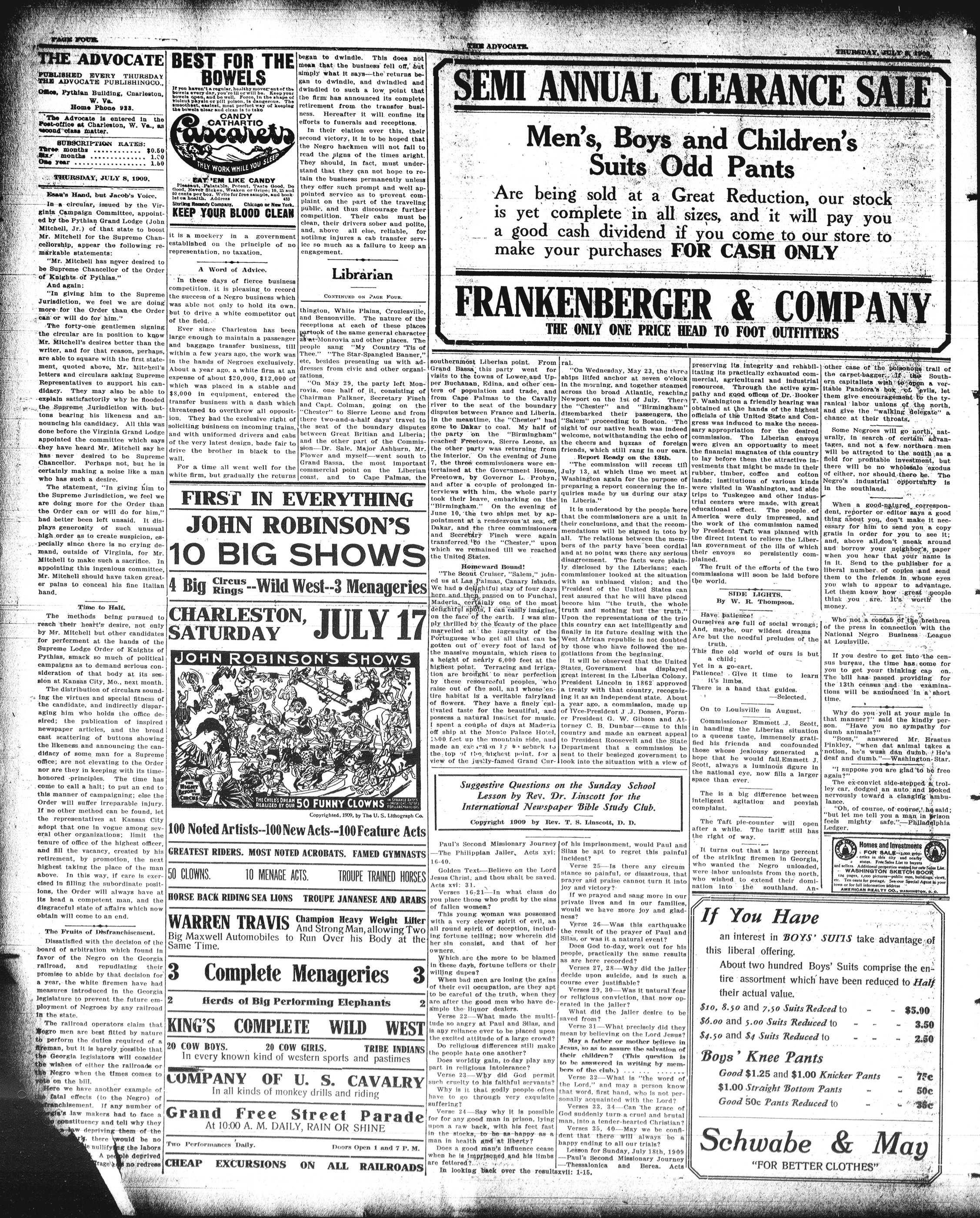
In a circular, issued by the Virginia Campaign Committee, appointed by the Pythian Grand Lodge (John Mitchell, Jr.) of that state to boost Mr. Mitchell for the Supreme Chancellorship, appear the following remarkable statements:
"Mr. Mitchell has never desired to be Supreme Chancellor of the Order of Knights of Pythias."
And again:
"In giving him to the Supreme Jurisdiction, we feel we are doing more for the Order than the Order can or will do for him."
The forty-one gentlemen signing the circular are in position to know Mr. Mitchell's desires better than the writer, and for that reason, perhaps, are able to square with the first statement, quoted above, Mr. Mitchell's letters and circulars asking Supreme Representatives to support his candidacy. They may also be able to explain satisfactorily why he flooded the Supreme Jurisdiction with buttons bearing his likeness and announcing his candidacy. All this was done before the Virginia Grand Lodge appointed the committee which says they have heard Mr. Mitchell say he has never desired to be Supreme Chancellor. Perhaps not, but he is certainly making a noise like a man who has such a desire.
The statement, "In giving him to the Supreme Jurisdiction, we feel we are doing more for the Order than the Order can or will do for him," had better been left unsaid. It displays generosity of such unusual high order as to create suspicion, especially since there is no crying demand, outside of Virginia, for Mr. Mitchell to make such a sacrifice. In appointing this ingenious committee, Mr. Mitchell should have taken greater palms to conceal his fine Italian hand.
Time to Half.
The methods being pursued to reach their heart's desire, not only by Mr. Mitchell but other candidates for performent at the hands of the Supreme Lodge Order of Knights of Pythias, smack so much of political campaigns as to demand serious consideration of that body at its session at Kansas City, Mo., next month
The distribution of circulars sounding the virtues and special fitness of the candidate, and indirectly disparaging him who holds the office desired; the publication of inspired newspaper articles, and the broad cast scattering of buttons showing the likeness and announcing the candidacy of some man for a Supreme office; are not elevating to the Order nor are they in keeping with its time-honored-principles. The time has come to call a halt; to put an end to this manner of campaigning; else the Order will suffer irreparable injury. If no other method can be found, let the representatives at Kansas City adopt that one in vogue among several other organizations; limit the tenure of office of the highest officer, and fill the vacancy, created by his retirement, by promotion, the next highest taking the place of the man above. In this way, if care is exercised in filling the subordinate positions, the Order will always have at its head a competent man, and the disgraceful state of affairs which now obtain will come to an end.
The Fruits of Disfranchisement
Dissatisfied with the decision of the board of arbitration which found in favor of the Negro on the Georgia railroad, and repudiating their promise to abide by that decision for a year, the white firemen have had measures introduced in the Georgia legislature to prevent the future employment of Negroes by any railroad in the state.
The railroad operators claim that Negro men are best fitted by nature to perform the duties required of a fireman, but it is barely possible that the Georgia legislators will consider the wishes of either the railroads or the Negro when the times come to vote on the bill.
Here we have another example of the fatal effects (to the Negro) of disfranchisement. If any number of Berg's law makers had to face a new constituency and tell why they
FIRST IN EVERYTHING
JOHN ROBINSON'S 10 BIG SHOWS
4 Big Circus Rings--Wild West--3 Menageries
JOHN ROBINSON'S SHOWS
THE NIGHT BROADWAY CIRCUS
THE CHILD'S DREAM
REALIZED BY OUR
50 FUNNY CLOWNS
IN STRANGE AFFIX
OPERATIONS CIRCUSS
100 Noted Artists--100 New Acts--100 Feature Acts GREATEST RIDERS. MOST NOTED ACROBATS. FAMED GYMNASTS
HORSE BACK RIDING SEA LIONS TROUPE JANANESE AND ARABS WARREN TRAVIS Champion Heavy Weight Lifter And Strong Man, allowing Two Big Maxwell Automobiles to Run Over his Body at the Same Time.
Herds of Big Performing Elephants
20 COW BOYS. 20 COW GIRLS. TRIBE INDIANS In every known kind of western sports and pastimes
COMPANY OF U. S. CAVALRY In all kinds of monkey drills and riding
Grand Free Street Parade At 10:00 A. M. DAILY, RAIN OR SHINE
BEST FOR THE BOWELS
BEST FOR THE BOWELS
If you haven't a regular, healthy move out of the
ward you live in, keep your
bowel open, and be well. Force, in the shape
of violent physio or pill poison, is dangerous. The
candy OATHARTIO
acarets
the bowel clear and clean it to take
THEY WORK WHILE YOU SLEEP
it is a mockery in a government established on the principle of no representation, no taxation.
A Word of Advice.
In these days of fierce business competition, it is pleasing to record the success of a Negro business which was able not only to hold its own, but to drive a white competitor out of the field.
Ever since Charleston has been large enough to maintain a passenger and baggage transfer business, till within a few years ago, the work was in the hands of Negroes exclusively. About a year ago, a white firm at an expense of about $20,000, $12,000 of which was placed in a stable and $8,000 in equipment, entered the transfer business with a dash which threatened to overthrow all opposition. They had the exclusive right of soliciting business on incoming trains, and with uniformed drivers and cabs of the very latest design, bade fair to drive the brother in black to the wall. For a time all went well for the white firm, but gradually the returns
began to dwindle. This does not mean that the business fell off, but simply what it says—the returns began to dwindle, and dwindled and dwindled to such a low, point that the firm has announced its complete retirement from the transfer business. Hereafter it will confine its efforts to funerals and receptions.
In their elation over this, their second victory, it is to be hoped that the Negro hackmen will not fall to read the signs of the times aright. They should, in fact, must understand that they can not hope to retain the business permanently unless they offer such prompt and well appointed service as to prevent complaint on the part of the traveling public, and thus discourage further competition. Their cabs must be clean, their drivers sober and polite, and, above all else, reliable, for nothing injures a cab transfer service so much as a failure to keep an engagement.
Librarian
CONTINUED ON PAGE FOUR.
thington, White Plains, Croziesville, and Bensonville. The nature of the receptions at each of these places partook of the same general character as at Monrovia and other places. The people sang "My Country 'Tis of Thee." "The Star-Spangled Banner," etc, besides presenting us with addresses from civic and other organizations.
"On May 29, the party left Monrovia, one half of it, consisting of Chairman Falkner, Secretary Finch and Capt. Colman, going on the "Chester" to Sierra Leone and from there two-and-a-half days' travel to the seat of the boundary disputes between Great Britian and Liberia; and the other part of the Commission—Dr. Sale, Major Ashburn, Mr. Flower and myself—went south to Grand Bassa, the most important commercial point on the Liberian const, and to Cape Palmas, the
VERYTHING
BINSON'S
SHOWS
West--3 Menageries
N, JULY 17
SON'S SHOWS
50 FUNNY CLOWNS
Copyrighted, 1999, by The U. S. Lithograph Co.
New Acts--100 Feature Acts
ACROBATS. FAMED GYMNASTS
CTS. TROUPE TRAINED HORSES
TROUPE JANANESE AND ARABS
Champion Heavy Weight Lifter
And Strong Man, allowing Two
SEMI ANNUAL CLEARANCE SALE
Men's, Boys and Children's Suits Odd Pants
Are being sold at a Great Reduction, our stock is yet complete in all sizes, and it will pay you a good cash dividend if you come to our store to make your purchases FOR CASH ONLY
Copyright 1909 by Rev. T. S. Linscott, D. D.
southernmost Liberian point. From Grand Bassa this party went for visits to the towns of Lower, and Upper Buchanan, Edina, and other centers of population and trade, and from Cape Palmas to the Cavally river to the seat of the boundary disputes between France and Liberia. In the meantime, the "Chester" had gone to Dakar to coal. My half of the party on the "Birmingham" reached Freetown, Sierre Leone, as the other party was returning from the interior. On the evening of June 7, the three commissioners were entertained at the Government House, Freetown, by Governor L. Probyn, and after a couple of prolonged interviews with him, the whole party took their leave, embarking on the "Birmingham." On the evening of June 10, the two ships met by appointment at a rendezvous at sea, off Dakar, and the three commissioners and Secretary Finch were again transferred to the "Chester," upon which we remained till we reached the United States.
Homeward Bound!
"The Scout Cruiser, "Salem," joined us at Las Palmas, Canary Islands. We had a delightful stay of four days here and then passed on to Funchal, Madera, certainly one of the most delightful spots. I can easily imagine on the face of the earth. I was simply thrilled by the beauty of the place marvelled at the ingenuity of the Portuguese who get all that can be gotten out of every foot of land of the massive mountain, which rises to a height of nearly 6,000 feet at the highest point. Terracing and irrigation are brought to near perfection by these resourceful peoples, who raise out of the soil, and whose entire habitat is a veritable fairyland of flowers. They have a finely cultivated taste for the beautiful, and possess a natural instinct for music. I spent a couple of days at Madera off ship at the Monte Palace Hotel, 1800 feet up the mountain side, and made an excursion by seeback to the top of the highest point. For a view of the justly-famed Grand Cur-
Paul's Second Missionary Journey
—The Philippian Jailer, Acts xvi:
16-40.
Golden Text—Believe on the Lord
Jesus Christ, and thou shalt be saved.
Acts xvi: 31.
Verses 16-21—In what class do
you place those who profit by the sins
of fallen women?
This young woman was possessed
with a very clever spirit of evil, an
all round spirit of deception, including
fortune telling; now wherein did
her sin consist, and that of her
owners.
Which are the more to be blamed
in these days, fortune tellers or their
willing dupes?
When bad men are losing the gains
of their evil occupation, are they apt
to be careful of the truth, when they
are after the good men who have de-
ample the lionor dealers.
Verse 22—What made the multitude so angry at Paul and Silas, and is any reliance ever to be placed upon the excited attitude of a large crowd?
Do religious differences still make the people hate one another?
Does worldly gain, to day play any part in religious intolerance?
Verse 23—Why did God permit such cruelty to his faithful servants?
Why is it that godly people often have to go through very exquisite suffering?
Verse 24—Say why it is possible for for any good man in prison, lying upon a raw back, with his feet fast in the stocks, to be as happy as a man in health and at liberty?
Does a good man's influence cease when he is imprisoned and his limbs are fettered?
THE ONLY ONE PRICE HEAD TO FOOT OUTFITTERS
"On Wednesday, May 23, the three ships lifted anchor at seven o'clock in the morning, and together steamed across the broad Atlantic, reaching Newport on the 1st of July. There the "Chester" and "Birmingham" disembarked their passengers, the "Salem" proceeding to Boston. The sight of our native heath was indeed welcome, notwithstanding the echo of the cheers and huzzas of foreign friends, which still rang in our ears.
Report Ready on the 13th. "The commission will recess till July 13, at which time we meet at Washington again for the purpose of preparing a report concerning the inquiries made by us during our stay in Liberia."
It is understood by the people here that the commissioners are a unit in their conclusions, and that the recommendations will be signed in toto by all. The relations between the members of the party have been cordial and at no point was there any serious disagreement. The facts were plainly disclosed by the Liberians; each commissioner looked at the situation with an unbiased vision; and the President of the United States can rest assured that he will have placed become him "the truth, the whole truth and nothing but the truth." Upon the representations of the trio this country can act intelligently and finally in its future dealing with the West African republic is not doubted by those who have followed the negotiations from the beginning.
It will be observed that the United States, Government has displayed great interest in the Liberian Colony. President Lincoln in 1862 approved a treaty with that country, recognizing it as an independent state. About a year ago, a commission, made up of Vce-President J. J. Dossen, Former President G. W. Gibson and Attorney C. B. Dunbar—came to this country and made an earnest appeal to President Roosevelt and the State Department that a commission be sent to their besieged government to look into the situation with a view of
of his imprisonment, would Paul and Silas be apt to regret this painful incident?
Verse 25—Is there any circum stance so painful, or disastrous, that prayer and praise cannot turn it into joy and victory?
If we prayed and sang more in our private lives and in our families, would we have more joy and gladness?
Verse 26—Was this earthquake the result of the prayer of Paul and Silas, or was it a natural event?
Does God to-day, work out for his people, practically the same results as are here recorded?
Verses 27, 28—Why did the jailer decide upon suicide, and is such a course ever justifiable?
Verses 29, 30—Was it natural fear or religious conviction, that now operated in the jailer?
What did the Jailer desire to be saved from?
Verse 31—What precisely did they mean by believing on the Lord Jesus?
May a father or mother believe in Jesus, so as to assure the salvation of their children? (This question is to be answered in writing by members of the club.)
Verse 32—What is "the word of the Lord," and may a person know that word, first hand, who is not personally acquainted with the Lord?
Verses 33, 34—Can the grace of God suddenly turn a cruel and brutal man, into a tender-hearted Christian?
Verses 35, 40—May we be confident that there will always be a happy ending to all our trials?
Lesson for Sunday, July 18th, 1909
Paul's Second Missionary Journey
Thessalonica and Berea. Acts
preserving its integrity and rehabilitating its practically exhausted commercial, agricultural and industrial resources. Through the active sympathy and good offices of Dr. Booker T. Washington a friendly hearing was obtained at the hands of the highest officials of the United State and Congress was induced to make the necessary appropriation for the desired commission. The Liberian envoys were given an opportunity to meet the financial magnates of this country to lay before them the attractive investments that might be made in their rubber, timber, coffee and cotton lands; institutions of various kinds were visited in Washington, and side trips to Tuskegee and other industrial centers were made, with great educational effect. The people of America were duly impressed, and the work of the commission named by President Taft was planned with the direct intent to relieve the Liberian government of the ills of which their envoys so persistently complained.
The fruit of the efforts of the two commissions will soon be laid before the world.
SIDE LIGHTS.
By W. R. Thompson.
Have patience!
Ourselves are full of social wrongs;
And, maybe, our wildest dreams
Are but the needful preludes of the
truth.
This fine old world of ours is but
a child;
Yet in a go-cart.
Patience! Give it time to learn
it's limbs.
There is a hand that guides.
—Selected.
On to Louisville in August.
Commissioner Emmett J. Scott,
in handling the Liberian situation
to a queens taste, immensely gratified
his friends and confounded
those whose jealousy generated a
hope that he would fall Emmett J.
Scott, always a luminous figure
in the national eye, now fills a larger
space than ever.
The is a big difference between intelligent agitation and peevish complaint.
The Taft pie-counter will open after a while. The tariff still has the right of way.
It turns out that a large percent of the striking firemen in Georgia, who wanted the Negro unloaded, were labor unoffists from the north, who wished, to extend their domination into the southland. An-
If You Have
an interest in BOYS' this liberal offering. About two hundred Bo tire assortment which their actual value. $10, 8.50 and 7.50 Suits Reduced $6.00 and 5.00 Suits Reduced $4.50 and $4 Suits Reduced Boys' Knee Pants Good $1.25 and $1.00 $1.00 Straight Bottom Good 50c Pants Reduced Schwabe
an interest in BOYS' SUITS take advantage of this liberal offering. About two hundred Boys' Suits comprise the entire assortment which have been reduced to Half their actual value.
Good $1.25 and $1.00 Knicker Pants - 75c
$1.00 Straight Bottom Pants - - 50c
Good 50c Pants Reduced to - - 35c
"FOR BETTER CLOTHES"
other case of the poisonous trail of the carpet-bagger. If the Southern capitalists wish to open a veritable Pandora's box of evils, let them give encouragement to the tyrannical labor unions of the north, and give the "walking delegate" a chance at their throats.
Some Negroes will go north, naturally, in search of certain advantages, and not a few northern men will be attracted to the south as a field for profitable investment, but there will be no wholesale exodus of either, nor should there be. The Negro's industrial opportunity is in the southland.
When a good-natured correspondent, reporter or editor says a good thing about you, don't make it necessary for him to send you a copy gratis in order for you to see it; and, above all, don't sneak around and borrow your neighbor's paper when you hear that your name is in it. Send to the publisher for a liberal number of copies and send them to the friends in whose eyes you wish to appear to advantage. Let them know how great people think you are. It's worth the money.
Who not a confab of the brethren of the press in connection with the National Negro Business League at Louisville.
If you desire to get into the census bureau, the time has come for you to get your thinking cap on. The bill has passed providing for the 13th census and the examinations will be announced in a short time.
Why do you yell at your mule in that manner?" said the kindly person. "Have you no sympathy for dumb animals?"
"Ross," answered Mr. Erastus Pinkley, "when dat animal takes a notion, he's wuss dan dumb. He's deaf and dumb."—Washington-Star.
"I suppose you are glad to be free again?"
The ex-convict side-stepped a trolley car, dodged an auto and looked nervously toward a clanging ambulance.
"Oh, of course, of course," he said
"but let me tell you a man, in prison
feels mighty safe."—Philadelphia
Ledger.
Homes and Investments
FOR SALE—1,200 property
cries in this city and nearby
attacks. Free Sale List to buyers
and sellers. Additions required for new Sales List.
WASHINGTON BIKER GIRL GROUP
124 pages, 1,000 pictures—public men, buildings, stairs,
etc. Ten cents for postage. See our Special Agent in your
town for full information about
AMERICAN
SUITS take advantage of
ys' Suits comprise the en-
have been reduced to Half
Iced to - - $5.00
d to - - 3.50
to - - 2.50
Knicker Pants - 75c
Pants - - 50c
d to - - 35c
& May
---
THE CITY COURT
Are You Working for Money? Or is Your Money Working for You?
If you are working and saving your money and putting it in a bank where you get no interest, keep ing it in a trunk or hiding it somewhere about your house—You Are Working. For Money. If you are working and saving your money and investing it in a safe way, where it will be day and night whether or not you are working.
day and night whether you are working or not, and making you at least six per cent. interest—Your Money is working For You.
The Pythian Mutual Investment Association
The Pythian Mutual Investment Association was organized in order to give us an opportunity to put the money we could save together and then put it to work. The above is a picture of our building on the Capitol Square in Charleston. We have just purchased a splendid three story block building on one of the main business streets in the city of Huntington. The first floor is occupied by the Huntington Herald, the largest daily newspaper published in that section of the state, the second floor is used for office rooms, while the htird floor is a large assembly and lodge hall. This building is sure to pay us well. After the Charleston building had been occupied only eight months our stockholders were paid a dividend of six per cent.
Stock is still on sale at $10.00 per share, either paid up or on the installment plan. Ask your agent in your locality about it or write to this office.
Let Your Money Work for You.
WestVa.Colored Institute
INSTITUTE, : : : : WEST VA. The only Industrial Institute for colored Students in the State.
Regular Normal, Academic and Commercial Courses, also Regular Courses in Agriculture, Carpentery and House Building, Steam Fitting,Smithing,Cabinet Making, Painting and Glazing, Dressmaking, Laundering, Printing. A complete course in Military Training to Cadets. Rooms. Books, Fuel and Lights Free to Normal Students; and in addition Uniforms for State Students. We have a faculty of Twenty-two Teachers Board only Eight Dollars per Month,
For catalogue and other information address
The annual meeting of the stock-holder of the Pythian Mutual Investment Association, a corporation, will be held in the hall room, on the third floor of the K. of P. building, situate at the corner of Washington and Dickinson streets, Charleston, W. Va., on Thursday, August 8th, 1909, at 2 o'clock in the afternoon of that day, for the purpose of electing directors for sold association for the next, ensuing year, and for the transaction of each other business
shall legally come before said meeting.
Given under my hand this 28th day of June, 1909.
W. J. THOMPSON,
7-1-4t President.
Waiter (in expensive restaurant)
—Will you have sugar in your coffee?
Mrs. Nurich—I don't see it on the bill.
Waiter—There is no charge for sugar, madam.
Mrs. Nurich—No, thank you!—Puck.
Crawford—Your wife must be
dead in love with you. She has sent you a letter every day since she has been away.
Cranshaw—They are little more than notes to tell me to send her some article she forgot to put in her trunk.—Puck.
Judge—The evidence shows that you throw a stone at this man's dog. Prisoner—Don't it show more'n that?
Judge—What more did you want it to show?
"I don't believe Georgeloves me
Dr. and Mrs. R. L. Jones have as their house guests their mother, Mrs. Walter H. Brooks and her son and daughter, Master Albert and Miss Antonette, of Washington,D.C., who will spend several weeks with them. They arrived in the city Tuesday.
Mrs. S. D. Cowser fell from the porch of her residence on Court street Saturday afternoon, and sustained a compound fracture of her left arm.
Apart of young ladies and gentlemen composed of Misses Aristis, Johnson, Maude Viney, Virginia Glimer, Hazel Lucas and Mary Dickerson and T. G. Nutter, C. H. Gray, James Brown and Arthur Jackson had a very pleasant outing at Institute, Monday, where they were joined by Miss Ethel and Llewellyn Springs.
Miss Lillian Taylor was at home to a few friends, Thursday evening, of last week, at her home on Washington street, complimentary to A. L. Murry, of Jackson, Mich. Those present were, Mr. and Mrs. William Harris, Mr. and Mrs. Russell Forney, Mr. and Mrs. Chas, Preston, Miss Bessie Taylor, Noble Mitchell, W. E. Preston and Walter Holliday. Mr. Murray returned to his home, Friday.
Misses Ella and Maggie Thomas leave Friday for Talcott where they spend the summer with their parents. Puffs and transformations, at Mrs. Brown's, 500 Capitol street. adv. Miss Daisy Nelson leaves next week to spend several weeks with her mother at Chester, N. C.
Edward Howard and Julius Harris are spending the month at Hot Springs, Va.
Joseph Dillard is seriously ill at the General Hospital. W. C. Martin, of Roanoke, Va., and Miss Fannie Friend, of the Institute, were married by Rev. W. E. Walker, Saturday night. The Ladies Aid of St. Paul A. M. E. church will meet tonight at Miss Paynes on Court street, and will be entertained by Miss Payne and Mima Booker. Rev. Crockett, of Pa., will preach at St. Paul A. M. E. church, Sunday, at 11 a. m. and 8 p. m. Rev. W. E. Walker will proach in Middleport, Ohio, Sunday, for the Grand Rally at the A. M. E. church. Rush Webb and Miss Ada Price were quietly married, Saturday evening. C. H. Carter, of Carbon, passed through the city, Saturday, enroute to Columbus, O., on business.
Miss Salile Hale is spending the summer at Old Sweet Springs.
Miss Mary Thompson, of Institute, was in the city Monday.
Mrs. Edward Tuck is ill at her home on Sentz street.
Miss Mary Preston entertained a few friends, Monday evening, at the home of Mr. and Mrs. Chas. Stephenson on Bibby street.
Mrs. Annie Smith is ill at her home on Lewis street.
Chas. Starks and daughter, Francis, of Pomeroy, O., are visiting Mr. and Mrs. Benj. Starks on Southside.
Mrs. Emma Dorsey and daughter, Julia, of the Institute, spent the week end in the city, guests of relatives.
AFRICAN M. E. BISHOPS LOSE.
Complaint. Not. Warranted. Says the Commerce Commission.
Washington, July 3.—Five bishops of the African Methodist Episcopal Church who complained to the interstate commerce commission that they were discriminated against by Southern railroads and by the Pullman company in transportation, dining car, and sleeping car facilities, have been informed by the commission that their complaint was not warranted.
The bishops were Wesley J. Gaines, H. M. Turner, Evans Tyreer, C. S. Smith and E. W. Lampton, against the Seaboard Air Line, the Richmond, Fredericksburg and Potomac, the Southern Railway, the Central of Georgia, and the Pullman Company. It was alleged that the day coaches furnished for Negroe passengers in the southeastern states were not equal to those provided for white people; that Negroes were denied sleeping car accommodations, and that they were refused food in the dining car solely on account of their color.
At the hearing of the case the complaint as to the day coaches was abandoned, in view of the weight of testimony to the contrary; and with respect to the dining car facilities the allegations were modified by concession. Most of the complainants and their witnesses testified that they actually did ride on sleeping cars. It is held by the commission in its decision that undue discrimination or prejudice was not shown, and the complaint, therefore, was dismissed.
any more," sighed the young bride,
"What's the matter? Have you quarreler?"
"No, but he doesn't offer to wipe the supper dishes for me any more."
—Detroit Free Press.
Well, I discharged my boss last night.
Discharged your boss?
Yep, in a dream.
They say dreams go by contracts.
That's what I found this morning when the boss said good-bye.
Cleveland Plain Dealer.
EDGEWOOD
PARK SECURED BY KNIGHTS OF PYTHIAS.
Outing on the Last Day of the Grand Lodge Session will be Held at the Park where Every Amusement is Provided.
The Sub-committee, headed by J. M. Hazlewood, of the Pythian Grand Lodge Entertainment committee has secured the use of Edgewood park for the outing of the Grand Lodge and Grand Court of Calanthe to be held August 6th.
The park, which is one of the most beautiful in the state offers amusements of all sorts for young and old. There are skating and dancing pavilions, a merry-go-round, shooting gallery, picture gallery and games of every description. The car ride alone to the park will amply repay those who are lovers of nature, and the scenery, comprised in the hundred acres which go to make up the park rivals description.
For the first time this park will be opened to people of the Negro race and the committee is putting forth every effort to make the event a pleasurable one for the thousands who are expected to take a day off to enjoy the amusements offered at Edgewood.
Plans are now on foot to have the members of the order atMontgomery and Raymond City conduct boat excursions from those and intermediate points for the outing at the park. Hundreds of visitors are expected to take advantage of this opportunity to visit the state's greatest pleasure resort, since the street car arrangement will make it possible for them to return to the city at any hour desired. On the occasion of the Grand Lodge meeting here, two years ago, there was the largest crowd of colored people ever gathered in the capital city, but the number which will witness the parade and go to Edgewood will greatly exceed any previous gathering, when it becomes known that shelter is provided at the park.
IS THE BIG BOILERMAKER ACCORDING TO PHILADELPHIANS
Critics, Who Saw Jeffries in His go With Berger, Think the Retired Champion Has no Chance to Regain Lost Laurels.
Philadelphia, Penn., July 3.—Boxing enthusiasts in this city recently had a chance to see Jeffries in the ring. This is what a boxing authority thought of the exhibition:
"There are thousands of people in this country, and doubtless in Europe who are eager and willing to pay from 50 cents to $100 to see James J. Jeffries, former champion of the world, in action. Jeffries has been out of the ring for five years, and when he fought his contests were confined to either Coney Island or California, hence the curiosity to see the big fellow.
'An enterprising theatrical syndicate conceived the idea of bringing Jeffries out of retirement and seized upon the idea of a possible bout with Johnson as a lever to draw the crowds. Jeffries has always been on the level with the public, and is now. He has been made to say a lot which never came from Jeffries's lips. The big fellow realizes that when the box office receipts wane he must jolly the public. When he first started out he was firm in his declaration that he he would never fight Johnson or any other man unless he could get himself in perfect physical condition. Later, when cornered for an emphatic statement. Jeffries said: 'I will fight Johnson "if" I can get in condition.' And the big fellow is sincere but that little "if" is and will be the stumbling block.
"By his own admission Jeffries has trained conscientiously for five weeks Here is what he has accomplished: He skipped the rope 40 seconds and boxed three rounds with Sam Borger The first round lasted one minute and ten seconds, the second one minute and five seconds, and the third, 56 seconds. At the end Jeffries vaulted over the ropes. It was lucky that he made his speech to the crowd before the bout, as afterwards he had belows to mend and was breathing heavily. If it has taken him five weeks to get in condition to box three fast rounds of one minute each, how long will he have to plod to shape himself for a twenty-round bout, each round of three minutes?
"Without mlncing words—at present Jeffries has not the physical foundation to stand a season of gruelling training. He knows that himself. At the end of the theatrical tour he can simply say to the American public: "I have tried to condition myself for a championship battle, and find that I am unequal to the task." The public will forgive the big fellow and hope that the money he has gathered will keep him in comfort until the sere and yellow of old age creep upon him.
"As for the possibilities of a Ketchel-Johnson bout, it is foolish to regard the Western cowboy as being too small. No one ever questioned the relative size, height and reach of Sharkey and Jeffries when they met. The sailor was a much smaller
With every cash value of
Wall P
(of $1.00 or
An Illustrated
Directory of C
New Wall Pa
Big Bargains i
MOO
CHARLESTON'S LEAD
HOUS
Wall Paper
(of $1.00 or more)
Illustrated Souven
irectory of Charleston
New Wall Paper Just
Bargains in Remna
100 RE'
CARLESTON'S LEADING WALL PAP
HOUSE.
CHARLESTON'S LEADING WALL PAPER HOUSE. 118 Capitol Street.
OUR DISPLY OF
Ladies' Misses' and
Wear garments, M
Is the largest in the City and our P
can be made up-to-date Merchandise
GIVE US
A CALL
The People's
JOSEPH SCHW
602 Kanawha, cor. Alderson St.,
10 Per
Seved From Your
Would Hank
Yet that Small Amount regularly
DEPARTMENT of the
Kanawha Bankin
will buy you a home, save you f
vide for your old age.
"The Bank That You Can
Pays Compound Semi Annu
Capital $250,000 CHARLESTON.
Ladies' Misses' and Children's L
Wear garments, Millinery and Dres
gest in the City and our Prices as usual the l
ade up-to-date Merchandise.
The People's Store "That
Trading
JOSEPH SCHWAB, Prop.
wha, cor. Alderson St., CHARLESTON,
10 Per Cent
All From Your Earnings
Would Hardly Be M
small Amount regularly deposited in the
NT of the
Sawha Banking & Trust
you a home, save you from paying rent
our old age.
"The Bank That You Can Depend Upon" has
y Compound Semi Annual Interest and h
,000 CHARLESTON, W. VA. Surplus
Ladies' Misses' and Children's Ready-to-Wear garments, Millinery and Dress Fabrics
Is the largest in the City and our Prices as usual the lowest that can be made up-to-date Merchandise.
GIVE US The People's Store "That Popular Trading Place."
A CALL
JOSEPH SCHWAB, Prop.
602 Kanawha, cor. Alderson St., CHARLESTON, W. VA.
Yet that Small Amount regularly deposited in the SAVINGS DEPARTMENT of the
will buy you a home, save you from paying rent and vide for your old age.
"The Bank That You Can Depend Upon" has
Pays Compound Semi Annual Interest and has
man than Ketchel when that-memorable contest with Jeffries took place in 1899, and yet he gave the big fellow the battle of his career, and at the end of 25 rounds was still on his feet. Ketchel is big and strong enough to cope with Johnson, and when October rolls around we shall see whether the first Negro heavyweight champion of the world can take a facing without filching."
COLORED VOTERS
Of Kentucky Organize to Demand Political Recognition
Louisville, Ky., July 5.—To hold a club over the heads of both political parties for the purpose of obtaining recognition for colored voters in Kentucky representative colored men from every district and nearly every county in the state met in Louisville today and organized the "Negro Civic and Political League of Kentucky." The object of the club is the political advancement of colored men," which is taken to mean that an organized effort to control the entire colored vote of the State as a unit will be made.
The plans of the league were outlined, its objects stated, officers were elected, an Executive Committee chosen and Chairmen, appointed in each district. It is believed the league will confront the Republican party with a proposition of recognition of colored men in the next campaign.
The officers chosen are: G. W. Gentry, Stanford, President; A. S. White, Louisville, First Vice President; W. T. Silvey, Frankfort, Second Vice President; W. H. McRidley, Cadiz, Third Vice President; E. E. Underwood, Frankfort, Secretary; J. Hecker, Louisville, Assistant Secretary; R.
Paper
(or more)
ed Souvenir
of Charleston.
Paper Just In
in Remnants
RE'S
ADING WALL PAPER
USE.
OF
es' and Children's Ready-to-
sits, Millinery and Dress Fabrics
our Prices as usual the lowest that
andise.
e's Store "That Popular
Trading Place."
HWAB, Prop.
t., CHARLESTON, W. VA.
r Cent
our Earnings
Hardly Be Missed
early deposited in the SAVINGS
king & Trust Co.
on from paying rent and pro-
Can Depend Upon" has
Annual Interest and has
VON. W. VA. Surplus $160,000
Mitchell, Bowling Green, Treasurer,
and E. P. Meyers, Chaplain.
The Executive Committee is composed of four members from the state at large and of eleven additional members, one from each district as follows: State at large, H. C. Weston, W. H. Steward, A. S. White and T. H. Kennedy. By districts in order were chosen G. W. Darden, E. W. Glass, S. R. Read, N. A. Spalding, W. P. Merchant, W. A. Galnes, F. B. Hawkinson, J. E. Moody, A. B. Prult, W. M. McGowan and N. A. Williams.
Following the election it was voted
that a state mass convention be held some time in the near future. All which time workers from all sections of the state were to be acquainted with the plans of the society and the active work of establishing the entire colored vote of the state upon a definite basis will be made. The Executive Committee will meet with in a short time and arrange for the convention. All District Chairmen were instructed to set to work in forming county and district organizations immediately.
Emphasis upon the point that recognition of colored voters is to be obtained only through thorough utilization was made by each of the several speakers, who made stirring addresses before the assembly yesterday.
The principal address was made by George W. Gentry, who issued the call for the meeting, and who was elected President. He told in fall of the objects of the club, and made strong appeal to all members to work together for the political interests of the Negro.
Would you marry a woman who had been divorced?
Well, I don't know. A good deal would depend on what she had been doing with her allmony—Chicago Record-Herald.
CHARGES ARE PREFERRED AGAINST ASSISTANT SUPERINTENDENT R. E. BRUCE.
Citizen's Association of Washington Accuse Mr. Bruce of Favoritism and a Leaning to the Manual Training School—Appointments in the Census Bureau Sdr Up Some Excitement.—No Troops to be Sent to Brownsville Where Fort is Being Used as Agricultural Experiment Station.
(Thompson's National News Bureau).
Washington, D. C., July 6.—The creation of the week has been the king of charges against Prof. Roscoe Coukling Bruce, Assistant Superintendent of Public School, alleging that he is unfit to hold the office. The charges are preferred by Messrs. B. Marshal and James L. Neill, who are said to represent an organization known as "The Citizens' Association of Washington." The text of the allegations are closely in line with several articles which have appeared in the Boston Guardian, over the signature of Mr. F. H. M. Murray, of Alexandria, Va.
The charges have been read by the Board of Education and referred to a special committee, which will have them examined by a competent attorney to see what they amount to. In the meantime, Prof. Bruce is keeping his own counsel, declining to discuss the matter, pro or con. Asked for a statement, he said:
"I feel that it would not be professional for me to make any explanation at this time. I have nothing to say."
Prof. Bruce does not appear to be worried over the situation, and his friends intimate very strongly that a mountain is being made out of a molehill; that the "Association" acting in the matter is composed of only five or six persons, each having a personal grievance; that the Board will sustain Bruce at every point, and that at the proper time it would be shown that the Superintendent hailed nothing for which censure should be directed toward him. The people generally seem to be standing by Bruce and the charges be taken up for several weeks, there is a belief that before the times comes for a further hearing the skies will be so clear that the case will attract little or no attention.
The basis of the trouble seems to lie in a certain rivalry that has apparently grown up between the friends of M Street High School on the one hand and the friends of Armstrong Technical High School on the other. The complainants aver that Prof. Bruce has been comparing the Armstrong School with M Street, to the disparagement of the latter, and that when a competitive examination showed the work of the pupils of the M Street School to be as good, if not better, than that of the students of the Technical School he failed to make the result known. The complainants further allege that Prof. Bruce delivered several addresses before pupils of the colored grammar schools and invariably put in a good word for his manual training school. Among the other causes for dissatisfaction are that Prof. Bruce was discourteous to the principal of M Street High School, limited the latter's power of suspension, and subsequently charged him with failure to maintain discipline. Prof. Bruce is also blamed for the Association for allowing Congress to appropriate $900,000 for the maintenance of Washington white schools, while the colored schools got only $22,000. They think Bruce should have gone to Congress and fought with that body until proper equalization had been made. Something is said, too, about the lowering of the ideals of the schools under Bruce's administration, and there are the carmarks, here and there, of the old struggle between the adherents of the so-called "higher education" and the advocates of "industrial training." That argument has been so thoroughly threshed out in this community and a system of correlation of the two ideas has been so generally agreed upon that no considerable number of local educators can be induced to become excited over the subject now. Prof. Bruce is known to believe in emphasizing the manual training for the masses of the Negro race—and for the masses of any race, for that matter—and while he has been friendly to the development of Armstrong School, he has not shown it any favor at the expense of the academic training, represented by the courses at M Street. The Board understands this and is satisfied with the methods he has pursued, and the lacks of public thought in the city likewise in accord with him, as well as your correspondent has been able to observe.
Although the charges aver that Bruce, Bruce is "unfit" to longer serve as Assistant Superintendent in charge of colored schools, his dismissal is not specifically asked for. The excellent condition of the colored schools and the improvements that have been made in them since the arrival of Prof. Bruce are regarded in friends as a good and sufficient answer to all that is being alleged against him.
At the recommendation of the school committee goes through, according to present plans, Mr. Garnet Wilkinson, a graduate of the constituting schools, will become the principal of the M Street High School including Mr. W. T. S. Jackson, who will be transferred to a position as assistant in Armstrong School; Mr.
Alphonso O. Stafford is to become supervising principal of the 13th division, and Mr. J. C. Nalle, the present incumbent, is to take Mr. Stafford's place as principal of Lincoln School; Mr. J. E. Walker, principal of Banneker School, succeeds Dr. H. L. Bailey as supervising principal of the 12th division, while the latter becomes a teacher in M Street School; Mr. F. L. Cardozo, who was detached from the service some years ago and later reinstated as a seventh grade teacher, has been promoted to an eighth grade principalship and will have charge of Smothers School. Other changes are authorized, for the good of the schools, and it is believed that the recommendations of the committees will be ratified as they stand. The next meeting of the Board of Education, however, promises to be full of "ginger."
Word comes that the preparations for the Louisville meeting of the National Negro Business League are well under way. The City Council has appropriated $300 to assist in defraying the expenses, and Hon. Henry Watterson, the famous editor of the Louisville Courler-Journal, has consented to address the convention. Persons in this section are urged to open correspondence at once with President D. L. Knight, who has headquarters in the Y. M. C. A. Building, 920 West Chestnut street, Louisville, Ky. He will see that you get the kind of accommodations you desire. It will be advisable to make reservations early. A goodly delegation will go from the East.
A large public meeting will be held by the Washington Business League at Zion Baptist Church, F street, southwest, on next Monday evening. The newly-elected officers will be installed and prominent business men will speak among them Mr.W.F. Gude, president of the Washington Chamber of Commerce.
Mr. Emmett J. Scott, American Commissioner to Liberia, is expected here between the 10th and 13th of July, to make his report to the President. He is now in New York City. An elaborate social function is being arranged in his honor by the leading citizens of the national capital.
Brig.-General Albert L. Myer, commanding the Department of Texas, has made official denial statement that Fort Brown at Brownsville, Texas, is to be regarrisoned with white troops. Fort Brown was abandoned soon after the shooting up of the town in 1906 and the government declares it has no intention of again occupying it as a military post. It is now used by the Agricultural Department as an experiment station. Brownsville loses thousands of dollars annually by its assininity on the race question.
President Taft has sent to the Senate the name of William R. Leaken to be collector of customs at Savannah, Ga., to succeed the late Col. John H. Deveaux. Mr. Leaken is a republican of the organization type, and is said to be acceptable to colored and white alike, at Savannah. The appointment of a democrat was feared, but it is given out, upon apparently good authority, that the policy of the administration to give republicans the preference at all time, if they are up to the standard, and to name democrats only where there are no decent republicans. Negroes will be appointed in places where they can serve to ad-vantage, and the local Negro leaders are said to be advising their colored friends not to be backward about asking for places, but, suggest, in the meantime, that they do their level best to have themselves backed up strongly by the local organization and the best white citizens of the locality in which they desire to serve. The success of Walter L. Cohen in securing the approval of the controlling forces of his state is pointed out as an evidence that the Negro has "a chance for his white alley," if he will handle his case with skill and intelligence and get into the good graces of the people with whom he must deal locally.
Appointments in the Census Bureau bid fair to stir up some excitement. The democrats want a big cut of the melon, on a "non-partisan" basis, but the republicans need the jobs and may not wish to do for the democrats what they would certainly not do for them. The democratic policy is that "to the victors belong the spoils," and the republican managers are awakening to the fact that there is merit in such a practical platform and may adhere to it pretty strictly in the dispensing of patronage under the 13th Census. Special agents are to be named and there will be enumerators galore, besides many minor places that will not be affected by the civil service ruling. Bourbons in some sections, of the South are making a bluff that they do not want colored enumerators, claiming that whites will not answer questions affecting their private in-
SUMMER SHOE SALE
AT
PALMER AND THOMAS
BEGINNING THURSDAY MORNING
Three months of hot weather ahead!! Better Shoe yourself
and the family while the sale prices prevail...
SEE WINDOW DISPLAY
terests, if Negroes are to be inquisitors. Examination for clerical places will be announced shortly.
Ground has been broken for a $7,000 apartment house, moving plc, ture show and business, establishment at corner of 11th and U streets north-west. The builders are the directors of the Colored Laborers' Building & Loan Association, of which John W. Lewis is president. The corporation already owns about $20,000 worth of property.
SHORT FLIGHTS
President Taft's lofty statesmanship—as shown in his earnest insistence upon keeping his covenant with the people—is the republican party's best asset.
party's best asset today.
We are now on the eve of hearing the truth about Liberia.
Georgia's thoughtful citizens, speaking through the board of Arbitrators, named to adjust the contention between the white and colgood name of the state by granting the Negro the right to work. With equal opportunity to labor and at the same rate paid to whites the black man will "make good" every time. He is the cornerstone of the south's prosperity and well-being.
There is "presidential timber" in Senator Albert J. Beveridge, of Indiana. Keep your eye on this brilliant young man from the ballwick of Morton, Harrison, Colfax, and Henry S. Lane.
Nothing so became Hoke Smith in public life than the leaving of it. His passing occasions nothing but general rejoicing, in which the blacks and whites are for the once united.
The foolish application of the "grandfather clause" in the municipal registration at Annapolis, Md., has sounded the death-knell of the disfranchising amendment that is to be voted upon by the people of the State this fall.
We believe in colored priests for colored Catholic churches. If there is to be a color line, let it spell opportunity for special leadership for the competent ones of the race.
As the spirit of commercialism takes a stronger hold upon the American mind, the necessity for the National Negro Business League is emphasized.
Dr. Wallace Radelife, a noted Washington divine, says a good table, supplied with well-cooked, more Money For Colored People
This is one of the objects of this great Benefit and Welfare of every race, as evidenced by Hiskay Images, Shorter Honors, Equal Opportunities, Self Bottlement and Protection generally, as mentioned for which our members work. It is an International Association, in every sense of the term. No matter where you live, your occupation, be you married or single, employer or employee, be you greatly to your advantage to join the I-1 U Grand Lodge. Members and their unemployed brothers and sisters to secure their employment, be they disabled, and where death occurs in the family.
Big Cash Benefits
At death of member, $100 cash is paid to beneficiary. At death of wife, or other beneficiary, mem-
ber, $100 cash is paid to beneficiary, mem-
ber, $100 cash is paid to beneficiary, mem-
ber, or of baby, $0. There are many other benefits not allowed by other organizations.
Membership is open to both new, including current members, as to nationality, politics or religion. Membership as a nationality, politics or religion is already joined our ranks, having found this position by upholding a beneficial Protective institution in an area of high risk. Send in copy of official paper the 'L-U Home If you join promptly, we will give you your membership. You can devote your hours to securing members, for which we will pay you liberally. We will give their entire time to this work; good pay, including traveling expenses. Write at once
The I-L-U Grand Lodge
105 I-L U Bldg, Dayton, Ohio.
wholesome food, and a rod that is judiciously used, are the two prime requisites for a properly regulated family. Upon these, thinks the dominie, "hang all the law and the prophets."
Virginia may not be like unto Paradise in all respects, but the good white people of the Old Dominion are not wholly unmindful of the value of Negro citizens who have proven their worth to the communities in which they live. A short time ago, Charles A Robinson, a colored letter carrier at Roanoke, Va., and his two children lost their lives in a fire that destroyed a stable on the Robinson promises. The funeral of Mr. Robinson was the largest ever held for a Negro in Roanoke. Many prominent white citizens attended the services, and Postmaster L. G. Funkhouser, from the pulp, paid the dead carrier a beautiful tribute, extolling his virtues as a man and testifying to his faithfulness as a public official. In Suffolk, a few days ago, Mayor Norfleet headed the procession that turned out in honor of the presence of Booker T. Washington in the town. Let us not withhold credit where credit is due. There are some high-souled white people in the Southland, even if we do feel that their voices are feeble sometimes.
Lying on the absent one is a social form of lynching. The accused is condemned and executed, without being given a chance to offer a word in his own defense.
Equity demands that the fellows who helped the winner on to victory should be asked to eat at the first table. A positive premium should be placed on personal and party loyalty, especially in an age when loyalty of any kind is so "blooming scarce."
The bountieous farms of Iowa, Nebraska, Kansas, and Missouri are begging for workers to gather in their harvests. Here is a fine chance for the fellows who say they want work.
"Dar's dis much dat I does understan 'bout de tariff," said Uncle Eben. "an dat is dat it aint' gwynet do much foh de agricullist dat puts de plow to sleep in de fence corner an' nurses a rusty hoe." This homely bit of philosophy is especially commended to that class of Negro Micawkers who expect to sit upon the stool of do nothing and trust to tariff legislation to get them their pork and chops.
The tour of Bohner T. Washington through a section of Virginia and West Virginia, coming as it did at a crucial moment in the affairs of the race in the South, had a most stimulating effect upon both races and went far to bring about an understanding that will crystallize in a stronger sense of mutual interdependence, mutual confidence and productive co-operation. The late H. H. Rogers gave evidence of the highest wisdom in proposing that such a tour be made and his generosity in supplying the means for the same will not be forgotten by our grateful people.
The decision of the Interstate Commerce Commission, throwing out the complaint of the colored Bishops against the Southern railroads, for clearly proven discrimination on account of color, is simply another concession to the sentiment against the civic equality of the Negro. Anybody with half an eye knows that the Negro is denied the accommodations granted to the white for the same money. Furnishing equal accommodations to the black man is not profitable to the railroads and is unpleasant to the bourbon whites—and there you are! The situation does not look good to us.
Just as we told you! Bollermaker, Jim Jeffries is "all in." He will never face Jack Johnson. Watch it.
being called "Miss," must stay out of "Miss-lississippi," it seems. The name of this state is a "milenomer."
The Negro is learning the science of politics. At a meeting called for the purpose of electing delegates from Goochland county to the republican state convention of Virginia, to assemble at Newport, News, the unexpected combination between the colored republicans and a certain element of the white voters resulted in the defeat of the "illy-whites," and the naming of a mixed delegation, two colored. They are J. S. Pleasants, who acted as secretary of the local convention, and Dandridge Hopkins, who has large influence among all classes in the county.
Whether the cause be inefficiency, or race prejudice, the painful fact remains that the Negro waiter is losing ground in the north. A few years ago not a single hotel employed white waiters or waitresses, while now white men and women are as plentiful as blackberries in July, in the principal hostilities and cafes. A well-known colored hotel man who used to reap a harvest annually at Atlantic City and other popular seaside resorts makes the prediction that at the present rate the Negro will have "lost out" almost completely in the next five years. What is the remedy?
It is said that Boston will make a strong bid for the 1910 meeting of the National Negro Business League. Next year is the tenth anniversary of the founding of the League, and as that interesting event took place at the "Hub," there seems to be a peculiar fitness that the organization should go back to its birth-place to review its splendid achievements of its first decade. It looks like) Boston for 1910. Philadelphia, Cleveland, St. Louis, Kansas City, Little Rock, Cincinnati, Birmingham and Pittsburg are a few of the great cities not yet visited by the League, but all have invitations on the table and will be given consideration in due season. Richmond, Chicago and Nashville are asking for return engagements.
The editor of the Pekin Daily News rejoices in the suggestive cognomen of "Li Sum." The omenton of Confucious, if commercially inclined, might strike a fine bargain by disposing of his highly approprite name to the Washington correspondent of the Boston Guardian.
Florida isn't so bad as Legislator Cone would have the outside public to believe. Instead of striking out the appropriation for $25,000 for the benefit of the colored State College, as stated in the current press, the legislature passed an amended bill calling for $15,000. Cone is the fellow who didn't like to see Negro boys wearing military uniforms, walking straight and being called "captain." The better element of the law-makers, however, regarded military training as promotive of order, discipline and physical development and said "let the good work go on," with $15,000 as a stimulus. Let us give Florida's decent whites the credit to which they are entitled.
Oklahoma City, in beating out Indianapolis for the next meeting of the National Colored Teachers' Association, must certainly have "gone some," for the Hoosier Capital is one of the garden spots of the nation—the intellectual center, or trace in the whole. In presenting the claims of the "future great," Prof. J. H. A. Brazelton must have "seen Demosthanes" in point of eloquence, and gone him several points better. A journey to Oklahoma is in itself an education and it cannot be denied that the teachers have chosen wisely in selecting this new soil for the implanting of ideals and inspiration that mean so much for the race.
The South has wisely decided that the Negro must be allowed to work
You are already tired of the summer hat which you bought early in the season; here is your chance to get a beautiful trimmed hat for less than the real value of the untrimmed shape.
THE LAST CHANCE
We have remaining in stock a few elegant TAILORED PATTERN HATS which we propose to almost give away as follows: All $14 $15, $16, $18 and $20 Hats Only $4.98 Each
All $5, $7, $8, $9
Only $2.9
You are already tired of you bought early in the season get a beautiful trimmed hat for of the untrimmed shape.
NUF CED—HURRY—THEY
SAHLEY, GEORGE
Entrances: 11 Capitol Street
We are thankful for that proud privilege.
The election of Prof. Walter S. Buchanan to the presidency of the Agricultural and Mechanical College, at Normal, Ala., to succeed the late Prof. W. H. Councill, is generally endorsed by educators everywhere. Prof. Buchanan is a graduate of Tuskegee Institute and will bring to the northern Alabama school the rich atmosphere of duty and thought imbibed from his alma mater. He will doubtless bring the two institutions into a closer relationship than has existed between them heretofore, and make the work of each more effective because of such sympathetic co-operation. Prof. Buchanan's efforts at Corona mark him as a young man of broad ideas and energetic methods, and Normal will afford him the larger field he needs for the exercise of his pronounced talents.
No troops, white or colored, are to be stationed at Brownnesville, reports to the contrary not withstanding.
A resident of Monrovia writes to a Louisvillian that the necessities of life are hard to get in Liberia, but gin and rum can be had readily almost for the asking. The folks over here are wondering whether this is intended for a knock or a boost for the Black Republic. If this be true, the Kentucky "wets" might be induced to emigrate.
There will be a big time in Louisville, August 18-20. The commercial, educational and professional men of the race will be on hand to exchange words of greeting and cheer. The meeting will be both a school of valuable instruction and a delightful outing that every business man needs once a year. You cannot afford to miss it.
Let it be emphasized that there is an immense difference between "civil equality" and "social equality." The South is so prone to confuse the one with the other.
Editor J. C. Asbury, the astute opinion-moulder of the Odd Fellows Journal, of Philadelphia, traveled 3,000 miles during his recent itinerary through the South, and received a distinct ovation in every city visited by him. He delivered the com-
OESA
We have a new line of
GAS
STAND
LAMPS
Come in and look them over
COFFEY
Plumbing Co.
Quarrier St., near Capito
mencement address at Tuskegee Institute, and then touched at such populous centers as New Orleans, Vicksburg, 'Port Gibson, Natechez, Memphis, Little Rock, and St. Louis. Editor Asbury has been South before, but the impression he gathered on this trip took deeper root than ever before, for despite the increasing obstacles the path of Negro progress, the race is making longer and more determined strides toward the heights than at any time since emancipation.
Another terrific eruption of Mt. Vesuvius had just taken place.
"There it goes again!" exclaimed the despairing observers on Mars. "The people on the planet have been flashing signals at us now and then for hundreds of years, and in our crude state of development we have not been able to devise any way to respond!"—Chicago Tribune.
The highest track-laying record on the Western Pacific Railway is 7,800 feet a day.
The Loeb Shoe Co. No 12 Capitol Street The Loeb Shoe Co. THE GREAT REMOVAL SALE OF FOOTWEAR STARTS SATURDAY
The Most Important Merchandise Movement in Charleston during the Summer, beginning Saturday, will be the LOEB SHOE CO'S REMOVAL SALE OF FOOTWEAR. The statement thus boldly made is justified by the existing conditions. Our contemplated removal to new quarters on Capitol St. and the rather heavy stock which we find on our shelves at this time, renders it imperative that we adopt some means of unloading
THE LOEB SHOE COMPANY
---
Huntington, W. Va., July 7.—The Guyan Valley passenger train brought the body of William Justice of this city, whence it was sent to the former home of the dead man, near Ashland, Ky. Justice was killed in a pistol duel at a platform dance at Foley, Logan county. Saturday night, his slayer being Sherd Baldwin, the town marshal of Foley. The killing is said to have been indirectly the result of an old quarrel between the two men, although it arose immediately out of an attempt by Justice to interfere with Baldwin while the latter was beating a woman.
Foley is a mining town six miles above Logan, on Dingess Run. The people of that community had made great preparation for the Fourth of July celebration, part of which was to be a platform dance at a platform owned and conducted by Justice. The dance began a Saturday night with a great number of people in attendance.
Details of the affair which have, reached Huntington are meagre, but it seems that Baldwin had gone to the dance accompanied by a woman relative, sald to have been his daughter. During the progress of the revel this woman in some way aroused the decalousy of another woman who attacked her, inflicting a severe beating before Baldwin could, or did, interfere. When he did interfere, however, he attacked the second woman mercely, knocking her down and kicking her. At this juncture Justice appeared and ordered Baldwin to leave the woman alone and not to kick her again. Heedless of the warning Baldwin struck the prostrate woman with his foot, whereupon Justice pulled a revolver and fired at him. Baldwin coolly knocked aside the weapon of his adversary, drew his own revolver and shot, the bullet entering Justice's side, producing instant death.
The affair created tremendous excitement and as the bystanders were inclined to take up the quarrel and it looked for a time as if there might be more serious trouble. The disturbance was quelled after a time and the crowd dispersed. Baldwin was arrested. The body of Justice was taken to Logan Sunday morning and on to the Justice home in Kentucky yesterday.
The Army transport Sherman, which has been out of commission at SanFrancisco for a year owing to lack of available funds for its repair, is to thoroughly overhauled. A contract has been made with the Union Iron Works for the complete repair of the ship at its bid of $314,000.
Bryan's Modest Complaint.
Bryan complains that reporters give him no peace. How he must be looking for relief to a certain point in Africa!—Chicago Record-Herald.
Professor Palmer, of Harvard, advises coeds to flirt for recreation. Well, some people go over Niagara Falls in a barrel for the same purpose.—New York American.
BLACKS
Green With Envy, Berate Browns and Yellows Until Blue in the Face.
Atlanta, Ga., July 4.—"The color line within the color line" is the unique spectacle which is presented in the affairs of the order of colored Odd Fellows in Georgia.
The "blackNegroes" of the order charge that the "browns and yellows" are striving to establish a mulatto aristocracy in the positions of trust of colored Odd Fellowship in the state, leaving the black-skinned members to "dig the ditches" and furnish the sinnes of war.
The charge is set forth in this week's number of the Supreme Circle News, a Negro fraternal organ which circulates, widely throughout this state, Florida and Alabama.
JEFFERSON-MADEN NUPTIALS,
Reddsville, N. C., July 2—A beautiful wedding was solemnized at the Christian Church at nine o'clock last Wednesday evening, June 30, which Miss Salle Jefferson, of this city, became the bride of Mr. Chas. McAden, of Milton, N. C., the pastor Elder M. C. Walker officiating.
Preceding the approach of the bridal party, a solo was sung by Miss Mattle Davis to the accompaniment on the organ by Miss Eugenia Carter. As the last note died away the bridal party, to the soft strain of Mendelssohn's wedding march by Miss Eugenia Carter entered the church. The flower girls, Annie Jefferson and Estelle Lindsey, were first to enter, followed by the ushers, Messrs. Jas. Whitsett, Azzie Whitsett and David H. Dillard. Then came the bridesmaids, Miss Maggle, Johnson, Miss Annie Freeman, of Milton, N. C. Mary Sue Hairston, of Martinsville, Va., and Adolphia Duffey, of Winston-Salem, N. C. The groom and his best man and brother, the maid of honor, Miss Mazzle Jefferson entered next followed by the bride, who was escorted by her brother, M. B. Jefferson.
The organist played a soft melody, while the ceremony was performed. The bridal party was tendered a reception by the "Sweet Magnolia Club" at the Mason-Pythian hall. Mr. and Mrs. McAden left Thursday morning for a trip to his home at Milton. N. C., they will be at home in Reidsville after July 5th.
Worlh Reading
No need for eloquence
MEN'S J. & M. and
$6.00 grades at ...
MEN'S $6.00 PUMPS
DULL CALF AND TAN
MEN'S OXFORDS, T
ALL LEATHERS:
$4.00 GRADES ...
3.50 GRADES ...
3.00 GRADES ..
need for eloquence of words, the prices to
NIN'S J. & M. and BOYDEN OXFORDS,
grades at ...
NIN'S $6.00 PUMPS IN PAT. LEATHER
CALF AND TAN AT......
NIN'S OXFORDS, THE JINGO QUALITY
LEATHERS:
GRADES ...
GRADES ...
GRADES ..
No need for eloquence of words, the prices talk.
MEN'S J. & M. and BOYDEN OXFORDS, the
$6.00 grades at ..... $4.50
MEN'S OXFORDS, THE JINGO QUALITY ALL LEATHERS:
Children's Shoes
BOYS', YOUTHS' A
FORDS in Tan, Black
One-Fourth off regular p
MISSES', CHILDRE
FORDS and Ankle Tie
25 per cent.
White
All White OXFORDS
about half the original
THE
YS', YOUTHS' AND LITTLE GENTS' OS in Tan, Black Calf and Patent Leath fourth off regular prices.
SES', CHILDREN'S AND INFANTS' OS and Ankle Ties at a general reduct cent.
BOYS', YOUTHS' AND LITTLE GENTS' OXFORDS in Tan, Black Calf and Patent Leathers at One-Fourth off regular prices.
MISSES', CHILDREN'S AND INFANTS' OXFORDS and Ankle Ties at a general reduction of 25 per cent.
White Canvas
White OXFORDS and Shoes in this S half the original price.
All White OXFORDS and Shoes in this Sale at about half the original price.
REPORT OF WOMANS' HOSPITAL ASSOCIATION
We organized on the 8th of Sept., 1908, with 14 members, to do charitable work wherever we could find it needed. We have collected since that time one hundred and thirty-three dollars.
Our membership numbers 53. We have cared for 7 hospital patients and 2 cases of tuberculosis.
A nurse, food and bedding were provided for the tuberculosis cases.
The following amounts were collected from organizations:
Odd Fellows $3.00; Providence Lodge of St. Luke $3.00; Capital City Lodge, K. of P. $3.00.
$47.20 was collected tag day by the following young ladies: Beatrice Burke, Ella Holmes, Emma Goff, Gertrude Campbell, Emma Wade, Hazel Bailey, Ola Mitchel, Maude Wanzer, Cecell Miller, Cordelia, Wanzer, Ruth Rice, Gertrude, Melton, Ethel Smith, Ardonia Price, Sallie Hale, Esther Fulks. Miss Sallie Hale sole the greatest number of tags. $7.00 worth, and Miss. Cordelia Wanzer sold the next greatest amount. We wish to thank the young ladies who assisted us tag day.
---
of words, the prices talk.
BOYDEN OXFORDS, the
.....$4.50
IN PAT. LEATHER,
AT.....$3.98
THE JINGO QUALITY—
.....$3.00
.....2.63
.....2.25
AND LITTLE GENTS' OX-
Calf and Patent Leathers at
prices.
N'S AND INFANTS' OX-
at a general reduction of
and Shoes in this Sale at price.
LOE
CHINESE SAID TO BE IN FEAR OF THEIR LIVES
New York, July 7.—Acting upon information received from the Chinese minister at Washington today that immediate trouble was expected between the rival Chinese societies, the Hip Sing Tongs and the On Leong Tongs, Police Commissioner Baker dispatched 30 policemen and 30 detectives to Chinatown. The police intended to deal summarily with any uprising that might occur.
According to the police the recent conviction and passing of the sentence of death on five Chinamen in Boston, all members of the Hip Sing Tongs, and the vigilance of the local detectives in scouring Chinatown for information in regard to the murderer of Elsie Sigel are the prime causes for disquietude and renewed animosity between the rival tongs.
Tom Lee, the reputed leader of the On Leong Tongs, is said to be a prisoner in his own home on Mott street, where he has been in hiding since an attempt was made on his life last week, which was frustrated by his white wife, who answered a call at his door and confronted two China men with drawn revolvers. She told them Tom was not at home.
Why Shouldn't You
Right Now, while you need Summer Footwear, when you can easily save at least 1-4 of the regular selling price. We do not want to move the stock from one place to the other. We want to have one grand clean-up and with that object in view prices are slashed accordingly.
Your Time To Buy is NOW
This sale of High-Class Footwear special delight in doing unusual things adding the expense of moving our enjou the benefit of this move. You ing price of all summer footwear in but some lots are marked at half prine sizes broken.
This sale of High Class Footwear will continue for two weeks. We take special delight in doing unusual things at this time. What is the good of adding the expense of moving our entire stock? We would rather give you the benefit of this move. You can deduct 25 per cent. from the selling price of all summer footwear in which the range of sizes is complete—but some lots are marked at half price, just because the lots are small and the sizes broken.
Come in and Be Fitted.
No Sale Goods Set
No Sale Goods Sent on Approval, Exchanged or Charged.
The extra detail of police sent to Chinatown today have been ordered to alternate in watching the residents of the district day and night and arrest anyone who attempts to make a disturbance.
Washington, July 7. Chinese in a number of cities have felt concerned for their personal safety as a result of the agitation following the Sigal murder in New York, and are chafing under the annoyances and persecutions to which, in some places they have been subjected. It was to call this condition of affairs to the attention of the Chinese Legation in this city that a committee of three wealthy Chinamen from New York came to Washington and asked the legation officials to convey to the United States government the request that special protection be given the Chinamen.
Recent murders of Chinamen in Brooklyn and New York, the legation officials say, caused their countrymen in those cities much uneasiness, though no intimation is intended to be conveyed that American citizens were in any way responsible for the New York committee, the Chinese charge d'affaires, Mr. Wu, caleld on Huntington Wilson, the acting secretary of state, and presented to him the statements made by his countrymen, with the result that the matter was turned over to the Governor of New York for such action as he might see fit to make. The ac-
will continue for two weeks. We the tigs at this time. What is the good tire stock? We would rather go can deduct 25 per cent. from the s which the range of sizes is complete ice, just because the lots are small a
t on Approval, E.
OEC
TEXAS HAS DEEPWATER PROJECT FOR BIG SHIPS
San Antonio, Texas., July 7.—San Antonians are behind a project whereby the port of Aransas Pass is to be improved to permit of the loading and unloading of ocean-going vessels at the docks of the city. The proposition involves the construction of an eight and one-half foot channel from Aransas Pass to the jettles, part of which will give a direct route from the city of Aransas Pass to the waters of the gulf. The charter of the Aransas Pass Channel and Dock Company, the concern which is promoting the project, was filed by A. L. Matlock, an attorney of San Antonio, representing E. O. Burton, A. H. Danforth and W. E. Nelson, the incorporators. The capital stock of the corporation is $100,000; its domicile is Aransas Pass.
A channel 8 1-2 feet deep by 75 feet wide has already been constructed from Aransas Pass to the Morris and Cummings cut, a distance of two miles. To complete the project, the channel will be continued
tivity of the New York police today probably is an outcome of the developments in Washington.
Attractive Values
The Shoes in this Sale
high standard—of guaranteed
teed savings. Our price to
LADIES' OXFORDS in
Suede and Buckskin, the
at ...
LADIES' OXFORDS—
Leathers:
$4.00 Grades ......
3.50 Grades ......
3.00 Grades ...
LADIES' OXFORDS—
the odds and ends of line
that sold for $3.50 to $5.00
Hos
In our Hosiery Department
a few lots as follows.
LOT NO. 1: An Assort
HOSE at ...
LOT NO. 2: A Big L
HOSE at ......
3 Pairs for ...
LOT NO. 3: A Full Ran
SOX at .....
The Shoes in this Sale are all up to our regular standard—of guaranteed quality and at great savings. Our price tickets never exaggerate.
ADIES' OXFORDS in Tan, Patent Leather and Buckskin, the $5.00 and $6.00 value ... $3.75 and $4.00
ADIES' OXFORDS—the Jingo Quality Shoes:
Grades ... Grades ... Grades ...
ADIES' OXFORDS—One Big Lot company, holds and ends of lines nearly sold out. Shoes sold for $3.50 to $5.00. Sale price...
The Shoes in this Sale are all up to our regular high standard-of guaranteed quality and at guaranteed savings. Our price tickets never exaggerate. LADIES' OXFORDS in Tan, Patent Leather, Suede and Buckskin, the $5.00 and $6.00 values, at ..... $3.75 and $4.50
LADIES' OXFORDS—One Big Lot comprising the odds and ends of lines nearly sold out. Shoes that sold for $3.50 to $5.00. Sale price.....$1.98
Hosiery
our Hosiery Department we have placed on
w. lots as follows:
DT NO. 1: An 'Assortment of LADIES' L
E at ...
DT NO. 2: A Big Line of MEN'S 50c H
E at ...
airs for ...
DT NO. 3: A Full Range of Sizes in INFAR
at ...
MPAN
In our Hosiery Department we have placed on sale
a few lots as follows.
LOT NO. 1: An 'Assortment of LADIES' LACE
HOSE at .....39c
LOT NO. 2: A Big Line of MEN'S 50c HALF
HOSE at .....35c
3 Pairs for .....$1.00
LOT NO. 3. A Full Range of Sizes in INFANTS'
SOX at .....19e.
through Harbor Island to the jetties, a distance of eight or nine miles. Work has been going on with respect to the first installment of the channel for about three months, and it will progress rapidly, prospect for the completion of the enterprise with little delay being most encouraging.
The proposed channel will give a direct line to the jetties from Aransas Pass, cutting off a great deal of distance that is now being traversed by shipments of stone for the government works. The channel is expected to be an important feature in connection with the proposed construction of a deep-water basin in the port of Aransas Pass, which is the logical port of San Antonio. The completion of all of the improvements at Aransas Pass now proposed by private concerns, as well as the government, is expected to redound most beneficially to San Antonio in its capacity as a gateway of commerce.
CLOCK WITHOUT HANDS
An Interesting Electric Timepiece
Shown at Louisville.
A very interesting electrical clock was exhibited at the Southern Electrical and Industrial Exposition held in Louisville, Ky. This clock is different from the ordinary in having no hands. Minutes are indicated by means of 60 radial rows of lights,
---
are all up to our regular
ed quality and at guaran-
kets never exaggerate.
Tan, Patent Leather,
$5.00 and $6.00 values,
$3.75 and $4.50
the Jingo Quality—all
$3.00
2.63
2.25
One Big Lot comprising
is nearly sold out. Shoes
Sale price.....$1.98
iery
ent we have placed on sale
ment of LADIES' LACE
39c
one of MEN'S 50c HALF
35c
$1.00
age of Sizes in INFANTS'
19c
each containing 32 electric globes. The hours are indicated by shorter rows of colored lights. In place of the hands, then, two lines of light sweep over the face of the dial, one indicating minutes and the other hours. Each second the illumination in an outer circle of lights moves forward one lamp, and when an entire circuit has been completed the row of minute lights is advanced one interval. The hour hand moves at five-minute intervals. The dial is formed on the face of a huge pendulum, which swings to and fro over an arc of 15 feet. The pendulum is 48 feet long, and its weight, with the 5,485 lamps and 11,000 connections required, is 3,000 pounds. Over a mile of wire was used in making the connections of the clock;
BILL FOR WHITE FIREMEN
Atlanta, Ga., June 29.—The preparation of a bill to exclude Negroes from employment as firemen and trainmen in this state was begun today by a committee representing the firemen and trainmen of the Georgia Railroad.
The bill will be presented to the Georgia legislature now in session. A bill already has been introduced into the house repurling an educational test for Negro firemen.
WHY not quench your thirst by buying some pure Ice Cream
We sell the cones in five cent and penny sizes. Our prices are reasonable when you consider the quality of our cream. Stop in and buy some and you will be convinced of the fact.
THE EMPORIUM
HOME PHONE 1321 WASHINGTON STREET.
BOOKER T. WASHINGTON TOUR
was held at about nine o'clock. Dr. Washington's platform speeches from the rear of the car were extremely interesting and his hearers in each case consisted of a mixed audience of white and colored people.
Rear end platform speeches were made at Sebrell, Jarratt, and Purdy. The next stop was at Dolphin, at which point the party was met by Archdeacon Russell, the Principal of the St. Paul Normal and Industrial School, Lawrenceville, Va., and escorted to this school, some six miles, and near the town of Lawrenceville, Va.
Dr. Washington made a short platform speech at Dolphin before leaving the train as so many people had gathered there to see him.
At Lawrenceville, Virginia
At Lawrenceville, Virginia
On the large porch of the Academic Building at the St. Paul School Dr. Washington was met by one hundred or more of the prominent white citizens of Brunswick County. Mr. Chas. S. Barrow acted as chairman of the meeting. Prayer was offered by the Rev. Mr. Gibbone, rector of St. Andrew's Church. Rev. Mr. Delaney, minister of the Presbyterian Church at Emporia, gracefully and eloquently introduced the speaker. Over 4,000 people listened to what Dr. Washington had to say, and the applause and the amens gave evidence of their approval of his advice. In the basement of the St. Paul Chapel that evening another meeting was held, and Dr. Washington and several members of the party delivered short addresses. One of the features of this meeting was the singing of Negro melodies by the "summer choir" of the school.
The following morning, Wednesday, the party again took up its travel on the railroad. A platform meeting was held at Alberta, and a large warehouse meeting, with an audience of over 4,000 people, was held at Kenbridge, where Dr. Washington was introduced by Mr. Kennedy, a prominent white merchant of the town. A platform meeting at Victoria was held and also a meeting in the grove near the station at Meherrin, where a mixed band of colored and white members played music during the programme.
The next stop was at Ward, where the party was driven to Charlotte Court House, some five miles from this station. Charlotte Court House is filled with historic interest. It was here that Patrick Henry made his last speech, and where the sound of the voice of John Randolph was well known. The meeting was held in a colored assembly hall. Rev. J. M. Jeffries had charge of the arrangements. A great meeting.
On Thursday the run from Ward to Pheonix where a platform meeting was to be held, was somewhat delayed on account of a larkside. Some of the party, however, with Dr. Washington, boarded a rock train, walked several hundred feet around the slide, and with the State Railroad Commission, which happened to be travelling over the line of the Virginian Railway at the time, finally boarded a club car. The manager of the railway, Mr. DuPuy, was also on this car. Dr. Washington held a meeting in the station at Phoenix, while the train, the Railroad Commission, and the acting president of the railway waited; and then proceeded to Brookneal where a large warehouse meeting was held.
After the meeting, at the ware house at Brookneal, and while Dr.
Washington was waiting at the station for his special train to arrive, two white ladies, relatives of Patrick Henry, and a grandson of Patrick Henry, who bore his name came to the station to get an opportunity to shake the hand of this Negro. Another interesting incident of the stop at Brookneal was that of an old Negro who approached Dr. Washington with a 50-cent piece and presented it to him with the remark that "While it might not cut much figure I see heard your speech and wants you to have this."
There was a platform meeting at Altatavista. The meeting arranged for Salem Thursday evening was delayed until the following morning on account of the delay occasioned by the landslide. A complimentary super was served, however, by the colored citizens in the principal church of the town, and on Friday morning Dr. Washington addressed a large audience of white and colored people in front of the colored school. Several bunches of flowers were presented him by the Negroes at this place.
At Cambria.
The next meeting was at Christiansburg Institute at Cambria. The party left their train and after a three mile drive up the mountains and through the town of Cambria viewing the principal streets and the industries, arrived at the Christiansburg Normal and Industrial Institute, whose President, Prof. E. A. Long, is a graduate of Tuskegee Institute. Upon a platform erected on the campus of this school, prominent Negroes, and prominent white men, including an ex-governor, bankers, state and county officials were assembled. After the speech of welcome by leading white and colored men of the town, Dr. Washington in his usual style captivated he audience, numbering over 3,000 and of both races. During his remarks one white man in the audience asked if he could make that kind of speech up North. Dr. Washington immediately replied: "I have never made a speech North or South that I could not repeat word for word in any part of the country." A whirlwind of applause greeted this rebound. After the speech luncheon was served on the lawn in front of the Principal's house.
Leaving Cambria the train stopped for a time at Pearsburg for a platform speech. The party was behind its schedule and white there was a crowd of two or three hundred white and colored people gathered, several hundred people had returned to the mountains in order to reach home before late in the night. A member of the Legislature had been waiting for some time to introduce Dr. Washington, but was forced to leave on account of this delay. A colored band, however, was in evidence, and rendered music preceding Dr. Washington's remarks.
Princeton, W. Va. (Court House). The meeting in the Court House at Princeton that evening was also a tremendous success. A crowd of nearly 2,000 was divided about equally between white and colored people. Dr. Washington was introduced by the white sperintengent of schools. In his remarks Dr. Washington told part of the story of Tuskegee Institute, which held his audience spellbound, and elicited applause at the conclusion of many phrases.
It was a significant fact that Dr. Washington stood on the witness chair platform of the court room at Princeton while making his address. After this meeting the party was tendered a complimentary supper by the prominent colored citizens of the community.
Saturday morning at Maoaka, a junction of the Virginian Railway with the Norfolk and Western Rail
654
way, Dr. Washington received a delegation of colored employees of the Norfolk and Western Railway. The next stop was made at Glaato at about noon. Here was indeed the largest platform meeting held. The train stopped in a picturesque valley and hundreds of people lined the tracks and hills on either side of the train. Then followed platform speeches at Slabfork and Lester, in which the white outnumbered the colored people.
The next stop was at Page, West Virginia. Here is the most unique mining camp town that any of the party had ever seen. The social and religious developments of its inhabitants was beyond expectations. The houses in which the miners lived—for this is entirely a mining town—were clean and sweet from kitchen to parlor. The party was served supper at an humble looking house by the wife of one of the miners, yet in a manner that would do credit to any household in any part of the country. Dr. Washington spoke in the church at this town at night to an interested audience of white and colored people. A complimentary supper was served thereafter in the schoolhouse.
The party remained over night at Page. Sunday morning enroute to Montgomery, West Virginia, where the last meeting was held, a short stop was made at Deepwater, and a platform speech delivered by Dr. Washington.
Upon arriving at Montgomery shortly after noon, the party was served a sumptuous dinner in a large brick hotel, owned by S. J. Jackson, a colored man. At two o'clock that afternoon Dr. Washington spoke in the opera house. He was introduced by the Hon. Stuart F. Reed, Secretary of State of West Virginia, in an eloquent address, containing, amid flights of oratory, a cordial and hearty welcome. Although the weather was extremely hot, the entire opera house was filled to overflowing and the audience remained seated and interested throughout Dr. Washington's entire address.
Many of Dr. Washington's relatives were present, as he was raised in this section of the state. A family supper was served on the private car to his family conventions on Sunday evening, just before the party divided. The stop at Montgomery, West Virginia, on June 27th, ended the tour.
Remarkable was the enthusiasm on this trip through the State of Virginia, and extended into the State of West Virginia. The better element and a great number of white people joined the colored people to do exceptional honor, and to evidence good-will toward this remarkable and unquestioned Negro leader. The visits to these states is certain to emphasize the popular approval by both races of Dr. Booker T. Washington and his doctrines.
Before the party dispersed a complimentary resolution thanking Maj. Moton for his services in arranging the details of the trip was signed by members of the party, reading: On Board, Private Car Rent.
Virginian Railway.
June 27th, 1909.
In view of the fact that the tour of Dr. Booker T. Washington and party over the line of the Virginian Railway from Norfolk, Virginia, to Deepwater, West Virginia, has afforded us such exceptional opportunities for observing the hopeful condition of the colored people and
Since the journey has been one of rare pleasure and the party and tour one of unusual interest, and
Whereas, the arrangements have been perfected and executed by Maj. R. R. Moton, and his associates with completeness and marked efficiency.
Be it resolved, That we the members of Dr. Washington's party extend to Maj. Moton, and to those who assisted him in arranging the trip, our sincere thanks, and that we hereby express our keen appreciation for his kind services and his gracious hospitality.
CONTINUED FROM PAGE ONE.
Grand Court in the Supreme Jurisdiction. We also call special attention to the Pythian Mutual Investment Association and urge each Court to send representatives prepared and instructed to take some stock.
With best wishes and kindest regards for all.
MRS. E. V. SEAMS, G. R. of D.
1207 Latrobe Street.
The absinthe consumption of France is increasing.
In Honduras even the meanest houses are built of mahogany.
COLLEGE
6th St. and Penn Ave.
PITTSBURGH
Preparatory, Commercial, Stenography,
Telelogy, Electricity, Engineering, Drafting,
Mathematics, Languages and Civil Service. Day
and evening sessions, all year.
Good Equipment, Best Location, Excellent Light, Able Faculty, Strong Courages of Study, CATALOG FREE,
MARTIN JENNINGS CATC...L. L. Pres.
THE STEEL INDUSTRY IN A FAVORED SITUATION
THE STEEL INDUSTRY IN A FAVORED SITUATION
The mid-year finds the iron and steel industry in an improved and favorable position. The mills have accumulated a large tonnage upon their books in practically all products with the exception of rails and a better movement is under way in this latter market, which thus far has not extended much beyond the western mills. Current ordering and new business are in a satisfactory volume, as is evidenced by the increased tonnage entered in some lines in June over May, which up to this time had more closely approached normal figures of production than any other month in almost two years. Heavy orders were sent in June to the mills for steel bars and sheets while in semi-finished steel exceptionally good records were made. The bookings of the Carnegie Steel Co. in its rail and billet department exceeded May by about 35,000 tons, most of which was for shipments to manufacturing consumers of steel.
Reduced prices have played a strong part in bringing the general market and the operations of the mills to their present scale of activity. These have brought out a persistent ordering movement from buyers which has backed up a large tonage on mill books, so that producers are now acting more independently in taking additional business. This finds illustration in the attitude of the mills in declining to extend at booked prices, the contracts expiring July 1 wherein the consumer had not strictly conformed to his promises as to specifying for material within the designated period.
The labor situation presents an element of disturbance. The open shop declaration of the American Sheet & Tin Plate Co. is effective with the expiration of the present agreement with the Amalgamated Association of Iron, Steel & Tin Workers at midnight June 30 and the men are striking the order, having voted upon this proposition in their respective locals. The Republic Iron & Steel Co. has asked for the open shop in its two steel finishing mills. This week the company is closing all its plants for its annual inventory-taking and the length of its suspension will depend upon the outcome of its open shop proposition made to the Amalgamated. The bar iron scale for the year beginning July 1 has been amicably adjusted on practically the same basis as had previously during the past year.—Pittsburg correspondent The Iron Trade Review.
FADS AND FALLACIES ABOUT CIGARS.
(From Harper's Weekly.)
(From Harper's Weekly.) There are now five kinds of cigars marketed in this country, the "imported," made in Cuba; the "clear Havana," made in the United States, exclusively of "havana tobacco," by Cuban workmell and in the Cuban method; the "beed and Havana," made by American workmen, with a Sumatra wrapper, a domestic binder and Havana filler; "cheap cigars," by which is meant the nickel and stokie variety, made entirely of domestics tobacco by American labor and machines; and Porto Rico cigars, made in Porto Rico, of Porto Rico and American tobacos. About 1,000,000 pounds of American leaf is shipped to Porto Rico every year.
Who has not seen a purchaser of a cigar hold it horizontally under his nose, close to his nostrils, and sniff it, with what he believes to be the air of a connoisseur? No tobacco man can observe the movement without smiling. The best one can possibly get from that sniff is a faint odor of tobacco. The oldest and most experienced tobacco expert could not tell Pennsylvania from the finest Vuelta Abajo from sniffing at an unlighted cigar. Indeed, it is doubtful if he would stake his reputation as to whether it was made of tobacco at all.
Hand a cigar to an expert and ask him for an opinion, without inviting him to light it; he will use his eyes, but never his nose. He will tell you it has a Havana wrapper or a Sumatra wrapper or a Connecticut wrapper, as the case may be. If it is of a greenish, unripe cast, or has coarse veins, he will say it has a poor wrapper. He may also express his views on the workmanship, whether it is a carefully, or a slovenly made cigar. But he will never tell you positively whether the cigar is good or bad or indifferent until he has smoked it. And when one considers that only about 1-20th of the tobacco in a cigar is visible to the eye, it is not difficult to understand the expert's reluctance to commit himself on an ocular test.
Men in the business appraise cigars on five counts: First, burn; second, aroma; third, taste or flavor; fourth, color; and fifth, workmanship. They put "burn" first advisedly. If a cigar doesn't burn freely, all the other merits combined will not save it from condemnation. By "burn" is meant the degree of combustibility. If the cigar holds its fire say three or four minutes without being puffed, and is consumed evenly on all sides, and shows no thick, black ring of carbon where the leaf meets the ash, then the burn is good; if not, the burn is poor. As to the second and third counts—aroma and taste—it is sufficient to say that if these are agreeable they are merits, and if they are either disgraceable or merely lacking, they (or their absence) are defects.
As to the fourth count, color, the good cigar must not be of a greenish cast or too light in color, as these signs indicate an insufficient cure. Cigars should be brown—rich, ripe brown. The popular shade of brown is a matter of individual preference, and the popular fancy on this point is very unstable. At one time there was an overwhelming demand for extremely dark cigars. It became so general that the packers of leaf tobacco could only half supply it. To
A special lot of 50c Silk HENRY SMITH'S ANNUAL Neckwear, during this sale 88c. A special lot of 50c and $1 Shirts, during this sale 89c.
SUITS, ODD TROUSERS, HATS and FURNISHINGS
Begins Sat. July 20th Lasts 7 Days Only
Enormous Reductions on the Newest and Highest Class Merchandise. The Prices on many Articles in this Store Have Been Reduced Greatly For this Sale Closing Out Entire Stock Of TRUNKS And therefore have made A Deep Cut in Our Prices
HENRY SMITH
BOYS' SUITS
HENI
One Price Clothier
RELATING TO LAWNS
Their Cultivation Mean a New Day
for the Beauty of the New
England Village.
(From Zion's Herald.)
The first experience of the idealist with a lawn was in Vermont, when that sturdy state first began to adopt so effeminate a decoration. For the greater part of the year the lawn was not a lawn, but a miniature snow field, with the snow whisking wildly before the pursuing winds. But when the April showers released its numb roots, and the spring sun warmed it with its genial rays, in sprang the greener and gladder for its long imprisonment. The cultivation of lawns meant a new day for the beauty of the New England village, with its long springy carpet of velvet, like the English lawn, but rough and hardy, as became its envancement. Nevertheless, it burgeoned in its own vivid intensity all the summer long until the night that Jack Frost snarled over it, and the glad, green blades paled and shriveled, and grew more wan and wretched, till the pitiful clouds dropped a white coverlet softly over its wasted glories.
In later years the fortunate idealist became the temporary possessor of a lawn in California. It was sown at just about the season that the Vermont lawn was taking on its winter garb. But October, November, December, meant, not increasing chill and frost, but warmth and life under golden skies. The daring blue grass and clover sprang and grew like Jonah's gourd. The lawn-lover read "January" in his calendar, and looked out upon his lawn and knew that winter, that old assertive, tyrannous face, had become a lie. January depended to what should have been midwinter; still the grass grew. One day the idealist read a letter from Vermont. It described the ravages of a great blizzard, with howling winds and blockading snows. He was seized with a wicked glee. He hastened out of doors, grasped the lawn mower, and, in the warm glow of the afternoon sun, sped back and forth with it across his pristine lawn in a revelry of intoxication. For him the blizzard had become mere fiction.
meet the exigency coloring liquids were concocted, and many of the manufacturers darkened their light to medium colors, and wrapper tobacco of these shades bring a much higher price than the dark leaves.
DON'T NEGLECT YOUR EYES
The bright rays of the Summer's Sun is trying to the eye and slight defects of vision will grow rapidly worse. You cannot afford to neglect so important an organ as the eye. You can get along very well with a wooden leg or false teeth, but there is no substitute for the natural eye. Especially should the eyes of the young be looked after carefully. It costs nothing to have the eye examined by us. Trust none but the most CAREFUL and SKILLFUL optician. Traveling spectacle vendors not only will probably not help you, but will probably do you harm.
OF MEN'S AND BOYS'
ODD TRO
and FURNI
Sat. Ju
7 Days
ductions on the
Merchandise.
in this Store H
For this Sale
Out Entire
KS And therefor
A Deep Cut
One Lot of
MEN'S SUITS
Odd Sizes.
Regular $18, $20 and $24
Quality Reduced to
$12.90
Another lot of $10, $12 and
$15 Suits, Odd Sizes,
Reduced to
$7.15
FOR CASH ONLY
DRY SM
An evergreen lawn in an evergreen climate is a perpetual delight and joy. No day, the long year through, however dark and black, but the lawn smiles at you in undismayed verdure. It is a symbol of perpetual youth. It is difficult to become decrepit and downcast with such a lawn before one's eyes. Yet the price of it is ceaseless care. One cannot "hang up de shovel and de hoe" and put away the lawnmower when the winter solstice comes on. All the weeds of California seek lodgment in the lawn and thrive amazingly. One must be diligent to forestall their spread. And when the season comes that the Vermont lawn flourishes most richly, the touch of drouth is laid upon the California lawn, and the hose must be brought out and faithfully used. The perpetual lawn means perpetual labor. Yet this labor of watering is the most poetic task of lawn-making. There is something in its way sacramental about watering a lawn. One has a sense akin to that of creative benefit as he witnesses verdure perpetually renewed under his bestowing hand. The response and reward of nature—will they ever cease to gladden the human heart? Yes, a lawn, when ever it is, is more than a patch of green grass. It is a poem, a song a preachment. It springs from eternal life, and is clothed in eternal beauty, whether it remains perpetually green or rises again after the death of winter.
DON'T N
YOUR
The bright rays of the Sun
slight defects of vision will grow
You cannot afford to neglect
You can get along very well with
there is no substitute for the n
Especially should the eyes
fully. It costs nothing to have
222 Capitol Street
WOOD PULP INDUSTRY
Washington, July 7.—That the growth of the pulp wood industry in the United States has been remarkable and that the use of pulp wood promises to become even larger, is brought out by a review of the pulp wood consumption during 1908, just issued by the Census Bureau. While there was a temporary check in the production of pulp wood in the United States during 1908, due to depressed business conditions, there was a greater decrease in the United States of Imported pulp wood than in the domestic wood.
Sixty-four per cent. of all the wood used in pulp is spruce, with hemlock, poplar, phe, balsam and cottonwood making up the balance of the production. With the increased price of spruce, hemlock is being resorted to largely by the manufacturers as the chief substitute.
All pulp wood imported into the United States, which has increased in quantity 93 per cent. since 1900, comes from Canada duty free. Nearly 61 per cent. of the wood pulp imported also comes from Canada, the balance coming mainly from Germany, Sweden and Norway. The United States exported in 1908 only 11,923 tons of wood pulp, or about one-fifth of the amount imported.