The Advocate
Thursday, August 19, 1909
Charleston, West Virginia
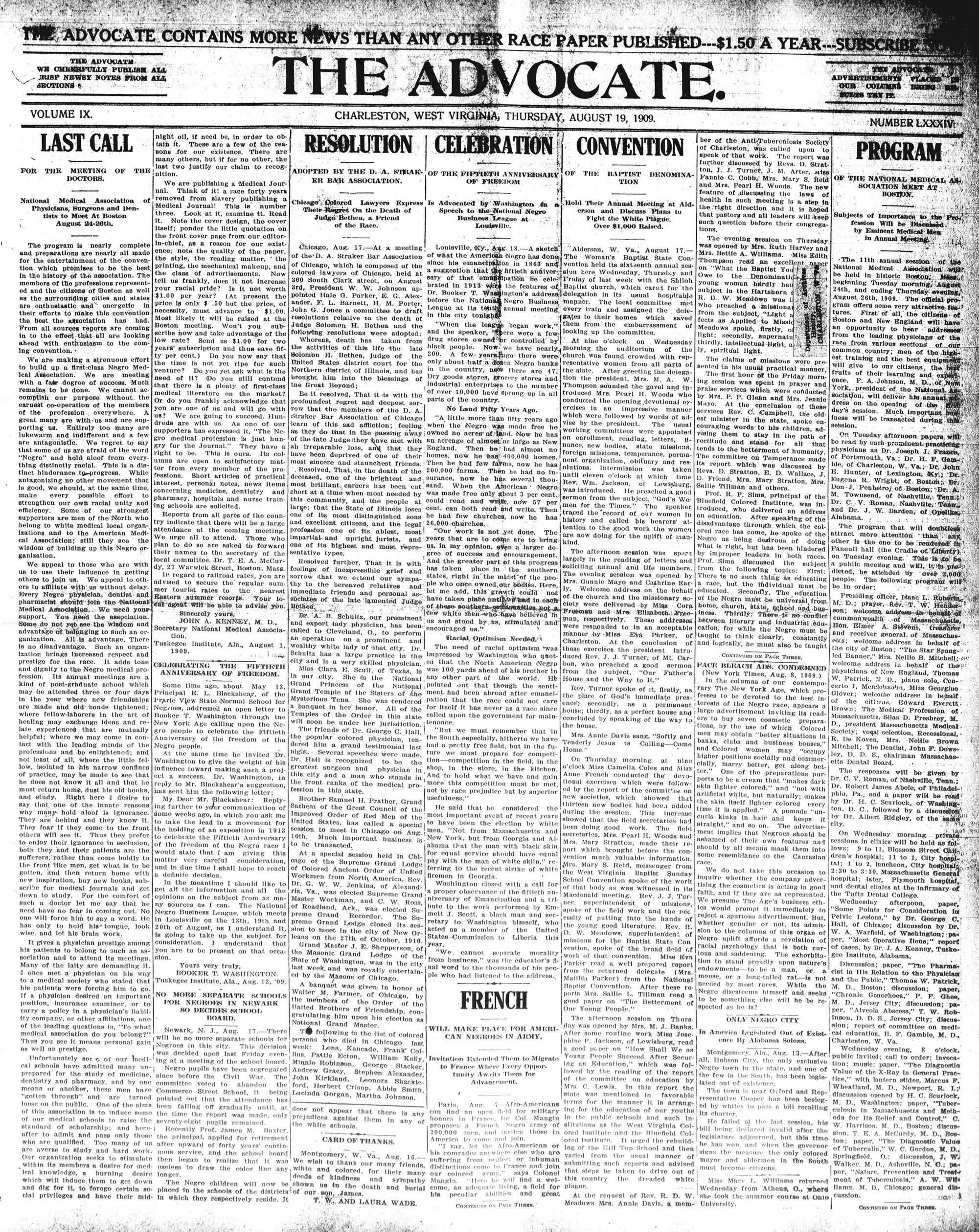
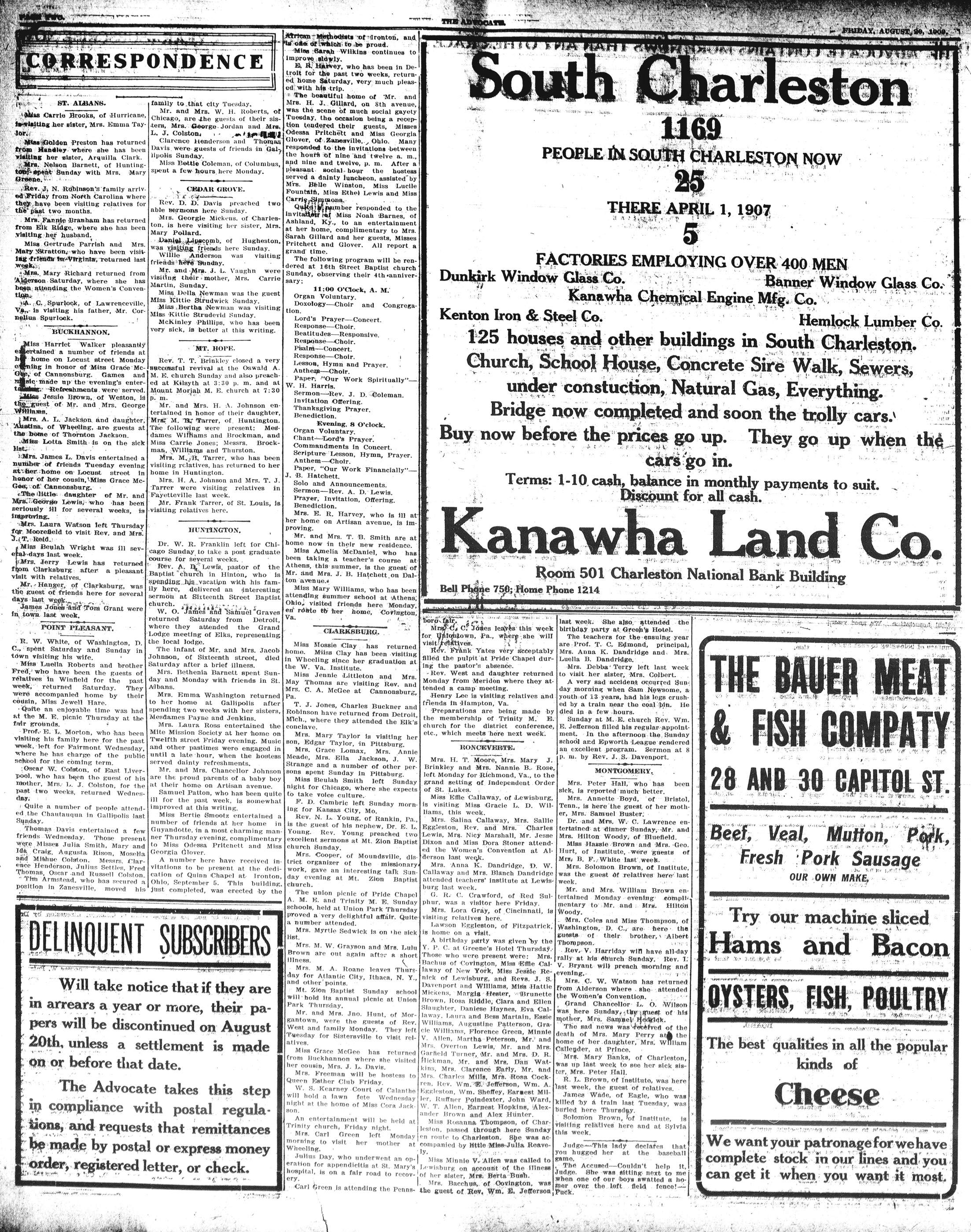
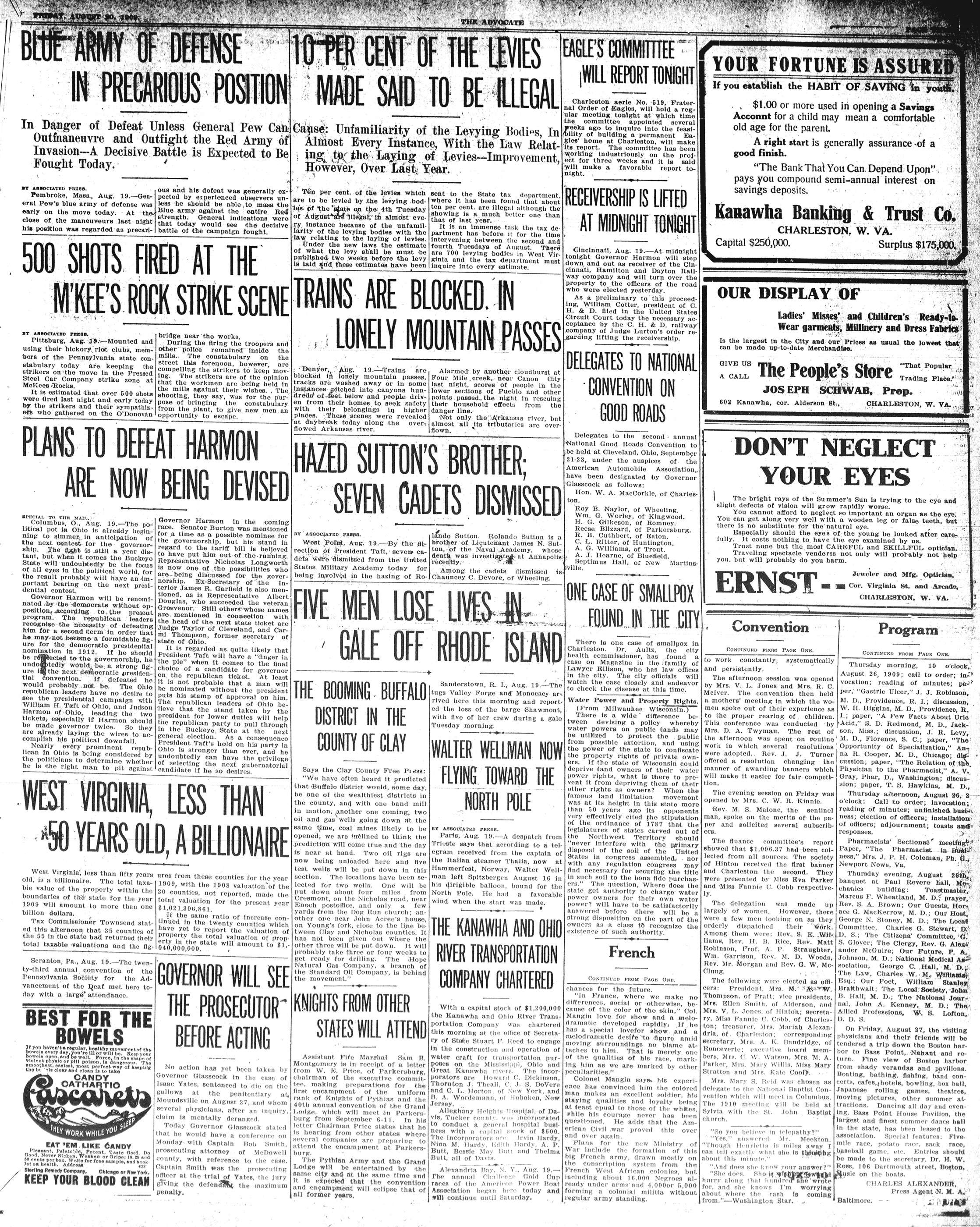
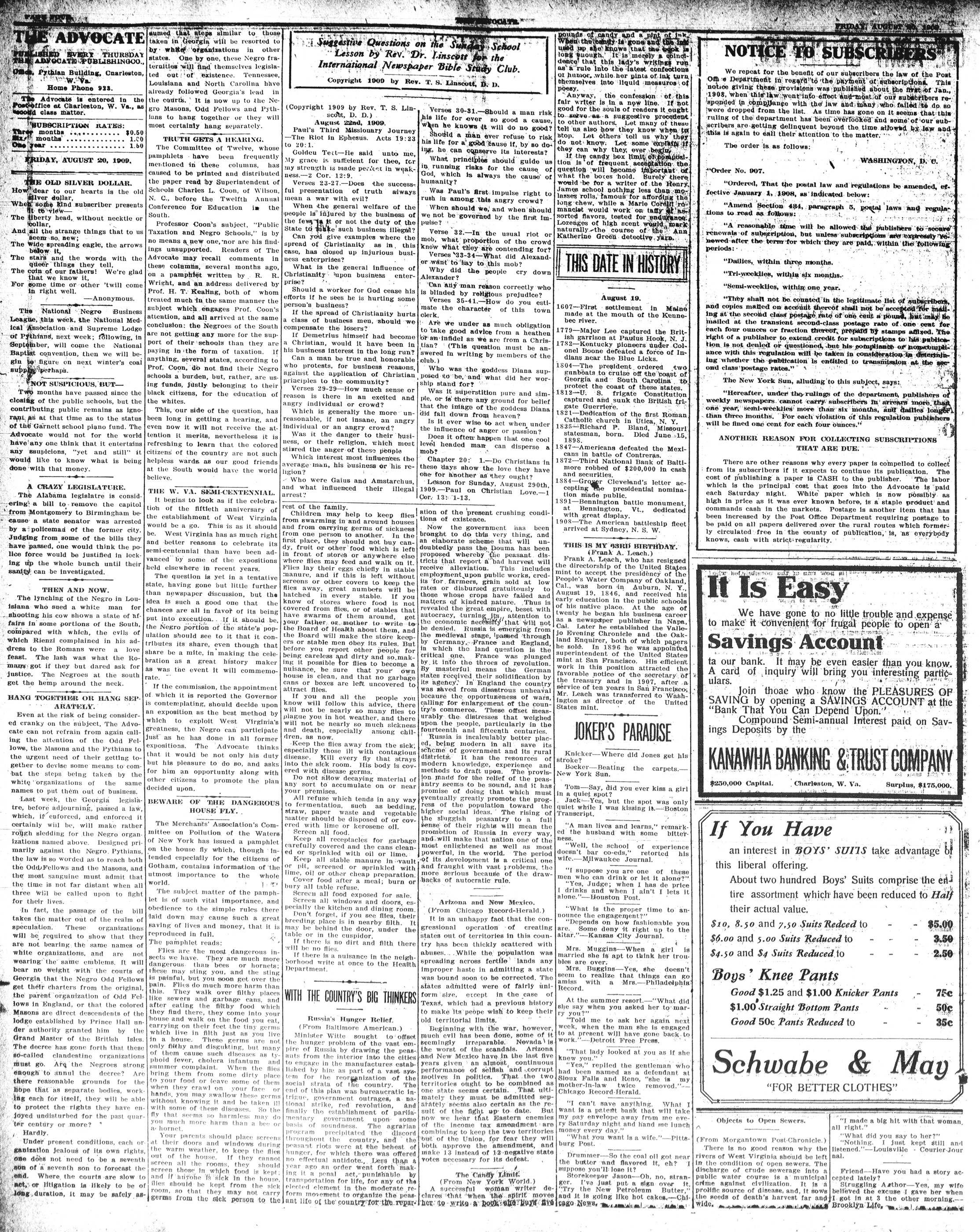
Page text (machine-generated)
THE ADVOCAT
WE CHECKFULLY PUBLISH ALL
RISP NEWSY NOTES FROM ALL
SECTIONS 8.
VOLUME IX.
FOR THE MEETING OF THE DOCTORS.
National Medical Association of Physicians, Surgeons and Dentists to Meet At Boston August 24-26th.
The program is nearly complete and preparations are nearly all made for the entertainment of the convention which promises to be the best in the history of the association. The members of the professions represented and the citizens of Boston as well as the surrounding cities and states are enthusiastic and energetic in their efforts to make this convention the best the association has had. From all sources reports are coming in to the effect that all are looking ahead with enthusiasm to the coming convention.
We are making a strenuous effort to build up a first-class Negro Medical Association. We are meeting with a fair degree of success. Much remains to be done. We cannot accomplish our purpose without the earnest co-operation of the members of the profession everywhere. A great many are with us and are supporting us. Entirely too many are lukewarm and indifferent and a few are antagonistic. We regret to say that some of us are afraid of the word "Negro" and hold aloof from everything distinctly racial. This is a distinct hindrance to progress. While antagonizing no other movement that is good, we should, at the same time, make every possible effort to strengthen our own racial unity and efficiency. Some of our strongest supporters are men of the North who belong to white medical local organizations and to the American Medical Association; still they see the wisdom of building up this Negro organization.
We appeal to those who are with us to use their influence in getting others to join us. We appeal to others to affiliate with us without delay. Every Negro physician, dentist and pharmacist should join the National Medical Association. We need your support. You need the association. Some do not yet see the wisdom and advantage of belonging to such an organization. All is advantage. There is no disadvantage. Such an organization brings increased respect and prestige for the race. It adds tone and dignity to the Negro medical profession. Its annual meetings are a kind of post-graduate school which may be attended three or four days in the year where new friendships are made and old-bonds tightened; where fellow-laborers in the art of healing may exchange ideas and relate experiences that are mutually helpful; where we may come in contact with the leading minds of the professions and be enlightened; and not least of all, where the little fellow, isolated in his narrow confines of practice, may be made to see that he does not know it all and that he must return home, dust his old books, and study. Right here I desire to say that one of the innate reasons why many hold aloof is ignorance. They are behind and they know it. They fear if they come to the front others will see it. Thus they prefer to enjoy their ignorance in seclusion, both they and their patients are the sufferers, rather than come boldly to the front Like men, get what is to be gotten, and then return home with new inspiration, buy new books, subscribe for medical journals and get down to study. For the comfort of such a doctor let me say that he need have no fear in coming out. No one will force him to say a word. He has only to hold his tongue, look wise, and let his brain work.
It gives a physician prestige among his patients to belong to such an association and to attend its meetings. Many of the latty are demanding it. I once met a physician on his way to a medical society who stated that his patients were forcing him to go. If a physician desired an important position, insurance examiner, or to carry a policy in a physician's liability company, or other affiliations, one of the leading questions is, "To what medical association do you belong?" Thus you see it means personal gain as well as prestige.
Unfortunately sor of our medical schools have admitted many unprepared for the study of medicine, dentistry and pharmacy, and by one means or another, these men have "gotten through" and are turned loose on the public. One of the alms of this association is to induce some of our medical schools to raise the standard of scholarship; and here after to admit and pass only those who are qualified. Too many of us are averse to study and hard work. Our organization seeks to stimulate within its members a desire for medical knowledge, a burning desire which will induce them to get down and dig for it, to forego certain social privileges and have their mid
night oil, if need be, in order to obtain it. These are a few of the reasons for our existence. There are many others, but for if no other, the last two justify our claim to recognition.
We are publishing a Medical Journal. Think of it: a race forty years removed from slavery publishing a Medical Journal! This is number three. Look at it, examine it. Read it. Note the cover design, the cover itself; ponder the little quotation on the front cover page from our editor-in-chief, as a reason for our existence; note the quality of the paper, the style, the reading matter, 'the printing, the mechanical makeup, and the class of advertisements. Now tell us frankly, does it not increase your racial pride? Is it not worth $1.00 per year? (At present the price is only $ .50 but the price, of necessity, must advance to $1.00. Most likely it will be raised at the Boston meeting. Won't you subscribe how and take advantage of the low rate? Send us $1.00 for two years' subscription and thus save fifty per cent.) Do you now say that the time is not yet ripe for such venture? Do you yet ask what is the need of it? Do you still contend that there is a plenty of first-class medical literature on the market? Or do you frankly acknowledge that you are one of us and will go with us? We are going to succeed. Hundreds are with us. As one of our supporters has expressed it, "The Negro medical profession is just hungry for the Journal." They have a right to be. This is ours. Its columns are open to satisfactory matter from every member of the professions. Short articles of practical interest, personal notes, news items concerning medicine, dentistry and pharmacy, hospitals and nurse training schools are solicited.
Reports from all parts of the country indicate that there will be a large attendance at the coming meeting. We urge all to attend. Those who plan to do so are asked to forward their names to the secretary of the local committee. Dr. T. E. A. McCurdy, 27 Warwick Street, Boston, Mass. In regard to railroad rates, you are advised to secure the regular summer tourist rates to the nearest Eastern summer resorts. Your local agent will be able to advise you. Sincerely yours, JOHN A. KENNEY, M. D., Secretary National Medical Association. Tuskegee Institute, Ala., August 1, 1909.
CELEBRATING THE FIFTIETH ANNIVERSARY OF FREEDOM.
Some time ago, about May 13, Principal E. L. Blackshear, of the Prarie View State Normal School for Negroes, addressed an open letter to Booker T. Washington through the New York Age calling upon the Negro people to celebrate the Fiftieth Anniversary of the freedom of the Negro people.
At the same time he invited Dr. Washington to give the weight of his influence toward making such a project a success. Dr. Washington, in reply to Mr. Blackshear's suggestion, has sent him the following letter:
My Dear Mr. Blackshear: Replying further to your communication of some weeks ago, in which you ask me to take the lead in a movement for the holding of an exposition in 1913 to celebrate the Fifthth Anniversary of the freedom of the Negro race I would state that I am giving this matter very careful consideration, and in due time I shall hope to reach a definite decision.
In the meantime I should like to get all the information and all the opinions on the subject from as many sources as I can. The National Negro Business League, which meets in Louisville on the 18th, 19th and 20th of August, as I understand it, is going to take up the subject for consideration. I understand that you are to be present on that occasion.
Yours very truly,
BOOKER T. WASHINGTON.
Tuskegee Institute, Ala., Aug. 12. '09.
Newark, N. J., Aug. 17.—There will be no more separate schools for Negroes in this city. This decision was decided upon last Friday evening at a meeting of the school board. Negro pupils have been segregated since before the Civil War. The committee voted to abandon the Commerce Street School, it being pointed out that the attendance has been falling off gradually until, at the time the report was made, only seventy-eight pupils remained. Recently Prof. James M. Baxter, the principal, applied for retirement after upward of forty years' continuous service, and the school board then began to realize that it was useless to draw the color line any longer. The Negro children will now be placed in the schools of the districts in which they respectively reside.
THE ADVOCATE.
CHARLESTON, WEST VIRGINIA, THURSDAY, AUGUST 19, 1909.
RESOLUTION
ADOPTED BY THE D. A. STRAKER BAR ASSOCIATION.
Chicago, Aug. 17.—At a meeting of the D. A. Straker Bar Association of Chicago, which is composed of the colored lawyers of Chicago, held at 260 South Clark street, on August 3rd, President W. W. Johnson appointed Hale G. Parker, E. G. Alexander, F. L. Barnett, H. M. Porter, John G. Jones a committee to draft resolutions relative to the death of Judge Solomon H. Bethea and the following resolutions were adopted: Whereas, death has taken from the activities of this life the late Solomon H. Bethea, judge of the United States district court for the Northern district of Illinois, and has brought him into the blessings of the Great Beyond;
Be it resolved, That it is with the profoundest regret and deepest sorrow that the members of the D. A. Straker Bar Association of Chicago learn of this sad affliction; feeling as they do that in the passing away of the late Judge they have met with ah irreparable loss, and that they have been deprived of one of their most sincere and staunchest friends. Resolved, That, in the death of the deceased, one of the brightest and most brilliant, careers has been cut short at a time when most needed by this community, and the people at large; that the State of Illinois loses one of its most distinguished sons and excellent citizens, and the legal profession one of its ablest, most impartial and upright jurists, and one of its highest and most representative types.
Resolved further. That it is with feelings of inexpressible grief and sorrow that we extend our sympathy to the bereaved relatives and immediate friends and personal associates of the late lamented Judge Bethea.
Dr. A. B. Schultz, our prominent and export lady physician, has been called to Cleveland, O., to perform an operation on a prominent and wealthy white lady of that city. Dr. Schultz has a large practice in the city and is a very skilled physician.
Miss Clara E. Scull, of Texas, is in our city. She is the National Grand Princess of the National Grand Temple of the Sisters of the Mysterious Tens. She was tendered a banquet in her honor. All of the Temples of the Order in this state will soon be under her jurisdiction.
The friends of Dr. George C. Hall, the popular colored physician, tendered him a grand testimonial last night. Several speeches were made. Dr. Hall is recognized to be the greatest surgeon and physician in this city and a man who stands in the front ranks of the medical profession in this state.
Brother Samuel H. Prather, Grand Sachem of the Great Council of the Improved Order of Red Men of the United States, has called a special session to meet in Chicago on Aug. 10th. Much important business is to be transacted.
At a special session held in Chicago of the Supreme Grand Lodge of Colored Ancient Order of United Workmen from North America, Rev. Dr. G. W. W. Jenkins, of Alexandria, Va., was elected Supreme Grand Master Workman, and C. W. Ross, of Roadland, Ark., was elected Supreme Grand Recorder. The Supreme Grand Lodge closed its session to meet in the city of New Orleans on the 27th of October, 1910. Grand Master J. E. Shepperson, of the Masonic Grand Lodge of the State of Washington, was in the city last week, and was royally entertained by the Masons of Chicago.
A banquet was given in honor of Walter M. Farmer, of Chicago, by the members of the Order of the United Brothers of Friendship, congratulating him upon his election as National Grand Master.
The following is the list of colored persons who died in Chicago last week: Lena, Kancade, Frank Collins, Pattie Ecton, William Kelly, Minnie Robinson, George Stacker, Andrew Gracy, Stephen Alexander, John Kirkland, Leonora Shackleford, Herbert Crisup, Abbie Smith, Lucinda Gorgan, Martha Johnson.
does not appear that there is any prejudices against them in any of the white schools.
CARD OF THANKS.
Montgomery, W. Va., Aug. 16.—We wish to thank our many friends, white and colored, for their many deeds of kindness and sympathy shown us in the death and burial of our son, James.
T. W. AND LAURA WADE
OF THE FIFTIETH ANNIVERSARY OF FREEDOM
Is Advocated by Washington in a Speech to the National Negro Business League at Louisville.
Louisville, Ky., Aug. 18.—A sketch of what the American Negro has done since his emancipation in 1863 and a suggestion that the fiftieth anniversary of that emancipation be celebrated in 1913 were the features of Dr. Booker T. Washington's address before the National Negro Business League at its tenth annual meeting in this city tonight.
"When the league began work," and the speaker, "there were a few drug stores owned or controlled by black people. Now we have nearly 200. A few years ago there were only about half a dozen Negro banks in the country, new there are 47. Dry goods stores, grocery stores and industrial enterprises to the number of over 10,000 have sprung up in all parts of the country.
No Land Fifty Years Ago.
"A little more than fifty years ago when the Negro was made free he owned no acres of land. Now he has an acreage of almost as large as New England. Then he had almost no homes, now he has 400,000 homes. Then he had few farms, now he has 200,000 farms. Then he had no insurance, now he has several thousand. When the American Negro was made free only about 3 per cent. could read and write, now 57 per cent. can both read and write. Then he had few churches, now he has 26,000 churches.
"Our work is not yet done. The years that are to come are to bring us, in my opinion, even a larger degree of success and encouragement. And the greater part of this progress has taken place in the southern states, right in the midst of the people who once owned, our bodies. Here, let me add, this growth could not have taken place until we and in each of these southern communities not a few white men who have believed in us and stood by us, stimulated and encouraged us."
Racial Optimism Needed.
The need of racial optimism was impressed by Washington who quoted that the North American Negro was 100 yards ahead of his brother in any other part of the world. He pointed out that through the sentiment had been abroad after emancipation that the race could not care for itself it has never as a race since called upon the government for maintenance.
"But we must remember that in the South especially, hitherto we have had a pretty free field, but in the future we must prepare for competition—competition in the field, in the shop, in the store, in the kitchen. And to hold what we have and gain more this competition must be met, not by race prejudice but by superior usefulness."
He said that he considered the most important event of recent years to have been the election by white men, "Not from Massachusetts and New York, but from Georgia and Alabama that the man with black skin for equal service should have equal pay with the man of white skin," referring to the recent strike of white firemen in Georgia.
Washington closed with a call for a proper observance of the fiftieth anniversary of Emancipation and a tribute to the work performed by Emmett J. Scott, a black man and secretary to Washington himself, who acted as a member of the United States-Commission to Liberia this year.
"We cannot separate morality from business," was the educator's final word to the thousands of his people who had listened to the address.
FRENCH
WILL MAKE PLACE FOR AMERICAN NEGROES IN ARMY.
Invitation Extended Them to Migrate to France Where Every Opportunity Awaits Them for Advancement.
Paris, Aug. 7 — Afro-Americans can find an open field for military honors in France, for Col. Manglin proposes a French Negro army of 200,000 men, and invites those in America to come and join.
"I say, let the Afro-American or his comrades anywhere else who are suffering from neglect or inhuman distinctions come to France and join our colored army," says Colonel Manglin.
"Here he will find a welcome, an adequate living, a field for his peculiar abilities and great CONTINUE ON PAGE THIRTEE."
CONVENTION
Hold Their Annual Meeting at Alderson and Discuss Plans to Fight the White Pigue.
Over $1,000 Raised.
Alderson, W. Va., August 17.—The Woman's Baptist State Convention held its sixteenth annual session here Wednesday, Thursday and Friday of last week with the Shiloh Baptist church, which cared for the delegation in its usual hospitable manner. The local committee met every train and assigned the delegates to their homes which saved them from the embarrassment of looking up the committee.
At nine o'clock on Wednesday morning the auditorium of the church was found crowded with representative women from all parts of the state. After greeting the delegation the president, Mrs. M. A. W. Thompson sounded the gavel and introduced Mrs. Pearl H. Woods who conducted the opening devotional exercises in an impressive manner which were followed by words of adlise by the president. The usual working committees were appointed on enrollment, reading, letters, finance, new bodies, state missions, foreign missions, temperance, permanent organization, oblity and resolutions. Intermission was taken until eleven o'clock at which time Rev. Wm. Jackson, of Lewisburg, was introduced. He preached a good sermon from the subject, "God's Women for the Times." The speaker traced the 'record of our women in history and called his 'hearers' attention to the good work the women are now doing for the uplift of mankind.
The afternoon session was sports largely in the reading of letters and soliciting annual and life members. The evening session was opened by Mrs. Gunnie Mayo and Cathrine Early. Welcome address on the behalf of the church and the missionary society were delivered by Miss Cora Freeman and Mrs. Elizabeth Freeman, respectively. These addresses were responded to in an acceptable manner by Miss Eva Parker, of Charleston. At the conclusion of these exercises the president introduced Rev. J. J. Turner, of Mt. Carbon, who preached a good sermon from the subject, "Our Father's House and the Way to It." Rev. Turner spoke of it, firstly, as the place of God's immediate presence; secondly, as a permanent house; thirdly, as a perfect house and concluded by speaking of the way to the house.
Mrs. Annie Davis sang, "Softly and Tenderly Jesus is Calling—Come Home."
On Thursday morning at nine o'clock Miss Camelia Coles and Miss Anne French conducted the devotional exercises which were followed by the report of the committee on new societies, which showed that thirteen new bodies had been added during the session. This increase showed that the field secretaries had been doing good work. The field secretaries, Mrs. Pearl H. Woods and Mrs. Mary Stratton, made their report which brought before the convention much valuable information. Mrs. Mary S. Reid, messenger from the West Virginia Baptist Sunday School Convention spoke of the work of that body as was witnessed in its Macdonald meeting. Rev. J. J. Turner, superintendent of missions, spoke of the field work and the necessity of putting into the hands of the young good literature. Rev. R. D. W. Meadows, superintendent of missions for the Baptist State Convention, spoke of the broad field of work of that convention. Miss Eva Parker read a well prepared report from the returned delegate (Mrs. Matilda Parker) from the National Baptist Convention. After these reports Mrs. Sallie L. Tillman read a good paper on "The Betterment of Our Young People."
The afternoon session on Thursday was opened by Mrs. M. J. Banks. After some routine work Miss Josephine P. Jackson, of Lewisburg, read a good paper on "How Shall We as Young People Succeed After Securing an Education," which was followed by the reading of the report of the committee on education by Mrs. C. Lewis. In this report the state was mentioned in favorable terms for the manner it is arranging for the education of our youths. In the public schools and such institutions as the West Virginia Colored Institute and the Bluefield Colored Institute. It urged the rebuilding of the Hill Top School and then varied from the usual manner of submitting such reports and advised that steps be taken to drive out of this country the dreaded white plague.
At the request of Rev. R. D. W. Meadows Mrs. Annie Davis, a mem-
ber of the AntiTuberculosis Society of Charleston, was called upon to speak of that work. The report was further discussed by Revs. D. Stratton, J. J. Turner, J. M. Arter, miss Fannie C. Cobb, Mrs. Mary S. Reid and Mrs. Pearl H. Woods. The new feature of discussing the laws of health in such meeting is a step in the right direction and it is hoped that pastors and all leaders will keep such question before their congregations.
The evening session on Thursday was opened by Mrs. Ruth Harvey and Mrs. Bettie A. Williams. Miss Edith Thompson read an excellent paper on "What the Baptist You Owe to the Denomination young woman hardly had subject in the Hartshorn s R. D. W. Mendows was l i e who preached a missionary from the subject, "Light afects as Applied to Mission Mendows spoke, firstly, of light; secondly, supernatural thirdly, intellectual light, ally, spiritual light.
The claims of missions were presented in his usual practical manner. The first hour of the Friday morning session was spent in prayer and praise services which were conducted by Mrs. P. P. Glenn and Mrs. Jennie Mayo. At the conclusion of these services Rev. C. Campbell, the oldest minister in the state, spoke encouraging words to his children, advising them to stay in the path of rectitude and stand for all that tends to the betterment of humanity. The committee on Temperance made its report which was discussed by Revs. D. Stratton, E. D. Wallace, J. D. Friend, Mrs. Mary Stratton, Mrs. Sallie Tillman and others.
Prof. R. P. Sims, principal of the Bluefield Colored Institute, was introduced, who delivered an address on education. After speaking of the disadvantage through which the colored race has come, he spoke of the Negro as being doxrous of doing what is right, but has been hindered by improper leaders in both races. Prof. Sims discussed the subject from the following topics: First: There is no such thing as educating a race, but the individual must be educated. Secondly. The education of the Negro must be universal from home, church, state school and business. Thirdly: There is no conflict between literary and industrial education, for while the Negro must be taught to think clearly, constantly and logically, he must also be taught
CONTINUED ON PAGE THREE
(New York Times, Aug. 8, 1909.) In the columns of our contemporary The New York Age, which professes to be devoted to the best interests of the Negro race, appears a large advertisement inviting its readers to buy seven cosmetic preparations, by the use of which Colored men may obtain "better situations in banks, clubs and business houses," and Colored women may "occupy higher positions socially and commercially, marry better, get along better." One of the preparations purports to be a cream that "makes dark skin lighter colored," and "not with artificial white, but naturally; makes the skin itself lighter colored every time it is applied." A pomade "uncurls kinks in hair and keeps it straight," and so on. The advertisement implies that Negroes should be ashamed of their own features and should by all means mask them into some resemblance to the Caucasian race.
We do not take this occasion to inquire whether the company advertising the cosmetics is acting in good faith, and if they are as represented. We presume The Age's business ethics would prompt it immediately to reject a spurious advertisement. But, whether genuine or not, its admission to the columns of this organ of Negro uplift affords a revelation of racial psychology that is both curious and saddening. The exhilaration to stand proudly upon nature's endowments—to be a man, or a mouse, or a long-tailed rat—is not needed by most races. While the Negro disesteems himself and seeks to be something else will he be respected as he is?
ONLY NEGRO CITY
In America Legislated Out of Existence By Alabama Solons.
Montgomery, Ala., Aug. 13.—After all, Hobson City, the only exclusive Negro town in the state, and one of the few in the South, has been legislated out of existence.
The town is near Oxford and Representative Cooper has been besieged by whites to pass a bill recalling its charter.
He failed at the last session, his bill being declared invalid after the legislature adjourned, but this time he has won, and when the governor signs the measure the only colored mayor and aldermen in the South must become citizens.
Miss Mary L. Williams returned Wednesday from Athens, O., where she took the summer course at Onto University.
Subjects of Importance to the
fession Will be Discussed
by Eminent Medical Men
in Annual Meeting.
The 11th annual session of the National Medical Association will be held in historic Boston; Mass. beginning Tuesday morning, August 24th, and ending Thursday evening, August 26th, 1909. The official program offers some very attractive features. First of all, the citizens of Boston and New England will have an opportunity to hear addresses from the leading physicians of the race from various sections of our common country; men of the highest training and the best equipment will give to our citizens, the best fruits of their learning and experience, P. A. Johnson, M. D., of New York, president of the National Association, will deliver his annual address on the opening of the first day's session. Much important business will be transacted during this session.
On Tuesday afternoon paper will be read by cush prominent practicing physicians as Dr. Joseph J. France, of Portsmouth, Va.; Dr. H. F. Gamble, of Charleston, W. Va.; Dr. John E. Hunter, of Lexington, Ky.; Dr. Eugene R. Wright, of Boston; Dr. Don-J. Penhelroi, of Boston; Dr. A. M. Townsend, of Nashville; Penn; Dr. C. V. Roman, Nashville; Penn; and Dr. J. W. Darden, of Opelika, Alabama.
The program that will doublet attract more attention than any other is the one to be rendered in Faneull hall (the Cradle of Liberty) on Tuesday evening. This is to be a public meeting and will, it is predicted, be attended by over 2,000 people. The following program will be in order:
Presiding officer, Isaac L. Roberts, M. D.; prayer, Rev. T. W. Henderson; welcome address in behalf of commonwealth of Massachusetts, Hon. Elmer A. Stevens, treasurer and receiver general of Massachusetts; welcome address in behalf of the city of Boston; "The Star Spangled Banner," Mrs. Nellie B. Mitchell; welcome address in behalf of the physicians of New England, Thomas W. Patrick, M. D.; piano solo, Concerto J. Mendelssohn, Miss Georgine Glover; welcome address in behalf of the citizens, Edward Everett Brown; The Medical Profession of Massachusetts, Silas D. Presbrey, M. D., president Massachusetts Medical Society; voqal selection, Recessional, R. De Koven, Mrs. Nellie Brown Mitchell; The Dentist, John F. Dowsley, D. D. S., chairman Massachusetts Dental Board.
The responses will be given by Dr. C. V. Roman, of Nashville, Tenn.; Dr. Robert James Abele, of Philadelphia, Pa., and a paper will be read by Dr. H. C. Scurlock, of Washington, D. C., followed by a discussion by Dr. Albert Ridgley, of the same city.
On Wednesday morning private sessions in clinics will be held as follows: 9 to 11, Blossom Street Children's hospital; 11 to 1, City hospital; 1 to 2, luncheon, City hospital; 2:30 to 3:30, Massachusetts General hospital; later, Plymouth hospital, and dental clinics at the infirmary of the Tufts Dental College.
Wednesday afterpart, paper, "Some Points for Consideration in Pelvic Lesions," by Dr. George C. Hall, of Chicago; discussion by Dr. W. A. Warfield, of Washington; paper, "Most Operative Ileus," report of cases, by Dr. J. A. Kenney, Tuskegee Institute, Alabama.
Discussion; paper, "The Pharmacist in His Relation to the Physician and the Public," Thomas W. Patrick, M. D., Boston; discussion; paper, "Chronic Gonorrhoea," P. F. Ghee, M. D. Jersey City; discussion; paper, "Alveola Abscess," T. W. Robinson, D. D. S. Jersey City; discussion; report of committee on medical education, H. F. Gamble, M. D., Charleston, W. Va.
Wednesday evening, 8 o'clock, public invited; call to order; invocation; music; paper, "The Diagnostic Value of the X-Ray in General Practice," with lantern slides, Marcus F. Wheatland, M. D., Newport, R. L.; discussion opened by H. C. Scurlock, M. D. Washington; paper, "Tuberculosis in Massachusetts and Methods for Its Relief and Control," C. W. Harrison, M. D., Boston; discussion, T. E. A. McCurdy, M. D., Boston; paper, "The Diagnostic Value of Tuberculin," W. C. Gordon, M. D., Springfield, O.; discussion, J. W. Walker, M. D., Asheville, N. C.; paper, "Nature, Prevention and Treatment of Tuberculosis," A. W. Williams, M. D., Chicago; general discussion.
CONTINUED ON PAGE THREE.
Will take notice that if they are in arrears a year or more, their papers will be discontinued on August 20th, unless a settlement is made on or before that date.
The Advocate takes this step in compliance with postal regulations, and requests that remittances be made by postal or express money order, registered letter, or check.
ST. ALBANS.
Miss Carrie Brooks, of Hurricane, is visiting her sister, Mrs. Emma Taylor.
Miss Golden Preston has returned from Handley where she has been visiting her sister, Arquilla Clark.
Mrs. Nelson Barnett, of Huntington, spent Sunday with Mrs. Mary Greene.
Rev. J. N. Robinson's family arrived Friday from North Carolina where they have been visiting relatives for the past two months.
Mrs. Fannie Branham has returned from Elk Ridge, where she has been visiting her husband.
Miss Gertrude Parrish and Mrs. Mary Stratton, who have been visiting friends in Virginia, returned last week.
Mrs. Mary Richard returned from Alderson Saturday, where she has been attending the Women's Convention.
A. C. Spurlock, of Lawrenceville, Va., is visiting his father, Mr. Cornellus Spurlock.
BUCKHANNON.
Miss Harriet Walker pleasantly entertained a number of friends at her home on Locust street Monday evening in honor of Miss Grace McGhee, of Cannonsburg. Games and music made up the evening's entertaining. Refreshments were served.
Miss Jessie Brown, of Weston, is the guest of Mr. and Mrs. George Williams.
Mrs. A. L. Jackson and daughter, Austin, of Wheeling, are guests at the home of Thornton Jackson.
Miss Lotta Smith is on the sick list.
Mrs. James L. Davis entertained a number of friends Tuesday evening at her home on Locust street in honor of her cousin, Miss Grace McGee, of Cannonsburg.
The little daughter of Mr. and Mrs. George Lewis, who has been seriously ill for several weeks, is improving.
Mrs. Laura Watson left Thursday for Moorefield to visit Rev. and Mrs. J. T. Reid.
Miss Beulah Wright was ill several days last week.
Mrs. Jerry Lewis has returned from Clarksburg after a pleasant visit with relatives.
Mr. Hanger, of Clarksburg, was the guest of friends here for several days last week.
James Jones and Tom Grant were in town last week.
POINT PLEASANT.
R. W. White, of Washington, D. C., spent Saturday and Sunday in town visiting his wife.
Miss Luella Roberts and brother Fred, who have been the guests of relatives in Winfield for the past week, returned Saturday. They were accompanied home by their cousin, Miss Jewell Hare.
Quite an enjoyable time was had at the M. E. picnic Thursday at the fair grounds.
Prof. E. L. Morton, who has been visiting his family here for the past week, left for Fairmont Wednesday, where he has charge of the public school for the coming term.
Oscar W. Colston, of East Liverpool, who has been the guest of his mother, Mrs. L. J. Colston, for the past two weeks, returned Wednesday.
Quite a number of people attended the Chautauqua in Gallipolis last Sunday.
Thomas Davis entertained a few friends Wednesday. Those present were Misses Julia Smith, Mary and Ida Craig, Augusta Rison, Mosella and Mithue Colston, Messrs. Clarence Henderson, Julius Settles, Fred Thomas, Oscar and Russell Colston.
Tim Armstead, who has secured a position in Zanesville, moved his
family to that city Tuesday.
Mr. and Mrs. W. H. Roberts, of
Chicago, are the guests of their si-
sisters, Mrs. George Jordan and Mrs.
L. J. Colston.
Clarence Henderson and Thomas
Davis were guests of friends in Gal-
ilapolis Sunday.
Miss Bottle Coleman, of Columbus,
spent a few hours here Monday.
Rev. D. D. Davis preached two able sermons here Sunday.
Mrs. George Mickens, of Charleston, is here visiting her sister, Mrs. Mary Pollard.
Daniel Lippcomb, of Hugheston, was visiting friends here Sunday.
Mr. and Mrs. J. L. Vaughn were visiting their mother, Mrs. Carrie Martin, Sunday.
Miss Della Newman was the guest Miss Kittie Strudwick Sunday.
Miss Bertha Newman was visiting Miss Kittie Strudevid Sunday.
McKinley Phillips, who has been very sick, is better at this writing.
Rev. T. T. Brinkley closed a very successful revival at the Oswald A. M. E. church Sunday and also preached at Kilsyth at 3:30 p. m. and at Mount Moriah M. E. church at 7:30 p. m.
Mr. and Mrs. H. A. Johnson entertained in honor of their daughter, Mrs. M. B. Tarrer, of Huntington. The following were present: Mesdames Williams and Brockman, and Miss Carrie Jones; Messrs. Brockman, Williams and Thurston.
Mrs. M. B. Tarrer, who has been visiting relatives, has returned to her home in Huntington.
Mrs. H. A. Johnson and Mrs. T. J. Tarrer were visiting relatives in Fayetteville last week.
Mr. Frank Tarrer, of St. Louis, is visiting relatives here.
Dr. W. R. Franklin left for Chicago Sunday to take a post graduate course for several weeks.
Rev. A. D. Lewis, pastor of the Baptist church in Hinton, who is spending his vacation with his family here, delivered an interesting sermon at Sixteenth Street Baptist church.
W. O. James and Samuel Graves returned Saturday from Detroit, where they attended the Grand Lodge meeting of Elks, representing the local lodge.
The infant of Mr. and Mrs. Jacob Johnson, of Sixteenth street, died Saturday after a brief illness.
Mrs. Bethenia Barnett spent Sunday and Monday with friends in St. Albans.
Mrs. Emma Washington returned to her home at Gallipolis after spending two weeks with her sisters, Mesdames Payne and Jenkins.
Mrs. Laura Ross entertained the Mite Mission Society at her home on Twelfth street Friday evening. Music and other pastimes were engaged in until a late hour, when the hostess served dainty refreshments.
Mr. and Mrs. Chancellor Johnson are the proud parents of a baby boy at their home on Arbisan avenue.
Samuel Patton, who has been quite ill for the past week, is somewhat improved at this writing.
Miss Bertie Smootz entertained a number of friends at her home in Guyandotte, in a most charming manner Thursday evening, complimentary to Miss Odessa Pritchnett and Miss Georgia Glover.
A number here have received invitations to be present at the dedication of Quinn Chapel at Ironton, Ohio, September 5. This building, just completed, was erected by the
SUBSCRIBERS
tice that if they are or more, their p- antinued on August settlment is made date.
te takes this step with postal regula- s that remittances or express money letter, or check.
BERS
they are
air pa-
ugust
made
step
regula-
ances
money
ck.
7
CEDAR GROVE
MT. HOPE
HUNTINGTON.
African Methodists of Tronton, and is one of which to be proud.
Miss Sarah Wilkins continues to improve slowly.
E. R. Harvey, who has been in Detroit for the past two weeks, returned home Saturday, very much pleased with his trip.
The beautiful home of Mr. and Mrs. H. J. Gillard, on 8th avenue, was the scene of much social gayety Tuesday, the occasion being a reception tendered their guests, Misses Odessa Pritchett and Miss Georgia Glover, of Zanesville, Ohio. Many responded to the invitations between the hours of nine and twelve a. m., and nine and twelve, p. m. After a pleasant social hour the hostess served a dainty luncheon, assisted by Mrs. Belle Winston, Miss Lucile Fountain, Miss Ethel Lewis and Miss Carrie Simmons.
Quintet number responded to the invitation of Miss Noah Barnes, of Ashland, Ky., to an entertainment at her home, complimentary to Mrs. Sarah Gillard and her guests, Misses Pritchett and Glover. All report a grand time.
The following program will be rendered at 16th Street Baptist church Sunday, observing their 4th anniversary:
11:00 O'Clock, A. M.
Organ Voluntary.
Doxology—Choir and Congregation.
Lord's Prayer—Concert.
Lesson, Hymn and Prayer.
Anthem—Choir.
Paper, "Our Work Spiritually"—
W. H. Harris.
Benediction.
Evening, 8 O'clock.
Organ Voluntary.
Chant—Lord's Prayer.
Commandments in Concert.
Scripture Lesson, Hymn, Prayer.
Anthem—Choir.
Paper, "Our Work Financially"—
J. B. Hatchett.
Solo and Announcements.
Sermon—Rev. A. D. Lewis.
Prayer, Invitation, Offering.
Benediction.
Mrs. E. R. Harvey, who is ill at
her home on Artisan avenue, is im-
proving.
Mr. and Mrs. T. B. Smith are at
home now in their new residence.
Miss Amelia McDaniel, who has
been taking a teacher's course at
Athens, this summer, is the guest of
Mr. and Mrs. J. B. Hatchett on Dalton
avenue.
Miss Mary Williams, who has been attending summer school at Athens, Ohio, visited friends here Monday, en route to her home, Covington, Va.
CLARKSBURG.
Miss Mossie Clay has returned home. Miss Clay has been visiting in Wheeling since her graduation at the W. Va. Institute.
Miss Jennie Littleton and Mrs. May Thomas are visiting Rev. and Mrs. C. A. McGee at Cannonsburg, Pa.
T. J. Jones, Charles Buckner and Robinson have returned from Detroit, Mich., where they attended the Elk's conclave.
Mrs. Mary Taylor is visiting her son, Edgar Taylor, in Pittsburgh
Miss Beulah Smith left Sunday night for Chicago, where she expects to take voice culture.
F. D. Cambric left Sunday morning for Kansas City, Mo.
Rev. N. L. Young, of Rankin, Pa., is the guest of his nephew, Dr. E. L. Young. Rev. Young preached two excellent sermons at Mt. Zion Baptist church Sunday.
Mrs. Cooper, of Moundsville, district organizer of the missionary work, gave an interesting talk Sunday evening at Mt. Zion Baptist church.
The union picnic of Pride Chapel A. M. E. and Trinity M. E. Sunday schools, held at Union Park Thursday proved a very delightful affair. Quite a number attended.
Mrs. Myrtle Sedwick is on the sick list.
Mrs. M. W. Grayson and Mrs. Lulu Brown are out again after a short illness.
Mrs. M. A. Roane leaves Thursday for Atlantic City, Ithaca, N. Y., and other points.
Mt. Zion Baptist Sunday school will hold its annual picnic at Union Park Thursday.
Mr. and Mrs. Jno. Hunt, of Morgantown, were the guests of Rev. West and family Monday. They left Tuesday for Sistersville to visit relatives.
Miss Grace McGee has returned from Buckhannon where she visited her cousin, Mrs. J. L. Davis.
Mrs. Freeman will be hostess to Queen Esther Club Friday.
W. S. Kearney Court of Calanthe will hold a lawn fete Wednesday night at the home of Miss Cora Jackson.
An entertainment will be held at Trinity church, Friday night. Mrs. Carl Green left Monday morning to visit her mother at Wheeling. Julius Day, who underwent an operation for appendicitis at St. Mary's hospital, is on a fair road to recovery. Carl Green is attending the Penns
South Charleston
FACTORIES EMPLOYING OVER 400 MEN Dunkirk Window Glass Co. Banner Window Glass Co. Kanawha Chemical Engine Mfg. Co.
Terms: 1-10 cash, balance in monthly payments to suit. Discount for all cash.
boro fair.
Mrs. C. C. Jones leaves this week for Uptontown, Pa., where she will visit relatives.
Rev. Frank Yates very acceptably filled the pulpit at Pride Chapel during the pastor's absence.
Rev. West and daughter returned Monday from Meriden where they attended a camp meeting.
Henry Lee is visiting relatives and friends in Hampton, Va.
Preparations are being made by the membership of Trinity M. E church for the district conference etc., which meets here next week.
RONCEVERTE.
Mrs. H. T. Moore, Mrs. Mary J. Brinkley and Mrs. Nannie B. Rose, left Monday for Richmond, Va., to the grand setting of Independent Order of St. Lukes.
Miss Effie Callaway, of Lewisburg, is visiting Miss Gracie L. D. Williams, this week.
Mrs. Salina Callaway, Mrs. Sallie Eggleston, Rev. and Mrs. Charles Lewis, Mrs. Nicy Marshall, Mr. Jesse Dixon and Miss Dora Stoner attended the Women's Convention at Alderson last week.
Mrs. Anna K. Dandridge, D. W. Callaway and Mrs. Blanch Dandridge attended teachers' institute at Lewisburg last week.
G. R. C. Crawford, of Red Sulphur, was a visitor here Friday.
Mrs. Lora Gray, of Cincinnati, is visiting relatives here.
Lawson Eggleston, of Fitzpatrick, is home on a visit.
A birthday party was given by the Y. P. C. at Greene's Hotel Thursday. Those who were present were: Mrs. Bachus of Covington, Miss Effie Calaway of New York, Miss Jessie Renick of Lewisburg, and Revs. J. S. Davenport and Williams, Miss Hattie Mickens, Margia Hester, Brunette Brown, Rosa Riddle, Clara and Ellen Slaughter, Daniese Haynes, Eva Callaway, Laura and Bess Mastain, Essie Williams, Augustine Patterson, Gracie Williams, Florence Green, Minnie V. Allen, Martha Peterson, Mr.' and Mrs. Overton Lewis, Mr. and Mrs. Garfield Turner, Mr. and Mrs. D. R. Hickman, Mr. and Mrs. Dan Watkins, Mrs. Clarence Early, Mr. and Mrs. Charles Mills, Mrs. Rosa Cockren, Rev. Wm. E. Jefferson, Wm. A. Eggleston, Wm. Sheffey, Earnest Miller, Ruffner Poindexter, John Ward, W. T. Allen, Earnest Hopkins, Alexander Brown and Alex Hunter.
Miss Rosanna Thompson, of Charleston, passed through here Sunday en route to Charleston. She was accompanied by Httle Miss Julia Reaveley.
Miss Minnie V. Allen was called to Lewishburg on account of the illness of her sister, Mrs. Berta Bush.
Mrs. Bacchus, of Covington, was the guest of Rev. Wm. E. Jefferson
THERE APRIL 1,1907
ACTORIES EMPLOYE
w Glass Co.
Kanawha Chemjc
steel Co.
es and other buil
school House, Co
or construction, Na
now completed a
ore the prices go
cars g
1-10 cash, balance i
Discount f
awha
room 501 Charleston
phone 1214
MES EMPLOYING OVER
Co. B
wha Chemical Engine M
other buildings in S
House, Concrete Sir
duction, Natural Gas
completed and soon t
e prices go up. Th
cars go in.
ash, balance in monthly p
Discount for all cash.
wha La
Charleston National Bank
Room 501 Charleston National Bank Building
last week. She also attended the birthday party at Green's Hotel. The teachers for the ensuing year are Prof. T. C. Edmond, principal, Mrs. Anna K. Dandridge and Mrs. Luella B. Dandridge. Mrs. Debba Terry left last week to visit her sister, Mrs. Colbert. A very sad accident occurred Sunday morning when Sam Newsome, a youth of 13 years, had his legs crushed by a train near the coal bin. He died in a few hours. Sunday at M. E. church Rev. Wm. E. Jefferson filled his regular appointment. In the afternoon the Sunday school and Epworth League rendered an excellent program. Sermon at 8 p. m. by Rev. J. S. Davenport.
MONTGOMERY.
Mrs. Peter Hall, who has been sick, is reported much better.
Mrs. Annette Boyd, of Bristol, Tenn., is here the guest of her mother, Mrs. Samuel Buster.
Dr. and Mrs. W. C. Lawrence entertained at dinner Sunday, Mr. and Mrs. Hilton Woody, of Bluefield.
Miss Hassie Brown and Mrs. Geo. Hurt, of Institute, were guests of Mrs. B. F. White last week.
Mrs. Solomon Brown, of Institute, was the guest of relatives here last week.
Mr. and Mrs. William Brown entertained Monday evening complimentary to Mr. and Mrs. Hilton Woody.
Mrs. Coles and Miss Thompson, of Washington, D. C., are here the guests of their brother, Albert Thompson.
Rev. V. Harriday will have all-day rally at his church Sunday. Rev. I. V. Bryant will preach morning and evening.
Mrs. C. W. Watson has returned from Alderson where she attended the Women's Convention.
Grand Chancellor L. O. Wilson was here Sunday, the guest of his mother, Mrs. Samuel Hedrick.
The sad news was received of the death of Mrs. Mary Perry at the home of her daughter, Mrs. William Callender, at Prince.
Mrs. Mary Banks, of Charleston, was up last week to see her sick sister, Mrs. Peter Hall.
R. L. Brown, of Institute, was here last week, the guest of relatives.
James Wade, of Eagle, who was killed by a train last Tuesday, was buried here Thursday.
Solomon Brown, of Institute, is visiting relatives here and at Sylvia this week.
Judge—This lady declares that you hugged her at the baseball game.
The Accused—Couldn't help it.
Judge. She was sitting next to me when one of our boys swatted a homer over the left field fence!—Puck.
Beef, Veal, Mutton, Pork Fresh Pork Sausage OUR OWN MAKE.
The best qualities in all the popular kinds of
We want your patronage for we have complete stock in our lines and you can get it when you want it most.
Hemlock Lumber Co.
with Charleston. Walk, Sewers, Everything. trolly cars. go up when the nents to suit.
nd Co. Building
In Danger of Defeat Unless General Pew Can Outfnaneuvre and Outfight the Red Army of Invasion---A Decisive Battle is Expected to Be Fought Today.
500 SHOTS FIRED AT THE M'KEE'S ROCK STRIKE SCENE
PLANS TO DEFEAT HARMON ARE NOW BEING DEVISED
WEST VIRGINIA, LESS THAN 50 YEARS OLD, A BILLIONAIRE
BY ASSOCIATED PRESS.
Pembroke, Mass., Aug. 19.—General Pew's blue army of defense was early on the move today. At the close of the maneuvers last night his position was regarded as precarl-
500 SHOTS FIR
M'KEE'S ROO
BY ASSOCIATED PRESS.
Pittsburg, Aug. 19. Mounted and using their hickory riot clubs, members of the Pennsylvania state constabulary today are keeping the strikers on the move in the Pressed Steel Car Company strike zone at McKees Rocks. It is estimated that over 500 shots were fired last night and early today by the strikers and their sympathizers who gathered on the O'Donovan
PLANS TO DEFE ARE NOW
Columbus, O., Aug. 19.—The political pot in Ohio is already beginning to simmer, in anticipation of the next contest for the governorship. The fight is still a year distant, but when it comes the Buckeye State will undoubtedly be the focus of all eyes in the political world, for the result probably will have an important bearing on the next presidential contest.
Governor Harmon will be renominated by the democrats without opposition, according to the present program. The republican leaders recognise the necessity of defeating him for a second term in order that he may not become a formidable figure for the democratic presidential nomination in 1912. If he should be reflected to the governorship, he undoubtedly would be a strong figure in the next democratic presidential convention. If defeated he would probably not be. The Ohio republican leaders have no desire to see the presidential campaign with William H. Taft of Ohio, and Judson Harmon of Ohio, leading the two tickets, especially if Harmon should be made governor twice. So they are already laying the wires to accomplish his political downfall
Nearly every prominent republican in Ohio is being considered by the politicians to determine whether he is the right man to pit against
WEST VIRGINIA,
50 YEARS OL
West Virginia, less than fifty years old, is a billionaire. The total taxable value of the property within the boundaries of the state for the year 1909 will amount to more than one billion dollars.
Tax Commissioner Townsend stated this afternoon that 35 counties of the 55 in the state had returned their total taxable valuations and the fig.
Scranton, Pa., Aug. 19.—The twenty-third annual convention of the Pennsylvania Society for the Advancement of the Deaf met here today with a large attendance.
BEST FOR THE BOWELS
If you haven't a regular, healthy movement of the bowels every day, you're ill or will be. Keep your bowels healthy for well, force, in the shape of violent physio or pill pouch, in dangerous. The smoothest, easiest, most perfect way of keeping the bowels clear and clean is to take
CANDY
OATHARTIO
Cascaretta
THLY WORK WHILE YOU SLEEP
EAT 'EM, LIKE CANDY
Pleasant, Palatable, Potent, Taste Good, Do
Good, Never Stick, Weaken or Gripe! 10,25 and
50 colony per box. Taste for free sample, and book
Jet on health. Address: 423
Sterling Remedy Company. Chicago or New York.
KEEP YOUR BLOOD CLEAN
ous and his defeat was generally expected by experienced observers unless he should be able to mass the Blue army against the entire Red strength. General indications were that today would see the decisive battle of the campaign fought.
RED AT THE
CK STRIKE SCENE
bridge near the works
During the firing the troopers and other police remained inside the mills. The constabulary on the street this foremoon, however, are compelling the strikers to keep moving. The strikers are of the opinion that the workmen are being held in the mills against their wishes. The shooting, they say, was for the purpose of bringing the constabulary from the plant, to give new men an opportunity to escape.
AT HARMON BEING DEVISED
Governor Harmon in the coming race. Senator Burton was mentioned for a time as a possible nominee for the governorship, but his stand in regard to the tariff bill is believed to have put him out of the running. Representative Nicholas Longworth is now one of the possibilities who are being discussed for the governorship. Ex-Secretary of the Interior James R. Garfield is also mentioned, as is Representative Albert Douglas, who succeeded the veteran Grosvenor. Still others whose names are mentioned in connection with the head of the next state ticket are Judge Taylor of Cleveland, and Carmi Thompson, former secretary of state of Ohio.
It is regarded as quite likely that President Taft will have a "finger in the pie" when it comes to the final choice of a candidate for governor on the republican ticket. At least it is not probable that a man will be nominated without the president puts his stamp of approval on him. The republican leaders of Ohio believe that the stand taken by the president for lower duties will help the republican party to pull through in the Buckeye State at the next general election. As a consequence President Taft's hold on his party in Ohio is stronger than ever, and he undoubtedly can have the privilege of selecting the next gubernatorial candidate if he so desires.
LESS THAN D, A BILLIONAIREures from these counties for the year 1909, with the 1908 valuation of the 20 counties, not reported, made the total valuation for the present year $1,021,306,861.
If the same ratio of increase continued in the twenty counties which have yet to report the valuation of property the total valuation of property in the state will amount to $1, 040,000,000.
GOVERNOR WILL SEE THE PROSECUTOR BEFORE ACTING
No action has yet been taken by Governor Glasscock in the case of Isaac Yates, sentenced to die on the gallows at the penitentiary at Moundsville on August 27, and whom several physicians, after an inquiry, claim is mentally deranged. Today Governor Glasscock stated that he would have a conference on Monday with Captain Bob Smith, prosecuting attorney of McDowell county, with reference to the case. Captain Smith was the prosecuting officer at the trial of Yates, the jury giving the defendant, the maximum penalty.
10 PER CENT OF THE LEVIES MADE SAID TO BE ILLEGAL
Cause: Unfamiliarity of the Levying Bodies, In Almost Every Instance, With the Law Relating to the Laying of Levies--Improvement, However, Over Last Year.
TRAINS ARE BLOCKED. IN LONELY MOUNTAIN PASSES
HAZED SUTTON'S BROTHER; SEVEN CADETS DISMISSED
FIVE MEN LOSE LIVES IN GALE OFF RHODE ISLAND
Ten per cent. of the levies which are to be levied by the levying bodies of the state on the 4th Tuesday of August are illegal, in almost every instance because of the unfamiliarity of the levying bodies with the law relating to the laying of levies. Under the new laws the estimate of what the levy shall be must be published two weeks before the levy is laid and these estimates have been
TRAINS ARE BL
LONELY MO
Denyer, Aug. 19.—Trains are blocked in lonely mountain passes, tracks are washed away or in some instances pitched into canyons hundreds of feet below and people driven from their homes to seek safety with their belongings in higher places. These scenes were revealed at daybreak today along the overflowed Arkansas river.
HAZED SUTTON' SEVEN CAD BY ASSOCIATED PRESS. West Point, Aug. 19.—By the direction of President Taft, seven cadets were dismissed from the United States Military Academy today for being involved in the hazing of Ro-
FIVE MEN LOSSE GALE OFF
THE BOOMING BUFFALO DISTRICT IN THE COUNTY OF CLAY
THE BOOMING BUFFALO DISTRICT IN THE COUNTY OF CLAY
Says the Clay County Free Press: "We have often heard it predicted that Buffalo district would, some day, be one of the wealthiest districts in the county, and with one band mill in motion, another one coming, two oil and gas wells going down at the same time, coal mines likely to be opened; we are inclined to think the prediction will come true and the day is near at hand. Two oil rigs are now being unloaded here and five test wells will be put down in this section. The locations have been selected for two wells. One will be put down about four miles from Cresmont, on the Nicholas road, near Enoch postoffice, and only a few yards from the Dog Run church; another one near John Acree's house, on Young's fork, close to the line between Clay and Nicholas counties. It has not been given out where the other three will be put down. It will probably take three or four weeks to get ready for drilling. The Hope Natural Gas Company, a branch of the Standard Oil Company, is behind the movement."
KNIGHTS FROM OTHER STATES WILL ATTEND
KNIGHTS FROM OTHER STATES WILL ATTEND
Assistant Fife Marshal Sam B. Montgomery is in receipt of a letter from W. E. Price, of Parkersburg, chairman of the executive committee, making preparations for the first encampment of the uniform rank of Knights of Pythias and the 40th annual convention of the Grand Lodge, which will meet in Parkersburg from September 6-11. In his letter Chairman Price states that he is hearing from other states where several companies are preparing to attend the encampment at Parkersburg.
The Pythian Army and the Grand Lodge will be entertained by the same city and at the same time and it is expected that the convention and encampment will eclipse that of all former years.
sent to the State tax department, where it has been found that about ten per cent, are illegal although the showing is a much better one than that of last year. It is an immense task the tax department has before it for the time intervening between the second and fourth Tuesdays of August. There are 700 levying bodies in West Virginia and the tax department must inquire into every estimate.
LOCKED. IN
DUNTAIN PASSES
Alarmed by another cloudburst at Four Mile creek, near Canon City last night, scores of people in the lower sections of Pueblo and other points passed, the night in rescuing their household effects from the danger line.
Not only the Arkansas river, but almost all its tributaries are overflown.
S BROTHER;
DETS DISMISSED
lando Sutton. Rolando Sutton is a brother of Lieutenant James N. Sutton, of the Naval Academy, whose death was investigated at Annapolis recently.
Among the cadets dismissed is Chauncey C. Devore, of Wheeling.
LIVES IN RHODE ISLAND
Sanderstown, R. I., Aug. 19.—The tugs Valley Forge and Monocacy arrived here this morning and reported the loss of the barge Shawmont, with five of her crew during a gale Tuesday morning.
WALTER WELLMAN NOW
FLYING TOWARD THE
NORTH POLE
BY ASSOCIATED PRESS.
Paris, Aug. 19.—A despatch from Trieste says that according to a telegram received from the captain of the Italian steamer Thalia, now at Hammerfest, Norway, Walter Wellman left Spitzbergen August 16 in his dirigible balloon, bound for the North Pole. He had a favorable wind when the start was made.
THE KANAWHA AND OHIO RIVER TRANSPORTATION COMPANY CHARTERED
THE KANAWHA AND OHIO RIVER TRANSPORTATION COMPANY CHARTERED
With a capital stock of $1,200,000 the Kanawha and Ohio River Transportation Company was chartered this morning at the office of Secretary of State Stuart F. Reed to engage in the construction and operation of water craft for transportation purposes on the Mississippi, Ohio and Great Kanawha rivers. The incorporators are Howard C. Dickinson, Thornton J. Theall, C. J. S. DeVere and C. L. Horton, of New York, and B. A. Wordemann, of Hoboken, New Jersey.
Alleghany Heights Hospital, of Davis, Tucker county, was incorporated to conduct a general hospital business with a capital stock of $600. The incorporators are: Irvin Hardy, Nina M. Hardy, Edith Hardy, A. P. Butt, Bessie May Butt and Thelma Butt, all of Davis.
Alexandria Bay, N. Y., Aug. 19. The annual Challenge Gold Cup races of the American Power Boat Association began here today and will continue until Saturday.
Charleston aerie No. 519, Fraternal Order of Eagles, will hold a regular meeting tonight at which time the committee appointed several weeks ago to inquire into the feasibility of building a permanent Eagles' home at Charleston, will make its report. The committee has been working industriously on the project for three weeks and it is said will make a favorable report tonight.
RECEIVERSHIP IS LIFTED AT MIDNIGHT TONIGHT
RECEIVERSHIP IS LIFTED AT MIDNIGHT TONIGHT
Cincinnati, Aug. 19. At midnight tonight Governor Harmon will step down and out as receiver of the Cincinnati, Hamilton and Dayton Railway company and will turn over the property to the officers of the road who were elected yesterday.
As a preliminary to this proceeding, William Cotter, president of C. H. & D. fled in the United States Circuit Court today the necessary acceptance by the C. H. & D. railway company of Judge Lurton's order regarding lifting the receivership.
DELEGATES TO NATIONAL CONVENTION ON GOOD ROADS
DELEGATES TO NATIONAL CONVENTION ON GOOD ROADS
Delegates to the second annual National Good Roads Convention to be held at Cleveland, Ohio, September 21-23, under the auspices of the American Automobile Association, have been designated by Governor Glasscock as follows:
Hon. W. A. MacCorkle, of Charleston.
Roy B. Naylor, of Wheeling.
Wm. G. Worley, of Kingwood.
H. G. Gilkeson, of Romney.
Reese Blizzard, of Parkersburg.
R. B. Cuthbert, of Eaton.
C. L. Ritter, of Huntington.
A. G. Williams, of Trout.
A. J. Hearne, of Bluefield.
Sentiments Hall, of New Marting
ONE CASE OF SMALLPOX FOUND IN THE CITY
There is one case of smallpox in Charleston. Dr. Aultz, the city health commissioner, has found a case on Magazine in the family of Lawyer Ellison, who has law offices in the city. The city officials will watch the case closely and endeavor to check the disease at this time. Water Power and Property Rights.
(From Milwaukee Wisconsin.)
There is a wide difference between devising a policy whereby water powers on public lands may be utilized to protect the public from possible extortion, and using the power of the state to confiscate the property rights of private owners. If the state of Wisconsin could deprive land owners of their water power rights, what is there to prevent it from depriving them of their other rights as owners? When the famous land limitation movement was at its height in this state more than 50 years ago its opponents very effectively cited the stipulation of the ordinance of 1787 that the legislatures of states carved out of the Northwest Territory should "never interfere with the primary disposal of the soil of the United States in congress assembled, nor with any regulation congress may find necessary for securing the title in such soil to the bona fide purchasers." The question, Where does the state get authority to charge water power owners for their own water power? will have to be satisfactorily answered before there will be a strong disposition on the part of the owners as a class to recognize the existence of such authority.
French
CONTINUED FROM PAGE ONE
chances for the future.
"In France, where we make no differences, social or otherwise, because of the color of the skin," Col. Mangin love for show and a melodramatic developed rapldly. If he has a special lovefor show, and a melodramatic desire to figure amid moving surroundings no blame attaches to him. That is merely one of the qualities of his race, marking him as we are marked by other peculiarities."
Colonel Mangin says his experience has convinced him the colored man makes an excellent soldier, his staying qualities and loyalty being at least equal to those of the whites, while his courage never has been questioned. He adds that the American Civil war proved this over and over again.
Plans for the new Ministry of War include the formation of this big French army, drawn mostly on the conscription system from the French West African colonies, but including about 16,000 Negroes already under arms and 4,000or 5,000 forming a colonial militia without regular army standing.
YOUR FORTUNE IS ASSURED
$1.00 or more used in opening a Savings Account for a child may mean a comfortable old age for the parent.
A right start is generally assurance of a good finish.
"The Bank That You Can Depend Upon" pays you compound semi-annual interest on savings deposits.
Kanawha Banking & Trust
CHARLESTON, W. VA.
Capital $250,000. Surplus $175,000.
Ladies' Misses' and Children's Ready-to- Wear garments, Millinery and Dress Fabrics Is the largest in the City and our Prices as usual the lowest that can be made up-to-date Merchandise.
DON'T NEGLECT YOUR EYES
The bright rays of the Summer's Sun is trying to the eye and slight defects of vision will grow rapidly worse.
You cannot afford to neglect so important an organ as the eye. You can get along very well with a wooden leg or false teeth, but there is no substitute for the natural eye. Especially should the eyes of the young be looked after carefully. It costs nothing to have the eye examined by us. Trust none but the most CAREFUL and SKILLFUL optician. Traveling spectacle vendorss not only will probably not help you, but will probably do you harm.
OUR DISPLAY OF
Ladies' Misses' and
Wear garments, Mill
Is the largest in the City and our Price
can be made up-to-date Merchandise.
GIVE US
A CALL
The People's S
JOS EPH SCHWA
602 Kanawha, cor. Alderson St.
DON'T NEED
YOUR E
The bright rays of the Summer's Sun
slight defects of vision will grow rapidly.
You cannot afford to neglect so imp
You can get along very well with a wood
there is no substitute for the natural e
Especially should the eyes of the y
fully. It costs nothing to have the eye
Trust none but the most CAREFUL
Traveling spectacle venders not o
you, but will probably do you harm.
ERNST
Convention
to work constantly, systematically and persistently.
The afternoon session was opened by Mrs. V. L. Jones and Mrs. R. C. McIver. The convention then held a mothers' meeting in which the women spoke out of their experience as to the proper rearing of children. This conference was conducted by Mrs. D. A. Twyman. The rest of the afternoon was spent on routine work in which several resolutions were adopted. Rev. J. J. Turner offered a resolution changing the manner of awarding banners which will make it easier for fair competition.
The evening session on Friday was opened by Mrs. C. W. R. Kinnie.
Rev. M. S. Malone, the sentinel man, spoke on the merits of the paper and solicited several subscribers.
The finance committee's report showed that $1,006.37 had been collected from all sources. The society of Hinton received the first banner and Charleston the second. They were presented by Miss Eva Parker and Miss Fannie C. Cobb respectively.
The delegation was made up largely of women. However, there were a few men looking on as they orderly dispatched their work. Among them were: Rev. S. E. Williams, Rev. H. B. Rice, Rev. Matt Robinson, Prof. A. P. Straughter, Wm. Garrison, Rev. M. D. Woods, Rev. Mr. Morgan and Rev. G. W. McClung.
The following were elected as officers: President, Mrs. M. A. W. Thompson, of Pratt; vice presidents, Mrs. Ellen Smith, of Alderson, and Mrs. V. L. Jones, of Hinton; secretary, Miss Fannie C. Cobb, of Charleston; treasurer, Mrs. Mariah Alexandria, of Charleston; corresponding secretary, Mrs. A. K. Dandridge, of Ronceverte; executive board members, Mrs. C. W. Watson, Mrs. M. A. Parker, Mrs. Mary Willis, Miss Mary Stratton and Mrs. Kate Cooley.
Mrs. Mary S. Reid was chosen as delegate to the National Baptist Convention which will meet in Columbus. The 1910 meeting will be held at Sylvia with the St. John Baptist church.
"So you believe in telepathy?"
"Yes," answered Mr. Meekton.
"Though Henrietta is miles away I can tell exactly what she is thinking about this minute."
"And does she know your answer?"
"She does. She is writing with hurry along that hundred she wrote for, and she knows I'm worrying about where the cash is coming from."—Washington Star.
Thursday morning, 10 o'clock, August 26, 1909; call to order; invocation; reading of minutes; paper; "Gastric Ulcer," J. J. Robinson, M. D., Providence, R. I.; discussion, W. H. Higgins, M. D., Providence, R. I.; paper, "A Few Facts About Uric Acid," S. D. Redmond, M. D., Jackson, Miss.; discussion, J. R. Levy, M. D., Florence, S. C.; paper, "The Opportunity of Specialization," Anna R. Cooper, M. D., Chicago; discussion, paper, "The Relation of the Physician to the Pharmacist," A. V. Gray, Phar, D., Washington; discussion; paper, T. S. Hawkins, M. D., Thursday afternoon, August 26, 2 o'clock. Call to order; invocation; reading of minutes; unfinished business; election of officers; installation of officers; adjournment; toasts and responses.
Pharmacists' Sectional meeting Paper, "The Pharmacist in Business," Mrs. J. P. H. Colemau, Ph. G., Newport News, Va.
Thursday evening, August 26th
banquet at Paul Revere hall, Me
chanics building: Toastmaster,
Marcus F. Wheatland, M. D.; prayer,
Rev. S. A. Brown; Our Guests, Horace
G. MacKarrow, M. D.; Our Host,
George N. Stoney, M. D.; The Local
Committee, Charles G. Stewart, D.
D. S.; The Citizens' Committee,
G. S. Glover; The Clergy, Rev. G. Alex
ander McGuire; Our Future, P. A.
Johnson, M. D.; National Medical As
association, George C. Hall, M. D.
The Law, Charles W. M. Williams,
Esq.; Our Poet, William Stanley
Braithwalt; The Local Society, John
B. Hall, M. D.; The National Jou
nal, John A. Kenney, M. D.; The
Allied Professions, W. S. Lofton,
D. D. S.
On Friday, August 27, the visiting physicians and their friends will be tendered a trip down the Boston harbor to Bass Point, Nahant and return. Fine view of Boston harbor from shady verandas and pavilions. Boating, bathing, fishing, band concerts, cafes, hotels, bowling, box ball, Japanese rolling games, theatres, moving pictures, other summer attractions. Dancing all day and evening. Bass Point House Pavillon, the largest and finest summer dance hall in the state, has been leased to the association. Special features: Five mile race, potato race, sack race, baseball game, etc. Entries should be made to the secretary. Dr. H. W. Ross, 106 Dartmouth street, Boston, Music on the bons.
CHARLES ALEXANDER
Press Agent N. M. A.
Baltimore.
The National Negro Business League, this week, the National Medical Association and Supreme Lodge of Pythians, next week; following, in September, will come the National Baptist convention, then we will begin to figure on next winter's coal supply perhaps.
NOT SUSPICIOUS. BUT—
Two months have passed since the closing of the public schools, but the contributing public remains as ignorant as at that time as to the status of the Garnett school piano fund. The Advocate would not for the world have any one think that it entertains any sauspicons, "yet and still" it would like to know what is being done with that money.
A CRAZY LEGISLATURE.
The Alabama legislature is considering a bill to remove the capitol from Montgomery to Birmingham because a state senator was arrested by a policeman of the former city. Judging from some of the bills they have passed, one would think the police force would be justified in locking up the whole bunch until their sanity can be investigated.
THEN AND NOW.
The lynching of the Negro in Louisiana who sued a white man for shooting his cow shows a state of af fairs in some portions of the South, compared with which, the evils of which Rienzi complained in his address to the Romans were a love feast. The lash was what the Romans got if they but dared ask for justice. The Negroes at the south get the hemp around the neck.
HANG TOGETHER OR HANG SEP
ARATELY
Even at the risk of being considered cranky on the subject, The Advocate can not refrain from again calling the attention of the Odd Fellows, the Masons and the Pythians to the urgent need of their getting together to devise some means to combat the steps being taken by the white 'organizations of the same names to put them out of business
Last week, the Georgia legislature, before adjourning, passed a law, which, if enforced, and enforced it certainly will be, will make rather rough sledding for the Negro organizations named above. Designed primarily against the Negro. Pythians, the law is so worded as to reach both the Odd, Fellows and the Masons, and the most sanguine must admit that the time is not far distant when all three will be called upon to fight for their lives.
In fact, the passage of the bill takes the matter out of the realm of speculation. These organizations will be required to show that they are not bearing the same names of white organizations, and are not wearing the same emblems. It will bear no weight with the courts of Georgia that the Negro Odd Fellows get their charters from the original, the parent organization of Odd Fellows in England, or that the colored Masons are direct descendants of the lodge established by Prince Hall under authority granted him by the Grand Master of the British Isles. The decree has gone forth that these so-called clandestine organizations must go. Arq the Negroes strong enough to annul the decree? Are there reasonable grounds for the hope that as separate bodies, working each for itself, they will be able to protect the rights they have enjoyed undisturbed for the past quarter century or more?
Hardly.
Under present conditions, each organization jealous of its own rights, one does not need to be a seventh son of a seventh son to forecast the end. Where the courts are slow to act, or litigation is likely to be of long duration, it may be safely as-
sumed that steps similar to those taken in Georgia will be resorted to by white organizations in other states. One by one, these Negro fraternities will find themselves legislated out of existence. Tennessee, Louisiana and North Carolina have already followed Georgia's lead in the courts. It is now up to the Negro Masons, Odd Fellows and Pythians to hang together or they will most certainly hang separately.
TRUTH GETS A HEARING.
The Committee of Twelve, whose pamphlets have been frequently mentioned in these columns, has caused to be printed and distributed the paper read by Superintendent of Schools Charles L. Coon, of Wilson, N. C., before the Twelfth Annual Conference for Education in the South.
Professor Coon's subject, "Public Taxation and Negro Schools," is by no means a new one, nor are his findings unsupported. Readers of The Advocate may recall comments in these columns, several months ago, on a pamphlet written by R. R. Wright, and an address delivered by Prof. H. T. Kealing, both of whom treated much in the same manner the subject which engages Prof. Coon's attention, and all arrived at the same conclusion: the Negroes of the South are not getting any more for the support of their schools than they are paying in the form of taxation. If anything, several states, according to Prof. Coon, do not find their Negro schools a burden, but, rather, are using funds, justly belonging to their black citizens, for the education of the whites.
This, our side of the question, has been long in getting a hearing, and even now it will not receive the attention it merits, nevertheless it is refreshing to learn that the colored citizens of the country are not such helpless wards as our good friends at the South would have the world believe.
THE W. VA. SEMI-CENTENNIAL.
It begins to look as if the celebration of the fifteenth anniversary of the establishment of West Virginia would be a go. This is as it should be. West Virginia has as much right and better reasons to celebrate its semi-centennial than have been advanced by some of the expositions held elsewhere in recent years.
The question is yet in a tentative state, having gone but little further than newspaper discussion, but the idea is such a good one that the chances are all in favor of its being put into execution. If it should be the Negro portion of the state's population should see to it that it contributes its share, even though that share be a mite, in making the celebration as a great history maker as was the event it will commemorate.
If the commission, the appointment of which it is reported the Governor is contemplating, should decide upon an exposition as the best method by which to exploit West Virginia's greatness, the Negro can participate just as he has done in all former expositions. The Advocate thinks that it would be not only his duty but his pleasure to do so, and asks for him an opportunity along with other citizens to promote the plan decided upon.
BEWARE OF THE DANGEROUS HOUSE FLY.
The Merchants' Association's Committee on Pollution of the Waters of New York has issued a pamphlet on the house fly which, though intended especially for the citizens of Gotham, contains information of the utmost importance to the whole world.
The subject matter of the pamphlet is of such vital importance, and obedience to the simple rules there laid down may cause such a great saving of lives and money, that it is reproduced in full.
Flies are the most dangerous insects we have. They are much more dangerous than bees or hornets; these may sting you, and the sting is painful, but you soon get over the pain. Flies do much more harm than this. They walk over filthy places like sewers and garbage cans, and after eating the filthy food which they find there, they come into your house and walk on the food you eat, carrying on their feet the tiny germs which live in filth just as you live in a house. These germs are not only filthy and disguiking, but many of them cause such diseases as typhoid fever, cholera infantum and summer complaint. When the flies bring them from some dirty place to your food or leave some of them when they crawl on your face or hands, you may swallow these germs without knowing it and be taken ill with some of these diseases. So the fly that seems so harmless may do you much more harm than a bee or a hornet.
Your parents should place screens at their doors and windows during the warm weather, to keep the flies out of the house. If they cannot screen all the rooms, they should screen those in which food is kept; and if anyone is sick in the house, files should be kept from the sick room, so that they may not carry germs from the sick person to the
(Copyright 1909 by Rev. T. S. Linscott, D. D.)
August 22nd, 1909.
Paul's Third Missionary Journey
—The Riot in Ephesus. Acts 19:23 to 20:1.
Golden Text—He said unto me, My grace is sufficient for thee, for my strength is made perfect in weakness.—2 Cor. 12:9.
Verses 23-27.—Does the successful presentation of truth always mean a war with evil?
When the general welfare of the people is injured by the business of the few it or not the duty of the State to make such business illegal?
Can you give examples where the spread of Christianity as in this case, has closed up injurious business enterprises?
What is the general influence of Christianity upon business enterprise?
Should a worker for God cease his efforts if he sees he is hurting some person's business?
If the spread of Christianity hurts a class of business men, should we compensate the losers?
If Demetrius himself had become a Christian, would it have been in his business interest in the long run?
Can a man be true and honorable who protests, for business reasons, against the application of Christian principles to the community?
Verses 29-29—How much sense or reason is there in an excited and angry individual or crowd?
Which is generally the more unreasonable, if not insane, an angry individual or an angry crowd?
Which interest most influences the average man, his business or his religion? Who were Gaius and Amstarchus, and what influenced their illegal arrest?
rest of the family.
Children may help to keep flies from swarming in and around houses and from carrying germs of sickness from one person to another. In the first place, they should not buy candy, fruit or other food which is left in front of stores or anywhere else where flies may feed and walk on it. Flies lay their eggs chiefly in stable manure, and if this is left without screens or other covers to keep the flies away, great numbers will be hatched in every stable. If you know of stores where food is not covered from flies, or of stables that have swarms of them around, get your father or mother to write to the Board of Health about them, and the Board will make the store keepers or stable men obey its rules. But before you report other people for being careless and dirty and so making it possible for flies to become a nuisance, be sure that your own house is clean, and that no garbage cans or boxes are left uncovered to attract flies.
If you and all the people you know will follow this advice, there will not be nearly so many files to plague you in hot weather, and there will not be nearly so much sickness and death, especially among children, as now.
Keep the flies away from the sick; especially those ill with contagious disease. Kill every fly that strays into the sick room. His body is covered with disease germs.
Do not allow decaying material of any sort to accumulate on or near your premises.
All refuse which tends in any way to fermentation, such as bedding, straw, paper waste and vegetable matter should be disposed of or covered with lime or kerosene oil.
Screen all food.
Keep all receptacles for garbage carefully covered and the cans cleaned or sprinkled with oil or lime.
Keep all stable manure in vault or pit, screened or sprinkled with lime, oil or other cheap preparation. Cover food after a meal; burn or bury all table refuse. Screen all food exposed for sale. Screen all windows and doors, especially the kitchen and dining room.
Don't forget, if you see flies, their breeding place is in nearby filth. It may be behind the door, under the table or in the cuspidor. If there is no dirt and filth there will be no flies. If there is a nuisance in the neighborhood write at once to the Health Department.
WITH THE COUNTRY'S BIG THINKERS
Minister Witte sought to offset the hunger problem of the vast empire of Russia by drawing the peasants from the interior into the cities to engage in the manufactures established by hire as part of a vast system for the reorganization of the social strata of the country. The end of this plan was bureaucratic intrigue, government outrages, a national strike, red revolution, and finally the establishment of parliamentary government upon some basis of soundness. The agrarian program precipitated the discord throughout the country, and the peasant riots were at the behest of hunger, for which there was offered no effectual antidote. Less than a year ago an order went forth making it a penal act, punishable by transportation for life, for any of the elected element in the moderate reform movement to organize the peasant life of the country for the repar-
Verses 30-31.—Should a man risk his life for ever so good a cause, when he knows it will do no good?
Should a man ever refuse to risk his life for a good cause if, by so doing, he can conserve its interests?
What principles should gude us in running risks for the cause of God, which is always the cause of humanity?
Was Paul's first impulse right to rush in among this angry crowd?
When should we, and when should we not be governed by the first Impulse?
Verse 32.—In the usual riot or mob, what proportion of the crowd know what they are contending for?
Verses 33-34—What did Alexander want to say to this mob?
Why did the people cry down Alexander?
Can any man reason correctly who is blinded by religious prejudice?
Verses 35-41.—How do you estimate the character of this town clerk.
Are we under as much obligation to take good advice from a heathen or an infidel as we are from a Christian? (This question must be answered in writing by members of the club.)
Who was the goddess Diana supposed to be, and what did her worship stand for?
Was it superstition pure and simple, or is there any ground for belief that the image of the goddess Diana did fall down from heaven?
Is it ever wise to act when under the influence of anger or passion?
Does it often happen that one cool level headed man can disperse a mob?
Lesson for Sunday, August 290th,
1909.—Paul on Christian Love.—1
Cor. 13: 1-13.
ation of the present crushing conditions of existence.
Now the government has been brought to do this very thing, and an elaborate scheme that will undoubtedly pass the Douma has been proposed whereby the peasant districts that report a bad harvest will receive alleviation. This includes employment upon public works, credits for farmers, grain sold at low rates or disbursed gratuitously to those whose crops have failed and matters of kindred nature. Thus is revealed the great empire, beset with autocracy, turning its attention to the economic necessity that will not be denied. Russia is emerging from the medieval stage, passed through by Germany, France and England, in which the land question is the critical one. France was plunged by it into the throes of revolution. By masterful means the German states received their solidification by its agency. In England the country was saved from disastrous unheaval because the opportuneness of wars, calling for enlargement of the country's commerce. These offset measurably the distresses that welged upon the people, particularly in the fourteenth and fifteenth centuries.
Russia is incalculably better placed, being modern in all save its scheme of government and its rural districts. It has the resources of modern knowledge, experience and methods to draft upon. The provision made for the relief of the peasantry seems to be sound, and it has promise of doing that which must eventually greatly promote the progress of the population toward the higher social ideas. The rising of the sluggish peasantry to a full sense of their rights will mean the promotion of Russia in every way, and will make that nation one of the most enlightened as well as most powerful, in the world. The period of its development is a critical one and fraught with vast problems, the more serious because of the drawbacks of autocratic rule.
Arizona and New Mexico.
(From Chicago Record-Herald.) It is an unhappy fact that the congressional operation of creating states out of territories in this country has been thickly scattered with abuses. While the population was spreading across fertile lands any improper haste in admitting a state was bound soon to be corrected. The states admitted were of fairly uniform size, except in the case of Texas, which had a previous history to make its people wish to keep their old territorial limits.
Beginning with the war, however, much civil has been done, some of it seemingly irreparable. Nevada is the worst of the scandals. Arizona and New Mexico have in the last five years given an almost continuous performance of selfish and corrupt motives in politics. That the two territories ought to be combined as one state seems certain. That ultimately they must be admitted separately seems also certain as the result of the fight up to date. But now we hear that Eastern enemies of the income tax amendment are combining to keep the two territories out of the Union, for fear they will both approve the amendment, and make 13 instead of 12-negative state votes necessary for its defeat.
The Candy Limit
A successful woman writer declares that when the spirit moves her to write a book she buys five
pounds of candy and a pint of ink.
When the beauty is gone and the ink used up she knows that the book is long enough. It is merely a coincidence that this lady's writings run as a rule into the latest confections or humor, while her pints of ink turn themselves into liquid measures of poesy.
Anyway, the confession of this fair writer is in a new line. If not good for the souls of readers it ought to serve as a suggestive precedent to other authors. Let many of these tell us also how they know when to stop. Let others tell us why they do not know. Let some explain if they can why they, ever begin. If the candy box limit of composition is of frequent acceptance the question will become important of what the boxes hold. Surely there would be for a writer of the Henry, James school nothing less than mollasses rolls, famous for affording the long chew, while a Marie Corell romancier would work on taffy of assorted flavors, tested for endurance. Lozenges of high scent would mark naturally—the course of the. Ann Katherine Green detective yarn.
THIS DATE IN HISTORY
August 19.
1607—First settlement in Maine made at the mouth of the Kennebec river.
1779—Major Lee captured the British garrison at Paulus Hook, N. J.
1782—Kentucky pioneers under Colonel Boone defeated a force of Indians near the Blue Licks.
1804—The president, ordered two gunboats to cruise off the coast of Georgia and South Carolina to protect the coast of these states.
1812—U. S. frigate Constitution captured and sunk the British frigate Guerriere.
1847—Americans defeated the Mexicans in battle of Contreras.
1872—Third National Bank of Baltimore robbed of $200,000 in cash and securities.
1884—Grover Cleveland's letter accepting the presidential nomination made public.
1891—Bennington battle monument, at Bennington, Vt., dedicated with great display.
1908—The American battleship fleet arrived at Sydney, N. S. W.
THIS IS MY 93RD BIRTHDAY.
(Frank A. Leach.)
Frank A. Leach, who has resigned the directorship of the United States mint to accept the presidency of the People's Water Company of Oakland, Cal., was born in Auburn, N. Y., August 19, 1846, and received his early education in the public schools of his native place. At the age of twenty he began his business career as a newspaper publisher in Napa, Cal. Later he established the Vallejo Evening Chronicle and the Oakland Enquirer, both of which papers he sold. In 1896 he was appointed superintendent of the United States mint at San Francisco. His efficient work in this position attracted the favorable notice of the secretary of the treasury and in 1907, after a service of ten years in San Francisco, Mr. Leach was transferred to Washington as director of the United States mint.
JOKER'S PARADISE
JOKER'S PARADISE
Knicker—Where did Jones get his stroke?
Bocker—Beating the carpets.—New York Sun.
Tom—Say, did you ever kiss a girl in a quiet spot?
Jack—Yes, but the spot was only quiet while I was kissing it.—Boston Transcript.
"A man lives and learns," remarked the husband with some bitterness.
"Weil, the school of experience doesn't bar co-eds," retorted his wife.—Milwaukee Journal.
"I suppose you are one of these men who can drink or let it alone?"
"Yes, Judge; when I has de price I drinks and when I ain't I lets it alone."—Houston Post.
"What is the proper time to announce the engagement?"
"Depends on how fashionable you are. Some dony it right up to the aitar."—Kansas City Journal.
Mrs. Muggins—When a girl is married she is apt to think her troubles are over.
Mrs. Buggins—Yes, she doesn't seem to realize that things can go amiss with a Mrs.—Philadelphia Record.
At the summer resort—"What did she say when you asked her to marry you?"
"Told me to ask her again next week, when the man she is engaged to at present will have gone back to work."—Detroit Free Press.
"That lady looked at you as if she knew you."
"Yes," replied the gentleman who had been named as a defendant at Sioux Falls and Reno, "she is my mother-in-law twice removed."—Chicago Record Herald.
"I can't save anything. What I want is a patent bank that will take my pay envelope away from me every Saturday night and hand me lunch money every day."
"What you want is a wife."—Pittsburg Post.
Drummer—So the coal oil got near the butter and flavored it, eh? I suppose you'll lose it?
Storekeeper Jason—Oh, no, stranger. I've just put a sign over it.
"Try the New Petroleum Butter," and it is going like hot cakes.—Chicago News.
We repeat for the benefit of our subscribers the law of the Post Office Department in regard to the payment of subscriptions. This notice giving these provisions was published about the first of Jan., 1908, when this law went into effect and most of our subscribers responded in compliance with the law and many who failed to do so were dropped from the list. As time has gone on it seems that this ruling of the department has been overlooked and some of our subscribers are getting delinquent beyond the time allowed by law and this is again to call their attention to the matter.
"Ordered, That the postal law and regulations be amended, effective January 1, 1908, as indicated below:
"Amend Section 484, paragraph 5, postal laws and regulations to read as follows:
"A reasonable time will be allowed the publishers to secure renewals of subscription, but unless subscriptions are expressly renewed after the term for which they are paid, within the following periods:
"They shall not be counted in the legitimate list of subscribers, and copies mailed on account thereof shall not be accepted for mailing at the second class postage rate of one cent a pound, but may be mailed at the transient second-class postage rate of one cent for each four ounces or fraction thereof, prepared by stamps affixed. The right of a publisher to extend credit for subscriptions to his publication is not denied or questioned, but his compliance or noncompliance with this regulation will be taken in consideration in determining whether the publication is entitled to transmission at the second class postage rates."
The New York Sun, alluding to this subject, says:
"Hereafter, under the rulings of the department, publishers of weekly newspapers cannot carry subscribers in arrears more than one year, semi-weeklies more than six months, and dailies longer than three months. For each violation of this regulation publishers will be fined one cent for each four ounces."
ANOTHER REASON FOR COLLECTING SUBSCRIPTIONS THAT ARE DUE.
There are other reasons why every paper is compelled to collect from its subscribers if it expects to continue its publication. The cost of publishing a paper is CASH to the publisher. The labor which is the principal cost that goes into the Advocate is paid each Saturday night. White paper which is now possibly as high in price as it was ever known before, is a staple product and commands cash in the markets. Postage is another item that has been increased by the Post Office Department requiring postage to be paid on all papers delivered over the rural routes which formerly circulated free in the county of publication, is, as everybody knows, cash with strict regularity.
ta our bank. It may be even easier than you know. A card of inquiry will bring you interesting particulars. Join thoae who know the PLEASURES OF SAVING by opening a SAVINGS ACCOUNT at the "Bank That You Can Depend Upon."
KANAWHA BANKING & TRUST COMPANY
an interest in BOYS' SUITS take advantage of this liberal offering.
About two hundred Boys' Suits comprise the entire assortment which have been reduced to Half their actual value.
$10, 8.50 and 7.50 Suits Redced to - - $5.00
$6.00 and 5.00 Suits Reduced to - - - 3.50
$4.50 and $4 Suits Reduced to - - - 2.50
Good $1.25 and $1.00 Knicker Pants - 75c
$1.00 Straight Bottom Pants - - 50c
Good 50c Pants Reduced to - - 35c
"Dailies, within three months.
"Tri-weeklies, within six months.
"Semi-weeklies, within one year.
"They shall not be counted in the and copies mailed on account thereof, ing at the second class postage rate of mailed at the transient second-class class four ounces or fraction thereof, right of a publisher to extend credit for ion is not denied or questioned, butance with this regulation will be taken ing whether the publication is entitled on class postage rates."
The New York Sun, alluding to the
"Hereafter, under the rulings of weekly newspapers cannot carry subs one year, semi-weeklies more than three months. For each violation will be fined one cent for each four our ANOTHER REASON FOR COLLISION THAT ARE IN
There are other reasons why every from its subscribers if it expects to cost of publishing a paper is CASH which is the principal cost that goes each Saturday night. White paper high in price as it was ever known by commands cash in the markets. Post been increased by the Post Office Depot be paid on all papers delivered over the ly circulated free in the county of knows, cash with strict regularity.
It Is Easy
We have gone to no lo to make it convenient for fru Savings Account our bank. It may be ever A card of inquiry will bring ulars.
Join thoae who know SAVING by opening a SAVING "Bank That You Can Depen Compound Semi-annuals Deposits by the
KANAWHA BANKING &
$250,000 Capital. Charleston, W
If You Have
an interest in BOYS' SU
this liberal offering.
About two hundred Boys
tire assortment which ha
their actual value.
$10, 8.50 and 7.50 Suits Rede
$6.00 and 5.00 Suits Reduced
$4.50 and $4 Suits Reduced to
Boys' Knee Pants
Good $1.25 and $1.00 K
$1.00 Straight Bottom Pa
Good 50c Pants Reduced
Schwabe
"FOR BETTER
Objects to Open Sewers.
(From Morgantown Post-Chronicle.)
There is no good reason why the rivers of West Virginia should be left in the condition of open sewers. The discharge of crude sewerage into a public water course is a municipal crime against civilization. It is a prolific source of disease, and, it sows the seeds of death's harvest far and wide.
"I made a big hit with that woman, all right."
"What did you say to her?"
"Nothing. I just kept still and listened."—Louisville - Courier-Journal.
Friend—Have you had a story accepted lately?
Struggling Author—Yes, my wife believed the excuse I gave her when I got in at 3 the other morning.—Brooklyn Life.
THE
MUSEUM
OF
ART
AND
SCIENCE
Are You Working for Money? Or is Your Money Working for You?
If you are working and saving your money and putting it in a bank where you get no interest, keeping it in a trunk or hiding it somewhere about your house—You Are Working For Money.
If you are working and saving your money and investing it in a safe way, where it will be working day and night whether you are working or not, and making you at least six per cent. interest—Your Money is working For You.
The Pythian Mutual Investment Association was organized in order to give us an opportunity to put the money we could save together, and then put it to work. The above is a picture of our building on the Capitol Square in Charleston. We have just purchased a splendid three story block building on one of the main business streets in the city of Huntington. The first floor is occupied by the Huntington Herald, the largest daily newspaper published in that section of the state, the second floor is used for office rooms, while the third floor is a large assembly and lodge hall. This building is sure to pay us well. After the Charleston building had been occupied only eight months our stockholders were paid a dividend of six per cent.
Stock is still on sale at $10.00 per share, either paid up or on the installment plan. Ask your agent in your locality about it or write to this office.
WestVa.Colored Institute
Regular Normal, Academic and Commercial Courses, also Regular Courses in Agriculture, Carpentery and House Building, Steam Fitting, Smithing, Cabinet Making, Painting and Glazing, Dressmaking, Laundering, Printing. A complete course in Military Training to Cadets, Rooms. Books, Fuel and Lights Free to Normal Students; and in addition Uniforms for State Students. We have a faculty of Twenty-two Teachers" Board only Eight Dollars per Month.
Rev. P. P. Holland filled his pulpit here Sunday. He preached two very inspiring sermons.
Mrs. Cornellia and Miss Florence Coles returned from Adderston Saturday where they attended the Woman's Auditary. They were accompanied home by Rev. J. D. Friend, of Virginia.
Mrs. Emma Dickerson passed through here Saturday en route to her home at Bancroft from the convention at Alderson.
apent last week here with his aunt,
Miss Lucinda Coles.
Rev. Friend preached two most
excellent sermons for us Monday
and Wednesday night.
Rev. A. Massie, Mrs. C. Good and
Miss Lucinda Coles are indisposed
at this writing.
Albert Dickerson had his foot
painfully cut on glass Saturday.
Mrs. Henry Goode made a busi-
ness trip to Huntington Wednesday
Scott Hill, of McClung street, has been indisposed this week.
Charles Washington, who is employed at St. Albans, spent Sunday at home.
Miss Mary Hill was the week-end guest of Miss Bettie Minor, of St. Albans.
Little George and Thelma Martin have been very sick for several days.
The H. B. S. Society mail at the residence of Mr. and Mrs. F. A. Hicks Monday evening.
Mrs. C. P. Martin entertained a few friends Friday evening.
Miss Virginia Olmer leaves Sunday for Charlotteville, Va., where she will spend two weeks visiting her cousin Miss Susie Buckner.
The Advocate office was honored Tuesday by a visit from John L. Jones, of Rendville, O., who has the distinction of being the only colored postmaster in Ohio. Mr. Jones conducts a grocery store at Rendville which is among the best stocked in that town. He and Mrs. Jones are spending a few days at Institute visiting J. McHenry and Charles E. Jones.
J. C. Gilmer leaves Saturday for Kansas City to attend the Supreme Lodge of Pythians. Among the others who will also attend this meeting are Mrs. J. M. Hazlewood, who leaves tomorrow, and James A. Campbell, Rudolph Green, T. Ward Randolph and Mrs. M. A. Viney, who expect to take their departure Saturday.
At their meeting Monday, night the Bachelors' Club elected officers as follows: President, James Scott; vice president, Joseph Bowler; secretary, Charles Lewis; treasurer, Gay Brown.
Miss Fannie C. Cobb had as her guests the first of the week Mrs. R. P. Sims and children, of Bluefield. Mrs. Sims, who is the wife of Principal R. P. Sims, of the Bluefield Colored Institute, was en route to Staunton to visit relatives, and left the city this morning.
Ester Cyrus and Miss Inez Campbell were married at the home of the bride's parents, Young street, Tuesday evening.
Mrs. Amanda Johnston, of Malden, passed through the city Tuesday en route to the National Negro Business League at Louisville, Ky.
Miss Emma Burbridge entertained a few friends Thursday evening of last week.
Mr. and Mrs. E. V. Seams were guests of Mr. and Mrs. Charles Stephenson last week.
Henry Anderson spent last week at Covington, Va.
Gilbert Beaine was in Huntington on business Monday.
Rev. W. E. Walker is at Richother boat excursion to St. Albans Sunday, August 22. Extra palms are being taken to have this one as successful as the preceding one. Admission 35 cents. Mr. and Mrs. William Dobson have gone to Huntington for permanent residence. Mrs. Luu Woods was ill a few days last week. Miss Aristia Johnson left Saturday to visit Miss Minnie Bell in Athens, O. Mrs. M. O. Mitchell was ill a few days last week. Charles Alexander and Miss Emma Smith were quietly married Monday mond, Va., attending the Grand Tabernacle of St. Lukes.
J. B. Washington and M. A. Lacey, of Tuskegee Institute, Ala., Mr. and Mrs. G. W. A. Johnston, of Birmingham, Ala., and Rev. J. L. Dávis, of Thomas, Va., were guests at Hotel Brown this week.
Grand Chancellor L. O. Wilson spent Sunday at Montgomery visiting his mother.
Join Woodson and Miss Anna Seals., who were married by Rev. Ballard Brooks a few days ago, are at home to their friends at Hotel Brown.
A telephone message was received here Wednesday morning announcing the death of Mrs. Mary Perry, an old citizen of Montgomery.
A number of ladies and gentlemen spent a pleasant day at Kanawha City plumbing Tuesday.
The funeral of Nelson Johnson was held from the St. Paul A. M. E. Church Sunday afternoon. There will be a moving picture show Monday at the Baptist Church Admission 10c and 15c. Refreshments will be served. Rev. Bullock left the city Monday for the Grand Lodge at Richmond, Va. The usual services were held at the Baptist Church Sunday. Rev. Bullock filling his pulpit. Good sermons were preached both morning and night. The Baptist Church will run an evening. T. G. Nutter returned Friday from the meeting of the Blks in Detroit and left the same evening for his home in Princess Anne, Md.
Mr. and Mrs. Thomas Flagg have as their guest Miss Mamie Mitchell, of Cincinnati.
John Allen, of Baton Rogue, La. is the guest of Mr. and Mrs. George Pailey on Hunsford street.
Noble Mitchell and Charles Alexander left Tuesday morning for Parkersburg.
Mrs. M. A. Parker, Mrs. Maria Alexander, Mrs. Anna F. Davls and Misses F. C. Cobb, Lena Alexander and Eva Parker have returned from Alderson, where they attended the Woman's Missionary convention.
Miss Mary Dickerson will leave Tuesday to visit relatives in Pittsburg.
Mrs. Emma Young is at Fayetteville catering for a two weeks' house party.
The funeral of Mr. Colbert, who died of tuberculosis, was held Saturday at the Simpson M. E. Church.
Obsed Equipment, Best Location, Excelcel
Course, Strong Courses of
Study, CATALOG FORM
Mr. and Mrs. Henry Burke and sister, Miss Blanche Burke, were pleasantly surprised by a party of friends Wednesday evening of Just week. The party was composed of Misses Dulian Taylor, Mary Preston, Nettle Elliott, Alma Shrewsbury and Mary and Lucinda Williams and Megars. Male Courtney, C. S. Alexander, Fitzhugh Brown, Luther Jefferson and Mr. and Mrs. Thomas Napper.
NEW ENGLAND MENUS THE ABOMINATION OF TEXAS STOMACHS
Washington, Aug. 19.—Col. Cecil Lyon, Texas Republican, came to Washington today with a harvest hand appetite and a hot water bottle.
The hot water bottle, he says, is to alleviate the rheumatic pains he acquired in Beverly, Mass., which town thinks it is the summer capital of the United States.
After a soothing bath, Colonel Lyon charged upon the dining room.
The colonel then proceeded to order all the delicacies of the season, which, with something on the side to aid digestion and warm the cockles of his heart, put him in a mood which permitted an impassioned discussion.
"If I become violent just choke me with a drink," said the colonel, as he ordered the waiter to replenish the contents of the hot water bottle. "Eve roughed it some in my time, but let me say to you that if I go to Beverly, again it will be because I am tired of this life. Those sturdy non-partisans down home, in whose interests I undertook to show the President why Democrats should not be made census supervisors in Texas, will never know what I suffered for them.
"Dana Durand and I went to the President's cottage to talk about appointments. Frank Hitchcock and this man Nagel butted in on our time so much that it was about 9 o'clock when the President was ready to see us. Hitchcock and Nagel had whirled away in a chug-chug wagon to be the guests of some friends at dinner.
"When we had finished our business we went to the door, where our carriage was waiting for us. I was so hungry I could have eaten my shoe laces. Durand said that a little pepper and salt would season the sole of his shoe sufficiently to make it taste like a porterhouse steak. Perhaps I have intimated that we were hungry. With that idea in mind I bustled Durand into the carriage and turned to the driver with my best society manners and said: :
"John drive us to the best cafe in town."
"Well, sir, Dana and I lolled back in the cushions of that carriage and arranged the most beautiful dinner you ever heard of. We figured it would cost a good piece of money, but matters had so shaped themselves at the President's cottage that we were prepared to celebrate. Pretty soon the carriage stopped. As I stepped to the sidewalk, the first thing that attracted my attention was a big wooden Indian. Down in my country wooden Indians indicate that there is a cigar store within hailing distance. I remarked as much to the driver and added that I wanted dinners and not smokes. The jehu-told me the only restaurant in town was to be found in the rear of the tobacco shop.
"We entered with all thought of our carefully prepared menu shattered. We climbed on to a couple of empty cases. To cut the sad story short I may say that despite revolting stomachs we managed to jam down a few raw clams, a few beans swimming around in a mess of molasses and a concoction used in my country to wash dishes, but known in the President's summer place as coffee. When we got through the pains of indigestion were worse than the pangs of hunger. I grabbed a time table and after finding the right page shouted: Thank my stars, Dana, this place has one advantage over Oyster Bay. It has more trains leaving it."
"I'm going back to Texas," remarked the colonel in conclusion, as he tucked his hot water bottle under his arm, "and the next time I call on as President of the United States at the summer capital he will be located within striking distance of civilization and close by a restaurant which serves something else besides clams and beans."
Distance Desired:
The organizers, having failed to tie up the Morgantown mills, have packed their grips and hled to more cohesional climes. The greater distance between a prosperous mill and the professional "organizer" the better are the chances for continued prosperity.
Fish and the Public.
(From Parkersburg State Journal).
What is the particular use of putting fish in the streams for the acid scatters to kill? Of course for a lot of people to poison the water human beings drink, does not matter; but alas the poor fish!
and letters. Additional properties wanted for new Sakir Leki.
HIMCIMON SKETCH BOOK.
HIMCIMON SKETCH BOOK.
125 pages, paper.
Ten cents for postage. See our Special Agent in your
tor or on full information address.
For more information, call 1-800-222-2222.
HOT SPRINGS BINGLERS NEATLY CALCIMINED BY CHARLESTON
Swinging his little whitewash brush with that ease and grace which mark his twirling Cote Cochran; the star twirler of the Charleson staff of box artists, applied a neat coat of cetelein to the Binglers from Hot Springs, Virginia, who arrived Wednesday in their black and old gold for a series of two games with the local aggregation.
While the visitors were strengthened with Starbuck, the seasoned, catcher; Pop Turner in right field, and Pitcher Wills, of the Alderson team, the Old Dominion crew was not fast enough to combat the excellent playing of the Charleston team.
Only One Visitor Reached Third Base
During the whole nine innings, of play only one of the Hot Springers reached third base and he arrived at McWhorterville only when Cochran pitched four straight balls to Womack after he had two strikes on the visiting first, baseman. It was the only time Cote wobbled in the long journey, but luck was with Charleston and the visitors were retired in the inning without a run. Yeager, the speedy shortstop of the Hot Springs team made an attempt to steal third but fell a victim to one of Hicks' splendid throws.
Large Crowd Turns Out.
While the weather threatened and fizzled a large crowd turned out to witness the initial game of midweek ball, showing that the fans are appreciative of the good playing of the local team and of the desire of the management to give them good clean ball.
Cochran's shutout victory was the tenth straight win for Charleston. The "Splinter" pitched grand ball, weakening only once in the entire game, but he recovered himself in that seventh inning in time to prevent any damage, although it toped squally for a time to the ardent routers. He will pitch another game this week.
Charleston has the best infield of any amateur team seen on the local lots this season. Carney at first, is playing grand ball. It was an excellent move to place him on the initial bag; for he is getting almost everything that comes his way and his batting is improving with every game. At second "Cooney" Doe is playing a star game and the fans have never missed McHenry. While the latter was with the team Doe played the outfield, but he romps around second like it was more natural. In the game Wednesday Hicks threw high to the second bag oven Newcomer's head and the fans thought the ball had gone to center field, but Doe, who backed up Newcomer, made a stab in the air and caught the ball.
At the shortfield Captain Newcomer is playing the game from every angle. Seldom does he make the wrong play and the brains he has used have been largely responsible for the team's continuous string of victories. At the third big Charley McWhorter tackles everything and usually gets away with it. His equal at this station has not been seen in Charleston this season and every game demonstrates his throwing is true and accurate. Besides he has the faculty of getting on the bases and usually scores the first run for Charleston.
---
Womack, the first baseman of the Hot Springs team, is a southpaw and is a star at the fielding game, but weak at the bat. He gave several exhibitions at the initial bag Wednesday which pleased the audience. Being lefthanded he has an advantage over the righthanders, but had no difficult chances in the first game. Because of his wiggles the fans tagged him Salome.
George, who played center field in Wednesday's game, is a pitcher who played here earlier in the season with Middleport. He impressed the fans as being a ballplayer and handled himself well in the field and at bat. In the field he probably saved the game in the seventh inning when he captured Pop Turner's long fly at his ankles. The bases were full when the fly was caught.
Congressman Joseph Holt Galanes witnessed the game as did Governor Glasscock and other officials from the Capitol. The third district congressman has become an ardent fan since the Demmies gave him that awful lambasting over at Washington when the Republicans went down to defeat before the Democrats of the lower house of congress.
It has been a great season in the minor leagues for mobbing umpires. Those southpaw pitchers of the Athletics are enough to discourage the best of opposing teams.
Nap Rucker, of Brooklyn, has a record of 134 strikeouts in twenty-four games. Some twisting that.
Jack Knight has been doing classy work at first base for the Highlanders since Hal Chase was injured.
Messrs. Mathewson, Krause, Willis and other star twirlers will please step aside and salute as Mr. Edward Reulbach, of Chicago, passes.
It is said that Charlie Comiskey is trying to sign Hugh Duffy, owner and manager of the Providence team, to pilot the White Sox. If it is hard luck, as Jimmy McAlenr declares, that has kept the St. Louis Browns down the chute, all is well. It was feared that the team wasn't a winner. Ned Hanson says all you have to do to obtain a major league winning team is to go out in the busheg and gather a bunch of hustling young players. But Baltimore isn't a major league town, so what's the use. The treatment accorded the Detroit Tigers by the Philadelphia, New York and Boston teams was outrageous. The idea of each one of those teams taking three out of four games from the champions. They ought to be blacklisted for life.
Catalog of Kodaks and Brownie Cameras Free.
We have
a new line of
GAS
STAND
LAMPS
Come in and
look them
over
COFFEY
Plumbing Co.
Quarrier St., near Capitol
Notice of Stockholders' Meeting of
The Charleston, Montgomery and
Eastern Railroad Company.
Notice is hereby given that there will be a meeting of the stockholders of the Charleston, Montgomery & Eastern Railway Company, a corporation created under the laws of the State of West Virginia, by virtue of a charter issued by the Secretary of State of said State, bearing date the 9th day of July, 1909, at the office of Avis & Hardy, in Charleston, Kanawha County, West Virginia, on Saturday, the 14th day of August, 1909, at 10:30 o'clock A.M. for the purpose of perfecting the organization of said corporation, electing directors and adopting or amending by-laws if necessary, and the transaction of such other business as may be legally done at such meeting.
Witness our hands this 21st day of July, 1909.
WALTER C. HARDY,
T. MAIRS,
IVORY C. JORDAN,
A. E. SCHERR,
H. D. MAY.
7-22-4t
INSURANCE LOSSES OVER ONE MILLION IN THE STATE
During the Year 1908, Making the Largest Aggregate of Losses Ever Sustained in the State of West Virginia---An Enormous Increase Also in the Business Done.
Life insurance companies operating in the State of West Virginia, for the first time in the history of the State, incurred losses amounting to over a million dollars in the year 1908, according to figures compiled by deputy insurance commissioner in the office of Insurance Commissioner John S. Darst.
These figures show an enormous increase in the business transacted by the life insurance companies within the State. While a decrease is shown in the amount of risks written in 1908 by the life insurance companies under the amount written in 1907, during the high tide of prosperity, the premiums paid in 1908 were larger than those of the preceding year and the losses greater.
While prior to 1903 the figures
Year. In Force. Wr
1891 3,591
1892 2,804
1893 4,964
1894 7,797
1895 7,335
1896 7,610
1897 9,661
1898 11,407
1899 14,877
1900 14,149
1901 16,374
1902 19,721
1903 62,364,610.88 16,441
1904 63,716,146.79 16,918
1905 77,147,609.00 16,027
1906 82,441,970.00 17,441
1907 88,382,900.00 18,681
1908 89,074,945.00 16,605
The following table shows the amount of risks written, premiums collected and losses paid by the mutual assessment life and insurance companies authorized to do business in the State from 1898 to 1908, both
Year. Wr
1898 33,209
1899 3,302
1900 1,817
1901 2,114
1902 661
1903 3,281
1904 1,002
1905 274
1906 239
1907 254
1908 388
| Force. | Rlisks | Premiums |
| :--- | :--- | :--- |
| | Written. | Paid. |
| | 3,591,605.18 | 468,629.96 |
| | 2,804,531.24 | 400,738.29 |
| | 4,964,077.16 | 590,506.94 |
| | 7,797,239.76 | 646,521.64 |
| | 7,335,554.04 | 678,162.30 |
| | 7,610,053.35 | 726,103.83 |
| | 9,661,653.30 | 787,953.01 |
| | 11,407,598.04 | 907,291.97 |
| | 14,877,674.22 | 1,133,857.70 |
| | 14,149,291.83 | 1,346,578.24 |
| | 16,374,312.18 | 1,587,520.25 |
| | 19,721,514.71 | 1,814,955.10 |
| 64,610.88 | 16,441,138.68 | 2,231,205.55 |
| 16,146.79 | 16,918,675.97 | 2,569,030.40 |
| 47,609.00 | 16,027,162.00 | 2,705,050.07 |
| 41,970.00 | 17,441,324.00 | 2,876,345.75 |
| 82,900.00 | 18,681,275.00 | 2,925,082.87 |
| 74,945.00 | 16,605,855.00 | 3,097,125.27 |
table shows the written, premiums is paid by the mu life and insurance used to do business 1898 to 1908, both inclusive. The decrease is accounted for by an act ilature which prohibited sion of assessment compa than life:
| Force. | Rlisks. | Premiums |
| :--- | :--- | :--- |
| | Written. | Received. |
| | $3,209,977.50 | $103,626.46 |
| | 3,302,111.00 | 83,059.46 |
| | 1,817,644.00 | 45,556.00 |
| | 2,114,411.00 | 57,331.64 |
| | 661,575.00 | 25,731.97 |
| | 3,281,230.00 | 35,495.66 |
| | 1,002,990.00 | 32,181.05 |
| | 274,000.00 | 4,526.28 |
| | 239,000.00 | 8,919.95 |
| | 254,000.00 | 17,844.50 |
| | 388,000.00 | 19,844.65 |
Risks Premiums Losses
Year. In Force. Written. Paid. Incurred.
1891 3,591,605.18 468,629.96 164,057.79
1892 2,804,531.24 400,738.29 90,838.91
1893 4,964,077.16 590,506.94 168,428.64
1894 7,797,239.76 646,521.64 71,525.46
1895 7,335,554.04 678,162.30 170,844.14
1896 7,610,053.35 726,103.83 215,116.56
1897 9,661,665.30 787,953.01 293,278.55
1898 11,407,598.04 907,291.97 272,905.56
1899 14,877,674.22 1,133,857.70 318,108.01
1900 14,149,291.83 1,346,578.24 407,695.78
1901 16,374,312.18 1,587,520.25 315,896.87
1902 19,721,514.71 1,814,955.10 583,660.77
1903 62,364,610.88 16,441,138.68 2,231,220.55 486,651.64
1904 63,716,146.79 16,918,675.97 2,569,030.40 610,269.20
1905 77,147,609.00 16,027,162.00 2,705,050.07 599,425.26
1906 82,441,970.00 17,441,324.00 2,876,345.75 831,581.64
1907 88,382,900.00 18,681,275.00 2,925,082.87 796,852.00
1908 89,074,945.00 16,605,855.00 3,097,125.27 1,018,448.97
The following table shows the amount of risks written, premiums collected and losses paid by the mutual assessment life and insurance companies authorized to do business in the State from 1898 to 1908, both inclusive. The decrease after 1904 is accounted for by an act of the legislature which prohibited the admission of assessment companies other than life:
Year. Risks Written. Premiums Received. Losses Incurred.
1898 $3,209,977.50 $103,626.46 $50,368.58
1899 3,302,111.00 83,059.46 42,358.26
1900 1,817,644.00 45,556.00 36,562.52
1901 2,114,411.00 57,331.64 42,008.94
1902 661,575.00 25,731.97 29,082.91
1903 3,281,230.00 35,495.66 16,191.82
1904 1,002,990.00 32,181.05 9,938.13
1905 274,000.00 4,526.28 2,000.00
1906 239,000.00 8,919.95 5,000.00
1907 254,000.00 17,844.50 2,000.00
1908 388,000.00 19,844.65 21,000.00
Stock insurance companies authorized to transact accident, health and miscellaneous casualty lines in the State show a wonderful development from 1894. The following table shows the premiums received and the losses incurred from 1894 to 1908, both inclusive:
Year. Premiums Received. Losses. Incurred.
1894 ... 45,302.13 24,607.78
1895 ... 66,251.73 47,448.60
1896 ... 47,791.66 28,404.36
1897 ... 51,127.68 17,089.01
1898 ... 61,338.47 15,964.50
1899 ... 69,241.81 16,584.63
1900 ... 114,562.59 40,869.52
1901 ... 194,685.00 104,529.40
A little opt
which will cost you
probably save you a
your ease of reading
be sure we will chan
for what new glasse
tle in comparison
you'll obtain.
Losses. Incurred. Year. Premiums Received.
113 24,607.78
73 47,448.60 1902 ... 228,673.97
66 28,404.36 1903 ... 336,221.54
68 17,089.01 1904 ... 336,770.78
47 15,964.50 1905 ... 456,421.57
81 16,584.63 1906 ... 518,364.54
59 40,869.52 1907 ... 692,004.24
00 104,529.40 1908 ... 652,266.67
The optical adv
all cost you nothing here
save you a headache, act
of reading and sewing
we will charge you some
new glasses you need, but
comparison with the b
ain.
A little optical advice
which will cost you nothing here, will probably save you a headache, add to your ease of reading and sewing. To be sure we will charge you something for what new glasses you need, but little in comparison with the benefit you'll obtain. C. G. BERGMAN, 231 Capitol St., Charleston, W. Va.
HENRY T. M'DONALD, resident.
Harper's Ferry, W. Va.
—Founded
More than 400 men and women school in the state for Colored station high. Remarkably healthful. BUILDINGS BEING ADDED TO OUR lar faculty of sixteen highly educa assistants.
Our Library catalogued accord the largest in the state.
FIRST GRADE CERTIFICATE BERS OF THE GRADUATING CL TO THE STATE BOARD OF EDUC in its faculty and student body. It living. Literary Societies, Christi
—Founded in 1876—
600 men and women have graduated here.
State for Colored students. Magnificent location.
Markably healthful. Ample buildings. THE
ING ADDED TO OUR PLANT THIS YEAR.
Eighteen highly educated, earnest teachers does
catalogued accorrding to the Dewey System,
state.
DEB CERTIFICATES ARE GRANTED TO THE
GRADUATING CLASSES WHO ARE RECON
BOARD OF EDUCATION. Storer is interdeno-
l student body. Its whole influence is toward
Societies, Christian Organizations, Medic
Athletics.
Academic, State Normal, Industrial, Music.
ed catalogue and other printed matter write
More than 400 men and women have graduated here. The oldest school in the state for Colored students. Magnificent location. Elevation high. Remarkably healthful. Ample buildings. THREE NEW BUILDINGS BEING ADDED TO OUR PLANT THIS YEAR. The regular faculty of sixteen highly educated, earnest teachers does not include assistants.
Our Lirary catalogued accobrding to the Dewey System, is one of the largest in the state.
FIRST GRADE CERTIFICATES ARE GRANTED TO THOSE MEMBERS OF THE GRADUATING CLASSES WHO ARE RECOMMENDED TO THE STATE BOARD OF EDUCATION. Storer is interdenominational in its faculty and student body. Its whole influence is toward Christian living. Literary Societies, Christian Organizations, Medical Clubs, Bands and Sane Athletics.
COURSES: Academic, State Normal, Industrial, Music.
For illustrated catalogue and other printed matter write to
are not available to show the total amount of policies in force in the State, the records show since that time an increase of over $25,000,000 in the amount of policies in force, which in the year 1908 amounted to the large sum of $89,074,945. The risks written annually have gradually increased from $2,804,531.24 in 1892 to over $16,000,000 in 1908, while the losses have kept pace in proportion from $90,000 in 1892 to over $1,000,000 in 1908.
The following statement shows the amount of riks written, premiums collected and losses incurred in the State of West Virginia by the legal reserve life insurance companies from 1891 to 1908, both inclusive; also, the amount of insurance in force at the end of each of the years 1903 to 1908, both inclusive:
asks Premiums Losses
itten. Paid. Incurred.
605.18 468,629.96 164,057.79
531.24 400,738.29 90,838.91
077.16 590,506.94 168,428.64
239.16 646,621.64 71,525.46
554.04 678,162.30 170,844.14
053.35 726,103.83 215,116.56
665.30 787,963.01 293,278.55
598.04 907,291.97 272,905.56
674.22 1,133,857.70 318,108.01
291.83 1,346,578.24 407,695.78
312.18 1,587,520.25 315,896.87
514.71 1,814,955.10 583,660.77
138.68 2,132,205.54 486,651.64
675.97 2,569,030.40 610,269.20
162.00 2,705,050.07 599,425.26
324.00 2,876,345.75 831,581.64
275.00 2,925,082.87 796,852.00
855.00 3,097,125.27 1,018,448.97
inclusive. The decrease after 1904 is accounted for by an act of the legislature which prohibited the admission of assessment companies other than life:
asks. Premiums Losses
itten. Received. Incurred.
977.50 $103,626.46 $50,368.58
111.00 83,059.46 42,358.91
644.00 45,556.00 36,562.52
411.00 57,331.64 42,008.94
575.00 25,731.97 29,082.91
230.00 35,495.66 16,191.82
990.00 32,181.05 9,938.13
000.00 4,526.28 2,000.00
000.00 8,919.95 5,000.00
000.00 17,844.50 2,000.00
000.00 19,844.65 21,000.00
from 1894. The following table shows the premiums received and the losses incurred from 1894 to 1908, both inclusive:
Year. Premiums Losses.
Received. Incurred.
1902 ...228,673.97 83,191.09
1903 ...336,221.54 119,856.91
1904 ...336,770.78 118,226.97
1905 ...456,421.57 186,760.94
1906 ...518,364.54 172,966.94
1907 ...692,004.24 244,002.46
1908 ...652,266.67 275,496.76
tical advice
nothing here, will
a headache, add to
bog and sewing. To
arge you something
as you need, but lit-
with the benefit
N. C. BRACKETT,
Treasurer.
have graduated here. The oldest
students. Magnificent location. Eleva-
Ample buildings. THREE NEW
YEAR PLANT THIS YEAR. The regu-
led, earnest teachers does not include
ing to the Dewey System, is one of
ARE GRANTED TO THOSE MEM-
MASSES WHO ARE RECOMMENDED
TION. Storer is interdenominational
whole influence is toward Christian
Organizations, Medical Clubs,
normal, Industrial, Music.
other printed matter write to
The President
83,191.09
119,856.91
118,226.97
186,760.94
172,966.94
244,002.46
275,496.77
COLLECTIONS MADE BY SECRETARY OF STATE IN MONTH OF JULY
For the month of July the report of Secretary of State Stuart F. Reed shows total collections from all sources of $7,349.85. The amounts received from the various sources are as follows:
Increase Capital Stock... $ 310.00
Certificates Foreign Corps. 600.00
Charters Resident Corps... 1,945.00
Charters Non-Resident
Total Collections ..... $7,394.75
Secretary Reed issued the following charters from his office Wednesday:
New Concerns Chartered.
New Concerns Chartered.
The Wintergreen Oil Company, of Huntington, with chief works in Wavie county, with a capital stock of $10,000, one-half of which has been subscribed and $500 paid. The incorporators are: C. W. Watts, J. H. Long, and others of Huntington; A. R. Wittenberg, of Pineville; G. T. Thayer, of Charleston; R. B. Holt and Charles S. Dice, of Lowisburg.
Tri-State Wholesale Grocery Company, of Kenova, to engage in the wholesale and retail grocery business. The capital stock is $100,000, of which $5,000 has been subscribed and $500 paid. The incorporators are: M. W. Murphy, of Carbon; A. W. Laing, of Sharon; A. J. Baker, of Kayford; B. F. Staton, of Huntington and C. R. Montgomery of Ona.
Columbia Gas Stove Company, of Huntington, to engage in the manufacture of stoves. The capital stock is $25,000, of which $500 has been subscribed and $50 paid. The incorporators are: J. L. Hawkins, F. M. Hawkins, H. C. Taylor, Herman R. Wild and D. B. Gwinn, all of Huntington.
Berkardelli Construction Company, of Fairmont, will engage in the general construction business. The capital stock is $5,000, of which $1,000 has been subscribed and paid. Incorporators: G. Berardelli, G. Maletta, John Florini and M. Berardelli, of Fairmont, and M. Polito, of Dellslow, W. Va.
FAYETTEVILLE.
Rev. Thurston, of Huntington, who assisted Rev. Harris though the revival, delivered his farewell sermon Sunday. His sermon was one of the most able ever preached here. The results of the meeting have been good, there being several candidates for baptism. We highly appreciate Reverends Thurston and Harris for the good work they have done.
Joe Turner remains seriously ill. Miss Eva and her cousin, Cedonia and Mrs. Joe Polindexter attended the funeral of James Wade at Eagle Thursday.
Homer Washington was visiting friends at Ansted and Montgomery last week.
Richard Cary made a business trip to Page, Boomer and Sylvia last week.
Our boys crossed bats with the Glen Jean boys Friday, the score being 13 to 7 in favor of our boys.
Miss Hazel Rotan is visiting friends at Hinton.
Mrs. A. R. Calloway, Revs. Thurston and Harris were entertained at supper at the home of Mrs. G. A. Moss Monday evening.
Ruben Quarles, of Ansted, was a visitor here last week.
Mrs. Annie Peck, of Lanark, is visiting relatives and friends here this week.
Mrs. Ellen Johnson, of Mt. Hope, and daughter, Mrs. Mabel Tarrer, of Huntington, were shopping here last week.
A number of our people went to the baptising on Wolf Creek Sunday. Mrs. A. R. Calloway and, little daughter, Rev. Thurston and Rev. Harris, Mrs. Martha Miner and Mrs. M. L. Willis left for Alderson last week to attend the Woman's State convention. B. B. Waynesboro has full charge of Hale's barber business while he is visiting his brother, William Hale, at Clifton Forge hospital.
BANCROFT.
Rev. J. D. Friend, of Thayer, filled our pulpit Sunday, preaching two sermons.
Miss Hattie Smith, of New Haven, Conn., is visiting her parents, Mr. and Mrs. Richard Smith, at Plymouth.
Mrs. Hale Dickerson, our delegate, has returned from the convention at Alderson.
Miss Stella Smith, of Charleston, spent Sunday with her cousin, Mrs. R. L. Mickens, of Plymouth.
James Lawson, who has been quite ill for several weeks, is improving slowly.
Mrs. S. T. Taylor, of Plymouth, has returned home after a week's visit to friends at Ward.
Mrs. Agnes Lewis and Little daughter Nina, of Powellton, returned home after spending a week with the former's parents, Mr. and Mrs. James Lawson.
Mrs. A. W. Slaughter, of Montgomery, was the guest of Dr. and Mrs. Sinclair last week.
Our Missionary Society met with Mrs. George McKinney at Black Betay Monday afternoon.
Andrew Terry, of Thacker, was the guest of Dr. and Mrs. Sinclair Sunday.
THE NEGRO AS A COMFORT
Most Southern people will sympathize with the feeling indicated by a correspondent of the News-Leader, writing from a North Carolina town, who said that he wanted Negroes around himself and his home, that he preferred them to white servants, that they are among the greatest pleasures and comforts of his life. Therefore, he opposes strongly the idea of separation of the races. It is hard for Southern white people to accustom themselves to white servants of any nation or kind. The average Southern white man visiting at the north and attended by the most thoroughly trained, efficient quick, noiseless and polite, white waiters, finds himself longing for the good natured, blundering, sometime awkward and inefficient but affectationate and solicitous Negro with a sincere interest in those he serves.
Unquestionably the Negro is a comfort, but he is becoming a luxury unattainable except to the rich and well-to-do. More and more every year he is passing beyond the reach of those in moderate circumstances. In the country the Negro as a family or body servant has disappeared almost entirely and as a farm laborer he is disappearing fast. We cannot give people high school and college diplomas and hope to retain them as comforts for ourselves. The efficient respectful Negro servant in the cities is a rare and much envied prize, usually monopolized by the oldest or the wealthiest families. The masses of the white people live in flats or demand homes with modern appliances and conveniences, use the public laundries and do their own work because they must. From present indications ten years hence a good Negro servant of either sex in a family will be like an automobile, the outward sign of a considerable surplus income.
We cannot continue to hold people as servants and farm laborers while we teach them to read books, to develop ambitions and aspirations. The thriftier and the more intelligent the Negroes become the more they will grow away from the white man, the less dependent they will be on him, the more surely they will cease to become the white man's attendant and faithful, humble friend and become his rival. We must look facts in the face and think for the future. What will be left for us for the general servant class after a while will be the dregs of the race the stupid, incompetent, slovenly and immoral. The really faithful, comfortable, useful servants will be for the select few; and as the Negro ceases to be a necessity, a pleasure and a comfort to the average white man, so the feeling against him of the average white man will harden—News-Leader.—Richmond, Va.
SEWELL
Miss W. A. Freeland returned Saturday from Alderson where she attended the Woman's Baptist State Convention.
T. S. Taylor spent the past week in Sylvia and Harvey visiting friends. G. L. Jackson and W. H. Jackson were calling on friends here Friday.
Mrs. L. P. Scott and children returned from Sylvia Monday, after spending several days with Mrs. R. T. Harmon.
Miss Fannie Cary visited friends at Quinnimont last week.
Ernest Vanhook, Jack Skruggs, R. O. Cary and Thomas Cary went to Sylvia Monday to help set up an Elk Lodge.
William Cowherd was a business visitor to Thurmond Monday.
Madison Jones was an out-of-town visitor Saturday.
LYNCHED
Because He Sued a White Man for Killing His Cow.
Monroe, La., Aug. 15.—News was received here of the lynching of a Negro near Doss, in Moorhouse Parish, Thursday night. The Negro was hanged from a tree by the roadside, near his home, and his body riddled with bullets. Considerable ill feeling is said to have been entertained against him because he brought suit against a white resident of that community who had killed a cow belonging to the Negro.
More Money For Colored People
This is one of the objects of this great Beneficial organization. The L.I.-U Grand Lodge aims to improve the condition, in a financial way, as well as morally and industrially, of every member, colored as well as white. The L.I.-U Grand Lodge Equal Opportunities, Self Bettormment and Protection generally, are among the things members of the L.I.-U Grand Lodge International Chartered Cooperative Society in every state of the term. No matter where you live, or what your occupation, be you married or single, employ-will you complete your employment to join the L.I.-U Grand Lodge. Members aid their unemployed brothers and sisters to secure work, help them when sick or disabled, and where female labor is needed.
Big Cash Benefits
At death of member, $100 cash is paid to beneficiary. At death of wife, or other beneficiary, member secures $25. At death of member's child, $10. At death of other beneficiary, not allowed by other organizations.
Membership is open to both sexes, including children and adults, and is open to immigration and nationality, politics or policies. Over 50,000 men and women have already joined our ranks! I have found this the most important institution in existence. We invite you to join. Send 10c for copy of official paper, the "L-I-U Home Junction" circular matter and we will give you authority to represent us in your locality. You can devote your spare hours to securing your place in our community. We also need a Traveler Representatives who can give their entire time to this work, good pay, including traveling expenses. Write at once
The I-L-U Grand Lodge
105 I-L-U Bldg., Dayton, Ohio
HOTEL BROWN.
One of the most popular hotels in the city of Charleston and one of the most accommodating with the best of service is the Hotel Brown. Mr. and Mrs. F. C. Brown, proprietor and proprietress of this hotel, are two of the well informed and up-to-date business folks in the city. Each is experienced in the newspaper business. Mrs. Brown made herself famous by her writings under caption of "Swamp Angel," a more newsy and spicy article that used to appear in the "Freeman" so much. They make specialties in catering to wedding suppers and society functions. They are only one block from the State Capitol.—McDowell Times.
FO' MERCY'S SAKE!
Atlanta Complains Because Negroes Enlist in Army.
Atlanta, Ga., Aug. 17.—The male Negro population of Atlanta, has been materially reduced, and the owners of drug stores, soda fountains, near-beer saloons and messenger agencies are loudly denouncing the United States army for robbing them of their help.
For a number of years Negroes have not been enlisted because the two Negro regiments had their full quota of men. But the Tenth Cavalry has just returned from a three years' tour of duty in the Philippines and many terms of enlistment are expiring. To fill the ranks Negroes are being enlisted again.
WITH THE WEST VIRGINIA. EDITORS
Switzerland of America. (From Clarksburg Telegram.) The going away habit usually has with it the desire to go where every one else is. It is easy to attract a crowd and once attracted it grows voluntarily. Summer going away of recent years has for its destinations points out of the state as a rule. First, because the crowds go to those places and, second, there is something to attract the first part of the crowd. The attractions are largely artificial, although the rivers, lakes and salt waters are prime features. Yet, in all this going away changes are being wrought in favor of our own state. Delightful recluses and resorts are coming to the front, and with the artifice of Man they would soon prove immensely popular, but not until their magnetism draws a crowd, for the reason there are few so retiring and exclusive as not to love company.
The State Board of Trade Bulletin pictures West Virginia as the Switzerland of America, and truly it is so in point of Nature's delights but Man's artifice is lacking at many points yet. The Bulletin's Comment suggests the need of Man's touch to make conformity to modern civilization's demand and with it Nature's work ought to soon make West Virginia a favorite summer place for not only our own people but for those of other states. The Bulletin tells of West Virginia's beauties and delights as follows:
It isn't necessary for a West Virginiaian to leave his own state on summer vacation, for he can find all kinds of splendid places for rest and recreation within the borders of this commonwealth. There are health-giving spring in beautiful places, with excellent hotels; there are high mountains where Nature reigns supreme and cooling breezes always blow; there are fine streams galore in every section where the fisherman may satisfy his ruling passion. Some of these streams and mountains are famous the country over and for years have drawn people from long distances. It is little wonder, for West Virginia is truly the Switzerland of America and not the least of its great possessions is a wealth of magnificent scenery in its mountains, hills, valleys and rivers, whose beauties, like Cleopatra's, time can not nor nor custom stale, and which are a perpetual source of pleasure and delight.
(From Parkersburg Dispatch-News.)
We have yet to see one newspaper that has unqualifiedly accepted Dr. Elliot's new religion. This new religion and his selection of thirty of the best books has almost made a laughing stock of a man that had hitherto stood high in the eyes of the public.
The Living Church says this of it: "Dr. Elliott has framed his religion by looking through a microscope. He has seen nothing but magnified earthiness. The vastness of the universe, the unfathomableness of time, the certainty of eternity, the dignity of mankind, the greatness of Almighty God, cry out against such narrowness."
The kind of religion that Dr. Elliot advocates would make good rules for a select dancing school or for an Old Maids' Society who had never learned that they had such a thing as hearts.
If you want to feel and actually realize by faith, steer clear away from this new religion.
(From Parkersburg Sentinel.)
About the best argument that can be put forth for new water works and a filtration plant is the record of deaths from typhoid fever in Wheeling. Of twenty-one persons who died there recently from that disease the reports show that seventeen drank the unfiltered Ohio river water such as is furnished to the people of Parkersburg today. Another argument is the stench caused by the decomposition of fish killed by the impure water. To sell such water as comes from the Ohio river to the people for drinking purposes is little short of a crime.
From all accounts Johnny Kling. Chicago's stubborn child, will be busier than a chicken-picker next season. Besides managing the Cincinnati, Philadelphia, Boston, Brooklyn and Kansas City clubs he will play with the proposed American Association team of Chicago.
LIGHT PROPOSES TO MAKE GOOD WITH THE PRESIDENT
At Whose Request Governor Glasscock Appointed Him State Road Commissioner---Is in Parkersburg and is Continually Doing Things.
INAUGURAL OF THE GREAT MOTOR CYCLE RACES TODAY
Parkersburg, W. Va., Aug. 19. Charles P. Light, of Martinsburg, state commissioner of public roads, the man whom Governor Glasscock appointed on recommendation of President Taft, was in the city last night on business connected with the department under his control. He will be here today.
Mr. Light has the notion that he will make Taft proud of his recommendation to the governor and is working hard to get roads for the state.
Quietly and without bragging he is the man who is doing things in the department of roads. Not only is he doing things now but he will continue to do things. He is making good in a department long shamefully neglected by the state of West Virginia.
"I think I owe it to the President," said Mr. Light, "to make good, and to that I have been working hard."
Mr. Light has already suggested some things to the county courts of the state and to those interested in road building. He will suggest others. He's not too big in his office to learn more things about road building and successful methods. He expects to grow in the office.
At the present time he is making plans for the big tri-state meeting of good roads enthusiasts to be held at Mt. Lake Park, August 28-30. The three states who will participate are Pennsylvania, Maryland and West Virginia. Dr. W. W. Davis is the originator of the idea. All members of all the county courts of the fifty-five counties of the state have been invited and practically all have accepted. Wood county's members will be there. The Maryland road commission, headed by Governor Crothers, will be on hand as will also the state road commissioner of Pennsylvania, Joseph Hunter.
Assistant Secretary of Agriculture Willett M. Hayes, himself a road building enthusiast, will make an address. West Virginia will send quite a delegation of her statesmen to represent her. Governor Glasscock and other state officials expect to be present as do also Congressmen Stur-
THE INDIANAPOLIS
* SPEEDWAY AT A GLANCE
The Speedway Park has an area of 328 acres.
It includes forty-one buildings among which are grandstands, garages, aerodromes, clubhouses, machine shops, oil houses and refreshment buildings.
The total cost of the speedway is estimated at more than $350,000.
The track is five miles long, the outer embankment being twelve feet high.
Three miles of fence are required to enclose the park.
Twenty-two stands have been erected to accommodate spectators. One of them seats 7,200, and twenty club stands 50 each.
* The speedway is a mile and a half west of the Emerichville bridge over White river.
Indianapolis, Ind., Aug. 19.—The three-day automobile race meet under the new racing rules and with the sanction of the American Automobile Association, with which the recently completed ideal motor speedway of this city becomes formally inaugurated, opened today under ideal conditions. The auto races and, perhaps even more, the desire to see the most perfect motor speedway in the country under working conditions, has attracted hundreds of automobile enthusiasts and representatives of automobile manufacturing concerns to Indianapolis, and, as a result, the attendance on the opening day far surpasses all expectations. The list of entries is exceptionally large and includes machines of all the principal American and foreign makes.
Naturally, the principal interest centers in the three long distance races, one of which will take place on each of three days of the meet. The principal event today is the 250-mile race for cars of from 231 to 300 cubic inches piston displacement, the other events being short sprints and record trials by the free-for-all cars. Tomorrow the semi-finals of the free-for-all races will be run, as well as additional record trials. These events will be followed by a 300-mile race for the Prest-O-Lite trophy, possessing a coin value of $1,000. This trophy will be for cars with 301 to 450 cubic inches piston displacement.
On Saturday, the last day of the meet, there will be the finals for the free-for-all cars and a free-for-all handle, as well as a race for stock cars entered in the short events, with a trophy for the driver who shall have made the fastest mile during the meet. This will be followed by a
RS TO MAKE
H THE PRESIDENT
Governor Glasscock Appoint-
missioner---Is in Park-
inually Doing Things.
giss and Hubbard and possibly others and possibly also her senators. State Senator Howard Sutherland, road advocate in the state senate, will be on the scene. Congressman Pearce, of Maryland, will be another strong advocate of the good roads who will lend his presence and his voice to further the cause. The West Virginia State Board of Trade has also enlisted in the work and will be present through its officers.
Commissioner Light expressed himself as well pleased with the great county of Wood in the matter of her attitude toward road improvement. He said there was no doubt as to the ultimate success of the new law. He was well pleased with the results from the extra one cent per hundred dollars, levy which most of the counties have added on their levies. The people haven't been objecting and it looks like $100,000 can be raised for road purposes and put on the public roads next year.
Being of an inquisitive sort of mind and given to prying, the commissioner has dug up a statute passed away back in the days of 1837, which says that county courts may put to work prisoners confined in the county jail. And woe to the prisoners if the commissioner can succeed in getting the county court to act.
By inquiry Mr. Light has found that there are nearly 500 prisoners confined in the county jails over the state and they are doing nothing. If the courts can be persuaded to adopt the Light idea, the prisoners will be put to work and they will work too and help build highways for the state. In this proposition Mr. Light will be backed up by the best citizens of the state. Wood county now has fifty prisoners in jail who aren't doing a stroke of work and are eating their heads off at the rate of fifty cents per day, costing the county $25 for which it gets nothing in return. Mr. Light expressed himself as pleased with the action of council in paving the streets of the city and expressed the opinion that the Williamstown boulevard should be pushed to an early completion if ways and means can be devised.
THE GREAT CLE RACES TODAY
stock event for cars ranging in piston displacement between 451 and 600 cubic inches. This will be for the Wheeler-Schebler trophy, standing over eight feet in height and representing a silver coin value of $5,000 and a total of about $10,000.
The speedway park, which is expected to become the center of motor racing in the United States, is admitted by all visitors to be the most perfectly equipped and arranged place for the purpose for which it is intended. Fully $350,000 have been expended to transform an old farm on the Crawfordsville pike into an ideal speedway park. The speedway which occupies a considerable part of the park enclosure, is without a rival in this country, if not throughout the world. It is five miles long and consists of two courses, each 2 1-2 miles long and the outer, oval course, including this inner and more curved track. The track is fifty feet wide on the straightways and sixty feet at the turns. The outer line of the course is banked twelve feet high, thus permitting of a gradual incline that makes it possible for a driver to leave the track at any point via the lower slope if his car gets into trouble. There are no fences around the track thus giving a driver a chance to jump for his life if his car goes over the upper embankment, and if it shoots across for the inside he has plenty of room to restore the machine to control. The surface of the track is covered with gravel, firmly rolled and cemented together with asphalt oil. The grounds, buildings and the track are illuminated at night by thousands of acetylene gas lights and it would be possible to hold race meetings at night. The grounds enclose forty-one buildings, among them club houses, garages, training quarters, oil houses, machine shops and twenty-two stands of various capacity for the accommodation of spectators. For the benefit of visitors who come in their own automobiles there is a car park which will hold several thousand autos and other vehicles.
THE BARKOOT CARNIVAL DRAWS LARGE CROWDS
THE BARKOOT CARNIVAL DRAWS LARGE CROWDS
Large crowds are being attracted to the Barkoot Carnival Company's shows at the corner of State and Summers street, although the carnival has been handicapped until last night by the weather. The shows are pronounced to be among the best on the road. The carnival is here under the auspices of the West Virginia Anti-Tuberculosis League and the people are patronizing it liberally.