The Advocate
Thursday, August 26, 1909
Charleston, West Virginia
Page text (machine-generated)
THE ADVOCATE
WE CHEERFULLY PUBLISH ALL
JRISP NEWSY NOTES FROM ALL
ACTIONS
VOLUME IX.
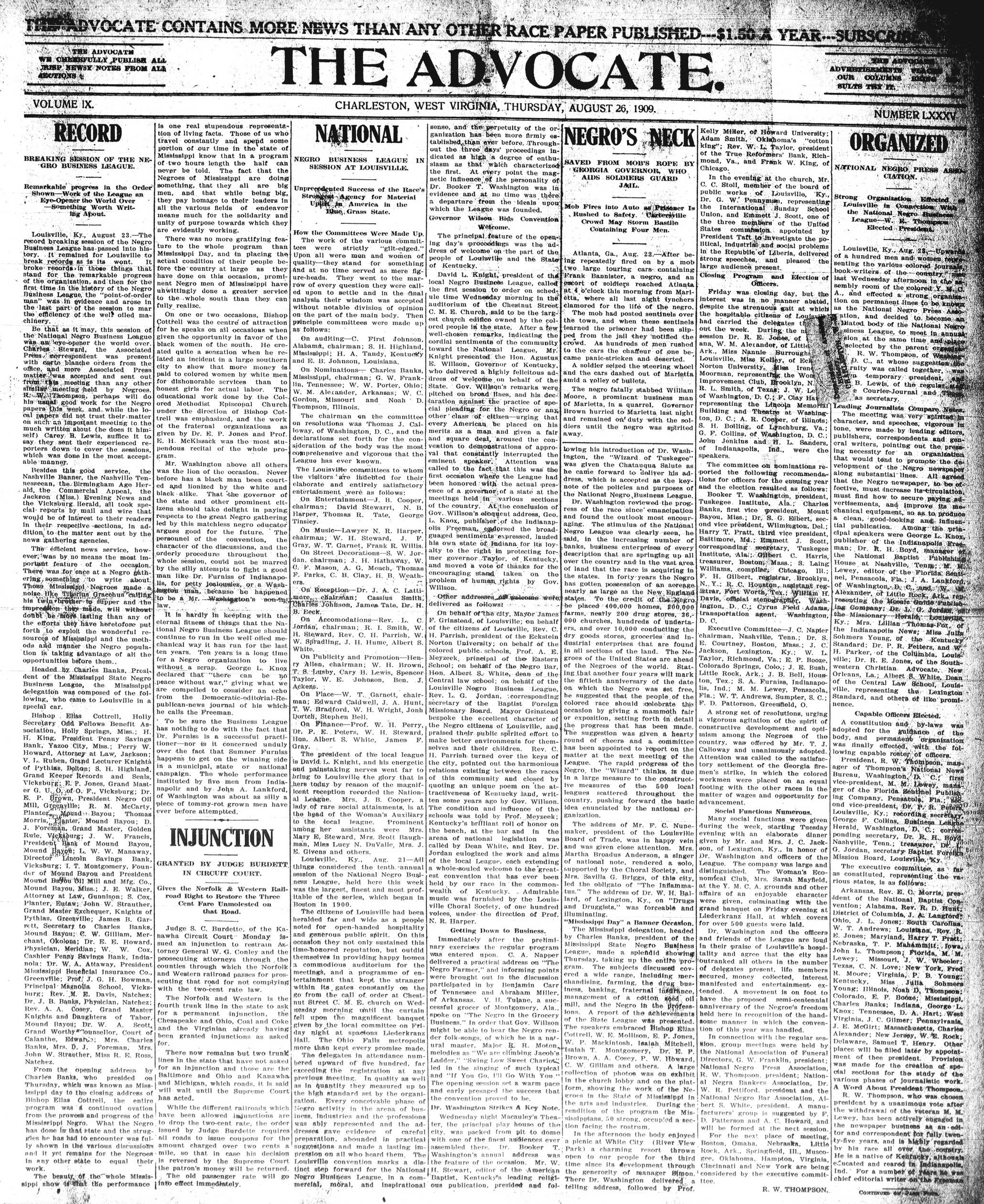
BREAKING SESSION OF THE NEGRO BUSINESS LEAGUE.
Remarkable progress in the Order Shown—Work of the League an Eye-Opener the World Over—Something Worth Writing About.
Louisville, Ky., August 23.—The record breaking session of the Negro Business League has passed into history. It remained for Louisville to break records as is its wont. It broke records in those things that stand for the remarkable progress of the organization, and then for the first time in the history of the Negro Business League, the "point-of-order man" was in evidence and arose in the last part of the session to mar the efficiency of the well oiled machinery.
Be that as it may, this session of the National Negro Business League was an eye-opener the world over. Charles Stewart, the Associated Press, correspondent was present with corto blanche orders from the office, and more Associated Press matter was accepted and sent out from this meeting than any other smaller meeting held by Negroes. R. W. Thompson, perhaps will do his usual good work for the Negro papers this week, and, while the local papers did not trust their matter on such an important meeting to the much written about (he does it himself) Carey B. Lewis, suffice it to say they sent their experienced reporters to cover the sessions, which was done in the most acceptable manner.
Besides this good service, the Nashville Banner, the Nashville Tennessee, the Birmingham Age Herald, the Commercial Appeal, the Jackson (Miss.) Evening News and the Vicksburg Herald, all took special reports by mail and wire that would be of interest to their readers in their respective sections, in addition, to the matter sent out by the news gathering agencies.
The efficient news service, however, was by no means the most important feature of the occasion. There was for once at a Negro gathering, something to write about. Those Mississippi Negroes made a noise like Tibbins Graccouh calling his twin brother to supper and the impression they made, will without doubt be more lasting than any of the efforts they have heretoofe put forth to exploit the wonderful resources of Mississippi and the methods and manner the Negro population is taking advantage of all the opportunities before them...
Headed by Charles Banks, President of the Mississippi State Negro Business League, the Mississippi delegation was composed of the following, who came to Louisville in a special car.
Bishop Elias Cottrell, Holly Secretary Odd Follows Benefit Association, Holly Springs, Miss.; H. H. King, President Penny Savings Bank, Yazoo City, Miss.; Perry W. Howard, Attorney at Law, Jackson; V. L. Ruben, Grand Lecturer Knights of Pythias, Bolton; S. H. Highland, Grand Keeper Records and Seals, Vicksburg, E. P. Jones, Grand Master G. U. O. of O. F., Vicksburg; Dr. E. P. Brown, President Negro Oil Mill, Greenville; R. M. McCarty, Planter, Mound Bayou; Thomas Morris, Planter, Mound Bayou; D. J. Foreman, Grand Master, Golden Rule, Vicksburg; J. W. Francis, President Bank of Mound Bayou, Mound Bayou; L. W. W. Manaway, Director Lincoln Savings Bank, Vicksburg; I. T. Montgomery, Founder of Mound Bayou and President Mound Bayou Oil Mill and Mfg. Co., Mound Bayou, Miss.; J. E. Walker, Attorney at Law, Gunnison; S. Cox, Planter, Eutax; John W. Strauther, Grand Master Exchequer, Knights of Pythias, Greenville; James B. Garrett, Secretary to Charles Mounds, Mound Bayou; C. W. Gilliam, Merchant, Okolon; Dr. E. E. Howard, Physician, Meridian; W. E. W. Cox, Cashier Penny Savings Bank, Indianola; Dr. W. A. Attaway, President Mississippi Beneficial Insurance Co., Greenenville; Prof. J. G. H. Bowman, Principal Magnolia School, Vicksburg; Rev. M. E. Davis, Natechez; Dr. J. B. Banks, Physician, Natechez; Rev. A. A. Cosey, Grand Master Knights and Daughters of Tabor, Mound Bayou; Dr. W. A. Scott, Grand Worthy Counsellor, Court of Calanthe, Edwards; Mrs. Charles Banks, Mrs. D. J. Foreman, Mrs. John W. Strauther, Miss R. E. Ross Natechez.
From the opening address by Charles Banks, who presided on Thursday, which was known as Mississippi day to the closing address of Bishop Ellis Gottrell, the entire program was a continued ovation from the prowess and progress of the Mississippi Negro. What the Negro has done in that state and the struggles he has had to encounter was fully shown in the various discussions and it yet remains for the Negroes in any other state to equal their work.
The beauty of the whole Mississippi show is that the performance
is one real stupendous representation of living facts. Those of us who travel constantly and spend some portion of our time in the state of Mississippi know that in a program of two hours length the half can never be told. The fact that the Negroes of Mississippi are doing something, that they all are big men, and that while being big, they pay homage to their leaders in all the various fields of endeavor means much for the solidarity and unity of purpose towards which they are evidently working.
There was no more gratifying feature to the whole program than Mississippi Day, and in placing the actual condition of their people before the country at large as they have done on this occasion, prominent Negro men of Mississippi have unwittingly done a greater service to the whole south than they can fully realize.
On one or two occasions, Bishop Cottrell was the centre of attraction for he speaks on all occasions when given the opportunity in favor of the black women of the south. He created quite a sensation when he related an incident in a large southern city to show that more money is paid to colored women by white men for dishonorable services than to honest girls for actual labor. The educational work done by the Colored Methodist Episcopal Church under the direction of Bishop Cottrell was emphasized, and the work of the fraternal organizations as given by Dr. E. P. Jones and Prof. E. H. McKissack was the most stupendous recital of the whole program.
Mr. Washington above all others was the lion of the occasion. Never before has a black man been courteed and lionized by the white and black alike. That the governor of the state and other prominent citizens should take delight in paying respects to the great Negro gathering led by this matchless negro educator argues good for the future. The personnel of the convention, the character of the discussions, and the orderly procedure throughout the whole session, could not be marred by the silly attempts to fight a good man like Dr. Furniss of Indianapolis, for petty jealousies, or a Washington man, because he happened to be a Mr. Washington's son-in-law.
It is hardly in keeping with the eternal fitness of things that the National Negro Business League should continue to run in the well equipped mechanical way it has run for the last ten years. Ten years is a long time for a Negro organization to live without a scrap. George L. Knox declared that "there can be no peace without war," giving what we are compelled to consider an echo from the Democratic-editorial-Republican-news journal of his which he calls the Freeman.
To be sure the Business League has nothing to do with the fact that Dr. Furniss is a successful practitioner—nor is it concerned unduly over the fact that Summer Furniss happens to get on the winning side in a municipal, state or national campaign. The whole performance instituted by five men from Indianapolis and by John A. Lankford, of Washington was about as silly a piece of tommy-rot grown men have ever before attempted.
INJUNCTION
GRANTED BY JUDGE BURDETT IN CIRCUIT COURT.
Gives the Norfolk & Western Railroad Right to Restore the Three Cent Fare Unmolested on that Road.
Judge S. C. Burdette, of the Kanawha Circuit Court, Monday issued an injunction to restrain Attorney General W. G. Conley and the prosecuting attorneys through the counties through which the Norfolk and Western railroad passes for prosecuting that road for not complying with the two-cent rate law.
The Norfolk and Western is the fourth trunk line in the state to ask for a permanent injunction, the Chesapeake and Ohio, Coal and Coke and the Virginian already having been granted injunctions as asked for.
There now remains but two trunk lines in the state that have not asked for an Injunction and those are the Baltimore and Ohio and Kanawha and Michigan, which roads, it is said will wait until the Supreme Court has acted.
While the different railroads which have been allowed injunctions are to drop the two-cent rate, the order issued by Judge Burdette requires all roads to issue coupons for the amount charged over two cents a mile, so that in case his decision is reversed by the Supreme Court the patron's money will be returned.
The old passenger rate will go into effect immediately.
THE ADVOCATE.
CHARLESTON, WEST VIRGINIA, THURSDAY, AUGUST 26, 1909.
NATIONAL
NEGRO BUSINESS LEAGUE IN
SESSION AT LOUISVILLE.
Unprecedented Success of the Race's Strongest Agency for Material Uplift in America in the Blue, Grass State.
How the Committees Were Made Up
The work of the various committees were strictly "gilt-edged." Upon all were men and women of quality—they stand for something and at no time served as mere figure-heads. They went to the marrow of every question they were called upon to settle and in the final analysis their wisdom was accepted without notable division of opinion on the part of the main body. Then principle committees were made up as follows:
On auditing—C. First Johnson, Alabama, chairman; S. H. Highland, Mississippi; H. A. Tandy, Kentucky and E. B. Johnson, Louisiana.
On Nominations—Charles Banks, Mississippi, chairman; G. W. Franklin, Tennessee; W. W. Porter, Ohio; W. M. Alexander, Arkansas; W. C. Gordon, Missouri and Noah D. Thompson, Illinois.
The chairman on the committee on resolutions was Thomas J. Calloway, of Washington, D. C., and the declarations set forth for the consideration of the body was the most comprehensive and vigorous that the League has ever known.
The Louisville committees to whom the visitors are indebted for their elaborate and entirely satisfactory entertainment were as follows:
On Entertainment—J. B. Cooper, chairman; David Stewartr, N. B. Harper, Thomas R. Tate, George Tinsley.
On Music—Lawyer N. R. Harper, chairman; W. H. Steward, J. F. Gray, W. T. Garnet, Frank R. Willis, On Street Decorations—S. W. Jordan, chairman; J. H. Hathaway, W. G. F. Mason, A. G. Mouch, Thomas F. Parks, C. B. Clay, H. B. Weathers.
On Accompodations—Rev. L. C. Jordan, chairman; R. I. Smith, W. H. Steward, Rev. C. H. Parrish, W. W. Spradling, J. H. Hume, Albert S. White.
On Publicity and Promotion—Henry Allen, chairman; W. H. Brown, T. S. Lusby, Cary B. Lewis, Spencer Taylor, W. E. Johnson, Ben. J. Ackens.
On Place—W. T. Garnett, chairman; Edward Caldwell, J. A. Hunt, T. W. Bradford, W. H. Wright, Jonh Dortch, Stephen Bell.
On Finance—Prof. W. H. Perry, Dr. P. E. Peters, W. H. Steward, Hon. Albert S. White, James F. Gray.
The president of the local league is David L. Knight, and his energetic and painstaking nerves went far to bring to Louisville the glory that is hers today by reason of the magnificent reception recorded the National League. Mrs. J. B. Cooper, a lady of rare social attainments, is at the head of the Woman's Auxillary to the local league. Prominent among her assistants were Mrs. Mary E. Steward, Mrs. Scott Baughman, Miss Lucy N. DuValle, Mrs. J. E. Givens and others. Louisville, Ky., Aug. 21—All things considered the tenth-annual session of the National Negro Business League, held here this week was the largest, finest and most profitable of the series, which began in Boston in 1900.
The citizens of Louisville had been heralded far and wide as a people noted for open-handed hospitality and generous public spirit. On this occasion they not only sustained this time-honored reputation, but outdid themselves in providing happy homes a commodious auditorium for the meetings, and a programme of entertainment that kept the stranger within its gates constantly on the go from the call of order at Chestnut Street C. M. E. church on Wednesday morning until the curtain fell upon the magnificent banquet given by the local committee on Friday night at spacements Liederkranz Hall. The Ohio Falls metropolis more than kept every promise made
The delegates in attendance numbered upward of five hundred, far exceeding the registration at any previous meeting. In quality as well as in quantity they measured up to the high standard set by the organization. Every conceivable phase of Negro activity in the arena of business, industries and the professions was ably represented and the addresses gave evidence of careful preparation, abounded in practical suggestions and made a lasting impression on all who heard them. The Louisville convention marks a distinct step forward for the National Negro Business League, in a commercial, moral, and inspirational
sense, and the perpetuity of the organization has been more firmly established, than ever before. Throughout the three days' proceedings indicated as high a degree of enthusiasm as that which characterized the first. At every point the magnetic influence of the personality of Dr. Booker T. Washington was in evidence and at no time was there a departure from the ideals upon which the League was founded. Governor Wilson Bids Convention Welcome. The principal feature of the opening day's proceedings was the address of welcome on the part of the people of Louisville and the State of Kentucky.
David L. Knight, president of the local Negro Business League, called the first session to order on schedule time Wednesday morning in the auditorium of the Chestnut Street C. M. E. Church, said to be the largest church edifice owned by the colored people in the state. After a few well-chosen remarks, indicating the cordial sentiments of the community toward the National League, Mr. Knight presented the Hon. Augustus E. Willson, Governor of Kentucky, who delivered a highly felicitous address of welcome on behalf of the State. Gov. Willson's remarks were pitched on broad lines, and his declaration against the practice of special pleading for the Negro or any other class of citizen—urging that every American be placed on his merits as a man and given a fair and square deal, aroused the convention to demonstrations of approval that constantly interrupted the eminent speaker. Attention was called to the fact that this was the first occasion where the League had been honored with the actual presence of a governor of a state at the meetings held in various sections of the country. At the conclusion of Gov. Willson's eloquent address, Geo. L. Knox, publisher of the Indianapolis Freeman, endorsed the broad-gauged sentiments expressed, lauded his own state of Indiana for its loyalty to the right in protecting former governor Taylor, of Kentucky, and moved a vote of thanks for the encouraging stand taken on the problem of human rights by Gov. Willson.
Other addresses of welcome were delivered as follows
On behalf of the city, Mayor James F. Grinstead, of Louisville; on behalf of the citizens of Louisville, Rev. C. H. Parrish, president of the Eckstein Norton University; on behalf of the colored public schools, Prof. A. E. Meyzeck, principal of the Eastern School; on behalf of the Negro Bar, Hon. Albert S. White, dean of the Central law school; on behalf of the Louisville Negro Business League, Rev. L. G. Jordan; corresponding secretary of the Baptist Foreign Missionary Board, Mayor Grinstead bespoke the excellent character of the Negro citizens of Louisville, and praised their public spirited effort to make better environments for themselves and their children. Rev. C. H. Parrish turned over the keys of the city, pointed out the harmonious relations existing between the races of this community and closed by quoting an unique poem on the attractiveness of Kentucky land, written some years ago by Gov. Willson. The condition and influence of the schools was told by Prof. Meyzeck; Kentucky's brilliant roll of honor on the bench, at the bar and in the arena of national legislation was called by Dean White, and Rev. Dr. Jordan eulogized the work and alms of the local League, each extending a whole-souled welcome to the greatest convention that has ever been held by our race in the commonwealth of Kentucky. Admirable music was furnished by the Louisville Choral Society, of one hundred voices, under the direction of Prof. N. R. Harper.
Getting Down to Business.
Immediately after the preliminary exercises the regular program was entered upon. C. A. Napper delivered a practical address on "The Negro Farmer," and informing points were brought out in the discussion participated in by Benjamin Carr of Tennessee and Abraham Miller, of Arkansas. V. H. Tulane, a successful grocer of Montgomery, Ala., spoke on "The Negro in the Grocery Business." In order that Gov. Willson might be able to hear the Negro render folk-songs, of which he is a natural master, Major R. R. Moton, melodies as "We are climbing Jacob's ladder," "Swing Low Sweet Charleston" in the singing of such typical and "If You Go, I'll Go With You." The opening session set a warm pace and early presaged the success that the convention proved to be.
Dr. Washington Strikes A Key Note.
Wednesday night Macauley's Theater, the principal play house of the city, was packed from pit to dome with one of the finest audiences ever assembled there. Dr. Booker T. Washington's annual address was the feature of the occasion. Mr. W. H. Stewart, editor of the American Baptist, Kentucky's leading religious publication, presided and fol-
NEGRO'S NECK
SAVED FROM MOB'S ROPE BY
GEORGIA GOVERNOR, WHO
AIDS SOLDIERS GUARD
JAIL.
Mob Fires into Auto as Peeper Is
Rushed to Safety. Chatterville
Crowd May Storm Bastille
Containing Four Men.
Atlanta, Ga., Aug. 22. After being repeatedly fired on by a mob two large touring cars containing Frank Bannister, a negro, and an escort of soldiers reached Atlanta at 4 o'clock this morning from Marietta, where all last night synchers clamored for the life of the negro. The mob had posted sentinels over the town, and when these sentinels learned the prisoner had been slipped from the jail they notified the crowd. As hundreds of men rushed to the cars the chaffeur of one became panic-stricken and deserted. A soldier seized the steering wheel and the cars dashed out of Marietta amid a volley of bullets.
lowing his introduction of Dr. Washington, the "Wizard of Tuskegee" was given the Chataququa Salute as he came forward to deliver his address, which is accepted as the keynote of the policies and purposes of the National Negro Business League
Dr. Washington reviewed the progress of the race since emancipation and found the outlook most encouraging. The stimulus of the National Negro League was clearly seen, he said, in the increasing number of banks, business enterprises of every description that are springing up all over the country and in the vast area of land that the race is acquiring in the states. In forty years the Negro has gotten possession of an acreage nearly as large as the New England states. To the credit of the Negro he placed 400,000 homes, 200,000 farms, nearly 200 drug stores, 26,000 churches, hundreds of undertakers, and over 10,000 conducting the dry goods stores, groceries and industrial enterprises that are found in all sections of the land. The Negroes of the United States are ahead of the Negroes of the world. Stating that another four years will mark the fifthth anniversary of the date on which the Negro was set free, he suggested that the people of the colored race should celebrate the occasion by giving a mammoth fair or exposition, setting forth in detail the progress that has been made. The suggestion was given a hearty round of cheers and a committee has been appointed to report on the matter at the next meeting of the League. The rapid progress of the Negro, the "Wizard" thinks, is due in a large measure to the constructive measures of the 500 local leagues scattered throughout the country, pushing forward the basic idea enunciated by the national organization.
The address of Mr. F. C. Nunemaker, president of the Louisville Board of Trade, was in happy vein and was given close attention. Mrs. Martha Broadus Anderson, a singer of national note, rendered a solo, supported by the Choral Society, and Mrs. Savilla G. Briggs, of this city, led the obligato of "The Inflammatus." The address of Dr. W. H. Ballard, of Lexington, Ky., on "Drugs and Druggists," was forceable and illuminating.
"Mississippi Day" a Banner Occasion.
The Mississippi delegation, headed by Charles Banks, president of the Mississippi State Negro Business League, made a splendid showing Thursday, taking up the entire program. The subjects discussed covered a wide range, including merchandising, farming, the drug business, banking, fraternal influence, management of a cotton seed oil mill, and the Negro in the professions. A report of the achievements of the State League was presented. The speakers embraced Bishop Elias Cottrell, W. E. Mollison, E. P. Jones, W. P. Mackintosh, Isaiah Mitchell, Isaiah T. Montgomery, Dr. E. P. Brown, A. A. Cosey, P. W. Howard, C. W. Gilliam and others. A large collection of photos was on exhibit in the church lobby and on the platform, showing the work of the Negroes in the State of Mississippi in the arts and industries. During the rendition of the program the Mississippiians, 50 strong, occupied a section facing the rostrum.
In the afternoon the body enjoyed a picnic at White City (River View Park) a charming resort thrown open to our people for the third time since its development through the generosity of manager Simon. There Dr. Washington delivered a telling address, followed by Prof.
Kelly Miller, of Howard University; Adam Smith, Oklahoma's "cotton king"; Rev. W. L. Taylor, president of the True Reformers' Bank, Richmond, Va., and Frank W. King, of Chicago.
In the evening at the church, Mr. C. C. Stoll, member of the board of public works of Louisville, Ky., Dr. G. W. Pennyman, representing the International Sunday School Union, and Emmett J. Scott, one of the three members of the United States commission appointed by President Taft to investigate the political, industrial and social problems in the Republic of Liberia, delivered strong speeches, and pleased the large audience present.
Friday was closing day, but the interest was in no manner abated, despite the strenuous gait at which the hospitable citizens of Louisville had carried the delegates out the week. During the nissession Dr. R. E. Jones, ofana, W. M. Alexander, of Littler Ark., Miss Nannie Burroughs Louisville, Miss Kelley, of Eck Norton University, Miss Irone Moorman, representing the World Improvement Club, Brooklyn, N. R. L. Smith, of Texas; J. W. Le of Washington, D. C.; F. Clay Hay representing the Lincoln Memorial Building and Theatre at Washington, D. C.; A. R. Cooper, of Illinois; S. H. Bolling, of Lynchburg, Va.; G. F. Collins, of Washington, D. C.; John Jenkins and H. L. Sanders, of Indianapolis, Ind., were the speakers.
The committee on nominations reported the following recommendations for officers for the ensuing year and the election resulted as follows:
Booker T. Washington, president, Tuskegee Institute, Ala.; Charles Banks, first vice president, Mount Bayon, Miss.; Dr. S. G. Elbert, second vice president, Wilmington, Del.; Harry T. Pratt, third vice president, Baltimore, Md.; Emmett J. Scott, corresponding secretary, Tuskegee Institute, Ala.; Gilbert C. Harris, treasurer, Boston, Mass.; S. Laling Williams, compiller, Chicago, Ill.; F. H. Gilbert, registrar, Brooklyn, N. Y.; R. C. Houston, assistant registrar, Fort Worth, Tex.; William H. Davies, official stenographer, Washington, D. C.; Cyrus Field Adams, transportation agent, Washington, D. C.
Executive Committee—J. C. Napter chairman, Nashville, Tenn.; Dr. S. E. Courtney, Boston, Mass.; J. C. Jackson, Lexington, Ky.; W. L. Taylor, Richmond, Va.; E. P. Booze, Colorado Springs, Colo.; J. E. Bush, Little Rock, Ark.; J. B. Bell, Houston, Tex.; S. A. Furnish, Indianapolis, Ind.; M. M. Lewey, Pensacola, Fla.; W. T. Andrews, Sumpter, S. C.; F. D. Patterson, Greenfield, O.
A strong set of resolutions, urging a vigorous agitation of the spirit of constructive development and optimism among the Negroes of the country, was offered by Mr. T. J. Calloway and unanimously adopted. Attention was called to the satisfactory settlement of the Georgia firemen's strike, in which the colored workmen were placed on an equal footing with the other races in the matter of wages and opportunity for advancement.
Social Functions Numerous
Many social functions were given during the week, starting Tuesday evening with an elaborate dinner given by Mr. and Mrs. J. C. Jackson, of Lexington, Ky., in honor of Dr. Washington and officers of the League. The company was large and distinguished. The Woman's Economical Club, Mrs. Sarah Mayfield, at the Y. M. C. A. grounds and other affairs of an enjoyable character were given, culminating with the grand banquet on Friday evening at Liederkranz Hall, at which covers for over 500 guests were laid.
Dr. Washington and the officers and friends of the League are loud in their praise of Louisville's hospitality and agree that the city has outranked all others in the number of delegates present, life members secured, money collected, interest manifested and entertainment extended. A movement is on foot to have the proposed semi-centennial anniversary of the Negroe's freedom held here in recognition of the handsome manner in which the convention of this year was handled.
In connection with the regular session, group meetings were held by the National Association of Funeral Directors, G. W. Franklin, president; National Negro Press Association, R. W. Thompson, president; National Negra Bankers Association, Dr. W. R. Pettiford, president and the National Negro Bar Association, Albert S. White, president. A manufacturers' group is suggested by F. D. Patterson and A. C. Howard, and will be formed at the next session. For the next place of meeting, Boston, Omaha, Nebraska, Little Rock, Ark., Springfield, Ill., Muscogee, Oklahoma, Hampton, Virginia, Cincinnati and New York are being considered by the executive committee. R. W. THOMPSON.
Louisville, Ky., Aug. 28.—Upward of a hundred men and women representing the various colored journals, book-writers of the country, and last Wednesday afternoon in the assembly room of the colored Y. M. C. A., and effected a strong organization on permanent lines to be known as the National Negro Press Association, and decided to become an affiliated body of the National Negro Business League, to meet in annual selection at the same time and place selected by the parent organization. R. W. Thompson, of Westminster, D. C., at whose suggestion theulty was called together, was in temporary president, and B. Lewis, of the regular, Courler-Journal and Times as secretary.
Leading Journalists Compare Notes. The meeting was very spirited in character, and speeches, vigorous in tone, were made by leading editors, publishers, correspondents and general writers, pointing out the pressing necessity for an organization that would tend to promote the development of the Negro newspaper along substantial lines. All agreed that the Negro newspaper, to be effective, must increase its circulation, must find how to secure paying advertisements, and improve its mechanical equipment, so as to produce a clean, good-looking and influential publication. Among the principal speakers were George L. Knox, publisher of the Indianapolis Freeman; Dr. R. H. Boyd, manager of the National Baptist Publishing House at Nashville, Tenn.; M. M. Lewey, editor of the Florida Sentel, Pensacola, Fla.; J. A. Lankford, of Washington, D. C, and, W. M. Alexander, of Little Rock, Ark, representing the Missile Game Publishing Company; Dr. L. G. Jordan, on the Missionary Herald, Louisville Ky.; Mrs. Lillian Thomas Fox, of the Indianapolis News; Miss Julia Sohmers Young, of the Kentucky Standard; Dr. P. R. Petters, and W. H. Parker, of the Columbia, Louisville; Dr. R. E. Jones, of the Southwestern Christian Advocate, New Orleans, La.; Albert S. White, Dean of the Central Law School, Louisville, representing the Lexington Standard, and others of like prominence.
Capable Officers Elected.
A constitution and by-laws was adopted for the guidance of the body, and permanent organization was finally effected, with the following capable roster of officers.
President, R. W. Thompson, manager of Thompson's National News Bureau, Washington, D. C.; first vice-president, M. M. Lewey, manager of the Florida Centennial Publishing Company, Pensacola, Fla.; second vice-president, Dr. P. R. Peterson, Louisville, Ky.; recording secretary, George F. Collins, Business League Herald, Washington, D. C.; corresponding secretary, Dr. R. H. Boyd, Nashville, Tenn.; treasurer, Dr. G. Jordan, secretary Baptist Foreign Mission Board, Louisville, Ky.
The executive committee, as far as constituted, representing the various states, is as follows:
Arkansas, Rev. E. C. Morris, president of the National Baptist Convention; Alabama, Rev. R. D. Hunt; District of Columbia, J. A. Langford; Ohio, J. L. Jones; South Carolina, W. T. Andrews; Louisiana, Rev. R. E. Jones; Maryland, Harry T. Pratt; Nebraska, T. P. Mahammatt; Iowa, John L. Thompson; Florida, M. M. Lewey; Missouri, J. W. Wheeler; Texas, C. N. Love; New York, Fred R. Moore; Virginia, P. B. Young; Kentucky, Miss Jilia Sohmers Young; Illinois, Noah D. Thompson; Colorado, E. P. Botoze; Mississippi, Charles Banks, Indiana, George L. Knox; Tennessee, D. A. Hart; West Virginia, J. C. Gilmer; Pennsylvania, J. E. McGirt; Massachusetts, Charles Alexander; New Jersey, W. E. Rock; Delaware, Samuel T. Henry. Other places will be filled later by appointment of theee president. Provision was made for the creation of special sections for the study of the various phases of journalistic work. A Word About President Thompson.
R. W. Thompson, who was chosen president by a unanimous vote after the withdrawal of the veteran M. M. Lewey, has been actively engaged in the newspaper business as an editor and correspondent for fully twenty-five years, and is highly regarded by his race all over the country. He is a native of Kentucky, although educated and reared in Indianapolis, Ind. For a number of years he was chief editorial writer on the Fannin
DELINQUENT SUBSCRIBERS
Will take notice that if they are in arrears a year or more, their papers will be discontinued on August 20th, unless a settlement is made on or before that date.
The Advocate takes this step in compliance with postal regulations, and requests that remittances be made by postal or express money order, registered letter, or check.
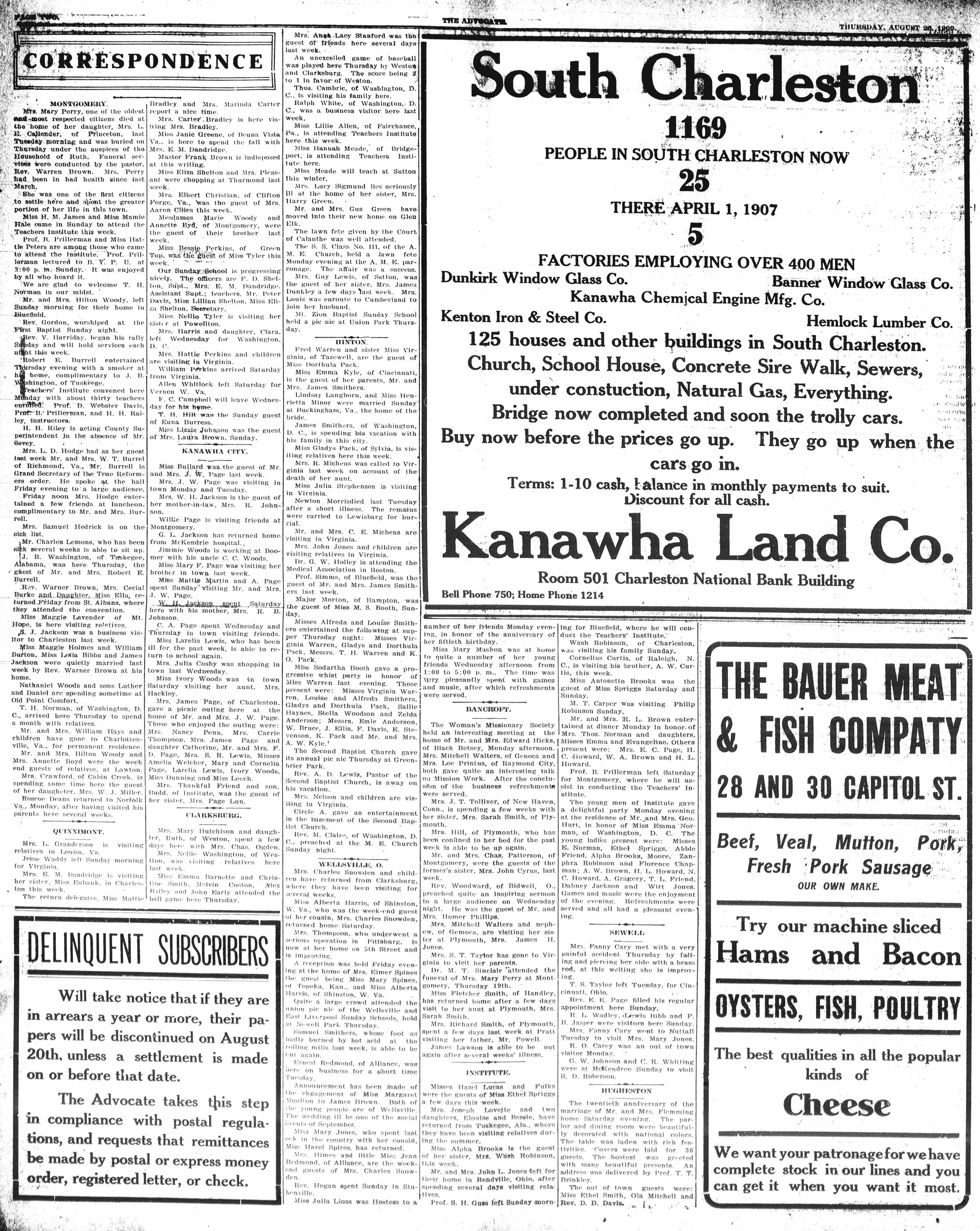
MONTGOMERY
Mrs. Mary Perry, one of the oldest and most respected citizens died at the home of her daughter, Mrs. L. L. Calender, of Princeton, last Tuesday morning and was buried on Thursday under the auspices of the Household of Ruth. Funeral services were conducted by the pastor, Rev. Warren Brown. Mrs. Perry had been in bad health since last March.
She was one of the first citizens to settle here and about the greater portion of her life in this town.
Miss H. M. James and Miss Mamie Hale came in Sunday to attend the Teachers Institute this week.
Prof. B. Prillerman and Miss Hattie Peters are among those who came to attend the Institute. Prof. Prillerman lectured to B. Y. P. U. at 3:00 p. m. Sunday. It was enjoyed by all who heard it.
We are glad to welcome T. H. Norman in our midst.
Mr. and Mrs. Hilton Woody, left Sunday morning for their home in Bluefield.
Rev. Gordon, worshiped at the First Baptist Sunday night.
Rev. V. Harriday, began his rally Sunday and will hold services each night this week.
Robert E. Burrell entertained Thursday evening with a smoker at his home, complimentary to J. B. Washington, of Tuskegee.
Teachers' Institute convened here Monday with about thirty teachers enrolled. Prof. D. Webster Davis, Prof. B: Prillerman, and H. H. Railey, instructors.
H. H. Riley is acting County Superintendent in the absence of Mr. Gevey.
Mrs. L. D. Hodge had as her guest last week Mr. and Mrs. W. T. Burrell of Richmond, Va., Mr. Burrell is Grand Secretary of the True Reformers order. He spoke at the hall Friday evening to a large audience.
Friday noon Mrs. Hodge entertained a few friends at luncheon, complimentary to Mr. and Mrs. Burrell.
Mrs. Samuel Hedrick is on the sick list.
Mr. Charles Lemons, who has been sick several weeks is able to sit up. J. B. Washington, of Turkegge, Alabama, was here Thursday, the guest of Mr. and Mrs. Robert E. Burrell.
Rev. Warner Brown, Mrs. Cecial Burke and Daughter, Miss Ella, returned Friday from St. Albans, where they attended the convention.
S. J. Jackson was a business visitor to Charleston last week.
Miss Maggie Holmes and William Burton, Miss Lelia Bibbs and James Jackson were quietly married last week by Rev. Warner Brown at his home.
Nathaniel Woods and sons Luther and Daniel are spending sometime at Old Point Comfort.
T. H. Norman, of Washington, D. C., arrived here Thursday to spend a month with relatives.
Mr. and Mrs. William Hays and children have gone to Charlottesville, Va., for permanent residence.
Mr. and Mrs. Hilton Woody and Mrs. Annette Boyd were the week end guests of relatives, at Lawton.
Mrs. Crawford, of Cabin Creek, is spending some time here the guest of her daughter, Mrs. W. L. Miller
Roscoe Deans returned to Norfolk Va. Monday, after having visited his parents here several weeks.
QUINNIMONT.
Mrs. L. Granderson is visiting relatives in Louisa, Va.
Jesse Waddy left Sunday morning for Virginia.
Mrs. E. M. Dandridge is visiting her sister, Miss Eubank, in Charles-ton this week.
The return delegates Miss Mattie
Bradley and Mrs. Marinda Carter report a nice time.
Mrs. Carter Bradley is here visiting Mrs. Bradley.
Miss Janie Greene, of Beuna Vista Va., is here to spend the fall with Mrs. E. M. Dandridge.
Master Frank Brown is indisposed at this writing.
Miss Eliza Shelton and Mrs. Pleasant were shopping at Thurmond last week.
Mrs. Elbert Christian, of Clifton Forge, Va., was the guest of Mrs. Aaron Cliles this week.
Mesdames Marie Woody and Annette Byd, of Montgomery, were the guest of their brother last week.
Miss Bessie Perkins, of Green Top, was the guest of Miss Tyler this week.
Our Sunday School is progressing nicely. The officers are F. D. Shelton, Supt., Mrs. E. M. Dandridge, Assistant Supt.; teachers, Mr. Peter Davis, Miss Lillian Shelton, Miss Eliza Shelton, Secretary.
Miss Nellio Tyler is visiting her sister at Powellton.
Mrs. Harris and daughter, Clara, left Wednesday for Washington, D. C.
Mrs. Hattie Perkins and children are visiting in Virginia.
William Perkins arrived Saturday from Virginia.
Allen Whitlock left Saturday for Vernon W. Va.
F. C. Campbell will leave Wednesday for his home.
T. H. Hiil was the Sunday guest of Euna Burress.
Miss Lizzie Johnson was the guest of Mrs. Laura Brown, Sunday.
KANAWHA CITY.
Mrs. J. W. Page was visiting in town Monday and Tuesday.
Mrs. W. H. Jackson is the guest of her mother-in-law, Mrs. R. Johnson.
Willie Page is visiting friends at Montgomery.
G. L. Jackson has returned home from McKendrie hospital.
Jimmie Woods is working at Boomer with his uncle C. C. Woods.
Miss Mary F. Page was visiting her brother in town last week.
Miss Mattle Martin and A. Page spent Sunday" visiting Mr. and Mrs. J. W. Page.
W. H. Jackson spent Saturday here with his mother, Mrs. R. B. Johnson.
C. A. Page spent Wednesday and Thursday in town visiting friends. Miss Larelia Lewis, who has been ill for the past week, is able to return to school again. Mrs. Julia Cosby was shopping in town last Wednesday. Miss Ivory Woods was in town Saturday visiting her aunt, Mrs. Hackley. Mrs. James Page, of Charleston, gave a picnic outing here at the home of Mr. and Mrs. J. W. Page. Those who enjoyed the outing were: Mrs. Nancy Penn, Mrs. Carrie Thompson, Mrs. James Page and daughter Catherine, Mr. and Mrs. F. D. Page, Mrs. S. R. Lewis, Misses Amelia Welcher, Mary and Cornelia Page, Larelia Lewis, Ivory Woods, Miss Dunning and Miss Leech.
Mrs. Thankful Friend and son, Budd. of Institute, was the guest of her sister, Mrs. Page Lun.
CLARKSBURG.
Mrs. Mary Hutchison and daughter, Ruth, of Weston, spent a few days here with Mrs. Chas Orden
Miss Emma Barnette and Christine Smith, Melvin Coston, Alex Bailey and John Early attended the ball game here Thursday.
Mrs. Anita Lacy Stanford was the guest of friends here several days last week.
An unexcelled game of baseball was played here Thursday by Weston and Clarksburg. The score being 2 to 1 in favor of Weston.
Thos. Cambric, of Washington, D. C., is visiting his family here.
Ralph White, of Washington, D. C., was a business visitor here last week.
Miss Lillie Allen, of Fairchance, Pa., is attending Teachers Institute here this week.
Miss Hannah Meade, of Bridgeport, is attending Teachers Institute here.
Miss Meade will teach at Sutton this winter.
Mrs. Lucy Sigmund lies seriously ill at the home of her sister, Mrs. Harry Green.
Mr. and Mrs. Gus Green have moved into their new home on Glen Elk.
The lawn fete given by the Court of Calanthe was well attended.
The S. S. Class No. 111, of the A. M. E. Church, held a lawn fete Monday evening at the A. M. E. parsonage. The affair was a success.
Mrs. Guy Lewis, of Sutton, was the guest of her sister, Mrs. James Dunkley a few days last week. Mrs. Louis was enroute to Cumberland to join her husband.
Mt. Zion Baptist Sunday School held a pie nic at Union Park Thursday.
HINTON
Fred Warren and sister Miss Virginia, of Tazewell, are the guest of Miss Dorthula Pack.
Miss Emma Kyle, of Cincinnati, is the guest of her parents, Mr. and Mrs. James Smithers.
Lindsay Langhorn, and Miss Henrietta Minor were married Sunday at Ruckingham, Va., the home of the bride.
James Smithers, of Washington, D. C., is spending his vacation with his family in this city.
Miss Gladys Pack, of Sylvia, is visiting relatives here this week.
Mrs. R. Michens was called to Virginia last week on account of the death of her aunt.
Miss Julia Stephenson is visiting in Virginia.
Newton Morrisdied last Tuesday after a short illness. The remains were carried to Lewisburg for burial.
Mr. and Mrs. C. E. Michens are visiting in Virginia.
Mrs. John Jones and children are visiting relatives in Virginia.
Dr. G. W. Holley is attending the Medical Association in Boston.
Prof. Simms, of Bluefield, was the guest of Mr. and Mrs. James Smithers last week.
Major Morton, of Hampton, was the guest of Miss M. S. Booth, Sunday.
Misses Alfreda and Louise Smithers entertained the following at supper Thursday night: Misses Virginia Warren, Gladys and Dorthula Pack, Messrs. T. H. Warren and K. O. Pack.
Miss Sodartha Booth gave a progressive whist party in honor of Miss Warren last evening. Those present were: Misses Virginia Warren, Louise and Alfreda Smithers, Gladys and Dorthula Pack, Sallie Haynes, Stella Woodson and Zelda Anderson; Messrs, Emle Anderson, W. Bruce, J. Ellis, F. Davis, E. Stevenson, K. Pack and Mr. and Mrs. A. W. Kyle. $ ^{1} $
The Second Baptist Church gave its annual picnic Thursday at Greenbrier Park.
Rev. A. D. Lewis, Pastor of the Second Baptist Church, is away on his vacation.
Mrs. Nelson and children are visiting in Virginia.
Circle A. gave an entertainment in the basement of the Second Baptist Church.
Rev. M. Claire, of Washington, D.C., preached at the M. E. Church Sunday night.
WELLSVILLE, Q.
Mrs. Charles Snowden and children have returned from Clarksburg, where they have been visiting for several weeks.
Miss Alberta Harris, of Shinston, W. Va., who was the week-end guest of her cousin, Mrs. Charles Snowden, returned home Saturday.
Mrs. Thompson, who underwent a serious operation in Pittsburg, is now at her home on 5th Street and is improving.
A reception was held Friday evening at the home of Mrs. Elmer Spines the guest being Miss Mary Spines, of Topeka, Kan., and Miss Alberta Harris, of Shinston, W. Va.
Quite a large crowd attended the union picnic of the Wellsville and East Liverpool Sunday Schools, held at Newell Park Thursday.
Samuel Smithers, whose foot as badly burned by hot acid at the rolling mills last week, is able to be cut again.
Ernest Redmond, of Alliance, was here on business for a short time Tuesday.
Announcement has been made of the engagement of Miss Margaret Moulton to James Brown. Both of the young people are of Wellsville. The wedding ill be one of the social events of September.
Miss Mary Jones, who spent last eek in the country with her cousin, Miss Hazel Spires, has returned.
Mrs. Himes and little Miss Jean Redmond, of Alliance, are the weekend guests of Mrs. Charles Snowden.
Rev. Hogan spent Sunday in Stubenville.
Miss Julia Lions was Hostess to a
South
PEOPLE
FACTORY
Dunkirk Window Glass
Kana
Kenton Iron & Steel Co.
125 houses and
Church, School
under cons
Bridge now o
Buy now before th
Terms: 1-10 ca
Kanav
Room 501
South Charleston
ACTORIES EMPLOYE
by Glass Co.
Kanawha Chemjca
steel Co.
s and other buil
school House, Co
or construction, Na
now completed a
ore the prices go
cars g
1-10 cash, balance i
Discount f
awha
from 501 Charleston L
FACTORIES EMPLOYING OVER 400 MEN Dunkirk Window Glass Co. Banner Window Glass Co. Kanawha Chemjcal Engine Mfg. Co.
Terms: 1-10 cash, balance in monthly payments to suit. Discount for all cash.
Room 501 Charleston National Bank Building
Bell Phone 750; Home Phone 1214
ing for Bluefield, where he will conduct the Teachers' Institute. Wash Robinson, of Charleston, was visiting his family Sunday.
was visiting his family Sunday.
Cornelius Curtis, of Raleigh, N.
C., is visiting his brother, A. W. Curtis, this week.
Miss Antonette Brooks was the guest of Miss Spriggs Saturday and Sunday.
M. T. Carper was visiting Philip Robinson Sunday.
Mr. and Mrs. R. L. Brown entertained at dinner Monday in honor of Mrs. Thos. Norman and daughters, Misses Emma and Evangeline. Others present were: Mrs. E. C. Page, H. C. Howard, W. A. Brown and H. L. Howard.
Prof. B. Prillerman left Saturday for Montgomery, where he will assist in conducting the Teachers' Institute.
The young men of Institute gave a delightful party Monday evening at the residence of Mr. and Mrs. Geo. Hurt, in honor of Miss Emma 'Norman, of Washington, D. C. The young ladies present were: Misses E. Norman, Ethel Spriggs, Abbie Friend, Alpha Brooks, Moore, Zanphra Robinson and Florence Chapman; A. W. Brown, H. L. Howard, N. C. Howard, A. Gragery, T. L. Friend, Dabney Jackson and Wirt Jones. Games and music were the enjoyment of the evening. Refreshments were served and all had a pleasant evening.
Mrs. Fanny Cary met with a very painful accident Thursday by falling and piercing her side with a brass rod, at this writing she is improving.
T. S. Taylor left Tuesday, for Cincinnati, Ohio.
Rev. E. E. Page filled his regular appointment here Sunday.
R. L. Wadley, Lewis Bibb and P.
B. Jasper were visitors here Sunday.
Mrs. Funny Cary went to Nuttall Tuesday to visit Mrs. Moore.
G. W. Johnson and C. R. Whitting were at McKendree Sunday to visit R. D. Roberson.
The twentieth anniversary of the marriage of Mr. and Mrs. Flemming home Saturday evening. The parlor and dining room were beautifully decorated with national colors. The table was laden with rich festivities. Covers were laid for 36 guests. The hostest was greeted with many beautiful presents. An address was delivered by Prof. T. T. Brinkley. The out of town guests were: Miss Ethel Smith, Ola Mitchell and Rev. D. D. Davis.
THE ADVOCATE
number of her friends Monday evening, in honor of the anniversary of her fiftieth birthday. Miss Mary Mashon was at home to quite a number of her young friends Wednesday afternoon from 1:00 to 5:00 p. m.. The time was very pleasantly spent with games and music, after which refreshments were served.
BANCROFT.
The Woman's Missionary Society held an interesting meeting at the home of Mr. and Mrs. Edward Hicks, of Black Betsey, Monday afternoon. Mrs. Mitchell Walters, of Genoca and Mrs. Lee Printus, of Raymond City, both gave quite an interesting talk on Mission Work. After the conclusion of the business refreshments were served.
Mrs. J. T. Tolliver, of New Haven, Conn., is spending a few weeks with her sister, Mrs. Sarah Smith, of Plymouth.
Mrs. Hill, of Plymouth, who has been confined to her bed for the past week is able to be up again.
Mr. and Mrs. Chas. Patterson, of Montgomery, were the guests of the former's sister, Mrs. John Cyrus, last week.
Rev. Woodward, of Bidwell, O., preached quite an inspiring sermon to a large audience on Wednesday night. He was the guest of Mr. and Mrs. Homer Phillips.
Mrs. Mitchell Walters and nephew, of Gemoca, are visiting her sister at Plymouth, Mrs. James H. Jones.
Mrs. S. T. Taylor has gone to Virginia to visit her parents.
Dr. M. T. Sinclair "attended the funeral of Mrs. Mary Perry at Montgomery, Thursday 19th.
Miss Fletcher Smith, of Handley, has returned home after a few days visit to her aunt at Plymouth, Mrs. Sarah Smith.
Mrs. Richard Smith, of Plymouth, spent a few days last week at Pratt visiting her father, Mr. Powell.
James Lawson is able to be out again after several weeks' illness.
INSTITUTE
Misses Hazel Lucas and Fulks were the guests of Miss Ethel Spriggs a few days this week.
Mrs. Joseph Lovette and two daughters, Elouise and Bessie, have returned from Tuskegee, Ala., where they have been visiting relatives during the summer.
Miss Alpha Brooks is the guest of her sister, Mrs. Wash Robinson, this week.
Mr. and Mrs. John L. Jones left for their home in Rendville, Ohio, after spending several days visiting relatives.
Prof. S. H. Guss left Sunday morn-
THERE APRIL 1,1907
MES EMPLOYING OVER
Co. E
wha Chemjcal Engine M
other buildings in S
House, Concrete Sir
duction, Natural Gas
completed and soon t
e prices go up. Th
cars go in.
sh, balance in monthly p
Discount for all cash.
wha La
Charleston National Bank
SEWELL
HUGHESTON
THE BAUER MEAT & FISH COMPATY
28 AND 30 CAPITOL ST.
Beef, Veal, Mutton, Pork Fresh Pork Sausage OUR OWN MAKE.
Try our machine sliced Hams and Bacon
The best qualities in all the popular kinds of
We want your patronage for we have complete stock in our lines and you can get it when you want it most.
Hemlock Lumber Co.
South Charles
the Walk, Sew
, Everything.
the trollly car
ey go up wh
payments to suit.
and C
k Building
BAUER M
SH COM
D 30 CAPIT
Veal, Mutton
h Pork Sau
OUR OWN MAKE.
our machine
s and E
RS, FISH, PO
qualities in all th
kinds of
South Charleston.
Walk, Sewers,
Everything.
trolly cars.
go up when the
ments to suit.
and Co.
Building
AUER MEAT
H COMPATY
30 CAPITOL ST
l, Mutton, Pork
Pork Sausage
OUR OWN MAKE.
or machine sliced
and Bacon
FISH, POULTRY
alities in all the popula
kinds of
Cheese
your patronage for stock in our line when you want
our patronage for we have back in our lines and you when you want it most
If you haven't a regular Healthy movement of the
bowels open, and be weak, Power, in the arms of
violent physic or pill poison, it dangeren. The
smoothest, easiest, most perfect way of keeping
the bowels clear and clean is to take
OANDY
OATHARTIO
Fascards
THEY WORK WHILE YOU SLEEP
EAT 'EM LIKE CANDY
Pleasant, Palatable, Potent, Teate Good, Do
Good, Never Slicken, Weaken or Gripe; 10, 25 and
50 Poison. We offer free sample, and book-
let on health.
Address
Storling Rumely Company,
Chicago or New York.
KEEP YOUR BLOOD CLEAN
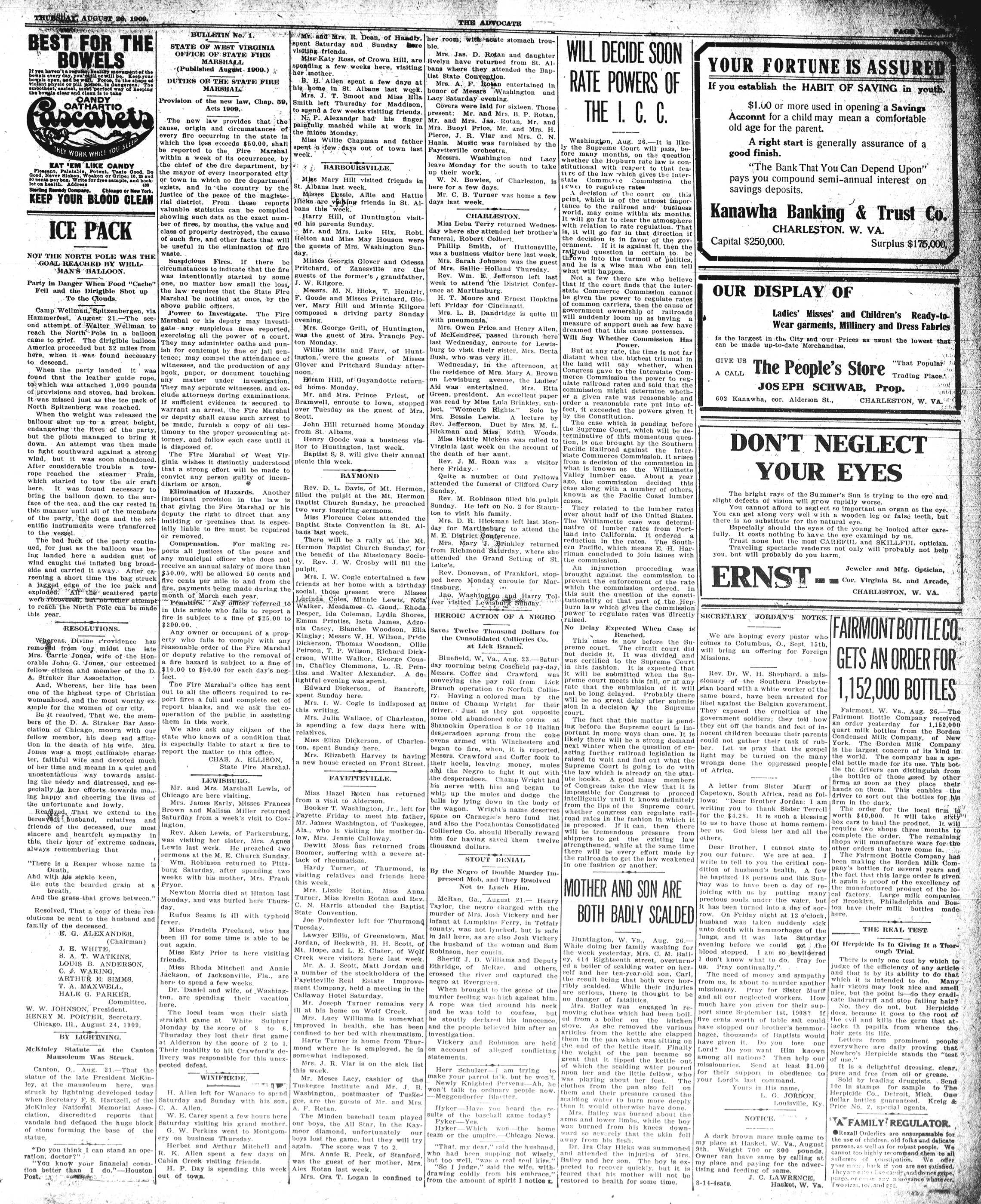
ICE PACK
ICE PACK
NOT THE NORTH POLE WAS THE GOAL REACHED BY WELL-MAN'S BALLOON.
Party in Danger When Food "Cache"
Fell and the Dirigible Shot up
To the Clouds.
Camp Wellman, Spitzenbergen, via Hammerfest, August 21.—The second attempt of Walter Wellman to reach the North Pole in a balloon came to grief. The dirigible balloon America proceeded but 32 miles from here, when it was found necessary to descend.
When the party landed it was found that the leather guide rope, to which was attached 1,000 pounds of provisions and stoves, had broken. It was missed just as the ice pack of North Spitzenberg was reached.
When the weight was released the balloon shot up to a great height, endangering the lives of the party, but the pilots managed to bring it down. An attempt was then made to fight southward against a strong wind, but it was soon abandoned. After considerable trouble a towrope reached the steamer Fram, which started to tow the air craft here. It was found necessary to bring the balloon down to the surface of the sea, and the car rested in this manner until all of the members of the party, the dogs and the scientific instruments were transferred to the vessel.
The bad luck of the party continued, for just as the balloon was being landed here a sudden gust of wind caught the inflated bag broadside and carried it away. After careening a short time the bag struck a jagged edge of the ice pack and exploded. All the scattered parts were recovered, but no other attempt to reach the North Pole can be made this year.
RESOLUTIONS.
Whereas, Divine Providence has removed from our midst the late Mrs. Carrie Jones, wife of the Honorable John G. Jones, our esteemed fellow citizen and member of the D. A. Straker Bar Association.
And, Whereas, her life has been one of the highest type of Christian womanhood, and the most worthy example for the women of our city.
Be it resolved, That we, the members of the D. A. Straker Bar Association of Chicago, mourn with our fellow member, his deep sad affliction in the death of his wife. Mrs. Jones was a most estimable character, faithful wife and devoted much of her time and means in a quiet and unostentatious way towards assisting the needy and distressed, and especially in her efforts towards making happy and cheering the lives of the unfortunate and lowly.
Readied. That we extend to the bereaved husband, relatives and friends of the deceased, our most sincere and heartfelt sympathy in this, their hour of extreme sadness, always remembering that
"There is a Reaper whose name is Death,
And with his sickle keen,
He cuts the bearded grain at a
breath,
And the grass that grows between."
Resolved, That a copy of these resolutions be sent to the husband and family of the deceased.
E. G. ALEXANDER,
(Chairman)
J. E. WHITE,
S. A. T. WATKINS,
LOUIS B. ANDERSON,
C. J. WARING,
ARTHUR E. SIMMS,
T. A. MAXWELL,
HALE G. PARKER,
Committee.
W. W. JOHNSON, President.
HENRY M. PORTER, Secretary.
Chicago III. August 24, 1909.
BY LIGHTNING.
McKinley Statute at the Canton Mausoleum Was Struck.
Canton, O., Aug. 21.—That the statue of the late President McKinley, at the mausoleum here, was struck by lightning developed today when Secretary F. S. Hartzell, of the McKinley National Memorial Association, discredited reports that vandals had defaced the huge block of stone forming the base of the statue.
"Do you think I can stand an operation, doctor?"
"You know your financial condition better than I do."—Houston Post.
STATE OF WEST VIRGINIA OFFICE OF STATE FIRE MARSHAIL
DUTIES OF THE STATE FIRE
MARSHAL
Provision of the new law, Chap. 59, Acts 1909.
The new law provides that the cause, origin and circumstances of every fire occurring in the state in which the loss exceeds $50.00, shall be reported to the Fire Marshal within a week of its occurrence, by the chief of the fire department, by the mayor of every incorporated city or town in which no fire department exists, and in the country by the justice of the peace of the magistrial district. From these reports valuable statistics can be compiled showing such data as the exact number of fires, by months, the value and class of property destroyed, the cause of such fire, and other facts that will be useful in the elimination of fire waste.
Suspicious Fires. If there be circumstances to indicate that the fire was intentionally started by some one, no matter how small the loss, the law requires that the State Fire Marshal be notified at once, by the above public officers.
Power to Investigate. The Fire Marshal or his deputy may investigate any suspicious fires reported, exercising all the power of a court. They may administer oaths and punish for contempt by fine or jall sentence; may compel the attendance of witnesses, and the production of any book, paper, or document touching any matter under investigations. They may separate witnesses, and exclude attorneys during examinations. If sufficient evidence is secured to warrant an arrest, the Fire Marshal or deputy shall cause such arrest to be made, furnish a copy of all testimony to the proper prosecuting attorney, and follow each case until it is disposed of.
The Fire Marshal of West Virginia wishes it distinctly understood that a strong effort will be made to convict any person guilty of incendiarism or arson.
Elimination of Hazards. Another important provision in the law is that giving the Fire Marshal or his deputy the right to direct that any building or premises that is especially liable to fire must be repaired or removed.
Compensation. For making reports all justices of the peace and any municipal officer who does not receive an annual salary of more than $50.00, will be allowed 50 cents and five cents per mile to and from the fire, payments being made during the month of March each year.
Penalties. Any officer referred to in this article who fails to report a fire is subject to a fine of $25.00 to $200.00.
Any owner or occupant of a property who fails to comply with any reasonable order of the Fire Marshal or deputy relative to the removal of a fire hazard is subject to a fine of $10.00 to $50.00 for each day's neglect.
The Fire Marshal's office has sent out to all the officers required to report fires a full and complete set of report blanks, and we ask the cooperation of the public in assisting them in this work.
We also ask any citizen of the state who knows of a condition that is especially liable to start a fire to report the matter to this office.
CHAS. A. ELLISON,
LEWISBURG
Mr. and Mrs. Marshall Lewis, of Chicago are here visiting. Mrs. James Early, Misses Frances Brown and Malissa Miller returned Saturday from a week's visit to Covington.
Wm. Robinson returned to Pittsburg Saturday, after spending two weeks with his mother, Mrs. Frank Pryor.
Newton Morris died at Hinton last Monday, and was buried here Thursday.
Rufus Seams is ill with typhoid fever.
Miss Fradella Freeland, who has been ill for some time is able to be out again.
Miss Esty Prior is here visiting friends.
Miss Rhoda Mitchell and Annie Jackson, of Jacksonville, Fla., are here to spend a few weeks.
Dr. Daniel and wife, of Washington, are spending their vacation here.
The local team won their sixth straight game at White Sulphur Monday by the score of 8 to 6. Thursday they lost their first game at Alderson by the score of 2 to 1. Their inability to hit Crawford's delivery was responsible for this unexpected defeat.
WINIFREDE.
H. Allen left for Wanaco to spend Saturday and Sunday with his son, C. A. Allen. W. E. Carey spent a few hours here Saturday visiting his grand mother. G. W. Perkins went to Montgomery on business Thursday. Herbet and Arthur Mitchell and R. K. Allen spent a few days on Cabin Creek visiting friends. H. P. Day is spending this week out of town.
Mr. and Mrs. R. Dean, of Handly, spent Saturday and Sunday there visiting friends. Miss Katy Ross, of Crown Hill, are spending a few weeks here, visiting her mother. B. H. Allen spent a few days at his home in St. Albans last week. Mrs. J. T. Smoot and Miss Ella Smith left Thursday for Maddison, to spend a few weeks visiting friends. N. P. Alexander had his finger painfully mashed while at work in the mines Monday. Miss Willie Chapman and father spent a few days out of town last week.
BARBOURSVILLE.
Miss Mary Hill visited friends in St. Albans last week.
Misses Lissie, Allie and Hattie Hicks are visiting friends in St. Albans this week.
Harry Hill, of Huntington visited his parents Sunday.
Mr. and Mrs. Luke Hix, Robt. Helton and Miss May Houson were the guests of Mrs. Washington Sunday.
Misses Georgia Glover and Odessa Pritchard, of Zanesville are the guests of the former's grandfather, J. W. Kilgore.
Messrs. M. N. Hicks, T. Hendrit, F. Goode and Miss Pritchard, Glover, Mary Hill and Minnie Kilgore composed a driving party Sunday evening.
Mrs. George Grill, of Huntington, was the guest of Mrs. Francis Peyton Monday.
Willie Mills and Farr, of Huntington, were the guests of Misses Glover and Pritchard Sunday afternoon.
Hiram Hill, of Guyandotte returned home. Monday.
Mr. and Mrs. Prince Priest, of Bramwell, enroute to Iowa, stopped over Tuesday as the guest of Mrs. Scott.
John Hill returned home Monday from St. Albans.
Henry Goode was a business visitor to Huntington, last week.
Baptist S. S. will give their annual picnic this week.
RAYMOND
Rev, D. L. Davis, of Mt. Hermon, filled the pulpit at the Mt. Hermon Baptist Church Sunday, he preached two very inspiring sermons. Miss Florence Coles attended the Baptist State Convention in St. Albans last week. There will be a rally at the Mt. Hermon Baptist Church Sunday, for the benefit of the Missionary Society. Rev, J. W. Crosby will fill the pulpit.
Mrs. I. W. Cogle entertained a few friends at her home with a birthday social, those present were Misses Lucinda Coles, Minnie Lewis, Nola Walker, Mesdames C. Good, Rhoda Desper, Ida Coleman, Lydia Shores, Emma Printiss, Izeta James, Adzonia Casey, Blanche Woodson, Ella Kinglsy; Messrs W. H. Wilson, Pride Dickerson, Thomas Woodson, Ollie Peirson, T. P. Wilson, Richard Dickerson, Willie Walker, George Cousin, Charley Clemmons, L. R. Printiss and Walter Alexander. A delightful evening was spent.
Edward Dickerson, of Bancroft, spent Sunday here.
Mrs. I. W. Cogle is indisposed at this writing.
Mrs. Julia Wallace, of Charleston, is spending a few days here with relatives.
Miss Eliza Dickerson, of Charleston, spent Sunday here.
Mrs. Elizabeth Harvey is having a new house erected on Front Street.
FAYETTEVILLE.
Miss Hazel Roten has returned from a visit to Alderson.
Booker T. Washington, Jr., left for Payette Friday to meet his father, Mr. James Washington, of Tuskegee, Ala., who is visiting his mother-in-law, Mrs. Jennie Calloway.
Dewitt Moss has returned from Boomer, suffering with a severe attack of rheumatism.
Hardy Turner, of Thurmond, is visiting relatives and friends here this week.
Mrs. Lizzie Rotan, Miss Anna Turner, Miss Evelin Rotan and Rev. C. N. Harris attended the Baptist State Convention.
Joe Poindexter left for Thurmond Tuesday.
Lawyer Ellis, of Greenstown, Mat Jordan, of Beckwith, H. H. Scott, of Mt. Hope, and L. E. Clater, of Wolf Creek were visitors here last week
Mr. Joseph Turner remains very ill at his home on Wolf Creek.
Mrs. Lucy Williams is somewhat improved in health, she has been confined to her bed with rheumatism.
Harte Turner is home from Thurmond where he is employed, he is somewhat indisposed.
Mrs. J. R. Viar is on the sick list this week.
Mr. Moses Lacy, cashier of the Tuskegee Institute and Mr. J. B. Washington, postmaster of Tuskegee, are the guests of Mr. and Mrs. A. F. Retan.
The Minden baseball team played our boys, the All Star, in the Kaymoor diamond, unfortunately our boys lost the game, but they will try again. The score was 7 to 2.
Mrs. Annie R. Peck, of Stanford, was the guest of her mother, Mrs. Alex Rotan last week. Mrs. Ora T. Logan is confined to
her room, with acute stomach trouble.
Mrs. Jas. D. Rotan and daughter Evelyn have returned from St. Albans where they attended the Baptist State Convention.
Mrs. A. F. Rotan entertained in honor of Messrs Washington and Lacy Saturday evening.
Covers were laid for sixteen. Those present: Mr. and Mrs. B. P. Rotan, Mr. and Mrs. Jas. Rotan, Mr. and Mrs. Buoyl Price, Mr. and Mrs. H. Pierce, J. R. Viar and Mrs. C. N. Hanls. Music was furnished by the Fayetteville orchestra.
Messrs. Washington and Lacy leave Monday for the south to take up their work.
W. N. Bowles, of Charleston, is here for a few days.
Mr. C. B. Turner was home a few days last week.
CHARLESTON.
Miss Deba Terry returned Wednesday where she attended her brother's funeral, Robert Colbert.
Phillip Smith, of Huttonville, was a business visitor here last week.
Mrs. Sarah Johnson was the guest of Mrs. Sallie Holland Thursday.
Rev. Wm. E. Jefferson left last week to attend the District Conference at Martinsburg.
H. T. Moore and Ernest Hopkins left Friday for Cincinnati.
Mrs. L. B. Dandridge is quite ill with pneumonia.
Mrs. Owen Price and Henry Allen, of McKendree, passed through here last Wednesday, enroute for Lewisburg to visit their sister, Mrs. Berta Bush, who was very ill.
Wednesday, in the afternoon, at the residence of Mrs. Mary A. Brown on Lewisburg avenue, the Ladies' Aid was entertained. Mrs. Etta Green, president. An excellent paper was read by Miss Lula Brinkley, subject, "Women's Rights." Solo by Mrs. Bessie Lewis. A lecture by Rev. Jefferson. Duet by Mrs. M. L. Hickman and Miss Edith Woods. Miss Hattie Mickens was called to Virginia last week on the account of the death of her aunt.
Rev. J. M. Roan was a visitor here Friday.
Quite a number of Odd Fellows attended the funeral of Clifford Cury Sunday.
Rev. M. Robinson filled his pulpit Sunday. He left on No. 2 for Staunton to visit his family.
Mrs. D. R. Hickman left last Monday for Martinsburg to attend the M. E. District Conference.
Mrs. Mary J. Brinkley returned from Richmond Saturday, where she attended the Grand Setting of St. Luke's.
Rev. Donovan, of Frankfort, stopped here Monday enroute for Martinsburg.
Jno. Washington and Harry Toliver visited Lewisburg Sunday.
Saves Twelve Thousand Dollars for the Consolidated Collieries Co. at Lick Branch
Bluefield, W, Va., Aug. 23.—Saturday morning being Cosefield pay-day, Messrs. Coffer and Crawford was conveying the pay roll from Lick Branch operation to Norfolk Colliery. Having a colored man by the name of Champ Wright for their driver. Just as they got opposite some old abandoned coke ovens at Shamokin Operation 8 or 10 Italian desperadoes sprung from the coke ovens armed with Winchesterers and began to fire, when, it is reported, Messrs. Crawford and Coffer took to their necks, leaving money, mules and the Negro to fight it out with the desperadoes. Champ Wright had his nerve with him and began to whip up the mules and dodge the balls by lying down in the body of the wagon. Wright's name deserves space on Carnegie's hero fund list and also the Pocahontas Consolidated Collieries Co. should liberally reward him for having saved them twelve thousand dollars.
STOUT DENIAL
By the Negro of Double Murder Impressed Mob, and They Resolved Not to Lynch Him.
McRae. Ga., August 21.— Henry Taylor, the negro charged with the murder of Mrs. Josh Vickery and her infant at Lumpkin Ferry, in Telfair county, was not lynched, but is safe in jail here, as are also Josh Vickery the husband of the woman and Sam Robinson, her cousin.
Sheriff J. D. Williams and Deputy Ethridge, of McRae, and others, crossed the river and captured the negro at Evergreen.
When brought to the scene of the murder feeling was high against him. A rope was tied around his neck and he was told to confess, but he stoutly declared his innocence, and the people believed him after an investigation.
Vickery and Robinson are held on account of alleged conflicting statements.
---
Herr Schulzer—I am trying to make your parrot talk, but he won't.
Newly Knighted Pervenu—Ah, he won't talk to ordinary people now.
—Meggendorfer Blaetter.
Hyker—Have you heard the results of the baseball game today?
Pyker—Yes.
Hyker—Which won—the home team or the umpire—Chicago News.
"That, my dear," said the husband, who had been supping not wisely, but too well. "was a real soul kiss."
"So I judge," said the wife, withdrawing coldly from his embrace, from the amount of spirit I notice
Ladies' Misses' and
Wear garments, Mill
Is the largest in the City and our Price
can be made up-to-date Merchandise.
GIVE US
A CALL
The People's S
JOS EPH SCHWA
602 Kanawha, cor. Alderson St.,
DON'T NEED
YOUR EYE
The bright rays of the Summer's Sun
slight defects of vision will grow rapidly.
You cannot afford to neglect so imply
You can get along very well with a wood
there is no substitute for the natural eye
Especially should the eyes of the ye
fully. It costs nothing to have the eye
Trust none but the most CAREFUL
Traveling spectacle vendorss not on
you, but will probably do you harm.
ERNST... Jew
Cor.
The need of money and sympathy from us, is about to murder another missionary. Pray for Sister Murff and all our neglected workers. How much have you given for their support since September 1st, 1908? If five cents worth of table salt could have stopped our brother's hemorrhage, thousands of Baptists would have given it. Do you love our Lord? Do you want Him known among all nations? Then help our missionaries. Send at least $1.00 for their support in obedience to your Lord's last command.
Yours in His name,
L. G. JORDON,
Louisville, Ky.
NOTICE.
A dark brown mare mule came to my place at Hasket, W. Va., August 9th. Weight 700 or 800 pounds. Owner can have same by calling at my place and paying for the advertising and feeding of same.
J. C. LAWRENCE,
8-14-4sats.
Hasket, W. Va.
WILL DECIDE SOON RATE POWERS OF THE I. C. C.
Washington, Aug. 26.—It is likely the Supreme Court will pass, before many months, on the question whether the Hepburn rate law is constitutional with respect to that feature of the law which gives the Interstate Commerce Commission the power to regulate rates.
A decision of the court on this point, which is of the utmost importance to the railroad and business world, may come within six months. It will go far to clear the atmosphere with relation to rate regulation. That is, it will go far in that direction if the decision is in favor of the government. If it is against it, then the railroad question is certain to be thrown into the turmoil of politics, and he is a wise man who can tell what will happen.
Not a few there are who believe that if the court finds that the Interstate Commerce Commission cannot be given the power to regulate rates of common carriers, then the cause of government ownership of railroads will suddenly loom up as having a measure of support such as few have dreamed that this cause possesses.
Will Say Whether Commission Has Power.
But at any rate, the time is not far distant when the highest tribunal in the land will say whether, when Congress gave to the Interstate Commerce Commission the power to regulate railroad rates and said that the commission might determine whether a given rate was reasonable and order a reasonable rate put into effect, it exceeded the powers given it by the Constitution.
The case which is pending before the Supreme Court, which will be determinative of this momentous question, is one brought by the Southern Pacific Railroad against the Interstate Commerce Commission. It arises from a decision of the commission in what is known as the Williamette Valley lumber case. About a year ago, the commission decided this case along with a number of others, known as the Pacific Coast lumber cases.
They related to the lumber rates over about half of the United States. The Williamette case was determinative of lumber rates from Portland into California. It ordered a reduction in the rates. The Southern Pacific, which means E. H. Harriman concluded to join issues with the commission.
An injunction proceeding was brought against the commission to prevent the enforcement of the rate which the commission ordered. In this suit the question of the constitutionality of that part of the Hepburn law which gives the commission power to regulate rates was directly raised.
No Delay Expected When Case is Reached
This case is now before the Supreme court. The circuit court did not decide it. It was divided and was certified to the Supreme Court in this fashion. It is expected that it will be submitted when the Supreme court meets this fall, or at any rate that the submission of it will not be long delayed. Probably there will be no great delay after submission in a decision the Supreme court.
The fact that this matter is pending before the Supreme court is important in more ways than one. It is likely there will be a strong demand next winter when the question of enacting further railroad legislation is raised to wait and find out what the Supreme Court is going to do with the law which is already on the statute books. A good many members of Congress take the view that it is impossible for Congress to proceed intelligently until it knows definitely from the lips of the Supreme court whether congress can regulate railroad rates in the fashion in which it is proposed. If it can, then there will be tremendous pressure from shippers to get the existing law strengthened, while at the same time there will be every effort made by the railroads to get the law weakened in one fashion or another.
MOTHER AND SON ARE BOTH BADLY SCALDED
Huntington, W. Va., Aug. 26. While doing her family washing for the week yesterday, Mrs. C. M. Bailey, 414 Eighteenth street, overturned a boiler of scalding water on herself and her ten-year-old son, Carl, the result being that both were horribly scalded. While their injuries are serious, there is thought to be no danger of fatalities.
Mrs. Bailey was engaged in removing clothes which had been boiled from a boiler on the kitchen stove. As she removed the various articles from the kettle she clapped them in the pan which was sitting on the end of the kettle itself. Finally the weight of the pan became so great that it tipped the kettle out of which the scalding water poured upon her and the little fellow, who was playing about her feet. The clothes from the pan also fell on them and their pressure caused the scalding water to burn more deeply than it would otherwise have done.
Mrs. Bailey was burned about the arms and lower limbs, while the boy was burned from his knees downward so severely that the skin fell away from his flesh.
Dr. Ira Clay Hicks was summoned and attended the injuries of Mrs. Bailey and her son. The boy is expected to recover quickly, but it is feared that his mother will not be restored to health for some time.
YOUR FORTUNE IS ASSURED
$1.60 or more used in opening a Savings Account for a child may mean a comfortable old age for the parent.
A right start is generally assurance of a good finish.
"The Bank That You Can Depend Upon" pays you compound semi-annual interest on savings deposits.
CHARLESTON. W. VA.
Capital $250,000. Surplus $175,000.
OUR DISPLAY OF
Ladies' Misses' and Children's Ready-to- Wear garments, Millinery and Dress Fabrics Is the largest in the City and our Prices as usual the lowest that can be made up-to-date Merchandise.
DON'T NEGLECT YOUR EYES
The bright rays of the Summer's Sun is trying to the eye and slight defects of vision will grow rapidly worse. You cannot afford to neglect so important an organ as the eye. You can get along very well with a wooden leg or false teeth, but there is no substitute for the natural eye. Especially should the eyes of the young be looked after carefully. It costs nothing to have the eye examined by us. Trust none but the most CAREFUL and SKILLFUL optician. Traveling spectacle vendors not only will probably not help you, but will probably do you harm.
SECRETARY JORDAN'S NOTES.
We are hoping every pastor who comes to Columbus, O., Sept. 15th, will bring an offering for Foreign Missions.
Rev. Dr. W. H. Shephard, a missionary of the Southern Presbyterian board with a white worker of the same board, have been arrested for libel against the Belgian government. They exposed the cruelties of the government soldiers; they told how they cut off the hands and feet of innocent children because their parents could not gather their task of rubber. Let us pray that the gospel light may be turned on the many wrongs done the oppressed people of Africa.
A letter from Sister Murff of Capetown, South Africa, read as follows: "Dear Brother Jordan: I am writing you to thank Sister Terrell for the $4.28. It is such a blessing to us to have those at home remember us. God bless her and all the others.
Dear Brother, I cannot state to you our future. We are at sea. I write to tell to you the critical condition of husband's health. A few he baptized 18 persons and this Sunday was to have been a day of rejoicing with us by putting many precious souls under the water, but it has been turned into a day of sorrow. On Friday night at 12 o'clock, husband was taken suddenly sick unto death with hemorrhages of the lungs, and it was late Saturday evening before we could get the blood stopped. I am so bewildered I don't know what to do. Pray for us. Pray continually."
NOTICE.
Jeweler and Mfg. Optician.
FAIRMONT BOTTLE CO GETS AN ORDER FOR 1,152,000 BOTTLES
Fairmont, W. Va., Aug. 26.—The Fairmont Bottle Company received an order yesterday for 1,152,000 quart milk bottles from the Borden Condensed Milk Company, of New York. The Borden Milk Company is the largest concern of its kind in the world. The company has a special bottle made for its use. This bottle the drivers can distinguish from the bottles of those used by other firms as soon as they place their hands on them. This enables the driver to sort out the bottles for his firm in the dark.
The order for the local firm is worth $40,000. It will take sixty box cars to haul the product. It will require two shops three months to complete the order. The remaining shops will manufacture ware for the other orders that have come in.
The Fairmont Bottle Company has been making the Borden Milk Company's bottles for several years and the fact that this large order is given it again is proof of the excellency of the manufactured product of the local factory. Large milk companies of Brooklyn, Philadelphia and Boston have their milk bottles made here.
THE REAL TEST
Of Herpicide Is In Giving It a Thorough Trial.
There is only one test by which to judge of the efficiency of any article and that is by its ability to do that which it is intended to do. Many hair vigors may look nice and smell nice, but the point is—do they eradicate Dandruff and stop falling hair?
No, they do not, but Herpicide does, because it goes to the root of the evil and kills the germ that attacks th papilla from whence the hair gets its life.
Letters from prominent people everywhere are daily proving that Newbro's Herpicide stands the "test of use."
It is a delightful dressing, clear, pure and free from oil or grease.
Sold by leading druggists. Send 10c in stamps for sample to The Herpicide Co., Detroit, Mich. One dollar bottles guaranteed. Krelg & Price No. 2, special agents.
A FAMILY REGULATOR
- Rexall Orderlies are insurpassable for the use of children, old folks and delicate persons, as well as for robust people. We cannot too highly recommend them to all sufferers of constipation. We offer your money, back if you are not satisfied. They are easy to like, and do not gripe, purge, or cause any ailness whatever. Two sizes, too, and gze.
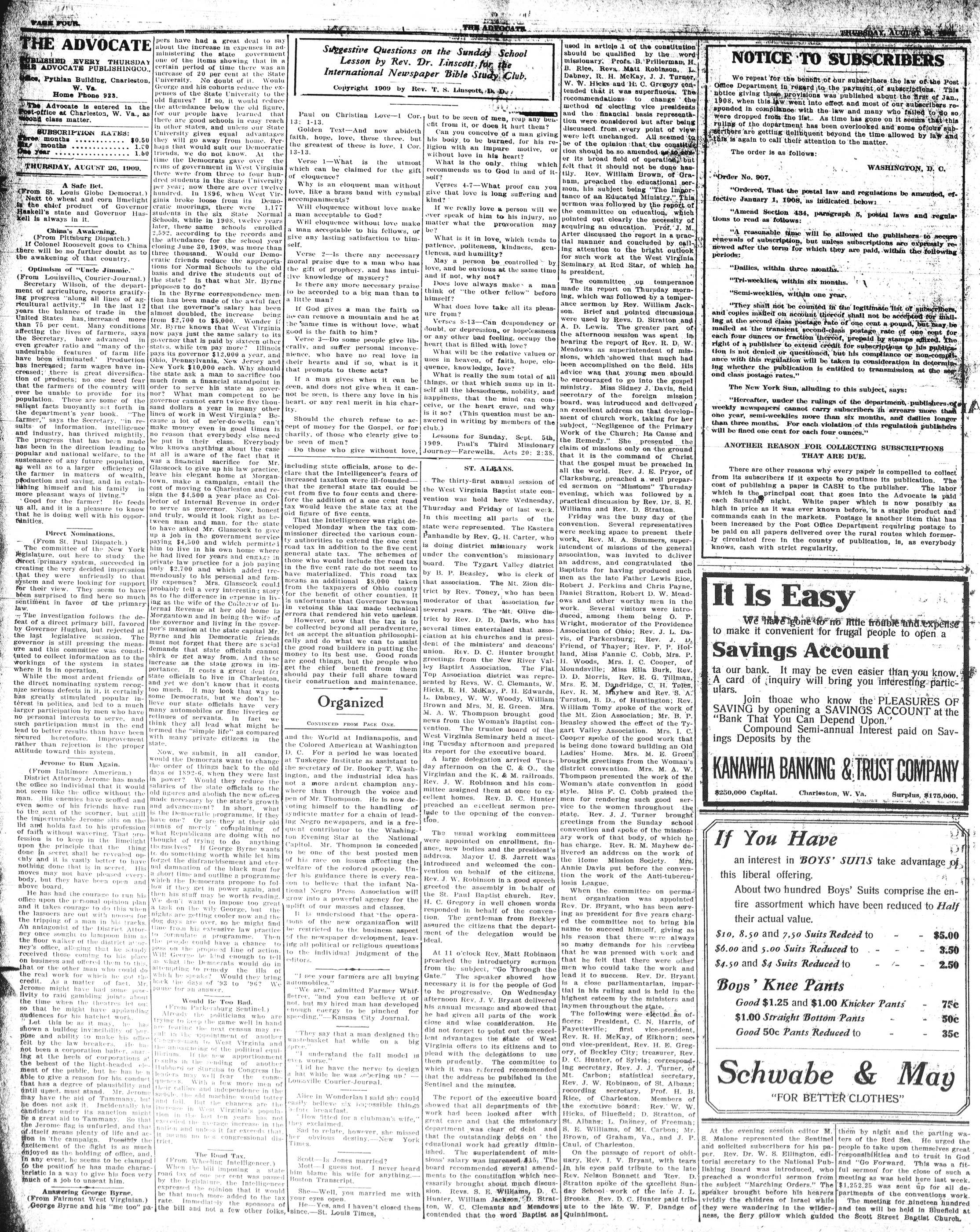
PAGE FOUR
BILISHED EVERY THURSDAY
ADVOCATE PUBLISHINGCO.
The Advocate is entered in the
Post-office at Charleston, W. Va., as
second class matter.
SUBSCRIPTION RATES:
Three months ..... $0.50
Six months ..... 1.20
One year ..... 1.60
THURSDAY, AUGUST 26, 1900.
(From St. Louis Globe Democrat.)
Next to wheat and corn limelight
in the chief product of Governor
Haskell's state and Governor Haskell
is always in it.
China's Awakening.
(From Pittsburg Dispatch.)
If Colonel Roosevelt goes to China
there will be no further doubt as to
the awakening of that country.
Optimism of "Ucle Jinnie."
(From Louisville, Courier Journal.)
(From Louisville Courier-Journal.)
Secretary Wilson, of the department of agriculture, reports gratifying progress "along all lines of agricultural activity." In the last 12 years the balance of trade in the United States has increased more than 75 per cent. Many conditions affecting the lives of farmers, says the Secretary, have advanced in even greater ratio and "many of the undesirable features of farm life have been eliminated." Production has increased; farm wages have increased; there is great diversification of products; no one need fear that the farmers of the country will ever be unable to provide for its population. These are some of the salient facts buoyantly set forth in the department's year book. "The farmer," says the Secretary, "in results of information, intelligence and industry, has thrived mightily. The progress that has been made has been in the direction leading to popular and national welfare, to the sustenance of any future population, as well as to a larger efficiency of the farmer in matters of wealth, production and saving, and in establishing himself and his family in more pleasant ways of living."
'Good for the farmer! He feeds us all, and it is a pleasure to know that he is doing well with his opportunities.
Direct Nominations
(From St. Paul Dispatch.) The committee of the New York legislature, out here to study the direct primary system, succeeded in creating the very decided impression that they were unfriendly to that system and were looking for support for their view. They seem to have been surprised to find here so much sentiment in favor of the primary law. The investigation follows the defeat of a direct primary bill, favored by Governor Hughes, but rejected at the last legislative session. The governor is still pressing the measure and this committee was constituted to collect information as to the workings of the system in states where it is in operation
While the most ardent friends of the direct nominating system recognize serious defects in it, it certainly has greatly stimulated popular interest in politics, and led to a much larger participation by men who have no personal interests to serve, and such participation must in the end lead to better results than have been secured heretofore. Improvement rather than rejection is the proper attitude toward this system.
Jerome to Run Again.
(District Attorney Jerome has made the office so individual that it would not seem like the office without the man. His enemies have scoffed and even some of his friends have run to the seat of the scorner, but still the imperturable Jerome sits on the lid and holds fast to his profession of faith without wavering. That profession is to keep in the limelight upon the principle that the thing done in secret shall be revealed openly and it is vastly better to have nothing done that is in secret. His moves may not have pleased everybody, but they have been open and above board.
He has had the courage to run his office upon the personal opinion plan and it takes courage to do this when the laoosers are out with nooses for the tripping of a man in his tracks. An antagonist of the District Attorney once sought to lamppon him as the floor walker of the district attorney's office, alleging that he simply received those coming to his place on business and offered them to this that or the other man who could do the real work for which he got the credit. As a matter of fact, Mr Jerome might have had some proclivity to raid gambling joints about the time when the theatres let on so that he might have applauding audiences for his hatchet work.
Let this be as it may, he has shown a bulldog invincibility of purpose and ability to make his office felt by the law breakers. He has not been a corporation balter, snarling at the heels of corporations at the behest of the light-headed element of the public, but he has been able to give a reason for his conduct that has a degree of plausibility and until upset, must stand. Mr. Jerome may have the aid of Tammany, but he does not ask it. Incidentally his candidacy under its sanction might be a great aid to Tammany. So that the Jerome flag is unfurled, and that of itself means plenty of life and action in the campaign. Possibly the excitement of the flight is as much enjoyed as the holding of office, and, in any event, he seems to be clamped to the position he has made characteristic in a way to give his foes very much of a job to unseat him.
Answering George Byrne.
(From Fairmont West Virginian.)
George Byrne and his "me too" na
pers have had a great deal to say about the increase in expenses in administering the state government one of the items showing that in a certain period of time there was an increase of 20 per cent at the State University. No doubt of it. Would George and his cohorts reduce the expenses of the State University to the old figures? If so, it would reduce the attendance below the old figure, for our people have learned that there are good schools in easy reach in other states, and unless our State University gives equal advantages they will go away from home. Perhaps that would suit our Democratic friends, we do not know. At the time the Democrats gave over the terms of government in West Virginia there were from three to four hundred students in the State University per year; now there are over twelve hundred. In 1896, when West Virginia broke loose from its Democratic moorings, there were 1,177 students in the six State Normal Schools, while in 1908, twelve years later, these same schools enrolled 2,592, according to the records and the attendance for the school year closing June 30, 1909, was more than three thousand. Would our Democratic friends reduce the appropriations for Normal Schools to the old basis and drive the students out of the state? Is that what Mr. Byrne proposes to do?
In the Byrne correspondence mention has been made of the awful fact that the governor's salary has been almost doubled, the increase being from $2,700 to $5,000. Wonder if Mr. Byrne knows that West Virginia now pays just the same salary to its governor that is paid by sixteen other states, while ten pay more? Illinois pays its governor $12,000 a year, and Ohio, Pennsylvania, New Jersey and New York $10,000 each. Why should the state ask a man to sacrifice too much from a financial standpoint in order to serve his state as governor? What man competent to be governor cannot earn twice five thousand dollars a year in many other lines of work in West Virginia? Because a lot of nee-do-wells can't make money even in good times is no reason that everybody else need be put in their class. Everybody who knows anything about the case at all is aware of the fact that it was a financial sacrifice for Mr. Glasscock to give up his law practice, leave his elegant home at Morgantown, make a campaign, entail the cost of moving to Charleston and resign the $4,500 a year place as Collector of Internal Revenue in order to serve as governor. Now, honest and truly, would it look right as between man and man, for the state to have asked Mr. Glasscock to give up a job in the government service paying $4,500 and which permitted him to live in his own home where he had lived for years and engage in private law practice for a job paying only $2,700 and which added tremendously to his personal and family expenses? Mrs. Glasscock could probably tell a very interesting story as to the difference in expense in living as the wife of the Collector of Internal Revenue at her old home in Morgantown and in being the wife of the governor and living in the governor's mansion at the state capital Mr. Byrne and his Democratic friends must not forget that there are social demands that state officials cannot shirk or get away from. And these increase as the state grows in importance. It costs a great deal for state officials to live in Charleston, and yet we don't know that it costs too much. It may look that way to some Democrats, but we don't believe our state officials have very many automobiles or fine liveries or retinues of servants. In fact we think they all lead what might be termed the "simple life" as compared with many private citizens in the state.
Now, we submit, in all candor, would the Democrats want to change the order of things back to the old days of 1892-6, when they were last in power? Would they reduce the salaries of the state officials to the old figures and abolish the new offices made necessary by the state's growth and advancement? In short, what is the Democratic programme, if they have one? Or are they at their old stuns of merely' complaining of what Republicans are doing with no thought of trying to do anything themselves? If George Byrne wants to do something worth while let him forget the disfranchisement and eternal damnation of the black man for a short time and outline a programme which the Democrats propose to follow if they get in power again, and then his stuff may be worth reading. We don't want to impose too great a task on the white George, but the nights are getting cooler now and the dog days are over, so he might find time from his extensive law practice to formulate a programme. Then the people could have a chance to pass on the proposed line of action. Will George be kind enough to tell us what the Democrats would do in attempting to remedy the ills of which he speaks? Would they bring back the days of '93 to '96? We pause for an answer.
Would Be Too Bad.
From Parkersburg Sentinel.)
Already the politicians who are trying to keep the game well in hand are fearing the next census may result in the appointment of another Congressman to West Virginia and the unquencing of the political equilibrium. If the new apportionment results in the sending of another Hubbard or Sturgiss to Congress the leaders may well fear the consequences. With a few more men of their calibre and independence in the Senate, the old machine would totter and fall. But the chances are the increase in West Virginia's population in the last ten years has not exceeded the average increase in the nation and unless it far exceeds that it means no new congressional district.
The Road Tax.
From Wheeling Intelligencer.) When the bill imposing a state road tax of one per cent was passed by the legislature, the Intelligencer expressed the opinion that it would be that much more added to the tax rate. Immediately the sponsors of the bill and not a few other folks
Copyright 1909 by Rev. T. S. Linscott D. D.
Paul on Christian Love—I Cor. 13: 1-13.
Golden Text—And now abideth faith, hope, love, these three, but the greatest of these is love. I Cor. 13-13.
Verse 1—What is the utmost which can be claimed for the gift of eloquence?
Why is an eloquent man without love, like a brass band with cymbal accompaniments?
Will eloquence without love make a man acceptable to God?
Will eloquence without love make a man acceptable to his fellows, or give any lasting satisfaction to himself.
Verse 2—Is there any necessary moral praise due to a man who has the gift of prophecy, and has intuitive knowledge of mystery?
Is there any more necessary praise to be accorded to a big man than to a little man?
Verse 3—Do some people give liberally, and suffer personal inconvenience, who have no real love in their hearts and if so, what is it that prompts to these acts?
If a man gives when it can be seen, and does not give when it cannot be seen, is there any love in his heart, or any real merit in his charity.
Should the church refuse to accept of money for the Gospel, or for charity, of those who clearly give to be seen of men?
including state officials, arose to declare that the Intelligencer's fears of increased taxation were ill-founded—that the general state tax could be cut from five to four cents and therefore the addition of a one cent road tax would leave the state tax at the old figure of five cents.
That the Intelligencer was right developed Monday when the tax commissioner directed the various county authorities to extend the one cent road tax in addition to the five cent general state tax. The schemes of those who would include the road tax in the five cent rate do not seem to have materialized. This road tax means an additional $8,000 taken from the taxpayers of Ohio county for the benefit of other counties. It is unfortunate that Governor Dawson in vetoing this tax made technical errors that rendered his yeto useless.
However, now that the tax is to be collected beyond all peradventure, let us accept the situation philosophically and do what we can to assist the good road builders in putting the money to its best use. Good roads are good things, but the people who get the chief benefit from them should pay their full share toward their construction and maintenance.
Organized
CONTINUED FROM PAGE ONE
and the World at Indianapolis, and the Colored American at Washington D. C. For a period he was located at Tuskegee Institute as assistant to the secretary of Dr. Booker T. Washington, and the industrial idea has not a more ardent champion anywhere than through the voice and pen of Mr. Thompson. He is now devoting himself to the handling of syndicate matter for a chain of leading Negro newspapers, and is a frequent contributor to the Washington Evening Star at the National Capitol. Mr. Thompson is conceded to be one of the best posted men of his race on issues affecting the welfare of the colored people. Under his guidance there is every reason to believe that the infant National Negro Press Association will grow into a powerful agency for the uplift of our masses and classes. It is understood that the operations of the new organization will be restricted to the business aspect of the newspaper development, leaving all political or religious questions to the individual judgment of the editors.
"I see your farmers are all buying automobiles."
automobiles."
"We are," admitted Farmer Whifletree, "and you can believe it or not, but my hired man has developed enough energy to be pinched for speeding."—Kansas City Journal.
"They say that a man designed the wastebasket hat while on a big spree."
"I understand the fall model is even worse."
"I did he have the nerve to design a hat while he was sobering up."—Louisville Courier-Journal.
Nice in Wonderland said she could easily believe six impossible things before breakfast.
How fitted for a clubman's wife," they exclaimed.
Sad to relate, however, she missed her obvious destiny.—New York Times.
Scott—Is Jones married?
Mott—I guess not. I never heard him blame his wife for anything.—Boston Transcript.
She—Well, you married me with your eyes open.
He—Yes, and I haven't closed them since.—St. Louis Times.
but to be seen of men, reap any benefit from it, or does it hurt them?
Can you conceive of a man giving his body to be burned, for his religion with an impure motive, or without love in his heart?
What is the only thing which recommends us to God in and of itself?
Verses 4-7—What proof can you give that love is long suffering and kind?
If we really love a person will we ever speak of him to his injury, no matter what the provocation may be?
What is it in love, which tends to patience, politeness, kindness, gentleness, and humility?
What does love take all its pleasure from?
Verses 8-13—Can despondency or doubt, or depression, or hopefulness or any other bad feeling, occupy the heart that is filled with love?
What will be the relative values or uses in heaven, of faith, hope, eloquence, knowledge, love?
What is really the sum total of all things, or that which sums up in itself all the blessedness, nobility, and happiness, that the mind can conceive, or the heart crave, and why is it so? (This question must be answered in writing by members of the club.)
ST. ALBANS.
The thirty-first annual session of the West Virginia Baptist state convention was held here Wednesday, Thursday and Friday of last week. In this meeting all parts of the state were represented. The Eastern Panhandle by Rev. G. H. Carter, who is doing district missionary work under the convention's missionary board. The Tygart Valley district by B. P. Beasley, who is clerk of that association. The Mt. Zion district by Rev. Toney, who has been moderator of that association for several years. The Mt. Olive district by Rev. D. D. Davis, who has several times entertained that association at his churches and is president of the ministers' and deacons' union. Rev. D. C. Hunter brought greetings from the New River Valley Baptist Association. The Flat Top Association district was represented by Revs. W. C. Clemants, W. Hicks, R. H. MdKay, P. H. Edwards, L. Dabney, W. W. Woody, William Brown and Mrs. M. E. Green. Mrs. M. A. W. Thompson brought good news from the Woman's Baptist convention. The trustee board of the West Virginia Seminary held a meeting Tuesday afternoon and prepared its report for the executive board.
A large delegation arrived Tuesday afternoon on the C. & O., the Virgindan and the K. & M. railroads. Rev. J. W. Robinson and his committee assigned them at once to excellent homes. Rev. D. C. Hunter preached an excellent sermon prelude to the opening of the convention.
The usual working committees were appointed on enrollment, finance, new bodies and the president's address. Mayor U. S. Jarrett was introduced and welcomed the convention on behalf of the citizens. Rev. J. W. Robinson in a good speech greeted the assembly in behalf of the St. Paul Baptist church. Rev. H. C. Gregory in well chosen words responded in behalf of the convention. The gentleman from Beckley assured the citizens that the department of the delegation would be ideal.
At 11 o'clock Rev, Matt Robinson preached the introductory sermon from the subject, "Go Through the Gate." The speaker showed how necessary it is for the people of God to be progressive. On Wednesday afternoon Rev, J. V. Bryant delivered his annual message and showed that he had given all parts of the work close and wise consideration. He did not forget to point out the excellent advantages the state of West Virginia offers to its citizens and to plead with the delegations to use them prudently. The committee to which it was referred recommended that the address be published in the Sentinel and the minutes.
The report of the executive board showed that all departments of the work had been looked after with great care and that the missionary department was clear of debt and that the outstanding debts on the educational work had greatly diminished. The superintendent of missions' salary was increased, $15. The board recommended several amendments to the constitution which necessarily brought about much discussion. Revs. S. E. Williams, D. C. Hunter, William Jackson, D. Stratton, W. C. Clemants and Meadows contended that the word Baptist as
used in article 1 of the constitution should be qualified by the word missionary. Profs. B. Prillerman, H. B. Rice, Reva. Matt Robinson, L. Dabney, R. H. McKay, J. J. Turner, W. W. Hicks and H. C. Gregory contended that it was superfluous. The recommendations to change the method of electing vice presidents and the financial basis representation were considered but after being discussed from every point of view were left unchanged. All seemed to be of the opinion that the constitution should be so amended as to ensure its broad field of operation, but felt that it should not be done hastily. Rev. William Brown, of Graham, preached the educational sermon, his subject being "The Importance of an Educated Ministry." This sermon was followed by the report of the committee on education, which pointed out clearly the necessity of acquiring an education. Prof. J. M. Arter discussed the report in a practical manner and concluded by calling attention to the bright outlook for such work at the West Virginia Seminary at Red Star, of which he is president.
The committee on temperance made its report on Thursday morning, which was followed by a temperance sermon by Rev. William Jackson. Brief and pointed discussions were used by Revs. D. Stratton and A. D. Lewis. The greater part of the afternoon session was spent in hearing the report of Rev. R. D. W. Meadows as superintendent of missions, which showed that much had been accomplished on the field. His advice was that young men should be encouraged to go into the gospel ministry. Miss Sidney J. Davis, field secretary of the foreign mission board, was introduced and delivered an excellent address on that development of church work, taking for her subject, "Negligence of the Primary Work of the Church; Its Cause and the Remedy." She presented the claim of missions only on the ground that it is the command of Christ that the gospel must be preached in all the world. Rev. J. E. Pryor, of Clarksburg, preached a well prepared sermon on "Missions" Thursday evening, which was followed by a practical discussion by Rev. Dr. S. E. Williams and Rev. D. Stratton.
Friday was the busy day of the convention. Several representatives were seeking space to present their work. Rev. M. A. Summers, superintendent of missions of the general association, was invited to deliver an address, and congratulated the Baptists for having produced such men as the late Father Lewis Rice, Robert J. Perkins and Chris Payne, Daniel Stratton, Robert D. W. Meadows and other worthy men in the work. Several visitors were introduced, among them being O. P. Wright, moderator of the Providence Association of Ohio; Rev. J. L. Davis, of Parkersburg; Rev. J. F. Friend, of Thayer; Rev. P. P. Holland, Miss Fannie C. Cobb, Mrs. P. H. Woods, Mrs. I. C. Cooper, of Moundsville; Miss Ella Burk, Rev. D. Morris, Rev. E. G. Tillman, Mrs. E. M. Dandridge, C. H. Totes, Rev. R. M. Mayhew and Rev. S. A. Turston, B. D., of Huntington; Rev. William Tomy spoke of the mT. Zion Association; Mr. B. Beasley showed the effect of the Tygart Valley Association. Mrs. I. C. Cooper spoke of the good work that is being done toward building an Old Ladies' Home. Mrs. M. E. Green brought greetings from the Woman's district convention. Mrs. M. A. W. Thompson presented the work of the Woman's state convention in good style. Miss F. C. Cobb praised the men for rendering such good service to the women throughout the state. Rev. J. J. Turner brought greetings from the Sunday school convention and spoke of the missionary work of that body, of which he has charge. Rev. R. M. Mayhew delivered an address on the work of the Home Mission Society. Mrs. Annie Davis put before the convention the work of the Anti-tuberculosis League.
When the committee on permanent organization was appointed Rev. Dr. Bryant, who has been serving as president for five years charged the committee not to bring his name to succeed himself, giving as his reason that there were always so many demands for his services that he was pressed with work and that he felt that there were other men who could take the work and lead it to success. Rev. Dr. Bryant is a close parliamentarian, impartial in his ruling and is held in the highest esteem by the ministers and laymen throughout the state.
The following were elected as officers: President, C. N. Harris, of Fayetteville; first vice-president, Rev. R. H. McKay, of Elkhorn; second vice-president, Rev. H. E. Gregory, of Beckley City; treasurer, Rev. D. C. Hunter, of Sylvia; corresponding secretary, Rev. J. J. Turner, of Mt. Carbon; statistical secretary, Rev. J. W. Robinson, of St. Albans; recording secretary, Prof. H. B. Rice, of Charleston. Members of the executive board: Rev. W. W. Hicks, of Bluefield; D. Stratton, of St. Albans; L. Dahney, of Freeman; S. E. Williams, of Mt. Carbon; Mr. Brown, of Graham, Va., and J. P. Caul, of Charleston.
On the passage of report of obituary, Rev. I. V. Bryant, with tears in his eyes paid tribute to the late Rev. Nelson Bonnett and Rev. D. Stratton spoke of the excellent Sunday School work of the late J. L. Brooks. Rev. D. C. Hunter paid tribute to the late W. F. Dandge of Quinhimont.
NOTICE TO SUBSCRIBERS
We repeat for the benefit of our subscribers the law of the Post Office Department in regard to the payment of subscriptions. This notice giving these provisions was published about the first of Jan., 1908, when this law went into effect and most of our subscribers responded in compliance with the law and many who failed to do so were dropped from the list. As time has gone on it seems that this ruling of the department has been overlooked and some of our subscribers are getting delinquent beyond the time allowed by law and this is again to call their attention to the matter.
The order is as follows:
"Order No. 907.
"Ordered, That the postal law and effective January 1, 1908, as indicated by
"Amend Section 434, paragraphs to read as follows:
"A reasonable time will be allowed renewals of subscription, but unless superseded after the term for which they are periods:
"Dailies, within three months.
"Tri-weeklies, within six months.
"Semi-weeklies, within one year.
"They shall not be counted in the list and copies mailed on account thereof showing at the second class postage rate of one mailed at the transient second-class postage each four ounces or fraction thereof, proper of a publisher to extend credit for the condition is not denied or questioned, but hisance with this regulation will be taken in mind whether the publication is entitled to ond class postage rates."
The New York Sun, alluding to this:
"Hereafter, under the rulings of the weekly newspapers cannot carry subscrib one year, semi-weeklies more than six than three months. For each violation it will be fined one cent for each four ounces."
ANOTHER REASON FOR COLLECTION THAT ARE DUE
There are other reasons why every from its subscribers if it expects to cost of publishing a paper is CASH to which is the principal cost that goes each Saturday night. White paper is high in price as it was ever known before commands cash in the markets. Postage been increased by the Post Office Department be paid on all papers delivered over the likely circulated free in the county of pub knows, cash with strict regularity.
That the postal law and regulations be set in 1, 1908, as indicated below:
Section 434, paragraph 5, postal law follows:
Table time will be allowed the publisher, description, but unless subscriptions are a term for which they are paid, within three months.
Times, within six months.
Tables, within one year.
It is not be counted in the legitimate list, if on account thereof shall not be accepted class postage rate of one cent a pound, transient second-class postage rate of six or fraction thereof, prepaid by stamp, either to extend credit for subscriptions or questioned, but his compliance of regulation will be taken in consideration. The publication is entitled to transmissible rates."
Work Sun, alluding to this subject, says:
Under the rulings of the department, users cannot carry subscribers in arrest weekdays more than six months, and one month. For each violation of this regulation, a cent for each four ounces."
REASON FOR COLLECTING SUBSCRIPTIONS THAT ARE DUE.
Other reasons why every paper is compulsory if it expects to continue its publishing a paper is CASH to the publisher, principal cost that goes into the Advance. White paper which is now in the markets. Postage is another by the Post Office Department requiring papers delivered over the rural routes in the county of publication, is, with strict regularity.
"Ordered, That the postal law and regulations be amended, effective January 1, 1908, as indicated below:
"Amend Section 434, paragraph 5, postal laws and regulations to read as follows:
"A reasonable time will be allowed the publishers to secure renewals of subscription, but unless subscriptions are expressly renewed after the term for which they are paid, within the following periods:
"They shall not be counted in the legitimate list of subscribers, and copies mailed on account thereof shall not be accepted for mailing at the second class postage rate of one cent a pound, but may be mailed at the transient second-class postage rate of one cent for each four ounces or fraction thereof, prepaid by stamps affixed. The right of a publisher to extend credit for subscriptions to his publication is not denied or questioned, but his compliance or non-compliance with this regulation will be taken in consideration in determining whether the publication is entitled to transmission at the second class postage rates."
"Hereafter, under the rulings of the department, publishers of weekly newspapers cannot carry subscribers in arrears more than one year, semi-weeklies more than six months, and dailies longer than three months. For each violation of this regulation publishers will be fined one cent for each four ounces."
ANOTHER REASON FOR COLLECTING SUBSCRIPTIONS THAT ARE DUE.
There are other reasons why every paper is compelled to collect from its subscribers if it expects to continue its publication. The cost of publishing a paper is CASH to the publisher. The labor which is the principal cost that goes into the Advocate is paid each Saturday night. White paper which is now possibly as high in price as it was ever known before, is a staple product and commands cash in the markets. Postage is another item that has been increased by the Post Office Department requiring postage to be paid on all papers delivered over the rural routes which formerly circulated free in the county of publication, is, as everybody knows, cash with strict regularity.
It Is Easy
We have gone to no limit to make it convenient for frugal Savings Account our bank. It may be even A card of inquiry will bring ulars. Join thoae who know SAVING by opening a SAVING "Bank That You Can Depend Compound Semi-annualings Deposits by the KANAWHA BANKING & $250,000 Capital. Charleston, W.
have gone for no little trouble to convenient for frugal people to
SAVINGS Account
It may be even easier than
inquiry will bring you interest
thoae who know the PLEA
opening a SAVINGS ACCO
You Can Depend Upon."
found Semi-annual Interest pa
ts by the
A BANKING & TRUST C
al. Charleston, W. Va. Sur
ta our bank. It may be even easier than you know. A card of inquiry will bring you interesting particulars. Join thoae who know the PLEASURES OF SAVING by opening a SAVINGS ACCOUNT at the "Bank That You Can Depend Upon." Compound Semi-annual Interest paid on Savings Deposits by the
KANAWHA BANKING & TRUST COMPANY
$250,000 Capital. Charleston, W. Va. Surplus, $175,000.
If You Have
an interest in BOYS' SUIT
this liberal offering.
About two hundred Boys' tire assortment which have their actual value.
$10, 8.50 and 7.50 Suits Reduced
$6.00 and 5.00 Suits Reduced to
$4.50 and $4 Suits Reduced to
rest in BOYS' SUITS take a
all offering.
two hundred Boys' Suits comp
portment which have been reduc
tual value.
and 7,50 Suits Redced to -
00 Suits Reduced to -
4 Suits Reduced to - /-
Boys' Knee Pants
Good $1.25 and $1.00 Kn
$1.00 Straight Bottom Pan
Good 50c Pants Reduced
Schwabe
1.25 and $1.00 Knicker Pants
straight Bottom Pants -
0c Pants Reduced to -
Good $1.25 and $1.00 Knicker Pants - 75c
$1.00 Straight Bottom Pants - - 50c
Good 50c Pants Reduced to - - 35c
"FOR BETTER CLOTHES"
At the evening session editor M. S. Malone represented the Sentinel and solicited subscribers for his paper. Rev. Dr. W. S. Ellington, editorial secretary to the National Publishing Board was introduced, who preached a wonderful sermon from the subject "Marching Orders." The speaker brought before his hearers vividly the children of Israel while they were wandering in the wilderness, the fiery pillow which guided
them by night and the parting waters of the Red Sea. He urged the people to take upon themselves great responsibilities and to trust in God and "Go Forward. This was a fitful sermon for the close of such a meeting as was held here last week. $1,252.25 was sent up for all departments of the conventions work. The meeting for nineteen hundred and ten will be held in Bluefield at the Scott Street Baptist Church.
THE HISTORY OF THE MUSEUM
Are You Working for Money? Or is Your Money Working for You?
If you are working and saving your money and putting it in a bank where you get no interest, keep it in a trunk or hiding it somewhere about your house—You Are Working For Money. If you don't
If you are working and saving your money and investing it in a safe way, where it will be working day and night whether you are working or not, and making you at least six per cent. interest—Your Money is working For You.
The Pythian Mutual Investment Association was organized in order to give us an opportunity to put the money we could save together and then put it to work. The above is a picture of our building on the Capitol Square in Charleston. We have just purchased a splendid three story block building on one of the main business streets in the city of Huntington. The first floor is occupied by the Huntington Herald, the largest daily newspaper published in that section of the state, the second floor is used for office rooms, while the htird floor is a large assembly and lodge hall. This building is sure to pay us well. After the Charleston building had been occupied only eight months our stockholders were paid a dividend of six per cent.
Stock is still on sale at $10.00 per share, either paid up or on the Installment plan. Ask your agent in your locality about it or write to this office.
WestVa.Colored Institute
The only Industrial Institute for colored Students in the State.
Regular Normal, Academic and Commercial Courses, also Regular Courses in Agriculture, Carpentery and House Building, Steam Fitting,Smithing,Cabinet Making, Painting and Glazing, Dressmaking, Laundering, Printing. A complete course in Military Training to Cadets. Rooms. Books, Fuel and Lights Free to Normal Students; and in addition Uniforms for State Students. We have a faculty of Twenty-two Teachers Board only Eight Dollars per Month.
Notice of Stockholders' Meeting of The Charleston, Montgomery and Eastern Railroad Company.
Notice is hereby given that there will be a meeting of the stockholders of the Charleston, Montgomery & Eastern Railway Company, a corporation created under the laws of the State of West Virginia, by virtue of a charter issued by the Secretary of State of said State, bearing date the 8th day of July, 1909, at the office of Avis & Hardy, in Charleston, Kanawha County, West Vir-
ginila, on Saturday, the 14th day of August, 1909, at 10:30 o'clock A.M., for the purpose of perfecting the organization of said corporation, electing directors and adopting or amending by-laws if necessary, and the transaction of such other business as may be legally done at such meeting.
Witness our hands this 21st day of July, 1909.
WALTER C. HARDY,
T. MAIRS,
IVORY C. JORDAN,
A. G. SCHERR,
H. D. MAY
Fairmont, W. Va., Aug. 26.—Information from a reliable source was received here Tuesday that Senator Elkins has absolutely decided to extend the line of the Morgantown & Kingwood railroad from Rowlesburg to Parsons. The work will begin early next spring. According to the report, a party of consulting engineers were sent over the proposed route within the last few days and a favorable report was made by them. Senator Elkins then told them, it is said, to notify the field engineers to get everything in
COAL PRODUCTION IN VIRGINIA, OLDEST COAL PRODUCER
SPECIAL TO THE MAIL.
Washington, August 26.—Notwithstanding the important developments in the Black Mountain district of Lee county, Va., which resulted in an increased production of coal in that county in 1908, the total production of coal in Virginia, according to E. W. Parker, of the United States Geological Survey, whose report on the coal industry of the United States is now in press as an advance chapter from "Mineral resources of the United States, calendar year 1908," decreased from 4,710,895 short tons, valued at $4,807,533, in 1907, to 4,259,042 short tons, valued at $3,868,524, in 1908, a decrease of 9.59 per cent in quantity and of 19.54 per cent in value. Wise county, which is now the most important coal-producing county in the state, showed a decrease of 586,972 short tons in 1908, while Tazewell county's production fell off 136,520 short tons. Practically all of the decrease in the 1908 production was in the quantity of coal made into coke.
Employees and Machines.
The number of employees in the coal mines of Virginia decreased from 6,670 in 1907 to 2,208 in 1908 and the average number of days worked decreased from 241 to 200, but the average daily production per man increased from 2.93 to 3.43 tons. A part of the apparent increased daily production per man, however, was attributable to the fact that a large number of men were employed in development work during 1907, which naturally reduced the efficiency record for that year. The larger number of the mine workers in Virginia are unorganized and most of the coal-mining operations are conducted on the basis of the ten-hour day. There were no strikes nor lock-outs during 1908, the fifth year in succession in which this condition existed.
The number of mining machines in use in the coal mines of Virginia has increased from 37 in 1906 to 77 in 1907 and 85 in 1908 and there has been a corresponding increase in the tonnage won by machines. The machinemined product in 1906 amounted to 424,343 short tons; in 1908 to 1,035,832 tons, or 24.32 per cent. of the total output. During the year 30,872 tons of coal was washed, yielding 29,745 tons of cleaned coal and 1,127 tons of refuse.
Virginia the Oldest Coal Producer. The first bituminous coal mined in the United States was taken from what is usually termed the Richmond Basin, a small area in the southeastern portion of the state, near the city of Richmond. This basin is situated on the eastern margin of the Piedmont Plateau, 13 miles above tide water, on James river. It lies in Goochland, Henrico, Powhatan and Chesterfield counties. The coal beds are much distorted, and the coal is of rather low grade when compared with that from other districts with which it has to come into competition. The occurrence of coal was known in the Richmond Basin as early as 1700, and in 1789 shipments were made to some of the Northern States. In 1822, according to R. C. Taylor, the production amounted to 48,214 long tons (54,000 short tons). At present what little coal is produced in this field is for local consumption only.
Effect of Railways.
With the completion of the Norfolk and Western Railway, in 1882, the coal fields in the southwestern part of the state, which belong to the Appalachian system, were opened. A portion of the famous Pocahontas district is included within Tazewell county, and the construction of the Clinch Valley branch of the Norfolk and Western Railway in 1892 opened valuable coal lands in Wise County, which has since become the most important producing district in the state. The development of the Black Mountain field, in Lee county, after the completion of railroad connections from Pennington Gap to Appalachia was begun in 1905 and a small production was reported in 1906. In 1907 the output of this county amounted to nearly 200,000 tons, and in 1908 to more than 460,000 tons. Further development of this district is expected.
Amount of Coal Taken Out.
According to estimates by M. R. Campbell, of the United States Geological Survey, the areas containing workable coals in the southwestern part of the state cover about 1,550 square miles, and the original contents amounted to 21,000,000,000 short tons. The Brushy Mountain field, in Montgomery county, is estimated at 200 square miles in area, with 900,000,000 tons. The Richmond Basin is estimated to cover 150 square miles, with 600,000,000 short tons. The total coal area is, therefore, 1,900 square miles, and the original contents were approximately 22,500,000,000 short tons. From this stock there has been mined, to the close of 1908, 61,488,194 short tons, equivalent to an exhaustion of approximately 92,000,000 short tons, or 0.4 per cent, of the original supply.
readiness to begin work with the warm weather in the spring. Senator Elkins, it is said, looked over part of the route last week and was much impressed with it. His plan is to have a good through line from Morgantown to slide water and the report says the conditions are favorable for this plan to be consumated within the next year or so, though it is not thought that the road will be built any further than Parsons next summer.
CHARLESTON
Miss Mary Dickerson left Wednesday morning for Pittsburg, Pa., to visit relatives.
Mat Jordan, of Beckwith, W. Va., was in the city Wednesday of last week.
Miss Marie Woolfolk, of Atlanta, Ga., is the guest of Mrs. Percy Kent. Elwood Ferguson returned to the city Saturday after spending several weeks in Chicago.
Mrs. Cooper, of Clarksburg, W. Va., was the guest of Miss F. C. Cobb last week.
Miss Virginia Gilmer left Monday morning to visit relatives in Charlottesville, Va., from which place she will go to Baltimore, Md., to attend a house-party.
Misses Hazel Lucas, Antofnette Brooks and Esther Fulks were the week-end guests of Miss Ethel Spriggs at Institute.
Chas. Alexander and Percy Taylor returned Saturday from a short trip to Parkersburg, W. Va.
Little Hellen Jones was ill a few days last week.
R. L. Brown, Wirt Jones, Clint Friend, Elvin Howard and Dabney, of Institute were visitors to the city Saturday.
Mrs. Mattie Jackson has as her guest Mrs. Pocahontas Pleasant, of Charlottesville, Va.
Mrs. Inez Green has returned from a visit to Washington, D. C. and Red Sulphur Springs, W. Va.
Mrs. Malinda Ford, of Ashland, Ky., is visiting her mother, Mrs. Amanda Campbell on Sentz St.
Misses Ola Mitchell and Ethel Smith spent Sunday at Houston visiting friends.
Levi Campbell returned from Parkersburg Saturday.
Dr. H. F. Gamble left Sunday for Boston to attend the National Medical Association.
Chas. Morris and Miss Sallie Gartner were quietly married Wednesday evening of last week.
T. W. Randolph left Sunday morning for Kansas City, Kan., to attend the Supreme Lodge of K. of P.
Ruby Moss, of Lancaster, O., is in the city the guest of relatives.
The funeral services of Mrs. Macey Early were held Friday afternoon at the Simpson M. E. Church.
C. L. James has as his guest Oscar Clark, of Gallipolis, O.
The funeral services of "Mother Crump" were held Tuesday afternoon at the First Baptist Church. "Mother Crump" was an old and respected citizen and her death is mourned by many relatives and a host of friends.
Rev. R. L. Mahew and J. P. Caul attended the Baptist Convention at St. Albans last week.
Mrs. Mary Lewis will leave Saturday to visit friends in Pittsburgh.
Mrs. Malvina Stephenson, of Montgomery, was called to the city because of the death of her mother, Mrs. Crump.
Noble Mitchell has returned to the city from a short visit to Parkersburg.
The regular services will be held at the Baptist church Sunday.
The boat excursion which was run last Sunday by the Tribes Juda and Joseph was very successful. It was well attended and a large sum was realized.
Owing to the shows which were in town Monday, the moving picture show which was to have been given on that date was postponed.
Mrs. S. R. Bullock, who is spending a few weeks in Red Sulphur Springs for her health is improving rapidly.
Rev. S. R. Bullock visited Newport News, Hampton and Norfolk last week.
The usual hours of worship were observed at Simpson M. E. Church Sunday. Rev. J. W. Waters preached at the morning and Rev. J. W. Essex at night.
The Thursday Night Aid met at the residence of Miss Lottle Neal on Young Street.
The funeral of Mrs. Malcena Weaver was conducted Monday, August 23 at 2:30 p. m. Rev. J. W. Waters officiating.
Revs. J. M. Waters and J. W. Essex left Tuesday morning for Clarksburg, to attend the District Conference which convenes on Wednesday morning, the 25th.
Mrs. Harvey Phillips will entertain the Willing Workers at her residence Thursday night.
Mrs. Margaret Early was buried from Simpson M. E. Church Friday, August 20th. Rev. J. W. Waters officiating.
Mrs. Manerva Woodley has been confined to her bed with rheumatism for several days.
Mrs. I. C. Cabell has been suffering from what might have terminated in blood poisoning, had not the proper precaution been taken to prevent it.
Mrs. Sarah Burke is suffering with a severe case of rheumatism.
John Young continues to improve and is expected to be out in several days.
Mrs. Derby, accompanied by her sister, Mrs. Sarah Dawson, left for Lewisburg after attending the funeral of her brother-in-law, Robert Colbent.
H. B. Rice and Mrs. S. M. Davis spent last week in Alderson attending the Baptist Woman's Convention.
Mrs. Davis spoke in the interest of the Tuberculosis League and received a donation for that work.
W. O. Terry has returned from Detroit where he has been attending the annual meeting of the Elks.
Moore's
118 Capitol Street, 118
West Virginia's Oldest
and Largest
Book Store
We can supply at Lowest
Prices
Any Book Published
SOLE AGENTS FOR
BROWNIES
The low-priced but high quality cameras that have put amateur photography within the reach of everyone.
Prices from $1.00 to $12.00
LET US SHOW YOU
Charleston Sonvenirs 1c to $1.00 Moore's 118 CAPITOL ST. 118
We have a new line of GAS STAND LAMPS
COFFEY
Plumbing Co.
Quarrier St., near Capitol
authority of the Baldwin men stationed here extends only to the protection of the shops and other railway property, and they have no authority to make arrests off the right of way except under the most extraordinary circumstances.
In giving his decision Judge Bryan declared that he would, do his utmost to aid in the protection of C. & O. property, but that at the same time it was his duty to do justice between man and man and between the city and all men whatsoever.
The chief witnesses for the city were Covington, the young man who was relieved of his revolver by Jackson, and Conductor Halsey. Jackson went on the stand and told a straightforward and well connected story in his own defense.
Mrs. R. P. Simms of Blueclad, and her three interesting children, spent several days in the city this week guests of Mrs. Coob.
Mrs. Simms, accompanied by her children left Thursday morning to visit friends in Staundon, Va.
The friends of P. G. Nutter regret to learn of the serious illness of his mother. Mr. Nutter is at her bea-sue.
Mrs. M. A. Parker and her daughter, Miss Eva, returned Saturday from Anderson, where they attended the Baptist Women's Convention.
Miss Aristis Johnson is visiting friends in Athens and Rendville, O.
Mrs. Banks, recently of Chicago, is in the city and has taken charge of the ladies' parlor at the Palace barber shop.
S. W. Jones, postmaster of Rendville, was in the city Wednesday on business. Mr. Jones is the guest of his brothers at Institute, Pres. J. McHenry Jones and Prof. C. E. Jones.
Mrs. I. C. Cabell is ill at her home on Bradford Street.
* Miss Ada C. Burks is spending several weeks with her brother Henry Burks on Bradford Street.
Mrs. Maria Alexander and her daughter, Miss Lena, have returned from Alderson where they attended the West Virginia Baptist Women's Convention.
Mrs. Alexander was selected treasurer and brought the convention's funds to this city.
Rev. S. R. Bullock and E. R. Carter are in Richmond attending the annual meeting of the St. Lukes.
Mrs. James Page gave a picnic Tuesday at South Ruffner to a number of her friends. Notwithstanding the rain the day was spent pleasantly at the hospitable home of Mr. and Mrs. Wallace Page. All of the party enjoyed the outing.
J. M. Hazlewood, Jas. C. Campbell and J. C. Gilmer leave Saturday for Kansas City, Mo., to attend the biennial meeting of the Knights of Pythias. Mr. Hazlewood as a member of the finance committee and Mr. Campbell is the representative of the Grand Lodge of West Virginia.
The funeral of Mrs. Early was conducted Friday afternoon at the Simpson M. E. Church by Rev. J. W. Waters. Mrs. Early was a christian, a kind, considerate mother, and was generally loved by all who knew her. She leaves in her immediate family six children.
The funeral of Mr. Robert Colbert was conducted Saturday afternoon at Simpson M. E. Church. Mr. Colbert had been ill several months with consumption and it was hoped by his friends and family that a change of climate and scenes would restore him to health but he returned after spending the winter in North Carolina little improved. Mr. Colbert leaves a family consisting of a wife and four sons.
DETECTIVES ARE SCORED BY THE JUDGE FOR BRUTALITY
Huntington, W. Va., Aug. 26.—"I believe the conductor transcended his authority and that the detectives (naming two of them) acted with unwisdom and cruelty and absolutely without authority in making this arrest." Thus spoke Judge Bryan, in rendering his opinion in the case of Ed Jackson, the military aspect of whose arrest by a number of Baldwin men on the river bank at the extreme eastern edge of Huntington early Tuesday afternoon occasioned so much interest in police circles. With these and other remarks to the same tenor the court, after making a complete investigation of the case, dismissed Jackson.
Jackson, who with a number of other men had been riding a freight train, had been asked to leave the train by the conductor at a point east of Barboursville. Further along the route toward Huntington, the conductor, W. T. Halsey, had attempted to arrest Jackson. Jackson left the train on the eastern outskirts of Guyandotte, and walked down the track, overtaking the train, which was on a siding near the tower, in the limits of Huntington. While Jackson was having a friendly conversation with the flagman of the train, Coving, the detective, came up and called him under arrest. Jackson demurred and told the men they had no authority to arrest him, as he was not on the train and had not been on it in Huntington. A gun was drawn and a general fight ensued, in which Jackson was struck a number of times. When the conductor went back to the caboose to get a black jack, Covington, who drew his revo'er early in the melee, thrust the muzzle end of that instrument of destruction into Jackson's mouth. Here Jackson thought was a good time to end hostilities. So he disarmed Coving and taking the artillery in his hand, went away through the confield which borders the north side of the right of way at that point. Soon a posse of Baldwin men, some aided with shot guns, went after Jackson, who was found sitting on the river bank. Here he was further abused and his clothing torn. He was brought up to the street and finally turned over to the police officers, who removed the menacles from his wrists and brought him to the police station.
It was shown in the trial that after arriving within the city of Huntington Jackson had not boarded a train nor attempted to board one, and that he had not been disorderly until attacked by the detectives. It was upon this point that Judge Bryan based his ruling. The police
Catalog of Kodaks and Brownie Cameras Free.
Come in and look them over
Homes and Investments
FOR SALE—1,000 properties in this city and nearby
states. Free Sales List to buyers
and sellers. Additional properties wanted for new Sales List.
WASHINGTON SKETCH BOOK
122 images. 122 pictures—bubble metal buildings, rents,
Ten cent rentals. Our Special Agent in your
town or for full information address.
REAL ESTATE CO.
Five Districts in That County Had Total wate
of 60 Cents and Under, Which Includes County
Purposes, District Road Purposes and Uther
Expenditures. : | |
THE PENITENTIARY ON FRIDAY
|
Deliberately Shot and Robbed Man in MDowell
County---Put Up Claim of Self-Defense---Came
From North Carolina Where He Bore a Good
Reputation.
A little optical advice
which will cost you nothing here, will
probably save you a headache, add to
your ease of reading and sewing. To
be sure we will charge you something
for what new glasses you need, but lit-
tle in comparison with the benefit
you'll obtain.
C. G. BERGMAN,
231 Capitol St., Charleston, W. Va.
HENRY 'T. MDONALD, N.C. BRACKETT,
hy resident, ‘Treasurer. *
Harper’s Ferry, W. Va.
—Founded in 1876—
More than 400 men and women have graduated here. The oldest
school in the state for Colored gtud ents, Magnificent Jocation. Eleva-
tion high. Remarkably healthful, Ample buiidines. THREE NEW
BUILDINGS BEING ADDED TO OU’ K PLANT THIS YEAR. The regu-
Jar faculty of sixteen highly educat cd, earnest teachers does not include
assistants.
Our Lirary catalogued accobrding to the Dewoy System, fs one of
the largest in the state, '
FIRST GRADE CERTIFICATE S ARE GRANTED TO ‘THOSE MEM-
BERS OF THE GRADUATING CLASSES WHO AT RECOMMENDED
TO THE STATE BOARD OF EDUCATION. Storer js interdenominational |
in {ts faculty and student body. Ita whole infiuence is toward Christian
living. Literary Societies, Christian Organizations, Medical. Clubs, |
Bands and Sane Athletics,
* COURSES: Academic, State Normal, Industrial, Muste. MA
! For illustrated catalogue and other printed matter write to,
ane The President
MR
Roports of levies received at the
office of ‘'ax Commissioner Townsend
show that only 38 districts in the
several counties of the state have
laid levies of 60 cents and undér for
all purposes.
Harrison county leads all other
counties in the low rate of taxation
and the figures received at the tax
commissioner's offlee show that five
of the districts ot that dounty had
total levies of 60 cents and under,
Which includes county purposes, dis-
Urlet road purposes, teachers’ | and
building fund.
The following figures show the
districts in the state which laid lev-
Jes this week under the 60 cent
mark:
Barbour County—
BAPMOE conc aeenrenscenasneed BB
Cove clei sal
WM eee ad
Rerkeley County—
CYPRTMEN eee eee eT
peti County—
Sherman .......0..00002 654%
Dogitrldge County—
Grant. sasivs we viene ones
Southwest... ...0 000002 58
Eopornire County—
pringfield oo. . cee BO
Harrison Coun\y—
Bhs esenesacwwnwecenaa dT
SMAPBON so encom erences an BS
Gramt 2.60
Union ieee eee Bo
Yen Mile .........-..-....32
Friday will witness the execution
of Arthur Brown at the State peni-
tentiary at Moundaville, Brown, a
colored mun, will pay the penalty on
the gallows for the murder of Will
Shannon, a sixteen year old white
boy, in McDowell county last spring.
All hope for clemency or further re-
prieve has been dissipated, Governor
Glagseock refusing to interfere with
the mandate of the law
Brown was convicted of murder in
the first degree by a jury in the crim
inal cour: of MeDowell county on
May 4. and was sentenced to hang on
June 15. Application was made by
friends of the condemned man for a
der that the Governor might ace
EEE
which will cost you
probably save you <
Lewis County—
Freeman's Creek ..........52%
Court House 22.0.2. 56
Marion County—
Faltmont «cccswswusanernd hs
Marshail County—
CW, oesinenarcneawesawandd®
IDGRLY, ccnceavanen saa ance SM
MCUIE: vrnns memennnmeamned®.
Mineral County—
BMC eee eee BD
Monongalia, County—
CIAY aes eee sein Hine a Dee AD
Grant ooo ses esas eens Bt
Cans Sees einen gees vets
Union oe cveciceusesse yc Bd
Morgan County—
Allet se eena scanner tilt
Cacapon oo AT
Bath a wagemvasvnnnnest ova ST
Sleepy Creek 2... 0.0002. 56
MeDowell County—
AGKin oo... OS
Pleasants County—
Grant eee 8
Raleigh County—
Clear Fork 2... ....60055..59
Ritchie County—
Grant ei cteawieessey yew bd
Taylor County—
Knottsville 2.2.2... 0.000.649
Petterman: ccnceciwsncesths
Court House 22.0222... 60
Wetzcl County—
CMMI) econ sea canteen DE
Wyoming County—
Barker's Ridge ...........54
lab Fork .................85
quaint himself with the details of the
murder, Brown was respited until
August 27
Came From North Carolina.
The condemned man formerly lived
at Sparta, North Carolina, but came
to tiis state to work in the mines of
McDowell county. In North Caroli-
na he bore a good reputation and
the greater efforts to save the life of
the McDowell murderer have come
from the citizens of Sparta, who pe
titioned the Governor for a commu
tation of sentence.
The crime for Which Brown was
convicted in the MeDowell courts
was one of the most revolting ever
perpetrated in the annals of the state.
With a colored man named Joe Davis
who has subsequently been convict
LN
‘ical advi
nothing here, will
_ headache, add _ to
For Colored
People 3%
a
‘This ts one obs €: 5»
ignatthiecs Beak:
fiation.. ‘The LL Grand Lodge aims to improve
Be ceion ine oust wage wean cet
toa Goaauenaliy of efery member colored ss we
PESUIS Cilithor Wamen, Shorter ours
auld Prpeectiqu amenity. areaniee te tien
fee whkh our teesters won Teieea: Totnes
taal ChertreaCooperntve Society increry seta
SES pom eae
sour owupation bee marie angle, opto
Brox eanplapees Wee te rents topo nd ge.
as sarin Whe TL-U Grand ‘Lodge’ heaters
‘works heip them when dek or duabled aad woes
Son occurs in the family. “
Big Cash Benefits
Gbath of member, $1 is paid
ANE Se ae tek
Srolbaiy. er Therese any olhce beosas ust
Allowed by other orgacizations.
Momborattn aren took acre, inctoding
boandgiizoverisyears alg” Wo Musto
Bopics to gationality, color politics or feljetoes
‘Over 80/000 mien and women Kee al-
rekdye Dotted our Tanke Batng Read le
et and mot woldtng Bence Protersieg
Eeigjen in exten We faite poe fo fs
Tor covy ctolscal paper tne “TEU Hoan
Foren, ecafar toate sad fall parvare
rau join promptly, we willgive you
authority to represent usin your losal-
Tepe You,tan devote our soarc hot? to carne
Tpmbery Oreck wewill ar you iberely Ws
Sirgiac cagre te wes ore nce pee
ENR geveline exoenres ‘Write atoacel
Tha I-L-U Grand Lodge
105 1-£-U Bidg., Dayton, Ohio.
ed as an accomplice and sentenced
to life confinement in the penitentia-
ry, Will Shannon, the murdered boy,
and a white man named Cecil, left
Roderfield one night after dark,
Wilfully Killed Man.
Cecil and Davis were walking
ahead and Shannon and Brown. be-
hind several yards. Suddenly Brown
stepped up in front of Shannon and
shot Lim dead. Cecil jumped over
a precipice and made his escape fear-
ing that his own life was in danger.
Later he returned to the scene of the
erime and ane Shannon dead, with
all his moifey and watch taken’ from
his pockets,
Brown and Davis were arrested as
they were attempting to leave the
country. Brown claimed the murder
was committed in self defense, but
offered no evidence to substantiate
his claim. He also said the dead
boy had ‘been robbed by Davis. The
latter denied that he was implicated
and said Brown had robbed the mur-
dered boy after killing him.
There was no extenuat!rg circum-
stances and the state clearly proved
that Shannon was murdered by
Brown with robbery as the motive.
When the death trap is sprung at the
penitentiary tomorrow and Brown's
soul is shifted into eternity it will be
‘the second legal execution to occur
within the state in almost five years
SENSATIONAL SUIT IS
FILED IN HUNTINGTON
Huntington, W. Va., Aug. 26.—
About five o'clock yesterday after:
noou suit was entered on the memor-
andun: book in the ottice of Circuit
Clerk R. W. MeWilliams as follows:
is. B. Dadding vs. H. M. Dudding,
trespass on the case, damages $10,
vo0, Wyatt & Graham, attorneys.
‘The suit is a sensational one inas-
much as the plaintiff and defendant
are brothers. In his allegation, the
plaintiff declares that the defendant
has circulated stories concerning
hima tending to hurt him in both bus-
incss and social circles and that he
haa moreover attempted to have him
committed to an insane asy:um, Th?
plaintiff is part proprietor of the
Cash Buyers Union and the defend-
ant a Lusiness man of Hurricane. Un-
tila fey’ months since che Gefendant
wor es gated in che geterel merehan-
dise business on Adams avenue and
resided here.
The stories which are alleged to
have been told-by H. M. Dudding to
the hurt of his brother are supposed
to have concerned the latter. and a
Miss Chapman, who, until recently
was an «mployee of the Cash Buyers
Union.
It is also alleged that the defend:
ant has been making attempts — to
have his brother committed to san
asylum for four or five months past.
‘The prominence of the parties in-
volved in thé suit, together with their
relationship causes the action to be
gre, of great Interest to the public
. Bz Dudding has been prominently
connected with Huntington’s — mer.
cantile interests for a number of
years. In addition to prominence in
a business way the defendant. hag al-
so been in the limelight politically
having been one of the leading can
didales for the Democratic nomina-
tion fat commissioner in the cam
paign previousto the recent city elec
tion.
‘My husband has been out late
every evening this week attending
importaht club meetings.”
“Yes, do has mine—they belong
to the same club, you knqw.”
“Why, how queer! My husband
says'fiq hasn't seen your husband this
summer.’’—Cleveland Leader,
“Whieh do you like best,” sald
Meandering Mike, “de city or de
country?"
“Weill.” answered Plodding Pete,
“de closeness togedder of de houses
in town makes it convenient. But
likes de country because dere’s just
about walkin’ enough to give you an
appetite between hand-outs.””—Wash-
ington Star,
——-+-+__
Cy 6th St. and Penn Ave.
Wii) virrspunci
Preparatory, Commercial,
Telegraphyettetety Hrincering. Batting
Mathomatics, Languages and Civil Services Daj
and evening xeasionny nil year.
Ged “equipment, sent Teocatlon, sexcet
lent Tdght, Abie Hacnity, Strong. Couirecs: of
Beudys CATALOG PIcttie
MARTIN JENNINGS CATO" fe toy Bis Pro
Don’t Slide Feet First; —
Injury Always Results
3 —ROY THOMAS
TAFT ON ECONOMY AND
HIS PLANS AND PURPOSES
THE NEW FOOT BALL RULES
ee nea
Don’t Slide |
“Injury Ah
} Cincinnatl, Aug. 26.—Don't slide
feet first!
‘That's a straight tip given up by
Roy Thomas, of the Bostons, and
one of the best base runners the
game has ever known.
“L've tried ‘both head first and
feet first sliding,” said Thomas, “and
of the two give me the head first
slide every time.
“The principal reason why I'm
opposed to feet first sliding is that
the runner takes such great chances
of injuring bis fegs—and a ball play-
er without good legs isn't a good
ball player.
“Another good reason is that If a
man sildes head first he gives the
baseman but a small portion of the
arm as a spot to tag, and a man
must be swift and sure to connect
with so small & mark.
“My present injury is but an ag-
Beverly, Mass., Aug. 26.—‘‘Save
the government's money. Let the
expenditures of each department be
made with ds much care as would be
observed in private enterprises.
Neglect no opportunity for this.”
This, in brief, is the advice the
president has been giving the mem-
bers of the cabinct with whom he
has conferred in Beverly recently.
‘There were those who, at the begin-
ning of the Taft administration, said
the wave of economy in’ using the
government’s money would soon die
out, but, as a matter of fact, the
president has hecome more insistent
on this point'gs his term of office
has lengthened:
On every hand, evidences of the
tendency toward rigorous cconomy
have been found. It began with the
command to, be more careful in the
departments in the matter of buying
supplies, and it was followed by in-
vestigations in the departments to
get rid of incompetent clerks and to
co-ordinate or gombine bureaus and
divisions. ao
Secretary of the Navy Meyer made
his estimates for the navy $10,000,-
000 less than the'amount appropri-
ated last year. The secretary of war
has done so with his department.
And from every department in the
government, Mr, Taft expects simi-
Jar action.
Wants Millions Saved,
Since he came here it has becomé
known that he wants every cabinet
officer to show by his estimates that
be can save $10,000,009 or more. In
some of the departments the amount
saved by careful pruning of the esti-
‘mates for the next fiscal year will be
less than the $10,000,000, but the
others it will exceed that amount.
Those who are familiar with the
way the president has gone after
this detail of government say that
the next estimates, when they go to
congress from the hands of Secretary
of the Treasury MacVeagh, will re-
ault in a saving of much more than
$10,000,000 to the government.
Although such an amount seems
incredible, there ate many places
where great savings can and will be
accomplished, Postmaster General
Hitchcock found ‘one of them in his
exhortation to the first class post-
Spalding's Official Foot Ball Guide
for 1909 has just been published.
This book which is so eagerly sought
by fool ball players is ‘more compiete
than ever, It contains over 300
pages and is replete with a great
amount of information concerning
the popular sport. ‘The revised rules
for the coming season of course form
the chief feature of the publication.
In addition to that there are Alt
America selections by Walter Camp
and other leading authorities; a re-
view of the season of 1909 by Mr.
Camp; All Representative ‘Teams and
their work in 1908; Foot Ball in the
Middle States, by George W. Orton;
foot ball in New Bngland, by J. B.
Pendicton; foot ball in the Middle
West, by A. A, Stagg, University of
|Gnieaso: All Western’ foot fall eley-
cn, by B.C. Patterson; foot ball in
the Southern Intercollegiate Atniet-
fc Association, by Dan 1B. MeGugin,
\Vanderbilt University; South Atlan-
jtic foot ball, by W. "A. Lambeth;
‘scholastic foot ‘ball of Greater Bos
ton, by John J. Hallahan; foot ball in
\Western Pennsylvania, by Edward M.
Thierry; foot ball in the United
States Navy. by ©. P. Sogard; foot
ball in Onio, by T. L. Terrell; Obie
ltoot ball, by L. W. Gt. John; foot
ball in Ilinois, ‘by Frank Hagerty;
Interacholagtic foot ball in Michigan
by I. L. Knicketboeker; foot ball dn
the Rocky Mountatm region, by James
1. Gartland; interseholastic foot bal
in Central’ Kansag by — Charles
(“Chick”) Seymour; foot ‘ball in Cal
ifornia, by Walter Hempel; foot bal
in California, by Douglas Erskine:
foot hall in’ the, Pacific Northwest
by C. N. MeArthur, There are hun
gravation of a feet first slide which
hurt me long ago, my spikes catch-
ing In the ground and throwing me
in such a manner as to strain the
ligaments of my leg, and incidentaNy
twisting one foot so that the spikes
entered the other leg.
“Up in Chicago I tried to make
up a shortage of about. gix Inches in
a step to first base on f. glose play,
and again injured the leg, and just
when dt was getting. right again I
had a mix-up with ‘Abbatlohlo on &
feet first slide to third base at Pitts-
burg, and now I'm again doing the
limp act.
“This last accident decided me
definitely against the feet first slide.
In sliding to the base head first the
runner takes a chance of having his
hand stepped on and cut, perhaps.
But that is an injury that will not
prove near as painful nor require so
much time to heal.”
masters of the country to tighten up
on their expenditures, ta double up
on their work whenever possible,
and to save money In the buying of
supplics. In the field service of tho
department of agricuiture, in the im-
migration service of the department
of commerce and labor, in the re-
clamation ‘service and” in the fleld
work of the interlor department,
there are similar chances for _re-
trenchment, and they are chances
which must be seized.
In addition to his personal wish
for economy, the President, in push-
ing this policy, is carrying out the
promise he made to the Teaders of
the house and senate at the begin-
ning of his administration. At. that
time he told them that he would see
to it that the expenditures of the
government were handled with care
und the greatest, scrutiny of,,every
detail. He immediately set his cab-
inet officials to work to carry this
out, and the result is that the entire
government service is impregnated
with this motive. .
Favors Army and Navy.
There is no more ardent advocate
in this country of a strong army. and
a great navy than President Taft,
and it is his purpose to make rec-
omniendations to congress for the
upbuilding and strengthening _ of
both branches of the military’ ser-
vice. But he will not do so until the
Muances of the government warrant
such action. No such recommenda-
tions will go to the next sessfon of
congress, but it is probable that they
will to the following session, be-
cause by that time the government
will be rich enongh, it is calvulated,
to achieve naval supremacy and to
have a standing army strong enough
to answer all military requirements.
The movement for getting rid of
incompetent government clerks and
for re-rating the pay of some of
them is only an incident in the gen-
eral economy plan. The reform
reachs through every branch of the
government, in the fiéld and in
Washington, and it will be insisted
on by the president throughout his
administration.
But later, when the finances war-
rant it, “extraordinary expenditures”
for army and navy and other great
purposes will be made. .
dreds of half-tone pictures of the
leading teams throughout the United
States, and 30 illustrations showing
thez, important plays.
Other important features of — tho
book this year are records of .games
in 1908, a list of leading colleges
with names of captains, with the po-
sitions they play, coaches and mana-
gers, and the schedules of games for
1909 of all the principal colleges,
nearly 1,000 contests, having dates.
‘The closing chapter of the book this
year Is the officials’ ljet of American
Intercollegiate Foot Pall, Rules Com-
mittee, as compileé by dpe Central
Board of OMicials, of. which Prof.
James A. Babbitt, of Hayerford, is
chairman. Included with this Het ts
the Western list of officials as ap-
proved by the Intercollegiate Confer-
ence, also the Southern, lst.
The Foot Ball Rules Committeo
consists of 1 °M. Dennis, Cornell,
chairman; 1. K. Hall, Dartmouth,
secretary; James A. Babbitt, Haver-
ford; John G. Pell, University — of
Pennsylvania; Crawford Blagdon,
Harvard; Walter Camp, Yale; Paul
J. Dashiell, Annapolis; W. L. Dudloy
(Vanderbilt), Southern Colleges:
Parke H, Davis, Princeton; Lieut. 1,
Il. Hackett, West Point; W. 8. Lang:
ford, Trinity; Dr. W. A. Lambert,
University of Virginia; A. A. Stage,
University of Chicago: H. L, Wik
Hams, University of Hinnesota.
| Spalding’s Oficial Foot Ball Guide
i for sale by all newsdealers, or will
be sent postpaid to any address in the
United States or Canada by the pub:
lishers, American Sports Publishing
Co., 21 Warren Street, New York,
upon receipt of 10 cent@pr
: eo pti,
oe Pil
sa ae TS << St
Eye 4
im) N Btede
co Peo rmany WO ee eet
NR eet erences,
WANG Of =: ORY, <> ui
\aiedes, SRY ee ee |
ONIN GAT CUPRA MINES“)
We ay von j vi x
. a er ON
that isnot affected by the weather
GG IS THE EXPERIENCE of every. house- i
keeper that in sultry weather it is ae caat to
obtain Buid milk in good condition, and equally
difficult to keep it sweet. Dairy cream:is even
more readily affected by the bactere with witch
the air is laden at such'times. ' 5%
. The only milk not thus affected is ; 1
. “ RY D tye
BRAND A. Recap
EYAPORATED
AAILK °
In all kindg of weather, in sun or!storm, fal?
heat or cold, in’ summer or winter, Every Dayoo
Evaporated Milk, because it is sterilized, is per-
fect on ap Gay
_ SUNDAY,,. ae
MONDAY, . BRO
TUESDAY, os
WEDNESDAY, |
THURSDAY,
FRIDAY, ~-
SATURDAY.
: Every Day Milk hasacream-like conaisténey
and flavor and takes the place of eitlier sdairy «
cream or fluid milk at a lower cost.
SOLD BY ALL GROCERS
Write for our booklet, “Some Every Day Dishes and. How-to
Prepare Them.” , Ly
THE JOHN WILDI EVAPORATED MILK co. |
woe HIGHLAND, ILLINOIS RE Pe
LYDIA E. PINKHAMS
PRIVATE TEXT-BOOK
‘vron
AILMENTS PECULIAR TO
“WOMEN
* pomusueo wr
‘Twn LyBiA E Ponxnam Meoscine CO.
rm mASsACHUSENTS
Why You
This book is a treatis
men. They are fully ex
it anyone can understa
irse of home treatment.
In a word, with Lydia E,
refer to in case of ngec
but your ailments.
Why You Should Send Now: i
This book is a treatise on all those di ‘peculiar ‘to
women, They are fully explained in plain and Ynpie language,
that anyone can understand, and instructions ‘fori # seema pete
course of home treatment. .
Ina word, with Lydia E, Pinkham’s Private Text-Bool, at hand
to refer to in case of nged, you need have no cause for, anxiety
about your ailments. .
The Danger of Delay
BE Ratron” Svc OCS. See ee a .
Any woman who possesses this book has at hand suth inforttiae
tion as may save her a serious illness, and if she is already {Lit
will give her an intelligent understanding of- her cae’and suggest
a cure. This book is a text-book—not a mere advertising pamphlet.
Until you have read it, you cannot make sure of sthe exact
nature of your trouble. A great many women suffer from some
complaint, which may not seem very serious to them, because they
do not know what it is — or to what it may lead.
Perhaps you are one of these women. Do not remain in doubt
another day — send for this book and find out. for aera
This book is written in the kindly sympathetic spirjp-thht guided
Mrs. Pinkham in all her actions towards her suffering sisterhood,
and you will feel whea you are reading it as though you were
having a confidential chat with some motherly and trustworthy
woman friend,
Remember, your letter will be treated as strictly private and
confidential and the book will be posted to you ina perfectly plain
envelope, fvithout any printing on the outside. 4
Cut out this Coupon at once — while ce think of it, Don’t wait till by
and by oF gbtegmnay forget it. It may be the means of saving you from
years of suffering — perhaps from death itself. ¢
Fill in your name and address and send it along to the La, Pinkham
Medicine Co:, Lyan, Mase. It will bring you Mrs, Pinkd 80-PAGE,
PRIVATE TEXT-BOOK in a plain envelope by retum of post, ly free.
NOI nee SIN
SRURSDAY, AUGUST 96, 109.
‘Write NOW. For
80-PAGE
Lydia E. Pinkham’s
Private Text-Bool
Upon Ailmenits
Peculiar to. Women
ould Send Now |
» all those di 8 i peculiar to
sn ed pe ome
kham’s Private Text-Book. at hand
u need have no cause foy,anxiety