The Advocate
Thursday, September 2, 1909
Charleston, West Virginia
Page text (machine-generated)
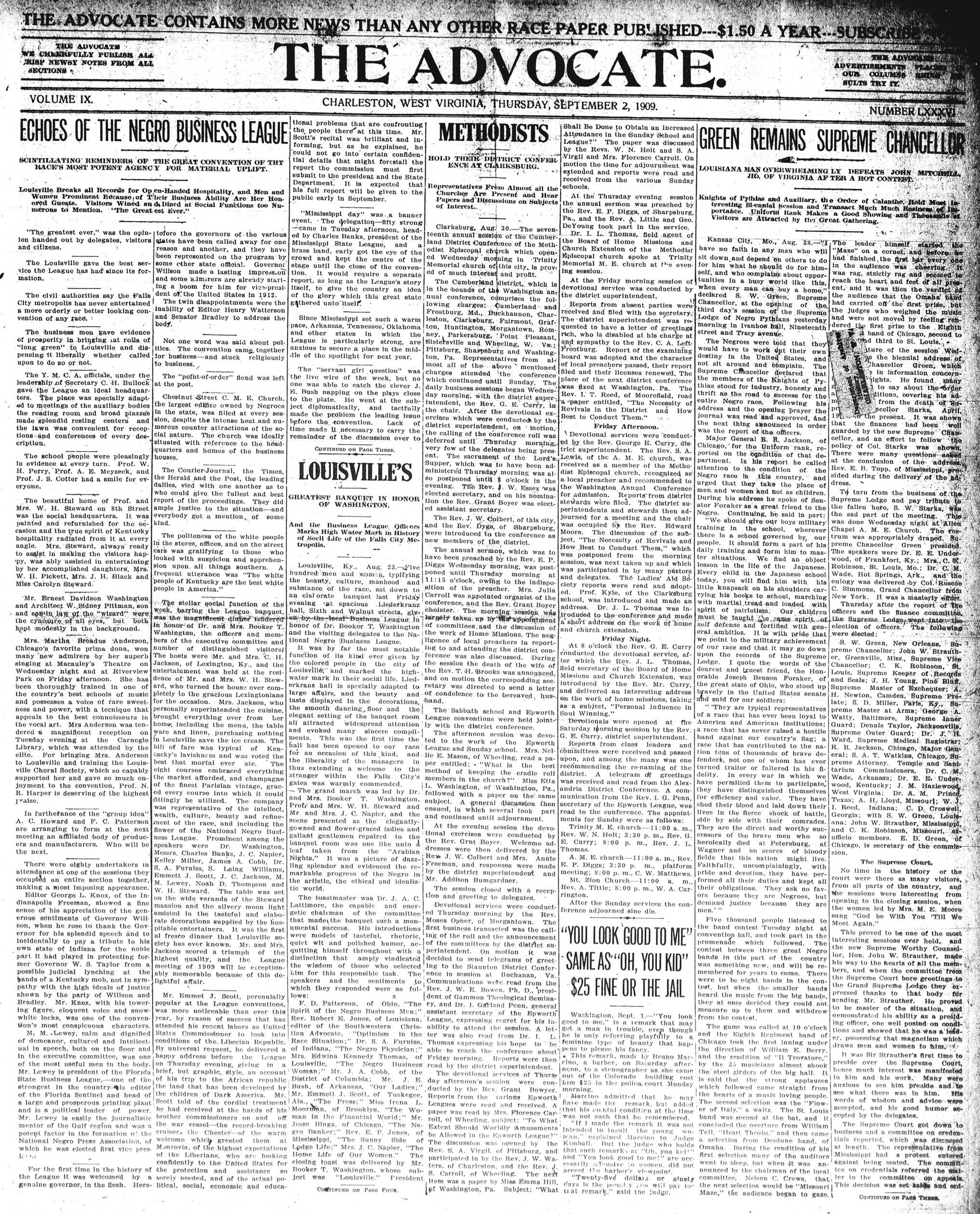
ECHOES OF THE NEGRO BUSINESS LEAGUE
SCINTILLATING REMINDERS OF THE GREAT CONVENTION OF THE HACE'S MOST POTENT AGENCIY FOR MATERIAL, UPLIFT.
Louisville Breaks all Records for Open-Handed Hospitality, and Men and Women Prominent Because of Their Business Ability Are Her Honored Guests. Visitors Wined and Dined at Social Functions too Numerous to Mention. "The Greatest Ever."
THE ADVOCATS
WE CHEERFULLY PUBLISH ALL
RISP NEWSY NOTES FROM ALL
SECTIONS
VOLUME IX.
ECHOES OF THE NEGATIVE
SCINTILLATING REMINDERS OF THE RACE'S MOST POTENT AGENCY
Louisville Breaks all Records for Open Women Prominent Because of Theored Guests. Visitors Wined and merous to Mention. "The Greatest
"The greatest ever," was the opinion handed out by delegates, visitors and citizens.
The Louisville gave the best service the League has had since its formation.
The civil authorities say the Falls City metropolis has never entertained a more orderly or better looking convention of any race.
The business men gave evidence of prosperity in bringing at rolls of "long green" to Louisville and dispensing it liberally whether called upon to do so or not.
The Y. M. C. A. officials, under the leadership of Secretary C. H. Bullock gave the League an ideal headquarters. The place was specially adapted to meetings of the auxiliary bodies the reading room and broad plazzas made splendid resting centers and the lawn was convenient for receptions and conferences of every description.
the school people were pleasingly in evidence at every turn. Prof. W. H. Perry, Prof. A. E. Meyzeck, and Prof. J. S. Cotter had a smile for everyone.
The beautiful home of Prof. and Mrs. W. H. Steward on 8th Street was the social headquarters. It was painted and refurnished for the occasion and the true spirit of Kentucky hospitality radiated from it at every angle. Mrs. Steward, always ready to assist in making the visitors happy, was ably assisted in entertaining by her accomplished daughters, Mrs. W. H. Pickett, Mrs. J. H. Black and Miss Carolyn Steward.
Mr. Ernest Davidson Washington and Architect W. Sldney Pittman, son and south law of the "wizard" were the cinemograph of all eyes, but both kept modestly in the background.
Mrs. Martha Bröadus 'Anderson, Chicago's favorite prima dona, won many new admirers by her superb singing at Macauley's Theatre on Wednesday night and at Riverview Park on Friday afternoon. She has been thoroughly trained in one of the country's best schools of music and possesses a voice of rare sweetness and power, with a technique that appeals to the best connoisseurs in the vocal art. Mrs Anderson was tendered a magnificent reception on Tuesday evening at the Carnegie Library, which was attended by the elite. For bringing Mrs. Anderson to Louisville and training the Louisville Choral Society, which so capably supported her and gave so much enjoyment to the convention, Prof. N. R. Harper is deserving of the highest praise.
In furtherance of the "group idea"
A. C. Howard and F. C. Patterson
are arranging to form at the next
meeting an affiliated body of producers
and manufacturers. Who will be
the next.
There were elgly undertakers in
attendance at one of the sessions they
occupied an entire section together,
making a most imposing appearance.
Editor George L. Knox, of the Indianapolis Freeman, showed a fine sense of his appreciation of the generous sentiments of Governor Willson, when he rose to thank the Governor for his splendid speech and to incidentally to pay a tribute to his own state of Indiana for the noble part it had played in protecting former Governor W. S. Taylor from a possible judicial lynching at the hands of a Kentucky mob, not in sympathy with the high ideals of justice shown by the party of Willson and Bradley. Mr. Knox, with his towering figure, eloquent voice and snow-white locks, was one of the convention's most conscious characters
M. M. Lewey, calm and dignified of demeanor, cultured and intellectual in speech, both on the floor and in the executive committee, was one of the most useful men in the body. Mr. Lewey is president of the Florida State Business League,—one of the strongest in the country—is editor of the Florida Sentinel and head of a large and prosperous printing plant and is a political leader of power. Mr. Lewey is easily the journalistic mentor of the Gulf region and was a potent factor in the formation of the National Negro Press Association, of which he was elected first vice pres-
For the first time in the history of the League it was welcomed by a genuine governor, in the flesh. Here-
tofore the governors of the various states have been called away for one reason and another, and they have been represented on the program by some other state official. Governor Willson made a lasting impression and some alumners are already starting a boom for him for vice-president of the United States in 1912. The twin disappointments were the inability of Editor Henry Watterson and Senator Bradley to address the body.
Not one word was said about politics. The convention camp together for business—and stuck religiously to business.
The "poffit-of-order" fiend was left at the post.
Chestnut Street C. M. E. Church, the largest edifice owned by Negroes in the state, was filled at every session, despite the intense heat and numerous counter attractions of the social nature. The church was ideally situated with reference to the headquarters and homes of the business houses.
The Courler-Journal, the Times, the Herald and the Post, the leading dailies, vied with one another as to who could give the fullest and best report of the proceedings. They did ample justice to the situation—and everybody got a mention of some kind.
The politeness of the white people in the stores, offices, and on the street cars was gratifying to those who looked with suspicion and apprehension upon all things southern. A frequent utterance was "The white people of Kentucky are the best white people in America."
The stellar social function of the week, barring the League banquet, was the magnificent dinner tendered in honor of Dr. and Mrs. Booker T. Washington, the officers and members of the executive committee and number of distinguished visitors. The hosts were Mr. and Mrs. C. H. Jackson, of Loxington, Ky., and the entertainment was held at the residence of Mr. and Mrs. W. H. Steward, who turned the house over completely to the gracious Lexingtonians for the occasion. Mrs. Jackson, who personally superintended the cuisine, brought everything over from her home, including the menu, the table ware and linen, purchasing nothing in Louisville save the ice cream. The bill of fare was typical of Kentucky's lavishness and was voted the best that mortal ever ate. The eight courses embraced everything the market afforded, and champagne of the finest Parisian vintage, graced every course into which it could fittingly be utilized. The company was representative of the intellect, wealth, culture, beauty and refinement of the race, and including the flower of the National Negro Business League. Prominent among the speakers were Dr. Washington, Messrs, Charles Banks, J. C. Napier, Kelley Miller, James A. Cobb, Dr. S. A. Furnill, S. Lating Williams, Emmett J. Scott, J. C. Jackson, M. M. Lewey, Noah D. Thompson and W. H. Steward. The table was set on the wide veranda of the Steward mansion and the silvery moon light assisted in the tasteful and elaborate decorations supplied by the hospitable entertainers. It was the first al fresco dinner that Louisville society has ever known. Mr. and Mrs. Jackson scored a triumph of the highest quality, and the League meeting of 1909 will be exceptionally memorable because of this delightful affair.
Mr. Emmet J. Scott, perennially popular at the League conventions, was more noticeable than ever this year, by reason of success that has attended his recent labors as United States Commissioner to look into conditions of the Liberian Republic. By universal request, he delivered a happy address before the League on Thursday evening, giving in a brief, but graphic, style, an account of his trip to the African republic the land that has been developed by the children of Dark America. Mr. Scott told of the cordial treatment he had received at the hards of his brother commissioners on and off the war vessel—the record-breaking cruiser, the Chester—the of the warm welcome which greeted them at Monrovia, of the highest expectations of the Liberians, who are looking confidently to the United States for the protection and assistance so sorely needed, and of the actual political, social, economic and educa
THE ADVOCATE.
CHARLESTON, WEST VIRGINIA, THURSDAY, SEPTEMBER 2, 1909.
tional problems that are confronting the people there at this time. Mr. Scott's recital was brilliant and informing, but as he explained, he could not go into certain confidential details that might forestall the report the commission must first submit to the president and the State Department. It is expected that his full report will be given to the public early in September.
METHODISTS
HOLD THEIR DISTRICT CONFERENCE AT CLARKSBURG.
Representatives From Almost all the Churches Are Present and Hear Papers and Discussions on State
Shall Be Done to Obtain and Attendance in the Sunday League?" The paper was by the Revs. W. N. Holt Virgil and Mrs. Florence C motion the time for adjourn extended and reports were received from the various schools.
At the Thursday evening
"Mississippi day" was a banner event. The delegation—fifty strong—came in Tuesday afternoon, headed by Charles Banks, president of the Mississippi State League, and a brass band, early got the eye of the crowd and kept the centre of the stage until the close of the convention. It would require a separate report, as long as the League's story itself, to give the country an idea of the glory which this great state gathered unto itself.
Since Mississippi set such a warm pace, Arkansas, Tennessee, Oklahoma and other states in which the League is particularly strong, are anxious to secure a place in the middle of the spotlight for next year.
The "servant girl question" was the live wire of the week, but no one was able to catch the clever J. E. Bush napping on the plays close to the plate. He went at the subject diplomatically, and tactfully made the problem the leading issue before the convention. Lack of time made it necessary to carry the remainder of the discussion over to
CONTINUED ON PAGE THREE.
LOUISVILLE'S
GREATEST BANQUET IN HONOR OF WASHINGTON.
And the Business League Officers Marks High Water Mark in History of Soil Life of the Falls City Metropolitan
Louisville, Ky., Aug. 23.—Five hundred men and women, typifying the beauty, culture, manhood and substance of the race, sat down to an elaborate banquet last Friday evening at spacious Liederkanz hall, Sixth and Walnut streets, given by the local Business League, in honor of Dr. Booker T. Washington and the visiting delegates to the National Negro Business League.
It was by far the most notable function of its kind ever given by the colored people in the city of Louisvillle," and marked the high-water mark in their social life. Liederkranz hall is specially adapted to large affairs, and the beauty and taste displayed in the decorations, the smooth dancing, floor and the elegant setting of the banquet room all attracted widespread attention and evoked many sincere compliments. This was the first time the hall has been opened to our race for an occasion of this kind, and the liberality of the managers in thus extending a welcome to the stranger within the Falls City's gates was warmly commended.
The grand march was led by Dr. and Mrs. Booker T. Washington, Prof. and Mrs. W. H. Steward and Mr. and Mrs. J. C. Napier, and the scene presented as the elegantly-grown and flower-graced ladies and gallant gentlemen repaired to the banquet room was one like unto a leaf taken from the "Arabian Nights." It was a picture of dazzling splendor and evidenced the remarkable progress of the Negro in the artistic, the ethical and idealistic world.
The toastmaster was Dr. J. A. C. Lattimore, the capable and energetic chairman of the committee that made the banquet such a monumental success. His introductions were models of tasteful, rhetoric, quiet wilt and polished humor, acquitting himself throughout with a distinction that amply vindicated the wisdom of those who selected him for this responsible task. The speakers and the sentiments to which they responded were as follows:
F. D. Patterson, of Ohio, "The Spirit of the Negro Business Man;" Rev. Robert E. Jones, of Louisiana, editor of the Southwestern Christian Advocate, "Optimism in the Race Situation;" Dr. S. A. Furniss, of Indiana, "The Negro Physician;" Mrs. Edwina Kennedy Thomas, of Louisville, "The Negro Business Woman;" Mr. J. A. Cobb, of the District of Columbia; Mr. J. E. Bush, of Arkansas, "Our Ladies;" Mr. Emmett J. Scott, of Tuskegee, Ala., "The Press;" Miss Irena L. Moorman, of Brooklyn, "The Woman in the Financial World;" Mr. Jesse Blinga, of Chicago, "The Negro Banker;" Rev. E. P. Jones, of Mississippi, "The Sunny Side of Lodge Life;" Mrs. J. C. Napier, "The Home Life of Our Women." The closing toast was delivered by Mr. Booker T. Washington, whose subject was "Louisville." President
CONTINUED ON PAGE FOUR.
METHODISTS
Representatives From Almost all the Churches Are Present and Hear Papers and Discussions on Subjects of Interest.
Clarksburg, Aug. 30.—The seventeenth annual session of the Cumberland District Conference of the Methodist Episcopal church which opened Wednesday morning in Trinity Memorial church of this city, is proved of much interest and profit.
The Cumberland district, which is in the bounds of the Washington and subnational conference, comprises the following charges: Cumberland and Frostburg, Md., Buckhannon, Charleston, Clarksburg, Fairmont, Graffton, Huntington, Morgantown, Romney, Parkersburg, Point Pleasant, Sistersville and Wheeling, W. Va.; Pittsburg, Shampuburg and Washington, Pa. Representatives from almost all of the above mentioned charges attended the conference which continued until Sunday. The daily business sessions began Wednesday morning, with the district superintendent, the Rev. G. E. Curry, in the chair. After the devotional exercises which were conducted by the district superintendent, on motion, the calling of the conference roll was deferred until Thursday morning, very few of the delegates being present. The sacrament of the Lord's Supper, which was to have been administered Thursday morning was also postponed until 8 o'clock in the evening. The Rev. J. W. Essex was elected secretary, and on his nomination the Rev. Grant Boyer was elected assistant secretary.
The Rev. J. W. Colbert, of this city, and the Rev. Dygs, of Sharpsburg, were introduced to the conference as new members of the district.
The annual sermon, which was to have been preached by the Rev. E. P. Diggs Wednesday morning, was postponed until Thursday morning at 11:15 o'clock, owing to the indisposition of the preacher. Mrs. Julia Carroll was appointed organist of the conference, and the Rev. Grant Boyer choister. The morning session was largely taken up by the appointment of committees, and the discussion of the work of Home Missions. The negligence of local preachers in reporting to and attending the district conference was also discussed. During the session the death of the wife of the Rev. T. H. Brooks was announced, and on motion the corresponding secretary was directed to send a letter of condolence to the bereaved husband.
The Sabbath school and Epworth League conventions were held jointly with the district conference.
At the evening session the devotional exercises were conducted by the Rev. Grnt Boyer. Welcome addresses were then delivered by the Rev. J. W. Colbert and Mrs. Annie Freeman, and responses were made by the district superintendent and Mr. Addison Bumgardner.
The session closed with a reception and greeting to delegates.
Devotional services were conducted Thursday morning by the Rev. Moses Oipher, of Morgantown. The first business transacted was the calling of the roll and the announcement of the committees by the district superintendent. On motion it was decided to send telegrams of greeting to the Staunton District Conference in session at Buchanan, Va. Communications were read from the Rev. J. W. E. Bowen, Ph. D., president of Gammon Theological Seminary, and Dr. I. Garland Penn, general assistant secretary of the Epworth League, expressing regret for his inability to attend the session. A letter was also read from Dr. I. L. Thomas expressing his hope to be able to reach the conference about Friday morning. Reports were then read by the district superintendent.
The devotional services of Thursday afternoon's session were conducted by the Rev. Grant Bowyer. Reports from the various Epworth Leagues were read and received. A paper was read by Mrs. Florence Carroll, of Wheeling, subject: "To What Extent Should Worldly Amusements be Allowed in the Epworth League?" The discussion was opened by the Rev. S. A. Virgil, of Pittsburg, and participated in by the Rev. J. W. Waters, of Charleston, and the Rev. J. S. Carroll, of Wheeling. The next item was a paper by Miss Emma Hill, of Washington, Pa. Subject: "What
Shall Be Done to Obtain an Increased Attendance in the Sunday School and League?" The paper was discussed by the Revs. W. N. Holt and S. A. Virgil and Mrs. Florence Carroll. On motion the time for adjournment was extended and reports were read and received from the various Sunday schools.
At the Thursday evening session the annual sermon was preached by the Rev. E. P. Diggs, of Sharpsburg, Pa., and the Rev. A. Little and Geo. DeYoung took part in the service.
Dr. I. L. Thomas, field agent of the Board of Home Missions and Church Extension of the Methodist Episcopal church spoke at Trinity Memorial M. E. church at the evening session.
At the Friday morning session of devotional service was conducted by the district superintendent.
Reports from absent parties were received and filed with the secretary. The district superintendent was requested to have a letter of greetings rich, who is disabled at his charge at and sympathy to the Rev. C. A. Left-Frostburg. Report of the examining board was adopted and the character of local preachers passed, their report filed and their licenses renewed. The place of the next district conference was fixed at Washington, Pa. The Rev. I. T. Reed, of Moorefield, read a paper entitled, "The Necessity of Revivals in the District and How Best to Conduct Them."
Friday Afternoon.
Devotional services were conducted by the Rev. George E. Curry, district superintendent. The Rev. S. A. Lewis, of the A. M. E. church, was received as a member of the Methodist Episcopal church, recognized as a local preacher and recommended to the Washington Annual Conference for admission. Reports from district stewards were filed. The district superintendents and stewards then adjourned for a meeting and the chair was occupied by the Rev. Edward Moore. The discussion of the subject, "The Necessity of Revivals and How Best to Conduct Them," which was postponed from the morning session, was next taken up and which was participated in by many pastors and delegates. The Ladies' Ald Society reports were read and adopted. Prof. Kyle, of the Clarksburg school, was introduced and made an address. Dr. J. L. Thomas was introduced to the conference and made a short address on the work of home and church extension.
Friday Night.
At 8 o'clock the Rev. G. E. Curry conducted the devotional service, after which the Rev. J. L. Thomas, field secretary of the Board of Home Missions and Church Extension, was introduced by the Rev. Mr. Curry, and delivered an interesting address on the work of home missions, taking as a subject, "Personal Influence in Soul Winning." Devotionals were opened at the Saturday morning session by the Rev. G. E. Curry, district superintendent. Reports from class leaders and committees were received and passed upon, and among the many was one recommending the re-naming of the district. A telegram of greetings was received and read from the Alexandria District Conference. A communication from the Rev. I. G. Penn, secretary of the Epworth League, was read to the conference. The appointments for Sunday were as follows:
Trinity M. E. church—11:00 a. m., Rev. W. N. Holt; 3:30 p. m., Rev G. E. Curry; 8:00 p. m., Rev J. L. Thomas.
A. M. E. church—11:00 a. m., Rev. E. P. Diggs; 3:30 p. m., platform meeting; 8:00 p. m., C. W. Matthews.
Mt. Zion Church—11:00 a. m., Rev. A. Tittle; 8:00 p. m., W. A. Carrington.
After the Sunday services the conference adjourned sine die.
"YOU LOOK GOOD TO ME SAME AS"OH,YOU KID $25 FINE OR THE JAIL
Washington, Sept. 1,—"You look good to me," is a remark that may get a man in trouble, even though he is only referring playfully to a feminine type of beauty that happens to please his fancy.
This remark, made by Bruno Marino, a barber, on Saturday afternoon, to a stenographer as she came out of the Colorado building cost him $25 in the police court Monday morning.
Marino admitted that he may have made the remark, but added that his mental condition at the time was not such that he remembered.
"If I made the remark it was not intended to insult the young woman," explained Marino to Judge Kimball. But the judge who holds that such remarks as "Oh, you kid!" and "You look good to me!" are necessarily offensive to women, did not accept the barber's viewpoint.
"Twenty-five dollars or ninety days is the penalty you will pay to it at reason," said the judge.
GREEN REMAINS SUPREME CHANCELLOR
LOUISIANA MAN OVERWHELMING LY DEFEATS JOHN MITCHELL, JR., OF VIRGINIA AFTER A HOT CONTEST.
Knights of Pythias and Auxiliary, the Order of Calanthe, Hold Most interesting Bi-eventual Session and Transact Much Much Business of the importance. Uniform Rank Makes a Good Showing and Thousands of Visitors are Attracted by the Great Gathering.
Kansas City, Mo., Aug. 28. "I have no faith in any man who will sit down, and depend on others to do for him what he should do for himself, and who complains about opportunities in a busy world like this, when every man can buy a home," declared S. W. Green, Supreme Chancellor, at the opening of the third day's session of the Supreme Lodge of Negro Pythians yesterday morning in Ivanhoe hall, Nineteenth street and Trace avenue.
The leader himself started the "Maze" on a cornet, and before he had finished the first bar every one in the audience was cheering. It was rag, stricly rag and seemed to reach the heart and feet of all present, and it was then the verdict of the audience that the Omaha band had carried off the first prize, but the judges who weighed the music and were not moved by feeling rendered the first prize to the Eighth hand of Chicago, second to
The Negroes were told that they would have to work opt their own destiny in the United States, and not sit around and complain. The Supreme Cancellor declared that the members of the Knights of Pythias stood for industry, honesty and thrift as the road to success for the entire Negro race. Following his address and the opening prayer the journal was read and approved, and the next thing announced in order was the report of the officers. Major General R. R. Jackson, of Chicago, for the Uniform rank, reported on the condition of that department. In his report he called attention to the condition of the Negro race in this country, and urged that they take the place of men and women and not as children. During his address he spoke of Senator Foraker as a great friend to the Negro. Continuing, he said in
"We should give our boys military training in the school, wherever there is a school governed by, our people. It should form a part of his daily training and form him to master situations. We find an object lesson in the life of the Japanese. Every child in the Japanese school today, you will find him with his little knapsack on his shoulders carrying his books to school, marching with martial bread and loaded with spirit of patriotism. Our children must be taught the same spirit of self defense and fortified with general ambition. It is with pride that we point to the military achievement of our race and that it may go down upon the records of the Supreme Lodge. I quote the words of the dearest and guest friend, the Honorable Joseph Benson Foraker, of the great state of Ohio, who stood up bravely in the United States senate and said for our soldiers:
"They are typical representatives of a race that has ever been loyal to America and American institutions; a race that has never raised a hostile hand against our country's flag; a race that has contributed to the nation tens of thousands of brave defenders; not one of whom has ever turned traitor or faltered in his fidelity. In every war in which we have permitted them to participate, they have distinguished themselves for efficiency and valor. They have shed their blood and laid down their lives in the fierce shock of battle, side by side with their comrades. They are the direct and worthy successors of the brave men who so heroically died at Petersburg, at Wagner and on scores of bloody fields that this nation might live, Faithfully, uncomplainingly, with pride and devotion, they have performed all their duties and kept all their obligations. They ask no favors because they are Negroes, but demand justice because they are men."
Five thousand people listened to the band contest Tuesday night at convention hall, and took part in the promenade which followed. The contest between three great Negro bands in this part of the country was something new, and will be remembered for years to come. There were to be eight bands in the contest, but when the smaller bands heard the music from the big bands, they at once decided they could not measure up to them and withdrew from the contest.
The game was called at 10 o'clock and the Eighth Regiment band of Chicago took the first inning under the direction of William E. Berry, and the rendition of "Il Trovatore," by the 35 musicians almost shook the steel girders of the big hall. It is said that the strong apllauses which followed came straight from the hearts of a music loving people. The second selection was the "Flower of Italy," a waltz. The St. Louis band was second at the bat, and it concluded the overture from William Tell, "Heart Throbs," and then came a selection from Desdune band, of Omaha. During the rendition of his first selection many of the auditors went to sleep, but when it was announced by the chairman of the local committee, Nelson C. Crews, that the next selection would be "Missouri Maze," the audience began to gaze
NUMBER LXXXII
The leader himself started the "Maze" on a cornet, and before he had finished the first bar every one in the audience was cheering. It was rag, stricly rag and seemed to reach the heart and feet of all present, and it was then the verdict of the audience that the Omaha band had carried off the first prize, but the judges who weighed the music and were not moved by feeling rendered the first prize to the Eighth band of Chicago, second to and third to St. Louis. Nature of the session Wednesdays the biennial address of Chancellor Green, which is in information concernsights. He found many ways to say about the order and conditions, covering his admiration from the death of Chancellor Starks, April 19, to the present. It was shown that the finances had been well guarded by the new Supreme Chancellor, and an effort to follow the policy of Col. Starks was shown. There were many questions asked at the conclusion of the address, Rev. E. B. Topp, of Mississippi, presided during the delivery of the address.
To turn from the business of the Supreme Lodge and pay tribute to the fallen hero, S. W. Starks, who the sad part of the meeting. This was done Wednesday night at Allen Chapel A. M. E. Church. The rostrum was appropriately draped. Supreme Chancellor Green presided. The speakers were Dr. E. E. Underwood, of Frankfort, Ky.; Mrs. C. M. Robinson, St. Louis, Mo.; Dr. C. M. Wade, Hot Springs, Ark., and the eulogy was delivered by Col. Roscoe C. Simmons, Grand Chancellor from New York. It was a masterly effort. Thursday after the report of the officers and the finance committee, the Supreme Lodge, went into the election of officers. The following were elected:
S. W. Green, New Orleans, Supreme Chancellor; John W. Strauther, Greenville, Miss., Supreme Vice Chancellor; C. K. Robinson, St. Louis, Supreme Keeper of Records and Seals; J. H. Young, Pine Bluff, Supreme Master of Exchequer; A. H. Newton, Camden, Supreme Prolate; S. D. Miller, Paris, Ky., Supreme Master at Arms; George A. Watty, Baltimore, Supreme Inner Guard; Dennis Taylor, Jacksonvills, Supreme Outer Guard; Dr. J. H Ward, Supreme Medical Registrar; R. R. Jackson, Chicago, Major General; S. A. T. Watkins, Chicago, Supreme Attorney. Temple and Santarium Commissioners, Dr. C. M. Wade, Arkansas; Dr. E. E. Underwood, Kentucky; J. M. Hazlewood, West Virginia; Dr. A. M. Prince Texas; A. H. Lloyd, Missouri; W. J. L. Reed, Indiana; C. D. Croswell, Georgia; with S. W. Green, Louisiana; John W. Strauther, Mississippi; and C. K. Robinson, Missouri, exofficio members. E. D. Green, of Chicago, is secretary of the commission.
The Supreme Court.
No time in the history or the court were there as many visitors, from all parts of the country, and the sessions were interesting from opening to the closing session, when the women led by Mrs. M. E. Moore sang "God be With You 'Till We Meet Again."
This proved to be one of the most interesting sessions ever held, and the new Supreme Worthy Counselor, Hon. John W. Strauther, made his way to the hearts of all the members, and when the committee from the Supreme Court bore greetings to the Grand Supreme Lodge they expressed thanks to that body for sending Mr. Strauther. He proved to be master of the situation, and demonstrated his ability as a presiding officer, one well posted on conditions and showed that he was a leader, possessing that magnetism which draws men and women to him.
It was Sir Strauthaer's first time to preside over the Supreme Court, hence much interest was manifested in him and his work. Many were anxious to see him preside and to see what there was in him. His words of wisdom and advice were accepted, and his good humor accepted by the delegates. The Supreme Court got down to business and a committee on credentials reported, which was discussed at length. The representative from Mississippi had a protest entered against being seated. The committee on credentials referred the matter to the committee on appeals. This decision was set aside and ord-
CORRESPONDENCE
DELINQUENT SUBSCRIBERS
DELINQUENT SUBSCRIBERS
Will take notice that if they are in arrears a year or more, their papers will be discontinued on August 20th, unless a settlement is made on or before that date.
The Advocate takes this step in compliance with postal regulations, and requests that remittances be made by postal or express money order, registered letter, or check.
RONCEVERTE NEWS.
Mrs. Lillie B. Johnson is visiting her sister, Mrs. Etta Green.
Miss Willie Stribling, of Charleston, spent Sunday with her mother, Mrs. Kate Eldridge.
Ed West and Sldney Holly, of Sullivan, were visitors here Sunday.
Miss Marshall and Jas. Ingram, of Lewisburg, were callers of Mrs. Ingram Sunday afternoon.
Miss Gracie L. D. Williams, who had her arm fractured in a runaway accident about 10 days' ago, is rapidly improving.
H. T. Moor returned home Tuesday from a pleasant trip to Cincinnati.
Miss Ella Calaway is the guest of Mrs. Nannie B. Rice.
J. W. Thompson, of Clifton Forge, was visiting friends here Sunday.
Edward Eldridge left Monday for Clifton Forge.
D. W. Calaway visited Beckley last week.
Rev. Charles Lewis is attending State Council of Red Men at Sylvia this week.
Harold Wood is visiting his mother Mrs. Edna Wood.
G. B. Cousin, who has been confined to his bed for three weeks, is able to be out again.
Mrs. Chas. Perkins visited White Sulphur Sunday.
On Wednesday, Aug. 25th, Rev. Chas. Lewis, Deputy G. Sachem, installed the following officers of Watoga Tribe Red Men: D. R. Hickman, Sachem; Wm. Wakins, Senior Sagamore; A. E. Sweeney, Junior Sagamore; Edward Dixon, Collector of Wampum; Chas. Lewis, Keeper of Wampum; Jno. Washington, Bison Wilson, J. B. Williams, trustees for the term of six months.
Mr. and Mrs. Edward Kane, of Richmond, Va., is the guest of Mrs. H. T. Moore. (
C. A. Page was visiting in Charleston this week.
Emanuel Russ spent Sunday here visiting friends.
Misses Mary and Cornelia Page were shopping in Charleston Friday.
Miss Ivory Woods had as her guests Wednesday Miss Virgie Rose, Mrs. Tead Hale, Glen Bullard and Archie Chadler.
Sherman Green returned to Cabin Creek Monday, after visiting his mother, Mrs. Richard Green.
Willie Page returned home from Montgomery Monday.
Mr. and Mrs. R. B. Johnson have as their guests Mr. and Mrs. W. H. Jackson and daughter Agnes.
Miss Annistine Johnson entertained a number of friends Saturday in honor of Mr. Green.
Aquilla Page and daughters were guests of his parents Sunday.
Miss C. B., Charles and F. D. Page are attending Teachers' Institute at Charleston this week.
G. L. Jackson was a visitor to Thurmond Monday.
Misses Annistine Johnson and Ivy Woods were shopping in Charleston, Monday.
Miss Octavia Green will entertain a number of friends at home this evening.
Mrs. Mollie Wood has returned from the Hospital much improved.
WELLSVILLE, OHIO.
Miss Pearl Manly, of Cleveland, O., is visiting her parents, Mr. and Mrs. James Manly. She was accompanied here by Misses Jackson and Edwards, who are also from Cleveland.
Miss Izetta Snowden, of Steubenville, is the guest of her aunt, Mrs. Mathew Smith.
The Silver Leaf Club met with Mrs. Lucy Williams last Tuesday evening and adjourned to meet, this week, with Mrs. Charles Snowden.
Benjamin Lee entertained at six
o'clock dinner, Tuesday evening, in honor of Miss Pearl Manly and her visitors, Misses Jackson and Edwards.
Mr. and Mrs. Ira Brown and Mrs. Clyde B. Jones, sent Sunday in East End, East Leverpool, with Mrs. Brown's parents, Mr. and Mrs. Stone.
Mrs. Matthew Smith was hostess to quite a number of her young friends, Friday afternoon, in honor of her niece, Miss Izetta Snowden.
Extensive preparations are being made to celebrate Emancipation Day here on the 22nd.
Miss Eva Payne was hostess to a number of her friends, Tuesday evening. An enjoyable time was spent by those present.
HUNTINGTON.
Rev. G. K. Carter preached two very able sermons at First Baptist church, Sunday morning and evening. Isham Scott attended the funeral of R. D. Robinson at Hinton, Monday. Mrs. H. J. Gillard, who has been ill since Thursday, is improved at this writing. C. G. Woodson will leave this week for Washington, D. C., to take a position as instructor in French and Spanish in the Armstrong Technical School there. Mrs. Norah Dickinson, who has been quite ill at her home on 7th Avenue, is better. Samuel Patton, who has been seriously ill for the past month, is able to move about the house a little.
Miss Bessie Phillips left for her home, Monday morning, where she will spend a short while before resuming her studies at Douglas High School.
Rev. J. M. Riddle, of Gloucester, Ohio, spent several days the past week with relatives here.
Mrs. Alice Kearney Pullom and three children, who have been quite ill with diphtheria, are better.
Rev. L. A. Lewis, who spent a short while here visiting home folks, left Saturday night for his charge at Lynchburg, Va.
Jno. Gillard and family moved here the past week for permanent residence.
Mrs. Jacob Johnson, who is recovering from a serious illness, left for Columbus, Monday to spend some time with her mother.
"Kipolo's Marriage" written by Mrs. G. W. Hughes, was presented Thrusday evening at 16th Baptist church by four young ladies and one young gentleman. It was highly appreciated by all present.
Mrs. Chas. Harris and baby, Alma, left for Indianapolis, Indiana, Wednesday, where they will reside.
Prof. J. W. Scott returned this week from a very pleasant visit to Buckroe Beach.
Miss McDaniel, who has spent a pleasant time with Prof. and Mrs. Hatchett for the past three weeks, left for her home, Covington, Va., Monday.
Walter James, who has been visiting his parents, Mr. and Mrs. W. O. James, left for Lawrenceville, Va., last Friday to resume his work as teacher of Agriculture.
Mrs. Kate Colley returned home last week after an extended visit to Richmond friends.
Prof. Walter Smith and wife, of Wilberforce, Ohio, are spending some time with their parents, Mr. and Mrs. Traveler Smith.
Miss Laura Owens is visiting Mrs. Emma Matney at Ashland, Ky.
Misses Pritchett and Glover, who have been visiting friends here for the past month, will leave for their home, Zanesville, Ohio, next week.
Mrs. A. D. Lewis is spending some time with Richmond friends.
Mrs. Maggie Anderson was hostess to the Orion Club Thursday evening.
Rev. S. A. Thurston filled his pulpit at 16th St. Baptist church, Sunday after a very pleasant vacation. Rev. I. V. Bryant visited points in Ohio last week. A number from here will attend the dedication of Quinn Chapel at fronton next Sunday.
BUCKHANNON.
Miss Jennie Littleton, of Clarksburg, was the guest of her sister, Mrs. J. L. Davis, Sunday.
Mrs. Malinda Green left Thursday for Fairmont to visit her sister, Mrs. Cobb, who is ill.
Miss Lotta Smith who was seriously ill for several days, is somewhat improved at this time.
The Boat excursion up the Buckhannon river Tuesday evening was enjoyed by a large crowd.
Mrs. Jas. Wade entertained with 6 o'clock dinner, Thursday, in honor of Mrs. A. L. Jackson, of Wheeling.
Mrs. Laura Watson has returned home after visiting in Moorefield.
Adam Green attended the races at Elkins, last week.
Rev. Geo. De Young, T. A. Brown, Silas Murphy, and Mrs. Estie Martin attended district conference at Clarksburg, last week.
Mr. and Mrs. Chas. Dickinson entertained the Silver Leaf Club, Friday evening.
Master Frank Watson is ill with typhoid fever.
Miss Nettie Madison, Miss Josie Fagan, Mrs. Michael Brown, and Mrs. Will Ennis attended the fair at Elkins, last week.
Rev. O. T. Davis, pastor of Hall's Chapel A. M. E. Church left, Saturday, for Sutton.
Mrs. A. L. Jackson was honor guest at a dinner given Sunday by Miss Angie Taylor.
RAYMOND CITY.
Rev. J. W. Crosby, preached two interesting and instructive sermons for the missionary society Sunday.
Charlie Whorton, was very painfully hurt in the mines here last week.
Eugene James and Ed Edins were slightly injured in the mines, last week.
Mrs. Julia Wallace and daughter, Mrs. Beatrice, of Charleston, are spending some time here.
Rev. P. P. Holland passed through Saturday en route to Bancroft.
Mrs. Jennie Brown Williams is reported on the sick list this week.
Mrs. Lottie Tibbs has returned home after spending a few days in Cedar Grove visiting her mother.
The following members were initiated in the True Reformers' Lodge, Monday night: Mrs. Cora Simms, Messrs. George McKinney, and Eugene James. Rholand Williams left Sunday night for Hinton.
ST. ALBANS.
Mrs. Martha Payne, of Huntington, spent Saturday and Sunday with her sister, Mrs. Mary Greene.
Lee Johnson, of Winifrede, was visiting friends last week.
Rev. J. W. Robinson, Miss Gertrude Parrish and Miss Georgia Banks attender the Teachers' Institute at Montgomery last week.
Miss Mabel Scott, of Columbus, O., who was elected to teach the St. Albans school, is here and will begin her work on the 6th of September.
Ernest Marris, of Charleston, was here a short while Saturday, on business.
Wilbert Price will leave in a few weeks for Lawrenceville, Va., where he will enter school.
Miss Virginia Wilson and R. G. Neal were quietly married at the home of the bride's parents, Wednesday, by Rev. J. W. Robinson.
Mrs. Mary Stratton and Mrs. Ada Preston went to Elk Ridge, Thursday, on business.
Quite a number of young ladies and gentlemen went out on a hay ride Thursday night and a very pleasant time was reported.
The young people also went up Coal River on a fishing trip Friday, a pleasant time was had.
BANCROFT
Mrs. Chas. Surgoines entertained Tuesday afternoon, in honor of her 53rd birthday. Those present were: Mrs. Hale Dickerson, Mrs. John Cyrus, Mrs. Homer Phillips, Mrs. Ed. Hicks, Mrs. Joe Sawyers, Mrs. Spencer Smith, Mrs. Henry James and Mrs. Hattie Walters. A birthday dinner was served by the hostess, consisting of all the delicacies of the season. She received many handsome and useful presents.
The Women's Missionary Society had their first anniversary on Sunday last. The sermon was preached at 11 o'clock by our pastor, Rev. P. P. Holland at 8 o'clock p. m. A short but spicy program was rendered, giving the history of the organization, reading of papers on different themes of mission work, and singing. A handsome collection was raised.
Mrs. Henry Williams, who has been visiting her husband here for a few days, has returned to her home in Glouster, Ohio.
Mrs. J. T. Toliver and neice, Miss Hattie Smith, of New Haven, Conn., who have been visiting the former's sister here for a few weeks, are visiting at Pratt.
The Ladies of Missionary Society were entertained on Monday of this
THE ADVERTISER. THURSDAY, SEPTEMBER 2, 1898
South Charleston
PEOPLE IN SOUTH CHARLESTON NOW
FACTORIES EMPLOYING OVER 400 MEN Dunkirk Window Glass Co. Banner Window Glass Co. Kanawha Chemjcal Engine Mfg. Co.
Terms: 1-10 cash, balance in monthly payments to suit. Discount for all cash. Kanawha Land Co. Room 501 Charleston National Bank Building Bell Phone 750; Home Phone: 1214
ridge, spent several days with Mrs. Mandy Jackson.
Mrs. Susie Morton, of Ronceverte, was up Monday visiting Mrs. Mattie McVey.
Mrs. Jannie Harvey and daughter, Miss Annie, who have been visiting Mr. James H. Scott, left Tuesday for Philadelphia.
Miss Rosa McVey left Saturday for Clifton Forge, to spend a week with friends and relatives.
Mrs. Fidella Perkins, of Washington, D. C., is here visiting friends and relatives.
Miss Effle Calawa left Saturday night for Ronceverte.
Miss Lucy Boling is much better at this writing.
William Greenland left Tuesday for Martinsburg to attend District Conference.
Rev. Deans left Monday for Hinton to attend the funeral of Grand Master R. D. Robinson.
Dr. S. F. Clay went to Hinton to attend the funeral of R. D. Robinson.
Mrs. Sarah Davisson, of Charleston, is here visiting her sister, Mrs. Charity Robinson.
Miss Washington and Mr. George Scott were united in marriage last Monday night by Rev. J. W. Waters.
Miss Sallie Freeland served dinner at one o'clock Thursday in honor of Dr. Daniel and wife, and a few other friends.
The young people went out on a hay ride Thursday night, to the White Sulphur Springs.
J. R. Patton has returned to Institute after spending several days in Louisville, Ky.
Miss Rosalynd Friend, of Charleston, spent Sunday with her mother.
Mrs. T. H. Norman and daughter left for their home in Washington, D. C., after spending a few weeks visiting relatives and friends.
E. M. Burgess has returned from Columbus, O., where he has been assisting in religious work.
Miss Scott, of St. Albans, was the guest of Miss Ollie Meadows, Saturday.
Mr. and Mrs. W. H. Lowry returned Monday evening from Kansas City, Mo.
Prof. S. H. Guss returned Tuesday from Bluefield where he has been conducting a teachers Institute. C. E. Mitchell returned Monday
C. E. Mitchell returned Monday from Philadelphia.
Mrs. Minnie Hurt made a business call to Charleston Wednesday.
J. Arthur Jackson, James Brown and Dr. R. L. Jones were guests of the Institute Lawn Tennis Club Tuesday.
week at the residence of Mrs. Emma Dickerson. After the routine of business, they were served with fruits. Little Helen Ross, who has been sick for the past week, is much better at this writing.
Mrs. P. P. Holland and little daughter Hettie were the guests of Mrs. Hale Dickerson Sunday.
Mrs. Sylvia Steward, of Middleport, Ohio, is visiting her husband at Plymouth.
The little son of Mr. and Mrs. Geo. McKinney is indisposed at this writing.
Dr. M. T. Sinclair made a trip to Raymond last Thursday on professional business.
BARBOURSVILLE.
Mr. and Mrs. Whirle were visitors to Huntington last week.
Mrs. George Martin entertained a number of young folks the 22nd, complimentary to Misses Glover and Pritchard.
Misses Minnie Kilgore, Georgia Glover and Odessa, Pritchette spent Wednesday at Martha, the guests of Mr. and Mrs. Anderson Goode.
Messrs. Elby, Davi s and Wert Wheeler, of St. Albans, and Vaughn Brooks, of Hurricane, were in town last week.
Mr. and Mrs. Ed. Whirle entertained delightfully last Wednesday evening in honor of Misses Glover and Pritchette.
Mrs. Anna Hill served dinner to Misses Glover, Pritchette, Messrs. M. N. Hicks, T. Hendrix and Frank Goode, Thursday.
School will open September 13th, with Mrs. Johnson, of Huntington, as teacher.
Mr. and Mrs. J, W. Kilgore were in Huntington and Kellogg, Saturday, visiting friends.
Mrs. Charlotte Jones, of Huntington, was renewing old acquaintances here Sunday.
John Wilkerson, of Huntington, succeeded Mrs. Royal as chef at the Hotel Edgar, Wednesday. Mrs. Royal will spend some weeks in Virginia.
Frank Gooda and T. Hendrix were visitors to Midway, Sunday.
Henry Goode spent Sunday with his family here.
LEWISBURG.
Mr. and Mrs. Alfred Steward served tea at 6 o'clock, Saturday evening, in honor of Dr. Daniel and wife, of Washington, D. C.
Mrs. Eva Waters and little Virginia Haris left Wednesday for Washington, where they will visit friends and relatives.
Roscoe Deans, who was on his way to Norfolk, Va., spent several days here with his father, Rev. Deans, of Montgomery.
THERE APRIL 1, 1907
28 AND 30 CAPITOL ST.
Beef, Veal, Mutton, Pork, Fresh Pork Sausage OUR OWN MAKE.
Try our machine sliced Hams and Bacon
INSTITUTE.
The best qualities in all the popular kinds of
We want your patronage for we have complete stock in our lines and you can get it when you want it most.
If you haven't a regular healthy movement of the bowels open, and be well, Force, in the violent physio or pill poison, is dangerous. The bowels clear and clean is to take
CANDY
OATHARTIO
Cascarets
THEY WORK WHILE YOU SLEEP
EAT 'EM. LIKE CANDY
Pleasant, Bali-like taste for good. Do
Good. Never Sloken, Weston or Gripp. 10 sg
and so cents per box. Write for free sample, and book
let health. Address: 435
Starking Remedy Company. Chicago or New York.
KEEP YOUR BLOOD CLEAN
CONTINUED FROM PAGE ONE.
the next meeting. So valuable did the Courler-Journal and the Times consider Mr. Bush's investigations and conclusions, that they gave editorials of over a column in length to them, and Miss Nannie H. Burroughs and others delivered telling speeches that will go far to improve the condition and environments that have heretofore made the lot of the servant girl one of hardship and danger.
Charles Steward, the peripatetic globe-trotter, all-round newspaper man and attache of the Associated Press, was on hand as usual, "homologating" the salient facts and "sanctioning" the wisdom of the great body. Horace D. Slatter, representing a chain of southern dailies, was likewise in the harness and did excellent work in placing the League before the people.
Boston, New York, Atlantic City, Omaha, Nashville, Little Rock, Muskogee, Washington, Hampton, Springfield, Cincinnati and Birmingham have asked for the next year's convention. Eloquent pleas were made by the champions of each and the choice cannot fail to be a wise one, with such an abundance of rich material to select from. The executive committee is withholding action for the present.
Ho for the National Negro Exposition in 1913! In urging the race to thus mark the theftifth anniversary of its emancipation, the National Negro Business League takes a long step in advance of all other organizations. Nothing will so convincingly show the world that freedom was not a mistake as a great exposition of the tangible progress, the Negro has made in his fifty years of opportunity.
Every denomination and fraternity seemed to be liberally represented, and all agreed on the one point—that the Negro's primary need is to grow stronger in the world of finance and trade, without which foundation no church nor fraternity nor social fabric can long exist.
Dr. Blooker T. Washington's speeches were in his best vein. He took a new hold upon the affections and confidence of his people by his admirable management of this great convention, which had so many chances to go astray were it not in the hands of a master builder.
The colored citizens of Kentucky say they can always find Governor Willson when they need him, and that he is ever ready to serve them. "That's what we call a man."
If Louisville erred at all in entertaining the Business' League, it was in doing too much. The guests of the city were kept constantly on the go, with one form of enjoyment or another, from the time they stepped off their trains until the final leave was taken. The Louisvilians are pardoned, however, for erring on the right side.
Mr. John B. Cooper, the chairman of the committee on entertainment, did his work most thoroughly. No detail was left to chance—he was "on the job" from start to finish, and as a result the Falls City has to its credit the biggest advertisement in its history. Its praises are now being sung in thirty states. Louisville is certain to profit in both a moral and a material way by reason of his painstaking and dilligent labors in making things pleasant for the thousands who came and were made happy. Mr. Cooper is the business manager of the Watson Undertaking Company, the leading funeral directors of the city, and though busy all the time in serving his immense custom, he never hesitates to go out of his way to lend a helping hand to such public-spirited movements as that represented by the National Negro Business League. The same is true of his gracious wife Mrs. Lavina Watson Cooper, who rendered yeaoman service at the head of the Woman's Auxiliary of the local league.
The Colored Branch of the Louisville Free Public Library, valued at $40,000, was shown to excellent advantage by the library staff, consisting of Librarian Thomas F. Blue, and his obliging assistants, Mrs. Rachel D. Harris and Miss Elizabeth I. Finney. Its location at 10th and
Chestnut attests is ideal. The exhibit of industrial work from the public schools was interesting and attractive:
Attorney Albert S. White, Dean of the Central Law School, was the oratorical, star of the week. His address of welcome on behalf of the Bar was a masterpiece of eloquence, logic and historical information. He aroused round after round of hearty applause as he welcomed the delegates to the soil that gave birth to such statesmen, philanthropists and friends of the Negro as Abraham Lincoln, Cassius M. Clay, John Marshall, Hallan and William J. Simmons. The fact that Mr. White is very prominently mentioned in connection with a federal appointment of the first grade made him the cynosure of all eyes. It is needless to say that he bore the inspection well.
The souvenir booklet and program gotten out by Mrs. Lavinia B. Sneed was a beauty, excelling anything yet brought out at any of the League sessions. The pamphlet was "plumb full" of information about the National and Local Leagues, the schools churches, business enterprises and homes of Louisville. Although a fine and expensive piece of typography, it sold like "hot cakes" and netted a neat sum for its talented author.
There were eighty undertakers, thirty lawyers and sixty newspaper men in the convention—and the bankers ranked well up in number.
Dr. Washington was given the famous "Chatauqua salute" upon every possible occasion.
Miss Carolyn Steward was the "Daughter of the Regiment."
Mrs. Booker T. Washington was in splendid health despite her recent social tour of Chicago and other cities, and enjoyed every moment of her stay. Queenly in bearing, tasteful in attire and the personification of gracious courtesy to all she met, the delegates and visitors unanimously voted her "the first lady of the land." In her cabinet were the charming Mrs. J. C. Napler, Mrs. W. H. Steward, Mrs. S. A. Furniss and Miss Lillian A. Johnson.
The "outing" at White City, the sunset excursion up the river, by the Progressive League, the reception of the Woman's Economical Club at Prof. Steward's, the reception of the Woman's Improvement Club at Mrs. Sarah Mayfield's, the luncheon at Mrs. Thomas Cole's, besides the numerous private functions, constituted a week of unadulterated pleasure, extending the "glad hand."
As a result of the pronounced hit made by Mrs. Martha Broadus Anderson, the prima dona soprano, of Chicago, she is in receipt of a flood of invitations to visit cities in all sections of the country. She is a drawing card of no meagre dimensions.
The Colored Funeral Directors' Association of Kentucky met and elected Lincoln Teague president; L. B. Willis, vice president; J. H. Hathaway, treasurer; Charles Curl, secretary and A. G. Agnew, sergeant-at-arms. Bowling Green was chosen as the next place of meeting.
Prof. Kelley Miller, of Howard University, made a number of well-tempered addresses, urging at all times efficiency in training, whether it be for the higher walks of life or for the industries and domestic service. Prof. Miller is a favorite in Kentucky.
Dr. E. P. Jones wore his blandest smile and is said to have put in some forcible campaigning for the next turn as Grand Master of the G. U. O. of O. F.
The papers paid a great deal of attention to J. A. Lankford, the architect of Washington, D. C., who was one of the most useful members of the convention and contributed largely to the discussions and serving on several important committees. Mr. Lankford is a pioneer in his profession, as for as Negroes are concerned, and has built more classic structures than any other colored architect in the country. The True Reformer's Hall at Washington, D. C., the Southern Ald Building and W. L. Taylor's residence at Richmond, Va., and the massive Masonic Temple at Jacksonville, Fla., are monuments to his high-grade talent. He holds the degree of M. S. (Master of Science) and M. M. S., (Master of Mechanical Science) from two of America's leading colleges, is a life trustee of Wilbefore University, a member of several fraternities, and a short time ago became eligible for a medal from the Carnegie Hero Fund for extraordinary bravery in rescuing his wife and child from a burning building at Washington. Mr. Langford is a credit to his race—the kind of a man the masses and the classes ought to sustain.
The United States Express Company paid the League no small compliment in sending from its main office at Chicago a special representative in the person of Mr. Noah D. Thompson, an exceptionally bright and suave young man, who has had large experience in business affairs. Mr. Thompson brought to the convention the following message, directed to Booker T. Washington and signed by Mr. T. E. McDonnell, the general superintendent of the United States Express Company. The mer
sage was: "Our attention has been called to the good work you are doing for the industrious members of your race throughout the country. We congratulate you and wish you continued success. As a compliment to your organization and as a reward of merit to one of your enterprising members who has been in our confidential employ for nearly twenty years in the city of Chicago, we are today delegating him (Mr. Noah D. Thompson,) to look after the interest of our company among your members and send him to you with our greetings." Mr. Thompson amply demonstrated that he was equal to the occasion and was throughout the proceedings very close to Dr. Washington and rendered him signal aid in a number of important assignments.
The committee on credentials was composed of Harry T. Pratt, of Maryland; W. Sldney Pittman, District of Columbia; L. N. Porter, Arkansas; M. W. Turner, Indiana; S. H. Highland, Mississippi.
The responses to the addresses of welcome by the Governor of Kentucky, the Mayor of Louisville and others were delivered by Charles Banks, of Mississippi, and S. Laing Williams, of Chicago. They were unusually felicitous, brief and to the point.
The gavel handled by President Washington during the series was the gift of the Masonic fraternity of the city. It was a handsome instrument, made of mahogany, ornamented with sterling silver.
Dr. C. H. Parish was general spokesman for the clergy and citizens. He agreeably surprised everybody, including the Chief Magistrate himself, by closing his address of welcome with a poem, reciting the glories of Kentucky's favorite products, written some years ago by Governor Willson. The delicate compliment was greatly appreciated by the distinguished visitor and enjoyed by the convention.
The singing of Major R. R. Morton, the popular commandant of cadets at Hampton Institute, was one of the real treats of the League season. At various places, including the great "meeting at Macauley's Theatre," he led a number of folk-songs that have been described by Dvorak and other noted musical authorities as "the typical American music." Major Morton enunciates the philosophy that the Negro who expects to build a race upon a firm foundation must not be ashamed of his history, of his traditions, and most of all, he must not be ashamed of his songs. With the silvery-voiced Major as leader, the audience joined in with a will in such touching folk-melodies as "Swing low Sweet Charlot," "We are Climbing Jacobs Ladder," "Until I reach My Home," "Steal Away," "If You go, I'll go With You," etc. Major Moton's thrilling melodies made many friends for Hampton Institute and created a sentiment in favor of carrying the convention there next year.
The most picturesque figure of the convention was Isalah T. Montgomery the former slave of Jefferson Davis, who finally secured possession of his erstwhile master's plantation and became a wealthy cotton-grower. He is the founder of the thriving Negro town of Mound Bayou, Miss., where there are in the vicinity of 1,500 inhabitants, owning more than 30,000 acres of land.
A place sought by all the visitors was the Douglass Building, a substantial three-story building owned by four Negroes, known as the Douglass Improvement Company. It is located in the heart of the best Negro centre, and is the only up-to-date office building owned by Negroes in the state of Kentucky. It has thirty rooms lighted by electricity and heated by furnace. In this building are employed more Negroes as stenographers, typewriters, clerks, printers, etc., than are employed by any Negro concern in the state. It is the home of the Foreign Mission Board of the National Baptist Convention, of which Dr. L. G. Jordan is secretary, and of the executive board of the Woman's Convention, Auxiliary to the National Baptist Convention, of which Miss Nannie H. Burroughs is secretary. These two human dynamos are the responsible managers of the building and oversee the bee-hive that is carried on day by day under its roof.
Dr. R. H. Boyd, manager of the National Baptist Publishing House at Nashville, Tenn., "astonished the natives" by the immensity of the operations carried on by his printing plant. He told of the half-block of buildings owned and occupied by his publishing house, of the books, newspapers, pamphlets, engravings and stereotype plates gotten out by the 100 to 150 Negroes employed there—printing everything conceivable, says Dr. Boyd, from a business card to an encyclopedia, the plant of this company, developed through the genius and foresight of Dr. Boyd is valued at $250,000.
W. M. Alexander, National Grand Master of the Mosaic Templars, and J. E. Bush, national grand secretary of the same order, were in constant demand and filled in anywhere they could be useful. The Mosaic Templars was founded 27 years ago by Mr. Bush, now Receiver of the U. S. Land Office, and the Late C. W. Keatts. It now has 65,000 mem-
bers and is preparing to erect at Little Rock a massive temple, which will cost $90,000. Mr. Alexander has just finished a tour of the south during which he organized two state grand lodges, 72 subordinate lodges, tqok in three thousand members and added $3,750 to the treasury, besides saving in the adjustment of endowment claims $1,200.
Dr. L. W. W. Manaway made a faithfulful queen-at-arms.
Thirty-four life members were added to the roll, an excess of nine over the number added at the city standing next on the record. The amount collected at this meeting was $889, the largest yet taken in. Bully for Louisville.
Mr. Fred W. Carpenter, Secretary to the President, sent a letter to Prof. W. H. Perry, acknowledging the receipt of an invitation asking the presence of President Taft, but expressed the regret of his chief that previous engagements made acceptance impossible.
R. W. THOMPSON.
SUCCESSFUL SESSION OF THE NATIONAL MEDICAL ASSOCIATION.
After the transaction of much important business, the reading of many valuable documents dealing with the subjects of medicine, surgery pharmacy and dentistry and discussing the same, attending a series of festivities given by individuals and groups of people, ending with one of the most brilliant social functions ever witnessed among the colored people of New England, the National Medical Association closed its eleventh annual session on Thursday evening, August 26, in Mechanics' Fair Building, Boston, Massachusetts.
The meeting lasted three days, beginning August 24, and the enthusiasm of the people was unusual from the very start. The visiting physicians, surgeons, pharmacists, dentists and their friends, representing 25 states, were accorded a most cordial and hearty welcome. The local committee may well feel proud of its work. Dr. William C. Lane of Cambridge, who has practiced medicine in Massachusetts longer than any other Colored doctor, presided at the opening session and showed fine tact in the conduct of the meeting. The annual address of the President, Dr. P. A. Johnson of New York, was very enthusiastically received. The business of the convention was carried on without a hitch.
The most important demonstration in connection with the meeting was the gathering on Tuesday evening in the famous Faneuil hall. On this occasion the eloquent wit and philosopher, Dr. C. V. Roman of Nashville, Tenn., made a sweeping hit with his audience of over two thousand people that was simply captivating. The following remarkable toast to Boston was proposed by Dr. Roman in a clear musical voice that rang with the tone of absolute sincerity:
"Boston, big, boastful, and beautiful; Boston bright, breezy and bellicose; Boston beamy, biophagous and brainy; Boston lean, learned and literary; Boston that always takes her grammar straight if her streets are crooked and her morals occasionally blased; Boston that believes in liberty for herself and the right to set the pace for the other fellow; Boston where every citizen is an I specialist if not an oculist; city of the hub if not 'hubby;' great, glorious, grandiloquent, bullimic, plasiered with succulent pastry, pollysyllabic, patriotic, pulchritunous, liberty-loving, be-spectacled Boston, the cradle of liberty, mother of great men, beacon light of democracy, the traveler's boast, the patriot's pride, the glory of our past history, the hope of our future triumphs, 'Hub of the Universe.' "The fairest of ten thousand and altogether lovely, este perpetua; may thy shadow never grow less, and may thy guests always be as grateful as the one now addressing thee."
This toast called forth a tremendous outburst of applause and secured instantly the fame of the orator. The next most striking feature of the evening's program was the address of welcome in behalf of the citizens of Boston by Edward Everett Brown, Esq. In a voice loud, and ringing with patriotic devotion to the cause of larger liberty for the race, Mr. Brown told the story of racial pro-dresses were delivered by Dr. Thos. and pointed to worthy examples of thrift, industry and enterprise among our citizens. Other important addresses weer delivered by Dr. Thomas W. Patrick, who runs a school of pharmacy in Boston, Hon. Elmer A. Stevens, treasurer and receiver-general of Massachusetts, who spoke in behalf of the commonwealth, Dr. John F. Dowsley and others. Musical selections were contributed by Mrs. Nellie Brown Mitchell and Miss Georgine Glover. At this meeting, Dr. Isaac L. Roberts, who has served the city of Boston as councilman for four years, presided. He handled a difficult situation with skill and diplomacy.
On Wednesday morning the visiting physicians attended the various city hospitals where clinics were given for their benefit. At the City hospital a sumptuous banquet was served at the noon hour. The dental clinics were given at the Infirmary of Tufts Dental College under the efficient direction of Dr. Alexander C. Dunning, one of the most successful young business men of the city.
In the afternoon, in Parker Memorial hall, papers were read and discussed by the charming, optimistic Dr. George C. Hall of Chicago, Ill., the industrious and active Dr. John A. Kenney of Tuskegee Institute, Alabama, and other prominent doctors. In the evening Dr. Marcus F. Wheatland, the X-Ray expert of Newport, R. L., read an able paper, illustrated with lantern slides, entitled "The Diagnostic Value of the X-ray in General Practice." Other papers were read and discussed by Dr. H. C. Scurlock, of Washington, D. C.; Dr. Columbus W. Harrison, of Boston; Dr. T. E. A. McCurdy, of Boston; Dr. W. C. Gordon, of Springfield, O.; Dr. J. T. Walker, of Ahseville, N. C., and Dr. A. W. Williams, of Chicago.
On Thursday morning the following program was the order of the session: Call to order, invocation, reading of minutes, paper, "Gastric Ulcer," J. J. Robinson, M.D., Providence, R. I.; discussion, W. H. Higgins, M.D., Providence, R. I.; paper, "A Few Facts About Uric Acid," S. D. Redmoud, M.D., Jackson, Miss.; discussion, J. R. Levy, M.D., Florence, S. C.; paper, "The Opportunity of Specialization," Anna R. Cooper, M.D., Chicago; discussion, paper, "The Relation of the Physician to the Pharmacist," A. V. Gray, Phar. D., Washington; discussion, paper, T. S. Hawkins, M.D., Baltimore.
After a fine photograph was taken of the visiting delegates in the early afternoon, the election of officers absorbed the attention of all present. Dr. Marcus F. Wheatland, of Newport, R. I., was unanimously elected president for the next year. The only contest for this honor was between Dr. Wheatland and Dr. C. N. Garland. Dr. Garland is the founder of the Plymouth Hospital and Training School and a very successful doctor. He was nominated in an eloquent speech by Dr. W. T. Steers, of Decatur, Ala. The other officers elected were Dr. W. S. Lofton, D. D. S., of Washington, vicepresident; Dr. J. A. Kenney, general secretary; Tuskegee Institute, Ala.; Dr. A. W. Williams, treasurer, of Chicago; Mrs. J. P. H. Coleman, Ph. G., of Newport News, Va., was elected pharmaceutical secretary; Dr. A. T. Robinson, D. D. S., of New York City, dental secretary; Dr. R. F. Boyd, of Nashville Dr. George C. Hall, of Chicago; Dr. Willis E. Steers, of Decatur, Ala.; Dr. Mahlon A. Van Horne, of Newport, R. I.; Dr. C. H. Shepard, of Durham, N. C.; Dr. Amanda Gray, of Washington; Dr. N. E. Mossell, of Philadelphia; Dr. G. E. Cannon, of Jersey City, and Dr. C. H. Marshall, of Washington, executive committee. The next place of meeting will be held at Washington, D. C.
The doctors from the various sections of the country are very enthusiastic in their praise of Boston and the hospitality of its citizens. They agree that they have not been so highly and satisfactorily entertained at any previous meeting of the association. Contrary to expectations, the program was carried out to perfection. The newly elected president was the one logical candidate from the beginning and every one is perfectly satisfied with the selection of the convention.
The twelfth annual meeting of the National Medical Association will be held in Washington, D. C., a year hence.
CHARLES AXELANDER.
CONTINUED FROM PAGE ONE.
ered to report on the credentials
ered to report on the credentials. The following morning the committee reported seating the Mississippi delegates. The sessions of the Supreme Court were harmonious, and the business dispatched with rapidity. The following officers were elected:
J. W. Strauther, Greenville, Miss. Supreme Worthy Counselor; Mrs R. L. Barnes, Savannah, Supreme Inspector; Mrs C. Allen, Shreveport, Senior Inspector; Mrs. M. B. Reed, Jacksonville, Junior Inspector; Mrs M. J. Hazlewood, Charleston, W. Va. Supreme Orator; Mrs C. L. Proctor, Birmingham, Supreme Escort; Miss M. L. Chiles, Richmond, Va., Conductor; Mrs M. S. Johnenburger, Fort Smith, Ark., Assistant Conductor; Mrs C. A. Curl, Chicago, Supreme Register of Deeds; Mrs A. D. Keys, Greenville, Texas, Receiver of Deposits; Mrs Bertha Reed, Indianapolis, Herald; J. S. Fielding, Protector; Mrs A. E. Loverette, Cincinnati, Lecturer; Dr. A. M. Prince, Sherman, Texas, Medical Registrar. The crowning point was reached Friday night at the convention hall, when Major General Jackson and his army of 3,000 men were reviewed by 15,000, who also witnessed an exhibition drill between select companies. On this occasion music was furnished by the Eighth Regiment band of Illinois. This was the favorite during the entire encampment, and many compliments were paid the leader, W. E. Berry.
When Chairman N. C. Crews, of the local committee, announced the time was on for the drill, the band played the "Missouri Maze," which had been made famous during the contest by the band from Omaha. Then followed the drills. Each company was at its best. Class "A," which consisted of regulation drill, the prizes were awarded as follows: Palestine Company B, Cincinnati, O..
YOUR FORTUNE IS ASSURED
$1.00 or more used in opening a Savings Account for a child may mean a comfortable old age for the parent.
A right start is generally assurance of a good finish.
"The Bank That You Can Depend Upon" pays you compound semi-annual interest on savings deposits.
OUR DISPLAY OF
Ladies' Misses' and
Wear garments, Mill
Is the largest in the City and our Price
can be made up-to-date Merchandise.
GIVE US
A CALL
The People's S
JOS EPH SCHWA
602 Kanawha, cor. Alderson St.,
DON'T NEED
YOUR E
The bright rays of the Summer's S
slight defects of vision will grow rapid.
You cannot afford to neglect so imp
You can get along very well with a wood
there is no substitute for the natural e
Especially should the eyes of the w
fully. It costs nothing to have the eye
Trust none but the most CAREFU
Traveling spectacle vendorss not o
you, but will probably do you harm.
ERNST
Ladies' Misses' and Children's Ready-to-Wear garments, Millinery and Dress Fabrics Is the largest in the City and our Prices as usual the lowest that can be made up-to-date Merchandise.
DON'T NEGLECT YOUR EYES
The bright rays of the Summer's Sun is trying to the eye and slight defects of vision will grow rapidly worse.
You cannot afford to neglect so important an organ as the eye. You can get along very well with a wooden leg or false teeth, but there is no substitute for the natural eye.
Especially should the eyes of the young be looked after carefully. It costs nothing to have the eye examined by us. Trust none but the most CAREFUL and SKILLFUL optician. Traveling spectacle venderss not only will probably not help you, but will probably do you harm.
ERNST Jeweler and Mfg. Optician,
Cor. Virginia St. and Arcade,
CHARLESTON, W. VA.
THIS DATE IN HISTORY
first prize; Enterprise Co. A, Columbus, O., second; Palestine Company, Hot Springs third
Hot Springs, thrd,
Class "B" was the fancy exhibition drill. The first prize was won by the Pride of Frankfort, Frankfort, Ky. This company was styled the "Kentucky Jockeys." When they entered the arena it was shown that they were the favorite of the crowd. Wild cheering greeted the jockeys and was kept up during the entire drill. The second prize was won by Palestine Co. B, Cincinnati, O; third prize by Company D, Frankfort, Ky.
The next was the drill under Class "C," sword. The first prize was won by Elite Company 5, Pittsburg; second by Palestine Company 2, Hot Springs, Ark.
Class D was the regulation drill by companies which had never won a first prize. First prize was won by Banner Co. No. 3, of Chicago; second by Little Rock Co. A, and the third by Troupe A St. Louis.
Class E was the batallion drill. First prize was carried off by First Batalion Second Regiment, St. Louis; second by Second Batallion, Second Regiment, Chicago.
The first prize in the cadet drill was carried off by St. Louis, and the prize for the shortest sargent was carried off by John Goinea, of Banner Co. No. 3, Chicago.
Saturday was spent by the Supreme Lodge and the Supreme Court in legislation. It was a busy day, and with the close of the day ended the fifteenth biennial session, and the crowd left on the evening trains resolved to meet next at Indianapolis in 1911.
FOLLY OF OUR TARIFF-MAKING.
In its total effect this new law, so far as the customs duties are concerned, has not justified a hot extra summer session of congress lasting twenty weeks. The whole business serves to illustrate the futility of the present way of dealing with the tariff. The chief value of the session lay in that part of the great senate debate which set forth the ignorance, folly and favoritism, as well as the recklessness involved in making tariff schedules by dickers and trades among the representatives of private interests. The tariff in detail is certainly a most monstrous and iniquitous performance. This remark is by no means meant to attack those who hold sincerely to the theory of protection and who believe that protection can be put into practice on broad, general grounds. But the present bill was not made from the standpoint of protection on broad, general grounds, nor was it made from the more obviously legitimate standpoint of sound taxation and the production of government revenue. Nor should comment be construed as a criticism of the public men who have
had a part in enacting the new law.
It is not so intended. It is meant to be as emphatic a criticism as words will permit of the method by which our tariffs are made. It is an abominable method—a disgrace to a civilized country. It is everybody's fault. The tariff is as good as the country demands.—From "The Progress of the World," in the American Review of Reviews for September.
September 1
1702—Colony of Carolina voted against n hereditary nobility
1776—Captain Nathan Hale, of Connecticut, captured and executed as a spy by order of Sir William Howe.
1804—Planet Juno discovered by Prof. Harding, of Goostingen.
1549—California adopted a constitution excluding slavery from the territory.
1855—Wilson Shannon assured office as governor of Kansas.
1636—The Confederate forces evacuated Little Rock.
1664—Atlanta evacuated by the Ood federates.
1707—Capitulation of Sodan by the French.
1994—the town of Hinckley, Minn., totally destroyed by forest fires.
1908—Germany suggested to the powers the recognition of Mulal Haifd as Sultan of Morocco.
THIS IS MY 52ND BIRTHDAY.
(Rev. E. C. Moore.) The Rev. Edward Caldwell Moore, Congregational clergyman and Parkman professor of theology at Harvard University since 1902, was born in West Chester, Pa., September 1, 1857. He graduated from Marletta (O.) College in 1877 and from Union Theological Seminary, New York, in 1884, and then took special courses at the universities of Berlin, Goettingen, Glessen, Germany. After his return from Europe in 1889 he became pastor of the Central Congregational church at Providence, R. I., which position he held until he was appointed Parkman professor of theology at Harvard in 1902. He was honored by the degree of PhD by Brown University in 1891 and with the degree of D.D. by Marletta College in 1893. This year Yale University conferred upon him the honorary degree of D.D.
In trying to make a winner of the Cleveland bunch Jim McGuire, who in 1843 organized the old settlers' association of the big league, will have more than his cap on his mind. If they want to increase the number of members of the National Commission, why not appoint the sixteen presidents of major league clubs? Get that outfit together and you'll have something outfit right on the real.
PUBLISHED EVERY THURSDAY
THE ADVOCATE PUBLISHING CO.
Office, Pythian Building, Charleston,
W. Va.
Home Phone 923.
The Advocate is entered in the
Post-office at Charleston, W. Va., as
second class matter.
SUBSCRIPTION RATES:
Three months ..... $0.50
Six months ..... 1.00
One year ..... 1.60
THURSDAY, SEPTEMBER 2, 1900.
LONGING.
'Twas only a honeysuckle, wild and sweet,
You threw it aside and it fell at my feet,
I picked it up with trembling heart
And faltered to see that you saw me not,
For my heart within my breast was aflame
I stooped and kissed the flower so fair,
For I knew that your sweet lips had been there,
And as my lips lingered my soul to thine fled,
This little flower I'll keep and trust
That the hinges of our friendship
may never rust.
And that within your heart you may
find
Work and peace and consolation for
TOO MANY CONVENTIONS. The conventions, state and national, which are held annually by the Negro people throughout the country, have reached such proportions both as to size and numbers as to seriously antagonize one of the tenets which they are all supposed to maintain—the inculcation of the habit of thrift among their members.
None of our organizations—religious, educational, fraternal, medical, business or legal—have escaped the convention microbe, but some, it must be confessed in all truth, are not afflicted with as virulent type of the disease as are others. Among them all there is an annual district or state convention. A few have their national gatherings quadriennially. A larger number meets every two years. While one, the largest organization of Negroes in the world, still thinks it necessary to foregather annually.
What happens at these gatherings? More than half of the time is devoted to canvassing for and election to office. The remainder to the paramount objects of the meeting. Who is the greatest beneficiary of these gatherings? The railroad companies whose toll, collected from a people who can ill afford it, staggers the imagination.
To bring home more forcibly the point we are trying to make, take the state of West Virginia with its Negro population of about 60,000. Here meet every year the Odd Fellows, the Masons, the Pythians, Red Men, Teachers, Doctors, Baptist State Convention, Baptist Woman's state Convention, A. M. E. District Conference, A. M. E. Sunday School Convention, Baptist Sunday School Convention, M. E. District Conference, and five Baptists associations—a total of seventeen with an average attendance of 150 whose railroad fare will average $5.00 each. Carrying the estimate one step further, the sum of $12,700 is dumped into the coffers of the railroad companies and for what?
All these organizations are strong enough to run on a two years' winding up; then, why not revisit their constitutions to that end? Why not do away with the annual state meeting and substitute a meeting every two years, and hold all national gatherings quadriennially? In this way the individual members, who, in the last analysis, are taxed to support these frequent meetings would have a greater opportunity to root for themselves.
ROSSER D. ROBINSON
In the passing of Rosser D. Robinson, whose mortal remains were consigned to the grave at Hinton, Monday afternoon, not only do the Masons, whose head he was, sustain an irreparable loss, but the Negro people of the state are the losers by his untimely taking off.
Mr. Robinson was entering upon his fifth consecutive term as Grand Master of Masons, an organization which had made rapid strides under his leadership. He was not a man learned in books, but he made the most of his limited opportunities and had arisen to a place of responsibility and trust when the clear call was sounded and his bark put out to sea. The race has so few men of the type of Ross Robinson, the number of those of whom it may be said, "this was a man" is so limited that the eclipse of the sun of
one must, perforce, cast a shadow over us all.
Nothing said here will either add to or subtract from the record made by Ross Robinson while in the flesh.
Now that his spirit has returned to the God that gave it, we can only say "peace be unto his ashes, rest unto his soul."
S. W. GREEN, SUPREME CHAN CELLOR.
The order of Knights of Pythias is to be congratulated upon its reelection of S. W. Green, of New Orleans, to the Supreme Chancellorship. He has shown himself capable and honest, and exhibited all the other qualifications essential to the man who occupies his exaulted position. The Pythians could not have made a better selection.
BLIND OR COLOR-BLIND.
The Georgia white man who, disguised as a Negro, attempted to assault a prominent white woman, will have his sentence commuted from service on the chain gang to twelve months at the state prison farm. And yet they say justice is blind. A few more cases like this would warrant the hope that she be restored to sight, or else the black man will begin to think she is only color blind.
The Brownsville Court of Inquiry it is reported, expects to take up the active side of hearing the soldiers' side of the controversy in October. Which means that the youngest member of the dishonored battallion will be too old to re-enlist before the court announces its findings, if the time already consumed may be used as an index of what is to follow.
The Outlook announces a series on the Negro, beginning in its October issue, from the pen of Dr. Booker T. Washington. The reputation of the writer is positive assurance that his contributions to this much discussed subject will more than repay their careful read-
Someone is worrying because Seth Low might not do credit to this republic at the Court of St. James in knee breeches. What's the matter with having a physical examination?
"Life looks good to me," says the venerable Johndee. "Twould look good to any chump who had a fence clear around the whole world.
Now that the north pole has been discovered the next case on the docket is to find out who struck Billy Patterson.
President Taft is going to swing around a 14,000-mile circuit. Lord help the rope.
September 2nd and no report yet as to the receipts and disbursements from the Garnett school piano fund
FREE SEED.
Persons desiring seeds and Farmers Bulletins issued by the government, may obtain same, without cost, by sending name and address on a postal card to Senator S. B. Elkins, Elkins, West Virginia.
LABOR DAY.
A Proclamation: By the Governor.
The law making body of West Virginia has wisely set apart as a legal holiday the first Monday in September of each year and designated the same as Labor Day, therefore,
I, William E. Glasscock, Governor of said State, do hereby proclaim that
Monday, September 6, 1909, is Labor Day and a legal holiday in West Virginia, and I earnestly recommend that on that day all places of business in this State be closed, and that the labor be observed by all our citizens in such a way as will do proper honor to those who toil in our mines, fatories, mills, workshops and other places. Let us not forget that the laboring man has contributed his full share to our achievements in the past and that much depends on him as to our future growth and greatness. The employer and employee have a common interest, each is dependent on the other, and the better the one understands the other the better it is for both; and the citizenship of this State is interested in having the most friendly and cordial relations exist between the two
Given under my hand and the Great Seal of the State, at the Capitol in the City of Charleston, this twenty-sixth day of August, in the year of Our Lord, nineteen hundred and nine, and in the forty-seventh year of the State. WILLIAM E. GLASSCOCK. By the Governor.
Princeton, W. Va.
We wish to thank our many
friends here and at Montgomery, for
their kindness shown us during the
recent illness and at the burial of our
mother, the late Mrs. Mary Perry.
Respectfully,
MR. and MRS. W. M. CALLENDAR
WITH THE COUNTRY'S BIG THINKERS
Business Continues to be Marked by Improvement.
(From Washington Times.)
Various returns from many sections of the country makes it clear that the business of the country continues to improve steadily, in the most satisfactory fashion.
One of the best indications of this is seen in the report as to the iron and steel business. Advices from Pittsburg are that the great quickening of the demand for steel by finished product manufacturers for some days past is reflected in preparations for a maximum production by the middle of September by the furnaces and steel mills and by an almost sensational advance in the week just closed in the pig iron prices throughout the north.
It is pointed out that the payment of higher than current prices for certain steel products to secure speedy delivery is an indication of the fact that many of the mills are now receiving orders faster than they can fill them.
Such facts as these, of course, point to activity in many lines of industry which make demands on the iron and steel trade. They point to activity in building operations, present and prospective. One of the principal drafts on the iron and steel business just now is the railroads, which are ordering new cars, new rails new locomotives and other equipment. The managers of the railroads are convinced that they must expand their facilities for handling traffic if they are to keep abreast of the traffic.
Striking in this connection is the fact that the latest report of the American Railway Association on the number of idle cars in the United States and Canada shows that between August 4 and August 18 there was a reduction of about 50,000 in the number of idle freight cars. The previous two weeks saw a reduction of about 36,000 in the number of idle cars, making a total of 86,000 cars which have been idle which in four week's time have been impressed into service. Such a showing as this gives sharper point to the recent prediction of Chairman Knapp, of the Interstate Commerce Commission to the effect that he would not be surprised to see a car famine within a year.
While many statements are made that the western and interior banks will be able this year to find the funds to move the crops without calling on the east, the advices from New York does not bear out this idea. On the contrary it is said the withdrawals of money from New York to move the crops this year will be unusually heavy. Reports on bank clearings and railroad earnings of late are satisfactory. They point to the purchase of large fall stocks of goods, with demand for a quick shipment and a general tendency to expansion in trade and industry. An active jobbing trade and optimistic reports as to general crop conditions are other outlook is unusually bright. More remarkable still, some lines of industry are already back to the high tide of prosperity attained in the record-breaking year of 1907.
The Rural Postman.
It is elementary and familiar to say that the postal service is not expected to return a financial profit to the government. Its administration is expected to be both economical and efficient. Perhaps in its varied operations there is no activity of more widespread benefit and of greater popularity than the rural free delivery. The thirteenth anniversary of its establishment merits the recognition that it is to receive in October. The service has grown from its initial five routes to nearly 41,000, and now reaches nearly a quarter of our entire population. Since its beginning it has cost an average of nearly $12,000,000 a year. Now its annual deficit is about $40,000,000, with an upward tendency; but it would be difficult to cite another executive outlay that results in more general popular satisfaction. It would be an interesting inquiry, if it were possible to find a definite answer, whether free rural delivery adds to the contentment of the isolated life. There can be no doubt as to its contribution to enlightenment. If that result involves discontent with the more or less placid monotony of rural life, the discontent may be of the welcome kind that stirs to striving for wider mental outlook. But logically, this features of the situation. Coal and coke are in brisk demand, showing that the wheels of the factories are once more getting into full swing. In a word, from every section of the country there comes but one report, and that is that the business daily communication with the outer world of other activities ought to make the life of the farm more attractive. During the long, hard days of summer toil, the recurrent presence of newspaper and magazine in the farm house offers a wholesome even if brief, mental diversion of thoughts of tired muscles and anticipation of the early morning summons. In the more relaxed days of winter, the daily mail brings many an hour of uplifting recreation to isolated householders. Supplemented by the rural telephone, it keeps the backwaters constantly eddying in sympathy with swifter currents its quiet, constant operation is worth a thousand official commissions appointed to investigate the mental condition of the man who bends his back at the source of wealth. It makes not only better, but happier citizens and patriots. Its benefit are not merely theoretical, but vizable and tangible. The rural letter carrier is the ally of the district school teacher.
Where. Oh. Where?
(From Springfield, Mo. Republican.) With nine out of ten women in the world buying their hair, in heaven's name, where does all the hair come from?
KAL.
Healthful Milk
HEALTHFUL MILK is as essential as fresh air in every household. You have every assurance that you get pure, clean, and wholesome milk when you buy Every Day Brand Evaporated Milk.
Every Day Milk is milk which has been produced by herds of cows which are kept under our strict supervision in regard to their health.
EVERY DAY
BRAND
PURE BEER
WATER BASED
STERILIZED
EVAPORATED MILK
standpoint. At the pla evaporated to a cream-like to spotlessly clean cans of and sterilized.
Every Day Milk is free milk in a concentra form.
standpoint. At the plant this clean milk is evaporated to a cream-like consistency, filled into spotlessly clean cans of our own make, sealed and sterilized.
Every Day Milk is therefore clean, germ-free milk in a concentrated and imperishable form.
Don't you think it is worth a trial?
Sold by grocers
THE JOHN WILDI EVAPORATED MILK CO.
HIGHLAND, ILLINOIS
THE JOHN WILDI EVAPORATED MILK CO. HIGHLAND, ILLINOIS
COKE PRODUCTION IN WEST VIRGINIA FOR THE YEAR 1908
Washington, Sept. 1.—West Virginia ranks among the states in the quantity of coke produced, though Alabama leads West Virginia in the value of the product. In 1908, according to E. W. Parker, of the United States Geological Survey, whose report on the manufacture of coke in 1908 is now in press, West Virginia's coke product exceeded that of Alabama's by 274,457 tons, while the value of Alabama's product exceeded that of West Virginia's by $1,902,847. Although there is no question that the quality of the West Virginia coke is fully up to that of Alabama, the latter possesses the advantage of markets close at hand in the iron manufacturing industries of the state whereas practically all of West Virginia's output is shipped to furnaces outside the state's borders. The effect of these conditions is shown by the fact that while West Virginia's product in 1908 was worth an average of $2 a ton, the value of the Alabama product averaged $3.04.
The production of coke in West Virginia in 1908 amounted to 2,637,-123 short tons, valued at $5,267,054, against 4,112,896 short tons, valued at $7,171,130, in 1907. The decrease in 1908 from 1907 amounted to 35.88 per cent in quantity, and 45.8 per cent in value. The average price per ton declined from $2.36 to $2. The number of ovens increased from 19-688 to 20,124, although there was a decrease in the number of establishments from 142 to 138. Three of the abandoned establishments, with a total of 104 ovens, were in the Upper Monongahela district and had been idle for a number of years. Of the 138 establishments 34, with a total of 2,605 ovens, were idle during the year—18 in the Upper Monongahela district, 12 in the New River district, 2 in the Kanawha district, and 1 each in the Flat Top and Upper Potomac districts.
Approximately 60 per cent of the coal used for coke making in West Virginia is slack, nearly all of which was used without being washed. Of the 4,127,730 tons of coal charged into the ovens in 1908, 226,637 tons was washed. Of the unwashed coal 694,470 tons was run-of-mine and 2,206,632 tons slack.
Coke District.
Coke is produced in West Virginia in five districts, Upper Monongahela, the Upper Potomac, the Kanawha, the New River, and the Flat Top. The first two are in the northern part of the state and are drained by the headwaters of Monongahela and Potomac rivers. The other three districts are in the southern part of the state. The New River district includes the ovens along the line of the Cheesapeake and Ohio Railway and its branches from Quinnmont to Hawks Nest. The Kanawha district embraces all the ovens along Kanawha riv-
SPECIAL TO THE MAIL.
feeding, and keeping. Absolute cleanliness in milking and handling the milk, as well as careful and scientific treatment of the fluid, are enforced in order to obtain milk in sweet and taintless condition at our plant, which is a model from a sanitary
plant this clean milk is
am-like consistency, filled in-
ans of our own make, sealed
ilk is therefore clean, germ-
centrated and imperishable
EVAPORATED MILK CO.
LAND, ILLINOIS
er and its tributaries from Mount Carbon to the western limit of the coal fields. The Flat Top region is drained by the upper portion of New river and includes the ovens in West Virginia which belong to the Pocahontas coal fields. The Flat Top district is by far the most important and bears the same relation to the production of West Virginia that the Connellsville district bears to that of Pennsylvania. The output from this district averages 50 per cent of the total coke product of the state. The production in 1908 decreased in every district.
Until the close of 1902 the Flat Top district was, next to the Connellsville district of Pennsylvania, the most important coke-producing region of the United States, but the largely increased production of the Lower Connellsville or Klondike district of Pennsylvania in 1902 placed that district above the Flat Top. Like the coal of the Connellsville region, that of the Flat Top district produces a coke which makes an ideal blast-furnace fuel. Chemically the Flat Top coke is superior to that of Connellsville, as it is lower in mineral content or ash, and it is regarded by some ironmasters as equal in physical properties to the Connellsville coke. The Flat Top district began producing in 1886.
The Chicago Cubs hold fast at the heels of the Pirates. Keep your eye on the Windy City.
LOUISVILLE'S
LOUISVILLE'S
CONTINUED FROM PAGE ONE.
Washington praised the city from every viewpoint, lauding its public-spirited citizens, its fine schools, churches and prosperous business enterprises and noted with no small degree of interest that probably 90 per cent of every visiting man, woman and child he had met here had been either born in Kentucky, had secured a life partner in the "Blue Grass State," or was in some vital relation identified with the people of Kentucky. Kentuckians, he said, stand together no matter where they may later on make their homes, and hold family reunions whenever the opportunity presents itself. It was to this fact that Dr. Washington attributed the wonderful success of the Louisville meeting of the League, why it had outdone all other cities in attendance, depth of enthusiasm and liberality of entertainment. Kentucky, he concluded, would ever hold a warm place in his memory, in which sentiment he was heartily joined by the nation-wide company at the long and handsomely appointed tables.
The dinner concluded and the speech-making over, the party returned to the ball room, where until 3 o'clock the light fantastic was gaily tripped to the strains of an obliging orchestra, playing the latest and most popular music.
The menu, prepared by Klein, Louisville's finest caterer, was as follows:
We repeat for the benefit of our subscribers the law of the Post Office Department in regard to the payment of subscriptions. This notice giving these provisions was published about the first of Jan., 1908, when this law went into effect and most of our subscribers responded in compliance with the law and many who failed to do so were dropped from the list. As time has gone, on it seems that this ruling of the department has been overlooked and some of our subscribers are getting delinquent beyond the time allowed by law and this is again to call their attention to the matter.
"Ordered, That the postal law and regulations be amended, effective January 1, 1908, as indicated below:
"Amend Section 434, paragraph 5, postal laws and regulations to read as follows:
"A reasonable time will be allowed the publishers to secure renewals of subscription, but unless subscriptions are expressly renewed after the term for which they are paid, within the following periods:
"They shall not be counted in the legitimate list of subscribers, and copies mailed on account thereof shall not be accepted for mailing at the second class postage rate of one cent a pound, but may be mailed at the transient second-class postage rate of one cent for each four ounces or fraction thereof, prepaid by stamps affixed. The right of a publisher to extend credit for subscriptions to his publication is not denied or questioned, but his compliance or non-compliance with this regulation will be taken in consideration in determining whether the publication is entitled to transmission at the second class postage rates."
The New York Sun, alluding to this subject, says:
"Hereafter, under the rulings of the department, publishers of weekly newspapers cannot carry subscribers in arrears more than one year, semi-weeklies more than six months, and dailies longer than three months. For each violation of this regulation publishers will be fined one cent for each four ounces."
ANOTHER REASON FOR COLLECTING SUBSCRIPTIONS THAT ARE DUE.
There are other reasons why every paper is compelled to collect from its subscribers if it expects to continue its publication. The cost of publishing a paper is CASH to the publisher. The labor which is the principal cost that goes into the Advocate is paid each Saturday night. White paper which is now possibly as high in price as it was ever known before, is a staple product and commands cash in the markets. Postage is another item that has been increased by the Post Office Department requiring postage to be paid on all papers delivered over the rural routes which formerly circulated free in the county of publication, is, as everybody knows, cash with strict regularity.
Nearly Half a Million Dollars
is the amount of Capital and Surplus back of every SAVINGS DEPOSIT in the
KANAWHA BANKING & TRUST COMPANY
Charleston, W. Va.
Savings Deposits here draw Compound Semi-Annual Interest.
What a combination of
SECURITY & PROFIT
It means something to have your money in "The Bank That You Can Depend Upon."
$250,000 Capital. Surplus, $175,000.
an interest in BOYS' SUITS take advantage of this liberal offering. About two hundred Boys' Suits comprise the entire assortment which have been reduced to Half their actual value.
Good $1.25 and $1.00 Knicker Pants - 75c
$1.00 Straight Bottom Pants - 50c
Good 50c Pants Reduced to - 35c
"Dailies, within three months.
"Tri-weeklies, within six months.
"Semi-weeklies, within one year.
"They shall not be counted in the and copies mailed on account thereof sitting at the second class postage rate of mailed at the transient second-class rate each four ounces or fraction thereof, the right of a publisher to extend credit for issue is not denied or questioned, butance with this regulation will be taken whether the publication is entitled on class postage rates."
The New York Sun, alluding to the
"Hereafter, under the rulings of weekly newspapers cannot carry subs one year, semi-weeklies more than six than three months. For each violation will be fined one cent for each four ours.
ANOTHER REASON FOR COLLISION THAT ARE IN
There are other reasons why every from its subscribers if it expects to cost of publishing a paper is CASH which is the principal cost that goes each Saturday night. White paper high in price as it was ever known be commands cash in the markets. Post been increased by the Post Office Depot be paid on all papers delivered over thely circulated free in the county of knows, cash with strict regularity.
Nearly Half Million is the amount of Capital of every SAVINGS DEPOSIT KANAWHA BANKING & Charleston, Savings Deposits here daily interest.
What a combination of SECURITY & It means something to the Bank That You Can Depend $250,000 Capital.
If You Have
an interest in BOYS' S
this liberal offering.
About two hundred Boys
tire assortment which ha
their actual value.
$10, 8.50 and 7,50 Suits Reduced
$6.00 and 5.00 Suits Reduced
$4.50 and $4 Suits Reduced to
Boys' Knee Pants
Good $1.25 and $1.00 K
$1.00 Straight Bottom P
Good 50c Pants Reduced
Schwabe
"FOR BETTER
MENU.
Pickles Olives
Spring Chicken on Toast
Steamed Rice a la Charleston
New Corn Julienne Potatoes
Peas in Cases a la Washington
Royal Roll Marconi
Kentucky Sandwich Cheese Sticks
Stuffed Tomatoes Mayonnaise
Bisque Glace Initial Assorted Cakes
Nuts Mixed Candles
Cafe Noir
Cocoa Kentucky Aqua Pura
The committee on banquet, who labored with such united effort with Chairman J. A. C. Lattimore, was made up of Messrs. Rochelle L. Smith, James Tate, Charles Robinson and Dr. H. B. Beck. Co-operating with them most loyally and constantly were the officers of the local Negro Business League, headed by Dr. David L. Knight, president, and Mr. J. F. Gray, secretary.
THE MUSEUM OF THE WORLD
Are You Working for Money? Or is Your Money Working for You?
ing it in a trunk or hiding where about your house—You Are Working. For Money.
If you are working and paying your money
If you are working and saving your money and investing it in a safe way, where it will be working day and night whether you are working or not, and making you at least six per cent. interest—Your Money is working For You.
The Pythian Mutual Investment Association was organized in order to give us an opportunity to put the money we could save together and then put it to work. The above is a picture of our building on the Capitol Square in Charleston. We have just purchased a splendid three story block building on one of the main business streets in the city of Huntington. The first floor is occupied by the Huntington Herald, the largest daily newspaper published in that section of the state, the second floor is used for office rooms, while the htird floor is a large assembly and lodge hall. This building is sure to pay us well. After the Charleston building had been occupied only eight months our stockholders were paid a dividend of six per cent.
Stock is still on sale at $10.00 per share, either paid up or on the installment plan. Ask your agent in your locality about it or write to this office.
Invesmtent Association.
WestVa.Colored Institute
INSTITUTE, : : ; : WEST VA. The only Industrial Institute for colored Students in the State.
Regular Normal, Academic and Commercial Courses, also Regular Courses in Agriculture, Carpentery and House Building, Steam Fitting,Smithing,Cabinet Making, Painting and Glazing, Dressmaking, Laundering, Printing. A complete course in Military Training to Cadets. Rooms, Books, Fuel and Lights Free to Normal Students; and in addition Uniforms for State Students. We have a faculty of Twenty-two Teachers Board only Eight Dollars per Month.
For catalogue and other information address
Notice of Stockholders' Meeting of The Charleston, Montgomery and Eastern Railroad Company.
Notice is hereby given that there will be a meeting of the stockholders of the Charleston, Montgomery and Eastern Railway Company, a corporation created under the laws of the State of West Virginia, by virtue of a charter issued by the Secretary of State of said State, bearing date the 5th day of July, 1909, at the office of Avis & Hardy, in Charleston, Kanawha County, West Vir-
ginia, on Saturday, the 14th day of August, 1909, at 10:30 o'clock A. M., for the purpose of perfecting the organization of said corporation, electing directors and adopting or amending by-laws if necessary, and the transaction of such other business as may be legally done at such meeting. Witness our hands this 21st day of July, 1909. WALTER C. HARDY, T. MARIS
T. MAIRS,
IVORY C. JORDAN,
A. i. SCHERR,
H. D. MAY.
CEDAR GROVE.
Hazel Whitlow, Daniel Lipscomb,
Willie Anderson, of Hugheston, were
visiting friends here Sunday.
Miss Bertha Newman, of Dickinson,
was visiting Miss Esther Phillips Sunday.
Misses Irena and Lizzie Fields, of
Hugheston, were visiting Miss Myrtle
Camm Sunday.
Mrs. Annie Turner, of Lynchburg,
Va., is here visiting her sister, Mrs.
Carrie Martin.
Miss Bessie Phillips has returned
home from Huntington.
T. W. Martin, who had his leg
broken in the mines, is improving
Miss Rosalynde Friend was a visitor at St. Albans, Tuesday.
Mrs. Ben Mitchell entertained a few friends, Tuesday evening complimentary to her sister, Mrs. Davis, of Columbus, O.
Mrs. H. F. Gamble served 5 o'clock tea Thursday for Miss Warner, of Indianapolis, Ind., and Misses Bessie Campbell and Lena Rice.
Charles Morris and bride have returned to the city after spending their honeymoon in Virginia.
Edward Howard was host to a little party of friends at the home of his mother, 5 1/2 Court St., Tuesday evening, the occasion being in honor of the Misses Hicks, of Barboursville.
Mrs. Mary Brown is ill at her home on Railroad Ave.
G. W. A. Johnston, of Malden, and Rev. R. W. Christian and wife, of Ravenna, O., were guests at Hotel Brown, this week.
Dr. S. R. Wilson has returned to Farmville, Va.
Miss Alice Jordan, attendant at Weston, was in the city, this week, on business.
Noble Mitchell has returned from a pleasure trip to Pitsburg, Pa., and Columbus, O.
Floyd Fuller and Theodore Hazlewood are in the city.
Mrs. M. A. Viney returned Tuesday morning from Kansas City, Kans., where she represented the Grand Court of Calanthe at the biennial session.
Jas. A. Campbell, representaive from the W. Va. Grand Lodge Knights of Pythias to the Supreme Lodge session at Kansas City, returned Monday night.
Mrs. Frank Henley entertained with a dinner on Friday in honor of Mrs. L. G. Davis, of Columbus, O.
Mrs. Lillie Triplett has returned to the city after a very pleasant stay in Ashland, Ky.
Miss Lula Bolling, of Cincinnati, is the guest of her sister, Mrs. Hays Early.
At Simpson M. E. Church the usual hours of worship were observed. The Rev. Jones preached at the morning and the pastor, Rev. J. W. Waters, at night.
Rev. Waters returned from the District Conference at Clarksburg, Saturday to fill his pulpit Sunday night. He reports a successful session of Conference.
Miss Annie Simpson, of Columbus, Ohio, is the guest of her siter, Mrs. Ollie Hamilton, while attending the Teachers' Institute. Miss Simpson is one of the successful grade teachers in Hinton schools.
Mrs. Valley Board Coleman, of Ashland, Ky., is visiting her mother, Mrs. Annie Garland on Bradford St. Mrs. Coleman came for eye treatment.
Mrs. Amanda Cooper is visiting friends and relatives in Middleport, Ohio.
Miss Susie Chandler, of Mound, who was the guest of Miss Alice Board, Bradford street, left by way of C. & O. fo visit friends in the eastern section of the state.
Rev. J. W. Eccex returned from Clarksburg, Monday, where he attended the Dictrict Conference. He was elected Secretary of the Conference;
The Epworth League of Simpson M. E. Church which has been on a vacation for several months is again ready for the prosecution of vigorous work in all departments. Its first meeting was last Tuesday evening and will again meet on next Tuesday evening and elect officers.
Mrs. Emma Irving, returned last week from Old Sweet Springs, where she has been spending the summer.
Miss Jessie Saunders entertained a few friends Wednesday evening of last week in honor of her birthday anniversary.
Miss Amelia McDaniels, of Ward, is attending the Institute this week.
Mrs. Sara Gallion left Sunday to visit friends in Virginia...
Mrs. Wm. Royster is spending a few weeks at the Old Sweet Springs.
few weeks at the Old Sweet Springs. A surprise party was tendered to Miss Antalnette Brooks at the home of Dr. and Mrs. R. L. Jones, Wednesday evening of last week, by a number of young people. Cards and music were the pastimes of the evening. Those present were:—Misses Marie Woolfolk, Atlanta, Ga.; Antalnette Brooks, Washington, D. C.; Esther Fulks; Hazel Lucas, and Maude Viney; Messrs J. A. Jackson, T. G. Nutter, J. B. Brown, Dr. C. H. Gray, and Dr. and Mrs. R. L. Jones. Misses Bess and Allie Hicks, of Barbousville, are guests of Mrs. Anthony Pate on Court Street. The Charleston teachers entertained with a reception at the Garnett school, Wednesday evening, in honor of the visiting teachers who are attending the Institute.
Lacy Holmes is ill with diphtheria at the home of his parents on Jackson St. Miss Arleda Beach, who has been the guets of Mrs. Pidgle Whittaker, left Friday for her home in Ashland, Ky. Miss Aristis Johnson returned, Sunday from Rendville and Athens, O., where she had been visiting friends.
Miss Cornelia Davis entertained at six o'clock dinner Wednesday Misses Bess and Allie Hicks, of Barboursville, Esther Fulks, and R. A. Wilson.
Miss Antoinette Brooks left Saturday for her home in Washington, D. C., after a pleasant stay with her sister, Mrs. R. L. Jones.
Mrs. Bettie Hall left Saturday to spend a few days in Fayetteville.
and seller). Additional property warranted for pre Sale List.
and buyer. Additional property warranted for pre Sale List.
faq pattern, yy picture-group/public address bldg views, ten.
Two cards for postage. See our Special Agent in
AREA JOAN REALY OOY. WASHINGTON, D. C.
A very enjoyable picnic was given Thursday of last week by Miss Cornelia Davis, Mrs. Thos. Whittaker, and Rufus Penn on the steamer Calvert to Montgomery.
Rev. R. W. Christian, of Revenna, Ohio, lectured Monday night at St. Paul A. M. E. Church to a splendid crowd on the subject "The Black Man's Burden."
Rev. W. E. Walker, of St. Paul A. M. E. Church, returned last Wednesday after ten days' visit to Richmond, Winston-Salem, N. C., and other points.
Mr. and Mrs. Washington, Mr. and Mrs. Sam Patterson and Miss Emma Cuff, returned from a month's vacation at Rocky Mountain and Roanoke, Va.
The Ladies Aid of St. Paul A. M. E. Church will meet to-night at the Parsonage, 804 Donnally St., and will be entertained by Mr. Williams.
Miss C. L. Hairston, the Hair Dresser, has spent three days in Leewood and Montgomery, on business connected with her work.
W. O. Lee left Tuesday for Washington, D. C., for two weeks' vacation.
J. C. Gilmer and T. Ward Randolph, visitors to the Supreme Lodge session at Kansas City have returned home, the former Monday afternoon, the latter Wednesday morning.
The following teachers are registered at the Kanawha County Teachers Institute now in session in the city: Mrs. Emma Ervin, Misses Annie Simpson, Minnie Walker, Abble Friend, Callie Gore, Esther Fulks Rhoda Wilson, Alpha Brooks, Zan phra Robinson, Hasgle Brown, Mrs Goldie Page, Mrs. Minnie Thompson Ollie Meadows, Misses Maud Viney Hazel Lucas, Annie Hutchinson Blanche Jeffries, Mary Jones, Lizzie Hopkins, Mrs. Amanda Brown, Bessie Campbell, Nina Clinton, Aristis Johnson, Amella Welcher, Lilly Foster, MaryL, Williams, Cornell Page Mrs. E. M. Dandridge, Lillian Taylor, Della Brown, Lena Rce, Erva Parker, Mabel F'. Scott, Kanawha Boyd, Cordella Wanzer, Ora Warren Naola Farroli, Varla Dorsy.
C. W. Boyd, J. F. J. Clark, W. H. Davis, L. B. Jordan, Guerenet Ferguson, Daniel Ferguson, W. N. Bowles, I. C. Cabell, E. C. Page, F. D. Page, Charles Page, H. B. Rice Leroy Hall, Leonard Farrar, G. L. Cuzze, ns, J. W. Shields.
MONTGOMERY.
Mrs. T. H. Norman and daughters Misses Emma and Vange, of Washington, D. C., who have been the house guests of Mrs. Solomon Brown at Institute several weeks, stopped over here a few days the guests of relatives. Atty. Luther Davis, of Bluefield, was registered at Jackson Hotel, Sunday. J. S. Noel, A. W. Slaughter, T. W. Wade and Novel Willis attended the funeral of R. D. Robinson at Hinton, Monday. Emanuel Washington, who has been sick several weeks, is much better.
Rev. R. D. W. Meadows, of Huntington, preached at the M. E. Church Sunday. Collection for the day was something near $100.00.
Mr. and Mrs. J. S. Noel entertained at dinner Wednesday complimentary to Prof. D. Webster Davis, of Richmond, Va. Those present were Prof. D. Webster Davis, Prof. B. Prillerman, Mr. and Mrs. Howard H. Rally, Miss Mayme Hall, of Caperton, and Miss Bertle Turner, of Fayetteville.
Mr. and Mrs. Frank Willis, of Fayetteville, were business visitors here last week.
Dr. and Mrs. W. C. Lawrence served dinner Friday to Prof. D. Webster Davis, Prof. B. Prillerman and Miss Henrietta M. James.
I. S: White, H. B. Branham, R. E. Burrell, R. L. Gater, Dr. W. C. Lawrence, H. H. Rafley and Dr. B. F. White are at Sylvia this week attending the Grand Council of Red Men. Rev. and Mrs. Warner Brown had as guests for luncheon Profs. D. Webster Davis, Prof. B. Prillerman and Miss Nelle M. Lewis. Misses Bertha and Ethel Deans were week-end guest of Miss Alberta Gay at Boomer. Mr. and Mrs. Howard H. Railey had for guests at dinner Thursday Prof. D. Webster Davis, Prof. B. Prillerman, Miss Hattie Peters, and the Mises Freeman.
Miss Ethel Brown delightfully entertained the teachers Thursday evening, with a party at the home of her parents, Mr. and Mrs. George Brown. Mrs. Paul Thomas was hostess to the Missionary Club Wednesday afternoon. Mrs. Howard H. Ralley is spending a few days at Institute visiting relatives.
PT. PLEASANT.
Mr. and Mrs. W. H. Roberts, of Chicago, who have been guests of Mrs. George Jordan and Mrs. L. J. Colston left Thursday for their home. Misses Maggie Mitchell, Estella Black, Elizabeth Kent, of Pomeroy, Bessie Norman, of Langsville, and Mattle Curtis were among the out of
town teachers attending Institute here last week.
Fred Jackson, of Middleport, was in town Sunday the guest of friends.
Mrs. Susan Lewis left Saturday for a few days' stay in Pittsburg.
Mrs. Bess Taylor and daughters, of Charleston, are guests of Mr. and Mrs. James Toles this week. Mrs. Taylor was formerly Miss Chandler of this city.
Howard and Douglas Jackson, of Mason, were in town Sunday the guest of friends.
Misses Bazette Jenkins and Alma Coleman spent Sunday here.
Mrs. Chas. Hamilton, of Fairmont was called home suddenly on account of the illness of her mother, Mrs. George Jordan.
Jake Settles, who was painfully injured by falling from an oil tank a few days ago, is improving slowly.
Miss Jewell Hare, of Winfield, who has been the guest of her uncle, Fred Roberts, and family, left for her home Monday.
Misses Julia Smith, Mithue Colston Agatha Alexander, Augusta Rison and Ida Craig spent Sunday in Gallipolis the guests of Mrs. Mabel Steward.
Douglas Mitchell, of Gallipolis, was the guest of Miss Anna Green Sunday.
Mrs. George Jordan is improving rapidly.
Huntington played Teddy Bears here August 29. The game was devoid of interest as the Teddy Bear won by a score of 9 to 4. The Teddy's won the game from Huntington August 22, score 5 to 1.
John Henderson and Frank Bell were guests of friends in Gallipolis Sunday.
A number of Gallipolisers came up August 29 to witness the game between Teddy Bears and Huntington.
QUINNIMONT.
Correspondents must sign their letters, otherwise they will not be published.—Ed.
Mrs. Lue Granderson returned from Virginia last week.
H. Howard, of Institute, was the guest of Miss Bradley last week.
Miss Lillian Shelton is visiting friends in Clifton Forge, Va.
Thomas Granderson is indisposed at this writing.
Mrs. Marinda Carter entertained for dinner, Sunday, Misses Bradley and Tyler.
Misses Lillian Shelton and Janie Green were visitors in Royal, last week.
Miss Maggie Tyler, of Powellton, is spending some time with her parents.
Mrs. Laura Brown entertained a few friends Saturday night.
Jesse Wardery returned from Virginia Tuesday.
Miss Jennie Goldson, left Saturday to visit relatives in Louisa, Virginia.
Miss Mattie Bradley was shopping in Hinton this week.
J. D. Shelton left Tuesday morning to attend the Grand Lodge of Red Men which convenes at Sylvia.
Mrs. E. M. Dandrdige, who is visiting in Charleston, will be home the latter part of this week.
The K. of P's will give an entertainment here Labor Day.
Seba Pack of Hinton, was in town a few days last week.
The Golden Circle will give an entertainment on the 6th of September.
CLARKSBURG.
Mrs. Martha Brown, of Columbus, O., is the guest of her sister, Mrs. Lizzie Buckner.
Mrs. James Thomas and sister, Miss Littleton, returned home from a visit to points in western Pennsylvania. They were accompanied by Miss Antolnette McGee.
Mr. and Mrs. George Biglow and daughter, Alice, have returned from an extended visit in Virginia and North Carolina.
Mrs. Mattie Jones Carroll, of Washington, a former teacher of our schools, is the guest of Mrs. Sedwick.
Mrs. Lucy Sigmund died Monday morning at the home of Mrs. Harry Green, her sister. Mrs. Sigmund had been a sufferer for some time from a complication of diseases.
Mrs. Lark Green is on the sick list this week.
Little Lewis, the three months old infant of Mr. and Mrs. D. H. Kyle, died Tuesday morning of pneumonia.
Miss Lewellyn Spriggs, of Institute, is the guest of the Misses Lowry, who will entertain for her Friday night.
Mr. and Mrs. Aaron Wilson entertained, Saturday evening in honor of their guests, Mrs. Mason and Miss Chadney, of Wheeling, and Miss Washington, of Washington, Pa.
Mrs. Lutie Tuck planned a unique party Saturday afternoon for the visitors attending the district conference. The afternoon was spent on Lownde's Hill where an excellent view of the city could be had.
Mr. and Mrs. Lee Ruffin and daughter, Virginia, leave this week for Steelton, Pa., to visit Mrs. Frank Jefferson.
Mr. and Mrs. M. P. Smith will leave this week for Baltimore where the former will undergo a serious operation at Johns Hopkins hospital for brain trouble.
West Virgula's Oldest and Largest
Book Store
We can supply at Lowest
Prices
Any Book Published
SOLE AGENTS FOR
BROWNIES
The low-priced but high quality cameras that have put amateur photography within the reach of everyone. Prices from $1.00 to $12.00
LET US SHOW YOU
Charleston Souvenirs 1c to $1.00
Moore's
118 CAPITOL ST. 118
Catalog of Kodaks and Brownie Cameras Free.
We have a new line of GAS STAND LAMPS
Come in and look them over
COFFEY
Plumbing Co.
Quarrier St., near Capitol
Mrs. Laura Jones and B. Snell were united in marriage Monday evening at the bride's home by Rev. S. P. West.
Mr. Ormes, of East Liverpool, O., is the guest of his brother, C. A. Ormes.
Miss Pearl Brown has returned from Parkersburg and points in Ohio, where she has been visiting relatives.
Miss Byrd Rone is home again after spending quite a while with her grandmother in Zanesville, O.
Miss Jennie Littleton spent Sunday in Buckhannon with her sister, Mrs. James L. Davls.
COLLEGE
6th St. and Pine Ave.
PITTSBURGH
Preparatory, Commercial, Stemography, Telegraphy, Radio City, Engineering, Driftage, Mathematics, Languages and Civil Service. Day and evening sessions, all year.
Good Equipment, Best Location, Results
Strong Courage, Strong
Strength, CATALOG FREE
Stay
MARTIN JENNINGS CATY
At the Nation's Capital
Washington, D. C., Sept. 1.—The Washington delegation is at home again from the tenth annual session of the National Negro Business League and is loud in its praise of the cordial welcome and whole-souled hospitality extended by the citizens of Louisville. Every member of the local contingent had some reason to feel satisfied with the way things went—even though the cup of joy was not in every instance filled to the brim. The dailies had nice notices of the crowd, the ladies smiled their sweetest on them, the food served at all the banquets was of the daintest and most toothsome character and those who wanted to talk got an abundance of opportunities.
In the matter of office, committee assignments and places on the program, Washington fared exceptionally well. President W. Sidney Pittman, of the Local League, served on the committee on credentials and his handsome magazine, "The Business League Herald," was endorsed by the executive committee as the official organ of the National League. Besides, he was nominated as a member of the executive committee, but declined the honor for the present year. George F. Collins was elected recording secretary of both the National Negro Press Association and of the National Negro Bar Association, of Texas. Thomas J. Calloway was secretary of the committee on resolutions, drafted the declarations of the League, reported them to the convention and secured their unanimous adoption. J. W. Lewis and S. H. Bolling read papers that were well received. J. A. Lankford was a prominent figure in the debates on the floor of the convention and in committee, was named as the District of Columbia member of the executive committee of the National Negro Press Association, and was treated generously by the local press; Prof. Kelly Miller delivered a number of scholarly addresses and was able to say some very fitting and complimentary things about Howard University. J. A. Cobb was elected treasurer of the National Negro Press Association. W. H. Davis was re-elected official stenographer and Cyrus Field Adams was again made transportation agent, of the National League. To the lay observer, it appears that this ought to be glory enough for one city at a single convention, with the greatest Negroes in the world in the running.
Dr. L. G. Jordan, corresponding secretary of the Foreign Missionary Board of the National Baptist Convention, was in the city last week, superintending the remodeling of the buildings of the new National Training School for Girls at Lincoln, D. C., northeast of the Washington city line. The school opens October 4, under the direction of Miss Nannie H. Burroughs, the president, and the outlook is bright for a successful year. Dr. Jordan is especially interested just now in seeing to it that there is a large attendance from all sections of the country at the annual session of the National Baptist Convention, which is announced to open September 15 at Columbus, Ohio.
A little opt which will cost you probably save you a your ease of reading be sure we will cha for what new glasses tle in comparison you'll obtain.
A little optical advice
which will cost you nothing here, will probably save you a headache, add to your ease of reading and sewing. To be sure we will charge you something for what new glasses you need, but little in comparison with the benefit you'll obtain. C. G. BERGMAN, 231 Capitol St., Charleston, W. Va.
HENRY T. M'DONALD,
resident.
STORER
Harper's P
—Founder
More than 400 men and women
school in the state for Colored stu-
tion high. Remarkably healthful.
BUILDINGS BEING ADDED TO OL-
lar faculty of sixteen highly educa
More than 400 men and women have graduated here. The oldest school in the state for Colored stud ents. Magnificent location. Elevation high. Remarkably healthful. Ample buildings. THREE NEW BUILDINGS BEING ADDED TO OUR PLANT THIS YEAR. The regular faculty of sixteen highly educated, earnest teachers does not include assistants.
Our Lirary catalogued according to the Dewey System, is one of the largest in the state.
FIRST GRADE CERTIFICATES ARE GRANTED TO THOSE MEMBERS OF THE GRADUATING CLASSES WHO ARE RECOMMENDED TO THE STATE BOARD OF EDUCATION. Storer is interdenominational in its faculty and student body. Its whole influence is toward Christian living. Literary Societies, Christian Organizations, Medical Clubs, Bands and Sane Athletics.
COURSES: Academic, State Normal, Industrial, Music. For illustrated catalogue and other printed matter write to
The delegates usually number about 5,000, and this figure is swelled to 10,000 or more by the friends of the denomination, who invariably take advantage of the opportunity to study the general condition of the church and its numerous auxiliaries. As times are flourishing, Dr. Jordan thinks the attendance this year will not only be up to the usual standard, but that it is likely to break all records. Columbus is situated in the center of the country, and is easily accessible from all directions, and is a city of varied attractions, religious, educational and social.
Dr. Jordan is planning to send three missionaries to Africa from the Columbus convention. To this end, a special effort will be made to raise $5,000 for the Foreign Department. The African field offers rich returns if the right kind of work is done there, and Dr. Jordan whose motto is "Africa for Christ," is putting all of his great energy to the task he has marked out. His friends describe him as "a human dynamo."
Baptists from all over the world will be present at the Columbus meeting, and Dr. Jordan has arranged for the coining of delegates from Africa and the West Indies, who will be able to tell something of the labor that is being expended for their salvation. Anouncement is made that Dr. Booker T. Washington will address the convention of the evening of September 17 at one of the largest auditoriums in the city of Columbus, in conjunction with the National Baptist Convention, the Woman's Auxiliary will also meet at Columbus in an adequate-sized church, and many important questions will be discussed. Miss Nannie H. Burroughs, the secretary of this department, is confident that the attendance will exceed that of any previous convention of the women.
Lawyer Thomas L. Jones, of the District Bar, recently delivered the principal address at Berryville, Va., the occasion being the unveiling of a monument in memory of the original stockholders and beloved dead of the Milton Valley Cemetery. Lawyer Jones, always eloquent and convincing, was his best on this day, and the vast audience was affected to tears by his tender tributes to the master spirits that had brought honor and glory to the aspiring Negroes of Virginia. The shaft, a stately marble pile, was unveiled by Miss Virginia Blair, daughter of Mr. and Mrs. William Blair. Mr. Jones was felicitously introduced by Rev. J. E. Burrell, the leading divine of the county. The committee on arrangements was headed by Mrs. T. T. Brown, president, and Mrs. Marie Young, secretary.
The moving picture show business is reaching high-water mark among the colored people here. The pioneer Dunbar was followed by the Lincoln and the Elite, and all did a rushing business. The Douglass Out-Door Moving Picture Show was opened last week on Florida avenue, near 7th, with George D. Jenifer, of the M Street High School, as manager, and it is enjoying a large patronage at the hands of our best people, nightly. The Hiawatha, at the north-
tical advice
nothing here, will
a headache, add to
ing and sewing. To
arge you something
es you need, but lit-
with the benefit
N. C. BRACKETT,
Treasurer.
COLLEGE
Ferry, W. Va.
d in 1876—
You have graduated here. The oldest
dents. Magnificent location. Eleva-
tion. Ample buildings. THREE NEW
YEAR PLANT THIS YEAR. The regu-
tated, earnest teachers does not include
More Money For Colored People This is one of the objects of this great Benefit
cial and protective organ-
ism, and Lodge would allow us to
the condition, in a financial way, as well as morally and industrially, of every member, colored as well as uncolored, in the financial way, among the things
Equal Opportunities, Self Bettermort
for which our members work in a
total Chartered Co-operative Society in every ashtray, in every room, in every place, your occupation, be you married or single, employ
you to join the Lodge. We be greatly to your advantage to join the Lodge, and aid their unemployed brothers and sisters to secure
and death occurs in the family.
Big Cash Benefits
At death of member, $100 cash to benefit to
members of wife, or other beneficiary, member
secure $250. Membership is not required or
of baby, $5. There are many benefits not
required to membership in other both sexes, including
boys and girls over 15 years old. No discriminative
housing. Over 50,000 men and women have
already joined our ranks, having found this the
right place to work. We are in the institution in existence. We invite you to join.
Send a copy of official paper, the "L-I-U Home
If you join promptly, we will give you
a copy to represent us in your locality.
Your members, for which we will pay you liberty.
We members, for which we will pay you liberty.
We give their entire time to this representatives who can
include traveling expenses. Write at once
The *I-L-U Grand Lodge*
105 I-L-U Bldg., Dayton, Ohio
west corner of 11th and U streets, owned by the Colored Laborers' Building and Loan Association, is nearing completion and will be thrown open to the public in about ten days. The theater will be managed by the Murray Brothers, of Alexandria, who are also in the printing business on this side of the river. Ground has been broken for another theater on the southeast corner of 11th and U streets, to be conducted by James F. Chids. The outdoor people are still contemplating erecting a building for the fall and winter trade at 12th and U streets, opposite the True Reformers' Hall. Luke Karney, a white man, is putting the finishing touches on a theater for colored patronage at 1838 L street, a section quite a distance from the "bunch" in the vicinity of True Reformers' Hall, a locality that has been practically given over to the colored people since its erection eight years ago.
Mr. and Mrs. James E. Bucknor,
of 1519 Church street, N. W., entertained Monday evening in honor of
Miss Leontine Smith, of Louisville,
Ky. Miss Smith left Wednesday for
a tour of the East, including New
York City and Boston.
Mrs. George A. Myers, of Cleveland,
Ohio, is the guest of Mr. and
Mrs. Ralph W. Tyler, 928 T-street,
N. W.
The celebration of the quarter-centennial anniversary of the United Order of True Reformers will be held at True Reformers' Hall September Gand 7, Chief W. R. Griffin, of the Washington Fountain, is making preparations for an immense crowd. The attendance is expected to run into the thousands. Delegations from Richmond, Philadelphia, Baltimore, Norfolk, and other places will be in the great parade, and several brass bands will be on hand. Grand Master W. L. Taylor and staff will be here from Richmond, and will Gever the address on Labor Day. Chief Griffin announces that Dr. Booker T. Washington will be present and speak at the banner meeting on the evening of Labor Day. The occasion will be the most notable that the True Reformers have held since their advent into the national capital.
Capt. Frank A. Flower, an attache of the Liberian Commission, who has just returned from Africa, has on exhibition at an F. street store a large collection of articles brought back from Liberia. The collection embraces more than 100 photographs showing scenes in the life of the natives, their houses and some of their ceremonies, and trophies, which include jewelry, of which there are specimens made from native gold and precious stones, principally onyx and opal. There are war clubs, knives, antelope horns and canoe paddles. The collection embraces some handiwork of an attractive character, and Capt. Flower claims that the whole outfit gives a very fair idea of the present status of the natives of Liberia in the arts and industries.
The Brownsville Court of Inquiry is still engaged in digesting the mass of testimony adduced before the Congressional Committee. In October, it is expected that the active work of hearing the cases of the soldiers will be commenced.
Major Arthur Brooks returned from the Boston maneuvers last Thursday. The First Separate Battalion under his command, won a large share of glory in the army of invasion and led the charge that drew the fire of the troops which essayed to defend the outposts of the beleaguered city. While engaging these troops, the flank of the defense was left open, and the invaders hypothetically captured Boston. Major Brooks and Lieut. Davis, specially detailed from the 10th Cavalry as Military instructor of the First Separate Battalion, were royally entertained Friday evening by Lieut. Thomas H. R. Clarke.
Miss Arsine Elizabeth Jones, of New Haven, Conn., has been appointed as a clerk at Freedmen's
Hospital, as the result of a civil service examination in which she made an exceptionally high mark. Miss Jones is the daughter of Hon. J. Oscar Jones, a well-known political leader in New Haven, who was a potent factor in the direction of the Taft campaign among the colored people, before the nomination and throughout the contest. He is a special friend of Congressman J. Q. Tillson, who is regarded as a staunch defender of the rights and privileges of the Negro. Miss Jones was educated in the schools of New Haven and graduated with honors from the High and Normal schools. For several years she taught at Tuskegee Institute; having charge of the Children's House, and later was connected with the official staff of the Negro Department of the Jamestown Exposition, making an enviable record in both fields of labor. Miss Jones is an expert stenographer and typewriter, being a mistress of the "touch system," writing at full speed without looking at the key-board. Surgeon-in-Chief W. A. Warfield considers Miss Jones a "find." and is delighted to be able to command her high-brade services.
Architect W. Sidney Pittman has about completed the plans for the $400,000 Lincoln Memorial Office building and theater.
"The School Teacher," a new monthly magazine, devoted to the interests of the public schools, is to be issued soon. Prof. Garnett C. Wilkinson is the editor and Mr. F. L. Cardozo is business maanger.
The doctors of the city are all in Boston, attending the meeting of the National Association.
Miss Cora B. Jackson, matron of the Girls' Department of Howard University, has resigned. She has accepted a position in connection with the Young Women's Christian Association in New York City.
It is definitely determined that Prof. R. R. Wright, Jr., will not come to the chair of sociology of Howard University, to which he was elected last spring. He will remain as editor and business manager of the Christian Recorder at Philadelphia, and continue his special investigations in conjunction with the University of Pennsylvania.
Mr. Ira T. Bryant, secretary of the A. M. E. Sunday School Union at Nashville, Tenn., has returned home, after a stay of several weeks in the city. He is making a fine record at the publishing house, despite the fact that he found it all run down and heavily in debt. There is no doubt of his re-election in 1912. While here Mr. Bryant underwent a course of treatment and left greatly improved in health.
R. W. THOMPSON.
TAFT WILL TAKE HAND IN SQUABBLE OVER CONSERVATION
Washington, Sept. 1.—Assistant Secretary Ornsby McHarg of the Department of Commerce and Labor said today that his resignation from the department had been put in a week ago. This was before the attack made by Mr. McHarg on the Reclamation Service and the 'Forest Service.
Mr. McHarg explained that when he apprised Secretary Nagel that he would resign, he indicated that he could not stay in the department later than October 1, but that he hoped to quit earlier than that. He said today he did not yet know when he would quit and whatever developed as to that would come from Secretary Nagel. He added that he knew nothing as to whether a successor had been chosen.
Nothing to Say.
As to his attack on the conservation policy, Mr. McHarg saith he had nothing more to say. "I stand by what I said," was the only comment Mr. McHarg had to make.
When Mr. McHarg leaves the department, he will join a New York law firm.
A great deal of talk is affloat to the effect that the exit of Mr. McHarg from the department will be hastened by the attack he has made on the methods of other branches of the government. If this is true, it appears Mr. McHarg's departure cannot be hastened more than a few weeks for the reason that he was preparing to go into the law business anyhow.
The controversy between Mr. McHarg and Associate Forester Price has stirred up a great deal of comment through Washington official circles. The opponents of Secretary Ballinger are expressing satisfaction because Mr. McHarg has spoken out as he has. They point to the fact that Mr. McHarg is a warm friend of Mr. Ballinger, and say that the attack he has made on the Forest Service and the Reclamation Service, as well as other conservation activities of the government, point to the proof of their charges that Secretary of the Interior Ballinger is not friendly to the conservation policy. Taft to Take Houdt
It is clear now that President Taft will have to take a hand in the Ballinger-Pinchot controversy. It is attaining proportions that it is impossible to overlook. The President is planning to make speeches in favor of conservation, while he is in the west. Thus he will, if possible, quiet down any opposition to his administration by the belief he is opposing conservation.
COAL PRODUCTION IN STATE OF INDIANA GEOLOGICAL REPORT
SPECIAL TO THE MAIL.
Washington, Sept. 1.—The total production of coal in Indiana in 1908, according to E. W. Parker, of the United States geological survey, was 12,314,890 short tons, having a spot value of $13,084,297. Compared with 1907, when the coal production amounted to 13,985,713 short tons, valued at $15,114,300, this was a decrease of 11.95 per cent in quantity and of 13.45 per cent in value. Operators have estimated that about 85 per cent of the total decrease was attributable to the unsettled financial condition and about 15 per cent to the suspension of operations in April and May pending an adjustment of the wage scale. After the suspension mining operations were resumed under a new agreement for both Illinois and Indiana covering a period of two years, or until April 1, 1910. The summer and fall seasons were exceptionally dry, but this is reported to have had no appreciable effect on the output of the state, although in some districts operators were compelled to haul water for their boilers in tank cars for distances of 10 to 100 miles. Had the demand for coal been approximately normal, the effect of the drought would probably have been more seriously felt. Owing, no doubt, to the genealal slack demand for labor during 1908 the response to the call for the suspension of mining operations, on April 1, was not as widespread as in 1906, when entirely different conditions prevailed. The total number of men quitting work during 1908 was 7,076, for an average of 22 days each; in 1906 when a similar demand was made 15,875 out of a total of 20,970 quit work and were idle for an average of 63 days each. The total time lost in 1908 was less than 5 per cent of the total time made.
Operating Conditions.
The total number of men employed in the coal mines of Indiana in 1908 was 18;380 and they worked an average of 174 days each, as compared with 21,022 men for an average of 197 days in 1967. The average production per man per day in 1908 was 3.85 short tons, as against 3.38 tons in 1907, 3.3 tons in 1906, and 3.11 tons in 1905; the average annual output per man was 469.1 tons in 1905, 576.7 tons in 1906, 665 tons in 1907, and 670 tons in 1908. It is probable that a part of this increased productive capacity per man was due to an increased per centage in the proportion of coal mined by the use of machinery. In 1907 the machine mined product amounted to 37.97 per cent of the total output of the state; in 1908 the per centage of machine mined product to the total increased to 42.99.
Practically all the important coal mines of the state are operated on an eight-hour basis.
Mine Accidents.
According to James Epperson, state mine inspector, the number of men killed in the coal mines of Indiana during 1908 was 45, a decrease of 8 from 1907. There were 830 men injured, 3 of the accidents resulting in permanent disability; 375 more were of a serious character and 452 were minor. Of the 45 men killed, 20 met death by falls of rock or coal in rooms and gangways, while 212 were injured from the same cause; 5 deaths and 297 injuries were caused by mine cars; 4 men were killed and 20 injured by windy shots, or so-called "smoke explosions"; shaft accidents killed 3 and injured 2; gas explosions killed 1 and injured 13; powder explosions injured 2; and 12 deaths and 283 injuries were attributed to miscellaneous causes.
Growth of the Coal Industry
The United States census for 1840 reported a production of 9,682 tons of coal in Indiana for that year. In 1860 the census reported a production of 101,280 short tons. In 1880 the production had grown to 1,454,-327 short tons, and in 1880 it amounted to 3,205,737 short tons. In the closing year of the last century the production had nearly doubled again, amounting to 6,484,-086 short tons, and this output was often more nearly doubled by the tonnage of 1908.
Indiana's Coal Reserve.
M. R. Campbell, of the United States geological survey, estimates the original supply of coal in the fields of Indiana at 44,169,000,000 short tons. The aggregate production to the close of 1908 amounted to 171,755,280 short tons, or which 12,314,890 tons, or about 7 per cent, was produced in 1908. The exhaustion represented by this production is about 258,000,000 tons, or 0.58 per cent of the estimated original supply. On the basis of these estimates the quantity of coal remaining in the ground in Indiana at the close of 1908 was about 3,500 times the production of that year, or 2,400 times the exhaustion represented by that production.
Fire. On Magazine.
About 5:20 yesterday afternoon an alarm was sent in from No. 45, to which othb departments responded. The house on Magazine street owned by Mrs. Bostie and occupied by Rufus Fields caught fire from a defective flue. The fire was extinguished before the department arrived by Pres Jeffers, who dashed a few buckets of water on the burning shingles. The damage was slight.
BIG FIELDS OF RACERS
Clarksburg, W. Va., Sept. 1.—One hundred and fifty harpies horses are now quartered at the race course and will start this week at the coming races.
KANAWHA & MICHIGAN HAS ABOLISHED THE CITY TICKET OFFICE
Beginning today, September 1st, the city ticket office of the Kanawha and Michigan railroad is abolished and no longer can the patrons of that road buy railroad tickets in the city other than at the passenger depot at the foot of Broad street.
The cause of the change is unknown here and it is not known when the city ticket office will be reestablished, but the change is disappointing to those who expected still the solutions from the new management of the Kanawha and Michigan road.
For the present City Ticket Agent C. B. Daum will maintain his office on Kanawha street at the old office as a bureau of information, but tickets can only be sold at the passenger depot.
THE HEAD ON THE CENT.
(From the Boston Traveler.)
The poets and idealists who have been pouring out their lamentations over the passing of the red man, as evidenced by the elimination of the tears by the cent are wasting their tears in vain. The old penny was not that of an Indian at all, its story belog as follows:
In Philadelphia lived a child, five or six years of age, by the name of Sarah Longacre, whose father was a fine engraver and held official relations in the government and was employed at the mint. A delegation of Indians came from the Northwest to pay a visit to Washington and call upon the President. Thence they proceeded to Philadelphia and were invited to the home of Mr. Longacre. One of the chiefs was attracted to little Sarah and in sport took off his headdress and placed it on her head, and she stood before the company in this peculiar garb. Some one of the company sketched her on the spot, and handed the product of his artistic skill to the father. The engraved sketch went into competition for the honor of a place on the cent, just being coined, and Uncle Sam accepted the face of the American girl with the Indian bonnet.
The head, therefore, was never Indian, but American, and the change to Lincoln's head has made it more so."
HAPPY WOMEN.
Plenty of Them in Charleston, and Good Reason for it.
Wouldn't any woman be happy,
After years of backache suffering,
Days of misery, nights of unrest,
The distress of urinary troubles,
She finds relief and cure?
No reason why any Charleston reader
Should suffer in the face of evidence like this:
Mrs. Martha Estep, 20 Clendennin street, Charleston, W. Va., says: "I was in pretty bad shape from kidney trouble when I commenced using Doan's Kidney Pills. There was a dull sensation across the small of my back as if a heavy weight were tled
LYDIA E. PINKHAM'S
PRIVATE TEXT-BOOK
UPON
AILMENTS PECULIAR TO
WOMEN
PUBLISHED BY
THE LYDIA E. PINKHAM MEDICINE CO.
LYNN MASSACHUSETTS
LYDIA E. PINKHAM'S
PRIVATE TEXT-BOOK
UPON
AILMENTS PECULIAR TO
WOMEN
PUBLISHED BY
THE LYDIA E. PINKHAM MEDICINE CO.
LYNN MASSACHUSETTS
WRITE NOW FOR
FREE
80-PAGE
BOOK
Lydia E. Pinkham's
Private Text-Book
Upon Ailments
Peculiar to Women
Why You Should Send Now
This book is a treatise on women. They are fully explain that anyone can understand, a course of home treatment. In a word, with Lydia E. Pink to refer to in case of need, you about your ailments.
This book is a treatise on all those diseases peculiar to women. They are fully explained in plain and simple language, that anyone can understand, and instructions for a complete course of home treatment. In a word, with Lydia E. Pinkham's Private Text-Book at hand to refer to in case of need, you need have no cause for anxiety about your ailments.
The Danger of Delay
Any woman who possesses this tion as may save her a serious i will give her an intelligent under a cure. This book is a text-book- Until you have read it, your nature of your trouble. A great complaint, which may not seem w do not know what it is—or to w Perhaps you are one o' these another day—send for this book This book is written in the kin Mrs. Pinkham in all her actions and you will feel when you are having a confidential chat with a woman friend. Remember, your letter will be confidential and the book will be envelope, without any printing o
Any woman who possesses this book has at hand such information as may save her a serious illness, and if she is already ill, it will give her an intelligent understanding of her case and suggest a cure. This book is a text-book—not a mere advertising pamphlet.
Until you have read it, you cannot make sure of the exact nature of your trouble. A great many women suffer from some complaint, which may not seem very serious to them, because they do not know what it is—or to what it may lead.
Perhaps you are one of these women. Do not remain in doubt another day—send for this book and find out for yourself.
This book is written in the kindly sympathetic spirit that guided Mrs. Pinkham in all her actions towards her suffering sisterhood, and you will feel when you are reading it as though you were having a confidential chat with some motherly and trustworthy woman friend.
Remember, your letter will be treated as strictly private and confidential and the book will be posted to you in a perfectly plain envelope, without any printing on the outside.
-Fill Up This Coupon
Cut out this Coupon at once — who and by or you may forget it. It m years of suffering — perhaps from d Fill in your name and address and Medicine Co., Lynn, Mass. It will PRIVATE TEXT-BOOK in a plain
Name.....
City....
Cut out this Coupon at once — while you think of it. Don't wait till by and by or you may forget it. It may be the means of saving you from years of suffering — perhaps from death itself.
Fill in your name and address and send it along to the Lydia E. Pinkham Medicine Co., Lynn, Mass. It will bring you Mrs. Pinkham's 80-PAGE PRIVATE TEXT-BOOK in a plain envelope by return of post, absolutely free.
to me and often my feet and ankles swelled. The kidney secretions were profuse and this symptom told me that I had kidney trouble. It only required two boxes of Doan's Kidney Pills, procured at Kreig & Price's drug store to entirely relieve me. In September, 1906, I publicly endorsed this remedy and I am now glad to say that during the interval, I have had no return of kidney complaint. I will always recommend Doan's Kidney Pills as a medicine that cures permanently."
For sale by all dealers. Price 50 cents. Foster-Milburn Co., Buffalo, New York, sole agents for the United States.
Remember the name—Doan's—and take no other.
COOKED ON BLEAGHERS
Providence and Newark have started another rush for the Eastern League pennant. Ty Cobb looks good for the hitting and base stealing honors of the American League. Boston rooters and war correspondents make up quite a crowd taking the western trip with the Red Sox. Umpire Bob Pender, of the Virginia League, may get the opportunity of hearing what they call umpires in one of the major leagues next season. It is said the Tri-State League is considering the revival of outlaw baseball. Their present organization is too slow for the Tri-Staters. Waterloo got the goat of Napoleon Bonaparte, and the last act of Napoleon Lajoie, as manager of the Cleveland Club was to sign Pitcher Kent from Waterloo, Iowa.
"Why did you tip that boy 'so handsomely for handling you your coat."
"Did you see the coat he gave me?"—London Tatler. Patience—And was the judge considerate.
Patrice—Very; he asked my ago before he swore me!—Yonkers Statesman.
GREAT PAGEANT OF INFANTRY.
Asburk Park, N. J., Sept. 1. Visitors from far and near are pouring into Asbury Park to witness the annual Baby Parade tomorrow, which is expected to be the greatest event of the kind in the history of this famous resort. Hotels and cottages are elaborately decorated and the entire place presents a holiday appearance. Nearly 1,000 children are entered for tomorrow's pageant. The babies, with their decorated go-carts, will be about a mile along the Ocean Boulevard through solid wall spectators. The children will appear in grotesque and fancy costumes. A committee of judges will review the parade and will award prizes to the babies making the best appearance.
New Castle, Pa., Sept. 1.—Municipal problems of great variety are to be discussed by the Pennsylvania League of Third Class Cities, which opened its annual convention here today with an attendance of 4,000 from various parts of the state. The convention will last three days.
WRITE NOW FOR
FREE
80-PAGE
BOOK
Lydia E. Pinkham's
Private Text-Book
Upon Ailments
Peculiar to Women
all those diseases peculiar to and in plain and simple language, and instructions for a complete Ham's Private Text-Book at hand need have no cause for anxiety
his book has at hand such informa-
lness, and if she is already ill, it
istanding of her case and suggest
—not a mere advertising pamphlet.
cannot make sure of the exact
at many women suffer from some
very serious to them, because they
that it may lead.
women. Do not remain in doubt
and find out for yourself.
daily sympathetic spirit that guided
t towards her suffering sisterhood,
e reading it as though you were
some motherly and trustworthy
be treated as strictly private and
posted to you in a perfectly plain
in the outside.
mile you think of it. Don't wait till by
may be the means of saving you from
death itself.
send it along to the Lydia E. Pinkham
bring you Mrs. Pinkham's 80-PAGE
envelope by return of post, absolutely free.
Street
State